3,850 Matching Annotations
  1. Last 7 days
    1. Nurse. Madam! 2135 Juliet. Nurse? Nurse. Your lady mother is coming to your chamber: The day is broke; be wary, look about. [Exit] Juliet. Then, window, let day in, and let life out. 2140 Romeo. Farewell, farewell! one kiss, and I'll descend. [He goeth down] Juliet. Art thou gone so? love, lord, ay, husband, friend! I must hear from thee every day in the hour, For in a minute there are many days: 2145O, by this count I shall be much in years Ere I again behold my Romeo! Romeo. Farewell! I will omit no opportunity That may convey my greetings, love, to thee. 2150 Juliet. O think'st thou we shall ever meet again? Romeo. I doubt it not; and all these woes shall serve For sweet discourses in our time to come. Juliet. O God, I have an ill-divining soul! Methinks I see thee, now thou art below, 2155As one dead in the bottom of a tomb: Either my eyesight fails, or thou look'st pale. Romeo. And trust me, love, in my eye so do you: Dry sorrow drinks our blood. Adieu, adieu! [Exit] Juliet. O fortune, fortune! all men call thee fickle: If thou art fickle, what dost thou with him. That is renown'd for faith? Be fickle, fortune; For then, I hope, thou wilt not keep him long, But send him back. 2165 Lady Capulet. [Within] Ho, daughter! are you up? Juliet. Who is't that calls? is it my lady mother? Is she not down so late, or up so early? What unaccustom'd cause procures her hither?

      the nurse comes telling the couple that lady capulet is approaching as romeo is desending the windows juliet had a vision of romeo looking like a corpse

    1. Reviewer #1 (Public review):

      Summary:

      This manuscript follows up previous work from this group using a conditional TCF4 mouse where Cre-expression turns "on" expression of TCF4 to investigate whether postnatal re-expression of TCF4 is effective to correct phenotypes related to Pitt-Hopkins Syndrome (PTHS) in humans. Results may inform gene therapy human PTHS gene therapy efforts on effective developmental windows for gene therapy. The authors demonstrate that re-expression of TCF4, induced by retro-orbital (RO) AAV-PHP.eB-Cre, during 2-4th postnatal week, does not rescue brain or body weight, anxiety-like or nest-building behaviors, but rescues an object location memory task, a measure of cognition. These results are novel and interesting in that they reveal distinct developmental roles for TCF4 in distinct behaviors and suggest that TCF4 plays a role in the mature brain in hippocampal and memory-related plasticity. Results may inform gene therapy design in PTHS.

      Strengths:

      The results are rigorous and high quality. Multiple methods are used to assess AAV-mediated re-expression of Cre, reactivation of TCF4, and the developmental time course of expression. Multiple behavioral phenotypes and molecular rescue are assessed. Most behavioral phenotypes are reproducible and robust, and it is clear whether a rescue was observed.

      Weaknesses:

      (1) Although the authors demonstrate the time course and spatial extent of Cre and a Cre-reporter (TdTom) in the brain with the AAV-Cre, it is unclear how many cells are transduced. Similarly, the authors do not measure TCF4 levels with immunohistochemistry or western blot. So the level of protein reactivation is unknown. A possible reason the rescue is incomplete is that the TCF4 protein is not induced in a large % of neurons in specific brain regions that mediate specific behaviors, such as the hippocampus vs. the striatum.

      (2) The authors perform bulk qPCR to demonstrate a 20% increase in TCF4 RNA with Cre-mediated activation. It is unclear why the full gene reactivation is not observed. An alternative interpretation of the incomplete rescue of the phenotypes is that full TCF4 expression is required at later developmental time points.

    1. What kind of exploration, then, do the worlds of walking simulators support? Contrary to expectations, these games are rarely just about exploration. There are a few exceptions: Proteus (2013) is a joyful exploration of a shifting island purely for its own sake, and experimental games like Césure and Lumiere (both 2013) place the player in explorable abstracted spaces of light, color, and shadow (Reed 2013). But the most famous and successful walking simulators are best understood as explorations not of environment, but of character. Just as the environments in first-person shooters exist to support action-packed combat, the environments in most walking sims are designed to be platforms for understanding and empathizing with characters. In games like Dear Esther, Virginia (2016), What Remains of Edith Finch (2017), and many others, 3D game worlds come to be understood as metaphorical spaces offering windows into the minds and stories of the people within them. Sometimes this is made literal as part of the game’s fiction (as in the 2014 games Mind: Path to Thalamus and Ether One, both about entering an environmental representation of another character’s mind) but more commonly we understand this reification as(p. 126)working in the same way experimental films signify abstract meanings with concrete visuals, or the reality-bending conventions of magical realism or unreliable narrators creating layers of truth in literature.

      This argument can definitely be backed by my own prior experiences. Whether it’s Gone Home or other similar games that I've played and seen–some with horror and mystery aspects–I never truly explored the environments simply for the sake of exploring my surroundings. Rather, I was always driven by a sense of curiosity to unfold the mysteries surrounding my character and the others around me.

    1. Reviewer #2 (Public review):

      Summary and overall evaluation:

      The authors assessed how visual discrimination of stimuli in the foveola changes before, during, and after small instructed eye movements (in the "micro" range). Consistent with (and advancing) related prior work, their main finding regards a pre-saccadic modulation of visual performance at the saccade target vs. the opposite location. This pre-saccadic modulation in foveal vision peaks ~70 ms prior to the instructed small saccade.

      Strengths:

      The study uses an impressive, technically advanced set-up and zooms in on peri-saccadic modulations in visual acuity at the micro scale. The findings build on related prior findings from the literature on smaller and larger eye movements and add temporal granularity over prior work from the same lab. The writing is easy to follow, and the figures are clear.

      Weaknesses:

      At the same time, the findings remain relatively empirical in nature and do not profoundly advance theoretical understanding beyond adding valuable granularity to existing knowledge. Relevant prior literature could be better introduced and acknowledged. In addition, there remain concerns regarding potential cue-driven attentional influences that may confound the reported effects (leaving the possibility that the reported effects may be related to cue-driven attention, rather than saccade planning/execution per se). There are also some issues regarding specific statistical inferences. I detail these points below.

      Major Points:

      (1) Novelty framing and introduction of relevant prior literature

      At times, this study is introduced as if no prior study explored the time course of changes in visual perception surrounding small (micro) saccades. Yet, it appears that a prior study from the same lab, using a very similar task, already showed a time course (Figure 5 in Shelchkova & Poletti, 2020). While this study is discussed in the introduction, it is not mentioned that at least some pre-saccade time course was already reported there, albeit a more crude one than the one in the current article. Moreover, the 2013 study by Hafed also specifically looked at "peri-microsaccade modulation in visual perception" and also already showed a temporal modulation that peaked ~50 ms before microsaccade onset. I appreciate how the current study differs in a number of ways (focusing on visual acuity in the foveola), but I was nevertheless surprised to see the first reference to this relevant prior finding in the discussion (and without any elaboration). Though more recent, the same could be argued for the 2025 study by Bouhnik et al. on pre-microsaccade modulations in visual processing in V1, which, like the Hafed study, is first mentioned only in the discussion. Perhaps these studies could be introduced in the paragraph starting at line 48, or in the next paragraph, to do better justice to the existing literature on this topic when motivating the study. This would likely also help to better point out the major advances provided by the current study.

      Relatedly, in Shelchkova & Poletti (PNAS, 2020), an apparently similar congruency effect on performance was reported >200 ms milliseconds before saccade onset, as evident from Fig 5 in that article. How should readers rhyme this with the current findings? Ideally, the authors would not only acknowledge that such a time course was already reported previously, but also discuss the discrepancies between these findings further: why may the performance effects appear much earlier in this prior study compared to in the current study, where the congruency effect emerges only ~100 ms prior to the instructed small saccade?

      (2) Saccade- or cue-driven? (assumption that attention is unaltered in failed saccade trials)

      Because the authors used a cue to instruct saccade direction, it remains a possibility that the reported modulations in visual performance may be driven directly by the spatial cue (cue-related attentional allocation), rather than the instructed small saccade per se. While the authors are clearly aware of this potential confound, questions remain regarding the convincingness of the presented control analyses. In my view, a more compelling control would require an additional experiment.

      The central argument against a cue-locked (purely attentional) modulation is the absence of a performance modulation in so-called "failed" saccade trials. However, a key assumption here is that putative cue-driven attention was unaltered in these trials. This is never verified and, in my opinion, highly unlikely. Rather, trials with failed microsaccades could very well be the result of failing to process the cue in the first place (indeed, if the task is to make a saccade to the cue, failure to make a saccade equates failure to perform the task). In such trials, any putative cue-driven influences over spatial attention would also be expected to be substantially reduced. Accordingly, just because failed saccade trials show little performance modulation does not rule out cue-driven attention effects, because attention may also have "failed" in these failed saccade trials. The control for potential cue-driven attention effects would be more convincing if the authors included a condition with the same cues, where participants are simply not instructed to make any saccades to the cues. Unfortunately, such an experimental condition appears not to have been included here. The author may still consider adding such a control experiment.

      Another argument against a cue-driven effect is that the authors found no interaction with time in the cue-locked data, whereas they did find such an interaction in the saccade-locked data. However, the lack of significance in the cue-locked data but significance in the saccade-locked data is not strong evidence against a cue-driven influence. Statistically, there is no direct comparison here, and more importantly, with longer delays, the cue-locked data may also start to show a dip (this could potentially be tested by the authors if they have enough trials available to extend their cue-locked analysis further in time). Indeed, exogenous attention, that may have been automatically evoked by the spatial cue, is known to be transient and to eventually even reverse after a brief initial facilitation (see e.g., Klein TiCS, 2000).

      Finally, the authors consistently refer to "endogenous" attention (starting at line 221) when addressing potential cue-driven attention confounds. However, because the cue is not predictive, but is a spatial cue that differs in a bottom-up manner between left and right cues, "exogenous" attention is a more likely confound here in my view. Specifically, the spatial cue may automatically trigger attention in the direction of the target location it points to (and such exogenous effects would be expected even for unpredictive cues).

      (3) Benefit and cost, or just cost?

      Line 151 states that no statistically significant benefit for the saccade target was found compared to the neutral baseline. Yet, the claim throughout the article is distinct, such as in line 159: "These results show that approximately 100 milliseconds before microsaccade onset, discrimination rapidly improved at the intended target location". I do not question the robustness of the congruency effect, but the authors should be more careful when inferring "improved" perception at the target location because, as far as I could tell (as well as in the authors' own writing in line 151), this is not substantiated statistically when compared to the neutral baseline.

      Related to this point, in Figure 3B, it would be informative to also see the average performance in the neutral cue condition (for example, as a straight line as in some other figures). This would help to better appreciate the relative benefits and/or costs compared to the neutral condition, also in the time-resolved data.

      (4) Statistical inference for the comparison between failed and non-failed trials

      Currently, the lack of modulation in the failed saccade trials hinges on a null effect. It would be stronger to support the claims with a significant difference in the congruency effect between failed and non-failed trials. Indeed, lack of significance in failed saccade trials does by itself not constitute valid evidence that the congruency effect is larger in saccade compared to failed saccade trials. For this, a significant interaction between saccade-trial-type (failed/non-failed) and congruency (congruent/incongruent) should be established (see e.g., Nieuwenhuis et al., Nat Neurosci, 2011).

      (5) Time window justification

      While the authors nicely depict their data across the full time axis, all statistics are currently performed on data extracted from specific time windows. How exactly were these time windows determined and justified? Likewise, how were the specific times picked for visualizing and statistically quantifying the data in e.g., Figures 3D and E? It would be reassuring to add justification for these specific time windows and/or to verify (using follow-up analyses) that the presented results are robust when different time windows are chosen.

      (6) Microsaccade definition

      Microsaccades are explicitly defined as being below half a degree. This appears rather arbitrary and rigid. Does the size of saccades not ultimately depend on the task and stimulus (e.g., Otero-Millan et al., PNAS, 2013) rather than being a fixed biological property? Perhaps this could be stated less rigidly, such as by stating how microsaccades are often observed below 0.5 degrees.

      (Relatedly, one may wonder whether the type of instructed saccades that the authors studied here involves the same type of eye movements as the type of fixational microsaccades that have been the focus of ample prior studies. However, I recognize that this specific reflection may open a debate that is beyond the scope of this article.

    1. Reviewer #1 (Public review):

      Summary:

      Jeay-Bizot and colleagues investigate the neural correlates of the preparation of, and commitment to, a self-initiated motor action. In their introduction, they differentiate between theoretical proposals relating to the timing of such neural correlates relative to the time of a recorded motor action (e.g., a keypress). These are categorised into 'early' and 'late' timing accounts. The authors advocate for 'late' accounts based on several arguments that align well with contemporary models of decision-making in other domains (for example, evidence accumulation models applied to perceptual decisions). They also clearly describe prevalent methodological issues related to the measurement of event-related potentials (ERPs) and time-frequency power to gauge the timing of the commitment to making a motor action. These methodological insights are communicated clearly and denote potentially important limitations on the inferences that can be drawn from a large body of existing work.

      To attempt to account for such methodological concerns, the authors devise an innovative experiment that includes an experimental condition whereby participants make a motor action (a right-hand keypress) to make an image disappear. They also include a condition whereby the stimulus presentation program automatically proceeds at a set time that is matched to the response timing in a previous trial. In this latter condition, no motor action is required by the participant. The authors then attempt to determine the times at which they can differentiate between these two conditions (motor action vs no motor action) based on EEG and MEG data, using event-related potential analyses, time-frequency analyses, and multivariate classifiers. They also apply analysis techniques based on comparing M/EEG amplitudes at different time windows (as used in previous work) to compare these results to those of their key analyses.

      When using multivariate classifiers to discriminate between conditions, they observed very high classification performance at around -100ms from the time of the motor response or computer-initiated image transition, but lower classification performance and a lack of statistically significant effects across analyses for earlier time points. Based on this, they make the key claim that measured M/EEG responses at the earlier time points (i.e., earlier than around -100ms from the motor action) do not reliably correlate with the execution of a motor action (as opposed to no such action being prepared or made). This is argued to favour 'late' accounts of motor action commitment, aligning with the well-made theoretical arguments in favour of these accounts in the introduction. Although the exact time window related to 'late' accounts is not concretely specified, an effect that occurs around -100ms from response onset is assumed here to fall within that window.

      Importantly, this claim relies on accepting the null hypothesis of zero effect for the time points preceding around -100ms based on a somewhat small sample of n=15 and some additional analyses of individual participant datasets. Although the authors argue that their classifiers are sensitive to detecting relevant effects, and the study appears well-powered to detect the (likely to be large magnitude) M/EEG signal differences occurring around the time of the response or computer-initiated image transition, there is no guarantee that the study is adequately sensitive to detect earlier differences in M/EEG signals. These earlier effects are likely to be more subtle and exhibit lower signal-to-noise ratios, but would still be relevant to the 'early' vs 'late' debate framed in the manuscript. This, along with some observed patterns in the data, may substantially reduce the confidence one may have in the key claim about the onset timing of M/EEG signal differences.

      Notably, there is some indication of above-chance (above 0.5 AUC) classification performance at time points earlier than -100ms from the response, as visible in Figure 3A for the task-based EEG analyses (EEG OC dataset, blue line). While this was not statistically significantly above chance for their n=15 sample, these results do not appear to be clear evidence in favour of a zero-effect null-hypothesis. In Figures 2A-B, there are also visible differences in the ERPs across conditions, from around the time that motor action-related components have been previously observed (around -500ms from the response). The plotted standard errors in the data are large enough to indicate that the study may not have been adequately powered to differentiate between the conditions.

      Although the authors acknowledge this limitation in the discussion section of their manuscript, their counter-argument is that the classifiers could reliably differentiate between conditions at time points very close to the motor response, and in the time-based analyses where substantive confounds are likely to be present, as demonstrated in a set of analyses. Based on this data, the authors imply that the study is sufficiently powered to detect effects across the range of time points used in the analyses. While it's commendable that these extra analyses were run, they do not provide convincing evidence that the study is necessarily sensitive to detecting more subtle effects that may occur at earlier time points. In other words, the ability of classifiers (or other analysis methods) to detect what are likely to be very prominent, large effects around the time of the motor response does not guarantee that such analyses will detect smaller magnitude effects at other time points.

      In summary, the authors develop some very important lines of argument for why existing work may have misestimated the timing of neural signals that precede motor actions. This in itself is an important contribution to the field. However, their attempt to better estimate the timing of such signals is limited by a reliance on accepting the null hypothesis based on non-statistically significant results, and arguably a limited degree of sensitivity to detect subtle but meaningful effects.

      Strengths:

      This manuscript provides compelling reasons why existing studies may have misestimated the timing of the neural correlates of motor action preparation and execution. They provide additional analyses as evidence of the relevant confounds and provide simulations to back up their claims. This will be important to consider for many in the field. They also endeavoured to collect large numbers of trials per participant to also examine effects in individuals, which is commendable and arguably better aligned with contemporary theory (which pertains to how individuals make decisions to act, rather than groups of people).

      The innovative control condition in their experiment may also be very useful for providing complementary evidence that can better characterise the neural correlates of motor action preparation and commitment. The method for matching image durations across active and passive conditions is particularly well thought-out and provides a nice control for a range of potential confounding factors.

      Weaknesses:

      There is a mismatch between the stated theoretical phenomenon of interest (commitment to making a motor action) and what is actually tested in the study (differences in neural responses when an action is prepared and made compared to when no action is required). The assumed link between these concepts could be made more explicit for readers, particularly because it is argued in the manuscript that neural correlates of motor action preparation are not necessarily correlates of motor action commitment.

      As mentioned in the summary, the main issue is the strong reliance on accepting the null hypothesis of no differences between motor action and computer initiation conditions based on a lack of statistically significant results from the modest (n=15) sample. Although a larger sample will increase measurement precision at the group level, there are some EEG data processing changes that could increase the signal-to-noise ratio of the analysed data and produce more precise estimates of effects, which may improve the ability to detect more subtle effects, or at least provide more confidence in the claims of null effects.

      First, it is stated in the EEG acquisition and preprocessing section that the 64-channel Biosemi EEG data were recorded with a common average reference applied. Unless some non-standard acquisition software was used (of which we are not aware exists), Biosemi systems do not actually apply this reference at recording (it is for display purposes only, but often mistaken to be the actual reference applied). As stated in the Biosemi online documentation, a reference should be subsequently applied offline; otherwise, there is a substantial decrease in the signal-to-noise ratio of the EEG data, and a large portion of ambient alternating current noise is retained in the recordings. This can be easily fixed by applying a referencing scheme (e.g., the common average reference) offline as one of the first steps of data processing. If this was, in fact, done offline, it should be clearly communicated in the manuscript.

      In addition, the data is downsampled using a non-integer divisor of the original sampling rate (a 2,048 Hz dataset is downsampled to 500 Hz rather than 512 Hz). Downsampling using a non-integer divisor is not recommended and can lead to substantial artefacts in raw data as a result, as personally observed by this Reviewer in Biosemi data. Finally, although a 30 Hz low-pass filter is applied for visualisation purposes of ERPs, no such filter is applied prior to analyses, and no method is used to account for alternating current noise that is likely to be in the data. As noted above, much of the alternating current noise will be retained when an offline reference is not applied, and this is likely to further degrade the quality of the data and reduce one's ability to identify subtle patterns in EEG signals. Changes in data processing to address these issues would likely lead to more precise estimates of EEG signals (and by extension differences across conditions).

      With regard to possible effects extending hundreds of milliseconds before the response, it would be helpful for the authors to more precisely clarify the time windows associated with 'early' and 'late' theories in this case. The EEG data that would be required to support 'early' theories is also not made sufficiently clear. For example, even quite early neural correlates of motor actions in this task (e.g., around -500ms from the response, or earlier) could still be taken as evidence for the 'late' theories if these correlates simply reflect the accumulation of evidence toward making a decision and associated motor action, as implied by the Leaky Stochastic Accumulator model described by the authors. In other words, even observations of neural correlates of motor action preparation that occur much earlier than the response would not constitute clear evidence against the 'late' account if this neural activity represents an antecedent to a decision and action (rather than commitment to the action), as the authors point out in the introduction.

      In addition, there is some discrepancy regarding the data that is used by the classifiers to differentiate between the conditions in the EEG data and the claims about the timing of neural responses that differentiate between conditions. Unless we reviewers are mistaken, the Sliding Window section of the methods states that the AUC scores in Figure 3 are based on windows of EEG data that extend from the plotted time point until 0.5 seconds into the past. In other words, an AUC value at -100ms from the response is based on classifiers applied to data ranging from -600 to -100 milliseconds relative to the response. In this case, the range of data used by the classifiers extends much earlier than the time points indicated by Figure 3, and it is difficult to know whether the data at these earlier time points may have contributed (even in subtle ways) to the success of the classifiers. This may undermine the claim that neural responses only become differentiable from around -100ms from response onset. The spans of these windows used for classification could be made more explicit in Figure 3, and classification windows that are narrower could be included in a subset of analyses to ensure that classifiers only using data in a narrow window around the response show the high degree of classification performance in the dataset. If we are mistaken, then perhaps these details could be clarified in the method and results sections.

  2. Feb 2026
    1. Si les accents s'affichent mal par la suite, c'est qu'il y a un problème avec l'encodage. Vérifiez que la balise meta indique bien UTF-8, et que votre fichier est enregistré en UTF-8.

      Si on mets une étiquette "Fr" mais que c'est écrit avec un alphabet bizarre que personne ne peut lire, l'étiquette ne sert à rien. Enregistrer en UTF-8, c'est choisir le bon alphabet au moment de cliquer sur "Enregistrer".

      L'encodage est un réglage de l'éditeur de texte (VS Code, Sublime Text, Notepad++, etc.).

      Dans VS Code : Tout en bas à droite de la fenêtre, dans la barre bleue. C'est écrit "UTF-8". Si c'est écrit"Windows-1252" ou "Western", c'est qu'il y a un blème !

      Par Les "é" deviennent des é

      Si les accents bugguent malgré la balise meta :

      Ouvrir le fichier dans l'éditeur.

      Cliquer sur l'encodage en bas à droite (souvent "UTF-8" ou "Win1252"). "Save with Encoding" (Enregistrer avec l'encodage).

      Sélectionner UTF-8.
      
    1. Guide de Référence Solidatech : Solutions Numériques pour les Associations

      Synthèse Opérationnelle

      Solidatech est un programme de solidarité numérique créé en 2008, porté par les Ateliers du Bocage, une coopérative d'utilité sociale membre d'Emmaüs. Sa mission principale est de renforcer l'impact des associations, fondations et fonds de dotation par le biais du numérique.

      Le programme repose sur deux piliers stratégiques : permettre aux structures de réaliser des économies significatives sur leurs équipements (logiciels et matériel) et les accompagner dans leur montée en compétences.

      Avec plus de 45 000 structures accompagnées, Solidatech s'impose comme un intermédiaire clé entre le secteur technologique et le monde associatif.

      Le programme traverse actuellement une phase de transition importante suite à la fin de son partenariat historique avec le réseau international TechSoup, entraînant une restructuration interne et une autonomisation de son catalogue de solutions.

      --------------------------------------------------------------------------------

      1. Identité et Gouvernance de Solidatech

      L'organisation se distingue par son ancrage dans l'économie sociale et solidaire (ESS).

      Structure porteuse : Les Ateliers du Bocage, une entreprise d'insertion et entreprise adaptée située dans les Deux-Sèvres (79).

      Affiliation : Membre du mouvement Emmaüs.

      Écosystème : Accompagne environ 45 000 associations, fonds de dotation et fondations reconnues d'utilité publique.

      Accessibilité : L'inscription au programme est entièrement gratuite pour les structures éligibles.

      --------------------------------------------------------------------------------

      2. Le Pilier Économique : Équipements et Logiciels

      Solidatech facilite l'accès à des ressources technologiques à tarifs préférentiels via une boutique en ligne dédiée.

      Solutions Logicielles

      Le catalogue est en cours de reconstruction pour privilégier des solutions françaises, sécurisées et, de plus en plus, issues du logiciel libre.

      Domaines couverts : Travail collaboratif, communication, sécurité informatique, comptabilité et gestion.

      Modèle tarifaire : Les associations s'acquittent d'un coupon (frais de gestion) auprès de Solidatech pour obtenir des remises importantes (souvent 30 % à 50 %) sur les abonnements annuels ou mensuels des partenaires.

      Exemples d'offres : AssoConnect (gestion associative), Kaspersky (sécurité).

      Matériel Informatique

      Le matériel est majoritairement reconditionné en France, au sein des Ateliers du Bocage.

      Gamme "Les Cabossés" : Une offre spécifique de matériel présentant des défauts esthétiques mineurs (rayures) mais parfaitement fonctionnel, proposée à des tarifs encore plus réduits.

      Diversité des équipements : Ordinateurs portables, unités centrales, écrans, tablettes, smartphones et accessoires.

      Garantie : Tout le matériel est garanti 1 an, avec une option d'extension d'un an supplémentaire.

      Systèmes d'exploitation : Possibilité d'équiper les machines avec Windows, Linux (dont PrimTux pour les enfants) ou ChromeOS Flex.

      --------------------------------------------------------------------------------

      3. Le Pilier Compétences : Formation et Accompagnement

      Au-delà de l'équipement, Solidatech propose un écosystème de services pour professionnaliser les usages numériques.

      Formation Professionnelle

      Certification : Organisme certifié Qualiopi, permettant le financement des formations via les crédits OPCO (équivalent du CPF pour les structures employeuses).

      Thématiques : Intelligence Artificielle (IA), Canva, Microsoft 365, RGPD, communication digitale et outils de travail collaboratif.

      Accompagnement et Diagnostic

      Diagnostic Numérique : Un outil gratuit d'auto-évaluation basé sur sept piliers de maturité numérique pour identifier les priorités d'action.

      Services de Migration : Aide au passage vers des environnements Cloud (Microsoft 365, Google Workspace) pour sécuriser les données et favoriser la collaboration.

      Prestatech : Une plateforme répertoriant des prestataires de confiance sélectionnés par Solidatech, pratiquant souvent des tarifs solidaires pour les associations.

      --------------------------------------------------------------------------------

      4. Évolutions Stratégiques et Changements Structurels

      Le paysage opérationnel de Solidatech a été modifié de manière significative à la fin de l'année 2023.

      | Aspect | Ancienne Situation | Situation Actuelle (Post-31/12/2023) | | --- | --- | --- | | Partenariat majeur | TechSoup Global (depuis 2008) | Fin du partenariat (décision de TechSoup) | | Support utilisateur | Équipe support interne dédiée | Suppression de l'équipe support (6 départs) | | Gestion des licences | Centralisée via TechSoup | Directe via les partenaires ou le nouveau catalogue Solidatech | | Catalogue | Partagé internationalement | Catalogue autonome en cours de repeuplement |

      Conséquence pour les utilisateurs : Pour les licences historiques acquises via TechSoup (ex: anciennes licences Microsoft ou Adobe), les associations doivent désormais s'adresser directement à TechSoup Europe (basé en Pologne) ou aux éditeurs concernés, Solidatech n'ayant plus accès aux données de ces anciens comptes.

      --------------------------------------------------------------------------------

      5. Ressources et Pilotage de la Maturité Numérique

      Solidatech produit et diffuse des connaissances pour éclairer le secteur associatif.

      Étude Nationale : Publication triennale de l'enquête "La place du numérique dans le projet associatif" (5ème édition disponible), coproduite avec Recherches & Solidarités.

      Centre de Ressources : Articles conseils, replays de webinaires et guides pratiques (ex: alternatives libres à la suite Adobe).

      Veille et Information : Une newsletter mensuelle et des webinaires réguliers (format court d'une heure) sur des enjeux d'actualité comme LinkedIn ou l'IA.

      --------------------------------------------------------------------------------

      6. Modalités Pratiques d'Inscription

      Pour bénéficier des services, une structure doit suivre un processus simple :

      1. Inscription sur solidatech.fr : Nécessite le téléchargement des documents officiels de l'association.

      2. Création de compte boutique : Une étape unique pour accéder au catalogue matériel et logiciel.

      3. Mise à jour des contacts : Il est recommandé de renseigner plusieurs contacts pour assurer la continuité des échanges malgré le turn-over associatif.

      Solidatech encourage activement les associations à faire remonter leurs besoins spécifiques via des questionnaires pour orienter les futurs partenariats du catalogue en reconstruction.

    1. Reviewer #1 (Public review):

      Summary:

      This manuscript by Lin et al. presents a timely, technically strong study that builds patient-specific midbrain-like organoids (MLOs) from hiPSCs carrying clinically relevant GBA1 mutations (L444P/P415R and L444P/RecNcil). The authors comprehensively characterize nGD phenotypes (GCase deficiency, GluCer/GluSph accumulation, altered transcriptome, impaired dopaminergic differentiation), perform CRISPR correction to produce an isogenic line, and test three therapeutic modalities (SapC-DOPS-fGCase nanoparticles, AAV9-GBA1, and SRT with GZ452). The model and multi-arm therapeutic evaluation are important advances with clear translational value.

      My overall recommendation is that the work undergo a major revision to address the experimental and interpretive gaps listed below.

      Strengths:

      (1) Human, patient-specific midbrain model: Use of clinically relevant compound heterozygous GBA1 alleles (L444P/P415R and L444P/RecNcil) makes the model highly relevant to human nGD and captures patient genetic context that mouse models often miss.

      (2) Robust multi-level phenotyping: Biochemical (GCase activity), lipidomic (GluCer/GluSph by UHPLC-MS/MS), molecular (bulk RNA-seq), and histological (TH/FOXA2, LAMP1, LC3) characterization are thorough and complementary.

      (3) Use of isogenic CRISPR correction: Generating an isogenic line (WT/P415R) and demonstrating partial rescue strengthens causal inference that the GBA1 mutation drives many observed phenotypes.

      (4) Parallel therapeutic testing in the same human platform: Comparing enzyme delivery (SapC-DOPS-fGCase), gene therapy (AAV9-GBA1), and substrate reduction (GZ452) within the same MLO system is an elegant demonstration of the platform's utility for preclinical evaluation.

      (5) Good methodological transparency: Detailed protocols for MLO generation, editing, lipidomics, and assays allow reproducibility

      Weaknesses:

      (1) Limited genetic and biological replication

      (a) Single primary disease line for core mechanistic claims. Most mechanistic data derive from GD2-1260 (L444P/P415R); GD2-10-257 (L444P/RecNcil) appears mainly in therapeutic experiments. Relying primarily on one patient line risks conflating patient-specific variation with general nGD mechanisms.

      (b) Unclear biological replicate strategy. It is not always explicit how many independent differentiations and organoid batches were used (biological replicates vs. technical fields of view).

      (c) A significant disadvantage of employing brain organoids is the heterogeneity during induction and potential low reproducibility. In this study, it is unclear how many independent differentiation batches were evaluated and, for each test (for example, immunofluorescent stain and bulk RNA-seq), how many organoids from each group were used. Please add a statement accordingly and show replicates to verify consistency in the supplementary data.

      (d) Isogenic correction is partial. The corrected line is WT/P415R (single-allele correction); residual P415R complicates the interpretation of "full" rescue and leaves open whether the remaining pathology is due to incomplete correction or clonal/epigenetic effects.

      (e) The authors tested week 3, 4, 8, 15, and 28 old organoids in different settings. However, systematic markers of maturation should be analyzed, and different maturation stages should be compared, for example, comparing week 8 organoids to week 28 organoids, with immunofluorescent marker staining and bulk RNAseq.

      (f) The manuscript frequently refers to Wnt signaling dysregulation as a major finding. However, experimental validation is limited to transcriptomic data. Functional tests, such as the use of Wnt agonist/inhibitor, are needed to support this claim (see below).

      (g) Suggested fixes/experiments

      Add at least one more independent disease hiPSC line (or show expanded analysis from GD2-10-257) for key mechanistic endpoints (lipid accumulation, transcriptomics, DA markers)

      Generate and analyze a fully corrected isogenic WT/WT clone (or a P415R-only line) if feasible; at minimum, acknowledge this limitation more explicitly and soften claims.

      Report and increase independent differentiations (N = biological replicates) and present per-differentiation summary statistics.

      (2) Mechanistic validation is insufficient

      (a) RNA-seq pathways (Wnt, mTOR, lysosome) are not functionally probed. The manuscript shows pathway enrichment and some protein markers (p-4E-BP1) but lacks perturbation/rescue experiments to link these pathways causally to the DA phenotype.

      (b) Autophagy analysis lacks flux assays. LC3-II and LAMP1 are informative, but without flux assays (e.g., bafilomycin A1 or chloroquine), one cannot distinguish increased autophagosome formation from decreased clearance.

      (c) Dopaminergic dysfunction is superficially assessed. Dopamine in the medium and TH protein are shown, but no neuronal electrophysiology, synaptic marker co-localization, or viability measures are provided to demonstrate functional recovery after therapy.

      (d) Suggested fixes/experiments

      Perform targeted functional assays:

      (i) Wnt reporter assays (TOP/FOP flash) and/or treat organoids with Wnt agonists/antagonists to test whether Wnt modulation rescues DA differentiation.

      (ii)Test mTOR pathway causality using mTOR inhibitors (e.g., rapamycin) or 4E-BP1 perturbation and assay effects on DA markers and autophagy.

      Include autophagy flux assessment (LC3 turnover with bafilomycin), and measure cathepsin activity where relevant.

      Add at least one functional neuronal readout: calcium imaging, MEA recordings, or synaptic marker quantification (e.g., SYN1, PSD95) together with TH colocalization.

      (3) Therapeutic evaluation needs greater depth and standardization

      (a) Short windows and limited durability data. SapC-DOPS and AAV9 experiments range from 48 hours to 3 weeks; longer follow-up is needed to assess durability and whether biochemical rescue translates into restored neuronal function.

      (b) Dose-response and biodistribution are under-characterized. AAV injection sites/volumes are described, but transduction efficiency, vg copies per organoid, cell-type tropism quantification, and SapC-DOPS penetration/distribution are not rigorously quantified.

      (c) Specificity controls are missing. For SapC-DOPS, inclusion of a non-functional enzyme control (or heat-inactivated fGCase) would rule out non-specific nanoparticle effects. For AAV, assessment of off-target expression and potential cytotoxicity is needed.

      (d) Comparative efficacy lacking. It remains unclear which modality is most effective in the long term and in which cellular compartments.

      (e) Suggested fixes/experiments

      Extend follow-up (e.g., 6+ weeks) after AAV/SapC dosing and evaluate DA markers, electrophysiology, and lipid levels over time.

      Quantify AAV transduction by qPCR for vector genomes and by cell-type quantification of GFP+ cells (neurons vs astrocytes vs progenitors).

      Include SapC-DOPS control nanoparticles loaded with an inert protein and/or fluorescent cargo quantitation to show distribution and uptake kinetics.

      Provide head-to-head comparative graphs (activity, lipid clearance, DA restoration, and durability) with statistical tests.

      (4) Model limitations not fully accounted for in interpretation

      (a) Absence of microglia and vasculature limits recapitulation of neuroinflammatory responses and drug penetration, both of which are important in nGD. These absences could explain incomplete phenotypic rescues and must be emphasized when drawing conclusions about therapeutic translation.

      (b) Developmental vs degenerative phenotype conflation. Many phenotypes appear during differentiation (patterning defects). The manuscript sometimes interprets these as degenerative mechanisms; the distinction must be clarified.

      (c) Suggested fixes

      Tone down the language throughout (Abstract/Results/Discussion) to avoid overstatement that MLOs fully recapitulate nGD neuropathology.

      Add plans or pilot data (if available) for microglia incorporation or vascularization to indicate how future work will address these gaps.

      (5) Statistical and presentation issues

      (a) Missing or unclear sample sizes (n). For organoid-level assays, report the number of organoids and the number of independent differentiations.

      (b) Statistical assumptions not justified. Tests assume normality; where sample sizes are small, consider non-parametric tests and report exact p-values.

      (c) Quantification scope. Many image quantifications appear to be from selected fields of view, which are then averaged across organoids and differentiations.

      (d) RNA-seq QC and deposition. Provide mapping rates, batch correction details, and ensure the GEO accession is active. Include these in Methods/Supplement.

      (e) Suggested fixes

      Add a table summarizing biological replicates, technical replicates, and statistical tests used for each figure panel.

      Recompute statistics where appropriate (non-parametric if N is small) and report effect sizes and confidence intervals.

      (6) Minor comments and clarifications

      (a) The authors should validate midbrain identity further with additional regional markers (EN1, OTX2) and show absence/low expression of forebrain markers (FOXG1) across replicates.

      (b) Extracellular dopamine ELISA should be complemented with intracellular dopamine or TH+ neuron counts normalized per organoid or per total neurons.

      (c) For CRISPR editing: the authors should report off-target analysis (GUIDE-seq or targeted sequencing of predicted off-targets) or at least in-silico off-target score and sequencing coverage of the edited locus.

      (d) It should be clarified as to whether lipidomics normalization is to total protein per organoid or per cell, and include representative LC-MS chromatograms or method QC.

      (e) Figure legends should be improved in order to state the number of organoids, the number of differentiations, and the exact statistical tests used (including multiple-comparison corrections).

      (f) In the title, the authors state "reveal disease mechanisms", but the studies mainly exhibit functional changes. They should consider toning down the statement.

      (7) Recommendations

      This reviewer recommends a major revision. The manuscript presents substantial novelty and strong potential impact but requires additional experimental validation and clearer, more conservative interpretation. Key items to address are:

      (a) Strengthening genetic and biological replication (additional lines or replicate differentiations).

      (b) Adding functional mechanistic validation for major pathways (Wnt/mTOR/autophagy) and providing autophagy flux data.

      (c) Including at least one neuronal functional readout (calcium imaging/MEA/patch) to demonstrate functional rescue.

      (d) Deepening therapeutic characterization (dose, biodistribution, durability) and including specificity controls.

      (e) Improving statistical reporting and explicitly stating biological replicate structure.

    2. Author response:

      Public Reviews:

      Reviewer #1 (Public review):

      Summary:

      This manuscript by Lin et al. presents a timely, technically strong study that builds patientspecific midbrain-like organoids (MLOs) from hiPSCs carrying clinically relevant GBA1 mutations (L444P/P415R and L444P/RecNcil). The authors comprehensively characterize nGD phenotypes (GCase deficiency, GluCer/GluSph accumulation, altered transcriptome, impaired dopaminergic differentiation), perform CRISPR correction to produce an isogenic line, and test three therapeutic modalities (SapC-DOPS-fGCase nanoparticles, AAV9GBA1, and SRT with GZ452). The model and multi-arm therapeutic evaluation are important advances with clear translational value.

      My overall recommendation is that the work undergo a major revision to address the experimental and interpretive gaps listed below.

      Strengths:

      (1) Human, patient-specific midbrain model: Use of clinically relevant compound heterozygous GBA1 alleles (L444P/P415R and L444P/RecNcil) makes the model highly relevant to human nGD and captures patient genetic context that mouse models often miss.

      (2) Robust multi-level phenotyping: Biochemical (GCase activity), lipidomic (GluCer/GluSph by UHPLC-MS/MS), molecular (bulk RNA-seq), and histological (TH/FOXA2, LAMP1, LC3) characterization are thorough and complementary.

      (3) Use of isogenic CRISPR correction: Generating an isogenic line (WT/P415R) and demonstrating partial rescue strengthens causal inference that the GBA1 mutation drives many observed phenotypes.

      (4) Parallel therapeutic testing in the same human platform: Comparing enzyme delivery (SapC-DOPS-fGCase), gene therapy (AAV9-GBA1), and substrate reduction (GZ452) within the same MLO system is an elegant demonstration of the platform's utility for preclinical evaluation.

      (5) Good methodological transparency: Detailed protocols for MLO generation, editing, lipidomics, and assays allow reproducibility

      Weaknesses:

      (1) Limited genetic and biological replication

      (a) Single primary disease line for core mechanistic claims. Most mechanistic data derive from GD2-1260 (L444P/P415R); GD2-10-257 (L444P/RecNcil) appears mainly in therapeutic experiments. Relying primarily on one patient line risks conflating patient-specific variation with general nGD mechanisms.

      We thank the reviewer for highlighting the importance of genetic and biological replication. An additional patient-derived iPSC line was included in the manuscript, therefore, our study includes two independent nGD patient-derived iPSC lines, GD2-1260 (GBA1<sup>L444P/P415R</sup>) and GD2-10-257 (GBA1<sup>L444P/RecNcil</sup>), both of which carry the severe mutations associated with nGD. These two lines represent distinct genetic backgrounds and were used to demonstrate the consistency of key disease phenotypes (reduced GCase activity, elevated substrate, impaired dopaminergic neuron differentiation, etc.) across different patient’s MLOs. Major experiments (e.g., GCase activity assays, substrate, immunoblotting for DA marker TH, and therapeutic testing with SapC-DOPS-fGCase, AAV9-GBA1) were performed using both patient lines, with results showing consistent phenotypes and therapeutic responses (see Figs. 2-6, and Supplementary Figs. 4-5). To ensure clarity and transparency, a new Supplementary Table 2 summarizes the characterization of both the GD2-1260 and GD2-10-257 lines.

      (b) Unclear biological replicate strategy. It is not always explicit how many independent differentiations and organoid batches were used (biological replicates vs. technical fields of view).

      Biological replication was ensured in our study by conducting experiments in at least 3 independent differentiations per line, and technical replicates (multiple organoids/fields per batch) were averaged accordingly. We have clarified biological replicates and differentiation in the figure legends. 

      (c) A significant disadvantage of employing brain organoids is the heterogeneity during induction and potential low reproducibility. In this study, it is unclear how many independent differentiation batches were evaluated and, for each test (for example, immunofluorescent stain and bulk RNA-seq), how many organoids from each group were used. Please add a statement accordingly and show replicates to verify consistency in the supplementary data.

      In the revision, we have clarified biological replicates and differentiation in the figure legend in Fig.1E; Fig.2B,2G; Fig.3F, 3G; Fig.4B-C,E,H-J, M-N; Fig.6D; and Fig.7A-C, I.

      (d) Isogenic correction is partial. The corrected line is WT/P415R (single-allele correction); residual P415R complicates the interpretation of "full" rescue and leaves open whether the remaining pathology is due to incomplete correction or clonal/epigenetic effects.

      We attempted to generate an isogenic iPSC line by correcting both GBA1 mutations (L444P and P415R). However, this was not feasible because GBA1 overlaps with a highly homologous pseudogene (PGBA), which makes precise editing technically challenging. Consequently, only the L444P mutation was successfully corrected, and the resulting isogenic line retains the P415R mutation in a heterozygous state. Because Gaucher disease is an autosomal recessive disorder, individuals carrying a single GBA1 mutation (heterozygous carriers) do not develop clinical symptoms. Therefore, the partially corrected isogenic line, which retains only the P415R allele, represents a clinically relevant carrier model. Consistent with this, our results show that GCase activity was restored to approximately 50% of wild-type levels (Fig.4B-C), supporting the expected heterozygous state. These findings also make it unlikely that the remaining differences observed are due to clonal variation or epigenetic effects.

      (e) The authors tested week 3, 4, 8, 15, and 28 old organoids in different settings. However, systematic markers of maturation should be analyzed, and different maturation stages should be compared, for example, comparing week 8 organoids to week 28 organoids, with immunofluorescent marker staining and bulk RNAseq.

      We agree that a systematic analysis of maturation stages is essential for validating the MLO model. Our data integrated a longitudinal comparison across multiple developmental windows (Weeks 3 to 28) to characterize the transition from progenitors to mature/functional states for nGD phenotyping and evaluation of therapeutic modalities: 1) DA differentiation (Wks 3 and 8 in Fig. 3): qPCR analysis demonstrated the progression of DA-specific programs. We observed a steady increase in the mature DA neuron marker TH and ASCL1. This was accompanied by a gradual decrease in early floor plate/progenitor markers FOXA2 and PLZF, indicating a successful differentiation path from progenitors to differentiated/mature DA neurons. 2) Glycosphingolipid substrates accumulation (Wks 15 and 28 in Fig 2): To assess late-stage nGD phenotyping, we compared GluCer and GluSph at Week 15 and Week 28. This comparison highlights the progressive accumulation of substrates in nGD MLOs, reflecting the metabolic consequences of the disease at different mature stage. 3) Organoid growth dynamics (Wks 4, 8, and 15 in new Fig. 4): The new Fig. 4 tracks physical maturation through organoid size and growth rates across three key time points, providing a macro-scale verification of consistent development between WT and nGD groups. By comparing these early (Wk 3-8) and late (Wk 15-28) stages, we confirmed that our MLOs transition from a proliferative state to a post-mitotic, specialized neuronal state, satisfied the requirement for comparing distinct maturation stages.

      (f) The manuscript frequently refers to Wnt signaling dysregulation as a major finding. However, experimental validation is limited to transcriptomic data. Functional tests, such as the use of Wnt agonist/inhibitor, are needed to support this claim (see below).

      We agree that the suggested experiments could provide additional mechanistic insights into this study and will consider them in future work.

      (g) Suggested fixes / experiments

      Add at least one more independent disease hiPSC line (or show expanded analysis from GD2-10-257) for key mechanistic endpoints (lipid accumulation, transcriptomics, DA markers).

      Additional line iPSC GD2-10-257 derived MLO was included in the manuscript. This was addressed above [see response to Weaknesses (1)-a]. 

      Generate and analyze a fully corrected isogenic WT/WT clone (or a P415R-only line) if feasible; at minimum, acknowledge this limitation more explicitly and soften claims.

      We attempted to generate an isogenic iPSC line by correcting both GBA1 mutations (L444P and P415R). However, this was unsuccessful because the GBA1 gene overlaps with a pseudogene (PGBA) located 16 kb downstream of GBA1, which shares 96-98% sequence similarity with GBA1 (Ref#1, #2), which complicates precise editing. GBA1 is shorter (~5.7 kb) than PGBA (~7.6 kb). The primary exonic difference between GBA1 and PGBA is a 55-bp deletion in exon 9 of the pseudogene. As a result, the isogenic line we obtained carries only the P415R mutation, and L444P was corrected to the normal sequence. We have included this limitation in the Methods as “This gene editing strategy is expected to also target the GBA1 pseudogene due to the identical target sequence, which limits the gene correction on certain mutations (e.g., P415R)”. 

      References:

      (1) Horowitz M., Wilder S., Horowitz Z., Reiner O., Gelbart T., Beutler E. The human glucocerebrosidase gene and pseudogene: structure and evolution. Genomics (1989). 4, 87–96. doi:10.1016/0888-7543(89)90319-4

      (2) Woo EG, Tayebi N, Sidransky E. Next-Generation Sequencing Analysis of GBA1: The Challenge of Detecting Complex Recombinant Alleles. Front Genet. (2021). 12:684067. doi:10.3389/fgene.2021.684067. PMCID: PMC8255797.

      Report and increase independent differentiations (N = biological replicates) and present per-differentiation summary statistics.

      This was addressed above [see response to Weaknesses (1)-b, (1)-c]. 

      (2) Mechanistic validation is insufficient

      (a) RNA-seq pathways (Wnt, mTOR, lysosome) are not functionally probed. The manuscript shows pathway enrichment and some protein markers (p-4E-BP1) but lacks perturbation/rescue experiments to link these pathways causally to the DA phenotype.

      (b) Autophagy analysis lacks flux assays. LC3-II and LAMP1 are informative, but without flux assays (e.g., bafilomycin A1 or chloroquine), one cannot distinguish increased autophagosome formation from decreased clearance.

      (c) Dopaminergic dysfunction is superficially assessed. Dopamine in the medium and TH protein are shown, but no neuronal electrophysiology, synaptic marker co-localization, or viability measures are provided to demonstrate functional recovery after therapy.

      (d) Suggested fixes/experiments

      Perform targeted functional assays:

      (i) Wnt reporter assays (TOP/FOP flash) and/or treat organoids with Wnt agonists/antagonists to test whether Wnt modulation rescues DA differentiation.

      (ii) Test mTOR pathway causality using mTOR inhibitors (e.g., rapamycin) or 4E-BP1 perturbation and assay effects on DA markers and autophagy.

      Include autophagy flux assessment (LC3 turnover with bafilomycin), and measure cathepsin activity where relevant.

      Add at least one functional neuronal readout: calcium imaging, MEA recordings, or synaptic marker quantification (e.g., SYN1, PSD95) together with TH colocalization.

      We thank the reviewer for these valuable suggestions. We agree that the suggested experiments could provide additional mechanistic insights into this study and will consider them in future work. Importantly, the primary conclusions of our manuscript, that GBA1 mutations in nGD MLOs resulted in nGD pathologies such as diminished enzymatic function, accumulation of lipid substrates, widespread transcriptomic changes, and impaired dopaminergic neuron differentiation, which can be corrected by several therapeutic strategies in this study, are supported by the evidence presented. The suggested experiments represent an important direction for future research using brain organoids.

      (3) Therapeutic evaluation needs greater depth and standardization

      (a) Short windows and limited durability data. SapC-DOPS and AAV9 experiments range from 48 hours to 3 weeks; longer follow-up is needed to assess durability and whether biochemical rescue translates into restored neuronal function.

      We agree with the reviewer. Because this is a proof-of-principle study, the treatment was designed within a short time window. Long-term studies with more comprehensive outcome assessments will be conducted in future work.

      (b) Dose-response and biodistribution are under-characterized. AAV injection sites/volumes are described, but transduction efficiency, vg copies per organoid, cell-type tropism quantification, and SapC-DOPS penetration/distribution are not rigorously quantified.

      We appreciate the reviewer’s concerns. This study was intended to demonstrate the feasibility and initial response of MLOs to AAV therapy. A comprehensive evaluation of AAV biodistribution will be considered in future studies.

      The penetration and distribution of SapC-DOPS have been extensively characterized in prior studies. In vivo biodistribution of SapC–DOPS coupled CellVue Maroon, a fluorescent cargo, was examined in mice bearing human tumor xenografts using real-time fluorescence imaging, where CellVue Maroon fluorescence in tumor remained for 48 hours (Ref. #3: Fig. 4B, mouse 1), 100 hours (Ref. #4: Fig. 5), up to 216 hours (Ref. #5: Fig. 3). Uptake kinetics were also demonstrated in cells, with flow cytometry quantification showing that fluorescent cargo coupled SapC-DOPS nanovesicles, were incorporated into human brain tumor cell membranes within minutes and remained stably incorporated into the cells for up to one hour (Ref. # 6: Fig. 1a and Fig. 1b). Building on these findings, the present study focuses on evaluating the restoration of GCase function rather than reexamining biodistribution and uptake kinetics.

      References:

      (3) X. Qi, Z. Chu, Y.Y. Mahller, K.F. Stringer, D.P. Witte, T.P. Cripe. Cancer-selective targeting and cytotoxicity by liposomal-coupled lysosomal saposin C protein. Clin. Cancer Res. (2009) 15, 5840-5851. PMID: 19737950.

      (4) Z. Chu, S. Abu-Baker, M.B. Palascak, S.A. Ahmad, R.S. Franco, and X. Qi. Targeting and cytotoxicity of SapC-DOPS nanovesicles in pancreatic cancer. PLOS ONE (2013) 8, e75507. PMID: 24124494.

      (5) Z. Chu, K. LaSance, V.M. Blanco, C.-H. Kwon, B., Kaur, M., Frederick, S., Thornton, L., Lemen, and X. Qi. Multi-angle rotational optical imaging of brain tumors and arthritis using fluorescent SapC-DOPS nanovesicles. J. Vis. Exp. (2014) 87, e51187, 17. PMID: 24837630.

      (6) J. Wojton, Z. Chu, C-H. Kwon, L.M.L. Chow, M. Palascak, R. Franco, T. Bourdeau, S. Thornton, B. Kaur, and X. Qi. Systemic delivery of SapC-DOPS has antiangiogenic and antitumor effects against glioblastoma. Mol. Ther. (2013) 21, 1517-1525. PMID: 23732993.

      (c) Specificity controls are missing. For SapC-DOPS, inclusion of a non-functional enzyme control (or heat-inactivated fGCase) would rule out non-specific nanoparticle effects. For AAV, assessment of off-target expression and potential cytotoxicity is needed.

      Including inactive fGCase would confound the assessment of fGCase in MLOs by immunoblot and immunofluorescence; therefore, saposin C–DOPS was used as the control instead. 

      We agree that assessment of Off-target expression and potential cytotoxicity for AAV is important; this will be included in future studies.

      (d) Comparative efficacy lacking. It remains unclear which modality is most effective in the long term and in which cellular compartments.

      To address this comment, we have added a new table (Supplementary Table 2) comparing the four therapeutic modalities and summarizing their respective outcomes. While this study focused on short-term responses as a proof-of-principle, future work will explore long-term therapeutic effects. 

      (e) Suggested fixes/experiments

      Extend follow-up (e.g., 6+ weeks) after AAV/SapC dosing and evaluate DA markers, electrophysiology, and lipid levels over time.

      We appreciate the reviewer’s suggestions. The therapeutic testing in patient-derived MLOs was designed as a proof-of-principle study to demonstrate feasibility and the primary response (rescue of GCase function) to the treatment. A comprehensive, long-term therapeutic evaluation of AAV and SapC-DOPS-fGCase is indeed important for a complete assessment; however, this represents a separate therapeutic study and is beyond the scope of the current work.

      Quantify AAV transduction by qPCR for vector genomes and by cell-type quantification of GFP+ cells (neurons vs astrocytes vs progenitors).

      For the AAV-treated experiments, we agree that measuring AAV copy number and GFP expression would provide additional information. However, the primary goal of this study was to demonstrate the key therapeutic outcome, rescue of GCase function by AAV-delivered normal GCase, which is directly relevant to the treatment objective.

      Include SapC-DOPS control nanoparticles loaded with an inert protein and/or fluorescent cargo quantitation to show distribution and uptake kinetics.

      As noted above [see response to Weakness (3)-c], using inert GCase would confound the assessment of fGCase uptake in MLOs; therefore, it was not suitable for this study. See response above for the distribution and uptake kinetics of SapC-DOPS [see response to Weaknesses (3)-b].

      Provide head-to-head comparative graphs (activity, lipid clearance, DA restoration, and durability) with statistical tests.

      We have added a new table (Supplementary Table 2) providing a head-to-head comparison of the treatment effects. 

      (4) Model limitations not fully accounted for in interpretation

      (a) Absence of microglia and vasculature limits recapitulation of neuroinflammatory responses and drug penetration, both of which are important in nGD. These absences could explain incomplete phenotypic rescues and must be emphasized when drawing conclusions about therapeutic translation.

      We agree that the absence of microglia and vasculature in midbrain-like organoids represents a limitation, as we have discussed in the manuscript. In this revision, we highlighted this limitation in the Discussion section and clarified that it may contribute to incomplete phenotyping and phenotypic rescue observed in our therapeutic experiments. Additionally, we have outlined future directions to incorporate microglia and vascularization into the organoid system to better recapitulate the in vivo environment and improve translational relevance (see 7th paragraph in the Discussion).

      (b) Developmental vs degenerative phenotype conflation. Many phenotypes appear during differentiation (patterning defects). The manuscript sometimes interprets these as degenerative mechanisms; the distinction must be clarified.

      We appreciate the reviewer’s comments. In the revised manuscript, we have clarified that certain abnormalities, such as patterning defects observed during early differentiation, likely reflect developmental consequences of GBA1 mutations rather than degenerative processes. Conversely, phenotypes such as substrate accumulation, lysosomal dysfunction, and impaired dopaminergic maturation at later stages are interpreted as degenerative features. We have updated the Results and Discussion sections to avoid conflating developmental defects with neurodegenerative mechanisms.

      (c) Suggested fixes

      Tone down the language throughout (Abstract/Results/Discussion) to avoid overstatement that MLOs fully recapitulate nGD neuropathology.

      The manuscript has been revised to avoid overstatements.

      Add plans or pilot data (if available) for microglia incorporation or vascularization to indicate how future work will address these gaps.

      The manuscript now includes further plans to address the incorporation of microglia and vascularization, described in the last two paragraphs in the Discussion. Pilot study of microglia incorporation will be reported when it is completed.

      (5) Statistical and presentation issues

      (a) Missing or unclear sample sizes (n). For organoid-level assays, report the number of organoids and the number of independent differentiations.

      We have clarified biological replicates and differentiation in the figure legend [see response to Weaknesses (1)-b, (1)-c]. 

      (b) Statistical assumptions not justified. Tests assume normality; where sample sizes are small, consider non-parametric tests and report exact p-values.

      We have updated Statistical analysis in the methods as described below:

      “For comparisons between two groups, data were analyzed using unpaired two-tailed Student’s t-tests when the sample size was ≥6 per group and normality was confirmed by the Shapiro-Wilk test. When the normality assumption was not met or when sample sizes were small (n < 6), the non-parametric Mann-Whitney U test was used instead. For comparisons involving three or more groups, one-way ANOVA followed by Tukey’s multiple comparison test was applied when data were normally distributed; otherwise, the nonparametric Dunn’s multiple comparison test was used. Exclusion of outliers was made based on cut-offs of the mean ±2 standard deviations. All statistical analyses were performed using GraphPad Prism 10 software. Exact p-values are reported throughout the manuscript and figures where feasible. A p-value < 0.05 was considered statistically significant.”

      (c) Quantification scope. Many image quantifications appear to be from selected fields of view, which are then averaged across organoids and differentiations.

      In this work, quantitative immunofluorescence analyses (e.g., cell counts for FOXP1+, FOXG1+, SOX2+ and Ki67+ cells, as well as marker colocalization) were performed on at least 3–5 randomly selected non-overlapping fields of view (FOVs) per organoid section, with a minimum of 3 organoids per differentiation batch. Each FOV was imaged at consistent magnification (60x) and z-stack depth to ensure comparable sampling across conditions. Data from individual FOVs were first averaged within each organoid to obtain an organoid-level mean, and then biological replicates (independent differentiations, n ≥ 3) were averaged to generate the final group mean ± SEM. This multilevel averaging approach minimizes bias from regional heterogeneity within organoids and accounts for variability across differentiations. Representative confocal images shown in the figures were selected to accurately reflect the quantified data. We believe this standardized quantification strategy ensures robust and reproducible results while appropriately representing the 3D architecture of the organoids.

      In the revision, we have clarified the method used for image analysis of sectioned MLOs as below:

      “Quantitative immunofluorescence analyses (e.g., cell counts for FOXP1+, FOXG1+, SOX2+ and Ki67+ cells, as well as marker colocalization) were performed using ImageJ (NIH) on at least 3–5 randomly selected non-overlapping fields of view (FOVs) per organoid section, with a minimum of 3 organoids per differentiation batch. Each FOV was imaged at consistent magnification (60x) and z-stack depth to ensure comparable sampling across conditions. Data from individual FOVs were first averaged within each organoid to obtain an organoid-level mean, and then biological replicates (independent differentiations, n ≥ 3) were averaged to generate the final group mean ± SEM.”

      (d) RNA-seq QC and deposition. Provide mapping rates, batch correction details, and ensure the GEO accession is active. Include these in Methods/Supplement.

      RNA-seq data are from the same batch. The mapping rate is >90%. GEO accession will be active upon publication. These were included in the Methods.

      (e) Suggested fixes

      Add a table summarizing biological replicates, technical replicates, and statistical tests used for each figure panel.

      We have revised the figure legends to include replicates for each figure and statistical tests [see response in weaknesses (1)-b, (1)-c].

      Recompute statistics where appropriate (non-parametric if N is small) and report effect sizes and confidence intervals.

      Statistical analysis method is provided in the revision [see response in Weaknesses (5)-b].

      (6) Minor comments and clarifications

      (a) The authors should validate midbrain identity further with additional regional markers (EN1, OTX2) and show absence/low expression of forebrain markers (FOXG1) across replicates.

      We validated the MLO identity by 1) FOXG1 and 2) EN1. FOXG1 was barely detectable in Wk8 75.1_MLO but highly present in ‘age-matched’ cerebral organoid (CO), suggesting our culturing method is midbrain region-oriented. In nGD MLO, FOXG1 expression is significantly higher than 75.1_MLO, indicating that there was aberrant anterior-posterior brain specification, consistent with the transcriptomic dysregulation observed in our RNA-seq data.

      To further confirm midbrain identity, we examined the expression of EN1, an established midbrain-specific marker. Quantitative RT-PCR analysis demonstrated that EN1 expression increased progressively during differentiation in both WT-75.1 and nGD2-1260 MLOs at weeks 3 and 8 (Author response image 1). EN1 reached 34-fold and 373-fold higher levels than in WT-75.1 iPSCs at weeks 3 and 8, respectively, in WT-75.1 MLOs. In nGD MLOs, although EN1 expression showed a modest reduction at week 8, the levels were not significantly different from those observed in age-matched WT-75.1 MLOs (p > 0.05, ns).

      Author response image 1.

      qRT-PCR quantification of midbrain progenitor marker EN1 expression in WT-75.1 and GD2-1260 MLOs at Wk3 and Wk8. Data was normalized to WT-75.1 hiPSC cells and presented as mean ± SEM (n = 3-4 MLOs per group).ns, not significant.<br />

      (b) Extracellular dopamine ELISA should be complemented with intracellular dopamine or TH+ neuron counts normalized per organoid or per total neurons.

      We quantified TH expression at both the mRNA level (Fig. 3F) and the protein level (Fig. 3G/H) from whole-organoid lysates, which provides a more consistent and integrative measure across samples. These TH expression levels correlated well with the corresponding extracellular (medium) dopamine concentrations for each genotype. In contrast, TH⁺ neuron counts may not reliably reflect total cellular dopamine levels because the number of cells captured on each organoid section varies substantially, making normalization difficult. Measuring intracellular dopamine is an alternative approach that will be considered in future studies.

      (c) For CRISPR editing: the authors should report off-target analysis (GUIDE-seq or targeted sequencing of predicted off-targets) or at least in-silico off-target score and sequencing coverage of the edited locus. (off-target analysis (GUIDE-seq or targeted sequencing of predicted off-targets) or at least in-silico off-target score and sequencing coverage of the edited locus). 

      The off-target effect was analyzed during gene editing and the chance to target other off-targets is low due to low off-target scores ranked based on the MIT Specificity Score analysis. The related method was also updated as stated below:

      “The chance to target other Off-targets is low due to low Off-target scores ranked based on the MIT Specificity Score analysis (Hsu, P., Scott, D., Weinstein, J. et al. DNA targeting specificity of RNA-guided Cas9 nucleases. Nat Biotechnol 31, 827–832 (2013).https://doi.org/10.1038/nbt.2647).”

      (d) It should be clarified as to whether lipidomics normalization is to total protein per organoid or per cell, and include representative LC-MS chromatograms or method QC.

      The normalization was to the protein of the organoid lysate. This was clarified in the Methods section in the revision as stated below:

      “The GluCer and GluSph levels in MLO were normalized to total MLO protein (mg) that were used for glycosphingolipid analyses. Protein mass was determined by BCA assay and glycosphingolipid was expressed as pmol/mg protein. Additionally, GluSph levels in the culture medium were quantified and normalized to the medium volume (pmol/mL).”

      Representative LC-MS chromatograms for both normal and GD MLOs have been included in a new figure, Supplementary Figure 2.

      (e) Figure legends should be improved in order to state the number of organoids, the number of differentiations, and the exact statistical tests used (including multiplecomparison corrections).

      This was addressed above [see response to Weaknesses (1)-b and (5)-b].

      (f) In the title, the authors state "reveal disease mechanisms", but the studies mainly exhibit functional changes. They should consider toning down the statement.

      The title was revised to: Patient-Specific Midbrain Organoids with CRISPR Correction Recapitulate Neuronopathic Gaucher Disease Phenotypes and Enable Evaluation of Novel Therapies

      (7) Recommendations

      This reviewer recommends a major revision. The manuscript presents substantial novelty and strong potential impact but requires additional experimental validation and clearer, more conservative interpretation. Key items to address are:

      (a) Strengthening genetic and biological replication (additional lines or replicate differentiations).

      This was addressed above [see response to Weaknesses (1)-a, (1)-b, (1)-c].

      (b) Adding functional mechanistic validation for major pathways (Wnt/mTOR/autophagy) and providing autophagy flux data.

      (c) Including at least one neuronal functional readout (calcium imaging/MEA/patch) to demonstrate functional rescue.

      As addressed above [see response to Weaknesses (2)], the suggested experiments in b) and c) would provide additional insights into this study and we will consider them in future work. 

      (d) Deepening therapeutic characterization (dose, biodistribution, durability) and including specificity controls.

      This was addressed above [see response to Weaknesses (3)-a to e].

      (e) Improving statistical reporting and explicitly stating biological replicate structure.

      This was addressed above [see response to Weaknesses (1)-b, (5)-b].

      Reviewer #2 (Public review):

      Sun et al. have developed a midbrain-like organoid (MLO) model for neuronopathic Gaucher disease (nGD). The MLOs recapitulate several features of nGD molecular pathology, including reduced GCase activity, sphingolipid accumulation, and impaired dopaminergic neuron development. They also characterize the transcriptome in the MLO nGD model. CRISPR correction of one of the GBA1 mutant alleles rescues most of the nGD molecular phenotypes. The MLO model was further deployed in proof-of-principle studies of investigational nGD therapies, including SapC-DOPS nanovesicles, AAV9-mediated GBA1 gene delivery, and substrate-reduction therapy (GZ452). This patient-specific 3D model provides a new platform for studying nGD mechanisms and accelerating therapy development. Overall, only modest weaknesses are noted.

      We thank the reviewer for the supportive remarks.

      Reviewer #3 (Public review):

      Summary:

      In this study, the authors describe modeling of neuronopathic Gaucher disease (nGD) using midbrain-like organoids (MLOs) derived from hiPSCs carrying GBA1 L444P/P415R or L444P/RecNciI variants. These MLOs recapitulate several disease features, including GCase deficiency, reduced enzymatic activity, lipid substrate accumulation, and impaired dopaminergic neuron differentiation. Correction of the GBA1 L444P variant restored GCase activity, normalized lipid metabolism, and rescued dopaminergic neuronal defects, confirming its pathogenic role in the MLO model. The authors further leveraged this system to evaluate therapeutic strategies, including: (i) SapC-DOPS nanovesicles for GCase delivery, (ii) AAV9-mediated GBA1 gene therapy, and (iii) GZ452, a glucosylceramide synthase inhibitor. These treatments reduced lipid accumulation and ameliorated autophagic, lysosomal, and neurodevelopmental abnormalities.

      Strengths:

      This manuscript demonstrates that nGD patient-derived MLOs can serve as an additional platform for investigating nGD mechanisms and advancing therapeutic development.

      Comments:

      (1) It is interesting that GBA1 L444P/P415R MLOs show defects in midbrain patterning and dopaminergic neuron differentiation (Figure 3). One might wonder whether these abnormalities are specific to the combination of L444P and P415R variants or represent a 

      general consequence of GBA1 loss. Do GBA1 L444P/RecNciI (GD2-10-257) MLOs also exhibit similar defects?

      We observed reduced dopaminergic neuron marker TH expression in GBA1 L444P/RecNciI (GD2-10-257) MLOs, suggesting that this line also exhibits defects in dopaminergic neuron differentiation. These data are provided in a new Supplementary Fig. 4E, and are summarized in new Supplementary Table 2 in the revision.

      (2) In Supplementary Figure 3, the authors examined GCase localization in SapC-DOPSfGCase-treated nGD MLOs. These data indicate that GCase is delivered to TH⁺ neurons, GFAP⁺ glia, and various other unidentified cell types. In fruit flies, the GBA1 ortholog, Gba1b, is only expressed in glia (PMID: 35857503; 35961319). Neuronally produced GluCer is transferred to glia for GBA1-mediated degradation. These findings raise an important question: in wild-type MLOs, which cell type(s) normally express GBA1? Are they dopaminergic neurons, astrocytes, or other cell types?

      All cell types in wild-type MLOs are expected to express GBA1, as it is a housekeeping gene broadly expressed across neurons, astrocytes, and other brain cell types. Its lysosomal function is essential for cellular homeostasis and is therefore not restricted to any specific lineage. (https://www.proteinatlas.org/ENSG00000177628GBA1/brain/midbrain). 

      (3) The authors may consider switching Figures 2 and 3 so that the differentiation defects observed in nGD MLOs (Figure 3) are presented before the analysis of other phenotypic abnormalities, including the various transcriptional changes (Figure 2).

      We appreciate the reviewer’s suggestion; however, we respectfully prefer to retain the current order of Figures 2 and 3, as we believe this structure provides the clearest narrative flow. Figure 2 establishes the core biochemical hallmarks: reduced GCase activity, substrate accumulation, and global transcriptomic dysregulation (1,429 DEGs enriched in neural development, WNT signaling, and lysosomal pathways), which together provide essential molecular context for studying the specific cellular differentiation defects presented in Figure 3. Presenting the broader disease landscape first creates a coherent mechanistic link to the subsequent analyses of midbrain patterning and dopaminergic neuron impairment.

      To enhance readability, we have added a brief transitional sentence at the start of the Figure 3 paragraph: “Building on the molecular and transcriptomic hallmarks of GCase deficiency observed in nGD MLOs (Figure 2), we next investigated the impact on midbrain patterning and dopaminergic neuron differentiation (Figure 3).”

    1. past 15 years

      2003 DTI Smart Award for Innovation Feasability study:

      "Personalized Mobile Conputing"

      all about Personal Knowledge Work interchangeably on Desktop and Mobile Devices (Palm and Windows Mobile)

      Doing DocBook Structure without the complexity of MarkDown

      but morphic MarkIn Notation

      HyperText without the complexiies of XML/XSD

      Extensible Augmented Morphic Writing

      Rendering was slow, 10 years ahead of the capabilities

      The hidden goal was to eventually go from Peronal Learning Networks

      towards Personal first, Autonomous InterPersonal InerPlanetary Mutual Learning Networks

      Indy Learning Commons

    1. Author response:

      The following is the authors’ response to the previous reviews

      Public Reviews:

      Reviewer #2 (Public review):

      In this valuable manuscript, Lin et al attempt to examine the role of long non coding RNAs (lncRNAs) in human evolution, through a set of population genetics and functional genomics analyses that leverage existing datasets and tools. Although the methods are incomplete and at times inadequate, the results nonetheless point towards a possible contribution of long non coding RNAs to shaping humans, and suggest clear directions for future, more rigorous study.

      Comments on revisions:

      I thank the authors for their revision and changes in response to previous rounds of comments. As before, I appreciate the changes made in response to my comments, and I think everyone is approaching this in the spirit of arriving at the best possible manuscript, but we still have some deep disagreements on the nature of the relevant statistical approach and defining adequate controls. I highlight a couple of places that I think are particularly relevant, but note that given the authors disagree with my interpretation, they should feel free to not respond!

      (1) On the subject of the 0.034 threshold, I had previously stated: "I do not agree with the rationale for this claim, and do not agree that it supports the cutoff of 0.034 used below."

      In their reply to me, the authors state:

      "What we need is a gene number, which (a) indicates genes that effectively differentiate humans from chimpanzees, (b) can be used to set a DBS sequence distance cutoff. Since this study is the first to systematically examine DBSs in humans and chimpanzees, we must estimate this gene number based on studies that identify differentially expressed genes in humans and chimpanzees. We choose Song et al. 2021 (Song et al. Genetic studies of human-chimpanzee divergence using stem cell fusions. PNAS 2021), which identified 5984 differentially expressed genes, including 4377 genes whose differential expression is due to trans-acting differences between humans and chimpanzees. To the best of our knowledge, this is the only published data on trans-acting differences between humans and chimpanzees, and most HS lncRNAs and their DBSs/targets have trans-acting relationships (see Supplementary Table 2). Based on these numbers, we chose a DBS sequence distance cutoff of 0.034, which corresponds to 4248 genes (the top 20%), slightly fewer than 4377."

      I have some notes here. First, Agoglia et al, Nature, 2021, also examined the nature of cis vs trans regulatory differences between human and chimps using a very similar set up to Song et al; their Supplementary Table 4 enables the discovery of genes with cis vs trans effects although admittedly this is less straightforward than the Song et al data. Second, I can't actually tell how the 4377 number is arrived at. From Song et al, "Of 4,671 genes with regulatory changes between human-only and chimpanzee-only iPSC lines, 44.4% (2,073 genes) were regulated primarily in cis, 31.4% (1,465 genes) were regulated primarily in trans, and the remaining 1,133 genes were regulated both in cis and in trans (Fig. 2C). This final category was further broken down into a cis+trans category (cis- and transregulatory changes acting in the same direction) and a cis-trans category (cis- and trans-regulatory changes acting in opposite directions)." Even when combining trans-only and cis&trans genes that gives 2,598 genes with evidence for some trans regulation. I cannot find 4,377 in the main text of the Song et al paper.

      Elsewhere in their response, the authors respond to my comment that 0.034 is an arbitrary threshold by repeating the analyses using a cutoff of 0.035. I appreciate the sentiment here, but I would not expect this to make any great difference, given how similar those numbers are! A better approach, and what I had in mind when I mentioned this, would be to test multiple thresholds, ranging from, eg,0.05 to 0.01 <DBS dist =0.01 -> 0.034 -> 0.05> at some well-defined step size.

      (1) We sincerely thank the reviewer for this critical point. Our initial purpose, based on DBS distances from the human genome to chimpanzee genome and archaic genomes, was that genes with large DBS distances may have contributed more to human evolution. However, our ORA (overrepresentation analysis) explored only genes with large DBS distances (the legend of old Figure 2 was “1256 target genes whose DBSs have the largest distances from modern humans to chimpanzees and Altai Neanderthals are enriched in different Biological Processes GO terms”), with the use of the cutoff (threshold) of 0.034 for defining large distance. The cutoff is not totally unreasonable (as our new results and the following sensitivity analysis indicate), but this approach was indirect and flawed.

      (2) We have now performed ORA using two methods. The first uses only DBS distances. Instead of using a cutoff, we now sort genes by DBS distance (human-chimpanzee distances and human-Altai Neanderthal distance, respectively, see Supplementary Table 5) and use the top 25% and bottom 25% of genes to perform ORA. This directly examines whether DBS distances along indicate that genes with large DBS distances contribute more to human evolution than genes with small DBS distances. The second also explores the ASE genes (allele-specific expression, genes undergoing human/chimpanzee-specific regulation in the tetraploid human–chimpanzee hybrid iPS) reported by Agoglia et al. 2021. We select the top 50% and bottom 50% of genes with large and small DBS distances, intersect them with ASE genes from Agoglia et al. 2021 (their Supplementary Table 4), and apply ORA to the intersections. Both the results are that: (a) more GO terms are obtained from genes with large DBS distances, (b) more human evolution-related GO terms are obtained from genes with large DBS distances (Supplementary Table 5,6,7; Figure 2; Supplementary Fig. 15). These results directly suggest that genes with large DBS distances contribute more to human evolution than genes with small DBS distances, which is a key theme of the study.

      (3) Regarding Song et al 2021, the statement of “we differentiated…allotetraploid (H1C1a, H1C1b, H2C2a, H2C2b) lines into ectoderm, mesoderm, and endoderm” made us assume that their differentiated hybrid cell lines cover more tissue types than those of Agoglia et al. 2021. Now, upon re-examining Supplementary Table 5 of Song et al. and Supplementary Table 4 of Agoglia et al. 2021, we find that the latter more clearly indicates significant ASE genes (p-adj<0.01 and |LFC>0.5| in GRCh38 and PanTro5).

      (4) We have also performed two additional analyses in response to the suggestion of “test multiple thresholds, ranging from, eg, 0.05 to 0.01 <DBS dist =0.01 -> 0.034 -> 0.05> at some well-defined step size”. First, we performed a multi-threshold sensitivity analysis using a spectrum of cutoffs (0.03, 0.034, 0.04, 0.05), and tracked the number of genes identified and the enrichment significance of key GO terms (e.g., "neuron projection development," "behavior") across these thresholds. The result confirms that while the absolute number of genes varies with the cutoffs, the core biological conclusion (specifically, the significant enrichment of target genes in neurodevelopmental and cognitive functions) remains stable and significant. For instance, "behavior" maintains strong statistical significance (FDR<0.01) in both the human-chimpanzee and human-Altai Neanderthal comparisons across all tested cutoffs, and "Neuron projection development" also remains significant across three (0.03, 0.034, 0.04) of the four cutoffs in the Altai comparison. This pattern suggests that our core findings regarding neurodevelopmental functions are robust across a range of cutoffs. Nevertheless, we did not extend the analysis to smaller cutoffs (e.g., 0.01 or 0.02) because such values would identify an excessively large number of genes (>10000) for ORA, which would render the GOterm enrichment analysis less meaningful due to a loss of specificity.

      Second, we have performed an additional validation to directly evaluate whether the 0.034 cutoff itself represents a stringent and biologically meaningful value. We sought to empirically determine how often a DBS sequence distance of 0.034 or greater might occur by chance in promoter regions, thereby testing its significance as a marker of potential evolutionary divergence. We randomly sampled 10,000 windows from annotated promoter regions across the hg38 genome, each with a size matching the average length of DBSs (147 bp). We then calculated the per-base sequence distances for these random windows between modern humans and chimpanzees, as well as between modern humans and the three archaic humans (Altai, Denisovan, Vindija). The analysis reveals that a distance of ≥0.034 is a rare event in random promoter sequences: for Human-Chimp, Human-Altai, HumanDenisovan, and Human-Vindija, 5.49% (549/10000), 0.31% (31/10000), 4.47% (447/10000), and0.03% (3/10000) of random windows reach this distance. This empirical evidence suggests that 0.034 is a sufficiently strong cutoff for defining large DBS distance, it would occur very unlikely in a random genomic background (P<0.1 for Chimpanzee and P<0.05 for the archaic humans), and DBSs exceeding this cutoff are significantly enriched for sequences that have undergone substantial evolutionary change instead of being random neutral variations.  

      (5) We present new Figure 2, Supplementary Table 5,6,7, and Supplementary Fig. 15. We have substantially revised section 2.3, related sections in Results, Supplementary Note 3, and Supplementary Table 8. We have removed related descriptions and explanations in the main text and Supplementary Notes. The results of the above two analyses are presented here as two Author response images.

      Author response table 1.

      Sensitivity analysis of GO-term enrichment across different DBS sequence distance cutoffs. The table shows the numbers of target genes identified and the false discovery rates (FDR) for the enrichment of three selected GO terms at four different distance cutoffs. Note that, unlike in the old Figure 2, the results for chimpanzees and Altai Neanderthals are not directly comparable here, as the numbers of target genes used for the enrichment analysis differ between them at each cutoff.

      Author response image 1.

      Distribution of per-base sequence distances for DBS size-matched random genomic windows in Ensembl-annotated promoter regions, calculated between modern humans and (A) chimpanzee, (B) Altai Neanderthal, (C) Denisovan, and (D) Vindija Neanderthal genomes.

      (2) The authors have introduced a new TFBS section, as a control for their lncRNAs - this is welcome, though again I would ask for caution when interpreting results. For instance, in their reply to me the authors state: "The number of HS TFs and HS lncRNAs (5 vs 66) <HS TF vs all HS lncRNAs> alone lends strong evidence suggesting that HS lncRNAs have contributed more significantly to human evolution than HS TFs (note that 5 is the union of three intersections between <many2zero + one2zero> and the three <human TF list>)."

      But this assumes the denominator is the same! There are 35899 lncRNAs according to the current GENCOVE build; 66/35899 = 0.0018, so, 0.18% of lncRNAs are HS. The authors compare this to 5 TFs. There are 19433 protein coding genes in the current GENCOVE build, which naively (5/19433) gives a big depletion (0.026%) relative to the lnc number. However, this assumes all protein coding genes are TFs, which is not the case. A quick search suggests that ~2000 protein coding genes are TFs (see, eg, https://pubmed.ncbi.nlm.nih.gov/34755879/); which gives an enrichment (although I doubt it is a statistically significant one!) of HS TFs over HS lncRNAs (5/2000 = 0.0025). Hence my emphasis on needing to be sure the controls are robust and valid throughout!

      We thank the reviewer for this comment. While 5 vs 66 reveals a difference, a direct comparison is too simplified. The real take-home message of the new TFBS section is not the numbers but the distributions of HS TFs’ targets and HS lncRNAs’ targets across GTEx organs and tissues (Figure 3 and Supplementary Figures 24, 25) - correlated HS lncRNA-target transcript pairs are highly enriched in brain regions, but correlated HS TF-target transcript pairs are distributed broadly across GTEx tissues and organs. We have now removed the simple comparison of “5 vs 66” and more carefully explained our comparison in section 2.6.

      (3) In my original review I said: line 187: "Notably, 97.81% of the 105141 strong DBSs have counterparts in chimpanzees, suggesting that these DBSs are similar to HARs in evolution and have undergone human-specific evolution." I do not see any support for the inference here. Identifying HARs and acceleration relies on a far more thorough methodology than what's being presented here. Even generously, pairwise comparison between two taxa only cannot polarise the direction of differences; inferring human-specific change requires outgroups beyond chimpanzee.

      In their reply to me, the authors state:

      Here, we actually made an analogy but not an inference; therefore, we used such words as "suggesting" and "similar" instead of using more confirmatory words. We have revised the latter half sentence, saying "raising the possibility that these sequences have evolved considerably during human evolution".

      Is the aim here to draw attention to the ~2.2% of DBS that do not have a counterpart? In that case, it would be better to rewrite the sentence to emphasise those, not the ones that are shared between the two species? I do appreciate the revised wording, though.

      (1) Our original phrasing may be misleading, and we agree entirely that “pairwise comparison between two taxa only cannot polarise the direction of differences; inferring human-specific change requires outgroups beyond chimpanzee”. As explained in that reply, we know and think that DBSs and HARs are two different classes of sequences, and indeed, identifying HARs and acceleration relies on a far more thorough methodology. Yet, three factors prompted us to compare them. First, both suggest the importance of sequences outside genes. Second, both are quite “old” sequences and have undergone considerable evolution recently (although the references are different). Third, both have contributed greatly to human brain evolution.  

      (2) Here, our stress is 97.81% but not 2.2%, and we have made this analogy more clearly and cautiously. Relevant revisions have been made in the Results, Discussion, and Methods sections.   

      (3) We also have further determined whether the 2.2% DBSs are human-specific gains by analyzing them using the UCSC Multiz Alignments of 100 Vertebrates. The result confirms that all 2248 DBSs are present in the human genome but are absent from the chimpanzee genome and all other aligned vertebrate genomes. We add this result into the manuscript.

      (4) Finally, Line 408: "Ensembl-annotated transcripts (release 79)" Release 79 is dated to March 2015, which is quite a few releases and genome builds ago. Is this a typo? Both the human and the chimpanzee genome have been significantly improved since then!

      (1) We thank the reviewer for this comment, which prompts us to provide further explanation and additional data. First, we began predicting HS lncRNAs’ DBSs when Ensembl release 79 was available, but did not re-predict DBSs when new Ensembl releases were published because (a) these new Ensembl releases are based also on hg38, (b) we did not find any fault in the LongTarget program during our use, nor received any one from users, (c) predicting lncRNAs’ DBSs using the LongTarget program is highly time-consuming.  

      (2) Second, to assess the influence of newer Ensembl releases, we compared the promoters annotated in release 79 and in release 115. We found that the vast majority (87.3%) of promoters newly annotated in release 115 belong to non-coding genes. Thus, using release 115 may predict more DBSs in non-coding genes, but downstream analyses based on protein-coding genes would be essentially the same (meaning that all figures and tables would be the same).

      (3) Third, a key element of this study is GTEx data analysis, and these data were also published years ago.  

      (4) Finally, some lncRNA genes have new gene symbols in new Ensembl releases. To allow researchers to use our data conveniently, we have added a new column titled "Gene symbol (Ensembl release115)" to Supplementary Tables 2A and 2B.  

      Summary:

      Major changes based on Reviewer’s comments:

      (1) The following revisions are made to address the comment on “the 0.034 threshold”: (a) Section 2.3, section 2.4, Supplementary Note 3, and related contents in Discussion and Methods are revised, (b) new Figure 2, Supplementary Figure 15, new Supplementary Table 5,6,7, (c) Table 2 and Supplementary Table 8 are revised.

      (2) To address the comment on “new TFBS section”, section 2.6 and section 4.13 are revised.  

      (3) To address the comment on “97.81% and 2.2% of DBSs”, section 2.3 is revised.

      (4) The following revisions are made to address the comment on “release 79”: (a) the old Supplementary Table 2, 3 are merged to Supplementary Table 2AB, and the new column "Gene symbol (Ensembl release115)" is added to Supplementary Table 2AB, (b) accordingly, Supplementary Table 4,5 are renamed to Supplementary Table 3,4.

      Additional revisions:

      (1) Section 2.5 “Young weak DBSs may have greatly promoted recent human evolution” is moved into Supplementary Note 3 (which now has the subtitle “Target genes with specific DBS features are enriched in specific functions”), because this section is short and lacking sufficient cross-validation.

      (2) Considerable minor revisions of sentences have been made.

      (3) Since there are many supplementary figures, the main text now cites only Supplementary Notes, as the reader can easily access supplementary figures in Supplementary Notes.

    1. Given all of this, my writer self thinks two things: first, being aware of visual elements such as texture, color, or symmetry can open windows and let us design as much as write. Text comes from texere, after all: to weave. Next, we

      This passage makes me think a lot about art and how one can go about making a painting, or a sculpture, etc. I think it's cool to think of literature this way as well because it is art that is really just expressed more through words.

    2. Gray studied how she and her housekeeper moved through- out the day; she made diagrams of their motions and those of the sun to reveal natural patterns—loops in the kitchen, deep lines by the windows, meanders through the living room— an organic choreography.

      I like this passage because it encourages the idea that movement and routine can come naturally through your experiences. I personally never have a set routine but I think everyone, whether they realize it or not, have some sort of unconscious routine and pattern

    3. Gray studied how she and her housekeeper moved through- out the day; she made diagrams of their motions and those of the sun to reveal natural patterns—loops in the kitchen, deep lines by the windows, meanders through the living room— an organic choreography

      This passage made me think about how form can emerge from lived experience rather than being imposed afterward. Alison’s description of movement becoming structure suggests that narrative, like architecture, can grow organically from daily life instead of following a pre-set formula. It reframes writing as something embodied rather than abstract.

    1. So, for now, Schleswig is still running Windows, but has replaced Microsoft Office with LibreOffice on "nearly 100 percent" of machines. It's using Thunderbird for email, calendars, and contacts, talking to Open-Xchange on the back end, alongside the Matrix-based Element for chat and Nextcloud for collaboration.

      Schleswig-Holstein is still using Windows, taking it step by step. MS Office to LibreOffice, Thunderbird w Open-Xchange for mail, calendar, contacts, Element/Matrix for chat, Nextcloud for collab.

    1. If you are an experienced MSWindowsuser you may be tempted to substitute back slash characters for the forward slashesshown above. Resist that temptation. The forward slash will work fine even withMSWindows and the back slash character will cause grief for users of other systemswhen you exchange documents between your computers.

      If only it weren't 25+ years later (and the PowerShell folks hadn't regressed on Windows).

    1. Montague. Who set this ancient quarrel new abroach? 125Speak, nephew, were you by when it began? Benvolio. Here were the servants of your adversary, And yours, close fighting ere I did approach: I drew to part them: in the instant came The fiery Tybalt, with his sword prepared, 130Which, as he breathed defiance to my ears, He swung about his head and cut the winds, Who nothing hurt withal hiss'd him in scorn: While we were interchanging thrusts and blows, Came more and more and fought on part and part, 135Till the prince came, who parted either part. Lady Montague. O, where is Romeo? saw you him to-day? Right glad I am he was not at this fray. Benvolio. Madam, an hour before the worshipp'd sun Peer'd forth the golden window of the east, 140A troubled mind drave me to walk abroad; Where, underneath the grove of sycamore That westward rooteth from the city's side, So early walking did I see your son: Towards him I made, but he was ware of me 145And stole into the covert of the wood: I, measuring his affections by my own, That most are busied when they're most alone, Pursued my humour not pursuing his, And gladly shunn'd who gladly fled from me. 150 Montague. Many a morning hath he there been seen, With tears augmenting the fresh morning dew. Adding to clouds more clouds with his deep sighs; But all so soon as the all-cheering sun Should in the furthest east begin to draw 155The shady curtains from Aurora's bed, Away from the light steals home my heavy son, And private in his chamber pens himself, Shuts up his windows, locks far daylight out And makes himself an artificial night: 160Black and portentous must this humour prove, Unless good counsel may the cause remove. Benvolio. My noble uncle, do you know the cause? Montague. I neither know it nor can learn of him. Benvolio. Have you importuned him by any means? 165 Montague. Both by myself and many other friends: But he, his own affections' counsellor, Is to himself—I will not say how true— But to himself so secret and so close, So far from sounding and discovery, 170As is the bud bit with an envious worm, Ere he can spread his sweet leaves to the air, Or dedicate his beauty to the sun. Could we but learn from whence his sorrows grow. We would as willingly give cure as know.

      the conversation shift too romeo and lady montaque is asking benvolioo where he is and is explained by montaque that he is always withdrawn and sad

    1. Author response:

      The following is the authors’ response to the original reviews.

      Reviewer #1

      Chen et al. engineered and characterized a suite of next-generation GECIs for the Drosophila NMJ that allow for the visualization of calcium dynamics within the presynaptic compartment, at presynaptic active zones, and in the postsynaptic compartment. These GECIs include ratiometric presynaptic Scar8m (targeted to synaptic vesicles), ratiometric active zone localized Bar8f (targeted to the scaffold molecule BRP), and postsynaptic SynapGCaMP8m. The authors demonstrate that these new indicators are a large improvement on the widely used GCaMP6 and GCaMP7 series GECIs, with increased speed and sensitivity. They show that presynaptic Scar8m accurately captures presynaptic calcium dynamics with superior sensitivity to the GCaMP6 and GCaMP7 series and with similar kinetics to chemical dyes. The active-zone targeted Bar8f sensor was assessed for the ability to detect release-site-specific nanodomain changes, but the authors concluded that this sensor is still too slow to accurately do so. Lastly, the use of postsynaptic SynapGCaMP8m was shown to enable the detection of quantal events with similar resolution to electrophysiological recordings. Finally, the authors developed a Python-based analysis software, CaFire, that enables automated quantification of evoked and spontaneous calcium signals. These tools will greatly expand our ability to detect activity at individual synapses without the need for chemical dyes or electrophysiology.

      We thank this Reviewer for the overall positive assessment of our manuscript and for the incisive comments.

      (1) The role of Excel in the pipeline could be more clearly explained. Lines 182-187 could be better worded to indicate that CaFire provides analysis downstream of intensity detection in ImageJ. Moreover, the data type of the exported data, such as .csv or .xlsx, should be indicated instead of 'export to graphical program such as Microsoft Excel'.

      We thank the Reviewer for these comments, many of which were shared by the other reviewers. In response, we have now 1) more clearly explained the role of Excel in the CaFire pipeline (lines 677-681), 2) revised the wording in lines 676-679 to indicate that CaFire provides analysis downsteam of intensity detection in ImageJ, and 3) Clarified the exported data type to Excel (lines 677-681). These efforts have improved the clarity and readability of the CaFire analysis pipeline.

      (2) In Figure 2A, the 'Excel' step should either be deleted or included as 'data validation' as ImageJ exports don't require MS Excel or any specific software to be analysed. (Also, the graphic used to depict Excel software in Figure 2A is confusing.)

      We thank the reviewer for this helpful suggestion. In the Fig. 2A, we have changed the Excel portion and clarified the processing steps in the revised methods. Specifically, we now indicate that ROIs are first selected in Fiji/ImageJ and analyzed to obtain time-series data containing both the time information and the corresponding imaging mean intensity values. These data are then exported to a spreadsheet file (e.g., Excel), which is used to organize the output before being imported into CaFire for subsequent analysis. These changes can be found in the Fig. 2A and methods (lines 676-681).

      (3) Figure 2B should include the 'Partition Specification' window (as shown on the GitHub) as well as the threshold selection to give the readers a better understanding of how the tool works.

      We absolutely agree with this comment, and have made the suggested changes to the Fig. 2B. In particular, we have replaced the software interface panels and now include windows illustrating the Load File, Peak Detection, and Partition functions. These updated screenshots provide a clearer view of how CaFire is used to load the data, detect events, and perform partition specification for subsequent analysis. We agree these changes will give the readers a better understanding of how the tool works, and we thank the reviewer for this comment.

      (4) The presentation of data is well organized throughout the paper. However, in Figure 6C, it is unclear how the heatmaps represent the spatiotemporal fluorescence dynamics of each indicator. Does the signal correspond to a line drawn across the ROI shown in Figure 6B? If so, this should be indicated.

      We apologize that the heatmaps were unclear in Fig panel 6C (Fig. 7C in the Current revision). Each heatmap is derived from a one-pixel-wide vertical line within a miniature-event ROI. These heatmaps correspond to the fluorescence change in the indicated SynapGCaMP variant of individual quantal events and their traces shown in Fig. 7C, with a representative image of the baseline and peak fluorescence shown in Fig. 7B. Specifically, we have added the following to the revised Fig. 7C legend:

      The corresponding heatmaps below were generated from a single vertical line extracted from a representative miniature-event ROI, and visualize the spatiotemporal fluorescence dynamics (ΔF/F) along that line over time.

      (5) In Figure 6D, the addition of non-matched electrophysiology recordings is confusing. Maybe add "at different time points" to the end of the 6D legend, or consider removing the electrophysiology trace from Figure 6D and referring the reader to the traces in Figure 7A for comparison (considering the same point is made more rigorously in Figure 7).

      This is a good point, one shared with another reviewer. We apologize this was not clear, and have now revised this part of the figure to remove the electrophysiological traces in what is now Fig. 7 while keeping the paired ones still in what is now Fig. 8A as suggested by the reviewer. We agree this helps to clarify the quantal calcium transients.

      (6) In GitHub, an example ImageJ Script for analyzing the images and creating the inputs for CaFire would be helpful to ensure formatting compatibility, especially given potential variability when exporting intensity information for two channels. In the Usage Guide, more information would be helpful, such as how to select ∆R/R, ideally with screenshots of the application being used to analyze example data for both single-channel and two-channel images.

      We agree that additional details added to the GitHub would be helpful for users of CaFire. In response, we have now added the following improvements to the GitHub site: 

      - ImageJ operation screenshots

      Step-by-step illustrations of ROI drawing and Multi Measure extraction.

      - Example Excel file with time and intensity values

      Demonstrates the required data format for CaFire import, including proper headers.

      - CaFire loading screenshots for single-channel and dual-channel imaging

      Shows how to import GCaMP into Channel 1 and mScarlet into Channel 2.

      - Peak Detection and Partition setting screenshots

      Visual examples of automatic peak detection, manual correction, and trace partitioning.

      - Instructions for ROI Extraction and CaFire Analysis

      A written guide describing the full workflow from ROI selection to CaFire data export.

      These changes have improved the usability and accessibility of CaFire, and we thank the reviewer for these points.

      Reviewer #2

      Calcium ions play a key role in synaptic transmission and plasticity. To improve calcium measurements at synaptic terminals, previous studies have targeted genetically encoded calcium indicators (GECIs) to pre- and postsynaptic locations. Here, Chen et al. improve these constructs by incorporating the latest GCaMP8 sensors and a stable red fluorescent protein to enable ratiometric measurements. In addition, they develop a new analysis platform, 'CaFire', to facilitate automated quantification. Using these tools, the authors demonstrate favorable properties of their sensors relative to earlier constructs. Impressively, by positioning postsynaptic GCaMP8m near glutamate receptors, they show that their sensors can report miniature synaptic events with speed and sensitivity approaching that of intracellular electrophysiological recordings. These new sensors and the analysis platform provide a valuable tool for resolving synaptic events using all-optical methods.

      We thank the Reviewer for their overall positive evaluation and comments.

      Major comments:

      (1) While the authors rigorously compared the response amplitude, rise, and decay kinetics of several sensors, key parameters like brightness and photobleaching rates are not reported. I feel that including this information is important as synaptically tethered sensors, compared to freely diffusible cytosolic indicators, can be especially prone to photobleaching, particularly under the high-intensity illumination and high-magnification conditions required for synaptic imaging. Quantifying baseline brightness and photobleaching rates would add valuable information for researchers intending to adopt these tools, especially in the context of prolonged or high-speed imaging experiments.

      This is a good point made by the reviewer, and one we agree will be useful for researchers to be aware. First, it is important to note that the photobleaching and brightness of the sensors will vary depending on the nature of the user’s imaging equipment, which can vary significantly between widefield microscopes (with various LED or halogen light sources for illumination), laser scanning systems (e.g., line scans with confocal systems), or area scanning systems using resonant scanners (as we use in our current study). Under the same imaging settings, GCaMP8f and 8m exhibit comparable baseline fluorescence, whereas GCaMP6f and 6s are noticeably dimmer; because our aim is to assess each reagent’s potential under optimal conditions, we routinely adjust excitation/camera parameters before acquisition to place baseline fluorescence in an appropriate dynamic range. As an important addition to this study, motivated by the reviewer’s comments above, we now directly compare neuronal cytosolic GCaMP8m expression with our Scar8m sensor, showing higher sensitivity with Scar8m (now shown in the new Fig. 3F-H).

      Regarding photobleaching, GCaMP signals are generally stable, while mScarlet is more prone to bleaching: in presynaptic area scanned confocal recordings, the mScarlet channel drops by ~15% over 15 secs, whereas GCaMP6s/8f/8m show no obvious bleaching over the same window (lines 549-553). In contrast, presynaptic widefield imaging using an LED system (CCD), GCaMP8f shows ~8% loss over 15 secs (lines 610-611). Similarly, for postsynaptic SynapGCaMP6f/8f/8m, confocal resonant area scans show no obvious bleaching over 60 secs, while widefield shows ~2–5% bleaching over 60 secs (lines 634-638). Finally, in active-zone/BRP calcium imaging (confocal), mScarlet again bleaches by ~15% over 15 s, while GCaMP8f/8m show no obvious bleaching. The mScarlet-channel bleaching can be corrected in Huygens SVI (Bleaching correction or via the Deconvolution Wizard), whereas we avoid applying bleaching correction to the green GCaMP channel when no clear decay is present to prevent introducing artifacts. This information is now added to the methods (lines 548-553).

      (2) In several places, the authors compare the performance of their sensors with synthetic calcium dyes, but these comparisons are based on literature values rather than on side-by-side measurements in the same preparation. Given differences in imaging conditions across studies (e.g., illumination, camera sensitivity, and noise), parameters like indicator brightness, SNR, and photobleaching are difficult to compare meaningfully. Additionally, the limited frame rate used in the present study may preclude accurate assessment of rise times relative to fast chemical dyes. These issues weaken the claim made in the abstract that "...a ratiometric presynaptic GCaMP8m sensor accurately captures .. Ca²⁺ changes with superior sensitivity and similar kinetics compared to chemical dyes." The authors should clearly acknowledge these limitations and soften their conclusions. A direct comparison in the same system, if feasible, would greatly strengthen the manuscript.

      We absolutely agree with these points made the reviewer, and have made a concerted effort to address them through the following:

      We have now directly compared presynaptic calcium responses on the same imaging system using the chemical dye Oregon Green Bapta-1 (OGB-1), one of the primary synthetic calcium indicators used in our field. These experiments reveal that Scar8f exhibits markedly faster kinetics and an improved signal-to-noise ratio compared to OGB-1, with higher peak fluorescence responses (Scar8f: 0.32, OGB-1: 0.23). The rise time constants of the two indicators are comparable (both ~3 msecs), whereas the decay of Scar8f is faster than that of OGB-1 (Scar8f: ~40, OGB-1: ~60), indicating more rapid signal recovery. These results now directly demonstrate the superiority of the new GCaMP8 sensors we have engineered over conventional synthetic dyes, and are now presented in the new Fig. 3A-E of the manuscript.

      We agree with the reviewer that, in the original submission, the relatively slow resonant area scans (~115 fps) limited the temporal resolution of our rise time measurements. To address this, we have re-measured the rise time using higher frame-rate line scans (kHz). For Scar8f, the rise time constant was 6.736 msec at ~115 fps resonant area scanned, but shortened to 2.893 msec when imaged at ~303 fps, indicating that the original protocol underestimated the true kinetics. In addition, for Bar8m, area scans at ~118 fps yielded a rise time constant of 9.019 msec, whereas line scans at ~1085 fps reduced the rise time constant to 3.230 msec. These new measurements are now incorporated into the manuscript ( Figs. 3,4, and 6) to more accurately reflect the fast kinetics of these indicators.

      (3) The authors state that their indicators can now achieve measurements previously attainable with chemical dyes and electrophysiology. I encourage the authors to also consider how their tools might enable new measurements beyond what these traditional techniques allow. For example, while electrophysiology can detect summed mEPSPs across synapses, imaging could go a step further by spatially resolving the synaptic origin of individual mEPSP events. One could, for instance, image MN-Ib and MN-Is simultaneously without silencing either input, and detect mEPSP events specific to each synapse. This would enable synapse-specific mapping of quantal events - something electrophysiology alone cannot provide. Demonstrating even a proof-of-principle along these lines could highlight the unique advantages of the new tools by showing that they not only match previous methods but also enable new types of measurements.

      These are excellent points raised by the reviewer. In response, we have done the following: 

      We have now included a supplemental video as “proof-of-principle” data showing simultaneous imaging of SynapGCaMP8m quantal events at both MN-Is and -Ib, demonstrating that synapse-specific spatial mapping of quantal events can be obtained with this tool (see new Supplemental Video 1). 

      We have also included an additional discussion of the potential and limitations of these tools for new measurements beyond conventional approaches. This discussion is now presented in lines 419-421 in the manuscript.

      (4) For ratiometric measurements, it is important to estimate and subtract background signals in each channel. Without this correction, the computed ratio may be skewed, as background adds an offset to both channels and can distort the ratio. However, it is not clear from the Methods section whether, or how, background fluorescence was measured and subtracted.

      This is a good point, and we agree more clarification about how ratiometric measurements were made is needed. In response, we have now added the following to the Methods section (lines 548-568):

      Time-lapse videos were stabilized and bleach-corrected prior to analysis, which visibly reduced frame-toframe motion and intensity drift. In the presynaptic and active-zone mScarlet channel, a bleaching factor of ~1.15 was observed during the 15 sec recording. This bleaching can be corrected using the “Bleaching correction” tool in Huygens SVI. For presynaptic and active-zone GCaMP signals, there was minimal bleaching over these short imaging periods. Therefore, the bleaching correction step for GCaMP was skipped. Both GCaMP and mScarlet channels were processed using the default settings in the Huygens SVI “Deconvolution Wizard” (with the exception of the bleaching correction option). Deconvolution was performed using the CMLE algorithm with the Huygens default stopping criterion and a maximum of 30 iterations, such that the algorithm either converged earlier or, if convergence was not reached, was terminated at this 30iteration limit; no other iteration settings were used across the GCaMP series. ROIs were drawn on the processed images using Fiji ImageJ software, and mean fluorescence time courses were extracted for the GCaMP and mScarlet channels, yielding F<sub>GCaMP</sub>(t) and F<sub>mScarlet</sub>(t). F(t)s were imported into CaFire with GCaMP assigned to Channel #1 (signal; required) and mScarlet to Channel #2 (baseline/reference; optional). If desired, the mScarlet signal could be smoothed in CaFire using a user-specified moving-average window to reduce high-frequency noise. In CaFire’s ΔR/R mode, the per-frame ratio was computed as R(t)=F<sub>GCaMP</sub>(t) and F<sub>mScarlet</sub>(t); a baseline ratio R0 was estimated from the pre-stimulus period, and the final response was reported as ΔR/R(t)=[R(t)−R0]/R0, which normalizes GCaMP signals to the co-expressed mScarlet reference and thereby reduces variability arising from differences in sensor expression level or illumination across AZs.

      (5) At line 212, the authors claim "... GCaMP8m showing 345.7% higher SNR over GCaMP6s....(Fig. 3D and E) ", yet the cited figure panels do not present any SNR quantification. Figures 3D and E only show response amplitudes and kinetics, which are distinct from SNR. The methods section also does not describe details for how SNR was defined or computed.

      This is another good point. We define SNR operationally as the fractional fluorescence change (ΔF/F). Traces were processed with CaFire, which estimates a per-frame baseline F<sub>0</sub>(t) with a user-configurable sliding window and percentile. In the Load File panel, users can specify both the length of the moving baseline window and the desired percentile; the default settings are a 50-point window and the 30th percentile, representing a 101-point window centered on each time point (previous 50 to next 50 samples) and took the lower 30% of values within that window to estimate F<sub>0</sub>(t). The signal was then computed as ΔF/F=[F(t)−F0(t)]/F0(t). This ΔF/F value is what we report as SNR throughout the manuscript and is now discussed explicitly in the revised methods (lines 686-693).

      (6) Lines 285-287 "As expected, summed ΔF values scaled strongly and positively with AZ size (Fig. 5F), reflecting a greater number of Cav2 channels at larger AZs". I am not sure about this conclusion. A positive correlation between summed ΔF values and AZ size could simply reflect more GCaMP molecules in larger AZs, which would give rise to larger total fluorescence change even at a given level of calcium increase.

      The reviewer makes a good point, one that we agree should be clarified. The reviewer is indeed correct that larger active zones should have more abundant BRP protein, which in turn will lead to a higher abundance of the Bar8f sensor, which should lead to a higher GCaMP response simply by having more of this sensor. However, the inclusion of the ratiometric mScarlet protein should normalize the response accurately, correcting for this confound, in which the higher abundance of GCaMP should be offset (normalized) by the equally (stoichiometric) higher abundance of mScarlet. Therefore, when the ∆R/R is calculated, the differences in GCaMP abundance at each AZ should be corrected for the ratiometric analysis. We now use an improved BRP::mScarlet3::GCaMP8m (Bar8m) and compute ΔR/R with R(t)=F<sub>GCaMP8m</sub>/F<sub>mScarlet3</sub>. ROIs were drawn over individual AZs (Fig. 6B). CaFire estimated R0 with a sliding 101-point window using the lowest 10% of values, and responses were reported as ΔR/R=[R−R0]/R0. Area-scan examples (118 fps) show robust ΔR/R transients (peaks ≈1.90 and 3.28; tau rise ≈9.0–9.3 ms; Fig. 6C, middle).

      We have now made these points more clearly in the manuscript (lines 700-704) and moved the Bar8f intensity vs active zone size data to Table S1. Together, these revisions improve the indicator-abundance confound (via mScarlet normalization). 

      (6) Lines 313-314: "SynapGCaMP quantal signals appeared to qualitatively reflect the same events measured with electrophysiological recordings (Fig. 6D)." This statement is quite confusing. In Figure 6D, the corresponding calcium and ephys traces look completely different and appear to reflect distinct sets of events. It was only after reading Figure 7 that I realized the traces shown in Figure 6D might not have been recorded simultaneously. The authors should clarify this point.

      Yes, we absolutely agree with this point, one shared by Reviewer 1. In response, we have removed the electrophysiological traces in Fig. 6 to clarify that just the calcium responses are shown, and save the direct comparison for the Fig. 7 data (now revised Fig. 8).

      (8) Lines 310-313: "SynapGCaMP8m .... striking an optimal balance between speed and sensitivity", and Lines 314-316: "We conclude that SynapGCaMP8m is an optimal indicator to measure quantal transmission events at the synapse." Statements like these are subjective. In the authors' own comparison, GCaMP8m is significantly slower than GCaMP8f (at least in terms of decay time), despite having a moderately higher response amplitude. It is therefore unclear why GCaMP8m is considered 'optimal'. The authors should clarify this point or explain their rationale for prioritizing response amplitude over speed in the context of their application.

      This is another good point that we agree with, as the “optimal” sensor will of course depend on the user’s objectives. Hence, we used the term “an optimal sensor” to indicate it is what we believed to be the best one for our own uses. However, this point should be clarified and better discussed. In response, we have revised the relevant sections of the manuscript to better define why we chose the 8m sensors to strike an optimal balance of speed and sensitivity for our uses, and go on to discuss situations in which other sensor variants might be better suited. These are now presented in lines 223-236 in the revised manuscript, and we thank the reviewer for making these comments, which have improved our study.

      Minor comments

      (1)  Please include the following information in the Methods section:

      (a) For Figures 3 and 4, specify how action potentials were evoked. What type of electrodes were used, where were they placed, and what amount of current or voltage was applied?

      We apologize for neglecting to include this information in the original submission. We have now added this information to the revised Methods section (lines 537-543).

      (b) For imaging experiments, provide information on the filter sets used for each imaging channel, and describe how acquisition was alternated or synchronized between the green and red channels in ratiometric measurements. Additionally, please report the typical illumination intensity (in mW/mm²) for each experimental condition.

      We thank the reviewer for this helpful comment. We have now added detailed information about the imaging configuration to the Methods (lines 512-528) with the following:

      Ca2+ imaging was conducted using a Nikon A1R resonant scanning confocal microscope equipped with a 60x/1.0 NA water-immersion objective (refractive index 1.33). GCaMP signals were acquired using the FITC/GFP channel (488-nm laser excitation; emission collected with a 525/50-nm band-pass filter), and mScarlet/mCherry signals were acquired using the TRITC/mCherry channel (561-nm laser excitation; emission collected with a 595/50-nm band-pass filter). ROIs focused on terminal boutons of MN-Ib or -Is motor neurons. For both channels, the confocal pinhole was set to a fixed diameter of 117.5 µm (approximately three Airy units under these conditions), which increases signal collection while maintaining adequate optical sectioning. Images were acquired as 256 × 64 pixel frames (two 12-bit channels) using bidirectional resonant scanning at a frame rate of ~118 frames/s; the scan zoom in NIS-Elements was adjusted so that this field of view encompassed the entire neuromuscular junction and was kept constant across experiments. In ratiometric recordings, the 488-nm (GCaMP) and 561-nm (mScarlet) channels were acquired in a sequential dual-channel mode using the same bidirectional resonant scan settings: for each time point, a frame was first collected in the green channel and then immediately in the red channel, introducing a small, fixed frame-to-frame temporal offset while preserving matched spatial sampling of the two channels.

      Directly measuring the absolute laser power at the specimen plane (and thus reporting illumination intensity in mW/mm²) is technically challenging on this resonant-scanning system, because it would require inserting a power sensor into the beam path and perturbing the optical alignment; consequently, we are unable to provide reliable absolute mW/mm² values. Instead, we now report all relevant acquisition parameters (objective, numerical aperture, refractive index, pinhole size, scan format, frame rate, and fixed laser/detector settings) and note that laser powers were kept constant within each experimental series and chosen to minimize bleaching and phototoxicity while maintaining an adequate signal-to-noise ratio. We have now added the details requested in the revised Methods section (lines 512-535), including information about the filter sets, acquisition settings, and typical illumination intensity.

      (2) Please clarify what the thin versus thick traces represent in Figures 3D, 3F, 4C, and 4E. Are the thin traces individual trials from the same experiment, or from different experiments/animals? Does the thick trace represent the mean/median across those trials, a fitted curve, or a representative example?

      We apologize this was not more clear in the original submission. Thin traces are individual stimulus-evoked trials (“sweeps”) acquired sequentially from the same muscle/NMJ in a single preparation; the panel is shown as a representative example of recordings collected across animals. The thick colored trace is the trialaveraged waveform (arithmetic mean) of those thin traces after alignment to stimulus onset and baseline subtraction (no additional smoothing beyond what is stated in Methods). The thick black curve over the decay phase is a single-exponential fit used to estimate τ. Specifically, we fit the decay segment by linear regression on the natural-log–transformed baseline-subtracted signal, which is equivalent to fitting y = y<sub>peak</sub>·e<sup>−t/τdecay</sup> over the decay window (revised Fig.4D and Fig.5C legends).

      (3) Please clarify what the reported sample size (n) represents. Does it indicate the number of experimental repeats, the number of boutons or PSDs, or the number of animals?

      Again, we apologize this was not clear. (n) refers to the number of animals (biological replicates), which is reported in Supplementary Table 1. All imaging was performed at muscle 6, abdominal segment A3. Per preparation, we imaged 1-2 NMJs in total, with each imaging targeting 2–3 terminal boutons at the target NMJ and acquired 2–3 imaging stacks choosing different terminal boutons per NMJ. For the standard stimulation protocol, we delivered 1 Hz stimulation for 1ms and captured 14 stimuli in a 15s time series imaging (lines 730-736).

      Reviewer #3

      Genetically encoded calcium indicators (GECIs) are essential tools in neurobiology and physiology. Technological constraints in targeting and kinetics of previous versions of GECIs have limited their application at the subcellular level. Chen et al. present a set of novel tools that overcome many of these limitations. Through systematic testing in the Drosophila NMJ, they demonstrate improved targeting of GCaMP variants to synaptic compartments and report enhanced brightness and temporal fidelity using members of the GCaMP8 series. These advancements are likely to facilitate more precise investigation of synaptic physiology.

      This is a comprehensive and detailed manuscript that introduces and validates new GECI tools optimized for the study of neurotransmission and neuronal excitability. These tools are likely to be highly impactful across neuroscience subfields. The authors are commended for publicly sharing their imaging software.

      This manuscript could be improved by further testing the GECIs across physiologically relevant ranges of activity, including at high frequency and over long imaging sessions. The authors provide a custom software package (CaFire) for Ca2+ imaging analysis; however, to improve clarity and utility for future users, we recommend providing references to existing Ca2+ imaging tools for context and elaborating on some conceptual and methodological aspects, with more guidance for broader usability. These enhancements would strengthen this already strong manuscript.

      We thank the Reviewer for their overall positive evaluation and comments. 

      Major comments:

      (1) Evaluation of the performance of new GECI variants using physiologically relevant stimuli and frequency. The authors took initial steps towards this goal, but it would be helpful to determine the performance of the different GECIs at higher electrical stimulation frequencies (at least as high as 20 Hz) and for longer (10 seconds) (Newman et al, 2017). This will help scientists choose the right GECI for studies testing the reliability of synaptic transmission, which generally requires prolonged highfrequency stimulation.

      We appreciate this point by the reviewer and agree it would be of interest to evaluate sensor performance with higher frequency stimulation and for a longer duration. In response, we performed a variety of stimulation protocols at high intensities and times, but found the data to be difficult to separate individual responses given the decay kinetics of all calcium sensors. Hence, we elected not to include these in the revised manuscript. However, we have now included an evaluation of the sensors with 20 Hz electrical stimulation for ~1 sec using a direct comparison of Scar8f with OGB-1. These data are now presented in a new Fig. 3D,E and discussed in the manuscript (lines 396-403).

      (2) CaFire.

      The authors mention, in line 182: 'Current approaches to analyze synaptic Ca2+ imaging data either repurpose software designed to analyze electrophysiological data or use custom software developed by groups for their own specific needs.' References should be provided. CaImAn comes to mind (Giovannucci et al., 2019, eLife), but we think there are other software programs aimed at analyzing Ca2+ imaging data that would permit such analysis.

      Thank you for the thoughtful question. At this stage, we’re unable to provide a direct comparison with existing analysis workflows. In surveying prior studies that analyze Drosophila NMJ Ca²⁺ imaging traces, we found that most groups preprocess images in Fiji/ImageJ and then rely on their own custom-made MATLAB or Python scripts for downstream analysis (see Blum et al. 2021; Xing and Wu 2018). Because these pipelines vary widely across labs, a standardized head-to-head evaluation isn’t currently feasible. With CaFire, our goal is to offer a simple, accessible tool that does not require coding experience and minimizes variability introduced by custom scripts. We designed CaFire to lower the barrier to entry, promote reproducibility, and make quantal event analysis more consistent across users. We have added references to the sentence mentioned above.

      Regarding existing software that the reviewer mentioned – CaImAn (Giovannucci et al. 2019): We evaluated CaImAn, which is a powerful framework designed for large-scale, multicellular calcium imaging (e.g., motion correction, denoising, and automated cell/ROI extraction). However, it is not optimized for the per-event kinetics central to our project - such as extracting rise and decay times for individual quantal events at single synapses. Achieving this level of granularity would typically require additional custom Python scripting and parameter tuning within CaImAn’s code-centric interface. This runs counter to CaFire’s design goals of a nocode, task-focused workflow that enables users to analyze miniature events quickly and consistently without specialized programming expertise.

      Regarding Igor Pro (WaveMetrics), (Müller et al. 2012): Igor Pro is another platform that can be used to analyze calcium imaging signals. However, it is commercial (paid) software and generally requires substantial custom scripting to fit the specific analyses we need. In practice, it does not offer a simple, open-source, point-and-click path to per-event kinetic quantification, which is what CaFire is designed to provide.

      The authors should be commended for making their software publicly available, but there are some questions:

      How does CaFire compare to existing tools?

      As mentioned above, we have not been able to adapt the custom scripts used by various labs for our purposes, including software developed in MatLab (Blum et al. 2021), Python (Xing and Wu 2018), and Igor (Müller et al. 2012). Some in the field do use semi-publically available software, including Nikon Elements (Chen and Huang 2017) and CaImAn (Giovannucci et al. 2019). However, these platforms are not optimized for the per-event kinetics central to our project - such as extracting rise and decay times for individual quantal events at single synapses. We have added more details about CaFire, mainly focusing on the workflow and measurements, highlighting the superiority of CaFire, showing that CaFire provides a no-code, standardized pipeline with automated miniature-event detection and per-event metrics (e.g., amplitude, rise time τ, decay time τ), optional ΔR/R support, and auto-partition feature. Collectively, these features make CaFire simpler to operate without programming expertise, more transparent and reproducible across users, and better aligned with the event-level kinetics required for this project.

      Very few details about the Huygens deconvolution algorithms and input settings were provided in the methods or text (outside of MLE algorithm used in STED images, which was not Ca2+ imaging). Was it blind deconvolution? Did the team distill the point-spread function for the fluorophores? Were both channels processed for ratiometric imaging? Were the same settings used for each channel? Importantly, please include SVI Huygens in the 'Software and Algorithms' Section of the methods.

      We thank the reviewer for raising this important point. We have now expanded the Methods to describe our use of Huygens in more detail and have added SVI Huygens Professional (Scientific Volume Imaging, Hilversum, The Netherlands) to the “Software and Algorithms” section. For Ca²⁺ imaging data, time-lapse stacks were processed in the Huygens Deconvolution Wizard using the standard estimation algorithm (CMLE). This is not a blind deconvolution procedure. Instead, Huygens computes a theoretical point-spread function (PSF) from the full acquisition metadata (objective NA, refractive index, voxel size/sampling, pinhole, excitation/emission wavelengths, etc.); if refractive index values are provided and there is a mismatch, the PSF is adjusted to account for spherical aberration. We did not experimentally distill PSFs from bead measurements, as Huygens’ theoretical PSFs are sufficient for our data.

      Both green (GCaMP) and red (mScarlet) channels were processed for ratiometric imaging using the same workflow (stabilization, optional bleaching correction, and deconvolution within Huygens). For each channel, the PSF, background, and SNR were estimated automatically by the same built-in algorithms, so the underlying procedures were identical even though the numerical values differ between channels because of their distinct wavelengths and noise characteristics. Importantly, Huygens normalizes each PSF to unit total intensity, such that the deconvolution itself does not add or remove signal and therefore preserves intensity ratios between channels; only background subtraction and bleaching correction can change absolute fluorescence values. For the mScarlet channel, where we observed modest bleaching (~1.10 over 15 sec), we applied Huygens’ bleaching correction and visually verified that similar structures maintained comparable intensities after correction. For presynaptic GCaMP signals, bleaching over these short recordings was negligible, so we omitted the bleaching-correction step to avoid introducing multiplicative artifacts. This workflow ensures that ratiometric ΔR/R measurements are based on consistently processed, intensity-conserving deconvolved images in both channels.

      The number of deconvolution iterations could have had an effect when comparing GCAMP series; please provide an average number of iterations used for at least one experiment. For example, Figure 3, Syt::GCAMP6s, Scar8f & Scar8m, and, if applicable, the maximum number of permissible iterations.

      We thank the reviewer for this comment. For all Ca²⁺ imaging datasets, deconvolution in Huygens was performed using the recommended default settings of the CMLE algorithm with a maximum of 30 iterations. The stopping criterion was left at the Huygens default, so the algorithm either converged earlier or, if convergence was not reached, terminated at this 30-iteration limit. No other iteration settings were used across the GCaMP series (lines 555-559).

      Please clarify if the 'Express' settings in Huygens changed algorithms or shifted input parameters.

      We appreciate the reviewer’s question regarding the Huygens “Express” settings. For clarity, we note that all Ca²⁺ imaging data reported in this manuscript were deconvolved using the “Deconvolution Wizard”, not the “Deconvolution Express” mode. In the Wizard, we explicitly selected the CMLE algorithm (or GMLE in a few STED-related cases as recommended by SVI), using the recommended maximum of 30 iterations, and other recommended settings while allowing Huygens to auto-estimate background and SNR for each channel.Bleaching correction was toggled manually per channel (applied to mScarlet when bleaching was evident, omitted for GCaMP when bleaching was negligible), as described in the revised Methods (lines 553-559).

      By contrast, the Deconvolution Express tool in Huygens is a fully automated front-end that can internally adjust both the choice of deconvolution algorithm (e.g., CMLE vs. GMLE/QMLE) and key input parameters such as SNR, number of iterations, and quality threshold based on the selected “smart profile” and the image metadata. In preliminary tests on our datasets, Express sometimes produced results that were either overly smoothed or showed subtle artifacts, so we did not use it for any data included in this study. Instead, we relied exclusively on the Wizard with explicitly controlled settings to ensure consistency and transparency across all GCaMP series and ratiometric analyses.

      We suggest including a sample data set, perhaps in Excel, so that future users can beta test on and organize their data in a similar fashion.

      We agree that this would be useful, a point shared by R1 above. In response, we have added a sample data set to the GitHub site and included sample ImageJ data along with screenshots to explain the analysis in more detail. These improvements are discussed in the manuscript (lines 705-708).

      (3) While the challenges of AZ imaging are mentioned, it is not discussed how the authors tackled each one. What is defined as an active zone? Active zones are usually identified under electron microscopy. Arguably, the limitation of GCaMP-based sensors targeted to individual AZs, being unable to resolve local Ca2+ changes at individual boutons reliably, might be incorrect. This could be a limitation of the optical setup being used here. Please discuss further. What sensor performance do we need to achieve this performance level, and/or what optical setup would we need to resolve such signals?

      We appreciate the reviewer’s thoughtful comments and agree that the technical challenges of active zone (AZ) Ca²⁺ imaging merit further clarification. We defined AZs, as is the convention in our field, as individual BRP puncta at NMJs. These BRP puncta co-colocalize with individual puncta of other AZ components, including CAC, RBP, Unc13, etc. ROIs were drawn tightly over individual BRP puncta and only clearly separable spots were included.

      To tackle the specific obstacles of AZ imaging (small signal volume, high AZ density, and limited photon budget at high frame rates), we implemented both improved sensors and optimized analysis (Fig. 6). First, we introduced a ratiometric AZ-targeted indicator, BRP::mScarlet3::GCaMP8m (Bar8m), and computed ΔR/R with ΔR/R with R(t)=F<sub>GCaMP8m</sub>/F<sub>mScarlet3</sub>. ROIs were drawn over individual AZs (Fig. 6B). Under our standard resonant area-scan conditions (~118 fps), Bar8m produces robust ΔR/R transients at individual AZs (example peaks ≈ 3.28; τ<sub>rise</sub>≈9.0 ms; Fig. 6C, middle), indicating that single-AZ signals can be detected reproducibly when AZs are optically resolvable.

      Second, we increased temporal resolution using high-speed Galvano line-scan imaging (~1058 fps), which markedly sharpened the apparent kinetics (τ<sub>rise</sub>≈3.23 ms) and revealed greater between-AZ variability (Fig. 6C, right; 6D–E). Population analyses show that line scans yield much faster rise times than area scans (Fig. 6D) and a dramatically higher fraction of significantly different AZ pairs (8.28% and 4.14% in 8f and 8m areascan vs 78.62% in 8m line-scan, lines 721-725), uncovering pronounced AZ-to-AZ heterogeneity in Ca²⁺ signals. Together, these revisions demonstrate that under our current confocal configuration, AZ-targeted GCaMP8m can indeed resolve local Ca²⁺ changes at individual, optically isolated boutons.

      We have revised the Discussion to clarify that our original statement about the limitations of AZ-targeted GCaMPs refers specifically to this combination of sensor and optical setup, rather than an absolute limitation of AZ-level Ca²⁺ imaging. In our view, further improvements in baseline brightness and dynamic range (ΔF/F or ΔR/R per action potential), combined with sub-millisecond kinetics and minimal buffering, together with optical configurations that provide smaller effective PSFs and higher photon collection (e.g., higher-NA objectives, optimized 2-photon or fast line-scan modalities, and potentially super-resolution approaches applied to AZ-localized indicators), are likely to be required to achieve routine, high-fidelity Ca²⁺ measurements at every individual AZ within a neuromuscular junction.

      (4) In Figure 5: Only GCAMP8f (Bar8f fusion protein) is tested here. Consider including testing with GCAMP8m. This is particularly relevant given that GCAMP8m was a more successful GECI for subcellular post-synaptic imaging in Figure 6.

      We appreciate this point and request by Reviewer 3. The main limitation for detecting local calcium changes at AZs is the speed of the calcium sensor, and hence we used the fastest available (GCaMP8f) to test the Bar8f sensor. While replacing GCaMP8f with GCaMP8m would indeed be predicted to enhance sensitivity (SNR), since GCaMP8m does not have faster kinetics relative to GCaMP8f, it is unlikely to be a more successful GECI for visualizing local calcium differences at AZs. 

      That being said, we agree that the Bar8m tool, including the improved mScarlet3 indicator, would likely be of interest and use to the field. Fortunately, we had engineered the Bar8m sensor while this manuscript was in review, and just recently received transgenic flies. We have evaluated this sensor, as requested by the reviewer, and included our findings in Fig. 1 and 6. In short, while the sensitivity is indeed enhanced in Bar8m compared to Bar8f, the kinetics remain insufficient to capture local AZ signals. These findings are discussed in the revised manuscript (lines 424-442, 719-730), and we appreciate the reviewer for raising these important points.

      In earlier experiments, Bar8f yielded relatively weak fluorescence, so we traded frame rate for image quality during resonant area scans (~60 fps). After switching to Bar8m, the signal was bright enough to restore our standard 118 fps area-scan setting. Nevertheless, even with dual-channel resonant area scans and ratiometric (GCaMP/mScarlet) analysis, AZ-to-AZ heterogeneity remained difficult to resolve. Because Ca²⁺ influx at individual active zones evolves on sub-millisecond timescales, we adopted a high-speed singlechannel Galvano line-scan (~1 kHz) to capture these rapid transients. We first acquired a brief area image to localize AZ puncta, then positioned the line-scan ROI through the center of the selected AZ. This configuration provided the temporal resolution needed to uncover heterogeneity that was under-sampled in area-scan data. Consistent with this, Bar8m line-scan data showed markedly higher AZ heterogeneity (significant AZ-pair rate ~79%, vs. ~8% for Bar8f area scans and ~4% for Bar8m area scans), highlighting Bar8m’s suitability for quantifying AZ diversity. We have updated the text, Methods, and figure legend accordingly (tell reviewer where to find everything).

      (5) Figure 5D and associated datasets: Why was Interquartile Range (IQR) testing used instead of ZScoring? Generally, IQR is used when the data is heavily skewed or is not normally distributed. Normality was tested using the D'Agostino & Pearson omnibus normality test and found that normality was not violated. Please explain your reasoning for the approach in statistical testing. Correlation coefficients in Figures 5 E & F should also be reported on the graph, not just the table. In Supplementary Table 1. The sub-table between 4D-F and 5E-F, which describes the IQR, should be labeled as such and contain identifiers in the rows describing which quartile is described. The table description should be below. We would recommend a brief table description for each sub-table.

      Thank you for this helpful suggestion. We have updated the analysis in two complementary ways. First, we now perform paired two-tailed t-tests between every two AZs within the same preparation (pairwise AZ–AZ comparisons of peak responses). At α<0.05, the fraction of significant AZ pairs is ~79% for Bar8m line-scan data versus ~8% for Bar8f area-scan data, indicating markedly greater AZ-to-AZ diversity when measured at high temporal resolution. Second, for visually marking the outlying AZs, we re-computed the IQR (Q1–Q3) based on the individual values collected from each AZs(15 data points per AZ, 30 AZs for each genotype), and marked AZs whose mean response falls above Q3 or below Q1; IQR is used here solely as a robust dispersion reference rather than for hypothesis testing. Both analyses support the same observation: Bar8m line-scan data reveal substantially higher AZ heterogeneity than Bar8f and Bar8m area-scan data. We have revised the Methods, figure panels, and legends accordingly (t-test details; explicit “IQR (Q1–Q3)” labeling; significant AZ-pair rates reported on the plots) (lines 719-730).

      (6) Figure 6 and associated data. The authors mention: ' SynapGCaMP quantal signals appeared to qualitatively reflect the same events measured with electrophysiological recordings (Fig. 6D).' If that was the case, shouldn't the ephys and optical signal show some sort of correlation? The data presented in Figure 6D show no such correlation. Where do these signals come from? It is important to show the ROIs on a reference image.

      We apologize this was not clear, as similar points were raised by R1 and R2. We were just showing separate (uncorrelated) sample traces of electrophysiological and calcium imaging data. Given how confusing this presentation turned out to be, and the fact that we show the correlated ephys and calcium imaging events in Fig. 7, we have elected to remove the uncorrelated electrophysiological events in Fig. 6 to just focus on the calcium imaging events (now Figures 7 and 8).

      Figure 7B: Were Ca2+ transients not associated with mEPSPs ever detected? What is the rate of such events?

      This is an astute question. Yes indeed, during simultaneous calcium imaging and current clamp electrophysiology recordings, we occasionally observed GCaMP transients without a detectable mEPSP in the electrophysiological trace. This may reflect the detection limit of electrophysiology for very small minis; with our noise level and the technical limitation of the recording rig, events < ~0.2 mV cannot be reliably detected, whereas the optical signal from the same quantal event might still be detected. The fraction of calcium-only events was ~1–10% of all optical miniature events, depending on genotype (higher in lines with smaller average minis). These calcium-only detections were low-amplitude and clustered near the optical threshold (lines 361-365).

      Minor comments

      (1) It should be mentioned in the text or figure legend whether images in Figure 1 were deconvolved, particularly since image pre-processing is only discussed in Figure 2 and after.

      We thank the reviewer for pointing this out. Yes, the confocal images shown in Figure 1 were also deconvolved in Huygens using the CMLE-based workflow described in the revised Methods. We applied deconvolution to improve contrast, reduce out-of-focus blur, and better resolve the morphology of presynaptic boutons, active zones, and postsynaptic structures, so that the localization of each sensor is more clearly visualized. We have now explicitly stated in the Fig. 1 legend and Methods (lines 575-577) that these images were deconvolved prior to display. 

      (2) The abbreviation, SNR, signal-to-noise ratio, is not defined in the text.

      We have corrected this error and thank the reviewer for pointing this out.

      (3) Please comment on the availability of fly stocks and molecular constructs.

      We have clarified that all fly stocks and molecular constructs will be shared upon request (lines 747-750). We are also in the process of depositing the new Scar8f/m, Bar8f/m, and SynapGCaMP sensors to the Bloomington Drosophila Stock Center for public dissemination.

      (4) Please add detection wavelengths and filter cube information for live imaging experiments for both confocal and widefield.

      We thank the reviewer for this helpful suggestion. We have now added the detection wavelengths and filter cube configurations for both confocal and widefield live imaging to the Methods.

      For confocal imaging, GCaMP signals were acquired on a Nikon A1R system using the FITC/GFP channel (488-nm laser excitation; emission collected with a 525/50-nm band-pass filter), and mScarlet signals were acquired using the TRITC/mCherry channel (561-nm laser excitation; emission collected with a 595/50-nm band-pass filter). Both channels were detected with GaAsP detectors under the same pinhole and scan settings described above (lines 512-517).

      For widefield imaging, GCaMP was recorded using a GFP filter cube (LED excitation ~470/40 nm; emission ~525/50 nm), which is now explicitly described in the revised Methods section (lines 632-633).

      (5) Please include a mini frequency analysis in Supplemental Figure S1.

      We apologize for not including this information in the original submission. This is now included in the Supplemental Figure S1.

      (6) In Figure S1B, consider flipping the order of EPSP (currently middle) and mEPSP (currently left), to easily guide the reader through the quantification of Figure S1A (EPSPs, top traces & mEPSPs, bottom traces).

      We agree these modifications would improve readability and clarity. We have now re-ordered the electrophysiological quantifications in Fig. S1B as requested by the reviewer.

      (7) Figure 6C: Consider labeling with sensor name instead of GFP.

      We agree here as well, and have removed “GFP” and instead added the GCaMP variant to the heatmap in Fig. 7C.

      (8) Figure 6E, 7B, 7E: Main statistical differences highlighting sensor performance should be represented on the figures for clarity.

      We did not show these differences in the original submission in an effort to keep the figures “clean” and for clarity, putting the detailed statistical significance in Table S1. However, we agree with the reviewer that it would be easier to see these in the Fig. 6E and 7B,E graphs. This information has now been added the Figs. 7 and 8.

      (9) Please report if the significance tested between the ephys mini (WT vs IIB-/-, WT vs IIA-/-, IIB-/- vs IIA-/-) is the same as for Ca2+ mini (WT vs IIB-/-, WT vs IIA-/-, IIB-/- vs IIA-/-). These should also exhibit a very high correlation (mEPSP (mV) vs Ca2+ mini deltaF/F). These tests would significantly strengthen the final statement of "SynapGCaMP8m can capture physiologically relevant differences in quantal events with similar sensitivity as electrophysiology."

      We agree that adding the more detailed statistical analysis requested by the reviewer would strengthen the evidence for the resolution of quantal calcium imaging using SynapGCaMP8m. We have included the statistical significance between the ephys and calcium minis in Fig. 8 and included the following in the revised methods (lines 358-361), the Fig. 8 legend and Table S1:

      Using two-sample Kolmogorov–Smirnov (K–S) tests, we found that SynapGCaMP8m Ca²⁺ minis (ΔF/F, Fig. 8E) differ significantly across all genotype pairs (WT vs IIB<sup>-/-</sup>, WT vs IIA<sup>-/-</sup>, IIB<sup>-/-</sup> vs IIA<sup>-/-</sup>; all p < 0.0001). The genotype rank order of the group means (±SEM) is IIB<sup>-/-</sup> > WT > IIA<sup>-/-</sup> (0.967 ± 0.036; 0.713 ± 0.021; 0.427 ± 0.017; n=69, 65, 59). For electrophysiological minis (mEPSP amplitude, Fig. 8F), K–S tests likewise show significant differences for the same comparisons (all p < 0.0001) with D statistics of 0.1854, 0.3647, and 0.4043 (WT vs IIB<sup>-/-</sup>, WT vs IIA<sup>-/-</sup>, IIB<sup>-/-</sup> vs IIA<sup>-/-</sup>, respectively). Group means (±SEM) again follow IIB<sup>-/-</sup> > WT > IIA<sup>-/-</sup> (0.824 ± 0.017 mV; 0.636 ± 0.015 mV; 0.383 ± 0.007 mV; n=41 each). These K–S results demonstrate identical significance and rank order across modalities, supporting our conclusion that SynapGCaMP8m resolves physiologically relevant quantal differences with sensitivity comparable to electrophysiology.

      References

      Blum, Ian D., Mehmet F. Keleş, El-Sayed Baz, Emily Han, Kristen Park, Skylar Luu, Habon Issa, Matt Brown, Margaret C. W. Ho, Masashi Tabuchi, Sha Liu, and Mark N. Wu. 2021. 'Astroglial Calcium Signaling Encodes Sleep Need in Drosophila', Current Biology, 31: 150-62.e7.

      Chen, Y., and L. M. Huang. 2017. 'A simple and fast method to image calcium activity of neurons from intact dorsal root ganglia using fluorescent chemical Ca(2+) indicators', Mol Pain, 13: 1744806917748051.

      Giovannucci, Andrea, Johannes Friedrich, Pat Gunn, Jérémie Kalfon, Brandon L. Brown, Sue Ann Koay, Jiannis Taxidis, Farzaneh Najafi, Jeffrey L. Gauthier, Pengcheng Zhou, Baljit S. Khakh, David W. Tank, Dmitri B. Chklovskii, and Eftychios A. Pnevmatikakis. 2019. 'CaImAn an open source tool for scalable calcium imaging data analysis', eLife, 8: e38173.

      Müller, M., K. S. Liu, S. J. Sigrist, and G. W. Davis. 2012. 'RIM controls homeostatic plasticity through modulation of the readily-releasable vesicle pool', J Neurosci, 32: 16574-85.

      Wu, Yifan, Keimpe Wierda, Katlijn Vints, Yu-Chun Huang, Valerie Uytterhoeven, Sahil Loomba, Fran Laenen, Marieke Hoekstra, Miranda C. Dyson, Sheng Huang, Chengji Piao, Jiawen Chen, Sambashiva Banala, Chien-Chun Chen, El-Sayed Baz, Luke Lavis, Dion Dickman, Natalia V. Gounko, Stephan Sigrist, Patrik Verstreken, and Sha Liu. 2025. 'Presynaptic Release Probability Determines the Need for Sleep', bioRxiv: 2025.10.16.682770.

      Xing, Xiaomin, and Chun-Fang Wu. 2018. 'Unraveling Synaptic GCaMP Signals: Differential Excitability and Clearance Mechanisms Underlying Distinct Ca<sup>2+</sup> Dynamics in Tonic and Phasic Excitatory, and Aminergic Modulatory Motor Terminals in Drosophila', eneuro, 5: ENEURO.0362-17.2018.

    1. Author response:

      Public Reviews:

      Reviewer #1 (Public review):

      Summary:

      This manuscript addresses an important question: how do circadian clocks adjust to a complex rhythmic environment with multiple daily rhythms? The focus is on the temperature and light cycles (TC and LD) and their phase relationship. In nature, TC usually lags the LD cycle, but the phase delay can vary depending on seasonal and daily weather conditions. The authors present evidence that circadian behavior adjusts to different TC/LD phase relationships, that temperature-sensitive tim splicing patterns might underlie some of these responses, and that artificial selection for preferential evening or morning eclosion behavior impacts how flies respond to different LD/TC phase relationship

      Strength:

      Experiments are conducted on control strains and strains that have been selected in the laboratory for preferential morning or evening eclosion phenotypes. This study is thus quite unique as it allows us to probe whether this artificial selection impacted how animals respond to different environmental conditions, and thus gives hints on how evolution might shape circadian oscillators and their entrainment. The authors focused on circadian locomotor behavior and timeless (tim) splicing because warm and cold-specific transcripts have been described as playing an important role in determining temperature-dependent circadian behavior. Not surprisingly, the results are complex, but there are interesting observations. In particular, the "late" strain appears to be able to adjust more efficiently its evening peak in response to changes in the phase relationship between temperature and light cycles, but the morning peak seems less responsive in this strain. Differences in the circadian pattern of expression of different tim mRNA isoforms are found under specific LD/TC conditions.

      We sincerely thank the reviewer for this generous assessment and for recognizing several key strengths of our study. We are particularly gratified that the reviewer values our use of long-term laboratory-selected chronotype lines (350+ generations), which provide a unique evolutionary perspective on how artificial selection reshapes circadian responses to complex LD/TC phase relationships—precisely our core research question.

      Weaknesses:

      These observations are interesting, but in the absence of specific genetic manipulations, it is difficult to establish a causative link between tim molecular phenotypes and behavior. The study is thus quite descriptive. It would be worth testing available tim splicing mutants, or mutants for regulators of tim splicing, to understand in more detail and more directly how tim splicing determines behavioral adaptation to different phase relationships between temperature and light cycles. Also, I wonder whether polymorphisms in or around tim splicing sites, or in tim splicing regulators, were selected in the early or late strains.

      We thank the reviewer for this insightful comment. We agree that our current data do not establish a direct causal link between tim splicing (or Psi) and behaviour, and we appreciate that some of our wording (e.g. “linking circadian gene splicing to behavioural plasticity” or describing tim splicing as a “pivotal node”) may have suggested unintended causal links. In the revision, we will (i) explicitly state in the Abstract, Introduction, and early Discussion that the main aim was to test whether selection for timing of eclosion is accompanied by correlated evolution of temperature‑dependent tim splicing patterns and evening activity plasticity under complex LD/TC regimes, and (ii) consistently describe the molecular findings as correlational and hypothesis‑generating rather than causal. We will also add phrases throughout the text to point the reader more clearly to existing passages where we already emphasize “correlated evolution” and explicitly label our mechanistic ideas as “we speculate” / “we hypothesize” and as future experiments.

      We fully agree that studies using tim splicing mutants or manipulations of splicing regulators under in‑sync and out‑of‑sync LD/TC regimes will be essential to ascertain what role tim variants play under such environmental conditions, and we will highlight this as a key future direction. At the same time, we emphasize that the long‑term selection lines provide a complementary perspective to classical mutant analyses by revealing how behavioural and molecular phenotypes can exhibit correlated evolution under a specific, chronobiologically relevant selection pressure (timing of emergence).

      Finally, we appreciate the suggestion regarding polymorphisms. Whole‑genome analyses of these lines in a PhD thesis from our group (Ghosh, 2022, unpublished, doctoral dissertation) reveal significant SNPs in intronic regions of timeless in both Early and Late populations, as well as SNPs in CG7879, a gene implicated in alternative mRNA splicing, in the Late line. Because these analyses are ongoing and not yet peer‑reviewed, we do not present them as main results.

      I also have a major methodological concern. The authors studied how the evening and morning phases are adjusted under different conditions and different strains. They divided the daily cycle into 12h morning and 12h evening periods, and calculated the phase of morning and evening activity using circular statistics. However, the non-circadian "startle" responses to light or temperature transitions should have a very important impact on phase calculation, and thus at least partially obscure actual circadian morning and evening peak phase changes. Moreover, the timing of the temperature-up startle drifts with the temperature cycles, and will even shift from the morning to the evening portion of the divided daily cycle. Its amplitude also varies as a function of the LD/TC phase relationship. Note that the startle responses and their changes under different conditions will also affect SSD quantifications.

      We thank the reviewer for this perceptive methodological concern, which we had anticipated and systematically quantified but had not included in the original submission. The reviewer is absolutely correct that non-circadian startle responses to zeitgeber transitions could confound both circular phase (CoM) calculations and SSD quantifications, particularly as TC drift creates shifting startle locations across morning/evening windows.

      We will be including startle response quantification (previously conducted but unpublished) as new a Supplementary figure, systematically measuring SSD in 1-hour windows immediately following each of the four environmental transitions (lights-ON, lights-OFF, temperature rise and temperature fall) across all six LDTC regimes (2-12hr TC-LD lags) for all 12 selection lines (early<sub>1-4</sub>, control<sub>1-4</sub>, late<sub>1-4</sub>).

      Author response image 1.

      Startle responses in selection lines under LDTC regimes: SSD calculated to assess startle response to each of the transitions (1-hour window after the transition used for calculations). Error bars are 95% Tukey’s confidence intervals for the main effect of selection in a two-factor ANOVA design with block as a random factor. Non-overlapping error bars indicate significant differences among the values. SSD values between in-sync and out-of-sync regimes for a range of phase relationships between LD and TC cycles (A) LDTC 2-hr, (B) LDTC 4-hr, (C) LDTC 6-hr, (D) LDTC 8-hr, (E) LDTC 10-hr, (F) LDTC 12-hr.

      Key findings directly addressing the reviewer's concerns:

      (1) Morning phase advances in LDTC 8-12hr regimes are explained by quantified nocturnal startle activity around temperature rise transitions occurring within morning windows. Critically, these startles show no selection line differences, confirming they represent equivalent non-circadian confounds across lines.

      (2) Early selection lines exhibit significantly heightened startle responses specifically to temperature rise in LDTC 4hr and 6hr regimes (early > control ≥ late), demonstrating that startle responses themselves exhibit correlated evolution with emergence timing—an important novel finding that strengthens our evolutionary story.

      (3) Startle responses differed among selection lines only for the temperature rise transition under two of the regimes used, LDTC 4 hr and 6 hr regimes. Under LDTC 4 hr, temperature rise transition falls in the morning window and despite early having significantly greater startle than late, the overall morning SSD (over 12 hours morning window) did not differ significantly among the selection lines for this regime. Thus, eliminating the startle window would make the selection lines more similar to one another. On the other hand, under LDTC 6 hour regime, the startle response to temperature rise falls in the evening 12 hour window. In this case too, early showed higher startle than control and late. A higher startle in early would thus, contribute to the observed differences among selection lines. We agree with the reviewer that eliminating this startle peak would lead to a clearer interpretation of the change in circadian evening activity.

      We deliberately preserved all behavioural data without filtering out startle windows since it would require arbitrary cutoffs like 1 hr, 2 hr or 3 hours post transitions or until the startle peaks declines in different selection lines under different regimes. In the revised version, we will add complementary analyses excluding the startle windows to obtain mean phase and SSD values which are unaffected by the startle responses.

      For the circadian phase, these issues seem, for example, quite obvious for the morning peak in Figure 1. According to the phase quantification on panel D, there is essentially no change in the morning phase when the temperature cycle is shifted by 6 hours compared to the LD cycle, but the behavior trace on panel B clearly shows a phase advance of morning anticipation. Comparison between the graphs on panels C and D also indicates that there are methodological caveats, as they do not correlate well.

      Because of the various masking effects, phase quantification under entrainment is a thorny problem in Drosophila. I would suggest testing other measurements of anticipatory behavior to complement or perhaps supersede the current behavior analysis. For example, the authors could employ the anticipatory index used in many previous studies, measure the onset of morning or evening activity, or, if more reliable, the time at which 50% of anticipatory activity is reached. Termination of activity could also be considered. Interestingly, it seems there are clear effects on evening activity termination in Figure 3. All these methods will be impacted by startle responses under specific LD/TC phase relationships, but their combination might prove informative.

      We agree that phase quantification under entrained conditions in Drosophila is challenging and that anticipatory indices, onset/offset measures, and T50 metrics each have particular strengths and weaknesses. In designing our analysis, we chose to avoid metrics that require arbitrary or subjective criteria (e.g. defining activity thresholds or durations for anticipation, or visually marking onset/offset), because these can substantially affect the estimated phase and reduce comparability across regimes and genotypes. Instead, we used two fully quantitative, parameter-free measures applied to the entire waveform within defined windows: (i) SSD to capture waveform change in shape/amplitude and (ii) circular mean phase of activity (CoM) restricted to the 12 h morning and 12 h evening windows. By integrating over the entire window, these measures are less sensitive to the exact choice of threshold and to short-lived, high-amplitude startles at transitions, and they treat all bins within the window in a consistent, reproducible way across all LDTC regimes and lines. Panels C (SSD) and D (CoM) are intentionally complementary, not redundant: SSD reflects how much the waveform changes in shape and amplitude, whereas CoM reflects the timing of the center of mass of activity. Under conditions where masking alters amplitude and introduces short-lived bouts without a major shift of the main peak, it is expected that SSD and CoM will not correlate linearly across regimes.

      We will be including a detailed calculation of how CoM is obtained in our methods for the revised version.  

      Reviewer #2 (Public review):

      Summary:

      The authors aimed to dissect the plasticity of circadian outputs by combining evolutionary biology with chronobiology. By utilizing Drosophila strains selected for "Late" and "Early" adult emergence, they sought to investigate whether selection for developmental timing co-evolves with plasticity in daily locomotor activity. Specifically, they examined how these diverse lines respond to complex, desynchronized environmental cues (temperature and light cycles) and investigated the molecular role of the splicing factor Psi and timeless isoforms in mediating this plasticity.

      Major strengths and weaknesses:

      The primary strength of this work is the novel utilization of long-term selection lines to address fundamental questions about how organisms cope with complex environmental cues. The behavioral data are compelling, clearly demonstrating that "Late" and "Early" flies possess distinct capabilities to track temperature cycles when they are desynchronized from light cycles.

      We sincerely thank the reviewer for this enthusiastic recognition of our study's core strengths. We are particularly gratified that the reviewer highlights our novel use of long-term selection lines (350+ generations) as the primary strength, enabling us to address fundamental evolutionary questions about circadian plasticity under complex environmental cues. We thank them for identifying our behavioral data as compelling (Figs 1, 3), which robustly demonstrate selection-driven divergence in temperature cycle tracking.

      However, a significant weakness lies in the causal links proposed between the molecular findings and these behavioral phenotypes. The molecular insights (Figures 2, 4, 5, and 6) rely on mRNA extracted from whole heads. As head tissue is dominated by photoreceptor cells and glia rather than the specific pacemaker neurons (LNv, LNd) driving these behaviors, this approach introduces a confound. Differential splicing observed here may reflect the state of the compound eye rather than the central clock circuit, a distinction highlighted by recent studies (e.g., Ma et al., PNAS 2023).

      We thank the reviewer for highlighting this important methodological consideration. We fully agree that whole-head extracts do not provide spatial resolution to distinguish central pacemaker neurons (~100-200 total) from compound eyes and glia, and that cell-type-specific profiling represents the critical next experimental step. As mentioned in our response to Reviewer 1, we appreciate the issue with our phrasing and will be revising it accordingly to more clearly describe that we do not claim any causal connections between expression of the tim splice variants in particular circadian neurons and their contribution of the phenotype observed.

      We chose whole-head extracts for practical reasons aligned with our study's specific goals:

      (1) Fly numbers: Our artificially selected populations are maintained at large numbers (~1000s per line). Whole-head extracts enabled sampling ~150 flies per time point = ~600 flies per genotype per environmental, providing means to faithfully sample the variation that may exist in such randomly mating populations.

      (2) Established method for characterizing splicing patterns: The majority of temperature-dependent period/timeless splicing studies have successfully used whole-head extracts (Majercak et al., 1999; Shakhmantsir et al., 2018; Martin Anduaga et al., 2019) to characterize splicing dynamics under novel conditions.

      (3) Novel environmental regimes: Our primary molecular contribution was documenting timeless splicing patterns under previously untested LDTC phase relationships (TC 2-12hr lags relative to LD) and testing whether these exhibit selection-dependent differences consistent with behavioral divergence.

      Furthermore, while the authors report that Psi mRNA loses rhythmicity under out-of-sync conditions, this correlation does not definitively prove that Psi oscillation is required for the observed splicing patterns or behavioral plasticity. The amplitude of the reported Psi rhythm is also low (~1.5 fold) and variable, raising questions about its functional significance in the absence of manipulation experiments (such as constitutive expression) to test causality.

      We thank the reviewer for this insightful comment and appreciate that our phrasing has been misleading. We will especially pay attention to this issue, raised by two reviewers, and clearly highlight our results as correlated evolution and hypothesis-generating.

      We appreciate the reviewer highlighting these points and would like to draw attention to the following points in our Discussion section:

      “Psi and levels of tim-cold and tim-sc (Foley et al., 2019). We observe that this correlation is most clearly upheld under temperature cycles wherein tim-medium and Psi peak in-phase while the cold-induced transcripts start rising when Psi falls (Figure 8A1&2). Under LDTC in-sync conditions this relationship is weaker, even though Psi is rhythmic, potentially due to light-modulated factors influencing timeless splicing (Figure 8B1&2). This is in line with Psi’s established role in regulating activity phasing under TC 12:12 but not LD 12:12 (Foley et al., 2019). This is also supported by the fact that while tim-medium and tim-cold are rhythmic under LD 12:12 (Shakhmantsir et al., 2018), Psi is not (datasets from Kuintzle et al., 2017; Rodriguez et al., 2013). Assuming this to be true across genetic backgrounds and sexes and combined with our similar findings for these three transcripts under LDTC out-of-sync (Figure 2B3, D3&E3), we speculate that Psi rhythmicity may not be essential for tim-medium or tim-cold rhythmicity especially under conditions wherein light cycles are present along with temperature cycles (Figure 8C1&2). Our study opens avenues for future experiments manipulating PSI expression under varying light-temperature regimes to dissect its precise regulatory interactions. We hypothesize that flies with Psi knocked down in the clock neurons should exhibit a less pronounced shift of the evening activity under the range LDTC out-of-sync conditions for which activity is assayed in our study. On the other hand, its overexpression should cause larger delays in response to delayed temperature cycles due to the increased levels of tim-medium translating into delay in TIM protein accumulation.”

      Appraisal of aims and conclusions:

      The authors successfully demonstrate the co-evolution of emergence timing and activity plasticity, achieving their aim on the behavioral level. However, the conclusion that the specific molecular mechanism involves the loss of Psi rhythmicity driving timeless splicing changes is not yet fully supported by the data. The current evidence is correlative, and without spatial resolution (specific clock neurons) or causal manipulation, the mechanistic model remains speculative.

      This study is likely to be of significant interest to the chronobiology and evolutionary biology communities as it highlights the "enhanced plasticity" of circadian clocks as an adaptive trait. The findings suggest that plasticity to phase lags - common in nature where temperature often lags light - may be a key evolutionary adaptation. Addressing the mechanistic gaps would significantly increase the utility of these findings for understanding the molecular basis of circadian plasticity.

      Thank you for this thoughtful appraisal affirming our successful demonstration of co-evolution between emergence timing and circadian activity plasticity.

      Reviewer #3 (Public review):

      Summary:

      This study attempts to mimic in the laboratory changing seasonal phase relationships between light and temperature and determine their effects on Drosophila circadian locomotor behavior and on the underlying splicing patterns of a canonical clock gene, timeless. The results are then extended to strains that have been selected over many years for early or late circadian phase phenotypes.

      Strengths:

      A lot of work, and some results showing that the phasing of behavioural and molecular phenotypes is slightly altered in the predicted directions in the selected strains.

      We thank the reviewer for acknowledging the substantial experimental effort across 7 environmental regimes (6 LDTC phase relationships + LDTC in-phase), 12 replicate populations (early<sub>1-4</sub>, control<sub>1-4</sub>, late<sub>1-4</sub>), and comprehensive behavioural + molecular phenotyping.

      Weaknesses:

      The experimental conditions are extremely artificial, with immediate light and temperature transitions compared to the gradual changes observed in nature. Studies in the wild have shown how the laboratory reveals artifacts that are not observed in nature. The behavioural and molecular effects are very small, and some of the graphs and second-order analyses of the main effects appear contradictory. Consequently, the Discussion is very speculative as it is based on such small laboratory effects.

      We thank the reviewer for these important points regarding ecological validity, effect sizes, and interpretation scope.

      (1) Behavioural effects are robust across population replicates in selection lines (not small/weak)

      Our study assayed 12  populations total (4 replicate populations each of early, control, and late selection lines) under 7 LDTC regimes. Critically, selection effects were consistent across all 4 replicate populations within each selection line for every condition tested. In these randomly mating large populations, the mixed model ANOVA reveals highly significant selection×regime interactions [F(5,45)=4.1, p=0.003; Fig 3E, Table S2], demonstrating strong, replicated evolutionary divergence in evening temperature sensitivity.

      (2) Molecular effects test critical evolutionary hypothesis

      As stated in our Introduction, "selection can shape circadian gene splicing and temperature responsiveness" (Low et al., 2008, 2012). Our laboratory-selected chronotype populations—known to exhibit evolved temperature responsiveness (Abhilash et al., 2019, 2020; Nikhil et al., 2014; Vaze et al., 2012)—provide an apt system to test whether selection for temporal niche leads to divergence in timeless splicing. With ~600 heads per environmental regime per selection line, we detect statistically robust, selection line-specific temporal profiles [early4 advanced timeless phase (Fig 4A4); late4 prolonged tim-cold (Fig 5A4); significant regime×selection×time interactions (Tables S3-S5)], providing initial robust evidence of correlated molecular evolution under novel LDTC regimes.

      (3) Systematic design fills critical field gap

      Artificial conditions like LD/DD have been useful in revealing fundamental zeitgeber principles. Our systematic 2-12hr TC-LD lags directly implement Pittendrigh & Bruce (1959) + Oda & Friesen (2011) validated design, which discuss how such experimental designs can provide a more comprehensive understanding of zeitgeber integration compared to studies with only one phase jump between two zeitgebers.

      (4) Ramping regimes as essential next step

      Gradual ramping regimes better mimic nature and represent critical future experiments. New Discussion addition in the revised version: "Ramping LDTC regimes can test whether selection-specific zeitgeber hierarchy persists under naturalistic gradients." While ramping experiments are essential, we would like to emphasize that we aimed to use this experimental design as a tool to test if evening activity exhibits greater temperature sensitivity and if this property of the circadian system can undergo correlated evolution upon selection for timing of eclosion/emergence.

      (5) New startle quantification addresses masking

      Our startle quantification (which will be added as a new supplementary figure) confirms circadian evening tracking persists despite quantified, selection-independent masking in most of the regimes.

    1. Reviewer #3 (Public review):

      Summary:

      The work by Azur and colleagues makes use of the TEMPO (Temporal Encoding and Manipulation in a Predefined Order) methodology to trace cortical neurogenesis in combination with overexpression of Imp1. Imp1 is a mammalian homologue of the Drosophila Imp, which has been shown to control temporal identity in a stem cell context. In their work, they show that overexpression of Imp1 in radial glia, which generate neurons and macroglia in a sequential manner during cortical development, leads to a disruption of faithful neuron/glia generation. They show that continuous overexpression leads to a distinct phenotypic outcome when compared to paradigms where Imp1 was specifically overexpressed in defined temporal windows, enabled by the unique TEMPO approach. Interestingly, the observed phenotype with 'ectopic' generation of mainly lower cortical layer neurons appears not to be due to migration deficits. Strikingly, the overexpression of Imp1 specifically at later stages also leads to ectopic glia-like foci throughout the developing cortical plate. Altogether, the new data provide new insights regarding the role of the post-transcriptional Imp1 regulator in controlling temporal fate in radial glia for the faithful generation of neurons and glia during cortical development.

      Strengths:

      The TEMPO approach provides excellent experimental access to probe Imp1 gene function at defined temporal windows. The data is very robust and convincing. The overexpression paradigm and its associated phenotypes match very well the expected outcome based on Imp1 loss-of-function. Overall, the study contributes significantly to our understanding of the molecular cues that are associated with the temporal progression of radial glia fate potential during cortical development.

      Weaknesses:

      The authors provide some experimental evidence, including live imaging, that deficits related to Imp1 overexpression and subsequent overabundance of lower-layer neurons, or accumulation at the subplate, appear to evolve independently of neuronal migration deficits. However, the analysis at the population level might not suffice to make the claim robust. To analyze neuronal migration in more depth, the authors could trace individual neurons and establish speed and directional parameters for comparison.

      In their analysis, the authors mainly rely on temporal parameters/criteria to associate the generation of certain neuron fates. While two markers were used to identify the neuronal fate, the variance seems quite high. The authors could consider utilizing an antibody against Satb2, which would provide additional data points that could help to establish statistical significance in some of the analyses.

      The analysis of glia was done at postnatal day 10, although gliogenesis and, in particular, astrocyte maturation last at least until postnatal day 28. The authors could consider extending their analysis to capture the full spectrum of their astrocyte phenotype.

    1. On most days I move between Mac OS X (HFS+), Windows XP (mostly NTFS, some FAT32), Windows 2003 (NTFS), FreeBSD (UFS/UFS2) and Linux (pick one).

      The author baiscally supports his point by describing his experience working across many operating systems. This shows that the issues he mentions come from actual technical experience.

    1. Reviewer #2 (Public review):

      Summary:

      Tan et al. examined how multivoxel patterns shift in time windows surrounding event boundaries caused by both prediction errors and prediction uncertainty. They observed that some regions of the brain show earlier pattern shifts than others, followed by periods of increased stability. The authors combine their recent computational model to estimate event boundaries that are based on prediction error vs. uncertainty and use this to examine the moment-to-moment dynamics of pattern changes. I believe this is a meaningful contribution that will be of interest to memory, attention, and complex cognition research.

      Strengths:

      The authors have shown exceptional transparency in terms of sharing their data, code, and stimuli which is beneficial to the field for future examinations and to the reproduction of findings. The manuscript is well written with clear figures. The study starts from a strong theoretical background to understand how the brain represents events and have used a well-curated set of stimuli. Overall, the authors extend the event segmentation theory beyond prediction error to include prediction uncertainty which is an important theoretical shift that has implications in episodic memory encoding, use of semantic and schematic knowledge and to attentional processing.

      Weaknesses:

      (1) I am not fully satisfied with the author's explanation of pattern shifts occurring 11.9s prior to event boundaries. The average length of time for an event was 21.4 seconds. The window around the identified event boundaries was 20 seconds on either side. The earliest identified pattern shift peaks occur at 11.9s prior to the actual event boundary. This would mean on average, a pattern shift is occurring approximately at the midway point of the event (11.9s prior to a boundary of a 21.4s event is approx. the middle of an event). The authors offer up an explanation in which top down regions signal an update that propagates to lower order regions closer to the boundary. To make this interpretation concrete, they added an example: "in a narrative where a goal is reached midway-for instance, a mystery solved before the story formally ends-higher-order regions may update the event representation at that point, and this updated model then cascades down to shape processing in lower-level regions". This might make sense in a one-off case of irregular storytelling, but it is odd to think this would generalize. If an event is occurring and a given collection of regions represent that event, it doesn't follow the accepted convention of multivariate representational analysis that that set of regions would undergo such a large shift in patterns in the middle of an event. The stabilization of these patterns taking so long is also odd to me. I suspect some of these findings may be due to the stimuli used in this experiment and I am not confident this would generalize and invite the authors to disagree and explain. In the case of the exercise routine video, I try to imagine going from the push-up event to the jumping jack event. The actor stops doing pushups, stands up, and moves minimally for 16 seconds (these lulls are not uncommon). At that point they start doing jumping jacks. It is immediately evident from that moment on that jumping jacks will be the kind of event you are perceiving which may explain the long delay in event pattern stabilisation. Then about 11.9s prior to the end of the event, when the person is still performing jumping jacks (at this point they have been performing jumping jacks for 6 seconds), I would expect the brain to still be expecting this " jumping jacks event". For some reason at this point multivariate patterns in higher order regions shift. I do not understand what kind of top down processing is happening here and the reviewers need to be more concrete in their explanation because as of right now it is ill-defined. I also recognize that being specific to jumping jacks is maybe unfair, but this would apply to the push-ups, granola bar eating, or table cleaning events in the same manner. I suspect one possibility is that the participants realize that the stereotyped action of jumping jacks is going to continue and, thus, mindwander to other thoughts while waiting for novel, informative information to be presented. This explanation would challenge the more active top down processing assumed by the authors.

      I had provided a set of concerns to the authors that were not part of the public review and were not addressed. I was unaware of the exact format of the eLife approach, but I think they are worth open discussion so I am adding them here for consideration. Apologies for any confusion.

      (2) Why did the authors not examine event boundary activity magnitude differences from the uncertainty vs error boundaries? I see that the authors have provided the data on the openneuro. However, it seems like the difference in activity maps would not only provide extra contextualization of the findings, but also be fairly trivial. Just by eye-balling the plots, it appears as though there may be activity differences in the mPFC occurring shortly after a boundary between the two. Given this regions role in prediction error and schema, it would be important to understand whether this difference is merely due to thresholding effects or is statistically meaningful.

      (3) Further, the authors omitted all subcortical regions some of which would be especially interesting such as the hippocampus, basal ganglia, ventral tegmental area. These regions have a rich and deep background in event boundary activity, and prediction error. Univariate effects in these regions may provide interesting effects that might contextualize some of the pattern shifts in the cortex.

      (3) I see that field maps were collected, but the fmriprep methods state that susceptibility distortion correction was not performed. Is there a reason to omit this?

      (4) How many events were present in the stimuli?

    2. Author response:

      The following is the authors’ response to the original reviews.

      Public Reviews:

      Reviewer #1 (Public review):

      Summary:

      This paper investigates the control signals that drive event model updating during continuous experience. The authors apply predictions from previously published computational models to fMRI data acquired while participants watched naturalistic video stimuli. They first examine the time course of BOLD pattern changes around human-annotated event boundaries, revealing pattern changes preceding the boundary in anterior temporal and then parietal regions, followed by pattern stabilization across many regions. The authors then analyze time courses around boundaries generated by a model that updates event models based on prediction error and another that uses prediction uncertainty. These analyses reveal overlapping but partially distinct dynamics for each boundary type, suggesting that both signals may contribute to event segmentation processes in the brain.

      Strengths:

      (1) The question addressed by this paper is of high interest to researchers working on event cognition, perception, and memory. There has been considerable debate about what kinds of signals drive event boundaries, and this paper directly engages with that debate by comparing prediction error and prediction uncertainty as candidate control signals.

      (2) The authors use computational models that explain significant variance in human boundary judgments, and they report the variance explained clearly in the paper.

      (3) The authors' method of using computational models to generate predictions about when event model updating should occur is a valuable mechanistic alternative to methods like HMM or GSBS, which are data-driven.

      (4) The paper utilizes an analysis framework that characterizes how multivariate BOLD pattern dissimilarity evolves before and after boundaries. This approach offers an advance over previous work focused on just the boundary or post-boundary points.

      We appreciate this reviewer’s recognition of the significance of this research problem, and of the value of the approach taken by this paper.

      Weaknesses:

      (1) While the paper raises the possibility that both prediction error and uncertainty could serve as control signals, it does not offer a strong theoretical rationale for why the brain would benefit from multiple (empirically correlated) signals. What distinct advantages do these signals provide? This may be discussed in the authors' prior modeling work, but is left too implicit in this paper.

      We added a brief discussion in the introduction highlighting the complementary advantages of prediction error and prediction uncertainty, and cited prior theoretical work that elaborates on this point. Specifically, we now note that prediction error can act as a reactive trigger, signaling when the current event model is no longer sufficient (Zacks et al., 2007). In contrast, prediction uncertainty is framed as proactive, allowing the system to prepare for upcoming changes even before they occur (Baldwin & Kosie, 2021; Kuperberg, 2021). Together, this makes clearer why these two signals could each provide complementary benefits for effective event model updating.

      "One potential signal to control event model updating is prediction error—the difference between the system’s prediction and what actually occurs. A transient increase in prediction error is a valid indicator that the current model no longer adequately captures the current activity. Event Segmentation Theory (EST; Zacks et al., 2007) proposes that event models are updated when prediction error increases beyond a threshold, indicating that the current model no longer adequately captures ongoing activity. A related but computationally distinct proposal is that prediction uncertainty (also termed "unpredictability") can serve as a control signal (Baldwin & Kosie, 2021). The advantage of relying on prediction uncertainty to detect event boundaries is that it is inherently proactive: the cognitive system can start looking for cues about what might come next before the next event starts (Baldwin & Kosie, 2021; Kuperberg, 2021). "

      (2) Boundaries derived from prediction error and uncertainty are correlated for the naturalistic stimuli. This raises some concerns about how well their distinct contributions to brain activity can be separated. The authors should consider whether they can leverage timepoints where the models make different predictions to make a stronger case for brain regions that are responsive to one vs the other.

      We addressed this concern by adding an analysis that explicitly tests the unique contributions of prediction error– and prediction uncertainty–driven boundaries to neural pattern shifts. In the revised manuscript, we describe how we fit a combined FIR model that included both boundary types as predictors and then compared this model against versions with only one predictor. This allowed us to identify the variance explained by each boundary type over and above the other. The results revealed two partially dissociable sets of brain regions sensitive to error- versus uncertainty-driven boundaries (see Figure S1), strengthening our argument that these signals make distinct contributions.

      "To account for the correlation between uncertainty-driven boundaries and error-driven boundaries, we also fitted a FIR model that predicted pattern dissimilarity from both types of boundaries (combined FIR) for each parcel. Then, we performed two likelihood ratio tests: combined FIR to error FIR, which measures the unique contribution of uncertainty boundaries to pattern dissimilarity, and combined FIR to uncertainty FIR, which measures the unique contribution of error boundaries to pattern dissimilarity. The analysis also revealed two dissociable sets of brain regions associated with each boundary type (see Figure S1)."

      (3) The authors refer to a baseline measure of pattern dissimilarity, which their dissimilarity measure of interest is relative to, but it's not clear how this baseline is computed. Since the interpretation of increases or decreases in dissimilarity depends on this reference point, more clarity is needed.

      We clarified how the FIR baseline is estimated in the methods section. Specifically, we now explain that the FIR coefficients should be interpreted relative to a reference level, which reflects the expected dissimilarity when timepoints are far from an event boundary. This makes it clear what serves as the comparison point for observed increases or decreases in dissimilarity.

      "The coefficients from the FIR model indicate changes relative to baseline, which can be conceptualized as the expected value when far from event boundaries."

      (4) The authors report an average event length of ~20 seconds, and they also look at +20 and -20 seconds around each event boundary. Thus, it's unclear how often pre- and post-boundary timepoints are part of adjacent events. This complicates the interpretations of the reported time courses.

      This is related to reviewer's 2 comment, and it will be addressed below.

      (5) The authors describe a sequence of neural pattern shifts during each type of boundary, but offer little setup of what pattern shifts we might expect or why. They also offer little discussion of what cognitive processes these shifts might reflect. The paper would benefit from a more thorough setup for the neural results and a discussion that comments on how the results inform our understanding of what these brain regions contribute to event models.

      We thank the reviewer for this advice on how better to set the context for the different potential outcomes of the study. We expanded both the introduction and discussion to better set up expectations for neural pattern shifts and to interpret what these shifts may reflect. In the introduction, we now describe prior findings showing that sensory regions tend to update more quickly than higher-order multimodal regions (Baldassano et al., 2017; Geerligs et al., 2021, 2022), and we highlight that it remains unclear whether higher-order updates precede or follow those in lower-order regions. We also note that our analytic approach is well-suited to address this open question. In the discussion, we then interpret our results in light of this framework. Specifically, we describe how we observed early shifts in higher-order areas such as anterior temporal and prefrontal cortex, followed by shifts in parietal and dorsal attention regions closer to event boundaries. This pattern runs counter to the traditional bottom-up temporal hierarchy view and instead supports a model of top-down updating, where high-level representations are updated first and subsequently influence lower-level processing (Friston, 2005; Kuperberg, 2021). To make this interpretation concrete, we added an example: in a narrative where a goal is reached midway—for instance, a mystery solved before the story formally ends—higher-order regions may update the event representation at that point, and this updated model then cascades down to shape processing in lower-level regions. Finally, we note that the widespread stabilization of neural patterns after boundaries may signal the establishment of a new event model.

      Excerpt from Introduction:

      “More recently, multivariate approaches have provided insights into neural representations during event segmentation. One prominent approach uses hidden Markov models (HMMs) to detect moments when the brain switches from one stable activity pattern to another (Baldassano et al., 2017) during movie viewing; these periods of relative stability were referred to as "neural states" to distinguish them from subjectively perceived events. Sensory regions like visual and auditory cortex showed faster transitions between neural states. Multi-modal regions like the posterior medial cortex, angular gyrus, and intraparietal sulcus showed slower neural state shifts, and these shifts aligned with subjectively reported event boundaries. Geerligs et al. (2021, 2022) employed a different analytical approach called Greedy State Boundary Search (GSBS) to identify neural state boundaries. Their findings echoed the HMM results: short-lived neural states were observed in early sensory areas (visual, auditory, and somatosensory cortex), while longer-lasting states appeared in multi-modal regions, including the angular gyrus, posterior middle/inferior temporal cortex, precuneus, anterior temporal pole, and anterior insula. Particularly prolonged states were found in higher-order regions such as lateral and medial prefrontal cortex.

      The previous evidence about evoked responses at event boundaries indicates that these are dynamic phenomena evolving over many seconds, with different brain areas showing different dynamics (Ben-Yakov & Henson, 2018; Burunat et al., 2024; Kurby & Zacks, 2018; Speer et al., 2007; Zacks, 2010). Less is known about the dynamics of pattern shifts at event boundaries (e.g. whether shifts observed in higher-order regions precedes or follow shifts observed in lower-level regions), because the HMM and GSBS analysis methods do not directly provide moment-by-moment measures of pattern shifts. Both the spatial and temporal aspects of evoked responses and pattern shifts at event boundaries have the potential to provide evidence about two potential control processes (error-driven and uncertainty-driven) for event model updating.”

      Excerpt from Discussion:

      “We first characterized the neural signatures of human event segmentation by examining both univariate activity changes and multivariate pattern changes around subjectively identified event boundaries. Using multivariate pattern dissimilarity, we observed a structured progression of neural reconfiguration surrounding human-identified event boundaries. The largest pattern shifts were observed near event boundaries (~4.5s before) in dorsal attention and parietal regions; these correspond with regions identified by Geerligs et. al as shifting their patterns on a fast to intermediate timescale (2022). We also observed smaller pattern shifts roughly 12 seconds prior to event boundaries in higher-order regions within anterior temporal cortex and prefrontal cortex, and these are slow-changing regions identified by Geerligs et. al (2022). This is puzzling. One prevalent proposal, based on the idea of a cortical hierarchy of increasing temporal receptive windows (TRWs), suggests that higher-order regions should update representations after lower-order regions do (Chang et al., 2021). In this view, areas with shorter TRWs (e.g., word-level processors) pass information upward, where it is integrated into progressively larger narrative units (phrases, sentences, events). This proposal predicts neural shifts in higher-order regions to follow those in lower-order regions. By contrast, our findings indicate the opposite sequence. Our findings suggest that the brain might engage in top-down event representation updating, with changes in coarser-grain representations propagating downward to influence finer-grain representations. (Friston, 2005; Kuperberg, 2021). For example, in a narrative where the main goal is achieved midway—such as a detective solving a mystery before the story formally ends—higher-order regions might update the overarching event representation at that point, and this updated model could then cascade down to reconfigure how lower-level regions process the remaining sensory and contextual details. In the period after a boundary (around +12 seconds), we found widespread stabilization of neural patterns across the brain, suggesting the establishment of a new event model. Future work could focus on understanding the mechanisms behind the temporal progression of neural pattern changes around event boundaries.”

      Reviewer #2 (Public review):

      Summary:

      Tan et al. examined how multivoxel patterns shift in time windows surrounding event boundaries caused by both prediction errors and prediction uncertainty. They observed that some regions of the brain show earlier pattern shifts than others, followed by periods of increased stability. The authors combine their recent computational model to estimate event boundaries that are based on prediction error vs. uncertainty and use this to examine the moment-to-moment dynamics of pattern changes. I believe this is a meaningful contribution that will be of interest to memory, attention, and complex cognition research.

      Strengths:

      The authors have shown exceptional transparency in terms of sharing their data, code, and stimuli, which is beneficial to the field for future examinations and to the reproduction of findings. The manuscript is well written with clear figures. The study starts from a strong theoretical background to understand how the brain represents events and has used a well-curated set of stimuli. Overall, the authors extend the event segmentation theory beyond prediction error to include prediction uncertainty, which is an important theoretical shift that has implications in episodic memory encoding, the use of semantic and schematic knowledge, and attentional processing.

      We thank the reader for their support for our use of open science practices, and for their appreciation of the importance of incorporating prediction uncertainty into models of event comprehension.

      Weaknesses:

      The data presented is limited to the cortex, and subcortical contributions would be interesting to explore. Further, the temporal window around event boundaries of 20 seconds is approximately the length of the average event (21.4 seconds), and many of the observed pattern effects occur relatively distal from event boundaries themselves, which makes the link to the theoretical background challenging. Finally, while multivariate pattern shifts were examined at event boundaries related to either prediction error or prediction uncertainty, there was no exploration of univariate activity differences between these two different types of boundaries, which would be valuable.

      The fact that we observed neural pattern shifts well before boundaries was indeed unexpected, and we now offer a more extensive interpretation in the discussion section. Specifically, we added text noting that shifts emerged in higher-order anterior temporal and prefrontal regions roughly 12 seconds before boundaries, whereas shifts occurred in lower-level dorsal attention and parietal regions closer to boundaries. This sequence contrasts with the traditional bottom-up temporal hierarchy view and instead suggests a possible top-down updating mechanism, in which higher-order representations reorganize first and propagate changes to lower-level areas (Friston, 2005; Kuperberg, 2021). (See excerpt for Reviewer 1’s comment #5.)

      With respect to univariate activity, we did not find strong differences between error-driven and uncertainty-driven boundaries. This makes the multivariate analyses particularly informative for detecting differences in neural pattern dynamics. To support further exploration, we have also shared the temporal progression of univariate BOLD responses on OpenNeuro (BOLD_coefficients_brain_animation_pe_SEM_bold.html and BOLD_coefficients_brain_animation_uncertainty_SEM_bold.html in the derivatives/figures/brain_maps_and_timecourses/ directory; https://doi.org/10.18112/openneuro.ds005551.v1.0.4) for interested researchers.

      Reviewer #3 (Public review):

      Summary:

      The aim of this study was to investigate the temporal progression of the neural response to event boundaries in relation to uncertainty and error. Specifically, the authors asked (1) how neural activity changes before and after event boundaries, (2) if uncertainty and error both contribute to explaining the occurrence of event boundaries, and (3) if uncertainty and error have unique contributions to explaining the temporal progression of neural activity.

      Strengths:

      One strength of this paper is that it builds on an already validated computational model. It relies on straightforward and interpretable analysis techniques to answer the main question, with a smart combination of pattern similarity metrics and FIR. This combination of methods may also be an inspiration to other researchers in the field working on similar questions. The paper is well written and easy to follow. The paper convincingly shows that (1) there is a temporal progression of neural activity change before and after an event boundary, and (2) event boundaries are predicted best by the combination of uncertainty and error signals.

      We thank the reviewer for their thoughtful and supportive comments, particularly regarding the use of the computational model and the analysis approaches.

      Weaknesses:

      (1) The current analysis of the neural data does not convincingly show that uncertainty and prediction error both contribute to the neural responses. As both terms are modelled in separate FIR models, it may be that the responses we see for both are mostly driven by shared variance. Given that the correlation between the two is very high (r=0.49), this seems likely. The strong overlap in the neural responses elicited by both, as shown in Figure 6, also suggests that what we see may mainly be shared variance. To improve the interpretability of these effects, I think it is essential to know whether uncertainty and error explain similar or unique parts of the variance. The observation that they have distinct temporal profiles is suggestive of some dissociation,but not as convincing as adding them both to a single model.

      We appreciate this point. It is closely related to Reviewer 1's comment 2; please refer to our response above.

      (2) The results for uncertainty and error show that uncertainty has strong effects before or at boundary onset, while error is related to more stabilization after boundary onset. This makes me wonder about the temporal contribution of each of these. Could it be the case that increases in uncertainty are early indicators of a boundary, and errors tend to occur later?

      We also share the intuition that increases in uncertainty are early indicators of a boundary, and errors tend to occur later. If that is the case, we would expect some lags between prediction uncertainty and prediction error. We examined lagged correlation between prediction uncertainty and prediction error, and the optimal lag is 0 for both uncertainty-driven and error-driven models. This indicates that when prediction uncertainty rises, prediction error also simultaneously rises.

      Author response image 1.

      (3) Given that there is a 24-second period during which the neural responses are shaped by event boundaries, it would be important to know more about the average distance between boundaries and the variability of this distance. This will help establish whether the FIR model can properly capture a return to baseline.

      We have added details about the distribution of event lengths. Specifically, we now report that the mean length of subjectively identified events was 21.4 seconds (median 22.2 s, SD 16.1 s). For model-derived boundaries, the average event lengths were 28.96 seconds for the uncertainty-driven model and 24.7 seconds for the error-driven model.

      " For each activity, a separate group of 30 participants had previously segmented each movie to identify fine-grained event boundaries (Bezdek et al., 2022). The mean event length was 21.4 s (median 22.2 s, SD 16.1 s). Mean event lengths for uncertainty-driven model and error-driven model were 28.96s, and 24.7s, respectively (Nguyen et al., 2024)."

      (4) Given that there is an early onset and long-lasting response of the brain to these event boundaries, I wonder what causes this. Is it the case that uncertainty or errors already increase at 12 seconds before the boundaries occur? Or if there are other makers in the movie that the brain can use to foreshadow an event boundary? And if uncertainty or errors do increase already 12 seconds before an event boundary, do you see a similar neural response at moments with similar levels of error or uncertainty, which are not followed by a boundary? This would reveal whether the neural activity patterns are specific to event boundaries or whether these are general markers of error and uncertainty.

      We appreciate this point; it is similar to reviewer 2’s comment 2. Please see our response to that comment above.

      (5) It is known that different brain regions have different delays of their BOLD response. Could these delays contribute to the propagation of the neural activity across different brain areas in this study?

      Our analyses use ±20 s FIR windows, and the key effects we report include shifts ~12s before boundaries in higher-order cortex and ~4.5s pre-boundary in dorsal attention/parietal areas. Given the literature above, region-dependent BOLD delays are much smaller (~1–2s) than the temporal structure we observe (Taylor et al., 2018), making it unlikely that HRF lag alone explains our multi-second, region-specific progression.

      (6) In the FIR plots, timepoints -12, 0, and 12 are shown. These long intervals preclude an understanding of the full temporal progression of these effects.

      For page length purposes, we did not include all timepoints. We uploaded a brain animation of all timepoints and coefficients for each parcel in Openneuro (PATTERN_coefficients_brain_animation_human_fine_pattern.html and PATTERN_coefficients_lines_human_fine.html in the derivatives/figures/brain_maps_and_timecourses/ directory; https://doi.org/10.18112/openneuro.ds005551.v1.0.4) for interested researchers.

      References

      Taylor, A. J., Kim, J. H., & Ress, D. (2018). Characterization of the hemodynamic response function across the majority of human cerebral cortex. NeuroImage, 173, 322–331. https://doi.org/10.1016/j.neuroimage.2018.02.061

    1. Reviewer #2 (Public review):

      This study uses monkey single-unit recordings to examine the role of the STN in combining noisy sensory information with reward bias during decision-making between saccade directions. Using multiple linear regressions and k-means clustering approaches, the authors overall show that a highly heterogeneous activity in the STN reflects almost all aspects of the task, including choice direction, stimulus coherence, reward context and expectation, choice evaluation, and their interactions. The authors report in particular how, here too, in a very heterogeneous way, four classes of neurons map to different decision processes evaluated via the fitting of a drift-diffusion model. Overall, the study provides evidence for functionally diverse populations of STN neurons, supporting multiple roles in perceptual and reward-based decision-making.

      This study follows up on work conducted in previous years by the same team and complements it. Extracellular recordings in monkeys trained to perform a complex decision-making task remain a remarkable achievement, particularly in brain structures that are difficult to target, such as the subthalamic nucleus. The authors conducted numerous rigorous and systematic analyses of STN activities, using sophisticated statistical approaches and functional computational modeling.

      One criticism I would make is that the authors sometimes seem to assume that readers are familiar with their previous work. Indeed, the motivation and choices behind some analyses are not clearly explained. It might be interesting to provide a little more context and insight into these methodological choices. The same is true for the description of certain results, such as the behavioral results, which I find insufficiently detailed, especially since the two animals do not perform exactly the same way in the task.

      Another criticism is the difficulty in following and absorbing all the presented results, given their heterogeneity. This heterogeneity stems from analytical choices that include defining multiple time windows over which activities are studied, multiple task-related or monkey behavioral factors that can influence them, multiple parameters underlying the decision-making phenomena to be captured, and all this without any a priori hypotheses. The overall impression is of an exploratory description that is sometimes difficult to digest, from which it is hard to extract precise information beyond the very general message that multiple subpopulations of neurons exist and therefore that the STN is probably involved in multiple roles during decision-making.

      It would also have been interesting to have information regarding the location of the different identified subpopulations of neurons in the STN and their level of segregation within this nucleus. Indeed, since the STN is one of the preferred targets of electrical stimulation aimed at improving the condition of patients suffering from various neurological disorders, it would be interesting to know whether a particular stimulation location could preferentially affect a specific subpopulation of neurons, with the associated specific behavioral consequences.

      Therefore, this paper is interesting because it complements other work from the same team and other studies that demonstrate the likely important role of the STN in decision-making. This will be of interest to the decision-making neuroscience community, but it may leave a sense of incompleteness due to the difficulty in connecting the conclusions of these different studies. For example, in the discussion section, the authors attempt to relate the different neuronal populations identified in their study and describe some relatively consistent results, but others less so.

    1. Reviewer #3 (Public review):

      Summary:

      In their study McDermott et al. investigate the neurocomputational mechanism underlying sensory prediction errors. They contrast two accounts: representational sharpening and dampening. Representational sharpening suggests that predictions increase the fidelity of the neural representations of expected inputs, while representational dampening suggests the opposite (decreased fidelity for expected stimuli). The authors performed decoding analyses on EEG data, showing that first expected stimuli could be better decoded (sharpening), followed by a reversal during later response windows where unexpected inputs could be better decoded (dampening). These results are interpreted in the context of opposing process theory (OPT), which suggests that such a reversal would support perception to be both veridical (i.e., initial sharpening to increase the accuracy of perception) and informative (i.e., later dampening to highlight surprising, but informative inputs).

      Strengths:

      The topic of the present study is of significant relevance for the field of predictive processing. The experimental paradigm used by McDermott et al. is well designed, allowing the authors to avoid common confounds in investigating predictions, such as stimulus familiarity and adaptation. The introduction provides a well written summary of the main arguments for the two accounts of interest (sharpening and dampening), as well as OPT. Overall, the manuscript serves as a good overview of the current state of the field.

      Weaknesses:

      In my opinion the study has a few weaknesses. Some method choices appear arbitrary (e.g., binning). Additionally, not all results are necessarily predicted by OPT. Finally, results are challenging to reconcile with previous studies. For example, while I agree with the authors that stimulus familiarity is a clear difference compared to previous designs, without a convincing explanation why this would produce the observed pattern of results, I find the account somewhat unsatisfying.

  3. Jan 2026
    1. "Create Space"<br /> the biggest EMF sources in notebooks are the CPU and GPU, located directly under the keyboard.<br /> fix: use external keyboard and mouse

      generally:<br /> buy an EMF meter for about 20 euros, and measure all the things.<br /> in an electric car, measure at your feet, the EMF meter will go "out of range"...

      touchscreens/touchpads are especially bad, because of the capacitive coupling between your fingers and the device.<br /> worst case: prolonged use of a touchscreen device connected to a battery charger.<br /> at some point, your hands will start to "burn" (painful cramping)

      insect suicide:<br /> again and again, i see insects (ladybirds, bees, ...) deliberately sitting on my notebook keyboard,<br /> directly over the CPU, with the most radiation.<br /> they sit there for a few minutes, until they are dead.<br /> i guess that these insects are so stressed-out by the EMF radiation in my appartment<br /> (power grid harmonics, switched-mode power supplies, wifi, 5G, CPUs, ...),<br /> so when they find no way to exit my appartment (all windows closed),<br /> then they switch to "suicide mode" and land on my notebook keyboard...

    1. ECS Instance Storage: - way to mount volume storage to ec2 instance - provides persistance storagae even after termination - different types - temporary, and file system 30 GB for free tier (general pupose) Elastic Block Storage, - volume storage. dddd - discount for different types Elastic File System - network file sysem - can mount 100s of ec2 instance - has a high thought(read/ write) capabiliteis - - can be used for muiltiple OS - windows vs linux - others

    1. Briefing : L'émancipation de l'Éducation nationale face au monopole de Microsoft

      Ce document synthétise les enjeux de la dépendance technologique de l'Éducation nationale française envers Microsoft et l'émergence d'une alternative structurée autour du logiciel libre et de la collaboration enseignante.

      Résumé Exécutif

      L'Éducation nationale française fait face à une dépendance coûteuse et structurelle vis-à-vis des solutions propriétaires, principalement Microsoft.

      Le passage imposé de Windows 10 à Windows 11 illustre cette vulnérabilité : l'obsolescence logicielle pourrait coûter jusqu'à un milliard d'euros à l'échelle nationale pour le renouvellement du parc informatique.

      Face à ce constat, une "guérilla" de l'open source s'organise. Portée par la Direction du numérique pour l'éducation (DNE) et des initiatives comme « La Forge », cette dynamique mobilise désormais 10 000 enseignants-développeurs.

      L'objectif est de substituer aux licences onéreuses des « communs numériques » (Linux, BigBlueButton, NextCloud), garantissant la souveraineté des données, la pérennité des investissements publics et une pédagogie adaptée aux besoins réels du terrain.

      --------------------------------------------------------------------------------

      1. Le constat d'une dépendance critique : Le "cas d'école" Microsoft

      La relation entre l'institution scolaire et Microsoft est décrite comme une forme d'addiction budgétaire et technique.

      Le coût de l'obsolescence imposée

      L'exemple des Hauts-de-France : Suite à une cyberattaque par ransomware, la région a dû envisager la migration vers Windows 11.

      Un membre de la DSI a estimé à 100 millions d'euros le coût pour renouveler 30 000 PC incapables de supporter cette mise à jour.

      Extrapolation nationale : Les Hauts-de-France représentant environ 10 % de l'éducation nationale, le coût total pour la mise à jour forcée du parc (300 000 machines) est estimé à 1 milliard d'euros.

      La vente liée : Le monopole s'appuie sur le mécanisme de la vente liée, où le système d'exploitation est pré-installé sans distinction de prix entre le matériel et le logiciel, imposant une solution "clé en main" qui freine l'adoption d'alternatives.

      Limites des services propriétaires

      Coûts récurrents : Des dizaines de millions d'euros sont versés chaque année en licences.

      Failles systémiques : La crise du Covid-19 a révélé les carences du système numérique éducatif, notamment sa dépendance à des solutions propriétaires onéreuses et son manque de cohérence globale.

      --------------------------------------------------------------------------------

      2. La stratégie de rupture par le Logiciel Libre

      Face au monopole, des solutions basées sur Linux et l'open source prouvent leur viabilité sur le terrain.

      Distributions Linux dédiées à l'éducation

      Il existe des alternatives robustes permettant d'adapter l'ordinateur aux besoins pédagogiques :

      PrimTux : Système d'exploitation spécifique pour les écoles primaires.

      ND (Numérique Inclusif, Responsable et Durable) : Distribution destinée au secondaire.

      Obstacles et leviers d'adoption

      | Obstacle | État des lieux | Perspectives | | --- | --- | --- | | Logiciels métiers | Certains éditeurs (SVT, physique, techno) ne développent que pour Windows. | Pression par la masse : l'augmentation du parc Linux doit forcer les éditeurs à s'adapter. | | Logiciels de vie scolaire | Pronote dispose d'un client Windows complet mais d'une version web dégradée sous Linux. | Nécessité d'une évolution des clients vers des standards interopérables. | | Résilience | En cas d'attaque (ransomware), les systèmes sous Windows ont été paralysés. | Des lycées sous Linux (ex: Lycée Carnot à Bruay-la-Buissière) ont pu proposer leur aide et leurs outils. |

      --------------------------------------------------------------------------------

      3. « La Forge » : L'industrialisation de l'innovation enseignante

      « La Forge » représente un changement de paradigme : passer de l'enseignant "bricoleur" isolé à une communauté structurée de développeurs au sein de l'État.

      Un modèle collaboratif massif

      Effectifs : 10 000 enseignants inscrits.

      Volume : 6 500 projets (dépôts de code) enregistrés.

      Fonctionnement : Outil de travail collaboratif (basé sur le modèle GitHub) permettant de fédérer, tester et partager des codes sources et des ressources pédagogiques.

      Exemples de projets emblématiques

      MindStory : Alternative open source à Minecraft, permettant aux élèves de collaborer sur des constructions sans dépendre d'un compte Microsoft payant.

      Philo GPT : Interface permettant de dialoguer avec des simulations de grands philosophes.

      Execubot : Outil d'apprentissage de la programmation via un robot virtuel.

      Créa-appli : Outil utilisant l'IA pour aider les profs à générer des prototypes d'applications (HTML/JS) via le "vibe coding" (codage par prompt).

      --------------------------------------------------------------------------------

      4. Souveraineté, Communs Numériques et Commande Publique

      L'enjeu n'est pas seulement technique, il est politique et financier : assurer que l'argent public finance des biens publics.

      La notion de "Communs Numériques"

      Un commun numérique repose sur trois piliers : une ressource, une communauté et une gouvernance. L'idée est que l'amélioration d'un logiciel par le ministère bénéficie à tous.

      Les services souverains déjà déployés

      Le ministère opère et héberge ses propres instances de logiciels libres pour s'affranchir des GAFAM :

      BigBlueButton : Alternative à Zoom/Meet pour la visioconférence (participation financière du ministère au développement du projet global).

      Apps.education.fr : Portail regroupant des outils comme Tube (alternative à YouTube basée sur PeerTube) ou NextCloud (alternative à Google Drive).

      Critique du modèle traditionnel de commande publique

      Par le passé, l'État stimulait les start-ups ("EdTech") via des marchés publics sans exiger la propriété intellectuelle :

      1. Les entreprises conservaient le code source et les données.

      2. L'État devait payer des abonnements pour continuer à utiliser ce qu'il avait financé.

      3. Résultat : Aucune capitalisation sur le long terme.

      La nouvelle approche privilégie la pérennité : Investir dans l'open source permet à l'institution de conserver la maîtrise de ses outils, même après la fin d'un contrat avec un prestataire.

      --------------------------------------------------------------------------------

      Citations Clés

      « L'éducation nationale est accro à Microsoft. Chaque année, des dizaines de millions d'euros s'envolent en licences. »

      « Le slogan de la forge c'est : "L'union fait la forge". »

      « On a oublié que nos profs étaient aussi capables de fabriquer leurs propres ressources... On a passé des marchés avec ces EdTech où on n'exigeait rien en termes de propriété intellectuelle. Les boîtes repartaient avec l'ensemble du code. »

      « Un milliard pour faire une mise à jour de système d'exploitation qui était imposée par Microsoft parce que Microsoft a déclaré qu'ils arrêtent le support de Windows 10. »

    1. Author response:

      The following is the authors’ response to the current reviews.

      Reviewer #4 (Public review):

      Summary:

      The authors demonstrate a computational rational design approach for developing RNA aptamers with improved binding to the Receptor Binding Domain (RBD) of the SARS-CoV-2 spike protein. They demonstrate the ability of their approach to improve binding affinity using a previously identified RNA aptamer, RBD-PB6-Ta, which binds to the RBD. They also computationally estimate the binding energies of various RNA aptamers with the RBD and compare against RBD binding energies for a few neutralizing antibodies from the literature. Finally, experimental binding affinities are estimated by electrophoretic mobility shift assays (EMSA) for various RNA aptamers and a single commercially available neutralizing antibody to support the conclusions from computational studies on binding. The authors conclude that their computational framework, CAAMO, can provide reliable structure predictions and effectively support rational design of improved affinity for RNA aptamers towards target proteins. Additionally, they claim that their approach achieved design of high affinity RNA aptamer variants that bind to the RBD as well or better than a commercially available neutralizing antibody.

      Strengths:

      The thorough computational approaches employed in the study provide solid evidence of the value of their approach for computational design of high affinity RNA aptamers. The theoretical analysis using Free Energy Perturbation (FEP) to estimate relative binding energies supports the claimed improvement of affinity for RNA aptamers and provides valuable insight into the binding model for the tested RNA aptamers in comparison to previously studied neutralizing antibodies. The multimodal structure prediction in the early stages of the presented CAAMO framework, combined with the demonstrated outcome of improved affinity using the structural predictions as a starting point for rational design, provide moderate confidence in the structure predictions.

      We thank the reviewer for this accurate summary and for recognizing the strength of our integrated computational–experimental workflow in improving aptamer affinity.

      Weaknesses:

      The experimental characterization of RBD affinities for the antibody and RNA aptamers in this study present serious concerns regarding the methods used and the data presented in the manuscript, which call into question the major conclusions regarding affinity towards the RBD for their aptamers compared to antibodies. The claim that structural predictions from CAAMO are reasonable is rational, but this claim would be significantly strengthened by experimental validation of the structure (i.e. by chemical footprinting or solving the RBD-aptamer complex structure).

      The conclusions in this work are somewhat supported by the data, but there are significant issues with experimental methods that limit the strength of the study's conclusions.

      (1) The EMSA experiments have a number of flaws that limit their interpretability. The uncropped electrophoresis images, which should include molecular size markers and/or positive and negative controls for bound and unbound complex components to support interpretation of mobility shifts, are not presented. In fact, a spliced image can be seen for Figure 4E, which limits interpretation without the full uncropped image.

      Thank you for your valuable comments and careful review.

      In response to your suggestion, we will provide all uncropped electrophoresis raw images corresponding to the results in the main figures and supplementary figures (Figure 2F, 3D, 3E, 4E, S9A and S10 of the original manuscript) in the revised version. Regarding the spliced image in Figure 4E, the uncropped raw gel image clearly shows that the two C23U samples were run on an adjacent lane of the same gel due to the total number of samples exceeding the well capacity of a single lane. All samples were electrophoresed and signal-detected under identical experimental conditions in one single experiment, ensuring the validity of direct signal intensity comparison across all samples. These complete uncropped raw images will be supplemented in the revised manuscript as Figure S12 (also see Author response image 1).

      Author response image 1.

      Uncropped electrophoresis images corresponding to Figures 2F, 3D, 3E, 4E, S9A and S10 of the original manuscript.

      Additionally, he volumes of EMSA mixtures are not presented when a mass is stated (i.e. for the methods used to create Figure 3D), which leaves the reader without the critical parameter, molar concentration, and therefore leaves in question the claim that the tested antibody is high affinity under the tested conditions.

      Thank you for your valuable comment on this oversight.

      For the EMSA assay in Figure 3D, the reaction mixture (10 μL total volume) contained 3 μg of RBD protein and 3 μg of antibody (40592-R001), either individually or in combination, with incubation at room temperature for 20 minutes. Based on the molecular weights (35 kDa for RBD and 150 kDa for the IgG antibody), the corresponding molar concentrations in the mixture were calculated as 8.57 μM for RBD and 2 μM for the antibody. To ensure consistency, clarity and provide the critical molar concentration parameter, we will revise the legend of Figure 3D, replacing the mass values with the calculated molar concentrations as you suggested in the revised manuscript.

      Additionally, protein should be visualized in all gels as a control to ensure that lack of shifts is not due to absence/aggregation/degradation of the RBD protein. In the case of Figure 3E, for example, it can be seen that there are degradation products included in the RBD-only lane, introducing a reasonable doubt that the lack of a shift in RNA tests (i.e. Figure 2F) is conclusively due to a lack of binding.

      We sincerely appreciate your careful evaluation of our work, which helps us further clarify the experimental details and data reliability.

      First, we would like to clarify the nature of the gel electrophoresis in Figure 3E: the RBD protein was separated by native-PAGE rather than denaturing SDS-PAGE. The RBD protein used in all experiments was purchased from HUABIO (Cat. No. HA210064) with guaranteed quality, and its integrity and purity were independently verified in our laboratory via denaturing SDS-PAGE (see Author response image 2), which showed a single, intact band without any degradation products. The ladder-like bands observed in the RBD-only lane of the native-PAGE gel are not a result of protein degradation. Instead, they arise from two well-characterized properties of recombinant SARS-CoV-2 Spike RBD protein expressed in human cells: intrinsic conformational heterogeneity (the RBD domain exists in multiple dynamic conformations due to its structural flexibility) (Cai et al., Science, 2020; Wrapp et al., Science, 2020) and heterogeneity in N-glycosylation modification (variable glycosylation patterns at the conserved N-glycosylation sites of RBD) (Casalino et al., ACS Cent. Sci., 2020; Ives et al., eLife, 2024), both of which could cause distinct migration bands in native-PAGE under non-denaturing conditions.

      Second, to ensure the reliability of the RNA-binding results, the EMSA experiments for determining the binding affinity (K<sub>d</sub>) of RBD to Ta, Tc and Ta variants were performed with three independent biological replicates (the original manuscript includes all replicate data in Figure 2F and S9). Consistent results were obtained across all replicates, which effectively rules out false-negative outcomes caused by accidental absence or loss of functional RBD protein in the reaction system. In addition, our gel images (Figure 2F and S9 in the original manuscript) and uncropped raw images of all EMSA gels (see Author response image 1) show no significant signal accumulation in the sample wells, confirming the absence of RBD protein aggregation in the binding reactions—an issue that would otherwise interfere with RNA-protein interaction and band shift detection.

      New results for RBD analysis by denaturing SDS-PAGE, along with the associated discussion, will be added to the revised manuscript as Figure S10 (also see Author response image 2).

      Author response image 2.

      SDS-PAGE analysis of the SARS-CoV-2 Spike RBD protein, neutralizing antibody (40592-R001) and BSA reference. This gel validates the high purity and structural integrity of the commercially sourced RBD protein and neutralizing antibody used in this study.

      References

      Cai, Y. et al. Distinct conformational states of SARS-CoV-2 spike proteins. Science 369, 1586-1592 (2020).

      Casalino, L. et al. Beyond shielding: the roles of glycans in the SARS-CoV-2 spike protein. ACS Cent. Sci. 6, 1722-1734 (2020).

      Ives, C.M. et al. Role of N343 glycosylation on the SARS-CoV-2 S RBD structure and co-receptor binding across variants of concern. eLife 13, RP95708 (2024).

      Wrapp, D. et al. Cryo-EM structure of the 2019-nCoV spike in the prefusion conformation. Science 367, 1260-1263 (2020).

      Finally, there is no control for nonspecific binding, such as BSA or another non-target protein, which fails to eliminate the possibility of nonspecific interactions between their designed aptamers and proteins in general. A nonspecific binding control should be included in all EMSA experiments.

      Thank you for this constructive comment.

      Following your recommendation, we are currently supplementing the EMSA assays with BSA as a non-target protein control to rigorously exclude potential non-specific binding between our designed aptamers (Ta and Ta variants) and exogenous proteins. These additional experiments are designed to directly assess whether the aptamers exhibit unintended interactions with unrelated proteins and to further validate the protein specificity of the RBD–aptamer interaction observed in our study.

      The resulting nonspecific binding control data will be formally incorporated into the revised manuscript as Figure S11, and the corresponding Results and Discussion sections will be updated accordingly to reflect this critical validation once the experiments are completed.

      (2) The evidence supporting claims of better binding to RBD by the aptamer compared to the commercial antibody is flawed at best. The commercial antibody product page indicates an affinity in low nanomolar range, whereas the fitted values they found for the aptamers in their study are orders of magnitude higher at tens of micromolar. Moreover, the methods section is lacking in the details required to appropriately interpret the competitive binding experiments. With a relatively short 20-minute equilibration time, the order of when the aptamer is added versus the antibody makes a difference in which is apparently bound. The issue with this becomes apparent with the lack of internal consistency in the presented results, namely in comparing Fig 3E (which shows no interference of Ta binding with 5uM antibody) and Fig 5D (which shows interference of Ta binding with 0.67-1.67uM antibody). The discrepancy between these figures calls into question the methods used, and it necessitates more details regarding experimental methods used in this manuscript.

      Thank you for your insightful comments, which have helped us refine the rigor of our study. We address each of your concerns in detail below:

      First, we agree with your observation that the commercial neutralizing antibody (Sino Biological, Cat# 40592-R001) is reported to bind Spike RBD with low nanomolar affinity on its product page. However, this discrepancy in affinity values (nanomolar vs. micromolar) stems from the use of distinct analytical methods. The product page affinity was determined via the Octet RED System, a technique analogous to Surface Plasmon Resonance (SPR) that offers high sensitivity for kinetic and affinity measurements. In contrast, our study employed EMSA, a method primarily optimized for semi-quantitative assessment of binding interactions. The inherent differences in sensitivity and principle between these two techniques—with Octet RED System enabling real-time monitoring of biomolecular interactions and EMSA relying on gel separation—account for the observed variation in affinity values.

      Second, regarding the competitive binding experiments, we appreciate your note on the critical role of reagent addition order and equilibration time. To eliminate potential biases from sequential addition, we clarify that Cy3-labeled RNAs, RBD proteins, and the neutralizing antibody were added simultaneously to the reaction system. We will revise the Methods section in the revised manuscript to provide a detailed protocol for the EMSA experiments, to ensure full reproducibility and appropriate interpretation of the results.

      Third, we acknowledge and apologize for a critical error in the figure legends of Figure 3E: the concentrations reported (5 μM aptamer and antibody 40592-R001) refer to stock solutions, not the final concentrations in the EMSA reaction mixture. The correct final concentrations are 0.5 μM for aptamer Ta, and 0.5 μM for the antibody. This correction resolves the apparent inconsistency between Figure 3E and Figure 5D, as the final antibody concentration in Figure 3E is now consistent with the concentration range used in Figure 5D. We will update the figure legends for Figure 3E and revise the Methods section to explicitly distinguish between stock and final reaction concentrations, ensuring clarity and internal consistency of the results.

      We sincerely thank you for highlighting these issues, which will prompt important revisions to improve the clarity, accuracy, and rigor of our manuscript.

      (3) The utility of the approach for increasing affinity of RNA aptamers for their targets is well supported through computational and experimental techniques demonstrating relative improvements in binding affinity for their G34C variant compared to the starting Ta aptamer. While the EMSA experiments do have significant flaws, the observations of relative relationships in equilibrium binding affinities among the tested aptamer variants can be interpreted with reasonable confidence, given that they were all performed in a consistent manner.

      We sincerely appreciate your valuable concerns and constructive feedback, which have greatly facilitated the improvement of our manuscript. Regarding the flaws of the EMSA experiments you pointed out, we have provided a detailed response to clarify the related issues and supplemented necessary experimental details to enhance the rigor and reproducibility of our work (see corresponding response above). It is worth noting that EMSA remains a classic and widely used technique for studying biomolecular interactions, and its reliability in qualitative and semi-quantitative analysis of binding events has been well recognized in the field. Furthermore, we fully agree with and are grateful for your view that, since all tested aptamer variants were analyzed using a consistent experimental protocol, the observations on the relative relationships of their equilibrium binding affinities can be interpreted with reasonable confidence. This recognition reinforces the validity of the relative affinity improvements we observed for the G34C variant compared to the parental Ta aptamer, which is a key finding of our study.

      (4) The claim that the structure of the RBD-Aptamer complex predicted by the CAAMO pipeline is reliable is tenuous. The success of their rational design approach based on the structure predicted by several ensemble approaches supports the interpretation of the predicted structure as reasonable, however, no experimental validation is undertaken to assess the accuracy of the structure. This is not a main focus of the manuscript, given the applied nature of the study to identify Ta variants with improved binding affinity, however the structural accuracy claim is not strongly supported without experimental validation (i.e. chemical footprinting methods).

      We thank the reviewer for this comment and agree that experimental validation would be required to establish the structural accuracy of the predicted RBD–aptamer complex. We note, however, that the primary aim of this study is not structural determination, but the development of a general computational framework for aptamer affinity maturation. In most practical applications, experimentally resolved structures of aptamer–protein complexes are unavailable. Accordingly, CAAMO is designed to operate under such conditions, using computationally generated binding models as working hypotheses to guide rational optimization rather than as definitive structural descriptions. In this context, the predicted structure is evaluated by its utility for affinity improvement, rather than by direct structural validation. We will revise the manuscript accordingly to further clarify this scope.

      (5) Throughout the manuscript, the phrasing of "all tested antibodies" was used, despite there being only one tested antibody in experimental methods and three distinct antibodies in computational methods. While this concern is focused on specific language, the major conclusion that their designed aptamers are as good or better than neutralizing antibodies in general is weakened by only testing only three antibodies through computational binding measurements and a fourth single antibody for experimental testing. The contact residue mapping furthermore lacks clarity in the number of structures that were used, with a vague description of structures from the PDB including no accession numbers provided nor how many distinct antibodies were included for contact residue mapping.

      We thank the reviewer for this important comment regarding language precision, experimental scope, and clarity of the antibody dataset used in this study. We agree that the phrase “all tested antibodies” was imprecise and could lead to overgeneralization. We will carefully revise the manuscript to use more accurate and explicit wording throughout, clearly distinguishing between experimentally tested antibodies, computationally analyzed antibodies, and antibody structures used for large-scale contact analysis.

      Specifically, the experimental comparison in this study was performed using one commercially available SARS-CoV-2 neutralizing antibody, whereas free energy–based computational analyses were conducted on three representative neutralizing antibodies with available structural data. We will revise the manuscript to explicitly state these distinctions and avoid general statements referring to neutralizing antibodies as a class.

      Importantly, the residue-level contact frequency analysis was not based solely on these individual antibodies. Instead, this analysis leveraged a comprehensive set of experimentally resolved SARS-CoV-2 RBD–antibody complex structures curated from the Coronavirus Antibody Database (CoV-AbDab), a publicly available and actively maintained resource developed by the Oxford Protein Informatics Group. CoV-AbDab aggregates all published coronavirus-binding antibodies with associated PDB structures and provides a systematic and unbiased structural foundation for antibody–RBD interaction analysis. All available high-resolution RBD–antibody complex structures indexed in CoV-AbDab at the time of analysis were included to compute contact residue frequencies across the structural ensemble. We will explicitly state this data source, clarify the number and nature of structures used, and add the appropriate citation (Raybould et al., Bioinformatics, 2021, doi: 10.1093/bioinformatics/btaa739).

      Finally, we will revise the conclusions to avoid claims that extend beyond the scope of the data. The comparison between aptamers and antibodies is now framed in terms of representative antibodies and consensus interaction patterns derived from a large structural ensemble, rather than as a general statement about all neutralizing antibodies. These revisions will improve the clarity, rigor, and reproducibility of the manuscript, while preserving the core conclusion that the CAAMO framework enables effective structure-guided affinity maturation of RNA aptamers.

      Overall, the manuscript by Yang et al presents a valuable tool for rational design of improved RNA aptamer binding affinity toward target proteins, which the authors call CAAMO. Notably, the method is not intended for de novo design, but rather as a tool for improving aptamers that have been selected for binding affinity by other methods such as SELEX. While there are significant issues in the conclusions made from experiments in this manuscript, the relative relationships of observed affinities within this study provide solid evidence that the CAAMO framework provides a valuable tool for researchers seeking to use rational design approaches for RNA aptamer affinity maturation.


      The following is the authors’ response to the original reviews.

      Public Reviews:

      Reviewer #1 (Public review):

      Summary:

      In this study, the authors attempt to devise general rules for aptamer design based on structure and sequence features. The main system they are testing is an aptamer targeting a viral sequence.

      Strengths:

      The method combines a series of well-established protocols, including docking, MD, and a lot of system-specific knowledge, to design several new versions of the Ta aptamer with improved binding affinity.

      We thank the reviewer for this accurate summary and for recognizing the strength of our integrated computational–experimental workflow in improving aptamer affinity.

      Weaknesses:

      The approach requires a lot of existing knowledge and, importantly, an already known aptamer, which presumably was found with SELEX. In addition, although the aptamer may have a stronger binding affinity, it is not clear if any of it has any additional useful properties such as stability, etc.

      Thanks for these critical comments.

      (1) On the reliance on a known aptamer: We agree that our CAAMO framework is designed as a post-SELEX optimization platform rather than a tool for de novo discovery. Its primary utility lies in rationally enhancing the affinity of existing aptamers that may not yet be sequence-optimal, thereby complementing experimental technologies such as SELEX. The following has been added to “Introduction” of the revised manuscript. (Page 5, line 108 in the revised manuscript)

      ‘Rather than serving as a de novo aptamer discovery tool, CAAMO is designed as a post-SELEX optimization platform that rationally improves the binding capability of existing aptamers.’

      (2) On stability and developability: We also appreciate the reviewer’s important reminder that affinity alone is not sufficient for therapeutic development. We acknowledge that the present study has focused mainly on affinity optimization, and properties such as nuclease resistance, structural stability, and overall developability were not evaluated. The following has been added to “Discussion and conclusion” of the revised manuscript. (Page 25, line 595 in the revised manuscript)

      ‘While the present study primarily focused on affinity optimization, we acknowledge that other key developability traits—such as nuclease resistance, structural and thermodynamic stability, and in vivo persistence—are equally critical for advancing aptamers toward therapeutic applications. These properties were not evaluated here but will be systematically addressed in future iterations of the CAAMO framework to enable comprehensive optimization of aptamer candidates.’

      Reviewer #2 (Public review):

      Summary:

      This manuscript proposes a workflow for discovering and optimizing RNA aptamers, with application in the optimization of a SARS-CoV-2 RBD. The authors took a previously identified RNA aptamer, computationally docked it into one specific RBD structure, and searched for variants with higher predicted affinity. The variants were subsequently tested for RBD binding using gel retardation assays and competition with antibodies, and one was found to be a stronger binder by about three-fold than the founding aptamer.

      Overall, this would be an interesting study if it were performed with truly high-affinity aptamers, and specificity was shown for RBD or several RBD variants.

      Strengths:

      The computational workflow appears to mostly correctly find stronger binders, though not de novo binders.

      We thank the reviewer for the clear summary and for acknowledging that our workflow effectively prioritizes stronger binders.

      Weaknesses:

      (1) Antibody competition assays are reported with RBD at 40 µM, aptamer at 5 µM, and a titration of antibody between 0 and 1.2 µg. This approach does not make sense. The antibody concentration should be reported in µM. An estimation of the concentration is 0-8 pmol (from 0-1.2 µg), but that's not a concentration, so it is unknown whether enough antibody molecules were present to saturate all RBD molecules, let alone whether they could have displaced all aptamers.

      Thanks for your insightful comment. We have calculated that 0–1.2 µg antibody corresponds to a final concentration range of 0–1.6 µM (see Author response image 1). In practice, 1.2 µg was the maximum amount of commercial antibody that could be added under the conditions of our assay. In the revised manuscript, all antibody amounts previously reported in µg have been converted to their corresponding molar concentrations in Fig. 1F and Fig. 5D. In addition, the exact antibody concentrations used in the EMSA assays are now explicitly stated in the Materials and Methods section under “EMSA experiments.” The following has been added to “EMSA experiments” of the revised manuscript. (Page 30 in the revised manuscript)

      ‘For competitive binding experiments, 40 μM of RBP proteins, 5 μM of annealed Cy3-labelled RNAs and increasing concentrations of SARS-CoV-2 neutralizing antibody 40592-R001 (0–1.67 μM) were mixed in the EMSA buffer and incubated at room temperature for 20 min.’

      Author response image 1.

      Estimation of antibody concentration. Assuming a molecular weight of 150 kDa, dissolving 1.2 µg of antibody in a 5 µL reaction volume results in a final concentration of 1.6 µM.

      As shown in Figure 5D, the purpose of the antibody–aptamer competition assay was not to achieve full saturation but rather to compare the relative competitive binding of the optimized aptamer (Ta<sup>G34C</sup>) versus the parental aptamer (Ta). Molecular interactions at this scale represent a dynamic equilibrium of binding and dissociation. While the antibody concentration may not have been sufficient to saturate all available RBD molecules, the experimental results clearly reveal the competitive binding behavior that distinguishes the two aptamers. Specifically, two consistent trends emerged:

      (1) Across all antibody concentrations, the free RNA band for Ta was stronger than that of Ta<sup>G34C</sup>, while the RBD–RNA complex band of the latter was significantly stronger, indicating that Ta<sup>G34C</sup> bound more strongly to RBD.

      (2) For Ta, increasing antibody concentration progressively reduced the RBD–RNA complex band, consistent with antibody displacing the aptamer. In contrast, for Ta<sup>G34C</sup>, the RBD–RNA complex band remained largely unchanged across all tested antibody concentrations, suggesting that the antibody was insufficient to displace Ta<sup>G34C</sup> from the complex.

      Together, these observations support the conclusion that Ta<sup>G34C</sup> exhibits markedly stronger binding to RBD than the parental Ta aptamer, in line with the predictions and objectives of our CAAMO optimization framework.

      (2) These are not by any means high-affinity aptamers. The starting sequence has an estimated (not measured, since the titration is incomplete) K<sub>d</sub> of 110 µM. That's really the same as non-specific binding for an interaction between an RNA and a protein. This makes the title of the manuscript misleading. No high-affinity aptamer is presented in this study. If the docking truly presented a bound conformation of an aptamer to a protein, a sub-micromolar K<sub>d</sub> would be expected, based on the number of interactions that they make.

      In fact, our starting sequence (Ta) is a high-affinity aptamer, and then the optimized sequences (such as Ta<sup>G34C</sup>) with enhanced affinity are undoubtedly also high-affinity aptamers. See descriptions below:

      (1) Origin and prior characterization of Ta. The starting aptamer Ta (referred to as RBD-PB6-Ta in the original publication by Valero et al., PNAS 2021, doi:10.1073/pnas.2112942118) was selected through multiple positive rounds of SELEX against SARS-CoV-2 RBD, together with counter-selection steps to eliminate non-specific binders. In that study, Ta was reported to bind RBD with an IC₅₀ of ~200 nM as measured by biolayer interferometry (BLI), supporting its high affinity and specificity. The following has been added to “Introduction” of the revised manuscript. (Page 4 in the revised manuscript)

      ‘This aptamer was originally identified through SELEX and subsequently validated using surface plasmon resonance (SPR) and biolayer interferometry (BLI), which confirmed its high affinity (sub-nanomolar) and high specificity toward the RBD. Therefore, Ta provides a well-characterized and biologically relevant starting point for structure-based optimization.’

      (2) Methodological differences between EMSA and BLI measurements. We acknowledge that the discrepancy between our obtained binding affinity (K<sub>d</sub> = 110 µM) and the previously reported one (IC<sub>50</sub> ~ 200 nM) for the same Ta sequence arises primarily from methodological and experimental differences between EMSA and BLI. Namely, different experimental measurement methods can yield varied binding affinity values. While EMSA may have relatively low measurement precision, its relatively simple procedures were the primary reason for its selection in this study. Particularly, our framework (CAAMO) is designed not as a tool for absolute affinity determination, but as a post-SELEX optimization platform that prioritizes relative changes in binding affinity under a consistent experimental setup. Thus, the central aim of our work is to demonstrate that CAAMO can reliably identify variants, such as Ta<sup>G34C</sup>, that bind more strongly than the parental sequence under identical assay conditions. The following has been added to “Discussion and conclusion” of the revised manuscript. (Page 24 in the revised manuscript)

      ‘Although the absolute K<sub>d</sub> values determined by EMSA cannot be directly compared with surface-based methods such as SPR or BLI, the relative affinity trends remain highly consistent. While EMSA provides semi-quantitative affinity estimates, the close agreement between experimental EMSA trends and FEP-calculated ΔΔG values supports the robustness of the relative affinity changes reported here. In future studies, additional orthogonal biophysical techniques (e.g., filter-binding, SPR, or BLI) will be employed to further validate and refine the protein–aptamer interaction models.’

      (3) Evidence of specific binding in our assays. We emphasize that the binding observed in our EMSA experiments reflects genuine aptamer–protein interactions. As shown in Figure 2G, a control RNA (Tc) exhibited no detectable binding to RBD, whereas Ta produced a clear binding curve, confirming that the interaction is specific rather than non-specific.

      (3) The binding energies estimated from calculations and those obtained from the gel-shift experiments are vastly different, as calculated from the K<sub>d</sub> measurements, making them useless for comparison, except for estimating relative affinities.

      Author Reply: We thank the reviewer for raising this important point. CAAMO was developed as a post-SELEX optimization tool with the explicit goal of predicting relative affinity changes (ΔΔG) rather than absolute binding free energies (ΔG). Empirically, CAAMO correctly predicted the direction of affinity change for 5 out of 6 designed variants (e.g., ΔΔG < 0 indicates enhanced binding free energy relative to WT); such predictive power for relative ranking is highly valuable for prioritizing candidates for experimental testing. Our prior work on RNA–protein interactions likewise supports the reliability of relative affinity predictions (see: Nat Commun 2023, doi:10.1038/s41467-023-39410-8). The following has been added to “Discussion and conclusion” of the revised manuscript. (Page 24 in the revised manuscript)

      ‘While EMSA provides semi-quantitative affinity estimates, the close agreement between experimental EMSA trends and FEP-calculated ΔΔG values supports the robustness of the relative affinity changes reported here.’

      Recommendations for the Authors:

      Reviewer #1 (Recommendations for the authors)

      (1) Overall, the paper is well-written and, in the opinion of this reviewer, could remain as it is.

      We thank the reviewer for the positive evaluation and supportive comments regarding our manuscript. We are grateful for the endorsement of its quality and suitability for publication.

      Reviewer #2 (Recommendations for the authors)

      (1) All molecules present in experiments need to be reported with their final concentrations (not µg).

      We thank the reviewer for raising this important point. In the revised manuscript, all antibody amounts previously reported in µg have been converted to their corresponding molar concentrations in Fig. 1F and Fig. 5D. In addition, the exact antibody concentrations used in the EMSA assays are now explicitly stated in the Materials and Methods section under “EMSA experiments.” The following has been added to “EMSA experiments” of the revised manuscript. (Page 30 in the revised manuscript)

      ‘For competitive binding experiments, 40 μM of RBP proteins, 5 μM of annealed Cy3-labelled RNAs and increasing concentrations of SARS-CoV-2 neutralizing antibody 40592-R001 (0–1.67 μM) were mixed in the EMSA buffer and incubated at room temperature for 20 min.’

      (2) An independent K<sub>d</sub> measurement, for example, using a filter binding assay, would greatly strengthen the results.

      We thank the reviewer for this constructive suggestion and agree that an orthogonal biophysical measurement (e.g., a filter-binding assay, SPR or BLI) would further strengthen confidence in the reported dissociation constants. Unfortunately, all available SARS-CoV-2 RBD protein used in this study has been fully consumed and, due to current supply limitations, we were unable to perform new orthogonal binding experiments for the revised manuscript. We regret this limitation and have documented it in the Discussion as an item for future work.

      Importantly, although we could not perform a new filter-binding experiment at this stage, we have multiple independent lines of evidence that support the reliability of the EMSA-derived affinity trends reported in the manuscript:

      (1) Rigorous EMSA design and reproducibility. All EMSA binding curves reported in the manuscript (e.g., Figs. 2F–G, 4E–F, 5A and Fig. S9) are derived from three independent biological replicates and include standard deviations; the measured binding curves show good reproducibility across replicates.

      (2) Appropriate positive and negative controls. Our gel assays include clear internal controls. The literature-reported strong binder Ta forms a distinct aptamer–RBD complex band under our conditions, whereas the negative-control aptamer Tc shows no detectable binding under identical conditions (see Fig. 2F). These controls demonstrate that the EMSA system discriminates specific from non-binding sequences with high sensitivity.

      (3) Orthogonal computational validation (FEP) that agrees with experiment. The central strength of the CAAMO framework is the integration of rigorous physics-based calculations with experiments. We performed FEP calculations for the selected single-nucleotide mutations and computed ΔΔG values for each mutant. The direction and rank order of binding changes predicted by FEP are in good agreement with the EMSA measurements: five of six FEP-predicted improved mutants (Ta<sup>G34C</sup>, Ta<sup>G34U</sup>, Ta<sup>G34A</sup>, Ta<sup>C23A</sup>, Ta<sup>C23U</sup>) were experimentally confirmed to have stronger apparent affinity than wild-type Ta (see Fig. 4D–F, Table S2), yielding a success rate of 83%. The concordance between an independent, rigorous computational method and our experimental measurements provides strong mutual validation.

      (4) Independent competitive binding experiments. We additionally performed competitive EMSA assays against a commercial neutralizing monoclonal antibody (40592-R001). These competition experiments show that Ta<sup>G34C</sup>–RBD complexes are resistant to antibody displacement under conditions that partially displace the wild-type Ta–RBD complex (see Fig. 5D). This result provides an independent, functionally relevant line of evidence that Ta<sup>G34C</sup> binds RBD with substantially higher affinity and specificity than WT Ta under our assay conditions.

      Given these multiple, independent lines of validation (rigorous EMSA replicates and controls, FEP agreement, and antibody competition assays), we are confident that the relative affinity improvements reported in the manuscript are robust, even though the absolute K<sub>d</sub> values measured by EMSA are not directly comparable to surface-based methods (EMSA typically reports larger apparent K<sub>d</sub> values than SPR/BLI due to methodological differences). The following has been added to “Discussion and conclusion” of the revised manuscript. (Page 24 in the revised manuscript)

      ‘Although the absolute K<sub>d</sub> values determined by EMSA cannot be directly compared with surface-based methods such as SPR or BLI, the relative affinity trends remain highly consistent. While EMSA provides semi-quantitative affinity estimates, the close agreement between experimental EMSA trends and FEP-calculated ΔΔG values supports the robustness of the relative affinity changes reported here. In future studies, additional orthogonal biophysical techniques (e.g., filter-binding, SPR, or BLI) will be employed to further validate and refine the protein–aptamer interaction models.’

      (3) The project would really benefit from a different aptamer-target system. Starting with a 100 µM aptamer is really not adequate.

      We thank the reviewer for this important suggestion and for highlighting the value of testing the CAAMO framework in additional aptamer–target systems.

      First, we wish to clarify the rationale for selecting the Ta–RBD system as the proof-of-concept. The Ta aptamer is not an arbitrary or weak binder: it was originally identified by independent SELEX experiments and subsequently validated by rigorous biophysical assays (SPR and BLI) (see: Proc. Natl. Acad. Sci. 2021, doi: 10.1073/pnas.2112942118). That study confirmed that Ta exhibits high-affinity and high-specificity binding to the SARS-CoV-2 RBD, which is why it serves as a well-characterized and biologically relevant system for method validation and optimization. We have added a brief clarification to the “Introduction” to emphasize these points. The following has been added to “Introduction” of the revised manuscript. (Page 4 in the revised manuscript)

      ‘This aptamer was originally identified through SELEX and subsequently validated using surface plasmon resonance (SPR) and biolayer interferometry (BLI), which confirmed its high affinity and high specificity toward the RBD. Therefore, Ta provides a well-characterized and biologically relevant starting point for structure-based optimization.’

      Second, we agree that apparent discrepancies in absolute K<sub>d</sub> values can arise from different experimental platforms. Surface-based methods (SPR/BLI) and gel-shift assays (EMSA) have distinct measurement principles; EMSA yields semi-quantitative, solution-phase, apparent K<sub>d</sub> values that are not directly comparable in absolute magnitude to surface-based measurements. Crucially, however, our study focuses on relative affinity change. EMSA is well suited for parallel, comparative measurements across multiple variants when all samples are assayed under identical conditions, and thus provides a reliable readout for ranking and validating designed mutations. We have added a short statement in the “Discussion and conclusion”. The following has been added to “Discussion and conclusion” of the revised manuscript. (Page 24 in the revised manuscript)

      ‘Although the absolute K<sub>d</sub> values determined by EMSA cannot be directly compared with surface-based methods such as SPR or BLI, the relative affinity trends remain highly consistent. While EMSA provides semi-quantitative affinity estimates, the close agreement between experimental EMSA trends and FEP-calculated ΔΔG values supports the robustness of the relative affinity changes reported here. In future studies, additional orthogonal biophysical techniques (e.g., filter-binding, SPR, or BLI) will be employed to further validate and refine the protein–aptamer interaction models.’

      Third, and importantly, CAAMO is inherently generalizable. In addition to the Ta–RBD application presented here, we have already begun applying CAAMO to other aptamer–target systems. In particular, we have successfully deployed the framework in preliminary optimization studies of RNA aptamers targeting the epidermal growth factor receptor (EGFR) (see: Gastroenterology 2021, doi: 10.1053/j.gastro.2021.05.055) (see Author response image 2). These preliminary results support the transferability of the CAAMO pipeline beyond the SARS-CoV-2 RBD system. We have added a short statement in the “Discussion and conclusion”. The following has been added to “Discussion and conclusion” of the revised manuscript. (Page 259 in the revised manuscript)

      ‘In addition to the Ta–RBD system, the CAAMO framework itself is inherently generalizable. More work is currently underway to apply CAAMO to optimize aptamers targeting other therapeutically relevant proteins, such as the epidermal growth factor receptor (EGFR) [45], in order to further explore its potential for broader aptamer engineering.’

      Author response image 2.

      Overview of the predicted binding model of the EGFR–aptamer complex generated using the CAAMO framework.

      (4) Several RBD variants should be tested, as well as other proteins, for specificity. At such weak affinities, it is likely that these are non-specific binders.

      We thank the reviewer for this important concern. Below we clarify the basis for selecting Ta and its engineered variants, summarize the experimental controls that address specificity, and present the extensive in silico variant analysis we performed to assess sensitivity and breadth of binding.

      (1) Origin and validation of Ta. As noted in our response to “Comment (3)”, the Ta aptamer was not chosen arbitrarily. Ta was identified by independent SELEX with both positive and negative selection and subsequently validated using surface-based biophysical assays (SPR and BLI), which reported low-nanomolar affinity and high specificity for the SARS-CoV-2 RBD. Thus, Ta is a well-characterized, experimentally validated starting lead for method development and optimization.

      (2) Experimental specificity controls. We appreciate the concern that weak apparent affinities can reflect non-specific binding. As noted in our response to “Comment (2)”, we applied multiple experimental controls that argue against non-specificity: (i) a literature-reported weak binder (Tc) was used as a negative control and produced no detectable complex under identical EMSA conditions (see Figs. 2F–G), demonstrating the assay’s ability to discriminate non-binders from specific binders; (ii) competitive EMSA assays with a commercial neutralizing monoclonal antibody (40592-R001) show that both Ta and Ta<sup>G34C</sup> engage the same or overlapping RBD site as the antibody, and that Ta<sup>G34C</sup> is substantially more resistant to antibody displacement than WT Ta (see Figs. 3D–E, 5D). Together, these wet-lab controls support that the observed aptamer-RBD bands reflect specific interactions rather than general, non-specific adsorption.

      (3) Variant and specificity analysis by rigorous FEP calculations. To address the reviewer’s request to evaluate variant sensitivity, we performed extensive free energy perturbation combined with Hamiltonian replica-exchange molecular dynamics (FEP/HREX) for improved convergence efficiency and increased simulation time to estimate relative binding free energy changes (ΔΔG) of both WT Ta and the optimized Ta<sup>G34C</sup> against a panel of RBD variants. Results are provided in Tables S4 and S5. Representative findings include: For WT Ta versus early lineages, FEP reproduces the experimentally observed trends: Alpha (B.1.1.7; N501Y) yields ΔΔG<sub>FEP</sub> = −0.42 ± 0.07 kcal/mol (ΔΔG<sub>exp</sub> = −0.24), while Beta (B.1.351; K417N/E484K/N501Y) gives ΔΔG<sub>FEP</sub> = 0.64 ± 0.25 kcal/mol (ΔΔG<sub>exp</sub> = 0.36) (see Table S4). The agreement between the computational and experimental results supports the fidelity of our computational model for variant assessment. For the engineered Ta<sup>G34C</sup>, calculations across a broad panel of variants indicate that Ta<sup>G34C</sup> retains or improves binding (ΔΔG < 0) for the majority of tested variants, including Alpha, Beta, Gamma and many Omicron sublineages. Notable examples: BA.1 (ΔΔG = −3.00 ± 0.52 kcal/mol), BA.2 (ΔΔG = −2.54 ± 0.60 kcal/mol), BA.2.75 (ΔΔG = −5.03 ± 0.81 kcal/mol), XBB (ΔΔG = −3.13 ± 0.73 kcal/mol) and XBB.1.5 (ΔΔG = −2.28 ± 0.96 kcal/mol). A minority of other Omicron sublineages (e.g., BA.4 and BA.5) show modest positive ΔΔG values (2.11 ± 0.67 and 2.27 ± 0.68 kcal/mol, respectively), indicating a predicted reduction in affinity for those specific backgrounds. Overall, these data indicate that the designed Ta<sup>G34C</sup> aptamer can maintain its binding ability with most SARS-CoV-2 variants, showing potential for broad-spectrum antiviral activity (see Table S5). The following has been added to “Results” of the revised manuscript. (Page 22 in the revised manuscript)

      ‘2.6 Binding performance of Ta and Ta<sup>G34C</sup> against SARS-CoV-2 RBD variants

      To further evaluate the binding performance and specificity of the designed aptamer Ta<sup>G34C</sup> toward various SARS-CoV-2 variants [39], we conducted extensive free energy perturbation combined with Hamiltonian replica-exchange molecular dynamics (FEP/HREX) [40–42] for both the wild-type aptamer Ta and the optimized Ta<sup>G34C</sup> against a series of RBD mutants. The representative variants include the early Alpha (B.1.1.7) and Beta (B.1.351) lineages, as well as a panel of Omicron sublineages (BA.1–BA.5, BA.2.75, BQ.1, XBB, XBB.1.5, EG.5.1, HK.3, JN.1, and KP.3) carrying multiple mutations within the RBD region (residues 333–527). For each variant, mutations within 5 Å of the bound aptamer were included in the FEP to accurately estimate the relative binding free energy change (ΔΔG).

      For the wild-type Ta aptamer, the FEP-predicted binding affinities toward the Alpha and Beta RBD variants were consistent with the previous experimental results, further validating the reliability of our model (see Table S4). Specifically, Ta maintained comparable or slightly enhanced binding to the Alpha variant and showed only marginally reduced affinity for the Beta variant.

      In contrast, the optimized aptamer Ta<sup>G34C</sup> exhibited markedly improved and broad-spectrum binding capability toward most tested variants (see Table S5). For early variants such as Alpha, Beta, and Gamma, Ta<sup>G34C</sup> maintained enhanced affinities (ΔΔG < 0). Notably, for multiple Omicron sublineages—including BA.1, BA.2, BA.2.12.1, BA.2.75, XBB, XBB.1.5, XBB.1.16, XBB.1.9, XBB.2.3, EG.5.1, XBB.1.5.70, HK.3, BA.2.86, JN.1 and JN.1.11.1—the calculated binding free energy changes ranged from −1.89 to −7.58 kcal/mol relative to the wild-type RBD, indicating substantially stronger interactions despite the accumulation of multiple mutations at the aptamer–RBD interface. Only in a few other Omicron sublineages, such as BA.4, BA.5, and KP.3, a slight reduction in binding affinity was observed (ΔΔG > 0).

      These computational findings demonstrate that the Ta<sup>G34C</sup> aptamer not only preserves high affinity for the RBD but also exhibits improved tolerance to the extensive mutational landscape of SARS-CoV-2. Collectively, our results suggest that Ta<sup>G34C</sup> holds promise as a high-affinity and potentially cross-variant aptamer candidate for targeting diverse SARS-CoV-2 spike protein variants, showing potential for broad-spectrum antiviral activity.’

      The following has been added to “Materials and Methods” of the revised manuscript. (Page 29 in the revised manuscript)

      ‘4.7 FEP/HREX

      To evaluate the binding sensitivity of the optimized aptamer Ta<sup>G34C</sup> toward SARS-CoV-2 RBD variants, we employed free energy perturbation combined with Hamiltonian replica-exchange molecular dynamics (FEP/HREX) simulations for enhanced sampling efficiency and improved convergence. The relative binding free energy changes (ΔΔG) upon RBD mutations were estimated as:

      ΔΔ𝐺 = Δ𝐺<sub>bound</sub> − Δ𝐺<sub>free</sub>

      where ΔG<sub>bound</sub> and ΔG<sub>free</sub> represent the RBD mutations-induced free energy changes in the complexed and unbound states, respectively. All simulations were performed using GROMACS 2021.5 with the Amber ff14SB force field. For each mutation, dual-topology structures were generated in a pmx-like manner, and 32 λ-windows (0.0, 0.01, 0.02, 0.03, 0.06, 0.09, 0.12, 0.16, 0.20, 0.24, 0.28, 0.32, 0.36, 0.40, 0.44, 0.48, 0.52, 0.56, 0.60, 0.64, 0.68, 0.72, 0.76, 0.80, 0.84, 0.88, 0.91, 0.94, 0.97, 0.98, 0.99, 1.0) were distributed uniformly between 0.0 and 1.0. To ensure sufficient sampling, each window was simulated for 5 ns, with five independent replicas initiated from distinct velocity seeds. Replica exchange between adjacent λ states was attempted every 1 ps to enhance phase-space overlap and sampling convergence. The van der Waals and electrostatic transformations were performed simultaneously, employing a soft-core potential (α = 0.3) to avoid singularities. For each RBD variant system, this setup resulted in an accumulated simulation time of approximately 1600 ns (5 ns × 32 windows × 5 replicas × 2 states). The Gromacs bar analysis tool was used to estimate the binding free energy changes.’

      Tables S4 and S5 have been added to Supplementary Information of the revised manuscript.

    1. Reviewer #2 (Public review):

      Summary

      In this manuscript, the authors combine an automated touchscreen-based trial-unique nonmatching-to-location (TUNL) task with activity-dependent labeling (TRAP/c-Fos) and birth-dating of adult-born dentate granule cells (abDGCs) to examine how cognitive demand modulates dentate gyrus (DG) activity patterns. By varying spatial separation between sample and choice locations, the authors operationally increase task difficulty and show that higher demand is associated with increased mature granule cell (mGC) activity and an amplified suprapyramidal (SB) versus infrapyramidal (IB) blade bias. Using chemogenetic inhibition, they further demonstrate dissociable contributions of abDGCs and mGCs to task performance and DG activation patterns.

      The combination of behavioral manipulation, spatially resolved activity tagging, and temporally defined abDGC perturbations is a strength of the study and provides a novel circuit-level perspective on how adult neurogenesis modulates DG function. In particular, the comparison across different abDGC maturation windows is well designed and narrows the functionally relevant population to neurons within the critical period (~4-7 weeks). The finding that overall mGC activity levels, in addition to spatially biased activation patterns, are required for successful performance under high cognitive demand is intriguing.

      Major Comments

      (1) Individual variability and the relationship between performance and DG activation.

      The manuscript reports substantial inter-animal variability in the number of days required to reach the criterion, particularly during large-separation training. Given this variability, it would be informative to examine whether individual differences in performance correlate with TRAP+ or c-Fos+ density and/or spatial bias metrics. While the authors report no correlation between success and TRAP+ density in some analyses, a more systematic correlation across learning rate, final performance, and DG activation patterns (mGC vs abDGC, SB vs IB) could strengthen the interpretation that DG activity reflects task engagement rather than performance only.

      (2) Operational definition of "cognitive demand".

      The distinction between low (large separation) and high (small separation) cognitive demand is central to the manuscript, yet the definition remains somewhat broad. Reduced spatial separation likely alters multiple behavioral variables beyond cognitive load, including reward expectation, attentional demands, confidence, engagement, and potentially motivation. The authors should more explicitly acknowledge these alternative interpretations and clarify whether "cognitive demand" is intended as a composite construct rather than a strictly defined cognitive operation.

      (3) Potential effects of task engagement on neurogenesis.

      Given the extensive behavioral training and known effects of experience on adult neurogenesis, it remains unclear whether the task itself alters the size or maturation state of the abDGC population. Although the focus is on activity and function rather than cell number, it would be useful to clarify whether neurogenesis rates were assessed or controlled for, or to explicitly state this as a limitation.

      (4) Temporal resolution of activity tagging.

      TRAP and c-Fos labeling provide a snapshot of neural activity integrated over a temporal window, making it difficult to determine which task epochs or trial types drive the observed activation patterns. This limitation is partially acknowledged, but the conclusions occasionally imply trial-specific or demand-specific encoding. The authors should more clearly distinguish between sustained task engagement and moment-to-moment trial processing, and temper interpretations accordingly. While beyond the scope of the current study, this also motivates future experiments using in vivo recording approaches.

      (5) Interpretation of altered spatial patterns following abDGC inhibition.

      In the abDGC inhibition experiments, Cre+ DCZ animals show delayed learning relative to controls. As a result, when animals are sacrificed, they may be at an intermediate learning stage rather than at an equivalent behavioral endpoint. This raises the possibility that altered DG activation patterns reflect the learning stage rather than a direct circuit effect of abDGC inhibition. Additional clarification or analysis controlling for the learning stage would strengthen the causal interpretation.

      (6) Relationship between c-Fos density and behavioral performance.

      The study reports that abDGC inhibition increases c-Fos density while impairing performance, whereas mGC inhibition decreases c-Fos density and also impairs performance. This raises an important conceptual question regarding the relationship between overall activity levels and task success. The authors suggest that both sufficient activity and appropriate spatial patterning are required, but the manuscript would benefit from a more explicit discussion of how different perturbations may shift the identity, composition, or coordination of the active neuronal ensemble rather than simply altering total activity levels.

    1. Microsoft gave FBI a set of BitLocker encryption keys to unlock suspects’ laptops: Reports
      • Microsoft provided the FBI with BitLocker recovery keys for three laptops seized in a fraud investigation related to Guam's Pandemic Unemployment Assistance program.
      • BitLocker, Windows' full-disk encryption enabled by default, uploads recovery keys to Microsoft's cloud by default, allowing access by Microsoft and law enforcement with a warrant.
      • Microsoft receives about 20 such requests per year and complies; a spokesperson did not comment for TechCrunch.
      • Cryptography expert Matthew Green criticized Microsoft for not securing keys better, noting repeated cloud breaches and industry lag.
      • Risks include hackers compromising Microsoft's cloud to steal keys (requiring physical drive access) and privacy concerns from key escrow.

      Hacker News Discussion

      • Users debate defaults: reasonable for average users to protect against theft while allowing recovery, but power users should avoid cloud upload using local accounts.
      • Complaints about Microsoft pushing Microsoft accounts, auto-uploading data (e.g., via Teams, Edge), and difficulty opting out without re-encrypting.
      • Comparisons to Apple FileVault/iCloud: Apple prompts choice and uses E2EE keychain; Microsoft criticized for sneaky behavior and lacking clear warnings.
      • Suggestions to switch to Linux for privacy; distrust in Microsoft due to ads, updates overriding settings, and potential key upload even when opted out.
      • Broader concerns: warrants compel compliance, but better design (no key collection) prevents issues; cosmic ray bit-flips or bugs could accidentally upload keys.
    1. Author response:

      The following is the authors’ response to the original reviews.

      Public Reviews:

      Reviewer #1 (Public review):

      Weaknesses:

      The technical approach is strong and the conceptual framing is compelling, but several aspects of the evidence remain incomplete. In particular, it is unclear whether the reported changes in connectivity truly capture causal influences, as the rank metrics remain correlational and show discrepancies with the manipulation results.

      We agree that our functional connectivity ranking analyses cannot establish causal influences. As discussed in the manuscript, besides learning-related activity changes, the functional connectivity may also be influenced by neuromodulatory systems and internal state fluctuations. In addition, the spatial scope of our recordings is still limited compared to the full network implicated in visual discrimination learning, which may bias the ranking estimates. In future, we aim to achieve broader region coverage and integrate multiple complementary analyses to address the causal contribution of each region.

      The absolute response onset latencies also appear slow for sensory-guided behavior in mice, and it is not clear whether this reflects the method used to define onset timing or factors such as task structure or internal state.

      We believe this may be primarily due to our conservative definition of onset timing. Specifically, we required the firing rate to exceed baseline (t-test, p < 0.05) for at least 3 consecutive 25-ms time windows. This might lead to later estimates than other studies, such as using the latency to the first spike after visual stimulus onset (Siegle et al., 2021) or the time to half-max response (Goldbach, Akitake, Leedy, & Histed, 2021).

      The estimation of response onset latency in our study may also be affected by potential internal state fluctuations of the mice. We used the time before visual stimulus onset as baseline firing, since firing rates in this period could be affected by trial history, we acknowledge this may increase the variability of the baseline, thus increase the difficulty to statistically detect the onset of response.

      Still, we believe these concerns do not affect the observation of the formation of compressed activity sequence in CR trials during learning.

      Furthermore, the small number of animals, combined with extensive repeated measures, raises questions about statistical independence and how multiple comparisons were controlled.

      We agree that a larger sample size would strengthen the robustness of the findings. However, as noted above, the current dataset has inherent limitations in both the number of recorded regions and the behavioral paradigm. Given the considerable effort required to achieve sufficient unit yields across all targeted regions, we wish to adjust the set of recorded regions, improve behavioral task design, and implement better analyses in future studies. This will allow us to both increase the number of animals and extract more precise insights into mesoscale dynamics during learning.

      The optogenetic experiments, while intended to test the functional relevance of rank increasing regions, leave it unclear how effectively the targeted circuits were silenced. Without direct evidence of reliable local inhibition, the behavioral effects or lack thereof are difficult to interpret.

      We appreciate this important point. Due to the design of the flexible electrodes and the implantation procedure, bilateral co-implantation of both electrodes and optical fibers was challenging, which prevented us from directly validating the inhibition effect in the same animals used for behavior. In hindsight, we could have conducted parallel validations using conventional electrodes, and we will incorporate such controls in future work to provide direct evidence of manipulation efficacy.

      Details on spike sorting are limited.

      We have provided more details on spike sorting in method section, including the exact parameters used in the automated sorting algorithm and the subsequent manual curation criteria.

      Reviewer #2 (Public review):

      Weaknesses:

      I had several major concerns:

      (1) The number of mice was small for the ephys recordings. Although the authors start with 7 mice in Figure 1, they then reduce to 5 in panel F. And in their main analysis, they minimize their analysis to 6/7 sessions from 3 mice only. I couldn't find a rationale for this reduction, but in the methods they do mention that 2 mice were used for fruitless training, which I found no mention in the results. Moreover, in the early case, all of the analysis is from 118 CR trials taken from 3 mice. In general, this is a rather low number of mice and trial numbers. I think it is quite essential to add more mice.

      We apologize for the confusion. As described in the Methods section, 7 mice (Figure 1B) were used for behavioral training without electrode array or optical fiber implants to establish learning curves, and an additional 5 mice underwent electrophysiological recordings (3 for visual-based decision-making learning and 2 for fruitless learning).

      As we noted in our response to Reviewer #1, the current dataset has inherent limitations in both the number of recorded regions and the behavioral paradigm. Given the considerable effort required to achieve high-quality unit yields across all targeted regions, we wish to adjust the set of recorded regions, improve behavioral task design, and implement better analyses in future studies. These improvements will enable us to collect data from a larger sample size and extract more precise insights into mesoscale dynamics during learning.

      (2) Movement analysis was not sufficient. Mice learning a go/no-go task establish a movement strategy that is developed throughout learning and is also biased towards Hit trials. There is an analysis of movement in Figure S4, but this is rather superficial. I was not even sure that the 3 mice in Figure S4 are the same 3 mice in the main figure. There should be also an analysis of movement as a function of time to see differences. Also for Hits and FAs. I give some more details below. In general, most of the results can be explained by the fact that as mice gain expertise, they move more (also in CR during specific times) which leads to more activation in frontal cortex and more coordination with visual areas. More needs to be done in terms of analysis, or at least a mention of this in the text.

      Due to the limitation in the experimental design and implementation, movement tracking was not performed during the electrophysiological recordings, and the 3 mice shown in Figure S4 (now S5) were from a separate group. We have carefully examined the temporal profiles of mouse movements and found it did not fully match the rank dynamics for all regions, and we have added these results and related discussion in the revised manuscript. However, we acknowledge the observed motion energy pattern could explain some of the functional connection dynamics, such as the decrease in face and pupil motion energy could explain the reduction in ranks for striatum.

      Without synchronized movement recordings in the main dataset, we cannot fully disentangle movement-related neural activity from task-related signals. We have made this limitation explicit in the revised manuscript and discuss it as a potential confound, along with possible approaches to address it in future work.

      (3) Most of the figures are over-detailed, and it is hard to understand the take-home message. Although the text is written succinctly and rather short, the figures are mostly overwhelming, especially Figures 4-7. For example, Figure 4 presents 24 brain plots! For rank input and output rank during early and late stim and response periods, for early and expert and their difference. All in the same colormap. No significance shown at all. The Δrank maps for all cases look essentially identical across conditions. The division into early and late time periods is not properly justified. But the main take home message is positive Δrank in OFC, V2M, V1 and negative Δrank in ThalMD and Str. In my opinion, one trio map is enough, and the rest could be bumped to the Supplementary section, if at all. In general, the figure in several cases do not convey the main take home messages. See more details below.

      We thank the reviewer for this valuable critique. The statistical significance corresponding to the brain plots (Figure 4 and Figure 5) was presented in Figure S3 and S5 (now Figure S5 and S7 in the revised manuscript), but we agree that the figure can be simplified to focus on the key results.

      In the revised manuscript, we have condensed these figures to focus on the most important comparisons to make the visual presentation more concise and the take-home message clearer.

      (4) The analysis is sometimes not intuitive enough. For example, the rank analysis of input and output rank seemed a bit over complex. Figure 3 was hard to follow (although a lot of effort was made by the authors to make it clearer). Was there any difference between the output and input analysis? Also, the time period seems redundant sometimes. Also, there are other network analysis that can be done which are a bit more intuitive. The use of rank within the 10 areas was not the most intuitive. Even a dimensionality reduction along with clustering can be used as an alternative. In my opinion, I don't think the authors should completely redo their analysis, but maybe mention the fact that other analyses exist

      We appreciate the reviewer’s comment. In brief, the input- and output-rank analyses yielded largely similar patterns across regions in CR trials, although some differences were observed in certain areas (e.g., striatum) in Hit trials, where the magnitude of rank change was not identical between input and output measures. We have condensed the figures to only show averaged rank results, and the colormap was updated to better covey the message.

      We did explore dimensionality reduction applied to the ranking data. However, the results were not intuitive as well and required additional interpretation, which did not bring more insights. Still, we acknowledge that other analysis approaches might provide complementary insights.

      Reviewer #3 (Public review):

      Weaknesses:

      The weakness is also related to the strength provided by the method. It is demonstrated in the original method that this approach in principle can track individual units for four months (Luan et al, 2017). The authors have not showed chronically tracked neurons across learning. Without demonstrating that and taking advantage of analyzing chronically tracked neurons, this approach is not different from acute recording across multiple days during learning. Many studies have achieved acute recording across learning using similar tasks. These studies have recorded units from a few brain areas or even across brain-wide areas.

      We appreciate the reviewer’s important point. We did attempt to track the same neurons across learning in this project. However, due to the limited number of electrodes implanted in each brain region, the number of chronically tracked neurons in each region was insufficient to support statistically robust analyses. Concentrating probes in fewer regions would allow us to obtain enough units tracked across learning in future studies to fully exploit the advantages of this method.

      Another weakness is that major results are based on analyses of functional connectivity that is calculated using the cross-correlation score of spiking activity (TSPE algorithm). Functional connection strengthen across areas is then ranked 1-10 based on relative strength. Without ground truth data, it is hard to judge the underlying caveats. I'd strongly advise the authors to use complementary methods to verify the functional connectivity and to evaluate the mesoscale change in subnetworks. Perhaps the authors can use one key information of anatomy, i.e. the cortex projects to the striatum, while the striatum does not directly affect other brain structures recorded in this manuscript

      We agree that the functional connectivity measured in this study relies on statistical correlations rather than direct anatomical connections. We plan to test the functional connection data with shorter cross-correlation delay criteria to see whether the results are consistent with anatomical connections and whether the original findings still hold.

      Recommendations for the authors:

      Reviewer #1 (Recommendations for the authors):

      (1) The small number of mice, each contributing many sessions, complicates the  interpretation of the data. It is unclear how statistical analyses accounted for the small  sample size, repeated measures, and non-independence across sessions, or whether  multiple comparisons were adequately controlled.

      We realized the limitation from the small number of animal subjects, yet the difficulty to achieve sufficient unit yields across all regions in the same animal restricted our sample size. Though we agree that a larger sample size would strengthen the robustness of the findings, however, as noted below the current dataset has inherent limitations in both the scope of recorded regions and the behavioral paradigm.

      Given the considerable effort required to achieve sufficient unit yields across all targeted regions, we wish to adjust the set of recorded regions, improve behavioral task design, and implement better analyses in future studies. This will allow us to both increase the number of animals and extract more precise insights into mesoscale dynamics during learning.

      (2) The ranking approach, although intuitive for visualizing relative changes in  connectivity, is fundamentally descriptive and does not reflect the magnitude or  reliability of the connections. Converting raw measures into ordinal ranks may obscure  meaningful differences in strength and can inflate apparent effects when the underlying  signal is weak.

      We agree with this important point. As stated in the manuscript, our motivation in taking the ranking approach was that the differences in firing rates might bias cross-correlation between spike trains, making raw accounts of significant neuron pairs difficult to compare across conditions, but we acknowledge the ranking measures might obscure meaningful differences or inflate weak effects in the data.

      We added the limitations of ranking approach in the discussion section and emphasized the necessity in future studies for better analysis approaches that could provide more accurate assessment of functional connection dynamics without bias from firing rates.

      (3) The absolute response onset latencies also appear quite slow for sensory-guided  behavior in mice, and it remains unclear whether this reflects the method used to  determine onset timing or factors such as task design, sensorimotor demands, or  internal state. The approach for estimating onset latency by comparing firing rates in  short windows to baseline using a t-test raises concerns about robustness, as it may  be sensitive to trial-to-trial variability and yield spurious detections.

      We agree this may be primarily due to our conservative definition of onset timing. Specifically, we required the firing rate to exceed baseline (t-test, p < 0.05) for at least 3 consecutive 25-ms time windows. This might lead to later estimates than other studies, such as using the latency to the first spike after visual stimulus onset (Siegle et al., 2021) or the time to half-max response (Goldbach, Akitake, Leedy, & Histed, 2021).

      The estimation of response onset latency in our study may also be affected by potential internal state fluctuations of the mice. We used the time before visual stimulus onset as baseline firing, since firing rates in this period could be affected by trial history, we acknowledge this may increase the variability of the baseline, thus increase the difficulty to statistically detect the onset of response.

      Still, we believe these concerns do not affect the observation of the formation of compressed activity sequence in CR trials during learning.

      (4) Details on spike sorting are very limited. For example, defining single units only by  an interspike interval threshold above one millisecond may not sufficiently rule out  contamination or overlapping clusters. How exactly were neurons tracked across days  (Figure 7B)?

      We have added more details on spike sorting, including the processing steps and important parameters used in the automated sorting algorithm. Only the clusters well isolated in feature space were accepted in manual curation.

      We attempted to track the same neurons across learning in this project. However, due to the limited number of electrodes implanted in each brain region, the number of chronically tracked neurons in each region was insufficient to support statistically robust analyses.

      This is now stated more clearly in the discussion section.

      (5) The optogenetic experiments, while designed to test the functional relevance of  rank-increasing regions, also raise questions. The physiological impact of the inhibition  is not characterized, making it unclear how effectively the targeted circuits were  actually silenced. Without clearer evidence that the manipulations reliably altered local  activity, the interpretation of the observed or absent behavioral effects remains  uncertain.

      We appreciate this important point. Due to the design of the flexible electrodes and the implantation procedure, bilateral co-implantation of both electrodes and optical fibers was challenging, which prevented us from directly validating the inhibition effect in the same animals used for behavior. In hindsight, we could have conducted parallel validations using conventional electrodes, and we will incorporate such controls in future work to provide direct evidence of manipulation efficacy. 

      (6) The task itself is relatively simple, and the anatomical coverage does not include  midbrain or cerebellar regions, limiting how broadly the findings can be generalized to more flexible or ethologically relevant forms of decision-making.

      We appreciate this advice and have expanded the existing discussion to more explicitly state that the relatively simple task design and anatomical coverage might limit the generalizability of our findings.

      (7) The abstract would benefit from more consistent use of tense, as the current mix of  past and present can make the main findings harder to follow. In addition, terms like  "mesoscale network," "subnetwork," and "functional motif" are used interchangeably in  places; adopting clearer, consistent terminology would improve readability.

      We have changed several verbs in abstract to past form, and we now adopted a more consistent terminology by substituting “functional motif” as “subnetwork”. We still feel the use of

      “mesoscale network” and “subnetwork” could emphasize different aspects of the results according to the context, so these words are kept the same.

      (8) The discussion could better acknowledge that the observed network changes may  not reflect task-specific learning alone but could also arise from broader shifts in  arousal, attention, or motivation over repeated sessions.

      We have expanded the existing discussion to better acknowledge the possible effects from broader shifts in arousal, attention, or motivation over repeated sessions.

      (9) The figures would also benefit from clearer presentation, as several are dense and  not straightforward to interpret. For example, Figure S8 could be organized more  clearly to highlight the key comparisons and main message

      We have simplified the over-detailed brain plots in Figure 4-5, and the plots in Figure 6 and S8 (now S10 in the revised manuscript).

      (10) Finally, while the manuscript notes that data and code are available upon request,  it would strengthen the study's transparency and reproducibility to provide open access  through a public repository, in line with best practices in the field.

      The spiking data, behavior data and codes for the core analyses in the manuscript are now shared in pubic repository (Dryad). And we have changed the description in the Data Availability secition accordingly.

      Reviewer #2 (Recommendations for the authors):

      (A) Introduction:

      (1) "Previous studies have implicated multiple cortical and subcortical regions in visual  task learning and decision-making". No references here, and also in the next sentence.

      The references were in the following introduction and we have added those references here as well.

      We also added one review on cortical-subcortical neural correlates in goal-directed behavior (Cruz et al., 2023).

      (2) Intro: In general, the citation of previous literature is rather minimal, too minimal.  There is a lot of studies using large scale recordings during learning, not necessarily  visual tasks. An example for brain-wide learning study in subcortical areas is Sych et  al. 2022 (cell reports). And for wide-field imaging there are several papers from the  Helmchen lab and Komiyama labs, also for multi-area cortical imaging.

      We appreciate this advice. We included mainly visual task learning literature to keep a more focused scope around the regions and task we actually explored in this study. We fear if we expand the intro to include all the large-scale imaging/recording studies in learning field, the background part might become too broad.

      We have included (Sych, Fomins, Novelli, & Helmchen, 2022) for its relevance and importance in the field.

      (3) In the intro, there is only a mention of a recording of 10 brain regions, with no  mention of which areas, along with their relevance to learning. This is mentioned in the  results, but it will be good in the intro.

      The area names are now added in intro.

      (B) Results:

      (1) Were you able to track the same neurons across the learning profile? This is not  stated clearly.

      We did attempt to track the same neurons across learning in this project. However, due to the limited number of electrodes implanted in each brain region, the number of chronically tracked neurons in each region was insufficient to support statistically robust analyses.

      We now stated this more clearly in the discussion section.

      (2) Figure 1 starts with 7 mice, but only 5 mice are in the last panel. Later it goes down  to 3 mice. This should be explained in the results and justified.

      We apologize for the confusion. As described in the Methods section, 7 mice (Figure 1B) were used for behavioral training without electrode array or optical fiber implants to establish learning curves, and an additional 5 mice underwent electrophysiological recordings (3 for visual-based decision-making learning and 2 for fruitless learning).

      (3) I can't see the electrode tracks in Figure 1d. If they are flexible, how can you make  sure they did not bend during insertion? I couldn't find a description of this in the  methods also.

      The electrode shanks were ultra-thin (1-1.5 µm) and it was usually difficult to recover observable tracks or electrodes in section.

      The ultra-flexible probes could not penetrate brain on their own (since they are flexible), and had to be shuttled to position by tungsten wires through holes designed at the tip of array shanks. The tungsten wires were assembled to the electrode array before implantation; this was described in the section of electrode array fabrication and assembly. We also included the description about the retraction of the guiding tungsten wires in the surgery section to avoid confusion.

      As an further attempt to verify the accuracy of implantation depth, we also measured the repeatability of implantation in a group of mice and found a tendency for the arrays to end in slightly deeper location in cortex (142.1 ± 55.2 μm, n = 7 shanks), and slightly shallower location in subcortical structure (-122.6 ± 71.7 μm, n = 7 shanks). We added these results as new Figure S1 to accompany Figure 1.

      (4) In the spike rater in 1E, there seems to be ~20 cells in V2L, for example, but in 1F,  the number of neurons doesn't go below 40. What is the difference here? 

      We checked Figure 1F, the plotted dots do go below 40 to ~20. Perhaps the file that reviewer received wasn’t showing correctly?

      (5) The authors focus mainly on CR, but during learning, the number of CR trials is  rather low (because they are not experts). This can also be seen in the noisier traces  in Figure 2a. Do the authors account for that (for example by taking equal trials from  each group)? 

      We accounted this by reconstructing bootstrap-resampled datasets with only 5 trials for each session in both the early stage and the expert stage. The mean trace of the 500 datasets again showed overall decrease in CR trial firing rate during task learning, with highly similar temporal dynamics to the original data.

      The figure is now added to supplementary materials (as Figure S3 in the revised manuscript).

      (6) From Figure 2a, it is evident that Hit trials increase response when mice become  experts in all brain areas. The authors have decided to focus on the response onset  differences in CRs, but the Hit responses display a strong difference between naïve  and expert cases.

      Judged from the learning curve in this task the mice learned to inhibit its licking action when the No-Go stimuli appeared, which is the main reason we focused on these types of trials.

      The movement effects and potential licking artefacts in Hit trials also restricted our interpretation of these trials.

      (7) Figure 3 is still a bit cumbersome. I wasn't 100% convinced of why there is a need  to rank the connection matrix. I mean when you convert to rank, essentially there could  be a meaningful general reduction in correlation, for example during licking, and this  will be invisible in the ranking system. Maybe show in the supp non-ranked data, or  clarify this somehow

      We agree with this important point. As stated in the manuscript and response to Reviewer #1, our motivation in taking the ranking approach was that the differences in firing rates could bias cross-correlation between spike trains, making raw accounts of significant neuron pairs difficult to compare across conditions, but we acknowledge the ranking measures might obscure meaningful differences or inflate weak effects in the data.

      We added the limitations of ranking approach in the discussion section and emphasized the necessity in future studies for better analysis approaches that could provide more accurate assessment of functional connection dynamics without bias from firing rates.

      (8) Figure 4a x label is in manuscript, which is different than previous time labels,  which were seconds.

      We now changed all time labels from Figure 2 to milliseconds.

      (9) Figure 4 input and output rank look essentially the same.

      We have compressed the brain plots in Figures 4-5 to better convey the take-home message.

      (10) Also, what is the late and early stim period? Can you mark each period in panel A? Early stim period is confusing with early CR period. Same for early respons and late response.

      The definition of time periods was in figure legends. We now mark each period out to avoid confusion.

      (11) Looking at panel B, I don't see any differences between delta-rank in early stim,  late stim, early response, and late response. Same for panel c and output plots.

      The rankings were indeed relatively stable across time periods. The plots are now compressed and showed a mean rank value.

      (12) Panels B and C are just overwhelming and hard to grasp. Colors are similar both  to regular rank values and delta-rank. I don't see any differences between all  conditions (in general). In the text, the authors report only M2 to have an increase in  rank during the response period. Late or early response? The figure does not go well  with the text. Consider minimizing this plot and moving stuff to supplementary.

      The colormap are now changed to avoid confusion, and brain plots are now compressed.

      (13) In terms of a statistical test for Figure 4, a two-way ANOVA was done, but over  what? What are the statistics and p-values for the test? Is there a main effect of time  also? Is their a significant interaction? Was this done on all mice together? How many  mice? If I understand correctly, the post-hoc statistics are presented in the  supplementary, but from the main figure, you cannot know what is significant and what  is not.

      For these figures we were mainly concerned with the post-hoc statistics which described the changes in the rankings of each region across learning.

      We have changed the description to “t-test with Sidak correction” to avoid the confusion.

      (14) In the legend of Figure 4, it is reported that 610 expert CR trials from 6 sessions,  instead of 7 sessions. Why was that? Also, like the previous point, why only 3 mice?

      Behavior data of all the sessions used were shown in Figure S1. There were only 3 mice used for the learning group, the difficulty to achieve sufficient unit yields across all regions in the same animal restricted our sample size

      (15) Body movement analysis: was this done in a different cohort of mice? Only now  do I understand why there was a division into early and late stim periods. In supp 4,  there should be a trace of each body part in CR expert versus naïve. This should also  be done for Hit trials as a sanity check. I am not sure that the brightness difference  between consecutive frames is the best measure. Rather try to calculate frame-to frame correlation. In general, body movement analysis is super important and should  be carefully analyzed.

      Due to the limitation in the experimental design and implementation, movement tracking was not performed during the electrophysiological recordings, and the 3 mice shown in Figure S4 (now S5) were from a separate group. We have carefully examined the temporal profiles of mouse movements and found it did not fully match the rank dynamics for all regions, and we have added these results and related discussion in the revised manuscript. However, we acknowledge the observed motion energy pattern could explain some of the functional connection dynamics, such as the decrease in face and pupil motion energy could explain the reduction in ranks for striatum.

      Without synchronized movement recordings in the main dataset, we cannot fully disentangle movement-related neural activity from task-related signals. We have made this limitation explicit in the revised manuscript and discuss it as a potential confound, along with possible approaches to address it in future work.

      (16) For Hit trials, in the striatum, there is an increase in input rank around the  response period, and from Figure S6 it is clear that this is lick-related. Other than that,  the authors report other significant changes across learning and point out to Figure 5b,c. I couldn't see which areas and when it occurred.

      We did naturally expect the activity in striatum to be strongly related to movement.

      With Figure S6 (now S7) we wished to show that the observed rank increase for striatum could not simply be attributed to changes in time of lick initiation.

      As some readers may argue that during learning the mice might have learned to only intensely lick after response signal onset, causing the observed rise of input rank after response signal, we realigned the spikes in each trial to the time of the first lick, and a strong difference could still be observed between early training stage and expert training stage.

      We still cannot fully rule out the effects from more subtle movement changes, as the face motion energy did increase in early response period. This result and related discussion has been added to the results section of revised manuscript.

      (17) Figure 6, again, is rather hard to grasp. There are 16 panels, spread over 4 areas,  input and output, stim and response. What is the take home message of all this?  Visually, it's hard to differentiate between each panel. For me, it seems like all the  panels indicate that for all 4 areas, both in output and input, frontal areas increase in  rank. This take-home message can be visually conveyed in much less tedious ways.  This simpler approach is actually conveyed better in the text than in the figures  themselves. Also, the whole explanation on how this analysis was done, was not clear  from the text. If I understand it, you just divided and ranked the general input (or  output) into individual connections? If so, then this should be better explained.

      We appreciate this advice and we have compressed the figures to better convey the main message.The rankings for Figure 6 and Figure S8 (now Figure S9) was explained in the left panel of Figure 3C. Each non-zero element in the connection matrix was ranked to value from 1-10, with a value of 10 represented the 10% strongest non-zero elements in the matrix.

      We have updated the figure legends of Figure 3, and we have also updated the description in methods (Connection rank analyses) to give a clearer description of how the analyses were applied in subsequent figures.

      (18) Figure 7: Here, the authors perform a ROC analysis between go and no-go  stimuli. They balance between choice, but there is still an essential difference between  a hit and a FA in terms of movement and licks. That is maybe why there is a big  difference in selective units during the response period. For example, during a Hit trial  the mouse licks and gets a reward, resulting in more licking and excitement. In FAs,the mouse licks, but gets punished, which causes a reduction in additional licking and  movements. This could be a simple explanation why the ROC was good in the late  response period. Body movement analysis of Hit and FA should be done as in Figure  S4.

      We appreciate this insightful advice.

      Though we balanced the numbers of basic trial types, we couldn’t rule out the difference in the intrinsic movement amount difference in FA trials and Hit trials, which is likely the reason of large proportion of encoding neurons in response period.

      We have added this discussion both in result section and discussion section along with the necessity of more carefully designed behavior paradigm to disentangle task information.

      (19) The authors also find selective neurons before stimulus onset, and refer to trial  history effects. This can be directly checked, that is if neurons decode trial history.

      We attempted encoding analyses on trial history, but regrettably for our dataset we could not find enough trials to construct a dataset with fully balanced trial history, visual stimulus and behavior choice.

      (20) Figure 7e. What is the interpretation for these results? That areas which peaked  earlier had more input and output with other areas? So, these areas are initiating  hubs? Would be nice to see ACC vs Str traces from B superimposed on each other.  Having said this, the Str is the only area to show significant differences in the early  stim period. But is also has the latest peak time. This is a bit of a discrepancy.

      We appreciate this important point.

      The limitation in the anatomical coverage of brain regions restricted our interpretation about these findings. They could be initiating hubs or earlier receiver of the true initiating hubs that were not monitored in our study.

      The Str trace was in fact above the ACC trace, especially in the response period. This could be explained by the above advice 18: since we couldn’t rule out the difference in the intrinsic movement amount difference in FA trials and Hit trials, and considering striatum activity is strongly related to movement, the Str trace may reflect more in the motion related spike count difference between FA trials and Hit trials, instead of visual stimulus related difference.

      This further shows the necessity of more carefully designed behavior paradigm to disentangle task information.

      The striatum trace also in fact didn’t show a true double peak form as traces in other regions, it ramped up in the stimulus region and only peaked in response period. This description is now added to the results section.

      In the early stim period, the Striatum did show significant differences in average percent of encoding neurons, as the encoding neurons were stably high in expert stage. The striatum activity is more directly affected Still the percentage of neurons only reached peak in late stimulus period.

      (21) For the optogenetic silencing experiments, how many mice were trained for each  group? This is not mentioned in the results section but only in the legend of Figure 8. This part is rather convincing in terms of the necessity for OFC and V2M

      We have included the mice numbers in results section as well.

      (C) Discussion

      (1) There are several studies linking sensory areas to frontal networks that should be  mentioned, for example, Esmaeili et a,l 2022, Matteucci et al., 2022, Guo et a,l 2014,Gallero Salas et al, 2021, Jerry Chen et al, 2015. Sonja Hofer papers, maybe. Probably more.

      We appreciate this advice. We have now included one of the mentioned papers (Esmaeili et al., 2022) in the results section and discussion section for its direct characterization of the enhanced coupling between somatosensory region and frontal (motor) region during sensory learning.The other studies mentioned here seem to focus more on the differences in encoding properties between regions along specific cortical pathways, rather than functional connection or interregional activity correlation, and we feel they are not directly related to the observations discussed.

      (2) The reposted reorganization of brain-wide networks with shifts in time is best  described also in Sych et al. 2021.

      We regret we didn’t include this important research and we have now cited this in discussion section.

      (3) Regarding the discussion about more widespread stimulus encoding after learning,  the results indicate that the striatum emerges first in decoding abilities (Figure 7c left  panel), but this is not discussed at all.

      We briefly discussed this in the result section. We tend to attribute this to trial history signal in striatum, but since the structure of our data could not support a direct encoding analysis on trial history, we felt it might be inappropriate to over-interpret the results.

      (4) An important issue which is not discussed is the contribution of movement which  was shown to have a strong effect on brain-wide dynamics (Steinmetz et al 2019;  Musall et al 2019; Stringer et al 2019; Gilad et al 2018) The authors do have some movement analysis, but this is not enough. At least a discussion of the possible effects of movement on learning-related dynamics should be added.

      We have included these studies in discussion section accordingly. Since the movement analyses were done in a separate cohort of mice, we have made our limitation explicit in the revised manuscript and discuss it as a potential confound, along with possible approaches to address it in future work.

      (D) Methods

      (1) How was the light delivery of the optogenetic experiments done? Via fiber  implantation in the OFC? And for V2M? If the red laser was on the skull, how did it get  to the OFC?

      The fibers were placed on cortex surface for V2M group, and were implanted above OFC for OFC manipulation group. These were described in the viral injection part of the methods section.

      (2) No data given on how electrode tracking was done post hoc

      As noted in our response to the advice 3 in results section, the electrode shanks were ultra-thin (1-1.5 µm) and it was usually difficult to recover observable tracks or electrodes in section.

      As an attempt to verify the accuracy of implantation depth, we measured the repeatability of implantation in a group of mice and found a tendency for the arrays to end in slightly deeper location in cortex (142.1 ± 55.2 μm, n = 7 shanks), and slightly shallower location in subcortical structure (-122.6 ± 71.7 μm, n = 7 shanks). We added these results as new Figure S1 to accompany Figure 1.

      Reviewer #3 (Recommendations for the authors):

      (1) The manuscript uses decision-making in the title, abstract and introduction.  However, nothing is related to decision learning in the results section. Mice simply  learned to suppress licking in no-go trials. This type of task is typically used to study behavioral inhibition. And consistent with this, the authors mainly identified changes  related to network on no-go trials. I really think the title and main message is  misleading. It is better to rephrase it as visual discrimination learning. In the  introduction, the authors also reviewed multiple related studies that are based on  learning of visual discrimination tasks.

      We do view the Go/No-Go task as a specific genre of decision-making task, as there were literature that discussed this task as decision-making task under the framework of signal detection theory or updating of item values (Carandini & Churchland, 2013; Veling, Becker, Liu, Quandt, & Holland, 2022).

      We do acknowledge the essential differences between the Go/No-Go task and the tasks that require the animal to choose between alternatives, and since we have now realized some readers may not accept this task as a decision task, we have changed the title to visual discrimination task as advised.

      (2) Learning induced a faster onset on CR trials. As the no-go stimulus was not  presented to mice during early stages of training, this change might reflect the  perceptual learning of relevant visual stimulus after repeated presentation. This further  confirms my speculation, and the decision-making used in the title is misleading. 

      We have changed the title to visual discrimination task accordingly.

      (3) Figure 1E, show one hit trial. If the second 'no-go stimulus' is correct, that trial  might be a false alarm trial as mice licked briefly. I'd like to see whether continuous  licking can cause motion artifacts in recording. 

      We appreciate this important point. There were indeed licking artifacts with continuous licking in Hit trials, which was part of the reason we focused our analyses on CR trials. Opto-based lick detectors may help to reduce the artefacts in future studies.

      (4) What is the rationale for using a threshold of d' < 2 as the early-stage data and d'>3  as expert stage data?

      The thresholds were chosen as a result from trade-off based on practical needs to gather enough CR trials in early training stage, while maintaining a relatively low performance.

      Assume the mice showed lick response in 95% of Go stimulus trials, then d' < 2 corresponded to the performance level at which the mouse correctly rejected less than 63.9% of No-Go stimulus trials, and d' > 3 corresponded to the performance level at which the mouse correctly rejected more than 91.2% of No-Go stimulus trials.

      (5) Figure 2A, there is a change in baseline firing rates in V2M, MDTh, and Str. There  is no discussion. But what can cause this change? Recording instability, problem in  spiking sorting, or learning?

      It’s highly possible that the firing rates before visual stimulus onset is affected by previous reward history and task engagement states of the mice. Notably, though recorded simultaneously in same sessions, the changes in CR trials baseline firing rates in the V2M region were not observed in Hit trials.

      Thus, though we cannot completely rule out the possibility in recording instability, we see this as evidence of the effects on firing rates from changes in trial history or task engagement during learning.

      References:

      Carandini, M., & Churchland, A. K. (2013). Probing perceptual decisions in rodents. Nat Neurosci, 16(7), 824-831. doi:10.1038/nn.3410.

      Cruz, K. G., Leow, Y. N., Le, N. M., Adam, E., Huda, R., & Sur, M. (2023).Cortical-subcortical interactions in goal-directed behavior. Physiol Rev, 103(1), 347-389. doi:10.1152/physrev.00048.2021

      Esmaeili, V., Oryshchuk, A., Asri, R., Tamura, K., Foustoukos, G., Liu, Y., Guiet, R., Crochet, S., & Petersen, C. C. H. (2022). Learning-related congruent and incongruent changes of excitation and inhibition in distinct cortical areas. PLOS Biology, 20(5), e3001667. doi:10.1371/journal.pbio.3001667

      Goldbach, H. C., Akitake, B., Leedy, C. E., & Histed, M. H. (2021). Performance in even a simple perceptual task depends on mouse secondary visual areas. Elife, 10, e62156. doi:10.7554/eLife.62156.

      Siegle, J. H., Jia, X., Durand, S., Gale, S., Bennett, C., Graddis, N., Heller, G.,Ramirez, T. K., Choi, H., Luviano, J. A., Groblewski, P. A., Ahmed, R., Arkhipov, A., Bernard, A., Billeh, Y. N., Brown, D., Buice, M. A., Cain, N.,Caldejon, S., Casal, L., Cho, A., Chvilicek, M., Cox, T. C., Dai, K., Denman, D.J., de Vries, S. E. J., Dietzman, R., Esposito, L., Farrell, C., Feng, D., Galbraith, J., Garrett, M., Gelfand, E. C., Hancock, N., Harris, J. A., Howard, R., Hu, B.,Hytnen, R., Iyer, R., Jessett, E., Johnson, K., Kato, I., Kiggins, J., Lambert, S., Lecoq, J., Ledochowitsch, P., Lee, J. H., Leon, A., Li, Y., Liang, E., Long, F., Mace, K., Melchior, J., Millman, D., Mollenkopf, T., Nayan, C., Ng, L., Ngo, K., Nguyen, T., Nicovich, P. R., North, K., Ocker, G. K., Ollerenshaw, D., Oliver, M., Pachitariu, M., Perkins, J., Reding, M., Reid, D., Robertson, M., Ronellenfitch, K., Seid, S., Slaughterbeck, C., Stoecklin, M., Sullivan, D., Sutton, B., Swapp, J., Thompson, C., Turner, K., Wakeman, W., Whitesell, J. D., Williams, D., Williford, A., Young, R., Zeng, H., Naylor, S., Phillips, J. W., Reid, R. C., Mihalas, S., Olsen, S. R., & Koch, C. (2021). Survey of spiking in the mouse visual system reveals functional hierarchy. Nature, 592(7852), 86-92. doi:10.1038/s41586-020-03171-x

      Sych, Y., Fomins, A., Novelli, L., & Helmchen, F. (2022). Dynamic reorganization of the cortico-basal ganglia-thalamo-cortical network during task learning. Cell Rep, 40(12), 111394. doi:10.1016/j.celrep.2022.111394

      Veling, H., Becker, D., Liu, H., Quandt, J., & Holland, R. W. (2022). How go/no-go training changes behavior: A value-based decision-making perspective. Current Opinion in Behavioral Sciences, 47,101206.

      doi:https://doi.org/10.1016/j.cobeha.2022.101206.

    1. Author response:

      The following is the authors’ response to the previous reviews

      eLife Assessment

      This valuable study combines a computational language model, i.e., HM-LSTM, and temporal response function (TRF) modeling to quantify the neural encoding of hierarchical linguistic information in speech, and addresses how hearing impairment affects neural encoding of speech. The analysis has been significantly improved during the revision but remain somewhat incomplete - The TRF analysis should be more clearly described and controlled. The study is of potential interest to audiologists and researchers who are interested in the neural encoding of speech.

      We thank the editors for the updated assessment. In the revised manuscript, we have added a more detailed description of the TRF analysis on p. of the revised manuscript. We have also updated Figure 1 to better visualize the analyses pipeline. Additionally, we have included a supplementary video to illustrate the architecture of the HM-LSTM model, the ridge regression methods using the model-derived features, and mTRF analysis using the acoustic envelop and the binary rate models.

      Public Reviews:

      Reviewer #1 (Public review):

      About R squared in the plots:

      The authors have used a z-scored R squared in the main ridge regression plots. While this may be interpretable, it seems non-standard and overly complicated. The authors could use a simple Pearson r to be most direct and informative (and in line with similar work, including Goldstein et al. 2022 which they mentioned). This way the sign of the relationships is preserved.

      We did not use Pearson’s r as in Goldstein et al. (2022) because our analysis did not involve a train-test split, which was a key aspect of their approach. Specifically, Goldstein et al. (2022) divided their data into training and testing sets, trained a ridge regression model on the training set, and then used the trained model to predict neural responses on the test set. They calculated Pearson’s r to assess the correlation between the predicted and observed neural responses, making the correlation coefficient (r) their primary measure of model performance. In contrast, our analysis focused on computing the model fitting performance (R²) of the ridge regression model for each sensor and time point for each subject. At the group level, we conducted one-sample t-tests with spatiotemporal cluster-based correction on the R² values to identify sensors and time windows where R² values were significantly greater than baseline. We established the baseline by normalizing the R² values using Fisher z-transformation across sensors within each subject. We have added this explanation on p.13 of the revised manuscript.

      About the new TRF analysis:

      The new TRF analysis is a necessary addition and much appreciated. However, it is missing the results for the acoustic regressors, which should be there analogous to the HM-LSTM ridge analysis. The authors should also specify which software they have utilized to conduct the new TRF analysis. It also seems that the linguistic predictors/regressors have been newly constructed in a way more consistent with previous literature (instead of using the HM-LSTM features); these specifics should also be included in the manuscript (did it come from Montreal Forced Aligner, etc.?). Now that the original HM-LSTM can be compared to a more standard TRF analysis, it is apparent that the results are similar.

      We used the Python package Eelbrain (https://eelbrain.readthedocs.io/en/r0.39/auto_examples/temporal-response-functions/trf_intro.html) to conduct the multivariate temporal response function (mTRF) analyses. As we previously explained in our response to R3, we did not apply mTRF to the acoustic features due to the high dimensionality of the input. Specifically, our acoustic representation consists of a 130-dimensional vector sampled every 10 ms throughout the speech stimuli (comprising a 129-dimensional spectrogram and a 1dimensional amplitude envelope). This led to interpreting the 130-dimensional TRF estimation difficult to interpret. A similar constraint applied to the hidden-layer activations from our HMLSTM model for the five linguistic features. After dimensionality reduction via PCA, each still resulted in 150-dimensional vectors. To address this, we instead used binary predictors marking the offset of each linguistic unit (phoneme, syllable, word, phrase, sentence). Since our speech stimuli were computer-synthesized, the phoneme and syllable boundaries were automatically generated. The word boundaries were manually annotated by a native Mandarin as in Li et al. (2022). The phrase boundaries were automatically annotated by the Stanford parser and manually checked by a native Mandarin speaker. These rate models are represented as five distinct binary time series, each aligned with the timing of the corresponding linguistic unit, making them well-suited for mTRF analysis. Although the TRF results from the 1-dimensional rate predictors and the ridge regression results from the high-dimensional HM-LSTM-derived features are similar, they encode different things: The rate regressors only encode the timing of linguistic unit boundaries, while the model-derived features encode the representational content of the linguistic input. Therefore, we do not consider the mTRF analyses to be analogous to the ridge regression analyses. Rather, these results complement each other and both provide informative results into the neural tracking of linguistic structures at different levels for the attended and unattended speech.

      Since the TRF result for the continuous acoustic features also concerns R2, we have added an mTRF analysis where we fitted the one-dimensional speech envelope to the EEG. We extracted the envelope at 10 ms intervals for both attended and unattended speech and computed mTRFs independently for each subject and sensor using a basis of 50 ms Hamming windows spanning –100 ms to 300 ms relative to envelope onset. The results showed that in hearing-impaired participants, attended speech elicited a significant cluster in the bilateral temporal regions from 270 to 300 ms post-onset (t = 2.40, p = 0.01, Cohen’s d = 0.63). Unattended speech elicited an early cluster in right temporal and occipital regions from –100 ms to –80 ms (t = 3.07, p = 0.001, d = 0.83). Normal-hearing participants showed significant envelope tracking in the left temporal region at 280–300 ms after envelope onset (t = 2.37, p = 0.037, d = 0.48), with no significant cluster for unattended speech. These results further suggest that hearing-impaired listeners may have difficulty suppressing unattended streams. We have added the new TRF results for envelope to Figure S3 and the “mTRF results for attended and unattended speech” on p.7 and the “mTRF analysis” in Material and Methods of the revised manuscript.

      The authors' wording about this suggests that these new regressors have a nonzero sample at each linguistic event's offset, not onset. This should also be clarified. As the authors know, the onset would be more standard, and using the offset has implications for understanding the timing of the TRFs, as a phoneme has a different duration than a word, which has a different duration from a sentence, etc.

      In our rate‐model mTRF analyses, we initially labelled linguistic boundaries as “offsets” because our ridge‐regression with HM-LSTM features was aligned to sentence offsets rather than onsets. However, since each offset coincides with the next unit’s onset—and our regressors simply mark these transition points as 1—the “offset” and “onset” models yield identical mTRFs. To avoid confusion, we have relabeled “offset” as “boundary” in Figure S2.

      As discussed in our prior responses, this design was based on the structure of our input to the HM-LSTM model, where each input consists of a pair of sentences encoded in phonemes, such as “t a_1 n əŋ_2 f ei_1 <sep> zh ə_4 sh iii_4 f ei_1 j ii_1” (“It can fly <sep> This is an airplane”). The two sentences are separated by a special <sep> token, and the model’s objective is to determine whether the second sentence follows the first, similar to a next-sentence prediction task. Since the model processes both sentences in full before making a prediction, the neural activations of interest should correspond to the point at which the entire sentence has been processed by humans. To enable a fair comparison between the model’s internal representations and brain responses, we aligned our neural analyses with the sentence offsets, capturing the time window after the sentence has been fully perceived by the participant. Thus, we extracted epochs from -100 to +300 ms relative to each sentence offset, consistent with our model-informed design.

      We understand that phonemes, syllables, words, phrases, and sentences differ in their durations. However, the five hidden activity vectors extracted from the model are designed to capture the representations of these five linguistic levels across the entire sentence. Specifically, for a sentence pair such as “It can fly <sep> This is an airplane,” the first 2048-dimensional vector represents all the phonemes in the two sentences (“t a_1 n əŋ_2 f ei_1 <sep> zh ə_4 sh iii_4 f ei_1 j ii_1”), the second vector captures all the syllables (“ta_1 nəŋ_2 fei_1 <sep> zhə_4 shiii_4 fei_1jii_1”), the third vector represents all the words, the fourth vector captures the phrases, and the fifth vector represents the sentence-level meaning. In our dataset, input pairs consist of adjacent sentences from the stimuli (e.g., Sentence 1 and Sentence 2, Sentence 2 and Sentence 3, and so on), and for each pair, the model generates five 2048-dimensional vectors, each corresponding to a specific linguistic level. To identify the neural correlates of these model-derived features—each intended to represent the full linguistic level across a complete sentence—we focused on the EEG signal surrounding the completion of the second sentence rather than on incremental processing. Accordingly, we extracted epochs from -100 ms to +300 ms relative to the offset of the second sentence and performed ridge regression analyses using the five model features (reduced to 150 dimensions via PCA) at every 50 ms across the epoch. We have added this clarification on p.12 of the revised manuscript.

      About offsets:

      TRFs can still be interpretable using the offset timings though; however, the main original analysis seems to be utilizing the offset times in a different, more confusing way. The authors still seem to be saying that only the peri-offset time of the EEG was analyzed at all, meaning the vast majority of the EEG trial durations do not factor into the main HM-LSTM response results whatsoever. The way the authors describe this does not seem to be present in any other literature, including the papers that they cite. Therefore, much more clarification on this issue is needed. If the authors mean that the regressors are simply time-locked to the EEG by aligning their offsets (rather than their onsets, because they have varying onsets or some such experimental design complexity), then this would be fine. But it does not seem to be what the authors want to say. This may be a miscommunication about the methods, or the authors may have actually only analyzed a small portion of the data. Either way, this should be clarified to be able to be interpretable.

      We hope that our response in RE4, along with the supplementary video, has helped clarify this issue. We acknowledge that prior studies have not used EEG data surrounding sentence offsets to examine neural responses at the phoneme or syllable levels. However, this is largely due to a lack of model that represent all linguistic levels across an entire sentence. There is abundant work comparing model predictors with neural data time-locked to offsets because they mark the point at which participants has already processed the relevant information (Brennan, 2016; Brennan et al., 2016; Gwilliams et al., 2024, 2025). Similarly, in our model– brain alignment study, our goal is to identify neural correlates for each model-derived feature. If we correlate model activity with EEG data aligned to sentence onsets, we would be examining linguistic representations at all levels (from phoneme to sentence) of the whole sentence at the time when participants have not heard the sentence yet. Although this limits our analysis to a subset of the data (143 sentences × 400 ms windows × 4 conditions), it targets the exact moment when full-sentence representations emerge against background speech, allowing us to examine each model-derived feature onto its neural signature. We have added this clarification on p.12 of the revised manuscript.

      Reviewer #2 (Public review):

      This study presents a valuable finding on the neural encoding of speech in listeners with normal hearing and hearing impairment, uncovering marked differences in how attention to different levels of speech information is allocated, especially when having to selectively attend to one speaker while ignoring an irrelevant speaker. The results overall support the claims of the authors, although a more explicit behavioural task to demonstrate successful attention allocation would have strengthened the study. Importantly, the use of more "temporally continuous" analysis frameworks could have provided a better methodology to assess the entire time course of neural activity during speech listening. Despite these limitations, this interesting work will be useful to the hearing impairment and speech processing research community. The study compares speech-in-quiet vs. multi-talker scenarios, allowing to assess within-participant the impact that the addition of a competing talker has on the neural tracking of speech. Moreover, the inclusion of a population with hearing loss is useful to disentangle the effects of attention orienting and hearing ability. The diagnosis of high-frequency hearing loss was done as part of the experimental procedure by professional audiologists, leading to a high control of the main contrast of interest for the experiment. Sample size was big, allowing to draw meaningful comparisons between the two populations.

      We thank you very much for your appreciation of our research and we have now added a more description of the mTRF analyses on p.13-14 of the revised manuscript.

      An HM-LSTM model was employed to jointly extract speech features spanning from the stimulus acoustics to word-level and phrase-level information, represented by embeddings extracted at successive layers of the model. The model was specifically expanded to include lower level acoustic and phonetic information, reaching a good representation of all intermediate levels of speech. Despite conveniently extracting all features jointly, the HMLSTM model processes linguistic input sentence-by-sentence, and therefore only allows to assess the corresponding EEG data at sentence offset. If I understood correctly, while the sentence information extracted with the HM-LSTM reflects the entire sentence - in terms of its acoustic, phonetic and more abstract linguistic features - it only gives a condensed final representation of the sentence. As such, feature extraction with the HM-LSTM is not compatible with a continuous temporal mapping on the EEG signal, and this is the main reason behind the authors' decision to fit a regression at nine separate time points surrounding sentence offsets.

      Yes, you are correct. As explained in RE4, the model generates five hidden-layer activity vectors, each intended to represent all the phonemes, syllables, words, phrases within the entire sentence (“a condensed final representation”). This is the primary reason we extract EEG data surrounding the sentence offsets—this time point reflects when the full sentence has been processed by the human brain. We assume that even at this stage, residual neural responses corresponding to each linguistic level are still present and can be meaningfully analyzed.

      While valid and previously used in the literature, this methodology, in the particular context of this experiment, might be obscuring important attentional effects impacted by hearing-loss. By fitting a regression only around sentence-final speech representations, the method might be overlooking the more "online" speech processing dynamics, and only assessing the permanence of information at different speech levels at sentence offset. In other words, the acoustic attentional bias between Attended and Unattended speech might exist even in hearing-impaired participants but, due to a lower encoding or permanence of acoustic information in this population, it might only emerge when using methodologies with a higher temporal resolution, such as Temporal Response Functions (TRFs). If a univariate TRF fit simply on the continuous speech envelope did not show any attentional bias (different trial lengths should not be a problem for fitting TRFs), I would be entirely convinced of the result. For now, I am unsure on how to interpret this finding.

      We agree and we have added the mTRF results using the rate models for the 5 linguistic levels in the prior revision. The rate model aligns with the boundaries of each linguistic unit at each level. As explained in RE3, the rate regressors encode the timing of linguistic unit boundaries, while the model-derived features encode the representational content of the linguistic input. The mTRF results showed similar patterns to those observed using features from our HM-LSTM model with ridge regression (see Figure S2). These results complement each other and both provide informative results into the neural tracking of linguistic structures at different levels for the attended and unattended speech.

      We have also added TRF results fitting the envelope of attended and unattended speech at every 10 ms to the whole 10-minute EEG data at every 10 ms. Our results showed that in hearing-impaired participants, attended speech elicited a significant cluster in the bilateral temporal regions from 270 to 300 ms post-onset (t = 2.40, p = 0.01, Cohen’s d = 0.63). Unattended speech elicited an early cluster in right temporal and occipital regions from –100 ms to –80 ms (t = 3.07, p = 0.001, d = 0.83). Normal-hearing participants showed significant envelope tracking in the left temporal region at 280–300 ms after envelope onset (t = 2.37, p = 0.037, d = 0.48), with no significant cluster for unattended speech. These results further suggest that hearing-impaired listeners may have difficulty suppressing unattended streams. We have added the new TRF results for envelope to Figure S3 and the “mTRF results for attended and unattended speech” on p.7 and the “mTRF analysis” in Material and Methods of the revised manuscript.

      Despite my doubts on the appropriateness of condensed speech representations and singlepoint regression for acoustic features in particular, the current methodology allows the authors to explore their research questions, and the results support their conclusions. This work presents an interesting finding on the limits of attentional bias in a cocktail-party scenario, suggesting that fundamentally different neural attentional filters are employed by listeners with highfrequency hearing loss, even in terms of the tracking of speech acoustics. Moreover, the rich dataset collected by the authors is a great contribution to open science and will offer opportunities for re-analysis.

      We sincerely thank you again for your encouraging comments regarding the impact of our study.

      Reviewer #3 (Public review):

      Summary:

      The authors aimed to investigate how the brain processes different linguistic units (from phonemes to sentences) in challenging listening conditions, such as multi-talker environments, and how this processing differs between individuals with normal hearing and those with hearing impairments. Using a hierarchical language model and EEG data, they sought to understand the neural underpinnings of speech comprehension at various temporal scales and identify specific challenges that hearing-impaired listeners face in noisy settings.

      Strengths:

      Overall, the combination of computational modeling, detailed EEG analysis, and comprehensive experimental design thoroughly investigates the neural mechanisms underlying speech comprehension in complex auditory environments. The use of a hierarchical language model (HM-LSTM) offers a data-driven approach to dissect and analyze linguistic information at multiple temporal scales (phoneme, syllable, word, phrase, and sentence). This model allows for a comprehensive neural encoding examination of how different levels of linguistic processing are represented in the brain. The study includes both single-talker and multi-talker conditions, as well as participants with normal hearing and those with hearing impairments. This design provides a robust framework for comparing neural processing across different listening scenarios and groups.

      Weaknesses:

      The analyses heavily rely on one specific computational model, which limits the robustness of the findings. The use of a single DNN-based hierarchical model to represent linguistic information, while innovative, may not capture the full range of neural coding present in different populations. A low-accuracy regression model-fit does not necessarily indicate the absence of neural coding for a specific type of information. The DNN model represents information in a manner constrained by its architecture and training objectives, which might fit one population better than another without proving the non-existence of such information in the other group. It is also not entirely clear if the DNN model used in this study effectively serves the authors' goal of capturing different linguistic information at various layers. More quantitative metrics on acoustic/linguistic-related downstream tasks, such as speaker identification and phoneme/syllable/word recognition based on these intermediate layers, can better characterize the capacity of the DNN model.

      We agree that, before aligning model representations with neural data, it is essential to confirm that the model encodes linguistic information at multiple hierarchical levels. This is the purpose of our validation analysis: We evaluated the model’s representations across five layers using a test set of 20 four-syllable sentences in which every syllable shares the same vowel—e.g., “mā ma mà mǎ” (mother scolds horse), “shū shu shǔ shù” (uncle counts numbers; see Table S1). We hypothesized that the activity in the phoneme and syllable layer would be more similar than other layers for same-vowel sentences. The results confirmed our hypothesis: Hidden-layer activity for same-vowel sentences exhibited much more similar distributions at the phoneme and syllable levels compared to those at the word, phrase and sentence levels Figure 3C displays the scatter plot of the model activity at the five linguistic levels for each of the 20 4-syllable sentences, post dimension reduction using multidimensional scaling (MDS). We used color-coding to represent the activity of five hidden layers after dimensionality reduction. Each dot on the plot corresponds to one test sentence. Only phonemes are labeled because each syllable in our test sentences contains the same vowels (see Table S1).The plot reveals that model representations at the phoneme and syllable levels are more dispersed for each sentence, while representations at the higher linguistic levels—word, phrase, and sentence—are more centralized. Additionally, similar phonemes tend to cluster together across the phoneme and syllable layers, indicating that the model captures a greater amount of information at these levels when the phonemes within the sentences are similar.

      Apart from the DNN model, we also included the rate models which simply mark 1 at each unit boundaries across the 5 levels. We performed mTRF analyses with these rate models and found similar patterns to our ridge‐regression results with the DNN: (see Figure S2). This provides further evidence that the model reliably captures information across all five hierarchical levels.

      Since EEG measures underlying neural activity in near real-time, it is expected that lower-level acoustic information, which is relatively transient, such as phonemes and syllables, would be distributed throughout the time course of the entire sentence. It is not evident if this limited time window effectively captures the neural responses to the entire sentence, especially for lower-level linguistic features. A more comprehensive analysis covering the entire time course of the sentence, or at least a longer temporal window, would provide a clearer understanding of how different linguistic units are processed over time.

      We agree that lower-level linguistic features may be distributed throughout the whole sentence, however, using the entire sentence duration was not feasible, as the sentences in the stimuli vary in length, making statistical analysis challenging. Additionally, since the stimuli consist of continuous speech, extending the time window would risk including linguistic units from subsequent sentences. This would introduce ambiguity as to whether the EEG responses correspond to the current or the following sentence. Additionally, our model activity represents a “condensed final representation” at the five linguistic levels for the whole sentence, rather than incrementally during the sentence. We think the -100 to 300 ms time window relative to each sentence offset targets the exact moment when full-sentence representations are comprehended and a “condensed final representation” for the whole sentence across five linguistic level have been formed in the brain. We have added this clarification on p.13 of the revised manuscript.

      Recommendations for the authors:

      Reviewer #1 (Recommendations for the authors):

      Here are some specifics and clarifications of my public review:

      Initially I was interpreting the R squared as a continuous measure of predicted EEG relative to actual EEG, based on an encoding model, but this does not appear to be correct. Thank you for pointing out that the y axis is z-scored R squared in your main ridge regression plots. However, I am not sure why/how you chose to represent this that way. It seems to me that a simple Pearson r would be most informative here (and in line with similar work, including Goldstein et al. 2022 that you mentioned). That way you preserve the sign of the relationships between the regressors and the EEG. With R squared, we have a different interpretation, which is maybe also ok, but I also don't see the point of z-scoring R squared. Another possibility is that when you say "z-transformed" you are referring to the Fisher transformation; is that the case? In the plots you say "normalized", so that sounds like a z-score, but this needs to be clarified; as I say, a simple Pearson r would probably be best.

      We did not use Pearson’s r, as in Goldstein et al. (2022), because our analysis did not involve a train-test split, which was central to their approach. In their study, the data were divided into training and testing sets, and a ridge regression model was trained on the training set. They then used the trained model to predict neural responses on the held-out test set, and calculated Pearson’s r to assess the correlation between the predicted and observed neural responses. As a result, their final metric of model performance was the correlation coefficient (r). In contrast, our analysis is more aligned with standard temporal response function (TRF) approaches. We did not perform a train-test split; instead, we computed the model fitting performance (R²) of the ridge regression model at each sensor and time point for each subject. At the group level, we conducted one-sample t-tests with spatiotemporal cluster-based correction on the R² values to determine which sensors and time windows showed significantly greater R² values than baseline. To establish a baseline, we z-scored the R² values across sensors and time points, effectively centering the distribution around zero. This normalization allowed us to interpret deviations from the mean R² as meaningful increases in model performance and provided a suitable baseline for the statistical tests. We have added this clarification on p.13 of the revised manuscript.

      Thank you for doing the TRF analysis, but where are the acoustic TRFs, analogous to the acoustic results for your HM-LSTM ridge analyses? And what tools did you use to do the TRF analysis? If it is something like the mTRF MATLAB toolbox, then it is also using ridge regression, as you have already done in your original analysis, correct? If so, then it is pretty much the same as your original analysis, just with more dense timepoints, correct? This is what I meant by referring to TRFs originally, because what you have basically done originally was to make a 9-point TRF (and then the plots and analyses are contrasts of pairs of those), with lags between -100 and 300 ms relative to the temporal alignment between the regressors and the EEG, I think (more on this below).

      Also with the new TRF analysis, you say that the regressors/predictors had "a value of 1 at each unit boundary offset". So this means you re-made these predictors to be discrete as I and reviewer 3 were mentioning before (rather than using the HM-LSTM model layer(s)), and also, that you put each phoneme/word/etc. marker at its offset, rather than its onset? I'm also confused as to why you would do this rather than the onset, but I suppose it doesn't change the interpretation very much, just that the TRFs are slid over by a small amount.

      We used the Python package Eelbrain (https://eelbrain.readthedocs.io/en/r0.39/auto_examples/temporal-response-functions/trf_intro.html) to conduct the multivariate temporal response function (mTRF) analyses. As we previously explained in our response to Reviewer 3, we did not apply mTRF to the acoustic features due to the high dimensionality of the input. Specifically, our acoustic representation consists of a 130-dimensional vector sampled every 10 ms throughout the speech stimuli (comprising a 129-dimensional spectrogram and a 1-dimensional amplitude envelope). This renders the 130 TRF weights to the acoustic features uninterpretable. However, we have now added TRF results from the 1- dimension envelope to the attended and unattended speech at every 10 ms.

      A similar constraint applied to the hidden-layer activations from our HM-LSTM model for the five linguistic features. After dimensionality reduction via PCA, each still resulted in 150-dimensional vectors, further preventing their use in mTRF analyses. To address this, we instead used binary predictors marking the offset of each linguistic unit (phoneme, syllable, word, phrase, sentence). These rate models are represented as five distinct binary time series, each aligned with the timing of the corresponding linguistic unit, making them well-suited for mTRF analysis. It is important to note that these rate predictors differ from the HM-LSTMderived features: They encode only the timing of linguistic unit boundaries, not the content or representational structure of the linguistic input. Therefore, we do not consider the mTRF analyses to be equivalent to the ridge regression analyses based on HM-LSTM features

      For onset vs. offset, as explained RE4, we labelled them “offsets” because our ridge‐regression with HM-LSTM features was aligned to sentence offsets rather than onsets (see RE4 and RE15 below for the rationale of using sentence offset). However, since each unit offset coincides with the next unit’s onset—and the rate model simply mark these transition points as 1—the “offset” and “onset” models yield identical mTRFs. To avoid confusion, we have relabeled “offset” as “boundary” in Figure S2.

      I'm still confused about offsets generally. Does this maybe mean that the EEG, and each predictor, are all aligned by aligning their endpoints, which are usually/always the ends of sentences? So e.g. all the phoneme activity in the phoneme regressor actually corresponds to those phonemes of the stimuli in the EEG time, but those regressors and EEG do not have a common starting time (one trial to the next maybe?), so they have to be aligned with their ends instead?

      We chose to use sentence offsets rather than onsets based on the structure of our input to the HM-LSTM model, where each input consists of a pair of sentences encoded in phonemes, such as “t a_1 n əŋ_2 f ei_1 <sep> zh ə_4 sh iii_4 f ei_1 j ii_1” (“It can fly <sep> This is an airplane”). The two sentences are separated by a special <sep> token, and the model’s objective is to determine whether the second sentence follows the first, similar to a next-sentence prediction task. Since the model processes both sentences in full before making a prediction, the neural activations of interest should correspond to the point at which the entire sentence has been processed. To enable a fair comparison between the model’s internal representations and brain responses, we aligned our neural analyses with the sentence offsets, capturing the time window after the sentence has been fully perceived by the participant. Thus, we extracted epochs from -100 to +300 ms relative to each sentence offset, consistent with our modelinformed design. If we align model activity with EEG data aligned to sentence onsets, we would be examining linguistic representations at all levels (from phoneme to sentence) of the whole sentence at the time when participants have not heard the sentence yet. By contrast, aligning to sentence offsets ensures that participants have constructed a full-sentence representation.

      We understand that it is a bit confusing why the regressor of each level is not aligned to their own offsets in the data. The hidden-layer activations of the HM-LSTM model corresponding to the five linguistic levels (phoneme, syllable, word, phrase, sentence) are consistently 150-dimensional vectors after PCA reduction. As a result, for each input sentence pair, the model produces five distinct hidden-layer activations, each capturing the representational content associated with one linguistic level for the whole sentence. We believe our -100 to 300 ms time window relative to sentence offset reflects a meaningful period during which the brain integrates and comprehends information across multiple linguistic levels.

      Being "time-locked to the offset of each sentence at nine latencies" is not something I can really find in any of the references that you mentioned, regarding the offset aspect of this method. Can you point me more specifically to what you are trying to reference with that, or further explain? You said that "predicting EEG signals around the offset of each sentence" is "a method commonly employed in the literature", but the example you gave of Goldstein 2022 is using onsets of words, which is indeed much more in line with what I would expect (not offsets of sentences).

      You are correct that Goldstein (2022) aligned model predictions to onsets rather than offsets; however, many studies in the literature also align model predictions with unit offsets. typically because they mark the point at which participants has already processed the relevant information (Brennan, 2016; Brennan et al., 2016; Gwilliams et al., 2024, 2025). Similarly, in our study, we aim to identify neural correlates for each model-derived feature. If we correlate model activity with EEG data aligned to sentence onsets, we would be examining linguistic representations at all levels (from phoneme to sentence) of the whole sentence at the time when participants have not heard the sentence yet. By contrast, aligning to sentence offsets ensures that participants have constructed a full-sentence representation. Although this limits our analysis to a subset of the data (143 sentences × 400 ms windows × 4 conditions), it targets the exact moment when full-sentence representations emerge against background speech, allowing us to examine each model-derived feature onto its neural signature. We have added this clarification on p.12 of the revised manuscript.

      This new sentence does not make sense to me: "The regressors are aligned to sentence offsets because all our regressors are taken from the hidden layer of our HM-LSTM model, which generates vector representations corresponding to the five linguistic levels of the entire sentence".

      Thank you for the suggestion. We hope our responses in RE4, 15 and 16, along with our supplementary video have now clarified the issue. We have deleted the sentence and provided a more detailed explanation on p.12 of the revised manuscript: The regressors are aligned to sentence offsets because our goal is to identify neural correlates for each model-derived feature of a whole sentence. If we align model activity with EEG data time-locked to sentence onsets, we would be finding neural responses to linguistic levels (from phoneme to sentence) of the whole sentence at the time when participants have not processed the sentence yet. By contrast, aligning to sentence offsets ensures that participants have constructed a full-sentence representation. Although this limits our analysis to a subset of the data (143 sentences × 2 sections × 400 ms windows), it targets the exact moment when full-sentence representations emerge against background speech, allowing us to examine each model-derived feature onto its neural signature. We understand that phonemes, syllables, words, phrases, and sentences differ in their durations. However, the five hidden activity vectors extracted from the model are designed to capture the representations of these five linguistic levels across the entire sentence Specifically, for a sentence pair such as “It can fly <sep> This is an airplane,” the first 2048dimensional vector represents all the phonemes in the two sentences (“t a_1 n əŋ_2 f ei_1 <sep> zh ə_4 sh iii_4 f ei_1 j ii_1”), the second vector captures all the syllables (“ta_1 nəŋ_2 fei_1 <sep> zhə_4 shiii_4 fei_1jii_1”), the third vector represents all the words, the fourth vector captures the phrases, and the fifth vector represents the sentence-level meaning. In our dataset, input pairs consist of adjacent sentences from the stimuli (e.g., Sentence 1 and Sentence 2, Sentence 2 and Sentence 3, and so on), and for each pair, the model generates five 2048dimensional vectors, each corresponding to a specific linguistic level. To identify the neural correlates of these model-derived features—each intended to represent the full linguistic level across a complete sentence—we focused on the EEG signal surrounding the completion of the second sentence rather than on incremental processing. Accordingly, we extracted epochs from -100 ms to +300 ms relative to the offset of the second sentence and performed ridge regression analyses using the five model features (reduced to 150 dimensions via PCA) at every 50 ms across the epoch.

      More on the issue of sentence offsets: In response to reviewer 3's question about -100 - 300 ms around sentence offset, you said "Using the entire sentence duration was not feasible, as the sentences in the stimuli vary in length, making statistical analysis challenging. Additionally, since the stimuli consist of continuous speech, extending the time window would risk including linguistic units from subsequent sentence." This does not make sense to me, so can you elaborate? It sounds like you are actually saying that you only analyzed 400 ms of each trial, but that cannot be what you mean.

      Yes, we analyzed only the 400 ms window surrounding each sentence offset. Although this represents just a subset of our data (143 sentences × 400 ms × 4 conditions), it precisely captures when full-sentence representations emerge against background speech. Because our model produces a single, condensed representation for each linguistic level over the entire sentence—rather than incrementally—we think it is more appropriate to align to the period surrounding sentence offsets. Additionally, extending the window (e.g. to 2 seconds) would risk overlapping adjacent sentences, since sentence lengths vary. Our focus is on the exact period when integrated, level-specific information for each sentence has formed in the brain, and our results already demonstrate different response patterns to different linguistic levels for the two listener groups within this interval. We have added this clarification on p.13 of the revised manuscript.

      In your mTRF analysis, you are now saying that the discrete predictors have "a value of 1" at each of the "boundary offsets", and those TRFs look very similar to your original plots. It sounds to me like you should not be referring to time zero in your original ridge analysis as "sentence offset". If what you mean is that sentence offset time is merely how you aligned the regressors and EEG in time, then your time zero still has a standard, typical TRF interpretation. It is just the point in time, or lag, at which the regressor(s) and EEG are aligned. So activity before zero is "predictive" and activity after zero is "reactive", to think of it crudely. So also in the text, when you say things like "50-150 ms after the sentence offsets", I think this is not really what you mean. I think you are referring to the lags of 50 - 150 ms, relative to the alignment of the regressor and the EEG.

      Thank you very much for the explanation. We agree that, in our ridge‐regression time course, pre zero lags index “predictive” processing and post-zero lags index “reactive” processing. Unlike TRF analysis, we applied ridge regression to our high-dimensional model features at nine discrete lags around the sentence offset. At each lag, we tested whether the regression score exceeded a baseline defined as the mean regression score across all lags. For example, finding a significantly higher regression score between 50 and 150 ms suggests that our regressor reliably predicted EEG activity in that time window. So here time zero refers to the precise moment of the sentence offset—not the the alignment of the regressor and the EEG.

      I look forward to discussing how much of my interpretation here makes sense or doesn't, both with the authors and reviewers.

      Thank you very much for these very constructive feedback and we hope that we have addressed all your questions.

    1. The building’s dozens of windows, red brick, and large spires topped withcopper domes gave it a formidable appearance, like an imperious guardstanding watch over the bay and the city beyond, ever prepared to defend itsshores.

    1. 注意:人们往往会将渐进式 Web 应用视为用户可以通过浏览器(而非应用商店)安装的应用。不过,现在,PWA 可以作为可选分发渠道在许多应用商店中上架,包括 Google Play 商店(适用于 Android 和 ChromeOS)、Microsoft 商店(适用于 Windows 10 和 11)以及 Apple AppStore(适用于 iOS、iPadOS 和 macOS)。在这些情况下,您必须遵循所有商店规则和要求,但您仍将获得 PWA 的一些优势。

      好消息:PWA 可以在 Apple AppStore 上架。

    1. Modern operating systems support processes having multiple threads of control.

      It Refers to current OSs such as Windows, Linux, and macOS that provide advanced multitasking and concurrency features.

    2. Provide examples of free and open-source operating systems.

      Free and open-source operating systems are examples of Linux, FreeBSD, and ReactOS. Linux, and its many versions such as Ubuntu, Fedora, and Debian, is highly popular in servers and also in the desktop as a platform as it is flexible and strong. FreeBSD is stable and has found application in networking applications and server. ReactOS is an experiment software whose goal is to offer a windows compatible OS. Such systems demonstrate the strength of community cooperation, providing the user with the liberty to make changes and share the software and are frequently safer and more adaptable than proprietary systems.

    1. Author response:

      The following is the authors’ response to the previous reviews

      Public Reviews:

      Reviewer #1 (Public review):

      Summary:

      In the manuscript submission by Zhao et al. entitled, "Cardiac neurons expressing a glucagon-like receptor mediate cardiac arrhythmia induced by high-fat diet in Drosophila" the authors assert that cardiac arrhythmias in Drosophila on a high fat diet is due in part to adipokinetic hormone (Akh) signaling activation. High fat diet induces Akh secretion from activated endocrine neurons, which activate AkhR in posterior cardiac neurons. Silencing or deletion of Akh or AkhR blocks arrhythmia in Drosophila on high fat diet. Elimination of one of two AkhR expressing cardiac neurons results in arrhythmia similar to high fat diet.

      Strengths:

      The authors propose a novel mechanism for high fat diet induced arrhythmia utilizing the Akh signaling pathway that signals to cardiac neurons.

      Comments on revisions:

      The authors have addressed my other concerns. The only outstanding issue is in regard to the following comment:

      The authors state that "HFD led to increased heartbeat and an irregular rhythm." In representative examples shown, HFD resulted in pauses, slower heart rate, and increased irregularity in rhythm but not consistently increased heart rate (Figures 1B, 3A, and 4C). Based on the cited work by Ocorr et al (https://doi.org/10.1073/pnas.0609278104), Drosophila heart rate is highly variable with periods of fast and slow rates, which the authors attributed to neuronal and hormonal inputs. Ocorr et al then describe the use of "semi-intact" flies to remove autonomic input to normalize heart rate. Were semi-intact flies used? If not, how was heart rate variability controlled? And how was heart rate "increase" quantified in high fat diet compared to normal fat diet? Lastly, how does one measure "arrhythmia" when there is so much heart rate variability in normal intact flies?

      The authors state that 8 sec time windows were selected at the discretion of the imager for analysis. I don't know how to avoid bias unless the person acquiring the imaging is blinded to the condition and the analysis is also done blind. Can you comment whether data acquisition and analysis was done in a blinded fashion? If not, this should be stated as a limitation of the study.

      Drosophila heart rate is highly variable. During the recording, we were biased to choose a time window when heartbeat was fairly stable. This is a limitation of the study, which we mentioned in the revised version. We chose to use intact over “semi-intact” flies with an intention to avoid damaging the cardiac neurons. 

      Reviewer #3 (Public review):

      Zhao et al. provide new insights into the mechanism by which a high-fat diet (HFD) induces cardiac arrhythmia employing Drosophila as a model. HFD induces cardiac arrhythmia in both mammals and Drosophila. Both glucagon and its functional equivalent in Drosophila Akh are known to induce arrhythmia. The study demonstrates that Akh mRNA levels are increased by HFD and both Akh and its receptor are necessary for high-fat diet-induced cardiac arrhythmia, elucidating a novel link. Notably, Zhao et al. identify a pair of AKH receptor-expressing neurons located at the posterior of the heart tube. Interestingly, these neurons innervate the heart muscle and form synaptic connections, implying their roles in controlling the heart muscle. The study presented by Zhao et al. is intriguing, and the rigorous characterization of the AKH receptor-expressing neurons would significantly enhance our understanding of the molecular mechanism underlying HFD-induced cardiac arrhythmia.

      Many experiments presented in the manuscript are appropriate for supporting the conclusions while additional controls and precise quantifications should help strengthen the authors' arguments. The key results obtained by loss of Akh (or AkhR) and genetic elimination of the identified AkhR-expressing cardiac neurons do not reconcile, complicating the overall interpretation.

      We thank the reviewer for the positive comments. We believe that more signaling pathways are active in the AkhR neurons and regulate rhythmic heartbeat. We are current searching for the molecules and pathways that act on the AkhR cardiac neurons to regulate the heartbeat. Thus, AkhR neuron x shall have a more profound effect. Loss of AkhR is not equivalent to AkhR neuron ablation. 

      The most exciting result is the identification of AkhR-expressing neurons located at the posterior part of the heart tube (ACNs). The authors attempted to determine the function of ACNs by expressing rpr with AkhR-GAL4, which would induce cell death in all AkhRexpressing cells, including ACNs. The experiments presented in Figure 6 are not straightforward to interpret. Moreover, the conclusion contradicts the main hypothesis that elevated Akh is the basis of HFD-induced arrhythmia. The results suggest the importance of AkhR-expressing cells for normal heartbeat. However, elimination of Akh or AkhR restores normal rhythm in HFD-fed animals, suggesting that Akh and AkhR are not important for maintaining normal rhythms. If Akh signaling in ACNs is key for HFD-induced arrhythmia, genetic elimination of ACNs should unalter rhythm and rescue the HFD-induced arrhythmia. An important caveat is that the experiments do not test the specific role of ACNs. ACNs should be just a small part of the cells expressing AkhR. Specific manipulation of ACNs will significantly improve the study. Moreover, the main hypothesis suggests that HFD may alter the activity of ACNs in a manner dependent on Akh and AkhR. Testing how HFD changes calcium, possibly by CaLexA (Figure 2) and/or GCaMP, in wild-type and AkhR mutant could be a way to connect ACNs to HFD-induced arrhythmia. Moreover, optogenetic manipulation of ACNs may allow for specific manipulation of ACNs.

      We thank the reviewer for suggesting the detailed experiments and we believe that address these points shall consolidate the results. As AkhR-Gal4 also expresses in the fat body, we set out to build a more specific driver. We planned to use split-Gal4 system (Luan et al. 2006. PMID: 17088209). The combination of pan neuronal Elav-Gal4.DBD and AkhRp65.AD shall yield AkhR neuron specific driver. We selected 2580 bp AkhR upstream DNA and cloned into pBPp65ADZpUw plasmid (Addgene plasmid: #26234). After two rounds of injection, however, we were not able to recover a transgenic line.

      We used GCaMP to record the calcium signal in the AkhR neurons. AkhR-Gal4>GCaMP has extremely high levels of fluorescence in the cardiac neurons under normal condition.

      We are screening Gal4 drivers, trying to find one line that is specific to the cardiac neurons and has a lower level of driver activity.   

      Interestingly, expressing rpr with AkhR-GAL4 was insufficient to eliminate both ACNs. It is not clear why it didn't eliminate both ACNs. Given the incomplete penetrance, appropriate quantifications should be helpful. Additionally, the impact on other AhkR-expressing cells should be assessed. Adding more copies of UAS-rpr, AkhR-GAL4, or both may eliminate all ACNs and other AkhR-expressing cells. The authors could also try UAS-hid instead of UASrpr.

      We quantified the AkhR neuron ablation and found that about 69% (n=28) showed a single ACN in AkhR-Gal4>rpr flies. It is more challenging to quantify other AkhR-expressing cells, as they are wide-spread distributed. We tried to add more copies of UAS-rpr or AkhR-Gal4, which caused developmental defects (pupa lethality). Thus, as mentioned above, we are trying to find a more specific driver for targeting the cardiac neurons.

      Recommendations for the authors:

      Reviewer #3 (Recommendations for the authors):

      The authors refer 'crop' as the functional equivalent of the human stomach. Considering the difference in their primary functions, this cannot be justified.

      In Drosophila, the crop functions analogously to the stomach in vertebrates. It is a foregut storage and preliminary processing organ that regulates food passage into the midgut. It’s more than a simple reservoir. Crop engages in enzymatic mixing, neural control, and active motility.

      Line 163 and 166, APCs are not neurons.

      Akh-producing cells (APCs) in Drosophila are neuroendocrine cells, residing in the corpora cardiaca (CC). While they produce and secrete the hormone AKH (akin to glucagon), they are not brain interneurons per se. APCs share many neuronal features (vesicular release, axon-like projections) and receive neural inputs, effectively functioning as a peripheral endocrine center.

    1. Author response:

      The following is the authors’ response to the previous reviews

      Public Reviews:

      Reviewer #1 (Public review):

      One possible remaining conceptual concern that might require future work is determining whether STN primarily mediates higher-level cognitive avoidance or if its activation primarily modulates motor tone.

      Our results using viral and electrolytic lesions (Fig. 11) and optogenetic inhibition of STN neurons (Fig. 10) show that signaled active avoidance is virtually abolished, and this effect is reproduced when we selectively inhibit STN fibers in the midbrain (Fig. 12). Inhibition of STN projections in either the substantia nigra pars reticulata (SNr) or the midbrain reticular tegmentum (mRt) eliminates cued avoidance responses while leaving escape responses intact. Importantly, mice continue to escape during US presentation after lesions or during photoinhibition, demonstrating that basic motor capabilities and the ability to generate rapid defensive actions are preserved.

      These findings argue against the idea that STN’s role in avoidance reflects a nonspecific suppression or facilitation of motor tone, even if the STN also contributes to general movement control. Instead, they show that STN output is required for generating “cognitively” guided cued actions that depend on interpreting sensory information and applying learned contingencies to decide when to act. Thus, while STN activity can modulate movement parameters, the loss-of-function results point to a more selective role in supporting cued, goal-directed avoidance behavior rather than a general adjustment of motor tone.

      Reviewer #2 (Public review):

      All previous weaknesses have been addressed. The authors should explain how inhibition of the STN impairing active avoidance is consistent with the STN encoding cautious action. If 'caution' is related to avoid latency, why does STN lesion or inhibition increase avoid latency, and therefore increase caution? Wouldn't the opposite be more consistent with the statement that the STN 'encodes cautious action'?

      The reviewer’s interpretation treats any increase in avoidance latency as evidence of “more caution,” but this holds only when animals are performing the avoidance behavior normally. In our intact animals, avoidance rates remain high across AA1 → AA2 → AA3, and the active avoidance trials (CS1) used to measure latency are identical across tasks (e.g., in AA2 the only change is that intertrial crossings are punished). Under these conditions, changes in latency genuinely reflect adjustments in caution, because the behavior itself is intact, actions remain tightly coupled to the cue, and the trials are identical.

      This logic does not apply when STN function is disrupted. STN inhibition or lesions reduce avoidance to near chance levels; the few crossings that do occur are poorly aligned to the CS and many likely reflect random movement rather than a cued avoidance response. Once performance collapses, latency can no longer be assumed to reflect the same cognitive process. Thus, interpreting longer latencies during STN inactivation as “more caution” would be erroneous, and we never make that claim.

      A simple analogy may help clarify this distinction. Consider a pedestrian deciding when to cross the street after a green light. If the road is deserted (like AA1), the person may step off the curb quickly. If the road is busy with many cars that could cause harm (like AA2), they may wait longer to ensure that all cars have stopped. This extra hesitation reflects caution, not an inability to cross. However, if the pedestrian is impaired (e.g., cannot clearly see the light, struggles to coordinate movements, or cannot reliably make decisions), a delayed crossing would not indicate greater caution—it would reflect a breakdown in the ability to perform the behavior itself. The same principle applies to our data: we interpret latency as “caution” only when animals are performing the active avoidance behavior normally, success rates remain high, and the trial rules are identical. Under STN inhibition or lesion, when active avoidance collapses, the latency of the few crossings that still occur can no longer be interpreted as reflecting caution. We have added these points to the Discussion.

      Reviewer #3 (Public review):

      Original Weaknesses:

      I found the experimental design and presentation convoluted and some of the results over-interpreted.

      We appreciate the reviewer’s comment, but the concern as stated is too general for us to address in a concrete way. The revised manuscript has been substantially reorganized, with simplified terminology, streamlined figures, and removal of an entire set of experiments to avoid over-interpretation. We are confident that the experimental design and results are now presented clearly and without extrapolation beyond the data. If there are specific points the reviewer finds convoluted or over-interpreted, we would be happy to address them directly.

      As presented, I don't understand this idea that delayed movement is necessarily indicative of cautious movements. Is the distribution of responses multi-modal in a way that might support this idea; or do the authors simply take a normal distribution and assert that the slower responses represent 'caution'? Even if responses are multi-modal and clearly distinguished by 'type', why should readers think this that delayed responses imply cautious responding instead of say: habituation or sensitization to cue/shock, variability in attention, motivation, or stress; or merely uncertainty which seems plausible given what I understand of the task design where the same mice are repeatedly tested in changing conditions. This relates to a major claim (i.e., in the title).

      We appreciate the reviewer’s question and address each component directly.

      (1) What we mean by “caution” and how it is operationalized

      In our study, caution is defined operationally as a systematic increase in avoidance latency when the behavioral demand becomes higher, while the trial structure and required response remain unchanged. Specifically, CS1 trials are identical in AA1, AA2, and AA3. Thus, when mice take longer to initiate the same action under more demanding contexts, the added time reflects additional evaluation before acting—consistent with longestablished interpretations of latency shifts in cognitive psychology (see papers by Donders, Sternberg, Posner) and interpretations of deliberation time in speed-accuracy tradeoff literature.

      (2) Why this interpretation does not rely on multi-modal response distributions We do not claim that “cautious” responses form a separate mode in the latency distribution. The distributions are unimodal, and caution is inferred from conditiondependent shifts in these distributions across identical trials, not from the existence of multiple peaks (see Zhou et al, 2022). Latency shifts across conditions with identical trial structure are widely used as behavioral indices of deliberation or caution.

      (3) Why alternative explanations (habituation/sensitization, motivation, attention, stress, uncertainty) do not account for these latency changes

      Importantly, nothing changes in CS1 trials between AA1 and AA2 with respect to the cue, shock, or required response. Therefore:

      - Habituation/sensitization to the cue or shock cannot explain the latency shift (the stimuli and trial type are unchanged). We have previously examined cue-evoked orienting responses and their habituation in detail (Zhou et al., 2023), and those measurements are dissociable from the latency effects described here.

      - Motivation or attention are unlikely to change selectively for identical CS1 trials when the task manipulation only adds a contingency to intertrial crossings.

      - Uncertainty also does not increase for CS1 trials, they remain fully predictable and unchanged between conditions.

      - Stress is too broad a construct to be meaningful unless clearly operationalized; moreover, any stress differences that arise from task structure would covary with caution rather than replace the interpretation.

      (4) Clarifying “types” of responses

      The reviewer’s question about “response types” appears to conflate behavioral latencies with the neuronal response “types” defined in the manuscript. The term “type” in this paper refers to neuronal activation derived from movement-based clustering, not to distinct behavioral categories of avoidance, which we term modes.

      In sum, we interpret increased CS1 latency as “caution” only when performance remains intact and trial structure is identical between conditions; under those criteria, latency reliably reflects additional cognitive evaluation before acting, rather than nonspecific changes in sensory processing, motivation, etc.

      Related to the last, I'm struggling to understand the rationale for dividing cells into 'types' based their physiological responses in some experiments.

      There is longstanding precedent in systems neuroscience for classifying neurons by their physiological response patterns, because neurons that respond similarly often play similar functional roles. For example, place cells, grid cells, direction cells, in vivo, and regular spiking, burst firing, and tonic firing in vitro are all defined by characteristic activity patterns in response to stimuli rather than anatomy or genetics alone. In the same spirit, our classifications simply reflect clusters of neurons that exhibit similar ΔF/F dynamics around behaviorally relevant events, such as movement sensitivity or avoidance modes. This is a standard analytic approach used in many studies. Thus, our rationale is not arbitrary: the “classes” and “types” arise from data-driven clustering of physiological responses, consistent with widespread practice, and they help reveal functional distinctions within the STN that would otherwise remain obscured.

      In several figures the number of subjects used was not described. This is necessary. Also necessary is some assessment of the variability across subjects.

      All the results described include the number of animals. To eliminate uncertainty, we now also include this information in figure legends.

      The only measure of error shown in many figures relates trial-to-trial or event variability, which is minimal because in many cases it appears that hundreds of trials may have been averaged per animal, but this doesn't provide a strong view of biological variability (i.e., are results consistent across animals?).

      The concern appears to stem from a misunderstanding of what the mixed-effects models quantify. The figure panels often show session-averaged traces for clarity, all statistical inferences in the paper are made at the level of animals, not trials. Mixed-effects modeling is explicitly designed for hierarchical datasets such as ours, where many trials are nested within sessions, which are themselves nested within animals.

      In our models, animal is the clustering (random) factor, and sessions are nested within animals, so variability across animals is directly estimated and used to compute the population-level effects. This approach is not only appropriate but is the most stringent and widely recommended method for analyzing behavioral and neural data with repeated measures. In other words, the significance tests and confidence intervals already fully incorporate biological variability across animals.

      Thus, although hundreds of trials per animal may be illustrated for visualization, the inferences reflect between-animal consistency, not within-animal trial repetition. The fact that the mixed-effects results are robust across animals supports the biological reliability of the findings.

      It is not clear if or how spread of expression outside of target STN was evaluated, and if or how or how many mice were excluded due to spread or fiber placements. Inadequate histological validation is presented and neighboring regions that would be difficult to completely avoid, such as paraSTN may be contributing to some of the effects.

      The STN is a compact structure with clear anatomical boundaries, and our injections were rigorously validated to ensure targeting specificity. As detailed in the Methods, every mouse underwent histological verification, and injections were quantified using the Brain Atlas Analyzer app (available on OriginLab), which we developed to align serial sections to the Allen Brain Atlas. This approach provides precise, slice-by-slice confirmation of viral spread. We have performed thousands of AAV injections and probe implants in our lab, incorporating over the years highly reliable stereotaxic procedures with multiple depth and angle checks and tools. For this study specifically, fewer than 10% of mice were excluded due to off-target expression or fiber/lesion placement. None of the included cases showed spread into adjacent structures.

      Regarding paraSTN: anatomically, paraSTN is a very small extension contiguous with STN. Our study did not attempt to dissociate subregions within STN, and the viral expression patterns we report fall within the accepted boundaries of STN. Importantly, none of our photometry probes or miniscope lenses sampled paraSTN, so contributions from that region are extremely unlikely to account for any of our neural activity results.

      Finally, our paper employs five independent loss-of-function approaches—optogenetic inhibition of STN neurons, selective inhibition of STN projections to the midbrain (in two sites: SNr and mRt), and STN lesions (electrolytic and viral). All methods converge on the same conclusion, providing strong evidence that the effects we report arise from manipulation of STN itself rather than from neighboring regions.

      Raw example traces are not provided.

      We do not think raw traces are useful here. All figures contain average traces to reflect the average activity of the estimated populations, which are already clustered per classes and types.

      The timeline of the spontaneous movement and avoidance sessions were not clear, nor the number of events or sessions per animal and how this was set. It is not clear if there was pre-training or habituation, if many or variable sessions were combined per animal, or what the time gaps between sessions was, or if or how any of these parameters might influence interpretation of the results.

      As noted, we have enhanced the description of the sessions, including the number of animals and sessions, which are daily and always equal per animals in each group of experiments. The sessions are part of the random effects in the model. In addition, we now include schematics to facilitate understanding of the procedures.  

      Comments on revised version:

      The authors removed the optogenetic stimulation experiments, but then also added a lot of new analyses. Overall the scope of their conclusions are essentially unchanged. Part of the eLife model is to leave it to the authors discretion how they choose to present their work. But my overall view of it is unchanged. There are elements that I found clear, well executed, and compelling. But other elements that I found difficult to understand and where I could not follow or concur with their conclusions.

      We respectfully disagree with the assertion that the scope of our conclusions remains unchanged. The revised manuscript differs in several fundamental ways:

      (1) Removal of all optogenetic excitation experiments

      These experiments were a substantial portion of the original manuscript, and their removal eliminated an entire set of claims regarding the causal control of cautious responding by STN excitation. The revised manuscript no longer makes these claims.

      (2) Addition of analyses that directly address the reviewers’ central concerns The new analyses using mixed-effects modeling, window-specific covariates, and movement/baseline controls were added precisely because reviewers requested clearer dissociation of sensory, motor, and task-related contributions. These additions changed not only the presentation but the interpretation of the neural signals. We now conclude that STN encodes movement, caution, and aversive signals in separable ways—not that it exclusively or causally regulates caution.

      (3) Clear narrowing of conclusions

      Our current conclusions are more circumscribed and data-driven than in the original submission. For example, we removed all claims that STN activation “controls caution,” relying instead on loss-of-function data showing that STN is necessary for performing cued avoidance—not for generating cautious latency shifts. This is a substantial conceptual refinement resulting directly from the review process.

      (4) Reorganization to improve clarity

      Nearly every section has been restructured, including terminology (mode/type/class), figure organization, and explanations of behavioral windows. These revisions were implemented to ensure that readers can follow the logic of the analyses.

      We appreciate the reviewer’s recognition that several elements were clear and compelling. For the remaining points they found difficult to understand, we have addressed each one in detail in the response and revised the manuscript accordingly. If there are still aspects that remain unclear, we would welcome explicit identification of those points so that we can clarify them further.

      Recommendations for the authors:

      Reviewer #2 (Recommendations for the authors):

      (1) Show individual data points on bar plots

      - partially addressed. Individual data points are still not shown.

      Wherever feasible, we display individual data points (e.g., Figures 1 and 2) to convey variability directly. However, in cases where figures depict hundreds of paired (repeatedmeasures) data points, showing all points without connecting them would not be appropriate, while linking them would make the figures visually cluttered and uninterpretable. All plots and traces include measures of variability (SEM), and the raw data will be shared on Dryad. When error bars are not visible, they are smaller than the trace thickness or bar line—for example, in Figure 5B, the black circles and orange triangles include error bars, but they are smaller than the symbol size.

      Also, to minimize visual clutter, only a subset of relevant comparisons is highlighted with asterisks, whereas all relevant statistical results, comparisons, and mouse/session numbers are fully reported in the Results section, with statistical analyses accounting for the clustering of data within subjects and sessions.

      (2) The active avoidance experiments are confusing when they are introduced in the results section. More explanation of what paradigms were used and what each CS means at the time these are introduced would add clarity. For example AA1, AA2 etc are explained only with references to other papers, but a brief description of each protocol and a schematic figure would really help.

      - partially addressed. A schematic figure showing the timeline would still be helpful.

      As suggested, we have added an additional panel to Fig. 5A with a schematic describing

      AA1-3 tasks. In addition, the avoidance protocols are described briefly but clearly in the Results section (second paragraph of “STN neurons activate during goal-directed avoidance contingencies”) and in greater detail in the Methods section. As stated, these tasks were conducted sequentially, and mice underwent the same number of sessions per procedure, which are indicated. All relevant procedural information has been included in these sections. Mice underwent daily sessions and learnt these tasks within 1-2 sessions, progressing sequentially across tasks with an equal number of sessions per task (7 per task), and the resulting data were combined and clustered by mouse/session in the statistical models.

      (3) How do the Class 1, 2, 3 avoids relate to Class 1 , 2, 3 neural types established in Figure 3? It seems like they are not related, and if that is the case they should be named something different from each other to avoid confusion.

      -not sufficiently addressed. The new naming system of neural 'classes' and 'types' helps with understanding that these are completely different ways of separating subpopulations within the STN. However, it is still unclear why the authors re-type the neurons based on their relation to avoids, when they classify the neurons based on their relationship to speed earlier. And it is unclear whether these neural classes and neural types have anything to do with each other. Are the neural Types related to the neural classes in any way? and what is the overlap between neural types vs classes? Which separation method is more useful for functionally defining STN populations?

      The remaining confusion stems from treating several independent analyses as if they were different versions of the same classification. In reality, each analysis asks a distinct question, and the resulting groupings are not expected to overlap or correspond. We clarify this explicitly below.

      - Movement onset neuron classes (Class A, B, C; Fig. 3):

      These classes categorize neurons based on how their ΔF/F changes around spontaneous movement onset. This analysis identifies which neurons encode the initiation and direction of movement. For instance, Class B neurons (15.9%) were inhibited as movement slowed before onset but did not show sharp activation at onset, whereas Class C neurons (27.6%) displayed a pronounced activation time-locked to movement initiation. Directional analyses revealed that Class C neurons discharged strongly during contraversive turns, while Class B neurons showed a weaker ipsiversive bias. Because neurons were defined per session and many of these recordings did not include avoidance-task sessions, these movement-onset classes were not used in the avoidance analyses.

      - Movement-sensitivity neuron classes (Class 1, 2, 3, 4; Fig. 7):

      These classes categorize neurons based on the cross-correlation between ΔF/F and head speed, capturing how each neuron’s activity scales with movement features across the entire recording session. This analysis identifies neurons that are strongly speed-modulated, weakly speed-modulated, or largely insensitive to movement. These movement-sensitivity classes were then carried forward into the avoidance analyses to ask how neurons with different kinematic relationships participate during task performance; for example, whether neurons that are insensitive to movement nonetheless show strong activation during avoidance actions.

      - Avoidance modes (Mode 1, 2, 3; Fig. 8)

      Here we classify actions, not neurons. K-means clustering is applied to the movementspeed time series during CS1 active avoidance trials only, which allows us to identify distinct action modes or variants—fast-onset versus delayed avoidance responses. This action-based classification ensures that we compare neural activity across identical movements, eliminating a major confound in studies that do not explicitly separate action variants. First, we examine how population activity differs across these avoidance modes, reflecting neural encoding of the distinct actions themselves. Second, within each mode, we then classify neurons into “types,” which simply describes how different neurons activate during that specific avoidance action (as noted next).

      - Neuron activation types within each mode (Type a, b, c; Fig.9)

      This analysis extends the mode-based approach by classifying neuronal activation patterns only within each specific avoidance mode. For each mode, we apply k-means clustering to the ΔF/F time series to identify three activation types—e.g., neurons showing little or no response, neurons showing moderate activation, and neurons showing strong or sharply timed activation. Because all trials within a mode have identical movement profiles, these activation types capture the variability of neural responses to the same avoidance behavior. Importantly, these activation “types” (a, b,

      c) are not global neuron categories. They do not correspond to, nor are they intended to map onto, the movement-based neuron classes defined earlier. Instead, they describe how neurons differ in their activation during a particular behavioral mode—that is, within a specific set of behaviorally matched trials. Because modes are defined at the trial level, the neurons contributing to each mode can differ: some neurons have trials belonging to one mode, others to two or all three. Thus, Type a/b/c groupings are not fixed properties of neurons. To prevent confusion, we refer to them explicitly as neuronal activation types, emphasizing that they characterize mode-specific response patterns rather than global cell identities.

      In conclusion, the categorizations serve entirely different analytical purposes and should not be interpreted as competing classifications. The mode-specific “types” do not reclassify or replace the movement-sensitivity classes; they capture how neurons differ within a single, well-defined avoidance action, while the movement classes reflect how neurons relate to movements in general. Each classification relates to different set of questions and overlap between them is not expected.

      To make this as clear as possible we added the following paragraph to the Results:  

      “To avoid confusion between analyses, it is important to note that the movement-sensitivity classes defined here (Class 1–4; Fig. 7) are conceptually distinct from both the movementonset classes (Class A–C; Fig. 3) and the neuronal activation “types” introduced later in the avoidance-mode analysis. The Class 1–4 grouping reflects how neurons relate to movement across the entire session, based on their cross-correlation with speed. The onset classes A–C capture neural activity specifically around spontaneous movement initiation during general exploration. In contrast, the later activation “types” are derived within each avoidance mode and describe how neurons differ in their activation patterns during identical CS1 avoidance responses. These classifications answer different questions about STN function and are not intended to correspond to one another.”

      (4) Similarly having 3 different cell types (a,b,c) in the active avoidance seems unrelated to the original classification of cell types (1,2,3), and these are different for each class of avoid. This is very confusing and it is unclear how any of these types relate to each other. Presumable the same mouse has all three classes of avoids, so there are recording from each cell during each type of avoid. So the authors could compare one cell during each avoid and determine whether it relates to movement or sound or something else. It is interesting that types a,b,c have the exact same proportions in each class of avoid, and really makes it important to investigate if these are the exact same cells or not. Also, these mice could be recorded during open field so the original neural classification (class 1, 2,3) could be applied to these same cells and then the authors can see whether each cell type defined in the open field has different response to the different avoid types. As it stands, the paper simply finds that during movement and during avoidance behaviors different cells in the STN do different things. - Similarly, the authors somewhat addressed the neural types issue, but figure 9 still has 9 different neural types and it is unclear whether the same cells that are type 'a' in mode 1 avoids are also type 'a' in mode 2 avoids, or do some switch to type b? Is there consistency between cell types across avoid modes? The authors show that type 'c' neurons are differentially elevated in mode 3 vs 2, but also describes neurons as type '2c' and statistically compare them to type '1c' neurons. Are these the same neurons? or are type 2c neurons different cells vs type 1c neurons? This is still unclear and requires clarification to be interpretable.

      We believe the remaining confusion arises from treating the different classification schemes as if they were alternative labels applied to the same neurons, when in fact they serve entirely separate analytical purposes and may not include the same neurons (see previous point). Because these classifications answer different questions, they are not expected to overlap, nor is overlap required for the interpretations we draw. It is therefore not appropriate to compare a neuron’s “type” in one avoidance mode to its movement class, or to ask whether types a/b/c across different modes are “the same cells,” since modes are defined by trial-level movement clustering rather than by neuron identity. Importantly, Types a/b/c are not intended as a new global classification of neurons; they simply summarize the variability of neuronal responses within each behaviorally matched mode. We agree that future studies could expand our findings, but that is beyond the already wide scope of the present paper. Our current analyses demonstrate a key conceptual point: when movement is held constant (via modes), STN neurons still show heterogeneous, outcome- and caution-related patterns, indicating encoding that cannot be reduced to movement alone.

      Relatedly, was the association with speed used to define each neural "class" done in the active avoidance context or in a separate (e.g. open field) experiment? This is not clear in the text.

      The cross-correlation classes were derived from the entire recording session, which included open-field and avoidance tasks recordings. The tasks include long intertrial periods with spontaneous movements. We found no difference in classes when we include only a portion of the session, such as the open field or if we exclude the avoidance interval where actions occur.

      Finally, in figure 7, why is there a separate avoid trace for each neural class? With the GRIN lens, the authors are presumably getting a sample of all cell types during each avoid, so why do the avoids differ depending on the cell type recorded?

      The entire STN population is not recorded within a single session; each session contributes only a subset of neurons to the dataset. Consequently, each neural class is composed of neurons drawn from partially non-overlapping sets of sessions, each with its own movement traces. For this reason, we plot avoidance traces separately for each neural class to maintain strict within-session correspondence between neural activity and the behavior collected in the same sessions. This prevents mixing behavioral data across sessions that did not contribute neurons to that class and ensures that all neural– behavioral comparisons remain appropriately matched. We have clarified this rationale in the revised manuscript. We note that averaging movement across classes—as is often done—would obscure these distinctions and would not preserve the necessary correspondence between neural activity and behavior. This is also clarified in Results.

      (5) The use of the same colors to mean two different things in figure 9 is confusing. AA1 vs AA2 shouldn't be the same colors as light-naïve vs light signaling CS.

      -addressed, but the authors still sometimes use the same colors to mean different things in adjacent figures (e.g. the red, blue, black colors in figure 1 and figure 2 mean totally different things) and use different colors within the same figure to represent the same thing (Figure 9AB vs Figure 9CD). This is suboptimal.

      Following the reviewer’s suggestion, in Figure 2, we changed the colors, so readers do not assume they are related to Fig. 1.

      In Figure 9, we changed the colors in C,D to match the colors in A,B.

      (6) The exact timeline of the optogenetics experiments should be presented as a schematic for understandability. It is not clear which conditions each mouse experienced in which order. This is critical to the interpretation of figure 9 and the reduction of passive avoids during STN stimulation. Did these mice have the CS1+STN stimulation pairing or the STN+US pairing prior to this experiment? If they did, the stimulation of the STN could be strongly associated with either punishment or with the CS1 that predicts punishment. If that is the case, stimulating the STN during CS2 could be like presenting CS1+CS2 at the same time and could be confusing. The authors should make it clear whether the mice were naïve during this passive avoid experiment or whether they had experienced STN stimulation paired with anything prior to this experiment.

      -addressed

      (7) Similarly, the duration of the STN stimulation should be made clear on the plots that show behavior over time (e.g. Figure 9E).

      -addressed

      (8) There is just so much data and so many conditions for each experiment here. The paper is dense and difficult to read. It would really benefit readability if the authors put only the key experiments and key figure panels in the main text and moved much of the repetative figure panels to supplemental figures. The addition of schematic drawings for behavioral experiment timing and for the different AA1, AA2, AA3 conditions would also really improve clarity.

      -partially addressed. The paper is still dense and difficult to read. No experimental schematics were added.

      As suggested, we now added the schematic to Fig. 5A.  

      New Comments:

      (9) Description of the animals used and institutional approval are missing from the methods.

      The information on animal strains and institutional approval is already included in the manuscript. The first paragraph of the Methods section states:

      “… All procedures were reviewed and approved by the institutional animal care and use committee and conducted in adult (>8 weeks) male and female mice. …”

      Additionally, the next subsection, “Strains and Adeno-Associated Viruses (AAVs),” fully specifies all mouse lines used. We therefore believe that the required descriptions of animals and institutional approval are already present and meet standard reporting.

    1. The very idea of simply owning a screen, keyboard, and mouse, and using Windows remotely via a subscription

      We are already used to this from way before in the late 1990s, w corporate thin clients. afaict that has peaked some time ago already, and offices now tend to have hardware again (laptops usually)?

    1. Author response:

      Point-by-point description of the revisions:

      Reviewer #1 (Evidence, reproducibility and clarity):

      Summary

      In this article, the authors used the synthetic TALE DNA binding proteins, tagged with YFP, which were designed to target five specific repeat elements in Trypanosoma brucei genome, including centromere and telomeres-associated repeats and those of a transposon element. This is in order to detect and identified, using YFP-pulldown, specific proteins that bind to these repetitive sequences in T. brucei chromatin. Validation of the approach was done using a TALE protein designed to target the telomere repeat (TelR-TALE) that detected many of the proteins that were previously implicated with telomeric functions. A TALE protein designed to target the 70 bp repeats that reside adjacent to the VSG genes (70R-TALE) detected proteins that function in DNA repair and the protein designed to target the 177 bp repeat arrays (177R-TALE) identified kinetochore proteins associated T. brucei mega base chromosomes, as well as in intermediate and mini-chromosomes, which imply that kinetochore assembly and segregation mechanisms are similar in all T. brucei chromosome.

      Major comments:

      Are the key conclusions convincing?

      The authors reported that they have successfully used TALE-based affinity selection of proteinassociated with repetitive sequences in the T. brucei genome. They claimed that this study has provided new information regarding the relevance of the repetitive region in the genome to chromosome integrity, telomere biology, chromosomal segregation and immune evasion strategies. These conclusions are based on high-quality research, and it is, basically, merits publication, provided that some major concerns, raised below, will be addressed before acceptance for publication.

      (1) The authors used TALE-YFP approach to examine the proteome associated with five different repetitive regions of the T. brucei genome and confirmed the binding of TALE-YFP with Chip-seq analyses. Ultimately, they got the list of proteins that bound to synthetic proteins, by affinity purification and LS-MS analysis and concluded that these proteins bind to different repetitive regions of the genome. There are two control proteins, one is TRF-YFP and the other KKT2-YFP, used to confirm the interactions. However, there are no experiment that confirms that the analysis gives some insight into the role of any putative or new protein in telomere biology, VSG gene regulation or chromosomal segregation. The proteins, which have already been reported by other studies, are mentioned. Although the author discovered many proteins in these repetitive regions, their role is yet unknown. It is recommended to take one or more of the new putative proteins from the repetitive elements and show whether or not they (1) bind directly to the specific repetitive sequence (e.g., by EMSA); (2) it is recommended that the authors will knockdown of one or a small sample of the new discovered proteins, which may shed light on their function at the repetitive region, as a proof of concept.

      The main request from Referee 1 is for individual evaluation of protein-DNA interaction for a few candidates identified in our TALE-YFP affinity purifications, particularly using EMSA to identify binding to the DNA repeats used for the TALE selection. In our opinion, such an approach would not actually provide the validation anticipated by the reviewer. The power of TALE-YFP affinity selection is that it enriches for protein complexes that associate with the chromatin that coats the target DNA repetitive elements rather than only identifying individual proteins or components of a complex that directly bind to DNA assembled in chromatin.

      The referee suggests we express recombinant proteins and perform EMSA for selected candidates, but many of the identified proteins are unlikely to directly bind to DNA – they are more likely to associate with a combination of features present in DNA and/or chromatin (e.g. specific histone variants or histone post-translational modifications). Of course, a positive result would provide some validation but only IF the tested protein can bind DNA in isolation – thus, a negative result would be uninformative.

      In fact, our finding that KKT proteins are enriched using the 177R-TALE (minichromosome repeat sequence) identifies components of the trypanosome kinetochore known (KKT2) or predicted (KKT3) to directly bind DNA (Marciano et al., 2021; PMID: 34081090), and likewise the TelR-TALE identifies the TRF component that is known to directly associate with telomeric (TTAGGG)n repeats (Reis et al 2018; PMID: 29385523). This provides reassurance on the specificity of the selection, as does the lack of cross selectivity between different TALEs used (see later point 3 below). The enrichment of the respective DNA repeats quantitated in Figure 2B (originally Figure S1) also provides strong evidence for TALE selectivity.

      It is very likely that most of the components enriched on the repetitive elements targeted by our TALE-YFP proteins do not bind repetitive DNA directly. The TRF telomere binding protein is an exception – but it is the only obvious DNA binding protein amongst the many proteins identified as being enriched in our TelR-TALE-YFP and TRF-YFP affinity selections.

      The referee also suggests that follow up experiments using knockdown of the identified proteins found to be enriched on repetitive DNA elements would be informative. In our opinion, this manuscript presents the development of a new methodology previously not applied to trypanosomes, and referee 2 highlights the value of this methodological development which will be relevant for a large community of kinetoplastid researchers. In-depth follow-up analyses would be beyond the scope of this current study but of course will be pursued in future. To be meaningful such knockdown analyses would need to be comprehensive in terms of their phenotypic characterisation (e.g. quantitative effects on chromosome biology and cell cycle progression, rates and mechanism of recombination underlying antigenic variation, etc) – simple RNAi knockdowns would provide information on fitness but little more. This information is already publicly available from genome-wide RNAi screens (www.tritrypDB.org), with further information on protein location available from the genome-wide protein localisation resource (Tryptag.org). Hence basic information is available on all targets selected by the TALEs after RNAi knock down but in-depth follow-up functional analysis of several proteins would require specific targeted assays beyond the scope of this study.

      (2) NonR-TALE-YFP does not have a binding site in the genome, but YFP protein should still be expressed by T. brucei clones with NLS. The authors have to explain why there is no signal detected in the nucleus, while a prominent signal was detected near kDNA (see Fig.2). Why is the expression of YFP in NonR-TALE almost not shown compared to other TALE clones?

      The NonR-TALE-YFP immunolocalisation signal indeed is apparently located close to the kDNA and away from the nucleus. We are not sure why this is so, but the construct is sequence validated and correct. However, we note that artefactual localisation of proteins fused to a globular eGFP tag, compared to a short linear epitope V5 tag, near to the kinetoplast has been previously reported (Pyrih et al, 2023; PMID: 37669165).

      The expression of NonR-TALE-YFP is shown in Supplementary Fig. S2 in comparison to other TALE proteins. Although it is evident that NonR-TALE-YFP is expressed at lower levels than other TALEs (the different TALEs have different expression levels), it is likely that in each case the TALE proteins would be in relative excess.

      It is possible that the absence of a target sequence for the NonR-TALE-YFP in the nucleus affects its stability and cellular location. Understanding these differences is tangential to the aim of this study.

      However, importantly, NonR-TALE-YFP is not the only control for used for specificity in our affinity purifications. Instead, the lack of cross-selection of the same proteins by different TALEs (e.g. TelR-TALE-YFP, 177R-TALE-YFP) and the lack of enrichment of any proteins of interest by the well expressed ingiR-TALE-YFP or 147R-TALE-YFP proteins each provide strong evidence for the specificity of the selection using TALEs, as does the enrichment of similar protein sets following affinity purification of the TelR-TALE-YFP and TRF-YFP proteins which both bind telomeric (TTAGGG)n repeats. Moreover, control affinity purifications to assess background were performed using cells that completely lack an expressed YFP protein which further support specificity (Figure 6).

      We have added text to highlight these important points in the revised manuscript:

      Page 8:

      “However, the expression level of NonR-TALE-YFP was lower than other TALE-YFP proteins; this may relate to the lack of DNA binding sites for NonR-TALE-YFP in the nucleus.”

      Page 8:

      “NonR-TALE-YFP displayed a diffuse nuclear and cytoplasmic signal; unexpectedly the cytoplasmic signal appeared to be in the vicinity the kDNA of the kinetoplast (mitochrondria). We note that artefactual localisation of some proteins fused to an eGFP tag has previously been observed in T. brucei (Pyrih et al, 2023).”

      Page 10:

      Moreover, a similar set of enriched proteins was identified in TelR-TALE-YFP affinity purifications whether compared with cells expressing no YFP fusion protein (No-YFP), the NonR-TALE-YFP or the ingiR-TALE-YFP as controls (Fig. S7B, S8A; Tables S3, S4). Thus, the most enriched proteins are specific to TelR-TALE-YFP-associated chromatin rather than to the TALE-YFP synthetic protein module or other chromatin.

      (3) As a proof of concept, the author showed that the TALE method determined the same interacting partners enrichment in TelR-TALE as compared to TRF-YFP. And they show the same interacting partners for other TALE proteins, whether compared with WT cells or with the NonR-TALE parasites. It may be because NonR-TALE parasites have almost no (or very little) YFP expression (see Fig. S3) as compared to other TALE clones and the TRF-YFP clone. To address this concern, there should be a control included, with proper YFP expression.

      See response to point 2, but we reiterate that the ingi-TALE -YFP and 147R-TALE-YFP proteins are well expressed (western original Fig. S3 now Fig. S2) but few proteins are detected as being enriched or correspond to those enriched in TelR-TALE-YFP or TRF-YFP affinity purifications (see Fig. S9). Therefore, the ingi-TALE -YFP and 147R-TALE-YFP proteins provide good additional negative controls for specificity as requested. To further reassure the referee we have also included additional volcano plots which compare TelR-TALE-YFP, 70R-TALE-YFP or 177R-TALE-YFP to the ingiR-TALE-YFP affinity selection (new Figure S8). As with No-YFP or NonR-TALE-YFP controls, the use of ingiR-TALE-YFP as a negative control demonstrates that known telomere associated proteins are enriched in TelR-TALE-YFP affinity purification, RPA subunits enriched with 70R-TALE-YFP and Kinetochore KKT poroteins enriched with 177RTALE-YFP. These analyses demonstrate specificity in the proteins enriched following affinity purification of our different TALE-YFPs and provide support to strengthen our original findings.

      We now refer to use of No-YFP, NonR-TALE-YFP, and ingiR-TALE -YFP as controls for comparison to TelR-TALE-YFP, 70R-TALE-YFP or 177R-TALE-YFP in several places:

      Page10:

      “Moreover, a similar set of enriched proteins was identified in TelR-TALE-YFP affinity purifications whether compared with cells expressing no YFP fusion protein (No-YFP), the NonR-TALE-YFP or the ingiR-TALE-YFP as controls (Fig. S7B, S8A; Tables S3, S4).”

      Page 11:

      “Thus, the nuclear ingiR-TALE-YFP provides an additional chromatin-associated negative control for affinity purifications with the TelR-TALE-YFP, 70R-TALE-YFP and 177R-TALE-YFP proteins (Fig. S8).”

      “Proteins identified as being enriched with 70R-TALE-YFP (Figure 6D) were similar in comparisons with either the No-YFP, NonR-TALE-YFP or ingiR-TALE-YFP as negative controls.”

      Top Page 12:

      “The same kinetochore proteins were enriched regardless of whether the 177R-TALE proteomics data was compared with No-YFP, NonR-TALE or ingiR-TALE-YFP controls.”

      Discussion Page 13:

      “Regardless, the 147R-TALE and ingiR-TALE proteins were well expressed in T. brucei cells, but their affinity selection did not significantly enrich for any relevant proteins. Thus, 147R-TALE and ingiR-TALE provide reassurance for the overall specificity for proteins enriched TelR-TALE, 70R-TALE and 177R-TALE affinity purifications.”

      (4) After the artificial expression of repetitive sequence binding five-TALE proteins, the question is if there is any competition for the TALE proteins with the corresponding endogenous proteins? Is there any effect on parasite survival or health, compared to the control after the expression of these five TALEs YFP protein? It is recommended to add parasite growth curves, for all the TALE proteins expressing cultures.

      Growth curves for cells expressing TelR-TALE-YFP, 177R-TALE-YFP and ingiR-TALE-YFP are now included (New Fig S3A). No deficit in growth was evident while passaging 70R-TALE-YFP, 147R-TALE-YFP, NonR-TALE-YFP cell lines (indeed they grew slightly better than controls).

      The following text has been added page 8:

      “Cell lines expressing representative TALE-YFP proteins displayed no fitness deficit (Fig. S3A).”

      (5) Since the experiments were performed using whole-cell extracts without prior nuclear fractionation, the authors should consider the possibility that some identified proteins may have originated from compartments other than the nucleus. Specifically, the detection of certain binding proteins might reflect sequence homology (or partial homology) between mitochondrial DNA (maxicircles and minicircles) and repetitive regions in the nuclear genome. Additionally, the lack of subcellular separation raises the concern that cytoplasmic proteins could have been co-purified due to whole cell lysis, making it challenging to discern whether the observed proteome truly represents the nuclear interactome.

      In our experimental design, we confirmed bioinformatically that the repeat sequences targeted were not represented elsewhere in the nuclear or mitochondrial genome (kDNA). The absence of subcellular fractionation could result in some cytoplasmic protein selection, but this is unlikely since each TALE targets a specific DNA sequence but is otherwise identical such that cross-selection of the same contaminating protein set would be anticipated if there was significant non-specific binding. We have previously successfully affinity selected 15 chromatin modifiers and identified associated proteins without major issues concerning cytoplasmic protein contamination (Staneva et al 2021 and 2022; PMID: 34407985 and 36169304). Of course, the possibility that some proteins are contaminants will need to be borne in mind in any future follow-up analysis of proteins of interest that we identified as being enriched on specific types of repetitive element in T. brucei. Proteins that are also detected in negative control, or negative affinity selections such as No-YFP, NoR-YFP, IngiR-TALE or 147R-TALE must be disregarded.

      (6) Should the authors qualify some of their claims as preliminary or speculative, or remove them altogether?

      As mentioned earlier, the author claimed that this study has provided new information concerning telomere biology, chromosomal segregation mechanisms, and immune evasion strategies. But there are no experiments that provides a role for any unknown or known protein in these processes. Thus, it is suggested to select one or two proteins of choice from the list and validate their direct binding to repetitive region(s), and their role in that region of interaction.

      As highlighted in response to point 1 the suggested validation and follow up experiments may well not be informative and are beyond the scope of the methodological development presented in this manuscript. Referee 2 describes the study in its current form as “a significant conceptual and technical advancement” and “This approach enhances our understanding of chromatin organization in these regions and provides a foundation for investigating the functional roles of associated proteins in parasite biology.”

      The Referee’s phrase ‘validate their direct binding to repetitive region(s)’ here may also mean to test if any of the additional proteins that we identified as being enriched with a specific TALE protein actually display enrichment over the repeat regions when examined by an orthogonal method. A key unexpected finding was that kinetochore proteins including KKT2 are enriched in our affinity purifications of the 177R-TALE-YFP that targets 177bp repeats (Figure 6F). By conducting ChIP-seq for the kinetochore specific protein KKT2 using YFP-KKT2 we confirmed that KKT2 is indeed enriched on 177bp repeat DNA but not flanking DNA (Figure 7). Moreover, several known telomere-associated proteins are detected in our affinity selections of TelRTALE-YFP (Figure 6B, FigS6; see also Reis et al, 2018 Nuc. Acids Res. PMID: 29385523; Weisert et al, 2024 Sci. Reports PMID: 39681615).

      Would additional experiments be essential to support the claims of the paper? Request additional experiments only where necessary for the paper as it is, and do not ask authors to open new lines of experimentation.

      The answer for this question depends on what the authors want to present as the achievements of the present study. If the achievement of the paper was is the creation of a new tool for discovering new proteins, associated with the repeat regions, I recommend that they add a proof for direct interactions between a sample the newly discovered proteins and the relevant repeats, as a proof of concept discussed above, However, if the authors like to claim that the study achieved new functional insights for these interactions they will have to expand the study, as mentioned above, to support the proof of concept.

      See our response to point 1 and the point we labelled ‘6’ above.

      Are the suggested experiments realistic in terms of time and resources? It would help if you could add an estimated cost and time investment for substantial experiments.

      I think that they are realistic. If the authors decided to check the capacity of a small sample of proteins (which was unknown before as a repetitive region binding proteins) to interacts directly with the repeated sequence, it will substantially add of the study (e.g., by EMSA; estimated time: 1 months). If the authors will decide to check the also the function of one of at least one such a newly detected proteins (e.g., by KD), I estimate the will take 3-6 months.

      As highlighted previously the proposed EMSA experiment may well be uninformative for protein complex components identified in our study or for isolated proteins that directly bind DNA in the context of a complex and chromatin. RNAi knockdown data and cell location data (as well as developmental expression and orthology data) is already available through tritrypDB.org and trtyptag.org

      Are the data and the methods presented in such a way that they can be reproduced? Yes

      Are the experiments adequately replicated, and statistical analysis adequate?

      The authors did not mention replicates. There is no statistical analysis mentioned.

      The figure legends indicate that all volcano plots of TALE affinity selections were derived from three biological replicates. Cutoffs used for significance: P < 0.05 (Student's t-test).

      For ChiP-seq two biological replicates were analysed for each cell line expressing the specific YFP tagged protein of interest (TALE or KKT2). This is now stated in the relevant figure legends – apologies for this oversight. The resulting data are available for scrutiny at GEO: GSE295698.

      Minor comments:

      Specific experimental issues that are easily addressable.

      The following suggestions can be incorporated:

      (1) Page 18, in the material method section author mentioned four drugs: Blasticidine, Phleomycin and G418, and hygromycin. It is recommended to mention the purpose of using these selective drugs for the parasite. If clonal selection has been done, then it should also be mentioned.

      We erroneously added information on several drugs used for selection in our labaoratory. In fact all TALE-YFP construct carry the Bleomycin resistance genes which we select for using Phleomycin. Also, clones were derived by limiting dilution immediately after transfection. We have amended the text accordingly:

      Page 17/18:

      “Cell cultures were maintained below 3 x 10⁶ cells/ml. Pleomycin 2.5 µg/ml was used to select transformants containing the TALE construct BleoR gene.”

      “Electroporated bloodstream cells were added to 30 ml HMI-9 medium and two 10-fold serial dilutions were performed in order to isolate clonal Pleomycin resistant populations from the transfection. 1 ml of transfected cells were plated per well on 24-well plates (1 plate per serial dilution) and incubated at 37°C and 5% CO2 for a minimum of 6 h before adding 1 ml media containing 2X concentration Pleomycin (5 µg/ml) per well.”

      (2) In the method section the authors mentioned that there is only one site for binding of NonR-TALE in the parasite genome. But in Fig. 1C, the authors showed zero binding site. So, there is one binding site for NonR-TALE-YFP in the genome or zero?

      We thank the reviewer for pointing out this discrepancy. We have checked the latest Tb427v12 genome assembly for predicted NonR-TALE binding sites and there are no exact matches. We have corrected the text accordingly.

      Page 7:

      “A control NonR-TALE protein was also designed which was predicted to have no target sequence in the T. brucei genome.”

      Page 17:

      “A control NonR-TALE predicted to have no recognised target in the T. brucei geneome was designed as follows: BLAST searches were used to identify exact matches in the TREU927 reference genome. Candidate sequences with one or more match were discarded.”

      (3) The authors used two different anti-GFP antibodies, one from Roche and the other from Thermo Fisher. Why were two different antibodies used for the same protein?

      We have found that only some anti-GFP antibodies are effective for affinity selection of associated proteins, whereas others are better suited for immunolocalisation. The respective suppliers’ antibodies were optimised for each application.

      (4) Page 6: in the introduction, the authors give the number of total VSG genes as 2,634. Is it known how many of them are pseudogenes?

      This value corresponds to the number reported by Consentino et al. 2021 (PMID: 34541528) for subtelomeric VSGs, which is similar to the value reported by Muller et al 2018 (PMID: 30333624) (2486), both in the same strain of trypanosomes as used by us. Based on the earlier analysis by Cross et al (PMID: 24992042), 80% of the identified VSGs in their study (2584) are pseudogenes. This approximates to the estimation by Consentino of 346/2634 (13%) being fully functional VSG genes at subtelomeres, or 17% when considering VSGs at all genomic locations (433/2872).

      (5) I found several typos throughout the manuscript.

      Thank you for raising this, we have read through the manuscipt several times and hopefully corrected all outstanding typos.

      (6) Fig. 1C: Table: below TOTAL 2nd line: the number should be 1838 (rather than 1828)

      Corrected- thank you.

      - Are prior studies referenced appropriately? Yes

      - Are the text and figures clear and accurate? Yes

      - Do you have suggestions that would help the authors improve the presentation of their data and conclusions? Suggested above

      Reviewer #1 (Significance):

      Describe the nature and significance of the advance (e.g., conceptual, technical, clinical) for the field:

      This study represents a significant conceptual and technical advancement by employing a synthetic TALE DNA-binding protein tagged with YFP to selectively identify proteins associated with five distinct repetitive regions of T. brucei chromatin. To the best of my knowledge, it is the first report to utilize TALE-YFP for affinity-based isolation of protein complexes bound to repetitive genomic sequences in T. brucei. This approach enhances our understanding of chromatin organization in these regions and provides a foundation for investigating the functional roles of associated proteins in parasite biology. Importantly, any essential or unique interacting partners identified could serve as potential targets for therapeutic intervention.

      - Place the work in the context of the existing literature (provide references, where appropriate). I agree with the information that has already described in the submitted manuscript, regarding its potential addition of the data resulted and the technology established to the study of VSGs expression, kinetochore mechanism and telomere biology.

      - State what audience might be interested in and influenced by the reported findings. These findings will be of particular interest to researchers studying the molecular biology of kinetoplastid parasites and other unicellular organisms, as well as scientists investigating chromatin structure and the functional roles of repetitive genomic elements in higher eukaryotes.

      - (1) Define your field of expertise with a few keywords to help the authors contextualize your point of view. Protein-DNA interactions/ chromatin/ DNA replication/ Trypanosomes

      - (2) Indicate if there are any parts of the paper that you do not have sufficient expertise to evaluate. None

      Reviewer #2 (Evidence, reproducibility and clarity):

      Summary

      Carloni et al. comprehensively analyze which proteins bind repetitive genomic elements in Trypanosoma brucei. For this, they perform mass spectrometry on custom-designed, tagged programmable DNA-binding proteins. After extensively verifying their programmable DNA-binding proteins (using bioinformatic analysis to infer target sites, microscopy to measure localization, ChIP-seq to identify binding sites), they present, among others, two major findings: 1) 14 of the 25 known T. brucei kinetochore proteins are enriched at 177bp repeats. As T. brucei's 177bp repeatcontaining intermediate-sized and mini-chromosomes lack centromere repeats but are stable over mitosis, Carloni et al. use their data to hypothesize that a 'rudimentary' kinetochore assembles at the 177bp repeats of these chromosomes to segregate them. 2) 70bp repeats are enriched with the Replication Protein A complex, which, notably, is required for homologous recombination. Homologous recombination is the pathway used for recombination-based antigenic variation of the 70bp-repeat-adjacent variant surface glycoproteins.

      Major Comments

      None. The experiments are well-controlled, claims well-supported, and methods clearly described. Conclusions are convincing.

      Thank you for these positive comments.

      Minor Comments

      (1) Fig. 2 - I couldn't find an uncropped version showing multiple cells. If it exists, it should be linked in the legend or main text; Otherwise, this should be added to the supplement.

      The images presented represent reproducible analyses, and independently verified by two of the authors. Although wider field of view images do not provide the resolution to be informative on cell location, as requested we have provided uncropped images in new Fig. S4 for all the cell lines shown in Figure 2A.

      In addition, we have included as supplementary images (Fig. S3B) additional images of TelRTALE-YFP, 177R-TALE-YFP and ingiR-TALE YFP localisation to provide additional support their observed locations presented in Figure 1. The set of cells and images presented in Figure 2A and in Fig S3B were prepared and obtained by a different authors, independently and reproducibly validating the location of the tagged protein.

      (2) I think Suppl. Fig. 1 is very valuable, as it is a quantification and summary of the ChIP-seq data. I think the authors could consider making this a panel of a main figure. For the main figure, I think the plot could be trimmed down to only show the background and the relevant repeat for each TALE protein, leaving out the non-target repeats. (This relates to minor comment 6.) Also, I believe, it was not explained how background enrichment was calculated.

      We are grateful for the reviewer’s positive view of original Fig. S1 and appreciate the suggestion. We have now moved these analysis to part B of main Figure 2 in the revised manuscript – now Figure 2B. We have also provided additional details in the Methods section on the approaches used to assess background enrichment.

      Page 19:

      “Background enrichment calculation

      The genome was divided into 50 bp sliding windows, and each window was annotated based on overlapping genomic features, including CIR147, 177 bp repeats, 70 bp repeats, and telomeric (TTAGGG)n repeats. Windows that did not overlap with any of these annotated repeat elements were defined as "background" regions and used to establish the baseline ChIP-seq signal. Enrichment for each window was calculated using bamCompare, as log₂(IP/Input). To adjust for background signal amongst all samples, enrichment values for each sample were further normalized against the corresponding No-YFP ChIP-seq dataset.”

      Note: While revising the manuscript we also noticed that the script had a nomalization error. We have therefore included a corrected version of these analyses as Figure 2B (old Fig. S1)

      (3) Generally, I would plot enrichment on a log2 axis. This concerns several figures with ChIP-seq data.

      Our ChIP-seq enrichment is calculated by bamCompare. The resulting enrichment values are indeed log2 (IP/Input). We have made this clear in the updated figures/legends.

      (4) Fig. 4C - The violin plots are very hard to interpret, as the plots are very narrow compared to the line thickness, making it hard to judge the actual volume. For example, in Centromere 5, YFP-KKT2 is less enriched than 147R-TALE over most of the centromere with some peaks of much higher enrichment (as visible in panel B), however, in panel C, it is very hard to see this same information. I'm sure there is some way to present this better, either using a different type of plot or by improving the spacing of the existing plot.

      We thank the reviewer for this suggestion; we have elected to provide a Split-Violin plot instead. This improves the presentation of the data for each centromere. The original violin plot in Figure 4C has been replaced with this Split-Violin plot (still Figure 4C).

      (5) Fig. 6 - The panels are missing an x-axis label (although it is obvious from the plot what is displayed).

      Maybe the "WT NO-YFP vs" part that is repeated in all the plot titles could be removed from the title and only be part of the x-axis label?

      In fact, to save space the X axis was labelled inside each volcano plot but we neglected to indicate that values are a log2 scale indicating enrichment. This has been rectified – see Figure 6, and Fig. S7, S8 and S9.

      (6) Fig. 7 - I would like to have a quantification for the examples shown here. In fact, such a quantification already exists in Suppl. Figure 1. I think the relevant plots of that quantification (YFPKKT2 over 177bp-repeats and centromere-repeats) with some control could be included in Fig. 7 as panel C. This opportunity could be used to show enrichment separated out for intermediate-sized, mini-, and megabase-chromosomes. (relates to minor comment 2 & 8)

      The CIR147 sequence is found exclusively on megabase-sized chromosomes, while the 177 bp repeats are located on intermediate- and mini-sized chromosomes. Due to limitations in the current genome assembly, it is not possible to reliably classify all chromosomes into intermediate- or mini- sized categories based on their length. Therefore, original Supplementary Fig. S1 presented the YFP-KKT2 enrichment over CIR147 and 177 bp repeats as a representative comparison between megabase chromosomes and the remaining chromosomes (corrected version now presented as main Figure 2B). Additionally, to allow direct comparison of YFP-KKT2 enrichment on CIR147 and 177 bp repeats we have included a new plot in Figure 7C which shows the relative enrichment of YFP-KKT2 on these two repeat types.

      We have added the following text , page 12:

      “Taking into account the relative to the number of CIR147 and 177 bp repeats in the current T.brucei genome (Cosentino et al., 2021; Rabuffo et al., 2024), comparative analyses demonstrated that YFP-KKT2 is enriched on both CIR147 and 177 bp repeats (Figure 7C).”

      (7) Suppl. Fig. 8 A - I believe there is a mistake here: KKT5 occurs twice in the plot, the one in the overlap region should be KKT1-4 instead, correct?

      Thanks for spotting this. It has been corrected

      (8) The way that the authors mapped ChIP-seq data is potentially problematic when analyzing the same repeat type in different regions of the genome. The authors assigned reads that had multiple equally good mapping positions to one of these mapping positions, randomly.

      This is perfectly fine when analysing repeats by their type, independent of their position on the genome, which is what the authors did for the main conclusions of the work.

      However, several figures show the same type of repeat at different positions in the genome. Here, the authors risk that enrichment in one region of the genome 'spills' over to all other regions with the same sequence. Particularly, where they show YFP-KKT2 enrichment over intermediate- and mini-chromosomes (Fig. 7) due to the spillover, one cannot be sure to have found KKT2 in both regions.

      Instead, the authors could analyze only uniquely mapping reads / read-pairs where at least one mate is uniquely mapping. I realize that with this strict filtering, data will be much more sparse. Hence, I would suggest keeping the original plots and adding one more quantification where the enrichment over the whole region (e.g., all 177bp repeats on intermediate-/mini-chromosomes) is plotted using the unique reads (this could even be supplementary). This also applies to Fig. 4 B & C.

      We thank the reviewer for their thoughtful comments. Repetitive sequences are indeed challenging to analyze accurately, particularly in the context of short read ChIP-seq data. In our study, we aimed to address YFP-KKT2 enrichment not only over CIR147 repeats but also on 177 bp repeats, using both ChIP-seq and proteomics using synthetic TALE proteins targeted to the different repeat types. We appreciate the referees suggestion to consider uniquely mapped reads, however, in the updated genome assembly, the 177 bp repeats are frequently immediately followed by long stretches of 70 bp repeats which can span several kilobases. The size and repetitive nature of these regions exceeds the resolution limits of ChIP-seq. It is therefore difficult to precisely quantify enrichment across all chromosomes.

      Additionally, the repeat sequences are highly similar, and relying solely on uniquely mapped reads would result in the exclusion of most reads originating from these regions, significantly underestimating the relative signals. To address this, we used Bowtie2 with settings that allow multi-mapping, assigning reads randomly among equivalent mapping positions, but ensuring each read is counted only once. This approach is designed to evenly distribute signal across all repetitive regions and preserve a meaningful average.

      Single molecule methods such as DiMeLo (Altemose et al. 2022; PMID: 35396487) will need to be developed for T. brucei to allow more accurate and chromosome specific mapping of kinetochore or telomere protein occupancy at repeat-unique sequence boundaries on individual chromosomes.

      Reviewer #2 (Significance):

      This work is of high significance for chromosome/centromere biology, parasitology, and the study of antigenic variation. For chromosome/centromere biology, the conceptual advancement of different types of kinetochores for different chromosomes is a novelty, as far as I know. It would certainly be interesting to apply this study as a technical blueprint for other organisms with minichromosomes or chromosomes without known centromeric repeats. I can imagine a broad range of labs studying other organisms with comparable chromosomes to take note of and build on this study. For parasitology and the study of antigenic variation, it is crucial to know how intermediate- and mini-chromosomes are stable through cell division, as these chromosomes harbor a large portion of the antigenic repertoire. Moreover, this study also found a novel link between the homologous repair pathway and variant surface glycoproteins, via the 70bp repeats. How and at which stages during the process, 70bp repeats are involved in antigenic variation is an unresolved, and very actively studied, question in the field. Of course, apart from the basic biological research audience, insights into antigenic variation always have the potential for clinical implications, as T. brucei causes sleeping sickness in humans and nagana in cattle. Due to antigenic variation, T. brucei infections can be chronic.

      Thank you for supporting the novelty and broad interest of our manuscript

      My field of expertise / Point of view:

      I'm a computer scientist by training and am now a postdoctoral bioinformatician in a molecular parasitology laboratory. The laboratory is working on antigenic variation in T. brucei. The focus of my work is on analyzing sequencing data (such as ChIP-seq data) and algorithmically improving bioinformatic tools.

    1. with gangsters shooting machine gunsinto packed rooms, dying soldiers hurling a last grenade and beautiful womencrying at windows.

      Very active and detailed!

    1. Author response:

      The following is the authors’ response to the original reviews.

      Public reviews:

      Reviewer #1 (Public review):

      Summary: 

      The authors provide a resource to the systems neuroscience community, by offering their Python-based CLoPy platform for closed-loop feedback training. In addition to using neural feedback, as is common in these experiments, they include a capability to use real-time movement extracted from DeepLabCut as the control signal. The methods and repository are detailed for those who wish to use this resource. Furthermore, they demonstrate the efficacy of their system through a series of mesoscale calcium imaging experiments. These experiments use a large number of cortical regions for the control signal in the neural feedback setup, while the movement feedback experiments are analyzed more extensively.

      Strengths:

      The primary strength of the paper is the availability of their CLoPy platform. Currently, most closed-loop operant conditioning experiments are custom built by each lab and carry a relatively large startup cost to get running. This platform lowers the barrier to entry for closed-loop operant conditioning experiments, in addition to making the experiments more accessible to those with less technical expertise.

      Another strength of the paper is the use of many different cortical regions as control signals for the neurofeedback experiments. Rodent operant conditioning experiments typically record from the motor cortex and maybe one other region. Here, the authors demonstrate that mice can volitionally control many different cortical regions not limited to those previously studied, recording across many regions in the same experiment. This demonstrates the relative flexibility of modulating neural dynamics, including in non-motor regions.

      Finally, adapting the closed-loop platform to use real-time movement as a control signal is a nice addition. Incorporating movement kinematics into operant conditioning experiments has been a challenge due to the increased technical difficulties of extracting real-time kinematic data from video data at a latency where it can be used as a control signal for operant conditioning. In this paper they demonstrate that the mice can learn the task using their forelimb position, at a rate that is quicker than the neurofeedback experiments.

      Weaknesses:

      There are several weaknesses in the paper that diminish the impact of its strengths. First, the value of the CLoPy platform is not clearly articulated to the systems neuroscience community. Similarly, the resource could be better positioned within the context of the broader open-source neuroscience community. For an example of how to better frame this resource in these contexts, I recommend consulting the pyControl paper. Improving this framing will likely increase the accessibility and interest of this paper to a less technical neuroscience audience, for instance by highlighting the types of experimental questions CLoPy can enable.

      We appreciate the editor’s feedback regarding the clarity of the CLoPy platform's value and its positioning within the broader neuroscience community. We agree and understand the importance of effectively communicating the utility of CLoPy to both the systems neuroscience field and the wider open-source neuroscience community.

      To address this, we have revised the introduction and discussion sections of the manuscript to more clearly articulate the unique contributions of the CLoPy platform. Specifically:

      (1) We have emphasized how CLoPy can address experimental questions in systems neuroscience by highlighting its ability to enable real-time closed-loop experiments, such as investigating neural dynamics during behavior or studying adaptive cortical reorganization after injury. These examples are aimed at demonstrating its practical utility to the neuroscience audience.

      (2) We have positioned CLoPy within the broader open-source neuroscience ecosystem, drawing comparisons to similar resources like pyControl. We describe how CLoPy complements existing tools by focusing on real-time optical feedback and integration with genetically encoded indicators, which are becoming increasingly popular in systems neuroscience. We also emphasize its modularity and ease of adoption in experimental settings with limited resources.

      (3) To make the manuscript more accessible to a less technically inclined audience, we have restructured certain sections to focus on the types of experiments CLoPy enables, rather than the technical details of the implementation.

      We have consulted the pyControl paper, as suggested, and have used it as a reference point to improve the framing of our resource. We believe these changes will increase the accessibility and appeal of the paper to a broader neuroscience audience.

      While the dataset contains an impressive amount of animals and cortical regions for the neurofeedback experiment, and an analysis of the movement-feedback experiments, my excitement for these experiments is tempered by the relative incompleteness of the dataset, as well as its description and analysis in the text. For instance, in the neurofeedback experiment, many of these regions only have data from a single mouse, limiting the conclusions that can be drawn. Additionally, there is a lack of reporting of the quantitative results in the text of the document, which is needed to better understand the degree of the results. Finally, the writing of the results section could use some work, as it currently reads more like a methods section.

      Thank you for your thoughtful and constructive feedback on our manuscript. We appreciate the time and effort you took to review our work and provide detailed suggestions for improvement. Below, we address the key points raised in your review:

      (1) Dataset Completeness: We acknowledge that some of the neurofeedback experiments include data from only a single mouse for some cortical regions while for some cortical regions, there are several animals. This was due to practical constraints during the study, and we understand the limitations this poses for drawing broad conclusions. We felt it was still important to include these data sets with smaller sample sizes as they might be useful for others pursuing this direction in the future. To address this, we have revised the text to explicitly acknowledge these limitations and clarify that the results for some regions are exploratory in nature. We believe our flexible tool will provide a means for our lab and others include more animals representing additional cortical regions in future studies. Importantly, we have included all raw and processed data as well as code for future analysis.

      (2) Quantitative Results: We recognize the importance of reporting quantitative results in the text for better clarity and interpretation. In response, we have added more detailed description of the quantitative findings from both the neurofeedback and movement-feedback experiments. This will include effect sizes, statistical measures, and key numerical results to provide a clearer understanding of the degree and significance of the observed effects.

      (3) Results Section Writing: We appreciate your observation that parts of the results section read more like a methods section. To improve clarity and focus, we have restructured the results section to present the findings in a more concise and interpretative manner, while moving overly detailed descriptions of experimental procedures to the methods section.

      Suggestions for improved or additional experiments, data or analyses:

      Not necessary for this paper, but it would be interesting to see if the CLNF group could learn without auditory feedback.

      This is a great suggestion and certainly something that could be done in the future.

      There are no quantitative results in the results section. I would add important results to help the reader better interpret the data. For example, in: "Our results indicated that both training paradigms were able to lead mice to obtain a significantly larger number of rewards over time," You could show a number, with an appropriate comparison or statistical test, to demonstrate that learning was observed.

      Thank you for pointing this out. We have mentioned quantification values in the results now, along with being mentioned in the figure legends, and we are quoting it in following sentences. “A ΔF/F0 threshold value was calculated from a baseline session on day 0 that would have allowed 25% performance. Starting from this basal performance of around 25% on day 1, mice (CLNF No-rule-change, N=23, n=60 and CLNF Rule-change, N=17, n=60) were able to discover the task rule and perform above 80% over ten days of training (Figure 4A, RM ANOVA p=2.83e-5), and Rule-change mice even learned a change in ROIs or rule reversal (Figure 4A, RM ANOVA p=8.3e-10, Table 5 for different rule changes). There were no significant differences between male and female mice (Supplementary Figure 3A).”

      For: "Performing this analysis indicated that the Raspberry Pi system could provide reliable graded feedback within ~63 {plus minus} 15 ms for CLNF experiments." The LED test shows the sending of the signal, but the actual delay for the audio generation might be longer. This is also longer than the 50 ms mentioned in the abstract.

      We appreciate the reviewer’s insightful comment. The latency reported (~63ms) was measured using the LED test, which captures the time from signal detection to output triggering on the Raspberry Pi GPIO. We agree that the total delay for auditory feedback generation could include an additional latency component related to the digital-to-analog conversion and speaker response. In our setup, we employ a fast Audiostream library written in C to generate the audio signal and expect the delay contribution to be negligible compared to the GPIO latency. Though we did not do this, it can be confirmed by an oscilloscope-based pilot measurement (for additional delay calculation). We have updated the manuscript to clarify that the 63 ± 15 ms value reflects the GPIO-triggered output latency, and we have revised the abstract to accurately state the delay as “~63 ms” rather than 50 ms. This ensures consistency and avoids underestimation of the latency. We have corrected the LED latency for CLNF and CLMF experiments in the abstract as well.

      It could be helpful to visualize an individual trial for each experiment type, for instance how the audio frequency changes as movement speed / calcium activity changes.

      We have added Supplementary Figure 8 that contains this data where you can see the target cortical activity trace, target paw speed, rewards, along with the audio frequency generated.

      The sample sizes are small (n=1) for a few groups. I am excited by the variety of regions recorded, so it could be beneficial for the authors to collect a few more animals to beef up the sample sizes.

      We've acknowledged that some of the sample sizes are small. Importantly, we have included raw and processed data as well as code for future analysis. We felt it was still important to still include these data sets with smaller sample sizes as they might be useful for others pursuing this direction in the future.

      I am curious as to why 60 trials sessions were used. Was it mostly for the convenience of a 30 min session, or were the animals getting satiated? If the former, would learning have occurred more rapidly with longer sessions?

      This is a great observation and the answer is it was mostly due to logistical reasons. We tried to not keep animals headfixed for more than 45 minutes in each session as they become less engaged with long duration headfixed sessions. After headfixing them, it takes about 15 minutes to get the experiment going and therefore 30 - 40 minutes long recorded sessions seemed appropriate before they stop being engaged or before they get satiated in the task. We provided supplemental water after the sessions and we observed that they consumed water after the sessions so they were not fully satiated during the sessions even when they performed well in the task and got maximum rewards. We also had inter-trial rest periods of 10s that elongated the session duration. We think it would be interesting to explore the relationship between session duration(number of trials) and task learning progression over the days in a separate study.

      Figure 4E is interesting, it seems like the changes in the distribution of deltaF was in both positive and negative directions, instead of just positive. I'd be curious as to the author's thoughts as to why this is the case. Relatedly, I don't see Figure 4E, and a few other subplots, mentioned in the text. As a general comment, I would address each subplot in the text.

      We have split Figure 4 into two to keep the figures more readable. Previous Figure 4E-H are now Figure 5A-D in the revised manuscript. The online real-time CLNF sessions were using a moving window average to calculate ΔF/F<sub>0</sub>  and the figures were generated by averaging the whole recorded sessions. We have added text in Methods under “Online ΔF/F<sub>0</sub>calculation” and “Offline ΔF/F<sub>0</sub> calculation” sections making it clear about how we do our ΔF/F<sub>0</sub> normalization based on average fluorescence over the entire session. Using this method of normalization does increase the baseline so that some peaks appear to be below zero. Additionally, it is unclear what strategy animals are employing to achieve the rule specific target activity. The task did not constrain them to have a specific strategy for cortical activation - they were rewarded as long as they crossed the threshold in target ROI(s). For example, in 2-ROI experiments, to increase ROI1-ROI2 target activity, they could increase activity of ROI1 relative to ROI2 or decreased activity of ROI1 relative to ROI1 - both would have led to a reward as long as the result crossed the threshold.

      We have now addressed and added reference to the figures in the text in Results under “Mice can explore and learn an arbitrary task, rule, and target conditions” and “Mice can rapidly adapt to changes in the task rule” sections - thanks for pointing this out.

      For: "In general, all ROIs assessed that encompassed sensory, pre-motor, and motor areas were capable of supporting increased reward rates over time," I would provide a visual summary showing the learning curves for the different types of regions.

      We have rewritten this section to emphasize that these conclusions were based on pooled data from multiple regions of interest. The sample sizes for each type of region are different and some are missing. We believe it would be incomplete and not comparable to present this as a regular analysis since the sample sizes were not balanced. We would be happy to dive deeper into this and point to the raw and processed dataset if anyone would like to explore this further by GitHub or other queries.

      Relatedly, I would further explain the fast vs slow learners, and if they mapped onto certain regions.

      Mice were categorized into fast or slow learners based on the slope of learning over days (reward progression over the days) as shown in Supplementary Figure 3C,D. Our initial aim was not to probe cortical regions that led to fast vs slow learning but this was a grouping we did afterwards. Based on the analysis we did, the fast learners included the sensory (V1), somatosensory (BC, HL), and motor (M1, M2) areas, while the slow learners included the motor (M1, M2), and higher order (TR, RL) cortical areas. Testing all dorsal cortical areas would be prudent to establish their role in fast or slow learning and it is an interesting future direction.

      Also I would make the labels for these plots (e.g. Supp Fig3) more intuitive, versus the acronyms currently used.

      We have made more expressive labels and explained the acronyms below the Supplementary Figure 3.

      The CLMF animals showed a decrease in latency across learning, what about the CLNF animals? There is currently no mention in the text or figures.

      We have now incorporated the CLNF task latency data into both the Results text and Figure 4C. Briefly, task latency decreased as performance improved, increased following a rule change, and then decreased again as the animals relearned the task. The previous Figure 4C has been updated to Figure 4D, and the former Figure 4D has been moved to Supplementary Figure 4E.

      Reviewer #2 (Public review):

      Summary:

      In this work, Gupta & Murphy present several parallel efforts. On one side, they present the hardware and software they use to build a head-fixed mouse experimental setup that they use to track in "real-time" the calcium activity in one or two spots at the surface of the cortex. On the other side, the present another setup that they use to take advantage of the "real-time" version of DeepLabCut with their mice. The hardware and software that they used/develop is described at length, both in the article and in a companion GitHub repository. Next, they present experimental work that they have done with these two setups, training mice to max out a virtual cursor to obtain a reward, by taking advantage of auditory tone feedback that is provided to the mice as they modulate either (1) their local cortical calcium activity, or (2) their limb position.

      Strengths:

      This work illustrates the fact that thanks to readily available experimental building blocks, body movement and calcium imaging can be carried using readily available components, including imaging the brain using an incredibly cheap consumer electronics RGB camera (RGB Raspberry Pi Camera). It is a useful source of information for researchers that may be interested in building a similar setup, given the highly detailed overview of the system. Finally, it further confirms previous findings regarding the operant conditioning of the calcium dynamics at the surface of the cortex (Clancy et al. 2020) and suggests an alternative based on deeplabcut to the motor tasks that aim to image the brain at the mesoscale during forelimb movements (Quarta et al. 2022).

      Weaknesses:

      This work covers 3 separate research endeavors: (1) The development of two separate setups, their corresponding software. (2) A study that is highly inspired from the Clancy et al. 2020 paper on the modulation of the local cortical activity measured through a mesoscale calcium imaging setup. (3) A study of the mesoscale dynamics of the cortex during forelimb movements learning. Sadly, the analyses of the physiological data appears uncomplete, and more generally the paper tends to offer overstatements regarding several points:

      In contrast to the introductory statements of the article, closed-loop physiology in rodents is a well-established research topic. Beyond auditory feedback, this includes optogenetic feedback (O'Connor et al. 2013, Abbasi et al. 2018, 2023), electrical feedback in hippocampus (Girardeau et al. 2009), and much more.

      We have included and referenced these papers in our introduction section (quoted below) and rephrased the part where our previous text indicated there are fewer studies involving closed-loop physiology.

      “Some related studies have demonstrated the feasibility of closed-loop feedback in rodents, including hippocampal electrical feedback to disrupt memory consolidation (Girardeau et al.2009), optogenetic perturbations of somatosensory circuits during behavior (O'Connor et al.2013), and more recent advances employing targeted optogenetic interventions to guide behavior (Abbasi et al. 2023).”

      The behavioral setups that are presented are representative of the state of the art in the field of mesoscale imaging/head fixed behavior community, rather than a highly innovative design. In particular, the closed-loop latency that they achieve (>60 ms) may be perceived by the mice. This is in contrast with other available closed-loop setups.

      We thank the reviewer for this thoughtful comment and fully agree that our closed-loop latency is larger than that achieved in some other contemporary setups. Our primary aim in presenting this work, however, is not to compete with the lowest possible latencies, but to provide an open-source, accessible, and flexible platform that can be readily adopted by a broad range of laboratories. By building on widely available and lower-cost components, our design lowers the barrier of entry for groups that wish to implement closed-loop imaging and behavioral experiments, while still achieving latencies well within the range that can support many biologically meaningful applications.

      For example, our latency (~60 ms) remains compatible with experimental paradigms such as:

      Motor learning and skill acquisition, where sensorimotor feedback on the scale of tens to hundreds of milliseconds is sufficient to modulate performance.

      Operant conditioning and reward-based learning, in which reinforcement timing windows are typically broader and not critically dependent on sub-20 ms latencies.

      Cortical state dependent modulation, where feedback linked to slower fluctuations in brain activity (hundreds of milliseconds to seconds) can provide valuable insight.

      Studies of perception and decision-making, in which stimulus response associations often unfold on behavioral timescales longer than tens of milliseconds.

      We believe that emphasizing openness, affordability, and flexibility will encourage widespread adoption and adaptation of our setup across laboratories with different research foci. In this way, our contribution complements rather than competes with ultra-low-latency closed-loop systems, providing a practical option for diverse experimental needs.

      Through the paper, there are several statements that point out how important it is to carry out this work in a closed-loop setting with an auditory feedback, but sadly there is no "no feedback" control in cortical conditioning experiments, while there is a no-feedback condition in the forelimb movement study, which shows that learning of the task can be achieved in the absence of feedback.

      We fully agree that such a control would provide valuable insight into the contribution of feedback to learning in the CLNF paradigm. In designing our initial experiments, we envisioned multiple potential control conditions, including No-feedback and Random-feedback. However, our first and primary objective was to establish whether mice could indeed learn to modulate cortical ROI activation through auditory feedback, and to further investigate this across multiple cortical regions. For this reason, we focused on implementing the CLNF paradigm directly, without the inclusion of these additional control groups. To broaden the applicability of the system, we subsequently adapted the platform to the CLMF experiments, where we did incorporate a No-feedback group. These results, as the reviewer notes, strengthen the evidence for the role of feedback in shaping task performance. We agree that the inclusion of a No-feedback control group in the CLNF paradigm will be crucial in future studies to further dissect the specific contribution of feedback to cortical conditioning.

      The analysis of the closed-loop neuronal data behavior lacks controls. Increased performance can be achieved by modulating actively only one of the two ROIs, this is not clearly analyzed (for instance looking at the timing of the calcium signal modulation across the two ROIs. It seems that overall ROIs1 and 2 covariate, in contrast to Clancy et al. 2020. How can this be explained?

      We agree that the possibility of increased performance being driven by modulation of a single ROI is an important consideration. Our study indeed began with 1-ROI closed-loop experiments. In those early experiments, while we did observe animals improving performance across days, we realized that daily variability in ongoing cortical GCaMP activity could lead to fluctuations in threshold-crossing events. The 2-ROI design was subsequently introduced to reduce this variability, as the target activity was defined as the relative activity between the two ROIs (e.g., ROI1 – ROI2). This approach offered a more stable signal by normalizing ongoing fluctuations. In our analysis of the early 2-ROI experiments, we observed that animals adopted diverging strategies to achieve threshold crossings. Specifically, some animals increased activity in ROI1 relative to ROI2, while others decreased activity in ROI2 to accomplish the same effect. Once discovered, each animal consistently adhered to its chosen strategy throughout subsequent training sessions. This was an early and intriguing observation, but as the experiments were not originally designed to systematically test this effect, we limited our presentation to the analysis of a small number of animals (shown in Figure 11). We have added details about this observation in our Results section as well, quoted below-

      “In the 2-ROI experiment where the task rule required “ROI1 - ROI2” activity to cross a threshold for reward delivery, mice displayed divergent strategies. Some animals predominantly increased ROI1 activity, whereas others reduced ROI2 activity, both approaches leading to successful threshold crossing (Figure 11)”.

      We hope this clarifies how the use of two ROIs helps explain the apparent covariation of the signals, and why some divergence from the observations of Clancy et al. (2020) may be expected.

      Reviewer #3 (Public review):

      Summary:

      The study demonstrates the effectiveness of a cost-effective closed-loop feedback system for modulating brain activity and behavior in head-fixed mice. Authors have tested real-time closed-loop feedback system in head-fixed mice two types of graded feedback: 1) Closed-loop neurofeedback (CLNF), where feedback is derived from neuronal activity (calcium imaging), and 2) Closed-loop movement feedback (CLMF), where feedback is based on observed body movement. It is a python based opensource system, and authors call it CLoPy. The authors also claim to provide all software, hardware schematics, and protocols to adapt it to various experimental scenarios. This system is capable and can be adapted for a wide use case scenario.

      Authors have shown that their system can control both positive (water drop) and negative reinforcement (buzzer-vibrator). This study also shows that using the close loop system mice have shown better performance, learnt arbitrary task and can adapt to change in the rule as well. By integrating real-time feedback based on cortical GCaMP imaging and behavior tracking authors have provided strong evidence that such closed-loop systems can be instrumental in exploring the dynamic interplay between brain activity and behavior.

      Strengths:

      Simplicity of feedback systems designed. Simplicity of implementation and potential adoption.

      Weaknesses:

      Long latencies, due to slow Ca2+ dynamics and slow imaging (15 FPS), may limit the application of the system.

      We appreciate the reviewer’s comment and agree that latency is an important factor in our setup. The latency arises partly from the inherent slow kinetics of calcium signaling and GCaMP6s, and partly from the imaging rate of 15 FPS (every 66 ms). These limitations can be addressed in several ways: for example, using faster calcium indicators such as GCaMP8f, or adapting the system to electrophysiological signals, which would require additional processing capacity. In our implementation, image acquisition was fixed at 15 FPS to enable real-time frame processing (256 × 256 resolution) on Raspberry Pi 4B devices. With newer hardware, such as the Raspberry Pi 5, substantially higher acquisition and processing rates are feasible (although we have not yet benchmarked this extensively). More powerful platforms such as Nvidia Jetson or conventional PCs would further support much faster data acquisition and processing.

      Major comments:

      (1) Page 5 paragraph 1: "We tested our CLNF system on Raspberry Pi for its compactness, general-purpose input/output (GPIO) programmability, and wide community support, while the CLMF system was tested on an Nvidia Jetson GPU device." Can these programs and hardware be integrated with windows-based system and a microcontroller (Arduino/ Tency). As for the broad adaptability that's what a lot of labs would already have (please comment/discuss)?

      While we tested our CLNF system on a Raspberry Pi (chosen for its compactness, GPIO programmability, and large user community) and our CLMF system on an Nvidia Jetson GPU device (to leverage real-time GPU-based inference), the underlying software is fully written in Python. This design choice makes the system broadly adaptable: it can be run on any device capable of executing Python scripts, including Windows-based PCs, Linux machines, and macOS systems. For hardware integration, we have confirmed that the framework works seamlessly with microcontrollers such as Arduino or Teensy, requiring only minor modifications to the main script to enable sending and receiving of GPIO signals through those boards. In fact, we are already using the same system in an in-house project on a Linux-based PC where an Arduino is connected to the computer to provide GPIO functionality. Furthermore, the system is not limited to Raspberry Pi or Arduino boards; it can be interfaced with any GPIO-capable devices, including those from Adafruit and other microcontroller platforms, depending on what is readily available in individual labs. Since many neuroscience and engineering laboratories already possess such hardware, we believe this design ensures broad accessibility and ease of integration across diverse experimental setups.

      (2) Hardware Constraints: The reliance on Raspberry Pi and Nvidia Jetson (is expensive) for real-time processing could introduce latency issues (~63 ms for CLNF and ~67 ms for CLMF). This latency might limit precision for faster or more complex behaviors, which authors should discuss in the discussion section.

      In our system, we measured latencies of approximately ~63 ms for CLNF and ~67 ms for CLMF. While such latencies indeed limit applications requiring millisecond precision, such as fast whisker movements, saccades, or fine-reaching kinematics, we emphasize that many relevant behaviors, including postural adjustments, limb movements, locomotion, and sustained cortical state changes, occur on timescales that are well within the capture range of our system. Thus, our platform is appropriate for a range of mesoscale behavioral studies that probably needs to be discussed more. It is also important to note that these latencies are not solely dictated by hardware constraints. A significant component arises from the inherent biological dynamics of the calcium indicator (GCaMP6s) and calcium signaling itself, which introduce slower temporal kinetics independent of processing delays. Newer variants, such as GCaMP8f, offer faster response times and could further reduce effective biological latency in future implementations.

      With respect to hardware, we acknowledge that Raspberry Pi provides a low-cost solution but contributes to modest computational delays, while Nvidia Jetson offers faster inference at higher cost. Our choice reflects a balance between accessibility, cost-effectiveness, and performance, making the system deployable in many laboratories. Importantly, the modular and open-source design means the pipeline can readily be adapted to higher-performance GPUs or integrated with electrophysiological recordings, which provide higher temporal resolution. Finally, we agree with the reviewer that the issue of latency highlights deeper and interesting questions regarding the temporal requirements of behavior classification. Specifically, how much data (in time) is required to reliably identify a behavior, and what is the minimum feedback delay necessary to alter neural or behavioral trajectories? These are critical questions for the design of future closed-loop systems and ones that our work helps frame.

      We have added a slightly modified version of our response above in the discussion section under “Experimental applications and implications”.

      (3) Neurofeedback Specificity: The task focuses on mesoscale imaging and ignores finer spatiotemporal details. Sub-second events might be significant in more nuanced behaviors. Can this be discussed in the discussion section?

      This is a great point  and we have added the following to the discussion section. “In the case of CLNF we have focused on regional cortical GCAMP signals that are relatively slow in kinetics. While such changes are well suited for transcranial mesoscale imaging assessment, it is possible that cellular 2-photon imaging (Yu et al. 2021) or preparations that employ cleared crystal skulls (Kim et al. 2016) could resolve more localized and higher frequency kinetic signatures.”

      (4) The activity over 6s is being averaged to determine if the threshold is being crossed before the reward is delivered. This is a rather long duration of time during which the mice may be exhibiting stereotyped behaviors that may result in the changes in DFF that are being observed. It would be interesting for the authors to compare (if data is available) the behavior of the mice in trials where they successfully crossed the threshold for reward delivery and in those trials where the threshold was not breached. How is this different from spontaneous behavior and behaviors exhibited when they are performing the test with CLNF? 

      We would like to emphasize that we are not directly averaging activity over 6 s to compare against the reward threshold. Instead, the preceding 6 s of activity is used solely to compute a dynamic baseline for ΔF/F<sub>0</sub> ( ΔF/F<sub>0</sub> = (F –F<sub>0</sub> )/F<sub>0</sub>). Here, F<sub>0</sub>is calculated as the mean fluorescence intensity over the prior 6 s window and is updated continuously throughout the session. This baseline is then subtracted from the instantaneous fluorescence signal to detect relative changes in activity. The reward threshold is therefore evaluated against these baseline-corrected ΔF/F<sub>0</sub> values at the current time point, not against an average over 6 s. This moving-window baseline correction is a standard approach in calcium imaging analyses, as it helps control for slow drifts in signal intensity, bleaching effects, or ongoing fluctuations unrelated to the behavior of interest. Thus, the 6-s window is not introducing a temporal lag in reward assignment but is instead providing a reference to detect rapid increases in cortical activity.  We have added the term dynamic baseline to the Methods to clarify.

      Recommendations for the authors

      Reviewer #1 (Recommendations for the authors):

      Additional suggestions for improved or additional experiments, data or analyses.

      For: "Looking closely at their reward rate on day 5 (day of rule change), they had a higher reward rate in the second half of the session as compared to the first half, indicating they were adapting to the rule change within one session." It would be helpful to see this data, and would be good to see within-session learning on the rule change day

      Thank you for pointing this out. We had missed referencing the figure in the text, and have now added a citation to Supplementary Figure 4A, which shows the cumulative rewards for each day of training. As seen in the plot for day 5, the cumulative rewards are comparable to those on day 1, with most rewards occurring during the second half of the session.

      For: "These results suggest that motor learning led to less cortical activation across multiple regions, which may reflect more efficient processing of movement-related activity," it could also be the case that the behaviour became more stereotyped over learning, which would lead to more concentrated, correlated activity. To test this, it would be good to look at the limb variability across sessions. Similarly, if it is movement-related, there should be good decoding of limb kinematics.

      Indeed, we observed that behavior became more stereotyped over the course of learning, as shown in Supplementary Figure 4C, 4D. One plausible explanation for the reduction in cortical activation across multiple regions is that behavior itself became more stereotyped, a possibility we have explored in the manuscript. Specifically, forelimb movements during the trial became increasingly correlated as mice improved on the task, particularly in the groups that received auditory feedback (Rule-change and No-rule-change groups; Figure 8). As movements became more correlated, overall body movements during trials decreased and aligned more closely with the task rule (Figure 9D). This suggests that reduced cortical activity may in part reflect changes in behavior. Importantly, however, in the Rule-change group, we observed that on the day of the rule switch (day 5), when the target shifted from the left to the right forelimb, cortical activity increased bilaterally (Figure 9A–C). This finding highlights our central point: groups that received feedback (Rule-change and No-rule-change) were able to identify the task rule more effectively, and both their behavior and cortical activity became more specifically aligned with the rule compared to the No-feedback group. We agree with the reviewers that additional analyses along these lines would be valuable future directions. To facilitate this, we have included the movement data for readers who may wish to pursue further analyses, details can be found under “Data and code availability” in Methods section. However, given the limited sample sizes in our dataset and the need to keep the manuscript focused on the central message, we felt that including these additional analyses here would risk obscuring the main findings.

      For: "We believe the decrease in ΔF/F0peak is unlikely to be driven by changes in movement, as movement amplitudes did not decrease significantly during these periods (Figure 7D CLMF Rule-change)." I would formally compare the two conditions. This is an important control. Also, another way to see if the change in deltaF is related to movement would be to see if you can predict movement from the deltaF.

      Figure 7D in the previous version is Figure 9D in the current revision of the manuscript. We've assessed this for the examples shown based on graphing the movement data, unfortunately there is not enough of that data to do a group analysis of movement magnitude. We would suggest that this would be an excellent future direction that would take advantage of the flexible open source nature of our tool.

      Recommendations for improving the writing and presentation.

      In the abstract there is no mention of the rationale for the project, or the resulting significance. I would modify this to increase readership by the behavioral neuroscience community. Similarly, the introduction also doesn't highlight the value of this resource for the field. Again, I think the pyControl paper does a good job of this. For readability, I would add more subheadings earlier in the results, to separate the different technical aspects of the system.

      We have revised the introduction to include the rationale for the project, its potential implications, and its relevance for translational research. We have also framed the work within the broader context of the behavioral and systems neuroscience community. We greatly appreciate this suggestion, as we believe it enhances the clarity and accessibility of the manuscript for the community.

      For: "While brain activity can be controlled through feedback, other variables such as movements have been less studied, in part because their analysis in real time is more challenging." I would highlight research that has studied the control of behavior through feedback, such as the Mathis paper where mice learn to pull a joystick to a virtual box, and adapt this motion to a force perturbation.

      We have added a citation to the Mathis paper and describe this as an additional form of feedback. The text is quoted below:

      “Opportunities also exist in extending real time pose classification (Forys et al. 2020; Kane et al. 2020) and movement perturbation (Mathis et al. 2017) to shape aspects of an animal’s motor repertoire.”

      Some of the results content would be better suited for the methods, one example: "A previous version of the CLNF system was found to have non-linear audio generation above 10 kHz, partly due to problems in the audio generation library and partly due to the consumer-grade speaker hardware we were employing. This was fixed by switching to the Audiostream (https://github.com/kivy/audiostream) library for audio generation and testing the speakers to make sure they could output the commanded frequencies"

      This is now moved to the Methods section.

      For: "There are reports of cortical plasticity during motor learning tasks, both at cellular and mesoscopic scales (17-19), supporting the idea that neural efficiency could improve with learning," not sure I agree with this, the studies on cortical plasticity are usually to show a neural basis for the learning observed, efficiency is separate from this.

      We have modified this statement to remove the concept of efficiency "There are reports of cortical plasticity during motor learning tasks, both at cellular and mesoscopic scales (17-19).”

      The paragraph that opens "Distinct task- and reward-related cortical dynamics" that describes the experiment should appear in the previous section, as the data is introduced there.

      We have moved the mentioned paragraphs in the previous section where we presented the data and other experiment details. This makes the text more readable and contextual.

      I would present the different ROI rules with better descriptors and visualization to improve the readability.

      We have added Supplementary Figure 7, which provides visualizations of the ROIs across all task rules used in the CLNF experiments.

      Minor corrections to the text and figures.

      Figure 1 is a little crowded, combining the CLNF and CLMF experiments, I would turn this into a 2 panel figure, one for each, similar to how you did figure 2.

      We have revised Figure 1 to include two panels, one for CLNF and one for CLMF. The colored components indicate elements specific to each setup, while the uncolored components represent elements shared between CLNF and CLMF. Relevant text in the manuscript is updated to refer to these figures.

      For Figure 2, the organization of the CLMF section is not intuitive for the reader. I would reorder it so it has a similar flow as the CLNF experiment.

      We have revised the figure by updating the layout of panel B (CLMF) to align with panel A (CLNF), thereby creating a more intuitive and consistent flow between the panels. We appreciate this helpful suggestion, which we believe has substantially improved the clarity of the figure. The corresponding text in the manuscript has also been updated to reflect these changes.

      For Figure 3, highlight that C and E are examples. They also seem a little out of place, so they could even be removed.

      We have now explicitly labeled Figures 3C and 3E as representative examples (figure legend and on figure itself). We believe including these panels provides helpful context for readers: Figure 3C illustrates how the ROIs align on the dorsal cortical brain map with segmented cortical regions, while Figure 3E shows example paw trajectories in three dimensions, allowing visualization of the movement patterns observed during the trials.

      In the plots, I would add sample sizes, for instance, in CLNF learning curve in Figure 4A, how many animals are in each group? 

      We have labeled Figure 4 with number of animals used in CLNF (No-rule-change, N=23; Rule-change, N=17), and CLMF (Rule-change, N=8; No-rule-change, N=4; No-feedback, N=4).

      Also, Figure 7 for example, which figures are single-sessions, versus across animals? For Figure 7c, what time bin is the data taken from?

      We have clarified this now and mentioned it in all the figures. Figure 7 in the previous version is Figure 9 in the current updated manuscript. Figure 9A is from individual sessions on different days from the same mouse. Figure 9B is the group average reward centered ΔF/F<sub>0</sub> activity in different cortical regions (Rule-change, N=8; No-rule-change, N=4; No-feedback, N=4). Figure 9C shows average ΔF/F<sub>0</sub> peak values obtained within -1sec to +1sec centered around the reward point (N=8).

      It says "punish" in Figure 3, but there is no punishment?

      Yes, the task did not involve punishment. Each trial resulted in either a success, which is followed by a reward, or a failure, which is followed by a buzzer sound. To better reflect these outcomes, we have updated Figure 3 and replaced the labels “Reward” with “Success” and “Punish” with “Failure.”

      The regression on 5c doesn't look quite right, also this panel is not mentioned in the text.

      The figure referred to by the reviewer as Figure 5 is now presented as Figure 6 in the revised manuscript. Regarding the reviewer’s observation about the regression line in the left panel of Figure 5C, the apparent misalignment arises because the majority of the data points are densely clustered at the center of the scatter plot, where they overlap substantially. The regression line accurately reflects this concentration of overlapping data. To improve clarity, we have updated the figure and ensured that it is now appropriately referenced in the Results section.

      Reviewer #2 (Recommendations for the authors):

      (1) There would be many interesting observations and links between the peripheral and cortical studies if there was a body video available during the cortical study. Is there any such data available?

      We agree that a detailed analysis of behavior during the CLNF task would be necessary to explore any behavior correlates with success in the task. Unfortunately, we do not have a sufficient video of the whole body to perform such an analysis.

      (2) The text (p. 24) states: [intracortical GCAMP transients measured over days became more stereotyped in kinetics and were more correlated (to each other) as the task performance increased over the sessions (Figure 7E).] But I cannot find this quantification in the figures or text?

      Figure 7 in the previous version of the manuscript now appears as Figure 9. In this figure, we present cortical activity across selected regions during trials, and in Figure 9E we highlight that this activity becomes more correlated. Since we did not formally quantify variability, we have removed the previous claim that the activity became stereotyped and revised the text in the updated manuscript accordingly.

      Typos:

      10-serest c (page 13)

      Inverted color codes in figure 4E vs F

      Reviewer #3 (Recommendations for the authors):

      We have mostly attempted to limit the feedback to suggestions and posed a few questions that might be interesting to explore given the dataset the authors have collected.

      Comments:

      In close loop systems the latency is primary concern, and authors have successfully tested the latency of the system (Delay): from detection of an event to the reaction time was less than 67ms.

      We have commented on the issues and limitations caused by latency, and potential future directions to overcome these challenges in responses to some of the previous comments.

      Additional major comments:

      "In general, all ROIs assessed that encompassed sensory, pre-motor, and motor areas were capable of supporting increased reward rates over time (Figure 4A, Animation 1)." Fig 4A is merely showing change in task performance over time and does not have information regarding the changes observed specific to CLNF for each ROI.

      We acknowledge that the sample size for individual ROI rules was not sufficient for meaningful comparisons. To address this limitation, we pooled the data across all the rules tested. The manuscript includes a detailed list of the rules along with their corresponding sample sizes for transparency.

      A ΔF/F<sub>0</sub> threshold value was calculated from a baseline session on day 0 that would have allowed 25% performance. Starting from this basal performance of around 25% on day 1, mice (CLNF No-rule-change, n=28 and CLNF Rule-change, n=13). It is unclear what the replicates here are. Trials or mice? The corresponding Figure legend has a much smaller n value.

      Thank you for pointing this out. We realized that we had not indicated the sample replicates in the figure, and the use of n instead of N for the number of animals may have been misleading. We have now corrected the notation and clarified this information in the figure to resolve the discrepancy.

      What were the replicates for each ROI pairs evaluated?

      Each ROI rule and number of mice and trials are listed in Table 5 and Table 6.

      Our analysis revealed that certain ROI rules (see description in methods) lead to a greater increase in success rate over time than others (Supplementary Figure 3D). The Supplementary figures 3C and 3D are blurry and could use higher resolution images. 

      We have increased the font size of the text that was previously difficult to read and re-exported the figure at a higher resolution (300 DPI). We believe these changes will resolve the issue.

      Also, It will help the reader is a visual representation of the ROI pairs are provided, instead of the text view. One interesting question is whether there are anatomical biases to fast vs slow learning pairs (Directionality - anterior/posterior, distance between the selected ROIs etc). This could be interesting to tease apart.

      We have added Supplementary Figure 7, which provides visualizations of the ROIs across all task rules used in the CLNF experiments. While a detailed investigation of the anatomical basis of fast versus slow learning cortical ROIs is beyond the scope of the present study, we agree that this represents an exciting future direction for further research.

      How distant should the ROIs be to achieve increased task performance?

      We appreciate this insightful question. We did not specifically test this scenario. In our study, we selected 0.3 × 0.3 mm ROIs centered on the standard AIBS mouse brain atlas (CCF). At this resolution, ROIs do not overlap, regardless of their placement in a two-ROI experiment. Furthermore, because our threshold calculations are based on baseline recordings, we expect the system would function for any combination of ROI placements. Nonetheless, exploring this systematically would be an interesting avenue for future experiments.

      Figures:

      I would leave out some of the methodological details such as the protocol for water restriction (Fig. 3) out of the legend. This will help with readability.

      We have removed some of the methodological details, including those mentioned above, from the legend of Figure 3 in the updated manuscript.

      Fig 1 and Fig 2: In my opinion, It would be easier for the reader if the current Fig. 2, which provides a high level description of CLNF and CLBF is presented as Fig. 1. The current Fig. 1, goes into a lot of methodological implementation details, and also includes a lot of programming jargon that is being introduced early in the paper that is hard to digest early on in the paper's narrative.

      Thank you for the suggestion. In the new manuscript, Figure 1 and Figure 2 have been swapped.

      Higher-resolution images/ plots are needed in many instances. Unsure if this is the pdf compression done by the manuscript portal that is causing this.

      All figures were prepared in vector graphics format using the open-source software Inkscape. For this manuscript, we exported the images at 300 DPI, which is generally sufficient for publication-quality documents. The submission portal may apply additional processing, which could have resulted in a reduction in image quality. We will carefully review the final submission files and ensure that all figures are clear and of high quality.

      The authors repeatedly show ROI specific analysis M1_L, F1_R etc. It will be helpful to provide a key, even if redundant in all figures to help the reader.

      We have now included keys to all such abbreviations in all the figures.

      There are also instances of editorialization and interpretation e.g., "Surprisingly, the "Rule-change" mice were able to discover the change in rule and started performing above 70% within a day of the rule change, on day 6" that would be more appropriate in the main body of the paper.

      Thank you for pointing this out in the figure legend, and we have removed it now since we already discussed this in the Results.

      Minor comments

      (1) The description of Figure 1 is hard to follow and can be described better based on how the information is processed and executed in the system from source to processing and back. Using separated colors (instead of shaded of grey) for the neuro feedback and movement feedback would help as well. Common components could have a different color. The specification like the description of the config file should come later.

      Figure 1 in the previous version is Figure 2 in the updated version. We have taken suggestions from other reviewers and made the figure easier to understand and split it into two panels with color coding Green for CLNF, Pink for CLMF specific parts while common shared parts are left without any color.

      (2) Page 20 last paragraph:

      Authors are neglecting that the rule change is done one day prior and the results that you see in the second half on the 6th day are not just because of the first half of the 6th day instead combined training on the 5th day (rule change) and then the first half of the 6th day. Rephrasing this observation is essential.

      We have revised the text for clarity to indicate that the performance increase observed on day 6 is not necessarily attributable to training on that day. In fact, we noted and mentioned that mice began to perform the task better during the second half of the session on day 5 itself.

      (3)  The method section description of the CLMF setup (Page no 39 first paragraph) is more detailed, a diagram of this setup would make it easy to follow and a better read.

      We have made changes to the CLMF setup (Figure 1B) and CLMF schematic (Figure 2B) to make it easier to understand parts of the setup and flow of control.

    1. Author response:

      The following is the authors’ response to the original reviews.

      Public Reviews:  

      Reviewer #1 (Public review):  

      Summary:  

      The image analysis pipeline is tested in analysing microscopy imaging data of gastruloids of varying sizes, for which an optimised protocol for in toto image acquisition is established based on whole mount sample preparation using an optimal refractive index matched mounting media, opposing dual side imaging with two-photon microscopy for enhanced laser penetration, dual view registration, and weighted fusion for improved in toto sample data representation. For enhanced imaging speed in a two-photon microscope, parallel imaging was used, and the authors performed spectral unmixing analysis to avoid issues of signal cross-talk.  

      In the image analysis pipeline, different pre-treatments are done depending on the analysis to be performed (for nuclear segmentation - contrast enhancement and normalisation; for quantitative analysis of gene expression - corrections for optical artifacts inducing signal intensity variations). Stardist3D was used for the nuclear segmentation. The study analyses into properties of gastruloid nuclear density, patterns of cell division, morphology, deformation, and gene expression.  

      Strengths:  

      The methods developed are sound, well described, and well-validated, using a sample challenging for microscopy, gastruloids. Many of the established methods are very useful (e.g. registration, corrections, signal normalisation, lazy loading bioimage visualisation, spectral decomposition analysis), facilitate the development of quantitative research, and would be of interest to the wider scientific community.

      We thank the reviewer for this positive feedback.

      Weaknesses:  

      A recommendation should be added on when or under which conditions to use this pipeline. 

      We thank the reviewer for this valuable feedback, we added the text in the revised version, ines 418 to 474. “In general, the pipeline is applicable to any tissue, but it is particularly useful for large and dense 3D samples—such as organoids, embryos, explants, spheroids, or tumors—that are typically composed of multiple cell layers and have a thickness greater than 50 µm”.

      “The processing and analysis pipeline are compatible with any type of 3D imaging data (e.g. confocal, 2 photon, light-sheet, live or fixed)”.

      “Spectral unmixing to remove signal cross-talk of multiple fluorescent targets is typically more relevant in two-photon imaging due to the broader excitation spectra of fluorophores compared to single-photon imaging. In confocal or light-sheet microscopy, alternating excitation wavelengths often circumvents the need for unmixing. Spectral decomposition performs even better with true spectral detectors; however, these are usually not non-descanned detectors, which are more appropriate for deep tissue imaging. Our approach demonstrates that simultaneous cross-talk-free four-color two-photon imaging can be achieved in dense 3D specimen with four non-descanned detectors and co-excitation by just two laser lines. Depending on the dispersion in optically dense samples, depth-dependent apparent emission spectra need to be considered”.

      “Nuclei segmentation using our trained StarDist3D model is applicable to any system under two conditions: (1) the nuclei exhibit a star-convex shape, as required by the StarDist architecture, and (2) the image resolution is sufficient in XYZ to allow resampling. The exact sampling required is object- and system-dependent, but the goal is to achieve nearly isotropic objects with diameters of approximately 15 pixels while maintaining image quality. In practice, images containing objects that are natively close to or larger than 15 pixels in diameter should segment well after resampling. Conversely, images with objects that are significantly smaller along one or more dimensions will require careful inspection of the segmentation results”.

      “Normalization is broadly applicable to multicolor data when at least one channel is expected to be ubiquitously expressed within its domain. Wavelength-dependent correction requires experimental calibration using either an ubiquitous signal at each wavelength. Importantly, this calibration only needs to be performed once for a given set of experimental conditions (e.g., fluorophores, tissue type, mounting medium)”.

      “Multi-scale analysis of gene expression and morphometrics is applicable to any 3D multicolor image. This includes both the 3D visualization tools (Napari plugins) and the various analytical plots (e.g., correlation plots, radial analysis). Multi-scale analysis can be performed even with imperfect segmentation, as long as segmentation errors tend to cancel out when averaged locally at the relevant spatial scale. However, systematic errors—such as segmentation uncertainty along the Z-axis due to strong anisotropy—may accumulate and introduce bias in downstream analyses. Caution is advised when analyzing hollow structures (e.g., curved epithelial monolayers with large cavities), as the pipeline was developed primarily for 3D bulk tissues, and appropriate masking of cavities would be needed”.

      Reviewer #2 (Public review):  

      Summary:  

      This study presents an integrated experimental and computational pipeline for high-resolution, quantitative imaging and analysis of gastruloids. The experimental module employs dual-view two-photon spectral imaging combined with optimized clearing and mounting techniques to image whole-mount immunostained gastruloids. This approach enables the acquisition of comprehensive 3D images that capture both tissue-scale and single-cell level information.  

      The computational module encompasses both pre-processing of acquired images and downstream analysis, providing quantitative insights into the structural and molecular characteristics of gastruloids. The pre-processing pipeline, tailored for dual-view two-photon microscopy, includes spectral unmixing of fluorescence signals using depth-dependent spectral profiles, as well as image fusion via rigid 3D transformation based on content-based block-matching algorithms. Nuclei segmentation was performed using a custom-trained StarDist3D model, validated against 2D manual annotations, and achieving an F1 score of 85+/-3% at a 50% intersection-over-union (IoU) threshold. Another custom-trained StarDist3D model enabled accurate detection of proliferating cells and the generation of 3D spatial maps of nuclear density and proliferation probability. Moreover, the pipeline facilitates detailed morphometric analysis of cell density and nuclear deformation, revealing pronounced spatial heterogeneities during early gastruloid morphogenesis.  

      All computational tools developed in this study are released as open-source, Python-based software.  

      Strengths:  

      The authors applied two-photon microscopy to whole-mount deep imaging of gastruloids, achieving in toto visualization at single-cell resolution. By combining spectral imaging with an unmixing algorithm, they successfully separated four fluorescent signals, enabling spatial analysis of gene expression patterns.  

      The entire computational workflow, from image pre-processing to segmentation with a custom-trained StarDist3D model and subsequent quantitative analysis, is made available as open-source software. In addition, user-friendly interfaces are provided through the open-source, community-driven Napari platform, facilitating interactive exploration and analysis.

      We thank the reviewer for this positive feedback.

      Weaknesses:  

      The computational module appears promising. However, the analysis pipeline has not been validated on datasets beyond those generated by the authors, making it difficult to assess its general applicability.

      We agree that applying our analysis pipeline to published datasets—particularly those acquired with different imaging systems—would be valuable. However, only a few high-resolution datasets of large organoid samples are publicly available, and most of these either lack multiple fluorescence channels or represent 3D hollow structures. Our computational pipeline consists of several independent modules: spectral filtering, dual-view registration, local contrast enhancement, 3D nuclei segmentation, image normalization based on a ubiquitous marker, and multiscale analysis of gene expression and morphometrics. We added the following sentences to the Discussion, lines 418 to 474, and completed the discussion on applicability with a table showing the purpose, requirements, applicability and limitations of each step of the processing and analysis pipeline.

      “Spectral filtering has already been applied in other systems (e.g. [7] and [8]), but is here extended to account for imaging depth-dependent apparent emission spectra of the different fluorophores. In our pipeline, we provide code to run spectral filtering on multichannel images, integrated in Python. In order to apply the spectral filtering algorithm utilized here, spectral patterns of each fluorophore need to be calibrated as a function of imaging depth, which depend on the specific emission windows and detector settings of the microscope”.

      “Image normalization using a wavelength-dependent correction also requires calibration on a given imaging setup to measure the difference in signal decay among the different fluorophores species. To our knowledge, the calibration procedures for spectral-filtering and our image-normalization approach have not been performed previously in 3D samples, which is why validation on published datasets is not readily possible. Nevertheless, they are described in detail in the Methods section, and the code used—from the calibration measurements to the corrected images—is available open-source at the Zenodo link in the manuscript”.

      Dual-view registration, local contrast enhancement, and multiscale analysis of gene expression and morphometrics are not limited to organoid data or our specific imaging modalities. To evaluate our 3D nuclei segmentation model, we tested it on diverse systems, including gastruloids stained with the nuclear marker Draq5 from Moos et al. [1]; breast cancer spheroids; primary ductal adenocarcinoma organoids; human colon organoids and HCT116 monolayers from Ong et al. [2]; and zebrafish tissues imaged by confocal microscopy from Li et al [3]. These datasets were acquired using either light-sheet or confocal microscopy, with varying imaging parameters (e.g., objective lens, pixel size, staining method). The results are added in the manuscript, Fig. S9b.

      Besides, the nuclei segmentation component lacks benchmarking against existing methods.  

      We agree with the reviewer that a benchmark against existing segmentation methods would be very useful. We tried different pre-trained models:

      CellPose, which we tested in a previous paper ([4]) and which showed poor performances compared to our trained StarDist3D model.

      DeepStar3D ([2]) is only available in the software 3DCellScope. We could not benchmark the model on our data, because the free and accessible version of the software is limited to small datasets. An image of a single whole-mount gastruloid with one channel, having dimensions (347,467,477) was too large to be processed, see screenshot below. The segmentation model could not be extracted from the source code and tested externally because the trained DeepStar3D weights are encrypted.

      Author response image 1.

      Screenshot of the 3DCellScore software. We could not perform 3D nuclei segmentation of a whole-mount gastruloids because the image size was too large to be processed.

      AnyStar ([5]), which is a model trained from the StarDist3D architecture, was not performing well on our data because of the heterogeneous stainings. Basic pre-processing such as median and gaussian filtering did not improve the results and led to wrong segmentation of touching nuclei. AnyStar was demonstrated to segment well colon organoids in Ong et al, 2025 ([2]), but the nuclei were more homogeneously stained. Our Hoechst staining displays bright chromatin spots that are incorrectly labeled as individual nuclei.

      Cellos ([6]), another model trained from StarDist3D, was also not performing well. The objects used for training and to validate the results are sparse and not touching, so the predicted segmentation has a lot of false negatives even when lowering the probability threshold to detect more objects. Additionally, the network was trained with an anisotropy of (9,1,1), based on images with low z resolution, so it performed poorly on almost isotropic images. Adapting our images to the network’s anisotropy results in an imprecise segmentation that can not be used to measure 3D nuclei deformations.

      We tried both Cellos and AnyStar predictions on a gastruloid image from Fig. S2 of our main manuscript.  The results are added in the manuscript, Fig. S9b. Fig3 displays the results qualitatively compared to our trained model Stardist-tapenade.

      Author response image 2.

      Qualitative comparison of two published segmentation models versus our model. We show one slice from the XY plane for simplicity. Segmentations are displayed with their contours only. (Top left) Gastruloid stained with Hoechst, image extracted from Fig S2 of our manuscript. (Top right) Same image overlayed with the prediction from the Cellos model, showing many false negatives. (Bottom left) Same image overlayed with the prediction from our Stardist-tapenade model. (Bottom right) Same image overlayed with the prediction from the AnyStar model, false positives are indicated with a red arrow.

      CellPose-SAM, which is a recent model developed building on the CellPose framework. The pre-trained model performs well on gastruloids imaged using our pipeline, and performs better than StarDist3D at segmenting elongated objects such as deformed nuclei. The performances are qualitatively compared on Fig. S9a and S10.  We also demonstrate how using local contrast enhancement improves the results of CellPose-SAM (Fig. S10a), showing the versatility of the Tapenade pre-processing module. Tissue-scale, packing-related metrics from Cellpose–SAM labels qualitatively match those from stardist-tapenade as shown Fig.10c and d.

      Appraisal:  

      The authors set out to establish a quantitative imaging and analysis pipeline for gastruloids using dual-view two-photon microscopy, spectral unmixing, and a custom computational framework for 3D segmentation and gene expression analysis. This aim is largely achieved. The integration of experimental and computational modules enables high-resolution in toto imaging and robust quantitative analysis at the single-cell level. The data presented support the authors' conclusions regarding the ability to capture spatial patterns of gene expression and cellular morphology across developmental stages.  

      Impact and utility:  

      This work presents a compelling and broadly applicable methodological advance. The approach is particularly impactful for the developmental biology community, as it allows researchers to extract quantitative information from high-resolution images to better understand morphogenetic processes. The data are publicly available on Zenodo, and the software is released on GitHub, making them highly valuable resources for the community.  

      We thank the reviewer for these positive feedbacks.

      Reviewer #3 (Public review):

      Summary  

      The paper presents an imaging and analysis pipeline for whole-mount gastruloid imaging with two-photon microscopy. The presented pipeline includes spectral unmixing, registration, segmentation, and a wavelength-dependent intensity normalization step, followed by quantitative analysis of spatial gene expression patterns and nuclear morphometry on a tissue level. The utility of the approach is demonstrated by several experimental findings, such as establishing spatial correlations between local nuclear deformation and tissue density changes, as well as the radial distribution pattern of mesoderm markers. The pipeline is distributed as a Python package, notebooks, and multiple napari plugins.  

      Strengths  

      The paper is well-written with detailed methodological descriptions, which I think would make it a valuable reference for researchers performing similar volumetric tissue imaging experiments (gastruloids/organoids). The pipeline itself addresses many practical challenges, including resolution loss within tissue, registration of large volumes, nuclear segmentation, and intensity normalization. Especially the intensity decay measurements and wavelength-dependent intensity normalization approach using nuclear (Hoechst) signal as reference are very interesting and should be applicable to other imaging contexts. The morphometric analysis is equally well done, with the correlation between nuclear shape deformation and tissue density changes being an interesting finding. The paper is quite thorough in its technical description of the methods (which are a lot), and their experimental validation is appropriate. Finally, the provided code and napari plugins seem to be well done (I installed a selected list of the plugins and they ran without issues) and should be very helpful for the community.

      We thank the reviewer for his positive feedback and appreciation of our work.

      Weaknesses  

      I don't see any major weaknesses, and I would only have two issues that I think should be addressed in a revision:  

      (1) The demonstration notebooks lack accompanying sample datasets, preventing users from running them immediately and limiting the pipeline's accessibility. I would suggest to include (selective) demo data set that can be used to run the notebooks (e.g. for spectral unmixing) and or provide easily accessible demo input sample data for the napari plugins (I saw that there is some sample data for the processing plugin, so this maybe could already be used for the notebooks?).  

      We thank the reviewer for this relevant suggestion. The 7 notebooks were updated to automatically download sample tests. The different parts of the pipeline can now be run immediately:

      https://github.com/GuignardLab/tapenade/tree/chekcs_on_notebooks/src/tapenade/notebooks

      (2) The results for the morphometric analysis (Figure 4) seem to be only shown in lateral (xy) views without the corresponding axial (z) views. I would suggest adding this to the figure and showing the density/strain/angle distributions for those axial views as well.

      A morphometric analysis based on the axial views was added as Fig. S6a of the manuscript, complementary to the XY views.

      Recommendations for the authors:

      Reviewer #1 (Recommendations for the authors):  

      In lines 64 and 65, it is mentioned that confocal and light-sheet microscopy remain limited to samples under 100μm in diameter. I would recommend revising this sentence. In the paper of Moos and colleagues (also cited in this manuscript; PMID: 38509326), gastruloid samples larger than 100μm are imaged in toto with an open-top dual-view and dual-illumination light-sheet microscope, and live cell behaviour is analysed. Another example, if considering also multi-angle systems, is the impressive work of McDole and colleagues (PMID: 30318151), in which one of the authors of this manuscript is a corresponding author. There, multi-angle light sheet microscopy is used for in toto imaging and reconstruction of post-implantation mouse development (samples much larger than 100μm). Some multi-sample imaging strategies have been developed for this type of imaging system, though not to the sample number extent allowed by the Viventis LS2 system or the Bruker TruLive3D imager, which have higher image quality limitations.

      We thank the reviewer for this remark. As reported in their paper, Moos et al. used dual-view light-sheet microscopy to image gastruloids, which are particularly dense and challenging tissues, with whole-mount samples of approximately 250 µm in diameter. Nevertheless, their image quality metric (DCT) shows a rapid twofold decrease within 50 µm depth (Extended Fig 5.h), whereas with two-photon microscopy, our image quality metric (FRC-QE) decreases by a factor of two over 150 µm in non-cleared samples (PBS) (see Fig. 2 c). While these two measurements (FRC-QE versus DCT) are not directly comparable, the observed difference reflects the superior depth performance of two-photon microscopy, owing in part to the use of non-descanned detectors. In our case, imaging was performed with Hoechst, a blue fluorophore suboptimal for deep imaging, whereas in the Moos dataset (Draq5, far-red), the configuration was more favorable for imaging in depth  which further supports our conclusion.

      In McDole et al, tissues reaching 250µm were imaged from 4 views, but do not reach cellular-scale resolution in deeper layers compatible with cell segmentation to our knowledge.

      We corrected the sentence ‘However, light-sheet and confocal imaging approaches remain limited to relatively small organoids typically under 100 micrometers in diameter ‘ by the following (line 64) :

      “While advances in light-sheet microscopy have extended imaging depth in organoids, maintaining high image quality throughout thick samples remains challenging. In practice, quantitative analyses are still largely restricted to organoids under roughly 100 µm in diameter”.

      It is worth mentioning that two-photon microscopes are much more widely available than light sheet microscopes, and light sheet systems with 2-photon excitation are even less accessible, which makes the described workflow of Gros and colleagues have a wide community interest.  

      We thank the reviewer for this remark, and added this suggestion line 74:

      “Finally, two-photon microscopes are typically more accessible than light-sheet systems and allow for straightforward sample mounting, as they rely on procedures comparable to standard confocal imaging”.

      Reviewer #2 (Recommendations for the authors):  

      Suggestions:  

      A comparison with established pre-trained models for 3D organoid image segmentation (e.g., Cellos[1], AnyStar[2], and DeepStar3D[3], all based on StarDist3D) would help highlight the advantages of the authors' custom StarDist3D model, which has been specifically optimized for two-photon microscopy images.  

      (1)  Cellos: https://doi.org/10.1038/s41467-023-44162-6

      (2)  AnyStar: https://doi.org/10.1109/WACV57701.2024.00742

      (3)  DeepStar3D: https://doi.org/10.1038/s41592-025-02685-4

      We agree with the reviewer that a benchmark against existing segmentation methods is very useful. This is addressed in the revised version, as detailed above (Figure 3).

      Recommendations:  

      Please clarify the following point. In line 195, the authors state, "This allowed us to detect all mitotic nuclei in whole-mount samples for any stage and size." Does this mean that the custom-trained StarDist3D model can detect 100% of mitotic nuclei? It was not clear from the manuscript, figures, or videos how this was validated. Given the reported performance scores of the StarDist3D model for detecting all nuclei, claiming 100% detection of mitotic nuclei seems surprisingly high.

      We thank the reviewer for this comment. As it was detailed in the methods section, the detection score reaches 82%, and only the complete pipeline (detection+minimal manual curation) allows us to detect all mitotic nuclei. To make it clearer, the following precisions were added in the Results section:

      ”To detect division events, we stained gastruloids with phosphohistone H3 (ph3) and trained a separate custom Stardist3D model using 3D annotations of nuclei expressing ph3 (see Methods III H). This model together allowed us to detect nearly all mitotic nuclei in whole-mount samples for any stage and size (Fig.3f and Suppl.Movie 4), and we used minimal manual curation to correct remaining errors.”

      Minor corrections:  

      It appears that Figures 4-6 are missing from the submitted version, but they can be found in the manuscript available on bioRxiv.

      We thank the reviewer for this remark, this was corrected immediately to add Figures 4 to 6.

      In line 185, is the intended phrase "by comparing the 2D predictions and the 2D sliced annotated segments..."? 

      To gain some clarity, we replaced the initial sentence:

      “The f1 score obtained by comparing the 3D prediction and the 3D ground-truth is well approximated by the f1 score obtained by comparing the 2D annotations and the 2D sliced annotated segments, with at most a 5% difference between the two scores.” by

      “The f1 score obtained in 3D (3D prediction compared with the 3D ground-truth) is well approximated by the f1 score obtained in 2D (2D predictions compared with the 2D sliced annotated segments). The difference between the 2 scores was at most 5%.”

      Reviewer #3 (Recommendations for the authors):

      (1) How is the "local neighborhood volume" defined, and how was it computed?

      The reviewer is referring to this paragraph (the term is underscored) :

      “To probe quantities related to the tissue structure at multiple scales, we smooth their signal with a Gaussian kernel of width σ, with σ defined as the spatial scale of interest. From the segmented nuclei instances, we compute 3D fields of cell density (number of cells per unit volume), nuclear volume fraction (ratio of nuclear volume to local neighborhood volume), and nuclear volume at multiple scales.”

      To improve clarity, the phrasing has been revised: the term local neighborhood volume has been replaced by local averaging volume, and a reference to the Methods section has been added.

      From the segmented nuclei instances, we compute 3D fields of cell density (number of cells per unit volume), nuclear volume fraction (ratio of space occupied by nuclear volume within the local averaging volume, as defined in the Methods III I), and nuclear volume at multiple scales.

      (2) In the definition of inertia tensor (18), isn't the inner part normally defined in the reversed way (delta_i,j - ...)?

      We thank the reviewer for noticing this error, which we fixed in the manuscript.

      (3) For intensity normalization, the paper uses the Hoechst signal density as a proxy for a ubiquitous nuclei signal. I would assume that this is problematic, for eg, dividing cells (which would overestimate it). Would using the average Hoechst signal per nucleus mask (as segmentation is available) be a better proxy?

      We agree that this idea is appealing if one assumes a clear relationship between nuclear volume and Hoechst intensity. However, since cell and nuclear volumes vary substantially with differentiation state (see Fig. 4), such a normalization approach would introduce additional biases at large spatial scales. We believe that the most robust improvement would instead consist in masking dividing cells during the normalization procedure, as these events could be detected and excluded from the computation.

      Nonetheless, we believe the method proposed by the reviewer could prove relevant for other types of data, so we will implement this recommendation in the code available in the Tapenade package.

      (4) Figures 4-6 were part of the Supplementary Material, but should be included in the main text?

      We thank the reviewer for this remark, this was corrected immediately to add Figures 4-6.

      We also noticed a missing reference to Fig. S3 in the main text, so we added lines 302 to 307 to comment on the wavelength-dependency of the normalization method. We improved the description of Fig.6, which lacked clarity (line 316 to 321, line 327).

      (1) Moos, F., Suppinger, S., de Medeiros, G., Oost, K.C., Boni, A., Rémy, C., Weevers, S.L., Tsiairis, C., Strnad, P. and Liberali, P., 2024. Open-top multisample dual-view light-sheet microscope for live imaging of large multicellular systems. Nature Methods, 21(5), pp.798-803.

      (2) Ong, H. T.; Karatas, E.; Poquillon, T.; Grenci, G.; Furlan, A.; Dilasser, F.; Mohamad Raffi, S. B.; Blanc, D.; Drimaracci, E.; Mikec, D.; Galisot, G.; Johnson, B. A.; Liu, A. Z.; Thiel, C.; Ullrich, O.; OrgaRES Consortium; Racine, V.; Beghin, A. (2025). Digitalized organoids: integrated pipeline for high-speed 3D analysis of organoid structures using multilevel segmentation and cellular topology.  Nature Methods, 22(6), pp.1343-1354

      (3) Li, L., Wu, L., Chen, A., Delp, E.J. and Umulis, D.M., 2023. 3D nuclei segmentation for multi-cellular quantification of zebrafish embryos using NISNet3D. Electronic Imaging, 35, pp.1-9.

      (4) Vanaret, J., Dupuis, V., Lenne, P. F., Richard, F., Tlili, S., & Roudot, P. (2023). A detector-independent quality score for cell segmentation without ground truth in 3D live fluorescence microscopy. IEEE Journal of Selected Topics in Quantum Electronics, 29(4:Biophotonics), 1-12.

      (5) Dey, N., Abulnaga, M., Billot, B., Turk, E. A., Grant, E., Dalca, A. V., & Golland, P. (2024). AnyStar: Domain randomized universal star-convex 3D instance segmentation. In Proceedings of the IEEE/CVF Winter Conference on Applications of Computer Vision (pp. 7593-7603).

      (6) Mukashyaka, P., Kumar, P., Mellert, D. J., Nicholas, S., Noorbakhsh, J., Brugiolo, M., ... & Chuang, J. H. (2023). High-throughput deconvolution of 3D organoid dynamics at cellular resolution for cancer pharmacology with Cellos. Nature Communications, 14(1), 8406.

      (7) Rakhymzhan, A., Leben, R., Zimmermann, H., Günther, R., Mex, P., Reismann, D., ... & Niesner, R. A. (2017). Synergistic strategy for multicolor two-photon microscopy: application to the analysis of germinal center reactions in vivo. Scientific reports, 7(1), 7101.

      (8) Dunsing, V., Petrich, A., & Chiantia, S. (2021). Multicolor fluorescence fluctuation spectroscopy in living cells via spectral detection. Elife, 10, e69687.

    1. Command–Grave accent (`): Switch between the windows of the app you're using.

      Configuration: System Settings / Keyboard / Keyboard Shortcuts / Keyboard / Move focus to next window

    1. Windows XP vs Vista vs 7 vs 8.1 vs 10 vs 11 | Speed Test

      Speed Test Summary: Windows XP vs Vista vs 7 vs 8.1 vs 10 vs 11

      Test Setup [00:00:00]

      • Hardware: Older hardware used to ensure compatibility with older OS versions (XP/Vista) and to stress-test newer ones.
      • OS Versions: All running Pro versions with the latest available updates; Windows XP is the 64-bit version.

      Performance Tests

      • Startup Speed [00:00:48]:
        • Winner: Windows 8.1 (fast boot advantage).
        • Surprise: Windows 10 and XP started at nearly the same time.
        • Loser: Windows 11 (struggled to load taskbar).
      • Storage Footprint [00:02:13]:
        • Winner: Windows XP (least space used).
        • Heaviest: Windows 7 took up the most storage.
      • RAM Management (Idle) [00:02:40]:
        • Winner: Windows XP (lowest usage).
        • Loser: Windows 11 (3.5–3.7 GB idle usage vs 2.3 GB for Windows 10).
      • Web Browser Stress Test (Tab limit before 5GB usage) [00:03:29]:
        • Winners: Windows 7 and 8.1 (reached over 200 tabs).
        • Loser: Windows 11 (failed to reach 50 tabs due to high base usage).
        • Note: Windows XP crashed at 50 tabs due to virtual memory limits.
      • Battery Life [00:04:49]:
        • Winner: Windows XP (pleasant surprise).
        • Runner-ups: Windows 10 (2nd), Windows 8.1 (3rd).
        • Loser: Windows 11 died first.
      • Video Editing Rendering [00:06:08]:
        • Winner: Windows 10.
        • Runner-up: Windows 8.1.
        • Loser: Windows 11 (slowest).
      • Application Launching (Explorer, Paint, Calc) [00:06:48]:
        • Trend: Older OS versions (8.1 and below) opened "classic" apps significantly faster.
        • Loser: Windows 11 showed significant delays, likely due to modern app rebuilds and mixed UI elements.
      • File Transfer (USB to Disk) [00:08:41]:
        • Winner: Windows 10 (barely beat 11).
        • Trend: Newer OS versions generally faster than older ones here.
      • Malware Scans [00:09:02]:
        • Winner: Windows 7 (fastest scan).
        • Loser: Windows 11 (took almost a minute longer than Win 10).

      Benchmarks (Synthetic) [00:10:04]

      • CPU-Z: Older OSs generally better in single-threaded; Windows 7 best in multi-threaded.
      • Geekbench: Windows 10 best multi-core; Windows 11 best single-core.
      • CrystalDiskMark: XP best read speeds; Windows 7/Vista performed poorly on reads.

      Conclusion & Ranking [00:12:37]

      Based on the "polish," "speed," and "stability" on older hardware as tested in the video:

      1. Windows 8.1 (Praised as the most polished, fast, and stable).
      2. Windows 10 (Performed consistently well, winning video editing and file transfers).
      3. Windows 7 (Strong showing in RAM management and security scanning).
      4. Windows XP (Excellent battery life and low resource usage, but limited by age/compatibility).
      5. Windows Vista (Average performance, often lagging behind 7).
      6. Windows 11 (Ranked last; described as "one of the slowest," with massive memory consumption).
    1. When presently through all thy veins shall run A cold and drowsy humour, for no pulse Shall keep his native progress, but surcease: No warmth, no breath, shall testify thou livest; The roses in thy lips and cheeks shall fade 2465To paly ashes, thy eyes' windows fall, Like death, when he shuts up the day of life; Each part, deprived of supple government, Shall, stiff and stark and cold, appear like death:

      Description of the effects of the portion: She'll look dead: cold, no pulse, pale, stiff.

    1. Shuts up his windows, locks far daylight out And makes himself an artificial night:

      Symbolism: Darkness represents his depression. He's hiding from light/life.

    2. Act I, Scene 1 Verona. A public place.       next scene [Enter SAMPSON and GREGORY, of the house of Capulet, armed with swords and bucklers] Sampson. Gregory, o' my word, we'll not carry coals. Gregory. No, for then we should be colliers. Sampson. I mean, an we be in choler, we'll draw. Gregory. Ay, while you live, draw your neck out o' the collar. 20 Sampson. I strike quickly, being moved. Gregory. But thou art not quickly moved to strike. Sampson. A dog of the house of Montague moves me. Gregory. To move is to stir; and to be valiant is to stand: therefore, if thou art moved, thou runn'st away. 25 Sampson. A dog of that house shall move me to stand: I will take the wall of any man or maid of Montague's. Gregory. That shows thee a weak slave; for the weakest goes to the wall. Sampson. True; and therefore women, being the weaker vessels, 30are ever thrust to the wall: therefore I will push Montague's men from the wall, and thrust his maids to the wall. Gregory. The quarrel is between our masters and us their men. Sampson. 'Tis all one, I will show myself a tyrant: when I 35have fought with the men, I will be cruel with the maids, and cut off their heads. Gregory. The heads of the maids? Sampson. Ay, the heads of the maids, or their maidenheads; take it in what sense thou wilt. 40 Gregory. They must take it in sense that feel it. Sampson. Me they shall feel while I am able to stand: and 'tis known I am a pretty piece of flesh. Gregory. 'Tis well thou art not fish; if thou hadst, thou hadst been poor John. Draw thy tool! here comes 45two of the house of the Montagues. Sampson. My naked weapon is out: quarrel, I will back thee. Gregory. How! turn thy back and run? Sampson. Fear me not. Gregory. No, marry; I fear thee! 50 Sampson. Let us take the law of our sides; let them begin. Gregory. I will frown as I pass by, and let them take it as they list. Sampson. Nay, as they dare. I will bite my thumb at them; which is a disgrace to them, if they bear it. 55 [Enter ABRAHAM and BALTHASAR] Abraham. Do you bite your thumb at us, sir? Sampson. I do bite my thumb, sir. Abraham. Do you bite your thumb at us, sir? Sampson. [Aside to GREGORY] Is the law of our side, if I say 60ay? Gregory. No. Sampson. No, sir, I do not bite my thumb at you, sir, but I bite my thumb, sir. Gregory. Do you quarrel, sir? 65 Abraham. Quarrel sir! no, sir. Sampson. If you do, sir, I am for you: I serve as good a man as you. Abraham. No better. Sampson. Well, sir. Gregory. Say 'better:' here comes one of my master's kinsmen. 70 Sampson. Yes, better, sir. Abraham. You lie. Sampson. Draw, if you be men. Gregory, remember thy swashing blow. [They fight] [Enter BENVOLIO] Benvolio. Part, fools! Put up your swords; you know not what you do. [Beats down their swords] [Enter TYBALT] Tybalt. What, art thou drawn among these heartless hinds? 80Turn thee, Benvolio, look upon thy death. Benvolio. I do but keep the peace: put up thy sword, Or manage it to part these men with me. Tybalt. What, drawn, and talk of peace! I hate the word, As I hate hell, all Montagues, and thee: 85Have at thee, coward! [They fight] [Enter, several of both houses, who join the fray; then enter Citizens, with clubs] First Citizen. Clubs, bills, and partisans! strike! beat them down! 90Down with the Capulets! down with the Montagues! [Enter CAPULET in his gown, and LADY CAPULET] Capulet. What noise is this? Give me my long sword, ho! Lady Capulet. A crutch, a crutch! why call you for a sword? Capulet. My sword, I say! Old Montague is come, 95And flourishes his blade in spite of me. [Enter MONTAGUE and LADY MONTAGUE] Montague. Thou villain Capulet,—Hold me not, let me go. Lady Montague. Thou shalt not stir a foot to seek a foe. [Enter PRINCE, with Attendants] Prince Escalus. Rebellious subjects, enemies to peace, Profaners of this neighbour-stained steel,— Will they not hear? What, ho! you men, you beasts, That quench the fire of your pernicious rage With purple fountains issuing from your veins, 105On pain of torture, from those bloody hands Throw your mistemper'd weapons to the ground, And hear the sentence of your moved prince. Three civil brawls, bred of an airy word, By thee, old Capulet, and Montague, 110Have thrice disturb'd the quiet of our streets, And made Verona's ancient citizens Cast by their grave beseeming ornaments, To wield old partisans, in hands as old, Canker'd with peace, to part your canker'd hate: 115If ever you disturb our streets again, Your lives shall pay the forfeit of the peace. For this time, all the rest depart away: You Capulet; shall go along with me: And, Montague, come you this afternoon, 120To know our further pleasure in this case, To old Free-town, our common judgment-place. Once more, on pain of death, all men depart. [Exeunt all but MONTAGUE, LADY MONTAGUE, and BENVOLIO] Montague. Who set this ancient quarrel new abroach? 125Speak, nephew, were you by when it began? Benvolio. Here were the servants of your adversary, And yours, close fighting ere I did approach: I drew to part them: in the instant came The fiery Tybalt, with his sword prepared, 130Which, as he breathed defiance to my ears, He swung about his head and cut the winds, Who nothing hurt withal hiss'd him in scorn: While we were interchanging thrusts and blows, Came more and more and fought on part and part, 135Till the prince came, who parted either part. Lady Montague. O, where is Romeo? saw you him to-day? Right glad I am he was not at this fray. Benvolio. Madam, an hour before the worshipp'd sun Peer'd forth the golden window of the east, 140A troubled mind drave me to walk abroad; Where, underneath the grove of sycamore That westward rooteth from the city's side, So early walking did I see your son: Towards him I made, but he was ware of me 145And stole into the covert of the wood: I, measuring his affections by my own, That most are busied when they're most alone, Pursued my humour not pursuing his, And gladly shunn'd who gladly fled from me. 150 Montague. Many a morning hath he there been seen, With tears augmenting the fresh morning dew. Adding to clouds more clouds with his deep sighs; But all so soon as the all-cheering sun Should in the furthest east begin to draw 155The shady curtains from Aurora's bed, Away from the light steals home my heavy son, And private in his chamber pens himself, Shuts up his windows, locks far daylight out And makes himself an artificial night: 160Black and portentous must this humour prove, Unless good counsel may the cause remove. Benvolio. My noble uncle, do you know the cause? Montague. I neither know it nor can learn of him. Benvolio. Have you importuned him by any means? 165 Montague. Both by myself and many other friends: But he, his own affections' counsellor, Is to himself—I will not say how true— But to himself so secret and so close, So far from sounding and discovery, 170As is the bud bit with an envious worm, Ere he can spread his sweet leaves to the air, Or dedicate his beauty to the sun. Could we but learn from whence his sorrows grow. We would as willingly give cure as know. 175 [Enter ROMEO] Benvolio. See, where he comes: so please you, step aside; I'll know his grievance, or be much denied. Montague. I would thou wert so happy by thy stay, To hear true shrift. Come, madam, let's away. 180 [Exeunt MONTAGUE and LADY MONTAGUE] Benvolio. Good-morrow, cousin. Romeo. Is the day so young? Benvolio. But new struck nine. Romeo. Ay me! sad hours seem long. 185Was that my father that went hence so fast? Benvolio. It was. What sadness lengthens Romeo's hours? Romeo. Not having that, which, having, makes them short. Benvolio. In love? Romeo. Out— 190 Benvolio. Of love? Romeo. Out of her favour, where I am in love. Benvolio. Alas, that love, so gentle in his view, Should be so tyrannous and rough in proof! Romeo. Alas, that love, whose view is muffled still, 195Should, without eyes, see pathways to his will! Where shall we dine? O me! What fray was here? Yet tell me not, for I have heard it all. Here's much to do with hate, but more with love. Why, then, O brawling love! O loving hate! 200O any thing, of nothing first create! O heavy lightness! serious vanity! Mis-shapen chaos of well-seeming forms! Feather of lead, bright smoke, cold fire, sick health! 205Still-waking sleep, that is not what it is! This love feel I, that feel no love in this. Dost thou not laugh? Benvolio. No, coz, I rather weep. Romeo. Good heart, at what? 210 Benvolio. At thy good heart's oppression. Romeo. Why, such is love's transgression. Griefs of mine own lie heavy in my breast, Which thou wilt propagate, to have it prest With more of thine: this love that thou hast shown 215Doth add more grief to too much of mine own. Love is a smoke raised with the fume of sighs; Being purged, a fire sparkling in lovers' eyes; Being vex'd a sea nourish'd with lovers' tears: What is it else? a madness most discreet, 220A choking gall and a preserving sweet. Farewell, my coz. Benvolio. Soft! I will go along; An if you leave me so, you do me wrong. Romeo. Tut, I have lost myself; I am not here; 225This is not Romeo, he's some other where. Benvolio. Tell me in sadness, who is that you love. Romeo. What, shall I groan and tell thee? Benvolio. Groan! why, no. But sadly tell me who. 230 Romeo. Bid a sick man in sadness make his will: Ah, word ill urged to one that is so ill! In sadness, cousin, I do love a woman. Benvolio. I aim'd so near, when I supposed you loved. Romeo. A right good mark-man! And she's fair I love. 235 Benvolio. A right fair mark, fair coz, is soonest hit. Romeo. Well, in that hit you miss: she'll not be hit With Cupid's arrow; she hath Dian's wit; And, in strong proof of chastity well arm'd, From love's weak childish bow she lives unharm'd. 240She will not stay the siege of loving terms, Nor bide the encounter of assailing eyes, Nor ope her lap to saint-seducing gold: O, she is rich in beauty, only poor, That when she dies with beauty dies her store. 245 Benvolio. Then she hath sworn that she will still live chaste? Romeo. She hath, and in that sparing makes huge waste, For beauty starved with her severity Cuts beauty off from all posterity. She is too fair, too wise, wisely too fair, 250To merit bliss by making me despair: She hath forsworn to love, and in that vow Do I live dead that live to tell it now. Benvolio. Be ruled by me, forget to think of her. Romeo. O, teach me how I should forget to think. 255 Benvolio. By giving liberty unto thine eyes; Examine other beauties. Romeo. 'Tis the way To call hers exquisite, in question more: These happy masks that kiss fair ladies' brows 260Being black put us in mind they hide the fair; He that is strucken blind cannot forget The precious treasure of his eyesight lost: Show me a mistress that is passing fair, What doth her beauty serve, but as a note 265Where I may read who pass'd that passing fair? Farewell: thou canst not teach me to forget. Benvolio. I'll pay that doctrine, or else die in debt. [Exeunt] previous scene       Act I, Scene 2 A street.       next scene [Enter CAPULET, PARIS, and Servant] Capulet. But Montague is bound as well as I, In penalty alike; and 'tis not hard, I think, For men so old as we to keep the peace. Paris. Of honourable reckoning are you both; And pity 'tis you lived at odds so long. 275But now, my lord, what say you to my suit? Capulet. But saying o'er what I have said before: My child is yet a stranger in the world; She hath not seen the change of fourteen years, Let two more summers wither in their pride, 280Ere we may think her ripe to be a bride. Paris. Younger than she are happy mothers made. Capulet. And too soon marr'd are those so early made. The earth hath swallow'd all my hopes but she, She is the hopeful lady of my earth: 285But woo her, gentle Paris, get her heart, My will to her consent is but a part; An she agree, within her scope of choice Lies my consent and fair according voice. This night I hold an old accustom'd feast, 290Whereto I have invited many a guest, Such as I love; and you, among the store, One more, most welcome, makes my number more. At my poor house look to behold this night Earth-treading stars that make dark heaven light: 295Such comfort as do lusty young men feel When well-apparell'd April on the heel Of limping winter treads, even such delight Among fresh female buds shall you this night Inherit at my house; hear all, all see, 300And like her most whose merit most shall be: Which on more view, of many mine being one May stand in number, though in reckoning none, Come, go with me. [To Servant, giving a paper] 305Go, sirrah, trudge about Through fair Verona; find those persons out Whose names are written there, and to them say, My house and welcome on their pleasure stay. [Exeunt CAPULET and PARIS] Servant. Find them out whose names are written here! It is written, that the shoemaker should meddle with his yard, and the tailor with his last, the fisher with his pencil, and the painter with his nets; but I am sent to find those persons whose names are here 315writ, and can never find what names the writing person hath here writ. I must to the learned.—In good time. [Enter BENVOLIO and ROMEO] Benvolio. Tut, man, one fire burns out another's burning, One pain is lessen'd by another's anguish; 320Turn giddy, and be holp by backward turning; One desperate grief cures with another's languish: Take thou some new infection to thy eye, And the rank poison of the old will die. Romeo. Your plaintain-leaf is excellent for that. 325 Benvolio. For what, I pray thee? Romeo. For your broken shin. Benvolio. Why, Romeo, art thou mad? Romeo. Not mad, but bound more than a mad-man is; Shut up in prison, kept without my food, 330Whipp'd and tormented and—God-den, good fellow. Servant. God gi' god-den. I pray, sir, can you read? Romeo. Ay, mine own fortune in my misery. Servant. Perhaps you have learned it without book: but, I pray, can you read any thing you see? 335 Romeo. Ay, if I know the letters and the language. Servant. Ye say honestly: rest you merry! Romeo. Stay, fellow; I can read. [Reads] 'Signior Martino and his wife and daughters; 340County Anselme and his beauteous sisters; the lady widow of Vitravio; Signior Placentio and his lovely nieces; Mercutio and his brother Valentine; mine uncle Capulet, his wife and daughters; my fair niece Rosaline; Livia; Signior Valentio and his cousin 345Tybalt, Lucio and the lively Helena.' A fair assembly: whither should they come? Servant. Up. Romeo. Whither? Servant. To supper; to our house. 350 Romeo. Whose house? Servant. My master's. Romeo. Indeed, I should have ask'd you that before. Servant. Now I'll tell you without asking: my master is the great rich Capulet; and if you be not of the house 355of Montagues, I pray, come and crush a cup of wine. Rest you merry! [Exit] Benvolio. At this same ancient feast of Capulet's Sups the fair Rosaline whom thou so lovest, 360With all the admired beauties of Verona: Go thither; and, with unattainted eye, Compare her face with some that I shall show, And I will make thee think thy swan a crow. Romeo. When the devout religion of mine eye 365Maintains such falsehood, then turn tears to fires; And these, who often drown'd could never die, Transparent heretics, be burnt for liars! One fairer than my love! the all-seeing sun Ne'er saw her match since first the world begun. 370 Benvolio. Tut, you saw her fair, none else being by, Herself poised with herself in either eye: But in that crystal scales let there be weigh'd Your lady's love against some other maid That I will show you shining at this feast, 375And she shall scant show well that now shows best. Romeo. I'll go along, no such sight to be shown, But to rejoice in splendor of mine own. [Exeunt] previous scene       Act I, Scene 3 A room in Capulet’s house.       next scene [Enter LADY CAPULET and Nurse] Lady Capulet. Nurse, where's my daughter? call her forth to me. Nurse. Now, by my maidenhead, at twelve year old, I bade her come. What, lamb! what, ladybird! God forbid! Where's this girl? What, Juliet! [Enter JULIET] Juliet. How now! who calls? Nurse. Your mother. Juliet. Madam, I am here. What is your will? Lady Capulet. This is the matter:—Nurse, give leave awhile, 390We must talk in secret:—nurse, come back again; I have remember'd me, thou's hear our counsel. Thou know'st my daughter's of a pretty age. Nurse. Faith, I can tell her age unto an hour. Lady Capulet. She's not fourteen. 395 Nurse. I'll lay fourteen of my teeth,— And yet, to my teeth be it spoken, I have but four— She is not fourteen. How long is it now To Lammas-tide? Lady Capulet. A fortnight and odd days. 400 Nurse. Even or odd, of all days in the year, Come Lammas-eve at night shall she be fourteen. Susan and she—God rest all Christian souls!— Were of an age: well, Susan is with God; She was too good for me: but, as I said, 405On Lammas-eve at night shall she be fourteen; That shall she, marry; I remember it well. 'Tis since the earthquake now eleven years; And she was wean'd,—I never shall forget it,— Of all the days of the year, upon that day: 410For I had then laid wormwood to my dug, Sitting in the sun under the dove-house wall; My lord and you were then at Mantua:— Nay, I do bear a brain:—but, as I said, When it did taste the wormwood on the nipple 415Of my dug and felt it bitter, pretty fool, To see it tetchy and fall out with the dug! Shake quoth the dove-house: 'twas no need, I trow, To bid me trudge: And since that time it is eleven years; 420For then she could stand alone; nay, by the rood, She could have run and waddled all about; For even the day before, she broke her brow: And then my husband—God be with his soul! A' was a merry man—took up the child: 425'Yea,' quoth he, 'dost thou fall upon thy face? Thou wilt fall backward when thou hast more wit; Wilt thou not, Jule?' and, by my holidame, The pretty wretch left crying and said 'Ay.' To see, now, how a jest shall come about! 430I warrant, an I should live a thousand years, I never should forget it: 'Wilt thou not, Jule?' quoth he; And, pretty fool, it stinted and said 'Ay.' Lady Capulet. Enough of this; I pray thee, hold thy peace. Nurse. Yes, madam: yet I cannot choose but laugh, 435To think it should leave crying and say 'Ay.' And yet, I warrant, it had upon its brow A bump as big as a young cockerel's stone; A parlous knock; and it cried bitterly: 'Yea,' quoth my husband,'fall'st upon thy face? 440Thou wilt fall backward when thou comest to age; Wilt thou not, Jule?' it stinted and said 'Ay.' Juliet. And stint thou too, I pray thee, nurse, say I. Nurse. Peace, I have done. God mark thee to his grace! Thou wast the prettiest babe that e'er I nursed: 445An I might live to see thee married once, I have my wish. Lady Capulet. Marry, that 'marry' is the very theme I came to talk of. Tell me, daughter Juliet, How stands your disposition to be married? 450 Juliet. It is an honour that I dream not of. Nurse. An honour! were not I thine only nurse, I would say thou hadst suck'd wisdom from thy teat. Lady Capulet. Well, think of marriage now; younger than you, Here in Verona, ladies of esteem, 455Are made already mothers: by my count, I was your mother much upon these years That you are now a maid. Thus then in brief: The valiant Paris seeks you for his love. Nurse. A man, young lady! lady, such a man 460As all the world—why, he's a man of wax. Lady Capulet. Verona's summer hath not such a flower. Nurse. Nay, he's a flower; in faith, a very flower. Lady Capulet. What say you? can you love the gentleman? This night you shall behold him at our feast; 465Read o'er the volume of young Paris' face, And find delight writ there with beauty's pen; Examine every married lineament, And see how one another lends content And what obscured in this fair volume lies 470Find written in the margent of his eyes. This precious book of love, this unbound lover, To beautify him, only lacks a cover: The fish lives in the sea, and 'tis much pride For fair without the fair within to hide: 475That book in many's eyes doth share the glory, That in gold clasps locks in the golden story; So shall you share all that he doth possess, By having him, making yourself no less. Nurse. No less! nay, bigger; women grow by men. 480 Lady Capulet. Speak briefly, can you like of Paris' love? Juliet. I'll look to like, if looking liking move: But no more deep will I endart mine eye Than your consent gives strength to make it fly. [Enter a Servant] Servant. Madam, the guests are come, supper served up, you called, my young lady asked for, the nurse cursed in the pantry, and every thing in extremity. I must hence to wait; I beseech you, follow straight. Lady Capulet. We follow thee. 490[Exit Servant] Juliet, the county stays. Nurse. Go, girl, seek happy nights to happy days. [Exeunt] previous scene       Act I, Scene 4 A street.       next scene [Enter ROMEO, MERCUTIO, BENVOLIO, with five or six [p]Maskers, Torch-bearers, and others] Romeo. What, shall this speech be spoke for our excuse? Or shall we on without a apology? Benvolio. The date is out of such prolixity: We'll have no Cupid hoodwink'd with a scarf, 500Bearing a Tartar's painted bow of lath, Scaring the ladies like a crow-keeper; Nor no without-book prologue, faintly spoke After the prompter, for our entrance: But let them measure us by what they will; 505We'll measure them a measure, and be gone. Romeo. Give me a torch: I am not for this ambling; Being but heavy, I will bear the light. Mercutio. Nay, gentle Romeo, we must have you dance. Romeo. Not I, believe me: you have dancing shoes 510With nimble soles: I have a soul of lead So stakes me to the ground I cannot move. Mercutio. You are a lover; borrow Cupid's wings, And soar with them above a common bound. Romeo. I am too sore enpierced with his shaft 515To soar with his light feathers, and so bound, I cannot bound a pitch above dull woe: Under love's heavy burden do I sink. Mercutio. And, to sink in it, should you burden love; Too great oppression for a tender thing. 520 Romeo. Is love a tender thing? it is too rough, Too rude, too boisterous, and it pricks like thorn. Mercutio. If love be rough with you, be rough with love; Prick love for pricking, and you beat love down. Give me a case to put my visage in: 525A visor for a visor! what care I What curious eye doth quote deformities? Here are the beetle brows shall blush for me. Benvolio. Come, knock and enter; and no sooner in, But every man betake him to his legs. 530 Romeo. A torch for me: let wantons light of heart Tickle the senseless rushes with their heels, For I am proverb'd with a grandsire phrase; I'll be a candle-holder, and look on. The game was ne'er so fair, and I am done. 535 Mercutio. Tut, dun's the mouse, the constable's own word: If thou art dun, we'll draw thee from the mire Of this sir-reverence love, wherein thou stick'st Up to the ears. Come, we burn daylight, ho! Romeo. Nay, that's not so. 540 Mercutio. I mean, sir, in delay We waste our lights in vain, like lamps by day. Take our good meaning, for our judgment sits Five times in that ere once in our five wits. Romeo. And we mean well in going to this mask; 545But 'tis no wit to go. Mercutio. Why, may one ask? Romeo. I dream'd a dream to-night. Mercutio. And so did I. Romeo. Well, what was yours? 550 Mercutio. That dreamers often lie. Romeo. In bed asleep, while they do dream things true. Mercutio. O, then, I see Queen Mab hath been with you. She is the fairies' midwife, and she comes In shape no bigger than an agate-stone 555On the fore-finger of an alderman, Drawn with a team of little atomies Athwart men's noses as they lie asleep; Her wagon-spokes made of long spiders' legs, The cover of the wings of grasshoppers, 560The traces of the smallest spider's web, The collars of the moonshine's watery beams, Her whip of cricket's bone, the lash of film, Her wagoner a small grey-coated gnat, Not so big as a round little worm 565Prick'd from the lazy finger of a maid; Her chariot is an empty hazel-nut Made by the joiner squirrel or old grub, Time out o' mind the fairies' coachmakers. And in this state she gallops night by night 570Through lovers' brains, and then they dream of love; O'er courtiers' knees, that dream on court'sies straight, O'er lawyers' fingers, who straight dream on fees, O'er ladies ' lips, who straight on kisses dream, Which oft the angry Mab with blisters plagues, 575Because their breaths with sweetmeats tainted are: Sometime she gallops o'er a courtier's nose, And then dreams he of smelling out a suit; And sometime comes she with a tithe-pig's tail Tickling a parson's nose as a' lies asleep, 580Then dreams, he of another benefice: Sometime she driveth o'er a soldier's neck, And then dreams he of cutting foreign throats, Of breaches, ambuscadoes, Spanish blades, Of healths five-fathom deep; and then anon 585Drums in his ear, at which he starts and wakes, And being thus frighted swears a prayer or two And sleeps again. This is that very Mab That plats the manes of horses in the night, And bakes the elflocks in foul sluttish hairs, 590Which once untangled, much misfortune bodes: This is the hag, when maids lie on their backs, That presses them and learns them first to bear, Making them women of good carriage: This is she— 595 Romeo. Peace, peace, Mercutio, peace! Thou talk'st of nothing. Mercutio. True, I talk of dreams, Which are the children of an idle brain, Begot of nothing but vain fantasy, 600Which is as thin of substance as the air And more inconstant than the wind, who wooes Even now the frozen bosom of the north, And, being anger'd, puffs away from thence, Turning his face to the dew-dropping south. 605 Benvolio. This wind, you talk of, blows us from ourselves; Supper is done, and we shall come too late. Romeo. I fear, too early: for my mind misgives Some consequence yet hanging in the stars Shall bitterly begin his fearful date 610With this night's revels and expire the term Of a despised life closed in my breast By some vile forfeit of untimely death. But He, that hath the steerage of my course, Direct my sail! On, lusty gentlemen. 615 Benvolio. Strike, drum. [Exeunt] previous scene       Act I, Scene 5 A hall in Capulet’s house.         [Musicians waiting. Enter Servingmen with napkins] First Servant. Where's Potpan, that he helps not to take away? He shift a trencher? he scrape a trencher! 620 Second Servant. When good manners shall lie all in one or two men's hands and they unwashed too, 'tis a foul thing. First Servant. Away with the joint-stools, remove the court-cupboard, look to the plate. Good thou, save me a piece of marchpane; and, as thou lovest me, let 625the porter let in Susan Grindstone and Nell. Antony, and Potpan! Second Servant. Ay, boy, ready. First Servant. You are looked for and called for, asked for and sought for, in the great chamber. 630 Second Servant. We cannot be here and there too. Cheerly, boys; be brisk awhile, and the longer liver take all. [Enter CAPULET, with JULIET and others of his house, meeting the Guests and Maskers] Capulet. Welcome, gentlemen! ladies that have their toes Unplagued with corns will have a bout with you. 635Ah ha, my mistresses! which of you all Will now deny to dance? she that makes dainty, She, I'll swear, hath corns; am I come near ye now? Welcome, gentlemen! I have seen the day That I have worn a visor and could tell 640A whispering tale in a fair lady's ear, Such as would please: 'tis gone, 'tis gone, 'tis gone: You are welcome, gentlemen! come, musicians, play. A hall, a hall! give room! and foot it, girls. [Music plays, and they dance] 645More light, you knaves; and turn the tables up, And quench the fire, the room is grown too hot. Ah, sirrah, this unlook'd-for sport comes well. Nay, sit, nay, sit, good cousin Capulet; For you and I are past our dancing days: 650How long is't now since last yourself and I Were in a mask? Second Capulet. By'r lady, thirty years. Capulet. What, man! 'tis not so much, 'tis not so much: 'Tis since the nuptials of Lucentio, 655Come pentecost as quickly as it will, Some five and twenty years; and then we mask'd. Second Capulet. 'Tis more, 'tis more, his son is elder, sir; His son is thirty. Capulet. Will you tell me that? 660His son was but a ward two years ago. Romeo. [To a Servingman] What lady is that, which doth enrich the hand Of yonder knight? Servant. I know not, sir. 665 Romeo. O, she doth teach the torches to burn bright! It seems she hangs upon the cheek of night Like a rich jewel in an Ethiope's ear; Beauty too rich for use, for earth too dear! So shows a snowy dove trooping with crows, 670As yonder lady o'er her fellows shows. The measure done, I'll watch her place of stand, And, touching hers, make blessed my rude hand. Did my heart love till now? forswear it, sight! For I ne'er saw true beauty till this night. 675 Tybalt. This, by his voice, should be a Montague. Fetch me my rapier, boy. What dares the slave Come hither, cover'd with an antic face, To fleer and scorn at our solemnity? Now, by the stock and honour of my kin, 680To strike him dead, I hold it not a sin. Capulet. Why, how now, kinsman! wherefore storm you so? Tybalt. Uncle, this is a Montague, our foe, A villain that is hither come in spite, To scorn at our solemnity this night. 685 Capulet. Young Romeo is it? Tybalt. 'Tis he, that villain Romeo. Capulet. Content thee, gentle coz, let him alone; He bears him like a portly gentleman; And, to say truth, Verona brags of him 690To be a virtuous and well-govern'd youth: I would not for the wealth of all the town Here in my house do him disparagement: Therefore be patient, take no note of him: It is my will, the which if thou respect, 695Show a fair presence and put off these frowns, And ill-beseeming semblance for a feast. Tybalt. It fits, when such a villain is a guest: I'll not endure him. Capulet. He shall be endured: 700What, goodman boy! I say, he shall: go to; Am I the master here, or you? go to. You'll not endure him! God shall mend my soul! You'll make a mutiny among my guests! You will set cock-a-hoop! you'll be the man! 705 Tybalt. Why, uncle, 'tis a shame. Capulet. Go to, go to; You are a saucy boy: is't so, indeed? This trick may chance to scathe you, I know what: You must contrary me! marry, 'tis time. 710Well said, my hearts! You are a princox; go: Be quiet, or—More light, more light! For shame! I'll make you quiet. What, cheerly, my hearts! Tybalt. Patience perforce with wilful choler meeting Makes my flesh tremble in their different greeting. 715I will withdraw: but this intrusion shall Now seeming sweet convert to bitter gall. [Exit] Romeo. [To JULIET] If I profane with my unworthiest hand This holy shrine, the gentle fine is this: 720My lips, two blushing pilgrims, ready stand To smooth that rough touch with a tender kiss. Juliet. Good pilgrim, you do wrong your hand too much, Which mannerly devotion shows in this; For saints have hands that pilgrims' hands do touch, 725And palm to palm is holy palmers' kiss. Romeo. Have not saints lips, and holy palmers too? Juliet. Ay, pilgrim, lips that they must use in prayer. Romeo. O, then, dear saint, let lips do what hands do; They pray, grant thou, lest faith turn to despair. 730 Juliet. Saints do not move, though grant for prayers' sake. Romeo. Then move not, while my prayer's effect I take. Thus from my lips, by yours, my sin is purged. Juliet. Then have my lips the sin that they have took. Romeo. Sin from thy lips? O trespass sweetly urged! 735Give me my sin again. Juliet. You kiss by the book. Nurse. Madam, your mother craves a word with you. Romeo. What is her mother? Nurse. Marry, bachelor, 740Her mother is the lady of the house, And a good lady, and a wise and virtuous I nursed her daughter, that you talk'd withal; I tell you, he that can lay hold of her Shall have the chinks. 745 Romeo. Is she a Capulet? O dear account! my life is my foe's debt. Benvolio. Away, begone; the sport is at the best. Romeo. Ay, so I fear; the more is my unrest. Capulet. Nay, gentlemen, prepare not to be gone; 750We have a trifling foolish banquet towards. Is it e'en so? why, then, I thank you all I thank you, honest gentlemen; good night. More torches here! Come on then, let's to bed. Ah, sirrah, by my fay, it waxes late: 755I'll to my rest. [Exeunt all but JULIET and Nurse] Juliet. Come hither, nurse. What is yond gentleman? Nurse. The son and heir of old Tiberio. Juliet. What's he that now is going out of door? 760 Nurse. Marry, that, I think, be young Petrucio. Juliet. What's he that follows there, that would not dance? Nurse. I know not. Juliet. Go ask his name: if he be married. My grave is like to be my wedding bed. 765 Nurse. His name is Romeo, and a Montague; The only son of your great enemy. Juliet. My only love sprung from my only hate! Too early seen unknown, and known too late! Prodigious birth of love it is to me, 770That I must love a loathed enemy. Nurse. What's this? what's this? Juliet. A rhyme I learn'd even now Of one I danced withal. [One calls within 'Juliet.'] Nurse. Anon, anon! Come, let's away; the strangers all are gone. [Exeunt]

      I can see various characterizations, themes and stylistic devices, which I will discuss below

    1. and greater accessibility to the target are characteristics that set cyberbullying apart from off line bullying (Patchin & Hinduja, 2006; Tokunaga, 2010). These differences have implications in the development of appropriate cyberbullying interventions. Cyberbullying can take place through various electronic media (Knighton et al., 2012), including: phone calls; e-mails; texting (which may include picture and/or video messages); instant messaging (e.g., Windows Live Messenger); social networking platforms (e.g., Facebook); microblogging sites (e.g., Twitter); rating sites (e.g., Hot or Not); online gaming sites and massive multiplayer online role-playing games (MMORPG); video broadcasting websites (e.g., YouTube); chat rooms; website forums / bulletin boards / “bash boards”; and dedicated websites.

      Harassment has intensified because technology allows anonymity, instant spread, and 24/7 access, so the government promotes education and safer reporting systems to combat this.

  4. Dec 2025
    1. Author response:

      The following is the authors’ response to the original reviews

      Public Reviews:

      Reviewer #1 (Public review):

      Summary:

      In this manuscript, Chengjian Zhao et al. focused on the interactions between vascular, biliary, and neural networks in the liver microenvironment, addressing the critical bottleneck that the lack of high-resolution 3D visualization has hindered understanding of these interactions in liver disease.

      Strengths:

      This study developed a high-resolution multiplex 3D imaging method that integrates multicolor metallic compound nanoparticle (MCNP) perfusion with optimized CUBIC tissue clearing. This method enables the simultaneous 3D visualization of spatial networks of the portal vein, hepatic artery, bile ducts, and central vein in the mouse liver. The authors reported a perivascular structure termed the Periportal Lamellar Complex (PLC), which is identified along the portal vein axis. This study clarifies that the PLC comprises CD34⁺Sca-1⁺ dual-positive endothelial cells with a distinct gene expression profile, and reveals its colocalization with terminal bile duct branches and sympathetic nerve fibers under physiological conditions.<br />

      Weaknesses:

      This manuscript is well-written, organized, and informative. However, there are some points that need to be clarified.

      (1) After MCNP-dye injection, does it remain in the blood vessels, adsorb onto the cell surface, or permeate into the cells? Does the MCNP-dye have cell selectivity?

      The experimental results showed that after injection, the MCNP series nanoparticles predominantly remained within the lumens of blood vessels and bile ducts, with their tissue distribution determined by physical perfusion. No diffusion of the dye signal into the surrounding parenchymal tissue was observed, nor was there any evidence of adsorption onto the cell surface or entry into cells. The newly added Supplementary Figure S2A–H further confirmed this feature, demonstrating that the dye signals were strictly confined to the luminal space, clearly delineating the continuous course of blood vessels and the branching morphology of bile ducts. These findings strongly support the conclusion that “MCNP dyes are distributed exclusively within the luminal compartments.”

      Therefore, the MCNP dyes primarily serve as intraluminal tracers within the tissue rather than as labels for specific cell types.

      (2) All MCNP-dyes were injected after the mice were sacrificed, and the mice's livers were fixed with PFA. After the blood flow had ceased, how did the authors ensure that the MCNP-dyes were fully and uniformly perfused into the microcirculation of the liver?

      Thank you for the reviewer’s valuable comments. Indeed, since all MCNP dyes were perfused after the mice were euthanized and blood circulation had ceased, we cannot fully ensure a homogeneous distribution of the dye within the hepatic microcirculation. The vascular labeling technique based on metallic nanoparticle dyes used in this study offers clear imaging, stable fluorescence intensity, and multiplexing advantages; however, it also has certain limitations. The main issue is that the dye distribution within the hepatic parenchyma can be affected by factors such as lobular overlap, local tissue compression, and variations in vascular pathways, resulting in regional inhomogeneity of dye perfusion. This is particularly evident in areas where multiple lobes converge or where anatomical structures are complex, leading to local dye accumulation or over-perfusion.

      In our experiments, we attempted to minimize local blockage or over-perfusion by performing PBS pre-flushing and low-pressure, constant-speed perfusion. Nevertheless, localized dye accumulation or uneven distribution may still occur in lobe junctions or structurally complex regions. Such variation represents one of the methodological limitations. Overall, the dye signals in most samples remained confined to the vascular and biliary lumens, and the distribution pattern was highly reproducible.

      We have addressed this issue in the Discussion section but would like to emphasize here that, although this system has clear advantages, it remains sensitive to anatomical variability in the liver—such as lobular overlap and vascular heterogeneity. At vascular junctions, local perfusion inhomogeneity or dye accumulation may occur; therefore, injection strategies and perfusion parameters should be adjusted according to liver size and vascular condition to improve reproducibility and imaging quality. It should also be noted that the results obtained using this method primarily aim to visualize the overall and fine anatomical structures of the hepatic vascular system rather than to quantitatively reflect hemodynamic processes. In the future, we plan to combine in vivo perfusion or dynamic fluid modeling to further validate the diffusion characteristics of the dyes within the hepatic microcirculation.

      (3) It is advisable to present additional 3D perspective views in the article, as the current images exhibit very weak 3D effects. Furthermore, it would be better to supplement with some videos to demonstrate the 3D effects of the stained blood vessels.

      Thank you for the reviewer’s valuable comments. In response to the suggestion, we have added perspective-rendered images generated from the 3D staining datasets to provide a more intuitive visualization of the spatial morphology of the hepatic vasculature. These images have been included in Figure S2A–J. In addition, we have prepared supplementary videos (available upon request) that dynamically display the three-dimensional distribution of the stained vessels, further enhancing the spatial perception and visualization of the results.

      (4) In Figure 1-I, the authors used MCNP-Black to stain the central veins; however, in addition to black, there are also yellow and red stains in the image. The authors need to explain what these stains are in the legend.

      Thank you for the reviewer’s constructive comment. In Figure 1I, MCNP-Black labels the central vein (black), MCNP-Yellow labels the portal vein (yellow), MCNP-Pink labels the hepatic artery (pink), and MCNP-Green labels the bile duct (green). We have revised the Figure 1 legend to include detailed descriptions of the color signals and their corresponding structures to avoid any potential confusion.

      (5) There is a typo in the title of Figure 4F; it should be "stem cell".

      Thank you for the reviewer’s careful correction. We have corrected the spelling error in the title of Figure 4F to “stem cell” and updated it in the revised manuscript.

      (6) Nuclear staining is necessary in immunofluorescence staining, especially for Figure 5e. This will help readers distinguish whether the green color in the image corresponds to cells or dye deposits.

      We thank the reviewer for the valuable suggestion. We understand that nuclear staining can help determine the origin of fluorescence signals. However, in our three-dimensional imaging system, the deep signal acquisition range after tissue clearing often causes nuclear dyes such as DAPI to generate highly dense and widespread fluorescence, especially in regions rich in vascular structures, which can obscure the fine vascular and perivascular details of interest. Therefore, this study primarily focuses on high-resolution visualization of the spatial architecture of the vascular and biliary systems. We have added an explanation regarding this point in Figures S2I–J.

      Reviewer #2 (Public review):

      Summary:

      The present manuscript of Xu et al. reports a novel clearing and imaging method focusing on the liver. The authors simultaneously visualized the portal vein, hepatic artery, central vein, and bile duct systems by injecting metal compound nanoparticles (MCNPs) with different colors into the portal vein, heart left ventricle, inferior vena cava, and the extrahepatic bile duct, respectively. The method involves: trans-cardiac perfusion with 4% PFA, the injection of MCNPs with different colors, clearing with the modified CUBIC method, cutting 200 micrometer thick slices by vibratome, and then microscopic imaging. The authors also perform various immunostaining (DAB or TSA signal amplification methods) on the tissue slices from MCNP-perfused tissue blocks. With the application of this methodical approach, the authors report dense and very fine vascular branches along the portal vein. The authors name them as 'periportal lamellar complex (PLC)' and report that PLC fine branches are directly connected to the sinusoids. The authors also claim that these structures co-localize with terminal bile duct branches and sympathetic nerve fibers, and contain endothelial cells with a distinct gene expression profile. Finally, the authors claim that PLC-s proliferate in liver fibrosis (CCl4 model) and act as a scaffold for proliferating bile ducts in ductular reaction and for ectopic parenchymal sympathetic nerve sprouting.

      Strengths:

      The simultaneous visualization of different hepatic vascular compartments and their combination with immunostaining is a potentially interesting novel methodological approach.

      Weaknesses:

      This reviewer has several concerns about the validity of the microscopic/morphological findings as well as the transcriptomics results. In this reviewer's opinion, the introduction contains overstatements regarding the potential of the method, there are severe caveats in the method descriptions, and several parts of the Results are not fully supported by the documentation. Thus, the conclusions of the paper may be critically viewed in their present form and may need reconsideration by the authors.

      We sincerely thank the reviewer for the thorough evaluation and constructive comments on our study. We fully understand and appreciate the reviewer’s concerns regarding the methodological validity and interpretation of the results. In response, we have made comprehensive revisions and additions to the manuscript as follows:

      First, we have carefully revised the Introduction and Discussion sections to provide a more balanced description of the methodological potential, removing statements that might be considered overstated, and clarifying the applicable scope and limitations of our approach (see the revised Introduction and Discussion).

      Second, we have substantially expanded the Methods section with detailed information on model construction, imaging parameters, data processing workflow, and technical aspects of the single-cell transcriptomic reanalysis, to enhance the transparency and reproducibility of the study.

      Third, we have added additional references and explanatory notes in the Results section to better support the main conclusions (see Section 6 of the Results).

      Finally, we have rechecked and validated all experimental data, and conducted a verification analysis using an independent single-cell RNA-seq dataset (Figure S6). The results confirm that the morphological observations and transcriptomic findings are consistent and reproducible across independent experiments.

      We believe these revisions have greatly strengthened the reliability of our conclusions and the overall scientific rigor of the manuscript. Once again, we sincerely appreciate the reviewer’s valuable comments, which have been very helpful in improving the logic and clarity of our work.

      Reviewer #3 (Public review):

      Summary:

      In the reviewed manuscript, researchers aimed to overcome the obstacles of high-resolution imaging of intact liver tissue. They report successful modification of the existing CUBIC protocol into Liver-CUBIC, a high-resolution multiplex 3D imaging method that integrates multicolor metallic compound nanoparticle (MCNP) perfusion with optimized liver tissue clearing, significantly reducing clearing time and enabling simultaneous 3D visualization of the portal vein, hepatic artery, bile ducts, and central vein spatial networks in the mouse liver. Using this novel platform, the researchers describe a previously unrecognized perivascular structure they termed Periportal Lamellar Complex (PLC), regularly distributed along the portal vein axis. The PLC originates from the portal vein and is characterized by a unique population of CD34⁺Sca-1⁺ dual-positive endothelial cells. Using available scRNAseq data, the authors assessed the CD34⁺Sca-1⁺ cells' expression profile, highlighting the mRNA presence of genes linked to neurodevelopment, biliary function, and hematopoietic niche potential. Different aspects of this analysis were then addressed by protein staining of selected marker proteins in the mouse liver tissue. Next, the authors addressed how the PLC and biliary system react to CCL4-induced liver fibrosis, implying PLC dynamically extends, acting as a scaffold that guides the migration and expansion of terminal bile ducts and sympathetic nerve fibers into the hepatic parenchyma upon injury.

      The work clearly demonstrates the usefulness of the Liver-CUBIC technique and the improvement of both resolution and complexity of the information, gained by simultaneous visualization of multiple vascular and biliary systems of the liver at the same time. The identification of PLC and the interpretation of its function represent an intriguing set of observations that will surely attract the attention of liver biologists as well as hepatologists; however, some claims need more thorough assessment by functional experimental approaches to decipher the functional molecules and the sequence of events before establishing the PLC as the key hub governing the activity of biliary, arterial, and neuronal liver systems. Similarly, the level of detail of the methods section does not appear to be sufficient to exactly recapitulate the performed experiments, which is of concern, given that the new technique is a cornerstone of the manuscript.

      Nevertheless, the work does bring a clear new insight into the liver structure and functional units and greatly improves the methodological toolbox to study it even further, and thus fully deserves the attention of readers.

      Strengths:

      The authors clearly demonstrate an improved technique tailored to the visualization of the liver vasulo-biliary architecture in unprecedented resolution.

      This work proposes a new biological framework between the portal vein, hepatic arteries, biliary tree, and intrahepatic innervation, centered at previously underappreciated protrusions of the portal veins - the Periportal Lamellar Complexes (PLCs).

      Weaknesses:

      Possible overinterpretation of the CD34+Sca1+ findings was built on re-analysis of one scRNAseq dataset.

      Lack of detail in the materials and methods section greatly limits the usefulness of the new technique to other researchers.

      We thank the reviewer for this important comment. We agree that when conclusions are mainly based on a single dataset, overinterpretation should be avoided. In response to this concern, we have carefully re-evaluated and clearly limited the scope of our interpretation of the scRNA-seq analysis. In addition, we performed a validation analysis using an independent single-cell RNA-seq dataset (see new Figure S6), which consistently confirmed the presence and characteristic transcriptional profile of the periportal CD34⁺Sca1⁺ endothelial cell population. These supplementary analyses strengthen the robustness of our findings and address the reviewer’s concern regarding potential overinterpretation.

      In the revised manuscript, we have also greatly expanded the Materials and Methods section by providing detailed information on sample preparation, imaging parameters, data processing workflow, and single-cell reanalysis procedures. These revisions substantially improve the transparency and reproducibility of our methodology, thereby enhancing the usability and reference value of this technique for other researchers.

      Recommendations for the authors:

      Reviewer #2 (Recommendations for the authors):

      Introduction

      (1) In general, the Introduction is very lengthy and repetitive. It needs extensive shortening to a maximum of 2 A4 pages.

      We thank the reviewer for the valuable suggestions. We have thoroughly condensed and restructured the Introduction, removing redundant content and merging related paragraphs to make the theme more focused and the logic clearer. The revised Introduction has been shortened to within two A4 pages, emphasizing the scientific question, innovation, and technical approach of the study.

      (2) Please correct this erroneous sentence:

      '...the liver has evolved the most complex and densely n organized vascular network in the body, consisting primarily of the portal vein system, central vein system, hepatic artery system, biliary system, and intrahepatic autonomic nerve network [6, 7].'

      We thank the reviewer for pointing out this spelling error. The revised sentence is as follows:

      “…the liver has evolved the most complex and densely organized ductal-vascular network in the body, consisting primarily of the portal vein system, central vein system, hepatic artery system, biliary system, and intrahepatic autonomic nerve network [6, 7].”

      (3) '...we achieved a 63.89% improvement in clearing efficiency and a 20.12% increase in tissue transparency'

      Please clarify what you exactly mean by 'clearing efficiency' and 'increased tissue transparency'.

      We thank the reviewer for the valuable comments and have clarified the relevant terminology in the revised manuscript.

      “Clearing efficiency” refers to the improvement in the time required for the liver tissue to become completely transparent when treated with the optimized Liver-CUBIC protocol (40% urea + H₂O₂), compared with the conventional CUBIC method. In this study, the clearing time was reduced from 9 days to 3.25 days, representing a 63.89% increase in time efficiency.

      “Tissue transparency” refers to the ability of the cleared tissue to transmit visible light. We quantified the optical transparency by measuring light transmittance across the 400–900 nm wavelength range using a microplate reader. The results showed that the average transmittance increased by 20.12%, indicating that Liver-CUBIC treatment markedly enhanced the optical clarity of the liver tissue.

      (4) I am concerned about claiming this imaging method as real '3D imaging'. Namely, while the authors clear full lobes, they actually cut the cleared lobes into 200-micrometer-thick slices and perform further microscopy imaging on these slices. Considering that they focus on ductular structures of the liver (such as vasculature, bile duct system, and innervations), 200 micrometer allows a very limited 3D overview, particularly in comparison with the whole-mount immuno-imaging methods combined with light sheet microscopy (such as Adori 2021, Liu 2021, etc). In this context, I feel several parts of the Introduction to be an overstatement: besides of emphasizing the advantages of the technique (such as simultaneous visualization of different hepatic vascular compartments and the bile duct system by MCNPs, the combination with immunostainings), the authors must honestly discuss the limitations (such as limited tissue overview, potential dye perfusion problems - uneven distribution of the dye etc).

      We appreciate the reviewer’s insightful comments. It is true that most of the imaging depth in this study was limited to approximately 200 μm, and thus it could not achieve whole-liver three-dimensional imaging comparable to light-sheet microscopy. However, the primary focus of our study was to resolve the microscopic intrahepatic architecture, particularly the spatial relationships among blood vessels, bile ducts, and nerve fibers. Through high-resolution imaging of thick tissue sections, combined with MCNP-based multichannel labeling and immunofluorescence co-staining, we were able to accurately delineate the three-dimensional distribution of these microstructures within localized regions.

      In addition to thick-section imaging, we also obtained whole-lobe dye perfusion data (as shown in Figure S1F), which comprehensively depict the three-dimensional branching patterns and distribution of the vascular systems within the liver lobe. These images were acquired from intact liver lobes perfused with MCNP dyes, revealing a continuous vascular network extending from major trunks to peripheral branches, thereby demonstrating that our approach is also capable of achieving organ-level visualization.

      We have added this image and a corresponding description in the revised manuscript to more comprehensively present the coverage of our imaging system, and we have incorporated this clarification into the Discussion section.

      Method

      (5) More information may be needed about MCNPs:

      a) As reported, there are nanoparticles with different colors in brightfield microscopy, but the particles are also excitable in fluorescence microscopy. Would you please provide a summary about excitation/emission wavelengths of the different MCNPs? This is crucial to understand to what extent the method is compatible with fluorescence immunohistochemistry.

      We thank the reviewer for the careful attention and professional suggestion. We fully agree that this issue is critical for evaluating the compatibility of our method with fluorescent immunohistochemistry. Different types of metal compound nanoparticles (MCNPs) have clearly distinguishable spectral properties:

      - MCNP-Green and MCNP-Yellow: AF488-matched spectra, with excitation/emission wavelengths of 495/519 nm.

      - MCNP-Pink: Designed for far-red spectra, with excitation/emission wavelengths of 561/640 nm.

      - MCNP-Black: Non-fluorescent, appearing black under bright-field microscopy only.

      The above information has been added to the Materials and Methods section.

      b) Also, is there more systematic information available concerning the advantage of these particles compared to 'traditional' fluorescence dyes, such as Alexa fluor or Cy-dyes, in fluorescence microscopy and concerning their compatibility with various tissue clearing methods (e.g., with the frequently used organic-solvent-based methods)?

      We thank the reviewer for the detailed question. Compared with conventional organic fluorescent dyes, MCNP offers the following advantages:

      - Enhanced photostability: Its inorganic core-shell structure resists fading even after hydrogen peroxide bleaching.

      - High signal stability: Fluorescence is maintained during aqueous-based clearing (e.g., CUBIC) and multiple rounds of staining without quenching.

      We appreciate the reviewer’s suggestion. In our Liver-CUBIC system, MCNP nanoparticles exhibited excellent multi-channel labeling stability and fluorescence signal retention. Regarding compatibility with other clearing methods (e.g., SCAFE, SeeDB, CUBIC), since these methods have limited effectiveness for whole-liver clearing (see Figure 2 of Tainaka, et al. 2014) and cannot meet the requirements for high-resolution microstructural imaging in this study, we consider further testing of their compatibility unnecessary.

      In summary, MCNP dye demonstrates superior signal stability and spectral separation compared with conventional organic fluorescent dyes in multi-channel, long-term, high-transparency three-dimensional tissue imaging.

      c) When you perfuse these particles, to which structures do they bind inside the ducts (vessels, bile ducts)? Is the 48h post-fixation enough to keep them inside the tubes/bind them to the vessel walls? Is there any 'wash-out' during the complex cutting/staining procedure? E.g., in Figure 2D: the 'classical' hepatic artery in the portal triad is not visible - but the MCNP apparently penetrated to the adjacent sinusoids at the edge of the lobulus. Also, in Figure 3B, there is a significant mismatch between the MNCP-green (bile duct) signal and the CD19 (epithelium marker) immunostaining. Please discuss these.

      The experimental results showed that following injection, MCNP nanoparticles primarily remained within the vascular and biliary lumens, and their tissue distribution depended on physical perfusion. No dye signal was observed to diffuse into the surrounding parenchyma, nor did the particles adhere to cell surfaces or enter cells. The newly added Supplementary Figures S2A–H further confirm this feature: the dye signal is strictly confined within the lumens, clearly delineating continuous vascular paths and biliary branching patterns, strongly supporting the conclusion that “MCNP dye is distributed only within luminal spaces.”

      Thus, MCNP dye mainly serves as an intraluminal tracer rather than a label for specific cell types.

      We provide the following explanations and analyses regarding MCNP distribution in the hepatic vascular and biliary systems and its post-fixation stability:

      - Potential signal displacement during sectioning/immunostaining: During slicing and immunostaining, a small number of particles may be washed away due to mechanical cutting or washing steps; however, the overall three-dimensional structure retains high spatial fidelity.

      - Observation in Figure 2D: MCNP was seen entering the sinusoidal spaces at the lobule periphery, but hepatic arteries were not visible, likely due to limitations in section thickness. Although arteries were not apparent in this slice, arterial distribution around the portal vein is visible in Figure 2C. It should be noted that Figures 2C, D, and E do not represent whole-liver imaging, so not all regions necessarily contain visible hepatic arteries. For easier identification, the main hepatic artery trunk is highlighted in cyan in Figure 2E.

      - Incomplete biliary signal in Figure 3B: This may be because CK19 labeling only covers biliary epithelial cells, whereas MCNP-green distributes throughout the biliary lumen. In Figure 3B, the terminal MCNP-green signal exhibits irregular polygonal structures, which we interpret as the canalicular regions.

      (6) Which fixative was used for 48h of postfixation (step 6) after MCNP injections?

      After MCNP injection, mouse livers were post-fixed in 4% paraformaldehyde (PFA) for 48 hours. This fixation condition effectively “locks” the MCNP particles within the vascular and biliary lumens, maintaining their spatial positions, while also being compatible with subsequent sectioning and multi-channel immunostaining analyses.

      The above information has been added to the Materials and Methods section

      (7) What is the 'desired thickness' in step 7? In the case of immunostained tissue, a 200-micrometer slice thickness is mentioned. However, based on the Methods, it is not completely clear what the actual thickness of the tissue was that was examined ultimately in the microscopes, and whether or not the clearing preceded the cutting or vice versa.

      We appreciate the reviewer’s question. The “desired thickness” referred to in step 7 of the manuscript corresponds to the thickness of tissue sections used for immunostaining and high-resolution microscopic imaging, which is typically around 200 µm. We selected 200 µm because this thickness is sufficient to observe the PLC structure in its entirety, allows efficient staining, and preserves tissue architecture well. Other researchers may choose different section thicknesses according to their experimental needs.

      In this study, the processing order for immunostained tissue samples was sectioning followed by clearing, as detailed below:

      Section Thickness

      To ensure antibody penetration and preservation of three-dimensional structure, tissue sections were typically cut to ~200 µm. Thicker sections can be used if more complete three-dimensional structures are required, but adjustments may be needed based on antibody penetration and fluorescence detection conditions.

      Clearing Sequence

      After sectioning, slices were processed using the Liver-CUBIC aqueous-based clearing system.

      (8) More information is needed concerning the 'deep-focus microscopy' (Keyence), the applied confocal system, and the THUNDER 'high resolution imaging system': basic technical information, resolutions, objectives (N.A., working distance), lasers/illumination, filters, etc.

      In this study, all liver lobes (left, right, caudate, and quadrate lobes) were subjected to Liver-CUBIC aqueous-based clearing to ensure uniform visualization of MCNP fluorescence and immunolabeling throughout the three-dimensional imaging of the entire liver.

      The above information has been added to the Materials and Methods section.

      Imaging Systems and Settings

      VHX-6000 Extended Depth-of-Field Microscope: Objective: VH-Z100R, 100×–1000×; resolution: 1 µm (typical); illumination: coaxial reflected; transmitted illumination on platform: ON.

      Zeiss Confocal Microscope (980): Objectives: 20× or 40×; image size: 1024 × 1024. Fluorescence detection was set up in three channels:

      - Channel 1: 639 nm laser, excitation 650 nm, emission 673 nm, detection range 673–758 nm, corresponding to Cy5-T1 (red).

      - Channel 2: 561 nm laser, excitation 548 nm, emission 561 nm, detection range 547–637 nm, corresponding to Cy3-T2 (orange).

      - Channel 3: 488 nm laser, excitation 493 nm, emission 517 nm, detection range 490–529 nm, corresponding to AF488-T3 (green).

      Leica THUNDER Imager 3D Tissue: Fluorescence detection in two channels:

      - Channel 1: FITC channel (excitation 488 nm, emission ~520 nm).

      - Channel 2: Orange-red channel (excitation/emission 561/640 nm).<br /> Equipped with matching filter sets to ensure signal separation.

      The above information has been added to the Materials and Methods section.

      (9) Liver-CUBIC, step 2: which lobe(s) did you clear (...whole liver lobes...).

      In this study, all liver lobes (left, right, caudate, and quadrate lobes) were subjected to Liver-CUBIC aqueous-based clearing to ensure uniform visualization of MCNP fluorescence and immunolabeling throughout the three-dimensional imaging of the entire liver.

      The above information has been added to the Materials and Methods section.

      (10) For the DAB and TSA IHC stainings, did you use free-floating slices, or did you mount the vibratome sections and do the staining on mounted sections?

      In this study, fixed livers were first sectioned into thick slices (~200 µm) using a vibratome. Subsequently, DAB and TSA immunohistochemical (IHC) staining were performed on free-floating sections. During the entire staining process, the slices were kept floating in the solutions, ensuring thorough antibody penetration in the thick sections while preserving the three-dimensional tissue architecture, thereby facilitating multiple rounds of staining and three-dimensional imaging.

      (11) Regarding the 'transmission quantification': this was measured on 1 mm thick slices. While it is interesting to make a comparison between different clearing methods in general, one must note that it is relatively easy to clear 1mm thick tissue slices with almost any kind of clearing technique and in any tissues. The 'real' differences come with thicker blocks, such as >5mm in the thinnest dimension. Do you have such experiences (e.g., comparison in whole 'left lateral liver lobes')?

      In this study, we performed three-dimensional visualization of entire liver lobes to depict the distribution of MCNPs and the overall spatial architecture of the vascular and biliary systems (Figure S1F). However, due to the limitations of the plate reader and fluorescence imaging systems in terms of spatial resolution and light penetration depth, quantitative analyses were conducted only on tissue sections approximately 1 mm thick.

      Regarding the comparative quantification of different clearing methods, as the reviewer noted, nearly all aqueous- or organic solvent–based clearing techniques can achieve relatively uniform transparency in 1 mm-thick tissue sections, so differences at this thickness are limited. We have not yet conducted systematic comparisons on whole-lobe sections thicker than 5 mm and therefore cannot provide “true” difference data for thicker tissues.

      (12) There is no method description for the ELMI studies in the Methods.

      Transmission Electron Microscopy (TEM) Analysis of MCNPs

      Before imaging, the MCNP dye solution was centrifuged at 14,000 × g for 10 minutes at 4 °C to remove aggregates and impurities. The supernatant was collected, diluted 50-fold, and 3–4 μL of the sample was applied onto freshly glow-discharged Quantifoil R1.2/1.3 copper grids (Electron Microscopy Sciences, 300 mesh). The sample was allowed to sit for 30 seconds to enable particle adsorption, after which excess liquid was gently wicked away with filter paper and the grid was air-dried at room temperature. The sample was then negatively stained with 1% uranyl acetate for 30 seconds and air-dried again before imaging.

      Negative-stain TEM images were acquired using a JEOL JEM-1400 transmission electron microscope operating at 120 kV and equipped with a CCD camera. Data acquisition followed standard imaging conditions.

      The above information has been added to the Materials and Methods section.

      (13) Please, provide a method description for the applied CCl4 cirrhosis model. This is completely missing.

      (1) Under a fume hood, carbon tetrachloride (CCl₄) was dissolved in corn oil at a 1:3 volume ratio to prepare a working solution, which was filtered through a 0.2 μm filter into a 30 mL glass vial. In our laboratory, to mimic chronic injury, mice in the experimental group were intraperitoneally injected at a dose of 1 mL/kg body weight per administration.

      (2) Mice were carefully removed from the cage and placed on a scale to record body weight for calculation of the injection volume.

      (3) The needle cap was carefully removed, and the required volume of the pre-prepared CCl₄ solution was drawn into the syringe. The syringe was gently flicked to remove any air bubbles.

      (4) Mice were placed on a textured surface (e.g., wire cage) and restrained. When the mouse was properly positioned, ideally with the head lowered about 30°, the left lower or right lower abdominal quadrant was identified.

      (5) Holding the syringe at a 45° angle, with the bevel facing up, the needle was inserted approximately 4–5 mm into the abdominal wall, and the calculated volume of CCl₄ was injected.

      (6) Mice were returned to their cage and observed for any signs of discomfort.

      (7) Needles and syringes were disposed of in a sharps container without recapping. A new syringe or needle was used for each mouse.

      (8) To establish a progressive liver fibrosis model, injections were administered twice per week (e.g., Monday and Thursday) for 3 or 6 consecutive weeks (n=3 per group). Control mice were injected with an equal volume of corn oil for 3 or 6 weeks (n=3 per group).

      (9) Forty-eight hours after the last injection, mice were euthanized by cervical dislocation, and livers were rapidly harvested. Portions of the liver were processed for paraffin embedding and histological sectioning, while the remaining tissue was either immediately frozen or used for subsequent molecular biology analyses.

      The above information has been added to the Materials and Methods section.

      (14) Please provide a method description for the quantifications reported in Figures 5D, 5F, and 6E.

      ImageJ software was used to analyze 3D stained images (Figs. 5F, 6E), and the ultra-depth-of-field 3D analysis module was used to analyze 3D DAB images (Fig. 5D). The specific steps are as follows:

      Figure 5D: DAB-stained 3D images from the control group and the CCl<sub>4</sub> 6-week (CCl<sub>4</sub>-6W) group were analyzed. For each group, 20 terminal bile duct branch nodes were randomly selected, and the actual path distance along the branch to the nearest portal vein surface was measured. All measurements were plotted as scatter plots to reflect the spatial extension of bile ducts relative to the portal vein under different conditions.

      Figure 5F: TSA 3D multiplex-stained images from the control group, CCl<sub>4</sub> 3-week (CCl<sub>4</sub>-3W), and CCl<sub>4</sub> 6-week (CCl<sub>4</sub>-6W) groups were analyzed. For each group, 5 terminal bile duct branch nodes were randomly selected, and the actual path distance along the branch to the nearest portal vein surface was measured. Measurements were plotted as scatter plots to illustrate bile duct spatial extension.

      Figure 6E: TSA 3D multiplex-stained images from the control, CCl<sub>4</sub>-3W, and CCl<sub>4</sub>-6W groups were analyzed. For each group, 5 terminal nerve branch nodes were randomly selected, and the actual path distance along the branch to the nearest portal vein surface was measured. Scatter plots were generated to depict the spatial distribution of nerves under different treatment conditions.

      (15) Please provide a method description for the human liver samples you used in Figure S6. Patient data, fixation, etc...

      The human liver tissue samples shown in Figure S6 were obtained from adjacent non-tumor liver tissues resected during surgical operations at West China Hospital, Sichuan University. All samples used were anonymized archived tissues, which were applied for scientific research in accordance with institutional ethical guidelines and did not involve any identifiable patient information. After being fixed in 10% neutral formalin for 24 hours, the tissues were routinely processed for paraffin embedding (FFPE), and sectioned into 4 μm-thick slices for immunostaining and fluorescence imaging.

      Results

      (16) While it is stated in the Methods that certain color MCNPs were used for labelling different structures (i.e., yellow: hepatic artery; green: bile duct; portal vein: pink; central veins: black), in some figures, apparently different color MCNPs are used for the respective structures. E.g., in Figure 1J, the artery is pink and the portal vein is green. Please clarify this.

      The color assignment of MCNP dyes is not fixed across different experiments or schematic illustrations. MCNP dyes of different colors are fundamentally identical in their physical and chemical properties and do not exhibit specific binding or affinity for particular vascular structures. We select different colors based on experimental design and imaging presentation needs to facilitate distinction and visualization, thereby enhancing recognition in 3D reconstruction and image display. Therefore, the color labeling in Figure 1F is primarily intended to illustrate the distribution of different vascular systems, rather than indicating a fixed correspondence to a specific dye or injection color.

      (17) In Figure 1J, the hepatic artery is extremely shrunk, while the portal vein is extremely dilated - compared to the physiological situation. Does it relate to the perfusion conditions?

      We appreciate the reviewer’s attention. In fact, under normal physiological conditions, the hepatic arteries labeled by CD31 are naturally narrow. Therefore, the relatively thin hepatic arteries and thicker portal veins shown in Figure 1J are normal and unrelated to the perfusion conditions. See figure 1E of Adori et al., 2021.

      (18) Re: MCNP-black labelled 'oval fenestrae': the Results state 50-100 nm, while they are apparently 5-10-micron diameter in Figure 1I. Accordingly, the comparison with the ELMI studies in the subsequent paragraph is inappropriate.

      We thank the reviewer for the correction. The previous statement was a typographical error. In fact, the diameter of the “elliptical windows” marked by MCNP-black is 5–10 μm, so the diameter of 5–10 μm shown in Figure 1I is correct.

      (19) Please, correct this erroneous sentence: 'Pink marked the hepatic arterial system by injection extrahepatic duct (Figure 2B).'

      Original sentence: “The hepatic arterial system was labeled in pink by injection through the extrahepatic duct (Figure 2B).”

      Revised sentence: “The hepatic arterial system was labeled in pink by injection through the left ventricle (Figure 2B).”

      (20) How do you define the 'primary portal vein tract'?

      We thank the reviewer for the question. The term “primary portal vein tract” refers to the first-order branches of the portal vein that enter the liver from the hepatic hilum. These are the major branches arising directly from the main portal vein trunk and are responsible for supplying blood to the respective hepatic lobes. This definition corresponds to the concept of the first-order portal vein in hepatic anatomy.

      (21) I am concerned that the 'periportal lamellar complex (PLC)' that the Authors describe really exists as a distinct anatomical or functional unit. I also see these in 3D scans - in my opinion, these are fine, lower-order portal vein branches that connect the portal veins to the adjacent sinusoid. The strong MCNP-labelling of these structures may be caused by the 'sticking' of the perfused MCNP solutions in these 'pockets' during the perfusion process. What do these structures look like with SMA or CD31 immunostaining? Also, one may consider that the anatomical evaluation of these structures may have limitations in tissue slices. Have you ever checked MCNP-perfused, cleared full live lobes in light sheet microscope scans? I think this would be very useful to have a comprehensive morphological overview. Unfortunately, based on the presented documentation, I am also not convinced that PLCs are 'co-localize' with fine terminal bile duct branches (Figure 3E, S3C), or with TH+ 'neuronal bead chain networks' (Fig 6C). More detailed and more convincing documentation is needed here.

      We thank the reviewer for the detailed comments. Regarding the existence and function of the periportal lamellar complex (PLC), our observations are based on MCNP-Pink labeling of the portal vein, through which we were able to identify the PLC structure surrounding the portal branches. It should be noted that the PLC represents a very small anatomical structure. Although we have not yet performed light-sheet microscopy scanning, we anticipate that such imaging would primarily visualize larger portal vein branches. Nevertheless, this does not affect our overall conclusions.

      We also appreciate the reviewer’s suggestion that the observed structures might result from MCNP adherence during perfusion. To verify the structural characteristics of the PLC, we performed immunostaining for SMA and CD31, which revealed a specific arrangement pattern of smooth muscle and endothelial markers rather than simple perfusion-induced deposition (Figures 4F and S6B).

      Regarding the apparent colocalization of the PLC with terminal bile duct branches (Figures 3E and S3C) and TH⁺ neuronal bead-like networks (Figure 6C), we acknowledge that current literature evidence remains limited. Therefore, we have carefully described these observations as possible spatial associations rather than definitive conclusions. Future studies integrating high-resolution three-dimensional imaging with functional analyses will help to further clarify the anatomical and physiological significance of the PLC.

      (22) 'Extended depth-of-field three-dimensional bright-field imaging revealed a strict 1:1 anatomical association between the primary portal vein trunk (diameter 280 {plus minus} 32 μm) and the first-order bile duct (diameter 69 {plus minus} 8 μm) (Figures 3A and S3A)'.

      How do you define '1:1 anatomical association'? How do you define and identify the 'order' (primary, secondary) of vessel and bile duct branches in 200-micrometer slices?

      We thank the reviewer for the question. In this study, the term “1:1 anatomical correlation” refers to the stable paired spatial relationship between the main portal vein trunk and its corresponding primary bile duct within the same portal territory. In other words, each main portal vein branch is accompanied by a primary bile duct of matching branching order and trajectory, together forming a “vascular–biliary bundle.”

      The definitions of “primary” and “secondary” branches were based on extended-depth 3D bright-field reconstructions, considering both branching hierarchy and vessel/duct diameters: primary branches arise directly from the main trunk at the hepatic hilum and exhibit the largest diameters (averaging 280 ± 32 μm for the portal vein and 69 ± 8 μm for the bile duct), whereas secondary branches extend from the primary branches toward the lobular interior with smaller calibers.

      (23) In my opinion, the applied methodical approach in the single cell transcriptomics part (data mining in the existing liver single cell database and performing Venn diagram intersection analysis in hepatic endothelial subpopulations) is largely inappropriate and thus, all the statements here are purely speculative. In my opinion, to identify the molecular characteristics of such small and spatially highly organized structures like those fine radial portal branches, the only way is to perform high-resolution spatial transcriptomic.

      We thank the reviewer for the comment. We fully acknowledge the importance of high-resolution spatial transcriptomics in identifying the fine structural characteristics of portal vein branches. Due to current funding and technical limitations, we were unable to perform such high-resolution spatial transcriptomic analyses. However, we validated the molecular features of the PLC using another publicly available liver single-cell RNA-sequencing dataset, which provided preliminary supporting evidence (Figures S6B and S6C). In the manuscript, we have carefully stated that this analysis is exploratory in nature and have avoided overinterpretation. In future studies, high-resolution spatial omics approaches will be invaluable for more precisely delineating the molecular characteristics of these fine structures.

      (24) 'How the autonomic nervous system regulates liver function in mice despite the apparent absence of substantive nerve fiber invasion into the parenchyma remains unclear.'

      Please consider the role of gap junctions between hepatocytes (e.g., Miyashita, 1991; Seseke, 1992).

      In this study, we analyzed the spatial distribution of hepatic nerves in mice using immunofluorescence staining and found that nerve fibers were almost exclusively confined to the portal vein region (Figure S6A). Notably, this distribution pattern differs markedly from that in humans. Previous studies have shown that, in human livers, nerves are not only located around the portal veins but also present along the central veins, interlobular septa, and within the parenchymal connective tissue (Miller et al., 2021; Yi, la Fleur, Fliers & Kalsbeek, 2010).

      Further research has provided a physiological explanation for this interspecies difference: even among species with distinct sympathetic innervation patterns in the parenchyma—i.e., with or without direct sympathetic input—the sympathetic efferent regulatory functions may remain comparable (Beckh, Fuchs, Ballé & Jungermann, 1990). This is because signals released from aminergic and peptidergic nerve terminals can be transmitted to hepatocytes through gap junctions as electrical signals (Hertzberg & Gilula, 1979; Jensen, Alpini & Glaser, 2013; Seseke, Gardemann & Jungermann, 1992; Taher, Farr & Adeli, 2017).

      However, the scarcity of nerve fibers within the mouse hepatic parenchyma suggests that the mechanisms by which the autonomic nervous system regulates liver function in mice may differ from those in humans. This observation prompted us to further investigate the potential role of PLC endothelial cells in this process.

      (25) Please, correct typos throughout the text.

      We thank the reviewer for this comment. We have carefully proofread the entire manuscript and corrected all typographical errors and minor language issues throughout the text.

      Reviewer #3 (Recommendations for the authors):

      (1) A strong recommendation - the authors ought to challenge their scRNAsq- re-analysis with another scRNAseq dataset, namely a recently published atlas of adult liver endothelial, but also mesenchymal, immune, and parenchymal cell populations https://pubmed.ncbi.nlm.nih.gov/40954217/, performed with Smart-seq2 approach, which is perfectly suitable as it brings higher resolution data, and extensive cluster identity validation with stainings. Pietilä et al. indicate a clear distinction of portal vein endothelial cells into two populations that express Adgrg6, Jag1 (e2c), from Vegfc double-positive populations (e5c and e2c). Moreover, the dataset also includes the arterial endothelial cells that were shown to be part of the PLC, but were not followed up with the scRNAseq analysis. This distinction could help the authors to further validate their results, better controlling for cross-contaminations that may occur during scRNAseq preparation.

      We thank the reviewer for the valuable suggestion. As noted, we have further validated the molecular characteristics of the PLC using a recently published atlas of adult liver endothelial cells (Pietilä et al., 2023, PMID: 40954217). This dataset, generated using the Smart-seq2 technique, provides high-resolution transcriptomic profiles. By analyzing this dataset, we identified a CD34⁺LY6A⁺ portal vein endothelial cell population within the e2 cluster, which is localized around the portal vein. We then examined pathways and gene expression patterns related to hematopoiesis, bile duct formation, and neural signaling within these cells. The results revealed gene enrichment patterns consistent with those observed in our primary dataset, further supporting the robustness of our analysis of the PLC’s molecular characteristics.

      (2) Improving the methods section is highly recommended, this includes more detailed information for material and protocols used - catalog numbers; protocol details of the usage - rocking platforms, timing, and tubes used for incubations; GitHub or similar page with code used for the scRNA seq re-analysis.

      We thank the reviewer for the valuable suggestion. We have added more detailed information regarding the materials and experimental procedures in the Methods section, including catalog numbers, incubation conditions (such as the type of shaker, incubation time, and tube specifications), and other relevant parameters.

      (3) In Figure 2A, the authors claim the size of the nanoparticle is 100nm, while based on the image, the size is ~150-180nm. A more thorough quantification of the particle size would help users estimate the usability of their method for further applications.

      We thank the reviewer for the comment. In the TEM image shown in Figure 2A, the nanoparticles indeed appear to be approximately 150–200 nm in size. We have re-verified the particle dimensions and will update the corresponding description in the Methods section to allow readers to more accurately assess the applicability of this approach.

      (4) In Figure 3E, it is not clear what is labeled by the pink signal. Please consider labeling the structures in the figure.

      We thank the reviewer for the valuable comment. The pink signal in Figure 3E was originally intended to label the hepatic artery. However, a slight spatial misalignment occurred during the labeling process, making its position appear closer to the central vein rather than the portal vein in the image. To avoid misunderstanding, we will add clear annotations to the image and clarify this deviation in the figure legend in the revised version. It should also be noted that this figure primarily aims to illustrate the spatial relationship between the bile duct and the portal vein, and this minor deviation does not affect the reliability of our experimental conclusions.

      (5) The following statement is not backed by quantification as it ought to be „Dual-channel three-dimensional confocal imaging combined with CK19 immunostaining revealed that the sites of dye leakage did not coincide with the CK19-positive terminal bile duct epithelium, but instead were predominantly localized within regions adjacent to the PLC structures".

      We thank the reviewer for the valuable comment. We have added the corresponding quantitative analysis to support this conclusion. Quantitative assessment of the extended-depth imaging data revealed that dye leakage predominantly occurred in regions adjacent to the PLC structure, rather than in the perivenous sinusoidal areas. The corresponding results have been presented in the revised Figure 3G.

      (6) Similarly, Figure 4F is central to the Sca1CD34 cell type identification but lacks any quantification, providing it would strengthen the key statement of the article. A possible way to approach this is also by FACS sorting the double-positive cells and bluk/qRT validation.

      We thank the reviewer for raising this point. We agree that quantitative validation of the Sca1⁺CD34⁺ population by FACS sorting could further support our conclusions. However, the primary focus of this study is on the spatial localization and transcriptional features of PLC endothelial cells. The identification of the Sca1⁺CD34⁺ subset is robustly supported by multiple complementary approaches, including three-dimensional imaging, co-staining with pan-endothelial markers, and projection mapping analyses. Collectively, these lines of evidence provide a solid basis for characterizing this unique endothelial population.

      (7) The images in Figure S4D are not comparable, as the Sca1-stained image shows a longitudinal section of the PV, but the other stainings are cross-sections of PVs.

      We thank the reviewer for the careful comment. We agree that the original Sca1-stained image, being a longitudinal section of the portal vein, was not optimal for direct comparison with other cross-sectional images. We have replaced it with a cross-sectional image of the portal vein to ensure comparability across all images. The updated image has been included in the revised Supplementary Figure S4D.

      (8) I might be wrong, but Figure 4J is entirely missing, and only a cartoon is provided. Either remove the results part or provide the data.

      We appreciate the reviewer’s careful observation. Figure 4J was intentionally designed as a schematic illustration to summarize the structural relationships and spatial organization of the portal vein, hepatic artery, and PLC identified in the previous panels (Figures 4A–4I). It does not represent newly acquired experimental data, but rather serves to provide a conceptual overview of the findings.

      To avoid misunderstanding, we have clarified this point in the figure legend and the main text, stating that Figure 4J is a schematic summary rather than an experimental image. Therefore, we respectfully prefer to retain the schematic figure to aid readers’ interpretation of the preceding results.

      (9) The methods section lacks information about the CCL4concentration, and it is thus hard to estimate the dosage of CCL4 received (ml/kg). This is important for the interpretation of the severity of the fibrosis and presence of cirrhosis, as different doses may or may not lead to cirrhosis within the short regimen performed by the authors [PMID: 16015684 DOI: 10.3748/wjg.v11.i27.4167]. Validation of the fibrosis/cirrhosis severity is, in this case, crucial for the correct interpretation of the results. If the level of cirrhosis is not confirmed, only progressive fibrosis should be mentioned in the manuscript, as these two terms cannot be used interchangeably.

      Thank you for the reviewer’s comment. We indeed omitted the information on the concentration of carbon tetrachloride (CCl<sub>4</sub>) in the Methods section. In our experiments, mice received intraperitoneal injections of CCl<sub>4</sub> at a dose of 1 mL/kg body weight, twice per week, for a total of six weeks. We have revised the manuscript accordingly, using the term “progressive fibrosis” to avoid confusion between fibrosis and cirrhosis.

      (10) The following statement is not backed by any correlation analysis: "Particularly during liver fibrosis progression, the PLC exhibits dynamic structural extension correlating with fibrosis severity,.. ".

      We thank the reviewer for the comment. The original statement that the “PLC correlates with fibrosis severity” lacked support from quantitative analysis. To ensure a precise description, we have revised the sentence as follows: “During liver fibrosis progression, the PLC exhibits dynamic structural extension.”

      (11) Similarly, the following statement is not followed by data that would address the impact of innervation on liver function: "How the autonomic nervous system regulates liver function in mice despite the apparent absence of substantive nerve fiber invasion into the parenchyma remains unclear.".

      This section has been revised. In this study, we analyzed the spatial distribution of nerves in the mouse liver using immunofluorescence staining. The results showed that nerve fibers were almost entirely confined to the portal vein region (Figure S6A). Notably, this distribution pattern differs significantly from that in humans. Previous studies have demonstrated that in the human liver, nerves are not only distributed around the portal vein but also present in the central vein, interlobular septa, and connective tissue of the hepatic parenchyma (Miller et al., 2021; Yi, la Fleur, Fliers & Kalsbeek, 2010).

      Previous studies have further explained the physiological basis for this difference: even among species with differences in parenchymal sympathetic innervation (i.e., species with or without direct sympathetic input), their sympathetic efferent regulatory functions may still be similar (Beckh, Fuchs, Ballé & Jungermann, 1990). This is because signals released by adrenergic and peptidergic nerve terminals can be transmitted to hepatocytes as electrical signals through intercellular gap junctions (Hertzberg & Gilula, 1979; Jensen, Alpini & Glaser, 2013; Seseke, Gardemann & Jungermann, 1992; Taher, Farr & Adeli, 2017). However, the scarcity of nerve fibers in the mouse hepatic parenchyma suggests that the mechanism by which the autonomic nervous system regulates liver function in mice may differ from that in humans. This finding also prompts us to further explore the potential role of PLC endothelial cells in this process.

      (12) Could the authors discuss their interpretation of the results in light of the fact that the innervation is lower in cirrhotic patients? https://pmc.ncbi.nlm.nih.gov/articles/PMC2871629/. Also, while ADGRG6 (Gpr126) may play important roles in liver Schwann cells, it is likely not through affecting myelination of the nerves, as the liver nerves are not myelinated https://pubmed.ncbi.nlm.nih.gov/2407769/ and https://www.pnas.org/doi/10.1073/pnas.93.23.13280.

      We have revised the text to state that although most hepatic nerves are unmyelinated, GPR126 (ADGRG6) may regulate hepatic nerve distribution via non-myelination-dependent mechanisms. Studies have shown that GPR126 exerts both Schwann cell–dependent and –independent functions during peripheral nerve repair, influencing axon guidance, mechanosensation, and ECM remodeling (Mogha et al., 2016; Monk et al., 2011; Paavola et al., 2014).

      (13) The manuscript would benefit from text curation that would:

      a) Unify the language describing the PLC, so it is clear that (if) it represents protrusions of the portal veins.

      We have standardized the description of the PLC throughout the manuscript, clearly specifying its anatomical relationship with the portal vein. Wherever appropriate, we indicate that the PLC represents protrusions associated with the portal vein, avoiding ambiguous or inconsistent statements.

      b) Increase the accuracy of the statements.

      Examples: "bile ducts, and the central vein in adult mouse livers."

      We have refined all statements for accuracy.

      c) Reduce the space given to discussion and results in the introduction, moving them to the respective parts. The same applies to the results section, where discussion occurs at more places than in the Discussion part itself.

      We have edited the Introduction, removing detailed results and functional explanations, and retaining only a concise overview.

      Examples: "The formation of PLC structures in the adventitial layer may participate in local blood flow regulation, maintenance of microenvironmental homeostasis, and vascular-stem cell interactions."

      "This finding suggests that PLC endothelial cells not only regulate the periportal microcirculatory blood flow, but also establish a specialized microenvironment that supports periportal hematopoietic regulation, contributing to stem cell recruitment, vascular homeostasis, and tissue repair. "

      "Together, these findings suggest the PLC endothelium may act as a key regulator of bile duct branching and fibrotic microenvironment remodeling in liver cirrhosis. " This one in particular would require further validation with protein stainings and similar, directly in your model.

      d) Provide a clear reference for the used scRNA seq so it's clear that the data were re-analyzed.

      Example: "single-cell transcriptomic analysis revealed significant upregulation of bile duct-related genes in the CD34<sup>+</sup>Sca-1<sup>+</sup> endothelium of PLC in cirrhotic liver, with notably high expression of Lgals1 (Galectin-1) and HGF(Figure 5G) "

      When describing the transcriptional analysis of PLC endothelial cells, we explicitly cited the original scRNA-seq dataset (Su et al., 2021), clarifying that these data were reanalyzed rather than newly generated.

      e) Introducing references for claims that, in places, are crucial for further interpretation of experiments.

      Examples: "It not only guides bile duct branching during development but also"; the authors show no data from liver development.

      Thank you for pointing this out. We have revised the relevant statement to ensure that the claim is accurate and well-supported.

      f) Results sentence "Instead, bile duct epithelial cells at the terminal ducts extended partially along the canalicular network without directly participating in the formation of the bile duct lumen." Lacks a callout to the respective Figure.

      We would like to thank the reviewers for pointing out this issue. In the revised manuscript, the relevant image (Figure 3D) has been clearly annotated with white arrows to indicate the phenomenon of terminal cholangiocytes extending along the bile canaliculi network. Additionally, the schematic diagram on the right side clearly shows the bile canaliculi, cholangiocytes, and bile flow direction using arrows and color coding, thus intuitively corresponding to the textual description.

      (14) Formal text suggestions: The manuscript text contains a lot of missed or excessive spaces and several typos that ought to be fixed. A few examples follow:

      a) "densely n organized vascular network "

      b) "analysis, while offering high spatial "

      c) "specific differences, In the human liver, "

      d) Figure 4F has a typo in the description.

      e) "generation of high signal-to-noise ratio, multi-target " SNR abbreviation was introduced earlier.

      f) Canals of Hering, CoH abbreviation comes much later than the first mention of the Canals of Hering.

      We thank the reviewer for the helpful comment regarding textual consistency. We have carefully reviewed and revised the entire manuscript to improve the accuracy, clarity, and consistency of the text.

    1. Reviewer #1 (Public review):

      Summary:

      This study investigates how the brain processes facial expressions across development by analyzing intracranial EEG (iEEG) data from children (ages 5-10) and post-childhood individuals (ages 13-55). The researchers used a short film containing emotional facial expressions and applied AI-based models to decode brain responses to facial emotions. They found that in children, facial emotion information is represented primarily in the posterior superior temporal cortex (pSTC)-a sensory processing area-but not in the dorsolateral prefrontal cortex (DLPFC), which is involved in higher-level social cognition. In contrast, post-childhood individuals showed emotion encoding in both regions. Importantly, the complexity of emotions encoded in the pSTC increased with age, particularly for socially nuanced emotions like embarrassment, guilt, and pride.The authors claim that these findings suggest that emotion recognition matures through increasing involvement of the prefrontal cortex, supporting a developmental trajectory where top-down modulation enhances understanding of complex emotions as children grow older.

      Strengths:

      (1) The inclusion of pediatric iEEG makes this study uniquely positioned to offer high-resolution temporal and spatial insights into neural development compared to non-invasive approaches, e.g., fMRI, scalp EEG, etc.

      (2) Using a naturalistic film paradigm enhances ecological validity compared to static image tasks often used in emotion studies.

      (3) The idea of using state-of-the-art AI models to extract facial emotion features allows for high-dimensional and dynamic emotion labeling in real time.

      Weaknesses:

      (1) The study has notable limitations that constrain the generalizability and depth of its conclusions. The sample size was very small, with only nine children included and just two having sufficient electrode coverage in the posterior superior temporal cortex (pSTC), which weakens the reliability and statistical power of the findings, especially for analyses involving age. Authors pointed out that a similar sample size has been used in previous iEEG studies, but the cited works focus on adults and do not look at the developmental perspectives. Similar work looking at developmental changes in iEEG signals usually includes many more subjects (e.g., n = 101 children from Cross ZR et al., Nature Human Behavior, 2025) to account for inter-subject variabilities.

      (2) Electrode coverage was also uneven across brain regions, with not all participants having electrodes in both the dorsolateral prefrontal cortex (DLPFC) and pSTC, making the conclusion regarding the different developmental changes between DLPFC and pSTC hard to interpret (related to point 3 below). It is understood that it is rare to have such iEEG data collected in this age group, and the electrode location is only determined by clinical needs. However, the scientific rigor should not be compromised by the limited data access. It's the authors' decision whether such an approach is valid and appropriate to address the scientific questions, here the developmental changes in the brain, given all the advantages and constraints of the data modality.

      (3) The developmental differences observed were based on cross-sectional comparisons rather than longitudinal data, reducing the ability to draw causal conclusions about developmental trajectories. Also, see comments in point 2.

      (4) Moreover, the analysis focused narrowly on DLPFC, neglecting other relevant prefrontal areas such as the orbitofrontal cortex (OFC) and anterior cingulate cortex (ACC), which play key roles in emotion and social processing. Agree that this might be beyond the scope of this paper, but a discussion section might be insightful.

      (5) Although the use of a naturalistic film stimulus enhances ecological validity, it comes at the cost of experimental control, with no behavioral confirmation of the emotions perceived by participants and uncertain model validity for complex emotional expressions in children. A non-facial music block that could have served as a control was available but not analyzed. The validation of AI model's emotional output needs to be tested. It is understood that we cannot collect these behavioral data retrospectively within the recorded subjects. Maybe potential post-hoc experiments and analyses could be done, e.g., collect behavioral, emotional perception data from age-matched healthy subjects.

      (6) Generalizability is further limited by the fact that all participants were neurosurgical patients, potentially with neurological conditions such as epilepsy that may influence brain responses. At least some behavioral measures between the patient population and the healthy groups should be done to ensure the perception of emotions is similar.

      (7) Additionally, the high temporal resolution of intracranial EEG was not fully utilized, as data were downsampled and averaged in 500-ms windows. It seems like the authors are trying to compromise the iEEG data analyses to match up with the AI's output resolution, which is 2Hz. It is not clear then why not directly use fMRI, which is non-invasive and seems to meet the needs here already. The advantages of using iEEG in this study are missing here.

      (8) Finally, the absence of behavioral measures or eye-tracking data makes it difficult to directly link neural activity to emotional understanding or determine which facial features participants attended to. Related to point 5 as well.

      Comments on revisions:

      A behavioral measurement will help address a lot of these questions. If the data continues collecting, additional subjects with iEEG recording and also behavioral measurements would be valuable.

    2. Author response:

      The following is the authors’ response to the original reviews.

      eLife Assessment

      This study examines a valuable question regarding the developmental trajectory of neural mechanisms supporting facial expression processing. Leveraging a rare intracranial EEG (iEEG) dataset including both children and adults, the authors reported that facial expression recognition mainly engaged the posterior superior temporal cortex (pSTC) among children, while both pSTC and the prefrontal cortex were engaged among adults. However, the sample size is relatively small, with analyses appearing incomplete to fully support the primary claims. 

      Public Reviews:

      Reviewer #1 (Public review):

      Summary:

      This study investigates how the brain processes facial expressions across development by analyzing intracranial EEG (iEEG) data from children (ages 5-10) and post-childhood individuals (ages 13-55). The researchers used a short film containing emotional facial expressions and applied AI-based models to decode brain responses to facial emotions. They found that in children, facial emotion information is represented primarily in the posterior superior temporal cortex (pSTC) - a sensory processing area - but not in the dorsolateral prefrontal cortex (DLPFC), which is involved in higher-level social cognition. In contrast, post-childhood individuals showed emotion encoding in both regions. Importantly, the complexity of emotions encoded in the pSTC increased with age, particularly for socially nuanced emotions like embarrassment, guilt, and pride. The authors claim that these findings suggest that emotion recognition matures through increasing involvement of the prefrontal cortex, supporting a developmental trajectory where top-down modulation enhances understanding of complex emotions as children grow older.

      Strengths:

      (1) The inclusion of pediatric iEEG makes this study uniquely positioned to offer high-resolution temporal and spatial insights into neural development compared to non-invasive approaches, e.g., fMRI, scalp EEG, etc.

      (2) Using a naturalistic film paradigm enhances ecological validity compared to static image tasks often used in emotion studies.

      (3) The idea of using state-of-the-art AI models to extract facial emotion features allows for high-dimensional and dynamic emotion labeling in real time

      Weaknesses:

      (1) The study has notable limitations that constrain the generalizability and depth of its conclusions. The sample size was very small, with only nine children included and just two having sufficient electrode coverage in the posterior superior temporal cortex (pSTC), which weakens the reliability and statistical power of the findings, especially for analyses involving age

      We appreciated the reviewer’s point regarding the constrained sample size.

      As an invasive method, iEEG recordings can only be obtained from patients undergoing electrode implantation for clinical purposes. Thus, iEEG data from young children are extremely rare,  and rapidly increasing the sample size within a few years is not feasible. However, we are confident in the reliability of our main conclusions. Specifically, 8 children (53 recording contacts in total) and 13 control participants (99 recording contacts in total) with electrode coverage in the DLPFC are included in our DLPFC analysis. This sample size is comparable to other iEEG studies with similar experiment designs [1-3]. 

      For pSTC, we returned to the data set and found another two children who had pSTC coverage. After involving these children’s data, the group-level analysis using permutation test showed that children’s pSTC significantly encode facial emotion in naturalistic contexts (Figure 3B). Notably, the two new children’s (S33 and S49) responses were highly consistent with our previous observations. Moreover, the averaged prediction accuracy in children’s pSTC (r<sub>speech</sub>=0.1565) was highly comparable to that in post-childhood group (r<sub>speech</sub>=0.1515).

      (1) Zheng, J. et al. Multiplexing of Theta and Alpha Rhythms in the Amygdala-Hippocampal Circuit Supports Pafern Separation of Emotional Information. Neuron 102, 887-898.e5 (2019).

      (2) Diamond, J. M. et al. Focal seizures induce spatiotemporally organized spiking activity in the human cortex. Nat. Commun. 15, 7075 (2024).

      (3) Schrouff, J. et al. Fast temporal dynamics and causal relevance of face processing in the human temporal cortex. Nat. Commun. 11, 656 (2020).

      (2) Electrode coverage was also uneven across brain regions, with not all participants having electrodes in both the dorsolateral prefrontal cortex (DLPFC) and pSTC, and most coverage limited to the left hemisphere-hindering within-subject comparisons and limiting insights into lateralization.

      The electrode coverage in each patient is determined entirely by the clinical needs. Only a few patients have electrodes in both DLPFC and pSTC because these two regions are far apart, so it’s rare for a single patient’s suspected seizure network to span such a large territory. However, it does not affect our results, as most iEEG studies combine data from multiple patients to achieve sufficient electrode coverage in each target brain area. As our data are mainly from left hemisphere (due to the clinical needs), this study was not designed to examine whether there is a difference between hemispheres in emotion encoding. Nevertheless, lateralization remains an interesting question that should be addressed in future research, and we have noted this limitation in the Discussion (Page 8, in the last paragraph of the Discussion).

      (3) The developmental differences observed were based on cross-sectional comparisons rather than longitudinal data, reducing the ability to draw causal conclusions about developmental trajectories.  

      In the context of pediatric intracranial EEG, longitudinal data collection is not feasible due to the invasive nature of electrode implantation. We have added this point to the Discussion to acknowledge that while our results reveal robust age-related differences in the cortical encoding of facial emotions, longitudinal studies using non-invasive methods will be essential to directly track developmental trajectories (Page 8, in the last paragraph of Discussion). In addition, we revised our manuscript to avoid emphasis causal conclusions about developmental trajectories in the current study (For example, we use “imply” instead of “suggest” in the fifth paragraph of Discussion).

      (4) Moreover, the analysis focused narrowly on DLPFC, neglecting other relevant prefrontal areas such as the orbitofrontal cortex (OFC) and anterior cingulate cortex (ACC), which play key roles in emotion and social processing.

      We agree that both OFC and ACC are critically involved in emotion and social processing. However, we have no recordings from these areas because ECoG rarely covers the ACC or OFC due to technical constraints. We have noted this limitation in the Discussion(Page 8, in the last paragraph of Discussion). Future follow-up studies using sEEG or non-invasive imaging methods could be used to examine developmental patterns in these regions.

      (5) Although the use of a naturalistic film stimulus enhances ecological validity, it comes at the cost of experimental control, with no behavioral confirmation of the emotions perceived by participants and uncertain model validity for complex emotional expressions in children. A nonfacial music block that could have served as a control was available but not analyzed. 

      The facial emotion features used in our encoding models were extracted by Hume AI models, which were trained on human intensity ratings of large-scale, experimentally controlled emotional expression data[1-2]. Thus, the outputs of Hume AI model reflect what typical facial expressions convey, that is, the presented facial emotion. Our goal of the present study was to examine how facial emotions presented in the videos are encoded in the human brain at different developmental stages. We agree that children’s interpretation of complex emotions may differ from that of adults, resulting in different perceived emotion (i.e., the emotion that the observer subjectively interprets). Behavioral ratings are necessary to study the encoding of subjectively perceived emotion, which is a very interesting direction but beyond the scope of the present work. We have added a paragraph in the Discussion (see Page 8) to explicitly note that our study focused on the encoding of presented emotion.

      We appreciated the reviewer’s point regarding the value of non-facial music blocks. However,  although there are segments in music condition that have no faces presented, these cannot be used as a control condition to test whether the encoding model’s prediction accuracy in pSTC or DLPFC drops to chance when no facial emotion is present. This is because, in the absence of faces, no extracted emotion features are available to be used for the construction of encoding model (see Author response image 1 below).  Thus, we chose to use a different control analysis for the present work. For children’s pSTC, we shuffled facial emotion feature in time to generate a null distribution, which was then used to test the statistical significance of the encoding models (see Methods/Encoding model fitting for details).

      (1) Brooks, J. A. et al. Deep learning reveals what facial expressions mean to people in different cultures. iScience 27, 109175 (2024).

      (2) Brooks, J. A. et al. Deep learning reveals what vocal bursts express in different cultures. Nat. Hum. Behav. 7, 240–250 (2023).

      Author response image 1.

      Time courses of Hume AI extracted facial expression features for the first block of music condition. Only top 5 facial expressions were shown here to due to space limitation.

      (6) Generalizability is further limited by the fact that all participants were neurosurgical patients, potentially with neurological conditions such as epilepsy that may influence brain responses. 

      We appreciated the reviewer’s point. However, iEEG data can only be obtained from clinical populations (usually epilepsy patients) who have electrodes implantation.  Given current knowledge about focal epilepsy and its potential effects on brain activity, researchers believe that epilepsy-affected brains can serve as a reasonable proxy for normal human brains when confounding influences are minimized through rigorous procedures[1]. In our study, we took several steps to ensure data quality: (1) all data segments containing epileptiform discharges were identified and removed at the very beginning of preprocessing, (2) patients were asked to participate the experiment several hours outside the window of seizures. Please see Method for data quality check description (Page 9/ Experimental procedures and iEEG data processing). 

      (1) Parvizi J, Kastner S. 2018. Promises and limitations of human intracranial electroencephalography. Nat Neurosci 21:474–483. doi:10.1038/s41593-018-0108-2

      (7) Additionally, the high temporal resolution of intracranial EEG was not fully utilized, as data were down-sampled and averaged in 500-ms windows.  

      We agree that one of the major advantages of iEEG is its millisecond-level temporal resolution. In our case, the main reason for down-sampling was that the time series of facial emotion features extracted from the videos had a temporal resolution of 2 Hz, which were used for the modelling neural responses. In naturalistic contexts, facial emotion features do not change on a millisecond timescale, so a 500 ms window is sufficient to capture the relevant dynamics. Another advantage of iEEG is its tolerance to motion, which is excessive in young children (e.g., 5-year-olds). This makes our dataset uniquely valuable, suggesting robust representation in the pSTC but not in the DLPFC in young children. Moreover, since our method framework (Figure 1) does not rely on high temporal resolution method, so it can be transferred to non-invasive modalities such as fMRI, enabling future studies to test these developmental patterns in larger populations.

      (8) Finally, the absence of behavioral measures or eye-tracking data makes it difficult to directly link neural activity to emotional understanding or determine which facial features participants afended to.  

      We appreciated this point. Part of our rationale is presented in our response to (5) for the absence of behavioral measures. Following the same rationale, identifying which facial features participants attended to is not necessary for testing our main hypotheses because our analyses examined responses to the overall emotional content of the faces. However, we agree and recommend future studies use eye-tracking and corresponding behavioral measures in studies of subjective emotional understanding. 

      Reviewer #2 (Public review):

      Summary:

      In this paper, Fan et al. aim to characterize how neural representations of facial emotions evolve from childhood to adulthood. Using intracranial EEG recordings from participants aged 5 to 55, the authors assess the encoding of emotional content in high-level cortical regions. They report that while both the posterior superior temporal cortex (pSTC) and dorsolateral prefrontal cortex (DLPFC) are involved in representing facial emotions in older individuals, only the pSTC shows significant encoding in children. Moreover, the encoding of complex emotions in the pSTC appears to strengthen with age. These findings lead the authors to suggest that young children rely more on low-level sensory areas and propose a developmental shiZ from reliance on lower-level sensory areas in early childhood to increased top-down modulation by the prefrontal cortex as individuals mature.

      Strengths: 

      (1) Rare and valuable dataset: The use of intracranial EEG recordings in a developmental sample is highly unusual and provides a unique opportunity to investigate neural dynamics with both high spatial and temporal resolution. 

      (2) Developmentally relevant design: The broad age range and cross-sectional design are well-suited to explore age-related changes in neural representations. 

      (3) Ecological validity: The use of naturalistic stimuli (movie clips) increases the ecological relevance of the findings. 

      (4) Feature-based analysis: The authors employ AIbased tools to extract emotion-related features from naturalistic stimuli, which enables a data-driven approach to decoding neural representations of emotional content. This method allows for a more fine-grained analysis of emotion processing beyond traditional categorical labels. 

      Weaknesses: 

      (1) The emotional stimuli included facial expressions embedded in speech or music, making it difficult to isolate neural responses to facial emotion per se from those related to speech content or music-induced emotion. 

      We thank the reviewer for their raising this important point. We agree that in naturalistic settings, face often co-occur with speech, and that these sources of emotion can overlap. However, background music induced emotions have distinct temporal dynamics which are separable from facial emotion (See the Author response image 2 (A) and (B) below). In addition, face can convey a wide range of emotions (48 categories in Hume AI model), whereas music conveys far fewer (13 categories reported by a recent study [1]). Thus, when using facial emotion feature time series as regressors (with 48 emotion categories and rapid temporal dynamics), the model performance will reflect neural encoding of facial emotion in the music condition, rather than the slower and lower-dimensional emotion from music. 

      For the speech condition, we acknowledge that it is difficult to fully isolate neural responses to facial emotion from those to speech when the emotional content from faces and speech highly overlaps. However, in our study, (1) the time courses of emotion features from face and voice are still different (Author response image 2 (C) and (D)), (2) our main finding that DLPFC encodes facial expression information in postchildhood individuals but not in young children was found in both speech and music condition (Figure 2B and 2C). In music condition, neural responses to facial emotion are not affected by speech. Thus, we have included the DLPFC results from the music condition in the revised manuscript (Figure 2C), and we acknowledge that this issue should be carefully considered in future studies using videos with speech, as we have indicated in the future directions in the last paragraph of Discussion.

      (1) Cowen, A. S., Fang, X., Sauter, D. & Keltner, D. What music makes us feel: At least 13 dimensions organize subjective experiences associated with music across different cultures. Proc Natl Acad Sci USA 117, 1924–1934 (2020).

      Author response image 2.

      Time courses of the amusement. (A) and (B) Amusement conveyed by face or music in a 30-s music block. Facial emotion features are extracted by Hume AI. For emotion from music, we approximated the amusement time course using a weighted combination of low-level acoustic features (RMS energy, spectral centroid, MFCCs), which capture intensity, brightness, and timbre cues linked to amusement. Notice that music continues when there are no faces presented. (C) and (D) Amusement conveyed by face or voice in a 30-s speech block. From 0 to 5 seconds, a girl is introducing her friend to a stranger. The camera focuses on the friend, who appears nervous, while the girl’s voice sounds cheerful. This mismatch explains why the shapes of the two time series differ at the beginning. Such situations occur frequently in naturalistic movies

      (2) While the authors leveraged Hume AI to extract facial expression features from the video stimuli, they did not provide any validation of the tool's accuracy or reliability in the context of their dataset. It remains unclear how well the AI-derived emotion ratings align with human perception, particularly given the complexity and variability of naturalistic stimuli. Without such validation, it is difficult to assess the interpretability and robustness of the decoding results based on these features.  

      Hume AI models were trained and validated by human intensity ratings of large-scale, experimentally controlled emotional expression data [1-2]. The training process used both manual annotations from human raters and deep neural networks. Over 3000 human raters categorized facial expressions into emotion categories and rated on a 1-100 intensity scale. Thus, the outputs of Hume AI model reflect what typical facial expressions convey (based on how people actually interpret them), that is, the presented facial emotion. Our goal of the present study was to examine how facial emotions presented in the videos are encoded in the human brain at different developmental stages. We agree that the interpretation of facial emotions may be different in individual participants, resulting in different perceived emotion (i.e., the emotion that the observer subjectively interprets). Behavioral ratings are necessary to study the encoding of subjectively perceived emotion, which is a very interesting direction but beyond the scope of the present work. We have added text in the Discussion to explicitly note that our study focused on the encoding of presented emotion (second paragraph in Page 8).

      (1) Brooks, J. A. et al. Deep learning reveals what facial expressions mean to people in different cultures. iScience 27, 109175 (2024).

      (2) Brooks, J. A. et al. Deep learning reveals what vocal bursts express in different cultures. Nat. Hum. Behav. 7, 240–250 (2023).

      (3) Only two children had relevant pSTC coverage, severely limiting the reliability and generalizability of results.  

      We appreciated this point and agreed with both reviewers who raised it as a significant concern. As described in response to reviewer 1 (comment 1), we have added data from another two children who have pSTC coverage. Group-level analysis using permutation test showed that children’s pSTC significantly encode facial emotion in naturalistic contexts (Figure 3B). Because iEEG data from young children are extremely rare, rapidly increasing the sample size within a few years is not feasible. However, we are confident in the reliability of our conclusion that children’s pSTC can encode facial emotion. First,  the two new children’s responses (S33 and S49) from pSTC were highly consistent with our previous observations (see individual data in Figure 3B). Second, the averaged prediction accuracy in children’s pSTC (r<sub>speech</sub>=0.1565) was highly comparable to that in post-childhood group (r<sub>speech</sub>=0.1515).

      (4) The rationale for focusing exclusively on high-frequency activity for decoding emotion representations is not provided, nor are results from other frequency bands explored.   

      We focused on high-frequency broadband (HFB) activity because it is widely considered to reflect the responses of local neuronal populations near the recording electrode, whereas low-frequency oscillations in the theta, alpha, and beta ranges are thought to serve as carrier frequencies for long-range communication across distributed networks[1-2]. Since our study aimed to examine the representation of facial emotion in localized cortical regions (DLPFC and pSTC), HFB activity provides the most direct measure of the relevant neural responses. We have added this rationale to the manuscript (Page 3).

      (1) Parvizi, J. & Kastner, S. Promises and limitations of human intracranial electroencephalography. Nat. Neurosci. 21, 474–483 (2018).

      (2) Buzsaki, G. Rhythms of the Brain. (Oxford University Press, Oxford, 200ti).

      (5) The hypothesis of developmental emergence of top-down prefrontal modulation is not directly tested. No connectivity or co-activation analyses are reported, and the number of participants with simultaneous coverage of pSTC and DLPFC is not specified.  

      Directional connectivity analysis results were not shown because only one child has simultaneous coverage of pSTC and DLPFC. However, the  Granger Causality results from post-childhood group (N=7) clearly showed that the influence in the alpha/beta band from DLPFC to pSTC (top-down) is gradually increased above the onset of face presentation (Author response image 3, below left, plotted in red). By comparison, the influence in the alpha/beta band from pSTC to DLPFC (bottom-up) is gradually decreased after the onset of face presentation (Author response image 3, below left, blue curve). The influence in alpha/beta band from DLPFC to pSTC was significantly increased at 750 and 1250 ms after the face presentation (face vs nonface, paired t-test, Bonferroni  corrected P=0.005, 0.006), suggesting an enhanced top-down modulation in the post-childhood group during watching emotional faces. Interestingly, this top-down influence appears very different in the 8-year-old child at 1250 ms after the face presentation (Author response image 3, below left, black curve).

      As we cannot draw direct conclusions from the single-subject sample presented here, the top-down hypothesis is introduced only as a possible explanation for our current results. We have removed potentially misleading statements, and we plan to test this hypothesis directly using MEG in the future.

      Author response image 3.

      Difference of Granger causality indices (face – nonface) in alpha/beta and gamma band for both directions. We identified a series of face onset in the movie that paticipant watched. Each trial was defined as -0.1 to 1.5 s relative to the onset. For the non-face control trials, we used houses, animals and scenes. Granger causality was calculated for 0-0.5 s, 0.5-1 s and 1-1.5 s time window. For the post-childhood group, GC indices were averaged across participants. Error bar is sem.

      (6) The "post-childhood" group spans ages 13-55, conflating adolescence, young adulthood, and middle age. Developmental conclusions would benefit from finer age stratification.  

      We appreciate this insightful comment. Our current sample size does not allow such stratification. But we plan to address this important issue in future MEG studies with larger cohorts.

      (7) The so-called "complex emotions" (e.g., embarrassment, pride, guilt, interest) used in the study often require contextual information, such as speech or narrative cues, for accurate interpretation, and are not typically discernible from facial expressions alone. As such, the observed age-related increase in neural encoding of these emotions may reflect not solely the maturation of facial emotion perception, but rather the development of integrative processing that combines facial, linguistic, and contextual cues. This raises the possibility that the reported effects are driven in part by language comprehension or broader social-cognitive integration, rather than by changes in facial expression processing per se.  

      We agree with this interpretation. Indeed, our results already show that speech influences the encoding of facial emotion in the DLPFC differently in the childhood and post-childhood groups (Figure 2D), suggesting that children’s ability to integrate multiple cues is still developing. Future studies are needed to systematically examine how linguistic cues and prior experiences contribute to the understanding of complex emotions from faces, which we have added to our future directions section (last paragraph in Discussion, Page 8-9 ).

      Recommendations for the authors:

      Reviewer #1 (Recommendations for the authors): 

      In the introduction: "These neuroimaging data imply that social and emotional experiences shape the prefrontal cortex's involvement in processing the emotional meaning of faces throughout development, probably through top-down modulation of early sensory areas." Aren't these supposed to be iEEG data instead of neuroimaging? 

      Corrected.

      Reviewer #2 (Recommendations for the authors):

      This manuscript would benefit from several improvements to strengthen the validity and interpretability of the findings:

      (1) Increase the sample size, especially for children with pSTC coverage. 

      We added data from another two children who have pSTC coverage. Please see our response to reviewer 2’s comment 3 and reviewer 1’s comment 1.

      (2) Include directional connectivity analyses to test the proposed top-down modulation from DLPFC to pSTC. 

      Thanks for the suggestion. Please see our response to reviewer 2’s comment 5.

      (3) Use controlled stimuli in an additional experiment to separate the effects of facial expression, speech, and music. 

      This is an excellent point. However, iEEG data collection from children is an exceptionally rare opportunity and typically requires many years, so we are unable to add a controlled-stimulus experiment to the current study. We plan to consider using controlled stimuli to study the processing of complex emotion using non-invasive method in the future. In addition, please see our response to reviewer 2’s comment 1 for a description of how neural responses to facial expression and music are separated in our study.

    1. Author response:

      The following is the authors’ response to the original reviews

      A point by point response included below. Before we turn to that we want to note one change that we decided to introduce, related to generalization on unseen tissues/cell types (Figure 3a in the original submission and related question by Reviewer #2 below). This analysis was based on adding a latent “RBP state” representation during learning of condition/tissue specific splicing. The “RBP state” per condition is captured by a dedicated encoder. Our original plan was to have a paper describing a new RBP-AE model we developed in parallel, which also served as the base to capture this “RBP State”. However, we got delayed in getting this second paper finalized (it was led by other lab members, some of whom have already left the lab). This delay affected the TrASPr manuscript as TrASPr’s code should be available and analysis reproducible upon publication. After much deliberation, we decided that in order to comply with reproducibility standards while not self scooping the RBP-AE paper, we eventually decided to take out the RBP-AE and replace it with a vanilla PCA based embedding for the “RBP-State”. The PCA approach is simpler and reproducible, based on linear transformation of the RBPs expression vector into a lower dimension. The qualitative results included in Figure 3a still hold, and we also produced the new results suggested by Reviewer #2 in other GTEX tissues with this PCA based embedding (below). 

      We don’t believe the switch to PCA based embedding should have any bearing on the current manuscript evaluation but wanted to take this opportunity to explain the reasoning behind this additional change.

      Public Reviews:

      Reviewer #1 (Public review):

      Summary:

      The authors propose a transformer-based model for the prediction of condition - or tissue-specific alternative splicing and demonstrate its utility in the design of RNAs with desired splicing outcomes, which is a novel application. The model is compared to relevant existing approaches (Pangolin and SpliceAI) and the authors clearly demonstrate its advantage. Overall, a compelling method that is well thought out and evaluated.

      Strengths:

      (1) The model is well thought out: rather than modeling a cassette exon using a single generic deep learning model as has been done e.g. in SpliceAI and related work, the authors propose a modular architecture that focuses on different regions around a potential exon skipping event, which enables the model to learn representations that are specific to those regions. Because each component in the model focuses on a fixed length short sequence segment, the model can learn position-specific features. Another difference compared to Pangolin and SpliceAI which are focused on modeling individual splice junctions is the focus on modeling a complete alternative splicing event.

      (2) The model is evaluated in a rigorous way - it is compared to the most relevant state-of-the-art models, uses machine learning best practices, and an ablation study demonstrates the contribution of each component of the architecture.

      (3) Experimental work supports the computational predictions.     

      (4) The authors use their model for sequence design to optimize splicing outcomes, which is a novel application.

      We wholeheartedly thank Reviewer #1 for these positive comments regarding the modeling approach we took to this task and the evaluations we performed. We have put a lot of work and thought into this and it is gratifying to see the results of that work acknowledged like this.

      Weaknesses:

      No weaknesses were identified by this reviewer, but I have the following comments:

      (1) I would be curious to see evidence that the model is learning position-specific representations.

      This is an excellent suggestion to further assess what the model is learning. To get a better sense of the position-specific representation we performed the following analyses:

      (1) Switching the transformers relative order: All transformers are pretrained on 3’ and 5’ splice site regions before fine-tunning for the PSI and dPSI prediction task. We hypothesized that if relative position is important, switching the order of the transformers would make a large difference on prediction accuracy. Indeed if we switch the 3’ and 5’ we see as expected a severe drop in performance, with Pearson correlation on test data dropping from 0.82 to 0.11. Next, we switched the two 5’ and 3’ transformers, observing a drop to 0.65 and 0.78 respectively. When focusing only on changing events the drop was from 0.66 to 0.54 (for 3’ SS transformers), 0.48 (for 5’ SS transformers), and 0.13 (when the 3’ and 5’ transformers flanking the alternative exon were switched). 

      (2) Position specific effect of RBPs: We wanted to test whether the model is able to learn position specific effects for RBPs. For this we focused on two RBPs, FOX (a family of three highly related RBPs), and QKI, both have a relatively well defined motif, known condition and position specific effect identified via RBP KD experiments combined with CLIP experiments (e.g. PMID: 23525800, PMID: 24637117, PMID: 32728246). For each, we randomly selected 40 highly and 40 lowly included cassette exons sequences. We then ran in-silico mutagenesis experiments where we replaced small windows of sequences with the RBP motifs (80 for RBFOX and 80 for QKI), then compared TrASPR’s predictions for the average predictions for 5 random sequences inserted in the same location. The results of this are now shown in Figure 4 Supp 3, where the y-axis represents the dPSI effect per position (x-axis), and the color represents the percentile of observed effects over inserting motifs in that position across all 80 sequences tested. We see that both RBPs have strong positional preferences for exerting a strong effect on the alternative exon. We also see differences between binding upstream and downstream of the alternative exon. These results, learned by the model from natural tissue-specific variations, recapitulate nicely the results derived from high-throughput experimental assays. However, we also note that effects were highly sequence specific. For example, RBFOX is generally expected to increase inclusion when binding downstream of the alternative exon and decrease inclusion when binding upstream. While we do observe such a trend we also see cases where the opposite effects are observed. These sequence specific effects have been reported in the literature but may also represent cases where the model errs in the effect’s direction. We discuss these new results in the revised text.

      (3) Assessing BOS sequence edits to achieve tissue-specific splicing: Here we decided to test whether BOS edits in intronic regions (at least 8b away from the nearest splice site) are important for the tissue-specific effect. The results are now included in Figure 6 Supp 1, clearly demonstrating that most of the neuronal specific changes achieved by BOS were based on changing the introns, with a strong effect observed for both up and downstream intron edits.

      (2) The transformer encoders in TrASPr model sequences with a rather limited sequence size of 200 bp; therefore, for long introns, the model will not have good coverage of the intronic sequence. This is not expected to be an issue for exons.

      The reviewer is raising a good question here. On one hand, one may hypothesize that, as the reviewer seems to suggest, TrASPr may not do well on long introns as it lacks the full intronic sequence.

      Conversely, one may also hypothesize that for long introns, where the flanking exons are outside the window of SpliceAI/Pangolin, TrASPr may have an advantage.

      Given this good question and a related one by Reviewer #2, we divided prediction accuracy by intron length and the alternative exon length.

      For short exons  (<100bp) we find TrASPr and Pangolin perform similarly, but for longer exons, especially those > 200, TrASPr results are better. When dividing samples by the total length of the upstream and downstream intron, we find TrASPr outperform all other models for introns of combined length up to 6K, but Pangolin gets better results when the combined intron length is over 10K. This latter result is interesting as it means that contrary to the second hypothesis laid out above, Pangolin’s performance did not degrade for events where the flanking exons were outside its field of view. We note that all of the above holds whether we assess all events or just cases of tissue specific changes. It is interesting to think about the mechanistic causes for this. For example, it is possible that cassette exons involving very long introns evoke a different splicing mechanism where the flanking exons are not as critical and/or there is more signal in the introns which is missed by TrASPr. We include these new results now as Figure 2 - Supp 1,2 and discuss these in the main text.

      (3) In the context of sequence design, creating a desired tissue- or condition-specific effect would likely require disrupting or creating motifs for splicing regulatory proteins. In your experiments for neuronal-specific Daam1 exon 16, have you seen evidence for that? Most of the edits are close to splice junctions, but a few are further away.

      That is another good question. Regarding Daam1 exon 16, in the original paper describing the mutation locations some motif similarities were noted to PTB (CU) and CUG/Mbnl-like elements (Barash et al Nature 2010). In order to explore this question beyond this specific case we assessed the importance of intronic edits by BOS to achieve a tissue specific splicing profile - see above.

      (4) For sequence design, of tissue- or condition-specific effect in neuronal-specific Daam1 exon 16 the upstream exonic splice junction had the most sequence edits. Is that a general observation? How about the relative importance of the four transformer regions in TrASPr prediction performance?

      This is another excellent question. Please see new experiments described above for RBP positional effect and BOS edits in intronic regions which attempt to give at least partial answers to these questions. We believe a much more systematic analysis can be done to explore these questions but such evaluation is beyond the scope of this work.

      (5) The idea of lightweight transformer models is compelling, and is widely applicable. It has been used elsewhere. One paper that came to mind in the protein realm:

      Singh, Rohit, et al. "Learning the language of antibody hypervariability." Proceedings of the National Academy of Sciences 122.1 (2025): e2418918121.

      We definitely do not make any claim this approach of using lighter, dedicated models instead of a large ‘foundation’ model has not been taken before. We believe Rohit et al mentioned above represents a somewhat different approach, where their model (AbMAP) fine-tunes large general protein foundational models (PLM) for antibody-sequence inputs by supervising on antibody structure and binding specificity examples. We added a description of this modeling approach citing the above work and another one which specifically handles RNA splicing (intron retention, PMID: 39792954).

      Reviewer #2 (Public review):

      Summary:

      The authors present a transformer-based model, TrASPr, for the task of tissue-specific splicing prediction (with experiments primarily focused on the case of cassette exon inclusion) as well as an optimization framework (BOS) for the task of designing RNA sequences for desired splicing outcomes.

      For the first task, the main methodological contribution is to train four transformer-based models on the 400bp regions surrounding each splice site, the rationale being that this is where most splicing regulatory information is. In contrast, previous work trained one model on a long genomic region. This new design should help the model capture more easily interactions between splice sites. It should also help in cases of very long introns, which are relatively common in the human genome.

      TrASPr's performance is evaluated in comparison to previous models (SpliceAI, Pangolin, and SpliceTransformer) on numerous tasks including splicing predictions on GTEx tissues, ENCODE cell lines, RBP KD data, and mutagenesis data. The scope of these evaluations is ambitious; however, significant details on most of the analyses are missing, making it difficult to evaluate the strength of the evidence. Additionally, state-of-the-art models (SpliceAI and Pangolin) are reported to perform extremely poorly in some tasks, which is surprising in light of previous reports of their overall good prediction accuracy; the reasoning for this lack of performance compared to TrASPr is not explored.

      In the second task, the authors combine Latent Space Bayesian Optimization (LSBO) with a Transformer-based variational autoencoder to optimize RNA sequences for a given splicing-related objective function. This method (BOS) appears to be a novel application of LSBO, with promising results on several computational evaluations and the potential to be impactful on sequence design for both splicing-related objectives and other tasks.

      We thank Reviewer #2 for this detailed summary and positive view of our work. It seems the main issue raised in this summary regards the evaluations: The reviewer finds details of the evaluations missing and the fact that SpliceAI and Pangolin perform poorly on some of the tasks to be surprising. We made a concise effort to include the required details, including code and data tables. In short, some of the concerns were addressed by adding additional evaluations, some by clarifying missing details, and some by better explaining where Pangolin and SpliceAI may excel vs. settings where these may not do as well. More details are given below. 

      Strengths:

      (1) A novel machine learning model for an important problem in RNA biology with excellent prediction accuracy.

      (2) Instead of being based on a generic design as in previous work, the proposed model incorporates biological domain knowledge (that regulatory information is concentrated around splice sites). This way of using inductive bias can be important to future work on other sequence-based prediction tasks.

      Weaknesses:

      (1) Most of the analyses presented in the manuscript are described in broad strokes and are often confusing. As a result, it is difficult to assess the significance of the contribution.

      We made an effort to make the tasks be specific and detailed,  including making the code and data of those available. We believe this helped improve clarity in the revised version.

      (2) As more and more models are being proposed for splicing prediction (SpliceAI, Pangolin, SpliceTransformer, TrASPr), there is a need for establishing standard benchmarks, similar to those in computer vision (ImageNet). Without such benchmarks, it is exceedingly difficult to compare models. For instance, Pangolin was apparently trained on a different dataset (Cardoso-Moreira et al. 2019), and using a different processing pipeline (based on SpliSER) than the ones used in this submission. As a result, the inferior performance of Pangolin reported here could potentially be due to subtle distribution shifts. The authors should add a discussion of the differences in the training set, and whether they affect your comparisons (e.g., in Figure 2). They should also consider adding a table summarizing the various datasets used in their previous work for training and testing. Publishing their training and testing datasets in an easy-to-use format would be a fantastic contribution to the community, establishing a common benchmark to be used by others.

      There are several good points to unpack here. Starting from the last one, we very much agree that a standard benchmark will be useful to include. For tissue specific splicing quantification we used the GTEx dataset from which we select six representative human tissues (heart, cerebellum, lung, liver, spleen, and EBV-transformed lymphocytes). In total, we collected 38394 cassette exon events quantified across 15 samples (here a ‘sample’ is a cassette exon quantified in two tissues) from the GTEx dataset with high-confidence quantification for their PSIs based on MAJIQ. A detailed description of how this data was derived is now included in the Methods section, and the data itself is made available via the bitbucket repository with the code.

      Next, regarding the usage of different data and distribution shifts for Pangolin: The reviewer is right to note there are many differences between how Pangolin and TrASPr were trained. This makes it hard to determine whether the improvements we saw are not just a result of different training data/labels. To address this issue, we first tried to finetune the pre-trained Pangolin with MAJIQ’s PSI dataset: we use the subset of the GTEx dataset described above, focusing on the three tissues analyzed in Pangolin’s paper—heart, cerebellum, and liver—for a fair comparison. In total, we obtained 17,218 events, and we followed the same training and test split as reported in the Pangolin paper. We got Pearson: 0.78 Spearman: 0.68 which are values similar to what we got without this extra fine tuning. Next, we retrained Pangolin from scratch, with the full tissues and training set used for TrASPr, which was derived from MAJIQ’s quantifications. Since our model only trained on human data with 6 tissues at the same time, we modified Pangolin from original 4 splice site usage outputs to 6 PSI outputs. We tried to take the sequence centered with the first or the second splice site of the mid exon. This test resulted in low performance (3’ SS: pearson 0.21 5’ SS: 0.26.). 

      The above tests are obviously not exhaustive but their results suggest that the differences we observe are unlikely to be driven by distribution shifts. Notably, the original Pangolin was trained on much more data (four species, four tissues each, and sliding windows across the entire genome). This training seems to be important for performance while the fact we switched from Pangolin’s splice site usage to MAJIQ’s PSI was not a major contributor. Other potential reasons for the improvements we observed include the architecture, target function, and side information (see below) but a complete delineation of those is beyond the scope of this work. 

      (3) Related to the previous point, as discussed in the manuscript, SpliceAI, and Pangolin are not designed to predict PSI of cassette exons. Instead, they assign a "splice site probability" to each nucleotide. Converting this to a PSI prediction is not obvious, and the method chosen by the authors (averaging the two probabilities (?)) is likely not optimal. It would be interesting to see what happens if an MLP is used on top of the four predictions (or the outputs of the top layers) from SpliceAI/Pangolin. This could also indicate where the improvement in TrASPr comes from: is it because TrASPr combines information from all four splice sites? Also, consider fine-tuning Pangolin on cassette exons only (as you do for your model).

      Please see the above response. We did not investigate more sophisticated models that adjust Pangolin’s architecture further as such modifications constitute new models which are beyond the scope of this work.

      (4) L141, "TrASPr can handle cassette exons spanning a wide range of window sizes from 181 to 329,227 bases - thanks to its multi-transformer architecture." This is reported to be one of the primary advantages compared to existing models. Additional analysis should be included on how TrASPr performs across varying exon and intron sizes, with comparison to SpliceAI, etc.

      This was a good suggestion, related to another comment made by Reviewer #1. Please see above our response to them with a breakdown by exon/intron length.

      (5) L171, "training it on cassette exons". This seems like an important point: previous models were trained mostly on constitutive exons, whereas here the model is trained specifically on cassette exons. This should be discussed in more detail.

      Previous models were not trained exclusively on constitutive exons and Pangolin specifically was trained with their version of junction usage across tissues. That said, the reviewer’s point is valid (and similar to ones made above) about a need to have a matched training/testing and potential distribution shifts. Please see response and evaluations described above. 

      (6) L214, ablations of individual features are missing.

      These were now added to the table which we moved to the main text (see table also below).

      (7) L230, "ENCODE cell lines", it is not clear why other tissues from GTEx were not included.

      Good question. The task here was to assess predictions in unseen conditions, hence we opted to test on completely different data of human cell lines rather than additional tissue samples. Following the reviewers suggestion we also evaluated predictions on two additional GTEx tissues, Cortex and Adrenal Gland. These new results, as well as the previous ones for ENCODE, were updated to use the PCA based embedding of “RBP-State” as described above. We also compared the predictions using the PCA based embedding of the “RBP-State” to training directly on data (not the test data of course) from these tissues. See updated Figure 3a,b. Figure 3 Supp 1,2.

      (8) L239, it is surprising that SpliceAI performs so badly, and might suggest a mistake in the analysis. Additional analysis and possible explanations should be provided to support these claims. Similarly, the complete failure of SpliceAI and Pangolin is shown in Figure 4d.

      Line 239 refers to predicting relative inclusion levels between competing 3’ and 5’ splice sites. We admit we too expected this to be better for SpliceAI and Pangolin but we were not able to find bugs in our analysis (which is all made available for readers and reviewers alike). Regarding this expectation to perform better, first we note that we are not aware of a similar assessment being done for either of those algorithms (i.e. relative inclusion for 3’ and 5’ alternative splice site events). Instead, our initial expectation, and likely the reviewer’s as well, was based on their detection of splice site strengthening/weakening due to mutations, including cryptic splice site activation. More generally though, it is worth noting in this context that given how SpliceAI, Pangolin and other algorithms have been presented in papers/media/scientific discussions, we believe there is a potential misperception regarding tasks that SpliceAI and Pangolin excel at vs other tasks where they should not necessarily be expected to excel. Both algorithms focus on cryptic splice site creation/disruption. This has been the focus of those papers and subsequent applications.  While Pangolin added tissue specificity to SpliceAI training, the authors themselves admit “...predicting differential splicing across tissues from sequence alone is possible but remains a considerable challenge and requires further investigation”. The actual performance on this task is not included in Pangolin’s main text, but we refer Reviewer #2 to supplementary figure S4 in the Pangolin manuscript to get a sense of Pangolin’s reported performance on this task. Similar to that, Figure 4d in our manuscript is for predicting ‘tissue specific’ regulators. We do not think it is surprising that SpliceAI (tissue agnostic) and Pangolin (slight improvement compared to SpliceAI in tissue specific predictions) do not perform well on this task. Similarly, we do not find the results in Figure 4C surprising either. These are for mutations that slightly alter inclusion level of an exon, not something SpliceAI was trained on - SpiceAI was trained on genomic splice sites with yes/no labels across the genome. As noted elsewhere in our response, re-training Pangolin on this mutagenesis dataset results in performance much closer to that of TrASPr. That is to be expected as well - Pangolin is constructed to capture changes in PSI (or splice site usage as defined by the authors), those changes are not even tissue specific for the CD19 data and the model has no problem/lack of capacity to generalize from the training set just like TrASPr does. In fact, if you only use combinations of known mutations seen during training a simple regression model gives correlation of ~92-95% (Cortés-López et al 2022). In summary, we believe that better understanding of what one can realistically expect from models such as SpliceAI, Pangolin, and TrASPr will go a long way to have them better understood and used effectively. We have tried to make this more clear in the revision.

      (9) BOS seems like a separate contribution that belongs in a separate publication. Instead, consider providing more details on TrASPr.

      We thank the reviewer for the suggestion. We agree those are two distinct contributions/algorithms and we indeed considered having them as two separate papers. However, there is strong coupling between the design algorithm (BOS) and the predictor that enables it (TrASPr). This coupling is both conceptual (TrASPr as a “teacher”) and practical in terms of evaluations. While we use experimental data (experiments done involving Daam1 exon 16, CD19 exon 2) we still rely heavily on evaluations by TrASPr itself. A completely independent evaluation would have required a high-throughput experimental system to assess designs, which is beyond the scope of the current paper. For those reasons we eventually decided to make it into what we hope is a more compelling combined story about generative models for prediction and design of RNA splicing.

      (10) The authors should consider evaluating BOS using Pangolin or SpliceTransformer as the oracle, in order to measure the contribution to the sequence generation task provided by BOS vs TrASPr.

      We can definitely see the logic behind trying BOS with different predictors. That said, as we note above most of BOS evaluations are based on the “teacher”. As such, it is unclear what value replacing the teacher would bring. We also note that given this limitation we focus mostly on evaluations in comparison to existing approaches (genetic algorithm or random mutations as a strawman). 

      Recommendations for the authors: 

      Reviewer #1 (Recommendations for the authors):

      Additional comments:

      (1) Is your model picking up transcription factor binding sites in addition to RBPs? TFs have been recently shown to have a role in splicing regulation:

      Daoud, Ahmed, and Asa Ben-Hur. "The role of chromatin state in intron retention: A case study in leveraging large scale deep learning models." PLOS Computational Biology 21.1 (2025): e1012755.

      We agree this is an interesting point to explore, especially given the series of works from the Ben-Hur’s group. We note though that these works focus on intron retention (IR) which we haven’t focused on here, and we only cover short intronic regions flanking the exons. We leave this as a future direction as we believe the scope of this paper is already quite extensive.

      (2) SpliceNouveau is a recently published algorithm for the splicing design problem:

      Wilkins, Oscar G., et al. "Creation of de novo cryptic splicing for ALS and FTD precision medicine." Science 386.6717 (2024): 61-69.

      Thank you for pointing out Wilkins et al recent publication, we now refer to it as well. 

      (3) Please discuss the relationship between your model and this deep learning model. You will also need to change the following sentence: "Since the splicing sequence design task is novel, there are no prior implementations to reference."

      We revised this statement and now refer to several recent publications that propose similar design tasks.  

      (4) I would suggest adding a histogram of PSI values - they appear to be mostly close to 1 or 0.

      PSI values are indeed typically close to either 0 or 1. This is a known phenomenon illustrated in previous studies of splicing (e.g. Shen et al NAR 2012 ). We are not sure what is meant by the comment to add a histogram but we made sure to point this out in the main text: 

      “...Still, those statistics are dominated by extreme values, such that 33.2\% are smaller than 0.15 and 56.0\% are higher than 0.85. Furthermore, most cassette exons do not change between a given tissue pair (only 14.0\% of the samples in the dataset, \ie a cassette exon measured across two tissues, exhibit ΔΨ| ≥ 0.15).”

      (5) Part of the improvement of TrASPr over Pangolin could be the result of a more extensive dataset.

      Please see above responses and new analysis.

      (6) In the discussion of the roles of alternative splicing, protein diversity is mentioned, but I suggest you also mention the importance of alternative splicing as a regulatory mechanism:

      Lewis, Benjamin P., Richard E. Green, and Steven E. Brenner. "Evidence for the widespread coupling of alternative splicing and nonsense-mediated mRNA decay in humans." Proceedings of the National Academy of Sciences 100.1 (2003): 189-192.

      Thank you for the suggestion. We added that point and citation. 

      (7) Line 96: You use dPSI without defining it (although quite clear that it should be Delta PSI).

      Fixed.

      (8) Pretrained transformers: Have you trained separate transformers on acceptor and donor sites, or a single splice junction transformer?

      Single splice junction pre-training.

      (9) "TrASPr measures the probability that the splice site in the center of Se is included in some tissue" - that's not my understanding of what TrASPr is designed to do.

      We revised the above sentence to make it more precise: “Given a genomic sequence context S<sub>e</sub> = (s<sub>e</sub>,...,s<sub>e</sub>), made of  a cassette exon e and flanking intronic/exonic regions, TrASPr predicts for tissue c the fraction of transcripts where exon e is included or skipped over, ΔΨ-<sub>e,c,c’</sub>.”

      (10) Please include the version of the human genome annotations that you used. 

      We used GENCODE v40 human genome hg38- this is now included in the Data section. 

      (11) I did not see a description of the RBP-AE component in the methods section. A bit more detail on the model would be useful as well.

      Please see above details about replacing RBP-AE with a simpler linear PCA “RBP-State” encoding. We added details about how the PCA was performed to the Methods section.

      (12) Typos, grammar:

      -   Fix the following sentence: ATP13A2, a lysosomal transmembrane cation transporter, linked to an early-onset form of Parkinson's Disease (PD) when 306 loss-of-function mutations disrupt its function.

      Sentence was fixed to now read: “The first example is of a brain cerebellum-specific cassette exon skipping event predicted by TrASPr in the ATP13A2 gene (aka PARK9). ATP13A2 is a lysosomal transmembrane cation transporter, for which loss of function mutation has been linked to early-onset of Parkinson’s Disease (PD)”.

      -   Line 501: "was set to 4e−4"(the - is a superscript). 

      Fixed

      -   A couple of citations are missing in lines 580 and 581.

      Thank you for catching this error. Citations in line 580, 581 were fixed.

      (13) Paper title: Generative modeling for RNA splicing predictions and design - it would read better as "Generative modeling for RNA splicing prediction and design", as you are solving the problems of splicing prediction and splicing design.  

      Thank you for the suggestion. We updated the title and removed the plural form.

      Reviewer #2 (Recommendations for the authors):

      (1) Appendices are not very common in biology journals. It is also not clear what purpose the appendix serves exactly - it seems to repeat some of the things said earlier. Consider merging it into the methods or the main text. 

      We merged the appendices into the Methods section and removed redundancy.

      (2) L112, "For instance, the model could be tasked with designing a new version of the cassette exon, restricted to no more than N edit locations and M total base changes." How are N and M different? Is there a difference between an edit location and a base change? 

      Yes, N is the number of locations (one can think of it as a start position) of various lengths (e.g. a SNP is of length 1) and the total number of positions edited is M. The text now reads “For instance, the model could be tasked with designing a new version of the cassette exon, restricted to no more than  $N$ edit locations (\ie start position of one or more consecutive bases) and $M$ total base changes.”

      (3) L122: "DEN was developed for a distinct problem". What prevents one from adapting DEN to your sequence design task? The method should be generic. I do not see what "differs substantially" means here. (Finally, wasn't DEN developed for the task you later refer to as "alternative splice site" (as opposed to "splice site selection")? Use consistent terminology. And in L236 you use "splice site variation" - is that also the same?).

      Indeed, our original description was not clear/precise enough. DEN was designed and trained for two tasks: APA, and 5’ alternative splice site usage. The terms “selection”, “usage”, and “variation” were indeed used interchangeably in different locations and the reviewer was right, noting the lack of precision. We have now revised the text to make sure the term “relative usage” is used. 

      Nonetheless, we hold DEN was indeed defined for different tasks. See figures from Figure 2A, 6A of Linder et al 2020 (the reference was also incorrect as we cited the preprint and not the final paper):

      In both cases DEN is trying to optimize a short region for selecting an alternative PA site (left) or a 5’ splice site (right). This work focused on an MPRA dataset of short synthetic sequences inserted in the designated region for train/test. We hold this is indeed a different type of data and task then the one we focus on here. Yes, one can potentially adopt DEN for our task, but this is beyond the scope of this paper. Finally, we note that a more closely related algorithm recently proposed is Ledidi (Schreiber et al 2025) which was posted as a pre-print. Similar to BOS, Ledidi tries to optimize a given sequence and adopt it with a few edits for a given task. Regardless, we updated the main text to make the differences between DEN and the task we defined here for BOS more clear, and we also added a reference to Ledidi and other recent works in the discussion section.

      (4) L203, exons with DeltaPSI very close to 0.15 are going to be nearly impossible to classify (or even impossible, considering that the DeltaPSI measurements are not perfect). Consider removing such exons to make the task more feasible.

      Yes, this is how it was done. As described in more details below, we defined changing samples as ones where the change was >= 0.15 and non-changing as ones where the change in PSI was < 0.05 to avoid ambiguous cases affecting the classification task.  

      (5) L230, RBP-AE is not explained in sufficient detail (and does not appear in the methods, apparently). It is not clear how exactly it is trained on each new cellular condition.

      Please see response in the opening of this document and Q11 from

      Reviewer 1 

      (6) L230, "significantly improving": the r value actually got worse; it is therefore not clear you can claim any significant improvement. Please mention that fact in the text.

      This is a fair point. We note that we view the “a” statistic as potentially more interesting/relevant here as the Pearson “r” is dominated by points being generally close to 0/1.  Regardless, revisiting this we realized one can also make a point that the term “significant” is imprecise/misplaced since there is no statistical test done here (side note: given the amount of points, a simple null of same distribution yes/no would pass significance but we don’t think this is an interesting/relevant test here). Also, we note that with the transition to PCA instead of RBP-AE we actually get improvements in both a and r values, both for the ENCODE samples shown in Figure 3a and the two new GTEX tissues we tested (see above). We now changed the text to simply state: 

      “...As shown in Figure 3a, this latent space representation allows TrSAPr to generalize from the six GTEX tissues to unseen conditions, including unseen GTEX tissues (top row), and ENCODE cell lines (bottom row). It improves prediction accuracy compared to TrASPr lacking PCA (eg a=88.5% vs a=82.3% for ENCODE cell lines), though naturally training on the additional GTEX and ENCODE conditions can lead to better performance  (eg a=91.7%, for ENCODE, Figure 3a left column).”

      (7) L233, "Notably, previous splicing codes focused solely on cassette exons", Rosenberg et al. focused solely on alternative splice site choice.

      Right - we removed that sentence.. 

      (8) L236, "trained TrASPr on datasets for 3' and 5' splice site variations". Please provide more details on this task. What is the input to TrASPr and what is the prediction target (splice site usage, PSI of alternative isoforms)? What datasets are used for this task?

      The data for this data was the same GTEx tissue data processed, just for alternative 3’ and 5’ splice sites events. We revised the description of this task in the main task and added information in the Methods section. The data is also included in the repo.

      (9) L243, "directly from genomic sequences", and conservation?

      Yes, we changed the sentence to read “...directly from genomic sequences combined with related features” 

      (10) L262, what is the threshold for significant splicing changes?

      The threshold is 0.15 We updated the main text to read the following:

      The total number of mutations hitting each of the 1198 genomic positions across the 6106 sequences is shown in \FIG{mut_effect}b (left), while the distribution of effects ($|\Delta \Psi|$) observed across those 6106 samples is shown in \FIG{mut_effect}b (right). To this data we applied three testing schemes. The first is a standard 5-fold CV where 20\% of combinations of point mutations were hidden in every fold while the second test involved 'unseen mutation' (UM) where we hide any sample that includes mutations in specific positions for a total of 1480 test samples. As illustrated by the CDF in \FIG{mut_effect}b, most samples (each sample may involve multiple positions mutated) do not involve significant splicing changes. Thus, we also performed a third test using only  the 883 samples were mutations cause significant changes ($|\Delta \Psi|\geq 0.15 $). 

      (11) L266, Pangolin performance is only provided for one of the settings (and it is not clear which). Please provide details of its performance in all settings.

      The description was indeed not clear. Pangolin’s performance was similar to SpliceAI as mentioned above but retraining it on the CD19 data yielded much closer performance to TrASPr. We include all the matching tests for Pangolin after retraining in Figure 4 Supp Figure 1. 

      (12) Please specify "n=" in all relevant plots. 

      Fixed.

      (13) Figure 3a, "The tissues were first represented as tokens, and new cell line results were predicted based on the average over conditions during training." Please explain this procedure in more detail. What are these tokens and how are they provided to the model? Are the cell line predictions the average of the predictions for the training tissues?

      Yes, we compared to simply the average over the predictions for the training tissues for that specific event as baseline to assess improvements (see related work pointing for the need to have similar baselines in DL for genomics in https://pubmed.ncbi.nlm.nih.gov/33213499/). Regarding the tokens - we encode each tissue type as a possible value and feed the two tissues as two tokens to the transformer.

      (14) Figure 4b, the total count in the histogram is much greater than 6106. Please explain the dataset you're using in more detail, and what exactly is shown here.

      We updated the text to read: 

      “...we used 6106 sequence samples where each sample may have multiple positions mutated (\ie mutation combinations) in exon 2 of CD19 and its flanking introns and exons (Cortes et al 2022). The total number of mutations hitting each of the 1198 genomic positions across the 6106 sequences is shown in Figure 4b (left).”

      (15) Figure 5a, how are the prediction thresholds (TrASPr passed, TrASPr stringent, and TrASPr very stringent) defined?

      Passed: dpsi>0.1, Stringent: dpsi>0.15, Very stringent: dpsi>0.2 This is now included in the main text.

      (16) L417, please include more detail on the relative size of TrASPr compared to other models (e.g. number of parameters, required compute, etc.).

      SpliceAI is a general-purpose splicing predictor with 32-layer deep residual neural network to capture long-range dependencies in genomic sequences. Pangolin is a deep learning model specifically designed for predicting tissue-specific splicing with similar architecture as SpliceAI. The implementation of SpliceAI that can be found here https://huggingface.co/multimolecule/spliceai involves an ensemble of 5 such models for a total of ~3.5M parameters. TrASPr, has 4 BERT transformers (each 6 layers and 12 heads) and MLP a top of those for a total of ~189M parameters. Evo 2, a genomic ‘foundation’ model has 40B parameters, DNABERT has ~86M (a single BERT with 12 layers and 12 heads), and Borzoi has 186M parameters (as stated in https://www.biorxiv.org/content/10.1101/2025.05.26.656171v2).  We note that the difference here is not just in model size but also the amount of data used to train the model. We edited the original L417 to reflect that.

      (17) L546, please provide more detail on the VAE. What is the dimension of the latent representation?

      We added more details in the Methods section like the missing dimension (256) and definitions for P(Z) and P(S). 

      (18) Consider citing (and possibly comparing BOS to) Ghari et al., NeurIPS 2024 ("GFlowNet Assisted Biological Sequence Editing").

      Added.

      (19) Appendix Figure 2, and corresponding main text: it is not clear what is shown here. What is dPSI+ and dPSI-? What pairs of tissues are you comparing? Spearman correlation is reported instead of Pearson, which is the primary metric used throughout the text.

      The dPSI+ and dPSI- sets were indeed not well defined in the original submission. Moreover, we found our own code lacked consistency due to different tests executed at different times/by different people. We apologize for this lack of consistency and clarity which we worked to remedy in the revised version. To answer the reviewer’s question, given two tissues ($c,c'$), dPSI+ and dPSI- is for correctly classifying the exons that are significantly differentially included or excluded. Specifically, differential included exons are those for which  $\Delta \Psi_{e,c1,c2} = \Psi_\Psi_{e,c1} - \Psi_{e,c2}  \geq 0.15$, compared to those that are not  ($\Delta \Psi_{e,c1,c2} < 0.05). Similarly, dPSI- is for correctly classifying the exons that are significantly differentially excluded in the first tissue or included in the second tissue ($\Delta \Psi_{e,c1,c2} = \Psi_\Psi_{e,c1} - \Psi_{e,c2}  \leq -0.15$) compared to those that are not  ($\Delta \Psi_{e,c1,c2} > -0.05). This means dPSI+ and dPSI- are dependent on the order of c1, c2. In addition, we also define a direction/order agnostic test for changing vs non changing events i.e. $|\Delta \Psi_{e,c1,c2}| \geq 0.15$ vs $|\Delta \Psi_{e,c1,c2}| < 0.05$. These test definitions are consistent with previous publications (e.g. Barash et al Nature 2010, Jha et al 2017) and also answer different biological questions: For example “Exons that go up in brain” and “Exons that go up in Liver” can reflect distinct mechanisms, while changing exons capture a model’s ability to identify regulated exons even if the direction of prediction may be wrong. The updated Appendix Figure 2 is now in the main text as Figure 2d and uses Pearson, while AUPRC and AUROC refer to the changing vs no-changing classification task described above such that we avoid dPSI+ and dPSI- when summarizing in this table over 3 pairs of tissues . Finally, we note that making sure all tests comply with the above definition also resulted in an update to Figure 2b/c labels and values, where TrASPr’s improvements over Pangolin reaches up to 1.8fold in AUPRC compared to 2.4fold in the earlier version. We again apologize for having a lack of clarity and consistent evaluations in the original submission.

      (20) Minor typographical comments:

      -   Some plots could use more polishing (e.g., thicker stroke, bigger font size, consistent style (compare 4a to the other plots)...).

      Agreed. While not critical for the science itself we worked to improve figure polishing in the revision to make those more readable and pleasant. 

      -   Consider using 2-dimensional histograms instead of the current kernel density plots, which tend to over-smooth the data and hide potentially important details. 

      We were not sure what the exact suggestion is here and opted to leave the plots as is.

      -   L53: dPSI_{e, c, c'} is never formally defined. Is it PSI_{e, c} - PSI_{e, c'} or vice versa?  

      Definition now included (see above).

      -   L91: Define/explain "transformer" and provide reference. 

      We added the explanation and related reference of the transformer in the introduction section and BERT in the method section.  

      -   L94: exons are short. Are you referring here to the flanking introns? Please explain. 

      We apologize for the lack of clarity. We are referring to a cassette exon alternative splicing event as is commonly defined by the splice junctions involved that is from the 5’ SS of the upstream exon to the 3’ SS of the downstream exon. The text now reads:

      “...In contrast, 24% of the cassette exons analyzed in this study span a region between the flanking exons' upstream 3' and downstream 5' splice sites that are larger than 10 kb.”

      -   L132: It's unclear whether a single, shared transformer or four different transformers (one for each splice site) are being pre-trained. One would at least expect 5' and 3' splice sites to have a different transformer. In Methods, L506, it seems that each transformer is pre-trained separately. 

      We updated the text to read:

      “We then center a dedicated transformer around each of the splice sites of the cassette exon and its upstream and downstream (competing) exons (four separate transformers for four splice sites in total).”

      -   L471: You explain here that it is unclear what tasks 'foundation' models are good for. Also in L128, you explain that you are not using a 'foundation' model. But then in L492, you describe the BERT model you're using as a foundation model! 

      Line 492 was simply a poor choice of wording as “foundation” is meant here simply as the “base component”. We changed it accordingly.

      -   L169, "pre-training ... BERT", explain what exactly this means. Is it using masking? Is it self-supervised learning? How many splice sites do you provide? Also explain more about the BERT architecture and provide references. 

      We added more details about the BERT architecture and training in the Methods section.

      -   L186 and later, the values for a and r provided here and in the below do not correspond to what is shown in Figure 2. 

      Fixed, thank you for noticing this.

      -   L187,188: What exactly do you mean by "events" and "samples"? Are they the same thing? If so, are they (exon, tissue) pairs? Please use consistent terminology. Moreover, when you say "changing between two conditions": do you take all six tissues whenever there is a 0.15 spread in PSI among them? Or do you take just the smallest PSI tissue and the largest PSI tissue when there is a 0.15 spread between them? Or something else altogether?

      Reviewer #2 is yet again correct that the definitions were not precise. A “sample” involves a specific exon skipping “event” measured in two tissues.  The text now reads: 

      “....most cassette exons do not change between a given tissue pair (only 14.0% of the samples in the dataset, i.e., a cassette exon measured across two tissues, exhibit |∆Ψ| ≥ 0.15). Thus, when we repeat this analysis only for samples involving exons that exhibited a change in inclusion (|∆Ψ| ≥ 0.15) between at least two tissues, performance degrades for all three models, but the differences between them become more striking (Figure 2a, right column).”

      -   Figure 1a, explain the colors in the figure legend. The 3D effect is not needed and is confusing (ditto in panel C).

      Color explanation is now added: “exons and introns are shown as blue rectangles and black lines. The blue dashed line indicates the inclusive pattern and the red junction indicates an alternative splicing pattern.” 

      These are not 3D effects but stacks to indicate multiple events/cases. We agree these are not needed in Fig1a to illustrate types of AS and removed those. However, in Fig1c and matching caption we use the stacks to  indicate HT data captures many such LSVs over which ML algorithms can be trained. 

      -   Figure 1b, this cartoon seems unnecessary and gives the wrong impression that this paper explores mechanistic aspects of splicing. The only relevant fact (RBPs serving as splicing factors) can be explained in the text (and is anyway not really shown in this figure).

      We removed Figure 1b cartoon.

      -   Figure 1c, what is being shown by the exon label "8"? 

      This was meant to convey exon ID, now removed to simplify the figure. 

      -   Figure 1e, left, write "Intron Len" in one line. What features are included under "..."? Based on the text, I did not expect more features.

      Also, the arrows emanating from the features do not make sense. Is "Embedding" a layer? I don't think so. Do not show it as a thin stripe. Finally, what are dPSI'+ and dPSI'-? are those separate outputs? are those logits of a classification task?

      We agree this description was not good and have updated it in the revised version. 

      -   Figure 1e, the right-hand side should go to a separate figure much later, when you introduce BOS.

      We appreciate the suggestion. However, we feel that Figure 1e serves as a visual representation of the entire framework. Just like we opted to not turn this work into two separate papers (though we fully agree it is a valid option that would also increase our publication count), we also prefer to leave this unified visual representation as is.

      -   Figure 2, does the n=2456 refer to the number of (exons, tissues) pairs? So each exon contributes potentially six times to this plot? Typo "approximately". 

      The “n” refers to the number of samples which is a cassette event measured in two tissues. The same cassette event may appear in multiple samples if it was confidently quantified in more than two tissues. We updated the caption to reflect this and corrected the typo.

      -   Figure 2b, typo "differentially included (dPSI+) or excluded" .

      Fixed.

      -   L221, "the DNABERT" => "DNABERT".

      Fixed.

      -   L232, missing percent sign.

      -    

      Fixed.

      -   L246, "see Appendix Section 2 for details" seems to instead refer to the third section of the appendix.

      We do not have this as an Appendix, the reference has been updated.

      -   Figure 3, bottom panels, PSI should be "splice site usage"? 

      PSI is correct here - we hope the revised text/definitions make it more clear now.

      -   Figure 3b: typo: "when applied to alternative alternative 3'".

      Fixed.

      -   p252, "polypyrimidine" (no capitalization).

      Fixed.

      -   Strange capitalization of tissue names (e.g., "Brain-Cerebellum"). The tissue is called "cerebellum" without capitalization.

      We used EBV (capital) for the abbreviation and lower case for the rest.

      -   Figure 4c: "predicted usage" on the left but "predicted PSI" on the right. 

      Right. We opted to leave it as is since Pangolin and SpliceAI do predict their definition of “usage” and not directly PSI, we just measure correlations to observed PSI as many works have done in the past. 

      -   Figure 4 legend typo: "two three".

      Fixed.

      -   L351, typo: "an (unsupervised)" (and no need to capitalize Transformer).

      Fixed.

      -   L384, "compared to other tissues at least" => "compared to other tissues of at least".

      Fixed.

      -   L549, P(Z) and P(S) are not defined in the text.

      Fixed.

      -   L572, remove "Subsequently". Add missing citations at the end of the paragraph.

      Fixed.

      -   L580-581, citations missing.

      Fixed.

      -   L584-585, typo: "high confidince predictions"

      Fixed.

      -   L659-660, BW-M and B-WM are both used. Typo?

      Fixed.

      -   L895, "calculating the average of these two", not clear; please rewrite.

      Fixed.

      -   L897, "Transformer" and "BERT", do these refer to the same thing? Be consistent.  

      BOS is a transformer and not a BERT but TrASPr uses the BERT architecture. BERT is a type of transformer as the reviewer is surely well aware so the sentence is correct. Still, to follow the reviewer’s recommendation for consistency/clarity we changed it here to state BERT.

      -   Appendix Figure 5: The term dPSI appears to be overloaded to also represent the difference between predicted PSI and measured PSI, which is inconsistent with previous definitions. 

      Indeed! We thank the reviewer again for their sharp eye and attention to details that we missed. We changed Supp Figure 5, now Figure 4 Supplementary Figure 2, to |PSI’-PSI| and defined those as the difference between TrASPr’s predictions (PSI’) and MAJIQ based PSI quantifications.

    1. Reviewer #1 (Public review):

      Summary:

      This study presents convincing findings that oligodendrocytes play a regulatory role in spontaneous neural activity synchronization during early postnatal development, with implications for adult brain function. Utilizing targeted genetic approaches, the authors demonstrate how oligodendrocyte depletion impacts Purkinje cell activity and behaviors dependent on cerebellar function. Delayed myelination during critical developmental windows is linked to persistent alterations in neural circuit function, underscoring the lasting impact of oligodendrocyte activity.

      Strengths:

      (1) The research leverages the anatomically distinct olivocerebellar circuit, a well-characterized system with known developmental timelines and inputs, strengthening the link between oligodendrocyte function and neural synchronization.

      (2) Functional assessments, supported by behavioral tests, validate the findings of in vivo calcium imaging, enhancing the study's credibility.

      (3) Extending the study to assess long-term effects of early life myelination disruptions adds depth to the implications for both circuit function and behavior.

      Weaknesses:

      (1) The study would benefit from a closer analysis of myelination during the periods when synchrony is recorded. Direct correlations between myelination and synchronized activity would substantiate the mechanistic link and clarify if observed behavioral deficits stem from altered myelination timing.

      (2) Although the study focuses on Purkinje cells in the cerebellum, neural synchrony typically involves cross-regional interactions. Expanding the discussion on how localized Purkinje synchrony affects broader behaviors-such as anxiety, motor function, and sociality - would enhance the findings' functional significance.

      (3) The authors discuss the possibility of oligodendrocyte-mediated synapse elimination as a possible mechanism behind their findings, drawing from relevant recent literature on oligodendrocyte precursor cells. However, there are no data presented supporting these assumptions. The authors should explain why they think the mechanism behind their observation extends beyond the contribution of myelination or remove this point from the discussion entirely.

      Comment for resubmission: Although the argument on synaptic elimination has been removed, it has been replaced with similarly unclear speculation about roles for oligodendrocytes outside of conventional myelination or metabolic support, again without clear evidence. The authors measured MBP area but have not performed detailed analysis of oligodendrocyte biology to support the claims made in the discussion. Please consider removing this section or rephrasing it to align with the data presented.

      (4) It would be valuable to investigate secondary effects of oligodendrocyte depletion on other glial cells, particularly astrocytes or microglia, which could influence long-term behavioral outcomes. Identifying whether the lasting effects stem from developmental oligodendrocyte function alone or also involve myelination could deepen the study's insights.

      (5) The authors should explore the use of different methods to disturb myelin production for a longer time, in order to further determine if the observed effects are transient or if they could have longer-lasting effects.

      (6) Throughout the paper, there are concerns about statistical analyses, particularly on the use of the Mann-Whitney test or using fields of view as biological replicates.

    2. Author response:

      The following is the authors’ response to the original reviews.

      Public Reviews:

      Reviewer #1 (Public review): 

      Summary: 

      This study presents convincing findings that oligodendrocytes play a regulatory role in spontaneous neural activity synchronisation during early postnatal development, with implications for adult brain function. Utilising targeted genetic approaches, the authors demonstrate how oligodendrocyte depletion impacts Purkinje cell activity and behaviours dependent on cerebellar function. Delayed myelination during critical developmental windows is linked to persistent alterations in neural circuit function, underscoring the lasting impact of oligodendrocyte activity. 

      Strengths: 

      (1) The research leverages the anatomically distinct olivocerebellar circuit, a well-characterized system with known developmental timelines and inputs, strengthening the link between oligodendrocyte function and neural synchronization. 

      (2) Functional assessments, supported by behavioral tests, validate the findings of in vivo calcium imaging, enhancing the study's credibility. 

      (3) Extending the study to assess the long-term effects of early-life myelination disruptions adds depth to the implications for both circuit function and behavior.

      We appreciate these positive evaluation.

      Weaknesses: 

      (1) The study would benefit from a closer analysis of myelination during the periods when synchrony is recorded. Direct correlations between myelination and synchronized activity would substantiate the mechanistic link and clarify if observed behavioral deficits stem from altered myelination timing. 

      We appreciate the reviewer’s thoughtful suggestion and have expanded the manuscript to clarify how oligodendrocyte maturation relates to the development of Purkinje-cell synchrony. The developmental trajectory of Purkinje-cell synchrony has already been comprehensively characterized by Good et al. (2017, Cell Reports 21: 2066–2073): synchrony drops from a high level at P3–P5 to adult-like values by P8. We found that the myelination in the cerebellum starts to appear from P5-P7 (Figure S1A, B), indicating that the timing of Purkinje cell desynchronization coincides with the initial appearance of oligodendrocytes and myelin in the cerebellum. To determine whether myelin growth could nevertheless modulate this process, we quantified ASPA-positive oligodendrocyte density and MBP-positive bundle thickness and area at P10, P14, P21 and adulthood (Fig. 1J, K, Fig. S1E). Both metrics increase monotonically and clearly lag behind the rapid drop in synchrony, indicating that myelination could be not the primary trigger for the desynchronization. When oligodendrocytes were ablated during the second postnatal week, the synchrony was reduced (new Fig. 2). Thus, once myelination is underway, oligodendrocytes become critical for maintaining the synchrony, acting not as the initiators but as the stabilizers and refiners of the mature network state.

      We have added the new subsection in discussion (lines 451–467) now in which we propose a two-phase model. Phase I (P3–P8): High early synchrony is generated by non-myelin mechanisms (e.g. transient gap junctions, shared climbing-fiber input). Phase II (P8-). As oligodendrocytes proliferate and ensheath axons, they fine-tune conduction velocity and stabilize the mature, low-synchrony network state.

      We believe these additions fully address the reviewer’s concerns.

      (2) Although the study focuses on Purkinje cells in the cerebellum, neural synchrony typically involves cross-regional interactions. Expanding the discussion on how localized Purkinje synchrony affects broader behaviors - such as anxiety, motor function, and sociality - would enhance the findings' functional significance.

      We appreciate the reviewer’s helpful suggestion and have expanded the Discussion (lines 543–564) to clarify how localized Purkinje-cell synchrony can influence broader behavioral domains. In the revised text we note that changes in PC synchrony propagate  into thalamic, prefrontal, limbic, and parietal targets, thereby impacting distributed networks involved in motor coordination, affect, and social interaction. Our optogenetic rescue experiments further support this framework, as transient resynchronization of PCs normalized sociability and motor coordination while leaving anxiety-like behavior impaired. This dissociation highlights that different behavioral domains rely to varying degrees on precise cerebellar synchrony and underscores how even localized perturbations in Purkinje timing can acquire system-level significance.

      (3) The authors discuss the possibility of oligodendrocyte-mediated synapse elimination as a possible mechanism behind their findings, drawing from relevant recent literature on oligodendrocyte precursor cells. However, there are no data presented supporting this assumption. The authors should explain why they think the mechanism behind their observation extends beyond the contribution of myelination or remove this point from the discussion entirely.

      We thank the reviewer for pointing out that our original discussion of oligodendrocyte-mediated synapse elimination was not directly supported by data in the present manuscript. Because we are actively analyzing this question in a separate, follow-up study, we have deleted the speculative passage to keep the current paper focused on the demonstrated, myelination-dependent effects. We believe this change sharpens the mechanistic narrative and fully addresses the reviewer’s concern.

      (4) It would be valuable to investigate the secondary effects of oligodendrocyte depletion on other glial cells, particularly astrocytes or microglia, which could influence long-term behavioral outcomes. Identifying whether the lasting effects stem from developmental oligodendrocyte function alone or also involve myelination could deepen the study's insights. 

      We thank the reviewer for raising this point and have performed the requested analyses. Using IBA1 immunostaining for microglia and S100b for Bergmann glia, we quantified cell density and these marker signal intensity at P14 and P21. Neither microglial or Bergmann-glial differed between control and oligodendrocyte-ablated mice at either time‐point (new Figure S2). These results indicate that the behavioral phenotypes we report are unlikely to arise from secondary activation or loss of other glial populations.

      We now added results (lines 275–286) and also discuss myelination and other oligodendrocyte function (lines 443–450). It remains difficult to disentangle conduction-related effects from myelination-independent trophic roles of oligodendrocytes. We therefore note explicitly that future work employing stage-specific genetic tools or acute metabolic manipulations will be required to parse these contributions more definitively.

      (5) The authors should explore the use of different methods to disturb myelin production for a longer time, in order to further determine if the observed effects are transient or if they could have longer-lasting effects.

      We agree that distinguishing transient from enduring effects is critical. Importantly, our original submission already included data demonstrating a persistent deficit of PC population synchrony (Fig. 4, previous Fig. 3): (i) at P14—the early age after oligodendrocyte ablation—population synchrony is reduced, and (ii) the same deficit is still present in adults (P60–P70) despite full recovery of ASPA-positive cell density and MBP-area and -thickness (Fig. 2H-K, Fig. S1E, and Fig. 4). We also performed the ablation of oligodendrocytes after the third postnatal week. Despite a similar acute drop in ASPA-positive cells, neither population synchrony nor anxiety-, motor-, or social behaviors differed from littermate controls. Thus, extending myelin disruption beyond the developmental window does not exacerbate or prolong the phenotype, whereas a short perturbation within that window leaves a permanent timing defect. These findings strengthen our conclusion that it is the developmental oligodendrocyte/myelination program itself—rather than ongoing adult myelin production—that is essential for establishing stable network synchrony. We now highlight this point explicitly in the revised Discussion (lines 507–522).

      (6) Throughout the paper, there are concerns about statistical analyses, particularly on the use of the Mann-Whitney test or using fields of view as biological replicates.

      We appreciate the reviewer’s guidance on appropriate statistical treatment. To address these concerns we have re-analyzed all datasets that contained multiple measurements per animal (e.g., fields of view, lobules, or trials) using nested statistics with animal as the higher-order unit. Specifically, we applied a two-level nested ANOVA when more than two groups were compared and a nested t-test when two conditions were present. The re-analysis confirmed all original conclusions. Because the nested models yielded comparable effect sizes to the Mann–Whitney tests, we have retained the mean ± SEM for ease of comparison with prior literature but now also report all values for each mouse in Table 1. In cases where a single measurement per mouse was compared between two groups, we used the Mann–Whitney test and present the results in the graphs as median values.

      Major

      (1) The authors present compelling evidence that early loss of myelination disrupts synchronous firing prematurely. However, synchronous neuronal firing does not equate to circuit synchronization. It is improbable that myelination directly generates synchronous firing in Purkinje cells (PCs). For instance, Foran et al. (1992) identified that cerebellar myelination begins around postnatal day 6 (P6), while Good et al. (2017) recorded a developmental decline in PC activity correlation from P5-P11. To clarify myelin's role, we recommend detailed myelin imaging through light microscopy (MBP staining at higher magnification) to assess the extent of myelin removal accurately. Myelin sheaths, as shown by Snaidero et al. (2020), can persist after oligodendrocyte (OL) death, particularly following DTA induction (Pohl et al. 2011). Quantification of MBP+ area, rather than mean MBP intensity, is necessary to accurately measure myelin coverage.

      We appreciate the reviewer’s concern that residual sheaths might remain after oligodendrocyte ablation and have therefore re-examined myelin at higher spatial resolution. Then, two independent metrics were extracted: MBP⁺ area fraction in the white matter and MBP⁺ bundle thickness (new Figure 1J, K, and Fig. S1E). We confirm a robust, transient loss of myelin at P10 and P14 as shown by the reduction of MBP⁺ area and MBP⁺ bundle thickness. Both parameters recovered to control values by P21 and adulthood, indicating effective remyelination. These data demonstrate that, in our paradigm, oligodendrocyte ablation is accompanied by substantial sheath loss rather than the persistent myelin reported after acute toxin exposure. We have added them in Result (lines 266–271).

      The results reinforce the view that myelin removal and/or loss of trophic support during a narrow developmental window drive the long-term hyposynchrony and behavioral phenotypes we report. We have added the new subsection in discussion (lines 443–450) now in which we propose a two-phase model. Phase I (P3–P8): High early synchrony is generated by non-myelin mechanisms (e.g. transient gap junctions, shared climbing-fiber input). Phase II (P8-). As oligodendrocytes proliferate and ensheath axons, they fine-tune conduction velocity and stabilize the mature, low-synchrony network state. We believe these additions fully address the reviewer’s concerns.

      (2) Surprisingly, the authors speculate about oligodendrocyte-mediated synaptic pruning without supportive data, shifting the focus away from the potential impact of myelination. Even if OLs perform synaptic pruning, OL depletion would likely maintain synchrony, yet the opposite was observed. Further characterisation of the model and the potential source of the effect is needed. 

      We thank the reviewer for pointing out that our original discussion of oligodendrocyte-mediated synapse elimination was not directly supported by data in the present manuscript. Because we are actively analyzing this question in a separate, follow-up study, we have deleted the speculative passage to keep the current paper focused on the demonstrated, myelination-dependent effects. We believe this change sharpens the mechanistic narrative and fully addresses the reviewer’s concern.

      (3) Improved characterization of the DTA model would add clarity. Although almost all infected cells are reported as OLs, quantification of infected OL-lineage cells (e.g., via Olig2 staining) would verify this. It remains possible that observed activity changes are driven by OL-independent demyelination effects. We suggest cross-staining with Iba1 and GFAP to rule out inflammation or gliosis. 

      We thank the reviewer for this important suggestion and have expanded our histological characterization accordingly. First, to verify that DTA expression is confined to mature oligodendrocytes, we co-stained cerebellar sections collected 7 days after AAV-hMAG-mCherry injection with Olig2 (pan-OL lineage) and ASPA (mature OL marker) as shown in Figure S1C-D. Quantitative analysis revealed that 100 % of mCherry⁺ cells were Olig2⁺/ASPA⁺, whereas mCherry signal was virtually absent in Olig2⁺/ASPA⁻ immature oligodendrocytes. These data confirm that our DTA manipulation targets mature myelinating OLs rather than earlier lineage stages. We have added them in Result (lines 260–262).

      Second, to examine indirect effects mediated by other glia, we performed cross-staining with IBA1 (microglia) and S100β (Bergmann). Cell density and fluorescence intensity for each marker were indistinguishable between control and DTA groups at P14 and P21 (Figure S2A-H). Thus, neither inflammation nor astro-/microgliosis accompanies OL ablation. We have added them in Result (lines 275–286).

      Collectively, these results demonstrate that the observed desynchronization and behavioral phenotypes arise from specific loss of mature oligodendrocytes and their myelin, rather than from off-target viral expression or secondary glial responses.

      (4) The use of an independent model of myelin loss, such as the inducible Myrf knockout mouse with a MAG promoter, to assess if oligodendrocyte loss causes temporary or sustained impacts, employing an extended knockout model like Myrf cKO with MAG-Cre viral methods would be advantageous.

      We agree that distinguishing transient from enduring effects is critical. Importantly, our original submission already included data demonstrating a persistent deficit of PC population synchrony (Fig. 4, previous Fig. 3): (i) at P13-15—the early age after oligodendrocyte ablation—population synchrony is reduced, and (ii) the same deficit is still present in adults (P60–P70) despite full recovery of ASPA-positive cell density and MBP-area and -thickness (Fig. 2H-K, Fig. S1E, and Fig. 4). We also performed the ablation of oligodendrocytes after the third postnatal week. Despite a similar acute drop in ASPA-positive cells, neither population synchrony nor anxiety-, motor-, or social behaviors differed from littermate controls. Thus, extending myelin disruption beyond the developmental window does not exacerbate or prolong the phenotype, whereas a short perturbation within that window leaves a permanent timing defect. These findings strengthen our conclusion that it is the developmental oligodendrocyte/myelination program itself—rather than ongoing adult myelin production—that is essential for establishing stable network synchrony. We now highlight this point explicitly in the revised Discussion (lines 507–522).

      (5) For statistical robustness, the use of non-parametric tests (Mann-Whitney) necessitates reporting the median instead of the mean as the authors do. Furthermore, as repeated measurements within the same animal are not independent, the authors should ideally use nested ANOVA (or nested t-test comparing two conditions) to validate their findings (Aarts et al., Nat. Neuroscience 2014). Alternatively use one-way ANOVA with each animal as a biological replicate, although this means that the distribution in the data sets per animal is lost.

      We appreciate the reviewer’s guidance on appropriate statistical treatment. To address these concerns we have re-analyzed all datasets that contained multiple measurements per animal (e.g., fields of view, lobules, or trials) using nested statistics with animal as the higher-order unit. Specifically, we applied a two-level nested ANOVA when more than two groups were compared and a nested t-test when two conditions were present. The re-analysis confirmed all original conclusions. Because the nested models yielded comparable effect sizes to the Mann–Whitney tests, we have retained the mean ± SEM for ease of comparison with prior literature but now also report all values for each mouse in Table 1. In cases where a single measurement per mouse was compared between two groups, we used the Mann–Whitney test and present the results in the graphs as median values.

      Minor Points 

      (1) In all figures, please specify the ages at which each procedure was conducted, as demonstrated in Figure 2A.

      All main and supplementary figures now specify the exact postnatal age.

      (2) Clarify the selection criteria for regions of interest (ROI) in calcium imaging, and provide representative ROIs.

      We appreciate the reviewer’s guidance. We have clarified that our ROI detection followed the protocol reported by our previous paper (Tanigawa et al., 2024, Communications Biology) (lines 177-178) and representative Purkinje cell ROIs are now shown in Fig. 2B.

      (3) Include data on the proportion of climbing fiber or inferior olive neurons expressing Kir and the total number of neurons transfected, which would help contextualize the observed effects on PC synchronization and its broader implications for cerebellar circuit function.

      We appreciate the reviewer’s guidance. New Fig. 7C summarizes the efficiency of AAV-GFP and AAV-Kir2.1-GFP injections into the inferior olive. Across 4 mice PCs with GFP-labeled CFs was detected in 19.3 ± 11.9 (mean ± S.D.) % for control and 26.2 ± 11.8 (mean ± S.D.) % for Kir2.1 of PCs. These numbers are reported in the Results (lines 373–375).

      (4) Higher magnification images in Figures 1 and S3 would improve visual clarity. 

      We have addressed the request for higher-magnification images in two ways. First, all panels in Figure S3 were placed on a larger canvas. Second, in Figure 1 we adjusted panel sizes to emphasize fine structure: panel 1C already represents an enlargement of the RFP positive cells shown in 1B, and panel 1H and 1J now occupies a wider span so that every ASPA-positive cell body can be distinguished. Should the reviewer still require an even closer view, we have additional ready for upload.

      (5) Consider language editing to enhance overall clarity and readability.

      The entire manuscript was edited to improve flow, consistency, and readability.

      (6) Refine the discussion to align with the presented data.

      We have refined the discussion.

      Thank you once again for your constructive suggestions and comments. We believe these changes have improved the clarity and readability of our manuscript.

      Reviewer #2 (Public review):

      We appreciate Reviewer #2’s positive evaluation of our work and thank him/her for the constructive suggestions and comments. We followed these suggestions and comments and have conducted additional experiments. We have rewritten the manuscript and revised the figures according to the points Reviewer #1 mentioned. Our point-by-point responses to the comments are as follows.

      Summary:

      In this manuscript, the authors use genetic tools to ablate oligodendrocytes in the cerebellum during postnatal development. They show that the oligodendrocyte numbers return to normal post-weaning. Yet, the loss of oligodendrocytes during development seems to result in decreased synchrony of calcium transients in Purkinje neurons across the cerebellum. Further, there were deficits in social behaviors and motor coordination. Finally, they suppress activity in a subset of climbing fibers to show that it results in similar phenotypes in the calcium signaling and behavioral assays. They conclude that the behavioral deficits in the oligodendrocyte ablation experiments must result from loss of synchrony. 

      Strengths:

      Use of genetic tools to induce perturbations in a spatiotemporally specific manner.

      We appreciate these positive evaluation.

      Weaknesses: 

      The main weakness in this manuscript is the lack of a cohesive causal connection between the experimental manipulation performed and the phenotypes observed. Though they have taken great care to induce oligodendrocyte loss specifically in the cerebellum and at specific time windows, the subsequent experiments do not address specific questions regarding the effect of this manipulation.

      Calcium transients in Purkinje neurons are caused to a large extent by climbing fibers, but there is evidence for simple spikes to also underlie the dF/F signatures (Ramirez and Stell, Cell Reports, 2016).

      We thank the reviewer for drawing attention to the work of Ramirez & Stell (2016), which showed that simple-spike bursts can elicit Ca²⁺ rises, but only in the soma and proximal dendrites of adult Purkinje cells. In our study, Regions of Interest were restricted to the dendritic arbor, where SS-evoked signals are essentially undetectable (Ramirez & Stell, 2016), whereas climbing-fiber complex spikes generate large, all-or-none transients (Good et al., 2017). Accordingly, even if a rare SS-driven event reached threshold it would likely fall outside our ROIs.

      In addition, we directly imaged CF population activity by expressing GCaMP7f in inferior-olive neurons. Correlation analysis of CF boutons revealed that DTA ablation lowers CF–CF synchrony at P14 (new Fig. 3A–D). Because CF synchrony is a principal driver of Purkinje-cell co-activation, this reduction provides a mechanistic link between oligodendrocyte loss and the hyposynchrony we observe among Purkinje cells. Consistent with this interpretation, electrophysiological recordings showed that parallel-fiber EPSCs and inhibitory synaptic inputs onto Purkinje cells were unchanged by DTA treatment (Fig. 3E-H) , which makes it less likely that the reduced synchrony simply reflects changes in other excitatory or inhibitory synaptic drive.

      That said, SS-dependent somatic Ca²⁺ signals could still influence downstream plasticity and long-term cerebellar function. In future work we therefore plan to combine somatic imaging with stage-specific oligodendrocyte manipulations to test whether SS-evoked Ca²⁺ dynamics are themselves modulated by oligodendrocyte support. We have added these descriptions in the Results (lines 288–294) and Discussion (lines 423–434).

      Also, it is erroneous to categorize these calcium signals as signatures of "spontaneous activity" of Purkinje neurons as they can have dual origins.

      Thank you for pointing out the potential ambiguity. In the revised manuscript we have clarified how we use the term “spontaneous activity” in the context of our measurements (lines 289-290). Our calcium imaging was restricted to the dendritic arbor of Purkinje cells, where calcium transients are dominated by climbing-fiber (CF) inputs (Ramirez & Stell, 2016; Good et al., 2017). Thus, the synchrony values reported here primarily reflect CF-driven complex spikes rather than mixed signals of dual origin. We have revised the Results section accordingly (lines 289–293) to make this measurement-specific limitation explicit.

      Further, the effect of developmental oligodendrocyte ablation on the cerebellum has been previously reported by Mathis et al., Development, 2003. They report very severe effects such as the loss of molecular layer interneurons, stunted Purkinje neuron dendritic arbors, abnormal foliations, etc. In this context, it is hardly surprising that one would observe a reduction of synchrony in Purkinje neurons (perhaps due to loss of synaptic contacts, not only from CFs but also from granule cells).

      We appreciate the reviewer’s comparison to Mathis et al. (2003). Mathis et al. used MBP–HSV-TK transgenic mice in which systemic FIAU treatment eliminates oligodendrocytes. When ablation began at P1, they observed severe dysmorphology—loss of molecular-layer interneurons, Purkinje-cell (PC) dendritic stunting, and abnormal foliation. Crucially, however, the same study reports that starting the ablation later (FIAU from P6-P20) left cerebellar cyto-architecture entirely normal.

      Our AAV MAG-DTA paradigm resembles this later window. Our temporally restricted DTA protocol produces the same ‘late-onset’ profile—robust yet reversible hypomyelination with no loss of Purkinje cells, interneurons, dendritic length, or synaptic input (new Fig. S1–S2, Fig. 3E-H). The enduring hyposynchrony we report therefore cannot be attributed to the dramatic anatomical defects seen after prenatal ablation, but instead reveals a specific requirement for early-postnatal myelin in stabilizing PC synchrony, especially affecting CF-CF synchrony.

      This clarification shows that we have carefully considered the Mathis model and that our findings not only replicate, but also extend the earlier work. We have added these description in Result (lines 273-286)

      The last experiment with the expression of Kir2.1 in the inferior olive is hardly convincing.

      We appreciate the reviewer’s concern and have reinforced the causal link between Purkinje-cell synchrony and behavior. To test whether restoring PC synchrony is sufficient to rescue behavior, we introduced a red-shifted opsin (AAV-L7-rsChrimine) into PCs of DTA mice raised to adulthood. During testing we delivered 590-nm light pulses (10 ms, 1 Hz) to the vermis, driving brief, population-wide spiking (new Fig. 8). This periodic re-synchronization left anxiety measures unchanged (open-field center time remained low) but rescued both motor coordination (rotarod latency normalized to control levels) and sociability (time spent with a novel mouse restored). The dissociation implies that distinct behavioral domains differ in their sensitivity to PC timing precision and confirms that reduced synchrony—not cell loss or gross circuit damage (Fig. S1F, S2)—is the primary driver of the motor and social deficits. Together, the optogenetic rescue establishes a bidirectional, mechanistic link between PC synchrony and behavior, addressing the reviewer’s reservations about the original experiment. We have added these descriptions in Result (lines 394-415)

      In summary, while the authors used a specific tool to probe the role of developmental oligodendrocytes in cerebellar physiology and function, they failed to answer specific questions regarding this role, which they could have done with more fine-grained experimental analysis.

      Thank you once again for your constructive suggestions and comments. We believe these changes have improved the clarity and readability of our manuscript.

      Recommendations for the authors:

      Reviewer #2 (Recommendations for the authors):

      (1) Show that ODC loss is specific to the cerebellum.

      We thank the reviewer for requesting additional evidence. To verify that oligodendrocyte ablation was confined to the cerebellum, we injected an AAV carrying mCherry under the human MAG promoter (AAV-hMAG-mCherry) into the cerebellum, and screened the whole brain one week later. As shown in the new Figure 1E–G, mCherry positive cells were present throughout the injected cerebellar cortex (Fig. 1E), but no fluorescent cells were detected in extracerebellar regions—including cerebral cortex, medulla, pons, midbrain. These data demonstrate that our viral approach are specific to the cerebellum, ruling out off-target demyelination elsewhere in the CNS as a contributor to the behavioral and synchrony phenotypes. We have added these descriptions in Result (lines 262-264)

      (2) Characterize the gross morphology of the cerebellum at different developmental stages. Are major cell types all present? Major pathways preserved? 

      We thank the reviewer for requesting additional evidence. To ensure that the developmental loss of oligodendrocytes did not globally disturb cerebellar architecture, we performed a comprehensive histological and electrophysiological survey during development. New data are presented (new Fig. S1–S2, Fig. 3E-H).

      (1) Overall morphology. Low-magnification parvalbumin counterstaining revealed similar cerebellar area in DTA versus control mice at every age (Fig. S1F, G).

      (2) Major neuronal classes. Quantification of parvalbumin-positive Purkinje cells and interneurons showed no differences in density between control and DTA (Fig. S2E, H, M, N, P). Purkinje dendritic arbors were not different between control and DTA (Fig. S2G, O).

      (3) Excitatory and inhibitory synapse inputs. Miniature IPSCs and Parallel-fiber-EPSCs onto Purkinje cells were quantified; neither was differed between groups (Fig. 3E-G).

      (4) Glial populations. IBA1-positive microglia and S100β-positive astrocytes exhibited normal density and marker intensity (Fig. S2).

      Taken together, these analyses show that all major cell types are present at normal density, synaptic inputs from excitatory and inhibitory neurons are preserved, and gross cerebellar morphology is intact after DTA-mediated oligodendrocyte ablation.

      (3) Recording of PNs to see whether the lack of synchrony is due to CFs or simple spikes.

      We thank the reviewer for drawing attention to the work of Ramirez & Stell (2016), which showed that simple-spike bursts can elicit Ca<sup>2+</sup> rises, but only in the soma and proximal dendrites of adult Purkinje cells. In our study, Regions of Interest were restricted to the dendritic arbor, where SS-evoked signals are essentially undetectable (Ramirez & Stell, 2016), whereas climbing-fiber complex spikes generate large, all-or-none transients (Good et al., 2017). Accordingly, even if a rare SS-driven event reached threshold it would likely fall outside our ROIs.

      In addition, we directly imaged CF population activity by expressing GCaMP7f in inferior-olive neurons. Correlation analysis of CF boutons revealed that DTA ablation lowers CF–CF synchrony at P14 (new Fig. 3A–D). Because CF synchrony is a principal driver of Purkinje-cell co-activation, this reduction provides a mechanistic link between oligodendrocyte loss and the hyposynchrony we observe among Purkinje cells. Consistent with this interpretation, electrophysiological recordings showed that parallel-fiber EPSCs and inhibitory synaptic inputs onto Purkinje cells were unchanged by DTA treatment (Fig. 3E-H) , which makes it less likely that the reduced synchrony simply reflects changes in other excitatory or inhibitory synaptic drive.

      That said, SS-dependent somatic Ca<sup>2+</sup> signals could still influence downstream plasticity and long-term cerebellar function. In future work we therefore plan to combine somatic imaging with stage-specific oligodendrocyte manipulations to test whether SS-evoked Ca²⁺ dynamics are themselves modulated by oligodendrocyte support. We have added these descriptions in the Results (lines 301–312) and Discussion (lines 423–434).

      (4) Is CF synapse elimination altered? Test using evoked EPSCs or staining methods.

      We agree that directly testing whether oligodendrocyte loss disturbs climbing-fiber synapse elimination would provide a full mechanistic picture. We are already quantifying climbing fiber terminal number with vGluT2 immunostaining and recording evoked CF-EPSCs in the same DTA model; these data, together with an analysis of how population synchrony is involved in synapse elimination, will form the basis of a separate manuscript now in preparation. To keep the present paper focused on the phenomena we have rigorously documented—transient oligodendrocyte loss and the resulting long-lasting hyposynchrony and abnormal behaviors—we have removed the speculative sentence on oligodendrocyte-mediated synapse elimination. We believe this revision meets the reviewer’s request without over-extending the current dataset.

      Thank you once again for your constructive suggestions and comments. We believe these changes have improved the clarity and readability of our manuscript.

    1. The problem arises when less-native, often externally imposed systems (driven by capitalist or institutional agendas) treat these messy, friction-full spaces as broken or backwards.

      The likelihood of it increases with social distance (no community) and with places where the underlying logic is different (vgl [[Waarheid en kennis kent historische periodes 20250914161603]] Foucault's periods of epistemic assumptions), at a smaller scale), clashes of differently positions 'Overton' type of windows of accepted discourse, and Rorty being forced wording the new in the language of the old. It's a language came underneath.

    1. eLife Assessment

      This valuable study investigates the relationship between pupil dilation and information gain during associative learning, using two different tasks. A key strength of this study is its exploration of pupil dilation beyond the immediate response period, extending analysis to later time windows after feedback, and it provides convincing evidence that pupillary response to information gain may be context-dependent during associative learning. The interpretation remains limited by task heterogeneity and unresolved contextual factors influencing pupil dynamics, but a range of interesting ideas are discussed.

    2. Reviewer #1 (Public review):

      Summary:

      This study examines whether changes in pupil size index prediction-error-related updating during associative learning, formalised as information gain via Kullback-Leibler (KL) divergence. Across two independent tasks, pupil responses scaled with KL divergence shortly after feedback, with the timing and direction of the response varying by task. Overall, the work supports the view that pupil size reflects information-theoretic processes in a context-dependent manner.

      Strengths:

      This study provides a novel and convincing contribution by linking pupil dilation to information-theoretic measures, such as KL divergence, supporting Zénon's hypothesis that pupil responses reflect information gain during learning. The robust methodology, including two independent datasets with distinct task structures, enhances the reliability and generalisability of the findings. By carefully analysing early and late time windows, the authors capture the timing and direction of prediction-error-related responses, offering new insights into the temporal dynamics of model updating. The use of an ideal-learner framework to quantify prediction errors, surprise, and uncertainty provides a principled account of the computational processes underlying pupil responses. The work also highlights the critical role of task context in shaping the direction and magnitude of these effects, revealing the adaptability of predictive processing mechanisms. Importantly, the conclusions are supported by rigorous control analyses and preprocessing sanity checks, as well as convergent results from frequentist and Bayesian linear mixed-effects modelling approaches.

      Weaknesses:

      Some aspects of directionality remain context-dependent, and on current evidence cannot be attributed specifically to whether average uncertainty increases or decreases across trials. Differences between the two tasks (e.g., sensory modality and learning regime) limit direct comparisons of effect direction and make mechanistic attribution cautious. In addition, subjective factors such as confidence were not measured and could influence both prediction-error signals and pupil responses. Importantly, the authors explicitly acknowledge these limitations, and the manuscript clearly frames them as areas for future work rather than settled conclusions.

    3. Author response:

      The following is the authors’ response to the current reviews.

      Public Reviews:

      Reviewer #1 (Public review):

      Summary:

      This study examines whether changes in pupil size index prediction-error-related updating during associative learning, formalised as information gain via Kullback-Leibler (KL) divergence. Across two independent tasks, pupil responses scaled with KL divergence shortly after feedback, with the timing and direction of the response varying by task. Overall, the work supports the view that pupil size reflects information-theoretic processes in a context-dependent manner.

      Strengths:

      This study provides a novel and convincing contribution by linking pupil dilation to informationtheoretic measures, such as KL divergence, supporting Zénon's hypothesis that pupil responses reflect information gain during learning. The robust methodology, including two independent datasets with distinct task structures, enhances the reliability and generalisability of the findings. By carefully analysing early and late time windows, the authors capture the timing and direction of prediction-error-related responses, oPering new insights into the temporal dynamics of model updating. The use of an ideal-learner framework to quantify prediction errors, surprise, and uncertainty provides a principled account of the computational processes underlying pupil responses. The work also highlights the critical role of task context in shaping the direction and magnitude of these ePects, revealing the adaptability of predictive processing mechanisms. Importantly, the conclusions are supported by rigorous control analyses and preprocessing sanity checks, as well as convergent results from frequentist and Bayesian linear mixed-ePects modelling approaches.

      Weaknesses:

      Some aspects of directionality remain context-dependent, and on current evidence cannot be attributed specifically to whether average uncertainty increases or decreases across trials. DiPerences between the two tasks (e.g., sensory modality and learning regime) limit direct comparisons of ePect direction and make mechanistic attribution cautious. In addition, subjective factors such as confidence were not measured and could influence both predictionerror signals and pupil responses. Importantly, the authors explicitly acknowledge these limitations, and the manuscript clearly frames them as areas for future work rather than settled conclusions.

      Reviewer #2 (Public review):

      Summary:

      The authors investigate whether pupil dilation reflects information gain during associative learning, formalised as Kullback-Leibler divergence within an ideal observer framework. They examine pupil responses in a late time window after feedback and compare these to informationtheoretic estimates (information gain, surprise, and entropy) derived from two diPerent tasks with contrasting uncertainty dynamics.

      Strength:

      The exploration of task evoked pupil dynamics beyond the immediate response/feedback period and then associating them with model estimates was interesting and inspiring. This oPered a new perspective on the relationship between pupil dilation and information processing.

      Weakness:

      However, the interpretability of the findings remains constrained by the fundamental diPerences between the two tasks (stimulus modality, feedback type, and learning structure), which confound the claimed context-dependent ePects. The later time-window pupil ePects, although intriguing, are small in magnitude and may reflect residual noise or task-specific arousal fluctuations rather than distinct information-processing signals. Thus, while the study oPers valuable methodological insight and contributes to ongoing debates about the role of the pupil in cognitive inference, its conclusions about the functional significance of late pupil responses should be treated with caution.

      Reviewer #3 (Public review):

      Summary:

      Thank you for inviting me to review this manuscript entitled "Pupil dilation oPers a time-window on prediction error" by Colizoli and colleagues. The study examines prediction errors, information gain (Kullback-Leibler [KL] divergence), and uncertainty (entropy) from an information-theory perspective using two experimental tasks and pupillometry. The authors aim to test a theoretical proposal by Zénon (2019) that the pupil response reflects information gain (KL divergence). The conclusion of this work is that (post-feedback) pupil dilation in response to information gain is context dependent.

      Strengths:

      Use of an established Bayesian model to compute KL divergence and entropy.

      Pupillometry data preprocessing and multiple robustness checks.

      Weaknesses:

      Operationalization of prediction errors based on frequency, accuracy, and their interaction:

      The authors rely on a more model-agnostic definition of the prediction error in terms of stimulus frequency ("unsigned prediction error"), accuracy, and their interaction ("signed prediction error"). While I see the point, I would argue that this approach provides a simple approximation of the prediction error, but that a model-based approach would be more appropriate.

      Model validation:

      My impression is that the ideal learner model should work well in this case. However, the authors don't directly compare model behavior to participant behavior ("posterior predictive checks") to validate the model. Therefore, it is currently unclear if the model-derived terms like KL divergence and entropy provide reasonable estimates for the participant data.

      Lack of a clear conclusion:

      The authors conclude that this study shows for the first time that (post-feedback) pupil dilation in response to information gain is context dependent. However, the study does not oPer a unifying explanation for such context dependence. The discussion is quite detailed with respect to taskspecific ePects, but fails to provide an overarching perspective on the context-dependent nature of pupil signatures of information gain. This seems to be partly due to the strong diPerences between the experimental tasks.

      Recommendations for the authors:

      Reviewer #1 (Recommendations for the authors):

      I highly appreciate the care and detail in the authors' response and thank them for the ePort invested in revising the manuscript. They addressed the core concerns to a high standard, and the manuscript has substantially improved in methodological rigour (through additional controls/sanity checks and complementary mixed-ePects analyses) and in clarity of interpretation (by explicitly acknowledging context-dependence and tempering stronger claims). The present version reads clearly and is much strengthened overall. I only have a few minor points below:

      Minor suggestions:

      Abstract:

      In the abstract KL is introduced as abbreviation, but at first occurence it should be written out as "Kullback-Leibler (KL)" for readers not familiar with it.

      We thank the reviewer for catching this error. It has been correct in the version of record.

      Methods:

      I appreciate the additional bayesian LME analysis. I only had a few things that I thought were missing from knowing the parameters: 1) what was the target acceptance rate (default of .95?), 2) which family was used to model the response distribution: (default) "gaussian" or robust "student-t"? Depending on the data a student-t would be preferred, but since the author's checked the fit & the results corroborate the correlation analysis, using the default would also be fine! Just add the information for completeness.

      Thank you for bringing this to our attention. We have now noted that default parameters were used in all cases unless otherwise mentioned. 

      Thank you once again for your time and consideration.

      Reviewer #2 (Recommendations for the authors):

      Thanks to the authors' ePort on revision. I am happy with this new version of manuscript.

      Thank you once again for your time and consideration.

      Reviewer #3 (Recommendations for the authors):

      (1) Regarding comments #3 and #6 (first round) on model validation and posterior predictive checks, the authors replied that since their model is not a "generative" one, they can't perform posterior predictive checks. Crucially, in eq. 2, the authors present the p{tilde}^j_k variable denoting the learned probability of event k on trial j. I don't see why this can't be exploited for simulations. In my opinion, one could (and should) generate predictions based on this variable. The simplest implementation would translate the probability into a categorical choice (w/o fitting any free parameter). Based on this, they could assess whether the model and data are comparable.

      We thank the reviewer for this clarification. The reviewer suggests using the probability distributions at each trial to predict which event should be chosen on each trial. More specifically, the event(s) with the highest probability on trial j could be used to generate a prediction for the choice of the participant on trial j. We agree that this would indeed be an interesting analysis. However, the response options of each task are limited to two-alternatives. In the cue-target task, four events are modeled (representing all possible cue-target conditions) while the participants’ response options are only “left” and “right”. Similarly, in the letter-color task, 36 events are modeled while the participants’ response options are “match” and “no-match”. In other words, we do not know which event (either four or 36, for the two tasks) the participant would have indicated on each trial. As an approximation to this fine-grained analysis, we investigated the relationship between the information-theoretic variables separately for error and correct trials. Our rationale was that we would have more insight into how the model fits depended on the participants’ actual behavior as compared with the ideal learner model.

      (2) I recommend providing a plot of the linear mixed model analysis of the pupil data. Currently, results are only presented in the text and tables, but a figure would be much more useful.

      We thank the reviewer for the suggestion to add a plot of the linear mixed model results. We appreciate the value of visualizing model estimates; however, we feel that the current presentation in the text and tables clearly conveys the relevant findings. For this reason, and to avoid further lengthening the manuscript, we prefer to retain the current format.

      (3) I would consider only presenting the linear mixed ePects for the pupil data in the main results, and the correlation results in the supplement. It is currently quite long.

      We thank the reviewer for this recommendation. We agree that the results section is detailed; however, we consider the correlation analyses to be integral to the interpretation of the pupil data and therefore prefer to keep them in the main text rather than move them to the supplement.


      The following is the authors’ response to the original reviews

      eLife Assessment

      This important study seeks to examine the relationship between pupil size and information gain, showing opposite effects dependent upon whether the average uncertainty increases or decreases across trials. Given the broad implications for learning and perception, the findings will be of broad interest to researchers in cognitive neuroscience, decision-making, and computational modelling. Nevertheless, the evidence in support of the particular conclusion is at present incomplete - the conclusions would be strengthened if the authors could both clarify the differences between model-updating and prediction error in their account and clarify the patterns in the data.

      Public Reviews:

      Reviewer #1 (Public review):

      Summary:

      This study investigates whether pupil dilation reflects prediction error signals during associative learning, defined formally by Kullback-Leibler (KL) divergence, an information-theoretic measure of information gain. Two independent tasks with different entropy dynamics (decreasing and increasing uncertainty) were analyzed: the cue-target 2AFC task and the lettercolor 2AFC task. Results revealed that pupil responses scaled with KL divergence shortly after feedback onset, but the direction of this relationship depended on whether uncertainty (entropy) increased or decreased across trials. Furthermore, signed prediction errors (interaction between frequency and accuracy) emerged at different time windows across tasks, suggesting taskspecific temporal components of model updating. Overall, the findings highlight that pupil dilation reflects information-theoretic processes in a complex, context-dependent manner.

      Strengths:

      This study provides a novel and convincing contribution by linking pupil dilation to informationtheoretic measures, such as KL divergence, supporting Zénon's hypothesis that pupil responses reflect information gained during learning. The robust methodology, including two independent datasets with distinct entropy dynamics, enhances the reliability and generalisability of the findings. By carefully analysing early and late time windows, the authors capture the temporal dynamics of prediction error signals, offering new insights into the timing of model updates. The use of an ideal learner model to quantify prediction errors, surprise, and entropy provides a principled framework for understanding the computational processes underlying pupil responses. Furthermore, the study highlights the critical role of task context - specifically increasing versus decreasing entropy - in shaping the directionality and magnitude of these effects, revealing the adaptability of predictive processing mechanisms.

      Weaknesses:

      While this study offers important insights, several limitations remain. The two tasks differ significantly in design (e.g., sensory modality and learning type), complicating direct comparisons and limiting the interpretation of differences in pupil dynamics. Importantly, the apparent context-dependent reversal between pupil constriction and dilation in response to feedback raises concerns about how these opposing effects might confound the observed correlations with KL divergence. 

      We agree with the reviewer’s concerns and acknowledge that the speculation concerning the directional effect of entropy across trials can not be fully substantiated by the current study. As the reviewer points out, the directional relationship between pupil dilation and information gain must be due to other factors, for instance, the sensory modality, learning type, or the reversal between pupil constriction and dilation across the two tasks. Also, we would like to note that ongoing experiments in our lab already contradict our original speculation. In line with the reviewer’s point, we noted these differences in the section on “Limitations and future research” in the Discussion. To better align the manuscript with the above mentioned points, we have made several changes in the Abstract, Introduction and Discussion summarized below: 

      We have removed the following text from the Abstract and Introduction: “…, specifically related to increasing or decreasing average uncertainty (entropy) across trials.”

      We have edited the following text in the Introduction (changes in italics) (p. 5):

      “We analyzed two independent datasets featuring distinct associative learning paradigms, one characterized by increasing entropy and the other by decreasing entropy as the tasks progressed. By examining these different tasks, we aimed to identify commonalities (if any) in the results across varying contexts. Additionally, the contrasting directions of entropy in the two tasks enabled us to disentangle the correlation between stimulus-pair frequency and information gain in the postfeedback pupil response.

      We have removed the following text from the Discussion:

      “…and information gain in fact seems to be driven by increased uncertainty.”

      “We speculate that this difference in the direction of scaling between information gain and the pupil response may depend on whether entropy was increasing or decreasing across trials.” 

      “…which could explain the opposite direction of the relationship between pupil dilation and information gain”

      “… and seems to relate to the direction of the entropy as learning progresses (i.e., either increasing or decreasing average uncertainty).” 

      We have edited the following texts in the Discussion (changes in italics):

      “For the first time, we show that the direction of the relationship between postfeedback pupil dilation and information gain (defined as KL divergence) was context dependent.” (p. 29):

      Finally, we have added the following correction to the Discussion (p. 30):

      “Although it is tempting to speculate that the direction of the relationship between pupil dilation and information gain may be due to either increasing or decreasing entropy as the task progressed, we must refrain from this conclusion. We note that the two tasks differ substantially in terms of design with other confounding variables and therefore cannot be directly compared to one another. We expand on these limitations in the section below (see Limitations and future research).”

      Finally, subjective factors such as participants' confidence and internal belief states were not measured, despite their potential influence on prediction errors and pupil responses.

      Thank you for the thoughtful comment. We agree with the reviewer that subjective factors, such as participants' confidence, can be important in understanding prediction errors and pupil responses. As per the reviewer’s point, we have included the following limitation in the Discussion (p. 33): 

      “Finally, while we acknowledge the potential relevance of subjective factors, such as the participants’ overt confidence reports, in understanding prediction errors and pupil responses, the current study focused on the more objective, model-driven measure of information-theoretic variables. This approach aligns with our use of the ideal learner model, which estimates information-theoretic variables while being agnostic about the observer's subjective experience itself. Future research is needed to explore the relationship between information-gain signals in pupil dilation and the observer’s reported experience of or awareness about confidence in their decisions.” 

      Reviewer #2 (Public review):

      Summary:

      The authors proposed that variability in post-feedback pupillary responses during the associative learning tasks can be explained by information gain, which is measured as KL divergence. They analysed pupil responses in a later time window (2.5s-3s after feedback onset) and correlated them with information-theory-based estimates from an ideal learner model (i.e., information gain-KL divergence, surprise-subjective probability, and entropy-average uncertainty) in two different associative decision-making tasks.

      Strength:

      The exploration of task-evoked pupil dynamics beyond the immediate response/feedback period and then associating them with model estimates was interesting and inspiring. This offered a new perspective on the relationship between pupil dilation and information processing.

      Weakness:

      However, disentangling these later effects from noise needs caution. Noise in pupillometry can arise from variations in stimuli and task engagement, as well as artefacts from earlier pupil dynamics. The increasing variance in the time series of pupillary responses (e.g., as shown in Figure 2D) highlights this concern.

      It's also unclear what this complicated association between information gain and pupil dynamics actually means. The complexity of the two different tasks reported made the interpretation more difficult in the present manuscript.

      We share the reviewer’s concerns. To make this point come across more clearly, we have added the following text to the Introduction (p. 5):

      “The current study was motivated by Zenon’s hypothesis concerning the relationship between pupil dilation and information gain, particularly in light of the varying sources of signal and noise introduced by task context and pupil dynamics. By demonstrating how task context can influence which signals are reflected in pupil dilation, and highlighting the importance of considering their temporal dynamics, we aim to promote a more nuanced and model-driven approach to cognitive research using pupillometry.”

      Reviewer #3 (Public review):

      Summary:

      This study examines prediction errors, information gain (Kullback-Leibler [KL] divergence), and uncertainty (entropy) from an information-theory perspective using two experimental tasks and pupillometry. The authors aim to test a theoretical proposal by Zénon (2019) that the pupil response reflects information gain (KL divergence). In particular, the study defines the prediction error in terms of KL divergence and speculates that changes in pupil size associated with KL divergence depend on entropy. Moreover, the authors examine the temporal characteristics of pupil correlates of prediction errors, which differed considerably across previous studies that employed different experimental paradigms. In my opinion, the study does not achieve these aims due to several methodological and theoretical issues.

      Strengths:

      (1)  Use of an established Bayesian model to compute KL divergence and entropy.

      (2)  Pupillometry data preprocessing, including deconvolution.

      Weaknesses:

      (1) Definition of the prediction error in terms of KL divergence:

      I'm concerned about the authors' theoretical assumption that the prediction error is defined in terms of KL divergence. The authors primarily refer to a review article by Zénon (2019): "Eye pupil signals information gain". It is my understanding that Zénon argues that KL divergence quantifies the update of a belief, not the prediction error: "In short, updates of the brain's internal model, quantified formally as the Kullback-Leibler (KL) divergence between prior and posterior beliefs, would be the common denominator to all these instances of pupillary dilation to cognition." (Zénon, 2019).

      From my perspective, the update differs from the prediction error. Prediction error refers to the difference between outcome and expectation, while update refers to the difference between the prior and the posterior. The prediction error can drive the update, but the update is typically smaller, for example, because the prediction error is weighted by the learning rate to compute the update. My interpretation of Zénon (2019) is that they explicitly argue that KL divergence defines the update in terms of the described difference between prior and posterior, not the prediction error.

      The authors also cite a few other papers, including Friston (2010), where I also could not find a definition of the prediction error in terms of KL divergence. For example [KL divergence:] "A non-commutative measure of the non-negative difference between two probability distributions." Similarly, Friston (2010) states: Bayesian Surprise - "A measure of salience based on the Kullback-Leibler divergence between the recognition density (which encodes posterior beliefs) and the prior density. It measures the information that can be recognized in the data." Finally, also in O'Reilly (2013), KL divergence is used to define the update of the internal model, not the prediction error.

      The authors seem to mix up this common definition of the model update in terms of KL divergence and their definition of prediction error along the same lines. For example, on page 4: "KL divergence is a measure of the difference between two probability distributions. In the context of predictive processing, KL divergence can be used to quantify the mismatch between the probability distributions corresponding to the brain's expectations about incoming sensory input and the actual sensory input received, in other words, the prediction error (Friston, 2010; Spratling, 2017)."

      Similarly (page 23): "In the current study, we investigated whether the pupil's response to decision outcome (i.e., feedback) in the context of associative learning reflects a prediction error as defined by KL divergence."

      This is problematic because the results might actually have limited implications for the authors' main perspective (i.e., that the pupil encodes prediction errors) and could be better interpreted in terms of model updating. In my opinion, there are two potential ways to deal with this issue:

      (a) Cite work that unambiguously supports the perspective that it is reasonable to define the prediction error in terms of KL divergence and that this has a link to pupillometry. In this case, it would be necessary to clearly explain the definition of the prediction error in terms of KL divergence and dissociate it from the definition in terms of model updating.

      (b) If there is no prior work supporting the authors' current perspective on the prediction error, it might be necessary to revise the entire paper substantially and focus on the definition in terms of model updating.

      We thank the reviewer for pointy out these inconsistencies in the manuscript and appreciate their suggestions for improvement. We take approach (a) recommended by the reviewer, and provide our reasoning as to why prediction error signals in pupil dilation are expected to correlate with information gain (defined as the KL divergence between posterior and prior belief distributions). This can be found in a new section in the introduction, copied here for convenience (p. 3-4):

      “We reasoned that the link between prediction error signals and information gain in pupil dilation is through precision-weighting. Precision refers to the amount of uncertainty (inverse variance) of both the prior belief and sensory input in the prediction error signals [6,64–67]. More precise prediction errors receive more weighting, and therefore, have greater influence on model updating processes. The precisionweighting of prediction error signals may provide a mechanism for distinguishing between known and unknown sources of uncertainty, related to the inherent stochastic nature of a signal versus insufficient information of the part of the observer, respectively [65,67,68]. In Bayesian frameworks, information gain is fundamentally linked to prediction error, modulated by precision [65,66,69–75]. In non-hierarchical Bayesian models, information gain can be derived as a function of prediction errors and the precision of the prior and likelihood distributions, a relationship that can be approximately linear [70]. In hierarchical Bayesian inference, the update in beliefs (posterior mean changes) at each level is proportional to the precision-weighted prediction error; this update encodes the information gained from new observations [65,66,69,71,72]. Neuromodulatory arousal systems are well-situated to act as precision-weighting mechanisms in line with predictive processing frameworks [76,77]. Empirical evidence suggests that neuromodulatory systems broadcast precisionweighted prediction errors to cortical regions [11,59,66,78]. Therefore, the hypothesis that feedback-locked pupil dilation reflects a prediction error signal is similarly in line with Zenon’s main claim that pupil dilation generally reflects information gain, through precision-weighting of the prediction error. We expected a prediction error signal in pupil dilation to be proportional to the information gain.”

      We have referenced previous work that has linked prediction error and information gain directly (p. 4): “The KL divergence between posterior and prior belief distributions has been previously considered to be a proxy of (precision-weighted) prediction errors [68,72].”

      We have taken the following steps to remedy this error of equating “prediction error” directly with the information gain.

      First, we have replaced “KL divergence” with “information gain” whenever possible throughout the manuscript for greater clarity. 

      Second, we have edited the section in the introduction defining information gain substantially (p. 4): 

      “Information gain can be operationalized within information theory as the KullbackLeibler (KL) divergence between the posterior and prior belief distributions of a Bayesian observer, representing a formalized quantity that is used to update internal models [29,79,80]. Itti and Baldi (2005)81 termed the KL divergence between posterior and prior belief distributions as “Bayesian surprise” and showed a link to the allocation of attention. The KL divergence between posterior and prior belief distributions has been previously considered to be a proxy of (precision-weighted) prediction errors[68,72]. According to Zénon’s hypothesis, if pupil dilation reflects information gain during the observation of an outcome event, such as feedback on decision accuracy, then pupil size will be expected to increase in proportion to how much novel sensory evidence is used to update current beliefs [29,63]. ” 

      Finally, we have made several minor textual edits to the Abstract and main text wherever possible to further clarify the proposed relationship between prediction errors and information gain.

      (2) Operationalization of prediction errors based on frequency, accuracy, and their interaction:

      The authors also rely on a more model-agnostic definition of the prediction error in terms of stimulus frequency ("unsigned prediction error"), accuracy, and their interaction ("signed prediction error"). While I see the point here, I would argue that this approach offers a simple approximation to the prediction error, but it is possible that factors like difficulty and effort can influence the pupil signal at the same time, which the current approach does not take into account. I recommend computing prediction errors (defined in terms of the difference between outcome and expectation) based on a simple reinforcement-learning model and analyzing the data using a pupillometry regression model in which nuisance regressors are controlled, and results are corrected for multiple comparisons.

      We agree with the reviewer’s suggestion that alternatively modeling the data in a reinforcement learning paradigm would be fruitful. We adopted the ideal learner model as we were primarily focused on Information Theory, stemming from our aim to test Zenon’s hypothesis that information gain drives pupil dilation. However, we agree with the reviewer that it is worthwhile to pursue different modeling approaches in future work. We have now included a complementary linear mixed model analysis in which we controlled for the effects of the information-theoretic variables on one another, while also including the nuisance regressors of pre-feedback baseline pupil dilation and reaction times (explained in more detail below in our response to your point #4). Results including correction for multiple comparisons was reported for all pupil time course data as detailed in Methods section 2.5. 

      (3) The link between model-based (KL divergence) and model-agnostic (frequency- and accuracy-based) prediction errors:

      I was expecting a validation analysis showing that KL divergence and model-agnostic prediction errors are correlated (in the behavioral data). This would be useful to validate the theoretical assumptions empirically.

      The model limitations and the operalization of prediction error in terms of post-feedback processing do not seem to allow for a comparison of information gain and model-agnostic prediction errors in the behavioral data for the following reasons. First, the simple ideal learner model used here is not a generative model, and therefore, cannot replicate or simulate the participants responses (see also our response to your point #6 “model validation” below). Second, the behavioral dependent variables obtained are accuracy and reaction times, which both occur before feedback presentation. While accuracy and reaction times can serve as a marker of the participant’s (statistical) confidence/uncertainty following the decision interval, these behavioral measures cannot provide access to post-feedback information processing. The pupil dilation is of interest to us because the peripheral arousal system is able to provide a marker of post-feedback processing. Through the analysis presented in Figure 3, we indeed aimed to make the comparison of the model-based information gain to the model-agnostic prediction errors via the proxy variable of post-feedback pupil dilation instead of behavioral variables. To bridge the gap between the “behaviorally agnostic” model parameters and the actual performance of the participants, we examined the relationship between the model-based information gain and the post-feedback pupil dilation separately for error and correct trials as shown in Figure 3D-F & Figure 3J-L. We hope this addresses the reviewers concern and apologize in case we did not understand the reviewers suggestion here.

      (4) Model-based analyses of pupil data:

      I'm concerned about the authors' model-based analyses of the pupil data. The current approach is to simply compute a correlation for each model term separately (i.e., KL divergence, surprise, entropy). While the authors do show low correlations between these terms, single correlational analyses do not allow them to control for additional variables like outcome valence, prediction error (defined in terms of the difference between outcome and expectation), and additional nuisance variables like reaction time, as well as x and y coordinates of gaze.

      Moreover, including entropy and KL divergence in the same regression model could, at least within each task, provide some insights into whether the pupil response to KL divergence depends on entropy. This could be achieved by including an interaction term between KL divergence and entropy in the model.

      In line with the reviewer’s suggestions, we have included a complementary linear mixed model analysis in which we controlled for the effects of the information-theoretic variables on one another, while also including the nuisance regressors of pre-feedback baseline pupil dilation and reaction times. We compared the performance of two models on the post-feedback pupil dilation in each time window of interest: Modle 1 had no interaction between information gain and entropy and Model 2 included an interaction term as suggested. We did not include the x- and y- coordinates of gaze in the mixed linear model analysis, as there are multiple values of these coordinates per trial. Furthermore, regressing out the x and y- coordinates of gaze can potentially remove signal of interest in the pupil dilation data in addition to the gaze-related confounds and we did not measure absolute pupil size (Mathôt, Melmi & Castet, 2015; Hayes & Petrov, 2015). We present more sanity checks on the pre-processing pipeline as recommended by Reviewer 1.  

      This new analysis resulted in several additions to the Methods (see Section 2.5) and Results. In sum, we found that including an interaction term for information gain and entropy did not lead to better model fits, but sometimes lead to significantly worse fits. Overall, the results of the linear mixed model corroborated the “simple” correlation analysis across the pupil time course while accounting for the relationship to the pre-feedback baseline pupil and preceeding reaction time differences. There was only one difference to note between the correlation and linear mixed modeling analyses: for the error trials in the cue-target 2AFC task, including entropy in the model accounted for the variance previously explained by surprise.

      (5) Major differences between experimental tasks:

      More generally, I'm not convinced that the authors' conclusion that the pupil response to KL divergence depends on entropy is sufficiently supported by the current design. The two tasks differ on different levels (stimuli, contingencies, when learning takes place), not just in terms of entropy. In my opinion, it would be necessary to rely on a common task with two conditions that differ primarily in terms of entropy while controlling for other potentially confounding factors. I'm afraid that seemingly minor task details can dramatically change pupil responses. The positive/negative difference in the correlation with KL divergence that the authors interpret to be driven by entropy may depend on another potentially confounding factor currently not controlled.

      We agree with the reviewer’s concerns and acknowledge that the speculation concerning the directional effect of entropy across trials can not be fully substantiated by the currect study. We note that Review #1 had a similar concern. Our response to Reviewer #1 addresses this concern of Reviewer #3 as well. To better align the manuscript with the above mentioned points, we have made several changes that are detailed in our response to Reviewer #1’s public review (above). 

      (6) Model validation:

      My impression is that the ideal learner model should work well in this case. However, the authors don't directly compare model behavior to participant behavior ("posterior predictive checks") to validate the model. Therefore, it is currently unclear if the model-derived terms like KL divergence and entropy provide reasonable estimates for the participant data.

      Based on our understanding, posterior predictive checks are used to assess the goodness of fit between generated (or simulated) data and observed data. Given that the “simple” ideal learner model employed in the current study is not a generative model, a posterior predictive check would not apply here (Gelman, Carlin, Stern, Dunson, Vehtari, & Rubin (2013). The ideal learner model is unable to simulate or replicate the participants’ responses and behaviors such as accuracy and reaction times; it simply computes the probability of seeing each stimulus type at each trial based on the prior distribution and the exact trial order of the stimuli presented to each participant. The model’s probabilities are computed directly from a Dirichlet distribution of values that represent the number of occurences of each stimulus-pair type for each task. The information-theoretic variables are then directly computed from these probabilities using standard formulas. The exact formulas used in the ideal learner model can be found in section 2.4.

      We have now included a complementary linear mixed model analysis which also provides insight into the amount of explained variance of these information-theoretic predictors on the post-feedback pupil response, while also including the pre-feedback baseline pupil and reaction time differences (see section 3.3, Tables 3 & 4). The R<sup>2</sup> values ranged from 0.16 – 0.50 across all conditions tested.

      (7) Discussion:

      The authors interpret the directional effect of the pupil response w.r.t. KL divergence in terms of differences in entropy. However, I did not find a normative/computational explanation supporting this interpretation. Why should the pupil (or the central arousal system) respond differently to KL divergence depending on differences in entropy?

      The current suggestion (page 24) that might go in this direction is that pupil responses are driven by uncertainty (entropy) rather than learning (quoting O'Reilly et al. (2013)). However, this might be inconsistent with the authors' overarching perspective based on Zénon (2019) stating that pupil responses reflect updating, which seems to imply learning, in my opinion. To go beyond the suggestion that the relationship between KL divergence and pupil size "needs more context" than previously assumed, I would recommend a deeper discussion of the computational underpinnings of the result.

      Since we have removed the original speculative conclusion from the manuscript, we will refrain from discussing the computational underpinnings of a potential mechanism. To note as mentioned above, we have preliminary data from our own lab that contradicts our original hypothesis about the relationship between entropy and information gain on the post-feedback pupil response. 

      Recommendations for the authors:

      Reviewer #1 (Recommendations for the authors):

      Apart from the points raised in the public review above, I'd like to use the opportunity here to provide a more detailed review of potential issues, questions, and queries I have:

      (1) Constriction vs. Dilation Effects:

      The study observes a context-dependent relationship between KL divergence and pupil responses, where pupil dilation and constriction appear to exhibit opposing effects. However, this phenomenon raises a critical concern: Could the initial pupil constriction to visual stimuli (e.g., in the cue-target task) confound correlations with KL divergence? This potential confound warrants further clarification or control analyses to ensure that the observed effects genuinely reflect prediction error signals and are not merely a result of low-level stimulus-driven responses.

      We agree with the reviewers concern and have added the following information to the limitations section in the Discussion (changes in italics below; p. 32-33).

      “First, the two associative learning paradigms differed in many ways and were not directly comparable. For instance, the shape of the mean pupil response function differed across the two tasks in accordance with a visual or auditory feedback stimulus (compare Supplementary Figure 3A with Supplementary Figure 3D), and it is unclear whether these overall response differences contributed to any differences obtained between task conditions within each task. We are unable to rule out whether so-called “low level” effects such as the initial constriction to visual stimuli in the cue-target 2AFC task as compared with the dilation in response auditory stimuli in letter-color 2AFC task could confound correlations with information gain. Future work should strive to disentangle how the specific aspects of the associative learning paradigms relate to prediction errors in pupil dilation by systematically manipulating design elements within each task.”

      Here, I also was curious about Supplementary Figure 1, showing 'no difference' between the two tones (indicating 'error' or 'correct'). Was this the case for FDR-corrected or uncorrected cluster statistics? Especially since the main results also showed sig. differences only for uncorrected cluster statistics (Figure 2), but were n.s. for FDR corrected. I.e. can we be sure to rule out a confound of the tones here after all?

      As per the reviewer’s suggestion, we verified that there were also no significant clusters after feedback onset before applying the correction for multiple comparisons. We have added this information to Supplemenatary section 1.2 as follows: 

      “Results showed that the auditory tone dilated pupils on average (Supplementary Figure 1C). Crucially, however, the two tones did not differ from one another in either of the time windows of interest (Supplementary Figure 1D; no significant time points after feedback onset were obtained either before or after correcting for multiple comparisons using cluster-based permutation methods; see Section 2.5.” 

      Supplementary Figure 1 is showing effects cluster-corrected for multiple comparisons using cluster-based permutation tests from the MNE software package in Python (see Methods section 2.5). We have clarified that the cluster-correction was based on permutation testing in the figure legend. 

      (2) Participant-Specific Priors:

      The ideal learner models do not account for individualised priors, assuming homogeneous learning behaviour across participants. Could incorporating participant-specific priors better reflect variability in how individuals update their beliefs during associative learning?

      We have clarified in the Methods (see section 2.4) that the ideal learner models did account for participant-specific stimuli including participant-specific priors in the letter-color 2AFC task. We have added the following texts: 

      “We also note that while the ideal learner model for the cue-target 2AFC task used a uniform (flat) prior distribution for all participants, the model parameters were based on the participant-specific cue-target counterbalancing conditions and randomized trial order.” (p. 13)

      “The prior distributions used for the letter-color 2AFC task were estimated from the randomized letter-color pairs and randomized trial order presentation in the preceding odd-ball task; this resulted in participant-specific prior distributions for the ideal learner model of the letter-color 2AFC task. The model parameters were likewise estimated from the (participant-specific) randomized trial order presented in the letter-color 2AFC task.” (p. 13)

      (3) Trial-by-Trial Variability:

      The analysis does not account for random effects or inter-trial variability using mixed-effects models. Including such models could provide a more robust statistical framework and ensure the observed relationships are not influenced by unaccounted participant- or trial-specific factors.

      We have included a complementary linear mixed model analysis in which “subject” was modeled as a random effect on the post-feedback pupil response in each time window of interest and for each task. Across all trials, the results of the linear mixed model corroborated the “simple” correlation analysis across the pupil time course while accounting for the relationship to the prefeedback baseline pupil and preceeding reaction time differences (see section 3.3, Tables 3 & 4).

      (4) Preprocessing/Analysis choices:

      Before anything else, I'd like to highlight the authors' effort in providing public code (and data) in a very readable and detailed format!

      We appreciate the compliment - thank you for taking the time to look at the data and code provided.

      I found the idea of regressing the effect of Blinks/Saccades on the pupil trace intriguing. However, I miss a complete picture here to understand how well this actually worked, especially since it seems to be performed on already interpolated data. My main points here are:

      (4.1) Why is the deconvolution performed on already interpolated data and not on 'raw' data where there are actually peaks of information to fit?

      To our understanding, at least one critical reason for interpolating the data before proceeding with the deconvolution analysis is that the raw data contain many missing values (i.e., NaNs) due to the presence of blinks. Interpolating over the missing data first ensures that there are valid numerical elements in the linear algebra equations. We refer the reviewer to the methods detailed in Knapen et al. (2016) for more details on this pre-processing method. 

      (4.2) What is the model fit (e.g. R-squared)? If this was a poor fit for the regressors in the first place, can we trust the residuals (i.e. clean pupil trace)? Is it possible to plot the same Pupil trace of Figure 1D with a) the 'raw' pupil time-series, b) after interpolation only (both of course also mean-centered for comparison), on top of the residuals after deconvolution (already presented), so we can be sure that this is not driving the effects in a 'bad' way? I'd just like to make sure that this approach did not lead to artefacts in the residuals rather than removing them.

      We thank the reviewer for this suggestion. In the Supplementary Materials, we have included a new figure (Supplementary Figure 2, copied below for convience), which illustrates the same conditions as in Figure 1D and Figure 2D, with 1) the raw data, and 2) the interpolated data before the nuisance regression. Both the raw data and interpolated data have been band-pass filtered as was done in the original pre-processing pipeline and converted to percent signal change. These figures can be compared directly to Figure 1D and Figure 2D, for the two tasks, respectively. 

      Of note is that the raw data seem to be dominated by responses to blinks (and/or saccades). Crucially, the pattern of results remains overall unchaged between the interpolated-only and fully pre-processed version of the data for both tasks. 

      In the Supplementary Materials (see Supplementary section 2), we have added the descriptives of the model fits from the deconvolution method. Model fits (R<sup>2</sup>) for the nuisance regression were generally low: cue-target 2AFC task, M = 0.03, SD = 0.02, range = [0.00, 0.07]; letter-color visual 2AFC, M = 0.08, SD = 0.04, range = [0.02, 0.16].

      Furthermore, a Pearson correlation analysis between the interpolated and fully pre-processed data within the time windows of interest for both task indicated high correspondence: 

      Cue-target 2AFC task

      Early time window: M = 0.99, SD = 0.01, range = [0.955, 1.000]

      Late time window: M = 0.99, SD = 0.01, range = [0.971, 1.000]

      Letter-color visual 2AFC

      Early time window: M = 0.95, SD = 0.04, range = [0.803, 0.998]

      Late time window: M = 0.97, SD = 0.02, range = [0.908, 0.999]

      In hindsight, including the deconvolution (nuisance regression) method may not have changed the pattern of results much. However, the decision to include this deconvolution method was not data-driven; instead, it was based on the literature establishing the importance of removing variance (up to 5 s) of these blinks and saccades from cognitive effects of interest in pupil dilation (Knapen et al., 2016). 

      (4.3) Since this should also lead to predicted time series for the nuisance-regressors, can we see a similar effect (of what is reported for the pupil dilation) based on the blink/saccade traces of a) their predicted time series based on the deconvolution, which could indicate a problem with the interpretation of the pupil dilation effects, and b) the 'raw' blink/saccade events from the eye-tracker? I understand that this is a very exhaustive analysis so I would actually just be interested here in an averaged time-course / blink&saccade frequency of the same time-window in Figure 1D to complement the PD analysis as a sanity check.

      Also included in the Supplementary Figure 2 is the data averaged as in Figure 1D and Figure 2D for the raw data and nuisance-predictor time courses (please refer to the bottom row of the sub-plots). No pattern was observed in either the raw data or the nuisance predictors as was shown in the residual time courses. 

      (4.4) How many samples were removed from the time series due to blinks/saccades in the first place? 150ms for both events in both directions is quite a long bit of time so I wonder how much 'original' information of the pupil was actually left in the time windows of interest that were used for subsequent interpretations.

      We thank the reviewer for bringing this issue to our attention. The size of the interpolation window was based on previous literature, indicating a range of 100-200 ms as acceptable (Urai et al., 2017; Knapen et al., 2016; Winn et al., 2018). The ratio of interpolated-to-original data (across the entire trial) varied greatly between participants and between trials: cue-target 2AFC task, M = 0.262, SD = 0.242, range = [0,1]; letter-color 2AFC task, M = 0.194, SD = 0.199, range = [0,1]. 

      We have now included a conservative analysis in which only trials with more than half (threshold = 60%) of original data are included in the analyses. Crucially, we still observe the same pattern of effects as when all data are considered across both tasks (compare the second to last row in the Supplementary Figure 2 to Figure 1D and Figure 2D).

      (4.5) Was the baseline correction performed on the percentage change unit?

      Yes, the baseline correction was performed on the pupil timeseries after converting to percentsignal change. We have added that information to the Methods (section 2.3).

      (4.6) What metric was used to define events in the derivative as 'peaks'? I assume some sort of threshold? How was this chosen?

      The threshold was chosen in a data-driven manner and was kept consistent across both tasks. The following details have been added to the Methods:

      “The size of the interpolation window preceding nuisance events was based on previous literature [13,39,99]. After interpolation based on data-markers and/or missing values, remaining blinks and saccades were estimated by testing the first derivative of the pupil dilation time series against a threshold rate of change. The threshold for identifying peaks in the temporal derivative is data-driven, partially based on past work[10,14,33]. The output of each participant’s pre-processing pipeline was checked visually. Once an appropriate threshold was established at the group level, it remained the same for all participants (minimum peak height of 10 units).” (p. 8 & 11).

      (5) Multicollinearity Between Variables:

      Lastly, the authors state on page 13: "Furthermore, it is expected that these explanatory variables will be correlated with one another. For this reason, we did not adopt a multiple regression approach to test the relationship between the information-theoretic variables and pupil response in a single model". However, the very purpose of multiple regression is to account for and disentangle the contributions of correlated predictors, no? I might have missed something here.

      We apologize for the ambiguity of our explanation in the Methods section. We originally sought to assess the overall relationship between the post-feedback response and information gain (primarily), but also surprise and entropy. Our reasoning was that these variables are often investigated in isolation across different experiments (i.e., only investigating Shannon surprise), and we would like to know what the pattern of results would look like when comparing a single information-theoretic variable to the pupil response (one-by-one). We assumed that including additional explanatory variables (that we expected to show some degree of collinearity with each other) in a regression model would affect variance attributed to them as compared with the one-on-one relationships observed with the pupil response (Morrissey & Ruxton 2018). We also acknowledge the value of a multiple regression approach on our data. Based on the suggestions by the reviewers we have included a complementary linear mixed model analysis in which we controlled for the effects of the information-theoretic variables on one another, while also including the nuisance regressors of pre-feedback baseline pupil dilation and reaction times.  

      This new analysis resulted in several additions to the Methods (see Section 2.5) and Results (see Tables 3 and 4). Overall, the results of the linear mixed model corroborated the “simple” correlation analysis across the pupil time course while accounting for the relationship to the prefeedback baseline pupil and preceeding reaction time differences. There was only one difference to note between the correlation and linear mixed modeling analyses: for the error trials in the cue-target 2AFC task, including entropy in the model accounted for the variance previously explained by surprise. 

      Reviewer #2 (Recommendations for the authors):

      (1) Given the inherent temporal dependencies in pupil dynamics, characterising later pupil responses as independent of earlier ones in a three-way repeated measures ANOVA may not be appropriate. A more suitable approach might involve incorporating the earlier pupil response as a covariate in the model.

      We thank the reviewer for bringing this issue to our attention. From our understanding, a repeated-measures ANOVA with factor “time window” would be appropriate in the current context for the following reasons. First, autocorrelation (closely tied to sphericity) is generally not considered a problem when only two timepoints are compared from time series data (Field, 2013; Tabachnick & Fidell, 2019). Second, the repeated-measures component of the ANOVA takes the correlated variance between time points into account in the statistical inference. Finally, as a complementary analysis, we present the results testing the interaction between the frequency and accuracy conditions across the full time courses (see Figures 1D and 2D); in these pupil time courses, any difference between the early and late time windows can be judged by the reader visually and qualitatively. 

      (2) Please clarify the correlations between KL divergence, surprise, entropy, and pupil response time series. Specifically, state whether these correlations account for the interrelationships between these information-theoretic measures. Given their strong correlations, partialing out these effects is crucial for accurate interpretation.

      As mentioned above, based on the suggestions by the reviewers we have included a complementary linear mixed model analysis in which we controlled for the effects of the information-theoretic variables on one another, while also including the nuisance regressors of pre-feedback baseline pupil dilation and reaction times.  

      This new analysis resulted in several additions to the Methods (see Section 2.5) and Results (see Tables 3 and 4). Overall, the results of the linear mixed model corroborated the “simple” correlation analysis across the pupil time course while accounting for the relationship to the prefeedback baseline pupil and preceeding reaction time differences. There was only one difference to note between the correlation and linear mixed modeling analyses: for the error trials in the cue-target 2AFC task, including entropy in the model accounted for the variance previously explained by surprise. 

      (3) The effects observed in the late time windows appear weak (e.g., Figure 2E vs. 2F, and the generally low correlation coefficients in Figure 3). Please elaborate on the reliability and potential implications of these findings.

      We have now included a complementary linear mixed model analysis which also provides insight into the amount of explained variance of these information-theoretic predictors on the post-feedback pupil response, while also including the pre-feedback baseline pupil and reaction time differences (see section 3.3, Tables 3 & 4). The R<sup>2</sup> values ranged from 0.16 – 0.50 across all conditions tested. Including the pre-feedback baseline pupil dilation as a predictor in the linear mixed model analysis consistently led to more explained variance in the post-feedback pupil response, as expected.  

      (4) In Figure 3 (C-J), please clarify how the trial-by-trial correlations were computed (averaged across trials or subjects). Also, specify how the standard error of the mean (SEM) was calculated (using the number of participants or trials).

      The trial-by-trial correlations between the pupil signal and model parameters were computed for each participant, then the coefficients were averaged across participants for statistical inference. We have added several clarifications in the text (see section 2.5 and legends of Figure 3 and Supplementary Figure 4).

      We have added “the standard error of the mean across participants” to all figure labels.

      (5) For all time axes (e.g., Figure 2D), please label the ticks at 0, 0.5, 1, 1.5, 2, 2.5, and 3 seconds. Clearly indicate the duration of the feedback on the time axes. This is particularly important for interpreting the pupil dilation responses evoked by auditory feedback.

      We have labeled the x-ticks every 0.5 seconds in all figures and indicated the duration of the auditory feedback in the letter-color decision task and as well as the stimuli presented in the control tasks in the Supplementary Materials. 

      Reviewer #3 (Recommendations for the authors):

      (1) Introduction page 3: "In information theory, information gain quantifies the reduction of uncertainty about a random variable given the knowledge of another variable. In other words, information gain measures how much knowing about one variable improves the prediction or understanding of another variable."

      (2) In my opinion, the description of information gain can be clarified. Currently, it is not very concrete and quite abstract. I would recommend explaining it in the context of belief updating.

      We have removed these unclear statements in the Introduction. We now clearly state the following:

      “Information gain can be operationalized within information theory as the KullbackLeibler (KL) divergence between the posterior and prior belief distributions of a Bayesian observer, representing a formalized quantity that is used to update internal models [29,79,80].” (p. 4)

      (3) Page 4: The inconsistencies across studies are described in extreme detail. I recommend shortening this part and summarizing the inconsistencies instead of listing all of the findings separately.

      As per the reviewer’s recommendation, we have shortened this part of the introduction to summarize the inconsistencies in a more concise manner as follows: 

      “Previous studies have shown different temporal response dynamics of prediction error signals in pupil dilation following feedback on decision outcome: While some studies suggest that the prediction error signals arise around the peak (~1 s) of the canonical impulse response function of the pupil [11,30,41,61,62,90], other studies have shown evidence that prediction error signals (also) arise considerably later with respect to feedback on choice outcome [10,25,32,41,62]. A relatively slower prediction error signal following feedback presentation may suggest deeper cognitive processing, increased cognitive load from sustained attention or ongoing uncertainty, or that the brain is integrating multiple sources of information before updating its internal model. Taken together, the literature on prediction error signals in pupil dilation following feedback on decision outcome does not converge to produce a consistent temporal signature.” (p. 5)

      We would like to note some additional minor corrections to the preprint:

      We have clarified the direction of the effect in Supplementary Figure 3 with the following: 

      “Participants who showed a larger mean difference between the 80% as compared with the 20% frequency conditions in accuracy also showed smaller differences (a larger mean difference in magnitude in the negative direction) in pupil responses between frequency conditions (see Supplementary Figure 4).”

      The y-axis labels in Supplementary Figure 3 were incorrect and have been corrected as the following: “Pupil responses (80-20%)”.

      We corrected typos, formatting and grammatical mistakes when discovered during the revision process. Some minor changes were made to improve clarity. Of course, we include a version of the manuscript with Tracked Changes as instructed for consideration.

    1. Author response:

      The following is the authors’ response to the original reviews.

      Public Reviews:

      Reviewer #1 (Public Reviews):

      Summary:

      Argunşah et al. describe and investigate the mechanisms underlying the differential response dynamics of barrel vs septa domains of the whisker-related primary somatosensory cortex (S1). Upon repeated stimulation, the authors report that the response ratio between multi- and single-whisker stimulation increases in layer (L) 4 neurons of the septal domain, while remaining constant in barrel L4 neurons. This difference is attributed to the short-term plasticity properties of interneurons, particularly somatostatin-expressing (SST+) neurons. This claim is supported by the increased density of SST+ neurons found in L4 of the septa compared to barrels, along with a stronger response of (L2/3) SST+ neurons to repeated multi- vs single-whisker stimulation. The role of the synaptic protein Elfn1 is then examined. Elfn1 KO mice exhibited little to no functional domain separation between barrel and septa, with no significant difference in single- versus multi-whisker response ratios across barrel and septal domains. Consistently, a decoder trained on WT data fails to generalize to Elfn1 KO responses. Finally, the authors report a relative enrichment of S2- and M1-projecting cell densities in L4 of the septal domain compared to the barrel domain.

      Strengths:

      This paper describes and aims to study a circuit underlying differential response between barrel columns and septal domains of the primary somatosensory cortex. This work supports the view that barrel and septal domains contribute differently to processing single versus multi-whisker inputs, suggesting that the barrel cortex multiplexes sensory information coming from the whiskers in different domains.

      We thank the reviewer for the very neat summary of our findings that barrel cortex multiplexes converging information in separate domains.

      Weaknesses:

      While the observed divergence in responses to repeated SWS vs MWS between the barrel and septal domains is intriguing, the presented evidence falls short of demonstrating that short-term plasticity in SST+ neurons critically underpins this difference. The absence of a mechanistic explanation for this observation limits the work’s significance. The measurement of SST neurons’ response is not specific to a particular domain, and the Elfn1 manipulation does not seem to be specific to either stimulus type or a particular domain.

      We appreciate the reviewer’s perspective. Although further research is needed to understand the circuit mechanisms underlying the observed phenomenon, we believe our data suggest that altering the short-term dynamics of excitatory inputs onto SST neurons reduces the divergent spiking dynamics in barrels versus septa during repetitive single- and multi-whisker stimulation. Future work could examine how SST neurons, whose somata reside in barrels and septa, respond to different whisker stimuli and the circuits in which they are embedded. At this time, however, the authors believe there is no alternative way to test how the short-term dynamics of excitatory inputs onto SST neurons, as a whole, contribute to the temporal aspects of barrel versus septa spiking.

      The study's reach is further constrained by the fact that results were obtained in anesthetized animals, which may not generalize to awake states.

      We appreciate the reviewer’s concern regarding the generalizability of our findings from anesthetized animals to awake states. Anesthesia was employed to ensure precise individual whisker stimulation (and multi-whisker in the same animal), which is challenging in awake rodents due to active whisking. While anesthesia may alter higher-order processing, core mechanisms, such as short and long term plasticity in the barrel cortex, are preserved under anesthesia (Martin-Cortecero et al., 2014; Mégevand et al., 2009).

      The statistical analysis appears inappropriate, with the use of repeated independent tests, dramatically boosting the false positive error rate.

      Thank you for your feedback on our analysis using independent rank-based tests for each time point in wild-type (WT) animals. To address concerns regarding multiple comparisons and temporal dependencies (for Figure 1F and 4D for now but we will add more in our revision), we performed a repeated measures ANOVA for WT animals (13 Barrel, 8 Septa, 20 time points), which revealed a significant main effect of Condition (F(1,19) = 16.33, p < 0.001) and a significant Condition-Time interaction (F(19,361) = 2.37, p = 0.001). Post-hoc tests confirmed significant differences between Barrel and Septa at multiple time points (e.g., p < 0.0025 at times 3, 4, 6, 7, 8, 10, 11, 12, 16, 19 after Bonferroni posthoc correction), supporting a differential multi-whisker vs. single-whisker ratio response in WT animals. In contrast, a repeated measures ANOVA for knock-out (KO) animals (11 Barrel, 7 Septa, 20 time points) showed no significant main effect of Condition (F(1,14) = 0.17, p = 0.684) or Condition-Time interaction (F(19,266) = 0.73, p = 0.791), indicating that the BarrelSepta difference observed in WT animals is absent in KO animals.

      Furthermore, the manuscript suffers from imprecision; its conclusions are occasionally vague or overstated. The authors suggest a role for SST+ neurons in the observed divergence in SWS/MWS responses between barrel and septal domains. However, this remains speculative, and some findings appear inconsistent. For instance, the increased response of SST+ neurons to MWS versus SWS is not confined to a specific domain. Why, then, would preferential recruitment of SST+ neurons lead to divergent dynamics between barrel and septal regions? The higher density of SST+ neurons in septal versus barrel L4 is not a sufficient explanation, particularly since the SWS/MWS response divergence is also observed in layers 2/3, where no difference in SST+ neuron density is found.

      Moreover, SST+ neuron-mediated inhibition is not necessarily restricted to the layer in which the cell body resides. It remains unclear through which differential microcircuits (barrel vs septum) the enhanced recruitment of SST+ neurons could account for the divergent responses to repeated SWS versus MWS stimulation.

      We fully appreciate the reviewer’s comment. We currently do not provide any evidence on the contribution of SST neurons in the barrels versus septa in layer 4 on the response divergence of spiking observed in SWS versus MWS. We only show that these neurons differentially distribute in the two domains in this layer. It is certainly known that there is molecular and circuit-based diversity of SST-positive neurons in different layers of the cortex, so it is plausible that this includes cells located in the two domains of vS1, something which has not been examined so far. Our data on their distribution are one piece of information that SST neurons may have a differential role in inhibiting barrel stellate cells versus septa ones. Morphological reconstructions of SST neurons in L4 of the somatosensory barrel cortex has shown that their dendrites and axons project locally and may confine to individual domains, even though not specifically examined (Fig. 3 of Scala F et al., 2019). The same study also showed that L4 SST cells receive excitatory input from local stellate cells) and is known that they are also directly excited by thalamocortical fibers (Beierlein et al., 2003; Tan et al., 2008), both of which facilitate.

      As shown in our supplementary figure, the divergence is also observed in L2/3 where, as the reviewer also points out, where we do not have a differential distribution of SST cells, at least based on a columnar analysis extending from L4. There are multiple scenarios that could explain this “discrepancy” that one would need to examine further in future studies. One straightforward one is that the divergence in spiking in L2/3 domains may be inherited from L4 domains, where L4 SST act on. Another is that even though L2/3 SST neurons are not biased in their distribution their input-output function is, something which one would need to examine by detailed in vitro electrophysiological and perhaps optogenetic approaches in S1. Despite the distinctive differences that have been found between the L4 circuitry in S1 and V1 (Scala F et al., 2019), recent observations indicate that small but regular patches of V1 marked by the absence of muscarinic receptor 2 (M2) have high temporal acuity (Ji et al., 2015), and selectively receive input from SST interneurons (Meier et al., 2025). Regions lacking M2 have distinct input and output connectivity patterns from those that express M2 (Meier et al., 2021; Burkhalter et al., 2023). These findings, together with ours, suggest that SST cells preferentially innervate and regulate specific domains columns- in sensory cortices.

      Regardless of the mechanism, the Elfn1 knock-out mouse line almost exclusively affects the incoming excitability onto SST neurons (see also reply to comment below), hence what can be supported by our data is that changing the incoming short-term synaptic plasticity onto these neurons brings the spiking dynamics between barrels and septa closer together.

      The Elfn1 KO mouse model seems too unspecific to suggest the role of the short-term plasticity in SST+ neurons in the differential response to repeated SWS vs MWS stimulation across domains. Why would Elfn1-dependent short-term plasticity in SST+ neurons be specific to a pathway, or a stimulation type (SWS vs MWS)? Moreover, the authors report that Elfn1 knockout alters synapses onto VIP+ as well as SST+ neurons (Stachniak et al., 2021; previous version of this paper)-so why attribute the phenotype solely to SST+ circuitry? In fact, the functional distinctions between barrel and septal domains appear largely abolished in the Elfn1 KO.

      Previous work by others and us has shown that globally removing Elfn1 selectively removes a synaptic process from the brain without altering brain anatomy or structure. This allows us to study how the temporal dynamics of inhibition shape activity, as opposed to inhibition from particular cell types. We will nevertheless update the text to discuss more global implications for SST interneuron dynamics and include a reference to VIP interneurons that contain Elfn1.

      When comparing SWS to MWS, we find that MWS replaces the neighboring excitation which would normally be preferentially removed by short-term plasticity in SST interneurons, thus providing a stable control comparison across animals and genotypes. On average, VIP interneurons failed to show modulation by MWS. We were unable to measure a substantial contribution of VIP cells to this process and also note that the Elfn1 expressing multipolar neurons comprise only ~5% of VIP neurons (Connor and Peters, 1984; Stachniak et al., 2021), a fraction that may be lost when averaging from 138 VIP cells. Moreover, the effect of Elfn1 loss on VIP neurons is quite different and marginal compared to that of SST cells, suggesting that the primary impact of Elfn1 knockout is mediated through SST+ interneuron circuitry. Therefore, even if we cannot rule out that these 5% of VIP neurons contribute to barrel domain segregation, we are of the opinion that their influence would be very limited if any.

      Reviewer #2 (Public Reviews):

      Summary:

      Argunsah and colleagues demonstrate that SST-expressing interneurons are concentrated in the mouse septa and differentially respond to repetitive multi-whisker inputs. Identifying how a specific neuronal phenotype impacts responses is an advance.

      Strengths:

      (1)  Careful physiological and imaging studies.

      (2)  Novel result showing the role of SST+ neurons in shaping responses.

      (3)  Good use of a knockout animal to further the main hypothesis.

      (4)  Clear analytical techniques.

      We thank the reviewer for their appreciation of the study.

      Weaknesses:

      No major weaknesses were identified by this reviewer. Overall, I appreciated the paper but feel it overlooked a few issues and had some recommendations on how additional clarifications could strengthen the paper. These include:

      (1) Significant work from Jerry Chen on how S1 neurons that project to M1 versus S2 respond in a variety of behavioral tasks should be included (e.g. PMID: 26098757). Similarly, work from Barry Connor’s lab on intracortical versus thalamocortical inputs to SST neurons, as well as excitatory inputs onto these neurons (e.g. PMID: 12815025) should be included.

      We thank the reviewer for these valuable resources that we overlooked. We will include Chen et al. (2015), Cruikshank et al. (2007) and Gibson et al. (1999) to contextualize S1 projections and SST+ inputs, strengthening the study’s foundation as well as Beierlein et al. (2003) which nicely show both local and thalamocortical facilitation of excitatory inputs onto L4 SST neurons, in contrast to PV cells. The paper also shows the gradual recruitment of SST neurons by thalamocortical inputs to provide feed-forward inhibition onto stellate cells (regular spiking) of the barrel cortex L4 in rat.

      (2) Using Layer 2/3 as a proxy to what is happening in layer 4 (~line 234). Given that layer 2/3 cells integrate information from multiple barrels, as well as receiving direct VPm thalamocortical input, and given the time window that is being looked at can receive input from other cortical locations, it is not clear that layer 2/3 is a proxy for what is happening in layer 4.

      We agree with the reviewer that what we observe in L2/3 is not necessarily what is taking place in L4 SST-positive cells. The data on L2/3 was included to show that these cells, as a population, can show divergent responses when it comes to SWS vs MWS, which is not seen in L2/3 VIP neurons. Regardless of the mechanisms underlying it, our overall data support that SST-positive neurons can change their activation based on the type of whisker stimulus and when the excitatory input dynamics onto these neurons change due to the removal of Elfn1 the recruitment of barrels vs septa spiking changes at the temporal domain. Having said that, the data shown in Supplementary Figure 3 on the response properties of L2/3 neurons above the septa vs above the barrels (one would say in the respective columns) do show the same divergence as in L4. This suggests that a circuit motif may exist that is common to both layers, involving SST neurons that sit in L4, L5 or even L2/3. This implies that despite the differences in the distribution of SST neurons in septa vs barrels of L4 there is an unidentified input-output spatial connectivity motif that engages in both L2/3 and L4. Please also see our response to a similar point raised by reviewer 1.

      (3) Line 267, when discussing distinct temporal response, it is not well defined what this is referring to. Are the neurons no longer showing peaks to whisker stimulation, or are the responses lasting a longer time? It is unclear why PV+ interneurons which may not be impacted by the Elfn1 KO and receive strong thalamocortical inputs, are not constraining activity.

      We thank the reviewer for their comment and will clarify the statement.

      This convergence of response profiles was further clear in stimulus-aligned stacked images, where the emergent differences between barrels and septa under SWS were largely abolished in the KO (Figure 4B). A distinction between directly stimulated barrels and neighboring barrels persisted in the KO. In addition, the initial response continued to differ between barrel and septa and also septa and neighbor (Figure 4B). This initial stimulus selectivity potentially represents distinct feedforward thalamocortical activity, which includes PV+ interneuron recruitment that is not directly impacted by the Elfn1 KO (Sun et al., 2006; Tan et al., 2008). PV+ cells are strongly excited by thalamocortical inputs, but these exhibit short-term depression, as does their output, contrasting with the sustained facilitation observed in SST+ neurons. These findings suggest that in WT animals, activity spillover from principal barrels is normally constrained by the progressive engagement of SST+ interneurons in septal regions, driven by Elfn1-dependent facilitation at their excitatory synapses. In the absence of Elfn1, this local inhibitory mechanism is disrupted, leading to longer responses in barrels, delayed but stronger responses in septa, and persistently stronger responses in unstimulated neighbors, resulting in a loss of distinction between the responses of barrel and septa domains that normally diverge over time (see Author response image 1 below).

      Author response image 1.

      (A) Barrel responses are longer following whisker stimulation in KO. (B) Septal responses are slightly delayed but stronger in KO. (C) Unstimulated neighbors show longer persistent responses in KO.


      (4) Line 585 “the earliest CSD sink was identified as layer 4…” were post-hoc measurements made to determine where the different shank leads were based on the post-hoc histology?

      Post hoc histology was performed on plane-aligned brain sections which would allow us to detect barrels and septa, so as to confirm the insertion domains of each recorded shank. Layer specificity of each electrode therefore could therefore not be confirmed by histology as we did not have coronal sections in which to measure electrode depth.

      (5) For the retrograde tracing studies, how were the M1 and S2 injections targeted (stereotaxically or physiologically)? How was it determined that the injections were in the whisker region (or not)?

      During the retrograde virus injection, the location of M1 and S2 injections was determined by stereotaxic coordinates (Yamashita et al., 2018). After acquiring the light-sheet images, we were able to post hoc examine the injection site in 3D and confirm that the injections were successful in targeting the regions intended. Although it would have been informative to do so, we did not functionally determine the whisker-related M1 and whisker-related S2 region in this experiment.

      (6) Were there any baseline differences in spontaneous activity in the septa versus barrel regions, and did this change in the KO animals?

      Thank you for this interesting question. Our previous study found that there was a reduction in baseline activity in L4 barrel cortex of KO animals at postnatal day (P)12, but no differences were found at P21 (Stachniak et al., 2023).

      Reviewer #3 (Public Reviews):

      Summary:

      This study investigates the functional differences between barrel and septal columns in the mouse somatosensory cortex, focusing on how local inhibitory dynamics, particularly involving Elfn1-expressing SST⁺ interneurons, may mediate temporal integration of multiwhisker (MW) stimuli in septa. Using a combination of in vivo multi-unit recordings, calcium imaging, and anatomical tracing, the authors propose that septa integrate MW input in an Elfn1-dependent manner, enabling functional segregation from barrel columns.

      Strengths:

      The core hypothesis is interesting and potentially impactful. While barrels have been extensively characterized, septa remain less understood, especially in mice, and this study's focus on septal integration of MW stimuli offers valuable insights into this underexplored area. If septa indeed act as selective integrators of distributed sensory input, this would add a novel computational role to cortical microcircuits beyond what is currently attributed to barrels alone. The narrative of this paper is intellectually stimulating.

      We thank the reviewer for finding the study intellectually stimulating.

      Weaknesses:

      The methods used in the current study lack the spatial and cellular resolution needed to conclusively support the central claims. The main physiological findings are based on unsorted multi-unit activity (MUA) recorded via low-channel-count silicon probes. MUA inherently pools signals from multiple neurons across different distances and cell types, making it difficult to assign activity to specific columns (barrel vs. septa) or neuron classes (e.g., SST⁺ vs. excitatory).

      The recording radius (~50-100 µm or more) and the narrow width of septa (~50-100 µm or less) make it likely that MUA from "septal" electrodes includes spikes from adjacent barrel neurons.

      The authors do not provide spike sorting, unit isolation, or anatomical validation that would strengthen spatial attribution. Calcium imaging is restricted to SST⁺ and VIP⁺ interneurons in superficial layers (L2/3), while the main MUA recordings are from layer 4, creating a mismatch in laminar relevance.

      We thank the reviewer for pointing out the possibility of contamination in septal electrodes. Importantly, it may not have been highlighted, although reported in the methods, but we used an extremely high threshold (7.5 std, in methods, line 583) for spike detection in order to overcome the issue raised here, which restricts such spatial contaminations. Since the spike amplitude decays rapidly with distance, at high thresholds, only nearby neurons contribute to our analysis, potentially one or two. We believe that this approach provides a very close approximation of single unit activity (SUA) in our reported data. We will include a sentence earlier in the manuscript to make this explicit and prevent further confusion.

      Regarding the point on calcium imaging being performed on L2/3 SST and VIP cells instead of L4. Both reviewer 1 and 2 brought up the same issue and we responded as follows. As shown in our supplementary figure, the divergence is also observed in L2/3 where we do not have a differential distribution of SST cells, at least based on a columnar analysis extending from L4. There are multiple scenarios that could explain this “discrepancy” that one would need to examine further in future studies. One straightforward one is that the divergence in spiking in L2/3 domains may be inherited from L4 domains, where L4 SST act on. Another is that even though L2/3 SST neurons are not biased in their distribution their input-output function is, something which one would need to examine by detailed in vitro electrophysiological and perhaps optogenetic approaches in S1. Despite the distinctive differences that have been found between the L4 circuitry in S1 and V1 (Scala F et al., 2019), recent observations indicate that small but regular patches of V1 marked by the absence of muscarinic receptor 2 (M2) have high temporal acuity (Ji et al., 2015), and selectively receive input from SST interneurons (Meier et al., 2025). Regions lacking M2 have distinct input and output connectivity patterns from those that express M2 (Meier et al., 2021; Burkhalter et al., 2023). These findings, together with ours, suggest that SST cells preferentially innervate and regulate specific domains -columns- in sensory cortices.

      Furthermore, while the role of Elfn1 in mediating short-term facilitation is supported by prior studies, no new evidence is presented in this paper to confirm that this synaptic mechanism is indeed disrupted in the knockout mice used here.

      We thank Reviewer #3 for noting the absence of new evidence confirming Elfn1’s disruption of short-term facilitation in our knockout mice. We acknowledge that our study relies on previously strong published data demonstrating that Elfn1 mediates short-term synaptic facilitation of excitatory inputs onto SST+ interneurons (Sylwestrak and Ghosh, 2012; Tomioka et al., 2014; Stachniak et al., 2019, 2023). These studies consistently show that Elfn1 knockout abolishes facilitation in SST+ synapses, leading to altered temporal dynamics, which we hypothesize underlies the observed loss of barrel-septa response divergence in our Elfn1 KO mice (Figure 4). Nevertheless, to address the point raised, we will clarify in the revised manuscript (around lines 245-247 and 271-272) that our conclusions are based on these established findings, stating: “Building on prior evidence that Elfn1 knockout disrupts short-term facilitation in SST+ interneurons (Sylwestrak and Ghosh, 2012; Tomioka et al., 2014; Stachniak et al., 2019, 2023), we attribute the abolished barrel-septa divergence in Elfn1 KO mice to altered SST+ synaptic dynamics, though direct synaptic measurements were not performed here.”

      Additionally, since Elfn1 is constitutively knocked out from development, the possibility of altered circuit formation-including changes in barrel structure and interneuron distribution, cannot be excluded and is not addressed.

      We thank Reviewer #3 for raising the valid concern that constitutive Elfn1 knockout could potentially alter circuit formation, including barrel structure and interneuron distribution. To address this, we will clarify in the revised manuscript (around line ~271 and in the Discussion) that in our previous studies that included both whole-cell patch-clamp in acute brain slices ranging from postnatal day 11 to 22 (P11 - P21) and in vivo recordings from barrel cortex at P12 and P21, we saw no gross abnormalities in barrel structure, with Layer 4 barrels maintaining their characteristic size and organization, consistent with wildtype (WT) mice (Stachniak et al., 2019, 2023). While we cannot fully exclude subtle developmental changes, prior studies indicate that Elfn1 primarily modulates synaptic function rather than cortical cytoarchitecture (Tomioka et al., 2014). Elfn1 KO mice show no gross morphological or connectivity differences and the pattern and abundance of Elfn1 expressing cells (assessed by LacZ knock in) appears normal (Dolan and Mitchell, 2013).

      We will add the following to the Discussion: “Although Elfn1 is constitutively knocked out, we find here and in previous studies that barrel structure is preserved (Stachniak et al., 2019, 2023). Further, the distribution of Elfn1 expressing interneurons is not different in KO mice, suggesting minimal developmental disruption (Dolan and Mitchell, 2013).

      Nonetheless, we acknowledge that subtle circuit changes cannot be ruled out without the usage of time-depended conditional knockout of the gene.”

      Recommendations for the authors:

      Reviewer #1 (Recommendations for the authors): 

      (1) My biggest concern is regarding statistics. Did the authors repeatedly apply independent tests (Mann-Whitney) without any correction for multiple comparisons (Figures 1 and 4)? In that case, the chances of a spurious "significant" result rise dramatically. 

      In response to the reviewer’s comment, we now present new statistical results by utilizing ANOVA and blended these results in the manuscript between lines 172 and 192 for WT data and 282 and 298 for Elfn1 KO data. This new statistical approach shows the same differences as we had previously reported, hence consolidating the statements made. 

      (2) The findings only hint at a mechanism involving SST+ neurons for how SWS and MWS are processed differently in the barrel vs septal domains. As a direct test of SST+ neuron involvement in the divergence of barrel and septal responses, the authors might consider SST-specific manipulations - for example, inhibitory chemo- or optogenetics during SWS and MWS stimulation.

      We thank the reviewer for this comment and agree that a direct manipulation of SST+ neurons via inhibitory chemo- or opto-genetics could provide further supporting evidence for the main claims in our study. We have opted out from performing these experiments for this manuscript as we feel they can be part of a future study.  At the same time, it is conceivable that such manipulations and depending on how they are performed may lead to larger and non-specific effects on cortical activity, since SST neurons will likely be completely shut down. So even though we certainly appreciate and value the strengths of such approaches, our experiments have addressed a more nuanced hypothesis, namely that the synaptic dynamics onto SST+ neurons matter for response divergence of septa versus barrels, which could not have been easily and concretely addressed by manipulating SST+ cell firing activity.  

      (3) In general, it is hard to comprehend what microcircuit could lead to the observed divergence in the MWS/SWS ratio in the barrel vs septal domain. There preferential recruitment of SST+ neurons during MWS is not specific to a particular domain, and the higher density of SST+ neurons specifically in L4 septa cannot per se explain the diverging MWS/SWS ratio in L4 septal neurons since similar ratio divergence is observed across domains in L2/3 neurons without increase SST+ neuron density in L2/3. This view would also assume that SST+ inhibition remains contained to its own layer and domain. Is this the case? Is it that different microcircuits between barrels and septa differently shape the response to repeated MWS? This is partially discussed in the paper; can the authors develop on that? What would the proposed mechanism be? Can the short-term plasticity of the thalamic inputs (VPM vs POm) be part of the picture?

      We thank the reviewer for raising this important point. We propose that the divergence in MWS/SWS ratios across barrel and septal domains arises from dynamic microcircuit interactions rather than static anatomical features such as SST+ density, which we describe and can provide a hint. In L2/3, where SST+ density is uniform, divergence persists, suggesting that trans-laminar and trans-domain interactions are key. Barrel domains, primarily receiving VPM inputs, exhibit short-term depression onto excitatory cells and engage PV+ and SST+ neurons to stabilize the MWS/SWS ratio, with Elfn1-dependent facilitation of SST+ neurons gradually increasing inhibition during repetitive SWS. Septal domains, in contrast, are targeted by facilitating POm inputs, combined with higher L4 SST+ density and Elfn1-mediated facilitation, producing progressive inhibitory buildup that amplifies the MWS/SWS ratio. SST+ projections in septa may extend trans-laminarly and laterally, influencing L2/3 and neighboring barrels, thereby explaining L2/3 divergence despite uniform SST+ density in L2/3. In this regards, direct laminar-dependent manipulations will be required to confirm whether L2/3 divergence is inherited from L4 dynamics. In Elfn1 KO mice, the loss of facilitation in SST+ neurons likely flattens these dynamics, disrupting functional segregation. Future experiments using VPM/POm-specific optogenetic activation and SST+ silencing will be critical to directly test this model.

      We expanded the discussion accordingly.

      (4) Can the decoder generalize between SWS and MWS? In this condition, if the decoder accuracy is higher for barrels than septa, it would support the idea that septa are processing the two stimuli differently. 

      Our results show that septal decoding accuracy is generally higher than barrel accuracy when generalizing from multi-whisker stimulation (MWS) to single-whisker stimulation (SWS), indicating distinct information processing in septa compared to barrels.

      In wild-type (WT) mice, septal accuracy exceeds barrel accuracy across all time windows (150ms, 51-95ms, 1-95ms), with the largest difference in the 51-95ms window (0.9944 vs. 0.9214 at pulse 20, 10Hz stimulation). This septal advantage grows with successive pulses, reflecting robust, separable neural responses, likely driven by the posterior medial nucleus (POm)’s strong MWS integration contrasting with minimal SWS activation. Barrel responses, driven by consistent ventral posteromedial nucleus (VPM) input for both stimuli, are less distinguishable, leading to lower accuracy.

      In Elfn1 knockout (KO) mice, which disrupt excitatory drive to somatostatin-positive (SST+) interneurons, barrel accuracy is higher initially in the 1-50ms window (0.8045 vs. 0.7500 at pulse 1), suggesting reduced early septal distinctiveness. However, septal accuracy surpasses barrels in later pulses and time windows (e.g., 0.9714 vs. 0.9227 in 51-95ms at pulse 20), indicating restored septal processing. This supports the role of SST+ interneurons in shaping distinct MWS responses in septa, particularly in late-phase responses (51-95ms), where inhibitory modulation is prominent, as confirmed by calcium imaging showing stronger SST+ activation during MWS.

      These findings demonstrate that septa process SWS and MWS differently, with higher decoding accuracy reflecting structured, POm- and SST+-driven response patterns. In Elfn1 KO mice, early deficits in septal processing highlight the importance of SST+ interneurons, with later recovery suggesting compensatory mechanisms. 

      We have added Supplementary Figure 4 and included this interpretation between lines 338353. 

      We thank the reviewer for suggesting this analysis.

      (5) It is not clear to me how the authors achieve SWS. How is it that the pipette tip "placed in contact with the principal whisker" does not detach from the principal whisker or stimulate other whiskers? Please clarify the methods. 

      Targeting the specific principal whisker is performed under the stereoscope.  

      Specifically, we have added this statement in line 628:

      “We trimmed the whiskers where necessary, to avoid them touching each other and to avoid stimulating other whiskers. By putting the pipette tip very close (almost touching) to the principal whisker, the movement of the tip (limited to 1mm) would reliably move the targeted whisker. The specificity of the stimulation of the selected principal whisker was observed under the stereoscope.”

      (6) The method for calculating decoder accuracy is not clearly described-how can accuracy exceed 1? The authors should clarify this metric and provide measures of variability (e.g., confidence intervals or standard deviations across runs) to assess the significance of their comparisons. Additionally, using a consistent scale across all plots would improve interoperability. 

      We thank the reviewer for raising this point. We have now changed the way accuracies are calculated and adopted a common scale among different plots (see updated Figure 5). We have also changed the methods section accordingly.

      (7) Figure 1: The sample size is not specified. It looks like the numbers match the description in the methods, but the sample size should be clearly stated here. 

      These are the numbers the reviewer is inquiring about. 

      WT: (WT) animals: a 280 × 95 × 20 matrix for the stimulated barrel (14 Barrels, 95ms, 20 pulses), a 180 × 95 × 20 matrix for the septa (9 Septa, 95ms, 20 pulses), and a 360 × 95 × 20 matrix for the neighboring barrel (18 Neighboring barrels, 95ms, 20 pulses). N=4 mice.

      KO: 11-barrel columns, 7 septal columns, 11 unstimulated neighbors from N=4 mice.

      Panels D-F are missing axes and axis labels (firing rate, p-value). Panel D is mislabeled (left, middle, and right). I can't seem to find the yellow line. 

      Thank you for this observation. We made changes in the figures to make them easier to navigate based on the collective feedback from the reviewers.

      Why is changing the way to compare the differences in the responses to repeated stimulation between SWS and MWS? 

      To assess temporal accumulation of information, we compared responses to repeated single-whisker stimulation (SWS) and multi-whisker stimulation (MWS) using an accumulative decoding approach rather than simple per-pulse firing rates. This method captures domain-specific integration dynamics over successive pulses.

      The use of the term "principal whisker" is confusing, as it could refer to the whisker that corresponds to the recorded barrel. 

      When we use the term principal whisker, the intention is indeed to refer to the whisker corresponding to the recorded barrel during single whisker stimulation. The term principal whisker is removed from Figure legend 1 and legend S1C where it may have led to  ambiguity.    

      Why the statement "after the start of active whisking"? Mice are under anesthesia here; it does not appear to be relevant for the figure. 

      “After the start of active whisking” refers to the state of the barrel cortex circuitry at the time of recordings. The particular reference we use comes from the habit of assessing sensory processing also from a developmental point of view. The reviewer is correct that it has nothing to do the with the status of the experiment. Nevertheless, since the reviewer found that it may create confusion, we have now taken it out. 

      (8) Figure 3: The y-axis label is missing for panel C. 

      This is now fixed. (dF/F).

      (9) Figure 4: Axis labels are missing.

      Added.

      Minor: 

      (10) Line 36: "progressive increase in septal spiking activity upon multi-whisker stimulation". There is no increase in septal spiking activity upon MWS; the ratio MWS/SWS increases.

      We have changed the sentence as follows: Genetic removal of Elfn1, which regulates the incoming excitatory synaptic dynamics onto SST+ interneurons, leads to the loss of the progressive increase in septal spiking ratio (MWS/SWS) upon stimulation.

      (11) Line 105: domain-specific, rather than column-specific, for consistency.

      We have changed it.

      (12) Lines 173-174: "a divergence between barrel and septa domain activity also occurred in Layer 4 from the 2nd pulse onward (Figure 1E)". The authors only show a restricted number of comparisons. Why not show the p-values as for SWS?

      The statistics is now presented in current Figure 1E.

      (13) Lines 151-153: "Correspondingly, when a single whisker is stimulated repeatedly, the response to the first pulse is principally bottom-up thalamic-driven responses, while the later pulses in the train are expected to also gradually engage cortico-thalamo-cortical and cortico-cortical loops." Can the authors please provide a reference?

      We have now added the following references : (Kyriazi and Simons, 1993; Middleton et al., 2010; Russo et al., 2025).

      (14) Lines 184-186: "Our electrophysiological experiments show a significant divergence of responses over time upon both SWS and MWS in L4 between barrels (principal and neighboring) and adjacent septa, with minimal initial difference". The only difference between the neighboring barrel and septa is the responses to the initial pulse. Can the author clarify? 

      We have now changed the sentence as follows: Our electrophysiological experiments show a significant divergence of responses between domains upon both SWS and MWS in L4. (Line 198 now)

      (15) Line 214: "suggest these interneurons may play a role in diverging responses between barrels and septa upon SWS". Why SWS specifically?

      We have changed the sentence as follows: These results confirmed that SST+ and VIP+ interneurons have higher densities in septa compared to barrels in L4 and suggest these interneurons may play a role in diverging responses between barrels and septa. (Line 231 now).

      (16) Line 235: "This result suggests that differential activation of SST+ interneurons is more likely to be involved in the domain-specific temporal ratio differences between barrels and septa". Why? The results here are not domain-specific.

      We have now revised this statement to: This result suggested that temporal ratio differences specific to barrels and septa might involve differential activation of SST+ interneurons rather than VIP+ interneurons.

      (17) Lines 241-243: "SST+ interneurons in the cortex are known to show distinct short-term synaptic plasticity, particularly strong facilitation of excitatory inputs, which enables them to regulate the temporal dynamics of cortical circuits." Please provide a reference.

      We have now added the following references: (Grier et al., 2023; Liguz-Lecznar et al., 2016).

      (18) Lines 245-247: "A key regulator of this plasticity is the synaptic protein Elfn1, which mediates short-term synaptic facilitation of excitation on SST+ interneurons (Stachniak et al., 2021, 2019; Tomioka et al., 2014)". Is Stachniak et al., 2021 not about the role of Elf1n in excitatory-to-VIP+ neuron synapses?

      The reviewer correctly spotted this discrepancy . This reference has now been removed from this statement.

      (19) Lines 271-272: "Building on our findings that Elfn1-dependent facilitation in SST+ interneurons is critical for maintaining barrel-septa response divergence". The authors did not show that.

      We have now changed the statement to: Building on our findings that Elfn1 is critical for maintaining barrel-septa response divergence  

      (20) Line 280: second firing peak, not "peal".

      Thank you, it is now fixed.

      (21) Lines 304-305: "These results highlight the critical role of Elfn1 in facilitating the temporal integration of 305 sensory inputs through its effects on SST+ interneurons". This claim is also overstated. 

      We have now changed the statement to: These results highlight the contribution of Elfn1 to the temporal integration of sensory inputs. (Line 362)

      (22) Line 329: Any reason why not cite Chen et al., Nature 2013?

      We have now added this reference, as also pointed out by reviewer 1.

      (23) Line 341-342: "wS1" and "wS2" instead of S1 and S2 for consistency.

      Thanks, we have now updated the terms.

      Reviewer #2 (Recommendations for the authors): 

      (1) Figure 3D - the SW conditions are labeled but not the MW conditions (two right graphs) - they should be labeled similarly (SSTMW, VIPMW). 

      The two right graphs in Figure 3D represent paired SW vs MW comparisons of the evoked responses for SST and VIP populations, respectively.

      (2) Figure 6 D and E I think it would be better if the Depth measurements were to be on the yaxis, which is more typical of these types of plots. 

      We thank the reviewer for this comment. Although we appreciate this may be the case, we feel that the current presentation may be easier for the reader to navigate, and we have hence kept it. 

      (3) Having an operational definition of septa versus barrel would be useful. As the authors point out, this is a tough distinction in a mouse, and often you read papers that use Barrel Wall versus Barrel Hollow/Center - operationally defining how these areas were distinguished would be helpful. 

      We thank the reviewer for this comment and understand the point made.

      We have now updated the methods section in line 611: 

      DiI marks contained within the vGlut2 staining were defined as barrel recordings, while DiI marks outside vGlut2 staining were septal recordings.

      Reviewer #3 (Recommendations for the authors): 

      To support the manuscript's major claims, the authors should consider the following:

      (1) Validate the septal identity of the neurons studied, either anatomically or functionally at the single-cell level (e.g., via Ca²⁺ imaging with confirmed barrel/septa mapping). 

      We thank the reviewer for this suggestion, but we feel that these extensive experiments are beyond the scope of this study. 

      (2) Provide both anatomical and physiological evidence to assess the possibility of altered cortical development in Elfn1 KO mice, including potential changes in barrel structure or SST⁺ cell distribution. 

      To address the reviewer’s point, we have now added the following to the Discussion: “Although Elfn1 is constitutively knocked out, we find here and in previous studies that barrel structure is preserved (Stachniak et al., 2019, 2023). Further, the distribution of Elfn1 expressing interneurons is not different in KO mice, suggesting minimal developmental disruption (Dolan and Mitchell, 2013). Nonetheless, we acknowledge that subtle circuit changes cannot be ruled out without conditional knockouts.”,

      (3) Examine the sensory responses of SST⁺ and VIP⁺ interneurons in deeper cortical layers, particularly layer 4, which is central to the study's main conclusions.

      We thank the reviewer for this suggestion and appreciate the value it would bring to the study. We nevertheless feel that these extensive experiments are beyond the scope of this study and hence opted out from performing them. 

      Minor Comments:

      (1)  The authors used a CLARITY-based passive clearing protocol, which is known to sometimes induce tissue swelling or distortion. This may affect anatomical precision, especially when assigning neurons to narrow domains such as septa versus barrels. Please clarify whether tissue expansion was measured, corrected, or otherwise accounted for during analysis.

      Yes, the tissue expansion was accounted during analysis for the laminar specification. We excluded the brains with severe distortion. 

      (2) While the anatomical data are plotted as a function of "depth from the top of layer 4," the manuscript does not specify the precise depth ranges used to define individual cortical layers in the cleared tissue. Given the importance of laminar specificity in projection and cell type analyses, the criteria and boundaries used to delineate each layer should be explicitly stated.

      Thank you for pointing this out. We now include the criteria for delineating each layer in the manuscript. “Given that the depth of Layer 4 (L4) can be reliably measured due to its welldefined barrel boundaries, and that the relative widths of other layers have been previously characterized (El-Boustani et al., 2018), we estimated laminar boundaries proportionally. Specifically, Layer 2/3 was set to approximately 1.3–1.5 times the width of L4, Layer 5a to ~0.5 times, and Layer 5b to a similar width as L4. Assuming uniform tissue expansion across the cortical column, we extrapolated the remaining laminar thicknesses proportionally.”

      (3)  In several key comparisons (e.g., SST⁺ vs. VIP⁺ interneurons, or S2-projecting vs. M1projecting neurons), it is unclear whether the same barrel columns were analyzed across conditions. Given the anatomical and functional heterogeneity across wS1 columns, failing to control for this may introduce significant confounds. We recommend analyzing matched columns across groups or, if not feasible, clearly acknowledging this limitation in the manuscript.

      We thank the reviewer for raising this important point. For the comparison of SST⁺ versus VIP⁺ interneurons, it would in principle have been possible to analyze the same barrel columns across groups. However, because some of the cleared brains did not reach the optimal level of clarity, our choice of columns was limited, and we were not always able to obtain sufficiently clear data from the same columns in both groups. Similarly, for the analysis of S2- versus M1-projecting neurons, variability in the position and spread of retrograde virus injections made it difficult to ensure measurements from identical barrel columns. We have now added a statement in the Discussion to acknowledge this limitation.

      (4) Figure 1C: Clarify what each point in the t-SNE plot represents-e.g., a single trial, a recording channel, or an averaged response. Also, describe the input features used for dimensionality reduction, including time windows and preprocessing steps.

      In response to the reviewer’s comment, we have now added the following in the methods: In summary, each point in the t-SNE plots represents an averaged response across 20 trials for a specific domain (barrel, septa, or neighbor) and genotype (WT or KO), with approximately 14 points per domain derived from the 280 trials in each dataset. The input features are preprocessed by averaging blocks of 20 trials into 1900-dimensional vectors (95ms × 20), which are then reduced to 2D using t-SNE with the specified parameters. This approach effectively highlights the segregation and clustering patterns of neural responses across cortical domains in both WT and KO conditions.

      (5) Figures 1D, E (left panels): The y-axes lack unit labeling and scale bars. Please indicate whether values are in spikes/sec, spikes/bin, or normalized units.

      We have now clarified this. 

      (6) Figures 1D, E (right panels): The color bars lack units. Specify whether the values represent raw firing rates, z-scores, or other normalized measures. Replace the vague term "Matrix representation" with a clearer label such as "Pulse-aligned firing heatmap."

      Thank you, we have now done it.

      (7) Figure 1E (bottom panel): There appears to be no legend referring to these panels. Please define labels such as "B" and "S." 

      Thank you, we have now done it.

      (8) Figure 1E legend: If it duplicates the legend from Figure 1D, this should be made explicit or integrated accordingly. 

      We have changed the structure of this figure.

      (9) Figure 1F: Define "AUC" and explain how it was computed (e.g., area under the firing rate curve over 0-50 ms). Indicate whether the plotted values represent percentages and, if so, label the y-axis accordingly. If normalization was applied, describe the procedure. Include sample sizes (n) and specify what each data point represents (e.g., animal, recording site). 

      The following paragraph has been added in the methods section:

      The Area Under the Curve (AUC) was computed as the integral of the smoothed firing rate (spikes per millisecond) over a 50ms window following each whisker stimulation pulse, using trapezoidal integration. Firing rate data for layer 4 barrel and septal regions in wild-type (WT) and knockout (KO) mice were smoothed with a 3-point moving average and averaged across blocks of 20 trials. Plotted values represent the percentage ratio of multi-whisker (MW) to single whisker (SW) AUC with error bars showing the standard error of the mean. Each data point reflects the mean AUC ratio for a stimulation pulse across approximately 11 blocks (220 trials total). The y-axis indicates percentages.

      (10) Figure 3C: Add units to the vertical axis.

      We have added them.

      (11) Figure 3D: Specify what each line represents (e.g., average of n cells, individual responses?). 

      Each line represents an average response of a neuron.  

      (12) Figure 4C legend: Same with what?". No legend refers to the bottom panels - please revise to clarify. 

      Thank you. We have now changed the figure structure and legends and fixed the missing information issue.

      (13) Supplementary Figure 1B: Indicate the physical length of the scale bar in micrometers. 

      This has been fixed. The scale bar is 250um.

      (14) Indicate the catalog number or product name of the 8×8 silicon probe used for recordings.

      We have added this information. It is the A8x8-Edge-5mm-100-200-177-A64

      References

      (1) Beierlein, M., Gibson, J. R. & Connors, B. W. (2003). Two dynamically distinct inhibitory networks in layer 4 of the neocortex. J. Neurophysiol. 90, 2987–3000.

      (2) Burkhalter, A., D’Souza, R. D. & Ji, W. (2023). Integration of feedforward and feedback information streams in the modular architecture of mouse visual cortex. Annu. Rev. Neurosci. 46, 259–280.

      (3) Chen, J. L., Margolis, D. J., Stankov, A., Sumanovski, L. T., Schneider, B. L. & Helmchen, F. (2015). Pathway-specific reorganization of projection neurons in somatosensory cortex during learning. Nat. Neurosci. 18, 1101–1108.

      (4) Connor, J. R. & Peters, A. (1984). Vasoactive intestinal polypeptide-immunoreactive neurons in rat visual cortex. Neuroscience 12, 1027–1044.

      (5) Cruikshank, S. J., Lewis, T. J. & Connors, B. W. (2007). Synaptic basis for intense thalamocortical activation of feedforward inhibitory cells in neocortex. Nat. Neurosci. 10, 462–468.

      (6) Dolan, J. & Mitchell, K. J. (2013). Mutation of Elfn1 in mice causes seizures and hyperactivity. PLoS One 8, e80491.

      (7) Gibson, J. R., Beierlein, M. & Connors, B. W. (1999). Two networks of electrically coupled inhibitory neurons in neocortex. Nature 402, 75–79.

      (8) Ji, W., Gămănuţ, R., Bista, P., D’Souza, R. D., Wang, Q. & Burkhalter, A. (2015). Modularity in the organization of mouse primary visual cortex. Neuron 87, 632–643.

      (9) Martin-Cortecero, J. & Nuñez, A. (2014). Tactile response adaptation to whisker stimulation in the lemniscal somatosensory pathway of rats. Brain Res. 1591, 27–37.

      (10) Mégevand, P., Troncoso, E., Quairiaux, C., Muller, D., Michel, C. M. & Kiss, J. Z. (2009). Long-term plasticity in mouse sensorimotor circuits after rhythmic whisker stimulation. J. Neurosci. 29, 5326–5335.

      (11) Meier, A. M., Wang, Q., Ji, W., Ganachaud, J. & Burkhalter, A. (2021). Modular network between postrhinal visual cortex, amygdala, and entorhinal cortex. J. Neurosci. 41, 4809– 4825.

      (12) Meier, A. M., D’Souza, R. D., Ji, W., Han, E. B. & Burkhalter, A. (2025). Interdigitating modules for visual processing during locomotion and rest in mouse V1. bioRxiv 2025.02.21.639505.

      (13) Scala, F., Kobak, D., Shan, S., Bernaerts, Y., Laturnus, S., Cadwell, C. R., Hartmanis, L., Froudarakis, E., Castro, J. R., Tan, Z. H., et al. (2019). Layer 4 of mouse neocortex differs in cell types and circuit organization between sensory areas. Nat. Commun. 10, 4174.

      (14) Stachniak, T. J., Sylwestrak, E. L., Scheiffele, P., Hall, B. J. & Ghosh, A. (2019). Elfn1induced constitutive activation of mGluR7 determines frequency-dependent recruitment of somatostatin interneurons. J. Neurosci. 39, 4461–4475.

      (15) Stachniak, T. J., Kastli, R., Hanley, O., Argunsah, A. Ö., van der Valk, E. G. T., Kanatouris, G. & Karayannis, T. (2021). Postmitotic Prox1 expression controls the final specification of cortical VIP interneuron subtypes. J. Neurosci. 41, 8150–8166.

      (16) Stachniak, T. J., Argunsah, A. Ö., Yang, J. W., Cai, L. & Karayannis, T. (2023). Presynaptic kainate receptors onto somatostatin interneurons are recruited by activity throughout development and contribute to cortical sensory adaptation. J. Neurosci. 43, 7101–7118.

      (17) Sun, Q.-Q., Huguenard, J. R. & Prince, D. A. (2006). Barrel cortex microcircuits: Thalamocortical feedforward inhibition in spiny stellate cells is mediated by a small number of fast-spiking interneurons. J. Neurosci. 26, 1219–1230.

      (18) Sylwestrak, E. L. & Ghosh, A. (2012). Elfn1 regulates target-specific release probability at CA1-interneuron synapses. Science 338, 536–540.

      (19) Tan, Z., Hu, H., Huang, Z. J. & Agmon, A. (2008). Robust but delayed thalamocortical activation of dendritic-targeting inhibitory interneurons. Proc. Natl. Acad. Sci. USA 105, 2187–2192.

      (20) Tomioka, N. H., Yasuda, H., Miyamoto, H., Hatayama, M., Morimura, N., Matsumoto, Y., Suzuki, T., Odagawa, M., Odaka, Y. S., Iwayama, Y., et al. (2014). Elfn1 recruits presynaptic mGluR7 in trans and its loss results in seizures. Nat. Commun. 5, 4501.

      (21) Yamashita, T., Vavladeli, A., Pala, A., Galan, K., Crochet, S., Petersen, S. S. & Petersen, C. C. (2018). Diverse long-range axonal projections of excitatory layer 2/3 neurons in mouse barrel cortex. Front. Neuroanat. 12, 33.

    1. He looked at me incredulously and said, “Fortran is a compiler. It’s a computer program like any other. Only it happens to take source code as its input, and puts out machine code.” There was a long pause, then I said, “Someone wrote that program?” I was stunned. I don’t know where I thought the compiler came from — Mount Olympus, maybe?

      Crenshaw's humility notwithstanding, I'm frequently caught off guard by frequent interactions with people whose conversational posture reveals that they have a similar conception of software like, say, Windows—their comments a manifestation of a seemingly total unwillingness to confront the fact that, no, some observable behavior in software isn't just how computers work, but that someone—a human programmer—sat down and decided to make it work that way—that it isn't just some natural property of computers that someone has coaxed out of one, and that other instances of software creation are not mere parlor tricks. They're procedures. They have to be conceived of and then worked out and (ideally) made airtight against a whole range of conditions.

    1. Note: This response was posted by the corresponding author to Review Commons. The content has not been altered except for formatting.

      Learn more at Review Commons


      Reply to the reviewers

      Reviewer #1 (Evidence, reproducibility and clarity (Required)):

      In this manuscript, Xiong and colleagues investigate the mechanisms operating downstream to TRIM32 and controlling myogenic progression from proliferation to differentiation. Overall, the bulk of the data presented is robust. Although further investigation of specific aspects would make the conclusions more definitive (see below), it is an interesting contribution to the field of scientists studying the molecular basis of muscle diseases.

      We thank the Reviewer for appreciating our work and for their valuable suggestions to improve our manuscript. We have carefully addressed some of the concerns raised, as detailed here, while others, which require more experimental efforts, will be addressed as detailed in the Revision Plan.

      In my opinion, a few aspects would improve the manuscript. Firstly, the conclusion that Trim32 regulates c-Myc mRNA stability could be expanded and corroborated by further mechanistic studies:

      1. Studies investigating whether Tim32 binds directly to c-Myc RNA. Moreover, although possibly beyond the scope of this study, an unbiased screening of RNA species binding to Trim32 would be informative. Authors’ response. This point will be addressed as detailed in the Revision Plan

      If possible, studies in which the overexpression of different mutants presenting specific altered functional domains (NHL domain known to bind RNAs and Ring domain reportedly involved in protein ubiquitination) would be used to test if they are capable or incapable of rescuing the reported alteration of Trim32 KO cell lines in c-Myc expression and muscle maturation.

      Authors’ response. This point will be addressed as detailed in the Revision Plan

      An optional aspect that might be interesting to explore is whether the alterations in c-Myc expression observed in C2C12 might be replicated with primary myoblasts or satellite cells devoid of Trim32.

      Authors’ response. This point will be addressed as detailed in the Revision Plan

      I also have a few minor points to highlight:

        • It is unclear if the differences highlighted in graphs 5G, EV5D, and EV5E are statistically significant.*

      Authors’ response. We thank the Reviewer for raising this point. We now indicated the statistical analyses performed on the data presented in the mentioned figures (according also to a point of Reviewer #3). According to the conclusion that Trim32 is necessary for proper regulation of c-Myc transcript stability, using 2-way-ANOVA, the data now reported as Figure 5G show the statistically significant effect of the genotype at 6h (right-hand graph) but not at D0 (left-hand graph). In the graphs of Fig. EV5 D and E at D0 no significant changes are observed whereas at 6h the data show significant difference at the 40 min time point. We included this info in the graphs and in the corresponding legends.

      - On page 10, it is stated that c-Myc down-regulation cannot rescue KO myotube morphology fully nor increase the differentiation index significantly, but the corresponding data is not shown. Could the authors include those quantifications in the manuscript?

      Authors’ response. As suggested, we included the graph showing the differentiation index upon c-Myc silencing in the Trim32 KO clones and in the WT clones, as a novel panel in Figure 6 (Fig. 6D). As already reported in the text, a partial recovery of differentiation index is observed but the increase is not statistically significant. In contrast, no changes are observed applying the same silencing in the WT cells. Legend and text were modified accordingly.

      Reviewer #1 (Significance (Required)):

      The manuscript offers several strengths. It provides novel mechanistic insight by identifying a previously unrecognized role for Trim32 in regulating c-Myc mRNA stability during the onset of myogenic differentiation. The study is supported by a robust methodology that integrates CRISPR/Cas9 gene editing, transcriptomic profiling, flow cytometry, biochemical assays, and rescue experiments using siRNA knockdown. Furthermore, the work has a disease relevance, as it uncovers a mechanistic link between Trim32 deficiency and impaired myogenesis, with implications for the pathogenesis of LGMDR8. * * At the same time, the study has some limitations. The findings rely exclusively on the C2C12 myoblast cell line, which may not fully represent primary satellite cell or in vivo biology. The functional rescue achieved through c-Myc knockdown is only partial, restoring Myogenin expression but not the full differentiation index or morphology, indicating that additional mechanisms are likely involved. Although evidence supports a role for Trim32 in mRNA destabilization, the precise molecular partners-such as RNA-binding activity, microRNA involvement, or ligase function-remain undefined. Some discrepancies with previous studies, including Trim32-mediated protein degradation of c-Myc, are acknowledged but not experimentally resolved. Moreover, functional validation in animal models or patient-derived cells is currently lacking. Despite these limitations, the study represents an advancement for the field. It shifts the conceptual framework from Trim32's canonical role in protein ubiquitination to a novel function in RNA regulation during myogenesis. It also raises potential clinical implications by suggesting that targeting the Trim32-c-Myc axis, or modulating c-Myc stability, may represent a therapeutic strategy for LGMDR8. This work will be of particular interest to muscle biology researchers studying myogenesis and the molecular basis of muscle disease, RNA biology specialists investigating post-transcriptional regulation and mRNA stability, and neuromuscular disease researchers and clinicians seeking to identify new molecular targets for therapeutic intervention in LGMDR8. * * The Reviewer expressing this opinion is an expert in muscle stem cells, muscle regeneration, and muscle development.

      Reviewer #2 (Evidence, reproducibility and clarity (Required)):

      Summary: * * In this study, the authors sought to investigate the molecular role of Trim32, a tripartite motif-containing E3 ubiquitin ligase often associated with its dysregulation in Limb-Girdle Muscular Dystrophy Recessive 8 (LGMDR8), and its role in the dynamics of skeletal muscle differentiation. Using a CRISPR-Cas9 model of Trim32 knockout in C2C12 murine myoblasts, the authors demonstrate that loss of Trim32 alters the myogenic process, particularly by impairing the transition from proliferation to differentiation. The authors provide evidence in the way of transcriptomic profiling that displays an alteration of myogenic signaling in the Trim32 KO cells, leading to a disruption of myotube formation in-vitro. Interestingly, while previous studies have focused on Trim32's role in protein ubiquitination and degradation of c-Myc, the authors provide evidence that Trim32-regulation of c-Myc occurs at the level of mRNA stability. The authors show that the sustained c-Myc expression in Trim32 knockout cells disrupts the timely expression of key myogenic factors and interferes with critical withdrawal of myoblasts from the cell cycle required for myotube formation. Overall, the study offers a new insight into how Trim32 regulates early myogenic progression and highlights a potential therapeutic target for addressing the defects in muscular regeneration observed in LGMDR8.

      We thank the Reviewer for valuing our work and for their appreciated suggestions to improve our manuscript. We have carefully addressed some of the concerns raised as detailed here, while others, which require more laborious experimental efforts, will be addressed as reported in the Revision Plan.

      Major Comments:

      The work is a bit incremental based on this:

      https://journals.plos.org/plosone/article?id=10.1371/journal.pone.0030445 * * And this:

      https://www.nature.com/articles/s41418-018-0129-0 * * To their credit, the authors do cite the above papers.

      Authors’ response. We thank the Reviewer for this careful evaluation of our work against the current literature and for recognising the contribution of our findings to the understanding of myogenesis complex picture in which the involvement of Trim32 and c-Myc, and of the Trim32-c-Myc axis, can occur at several stages and likely in narrow time windows along the process, thus possibly explaining some reports inconsistencies.

      The authors do provide compelling evidence that Trim32 deficiency disrupts C2C12 myogenic differentiation and sustained c-Myc expression contributes to this defective process. However, while knockdown of c-Myc does restore Myogenin levels, it was not sufficient to normalize myotube morphology or differentiation index, suggesting an incomplete picture of the Trim32-dependent pathways involved. The authors should qualify their claim by emphasizing that c-Myc regulation is a major, but not exclusive, mechanism underlying the observed defects. This will prevent an overgeneralization and better align the conclusions with the author's data.

      Authors’ response. We agree with the Reviewer and we modified our phrasing that implied Trim32-c-Myc axis as the exclusive mechanism by explicitly indicated that other pathways contribute to guarantee proper myogenesis, in the Abstract and in Discussion.

      The Abstract now reads: … suggesting that the Trim32–c-Myc axis may represent an essential hub, although likely not the exclusive molecular mechanism, in muscle regeneration within LGMDR8 pathogenesis.”

      The Discussion now reads: “Functionally, we demonstrated that c-Myc contributes to the impaired myogenesis observed in Trim32 KO clones, although this is clearly not the only factor involved in the Trim32-mediated myogenic network; realistically other molecular mechanisms can participate in this process as also suggested by our transcriptomic results.”

      The authors provide a thorough and well-executed interrogation of cell cycle dynamics in Trim32 KO clones, combining phosphor-histone H3 flow cytometry of DNA content, and CFSE proliferation assays. These complementary approaches convincingly show that, while proliferation states remain similar in WT and KO cells, Trim32-deficient myoblasts fail in their normal withdraw from the cell cycle during exposure to differentiation-inducing conditions. This work adds clarity to a previously inconsistent literature and greatly strengthens the study.

      Authors’ response. We thank the Reviewer for appreciating our thorough analyses on cell cycle dynamics in proliferation conditions and at the onset of the differentiation process.

      The transcriptomic analysis (detailed In the "Transcriptomic analysis of Trim32 WT and KO clones along early differentiation" section of Results) is central to the manuscript and provides strong evidence that Trim32 deficiency disrupts normal differentiation processes. However, the description of the pathway enrichment results is highly detailed and somewhat compressed, which may make it challenging for readers to following the key biological 'take-homes'. The narrative quickly moves across their multiple analyses like MDS, clustering, heatmaps, and bubble plots without pausing to guide the reader through what each analysis contributes to the overall biological interpretation. As a result, the key findings (reduced muscle development pathways in KO cells and enrichment of cell cycle-related pathways) can feel somewhat muted. The authors may consider reorganizing this section, so the primary biological insights are highlighted and supported by each of their analyses. This would allow the biological implications to be more accessible to a broader readership.

      Authors’ response. We thank the Reviewer for raising this point and apologise for being too brief in describing the data, leaving indeed some points excessively implicit. As suggested, we now reorganised this session and added the lists of enriched canonical pathways relative to WT vs KO comparisons at D0 and D3 (Fig. EV3B) as well as those relative to the comparison between D0 and D3 for both WT and Trim32 KO samples (Fig. EV3C), with their relative scores. We changed the Results section “Transcriptomic analysis of Trim32 WT and Trim32 KO clones along early differentiationas reported here below and modified the legends accordingly.

      The paragraph now reads: Based on our initial observations, the absence of Trim32 already exerts a significant impact by day 3 (D3) of C2C12 myogenic differentiation. To investigate how Trim32 influences early global transcriptional changes during the proliferative phase (D0) and early differentiation (D3), we performed an unbiased transcriptomic profiling of WT and Trim32 KO clones (Fig. 2A). Multidimensional Scaling (MDS) analysis revealed clear segregation of gene expression profiles based on both time of differentiation (Dim1, 44% variance) and Trim32 genotype (Dim2, 16% variance) (Fig. 2A). Likewise, hierarchical clustering grouped WT and Trim32 KO clones into distinct clusters at both timepoints, indicating consistent genotype-specific transcriptional differences (Fig. EV3A). Differentially Expressed Genes (DEGs) were detected in the Trim32 KO transcriptome relative to WT, at both D0 and D3. In proliferating conditions, 72 genes were upregulated and 189 were downregulated whereas at D3 of differentiation, 72 genes were upregulated and 212 were downregulated. Ingenuity Pathway Analysis of the DEGs revealed the top 10 Canonical Pathways displayed in Fig. EV3B as enriched at either D0 or D3 (Fig. EV3B). Several of these pathways can underscore relevant Trim32-mediated functions though most of them represent generic functions not immediately attributable to the observed myogenesis defects.

      Notably, the transcriptional divergence between WT and Trim32 KO cells is more pronounced at D3, as evidenced by a greater separation along the MSD Dim2 axis, suggesting that Trim32-dependent transcriptional regulation intensifies during early differentiation (Fig. 2A). Given our interest in the differentiation process, we therefore focused our analyses comparing the changes occurring from D0 to D3 in WT (WT D3 vs. D0) and in Trim32 KO (KO D3 vs. D0) RNAseq data.

      Pathway enrichment analysis of D3 vs. D0 DEGs allowed the selection of the top-scored pathways for both WT and Trim32 KO data. We obtained 18 top-scored pathways enriched in each genotype (-log(p-value) ³ 9 cut-off): 14 are shared while 4 are top-ranked only in WT and 4 only in Trim32 KO (Fig. EV3C). For the following analyses, we employed thus a total of 22 distinct pathways and to better mine those relevant in the passage from the proliferation stage to the early differentiation one and that are affected by the lack of Trim32, we built a bubble plot comparing side-by-side the scores and enrichment of the 22 selected top-scored pathways above in WT and Trim32 KO (Fig. 2B). A heatmap of DEGs included within these selected pathways confirms the clustering of the samples considering both the genotypes and the timepoints highlighting gene expression differences (Fig. 2C). These pathways are mainly related to muscle development, cell cycle regulation, genome stability maintenance and few other metabolic cascades.

      As expected given the results related to Figure 1, moving from D0 to D3 WT clones showed robust upregulation of key transcripts associated with the Inactive Sarcomere Protein Complex, a category encompassing most genes in the “Striated Muscle Contraction” pathway, while in Trim32 KO clones this pathway was not among those enriched in the transition from D0 to D3 (Fig. EV3C). Detailed analyses of transcripts enclosed within this pathway revealed that on the transition from proliferation to differentiation, WT clones show upregulation of several Myosin Heavy Chain isoforms (e.g., MYH3, MYH6, MYH8), α-Actin 1 (ACTA1), α-Actinin 2 (ACTN2), Desmin (DES), Tropomodulin 1 (TMOD1), and Titin (TTN), a pattern consistent with previous reports, while these same transcripts were either non-detected or only modestly upregulated in Trim32 KO clones at D3 (Fig. 2D). This genotype-specific disparity was further confirmed by gene set enrichment barcode plots, which demonstrated significant enrichment of these muscle-related transcripts in WT cells (FDR_UP = 0.0062), but not in Trim32 KO cells (FDR_UP = 0.24) (Fig. EV3D). These findings support an early transcriptional basis for the impaired myogenesis previously observed in Trim32 KO cells.

      In addition to differences in muscle-specific gene expression, we observed that also several pathways related to cell proliferation and cell cycle regulation were more enriched in Trim32 KO cells compared to WT. This suggests that altered cell proliferation may contribute to the distinct differentiation behavior observed in Trim32 KO versus WT (Fig. 2B). Given that cell cycle exit is a critical prerequisite for the onset of myogenic differentiation and considering that previous studies on Trim32 role in cell cycle regulation have reported inconsistent findings, we further examined cell cycle dynamics under our experimental conditions to clarify Trim32 contribution to this process

      The work would be greatly strengthened by the conclusion of LGMDR8 primary cells, and rescue experiments of TRIM32 to explore myogenesis.

      Authors’ response. This point will be addressed as detailed in the Revision Plan

      Also, EU (5-ethynyl uridine) pulse-chase experiments to label nascent and stable RNA coupled with MYC pulldowns and qPCR (or RNA-sequencing of both pools) would further enhance the claim that MYC stability is being affected.

      Authors’ response. This point will be addressed as detailed in the Revision Plan

      "On one side, c-Myc may influence early stages of myogenesis, such as myoblast proliferation and initial myotube formation, but it may not contribute significantly to later events such as myotube hypertrophy or fusion between existing myotubes and myocytes. This hypothesis is supported by recent work showing that c-Myc is dispensable for muscle fiber hypertrophy but essential for normal MuSC function (Ham et al, 2025)." Also address and discuss the following, as what is currently written is not entirely accurate: https://www.embopress.org/doi/full/10.1038/s44319-024-00299-z and https://journals.physiology.org/doi/prev/20250724-aop/abs/10.1152/ajpcell.00528.2025

      Authors’ response. We thank the Reviewer for bringing to our attention these two publications, that indeed, add important piece of data to recapitulate the in vivo complexity of c-Myc role in myogenesis. We included this point in our Discussion.

      The Discussion now reads: “On one side, c-Myc may influence early stages of myogenesis, such as myoblast proliferation and initial myotube formation, but it may not contribute significantly to later events such as myotube hypertrophy or fusion between existing myotubes and myocytes. This hypothesis is supported by recent work showing that c-Myc is dispensable for muscle fiber hypertrophy but essential for normal MuSC function (Ham et al, 2025). Other reports, instead, demonstrated the implication of c-Myc periodic pulses, mimicking resistance-exercise, in muscle growth, a role that cannot though be observed in our experimental model (Edman et al., 2024; Jones et al., 2025).”

      Minor Comments:

      Z-score scale used in the pathway bubble plot (Figure 2C) could benefit from alternative color choices. Current gradient is a bit muddy and clarity for the reader could be improved by more distinct color options, particularly in the transition from positive to negative Z-score.

      Authors’ response. As suggested, we modified the z-score-representing colors using a more distinct gradient especially in the positive to negative transition in Figure 2B.

      Clarification on the rationale for selecting the "top 18" pathways would be helpful, as it is not clear if this cutoff was chosen arbitrarily or reflects a specific statistical or biological threshold.

      Authors’ response. As now better explained (see comment regarding Major point: Transcriptomics), we used a cut-off of -log(p-value) above or equal to 9 for pathways enriched in DEGs of the D0 vs D3 comparison for both WT and Trim32 KO. The threshold is now included in the Results section and the pathways (shared between WT and Trim32 KO and unique) are listed as Fig. EV3C.

      The authors alternates between using "Trim 32 KO clones" and "KO clones" throughout the manuscript. Consistent terminology across figures and text would improve readability.

      Authors’ response. We thank the Reviewer for this remark, and we apologise for having overlooked it. We amended this throughout the manuscript by always using for clarity “Trim32 KO clones/cells”.

      Cell culture methodology does not specify passage number or culture duration (only "At confluence") before differentiation. This is important, as C2C12 differentiation potential can drift with extended passaging.

      Authors’ response. We agree with the Reviewer that C2C12 passaging can reduce the differentiation potential of this myoblast cell lines; this is indeed the main reason why we decided to employ WT clones, which underwent the same editing process as those that resulted mutated in the Trim32 gene, as reference controls throughout our study. We apologise for not indicating the passages in the first version of the manuscript that now is amended as per here below in the Methods section:

      The C2C12 parental cells used in this study were maintained within passages 3–8. All clonal cell lines (see below) were utilized within 10 passages following gene editing. In all experiments, WT and Trim32 KO clones of comparable passage numbers were used to ensure consistency and minimize passage-related variability.

      Reviewer #2 (Significance (Required)):

      General Assessment:

      This study provides a thorough investigation of Trim32's role the processes related to skeletal muscle differentiation using a CRISPR-Cas9 knockout C2C12 model. The strengths of this study lie in the multi-layered experimental approach as the authors incorporated transcriptomics, cell cycle profiling, and stability assays which collectively build a strong case for their hypothesis that Trim32 is a key factor in the normal regulation of myogenesis. The work is also strengthened by the use of multiple biological and technical replicates, particularly the independent KO clones which helps address potential clonal variation issues that could occur. The largest limitation to this study is that, while the c-Myc mechanism is well explored, the other Trim32-dependent pathways associated with the disruption (implicated by the incomplete rescue by c-Myc knockdown) are not as well addressed. Overall however, the study convincingly identifies a critical function for Trim32 during skeletal muscle differentiation. * * Advance: * * To my knowledge, this is the first study to demonstrate the mRNA stability level of c-Myc regulation by Trim32, rather than through the ubiquitin-mediated protein degradation. This work will advance the current understanding and provide a more complete understanding of Trim32's role in c-Myc regulation. Beyond c-Myc, this work highlights the idea that TRIM family proteins can influence RNA stability which could implicate a broader role in RNA biology and has potential for future therapeutic targeting. * * Audience: * * This research will be of interest to an audience that focuses on broad skeletal muscle biology but primarily to readers with more focused research such as myogenesis and neuromuscular disease (LGMDR8 in particular) where the defined Trim32 governance over early differentiation checkpoints will be of interest. It will also provide mechanistic insights to those outside of skeletal muscle that study TRIM family proteins, ubiquitin biology, and RNA regulation. For translational/clinical researchers, it identifies the Trim32/c-Myc axis as a potential therapeutic target for LGMDR8 and related muscular dystrophies.

      Expertise: * * My expertise lies in skeletal muscle biology, gene editing, transgenic mouse models, and bioinformatics. I feel confident evaluating the data and conclusions as presented.

      Reviewer #3 (Evidence, reproducibility and clarity (Required)):

      • In this paper, the authors examine the role of TRIM32, implicated in limb girdle muscular dystrophy recessive 8 (LGMDR8), in the differentiation of C2C12 mouse myoblasts. Using CRISPR, they generate mutant and wild-type clones and compare their differentiation capacity in vitro. They report that Trim32-deficient clones exhibit delayed and defective myogenic differentiation. RNA-seq analysis reveals widespread changes in gene expression, although few are validated by independent methods. Notably, Trim32 mutant cells maintain residual proliferation under differentiation conditions, apparently due to a failure to downregulate c-Myc. Translation inhibition experiments suggest that TRIM32 promotes c-Myc mRNA destabilization, but this conclusion is insufficiently substantiated. The authors also perform rescue experiments, showing that c-Myc knockdown in Trim32-deficient cells alleviates some differentiation defects. However, this rescue is not quantified, was conducted in only two of the three knockout lines, and is supported by inappropriate statistical analysis of gene expression. Overall, the manuscript in its current form has substantial weaknesses that preclude publication. Beyond statistical issues, the major concerns are: (1) exclusive reliance on the immortalized C2C12 line, with no validation in primary/satellite cells or in vivo, (2) insufficient mechanistic evidence that TRIM32 acts directly on c-Myc mRNA, and (3) overinterpretation of disease relevance in the absence of supporting patient or in vivo data. Please find more details below:*

      We thank the Reviewer for the in-depth assessment of our work and precious suggestions to improve the manuscript. We have carefully addressed some of the concerns raised, as detailed here, while others, which require more experimental efforts, will be addressed as detailed in the Revision Plan.

      - TRIM32 complementation / rescue experiments to exclude clonal or off-target CRISPR effects and show specificity are lacking.

      Authors’ response. This point will be addressed as detailed in the Revision Plan

      - The authors link their in vitro findings to LGMDR8 pathogenesis and propose that the Trim32-c-Myc axis may serve as a central regulator of muscle regeneration in the disease. However, LGMDR8 is a complex disorder, and connecting muscle wasting in patients to differentiation assays in C2C12 cells is difficult to justify. No direct evidence is provided that the proposed mRNA mechanism operates in patient-derived samples or in mouse satellite cells. Moreover, the partial rescue achieved by c-Myc knockdown (which does not fully restore myotube morphology or differentiation index) further suggests that the disease connection is not straightforward. Validation of the TRIM32-c-Myc axis in a physiologically relevant system, such as LGMD patient myoblasts or Trim32 mutant mouse cells, would greatly strengthen the claim.

      Authors’ response. This point will be addressed as detailed in the Revision Plan

      -Some gene expression changes from the RNA-seq study in Figure 2 should be validated by qPCR

      Authors’ response. We thank the reviewer for this suggestion. This point will be addressed as detailed in the Revision Plan. We have selected several transcripts that will be evaluated in independent samples in order to validate the RNAseq results.

      - The paper shows siRNA knockdown of c-Myc in KO restores Myogenin RNA/protein but does not fully rescue myotube morphology or differentiation index. This suggests that Trim32 controls additional effectors beyond c-Myc; yet the authors do not pursue other candidate mediators identified in the RNA-seq. The manuscript would be strengthened by systematically testing whether other deregulated transcripts contribute to the phenotype.

      Authors’ response. This point will be addressed as detailed in the Revision Plan

      - There are concerns with experimental/statistical issues and insufficient replicate reporting. The authors use unpaired two-tailed Student's t-test across many comparisons; multiple testing corrections or ANOVA where appropriate should be used. In Figure EV5B and Figure 6B, the authors perform statistical analyses with control values set to 1. This method masks the inherent variability between experiments and artificially augments p values. Control sample values need to be normalized to one another to have reliable statistical analysis. Myotube morphology and differentiation index quantifications need clear description of fields counted, blind analysis, and number of biological replicates.

      Authors’ response. We thank the Reviewer for raising this point.

      Regarding the replicates, we clarified in the Methods and Legends that the Trim32 KO experiments have been performed on 3 biological replicates (independent clones) and the same for the reference control (3 independent WT clones), except for the Fig. 6 experiments that were performed on 2 Trim32 KO and 2 WT clones. All the Western Blots, immunofluorescence, qPCR data are representative of the results of at least 3 independent experiments unless otherwise stated. We reported the number and type of replicates as well as the microscope fields analyzed.

      We repeated the statistical analyses of the data in Figure 5G, EV5D, EV5E, employing more appropriately the 2-way-ANOVA test, as suggested, and we now reported this info in the graphs and legends.

      We thank the Reviewer for raising this point, we agree and substituted the graphs in Fig. EV5B and 6B showing the control values normalised as suggested. The statistical analyses now reflect this change.

      -Some English mistakes require additional read-throughs. For example: "Indeed, Trim32 has no effect on the stability of c-Myc mRNA in proliferating conditions, but upon induction of differentiation the stability of c-Myc mRNA resulted enhanced in Trim32 KO clones (Fig. 5G, Fig. EV5D and 5E)."

      Authors’ response. We re-edited this revised version of the manuscript as suggested.

      -Results in Figure 5A should be quantified

      Authors’ response. We amended this point by quantifying the results shown in Fig. 5A, we added the graph of the quantification of 3 experimental replicates to the Figure. Quantification confirms that no statistically significant difference is observed. The Figure and the relative legend are modified accordingly.

      -Based on the nuclear marker p84, the separation of cytoplasmic and nuclear fractions is not ideal in Figure 5D

      Authors’ response. We agree with the Reviewer that the presence of p84 also in the cytoplasmic fraction is not ideal. Regrettably, we observed this faint p84 band in all the experiments performed. We think however, that this is not impacting on the result that clearly shows that c-Myc and Trim32 are never detected in the same compartment.

      -In Figure 6, it is not appropriate to perform statistical analyses on only two data points per condition.

      Authors’ response. We agree with the Reviewer and we now show the graph of the results of the 3 technical replicates for 2 biological replicates and do not indicate any statistics (Fig. 6B). The graph was also modified according to a previous point raised.

      -The nuclear MYOG phenotype is very interesting; could this be related to requirements of TRIM32 in fusion?

      Authors’ response. We agree with the Reviewer that Trim32 might also be necessary for myoblast fusion. This point is however beyond the scope of the present study and will be addressed in future work.

      - The hypothesis that TRIM32 destabilizes c-Myc mRNA is intriguing but requires stronger mechanistic support. This would be more convincing with RNA immunoprecipitation to test direct association with c-Myc mRNA, and/or co-immunoprecipitation to identify interactions between TRIM32 and proteins involved in mRNA stability. The study would also be strengthened by reporter assays, such as c-Myc 3′UTR luciferase constructs in WT and KO cells, to directly demonstrate 3′UTR-dependent regulation of mRNA stability.

      Authors’ response. This point will be addressed as detailed in the Revision Plan

      Reviewer #3 (Significance (Required)):

      The manuscript presents a minor conceptual advance in understanding TRIM32 function in myogenic differentiation. Its main limitation is that all experiments were performed in C2C12 cells. While C2C12 are a classical system to study muscle differentiation, they are an immortalized, long-cultured, and genetically unstable line that represents a committed myoblast stage rather than bona fide satellite cells. They therefore do not fully model the biology of early regenerative responses. Several TRIM32 phenotypes reported in the literature differ between primary satellite cells and cell lines, and the authors themselves note such discrepancies. Extrapolating these findings to LGMDR8 pathogenesis without validation in primary human myoblasts, satellite cell assays, or in vivo regeneration models is therefore not justified. Previous work has already established clear roles for TRIM32 in mouse satellite cells in vivo and in patient myoblasts in vitro, whereas this study introduces a novel link to c-Myc regulation during differentiation. In addition, without mechanistic evidence, the central claim that TRIM32 regulates c-Myc mRNA stability remains descriptive and incomplete. Nevertheless, the results will be of interest to researchers studying LGMD and to those exploring TRIM32 biology in broader contexts. I review this manuscript as a muscle biologist with expertise in satellite cell biology and transcriptional regulation.

      Note: This preprint has been reviewed by subject experts for Review Commons. Content has not been altered except for formatting.

      Reply to the Reviewers

      I thank the Referees for their...

      Referee #1

      1. The authors should provide more information when...

      Responses + The typical domed appearance of a hydrocephalus-harboring skull is apparent as early as P4, as shown in a new side-by-side comparison of pups at that age (Fig. 1A). + Though this is not stated in the MS 2. Figure 6: Why has only...

      Response: We expanded the comparison

      Minor comments:

      1. The text contains several...

      Response: We added...

      Referee #2

      Note: This preprint has been reviewed by subject experts for Review Commons. Content has not been altered except for formatting.

      Reply to the Reviewers

      I thank the Referees for their...

      Referee #1

      1. The authors should provide more information when...

      Responses + The typical domed appearance of a hydrocephalus-harboring skull is apparent as early as P4, as shown in a new side-by-side comparison of pups at that age (Fig. 1A). + Though this is not stated in the MS 2. Figure 6: Why has only...

      Response: We expanded the comparison

      Minor comments:

      1. The text contains several...

      Response: We added...

      Referee #2

    1. Shattered windows marked the apartment building as seen in photos from the aftermath of the raid. Hallways were lined with debris and plastic bags while clothing, wall decor and lamps became piles of litter inside apartment units. CNN has reached out to the apartment building managers for comment.

      What is CNN, what do they want to expose to the public?

    1. There are two important regions of the spectrum where the atmosphere is relatively transparent: the visible region and part of the radio region. The fact that humans have evolved to see in the visible region and have developed technology that uses radio wavelengths to communicate long distances is of course no coincidence. These regions are known as ‘windows’ because electromagnetic radiation of these wavelengths can pass through the air without much absorption (the regions in Figure 2.1.17(b) where total absorption and scattering is near zero). Because the atmosphere is largely transparent to visible radiation, most of this energy reaches the Earth’s surface, and it does not have a role in heating the atmosphere.

      The visible and radio regions are important parts of the pectrum where the atmosphere is pretty transparent Radio & visible regions are known as windows because these wavelenghts can pass through the air without being absrobs Because the atmosphere is mostly tarnsparent to visible radiation most of it reaches the surface and doesn't warm the atmopshere.

    1. font-family: Verdana, Geneva, sans-serif;

      3 opties v fonts: standaard fond windows, standaard font mac, Basic dat alles zoiso werkt

      => Gewoon om zeker te zijn.

    1. Author response:

      The following is the authors’ response to the original reviews.

      Reviewer #1 (Public review): 

      Summary: 

      Activation of thermogenesis by cold exposure and dietary protein restriction are two lifestyle changes that impact health in humans and lead to weight loss in model organisms - here, in mice. How these affect liver and adipose tissues has not been thoroughly investigated side by side. In mice, the authors show that the responses to methionine restriction and cold exposure are tissue-specific, while the effects on beige adipose are somewhat similar.

      Strengths: 

      The strength of the work is the comparative approach, using transcriptomics and bioinformatic analyses to investigate the tissue-specific impact. The work was performed in mouse models and is state-of-the-art. This represents an important resource for researchers in the field of protein restriction and thermogenesis. 

      Weaknesses: 

      The findings are descriptive, and the conclusions remain associative. The work is limited to mouse physiology, and the human implications have not been investigated yet.

      We thank Reviewer 1 for their thoughtful review and for highlighting the strength of our comparative, tissue-specific analyses. We acknowledge that our study is descriptive and limited to mouse physiology, and agree that translation to humans will be an important next step. By making these data broadly accessible, we aim to provide a useful resource for future mechanistic and translational studies on dietary amino acid restriction and thermogenesis.

      Reviewer #2 (Public review): 

      Summary: 

      This study provides a library of RNA sequencing analysis from brown fat, liver, and white fat of mice treated with two stressors - cold challenge and methionine restriction - alone and in combination (interaction between diet and temperature). They characterize the physiologic response of the mice to the stressors, including effects on weight, food intake, and metabolism. This paper provides evidence that while both stressors increase energy expenditure, there are complex tissue-specific responses in gene expression, with additive, synergistic, and antagonistic responses seen in different tissues.

      Strengths: 

      The study design and implementation are solid and well-controlled. Their writing is clear and concise. The authors do an admirable job of distilling the complex transcriptome data into digestible information for presentation in the paper. Most importantly, they do not overreach in their interpretation of their genomic data, keeping their conclusions appropriately tied to the data presented. The discussion is well thought out and addresses some interesting points raised by their results.

      Weaknesses: 

      The major weakness of the paper is the almost complete reliance on RNA sequencing data, but it is presented as a transcriptomic resource.

      We thank Reviewer 2 for their positive evaluation of our study and for highlighting the strengths of our design, analyses, and interpretation. We acknowledge the limitation of relying primarily on RNA-seq, and emphasize that our intent was to provide a comprehensive transcriptomic resource to guide future mechanistic work by the community.

      Reviewer #3 (Public review): 

      Summary: 

      Ruppert et al. present a well-designed 2×2 factorial study directly comparing methionine restriction (MetR) and cold exposure (CE) across liver, iBAT, iWAT, and eWAT, integrating physiology with tissue-resolved RNA-seq. This approach allows a rigorous assessment of where dietary and environmental stimuli act additively, synergistically, or antagonistically. Physiologically, MetR progressively increases energy expenditure (EE) at 22{degree sign}C and lowers RER, indicating a lipid utilization bias. By contrast, a 24-hour 4 {degree sign}C challenge elevates EE across all groups and eliminates MetR-Ctrl differences. Notably, changes in food intake and activity do not explain the MetR effect at room temperature.

      Strengths: 

      The data convincingly support the central claim: MetR enhances EE and shifts fuel preference to lipids at thermoneutrality, while CE drives robust EE increases regardless of diet and attenuates MetR-driven differences. Transcriptomic analysis reveals tissue-specific responses, with additive signatures in iWAT and CE-dominant effects in iBAT. The inclusion of explicit diet×temperature interaction modeling and GSEA provides a valuable transcriptomic resource for the field.

      Weaknesses: 

      Limitations include the short intervention windows (7 d MetR, 24 h CE), use of male-only cohorts, and reliance on transcriptomics without complementary proteomic, metabolomic, or functional validation. Greater mechanistic depth, especially at the level of WAT thermogenic function, would strengthen the conclusions.

      We thank Reviewer 3 for their thorough review and for recognizing the strengths of our factorial design, physiological assessments, and transcriptomic analyses. We acknowledge the limitations of short intervention windows, male-only cohorts, and the reliance on transcriptomics. Our aim was to generate a well-controlled comparative dataset as a resource, and we agree that future work incorporating longer interventions, both sexes, and additional mechanistic layers will be important to build on these findings.

      Reviewer #1 (Recommendations for the authors): 

      In my opinion, the comparative analysis between tissues and treatments could be expanded.

      We thank the reviewer for this suggestion. We included top30 DEG heatmaps for the comparison MetR_CEvsCtrl_RT for up and downregulated genes in the figures for each tissue. We also provide additional data in the supplementary, including top30 heatmaps for Ctrl_CEvsCtrl_RT, MetR_RTvsCtrl_RT, the interaction term, as well as one excel sheet per tissue for all DEGs (p<0.05 and FC +/- 1.5 and for all gene sets (GSEA).

      Reviewer #3 (Recommendations for the authors): 

      (1) CE robustly increases food intake, yet MetR mice at room temperature, despite elevated EE, do not appear to increase feeding to maintain energy balance. The authors should discuss this discrepancy, as it represents an intriguing avenue for follow-up.

      See answer below.

      (2) CE raises EE to ~0.9 kcal/h irrespective of diet, suggesting that the additive weight loss seen with MetR+CE (Fig. 1H) must be due to reduced intake. This raises the possibility that MetR mice fail to appropriately sense negative energy balance, even under CE, and do not compensate with higher feeding. 

      We thank the reviewer for comments 1 and 2. We did not put an emphasis on this finding, as the literature on the effects on food intake under sulfur amino acid restriction are very inconsistent. Intial studies (e.g. by Gettys group) most often report on food intake per gram bodyweight and report an increase in caloric intake. We think that this reporting is flawed and should rather be reported as cumulative food intake. The recent paper by the Dixit group also reports that there is no effect on food intake, in line with our data. The recent paper by the Nudler group reports a decrease in food intake.

      (3) Report effect sizes and sample sizes alongside p-values in all figure panels, and ensure the GEO accession (currently listed as "GSEXXXXXX") is provided.

      We thank the reviewer for noticing this. So far we were unable to upload the datasets to GEO. We’re unable to connect to the NIH servers, presumably due to the US government shutdown. We are commited to sharing this dataset as soon as possible and will update the manuscript in the future accordingly. We included the sample size for experiment 1 and 2 in the figure legends and described our outlier detection method in the methods section. Significances are explained in the figure legends.

      (4) Explicitly define the criteria for "additive," "synergistic," and "antagonistic" interactions (both at the gene and pathway levels) to help readers align the text with the figures.

      We thank the reviewer for this helpful comment. We added an description of how we defined and computed the regulatory logic in the method section.

      (5) Revise the introduction to address recent data from the Dixit group (ref. #38), which shows that EE induced by cysteine restriction and weight loss is independent of FGF21 and UCP1. As written, the introduction states: "Recent studies have shown that DIT via dietary MetR augments energy expenditure in a UCP1-dependent...fashion". 

      See answer below.

      (6) "Mechanistically, MetR...results in secretion of FGF21. In turn, FGF21 augments EE by activating UCP1-driven thermogenesis in brown adipose tissue via β-adrenergic signaling (4,7)." This should be updated for accuracy and balance.

      We thank the reviewers for both comments 5 and 6. Both recent publications by the Dixit and the Nudler groups (now ref 9 and 10) provide very interesting further mechanistic detail into the bodyweight loss in response to dietary sulfur amino acid restriction. However, there are also older papers by the Gettys group that in part contradict their findings, particularly, when it comes to the importance of UCP1 for the adaptation to sulfur amino acid restriction. Overall, we think that further work is required to determine the importance of UCP1-driven EE from alternative mechanisms that ultimately drive body and fat mass loss. We rewrote the referenced paragraph in the introduction to reflect this.

    1. Author response:

      We wish to thank the reviewers and the editors for their careful evaluation of our article and for their valuable input that we will embrace to strengthen our article. We will still respond in full when we have had time to perform further analyses, which we anticipate will corroborate our main conclusions and make our article more comprehensive. 

      For now, we provide a provisional response to the major points brought forward by both the editorial summary and the public reviews. As we understood, the two main points that were raised regard: (1) the novelty and, accordingly, the theoretical importance of our work and (2) the (in)completeness of our results. We provide our provisional response to both of these points below.

      Novelty and theoretical relevance of the work

      Regarding the novelty of our work, we believe the reviews—and, by extension, the editorial summary— underappreciated the main theoretical value of the question we addressed. Our work set out to investigate whether microsaccades track covert attentional shifting, attentional maintenance, or both. We fully recognise that there are ample prior studies that investigated and reported a link between microsaccades and covert attention, but also underscore how other studies report seemingly contradicting evidence by reporting that there is no such link. One such example is a recent high profile paper by Willett & Mayo in PNAS (2023). Prompted by the recent hypothesis that this seemingly conflicting evidence may be due to prior work investigating attention ‘in di erent stages’ (van Ede, PNAS, 2023), we set out to address precisely this using a dedicated task that we designed for this purpose. As acknowledged by the summary and public reviews, this helps to reconcile seemingly opposing views in the literature. In our view, such reconciliation has substantial theoretical value.

      While we appreciate that our reported insights may resonate and appear plausible to those working on this topic, we are not aware of any prior studies that directly addressed whether the link between covert attention and microsaccades may fundamentally depend on the ‘stage’ of attentional deployment (‘shift’ vs. ‘maintain’). 

      To fill this key gap and address this timely issue, we developed a dedicated experiment designed to evaluate the relationship between microsaccades and the di erent stages of attention within a single paradigm. We did so by varying the cue-target intervals to uniquely incentivise early shifting (by having short intervals), while also being able to assess microsaccade biases during subsequent maintenance (in the longer trials). To our knowledge, no previous task has jointly examined these components in this manner. Moreover, our inclusion of two widely adopted approaches to fixational control provides yet another source of novelty. Together, we believe that these features position our work as a substantive advance that reconciles seemingly opposing theoretical views.

      Completeness of results

      Regarding the completeness of our results, the editorial summary points to “the absence of independent measures, single-trial analyses, and neutral-condition controls needed to substantiate the central claims”. In our view, while the raised points are valuable, they pertain to issues that are tangential to our primary question and stem from misunderstandings of key analytical choices. We consider our results complete and comprehensive with regards to the main question our studies set out to answer. We briefly clarify each of the raised points below, and will respond more elaborately as part of our forthcoming revision.

      First, regarding the portrayed “need” for independent measures to define the ‘shift window’ of interest, we wish to clarify how our main analysis is completely agnostic to predetermined time windows, as we employ a cluster-based permutation approach to assess our rich time-resolved data across the full time axis. For the complementary analyses that address the ‘shift’ and ‘maintain’ windows more directly, we use a priori defined windows that are based on ample prior literature (from prior literature studying microsaccade biases, as well as from prior literature on the time course of top-down attention as studied through SOA manipulations). Accordingly, even these ‘zoomed in’ analyses rely on time windows that are empirically grounded in ample prior research. 

      Second, regarding the use of single-trial analyses, we want to emphasise that single-trial predictability is not where our theoretical question resides. We start from the perspective that the relationship between covert visual-spatial attention and microsaccades is inherently probabilistic. Our aim is not to address or question this. Rather, our aim is to determine whether this probabilistic relationship behaves similarly during attentional shifting and maintenance—an issue our analyses directly and appropriately address. In addition, we also explicitly discuss how the link between microsaccades and attention is fundamentally probabilistic at the single-trial level in our discussion, and prompted by the valuable feedback, we plan to expand on this important contextualisation as part of our revision.

      Finally, regarding the portrayed “need” for a neural-attention control condition, we agree that inclusion of a neutral attention condition could be informative for disentangling the ‘benefits’ versus ‘costs’ of attentional cueing. However, such disambiguation is tangential to our central aim. Rather, our behavioural data primarily serve to verify attentional ‘allocation’ at later cue-target intervals. Observing a di erence between valid and invalid cues su          ices for this central aim. We also note how inclusion of a neutral condition would have reduced trial-numbers and statistical power for our critical conditions of interest. Accordingly, we do not see this as a limitation that in any way challenges our main conclusions. Prompted by this reflection, during our revision we will ensure to not mention selective ‘benefits’ or ‘costs’ of our cueing manipulation, but to refer to ‘the presence of an attentional modulation’ instead. 

      Therefore, we believe that the explicit design and analysis choices that we made aligned with the theoretical aims of our study, and that our data provide a complete and coherent test of our central question. The raised points are valuable and we will leverage them to improve our article, but they do not render our findings “incomplete” (as currently portrayed) with regards to the key goal of our article.

      Future changes

      Naturally, we consider the feedback from the editors and the reviewers of great value, and we will incorporate their suggestions to further strengthen our article. Concretely, we plan to implement the following revisions:

      • In our introduction we plan to elaborate on the prior state of knowledge to provide a more complete context.

      • We plan to add precise clarifications throughout the paper, ranging from methodological details and methodological choices to interpretation of the results. This should increase the comprehensiveness and transparency of our article.

      •  We will run and incorporate the outcomes of various additional analyses that we anticipate will further substantiate our conclusions and provide a more comprehensive view of our data and key findings.

      We are confident that these revisions will enhance clarity and accessibility while reinforcing the theoretical contributions of the work.

      References

      Willett, S. M., & Mayo, P. J. (2023). Microsaccades are directed toward the midpoint between targets in a variably cued attention task. Proceedings of the National Academy of Sciences of the United States of America, 120(20). https://doi.org/10.1073/pnas.2220552120

    1. Author response:

      The following is the authors’ response to the original reviews

      Public Reviews:

      Reviewer #1 (Public review):

      Summary:

      Silbaugh, Koster, and Hansel investigated how the cerebellar climbing fiber (CF) signals influence neuronal activity and plasticity in mouse primary somatosensory (S1) cortex. They found that optogenetic activation of CFs in the cerebellum modulates responses of cortical neurons to whisker stimulation in a cell-type-specific manner and suppresses potentiation of layer 2/3 pyramidal neurons induced by repeated whisker stimulation. This suppression of plasticity by CF activation is mediated through modulation of VIP- and SST-positive interneurons. Using transsynaptic tracing and chemogenetic approaches, the authors identified a pathway from the cerebellum through the zona incerta and the thalamic posterior medial (POm) nucleus to the S1 cortex, which underlies this functional modulation.

      Strengths:

      This study employed a combination of modern neuroscientific techniques, including two-photon imaging, opto- and chemo-genetic approaches, and transsynaptic tracing. The experiments were thoroughly conducted, and the results were clearly and systematically described. The interplay between the cerebellum and other brain regions - and its functional implications - is one of the major topics in this field. This study provides solid evidence for an instructive role of the cerebellum in experience-dependent plasticity in the S1 cortex.

      Weaknesses:

      There may be some methodological limitations, and the physiological relevance of the CFinduced plasticity modulation in the S1 cortex remains unclear. In particular, it has not been elucidated how CF activity influences the firing patterns of downstream neurons along the pathway to the S1 cortex during stimulation.

      Our study addresses the important question of whether CF signaling can influence the activity and plasticity of neurons outside the olivocerebellar system, and further identifies the mechanism through which this indeed occurs. We provide a detailed description of the involvement of specific neuron subtypes and how they are modulated by climbing fiber activation to impact S1 plasticity. We also identify at least one critical pathway from the cerebellar output to the S1 circuit. It is indeed correct that we did not investigate how the specific firing patterns of all of these downstream neurons are affected, or the natural behaviors in which this mechanism is involved. Now that it is established that CF signaling can impact activity and plasticity outside the olivocerebellar system -- and even in the primary somatosensory cortex -- these questions will be important to further investigate in future studies.

      (1) Optogenetic stimulation may have activated a large population of CFs synchronously, potentially leading to strong suppression followed by massive activation in numerous cerebellar nuclear (CN) neurons. Given that there is no quantitative estimation of the stimulated area or number of activated CFs, observed effects are difficult to interpret directly. The authors should at least provide the basic stimulation parameters (coordinates of stim location, power density, spot size, estimated number of Purkinje cells included, etc.).

      As discussed in the paper, we indeed expect that synchronous CF activation is needed to allow for an effect on S1 circuits under natural or optogenetic activation conditions. The basic optogenetic stimulation parameters (also stated in the methods) are as follows: 470 nm LED; Ø200 µm core, 0.39 NA rotary joint patch cable; absolute power output of 2.5 mW; spot size at the surface of the cortex 0.6 mm; estimated power density 8 mW/mm2. A serious estimate of the number of Purkinje cells that are activated is difficult to provide, in particular as ‘activation’ would refer to climbing fiber inputs, not Purkinje cells directly.

      (2) There are CF collaterals directly innervating CN (PMID:10982464). Therefore, antidromic spikes induced by optogenetic stimulation may directly activate CN neurons. On the other hand, a previous study reported that CN neurons exhibit only weak responses to CF collateral inputs (PMID: 27047344). The authors should discuss these possibilities and the potential influence of CF collaterals on the interpretation of the results.

      A direct activation of CN neurons by antidromic spikes in CF collaterals cannot be ruled out. However, we believe that this effect will not be substantial. The activation of the multi-synaptic pathway that we describe in this study is more likely to require a strong nudge as resulting from synchronized Purkinje cell input and subsequent rebound activation in CN neurons (PMID: 22198670), rather than small-amplitude input provided by CF collaterals (PMID: 27047344). A requirement for CF/PC synchronization would also set a threshold for activation of this suppressive pathway.

      (3) The rationale behind the plasticity induction protocol for RWS+CF (50 ms light pulses at 1 Hz during 5 min of RWS, with a 45 ms delay relative to the onset of whisker stimulation) is unclear.

      a) The authors state that 1 Hz was chosen to match the spontaneous CF firing rate (line 107); however, they also introduced a delay to mimic the CF response to whisker stimulation (line 108). This is confusing, and requires further clarification, specifically, whether the protocol was designed to reproduce spontaneous or sensory-evoked CF activity.

      This protocol was designed to mimic sensory-evoked CF activity as reported in Bosman et al (J. Physiol. 588, 2010; PMID: 20724365).

      b) Was the timing of delivering light pulses constant or random? Given the stochastic nature of CF firing, randomly timed light pulses with an average rate of 1Hz would be more physiologically relevant. At the very least, the authors should provide a clear explanation of how the stimulation timing was implemented.

      Light pulses were delivered at a constant 1 Hz. Our goal was to isolate synchrony as the variable distinguishing sensory-evoked from spontaneous CF activity; additionally varying stochasticity, rate, or amplitude would have confounded this. Future studies could explore how these additional parameters shape S1 responses.

      (4) CF activation modulates inhibitory interneurons in the S1 cortex (Figure 2): responses of interneurons in S1 to whisker stimulation were enhanced upon CF coactivation (Figure 2C), and these neurons were predominantly SST- and PV-positive interneurons (Figure 2H, I). In contrast, VIP-positive neurons were suppressed only in the late time window of 650-850 ms (Figure 2G). If the authors' hypothesis-that the activity of VIP neurons regulates SST- and PVneuron activity during RWS+CF-is correct, then the activity of SST- and PV-neurons should also be increased during this late time window. The authors should clarify whether such temporal dynamics were observed or could be inferred from their data.

      Yes, we see a significant activity increase in PV neurons in this late time window (see updates to Data S2). Activity was also increased in SST neurons, though this did not reach statistical significance (Data S2). One reason might be that – given the small effect size overall – such an effect would only be seen in paired recordings. Chemogenetic activity modulation in VIP neurons, which provides a more crude test, shows, however, that SST- and PV-positive interneurons are indeed regulated via inhibition from VIP-positive interneurons (Fig. 5).

      (5) Transsynaptic tracing from CN nicely identified zona incerta (ZI) neurons and their axon terminals in both POm and S1 (Figure 6 and Figure S7).

      a) Which part of the CN (medial, interposed, or lateral) is involved in this pathway is unclear.

      We used a dual-injection transsynaptic tracing approach to specifically label the outputs of ZI neurons that receive input from the deep cerebellar nuclei. The anterograde viral vector injected into the CN is unlabeled (no fluorophore) and therefore, it is not possible to reliably assess the extent of viral spread in those experiments as performed. However, we have previously performed similar injections into the deep cerebellar nuclei and post hoc histology suggest all three nuclei will have at least some viral expression (Koster and Sherman, 2024). Due to size and injection location, we will mostly have reached the lateral (dentate) nuclei, but cannot exclude partial transsynaptic tracing from the interposed and medial nuclei.  

      b) Were the electrophysiological properties of these ZI neurons consistent with those of PV neurons?

      Although most recorded cells demonstrated electrophysiological properties consistent with PV+ interneurons in other brain regions (i.e. fast spiking, narrow spike width, non-adapting; see Tremblay et al., 2016), interneuron subtypes in the ZI have been incompletely characterized, with SST+ cells showing similar features to those typically associated with PV+ cells (if interested, compare Fig. 4 in DOI: 10.1126/sciadv.abf6709 vs. Fig. S10 in https://doi.org/10.1016/j.neuron.2020.04.027). Therefore, we did not attempt to delineate cell identity based on these characteristics.

      c) There appears to be a considerable number of axons of these ZI neurons projecting to the S1 cortex (Figure S7C). Would it be possible to estimate the relative density of axons projecting to the POm versus those projecting to S1? In addition, the authors should discuss the potential functional role of this direct pathway from the ZI to the S1 cortex.

      An absolute quantification is difficult to provide based on the images that we obtained. However, any crude estimate would indicate the relative density of projections to POm is higher than the density of projections to S1 (this is apparent from the images themselves). While the anatomical and functional connections from POm to S1 have been described in detail (Audette et al., 2018), this is not the case for the direct projections to ZI. A direct ZI to S1 projection would potentially involve a different recruitment of neurons in the S1 circuit. Any discussion on the specific consequences of the activation of this direct pathway would be purely speculative.

      Reviewer #2 (Public review):

      Summary:

      The authors examined long-distance influence of climbing fiber (CF) signaling in the somatosensory cortex by manipulating whiskers through stimulation. Also, they examined CF signaling using two-photon imaging and mapped projections from the cerebellum to the somatosensory cortex using transsynaptic tracing. As a final manipulation, they used chemogenetics to perturb parvalbumin-positive neurons in the zona incerta and recorded from climbing fibers.

      Strengths:

      There are several strengths to this paper. The recordings were carefully performed, and AAVs used were selective and specific for the cell types and pathways being analyzed. In addition, the authors used multiple approaches that support climbing fiber pathways to distal regions of the brain. This work will impact the field and describes nice methods to target difficult-to-reach brain regions, such as the inferior olive.

      Weaknesses:

      There are some details in the methods that could be explained further. The discussion was very short and could connect the findings in a broader way.

      In the revised manuscript, we provide more methodological details, as requested. We provided as simple as possible explanations in the discussion, so as not to bias further investigations into this novel phenomenon. In particular, we avoid an extended discussion of the gating effect of CF activity on S1 plasticity. While this is the effect on plasticity specifically observed here, we believe that the consequences of CF signaling on S1 activity may entirely depend on the contexts in which CF signals are naturally recruited, the ongoing activity of other brain regions, and behavioral state. Our key finding is that such modulation of neocortical plasticity can occur. How CF signaling controls plasticity of the neocortex in all contexts remains unknown, but needs to be thoughtfully tested in the future.

      Reviewer #3 (Public review):

      Summary:

      The authors developed an interesting novel paradigm to probe the effects of cerebellar climbing fiber activation on short-term adaptation of somatosensory neocortical activity during repetitive whisker stimulation. Normally, RWS potentiated whisker responses in pyramidal cells and weakly suppressed them in interneurons, lasting for at least 1h. Crusii Optogenetic climbing fiber activation during RWS reduced or inverted these adaptive changes. This effect was generally mimicked or blocked with chemogenetic SST or VIP activation/suppression as predicted based on their "sign" in the circuit.

      Strengths:

      The central finding about CF modulation of S1 response adaptation is interesting, important, and convincing, and provides a jumping-off point for the field to start to think carefully about cerebellar modulation of neocortical plasticity.

      Weaknesses:

      The SST and VIP results appeared slightly weaker statistically, but I do not personally think this detracts from the importance of the initial finding (if there are multiple underlying mechanisms, modulating one may reproduce only a fraction of the effect size). I found the suggestion that zona incerta may be responsible for the cerebellar effects on S1 to be a more speculative result (it is not so easy with existing technology to effectively modulate this type of polysynaptic pathway), but this may be an interesting topic for the authors to follow up on in more detail in the future.

      Our interpretation of the anatomical and physiological findings is that a pathway via the ZI is indeed critical for the observed effects. This pathway also represents perhaps the most direct pathway (i.e. least number of synapses connecting the cerebellar nuclei to S1). However, several other direct and indirect pathways are plausible as well and we expect distinct activation requirements and consequences for neurons in the S1 circuit. These are indeed interesting topics for future investigation.

      Recommendations for the authors:

      Reviewer #1 (Recommendations for the authors):

      (1) Line 77: "CF transients" is not a standard or widely recognized term. Please use a more precise expression, such as "CF-induced calcium transients."

      We now avoid the use of the term “CF transients” and replaced it with “CF-induced calcium transients.”

      (2) Titer of AAVs injected should be provided.

      AAV titers have been included in an additional data table (Data S9).

      (3) Several citations to the figures are incorrect (for example, "Supplementary Data 2a (Line 398)" does not exist).

      We apologize for the mistakes in this version of the article. Incorrect citations to the figures have been corrected.

      (4) Line 627-628: "The tip of the patch cable was centered over Crus II in all optogenetic stimulation experiments." The stereotaxic coordinate of the tip position should be provided.

      The stereotaxic coordinate of the tip position has been provided in the methods.

      (5) Line 629: "Blue light pulses were delivered with a 470 nm Fiber-Coupled LED (Thorlabs catalog: M470F3)." The size of the light stim and estimated power density (W/mm^2) at the surface of the cortex should be provided.

      The spot size and estimated power density at the surface of the cortex has been provided in the methods.

      (6) Line 702-706: References for DCZ should be cited.

      We now cited Nagai et al, Nat. Neurosci. 23 (2020) as the original reference.

      (7) Two-photon image processing (Line 807-809): The rationale for normalizing ∆F/F traces to a pre-stimulus baseline is unclear because ∆F/F is, by definition, already normalized to baseline fluorescence: (Ft-F0)/F0. The authors should clarify why this additional normalization step was necessary and how it affected the interpretation of the data.

      A single baseline fluorescence value (F₀) was computed for each neuron across the entire recording session, which lasted ~120-minutes. However, some S1 neurons exhibit fluctuations in baseline fluorescence over time—often related to locomotive activity or spontaneous network oscillations—which can obscure stimulus-evoked changes. To isolate fluorescence changes specifically attributable to whisker stimulation, we normalized each ∆F/F trace to the prestimulus baseline for that trial. This additional normalization allowed us to quantify potentiation or depression of sensory responses themselves, independently of spontaneous oscillations or locomotion-related changes in the ongoing neural activity.

      Reviewer #2 (Recommendations for the authors):

      (1) Did the climbing fiber stimulation for Figure 1 result in any changes to motor activity? Can you make any additional comments on other behaviors that were observed during these manipulations?

      Acute CF stimulation did not cause any changes in locomotive or whisking activity. The CF stimulation also did not influence the overall level of locomotion or whisking during plasticity induction.

      (2) Figure 3B and F- it is very difficult to see the SST+ neurons. Can this be enhanced?

      We linearly adjusted the brightness and contrast for the bottom images in Figure 3B and F to improve visualization of SST+ neurons. Note the expression of both hM3D(Gq) and hM4D(Gi) in SST+ neurons is sparse, which was necessary to avoid off-target effects.

      (3) Can you be more specific about the subregions of cerebellar nuclei and cell types that are targeted in the tracing studies? Discussions of the cerebellar nuclei subregions are missing and would be interesting, as others have shown discrete pathways between cerebellar nuclei subregions and long-distance projections.

      See our response to comment 5a from Reviewer 1 (copied again here): we used a dual-injection transsynaptic tracing approach to specifically label the outputs of ZI neurons that receive input from the deep cerebellar nuclei. The anterograde viral vector injected into the CN is unlabeled (no fluorophone) and therefore, it is not possible to reliably assess the extent of viral spread in those experiments as performed. However, we have previously performed similar injections into the deep cerebellar nuclei and post hoc histology suggest all three nuclei will have at least some viral expression (Koster and Sherman, 2024). Due to size and injection location, we will mostly have reached the lateral (dentate) nuclei, but cannot exclude partial transsynaptic tracing from the interposed and medial nuclei.  

      It would indeed be interesting to further investigate the effect of CFs residing in different cerebellar lobules, which preferentially target different cerebellar nuclei, on targets of these nuclei.

      (4) Did you see any connection to the ventral tegmental area? Can you comment on whether dopamine pathways are influenced by CF and in your manipulations?

      We did not specifically look at these pathways and thus are not able to comment on this.

      (5) These are intensive surgeries, do you think glia could have influenced any results?

      This was not tested and seems unlikely, but we cannot exclude such possibility.

      (6) It is unclear in the methods how long animals were recorded for in each experiment. Can you add more detail?

      Additional detail was added to the methods. Recordings for all experimental configurations did not last more than 120 minutes in total. All data were analyzed across identical time windows for each experiment.

      (7) In the methods it was mentioned that recording length can differ between animals. Can this influence the results, and if so, how was that controlled for?

      There was a variance in recording length within experimental groups, but no systematic difference between groups.

      (8) I do not see any mention of animal sex throughout this manuscript. If animals were mixed groups, were sex differences considered? Would it be expected that CF activity would be different in male and female mice?

      As mentioned in the Methods (Animals), mice of either sex were used. No sex-dependent differences were observed.

      (9) Transsynaptic tracing results of the zona incerta are very interesting. The zona incerta is highly understudied, but has been linked to feeding, locomotion, arousal, and novelty seeking. Do you think this pathway would explain some of the behavioral results found through other studies of cerebellar lobule perturbations? Some discussion of how this brain region would be important as a cerebellar connection in animal behavior would be interesting.

      Since the multi-synaptic pathway from the cerebellum to S1 involves several brain regions with their own inputs and modulatory influences, it seems plausible to assume that behaviors controlled by these regions or affecting signaling pathways that regulate them would show some level of interaction. Our study does not address these interactions, but this will be an interesting question to be addressed in future work.

      Reviewer #3 (Recommendations for the authors):

      General comments on the data presentation:

      I'm not a huge fan of taking areas under curves ('AUC' throughout the study) when the integral of the quantity has no physical meaning - 'normalizing' the AUC (1I,L etc) is even stranger, because of course if you instead normalize the AUC by the # of data points, you literally just get the mean (which is probably what should be used instead).

      Indeed, AUC is equal to the average response in the time window used, multiplied by the window duration (thus, AUC is directly proportional to the mean). We choose to report AUC, a descriptive statistic, rather than the mean within this window. In 1I and L, we normalize the AUC across animals, essentially removing the variability across animals in the ‘Pre’ condition for visualization. Note the significance of these comparisons are consistent whether or not we normalize to the ‘Pre’ condition (non-normalized RWS data in I shows a significant increase in PN activity, p = 0.0068, signrank test; non-normalized RWS+CF data in I shows a significant decrease in PN activity, p = 0.0135, paired t-test; non-normalized RWS data in L shows a significant decrease in IN activity, p <0.001, paired t-test; non-normalized RWS+CF data in L shows no significant change in IN activity, p = 0.7789, paired t-test).

      I think unadorned bar charts are generally excluded from most journals now. Consider replacing these with something that shows the raw datapoints if not too many, or the distribution across points.

      We have replaced bar charts with box plots and violin plots. We have avoided plotting individual data points due to the quantity of points.

      In various places, the statistics produce various questionable outcomes that will draw unwanted reader scrutiny. Many of the examples below involve tiny differences in means with overlapping error bars that are "significant" or a few cases of nonoverlapping error bars that are "not significant." I think replacing the bar charts may help to resolve things here if we can see the whole distribution or the raw data points. As importantly, I think a big problem is that the statistical tests all seem to be nonparametric (they are ambiguously described in Table S3 as "Wilcoxon," which should be clarified, since there is an unpaired Wilcoxon test [rank sum] and a paired Wilcoxon test [sign rank]), and thus based on differences in the *median* whereas the bar charts are based on the *mean* (and SEM rather than MAD or IQR or other medianappropriate measure of spread). This should be fixed (either change the test or change the plots), which will hopefully allay many of the items below.

      We thank the reviewer for this important point. As mentioned in the Statistics and quantification section, Wilcoxon signed rank tests were used for non-normal data. We have replaced the bar charts with box plots which show the IQR and median, which indeed allays may of the items below.

      Here are some specific points on the statistics presentation:

      (1) 1G, the test says that following RWS+CF, the decrease in PN response is not significant. In 1I, the same data, but now over time, shows a highly significant decrease. This probably means that either the first test should be reconsidered (was this a paired comparison, which would "build in" the normalization subsequently used automatically?) or the second test should be reconsidered. It's especially strange because the n value in G, if based on cells, would seem to be ~50-times higher than that in I if based on mice.

      In Figure 1G, the analysis tests whether individual pyramidal neurons significantly changed their responses before vs. after RWS+CF stimulation. This is a paired comparison at the single-cell level, and here indicates that the average per-neuron response did not reliably decrease after RWS+CF when comparing each cell’s pre- and post-values directly. In contrast, Figure 1I examines the same dataset analyzed across time bins using a two-way ANOVA, which tests for effects of time, group (RWS vs. RWS+CF), and their interaction. The analysis showed a significant group effect (p < 0.001), indicating that the overall level of activity across all time points differed between RWS and RWS+CF conditions. The difference in significance between these two analyses arises because the first test (Fig. 1G) assesses within-neuron changes (paired), whereas the second test (Fig. 1I) assesses overall population-level differences between groups over time (independent groups). Thus, the tests address related but distinct questions—one about per-cell response changes, the other about how activity differs across experimental conditions.

      (2) 1J RWS+CF then shows a much smaller difference with overlapping error bars than the ns difference with nonoverlapping errors in 1G, but J gets three asterisks (same n-values).

      Bar graphs have been replaced with box plots.

      (3) 1K, it is very unclear what is under the asterisk could possibly be significant here, since the black and white dots overlap and trade places multiple times.

      See response to point 1. A significant group effect will exist if the aggregate difference across all time bins exceeds within-group variability. The asterisk therefore reflects a statistically significant main group effect (RWS versus RWS+CF) rather than differences at any single time point. Note, however, the very small effect size here.

      (4) 2B, 2G, 2H, 2I, 3G, 3H, 5C etc, again, significance with overlapping error bars, see suggestions above.

      Bar graphs have been replaced with box plots.

      (5) Time windows: e.g., L149-153 / 2B - this section reads weirdly. I think it would be less offputting to show a time-varying significance, if you want to make this point (there are various approaches to this floating around), or a decay rate, or something else.

      Here, we wanted to understand the overall direction of influence of CFs on VIP activity. We find that CFs exert a suppressive effect on VIP activity, which is statistically significant in this later time window. The specific effect of CF modulation on the activity of S1 neurons across multiple time points will be described in more detail in future investigations.

      (6) 4G, 6I, these asterisks again seem impossible (as currently presented).

      Bar graphs have been replaced with box plots.

      The writing is in generally ok shape, but needs tightening/clarifying:

      (1) L45 "mechanistic capacity" not clear.

      We have simplified this term to “capacity.” We use the term here to express that the central question we pose is whether CF signals are able to impact S1 circuits. We demonstrate CF signals indeed influence S1 circuits and further describe the mechanism through which this occurs, but we do not yet know all of the natural conditions in which this may occur. We feel that “capacity” describes the question we pose -- and our findings -- very well.

      (2) L48-58 there's a lot of material here, not clear how much is essential to the present study.

      We would like to give an overview of the literature on instructive CF signaling within the cerebellum. Here, we feel it is important to describe how CFs supervise learning in the cerebellum via coincident activation of parallel fiber inputs and CF inputs. Our results demonstrate CFs have the capacity to supervise learning in the neocortex in a similar manner, as coincident CF activation with sensory input modulates plasticity of S1 neurons.

      (3) L59 "has the capacity to" maybe just "can".

      This has been adopted. We agree that “can” is a more straightforward way of saying “has the capacity to” here. In this sentence, “can” and “has the capacity to” both mean a general ability to do something, without explicit knowledge about the conditions of use.

      (4) L61-62 some of this is circular "observation that CF regulates plasticity in S1..has consequences for plasticity in S1".

      We now changed this to read “…consequences for input processing in S1.”

      (5) L91 "already existing whisker input" although I get it, strictly speaking, not clear what this means.

      This sentence has been reworded for clarity.

      (6) L94 "this form of plasticity" what form?

      Edited to read “sensory-evoked plasticity.”

      (7) L119 should say "to test the".

      This has been corrected.

      (8) L120 should say "well-suited to measure receptive fields".

      We agree; this wording has been adopted.

      (9) L130 should say "optical imaging demonstrated that receptive field".

      This has been adopted.

      (10) L138, the disclaimer is helpful, but wouldn't it be less confusing to just pick a different set of terms? Response potentiation etc.

      Perhaps, but we want to stress that components of LTP and LTD (traditionally tested using electrophysiological methods to specifically measure synaptic gain changes) can be optically measured as long as it is specified what is recorded.

      (11) L140, this whole section is not very clear. What was the experiment? What was done and how?

      The text in this section has been updated.

      (12) L154, 156, 158, 160, 960, what is a "basic response"? Is this supposed to contrast with RWS? If so, I would just say "we measured the response to whisker stimulation without first performing RWS, and compared this to the whisker stimulation with simultaneous CF activation."

      What we meant by “basic response” was the acute response of S1 neurons to a single 100 ms air puff. Here, we indeed measured the acute responses of S1 neurons to whisker stimulation (100 ms air puff) and compared them to whisker stimulation with simultaneous CF activation (100 ms air puff with a 50 ms light pulse; the light pulse was delayed 45 ms with respect to the air puff). This paragraph has been reworded for clarity.

      (13) L156 "comprised of a majority" unclear. You mean most of the nonspecific IN group is either PV or SST?

      Yes, that was meant here. This paragraph has been reworded for clarity.

      (14) L165 tense. "are activated" "we tested" prob should be "were activated."

      This sentence was reworded.

      (15) L173 Not requesting additional experiments, but demonstrating that the effect is mimicked by directly activating SST or suppressing VIP questions the specificity of CF activation per se, versus presumably many other pathways upstream of the same mechanisms, which might be worth acknowledging in the text.

      We indeed observe that directly activating SST or suppressing VIP neurons in S1 is sufficient to mediate the effect of CF activation on S1 pyramidal neurons, implicating SST and VIP neurons as the local effectors of CF signaling. In the text, we wrote “...the notion of sufficiency does not exclude potential effects of plasticity processes elsewhere that might well modulate effector activation in this context and others not yet tested.” Here, we mean that CFs are certainly not the only modulators of the inhibitory network in S1. One example we highlight in the discussion is that projections from M1 are known to modulate this disinhibitory VIP-to-SST-to-PN microcircuit in S1. We conclude from our chemogenetic manipulation experiments that CFs ultimately have the capacity to modulate S1 interneurons, which must occur indirectly (either through the thalamus or “upstream” regions as this reviewer points out). The fact that many other brain regions may also modulate the interneuron network in S1 -- or be modulated by CF activity themselves -- only expands the capacity of CFs to exert a variety of effects on S1 neurons in different contexts.

      (16) L247 "induced ChR2" awkward.

      We changed this to read “we expressed ChR2.”

      (17) 6C, what are the three colors supposed to represent?

      We apologize for the missing labels in this version of the manuscript. Figure 6C and the figure legend have been updated.

    1. Why people keep flocking to Linux in 2025 (and it's not just to escape Windows)
      • Linux desktop market share has grown from 1.5% in 2020 to over 4% globally in 2024 and exceeds 5% in the US by 2025; including ChromeOS pushes it above 11%.
      • Key drivers include Windows 10 end-of-support, Windows 11's unpopular changes (e.g., AI integration, interface shifts), and Zorin OS seeing 78% downloads from Windows users.
      • Additional factors: better gaming via Steam/Proton, improved distro usability, hardware compatibility, privacy concerns, and EU digital sovereignty pushing governments to Linux alternatives like EU OS.
      • Broader Linux dominance: Android (Linux-based) holds 72.55% global mobile share; US gov sites see 23% Linux traffic including Android/ChromeOS.

      Hacker News Discussion

      • Top comment praises KDE Plasma on Fedora over GNOME for Windows-like features, configurability (window rules, settings panel), and dev workflow superiority to WSL; prefers AMD GPUs.
      • Distro recs: Pop!_OS for simplicity/accessibility, Kubuntu LTS for longevity (e.g., 5+ years on old hardware), atomic Fedora Kinoite for rollbacks.
      • Pain points: Video editing lags (DaVinci Resolve codec issues, Kdenlive text woes), hardware glitches (Nvidia, fingerprints), weaker file pickers/accessibility vs Windows/macOS.
      • Debates: CLI tools suffice for some; toxicity accusations fly; Linux dev admits accessibility gaps; Windows' telemetry/AI drives switches; market share undercounted by adblockers.
    1. I was closiing stale windows. and one about do.how to add favicons

      I used the notation '>do.how - favicon'

      then did search for annotations that match that trailmark

      and low behold I have a way of realling all my annotations marked as >do-how

      Geat demonstration of the power of notation and its systematic use!

      a way to leverage hypothesis as a platform for solcial netowrorked search/serendioity engine

      All 1 needs is to adopt the notation! for it.

      Yet another exemplar how Civilization can advance through notation

    1. Reviewer #1 (Public review):

      Summary:

      In the study by Roeder and colleagues, the authors aim to identify the psychophysiological markers of trust during the evaluation of matching or mismatching AI decision-making. Specifically, they aim to characterize through brain activity how the decision made by an AI can be monitored throughout time in a two-step decision-making task. The objective of this study is to unfold, through continuous brain activity recording, the general information processing sequence while interacting with an artificial agent, and how internal as well as external information interact and modify this processing. Additionally, the authors provide a subset of factors affecting this information processing for both decisions.

      Strengths:

      The study addresses a wide and important topic of the value attributed to AI decisions and their impact on our own confidence in decision-making. It especially questions some of the factors modulating the dynamical adaptation of trust in AI decisions. Factors such as perceived reliability, type of image, mismatch, or participants' bias toward one response or the other are very relevant to the question in human-AI interactions.

      Interestingly, the authors also question the processing of more ambiguous stimuli, with no real ground truth. This gets closer to everyday life situations where people have to make decisions in uncertain environments. Having a better understanding of how those decisions are made is very relevant in many domains.

      Also, the method for processing behavioral and especially EEG data is overall very robust and is what is currently recommended for statistical analyses for group studies. Additionally, authors provide complete figures with all robustness evaluation information. The results and statistics are very detailed. This promotes confidence, but also replicability of results.

      An additional interesting method aspect is that it is addressing a large window of analysis and the interaction between three timeframes (evidence accumulation pre-decision, decision-making, post-AI decision processing) within the same trials. This type of analysis is quite innovative in the sense that it is not yet a standard in complex experimental designs. It moves forward from classical short-time windows and baseline ERP analysis.

      Weaknesses:

      This manuscript raises several conceptual and theoretical considerations that are not necessarily answered by the methods (especially the task) used. Even though the authors propose to assess trust dynamics and violations in cooperative human-AI teaming decision-making, I don't believe their task resolves such a question. Indeed, there is no direct link between the human decision and the AI decision. They do not cooperate per se, and the AI decision doesn't seem, from what I understood to have an impact on the participants' decision making. The authors make several assumptions regarding trust, feedback, response expectation, and "classification" (i.e., match vs. mismatch) which seem far stretched when considering the scientific literature on these topics.

      Unlike what is done for the data processing, the authors have not managed to take the big picture of the theoretical implications of their results. A big part of this study's interpretation aims to have their results fit into the theoretical box of the neural markers of performance monitoring.

      Overall, the analysis method was very robust and well-managed, but the experimental task they have set up does not allow to support their claim. Here, they seem to be assessing the impact of a mismatch between two independent decisions.

      Nevertheless, this type of work is very important to various communities. First, it addresses topical concerns associated with the introduction of AI in our daily life and decisions, but it also addresses methodological difficulties that the EEG community has been having to move slowly away from the static event-based short-timeframe analyses onto a more dynamic evaluation of the unfolding of cognitive processes and their interactions. The topic of trust toward AI in cooperative decision making has also been raised by many communities, and understanding the dynamics of trust, as well as the factors modulating it, is of concern to many high-risk environments, or even everyday life contexts. Policy makers are especially interested in this kind of research output.

    2. Author response:

      A major point all three reviewers raise is that the ‘human-AI collaboration’ in our experiment may not be true collaboration (as the AI does not classify images per se), but that it is only implied. The reviewers pointed out that whether participants were genuinely engaged in our experimental task is currently not sufficiently addressed. We plan to address this issue in the revised manuscript by including results from a brief interview we conducted after the experiment with each participant, which asked about the participant’s experience and decision-making processes while performing the task. Additionally, we also measured the participants’ propensity to trust in AI via a questionnaire before and after the experiment. The questionnaire and interview results will allow us to more accurately describe the involvement of our participants in the task. Additionally, we will conduct additional analyses of the behavioural data (e.g., response times) to show that participants genuinely completed the experimental task. Finally, we will work to sharpen our language and conclusions in the revised manuscript, following the reviewers’ recommendations.

      Reviewer #1:

      Summary:

      In the study by Roeder and colleagues, the authors aim to identify the psychophysiological markers of trust during the evaluation of matching or mismatching AI decision-making. Specifically, they aim to characterize through brain activity how the decision made by an AI can be monitored throughout time in a two-step decision-making task. The objective of this study is to unfold, through continuous brain activity recording, the general information processing sequence while interacting with an artificial agent, and how internal as well as external information interact and modify this processing. Additionally, the authors provide a subset of factors affecting this information processing for both decisions.

      Strengths:

      The study addresses a wide and important topic of the value attributed to AI decisions and their impact on our own confidence in decision-making. It especially questions some of the factors modulating the dynamical adaptation of trust in AI decisions. Factors such as perceived reliability, type of image, mismatch, or participants' bias toward one response or the other are very relevant to the question in human-AI interactions.

      Interestingly, the authors also question the processing of more ambiguous stimuli, with no real ground truth. This gets closer to everyday life situations where people have to make decisions in uncertain environments. Having a better understanding of how those decisions are made is very relevant in many domains.

      Also, the method for processing behavioural and especially EEG data is overall very robust and is what is currently recommended for statistical analyses for group studies. Additionally, authors provide complete figures with all robustness evaluation information. The results and statistics are very detailed. This promotes confidence, but also replicability of results.

      An additional interesting method aspect is that it is addressing a large window of analysis and the interaction between three timeframes (evidence accumulation pre-decision, decision-making, post-AI decision processing) within the same trials. This type of analysis is quite innovative in the sense that it is not yet a standard in complex experimental designs. It moves forward from classical short-time windows and baseline ERP analysis.

      We appreciate the constructive appraisal of our work.

      Weaknesses:

      R1.1. This manuscript raises several conceptual and theoretical considerations that are not necessarily answered by the methods (especially the task) used. Even though the authors propose to assess trust dynamics and violations in cooperative human-AI teaming decision-making, I don't believe their task resolves such a question. Indeed, there is no direct link between the human decision and the AI decision. They do not cooperate per se, and the AI decision doesn't seem, from what I understood to have an impact on the participants' decision making. The authors make several assumptions regarding trust, feedback, response expectation, and "classification" (i.e., match vs. mismatch) which seem far stretched when considering the scientific literature on these topics.

      This issue is raised by the other reviewers as well. The reviewer is correct in that the AI does not classify images but that the AI response is dependent on the participants’ choice (agree in 75% of trials, disagree in 25% of the trials). Importantly, though, participants were briefed before and during the experiment that the AI is doing its own independent image classification and that human input is needed to assess how well the AI image classification works. That is, participants were led to believe in a genuine, independent AI image classifier on this experiment.

      Moreover, the images we presented in the experiment were taken from previous work by Nightingale & Farid (2022). This image dataset includes ‘fake’ (AI generated) images that are indistinguishable from real images.

      What matters most for our work is that the participants were truly engaging in the experimental task; that is, they were genuinely judging face images, and they were genuinely evaluating the AI feedback. There is strong indication that this was indeed the case. We conducted and recorded brief interviews after the experiment, asking our participants about their experience and decision-making processes. The questions are as follows:

      (1) How did you make the judgements about the images?

      (2) How confident were you about your judgement?

      (3) What did you feel when you saw the AI response?

      (4) Did that change during the trials?

      (5) Who do you think it was correct?

      (6) Did you feel surprised at any of the AI responses?

      (7) How did you judge what to put for the reliability sliders?

      In our revised manuscript we will conduct additional analyses to provide detail on participants’ engagement in the task; both in the judging of the AI faces, as well as in considering the AI feedback. In addition, we will investigate the EEG signal and response time to check for effects that carry over between trials. We will also frame our findings more carefully taking scientific literature into account.

      Nightingale SJ, and Farid H. "AI-synthesized faces are indistinguishable from real faces and more trustworthy." Proceedings of the National Academy of Sciences 119.8 (2022): e2120481119.

      R1.2. Unlike what is done for the data processing, the authors have not managed to take the big picture of the theoretical implications of their results. A big part of this study's interpretation aims to have their results fit into the theoretical box of the neural markers of performance monitoring.

      We indeed used primarily the theoretical box of performance monitoring and predictive coding, since the make-up of our task is similar to a more classical EEG oddball paradigm. In our revised manuscript, we will re-frame and address the link of our findings with the theoretical framework of evidence accumulation and decision confidence.

      R1.3. Overall, the analysis method was very robust and well-managed, but the experimental task they have set up does not allow to support their claim. Here, they seem to be assessing the impact of a mismatch between two independent decisions.

      Although the human and AI decisions are independent in the current experiment, the EEG results still shed light on the participant’s neural processes, as long as the participant considers the AI’s decision and believes it to be genuine. An experiment in which both decisions carry effective consequences for the task and the human-AI cooperation would be an interesting follow-up study.

      Nevertheless, this type of work is very important to various communities. First, it addresses topical concerns associated with the introduction of AI in our daily life and decisions, but it also addresses methodological difficulties that the EEG community has been having to move slowly away from the static event-based short-timeframe analyses onto a more dynamic evaluation of the unfolding of cognitive processes and their interactions. The topic of trust toward AI in cooperative decision making has also been raised by many communities, and understanding the dynamics of trust, as well as the factors modulating it, is of concern to many high-risk environments, or even everyday life contexts. Policy makers are especially interested in this kind of research output.

      Reviewer #2:

      Summary:

      The authors investigated how "AI-agent" feedback is perceived in an ambiguous classification task, and categorised the neural responses to this. They asked participants to classify real or fake faces, and presented an AI-agent's feedback afterwards, where the AI-feedback disagreed with the participants' response on a random 25% of trials (called mismatches). Pre-response ERP was sensitive to participants' classification as real or fake, while ERPs after the AI-feedback were sensitive to AI-mismatches, with stronger N2 and P3a&b components. There was an interaction of these effects, with mismatches after a "Fake" response affecting the N2 and those after "Real" responses affecting P3a&b. The ERPs were also sensitive to the participants' response biases, and their subjective ratings of the AI agent's reliability.

      Strengths:

      The researchers address an interesting question, and extend the AI-feedback paradigm to ambiguous tasks without veridical feedback, which is closer to many real-world tasks. The in-depth analysis of ERPs provides a detailed categorisation of several ERPs, as well as whole-brain responses, to AI-feedback, and how this interacts with internal beliefs, response biases, and trust in the AI-agent.

      We thank the reviewer for their time in reading and reviewing our manuscript.

      Weaknesses:

      R2.1. There is little discussion of how the poor performance (close to 50% chance) may have affected performance on the task, such as by leading to entirely random guessing or overreliance on response biases. This can change how error-monitoring signals presented, as they are affected by participants' accuracy, as well as affecting how the AI feedback is perceived.

      The images were chosen from a previous study (Nightingale & Farid, 2022, PNAS) that looked specifically at performance accuracy and also found levels around 50%. Hence, ‘fake’ and ‘real’ images are indistinguishable in this image dataset. Our findings agree with the original study.

      Judging based on the brief interviews after the experiment (see answer to R.1.1.), all participants were actively and genuinely engaged in the task, hence, it is unlikely that they pressed buttons at random. As mentioned above, we will include a formal analysis of the interviews in the revised manuscript.

      The response bias might indeed play a role in how participants responded, and this might be related to their initial propensity to trust in AI. We have questionnaire data available that might shed light on this issue: before and after the experiment, all participants answered the following questions with a 5-point Likert scale ranging from ‘Not True’ to ‘Completely True’:

      (1) Generally, I trust AI.

      (2) AI helps me solve many problems.

      (3) I think it's a good idea to rely on AI for help.

      (4) I don't trust the information I get from AI.

      (5) AI is reliable.

      (6) I rely on AI.

      The propensity to trust questionnaire is adapted from Jessup SA, Schneider T R, Alarcon GM, Ryan TJ, & Capiola A. (2019). The measurement of the propensity to trust automation. International Conference on Human-Computer Interaction.

      Our initial analyses did not find a strong link between the initial (before the experiment) responses to these questions, and how images were rated during the experiment. We will re-visit this analysis and add the results to the revised manuscript.

      Regarding how error-monitoring (or the equivalent thereof in our experiment) is perceived, we will analyse interview questions 3 (“What did you feel when you saw the AI response”) and 6 (“Did you feel surprised at any of the AI responses”) and add results to the revised manuscript.

      The task design and performance make it hard to assess how much it was truly measuring "trust" in an AI agent's feedback. The AI-feedback is yoked to the participants' performance, agreeing on 75% of trials and disagreeing on 25% (randomly), which is an important difference from the framing provided of human-AI partnerships, where AI-agents usually act independently from the humans and thus disagreements offer information about the human's own performance. In this task, disagreements are uninformative, and coupled with the at-chance performance on an ambiguous task, it is not clear how participants should be interpreting disagreements, and whether they treat it like receiving feedback about the accuracy of their choices, or whether they realise it is uninformative. Much greater discussion and justification are needed about the behaviour in the task, how participants did/should treat the feedback, and how these affect the trust/reliability ratings, as these are all central to the claims of the paper.

      In our experiment, the AI disagreements are indeed uninformative for the purpose of making a correct judgment (that is, correctly classifying images as real or fake). However, given that the AI-generated faces are so realistic and indistinguishable from the real faces, the correctness of the judgement is not the main experimental factor in this study. We argue that, provided participants were genuinely engaged in the task, their judgment accuracy is less important than their internal experience when the goal is to examine processes occurring within the participants themselves. We briefed our participants as follows before the experiment:

      “Technology can now create hyper-realistic images of people that do not exist. We are interested in your view on how well our AI system performs at identifying whether images of people’s faces are real or fake (computer-generated). Human input is needed to determine when a face looks real or fake. You will be asked to rate images as real or fake. The AI system will also independently rate the images. You will rate how reliable the AI is several times throughout the experiment.”

      We plan to more fully expand the behavioural aspect and our participants’ experience in the revised manuscript by reporting the brief post-experiment interview (R.1.1.), the propensity to trust questionnaire (R.2.1.), and additional analyses of the response times.

      There are a lot of EEG results presented here, including whole-brain and window-free analyses, so greater clarity on which results were a priori hypothesised should be given, along with details on how electrodes were selected for ERPs and follow-up tests.

      We chose the electrodes mainly to be consistent across findings, and opted to use central electrodes (Pz and Fz), as long as the electrode was part of the electrodes within the reported cluster. We can in our revised manuscript also report on the electrodes with the maximal statistic, as part of a more complete and descriptive overview. We will also report on where we expected to see ERP components within the paper. In short, we did expect something like a P3, and we did also expect to see something before the response what we call the CPP. The rest of the work was more exploratory, with a more careful expectation that bias would be connected to the CPP, and the reliability ratings more to the P3; however, we find the opposite results. We will include this in our revised work as well.

      We selected the electrodes primarily to maintain consistency across our findings and figures, and focused on central electrodes (Pz and Fz), provided they fell within the reported cluster. In the revised manuscript, we will also report the electrodes showing the maximal statistical effects to give a more complete and descriptive overview. Additionally, we will report where we expected specific ERP components to appear. In brief, we expected to see a P3 component post AI feedback, and a pre-response signal corresponding to the CPP. Beyond these expectations, the remaining analyses were more exploratory. Although we tentatively expected bias to relate to the CPP and reliability ratings to the P3, our results showed the opposite pattern. We will clarify this in the revised version of the manuscript.

      Reviewer #3:

      The current paper investigates neural correlates of trust development in human-AI interaction, looking at EEG signatures locked to the moment that AI advice is presented. The key finding is that both human-response-locked EEG signatures (the CPP) and post-AI-advice signatures (N2, P3) are modulated by trust ratings. The study is interesting, however, it does have some clear and sometimes problematic weaknesses:

      (1) The authors did not include "AI-advice". Instead, a manikin turned green or blue, which was framed as AI advice. It is unclear whether participants viewed this as actual AI advice.

      This point has been raised by the other reviewers as well, and we refer to the answers under R1.1., and under R2.1. We will address this concern by analysing the post-experiment interviews. In particular, questions 3 (“What did you feel when you saw the AI response”), 4 (“Did that change during the trials?”) and 6 (“Did you feel surprised at any of the AI responses”) will give critical insight. As stated above, our general impression from conducting the interviews is that all participants considered the robot icon as decision from an independent AI agent.

      (2) The authors did not include a "non-AI" control condition in their experiment, such that we cannot know how specific all of these effects are to AI, or just generic uncertain feedback processing.

      In the conceptualization phase of this study, we indeed considered different control conditions for our experiment to contrast different kinds of feedback. However, previous EEG studies on performance monitoring ERPs have reported similar results for human and machine supervision (Somon et al., 2019; de Visser et al., 2018). We therefore decided to focus on one aspect (the judgement of observation of an AI classification), also to prevent the experiment from taking too long and risking that participants would lose concentration and motivation to complete the experiment. Comparing AI vs non-AI feedback, is still interesting and would be a valuable follow-up study.

      Somon B, et al. "Human or not human? Performance monitoring ERPs during human agent and machine supervision." NeuroImage 186 (2019): 266-277.

      De Visser EJ, et al. "Learning from the slips of others: Neural correlates of trust in automated agents." Frontiers in human neuroscience 12 (2018): 309.

      (3) Participants perform the task at chance level. This makes it unclear to what extent they even tried to perform the task or just randomly pressed buttons. These situations likely differ substantially from a real-life scenario where humans perform an actual task (which is not impossible) and receive actual AI advice.

      This concern was also raised by the other two reviewers. As already stated in our responses above, we will add results from the post-experiment interviews with the participants, the propensity to trust questionnaire, and additional behavioural analyses in our revised manuscript.

      Reviewer 1 (R1.3) also brought up the situation where decisions by the participant and the AI have a more direct link which carries consequences. This will be valuable follow-up research. In the revised manuscript, we will more carefully frame our approach.

      (4) Many of the conclusions in the paper are overstated or very generic.

      In the revised manuscript, we will re-phrase our discussion and conclusions to address the points raised in the reviewer’s recommendations to authors.

    1. The Math of Why You Can't Focus at Work
      • Modern knowledge work is dominated by interruptions (meetings, Slack, emails), making long, focused blocks of work rare.
      • The author models a workday using three key parameters: λ (interruptions per hour), Δ (recovery time after each interruption), and θ (minimum uninterrupted block needed for meaningful work).
      • Interruptions are treated as a (simplified) Poisson process, but in reality they often come in clusters, which further worsens the ability to regain focus.
      • Recovery time Δ represents how long it takes to rebuild mental context; even short “quick questions” can cost 10–20 minutes of effective productivity.
      • Theta θ captures that five 10‑minute blocks are not equivalent to one 50‑minute block, because fragmented time below θ produces little real progress.
      • The concept of “capacity” is defined as how many θ‑sized chunks fit into all focus blocks, using a floor function, so small changes in block lengths or θ can dramatically change effective output.
      • Simulations of 100 days show that with harsh parameters (e.g., λ ≈ 3, Δ ≈ 20, θ = 60), long focus blocks are extremely rare and many days have almost no deep work.
      • Empirical studies report very high interruption/activity-switch rates (e.g., activity switches every ≈3 minutes, or interruptions every ≈2 minutes for heavy collaborators), implying real-world λ is often far worse than the “toy” examples.
      • Under high λ (e.g., 15 interruptions/hour) and moderate Δ, simulated days become walls of interruptions with almost no 15‑minute blocks, illustrating how deep work becomes statistically impossible.
      • When λ and Δ are reduced (e.g., λ = 1, Δ = 10), most days contain multiple 60‑minute blocks, showing that structural conditions—not personal discipline—largely drive good vs. bad days.
      • A heatmap over λ and Δ visualizes expected capacity; “good,” “typical,” and “terrible” zones differ dramatically in how many deep-work blocks they allow.
      • Increasing θ (e.g., from 30 to 60 minutes) sharply reduces capacity in typical/terrible regimes, explaining why big, hard tasks feel impossible while smaller tasks remain doable.
      • Monte Carlo simulations (many repeated day simulations) estimate expected capacity for each (λ, Δ, θ) combination, relying on the law of large numbers.
      • Reducing λ is the most powerful lever: going from 1 to 2 interruptions/hour can slash the probability of getting three 60‑minute blocks from about 70% to about 14% in the example.
      • Many interruptions are self-inflicted (e.g., frequent inbox/Slack checking), so batching communication and making access to your attention more “expensive” can substantially improve conditions.
      • Matching θ to your environment means breaking high‑θ projects into smaller independent tasks, and reserving low‑λ windows (e.g., early mornings) for the longest, hardest work.
      • Reducing Δ involves leaving breadcrumbs (notes to self), avoiding wide context switches, and using small rituals to re-enter focus so that resumption is faster.
      • The core message is that deep work is rare not because of individual weakness but because λ and Δ in modern workplaces make it mathematically unlikely.
      • Small structural changes—slightly fewer interruptions, somewhat shorter recovery, smaller-task design—can shift the whole distribution of days from “fragmented by default” to “deep work routinely possible.”
      • The author recommends experimenting with a protected 90‑minute daily block as a personal lab to observe how λ, Δ, and θ play out and to reclaim focus
  5. Nov 2025
    1. And so I found him there, standing all alone in the quietest of the yards, his face towards a high wall, while all around, from the narrow slits of the jail windows, I thought I saw peering out upon him the eyes of murderers and thieves.

      [INT] For the lawyer, Bartleby does not belong in prison - technically, he did not commit any grave crimes but nobody knew what else to do with a person that does not fit into society. As in the office, Bartleby is staring at a brick wall, seemingly disinterested in his surroundings.

    2. At one end they looked upon the white wall of the interior of a spacious skylight shaft, penetrating the building from top to bottom. This view might have been considered rather tame than otherwise, deficient in what landscape painters call “life.” But if so, the view from the other end of my chambers offered, at least, a contrast, if nothing more. In that direction my windows commanded an unobstructed view of a lofty brick wall, black by age and everlasting shade;

      [INT] "Life" is excluded from the office premises. Clear physical separation of "life" and labor. The surroundings of the office present a rather dull/depressing environment: One window of his wallstreet office only looks at a brick wall.

    1. AbstractIdentifying differentially expressed genes associated with genetic pathologies is crucial to understanding the biological differences between healthy and diseased states and identifying potential biomarkers and therapeutic targets. However, gene expression profiles are controlled by various mechanisms including epigenomic changes, such as DNA methylation, histone modifications, and interfering microRNA silencing.We developed a novel Shiny application for transcriptomic and epigenomic change identification and correlation using a combination of Bioconductor and CRAN packages.The developed package, named EMImR, is a user-friendly tool with an easy-to-use graphical user interface to identify differentially expressed genes, differentially methylated genes, and differentially expressed interfering miRNA. In addition, it identifies the correlation between transcriptomic and epigenomic modifications and performs the ontology analysis of genes of interest.The developed tool could be used to study the regulatory effects of epigenetic factors. The application is publicly available in the GitHub repository (https://github.com/omicscodeathon/emimr).

      This work has been published in GigaByte Journal under a CC-BY 4.0 license (https://doi.org/10.46471/gigabyte.168), and has published the reviews under the same license.

      Reviewer 1. Haikuo Li

      Is there a clear statement of need explaining what problems the software is designed to solve and who the target audience is? No. Should be made more clear.

      Comments: The authors developed EMImR as an R toolkit and open-sourced software for analysis of bulk RNA-seq as well as epigenomic sequencing data including DNA methylation seq and non-coding RNA profiling. This work is very interesting and should be of interest to people interested in transcriptomic and epigenomic data analysis but without computational background. I have two major comments: 1. Results presented in this manuscript were only from microarray datasets and are kind of “old” data. Although these data types and sequencing platforms are still very valuable, I don’t think they are widely used as of today, and therefore, it may be less compelling to the audience. It is suggested to validate EMImR using additional more recently published datasets. 2. The authors studied bulk transcriptomic and epigenomic sequencing data. In fact, single-cell and spatially resolved profiling of these modalities are becoming the mainstream of biomedical research since those methods offer much better resolution and biological insights. The authors are encouraged to discuss some key references of this field (for example, PMIDs: 34062119 and 38513647 for single-cell multiomics; PMID: 40119005 for spatial multiomics sequencing), potentially as the future direction of package development. Re-review: The authors have answered my questions and added new content in the Discussion section as suggested.

      Reviewer 2. Weiming He

      Dear Editor-in-Chief, The EMImR developed by the author is a Shiny application designed for the identification of transcriptomic and epigenomic changes and data association. This program is mainly targeted at Windows UI users who do not possess extensive computational skills. Its core function is to identify the intersections between genetic and epigenetic modifications

      Review Recommendation I recommend that after making appropriate revisions to the current “Minor Revision”, the article can be accepted. However, the author needs to address the following issues.

      Major Issue The article does not provide specific information on the resource consumption (memory and time) of the program. This is crucial for new users. Although we assume that the resource consumption is minimal, users need to know the machine configuration required to run the program. Therefore, I suggest adding two columns for “Time” and “Memory” in Table 1.

      Minor Issues 1. GitHub Page The Table of Contents on the GitHub page provides a Demonstration Video. However, due to restricted access to YouTube in some regions, it is recommended to also upload a manual in PDF format named “EMImR_manual.pdf” on GitHub. In step 4 of the Installation Guide, it states that “All dependencies will be installed automaticly”. It is advisable to add a step: if the installation fails, prompt the user about the specific error location and guide the user to install the dependent packages manually first to ensure successful installation. Currently, the command “source(‘Dependencies_emimr.R’)” does not return any error messages, which is extremely inconvenient for novice users. The author can provide the maintainer's email address so that users can seek timely solutions when encountering problems

      1. R Version The author recommends using R - 4.2.1 (2022), which was released three years ago. The current latest version is R 4.5.1. It is suggested that the author test the program with the latest version to ensure its adaptability to future developments.

      2. Flowchart Suggestion It is recommended to add a flowchart to illustrate the sequential relationships among packages such as DESeq2 for differential analysis, clusterProfiler for clustering, enrichplot for plotting, and miRNA - related packages (this is optional).

      4.Function Addition Currently, the program seems to lack a button for saving PDFs, as well as functions for batch uploading, saving sessions, and one - click exporting of PDF/PNG files. It is recommended to add the “shinysaver” and “downloadHandler” functions to fulfill these requirements.

      1. Personalized Features and Upgrade Plan To attract more users, more personalized features should be added. The author can mention the future upgrade plan in the discussion section. For example, currently, DESeq2 is used for differential analysis, and in future upgrades, more methods such as PossionDis, NOIseq, and EBseq could be provided for users to choose from.

      2. Text Polishing Suggestions 6.1 Unify the usage of “down - regulated” and “downregulated”, preferably using the latter. 6.2 “R - studio version” ---》 “RStudio” 6.3 Lumian, ---》 Lumian 6.4 no login wall ---》 does not require user registration 6.5 Rewrite “genes were simultaneously differentially expressed and methylated” as “genes that were both differentially expressed and differentially methylated”. 6.6 Ensure that Latin names of species are in italics 6.7 make corresponding modifications to other sentences to improve the accuracy and professionalism of the language in the article.

      The above are my detailed review comments on this article. I hope they can provide a reference for your decision - making.

    1. Author response:

      The following is the authors’ response to the original reviews.

      Reviewer #1 (Public review):

      This manuscript reports a dual-task experiment intended to test whether language prediction relies on executive resources, using surprisal-based measures of predictability and an n-back task to manipulate cognitive load. While the study addresses a question under debate, the current design and modeling framework fall short of supporting the central claims. Key components of cognitive load, such as task switching, word prediction vs integration, are not adequately modeled. Moreover, the weak consistency in replication undermines the robustness of the reported findings. Below unpacks each point. 

      Cognitive load is a broad term. In the present study, it can be at least decomposed into the following components: 

      (1)  Working memory (WM) load: news, color, and rank. 

      (2)  Task switching load: domain of attention (color vs semantics), sensorimotor rules (c/m vs space).

      (3)  Word comprehension load (hypothesized against): prediction, integration. 

      The components of task switching load should be directly included in the statistical models. Switching of sensorimotor rules may be captured by the "n-back reaction" (binary) predictor. However, the switching of attended domains and the interaction between domain switching and rule complexity (1-back or 2-back) were not included. The attention control experiment (1) avoided useful statistical variation from the Read Only task, and (2) did not address interactions. More fundamentally, task-switching components should be directly modeled in both performance and full RT models to minimize selection bias. This principle also applies to other confounding factors, such as education level. While missing these important predictors, the current models have an abundance of predictors that are not so well motivated (see later comments). In sum, with the current models, one cannot determine whether the reduced performance or prolonged RT was due to affecting word prediction load (if it exists) or merely affecting the task switching load. 

      The entropy and surprisal need to be more clearly interpreted and modeled in the context of the word comprehension process. The entropy concerns the "prediction" part of the word comprehension (before seeing the next word), whereas surprisal concerns the "integration" part as a posterior. This interpretation is similar to the authors writing in the Introduction that "Graded language predictions necessitate the active generation of hypotheses on upcoming words as well as the integration of prediction errors to inform future predictions [1,5]." However, the Results of this study largely ignored entropy (treating it as a fixed effect) and only focus on surprisal without clear justification. 

      In Table S3, with original and replicated model fitting results, the only consistent interaction is surprisal x age x cognitive load [2-back vs. Reading Only]. None of the two-way interactions can be replicated. This is puzzling and undermines the robustness of the main claims of this paper. 

      Reviewer #2 (Public review):

      Summary

      This paper considers the effects of cognitive load (using an n-back task related to font color), predictability, and age on reading times in two experiments. There were main effects of all predictors, but more interesting effects of load and age on predictability. The effect of load is very interesting, but the manipulation of age is problematic, because we don't know what is predictable for different participants (in relation to their age). There are some theoretical concerns about prediction and predictability, and a need to address literature (reading time, visual world, ERP studies). 

      Strengths/weaknesses 

      It is important to be clear that predictability is not the same as prediction. A predictable word is processed faster than an unpredictable word (something that has been known since the 1970/80s), e.g., Rayner, Schwanenfluegel, etc. But this could be due to ease of integration. I think this issue can probably be dealt with by careful writing (see point on line 18 below). To be clear, I do not believe that the effects reported here are due to integration alone (i.e., that nothing happens before the target word), but the evidence for this claim must come from actual demonstrations of prediction. 

      The effect of load on the effects of predictability is very interesting (and also, I note that the fairly novel way of assessing load is itself valuable). Assuming that the experiments do measure prediction, it suggests that they are not cost-free, as is sometimes assumed. I think the researchers need to look closely at the visual world literature, most particularly the work of Huettig. (There is an isolated reference to Ito et al., but this is one of a large and highly relevant set of papers.) 

      There is a major concern about the effects of age. See the Results (161-5): this depends on what is meant by word predictability. It's correct if it means the predictability in the corpus. But it may or may not be correct if it refers to how predictable a word is to an individual participant. The texts are unlikely to be equally predictable to different participants, and in particular to younger vs. older participants, because of their different experiences. To put it informally, the newspaper articles may be more geared to the expectations of younger people. But there is also another problem: the LLM may have learned on the basis of language that has largely been produced by young people, and so its predictions are based on what young people are likely to say. Both of these possibilities strike me as extremely likely. So it may be that older adults are affected more by words that they find surprising, but it is also possible that the texts are not what they expect, or the LLM predictions from the text are not the ones that they would make. In sum, I am not convinced that the authors can say anything about the effects of age unless they can determine what is predictable for different ages of participants. I suspect that this failure to control is an endemic problem in the literature on aging and language processing and needs to be systematically addressed. 

      Overall, I think the paper makes enough of a contribution with respect to load to be useful to the literature. But for discussion of age, we would need something like evidence of how younger and older adults would complete these texts (on a word-by-word basis) and that they were equally predictable for different ages. I assume there are ways to get LLMs to emulate different participant groups, but I doubt that we could be confident about their accuracy without a lot of testing. But without something like this, I think making claims about age would be quite misleading. 

      We thank both reviewers for their constructive feedback and for highlighting areas where our theoretical framing and analyses could be clarified and strengthened. We have carefully considered each of the points raised and made substantial additions and revisions.

      As a summary, we have directly addressed the concerns raised by the reviewers by incorporating task-switching predictors into the statistical models, paralleling our focus on surprisal with a full analysis and interpretation of entropy, clarifying the robustness (and limitations) of the replicated findings, and addressing potential limitations in our Discussion.

      We believe these revisions substantially strengthen the manuscript and improve the reading flow, while also clarifying the scope of our conclusions. We will not illustrate these changes in more detail:

      (1) Cognitive load and task-switching components.

      We agree that cognitive load is a multifaceted construct, particularly since our secondary task broadly targets executive functioning. In response to Reviewer 1, we therefore examined task-switching demands more closely by adding the interaction term n-back reaction × cognitive load to a model restricted to 1-back and 2-back Dual Task blocks (as there were no n-back reactions in the Reading Only condition). This analysis showed significantly longer reading times in the 2-back than in the 1back condition, both for trials with and without an n-back reaction. Interestingly, the difference between reaction and no-reaction trials was smaller in the 2-back condition (β = -0.132, t(188066.09) = -34.269, p < 0.001), which may simply reflect the general increase in reading time for all trials so that the effect of the button press time decreases in comparison to the 1-back. In that sense, these findings are not unexpected and largely mirror the main effect of cognitive load. Crucially, however, the three-way interaction of cognitive load, age, and surprisal remained robust (β = 0.00004, t(188198.86) = 3.540, p < 0.001), indicating that our effects cannot be explained by differences in taskswitching costs across load conditions. To maintain a streamlined presentation, we opted not to include this supplementary analysis in the manuscript.

      (2) Entropy analyses.

      Reviewer 1 pointed out that our initial manuscript placed more emphasis on surprisal. In the revised manuscript, we now report a full set of entropy analyses in the supplementary material. In brief, these analyses show that participants generally benefit from lower entropy across cognitive load conditions, with one notable exception: young adults in the Reading Only condition, where higher entropy was associated with faster reading times. We have added these results to the manuscript to provide a more complete picture of the prediction versus integration distinction highlighted in the review (see sections “Control Analysis: Disentangling the Effect of Cognitive Load on Pre- and PostStimulus Predictive Processing” in the Methods and “Disentangling the Effect of Cognitive Load on Pre- and Post-Stimulus Predictive Processing“ in the Results).

      (3) Replication consistency.

      Reviewer 1 noted that the results of the replication analysis were somewhat puzzling. We take this point seriously and agree that the original model was likely underpowered to detect the effect of interest. To address this, we excluded the higher-level three-way interaction of age, cognitive load, and surprisal, focusing instead on the primary effect examined in this paper: the modulatory influence of cognitive load on surprisal. Using this approach, we observed highly consistent results between the original online subsample and the online replication sample.

      (4) Potential age bias in GPT-2.  

      We thank Reviewer 2 for their thoughtful and constructive feedback and agree that a potential age bias in GPT-2’s next-token predictions warrants caution. We thus added a section in the Discussion explicitly considering this limitation, and explain why it should not affect the implications of our study.

      Reviewer #1 (Recommendations for the authors):

      The d-prime model operates at the block level. How many observation goes into the fitting (about 175*8=1050)? How can the degrees of freedom of a certain variable go up to 188435? 

      We thank the reviewer for spotting this issue. Indeed, there was an error in our initial calculations, which we have now corrected in the manuscript. Importantly, the correction does not meaningfully affect the results for the analysis of d-primes or the conclusions of the study (see line 102).  

      “A linear mixed-effects model revealed n-back performance declined with cognitive load (β = -1.636, t(173.13) = -26.120, p < 0.001), with more pronounced effects with advancing age (β = -0.014, t(169.77) = -3.931, p > 0.001; Fig. 3b, Table S1)”.

      Consider spelling out all the "simple coding schemes" explicitly. 

      We thank the reviewer for this helpful suggestion. In the revised manuscript, we have now included the modelled contrasts in brackets after each predictor variable.

      “Example from line 527: In both models, we included recording location (online vs. lab), cognitive load (1-back and 2back Dual Task vs. Reading Only as the reference level) and continuously measured age (centred) in both models as well as the interaction of age and cognitive load as fixed effects”.

      The relationship between comprehension accuracy and strategies for color judgement is unclear or not intuitive. 

      We thank the reviewer for this helpful comment. The n-back task, which required participants to judge colours, was administered at the single-trial level, with colours pseudorandomised to prevent any specific colour - or sequence of colours - from occurring more frequently than others. In contrast, comprehension questions were presented at the end of each block, meaning that trial-level stimulus colour was unrelated to accuracy on the block-level comprehension questions. However, we agree that this distinction may not have been entirely clear, and we have now added a brief clarification in the Methods section to address this point (see line 534):  

      “Please note that we did not control for trial-level stimulus colour here. The n-back task, which required participants to judge colours, was administered at the single-trial level, with colours pseudorandomised to prevent any specific colour - or sequence of colours - from occurring more frequently than others. In contrast, comprehension questions were presented at the end of each block, meaning that trial-level stimulus colour was unrelated to accuracy on the blocklevel comprehension questions”.

      Could you explain why comprehension accuracy is not modeled in the same way as d-prime, i.e., with a similar set of predictors? 

      This is a very good point. After each block, participants answered three comprehension questions that were intentionally designed to be easy: they could all be answered correctly after having read the corresponding text, but not by common knowledge alone. The purpose of these questions was primarily to ensure participants paid attention to the texts and to allow exclusion of participants who failed to understand the material even under minimal cognitive load. As comprehension accuracy was modelled at the block level with 3 questions per block, participants could achieve only discrete scores of 0%, 33.3%, 66.7%, or 100%. Most participants showed uniformly high accuracy across blocks, as expected if the comprehension task fulfilled its purpose. However, this limited variance in performance caused convergence issues when fitting a comprehension-accuracy model at the same level of complexity as the d′ model. To model comprehension accuracy nonetheless, we therefore opted for a reduced model complexity in this analysis.

      RT of previous word: The motivations described in the Methods, such as post-error-slowing and sequential modulation effects, lack supporting evidence. The actual scope of what this variable may account for is unclear.  

      We are happy to elaborate further regarding the inclusion of this predictor. Reading times, like many sequential behavioral measures, exhibit strong autocorrelation (Schuckart et al., 2025, doi: 10.1101/2025.08.19.670092). That is, the reading time of a given word is partially predictable from the reading time of the previous word(s). Such spillover effects can confound attempts to isolate trialspecific cognitive processes. As our primary goal was to model single-word prediction, we explicitly accounted for this autocorrelation by including the log reading time of the preceding trial as a covariate. This approach removes variance attributable to prior behavior, ensuring that the estimated effects reflect the influence of surprisal and cognitive load on the current word, rather than residual effects of preceding trials. We now added this explanation to the manuscript (see line 553):

      “Additionally, it is important to consider that reading times, like many sequential behavioural measures, exhibit strong autocorrelation (Schuckart et al., 2025), meaning that the reading time of a given word is partially predictable from the reading time of the previous word. Such spillover effects can confound attempts to isolate trial-specific cognitive processes. As our primary goal was to model single-word prediction, we explicitly accounted for this autocorrelation by including the reading time of the preceding trial as a covariate”.  

      Block-level d-prime: It was shown with the d-prime performance model that block-level d-prime is a function of many of the reading-related variables. Therefore, it is not justified to use them here as "a proxy of each participant's working memory capacity."

      We thank the reviewer for their comment. We would like to clarify that the d-prime performance model indeed included only dual-task d-primes (i.e., d-primes obtained while participants were simultaneously performing the reading task). In contrast, the predictor in question is based on singletask d-primes, which are derived from the n-back task performed in isolation. While dual- and singletask d-primes may be correlated, they capture different sources of variance, justifying the use of single-task d-primes here as a measure of each participant’s working memory capacity.

      Word frequency is entangled with entropy and surprisal. Suggest removal.

      We appreciate the reviewer’s comment. While word frequency is correlated with word surprisal, its inclusion does not affect the interpretation of the other predictors and does not introduce any bias. Moreover, it is a theoretically important control variable in reading research. Since we are interested in the effects of surprisal and entropy beyond potential biases through word length and frequency, we believe these are important control variables in our model. Moreover, checks for collinearity confirmed that word frequency was neither strongly correlated with surprisal nor entropy. In this sense, including it is largely pro forma: it neither harms the model nor materially changes the results, but it ensures that the analysis appropriately accounts for a well-established influence on word processing.

      Entropy reflects the cognitive load of word prediction. It should be investigated in parallel and with similar depth as surprisal (which reflects the load of integration).

      This is an excellent point that warrants further investigation, especially since the previous literature on the effects of entropy on reading time is scarce and somewhat contradictory. We have thus added additional analyses and now report the effects of cognitive load, entropy, and age on reading time (see sections “Disentangling the Effect of Cognitive Load on Pre- and Post-Stimulus Predictive Processing” in the Results, “Control Analysis: Disentangling the Effect of Cognitive Load on Pre- and Post-Stimulus Predictive Processing” in the Methods as well as Fig. S7 and Table S6 in the Supplements for full results). In brief, we observe a significant three-way interaction among age, cognitive load, and entropy. Specifically, while all participants benefit from low entropy under high cognitive load, reflected by shorter reading times, in the baseline condition this benefit is observed only in older adults. Interestingly, in the baseline condition with minimal cognitive load, younger adults even show a benefit from high entropy. Thus, although the overall pattern for entropy partly mirrors that for surprisal – older adults showing increased reading times when word entropy is high and generally greater sensitivity to entropy variations – the effects differ in one important respect. Unlike for surprisal, the detrimental impact of increased word entropy is more pronounced under high cognitive load across all participants.

      Reviewer #2 (Recommendations for the authors):

      I agree in relation to prediction/load, but I am concerned (actually very concerned) that prediction needs to be assessed with respect to age. I suspect this is one reason why there is so much inconsistency in the effects of age in prediction and, indeed, comprehension more generally. I think the authors should either deal with it appropriately or drop it from the manuscript.

      Thank you for raising this important concern. It is true that prediction is a highly individual, complex process as it depends upon the experiences a person has made with language over their lifespan. As such, one-size-fits-all approaches are not sufficient to model predictive processing. In our study, we thus took particular care to ensure that our analyses captured both age-related and other interindividual variability in predictive processing.

      First, in our statistical models, we included age not only as a nuisance regressor, but also assessed age-related effects in the interplay of surprisal and cognitive load. By doing so, we explicitly model potential age-related differences in how individuals of different ages predict language under different levels of cognitive load.

      Second, we hypothesised that predictive processing might also be influenced by a range of interindividual factors beyond age, including language exposure, cognitive ability, and more transient states such as fatigue. To capture such variability, all models included by-subject random intercepts and slopes, ensuring that unmodelled individual differences were statistically accommodated.

      Together, these steps allow us to account for both systematic age-related differences and residual individual variability in predictive processing. We are therefore confident that our findings are not confounded by unmodelled age-related variability.

      Line 18, do not confuse prediction (or pre-activation) with predictability. Predictability effects can be due to integration difficulty. See Pickering and Gambi 2018 for discussion. The discussion then focuses on graded parallel predictions, but there is also a literature concerned with the prediction of one word, typically using the "visual world" paradigm (which is barely cited - Reference 60 is an exception). In the next paragraph, I would recommend discussing the N400 literature (particularly Federmeier). There are a number of reading time studies that investigate whether there is a cost to a disconfirmed prediction - often finding no cost (e.g., Frisson, 2017, JML), though there is some controversy and apparent differences between ERP and eye-tracking studies (e.g., Staub). This literature should be addressed. In general, I appreciate the value of a short introduction, but it does seem too focused on neuroscience rather than the very long tradition of behavioural work on prediction and predictability.

      We thank the reviewer for this suggestion. In the revised manuscript, we have clarified the relevant section of the introduction to avoid confusion between predictability and predictive processing, thereby improving conceptual clarity (see line 16).

      “Instead, linguistic features are thought to be pre-activated broadly rather than following an all-or-nothing principle, as there is evidence for predictive processing even for moderately- or low-restraint contexts (Boston et al., 2008; Roland et al., 2012; Schmitt et al., 2021; Smith & Levy, 2013)”.  

      We also appreciate the reviewer’s comment regarding the introduction. While our study is behavioural, we frame it in a neuroscience context because our findings have direct implications for understanding neural mechanisms of predictive processing and cognitive load. We believe that this framing is important for situating our results within the broader literature and highlighting their relevance for future neuroscience research.

      I don't think 2 two-word context is enough to get good indicators of predictability. Obviously, almost anything can follow "in the", but the larger context about parrots presumably gives a lot more information. This seems to me to be a serious concern - or am I misinterpreting what was done? 

      This is a very important point and we thank the reviewer for raising it. Our goal was to generate word surprisal scores that closely approximate human language predictions. In the manuscript, we report analyses using a 2-word context window, following recommendations by Kuribayashi et al. (2022).

      To evaluate the impact of context length, we also tested longer windows of up to 60 words (not reported). While previous work (Goldstein et al., 2022) shows that GPT-2 predictions can become more human-like with longer context windows, we found that in our stimuli – short newspaper articles of only 300 words – surprisal scores from longer contexts were highly correlated with the 2word context, and the overall pattern of results remained unchanged. To illustrate, surprisal scores generated with a 10-word context window and surprisal scores generated with the 2-word context window we used in our analyses correlated with Spearman’s ρ = 0.976.

      Additionally, on a more technical note, using longer context windows reduces the number of analysable trials, since surprisal cannot be computed for the first k words of a text with a k-word context window (e.g., a 50-word context would exclude ~17% of the data).  

      Importantly, while a short 2-word context window may introduce additional noise in the surprisal estimates, this would only bias effects toward zero, making our analyses conservative rather than inflating them. Critically, the observed effects remain robust despite this conservative estimate, supporting the validity of our findings.

      However, we agree that this is a particularly important and sensitive point, and have now added a discussion of it to the manuscript (see line 476).

      “Entropy and surprisal scores were estimated using a two-word context window. While short contexts have been shown to enhance GPT-2’s psychometric alignment with human predictions, making next-word predictions more human-like (Kuribayashi et al., 2022), other work suggests that longer contexts can also increase model–human similarity (Goldstein et al., 2022). To reconcile these findings in our stimuli and guide the choice of context length, we tested longer windows and found surprisal scores were highly correlated with the 2-word context (e.g., 10-word vs. 2-word context: Spearman’s ρ = 0.976), with the overall pattern of results unchanged. Additionally, employing longer context windows would have also reduced the number of analysable trials, since surprisal cannot be computed for the first k words of a text with a k-word context window. Crucially, any additional noise introduced by the short context biases effect estimates toward zero, making our analyses conservative rather than inflating them”.

      Line 92, task performance, are there interactions? Interactions would fit with the experimental hypotheses. 

      Yes, we did include an interaction term of age and cognitive load and found significant effects on nback task performance (d-primes; b = -0.014, t(169.8) = -3.913, p < 0.001), but not on comprehension question accuracy (see table S1 and Fig. S2 in the supplementary material).

      Line 149, what were these values?

      We found surprisal values ranged between 3.56 and 72.19. We added this information in the manuscript (see line 143).

    1. Ponad milion pobrań w pięć tygodni. Zorin OS 18 przyciąga setki tysięcy użytkowników Windows 10
      • Zorin OS 18 has surpassed 1 million downloads in just over five weeks since its release.
      • Over 78% of these downloads came from Windows users, reflecting many switching from Windows 10 after its support ended.
      • Zorin OS 18 features a redesigned interface merging Windows 11 and MacOS styles, improved Windows software compatibility, and new features like Progressive Web App installer and integrated OneDrive support.
      • The OS offers long-term support until 2029, with quality-of-life improvements such as better search in file manager, integrated RDP support, and improved Bluetooth audio via PipeWire.
      • The release timing coincides with the end of Windows 10 support and user dissatisfaction with Windows 11, driving increased interest in alternatives like Zorin OS.
    1. Studying canonical texts is an important strategy for under-standing the values and ideologies of dominant groups at various points in history.

      This sentence reflects the authors' dialectical attitude towards canonical texts: classics are not unquestionable authorities, but windows to understand the values and ideologies of dominant groups.

    1. Reviewer #1 (Public review):

      Summary:

      The authors show that the lower frequency (~5Hz) stimulation of the intermittent theta-burst stimulation (iTBS) via repetitive transcranial magnetic stimulation (rTMS) serves as a more effective stimulation paradigm than the high-frequency protocols (HF-rTMS, ~10Hz) with enhancing plasticity effects via long-term potentiation (LTP) and depression (LTD) mechanisms. They show that the 5 Hz patterned pulse structure of the iTBS is an exact subharmonic of the 10 Hz high-frequency rTMS, creating a connection between the two paradigms and acting upon the same underlying synchrony mechanism of the dominant alpha-rhythm of the corticothalamic circuit.

      First, the authors create a corticothalamic neural population model consisting of 4 populations: cortical excitatory pyramidal and inhibitory interneuron, and thalamic excitatory relay and inhibitory reticular populations. Second, the authors include a calcium-dependent plasticity model, in which calcium-related NMDAR-dependent synaptic changes are implemented using a BCM metaplasticity rule. The rTMS-induced fluctuations in intracellular calcium concentrations determine the synaptic plasticity effects.

      Strengths:

      The model (corticothalamic neural population with calcium-dependent plasticity, with TBS input for rTMS) is thoroughly built and analyzed.

      The conclusions seem sound and justified. The authors justifiably link stimulation parameters (especially the alpha subharmonics iTBS frequency) with fluctuations in calcium concentration and their effects on LTP and LTD in relevant parts of the corticothalamic circuit populations leading to a dampening of corticothalamic loop gains and enhancement of intrathalamic gains with an overall circuit-wide feedforward inhibition (= inhibitory activity is enhanced via excitatory inputs onto inhibitory neurons) and a resulting suppression of the activity power. In other words: alpha-resonant iTBS protocols achieve broadband power suppression via selective modulation of corticothalamic FFI.

      (1) The model is well-described, with the model equations in the main text and the parameters in well-formatted tables.

      (2) The relationship between iTBS timing and the phase of rhythms is well explained conceptually.

      (3) Metaplasticity and feedforward inhibition regulation as a driver for the efficacy of iTBS are well explored in the paper.

      (4) Efficacy of TBS, being based on mimicry of endogenous theta patterns, seems well supported by this simulation.

      (5) Recovery between periods of calcium influx as an explanation for why intermittency produces LTP effects where continuous stimulation fails is a good justification for calcium-based metaplasticity, as well as for the role of specific pulse rate.

      (6) Circuit resonance conclusion is interesting as a modulating factor; the paper supports this hypothesis well.

      (7) The analysis of corticothalamic dampening and intrathalamic enhancement in the 3D XYZ loop gain space is a strong aspect of the paper.

      Weaknesses:

      (1) Overall, the paper is difficult to follow narratively - the motivation (formulated as a specific research question) for each section can be a bit unclear. The paper could benefit from a minor rewrite at the start of each section to justify each section's reasoning. The Discussion is too long and should be shortened and limited to the main points.

      (2) While the paper refers to modelling and data in discussion, there is no direct comparison of the simulations in the figures to data or other models, so it's difficult to evaluate directly how well the modelling fits either the existing model space or data from this region. Where exactly the model/plasticity parameters from Table 5 and the NFTsim library come from is not easy to find. The authors should make the link from those parameters to experimental data clearer. For example, which clinical or experimental data are their simulations of the resting-state broadband power suppression based on?

      (3) The figures should be modified to make them more understandable and readable.

      (4) The claim in the abstract that the paper introduces "a novel paradigm for individualizing iTBS treatments" is too strong and sounds like overselling. The paper is not the first computational modelling of TBS - as acknowledged also by the authors when citing previous mean-field plasiticity modelling articles. Btw. the authors could briefly mention and include also references also to biophysically more detailed multi-scale approaches such as https://doi.org/10.1016/j.brs.2021.09.004 and https://doi.org/10.1101/2024.07.03.601851 and https://doi.org/10.1016/j.brs.2018.03.010

      (5) The modelling assumes the same CaDP model/mechanism for all excitatory synapses/afferents. How well is this supported by experimental evidence? Have all excitatory synaptic connections in the cortico-thalamic circuit been shown to express CaDP and metaplasticity? If not, these limitations (or predictions of the model) should be mentioned. Why were LTP calcium volumes never induced within thalamic relay-afferent connections se and sr? What about inhibitory synapses in the circuit model? Were they plastic or fixed?

      (6) Minor point: Metaplasticity is modelled as an activity-dependent shift in NMDAR conductance, which is supported by some evidence, but there are other metaplasticity mechanisms. Altering NMDA-synapse affects also directly synaptic AMPA/NMDA weight and ratio (which has not been modelled in the paper). Would the model still work using other - more phenomenological implementation of the sliding threshold - e.g. based on shifting calcium-dependent LTP/LTD windows or thresholds (for a phenomenological model of spike/voltage-based STDP-BCM rules, see https://doi.org/10.1007/s10827-006-0002-x and https://doi.org/10.1371/journal.pcbi.1004588) - maybe using a metaplasticity extension of Graupner and Brunel CaDP model. A brief discussion of these issues might be added to the manuscript - but this is just a suggestion.

      (7) Short-term plasticity (depression/facilitation) of synapses is neglected in the model. This limitation should be mentioned because adding short-term synaptic dynamics might affect strongly circuite model dynamics.

    1. Note: This response was posted by the corresponding author to Review Commons. The content has not been altered except for formatting.

      Learn more at Review Commons


      Reply to the reviewers

      We would like to thank all the reviewers for their valuable comments and criticisms. We have thoroughly revised the manuscript and the resource to address all the points raised by the reviewers. Below, we provide a point-by-point response for the sake of clarity.

      Reviewer #1

      __Evidence, reproducibility and clarity __

      Summary: This manuscript, "MAVISp: A Modular Structure-Based Framework for Protein Variant Effects," presents a significant new resource for the scientific community, particularly in the interpretation and characterization of genomic variants. The authors have developed a comprehensive and modular computational framework that integrates various structural and biophysical analyses, alongside existing pathogenicity predictors, to provide crucial mechanistic insights into how variants affect protein structure and function. Importantly, MAVISp is open-source and designed to be extensible, facilitating reuse and adaptation by the broader community.

      Major comments: - While the manuscript is formally well-structured (with clear Introduction, Results, Conclusions, and Methods sections), I found it challenging to follow in some parts. In particular, the Introduction is relatively short and lacks a deeper discussion of the state-of-the-art in protein variant effect prediction. Several methods are cited but not sufficiently described, as if prior knowledge were assumed. OPTIONAL: Extend the Introduction to better contextualize existing approaches (e.g., AlphaMissense, EVE, ESM-based predictors) and clarify what MAVISp adds compared to each.

      We have expanded the introduction on the state-of-the-art of protein variant effects predictors, explaining how MAVISp departs from them.

      - The workflow is summarized in Figure 1(b), which is visually informative. However, the narrative description of the pipeline is somewhat fragmented. It would be helpful to describe in more detail the available modules in MAVISp, and which of them are used in the examples provided. Since different use cases highlight different aspects of the pipeline, it would be useful to emphasize what is done step-by-step in each.

      We have added a concise, narrative description of the data flow for MAVISp, as well as improved the description of modules in the main text. We will integrate the results section with a more comprehensive description of the available modules, and then clarify in the case studies which modules were applied to achieve specific results.

      OPTIONAL: Consider adding a table or a supplementary figure mapping each use case to the corresponding pipeline steps and modules used.

      We have added a supplementary table (Table S2) to guide the reader on the modules and workflows applied for each case study

      We also added Table S1 to map the toolkit used by MAVISp to collect the data that are imported and aggregated in the webserver for further guidance.

      - The text contains numerous acronyms, some of which are not defined upon first use or are only mentioned in passing. This affects readability. OPTIONAL: Define acronyms upon first appearance, and consider moving less critical technical details (e.g., database names or data formats) to the Methods or Supplementary Information. This would greatly enhance readability.

      We revised the usage of acronyms following the reviewer’s directions of defying them at first appearance.

      • The code and trained models are publicly available, which is excellent. The modular design and use of widely adopted frameworks (PyTorch and PyTorch Geometric) are also strong points. However, the Methods section could benefit from additional detail regarding feature extraction and preprocessing steps, especially the structural features derived from AlphaFold2 models. OPTIONAL: Include a schematic or a table summarizing all feature types, their dimensionality, and how they are computed.

      We thank the reviewer for noticing and praising the availability of the tools of MAVISp. Our MAVISp framework utilizes methods and scores that incorporate machine learning features (such as EVE or RaSP), but does not employ machine learning itself. Specifically, we do not use PyTorch and do not utilize features in a machine learning sense. We do extract some information from the AlphaFold2 models that we use (such as the pLDDT score and their secondary structure content, as calculated by DSSP), and those are available in the MAVISp aggregated csv files for each protein entry and detailed in the Documentation section of the MAVISp website.

      • The section on transcription factors is relatively underdeveloped compared to other use cases and lacks sufficient depth or demonstration of its practical utility. OPTIONAL: Consider either expanding this section with additional validation or removing/postponing it to a future manuscript, as it currently seems preliminary.

      We have removed this section and included a mention in the conclusions as part of the future directions.

      Minor comments: - Most relevant recent works are cited, including EVE, ESM-1v, and AlphaFold-based predictors. However, recent methods like AlphaMissense (Cheng et al., 2023) could be discussed more thoroughly in the comparison.

      We have revised the introduction to accommodate the proper space for this comparison.

      • Figures are generally clear, though some (e.g., performance barplots) are quite dense. Consider enlarging font sizes and annotating key results directly on the plots.

      We have revised Figure 2 and presented only one case study to simplify its readability. We have also changed Figure 3, whereas retained the other previous figures since they seemed less problematic.

      • Minor typographic errors are present. A careful proofreading is highly recommended. Below are some of the issues I identified: Page 3, line 46: "MAVISp perform" -> "MAVISp performs" Page 3, line 56: "automatically as embedded" -> "automatically embedded" Page 3, line 57: "along with to enhance" -> unclear; please revise Page 4, line 96: "web app interfaces with the database and present" -> "presents" Page 6, line 210: "to investigate wheatear" -> "whether" Page 6, lines 215-216: "We have in queue for processing with MAVISp proteins from datasets relevant to the benchmark of the PTM module." -> unclear sentence; please clarify Page 15, line 446: "Both the approaches" -> "Both approaches" Page 20, line 704: "advantage of multi-core system" -> "multi-core systems"

      We have done a proofreading of the entire article, including the points above

      Significance

      General assessment: the strongest aspects of the study are the modularity, open-source implementation, and the integration of structural information through graph neural networks. MAVISp appears to be one of the few publicly available frameworks that can easily incorporate AlphaFold2-based features in a flexible way, lowering the barrier for developing custom predictors. Its reproducibility and transparency make it a valuable resource. However, while the technical foundation is solid and the effort substantial, the scientific narrative and presentation could be significantly improved. The manuscript is dense and hard to follow in places, with a heavy use of acronyms and insufficient explanation of key design choices. Improving the descriptive clarity, especially in the early sections, would greatly enhance the impact of this work.

      Advance

      to the best of my knowledge, this is one of the first modular platforms for protein variant effect prediction that integrates structural data from AlphaFold2 with bioinformatic annotations and even clinical data in an extensible fashion. While similar efforts exist (e.g., ESMfold, AlphaMissense), MAVISp distinguishes itself through openness and design for reusability. The novelty is primarily technical and practical rather than conceptual.

      Audience

      this study will be of strong interest to researchers in computational biology, structural bioinformatics, and genomics, particularly those developing variant effect predictors or analyzing the impact of mutations in clinical or functional genomics contexts. The audience is primarily specialized, but the open-source nature of the tool may diffuse its use among more applied or translational users, including those working in precision medicine or protein engineering.

      Reviewer expertise: my expertise is in computational structural biology, molecular modeling, and (rather weak) machine learning applications in bioinformatics. I am familiar with graph-based representations of proteins, AlphaFold2, and variant effects based on Molecular Dynamics simulations. I do not have any direct expertise in clinical variant annotation pipelines.

      Reviewer #2

      __Evidence, reproducibility and clarity __

      Summary: The authors present a pipeline and platform, MAVISp, for aggregating, displaying and analysis of variant effects with a focus on reclassification of variants of uncertain clinical significance and uncovering the molecular mechanisms underlying the mutations.

      Major comments: - On testing the platform, I was unable to look-up a specific variant in ADCK1 (rs200211943, R115Q). I found that despite stating that the mapped refseq ID was NP_001136017 in the HGVSp column, it was actually mapped to the canonical UniProt sequence (Q86TW2-1). NP_001136017 actually maps to Q86TW2-3, which is missing residues 74-148 compared to the -1 isoform. The Uniprot canonical sequence has no exact RefSeq mapping, so the HGVSp column is incorrect in this instance. This mapping issue may also affect other proteins and result in incorrect HGVSp identifiers for variants.

      We would like to thank the reviewer for pointing out these inconsistencies. We have revised all the entries and corrected them. If needed, the history of the cases that have been corrected can be found in the closed issues of the GitHub repository that we use for communication between biocurators and data managers (https://github.com/ELELAB/mavisp_data_collection). We have also revised the protocol we follow in this regard and the MAVISp toolkit to include better support for isoform matching in our pipelines for future entries, as well as for the revision/monitoring of existing ones, as detailed in the Method Section. In particular, we introduced a tool, uniprot2refseq, which aids the biocurator in identifying the correct match in terms of sequence length and sequence identity between RefSeq and UniProt. More details are included in the Method Section of the paper. The two relevant scripts for this step are available at: https://github.com/ELELAB/mavisp_accessory_tools/

      - The paper lacks a section on how to properly interpret the results of the MAVISp platform (the case-studies are helpful, but don't lay down any global rules for interpreting the results). For example: How should a variant with conflicts between the variant impact predictors be interpreted? Are specific indicators considered more 'reliable' than others?

      We have added a section in Results to clarify how to interpret results from MAVISp in the most common use cases.

      • In the Methods section, GEMME is stated as being rank-normalised with 0.5 as a threshold for damaging variants. On checking the data downloaded from the site, GEMME was not rank-normalised but rather min-max normalised. Furthermore, Supplementary text S4 conflicts with the methods section over how GEMME scores are classified, S4 states that a raw-value threshold of -3 is used.

      We thank the reviewer for spotting this inconsistency. This part in the main text was left over from a previous and preliminary version of the pre-print, we have revised the main text. Supplementary Text S4 includes the correct reference for the value in light of the benchmarking therewithin.

      • Note. This is a major comment as one of the claims is that the associated web-tool is user-friendly. While functional, the web app is very awkward to use for analysis on any more than a few variants at once. The fixed window size of the protein table necessitates excessive scrolling to reach your protein-of-interest. This will also get worse as more proteins are added. Suggestion: add a search/filter bar. The same applies to the dataset window.

      We have changed the structure of the webserver in such a way that now the whole website opens as its own separate window, instead of being confined within the size permitted by the website at DTU. This solves the fixed window size issue. Hopefully, this will improve the user experience.

      We have refactored the web app by adding filtering functionality, both for the main protein table (that can now be filtered by UniProt AC, gene name or RefSeq ID) and the mutations table. Doing this required a general overhaul of the table infrastructure (we changed the underlying engine that renders the tables).

      • You are unable to copy anything out of the tables.
      • Hyperlinks in the tables only seem to work if you open them in a new tab or window.

      The table overhauls fixed both of these issues

      • All entries in the reference column point to the MAVISp preprint even when data from other sources is displayed (e.g. MAVE studies).

      We clarified the meaning of the reference column in the Documentation on the MAVISp website, as we realized it had confused the reviewer. The reference column is meant to cite the papers where the computationally-generated MAVISp data are used, not external sources. Since we also have the experimental data module in the most recent release, we have also refactored the MAVISp website by adding a “Datasets and metadata” page, which details metadata for key modules. These include references to data from external sources that we include in MAVISp on a case-by-case basis (for example the results of a MAVE experiment). Additionally, we have verified that the papers using MAVISp data are updated in https://elelab.gitbook.io/mavisp/overview/publications-that-used-mavisp-data and in the csv file of the interested proteins.

      Here below the current references that have been included in terms of publications using MAVISp data:

      SMPD1

      ASM variants in the spotlight: A structure-based atlas for unraveling pathogenic mechanisms in lysosomal acid sphingomyelinase

      Biochim Biophys Acta Mol Basis Dis

      38782304

      https://doi.org/10.1016/j.bbadis.2024.167260

      TRAP1

      Point mutations of the mitochondrial chaperone TRAP1 affect its functions and pro-neoplastic activity

      Cell Death & Disease

      40074754

      https://doi.org/10.1038/s41419-025-07467-6

      BRCA2

      Saturation genome editing-based clinical classification of BRCA2 variants

      Nature

      39779848

      0.1038/s41586-024-08349-1

      TP53, GRIN2A, CBFB, CALR, EGFR

      TRAP1 S-nitrosylation as a model of population-shift mechanism to study the effects of nitric oxide on redox-sensitive oncoproteins

      Cell Death & Disease

      37085483

      10.1038/s41419-023-05780-6

      KIF5A, CFAP410, PILRA, CYP2R1

      Computational analysis of five neurodegenerative diseases reveals shared and specific genetic loci

      Computational and Structural Biotechnology Journal

      38022694

      https://doi.org/10.1016/j.csbj.2023.10.031

      KRAS

      Combining evolution and protein language models for an interpretable cancer driver mutation prediction with D2Deep

      Brief Bioinform

      39708841

      https://doi.org/10.1093/bib/bbae664

      OPTN

      Decoding phospho-regulation and flanking regions in autophagy-associated short linear motifs

      Communications Biology

      40835742

      10.1038/s42003-025-08399-9

      DLG4,GRB2,SMPD1

      Deciphering long-range effects of mutations: an integrated approach using elastic network models and protein structure networks

      JMB

      40738203

      doi: 10.1016/j.jmb.2025.169359

      Entering multiple mutants in the "mutations to be displayed" window is time-consuming for more than a handful of mutants. Suggestion: Add a box where multiple mutants can be pasted in at once from an external document.

      During the table overhaul, we have revised the user interface to add a text box that allows free copy-pasting of mutation lists. While we understand having a single input box would have been ideal, the former selection interface (which is also still available) doesn’t allow copy-paste. This is a known limitation in Streamlit.

      Minor comments

      • Grammar. I appreciate that this manuscript may have been compiled by a non-native English speaker, but I would be remiss not to point out that there are numerous grammar errors throughout, usually sentence order issues or non-pluralisation. The meaning of the authors is mostly clear, but I recommend very thoroughly proof-reading the final version.

      We have done proofreading on the final version of the manuscript

      • There are numerous proteins that I know have high-quality MAVE datasets that are absent in the database e.g. BRCA1, HRAS and PPARG.

      Yes, we are aware of this. It is far from trivial to properly import the datasets from multiplex assays. They often need to be treated on a case-by-case basis. We are in the process of carefully compiling locally all the MAVE data before releasing it within the public version of the database, so this is why they are missing. We are giving priorities to the ones that can be correlated with our predictions on changes in structural stability and then we will also cover the rest of the datasets handling them in batches. Having said this, we have checked the dataset for BRCA1, HRAS, and PPARG. We have imported the ones for PPARG and BRCA1 from ProtGym, referring to the studies published in 10.1038/ng.3700 and 10.1038/s41586-018-0461-z, respectively. Whereas for HRAS, checking in details both the available data and literature, while we did identify a suitable dataset (10.7554/eLife.27810), we struggled to understand what a sensible cut-off for discriminating between pathogenic and non-pathogenic variants would be, and so ended up not including it in the MAVISp dataset for now. We will contact the authors to clarify which thresholds to apply before importing the data.

      • Checking one of the existing MAVE datasets (KRAS), I found that the variants were annotated as damaging, neutral or given a positive score (these appear to stand-in for gain-of-function variants). For better correspondence with the other columns, those with positive scores could be labelled as 'ambiguous' or 'uncertain'.

      In the KRAS case study presented in MAVISP, we utilized the protein abundance dataset reported in (http://dx.doi.org/10.1038/s41586-023-06954-0) and made available in the ProteinGym repository (specifically referenced at https://github.com/OATML-Markslab/ProteinGym/blob/main/reference_files/DMS_substitutions.csv#L153). We adopted the precalculated thresholds as provided by the ProteinGym authors. In this regard, we are not really sure the reviewer is referring to this dataset or another one on KRAS.

      • Numerous thresholds are defined for stabilizing / destabilizing / neutral variants in both the STABILITY and the LOCAL_INTERACTION modules. How were these thresholds determined? I note that (PMC9795540) uses a ΔΔG threshold of 1/-1 for defining stabilizing and destabilizing variants, which is relatively standard (though they also say that 2-3 would likely be better for pinpointing pathogenic variants).

      We improved the description of our classification strategies for both modules in the Documentation page of our website. Also, we explained more clearly the possible sources of ‘uncertain’ annotations for the two modules in both the web app (Documentation page) and main text. Briefly, in the STABILITY module, we consider FoldX and either Rosetta or RaSP to achieve a final classification. We first classify one and the other independently, according to the following strategy:

      If DDG ≥ 3, the mutation is Destabilizing If DDG ≤ −3, the mutation is Stabilizing If −2 We then compare the classifications obtained by the two methods: if they agree, then that is the final classification, if they disagree, then the final classification is Uncertain. The thresholds were selected based on a previous study, in which variants with changes in stability below 3 kcal/mol were not featuring a markedly different abundance at cellular level [10.1371/journal.pgen.1006739, 10.7554/eLife.49138]

      Regarding the LOCAL_INTERACTION module, it works similarly as for the Stability module, in that Rosetta and FoldX are considered independently, and an implicit classification is performed for each, according to the rules (values in kcal/mol)

      If DDG > 1, the mutation is Destabilizing. If DDG Each mutation is therefore classified for both methods. If the methods agree (i.e., if they classify the mutation in the same way), their consensus is the final classification for the mutation; if they do not agree, the final classification will be Uncertain.

      If a mutation does not have an associated free energy value, the relative solvent accessible area is used to classify it: if SAS > 20%, the mutation is classified as Uncertain, otherwise it is not classified.

      Thresholds here were selected according to best practices followed by the tool authors and more in general in the literature, as the reviewer also noticed.

      • "Overall, with the examples in this section, we illustrate different applications of the MAVISp results, spanning from benchmarking purposes, using the experimental data to link predicted functional effects with structural mechanisms or using experimental data to validate the predictions from the MAVISp modules."

      The last of these points is not an application of MAVISp, but rather a way in which external data can help validate MAVISp results. Furthermore, none of the examples given demonstrate an application in benchmarking (what is being benchmarked?).

      We have revised the statements to avoid this confusion in the reader.

      • Transcription factors section. This section describes an intended future expansion to MAVISp, not a current feature, and presents no results. As such, it should be moved to the conclusions/future directions section.

      We have removed this section and included a mention in the conclusions as part of the future directions.

      • Figures. The dot-plots generated by the web app, and in Figures 4, 5 and 6 have 2 legends. After looking at a few, it is clear that the lower legend refers to the colour of the variant on the X-axis - most likely referencing the ClinVar effect category. This is not, however, made clear either on the figures or in the app.

      The reviewer’s interpretation on the second legend is correct - it does refer to the ClinVar classification. Nonetheless, we understand the positioning of the legend makes understanding what the legend refers to not obvious. We also revised the captions of the figures in the main text. On the web app, we have changed the location of the figure legend for the ClinVar effect category and added a label to make it clear what the classification refers to.

      • "We identified ten variants reported in ClinVar as VUS (E102K, H86D, T29I, V91I, P2R, L44P, L44F, D56G, R11L, and E25Q, Fig.5a)" E25Q is benign in ClinVar and has had that status since first submitted.

      We have corrected this in the text and the statements related to it.

      Significance

      Platforms that aggregate predictors of variant effect are not a new concept, for example dbNSFP is a database of SNV predictions from variant effect predictors and conservation predictors over the whole human proteome. Predictors such as CADD and PolyPhen-2 will often provide a summary of other predictions (their features) when using their platforms. MAVISp's unique angle on the problem is in the inclusion of diverse predictors from each of its different moules, giving a much wider perspective on variants and potentially allowing the user to identify the mechanistic cause of pathogenicity. The visualisation aspect of the web app is also a useful addition, although the user interface is somewhat awkward. Potentially the most valuable aspect of this study is the associated gitbook resource containing reports from biocurators for proteins that link relevant literature and analyse ClinVar variants. Unfortunately, these are only currently available for a small minority of the total proteins in the database with such reports. For improvement, I think that the paper should focus more on the precise utility of the web app / gitbook reports and how to interpret the results rather than going into detail about the underlying pipeline.

      We appreciate the interest in the gitbook resource that we also see as very valuable and one of the strengths of our work. We have now implemented a new strategy based on a Python script introduced in the mavisp toolkit to generate a template Markdown file of the report that can be further customized and imported into GitBook directly (​​https://github.com/ELELAB/mavisp_accessory_tools/). This should allow us to streamline the production of more reports. We are currently assigning proteins in batches for reporting to biocurator through the mavisp_data_collection GitHub to expand their coverage. Also, we revised the text and added a section on the interpretation of results from MAVISp. with a focus on the utility of the web-app and reports.

      In terms of audience, the fast look-up and visualisation aspects of the web-platform are likely to be of interest to clinicians in the interpretation of variants of unknown clinical significance. The ability to download the fully processed dataset on a per-protein database would be of more interest to researchers focusing on specific proteins or those taking a broader view over multiple proteins (although a facility to download the whole database would be more useful for this final group).

      While our website only displays the dataset per protein, the whole dataset, including all the MAVISp entries, is available at our OSF repository (https://osf.io/ufpzm/), which is cited in the paper and linked on the MAVISp website. We have further modified the MAVISp database to add a link to the repository in the modes page, so that it is more visible.

      My expertise. - I am a protein bioinformatician with a background in variant effect prediction and large-scale data analysis.

      Reviewer #3 (Evidence, reproducibility and clarity (Required)):

      Evidence, reproducibility and clarity:

      Summary:

      The authors present MAVISp, a tool for viewing protein variants heavily based on protein structure information. The authors have done a very impressive amount of curation on various protein targets, and should be commended for their efforts. The tool includes a diverse array of experimental, clinical, and computational data sources that provides value to potential users interested in a given target.

      Major comments:

      Unfortunately I was not able to get the website to work correctly. When selecting a protein target in simple mode, I was greeted with a completely blank page in the app window. In ensemble mode, there was no transition away from the list of targets at all. I'm using Firefox 140.0.2 (64-bit) on Ubuntu 22.04. I would like to explore the data myself and provide feedback on the user experience and utility.

      We have tried reproducing the issue mentioned by the reviewer, using the exact same Ubuntu and Firefox versions, but unfortunately failed to produce it. The website worked fine for us under such an environment. The issue experienced by the reviewer may have been due to either a temporary issue with the web server or a problem with the specific browser environment they were working in, which we are unable to reproduce. It would be useful to know the date that this happened to verify if it was a downtime on the DTU IT services side that made the webserver inaccessible.

      I have some serious concerns about the sustainability of the project and think that additional clarifications in the text could help. Currently is there a way to easily update a dataset to add, remove, or update a component (for example, if a new predictor is published, an error is found in a predictor dataset, or a predictor is updated)? If it requires a new round of manual curation for each protein to do this, I am worried that this will not scale and will leave the project with many out of date entries. The diversity of software tools (e.g., three different pipeline frameworks) also seems quite challenging to maintain.

      We appreciate the reviewer’s concerns about long-term sustainability. It is a fair point that we consider within our steering group, who oversee and plans the activities and meet monthly. Adding entries to MAVISp is moving more and more towards automation as we grow. We aim to minimize the manual work where applicable. Still, an expert-based intervention is really needed in some of the steps, and we do not want to renounce it. We intend to keep working on MAVISp to make the process of adding and updating entries as automated as possible, and to streamline the process when manual intervention is necessary. From the point of view of the biocurators, they have three core workflows to use for the default modules, which also automatically cover the source of annotations. We are currently working to streamline the procedures behind LOCAL_INTERACTION, which is the most challenging one. On the data manager and maintainers' side, we have workflows and protocols that help us in terms of automation, quality control, etc, and we keep working to improve them. Among these, we have workflows to use for the old entries updates. As an example, the update of erroneously attributed RefSeq data (pointed out by reviewer 2) took us only one week overall (from assigning revisions and importing to the database) because we have a reduced version of Snakemake for automation that can act on only the affected modules. Also, another point is that we have streamlined the generation of the templates for the gitbook reports (see also answer to reviewer 2).

      The update of old entries is planned and made regularly. We also deposit the old datasets on OSF for transparency, in case someone needs to navigate and explore the changes. We have activities planned between May and August every year to update the old entries in relation to changes of protocols in the modules, updates in the core databases that we interact with (COSMIC, Clinvar etc). In case of major changes, the activities for updates continue in the Fall. Other revisions can happen outside these time windows if an entry is needed or a specific research project and needs updates too.

      Furthermore, the community of people contributing to MAVISp as biocurators or developers is growing and we have scientists contributing from other groups in relation to their research interest. We envision that for this resource to scale up, our team cannot be the only one producing data and depositing it to the database. To facilitate this we launched a pilot for a training event online (see Event page on the website) and we will repeat it once per year. We also organize regular meetings with all the active curators and developers to plan the activities in a sustainable manner and address the challenges we encounter.

      As stated in the manuscript, currently with the team of people involved, automatization and resources that we have gathered around this initiative we can provide updates to the public database every third month and we have been regularly satisfied with them. Additionally, we are capable of processing from 20 to 40 proteins every month depending also on the needs of revision or expansion of analyses on existing proteins. We also depend on these data for our own research projects and we are fully committed to it.

      Additionally, we are planning future activities in these directions to improve scale up and sustainability:

      • Streamlining manual steps so that they are as convenient as fast as possible for our curators, e.g. by providing custom pages on the MAVISp website
      • Streamline and automatize the generation of useful output, for instance the reports, by using a combination of simple automation and large language models
      • Implement ways to share our software and scripts with third parties, for instance by providing ready made (or close to) containers or virtual machines
      • For a future version 2 if the database grows in a direction that is not compatible with Streamlit, the web data science framework we are currently using, we will rewrite the website using a framework that would allow better flexibility and performance, for instance using Django and a proper database backend. On the same theme, according to the GitHub repository, the program relies on Python 3.9, which reaches end of life in October 2025. It has been tested against Ubuntu 18.04, which left standard support in May 2023. The authors should update the software to more modern versions of Python to promote the long-term health and maintainability of the project.

      We thank the reviewer for this comment - we are aware of the upcoming EOL of Python 3.9. We tested MAVISp, both software package and web server, using Python 3.10 (which is the minimum supported version going forward) and Python 3.13 (which is the latest stable release at the time of writing) and updated the instructions in the README file on the MAVISp GitHub repository accordingly.

      We plan on keeping track of Python and library versions during our testing and updating them when necessary. In the future, we also plan to deploy Continuous Integration with automated testing for our repository, making this process easier and more standardized.

      I appreciate that the authors have made their code and data available. These artifacts should also be versioned and archived in a service like Zenodo, so that researchers who rely on or want to refer to specific versions can do so in their own future publications.

      Since 2024, we have been reporting all previous versions of the dataset on OSF, the repository linked to the MAVISp website, at https://osf.io/ufpzm/files/osfstorage (folder: previous_releases). We prefer to keep everything under OSF, as we also use it to deposit, for example, the MD trajectory data.

      Additionally, in this GitHub page that we use as a space to interact between biocurators, developers, and data managers within the MAVISp community, we also report all the changes in the NEWS space: https://github.com/ELELAB/mavisp_data_collection

      Finally, the individual tools are all available in our GitHub repository, where version control is in place (see Table S1, where we now mapped all the resources used in the framework)

      In the introduction of the paper, the authors conflate the clinical challenges of variant classification with evidence generation and it's quite muddled together. They should strongly consider splitting the first paragraph into two paragraphs - one about challenges in variant classification/clinical genetics/precision oncology and another about variant effect prediction and experimental methods. The authors should also note that they are many predictors other than AlphaMissense, and may want to cite the ClinGen recommendations (PMID: 36413997) in the intro instead.

      We revised the introduction in light of these suggestions. We have split the paragraph as recommended and added a longer second paragraph about VEPs and using structural data in the context of VEPs. We have also added the citation that the reviewer kindly recommended.

      Also in the introduction on lines 21-22 the authors assert that "a mechanistic understanding of variant effects is essential knowledge" for a variety of clinical outcomes. While this is nice, it is clearly not the case as we can classify variants according to the ACMG/AMP guidelines without any notion of specific mechanism (for example, by combining population frequency data, in silico predictor data, and functional assay data). The authors should revise the statement so that it's clear that mechanistic understanding is a worthy aspiration rather than a prerequisite.

      We revised the statement in light of this comment from the reviewer

      In the structural analysis section (page 5, lines 154-155 and elsewhere), the authors define cutoffs with convenient round numbers. Is there a citation for these values or were these arbitrarily chosen by the authors? I would have liked to see some justification that these assignments are reasonable. Also there seems to be an error in the text where values between -2 and -3 kcal/mol are not assigned to a bin (I assume they should also be uncertain). There are other similar seemingly-arbitrary cutoffs later in the section that should also be explained.

      We have revised the text making the two intervals explicit, for better clarity.

      On page 9, lines 294-298 the authors talk about using the PTEN data from ProteinGym, rather than the actual cutoffs from the paper. They get to the latter later on, but I'm not sure why this isn't first? The ProteinGym cutoffs are somewhat arbitrarily based on the median rather than expert evaluation of the dataset, and I'm not sure why it's even worth mentioning them when proper classifications are available. Regarding PTEN, it would be quite interesting to see a comparison of the VAMP-seq PTEN data and the Mighell phosphatase assay, which is cited on page 9 line 288 but is not actually a VAMP-seq dataset. I think this section could be interesting but it requires some additional attention.

      We have included the data from Mighell’s phosphatase assay as provided by MAVEdb in the MAVISp database, within the experimental_data module for PTEN, and we have revised the case study, including them and explaining better the decision of supporting both the ProteinGym and MAVEdb classification in MAVISp (when available). See revised Figure3, Table 1 and corresponding text.

      The authors mention "pathogenicity predictors" and otherwise use pathogenicity incorrectly throughout the manuscript. Pathogenicity is a classification for a variant after it has been curated according to a framework like the ACMG/AMP guidelines (Richards 2015 and amendments). A single tool cannot predict or assign pathogenicity - the AlphaMissense paper was wrong to use this nomenclature and these authors should not compound this mistake. These predictors should be referred to as "variant effect predictors" or similar, and they are able to produce evidence towards pathogenicity or benignity but not make pathogenicity calls themselves. For example, in Figure 4e, the terms "pathogenic" and "benign" should only be used here if these are the classifications the authors have derived from ClinVar or a similar source of clinically classified variants.

      The reviewer is correct, we have revised the terminology we used in the manuscript and refers to VEPs (Variant Effect Predictors)

      Minor comments:

      The target selection table on the website needs some kind of text filtering option. It's very tedious to have to find a protein by scrolling through the table rather than typing in the symbol. This will only get worse as more datasets are added.

      We have revised the website, adding a filtering option. In detail, we have refactored the web app by adding filtering functionality, both for the main protein table (that can now be filtered by UniProt AC, gene name, or RefSeq ID) and the mutations table. Doing this required a general overhaul of the table infrastructure (we changed the underlying engine that renders the tables).

      The data sources listed on the data usage section of the website are not concordant with what is in the paper. For example, MaveDB is not listed.

      We have revised and updated the data sources on the website, adding a metadata section with relevant information, including MaveDB references where applicable.

      Figure 2 is somewhat confusing, as it partially interleaves results from two different proteins. This would be nicer as two separate figures, one on each protein, or just of a single protein.

      As suggested by the reviewer, we have now revised the figure and corresponding legends and text, focusing only on one of the two proteins.

      Figure 3 panel b is distractingly large and I wonder if the authors could do a little bit more with this visualization.

      We have revised Figure 3 to solve these issues and integrating new data from the comparison with the phosphatase assay

      Capitalization is inconsistent throughout the manuscript. For example, page 9 line 288 refers to VampSEQ instead of VAMP-seq (although this is correct elsewhere). MaveDB is referred to as MAVEdb or MAVEDB in various places. AlphaMissense is referred to as Alphamissense in the Figure 5 legend. The authors should make a careful pass through the manuscript to address this kind of issues.

      We have carefully proofread the paper for these inconsistencies

      MaveDB has a more recent paper (PMID: 39838450) that should be cited instead of/in addition to Esposito et al.

      We have added the reference that the reviewer recommended

      On page 11, lines 338-339 the authors mention some interesting proteins including BLC2, which has base editor data available (PMID: 35288574). Are there plans to incorporate this type of functional assay data into MAVISp?

      The assay mentioned in the paper refers to an experimental setup designed to investigate mutations that may confer resistance to the drug venetoclax. We started the first steps to implement a MAVISp module aimed at evaluating the impact of mutations on drug binding using alchemical free energy perturbations (ensemble mode) but we are far from having it complete. We expect to import these data when the module will be finalized since they can be used to benchmark it and BCL2 is one of the proteins that we are using to develop and test the new module.

      Reviewer #3 (Significance (Required)):

      Significance:

      General assessment:

      This is a nice resource and the authors have clearly put a lot of effort in. They should be celebrated for their achievments in curating the diverse datasets, and the GitBooks are a nice approach. However, I wasn't able to get the website to work and I have raised several issues with the paper itself that I think should be addressed.

      Advance:

      New ways to explore and integrate complex data like protein structures and variant effects are always interesting and welcome. I appreciate the effort towards manual curation of datasets. This work is very similar in theme to existing tools like Genomics 2 Proteins portal (PMID: 38260256) and ProtVar (PMID: 38769064). Unfortunately as I wasn't able to use the site I can't comment further on MAVISp's position in the landscape.

      We have expanded the conclusions section to add a comparison and cite previously published work, and linked to a review we published last year that frames MAVISp in the context of computational frameworks for the prediction of variant effects. In brief, the Genomics 2 Proteins portal (G2P) includes data from several sources, including some overlapping with MAVISp such as Phosphosite or MAVEdb, as well as features calculated on the protein structure. ProtVar also aggregates mutations from different sources and includes both variant effect predictors and predictions of changes in stability upon mutation, as well as predictions of complex structures. These approaches are only partially overlapping with MAVISp. G2P is primarily focused on structural and other annotations of the effect of a mutation; it doesn’t include features about changes of stability, binding, or long-range effects, and doesn’t attempt to classify the impact of a mutation according to its measurements. It also doesn’t include information on protein dynamics. Similarly, ProtVar does include information on binding free energies, long effects, or dynamical information.

      Audience:

      MAVISp could appeal to a diverse group of researchers who are interested in the biology or biochemistry of proteins that are included, or are interested in protein variants in general either from a computational/machine learning perspective or from a genetics/genomics perspective.

      My expertise:

      I am an expert in high-throughput functional genomics experiments and am an experienced computational biologist with software engineering experience.

    1. Reviewer #3 (Public review):

      Summary:

      This manuscript examines how locus coeruleus (LC) activity relates to hippocampal ripple events across behavioral states in freely moving rats. Using multi-site electrophysiological recordings, the authors report that LC activity is suppressed prior to ripple events, with the magnitude of suppression depending on the ripple subtype. Suppression is stronger during wakefulness than during NREM sleep and is least pronounced for ripples coupled to spindles.

      Strengths:

      The study is technically competent and addresses an important question regarding how LC activity interacts with hippocampal and thalamocortical network events across vigilance states.

      Weaknesses:

      The results are interesting, but entirely observational. Also, the study in its current form would benefit from optimization of figure labeling and presentation, and more detailed result descriptions to make the findings fully interpretable. Also, it would be beneficial if the authors could formulate the narrative and central hypothesis more clearly to ease the line of reasoning across sections.

      Comments:

      (1) Stronger evidence that recorded units represent noradrenergic LC neurons would reinforce the conclusions. While direct validation may not be possible, showing absolute firing rates (Hz) across quiet wake, active wake, NREM, and REM, and comparing them to published LC values, would help.

      (2) The analyses rely almost exclusively on z-scored LC firing and short baselines (~4-6 s), which limits biological interpretation. The authors should include absolute firing rates alongside normalized values for peri-ripple and peri-spindle analyses and extend pre-event windows to at least 20-30 s to assess tonic firing evolution. This would clarify whether differences across ripple subtypes arise from ceiling or floor effects in LC activity; if ripples require LC silence, the relative drop will appear larger during high-firing wake states. This limitation should be discussed and, if possible, results should be shown based on unnormalized firing rates.

      (3) Because spindles often occur in clusters, the timing of ripple occurrence within these clusters could influence LC suppression. Indicate whether this structure was considered or discuss how it might affect interpretation (e.g., first vs. subsequent ripples within a spindle cluster).

      (4) While the observational approach is appropriate here, causal tests (e.g., optogenetic or chemogenetic manipulation of LC around ripple events and in memory tasks) would considerably strengthen the mechanistic conclusions. At a minimum, a discussion of how such approaches could address current open questions would improve the manuscript.

      (5) Please show how "Synchronization Index" (SI) differs quantitatively across behavioral states (wake, NREM, REM) and discuss whether it could serve as a state classifier. This would strengthen interpretations of the correlations between SI, ripple occurrence, and LC activity.

      (6) The current use of SI to denote a delta/gamma power ratio is unconventional, as "SI" typically refers to phase-locking metrics. Consider adopting a more standard term, such as delta/gamma power ratio. Similarly, it would be easier to follow if you use common terminology (AUC) to describe the drop in LC-MUA rather than using "MI" and "sub-MI".

      (7) The logic in Figure 3 is difficult to follow. The brain state (delta/gamma ratio) appears unchanged relative to surrogate events (3C), while LC activity that is supposedly negatively correlated to delta/gamma changes markedly (3D-E). Could this discrepancy reflect the low temporal resolution (4-s windows) used to calculate delta/gamma when the changes occur on a shorter time scale?

      (8) There are apparent inconsistencies between Figures 4B and 4C-D. In B, it seems that the difference between the 10th and 90th percentile is mostly in higher frequencies, but in C and D, the only significant difference is in the delta band.

      (9) Because standard sleep scoring is based on EEG and EMG signals, please include an example of sleep scoring alongside the data used for state classification. It would also be relevant to include the delta/gamma power ratio in such an example plot.

      (10) Can variability in modulation index (subMI) across ripple subsets reflect differences in recording quality? Please report and compare mean LC firing rates across subsets to confirm this is not a confounding factor.

      (11) Figure 6B: If the brown trace represents LC-MUA activity around random time points, why would there be a coinciding negative peak as relative to real sleep spindles? Or is it the subtracted trace?

      (12) On page 8, lines 207-209, the authors write "Importantly, neither the LC-MUA rate nor SIs differed during a 2-sec time window preceding either group of spindles". It is unclear which data they refer to, but the statement seems to contradict Figure 6E as well as the following sentence: "Across sessions, MI values exceeded 95% CI in 17/20 datasets for isoSpindles and only 3/20 for ripSpindles". This should be clarified.

      (13) The results in Figures 5C and 6F do not align. It seems surprising that ripple-coupled spindles show a considerably higher LC modulation than spindle-coupled ripples, as these events should overlap. Could the discrepancy be due to Z-score normalization as mentioned above? Please include a discussion of this to help the interpretation of the results.

      (14) The text implies that 8 recordings came from one rat and two each from six others. This should be confirmed, and it should be explained how the recordings were balanced and analyzed across animals.

    2. Author response:

      Reviewer #1 (Public review):

      Summary:

      The manuscript by Yang et al. investigates the relationship between multi-unit activity in the locus coeruleus, putatively noradrenergic locus coeruleus, hippocampus (HP), sharp-wave ripples (SWR), and spindles using multi-site electrophysiology in freely behaving male rats. The study focuses on SWR during quiet wake and non-REM sleep, and their relation to cortical states (identified using EEG recordings in frontal areas) and LC units.

      The manuscript highlights differential modulation of LC units as a function of HP-cortical communication during wake and sleep. They establish that ripples and LC units are inversely correlated to levels of arousal: wake, i.e., higher arousal correlates with higher LC unit activity and lower ripple rates. The authors show that LC neuron activity is strongly inhibited just before SWR is detected during wake. During non-REM sleep, they distinguish "isolated" ripples from SWR coupled to spindles and show that inhibition of LC neuron activity is absent before spindle-coupled ripples but not before isolated ripples, suggesting a mechanism where noradrenaline (NA) tone is modulated by HP-cortical coupling. This result has interesting implications for the roles of noradrenaline in the modulation of sleep-dependent memory consolidation, as ripple-spindle coupling is a mechanism favoring consolidation. The authors further show that NA neuronal activity is downregulated before spindles.

      Strengths:

      In continuity with previous work from the laboratory, this work expands our understanding of the activity of neuromodulatory systems in relation to vigilance states and brain oscillations, an area of research that is timely and impactful. The manuscript presents strong results suggesting that NA tone varies differentially depending on the coupling of HP SWR with cortical spindles. The authors place their findings back in the context of identified roles of HP ripples and coupling to cortical oscillations for memory formation in a very interesting discussion. The distinction of LC neuron activity between awake, ripple-spindle coupled events and isolated ripples is an exciting result, and its relation to arousal and memory opens fascinating lines of research.

      Weaknesses:

      I regretted that the paper fell short of trying to push this line of idea a bit further, for example, by contrasting in the same rats the LC unit-HP ripple coupling during exploration of a highly familiar context (as seemingly was the case in their study) versus a novel context, which would increase arousal and trigger memory-related mechanisms. Any kind of manipulation of arousal levels and investigation of the impact on awake vs non-REM sleep LC-HP ripple coordination would considerably strengthen the scope of the study.

      We agree that conducting specific behavioral tests before electrophysiological recordings, as well as manipulating arousal during the recording session, would strengthen the study. These experiments are planned for future work, and we will acknowledge this point in the discussion.

      The main result shows that LC units are not modulated during non-REM sleep around spindle-coupled ripples (named spRipples, 17.2% of detected ripples); they also show that LC units are modulated around ripple-coupled spindles (ripSpindles, proportion of detected spindles not specified, please add). These results seem in contradiction; this point should be addressed by the authors.

      We found that LC suppression was generally weak around both types of coupled events (spRipples and ripSpindles). Specifically, session-averaged spRipple-associated LC suppression reached a significance level (exceeding 95% CI) in 4 (n = 3 rats) out of 20 sessions (Line 177). The significant ripSpindle-associated LC suppression was observed in 3 (n = 2 animals) out of 20 sessions (Line 213). When comparing the modulation index (MI) around spRipples and ripSpindles, we found a significant correlation (Pearson r = 0.72, p = 0.0003). As shown in Author response image 1 below, the three sessions (blue square, MI < 95%CI) with significant ripSpindle-associated LC suppression coincide with those sessions showing LC modulation around spRipples. Although, the detection of coupled events was performed independently, some overlap can not be excluded. We will be happy to provide this additional information in the results section.

      Author response image 1.

      Results are displayed per recording session, with 20 sessions total recorded from 7 rats (2 to 8 sessions per rat), which implies that one of the rats accounts for 40% of the dataset. Authors should provide controls and/or data displayed as average per rat to ensure that results are now skewed by the weight of that single rat in the results.

      Since high-quality recordings from the LC in behaving rats are challenging and rare, we used all valid sessions for this study. In Author response image 2 below, we plotted the average MIs for each animal (A) and each session (B). The dashed lines indicate the mean ± 2 standard deviations across all sessions. The rat ID and number of sessions is indicated in parentheses in A. All animal-averaged MIs fall within this range, indicating that the MI distribution is not driven by a single animal (rat 1101, 8 sessions). The MIs of eight sessions from rat1101 are shown in grey-filled triangles (B). Comparison of the MI distribution for these eight sessions versus the remaining 12 sessions from six other animals revealed no significant difference (Kolmogorov-Smirnov test, p = 0.969). We will be happy to provide this additional information in the Results section.

      Author response image 2.

      In its current form, the manuscript presents a lack of methodological detail that needs to be addressed, as it clouds the understanding of the analysis and conclusions. For example, the method to account for the influence of cortical state on LC MUA is unclear, both for the exact methods (shuffling of the ripple or spindle onset times) and how this minimizes the influence of cortical states; this should be better described. If the authors wish to analyze unit modulation as a function of cortical state, could they also identify/sort based on cortical states and then look at unit modulation around ripple onset? For the first part of the paper, was an analysis performed on quiet wake, non-REM sleep, or both?

      As shown in Figure 3A and described in the main text (Lines 113–116), LC firing rate was negatively correlated with cortical arousal as quantified by Synchronisation Index (SI), whereas ripple rate was positively correlated with arousal. When computing LC activity (0.05 sec bins) aligned to the ripple onset over a longer time window ([–12, 12] sec), we observed a slow decrease in the LC firing rate beginning as early as 10 s before the ripple onset. In Author response image 3 below, a blue trace shows this slower temporal dynamic in a representative session. In addition to LC activity modulation at this relatively slow temporal scale, we also observed a much sharper drop in the LC firing rate ~ 2 s before the ripple onset. Considering two temporal scales, we hypothesized that slow modulation of LC activity might be related to fluctuations of the global brain state. Specifically, a higher SI (more synchronized cortical population activity) corresponded to a lower arousal state and reduced LC tonic firing; this brain state was associated with a higher ripple activity. Thus, slow LC modulation was likely driven by cortical state transitions. To correct for the influence of the global brain state on the LC/ripple temporal dynamics, we generated surrogate events by jittering the times of detected ripples (Lines 415–421). First, we confirmed that the cortical state did not differ around ripples and surrogate events (Figure 3C), while triggering the hippocampal LFP on the surrogate events lacked the ripple-specific frequency component (Figure 3B,). Thus, LC activity around surrogate evens captured its cortical state dependent dynamics (see orange trace in Author response image 3 below). Finally, to characterize state-independent ripple-related LC activity, we subtracted the state-related LC activity (orange trace in Author response image 3 below) from the ripple-triggered LC activity (blue trace). This yielded a corrected estimate of ripple-associated LC activity that was largely free from the confounding influence of cortical state transitions.

      Author response image 3.

      In the results subsection “LC-NE neuron spiking is suppressed around hippocampal ripples”, we reported LC modulation without accounting for the cortical state. The state-dependent effects were instead examined in the subsequent subsection, “Peri-ripple LC modulation depends on the cortical–hippocampal interaction,” where we characterized LC activity around ripples across different cortical states (quite awake and NREM sleep). We will provide more methodological details and a rationale for each analysis, as requested.

      Reviewer #2 (Public review):

      Summary:

      In this study, the authors studied the synchrony between ripple events in the Hippocampus, cortical spindles, and Locus Coeruleus spiking. The results in this study, together with the established literature on the relationship of hippocampal ripples with widespread thalamic and cortical waves, guided the authors to propose a role for Locus Coeruleus spiking patterns in memory consolidation. The findings provided here, i.e., correlations between LC spiking activity and Hippocampal ripples, could provide a basis for future studies probing the directional flow or the necessity of these correlations in the memory consolidation process. Hence, the paper provides enough scientific advances to highlight the elusive yet important role of Norepinephrine circuitry in the memory processes.

      Strengths:

      The authors were able to demonstrate correlations of Locus Coeruleus spikes with hippocampal ripples as well as with cortical spindles. A specific strength of the paper is in the demonstration that the spindles that activate with the ripples are comparatively different in their correlations with Locus Coeruleus than those that do not.

      Weaknesses:

      The claims regarding the roles of these specific interactions were mostly derived from the literature that these processes individually contribute to the memory process, without any evidence of these specific interactions being necessary for memory processes. There are also issues with the description of methods, validation of shuffling procedures, and unclear presentation and the interpretation of the findings, which are described in the points that follow. I believe addressing these weaknesses might improve and add to the strength of the findings.

      We believe that our responses to the Reviewer 1 and planned revisions as described above will adequately address the issues raised by the Reviewer 2. 

      Reviewer #3 (Public review):

      Summary:

      This manuscript examines how locus coeruleus (LC) activity relates to hippocampal ripple events across behavioral states in freely moving rats. Using multi-site electrophysiological recordings, the authors report that LC activity is suppressed prior to ripple events, with the magnitude of suppression depending on the ripple subtype. Suppression is stronger during wakefulness than during NREM sleep and is least pronounced for ripples coupled to spindles.

      Strengths:

      The study is technically competent and addresses an important question regarding how LC activity interacts with hippocampal and thalamocortical network events across vigilance states.

      Weaknesses:

      The results are interesting, but entirely observational. Also, the study in its current form would benefit from optimization of figure labeling and presentation, and more detailed result descriptions to make the findings fully interpretable. Also, it would be beneficial if the authors could formulate the narrative and central hypothesis more clearly to ease the line of reasoning across sections.

      We will do our best to optimize presentation, revise the main text and figure labelling. When appropriate, we will add specific hypotheses and a rationale for specific analyses.

      Comments:

      (1) Stronger evidence that recorded units represent noradrenergic LC neurons would reinforce the conclusions. While direct validation may not be possible, showing absolute firing rates (Hz) across quiet wake, active wake, NREM, and REM, and comparing them to published LC values, would help.

      We will provide the requested data in the revised manuscript.

      (2) The analyses rely almost exclusively on z-scored LC firing and short baselines (~4-6 s), which limits biological interpretation. The authors should include absolute firing rates alongside normalized values for peri-ripple and peri-spindle analyses and extend pre-event windows to at least 20-30 s to assess tonic firing evolution. This would clarify whether differences across ripple subtypes arise from ceiling or floor effects in LC activity; if ripples require LC silence, the relative drop will appear larger during high-firing wake states. This limitation should be discussed and, if possible, results should be shown based on unnormalized firing rates.

      We can provide absolute firing rates alongside normalized values for peri-ripple and peri-spindle analyses for isolated single LC units. However, we are reluctant to average absolute firing rates for multiunit activity, as it is unknown how many neurons contributed to each MUA recording. We can add the plots with extended pre-event windows ([–12, 12] sec). Please see our response to the Reviewer 1 about the two temporal scales of LC modulation.

      (3) Because spindles often occur in clusters, the timing of ripple occurrence within these clusters could influence LC suppression. Indicate whether this structure was considered or discuss how it might affect interpretation (e.g., first vs. subsequent ripples within a spindle cluster).

      We did not consider spindle clusters and classified the event as ripple coupled spindle if the ripple occurred between the spindle on- and offset. We will clarify this point in the Method section. 

      (4) While the observational approach is appropriate here, causal tests (e.g., optogenetic or chemogenetic manipulation of LC around ripple events and in memory tasks) would considerably strengthen the mechanistic conclusions. At a minimum, a discussion of how such approaches could address current open questions would improve the manuscript.

      We agree that conducting causal tests would strengthen the study. We will acknowledge in the discussion that our results shall inspire future studies addressing many open questions.

      (5) Please show how "Synchronization Index" (SI) differs quantitatively across behavioral states (wake, NREM, REM) and discuss whether it could serve as a state classifier. This would strengthen interpretations of the correlations between SI, ripple occurrence, and LC activity.

      We will add the plot showing the average SI values across behavioral states. Although SI could potentially serve as a classifier, we have chosen not to discuss this in detail to maintain focus in the discussion.

      (6) The current use of SI to denote a delta/gamma power ratio is unconventional, as "SI" typically refers to phase-locking metrics. Consider adopting a more standard term, such as delta/gamma power ratio. Similarly, it would be easier to follow if you use common terminology (AUC) to describe the drop in LC-MUA rather than using "MI" and "sub-MI".

      The ranges of delta and gamma bands might vary across studies; therefore, we prefer using SI, as defined here and in our previous publications (Yang, 2019; Novitskaya, 2012). We calculated the modulation index (MI) as the area under the curve of the peri-event time histogram within the 1 second preceding ripple onset. To avoid potential confusion with the AUC calculated over the entire signal window, we opted to use MI. 

      (7) The logic in Figure 3 is difficult to follow. The brain state (delta/gamma ratio) appears unchanged relative to surrogate events (3C), while LC activity that is supposedly negatively correlated to delta/gamma changes markedly (3D-E). Could this discrepancy reflect the low temporal resolution (4-s windows) used to calculate delta/gamma when the changes occur on a shorter time scale?

      Figure 3D and 3E show the 'state-corrected' ripple-related LC activity. Specifically, the cortical state related LC modulation was subtracted from the non-corrected ripple-associated LC activity. Please, see our detailed response to the Reviewer 1. We will revise the results and Figure 3 legend to clarify this point.

      (8) There are apparent inconsistencies between Figures 4B and 4C-D. In B, it seems that the difference between the 10th and 90th percentile is mostly in higher frequencies, but in C and D, the only significant difference is in the delta band.

      We will re-do this analysis and clarify this inconsistency.

      (9) Because standard sleep scoring is based on EEG and EMG signals, please include an example of sleep scoring alongside the data used for state classification. It would also be relevant to include the delta/gamma power ratio in such an example plot.

      We removed ‘standard’ and will add a supplementary Figure illustrating sleep scoring.

      (10) Can variability in modulation index (subMI) across ripple subsets reflect differences in recording quality? Please report and compare mean LC firing rates across subsets to confirm this is not a confounding factor.

      We will plot this result averaged per rat.

      (11) Figure 6B: If the brown trace represents LC-MUA activity around random time points, why would there be a coinciding negative peak as relative to real sleep spindles? Or is it the subtracted trace?

      We will clarify this point in the figure legend.

      (12) On page 8, lines 207-209, the authors write "Importantly, neither the LC-MUA rate nor SIs differed during a 2-sec time window preceding either group of spindles". It is unclear which data they refer to, but the statement seems to contradict Figure 6E as well as the following sentence: "Across sessions, MI values exceeded 95% CI in 17/20 datasets for isoSpindles and only 3/20 for ripSpindles". This should be clarified.

      We will clarify the description of this result.

      (13) The results in Figures 5C and 6F do not align. It seems surprising that ripple-coupled spindles show a considerably higher LC modulation than spindle-coupled ripples, as these events should overlap. Could the discrepancy be due to Z-score normalization as mentioned above? Please include a discussion of this to help the interpretation of the results.

      We will clarify this point in the revised manuscript. Please, also see our response to the Reviewer 1.

      (14) The text implies that 8 recordings came from one rat and two each from six others. This should be confirmed, and it should be explained how the recordings were balanced and analyzed across animals.

      Since high-quality recordings from LC in behaving animals are challenging and rare, we used all valid sessions. We will also present the main results averaged per rat, as also requested by the Reviewer 1.

    1. Author Response:

      Evaluation Summary:

      Since DBS of the habenula is a new treatment, these are the first data of its kind and potentially of high interest to the field. Although the study mostly confirms findings from animal studies rather than bringing up completely new aspects of emotion processing, it certainly closes a knowledge gap. This paper is of interest to neuroscientists studying emotions and clinicians treating psychiatric disorders. Specifically the paper shows that the habenula is involved in processing of negative emotions and that it is synchronized to the prefrontal cortex in the theta band. These are important insights into the electrophysiology of emotion processing in the human brain.

      The authors are very grateful for the reviewers’ positive comments on our study. We also thank all the reviewers for the comments which has helped to improve the manuscript.

      Reviewer #1 (Public Review):

      The study by Huang et al. report on direct recordings (using DBS electrodes) from the human habenula in conjunction with MEG recordings in 9 patients. Participants were shown emotional pictures. The key finding was a transient increase in theta/alpha activity with negative compared to positive stimuli. Furthermore, there was a later increase in oscillatory coupling in the same band. These are important data, as there are few reports of direct recordings from the habenula together with the MEG in humans performing cognitive tasks. The findings do provide novel insight into the network dynamics associated with the processing of emotional stimuli and particular the role of the habenula.

      Recommendations:

      How can we be sure that the recordings from the habenula are not contaminated by volume conduction; i.e. signals from neighbouring regions? I do understand that bipolar signals were considered for the DBS electrode leads. However, high-frequency power (gamma band and up) is often associated with spiking/MUA and considered less prone to volume conduction. I propose to also investigate that high-frequency gamma band activity recorded from the bipolar DBS electrodes and relate to the emotional faces. This will provide more certainty that the measured activity indeed stems from the habenula.

      We thank the reviewer for the comment. As the reviewer pointed out, bipolar macroelectrode can detect locally generated potentials, as demonstrated in the case of recordings from subthalamic nucleus and especially when the macroelectrodes are inside the subthalamic nucleus (Marmor et al., 2017). However, considering the size of the habenula and the size of the DBS electrode contacts, we have to acknowledge that we cannot completely exclude the possibility that the recordings are contaminated by volume conduction of activities from neighbouring areas, as shown in Bertone-Cueto et al. 2019. We have now added extra information about the size of the habenula and acknowledged the potential contamination of activities from neighbouring areas through volume conduction in the ‘Limitation’:

      "Another caveat we would like to acknowledge that the human habenula is a small region. Existing data from structural MRI scans reported combined habenula (the sum of the left and right hemispheres) volumes of ~ 30–36 mm3 (Savitz et al., 2011a; Savitz et al., 2011b) which means each habenula has the size of 2~3 mm in each dimension, which may be even smaller than the standard functional MRI voxel size (Lawson et al., 2013). The size of the habenula is also small relative to the standard DBS electrodes (as shown in Fig. 2A). The electrodes used in this study (Medtronic 3389) have electrode diameter of 1.27 mm with each contact length of 1.5 mm, and contact spacing of 0.5 mm. We have tried different ways to confirm the location of the electrode and to select the contacts that is within or closest to the habenula: 1.) the MRI was co-registered with a CT image (General Electric, Waukesha, WI, USA) with the Leksell stereotactic frame to obtain the coordinate values of the tip of the electrode; 2.) Post-operative CT was co-registered to pre-operative T1 MRI using a two-stage linear registration using Lead-DBS software. We used bipolar signals constructed from neighbouring macroelectrode recordings, which have been shown to detect locally generated potentials from subthalamic nucleus and especially when the macroelectrodes are inside the subthalamic nucleus (Marmor et al., 2017). Considering that not all contacts for bipolar LFP construction are in the habenula in this study, as shown in Fig. 2, we cannot exclude the possibility that the activities we measured are contaminated by activities from neighbouring areas through volume conduction. In particular, the human habenula is surrounded by thalamus and adjacent to the posterior end of the medial dorsal thalamus, so we may have captured activities from the medial dorsal thalamus. However, we also showed that those bipolar LFPs from contacts in the habenula tend to have a peak in the theta/alpha band in the power spectra density (PSD); whereas recordings from contacts outside the habenula tend to have extra peak in beta frequency band in the PSD. This supports the habenula origin of the emotional valence related changes in the theta/alpha activities reported here."

      We have also looked at gamma band oscillations or high frequency activities in the recordings. However, we didn’t observe any peak in high frequency band in the average power spectral density, or any consistent difference in the high frequency activities induced by the emotional stimuli (Fig. S1). We suspect that high frequency activities related to MUA/spiking are very local and have very small amplitude, so they are not picked up by the bipolar LFPs measured from contacts with both the contact area for each contact and the between-contact space quite large comparative to the size of the habenula.

      A

      B

      Figure S1. (A) Power spectral density of habenula LFPs across all time period when emotional stimuli were presented. The bold blue line and shadowed region indicates the mean ± SEM across all recorded hemispheres and the thin grey lines show measurements from individual hemispheres. (B) Time-frequency representations of the power response relative to pre-stimulus baseline for different conditions showing habenula gamma and high frequency activity are not modulated by emotional

      References:

      Savitz JB, Bonne O, Nugent AC, Vythilingam M, Bogers W, Charney DS, et al. Habenula volume in post-traumatic stress disorder measured with high-resolution MRI. Biology of Mood & Anxiety Disorders 2011a; 1(1): 7.

      Savitz JB, Nugent AC, Bogers W, Roiser JP, Bain EE, Neumeister A, et al. Habenula volume in bipolar disorder and major depressive disorder: a high-resolution magnetic resonance imaging study. Biological Psychiatry 2011b; 69(4): 336-43.

      Lawson RP, Drevets WC, Roiser JP. Defining the habenula in human neuroimaging studies. NeuroImage 2013; 64: 722-7.

      Marmor O, Valsky D, Joshua M, Bick AS, Arkadir D, Tamir I, et al. Local vs. volume conductance activity of field potentials in the human subthalamic nucleus. Journal of Neurophysiology 2017; 117(6): 2140-51.

      Bertone-Cueto NI, Makarova J, Mosqueira A, García-Violini D, Sánchez-Peña R, Herreras O, et al. Volume-Conducted Origin of the Field Potential at the Lateral Habenula. Frontiers in Systems Neuroscience 2019; 13:78.

      Figure 3: the alpha/theta band activity is very transient and not band-limited. Why refer to this as oscillatory? Can you exclude that the TFRs of power reflect the spectral power of ERPs rather than modulations of oscillations? I propose to also calculate the ERPs and perform the TFR of power on those. This might result in a re-interpretation of the early effects in theta/alpha band.

      We agree with the reviewer that the activity increase in the first time window with short latency after the stimuli onset is very transient and not band-limited. This raise the question that whether this is oscillatory or a transient evoked activity. We have now looked at this initial transient activity in different ways: 1.) We quantified the ERP in LFPs locked to the stimuli onset for each emotional valence condition and for each habenula. We investigated whether there was difference in the amplitude or latency of the ERP for different stimuli emotional valence conditions. As showing in the following figure, there is ERP with stimuli onset with a positive peak at 402 ± 27 ms (neutral stimuli), 407 ± 35 ms (positive stimuli), 399 ± 30 ms (negative stimuli). The flowing figure (Fig. 3–figure supplement 1) will be submitted as figure supplement related to Fig. 3. However, there was no significant difference in ERP latency or amplitude caused by different emotional valence stimuli. 2.) We have quantified the pure non-phase-locked (induced only) power spectra by calculating the time-frequency power spectrogram after subtracting the ERP (the time-domain trial average) from time-domain neural signal on each trial (Kalcher and Pfurtscheller, 1995; Cohen and Donner, 2013). This shows very similar results as we reported in the main manuscript, as shown in Fig. 3–figure supplement 2. These further analyses show that even though there were event related potential changes time locked around the stimuli onset, and this ERP did NOT contribute to the initial broad-band activity increase at the early time window shown in plot A-C in Figure 3. The figures of the new analyses and following have now been added in the main text:

      "In addition, we tested whether stimuli-related habenula LFP modulations primarily reflect a modulation of oscillations, which is not phase-locked to stimulus onset, or, alternatively, if they are attributed to evoked event-related potential (ERP). We quantified the ERP for each emotional valence condition for each habenula. There was no significant difference in ERP latency or amplitude caused by different emotional valence stimuli (Fig. 3–figure supplement 1). In addition, when only considering the non phase-locked activity by removing the ERP from the time series before frequency-time decomposition, the emotional valence effect (presented in Fig. 3–figure supplement 2) is very similar to those shown in Fig.3. These additional analyses demonstrated that the emotional valence effect in the LFP signal is more likely to be driven by non-phase-locked (induced only) activity."

      A

      B

      Fig. 3–figure supplement 1. Event-related potential (ERP) in habenula LFP signals in different emotional valence (neutral, positive and negative) conditions. (A) Averaged ERP waveforms across patients for different conditions. (B) Peak latency and amplitude (Mean ± SEM) of the ERP components for different conditions.

      Fig. 3–figure supplement 2. Non-phase-locked activity in different emotional valence (neutral, positive and negative) conditions (N = 18). (A) Time-frequency representation of the power changes relative to pre-stimulus baseline for three conditions. Significant clusters (p < 0.05, non-parametric permutation test) are encircled with a solid black line. (B) Time-frequency representation of the power response difference between negative and positive valence stimuli, showing significant increased activity the theta/alpha band (5-10 Hz) at short latency (100-500 ms) and another increased theta activity (4-7 Hz) at long latencies (2700-3300 ms) with negative stimuli (p < 0.05, non-parametric permutation test). (C) Normalized power of the activities at theta/alpha (5-10 Hz) and theta (4-7 Hz) band over time. Significant difference between the negative and positive valence stimuli is marked by a shadowed bar (p < 0.05, corrected for multiple comparison).

      References:

      Kalcher J, Pfurtscheller G. Discrimination between phase-locked and non-phase-locked event-related EEG activity. Electroencephalography and Clinical Neurophysiology 1995; 94(5): 381-4.

      Cohen MX, Donner TH. Midfrontal conflict-related theta-band power reflects neural oscillations that predict behavior. Journal of Neurophysiology 2013; 110(12): 2752-63.

      Figure 4D: can you exclude that the frontal activity is not due to saccade artifacts? Only eye blink artifacts were reduced by the ICA approach. Trials with saccades should be identified in the MEG traces and rejected prior to further analysis.

      We understand and appreciate the reviewer’s concern on the source of the activity modulations shown in Fig. 4D. We tried to minimise the eye movement or saccade in the recording by presenting all figures at the centre of the screen, scaling all presented figures to similar size, and presenting a white cross at the centre of the screen preparing the participants for the onset of the stimuli. Despite this, participants my still make eye movements and saccade in the recording. We used ICA to exclude the low frequency large amplitude artefacts which can be related to either eye blink or other large eye movements. However, this may not be able to exclude artefacts related to miniature saccades. As shown in Fig. 4D, on the sensor level, the sensors with significant difference between the negative vs. positive emotional valence condition clustered around frontal cortex, close to the eye area. However, we think this is not dominated by saccades because of the following two reasons:

      1.) The power spectrum of the saccadic spike artifact in MEG is characterized by a broadband peak in the gamma band from roughly 30 to 120 Hz (Yuval-Greenberg et al., 2008; Keren et al., 2010). In this study the activity modulation we observed in the frontal sensors are limited to the theta/alpha frequency band, so it is different from the power spectra of the saccadic spike artefact.

      2.) The source of the saccadic spike artefacts in MEG measurement tend to be localized to the region of the extraocular muscles of both eyes (Carl et al., 2012).We used beamforming source localisation to identify the source of the activity modulation reported in Fig. 4D. This beamforming analysis identified the source to be in the Broadmann area 9 and 10 (shown in Fig. 5). This excludes the possibility that the activity modulation in the sensor level reported in Fig. 4D is due to saccades. In addition, Broadman area 9 and 10, have previously been associated with emotional stimulus processing (Bermpohl et al., 2006), Broadman area 9 in the left hemisphere has also been used as the target for repetitive transcranial magnetic stimulation (rTMS) as a treatment for drug-resistant depression (Cash et al., 2020). The source localisation results, together with previous literature on the function of the identified source area suggest that the activity modulation we observed in the frontal cortex is very likely to be related to emotional stimuli processing.

      References:

      Yuval-Greenberg S, Tomer O, Keren AS, Nelken I, Deouell LY. Transient induced gamma-band response in EEG as a manifestation of miniature saccades. Neuron 2008; 58(3): 429-41.

      Keren AS, Yuval-Greenberg S, Deouell LY. Saccadic spike potentials in gamma-band EEG: characterization, detection and suppression. NeuroImage 2010; 49(3): 2248-63.

      Carl C, Acik A, Konig P, Engel AK, Hipp JF. The saccadic spike artifact in MEG. NeuroImage 2012; 59(2): 1657-67.

      Bermpohl F, Pascual-Leone A, Amedi A, Merabet LB, Fregni F, Gaab N, et al. Attentional modulation of emotional stimulus processing: an fMRI study using emotional expectancy. Human Brain Mapping 2006; 27(8): 662-77.

      Cash RFH, Weigand A, Zalesky A, Siddiqi SH, Downar J, Fitzgerald PB, et al. Using Brain Imaging to Improve Spatial Targeting of Transcranial Magnetic Stimulation for Depression. Biological Psychiatry 2020.

      The coherence modulations in Fig 5 occur quite late in time compared to the power modulations in Fig 3 and 4. When discussing the results (in e.g. the abstract) it reads as if these findings are reflecting the same process. How can the two effect reflect the same process if the timing is so different?

      As the reviewer pointed out correctly, the time window where we observed the coherence modulations happened quite late in time compared to the initial power modulations in the frontal cortex and the habenula (Fig. 4). And there was another increase in the theta band activities in the habenula area even later, at around 3 second after stimuli onset when the emotional figure has already disappeared. Emotional response is composed of a number of factors, two of which are the initial reactivity to an emotional stimulus and the subsequent recovery once the stimulus terminates or ceases to be relevant (Schuyler et al., 2014). We think these neural effects we observed in the three different time windows may reflect different underlying processes. We have discussed this in the ‘Discussion’:

      "These activity changes at different time windows may reflect the different neuropsychological processes underlying emotion perception including identification and appraisal of emotional material, production of affective states, and autonomic response regulation and recovery (Phillips et al., 2003a). The later effects of increased theta activities in the habenula when the stimuli disappeared were also supported by other literature showing that, there can be prolonged effects of negative stimuli in the neural structure involved in emotional processing (Haas et al., 2008; Puccetti et al., 2021). In particular, greater sustained patterns of brain activity in the medial prefrontal cortex when responding to blocks of negative facial expressions was associated with higher scores of neuroticism across participants (Haas et al., 2008). Slower amygdala recovery from negative images also predicts greater trait neuroticism, lower levels of likability of a set of social stimuli (neutral faces), and declined day-to-day psychological wellbeing (Schuyler et al., 2014; Puccetti et al., 2021)."

      References:

      Schuyler BS, Kral TR, Jacquart J, Burghy CA, Weng HY, Perlman DM, et al. Temporal dynamics of emotional responding: amygdala recovery predicts emotional traits. Social Cognitive and Affective Neuroscience 2014; 9(2): 176-81.

      Phillips ML, Drevets WC, Rauch SL, Lane R. Neurobiology of emotion perception I: The neural basis of normal emotion perception. Biological Psychiatry 2003a; 54(5): 504-14.

      Haas BW, Constable RT, Canli T. Stop the sadness: Neuroticism is associated with sustained medial prefrontal cortex response to emotional facial expressions. NeuroImage 2008; 42(1): 385-92.

      Puccetti NA, Schaefer SM, van Reekum CM, Ong AD, Almeida DM, Ryff CD, et al. Linking Amygdala Persistence to Real-World Emotional Experience and Psychological Well-Being. Journal of Neuroscience 2021: JN-RM-1637-20.

      Be explicit on the degrees of freedom in the statistical tests given that one subject was excluded from some of the tests.

      We thank the reviewers for the comment. The number of samples used for each statistics analysis are stated in the title of the figures. We have now also added the degree of freedom in the main text when parametric statistical tests such as t-test or ANOVAs have been used. When permutation tests (which do not have any degrees of freedom associated with it) are used, we have now added the number of samples for the permutation test.

      Reviewer #2 (Public Review):

      In this study, Huang and colleagues recorded local field potentials from the lateral habenula in patients with psychiatric disorders who recently underwent surgery for deep brain stimulation (DBS). The authors combined these invasive measurements with non-invasive whole-head MEG recordings to study functional connectivity between the habenula and cortical areas. Since the lateral habenula is believed to be involved in the processing of emotions, and negative emotions in particular, the authors investigated whether brain activity in this region is related to emotional valence. They presented pictures inducing negative and positive emotions to the patients and found that theta and alpha activity in the habenula and frontal cortex increases when patients experience negative emotions. Functional connectivity between the habenula and the cortex was likewise increased in this band. The authors conclude that theta/alpha oscillations in the habenula-cortex network are involved in the processing of negative emotions in humans.

      Because DBS of the habenula is a new treatment tested in this cohort in the framework of a clinical trial, these are the first data of its kind. Accordingly, they are of high interest to the field. Although the study mostly confirms findings from animal studies rather than bringing up completely new aspects of emotion processing, it certainly closes a knowledge gap.

      In terms of community impact, I see the strengths of this paper in basic science rather than the clinical field. The authors demonstrate the involvement of theta oscillations in the habenula-prefrontal cortex network in emotion processing in the human brain. The potential of theta oscillations to serve as a marker in closed-loop DBS, as put forward by the authors, appears less relevant to me at this stage, given that the clinical effects and side-effects of habenula DBS are not known yet.

      We thank the reviewers for the favourable comments about the implication of our study in basic science and about the value of our study in closing a knowledge gap. We agree that further studies would be required to make conclusions about the clinical effects and side-effects of habenula DBS.

      Detailed comments:

      The group-average MEG power spectrum (Fig. 4B) suggests that negative emotions lead to a sustained theta power increase and a similar effect, though possibly masked by a visual ERP, can be seen in the habenula (Fig. 3C). Yet the statistics identify brief elevations of habenula theta power at around 3s (which is very late), a brief elevation of prefrontal power a time 0 or even before (Fig. 4C) and a brief elevation of Habenula-MEG theta coherence around 1 s. It seems possible that this lack of consistency arises from a low signal-to-noise ratio. The data contain only 27 trails per condition on average and are contaminated by artifacts caused by the extension wires.

      With regard to the nature of the activity modulation with short latency after stimuli onset: whether this is an ERP or oscillation? We have now investigated this. In summary, by analysing the ERP and removing the influence of the ERP from the total power spectra, we didn’t observe stimulus emotional valence related modulation in the ERP, and the modulation related to emotional valence in the pure induced (non-phase-locked) power spectra was similar to what we have observed in the total power shown in Fig. 3. Therefore, we argue that the theta/alpha increase with negative emotional stimuli we observed in both habenula and prefrontal cortex 0-500 ms after stimuli onset are not dominated by visual or other ERP.

      With regard to the signal-to-noise ratio from only 27 trials per condition on average per participant: We have tried to clean the data by removing the trials with obvious artefacts characterised by increased measurements in the time domain over 5 times the standard deviation and increased activities across all frequency bands in the frequency domain. After removing the trials with artefacts, we have 27 trials per condition per subject on average. We agree that 27 trials per condition on average is not a high number, and increasing the number of trials would further increase the signal-to-noise ratio. However, our studies with EEG recordings and LFP recordings from externalised patients have shown that 30 trials was enough to identify reduction in the amplitude of post-movement beta oscillations at the beginning of visuomotor adaption in the motor cortex and STN (Tan et al., 2014a; Tan et al., 2014b). These results of motor error related modulation in the post-movement beta have been repeated by other studies from other groups. In Tan et al. 2014b, with simultaneous EEG and STN LFP measurements and a similar number of trials (around 30), we also quantified the time-course of STN-motor cortex coherence during voluntary movements. This pattern has also been repeated in a separate study from another group with around 50 trials per participant (Talakoub et al., 2016). In addition, similar behavioural paradigm (passive figure viewing paradigm) has been used in two previous studies with LFP recordings from STN from different patient groups (Brucke et al., 2007; Huebl et al., 2014). In both studies, a similar number of trials per condition around 27 was used. The authors have identified meaningful activity modulation in the STN by emotional stimuli. Therefore, we think the number of trials per condition was sufficient to identify emotional valence induced difference in the LFPs in the paradigm.

      We agree that the measurement of coherence can be more susceptible to noise and suffer from the reduced signal-to-noise ratio in MEG recording. In Hirschmann et al. 2013, 5 minutes of resting recording and 5 minutes of movement recording from 10 PD patients were used to quantify movement related changes in STN-cortical coherence and how this was modulated by levodopa (Hirschmann et al., 2013). Litvak et al. (2012) have identified movement-related changes in the coherence between STN LFP and motor cortex with recording with simultaneous STN LFP and MEG recordings from 17 PD patients and 20 trials in average per participant per condition (Litvak et al., 2012). With similar methods, van Wijk et al. (2017) used recordings from 9 patients and around on average in 29 trials per hand per condition, and they identified reduced cortico-pallidal coherence in the low-beta decreases during movement (van Wijk et al., 2017). So the trial number per condition participant we used in this study are comparable to previous studies.

      The DBS extension wires do reduce signal-to-noise ratio in the MEG recording. therefore the spatiotemporal Signal Space Separation (tSSS) method (Taulu and Simola, 2006) implemented in the MaxFilter software (Elekta Oy, Helsinki, Finland) has been applied in this study to suppress strong magnetic artifacts caused by extension wires. This method has been proved to work well in de-noising the magnetic artifacts and movement artifacts in MEG data in our previous studies (Cao et al., 2019; Cao et al., 2020). In addition, the beamforming method proposed by several studies (Litvak et al., 2010; Hirschmann et al., 2011; Litvak et al., 2011) has been used in this study. In Litvak et al., 2010, the artifacts caused by DBS extension wires was detailed described and the beamforming was demonstrated to effectively suppress artifacts and thereby enable both localization of cortical sources coherent with the deep brain nucleus. We have now added more details and these references about the data cleaning and the beamforming method in the main text. With the beamforming method, we did observe the standard movement-related modulation in the beta frequency band in the motor cortex with 9 trials of figure pressing movements, shown in the following figure for one patient as an example (Figure 5–figure supplement 1). This suggests that the beamforming method did work well to suppress the artefacts and help to localise the source with a low number of trials. The figure on movement-related modulation in the motor cortex in the MEG signals have now been added as a supplementary figure to demonstrate the effect of the beamforming.

      Figure 5–figure supplement 1. (A) Time-frequency maps of MEG activity for right hand button press at sensor level from one participant (Case 8). (B) DICS beamforming source reconstruction of the areas with movement-related oscillation changes in the range of 12-30 Hz. The peak power was located in the left M1 area, MNI coordinate [-37, -12, 43].

      References:

      Tan H, Jenkinson N, Brown P. Dynamic neural correlates of motor error monitoring and adaptation during trial-to-trial learning. Journal of Neuroscience 2014a; 34(16): 5678-88.

      Tan H, Zavala B, Pogosyan A, Ashkan K, Zrinzo L, Foltynie T, et al. Human subthalamic nucleus in movement error detection and its evaluation during visuomotor adaptation. Journal of Neuroscience 2014b; 34(50): 16744-54.

      Talakoub O, Neagu B, Udupa K, Tsang E, Chen R, Popovic MR, et al. Time-course of coherence in the human basal ganglia during voluntary movements. Scientific Reports 2016; 6: 34930.

      Brucke C, Kupsch A, Schneider GH, Hariz MI, Nuttin B, Kopp U, et al. The subthalamic region is activated during valence-related emotional processing in patients with Parkinson's disease. European Journal of Neuroscience 2007; 26(3): 767-74.

      Huebl J, Spitzer B, Brucke C, Schonecker T, Kupsch A, Alesch F, et al. Oscillatory subthalamic nucleus activity is modulated by dopamine during emotional processing in Parkinson's disease. Cortex 2014; 60: 69-81.

      Hirschmann J, Ozkurt TE, Butz M, Homburger M, Elben S, Hartmann CJ, et al. Differential modulation of STN-cortical and cortico-muscular coherence by movement and levodopa in Parkinson's disease. NeuroImage 2013; 68: 203-13.

      Litvak V, Eusebio A, Jha A, Oostenveld R, Barnes G, Foltynie T, et al. Movement-related changes in local and long-range synchronization in Parkinson's disease revealed by simultaneous magnetoencephalography and intracranial recordings. Journal of Neuroscience 2012; 32(31): 10541-53.

      van Wijk BCM, Neumann WJ, Schneider GH, Sander TH, Litvak V, Kuhn AA. Low-beta cortico-pallidal coherence decreases during movement and correlates with overall reaction time. NeuroImage 2017; 159: 1-8.

      Taulu S, Simola J. Spatiotemporal signal space separation method for rejecting nearby interference in MEG measurements. Physics in Medicine and Biology 2006; 51(7): 1759-68.

      Cao C, Huang P, Wang T, Zhan S, Liu W, Pan Y, et al. Cortico-subthalamic Coherence in a Patient With Dystonia Induced by Chorea-Acanthocytosis: A Case Report. Frontiers in Human Neuroscience 2019; 13: 163.

      Cao C, Li D, Zhan S, Zhang C, Sun B, Litvak V. L-dopa treatment increases oscillatory power in the motor cortex of Parkinson's disease patients. NeuroImage Clinical 2020; 26: 102255.

      Litvak V, Eusebio A, Jha A, Oostenveld R, Barnes GR, Penny WD, et al. Optimized beamforming for simultaneous MEG and intracranial local field potential recordings in deep brain stimulation patients. NeuroImage 2010; 50(4): 1578-88.

      Litvak V, Jha A, Eusebio A, Oostenveld R, Foltynie T, Limousin P, et al. Resting oscillatory cortico-subthalamic connectivity in patients with Parkinson's disease. Brain 2011; 134(Pt 2): 359-74.

      Hirschmann J, Ozkurt TE, Butz M, Homburger M, Elben S, Hartmann CJ, et al. Distinct oscillatory STN-cortical loops revealed by simultaneous MEG and local field potential recordings in patients with Parkinson's disease. NeuroImage 2011; 55(3): 1159-68.

      I doubt that the correlation between habenula power and habenula-MEG coherence (Fig. 6C) is informative of emotion processing. First, power and coherence in close-by time windows are likely to to be correlated irrespective of the task/stimuli. Second, if meaningful, one would expect the strongest correlation for the negative condition, as this is the only condition with an increase of theta coherence and a subsequent increase of theta power in the habenula. This, however, does not appear to be the case.

      The authors included the factors valence and arousal in their linear model and found that only valence correlated with electrophysiological effects. I suspect that arousal and valence scores are highly correlated. When fed with informative yet highly correlated variables, the significance of individual input variables becomes difficult to assess in many statistical models. Hence, I am not convinced that valence matters but arousal not.

      For the correlation shown in Fig. 6C, we used a linear mixed-effect modelling (‘fitlme’ in Matlab) with different recorded subjects as random effects to investigate the correlations between the habenula power and habenula-MEG coherence at an earlier window, while considering all trials together. Therefore the reported value in the main text and in the figure (k = 0.2434 ± 0.1031, p = 0.0226, R2 = 0.104) show the within subjects correlation that are consistent across all measured subjects. The correlation is likely to be mediated by emotional valence condition, as negative emotional stimuli tend to be associated with both high habenula-MEG coherence and high theta power in the later time window tend to happen in the trials with.

      The arousal scores are significantly different for the three valence conditions as shown in Fig. 1B. However, the arousal scores and the valence scores are not monotonically correlated, as shown in the following figure (Fig. S2). The emotional neutral figures have the lowest arousal value, but have the valence value sitting between the negative figures and the positive figures. We have now added the following sentence in the main text:

      "This nonlinear and non-monotonic relationship between arousal scores and the emotional valence scores allowed us to differentiate the effect of the valence from arousal."

      Table 2 in the main text show the results of the linear mixed-effect modelling with the neural signal as the dependent variable and the valence and arousal scores as independent variables. Because of the non-linear and non-monotonic relationship between the valence and arousal scores, we think the significance of individual input variables is valid in this statistical model. We have now added a new figure (shown below, Fig. 7) with scatter plots showing the relationship between the electrophysiological signal and the arousal and emotional valence scores separately using Spearman’s partial correlation analysis. In each scatter plot, each dot indicates the average measurement from one participant in one emotional valence condition. As shown in the following figure, the electrophysiological measurements linearly correlated with the valence score, but not with the arousal scores. However, the statistics reported in this figure considered all the dots together. The linear mixed effect modelling taking into account the interdependency of the measurements from the same participant. So the results reported in the main text using linear mixed effect modelling are statistically more valid, but supplementary figure here below illustrate the relationship.

      Figure S2. Averaged valence and arousal ratings (mean ± SD) for figures of the three emotional condition. (B) Scatter plots showing the relationship between arousal and valence scores for each emotional condition for each participant.

      Figure 7. Scatter plots showing how early theta/alpha band power increase in the frontal cortex (A), theta/alpha band frontal cortex-habenula coherence (B) and theta band power increase in habenula stimuli (C) changed with emotional valence (left column) and arousal (right column). Each dot shows the average of one participant in each categorical valence condition, which are also the source data of the multilevel modelling results presented in Table 2. The R and p value in the figure are the results of partial correlation considering all data points together.

      Page 8: "The time-varying coherence was calculated for each trial". This is confusing because coherence quantifies the stability of a phase difference over time, i.e. it is a temporal average, not defined for individual trials. It has also been used to describe the phase difference stability over trials rather than time, and I assume this is the method applied here. Typically, the greatest coherence values coincide with event-related power increases, which is why I am surprised to see maximum coherence at 1s rather than immediately post-stimulus.

      We thank the reviewer for pointing out this incorrect description. As the reviewer pointed out correctly, the method we used describe the phase difference stability over trials rather than time. We have now clarified how coherence was calculated and added more details in the methods:

      "The time-varying cross trial coherence between each MEG sensor and the habenula LFP was first calculated for each emotional valence condition. For this, time-frequency auto- and cross-spectral densities in the theta/alpha frequency band (5-10 Hz) between the habenula LFP and each MEG channel at sensor level were calculated using the wavelet transform-based approach from -2000 to 4000 ms for each trial with 1 Hz steps using the Morlet wavelet and cycle number of 6. Cross-trial coherence spectra for each LFP-MEG channel combination was calculated for each emotional valence condition for each habenula using the function ‘ft_connectivityanalysis’ in Fieldtrip (version 20170628). Stimulus-related changes in coherence were assessed by expressing the time-resolved coherence spectra as a percentage change compared to the average value in the -2000 to -200 ms (pre-stimulus) time window for each frequency."

      In the Morlet wavelet analysis we used here, the cycle number (C) determines the temporal resolution and frequency resolution for each frequency (F). The spectral bandwidth at a given frequency F is equal to 2F/C while the wavelet duration is equal to C/F/pi. We used a cycle number of 6. For theta band activities around 5 Hz, we will have the spectral bandwidth of 25/6 = 1.7 Hz and the wavelet duration of 6/5/pi = 0.38s = 380ms.

      As the reviewer noticed, we observed increased activities across a wide frequency band in both habenula and the prefrontal cortex within 500 ms after stimuli onset. But the increase of cross-trial coherence starts at around 300 ms. The increase of coherence in a time window without increase of power in either of the two structures indicates a phase difference stability across trials in the oscillatory activities from the two regions, and this phase difference stability across trials was not secondary to power increase.

      Reviewer #3 (Public Review):

      This paper describes the oscillatory activity of the habenula using local field potentials, both within the region and, through the use of MEG, in connection to the prefrontal cortex. The characteristics of this activity were found to vary with the emotional valence but not with arousal. Sheding light on this is relevant, because the habenula is a promising target for deep brain stimulation.

      In general, because I am not much on top of the literature on the habenula, I find difficult to judge about the novelty and the impact of this study. What I can say is that I do find the paper is well-written and very clear; and the methods, although quite basic (which is not bad), are sound and rigourous.

      We thank the reviewer for the positive comments about the potential implication of our study and on the methods we used.

      On the less positive side, even though I am aware that in this type of studies it is difficult to have high N, the very low N in this case makes me worry about the robustness and replicability of the results. I'm sure I have missed it and it's specified somewhere, but why is N different for the different figures? Is it because only 8 people had MEG? The number of trials seems also a somewhat low. Therefore, I feel the authors perhaps need to make an effort to make up for the short number of subjects in order to add confidence to the results. I would strongly recommend to bootstrap the statistical analysis and extract non-parametric confidence intervals instead of showing parametric standard errors whenever is appropriate. When doing that, it must be taken into account that each two of the habenula belong to the same person; i.e. one bootstraps the subjects not the habenula.

      We do understand and appreciate the concern of the reviewer on the low sample numbers due to the strict recruitment criteria for this very early stage clinical trial: 9 patients for bilateral habenula LFPs, and 8 patients with good quality MEGs. Some information to justify the number of trials per condition for each participant has been provided in the reply to the Detailed Comments 1 from Reviewer 2. The sample number used in each analysis was included in the figures and in the main text.

      We have used non-parametric cluster-based permutation approach (Maris and Oostenveld, 2007) for all the main results as shown in Fig. 3-5. Once the clusters (time window and frequency band) with significant differences for different emotional valence conditions have been identified, parametric statistical test was applied to the average values of the clusters to show the direction of the difference. These parametric statistics are secondary to the main non-parametric permutation test.

      In addition, the DICS beamforming method was applied to localize cortical sources exhibiting stimuli-related power changes and cortical sources coherent with deep brain LFPs for each subject for positive and negative emotional valence conditions respectively. After source analysis, source statistics over subjects was performed. Non-parametric permutation testing with or without cluster-based correction for multiple comparisons was applied to statistically quantify the differences in cortical power source or coherence source between negative and positive emotional stimuli.

      References:

      Maris E, Oostenveld R. Nonparametric statistical testing of EEG- and MEG-data. Journal of Neuroscience Methods 2007; 164(1): 177-90.

      Related to this point, the results in Figure 6 seem quite noisy, because interactions (i.e. coherence) are harder to estimate and N is low. For example, I have to make an effort of optimism to believe that Fig 6A is not just noise, and the result in Fig 6C is also a bit weak and perhaps driven by the blue point at the bottom. My read is that the authors didn't do permutation testing here, and just a parametric linear-mixed effect testing. I believe the authors should embed this into permutation testing to make sure that the extremes are not driving the current p-value.

      We have now quantified the coherence between frontal cortex-habenula and occipital cortex-habenula separately (please see more details in the reply to Reviewer 2 (Recommendations for the authors 6). The new analysis showed that the increase in the theta/alpha band coherence around 1 s after the negative stimuli was only observed between prefrontal cortex-habenula and not between occipital cortex-habenula. This supports the argument that Fig. 6A is not just noise.

    1. Author Response:

      Reviewer #1:

      This is a very interesting study that examines the neural processes underlying age-related changes in the ability to prioritize memory for value information. The behavioral results show that older subjects are better able to learn which information is valuable (i.e., more frequently presented) and are better at using value to prioritize memory. Importantly, prioritizing memory for high-value items is accompanied by stronger neural responses in the lateral PFC, and these responses mediate the effects of age on memory.

      Strengths of this paper are the large sample size and the clever learning tasks. The results provide interesting insights into potential neurodevelopmental changes underlying the prioritization of memory.

      There are also a few weaknesses:

      First, the effects of age on repetition suppression in the parahippocampal cortex are relatively modest. It is not clear why repetition suppression effects should only be estimated using the first and last but not all presentations. The consideration of linear and quadratic effects of repetition number could provide a more reliable estimate and provide insights into age-related differences in the dynamics of frequency learning across multiple repetitions.

      Thank you for this helpful suggestion. As recommended, we have now computed neural activation within our parahippocampal region of interest not just for the first and last appearance of each item during frequency learning, but for all appearances. Specifically we extended our repetition suppression analysis described in the manuscript to include all image repetitions (p. 36 - 37). Our new methods description reads:

      “For each stimulus in the high-frequency condition, we examined repetition suppression by measuring activation within a parahippocampal ROI during the presentation of each item during frequency-learning. We defined our ROI by taking the peak voxel (x = 30, y = -39, z = -15) from the group-level first > last item appearance contrast for high-frequency items during frequency-learning and drawing a 5 mm sphere around it. This voxel was located in the right parahippocampal cortex, though we observed widespread and largely symmetric activation in bilateral parahippocampal cortex. To encompass both left and right parahippocampal cortex within our ROI, we mirrored the peak voxel sphere. For each participant, we modeled the neural response to each appearance of each item using the Least Squares-Separate approach (Mumford et al., 2014). Each first-level model included a regressor for the trial of interest, as well as separate regressors for the onsets of all other items, grouped by repetition number (e.g., a regressor for item onsets on their first appearance, a regressor for item onsets on their second appearance, etc.). Values that fell outside five standard deviations from the mean level of neural activation across all subjects and repetitions were excluded from subsequent analyses (18 out of 10,320 values; .01% of observations). In addition to examining neural activation as a function of stimulus repetition, we also computed an index of repetition suppression for each high-frequency item by computing the difference in mean beta values within our ROI on its first and last appearance.”

      As suggested, we ran a mixed effects model examining the influence of linear and quadratic age and linear and quadratic repetition number on neural activation. In line with our whole-brain analysis, we observed a robust effect of linear and quadratic repetition number, suggesting that neural activation decreased non-linearly across stimulus repetitions. In addition, we observed significant interactions between our age and repetition number terms, suggesting that repetition suppression increased into early adulthood. Thus, although the relation we observed between age and repetition suppression is modest, the results from our new analyses suggest it is robust. Because these results largely aligned with the pattern of age-related change we observed in our analysis of repetition suppression indices, we continued to use that compressed metric in subsequent analyses looking at relations with behavior. However, we have updated our results section to include the full analysis taking into account all item repetitions, as suggested. Our updated manuscript now reads (p. 9):

      “We next examined whether repetition suppression in the parahippocampal cortex changed with age. We defined a parahippocampal region of interest (ROI) by drawing a 5mm sphere around the peak voxel from the group-level first > last appearance contrast (x = 30, y = -39, z = -15), and mirrored it to encompass both right and left parahippocampal cortex (Figure 2C). For each participant, we modeled the neural response to each appearance of each high-frequency item. We then examined how neural activation changed as a function of repetition number and age. To account for non-linear effects of repetition number, we included linear and quadratic repetition number terms. In line with our whole-brain analysis, we observed a main effect of repetition number, F(1, 5016.0) = 30.64, p < .001, indicating that neural activation within the parahippocampal ROI decreased across repetitions. Further, we observed a main effect of quadratic repetition number, F(1, 9881.0) = 7.47, p = .006, indicating that the reduction in neural activity was greatest across earlier repetitions (Fig 3A). Importantly, the influence of repetition number on neural activation varied with both linear age, F(1, 7267.5) = 7.2, p = .007 and quadratic age , F(1, 7260.8) = 6.9, p = .009. Finally, we also observed interactions between quadratic repetition number and both linear and quadratic age (ps < .026). These age-related differences suggest that repetition suppression was greatest in adulthood, with the steepest increases occurring from late adolescence to early adulthood (Figure 3).”

      "For each participant for each item, we also computed a “repetition suppression index” by taking the difference in mean beta values within our ROI on each item’s first and last appearance (Ward et al., 2013). These indices demonstrated a similar pattern of age- related variance — we found that the reduction of neural activity from the first to last appearance of the items varied positively with linear age, F(1, 78.32) = 3.97, p = .05, and negatively with quadratic age, F(1, 77.55) = 4.8, p = .031 (Figure 3B). Taken together, our behavioral and neural results suggest that sensitivity to the repetition of items in the environment was prevalent from childhood to adulthood but increased with age.”

      In addition, in the main text on p. 10, we have now included the suggested scatter plot (see new Fig. 3B, below) as well as a modified version of our previous figure S2 to show neural activation across all repetitions in the parahippocampal cortex (see new Fig 3A). We thank the reviewer for this helpful suggestion, as we believe these new figures much more clearly illustrate the repetition suppression effects we observed during frequency learning.

      Fig 3. (A) Neural activation within a bilateral parahippocampal cortex ROI decreased across stimulus repetitions both linearly, F(1, 5015.9) = 30.64, p < .001, and quadratically, F(1, 9881.0) = 7.47, p = .006. Repetition suppression increased with linear age, F(1, 7267.5) = 7.2, p = .007, and quadratic age F(1, 7260.8) = 6.9, p = .009. The horizontal black lines indicate median neural activation values. The lower and upper edges of the boxes indicate the first and third quartiles of the grouped data, and the vertical lines extend to the smallest value no further than 1.5 times the interquartile range. Grey dots indicate data points outside those values. (B) The decrease in neural activation in the bilateral PHC ROI from the first to fifth repetition of each item also increased with both linear age, F(1, 78.32) = 3.97, p = .05, and quadratic age, F(1, 77.55) = 4.8, p = .031.

      Second, the behavioral data show effects of age on both initial frequency learning and the effects of item frequency on memory. It is not clear whether the behavioral findings reflect the effects of age on the ability to use value information to prioritize memory or simply better initial learning of value-related information on older subjects.

      Thank you for raising this important point. Indeed, one of our main findings is that older participants are better both at learning the structure of their environments and also at using structured knowledge to strategically prioritize memory. In our original manuscript, we described results of a model that included participants’ explicit frequency reports as a predictor of memory. Model comparison revealed that participants’ frequency reports — which we interpret as reflecting their beliefs about the structure of the environment — predicted memory more strongly than the item’s true frequency. In other words, participants’ beliefs about the structure of the environment (even if incorrect) more strongly influenced their memory encoding than the true structure of the environment. Critically, however, frequency reports interacted with age to predict memory (Fig 8). Even when we accounted for age-related differences in knowledge of the structure of the environment, older participants demonstrated a stronger influence of frequency on memory, suggesting they were better able to use their beliefs to control subsequent associative encoding. We have now clarified our interpretation of this model in our discussion on p. 23:

      “Importantly, though we observed age-related differences in participants’ learning of the structure of their environment, the strengthening of the relation between frequency reports and associative memory with increasing age suggests that age differences in learning cannot fully account for age differences in value-guided memory. Even when accounting for individual differences in participants’ explicit knowledge of the structure of the environment, older participants demonstrated a stronger relation between their beliefs about item frequency and associative memory, suggesting that they used their beliefs to guide memory to a greater degree than younger participants.”

      As noted by the reviewer, however, our initial memory analysis did not account for age-related differences in participants’ initial, online learning of item frequency, and our neural analyses further did not account for age differences in explicit frequency reports. We have now run additional control analyses to account for the potential influence of individual differences in frequency learning on associative memory. Specifically, for each participant, we computed three metrics: 1.) their overall accuracy during frequency-learning, 2.) their overall accuracy for the last presentation of each item during frequency-learning (as suggested by Reviewer 2), and 3.) the mean magnitude of the error in their frequency reports. We then included these metrics as covariates in our memory analyses.

      When we include these control variables in our model, we continue to observe a robust effect of frequency condition (p < .001) as well as robust interactions between frequency condition and linear and quadratic age (ps < .003) on associative memory accuracy. We also observed a main effect of frequency error magnitude on memory accuracy (p < .001). Here, however, we no longer observe main effects of age or quadratic age on overall memory accuracy. Given the relation we observed between frequency error magnitudes and age, the results from this model suggests that there may be age-related improvements in overall memory that influence both memory for associations as well as learning of and memory for item frequencies. The fact that age no longer relates to overall memory when controlling for frequency error magnitudes suggest that age-related variance in memory for item frequencies and memory for associations are strongly related within individuals. Importantly, however, age-related variance in memory for item frequencies did not explain age-related variance in the influence of frequency condition on associative memory, suggesting that there are developmental differences in the use of knowledge of environmental structure to prioritize valuable information in memory that persist even when controlling for age-related differences in initial learning of environmental regularities. Given the importance of this analysis in elucidating the relation between the learning of environmental structure and value-guided memory, we have now updated the results in the main text of our manuscript to include them. Specifically, on p. 13, we now write:

      “Because we observed age-related differences in participants’ online learning of item frequencies and in their explicit frequency reports, we further examined whether these age differences in initial learning could account for the age differences we observed in associative memory. To do so, we ran an additional model in which we included each participant’s mean frequency learning accuracy, mean frequency learning accuracy on the last repetition of each item, and explicit report error magnitude as covariates. Here, explicit report error magnitude predicted overall memory performance, χ2(1) =13.05, p < .001, and we did not observe main effects of age or quadratic age on memory performance (ps > .20). However, we continued to observe a main effect of frequency condition, χ2(1) = 19.65 p < .001, as well as significant interactions between frequency condition and both linear age χ2(1) = 10.59, p = .001, and quadratic age χ2(1) = 9.15, p = .002. Thus, while age differences in initial learning related to overall memory performance, they did not account for age differences in the use of environmental regularities to strategically prioritize memory for valuable information.”

      In addition, as suggested by the reviewer, we also included the three covariates as control variables in our mediation analysis. When controlling for online frequency learning and explicit frequency report errors, PFC activity continued to mediate the relation between age and memory difference scores. We have now included these results on p. 16 - 17 of the main text:

      “Further, when we included quadratic age, WASI scores, online frequency learning accuracy, online frequency learning accuracy on the final repetition of each item, and mean explicit frequency report error magnitudes as control variables in the mediation analysis, PFC activation continued to mediate the relation between linear age and memory difference scores (standardized indirect effect: .56, 95% confidence interval: [.06, 1.35], p = .023; standardized direct effect; 1.75, 95% confidence interval: [.12, .3.38], p = .034).”

      We also refer to these analyses when we interpret our findings in our discussion. On p. 23, we write:

      “In addition, we continued to observe a robust interaction between age and frequency condition on associative memory, even when controlling for age-related change in the accuracy of both online frequency learning and explicit frequency reports. Thus, though we observed age differences in the learning of environmental regularities and in their influence on subsequent associative memory encoding, our developmental memory effects cannot be fully explained by differences in initial learning.”

      We thank the reviewer for this constructive suggestion, as we believe these control analyses strengthen our interpretation of age differences in both the learning and use of environmental regularities to prioritize memory.

      Reviewer #2:

      Nussenbaum and Hartley provide novel neurobehavioral evidence of how individuals differentially use incrementally acquired information to guide goal-relevant memory encoding, highlighting roles for the medial temporal lobe during frequency learning, and the lateral prefrontal cortex for value-guided encoding/retrieval. This provides a novel behavioral phenomenology that gives great insight into the processes guiding adaptive memory formation based on prior experience. However, there were a few weaknesses throughout the paper that undermined an overall mechanistic understanding of the processes.

      First, there was a lack of anatomical specificity in the discussion and interpretation of both prefrontal and striatal targets, as there is great heterogeneity across these regions that would infer very different behavioral processes.

      We agree with the reviewer that our introduction and discussion would benefit from more anatomical granularity, and we did indeed have a priori predictions about more specific neural regions that might be involved in our task.

      First, we expected that both the ventral and dorsal striatum might be responsive to stimulus value across our age range. Prior work has suggested that activity in the ventral striatum often correlates with the intrinsic value of a stimulus, whereas activity in the dorsal striatum may reflect goal-directed action values (Liljeholm & O’Doherty, 2012). In our task, we expected that high-frequency items may acquire intrinsic value during frequency-learning that is then reflected in the striatal response to these items during encoding. However, because participants were not rewarded when they encountered these images, but rather incentivized to encode associations involving them, we hypothesized that the dorsal striatum may represent the value of the ‘action’ of remembering each pair. In line with this prediction, the dorsal striatum, and the caudate in particular, have also been shown to be engaged during value-guided cognitive control (Hikosaka et al., 2014; Insel et al., 2017).

      We have now revised our introduction to include greater specificity in our anatomical predictions on p. 3:

      “When individuals need to remember information associated with previously encountered stimuli (e.g., the grocery store aisle where an ingredient is located), frequency knowledge may be instantiated as value signals, engaging regions along the mesolimbic dopamine pathway that have been implicated in reward anticipation and the encoding of stimulus and action values. These areas include the ventral tegmental area (VTA) and the ventral and dorsal striatum (Adcock et al., 2006; Liljeholm & O’Doherty, 2012; Shigemune et al., 2014).”

      Though we initially predicted that encoding of high-value information would be associated with increased activation in both the ventral and dorsal striatum, the activation we observed was largely within the dorsal striatum, and specifically, the caudate. We have now revised our discussion accordingly on p. 26:

      “Though we initially hypothesized that both the ventral and dorsal striatum may be involved in encoding of high-value information, the activation we observed was largely within the dorsal striatum, a region that may reflect the value of goal-directed actions (Liljeholm & O’Doherty, 2012). In our task, rather than each stimulus acquiring intrinsic value during frequency-learning, participants may have represented the value of the ‘action’ of remembering each pair during encoding.”

      Second, while the ventromedial PFC often reflects value, given the control demands of our task, we expected to see greater activity in the dorsolateral PFC, which is often engaged in tasks that require the implementation of cognitive control (Botvinick & Braver, 2015). Thus, we hypothesized that individuals would show increased activation in the dlPFC during encoding of high- vs. low-value information, and that this activation would vary as a function of age. We have now clarified this hypothesis on p. 3:

      “Value responses in the striatum may signal the need for increased engagement of the dorsolateral prefrontal cortex (dlPFC) (Botvinick & Braver, 2015), which supports the implementation of strategic control.”

      In our discussion, we review disparate findings in the developmental literature and discuss factors that may contribute to these differences across studies. For example, in our discussion of Davidow et al. (2016), we highlight differences between their task design and the present study, focusing on how their task involved immediate receipt of reward at the time of encoding, while our task incentivized memory accuracy. We further note that studies that involve reward delivery at the time of encoding may engage different neural pathways than those that promote goal-directed encoding. Beyond Davidow et al. (2016), there are no other neuroimaging studies that examine the influence of reward on memory across development. Thus, we cannot relate our present neural findings to prior work on the development of value-guided memory. As we note in our discussion (p. 28), “Further work is needed to characterize both the influence of different types of reward signals on memory across development, as well as the development of the neural pathways that underlie age-related change in behavior.”

      Second, age-related differences in neural activation emerged both during the initial frequency learning as well as during memory-guided adaptive encoding. While data from this initial phase was used to unpack the behavioral relationships on adaptive memory, a major weakness of the paper was not connecting these measures to neural activity during memory encoding/retrieval. This would be especially relevant given that both implicit and explicit measures of frequency predicted subsequent performance, but it is unclear which of these measures was guiding lateral PFC and caudate responses.

      Thank you for this valuable suggestion. We agree that it would be interesting to link frequency- learning behavior to neural activity at encoding. As such, we have now conducted additional analyses to explore these relations.

      In the original version of our manuscript, we examined behavior at the item level through mixed- effects models, and neural activation during encoding at the participant level. Thus, to examine the relation between frequency-learning metrics and neural activation at encoding, we created two additional participant-level metrics. For each participant we computed their average repetition suppression index, and a measure of frequency distance. The average repetition suppression index reflects the overall extent to which the participant demonstrated repetition suppression in response to the fifth presentation of the high-frequency items, and is computed by averaging each participant’s repetition suppression indices across items. We hypothesized that participants who demonstrated the greatest degree of repetition suppression might be the most sensitive to the difference between the 1- and 5-frequency items, and therefore, show the greatest differences in striatal and PFC activation during encoding of high- vs. low-value information. The frequency distance metric reflects the average distance between participants’ explicit frequency reports for items that appeared once and items that appeared five times, and is computed by averaging their explicit frequency reports for items in each frequency condition, and then subtracting the average reports in the low-frequency condition from those in the high- frequency condition. We hypothesized that participants with the largest frequency distances might similarly be the most sensitive to the difference between the 1- and 5-frequency items, and therefore, show the greatest differences in striatal and PFC activation during encoding of high- vs. low-value information.

      We first wanted to confirm that the relations we observed between repetition suppression, frequency reports, and age, could also be observed at the participant level. In line with our prior, behavioral analyses, we found that age related to both mean repetition suppression indices (marginally; linear age: p = .067; quadratic age: p = .042); and frequency distances (linear and quadratic age: ps < .001).

      In addition, we further tested whether these two metrics related to memory performance. In contrast to our item-level findings, we did not observe a significant relation between repetition suppression indices and memory (p = .83). We did observe an effect of frequency distance on memory performance. Specifically, we observed significant interactions between frequency distance and age (p = .014) and frequency distance and quadratic age (p = .021) on memory difference scores, such that the influence of frequency distance on memory difference scores increased with increasing age from childhood to adolescence.

      We next examined how mean repetition suppression indices and frequency distances related to differential neural activation during encoding of high- and low-value pairs. In line with our memory findings, we did not observe any significant relations between mean repetition suppression indices and neural activation in the caudate or prefrontal cortex during encoding (ps > .15).

      Frequency distance did not relate to caudate activation during encoding nor did we observe a frequency distance x age interaction effect (ps > .16). Frequency distance did, however, relate to differential PFC activation during encoding of high- vs. low-value pairs. Specifically, we observed a main effect of frequency distance on PFC activation (p = .0012), such that participants whose explicit reports of item frequency, were on average, more distinct across frequency conditions, demonstrated increased PFC activation during encoding of pairs involving high- vs. low-frequency items. Interestingly, when we included frequency distance in our model, we no longer observed a significant effect of age on differential PFC activation, nor did we observe a significant frequency distance x age interaction (ps > .13). These findings suggest that PFC activation during encoding may have, in part, reflected participants’ beliefs about the structure of the environment, with participants demonstrating stronger differential engagement of control processes across conditions when their representations of the conditions themselves were more distinct.

      Finally, we examined how age, frequency distance, and PFC activation related to memory difference scores. Here, even when controlling for both frequency distance and PFC activation, we continued to observe main effects of age and quadratic age on memory difference scores (linear age: p = .006; quadratic age: p = .001). In line with our analysis of the relation between frequency reports and memory, these results suggest that age-related variance in value-guided memory may depend on both knowledge of the structure of the environment and use of that knowledge to effectively control encoding.

      We have now added these results to our manuscript on p. 13 - 14. We write:

      “Given the relations we observed between memory and both repetition suppression and frequency reports, we examined whether they related to neural activation in both our caudate and PFC ROI during encoding. To do so, we computed each participant’s average repetition suppression index, and their “frequency distance” — or the average difference in their explicit reports for items in the high- and low-frequency conditions. We expected that participants with greater average repetition suppression indices and greater frequency distances represented the high- and low-frequency items as more distinct from one another and therefore would show greater differences in neural activation at encoding across frequency conditions. In line with our prior analyses, both metrics varied with age (though repetition suppression only marginally (linear age: p = .067; quadratic age: p = .042); Appendix 3 y Tables 22 and 25), suggesting that older participants demonstrated better learning of the structure of the environment. We ran linear regressions examining the relations between each metric, age, and their interaction on neural activation in both the caudate and PFC. We observed no significant effects or interactions of average repetition suppression indices on neural activation (ps > .15; Appendix 3 Tables 23 and 24). We did, however, observe a significant effect of frequency distance on PFC activation (β = .42, SE = .12, p = .0012), such that participants who believed that average frequencies of the high- and low-frequency items were further apart also demonstrated greater PFC activation during encoding of pairs with high- vs. low-frequency items. Here, we did not observe a significant effect of age on PFC activation (β = -.03, SE = .13, p = .82), suggesting that age-related variance in PFC activation may be related to age differences in explicit frequency beliefs. Importantly, however, even when we accounted for both PFC activation and frequency distances, we continued to observe an effect of age on memory difference scores (β = .56, SE = .20, p = .006), which, together with our prior analyses, suggest that developmental differences in value-guided memory are not driven solely by age differences in beliefs about the structure of the environment but also depend on the use of those beliefs to guide encoding.”

      We have added the full model results to Appendix 3: Full Model Specification and Results.

      Given these results, we have now revised our interpretation of our neural data. Our memory analyses demonstrate that across our age range, we observed age-related differences in both the acquisition of knowledge of the structure of the environment and in its use. Originally, we interpreted the PFC activation as reflecting the use of learned value to guide memory. However, the strong relation we found between frequency distance and PFC activation suggests that the age differences in PFC activation that we observed may also be related to age differences in knowledge of the structure of the environment that governs when control processes should be engaged most strongly. However, these results must be interpreted cautiously. Participants provided explicit frequency reports after they completed the encoding and retrieval tasks, and so explicit frequency reports may have been influenced not only by participants’ memories of online frequency learning, but also by the strength with which they encoded the item and its paired associate, and the experience of successfully retrieving it.

      We have now revised our discussion to consider these results. On p. 23, we now write,

      “Our neural results further suggest that developmental differences in memory were driven by both knowledge of the structure of the environment and use of that knowledge to guide encoding.”

      On p. 24, we write,

      “The development of adaptive memory requires not only the implementation of encoding and retrieval strategies, but also the flexibility to up- or down-regulate the engagement of control in response to momentary fluctuations in information value (Castel et al., 2007, 2013; Hennessee et al., 2017). Importantly, value-based modulation of lateral PFC engagement during encoding mediated the relation between age and memory selectivity, suggesting that developmental change in both the representation of learned value and value-guided cognitive control may underpin the emergence of adaptive memory prioritization. Prior work examining other neurocognitive processes, including response inhibition (Insel et al., 2017) and selective attention (Störmer et al., 2014), has similarly found that increases in the flexible upregulation of control in response to value cues enhance goal-directed behavior across development (Davidow et al., 2018), and may depend on the engagement of both striatal and prefrontal circuitry (Hallquist et al., 2018; Insel et al., 2017). Here, we extend these past findings to the domain of memory, demonstrating that value signals derived from the structure of the environment increasingly elicit prefrontal cortex engagement and strengthen goal-directed encoding across childhood and into adolescence.”

      And on p. 25, we have added an additional paragraph:

      “Further, we also demonstrate that in the absence of explicit value cues, the engagement of prefrontal control processes may reflect beliefs about information value that are learned through experience. Here, we found that differential PFC activation during encoding of high- vs. low-value information reflected individual and age-related differences in beliefs about the structure of the environment; participants who represented the average frequencies of the low- and high-frequency items as further apart also demonstrated greater value-based modulation of lateral PFC activation. It is important to note, however, that we collected explicit frequency reports after associative encoding and retrieval. Thus the relation between PFC activation and explicit frequency reports may be bidirectional — while participants may have increased the recruitment of cognitive control processes to better encode information they believed was more valuable, the engagement of more elaborative or deeper encoding strategies that led to stronger memory traces may have also increased participants’ subjective sense of an item’s frequency (Jonides & Naveh-Benjamin, 1987).”

      Third, more discussion is warranted on the nature of age-related changes given that some findings followed quadratic functions and others showed linear. Further interpretation of the quadratic versus linear fits would provide greater insight into the relative rates of maturation across discrete neurobehavioral processes.

      We agree with the reviewer that more discussion is warranted here. While many cognitive processes tend to improve with increasing age, the significant interaction between quadratic age and frequency condition on memory accuracy could reflect a number of different patterns of developmental variance. Because quadratic curves are U-shaped, the significant interaction between quadratic age and frequency condition could reflect a peak in value-guided memory in adolescence. However, the combination of linear and quadratic effects can also capture “plateauing” effects, where the influence of age on a particular cognitive process decreases at a particular developmental timepoint. To determine how to interpret the quadratic effect of age on value-guided memory — and specifically, to test for the presence of an adolescent peak — we ran an additional analysis.

      To test for an adolescent peak in value-guided memory, we first fit our memory accuracy model without any age terms, and then extracted the random slope across frequency conditions for each subject. We then conducted a ‘two lines test’ (Simonsohn, 2018) to examine the relation between age and these random slopes. In brief, the two-lines test fits the data with two linear models — one with a positive slope and one with a negative slope, algorithmically determining the breakpoint in the estimates where the signs of the slopes change. When we analyzed our memory data in this way, we found a robust, positive relation between age and value-guided memory (see newly added Appendix 2 Figure 3, also below) from childhood to mid- adolescence, that peaked around age 16 (age 15.86). From age ~16 to early adulthood, however, we observed only a marginal negative relation between age and value-guided memory (p = .0567). Thus, our findings do not offer strong evidence in support of an adolescent peak in value-guided memory — instead, they suggest that improvements in value-guided memory are strongest from childhood to adolescence.

      Appendix 2 - Figure 3. Results from the two-lines test (Simonsohn, 2018) revealed that the influence of frequency condition on memory accuracy increased throughout childhood and early adolescence, and did not significantly decrease from adolescence into early adulthood.

      To more clearly demonstrate the relation between age and value-guided memory, we have now included the results of the two-lines test in the results section of our main text. On p. 12 - 13, we write:

      “In line with our hypothesis, we observed a main effect of frequency condition on memory, χ2(1) = 21.51, p <.001, indicating that individuals used naturalistic value signals to prioritize memory for high-value information. Critically, this effect interacted with both linear age (χ2(1) = 11.03, p < .001) and quadratic age (χ2(1) = 9.51, p = .002), such that the influence of frequency condition on memory increased to the greatest extent throughout childhood and early adolescence. To determine whether the interaction between quadratic age and frequency condition on memory accuracy reflected an adolescent peak in value-guided memory prioritization, we re-ran our memory accuracy model without including any age terms, and extracted each participant’s random slope across frequency conditions. We then submitted these random slopes to the “two-lines” test (Simonsohn, 2018), which fits two regression lines with oppositely signed slopes to the data, algorithmically determining where the sign flip should occur. The results of this analysis revealed that the influence of frequency condition on memory significantly increased from age 8 to age 15.86 (b = .03, z = 2.71, p = .0068; Appendix 2 – Figure 3), but only marginally decreased from age 15.86 to age 25 (b = -.02, z = 1.91, p = .0576). Thus, the interaction between frequency condition and quadratic age on memory performance suggests that the biggest age differences in value-guided memory occurred through childhood and early adolescence, with older adolescents and adults performing similarly.”

      That said, this developmental trajectory is likely specific to the particular demands of our task. In our previous behavioral study that used a very similar paradigm (Nussenbaum, Prentis, & Hartley, 2018), we observed only a linear relation between age and value-guided memory.

      Although the task used in our behavioral study was largely similar to the task we employed here, there were subtle differences in the design that may have extended the age range through which we observed improvements in memory prioritization. In particular, in our previous behavioral study, the memory test required participants to select the correct associate from a grid of 20 options (i.e., 1 correct and 19 incorrect options), whereas here, participants had to select the correct associate from a grid of 4 options (1 correct and 3 incorrect options). In our prior work, the need to differentiate the ‘correct’ option from many more foils may have increased the demands on either (or both) memory encoding or memory retrieval, requiring participants to encode and retrieve more specific representations that would be less confusable with other memory representations. By decreasing the task demands in the present study, we may have shifted the developmental curve we observed toward earlier developmental timepoints.

      We originally did not emphasize our quadratic findings in the discussion of our manuscript because, given the marginal decrease in memory selectivity we observed from age 16 to age 25 and the different age-related findings across our two studies, we did not want to make strong claims about the specific shape of developmental change. However, we agree with the reviewer that these points are worthy of discussion within the manuscript. We have now amended our discussion on p. 25 accordingly:

      “We found that memory prioritization varied with quadratic age, and our follow-up tests probing the quadratic age effect did not reveal evidence for significant age-related change in memory prioritization between late adolescence and early adulthood. However, in our prior behavioral work using a very similar paradigm (Nussenbaum et al., 2020), we found that memory prioritization varied with linear age only. In line with theoretical proposals (Davidow et al., 2018), subtle differences in the control demands between the two tasks (e.g., reducing the number of ‘foils’ presented on each trial of the memory test here relative to our prior study), may have shifted the age range across which we observed differences in behavior, with the more demanding variant of our task showing more linear age-related improvements into early adulthood. In addition, the specific control demands of our task may have also influenced the age at which value- guided memory emerged. Future studies should test whether younger children can modulate encoding based on the value of information if the mnemonic demands of the task are simpler.”

      We thank the reviewer for this helpful suggestion, and believe our additions that expand on the quadratic age effects help clarify our developmental findings.

      Although hippocamapal and PHC results did not show a main effect of value, it seems by the introduction that this region would be critical for the processes under study. I would suggest including these regions as ROIs of interest guiding age-related differences during the memory encoding and retrieval phases. Even reporting negative findings for these regions would be helpful to readers, especially given the speculation of the negative findings in the discussion.

      Thank you for this suggestion. We have now examined how differential neural activation within the hippocampus and parahippocampal cortex during encoding of high- vs. low-value information varies with age. To do so, we followed the same approach as with our PFC and caudate ROI analyses. Specifically, we first identified the voxel within both the hippocampus and parahippocampal cortex with the highest z-statistic from our group-level 5 > 1 encoding contrast. We then drew a 5-mm sphere around these voxels and examined how mean beta weights within these spheres varied with age.

      We did not observe any relation between differential hippocampal or parahippocampal cortex activation during encoding of high- vs. low-value information and age (ps > .50). We agree with the reviewer that these results are informative, and have now added them to Appendix 2: Supplementary Analyses, which we refer to in the main text (p. 15). In Appendix 2, we write:

      “Hippocampal and parahippocampal cortex activation during encoding A priori, we expected that regions in the medial temporal lobe that have been linked to successful memory formation, including the hippocampus and parahippocampal cortex (Davachi, 2006), may be differentially engaged during encoding of high- vs. low- value information. Further, we hypothesized that the differential engagement of these regions across age may contribute to age differences in value-guided memory. Though we did not see any significant clusters of activation in the hippocampus or parahippocampal cortex in our group level high value vs. low value encoding contrast, we conducted additional ROI analyses to test these hypotheses. As with our other ROI analyses, we first identified the peak voxel (based on its z-statistic; hippocampus: x = 24, y = 34, z = 23; parahippocampal cortex: x = 22, y = 41, z = 16) in each region from our group-level contrast, and then drew 5-mm spheres around them. We then examined how average parameter estimates within these spheres related to both age and memory difference scores.

      First, we ran a linear regression modeling the effects of age, WASI scores, and their interaction on hippocampal activation. We did not observe a main effect of age on hippocampal activation, (β = .00, SE = .10, p > .99). We did, however, observe a significant age x WASI score interaction effect (β = .30, SE = .10, p = .003). Next, we conducted another linear regression to examine the effects of hippocampal activation, age, WASI scores, and their interaction on memory difference scores. In contrast to our prefrontal cortex activation results, activation in the hippocampus did not relate to memory difference scores, (β = -.02, SE = .03, p = .50).

      We repeated these analyses with our parahippocampal cortex sphere. Here, we did not observe any significant effects of age on parahippocampal activation (β = -.07, SE = .11, p = .50), nor did we observe any effects of parahippocampal activation on memory difference scores (β = .01, SE = .03, p = .25).”

      Reviewer #3:

      This paper investigated age differences in the neurocognitive mechanisms of value-based memory encoding and retrieval across children, adolescents and young adults. It used a novel experimental paradigm in combination with fMRI to disentangle age differences in determining the value of information based on its frequency from the usage of these learned value signals to guide memory encoding. During value learning, younger participants demonstrated a stronger effect of item repetition on response accuracy, whereas repetition suppression effects in a parahippocampal ROI were strongest in adults. Item frequency modulated memory accuracy such that associative memory was better for previously high-frequency value items. Notably, this effect increased with age. Differences in memory accuracy between low- and high-frequency items were associated with left lateral PFC activation which also increased with age. Accordingly, a mediation analyses revealed that PFC activation mediated the relation between age and memory benefit for high- vs. low-frequency items. Finally, both participants' representations of item frequency (which were more likely to deviate in younger children) and repetition suppression in the parahippocampal ROI were associated with higher memory accuracy. Together, these results data add to the still scarce literature examining how information value influences memory processes across development.

      Overall, the conclusions of the paper are well supported by the data, but some aspects of the data analysis need to be clarified and extended.

      Empirical findings directly comparing cross-sectional and longitudinal effects have demonstrated that cross-sectional analyses of age differences do not readily generalize to longitudinal research (e.g., Raz et al., 2005; Raz & Lindenberger, 2012). Formal analyses have demonstrated that proportion of explained age-related variance in cross-sectional mediation models may stem from various factors, including similar mean age trends, within-time correlations between a mediator and an outcome, or both (Lindenberger et al., 2011; see also Hofer, Flaherty, & Hoffman, 2006; Maxwell & Cole, 2007). Thus, the results of the mediation analysis showing that PFC activation explains age-related variance in memory difference scores, cannot be taken to imply that changes in PFC activation are correlated with changes in value-guided memory. While the general limitations of a cross-sectional study are noted in the Discussion of the manuscript, it would be important to discuss the critical limitations of the mediation analysis. While the main conclusions of the paper do not critically depend on this analysis, it would be important to alert the reader to the limited information value in performing cross-sectional mediation analyses of age variance.

      Thank you for raising this critical point. We have expanded our discussion to specifically note the limitations of our mediation analysis and to more strongly emphasize the need for future longitudinal studies to reveal how changes in neural circuitry may support the emergence of motivated memory across development. Specifically, on p. 26, we now write:

      “One important caveat is that our study was cross-sectional — it will be important to replicate our findings in a longitudinal sample to more directly measure how developmental changes in cognitive control within an individual contribute to changes in their ability to selectively encode useful information. Our mediation results, in particular, must be interpreted with caution as simulations have demonstrated that in cross-sectional samples, variables can emerge as significant mediators of age-related change due largely to statistical artifact (Hofer, Flaherty, & Hoffman, 2006; Lindenberger et al., 2011). Indeed, our finding that PFC activation mediates the relation between age and value-guided memory does not necessarily imply that within an individual, PFC development leads to improvements in memory selectivity. Longitudinal work in which individuals’ neural activity and memory performance is sampled densely within developmental windows of interest is needed to elucidate the complex relations between age, brain development, and behavior (Hofer, Flaherty, & Hoffman, 2006; Lindenberger et al., 2011).”

      It would be helpful to provide more information on how chance memory performance was handled during data analysis, especially as it is more likely to occur in younger participants. Related to this, please connect the points that belong to the same individual in Figure 3 to facilitate evaluation of individual differences in the memory difference scores.

      Thank you for raising this important point. On each memory test trial, participants viewed the item (either a postcard or picture) above images of four possible paired associates (see Figure 1 on p. 6). On each memory test trial, participants had 6 seconds to select one of these items. If participants did not make a response within 6 seconds, that trial was considered ‘missed.’ Missed trials were excluded from behavioral analyses and regressed out in neural analyses. If participants selected the correct associate, memory accuracy was coded as ‘1;’ if they selected an incorrect associate, accuracy was coded as ‘0.’ On each trial, there was 1 correct option and 3 incorrect options. As such, chance-level memory performance was 25%. We have now clarified this on p. 34 and included a dashed line indicating chance-level performance within Fig. 4 (formerly Figure 3) on p. 12. In addition, we have also updated Figure 4 (see below) to connect the points belonging to the same participants, as suggested by the reviewer.

      Figure 4. Participants demonstrated prioritization of memory for high-value information, as indicated by higher memory accuracy for associations involving items in the five- relative to the one-frequency condition (χ2(1) = 19.73, p <.001). The effects of item frequency on associative memory increased throughout childhood and into adolescence (linear age x frequency condition: χ2(1) = 10.74, p = .001; quadratic age x frequency condition: χ2(1) = 9.27, p = .002).

      Out of 90 participants, 2 children performed at or below chance (<= 25% memory accuracy). Interpreting the behavior of the participants who responded to fewer than 12 out of 48 trials correctly is challenging. On the one hand, they might not have remembered anything and responded correctly on these trials due to randomly guessing. On the other hand, they may have implemented an encoding strategy of focusing only on a small number of pairs. Thus, a priori, based on the analysis approach we implemented in our prior, behavioral study (Nussenbaum et al., 2019), we decided to include all participants in our memory analyses, regardless of their overall accuracy. However, when we exclude these two participants from our memory analyses, our main findings still hold. Specifically, we continue to observe main effects of frequency condition and age, and interactions between frequency condition and both linear and quadratic age on associative memory accuracy (ps < .012).

      We have now clarified these details about chance-level performance in the methods section of our manuscript on p. 34.

      “For our memory analyses, trials were scored as ‘correct’ if the participant selected the correct association from the set of four possible options presented during the memory test, ‘incorrect’ if the participant selected an incorrect association, and ‘missed’ if the participant failed to respond within the 6-second response window. Missed trials were excluded from all analyses. Because participants had to select the correct association from four possible options, chance-level performance was 25%. Two child participants performed at or below chance-level on the memory test. They were included in all analyses reported in the manuscript; however, we report full details of the results of our memory analyses when we exclude these two participants in Appendix 3 (Table 15). Importantly, our main findings remain unchanged.”

      In Appendix 3, we include a table with the full results from our memory model without these two participants:

      Appendix Table 15: Associative memory accuracy by frequency condition (below chance subjects excluded)

      I would like to see some consideration of how the different signatures of value learning, repetition suppression and reported item frequency, are related to the observed PFC and caudate effects during memory encoding. Such a discussion would help the reader connect the findings on learning and using information value across development.

      Thank you for this valuable suggestion. We agree that it would be interesting to link frequency- learning behavior to neural activity at encoding. As such, we have now conducted additional analyses to explore these relations.

      In the original version of our manuscript, we examined behavior at the item level through mixed- effects models, and neural activation during encoding at the participant level. Thus, to examine the relation between frequency-learning metrics and neural activation at encoding, we created two additional participant-level metrics. For each participant we computed their average repetition suppression index, and a measure of frequency distance. The average repetition suppression index reflects the overall extent to which the participant demonstrated repetition suppression in response to the fifth presentation of the high-frequency items, and is computed by averaging each participant’s repetition suppression indices across items. We hypothesized that participants who demonstrated the greatest degree of repetition suppression might be the most sensitive to the difference between the 1- and 5-frequency items, and therefore, show the greatest differences in striatal and PFC activation during encoding of high- vs. low-value information. The frequency distance metric reflects the average distance between participants’ explicit frequency reports for items that appeared once and items that appeared five times, and is computed by averaging their explicit frequency reports for items in each frequency condition, and then subtracting the average reports in the low-frequency condition from those in the high- frequency condition. We hypothesized that participants with the largest frequency distances might similarly be the most sensitive to the difference between the 1- and 5-frequency items, and therefore, show the greatest differences in striatal and PFC activation during encoding of high- vs. low-value information.

      We first wanted to confirm that the relations we observed between repetition suppression, frequency reports, and age, could also be observed at the participant level. In line with our prior, behavioral analyses, we found that age related to both mean repetition suppression indices (marginally; linear age: p = .067; quadratic age: p = .042); and frequency distances (linear and quadratic age: ps < .001).

      In addition, we further tested whether these two metrics related to memory performance. In contrast to our item-level findings, we did not observe a significant relation between repetition suppression indices and memory (p = .83). We did observe an effect of frequency distance on memory performance. Specifically, we observed significant interactions between frequency distance and age (p = .014) and frequency distance and quadratic age (p = .021) on memory difference scores, such that the influence of frequency distance on memory difference scores increased with increasing age from childhood to adolescence.

      We next examined how mean repetition suppression indices and frequency distances related to differential neural activation during encoding of high- and low-value pairs. In line with our memory findings, we did not observe any significant relations between mean repetition suppression indices and neural activation in the caudate or prefrontal cortex during encoding (ps > .15).

      Frequency distance did not relate to caudate activation during encoding nor did we observe a frequency distance x age interaction effect (ps > .16). Frequency distance did, however, relate to differential PFC activation during encoding of high- vs. low-value pairs. Specifically, we observed a main effect of frequency distance on PFC activation (p = .0012), such that participants whose explicit reports of item frequency, were on average, more distinct across frequency conditions, demonstrated increased PFC activation during encoding of pairs involving high- vs. low-frequency items. Interestingly, when we included frequency distance in our model, we no longer observed a significant effect of age on differential PFC activation, nor did we observe a significant frequency distance x age interaction (ps > .13). These findings suggest that PFC activation during encoding may have, in part, reflected participants’ beliefs about the structure of the environment, with participants demonstrating stronger differential engagement of control processes across conditions when their representations of the conditions themselves were more distinct.

      Finally, we examined how age, frequency distance, and PFC activation related to memory difference scores. Here, even when controlling for both frequency distance and PFC activation, we continued to observe main effects of age and quadratic age on memory difference scores (linear age: p = .006; quadratic age: p = .001). In line with our analysis of the relation between frequency reports and memory, these results suggest that age-related variance in value-guided memory may depend on both knowledge of the structure of the environment and use of that knowledge to effectively control encoding.

      We have now added these results to our manuscript on p. 13 - 14. We write:

      “Given the relations we observed between memory and both repetition suppression and frequency reports, we examined whether they related to neural activation in both our caudate and PFC ROI during encoding. To do so, we computed each participant’s average repetition suppression index, and their “frequency distance” — or the average difference in their explicit reports for items in the high- and low-frequency conditions. We expected that participants with greater average repetition suppression indices and greater frequency distances represented the high- and low-frequency items as more distinct from one another and therefore would show greater differences in neural activation at encoding across frequency conditions. In line with our prior analyses, both metrics varied with age (though repetition suppression only marginally (linear age: p = .067; quadratic age: p = .042); Appendix 3 Tables 22 and 25), suggesting that older participants demonstrated better learning of the structure of the environment. We ran linear regressions examining the relations between each metric, age, and their interaction on neural activation in both the caudate and PFC. We observed no significant effects or interactions of average repetition suppression indices on neural activation (ps > .15; Appendix 3 Tables 23 and 24). We did, however, observe a significant effect of frequency distance on PFC activation (β = .42, SE = .12, p = .0012), such that participants who believed that average frequencies of the high- and low-frequency items were further apart also demonstrated greater PFC activation during encoding of pairs with high- vs. low-frequency items. Here, we did not observe a significant effect of age on PFC activation (β = -.03, SE = .13, p = .82), suggesting that age-related variance in PFC activation may be related to age differences in explicit frequency beliefs. Importantly, however, even when we accounted for both PFC activation and frequency distances, we continued to observe an effect of age on memory difference scores (β = .56, SE = .20, p = .006), which, together with our prior analyses, suggest that developmental differences in value-guided memory are not driven solely by age differences in beliefs about the structure of the environment but also depend on the use of those beliefs to guide encoding.”

      We have added the full model results to Appendix 3.

      Given these results, we have now revised our interpretation of our neural data. Our memory analyses demonstrate that across our age range, we observed age-related differences in both the acquisition of knowledge of the structure of the environment and in its use. Originally, we interpreted the PFC activation as reflecting the use of learned value to guide memory. However, the strong relation we found between frequency distance and PFC activation suggests that the age differences in PFC activation that we observed may also be related to age differences in knowledge of the structure of the environment that governs when control processes should be engaged most strongly. However, these results must be interpreted cautiously. Participants provided explicit frequency reports after they completed the encoding and retrieval tasks, and so explicit frequency reports may have been influenced not only by participants’ memories of online frequency learning, but also by the strength with which they encoded the item and its paired associate, and the experience of successfully retrieving it.

      We have now revised our discussion to consider these results. On p. 23, we now write,

      “Our neural results further suggest that developmental differences in memory were driven by both knowledge of the structure of the environment and use of that knowledge to guide encoding.”

      n p. 24, we write,

      “The development of adaptive memory requires not only the implementation of encoding and retrieval strategies, but also the flexibility to up- or down-regulate the engagement of control in response to momentary fluctuations in information value (Castel et al., 2007, 2013; Hennessee et al., 2017). Importantly, value-based modulation of lateral PFC engagement during encoding mediated the relation between age and memory selectivity, suggesting that developmental change in both the representation of learned value and value-guided cognitive control may underpin the emergence of adaptive memory prioritization. Prior work examining other neurocognitive processes, including response inhibition (Insel et al., 2017) and selective attention (Störmer et al., 2014), has similarly found that increases in the flexible upregulation of control in response to value cues enhance goal-directed behavior across development (Davidow et al., 2018), and may depend on the engagement of both striatal and prefrontal circuitry (Hallquist et al., 2018; Insel et al., 2017). Here, we extend these past findings to the domain of memory, demonstrating that value signals derived from the structure of the environment increasingly elicit prefrontal cortex engagement and strengthen goal-directed encoding across childhood and into adolescence.”

      And on p. 25, we have added an additional paragraph:

      “Further, we also demonstrate that in the absence of explicit value cues, the engagement of prefrontal control processes may reflect beliefs about information value that are learned through experience. Here, we found that differential PFC activation during encoding of high- vs. low-value information reflected individual and age-related differences in beliefs about the structure of the environment; participants who represented the average frequencies of the low- and high-frequency items as further apart also demonstrated greater value-based modulation of lateral PFC activation. It is important to note, however, that we collected explicit frequency reports after associative encoding and retrieval. Thus the relation between PFC activation and explicit frequency reports may be bidirectional — while participants may have increased the recruitment of cognitive control processes to better encode information they believed was more valuable, the engagement of more elaborative or deeper encoding strategies that led to stronger memory traces may have also increased participants’ subjective sense of an item’s frequency (Jonides & Naveh-Benjamin, 1987).”

      A point worthy of discussion are the implications of the finding that younger participants demonstrated greater deviations in their frequency reports for the development of value learning, given that frequency reports were found to predict associative memory accuracy.

      Thank you for raising this important point. Indeed, one of our main findings is that older participants are better both at learning the structure of their environments and also at using structured knowledge to strategically prioritize memory. In our original manuscript, we described results of a model that included participants’ explicit frequency reports as a predictor of memory. Model comparison revealed that participants’ frequency reports — which we interpret as reflecting their beliefs about the structure of the environment — predicted memory more strongly than the item’s true frequency. In other words, participants’ beliefs about the structure of the environment (even if incorrect) more strongly influenced their memory encoding than the true structure of the environment. Critically, however, frequency reports interacted with age to predict memory (Fig 8). Even when we accounted for age-related differences in knowledge of the structure of the environment, older participants demonstrated a stronger influence of frequency on memory, suggesting they were better able to use their beliefs to control subsequent associative encoding. We have now clarified our interpretation of this model in our discussion on p. 23:

      “Importantly, though we observed age-related differences in participants’ learning of the structure of their environment, the strengthening of the relation between frequency reports and associative memory with increasing age suggests that age differences in learning cannot fully account for age differences in value-guided memory. Even when accounting for individual differences in participants’ explicit knowledge of the structure of the environment, older participants demonstrated a stronger relation between their beliefs about item frequency and associative memory, suggesting that they used their beliefs to guide memory to a greater degree than younger participants.”

      As noted by the reviewer, however, our initial memory analysis did not account for age-related differences in participants’ initial, online learning of item frequency, and our neural analyses further did not account for age differences in explicit frequency reports. We have now run additional control analyses to account for the potential influence of individual differences in frequency learning on associative memory. Specifically, for each participant, we computed three metrics: 1.) their overall accuracy during frequency-learning, 2.) their overall accuracy for the last presentation of each item during frequency-learning (as suggested by Reviewer 2), and 3.) the mean magnitude of the error in their frequency reports. We then included these metrics as covariates in our memory analyses.

      When we include these control variables in our model, we continue to observe a robust effect of frequency condition (p < .001) as well as robust interactions between frequency condition and linear and quadratic age (ps < .003) on associative memory accuracy. We also observed a main effect of frequency error magnitude on memory accuracy (p < .001). Here, however, we no longer observe main effects of age or quadratic age on overall memory accuracy. Given the relation we observed between frequency error magnitudes and age, the results from this model suggests that there may be age-related improvements in overall memory that influence both memory for associations as well as learning of and memory for item frequencies. The fact that age no longer relates to overall memory when controlling for frequency error magnitudes suggest that age-related variance in memory for item frequencies and memory for associations are strongly related within individuals. Importantly, however, age-related variance in memory for item frequencies did not explain age-related variance in the influence of frequency condition on associative memory, suggesting that there are developmental differences in the use of knowledge of environmental structure to prioritize valuable information in memory that persist even when controlling for age-related differences in initial learning of environmental regularities. Given the importance of this analysis in elucidating the relation between the learning of environmental structure and value-guided memory, we have now updated the results in the main text of our manuscript to include them. Specifically, on p. 13, we now write:

      “Because we observed age-related differences in participants’ online learning of item frequencies and in their explicit frequency reports, we further examined whether these age differences in initial learning could account for the age differences we observed in associative memory. To do so, we ran an additional model in which we included each participant’s mean frequency learning accuracy, mean frequency learning accuracy on the last repetition of each item, and explicit report error magnitude as covariates. Here, explicit report error magnitude predicted overall memory performance, χ2(1) =13.05, p < .001, and we did not observe main effects of age or quadratic age on memory performance (ps > .20). However, we continued to observe a main effect of frequency condition, χ2(1) = 19.65 p < .001, as well as significant interactions between frequency condition and both linear age χ2(1) = 10.59, p = .001, and quadratic age χ2(1) = 9.15, p = .002. Thus, while age differences in initial learning related to overall memory performance, they did not account for age differences in the use of environmental regularities to strategically prioritize memory for valuable information.”

      In addition, as suggested by the reviewer, we also included the three covariates as control variables in our mediation analysis. When controlling for online frequency learning and explicit frequency report errors, PFC activity continued to mediate the relation between age and memory difference scores. We have now included these results on p. 16 - 17 of the main text:

      “Further, when we included quadratic age, WASI scores, online frequency learning accuracy, online frequency learning accuracy on the final repetition of each item, and mean explicit frequency report error magnitudes as control variables in the mediation analysis, PFC activation continued to mediate the relation between linear age and memory difference scores (standardized indirect effect: .56, 95% confidence interval: [.06, 1.35], p = .023; standardized direct effect; 1.75, 95% confidence interval: [.12, .3.38], p = .034).”

      We also refer to these analyses when we interpret our findings in our discussion. On p. 23, we write:

      “In addition, we continued to observe a robust interaction between age and frequency condition on associative memory, even when controlling for age-related change in the accuracy of both online frequency learning and explicit frequency reports. Thus, though we observed age differences in the learning of environmental regularities and in their influence on subsequent associative memory encoding, our developmental memory effects cannot be fully explained by differences in initial learning.”

      We thank the reviewer for this constructive suggestion, as we believe these control analyses strengthen our interpretation of age differences in both the learning and use of environmental regularities to prioritize memory.

    1. Author Response

      Reviewer #1 (Public Review):

      Overall, the science is sound and interesting, and the results are clearly presented. However, the paper falls in-between describing a novel method and studying biology. As a consequence, it is a bit difficult to grasp the general flow, central story and focus point. The study does uncover several interesting phenomena, but none are really studied in much detail and the novel biological insight is therefore a bit limited and lost in the abundance of observations. Several interesting novel interactions are uncovered, in particular for the SPS sensor and GAPDH paralogs, but these are not followed up on in much detail. The same can be said for the more general observations, eg the fact that different types of mutations (missense vs nonsense) in different types of genes (essential vs non-essential, housekeeping vs. stress-regulated...) cause different effects.

      This is not to say that the paper has no merit - far from it even. But, in its current form, it is a bit chaotic. Maybe there is simply too much in the paper? To me, it would already help if the authors would explicitly state that the paper is a "methods" paper that describes a novel technique for studying the effects of mutations on protein abundance, and then goes on to demonstrate the possibilities of the technology by giving a few examples of the phenomena that can be studied. The discussion section ends in this way, but it may be helpful if this was moved to the end of the introduction.

      We modified the manuscript as suggested.

      Reviewer #2 (Public Review):

      Schubert et al. describe a new pooled screening strategy that combines protein abundance measurements of 11 proteins determined via FACS with genome-wide mutagenesis of stop codons and missense mutations (achieved via a base editor) in yeast. The method allows to identify genetic perturbations that affect steady state protein levels (vs transcript abundance), and in this way define regulators of protein abundance. The authors find that perturbation of essential genes more often alters protein abundance than of nonessential genes and proteins with core cellular functions more often decrease in abundance in response to genetic perturbations than stress proteins. Genes whose knockouts affected the level of several of the 11 proteins were enriched in protein biosynthetic processes while genes whose knockouts affected specific proteins were enriched for functions in transcriptional regulation. The authors also leverage the dataset to confirm known and identify new regulatory relationships, such as a link between the SDS amino acid sensor and the stress response gene Yhb1 or between Ras/PKA signalling and GAPDH isoenzymes Tdh1, 2, and 3. In addition, the paper contains a section on benchmarking of the base editor in yeast, where it has not been used before.

      Strengths and weaknesses of the paper

      The authors establish the BE3 base editor as a screening tool in S. cerevisiae and very thoroughly benchmark its functionality for single edits and in different screening formats (fitness and FACS screening). This will be very beneficial for the yeast community.

      The strategy established here allows measuring the effect of genetic perturbations on protein abundances in highly complex libraries. This complements capabilities for measuring effects of genetic perturbations on transcript levels, which is important as for some proteins mRNA and protein levels do not correlate well. The ability to measure proteins directly therefore promises to close an important gap in determining all their regulatory inputs. The strategy is furthermore broadly applicable beyond the current study. All experimental procedures are very well described and plasmids and scripts are openly shared, maximizing utility for the community.

      There is a good balance between global analyses aimed at characterizing properties of the regulatory network and more detailed analyses of interesting new regulatory relationships. Some of the key conclusions are further supported by additional experimental evidence, which includes re-making specific mutations and confirming their effects on protein levels by mass spectrometry.

      The conclusions of the paper are mostly well supported, but I am missing some analyses on reproducibility and potential confounders and some of the data analysis steps should be clarified.

      The paper starts on the premise that measuring protein levels will identify regulators and regulatory principles that would not be found by measuring transcripts, but since the findings are not discussed in light of studies looking at mRNA levels it is unclear how the current study extends knowledge regarding the regulatory inputs of each protein.

      See response to Comment #10.

      Specific comments regarding data analysis, reproducibility, confounders

      1) The authors use the number of unique barcodes per guide RNA rather than barcode counts to determine fold-changes. For reliable fold changes the number of unique barcodes per gRNA should then ideally be in the 100s for each guide, is that the case? It would also be important to show the distribution of the number of barcodes per gRNA and their abundances determined from read counts. I could imagine that if the distribution of barcodes per gRNA or the abundance of these barcodes is highly skewed (particularly if there are many barcodes with only few reads) that could lead to spurious differences in unique barcode number between the high and low fluorescence pool. I imagine some skew is present as is normal in pooled library experiments. The fold-changes in the control pools could show whether spurious differences are a problem, but it is not clear to me if and how these controls are used in the protein screen.

      Because of the large number of screens performed in this study (11 proteins, with 8 replicates for each) we had to trade off sequencing depth and power against cell sorting time and sequencing cost, resulting in lower read and barcode numbers than what might be ideally aimed for. As described further in the response to Comment #5, we added a new figure to the manuscript that shows that the correlation of fold-changes between replicates is high (Figure 3–S1A). The second figure below shows that the correlation between the number of unique barcodes and the number of reads per gRNA is highly significant (p < 2.2e-16).

      2) I like the idea of using an additional barcode (plasmid barcode) to distinguish between different cells with the same gRNA - this would directly allow to assess variability and serve as a sort of replicate within replicate. However, this information is not leveraged in the analysis. It would be nice to see an analysis of how well the different plasmid barcodes tagging the same gRNA agree (for fitness and protein abundance), to show how reproducible and reliable the findings are.

      We agree with the reviewer that this would be nice to do in principle, but our sequencing depth for the sorted cell populations was not high enough to compare the same barcode across the low/unsorted/high samples. See also our response to Comment #5 for the replicate analyses.

      3) From Fig 1 and previous research on base editors it is clear that mutation outcomes are often heterogeneous for the same gRNA and comprise a substantial fraction of wild-type alleles, alleles where only part of the Cs in the target window or where Cs outside the target window are edited, and non C-to-T edits. How does this reflect on the variability of phenotypic measurements, given that any barcode represents a genetically heterogeneous population of cells rather than a specific genotype? This would be important information for anyone planning to use the base editor in future.

      We agree with the reviewer that the heterogeneity of editing outcomes is an important point to keep in mind when working with base editors. In genetic screens, like the ones described here, often the individual edit is less important, and the overall effects of the base editor are specific/localized enough to obtain insights into the effects of mutations in the area where the gRNA targets the genome. For example, in our test screens for Canavanine resistance and fitness effects, in which we used gRNAs predicted to introduce stop codons into the CAN1 gene and into essential genes, respectively, we see the expected loss-of-function effect for a majority of the gRNAs (canavanine screen: expected effect for 67% of all gRNAs introducing stop codons into CAN1; fitness screen: expected effect for 59% of all gRNAs introducing stop codons into essential genes) (Figure 2). In the canavanine screen, we also see that gRNAs predicted to introduce missense mutations at highly conserved residues are more likely to lead to a loss-of-function effect than gRNAs predicted to introduce missense mutations at less conserved residues, further highlighting the differentiated results that can be obtained with the base editor despite the heterogeneity in editing outcomes overall. We would certainly advise anyone to confirm by sequencing the base edits in individual mutants whenever a precise mutation is desired, as we did in this study when following up on selected findings with individual mutants.

      4) How common are additional mutations in the genome of these cells and could they confound the measured effects? I can think of several sources of additional mutations, such as off-target editing, edits outside the target window, or when 2 gRNA plasmids are present in the same cell (both target windows obtain edits). Could some of these events explain the discrepancy in phenotype for two gRNAs that should make the same mutation (Fig S4)? Even though BE3 has been described in mammalian cells, an off-target analysis would be desirable as there can be substantial differences in off-target behavior between cell types and organisms.

      Generally, we are not very concerned about random off-target activity of the base editor because we would not expect this to cause a consistent signal that would be picked up in our screen as a significant effect of a particular gRNA. Reproducible off-target editing with a specific gRNA at a site other than the intended target site would be problematic, though. We limited the chance of this happening by not using gRNAs that may target similar sequences to the intended target site in the genome. Specifically, we excluded gRNAs that have more than one target in the genome when the 12 nucleotides in the seed region (directly upstream of the PAM site) are considered (DiCarlo et al., Nucleic Acids Research, 2013).

      We do observe some off-target editing right outside the target window, but generally at much lower frequency than the on-target editing in the target window (Figure 1B and Figure 1–S2). Since for most of our analyses we grouped perturbations per gene, such off-target edits should not affect our findings. In addition, we validated key findings with independent experiments. For our study, we used the Base Editor v3 (Komor et al., Nature, 2016); more recently, additional base editors have been developed that show improved accuracy and efficiency, and we would recommend these base editors when starting a new study (see, e.g., Anzalone et al., Nature Biotechnology, 2020).

      We are not concerned about cases in which one cell gets two gRNAs, since the chance that the same two gRNAs end up in one cell repeatedly is low, and such events would therefore not result in a significant signal in our screens.

      We don’t think that off-target mutations can explain the discrepancy between pairs of gRNAs that should introduce the same mutation (Figure 3–S1. The effect of the two gRNAs is actually well-correlated, but, often, one of the two gRNAs doesn’t pass our significance cut-off or simply doesn’t edit efficiently (i.e., most discrepancies arise from false negatives rather than false positives). We may therefore miss the effects of some mutations, but we are unlikely to draw erroneous conclusions from significant signals.

      5) In the protein screen normalization uses the total unique barcode counts. Does this efficiently correct for differences from sequencing (rather than total read counts or other methods)? It would be nice to see some replicate plots for the analysis of the fitness as well as the protein screen to be able to judge that.

      We made a new figure that shows a replicate comparison for the protein screen (see below; in the manuscript it is Figure 3–S1A) and commented on it in the manuscript. For this analysis, the eight replicates for each protein were split into two groups of four replicates each and analyzed the same way as the eight replicates. The correlation between the two groups of replicates is highly significant (p < 2.2e-16). The second figure shows that the total number of reads and the total number of unique barcodes are well correlated.

      For the fitness screen, we used read counts rather than barcode counts for the analysis since read counts better reflect the dropout of cells due to reduced fitness. The figure below shows a replicate comparison for the fitness screen. For this analysis, the four replicates were split into two groups of two replicates each and analyzed the same way as the four replicates. The correlation between the two groups of replicates is highly significant (p < 2.2e-16).

      6) In the main text the authors mention very high agreement between gRNAs introducing the same mutation but this is only based on 20 or so gRNA pairs; for many more pairs that introduce the same mutation only one reaches significance, and the correlation in their effects is lower (Fig S4). It would be better to reflect this in the text directly rather than exclusively in the supplementary information.

      We clarified this in the manuscript main text: “For 78 of these gRNA pairs, at least one gRNA had a significant effect (FDR < 0.05) on at least one of the eleven proteins; their effects were highly correlated (Pearson’s R2 = 0.43, p < 2.2E-16) (Figure 3–S1B). For the 20 gRNA pairs for which both gRNAs had a significant effect, the correlation was even higher (Pearson’s R2 = 0.819, p = 8.8e-13) (Figure 3–S1C). These findings show that the significant gRNA effects that we identify have a low false positive rate, but they also suggest that many real gRNA effects are not detected in the screen due to limitations in statistical power.”

      7) When the different gRNAs for a targeted gene are combined, instead of using an averaged measure of their effects the authors use the largest fold-change. This seems not ideal to me as it is sensitive to outliers (experimental error or background mutations present in that strain).

      We agree that the method we used is more sensitive to outliers than averaging per gene. However, because many gRNAs have no effect either because they are not editing efficiently or because the edit doesn’t have a phenotypic consequence, an averaging method across all gRNAs targeting the same gene would be too conservative and not properly capture the effect of a perturbation of that gene.

      8) Phenotyping is performed directly after editing, when the base editor is still present in the cells and could still interact with target sites. I could imagine this could lead to reduced levels of the proteins targeted for mutagenesis as it could act like a CRISPRi transcriptional roadblock. Could this enhance some of the effects or alter them in case of some missense mutations?

      To reduce potential “CRISPRi-like” effects of the base editor on gene expression, we placed the base editor under a galactose-inducible promoter. For both the fitness and protein screens we grew the cultures in media without galactose for another 24 hours (fitness screen) or 8-9 hours (protein screens) before sampling. In the latter case, this recovery time corresponded to more than three cell divisions, after which we assume base editor levels to have strongly decreased, and therefore to no longer interfere with transcription. This is also supported by our ability to detect discordant effects of gRNAs targeting the same gene (e.g., the two mutations leading to loss-of-function and gain-of-function of RAS2), which would otherwise be overshadowed by a CRISPRi effect.

      9) I feel that the main text does not reflect the actual editing efficiency very well (the main numbers I noticed were 95% C to T conversion and 89% of these occurring in a specific window). More informative for interpreting the results would be to know what fraction of the alleles show an edit (vs wild-type) and how many show the 'complete' edit (as the authors assume 100% of the genotypes generated by a gRNA to be conversion of all Cs to Ts in the target window). It would be important to state in the main text how variable this is for different gRNAs and what the typical purity of editing outcomes is.

      We now show the editing efficiency and purity in a new figure (Figure 1B), and discuss it in the main text as follows: “We found that the target window and mutagenesis pattern are very similar to those described in human cells: 95% of edits are C-to-T transitions, and 89% of these occurred in a five-nucleotide window 13 to 17 base pairs upstream of the PAM sequence (Figure 1A; Figure 1–S2) (Komor et al., 2016). Editing efficiency was variable across the eight gRNAs and ranged from 4% to 64% if considering only cases where all Cs in the window are edited; percentages are higher if incomplete edits are considered, too (Figure 1B).”

      Comments regarding findings

      10) It would be nice to see a comparison of the results to the effects of ~1500 yeast gene knockouts on cellular transcriptomes (https://doi.org/10.1016/j.cell.2014.02.054). This would show where the current study extends established knowledge regarding the regulatory inputs of each protein and highlight the importance of directly measuring protein levels. This would be particularly interesting for proteins whose abundance cannot be predicted well from mRNA abundance.

      We agree with the reviewer that it would be very interesting to compare the effect of perturbations on mRNA vs protein levels. We have compared our protein-level data to mRNA-level data from Kemmeren and colleagues (Kemmeren et al., Cell 2014), and we find very good agreement between the effects of gene perturbations on mRNA and protein levels when considering only genes with q < 0.05 and Log2FC > 0.5 in both studies (Pearson’s R = 0.79, p < 5.3e-15).

      Gene perturbations with effects detected only on mRNA but not protein levels are enriched in genes with a role in “chromatin organization” (FDR = 0.01; as a background for the analysis, only the 1098 genes covered in both studies were considered). This suggests that perturbations of genes involved in chromatin organization tend to affect mRNA levels but are then buffered and do not lead to altered protein levels. There was no enrichment of functional annotations among gene perturbations with effects on protein levels but not mRNA levels.

      We did not include these results in the manuscript because there are some limitations to the conclusions that can be drawn from these comparisons, including that our study has a relatively high number of false negatives, and that the genes perturbed in the Kemmeren et al. study were selected to play a role in gene regulation, meaning that differences in mRNA-vs-protein effects of perturbations are limited to this function, and other gene functions cannot be assessed.

      11) The finding that genes that affect only one or two proteins are enriched for roles in transcriptional regulation could be a consequence of 'only' looking at 10 proteins rather than a globally valid conclusion. Particularly as the 10 proteins were selected for diverse functions that are subject to distinct regulatory cascades. ('only' because I appreciate this was a lot of work.)

      We agree with this, and we think it is clear in the abstract and the main text of the manuscript that here we studied 11 proteins. We made this point also more explicit in the discussion, so that it is clear for readers that the findings are based on the 11 proteins and may not extrapolate to the entire yeast proteome.

      Reviewer #3 (Public Review):

      This manuscript presents two main contributions. First, the authors modified a CRISPR base editing system for use in an important model organism: budding yeast. Second, they demonstrate the utility of this system by using it to conduct an extremely high throughput study the effects of mutation on protein abundance. This study confirms known protein regulatory relationships and detects several important new ones. It also reveals trends in the type of mutations that influence protein abundances. Overall, the findings are of high significance and the method appears to be extremely useful. I found the conclusions to be justified by the data.

      One potential weakness is that some of the methods are not described in main body of the paper, so the reader has to really dive into the methods section to understand particular aspects of the study, for example, how the fitness competition was conducted.

      We expanded the first section for better readability.

      Another potential weakness is the comparison of this study (of protein abundances) to previous studies (of transcript abundances) was a little cursory, and left some open questions. For example, is it remarkable that the mutations affecting protein abundance are predominantly in genes involved in translation rather than transcription, or is this an expected result of a study focusing on protein levels?

      We thank the reviewer for pointing out that this paragraph requires more explanation. We expanded it as follows: “Of these 29 genes, 21 (72%) have roles in protein translation—more specifically, in ribosome biogenesis and tRNA metabolism (FDR < 8.0e-4, Figure 5C). In contrast, perturbations that affect the abundance of only one or two of the eleven proteins mostly occur in genes with roles in transcription (e.g., GO:0006351, FDR < 1.3e-5). Protein biosynthesis entails both transcription and translation, and these results suggest that perturbations of translational machinery alter protein abundance broadly, while perturbations of transcriptional machinery can tune the abundance of individual proteins. Thus, genes with post-transcriptional functions are more likely to appear as hubs in protein regulatory networks, whereas genes with transcriptional functions are likely to show fewer connections.”

      Overall, the strengths of this study far outweigh these weaknesses. This manuscript represents a very large amount of work and demonstrates important new insights into protein regulatory networks.

    1. Author Response:

      Reviewer #2:

      Cai & Padoa-Schioppa recorded from macaque dorsal anterior cingulate cortex (ACCd) while requiring animals to choose between different juice types offered in variable amounts and with different action costs. Authors compared neural activity in ACCd (present study) with previous, directly comparable, findings on this same task when recording in macaque orbitofrontal cortex. The behavioral task is very powerful and the analyses of both the choice behavior and neural data are rigorous. Authors conclude that ACCd is unique in representing more post-decision variables and in its encoding of chosen value and binary outcome in several reference frames (chosen juice, chosen cost, and chosen action), not offer value, like OFC. Indeed, the encoding of choice outcomes in ACCd was skewed toward a cost-based reference frame. Overall, this is important new information about primate ACCd. I have only a few suggestions to enhance clarity. Figures 5 and 7 are maximally informative, but it is not clear that Figure 6 adds much to the reported Results. It is also suggested to abbreviate the comparison with Hosokawa et al. as it presently takes up 3 paragraphs in the Discussion: it is clear the methods and task designs were different enough to not be so easily compared with the present study. An additional suggestion would be to include mention of the comparison with OFC in the abstract and possibly also in the title, since the finding and direct comparison in Figure 7 are some of the most novel and interesting effects of the paper. Other suggestions are minor, and have to do with definition of time windows, variables, and additional papers that authors may cite for a well-rounded Discussion.

      Please refer to Essential Revisions point #4. And we added “In contrast to the OFC” in the abstract to highlight the difference between these two regions.

      Essential Revisions Point #4 Response:

      We shortened the discussion from 3 paragraphs to 1 paragraph as follows.

      "In another study, Hosokawa, Kennerley et al. (2013) compared the neuronal coding in ACCd and OFC in a choice task involving cost-benefit tradeoff. Our findings differ in two aspects. First, Hosokawa et. al. (2013) reported contralateral action value coding in ACCd while we did not discover significant offer value coding in either spatial- or action-based reference frames in our ACCd recordings. Second, they reported that there was no action-based value representation in the OFC therefore concluded that OFC does not integrate action cost in economic choice. Two elements may help explain the discrepancies between our findings in ACCd and OFC (Cai and Padoa-Schioppa 2019) and those of Hosokawa et. al. (2013). First, we recall that Hosokawa et. al. (2013) only tested value-related variables such as the benefit, cost and discounted value in action-based reference frame. Most importantly, they did not test the variable that is related to the saccade direction, which is highly correlated with the spatial value signal. As a consequence, contralateral value signal may not be significant if chosen target location was included in their regression analysis. Indeed, in our analysis, saccade direction (or chosen target location) was identified as one of the variables that explained a significant portion of neuronal activity in ACCd (Cai and Padoa-Schioppa 2012, Cai and Padoa-Schioppa 2019).The second and often overlooked aspect is that value may be encoded in schemes other than the action-based reference frame. In their study, each unique combination of reward quantity and cost was presented by a unique picture. Thus, information on good attributes were conveyed to the animal with an “integrated” visual representation. Accordingly, a distinct group of neurons may have been recruited to encode the reward and cost conjunctively represented by a unique fractal, which would result in 16 groups of offer value coding neurons."

      Reviewer #3:

      Cai and Padoa-Schioppa present a paper titled 'Neuronal Activity in Dorsal Anterior Cingulate Cortex during Economic Choices under Variable Action Costs'. They used a binary choice task where both offers indicated the reward type, reward amount, and the action cost (but not the specific action.) Variable action costs were then operationalized by placing targets on concentric circles of different radius. Here, and in a previous study that included OFC recordings (Cai and Padoa-Schioppa, 2019), monkeys integrated action costs into their decisions. Single-unit recordings in ACCd revealed that neurons predominantly coded for post-decision variables, such as cost of the chosen target and the juice type of the chosen offer, but not pre-decision variables, such as offer values. Given this finding, the authors compared the percentage of neurons in OFC and ACCd that coded for decision variables. In OFC neurons, the activity was mostly restricted to the offer presentation phase, whereas ACCd neurons showed sustained coding of chosen value and costs that lasted until the appearance of the saccade targets. Overall, this is an interesting study that provides evidence that decision-related signals evolve from coding offer values in the OFC to representing chosen costs in the ACC. This finding could highlight the roles of ACC neurons in learning and decision making. We have only a few questions.

      1) Do any of the variables used in this study correlate with a conflict? When the authors previously studied ACC, they discarded the conflict monitoring hypothesis - a hypothesis that is well established for ACC hemodynamic responses - for ACC single cell activity based on neural data from 'difficult' decisions (Cai and Padoa-Schioppa, 2012). The definition of difficulty they used, then, was descriptive and based on reaction times (RTs). They defined the most difficult trials as those trials with the longest RTs and discovered that those trials had options with similar offer values. This definition of choice difficulty appears to be contrived from evidence accumulation models/tasks, where normatively harder judgments elicit longer RTs. However, there is no normative economic reason that trials with similar offer values are more difficult or should cause conflict. After all, according to theory, choosing between two options with the same value is as easy as flipping a coin. Here, it seems like the authors could have a more fitting definition of conflict. For example, conflict can be operationalized by considering trials when the animal must choose between a high value/high-cost option and a low-value/low-cost option. In that case, the costs and benefits are in conflict. What do the RTs look like? Do the RTs indicate conflict resolution? If so, is this reflected in neuronal responses?

      We thank the reviewer for raising this important point. First, we would like to clarify that both in this study and in our previous study of ACC (Cai and Padoa-Schioppa 2012) we imposed a delay between offer presentation and the go signal. Such delay is critical to disentangle value comparison from action selection. However, the delay effectively dissociates reaction times from the decision difficulty. Normally, we operationalize the decision difficulty (or conflict) with the variable value ratio = chosen value / unchosen value. In an early behavioral study conducted in capuchin monkeys, where no delay was imposed between offer presentation and the go signal, we found that reaction times were strongly correlated with the value ratio, as one would naturally expect (Padoa-Schioppa, Jandolo et al. 2006). In the previous study of ACC (Cai and Padoa-Schioppa 2012) we referenced that earlier result but, again, we did not analyze reaction times.

      Coming to the present study, we addressed this question by including in the variable selection analyses the two variables value ratio and cost/benefit conflict = cost of A * sign(offer value A – offer value B) (see also Table 2). The results of the updated analysis are illustrated in the new Figure 4, which we include here below. In essence, including these two variables did not affect the results of the variable selection analysis. That is, both the stepwise and best-subset methods selected the variables chosen value, chosen cost, chosen juice, chosen offer location only and chosen target location only.

      Figure 4. Population summary of ANCOVA (all time windows). (A) Explained responses. Row and columns represent, respectively, time windows and variables. In each location, the number indicates the number of responses explained by the corresponding variable in that time window. For example, chosen value (juice) explained 34 responses in the post-offer time window. The same numbers are also represented in gray scale. Note that each response could be explained by more than one variable and thus could contribute to multiple bins in this panel. (B) Best fit. In each location, the number indicates the number of responses for which the corresponding variable provided the best fit (highest R2 in that time window. For example, chosen value (juice) provided the best fit for 40 responses in the late-delay time window. The numerical values are also represented in gray scale. In this plot, each response contributes to at most one bin.

      2) The authors claimed that the ACCd neurons integrated juice identity, juice quantity and action costs later in the trial. As they acknowledge, the evidence for this claim is marginal. The conclusion the authors made in line 211, therefore, could be moderated. Given that the model containing cost-related variables is more complex, it is equally valid and more appropriately to write '… we cannot reject the null hypothesis that action cost was not integrated by chosen value responses later in the trial.

      We acknowledge the complexity of this claim. However, results from previous studies (Kennerley, Dahmubed et al. 2009, Kennerley and Wallis 2009, Hosokawa, Kennerley et al. 2013) are in favor of establishing a null hypothesis of integration rather than non-integration. Therefore, we feel that it is more appropriate to keep the null hypothesis of cost integration while in the meantime acknowledging that in our study the evidence for cost integration is rather weak.

    1. Author Response

      Reviewer #1 (Public Review):

      [...] Recently, pupil dilation was linked to cholinergic and noradrenergic neuromodulation as well as cortical state dynamics in animal research. This work adds substantially to this growing research field by revealing the temporal and spatial dynamics of pupil-linked changes in cortical state in a large sample of human participants.

      The analyses are thorough and well conducted, but some questions remain, especially concerning unbiased ways to account for the temporal lag between neural and pupil changes. Moreover, it should be stressed that the provided evidence is of indirect nature (i.e., resting state pupil dilation as proxy of neuromodulation, with multiple neuromodulatory systems influencing the measure), and the behavioral relevance of the findings cannot be shown in the current study.

      Thank you for your positive feedback and constructive suggestions. We are especially grateful for the numerous pointers to other work relevant to our study.

      1. Concerning the temporal lag: The authors' uniformly shift pupil data (but not pupil derivative) in time for their source-space analyses (see above). However, the evidence for the chosen temporal lags (930 ms and 0 ms) is not that firm. For instance, in the cited study by Reimer and colleagues [1] , cholinergic activation shows a temporal lag of ~ 0.5 s with regard to pupil dilation - and the authors would like to relate pupil time series primarily to acetylcholine. Moreover, Joshi and colleagues [2] demonstrated that locus coeruleus spikes precede changes in the first derivative of pupil dilation by about 300 ms (and not 0 ms). Finally, in a recent study recording intracranial EEG activity in humans [3], pupil dilation lagged behind neural events with a delay between ~0.5-1.7s. Together, this questions the chosen temporal lags.

      More importantly, Figures 3 and S3 demonstrate variable lags for different frequency bands (also evident for the pupil derivative), which are disregarded in the current source-space analyses. This biases the subsequent analyses. For instance, Figure S3 B shows the strongest correlation effect (Z~5), a negative association between pupil and the alpha-beta band. However, this effect is not evident in the corresponding source analyses (Figure S5), presumably due to the chosen zero-time-lag (the negative association peaked at ~900 ms)).

      As the conducted cross-correlations provided direct evidence for the lags for each frequency band, using these for subsequent analyses seems less biased.

      This is an important point and we gladly take the opportunity to clarify this in detail. In essence, choosing one particular lag over others was a decision we took to address the multi-dimensional issue of presenting our results (spectral, spatial and time dimensions) and fix one parameter for the spatial description (see e.g. Figure 4). It is worth pointing out first that our analyses were all based on spectral decompositions that necessarily have limited temporal resolutions. Therefore, any given lag represents the center of a band that we can reasonably attribute to a time range. In fact, Figure 3C shows how spread out the effects are. It also shows that the peaks (troughs) of low and high frequency ranges align with our chosen lag quite well, while effects in the mid-frequency range are not “optimally” captured.

      As picking lags based on maximum effects may be seen as double dipping, we note that we chose 0.93 sec a priori based on the existing literature, and most prominently based on the canonical impulse response of the pupil to arousing stimuli that is known to peak at that latency on average (Hoeks & Levelt, 1993; Wierda et al. 2012; also see Burlingham et al.; 2021). This lag further agrees with the results of reference [3] cited by the reviewer as it falls within that time range, and with Reimer et al.’s finding (cited as [1] above), as well as Breton-Provencher et al. (2019) who report a lag of ~900 ms sec (see their Supplementary Figure S8) between noradrenergic LC activation and pupil dilation. Finally, note that it was not our aim to relate pupil dilations to either ACh or NE in particular as we cannot make this distinction based on our data alone. Instead, we point out and discuss the similarities of our findings with time lags that have been reported for either neurotransmitter before.

      With respect to using different lags, changing the lag to 0 or 500 msec is unlikely to alter the reported effects qualitatively for low- and high frequency ranges (see Figure 3C), as both the pupil time series as well as fluctuations in power are dominated by very slow fluctuations (<< 1 Hz). As a consequence, shifting the signal by 500 msec has very little impact. For comparison, below we provide the reviewer with the results presented in Figure 4 but computed based on zero (Figure R1) and 500-msec (Figure R2) lags. While there are small quantitative differences, qualitatively the results remain mostly identical irrespective of the chosen lag.

      Figure R1. Figure equivalent to main Figure 4, but without shifting the pupil.

      In sum, choosing one common lag a priori (as we did here) does not necessarily impose more of a bias on the presentation of the results than choosing them post-hoc based on the peaks in the cross-correlograms. However, we have taken this point as a motivation to revise the Results and Methods sections where applicable to strengthen the rationale behind our choice. Most importantly, we changed the first paragraph that mentions and justifies the shift as follows, because original wording may have given the false impression that the cross-correlation results influenced lag choice:

      “Based on previous reports (Hoeks & Levelt, 1993; Joshi et al., 2016; Reimer et al., 2016), we shifted the pupil signal 930 ms forward (with respect to the MEG signal). We introduced this shift to compensate for the lag that had previously been observed between external manipulations of arousal (Hoeks & Levelt, 1993) as well as spontaneous noradrenergic activity (Reimer et al., 2016) and changes in pupil diameter. In our data, this shift also aligned with the lags for low- and high-frequency extrema in the cross-correlation analysis (Figure 3B).”

      Figure R2. Figure equivalent to main Figure 4, but with shifting the pupil with respect to the MEG by 500 ms.

      Related to this aspect: For some parts of the analyses, the pupil time series was shifted with regard to the MEG data (e.g., Figure 4). However, for subsequent analyses pupil and MEG data were analyzed in concurrent 2 s time windows (e.g., Figure 5 and 6), without a preceding shift in time. This complicates comparisons of the results across analyses and the reasoning behind this should be discussed.

      The signal has been shifted for all analyses that relate to pupil diameter (but not pupil derivative). We have added versions of the following statement in the respective Results and Methods section to clarify (example from Results section ‘Nonlinear relations between pupil-linked arousal and band-limited cortical activity’):

      “In keeping with previous analyses, we shifted the pupil time series forward by 930 msec, while applying no shift to the pupil derivative.”

      1. The authors refer to simultaneous fMRI-pupil studies in their background section. However, throughout the manuscript, they do not mention recent work linking (task-related) changes in pupil dilation and neural oscillations (e.g., [4-6]) which does seem relevant here, too. This seems especially warranted, as these findings in part appear to disagree with the here-reported observations. For instance, these studies consistently show negative pupil-alpha associations (while the authors mostly show positive associations). Moreover, one of these studies tested for links between pupil dilation and aperiodic EEG activity but did not find a reliable association (again conflicting with the here-reported data). Discussing potential differences between studies could strengthen the manuscript.

      We have added a discussion of the suggested works to our Discussion section. We point out however that a recent study (Podvalny et al., https://doi.org/10.7554/eLife.68265) corroborates our finding while measuring resting-state pupil and MEG simultaneously in a situation very similar to ours. Also, we note that Whitmarsh et al. (2021) (reference [6]) is actually in line with our findings as we find a similar negative relationship between alpha-range activity in somatomotor cortices and pupil size.

      Please also take into account that results from studies of task- or event-related changes in pupil diameter (phasic responses) cannot be straightforwardly compared with the findings reported here (focusing on fluctuations in tonic pupil size) , due to the inverse relationship between tonic (or baseline) and phasic pupil response (e.g. Knapen et al., 2016). This means that on trials with larger baseline pupil diameter, phasic pupil dilation will be smaller and vice versa. Hence, a negative relation between the evoked change in pupil diameter and alpha-band power can very well be consistent with the positive correlation between tonic pupil diameter and alpha-band activity that we report here for visual cortex.

      In section ‘Arousal modulates cortical activity across space, time and frequencies’ we have added:

      “Seemingly contradicting the present findings, previous work on task-related EEG and MEG dynamics reported a negative relationship between pupil-linked arousal and alpha-range activity in occipito-parietal sensors during visual processing (Meindertsma et al, 2017) and fear conditioning (Dahl et al. 2020).Note however that results from task-related experiments, that focus on evoked changes in pupil diameter rather than fluctuations in tonic pupil size, cannot be directly compared with our findings. Similar to noradrenergic neurons in locus coeruleus (Aston-Jones & Cohen, 2005), phasic pupil responses exhibit an inverse relationship with tonic pupil size (Knapen et al., 2016). This means that on trials with larger baseline pupil diameter (e.g. during a pre-stimulus period), the evoked (phasic) pupil response will be smaller and vice versa. As a consequence, a negative correlation between alpha-band activity in the visual cortex and task-related phasic pupil responses does not preclude a positive correlation with tonic pupil size during baseline or rest as reported here. In line with this, Whitmarsh et al., 2021 found a negative relationship between alpha-activity and pupil size in the somatosensory cortex that agrees with our finding. Although using an event-related design to study attention to tactile stimuli, this relationship occurred in the baseline, i.e. before observing any task-related phasic effects on pupil-linked arousal or cortical activity.”

      In section ‘Arousal modulation of cortical excitation-inhibition ratio’ we have added: “The absence of this effect in visual cortices may explain why Kosciessa et al. (2021) found no relationship between pupil-linked arousal and spectral slope when investigating phasic pupil dilation in response to a stimulus during visual task performance. However, this behavioral context, associated with different arousal levels, likely also changes E/I in the visual cortex when compared with the resting state (Pfeffer et al., 2018).”

      Finally, in the Conclusion we added (note: ‘they’ = the present results): “Further, they largely agree with similar findings of a recent independent report (Podvalny et al., 2021).”

      Related to this aspect: The authors frequently relate their findings to recent work in rodents. For this it would be good to consider species differences when comparing frequency bands across rodents and primates (cf. [7,8]).

      Throughout our Results section we have mainly remained agnostic with respect to labeling frequency ranges when drawing between-species comparisons, and have only reverted to it as a justification for a dimension reduction for some of the presented analysis. Following your comment however, we have phrased the following section in the Discussion, section ‘Arousal modulates cortical activity across space, time and frequencies’, more carefully:

      “The low-frequency regime referred to in rodent work (2—10Hz; e.g., McGinley et al., 2015) includes activity that shares characteristics with human alpha rhythms (3—6Hz; Nestogel and McCormick, 2021; Senzai et al. 2019). The human equivalent however clearly separates from activity in lower frequency bands and,here, showed idiosyncratic relationships with pupil-linked arousal.”

      1. Figure 1 highlights direct neuromodulatory effects in the cortex. However, seminal [9-11] and more recent work [12,13] demonstrates that noradrenaline and acetylcholine also act in the thalamus which seems relevant concerning the interpretation of low frequency effects observed here. Moreover, neural oscillations also influence neuromodulatory activity, thus the one-headed arrows do not seem warranted (panel C) [3,14].

      This is a very good point. First, we would like to note that we have extended on acknowledging thalamic contributions to low-frequency (specifically alpha) effects in response to the Reviewer’s point 11 (‘Recommendations for authors’ section below). Also, we have added a reference to the role of potential top-down (reverse) influences to our Discussion, section ‘Arousal modulates cortical activity across space, time and frequencies’, as follows:

      “Further, we note that our analyses and interpretations focus on arousal-related neuromodulatory influences on cortical activity, whereas recent work also supports a reverse “top-down” route, at least for frontal cortex high-frequency activity on LC spiking activity (Totah et al., 2021).”

      Ultimately, however, we decided to leave the arrows in Figure 1C uni-directional to keep in line with the rationale of our research that stems mostly from rodent work, which also emphasises the indicated directionality. Also, reference [3] is highly interesting for us because it actually aligns with our data: The authors show that a spontaneous peak of high-frequency band activity (>70 Hz) in insular cortex precedes a pupil dilation peak (or plateau) in two of three participants by ~500msec (which mimics a pattern found for task-evoked activity; see their Figure 5b/c). We find a maximum in our cross-correlation between pupil size and high frequency band activity (>64 Hz) that indicates a similar lag (see our Figure 3B). Importantly, both results do not rule out a common source of neuromodulation for the effects. We have added the following to the end of the section ‘An arousal-triggered cascade of activity in the resting human brain’:

      “In fact, Kucyi & Parvizi (2020) found spontaneous peaks of high-frequency band activity (>70 Hz) in the insular cortex of three resting surgically implanted patients that preceded pupil dilation by ~500msec - a time range that is consistent with the lag of our cross-correlation between pupil size and high frequency (>64Hz) activity (see Figure 3B). Importantly, they showed that this sequence mimicked a similar but more pronounced pattern during task performance. Given the purported role of the insula (Menon & Uddin, 2015), this finding lends support to the idea that spontaneous covariations of pupil size and cortical activity signal arousal events related to intermittent 'monitoring sweeps' for behaviourally relevant information.”

      1. In their discussion, the authors propose a pupil-linked temporal cascade of cognitive processes and accompanying power changes. This argument could be strengthened by showing that earlier events in the cascade can predict subsequent ones (e.g., are the earlier low and high frequency effects predictive of the subsequent alpha-beta synchronization?)-

      We added this cascade angle as one possible interpretation of the observed effects. We fully agree that this is an interesting question but would argue that this would ideally be tested in follow-up research specifically designed for that purpose. The suggested analysis would add a post-hoc aspect to our exploratory investigation in the absence of a suitable contrast, while also potentially side-tracking the main aim of the study. We have revised the language in this section and added the following changes (bold) to the last paragraph to emphasise the speculatory aspect, and clarify what we think needs to be done to look into this further and with more explanatory power.

      “The three scenarios described here are not mutually exclusive and may explain one and the same phenomenon from different perspectives. Further, it remains possible that the sequence we observe comprises independent effects with specific timings. A pivotal manipulation to test these assumptions will be to contrast the observed sequence with other potential coupling patterns between pupil-linked arousal and cortical activity during different behavioural states.”

    1. Author Response:

      Reviewer #1 (Public Review):

      The lateral entorhinal cortex (LEC) receives direct inputs from the olfactory bulb (OB) but their odor response properties have not been well characterized despite a recent increase in interests in the role of LEC in olfactory behaviors. In this study, Bitzenhofer and colleagues provide unprecedented details of odor response properties of layer 2 cells in LEC. The authors first show that LEC neurons respond to odors with a rapid burst of activity time-locked to inhalation onset, similarly to the piriform cortex (PCx), but distinct from the OB. Firing rates of LEC ensembles conveyed information about odor identify whereas timing of spikes odor intensity. The authors then examined the difference between two major cell types in LEC layer 2 - fan cells and pyramidal neurons, and found that, on average, fan cells responded earlier than pyramidal neurons, and pyramidal neurons, but not fan cells, changed their peak timing in response to changes in concentrations, providing a basis for temporal coding of odor concentrations. Additionally, the authors show that inactivation of LEC impairs odor discrimination based on either identify or intensity, and demonstrate different cellular properties of fan cells and pyramidal neurons. Finally, the authors also examined the odor response properties of hippocampal CA1 neurons, and showed that odor identify can be decoded by firing rate responses, while decoding of odor concentration depended on spike timing.

      The authors performed a large amount of experiments, and provide an impressive set of data regarding odor response properties of LEC layer 2 neurons in a cell type specific manner. The results reported are very interesting, and will be a point of reference for future studies on odor coding and processing in the LEC. The manuscript is clearly written, and data are well analyzed and presented clearly. I have only relatively minor concerns or suggestions.

      1. The authors infer the time at which "mice could discriminate odors" from the time at which d-prime becomes significantly different between baseline and odor stimulation conditions (line 111 and line 121). However, the statistical test applied to these data does not guarantee that an observer can accurately discriminate odors. For example, a small p-value can be obtained even when discrimination accuracy is only slightly above chance if there are many trials. The statement such as "mice could discriminate two odors by as early as 225 ms after inhalation onset" (line 111) can be misleading because this might sound as if mice can accurately discriminate odors at this timepoint, while this is not necessarily the case (as indicated by the d-prime value).

      We have added plots of performance accuracy over time under control conditions (LED off) to Figure 2-supplement 1. These plots of fraction of correct responses (binned every 50 ms) show that mice (n = 6) are making choices significantly different from chance within 200 ms of odor inhalation. We changed the wording in the Results to now say: “Moreover, by analyzing lick timing, we determined that the discriminability measure d’ became significantly different under control conditions as early as 225 ms after inhalation onset and performance accuracy increased within 200 ms of inhalation (Fig. 2b, Figure 2-supplement 1).”

      1. Optogenetic identification can be a little tricky when identifying excitatory neurons as in this study. Please discuss some rational or difficulty regarding how to distinguish those that are activated directly by light from those activated indirectly (i.e. synaptically). Do the results hold if the authors use only those that the authors are more confident about identification?

      We only used the cells that were confidently identified using a combination of two criteria. First, tagged cells had to show a significant increase in firing (p_Rate <0.01) during the 5 ms LED illumination period versus 100 randomly selected time windows before LED stimulation. Cells also had to respond with a fixed latency to reduce the chance of including cells recruited by polysynaptic excitation. Further, we used the stimulus associated spike latency test (SALT) as detailed in Kvitsiani et al., 2013. To be judged as tagged, units had to show significantly less spike jitter during the 5 ms LED illumination than 100 randomly selected time windows before LED stimulation (p_SALT<0.01). Only those cells with BOTH p_Rate<0.01 and p_Salt<0.01 were considered as tagged (both methods typically agreed for most cells). Moreover, slice work testing synaptic connections between LEC layer 2 cells found extremely low levels of connectivity between fan and pyramidal cells Nilssen et al., J. Neuroscience, 2018. This makes it unlikely that LED-induced firing of fan or pyramidal cells would recruit indirectly (synaptically) excited cells.

      1. The authors sort odor response profiles by peak timing, and indicate that odor responses peak at different timing that tiles respiration cycles. However, this analysis does not indicate the reliability of peak timing. Sorting random activity by "peak timing" could generate similar figure. One way to show the reliability or significance of peaks is to cross-validate. For instance, one can use a half of the trials to sort, and plot the rest of the trials. If the peak timing is reliable, the original pattern will be replicated by the other half, and those neurons that are not reliable will lose their peaks. Please use such a method so that we can evaluate the reliability of peaks.

      We analyzed the data as suggested by this reviewer as shown below (Author response image 1). Plotting only the odd trials sorted by the odd trials in the dataset (top) looked identical to the data from all trails used in Figure 1g. More importantly, plotting only the even trials sorted by the odd trials (bottom), though noisier due to trial-by-trial variation, showed the same general structure of tiling throughout the respiration cycle for OB cells.

      Author response image 1

      Reviewer #2 (Public Review):

      In this study, Bitzenhofer et al recorded odor-evoked activity in the LEC and examined the coding of odor identity and intensity using extracellular recordings in head-fixed mice, and used the standard suite of quantitative tools to interpret these data (decoding analyses, dimensionality reduction, etc). In addition, they performed behavioral experiments to show the necessity of LEC in odor identity and intensity discrimination, and deploy some elegant and straightforward 'circuit-busting' slice physiology experiments to characterize this circuit. Importantly, they performed some of their experiments in Ntng1-cre and Calb-cre mice, which allowed them to differentiate between the two major classes of LEC principal neurons, fan cells and pyramidal cells, respectively. Many of their results are contrasted with what has previously been observed in the piriform cortex (PCx), where odor coding has been studied much more extensively.

      Their major conclusions are:

      Cells in the LEC respond rapidly to odor stimuli. Within the first 300 ms after inhalation, odor identity is encoded by the ensemble of active neurons, while odor intensity (more specifically, responses to different concentrations) is encoded by the timing of the LEC response; specifically, the synchrony of the response. These coding strategies have been described in the PCx by Bolding & Franks. Bolding also found two populations of responses to different concentrations: one population of responses was rapid and barely changed with concentration and the second population of responses had onset latencies that decreased with increasing concentration. Roland et al also found two populations of responses using calcium imaging in anesthetized mice: one population of responses was concentration-dependent and another population was 'concentration-invariant'. However, neither Bolding nor Roland were able to determine whether these populations of responses emerged from distinct populations of cells. Here, the authors elegantly register these two response types in LEC to different cell types: fan cells respond early and stably, and pyramidal cells response latencies decrease with concentration. This is a novel and important finding. They also showed that, unlike PCx or LEC where concentration primarily affects timing rather than rate/number, odor concentration in CA1 is only reflected in the timing of responses.

      Using optogenetic suppression of LEC in a 2AFC task, the authors purport to show that LEC is required for both the discrimination of odor identity and odor intensity. If true, this is an important result, but see below.

      In slice experiments, the authors characterize the differential connectivity of fan and pyramidal cells to direct olfactory bulb input, input from PCx, and inhibitory inputs from SOM and PV cells. This work is elegant, novel, and important, although it is a little out of place in this manuscript. As such, their findings are irrelevant/orthogonal to the rest of the results in this study. But fine.

      The simultaneous recordings from three different stations along the olfactory pathway are impressive.

      Major concern

      My major concern with this manuscript regards the behavioral experiments. The authors show that blue light over the LEC in GAD2-Cre/Ai32 mice completely abolishes (i.e. to chance) the mouse's ability to perform a 2AFC task discriminating between either two different odorants or one odorant at different concentrations. Their interpretation is that LEC is required for rapid odor-driven behavior. The sensory component of the task is so easy, and the effect is so striking that I find this result surprising and almost too good to be true. The authors do control for a blue-light distraction effect by repeating the experiments in mice that don't express ChR2, but do not control for the effect of rapidly shutting down a large part of the sensory/limbic system. If they did this experiment in the bulb I would be impressed with how clean the result was but not conceptually surprised by the outcome. I think a different negative control is needed here to convince me that the LEC is necessary for this simple sensory discrimination task. For example, the authors could activate all the interneurons (i.e. use this protocol) in another part of the brain, ideally in the olfactory pathway not immediately upstream of the LEC, and show that the behavior is not affected.

      This reviewer suggests a negative control experiment for the effects we observe on behavior when optogenetically silencing LEC. However, we disagree that it would be informative to silence other olfactory pathways in search of those that do not affect behavior. Our strong effects on behavior are also in complete agreement with recent findings that muscimol inactivation of LEC abolishes discrimination of learned odor associations (Extended Data Figure 8, Lee et. al., Nature, 2021).

      More specifically, both the presentation and the interpretation of the data are confusing. First, there is a lack of detail about the behavioral task. I was not sure exactly when the light comes on and goes off, when the cue was presented, and when the reward was presented. In the manuscript they say (line 108) "…used to suppress activity during odor delivery on a random subset…". There is nothing more about this in the figure legend or Methods. The only clue to this is the dotted line in the 'LED On' example at the bottom of Fig. 2a. The authors also say that (line 660) "Trials were initiated with a 50 ms tone." When exactly was the tone presented? In the absence of any other information, I assume it was presented at odor onset. When was the reward presented? Lines 106-7 say "Mice were free to report their choice (left or right lick) at any time within 2 s of odor onset." Presumably this means the reward was presented to one of the ports for 2 seconds, starting at odor onset.

      The LED is applied during odor delivery, the 50 ms tone immediately precedes odor delivery, and water reward is dispensed after the first lick at the correct lick port during the choice period. The choice period begins with the odor onset and odor delivery is terminated by the first lick at either the correct or incorrect port. If there is no lick at either port, odor delivery lasts 1s and is followed by an extended choice period (terminated by correct or incorrect lick) lasting 1s. To clarify the behavior protocol, we have included a schematic of the trial structure in Figure 2-supplement 1.

      These details matter because the authors want to claim that "LEC is essential for rapid odor-driven behavior." The data presented in support of this claim are (1) that mice perform this task at chance levels in LED On trials, presumably based on which port the mouse licked first (this is the 'essential' part), and (2) that in control in LED Off trials, d' becomes statistically different from baseline after ~200 ms (this is the 'rapid' part).

      To further support the argument that LEC is required for rapid odor-driven behavior, we now show a plot of % correct responses over time from first odor inhalation.

      On first reading, these suggested that shutting off LEC makes odor discrimination worse and/or slower. However, the supplementary data clarifies several things. First, the mice never Miss (Fig.2S.2a & c), meaning then they always lick. Second, in LED Off trials (F2S2 & e), the mice make few mistakes, and these only occur immediately after inhalation, presumably meaning the mice occasionally guess, possibly in response to the auditory cue. Thus, the mean time to lick is much shorter for Error trials than Correct trials. To state the obvious, the mice often wait >300 ms before they lick, and when they do wait, they never make mistakes. Now, in the LED On trials, the mice almost always lick within the first 300 ms and perform at chance levels, with the distribution of lick times for Correct and Error trials almost overlapping. In fact, although the authors claim LEC is required for rapid odor discrimination, the mean time to lick on Correct trials appears to decrease in LED On trials. This makes me think that the mice are making ballistic guesses in response to the tone in LED On cases, which doesn't necessarily implicate a dependence on LEC for odor discrimination.

      We do not believe that mice are making ballistic guesses in response to the tone for LED on trials. First, although a 50 ms tone immediately precedes odor delivery, all data in Figure 2-supplement 1 shows lick times aligned to the first inhalation of odor. Thus, time 0 ms is not the tone or subsequent odor onset but rather a variable time point coinciding with the first odor inhalation (the delay from odor onset to first inhalation is ~300 ms, the average respiration interval under our conditions). In fact, we excluded trials if mice made premature licks between the time of odor onset and first odor inhalation. We re-analyzed these trials to test the reviewer’s idea that mice were more likely to make fast ballistic guesses when the LEC was silenced. However, we saw no evidence that mice made more premature licks in trials with LED on (Author response image 2).

      Author response image 2

      The authors' interpretation of their data would be more solid if, for example, there were a delay between the auditory cue and odor delivery and/or if the reward was only available with some delay after the odor offset. Here, however, it seems just as likely as not that the mice are making ballistic guesses in response to the tone in LED On cases, which doesn't necessarily involve dependence on LEC for odor discrimination. Here, the divergence of d' from baseline in the control (i.e LED Off) condition seems mostly because mice take longer to correctly discriminate under control conditions. While this is not formally contradictory to LEC is essential for rapid odor-driven behavior", it is nevertheless a bit contrived and misleading. An interesting (thought) experiment is what would happen if the authors presented a tone but no odor. I would guess that the mice would continue licking randomly in Light On trials.

      While a delay between odor delivery and reward would have been useful for some aspects of interpreting the behavior, we would have lost the ability to examine the role of LEC in response timing. To address this reviewer’s concern, we have added a section to the Discussion mentioning caveats related to the interpretation of experiments using acute optogenetic silencing to understand behavior.

    1. Author Response

      Reviewer #1 (Public Review):

      The authors evaluate the involvement of the hippocampus in a fast-paced time-to-contact estimation task. They find that the hippocampus is sensitive to feedback received about accuracy on each trial and has activity that tracks behavioral improvement from trial to trial. Its activity is also related to a tendency for time estimation behavior to regress to the mean. This is a novel paradigm to explore hippocampal activity and the results are thus novel and important, but the framing as well as discussion about the meaning of the findings obscures the details of the results or stretches beyond them in many places, as detailed below.

      We thank the reviewer for their constructive feedback and were happy to read that s/he considered our approach and results as novel and important. The comments led us to conduct new fMRI analyses, to clarify various unclear phrasings regarding our methods, and to carefully assess our framing of the interpretation and scope of our results. Please find our responses to the individual points below.

      1) Some of the results appear in the posterior hippocampus and others in the anteriorhippocampus. The authors do not motivate predictions for anterior vs. posterior hippocampus, and they do not discuss differences found between these areas in the Discussion. The hippocampus is treated as a unitary structure carrying out learning and updating in this task, but the distinct areas involved motivate a more nuanced picture that acknowledges that the same populations of cells may not be carrying out the various discussed functions.

      We thank the reviewer for pointing this out. We split the hippocampus into anterior and posterior sections because prior work suggested a different whole-brain connectivity and function of the two. This was mentioned in the methods section (page 15) in the initial submission but unfortunately not in the main text. Moreover, when discussing the results, we did indeed refer mostly to the hippocampus as a unitary structure for simplicity and readability, and because statements about subcomponents are true for the whole. However, we agree with the reviewer that the differences between anterior and posterior sections are very interesting, and that describing these effects in more detail might help to guide future work more precisely.

      In response to the reviewer's comment, we therefore clarified at various locations throughout the manuscript whether the respective results were observed in the posterior or anterior section of the hippocampus, and we extended our discussion to reflect the idea that different functions may be carried out by distinct populations of hippocampal cells. In addition, we also now motivate the split into the different sections better in the main text. We made the following changes.

      Page 3: “Second, we demonstrate that anterior hippocampal fMRI activity and functional connectivity tracks the behavioral feedback participants received in each trial, revealing a link between hippocampal processing and timing-task performance.

      Page 3: “Fourth, we show that these updating signals in the posterior hippocampus were independent of the specific interval that was tested and activity in the anterior hippocampus reflected the magnitude of the behavioral regression effect in each trial.”

      Page 5: “We performed both whole-brain voxel-wise analyses as well as regions-of-interest (ROI) analysis for anterior and posterior hippocampus separately, for which prior work suggested functional differences with respect to their contributions to memory-guided behavior (Poppenk et al., 2013, Strange et al. 2014).”

      Page 9: “Because anterior and posterior sections of the hippocampus differ in whole-brain connectivity as well as in their contributions to memory-guided behavior (Strange et al. 2014), we analyzed the two sections separately. “

      Page 9: “We found that anterior hippocampal activity as well as functional connectivity reflected the feedback participants received during this task, and its activity followed the performance improvements in a temporal-context-dependent manner. Its activity reflected trial-wise behavioral biases towards the mean of the sampled intervals, and activity in the posterior hippocampus signaled sensorimotor updating independent of the specific intervals tested.”

      Page 10: “Intriguingly, the mechanisms at play may build on similar temporal coding principles as those discussed for motor timing (Yin & Troger, 2011; Eichenbaum, 2014; Howard, 2017; Palombo & Verfaellie, 2017; Nobre & van Ede, 2018; Paton & Buonomano, 2018; Bellmund et al., 2020, 2021; Shikano et al., 2021; Shimbo et al., 2021), with differential contributions of the anterior and posterior hippocampus. Note that our observation of distinct activity modulations in the anterior and posterior hippocampus suggests that the functions and coding principles discussed here may be mediated by at least partially distinct populations of hippocampal cells.”

      Page 11: Interestingly, we observed that functional connectivity of the anterior hippocampus scaled negatively (Fig. 2C) with feedback valence [...]

      2) Hippocampal activity is stronger for smaller errors, which makes the interpretationmore complex than the authors acknowledge. If the hippocampus is updating sensorimotor representations, why would its activity be lower when more updating is needed?

      Indeed, we found that absolute (univariate) activity of the hippocampus scaled with feedback valence, the inverse of error (Fig. 2A). We see multiple possibilities for why this might be the case, and we discussed some of them in a dedicated discussion section (“The role of feedback in timed motor actions”). For example, prior work showed that hippocampal activity reflects behavioral feedback also in other tasks, which has been linked to learning (e.g. Schönberg et al., 2007; Cohen & Ranganath, 2007; Shohamy & Wagner, 2008; Foerde & Shohamy, 2011; Wimmer et al., 2012). In our understanding, sensorimotor updating is a form of ‘learning’ in an immediate and behaviorally adaptive manner, and we therefore consider our results well consistent with this earlier work. We agree with the reviewer that in principle activity should be stronger if there was stronger sensorimotor updating, but we acknowledge that this intuition builds on an assumption about the relationship between hippocampal neural activity and the BOLD signal, which is not entirely clear. For example, prior work revealed spatially informative negative BOLD responses in the hippocampus as a function of visual stimulation (e.g. Szinte & Knapen 2020), and the effects of inhibitory activity - a leading motif in the hippocampal circuitry - on fMRI data are not fully understood. This raises the possibility that the feedback modulation we observed might also involve negative BOLD responses, which would then translate to the observed negative correlation between feedback valence and the hippocampal fMRI signal, even if the magnitude of the underlying updating mechanism was positively correlated with error. This complicates the interpretation of the direction of the effect, which is why we chose to avoid making strong conclusions about it in our manuscript. Instead, we tried discussing our results in a way that was agnostic to the direction of the feedback modulation. Importantly, hippocampal connectivity with other regions did scale positively with error (Fig. 2B), which we again discussed in the dedicated discussion section.

      In response to the reviewer’s comment, we revisited this section of our manuscript and felt the latter result deserved a better discussion. We therefore took this opportunity to extend our discussion of the connectivity results (including their relationship to the univariate-activity results as well as the direction of these effects), all while still avoiding strong conclusions about directionality. Following changes were made to the manuscript.

      Page 11: Interestingly, we observed that functional connectivity of the anterior hippocampus scaled negatively (Fig. 2C) with feedback valence, unlike its absolute activity, which scaled positively with feedback valence (Fig. 2A,B), suggesting that the two measures may be sensitive to related but distinct processes.

      Page 11: Such network-wide receptive-field re-scaling likely builds on a re-weighting of functional connections between neurons and regions, which may explain why anterior hippocampal connectivity correlated negatively with feedback valence in our data. Larger errors may have led to stronger re-scaling, which may be grounded in a corresponding change in functional connectivity.

      3) Some tests were one-tailed without justification, which reduces confidence in the robustness of the results.

      We thank the reviewer for pointing us to the fact that our choice of statistical tests was not always clear in the manuscript. In the analysis the reviewer is referring to, we predicted that stronger sensorimotor updating should lead to stronger activity as well as larger behavioral improvements across the respective trials. This is because a stronger update should translate to a more accurate “internal model” of the task and therefore to a better performance. We tested this one-sided hypothesis using the appropriate test statistic (contrasting trials in which behavioral performance did improve versus trials in which it did not improve), but we did not motivate our reasoning well enough in the manuscript. The revised manuscript therefore includes the two new statements shown below to motivate our choice of test statistic more clearly.

      Page 7: [...] we contrasted trials in which participants had improved versus the ones in which they had not improved or got worse (see methods for details). Because stronger sensorimotor updating should lead to larger performance improvements, we predicted to find stronger activity for improvements vs. no improvements in these tests (one-tailed hypothesis).

      Page 18: These two regressors reflect the tests for target-TTC-independent and target-TTC-specific updating, respectively. Because we predicted to find stronger activity for improvements vs. no improvements in behavioral performance, we here performed one-tailed statistical tests, consistent with the direction of this hypothesis. Improvement in performance was defined as receiving feedback of higher valence than in the corresponding previous trial.

      4) The introduction motivates the novelty of this study based on the idea that thehippocampus has traditionally been thought to be involved in memory at the scale of days and weeks. However, as is partially acknowledged later in the Discussion, there is an enormous literature on hippocampal involvement in memory at a much shorter timescale (on the order of seconds). The novelty of this study is not in the timescale as much as in the sensorimotor nature of the task.

      We thank the reviewer for this helpful suggestion. We agree that a key part of the novelty of this study is the use of the task that is typically used to study sensorimotor integration and timing rather than hippocampal processing, along with the new insights this task enabled about the role of the hippocampus in sensorimotor updating. As mentioned in the discussion, we also agree with the reviewer that there is prior literature linking hippocampal activity to mnemonic processing on short time scales. We therefore rephrased the corresponding section in the introduction to put more weight on the sensorimotor nature of our task instead of the time scales.

      Note that the new statement still includes the time scale of the effects, but that it is less at the center of the argument anymore. We chose to keep it in because we do think that the majority of studies on hippocampal-dependent memory functions focus on longer time scales than our study does, and we expect that many readers will be surprised about the immediacy of how hippocampal activity relates to ongoing behavioral performance (on ultrashort time scales).

      We changed the introduction to the following.

      Page 2: Here, we approach this question with a new perspective by converging two parallel lines of research centered on sensorimotor timing and hippocampal-dependent cognitive mapping. Specifically, we test how the human hippocampus, an area often implicated in episodic-memory formation (Schiller et al., 2015; Eichenbaum, 2017), may support the flexible updating of sensorimotor representations in real time and in concert with other regions. Importantly, the hippocampus is not traditionally thought to support sensorimotor functions, and its contributions to memory formation are typically discussed for longer time scales (hours, days, weeks). Here, however, we characterize in detail the relationship between hippocampal activity and real-time behavioral performance in a fast-paced timing task, which is traditionally believed to be hippocampal-independent. We propose that the capacity of the hippocampus to encode statistical regularities of our environment (Doeller et al. 2005, Shapiro et al. 2017, Behrens et al., 2018; Momennejad, 2020; Whittington et al., 2020) situates it at the core of a brain-wide network balancing specificity vs. regularization in real time as the relevant behavior is performed.

      5) The authors used three different regressors for the three feedback levels, asopposed to a parametric regressor indexing the level of feedback. The predictions are parametric, so a parametric regressor would be a better match, and would allow for the use of all the medium-accuracy data.

      The reviewer raises a good point that overlaps with question 3 by reviewer 2. In the current analysis, we model the three feedback levels with three independent regressors (high, medium, low accuracy). We then contrast high vs. low accuracy feedback, obtaining the results shown in Fig. 2AB. The beta estimates obtained for medium-accuracy feedback are being ignored in this contrast. Following the reviewer’s feedback, we therefore re-run the model, this time modeling all three feedback levels in one parametric regressor. All other regressors in the model stayed the same. Instead of contrasting high vs. low accuracy feedback, we then performed voxel-wise t-tests on the beta estimates obtained for the parametric feedback regressor.

      The results we observed were highly consistent across the two analyses, and all conclusions presented in the initial manuscript remain unchanged. While the exact t-scores differ slightly, we replicated the effects for all clusters on the voxel-wise map (on whole-brain FWE-corrected levels) as well as for the regions-of-interest analysis for anterior and posterior hippocampus. These results are presented in a new Supplementary Figure 3C.

      Note that the new Supplementary Figure 3B shows another related new analyses we conducted in response to question 4 of reviewer 2. Here, we re-ran the initial analysis with three feedback regressors, but without modeling the inter-trial interval (ITI) and the inter-session interval (ISI, i.e. the breaks participants took) to avoid model over-specification. Again, we replicated the results for all clusters and the ROI analysis, showing that the initial results we presented are robust.

      The following additions were made to the manuscript.

      Page 5: Note that these results were robust even when fewer nuisance regressors were included to control for model over-specification (Fig. S3B; two-tailed one-sample t tests: anterior HPC, t(33) = -3.65, p = 8.9x10⁻⁴, pfwe = 0.002, d=-0.63, CI: [-1.01, -0.26]; posterior HPC, t(33) = -1.43, p = 0.161, pfwe = 0.322, d=-0.25, CI: [-0.59, 0.10]), and when all three feedback levels were modeled with one parametric regressors (Fig. S3C; two-tailed one-sample t tests: anterior HPC, t(33) = -3.59, p = 0.002, pfwe = 0.005, d=-0.56, CI: [-0.93, -0.20]; posterior HPC, t(33) = -0.99, p = 0.329, pfwe = 0.659, d=-0.17, CI: [-0.51, 0.17]). Further, there was no systematic relationship between subsequent trials on a behavioral level [...]

      Page 17: Moreover, instead of modeling the three feedback levels with three independent regressors, we repeated the analysis modeling the three feedback levels as one parametric regressor with three levels. All other regressors remained unchanged, and the model included the regressors for ITIs and ISIs. We then conducted t-tests implemented in SPM12 using the beta estimates obtained for the parametric feedback regressor (Fig. 2C). Compared to the initial analyses presented above, this has the advantage that medium-accuracy feedback trials are considered for the statistics as well.

      6) The authors claim that the results support the idea that the hippocampus is findingan "optimal trade-off between specificity and regularization". This seems overly speculative given the results presented.

      We understand the reviewer's skepticism about this statement and agree that the manuscript does not show that the hippocampus is finding the trade-off between specificity and regularization. However, this is also not exactly what the manuscript claims. Instead, it suggests that the hippocampus “may contribute” to solving this trade-off (page 3) as part of a “brain-wide network“ (pages 2,3,9,12). We also state that “Our [...] results suggest that this trade-off [...] is governed by many regions, updating different types of task information in parallel” (Page 11). To us, these phrasings are not equivalent, because we do not think that the role of the hippocampus in sensorimotor updating (or in any process really) can be understood independently from the rest of the brain. We do however think that our results are in line with the idea that the hippocampus contributes to solving this trade-off, and that this is exciting and surprising given the sensorimotor nature of our task, the ultrashort time scale of the underlying process, and the relationship to behavioral performance. We tried expressing that some of the points discussed remain speculation, but it seems that we were not always successful in doing so in the initial submission. We apologize for the misunderstanding, adapted corresponding statements in the manuscript, and we express even more carefully that these ideas are speculation.

      Following changes were made to the introduction and discussion.

      Page 2: Here, we approach this question with a new perspective by converging two parallel lines of research centered on sensorimotor timing and hippocampal-dependent cognitive mapping. Specifically, we test how the human hippocampus, an area often implicated in episodic-memory formation (Schiller et al., 2015; Eichenbaum, 2017), may support the flexible updating of sensorimotor representations in real time and in concert with other regions.

      Page 12: Because hippocampal activity (Julian & Doeller, 2020) and the regression effect (Jazayeri & Shadlen, 2010) were previously linked to the encoding of (temporal) context, we reasoned that hippocampal activity should also be related to the regression effect directly. This may explain why hippocampal activity reflected the magnitude of the regression effect as well as behavioral improvements independently from TTC, and why it reflected feedback, which informed the updating of the internal prior.

      Page 12: This is in line with our behavioral results, showing that TTC-task performance became more optimal in the face of both of these two objectives. Over time, behavioral responses clustered more closely between the diagonal and the average line in the behavioral response profile (Fig. 1B, S1G), and the TTC error decreased over time. While different participants approached these optimal performance levels from different directions, either starting with good performance or strong regularization, the group approached overall optimal performance levels over the course of the experiment.

      Page 13: This is in line with the notion that the hippocampus [...] supports finding an optimal trade off between specificity and regularization along with other regions. [...] Our results show that the hippocampus supports rapid and feedback-dependent updating of sensorimotor representations, suggesting that it is a central component of a brain-wide network balancing task specificity vs. regularization for flexible behavior in humans.

      Note that in response to comment 1 by reviewer 2, the revised manuscript now reports the results of additional behavioral analyses that support the notion that participants find an optimal trade-off between specificity and regularization over time (independent of whether the hippocampus was involved or not).

      7) The authors find that hippocampal activity is related to behavioral improvement fromthe prior trial. This seems to be a simple learning effect (participants can learn plenty about this task from a prior trial that does not have the exact same timing as the current trial) but is interpreted as sensitivity to temporal context. The temporal context framing seems too far removed from the analyses performed.

      We agree with the reviewer that our observation that hippocampal activity reflects TTC-independent behavioral improvements across trials could have multiple explanations. Critically, i) one of them is that the hippocampus encodes temporal context, ii) it is only one of multiple observations that we build our interpretation on, and iii) our interpretation builds on multiple earlier reports

      Interval estimates regress toward the mean of the sampled intervals, an effect that is often referred to as the “regression effect”. This effect, which we observed in our data too (Fig. 1B), has been proposed to reflect the encoding of temporal context (e.g. Jazayeri & Shadlen 2010). Moreover, there is a large body of literature on how the hippocampus may support the encoding of spatial and temporal context (e.g. see Bellmund, Polti & Doeller 2020 for review).

      Because both hippocampal activity and the regression effect were linked to the encoding of (temporal) context, we reasoned that hippocampal activity should also be related to the regression effect directly. If so, one would expect that hippocampal activity should reflect behavioral improvements independently from TTC, it should reflect the magnitude of the regression effect, and it should generally reflect feedback, because it is the feedback that informs the updating of the internal prior.

      All three observations may have independent explanations indeed, but they are all also in line with the idea that the hippocampus does encode temporal context and that this explains the relationship between hippocampal activity and the regression effect. It therefore reflects a sparse and reasonable explanation in our opinion, even though it necessarily remains an interpretation. Of course, we want to be clear on what our results are and what our interpretations are.

      In response to the reviewer’s comment, we therefore toned down two of the statements that mention temporal context in the manuscript, and we removed an overly speculative statement from the result section. In addition, the discussion now describes more clearly how our results are in line with this interpretation.

      Abstract: This is in line with the idea that the hippocampus supports the rapid encoding of temporal context even on short time scales in a behavior-dependent manner.

      Page 13: This is in line with the notion that the hippocampus encodes temporal context in a behavior-dependent manner, and that it supports finding an optimal trade off between specificity and regularization along with other regions.

      Page 12: Because hippocampal activity (Julian & Doeller, 2020) and the regression effect (Jazayeri & Shadlen, 2010) were previously linked to the encoding of (temporal) context, we reasoned that hippocampal activity should also be related to the regression effect directly. This may explain why hippocampal activity reflected the magnitude of the regression effect as well as behavioral improvements independently from TTC, and why it reflected feedback, which informed the updating of the internal prior.

      The following statement was removed, overlapping with comment 2 by Reviewer 3:

      Instead, these results are consistent with the notion that hippocampal activity signals the updating of task-relevant sensorimotor representations in real-time.

      8) I am not sure the term "extraction of statistical regularities" is appropriate. The termis typically used for more complex forms of statistical relationships.

      We agree with the reviewer that this expression may be interpreted differently by different readers and are grateful to be pointed to this fact. We therefore removed it and instead added the following (hopefully less ambiguous) statement to the manuscript.

      Page 9: This study investigated how the human brain flexibly updates sensorimotor representations in a feedback-dependent manner in the service of timing behavior.

      Reviewer #2 (Public Review):

      The authors conducted a study involving functional magnetic resonance imaging and a time-to-contact estimation paradigm to investigate the contribution of the human hippocampus (HPC) to sensorimotor timing, with a particular focus on the involvement of this structure in specific vs. generalized learning. Suggestive of the former, it was found that HPC activity reflected time interval-specific improvements in performance while in support of the latter, HPC activity was also found to signal improvements in performance, which were not specific to the individual time intervals tested. Based on these findings, the authors suggest that the human HPC plays a key role in the statistical learning of temporal information as required in sensorimotor behaviour.

      By considering two established functions of the HPC (i.e., temporal memory and generalization) in the context of a domain that is not typically associated with this structure (i.e., sensorimotor timing), this study is potentially important, offering novel insight into the involvement of the HPC in everyday behaviour. There is much to like about this submission: the manuscript is clearly written and well-crafted, the paradigm and analyses are well thought out and creative, the methodology is generally sound, and the reported findings push us to consider HPC function from a fresh perspective. A relative weakness of the paper is that it is not entirely clear to what extent the data, at least as currently reported, reflects the involvement of the HPC in specific and generalized learning. Since the authors' conclusions centre around this observation, clarifying this issue is, in my opinion, of primary importance.

      We thank the reviewer for these positive and extremely helpful comments, which we will address in detail below. In response to these comments, the revised manuscript clarifies why the observed performance improvements are not at odds with the idea that an optimal trade-off between specificity and regularization is found, and how the time course of learning relates to those reported in previous literature. In addition, we conducted two new fMRI analyses, ensuring that our conclusions remain unchanged even if feedback is modeled with one parametric regressor, and if the number or nuisance regressors is reduced to control for overparameterization of the model. Please find our responses underneath each individual point below.

      1) Throughout the manuscript, the authors discuss the trade-off between specific and generalized learning, and point towards Figure S1D as evidence for this (i.e., participants with higher TTC accuracy exhibited a weaker regression effect). What appears to be slightly at odds with this, however, is the observation that the deviation from true TTC decreased with time (Fig S1F) as the regression line slope approached 0.5 (Fig S1E) - one would have perhaps expected the opposite i.e., for deviation from true TTC to increase as generalization increases. To gain further insight into this, it would be helpful to see the deviation from true TTC plotted for each of the four TTC intervals separately and as a signed percentage of the target TTC interval (i.e., (+) or (-) deviation) rather than the absolute value.

      We thank the reviewer for raising this important question and for the opportunity to elaborate on the relationship between the TTC error and the magnitude of the regression effect in behavior. Indeed, we see that the regression slopes approach 0.5 and that the TTC error decreases over the course of the experiment. We do not think that these two observations are at odds with each other for the following reasons:

      First, while the reviewer is correct in pointing out that the deviation from the TTC should increase as “generalization increases”, that is not what we found. It was not the magnitude of the regularization per se that increased over time, but the overall task performance became more optimal in the face of both objectives: specificity and generalization. This optimum is at a regression-line slope of 0.5. Generalization (or regularization how we refer to it in the present manuscript), therefore did not increase per se on group level.

      Second, the regression slopes approached 0.5 on the group-level, but the individual participants approached this level from different directions: Some of them started with a slope value close to 1 (high accuracy), whereas others started with a slope value close to 0 (near full regression to the mean). Irrespective of which slope value they started with, over time, they got closer to 0.5 (Rebuttal Figure 1A). This can also be seen in the fact that the group-level standard deviation in regression slopes becomes smaller over the course of the experiment (Rebuttal Figure 1B, SFig 1G). It is therefore not generally the case that the regression effect becomes stronger over time, but that it becomes more optimal for longer-term behavioral performance, which is then also reflected in an overall decrease in TTC error. Please see our response to the reviewer’s second comment for more discussion on this.

      Third, the development of task performance is a function of two behavioral factors: a) the accuracy and b) the precision in TTC estimation. Accuracy describes how similar the participant’s TTC estimates were to the true TTC, whereas precision describes how similar the participant’s TTC estimates were relative to each other (across trials). Our results are a reflection of the fact that participants became both more accurate over time on average, but also more precise. To demonstrate this point visually, we now plotted the Precision and the Accuracy for the 8 task segments below (Rebuttal Figure 1C, SFig 1H), showing that both measures increased as the time progressed and more trials were performed. This was the case for all target durations.

      In response to the reviewer’s comment, we clarified in the main text that these findings are not at odds with each other. Furthermore, we made clear that regularization per se did not increase over time on group level. We added additional supporting figures to the supplementary material to make this point. Note that in our view, these new analyses and changes more directly address the overall question the reviewer raised than the figure that was suggested, which is why we prioritized those in the manuscript.

      However, we appreciated the suggestion a lot and added the corresponding figure for the sake of completeness.

      Following additions were made.

      Page 5: In support of this, participants' regression slopes converged over time towards the optimal value of 0.5, i.e. the slope value between veridical performance and the grand mean (Fig. S1F; linear mixed-effects model with task segment as a predictor and participants as the error term, F(1) = 8.172, p = 0.005, ε2=0.08, CI: [0.01, 0.18]), and participants' slope values became more similar (Fig. S1G; linear regression with task segment as predictor, F(1) = 6.283, p = 0.046, ε2 = 0.43, CI: [0, 1]). Consequently, this also led to an improvement in task performance over time on group level (i.e. task accuracy and precision increased (Fig. S1I), and the relationship between accuracy and precision became stronger (Fig. S1H), linear mixed-effect model results for accuracy: F(1) = 15.127, p = 1.3x10⁻⁴, ε2=0.06, CI: [0.02, 0.11], precision: F(1) = 20.189, p = 6.1x10⁻⁵, ε2 = 0.32, CI: [0.13, 1]), accuracy-precision relationship: F(1) = 8.288, p =0.036, ε2 = 0.56, CI: [0, 1], see methods for model details).

      Page 12: This suggests that different regions encode distinct task regularities in parallel to form optimal sensorimotor representations to balance specificity and regularization. This is in line with our behavioral results, showing that TTC-task performance became more optimal in the face of both of these two objectives. Over time, behavioral responses clustered more closely between the diagonal and the average line in the behavioral response profile (Fig. 1B, S1G), and the TTC error decreased over time. While different participants approached these optimal performance levels from different directions, either starting with good performance or strong regularization, the group approached overall optimal performance levels over the course of the experiment.

      Page 15: We also corroborated this effect by measuring the dispersion of slope values between participants across task segments using a linear regression model with task segment as a predictor and the standard deviation of slope values across participants as the dependent variable (Fig. S1G). As a measure of behavioral performance, we computed two variables for each target-TTC level: sensorimotor timing accuracy, defined as the absolute difference in estimated and true TTC, and sensorimotor timing precision, defined as coefficient of variation (standard deviation of estimated TTCs divided by the average estimated TTC). To study the interaction between these two variables for each target TTC over time, we first normalized accuracy by the average estimated TTC in order to make both variables comparable. We then used a linear mixed-effects model with precision as the dependent variable, task segment and normalized accuracy as predictors and target TTC as the error term. In addition, we tested whether accuracy and precision increased over the course of the experiment using separate linear mixed-effects models with task segment as predictor and participants as the error term.

      2) Generalization relies on prior experience and can be relatively slow to develop as is the case with statistical learning. In Jazayeri and Shadlen (2010), for instance, learning a prior distribution of 11-time intervals demarcated by two briefly flashed cues (compared to 4 intervals associated with 24 possible movement trajectories in the current study) required ~500 trials. I find it somewhat surprising, therefore, that the regression line slope was already relatively close to 0.5 in the very first segment of the task. To what extent did the participants have exposure to the task and the target intervals prior to entering the scanner?

      We thank the reviewer for raising the important question about the time course of learning in our task and how our results relate to prior work on this issue. Addressing the specific reviewer question first, participants practiced the task for 2-3 minutes prior to scanning. During the practice, they were not specifically instructed to perform the task as well as they could nor to encode the intervals, but rather to familiarize themselves with the general experimental setup and to ask potential questions outside the MRI machine. While they might have indeed started encoding the prior distribution of intervals during the practice already, we have no way of knowing, and we expect the contribution of this practice on the time course of learning during scanning to be negligible (for the reasons outlined above).

      However, in addition to the specific question the reviewer asked, we feel that the comment raises two more general points: 1) How long does it take to learn the prior distribution of a set of intervals as a function of the number of intervals tested, and 2) Why are the learning slopes we report quite shallow already in the beginning of the scan?

      Regarding (1), we are not aware of published reports that answer this question directly, and we expect that this will depend on the task that is used. Regarding the comparison to Jazayeri & Shadlen (2010), we believe the learning time course is difficult to compare between our study and theirs. As the reviewer mentioned, our study featured only 4 intervals compared to 11 in their work, based on which we would expect much faster learning in our task than in theirs. We did indeed sample 24 movement directions, but these were irrelevant in terms of learning the interval distribution. Moreover, unlike Jazayeri & Shadlen (2010), our task featured moving stimuli, which may have added additional sensory, motor and proprioceptive information in our study which the participants of the prior study could not rely on.

      Regarding (2), and overlapping with the reviewer’s previous comment, the average learning slope in our study is indeed close to 0.5 already in the first task segment, but we would like to highlight that this is a group-level measure. The learning slopes of some subjects were closer to 1 (i.e. the diagonal in Fig 1B), and the one of others was closer to 0 (i.e. the mean) in the beginning of the experiment. The median slope was close to 0.65. Importantly, the slopes of most participants still approached 0.5 in the course of the experiment, and so did even the group-level slope the reviewer is referring to. This also means that participants’ slopes became more similar in the course of the experiment, and they approached 0.5, which we think reflects the optimal trade-off between regressing towards the mean and regressing towards the diagonal (in the data shown in Fig. 1B). This convergence onto the optimal trade-off value can be seen in many measures, including the mean slope (Rebuttal Figure 1A, SFig 1F), the standard deviation in slopes (Rebuttal Figure 1B, SFig 1G) as well as the Precision vs. Accuracy tradeoff (Rebuttal Figure 1C, SFig 1H). We therefore think that our results are well in line with prior literature, even though a direct comparison remains difficult due to differences in the task.

      In response to the reviewer’s comment, and related to their first comment, we made the following addition to the discussion section.

      Page 12: This suggests that different regions encode distinct task regularities in parallel to form optimal sensorimotor representations to balance specificity and regularization. This is well in line with our behavioral results, showing that TTC-task performance became more optimal in the face of both of these two objectives. Over time, behavioral responses clustered more closely between the diagonal and the average line in the behavioral response profile (Fig. 1B, S1G), and the TTC error decreased over time. While different participants approached these optimal performance levels from different directions, either starting with good performance or strong regularization, the group approached overall optimal performance levels over the course of the experiment.

      3) I am curious to know whether differences between high-accuracy andmedium-accuracy feedback as well as between medium-accuracy and low-accuracy feedback predicted hippocampal activity in the first GLM analysis (middle page 5). Currently, the authors only present the findings for the contrast between high-accuracy and low-accuracy feedback. Examining all feedback levels may provide additional insight into the nature of hippocampal involvement and is perhaps more consistent with the subsequent GLM analysis (bottom page 6) in which, according to my understanding, all improvements across subsequent trials were considered (i.e., from low-accuracy to medium-accuracy; medium-accuracy to high-accuracy; as well as low-accuracy to high-accuracy).

      We thank the reviewer for this thoughtful question, which relates to questions 5 by reviewer 1. The reviewer is correct that the contrast shown in Fig 2 does not consider the medium-accuracy feedback levels, and that the model in itself is slightly different from the one used in the subsequent analysis presented in Fig. 3. To reply to this comment as well as to a related one by reviewer 1 together, we therefore repeated the full analysis while modeling the three feedback levels in one parametric regressor, which includes the medium-accuracy feedback trials, and is consistent with the analysis shown in Fig. 3. The results of this new analysis are presented in the new Supplementary Fig. 3B.

      In short, the model included one parametric regressor with three levels reflecting the three types of feedback, and all nuisance regressors remained unchanged. Instead of contrasting high vs. low accuracy feedback, we then performed voxel-wise t-tests on the beta estimates obtained for the parametric feedback regressor. We found that our results presented initially were very robust: Both the observed clusters in the voxel-wise analysis (on whole-brain FWE-corrected levels) as well as the ROI results replicated across the two analyses, and our conclusions therefore remain unchanged.

      We made multiple textual additions to the manuscript to include this new analysis, and we present the results of the analysis including a direct comparison to our initial results in the new Supplementary Fig. 3. Following textual additions were.

      Page 5: Note that these results were robust even when fewer nuisance regressors were included to control for model over-specification (Fig. S3B; two-tailed one-sample t tests: anterior HPC, t(33) = -3.65, p = 8.9x10⁻⁴, pfwe = 0.002, d=-0.63, CI: [-1.01, -0.26]; posterior HPC, t(33) = -1.43, p = 0.161, pfwe = 0.322, d=-0.25, CI: [-0.59, 0.10]), and when all three feedback levels were modeled with one parametric regressors (Fig. S3C; two-tailed one-sample t tests: anterior HPC, t(33) = -3.59, p = 0.002, pfwe = 0.005, d=-0.56, CI: [-0.93, -0.20]; posterior HPC, t(33) = -0.99, p = 0.329, pfwe = 0.659, d=-0.17, CI: [-0.51, 0.17]). Further, there was no systematic relationship between subsequent trials on a behavioral level [...]

      Page 17: Moreover, instead of modeling the three feedback levels with three independent regressors, we repeated the analysis modeling the three feedback levels as one parametric regressor with three levels. All other regressors remained unchanged, and the model included the regressors for ITIs and ISIs. We then conducted t-tests implemented in SPM12 using thebeta estimates obtained for the parametric feedback regressor (Fig. S2C). Compared to the initial analyses presented above, this has the advantage that medium-accuracy feedback trials are considered for the statistics as well.

      4) The authors modeled the inter-trial intervals and periods of rest in their univariateGLMs. This approach of modelling all 'down time' can lead to model over-specification and inaccurate parameter estimation (e.g. Pernet, 2014). A comment on this approach as well as consideration of not modelling the inter-trial intervals would be useful.

      This is an important issue that we did not address in our initial manuscript. We are aware and agree with the reviewer’s general concern about model over-specification, which can be a big problem in regression as it leads to biased estimates. We did examine whether our model was overspecified before running it, but we did not report a formal test of it in the manuscript. We are grateful to be given the opportunity to do so now.

      In response to the reviewer’s comment, we repeated the full analysis shown in Fig. 2 while excluding the nuisance regressors for inter-trial intervals (ISI) and breaks (or inter-session intervals, ISI). All other regressors and analysis steps stayed unchanged relative to the one reported in Fig. 2. The new results are presented in a new Supplementary Figure 3B.

      Like for our previous analysis, we again see that the results we initially presented were extremely robust even on whole-brain FWE corrected levels, as well as on ROI level. Our conclusions therefore remain unchanged, and the results we presented initially are not affected by potential model overspecification. In addition to the new Supplementary Figure 3B, we made multiple textual changes to the manuscript to describe this new analysis and its implications. Note that we used the same nuisance regressors in all other GLM analyses too, meaning that it is also very unlikely that model overspecification affects any of the other results presented. We thank the reviewer for suggesting this analysis, and we feel including it in the manuscript has further strengthened the points we initially made.

      Following additions were made to the manuscript.

      Page 16: The GLM included three boxcar regressors modeling the feedback levels, one for ITIs, one for button presses and one for periods of rest (inter-session interval, ISI) [...]

      Page 16: ITIs and ISIs were modeled to reduce task-unrelated noise, but to ensure that this did not lead to over-specification of the above-described GLM, we repeated the full analysis without modeling the two. All other regressors including the main feedback regressors of interest remained unchanged, and we repeated both the voxel-wise and ROI-wise statistical tests as described above (Fig. S2B).

      Page 17: Note that these results were robust even when fewer nuisance regressors were included to control for model over-specification (Fig. S3B; two-tailed one-sample t tests: anterior HPC, t(33) = -3.65, p = 8.9x10⁻⁴, pfwe = 0.002, d=-0.63, CI: [-1.01, -0.26]; posterior HPC, t(33) = -1.43, p = 0.161, pfwe = 0.322, d=-0.25, CI: [-0.59, 0.10]), and when all three feedback levels were modeled with one parametric regressors (Fig. S3C; two-tailed one-sample t tests: anterior HPC, t(33) = -3.59, p = 0.002, pfwe = 0.005, d=-0.56, CI: [-0.93, -0.20]; posterior HPC, t(33) = -0.99, p = 0.329, pfwe = 0.659, d=-0.17, CI: [-0.51, 0.17]). Further, there was no systematic relationship between subsequent trials on a behavioral level [...]

      Reviewer #3 (Public Review):

      This paper reports the results of an interesting fMRI study examining the neural correlates of time estimation with an elegant design and a sensorimotor timing task. Results show that hippocampal activity and connectivity are modulated by performance on the task as well as the valence of the feedback provided. This study addresses a very important question in the field which relates to the function of the hippocampus in sensorimotor timing. However, a lack of clarity in the description of the MRI results (and associated methods) currently prevents the evaluation of the results and the interpretations made by the authors. Specifically, the model testing for timing-specific/timing-independent effects is questionable and needs to be clarified. In the current form, several conclusions appear to not be fully supported by the data.

      We thank the reviewer for pointing us to many methodological points that needed clarification. We apologize for the confusion about our methods, which we clarify in the revised manuscript. Please find our responses to the individual points below.

      Major points

      Some methodological points lack clarity which makes it difficult to evaluate the results and the interpretation of the data.

      We really appreciate the many constructive comments below. We feel that clarifying these points improved our manuscript immensely.

      1) It is unclear how the 3 levels of accuracy and feedback (high, medium, and lowperformance) were computed. Please provide the performance range used for this classification. Was this adjusted to the participants' performance?

      The formula that describes how the response window was computed for the different speed levels was reported in the methods section of the original manuscript on page 13. It reads as follows:

      “The following formula was used to scale the response window width: d ± ((k ∗ d)/2) where d is the target TTC and k is a constant proportional to 0.3 and 0.6 for high and medium accuracy, respectively.“

      In response to the reviewer’s comment, we now additionally report the exact ranges of the different response windows in a new Supplementary Table 1 and refer to it in the Methods section as follows.

      Page 10: To calibrate performance feedback across different TTC durations, the precise response window widths of each feedback level scaled with the speed of the fixation target (Table S1).

      2) The description of the MRI results lacks details. It is not always clear in the resultssection which models were used and whether parametric modulators were included or not in the model. This makes the results section difficult to follow. For example,

      a) Figure 2: According to the description in the text, it appears that panels A and B report the results of a model with 3 regressors, ie one for each accuracy/feedback level (high, medium, low) without parametric modulators included. However, the figure legend for panel B mentions a parametric modulator suggesting that feedback was modelled for each trial as a parametric modulator. The distinction between these 2 models must be clarified in the result section.

      We thank the reviewer very much for spotting this discrepancy. Indeed, Figure 2 shows the results obtained for a GLM in which we modeled the three feedback levels with separate regressors, not with one parametric regressor. Instead, the latter was the case for Figure 3. We apologize for the confusion and corrected the description in the figure caption, which now reads as follows. The description in the main text and the methods remain unchanged.

      Caption Fig. 2: We plot the beta estimates obtained for the contrast between high vs. low feedback.

      Moreover, note that in response to comment 5 by reviewer 1 and comment 3 by reviewer 2, the revised manuscript now additionally reports the results obtained for the parametric regressor in the new Supplementary Figure 3C. All conclusions remain unchanged.

      Additionally, it is unclear how Figure 2A supports the following statement: "Moreover, the voxel-wise analysis revealed similar feedback-related activity in the thalamus and the striatum (Fig. 2A), and in the hippocampus when the feedback of the current trial was modeled (Fig. S3)." This is confusing as Figure 2A reports an opposite pattern of results between the striatum/thalamus and the hippocampus. It appears that the statement highlighted above is supported by results from a model including current trial feedback as a parametric modulator (reported in Figure S3).

      We agree with the reviewer that our result description was confusing and changed it. It now reads as follows.

      Page 5: Moreover, the voxel-wise analysis revealed feedback-related activity also in the thalamus and the striatum (Fig. 2A) [...]

      Also, note that it is unclear from Figure 2A what is the direction of the contrast highlighting the hippocampal cluster (high vs. low according to the text but the figure shows negative values in the hippocampus and positive values in the thalamus). These discrepancies need to be addressed and the models used to support the statements made in the results sections need to be explicitly described.

      The description of the contrast is correct. Negative values indicate smaller errors and therefore better feedback, which is mentioned in the caption of Fig. 2 as follows:

      “Negative values indicate that smaller errors, and higher-accuracy feedback, led to stronger activity.”

      Note that the timing error determined the feedback, and that we predicted stronger updating and therefore stronger activity for larger errors (similar to a prediction error). We found the opposite. We mention the reasoning behind this analysis at various locations in the manuscript e.g. when talking about the connectivity analysis:

      “We reasoned that larger timing errors and therefore low-accuracy feedback would result in stronger updating compared to smaller timing errors and high-accuracy feedback”

      In response to the reviewer’s remark, we clarified this further by adding the following statement to the result section.

      Page 5: “Using a mass-univariate general linear model (GLM), we modeled the three feedback levels with one regressor each plus additional nuisance regressors (see methods for details). The three feedback levels (high, medium and low accuracy) corresponded to small, medium and large timing errors, respectively. We then contrasted the beta weights estimated for high-accuracy vs. low-accuracy feedback and examined the effects on group-level averaged across runs.”

      b) Connectivity analyses: It is also unclear here which model was used in the PPIanalyses presented in Figure 2. As it appears that the seed region was extracted from a high vs. low contrast (without modulators), the PPI should be built using the same model. I assume this was the case as the authors mentioned "These co-fluctuations were stronger when participants performed poorly in the previous trial and therefore when they received low-accuracy feedback." if this refers to low vs. high contrast. Please clarify.

      Yes, the PPI model was built using the same model. We clarified this in the methods section by adding the following statement to the PPI description.

      Page 17: “The PPI model was built using the same model that revealed the main effects used to define the HPC sphere “

      Yes, the reviewer is correct in thinking that the contrast shows the difference between low vs. high-accuracy feedback. We clarified this in the main text as well as in the caption of Fig. 2.

      Caption Fig 2: [...] We plot results of a psychophysiological interactions (PPI) analysis conducted using the hippocampal peak effects in (A) as a seed for low vs. high-accuracy feedback. [...]

      Page 17: The estimated beta weight corresponding to the interaction term was then tested against zero on the group-level using a t-test implemented in SPM12 (Fig. 2C). The contrast reflects the difference between low vs. high-accuracy feedback. This revealed brain areas whose activity was co-varying with the hippocampus seed ROI as a function of past-trial performance (n-1).

      c) It is unclear why the model testing TTC-specific / TTC-independent effects (resultspresented in Figure 3) used 2 parametric modulators (as opposed to building two separate models with a different modulator each). I wonder how the authors dealt with the orthogonalization between parametric modulators with such a model. In SPM, the orthogonalization of parametric modulators is based on the order of the modulators in the design matrix. In this case, parametric modulator #2 would be orthogonalized to the preceding modulator so that a contrast focusing on the parametric modulator #2 would highlight any modulation that is above and beyond that explained by modulator #1. In this case, modulation of brain activity that is TTC-specific would have to be above and beyond a modulation that is TTC-independent to be highlighted. I am unsure that this is what the authors wanted to test here (or whether this is how the MRI design was built). Importantly, this might bias the interpretation of their results as - by design - it is less likely to observe TTC-specific modulations in the hippocampus as there is significant TTC-independent modulation. In other words, switching the order of the modulators in the model (or building two separate models) might yield different results. This is an important point to address as this might challenge the TTC-specific/TTC-independent results described in the manuscript.

      We thank the reviewer for raising this important issue. When running the respective analysis, we made sure that the regressors were not collinear and we therefore did not expect substantial overlap in shared variance between them. However, we agree with the reviewer that orthogonalizing one regressor with respect to the other could still affect the results. To make sure that our expectations were indeed met, we therefore repeated the main analysis twice: 1) switching the order of the modulators and 2) turning orthogonalization off (which is possible in SPM12 unlike in previous versions). In all cases, our key results and conclusions remained unchanged, including the central results of the hippocampus analyses.

      Anterior (ant.) / Posterior (post.) Hippocampus ROI analysis with A) original order of modulators, B) switching the order of the modulators and C) turning orthogonalization of modulators off. ABC) Orange color corresponds to the TTC-independent condition whereas light-blue color corresponds to the TTC-specific condition. Statistics reflect p<0.05 at Bonferroni corrected levels () obtained using a group-level one-tailed one-sample t-test against zero; A) pfwe = 0.017, B) pfwe = 0.039, C) pfwe = 0.039.*

      Because orthogonalization did not affect the conclusions, the new manuscript simply reports the analysis for which it was turned off. Note that these new figures are extremely similar to the original figures we presented, which can be seen in the exemplary figure below showing our key results at a liberal threshold for transparency. In addition, we clarified that orthogonalization was turned off in the methods section as follows.

      Page 18: These two regressors reflect the tests for target-TTC-independent and target-TTC-specific updating, respectively, and they were not orthogonalized to each other.

      Comparison of old & new results: also see Fig. 3 and Fig. S5 in manuscript

      d) It is also unclear how the behavioral improvement was coded/classified "wecontrasted trials in which participants had improved versus the ones in which they had not improved or got worse"- It appears that improvement computation was based on the change of feedback valence (between high, medium and low). It is unclear why performance wasn't used instead? This would provide a finer-grained modulation?

      We thank the reviewer for the opportunity to clarify this important point. First, we chose to model feedback because it is the feedback that determines whether participants update their “internal model” or not. Without feedback, they would not know how well they performed, and we would not expect to find activity related to sensorimotor updating. Second, behavioral performance and received feedback are tightly correlated, because the former determines the latter. We therefore do not expect to see major differences in results obtained between the two. Third, we did in fact model both feedback and performance in two independent GLMs, even though the way the results were reported in the initial submission made it difficult to compare the two.

      Figure 4 shows the results obtained when modeling behavioral performance in the current trial as an F-contrast, and Supplementary Fig 4 shows the results when modeling the feedback received in the current trial as a t-contrast. While the voxel-wise t-maps/F-maps are also quite similar, we now additionally report the t-contrast for the behavioral-performance GLM in a new Supplementary Figure 4C. The t-maps obtained for these two different analyses are extremely similar, confirming that the direction of the effects as well as their interpretation remain independent of whether feedback or performance is modeled.

      The revised manuscript refers to the new Supplementary Figure 4C as follows.

      Page 17: In two independent GLMs, we analyzed the time courses of all voxels in the brain as a function of behavioral performance (i.e. TTC error) in each trial, and as a function of feedback received at the end of each trial. The models included one mean-centered parametric regressor per run, modeling either the TTC error or the three feedback levels in each trial, respectively. Note that the feedback itself was a function of TTC error in each trial [...] We estimated weights for all regressors and conducted a t-test against zero using SPM12 for our feedback and performance regressors of interest on the group level (Fig. S4A). [...]

      Page 17: In addition to the voxel-wise whole-brain analyses described above, we conducted independent ROI analyses for the anterior and posterior sections of the hippocampus (Fig. S2A). Here, we tested the beta estimates obtained in our first-level analysis for the feedback and performance regressors of interest (Fig. S4B; two-tailed one-sample t tests: anterior HPC, t(33) = -5.92, p = 1.2x10⁻⁶, pfwe = 2.4x10⁻⁶, d=-1.02, CI: [-1.45, -0.6]; posterior HPC, t(33) = -4.07, p = 2.7x10⁻⁴, pfwe = 5.4x10⁻⁴, d=-0.7, CI: [-1.09, -0.32]). See section "Regions of interest definition and analysis" for more details.

      If the feedback valence was used to classify trials as improved or not, how was this modelled (one regressor for improved, one for no improvement? As opposed to a parametric modulator with performance improvement?).

      We apologize for the lack of clarity regarding our regressor design. In response to this comment, we adapted the corresponding paragraph in the methods to express more clearly that improvement trials and no-improvement trials were modeled with two separate parametric regressors - in line with the reviewer’s understanding. The new paragraph reads as follows.

      Page 18: One regressor modeled the main effect of the trial and two parametric regressors modeled the following contrasts: Parametric regressor 1: trials in which behavioral performance improved \textit{vs}. parametric regressor 2: trials in which behavioral performance did not improve or got worse relative to the previous trial.

      Last, it is also unclear how ITI was modelled as a regressor. Did the authors mean a parametric modulator here? Some clarification on the events modelled would also be helpful. What was the onset of a trial in the MRI design? The start of the trial? Then end? The onset of the prediction time?

      The Inter-trial intervals (ITIs) were modeled as a boxcar regressor convolved with the hemodynamic response function. They describe the time after the feedback-phase offset and the subsequent trial onset. Moreover, the start of the trial was the moment when the visual-tracking target started moving after the ITI, whereas the trial end was the offset of the feedback phase (i.e. the moment in which the feedback disappeared from the screen). The onset of the “prediction time” was the moment in which the visual-tracking target stopped moving, prompting participants to estimate the time-to-contact. We now explain this more clearly in the methods as shown below.

      Page 16: The GLM included three boxcar regressors modeling the feedback levels, one for ITIs, one for button presses and one for periods of rest (inter-session interval, ISI), which were all convolved with the canonical hemodynamic response function of SPM12. The start of the trial was considered as the trial onsets for modeling (i.e. the time when the visual-tracking target started moving). The trial end was the offset of the feedback phase (i.e. the moment in which the feedback disappeared from the screen). The ITI was the time between the offset of the feedback-phase and the subsequent trial onset.

      On a related note, in response to question 4 by reviewer 2, we now repeated one of the main analyses (Fig. 2) without modeling the ITI (as well as the Inter-session interval, ISI). We found that our key results and conclusions are independent of whether or not these time points were modeled. These new results are presented in the new Supplementary Figure 3B.

      Page 16: ITIs and ISIs were modeled to reduce task-unrelated noise, but to ensure that this did not lead to over-specification of the above-described GLM, we repeated the full analysis without modeling the two. [...]

      1. Perhaps as a result of a lack of clarity in the result section and the MRI methods, it appears that some conclusions presented in the result section are not supported by the data. E.g. "Instead, these results are consistent with the notion that hippocampal activity signals the updating of task-relevant sensorimotor representations in real-time." The data show that hippocampal activity is higher during and after an accurate trial. This pattern of results could be attributed to various processes such as e.g. reward or learning etc. I would recommend not providing such interpretations in the result section and addressing these points in the discussion.

      Similar to above, statements like "These results suggest that the hippocampus updates information that is independent of the target TTC". The data show that higher hippocampal activity is linked to greater improvement across trials independent of the timing of the trial. The point about updating is rather speculative and should be presented in the discussion instead of the result section.

      The reviewer is referring to two statements in the results section that reflect our interpretation rather than a description of the results. In response to the reviewer’s comment, we therefore removed the following statement from the results.

      Instead, these results are consistent with the notion that hippocampal activity signals the updating of task-relevant sensorimotor representations in real-time.

      In addition, we replaced the remaining statement by the following. We feel this new statement makes clear why we conducted the analysis that is described without offering an interpretation of the results that were presented before.

      Page 8: We reasoned that updating TTC-independent information may support generalization performance by means of regularizing the encoded intervals based on the temporal context in which they were encoded.

    1. Author Response:

      Evaluation Summary:

      This study, which will be of interest to neuroscientists in the fields of learning and memory, somatosensation, and motor behavior, uses systems neuroscience tools to expand our view how the postero-medial (POm) nucleus of the thalamus contributes to goal-directed behavior. The reviewers suggested additional ontogenetic experiments to clarify the nature and specificity of those roles. They also indicated that certain alternative explanations to the experimental observations could be addressed for a more balanced presentation and interpretation of the results.

      We thank the editors and reviewers for their constructive comments. We have now performed additional analysis and revised the text which we believe has improved the manuscript.

      Reviewer #1 (Public Review):

      1) Fig 1 - Supp 1 suggests that virus expression was always limited to POm. Drawing borders expressing areas from epifluorescence images is probably very dependent on imaging parameters. The Methods indicate that the authors scaled so that no pixels were saturated. This could mean that there was some weak expression of GCaMP6f or ArchT outside of POm. As I understand it, the authors set exposure/gains by the brightest points in the image. The limited extent of the infection in the figures might just reflect its center, which is brightest, rather than its full extent. If there were GCaMP or ArchT in VPL, some results would need to be reinterpreted.

      We agree with the reviewer that the determined expression areas are dependent on imaging parameters, however, we are confident that the virus expression used for analysis in this study are confined to the POm. In this study, our analysis of targeting of POm is three-fold. First, we optimized the volume of virus loaded to the minimum necessary to observe POm projections in S1 (a single targeted injection of 60 nl). Second, we analyzed the fluorescence spread using fluorescence microscopy after every experiment. We set exposure to use the full dynamic range of the image as previously described (Gambino et al., 2014). Occasionally, the virus spread to the adjacent VPM nucleus and this was easily recognizable by the characteristic VPM projections with the barrels of the barrel cortex. These animals were excluded from this study and not further analyzed. The VPL nucleus is located further caudally in respect to the VPM and again, we were able to identify if the virus has spread to this nucleus via posthoc fluorescence microscopy. These animals were excluded from this study and not further analyzed. We note that our stereotaxic injections were not flawless and the virus occasionally spread along the injection pipette track and into high-order visual thalamic nuclei LP and LD, superficial to POm. This is shown in Figure 1. These two nuclei, however, do not target S1 (Kamishina et al., 2009; van Groen and Wyss, 1992) and were therefore not imaged within our study. Third, we analyze the projection profile in FPS1 to ensure that it corresponds to the projection profile of POm and not VPL. If there is fluorescence in non-targeted areas, then the experiments were excluded from analysis.

      An additional degree of precision is offered by our imaging and optogenetic strategy. Calcium imaging was performed in layer 1 which is targeted by POm (Meyer et al., 2010), and not VPL which targets layer 4. Therefore, spillover into VPL would not influence our imaging results as we only image axons in layer 1 which is targeted by POm. Furthermore, during the optogenetic experiments, the fiber optic was targeted to the POm (not the VPL), thus providing a secondary POm localization of the photo-inhibited region. This is now discussed in the revised manuscript.

      2) Calcium responses are weaker during the naïve state than the expert state (Fig.1D,E), similar to the start of the reversal training (Fig.4G,H). If POm encodes correct actions, why is there any response at all in naïve mice? Is that not also a sign of stimulus encoding? Might there be another correlate of correctness with regard to the task, such as an expert mouse holding their paw more firmly or still on the stimulating rod? This could alter the effective stimulus or involve different motor signals to POm.

      We agree with the reviewer that the POm is encoding the stimulus in the naïve state. This is evident in our study, and others, which show that the POm increases activity during sensory input in naïve mice. In the expert state, stimulus encoding may also be performed by a subset of POm axons, however, our findings show that, overall, there is a significant increase in the POm activity which is dependent on the behavioral performance (HIT, MISS), and not on the presentation of the stimulus. This is not due to licking motion as there was similar POm activity during the action and suppression tasks which involved licking and not licking for reward (Figure 3E). Furthermore, all experiments were monitored online via a behavioral camera to examine the location of the forepaw on the stimulus during all trials, and trials where the paw was not clearly resting on the stimulating rod were excluded from analysis. However, we cannot rule out that non-detectable changes in postures/paw grip may occur which may alter the effectiveness of the stimulus. This is now discussed in the revised manuscript.

      3) The authors are rightly concerned that licking might contribute to POm activity and expend some good effort checking this. The reversal is a good control, but doesn't produce identical POm activity. The other licking analyses, while good, did not completely rule out licking effects. First, lines 110-111 state "…as there was no correlation between licking frequency and POm axonal activity (Figure 1I)", but Fig.1I doesn't seem to support that statement. Second, the authors analyze isolated spontaneous licks, but these probably involve less licking and less overall motion than during a real response.

      We thank the reviewer for acknowledging the effort we made to assess the influence of licking behavior on POm axonal activity. We now include a more direct analysis in the revised manuscript illustrating the relationship between the licking response and POm activity. This analysis shows there is no correlation between licking and POm axonal activity (linear regression, p = 0.9228), further suggesting that POm axonal activity is not simply due to licking behavior.

      4) Many figures (Fig.1F, 2B, 3C, 4C) make it apparent that a population of axons respond very early to the stimulus itself. I understand the authors point that many of their analyses show that on average the axons are not strongly modulated by this stimulus, but this is not true of every axon. Either some of these axons are coming from cells outside of POm (see #1) or some POm cells are stimulus driven. In either case, if some axons are strongly stimulus driven, the activity of these axons will correlate with correct choices. The stimulus and correct choices are themselves highly correlated because the animals perform so well. I do not understand how stimulus encoding and choice encoding can be disentangled by either behavior or the two behaviors in comparison. Simple stimulus encoding might be further modulated by arousal or reward expectation that increases with task learning (see #6).

      In this study, we are able to disentangle stimulus encoding and choice encoding by comparing the POm axonal activity with the different behavioral performance (HIT or MISS). Here, the same stimulus is always presented (tactile, 200 Hz), however, the mouse response differs. Despite receiving the same tactile stimulus, POm signaling in forepaw S1 is significantly increased during correct HIT trials compared with MISS trials in both the action and suppression task. Therefore, we do not believe POm axonal activity is predominantly encoding sensory information in this task. We agree with the reviewer that individual POm axons are heterogenous and a subset of axons may respond to the sensory stimulus during the behavior. We now state this in the revised manuscript. However, if some axons are strongly stimulus driven, the activity of these axons should correlate with both correct and incorrect choices as the same stimulus is also delivered during MISS trials. We now highlight this in the revised manuscript.

      Simple stimulus encoding might be further modulated by arousal or reward expectation that increases with task learning. In our study, the increase in POm activity during HIT behaviour was not due to elevated task engagement as, despite similar levels of arousal (Figure 4B), POm activity in expert mice differed in comparison to chance performance (switch behaviour; Figure 4G, H). This is now discussed in detail in the revised manuscript.

      5) I was unable to understand the author's conclusion about what POm is doing. They use terms like "behavioral flexibility" to describe its purpose, but the connection of this term to POm is not explained. Is a role as a flexibility switch really supported? Why does S1 need POm to signal a correct choice? Fig.6 did not seem helpful here. Couldn't S1 just detect the stimulus on its own and transmit consequent signals to wherever they need to be to generate behavior?

      We have now revised the manuscript and clearly define behavioral flexibility and to improve the clarity of our conclusions. We believe that S1 needs POm to signal a correct choice as behavior needs to be dynamically modulated at all times. If S1 simply detected the stimulus on its own and transmitted a consequent signals to generate behavior, then important modulatory processes that lead to dynamic changes in behavior would not be processed. Along with other feedback projections, the POm targets the upper layers of the cortex, whereas external sensory information targets the layer 4 input layer. At the level of a single pyramidal neuron, this means POm input lands on the tuft dendrites whereas external sensory information lands on the proximal basal dendrites. This segregation of input provides a great cellular mechanism for increasing the computational capabilities of neurons. Since the POm is most active in the expert state during correct behavior, we believe the POm plays a vital role in providing behaviorally relevant information. Our findings illustrate that the POm is simply not conveying a ‘Go’ signal as POm activity was not increased during correct behavior in chance performance.

      6) Arousal or reward expectation may be better explanations than flexibility. Lines 323-324 say that POm activity increased with pupil diameter normally but reversed during reward delivery. Which data support this statement? With regards to pupil, the Results only seem to indicate that there is no difference in diameter between the two conditions (expert and 50% chance) using 3 bins of data. However, I could not find the time windows used for computing these. Pupil is known to be lagged and the timing could be critical.

      The statement that ‘POm activity increased with pupil diameter normally but reversed during reward delivery’ stems from data illustrated in Figure 1I and 3B. For space and flow of the manuscript, we weren’t able to show them on the same graph as per below. Here, you can see that during reward (blue), POm activity decreased compared to response (green) whereas the pupil diameter was maximum during reward delivery. We now include more information in the methods regarding pupil tracking (see line 908 to 916, Data analysis and statistical methods; Pupil tracking).

      7) There are other possible interpretations of the results when the authors target POm for optogenetic suppression (around lines 246-248). The effects here are also consistent with preventing tonic and evoked POm activity from reaching lots of target structures other than S1: S2, PPC, motor cortex, dorsolateral striatum, etc. Maybe one of these cannot respond to the stimulus as well and Hits decrease?

      We now include a discussion in the revised manuscript that ‘since the POm targets many cortical and subcortical regions (Alloway et al., 2017; Oh et al., 2014; Trageser and Keller, 2004; Yamawaki and Shepherd, 2015), target-specific photo-inhibition is required to illustrate which POm projection pathway specifically influences goal-directed behavior.’

      8) Line 689. What alerts the mouse that a catch trial is happening? Is there something like an audio cue for onset of stimulus trials and catch trials? If there is no cue, wouldn't mice be in a different behavioral state during catch trials than during stimulus trials? The trial types could differ by more than the presence of the stimulus.

      There is broadband noise during the trial that acts as a cue. This is detailed in the methods and text.

      Reviewer #2 (Public Review):

      In this manuscript, D LaTerra et al explored the function of POm neurons during a tactile-based, goal-directed reward behavior. They target POm neurons that project to forepaw S1 and use two-photon Ca2+imaging in S1 to monitor activity as mice performed a task where forepaw tactile stimulation (200 Hz, 500 ms) predicted a reward if mice licked at a reward port within 1.5 seconds. If mice did not lick, there was a time-out instead of a reward. The authors found that POm-S1 axons showed enhanced responses during the baseline period, the response window after the cue, and during reward delivery. They then showed that a subset of neurons were active during the response window during correct trials when the tactile stimulus served as a cue, but not on catch trials where animals spontaneously licked for a reward.

      They then showed that POm axonal activity in S1 increased during the response window for "HIT" trials where animals correctly responded to the tactile stimulus with licking but the activity was less during "MISS" trials where animals did not respond. In order to probe whether this activity in the response window was being driven by motor activity, they designed a suppression task in which animals had to learn to suppress licking in response to the tactile stimulus in order to the receive a reward. POm neurons also showed increased activity during the response window even though action was being suppressed. However, this activity was less than during the action task. Thus, although POm activity is not encoding action, its activity is significantly different during an action-based task than an action suppression one. They then analyzed calclium activity during the training period between the action task and the suppression task in which animals were learning the new contingency and were not performing as experts. In this non-expert context there was not a difference between in POm axonal activity between "HIT" and "MISS" trials.

      Lastly, they used ArchT to inhibit POm cell body activity during the tactile stimulus and response window of some trials and showed that they reduced performance during the trials when light was on.

      Altogether, this paper provides evidence that POm neurons are not simply encoding sensory information. They are modulated by learning and their activity is correlated to performance in this goal-directed task. However, the actual role of the POm input to S1 is not discernable from the current experiments. Subsets of neurons show significant activity during the response window as well as reward. In addition, the role of this input is different during the switch task than during expert performance. There are a number of outstanding questions, which, if answered, would help to directly define the role of these neurons in this specific paradigm. For instance, the authors record specifically from POm axons in S1. How distinct is this activity from other neurons in the POm? Some POm neurons still show significant activity during MISS trials. Do these neurons have a different function than those that show a preferential response during HIT trials? Does POm activity during the switch task, which has a component of extinction training, differ from when the animals are first learning the action-based task? Likewise, are the same neurons that acquire a response during the initial learning of the action-based task, the same neurons that are responding during the action suppression task?

      The authors provide great evidence that POm neurons that project to the S1 do not simply encode sensory information or actions, but are instead signaling during correct performance. However, inhibition of cell bodies did not dramatically effect performance and it is still unclear what role this circuit actually plays in this behavior. Finer-tuned optogenetic experiments and analysis of cell bodies within POm may provide greater details that will help define this circuit's role.

      We thank the reviewer for their comments. We have now revised the manuscript to clearly state the role of the POm during the goal-directed behavioral tasks used in this study. We have provided more information regarding the range of activity patterns in POm axons within S1.

      The POm contains a heterogenous population of neurons and since it projects to multiple cortical and subcortical regions, the activity of POm axonal projections in S1 may indeed be different to other projection targets.

      The activity of POm axons during MISS behavior may have a different function than those that show a preferential response during HIT trials, however, this evoked rate is not significantly different to baseline and therefore is hard to differentiate from spontaneous activity (see Figure 2). Furthermore, the evoked rate of POm activity during the switch task is not significantly different compared to naïve mice (p = 0.159; Kruskal-Wallis test). This information is now included in the manuscript.

      It is unknown whether the same neurons that acquire a response during the initial learning of the action-based task are the same neurons that are responding during the action suppression task as we were unable to conclusively determine whether or not the same POm axons were imaged in the different protocols.

      Reviewer #3 (Public Review):

      In their paper "Higher order thalamus flexibly encodes correct goal-directed behavior", LaTerra et al. investigate the function of projections from the thalamic nucleus POm to primary somatosensory cortex (S1) in the performance of goal-directed behaviors. The authors performed in vivo calcium imaging of POm axons in layer 1 of the forepaw region of S1 (fpS1) to monitor the activity of POm-fpS1 projections while mice performed a tactile detection task. They report that the activity of POm-fpS1 axons on successful ('hit') trials was increased in trained mice relative to naïve mice. Additionally, the authors used an action suppression variant of the task to show that POm-fpS1 axon activity was higher on successful trials over unsuccessful ('miss') trials regardless of the correct motor response required. During transition between task conditions, when mice perform at chance levels, the increase of POm-fpS1 activity during correct trials is no longer seen. Finally, the authors use inhibitory optogenetic tools to suppress POm activity, revealing a modest suppression in behavioral success. The authors conclude from these data that POm-fpS1 axons preferentially "encode and influence correct action selection" during tactile goal-oriented behavior.

      This study presents several interesting findings, particularly with respect to the change in activity of POm-fpS1 axons during successful execution of a trained behavior. Additionally, the similarity in responses of POm-fpS1 on both the 'goal-directed action' and 'action suppression' tasks provides convincing evidence that POm-fpS1 activity is not likely to encode the motor response. Overall, these results have important implications for how activity in higher order thalamic nuclei corresponds to learning a sensorimotor behavior, and the authors use several clever experiments to address these questions. Yet, the major claim that POm encodes 'correct performance' should be defined more clearly. As is, there are alternative explanations that could be raised and should be discussed in more depth (Points 1), especially as it relates to any causal role the authors ascribe to POm (Point 2). In addition some clarification as to which types of signals (i.e. frequency of active axons vs. amplitude of signal in the active axons) the authors feel are most informative would be helpful (Point 3).

      We thank the reviewer for their helpful comments and assessment of our study. We have now addressed all comments and revised the manuscript accordingly.

      1) The authors argue that POm activity reflects 'correct task performance' and that the increased activity of POm-fpS1 axons in the response epoch is not due to sensory encoding. An alternative explanation is that POm-fpS1 axons do convey sensory information, and these connections are facilitated with learning - meaning the activity of pathways conveying sensory signals that are correlated with task success could be facilitated with training, and this facilitation could be disrupted during the switching task. In this sense, the activity profiles do not encode 'correct action' per se, but rather represent the sensory responses whose correlation to rewarded action have been reinforced with training (which would also be a very interesting finding). This would be quite distinct from the "cognitive functions" they ascribe to this pathway (line 341). It might have helped to introduce a delay period in between the sensory stimulus and response epoch to try to distinguish responses that encode information about the sensory stimulus from those that might be involved in encoding task performance. However, as is, it is difficult to distinguish between these two scenarios with this data, and thus the interpretations the authors present could be rephrased with alternatives discussed in more depth.

      Based on multiple findings within this study, we suggest that the POm does not predominantly encode sensory information. This is most evident when comparing POm activity during correct (HIT) and incorrect (MISS) behavior in both the action and suppression tasks. As shown in Figures 2 and 3, there is a considerable difference in activity during correct (HIT) and incorrect (MISS) trials, even though the same stimulus was delivered in both trial types. This finding suggests that POm axons do not convey sensory information which is facilitated with learning as, if this were true, it could be expected that HIT and MISS responses would be similarly increased in expert (HIT and MISS) compared to naïve mice. This is now discussed in detail in the revised manuscript.

      We agree that it would have been beneficial to separate the stimulus from the response period in the behavioral paradigm. However, to avoid engaging working memory, we did not wish to enforce a delay period in this study. We have, in another study, enforced a short delay period (500 ms) between the stimulus and response epoch. Here, the evoked rate of POm axonal activity in expert mice was three-fold greater in the (now clearly separated) response epoch compared to the stimulus epoch (0.30 ± 0.02 vs. 0.099 ± 0.01, n = 196 dendrites; p < 0.0001; Wilcoxon matched-pairs signed rank test). Although out of the scope of this study, these unpublished results provides further confirmation and confidence in the analysis performed and conclusions made in this study.

      2) Similarly, while the authors attempt to establish a causal role for POm in task performance by optogenetically inhibiting POm during the response epoch, the results are also consistent with a deficit in sensory processing, and cannot be interpreted strictly as a disruption of the encoding of 'correct action' task performance signals. Furthermore, these perturbation studies do not demonstrate that the POm-fpS1 projections they are studying are implicated in the modest behavioral deficits. As the authors state, POm projects to many targets (lines 63-66), and similar sensory-based, goal-directed behaviors do not require S1 (lines 302-305). In light of these points, some of the statements ascribing a causal role for these projections in task success could be rephrased (e.g. line 33 "to encode and influence correct action selection", line 252 "a direct influence", line 340 "plays an active role during correct performance").

      We agree that the decrease in correct performance during optogenetic inhibition of POm cell bodies may also be explained by a deficit in sensory processing. However, in this study, we went to great lengths to illustrate that the POm is encoding correct action, and not sensory information (detailed in response to 1). This is further expanded upon in the revised manuscript. We also agree that the perturbation studies do not directly demonstrate that the POm to S1 projections are driving the behavioral deficits. We therefore only refer to the POm itself when discussing the influence on behavior and we have now revised the manuscript accordingly.

      3) Event amplitude and probability were both quantified, but were not consistently reported throughout the manuscript and figures. For example, Figure 1 reports both probability and amplitude (Figure 1G and H), whereas Figure 2 only reports probability. Thus, it was not always clear as to whether the authors were ascribing biological significance to one or both of these measures, given that in some cases differences were found in one and not the other, and which of the measures were reported was occasionally switched. It would be helpful for the authors to clarify the significance they assign to each measure, and report both measures side by side for all experiments if they interpret them both as relevant.

      We thank the reviewer for this observation and have now included a statement discussing the reporting of Ca2+ transient probability and/or amplitude in the methods. Throughout the Figures, we typically illustrated probability of an evoked transient as this is a reliable measure which was dramatically altered within this study. We now report the Ca2+ transient peak amplitudes during HIT and MISS trials for direct comparison of both measures (Figure 2).

    1. Author Response

      Reviewer #1 (Public Review):

      This paper presents analysis of an impressive dataset acquired from sibling pairs, where one child had a specific gene mutation (22q11.2DS), whereas other child served as a blood-related, healthy control. The authors gathered rich, multi-faced data, including genetic profile, behavioral testing, neuropsychiatric questionnaires, and sleep PSG.

      The analyses explore group differences (gene mutation vs. healthy controls) in terms of sleep architecture, sleep-specific brain oscillations and performance on a memory task.

      The authors utilized a solid mix-model statistical approach, which not only controlled for the multi-comparison problem, but also accounted for between-subject and within-family variance. This was supplemented by mediation analysis, exploring the exact interaction between the variables. Remarkably, the two subject groups were gender balanced, and were matched in terms of age and sex.

      Thank you for this endorsement of our approach.

      There are some aspects requiring clarification. In the discussion section, some claims come across as too general, or too speculative, and lack proper evidence in the current analysis of in the references.

      We have extensively revised our discussion, including introducing more referencing and adding subheadings which we hope makes our conclusions both more structured and better evidenced (Discussion, pages 27 – 31)

      Furthermore, the authors seem to treat their (child) participants with the gene mutation as forerunners of (adult) schizophrenic patients, to whom their repeatedly compare the findings. However, less than half of these children with 22q11.2DS are expected to develop psychotic disorders. In fact, they are at risk of many other neuropsychiatric conditions (incl. intellectual disability, ASD, ADHD, epilepsy) (cf. introduction section).

      We have revised our introduction (page 4 -5) and discussion to clarify the significant comorbidity in 22q11.2DS. We discuss the limitations and future directions section of our work in the discussion (page 30)

      Furthermore, the liberal criteria for detecting slow-waves, along with odd topography of the detections, limit the credibility of the slow-wave-related results.

      As there is no single common method for SW detection, as noted on page 37, we prioritised rate of detection in order to provide a robust dataset for spindle-SW coupling analysis. We considered the use of an absolute detection threshold (e.g. – 75 microVolts) – however, because our participants were of a wide range of ages (6 to 20 years), and it is established that the absolute amplitude of the EEG decreases across childhood (e.g. Hahn et al 2020), our view is that the use of an absolute detection threshold would potentially bias the detection of slow waves by age. We have added comments on this matter to the methods section (page 37)

      Lastly, we cannot be sure whether the presented memory effects reflect between-group difference in general cognitive capacities, or, as claimed, in overnight memory consolidation.

      We have added statistical analysis of the overnight change in performance (results, page 6) to explore this point. We clarify that although 22q11.2DS is associated with slower learning and worse accuracy in the test session, there is not a difference in overnight change in 22q11.2DS.

      Generally, the current study introduces dataset connecting various aspects of 22q11.2DS. It has a great potential for complementing the current state of knowledge not only in the clinical, but also in sleep-science field.

      Thank you

      Reviewer #2 (Public Review):

      This study examines 22q11.2 microdeletion syndrome in 28 individuals and their unaffected siblings. Though the sample size is small, it is on par with many neuroimaging studies of the syndrome. Part of the interest in this disorder arises from the risk this syndrome confers for neuropsychiatric disorders in general and psychosis specifically. The authors examine sleep neurophysiology in 22q11.2DS and their siblings. Principal findings include increase slow wave and spindle amplitudes in deletion carriers as compared to controls.

      Strengths of this manuscript include:

      • The inclusion of siblings as a control group, which minimizes environmental and (other) genetic confounds

      • The data analyses of the sleep EEG are appropriate and in-depth

      • High-density sleep EEG allows for topographic mapping

      We thank the reviewer for this positive endorsement of our work

      Weaknesses of this manuscript include:

      • The manuscript is framed as an investigation of the psychosis and schizophrenia; however, psychotic experiences did not differ between 22q11.2DS and healthy controls. Therefore, the emphasis on schizophrenia and psychosis does not pertain to this sample and the manuscript introduction and discussion should be carefully reframed. The final sentence of the abstract is also not supported by the data: "... out findings may therefore reflect delayed or compromised neurodevelopmental processes which precede, and may be biomarkers for, psychotic disorders".

      We have expanded our abstract, introduction and discussion to reflect the complex neurodevelopment phenotype observed in 22q11.2DS, and discuss the links between our findings, and elements of this phenotype

      • What is the rationale for using a mediation model to test for the association between genotype and psychiatric symptoms? Given the modest sample size would a regression to test the association between genotype and psychiatric symptoms be more appropriate?

      Our rationale for mediation analysis was to expand on making simple group comparisons for various measures by asking if genotype effects on particular psychiatric/behavioural measures were potentially mediated by EEG measures. This is of considerable interest because, as noted above, the behavioural and psychiatric phenotype in 22q11.2DS is complex, and therefore dissection of links between particular EEG features and phenotypes, and asking if EEG measures can be biomarkers for these phenotypes, may give insight into this complexity.

      • From Table 1, which presents means, standard deviations and statistics, it is hard to tell if there is a range of symptoms or if there are some participants with 22q11.2DS who met diagnostic criteria for a the listed disorder while others who have no or sub-threshold symptoms. This is important and informs the statistical analysis. Given the broad range of psychiatric symptoms, I also wonder if a composite score of psychopathology may be more appropriate. What about other psychiatric symptoms such as depression?

      We have added a supplementary figure to figure 1 to provide individual participants scores on psychiatric measures and FSIQ to fully inform the reader about individual data.

      We have taken the approach of using symptom scores, rather than using binary cut offs for diagnosis, to maximise the use of our dataset, and given many/all psychiatric phenotypes exist on a spectrum, to reflect the difference between clinical and research diagnoses.

      Regarding depression, it has been previously demonstrated in 22q11.2DS that mood disorders are rare at young ages (Chawner et al 2019), therefore given the low frequency, we have not included depression in this dataset

      We have considered the utility of a composite psychopathology score; however, it is already established that 22q11.2DS can be associated with a broad range of psychiatric/behavioural difficulties; in this study we were primarily interested in exploring the links (if any) between specific groups of symptoms, and specific features of the sleep phenotype. Therefore, we feel a composite psychopathology score would not add to the overall clarity of the manuscript

      • The age range is very broad spanning 6 to 20 years. As there are marked changes in the sleep EEG with age, it is important to understand the influence of age. The small sample size precludes investigating age by group interactions meaningfully, but the presentation of the ages of 22q11.2DS and controls, rather than means, standard deviations and ranges, would be helpful for the reader to understand the sample.

      We have added scatter plots of EEG measures and age to each figure supplement to allow the reader to see changes with age

      Also, a figure showing individual data (e.g., spindle power) as a function of age and group would be informative. The authors should also discuss the possibility that the difference between the groups may vary as a function of age as has been shown for cortical grey matter volume (Bagaiutdinova et al., Molecular Psychiatry, 2021).

      We have provided plots of individual data with age for our main figures, in the figure supplements. We also note we have included age as a covariate in all main statistical models (methods, page 39). We thank the reviewer for the additional reference, this has been added to the discussion (page 29)

      • There is a large group difference with regards to full scale IQ. IQ is associated with sleep spindles (e.g., Gruber et al., Int J of Psychphsy, 2013; Geiger et al., SLEEP, 2011). For this reason, the authors should control for IQ in all analyses.

      We note that the relationship between spindle characteristics and IQ has been questioned (e.g. Reynolds et al 2018 performed a meta-analysis which suggests no correlation with FSIQ, which would suggest against the suggested approach). We also note that genotype effects on FSIQ were not mediated by spindle properties. Furthermore, the phenotype in 22q11.2DS is complex, while lower IQ is a well evidenced part, it is only one component. We are unclear if it would be justified to regress out only one component of a phenotype.

      • The authors find greater power in the delta and sigma bands in 22q11.2DS compared to their siblings. Looking at the Figure 2, it appears power is elevated across frequencies. If this were the case, this would likely change the interpretation of the findings, and suggest that the sleep EEG likely reflects changes in cortical thickness between controls and 22q11.2DS participants.

      We thank the review for this interesting comment. We have now altered the approach taken to our analysis of spectral data in order to probe overall differences in overall power, using the IRASA approach described by Hahn et al 2020. We present these results on page 13, and use measures derived from this analysis in the mediation and behavioural analyses, and discuss these findings in the discussion (page 29)

      • Along the same lines as the above comment, it would be interesting to examine REM sleep and test how specific to sleep spindles and slow waves these findings are.

      We have now added analysis of REM-derived spectral measures, which we believe complement our finding of altered proportions of REM sleep in 22q11.2DS compared to controls (page 13)

      Reviewer #3 (Public Review):

      In this study, Donnelly and colleagues quantified sleep oscillations and their coordination in in young people with 22q11.2 Deletion Syndrome and their siblings. They demonstrate that 22q11.2DS was associated with enhanced power the in slow wave and sleep spindle range, elevated slow-wave and spindle amplitudes and altered coupling between spindles and slow-waves. In addition, spindle and slow-wave amplitudes in 22q11.2DS correlated negatively with the outcomes of a memory test. Overall, the topic and the results of the present study are interesting and timely. The authors employed many thoughtful analyses, making sense out of complicated data. However, some features of the manuscript need further clarification.

      1.) Several interesting results of the manuscript are related to altered sleep spindle characteristics in 22q11.2DS (increased power, increased amplitudes and altered coupling with slow waves). On top of that the authors report, that the spindle frequency was correlated with age. I was wondering whether the authors might want to take these individual (age-related) differences into account in their analyses. The authors could detect the peak spindle frequency per participant and inform their spindle detection procedure accordingly. This procedure might lead to an even more clear cut picture concerning altered spindle activity in 22q11.2DS.

      We thank the review for this informative suggestion. We have now implemented this method, detecting spindles for each individual at a frequency defined through IRASA analysis of the EEG (results, page 13; methods, page 35), and then using the properties of spindles detected through this method in further analysis.

      We have included age as a covariate in all main models (methods, page 39), and present individual data scattered with age in our figure supplements.

      2.) The authors state in the methods section that EEG data was re-referenced to a common average during pre-processing. Did the authors take into account that this reference scheme will lead to a polarity inversion of the signal, potentially over parietal/occipital areas? This inversion will not affect spindle related analyses, but might misguide the detection of slow waves and hence confound related analyses and results.

      We have reviewed our data preprocessing pipeline, and updated it based on the latest methods suggested from the EEGlab authors (methods, page 33). As a supplementary analysis we applied a heuristic signal polarity measure described by the authors of the luna software package https://zzz.bwh.harvard.edu/luna/vignettes/nsrr-polarity/ and did not observe any inversion of polarity in our sample.

      In the included figure (below) we calculated the Hjorth measure of signal polarity as described in luna, at every electrode and plotted a topoplot of the measure. In the figure numbers > 0 represent signals with a positive polarity, values < 0 a negative polarity. As demonstrated in the figure, there were no electrodes with a positive polarity, although we note that the most peripheral electrodes had an approximately neutral polarity, whereas more central electrodes had a slight negative bias.

      We also note that we only detected negative half waves with our slow wave detection algorithm, using a threshold set for each channel based on its own characteristics, so would not necessarily expect alterations in slow waves detection. Further, other authors have suggested that average referencing does not impact SW detection (e.g. Wennberg 2010)

      3.) I have some issues understanding the reported slow wave - spindle coupling results. Figure 5A indicates that ~100 degrees correspond to the down-state of the slow wave. Figure 5E shows that spindles preferentially clustered at fronto-central electrodes between 0 and 90 degrees, hence they seem to peak towards the slow wave downstate. This finding is rather puzzling given the prototypical grouping of sleep spindles by slow wave up-states (Staresina, 2015; Helfrich, 2018; Hahn, 2020). Could it be that the majority of detected spindles represent slow spindles (9-12 Hz; Mölle, 2011)?

      We observed peaks of spindle activity in the range of 9 – 24 degrees (so on the descending slope from the positive peak of the slow wave), but an average spindle frequencies in the 12 – 13 Hz range. Given we allowed each individual to have an individual spindle detection frequency, as above, and did not observe bimodal distributions of power in the sigma frequency band (Figure 2 Supplement 1), we do not believe our spindles specifically represent slow spindles

      Slow spindles are known to peak rather at the up- to down-state transition (which would fit the reported results) and show a frontal distribution (which again would fit to the spindle amplitude topographies in Fig 3E). If that was the case, it would make sense to specifically look at fast spindles (12-16 Hz) as well, given their presumed role in memory consolidation (Klinzing, 2019).

      We agree with the reviewer’s assessment of the distribution of the putative spindles we have detected. However, as we and other authors (Hahn et al 2020) have noted, we did not observe discrete fast and slow spindle frequency peaks in our analysis of the PSD (as has been observed by other authors e.g. Cox et al 2017). For this reason, and to reduce the complexity of the manuscript, we believe the best approach with our dataset is to focus on spindles at large, rather than detecting spindles in arbitrary frequency bands.

      In addition, is it possible that the rather strong phase shift from fronto-central to occipital sites is driven by a polarity inversion due to using a common reference (see comment 2)?

      As noted above, we do not observe significant polarity inversion in our signals using the luna heuristic measure. We were not able to identify published literature to inform our investigation of this suggestion, but would be happy to consider any specific suggestions from the reviewer

      Apart from that I would suggest to statistically evaluate non-uniformity using e.g. the Rayleigh test (both within and across participants).

      We have added an analysis of non-uniformity to the results section (results, page 20).

      4.) Somewhat related to the point raised above. The authors state that in the methods that slow wave spindle events were defined as time-windows were the peaks of spindles overlapped with slow waves. How was the duration of slow waves defined in this scenario? If it was up- to up-state the authors might miss spindles which lock briefly after the post down-state upstate, thereby overrepresenting spindles that lock to early phases of slow waves. Why not just defining a clear slow wave related time-window, such as slow wave down-state {plus minus} 1.5 seconds?

      We have implemented this suggestion (methods, page 38)

      5.) The authors correlated the NREM sleep features with the outcomes of a post-sleep memory test (both encoding and an initial memory test took place pre-sleep). If the authors want to show a clear association between sleep-related oscillations and the behavioural expressions of memory consolidation, taking just the post sleep memory task is probably not the best choice. The post-sleep test will, as the pre-sleep test, in isolation rather reflect general memory related abilities. To uncover the distinct behavioural effects of consolidation the authors should assess the relative difference between the pre- and post-sleep memory performance and correlate this metric with their EEG outcomes.

      We have added evening-morning performance difference as a measure to the results (page 6); however as there was no difference between groups in overnight change in performance, we focus on morning performance in relating behaviour to EEG outcomes (explored in results, page 6)

    1. Author Response:

      Reviewer #1:

      The largest concern with the manuscript is its use of resting-state recordings in Parkinson's Disease patients on and off levodopa, which the authors interpret as indicative of changes in dopamine levels in the brain but not indicative of altered movement and other neural functions. For example, when patients are off medication, their UPDRS scores are elevated, indicating they likely have spontaneous movements or motor abnormalities that will likely produce changed activations in MEG and LFP during "rest". Authors must address whether it is possible to study a true "resting state" in unmedicated patients with severe PD. At minimum this concern must be discussed in the manuscript.

      We agree that Parkinson’s disease can lead to unwanted movements such as tremor as well as hyperkinesias. This would of course be a deviation from a resting state in healthy subjects. However, such movements are part of the disease and occur unwillingly. The main tremor in Parkinson’s disease is a rest tremor and - as the name already suggests – it occurs while not doing anything. Therefore, such movements can arguably be considered part of the resting state of Parkinson’s disease. Resting state activity with and without medication is therefore still representative for changes in brain activity in Parkinson’s patients and indicative of alterations due to medication.

      To further investigate the effect of movement in our patients, we subdivided the UPDRS part 3 score into tremor and non-tremor subscores. For the tremor subscore we took the mean of item 15 and 17 of the UPDRS, whereas for the non-tremor subscore items 1, 2, 3, 9, 10, 12, 13, and 14 were averaged. Following Spiegel et al., 2007, we classified patients as akinetic-rigid (non-tremor score at least twice the tremor score), tremor-dominant (tremor score at least twice as large as the non-tremor score), and mixed type (for the remaining scores). Of the 17 patients, 1 was tremor dominant and 1 was classified as mixed type (his/her non-tremor score was greater than tremor score). None of our patients exhibited hyperkinesias during the recording. To exclude that our results are driven by tremor-related movement, we re-ran the HMM without the tremor-dominant and the mixed-type patient (see Figure R1 response letter).

      ON medication results for all HMM states remained the same. OFF medication results for the Ctx-Ctx and STN-STN state remained the same as well. The Ctx-STN state OFF medication was split into two states: Sensorimotor-STN connectivity was captured in one state and all other types of Ctx-STN connections were captured in another state (see Figure 1 response letter. The important point is that the biological conclusions stand across these solutions. Regardless, both with and without the two subjects a stable covariance matrix entailing sensorimotor-STN connectivity was determined, which is the main finding for the Ctx-STN state OFF medication.

      We therefore discuss this issue now within the limitation section (page 20):

      “Both motor impairment and motor improvement can cause movement during the resting state in PD. While such movement is a deviation from a resting state in healthy subjects, such movements are part of the disease and occur unwillingly. Therefore, such movements can arguably be considered part of the resting state of Parkinson’s disease. None of the patients in our cohort experienced hyperkinesia during the recording. All patients except for two were of the akinetic-rigid subtype. We verified that tremor movement is not driving our results. Recalculating the HMM states without these 2 subjects, even though it slightly changed some particular aspects of the HMM solution did not materially affect the conclusions.”

      Figure R1: States obtained after removing one tremor dominant and one mixed type patient from analysis. Panel C shows the split OFF medication cortico-STN state. Most of the cortico-STN connectivity is captured by the state shown in the top row (Figure 1 C OFF). Only the motor-STN connectivity in the alpha and beta band (along with a medial frontal-STN connection in the alpha band) is captured separately by the states labeled “OFF Split” (Figure 1 C OFF SPLIT).

      This reviewer was unclear on why increased "communication" in the medial OFC in delta and theta was interpreted as a pathological state indicating deteriorated frontal executive function. Given that the authors provide no evidence of poor executive function in the patients studied, the authors must at least provide evidence from other studies linking this feature with impaired executive function.

      If we understand the comment correctly it refers to the statement in the abstract “Dopaminergic medication led to communication within the medial and orbitofrontal cortex in the delta/theta frequency range. This is in line with deteriorated frontal executive functioning as a side effect of dopamine treatment in Parkinson’s disease”

      This statement is based on the dopamine overdose hypothesis reported in the Parkinson’s disease (PD) literature (Cools 2001; Kelly et al. 2009; MacDonald and Monchi 2011; Vaillancourt et al. 2013). We have elaborated upon the dopamine overdose hypothesis in the discussion on page 16. In short, dopaminergic neurons are primarily lost from the substantia nigra in PD, which causes a higher dopamine depletion in the dorsal striatal circuitry than within the ventral striatal circuits (Kelly et al. 2009; MacDonald and Monchi 2011). Thus, dopaminergic medication to treat the PD motor symptoms leads to increased dopamine levels in the ventral striatal circuits including frontal cortical activity, which can potentially explain the cognitive deficits observed in PD (Shohamy et al. 2005; George et al. 2013). We adjusted the abstract to read:

      “Dopaminergic medication led to coherence within the medial and orbitofrontal cortex in the delta/theta frequency range. This is in line with known side effects of dopamine treatment such as deteriorated executive functions in Parkinson’s disease.”

      In this article, authors repeatedly state their method allows them to delineate between pathological and physiological connectivity, but they don't explain how dynamical systems and discrete-state stochasticity support that goal.

      To recapitulate, the HMM divides a continuous time series into discrete states. Each state is a time-delay embedded covariance matrix reflecting the underlying connectivity between brain regions as well as the specific temporal dynamics in the data when such state is active. See Packard et al., (1980) for details about how a time-delay embedding characterises a linear dynamical system.

      Please note that the HMM was used as a data-driven, descriptive approach without explicitly assuming any a-priori relationship with pathological or physiological states. The relation between biology and the HMM states, thus, purely emerged from the data; i.e. is empirical. What we claim in this work is simply that the features captured by the HMM hold some relation with the physiology even though the estimation of the HMM was completely unsupervised (i.e. blind to the studied conditions). We have added this point also to the limitations of the study on page 19 and the following to the introduction to guide the reader more intuitively (page 4):

      “To allow the system to dynamically evolve, we use time delay embedding. Theoretically, delay embedding can reveal the state space of the underlying dynamical system (Packard et al., 1980). Thus, by delay-embedding PD time series OFF and ON medication we uncover the differential effects of a neurotransmitter such as dopamine on underlying whole brain connectivity.”

      Reviewer #2:

      Sharma et al. investigated the effect of dopaminergic medication on brain networks in patients with Parkinson's disease combining local field potential recordings from the subthalamic nucleus and magnetencephalography during rest. They aim to characterize both physiological and pathological spectral connectivity.

      They identified three networks, or brain states, that are differentially affected by medication. Under medication, the first state (termed hyperdopaminergic state) is characterized by increased connectivity of frontal areas, supposedly responsible for deteriorated frontal executive function as a side effect of medical treatment. In the second state (communication state), dopaminergic treatment largely disrupts cortico-STN connectivity, leaving only selected pathways communicating. This is in line with current models that propose that alleviation of motor symptoms relates to the disruption of pathological pathways. The local state, characterized by STN-STN oscillatory activities, is less affected by dopaminergic treatment.

      The authors utilize sophisticated methods with the potential to uncover the dynamics of activities within different brain network, which opens the avenue to investigate how the brain switches between different states, and how these states are characterized in terms of spectral, local, and temporal properties. The conclusions of this paper are mostly well supported by data, but some aspects, mainly about the presentation of the results, remain:

      We would like to thank the reviewer for his succinct and clear understanding of our work.

      1) The presentation of the results is suboptimal and needs improvement to increase readers' comprehension. At some points this section seems rather unstructured, some results are presented multiple times, and some passages already include points rather suitable for the discussion, which adds too much information for the results section.

      We have removed repetitions in the results sections and removed the rather lengthy introductory parts of each subsection. Moreover, we have now moved all parts, which were already an interpretation of our findings to the discussion.

      2) It is intriguing that the hyperdopaminergic state is not only identified under medication but also in the off-state. This is intriguing, especially with the results on the temporal properties of states showing that the time of the hyperdopaminergic state is unaffected by medication. When such a state can be identified even in the absence of levodopa, is it really optimal to call it "hyperdopaminergic"? Do the results not rather suggest that the identified network is active both off and on medication, while during the latter state its' activities are modulated in a way that could relate to side effects?

      The reviewer’s interpretations of the results pertaining to the hyper-dopaminergic state are correct. The states had been named post-hoc as explained in the results section. The hyper-dopaminergic state’s name derived from it showing the overdosing effects of dopamine. Of course, these results are only visible on medication. But off medication, this state also exists without exhibiting the effects of excess dopamine. To avoid confusion or misinterpretation of the findings and also following the relevant comment by reviewer 1, we renamed all states to be more descriptive:

      Hyperdopaminergic > Cortico-cortical state

      Communication > Cortico-STN state

      Local > STN-STN state.

      3) Some conclusions need to be improved/more elaborated. For example, the coherence of bilateral STN-STN did not change between medication off and on the state. Yet it is argued that a) "Since synchrony limits information transfer (Cruz et al. 2009; Cagnan, Duff, and Brown 2015; Holt et al. 2019) , local oscillations are a potential mechanism to prevent excessive communication with the cortex" (line 436) and b) "Another possibility is that a loss of cortical afferents causes local basal ganglia oscillations to become more pronounced" (line 438). Can these conclusions really be drawn if the local oscillations did not change in the first place?

      We apologize for the unclear description. Our conclusion was based on the following results:

      a) We state that STN-STN connectivity as measured by the magnitude of STN-STN coherence does not change OFF vs ON medication in the Cortico-STN state. This result is obtained using inter-medication analysis.

      b) But ON medication, STN-STN coherence in the Cortico-STN state was significantly different from mean coherence within the ON condition. These results are obtained using intra-medication analysis.

      Based on this, we conclude that in the Cortico-STN state, although OFF vs ON medication the magnitude of STN-STN coherence was unchanged, the STN-STN coherence was significantly different from mean coherence in the ON medication condition. The emergence of synchronous STN-STN activity may limit information exchange between STN and cortex ON medication.

      An alternative explanation for these findings might be a mechanism preventing connectivity between cortex and the STN ON medication. This missing interaction between STN and cortex might cause STN-STN oscillations to increase compared to the mean coherence within the ON state. Unfortunately, we cannot test such causal influences with our analysis.

      We have added the following discussion to the manuscript on page 17 in order to improve the exposition:

      “Bilateral STN–STN coherence in the alpha and beta band did not change in the cortico-STN state ON versus OFF medication (InterMed analysis). However, STN-STN coherence was significantly higher than the mean level ON medication (IntraMed analysis). Since synchrony limits information transfer (Cruz et al. 2009; Cagnan, Duff, and Brown 2015; Holt et al. 2019), the high coherence within the STN ON medication could prevent communication with the cortex. A different explanation would be that a loss of cortical afferents leads to increased local STN coherence. The causal nature of the cortico-basal ganglia interaction is an endeavour for future research.”

      Reviewer #3:

      In PD, pathological neuronal activity along the cortico-basal ganglia network notably consists in the emergence of abnormal synchronized oscillatory activity. Nevertheless, synchronous oscillatory activity is not necessarily pathological and also serve crucial cognitive functions in the brain. Moreover, the effect of dopaminergic medication on oscillatory network connectivity occurring in PD are still poorly understood. To clarify these issues, Sharma and colleagues simultaneously-recorded MEG-STN LFP signals in PD patients and characterized the effect of dopamine (ON and OFF dopaminergic medication) on oscillatory whole-brain networks (including the STN) in a time-resolved manner. Here, they identified three physiologically interpretable spectral connectivity patterns and found that cortico-cortical, cortico-STN, and STN-STN networks were differentially modulated by dopaminergic medication.

      Strengths:

      1) Both the methodological and experimental approaches used are thoughtful and rigorous.

      a) The use of an innovative data-driven machine learning approach (by employing a hidden Markov model), rather than hand-crafted analyses, to identify physiologically interpretable spectral connectivity patterns (i.e., distinct networks/states) is undeniably an added value. In doing so, the results are not biased by the human expertise and subjectivity, which make them even more solid.

      b) So far, the recurrent oscillatory patterns of transient network connectivity within and between the cortex and the STN reported in PD was evaluated/assessed to specific cortico-STN spectral connectivity. Conversely, whole-brain MEG studies in PD patients did not account for cortico-STN and STN-STN connectivity. Here, the authors studied, for the first time, the whole-brain connectivity including the STN (whole brain-STN approach) and therefore provide new evidence of the brain connectivity reported in PD, as well as new information regarding the effect of dopaminergic medication on the recurrent oscillatory patterns of transient network connectivity within and between the cortex and the STN reported in PD.

      2) Studying the temporal properties of the recurrent oscillatory patterns of transient network connectivity both ON and OFF medication is extremely important and provide interesting and crucial information in order to delineated pathological versus physiologically-relevant spectral brain connectivity in PD.

      We would like to thank the reviewer for their valuable feedback and correct interpretation of our manuscript.

      Weaknesses:

      1) In this study, the authors implied that the ON dopaminergic medication state correspond to a physiological state. However, as correctly mentioned in the limitations of the study, they did not have (for obvious reasons) a control/healthy group. Moreover, no one can exclude the emergence of compensatory and/or plasticity mechanisms in the brain of the PD patients related to the duration of the disease and/or the history of the chronic dopamine-replacement therapy (DRT). Duration of the disease and DRT history should be therefore considered when characterizing the recurrent oscillatory patterns of transient network connectivity within and between the cortex and the STN reported in PD, as well as when examining the effect of the dopaminergic medication on the functioning of these specific networks.

      We would like to thank the reviewer for pointing this out. We regressed duration of disease (year of measurement – year of onset) on the temporal properties of the HMM states. We found no relationship between any of the temporal properties and disease duration. Similarly, we regressed levodopa equivalent dosage for each subject on the temporal properties and found no relationship. We now discuss this point in the manuscript (page 20):

      “A further potential influencing factor might be the disease duration and the amount of dopamine patients are receiving. Both factors were not significantly related to the temporal properties of the states.”

      2) Here, the authors recorded LFPs in the STN activity. LFP represents sub-threshold (e.g., synaptic input) activity at best (Buzsaki et al., 2012; Logothetis, 2003). Recent studies demonstrated that mono-polar, but also bi-polar, BG LFPs are largely contaminated by volume conductance of cortical electroencephalogram (EEG) activity even when re-referenced (Lalla et al., 2017; Marmor et al., 2017). Therefore, it is likely that STN LFPs do not accurately reflect local cellular activity. In this study, the authors examined and measured coherence between cortical areas and STN. However, they cannot guarantee that STN signals were not contaminated by volume conducted signals from the cortex.

      We appreciate this concern and thank the reviewer for bringing it up. Marmor et al. (2017) investigated this on humans and is therefore most closely related to our research. They find that re-referenced STN recordings are not contaminated by cortical signals. Furthermore, the data in Lalla et al. (2017) is based on recordings in rats, making a direct transfer to human STN recordings problematic due to the different brain sizes. Since we re-referenced our LFP signals as recommended in the Marmor paper, we think that contamination due to cortical signals is relatively minor; see Litvak et al. (2011), Hirschmann et al. (2013), and Neumann et al. (2016) for additional references supporting this. That being said, we now discuss this potential issue in the paper on page 20.

      “Lastly, we recorded LFPs from within the STN –an established recording procedure during the implantation of DBS electrodes in various neurological and psychiatric diseases. Although for Parkinson patients results on beta and tremor activity within the STN have been reproduced by different groups (Reck et al. 2010, Litvak et al. 2011, Florin et al. 2013, Hirschmann et al. 2013, Neumann et al. 2016), it is still not fully clear whether these LFP signals are contaminated by volume-conducted cortical activity. However, while volume conduction seems to be a larger problem in rodents even after re-referencing the LFP signal (Lalla et al. 2017), the same was not found in humans (Marmor et al. 2017).”

      3) The methods and data processing are rigorous but also very sophisticated which make the perception of the results in terms of oscillatory activity and neural synchronization difficult.

      To aid intuition on how to interpret the result in light of the methods used, one can compare the analysis pipeline to a windowing approach. In a more standard approach, windows of different time length can be defined for different epochs within the time series and for each window coherence and connectivity can be determined. The difference in our approach is that we used an unsupervised learning algorithm to select windows of varying length based on recurring patterns of whole brain network activity. Within those defined windows we then determine the oscillatory properties via coherence and power – which is the same as one would do in a classical analysis. We have added an explanation of the concept of “oscillatory activity” within our framework to the introduction (page 2 footnote):

      “For the purpose of our paper, we refer to oscillatory activity or oscillations as recurrent, but transient frequency–specific patterns of network activity, even though the underlying patterns can be composed of either sustained rhythmic activity, neural bursting, or both (Quinn et al. 2019).”

      Moreover, we provide a more intuitive explanation of the analysis within the first section of the results (page 4):

      “Using an HMM, we identified recurrent patterns of transient network connectivity between the cortex and the STN, which we henceforth refer to as an ‘HMM state’. In comparison to classic sliding-window analysis, an HMM solution can be thought of as a data-driven estimation of time windows of variable length (within which a particular HMM state was active): once we know the time windows when a particular state is active, we compute coherence between different pairs of regions for each of these recurrent states.”

      4) Previous studies have shown that abnormal oscillations within the STN of PD patients are limited to its dorsolateral/motor region, thus dividing the STN into a dorsolateral oscillatory/motor region and ventromedial non-oscillatory/non-motor region (Kuhn et al. 2005; Moran et al. 2008; Zaidel et al. 2009, 2010; Seifreid et al. 2012; Lourens et al. 2013, Deffains et al., 2014). However, the authors do not provide clear information about the location of the LFP recordings within the STN.

      We selected the electrode contacts based on intraoperative microelectrode recordings (for details, see page 23). The first directional recording height after the entry into the STN was selected to obtain the three directional LFP recordings from the respective hemisphere. This practice has been proven to improve target location (Kochanski et al., 2019; Krauss et al., 2021). The common target area for DBS surgery is the dorsolateral STN. To confirm that the electrodes were actually located within this part of the STN, we now reconstructed the DBS location with Lead-DBS (Horn et al. 2019). All electrodes – except for one – were located within the dorsolateral STN (see figure 7 of the manuscript). To exclude that our results were driven by outlier, we reanalysed our data without this patient. No change in the overall connectivity pattern was observed (see figure R3 of the response letter).

      Figure R2: Lead DBS reconstruction of the location of electrodes in the STN for different subjects. The red electrodes have not been placed properly in the STN. The contacts marked in red represent the directional contacts from which the data was used for analysis.

      Figure R3: HMM states obtained after running the analysis without the subject with the electrode outside the STN.

      References:

      Buzsáki G, Anastassiou CA, Koch C. The origin of extracellular fields and currents-EEG, ECoG, LFP and spikes. Nat Rev Neurosci 2012; 13: 407–20.

      Cagnan H, Duff EP, Brown P. The relative phases of basal ganglia activities dynamically shape effective connectivity in Parkinson’s disease. Brain 2015; 138: 1667–78.

      Cools R. Enhanced or impaired cognitive function in Parkinson’s disease as a function of dopaminergic medication and task demands. Cereb Cortex 2001; 11: 1136–43.

      Cruz A V., Mallet N, Magill PJ, Brown P, Averbeck BB. Effects of dopamine depletion on network entropy in the external globus pallidus. J Neurophysiol 2009; 102: 1092–102.

      Florin E, Erasmi R, Reck C, Maarouf M, Schnitzler A, Fink GR, et al. Does increased gamma activity in patients suffering from Parkinson’s disease counteract the movement inhibiting beta activity? Neuroscience 2013; 237: 42–50.

      George JS, Strunk J, Mak-Mccully R, Houser M, Poizner H, Aron AR. Dopaminergic therapy in Parkinson’s disease decreases cortical beta band coherence in the resting state and increases cortical beta band power during executive control. NeuroImage Clin 2013; 3: 261–70.

      Hirschmann J, Özkurt TE, Butz M, Homburger M, Elben S, Hartmann CJ, et al. Differential modulation of STN-cortical and cortico-muscular coherence by movement and levodopa in Parkinson’s disease. Neuroimage 2013; 68: 203–13.

      Holt AB, Kormann E, Gulberti A, Pötter-Nerger M, McNamara CG, Cagnan H, et al. Phase-dependent suppression of beta oscillations in parkinson’s disease patients. J Neurosci 2019; 39: 1119–34.

      Horn A, Li N, Dembek TA, Kappel A, Boulay C, Ewert S, et al. Lead-DBS v2: Towards a comprehensive pipeline for deep brain stimulation imaging. Neuroimage 2019; 184: 293–316.

      Kelly C, De Zubicaray G, Di Martino A, Copland DA, Reiss PT, Klein DF, et al. L-dopa modulates functional connectivity in striatal cognitive and motor networks: A double-blind placebo-controlled study. J Neurosci 2009; 29: 7364–78.

      Kochanski RB, Bus S, Brahimaj B, Borghei A, Kraimer KL, Keppetipola KM, et al. The impact of microelectrode recording on lead location in deep brain stimulation for the treatment of movement disorders. World Neurosurg 2019; 132: e487–95.

      Krauss P, Oertel MF, Baumann-Vogel H, Imbach L, Baumann CR, Sarnthein J, et al. Intraoperative neurophysiologic assessment in deep brain stimulation surgery and its impact on lead placement. J Neurol Surgery, Part A Cent Eur Neurosurg 2021; 82: 18–26.

      Lalla L, Rueda Orozco PE, Jurado-Parras MT, Brovelli A, Robbe D. Local or not local: Investigating the nature of striatal theta oscillations in behaving rats. eNeuro 2017; 4: 128–45.

      Litvak V, Jha A, Eusebio A, Oostenveld R, Foltynie T, Limousin P, et al. Resting oscillatory cortico-subthalamic connectivity in patients with Parkinson’s disease. Brain 2011; 134: 359–74.

      MacDonald PA, MacDonald AA, Seergobin KN, Tamjeedi R, Ganjavi H, Provost JS, et al. The effect of dopamine therapy on ventral and dorsal striatum-mediated cognition in Parkinson’s disease: Support from functional MRI. Brain 2011; 134: 1447–63.

      MacDonald PA, Monchi O. Differential effects of dopaminergic therapies on dorsal and ventral striatum in Parkinson’s disease: Implications for cognitive function. Parkinsons Dis 2011; 2011: 1–18.

      Marmor O, Valsky D, Joshua M, Bick AS, Arkadir D, Tamir I, et al. Local vs. volume conductance activity of field potentials in the human subthalamic nucleus. J Neurophysiol 2017; 117: 2140–51.

      Neumann WJ, Degen K, Schneider GH, Brücke C, Huebl J, Brown P, et al. Subthalamic synchronized oscillatory activity correlates with motor impairment in patients with Parkinson’s disease. Mov Disord 2016; 31: 1748–51.

      Packard NH, Crutchfield JP, Farmer JD, Shaw RS. Geometry from a time series. Phys Rev Lett 1980; 45: 712–6.

      Quinn AJ, van Ede F, Brookes MJ, Heideman SG, Nowak M, Seedat ZA, et al. Unpacking Transient Event Dynamics in Electrophysiological Power Spectra. Brain Topogr 2019; 32: 1020–34.

      Reck C, Himmel M, Florin E, Maarouf M, Sturm V, Wojtecki L, et al. Coherence analysis of local field potentials in the subthalamic nucleus: Differences in parkinsonian rest and postural tremor. Eur J Neurosci 2010; 32: 1202–14.

      Shohamy D, Myers CE, Grossman S, Sage J, Gluck MA. The role of dopamine in cognitive sequence learning: Evidence from Parkinson’s disease. Behav Brain Res 2005; 156: 191–9.

      Spiegel J, Hellwig D, Samnick S, Jost W, Möllers MO, Fassbender K, et al. Striatal FP-CIT uptake differs in the subtypes of early Parkinson’s disease. J Neural Transm 2007; 114: 331–5.

      Vaillancourt DE, Schonfeld D, Kwak Y, Bohnen NI, Seidler R. Dopamine overdose hypothesis: Evidence and clinical implications. Mov Disord 2013; 28: 1920–9.

    1. Author Response

      Reviewer #1 (Public Review):

      The authors used data from extracellular recordings in mouse piriform cortex (PCx) by Bolding & Franks (2018), they examined the strength, timing, and coherence of gamma oscillations with respiration in awake mice. During "spontaneous" activity (i.e. without odor or light stimulation), they observed a large peak in gamma that was driven by respiration and aligned with the spiking of FBIs. TeLC, which blocks synaptic output from principal cells onto other principal cells and FBIs, abolishes gamma. Beta oscillations are evoked while gamma oscillations are induced. Odors strongly affect beta in PCx but have minimal (duration but not amplitude) effects on gamma. Unlike gamma, strong, odor-evoked beta oscillations are observed in TeLC. Using PCA, the authors found a small subset of neurons that conveyed most of the information about the odor (winner cells). Loser cells were more phase-locked to gamma, which matched the time course of inhibition. Odor decoding accuracy closely follows the time course of gamma power.

      We thank the reviewer for the accurate summary of our work.

      I think this is an interesting study that uses a publicly available dataset to good effect and advances the field elegantly, especially by selectively analyzing activity in identified principal neurons versus inhibitory interneurons, and by making use of defined circuit perturbations to causally test some of their hypotheses.

      We thank the reviewer for the positive appraisal.

      Major:

      • The authors show odor-specificity at the time of the gamma peak and imply that the gamma coupling is important for odor coding. Is this because gamma oscillations are important or because gamma is strongest when activity in PCx is strongest (i.e. both excitatory and inhibitory activity, which would cancel each other in the population PSTH, which peaks earlier)? To make this claim, the authors could show that odor decoding accuracy - with a small (~10 ms sliding window) - oscillates at approx. gamma frequencies. As is, Fig. 5 just shows that cells respond at slightly different times in the sniff cycle. What time window was used for computing the Odor Specificity Index? Put another way, is it meaningful that decoding is most accurate when gamma oscillations are strongest, or is this just a reflection of total population activity, i.e., when activity is greatest there is more gamma power, and odor decoding accuracy is best?

      We thank the reviewer for the critical comment. Please note that the employed decoding strategy (supervised learning with cross-validation) prevents us from quantifying a time series of decoding accuracy. Nevertheless, to overcome this difficulty, we divided the spike data (0-500 ms following the inhalation start) according to the gamma cycle into four non-overlapping gamma phase bins. Then we tested whether odor decoding accuracy varied as a function of the gamma cycle phase. Using this approach, we found that decoding depended on the gamma phase, as shown below:

      (The bottom plot shows the modulation of decoding accuracy within the gamma cycle [Real MI] compared to a surrogate distribution [Surr MI, obtained by circularly shifting the gamma phases by a random amount]).

      We interpret this new result as indicative that gamma influences decoding accuracy directly and that our previous result was not only a reflection of total population activity. Moreover, please note that we only use the principal cell activity for computing the odor specificity index (Fig 5E) and decoding accuracy (Fig 7B). Both peak at ~150 ms following inhalation start, at a time window where the net principal cell activity is roughly similar to baseline levels (Fig 5A bottom panel).

      These new panels were added to revised Figure 7 and mentioned in the revised manuscript (page 8); we now also discuss the above considerations about maximal decoding not coinciding with the peak firing rate (page 10).

      Regarding the Odor Specificity Index computation, we apologize for not describing it appropriately in the corresponding Methods subsection. We employed the same sliding time window as in the population vector correlation and the decoding analyses (i.e., 100 ms window, 62.5 % overlap). This information has been added to the revised manuscript (page 15).

      • The authors say, "assembly recruitment would depend on excitatory-excitatory interactions among winner cells occurring simultaneously during gamma activity." Can the authors test this prediction by examining the TeLC recordings, in which excitatory-excitatory connections are abolished?

      We thank the reviewer for the relevant comment. We followed the reviewer's suggestion and analyzed odor assemblies in TeLC recordings. Interestingly, we found a greater increase in the firing rate of winner cells in TeLC recordings (see figure below), which therefore does not support our previous interpretation that assembly recruitment would depend on excitatory-excitatory local interactions.

      Thus, this new result suggests a much more critical role than we previously considered for the OB projections in determining winner neurons.

      Moreover, we found significant differences in the properties of loser cells. In particular, the TeLC-infected piriform cortex showed a decreased number of losing cells, which were significantly less inhibited than their contralateral counterparts:

      Furthermore, the reduced inhibition of losing cells was associated with an increased correlation of assembly weights across odors for the affected hemisphere:

      Therefore, we believe these results highlight the role of gamma oscillations in segregating cell assemblies and generating a sparse orthogonal odor representation in the piriform cortex. These findings are now included as new panels of Figure 6 and discussed on page 8. Noteworthy, to conform with them, we modified our speculative sentence (page 9) "assembly recruitment would depend on excitatory-excitatory interactions among winner cells occurring simultaneously during gamma activity" to “(…) the assembly recruitment would depend on OB projections determining which winner cells “escape” gamma inhibition, highlighting the relevance of the OB-PCx interplay for olfaction (Chae et al., 2022; Otazu et al., 2015).”

      • The authors show that gamma oscillations are abolished in the TeLC condition and use this to claim that gamma arises in the PCx. However, PCx neurons also project back to the OB, where they form excitatory connections onto granule cells. Fukunaga et al (2012) showed that granule cells are essential for generating gamma oscillations in the bulb. Can the authors be sure that gamma is generated in the PCx, per se, rather than generated in the bulb by centrifugal inputs from the PCx, and then inherited from the bulb by the PCx?

      We thank the reviewer for the pertinent comment regarding gamma generation in the PCx. To address this point, we have performed current source density (CSD) analysis, which showed sink and sources of low-gamma oscillations within the PCx and also a phase reversal:

      This result – shown as panel F in Figure 1 – suggests a local generation of gamma within the PCx. Along with the fact that PCx gamma tightly correlates with piriform FBI firing and that PCx gamma disappears in the TeLC ipsi hemisphere, which has intact OB projections, we deem it more parsimonious to assume that gamma does originate in the piriform circuit during feedback inhibition acting on principal cells and is not directly inherited from OB (though it depends on its drive). We have edited our text to incorporate the figure above panel (page 4). We now also relate our results with those of Fukunaga and colleagues for the OB gamma generation and discuss the alternative interpretation of inherited gamma (page 9).

      Reviewer #2 (Public Review):

      This is a very interesting paper, in which the authors describe how respiration-driven gamma oscillations in the piriform cortex are generated. Using a published data set, they find evidence for a feedback loop between local principal cells and feedback interneurons (FBIs) as the main driver of respiration-driven gamma. Interestingly, odour-evoked gamma bursts coincide with the emergence of neuronal assemblies that activate when a given odour is presented. The results argue in favour of a winner-take-all mechanism of assembly generation that has previously been suggested on theoretical grounds.

      We thank the reviewer for his/her work and accurate summary of our results.

      The article is well-written and the claims are justified by the data. Overall, the manuscript provides novel key insights into the generation of gamma oscillations and a potential link to the encoding of sensory input by cell assemblies. I have only minor suggestions for additional analyses that could further strengthen the manuscript:

      We thank the reviewer for the positive appraisal.

      1) The authors' analysis of firing rates of FFIs and FBIs combined with TeLC experiments make a compelling case for respiration-driven gamma being generated in a pyramidal cell-FBI feedback mechanism. This conclusion could be further strengthened by analyzing the gamma phase-coupling of the three neuronal populations investigated. One would expect strong coupling for FBIs but not FFIs (assuming that enough spikes of these populations could be sampled during the respiration-triggered gamma bursts). An additional analysis to strengthen this conclusion could be to extract FBI- and FFI spike-triggered gamma-filtered signals. One might expect an increase in gamma amplitude following FBI but not FFI spiking (see e.g., Pubmed ID 26890123).

      We thank the reviewer for the comment. To address this point, we first computed spike-coupling strength (by means of the Mean Vector Length – MVL) for each neuronal subtype. As shown below, we did not find major differences in MVL values across subtypes (if anything, the FBIs actually displayed the lowest MVL, though it should be cautioned that this metric is sensible to sample size, which differed among subtypes):

      Of note, this result also translated to spike-triggered gamma-filtered signals, with FBIs having the lowest average. We don’t however believe these findings speak against a major role of FBIs in giving rise to field gamma, since it is expected that inhibited neurons will highly phase-lock to gamma (while more active neurons during gamma would show lower phase-locking). Nevertheless, we also computed the spike-triggered gamma amplitude envelope for all three neuronal subtypes. This analysis showed that gamma envelopes closely followed FBI spikes (and not FFIs or EXC cells), and thus this new result reinforces the idea that FBIs trigger gamma oscillations. This plot is now part of an inset of Figure 1G (described on page 5).

      2) The authors utilize the neurons' weight in the first PC to assign them to odour-related assemblies. This method convincingly extracts an assembly for each odour (when odours are used individually), and these seem to be virtually non-overlapping. It would be informative to test whether a similar clear separation of the individual assemblies could be achieved by running the analysis on all odours simultaneously, perhaps by employing a procedure of assembly extraction that allows to deal with overlapping assembly membership better than a pure PCA approach (as used for instance in the work cited on page 11, including the authors' previous work)? I do not doubt the validity of the authors' approach here at all, but the suggested additional analysis might allow the authors to increase their confidence that individual neurons contribute mostly to an assembly related to a single odour.

      We thank the reviewer for the pertinent comment. In order to address it, we ran the ICA-based approach to detect cell assemblies (Lopes-dos-Santos et al., 2013) using the spike time series of all odors concatenated. The concatenation included time windows around the gamma peak (100-400 ms after inhalation start). We chose this window to prevent the ICA from picking temporal features of the response as different ICs instead of the spiking variations caused by the different odors. As a reference, we also calculated ICA for each odor independently during the gamma peak.

      We found that the results obtained from ICA computed using concatenated data from all odors show important resemblances to those from the single ICA per odor approach. For instance, we get similar sparsity and cell assembly membership (Figure 6-figure supplement 1A), orthogonality (Figure 6-figure supplement 1B), and odor specificity (Figure 6-figure supplement 1C) in the ICs loadings through both approaches. Noteworthy, the average absolute IC correlation between the six odors (computed separately) and the six first ICs (computed from the combined odor responses) were similar across animals and showed no significant differences (Figure 6-figure supplement 1C).

      We also directly tested odor selectivity and separation in the concatenated data approach by computing each odor’s mean assembly activity (i.e., “IC projection”). Regarding the former, we found that most assemblies coded for 1 or 2 odors (Figure 6-figure supplement 1D). Regarding the diversity of representations for the sampled neurons, we assessed odor separation by examining to which odor each IC is activated the most. Under this framework, we get that, on average, the first 6 ICs encode three to five different odors (Figure 6-figure supplement 1E).

      We have included this result as a new Figure 6-figure supplement 1 and mention it on page 8. Of note, we have also performed all of our previous assembly analyses (i.e., Figure 6) using ICA instead of PCA to be consistent throughout the manuscript and allow the reader to compare with the new supplementary figure. This led to a new and enhanced version of Figure 6.

      3) Do the authors observe a slow drift in assembly membership as predicted from previous work showing slowly changing odour responses of principal neurons (Schoonover et al., 2021)? This could perhaps be quantified by looking at the expression strengths of assemblies at individual odour presentations or by running the PCA separately on the first and last third of the odour presentations to test whether the same neurons are still 'winners'.

      We thank the reviewer for calling our attention to this point. We note, however, that the representation drift observed by Schoonover et al. occurred along several days of recordings, i.e., at a much slower time scale than the single-day recordings we analyzed here (of note, Schoonover et al. observed no drift within the same day [their Fig 2a]). But irrespective of this, we believe that the data at hand does not allow for a confident analysis of possible drifts. This is because each odor was only presented ~12 times; so, further subdividing the data into subsets of only 4 trials would not render a reliable analysis, unfortunately.

      4) Does the winner-take-all scenario involve the recruitment of specific sets of FBIs during the activation of the individual odour-selective assemblies? The authors could address this by testing whether the rate of FBIs changes differently with the activation of the extracted assemblies.

      Within each recording session, the number of recorded FBIs is very low, on average 3.6 FBIs per recording session. Thus, unfortunately such interesting analysis cannot be confidently performed.

      5) Given the dependence on local gamma oscillations, one might expect that odour-selective assemblies do not emerge in the TeLC-expressing hemisphere. This could be directly tested in the existing data set.

      We are thankful for the comment. We followed the reviewer's suggestion and analyzed odor assemblies in TeLC recordings, comparing the ipsilateral hemisphere (infected) with the contralateral one. Interestingly, we find an increased correlation of assembly weights across odors, suggesting that the formation/segregation of odor-selective assemblies is hindered when the principal cell synapses are abolished. This assembly selectivity reduction co-occurred as the number of losing neurons decreased, and the inhibition of the latter was also reduced. Consequently, decoding accuracy significantly decreased during the 150-250 ms window in the infected TeLC hemisphere compared to the contralateral cortex.

      Therefore, we believe these new results support the role of gamma oscillations in segregating cell assemblies and generating a sparse orthogonal odor representation. These findings are now included as new panels of Figure 6 and Figure 7 and discussed on page 8.

    1. Author Response:

      Reviewer #1 (Public Review):

      Two important goals in evolutionary biology are (i) to understand why different species exhibit different levels of genetic diversity and (ii) in each species, what is the evolutionary nature of genetic variants. Are genetic variants mostly neutral, deleterious, or advantageous? In their study, Stolyarova et al. looked at one of the most polymorphic species known, the fungus Schizophyllum commune. They found that in this hyperpolymorphic species, the evolutionary forces that govern and structure genetic variation can be very different compared to less polymorphic species, including humans and flies. Specifically, the authors find that a process known as positive epistasis is quantitatively abundant among genetic variants that alter proteins in S. commune. Positive epistasis happens when a combination of multiple genetic variants is advantageous for the individuals that carry them, even though each isolated variant in the combination is not advantageous or even detrimental on its own. The authors explain that this happens frequently in their hyperpolymorphic species because the very high polymorphism level makes it very likely that the genetic variants will by chance occur together in the same individuals. In less polymorphic species, the variants that are advantageous in combination may have to wait for each other to occur for too long, for the combination to ever happen often enough in the first place.

      Overall I had a great time reading the manuscript, and I feel that my understanding of evolution has been advanced on a fundamental level after reading it. However part of the reason why I enjoyed it was having to fill the gaps, answer the riddles left unanswered in the story by the authors.

      Strengths:

      1) The model, both extremely polymorphic and amenable to haploid cultures, is ideal to address the questions asked.

      2) The study potentially represents a very important conceptual advance on the way to better understand genetic variation in general.

      3) The interpretations made by the authors of their data are likely the correct ones to make, even though more definitive answers will likely only come from the sequencing of a much larger number of haplotypes, which cannot reasonably be asked of the authors at this point.

      Weaknesses:

      1) The manuscript does not provide enough information to judge if the synonymous controls that are compared to the nonsynonymous variants are fully adequate. Specifically, I have one concern that the Site Frequency Spectrum (SFS) of the synonymous variants at MAF>0.05 may be very different compared to the SFS of nonsynonymous variants at MAF>0.05. I focus on this because the authors mention page 5 line 3: "The excess of LDnonsyn over LDsyn corresponds to the attraction between rare alleles at nonsynonymous sites". First, it is unclear from this or from the figures at this point in the manuscript what the authors mean by rare alleles, among those alleles at MAF>0.05. This needs to be detailed quantitatively much more carefully. Second, and most importantly, this raises the question of whether or not the synonymous controls have a SFS with many less rare (but with MAF>0.05) alleles, as one may expect if they are under less purifying selection than nonsynonymous variants. This then raises the question of whether or not the synonymous control conducted by the author is adequate, or if the authors need to explicitly match the synonymous control in terms of SFS for MAF>0.05 in addition to the distance matching already done.

      We thank the reviewer for this important comment. In page 5 line 3 we meant “the attraction between minor alleles”. In order to avoid confusion between SNPs with low MAF (“rare”) and minor variants at these polymorphic sites (“minor” ) we replaced “rare alleles” with “minor alleles” where appropriate.

      The attraction between minor alleles in nonsynonymous polymorphic sites in S. commune holds if we pool all SNPs together, as is shown in Figure 2 - supplementary figure 4. Following the reviewer’s suggestion, we performed an additional analysis of LD between frequency-matched synonymous and nonsynonymous pairs of SNPs. Specifically, for each possible minor allele count and nucleotide distance, we calculated the number of corresponding pairs of nonsynonymous SNPs and subsampled the same number of synonymous SNPs with the same minor allele count and nucleotide distance. Such subsampling with exact matching of both MAFs and distance shows that LDnonsyn is elevated as compared to LDsyn in both S. commune populations (Figure 2 - figure supplement 3 of the revised version of the manuscript).

      2) The manuscript is far too succinct on several occasions, where observations or interpretations need to be much more detailed and explained.

      We revised the manuscript for clarity, as detailied below.

      Reviewer #2 (Public Review):

      Stolyarova et al. used a highly polymorphic species, Schizophyllum commune, to explore patterns of LD between nonsynonymous and synonymous mutations within protein-coding genes. LD is informative about interference and interactions between selected loci, with compensatory mutations expected to be in strong positive LD. The benefit of studying this fungal species with large diversity (with pi > 0.1) is that populations are able to explore relatively large regions of the fitness landscape, and chances increase that sets of epistatically interacting mutations segregate at the same time.

      This study finds strong positive LD between pairs of nonsynonymous mutations within, but not between genes, compared to pairs synonymous variants. Further, the authors show that high LD is prevalent among pairs of mutations at amino acid sites that interact within the protein. This result is consistent with pairs or sets of compensatory nonsynonymous mutations cosegregating within protein-coding genes.

      The conclusions of this paper are largely supported by the data, with some caveats, listed below.

      1) With such large pairwise diversity, there are bound to be many deleterious variants segregating at once, and the large levels of interference between them will make selection much less efficient at purging deleterious variants.

      We agree that simultaneous segregation of multiple deleterious nonsynonymous variants in the linked locus impedes their elimination by negative selection. However, stronger Hill-Robertson interference cannot result in the observed excess of LDnonsyn. Generally, Hill-Robertson interference decreases LDnonsyn, especially under low recombination rate (Hill and Robertson, 1966; Comeron et al., 2008; Garcia and Lohmueller, 2021). We discuss this in Appendix 2 (Supplementary Note 2 in the old version of the manuscript) and reproduce the effect in simulations.

      While the authors argue that balancing selection is needed to account for patterns of haplotype variation they see, widespread balancing selection may not be required in this setting, and soft or partial selective sweeps (either on single mutations or sets of mutations) can also lead to patterns of diversity where a small number of haplotypes are each at appreciable frequency.

      Although partial sweeps can indeed elevate LD in the linked locus, they aren’t expected to cause the excess of LDnonsyn observed in the haploblocks. In order to show this, we now simulated partial sweeps with and without epistasis. In the hard sweep model, a new beneficial mutation (s=0.5) was introduced in the population. In the soft sweep model, the beneficial mutation was picked from standing variation: selection coefficient of an initially neutral variant with frequency > 5% was changed to 0.5. In both cases, simulations were stopped when beneficial mutation achieves frequency 0.5. Both hard and soft partial sweeps increase LD as compared to simulations without sweeps (Figure R1A,B below). However, even in the presence of pairwise epistasis they don’t result in LDnonsyn > LDsyn (Figure R1C,D).

      Figure R1. Patterns of LD in simulations with partial selective sweeps. Errorbars show the 95% confidence intervals obtained in 100 simulations. Simulation parameters and epistasis models are the same as described in Figure 3 - figure supplement 6.

      Additionally, sweeps are expected to decrease nucleotide diversity in the linked region. However, nucleotide diversity within haploblocks observed in S. commune populations isn’t lower than in the non-haploblocks regions (Figure R2), arguing that the observed patterns can’t be caused by selective sweeps.

      Figure R2. Nucleotide diversity in haploblocks in S. commune populations. Histograms show nucleotide diversity within haploblocks, solid black line shows the average nucleotide diversity in haploblocks. Dashed line shows the average nucleotide diversity in the non-haploblock regions.

      There is also a tension between arguing that balancing selection is widespread and that shared SNPs across populations are expected to arise through recurrent mutation, as balancing selection is known to preserve haplotypes over long evolutionary times. In that section of the discussion especially, I had difficulty following the logic, and some statements are presented more definitively than might be warranted.

      Although we find that balancing selection (either negative frequency-dependent selection or associative overdominance) maintains haploblocks for a long time within S. commune populations, haploblocks aren’t conserved between the two populations, as mentioned in the manuscript. Perhaps this is because balancing selection has had ample time to change on such large evolutionary scales (genetic difference between two S. commune populations is > 0.3 dS), making the fraction of identical by descent polymorphisms in the two populations low. Therefore, the SNPs that are shared between populations most probably arise by recurrent mutations, rather than descending from the ancestral population. We now clarify this in the main text.

      Meanwhile, correlation of LDs between such shared SNPs in the two populations within genes indicates shared epistatic constraints between these populations. Such correlation is seen not because pairs of SNPs are maintained from the ancestral S. commune population, but because epistatic pairs are more likely to be under high LD in both modern populations.

      2) The validations through simulation are somewhat meagre, and I am not convinced that the simulations cover the appropriate parameter regimes. With a population size of 1000, this represents a severe down-scaling of population size and up-scaling of mutation, selection, and recombination rates (if > 0), and it's unclear if such aggressive scaling puts the simulations in an interference/interaction regime far from the true populations.

      Scaling was performed according to SLiM3.0 manual in order to impove calculation time for simulations of highly diverse populations. To address the Reviewer’s concern, we now also check that this approach gives the same results as scaling of N instead of μ, as long as we scale selection coefficient s to maintain Ns and simulate for 100N generations to achieve mutation-selection equilibrium. This is indeed the case for 4Nμ up to 0.05 (Figure R3). We didn’t perform simulations for larger 4Nμ because of extremely long calculation time for large N.

      Figure R3. Simulations of populations with varying nucleotide diversity scaled by population size or mutation rate. (A) nucleotide diversity, (B) linkage disequilibrium for synonymous (s = 0) and nonsynonymous (2Ns = -1) polymorphisms. In simulations with scaled population size, mutation rate μ = 5e-7 and N is scaled to achieve 4Nμ equal to 0.002, 0.01 and 0.05. In simulations with scaled mutation rate, N = 1000 and μ is scaled accordingly. Simulations are performed for 100N generations. Filled areas show 95% confidence intervals calculated for 50 simulations with 4Nμ = 0.05; 250 simulations with 4Nμ = 0.01 and 1000 simulations with 4Nμ = 0.002.

      A selection coefficient of -0.01 also implies 2Ns = -20, whereas Hill-Robertson interference is most pronounced between mutations with 2Ns ~ -1.

      We performed additional simulations of evolution in a highly polymorphic population (4Nμ = 0.2) with nonsynonymous mutations under selection coefficient -5e-4 (2Ns = -1) and varying recombination rate. Consistent with the studies showing that the Hill-Robertson interference results in repulsion of deleterious variants (Hill and Robertson, 1966; Comeron et al., 2008; Garcia and Lohmueller, 2021), in our simulations, LDnonsyn is lower that LDsyn for all recombination rates (Appendix 2 - figure 4). We now append these results to Appendix 2.

      3) Large portions of the genome (8.4 and 15.9%, depending on the population) are covered by haploblocks, which are originally detected as genomic windows with elevated LD among SNPs. It's therefore unsurprising that haploblocks identified as high-LD outliers have elevated LD compared to other regions of the genome, and the discussion about the importance of haploblocks seemed a bit circular.

      Haploblocks are surprising in two ways. Firstly, the existence of haploblocks by itself is indicative of balancing selection allowing two divergent haplotypes to persist within the population for a long time. Secondly, the strongest excess of LDnonsyn over LDsyn is oberved in genes with high LD, i.e. the ones partially or fully falling within haploblock regions (Figure 3). Positive correlation of LD and excess of LDnonsyn indicates that epistasis is more efficient in regions of high LD (haploblocks), so that the strong attraction between nonsynonymous variants observed in S. commune results from interaction between epistasis and balancing selection. We now reformulated the corresponding results section to make this clearer. We also discuss the interaction between balancing selection and epistasis in the discussion section of the manuscript.

      4) Finally, the authors observe a positive correlation between Pn/Ps and LD between both synonymous and nonsynonymous mutations. This result is intriguing and should be discussed, but the authors do not comment on this result in the Discussion.

      Positive correlation between pn/ps, LD and the excess of LDnonsyn can be caused by multiple mechanisms, such as positive epistasis weakening the action of negative selection on nonsynonymous variants, or differences in the efficiacy of epistatic and non-epistatic selection for alleles under different allele frequency or local recombination rate. We now add the discussion on the interaction between pn/ps, LD and the excess of LDnonyn to the corresponding Results section.

    1. Author Response

      The following is the authors’ response to the current reviews.

      Reviewer #1 (Public Review):

      The authors present a number of deep learning models to analyse the dynamics of epithelia. In this way they want to overcome the time-consuming manual analysis of such data and also remove a potential operator bias. Specifically, they set up models for identifying cell division events and cell division orientation. They apply these tools to the epithelium of the developing Drosophila pupal wing. They confirm a linear decrease of the division density with time and identify a burst of cell division after healing of a wound that they had induced earlier. These division events happen a characteristic time after and a characteristic distance away from the wound. These characteristic quantities depend on the size of the wound.

      Strengths:

      The methods developed in this work achieve the goals set by the authors and are a very helpful addition to the toolbox of developmental biologists. They could potentially be used on various developing epithelia. The evidence for the impact of wounds on cell division is compelling.

      The methods presented in this work should prove to be very helpful for quantifying cell proliferation in epithelial tissues.

      We thank the reviewer for the positive comments!

      Reviewer #2 (Public Review):

      In this manuscript, the authors propose a computational method based on deep convolutional neural networks (CNNs) to automatically detect cell divisions in two-dimensional fluorescence microscopy timelapse images. Three deep learning models are proposed to detect the timing of division, predict the division axis, and enhance cell boundary images to segment cells before and after division. Using this computational pipeline, the authors analyze the dynamics of cell divisions in the epithelium of the Drosophila pupal wing and find that a wound first induces a reduction in the frequency of division followed by a synchronised burst of cell divisions about 100 minutes after its induction.

      Comments on revised version:

      Regarding the Reviewer's 1 comment on the architecture details, I have now understood that the precise architecture (number/type of layers, activation functions, pooling operations, skip connections, upsampling choice...) might have remained relatively hidden to the authors themselves, as the U-net is built automatically by the fast.ai library from a given classical choice of encoder architecture (ResNet34 and ResNet101 here) to generate the decoder part and skip connections.

      Regarding the Major point 1, I raised the question of the generalisation potential of the method. I do not think, for instance, that the optimal number of frames to use, nor the optimal choice of their time-shift with respect to the division time (t-n, t+m) (not systematically studied here) may be generic hyperparameters that can be directly transferred to another setting. This implies that the method proposed will necessarily require re-labeling, re-training and re-optimizing the hyperparameters which directly influence the network architecture for each new dataset imaged differently. This limits the generalisation of the method to other datasets, and this may be seen as in contrast to other tools developed in the field for other tasks such as cellpose for segmentation, which has proven a true potential for generalisation on various data modalities. I was hoping that the authors would try themselves testing the robustness of their method by re-imaging the same tissue with slightly different acquisition rate for instance, to give more weight to their work.

      We thank the referee for the comments. Regarding this particular biological system, due to photobleaching over long imaging periods (and the availability of imaging systems during the project), we would have difficulty imaging at much higher rates than the 2 minute time frame we currently use. These limitations are true for many such systems, and it is rarely possible to rapidly image for long periods of time in real experiments. Given this upper limit in framerate, we could, in principle, sample this data at a lower framerate, by removing time points of the videos but this typically leads to worse results. With some pilot data, we have tried to use fewer time intervals for our analysis but they always gave worse results. We found we need to feed the maximum amount of information available into the model to get the best results (i.e. the fastest frame rate possible, given the data available). Our goal is to teach the neural net to identify dynamic space-time localised events from time lapse videos, in which the duration of an event is a key parameter. Our division events take 10 minutes or less to complete therefore we used 5 timepoints in the videos for the deep learning model. If we considered another system with dynamic events which have a duration T when we would use T/t timepoints where t is the minimum time interval (for our data t=2min). For example if we could image every minute we would use 10 timepoints. As discussed below, we do envision other users with different imaging setups and requirements may need to retrain the model for their own data and to help with this, we have now provided more detailed instructions how to do this (see later).

      In this regard, and because the authors claimed to provide clear instructions on how to reuse their method or adapt it to a different context, I delved deeper into the code and, to my surprise, felt that we are far from the coding practice of what a well-documented and accessible tool should be.

      To start with, one has to be relatively accustomed with Napari to understand how the plugin must be installed, as the only thing given is a pip install command (that could be typed in any terminal without installing the plugin for Napari, but has to be typed inside the Napari terminal, which is mentioned nowhere). Surprisingly, the plugin was not uploaded on Napari hub, nor on PyPI by the authors, so it is not searchable/findable directly, one has to go to the Github repository and install it manually. In that regard, no description was provided in the copy-pasted templated files associated to the napari hub, so exporting it to the hub would actually leave it undocumented.

      We thank the referee for suggesting the example of (DeXtrusion, Villars et al. 2023). We have endeavoured to produce similarly-detailed documentation for our tools. We now have clear instructions for installation requiring only minimal coding knowledge, and we have provided a user manual for the napari plug-in. This includes information on each of the options for using the model and the outputs they will produce. The plugin has been tested by several colleagues using both Windows and Mac operating systems.

      Author response image 1.

      Regarding now the python notebooks, one can fairly say that the "clear instructions" that were supposed to enlighten the code are really minimal. Only one notebook "trainingUNetCellDivision10.ipynb" has actually some comments, the other have (almost) none nor title to help the unskilled programmer delving into the script to guess what it should do. I doubt that a biologist who does not have a strong computational background will manage adapting the method to its own dataset (which seems to me unavoidable for the reasons mentioned above).

      Within the README file, we have now included information on how to retrain the models with helpful links to deep learning tutorials (which, indeed, some of us have learnt from) for those new to deep learning. All Jupyter notebooks now include more comments explaining the models.

      Finally regarding the data, none is shared publicly along with this manuscript/code, such that if one doesn't have a similar type of dataset - that must be first annotated in a similar manner - one cannot even test the networks/plugin for its own information. A common and necessary practice in the field - and possibly a longer lasting contribution of this work - could have been to provide the complete and annotated dataset that was used to train and test the artificial neural network. The basic reason is that a more performant, or more generalisable deep-learning model may be developed very soon after this one and for its performance to be fairly compared, it requires to be compared on the same dataset. Benchmarking and comparison of methods performance is at the core of computer vision and deep-learning.

      We thank the referee for these comments. We have now uploaded all the data used to train the models and to test them, as well as all the data used in the analyses for the paper. This includes many videos that were not used for training but were analysed to generate the paper’s results. The link to these data sets is provided in our GitHub page (https://github.com/turleyjm/cell-division-dl- plugin/tree/main). In the folder for the data sets and in the GitHub repository, we have included the Jupyter notebooks used to train the models and these can be used for retraining. We have made our data publicly available at Zenodo dataset https://zenodo.org/records/10846684 (added to last paragraph of discussion). We have also included scripts that can be used to compare the model output with ground truth, including outputs highlighting false positives and false negatives. Together with these scripts, models can be compared and contrasted, both in general and in individual videos. Overall, we very much appreciate the reviewer’s advice, which has made the plugin much more user- friendly and, hopefully, easier for other groups to train their own models. Our contact details are provided, and we would be happy to advise any groups that would like to use our tools.


      The following is the authors’ response to the original reviews.

      Reviewer #1 (Public Review):

      The authors present a number of deep-learning models to analyse the dynamics of epithelia. In this way, they want to overcome the time-consuming manual analysis of such data and also remove a potential operator bias. Specifically, they set up models for identifying cell division events and cell division orientation. They apply these tools to the epithelium of the developing Drosophila pupal wing. They confirm a linear decrease of the division density with time and identify a burst of cell division after the healing of a wound that they had induced earlier. These division events happen a characteristic time after and a characteristic distance away from the wound. These characteristic quantities depend on the size of the wound.

      Strength:

      The methods developed in this work achieve the goals set by the authors and are a very helpful addition to the toolbox of developmental biologists. They could potentially be used on various developing epithelia. The evidence for the impact of wounds on cell division is solid.

      Weakness:

      Some aspects of the deep-learning models remained unclear, and the authors might want to think about adding details. First of all, for readers not being familiar with deep-learning models, I would like to see more information about ResNet and U-Net, which are at the base of the new deep-learning models developed here. What is the structure of these networks?

      We agree with the Reviewer and have included additional information on page 8 of the manuscript, outlining some background information about the architecture of ResNet and U-Net models.

      How many parameters do you use?

      We apologise for this omission and have now included the number of parameters and layers in each model in the methods section on page 25.

      What is the difference between validating and testing the model? Do the corresponding data sets differ fundamentally?

      The difference between ‘validating’ and ‘testing’ the model is validating data is used during training to determine whether the model is overfitting. If the model is performing well on the training data but not on the validating data, this a key signal the model is overfitting and changes will need to be made to the network/training method to prevent this. The testing data is used after all the training has been completed and is used to test the performance of the model on fresh data it has not been trained on. We have removed refence to the validating data in the main text to make it simpler and add this explanation to the methods. There is no fundamental (or experimental) difference between each of the labelled data sets; rather, they are collected from different biological samples. We have now included this information in the Methods text on page 24.

      How did you assess the quality of the training data classification?

      These data were generated and hand-labelled by an expert with many years of experience in identifying cell divisions in imaging data, to give the ground truth for the deep learning model.

      Reviewer #1 (Recommendations For The Authors):

      You repeatedly use 'new', 'novel' as well as 'surprising' and 'unexpected'. The latter are rather subjective and it is not clear based on what prior knowledge you make these statements. Unless indicated otherwise, it is understood that the results and methods are new, so you can delete these terms.

      We have deleted these words, as suggested, for almost all cases.

      p.4 "as expected" add a reference or explain why it is expected.

      A reference has now been included in this section, as suggested.

      p.4 "cell divisions decrease linearly with time" Only later (p.10) it turns out that you think about the density of cell divisions.

      This has been changed to "cell division density decreases linearly with time".

      p.5 "imagine is largely in one plane" while below "we generated a 3D z-stack" and above "our in vivo 3D image data" (p.4). Although these statements are not strictly contradictory, I still find them confusing. Eventually, you analyse a 2D image, so I would suggest that you refer to your in vivo data as being 2D.

      We apologise for the confusion here; the imaging data was initially generated using 3D z-stacks but this 3D data is later converted to a 2D focused image, on which the deep learning analysis is performed. We are now more careful with the language in the text.

      p.7 "We have overcome (...) the standard U-Net model" This paragraph remains rather cryptic to me. Maybe you can explain in two sentences what a U-Net is or state its main characteristics. Is it important to state which class you have used at this point? Similarly, what is the exact role of the ResNet model? What are its characteristics?

      We have included more details on both the ResNet and U-Net models and how our model incorporates properties from them on Page 8.

      p.8 Table 1 Where do I find it? Similarly, I could not find Table 2.

      These were originally located in the supplemental information document, but have been moved to the main manuscript.

      p.9 "developing tissue in normal homeostatic conditions" Aren't homeostatic and developing contradictory? In one case you maintain a state, in the other, it changes.

      We agree with the Reviewer and have removed the word ‘homeostatic’.

      p.9 "Develop additional models" I think 'models' refers to deep learning models, not to physical models of epithelial tissue development. Maybe you can clarify this?

      Yes, this is correct; we have phrased this better in the text.

      p.12 "median error" median difference to the manually acquired data?

      Yes, and we have made this clearer in the text, too.

      p.12 "we expected to observe a bias of division orientation along this axis" Can you justify the expectation? Elongated cells are not necessarily aligned with the direction of a uniaxially applied stress.

      Although this is not always the case, we have now included additional references to previous work from other groups which demonstrated that wing epithelial cells do become elongated along the P/D axis in response to tension.

      p.14 "a rather random orientation" Please, quantify.

      The division orientations are quantified in Fig. 4F,G; we have now changed our description from ‘random’ to ‘unbiased’.

      p.17 "The theories that must be developed will be statistical mechanical (stochastic) in nature" I do not understand. Statistical mechanics refers to systems at thermodynamic equilibrium, stochastic to processes that depend on, well, stochastic input.

      We have clarified that we are referring to non-equilibrium statistical mechanics (the study of macroscopic systems far from equilibrium, a rich field of research with many open problems and applications in biology).

      Reviewer #2 (Public Review):

      In this manuscript, the authors propose a computational method based on deep convolutional neural networks (CNNs) to automatically detect cell divisions in two-dimensional fluorescence microscopy timelapse images. Three deep learning models are proposed to detect the timing of division, predict the division axis, and enhance cell boundary images to segment cells before and after division. Using this computational pipeline, the authors analyze the dynamics of cell divisions in the epithelium of the Drosophila pupal wing and find that a wound first induces a reduction in the frequency of division followed by a synchronised burst of cell divisions about 100 minutes after its induction.

      In general, novelty over previous work does not seem particularly important. From a methodological point of view, the models are based on generic architectures of convolutional neural networks, with minimal changes, and on ideas already explored in general. The authors seem to have missed much (most?) of the literature on the specific topic of detecting mitotic events in 2D timelapse images, which has been published in more specialized journals or Proceedings. (TPMAI, CCVPR etc., see references below). Even though the image modality or biological structure may be different (non-fluorescent images sometimes), I don't believe it makes a big difference. How the authors' approach compares to this previously published work is not discussed, which prevents me from objectively assessing the true contribution of this article from a methodological perspective.

      On the contrary, some competing works have proposed methods based on newer - and generally more efficient - architectures specifically designed to model temporal sequences (Phan 2018, Kitrungrotsakul 2019, 2021, Mao 2019, Shi 2020). These natural candidates (recurrent networks, long-short-term memory (LSTM) gated recurrent units (GRU), or even more recently transformers), coupled to CNNs are not even mentioned in the manuscript, although they have proved their generic superiority for inference tasks involving time series (Major point 2). Even though the original idea/trick of exploiting the different channels of RGB images to address the temporal aspect might seem smart in the first place - as it reduces the task of changing/testing a new architecture to a minimum - I guess that CNNs trained this way may not generalize very well to videos where the temporal resolution is changed slightly (Major point 1). This could be quite problematic as each new dataset acquired with a different temporal resolution or temperature may require manual relabeling and retraining of the network. In this perspective, recent alternatives (Phan 2018, Gilad 2019) have proposed unsupervised approaches, which could largely reduce the need for manual labeling of datasets.

      We thank the reviewer for their constructive comments. Our goal is to develop a cell detection method that has a very high accuracy, which is critical for practical and effective application to biological problems. The algorithms need to be robust enough to cope with the difficult experimental systems we are interested in studying, which involve densely packed epithelial cells within in vivo tissues that are continuously developing, as well as repairing. In response to the above comments of the reviewer, we apologise for not including these important papers from the division detection and deep learning literature, which are now discussed in the Introduction (on page 4).

      A key novelty of our approach is the use of multiple fluorescent channels to increase information for the model. As the referee points out, our method benefits from using and adapting existing highly effective architectures. Hence, we have been able to incorporate deeper models than some others have previously used. An additional novelty is using this same model architecture (retrained) to detect cell division orientation. For future practical use by us and other biologists, the models can easily be adapted and retrained to suit experimental conditions, including different multiple fluorescent channels or number of time points. Unsupervised approaches are very appealing due to the potential time saved compared to manual hand labelling of data. However, the accuracy of unsupervised models are currently much lower than that of supervised (as shown in Phan 2018) and most importantly well below the levels needed for practical use analysing inherently variable (and challenging) in vivo experimental data.

      Regarding the other convolutional neural networks described in the manuscript:

      (1) The one proposed to predict the orientation of mitosis performs a regression task, predicting a probability for the division angle. The architecture, which must be different from a simple Unet, is not detailed anywhere, so the way it was designed is difficult to assess. It is unclear if it also performs mitosis detection, or if it is instead used to infer orientation once the timing and location of the division have been inferred by the previous network.

      The neural network used for U-NetOrientation has the same architecture as U-NetCellDivision10 but has been retrained to complete a different task: finding division orientation. Our workflow is as follows: firstly, U-NetCellDivision10 is used to find cell divisions; secondly, U-NetOrientation is applied locally to determine the division orientation. These points have now been clarified in the main text on Page 14.

      (2) The one proposed to improve the quality of cell boundary images before segmentation is nothing new, it has now become a classic step in segmentation, see for example Wolny et al. eLife 2020.

      We have cited similar segmentation models in our paper and thank the referee for this additional one. We had made an improvement to the segmentation models, using GFP-tagged E-cadherin, a protein localised in a thin layer at the apical boundary of cells. So, while this is primarily a 2D segmentation problem, some additional information is available in the z-axis as the protein is visible in 2-3 separate z-slices. Hence, we supplied this 3-focal plane input to take advantage of the 3D nature of this signal. This approach has been made more explicit in the text (Pages 14, 15) and Figure (Fig. 2D).

      As a side note, I found it a bit frustrating to realise that all the analysis was done in 2D while the original images are 3D z-stacks, so a lot of the 3D information had to be compressed and has not been used. A novelty, in my opinion, could have resided in the generalisation to 3D of the deep-learning approaches previously proposed in that context, which are exclusively 2D, in particular, to predict the orientation of the division.

      Our experimental system is a relatively flat 2D tissue with the orientation of the cell divisions consistently in the xy-plane. Hence, a 2D analysis is most appropriate for this system. With the successful application of the 2D methods already achieving high accuracy, we envision that extension to 3D would only offer a slight increase in effectiveness as these measurements have little room for improvement. Therefore, we did not extend the method to 3D here. However, of course, this is the next natural step in our research as 3D models would be essential for studying 3D tissues; such 3D models will be computationally more expensive to analyse and more challenging to hand label.

      Concerning the biological application of the proposed methods, I found the results interesting, showing the potential of such a method to automatise mitosis quantification for a particular biological question of interest, here wound healing. However, the deep learning methods/applications that are put forward as the central point of the manuscript are not particularly original.

      We thank the referee for their constructive comments. Our aim was not only to show the accuracy of our models but also to show how they might be useful to biologists for automated analysis of large datasets, which is a—if not the—bottleneck for many imaging experiments. The ability to process large datasets will improve robustness of results, as well as allow additional hypotheses to be tested. Our study also demonstrated that these models can cope with real in vivo experiments where additional complications such as progressive development, tissue wounding and inflammation must be accounted for.

      Major point 1: generalisation potential of the proposed method.

      The neural network model proposed for mitosis detection relies on a 2D convolutional neural network (CNN), more specifically on the Unet architecture, which has become widespread for the analysis of biology and medical images. The strategy proposed here exploits the fact that the input of such an architecture is natively composed of several channels (originally 3 to handle the 3 RGB channels, which is actually a holdover from computer vision, since most medical/biological images are gray images with a single channel), to directly feed the network with 3 successive images of a timelapse at a time. This idea is, in itself, interesting because no modification of the original architecture had to be carried out. The latest 10-channel model (U-NetCellDivision10), which includes more channels for better performance, required minimal modification to the original U-Net architecture but also simultaneous imaging of cadherin in addition to histone markers, which may not be a generic solution.

      We believe we have provided a general approach for practical use by biologists that can be applied to a range of experimental data, whether that is based on varying numbers of fluorescent channels and/or timepoints. We envisioned that experimental biologists are likely to have several different parameters permissible for measurement based on their specific experimental conditions e.g., different fluorescently labelled proteins (e.g. tubulin) and/or time frames. To accommodate this, we have made it easy and clear in the code on GitHub how these changes can be made. While the model may need some alterations and retraining, the method itself is a generic solution as the same principles apply to very widely used fluorescent imaging techniques.

      Since CNN-based methods accept only fixed-size vectors (fixed image size and fixed channel number) as input (and output), the length or time resolution of the extracted sequences should not vary from one experience to another. As such, the method proposed here may lack generalization capabilities, as it would have to be retrained for each experiment with a slightly different temporal resolution. The paper should have compared results with slightly different temporal resolutions to assess its inference robustness toward fluctuations in division speed.

      If multiple temporal resolutions are required for a set of experiments, we envision that the model could be trained over a range of these different temporal resolutions. Of course, the temporal resolution, which requires the largest vector would be chosen as the model's fixed number of input channels. Given the depth of the models used and the potential to easily increase this by replacing resnet34 with resnet50 or resnet101 the model would likely be able to cope with this, although we have not specifically tested this. (page 27)

      Another approach (not discussed) consists in directly convolving several temporal frames using a 3D CNN (2D+time) instead of a 2D, in order to detect a temporal event. Such an idea shares some similarities with the proposed approach, although in this previous work (Ji et al. TPAMI 2012 and for split detection Nie et al. CCVPR 2016) convolution is performed spatio-temporally, which may present advantages. How does the authors' method compare to such an (also very simple) approach?

      We thank the Reviewer for this insightful comment. The text now discusses this (on Pages 8 and 17). Key differences between the models include our incorporation of multiple light channels and the use of much deeper models. We suggest that our method allows for an easy and natural extension to use deeper models for even more demanding tasks e.g. distinguishing between healthy and defective divisions. We also tested our method with ‘difficult conditions’ such as when a wound is present; despite the challenges imposed by the wound (including the discussed reduction in fluorescent intensities near the wound edge), we achieved higher accuracy compared to Nie et al. (accuracy of 78.5% compared to our F1 score of 0.964) using a low-density in vitro system.

      Major point 2: innovatory nature of the proposed method.

      The authors' idea of exploiting existing channels in the input vector to feed successive frames is interesting, but the natural choice in deep learning for manipulating time series is to use recurrent networks or their newer and more stable variants (LSTM, GRU, attention networks, or transformers). Several papers exploiting such approaches have been proposed for the mitotic division detection task, but they are not mentioned or discussed in this manuscript: Phan et al. 2018, Mao et al. 2019, Kitrungrotaskul et al. 2019, She et al 2020.

      An obvious advantage of an LSTM architecture combined with CNN is that it is able to address variable length inputs, therefore time sequences of different lengths, whereas a CNN alone can only be fed with an input of fixed size.

      LSTM architectures may produce similar accuracy to the models we employ in our study, however due to the high degree of accuracy we already achieve with our methods, it is hard to see how they would improve the understanding of the biology of wound healing that we have uncovered. Hence, they may provide an alternative way to achieve similar results from analyses of our data. It would also be interesting to see how LTSM architectures would cope with the noisy and difficult wounded data that we have analysed. We agree with the referee that these alternate models could allow an easier inclusion of difference temporal differences in division time (see discussion on Page 20). Nevertheless, we imagine that after selecting a sufficiently large input time/ fluorescent channel input, biologists could likely train our model to cope with a range of division lengths.

      Another advantage of some of these approaches is that they rely on unsupervised learning, which can avoid the tedious relabeling of data (Phan et al. 2018, Gilad et al. 2019).

      While these are very interesting ideas, we believe these unsupervised methods would struggle under the challenging conditions within ours and others experimental imaging data. The epithelial tissue examined in the present study possesses a particularly high density of cells with overlapping nuclei compared to the other experimental systems these unsupervised methods have been tested on. Another potential problem with these unsupervised methods is the difficulty in distinguishing dynamic debris and immune cells from mitotic cells. Once again despite our experimental data being more complex and difficult, our methods perform better than other methods designed for simpler systems as in Phan et al. 2018 and Gilad et al. 2019; for example, analysis performed on lower density in vitro and unwounded tissues gave best F1 scores for a single video was 0.768 and 0.829 for unsupervised and supervised respectively (Phan et al. 2018). We envision that having an F1 score above 0.9 (and preferably above 0.95), would be crucial for practical use by biologists, hence we believe supervision is currently still required. We expect that retraining our models for use in other experimental contexts will require smaller hand labelled datasets, as they will be able to take advantage of transfer learning (see discussion on Page 4).

      References :

      We have included these additional references in the revised version of our Manuscript.

      Ji, S., Xu, W., Yang, M., & Yu, K. (2012). 3D convolutional neural networks for human action recognition. IEEE transactions on pattern analysis and machine intelligence, 35(1), 221-231. >6000 citations

      Nie, W. Z., Li, W. H., Liu, A. A., Hao, T., & Su, Y. T. (2016). 3D convolutional networks-based mitotic event detection in time-lapse phase contrast microscopy image sequences of stem cell populations. In Proceedings of the IEEE Conference on Computer Vision and Pattern Recognition Workshops (pp. 55-62).

      Phan, H. T. H., Kumar, A., Feng, D., Fulham, M., & Kim, J. (2018). Unsupervised two-path neural network for cell event detection and classification using spatiotemporal patterns. IEEE Transactions on Medical Imaging, 38(6), 1477-1487.

      Gilad, T., Reyes, J., Chen, J. Y., Lahav, G., & Riklin Raviv, T. (2019). Fully unsupervised symmetry-based mitosis detection in time-lapse cell microscopy. Bioinformatics, 35(15), 2644-2653.

      Mao, Y., Han, L., & Yin, Z. (2019). Cell mitosis event analysis in phase contrast microscopy images using deep learning. Medical image analysis, 57, 32-43.

      Kitrungrotsakul, T., Han, X. H., Iwamoto, Y., Takemoto, S., Yokota, H., Ipponjima, S., ... & Chen, Y. W. (2019). A cascade of 2.5 D CNN and bidirectional CLSTM network for mitotic cell detection in 4D microscopy image. IEEE/ACM transactions on computational biology and bioinformatics, 18(2), 396-404.

      Shi, J., Xin, Y., Xu, B., Lu, M., & Cong, J. (2020, November). A Deep Framework for Cell Mitosis Detection in Microscopy Images. In 2020 16th International Conference on Computational Intelligence and Security (CIS) (pp. 100-103). IEEE.

      Wolny, A., Cerrone, L., Vijayan, A., Tofanelli, R., Barro, A. V., Louveaux, M., ... & Kreshuk, A. (2020). Accurate and versatile 3D segmentation of plant tissues at cellular resolution. Elife, 9, e57613.

    1. Author Response

      eLife assessment:

      This study addresses whether the composition of the microbiota influences the intestinal colonization of encapsulated vs unencapsulated Bacteroides thetaiotaomicron, a resident micro-organism of the colon. This is an important question because factors determining the colonization of gut bacteria remain a critical barrier in translating microbiome research into new bacterial cell-based therapies. To answer the question, the authors develop an innovative method to quantify B. theta population bottlenecks during intestinal colonization in the setting of different microbiota. Their main finding that the colonization defect of an acapsular mutant is dependent on the composition of the microbiota is valuable and this observation suggests that interactions between gut bacteria explains why the mutant has a colonization defect. The evidence supporting this claim is currently insufficient. Additionally, some of the analyses and claims are compromised because the authors do not fully explain their data and the number of animals is sometimes very small.

      Thank you for this frank evaluation. Based on the Reviewers’ comments, the points raised have been addressed by improving the writing (apologies for insufficient clarity), and by the addition of data that to a large extent already existed or could be rapidly generated. In particularly the following data has been added:

      1. Increase to n>=7 for all fecal time-course experiments

      2. Microbiota composition analysis for all mouse lines used

      3. Data elucidating mechanisms of SPF microbiome/ host immune mechanisms restriction of acapsular B. theta

      4. Short- versus long-term recolonization of germ-free mice with a complete SPF microbiota and assessment of the effect on B. theta colonization probability.

      5. Challenge of B. theta monocolonized mice with avirulent Salmonella to disentangle effects of the host inflammatory response from other potential explanations of the observations.

      6. Details of all inocula used

      7. Resequencing of all barcoded strains

      Additionally, we have improved the clarity of the text, particularly the methods section describing mathematical modeling in the main text. Major changes in the text and particularly those replying to reviewers comment have been highlighted here and in the manuscript.

      Reviewer #1 (Public Review):

      The study addresses an important question - how the composition of the microbiota influences the intestinal colonization of encapsulated vs unencapsulated B. theta, an important commensal organism. To answer the question, the authors develop a refurbished WITS with extended mathematical modeling to quantify B. theta population bottlenecks during intestinal colonization in the setting of different microbiota. Interestingly, they show that the colonization defect of an acapsular mutant is dependent on the composition of the microbiota, suggesting (but not proving) that interactions between gut bacteria, rather than with host immune mechanisms, explains why the mutant has a colonization defect. However, it is fairly difficult to evaluate some of the claims because experimental details are not easy to find and the number of animals is very small. Furthermore, some of the analyses and claims are compromised because the authors do not fully explain their data; for example, leaving out the zero values in Fig. 3 and not integrating the effect of bottlenecks into the resulting model, undermines the claim that the acapsular mutant has a longer in vivo lag phase.

      We thank the reviewer for taking time to give this details critique of our work, and apologies that the experimental details were insufficiently explained. This criticism is well taken. Exact inoculum details for experiment are now present in each figure (or as a supplement when multiple inocula are included). Exact microbiome composition analysis for OligoMM12, LCM and SPF microbiota is now included in Figure 2 – Figure supplement 1.

      Of course, the models could be expanded to include more factors, but I think this comment is rather based on the data being insufficiently clearly explained by us. There are no “zero values missing” from Fig. 3 – this is visible in the submitted raw data table (excel file Source Data 1), but the points are fully overlapped in the graph shown and therefore not easily discernable from one another. Time-points where no CFU were recovered were plotted at a detection limit of CFU (50 CFU/g) and are included in the curve-fitting. However, on re-examination we noticed that the curve fit was carried out on the raw-data and not the log-normalized data which resulted in over-weighting of the higher values. Re-fitting this data does not change the conclusions but provides a better fit. These experiments have now been repeated such that we now have >=7 animals in each group. This new data is presented in Fig. 3C and D and Fig. 3 Supplement 2.

      Limitations:

      1) The experiments do not allow clear separation of effects derived from the microbiota composition and those that occur secondary to host development without a microbiota or with a different microbiota. Furthermore, the measured bottlenecks are very similar in LCM and Oligo mice, even though these microbiotas differ in complexity. Oligo-MM12 was originally developed and described to confer resistance to Salmonella colonization, suggesting that it should tighten the bottleneck. Overall, an add-back experiment demonstrating that conventionalizing germ-free mice imparts a similar bottleneck to SPF would strengthen the conclusions.

      These are excellent suggestions and have been followed. Additional data is now presented in Figure 2 – figure supplement 8 showing short, versus long-term recolonization of germ-free mice with an SPF microbiota and recovering very similar values of beta, to our standard SPF mouse colony. These data demonstrate a larger total niche size for B. theta at 2 days post-colonization which normalizes by 2 weeks post-colonization. Independent of this, the colonization probability, is already equivalent to that observed in our SPF colony at day 2 post-colonization. Therefore, the mechanisms causing early clonal loss are very rapidly established on colonization of a germ-free mouse with an SPF microbiota. We have additionally demonstrated that SPF mice do not have detectable intestinal antibody titers specific for acapsular B. theta. (Figure 2 – figure supplement 7), such that this is unlikely to be part of the reason why acapsular B. theta struggles to colonize at all in the context of an SPF microbiota. Experiments were also carried to detect bacteriophage capable of inducing lysis of B. theta and acapsular B. theta from SPF mouse cecal content (Figure 2 – figure supplement 7). No lytic phage plaques were observed. However, plaque assays are not sensitive for detection of weakly lytic phage, or phage that may require expression of surface structures that are not induced in vitro. We can therefore conclude that the restrictive activity of the SPF microbiota is a) reconstituted very fast in germ-free mice, b) is very likely not related to the activity of intestinal IgA and c) cannot be attributed to a high abundance of strongly lytic bacteriophage. The simplest explanation is that a large fraction of the restriction is due to metabolic competition with a complex microbiota, but we cannot formally exclude other factors such as antimicrobial peptides or changes in intestinal physiology.

      2) It is often difficult to evaluate results because important parameters are not always given. Dose is a critical variable in bottleneck experiments, but it is not clear if total dose changes in Figure 2 or just the WITS dose? Total dose as well as n0 should be depicted in all figures.

      We apologized for the lack of clarity in the figures. Have added panels depicting the exact inoculum for each figure legend (or a supplementary figure where many inocula were used). Additionally, the methods section describing how barcoded CFU were calculated has been rewritten and is hopefully now clearer.

      3) This is in part a methods paper but the method is not described clearly in the results, with important bits only found in a very difficult supplement. Is there a difference between colonization probability (beta) and inoculum size at which tags start to disappear? Can there be some culture-based validation of "colonization probability" as explained in the mathematics? Can the authors contrast the advantages/disadvantages of this system with other methods (e.g. sequencing-based approaches)? It seems like the numerator in the colonization probability equation has a very limited range (from 0.18-1.8), potentially limiting the sensitivity of this approach.

      We apologized for the lack of clarity in the methods. This criticism is well taken, and we have re-written large sections of the methods in the main text to include all relevant detail currently buried in the extensive supplement.

      On the question of the colonization probability and the inoculum size, we kept the inoculum size at 107 CFU/ mouse in all experiments (except those in Fig.4, where this is explicitly stated); only changing the fraction of spiked barcoded strains. We verified the accuracy of our barcode recovery rate by serial dilution over 5 logs (new figure added: Figure 1 – figure supplement 1). “The CFU of barcoded strains in the inoculum at which tags start to disappear” is by definition closely related to the colonization probability, as this value (n0) appears in the calculation. Note that this is not the total inoculum size – this is (unless otherwise stated in Fig. 4) kept constant at 107 CFU by diluting the barcoded B. theta with untagged B. theta. Again, this is now better explained in all figure legends and the main text.

      We have added an experiment using peak-to-trough ratios in metagenomic sequencing to estimate the B. theta growth rate. This could be usefully employed for wildtype B. theta at a relatively early timepoint post-colonization where growth was rapid. However, this is a metagenomics-based technique that requires the examined strain to be present at an abundance of over 0.1-1% for accurate quantification such that we could not analyze the acapsular B. theta strain in cecum content at the same timepoint. These data have been added (Figure 3 – figure supplement 3). Note that the information gleaned from these techniques is different. PTR reveals relative growth rates at a specific time (if your strain is abundant enough), whereas neutral tagging reveals average population values over quite large time-windows. We believe that both approaches are valuable. A few sentences comparing the approaches have been added to the discussion.

      The actual numerator is the fraction of lost tags, which is obtained from the total number of tags used across the experiment (number of mice times the number of tags lost) over the total number of tags (number of mice times the number of tags used). Very low tag recovery (less than one per mouse) starts to stray into very noisy data, while close to zero loss is also associated with a low-information-to-noise ratio. Therefore, the size of this numerator is necessarily constrained by us setting up the experiments to have close to optimal information recovery from the WITS abundance. Robustness of these analyses is provided by the high “n” of between 10 and 17 mice per group.

      4) Figure 3 and the associated model is confusing and does not support the idea that a longer lag-phase contributes to the fitness defect of acapsular B.theta in competitive colonization. Figure 3B clearly indicates that in competition acapsular B. theta experiences a restrictive bottleneck, i.e., in competition, less of the initial B. theta population is contributed by the acapsular inoculum. There is no need to appeal to lag-phase defects to explain the role of the capsule in vivo. The model in Figure 3D should depict the acapsular population with less cells after the bottleneck. In fact, the data in Figure 3E-F can be explained by the tighter bottleneck experienced by the acapsular mutant resulting in a smaller acapsular founding population. This idea can be seen in the data: the acapsular mutant shedding actually dips in the first 12-hours. This cannot be discerned in Figure 3E because mice with zero shedding were excluded from the analysis, leaving the data (and conclusion) of this experiment to be extrapolated from a single mouse.

      We of course completely agree that this would be a correct conclusion if only the competitive colonization data is taken into account. However, we are also trying to understand the mechanisms at play generating this bottleneck and have investigated a range of hypotheses to explain the results, taking into account all of our data.

      Hypothesis 1) Competition is due to increased killing prior to reaching the cecum and commencing growth: Note that the probability of colonization for single B. theta clones is very similar for OligoMM12 mouse single-colonization by the wildtype and acapsular strains. For this hypothesis to be the reason for outcompetition of the acapsular strain, it would be necessary that the presence of wildtype would increase the killing of acapsular B. theta in the stomach or small intestine. The bacteria are at low density at this stage and stomach acid/small intestinal secretions should be similar in all animals. Therefore, this explanation seems highly unlikely

      Hypothesis 2) Competition between wildtype and acapsular B. theta occurs at the point of niche competition before commencing growth in the cecum (similar to the proposal of the reviewer). It is possible that the wildtype strain has a competitive advantage in colonizing physical niches (for example proximity to bacteria producing colicins). On the basis of the data, we cannot exclude this hypothesis completely and it is challenging to measure directly. However, from our in vivo growth-curve data we observe a similar delay in CFU arrival in the feces for acapsular B. theta on single colonization as in competition, suggesting that the presence of wildtype (i.e., initial niche competition) is not the cause of this delay. Rather it is an intrinsic property of the acapsular strain in vivo,

      Hypothesis 3) Competition between wildtype and acapsular B. theta is mainly attributable to differences in growth kinetics in the gut lumen. To investigate growth kinetics, we carried our time-courses of fecal collection from OligoMM12 mice single-colonized with wildtype or acapsular B. theta, i.e., in a situation where we observe identical colonization probabilities for the two strains. These date, shown now in Figure 3 C and D and Figure 3 – figure supplement 2, show that also without competition, the CFU of acapsular B. theta appear later and with a lower net growth rate than the wildtype. As these single-colonizations do not show a measurable difference between the colonization probability for the two strains, it is not likely that the delayed appearance of acapsular B. theta in feces is due to increased killing (this would be clearly visible in the barcode loss for the single-colonizations). Rather the simplest explanation for this observation is a bona fide lag phase before growth commences in the cecum. Interestingly, using only the lower net growth rate (assumed to be a similar growth rate but increased clearance rate) produces a good fit for our data on both competitive index and colonization probability in competition (Figure 3, figure supplement 5). This is slightly improved by adding in the observed lag-phase (Figure 3). It is very difficult to experimentally manipulate the lag phase in order to directly test how much of an effect this has on our hypothesis and the contribution is therefore carefully described in the new text.

      Please note that all data was plotted and used in fitting in Fig 3E, but “zero-shedding” is plotted at a detection limit and overlayed, making it look like only one point was present when in fact several were used. This was clear in the submitted raw data tables. To sure-up these observations we have repeated all time-courses and now have n>=7 mice per group.

      5) The conclusions from Figure 4 rely on assumptions not well-supported by the data. In the high fat diet experiment, a lower dose of WITS is required to conclude that the diet has no effect. Furthermore, the authors conclude that Salmonella restricts the B. theta population by causing inflammation, but do not demonstrate inflammation at their timepoint or disprove that the Salmonella population could cause the same effect in the absence of inflammation (through non-inflammatory direct or indirect interactions).

      We of course agree that we would expect to see some loss of B. theta in HFD. However, for these experiments the inoculum was ~109 CFUs/100μL dose of untagged strain spiked with approximately 30 CFU of each tagged strain. Decreasing the number of each WITS below 30 CFU leads to very high variation in the starting inocula from mouse-to-mouse which massively complicates the analysis. To clarify this point, we have added in a detection-limit calculation showing that the neutral tagging technique is not very sensitive to population contractions of less than 10-fold, which is likely in line with what would be expected for a high-fat diet feeding in monocolonized mice for a short time-span.

      This is a very good observation regarding our Salmonella infection data. We have now added the fecal lipocalin 2 values, as well as a group infected with a ssaV/invG double mutant of S. Typhimurium that does not cause clinical grade inflammation (“avirulent”). This shows 1) that the attenuated S. Typhimurium is causing intestinal inflammation in B. theta colonized mice and 2) that a major fraction of the population bottleneck can be attributed to inflammation. Interestingly, we do observe a slight bottleneck in the group infected with avirulent Salmonella which could be attributable either to direct toxicity/competition of Salmonella with B. theta or to mildly increased intestinal inflammation caused by this strain. As we cannot distinguish these effects, this is carefully discussed in the manuscript.

      6) Several of the experiments rely on very few mice/groups.

      We have increased the n to over 5 per group in all experiments (most critically those shown in Fig 3, Supplement 5). See figure legends for specific number of mice per experiment.

      Reviewer #2 (Public Review):

      The goal of this study was to understand population bottlenecks during colonization in the context of different microbial communities. Capsular polysaccharide mutants, diet, and enteric infection were also used paired to short-term monitoring of overall colonization and the levels of specific strains. The major strength of this study is the innovative approach and the significance of the overall research area.

      The first major limitation is the lack of clear and novel insight into the biology of B. theta or other gut bacterial species. The title is provocative, but the experiments as is do not definitively show that the microbiota controls the relative fitness of acapsular and wild-type strains or provide any mechanistic insights into why that would be the case. The data on diet and infection seem preliminary. Furthermore, many of the experiments conflict with prior literature (i.e., lack of fitness difference between acapsular and wild-type strain and lack of impact of diet) but satisfying explanations are not provided for the lack of reproducibility.

      In line with suggestions from Reviewer 1, the paper has undergone quite extensive re-writing to better explain the data presented and its consequences. Additionally, we now explicitly comment on apparent discrepancies between our reported data and the literature – for example the colonization defect of acapsular B. theta is only published for competitive colonizations, where we also observe a fitness defect so there is no actual conflict. Additionally, we have calculated detection limits for the effect of high-fat diet and demonstrate that a 10-fold reduction in the effective population size would not be robustly detected with the neutral tagging technique such that we are probably just underpowered to detect small effects, and we believe it is important to point out the numerical limits of the technique we present here. Additionally for the Figure 4 experiments, we have added data on colonization/competition with an avirulent Salmonella challenge giving some mechanistic data on the role of inflammation in the B. theta bottleneck.

      Another major limitation is the lack of data on the various background gut microbiotas used. eLife is a journal for a broad readership. As such, describing what microbes are in LCM, OligoMM, or SPF groups is important. The authors seem to assume that the gut microbiota will reflect prior studies without measuring it themselves.

      All gnotobiotic lines are bred as gnotobiotic colonies in our isolator facility. This is now better explained in the methods section. Additionally, 16S sequencing of all microbiotas used in the paper has been added as Figure 2 – figure supplement 1.

      I also did not follow the logic of concluding that any differences between SPF and the two other groups are due to microbial diversity, which is presumably just one of many differences. For example, the authors acknowledge that host immunity may be distinct. It is essential to profile the gut microbiota by 16S rRNA amplicon sequencing in all these experiments and to design experiments that more explicitly test the diversity hypotheses vs. alternatives like differences in the membership of each community or other host phenotypes.

      This is an important point. We have carried out a number of experiments to potentially address some issues here.

      1) We carried out B. theta colonization experiments in germ-free mice that had been colonized by gavage of SPF feces either 1 day prior to colonization of 2 weeks prior to colonization. While the shorter pre-colonization allowed B. theta to colonize to a higher population density in the cecum, the colonization probability was already reduced to levels observed in our SPF colony in the short pre-colonization. Therefore, the factors limiting B. theta establishment in the cecum are already established 1-2 days post-colonization with an SPF microbiota (Figure 2 - figure supplement 8). 2) We checked for the presence of secretory IgA capable of binding to the surface of live B. theta, compared to a positive control of a mouse orally vaccinated against B. theta. (Fig. 2, Supplement 7) and could find no evidence of specific IgA targeting B. theta in the intestinal lavages of our SPF mouse colony. 3) We isolated bacteriophage from the intestine of SPF mice and used this to infect lawns of B. theta wildtype and acapsular in vitro. We could not detect and plaque-forming phage coming from the intestine of SPF mice (Figure 2 – figure supplement 7).

      We can therefore exclude strongly lytic phage and host IgA as dominant driving mechanisms restricting B. theta colonization. It remains possible that rapidly upregulated host factors such as antimicrobial peptide secretion could play a role, but metabolic competition from the microbiota is also a very strong candidate hypothesis. The text regarding these experiments has been slightly rewritten to point out that colonization probability inversely correlates with microbiota complexity, and the mechanisms involved may involve both direct microbe-microbe interactions as well as host factors.

      Given the prior work on the importance of capsule for phage, I was surprised that no efforts are taken to monitor phage levels in these experiments. Could B. theta phage be present in SPF mice, explaining the results? Alternatively, is the mucus layer distinct? Both could be readily monitored using established molecular/imaging methods.

      See above: no plaque-forming phage could be recovered from the SPF mouse cecum content. The main replicative site that we have studied here, in mice, is the cecum which does not have true mucus layers in the same way as the distal colon and is upstream of the colon so is unlikely to be affected by colon geography. Rather mucus is well mixed with the cecum content and may behave as a dispersed nutrient source. There is for sure a higher availability of mucus in the gnotobiotic mice due to less competition for mucus degradation by other strains. However, this would be challenging to directly link to the B. theta colonization phenotype as Muc2-deficient mice develop intestinal inflammation.

      The conclusion that the acapsular strain loses out due to a difference of lag phase seems highly speculative. More work would be needed to ensure that there is no difference in the initial bottleneck; for example, by monitoring the level of this strain in the proximal gut immediately after oral gavage.

      This is an excellent suggestion and has been carried out. At 8h post-colonization with a high inoculum (allowing easy detection) there were identical low levels of B. theta in the upper and lower small intestine, but more B. theta wildtype than B. theta acapsular in the cecum and colon, consistent with commencement of growth for B. theta wildtype but not the acapsular strain at this timepoint. We have additionally repeated the single-colonization time-courses using our standard inoculum and can clearly see the delayed detection of acapsular B. theta in feces even in the single-colonization state when no increased bottleneck is observed. This can only be reasonably explained by a bona fide lag-phase extension for acapsular B. theta in vivo. These data also reveal and decreased net growth rate of acapsular B. theta. Interestingly, our model can be quite well-fitted to the data obtained both for competitive index and for colonization probability using only the difference in net growth rate. Adding the (clearly observed) extended lag-phase generates a model that is still consistent with our observations.

      Another major limitation of this paper is the reliance on short timepoints (2-3 days post colonization). Data for B. theta levels over 2 weeks or longer is essential to put these values in context. For example, I was surprised that B. theta could invade the gut microbiota of SPF mice at all and wonder if the early time points reflect transient colonization.

      It should be noted that “SPF” defines microbiota only on missing pathogens and not on absolute composition. Therefore, the rather efficient B. theta colonization in our SPF colony is likely due to a permissive composition and this is likely to be not at all reproducible between different SPF colonies (a major confounder in reproducibility of mouse experiments between institutions. In contrast the gnotobiotic colonies are highly reproducible). We do consistently see colonization of our SPF colony by wildtype B. theta out to at least 10 days post-inoculation (latest time-point tested) at similar loads to the ones observed in this work, indicating that this is not just transient “flow-through” colonization. Data included below:

      For this paper we were very specifically quantifying the early stages of colonization, also because the longer we run the experiments for, the more confounding features of our “neutrality” assumptions appear (e.g., host immunity selecting for evolved/phase-varied clones, within-host evolution of individual clones etc.). For this reason, we have used timepoints of a maximum of 2-3 days.

      Finally, the number of mice/group is very low, especially given the novelty of these types of studies and uncertainty about reproducibility. Key experiments should be replicated at least once, ideally with more than n=3/group.

      For all barcode quantification experiments we have between 10 and 17 mice per group. Experiments for the in vivo time-courses of colonization have been expanded to an “n” of at least 7 per group.

    1. Author Response:

      Reviewer #1 (Public Review):

      [...] The major limitation of the manuscript lies in the framing and interpretation of the results, and therefore the evaluation of novelty. Authors claim for an important and unique role of beliefs-of-other-pain in altruistic behavior and empathy for pain. The problem is that these experiments mainly show that behaviors sometimes associated with empathy-for-pain can be cognitively modulated by changing prior beliefs. To support the notion that effects are indeed relating to pain processing generally or empathy for pain specifically, a similar manipulation, done for instance on beliefs about the happiness of others, before recording behavioural estimation of other people's happiness, should have been performed. If such a belief-about-something-else-than-pain would have led to similar results, in terms of behavioural outcome and in terms of TPJ and MFG recapitulating the pattern of behavioral responses, we would know that the results reflect changes of beliefs more generally. Only if the results are specific to a pain-empathy task, would there be evidence to associate the results to pain specifically. But even then, it would remain unclear whether the effects truly relate to empathy for pain, or whether they may reflect other routes of processing pain.

      We thank Reviewer #1's for these comments/suggestions regarding the specificity of belief effects on brain activity involved in empathy for pain. Our paper reported 6 behavioral/EEG/fMRI experiments that tested effects of beliefs of others’ pain on empathy and monetary donation (an empathy-related altruistic behavior). We showed not only behavioral but also neuroimaging results that consistently support the hypothesis of the functional role of beliefs of others' pain in modulations of empathy (based on both subjective and objective measures as clarified in the revision) and altruistic behavior. We agree with Reviewer 1# that it is important to address whether the belief effect is specific to neural underpinnings of empathy for pain or is general for neural responses to various facial expressions such as happy, as suggested by Reviewer #1. To address this issue, we conducted an additional EEG experiment (which can be done in a limited time in the current situation), as suggested by Reviewer #1. This new EEG experiment tested (1) whether beliefs of authenticity of others’ happiness influence brain responses to perceived happy expressions; (2) whether beliefs of happiness modulate neural responses to happy expressions in the P2 time window as that characterized effects of beliefs of pain on ERPs.

      Our behavioral results in this experiment (as Supplementary Experiment 1 reported in the revision) showed that the participants reported less feelings of happiness when viewing actors who simulate others' smiling compared to when viewing awardees who smile due to winning awards (see the figure below). Our ERP results in Supplementary Experiment 1 further showed that lack of beliefs of authenticity of others’ happiness (e.g., actors simulate others' happy expressions vs. awardees smile and show happy expressions due to winning an award) reduced the amplitudes of a long-latency positive component (i.e., P570) over the frontal region in response to happy expressions. These findings suggest that (1) there are possibly general belief effects on subjective feelings and brain activities in response to facial expressions; (2) beliefs of others' pain or happiness affect neural responses to facial expressions in different time windows after face onset; (3) modulations of the P2 amplitude by beliefs of pain may not be generalized to belief effects on neural responses to any emotional states of others. We reported the results of this new ERP experiment in the revision as Supplementary Experiment 1 and also discussed the issue of specificity of modulations of empathic neural responses by beliefs of others' pain in the revised Discussion (page 49-50).

      Figure Supplementary Experiment Figure 1. EEG results of Supplementary Experiment 1. (a) Mean rating scores of happy intensity related to happy and neutral expressions of faces with awardee or actor/actress identities. (b) ERPs to faces with awardee or actor/actress identities at the frontal electrodes. The voltage topography shows the scalp distribution of the P570 amplitude with the maximum over the central/parietal region. (c) Mean differential P570 amplitudes to happy versus neutral expressions of faces with awardee or actor/actress identities. The voltage topographies illustrate the scalp distribution of the P570 difference waves to happy (vs. neutral) expressions of faces with awardee or actor/actress identities, respectively. Shown are group means (large dots), standard deviation (bars), measures of each individual participant (small dots), and distribution (violin shape) in (a) and (c).

      In the revised Introduction we cited additional literatures to explain the concept of empathy, behavioral and neuroimaging measures of empathy, and how, similar to previous research, we studied empathy for others' pain using subjective (self reports) and objective (brain responses) estimation of empathy (page 6-7). In particular, we mentioned that subjective estimation of empathy for pain depends on collection of self-reports of others' pain and ones' own painful feelings when viewing others' suffering. Objective estimation of empathy for pain relies on recording of brain activities (using fMRI, EEG, etc.) that differentially respond to painful or non-painful stimuli applied to others. fMRI studies revealed greater activations in the ACC, AI, and sensorimotor cortices in response to painful or non-painful stimuli applied to others. EEG studies showed that event-related potentials (ERPs) in response to perceived painful stimulations applied to others' body parts elicited neural responses that differentiated between painful and neutral stimuli over the frontal region as early as 140 ms after stimulus onset (Fan and Han, 2008; see Coll, 2018 for review). Moreover, the mean ERP amplitudes at 140–180 ms predicted subjective reports of others' pain and ones' own unpleasantness. Particularly related to the current study, previous research showed that pain compared to neutral expressions increased the amplitude of the frontal P2 component at 128–188 ms after stimulus onset (Sheng and Han, 2012; Sheng et al., 2013; 2016; Han et al., 2016; Li and Han, 2019) and the P2 amplitudes in response to others' pain expressions positively predicted subjective feelings of own unpleasantness induced by others' pain and self-report of one's own empathy traits (e.g., Sheng and Han, 2012). These brain imaging findings indicate that brain responses to others' pain can (1) differentiate others' painful or non-painful emotional states to support understanding of others' pain and (2) predict subjective feelings of others' pain and one's own unpleasantness induced by others' pain to support sharing of others' painful feelings. These findings provide effective subjective and objective measures of empathy that were used in the current study to investigate neural mechanisms underlying modulation of empathy and altruism by beliefs of others’ pain.

      In addition, we took Reviewer #1’s suggestion for VPS analyses which examined specifically how neural activities in the empathy-related regions identified in the previous research (Krishnan et al., 2016, eLife) were modulated by beliefs of others’ pain. The results (page 40) provide further evidence for our hypothesis. We also reported new results of RSA analyses(page 39) that activities in the brain regions supporting affective sharing (e.g., insula), sensorimotor resonance (e.g., post-central gyrus), and emotion regulation (e.g., lateral frontal cortex) provide intermediate mechanisms underlying modulations of subjective feelings of others' pain intensity due to lack of BOP. We believe that, putting all these results together, our paper provides consistent evidence that empathy and altruistic behavior are modulated by BOP.

      Reviewer #2 (Public Review):

      [...] 1. In laying out their hypotheses, the authors write, "The current work tested the hypothesis that BOP provides a fundamental cognitive basis of empathy and altruistic behavior by modulating brain activity in response to others' pain. Specifically, we tested predictions that weakening BOP inhibits altruistic behavior by decreasing empathy and its underlying brain activity whereas enhancing BOP may produce opposite effects on empathy and altruistic behavior." While I'm a little dubious regarding the enhancement effects (see below), a supporting assumption here seems to be that at baseline, we expect that painful expressions reflect real pain experience. To that end, it might be helpful to ground some of the introduction in what we know about the perception of painful expressions (e.g., how rapidly/automatically is pain detected, do we preferentially attend to pain vs. other emotions, etc.).

      Thanks for this suggestion! We included additional details about previous findings related to processes of painful expressions in the revised Introduction (page 7-8). Specifically, we introduced fMRI and ERP studies of pain expressions that revealed structures and temporal procedure of neural responses to others' pain (vs. neutral) expressions. Moreover, neural responses to others' pain (vs. neutral) expressions were associated with self-report of others' feelings, indicating functional roles of pain-expression induced brain activities in empathy for pain.

      1. For me, the key takeaway from this manuscript was that our assessment of and response to painful expressions is contextually-sensitive - specifically, to information reflecting whether or not targets are actually in pain. As the authors state it, "Our behavioral and neuroimaging results revealed critical functional roles of BOP in modulations of the perception-emotion-behavior reactivity by showing how BOP predicted and affected empathy/empathic brain activity and monetary donations. Our findings provide evidence that BOP constitutes a fundamental cognitive basis for empathy and altruistic behavior in humans." In other words, pain might be an incredibly socially salient signal, but it's still easily overridden from the top down provided relevant contextual information - you won't empathize with something that isn't there. While I think this hypothesis is well-supported by the data, it's also backed by a pretty healthy literature on contextual influences on pain judgments (including in clinical contexts) that I think the authors might want to consider referencing (here are just a few that come to mind: Craig et al., 2010; Twigg et al., 2015; Nicolardi et al., 2020; Martel et al., 2008; Riva et al., 2015; Hampton et al., 2018; Prkachin & Rocha, 2010; Cui et al., 2016).

      Thanks for this great suggestion! Accordingly, we included an additional paragraph in the revised Discussion regarding how social contexts influence empathy and cited the studies mentioned here (page 46-47).

      1. I had a few questions regarding the stimuli the authors used across these experiments. First, just to confirm, these targets were posing (e.g., not experiencing) pain, correct? Second, the authors refer to counterbalancing assignment of these stimuli to condition within the various experiments. Was target gender balanced across groups in this counterbalancing scheme? (e.g., in Experiment 1, if 8 targets were revealed to be actors/actresses in Round 2, were 4 female and 4 male?) Third, were these stimuli selected at random from a larger set, or based on specific criteria (e.g., normed ratings of intensity, believability, specificity of expression, etc.?) If so, it would be helpful to provide these details for each experiment.

      We'd be happy to clarify these questions. First, photos of faces with pain or neutral expressions were adopted from the previous work (Sheng and Han, 2012). Photos were taken from models who were posing but not experience pain. These photos were taken and selected based on explicit criteria of painful expressions (i.e., brow lowering, orbit tightening, and raising of the upper lip; Prkachin, 1992). In addition, the models' facial expressions were validated in independent samples of participants (see Sheng and Han, 2012). Second, target gender was also balanced across groups in this counterbalancing scheme. We also analyzed empathy rating score and monetary donations related to male and female target faces and did not find any significant gender effect (see our response to Point 5 below). Third, because the face stimuli were adopted from the previous work and the models' facial expressions were validated in independent samples of participants regarding specificity of expression, pain intensity, etc (Sheng and Han, 2012), we did not repeat these validation in our participants. Most importantly, we counterbalanced the stimuli in different conditions so that the stimuli in different conditions (e.g., patient vs. actor/actress conditions) were the same across the participants in each experiment. The design like this excluded any potential confound arising from the stimuli themselves.

      1. The nature of the charitable donation (particularly in Experiment 1) could be clarified. I couldn't tell if the same charity was being referenced in Rounds 1 and 2, and if there were multiple charities in Round 2 (one for the patients and one for the actors).

      Thanks for this comment! Yes, indeed, in both Rounds 1 and 2, the participants were informed that the amount of one of their decisions would be selected randomly and donated to one of the patients through the same charity organization (we clarified these in the revised Method section, page 55-56). We made clear in the revision that after we finished all the experiments of this study, the total amount of the participants' donations were subject to a charity organization to help patients who suffer from the same disease after the study.

      1. I'm also having a hard time understanding the authors' prediction that targets revealed to truly be patients in the 2nd round will be associated with enhanced BOP/altruism/etc. (as they state it: "By contrast, reconfirming patient identities enhanced the coupling between perceived pain expressions of faces and the painful emotional states of face owners and thus increased BOP.") They aren't in any additional pain than they were before, and at the outset of the task, there was no reason to believe that they weren't suffering from this painful condition - therefore I don't see why a second mention of their pain status should increase empathy/giving/etc. It seems likely that this is a contrast effect driven by the actor/actress targets. See the Recommendations for the Authors for specific suggestions regarding potential control experiments. (I'll note that the enhancement effect in Experiment 2 seems more sensible - here, the participant learns that treatment was ineffective, which may be painful in and of itself.)

      Thanks for comments on this important point! Indeed, our results showed that reassuring patient identities in Experiment 1 or by noting the failure of medical treatment related to target faces in Experiment 2 increased rating scores of others' pain and own unpleasantness and prompted more monetary donations to target faces. The increased empathy rating scores and monetary donations might be due to that repeatedly confirming patient identity or knowing the failure of medical treatment increased the belief of authenticity of targets' pain and thus enhanced empathy. However, repeatedly confirming patient identity or knowing the failure of medical treatment might activate other emotional responses to target faces such as pity or helplessness, which might also influence altruistic decisions. We agree with Reviewer #2 that, although our subjective estimation of empathy in Exp. 1 and 2 suggested enhanced empathy in the 2nd_round test, there are alternative interpretations of the results and these should be clarified in future work. We clarified these points in the revised Discussion (page 41-42).

      1. I noted that in the Methods for Experiment 3, the authors stated "We recruited only male participants to exclude potential effects of gender difference in empathic neural responses." This approach continues through the rest of the studies. This raises a few questions. Are there gender differences in the first two studies (which recruited both male and female participants)? Moreover, are the authors not concerned about target gender effects? (Since, as far as I can tell, all studies use both male and female targets, which would mean that in Experiments 3 and on, half the targets are same-gender as the participants and the other half are other-gender.) Other work suggests that there are indeed effects of target gender on the recognition of painful expressions (Riva et al., 2011).

      Thanks for raising this interesting question! Therefore, we reanalyzed data in Exp. 1 by including participants' gender or face gender as an independent variable. The three-way ANOVAs of pain intensity scores and amounts of monetary donations with Face Gender (female vs. male targets) × Test Phase (1st vs. 2nd_round) × Belief Change (patient-identity change vs. patient-identity repetition) did not show any significant three-way interaction (F(1,59) = 0.432 and 0.436, p = 0.514 and 0.512, ηp2 = 0.007 and 0.007, 90% CI = (0, 0.079) and (0, 0.079), indicating that face gender do not influence the results (see the figure below). Similarly, the three-way ANOVAs with Participant Gender (female vs. male participants) × Test Phase × Belief Change did not show any significant three-way interaction (F(1,58) = 0.121 and 1.586, p = 0.729 and 0.213, ηp2 = 0.002 and 0.027, 90% CI = (0, 0.055) and (0, 0.124), indicating no reliable difference in empathy and donation between men and women. It seems that the measures of empathy and altruistic behavior in our study were not sensitive to gender of empathy targets and participants' sexes.

      image Figure legend: (a) Scores of pain intensity and amount of monetary donations are reported separately for male and female target faces. (b) Scores of pain intensity and amount of monetary donations are reported separately for male and female participants.

      1. I was a little unclear on the motivation for Experiment 4. The authors state "If BOP rather than other processes was necessary for the modulation of empathic neural responses in Experiment 3, the same manipulation procedure to assign different face identities that do not change BOP should change the P2 amplitudes in response to pain expressions." What "other processes" are they referring to? As far as I could tell, the upshot of this study was just to demonstrate that differences in empathy for pain were not a mere consequence of assignment to social groups (e.g., the groups must have some relevance for pain experience). While the data are clear and as predicted, I'm not sure this was an alternate hypothesis that I would have suggested or that needs disconfirming.

      Thanks for this comment! We feel sorry for not being able to make clear the research question in Exp. 4. In the revised Results section (page 27-28) we clarified that the learning and EEG recording procedures in Experiment 3 consisted of multiple processes, including learning, memory, identity recognition, assignment to social groups, etc. The results of Experiment 3 left an open question of whether these processes, even without BOP changes induced through these processes, would be sufficient to result in modulation of the P2 amplitude in response to pain (vs. neutral) expressions of faces with different identities. In Experiment 4 we addressed this issue using the same learning and identity recognition procedures as those in Experiment 3 except that the participants in Experiment 4 had to learn and recognize identities of faces of two baseball teams and that there is no prior difference in BOP associated with faces of beliefs of the two baseball teams. If the processes involved in the learn and reorganization procedures rather than the difference in BOP were sufficient for modulation of the P2 amplitude in response to pain (vs. neutral) expressions of faces, we would expect similar P2 modulations in Experiments 4 and 3. Otherwise, the difference in BOP produced during the learning procedure was necessary for the modulation of empathic neural responses, we would not expect modulations of the P2 amplitude in response to pain (vs. neutral) expressions in Experiment 4. We believe that the goal and rationale of Exp. 4 are clear now.

    1. Author Response:

      We thank the editors and the reviewers for their careful reading and rigorous evaluation of our manuscript. We thank them for their positive comments and constructive feedback, which led us to add further lines of evidence in support of our central hypothesis that intrinsic neuronal resonance could stabilize heterogeneous grid-cell networks through targeted suppression of low-frequency perturbations. In the revised manuscript, we have added a physiologically rooted mechanistic model for intrinsic neuronal resonance, introduced through a slow negative feedback loop. We show that stabilization of patterned neural activity in a heterogeneous continuous attractor network (CAN) model could be achieved with this resonating neuronal model. These new results establish the generality of the stabilizing role of neuronal resonance in a manner independent of how resonance was introduced. More importantly, by specifically manipulating the feedback time constant in the neural dynamics, we establish the critical role of the slow kinetics of the negative feedback loop in stabilizing network function. These results provide additional direct lines of evidence for our hypothesis on the stabilizing role of resonance in the CAN model employed here. Intuitively, we envisage intrinsic neuronal resonance as a specific cellular-scale instance of a negative feedback loop. The negative feedback loop is a well-established network motif that acts as a stabilizing agent and suppresses the impact of internal and external perturbations in engineering applications and biological networks.

      Reviewer #1 (Public Review):

      The authors succeed in conveying a clear and concise description of how intrinsic heterogeneity affects continuous attractor models. The main claim, namely that resonant neurons could stabilize grid-cell patterns in medial entorhinal cortex, is striking.

      We thank the reviewer for their time and effort in evaluating our manuscript, and for their rigorous evaluation and positive comments on our study.

      I am intrigued by the use of a nonlinear filter composed of the product of s with its temporal derivative raised to an exponent. Why this particular choice? Or, to be more specific, would a linear bandpass filter not have served the same purpose?

      Please note that the exponent was merely a mechanism to effectively tune the resonance frequency of the resonating neuron. In the revised manuscript, we have introduced a new physiologically rooted means to introduce intrinsic neuronal resonance, thereby confirming that network stabilization achieved was independent of the formulation employed to achieve resonance.

      The magnitude spectra are subtracted and then normalized by a sum. I have slight misgivings about the normalization, but I am more worried that, as no specific formula is given, some MATLAB function has been used. What bothers me a bit is that, depending on how the spectrogram/periodogram is computed (in particular, averaged over windows), one would naturally expect lower frequency components to be more variable. But this excess variability at low frequencies is a major point in the paper.

      We have now provided the specific formula employed for normalization as equation (16) of the revised manuscript. We have also noted that this was performed to account for potential differences in the maximum value of the homogeneous vs. heterogeneous spectra. The details are provided in the Methods subsection “Quantitative analysis of grid cell temporal activity in the spectral domain” of the revised manuscript. Please note that what is computed is the spectra of the entire activity pattern, and not a periodogram or a scalogram. There was no tiling of the time-frequency plane involved, thus eliminating potential roles of variables there on the computation here.

      In addition to using variances of normalized differences to quantify spectral distributions, we have also independently employed octave-based analyses (which doesn’t involve normalized differences) to strengthen our claims about the impact of heterogeneities and resonance on different bands of frequency. These octave-based analyses also confirm our conclusions on the impact of heterogeneities and neuronal resonance on low-frequency components.

      Finally, we would like to emphasize that spectral computations are the same for different networks, with networks designed in such a way that there was only one component that was different. For instance, in introducing heterogeneities, all other parameters of the network (the specific trajectory, the seed values, the neural and network parameters, the connectivity, etc.) remained exactly the same with the only difference introduced being confined to the heterogeneities. Computation of the spectral properties followed identical procedures with activity from individual neurons in the two networks, and comparison was with reference to identically placed neurons in the two networks. Together, based on the several routes to quantifying spectral signatures, based on the experimental design involved, and based on the absence of any signal-specific tiling of the time-frequency plane, we argue that the impact of heterogeneities or the resonators on low-frequency components is not an artifact of the analysis procedures.

      We thank the reviewer for raising this issue, as it helped us to elaborate on the analysis procedures employed in our study.

      Which brings me to the main thesis of the manuscript: given the observation of how heterogeneities increase the variability in the low temporal frequency components, the way resonant neurons stabilize grid patterns is by suppressing these same low frequency components.

      I am not entirely convinced that the observed correlation implies causality. The low temporal frequeny spectra are an indirect reflection of the regularity or irregularity of the pattern formation on the network, induced by the fact that there is velocity coupling to the input and hence dynamics on the network. Heterogeneities will distort the pattern on the network, that is true, but it isn't clear how introducing a bandpass property in temporal frequency space affects spatial stability causally.

      Put it this way: imagine all neurons were true oscillators, only capable of oscillating at 8 Hz. If they were to synchronize within a bump, one will have the field blinking on and off. Nothing wrong with that, and it might be that such oscillatory pattern formation on the network might be more stable than non-oscillatory pattern formation (perhaps one could even demonstrate this mathematically, for equivalent parameter settings), but this kind of causality is not what is shown in the manuscript.

      The central hypothesis of our study was that intrinsic neuronal resonance could stabilize heterogeneous grid-cell networksthrough targeted suppression of low-frequency perturbations.

      In the revised manuscript, we present the following lines of evidence in support of this hypothesis (mentioned now in the first paragraph of the discussion section of the revised manuscript):

      1. Neural-circuit heterogeneities destabilized grid-patterned activity generation in a 2D CAN model (Figures 2–3).

      2. Neural-circuit heterogeneities predominantly introduced perturbations in the lowfrequency components of neural activity (Figure 4).

      3. Targeted suppression of low-frequency components through phenomenological (Figure 5C) or through mechanistic (new Figure 9D) resonators resulted in stabilization of the heterogeneous CAN models (Figure 8 and new Figure 11). We note that the stabilization was achieved irrespective of the means employed to suppress low-frequency components: an activity-independent suppression of low-frequencies (Figure 5) or an activity-dependent slow negative feedback loop (new Figure 9).

      4. Changing the feedback time constant τm in mechanistic resonators, without changes to neural gain or the feedback strength allowed us to control the specific range of frequencies that would be suppressed. Our analyses showed that a slow negative feedback loop, which results in targeted suppression of low-frequency components, was essential in stabilizing grid-patterned activity (new Figure 12). As the slow negative feedback loop and the resultant suppression of low frequencies mediates intrinsic resonance, these analyses provide important lines of evidence for the role of targeted suppression of low frequencies in stabilizing grid patterned activity.

      5. We demonstrate that the incorporation of phenomenological (Figure 13A–C) or mechanistic (new Figure panels 13D–F) resonators specifically suppressed lower frequencies of activity in the 2D CAN model.

      6. Finally, the incorporation of resonance through a negative feedback loop allowed us to link our analyses to the well-established role of network motifs involving negative feedback loops in inducing stability and suppressing external/internal noise in engineering and biological systems. We envisage intrinsic neuronal resonance as a cellular-scale activitydependent negative feedback mechanism, a specific instance of a well-established network motif that effectuates stability and suppresses perturbations across different networks (Savageau, 1974; Becskei and Serrano, 2000; Thattai and van Oudenaarden, 2001; Austin et al., 2006; Dublanche et al., 2006; Raj and van Oudenaarden, 2008; Lestas et al., 2010; Cheong et al., 2011; Voliotis et al., 2014). A detailed discussion on this important link to the stabilizing role of this network motif, with appropriate references to the literature is included in the new discussion subsection “Slow negative feedback: Stability, noise suppression, and robustness”.

      We thank the reviewer for their detailed comments. These comments helped us to introducing a more physiologically rooted mechanistic form of resonance, where we were able to assess the impact of slow kinetics of negative feedback on network stability, thereby providing more direct lines of evidence for our hypothesis. This also allowed us to link resonance to the wellestablished stability motif: the negative feedback loop. We also note that our analyses don’t employ resonance as a route to introducing oscillations in the network, but as a means for targeted suppression of low-frequency perturbations through a negative feedback loop. Given the strong quantitative links of negative feedback loops to introducing stability and suppressing the impact of perturbations in engineering applications and biological networks, we envisage intrinsic neuronal resonance as a stability-inducing cellular-scale activity-dependent negative feedback mechanism.

      Reviewer #2 (Public Review):

      [...] The pars construens demonstrates that similar networks, but comprised of units with different dynamical behavior, essentially amputated of their slowest components, do not suffer from the heterogeneities - they still produce grids. This part proceeds through 3 main steps: a) defining "resonator" units as model neurons with amputated low frequencies (Fig. 5); b) showing that inserted into the same homogeneous CAN network, "resonator" units produce the same grids as "integrator" units (Figs. 6,7); c) demonstrating that however the network with "resonator" units is resistant to heterogeneities (Fig. 8). Figs. 9 and 10 help understand what has produced the desired grid stabilization effect. This second part is on the whole also well structured, and its step c) is particularly convincing.

      We thank the reviewer for their time and effort in evaluating our manuscript, and for their rigorous evaluation and positive comments on our study.

      Step b) intends to show that nothing important changes, in grid pattern terms, if one replaces the standard firing rate units with the ad hoc defined units without low frequency behavior. The exact outcome of the manipulation is somewhat complex, as shown in Figs. 6 and 7, but it could be conceivably summed up by stating that grids remain stable, when low frequencies are removed. What is missing, however, is an exploration of whether the newly defined units, the "resonators", could produce grid patterns on their own, without the CAN arising from the interactions between units, just as a single-unit effect. I bet they could, because that is what happens in the adaptation model for the emergence of the grid pattern, which we have studied extensively over the years. Maybe with some changes here and there, but I believe the CAN can be disposed of entirely, except to produce a common alignment between units, as we have shown.

      Step a), finally, is the part of the study that I find certainly not wrong, but somewhat misleading. Not wrong, because what units to use in a model, and what to call them, is a legitimate arbitrary choice of the modelers. Somewhat misleading, because the term "resonator" evokes a more specific dynamical behavior that than obtained by inserting Eqs. (8)-(9) into Eq. (6), which amounts to a brute force amputation of the low frequencies, without any real resonance to speak of. Unsurprisingly, Fig. 5, which is very clear and useful, does not show any resonance, but just a smooth, broad band-pass behavior, which is, I stress legitimately, put there by hand. A very similar broad band-pass would result from incorporating into individual units a model of firing rate adaptation, which is why I believe the "resonator" units in this study would generate grid patterns, in principle, without any CAN.

      We thank the reviewer for these constructive comments and questions, as they were extremely helpful in (i) formulating a new model for rate-based resonating neurons that is more physiologically rooted; (ii) demonstrating the stabilizing role of resonance irrespective of model choices that implemented resonance; and (iii) mechanistically exploring the impact of targeted suppression of low frequency components in neural activity. We answer these comments of the reviewer in two parts, the first addressing other models for grid-patterned activity generation and the second addressing the reviewer’s comment on “brute force amputation of the low frequencies” in the resonator neuron presented in the previous version of our manuscript.

      I. Other models for grid-patterned activity generation.

      In the adaptation model (Kropff and Treves, 2008; Urdapilleta et al., 2017; Stella et al., 2020), adaptation in conjunction with place-cell inputs, Hebbian synaptic plasticity, and intrinsic plasticity (in gain and threshold) to implement competition are together sufficient for the emergence of the grid-patterned neural activity. However, the CAN model that we chose as the substrate for assessing the impact of neural circuit heterogeneities on functional stability is not equipped with the additional components (place-cell inputs, synaptic/intrinsic plasticity). Therefore, we note that decoupling the single unit (resonator or integrator) from the network does not yield grid-patterned activity.

      However, we do agree that a resonator neuron endowed with additional components from the adaptation model would be sufficient to elicit grid-patterned neural activity. This is especially clear with the newly introduced mechanistic model for resonance through a slow feedback loop (Figure 9). Specifically, resonating conductances such as HCN and M-type potassium channels can effectuate spike-frequency adaptation. One of the prominent channels that is implicated in introducing adaptation, the calcium-activated potassium channels implement a slow activitydependent negative feedback loop through the slow calcium kinetics. Neural activity drives calcium influx, and the slow kinetics of the calcium along with the channel-activation kinetics drive a potassium current that completes a negative feedback loop that inhibits neural activity. Consistently, one of the earliest-reported forms of electrical resonance in cochlear hair cells was shown to be mediated by calcium-activated potassium channels (Crawford and Fettiplace, 1978, 1981; Fettiplace and Fuchs, 1999). Thus, adaptation realized as a slow negative-feedback loop, in conjunction with place-cell inputs and intrinsic/synaptic plasticity would elicit gridpatterned neural activity as demonstrated earlier (Kropff and Treves, 2008; Urdapilleta et al., 2017; Stella et al., 2020).

      There are several models for the emergence of grid-patterned activity, and resonance plays distinct roles (compared to the role proposed through our analyses) in some of these models (Giocomo et al., 2007; Kropff and Treves, 2008; Burak and Fiete, 2009; Burgess and O'Keefe, 2011; Giocomo et al., 2011b; Giocomo et al., 2011a; Navratilova et al., 2012; Pastoll et al., 2012; Couey et al., 2013; Domnisoru et al., 2013; Schmidt-Hieber and Hausser, 2013; Yoon et al., 2013; Schmidt-Hieber et al., 2017; Urdapilleta et al., 2017; Stella et al., 2020; Tukker et al., 2021). However, a common caveat that spans many of these models is that they assume homogeneous networks that do not account for the ubiquitous heterogeneities that span neural circuits. Our goal in this study was to take a step towards rectifying this caveat, towards understanding the impact of neural circuit heterogeneities on network stability. We chose the 2D CAN model for grid-patterned activity generation as the substrate for addressing this important yet under-explored question on the role of biological heterogeneities on network function. As we have mentioned in the discussion section, this choice implies that our conclusions are limited to the 2D CAN model for grid patterned generation; these conclusions cannot be extrapolated to other networks or other models for grid-patterned activity generation without detailed analyses of the impact of neural circuit heterogeneities in those models. As our focus here was on the stabilizing role of resonance in heterogeneous neural networks, with 2D CAN model as the substrate, we have not implemented the other models for grid-patterned generation. The impact of biological heterogeneities and resonance on each of these models should be independently addressed with systematic analyses similar to our analyses for the 2D CAN model. As different models for grid-patterned activity generation are endowed with disparate dynamics, and have different roles for resonance, it is conceivable that the impact of biological heterogeneities and intrinsic neuronal resonance have differential impact on these different models. We have mentioned this as a clear limitation of our analyses in the discussion section, also presenting future directions for associated analyses(subsection: “Future directions and considerations in model interpretation”).

      II. Brute force amputation of the low frequencies in the resonator model.

      We completely agree with the reviewer on the observation that the resonator model employed in the previous version of our manuscript was rather artificial, with the realization involving brute force amputation of the lower frequencies. To address this concern, in the revised manuscript, we constructed a new mechanistic model for single-neuron resonance that matches the dynamical behavior of physiological resonators. Specifically, we noted that physiological resonance is elicited by a slow activity-dependent negative feedback (Hutcheon and Yarom, 2000). To incorporate resonance into our rate-based model neurons, we mimicked this by introducing a slow negative feedback loop into our single-neuron dynamics (the motivations are elaborated in the new results subsection “Mechanistic model of neuronal intrinsic resonance: Incorporating a slow activity-dependent negative feedback loop”). The singleneuron dynamics of mechanistic resonators were defined as follows:

      Diagram

      Here, S governed neuronal activity, τ defined the feedback state variable, g represented the integration time constant, Ie was the external current, and g represented feedback strength. The slow kinetics of the negative feedback was controlled by the feedback time constant (τm). In order to manifest resonance, τm > τ (Hutcheon and Yarom, 2000). The steady-state feedback kernel (m∞) of the negative feedback is sigmoidally dependent on the output of the neuron (S), defined by two parameters: half-maximal activity (S1/2) and slope (k). The single-neuron dynamics are elaborated in detail in the methods section (new subsection: Mechanistic model for introducing intrinsic resonance in rate-based neurons).

      We first demonstrate that the introduction of a slow-negative feedback loop introduce resonance into single-neuron dynamics (new Figure 9D–E). We performed systematic sensitivity analyses associated with the parameters of the feedback loop and characterized the dependencies of intrinsic neuronal resonance on model parameters (new Figure 9F–I). We demonstrate that the incorporation of resonance through a negative feedback loop was able to generate grid-patterned activity in the 2D CAN model employed here, with clear dependencies on model parameters (new Figure 10; new Figure 10-Supplements1–2). Next, we incorporated heterogeneities into the network and demonstrated that the introduction of resonance through a negative feedback loop stabilized grid-patterned generation in the heterogeneous 2D CAN model (new Figure 11).

      The mechanistic route to introducing resonance allowed us to probe the basis for the stabilization of grid-patterned activity more thoroughly. Specifically, with physiological resonators, resonance manifests only when the feedback loop is slow (new Figure 9I; Hutcheon and Yarom, 2000). This allowed us an additional mechanistic handle to directly probe the role of resonance in stabilizing the grid patterned activity. We assessed the emergence of grid-patterned activity in heterogeneous CAN models constructed with networks constructors with neurons with different τm values (new Figure 12). Strikingly, we found that when τm value was small (resulting in fast feedback loops), there was no stabilization of gridpatterned activity in the CAN model, especially with the highest degree of heterogeneities (new Figure 12). With progressive increase in τm, the patterns stabilized with grid score increasing with τm=25 ms (new Figure 12) and beyond (new Figure 11B; τm=75 ms). Finally, our spectral analyses comparing frequency components of homogeneous vs. heterogeneous resonator networks (new Figure panels 13D–F) showed the suppression of low-frequency perturbations in heterogeneous CAN networks.

      We gratefully thank the reviewer for raising the issue with the phenomenological resonator model. This allowed us to design the new resonator model and provide several new lines of evidence in support of our central hypothesis. The incorporation of resonance through a negative feedback loop also allowed us to link our analyses to the well-established role of network motifs involving negative feedback loops in inducing stability and suppressing external/internal noise in engineering and biological systems. We envisage intrinsic neuronal resonance as a cellular-scale activity-dependent negative feedback mechanism, a specific instance of a well-established network motif that effectuates stability and suppresses perturbations across different networks (Savageau, 1974; Becskei and Serrano, 2000; Thattai and van Oudenaarden, 2001; Austin et al., 2006; Dublanche et al., 2006; Raj and van Oudenaarden, 2008; Lestas et al., 2010; Cheong et al., 2011; Voliotis et al., 2014). A detailed discussion on this important link to the stabilizing role of this network motif, with appropriate references to the literature is included in the new discussion subsection “Slow negative feedback: Stability, noise suppression, and robustness”.

    1. Sir Ronald Fisher (1951) [3], the Professor of Genetics at Cambridge, who wrote a dissent stating that evidence and everyday experience showed that human groups differ profoundly “in their innate capacity for intellectual and emotional development” and that “this problem is being obscured by entirely well-intentioned efforts to minimize the real differences that exist.”

      A reading of childhood rearing conditions of british working class households post-WWII can give a fair idea of the adverse circumstances operating against any such "well-intentioned efforts" at that time & place. Furthermore, such efforts likely failed to account for early (educational) developmental windows, combined nutritional differences, & given wide-spread racism & classism at the time. The efforts would be unlikely to counteract disparity in opportunity. Thus it is likely Fisher's (1951) assertion would not stand scrutiny today & may not be the best statement to be cited for Lynn's argument.

      For a somewhat entertaining account of 1950s working class conditions & social mores, see Jennifer Worth's book (or tv series?) Call the Midwife.

    1. Reviewer #2 (Public review):

      This study by Anttonen, Christensen-Dalsgaard, and Elemans describes the development of hearing thresholds in an altricial songbird species, the zebra finch. The results are very clear and along what might have been expected for altricial birds: at hatch (2 days post-hatch), the chicks are functionally deaf. Auditory evoked activity in the form of auditory brainstem responses (ABR) can start to be detected at 4 days post-hatch, but only at very loud sound levels. The study also shows that ABR response matures rapidly and reaches adult-like properties around 25 days post-hatch. The functional development of the auditory system is also frequency dependent, with a low-to-high frequency time course. All experiments are very well performed. The careful study throughout development and with the use of multiple time-points early in development is important to further ensure that the negative results found right after hatching are not the result of the experimental manipulation. The results themselves could be classified as somewhat descriptive, but, as the authors point out, they are particularly relevant and timely. Since 2016, there have been a series of studies published in high-profile journals that have presumably shown the importance of prenatal acoustic communication in altricial birds, mostly in zebra finches. This early acoustic communication would serve various adaptive functions. Although acoustic communication between embryos in the egg and parents has been shown in precocial birds (and crocodiles), finding an important function for prenatal communication in altricial birds came as a surprise. Unfortunately, none of those studies performed a careful assessment of the chicks' hearing abilities. This is done here, and the results are clear: zebra finches at 2 and 6 days post-hatch are functionally deaf. Since it is highly improbable that the hearing in the egg is more developed than at birth, one can only conclude that zebra finches in the egg (or at birth) cannot hear the heat whistles. The paper also ruled out the detection on egg vibrations as an alternative path. The prior literature will have to be corrected, or further studies conducted to solve the discrepancies. For this purpose, the "companion" paper on bioRxiv that studies the bioacoustical properties of heat calls from the same group will be particularly useful. Researchers from different groups will be able to precisely compare their stimuli.

      Beyond the quality of the experiments, I also found that the paper was very well written. The introduction was particularly clear and complete (yet concise).

      Weaknesses:

      My only minor criticism is that the authors do not discuss potential differences between behavioral audiograms and ABRs. Optimally, one would need to repeat the work of Okanoya and Dooling with your setup and using the same calibration. The ~20dB difference might be real, or it might be due to SPL measured with different instruments, at different distances, etc. Either way, you could add a sentence in the discussion that states that even with the 20 dB difference in audiogram heat whistles would not be detected during the early days post-hatch. But adding a (novel) behavioral assay in young birds could further resolve the issue.

      More Minor Points:

      (1) As mentioned in the main text, the duration of pips (from pips to bursts) affects the effective bandwidth of the stimulus. I believe that the authors could give an estimate of this effective bandwidth, given what is known from bird auditory filters. I think that this estimate could be useful to compare to the effective bandwidth of the heat-call, which can now also be estimated.

      (2) Figure 5b. Label the green and pink areas as song and heat-call spectrum. Also note that in the legend the authors say: "Green and red areas display the frequency windows related to the best hearing sensitivity of zebra finches and to heat calls, respectively". I don't think this is what they meant. I agree that 1-4 kHz is the best frequency sensitivity of zebra finches, but they probably meant green == "song frequency spectrum" and pink == "heat call spectrum". In either case, the figure and the legend need clarification.

      (3) Figure 5c. Here also, I would change the song and heat-call labels to "song spectrum", "heat call spectrum". The authors would not want readers to think that they used song and heat calls in these experiments (maybe next time?). For the same reason, maybe in 5a you could add a cartoon of the oscillogram of a frequency sweep next to your speaker.

      (4) Methods. In the description of the stimulus, the authors describe "5ms long tone bursts", but these are the tone pips in the main part of the manuscript. Use the same terms.

    1. Note: This response was posted by the corresponding author to Review Commons. The content has not been altered except for formatting.

      Learn more at Review Commons


      Reply to the reviewers

      Response to referee comments: ____RC-2025-03008


      Reviewer #1 (Evidence, reproducibility and clarity (Required)):

      Summary In this article, the authors used the synthetic TALE DNA binding proteins, tagged with YFP, which were designed to target five specific repeat elements in Trypanosoma brucei genome, including centromere and telomeres-associated repeats and those of a transposon element. This is in order to detect and identified, using YFP-pulldown, specific proteins that bind to these repetitive sequences in T. brucei chromatin. Validation of the approach was done using a TALE protein designed to target the telomere repeat (TelR-TALE) that detected many of the proteins that were previously implicated with telomeric functions. A TALE protein designed to target the 70 bp repeats that reside adjacent to the VSG genes (70R-TALE) detected proteins that function in DNA repair and the protein designed to target the 177 bp repeat arrays (177R-TALE) identified kinetochore proteins associated T. brucei mega base chromosomes, as well as in intermediate and mini-chromosomes, which imply that kinetochore assembly and segregation mechanisms are similar in all T. brucei chromosome.

      Major comments: Are the key conclusions convincing? The authors reported that they have successfully used TALE-based affinity selection of protein-associated with repetitive sequences in the T. brucei genome. They claimed that this study has provided new information regarding the relevance of the repetitive region in the genome to chromosome integrity, telomere biology, chromosomal segregation and immune evasion strategies. These conclusions are based on high-quality research, and it is, basically, merits publication, provided that some major concerns, raised below, will be addressed before acceptance for publication. 1. The authors used TALE-YFP approach to examine the proteome associated with five different repetitive regions of the T. brucei genome and confirmed the binding of TALE-YFP with Chip-seq analyses. Ultimately, they got the list of proteins that bound to synthetic proteins, by affinity purification and LS-MS analysis and concluded that these proteins bind to different repetitive regions of the genome. There are two control proteins, one is TRF-YFP and the other KKT2-YFP, used to confirm the interactions. However, there are no experiment that confirms that the analysis gives some insight into the role of any putative or new protein in telomere biology, VSG gene regulation or chromosomal segregation. The proteins, which have already been reported by other studies, are mentioned. Although the author discovered many proteins in these repetitive regions, their role is yet unknown. It is recommended to take one or more of the new putative proteins from the repetitive elements and show whether or not they (1) bind directly to the specific repetitive sequence (e.g., by EMSA); (2) it is recommended that the authors will knockdown of one or a small sample of the new discovered proteins, which may shed light on their function at the repetitive region, as a proof of concept.

      Response

      The main request from Referee 1 is for individual evaluation of protein-DNA interaction for a few candidates identified in our TALE-YFP affinity purifications, particularly using EMSA to identify binding to the DNA repeats used for the TALE selection. In our opinion, such an approach would not actually provide the validation anticipated by the reviewer. The power of TALE-YFP affinity selection is that it enriches for protein complexes that associate with the chromatin that coats the target DNA repetitive elements rather than only identifying individual proteins or components of a complex that directly bind to DNA assembled in chromatin.

      The referee suggests we express recombinant proteins and perform EMSA for selected candidates, but many of the identified proteins are unlikely to directly bind to DNA - they are more likely to associate with a combination of features present in DNA and/or chromatin (e.g. specific histone variants or histone post-translational modifications). Of course, a positive result would provide some validation but only IF the tested protein can bind DNA in isolation - thus, a negative result would be uninformative.

      In fact, our finding that KKT proteins are enriched using the 177R-TALE (minichromosome repeat sequence) identifies components of the trypanosome kinetochore known (KKT2) or predicted (KKT3) to directly bind DNA (Marciano et al., 2021; PMID: 34081090), and likewise the TelR-TALE identifies the TRF component that is known to directly associate with telomeric (TTAGGG)n repeats (Reis et al 2018; PMID: 29385523). This provides reassurance on the specificity of the selection, as does the lack of cross selectivity between different TALEs used (see later point 3 below). The enrichment of the respective DNA repeats quantitated in Figure 2B (originally Figure S1) also provides strong evidence for TALE selectivity.

      It is very likely that most of the components enriched on the repetitive elements targeted by our TALE-YFP proteins do not bind repetitive DNA directly. The TRF telomere binding protein is an exception - but it is the only obvious DNA binding protein amongst the many proteins identified as being enriched in our TelR-TALE-YFP and TRF-YFP affinity selections.

      The referee also suggests that follow up experiments using knockdown of the identified proteins found to be enriched on repetitive DNA elements would be informative. In our opinion, this manuscript presents the development of a new methodology previously not applied to trypanosomes, and referee 2 highlights the value of this methodological development which will be relevant for a large community of kinetoplastid researchers. In-depth follow-up analyses would be beyond the scope of this current study but of course will be pursued in future. To be meaningful such knockdown analyses would need to be comprehensive in terms of their phenotypic characterisation (e.g. quantitative effects on chromosome biology and cell cycle progression, rates and mechanism of recombination underlying antigenic variation, etc) - simple RNAi knockdowns would provide information on fitness but little more. This information is already publicly available from genome-wide RNAi screens (www.tritrypDB.org), with further information on protein location available from the genome-wide protein localisation resource (Tryptag.org). Hence basic information is available on all targets selected by the TALEs after RNAi knock down but in-depth follow-up functional analysis of several proteins would require specific targeted assays beyond the scope of this study.

      NonR-TALE-YFP does not have a binding site in the genome, but YFP protein should still be expressed by T. brucei clones with NLS. The authors have to explain why there is no signal detected in the nucleus, while a prominent signal was detected near kDNA (see Fig.2). Why is the expression of YFP in NonR-TALE almost not shown compared to other TALE clones?

      Response

      The NonR-TALE-YFP immunolocalisation signal indeed is apparently located close to the kDNA and away from the nucleus. We are not sure why this is so, but the construct is sequence validated and correct. However, we note that artefactual localisation of proteins fused to a globular eGFP tag, compared to a short linear epitope V5 tag, near to the kinetoplast has been previously reported (Pyrih et al, 2023; PMID: 37669165),

      The expression of NonR-TALE-YFP is shown in Supplementary Fig. S2 in comparison to other TALE proteins. Although it is evident that NonR-TALE-YFP is expressed at lower levels than other TALEs (the different TALEs have different expression levels), it is likely that in each case the TALE proteins would be in relative excess.

      It is possible that the absence of a target sequence for the NonR-TALE-YFP in the nucleus affects its stability and cellular location. Understanding these differences is tangential to the aim of this study.

      However, importantly, NonR-TALE-YFP is not the only control for used for specificity in our affinity purifications. Instead, the lack of cross-selection of the same proteins by different TALEs (e.g. TelR-TALE-YFP, 177R-TALE-YFP) and the lack of enrichment of any proteins of interest by the well expressed ingiR-TALE-YFP or 147R-TALE-YFP proteins each provide strong evidence for the specificity of the selection using TALEs, as does the enrichment of similar protein sets following affinity purification of the TelR-TALE-YFP and TRF-YFP proteins which both bind telomeric (TTAGGG)n repeats. Moreover, control affinity purifications to assess background were performed using cells that completely lack an expressed YFP protein which further support specificity (Figure 6).

      We have added text to highlight these important points in the revised manuscript:

      Page 8:

      "However, the expression level of NonR-TALE-YFP was lower than other TALE-YFP proteins; this may relate to the lack of DNA binding sites for NonR-TALE-YFP in the nucleus."

      Page 8:

      "NonR-TALE-YFP displayed a diffuse nuclear and cytoplasmic signal; unexpectedly the cytoplasmic signal appeared to be in the vicinity the kDNA of the kinetoplast (mitochrondria). We note that artefactual localisation of some proteins fused to an eGFP tag has previously been observed in T. brucei (Pyrih et al, 2023)."

      Page 10:

      Moreover, a similar set of enriched proteins was identified in TelR-TALE-YFP affinity purifications whether compared with cells expressing no YFP fusion protein (No-YFP), the NonR-TALE-YFP or the ingiR-TALE-YFP as controls (Fig. S7B, S8A; Tables S3, S4). Thus, the most enriched proteins are specific to TelR-TALE-YFP-associated chromatin rather than to the TALE-YFP synthetic protein module or other chromatin.

      As a proof of concept, the author showed that the TALE method determined the same interacting partners enrichment in TelR-TALE as compared to TRF-YFP. And they show the same interacting partners for other TALE proteins, whether compared with WT cells or with the NonR-TALE parasites. It may be because NonR-TALE parasites have almost no (or very little) YFP expression (see Fig. S3) as compared to other TALE clones and the TRF-YFP clone. To address this concern, there should be a control included, with proper YFP expression.

      Response

      See response to point 2, but we reiterate that the ingi-TALE -YFP and 147R-TALE-YFP proteins are well expressed (western original Fig. S3 now Fig. S2) but few proteins are detected as being enriched or correspond to those enriched in TelR-TALE-YFP or TRF-YFP affinity purifications (see Fig. S9). Therefore, the ingi-TALE -YFP and 147R-TALE-YFP proteins provide good additional negative controls for specificity as requested. To further reassure the referee we have also included additional volcano plots which compare TelR-TALE-YFP, 70R-TALE-YFP or 177R-TALE-YFP to the ingiR-TALE-YFP affinity selection (new Figure S8). As with No-YFP or NonR-TALE-YFP controls, the use of ingiR-TALE-YFP as a negative control demonstrates that known telomere associated proteins are enriched in TelR-TALE-YFP affinity purification, RPA subunits enriched with 70R-TALE-YFP and Kinetochore KKT poroteins enriched with 177R-TALE-YFP. These analyses demonstrate specificity in the proteins enriched following affinity purification of our different TALE-YFPs and provide support to strengthen our original findings.

      We now refer to use of No-YFP, NonR-TALE-YFP, and ingiR-TALE -YFP as controls for comparison to TelR-TALE-YFP, 70R-TALE-YFP or 177R-TALE-YFP in several places:

      Page10:

      "Moreover, a similar set of enriched proteins was identified in TelR-TALE-YFP affinity purifications whether compared with cells expressing no YFP fusion protein (No-YFP), the NonR-TALE-YFP or the ingiR-TALE-YFP as controls (Fig. S7B, S8A; Tables S3, S4)."

      Page 11:

      "Thus, the nuclear ingiR-TALE-YFP provides an additional chromatin-associated negative control for affinity purifications with the TelR-TALE-YFP, 70R-TALE-YFP and 177R-TALE-YFP proteins (Fig. S8)."

      "Proteins identified as being enriched with 70R-TALE-YFP (Figure 6D) were similar in comparisons with either the No-YFP, NonR-TALE-YFP or ingiR-TALE-YFP as negative controls."

      Top Page 12:

      "The same kinetochore proteins were enriched regardless of whether the 177R-TALE proteomics data was compared with No-YFP, NonR-TALE or ingiR-TALE-YFP controls."

      Discussion Page 13:

      "Regardless, the 147R-TALE and ingiR-TALE proteins were well expressed in T. brucei cells, but their affinity selection did not significantly enrich for any relevant proteins. Thus, 147R-TALE and ingiR-TALE provide reassurance for the overall specificity for proteins enriched TelR-TALE, 70R-TALE and 177R-TALE affinity purifications."

      After the artificial expression of repetitive sequence binding five-TALE proteins, the question is if there is any competition for the TALE proteins with the corresponding endogenous proteins? Is there any effect on parasite survival or health, compared to the control after the expression of these five TALEs YFP protein? It is recommended to add parasite growth curves, for all the TALE-proteins expressing cultures.

      Response

      Growth curves for cells expressing TelR-TALE-YFP, 177R-TALE-YFP and ingiR-TALE-YFP are now included (New Fig S3A). No deficit in growth was evident while passaging 70R-TALE-YFP, 147R-TALE-YFP, NonR-TALE-YFP cell lines (indeed they grew slightly better than controls).

      The following text has been added page 8:

      "Cell lines expressing representative TALE-YFP proteins displayed no fitness deficit (Fig. S3A)."

      Since the experiments were performed using whole-cell extracts without prior nuclear fractionation, the authors should consider the possibility that some identified proteins may have originated from compartments other than the nucleus. Specifically, the detection of certain binding proteins might reflect sequence homology (or partial homology) between mitochondrial DNA (maxicircles and minicircles) and repetitive regions in the nuclear genome. Additionally, the lack of subcellular separation raises the concern that cytoplasmic proteins could have been co-purified due to whole cell lysis, making it challenging to discern whether the observed proteome truly represents the nuclear interactome.

      Response

      In our experimental design, we confirmed bioinformatically that the repeat sequences targeted were not represented elsewhere in the nuclear or mitochondrial genome (kDNA). The absence of subcellular fractionation could result in some cytoplasmic protein selection, but this is unlikely since each TALE targets a specific DNA sequence but is otherwise identical such that cross-selection of the same contaminating protein set would be anticipated if there was significant non-specific binding. We have previously successfully affinity selected 15 chromatin modifiers and identified associated proteins without major issues concerning cytoplasmic protein contamination (Staneva et al 2021 and 2022; PMID: 34407985 and 36169304). Of course, the possibility that some proteins are contaminants will need to be borne in mind in any future follow-up analysis of proteins of interest that we identified as being enriched on specific types of repetitive element in T. brucei. Proteins that are also detected in negative control, or negative affinity selections such as No-YFP, NoR-YFP, IngiR-TALE or 147R-TALE must be disregarded.

      '6'. Should the authors qualify some of their claims as preliminary or speculative, or remove them altogether? As mentioned earlier, the author claimed that this study has provided new information concerning telomere biology, chromosomal segregation mechanisms, and immune evasion strategies. But there are no experiments that provides a role for any unknown or known protein in these processes. Thus, it is suggested to select one or two proteins of choice from the list and validate their direct binding to repetitive region(s), and their role in that region of interaction.

      Response

      As highlighted in response to point 1 the suggested validation and follow up experiments may well not be informative and are beyond the scope of the methodological development presented in this manuscript. Referee 2 describes the study in its current form as "a significant conceptual and technical advancement" and "This approach enhances our understanding of chromatin organization in these regions and provides a foundation for investigating the functional roles of associated proteins in parasite biology."

      The Referee's phrase 'validate their direct binding to repetitive region(s)' here may also mean to test if any of the additional proteins that we identified as being enriched with a specific TALE protein actually display enrichment over the repeat regions when examined by an orthogonal method. A key unexpected finding was that kinetochore proteins including KKT2 are enriched in our affinity purifications of the 177R-TALE-YFP that targets 177bp repeats (Figure 6F). By conducting ChIP-seq for the kinetochore specific protein KKT2 using YFP-KKT2 we confirmed that KKT2 is indeed enriched on 177bp repeat DNA but not flanking DNA (Figure 7). Moreover, several known telomere-associated proteins are detected in our affinity selections of TelR-TALE-YFP (Figure 6B, FigS6; see also Reis et al, 2018 Nuc. Acids Res. PMID: 29385523; Weisert et al, 2024 Sci. Reports PMID: 39681615).

      Would additional experiments be essential to support the claims of the paper? Request additional experiments only where necessary for the paper as it is, and do not ask authors to open new lines of experimentation. The answer for this question depends on what the authors want to present as the achievements of the present study. If the achievement of the paper was is the creation of a new tool for discovering new proteins, associated with the repeat regions, I recommend that they add a proof for direct interactions between a sample the newly discovered proteins and the relevant repeats, as a proof of concept discussed above, However, if the authors like to claim that the study achieved new functional insights for these interactions they will have to expand the study, as mentioned above, to support the proof of concept.

      Response

      See our response to point 1 and the point we labelled '6' above.

      Are the suggested experiments realistic in terms of time and resources? It would help if you could add an estimated cost and time investment for substantial experiments. I think that they are realistic. If the authors decided to check the capacity of a small sample of proteins (which was unknown before as a repetitive region binding proteins) to interacts directly with the repeated sequence, it will substantially add of the study (e.g., by EMSA; estimated time: 1 months). If the authors will decide to check the also the function of one of at least one such a newly detected proteins (e.g., by KD), I estimate the will take 3-6 months.

      Response

      As highlighted previously the proposed EMSA experiment may well be uninformative for protein complex components identified in our study or for isolated proteins that directly bind DNA in the context of a complex and chromatin. RNAi knockdown data and cell location data (as well as developmental expression and orthology data) is already available through tritrypDB.org and trtyptag.org

      Are the data and the methods presented in such a way that they can be reproduced? Yes

      Are the experiments adequately replicated, and statistical analysis adequate? The authors did not mention replicates. There is no statistical analysis mentioned.

      Response

      The figure legends indicate that all volcano plots of TALE affinity selections were derived from three biological replicates. Cutoffs used for significance: PFor ChiP-seq two biological replicates were analysed for each cell line expressing the specific YFP tagged protein of interest (TALE or KKT2). This is now stated in the relevant figure legends - apologies for this oversight. The resulting data are available for scrutiny at GEO: GSE295698.

      Minor comments: -Specific experimental issues that are easily addressable. The following suggestions can be incorporated: 1. Page 18, in the material method section author mentioned four drugs: Blasticidine, Phleomycin and G418, and hygromycin. It is recommended to mention the purpose of using these selective drugs for the parasite. If clonal selection has been done, then it should also be mentioned.

      Response

      We erroneously added information on several drugs used for selection in our labaoratory. In fact all TALE-YFP construct carry the Bleomycin resistance genes which we select for using Phleomycin. Also, clones were derived by limiting dilution immediately after transfection.

      We have amended the text accordingly:

      Page 17/18:

      "Cell cultures were maintained below 3 x 10⁶ cells/ml. Pleomycin 2.5 mg/ml was used to select transformants containing the TALE construct BleoR gene."

      "Electroporated bloodstream cells were added to 30 ml HMI-9 medium and two 10-fold serial dilutions were performed in order to isolate clonal Pleomycin resistant populations from the transfection. 1 ml of transfected cells were plated per well on 24-well plates (1 plate per serial dilution) and incubated at 37{degree sign}C and 5% CO2 for a minimum of 6 h before adding 1 ml media containing 2X concentration Pleomycin (5 mg/ml) per well."

      In the method section the authors mentioned that there is only one site for binding of NonR-TALE in the parasite genome. But in Fig. 1C, the authors showed zero binding site. So, there is one binding site for NonR-TALE-YFP in the genome or zero?

      Response

      We thank the reviewer for pointing out this discrepancy. We have checked the latest Tb427v12 genome assembly for predicted NonR-TALE binding sites and there are no exact matches. We have corrected the text accordingly.

      Page 7:

      "A control NonR-TALE protein was also designed which was predicted to have no target sequence in the T. bruceigenome."

      Page 17:

      "A control NonR-TALE predicted to have no recognised target in the T. brucei geneome was designed as follows: BLAST searches were used to identify exact matches in the TREU927 reference genome. Candidate sequences with one or more match were discarded."

      The authors used two different anti-GFP antibodies, one from Roche and the other from Thermo Fisher. Why were two different antibodies used for the same protein?

      Response

      We have found that only some anti-GFP antibodies are effective for affinity selection of associated proteins, whereas others are better suited for immunolocalisation. The respective suppliers' antibodies were optimised for each application.

      Page 6: in the introduction, the authors give the number of total VSG genes as 2,634. Is it known how many of them are pseudogenes?

      Response

      This value corresponds to the number reported by Consentino et al. 2021 (PMID: 34541528) for subtelomeric VSGs, which is similar to the value reported by Muller et al 2018 (PMID: 30333624) (2486), both in the same strain of trypanosomes as used by us. Based on the earlier analysis by Cross et al (PMID: 24992042), 80% of the identified VSGs in their study (2584) are pseudogenes. This approximates to the estimation by Consentino of 346/2634 (13%) being fully functional VSG genes at subtelomeres, or 17% when considering VSGs at all genomic locations (433/2872).

      I found several typos throughout the manuscript.

      Response

      Thank you for raising this, we have read through the manuscipt several times and hopefully corrected all outstanding typos.

      Fig. 1C: Table: below TOTAL 2nd line: the number should be 1838 (rather than 1828)

      Corrected- thank you.

      • Are prior studies referenced appropriately? Yes

      • Are the text and figures clear and accurate? Yes

      • Do you have suggestions that would help the authors improve the presentation of their data and conclusions? Suggested above

      Reviewer #1 (Significance (Required)):

      Describe the nature and significance of the advance (e.g., conceptual, technical, clinical) for the field: This study represents a significant conceptual and technical advancement by employing a synthetic TALE DNA-binding protein tagged with YFP to selectively identify proteins associated with five distinct repetitive regions of T. brucei chromatin. To the best of my knowledge, it is the first report to utilize TALE-YFP for affinity-based isolation of protein complexes bound to repetitive genomic sequences in T. brucei. This approach enhances our understanding of chromatin organization in these regions and provides a foundation for investigating the functional roles of associated proteins in parasite biology. Importantly, any essential or unique interacting partners identified could serve as potential targets for therapeutic intervention.

      • Place the work in the context of the existing literature (provide references, where appropriate). I agree with the information that has already described in the submitted manuscript, regarding its potential addition of the data resulted and the technology established to the study of VSGs expression, kinetochore mechanism and telomere biology.

      • State what audience might be interested in and influenced by the reported findings. These findings will be of particular interest to researchers studying the molecular biology of kinetoplastid parasites and other unicellular organisms, as well as scientists investigating chromatin structure and the functional roles of repetitive genomic elements in higher eukaryotes.

      • 1Define your field of expertise with a few keywords to help the authors contextualize your point of view. 2Indicate if there are any parts of the paper that you do not have sufficient expertise to evaluate. (1) Protein-DNA interactions/ chromatin/ DNA replication/ Trypanosomes (2) None

      Reviewer #2 (Evidence, reproducibility and clarity (Required)):

      Summary

      Carloni et al. comprehensively analyze which proteins bind repetitive genomic elements in Trypanosoma brucei. For this, they perform mass spectrometry on custom-designed, tagged programmable DNA-binding proteins. After extensively verifying their programmable DNA-binding proteins (using bioinformatic analysis to infer target sites, microscopy to measure localization, ChIP-seq to identify binding sites), they present, among others, two major findings: 1) 14 of the 25 known T. brucei kinetochore proteins are enriched at 177bp repeats. As T. brucei's 177bp repeat-containing intermediate-sized and mini-chromosomes lack centromere repeats but are stable over mitosis, Carloni et al. use their data to hypothesize that a 'rudimentary' kinetochore assembles at the 177bp repeats of these chromosomes to segregate them. 2) 70bp repeats are enriched with the Replication Protein A complex, which, notably, is required for homologous recombination. Homologous recombination is the pathway used for recombination-based antigenic variation of the 70bp-repeat-adjacent variant surface glycoproteins.

      Major Comments

      None. The experiments are well-controlled, claims well-supported, and methods clearly described. Conclusions are convincing.

      Response Thank you for these positive comments.

      Minor Comments

      1) Fig. 2 - I couldn't find an uncropped version showing multiple cells. If it exists, it should be linked in the legend or main text; Otherwise, this should be added to the supplement.

      Response

      The images presented represent reproducible analyses, and independently verified by two of the authors. Although wider field of view images do not provide the resolution to be informative on cell location, as requested we have provided uncropped images in new Fig. S4 for all the cell lines shown in Figure 2A.

      In addition, we have included as supplementary images (Fig. S3B) additional images of TelR-TALE-YFP, 177R-TALE-YFP and ingiR-TALE YFP localisation to provide additional support their observed locations presented in Figure 1. The set of cells and images presented in Figure 2A and in Fig S3B were prepared and obtained by a different authors, independently and reproducibly validating the location of the tagged protein.

      2) I think Suppl. Fig. 1 is very valuable, as it is a quantification and summary of the ChIP-seq data. I think the authors could consider making this a panel of a main figure. For the main figure, I think the plot could be trimmed down to only show the background and the relevant repeat for each TALE protein, leaving out the non-target repeats. (This relates to minor comment 6.) Also, I believe, it was not explained how background enrichment was calculated.

      Response

      We are grateful for the reviewer's positive view of original Fig. S1 and appreciate the suggestion. We have now moved these analysis to part B of main Figure 2 in the revised manuscript - now Figure 2B. We have also provided additional details in the Methods section on the approaches used to assess background enrichment.

      Page 19:

      Background enrichment calculation

      The genome was divided into 50 bp sliding windows, and each window was annotated based on overlapping genomic features, including CIR147, 177 bp repeats, 70 bp repeats, and telomeric (TTAGGG)n repeats. Windows that did not overlap with any of these annotated repeat elements were defined as "background" regions and used to establish the baseline ChIP-seq signal. Enrichment for each window was calculated using bamCompare, as log₂(IP/Input). To adjust for background signal amongst all samples, enrichment values for each sample were further normalized against the corresponding No-YFP ChIP-seq dataset.

      Note: While revising the manuscript we also noticed that the script had a nomalization error. We have therefore included a corrected version of these analyses as Figure 2B (old Fig. S1)

      3) Generally, I would plot enrichment on a log2 axis. This concerns several figures with ChIP-seq data.

      Response

      Our ChIP-seq enrichment is calculated by bamCompare. The resulting enrichment values are indeed log2 (IP/Input). We have made this clear in the updated figures/legends.

      4) Fig. 4C - The violin plots are very hard to interpret, as the plots are very narrow compared to the line thickness, making it hard to judge the actual volume. For example, in Centromere 5, YFP-KKT2 is less enriched than 147R-TALE over most of the centromere with some peaks of much higher enrichment (as visible in panel B), however, in panel C, it is very hard to see this same information. I'm sure there is some way to present this better, either using a different type of plot or by improving the spacing of the existing plot.

      Response

      We thank the reviewer for this suggestion; we have elected to provide a Split-Violin plot instead. This improves the presentation of the data for each centromere. The original violin plot in Figure 4C has been replaced with this Split-Violin plot (still Figure 4C).

      5) Fig. 6 - The panels are missing an x-axis label (although it is obvious from the plot what is displayed). Maybe the "WT NO-YFP vs" part that is repeated in all the plot titles could be removed from the title and only be part of the x-axis label?

      Response

      In fact, to save space the X axis was labelled inside each volcano plot but we neglected to indicate that values are a log2 scale indicating enrichment. This has been rectified - see Figure 6, and Fig. S7, S8 and S9.

      6) Fig. 7 - I would like to have a quantification for the examples shown here. In fact, such a quantification already exists in Suppl. Figure 1. I think the relevant plots of that quantification (YFP-KKT2 over 177bp-repeats and centromere-repeats) with some control could be included in Fig. 7 as panel C. This opportunity could be used to show enrichment separated out for intermediate-sized, mini-, and megabase-chromosomes. (relates to minor comment 2 & 8)

      Response

      The CIR147 sequence is found exclusively on megabase-sized chromosomes, while the 177 bp repeats are located on intermediate- and mini-sized chromosomes. Due to limitations in the current genome assembly, it is not possible to reliably classify all chromosomes into intermediate- or mini- sized categories based on their length. Therefore, original Supplementary Fig. S1 presented the YFP-KKT2 enrichment over CIR147 and 177 bp repeats as a representative comparison between megabase chromosomes and the remaining chromosomes (corrected version now presented as main Figure 2B). Additionally, to allow direct comparison of YFP-KKT2 enrichment on CIR147 and 177 bp repeats we have included a new plot in Figure 7C which shows the relative enrichment of YFP-KKT2 on these two repeat types.

      We have added the following text , page 12:

      "Taking into account the relative to the number of CIR147 and 177 bp repeats in the current T.brucei genome (Cosentino et al., 2021; Rabuffo et al., 2024), comparative analyses demonstrated that YFP-KKT2 is enriched on both CIR147 and 177 bp repeats (Figure 7C)."

      7) Suppl. Fig. 8 A - I believe there is a mistake here: KKT5 occurs twice in the plot, the one in the overlap region should be KKT1-4 instead, correct?

      Response

      Thanks for spotting this. It has been corrected

      8) The way that the authors mapped ChIP-seq data is potentially problematic when analyzing the same repeat type in different regions of the genome. The authors assigned reads that had multiple equally good mapping positions to one of these mapping positions, randomly. This is perfectly fine when analysing repeats by their type, independent of their position on the genome, which is what the authors did for the main conclusions of the work. However, several figures show the same type of repeat at different positions in the genome. Here, the authors risk that enrichment in one region of the genome 'spills' over to all other regions with the same sequence. Particularly, where they show YFP-KKT2 enrichment over intermediate- and mini-chromosomes (Fig. 7) due to the spillover, one cannot be sure to have found KKT2 in both regions. Instead, the authors could analyze only uniquely mapping reads / read-pairs where at least one mate is uniquely mapping. I realize that with this strict filtering, data will be much more sparse. Hence, I would suggest keeping the original plots and adding one more quantification where the enrichment over the whole region (e.g., all 177bp repeats on intermediate-/mini-chromosomes) is plotted using the unique reads (this could even be supplementary). This also applies to Fig. 4 B & C.

      Response

      We thank the reviewer for their thoughtful comments. Repetitive sequences are indeed challenging to analyze accurately, particularly in the context of short read ChIP-seq data. In our study, we aimed to address YFP-KKT2 enrichment not only over CIR147 repeats but also on 177 bp repeats, using both ChIP-seq and proteomics using synthetic TALE proteins targeted to the different repeat types. We appreciate the referees suggestion to consider uniquely mapped reads, however, in the updated genome assembly, the 177 bp repeats are frequently immediately followed by long stretches of 70 bp repeats which can span several kilobases. The size and repetitive nature of these regions exceeds the resolution limits of ChIP-seq. It is therefore difficult to precisely quantify enrichment across all chromosomes.

      Additionally, the repeat sequences are highly similar, and relying solely on uniquely mapped reads would result in the exclusion of most reads originating from these regions, significantly underestimating the relative signals. To address this, we used Bowtie2 with settings that allow multi-mapping, assigning reads randomly among equivalent mapping positions, but ensuring each read is counted only once. This approach is designed to evenly distribute signal across all repetitive regions and preserve a meaningful average.

      Single molecule methods such as DiMeLo (Altemose et al. 2022; PMID: 35396487) will need to be developed for T. brucei to allow more accurate and chromosome specific mapping of kinetochore or telomere protein occupancy at repeat-unique sequence boundaries on individual chromosomes.

      Reviewer #2 (Significance (Required)):

      This work is of high significance for chromosome/centromere biology, parasitology, and the study of antigenic variation. For chromosome/centromere biology, the conceptual advancement of different types of kinetochores for different chromosomes is a novelty, as far as I know. It would certainly be interesting to apply this study as a technical blueprint for other organisms with mini-chromosomes or chromosomes without known centromeric repeats. I can imagine a broad range of labs studying other organisms with comparable chromosomes to take note of and build on this study. For parasitology and the study of antigenic variation, it is crucial to know how intermediate- and mini-chromosomes are stable through cell division, as these chromosomes harbor a large portion of the antigenic repertoire. Moreover, this study also found a novel link between the homologous repair pathway and variant surface glycoproteins, via the 70bp repeats. How and at which stages during the process, 70bp repeats are involved in antigenic variation is an unresolved, and very actively studied, question in the field. Of course, apart from the basic biological research audience, insights into antigenic variation always have the potential for clinical implications, as T. brucei causes sleeping sickness in humans and nagana in cattle. Due to antigenic variation, T. brucei infections can be chronic.

      Response

      Thank you for supporting the novelty and broad interest of our manuscript

      My field of expertise / Point of view:

      I'm a computer scientist by training and am now a postdoctoral bioinformatician in a molecular parasitology laboratory. The laboratory is working on antigenic variation in T. brucei. The focus of my work is on analyzing sequencing data (such as ChIP-seq data) and algorithmically improving bioinformatic tools.

    1. Regular Expressions Notepad++ regular expressions (“regex”) use the Boost regular expression library v1.85 (as of NPP v8.6.6), which was originally based on PCRE (Perl Compatible Regular Expression) syntax, only departing from it in very minor ways. Complete documentation on the precise implementation is to be found on the Boost pages for search syntax and replacement syntax. (Some users have misunderstood this paragraph to mean that they can use one of the regex-explainer websites that accepts PCRE and expect anything that works there to also work in Notepad++; this is not accurate. There are many different “PCRE” implimentations, and Boost itself does not claim to be “PCRE”, though both Boost and PCRE variants have the same origins in an early version of Perl’s regex engine. If your regex-explainer does not claim to use the same Boost engine as Notepad++ uses, there will be differences between the results from your chosen website and the results that Notepad++ gives.) The Notepad++ Community has a FAQ on other resources for regular expressions. Note: Regular expression “backward” search is disallowed due to sometimes surprising results. (For example, in the text to the test they travelled, a forward regex t\w+ will find 5 results; the same regex searching backward will find 17 matches.) If you really need this feature, please see Allow regex backward search to learn how to activate this option. Important Note: Syntax that works in the Find What: box for searching will not always work in the Replace with: box for replacement. There are different syntaxes. The Control Characters and Match by character code syntax work in both; other than that, see the individual sections for Searches vs Substitutions for which syntaxes are valid in which fields. Regex Special Characters for Searches In a regular expression (shortened into regex throughout), special characters interpreted are: Single-character matches . or \C ⇒ Matches any character. If you check the box which says . matches newline, or use the (?s) search modifier, then . or \C will match any character, including newline characters (\r or \n). With the option unchecked, or using the (?-s) search modifier, . or \C only match characters within a line, and do not match the newline characters. Any Unicode character within the Basic Multilingual Plane (BMP) (with a codepoint from U+0000 through U+FFFF) will be matched per these rules. Any Unicode character that is beyond the BMP (with a codepoint from U+10000 through U+10FFFF) will be matched as two separate characters instead, since the “surrogate code” uses two characters. (See the Match by Character Code section for more on how surrogate codes work.) \X ⇒ Matches a single non-combining character followed by any number (zero or more) combining characters. You can think of \X as a “. on steroids”: it matches the whole grapheme as a unit, not just the base character itself. This is useful if you have a Unicode encoded text with accents as separate, combining characters. For example, the letter ǭ̳̚, with four combining characters after the o, can be found either with the regex (?-i)o\x{0304}\x{0328}\x{031a}\x{0333} or with the shorter regex \X (the latter, being generic, matches more than just ǭ̳̚, inluding but not limited to ą̳̄̚ or o alone); if you want to limit the \X in this example to just match a possibly-modified o (so “o followed by 0 or more modifiers”), use a lookahead before the \X: (?=o)\X, which would match o alone or ǭ̳̚, but not ą̳̄̚. \$ , \( , \) , \* , \+ , \. , \? , \[ , \] , \\ , \| ⇒ Prefixing a special character with \ to “escape” the character allows you to search for a literal character when the regular expression syntax would otherwise have that character have a special meaning as a regex meta-character. The characters $ ( ) * + . ? [ ] \ | all have special meaning to the regex engine in normal circumstances; to get them to match as a literal (or to show up as a literal in the substitution), you will have to prefix them with the \ character. There are also other characters which are special only in certain circumstances (any time a character is used with a non-literal meaning throughout the Regular Expression section of this manual); if you want to match one of those sometimes-special characters as literal character in those situations, those sometimes-special characters will also have to be escaped in those situations by putting a \ before it. Please note: if you escape a normal character, it will sometimes gain a special meaning; this is why so many of the syntax items listed in this section have a \ before them. Match by character code It is possible to match any character using its character code. This allows searching for any character, even if you cannot type it into the Find box, or the Find box doesn’t seem to match your emoji that you want to search for. If you are using an ANSI encoding in your document (that is, using a character set like Windows 1252), you can use any character code with a decimal codepoint from 0 to 255. If you are using Unicode (one of the UTF-8 or UTF-16 encodings), you can actually match any Unicode character. These notations require knowledge of hexadecimal or octal versions of the character code. (You can find such character code information on most web pages about ASCII, or about your selected character set, and about UTF-8 and UTF-16 representations of Unicode characters.) \0ℕℕℕ ⇒ A single byte character whose code in octal is ℕℕℕ, where each ℕ is an octal digit. (That’s the number 0, not the letter o or O.) This notation works for for codepoints 0-255 (\0000 - \0377), which covers the full ANSI character set range, or the first 256 Unicode characters. For example, \0101 looks for the letter A, as 101 in octal is 65 in decimal, and 65 is the character code for A in ASCII, in most of the character sets, and in Unicode. \xℕℕ ⇒ Specify a single character with code ℕℕ, where each ℕ is a hexadecimal digit. What this stands for depends on the text encoding. This notation works for codepoints 0-255 (\x00 - \xFF), which covers the full ANSI character set range, or the first 256 Unicode characters. For instance, \xE9 may match an é or a θ depending on the character set (also known as the “code page”) in an ANSI encoded document. These next two only work with Unicode encodings (so the various UTF-8 and UTF-16 encodings): \x{ℕℕℕℕ} ⇒ Like \xℕℕ, but matches a full 16-bit Unicode character, which is any codepoint from U+0000 to U+FFFF. \x{ℕℕℕℕ}\x{ℕℕℕℕ} ⇒ For Unicode characters above U+FFFF, in the range U+10000 to U+10FFFF, you need to break the single 5-digit or 6-digit hex value and encode it into two 4-digit hex codes; these two codes are the “surrogate codes” for the character. For example, to search for the 🚂 STEAM LOCOMOTIVE character at U+1F682, you would search for the surrogate codes \x{D83D}\x{DE82}. If you want to know the surrogate codes for a given character, search the internet for “surrogate codes for character” (where character is the fancy Unicode character you need the codes for); the surrogate codes are equivalent to the two-word UTF-16 encoding for those higher characters, so UTF-16 tables will also work for looking this up. Any site or tool that you are likely to be using to find the U+###### for a given Unicode character will probably already give you the surrogate codes or UTF-16 words for the same character; if not, find a tool or site that does. You can also compute surrogate codes yourself from the character code, but only if you are comfortable with hexadecimal and binary. Skip the following bullets if you are prone to mathematics-based PTSD. Start with your Unicode U+######, calling the hexadecimal digits as PPWXYZ. The PP digits indicate the plane. subtract one and convert to the 4 binary bits pppp (so PP=01 becomes 0000, PP=0F becomes 1110, and PP=10 becomes 1111) Convert each of the other digits into 4 bits (W as wwww, X as xxvv, Y as yyyy, and Z as zzzz; you will see in a moment why two different characters are used in xxvv) Write those 20 bits in sequence: ppppwwwwxxvvyyyyzzzz Group into two equal groups: ppppwwwwxx and vvyyyyzzzz (you can see that the X ⇒ xxvv was split between the two groups, hence the notation) Before the first group, insert the binary digits 110110 to get 110110ppppwwwwxx, and split into the nibbles 1101 10pp ppww wwxx. Convert those nibbles to hex: it will give you a value from \x{D800} thru \x{DBFF}; this is the High Surrogate code Before the second group, insert the binary digits 110111 to get 110111vvyyyyzzzz, and split into the nibbles 1101 11vv yyyy zzzz. Convert those nibbles to hex: it will give you a value from \x{DC00} thru \x{DFFF}; this is the Low Surrogate code Combine those into the final \x{ℕℕℕℕ}\x{ℕℕℕℕ} for searching. For more on this, see the Wikipedia article on Unicode Planes, and the discussion in the Notepad++ Community Forum about how to search for non-ASCII characters Collating Sequences [[._col_.]] ⇒ The character the col “collating sequence” stands for. For instance, in Spanish, ch is a single letter, though it is written using two characters. That letter would be represented as [[.ch.]]. This trick also works with symbolic names of control characters, like [[.BEL.]] for the character of code 0x07. See also the discussion on character ranges. Control characters \a ⇒ The BEL control character 0x07 (alarm). \b ⇒ The BS control character 0x08 (backspace). This is only allowed inside a character class definition. Otherwise, this means “a word boundary”. \e ⇒ The ESC control character 0x1B. \f ⇒ The FF control character 0x0C (form feed). \n ⇒ The LF control character 0x0A (line feed). This is the regular end of line under Unix systems. \r ⇒ The CR control character 0x0D (carriage return). This is part of the DOS/Windows end of line sequence CR-LF, and was the EOL character on Mac 9 and earlier. OSX and later versions use \n. \t ⇒ The TAB control character 0x09 (tab, or hard tab, horizontal tab). \c☒ ⇒ The control character obtained from character ☒ by stripping all but its 5 lowest order bits. For instance, \cA and \ca both stand for the SOH control character 0x01. You can think of this as “\c means ctrl”, so \cA is the character you would get from hitting Ctrl+A in a terminal. (Note that \c☒ will not work if ☒ is outside of the Basic Multilingual Plane (BMP) – that is, it only works if ☒ is in the Unicode character range U+0000 - U+FFFF. The intention of \c☒ is to mnemonically escape the ASCII control characters obtained by typing Ctrl+☒, it is expected that you will use a simple ASCII alphanumeric for the ☒, like \cA or \ca.) Special Control escapes \R ⇒ Any newline sequence. Specifically, the atomic group (?>\r\n|\n|\x0B|\f|\r|\x85|\x{2028}|\x{2029}). Please note, this sequence might match one or two characters, depending on the text. Because its length is variable-width, it cannot be used in lookbehinds. Because it expands to a parentheses-based group with an alternation sequence, it cannot be used inside a character class. If you accidentally attempt to put it in a character class, it will be interpreted like any other literal-character escape (where \☒ is used to make sure that the next character is literal) meaning that the R will be taken as a literal R, without any special meaning. For example, if you try [\t\R]: you may be intending to say, “match any single character that’s a tab or a newline”, but what you are actually saying is “match the tab or a literal R”; to get what you probably intended, use [\t\v] for “a tab or any vertical spacing character”, or [\t\r\n] for “a tab or carriage return or newline but not any of the weird verticals”. Ranges or kinds of characters Character Classes [_set_] ⇒ This indicates a set of characters, for example, [abc] means any of the literal characters a, b or c. You can also use ranges by putting a hyphen between characters, for example [a-z] for any character from a to z. You can use a collating sequence in character ranges, like in [[.ch.]-[.ll.]] (these are collating sequences in Spanish). Certain characters require special treatment inside character classes: To use a literal - in a character class: Use it directly as the first or last character in the enclosing class notation, like [-abc] or [abc-]; OR use it “escaped” at any position, like [\-abc] or [a\-bc] . To use a literal ] in a character class: Use it directly right after the opening [ of the class notation, like []abc]; OR use it “escaped” at any position, like [\]abc] or [a\]bc] . To use a literal [ in a character class: Use it directly like any other character, like [ab[c]; “escaping” is not necessary, but is permissible, like [ab\[c] . This character is not special when used alone inside a class; however, there are cases where it is special in combination with another: If used with a colon in the order [: inside a class, it is the opening sequence for a named class (described below); if you want to include both a [ and a : inside the same character class, do not use them unescaped right next to each other; either change the order, like [:[], or escape one or both, like [\[:] or [[\:] or [\[\:] . If used with an equals sign in the order [= inside a class, it is the opening sequence for an equivalence class (described below); if you want to include both a [ and a = inside the same character class, do not use them unescaped right next to each other; either change the order, like [=[], or escape one or both, like [\[=] or [[\=] or [\[\=] . To use a literal \ in a character class, it must be doubled (i.e., \\) inside the enclosing class notation, like [ab\\c] . To use a literal ^ in a character class: Use it directly as any character but the first, such as [a^b] or [ab^]; OR use it “escaped” at any position, such as [\^ab] or [a\^b] or [ab\^] . [^_set_] ⇒ The complement of the characters in the set. For example, [^A-Za-z] means any character except an alphabetic character. Care should be taken with a complement list, as regular expressions are always multi-line, and hence [^ABC]* will match until the first A, B or C (or a, b or c if match case is off), including any newline characters. To confine the search to a single line, include the newline characters in the exception list, e.g. [^ABC\r\n]. [[:_name_:]] or [[:☒:]] ⇒ The whole character class named name. For many, there is also a single-letter “short” class name, ☒. Please note: the [:_name_:] and [:☒:] must be inside a character class [...] to have their special meaning. short full name description equivalent character class alnum letters and digits alpha letters h blank spacing which is not a line terminator [\t\x20\xA0] cntrl control characters [\x00-\x1F\x7F\x81\x8D\x8F\x90\x9D] d digit digits graph graphical character, so essentially any character except for control chars, \0x7F, \x80 l lower lowercase letters print printable characters [\s[:graph:]] punct punctuation characters [!"#$%&'()*+,\-./:;<=>?@\[\\\]^_{\|}~] s space whitespace (word or line separator) [\t\n\x0B\f\r\x20\x85\xA0\x{2028}\x{2029}] u upper uppercase letters unicode any character with code point above 255 [\x{0100}-\x{FFFF}] w word word characters [_\d\l\u] xdigit hexadecimal digits [0-9A-Fa-f] Note that letters include any unicode letters (ASCII letters, accented letters, and letters from a variety of other writing systems); digits include ASCII numeric digits, and anything else in Unicode that’s classified as a digit (like superscript numbers ¹²³…). Note that those character class names may be written in upper or lower case without changing the results. So [[:alnum:]] is the same as [[:ALNUM:]] or the mixed-case [[:AlNuM:]]. As stated earlier, the [:_name_:] and [:☒:] (note the single brackets) must be a part of a surrounding character class. However, you may combine them inside one character class, such as [_[:d:]x[:upper:]=], which is a character class that would match any digit, any uppercase, the lowercase x, and the literal _ and = characters. These named classes won’t always appear with the double brackets, but they will always be inside of a character class. If the [:_name_:] or [:☒:] are accidentally not contained inside a surrounding character class, they will lose their special meaning. For example, [:upper:] is the character class matching :, u, p, e, and r; whereas [[:upper:]] is similar to [A-Z] (plus other unicode uppercase letters) [^[:_name_:]] or [^[:☒:]] ⇒ The complement of character class named name or ☒ (matching anything not in that named class). This uses the same long names, short names, and rules as mentioned in the previous description. Character classes may not contain parentheses-based groups of any kind, including the special escape \R (which expands to a parentheses-based group when evaluated, even though \R doesn’t look like it contains parentheses). Character Properties These properties behave similar to named character classes, but cannot be contained inside a character class. \p☒ or \p{_name_} ⇒ Same as [[:☒:]] or [[:_name_:]], where ☒ stands for one of the short names from the table above, and name stands for one of the full names from above. For instance, \pd and \p{digit} both stand for a digit, just like the escape sequence \d does. \P☒ or \P{_name_} ⇒ Same as [^[:☒:]] or [^[:_name_:]] (not belonging to the class name). Character escape sequences \☒ ⇒ Where ☒ is one of d, w, l, u, s, h, v, described below. These single-letter escape sequences are each equivalent to a class from above. The lower-case escape sequence means it matches that class; the upper-case escape sequence means it matches the negative of that class. (Unlike the properties, these can be used both inside or outside of a character class.) Description Escape Sequence Positive Class Negative Escape Sequence Negative Class digits \d [[:digit:]] \D [^[:digit:]] word chars \w [[:word:]] \W [^[:word:]] lowercase \l [[:lower:]] \L [^[:lower:]] uppercase \u [[:upper:]] \U [^[:upper:]] word/line separators \s [[:space:]] \S [^[:space:]] horizontal space \h [[:blank:]] \H [^[:blank:]] vertical space \v see below \V Vertical space: This encompasses all the [[:space:]] characters that aren’t [[:blank:]] characters: The LF, VT, FF, CR , NEL control characters and the LS and PS format characters: 0x000A (line feed), 0x000B (vertical tabulation), 0x000C (form feed), 0x000D (carriage return), 0x0085 (next line), 0x2028 (line separator) and 0x2029 (paragraph separator). There isn’t a named class which matches. Note: despite its similarity to \v, even though \R matches certain vertical space characters, it is not a character-class-equivalent escape sequence (because it evaluates to a parentheses()-based expression, not a class-based expression). So while \d, \l, \s, \u, \w, \h, and \v are all equivalent to a character class and can be included inside another bracket[]-based character class, the \R is not equivalent to a character class, and cannot be included inside a bracketed[] character-class. Equivalence Classes [[=_char_=]] ⇒ All characters that differ from char by case, accent or similar alteration only. For example [[=a=]] matches any of the characters: A, À, Á, Â, Ã, Ä, Å, a, à, á, â, ã, ä and å. Multiplying operators + ⇒ This matches 1 or more instances of the previous character, as many as it can. For example, Sa+m matches Sam, Saam, Saaam, and so on. [aeiou]+ matches consecutive strings of vowels. * ⇒ This matches 0 or more instances of the previous character, as many as it can. For example, Sa*m matches Sm, Sam, Saam, and so on. ? ⇒ Zero or one of the last character. Thus Sa?m matches Sm and Sam, but not Saam. *? ⇒ Zero or more of the previous group, but minimally: the shortest matching string, rather than the longest string as with the “greedy” operator. Thus, m.*?o applied to the text margin-bottom: 0; will match margin-bo, whereas m.*o will match margin-botto. +? ⇒ One or more of the previous group, but minimally. {ℕ} ⇒ Matches ℕ copies of the element it applies to (where ℕ is any decimal number). {ℕ,} ⇒ Matches ℕ or more copies of the element it applies to. {ℕ,ℙ} ⇒ Matches ℕ to ℙ copies of the element it applies to, as much it can (where ℙ ≥ ℕ). {ℕ,}? or {ℕ,ℙ}? ⇒ Like the above, but minimally. *+ or ?+ or ++ or {ℕ,}+ or {ℕ,ℙ}+ ⇒ These so called “possessive” variants of greedy repeat marks do not backtrack. This allows failures to be reported much earlier, which can boost performance significantly. But they will eliminate matches that would require backtracking to be found. As an example, see how the matching engine handles the following two regexes: When regex “.*” is run against the text “abc”x : `“` matches `“` `.*` matches `abc”x` `”` doesn't match ( End of line ) => Backtracking `.*` matches `abc”` `”` doesn't match letter `x` => Backtracking `.*` matches `abc` `”` matches `”` => 1 overall match `“abc”` When regex “.*+”, with a possessive quantifier, is run against the text “abc”x : `“` matches `“` `.*+` matches `abc”x` ( catches all remaining characters ) `”` doesn't match ( End of line ) Notice there is no match at all in this version, because the possessive quantifier prevents backtracking to a possible solution. Anchors Anchors match a zero-length position in the line, rather than a particular character. ^ ⇒ This matches the start of a line (except when used inside a set, see above). $ ⇒ This matches the end of a line. \< ⇒ This matches the start of a word using Boost’s definition of words. \> ⇒ This matches the end of a word using Boost’s definition of words. \b ⇒ Matches either the start or end of a word. \B ⇒ Not a word boundary. It represents any location between two word characters or between two non-word characters. \A or \` ⇒ Matches the start of the file. \z or \' ⇒ Matches the end of the file. \Z ⇒ Matches like \z with an optional sequence of newlines before it. This is equivalent to (?=\v*\z), which departs from the traditional Perl meaning for this escape. \G ⇒ This “Continuation Escape” matches the end of the previous match, or matches the start of the text being matched if no previous match was found. In Find All or Replace All circumstances, this will allow you to anchor your next match at the end of the previous match. If it is the first match of a Find All or Replace All, and any time you use a single Find Next or Replace, the “end of previous match” is defined to be the start of the search area – the beginning of the document, or the current caret position, or the start of the highlighted text. Because of that, if you are using it in an alternation, where you want to say “find any occurrence of something after some prefix, or after a previous match), you will want to make sure that your prefix includes the start-of-file \A, otherwise the \G portion may accidentally match start-of-file when you don’t want that to occur. Capture Groups and Backreferences (_subset_) ⇒ Numbered Capture Group: Parentheses mark a part of the regular expression, also known as a subset expression or capture group. The string matched by the contents of the parentheses (indicated by subset in this example) can be re-used with a backreference or as part of a replace operation; see Substitutions, below. Groups may be nested. (?<name>_subset_) or (?'name'_subset_) ⇒ Named Capture Group: Names the value matched by subset as the group name. Please note that group names are case-sensitive. \ℕ, \gℕ, \g{ℕ}, \g<ℕ>, \g'ℕ', \kℕ, \k{ℕ}, \k<ℕ> or \k'ℕ' ⇒ Numbered Backreference: These syntaxes match the ℕth capture group earlier in the same expression. (Backreferences are used to refer to the capture group contents only in the search/match expression; see the Substitution Escape Sequences for how to refer to capture groups in substitutions/replacements.) A regex can have multiple subgroups, so \2, \3, etc. can be used to match others (numbers advance left to right with the opening parenthesis of the group). You can have as many capture groups as you need, and are not limited to only 9 groups (though some of the syntax variants can only reference groups 1-9; see the notes below, and use the syntaxes that explicitly allow multi-digit ℕ if you have more than 9 groups) Example: ([Cc][Aa][Ss][Ee]).*\1 would match a line such as Case matches Case but not Case doesn't match cASE. \ℕ ⇒ This form can only have ℕ as digits 1-9, so if you have more than 9 capture groups, you will have to use one of the other numbered backreference notations, listed in the next bullet point. Example: the expression \10 matches the contents of the first capture group \1 followed by the literal character 0”, not the contents of the 10th group. \gℕ, \g{ℕ}, \g<ℕ>, \g'ℕ', \kℕ, \k{ℕ}, \k<ℕ> or \k'ℕ' ⇒ These forms can handle any non-zero ℕ. For positive ℕ, it matches the ℕth subgroup, even if ℕ has more than one digit. \g10 matches the contents from the 10th capture group, not the contents from the first capture group followed by the literal 0. If you want to match a literal number after the contents of the ℕth capture group, use one of the forms that has braces, brackets, or quotes, like \g{ℕ} or \k'ℕ' or \k<ℕ>: For example, \g{2}3 matches the contents of the second capture group, followed by a literal 3, whereas \g23 would match the contents of the twenty-third capture group. For clarity, it is highly recommended to always use the braces or brackets form for multi-digit ℕ For negative ℕ, groups are counted backwards relative to the last group, so that \g{-1} is the last matched group, and \g{-2} is the next-to-last matched group. Please, note the difference between absolute and relative backreferences. For instance, an exact four-letters word palindrome can be matched with : the regex (?-i)\b(\w)(\w)\g{2}\g{1}\b, when using absolute (positive) coordinates the regex (?-i)\b(\w)(\w)\g{-1}\g{-2}\b, when using relative (negative) coordinates \g{name}, \g<name>, \g'name', \k{name}, \k<name> or \k'name' ⇒ Named Backreference: The string matching the subexpression named name. (As with the Numbered Backreferences above, these Named Backreferences are used to refer to the capture group contents only in the search/match expression; see the Substitution Escape Sequences for how to refer to capture groups in substitutions/replacements.)

      regular expression

    1. Author response:

      The following is the authors’ response to the original reviews.

      Reviewer #1 (Public review): 

      Summary: 

      The study by Pinho et al. presents a novel behavioral paradigm for investigating higher-order conditioning in mice. The authors developed a task that creates associations between light and tone sensory cues, driving mediated learning. They observed sex differences in task acquisition, with females demonstrating faster-mediated learning compared to males. Using fiber photometry and chemogenetic tools, the study reveals that the dorsal hippocampus (dHPC) plays a central role in encoding mediated learning. These findings are crucial for understanding how environmental cues, which are not directly linked to positive/negative outcomes, contribute to associative learning. Overall, the study is well-designed, with robust results, and the experimental approach aligns with the study's objectives. 

      Strengths: 

      (1) The authors develop a robust behavioral paradigm to examine higher-order associative learning in mice. 

      (2) They discover a sex-specific component influencing mediated learning, with females exhibiting enhanced learning abilities. 

      (3) Using fiber photometry and chemogenetic techniques, the authors identify the dorsal hippocampus but not the ventral hippocampus, which plays a crucial for encoding mediated learning.

      We appreciate the strengths highlighted by the Reviewer and the valuable and complete summary of our work.

      Weaknesses: 

      (1) The study would be strengthened by further elaboration on the rationale for investigating specific cell types within the hippocampus.  

      We thank the Reviewer for highlighting this important point. In the revised manuscript, we have added new information (Page 11, Lines 27-34) to specifically explain the rational of studying the possible cell-type specific involvement in sensory preconditioning.

      (2) The analysis of photometry data could be improved by distinguishing between early and late responses, as well as enhancing the overall presentation of the data.  

      According to the Reviewer comment, we have included new panels in Figure 3E and the whole Supplementary Figure 4, which separates the photometry data across different preconditioning and conditioning sessions, respectively. Overall, this data suggests that there are no major changes on cell activity in both hippocampal regions during the different sessions as similar light-tone-induced enhancement of activity is observed. These findings have been incorporated in the Results Section (Page 12, Lines 13-15, 19-20 and 35-36).

      (3) The manuscript would benefit from revisions to improve clarity and readability.

      Based on the fair comment, we have gone through the text to increase clarity and readability.

      Reviewer #2 (Public review): 

      Summary: 

      Pinho et al. developed a new auditory-visual sensory preconditioning procedure in mice and examined the contribution of the dorsal and ventral hippocampus to learning in this task. Using photometry they observed activation of the dorsal and ventral hippocampus during sensory preconditioning and conditioning. Finally, the authors combined their sensory preconditioning task with DREADDs to examine the effect of inhibiting specific cell populations (CaMKII and PV) in the DH on the formation and retrieval/expression of mediated learning. 

      Strengths: 

      The authors provide one of the first demonstrations of auditory-visual sensory preconditioning in male mice. Research on the neurobiology of sensory preconditioning has primarily used rats as subjects. The development of a robust protocol in mice will be beneficial to the field, allowing researchers to take advantage of the many transgenic mouse lines. Indeed, in this study, the authors take advantage of a PV-Cre mouse line to examine the role of hippocampal PV cells in sensory preconditioning. 

      We acknowledge the Reviewer´s effort and for highlighting the strengths of our work.

      Weaknesses: 

      (1) The authors report that sensory preconditioning was observed in both male and female mice. However, their data only supports sensory preconditioning in male mice. In female mice, both paired and unpaired presentations of the light and tone in stage 1 led to increased freezing to the tone at test. In this case, fear to the tone could be attributed to factors other than sensory preconditioning, for example, generalization of fear between the auditory and visual stimulus.

      We thank the comment raised by the Reviewer. At first, we were hypothesizing that female mice were somehow able to associate light and tone although they were presented separately during the preconditioning sessions. Thus, we designed new experiments (shown in Supplementary Figure 2D) to test if we would observe data congruent with our initial hypothesis or with fear generalization as proposed by the reviewer. We have performed a new experiment comparing a Paired group with two additional control groups that are (i) an Unpaired group where we increased the time between the light and tone presentations and (ii) an experimental group where the light was absent during the conditioning. Clearly, the new results indicate the presence of fear generalization in female mice aswe found a significant cue-induced increase on freezing responses in all the experimental groups tested. In accordance with the Reviewer’s suggestion, we can conclude that mediated learning is not correctly observed in female mice using the protocol described (i.e. with 2 conditioning sessions). All these new results forced us to reorganize the structure and the figures of the manuscript to focus more in male mice in the Main Figures whereas showing the data with female mice in Supplementary Figures. Overall, our data clearly revealed the necessity to have adapted behavioral protocols for each sex demonstrating sex differences in sensory preconditioning, which was added in the Discussion Section (Page 15, lines 12-37).

      (2) In the photometry experiment, the authors report an increase in neural activity in the hippocampus during both phase 1 (sensory preconditioning) and phase 2 (conditioning). In the subsequent experiment, they inhibit neural activity in the DH during phase 1 (sensory preconditioning) and the probe test, but do not include inhibition during phase 2 (conditioning). It was not clear why they didn't carry forward investigating the role of the hippocampus during phase 2 conditioning. Sensory preconditioning could occur due to the integration of the tone and shock during phase two, or retrieval and chaining of the tonelight-shock memories at test. These two possibilities cannot be differentiated based on the data. Given that we do not know at which stage the mediate learning is occurring, it would have been beneficial to additionally include inhibition of the DH during phase 2. 

      Following the Reviewer’s valuable comment, we have conducted a new experiment where we have chemogenetically inhibited the CaMKII-positive neurons of the dHPC during the conditioning to explore their involvement in mediated learning formation. Notably, the inhibition of principal neurons of the dHPC during conditioning does not impair the formation ofthe mediated learning in our hands. These new results are now shown in Supplementary Figure 7G and added in the Results section (Page 13, Lines 19-23).

      (3) In the final experiment, the authors report that inhibition of the dorsal hippocampus during the sensory preconditioning phase blocked mediated learning. While this may be the case, the failure to observe sensory preconditioning at test appears to be due more to an increase in baseline freezing (during the stimulus off period), rather than a decrease in freezing to the conditioned stimulus. Given the small effect, this study would benefit from an experiment validating that administration of J60 inhibited DH cells. Further, given that the authors did not observe any effect of DREADD inhibition in PV cells, it would also be important to validate successful cellular silencing in this protocol.  

      According to the Reviewer comments, we have performed new experiments to validate the use of J60 to inhibit hippocampal cells that are shown in Supplementary Figure 7 E-F for CaMKII-positive neurons, in which J60 administration tends to decrease the frequency of calcium events both in the dHPC and vHPC. Furthermore, in Supplementary Figure 8 B-C we show that J60 is also able to modify calcium events in PV-positive interneurons. Although,the best method to validate the use of DREADD (i.e. to inhibit hippocampal cell activity) could be electrophysiology recordings, we lack this technique in our laboratory. Thus, in order to adress the reviewer comment, we decided to combine the DREADD modulation through J60 administration with photometry recordings, where several tendencies are confirmed. In addition, a similar approach has been used in another preprint of the lab (https://doi.org/10.1101/2025.08.29.673009), where there is an increase of phospho-PDH, a marker of neuronal inhibition upon J60 administration in the dHPC, as well as in other experiments conducted from a collaborator lab where they were able to observe a modulation of SOM-positive interneurons activity upon J60 administration (PhD defense of Miguel Sabariego, University Pompeu Fabra, Barcelona). 

      Reviewer #3 (Public review): 

      Summary: 

      Pinho et al. investigated the role of the dorsal vs ventral hippocampus and the gender differences in mediated learning. While previous studies already established the engagement of the hippocampus in sensory preconditioning, the authors here took advantage of freely-moving fiber photometry recording and chemogenetics to observe and manipulate sub-regions of the hippocampus (dorsal vs. ventral) in a cell-specific manner. The authors first found sex differences in the preconditioning phase of a sensory preconditioning procedure, where males required more preconditioning training than females for mediating learning to manifest, and where females displayed evidence of mediated learning even when neutral stimuli were never presented together within the session. 

      After validation of a sensory preconditioning procedure in mice using light and tone neutral stimuli and a mild foot shock as the unconditioned stimulus, the authors used fiber photometry to record from all neurons vs. parvalbumin_positive_only neurons in the dorsal hippocampus or ventral hippocampus of male mice during both preconditioning and conditioning phases. They found increased activity of all neurons, as well as PV+_only neurons in both sub-regions of the hippocampus during both preconditioning and conditioning phases. Finally, the authors found that chemogenetic inhibition of CaMKII+ neurons in the dorsal, but not ventral, hippocampus specifically prevented the formation of an association between the two neutral stimuli (i.e., light and tone cues), but not the direct association between the light cue and the mild foot shock. This set of data: (1) validates the mediated learning in mice using a sensory preconditioning protocol, and stresses the importance of taking sex effect into account; (2) validates the recruitment of dorsal and ventral hippocampi during preconditioning and conditioning phases; and (3) further establishes the specific role of CaMKII+ neurons in the dorsal but not ventral hippocampus in the formation of an association between two neutral stimuli, but not between a neutralstimulus and a mild foot shock. 

      Strengths: 

      The authors developed a sensory preconditioning procedure in mice to investigate mediated learning using light and tone cues as neutral stimuli, and a mild foot shock as the unconditioned stimulus. They provide evidence of a sex effect in the formation of light-cue association. The authors took advantage of fiber-photometry and chemogenetics to target sub-regions of the hippocampus, in a cell-specific manner and investigate their role during different phases of a sensory conditioning procedure. 

      We thank the Reviewer for the extensive summary of our work and for giving interesting value to some of our findings.

      Weaknesses: 

      The authors went further than previous studies by investigating the role of sub-regions of the hippocampus in mediated learning, however, there are several weaknesses that should be noted: 

      (1) This work first validates mediated learning in a sensory preconditioning procedure using light and tone cues as neutral stimuli and a mild foot shock as the unconditioned stimulus, in both males and females. They found interesting sex differences at the behavioral level, but then only focused on male mice when recording and manipulating the hippocampus. The authors do not address sex differences at the neural level. 

      We appreciate the comment of the Reviewer. Indeed, thanks to other Reviewer comments during this revision process (see Point 1 of Reviewer #2), we performed an additional experiment that reveals that using the described protocol in female mice we observed fear generalization rather than mediated learning responding. This data pointed to the need of sex-specific changes in the behavioral protocols to measure sensory preconditioning. The revised version of the manuscript, although highlighting these sex differences in behavioral performance (see Supplementary Figure 2), is more focused in male mice and, accordingly, all photometry or chemogenetic experiments are performed using male mice. In future studies, once we are certain to have a sensory preconditioning paradigm working in female mice, it will be very interesting to study if the same hippocampal mechanisms mediating this behavior in male mice are also observed in female mice.  

      (2) As expected in fear conditioning, the range of inter-individual differences is quite high. Mice that didn't develop a strong light-->shock association, as evidenced by a lower percentage of freezing during the Probe Test Light phase, should manifest a low percentage of freezing during the Probe Test Tone phase. It would interesting to test for a correlation between the level of freezing during mediated vs test phases. 

      Thanks to the comment raised by the reviewer, we generated a new set of data correlating mediated and direct fear responses. As it can be observed in Supplementary Figure 3, there is a significant correlation between mediated and direct learning in male mice (i.e. the individuals that freeze more in the direct learning test, correlate with the individuals that express more fear response in the mediated learning test). In contrast, this correlation is absent in female mice, further confirming what we have explained above. We have highlighted this new analysis in the Results section (Page 11, Lines 20-24).

      (3) The use of a synapsin promoter to transfect neurons in a non-specific manner does not bring much information. The authors applied a more specific approach to target PV+ neurons only, and it would have been more informative to keep with this cell-specific approach, for example by looking also at somatostatin+ inter-neurons. 

      The idea behind using a pan neuronal promoter was to assess in general terms how neuronal activity in the hippocampus is engaged during different phases of the lighttone sensory preconditioning. However, the comment of the Reviewer is very pertinent and, as suggested, we have generated some new data targeting CaMKII-positive neurons (see Point 4 below). Finally, although it could be extremely interesting, we believe that targeting different interneuron subtypes is out of the scope of the present work. However, we have added this in the Discussion Section as a future perspective/limitation of our study (Page 17, Lines 9-24).   

      (4) The authors observed event-related Ca2+ transients on hippocampal pan-neurons and PV+ inter-neurons using fiber photometry. They then used chemogenetics to inhibit CaMKII+ hippocampal neurons, which does not logically follow. It does not undermine the main finding of CaMKII+ neurons of the dorsal, but not ventral, hippocampus being involved in the preconditioning, but not conditioning, phase. However, observing CaMKII+ neurons (using fiber photometry) in mice running the same task would be more informative, as it would indicate when these neurons are recruited during different phases of sensory preconditioning. Applying then optogenetics to cancel the observed event-related transients (e.g., during the presentation of light and tone cues, or during the foot shock presentation) would be more appropriate.  

      We have generated new photometry data to analyze the activity of CaMKII-positive neurons during the preconditioning phase to confirm their engagement during the light-tone pairings. Thus, we infused a CaMKII-GCAMP calcium sensor into the dHPC and vHPC of mice and we recorded its activity during the 6 preconditioning sessions. The new results can be found in Figure 3 and explained in the Results section (Page 12, Lines 26-36). The results clearly show an engagement of CaMKII-positive neurons during the light-tone pairing observed both in the dHPC and vHPC. Finally, although the suggestion of performing optogenetic manipulations would be very elegant, we expect to have convinced the reviewer that our chemogenetic results clearly show and are enough to demonstrate the involvement of dHPC in the formation of mediated learning in the Light-Tone sensory preconditioning paradigm. However, we have added this in the Discussion Section as a future perspective/limitation of our study (Page 17, Lines 9-24).  

      (5) Probe tests always start with the "Probe Test Tone", followed by the "Probe Test Light". "Probe Test Tone" consists of an extinction session, which could affect the freezing response during "Probe Test Light" (e.g., Polack et al. (http://dx.doi.org/10.3758/s13420-013-0119-5)). Preferably, adding a group of mice with a Probe Test Light with no Probe Test Tone could help clarify this potential issue. The authors should at least discuss the possibility that the tone extinction session prior to the "Probe Test Light" could have affected the freezing response to the light cue. 

      We appreciate the comment raised by the reviewer. However, we think that our direct learning responses are quite robust in all of our experiments and, thus, the impact of a possible extinction based on the tone presentation should not affect our direct learning. However, as it is an important point, we have discussed it in the Discussion Section (Page 17, Lines 12-14).  

      Reviewer #4 (Public review): 

      Summary 

      Pinho et al use in vivo calcium imaging and chemogenetic approaches to examine the involvement of hippocampal sub-regions across the different stages of a sensory preconditioning task in mice. They find clear evidence for sensory preconditioning in male but not female mice. They also find that, in the male mice, CaMKII-positive neurons in the dorsal hippocampus: (1) encode the audio-visual association that forms in stage 1 of the task, and (2) retrieve/express sensory preconditioned fear to the auditory stimulus at test. These findings are supported by evidence that ranges from incomplete to convincing. They will be valuable to researchers in the field of learning and memory. 

      We appreciate the summary of our work and all the constructive comments raised by the Reviewer, which have greatly improved the clarity and quality of our manuscript.  

      Abstract 

      Please note that sensory preconditioning doesn't require the stage 1 stimuli to be presented repeatedly or simultaneously. 

      The reviewer is right, and we have corrected and changed that information in the revised abstract.  

      "Finally, we combined our sensory preconditioning task with chemogenetic approaches to assess the role of these two hippocampal subregions in mediated learning."  This implies some form of inhibition of hippocampal neurons in stage 2 of the protocol, as this is the only stage of the protocol that permits one to make statements about mediated learning. However, it is clear from what follows that the authors interrogate the involvement of hippocampal sub-regions in stages 1 and 3 of the protocol - not stage 2. As such, most statements about mediated learning throughout the paper are potentially misleading (see below for a further elaboration of this point). If the authors persist in using the term mediated learning to describe the response to a sensory preconditioned stimulus, they should clarify what they mean by mediated learning at some point in the introduction. Alternatively, they might consider using a different phrase such as "sensory preconditioned responding". 

      Considering the arguments of the Reviewer, we have modified our text in the Abstract and through the main text. Moreover, based on a comment of Reviewer #2 (Point 2) we have generated new data demonstrating that dHPC does not seem to be involved in mediated learning formation during Stage 2, as its inhibition does not impair sensory preconditioning responding. This new data can be seen in Supplementary Figure 7G.  

      Introduction 

      "Low-salience" is used to describe stimuli such as tone, light, or odour that do not typically elicit responses that are of interest to experimenters. However, a tone, light, or odour can be very salient even though they don't elicit these particular responses. As such, it would be worth redescribing the "low-salience" stimuli in some other terms. 

      Through the revised version of the manuscript, we have replaced the term “lowsalience” by “innocuous stimuli” or avoiding any adjective as we think is not necessary.  

      "These higher-order conditioning processes, also known as mediated learning, can be captured in laboratory settings through sensory preconditioning procedures2,6-11."  Higher-order conditioning and mediated learning are not interchangeable terms: e.g., some forms of second-order conditioning are not due to mediated learning. More generally, the use of mediated learning is not necessary for the story that the authors develop in the paper and could be replaced for accuracy and clarity. E.g., "These higher-order conditioning processes can be studied in the laboratory using sensory preconditioning procedures2,6-11." 

      According to the Reviewer proposal, we have modified the text. 

      In reference to Experiment 2, it is stated that: "However, when light and tone were separated on time (Unpaired group), male mice were not able to exhibit mediated learning response (Figure 2B) whereas their response to the light (direct learning) was not affected (Figure 2D). On the other hand, female mice still present a lower but significant mediated learning response (Figure 2C) and normal direct learning (Figure 2E). Finally, in the No-Shock group, both male (Figure 2B and 2D) and female mice (Figure 2C and 2E) did not present either mediated or direct learning, which also confirmed that the exposure to the tone or light during Probe Tests do not elicit any behavioral change by themselves as the presence of the electric footshock is required to obtain a reliable mediated and direct learning responses."  The absence of a difference between the paired and unpaired female mice should not be described as "significant mediated learning" in the latter. It should be taken to indicate that performance in the females is due to generalization between the tone and light. That is, there is no sensory preconditioning in the female mice. The description of performance in the No-shock group really shouldn't be in terms of mediated or direct learning: that is, this group is another control for assessing the presence of sensory preconditioning in the group of interest. As a control, there is no potential for them to exhibit sensory preconditioning, so their performance should not be described in a way that suggests this potential. 

      All these comments are very pertinent and also raised by Reviewer #2 (Point 1, see above). In the revised version of the manuscript, we have carefully changed, when necessary, our interpretation of the results (e.g. in the case of the No-Shock group). In addition, we have generated new data that confirm that using similar conditions (i.e. 2 conditioning sessions in our SPC) in female mice we observe fear generalization and not a confident sensory preconditioning responding. In our opinion, this is not discarding the presence of mediated learning in female mice but suggesting that adapted protocols must be used in each sex. These results forced us to change the organization of the Figures but we hope the reviewer would agree with all the changes proposed. In addition, we have re-wrote a paragraph in the Discussion Section to explain these sex differences (see Page 15, lines 12-37). 

      Methods - Behavior 

      I appreciate the reasons for testing the animals in a new context. This does, however, raise other issues that complicate the interpretation of any hippocampal engagement: e.g., exposure to a novel context may engage the hippocampus for exploration/encoding of its features - hence, it is engaged for retrieving/expressing sensory preconditioned fear to the tone. This should be noted somewhere in the paper given that one of its aims is to shed light on the broader functioning of the hippocampus in associative processes. 

      This general issue - that the conditions of testing were such as to force engagement of the hippocampus - is amplified by two further features of testing with the tone. The first is the presence of background noise in the training context and its absence in the test context. The second is the fact that the tone was presented for 30 s in stage 1 and then continuously for 180s at test. Both changes could have contributed to the engagement of the hippocampus as they introduce the potential for discrimination between the tone that was trained and tested. 

      We have now added these pertinent comments in a “Study limitations” paragraph found in the Discussion Section (Page 17, Lines 9-24). Indeed, the different changes of context (including the presence of background noise) have been implemented by the fact that during the setting up of the paradigm we had problems of fear generalization (also in male mice). Similarly, differences in cue exposure between the preconditioning phase and the test phase were also decided based on important differences between previous protocols used in rats compared to how mice are responding. Certainly, mice were not able to adapt their behavioral responses when shorter time windows exposing the cue were used as it clearly happens with rats [1].

      Results - Behavior 

      The suggestion of sex differences based on differences in the parameters needed to generate sensory preconditioning is interesting. Perhaps it could be supported through some set of formal analyses. That is, the data in supplementary materials may well show that the parameters needed to generate sensory preconditioning in males and females are not the same. However, there needs to be some form of statistical comparison to support this point. As part of this comparison, it would be neat if the authors included body weight as a covariate to determine whether any interactions with sex are moderated by body weight.  

      Regarding the comparison between male and female mice, although the comments of the Reviewer are pertinent and interesting, we think that with the new data generated is not appropriate to compare both sexes as we still have to optimize the SPC protocol for female mice. 

      What is the value of the data shown in Figure 1 given that there are no controls for unpaired presentations of the sound and light? In the absence of these controls, the experiment cannot have shown that "Female and male mice show mediated learning using an auditory-visual sensory preconditioning task" as implied by its title. Minimally, this experiment should be relabelled. 

      Based on the new data generated with female mice, we have decided to remove Figure 1 and re-organize the structure of the manuscript. We hope that the Reviewer would agree that this has improved the clarity of the manuscript.  

      "Altogether, this data confirmed that we successfully set up an LTSPC protocol in mice and that this behavioral paradigm can be used to further study the brain circuits involved in higherorder     conditioning."  Please insert the qualifier that LTSPC was successfully established in male mice. There is no evidence of LTSPC in female mice. 

      We fully agree with the Reviewer and our new findings further confirm this issue. Thus, we have changed the statement in the revised version of the manuscript.  

      Results - Brain 

      "Notably, the inhibition of CaMKII-positive neurons in the dHPC (i.e. J60 administration in DREADD-Gi mice) during preconditioning (Figure 4B), but not before the Probe Test 1 (Figure 4B), fully blocked mediated, but not direct learning (Figure  4D)." The right panel of Figure 4B indicates no difference between the controls and Group DPC in the percent change in freezing from OFF to ON periods of the tone. How does this fit with the claim that CaMKII-positive neurons in the dorsal hippocampus regulate associative formation during the session of tone-light exposures in stage 1 of sensory preconditioning? 

      To improve the quality of the figures and to avoid possible redundancies between panels, in the new version of the manuscript, we have decided to remove all the panels regarding the percentage of change. However, in our opinion regarding the issue raised by the Reviewer, the inhibition of the dHPC clearly induced an impairment of mediated learning as animals do not change their behavior (i.e. there is no significant increase of freezing between OFF and ON periods) when the tone appears in comparison with the other two groups. The graphs indicating the percentage of change (old version of the manuscript) was a different manner to show the presence of tone- or light-induced responses in each experimental group. Thus, a significant effect (shown by # symbol) meant that in that specific experimental group there was a significant change in behavior (freezing) when the cue (tone or light) appeared compared when there was no cue (OFF period). Thus, in the old panel 4B commented by the Reviewer, in our opinion, the absence of significance in the group where the dHPC has been inhibited during thepreconditioning, compared to the other groups, where a clear significant effect can be observed, indicate an impairment of mediated learning formation. However, to avoid any confusion, we have slightly modified the text to strictly mention what is being analyzed and/or shown in the graphs and, as mentioned, the graphs of percentage of change have been removed.  

      Discussion 

      "When low salience stimuli were presented separated on time or when the electric footshock was absent, mediated and direct learning were abolished in male mice. In female mice, although light and tone were presented separately during the preconditioning phase, mediated learning was reduced but still present, which implies that female mice are still able to associate the two low-salience stimuli." 

      This doesn't quite follow from the results. The failure of the female unpaired mice to withhold their freezing to the tone should not be taken to indicate the formation of a light-tone association across the very long interval that was interpolated between these stimulus presentations. It could and should be taken to indicate that, in female mice, freezing conditioned to the light simply generalized to the tone (i.e., these mice could not discriminate well between the tone and light). 

      As discussed above, we fully agree with the Reviewer and all the manuscript has been modified as described above. 

      "Indeed, our data suggests that when hippocampal activity is modulated by the specific manipulation of hippocampal subregions, this brain region is not involved during retrieval."  Does this relate to the results that are shown in the right panel of Figure 4B, where there is no significant difference between the different groups? If so, how does it fit with the results shown in the left panel of this figure, where differences between the groups are observed? 

      "In line with this, the inhibition of CaMKII-positive neurons from the dorsal hippocampus, which has been shown to project to the restrosplenial cortex56, blocked the formation of mediated learning." 

      Is this a reference to the findings shown in Figure 4B and, if so, which of the panels exactly? That is, one panel appears to support the claim made here while the other doesn't. In general, what should the reader make of data showing the percent change in freezing from stimulus OFF to stimulus ON periods? 

      In our opinion, as pointed above, the graphs indicating the percentage of change were a different manner to show the presence of tone- or light-induced behavioral responses in each experimental group. Thus, a significant effect (shown by # symbol) meant that in this specific experimental group there was a significant change in behavior (freezing) when the cue (tone or light appear) compared when there was no cue (OFF period). Thus, in the old panel 4B commented by the Reviewer, in our opinion, the absence of significance in the group where the dHPC has been inhibited during the preconditioning, compared to the other groups where a clear significant effect can be observed, indicates an impairment of mediated learning formation. In the revised version of the manuscript, we have rephrased these sentences to stick to what the graphs are showing and, as explained, the graphs of percentage of change have been removed.

      Reviewer #1 (Recommendations for the authors): 

      The authors may address the following questions: 

      (1) The study identifies major sex differences in the conditioning phase, with females showing faster learning. Since hormonal fluctuations can influence learning and behavior, it would be helpful for the authors to comment on whether they tracked the estrous cycle of the females and whether any potential effects of the cycle on mediated learning were considered. 

      This is a relevant and important point raised by the Reviewer. In our study we did not track the estrous cycle to investigate whether it exists any effect of the cycle on mediated learning, which could be an interesting project by itself. Although in the revised version of the manuscript we provide new information regarding the mediated learning performance in male and female mice, we agree with the reviewer that sex hormones may account for the observed sex differences. However, the aim of the present work was to explore potential sex differences in mediated learning responding rather than to investigate the specific mechanisms behind these potential sex differences. 

      For this reason and to avoid adding further complexity to our present study, we did not check the estrous cycle in the female mice, the testosterone levels in male mice or analyze the amount of sex hormones during different phases of the sensory preconditioning task. Indeed, we think that checking the estrous cycle in female mice would still not be enough to ascertain the role of sex hormones because checking the androgen levels in male mice would also be required. In line with this, meta-analysis of neuroscience literature using the mouse model as research subjects [2-4]  has revealed that data collected from female mice (regardless of the estrous cycle) did not vary more than the data from males. In conclusion, we think that using randomized and mixed cohorts of male and female mice (as in the present study) would provide the same degree of variability in both sexes. Nevertheless, we have added a sentence to point to this possibility in the Discussion Section (Page 15, lines 32-37). 

      (2) The rationale for including parvalbumin (PV) cells in the study could be clarified. Is there prior evidence suggesting that this specific cell type is involved in mediated learning? This could apply to sensory stimuli not used in the current study.

      In the revised version of the manuscript, we have better clarified why we targeted PV interneurons, specifically mentioning previous studies [5] (see Page 11, Lines 27-34). 

      (3) The photometry recordings from the dHPC during the preconditioning phase, shown in Figure 3, are presented as average responses. It would be beneficial to separate the early vs. late trials to examine whether there is an increase in hippocampal activity as the associative learning progresses, rather than reporting the averaged data. Additionally, to clarify the dynamics of the dHPC in associative learning, the authors could compare the magnitude of photometry responses when light and tone stimuli are presented individually in separate sessions versus when they are presented closely in time to facilitate associative learning.

      As commented above, according to the Reviewer’s comment, we have now included a new Supplementary Figure 4, which splits the photometry data by the different preconditioning and conditioning sessions. Overall, this data suggests that there are no major changes on cell activity in both hippocampal regions during the different sessions as similar light-tone-induced enhancement of activity is observed. There is only an interesting trend in the activity of Pan-Neurons over the onset of light during conditioning sessions. All this is included now in the Results Section (Page 12, Line 13-15).

      (4) The authors note that PV cell responses recorded with GCaMP were similar to general hippocampal neurons, yet chemogenetic manipulations of PV cells did not impact behavior. A more detailed discussion of this discrepancy would be helpful. 

      As suggested by the Reviewer, we have included additional Discussion to explain the potential discrepancy between the activity of PV interneurons assessed by photometry and its modulation by chemogenetics (see Page 16, Lines 27-33).   

      (5) All fiber photometry recordings were conducted in male mice. Given the sex differences observed in associative learning, the authors could expand the study to include dHPC responses in females during both preconditioning and conditioning sessions. 

      We appreciate the comment of the Reviewer. Indeed, thanks to other comments made by other Reviewers in this revision (see Point 1 of Reviewer #2), we are not still sure that we have an optimal protocol to study mediated learning in female mice due to sexspecific changes related to fear generalization. Thus, the revised version of the manuscript, although highlighting these sex differences in behavioral performance (see Supplementary Figure 2), is more focused in male mice and, accordingly, all photometry or chemogenetic experiments are performed exclusively using male mice. In future studies, once we would be sure to have a sensory preconditioning paradigm working in female mice, it will be very interesting to study if the same hippocampal mechanisms mediating this behavior in male mice are also observed in female mice. 

      Minor Comments: 

      (1) In the right panel of Figure 2A, females received only one conditioning session, so the "x2" should be corrected to "x1" conditioning to accurately reflect the data. 

      We thank the Reviewer for the comment that has been addressed in the revised version of the manuscript.  

      (2) The overall presentation of Figure 3 could be improved. For example, the y-axis in Panel B could be cut to a maximum of 3 rather than 6, which would better highlight the response data. Alternatively, including heatmap representations of the z-score responses could enhance clarity and visual impact.  

      We thank the Reviewer for the comment that has been addressed providing a new format for Figures 2 and 3 in the revised version of the manuscript.   

      (3) There are several grammatical errors throughout the manuscript. It is recommended that the authors use a grammar correction tool to improve the overall writing quality and readability.  

      We have tried to correct the grammar through all the manuscript.  

      Reviewer #2 (Recommendations for the authors):  

      (1) In the abstract the authors write that sensory preconditioning requires the "repeated and simultaneous presentation of two low-salience stimuli such as a light and a tone". Previous research has shown that sensory preconditioning can still occur if the two stimuli are presented serially, rather than simultaneously. Further, the tone and the light are not necessarily "low-salience", for example, they can be loud or bright. It would be better to refer to them as innocuous. 

      In the revised version of the abstract, we have included the modifications suggested by the Reviewer.   

      (2) The authors develop a novel automated tool for assessing freezing behaviour in mice that correlates highly with both manual freezing and existing, open-source freeze estimation software (ezTrack). The authors should explain how the new program differs from ezTrack, or if it provides any added benefit over this existing software. 

      We have added new information in the Results Section (Page 10, Lines 13-20 to better explain how the new tool to quantify freezing could improve existing software.  

      (3) In Experiment 1, the authors report a sex difference in levels of freezing between male and female mice when they are only given one session of sensory preconditioning. This should be supported by a statistical comparison of levels of freezing between male and female mice. 

      Based on the new results obtained with female mice, we have decided to remove the original Figure 1 of the manuscript as it is not meaningful to compare male and female mediated learning response if we do not have an optimal protocol in female mice.  

      (4) Why did the authors choose to vary the duration of the stimuli across preconditioning, conditioning, and testing? During preconditioning, the light-tone compound was 30s, in conditioning the light was 10s, and at test both stimuli were presented continuously for 3 min. Did the level of freezing vary across the three-minute probe session? There is some evidence that rodents can learn the timing of stimuli and it may be the case that freezing was highest at the start of the test stimulus, when it most closely resembled the conditioned stimulus. 

      Differences in cue exposure between the preconditioning phase and the test phase were decided based on important differences between previous protocols used in rats compared to how mice are responding. Indeed, mice were not able to adapt their behavioral responses when shorter time windows exposing the cue were used as it clearly happens with rats1. In addition, we have added a new graph to show the time course of the behavioral responses (see Figure 1 and 4 and Supplementary Figure 2) that correlate with the quantification of freezing responses shown by the percentage of freezing during ON and OFF periods.   

      (5) The title of Experiment 1 "Female and male mice show mediated learning using an auditory-visual sensory preconditioning task" - this experiment does not demonstrate mediated learning; it merely shows that animals will freeze more in the presence of a stimulus as compared with no stimulus. This experiment lacks the necessary controls to claim mediated learning (which are presented in Experiment 2) and should therefore be retitled something more appropriate.

      As stated above, based on the new results obtained with female mice, we have decided to remove the original Figure 1 of the manuscript as it is not meaningful to compare male and female mediated learning response if we do not have an optimal protocol in female mice.   

      (6) In Figure 2, why does the unpaired group show less freezing to the tone than the paired group given that the tone was directly paired with the shock in both groups? 

      We believe the Reviewer may have referred to the tone in error (i.e. there are no differences in the freezing observed to the tone) and (s)he might be talking about the freezing induced by the Light in the direct learning test. In this case, it is true that the direct learning (e.g. percentage of freezing) seems to be slightly lower in the unpaired group compared to the paired one, which could be due to a latent inhibition process caused by the different exposure of cues between paired and unpaired experimental groups. However, the direct learning in both groups is clear and significant and there are no significant differences between them, which makes difficult to extract any further conclusion. 

      (7) The stimuli in the design schematics are quite small and hard to see, they should be enlarged for clarity. The box plots also looked stretched and the colour difference between the on and off periods is difficult to discern. 

      We have included some important modification to the Figures in order to address the comments made by the Reviewer and improve its quality.   

      (8) The authors do not include labels for the experimental groups (paired, unpaired, no shock) in Figures 2B, 2D, 2C, and 2E. This made it very difficult to interpret the figure.  

      According to this suggestion, Figure 2 has been changed accordingly. 

      (9) The levels of freezing during conditioning should be presented for all experiments.  

      We have generated a new Supplementary Figure 9 to show the freezing levels during conditioning sessions. 

      (10) In the final experiment, the authors wrote that mice were injected with J60 or saline, but I could not find the data for the saline animals.  

      In the Results and Methods section, we have included a sentence to better explain this issue. In addition, we have added a new Supplementary Figure 7 to show the performance of all control groups.  

      (11) Please list the total number of animals (per group, per sex) for each experiment.  

      In the revised version of the manuscript, we have added this information in each Figure Legend.  

      Reviewer #3 (Recommendations for the authors): 

      I found this study very interesting, despite a few weaknesses. I have several minor comments to add, hoping that it would improve the manuscript: 

      (1) The terminology used is not always appropriate/consistent. I would use "freely moving fiber photometry" or simply "fiber photometry" as calcium imaging conventionally refers to endoscopic or 2-photon calcium imaging. 

      We thank the Reviewer for this comment that has been addressed and corrected in the revised version of the manuscript. 

      (2) "Dorsal hippocampus mediates light-tone sensory preconditioning task in mice" suggests that a brain region mediates a task. I would rather suggest, e.g. "Dorsal hippocampus mediates light-tone association in mice" 

      We thank the Reviewer for this comment that has been addressed and corrected in the revised version of the manuscript.

      (3) As you are using low-salience stimuli, it would be better to also inform the readership with the light intensity used for the light cue, for replicability purposes. 

      In the Methods section (Page 5, Line 30), we have added new information regarding the visual stimuli used. 

      (4) If the authors didn't use a background noise during the probe tests, the tone cue could have been perceived as being louder/clearer by mice. Couldn't it have inflated the freezing response for the tone cue?  

      This is an interesting comment made by the Reviewer although we do not have any data to directly answer his/her suggestion. However, the presence of the Background noise resulted necessary to set up the protocol and to change different aspects of the context through all the paradigm, which was necessary to avoid fear generalization in mice. In addition, as demonstrated before [6] , the presence of background noise is important to avoid that other auditory cue (i.e. tone) could induce fear responses by itself as the transition of noise to silence is a signal to danger for animals. 

      (5) "salience" is usually used for the intensity of a stimulus, not for an association or pairing. Rather, we usually refer to the strength of an association. 

      We thank the Reviewer for this comment that has been addressed and corrected in the revised version of the manuscript.

      (6) Figure 3, panel A. "RCaMP Neurons", maybe "Pan-Neurons" would be more appropriate, as PV+ inter-neurons are also neurons. 

      We thank the Reviewer for this comment that has been corrected accordingly.

      (7) Figure 4, panel A, please add the AAV injected, and the neurons labelled in your example slice. 

      We thank the Reviewer for this comment that has been corrected accordingly.

      References

      (1) Wong, F. S., Westbrook, R. F. & Holmes, N. M. 'Online' integration of sensory and fear memories in the rat medial temporal lobe. Elife 8 (2019). https://doi.org:10.7554/eLife.47085

      (2) Prendergast, B. J., Onishi, K. G. & Zucker, I. Female mice liberated for inclusion in neuroscience and biomedical research. Neurosci Biobehav Rev 40, 1-5 (2014). https://doi.org:10.1016/j.neubiorev.2014.01.001

      (3) Becker, J. B., Prendergast, B. J. & Liang, J. W. Female rats are not more variable than male rats: a meta-analysis of neuroscience studies. Biol Sex Differ 7, 34 (2016). https://doi.org:10.1186/s13293-016-0087-5

      (4) Shansky, R. M. Are hormones a "female problem" for animal research? Science 364,  825-826 (2019). https://doi.org:10.1126/science.aaw7570

      (5) Busquets-Garcia, A. et al. Hippocampal CB1 Receptors Control Incidental Associations. Neuron 99, 1247-1259 e1247 (2018). https://doi.org:10.1016/j.neuron.2018.08.014

      (6) Pereira, A. G., Cruz, A., Lima, S. Q. & Moita, M. A. Silence resulting from the cessation of movement signals danger. Curr Biol 22, R627-628 (2012). https://doi.org:10.1016/j.cub.2012.06.015

    1. Author response:

      Reviewer #1 (Public review):

      Summary:

      This paper investigates the control signals that drive event model updating during continuous experience. The authors apply predictions from previously published computational models to fMRI data acquired while participants watched naturalistic video stimuli. They first examine the time course of BOLD pattern changes around human-annotated event boundaries, revealing pattern changes preceding the boundary in anterior temporal and then parietal regions, followed by pattern stabilization across many regions. The authors then analyze time courses around boundaries generated by a model that updates event models based on prediction error and another that uses prediction uncertainty. These analyses reveal overlapping but partially distinct dynamics for each boundary type, suggesting that both signals may contribute to event segmentation processes in the brain.

      Strengths:

      (1) The question addressed by this paper is of high interest to researchers working on event cognition, perception, and memory. There has been considerable debate about what kinds of signals drive event boundaries, and this paper directly engages with that debate by comparing prediction error and prediction uncertainty as candidate control signals.

      (2) The authors use computational models that explain significant variance in human boundary judgments, and they report the variance explained clearly in the paper.

      (3) The authors' method of using computational models to generate predictions about when event model updating should occur is a valuable mechanistic alternative to methods like HMM or GSBS, which are data-driven.

      (4) The paper utilizes an analysis framework that characterizes how multivariate BOLD pattern dissimilarity evolves before and after boundaries. This approach offers an advance over previous work focused on just the boundary or post-boundary points.

      We appreciate this reviewer’s recognition of the significance of this research problem, and of the value of the approach taken by this paper.

      Weaknesses:

      (1) While the paper raises the possibility that both prediction error and uncertainty could serve as control signals, it does not offer a strong theoretical rationale for why the brain would benefit from multiple (empirically correlated) signals. What distinct advantages do these signals provide? This may be discussed in the authors' prior modeling work, but is left too implicit in this paper.

      We added a brief discussion in the introduction highlighting the complementary advantages of prediction error and prediction uncertainty, and cited prior theoretical work that elaborates on this point. Specifically, we now note that prediction error can act as a reactive trigger, signaling when the current event model is no longer sufficient (Zacks et al., 2007). In contrast, prediction uncertainty is framed as proactive, allowing the system to prepare for upcoming changes even before they occur (Baldwin & Kosie, 2021; Kuperberg, 2021). Together, this makes clearer why these two signals could each provide complementary benefits for effective event model updating.

      "One potential signal to control event model updating is prediction error—the difference between the system’s prediction and what actually occurs. A transient increase in prediction error is a valid indicator that the current model no longer adequately captures the current activity. Event Segmentation Theory (EST; Zacks et al., 2007) proposes that event models are updated when prediction error increases beyond a threshold, indicating that the current model no longer adequately captures ongoing activity. A related but computationally distinct proposal is that prediction uncertainty (also termed "unpredictability"), in addition to error, serves as the control signal (Baldwin & Kosie, 2021). The advantage of relying on prediction uncertainty to detect event boundaries is that it is inherently proactive: the cognitive system can start looking for cues about what might come next before the next event starts (Baldwin & Kosie, 2021; Kuperberg, 2021)."

      (2) Boundaries derived from prediction error and uncertainty are correlated for the naturalistic stimuli. This raises some concerns about how well their distinct contributions to brain activity can be separated. The authors should consider whether they can leverage timepoints where the models make different predictions to make a stronger case for brain regions that are responsive to one vs the other.

      We addressed this concern by adding an analysis that explicitly tests the unique contributions of prediction error– and prediction uncertainty–driven boundaries to neural pattern shifts. In the revised manuscript, we describe how we fit a combined FIR model that included both boundary types as predictors and then compared this model against versions with only one predictor. This allowed us to identify the variance explained by each boundary type over and above the other. The results revealed two partially dissociable sets of brain regions sensitive to error- versus uncertainty-driven boundaries (see Figure S1), strengthening our argument that these signals make distinct contributions.

      "To account for the correlation between uncertainty-driven boundaries and error-driven boundaries, we also fitted a FIR model that predicts pattern dissimilarity from both types of boundaries (combined FIR) for each parcel. Then, we performed two likelihood ratio tests: combined FIR to error FIR, which measures the unique contribution of uncertainty boundaries to pattern dissimilarity, and combined FIR to uncertainty FIR, which measures the unique contribution of error boundaries to pattern dissimilarity. The analysis also revealed two dissociable sets of brain regions associated with each boundary type (see Figure S1)."

      (3) The authors refer to a baseline measure of pattern dissimilarity, which their dissimilarity measure of interest is relative to, but it's not clear how this baseline is computed. Since the interpretation of increases or decreases in dissimilarity depends on this reference point, more clarity is needed.

      We clarified how the FIR baseline is estimated in the methods section. Specifically, we now explain that the FIR coefficients should be interpreted relative to a reference level, which reflects the expected dissimilarity when timepoints are far from an event boundary. This makes it clear what serves as the comparison point for observed increases or decreases in dissimilarity.

      "The coefficients from the FIR model indicates changes relative to baseline, which can be conceptualized as the expected value when far from the boundary."

      (4) The authors report an average event length of ~20 seconds, and they also look at +20 and -20 seconds around each event boundary. Thus, it's unclear how often pre- and post-boundary timepoints are part of adjacent events. This complicates the interpretations of the reported time courses.

      This is related to reviewer's 2 comment, and it will be addressed below.

      (5) The authors describe a sequence of neural pattern shifts during each type of boundary, but offer little setup of what pattern shifts we might expect or why. They also offer little discussion of what cognitive processes these shifts might reflect. The paper would benefit from a more thorough setup for the neural results and a discussion that comments on how the results inform our understanding of what these brain regions contribute to event models.

      We thank the reviewer for this advice on how better to set the context for the different potential outcomes of the study. We expanded both the introduction and discussion to better set up expectations for neural pattern shifts and to interpret what these shifts may reflect. In the introduction, we now describe prior findings showing that sensory regions tend to update more quickly than higher-order multimodal regions (Baldassano et al., 2017; Geerligs et al., 2021, 2022), and we highlight that it remains unclear whether higher-order updates precede or follow those in lower-order regions. We also note that our analytic approach is well-suited to address this open question. In the discussion, we then interpret our results in light of this framework. Specifically, we describe how we observed early shifts in higher-order areas such as anterior temporal and prefrontal cortex, followed by shifts in parietal and dorsal attention regions closer to event boundaries. This pattern runs counter to the traditional bottom-up temporal hierarchy view and instead supports a model of top-down updating, where high-level representations are updated first and subsequently influence lower-level processing (Friston, 2005; Kuperberg, 2021). To make this interpretation concrete, we added an example: in a narrative where a goal is reached midway—for instance, a mystery solved before the story formally ends—higher-order regions may update the event representation at that point, and this updated model then cascades down to shape processing in lower-level regions. Finally, we note that the widespread stabilization of neural patterns after boundaries may signal the establishment of a new event model.

      Excerpt from Introduction:

      “More recently, multivariate approaches have provided insights into neural representations during event segmentation. One prominent approach uses hidden Markov models (HMMs) to detect moments when the brain switches from one stable activity pattern to another (Baldassano et al., 2017) during movie viewing; these periods of relative stability were referred to as "neural states" to distinguish them from subjectively perceived events. Sensory regions like visual and auditory cortex showed faster transitions between neural states. Multi-modal regions like the posterior medial cortex, angular gyrus, and intraparietal sulcus showed slower neural state shifts, and these shifts aligned with subjectively reported event boundaries. Geerligs et al. (2021, 2022) employed a different analytical approach called Greedy State Boundary Search (GSBS) to identify neural state boundaries. Their findings echoed the HMM results: short-lived neural states were observed in early sensory areas (visual, auditory, and somatosensory cortex), while longer-lasting states appeared in multi-modal regions, including the angular gyrus, posterior middle/inferior temporal cortex, precuneus, anterior temporal pole, and anterior insula. Particularly prolonged states were found in higher-order regions such as lateral and medial prefrontal cortex...

      The previous evidence about evoked responses at event boundaries indicates that these are dynamic phenomena evolving over many seconds, with different brain areas showing different dynamics (Ben-Yakov & Henson, 2018; Burunat et al., 2024; Kurby & Zacks, 2018; Speer et al., 2007; Zacks, 2010). Less is known about the dynamics of pattern shifts at event boundaries, because the HMM and GSBS analysis methods do not directly provide moment-by-moment measures of pattern shifts. For example, one question is whether shifts in higher-order regions precedes or follow shifts in lower-level regions. Both the spatial and temporal aspects of evoked responses and pattern shifts at event boundaries have the potential to provide evidence about potential control processes for event model updating.”

      Excerpt from Discussion:

      “We first characterized the neural signatures of human event segmentation by examining both univariate activity changes and multivariate pattern changes around subjectively identified event boundaries. Using multivariate pattern dissimilarity, we observed a structured progression of neural reconfiguration surrounding human-identified event boundaries. The largest pattern shifts were observed near event boundaries (~4.5s before) in dorsal attention and parietal regions; these correspond with regions identified by Geerligs et al. as shifting their patterns on an intermediate timescale (2022). We also observed smaller pattern shifts roughly 12 seconds prior to event boundaries in higher-order regions within anterior temporal cortex and prefrontal cortex, and these are slow-changing regions identified by Geerligs et al. (2022). This is puzzling. One prevalent proposal, based on the idea of a cortical hierarchy of increasing temporal receptive windows (TRWs), suggests that higher-order regions should update representations after lower-order regions do (Chang et al., 2021). In this view, areas with shorter TRWs (e.g., word-level processors) pass information upward, where it is integrated into progressively larger narrative units (phrases, sentences, events). This proposal predicts neural shifts in higher-order regions to follow those in lower-order regions. By contrast, our findings indicate the opposite sequence. Our findings suggest that the brain might engage in top-down event representation updating, with changes in coarser-grain representations propagating downward to influence finer-grain representations. (Friston, 2005; Kuperberg, 2021). For example, in a narrative where the main goal is achieved midway—such as a detective solving a mystery before the story formally ends—higher-order regions might update the overarching event representation at that point, and this updated model could then cascade down to reconfigure how lower-level regions process the remaining sensory and contextual details. In the period after a boundary (around +12 seconds), we found widespread stabilization of neural patterns across the brain, suggesting the establishment of a new event model. Future work could focus on understanding the mechanisms behind the temporal progression of neural pattern changes around event boundaries.”

      Reviewer #2 (Public review):

      Summary:

      Tan et al. examined how multivoxel patterns shift in time windows surrounding event boundaries caused by both prediction errors and prediction uncertainty. They observed that some regions of the brain show earlier pattern shifts than others, followed by periods of increased stability. The authors combine their recent computational model to estimate event boundaries that are based on prediction error vs. uncertainty and use this to examine the moment-to-moment dynamics of pattern changes. I believe this is a meaningful contribution that will be of interest to memory, attention, and complex cognition research.

      Strengths:

      The authors have shown exceptional transparency in terms of sharing their data, code, and stimuli, which is beneficial to the field for future examinations and to the reproduction of findings. The manuscript is well written with clear figures. The study starts from a strong theoretical background to understand how the brain represents events and has used a well-curated set of stimuli. Overall, the authors extend the event segmentation theory beyond prediction error to include prediction uncertainty, which is an important theoretical shift that has implications in episodic memory encoding, the use of semantic and schematic knowledge, and attentional processing.

      We thank the reader for their support for our use of open science practices, and for their appreciation of the importance of incorporating prediction uncertainty into models of event comprehension.

      Weaknesses:

      The data presented is limited to the cortex, and subcortical contributions would be interesting to explore. Further, the temporal window around event boundaries of 20 seconds is approximately the length of the average event (21.4 seconds), and many of the observed pattern effects occur relatively distal from event boundaries themselves, which makes the link to the theoretical background challenging. Finally, while multivariate pattern shifts were examined at event boundaries related to either prediction error or prediction uncertainty, there was no exploration of univariate activity differences between these two different types of boundaries, which would be valuable.

      The fact that we observed neural pattern shifts well before boundaries was indeed unexpected, and we now offer a more extensive interpretation in the discussion section. Specifically, we added text noting that shifts emerged in higher-order anterior temporal and prefrontal regions roughly 12 seconds before boundaries, whereas shifts occurred in lower-level dorsal attention and parietal regions closer to boundaries. This sequence contrasts with the traditional bottom-up temporal hierarchy view and instead suggests a possible top-down updating mechanism, in which higher-order representations reorganize first and propagate changes to lower-level areas (Friston, 2005; Kuperberg, 2021). (See excerpt for Reviewer 1’s comment #5.)

      With respect to univariate activity, we did not find strong differences between error-driven and uncertainty-driven boundaries. This makes the multivariate analyses particularly informative for detecting differences in neural pattern dynamics. To support further exploration, we have also shared the temporal progression of univariate BOLD responses on OpenNeuro for interested researchers.

      Reviewer #3 (Public review):

      Summary:

      The aim of this study was to investigate the temporal progression of the neural response to event boundaries in relation to uncertainty and error. Specifically, the authors asked (1) how neural activity changes before and after event boundaries, (2) if uncertainty and error both contribute to explaining the occurrence of event boundaries, and (3) if uncertainty and error have unique contributions to explaining the temporal progression of neural activity.

      Strengths:

      One strength of this paper is that it builds on an already validated computational model. It relies on straightforward and interpretable analysis techniques to answer the main question, with a smart combination of pattern similarity metrics and FIR. This combination of methods may also be an inspiration to other researchers in the field working on similar questions. The paper is well written and easy to follow. The paper convincingly shows that (1) there is a temporal progression of neural activity change before and after an event boundary, and (2) event boundaries are predicted best by the combination of uncertainty and error signals.

      We thank the reviewer for their thoughtful and supportive comments, particularly regarding the use of the computational model and the analysis approaches.

      Weaknesses:

      (1) The current analysis of the neural data does not convincingly show that uncertainty and prediction error both contribute to the neural responses. As both terms are modelled in separate FIR models, it may be that the responses we see for both are mostly driven by shared variance. Given that the correlation between the two is very high (r=0.49), this seems likely. The strong overlap in the neural responses elicited by both, as shown in Figure 6, also suggests that what we see may mainly be shared variance. To improve the interpretability of these effects, I think it is essential to know whether uncertainty and error explain similar or unique parts of the variance. The observation that they have distinct temporal profiles is suggestive of some dissociation, but not as convincing as adding them both to a single model.

      We appreciate this point. It is closely related to Reviewer 1's comment 2; please refer to our response above.

      (2) The results for uncertainty and error show that uncertainty has strong effects before or at boundary onset, while error is related to more stabilization after boundary onset. This makes me wonder about the temporal contribution of each of these. Could it be the case that increases in uncertainty are early indicators of a boundary, and errors tend to occur later?

      We also share the intuition that increases in uncertainty are early indicators of a boundary, and errors tend to occur later. If that is the case, we would expect some lags between prediction uncertainty and prediction error. We examined lagged correlation between prediction uncertainty and prediction error, and the optimal lag is 0 for both uncertainty-driven and error-driven models. This indicates that when prediction uncertainty rises, prediction error also simultaneously rises.

      Author response image 1.

      (3) Given that there is a 24-second period during which the neural responses are shaped by event boundaries, it would be important to know more about the average distance between boundaries and the variability of this distance. This will help establish whether the FIR model can properly capture a return to baseline.

      We have added details about the distribution of event lengths. Specifically, we now report that the mean length of subjectively identified events was 21.4 seconds (median 22.2 s, SD 16.1 s). For model-derived boundaries, the average event lengths were 28.96 seconds for the uncertainty-driven model and 24.7 seconds for the error-driven model.

      "For each activity, a separate group of 30 participants had previously segmented each movie to identify fine-grained event boundaries (Bezdek et al., 2022). The mean event length was 21.4 s (median 22.2 s, SD 16.1 s). Mean event lengths for uncertainty-driven model and error-driven model were 28.96s, and 24.7s, respectively."

      (4) Given that there is an early onset and long-lasting response of the brain to these event boundaries, I wonder what causes this. Is it the case that uncertainty or errors already increase at 12 seconds before the boundaries occur? Or if there are other makers in the movie that the brain can use to foreshadow an event boundary? And if uncertainty or errors do increase already 12 seconds before an event boundary, do you see a similar neural response at moments with similar levels of error or uncertainty, which are not followed by a boundary? This would reveal whether the neural activity patterns are specific to event boundaries or whether these are general markers of error and uncertainty.

      We appreciate this point; it is similar to reviewer 2’s comment 2. Please see our response to that comment above.

      (5) It is known that different brain regions have different delays of their BOLD response. Could these delays contribute to the propagation of the neural activity across different brain areas in this study?

      Our analyses use ±20 s FIR windows, and the key effects we report include shifts ~12s before boundaries in higher-order cortex and ~4.5s pre-boundary in dorsal attention/parietal areas. Given the literature above, region-dependent BOLD delays are much smaller (~1–2s) than the temporal structure we observe (Taylor et al., 2018), making it unlikely that HRF lag alone explains our multi-second, region-specific progression.

      (6) In the FIR plots, timepoints -12, 0, and 12 are shown. These long intervals preclude an understanding of the full temporal progression of these effects.

      For page length purposes, we did not include all timepoints. We uploaded an animation of all timepoints in Openneuro for interested researchers.

      References

      Taylor, A. J., Kim, J. H., & Ress, D. (2018). Characterization of the hemodynamic response function across the majority of human cerebral cortex. NeuroImage, 173, 322–331. https://doi.org/10.1016/j.neuroimage.2018.02.061

    1. Author response:

      The following is the authors’ response to the previous reviews.

      eLife assessment

      This important study explores infants' attention patterns in real-world settings using advanced protocols and cutting-edge methods. The presented evidence for the role of EEG theta power in infants' attention is currently incomplete. The study will be of interest to researchers working on the development and control of attention.

      Public Reviews:

      Reviewer #1 (Public Review):

      Summary:

      The paper investigates the physiological and neural processes that relate to infants' attention allocation in a naturalistic setting. Contrary to experimental paradigms that are usually employed in developmental research, this study investigates attention processes while letting the infants be free to play with three toys in the vicinity of their caregiver, which is closer to a common, everyday life context. The paper focuses on infants at 5 and 10 months of age and finds differences in what predicts attention allocation. At 5 months, attention episodes are shorter and their duration is predicted by autonomic arousal. At 10 months, attention episodes are longer, and their duration can be predicted by theta power. Moreover, theta power predicted the proportion of looking at the toys, as well as a decrease in arousal (heart rate). Overall, the authors conclude that attentional systems change across development, becoming more driven by cortical processes.

      Strengths:

      I enjoyed reading the paper, I am impressed with the level of detail of the analyses, and I am strongly in favour of the overall approach, which tries to move beyond in-lab settings. The collection of multiple sources of data (EEG, heart rate, looking behaviour) at two different ages (5 and 10 months) is a key strength of this paper. The original analyses, which build onto robust EEG preprocessing, are an additional feat that improves the overall value of the paper. The careful consideration of how theta power might change before, during, and in the prediction of attention episodes is especially remarkable. However, I have a few major concerns that I would like the authors to address, especially on the methodological side.

      Points of improvement

      (1) Noise

      The first concern is the level of noise across age groups, periods of attention allocation, and metrics. Starting with EEG, I appreciate the analysis of noise reported in supplementary materials. The analysis focuses on a broad level (average noise in 5-month-olds vs 10-month-olds) but variations might be more fine-grained (for example, noise in 5mos might be due to fussiness and crying, while at 10 months it might be due to increased movements). More importantly, noise might even be the same across age groups, but correlated to other aspects of their behaviour (head or eye movements) that are directly related to the measures of interest. Is it possible that noise might co-vary with some of the behaviours of interest, thus leading to either spurious effects or false negatives? One way to address this issue would be for example to check if noise in the signal can predict attention episodes. If this is the case, noise should be added as a covariate in many of the analyses of this paper. 

      We thank the reviewer for this comment. We certainly have evidence that even the most state-of-the-art cleaning procedures (such as machine-learning trained ICA decompositions, as we applied here) are unable to remove eye movement artifact entirely from EEG data (Haresign et al., 2021; Phillips et al., 2023). (This applies to our data but also to others’ where confounding effects of eye movements are generally not considered.) Importantly, however, our analyses have been designed very carefully with this explicit challenge in mind. All of our analyses compare changes in the relationship between brain activity and attention as a function of age, and there is no evidence to suggest that different sources of noise (e.g. crying vs. movement) would associate differently with attention durations nor change their interactions with attention over developmental time. And figures 5 and 7, for example, both look at the relationship of EEG data at one moment in time to a child’s attention patterns hundreds or thousands of milliseconds before and after that moment, for which there is no possibility that head or eye movement artifact can have systematically influenced the results.

      Moving onto the video coding, I see that inter-rater reliability was not very high. Is this due to the fine-grained nature of the coding (20ms)? Is it driven by differences in expertise among the two coders? Or because coding this fine-grained behaviour from video data is simply too difficult? The main dependent variable (looking duration) is extracted from the video coding, and I think the authors should be confident they are maximising measurement accuracy.

      We appreciate the concern. To calculate IRR we used this function (Cardillo G. (2007) Cohen's kappa: compute the Cohen's kappa ratio on a square matrix. http://www.mathworks.com/matlabcentral/fileexchange/15365). Our “Observed agreement” was 0.7 (std= 0.15). However, we decided to report the Cohen's kappa coefficient, which is generally thought to be a more robust measure as it takes into account the agreement occurring by chance. We conducted the training meticulously (refer to response to Q6, R3), and we have confidence that our coders performed to the best of their abilities.

      (2) Cross-correlation analyses

      I would like to raise two issues here. The first is the potential problem of using auto-correlated variables as input for cross-correlations. I am not sure whether theta power was significantly autocorrelated. If it is, could it explain the cross-correlation result? The fact that the cross-correlation plots in Figure 6 peak at zero, and are significant (but lower) around zero, makes me think that it could be a consequence of periods around zero being autocorrelated. Relatedly: how does the fact that the significant lag includes zero, and a bit before, affect the interpretation of this effect? 

      Just to clarify this analysis, we did include a plot showing autocorrelation of theta activity in the original submission (Figs 7A and 7B in the revised paper). These indicate that theta shows little to no autocorrelation. And we can see no way in which this might have influenced our results. From their comments, the reviewer seems rather to be thinking of phasic changes in the autocorrelation, and whether the possibility that greater stability in theta during the time period around looks might have caused the cross-correlation result shown in 7E. Again though we can see no way in which this might be true, as the cross-correlation indicates that greater theta power is associated with a greater likelihood of looking, and this would not have been affected by changes in the autocorrelation.

      A second issue with the cross-correlation analyses is the coding of the looking behaviour. If I understand correctly, if an infant looked for a full second at the same object, they would get a maximum score (e.g., 1) while if they looked at 500ms at the object and 500ms away from the object, they would receive a score of e.g., 0.5. However, if they looked at one object for 500ms and another object for 500ms, they would receive a maximum score (e.g., 1). The reason seems unclear to me because these are different attention episodes, but they would be treated as one. In addition, the authors also show that within an attentional episode theta power changes (for 10mos). What is the reason behind this scoring system? Wouldn't it be better to adjust by the number of attention switches, e.g., with the formula: looking-time/(1+N_switches), so that if infants looked for a full second, but made 1 switch from one object to the other, the score would be .5, thus reflecting that attention was terminated within that episode? 

      We appreciate this suggestion. This is something we did not consider, and we thank the reviewer for raising it. In response to their comment, we have now rerun the analyses using the new measure (looking-time/(1+N_switches), and we are reassured to find that the results remain highly consistent. Please see Author response image 1 below where you can see the original results in orange and the new measure in blue at 5 and 10 months.

      Author response image 1.

      (3) Clearer definitions of variables, constructs, and visualisations

      The second issue is the overall clarity and systematicity of the paper. The concept of attention appears with many different names. Only in the abstract, it is described as attention control, attentional behaviours, attentiveness, attention durations, attention shifts and attention episode. More names are used elsewhere in the paper. Although some of them are indeed meant to describe different aspects, others are overlapping. As a consequence, the main results also become more difficult to grasp. For example, it is stated that autonomic arousal predicts attention, but it's harder to understand what specific aspect (duration of looking, disengagement, etc.) it is predictive of. Relatedly, the cognitive process under investigation (e.g., attention) and its operationalization (e.g., duration of consecutive looking toward a toy) are used interchangeably. I would want to see more demarcation between different concepts and between concepts and measurements.

      We appreciate the comment and we have clarified the concepts and their operationalisation throughout the revised manuscript.

      General Remarks

      In general, the authors achieved their aim in that they successfully showed the relationship between looking behaviour (as a proxy of attention), autonomic arousal, and electrophysiology. Two aspects are especially interesting. First, the fact that at 5 months, autonomic arousal predicts the duration of subsequent attention episodes, but at 10 months this effect is not present. Conversely, at 10 months, theta power predicts the duration of looking episodes, but this effect is not present in 5-month-old infants. This pattern of results suggests that younger infants have less control over their attention, which mostly depends on their current state of arousal, but older infants have gained cortical control of their attention, which in turn impacts their looking behaviour and arousal.

      We thank the reviewer for the close attention that they have paid to our manuscript, and for their insightful comments.

      Reviewer #2 (Public Review):

      Summary:

      This manuscript explores infants' attention patterns in real-world settings and their relationship with autonomic arousal and EEG oscillations in the theta frequency band. The study included 5- and 10-month-old infants during free play. The results showed that the 5-month-old group exhibited a decline in HR forward-predicted attentional behaviors, while the 10-month-old group exhibited increased theta power following shifts in gaze, indicating the start of a new attention episode. Additionally, this increase in theta power predicted the duration of infants' looking behavior.

      Strengths:

      The study's strengths lie in its utilization of advanced protocols and cutting-edge techniques to assess infants' neural activity and autonomic arousal associated with their attention patterns, as well as the extensive data coding and processing. Overall, the findings have important theoretical implications for the development of infant attention.

      Weaknesses:

      Certain methodological procedures require further clarification, e.g., details on EEG data processing. Additionally, it would be beneficial to eliminate possible confounding factors and consider alternative interpretations, e,g., whether the differences observed between the two age groups were partly due to varying levels of general arousal and engagement during the free play.

      We thank the reviewer for their suggestions and have addressed them in our point-by-point responses below.

      Reviewer #3 (Public Review):

      Summary:

      Much of the literature on attention has focused on static, non-contingent stimuli that can be easily controlled and replicated--a mismatch with the actual day-to-day deployment of attention. The same limitation is evident in the developmental literature, which is further hampered by infants' limited behavioral repertoires and the general difficulty in collecting robust and reliable data in the first year of life. The current study engages young infants as they play with age-appropriate toys, capturing visual attention, cardiac measures of arousal, and EEG-based metrics of cognitive processing. The authors find that the temporal relations between measures are different at age 5 months vs. age 10 months. In particular, at 5 months of age, cardiac arousal appears to precede attention, while at 10 months of age attention processes lead to shifts in neural markers of engagement, as captured in theta activity.

      Strengths:

      The study brings to the forefront sophisticated analytical and methodological techniques to bring greater validity to the work typically done in the research lab. By using measures in the moment, they can more closely link biological measures to actual behaviors and cognitive stages. Often, we are forced to capture these measures in separate contexts and then infer in-the-moment relations. The data and techniques provide insights for future research work.

      Weaknesses:

      The sample is relatively modest, although this is somewhat balanced by the sheer number of data points generated by the moment-to-moment analyses. In addition, the study is cross-sectional, so the data cannot capture true change over time. Larger samples, followed over time, will provide a stronger test for the robustness and reliability of the preliminary data noted here. Finally, while the method certainly provides for a more active and interactive infant in testing, we are a few steps removed from the complexity of daily life and social interactions.

      We thank the reviewer for their suggestions and have addressed them in our point-by-point responses below.

      Reviewer #1 (Recommendations For The Authors):

      Here are some specific ways in which clarity can be improved:

      A. Regarding the distinction between constructs, or measures and constructs:

      i. In the results section, I would prefer to mention looking at duration and heart rate as metrics that have been measured, while in the introduction and discussion, a clear 1-to-1 link between construct/cognitive process and behavioural or (neuro)psychophysical measure can be made (e.g., sustained attention is measured via looking durations; autonomic arousal is measured via heart-rate). 

      The way attention and arousal were operationalised are now clarified throughout the text, especially in the results.

      ii. Relatedly, the "attention" variable is not really measuring attention directly. It is rather measuring looking time (proportion of looking time to the toys?), which is the operationalisation, which is hypothesised to be related to attention (the construct/cognitive process). I would make the distinction between the two stronger.

      This distinction between looking and paying attention is clearer now in the reviewed manuscript as per R1 and R3’s suggestions. We have also added a paragraph in the Introduction to clarify it and pointed out its limitations (see pg.5).

      B. Each analysis should be set out to address a specific hypothesis. I would rather see hypotheses in the introduction (without direct reference to the details of the models that were used), and how a specific relation between variables should follow from such hypotheses. This would also solve the issue that some analyses did not seem directly necessary to the main goal of the paper. For example:

      i. Are ACF and survival probability analyses aimed at proving different points, or are they different analyses to prove the same point? Consider either making clearer how they differ or moving one to supplementary materials.

      We clarified this in pg. 4 of the revised manuscript.

      ii. The autocorrelation results are not mentioned in the introduction. Are they aiming to show that the variables can be used for cross-correlation? Please clarify their role or remove them.

      We clarified this in pg. 4 of the revised manuscript.

      C. Clarity of cross-correlation figures. To ensure clarity when presenting a cross-correlation plot, it's important to provide information on the lead-lag relationships and which variable is considered X and which is Y. This could be done by labelling the axes more clearly (e.g., the left-hand side of the - axis specifies x leads y, right hand specifies y leads x) or adding a legend (e.g., dashed line indicates x leading y, solid line indicates y leading x). Finally, the limits of the x-axis are consistent across plots, but the limits of the y-axis differ, which makes it harder to visually compare the different plots. More broadly, the plots could have clearer labels, and their resolution could also be improved. 

      This information on what variable precedes/ follows was in the caption of the figures. However, we have edited the figures as per the reviewer’s suggestion and added this information in the figures themselves. We have also uploaded all the figures in higher resolution.

      D. Figure 7 was extremely helpful for understanding the paper, and I would rather have it as Figure 1 in the introduction. 

      We have moved figure 7 to figure 1 as per this request.

      E. Statistics should always be reported, and effects should always be described. For example, results of autocorrelation are not reported, and from the plot, it is also not clear if the effects are significant (the caption states that red dots indicate significance, but there are no red dots. Does this mean there is no autocorrelation?).

      We apologise – this was hard to read in the original. We have clarified that there is no autocorrelation present in Fig 7A and 7D.

      And if so, given that theta is a wave, how is it possible that there is no autocorrelation (connected to point 1)? 

      We thank the reviewer for raising this point. In fact, theta power is looking at oscillatory activity in the EEG within the 3-6Hz window (i.e. 3 to 6 oscillations per second). Whereas we were analysing the autocorrelation in the EEG data by looking at changes in theta power between consecutive 1 second long windows. To say that there is no autocorrelation in the data means that, if there is more 3-6Hz activity within one particular 1-second window, there tends not to be significantly more 3-6Hz activity within the 1-second windows immediately before and after.

      F. Alpha power is introduced later on, and in the discussion, it is mentioned that the effects that were found go against the authors' expectations. However, alpha power and the authors' expectations about it are not mentioned in the introduction. 

      We thank the reviewer for this comment. We have added a paragraph on alpha in the introduction (pg.4).

      Minor points:

      1. At the end of 1st page of introduction, the authors state that: 

      “How children allocate their attention in experimenter-controlled, screen-based lab tasks differs, however, from actual real-world attention in several ways (32-34). For example, the real-world is interactive and manipulable, and so how we interact with the world determines what information we, in turn, receive from it: experiences generate behaviours (35).”

      I think there's more to this though - Lab-based studies can be made interactive too (e.g., Meyer et al., 2023, Stahl & Feigenson, 2015). What remains unexplored is how infants actively and freely initiate and self-structure their attention, rather than how they respond to experimental manipulations.

      Meyer, M., van Schaik, J. E., Poli, F., & Hunnius, S. (2023). How infant‐directed actions enhance infants' attention, learning, and exploration: Evidence from EEG and computational modeling. Developmental Science, 26(1), e13259.

      Stahl, A. E., & Feigenson, L. (2015). Observing the unexpected enhances infants' learning and exploration. Science, 348(6230), 91-94.

      We thank the reviewer for this suggestion and added their point in pg. 4.

      (2) Regarding analysis 4:

      a. In analysis 1 you showed that the duration of attentional episodes changes with age. Is it fair to keep the same start, middle, and termination ranges across age groups? Is 3-4 seconds "middle" for 5-month-olds? 

      We appreciate the comment. There are many ways we could have run these analyses and, in fact, in other papers we have done it differently, for example by splitting each look in 3, irrespective of its duration (Phillips et al., 2023).

      However, one aspect we took into account was the observation that 5-month-old infants exhibited more shorter looks compared to older infants. We recognized that dividing each into 3 parts, regardless of its duration, might have impacted the results. Presumably, the activity during the middle and termination phases of a 1.5-second look differs from that of a look lasting over 7 seconds.

      Two additional factors that provided us with confidence in our approach were: 1) while the definition of "middle" was somewhat arbitrary, it allowed us to maintain consistency in our analyses across different age points. And, 2) we obtained a comparable amount of observations across the two time points (e.g. “middle” at 5 months we had 172 events at 5 months, and 194 events at 10 months).

      b. It is recommended not to interpret lower-level interactions if more complex interactions are not significant. How are the interaction effects in a simpler model in which the 3-way interaction is removed? 

      We appreciate the comment. We tried to follow the same steps as in (Xie et al., 2018). However, we have re-analysed the data removing the 3-way interaction and the significance of the results stayed the same. Please see Author response image 2 below (first: new analyses without the 3-way interactions, second: original analyses that included the 3-way interaction).

      Author response image 2.

      (3) Figure S1: there seems to be an outlier in the bottom-right panel. Do results hold excluding it? 

      We re-run these analyses as per this suggestion and the results stayed the same (refer to SM pg. 2).

      (4) Figure S2 should refer to 10 months instead of 12.

      We thank the reviewer for noticing this typo, we have changed it in the reviewed manuscript (see SM pg. 3). 

      (5) In the 2nd paragraph of the discussion, I found this sentence unclear: "From Analysis 1 we found that infants at both ages showed a preferred modal reorientation rate". 

      We clarified this in the reviewed manuscript in pg10

      (6) Discussion: many (infant) studies have used theta in anticipation of receiving information (Begus et al., 2016) surprising events (Meyer et al., 2023), and especially exploration (Begus et al., 2015). Can you make a broader point on how these findings inform our interpretation of theta in the infant population (go more from description to underlying mechanisms)? 

      We have extended on this point on interpreting frequency bands in pg13 of the reviewed manuscript and thank the reviewer for bringing it up.

      Begus, K., Gliga, T., & Southgate, V. (2016). Infants' preferences for native speakers are associated with an expectation of information. Proceedings of the National Academy of Sciences, 113(44), 12397-12402.

      Meyer, M., van Schaik, J. E., Poli, F., & Hunnius, S. (2023). How infant‐directed actions enhance infants' attention, learning, and exploration: Evidence from EEG and computational modeling. Developmental Science, 26(1), e13259.

      Begus, K., Southgate, V., & Gliga, T. (2015). Neural mechanisms of infant learning: differences in frontal theta activity during object exploration modulate subsequent object recognition. Biology letters, 11(5), 20150041.

      (7) 2nd page of discussion, last paragraph: "preferred modal reorientation timer" is not a neural/cognitive mechanism, just a resulting behaviour. 

      We agree with this comment and thank the reviewer for bringing it out to our attention. We clarified this in in pg12 and pg13 of the reviewed manuscript.

      Reviewer #2 (Recommendations For The Authors):

      I have a few comments and questions that I think the authors should consider addressing in a revised version. Please see below:

      (1) During preprocessing (steps 5 and 6), it seems like the "noisy channels" were rejected using the pop_rejchan.m function and then interpolated. This procedure is common in infant EEG analysis, but a concern arises: was there no upper limit for channel interpolation? Did the authors still perform bad channel interpolation even when more than 30% or 40% of the channels were identified as "bad" at the beginning with the continuous data? 

      We did state in the original manuscript that “participants with fewer than 30% channels interpolated at 5 months and 25% at 10 months made it to the final step (ICA) and final analyses”. In the revised version we have re-written this section in order to make this more clear (pg. 17).

      (2) I am also perplexed about the sequencing of the ICA pruning step. If the intention of ICA pruning is to eliminate artificial components, would it be more logical to perform this procedure before the conventional artifacts' rejection (i.e., step 7), rather than after? In addition, what was the methodology employed by the authors to identify the artificial ICA components? Was it done through manual visual inspection or utilizing specific toolboxes? 

      We agree that the ICA is often run before, however, the decision to reject continuous data prior to ICA was to remove the very worst sections of data (where almost all channels were affected), which can arise during times when infants fuss or pull the caps. Thus, this step was applied at this point in the pipeline so that these sections of really bad data were not inputted into the ICA. This is fairly widespread practice in cleaning infant data.

      Concerning the reviewer’s second question, of how ICA components were removed – the answer to this is described in considerable detail in the paper that we refer to in that setion of the manuscript. This was done by training a classifier specially designed to clean naturalistic infant EEG data (Haresign et al., 2021) and has since been employed in similar studies (e.g. Georgieva et al., 2020; Phillips et al., 2023).

      (3) Please clarify how the relative power was calculated for the theta (3-6Hz) and alpha (6-9Hz) bands. Were they calculated by dividing the ratio of theta or alpha power to the power between 3 and 9Hz, or the total power between 1 (or 3) and 20 Hz? In other words, what does the term "all frequency bands" refer to in section 4.3.7? 

      We thank the reviewer for this comment, we have now clarified this in pg. 22.

      (4) One of the key discoveries presented in this paper is the observation that attention shifts are accompanied by a subsequent enhancement in theta band power shortly after the shifts occur. Is it possible that this effect or alteration might be linked to infants' saccades, which are used as indicators of attention shifts? Would it be feasible to analyze the disparities in amplitude between the left and right frontal electrodes (e.g., Fp1 and Fp2, which could be viewed as virtual horizontal EOG channels) in relation to theta band power, in order to eliminate the possibility that the augmentation of theta power was attributable to the intensity of the saccades? 

      We appreciate the concern. Average saccade duration in infants is about 40ms (Garbutt et al., 2007). Our finding that the positive cross-correlation between theta and look duration is present not only when we examine zero-lag data but also when we examine how theta forwards-predicts attention 1-2 seconds afterwards seems therefore unlikely to be directly attributable to saccade-related artifact. Concerning the reviewer’s suggestion – this is something that we have tried in the past. Unfortunately, however, our experience is that identifying saccades based on the disparity between Fp1 and Fp2 is much too unreliable to be of any use in analysing data. Even if specially positioned HEOG electrodes are used, we still find the saccade detection to be insufficiently reliable. In ongoing work we are tracking eye movements separately, in order to be able to address this point more satisfactorily.

      (5) The following question is related to my previous comment. Why is the duration of the relationship between theta power and moment-to-moment changes in attention so short? If theta is indeed associated with attention and information processing, shouldn't the relationship between the two variables strengthen as the attention episode progresses? Given that the authors themselves suggest that "One possible interpretation of this is that neural activity associates with the maintenance more than the initiation of attentional behaviors," it raises the question of (is in contradiction to) why the duration of the relationship is not longer but declines drastically (Figure 6). 

      We thank the reviewer for raising this excellent point. Certainly we argue that this, together with the low autocorrelation values for theta documented in Fig 7A and 7D challenge many conventional ways of interpreting theta. We are continuing to investigate this question in ongoing work.

      (6) Have the authors conducted a comparison of alpha relative power and HR deceleration durations between 5 and 10-month-old infants? This analysis could provide insights into whether the differences observed between the two age groups were partly due to varying levels of general arousal and engagement during free play.

      We thank the reviewer for this suggestion. Indeed, this is an aspect we investigated but ultimately, given that our primary emphasis was on the theta frequency, and considering the length of the manuscript, we decided not to incorporate. However, we attached Author response image 3 below showing there was no significant interaction between HR and alpha band.

      Author response image 3.

      Reviewer #3 (Recommendations For The Authors):

      (1) In reading the manuscript, the language used seems to imply longitudinal data or at the very least the ability to detect change or maturation. Given the cross-sectional nature of the data, the language should be tempered throughout. The data are illustrative but not definitive. 

      We thank the reviewer for this comment. We have now clarified that “Data was analysed in a cross-sectional manner” in pg15.

      (2) The sample size is quite modest, particularly in the specific age groups. This is likely tempered by the sheer number of data points available. This latter argument is implied in the text, but not as explicitly noted. (However, I may have missed this as the text is quite dense). I think more notice is needed on the reliability and stability of the findings given the sample. 

      We have clarified this in pg16.

      (3) On a related note, how was the sample size determined? Was there a power analysis to help guide decision-making for both recruitment and choosing which analyses to proceed with? Again, the analytic approach is quite sophisticated and the questions are of central interest to researchers, but I was left feeling maybe these two aspects of the study were out-sprinting the available data. The general impression is that the sample is small, but it is not until looking at table s7, that it is in full relief. I think this should be more prominent in the main body of the study.

      We have clarified this in pg16.

      (4) The devotes a few sentences to the relation between looking and attention. However, this distinction is central to the design of the study, and any philosophical differences regarding what take-away points can be generated. In my reading, I think this point needs to be more heavily interrogated. 

      This distinction between looking and paying attention is clearer now in the reviewed manuscript as per R1 and R3’s suggestions. We have also added a paragraph in the Introduction to clarify it and pointed out its limitations (see pg.5).

      (5) I would temper the real-world attention language. This study is certainly a great step forward, relative to static faces on a computer screen. However, there are still a great number of artificial constraints that have been added. That is not to say that the constraints are bad--they are necessary to carry out the work. However, it should be acknowledged that it constrains the external validity. 

      We have added a paragraph to acknowledged limitations of the setup in pg. 14.

      (6) The kappa on the coding is not strong. The authors chose to proceed nonetheless. Given that, I think more information is needed on how coders were trained, how they were standardized, and what parameters were used to decide they were ready to code independently. Again, with the sample size and the kappa presented, I think more discussion is needed regarding the robustness of the findings. 

      We appreciate the concern. As per our answer to R1, we chose to report the most stringent calculator of inter-rater reliability, but other calculation methods (i.e., percent agreement) return higher scores (see response to R1).

      As per the training, we wrote an extensively detailed coding scheme describing exactly how to code each look that was handed to our coders. Throughout the initial months of training, we meet with the coders on a weekly basis to discuss questions and individual frames that looked ambiguous. After each session, we would revise the coding scheme to incorporate additional details, aiming to make the coding process progressively less subjective. During this period, every coder analysed the same interactions, and inter-rater reliability (IRR) was assessed weekly, comparing their evaluations with mine (Marta). With time, the coders had fewer questions and IRR increased. At that point, we deemed them sufficiently trained, and began assigning them different interactions from each other. Periodically, though, we all assessed the same interaction and meet to review and discuss our coding outputs.

    1. Author response:

      Thank you for the thorough assessment and insightful reviews of our manuscript, "Multi-timescale neural adaptation underlying long-term musculoskeletal reorganization." We are very encouraged by the positive evaluation – particularly the recognition of the study as "important" with "solid" evidence – and we appreciate the constructive feedback provided in the public reviews.

      As requested, we would like to provide this provisional author response to accompany the first version of the Reviewed Preprint. While we plan to provide a detailed point-by-point response upon submission of the revised manuscript, this email outlines our overall revision plan based on the public reviews.

      We found the reviewers' comments to be extremely helpful and largely aligned with our own assessment of areas for clarification and strengthening. We plan a full revision that will address all points raised.

      Regarding Interpretations and Clarity:

      Several comments focused on clarifying key interpretations. We agree with these suggestions and have already incorporated significant textual revisions into the manuscript to:

      More explicitly articulate the proposed multi-timescale model that reconciles the smooth behavioral recovery with the abrupt neural shifts (addressing a core point from R1).

      Refine the interpretation of the compensatory tenodesis strategy, clarifying the distinct neural implementations observed in each monkey and the crucial role of temporal re-timing versus amplitude scaling (addressing points from R1 and R2).

      Correct our interpretation regarding the apparent differences in the "arms race" phenomenon, framing it more parsimoniously in terms of observational windows and individual adaptation rates (addressing R1).

      Ensure consistent and unambiguous terminology (e.g., using "activation profiles") throughout the text and figure captions (addressing R1).

      Carefully adjust language to distinguish between direct empirical findings and interpretations regarding concepts like energetic cost and the drivers of adaptation (addressing R2).

      Explicitly address the potential confound of physical tendon healing, clarifying in the Methods and Discussion why our surgical technique allows us to interpret the findings primarily in terms of neural learning (addressing R3).

      Regarding New Analyses and Data Presentation:

      The reviewers also provided excellent suggestions for new analyses to enhance the rigor and depth of our findings. We plan to undertake these analyses for the full revision, including:

      Adding measures of trial-to-trial variability (e.g., SEM envelopes) and time-lag analysis to our cross-correlation results (addressing R1).

      Performing a point-by-point statistical comparison to better characterize the subtle differences between pre-surgery and final recovered synergy profiles (addressing R1).

      Formally quantifying the baseline behavioral variability between the monkeys (addressing R1).

      Creating a new kinematic plot visualizing the refinement of the tenodesis skill over time (addressing R1).

      Establishing a baseline for normal day-to-day synergy variability by analyzing pre-surgery data (addressing R3).

      Incorporating additional behavioral/kinematic data (pull times and grasp aperture) into Figure 5 to provide a clearer link between neural changes and functional recovery (addressing R2).

      We have also noted the reviewers' suggestions regarding figure clarity and plan improvements where possible. We have already addressed some specific recommendations (e.g., elaborating captions for Figs 6 & 7, adding a supplementary table for muscle acronyms).

      We plan to address the 'Recommendations for the authors' thoroughly during the preparation of the revised manuscript. We are very grateful for all these recommendations, as we are confident they will significantly improve the quality, clarity, and impact of our work. We hope that these comprehensive revisions might also strengthen the final eLife assessment.

    1. Author response:

      Reviewer #1 (Public review):

      Weaknesses:

      The technical approach is strong and the conceptual framing is compelling, but several aspects of the evidence remain incomplete. In particular, it is unclear whether the reported changes in connectivity truly capture causal influences, as the rank metrics remain correlational and show discrepancies with the manipulation results.

      We agree that our functional connectivity ranking analyses cannot establish causal influences. As discussed in the manuscript, besides learning-related activity changes, the functional connectivity may also be influenced by neuromodulatory systems and internal state fluctuations. In addition, the spatial scope of our recordings is still limited compared to the full network implicated in visual discrimination learning, which may bias the ranking estimates. In future, we aim to achieve broader region coverage and integrate multiple complementary analyses to address the causal contribution of each region.

      The absolute response onset latencies also appear slow for sensory-guided behavior in mice, and it is not clear whether this reflects the method used to define onset timing or factors such as task structure or internal state.

      We believe this may be primarily due to our conservative definition of onset timing. Specifically, we required the firing rate to exceed baseline (t-test, p < 0.05) for at least 3 consecutive 25-ms time windows. This might lead to later estimates than other studies, such as using the latency to the first spike after visual stimulus onset (~50-60 ms, Siegle et al., Nature, 2023) or the time to half-max response (~65 ms, Goldbach et al., eLife, 2021).

      Furthermore, the small number of animals, combined with extensive repeated measures, raises questions about statistical independence and how multiple comparisons were controlled.

      We agree that a larger sample size would strengthen the robustness of the findings. However, as noted above, the current dataset has inherent limitations in both the number of recorded regions and the behavioral paradigm. Given the considerable effort required to achieve sufficient unit yields across all targeted regions, we wish to adjust the set of recorded regions, improve behavioral task design, and implement better analyses in future studies. This will allow us to both increase the number of animals and extract more precise insights into mesoscale dynamics during learning.

      The optogenetic experiments, while intended to test the functional relevance of rank increasing regions, leave it unclear how effectively the targeted circuits were silenced. Without direct evidence of reliable local inhibition, the behavioral effects or lack thereof are difficult to interpret.

      We appreciate this important point. Due to the design of the flexible electrodes and the implantation procedure, bilateral co-implantation of both electrodes and optical fibers was challenging, which prevented us from directly validating the inhibition effect in the same animals used for behavior. In hindsight, we could have conducted parallel validations using conventional electrodes, and we will incorporate such controls in future work to provide direct evidence of manipulation efficacy.

      Details on spike sorting are limited.

      We will provide more details on spike sorting, including the exact parameters used in the automated sorting algorithm and the subsequent manual curation criteria.

      Reviewer #2 (Public review):

      Weaknesses:

      I had several major concerns:

      (1) The number of mice was small for the ephys recordings. Although the authors start with 7 mice in Figure 1, they then reduce to 5 in panel F. And in their main analysis, they minimize their analysis to 6/7 sessions from 3 mice only. I couldn't find a rationale for this reduction, but in the methods they do mention that 2 mice were used for fruitless training, which I found no mention in the results. Moreover, in the early case, all of the analysis is from 118 CR trials taken from 3 mice. In general, this is a rather low number of mice and trial numbers. I think it is quite essential to add more mice.

      We apologize for the confusion. As described in the Methods section, 7 mice (Figure 1B) were used for behavioral training without electrode array or optical fiber implants to establish learning curves, and an additional 5 mice underwent electrophysiological recordings (3 for visual-based decision-making learning and 2 for fruitless learning).

      As we noted in our response to Reviewer #1, the current dataset has inherent limitations in both the number of recorded regions and the behavioral paradigm. Given the considerable effort required to achieve high-quality unit yields across all targeted regions, we wish to adjust the set of recorded regions, improve behavioral task design, and implement better analyses in future studies. These improvements will enable us to collect data from a larger sample size and extract more precise insights into mesoscale dynamics during learning.

      (2) Movement analysis was not sufficient. Mice learning a go/no-go task establish a movement strategy that is developed throughout learning and is also biased towards Hit trials. There is an analysis of movement in Figure S4, but this is rather superficial. I was not even sure that the 3 mice in Figure S4 are the same 3 mice in the main figure. There should be also an analysis of movement as a function of time to see differences. Also for Hits and FAs. I give some more details below. In general, most of the results can be explained by the fact that as mice gain expertise, they move more (also in CR during specific times) which leads to more activation in frontal cortex and more coordination with visual areas. More needs to be done in terms of analysis, or at least a mention of this in the text.

      Due to the limitation in the experimental design and implementation, movement tracking was not performed during the electrophysiological recordings, and the 3 mice shown in Figure S4 were from a separate group. We have carefully examined the temporal profiles of mouse movements and found it did not fully match the rank dynamics, and we will add these results and related discussion in the revised manuscript. However, we acknowledge that without synchronized movement recordings in the main dataset, we cannot fully disentangle movement-related neural activity from task-related signals. We will make this limitation explicit in the revised manuscript and discuss it as a potential confound, along with possible approaches to address it in future work.

      (3) Most of the figures are over-detailed, and it is hard to understand the take-home message. Although the text is written succinctly and rather short, the figures are mostly overwhelming, especially Figures 4-7. For example, Figure 4 presents 24 brain plots! For rank input and output rank during early and late stim and response periods, for early and expert and their difference. All in the same colormap. No significance shown at all. The Δrank maps for all cases look essentially identical across conditions. The division into early and late time periods is not properly justified. But the main take home message is positive Δrank in OFC, V2M, V1 and negative Δrank in ThalMD and Str. In my opinion, one trio map is enough, and the rest could be bumped to the Supplementary section, if at all. In general, the figure in several cases do not convey the main take home messages. See more details below.

      We thank the reviewer for this valuable critique. The statistical significance corresponding to the brain plots (Figure 4 and Figure 5) was presented in Figure S3 and S5, but we agree that the figure can be simplified to focus on the key results. In the revised manuscript, we will condense these figures to focus on the most important comparisons and relocate secondary plots to the Supplementary section. This will make the visual presentation more concise and the take-home message clearer.

      (4) The analysis is sometimes not intuitive enough. For example, the rank analysis of input and output rank seemed a bit over complex. Figure 3 was hard to follow (although a lot of effort was made by the authors to make it clearer). Was there any difference between the output and input analysis? Also, the time period seems redundant sometimes. Also, there are other network analysis that can be done which are a bit more intuitive. The use of rank within the 10 areas was not the most intuitive. Even a dimensionality reduction along with clustering can be used as an alternative. In my opinion, I don't think the authors should completely redo their analysis, but maybe mention the fact that other analyses exist

      We appreciate the reviewer’s comment. In brief, the input- and output-rank analyses yielded largely similar patterns across regions in CR trials, although some differences were observed in certain areas (e.g., striatum in Hit trials) where the magnitude of rank change was not identical between input and output measures. We agree that the division into multiple time periods sometimes led to redundant results; we will combine overlapping results in the revision to improve clarity.

      We did explore dimensionality reduction applied to the ranking data. However, the results were not intuitive and required additional interpretation, which did not bring more insights. Still, we acknowledge that other analysis approaches might provide complementary insights. While we do not plan to completely reanalyze the dataset at this stage, we will include a discussion of these alternative methods and their potential advantages in the revised manuscript.

      Reviewer #3 (Public review):

      Weaknesses:

      The weakness is also related to the strength provided by the method. It is demonstrated in the original method that this approach in principle can track individual units for four months (Luan et al, 2017). The authors have not showed chronically tracked neurons across learning. Without demonstrating that and taking advantage of analyzing chronically tracked neurons, this approach is not different from acute recording across multiple days during learning. Many studies have achieved acute recording across learning using similar tasks. These studies have recorded units from a few brain areas or even across brain-wide areas.

      We appreciate the reviewer’s important point. We did attempt to track the same neurons across learning in this project. However, due to the limited number of electrodes implanted in each brain region, the number of chronically tracked neurons in each region was insufficient to support statistically robust analyses. Concentrating probes in fewer regions would allow us to obtain enough units tracked across learning in future studies to fully exploit the advantages of this method.

      Another weakness is that major results are based on analyses of functional connectivity that is calculated using the cross-correlation score of spiking activity (TSPE algorithm). Functional connection strengthen across areas is then ranked 1-10 based on relative strength. Without ground truth data, it is hard to judge the underlying caveats. I'd strongly advise the authors to use complementary methods to verify the functional connectivity and to evaluate the mesoscale change in subnetworks. Perhaps the authors can use one key information of anatomy, i.e. the cortex projects to the striatum, while the striatum does not directly affect other brain structures recorded in this manuscript

      We agree that the functional connectivity measured in this study relies on statistical correlations rather than direct anatomical connections. We plan to test the functional connection data with shorter cross-correlation delay criteria to see whether the results are consistent with anatomical connections and whether the original findings still hold.

    1. Note: This response was posted by the corresponding author to Review Commons. The content has not been altered except for formatting.

      Learn more at Review Commons


      Reply to the reviewers

      Reviewer #1 (Evidence, reproducibility and clarity (Required)):

      In this manuscript, Xiong and colleagues investigate the mechanisms operating downstream to TRIM32 and controlling myogenic progression from proliferation to differentiation. Overall, the bulk of the data presented is robust. Although further investigation of specific aspects would make the conclusions more definitive (see below), it is an interesting contribution to the field of scientists studying the molecular basis of muscle diseases.

      We thank the Reviewer for appreciating our work and for their valuable suggestions to improve our manuscript. We have carefully addressed some of the concerns raised, as detailed here, while others, which require more experimental efforts, will be addressed as detailed in the Revision Plan.

      In my opinion, a few aspects would improve the manuscript. Firstly, the conclusion that Trim32 regulates c-Myc mRNA stability could be expanded and corroborated by further mechanistic studies:

      1. Studies investigating whether Tim32 binds directly to c-Myc RNA. Moreover, although possibly beyond the scope of this study, an unbiased screening of RNA species binding to Trim32 would be informative. Authors’ response. This point will be addressed as detailed in the Revision Plan

      If possible, studies in which the overexpression of different mutants presenting specific altered functional domains (NHL domain known to bind RNAs and Ring domain reportedly involved in protein ubiquitination) would be used to test if they are capable or incapable of rescuing the reported alteration of Trim32 KO cell lines in c-Myc expression and muscle maturation.

      Authors’ response. This point will be addressed as detailed in the Revision Plan

      An optional aspect that might be interesting to explore is whether the alterations in c-Myc expression observed in C2C12 might be replicated with primary myoblasts or satellite cells devoid of Trim32.

      Authors’ response. This point will be addressed as detailed in the Revision Plan

      I also have a few minor points to highlight:

        • It is unclear if the differences highlighted in graphs 5G, EV5D, and EV5E are statistically significant.*

      Authors’ response. We thank the Reviewer for raising this point. We now indicated the statistical analyses performed on the data presented in the mentioned figures (according also to a point of Reviewer #3). According to the conclusion that Trim32 is necessary for proper regulation of c-Myc transcript stability, using 2-way-ANOVA, the data now reported as Figure 5G show the statistically significant effect of the genotype at 6h (right-hand graph) but not at D0 (left-hand graph). In the graphs of Fig. EV5 D and E at D0 no significant changes are observed whereas at 6h the data show significant difference at the 40 min time point. We included this info in the graphs and in the corresponding legends.

      - On page 10, it is stated that c-Myc down-regulation cannot rescue KO myotube morphology fully nor increase the differentiation index significantly, but the corresponding data is not shown. Could the authors include those quantifications in the manuscript?

      Authors’ response. As suggested, we included the graph showing the differentiation index upon c-Myc silencing in the Trim32 KO clones and in the WT clones, as a novel panel in Figure 6 (Fig. 6D). As already reported in the text, a partial recovery of differentiation index is observed but the increase is not statistically significant. In contrast, no changes are observed applying the same silencing in the WT cells. Legend and text were modified accordingly.

      Reviewer #1 (Significance (Required)):

      The manuscript offers several strengths. It provides novel mechanistic insight by identifying a previously unrecognized role for Trim32 in regulating c-Myc mRNA stability during the onset of myogenic differentiation. The study is supported by a robust methodology that integrates CRISPR/Cas9 gene editing, transcriptomic profiling, flow cytometry, biochemical assays, and rescue experiments using siRNA knockdown. Furthermore, the work has a disease relevance, as it uncovers a mechanistic link between Trim32 deficiency and impaired myogenesis, with implications for the pathogenesis of LGMDR8. * * At the same time, the study has some limitations. The findings rely exclusively on the C2C12 myoblast cell line, which may not fully represent primary satellite cell or in vivo biology. The functional rescue achieved through c-Myc knockdown is only partial, restoring Myogenin expression but not the full differentiation index or morphology, indicating that additional mechanisms are likely involved. Although evidence supports a role for Trim32 in mRNA destabilization, the precise molecular partners-such as RNA-binding activity, microRNA involvement, or ligase function-remain undefined. Some discrepancies with previous studies, including Trim32-mediated protein degradation of c-Myc, are acknowledged but not experimentally resolved. Moreover, functional validation in animal models or patient-derived cells is currently lacking. Despite these limitations, the study represents an advancement for the field. It shifts the conceptual framework from Trim32's canonical role in protein ubiquitination to a novel function in RNA regulation during myogenesis. It also raises potential clinical implications by suggesting that targeting the Trim32-c-Myc axis, or modulating c-Myc stability, may represent a therapeutic strategy for LGMDR8. This work will be of particular interest to muscle biology researchers studying myogenesis and the molecular basis of muscle disease, RNA biology specialists investigating post-transcriptional regulation and mRNA stability, and neuromuscular disease researchers and clinicians seeking to identify new molecular targets for therapeutic intervention in LGMDR8. * * The Reviewer expressing this opinion is an expert in muscle stem cells, muscle regeneration, and muscle development.

      Reviewer #2 (Evidence, reproducibility and clarity (Required)):

      Summary: * * In this study, the authors sought to investigate the molecular role of Trim32, a tripartite motif-containing E3 ubiquitin ligase often associated with its dysregulation in Limb-Girdle Muscular Dystrophy Recessive 8 (LGMDR8), and its role in the dynamics of skeletal muscle differentiation. Using a CRISPR-Cas9 model of Trim32 knockout in C2C12 murine myoblasts, the authors demonstrate that loss of Trim32 alters the myogenic process, particularly by impairing the transition from proliferation to differentiation. The authors provide evidence in the way of transcriptomic profiling that displays an alteration of myogenic signaling in the Trim32 KO cells, leading to a disruption of myotube formation in-vitro. Interestingly, while previous studies have focused on Trim32's role in protein ubiquitination and degradation of c-Myc, the authors provide evidence that Trim32-regulation of c-Myc occurs at the level of mRNA stability. The authors show that the sustained c-Myc expression in Trim32 knockout cells disrupts the timely expression of key myogenic factors and interferes with critical withdrawal of myoblasts from the cell cycle required for myotube formation. Overall, the study offers a new insight into how Trim32 regulates early myogenic progression and highlights a potential therapeutic target for addressing the defects in muscular regeneration observed in LGMDR8.

      We thank the Reviewer for valuing our work and for their appreciated suggestions to improve our manuscript. We have carefully addressed some of the concerns raised as detailed here, while others, which require more laborious experimental efforts, will be addressed as reported in the Revision Plan.

      Major Comments:

      The work is a bit incremental based on this:

      https://journals.plos.org/plosone/article?id=10.1371/journal.pone.0030445 * * And this:

      https://www.nature.com/articles/s41418-018-0129-0 * * To their credit, the authors do cite the above papers.

      Authors’ response. We thank the Reviewer for this careful evaluation of our work against the current literature and for recognising the contribution of our findings to the understanding of myogenesis complex picture in which the involvement of Trim32 and c-Myc, and of the Trim32-c-Myc axis, can occur at several stages and likely in narrow time windows along the process, thus possibly explaining some reports inconsistencies.

      The authors do provide compelling evidence that Trim32 deficiency disrupts C2C12 myogenic differentiation and sustained c-Myc expression contributes to this defective process. However, while knockdown of c-Myc does restore Myogenin levels, it was not sufficient to normalize myotube morphology or differentiation index, suggesting an incomplete picture of the Trim32-dependent pathways involved. The authors should qualify their claim by emphasizing that c-Myc regulation is a major, but not exclusive, mechanism underlying the observed defects. This will prevent an overgeneralization and better align the conclusions with the author's data.

      Authors’ response. We agree with the Reviewer and we modified our phrasing that implied Trim32-c-Myc axis as the exclusive mechanism by explicitly indicated that other pathways contribute to guarantee proper myogenesis, in the Abstract and in Discussion.

      The Abstract now reads: … suggesting that the Trim32–c-Myc axis may represent an essential hub, although likely not the exclusive molecular mechanism, in muscle regeneration within LGMDR8 pathogenesis.”

      The Discussion now reads: “Functionally, we demonstrated that c-Myc contributes to the impaired myogenesis observed in Trim32 KO clones, although this is clearly not the only factor involved in the Trim32-mediated myogenic network; realistically other molecular mechanisms can participate in this process as also suggested by our transcriptomic results.”

      The authors provide a thorough and well-executed interrogation of cell cycle dynamics in Trim32 KO clones, combining phosphor-histone H3 flow cytometry of DNA content, and CFSE proliferation assays. These complementary approaches convincingly show that, while proliferation states remain similar in WT and KO cells, Trim32-deficient myoblasts fail in their normal withdraw from the cell cycle during exposure to differentiation-inducing conditions. This work adds clarity to a previously inconsistent literature and greatly strengthens the study.

      Authors’ response. We thank the Reviewer for appreciating our thorough analyses on cell cycle dynamics in proliferation conditions and at the onset of the differentiation process.

      The transcriptomic analysis (detailed In the "Transcriptomic analysis of Trim32 WT and KO clones along early differentiation" section of Results) is central to the manuscript and provides strong evidence that Trim32 deficiency disrupts normal differentiation processes. However, the description of the pathway enrichment results is highly detailed and somewhat compressed, which may make it challenging for readers to following the key biological 'take-homes'. The narrative quickly moves across their multiple analyses like MDS, clustering, heatmaps, and bubble plots without pausing to guide the reader through what each analysis contributes to the overall biological interpretation. As a result, the key findings (reduced muscle development pathways in KO cells and enrichment of cell cycle-related pathways) can feel somewhat muted. The authors may consider reorganizing this section, so the primary biological insights are highlighted and supported by each of their analyses. This would allow the biological implications to be more accessible to a broader readership.

      Authors’ response. We thank the Reviewer for raising this point and apologise for being too brief in describing the data, leaving indeed some points excessively implicit. As suggested, we now reorganised this session and added the lists of enriched canonical pathways relative to WT vs KO comparisons at D0 and D3 (Fig. EV3B) as well as those relative to the comparison between D0 and D3 for both WT and Trim32 KO samples (Fig. EV3C), with their relative scores. We changed the Results section “Transcriptomic analysis of Trim32 WT and Trim32 KO clones along early differentiationas reported here below and modified the legends accordingly.

      The paragraph now reads: Based on our initial observations, the absence of Trim32 already exerts a significant impact by day 3 (D3) of C2C12 myogenic differentiation. To investigate how Trim32 influences early global transcriptional changes during the proliferative phase (D0) and early differentiation (D3), we performed an unbiased transcriptomic profiling of WT and Trim32 KO clones (Fig. 2A). Multidimensional Scaling (MDS) analysis revealed clear segregation of gene expression profiles based on both time of differentiation (Dim1, 44% variance) and Trim32 genotype (Dim2, 16% variance) (Fig. 2A). Likewise, hierarchical clustering grouped WT and Trim32 KO clones into distinct clusters at both timepoints, indicating consistent genotype-specific transcriptional differences (Fig. EV3A). Differentially Expressed Genes (DEGs) were detected in the Trim32 KO transcriptome relative to WT, at both D0 and D3. In proliferating conditions, 72 genes were upregulated and 189 were downregulated whereas at D3 of differentiation, 72 genes were upregulated and 212 were downregulated. Ingenuity Pathway Analysis of the DEGs revealed the top 10 Canonical Pathways displayed in Fig. EV3B as enriched at either D0 or D3 (Fig. EV3B). Several of these pathways can underscore relevant Trim32-mediated functions though most of them represent generic functions not immediately attributable to the observed myogenesis defects.

      Notably, the transcriptional divergence between WT and Trim32 KO cells is more pronounced at D3, as evidenced by a greater separation along the MSD Dim2 axis, suggesting that Trim32-dependent transcriptional regulation intensifies during early differentiation (Fig. 2A). Given our interest in the differentiation process, we therefore focused our analyses comparing the changes occurring from D0 to D3 in WT (WT D3 vs. D0) and in Trim32 KO (KO D3 vs. D0) RNAseq data.

      Pathway enrichment analysis of D3 vs. D0 DEGs allowed the selection of the top-scored pathways for both WT and Trim32 KO data. We obtained 18 top-scored pathways enriched in each genotype (-log(p-value) ³ 9 cut-off): 14 are shared while 4 are top-ranked only in WT and 4 only in Trim32 KO (Fig. EV3C). For the following analyses, we employed thus a total of 22 distinct pathways and to better mine those relevant in the passage from the proliferation stage to the early differentiation one and that are affected by the lack of Trim32, we built a bubble plot comparing side-by-side the scores and enrichment of the 22 selected top-scored pathways above in WT and Trim32 KO (Fig. 2B). A heatmap of DEGs included within these selected pathways confirms the clustering of the samples considering both the genotypes and the timepoints highlighting gene expression differences (Fig. 2C). These pathways are mainly related to muscle development, cell cycle regulation, genome stability maintenance and few other metabolic cascades.

      As expected given the results related to Figure 1, moving from D0 to D3 WT clones showed robust upregulation of key transcripts associated with the Inactive Sarcomere Protein Complex, a category encompassing most genes in the “Striated Muscle Contraction” pathway, while in Trim32 KO clones this pathway was not among those enriched in the transition from D0 to D3 (Fig. EV3C). Detailed analyses of transcripts enclosed within this pathway revealed that on the transition from proliferation to differentiation, WT clones show upregulation of several Myosin Heavy Chain isoforms (e.g., MYH3, MYH6, MYH8), α-Actin 1 (ACTA1), α-Actinin 2 (ACTN2), Desmin (DES), Tropomodulin 1 (TMOD1), and Titin (TTN), a pattern consistent with previous reports, while these same transcripts were either non-detected or only modestly upregulated in Trim32 KO clones at D3 (Fig. 2D). This genotype-specific disparity was further confirmed by gene set enrichment barcode plots, which demonstrated significant enrichment of these muscle-related transcripts in WT cells (FDR_UP = 0.0062), but not in Trim32 KO cells (FDR_UP = 0.24) (Fig. EV3D). These findings support an early transcriptional basis for the impaired myogenesis previously observed in Trim32 KO cells.

      In addition to differences in muscle-specific gene expression, we observed that also several pathways related to cell proliferation and cell cycle regulation were more enriched in Trim32 KO cells compared to WT. This suggests that altered cell proliferation may contribute to the distinct differentiation behavior observed in Trim32 KO versus WT (Fig. 2B). Given that cell cycle exit is a critical prerequisite for the onset of myogenic differentiation and considering that previous studies on Trim32 role in cell cycle regulation have reported inconsistent findings, we further examined cell cycle dynamics under our experimental conditions to clarify Trim32 contribution to this process

      The work would be greatly strengthened by the conclusion of LGMDR8 primary cells, and rescue experiments of TRIM32 to explore myogenesis.

      Authors’ response. This point will be addressed as detailed in the Revision Plan

      Also, EU (5-ethynyl uridine) pulse-chase experiments to label nascent and stable RNA coupled with MYC pulldowns and qPCR (or RNA-sequencing of both pools) would further enhance the claim that MYC stability is being affected.

      Authors’ response. This point will be addressed as detailed in the Revision Plan

      "On one side, c-Myc may influence early stages of myogenesis, such as myoblast proliferation and initial myotube formation, but it may not contribute significantly to later events such as myotube hypertrophy or fusion between existing myotubes and myocytes. This hypothesis is supported by recent work showing that c-Myc is dispensable for muscle fiber hypertrophy but essential for normal MuSC function (Ham et al, 2025)." Also address and discuss the following, as what is currently written is not entirely accurate: https://www.embopress.org/doi/full/10.1038/s44319-024-00299-z and https://journals.physiology.org/doi/prev/20250724-aop/abs/10.1152/ajpcell.00528.2025

      Authors’ response. We thank the Reviewer for bringing to our attention these two publications, that indeed, add important piece of data to recapitulate the in vivo complexity of c-Myc role in myogenesis. We included this point in our Discussion.

      The Discussion now reads: “On one side, c-Myc may influence early stages of myogenesis, such as myoblast proliferation and initial myotube formation, but it may not contribute significantly to later events such as myotube hypertrophy or fusion between existing myotubes and myocytes. This hypothesis is supported by recent work showing that c-Myc is dispensable for muscle fiber hypertrophy but essential for normal MuSC function (Ham et al, 2025). Other reports, instead, demonstrated the implication of c-Myc periodic pulses, mimicking resistance-exercise, in muscle growth, a role that cannot though be observed in our experimental model (Edman et al., 2024; Jones et al., 2025).”

      Minor Comments:

      Z-score scale used in the pathway bubble plot (Figure 2C) could benefit from alternative color choices. Current gradient is a bit muddy and clarity for the reader could be improved by more distinct color options, particularly in the transition from positive to negative Z-score.

      Authors’ response. As suggested, we modified the z-score-representing colors using a more distinct gradient especially in the positive to negative transition in Figure 2B.

      Clarification on the rationale for selecting the "top 18" pathways would be helpful, as it is not clear if this cutoff was chosen arbitrarily or reflects a specific statistical or biological threshold.

      Authors’ response. As now better explained (see comment regarding Major point: Transcriptomics), we used a cut-off of -log(p-value) above or equal to 9 for pathways enriched in DEGs of the D0 vs D3 comparison for both WT and Trim32 KO. The threshold is now included in the Results section and the pathways (shared between WT and Trim32 KO and unique) are listed as Fig. EV3C.

      The authors alternates between using "Trim 32 KO clones" and "KO clones" throughout the manuscript. Consistent terminology across figures and text would improve readability.

      Authors’ response. We thank the Reviewer for this remark, and we apologise for having overlooked it. We amended this throughout the manuscript by always using for clarity “Trim32 KO clones/cells”.

      Cell culture methodology does not specify passage number or culture duration (only "At confluence") before differentiation. This is important, as C2C12 differentiation potential can drift with extended passaging.

      Authors’ response. We agree with the Reviewer that C2C12 passaging can reduce the differentiation potential of this myoblast cell lines; this is indeed the main reason why we decided to employ WT clones, which underwent the same editing process as those that resulted mutated in the Trim32 gene, as reference controls throughout our study. We apologise for not indicating the passages in the first version of the manuscript that now is amended as per here below in the Methods section:

      The C2C12 parental cells used in this study were maintained within passages 3–8. All clonal cell lines (see below) were utilized within 10 passages following gene editing. In all experiments, WT and Trim32 KO clones of comparable passage numbers were used to ensure consistency and minimize passage-related variability.

      Reviewer #2 (Significance (Required)):

      General Assessment:

      This study provides a thorough investigation of Trim32's role the processes related to skeletal muscle differentiation using a CRISPR-Cas9 knockout C2C12 model. The strengths of this study lie in the multi-layered experimental approach as the authors incorporated transcriptomics, cell cycle profiling, and stability assays which collectively build a strong case for their hypothesis that Trim32 is a key factor in the normal regulation of myogenesis. The work is also strengthened by the use of multiple biological and technical replicates, particularly the independent KO clones which helps address potential clonal variation issues that could occur. The largest limitation to this study is that, while the c-Myc mechanism is well explored, the other Trim32-dependent pathways associated with the disruption (implicated by the incomplete rescue by c-Myc knockdown) are not as well addressed. Overall however, the study convincingly identifies a critical function for Trim32 during skeletal muscle differentiation. * * Advance: * * To my knowledge, this is the first study to demonstrate the mRNA stability level of c-Myc regulation by Trim32, rather than through the ubiquitin-mediated protein degradation. This work will advance the current understanding and provide a more complete understanding of Trim32's role in c-Myc regulation. Beyond c-Myc, this work highlights the idea that TRIM family proteins can influence RNA stability which could implicate a broader role in RNA biology and has potential for future therapeutic targeting. * * Audience: * * This research will be of interest to an audience that focuses on broad skeletal muscle biology but primarily to readers with more focused research such as myogenesis and neuromuscular disease (LGMDR8 in particular) where the defined Trim32 governance over early differentiation checkpoints will be of interest. It will also provide mechanistic insights to those outside of skeletal muscle that study TRIM family proteins, ubiquitin biology, and RNA regulation. For translational/clinical researchers, it identifies the Trim32/c-Myc axis as a potential therapeutic target for LGMDR8 and related muscular dystrophies.

      Expertise: * * My expertise lies in skeletal muscle biology, gene editing, transgenic mouse models, and bioinformatics. I feel confident evaluating the data and conclusions as presented.

      Reviewer #3 (Evidence, reproducibility and clarity (Required)):

      • In this paper, the authors examine the role of TRIM32, implicated in limb girdle muscular dystrophy recessive 8 (LGMDR8), in the differentiation of C2C12 mouse myoblasts. Using CRISPR, they generate mutant and wild-type clones and compare their differentiation capacity in vitro. They report that Trim32-deficient clones exhibit delayed and defective myogenic differentiation. RNA-seq analysis reveals widespread changes in gene expression, although few are validated by independent methods. Notably, Trim32 mutant cells maintain residual proliferation under differentiation conditions, apparently due to a failure to downregulate c-Myc. Translation inhibition experiments suggest that TRIM32 promotes c-Myc mRNA destabilization, but this conclusion is insufficiently substantiated. The authors also perform rescue experiments, showing that c-Myc knockdown in Trim32-deficient cells alleviates some differentiation defects. However, this rescue is not quantified, was conducted in only two of the three knockout lines, and is supported by inappropriate statistical analysis of gene expression. Overall, the manuscript in its current form has substantial weaknesses that preclude publication. Beyond statistical issues, the major concerns are: (1) exclusive reliance on the immortalized C2C12 line, with no validation in primary/satellite cells or in vivo, (2) insufficient mechanistic evidence that TRIM32 acts directly on c-Myc mRNA, and (3) overinterpretation of disease relevance in the absence of supporting patient or in vivo data. Please find more details below:*

      We thank the Reviewer for the in-depth assessment of our work and precious suggestions to improve the manuscript. We have carefully addressed some of the concerns raised, as detailed here, while others, which require more experimental efforts, will be addressed as detailed in the Revision Plan.

      - TRIM32 complementation / rescue experiments to exclude clonal or off-target CRISPR effects and show specificity are lacking.

      Authors’ response. This point will be addressed as detailed in the Revision Plan

      - The authors link their in vitro findings to LGMDR8 pathogenesis and propose that the Trim32-c-Myc axis may serve as a central regulator of muscle regeneration in the disease. However, LGMDR8 is a complex disorder, and connecting muscle wasting in patients to differentiation assays in C2C12 cells is difficult to justify. No direct evidence is provided that the proposed mRNA mechanism operates in patient-derived samples or in mouse satellite cells. Moreover, the partial rescue achieved by c-Myc knockdown (which does not fully restore myotube morphology or differentiation index) further suggests that the disease connection is not straightforward. Validation of the TRIM32-c-Myc axis in a physiologically relevant system, such as LGMD patient myoblasts or Trim32 mutant mouse cells, would greatly strengthen the claim.

      Authors’ response. This point will be addressed as detailed in the Revision Plan

      -Some gene expression changes from the RNA-seq study in Figure 2 should be validated by qPCR

      Authors’ response. We thank the reviewer for this suggestion. This point will be addressed as detailed in the Revision Plan. We have selected several transcripts that will be evaluated in independent samples in order to validate the RNAseq results.

      - The paper shows siRNA knockdown of c-Myc in KO restores Myogenin RNA/protein but does not fully rescue myotube morphology or differentiation index. This suggests that Trim32 controls additional effectors beyond c-Myc; yet the authors do not pursue other candidate mediators identified in the RNA-seq. The manuscript would be strengthened by systematically testing whether other deregulated transcripts contribute to the phenotype.

      Authors’ response. This point will be addressed as detailed in the Revision Plan

      - There are concerns with experimental/statistical issues and insufficient replicate reporting. The authors use unpaired two-tailed Student's t-test across many comparisons; multiple testing corrections or ANOVA where appropriate should be used. In Figure EV5B and Figure 6B, the authors perform statistical analyses with control values set to 1. This method masks the inherent variability between experiments and artificially augments p values. Control sample values need to be normalized to one another to have reliable statistical analysis. Myotube morphology and differentiation index quantifications need clear description of fields counted, blind analysis, and number of biological replicates.

      Authors’ response. We thank the Reviewer for raising this point.

      Regarding the replicates, we clarified in the Methods and Legends that the Trim32 KO experiments have been performed on 3 biological replicates (independent clones) and the same for the reference control (3 independent WT clones), except for the Fig. 6 experiments that were performed on 2 Trim32 KO and 2 WT clones. All the Western Blots, immunofluorescence, qPCR data are representative of the results of at least 3 independent experiments unless otherwise stated. We reported the number and type of replicates as well as the microscope fields analyzed.

      We repeated the statistical analyses of the data in Figure 5G, EV5D, EV5E, employing more appropriately the 2-way-ANOVA test, as suggested, and we now reported this info in the graphs and legends.

      We thank the Reviewer for raising this point, we agree and substituted the graphs in Fig. EV5B and 6B showing the control values normalised as suggested. The statistical analyses now reflect this change.

      -Some English mistakes require additional read-throughs. For example: "Indeed, Trim32 has no effect on the stability of c-Myc mRNA in proliferating conditions, but upon induction of differentiation the stability of c-Myc mRNA resulted enhanced in Trim32 KO clones (Fig. 5G, Fig. EV5D and 5E)."

      Authors’ response. We re-edited this revised version of the manuscript as suggested.

      -Results in Figure 5A should be quantified

      Authors’ response. We amended this point by quantifying the results shown in Fig. 5A, we added the graph of the quantification of 3 experimental replicates to the Figure. Quantification confirms that no statistically significant difference is observed. The Figure and the relative legend are modified accordingly.

      -Based on the nuclear marker p84, the separation of cytoplasmic and nuclear fractions is not ideal in Figure 5D

      Authors’ response. We agree with the Reviewer that the presence of p84 also in the cytoplasmic fraction is not ideal. Regrettably, we observed this faint p84 band in all the experiments performed. We think however, that this is not impacting on the result that clearly shows that c-Myc and Trim32 are never detected in the same compartment.

      -In Figure 6, it is not appropriate to perform statistical analyses on only two data points per condition.

      Authors’ response. We agree with the Reviewer and we now show the graph of the results of the 3 technical replicates for 2 biological replicates and do not indicate any statistics (Fig. 6B). The graph was also modified according to a previous point raised.

      -The nuclear MYOG phenotype is very interesting; could this be related to requirements of TRIM32 in fusion?

      Authors’ response. We agree with the Reviewer that Trim32 might also be necessary for myoblast fusion. This point is however beyond the scope of the present study and will be addressed in future work.

      - The hypothesis that TRIM32 destabilizes c-Myc mRNA is intriguing but requires stronger mechanistic support. This would be more convincing with RNA immunoprecipitation to test direct association with c-Myc mRNA, and/or co-immunoprecipitation to identify interactions between TRIM32 and proteins involved in mRNA stability. The study would also be strengthened by reporter assays, such as c-Myc 3′UTR luciferase constructs in WT and KO cells, to directly demonstrate 3′UTR-dependent regulation of mRNA stability.

      Authors’ response. This point will be addressed as detailed in the Revision Plan

      Reviewer #3 (Significance (Required)):

      The manuscript presents a minor conceptual advance in understanding TRIM32 function in myogenic differentiation. Its main limitation is that all experiments were performed in C2C12 cells. While C2C12 are a classical system to study muscle differentiation, they are an immortalized, long-cultured, and genetically unstable line that represents a committed myoblast stage rather than bona fide satellite cells. They therefore do not fully model the biology of early regenerative responses. Several TRIM32 phenotypes reported in the literature differ between primary satellite cells and cell lines, and the authors themselves note such discrepancies. Extrapolating these findings to LGMDR8 pathogenesis without validation in primary human myoblasts, satellite cell assays, or in vivo regeneration models is therefore not justified. Previous work has already established clear roles for TRIM32 in mouse satellite cells in vivo and in patient myoblasts in vitro, whereas this study introduces a novel link to c-Myc regulation during differentiation. In addition, without mechanistic evidence, the central claim that TRIM32 regulates c-Myc mRNA stability remains descriptive and incomplete. Nevertheless, the results will be of interest to researchers studying LGMD and to those exploring TRIM32 biology in broader contexts. I review this manuscript as a muscle biologist with expertise in satellite cell biology and transcriptional regulation.

      Note: This preprint has been reviewed by subject experts for Review Commons. Content has not been altered except for formatting.

      Reply to the Reviewers

      I thank the Referees for their...

      Referee #1

      1. The authors should provide more information when...

      Responses + The typical domed appearance of a hydrocephalus-harboring skull is apparent as early as P4, as shown in a new side-by-side comparison of pups at that age (Fig. 1A). + Though this is not stated in the MS 2. Figure 6: Why has only...

      Response: We expanded the comparison

      Minor comments:

      1. The text contains several...

      Response: We added...

      Referee #2

      Note: This preprint has been reviewed by subject experts for Review Commons. Content has not been altered except for formatting.

      Reply to the Reviewers

      I thank the Referees for their...

      Referee #1

      1. The authors should provide more information when...

      Responses + The typical domed appearance of a hydrocephalus-harboring skull is apparent as early as P4, as shown in a new side-by-side comparison of pups at that age (Fig. 1A). + Though this is not stated in the MS 2. Figure 6: Why has only...

      Response: We expanded the comparison

      Minor comments:

      1. The text contains several...

      Response: We added...

      Referee #2

    1. Commands mkdocs new [dir-name] - Create a new project. mkdocs serve - Start the live-reloading docs server. mkdocs build - Build the documentation site. mkdocs -h - Print help message and exit.

      TORQUE TABLES

      What it is: Raw torque lookups keyed by RPM with an accompanying “compression/negative-Nm” channel from the file. Structure in XML:

      Row0 starts a table (b0, comp, tq), then multiple rows as row-i (int RPM) or row-f (float RPM). Optional endvar tail exists. Sanity constraints: rpm 0–25000, comp −300…300, tq −4000…10000. Tuning cue: This is the ground truth for engine output. Any rescale you do should respect the defined ranges to avoid invalid parses.

      BOOST TABLES

      What it is: Turbo/boost lookup by RPM with throttle columns. Structure in XML:

      Row0: b0, then throttle columns t0/t25/t50/t75/t100 (bar).

      Row-i: adds rpm + the same five throttle columns. Sanity constraints: each throttle cell 0.5–3.0 bar. Tuning cue: Shape the five throttle traces per RPM to control response; keep within bounds to remain parsable.

      LIMITS & RPM CONTROL

      RevLimitRange Two encodings (float/float/byte or int/int/byte). Defines limit_min, limit_max, steps (unit rpm). Use for hard/soft limiter windows in the map.

      RevLimitSetting Single byte selector for the active limiter slot/index. Selects which limit from the defined range to use.

      RevLimitLogic Float logic scalar used by the limiter behavior. Acts as a tuning knob for how the limiter applies.

      LifetimeEngineRPM Float or int variant: avg, max (rpm). Book-keeping fields embedded in the file; not a control.

      FUEL & ENGINE MAPPING

      FuelConsumption | FuelEstimate Single float each. Consumption/estimation scalars carried with the engine.

      EngineFuelMapRange Three bytes: min, max, step. Index range for fuel map selection.

      EngineFuelMapSetting Byte map_index. Chooses current fuel map within the above range.

      EngineBrakingMapRange float min, float max, byte steps. Defines decel/engine-brake map scale.

      EngineBrakingMapSetting Byte map_index. Selects active engine-brake map.

      EngineInertia Float (unit kg·m², bounded in XML). Rotational inertia used by the solver.

      Unknown_EngineFreeRevs Float placeholder. Keep as-is unless you’ve correlated it.

      IdleRPMLogic Two variants: floats or ints for rpm_low, rpm_high. Idle window/reference used by the map.

      LaunchEfficiency | LaunchRPMLogic Float efficiency and two-value launch RPM logic. Affect launch behavior in the engine context.

      THERMAL MODEL

      OptimumOilTemp Float °C. Target/nominal oil temp.

      CombustionHeat | EngineSpeedHeat Floats contributing to heat generation terms.

      OilMinimumCooling | WaterMinimumCooling Floats: baseline cooling capacities.

      OilWaterHeatTransfer | RadiatorCooling Pair of floats each: coupling and radiator cooling terms.

      LifetimeOilTemp float avg, float max °C. Book-keeping values; not controls.

      EMISSIONS & MISC FLOATS

      EngineEmission Three floats e1/e2/e3. Generic emissions scalars recorded in the file.

      LifetimeAvg | LifetimeVar Float each. Statistical placeholders carried in the data.

      Unknown_Float_2265DD60 | Unknown_Float_229217E0 Floats with unknown semantics; retain original values.

      STARTER & AUX BYTES

      OnboardStarter Byte presence flag.

      EDF_UNKN_005 Byte unnamed control; do not alter without evidence.

      StarterTiming Three floats t1/t2/t3. Timing scalars used by start sequence.

      AirRestrictorRange float min, float max, byte steps. Defines restrictor band and discretization.

      Unknown_Byte_2B3ED340 Byte placeholder.

      BoostRange | BoostSetting Range: byte min, float max (bar), byte steps; Setting: byte. Caps and selects boost within allowed envelope.

      ENGINE LAYOUT TAGS

      What it is: Byte sequences near the file tail that identify cylinder/rotor layout (e.g., Straight 4, V8, Flat 6, V12, etc.). Usage: Read-only hints stored in the binary; they do not change maps but help classify engines in tooling

  6. Oct 2025
    1. Author response:

      The following is the authors’ response to the original reviews.

      Reviewer #1 (Public Review):

      Lu & Golomb combined EEG, artificial neural networks, and multivariate pattern analyses to examine how different visual variables are processed in the brain. The conclusions of the paper are mostly well supported, but some aspects of methods and data analysis would benefit from clarification and potential extensions.

      The authors find that not only real-world size is represented in the brain (which was known), but both retinal size and real-world depth are represented, at different time points or latencies, which may reflect different stages of processing. Prior work has not been able to answer the question of real-world depth due to the stimuli used. The authors made this possible by assessing real-world depth and testing it with appropriate methodology, accounting for retinal and real-world size. The methodological approach combining behavior, RSA, and ANNs is creative and well thought out to appropriately assess the research questions, and the findings may be very compelling if backed up with some clarifications and further analyses.

      The work will be of interest to experimental and computational vision scientists, as well as the broader computational cognitive neuroscience community as the methodology is of interest and the code is or will be made available. The work is important as it is currently not clear what the correspondence between many deep neural network models and the brain is, and this work pushes our knowledge forward on this front. Furthermore, the availability of methods and data will be useful for the scientific community.

      Reviewer #2 (Public Review):

      Summary:

      This paper aims to test if neural representations of images of objects in the human brain contain a 'pure' dimension of real-world size that is independent of retinal size or perceived depth. To this end, they apply representational similarity analysis on EEG responses in 10 human subjects to a set of 200 images from a publicly available database (THINGS-EEG2), correlating pairwise distinctions in evoked activity between images with pairwise differences in human ratings of real-world size (from THINGS+). By partialling out correlations with metrics of retinal size and perceived depth from the resulting EEG correlation time courses, the paper claims to identify an independent representation of real-world size starting at 170 ms in the EEG signal. Further comparisons with artificial neural networks and language embeddings lead the authors to claim this correlation reflects a relatively 'high-level' and 'stable' neural representation.

      Strengths:

      The paper features insightful figures/illustrations and clear figures.

      The limitations of prior work motivating the current study are clearly explained and seem reasonable (although the rationale for why using 'ecological' stimuli with backgrounds matters when studying real-world size could be made clearer; one could also argue the opposite, that to get a 'pure' representation of the real-world size of an 'object concept', one should actually show objects in isolation).

      The partial correlation analysis convincingly demonstrates how correlations between feature spaces can affect their correlations with EEG responses (and how taking into account these correlations can disentangle them better).

      The RSA analysis and associated statistical methods appear solid.

      Weaknesses:

      The claim of methodological novelty is overblown. Comparing image metrics, behavioral measurements, and ANN activations against EEG using RSA is a commonly used approach to study neural object representations. The dataset size (200 test images from THINGS) is not particularly large, and neither is comparing pre-trained DNNs and language models, or using partial correlations.

      Thanks for your feedback. We agree that the methods used in our study – such as RSA, partial correlations, and the use of pretrained ANN and language models – are indeed well-established in the literature. We therefore revised the manuscript to more carefully frame our contribution: rather than emphasizing methodological novelty in isolation, we now highlight the combination of techniques, the application to human EEG data with naturalistic images, and the explicit dissociation of real-world size, retinal size, and depth representations as the primary strengths of our approach. Corresponding language in the Abstract, Introduction, and Discussion has been adjusted to reflect this more precise positioning:

      (Abstract, line 34 to 37) “our study combines human EEG and representational similarity analysis to disentangle neural representations of object real-world size from retinal size and perceived depth, leveraging recent datasets and modeling approaches to address challenges not fully resolved in previous work.”

      (Introduction, line 104 to 106) “we overcome these challenges by combining human EEG recordings, naturalistic stimulus images, artificial neural networks, and computational modeling approaches including representational similarity analysis (RSA) and partial correlation analysis …”

      (Introduction, line 108) “We applied our integrated computational approach to an open EEG dataset…”

      (Introduction, line 142 to 143) “The integrated computational approach by cross-modal representational comparisons we take with the current study…”

      (Discussion, line 550 to 552) “our study goes beyond the contributions of prior studies in several key ways, offering both theoretical and methodological advances: …”

      The claims also seem too broad given the fairly small set of RDMs that are used here (3 size metrics, 4 ANN layers, 1 Word2Vec RDM): there are many aspects of object processing not studied here, so it's not correct to say this study provides a 'detailed and clear characterization of the object processing process'.

      Thanks for pointing this out. We softened language in our manuscript to reflect that our findings provide a temporally resolved characterization of selected object features, rather than a comprehensive account of object processing:

      (line 34 to 37) “our study combines human EEG and representational similarity analysis to disentangle neural representations of object real-world size from retinal size and perceived depth, leveraging recent datasets and modeling approaches to address challenges not fully resolved in previous work.”

      (line 46 to 48) “Our research provides a temporally resolved characterization of how certain key object properties – such as object real-world size, depth, and retinal size – are represented in the brain, …”

      The paper lacks an analysis demonstrating the validity of the real-world depth measure, which is here computed from the other two metrics by simply dividing them. The rationale and logic of this metric is not clearly explained. Is it intended to reflect the hypothesized egocentric distance to the object in the image if the person had in fact been 'inside' the image? How do we know this is valid? It would be helpful if the authors provided a validation of this metric.

      We appreciate the comment regarding the real-world depth metric. Specifically, this metric was computed as the ratio of real-world size (obtained via behavioral ratings) to measured retinal size. The rationale behind this computation is grounded in the basic principles of perspective projection: for two objects subtending the same retinal size, the physically larger object is presumed to be farther away. This ratio thus serves as a proxy for perceived egocentric depth under the simplifying assumption of consistent viewing geometry across images.

      We acknowledge that this is a derived estimate and not a direct measurement of perceived depth. While it provides a useful approximation that allows us to analytically dissociate the contributions of real-world size and depth in our RSA framework, we agree that future work would benefit from independent perceptual depth ratings to validate or refine this metric. We added more discussions about this to our revised manuscript:

      (line 652 to 657) “Additionally, we acknowledge that our metric for real-world depth was derived indirectly as the ratio of perceived real-world size to retinal size. While this formulation is grounded in geometric principles of perspective projection and served the purpose of analytically dissociating depth from size in our RSA framework, it remains a proxy rather than a direct measure of perceived egocentric distance. Future work incorporating behavioral or psychophysical depth ratings would be valuable for validating and refining this metric.”

      Given that there is only 1 image/concept here, the factor of real-world size may be confounded with other things, such as semantic category (e.g. buildings vs. tools). While the comparison of the real-world size metric appears to be effectively disentangled from retinal size and (the author's metric of) depth here, there are still many other object properties that are likely correlated with real-world size and therefore will confound identifying a 'pure' representation of real-world size in EEG. This could be addressed by adding more hypothesis RDMs reflecting different aspects of the images that may correlate with real-world size.

      We thank the reviewer for this thoughtful and important point. We agree that semantic category and real-world size may be correlated, and that semantic structure is one of the plausible sources of variance contributing to real-world size representations. However, we would like to clarify that our original goal was to isolate real-world size from two key physical image features — retinal size and inferred real-world depth — which have been major confounds in prior work on this topic. We acknowledge that although our analysis disentangled real-world size from depth and retinal size, this does not imply a fully “pure” representation; therefore, we now refer to the real-world size representations as “partially disentangled” throughout the manuscript to reflect this nuance.

      Interestingly, after controlling for these physical features, we still found a robust and statistically isolated representation of real-world size in the EEG signal. This motivated the idea that realworld size may be more than a purely perceptual or image-based property — it may be at least partially semantic. Supporting this interpretation, both the late layers of ANN models and the non-visual semantic model (Word2Vec) also captured real-world size structure. Rather than treating semantic information as an unwanted confound, we propose that semantic structure may be an inherent component of how the brain encodes real-world size.

      To directly address the your concern, we conducted an additional variance partitioning analysis, in which we decomposed the variance in EEG RDMs explained by four RDMs: real-world depth, retinal size, real-world size, and semantic information (from Word2Vec). Specifically, for each EEG timepoint, we quantified (1) the unique variance of real-world size, after controlling for semantic similarity, depth, and retinal size; (2) the unique variance of semantic information, after controlling for real-world size, depth, and retinal size; (3) the shared variance jointly explained by real-world size and semantic similarity, controlling for depth and retinal size. This analysis revealed that real-world size explained unique variance in EEG even after accounting for semantic similarity. And there was also a substantial shared variance, indicating partial overlap between semantic structure and size. Semantic information also contributed unique explanatory power, as expected. These results suggest that real-world size is indeed partially semantic in nature, but also has independent neural representation not fully explained by general semantic similarity. This strengthens our conclusion that real-world size functions as a meaningful, higher-level dimension in object representation space.

      We now include this new analysis and a corresponding figure (Figure S8) in the revised manuscript:

      (line 532 to 539) “Second, we conducted a variance partitioning analysis, in which we decomposed the variance in EEG RDMs explained by three hypothesis-based RDMs and the semantic RDM (Word2Vec RDM), and we still found that real-world size explained unique variance in EEG even after accounting for semantic similarity (Figure S9). And we also observed a substantial shared variance jointly explained by real-world size and semantic similarity and a unique variance of semantic information. These results suggest that real-world size is indeed partially semantic in nature, but also has independent neural representation not fully explained by general semantic similarity.”

      The choice of ANNs lacks a clear motivation. Why these two particular networks? Why pick only 2 somewhat arbitrary layers? If the goal is to identify more semantic representations using CLIP, the comparison between CLIP and vision-only ResNet should be done with models trained on the same training datasets (to exclude the effect of training dataset size & quality; cf Wang et al., 2023). This is necessary to substantiate the claims on page 19 which attributed the differences between models in terms of their EEG correlations to one of them being a 'visual model' vs. 'visual-semantic model'.

      We argee that the choice and comparison of models should be better contextualized.

      First, our motivation for selecting ResNet-50 and CLIP ResNet-50 was not to make a definitive comparison between model classes, but rather to include two widely used representatives of their respective categories—one trained purely on visual information (ResNet-50 on ImageNet) and one trained with joint visual and linguistic supervision (CLIP ResNet-50 on image–text pairs). These models are both highly influential and commonly used in computational and cognitive neuroscience, allowing for relevant comparisons with existing work (line 181-187).

      Second, we recognize that limiting the EEG × ANN correlation analyses to only early and late layers may be viewed as insufficiently comprehensive. To address this point, we have computed the EEG correlations with multiple layers in both ResNet and CLIP models (ResNet: ResNet.maxpool, ResNet.layer1, ResNet.layer2, ResNet.layer3, ResNet.layer4, ResNet.avgpool; CLIP: CLIP.visual.avgpool, CLIP.visual.layer1, CLIP.visual.layer2, CLIP.visual.layer3, CLIP.visual.layer4, CLIP.visual.attnpool). The results, now included in Figure S4, show a consistent trend: early layers exhibit higher similarity to early EEG time points, and deeper layers show increased similarity to later EEG stages. We chose to highlight early and late layers in the main text to simplify interpretation.

      Third, we appreciate the reviewer’s point that differences in training datasets (ImageNet vs. CLIP's dataset) may confound any attribution of differences in brain alignment to the models' architectural or learning differences. We agree that the comparisons between models trained on matched datasets (e.g., vision-only vs. multimodal models trained on the same image–text corpus) would allow for more rigorous conclusions. Thus, we explicitly acknowledged this limitation in the text:

      (line 443 to 445) “However, it is also possible that these differences between ResNet and CLIP reflect differences in training data scale and domain.”

      The first part of the claim on page 22 based on Figure 4 'The above results reveal that realworld size emerges with later peak neural latencies and in the later layers of ANNs, regardless of image background information' is not valid since no EEG results for images without backgrounds are shown (only ANNs).

      We revised the sentence to clarify that this is a hypothesis based on the ANN results, not an empirical EEG finding:

      (line 491 to 495) “These results show that real-world size emerges in the later layers of ANNs regardless of image background information, and – based on our prior EEG results – although we could not test object-only images in the EEG data, we hypothesize that a similar temporal profile would be observed in the brain, even for object-only images.”

      While we only had the EEG data of human subjects viewing naturalistic images, the ANN results suggest that real-world size representations may still emerge at later processing stages even in the absence of background, consistent with what we observed in EEG under with-background conditions.

      The paper is likely to impact the field by showcasing how using partial correlations in RSA is useful, rather than providing conclusive evidence regarding neural representations of objects and their sizes.

      Additional context important to consider when interpreting this work:

      Page 20, the authors point out similarities of peak correlations between models ('Interestingly, the peaks of significant time windows for the EEG × HYP RSA also correspond with the peaks of the EEG × ANN RSA timecourse (Figure 3D,F)'. Although not explicitly stated, this seems to imply that they infer from this that the ANN-EEG correlation might be driven by their representation of the hypothesized feature spaces. However this does not follow: in EEG-image metric model comparisons it is very typical to see multiple peaks, for any type of model, this simply reflects specific time points in EEG at which visual inputs (images) yield distinctive EEG amplitudes (perhaps due to stereotypical waves of neural processing?), but one cannot infer the information being processed is the same. To investigate this, one could for example conduct variance partitioning or commonality analysis to see if there is variance at these specific timepoints that is shared by a specific combination of the hypothesis and ANN feature spaces.

      Thanks for your thoughtful observation! Upon reflection, we agree that the sentence – "Interestingly, the peaks of significant time windows for the EEG × HYP RSA also correspond with the peaks of the EEG × ANN RSA timecourse" – was speculative and risked implying a causal link that our data do not warrant. As you rightly points out, observing coincident peak latencies across different models does not necessarily imply shared representational content, given the stereotypical dynamics of evoked EEG responses. And we think even variance partitioning analysis would still not suffice to infer that ANN-EEG correlations are driven specifically by hypothesized feature spaces. Accordingly, we have removed this sentence from the manuscript to avoid overinterpretation. 

      Page 22 mentions 'The significant time-window (90-300ms) of similarity between Word2Vec RDM and EEG RDMs (Figure 5B) contained the significant time-window of EEG x real-world size representational similarity (Figure 3B)'. This is not particularly meaningful given that the Word2Vec correlation is significant for the entire EEG epoch (from the time-point of the signal 'arriving' in visual cortex around ~90 ms) and is thus much less temporally specific than the realworld size EEG correlation. Again a stronger test of whether Word2Vec indeed captures neural representations of real-world size could be to identify EEG time-points at which there are unique Word2Vec correlations that are not explained by either ResNet or CLIP, and see if those timepoints share variance with the real-world size hypothesized RDM.

      We appreciate your insightful comment. Upon reflection, we agree that the sentence – "'The significant time-window (90-300ms) of similarity between Word2Vec RDM and EEG RDMs (Figure 5B) contained the significant time-window of EEG x real-world size representational similarity (Figure 3B)" – was speculative. And we have removed this sentence from the manuscript to avoid overinterpretation. 

      Additionally, we conducted two analyses as you suggested in the supplement. First, we calculated the partial correlation between EEG RDMs and the Word2Vec RDM while controlling for four ANN RDMs (ResNet early/late and CLIP early/late) (Figure S8). Even after regressing out these ANN-derived features, we observed significant correlations between Word2Vec and EEG RDMs in the 100–190 ms and 250–300 ms time windows. This result suggests that

      Word2Vec captures semantic structure in the neural signal that is not accounted for by ResNet or CLIP. Second, we conducted an additional variance partitioning analysis, in which we decomposed the variance in EEG RDMs explained by four RDMs: real-world depth, retinal size, real-world size, and semantic information (from Word2Vec) (Figure S9). And we found significant shared variance between Word2Vec and real-world size at 130–150 ms and 180–250 ms. These results indicate a partially overlapping representational structure between semantic content and real-world size in the brain.

      We also added these in our revised manuscript:

      (line 525 to 539) “To further probe the relationship between real-world size and semantic information, and to examine whether Word2Vec captures variances in EEG signals beyond that explained by visual models, we conducted two additional analyses. First, we performed a partial correlation between EEG RDMs and the Word2Vec RDM, while regressing out four ANN RDMs (early and late layers of both ResNet and CLIP) (Figure S8). We found that semantic similarity remained significantly correlated with EEG signals across sustained time windows (100-190ms and 250-300ms), indicating that Word2Vec captures neural variance not fully explained by visual or visual-language models. Second, we conducted a variance partitioning analysis, in which we decomposed the variance in EEG RDMs explained by three hypothesis-based RDMs and the semantic RDM (Word2Vec RDM), and we still found that real-world size explained unique variance in EEG even after accounting for semantic similarity (Figure S9). And we also observed a substantial shared variance jointly explained by realworld size and semantic similarity and a unique variance of semantic information. These results suggest that real-world size is indeed partially semantic in nature, but also has independent neural representation not fully explained by general semantic similarity.”

      Reviewer #3 (Public Review):

      The authors used an open EEG dataset of observers viewing real-world objects. Each object had a real-world size value (from human rankings), a retinal size value (measured from each image), and a scene depth value (inferred from the above). The authors combined the EEG and object measurements with extant, pre-trained models (a deep convolutional neural network, a multimodal ANN, and Word2vec) to assess the time course of processing object size (retinal and real-world) and depth. They found that depth was processed first, followed by retinal size, and then real-world size. The depth time course roughly corresponded to the visual ANNs, while the real-world size time course roughly corresponded to the more semantic models.

      The time course result for the three object attributes is very clear and a novel contribution to the literature. However, the motivations for the ANNs could be better developed, the manuscript could better link to existing theories and literature, and the ANN analysis could be modernized. I have some suggestions for improving specific methods.

      (1) Manuscript motivations

      The authors motivate the paper in several places by asking " whether biological and artificial systems represent object real-world size". This seems odd for a couple of reasons. Firstly, the brain must represent real-world size somehow, given that we can reason about this question. Second, given the large behavioral and fMRI literature on the topic, combined with the growing ANN literature, this seems like a foregone conclusion and undermines the novelty of this contribution.

      Thanks for your helpful comment. We agree that asking whether the brain represents real-world size is not a novel question, given the existing behavioral and neuroimaging evidence supporting this. Our intended focus was not on the existence of real-world size representations per se, but the nature of these representations, particularly the relationship between the temporal dynamics and potential mechanisms of representations of real-world size versus other related perceptual properties (e.g., retinal size and real-world depth). We revised the relevant sentence to better reflect our focue, shifting from a binary framing (“whether or not size is represented”) to a more mechanistic and time-resolved inquiry (“how and when such representations emerge”):

      (line 144 to 149) “Unraveling the internal representations of object size and depth features in both human brains and ANNs enables us to investigate how distinct spatial properties—retinal size, realworld depth, and real-world size—are encoded across systems, and to uncover the representational mechanisms and temporal dynamics through which real-world size emerges as a potentially higherlevel, semantically grounded feature.”

      While the introduction further promises to "also investigate possible mechanisms of object realworld size representations.", I was left wishing for more in this department. The authors report correlations between neural activity and object attributes, as well as between neural activity and ANNs. It would be nice to link the results to theories of object processing (e.g., a feedforward sweep, such as DiCarlo and colleagues have suggested, versus a reverse hierarchy, such as suggested by Hochstein, among others). What is semantic about real-world size, and where might this information come from? (Although you may have to expand beyond the posterior electrodes to do this analysis).

      We thank the reviewer for this insightful comment. We agree that understanding the mechanisms underlying real-world size representations is a critical question. While our current study does not directly test specific theoretical frameworks such as the feedforward sweep model or the reverse hierarchy theory, our results do offer several relevant insights: The temporal dynamics revealed by EEG—where real-world size emerges later than retinal size and depth—suggest that such representations likely arise beyond early visual feedforward stages, potentially involving higherlevel semantic processing. This interpretation is further supported by the fact that real-world size is strongly captured by late layers of ANNs and by a purely semantic model (Word2Vec), suggesting its dependence on learned conceptual knowledge.

      While we acknowledge that our analyses were limited to posterior electrodes and thus cannot directly localize the cortical sources of these effects, we view this work as a first step toward bridging low-level perceptual features and higher-level semantic representations. We hope future work combining broader spatial sampling (e.g., anterior EEG sensors or source localization) and multimodal recordings (e.g., MEG, fMRI) can build on these findings to directly test competing models of object processing and representation hierarchy.

      We also added these to the Discussion section:

      (line 619 to 638) “Although our study does not directly test specific models of visual object processing, the observed temporal dynamics provide important constraints for theoretical interpretations. In particular, we find that real-world size representations emerge significantly later than low-level visual features such as retinal size and depth. This temporal profile is difficult to reconcile with a purely feedforward account of visual processing (e.g., DiCarlo et al., 2012), which posits that object properties are rapidly computed in a sequential hierarchy of increasingly complex visual features. Instead, our results are more consistent with frameworks that emphasize recurrent or top-down processing, such as the reverse hierarchy theory (Hochstein & Ahissar, 2002), which suggests that high-level conceptual information may emerge later and involve feedback to earlier visual areas. This interpretation is further supported by representational similarities with late-stage artificial neural network layers and with a semantic word embedding model (Word2Vec), both of which reflect learned, abstract knowledge rather than low-level visual features. Taken together, these findings suggest that real-world size is not merely a perceptual attribute, but one that draws on conceptual or semantic-level representations acquired through experience. While our EEG analyses focused on posterior electrodes and thus cannot definitively localize cortical sources, we see this study as a step toward linking low-level visual input with higher-level semantic knowledge. Future work incorporating broader spatial coverage (e.g., anterior sensors), source localization, or complementary modalities such as MEG and fMRI will be critical to adjudicate between alternative models of object representation and to more precisely trace the origin and flow of real-world size information in the brain.”

      Finally, several places in the manuscript tout the "novel computational approach". This seems odd because the computational framework and pipeline have been the most common approach in cognitive computational neuroscience in the past 5-10 years.

      We have revised relevant statements throughout the manuscript to avoid overstating novelty and to better reflect the contribution of our study.

      (2) Suggestion: modernize the approach

      I was surprised that the computational models used in this manuscript were all 8-10 years old. Specifically, because there are now deep nets that more explicitly model the human brain (e.g., Cornet) as well as more sophisticated models of semantics (e.g., LLMs), I was left hoping that the authors had used more state-of-the-art models in the work. Moreover, the use of a single dCNN, a single multi-modal model, and a single word embedding model makes it difficult to generalize about visual, multimodal, and semantic features in general.

      Thanks for your suggestion. Indeed, our choice of ResNet and CLIP was motivated by their widespread use in the cognitive and computational neuroscience area. These models have served as standard benchmarks in many studies exploring correspondence between ANNs and human brain activity. To address you concern, we have now added additional results from the more biologically inspired model, CORnet, in the supplementary (Figure S10). The results for CORnet show similar patterns to those observed for ResNet and CLIP, providing converging evidence across models.

      Regarding semantic modeling, we intentionally chose Word2Vec rather than large language models (LLMs), because our goal was to examine concept-level, context-free semantic representations. Word2Vec remains the most widely adopted approach for obtaining noncontextualized embeddings that reflect core conceptual similarity, as opposed to the contextdependent embeddings produced by LLMs, which are less directly suited for capturing stable concept-level structure across stimuli.

      (3) Methodological considerations

      (a) Validity of the real-world size measurement

      I was concerned about a few aspects of the real-world size rankings. First, I am trying to understand why the scale goes from 100-519. This seems very arbitrary; please clarify. Second, are we to assume that this scale is linear? Is this appropriate when real-world object size is best expressed on a log scale? Third, the authors provide "sand" as an example of the smallest realworld object. This is tricky because sand is more "stuff" than "thing", so I imagine it leaves observers wondering whether the experimenter intends a grain of sand or a sandy scene region. What is the variability in real-world size ratings? Might the variability also provide additional insights in this experiment?

      We now clarify the origin, scaling, and interpretation of the real-world size values obtained from the THINGS+ dataset.

      In their experiment, participants first rated the size of a single object concept (word shown on the screen) by clicking on a continuous slider of 520 units, which was anchored by nine familiar real-world reference objects (e.g., “grain of sand,” “microwave oven,” “aircraft carrier”) that spanned the full expected size range on a logarithmic scale. Importantly, participants were not shown any numerical values on the scale—they were guided purely by the semantic meaning and relative size of the anchor objects. After the initial response, the scale zoomed in around the selected region (covering 160 units of the 520-point scale) and presented finer anchor points between the previous reference objects. Participants then refined their rating by dragging from the lower to upper end of the typical size range for that object. If the object was standardized in size (e.g., “soccer ball”), a single click sufficed. These size judgments were collected across at least 50 participants per object, and final scores were derived from the central tendency of these responses. Although the final size values numerically range from 0 to 519 (after scaling), this range is not known to participants and is only applied post hoc to construct the size RDMs.

      Regarding the term “sand”: the THINGS+ dataset distinguished between object meanings when ambiguity was present. For “sand,” participants were instructed to treat it as “a grain of sand”— consistent with the intended meaning of a discrete, minimal-size reference object. 

      Finally, we acknowledge that real-world size ratings may carry some degree of variability across individuals. However, the dataset includes ratings from 2010 participants across 1854 object concepts, with each object receiving at least 50 independent ratings. Given this large and diverse sample, the mean size estimates are expected to be stable and robust across subjects. While we did not include variability metrics in our main analysis, we believe the aggregated ratings provide a reliable estimate of perceived real-world size.

      We added these details in the Materials and Method section:

      (line 219 to 230) “In the THINGS+ dataset, 2010 participants (different from the subjects in THINGS EEG2) did an online size rating task and completed a total of 13024 trials corresponding to 1854 object concepts using a two-step procedure. In their experiment, first, each object was rated on a 520unit continuous slider anchored by familiar reference objects (e.g., “grain of sand,” “microwave oven,” “aircraft carrier”) representing a logarithmic size range. Participants were not shown numerical values but used semantic anchors as guides. In the second step, the scale zoomed in around the selected region to allow for finer-grained refinement of the size judgment. Final size values were derived from aggregated behavioral data and rescaled to a range of 0–519 for consistency across objects, with the actual mean ratings across subjects ranging from 100.03 (‘grain of sand’) to 423.09 (‘subway’).”

      (b) This work has no noise ceiling to establish how strong the model fits are, relative to the intrinsic noise of the data. I strongly suggest that these are included.

      We have now computed noise ceiling estimates for the EEG RDMs across time. The noise ceiling was calculated by correlating each participant’s EEG RDM with the average EEG RDM across the remaining participants (leave-one-subject-out), at each time point. This provides an upper-bound estimate of the explainable variance, reflecting the maximum similarity that any model—no matter how complex—could potentially achieve, given the intrinsic variability in the EEG data.

      Importantly, the observed EEG–model similarity values are substantially below this upper bound. This outcome is fully expected: Each of our model RDMs (e.g., real-world size, ANN layers) captures only a specific aspect of the neural representational structure, rather than attempting to account for the totality of the EEG signal. Our goal is not to optimize model performance or maximize fit, but to probe which components of object information are reflected in the spatiotemporal dynamics of the brain’s responses.

      For clarity and accessibility of the main findings, we present the noise ceiling time courses separately in the supplementary materials (Figure S7). Including them directly in the EEG × HYP or EEG × ANN plots would conflate distinct interpretive goals: the model RDMs are hypothesis-driven probes of specific representational content, whereas the noise ceiling offers a normative upper bound for total explainable variance. Keeping these separate ensures each visualization remains focused and interpretable. 

      Reviewer #1 (Recommendations For The Authors)::

      Some analyses are incomplete, which would be improved if the authors showed analyses with other layers of the networks and various additional partial correlation analyses.

      Clarity

      (1) Partial correlations methods incomplete - it is not clear what is being partialled out in each analysis. It is possible to guess sometimes, but it is not entirely clear for each analysis. This is important as it is difficult to assess if the partial correlations are sensible/correct in each case. Also, the Figure 1 caption is short and unclear.

      For example, ANN-EEG partial correlations - "Finally, we directly compared the timepoint-bytimepoint EEG neural RDMs and the ANN RDMs (Figure 3F). The early layer representations of both ResNet and CLIP were significantly correlated with early representations in the human brain" What is being partialled out? Figure 3F says partial correlation

      We apologize for the confusion. We made several key clarifications and corrections in the revised version.

      First, we identified and corrected a labeling error in both Figure 1 and Figure 3F. Specifically, our EEG × ANN analysis used Spearman correlation, not partial correlation as mistakenly indicated in the original figure label and text. We conducted parital correlations for EEG × HYP and ANN × HYP. But for EEG × ANN, we directly calculated the correlation between EEG RDMs and ANN RDM corresponding to different layers respectively. We corrected these errors: (1) In Figure 1, we removed the erroneous “partial” label from the EEG × ANN path and updated the caption to clearly outline which comparisons used partial correlation. (2) In Figure 3F, we corrected the Y-axis label to “(correlation)”.

      Second, to improve clarity, we have now revised the Materials and Methods section to explicitly describe what is partialled out in each parital correlation analysis:

      (line 284 to 286) “In EEG × HYP partial correlation (Figure 3D), we correlated EEG RDMs with one hypothesis-based RDM (e.g., real-world size), while controlling for the other two (retinal size and real-world depth).”

      (line 303 to 305) “In ANN (or W2V) × HYP partial correlation (Figure 3E and Figure 5A), we correlated ANN (or W2V) RDMs with one hypothesis-based RDM (e.g., real-world size), while partialling out the other two.”

      Finally, the caption of Figure 1 has been expanded to clarify the full analysis pipeline and explicitly specify the partial correlation or correlation in each comparison.

      (line 327 to 332) “Figure 1 Overview of our analysis pipeline including constructing three types of RDMs and conducting comparisons between them. We computed RDMs from three sources: neural data (EEG), hypothesized object features (real-world size, retinal size, and real-world depth), and artificial models (ResNet, CLIP, and Word2Vec). Then we conducted cross-modal representational similarity analyses between: EEG × HYP (partial correlation, controlling for other two HYP features), ANN (or W2V) × HYP (partial correlation, controlling for other two HYP features), and EEG × ANN (correlation).”

      We believe these revisions now make all analytic comparisons and correlation types full clear and interpretable.

      Issues / open questions

      (2) Semantic representations vs hypothesized (hyp) RDMs (real-world size, etc) - are the representations explained by variables in hyp RDMs or are there semantic representations over and above these? E.g., For ANN correlation with the brain, you could partial out hyp RDMs - and assess whether there is still semantic information left over, or is the variance explained by the hyp RDMs?

      Thank for this suggestion. As you suggested, we conducted the partial correlation analysis between EEG RDMs and ANN RDMs, controlling for the three hypothesis-based RDMs. The results (Figure S6) revealed that the EEG×ANN representational similarity remained largely unchanged, indicating that ANN representations capture much more additional representational structure not accounted for by the current hypothesized features. This is also consistent with the observation that EEG×HYP partial correlations were themselves small, but EEG×ANN correlations were much greater.

      We also added this statement to the main text:

      (line 446 to 451) “To contextualize how much of the shared variance between EEG and ANN representations is driven by the specific visual object features we tested above, we conducted a partial correlation analysis between EEG RDMs and ANN RDMs controlling for the three hypothesis-based RDMs (Figure S6). The EEG×ANN similarity results remained largely unchanged, suggesting that ANN representations capture much more additional rich representational structure beyond these features. ”

      (3) Why only early and late layers? I can see how it's clearer to present the EEG results. However, the many layers in these networks are an opportunity - we can see how simple/complex linear/non-linear the transformation is over layers in these models. It would be very interesting and informative to see if the correlations do in fact linearly increase from early to later layers, or if the story is a bit more complex. If not in the main text, then at least in the supplement.

      Thank you for the thoughtful suggestion. To address this point, we have computed the EEG correlations with multiple layers in both ResNet and CLIP models (ResNet: ResNet.maxpool, ResNet.layer1, ResNet.layer2, ResNet.layer3, ResNet.layer4, ResNet.avgpool; CLIP:CLIP.visual.avgpool, CLIP.visual.layer1, CLIP.visual.layer2, CLIP.visual.layer3, CLIP.visual.layer4, CLIP.visual.attnpool). The results, now included in Figure S4 and S5, show a consistent trend: early layers exhibit higher similarity to early EEG time points, and deeper layers show increased similarity to later EEG stages. We chose to highlight early and late layers in the main text to simplify interpretation, but now provide the full layerwise profile for completeness.

      (4) Peak latency analysis - Estimating peaks per ppt is presumably noisy, so it seems important to show how reliable this is. One option is to find the bootstrapped mean latencies per subject.

      Thanks for your suggestion. To estimate the robustness of peak latency values, we implemented a bootstrap procedure by resampling the pairwise entries of the EEG RDM with replacement. For each bootstrap sample, we computed a new EEG RDM and recalculated the partial correlation time course with the hypothesis RDMs. We then extracted the peak latency within the predefined significant time window. Repeating this process 1000 times allowed us to get the bootstrapped mean latencies per subject as the more stable peak latency result. Notably, the bootstrapped results showed minimal deviation from the original latency estimates, confirming the robustness of our findings. Accordingly, we updated the Figure 3D and added these in the Materials and Methods section:

      (line 289 to 298) “To assess the stability of peak latency estimates for each subject, we performed a bootstrap procedure across stimulus pairs. At each time point, the EEG RDM was vectorized by extracting the lower triangle (excluding the diagonal), resulting in 19,900 unique pairwise values. For each bootstrap sample, we resampled these 19,900 pairwise entries with replacement to generate a new pseudo-RDM of the same size. We then computed the partial correlation between the EEG pseudo-RDM and a given hypothesis RDM (e.g., real-world size), controlling for other feature RDMs, and obtained a time course of partial correlations. Repeating this procedure 1000 times and extracting the peak latency within the significant time window yielded a distribution of bootstrapped latencies, from which we got the bootstrapped mean latencies per subject.”

      (5) "Due to our calculations being at the object level, if there were more than one of the same objects in an image, we cropped the most complete one to get a more accurate retinal size. " Did EEG experimenters make sure everyone sat the same distance from the screen? and remain the same distance? This would also affect real-world depth measures.

      Yes, the EEG dataset we used (THINGS EEG2; Gifford et al., 2022) was collected under carefully controlled experimental conditions. We have confirmed that all participants were seated at a fixed distance of 0.6 meters from the screen throughout the experiment. We also added this information in the method (line 156 to 157).

      Minor issues/questions - note that these are not raised in the Public Review

      (6) Title - less about rigor/quality of the work but I feel like the title could be improved/extended. The work tells us not only about real object size, but also retinal size and depth. In fact, isn't the most novel part of this the real-world depth aspect? Furthermore, it feels like the current title restricts its relevance and impact... Also doesn't touch on the temporal aspect, or processing stages, which is also very interesting. There may be something better, but simply adding something like"...disentangled features of real-world size, depth, and retinal size over time OR processing stages".

      Thanks for your suggestion! We changed our title – “Human EEG and artificial neural networks reveal disentangled representations and processing timelines of object real-world size and depth in natural images”.

      (7) "Each subject viewed 16740 images of objects on a natural background for 1854 object concepts from the THINGS dataset (Hebart et al., 2019). For the current study, we used the 'test' dataset portion, which includes 16000 trials per subject corresponding to 200 images." Why test images? Worth explaining.

      We chose to use the “test set” of the THINGS EEG2 dataset for the following two reasons:

      (1) Higher trial count per condition: In the test set, each of the 200 object images was presented 80 times per subject, whereas in the training set, each image was shown only 4 times. This much higher trial count per condition in the test set allows for substantially higher signal-tonoise ratio in the EEG data.

      (2) Improved decoding reliability: Our analysis relies on constructing EEG RDMs based on pairwise decoding accuracy using linear SVM classifiers. Reliable decoding estimates require a sufficient number of trials per condition. The test set design is thus better suited to support high-fidelity decoding and robust representational similarity analysis.

      We also added these explainations to our revised manuscript (line 161 to 164).

      (8) "For Real-World Size RDM, we obtained human behavioral real-world size ratings of each object concept from the THINGS+ dataset (Stoinski et al., 2022).... The range of possible size ratings was from 0 to 519 in their online size rating task..." How were the ratings made? What is this scale - do people know the numbers? Was it on a continuous slider?

      We should clarify how the real-world size values were obtained from the THINGS+ dataset.

      In their experiment, participants first rated the size of a single object concept (word shown on the screen) by clicking on a continuous slider of 520 units, which was anchored by nine familiar real-world reference objects (e.g., “grain of sand,” “microwave oven,” “aircraft carrier”) that spanned the full expected size range on a logarithmic scale. Importantly, participants were not shown any numerical values on the scale—they were guided purely by the semantic meaning and relative size of the anchor objects. After the initial response, the scale zoomed in around the selected region (covering 160 units of the 520-point scale) and presented finer anchor points between the previous reference objects. Participants then refined their rating by dragging from the lower to upper end of the typical size range for that object. If the object was standardized in size (e.g., “soccer ball”), a single click sufficed. These size judgments were collected across at least 50 participants per object, and final scores were derived from the central tendency of these responses. Although the final size values numerically range from 0 to 519 (after scaling), this range is not known to participants and is only applied post hoc to construct the size RDMs.

      We added these details in the Materials and Method section:

      (line 219 to 230) “In the THINGS+ dataset, 2010 participants (different from the subjects in THINGS EEG2) did an online size rating task and completed a total of 13024 trials corresponding to 1854 object concepts using a two-step procedure. In their experiment, first, each object was rated on a 520unit continuous slider anchored by familiar reference objects (e.g., “grain of sand,” “microwave oven,” “aircraft carrier”) representing a logarithmic size range. Participants were not shown numerical values but used semantic anchors as guides. In the second step, the scale zoomed in around the selected region to allow for finer-grained refinement of the size judgment. Final size values were derived from aggregated behavioral data and rescaled to a range of 0–519 for consistency across objects, with the actual mean ratings across subjects ranging from 100.03 (‘grain of sand’) to 423.09 (‘subway’).”

      (9) "For Retinal Size RDM, we applied Adobe Photoshop (Adobe Inc., 2019) to crop objects corresponding to object labels from images manually... " Was this by one person? Worth noting, and worth sharing these values per image if not already for other researchers as it could be a valuable resource (and increase citations).

      Yes, all object cropping were performed consistently by one of the authors to ensure uniformity across images. We agree that this dataset could be a useful resource to the community. We have now made the cropped object images publicly available https://github.com/ZitongLu1996/RWsize.

      We also updated the manuscript accordingly to note this (line 236 to 239).

      (10) "Neural RDMs. From the EEG signal, we constructed timepoint-by-timepoint neural RDMs for each subject with decoding accuracy as the dissimilarity index " Decoding accuracy is presumably a similarity index. Maybe 1-accuracy (proportion correct) for dissimilarity?

      Decoding accuracy is a dissimilarity index instead of a similarity index, as higher decoding accuracy between two conditions indicates that they are more distinguishable – i.e., less similar – in the neural response space. This approach aligns with prior work using classification-based representational dissimilarity measures (Grootswagers et al., 2017; Xie et al., 2020), where better decoding implies greater dissimilarity between conditions. Therefore, there is no need to invert the decoding accuracy values (e.g., using 1 - accuracy).

      Grootswagers, T., Wardle, S. G., & Carlson, T. A. (2017). Decoding dynamic brain patterns from evoked responses: A tutorial on multivariate pattern analysis applied to time series neuroimaging data. Journal of Cognitive Neuroscience, 29(4), 677-697.

      Xie, S., Kaiser, D., & Cichy, R. M. (2020). Visual imagery and perception share neural representations in the alpha frequency band. Current Biology, 30(13), 2621-2627.

      (11) Figure 1 caption is very short - Could do with a more complete caption. Unclear what the partial correlations are (what is being partialled out in each case), what are the comparisons "between them" - both in the figure and the caption. Details should at least be in the main text.

      Related to your comment (1). We revised the caption and the corresponding text.

      Reviewer #2 (Recommendations For The Authors):

      (1) Intro:

      Quek et al., (2023) is referred to as a behavioral study, but it has EEG analyses.

      We corrected this – “…, one recent study (Quek et al., 2023) …”

      The phrase 'high temporal resolution EEG' is a bit strange - isn't all EEG high temporal resolution? Especially when down-sampling to 100 Hz (40 time points/epoch) this does not qualify as particularly high-res.

      We removed this phrasing in our manuscript.

      (2) Methods:

      It would be good to provide more details on the EEG preprocessing. Were the data low-pass filtered, for example?

      We added more details to the manuscript:

      (line 167 to 174) “The EEG data were originally sampled at 1000Hz and online-filtered between 0.1 Hz and 100 Hz during acquisition, with recordings referenced to the Fz electrode. For preprocessing, no additional filtering was applied. Baseline correction was performed by subtracting the mean signal during the 100 ms pre-stimulus interval from each trial and channel separately. We used already preprocessed data from 17 channels with labels beginning with “O” or “P” (O1, Oz, O2, PO7, PO3, POz, PO4, PO8, P7, P5, P3, P1, Pz, P2) ensuring full coverage of posterior regions typically involved in visual object processing. The epoched data were then down-sampled to 100 Hz.”

      It is important to provide more motivation about the specific ANN layers chosen. Were these layers cherry-picked, or did they truly represent a gradual shift over the course of layers?

      We appreciate the reviewer’s concern and fully agree that it is important to ensure transparency in how ANN layers were selected. The early and late layers reported in the main text were not cherry-picked to maximize effects, but rather intended to serve as illustrative examples representing the lower and higher ends of the network hierarchy. To address this point directly, we have computed the EEG correlations with multiple layers in both ResNet and CLIP models (ResNet: ResNet.maxpool, ResNet.layer1, ResNet.layer2, ResNet.layer3, ResNet.layer4, ResNet.avgpool; CLIP: CLIP.visual.avgpool, CLIP.visual.layer1, CLIP.visual.layer2, CLIP.visual.layer3, CLIP.visual.layer4, CLIP.visual.attnpool). The results, now included in Figure S4, show a consistent trend: early layers exhibit higher similarity to early EEG time points, and deeper layers show increased similarity to later EEG stages.

      It is important to provide more specific information about the specific ANN layers chosen. 'Second convolutional layer': is this block 2, the ReLu layer, the maxpool layer? What is the 'last visual layer'?

      Apologize for the confusing! We added more details about the layer chosen:

      (line 255 to 257) “The early layer in ResNet refers to ResNet.maxpool layer, and the late layer in ResNet refers to ResNet.avgpool layer. The early layer in CLIP refers to CLIP.visual.avgpool layer, and the late layer in CLIP refers to CLIP.visual.attnpool layer.”

      Again the claim 'novel' is a bit overblown here since the real-world size ratings were also already collected as part of THINGS+, so all data used here is available.

      We removed this phrasing in our manuscript.

      Real-world size ratings ranged 'from 0 - 519'; it seems unlikely this was the actual scale presented to subjects, I assume it was some sort of slider?

      You are correct. We should clarify how the real-world size values were obtained from the THINGS+ dataset.

      In their experiment, participants first rated the size of a single object concept (word shown on the screen) by clicking on a continuous slider of 520 units, which was anchored by nine familiar real-world reference objects (e.g., “grain of sand,” “microwave oven,” “aircraft carrier”) that spanned the full expected size range on a logarithmic scale. Importantly, participants were not shown any numerical values on the scale—they were guided purely by the semantic meaning and relative size of the anchor objects. After the initial response, the scale zoomed in around the selected region (covering 160 units of the 520-point scale) and presented finer anchor points between the previous reference objects. Participants then refined their rating by dragging from the lower to upper end of the typical size range for that object. If the object was standardized in size (e.g., “soccer ball”), a single click sufficed. These size judgments were collected across at least 50 participants per object, and final scores were derived from the central tendency of these responses. Although the final size values numerically range from 0 to 519 (after scaling), this range is not known to participants and is only applied post hoc to construct the size RDMs.

      We added these details in the Materials and Method section:

      (line 219 to 230) “In the THINGS+ dataset, 2010 participants (different from the subjects in THINGS EEG2) did an online size rating task and completed a total of 13024 trials corresponding to 1854 object concepts using a two-step procedure. In their experiment, first, each object was rated on a 520unit continuous slider anchored by familiar reference objects (e.g., “grain of sand,” “microwave oven,” “aircraft carrier”) representing a logarithmic size range. Participants were not shown numerical values but used semantic anchors as guides. In the second step, the scale zoomed in around the selected region to allow for finer-grained refinement of the size judgment. Final size values were derived from aggregated behavioral data and rescaled to a range of 0–519 for consistency across objects, with the actual mean ratings across subjects ranging from 100.03 (‘grain of sand’) to 423.09 (‘subway’).”

      Why is conducting a one-tailed (p<0.05) test valid for EEG-ANN comparisons? Shouldn't this be two-tailed?

      Our use of one-tailed tests was based on the directional hypothesis that representational similarity between EEG and ANN RDMs would be positive, as supported by prior literature showing correspondence between hierarchical neural networks and human brain representations (e.g., Cichy et al., 2016; Kuzovkin et al., 2014). This is consistent with a large number of RSA studies which conduct one-tailed tests (i.e., testing the hypothesis that coefficients were greater than zero: e.g., Kuzovkin et al., 2018; Nili et al., 2014; Hebart et al., 2018; Kaiser et al., 2019; Kaiser et al., 2020; Kaiser et al., 2022). Thus, we specifically tested whether the similarity was significantly greater than zero.

      Cichy, R. M., Khosla, A., Pantazis, D., Torralba, A., & Oliva, A. (2016). Comparison of deep neural networks to spatio-temporal cortical dynamics of human visual object recognition reveals hierarchical correspondence. Scientific reports, 6(1), 27755.

      Kuzovkin, I., Vicente, R., Petton, M., Lachaux, J. P., Baciu, M., Kahane, P., ... & Aru, J. (2018). Activations of deep convolutional neural networks are aligned with gamma band activity of human visual cortex. Communications biology, 1(1), 107.

      Nili, H., Wingfield, C., Walther, A., Su, L., Marslen-Wilson, W., & Kriegeskorte, N. (2014). A toolbox for representational similarity analysis. PLoS computational biology, 10(4), e1003553.

      Hebart, M. N., Bankson, B. B., Harel, A., Baker, C. I., & Cichy, R. M. (2018). The representational dynamics of task and object processing in humans. Elife, 7, e32816.

      Kaiser, D., Turini, J., & Cichy, R. M. (2019). A neural mechanism for contextualizing fragmented inputs during naturalistic vision. elife, 8, e48182.

      Kaiser, D., Inciuraite, G., & Cichy, R. M. (2020). Rapid contextualization of fragmented scene information in the human visual system. Neuroimage, 219, 117045.

      Kaiser, D., Jacobs, A. M., & Cichy, R. M. (2022). Modelling brain representations of abstract concepts. PLoS Computational Biology, 18(2), e1009837.

      Importantly, we note that using a two-tailed test instead would not change the significance of our results. However, we believe the one-tailed test remains more appropriate given our theoretical prediction of positive similarity between ANN and brain representations.

      The sentence on the partial correlation description (page 11 'we calculated partial correlations with one-tailed test against the alternative hypothesis that the partial correlation was positive (greater than zero)') didn't make sense to me; are you referring to the null hypothesis here?

      We revised this sentence to clarify that we tested against the null hypothesis that the partial correlation was less than or equal to zero, using a one-tailed test to assess whether the correlation was significantly greater than zero.

      (line 281 to 284) “…, we calculated partial correlations and used a one-tailed test against the null hypothesis that the partial correlation was less than or equal to zero, testing whether the partial correlation was significantly greater than zero.”

      (3) Results:

      I would prevent the use of the word 'pure', your measurement is one specific operationalization of this concept of real-world size that is not guaranteed to result in unconfounded representations. This is in fact impossible whenever one is using a finite set of natural stimuli and calculating metrics on those - there can always be a factor or metric that was not considered that could explain some of the variance in your measurement. It is overconfident to claim to have achieved some form of Platonic ideal here and to have taken into account all confounds.

      Your point is well taken. Our original use of the term “pure” was intended to reflect statistical control for known confounding factors, but we recognize that this wording may imply a stronger claim than warranted. In response, we revised all relevant language in the manuscript to instead describe the statistically isolated or relatively unconfounded representation of real-world size, clarifying that our findings pertain to the unique contribution of real-world size after accounting for retinal size and real-world depth.

      Figure 2C: It's not clear why peak latencies are computed on the 'full' correlations rather than the partial ones.

      No. The peak latency results in Figure 2C were computed on the partial correlation results – we mentioned this in the figure caption – “Temporal latencies for peak similarity (partial Spearman correlations) between EEG and the 3 types of object information.”

      SEM = SEM across the 10 subjects?

      Yes. We added this in the figure caption.

      Figure 3F y-axis says it's partial correlations but not clear what is partialled out here.

      We identified and corrected a labeling error in both Figure 1 and Figure 3F. Specifically, our EEG × ANN analysis used Spearman correlation, not partial correlation as mistakenly indicated in the original figure label and text. We conducted parital correlations for EEG × HYP and ANN × HYP. But for EEG × ANN, we directly calculated the correlation between EEG RDMs and ANN RDM corresponding to different layers respectively. We corrected these errors: (1) In Figure 1, we removed the erroneous “partial” label from the EEG × ANN path and updated the caption to clearly outline which comparisons used partial correlation. (2) In Figure 3F, we corrected the Y-axis label to “(correlation)”.

      Reviewer #3 (Recommendations For The Authors):

      (1) Several methodologies should be clarified:

      (a) It's stated that EEG was sampled at 100 Hz. I assume this was downsampled? From what original frequency?

      Yes. We added more detailed about EEG data:

      (line 167 to 174) “The EEG data were originally sampled at 1000Hz and online-filtered between 0.1 Hz and 100 Hz during acquisition, with recordings referenced to the Fz electrode. For preprocessing, no additional filtering was applied. Baseline correction was performed by subtracting the mean signal during the 100 ms pre-stimulus interval from each trial and channel separately. We used already preprocessed data from 17 channels with labels beginning with “O” or “P” (O1, Oz, O2, PO7, PO3, POz, PO4, PO8, P7, P5, P3, P1, Pz, P2) ensuring full coverage of posterior regions typically involved in visual object processing. The epoched data were then down-sampled to 100 Hz.”

      (b) Why was decoding accuracy used as the human RDM method rather than the EEG data themselves?

      Thanks for your question! We would like to address why we used decoding accuracy for EEG RDMs rather than correlation. While fMRI RDMs are typically calculated using 1 minus correlation coefficient, decoding accuracy is more commonly used for EEG RDMs (Grootswager et al., 2017; Xie et al., 2020). The primary reason is that EEG signals are more susceptible to noise than fMRI data. Correlation-based methods are particularly sensitive to noise and may not reliably capture the functional differences between EEG patterns for different conditions. Decoding accuracy, by training classifiers to focus on task-relevant features, can effectively mitigate the impact of noisy signals and capture the representational difference between two conditions.

      Grootswagers, T., Wardle, S. G., & Carlson, T. A. (2017). Decoding dynamic brain patterns from evoked responses: A tutorial on multivariate pattern analysis applied to time series neuroimaging data. Journal of Cognitive Neuroscience, 29(4), 677-697.

      Xie, S., Kaiser, D., & Cichy, R. M. (2020). Visual imagery and perception share neural representations in the alpha frequency band. Current Biology, 30(13), 2621-2627.

      We added this explanation to the manuscript:

      (line 204 to 209) “Since EEG has a low SNR and includes rapid transient artifacts, Pearson correlations computed over very short time windows yield unstable dissimilarity estimates (Kappenman & Luck, 2010; Luck, 2014) and may thus fail to reliably detect differences between images. In contrast, decoding accuracy - by training classifiers to focus on task-relevant features - better mitigates noise and highlights representational differences.”

      (c) How were the specific posterior electrodes selected?

      The 17 posterior electrodes used in our analyses were pre-selected and provided in the THINGS EEG2 dataset, and corresponding to standard occipital and parietal sites based on the 10-10 EEG system. Specifically, we included all 17 electrodes with labels beginning with “O” or “P”, ensuring full coverage of posterior regions typically involved in visual object processing (Page 7).

      (d) The specific layers should be named rather than the vague ("last visual")

      Apologize for the confusing! We added more details about the layer information:

      (line 255 to 257) “The early layer in ResNet refers to ResNet.maxpool layer, and the late layer in ResNet refers to ResNet.avgpool layer. The early layer in CLIP refers to CLIP.visual.avgpool layer, and the late layer in CLIP refers to CLIP.visual.attnpool layer.”

      (line 420 to 434) “As shown in Figure 3F, the early layer representations of both ResNet and CLIP (ResNet.maxpool layer and CLIP.visual.avgpool) showed significant correlations with early EEG time windows (early layer of ResNet: 40-280ms, early layer of CLIP: 50-130ms and 160-260ms), while the late layers (ResNet.avgpool layer and CLIP.visual.attnpool layer) showed correlations extending into later time windows (late layer of ResNet: 80-300ms, late layer of CLIP: 70-300ms). Although there is substantial temporal overlap between early and late model layers, the overall pattern suggests a rough correspondence between model hierarchy and neural processing stages.

      We further extended this analysis across intermediate layers of both ResNet and CLIP models (from early to late, ResNet: ResNet.maxpool, ResNet.layer1, ResNet.layer2, ResNet.layer3, ResNet.layer4, ResNet.avgpool; from early to late, CLIP: CLIP.visual.avgpool, CLIP.visual.layer1, CLIP.visual.layer2, CLIP.visual.layer3, CLIP.visual.layer4, CLIP.visual.attnpool).”

      (e) p19: please change the reporting of t-statistics to standard APA format.

      Thanks for the suggestion. We changed the reporting format accordingly:

      (line 392 to 394) “The representation of real-word size had a significantly later peak latency than that of both retinal size, t(9)=4.30, p=.002, and real-world depth, t(9)=18.58, p<.001. And retinal size representation had a significantly later peak latency than real-world depth, t(9)=3.72, p=.005.”

      (2) "early layer of CLIP: 50-130ms and 160-260ms), while the late layer representations of twoANNs were significantly correlated with later representations in the human brain (late layer of ResNet: 80-300ms, late layer of CLIP: 70-300ms)."

      This seems a little strong, given the large amount of overlap between these models.

      We agree that our original wording may have overstated the distinction between early and late layers, given the substantial temporal overlap in their EEG correlations. We revised this sentence to soften the language to reflect the graded nature of the correspondence, and now describe the pattern as a general trend rather than a strict dissociation:

      (line 420 to 427) “As shown in Figure 3F, the early layer representations of both ResNet and CLIP (ResNet.maxpool layer and CLIP.visual.avgpool) showed significant correlations with early EEG time windows (early layer of ResNet: 40-280ms, early layer of CLIP: 50-130ms and 160-260ms), while the late layers (ResNet.avgpool layer and CLIP.visual.attnpool layer) showed correlations extending into later time windows (late layer of ResNet: 80-300ms, late layer of CLIP: 70-300ms). Although there is substantial temporal overlap between early and late model layers, the overall pattern suggests a rough correspondence between model hierarchy and neural processing stages.”

      (3) "Also, human brain representations showed a higher similarity to the early layer representation of the visual model (ResNet) than to the visual-semantic model (CLIP) at an early stage. "

      This has been previously reported by Greene & Hansen, 2020 J Neuro.

      Thanks! We added this reference.

      (4) "ANN (and Word2Vec) model RDMs"

      Why not just "model RDMs"? Might provide more clarity.

      We chose to use the phrasing “ANN (and Word2Vec) model RDMs” to maintain clarity and avoid ambiguity. In the literature, the term “model RDMs” is sometimes used more broadly to include hypothesis-based feature spaces or conceptual models, and we wanted to clearly distinguish our use of RDMs derived from artificial neural networks and language models. Additionally, explicitly referring to ANN or Word2Vec RDMs improves clarity by specifying the model source of each RDM. We hope this clarification justifies our choice to retain the original phrasing for clarity.

    1. The girls rejected mainstream spaces where they often felt marginalized and isolated, such as the ‘Main Street,’ a popular place to sit during lunch, recess, and after school. ‘Main Street’ was a ‘big hallway’ with tall ceilings and many windows located near the main school entrance. It reflected the racial, ethnic, and class diversity of Maple High. It was packed with many groups of students who often sat together based on race, class, and/or gender.

      They perceive the “Main Street” corridor in the main building as representing the school's social hierarchy and aesthetic power center—a sphere to which they do not belong. This rejection is not merely an avoidance of campus social structures but a symbolic critique of society: they refuse to conform to mainstream definitions of ‘attractiveness’ or “popularity,” instead choosing self-defined communities. By actively withdrawing from mainstream spaces, they forge new meaning and security within the “non-mainstream.” This behavior reveals how adolescents express social identity and cultural resistance through seemingly simple “spatial choices” in everyday campus life.

    1. Author response:

      The following is the authors’ response to the original reviews.

      Reviewer #1 (Public review):

      Summary:

      Dendrotweaks provides its users with a solid tool to implement, visualize, tune, validate, understand, and reduce single-neuron models that incorporate complex dendritic arbors with differential distribution of biophysical mechanisms. The visualization of dendritic segments and biophysical mechanisms therein provide users with an intuitive way to understand and appreciate dendritic physiology.

      Strengths:

      (1) The visualization tools are simplified, elegant, and intuitive.

      (2) The ability to build single-neuron models using simple and intuitive interfaces.

      (3) The ability to validate models with different measurements.

      (4) The ability to systematically and progressively reduce morphologically-realistic neuronal models.

      Weaknesses:

      (1) Inability to account for neuron-to-neuron variability in structural, biophysical, and physiological properties in the model-building and validation processes.

      We agree with the reviewer that it is important to account for neuron-to-neuron variability. The core approach of DendroTweaks, and its strongest aspect, is the interactive exploration of how morpho-electric parameters affect neuronal activity. In light of this, variability can be achieved through the interactive updating of the model parameters with widgets. In a sense, by adjusting a widget (e.g., channel distribution or kinetics), a user ends up with a new instance of a cell in the parameter space and receives almost real-time feedback on how this change affected neuronal activity. This approach is much simpler than implementing complex optimization protocols for different parameter sets, which would detract from the interactivity aspect of the GUI. In its revised version, DendroTweaks also accounts for neuron-to-neuron morphological variability, as channel distributions are now based on morphological domains (rather than the previous segment-specific approach). This makes it possible to apply the same biophysical configuration across various morphologies. Overall, both biophysical and morphological variability can be explored within DendroTweaks. 

      (2) Inability to account for the many-to-many mapping between ion channels and physiological outcomes. Reliance on hand-tuning provides a single biased model that does not respect pronounced neuron-to-neuron variability observed in electrophysiological measurements.

      We acknowledge the challenge of accounting for degeneracy in the relation between ion channels and physiological outcomes and the importance of capturing neuron-to-neuron variability. One possible way to address this, as we mention in the Discussion, is to integrate automated parameter optimization algorithms alongside the existing interactive hand-tuning with widgets. In its revised version, DendroTweaks can integrate with Jaxley (Deistler et al., 2024) in addition to NEURON. The models created in DendroTweaks can now be run with Jaxley (although not all types of models, see the limitations in the Discussion), and their parameters can be optimized via automated and fast gradient-based parameter optimization, including optimization of heterogeneous channel distributions. In particular, a key advantage of integrating Jaxley with DendroTweaks was its NMODL-to-Python converter, which significantly reduced the need to manually re-implement existing ion channel models for Jaxley (see here: https://dendrotweaks.readthedocs.io/en/latest/tutorials/convert_to_jaxley.html).

      (1) Michael Deistler, Kyra L. Kadhim, Matthijs Pals, Jonas Beck, Ziwei Huang, Manuel Gloeckler, Janne K. Lappalainen, Cornelius Schröder, Philipp Berens, Pedro J. Gonçalves, Jakob H. Macke Differentiable simulation enables large-scale training of detailed biophysical models of neural dynamics bioRxiv 2024.08.21.608979; doi:https://doi.org/10.1101/2024.08.21.608979

      Lack of a demonstration on how to connect reduced models into a network within the toolbox.

      Building a network of reduced models is an exciting direction, yet beyond the scope of this manuscript, whose primary goal is to introduce DendroTweaks and highlight its capabilities. DendroTweaks is designed for single-cell modeling, aiming to cover its various aspects in great detail. Of course, we expect refined single-cell models, both detailed and simplified, to be further integrated into networks. But this does not need to occur within DendroTweaks. We believe this network-building step is best handled by dedicated network simulation platforms. To facilitate the network-building process, we extended the exporting capabilities of DendroTweaks. To enable the export of reduced models in DendroTweaks’s modular format, as well as in plain simulator code, we implemented a method to fit the resulting parameter distributions to analytical functions (e.g., polynomials). This approach provided a compact representation, requiring a few coefficients to be stored in order to reproduce a distribution, independently of the original segmentation. The reduced morphologies can be exported as SWC files, standardized ion channel models as MOD files, and channel distributions as JSON files. Moreover, plain NEURON code (Python) to instantiate a cell class can be automatically generated for any model, including the reduced ones. Finally, to demonstrate how these exported models can be integrated into larger simulations, we implemented a "toy" network model in a Jupyter notebook included as an example in the GitHub repository. We believe that these changes greatly facilitate the integration of DendroTweaks-produced models into networks while also allowing users to run these networks on their favorite platforms.

      (4) Lack of a set of tutorials, which is common across many "Tools and Resources" papers, that would be helpful in users getting acquainted with the toolbox.

      This is an important point that we believe has been addressed fully in the revised version of the tool and manuscript. As previously mentioned, the lack of documentation was due to the software's early stage. We have now added comprehensive documentation, which is available at https://dendrotweaks.readthedocs.io. This extensive material includes API references, 12 tutorials, 4 interactive Jupyter notebooks, and a series of video tutorials, and it is regularly updated with new content. Moreover, the toolbox's GUI with example models is available through our online platform at https://dendrotweaks.dendrites.gr.  

      Reviewer #2 (Public review):

      The paper by Makarov et al. describes the software tool called DendroTweaks, intended for the examination of multi-compartmental biophysically detailed neuron models. It offers extensive capabilities for working with very complex distributed biophysical neuronal models and should be a useful addition to the growing ecosystem of tools for neuronal modeling.

      Strengths

      (1) This Python-based tool allows for visualization of a neuronal model's compartments.

      (2) The tool works with morphology reconstructions in the widely used .swc and .asc formats.

      (3) It can support many neuronal models using the NMODL language, which is widely used for neuronal modeling.

      (4) It permits one to plot the properties of linear and non-linear conductances in every compartment of a neuronal model, facilitating examination of the model's details.

      (5) DendroTweaks supports manipulation of the model parameters and morphological details, which is important for the exploration of the relations of the model composition and parameters with its electrophysiological activity.

      (6) The paper is very well written - everything is clear, and the capabilities of the tool are described and illustrated with great attention to detail.

      Weaknesses

      (1) Not a really big weakness, but it would be really helpful if the authors showed how the performance of their tool scales. This can be done for an increasing number of compartments - how long does it take to carry out typical procedures in DendroTweaks, on a given hardware, for a cell model with 100 compartments, 200, 300, and so on? This information will be quite useful to understand the applicability of the software.

      DendroTweaks functions as a layer on top of a simulator. As a result, its performance scales in the same way as for a given simulator. The GUI currently displays the time taken to run a simulation (e.g., in NEURON) at the bottom of the Simulation tab in the left menu. While Bokeh-related processing and rendering also consume time, this is not as straightforward to measure. It is worth noting, however, that this time is short and approximately equivalent to rendering the corresponding plots elsewhere (e.g., in a Jupyter notebook), and thus adds negligible overhead to the total simulation time. 

      (2) Let me also add here a few suggestions (not weaknesses, but something that can be useful, and if the authors can easily add some of these for publication, that would strongly increase the value of the paper).

      (3) It would be very helpful to add functionality to read major formats in the field, such as NeuroML and SONATA.

      We agree with the reviewer that support for major formats will substantially improve the toolbox, ensuring the reproducibility and reusability of the models. While integration with these formats has not been fully implemented, we have taken several steps to ensure elegant and reproducible model representation. Specifically, we have increased the modularity of model components and developed a custom compact data format tailored to single-cell modeling needs. We used a JSON representation inspired by the Allen Cell Types Database schema, modified to account for non-constant distributions of the model parameters. We have transitioned from a representation of parameter distributions dependent on specific segmentation graphs and sections to a more generalized domain-based distribution approach. In this revised methodology, segment groups are no longer explicitly defined by segment identifiers, but rather by specification of anatomical domains and conditional expressions (e.g., “select all segments in the apical domain with the maximum diameter < 0.8 µm”). Additionally, we have implemented the export of experimental protocols into CSV and JSON files, where the JSON files contain information about the stimuli (e.g., synaptic conductance, time constants), and the CSV files store locations of recording sites and stimuli. These features contribute toward a higher-level, structured representation of models, which we view as an important step toward eventual compatibility with standard formats such as NeuroML and SONATA. We have also initiated a two-way integration between DendroTweaks and SONATA. We developed a converter from DendroTweaks to SONATA that automatically generates SONATA files to reproduce models created in DendroTweaks. Additionally, support for the DendroTweaks JSON representation of biophysical properties will be added to the SONATA data format ecosystem, enabling models with complex dendritic distributions of channels. This integration is still in progress and will be included in the next version of DendroTweaks. While full integration with these formats is a goal for future releases, we believe the current enhancements to modularity and exportability represent a significant step forward, providing immediate value to the community.

      (4) Visualization is available as a static 2D projection of the cell's morphology. It would be nice to implement 3D interactive visualization.

      We offer an option to rotate a cell around the Y axis using a slider under the plot. This is a workaround, as implementing a true 3D visualization in Bokeh would require custom Bokeh elements, along with external JavaScript libraries. It's worth noting that there are already specialized tools available for 3D morphology visualization. In light of this, while a 3D approach is technically feasible, we advocate for a different method. The core idea of DendroTweaks’ morphology exploration is that each section is “clickable”, allowing its geometric properties to be examined in a 2D "Section" view. Furthermore, we believe the "Graph" view presents the overall cell topology and distribution of channels and synapses more clearly.

      (5) It is nice that DendroTweaks can modify the models, such as revising the radii of the morphological segments or ionic conductances. It would be really useful then to have the functionality for writing the resulting models into files for subsequent reuse.

      This functionality is fully available in local installations. Users can export JSON files with channel distributions and SWC files after morphology reduction through the GUI. Please note that for resource management purposes, file import/export is disabled on the public online demo. However, it can be enabled upon local installation by modifying the configuration file (app/default_config.json). In addition, it is now possible to generate plain NEURON (Python) code to reproduce a given model outside the toolbox (e.g., for network simulations). Moreover, it is now possible to export the simulation protocols as CSV files for locations of stimuli and recordings and JSON files for stimuli parameters.

      (6) If I didn't miss something, it seems that DendroTweaks supports the allocation of groups of synapses, where all synapses in a group receive the same type of Poisson spike train. It would be very useful to provide more flexibility. One option is to leverage the SONATA format, which has ample functionality for specifying such diverse inputs.

      Currently, each population of “virtual” neurons that form synapses on the detailed cell shares the same set of parameters for both biophysical properties of synapses (e.g., reversal potential, time constants) and presynaptic "population" activity (e.g., rate, onset). The parameter that controls an incoming Poisson spike train is the rate, which is indeed shared across all synapses in a population. Unfortunately, the current implementation lacks the capability to simulate complex synaptic inputs with heterogeneous parameters across individual synapses or those following non-uniform statistical distributions (the present implementation is limited to random uniform distributions). We have added this information in the Discussion (3. Discussion - 3.2 Limitations and future directions - ¶.5) to make users aware of the limitations. As it requires a substantial amount of additional work, we plan to address such limitations in future versions of the toolbox.

      (7) "Each session can be saved as a .json file and reuploaded when needed" - do these files contain the whole history of the session or the exact snapshot of what is visualized when the file is saved? If the latter, which variables are saved, and which are not? Please clarify.

      In the previous implementation, these files captured the exact snapshot of the model's latest state. In the new version, we adopted a modular approach where the biophysical configuration (e.g., channel distributions) and stimulation protocols are exported to separate files. This allows the user to easily load and switch the stimulation protocols for a given model. In addition, the distribution of parameters (e.g., channel conductances) is now based on the morphological domains and is agnostic of the exact morphology (i.e., sections and segments), which allows the same JSON files with biophysical configurations to be reused across multiple similar morphologies. This also allows for easy file exchange between the GUI and the standalone version.

      Joint recommendations to Authors:

      The reviewers agreed that the paper is well written and that DendroTweaks offers a useful collection of tools to explore models of single-cell biophysics. However, the tooling as provided with this submission has critical limitations in the capabilities, accessibility, and documentation that significantly limit the utility of DendroTweaks. While we recognize that it is under active development and features may have changed already, we can only evaluate the code and documentation available to us here.

      We thank the reviewers for their positive evaluation of the manuscript and express our sincere appreciation for their feedback. We acknowledge the limitations they have pointed out and have addressed most of these concerns in our revised version.

      In particular, we would emphasize:

      (1) While the features may be rich, the documentation for either a user of the graphical interface or the library is extremely sparse. A collection of specific tutorials walking a GUI user through simple and complex model examples would be vital for genuine uptake. As one category of the intended user is likely to be new to computational modeling, it would be particularly good if this documentation could also highlight known issues that can arise from the naive use of computational techniques. Similarly, the library aspect needs to be documented in a more standard manner, with docstrings, an API function list, and more didactic tutorials for standard use cases.

      DendroTweaks now features comprehensive documentation. The standalone Python library code is well-documented with thorough docstrings. The overall code modularity and readability have improved. The documentation is created using the widely adopted Sphinx generator, making it accessible for external contributors, and it is available via ReadTheDocs https://dendrotweaks.readthedocs.io/en/latest/index.html. The documentation provides a comprehensive set of tutorials (6 basic, 6 advanced) covering all key concepts and workflows offered by the toolbox. Interactive Jupyter notebooks are included in the documentation, along with the quick start guide. All example models also have corresponding notebooks that allow users to build the model from scratch.

      The toolbox has its own online platform, where a quick-start guide for the GUI is available https://dendrotweaks.dendrites.gr/guide.html. We have created video tutorials for the GUI covering the basic use cases. Additionally, we have added tips and instructions alongside widgets in the GUI, as well as a status panel that displays application status, warnings, and other information. Finally, we plan to familiarize the community with the toolbox by organizing online and in-person tutorials, as the one recently held at the CNS*2025 conference (https://cns2025florence.sched.com/event/25kVa/building-intuitive-and-efficient-biophysicalmodels-with-jaxley-and-dendrotweaks). Moreover, the toolbox was already successfully used for training young researchers during the Taiwan NeuroAI 2025 Summer School, founded by Ching-Lung Hsu. The feedback was very positive.

      (2) The paper describes both a GUI web app and a Python library. However, the code currently mixes these two in a way that largely makes sense for the web app but makes it very difficult to use the library aspect. Refactoring the code to separate apps and libraries would be important for anyone to use the library as well as allowing others to host their own DendroTweak servers. Please see the notes from the reviewing editor below for more details.

      The code in the previous `app/model` folder, responsible for the core functionality of the toolbox, has been extensively refactored and extended, and separated into a standalone library. The library is included in the Python package index (PyPI, https://pypi.org/project/dendrotweaks).

      Notes from the Reviewing Editor Comments (Recommendations for the authors):

      (1) While one could import morphologies and use a collection of ion channel models, details of synapse groups and stimulation approaches appeared to be only configurable manually in the GUI. The ability to save and load full neuron and simulation states would be extremely useful for reproducibility and sharing data with collaborators or as an interactive data product with a publication. There is a line in the text about saving states as json files (also mentioned by Reviewer #2), but I could see no such feature in the version currently online.

      We decided to reserve the online version for demonstration and educational purposes, with more example models being added over time. However, this functionality is available upon local installation of the app (and after specifying it in the ‘default_config.json’ in the root directory of the app). We’ve adopted a modular model representation to store separately morphology, channel models, biophysical parameters, and stimulation protocols.

      (2) Relatedly, GUI exploration of complex data is often a precursor to a more automated simulation run. An easy mechanism to go from a user configuration to scripting would be useful to allow the early strength of GUIs to feed into the power of large-scale scripting.

      Any model could be easily exported to a modular DendroTweaks representation and later imported either in the GUI or in the standalone version programmatically. This ensures a seamless transition between the two use cases.

      (3) While the paper discusses DendroTweaks as both a GUI and a python library, the zip file of code in the submission is not in good form as a library. Back-end library code is intermingled with front-end web app code, which limits the ability to install the library from a standard python interface like PyPI. API documentation is also lacking. Functions tend to not have docstrings, and the few that do, do not follow typical patterns describing parameters and types.

      As stated above, all these issues have been resolved in the new version of the toolbox. The library code is now housed in a separate repository https://github.com/Poirazi-Lab/DendroTweaks and included in PyPI https://pypi.org/project/dendrotweaks. The classes and public methods follow Numpy-style docstrings, and the API reference is available in the documentation: https://dendrotweaks.readthedocs.io/en/latest/genindex.html.

      (4) Library installation is very difficult. The requirements are currently a lockfile, fully specifying exact versions of all dependencies. This is exactly correct for web app deployment to maintain consistency, but is not feasible in the context of libraries where you want to have minimal impact on a user's environment. Refactoring the library from the web app is critical for making DendroTweaks usable in both forms described in the paper.

      The lockfile makes installation more or less impossible on computer setups other than that of the author. Needless to say, this is not acceptable for a tool, and I would encourage the authors to ask other people to attempt to install their code as they describe in the text. For example, attempting to create a conda environment from the environment.yml file on an M1 MacBook Pro failed because it could not find several requirements. I was able to get it to install within a Linux docker image with the x86 platform specified, but this is not generally viable. To make this be the tool it is described as in text, this must be resolved. A common pattern that would work well here is to have a requirements lockfile and Docker image for the web app that imports a separate, more minimally restrictive library package with that could be hosted on PyPI or, less conveniently, through conda-forge.

      The installation of the standalone library is now straightforward via pip install dendrotweaks.On the Windows platform, however, manual installation of NEURON is required as described          in the official NEURON documentation https://nrn.readthedocs.io/en/8.2.6/install/install_instructions.html#windows.

      (5) As an aside, to improve potential uptake, the authors might consider an MIT-style license rather than the GNU Public License unless they feel strongly about the GPL. Many organizations are hesitant to build on GPL software because of the wide-ranging demands it places on software derived from or using GPL code.

      We thank the editor for this suggestion. We are considering changing the licence to MPL 2.0. It will maintain copyleft restrictions only on the package files while allowing end-users to freely choose their own license for any derived work, including the models, generated data files, and code that simply imports and uses our package.

      Reviewer #1 (Recommendations for the authors):

      (1) Abstract: Neurons rely on the interplay between dendritic morphology and ion channels to transform synaptic inputs into a sequence of somatic spikes. Technically, this would have to be morphology, ion channels, pumps, transporters, exchangers, buffers, calcium stores, and other molecules. For instance, if the calcium buffer concentration is large, then there would be less free calcium for activating the calcium-activated potassium channels. If there are different chloride co-transporters - NKCC vs. KCC - expressed in the neuron or different parts of the neuron, that would alter the chloride reversal for all the voltage- or ligand-gated chloride channels in the neuron. So, while morphology and ion channels are two important parts of the transformation, it would be incorrect to ignore the other components that contribute to the transformation. The statement might be revised to make these two components as two critical components.

      The phrase “Two critical components” was added as it was suggested by the reviewer.

      (2) Section 2.1 - The overall GUI looks intuitive and simple.

      (3) Section 2.2

      (a) The Graph view of morphology, especially accounting for the specific d_lambda is useful.

      (b) "Note that while microgeometry might not significantly affect the simulation at a low spatial resolution (small number of segments) due to averaging, it can introduce unexpected cell behavior at a higher level of spatial discretization."

      It might be good to warn the users that the compartmentalization and error analyses are with reference to the electrical lambda. If users have to account for calcium microdomains, these analyses wouldn't hold given the 2 orders of magnitude differences between the electrical and the calcium lambdas (e.g., Zador and Koch, J Neuroscience, 1994). Please sensitize users that the impact of active dendrites in regulating calcium microdomains and signaling is critical when it comes to plasticity models in morphologically realistic structures.

      We thank the reviewer for this important point. We have clarified in the text that our spatial discretization specifically refers to the electrical length constant. We acknowledge that electrical and chemical processes operate on fundamentally different spatial and temporal scales, which requires special consideration when modeling phenomena like synaptic plasticity. We have sensitized users about this distinction. However, we do not address such examples in the manuscript, thus leaving the detailed discussion of non-electrical compartmentalization beyond the scope of this work.

      (c) I am not very sure if the "smooth" tool for diameters that is illustrated is useful. Users shouldn't consider real variability in morphology as artifacts of reconstruction. As mentioned above, while this might not be an issue with electrical compartmentalization, calcium compartmentalization will severely be affected by small changes in morphology. Any model that incorporates calcium-gated channels should appropriately compartmentalize calcium. Without this, the spread of activation of calcium-dependent conductances would be an overestimate. Even small changes in cellular shape and curvature can have large impacts when it comes to signaling in terms of protein aggregation and clustering.

      Although this functionality is still available in the toolbox, we have removed the emphasis from it in the manuscript. Nevertheless, for the purpose of addressing the reviewer’s comment, we provide an example when this “smoothening” might be needed:please see Figure S1 from Tasciotti et al. 2025.

      (2) Simone Tasciotti, Daniel Maxim Iascone, Spyridon Chavlis, Luke Hammond, Yardena Katz, Attila Losonczy, Franck Polleux, Panayiota Poirazi. From Morphology to Computation: How Synaptic Organization Shapes Place Fields in CA1 Pyramidal Neurons bioRxiv 2025.05.30.657022; doi: https://doi.org/10.1101/2025.05.30.657022

      (4) Section 2.3

      (a) The graphical representation of channel gating kinetics is very useful.

      (b) Please warn the users that experimental measurements of channel gating kinetics are extremely variable. Taking the average of the sigmoids or the activation/deactivation/inactivation kinetics provides an illusion that each channel subtype in a given cell type has fixed values of V_1/2, k, delta, and tau, but it is really a range obtained from several experiments. The heterogeneity is real and reflects cell-to-cell variability in channel gating kinetics, not experimental artifacts. Please sensitize the readers that there is not a single value for these channel parameters.

      This is a fair comment, and it refers to a general problem in neuronal modeling. In DendroTweaks, we follow the approach widely used in the community that indeed doesn't account for heterogeneity. We added a paragraph in the revised manuscript's Discussion (3. Discussion - 3.3 Limitations and future directions - ¶.3) to address this issue.

      (5) Section 2.4

      (a) Same as above: Please sensitize users that the gradients in channel conductances are measured as an average of measurements from several different cells. This gradient need not be present in each neuron, as there could be variability in location-dependent measurements across cells. The average following a sigmoid doesn't necessarily mean that each neuron will have the channel distributed with that specific sigmoid (or even a sigmoid!) with the specific parametric values that the average reported. This is extremely important because there is an illusion that the gradient is fixed across cells and follows a fixed functional form.

      We added this information to our Discussion in the same paragraph mentioned above.

      (b) Please provide an example where the half-maximal voltage of a channel varies as a function of distance (such as Poolos et al., Nature Neuroscience, 2002 or Migliore et al., 1999; Colbert and Johnston, 1997). This might require a step-like function in some scenarios. An illustration would be appropriate because people tend to assume that channel gating kinetics are similar throughout the dendrite. Again, please mention that these shifts are gleaned from the average and don't really imply that each neuron must have that specific gradient, given neuron-to-neuron variability in these measurements.

      We thank the reviewer for the provided literature, which we now cite when describing parameter distributions (2. Results - 2.4 Distributing ion channels - ¶.1). Please note that DendroTweaks' programming interface and data format natively support non-linear distribution of kinetic parameters alongside the channel conductances. As for the step-like function, users can either directly apply the built-in step-like distribution function or create it by combining two constant distributions.

      (6) Section 2.5

      (a) It might be useful to provide a mechanism for implementing the normalization of unitary conductances at the cell body, (as in Magee and Cook, 2000; Andrasfalvy et al., J Neuroscience, 2001). Specifically, users should be able to compute AMPAR conductance values at each segment which would provide a somatic EPSP value of 0.2 mV.

      This functionality is indeed useful and will be added in future releases. Currently, it has been mentioned in the list of known limitations when working with synaptic inputs (3. Discussion - 3.3 Limitations and future directions - ¶.5).

      (b) Users could be sensitized about differences in decay time constants of GABA_A receptors that are associated with parvalbamin vs. somatostatin neurons. As these have been linked to slow and fast gamma oscillations and different somatodendritic locations along different cell types, this might be useful (e.g., 10.1016/j.neuron.2017.11.033;10.1523/jneurosci.0261-20.2020; 10.7554/eLife.95562.1; 10.3389/fncel.2023.1146278).

      We thank the reviewer for highlighting this important biological detail. DendroTweaks enables users to define model parameters specific to their cell type of interest. For practical reasons, we leave the selection of biologically relevant parameters to the users. However, we will consider adding an explicit example in our tutorials to showcase the toolbox's flexibility in this regard.

      (7) Section 2.6

      While reducing the morphological complexity has its advantages, users of this tool should be sensitized in this section about how the reduction does not capture all the complexity of the dendritic computation. For instance, the segregation/amplification properties of Polsky et al., 2004, Larkum et al., 2009 would not be captured by a fully reduced model. An example across different levels of reductions, implementing simulations in Figure 7F (but for synapses on the same vs. different branches), would be ideal. Demonstrate segregation/amplification in the full model for the same set of synapses - coming on the same branch/different branch (linear integration of synapses on different branches and nonlinear integration of synapses on the same branch). Then, show that with different levels of reduction, this segregation/amplification vanishes in the reduced model. In addition, while impedance-based approaches account for account for electrical computation, calcium-based computation is not something that is accountable with reduced models, given the small lambda_calcium values. Given the importance of calcium-activated conductances in electrical behaviour, this becomes extremely important to account for and sensitize users to. The lack of such sensitization results in presumptuous reductions that assume that all dendritic computation is accounted for by reduced models!

      We agree with the reviewer that reduction leads to a loss in the complexity of dendritic computation. This has been stated in both the original algorithm paper (Amsalem et al., 2020) and in our manuscript (e.g., 3. Discussion - 3.2 Comparison to existing modeling software - ¶.6). In fact, to address this problem, we extended the functionality of neuron_reduce to allow for multiple levels of morphology reduction. Our motivation for integrating morphology reduction in the toolbox was to leverage the exploratory power of DendroTweaks to assess how different degrees of reduction alter cell integrative properties, determining which computations are preserved, which are lost, and at what specific reduction level these changes occur. Nevertheless, to address this comment, we've made it more explicit in the Discussion that reduction inevitably alters integrative properties and, at a certain level, leads to loss of dendritic computations.

      (8) Section 2.7

      (a) The validation process has two implicit assumptions:

      (i) There is only one value of physiological measurements that neurons and dendrites are endowed with. The heterogeneity in these measurements even within the same cell type is ignored. The users should be allowed to validate each measurement over a range rather than a single value. Users should be sensitized about the heterogeneity of physiological measurements.

      (ii) The validation process is largely akin to hand-tuning models where a one-to-one mapping of channels to measurements is assumed. For instance, input resistance can be altered by passive properties, by Ih, and by any channel that is active under resting conditions. Firing rate and patterns can be changed by pretty much every single ion channel that expresses along the somatodendritic axis.

      An updated validation process that respects physiological heterogeneities in measurements and accounts for global dependencies would be more appropriate. Please update these to account for heterogeneities and many-to-many mappings between channels and measurements. An ideal implementation would be to incorporate randomized search procedures (across channel parameters spanning neuron-to-neuron variability in channel conductances/gating properties) to find a population of models that satisfy all physiological constraints (including neuron-to-neuron variability in each physiological measurement), rather than reliance on procedures that are akin to hand-tuning models. Such population-based approaches are now common across morphologically-realistic models for different cell types (e.g., Rathour and Narayanan, PNAS, 2014; Basak and Narayanan, J Physiology, 2018; Migliore et al., PLoS Computational Biology, 2018; Basak and Narayanan, Brain Structure and Function, 2020; Roy and Narayanan, Neural Networks, 2021; Roy and Narayanan, J Physiology, 2023; Arnaudon et al., iScience, 2023; Reva et al., Patterns, 2023; Kumari and Narayanan, J Neurophysiology, 2024) and do away with the biases introduced by hand-tuning as well as the assumption of one-to-one mapping between channels and measurements.

      We appreciate the reviewer’s comment and the suggested alternatives to our validation process. We have extended the discussion on these alternative approaches (3. Discussion - 2. Comparison to existing modeling software - ¶.5). However, it is important to note that neither one-value nor one-to-one mapping assumption is imposed in our approach. It is true that validation is performed on a given model instance with fixed single-value parameters. However, users can discover heterogeneity and degeneracy in their models via interactive exploration. In the GUI, a given parameter can be changed, and the influence of this change on model output can be observed in real time. Validation can be run after each change to see whether the model output still falls within a biologically plausible regime or not. This is, of course, time-consuming and less efficient than any automated parameter optimization.

      However, and importantly, this is the niche of DendroTweaks. The approach we provide here can indeed be referred to as model hand-tuning. This is intentional: we aim to complement black-box optimization by exposing the relationship between parameters and model outputs. DendroTweaks is not aimed at automated parameter optimization and is not meant to provide the user with parameter ranges automatically. The built-in validation in DendroTweaks is intended as a lightweight, fast feedback tool to guide manual tuning of dendritic model parameters so as to enhance intuitive understanding and assess the plausibility of outputs, not as a substitute for comprehensive model validation or optimization. The latter can be done using existing frameworks, designed for this purpose, as mentioned by the reviewer. 

      (b) Users could be asked to wait for RMP to reach steady state. For instance, in some of the traces in Figure 7, the current injection is provided before RMP reaches steady-state. In the presence of slow channels (HCN or calcium-activated channels), the RMP can take a while to settle down. Users might be sensitized about this. This would also bring to attention the ability of several resting channels in modulating RMP, and the need to wait for steady-state before measurements are made.

      We agree with the observation and updated the validation process accordingly. We have added functionality for simulation stabilization, allowing users to pre-run a simulation before the main simulation time. For example, model.run(duration=1000, prerun_time=300) could be used to stabilize the model for a period of 300 ms before running the main simulation for 1 s.

      (c) Strictly speaking, it is incorrect to obtain membrane time constant by fitting a single exponential to the initial part of the sag response (Figure 7A). This may be confirmed in the model by setting HCN to zero (strictly all active channel conductances to zero), obtaining the voltage-response to a pulse current, fitting a double exponential (as Rall showed, for a finite cable or for a real neuron, a single exponential would yield incorrect values for the tau) to the voltage response, and mapping membrane time constant to the slower of the two time-constants (in the double exponential fit). This value will be very different from what is obtained in Figure 7A. Please correct this, with references to Rall's original papers and to electrophysiological papers that use this process to assess membrane properties of neurons and their dendrites (e.g., Stuart and Spruston, J Neurosci, 1998; Golding and Spruston, J Physiology, 2005).

      We updated the algorithm for calculating the membrane time constant based on the reviewer's suggestions and added the suggested references. The time constant is now obtained in a model with blocked HCN channels (setting maximal conductance to 0) via a double exponential fit, taking the slowest component.

      (9) Section 3

      (a) May be good to emphasize the many-to-many mapping between ion channels and neuronal functions here in detail, and on how to explore this within the Dendrotweaks framework.

      We have added a paragraph in the Discussion that addresses both the problems of heterogeneity and degeneracy in biological neurons and neuronal models (3. Discussion - 3.3 Limitations and future directions - ¶.3)

      (b) May be good to have a specific section either here or in results about how the different reduced models can actually be incorporated towards building a network.

      As mentioned earlier, building a network of reduced models is a promising new direction. However, it is beyond the scope of this manuscript, whose primary goal is to introduce DendroTweaks and highlight its capabilities. DendroTweaks is designed for single-cell modeling and provides export capabilities that allow integrating it into broader workflows, including network modeling. We have added a paragraph in the manuscript (3. Discussion - 3.1 Conceptual and implementational accessibility - ¶.2) that addresses how DendroTweaks could be used alongside other software, in particular for scaling up single-cell models to the network level.

      (10) Section 4

      (a) Section 4.3: In the second sentence (line 568), the "first Kirchhoff's law" within parentheses immediately after Q=CV gives an illusion that Q=CV is the first Kirchhoff's law! Please state that this is with reference to the algebraic sum of currents at a node.

      We have corrected the equations and apologize for this oversight. 

      (b) Table 1: In the presence of active ion channels, input resistance, membrane time constant, and voltage attenuation are not passive properties. Input resistance is affected by any active channel that is active at rest (HCN, Kir, A-type K+ through the window current, etc). The same holds for membrane time constant and voltage attenuation as well. This could be made clear by stating if these measurements are obtained in the presence or absence of active ion channels. In real neurons, all these measurements are affected by active ion channels; so, ideally, these are also active properties, not passive! Also, please mention that in the presence of resonating channels (e.g., HCN, M-type K+), a single exponential fit won't be appropriate to obtain tau, given the presence of sag.

      We thank the reviewer for pointing out this ambiguity. What the term “Passive” means in Table 1 (e.g., for the input resistance, R_in) is that the minimal set of parameters needed to validate R_in are the passive ones (i.e., Cm, Ra, and Leak). We have changed the table listing to reflect this.

      Reviewer #2 (Recommendations for the authors):

      (1) Figure 2B and the caption to Figure 2F show and describe the diameter of the sections, whereas the image in Figure 2F shows the radius. Which is the correct one?

      The reason for this is that Figure 2B shows the sections' geometry as it is represented in NEURON, i.e., with diameters, while Figure 2F shows the geometry as it is represented in an SWC file (as these changes are made based on the SWC file). Nevertheless, as mentioned earlier, we decided to remove panel F from the figure in the new version, to present a more important panel on tree graph representations.

      (2) "Each segment can be viewed as an equivalent RC circuit representing a part of the membrane". The example in Figure 2B is perhaps a relatively simple case. For more complex cases where multiple nonlinear conductances are present in each section, would it be possible to show each of these conductances explicitly? If yes, it would be nice to illustrate that.

      We would like to clarify that "can be viewed" here was intended to mean "can be considered," and we have updated the text accordingly. The schematic RC circuits were added to the corresponding figure for illustration purposes only and are not present in the GUI, as this would indeed be impractical for multiple conductances.

      (3) Some extra citations could be added. For example, it is a little strange that BRIAN2 is mentioned, but NEST is not. It might be worth mentioning and citing it. Also, the Allen Cell Types Database is mentioned, but no citation for it is given. It could be useful to add such citations (https://doi.org/10.1038/s41593-019-0417-0, https://doi.org/10.1038/s41467-017-02718-3).

      Brian 2 is extensively used in our lab on its own and as a foundation of the Dendrify library (Pagkalos et al., 2023). As stated in the discussion, we are considering bridging reduced Hodgkin-Huxley-type models to Dendrify leaky integrate-and-fire type models. For these reasons, Brian 2 is mentioned in the discussion. However, we acknowledge that our previous overview omitted references to some key software, which have now been added to the updated manuscript. We appreciate the reviewer providing references that we had overlooked.

      (3) Pagkalos, M., Chavlis, S. & Poirazi, P. Introducing the Dendrify framework for incorporating dendrites to spiking neural networks. Nat Commun 14, 131 (2023). https://doi.org/10.1038/s41467-022-35747-8

    1. Reviewer #2 (Public review):

      Summary:

      This work by den Bakker and Kloosterman contributes to the vast body of research exploring the dynamics governing the communication between the hippocampus (HPC) and the medial prefrontal cortex (mPFC) during spatial learning and navigation. Previous research showed that population activity of mPFC neurons is replayed during HPC sharp-wave ripple events (SWRs), which may therefore correspond to privileged windows for the transfer of learned navigation information from the HPC, where initial learning occurs, to the mPFC, which is thought to store this information long term. Indeed, it was also previously shown that the activity of mPFC neurons contains task-related information that can inform about the location of an animal in a maze, which can predict the animals' navigational choices. Here, the authors aim to show that the mPFC neurons that are modulated by HPC activity (SWRs and theta rhythms) are distinct from those "encoding" spatial information. This result could suggest that the integration of spatial information originating from the HPC within the mPFC may require the cooperation of separate sets of neurons.

      This observation may be useful to further extend our understanding of the dynamics regulating the exchange of information between the HPC and mPFC during learning. However, my understanding is that this finding is mainly based upon a negative result, which cannot be statistically proven by the failure to reject the null hypothesis. Moreover, in my reading, the rest of the paper mainly replicates phenomena that have already been described, with the original reports not correctly cited. My opinion is that the novel elements should be precisely identified and discussed, while the current phrasing in the manuscript, in most cases, leads readers to think that these results are new. Detailed comments are provided below.

      Major concerns:

      ORIGINAL COMMENT: (1) The main claim of the manuscript is that the neurons involved in predicting upcoming choices are not the neurons modulated by the HPC. This is based upon the evidence provided in Figure 5, which is a negative result that the authors employ to claim that predictive non-local representations in the mPFC are not linked to hippocampal SWRs and theta phase. However, it is important to remember that in a statistical test, the failure to reject the null hypothesis does not prove that the null hypothesis is true. Since this claim is so central in this work, the authors should use appropriate statistics to demonstrate that the null hypothesis is true. This can be accomplished by showing that there is no effect above some size that is so small that it would make the effect meaningless (see https://doi.org/10.1177/070674370304801108).

      AUTHOR RESPONSE: We would like to highlight a few important points here. (1) We indeed do not intend to claim that the SWR-modulated neurons are not at all involved in predicting upcoming choice, just that the SWR-unmodulated neurons may play a larger role. We have rephrased the title and abstract to make this clearer.

      REVIEWER COMMENT: The title has been rephrased but still conveys the same substantive claim. The abstract sentence also does not clearly state what was found. Using "independently" in the new title continues to imply that SWR modulation and prediction of upcoming choices are separate phenomena. By contrast, in your response here in the rebuttall you state only that "SWR-unmodulated neurons may play a larger role," which is a much more tempered claim than what the manuscript currently argues. Why is this clarification not adopted in the article? Moreover, the main text continues to use the same arguments as before; beyond the cosmetic changes of title and abstract, the claim itself has not materially changed.

      AUTHOR RESPONSE: (2) The hypothesis that we put forward is based not only on a negative effect, but on the findings that: the SWR-unmodulated neurons show higher spatial tuning (Fig 3b), more directional selectivity (Fig 3d), more frequent encoding of the upcoming choice at the choice point (new analysis, added in Fig 4d), and higher spike rates during the representations of the upcoming choice (Fig 5b). This is further highlighted by the fact that the representations of upcoming choice in the PFC are not time locked to SWRs (whereas the hippocampal representations of upcoming choice are; see Fig 5a and Fig 6a), and not time-locked to hippocampal theta phase (whereas the hippocampal representations are; see Fig 5c and Fig 6c). Finally, the representations of upcoming and alternative choices in the PFC do not show a large overlap in time with the representations in the hippocampus (see updated Fig 4e were we added a statistical test to show the likelihood of the overlap of decoded timepoints). All these results together lead us to hypothesize that SWR-modulation is not the driving factor behind non-local decoding in the PFC.

      REVIEWER COMMENT: I do not see how these precisions address my remark. The main claim in the title used to be "Neurons in the medial prefrontal cortex that are not modulated by hippocampal sharp-wave ripples are involved in spatial tuning and signaling upcoming choice." It is now "Neurons in the medial prefrontal cortex are involved in spatial tuning and signaling upcoming choice independently from hippocampal sharp-wave ripples." The substance has not changed. This specific claim is supported solely by Figure 5.

      The other analyses cited describe functional characteristics of SWR-unmodulated neurons but, unless linked by explicit new analyses, do not substantiate independence/orthogonality between SWR modulation and non-local decoding in PFC. If there is an analysis that makes this link explicit, it should be clearly presented; as it stands, I cannot find an explanation in the manuscript for why "all these results together" justify the conclusion that "All these results together lead us to hypothesize that SWR-modulation is not the driving factor behind non-local decoding in the PFC". Also: is the main result of this work a "hypothesis"? If so, this should be clearly differentiated from a conclusion supported by results and analyses.

      AUTHOR RESPONSE: (3) Based on the reviewers suggestion, we have added a statistical test to compare the phase-locking based of the non-local decoding to hippocampal SWRs and theta phase to shuffled posterior probabilities. Instead of looking at all SWRs in a -2 to 2 second window, we have now only selected the closest SWR in time within that window, and did the statistical comparison in the bin of 0-20 ms from SWR onset. With this new analysis we are looking more directly at the time-locking of the decoded segments to SWR onset (see updated Fig 5a and 6a).

      REVIEWER COMMENT: I appreciate the added analysis focusing on the closest SWR and a 0-20 ms bin. My understanding is that you consider the revised analyses in Figures 5a and 6a sufficient to show that predictive non-local representations in mPFC are not linked to hippocampal SWRs and theta phase.

      First, the manuscript should explicitly explain the rationale for this analysis and why it is sufficient to support the claim. From the main text it is not possible to understand what was done; the Methods are hard to follow, and the figure legends are not clearly described (e.g. the shuffle is not even defined there).

      Specific points I could not reconcile:

      i) The gray histograms in the revised Figures 5a and 6a now show a peak at zero lag, whereas in the previous version they were flat, although they are said to plot the same data. What changed?

      ii) Why choose a 20 ms bin? A single narrow bin invites false negatives. Please justify this choice.

      iii) Comparing to a shuffle is a useful control, but when the p-value is non-significant we only learn that no difference was detected under that shuffle-not that there is no difference or that the processes are independent.

      ORIGINAL COMMENT: (2) The main claim of the work is also based on Figure 3, where the authors show that SWRs-unmodulated mPFC neurons have higher spatial tuning, and higher directional selectivity scores, and a higher percentage of these neurons show theta skipping. This is used to support the claim that SWRs-unmodulated cells encode spatial information. However, it must be noted that in this kind of task, it is not possible to disentangle space and specific task variables involving separate cognitive processes from processing spatial information such as decision-making, attention, motor control, etc., which always happen at specific locations of the maze. Therefore, the results shown in Figure 3 may relate to other specific processes rather than encoding of space and it cannot be unequivocally claimed that mPFC neurons "encode spatial information". This limitation is presented by Mashoori et al (2018), an article that appears to be a major inspiration for this work. Can the authors provide a control analysis/experiment that supports their claim? Otherwise, this claim should be tempered. Also, the authors say that Jadhav et al. (2016) showed that mPFC neurons unmodulated by SWRs are less tuned to space. How do they reconcile it with their results?

      AUTHOR RESPONSE: The reviewer is right to assert caution when talking about claims such as spatial tuning where other factors may also be involved. Although we agree that there may be some other factors influencing what we are seeing as spatial tuning, it is very important to note that the behavioral task is executed on a symmetrical 4-armed maze, where two of the arms are always used for the start of the trajectory, and the other two arms (North and South) function as the goal (reward) arms. Therefore, if the PFC is encoding cognitive processes such as task phases related to decision-making and reward, we would not be able to differentiate between the two start arms and the two goal arms, as these represent the same task phases. Note also that the North and South arm are illuminated in a pseudo-random order between trials and during cue-based rule learning this is a direct indication of where the reward will be found. Even in this phase of the task, the PFC encodes where the animal will turn on a trial-to-trial basis (meaning the North and South arm are still differentiated correctly on each trial even though the illumination and associated reward are changing).

      REVIEWER COMMENT: I appreciate that the departure location was pseudorandomized. However, this control does not rule out that PFC activity reflects motor preparation (left vs right turns) and associated perceptual decision-making/attentional processes that are inherently tied to a specific action. As such, it cannot by itself support the claim that PFC neurons "encode spatial information." Moreover, the authors acknowledge here that "other factors may also be involved," yet this caveat is not reflected in the manuscript. Why?

      AUTHOR RESPONSE: Secondly, importantly, the reviewer mentions that we claimed that Jadhav et al. (2016) showed that mPFC neurons unmodulated by SWRs are less tuned to space, but this is incorrect. Jadhav et al. (2016) showed that SWR-unmodulated neurons had lower spatial coverage, meaning that they are more spatially selective (congruent with our results). We have rephrased this in the text to be clearer.

      REVIEWER COMMENT: Thanks for clarifying this.

      ORIGINAL COMMENT: (3) My reading is that the rest of the paper mainly consists of replications or incremental observations of already known phenomena with some not necessarily surprising new observations:<br /> a) Figure 2 shows that a subset of mPFC neurons is modulated by HPC SWRs and theta (already known), that vmPFC neurons are more strongly modulated by SWRs (not surprising given anatomy), and that theta phase preference is different between vmPFC and dmPFC (not surprising given the fact that theta is a travelling wave).

      AUTHOR RESPONSE: The finding that vmPFC neurons are more strongly modulated by SWRs than dmPFC indeed matches what we know from anatomy, but that does not make it a trivial finding. A lot remains unknown about the mPFC subregions and their interactions with the hippocampus, and not every finding will be directly linked to the anatomy. Therefore, in our view this is a significant finding which has not been studied before due to the technical complexity of large-scale recordings along the dorsal-ventral axis of the mPFC.

      REVIEWER COMMENT: This finding is indeed non-trivial; however, it seems completely irrelevant to the paper's main claim unless the Authors can argue otherwise.

      AUTHOR RESPONSE: Similarly, theta being a traveling wave (which in itself is still under debate), does not mean we should assume that the dorsal and ventral mPFC should follow this signature and be modulated by different phases of the theta cycle. Again, in our view this is not at all trivial, but an important finding which brings us closer to understanding the intricate interactions between the hippocampus and PFC in spatial learning and decision-making.

      REVIEWER COMMENT: Yes, but in what way does this support the manuscript's primary claim? This is unclear to me.

      ORIGINAL COMMENT: b) Figure 4 shows that non-local representations in mPFC are predictive of the animal's choice. This is mostly an increment to the work of Mashoori et al (2018). My understanding is that in addition to what had already been shown by Mashoori et al here it is shown how the upcoming choice can be predicted. The author may want to emphasize this novel aspect.

      AUTHOR RESPONSE: In our view our manuscript focuses on a completely different aspect of learning and memory than the paper the reviewer is referring to (Mashoori et al. 2018). Importantly, the Mashoori et al. paper looked at choice evaluation at reward sites and shows that disappointing reinforcements are associated with reactivations in the ACC of the unselected target. This points to the role of the ACC in error detection and evaluation. Although this is an interesting result, it is in essence unrelated to what we are focusing on here, which is decision making and prediction of upcoming choices. The fact that the turning direction of the animal can be predicted on a trial-to-trial basis, and even precedes the behavioral change over the course of learning, sheds light on the role of the PFC in these important predictive cognitive processes (as opposed to post-choice reflective processes).

      REVIEWER COMMENT: Indeed, as I said, the new element here is that the upcoming choice can be predicted. This appears only incremental and could belong to another story; as the manuscript is currently written, it does not support the article's main claim. I would like to specify that, regarding this and the other points above, my inability to see how these minor results support the Authors' claim may reflect my misunderstanding; nevertheless, this suggests that the manuscript should be extensively rewritten and reorganized to make the Authors' meaning clear.

      ORIGINAL COMMENT: c) Figure 6 shows that prospective activity in the HPC is linked to SWRs and theta oscillations. This has been described in various forms since at least the works of Johnson and Redish in 2007, Pastalkova et al 2008, and Dragoi and Tonegawa (2011 and 2013), as well as in earlier literature on splitter cells. These foundational papers on this topic are not even cited in the current manuscript.

      AUTHOR RESPONSE: We have added these citations to the introduction (line 37).

      REVIEWER COMMENT: This is an example of how the Authors fail to acknowledge the underlying problem with how the manuscript is written; the issue has not been addressed except with a cosmetic change like the one described above. The Results section contains a series of findings that are well-known phenomena described previously (see below). Prior results should be acknowledged at the beginning of each relevant paragraph, followed by an explicit statement of what is new, so that readers can distinguish replication from novelty. Here, I pointed specifically to the results of Figure 6, and the Authors deemed it sufficient simply to add the citations I indicated to an existing sentence in the Introduction, while keeping the Results description unchanged. As written, this reads as if these phenomena are being described for the first time. This is incorrect. It is hard to avoid the impression that the Authors did not take this concern seriously; the same issue appears elsewhere in the manuscript, and I fail to see how the Authors "have improved clarity of the text throughout to highlight the novelty of our results better."

    2. Author response:

      The following is the authors’ response to the original reviews.

      Reviewer #1 (Public review):

      Summary:

      The authors used high-density probe recordings in the medial prefrontal cortex (PFC) and hippocampus during a rodent spatial memory task to examine functional sub-populations of PFC neurons that are modulated vs. unmodulated by hippocampal sharp-wave ripples (SWRs), an important physiological biomarker that is thought to have a role in mediating information transfer across hippocampal-cortical networks for memory processes. SWRs are associated with the reactivation of representations of previous experiences, and associated reactivation in hippocampal and cortical regions has been proposed to have a role in memory formation, retrieval, planning, and memory-guided behavior. This study focuses on awake SWRs that are prevalent during immobility periods during pauses in behavior. Previous studies have reported strong modulation of a subset of prefrontal neurons during hippocampal SWRs, with some studies reporting prefrontal reactivation during SWRs that have a role in spatial memory processes. The study seeks to extend these findings by examining the activity of SWR-modulated vs. unmodulated neurons across PFC sub-regions, and whether there is a functional distinction between these two kinds of neuronal populations with respect to representing spatial information and supporting memory-guided decision-making.

      Strengths:

      The major strength of the study is the use of Neuropixels 1.0 probes to monitor activity throughout the dorsal-ventral extent of the rodent medial prefrontal cortex, permitting an investigation of functional distinction in neuronal populations across PFC sub-regions. They are able to show that SWR-unmodulated neurons, in addition to having stronger spatial tuning than SWR-modulated neurons as previously reported, also show stronger directional selectivity and theta-cycle skipping properties.

      Weaknesses:

      (1) While the study is able to extend previous findings that SWR-modulated PFC neurons have significantly lower spatial tuning that SWR-unmodulated neurons, the evidence presented does not support the main conclusion of the paper that only the unmodulated neurons are involved in spatial tuning and signaling upcoming choice, implying that SWR-modulated neurons are not involved in predicting upcoming choice, as stated in the abstract. This conclusion makes a categorical distinction between two neuronal populations, that SWR-modulated neurons are involved and SWR-unmodulated are not involved in predicting upcoming choice, which requires evidence that clearly shows this absolute distinction. However, in the analyses showing non-local population decoding in PFC for predicting upcoming choice, the results show that SWR-unmodulated neurons have higher firing rates than SWR-modulated neurons, which is not a categorical distinction. Higher firing rates do not imply that only SWR-unmodulated neurons are contributing to the non-local decoding. They may contribute more than SWR-modulated neurons, but there are no follow-up analyses to assess the contribution of the two sub-populations to non-local decoding.

      We agree with the reviewer that this is indeed not a categorical distinction, and do not wish to claim that the SWR-modulated neurons have absolutely no role in non-local decoding and signaling upcoming choice. We have adjusted this in the title, abstract and text to clarify this for the reader. Furthermore, we have performed additional analyses to elucidate the role of SWR-modulated neurons in non-local decoding by creating separate decoding models for SWR-modulated and unmodulated PFC neurons respectively. These analyses show that the SWR-unmodulated neurons are indeed encoding representations of the upcoming choice more often than the alternative choice, whereas the SWR-modulated neurons do not reliably differentiate the upcoming and alternative choices in non-local decoding at the choice point (see new Fig 4d).

      (2) Further, the results show that during non-local representations of the hippocampus of the upcoming options, SWR-excited PFC neurons were more active during hippocampal representations of the upcoming choice, and SWR-inhibited PFC neurons were less active during hippocampal representations of the alternative choice. This clearly suggests that SWR-modulated neurons are involved in signaling upcoming choice, at least during hippocampal non-local representations, which contradicts the main conclusion of the paper.

      This does not contradict the main conclusion of the paper, but in fact strengthens the hypothesis we are putting forward: that the SWR-modulated neurons are more linked to the hippocampal non-local representations, whereas the SWR-unmodulated neurons seem to have their own encoding of upcoming choice which is not linked to the signatures in the hippocampus (almost no time overlap with hippocampal representations, no phase locking to hippocampal theta, no time locking to hippocampal SWRs, no increased firing during hippocampal representations of upcoming choice).

      (3) Similarly, one of the analyses shows that PFC nonlocal representations show no preference for hippocampal SWRs or hippocampal theta phase. However, the examples shown for non-local representations clearly show that these decodes occur prior to the start of the trajectory, or during running on the central zone or start arm. The time period of immobility prior to the start arm running will have a higher prevalence of SWRs and that during running will have a higher prevalence of theta oscillations and theta sequences, so non-local decoded representations have to sub-divided according to these known local-field potential phenomena for this analysis, which is not followed.

      These analyses are in fact separated based on proximity to SWRs (only segments that occurred within 2 seconds of SWR onset were included, see Methods) and theta periods respectively (selected based on a running speed of more than 5 cm/s and the absence of SWRs in the hippocampus, see Methods). We have clarified this in the main text.

      (4) The primary phenomenon that the manuscript relies on is the modulation of PFC neurons by hippocampal SWRs, so it is necessary to perform the PFC population decoding analyses during SWRs (or examine non-local decoding that occurs specifically during SWRs), as reported in previous studies of PFC reactivation during SWRs, to see if there is any distinction between modulated and unmodulated neurons in this reactivation. Even in the case of independent PFC reactivation as reported by one study, this PFC reactivation was still reported to occur during hippocampal SWRs, therefore decoding during SWRs has to be examined. Similarly, the phenomenon of theta cycle skipping is related to theta sequence representations, so decoding during PFC and hippocampal theta sequences has to be examined before coming to any conclusions.

      The histograms shown in Figure 5a (see updated Fig 5a where we look at the closest SWR in time and compare the occurrence with shuffled data) show that there is no increased prevalence of decoding upcoming and alternative choices in the PFC during hippocampal SWRs. The lack of overlap of non-local decoding between the hippocampus and PFC further shows that these non-local representations occur at different timepoints in the PFC and hippocampus (see updated Fig 4e where we added a statistical test to show the likeliness of the overlap between the decoded segments in the PFC and hippocampus). Based on the reviewer's suggestion, we have additionally decoded the information in the PFC during hippocampal SWRs exclusively, and found that the direction on the maze could not be predicted based on the decoding of SWR time points in the PFC. See figure below. Similarly, we can see from the histograms in Figure 5c that there is no phase locking to the hippocampal theta phase for non-local representations in the PFC, and in contrast there is phase locking of the hippocampal encoding of upcoming choice to the rising phase of the theta cycle (Fig 6c), further highlighting the separation between these two regions in the non-local decoding.

      Reviewer #2 (Public review):

      Summary:

      This work by den Bakker and Kloosterman contributes to the vast body of research exploring the dynamics governing the communication between the hippocampus (HPC) and the medial prefrontal cortex (mPFC) during spatial learning and navigation. Previous research showed that population activity of mPFC neurons is replayed during HPC sharp-wave ripple events (SWRs), which may therefore correspond to privileged windows for the transfer of learned navigation information from the HPC, where initial learning occurs, to the mPFC, which is thought to store this information long term. Indeed, it was also previously shown that the activity of mPFC neurons contains task-related information that can inform about the location of an animal in a maze, which can predict the animals' navigational choices. Here, the authors aim to show that the mPFC neurons that are modulated by HPC activity (SWRs and theta rhythms) are distinct from those "encoding" spatial information. This result could suggest that the integration of spatial information originating from the HPC within the mPFC may require the cooperation of separate sets of neurons.

      This observation may be useful to further extend our understanding of the dynamics regulating the exchange of information between the HPC and mPFC during learning. However, my understanding is that this finding is mainly based upon a negative result, which cannot be statistically proven by the failure to reject the null hypothesis. Moreover, in my reading, the rest of the paper mainly replicates phenomena that have already been described, with the original reports not correctly cited. My opinion is that the novel elements should be precisely identified and discussed, while the current phrasing in the manuscript, in most cases, leads readers to think that these results are new. Detailed comments are provided below.

      Major concerns:

      (1) The main claim of the manuscript is that the neurons involved in predicting upcoming choices are not the neurons modulated by the HPC. This is based upon the evidence provided in Figure 5, which is a negative result that the authors employ to claim that predictive non-local representations in the mPFC are not linked to hippocampal SWRs and theta phase. However, it is important to remember that in a statistical test, the failure to reject the null hypothesis does not prove that the null hypothesis is true. Since this claim is so central in this work, the authors should use appropriate statistics to demonstrate that the null hypothesis is true. This can be accomplished by showing that there is no effect above some size that is so small that it would make the effect meaningless (see https://doi.org/10.1177/070674370304801108).

      We would like to highlight a few important points here. (1) We indeed do not intend to claim that the SWR-modulated neurons are not at all involved in predicting upcoming choice, just that the SWR-unmodulated neurons may play a larger role. We have rephrased the title and abstract to make this clearer. (2) The hypothesis that we put forward is based not only on a negative effect, but on the findings that: the SWR-unmodulated neurons show higher spatial tuning (Fig 3b), more directional selectivity (Fig 3d), more frequent encoding of the upcoming choice at the choice point (new analysis, added in Fig 4d), and higher spike rates during the representations of the upcoming choice (Fig 5b). This is further highlighted by the fact that the representations of upcoming choice in the PFC are not time locked to SWRs (whereas the hippocampal representations of upcoming choice are;  see Fig 5a and Fig 6a), and not time-locked to hippocampal theta phase (whereas the hippocampal representations are; see Fig 5c and Fig 6c). Finally, the representations of upcoming and alternative choices in the PFC do not show a large overlap in time with the representations in the hippocampus (see updated Fig 4e were we added a statistical test to show the likelihood of the overlap of decoded timepoints). All these results together lead us to hypothesize that SWR-modulation is not the driving factor behind non-local decoding in the PFC. (3) Based on the reviewers suggestion, we have added a statistical test to compare the phase-locking based of the non-local decoding to hippocampal SWRs and theta phase to shuffled posterior probabilities. Instead of looking at all SWRs in a -2 to 2 second window, we have now only selected the closest SWR in time within that window, and did the statistical comparison in the bin of 0-20 ms from SWR onset. With this new analysis we are looking more directly at the time-locking of the decoded segments to SWR onset (see updated Fig 5a and 6a).

      (2) The main claim of the work is also based on Figure 3, where the authors show that SWRs-unmodulated mPFC neurons have higher spatial tuning, and higher directional selectivity scores, and a higher percentage of these neurons show theta skipping. This is used to support the claim that SWRs-unmodulated cells encode spatial information. However, it must be noted that in this kind of task, it is not possible to disentangle space and specific task variables involving separate cognitive processes from processing spatial information such as decision-making, attention, motor control, etc., which always happen at specific locations of the maze. Therefore, the results shown in Figure 3 may relate to other specific processes rather than encoding of space and it cannot be unequivocally claimed that mPFC neurons "encode spatial information". This limitation is presented by Mashoori et al (2018), an article that appears to be a major inspiration for this work. Can the authors provide a control analysis/experiment that supports their claim? Otherwise, this claim should be tempered. Also, the authors say that Jadhav et al. (2016) showed that mPFC neurons unmodulated by SWRs are less tuned to space. How do they reconcile it with their results?

      The reviewer is right to assert caution when talking about claims such as spatial tuning where other factors may also be involved. Although we agree that there may be some other factors influencing what we are seeing as spatial tuning, it is very important to note that the behavioral task is executed on a symmetrical 4-armed maze, where two of the arms are always used for the start of the trajectory, and the other two arms (North and South) function as the goal (reward) arms. Therefore, if the PFC is encoding cognitive processes such as task phases related to decision-making and reward, we would not be able to differentiate between the two start arms and the two goal arms, as these represent the same task phases. Note also that the North and South arm are illuminated in a pseudo-random order between trials and during cue-based rule learning this is a direct indication of where the reward will be found. Even in this phase of the task, the PFC encodes where the animal will turn on a trial-to-trial basis (meaning the North and South arm are still differentiated correctly on each trial even though the illumination and associated reward are changing).

      Secondly, importantly, the reviewer mentions that we claimed that Jadhav et al. (2016) showed that mPFC neurons unmodulated by SWRs are less tuned to space, but this is incorrect. Jadhav et al. (2016) showed that SWR-unmodulated neurons had lower spatial coverage, meaning that they are more spatially selective (congruent with our results). We have rephrased this in the text to be clearer.

      (3) My reading is that the rest of the paper mainly consists of replications or incremental observations of already known phenomena with some not necessarily surprising new observations:

      (a) Figure 2 shows that a subset of mPFC neurons is modulated by HPC SWRs and theta (already known), that vmPFC neurons are more strongly modulated by SWRs (not surprising given anatomy), and that theta phase preference is different between vmPFC and dmPFC (not surprising given the fact that theta is a travelling wave).

      The finding that vmPFC neurons are more strongly modulated by SWRs than dmPFC indeed matches what we know from anatomy, but that does not make it a trivial finding. A lot remains unknown about the mPFC subregions and their interactions with the hippocampus, and not every finding will be directly linked to the anatomy. Therefore, in our view this is a significant finding which has not been studied before due to the technical complexity of large-scale recordings along the dorsal-ventral axis of the mPFC.

      Similarly, theta being a traveling wave (which in itself is still under debate), does not mean we should assume that the dorsal and ventral mPFC should follow this signature and be modulated by different phases of the theta cycle. Again, in our view this is not at all trivial, but an important finding which brings us closer to understanding the intricate interactions between the hippocampus and PFC in spatial learning and decision-making.

      (b) Figure 4 shows that non-local representations in mPFC are predictive of the animal's choice. This is mostly an increment to the work of Mashoori et al (2018). My understanding is that in addition to what had already been shown by Mashoori et al here it is shown how the upcoming choice can be predicted. The author may want to emphasize this novel aspect.

      In our view our manuscript focuses on a completely different aspect of learning and memory than the paper the reviewer is referring to (Mashoori et al. 2018). Importantly, the Mashoori et al. paper looked at choice evaluation at reward sites and shows that disappointing reinforcements are associated with reactivations in the ACC of the unselected target. This points to the role of the ACC in error detection and evaluation. Although this is an interesting result, it is in essence unrelated to what we are focusing on here, which is decision making and prediction of upcoming choices. The fact that the turning direction of the animal can be predicted on a trial-to-trial basis, and even precedes the behavioral change over the course of learning, sheds light on the role of the PFC in these important predictive cognitive processes (as opposed to post-choice reflective processes).

      (c) Figure 6 shows that prospective activity in the HPC is linked to SWRs and theta oscillations. This has been described in various forms since at least the works of Johnson and Redish in 2007, Pastalkova et al 2008, and Dragoi and Tonegawa (2011 and 2013), as well as in earlier literature on splitter cells. These foundational papers on this topic are not even cited in the current manuscript.

      We have added these citations to the introduction (line 37).

      Although some previous work is cited, the current narrative of the results section may lead the reader to think that these results are new, which I think is unfair. Previous evidence of the same phenomena should be cited all along the results and what is new and/or different from previous results should be clearly stated and discussed. Pure replications of previous works may actually just be supplementary figures. It is not fair that the titles of paragraphs and main figures correspond to notions that are well established in the literature (e.g., Figure 2, 2nd paragraph of results, etc.).

      We have changed the title of paragraph 2 and Figure 2 to highlight more clearly the novel result (the difference between the dorsal and ventral mPFC), and have improved clarity of the text throughout to highlight the novelty of our results better.

      (d) My opinion is that, overall, the paper gives the impression of being somewhat rushed and lacking attention to detail. Many figure panels are difficult to understand due to incomplete legends and visualizations with tiny, indistinguishable details. Moreover, some previous works are not correctly cited. I tried to make a list of everything I spotted below.

      We have addressed all the comments in the Recommendations for Authors.

      Reviewer #1 (Recommendations for the authors):

      (1) Expanding on the points above, one of the strengths of the study is expanding the previous result that SWR-unmodulated neurons are more spatially selective (Jadhav et al., 2016), across prefrontal sub-regions, and showing that these neurons are more directionally selective and show more theta cycle skipping. Theta cycle skipping is related to theta sequence representations and previous studies have established PFC theta sequences in parallel to hippocampal theta sequences (Tang et al., 2021; Hasz and Redish, 2020; Wang et al., 2024), and the theta cycle skipping result suggests that SWR-unmodulated neurons should show stronger participation than SWR-modulated neurons in PFC theta sequences that decode to upcoming or alternative location, which can be tested in this high-density PFC physiology data. This is still unlikely to make a categorical distinction that only SWR-unmodulated neurons participate in theta sequence decoding, but will be useful to examine.

      We thank the reviewer for their suggestion and have now included results based on separate decoding models that only use SWR-modulated or SWR-unmodulated mPFC neurons. From this analysis we see that indeed SWR-unmodulated neurons are not the only group contributing to theta sequence decoding, but they do distinguish more strongly between the upcoming and alternative arms at the choice point (see new Fig 4d).

      (2) Non-local decoding in 50ms windows on a theta timescale is a valid analysis, but ignoring potential variability in the internal state during running vs. immobility, and as indicated by LFPs by the presence of SWRs or theta oscillations, is incorrect especially when conclusions are being made about decoding during SWRs and theta oscillation phase, and in light of previous evidence that these are distinct states during behavior. There are multiple papers on PFC theta sequences (Tang et al., 2021; Hasz and Redish, 2020; Wang et al., 2024), and on PFC reactivation during SWRs (Shin et al., 2019; Kaefer et al., 2020; Jarovi et al., 2023), and this dataset of high-density prefrontal recordings using Neuropixels 1.0 provides an opportunity to investigate these phenomena in detail. Here, it should be noted that although Kaefer et al. reported independent prefrontal reactivation from hippocampal reactivation, these PFC reactivation events still occurred during hippocampal SWRs in their data, and were linked to memory performance.

      From our data we see that the time segments that represent upcoming or alternative choice in the prefrontal cortex are in fact not time-locked to hippocampal SWRs (updated Fig 5a where we look only at the closest SWR in time and compare this to shuffled data). In addition, these segments do not overlap much with the decoded segments in the hippocampus (see updated Fig 4e where we added a shuffling procedure to assess the likelihood of the overlap with hippocampal decoded segments). Importantly, we are not ignoring the variability during running and immobility, as theta segments were selected based on a running speed of more than 5 cm/s and the absence of SWRs in the hippocampus (see Methods), ensuring that the theta and SWR analyses were done on the two different behavioral states respectively. We have  clarified this in the main text.

      (3) The majority of rodent studies make the distinction between ACC, PrL, and IL, although as the authors noted, there are arguments that rodent mPFC is a continuum (Howland et al., 2022), or even that rodent mPFC is a unitary cingulate cortical region (van Heukelum et al., 2020). The authors choose to present the results as dorsal (ACC + dorsal PrL) vs. ventral mPFC (ventral PrL + IL), however, in my opinion, it will be more useful to the field to see results separately for ACC, PrL, and IL, given the vast literature on connectivity and functional differences in these regions.

      We appreciate the reviewer’s suggestion. Initially, we did perform all analyses separately for the ACC, PLC and ILC subregions. However, we observed that the differences between subregions (strength of SWR-modulation and the phase locking to theta) varied uniformly along the dorsal-ventral axis, i.e., the PLC showed a profile of SWR-modulation and theta phase locking that fell in between that of the ACC and the ILC. This is also highlighted in paragraph 3 of the introduction (lines 52-56). For that reason, and for the sake of reducing the number of variables, increasing statistical power, and improving readability, we focused on the dorsal-ventral distinction instead, as this is where the main differences were seen.

      (4) I suggest that the authors refrain from making categorical distinctions as in their title and abstract, such as "neurons that are involved in predicting upcoming choice are not the neurons that are modulated by hippocampal sharp-wave ripples" when the evidence presented can only support gradation of participation of the two neuronal sub-populations, not an absolute distinction. The division of SWR-modulated and SWR-unmodulated neurons itself is determined by the statistic chosen to divide the neurons into one or two sub-classes and will vary with the statistical threshold employed. Further, previous studies have suggested that SWR-excited and SWR-inhibited neurons comprise distinct functional sub-populations based on their activity properties (Jadhav et al., 2016; Tang et al., 2017), but it is not clear to what degree is SWR-modulated neurons a distinct and singular functional sub-population. In the absence of connectivity information and cross-correlation measures within and across sub-populations, it is prudent to be conservative about this interpretation of SWR-unmodulated neurons.

      We agree with the reviewer that the distinction is not categorical and have changed the wording in the title and abstract. We also do not intend to claim that the SWR-modulated neurons are a distinct and singular functional sub-population, and for that reason the firing rates from the SWR-excited and SWR-inhibited groups are reported separately throughout the paper.

      Reviewer #2 (Recommendations for the authors):

      Minor detailed remarks:

      (1) The authors should provide a statistical test, perhaps against shuffled data, for Figures 5a,c and 6a,c.

      We thank the reviewer for their suggestion and have added statistical tests in Figures 5a, 5c, 6a and 6c.

      (2) The behavioral task is explained only in the legend of Figure 1c, and the explanation is quite vague. In this type of article format, readers need to have a clear understanding of the task without having to refer to the methods section. A clear understanding of the task is crucial for interpreting all subsequent analyses. In my opinion, the word 'trial' in the figure is misleading, as these are sessions composed of many trials.

      We have added a more thorough description of the behavioral task, both in the main text and the Figure legend.

      (3) Figure 1d, legend of markers missing.

      We have added a legend for the markers.

      (4) When there are multiple bars and a single p-value is presented, it is unclear which group comparisons the p-value pertains to. For instance, Figures 2c-f and 3b, d, f (right parts), and 5b...

      For all p-values we have added lines to the figures that indicate the groups that were compared and have added descriptions of the statistical test to the figure legends to indicate what each p-value represents.

      (5) In Figure 3c, the legend does not explain what the colored lines represent, and the lines themselves are very small and almost indistinguishable.

      We have changed the colored lines to quadrants on the maze to clarify what each direction represents.

      (6) Figure 4a is too small, and the elements are so tiny that it is impossible to distinguish them and their respective colors. The term 'segment' has not been unequivocally explained in the text. All the different elements of the panel should be explicitly explained in the legend to make it easily understandable. What do the pictograms of the maze on the left represent? What does the dashed vertical line indicate?

      We have added the definition of a segment in the text (lines 283-286) and have improved the clarity and readability of Figure 4a.

      (7) In Figure 5, what do the red dots on the right part relate to? The legend should explicitly explain what is shown in the left and right parts, respectively. What comparisons do the p-values relate to?

      We have adjusted the legend to explain the left and right parts of the figure and we have added the statistical test that was used to get to the p-value (in addition to the text which already explained this).

      (8) Panels b of Figures 5 and 6 should have the same y-axis scale for comparison. The position of the p-values should also be consistent. With the current arrangement in Figure 6, it is unclear what the p-values relate to.

      We have adjusted the y-scale to be the same for Figures 5 and 6, and we have added a description of the statistical test to the legend.

      (9) Multiple studies have previously shown that mPFC activity contains spatial information (e.g., refs 24-27). It is important that, throughout the paper, the authors frame their results in relation to previous findings, highlighting what is novel in this work.

      We thank the reviewer for this valuable suggestion. In the revised manuscript, we have indicated more clearly which results replicate previous findings and highlighted novel results.

      (10) Please note that Peyrache et al. (2009) do not show trajectory replay, nor do they decode location. I am not familiar with all the cited literature, but this makes me think that the authors may want to double-check their citations to ensure they assign the correct claims to each past work.

      We have adjusted the reference to the work to exclude the word ‘trajectory’ and doublechecked our other citations.

      (11) The authors perform theta-skipping analysis, first described by Kay et al., but do not cite the original paper until the discussion.

      Thank you pointing out this oversight. We have now included this citation earlier in the paper (line 231).

      (12) Additionally, some parts of the text are difficult to grasp, and there are English vocabulary and syntax errors. I am happy to provide comments on the next version of the text, but please include page and line numbers in the PDF. The authors may also consider using AI to correct English mistakes and improve the fluency and readability of their text.

      We have carefully gone through the text to correct any errors.  We have now also included page and line numbers and we will be happy to address any specific issues the reviewer may spot in the revised manuscript.

    1. The sight had pierced straight through Yunho. Mingi must have snuck it off of Yunho's bedside table when he'd crept out in the morning. Whilst he'd been in an ancient cathedral, gazing at stained glass windows and praying for courage as the wooden bench made his hips ache, Mingi had been decorating himself with Yunho's faith.

      you're making me insane. the details here, the wooden bench making his hips ache, including the fact that he freaking goes to church when he's abroad, all the rosaries mingi wears, to feel closer to yunho. i wonder if mingi ever feels like he's competing with god. doesn't he know yunho loves him like a devotee. like he's lost and mingi is the only shining light

    1. Author Response

      The following is the authors’ response to the previous reviews.

      Reviewer #2 (Public Review):

      Summary:

      In the revised manuscript, the authors aim to investigate brain-wide activation patterns following administration of the anesthetics ketamine and isoflurane, and conduct comparative analysis of these patterns to understand shared and distinct mechanisms of these two anesthetics. To this end, they perform Fos immunohistochemistry in perfused brain sections to label active nuclei, use a custom pipeline to register images to the ABA framework and quantify Fos+ nuclei, and perform multiple complementary analyses to compare activation patterns across groups.

      In the latest revision, the authors have made some changes in response to our previous comments on how to fix the analyses. However, the revised analyses were not changed correctly and remain flawed in several fundamental ways.

      Critical problems:

      (1) Before one can perform higher level analyses such as hiearchal cluster or network hub (or PC) analysis, it is fundamental to validate that you have significant differences of the raw Fos expression values in the first place. First of all, this means showing figures with the raw data (Fos expression levels) in some form in Figures 2 and 3 before showing the higher level analyses in Figures 4 and 5; this is currently switched around. Second and most importantly, when you have a large number of brain areas with large differences in mean values and variance, you need to account for this in a meaningful way. Changing to log values is a step in the right direction for mean values but does not account well for differences in variance. Indeed, considering the large variances in brain areas with high mean values and variance, it is a little difficult to believe that all brain regions, especially brain areas with low mean values, passed corrections for multiple comparisons test. We suggested Z-scores relative to control values for each brain region; this would have accounted for wide differences in mean values and variance, but this was not done. Overall, validation of anesthesia-induced differences in Fos expression levels is not yet shown.

      (a) Reordering the figures.

      Thank you for your suggestion. We have added Figure 2 (for 201 brain regions) and Figure 2—figure supplement 1 (for 53 brain regions) to demonstrate the statistical differences in raw Fos expression between KET and ISO compared to their respective control groups. These figures specifically present the raw c-Fos expression levels for both KET and ISO in the same brain areas, providing a fundamental basis for the subsequent analyses. Additionally, we have moved the original Figures 4 and 5 to Figures 3 and 4.

      (b) Z-score transformation and validation of anesthesia-induced differences in Fos expression.

      Thank you for your suggestion. Before multiple comparisons, we transformed the data into log c-Fos density and then performed Z-scores relative to control values for each brain region. Indeed, through Z-score transformation, we have identified a larger number of significantly activated brain regions in Figure 2. The number of brain regions showing significant activation increased by 100 for KET and by 39 for ISO. We have accordingly updated the results section to include these findings in Line 80-181. Besides, we have added the following content in the Statistical Analysis section in Line 489: "…In Figure 2 and Figure 2–figure supplement 1, c-Fos densities in both experimental and control groups were log-transformed. Z-scores were calculated for each brain region by normalizing these log-transformed values against the mean and standard deviation of its respective control group. This involved subtracting the control mean from the experimental value and dividing the result by the control standard deviation. For statistical analysis, Z-scores were compared to a null distribution with a zero mean, and adjustments were made for multiple comparisons using the Benjamini–Hochberg method with a 5% false discovery rate (Q)..…".

      Author response image 1.

      KET and ISO induced c-Fos expression relative to their respective control group across 201 distinct brain regions. Z-scores represent the normalized c-Fos expression in the KET and ISO groups, calculated against the mean and standard deviation from their respective control groups. Statistical analysis involved the comparison of Z-scores to a null distribution with a zero mean and adjustment for multiple comparisons using the Benjamini–Hochberg method at a 5% false discovery rate (p < 0.05, p < 0.01, **p < 0.001). n = 6, 6, 8, 6 for the home cage, ISO, saline, and KET, respectively. Missing values resulted from zero standard deviations in control groups. Brain regions are categorized into major anatomical subdivisions, as shown on the left side of the graph.

      Author response image 2.

      KET and ISO induced c-Fos expression relative to their respective control group across 53 distinct brain regions. Z-scores for c-Fos expression in the KET and ISO groups were normalized to the mean and standard deviation of their respective control groups. Statistical analysis involved the comparison of Z-scores to a null distribution with a zero mean and adjustment for multiple comparisons using the Benjamini–Hochberg method at a 5\% false discovery rate (p < 0.05, p < 0.01, **p < 0.001). Brain regions are organized into major anatomical subdivisions, as indicated on the left side of the graph.

      (2) Let's assume for a moment that the raw Fos expression analyses indicate significant differences. They used hierarchal cluster analyses as a rationale for examining 53 brain areas in all subsequent analyses of Fos expression following isoflurane versus home cage or ketamine versus saline. Instead, the authors changed to 201 brain areas with no validated rationale other than effectively saying 'we wanted to look at more brain areas'. And then later, when they examined raw Fos expression values in Figures 4 and 5, they assess 43 brain areas for ketamine and 20 brain areas for isoflurane, without any rationale for why choosing these numbers of brain areas. This is a particularly big problem when they are trying to compare effects of isoflurane versus ketamine on Fos expression in these brain areas - they did not compare the same brain areas.

      (a) Changing to 201 brain areas with validated rationale.

      Thank you for your question. We have revised the original text from “To enhance our analysis of c-Fos expression patterns induced by KET and ISO, we expanded our study to 201 subregions.” to Line 100: "…To enable a more detailed examination and facilitate clearer differentiation and comparison of the effects caused by KET and ISO, we subdivided the 53 brain regions into 201 distinct areas. This approach, guided by the standard mouse atlas available at http://atlas.brain-map.org/atlas, allowed for an in-depth analysis of the responses in various brain regions…". For hierarchal cluster analyses from 53 to 201 brain regions, Line 215: "…To achieve a more granular analysis and better discern the responses between KET and ISO, we expanded our study from the initial 53 brain regions to 201 distinct subregions…"

      (b) Compare the same brain areas for KET and ISO and the rationale for why choosing these numbers of brain areas in Figures 3 and 4.

      We apologize for the confusion and lack of clarity regarding the selection of brain regions for analysis. In Figure 2 and Figure 2—figure supplement 1, we display the c-Fos expression in the same brain regions affected by KET and ISO. In Figures 3 and 4, we applied a uniform standard to specifically report the brain areas most prominently activated by KET and ISO, respectively. As specified in Line 104: "…Compared to the saline group, KET activated 141 out of a total of 201 brain regions (Figure 2). To further identify the brain regions that are most significantly affected by KET, we calculated Cohen's d for each region to quantify the magnitude of activation and subsequently focused on those regions that had a corrected p-value below 0.05 and effect size in the top 40% (Figure 3, Figure 3—figure supplement 1)…" and Line 142: "…Using the same criteria applied to KET, which involved selecting regions with Cohen's d values in the top 40% of significantly activated areas from Figure 2, we identified 32 key brain regions impacted by ISO (Figure 4, Figure 4—figure supplement 1).…".

      Moreover, we illustrate the co-activated brain regions by KET and ISO in Figure 4C. As detailed in Lines 167-180:"…The co-activation of multiple brain regions by KET and ISO indicates that they have overlapping effects on brain functions. Examples of these effects include impacts on sensory processing, as evidenced by the activation of the PIR, ENT 1, and OT2, pointing to changes in sensory perception typical of anesthetics. Memory and cognitive functions are influenced, as indicated by the activation of the subiculum (SUB) 3, dentate gyrus (DG) 4, and RE 5. The reward and motivational systems are engaged, involving the ACB and ventral tegmental area (VTA), signaling the modulation of reward pathways 6. Autonomic and homeostatic control are also affected, as shown by areas like the lateral hypothalamic area (LHA) 7 and medial preoptic area (MPO) 8, emphasizing effects on functions such as feeding and thermoregulation. Stress and arousal responses are impacted through the activation of the paraventricular hypothalamic nucleus (PVH) 10,11 and LC 12. This broad activation pattern highlights the overlap in drug effects and the complexity of brain networks in anesthesia…". Below are the revised Figures 3 and 4.

      (1) Chapuis, J. et al. Lateral entorhinal modulation of piriform cortical activity and fine odor discrimination. J. Neurosci. 33, 13449-13459 (2013). https://doi.org:10.1523/jneurosci.1387-13.2013

      (2) Giessel, A. J. & Datta, S. R. Olfactory maps, circuits and computations. Curr. Opin. Neurobiol. 24, 120-132 (2014). https://doi.org:10.1016/j.conb.2013.09.010

      (3) Roy, D. S. et al. Distinct Neural Circuits for the Formation and Retrieval of Episodic Memories. Cell 170, 1000-1012.e1019 (2017). https://doi.org:10.1016/j.cell.2017.07.013

      (4) Sun, X. et al. Functionally Distinct Neuronal Ensembles within the Memory Engram. Cell 181, 410-423.e417 (2020). https://doi.org:10.1016/j.cell.2020.02.055

      (5) Huang, X. et al. A Visual Circuit Related to the Nucleus Reuniens for the Spatial-Memory-Promoting Effects of Light Treatment. Neuron (2021).

      (6) Al-Hasani, R. et al. Ventral tegmental area GABAergic inhibition of cholinergic interneurons in the ventral nucleus accumbens shell promotes reward reinforcement. Nat. Neurosci. 24, 1414-1428 (2021). https://doi.org:10.1038/s41593-021-00898-2

      (7) Mickelsen, L. E. et al. Single-cell transcriptomic analysis of the lateral hypothalamic area reveals molecularly distinct populations of inhibitory and excitatory neurons. Nat. Neurosci. 22, 642-656 (2019). https://doi.org:10.1038/s41593-019-0349-8

      (8) McGinty, D. & Szymusiak, R. Keeping cool: a hypothesis about the mechanisms and functions of slow-wave sleep. Trends Neurosci. 13, 480-487 (1990). https://doi.org:10.1016/0166-2236(90)90081-k

      (9) Mullican, S. E. et al. GFRAL is the receptor for GDF15 and the ligand promotes weight loss in mice and nonhuman primates. Nat. Med. 23, 1150-1157 (2017). https://doi.org:10.1038/nm.4392

      (10) Rasiah, N. P., Loewen, S. P. & Bains, J. S. Windows into stress: a glimpse at emerging roles for CRH(PVN) neurons. Physiol. Rev. 103, 1667-1691 (2023). https://doi.org:10.1152/physrev.00056.2021

      (11) Islam, M. T. et al. Vasopressin neurons in the paraventricular hypothalamus promote wakefulness via lateral hypothalamic orexin neurons. Curr. Biol. 32, 3871-3885.e3874 (2022). https://doi.org:10.1016/j.cub.2022.07.020

      (12) Ross, J. A. & Van Bockstaele, E. J. The Locus Coeruleus- Norepinephrine System in Stress and Arousal: Unraveling Historical, Current, and Future Perspectives. Front Psychiatry 11, 601519 (2020). https://doi.org:10.3389/fpsyt.2020.601519

      Author response image 3.

      Brain regions exhibiting significant activation by KET. (A) Fifty-five brain regions exhibited significant KET activation. These were chosen from the 201 regions analyzed in Figure 2, focusing on the top 40\% ranked by effect size among those with corrected p values less than 0.05. Data are presented as mean ± SEM, with p-values adjusted for multiple comparisons (p < 0.05, p < 0.01, **p < 0.001). (B) Representative immunohistochemical staining of brain regions identified in Figure 3A, with control group staining available in Figure 3—figure supplement 1. Scale bar: 200 µm.

      Author response image 4.

      Brain regions exhibiting significant activation by ISO. (A) Brain regions significantly activated by ISO were initially identified using a corrected p-value below 0.05. From these, the top 40% in effect size (Cohen’s d) were further selected, resulting in 32 key areas. p-values are adjusted for multiple comparisons (p < 0.01, *p < 0.001). (B) Representative immunohistochemical staining of brain regions identified in Figure 4A. Control group staining is available in Figure 4—figure supplement 1. Scale bar: 200 µm. Scale bar: 200 µm. (C) A Venn diagram displays 43 brain regions co-activated by KET and ISO, identified by the adjusted p-values (p < 0.05) for both KET and ISO. CTX: cerebral cortex; CNU: cerebral nuclei; TH: thalamus; HY: hypothalamus; MB: midbrain; HB: hindbrain.

      Less critical comments:

      (3) The explanation of hierarchical level's in lines 90-95 did not make sense.

      We have revised the section that initially stated in lines 90-95, "…Based on the standard mouse atlas available at http://atlas.brain-map.org/, the mouse brain was segmented into nine hierarchical levels, totaling 984 regions. The primary level consists of grey matter, the secondary of the cerebrum, brainstem, and cerebellum, and the tertiary includes regions like the cerebral cortex and cerebellar nuclei, among others, with some regions extending to the 8th and 9th levels. The fifth level comprises 53 subregions, with detailed expression levels and their respective abbreviations presented in Supplementary Figure 2…". Our revised description, now in line 91: "…Building upon the framework established in previous literature, our study categorizes the mouse brain into 53 distinct subregions1…"

      (1) Do JP, Xu M, Lee SH, Chang WC, Zhang S, Chung S, Yung TJ, Fan JL, Miyamichi K, Luo L et al: Cell type-specific long-range connections of basal forebrain circuit. Elife 2016, 5.

      (4) I am still perplexed by why the authors consider the prelimbic and infralimbic cortex 'neuroendocrine' brain areas in the abstract. In contrast, the prelimbic and infralimbic were described better in the introduction as "associated information processing" areas.

      Thank you for bringing this to our attention. We agree that classifying the prelimbic and infralimbic cortex as 'neuroendocrine' in the abstract was incorrect, which was an oversight on our part. In the revised version, as detailed in line 167, we observed an increased number of brain regions showing overlapping activation by both KET and ISO, which is depicted in Figure 4C. This extensive co-activation across various regions makes it challenging to narrowly define the functional classification of each area. Consequently, we have revised the abstract, updating this in line 21: "…KET and ISO both activate brain areas involved in sensory processing, memory and cognition, reward and motivation, as well as autonomic and homeostatic control, highlighting their shared effects on various neural pathways.…".

      (5) It looks like overall Fos levels in the control group Home (ISO) are a magnitude (~10-fold) lower than those in the control group Saline (KET) across all regions shown. This large difference seems unlikely to be due to a biologically driven effect and seems more likely to be due to a technical issue, such as differences in staining or imaging between experiments. The authors discuss this issue but did not answer whether the Homecage-ISO experiment or at least the Fos labeling and imaging performed at the same time as for the Saline-Ketamine experiment?

      Thank you for highlighting this important point. The c-Fos labeling and imaging for the Home (ISO) and Saline (KET) groups were carried out in separate sessions due to the extensive workload involved in these processes. This study processed a total of 26 brain samples. Sectioning the entire brain of each mouse required approximately 3 hours, yielding 5 slides, with each slide containing 12 to 16 brain sections. We were able to stain and image up to 20 slides simultaneously, typically comprising 2 experimental groups and 2 corresponding control groups. Imaging these 20 slides at 10x magnification took roughly 7 hours, while additional time was required for confocal imaging of specific areas of interest at 20x magnification. Given the complexity of these procedures, to ensure consistency across all experiments, they were conducted under uniform conditions. This included the use of consistent primary and secondary antibody concentrations, incubation times, and imaging parameters such as fixed light intensity and exposure time. Furthermore, in the saline and KET groups, intraperitoneal injections might have evoked pain and stress responses in mice despite four days of pre-experiment acclimation, which could have contributed to the increased c-Fos expression observed. This aspect, along with the fact that procedures were conducted in separate sessions, might have introduced some variations. Thus, we have included a note in our discussion section in Line 353: "…Despite four days of acclimation, including handling and injections, intraperitoneal injections in the saline and KET groups might still elicit pain and stress responses in mice. This point is corroborated by the subtle yet measurable variations in brain states between the home cage and saline groups, characterized by changes in normalized EEG delta/theta power (home cage: 0.05±0.09; saline: -0.03±0.11) and EMG power (home cage: -0.37±0.34; saline: 0.04±0.13), as shown in Figure 1–figure supplement 1. These changes suggest a relative increase in brain activity in the saline group compared to the home cage group, potentially contributing to the higher c-Fos expression. Additionally, despite the use of consistent parameters for c-Fos labeling and imaging across all experiments, the substantial differences observed between the saline and home cage groups might be partly attributed to the fact that the operations were conducted in separate sessions.…"

      Reviewer #3 (Public Review):

      The present study presents a comprehensive exploration of the distinct impacts of Isoflurane and Ketamine on c-Fos expression throughout the brain. To understand the varying responses across individual brain regions to each anesthetic, the researchers employ principal component analysis (PCA) and c-Fos-based functional network analysis. The methodology employed in this research is both methodical and expansive. Notably, the utilization of a custom software package to align and analyze brain images for c-Fos positive cells stands out as an impressive addition to their approach. This innovative technique enables effective quantification of neural activity and enhances our understanding of how anesthetic drugs influence brain networks as a whole.

      The primary novelty of this paper lies in the comparative analysis of two anesthetics, Ketamine and Isoflurane, and their respective impacts on brain-wide c-Fos expression. The study reveals the distinct pathways through which these anesthetics induce loss of consciousness. Ketamine primarily influences the cerebral cortex, while Isoflurane targets subcortical brain regions. This finding highlights the differing mechanisms of action employed by these two anesthetics-a top-down approach for Ketamine and a bottom-up mechanism for Isoflurane. Furthermore, this study uncovers commonly activated brain regions under both anesthetics, advancing our knowledge about the mechanisms underlying general anesthesia.

      We are thankful for your positive and insightful comments on our study. Your recognition of the study's methodology and its significance in advancing our understanding of anesthetic mechanisms is greatly valued. By comprehensively mapping c-Fos expression across a wide range of brain regions, our study reveals the distinct and overlapping impacts of these anesthetics on various brain functions, providing a valuable foundation for future research into the mechanisms of general anesthesia, potentially guiding the development of more targeted anesthetic agents and therapeutic strategies. Thus, we are confident that our work will captivate the interest of our readers.

    1. Author response:

      The following is the authors’ response to the previous reviews

      Reviewer #1:

      Comment:

      The authors quantified information in gesture and speech, and investigated the neural processing of speech and gestures in pMTG and LIFG, depending on their informational content, in 8 different time-windows, and using three different methods (EEG, HD-tDCS and TMS). They found that there is a time-sensitive and staged progression of neural engagement that is correlated with the informational content of the signal (speech/gesture).

      Strengths:

      A strength of the paper is that the authors attempted to combine three different methods to investigate speech-gesture processing.

      We sincerely appreciate the reviewer’s recognition of our efforts in employing a multi-method approach, which integrates three complementary experimental paradigms, each leveraging distinct neurophysiological techniques to provide converging evidence.

      In Experiment 1, we found that the degree of inhibition in the pMTG and LIFG was strongly associated with the overlap in gesture-speech representations, as quantified by mutual information. Experiment 2 revealed the time-sensitive dynamics of the pMTG-LIFG circuit in processing both unisensory (gesture or speech) and multisensory information. Experiment 3, utilizing high-temporal-resolution EEG, independently replicated the temporal dynamics of gesture-speech integration observed in Experiment 2, further validating our findings.

      The striking convergence across these methodologically independent approaches significantly bolsters the robustness and generalizability of our conclusions regarding the neural mechanisms underlying multisensory integration.

      Comment 1: I thank the authors for their careful responses to my comments. However, I remain not convinced by their argumentation regarding the specificity of their spatial targeting and the time-windows that they used.

      The authors write that since they included a sham TMS condition, that the TMS selectively disrupted the IFG-pMTG interaction during specific time windows of the task related to gesture-speech semantic congruency. This to me does not show anything about the specificity of the time-windows itself, nor the selectivity of targeting in the TMS condition.

      (1) Selection of brain regions (IFG/pMTG)

      We thank the reviewer for their thoughtful consideration. The choice of the left IFG and pMTG as regions of interest (ROIs) was informed by a meta-analysis of fMRI studies on gesture-speech integration, which consistently identified these regions as critical hubs (see Author response table 1 for detailed studies and coordinates).

      Author response table 1.

      Meta-analysis of previous studies on gesture-speech integration.

      Based on the meta-analysis of previous studies, we selected the IFG and pMTG as ROIs for gesture-speech integration. The rationale for selecting these brain regions is outlined in the introduction in Lines 63-66: “Empirical studies have investigated the semantic integration between gesture and speech by manipulating their semantic relationship[15-18] and revealed a mutual interaction between them19-21 as reflected by the N400 latency and amplitude14 as well as common neural underpinnings in the left inferior frontal gyrus (IFG) and posterior middle temporal gyrus (pMTG)[15,22,23].”

      And further described in Lines 77-78: “Experiment 1 employed high-definition transcranial direct current stimulation (HD-tDCS) to administer Anodal, Cathodal and Sham stimulation to either the IFG or the pMTG”. And Lines 85-88: ‘Given the differential involvement of the IFG and pMTG in gesture-speech integration, shaped by top-down gesture predictions and bottom-up speech processing [23], Experiment 2 was designed to assess whether the activity of these regions was associated with relevant informational matrices”.

      In the Methods section, we clarified the selection of coordinates in Lines 194-200: “Building on a meta-analysis of prior fMRI studies examining gesture-speech integration[22], we targeted Montreal Neurological Institute (MNI) coordinates for the left IFG at (-62, 16, 22) and the pMTG at (-50, -56, 10). In the stimulation protocol for HD-tDCS, the IFG was targeted using electrode F7 as the optimal cortical projection site[36], with four return electrodes placed at AF7, FC5, F9, and FT9. For the pMTG, TP7 was selected as the cortical projection site[36], with return electrodes positioned at C5, P5, T9, and P9.”

      The selection of IFG or pMTG as integration hubs for gesture and speech has also been validated in our previous studies. Specifically, Zhao et al. (2018, J. Neurosci) applied TMS to both areas. Results demonstrated that disrupting neural activity in the IFG or pMTG via TMS selectively impaired the semantic congruency effect (reaction time costs due to semantic incongruence), while leaving the gender congruency effect unaffected.

      These findings identified the IFG and pMTG as crucial hubs for gesture-speech integration, guiding the selection of brain regions for our subsequent studies.

      (2) Selection of time windows

      The five key time windows (TWs) analyzed in this study were derived from our previous TMS work (Zhao et al., 2021, J. Neurosci), where we segmented the gesture-speech integration period (0–320 ms post-speech onset) into eight 40-ms windows. This interval aligns with established literature on gesture-speech integration, particularly the 200–300 ms window noted by the reviewer. As detailed in Lines (776-779): “Procedure of Experiment 2. Eight time windows (TWs, duration = 40 ms) were segmented in relative to the speech IP. Among the eight TWs, five (TW1, TW2, TW3, TW6, and TW7) were chosen based on the significant results in our prior study[23]. Double-pulse TMS was delivered over each of the TW of either the pMTG or the IFG”.

      In our prior work (Zhao et al., 2021, J. Neurosci), we employed a carefully controlled experimental design incorporating two key factors: (1) gesture-speech semantic congruency (serving as our primary measure of integration) and (2) gesture-speech gender congruency (implemented as a matched control factor). Using a time-locked, double-pulse TMS protocol, we systematically targeted each of the eight predefined time windows (TWs) within the left IFG, left pMTG, or vertex (serving as a sham control condition). Our results demonstrated that a TW-selective disruption of gesture-speech integration, indexed by the semantic congruency effect (i.e., a cost of reaction time because of semantic conflict), when stimulating the left pMTG in TW1, TW2, and TW7 but when stimulating the left IFG in TW3 and TW6. Crucially, no significant effects were observed during either sham stimulation or the controlled gender congruency factor (Figure 3 from Zhao et al., 2021, J. Neurosci).

      This triple dissociation - showing effects only for semantic integration, only in active stimulation, and only at specific time points - provides compelling causal evidence that IFG-pMTG connectivity plays a temporally precise role in gesture-speech integration.

      Noted that this work has undergone rigorous peer review by two independent experts who both endorsed our methodological approach. Their original evaluations, provided below:

      Reviewer 1: “significance: Using chronometric TMS-stimulation the data of this experiment suggests a feedforward information flow from left pMTG to left IFG followed by an information flow from left IFG back to the left pMTG.  The study is the first to provide causal evidence for the temporal dynamics of the left pMTG and left IFG found during gesture-speech integration.”

      Reviewer 2: “Beyond the new results the manuscript provides regarding the chronometrical interaction of the left inferior frontal gyrus and middle temporal gyrus in gesture-speech interaction, the study more basically shows the possibility of unfolding temporal stages of cognitive processing within domain-specific cortical networks using short-time interval double-pulse TMS. Although this method also has its limitations, a careful study planning as shown here and an appropiate discussion of the results can provide unique insights into cognitive processing.”

      References:

      Willems, R.M., Ozyurek, A., and Hagoort, P. (2009). Differential roles for left inferior frontal and superior temporal cortex in multimodal integration of action and language. Neuroimage 47, 1992-2004. 10.1016/j.neuroimage.2009.05.066.

      Drijvers, L., Jensen, O., and Spaak, E. (2021). Rapid invisible frequency tagging reveals nonlinear integration of auditory and visual information. Human Brain Mapping 42, 1138-1152. 10.1002/hbm.25282.

      Drijvers, L., and Ozyurek, A. (2018). Native language status of the listener modulates the neural integration of speech and iconic gestures in clear and adverse listening conditions. Brain and Language 177, 7-17. 10.1016/j.bandl.2018.01.003.

      Drijvers, L., van der Plas, M., Ozyurek, A., and Jensen, O. (2019). Native and non-native listeners show similar yet distinct oscillatory dynamics when using gestures to access speech in noise. Neuroimage 194, 55-67. 10.1016/j.neuroimage.2019.03.032.

      Holle, H., and Gunter, T.C. (2007). The role of iconic gestures in speech disambiguation: ERP evidence. J Cognitive Neurosci 19, 1175-1192. 10.1162/jocn.2007.19.7.1175.

      Kita, S., and Ozyurek, A. (2003). What does cross-linguistic variation in semantic coordination of speech and gesture reveal?: Evidence for an interface representation of spatial thinking and speaking. J Mem Lang 48, 16-32. 10.1016/S0749-596x(02)00505-3.

      Bernardis, P., and Gentilucci, M. (2006). Speech and gesture share the same communication system. Neuropsychologia 44, 178-190. 10.1016/j.neuropsychologia.2005.05.007.

      Zhao, W.Y., Riggs, K., Schindler, I., and Holle, H. (2018). Transcranial magnetic stimulation over left inferior frontal and posterior temporal cortex disrupts gesture-speech integration. Journal of Neuroscience 38, 1891-1900. 10.1523/Jneurosci.1748-17.2017.

      Zhao, W., Li, Y., and Du, Y. (2021). TMS reveals dynamic interaction between inferior frontal gyrus and posterior middle temporal gyrus in gesture-speech semantic integration. The Journal of Neuroscience, 10356-10364. 10.1523/jneurosci.1355-21.2021.

      Hartwigsen, G., Bzdok, D., Klein, M., Wawrzyniak, M., Stockert, A., Wrede, K., Classen, J., and Saur, D. (2017). Rapid short-term reorganization in the language network. Elife 6. 10.7554/eLife.25964.

      Jackson, R.L., Hoffman, P., Pobric, G., and Ralph, M.A.L. (2016). The semantic network at work and rest: Differential connectivity of anterior temporal lobe subregions. Journal of Neuroscience 36, 1490-1501. 10.1523/JNEUROSCI.2999-15.2016.

      Humphreys, G. F., Lambon Ralph, M. A., & Simons, J. S. (2021). A Unifying Account of Angular Gyrus Contributions to Episodic and Semantic Cognition. Trends in neurosciences, 44(6), 452–463. https://doi.org/10.1016/j.tins.2021.01.006

      Bonner, M. F., & Price, A. R. (2013). Where is the anterior temporal lobe and what does it do?. The Journal of neuroscience : the official journal of the Society for Neuroscience, 33(10), 4213–4215. https://doi.org/10.1523/JNEUROSCI.0041-13.2013

      Comment 2: It could still equally well be the case that other regions or networks relevant for gesture-speech integration are targeted, and it can still be the case that these timewindows are not specific, and effects bleed into other time periods. There seems to be no experimental evidence here that this is not the case.

      The selection of IFG and pMTG as regions of interest was rigorously justified through multiple lines of evidence. First, a comprehensive meta-analysis of fMRI studies on gesture-speech integration consistently identified these regions as central nodes (see response to comment 1). Second, our own previous work (Zhao et al., 2018, JN; 2021, JN) provided direct empirical validation of their involvement. Third, by employing the same experimental paradigm, we minimized the likelihood of engaging alternative networks. Fourth, even if other regions connected to IFG or pMTG might be affected by TMS, the distinct engagement of specific time windows of IFG and pMTG minimizes the likelihood of consistent influence from other regions.

      Regarding temporal specificity, our 2021 study (Zhao et al., 2021, JN, see details in response to comment 1) systematically examined the entire 0-320ms integration window and found that only select time windows showed significant effects for gesture-speech semantic congruency, while remaining unaffected during gender congruency processing. This double dissociation (significant effects for semantic integration but not gender processing in specific windows) rules out broad temporal spillover.

      Comment 3: To be more specific, the authors write that double-pulse TMS has been widely used in previous studies (as found in their table). However, the studies cited in the table do not necessarily demonstrate the level of spatial and temporal specificity required to disentangle the contributions of tightly-coupled brain regions like the IFG and pMTG during the speech-gesture integration process. pMTG and IFG are located in very close proximity, and are known to be functionally and structurally interconnected, something that is not necessarily the case for the relatively large and/or anatomically distinct areas that the authors mention in their table.

      Our methodological approach is strongly supported by an established body of research employing double-pulse TMS (dpTMS) to investigate neural dynamics across both primary motor and higher-order cognitive regions. As documented in Author response table 1, multiple studies have successfully applied this technique to: (1) primary motor areas (tongue and lip representations in M1), and (2) semantic processing regions (including pMTG, PFC, and ATL). Particularly relevant precedents include:

      (1) Teige et al. (2018, Cortex): Demonstrated precise spatial and temporal specificity by applying 40ms-interval dpTMS to ATL, pMTG, and mid-MTG across multiple time windows (0-40ms, 125-165ms, 250-290ms, 450-490ms), revealing distinct functional contributions from ATL versus pMTG.

      (2) Vernet et al. (2015, Cortex): Successfully dissociated functional contributions of right IPS and DLPFC using 40ms-interval dpTMS, despite their anatomical proximity and functional connectivity.

      These studies confirm double-pulse TMS can discriminate interconnected nodes at short timescales. Our 2021 study further validated this for IFG-pMTG.

      Author response table 2.

      Double-pulse TMS studies on brain regions over 3-60 ms time interval

      References:

      Teige, C., Mollo, G., Millman, R., Savill, N., Smallwood, J., Cornelissen, P. L., & Jefferies, E. (2018). Dynamic semantic cognition: Characterising coherent and controlled conceptual retrieval through time using magnetoencephalography and chronometric transcranial magnetic stimulation. Cortex, 103, 329-349.

      Vernet, M., Brem, A. K., Farzan, F., & Pascual-Leone, A. (2015). Synchronous and opposite roles of the parietal and prefrontal cortices in bistable perception: a double-coil TMS–EEG study. Cortex, 64, 78-88.

      Comment 4: But also more in general: The mere fact that these methods have been used in other contexts does not necessarily mean they are appropriate or sufficient for investigating the current research question. Likewise, the cognitive processes involved in these studies are quite different from the complex, multimodal integration of gesture and speech. The authors have not provided a strong theoretical justification for why the temporal dynamics observed in these previous studies should generalize to the specific mechanisms of gesture-speech integration..

      The neurophysiological mechanisms underlying double-pulse TMS (dpTMS) are well-characterized. While it is established that single-pulse TMS can produce brief artifacts (typically within 0–10 ms) due to transient cortical depolarization (Romero et al., 2019, NC), the dynamics of double-pulse TMS (dpTMS) involve more intricate inhibitory interactions. Specifically, the first pulse increases membrane conductance via GABAergic shunting inhibition, effectively lowering membrane resistance and attenuating the excitatory impact of the second pulse. This results in a measurable reduction in cortical excitability at the paired-pulse interval, as evidenced by suppressed motor evoked potentials (MEPs) (Paulus & Rothwell, 2016, J Physiol). Importantly, this neurophysiological mechanism is independent of cognitive domain and has been robustly demonstrated across multiple functional paradigms.

      In our study, we did not rely on previously reported timing parameters but instead employed a dpTMS protocol using a 40-ms inter-pulse interval. Based on the inhibitory dynamics of this protocol, we designed a sliding temporal window sufficiently broad to encompass the integration period of interest. This approach enabled us to capture and localize the critical temporal window associated with ongoing integrative processing in the targeted brain region.

      We acknowledge that the previous phrasing may have been ambiguous, a clearer and more detailed description of the dpTMS protocol has now been provided in Lines 88-92: “To this end, we employed chronometric double-pulse transcranial magnetic stimulation, which is known to transiently reduce cortical excitability at the inter-pulse interval]27]. Within a temporal period broad enough to capture the full duration of gesture–speech integration[28], we targeted specific timepoints previously implicated in integrative processing within IFG and pMTG [23].”

      References:

      Romero, M.C., Davare, M., Armendariz, M. et al. Neural effects of transcranial magnetic stimulation at the single-cell level. Nat Commun 10, 2642 (2019). https://doi.org/10.1038/s41467-019-10638-7

      Paulus W, Rothwell JC. Membrane resistance and shunting inhibition: where biophysics meets state-dependent human neurophysiology. J Physiol. 2016 May 15;594(10):2719-28. doi: 10.1113/JP271452. PMID: 26940751; PMCID: PMC4865581.

      Obermeier, C., & Gunter, T. C. (2015). Multisensory Integration: The Case of a Time Window of Gesture-Speech Integration. Journal of Cognitive Neuroscience, 27(2), 292-307. https://doi.org/10.1162/jocn_a_00688

      Comment 5: Moreover, the studies cited in the table provided by the authors have used a wide range of interpulse intervals, from 20 ms to 100 ms, suggesting that the temporal precision required to capture the dynamics of gesture-speech integration (which is believed to occur within 200-300 ms; Obermeier & Gunter, 2015) may not even be achievable with their 40 ms time windows.

      Double-pulse TMS has been empirically validated across neurocognitive studies as an effective method for establishing causal temporal relationships in cortical networks, with demonstrated sensitivity at timescales spanning 3-60 m. Our selection of a 40-ms interpulse interval represents an optimal compromise between temporal precision and physiological feasibility, as evidenced by its successful application in dissociating functional contributions of interconnected regions including ATL/pMTG (Teige et al., 2018) and IPS/DLPFC (Vernet et al., 2015). This methodological approach combines established experimental rigor with demonstrated empirical validity for investigating the precisely timed IFG-pMTG dynamics underlying gesture-speech integration, as shown in our current findings and prior work (Zhao et al., 2021).

      Our experimental design comprehensively sampled the 0-320 ms post-stimulus period, fully encompassing the critical 200-300 ms window associated with gesture-speech integration, as raised by the reviewer. Notably, our results revealed temporally distinct causal dynamics within this period: the significantly reduced semantic congruency effect emerged at IFG at 200-240ms, followed by feedback projections from IFG to pMTG at 240-280ms. This precisely timed interaction provides direct neurophysiological evidence for the proposed architecture of gesture-speech integration, demonstrating how these interconnected regions sequentially contribute to multisensory semantic integration.

      Comment 6: I do appreciate the extra analyses that the authors mention. However, my 5th comment is still unanswered: why not use entropy scores as a continous measure?

      Analysis with MI and entropy as continuous variables were conducted employing Representational Similarity Analysis (RSA) (Popal et.al, 2019). This analysis aimed to build a model to predict neural responses based on these feature metrics.

      To capture dynamic temporal features indicative of different stages of multisensory integration, we segmented the EEG data into overlapping time windows (40 ms in duration with a 10 ms step size). The 40 ms window was chosen based on the TMS protocol used in Experiment 2, which also employed a 40 ms time window. The 10 ms step size (equivalent to 5 time points) was used to detect subtle shifts in neural responses that might not be captured by larger time windows, allowing for a more granular analysis of the temporal dynamics of neural activity.

      Following segmentation, the EEG data were reshaped into a four-dimensional matrix (42 channels × 20 time points × 97 time windows × 20 features). To construct a neural similarity matrix, we averaged the EEG data across time points within each channel and each time window. The resulting matrix was then processed using the pdist function to compute pairwise distances between adjacent data points. This allowed us to calculate correlations between the neural matrix and three feature similarity matrices, which were constructed in a similar manner. These three matrices corresponded to (1) gesture entropy, (2) speech entropy, and (3) mutual information (MI). This approach enabled us to quantify how well the neural responses corresponded to the semantic dimensions of gesture and speech stimuli at each time window.

      To determine the significance of the correlations between neural activity and feature matrices, we conducted 1000 permutation tests. In this procedure, we randomized the data or feature matrices and recalculated the correlations repeatedly, generating a null distribution against which the observed correlation values were compared. Statistical significance was determined if the observed correlation exceeded the null distribution threshold (p < 0.05). This permutation approach helps mitigate the risk of spurious correlations, ensuring that the relationships between the neural data and feature matrices are both robust and meaningful.

      Finally, significant correlations were subjected to clustering analysis, which grouped similar neural response patterns across time windows and channels. This clustering allowed us to identify temporal and spatial patterns in the neural data that consistently aligned with the semantic features of gesture and speech stimuli, thus revealing the dynamic integration of these multisensory modalities across time. Results are as follows:

      (1)  Two significant clusters were identified for gesture entropy (Figure 1 left). The first cluster was observed between 60-110 ms (channels F1 and F3), with correlation coefficients (r) ranging from 0.207 to 0.236 (p < 0.001). The second cluster was found between 210-280 ms (channel O1), with r-values ranging from 0.244 to 0.313 (p < 0.001).

      (2)  For speech entropy (Figure 1 middle), significant clusters were detected in both early and late time windows. In the early time windows, the largest significant cluster was found between 10-170 ms (channels F2, F4, F6, FC2, FC4, FC6, C4, C6, CP4, and CP6), with r-values ranging from 0.151 to 0.340 (p = 0.013), corresponding to the P1 component (0-100 ms). In the late time windows, the largest significant cluster was observed between 560-920 ms (across the whole brain, all channels), with r-values ranging from 0.152 to 0.619 (p = 0.013).

      (3)  For mutual information (MI) (Figure 1 right), a significant cluster was found between 270-380 ms (channels FC1, FC2, FC3, FC5, C1, C2, C3, C5, CP1, CP2, CP3, CP5, FCz, Cz, and CPz), with r-values ranging from 0.198 to 0.372 (p = 0.001).

      Author response image 1.

      Results of RSA analysis.

      These additional findings suggest that even using a different modeling approach, neural responses, as indexed by feature metrics of entropy and mutual information, are temporally aligned with distinct ERP components and ERP clusters, as reported in the current manuscript. This alignment serves to further consolidate the results, reinforcing the conclusion we draw. Considering the length of the manuscript, we did not include these results in the current manuscript.

      Reference:

      Popal, H., Wang, Y., & Olson, I. R. (2019). A guide to representational similarity analysis for social neuroscience. Social cognitive and affective neuroscience, 14(11), 1243-1253.

      Comment 7: In light of these concerns, I do not believe the authors have adequately demonstrated the spatial and temporal specificity required to disentangle the contributions of the IFG and pMTG during the gesture-speech integration process. While the authors have made a sincere effort to address the concerns raised by the reviewers, and have done so with a lot of new analyses, I remain doubtful that the current methodological approach is sufficient to draw conclusions about the causal roles of the IFG and pMTG in gesture-speech integration.

      To sum up:

      (1) Empirical validation from our prior work (Zhao et al., 2018,2021,JN): The selection of IFG and pMTG as target regions was informed by both: (1) a comprehensive meta-analysis of fMRI studies on gesture-speech integration, and (2) our own prior causal evidence from Zhao et al. (2018, J Neurosci), with detailed stereotactic coordinates provided in the attached Response to Editors and Reviewers letter. The temporal parameters were similarly grounded in empirical data from Zhao et al. (2021, J Neurosci), where we systematically examined eight consecutive 40-ms windows spanning the full integration period (0-320 ms). This study revealed a triple dissociation of effects - occurring exclusively during: (i)semantic integration (but not control tasks), (ii) active stimulation (but not sham), and (iii) specific time windows (but not all time windows)- providing robust causal evidence for the spatiotemporal specificity of IFG-pMTG interactions in gesture-speech processing. Notably, all reviewers recognized the methodological strength of this dpTMS approach in their evaluations (see attached JN assessment for details).

      (2) Convergent evidence from Experiment 3: Our study employed a multi-method approach incorporating three complementary experimental paradigms, each utilizing distinct neurophysiological techniques to provide converging evidence. Specifically, Experiment 3 implemented high-temporal-resolution EEG, which independently replicated the time-sensitive dynamics of gesture-speech integration observed in our double-pulse TMS experiments. The remarkable convergence between these methodologically independent approaches -demonstrating consistent temporal staging of IFG-pMTG interactions across both causal (TMS) and correlational (EEG) measures - significantly strengthens the validity and generalizability of our conclusions regarding the neural mechanisms underlying multisensory integration.

      (3) Established precedents in double-pulse TMS literature: The double-pulse TMS methodology employed in our study is firmly grounded in established neuroscience research. As documented in our detailed Response to Editors and Reviewers letter (citing 11 representative studies), dpTMS has been extensively validated for investigating causal temporal dynamics in cortical networks, with demonstrated sensitivity at timescales ranging from 3-60 ms. Particularly relevant precedents include: 1. Teige et al. (2018, Cortex) successfully dissociated functional contributions of anatomically proximal regions (ATL vs. pMTG vs.mid-MTG) using 40-ms-interval double-pulse TMS; 2. Vernet et al. (2015, Cortex) effectively distinguished neural processing in interconnected frontoparietal regions (right IPS vs. DLPFC) using 40-ms double-pulse TMS parameters. Both parameters are identical to those employed in our current study.

      (4) Neurophysiological Plausibility: The neurophysiological basis for the transient double-pulse TMS effects is well-established through mechanistic studies of TMS-induced cortical inhibition (Romero et al.,2019; Paulus & Rothwell, 2016).

      Taking together, we respectfully submit that our methodology provides robust support for our conclusions.

    1. Author response:

      The following is the authors’ response to the original reviews.

      Public Reviews:

      Reviewer #1:

      Summary:

      The work by Combrisson and colleagues investigates the degree to which reward and punishment learning signals overlap in the human brain using intracranial EEG recordings. The authors used information theory approaches to show that local field potential signals in the anterior insula and the three sub regions of the prefrontal cortex encode both reward and punishment prediction errors, albeit to different degrees. Specifically, the authors found that all four regions have electrodes that can selectively encode either the reward or the punishment prediction errors. Additionally, the authors analyzed the neural dynamics across pairs of brain regions and found that the anterior insula to dorsolateral prefrontal cortex neural interactions were specific for punishment prediction errors whereas the ventromedial prefrontal cortex to lateral orbitofrontal cortex interactions were specific to reward prediction errors. This work contributes to the ongoing efforts in both systems neuroscience and learning theory by demonstrating how two differing behavioral signals can be differentiated to a greater extent by analyzing neural interactions between regions as opposed to studying neural signals within one region.

      Strengths:

      The experimental paradigm incorporates both a reward and punishment component that enables investigating both types of learning in the same group of subjects allowing direct comparisons.

      The use of intracranial EEG signals provides much needed insight into the timing of when reward and punishment prediction errors signals emerge in the studied brain regions.

      Information theory methods provide important insight into the interregional dynamics associated with reward and punishment learning and allows the authors to assess that reward versus punishment learning can be better dissociated based on interregional dynamics over local activity alone.

      We thank the reviewer for this accurate summary. Please find below our answers to the weaknesses raised by the reviewer.

      Weaknesses:

      The analysis presented in the manuscript focuses solely on gamma band activity. The presence and potential relevance of other frequency bands is not discussed. It is possible that slow oscillations, which are thought to be important for coordinating neural activity across brain regions could provide additional insight.

      We thank the reviewer for pointing us to this missing discussion in the first version of the manuscript. We now made this point clearer in the Methods sections entitled “iEEG data analysis” and “Estimate of single-trial gamma-band activity”:

      “Here, we focused solely on broadband gamma for three main reasons. First, it has been shown that the gamma band activity correlates with both spiking activity and the BOLD fMRI signals (Lachaux et al., 2007; Mukamel et al., 2004; Niessing et al., 2005; Nir et al., 2007), and it is commonly used in MEG and iEEG studies to map task-related brain regions (Brovelli et al., 2005; Crone et al., 2006; Vidal et al., 2006; Ball et al., 2008; Jerbi et al., 2009; Darvas et al., 2010; Lachaux et al., 2012; Cheyne and Ferrari, 2013; Ko et al., 2013). Therefore, focusing on the gamma band facilitates linking our results with the fMRI and spiking literatures on probabilistic learning. Second, single-trial and time-resolved high-gamma activity can be exploited for the analysis of cortico-cortical interactions in humans using MEG and iEEG techniques (Brovelli et al., 2015; 2017; Combrisson et al., 2022). Finally, while previous analyses of the current dataset (Gueguen et al., 2021) reported an encoding of PE signals at different frequency bands, the power in lower frequency bands were shown to carry redundant information compared to the gamma band power.”

      The data is averaged across all electrodes which could introduce biases if some subjects had many more electrodes than others. Controlling for this variation in electrode number across subjects would ensure that the results are not driven by a small subset of subjects with more electrodes.

      We thank the reviewer for raising this important issue. We would like to point out that the gamma activity was not averaged across bipolar recordings within an area, nor measures of connectivity. Instead, we used a statistical approach proposed in a previous paper that combines non-parametric permutations with measures of information (Combrisson et al., 2022). As we explain in the “Statistical analysis” section, mutual information (MI) is estimated between PE signals and single-trial modulations in gamma activity separately for each contact (or for each pair of contacts). Then, a one-sample t-test is computed across all of the recordings of all subjects to form the effect size at the group-level. We will address the point of the electrode number in our answer below.

      The potential variation in reward versus punishment learning across subjects is not included in the manuscript. While the time course of reward versus punishment prediction errors is symmetrical at the group level, it is possible that some subjects show faster learning for one versus the other type which can bias the group average. Subject level behavioral data along with subject level electrode numbers would provide more convincing evidence that the observed effects are not arising from these potential confounds.

      We thank the reviewer for the two points raised. We performed additional analyses at the single-participant level to address the issues raised by the reviewer. We should note, however, that these results are descriptive and cannot be generalized to account for population-level effects. As suggested by the reviewer, we prepared two new figures. The first supplementary figure summarizes the number of participants that had iEEG contacts per brain region and pair of brain regions (Fig. S1A in the Appendix). It can be seen that the number of participants sampled in different brain regions is relatively constant (left panel) and the number of participants with pairs of contacts across brain regions is relatively homogeneous, ranging from 7 to 11 (right panel). Fig. S1B shows the number of bipolar derivations per subject and per brain region.

      Author response image 1.

      Single subject anatomical repartition. (A) Number of unique subject per brain region and per pair of brain regions (B) Number of bipolar derivations per subject and per brain region

      The second supplementary figure describes the estimated prediction error for rewarding and punishing trials for each subject (Fig. S2). The single-subject error bars represent the 95th percentile confidence interval estimated using a bootstrap approach across the different pairs of stimuli presented during the three to six sessions. As the reviewer anticipated, there are indeed variations across subjects, but we observe that RPE and PPE are relatively symmetrical, even at the subject level, and tend toward zero around trial number 10. These results therefore corroborate the patterns observed at the group-level.

      Author response image 2.

      Single-subject estimation of predictions errors. Single-subject trial-wise reward PE (RPE - blue) and punishment PE (PPE - red), ± 95% confidence interval.

      Finally, to assess the variability of local encoding of prediction errors across participants, we quantified the proportion of subjects having at least one significant bipolar derivation encoding either the RPE or PPE (Fig. S4). As expected, we found various proportions of unique subjects with significant R/PPE encoding per region. The lowest proportion was achieved in the ventromedial prefrontal cortex (vmPFC) and lateral orbitofrontal cortex (lOFC) for encoding PPE and RPE, respectively, with approximately 30% of the subjects having the effect. Conversely, we found highly reproducible encodings in the anterior insula (aINS) and dorsolateral prefrontal cortex (dlPFC) with a maximum of 100% of the 9 subjects having at least one bipolar derivation encoding PPE in the dlPFC.

      Author response image 3.

      Taken together, we acknowledge a certain variability per region and per condition. Nevertheless, the results presented in the supplementary figures suggest that the main results do not arise from a minority of subjects.

      We would like to point out that in order to assess across-subject variability, a much larger number of participants would have been needed, given the low signal-to-noise ratios observed at the single-participant level. We thus prefer to add these results as supplementary material in the Appendix, rather than in the main text.

      It is unclear if the findings in Figures 3 and 4 truly reflect the differential interregional dynamics in reward versus punishment learning or if these results arise as a statistical byproduct of the reward vs punishment bias observed within each region. For instance, the authors show that information transfer from anterior insula to dorsolateral prefrontal cortex is specific to punishment prediction error. However, both anterior insula and dorsolateral prefrontal cortex have higher prevalence of punishment prediction error selective electrodes to begin with. Therefore the findings in Fig 3 may simply be reflecting the prevalence of punishment specificity in these two regions above and beyond a punishment specific neural interaction between the two regions. Either mathematical or analytical evidence that assesses if the interaction effect is simply reflecting the local dynamics would be important to make this result convincing.

      This is an important point that we partly addressed in the manuscript. More precisely, we investigated whether the synergistic effects observed between the dlPFC and vmPFC encoding global PEs (Fig. 5) could be explained by their respective local specificity. Indeed, since we reported larger proportions of recordings encoding the PPE in the dlPFC and the RPE in the vmPFC (Fig. 2B), we checked whether the synergy between dlPFC and vmPFC could be mainly due to complementary roles where the dlPFC brings information about the PPE only and the vmPFC brings information to the RPE only. To address this point, we selected PPE-specific bipolar derivations from the dlPFC and RPE-specific from the vmPFC and, as the reviewer predicted, we found synergistic II between the two regions probably mainly because of their respective specificity. In addition, we included the II estimated between non-selective bipolar derivations (i.e. recordings with significant encoding for both RPE and PPE) and we observed synergistic interactions (Fig. 5C and Fig. S9). Taken together, the local specificity certainly plays a role, but this is not the only factor in defining the type of interactions.

      Concerning the interaction information results (II, Fig. 3), several lines of evidence suggest that local specificity cannot account alone for the II effects. For example, the local specificity for PPE is observed across all four areas (Fig. 2A) and the percentage of bipolar derivations displaying an effect is large (equal or above 10%) for three brain regions (aINS, dlPLF and lOFC). If the local specificity were the main driving cause, we would have observed significant redundancy between all pairs of brain regions. On the other hand, the interaction between the aINS and lOFC displayed no significant redundant effect (Fig. 3B). Another example is the result observed in lOFC: approximately 30% of bipolar derivations display a selectivity for PPE (Fig. 2B, third panel from the left), but do not show clear signs of redundant encoding at the level of within-area interactions (Fig. 3A, bottom-left panel). Similarly, the local encoding for RPE is observed across all four brain regions (Fig. 2A) and the percentage of bipolar derivations displaying an effect is large (equal or above 10%) for three brain regions (aINS, dlPLF and vmPFC). Nevertheless, significant between-regions interactions have been observed only between the lOFC and vmPFC (Fig. 3B bottom right panel).

      To further support the reasoning, we performed a simulation to show that it is possible to observe synergistic interactions between two regions with the same specificity. As an example, we may consider one region locally encoding early trials of RPE and a second region encoding the late trials of the RPE. Combining the two with the II would lead to synergistic interactions, because each one of them carries information that is not carried by the other. To illustrate this point, we simulated the data of two regions (x and y). To simulate redundant interactions (first row), each region receives a copy of the prediction (one-to-all) and for the synergy (second row), x and y receive early and late PE trials, respectively (all-to-one). This toy example illustrates that the local specificity is not the only factor determining the type of their interactions. We added the following result to the Appendix.

      Author response image 4.

      Local specificity does not fully determine the type of interactions. Within-area local encoding of PE using the mutual information (MI, in bits) for regions X and Y and between-area interaction information (II, in bits) leading to (A) redundant interactions and (B) synergistic interactions about the PE

      Regarding the information transfer results (Fig. 4), similar arguments hold and suggest that the prevalence is not the main factor explaining the arising transfer entropy between the anterior insula (aINS) and dorsolateral prefrontal cortex (dlPFC). Indeed, the lOFC has a strong local specificity for PPE, but the transfer entropy between the lOFC and aINS (or dlPFC) is shown in Fig. S7 does not show significant differences in encoding between PPE and RPE.

      Indeed, such transfer can only be found when there is a delay between the gamma activity of the two regions. In this example, the transfer entropy quantifies the amount of information shared between the past activity of the aINS and the present activity of the dlPFC conditioned on the past activity of the dlPFC. The conditioning ensures that the present activity of the dlPFC is not only explained by its own past. Consequently, if both regions exhibit various prevalences toward reward and punishment but without delay (i.e. at the same timing), the transfer entropy would be null because of the conditioning. As a fact, between 10 to -20% of bipolar recordings show a selectivity to the reward PE (represented by a proportion of 40-60% of subjects, Fig.S4). However, the transfer entropy estimated from the aINS to the dlPFC across rewarding trials is flat and clearly non-significant. If the transfer entropy was a byproduct of the local specificity then we should observe an increase, which is not the case here.

      Reviewer #2:

      Summary:

      Reward and punishment learning have long been seen as emerging from separate networks of frontal and subcortical areas, often studied separately. Nevertheless, both systems are complimentary and distributed representations of rewards and punishments have been repeatedly observed within multiple areas. This raised the unsolved question of the possible mechanisms by which both systems might interact, which this manuscript went after. The authors skillfully leveraged intracranial recordings in epileptic patients performing a probabilistic learning task combined with model-based information theoretical analyses of gamma activities to reveal that information about reward and punishment was not only distributed across multiple prefrontal and insular regions, but that each system showed specific redundant interactions. The reward subsystem was characterized by redundant interactions between orbitofrontal and ventromedial prefrontal cortex, while the punishment subsystem relied on insular and dorsolateral redundant interactions. Finally, the authors revealed a way by which the two systems might interact, through synergistic interaction between ventromedial and dorsolateral prefrontal cortex.

      Strengths:

      Here, the authors performed an excellent reanalysis of a unique dataset using innovative approaches, pushing our understanding on the interaction at play between prefrontal and insular cortex regions during learning. Importantly, the description of the methods and results is truly made accessible, making it an excellent resource to the community.

      This manuscript goes beyond what is classically performed using intracranial EEG dataset, by not only reporting where a given information, like reward and punishment prediction errors, is represented but also by characterizing the functional interactions that might underlie such representations. The authors highlight the distributed nature of frontal cortex representations and propose new ways by which the information specifically flows between nodes. This work is well placed to unify our understanding of the complementarity and specificity of the reward and punishment learning systems.

      We thank the reviewer for the positive feedback. Please find below our answers to the weaknesses raised by the reviewer.

      Weaknesses:

      The conclusions of this paper are mostly supported by the data, but whether the findings are entirely generalizable would require further information/analyses.

      First, the authors found that prediction errors very quickly converge toward 0 (less than 10 trials) while subjects performed the task for sets of 96 trials. Considering all trials, and therefore having a non-uniform distribution of prediction errors, could potentially bias the various estimates the authors are extracting. Separating trials between learning (at the start of a set) and exploiting periods could prove that the observed functional interactions are specific to the learning stages, which would strengthen the results.

      We thank the reviewer for this question. We would like to note that the probabilistic nature of the learning task does not allow a strict distinction between the exploration and exploitation phases. Indeed, the probability of obtaining the less rewarding outcome was 25% (i.e., for 0€ gain in the reward learning condition and -1€ loss in the punishment learning condition). Thus, participants tended to explore even during the last set of trials in each session. This is evident from the average learning curves shown in Fig. 1B of (Gueguen et al., 2021). Learning curves show rates of correct choice (75% chance of 1€ gain) in the reward condition (blue curves) and incorrect choice (75% chance of 1€ loss) in the punishment condition (red curves).

      For what concerns the evolution of PEs, as reviewer #1 suggested, we added a new figure representing the single-subject estimates of the R/PPE (Fig S2). Here, the confidence interval is obtained across all pairs of stimuli presented during the different sessions. We retrieved the general trend of the R/PPE converging toward zero around 10 trials. Both average reward and punishment prediction errors converge toward zero in approximately 10 trials, single-participant curves display large variability, also at the end of each session. As a reminder, the 96 trials represent the total number of trials for one session for the four pairs and the number of trials for each stimulus was only 24.

      Author response image 5.

      Single-subject estimation of predictions errors. Single-subject trial-wise reward PE (RPE - blue) and punishment PE (PPE - red), ± 95% confidence interval

      However, the convergence of the R/PPE is due to the average across the pairs of stimuli. In the figure below, we superimposed the estimated R/PPE, per pair of stimuli, for each subject. It becomes very clear that high values of PE can be reached, even for late trials. Therefore, we believe that the split into early/late trials because of the convergence of PE is far from being trivial.

      Author response image 6.

      Single-subject estimation of predictions errors per pair of stimuli. Single-subject trial-wise reward PE (RPE - blue) and punishment PE (PPE - red)

      Consequently, nonzero PRE and PPE occur during the whole session and separating trials between learning (at the start of a set) and exploiting periods, as suggested by the reviewer, does not allow a strict dissociation between learning vs no-learning. Nevertheless, we tested the analysis proposed by the reviewer, at the local level. We splitted the 24 trials of each pair of stimuli into early, middle and late trials (8 trials each). We then reproduced Fig. 2 by computing the mutual information between the gamma activity and the R/PPE for subsets of trials: early (first row) and late trials (second row). We retrieved significant encoding of both R/PPE in the aINS, dlPFC and lOFC in both early and late trials. The vmPFC also showed significant encoding of both during early trials. The only difference emerges in the late trials of the vmPFC where we found a strong encoding of the RPE only. It should also be noted that here since we are sub-selecting the trials, the statistical analyses are only performed using a third of the trials.

      Taken together, the combination of high values of PE achieved even for late trials and the fact that most of the findings are reproduced even with a third of the trials does not justify the split into early and late trials here. Crucially, this latest analysis confirms that the neural correlates of learning that we observed reflect PE signals rather than early versus late trials in the session.

      Author response image 7.

      MI between gamma activity and R/PPE using early and late trials. Time courses of MI estimated between the gamma power and both RPE (blue) and PPE (red) using either early or late trials (first and second row, respectively). Horizontal thick lines represent significant clusters of information (p<0.05, cluster-based correction, non-parametric randomization across epochs).

      Importantly, it is unclear whether the results described are a common feature observed across subjects or the results of a minority of them. The authors should report and assess the reliability of each result across subjects. For example, the authors found RPE-specific interactions between vmPFC and lOFC, even though less than 10% of sites represent RPE or both RPE/PPE in lOFC. It is questionable whether such a low proportion of sites might come from different subjects, and therefore whether the interactions observed are truly observed in multiple subjects. The nature of the dataset obviously precludes from requiring all subjects to show all effects (given the known limits inherent to intracerebral recording in patients), but it should be proven that the effects were reproducibly seen across multiple subjects.

      We thank the reviewer for this remark that has also been raised by the first reviewer. This issue was raised by the first reviewer. Indeed, we added a supplementary figure describing the number of unique subjects per brain region and per pair of brain regions (Fig. S1A) such as the number of bipolar derivations per region and per subject (Fig. S1B).

      Author response image 8.

      Single subject anatomical repartition. (A) Number of unique subject per brain region and per pair of brain regions (B) Number of bipolar derivations per subject and per brain region

      Regarding the reproducibility of the results across subjects for the local analysis (Fig. 2), we also added the instantaneous proportion of subjects having at least one bipolar derivation showing a significant encoding of the RPE and PPE (Fig. S4). We found a minimum proportion of approximately 30% of unique subjects having the effect in the lOFC and vmPFC, respectively with the RPE and PPE. On the other hand, both the aINS and dlPFC showed between 50 to 100% of the subjects having the effect. Therefore, local encoding of RPE and PPE was never represented by a single subject.

      Author response image 9.

      Similarly, we performed statistical analysis on interaction information at the single-subject level and counted the proportion of unique subjects having at least one pair of recordings with significant redundant and synergistic interactions about the RPE and PPE (Fig. S5). Consistently with the results shown in Fig. 3, the proportions of significant redundant and synergistic interactions are negative and positive, respectively. For the within-regions interactions, approximately 60% of the subjects with redundant interactions are about R/PPE in the aINS and about the PPE in the dlPFC and 40% about the RPE in the vmPFC. For the across-regions interactions, 60% of the subjects have redundant interactions between the aINS-dlPFC and dlPFC-lOFC about the PPE, and 30% have redundant interactions between lOFC-vmPFC about the RPE. Globally, we reproduced the main results shown in Fig. 3.

      Author response image 10.

      Inter-subjects reproducibility of redundant interactions about PE signals. Time-courses of proportion of subjects having at least one pair of bipolar derivation with a significant interaction information (p<0.05, cluster-based correction, non-parametric randomization across epochs) about the RPE (blue) or PPE (red). Data are aligned to the outcome presentation (vertical line at 0 seconds). Proportion of subjects with redundant (solid) and synergistic (dashed) interactions are respectively going downward and upward.

      Finally, the timings of the observed interactions between areas preclude one of the authors' main conclusions. Specifically, the authors repeatedly concluded that the encoding of RPE/PPE signals are "emerging" from redundancy-dominated prefrontal-insular interactions. However, the between-region information and transfer entropy between vmPFC and lOFC for example is observed almost 500ms after the encoding of RPE/PPE in these regions, questioning how it could possibly lead to the encoding of RPE/PPE. It is also noteworthy that the two information measures, interaction information and transfer entropy, between these areas happened at non overlapping time windows, questioning the underlying mechanism of the communication at play (see Figures 3/4). As an aside, when assessing the direction of information flow, the authors also found delays between pairs of signals peaking at 176ms, far beyond what would be expected for direct communication between nodes. Discussing this aspect might also be of importance as it raises the possibility of third-party involvement.

      The local encoding of RPE in the vmPFC and lOFC is observed in a time interval ranging from approximately 0.2-0.4s to 1.2-1.4s after outcome presentation (blue bars in Fig. 2A). The encoding of RPE by interaction information covers a time interval from approximately 1.1s to 1.5s (blue bars in Fig. 3B, bottom right panel). Similarly, significant TE modulations between the vmPFC and lOFC specific for PPE occur mainly in the 0.7s-1.1s range. Thus, it seems that the local encoding of PPE precedes the effects observed at the level of the neural interactions (II and TE). On the other hand, the modulations in MI, II and TE related to PPE co-occur in a time window from 0.2s to 0.7s after outcome presentation. Thus, we agree with the reviewer that a generic conclusion about the potential mechanisms relating the three levels of analysis cannot be drawn. We thus replaced the term “emerge from” by “occur with” from the manuscript which may be misinterpreted as hinting at a potential mechanism. We nevertheless concluded that the three levels of analysis (and phenomena) co-occur in time, thus hinting at a potential across-scales interaction that needs further study. Indeed, our study suggests that further work, beyond the scope of the current study, is required to better understand the interaction between scales.

      Regarding the delay for the conditioning of the transfer entropy, the value of 176 ms reflects the delay at which we observed a maximum of transfer entropy. However, we did not use a single delay for conditioning, we used every possible delay between [116, 236] ms, as explained in the Method section. We would like to stress that transfer entropy is a directed metric of functional connectivity, and it can only be interpreted as quantifying statistical causality defined in terms of predictacìbility according to the Wiener-Granger principle, as detailed in the methods. Thus, it cannot be interpreted in Pearl’s causal terms and as indexing any type of direct communication between nodes. This is a known limitation of the method, which has been stressed in past literature and that we believe does not need to be addressed here.

      To account for this, we revised the discussion to make sure this issue is addressed in the following paragraph:

      “Here, we quantified directional relationships between regions using the transfer entropy (Schreiber, 2000), which is a functional connectivity measure based on the Granger-Wiener causality principle. Tract tracing studies in the macaque have revealed strong interconnections between the lOFC and vmPFC in the macaque (Carmichael and Price, 1996; Öngür and Price, 2000). In humans, cortico-cortical anatomical connections have mainly been investigated using diffusion magnetic resonance imaging (dMRI). Several studies found strong probabilities of structural connectivity between the anterior insula with the orbitofrontal cortex and dorsolateral part of the prefrontal cortex (Cloutman et al., 2012; Ghaziri et al., 2017), and between the lOFC and vmPFC (Heather Hsu et al., 2020). In addition, the statistical dependency (e.g. coherence) between the LFP of distant areas could be potentially explained by direct anatomical connections (Schneider et al., 2021; Vinck et al., 2023). Taken together, the existence of an information transfer might rely on both direct or indirect structural connectivity. However, here we also reported differences of TE between rewarding and punishing trials given the same backbone anatomical connectivity (Fig. 4). [...] “

      Reviewer #3:

      Summary:

      The authors investigated that learning processes relied on distinct reward or punishment outcomes in probabilistic instrumental learning tasks were involved in functional interactions of two different cortico-cortical gamma-band modulations, suggesting that learning signals like reward or punishment prediction errors can be processed by two dominated interactions, such as areas lOFC-vmPFC and areas aINS-dlPFC, and later on integrated together in support of switching conditions between reward and punishment learning. By performing the well-known analyses of mutual information, interaction information, and transfer entropy, the conclusion was accomplished by identifying directional task information flow between redundancy-dominated and synergy-dominated interactions. Also, this integral concept provided a unifying view to explain how functional distributed reward and/or punishment information were segregated and integrated across cortical areas.

      Strengths:

      The dataset used in this manuscript may come from previously published works (Gueguen et al., 2021) or from the same grant project due to the methods. Previous works have shown strong evidence about why gamma-band activities and those 4 areas are important. For further analyses, the current manuscript moved the ideas forward to examine how reward/punishment information transfer between recorded areas corresponding to the task conditions. The standard measurements such mutual information, interaction information, and transfer entropy showed time-series activities in the millisecond level and allowed us to learn the directional information flow during a certain window. In addition, the diagram in Figure 6 summarized the results and proposed an integral concept with functional heterogeneities in cortical areas. These findings in this manuscript will support the ideas from human fMRI studies and add a new insight to electrophysiological studies with the non-human primates.

      We thank the reviewer for the summary such as for highlighting the strengths. Please find below our answers regarding the weaknesses of the manuscript.

      Weaknesses:

      After reading through the manuscript, the term "non-selective" in the abstract confused me and I did not actually know what it meant and how it fits the conclusion. If I learned the methods correctly, the 4 areas were studied in this manuscript because of their selective responses to the RPE and PPE signals (Figure 2). The redundancy- and synergy-dominated subsystems indicated that two areas shared similar and complementary information, respectively, due to the negative and positive value of interaction information (Page 6). For me, it doesn't mean they are "non-selective", especially in redundancy-dominated subsystem. I may miss something about how you calculate the mutual information or interaction information. Could you elaborate this and explain what the "non-selective" means?

      In the study performed by Gueguen et al. in 2021, the authors used a general linear model (GLM) to link the gamma activity to both the reward and punishment prediction errors and they looked for differences between the two conditions. Here, we reproduced this analysis except that we used measures from the information theory (mutual information) that were able to capture linear and non-linear relationships (although monotonic) between the gamma activity and the prediction errors. The clusters we reported reflect significant encoding of either the RPE and/or the PPE. From Fig. 2, it can be seen that the four regions have a gamma activity that is modulated according to both reward and punishment PE. We used the term “non-selective”, because the regions did not encode either one or the other, but various proportions of bipolar derivations encoding either one or both of them.

      The directional information flows identified in this manuscript were evidenced by the recording contacts of iEEG with levels of concurrent neural activities to the task conditions. However, are the conclusions well supported by the anatomical connections? Is it possible that the information was transferred to the target via another area? These questions may remain to be elucidated by using other approaches or animal models. It would be great to point this out here for further investigation.

      We thank the reviewer for this interesting question. We added the following paragraph to the discussion to clarify the current limitations of the transfer entropy and the link with anatomical connections :

      “Here, we quantified directional relationships between regions using the transfer entropy (Schreiber, 2000), which is a functional connectivity measure based on the Granger-Wiener causality principle. Tract tracing studies in the macaque have revealed strong interconnections between the lOFC and vmPFC in the macaque (Carmichael and Price, 1996; Öngür and Price, 2000). In humans, cortico-cortical anatomical connections have mainly been investigated using diffusion magnetic resonance imaging (dMRI). Several studies found strong probabilities of structural connectivity between the anterior insula with the orbitofrontal cortex and dorsolateral part of the prefrontal cortex (Cloutman et al., 2012; Ghaziri et al., 2017), and between the lOFC and vmPFC (Heather Hsu et al., 2020). In addition, the statistical dependency (e.g. coherence) between the LFP of distant areas could be potentially explained by direct anatomical connections (Schneider et al., 2021). Taken together, the existence of an information transfer might rely on both direct or indirect structural connectivity. However, here we also reported differences of TE between rewarding and punishing trials given the same backbone anatomical connectivity (Fig. 4). Our results are further supported by a recent study involving drug-resistant epileptic patients with resected insula who showed poorer performance than healthy controls in case of risky loss compared to risky gains (Von Siebenthal et al., 2017).”

      References

      Carmichael ST, Price J. 1996. Connectional networks within the orbital and medial prefrontal cortex of macaque monkeys. J Comp Neurol 371:179–207.

      Cloutman LL, Binney RJ, Drakesmith M, Parker GJM, Lambon Ralph MA. 2012. The variation of function across the human insula mirrors its patterns of structural connectivity: Evidence from in vivo probabilistic tractography. NeuroImage 59:3514–3521. oi:10.1016/j.neuroimage.2011.11.016

      Combrisson E, Allegra M, Basanisi R, Ince RAA, Giordano BL, Bastin J, Brovelli A. 2022. Group-level inference of information-based measures for the analyses of cognitive brain networks from neurophysiological data. NeuroImage 258:119347. doi:10.1016/j.neuroimage.2022.119347

      Ghaziri J, Tucholka A, Girard G, Houde J-C, Boucher O, Gilbert G, Descoteaux M, Lippé S, Rainville P, Nguyen DK. 2017. The Corticocortical Structural Connectivity of the Human Insula. Cereb Cortex 27:1216–1228. doi:10.1093/cercor/bhv308

      Gueguen MCM, Lopez-Persem A, Billeke P, Lachaux J-P, Rheims S, Kahane P, Minotti L, David O, Pessiglione M, Bastin J. 2021. Anatomical dissociation of intracerebral signals for reward and punishment prediction errors in humans. Nat Commun 12:3344. doi:10.1038/s41467-021-23704-w

      Heather Hsu C-C, Rolls ET, Huang C-C, Chong ST, Zac Lo C-Y, Feng J, Lin C-P. 2020. Connections of the Human Orbitofrontal Cortex and Inferior Frontal Gyrus. Cereb Cortex 30:5830–5843. doi:10.1093/cercor/bhaa160

      Lachaux J-P, Fonlupt P, Kahane P, Minotti L, Hoffmann D, Bertrand O, Baciu M. 2007. Relationship between task-related gamma oscillations and BOLD signal: new insights from combined fMRI and intracranial EEG. Hum Brain Mapp 28:1368–1375. doi:10.1002/hbm.20352

      Mukamel R, Gelbard H, Arieli A, Hasson U, Fried I, Malach R. 2004. Coupling Between Neuronal Firing, Field Potentials, and fMRI in Human Auditory Cortex. Cereb Cortex 14:881.

      Niessing J, Ebisch B, Schmidt KE, Niessing M, Singer W, Galuske RA. 2005. Hemodynamic signals correlate tightly with synchronized gamma oscillations. science 309:948–951.

      Nir Y, Fisch L, Mukamel R, Gelbard-Sagiv H, Arieli A, Fried I, Malach R. 2007. Coupling between neuronal firing rate, gamma LFP, and BOLD fMRI is related to interneuronal correlations. Curr Biol 17:1275–1285.

      Öngür D, Price JL. 2000. The organization of networks within the orbital and medial prefrontal cortex of rats, monkeys and humans. Cereb Cortex 10:206–219.

      Schneider M, Broggini AC, Dann B, Tzanou A, Uran C, Sheshadri S, Scherberger H, Vinck M. 2021. A mechanism for inter-areal coherence through communication based on connectivity and oscillatory power. Neuron 109:4050-4067.e12. doi:10.1016/j.neuron.2021.09.037

      Schreiber T. 2000. Measuring information transfer. Phys Rev Lett 85:461.

      Von Siebenthal Z, Boucher O, Rouleau I, Lassonde M, Lepore F, Nguyen DK. 2017. Decision-making impairments following insular and medial temporal lobe resection for drug-resistant epilepsy. Soc Cogn Affect Neurosci 12:128–137. doi:10.1093/scan/nsw152

      Recommendations for the authors

      Reviewer #1

      (1) Overall, the writing of the manuscript is dense and makes it hard to follow the scientific logic and appreciate the key findings of the manuscript. I believe the manuscript would be accessible to a broader audience if the authors improved the writing and provided greater detail for their scientific questions, choice of analysis, and an explanation of their results in simpler terms.

      We extensively modified the introduction to better describe the rationale and research question.

      (2) In the introduction the authors state "we hypothesized that reward and punishment learning arise from complementary neural interactions between frontal cortex regions". This stated hypothesis arrives rather abruptly after a summary of the literature given that the literature summary does not directly inform their stated hypothesis. Put differently, the authors should explicitly state what the contradictions and/or gaps in the literature are, and what specific combinations of findings guide them to their hypothesis. When the authors state their hypothesis the reader is still left asking: why are the authors focusing on the frontal regions? What do the authors mean by complementary interactions? What specific evidence or contradiction in the literature led them to hypothesize that complementary interactions between frontal regions underlie reward and punishment learning?

      We extensively modified the introduction and provided a clearer description of the brain circuits involved and the rationale for searching redundant and synergistic interactions between areas.

      (3) Related to the above point: when the authors subsequently state "we tested whether redundancy- or synergy dominated interactions allow the emergence of collective brain networks differentially supporting reward and punishment learning", the Introduction (up to the point of this sentence) has not been written to explain the synergy vs. redundancy framework in the literature and how this framework comes into play to inform the authors' hypothesis on reward and punishment learning.

      We extensively modified the introduction and provided a clearer description of redundant and synergistic interactions between areas.

      (4) The explanation of redundancy vs synergy dominated brain networks itself is written densely and hard to follow. Furthermore, how this framework informs the question on the neural substrates of reward versus punishment learning is unclear. The authors should provide more precise statements on how and why redundancy vs. synergy comes into play in reward and punishment learning. Put differently, this redundancy vs. synergy framework is key for understanding the manuscript and the introduction is not written clearly enough to explain the framework and how it informs the authors' hypothesis and research questions on the neural substrates of reward vs. punishment learning.

      Same as above

      (5) While the choice of these four brain regions in context of reward and punishment learning does makes sense, the authors do not outline a clear scientific justification as to why these regions were selected in relation to their question.

      Same as above

      (6) Could the authors explain why they used gamma band power (as opposed to or in addition to the lower frequency bands) to investigate MI. Relatedly, when the authors introduce MI analysis, it would be helpful to briefly explain what this analysis measures and why it is relevant to address the question they are asking.

      Please see our answer to the first public comment. We added a paragraph to the discussion section to justify our choice of focusing on the gamma band only. We added the following sentence to the result section to justify our choice for using mutual-information:

      The MI allowed us to detect both linear and non-linear relationships between the gamma activity and the PE

      An extended explanation justifying our choice for the MI was already present in the method section.

      (7) The authors state that "all regions displayed a local "probabilistic" encoding of prediction errors with temporal dynamics peaking around 500 ms after outcome presentation". It would be helpful for the reader if the authors spelled out what they mean by probabilistic in this context as the term can be interpreted in many different ways.

      We agree with the reviewer that the term “probabilistic” can be interpreted in different ways. In the revised manuscript we changed “probabilistic” for “mixed”.

      (8) The authors should include a brief description of how they compute RPE and PPE in the beginning of the relevant results section.

      The explanation of how we estimated the PE is already present in the result section: “We estimated trial-wise prediction errors by fitting a Q-learning model to behavioral data. Fitting the model consisted in adjusting the constant parameters to maximize the likelihood of observed choices etc.”

      (9) It is unclear from the Methods whether the authors have taken any measures to address the likely difference in the number of electrodes across subjects. For example, it is likely that some subjects have 10 electrodes in vmPFC while others may have 20. In group analyses, if the data is simply averaged across all electrodes then each subject contributes a different number of data points to the analysis. Hence, a subject with more electrodes can bias the group average. A starting point would be to state the variation in number of electrodes across subjects per brain region. If this variation is rather small, then simple averaging across electrodes might be justified. If the variation is large then one idea would be to average data across electrodes within subjects prior to taking the group average or use a resampling approach where the minimum number of electrodes per brain area is subsampled.

      We addressed this point in our public answers. As a reminder, the new version of the manuscript contains a figure showing the number of unique patients per region, the PE at per participant level together with local-encoding at the single participant level.

      (10) One thing to consider is whether the reward and punishment in the task is symmetrical in valence. While 1$ increase and 1$ decrease is equivalent in magnitude, the psychological effect of the positive (vs. the negative) outcome may still be asymmetrical and the direction and magnitude of this asymmetry can vary across individuals. For instance, some subjects may be more sensitive to the reward (over punishment) while others are more sensitive to the punishment (over reward). In this scenario, it is possible that the differentiation observed in PPE versus RPE signals may arise from such psychological asymmetry rather than the intrinsic differences in how certain brain regions (and their interactions) may encode for reward vs punishment. Perhaps the authors can comment on this possibility, and/or conduct more in depth behavioral analysis to determine if certain subjects adjust their choice behavior faster in response to reward vs. punishment contexts.

      While it could be possible that individuals display different sensitivities vis-à-vis positive and negative prediction errors (and, indeed, a vast body of human reinforcement learning literature seems to point in this direction; Palminteri & Lebreton, 2022), it is unclear to us how such differences would explain into the recruitment of anatomically distinct areas reward and punishment prediction errors. It is important to note here that our design partially orthogonalized positive and reward vs. negative and punishment PEs, because the neutral outcome can generate both positive and negative prediction errors, as a function of the learning context (reward-seeking and punishment avoidance). Back to the main question, for instance, Lefebvre et al (2017) investigated with fMRI the neural correlates of reward prediction errors only and found that inter-individual differences in learning rates for positive and negative prediction errors correlated with differences in the degree of striatal activation and not with the recruitment of different areas. To sum up, while we acknowledge that individuals may display different sensitivity to prediction errors (and reward magnitudes), we believe that such differences should translated in difference in the degree of activation of a given system (the reward systems vs the punishment one) rather than difference in neural system recruitment

      (11) As summarized in Fig 6, the authors show that information transfer between aINS to dlPFC was PPE specific whereas the information transfer between vmPFC to lOFC was RPE specific. What is unclear is if these findings arise as an inevitable statistical byproduct of the fact that aINS has high PPE-specificity and that vmPFC has high RPE-specificity. In other words, it is possible that the analysis in Fig 3,4 are sensitive to fact that there is a larger proportion of electrodes with either PPE or RPE sensitivity in aINS and vmPFC respectively - and as such, the II analysis might reflect the dominant local encoding properties above and beyond reflecting the interactions between regions per se. Simply put, could the analysis in Fig 3B turn out in any other way given that there are more PPE specific electrodes in aINS and more RPE specific electrodes in vmPFC? Some options to address this question would be to limit the electrodes included in the analyses (in Fig 3B for example) so that each region has the same number of PPE and RPE specific electrodes included.

      Please see the simulation we added to the revised manuscript (Fig. S10) demonstrating that synergistic interactions can emerge between regions with the same specificity.

      Regarding the possibility that Fig. 3 and 4 are sensitive to the number of bipolar derivations being R/PPE specific, a counter-example is the vmPFC. The vmPFC has a few recordings specific to punishment (Fig. 2) in almost 30% of the subjects (Fig. S4). However, there is no II about the PPE between recordings of the vmPFC (Fig. 3). The same reasoning also holds for the lOFC. Therefore, the proportion of recordings being RPE or PPE-specific is not sufficient to determine the type of interactions.

      (12)  Related to the point above, what would the results presented in Fig 3A (and 3B) look like if the authors ran the analyses on RPE specific and PPE specific electrodes only. Is the vmPFC-vmPFC RPE effect in Fig 3A arising simply due to the high prevalence of RPE specific electrodes in vmPFC (as shown in Fig. 2)?

      Please see our answer above.

      Reviewer #2:

      Regarding Figure 2A, the authors argued that their findings "globally reproduced their previously published findings" (from Gueguen et al, 2021). It is worth noting though that in their original analysis, both aINS and lOFC show differential effects (aINS showing greater punishment compared to reward, and the opposite for lOFC) compared to the current analysis. Although I would be akin to believe that the nonlinear approach used here might explain part of the differences (as the authors discussed), I am very wary of the other argument advanced: "the removal of iEEG sites contaminated with pathological activity". This raised some red flags. Does that mean some of the conclusions observed in Gueguen et al (2021) are only the result of noise contamination, and therefore should be disregarded? The author might want to add a short supplementary figure using the same approach as in Gueguen (2021) but using the subset of contacts used here to comfort potential readers of the validity of their previous manuscript.

      We appreciate the reviewer's concerns and understand the request for additional information. However, we would like to point out that the figure suggested by the reviewer is already present in the supplementary files of Gueguen et al. 2021 (see Fig. S2). The results of this study should not be disregarded, as the supplementary figure reproduces the results of the main text after excluding sites with pathological activity. Including or excluding sites contaminated with epileptic activity does not have a significant impact on the results, as analyses are performed at each time-stamp and across trials, and epileptic spikes are never aligned in time across trials.

      That being said, there are some methodological differences between the two studies. To extract gamma power, Gueguen et al. filtered and averaged 10 Hz sub-bands, while we used multi-tapers. Additionally, they used a temporal smoothing of 250 ms, while we used less smoothing. However, as explained in the main text, we used information-theoretical approaches to capture the statistical dependencies between gamma power and PE. Despite divergent methodologies, we obtained almost identical results.

      The data and code supporting this manuscript should be made available. If raw data cannot be shared for ethical reasons, single-trial gamma activities should at least be provided. Regarding the code used to process the data, sharing it could increase the appeal (and use) of the methods applied.

      We thank the reviewer for this suggestion. We added a section entitled “Code and data availability” and gave links to the scripts, notebooks and preprocessed data.

    1. Author response:

      The following is the authors’ response to the previous reviews.

      Reviewer #1 (Public Review):

      Overall, the manuscript is very well written, the approaches used are clever, and the data were thoroughly analyzed. The study conveyed important information for understanding the circuit mechanism that shapes grid cell activity. It is important not only for the field of MEC and grid cells, but also for broader fields of continuous attractor networks and neural circuits.

      We appreciate the positive comments.

      (1) The study largely relies on the fact that ramp-like wide-field optogenetic stimulation and focal optogenetic activation both drove asynchronous action potentials in SCs, and therefore, if a pair of PV+ INs exhibited correlated activity, they should receive common inputs. However, it is unclear what criteria/thresholds were used to determine the level of activity asynchronization, and under these criteria, what percentage of cells actually showed synchronized or less asynchronized activity. A notable percentage of synchronized or less asynchronized SCs could complicate the results, i.e., PV+ INs with correlated activity could receive inputs from different SCs (different inputs), which had synchronized activity. More detailed information/statistics about the asynchronization of SC activity is necessary for interpreting the results.

      The percentage of SCs that show synchronised activity during ramping optogenetic activation is zero. To make this clear we've added new quantification to the analyses of simultaneously activated SCs in Figure 2, Figure Supplement 1. This includes confidence intervals for the correlograms and statistical comparisons of the correlograms to shuffled data from each pair of neurons. We also validate our statistical analysis strategy by showing that it successfully identifies autocorrelation peaks for the same cells.

      Synchronisation during focal optogenetic activation is also expected to be zero. We did not commit resources to experiments to directly test this for focal stimulation because we had already tested the possibility with ramping stimuli discussed above, and because the established biophysics of local SC circuits is such that synchronised activity during selective activation of SCs is unlikely. In particular, because direct excitatory connections between SCs are either rare or absent (Fuchs et al. 2016; Couey et al. 2013; Pastoll et al. 2013; Winterer et al. 2017), and when detected have small amplitude (Winterer et al. 2017), no mechanism exists that could drive synchronisation. The absence of coordination in responses to ramping stimuli quantified above is consistent with this conclusion.

      (2) The hypothesis about the "direct excitatory-inhibitory" synaptic interactions is made based on the GABAzine experiments in Figure 4. In the Figure 8 diagram, the direct interaction is illustrated between PV+ INs and SCs. However, the evidence supporting this "direct interaction" between these two cell types is missing. Is it possible that pyramidal cells are also involved in this interaction? Some pieces of evidence or discussions are necessary to further support the "direction interaction".

      We were insufficiently clear in our previous attempts to ground these interpretations in the context of previous work. The hypothesis about "direct excitatory-inhibitory" interactions wasn't made solely on the basis of Figure 4, but from multiple previous studies that directly demonstrate these interactions (e.g. Fuchs et al. 2016; Couey et al. 2013; Pastoll et al. 2013). Similarly, the diagram in Figure 8 doesn't only reflect the conclusions of the present study but integrates work from these and other previous studies.

      A possible role for pyramidal cells in coordination would require that they can be driven to fire action potentials by input from SCs. However, SCs appear not to connect to pyramidal cells (0/126 tested connections in Winterer et al. 2017). Thus, this possibility is inconsistent with the previously published data.

      To make these points clearer we have added additional discussion and citations to the results (p 5), discussion (p 11) and legend to Figure 8.

      Reviewer #2 (Public Review):

      In this study, Huang et al. employed optogenetic stimulation alongside paired whole-cell recordings in genetically defined neuron populations of the medial entorhinal cortex to examine the spatial distribution of synaptic inputs and the functional-anatomical structure of the MEC. They specifically studied the spatial distribution of synaptic inputs from parvalbumin-expressing interneurons to pairs of excitatory stellate cells. Additionally, they explored the spatial distribution of synaptic inputs to pairs of PV INs. Their results indicate that both pairs of SCs and PV INs generally receive common input when their relative somata are within 200-300 ums of each other. The research is intriguing, with controlled and systematic methodologies. There are interesting takeaways based on the implications of this work to grid cell network organization in MEC.

      We appreciate the positive comments.

      (1) Results indicate that in brain slices, nearby cells typically share a higher degree of common input. However, some proximate cells lack this shared input. The authors interpret these findings as: "Many cells in close proximity don't seem to share common input, as illustrated in Figures 3, 5, and 7. This implies that these cells might belong to separate networks or exist in distinct regions of the connectivity space within the same network.".

      Every slice orientation could have potentially shared inputs from an orthogonal direction that are unavoidably eliminated. For instance, in a horizontal section, shared inputs to two SCs might be situated either dorsally or ventrally from the horizontal cut, and thus removed during slicing. Given the synaptic connection distributions observed within each intact orientation, and considering these distributions appear symmetrically in both horizontal and sagittal sections, the authors should be equipped to estimate the potential number of inputs absent due to sectioning in the orthogonal direction. How might this estimate influence the findings, especially those indicating that many close neurons don't have shared inputs?

      We appreciate the suggestion, however systematically generating estimates that account in full for the relative position of the postsynaptic neurons, for variation in the organisation of their dendritic fields and for unknowns such as the location and number of synaptic contacts made, quickly leads to a large potential parameter space, while not advancing our understanding beyond qualitative assessment of the raw data.

      Given this, we make the following comments:

      'We note that the absence of correlated inputs in one slice plane does not rule out the possibility that the same cell pair receives common inputs in a different plane, as these inputs would most likely not be activated if the cell bodies of the presynaptic neuron were removed by slicing.' (p10) and:

      'The incompleteness may in part result from loss of some inputs by tissue slicing. However, the fact that axons were well preserved and typically extended beyond the range of functional correlations, while many cell pairs that did not receive correlated input were relatively close to one another and had overlapping dendritic fields, argues against tissue slicing being a major contributor to incompleteness.' (p10).

      (2) The study examines correlations during various light-intensity phases of the ramp stimuli. One wonders if the spatial distribution of shared (or correlated) versus independent inputs differs when juxtaposing the initial light stimulation phase, which begins to trigger spiking, against subsequent phases. This differentiation might be particularly pertinent to the PV to SC measurements. Here, the initial phase of stimulation, as depicted in Figure 7, reveals a relatively sparse temporal frequency of IPSCs. This might not represent the physiological conditions under which high-firing INs function.

      While the authors seem to have addressed parts of this concern in their focal stim experiments by examining correlations during both high and low light intensities, they could potentially extract this metric from data acquired in their ramp conditions. This would be especially valuable for PV to SC measurements, given the absence of corresponding focal stimulation experiments.

      As the reviewer's comments recognise, the consistent results with focal stimulation already provide direct experimental validation to our ramp stimulation approach. We appreciate the suggestion for further analysis, but as we understand it this analysis would be hard to interpret. First, variation between pairs in the activity at different phases of the light ramp will be confounded by slice to slice differences in the level of ChR2 expression, e.g. in Figure 2, Figure Supplement 1 within slice variability is low, whereas between slice variation is relatively high. This is because in slices with relatively low expression spike onset is relatively late, while in slices with relatively high expression spike onset is early in the ramp and later in the ramp neurons experience depolarising block. Second, the onset of changes in cross-correlation coefficients and lag variation is typically abrupt. This makes it challenging to assign windows to onset phases or to interpret the resulting data.

      (3) Re results from Figure 2: Please fully describe the model in the methods section. Generally, I like using a modeling approach to explore the impact of convergent synaptic input to PVs from SCs that could effectively validate the experimental approach and enhance the interpretability of the experimental stim/recording outcomes. However, as currently detailed in the manuscript, the model description is inadequate for assessing the robustness of the simulation outcomes. If the IN model is simply integrate-and-fire with minimal biophysical attributes, then the findings in Fig 2F results shown in Fig 2F might be trivial. Conversely, if the model offers a more biophysically accurate representation (e.g., with conductance-based synaptic inputs, synapses appropriately dispersed across the model IN dendritic tree, and standard PV IN voltage-gated membrane conductances), then the model's results could serve as a meaningful method to both validate and interpret the experiments.

      We have expanded the description of the modelling given in the methods including clearer motivation and justification (p 15). Two points are helpful to consider:

      First, the goal of the model is to assess the feasibility of the correlation based approach given the synaptic current responses recorded at the soma. We now make this clearer by stating that:

      'The goal of our simulations was to assess if analysis of cross-correlations between currents recorded from pairs of neurons could be used to establish whether they receive shared input from the same pre-synaptic neuron. While this should be obvious if neurons exclusively receive shared input, we wanted to establish whether shared input is detectable when each neuron also receives independent inputs of similar frequency and amplitude to the shared input.' (p 15).

      The suggestion that the results in Figure 2F are trivial doesn't make sense to us. Indeed, it strikes us as non-trivial that with this approach shared input from a single common presynaptic neuron is not detectable, but input from two or more is.

      Second, because we are simulating a somatic voltage-clamp experiment the details of the neuronal time constants, voltage-gated channels or other integrative mechanisms that reviewer suggests may be important here are not actually relevant to the interpretation. To appreciate this consider the membrane equation:

      When the membrane is clamped at a fixed potential, there is no capacitance current , while voltage-dependent ionic currents and the resting ionic current are constant. In this case the only time varying current is the synaptic current . Thus, adding more details would not make the model more 'meaningful' as these details would be redundant and the results will be the same as simply considering convolution of the synaptic conductances. We have made this rationale clearer in the revised methods (p 15).

      Reviewer #3 (Public Review):

      These are technically demanding experiments, but the authors show quite convincing differences in the correlated response of cell pairs that are close to each other in contrast to an absence of correlation in other cell pairs at a range of relative distances. This supports their main point of demonstrating anatomical clusters of cells receiving shared inhibitory input.

      We appreciate the positive comments.

      The overall technique is complex and the presentation could be more clear about the techniques and analysis.

      Thanks. We've added additional explanation to the methods section to try to improve clarity (p 15-16).

      In addition, due to this being a slice preparation they cannot directly relate the inhibitory interactions to the functional properties of grid cells which was possible in the 2-photon in vivo imaging experiment by Heys and Dombeck, 2014.

      We agree the two approaches are complementary. The Heys and Dombeck study could only reveal correlations in functional activity, which could have many possible synaptic mechanisms, whereas our results address synaptic organisation but the representational roles of the specific neurons we recorded from are unclear. We have highlighted these current limitations and strategies to address them in the final paragraph of the discussion (p 11).

    1. Author Response

      The following is the authors’ response to the original reviews.

      We would like to thank the reviewers for their insightful comments and recommendations. We have extensively revised the manuscript in response to the valuable feedback. We believe the results is a more rigorous and thoughtful analysis of the data. Furthermore, our interpretation and discussion of the findings is more focused and highlights the importance of the circuit and its role in the response to stress. Thank you for helping to improve the presented science.

      Key changes made in response to the reviewers comments include:

      • Revision of statistical analyses for nearly all figures, with the addition of a new table of summary statistics to include F and/or t values alongside p-values.

      • Addition of statistical analyses for all fiber photometry data.

      • Examination of data for possible sex dependent effects.

      • Clarification of breeding strategies and genotype differences, with added details to methods to improve clarity.

      • Addressing concerns about the specificity of virus injections and the spread, with additional details added to methods.

      • Modification of terminology related to goal-directed behavior based on reviewer feedback, including removal of the term from the manuscript.

      • Clarification and additional data on the use of photostimulation and its effects, including efforts to inactivate neurons for further insight, despite technical challenges.

      • Correction of grammatical errors throughout the manuscript.

      Reviewer 1:

      Despite the manuscript being generally well-written and easy to follow, there are several grammatical errors throughout that need to be addressed.

      Thank you for highlighting this issue. Grammatical errors have been fixed in the revised version of the manuscript.

      Only p values are given in the text to support statistical differences. This is not sufficient. F and/or t values should be given as well.

      In response to this critique and similar comments from Reviewer 2, we re-evaluated our approach to statistical analyses and extensively revised analyses for nearly all figures. We also added a new table of summary statistics (Supplemental Table 1) containing the type of analysis, statistic, comparison, multiple comparisons, and p value(s). For Figures 4C-E, 5C, 6C-E, 7H-I, and 8H we analyzed these data using two-way repeated measures (RM) ANOVA that examined the main effect of time (either number of sessions or stimulation period) in the same animal and compared that to the main effect of genotype of the animal (Cre+ vs Cre-), and if there was an interaction. For Supplemental Figure 7A we also conducted a two-way RM ANOVA with time as a factor and activity state (number of port activations in active vs inactive nose port) as the other in Cre+ mice. For Figures 5D-E we conducted a two-way mixed model ANOVA that accounted and corrected for missing data. In figures that only compared two groups of data (Figures 5F-L, 6F, 8C-D, 8I, and Supp 6F-G) we used two-tailed t-test for the analysis. If our question and/or hypothesis required us to conduct multiple comparisons between or within treatments, we conducted Bonferroni’s multiple comparisons test for post hoc analysis (we note which groups we compared in Supplemental Table 1). For figures that did or did not show a change in calcium activity (Figure 3G, 3I-K, 7B, 7D-E, 8E-F), we compared waveform confidence intervals (Jean-Richard-Dit-Bressel, Clifford, McNally, 2020). The time windows we used as comparison are noted in Supplemental Table 1, and if the comparisons were significant at 95%, 99%, and 99.9% thresholds.

      None of prior comparisons in prior analyses that were significant were found to have fallen below thresh holds for significance. Of those found to be not significantly different, only one change was noted. In Figure 6E there was now a significant baseline difference between Cre+ and Cre- mice with Cre- mice taking longer to first engage the port compared to Cre+ mice (p=0.045). Although the more rigorous approach the statistical analyses did not change our interpretations we feel the enhanced the paper and thank the reviewer for pushing this improvement.

      Moreover, the fibre photometry data does not appear to have any statistical analyses reported - only confidence intervals represented in the figures without any mention of whether the null hypothesis that the elevations in activity observed are different from the baseline.

      This is particularly important where there is ambiguity, such as in Figure 3K, where the spontaneous activity of the animal appears to correlate with a spike in activity but the text mentions that there is no such difference. Without statistics, this is difficult to judge.

      Thank you for highlighting this critical point and providing an opportunity to strengthen our manuscript. We added statistical analyses of all fiber photometry data using a recently described approach based on waveform confidence intervals (Jean-Richard-Dit-Bressel, Clifford, McNally, 2020). In the statistical summary (Supplemental Table 1) we note the time window that we used for comparison in each analysis and if the comparisons were significant at 95%, 99%, and 99.9% thresholds. Thank you from highlighting this and helping make the manuscript stronger.

      With respect to Figure 3K, we are not certain we understood the spike in activity the reviewer referred to. Figure 3J and K include both velocity data (gold) and Ca2+ dependent signal (blue). We used episodes of velocity that were comparable to the avoidance respond during the ambush test and no significant differences in the Ca2+ signal when gating around changes in velocity in the absence of stressor (Supplemental Table1). This is in contrast to the significant change in Ca2+ signal following a mock predator ambush (Figure 3J). We interpret these data together to indicate that locomotion does not correlate with an increase in calcium activity in SuMVGLUT2+::POA neurons, but that coping to a stressor does. This conclusion is further examined in supplemental Figure 5, including examining cross-correlation to test for temporally offset relationship between velocity and Ca2+ signal in SUMVGLUT2+::POA neurons.

      The use of photostimulation only is unfortunate, it would have been really nice to see some inactivation of these neurons as well. This is because of the well-documented issues with being able to determine whether photostimulation is occurring in a physiological manner, and therefore makes certain data difficult to interpret. For instance, with regards to the 'active coping' behaviours - is this really the correct characterisation of what's going on? I wonder if the mice simply had developed immobile responding as a coping strategy but when they experience stimulation of these neurons that they find aversive, immobility is not sufficient to deal with the summative effects of the aversion from the swimming task as well as from the neuronal activation? An inactivation study would be more convincing.

      We agree with the point of the reviewer, experiments demonstrating necessity of SUMVGLUT2+::POA neurons would have added to the story here. We carried out multiple experiments aimed at addressing questions about necessity of SuMVGLUT2+::POA neurons in stress coping behaviors, specifically the forced swim assay. Efforts included employing chemogenetic, optogenetic, and tetanus toxin-based methods. We observed no effects on locomotor activity or stress coping. These experiments are both technically difficult and challenging to interpret. Interpretation of negative results, as we obtained, is particularly difficult because of potential technical confounds. Selective targeting of SuMVGLUT2+::POA neurons for inhibition requires a process requiring three viral injections and two recombination steps, increasing variability and reducing the number of neurons impacted. Alternatively, photoinhibition targeting SuMVGLUT2+::POA cells can be done using Retro-AAV injected into POA and a fiber implant over SuM. We tried both approaches. Data obtained were difficult to interpret because of questions about adequate coverage of SuMVGLUT2+::POA population by virally expressed constructs and/or light spread arose. The challenge of adequate coverage to effectively prevent output from the targeted population is further confounded by challenges inherent in neural inhibition, specifically determining if the inhibition created at the cellular level is adequate to block output in the context of excitatory inputs or if neurons must be first engaged in a particular manner for inhibition to be effective. Baseline neural activity, release probability, and post-synaptic effects could all be relevant, which photo-inhibition will potentially not resolve. So, while the trend is to always show “necessary and sufficient” effects, we’ve tried nearly everything, and we simply cannot conclude much from our mixed results. There are also wellestablished problems with existing photo-inhibition methods, which while people use them and tout them, are often ignored. We have a lot of expertise in photo-inhibition optogenetics, and indeed have used it with some success, developed new methods, yet in this particular case we are unable to draw conclusions related to inhibition. People have experienced similar challenges in locus coeruleus neurons, which have very low basal activity, and inhibition with chemogenetics is very hard, as well as with optogenetic pump-based approaches, because the neurons fire robust rebound APs. We have spent almost 2.5 years trying to get this to work in this circuit because reviews have been insistent on this result for the paper to be conclusive. Unfortunately, it simply isn’t possible in our view until we know more about the cell types involved. This is all in spite of experience using the approach in many other publications.

      We also employed less selective approaches, such as injecting AAV-DIO-tetanus toxin light chain (Tettox) constructs directly into SuM VGLUT2-Cre mice but found off target effects impacting animal wellbeing and impeding behavioral testing due viral spread to surrounding areas.

      While we are disappointed for being unable to directly address questions about necessity of SuMVGLUT2+::POA neurons in active coping with experimental data, we were unable to obtain results allowing for clear interpretation across numerous other domains the reviewers requested. We also feel strongly that until we have a clear picture of the molecular cell type architecture in the SuM, and Cre-drivers to target subsets of neurons, this question will be difficult to resolve for any group. We are working now on RNAseq and related spatial transcriptomics efforts in the SuM and examining additional behavioral paradigm to resolve these issues, so stay tuned for future publications.

      Accordingly, we avoid making statements relating to necessity in the manuscript. In spite of having several lines of physiological data with strong robust correlations behavior related to the SuMVGLUT2+::POA circuit.

      Nose poke is only nominally instrumental as it cannot be shown to have a unique relationship with the outcome that is independent of the stimuli-outcome relationships (in the same way that a lever press can, for example). Moreover, there is nothing here to show that the behaviours are goal-directed.

      Thank you for highlighting this point. Regarding goal-direct terminology, we removed this terminology from the manuscript. Since the mice perform highly selective (active vs inactive) port activation robustly across multiple days of training the behavior likely transitions to habitual behavior. We only tested the valuation of stimuli termination of the final day of training with time limited progressive ratio test. With respect to lever press versus active port activation, we are unclear how using a lever in this context would offer a different interpretation. Lever pressing may be more sensitive to changes in valuation when compared to nose poke port activation (Atalayer and Rowland 2008); however, in this study the focus of the operant behavior is separating innate behaviors for learned action–outcome instrumental learned behaviors for threat response (LeDoux and Daw 2018). The robust highly selective activation of the active port illustrated in Figure 6 fits as an action–outcome instrumental behavior wherein mice learn to engage the active but not inactive port to terminate photostimulation. The first activation of the port occurs through exploration of the arena but as demonstrated by the number of active port activations and the decline in time of the first active port engagement, mice expressing ChR2eYFP learn to engage the port to terminate the stimulation. To aid in illustrating this point we have added Supplemental Figure 7 showing active and inactive port activations for both Cre+ and Cre- mice. This adds clarity to high rate of selective port activation driven my stimulation of SUMVGLUT2+::POA neurons compared to controls. The elimination of goal directed and providing additional data narrows and supports one of the key points of the operant experiment.

      With regards to Figure 1: This is a nice figure, but I wonder if some quantification of the pathways and their density might be helpful, perhaps by measuring the intensity of fluorescence in image J (as these are processes, not cell bodies that can be counted)? Mind you, they all look pretty dense so perhaps this is not necessary! However, because the authors are looking at projections in so-called 'stress-engaged regions', the amygdala seems conspicuous by its absence. Did the authors look in the amygdala and find no projections? If so it seems that this would be worth noting.

      This is an interesting question but has proven to be a very technically challenging question. We consulted with several leaders who routinely use complimentary viral tracing methods in the field. We were unable to devise a method to provide a satisfactorily meaningful quantitative (as opposed to qualitative) approach to compare SUMVGLUT2+::POA to SuMVGLUT2+ projections. A few limitations are present that hinder a meaningful quantitative approach. One limitation was the need for different viral strategies to label the two populations. Labeling SuMVGLUT2+::POA neurons requires using VGLUT2-Flp mice with two injections into the POA and one into SuM. Two recombinase steps were required, reducing efficiency of overlap. This combination of viral injections, particularly the injections of RetroAAVs in the POA, can induce significant quantitative variability due to tropism, efficacy, and variability of retro-viral methods, and viral infection generally. These issues are often totally ignored in similar studies across the “neural circuit” landscape, but it doesn’t make them less relevant here.

      Although people do this in the field, and show quantification, we actually believe that it can be a quite misleading read-out of functionally relevant circuitry, given that neurotransmitter release ultimately is amplified by receptors post-synaptically, and many examples of robust behavioral effects have been observed with low fiber tracing complimentary methods (McCall, Siuda et al. 2017). In contrast, the broader SuMVGLUT2+ population was labeled using a single injection into the SuM. This means there like more efficient expression of the fluorophore. Additionally, in areas that contain terminals and passing fibers understanding and interpreting fluorescent signal is challenging. Together, these factors limit a meaningful quantitative comparison and make an interpretation difficult to make. In this context, we focused on a conservative qualitative presentation to demonstrate two central points. That 1) SuMVGLUT2+::POA neurons are subset of SuMVGLUT2+ neurons that project to specific areas and that exclude dentate gyrus, and they 2) arborize extensively to multiple areas which have be linked to threat responses. We agree that there is much to be learned about how different populations in SuM connect to targets in different regions of the brain and to continue to examine this question with different techniques. A meaningful quantitative study comparing projections is technically complex and, we feel, beyond our ability for this study.

      Also, for the reasons above we do not believe that quantification provides exceptional clarity with respect to the putative function of the circuit, glutamate released, or other cotransmitters given known amplification at the post-synaptic side of the circuit.

      With regard to the amygdala, other studies on SuM projections have found efferent projections to amygdala (Ottersen, 1980; Vertes, 1992). In our study we were unable to definitively determine projections from SuMVGLUT2+::POA neurons to amygdala, which if present are not particularly dense. For this reason we were conservative and do not comment on this particular structure.

      I would suggest removing the term goal-directed from the manuscript and just focusing on the active vs. passive distinction.

      We removed the use of goal-directed. Thank you for helping us clarify our terminology.

      The effect observed in Figure 7I is interesting, and I'm wondering if a rebound effect is the most likely explanation for this. Did the authors inhibit the VGAT neurons in this region at any other times and observe a similar rebound? If such a rebound was not observed it would suggest that it is something specific about this task that is producing the behaviour. I would like it if the authors could comment on this.

      We agree that results showing the change in coping strategy (passive to active) in forced swim after but not during stimulation of SuMVGAT+ neurons is quite interesting (Figure 7I). This experiment activated SuMVGAT+ neurons during a section of the forced swim assay and mice showed a robust shift to mobility after the stimulation of SuMVGAT+ neurons stopped. We did not carry out inhibition of SuMVGAT+ neurons in this manuscript. As the reviewer suggested, strong inhibition of local SuM neurons, including SUMVGLUT2+::POA neurons, could lead to rebound activity that may shift coping behaviors in confusing ways. We agree this is an interesting idea but do not have data to support the hypothesis further at this time.

      Reviewer 2

      (1) These are very difficult, small brain regions to hit, and it is commendable to take on the circuit under investigation here. However, there is no evidence throughout the manuscript that the authors are reliably hitting the targets and the spread is comparable across experiments, groups, etc., decreasing the significance of the current findings. There are no hit/virus spread maps presented for any data, and the representative images are cropped to avoid showing the brain regions lateral and dorsal to the target regions. In images where you can see the adjacent regions, there appears expression of cell bodies (such as Supp 6B), suggesting a lack of SuM specificity to the injections.

      We agree with the reviewer that the areas studied are small and technically challenging to hit. This was one of driving motivations for using multiple tools in tandem to restrict the area targeted for stimulation. Approaches included using a retrograde AAVs to express ChR2eFYP in SUMVGLUT2+::POA neurons; thereby, restricting expression to VGLUT2+ neurons that project to the POA. Targeting was further limited by placement of the optic fiber over cell bodies on SuM. Thus, only neurons that are VGLUT2+, project to the POA, and were close enough to the fiber were active by photostimulation. Regrettably, we were not able to compile images from mice where the fiber was misplaced leading to loss of behavioral effects. We would have liked to provide that here to address this comment. Unfortunately, generating heat maps for injections is not possible for anatomic studies that use unlabeled recombinase as part of an intersectional approach. Also determining the point of injection of a retroAAV can be difficult to accurately determine its location because neurons remote to injection site and their processes are labeled.

      Experiments described in Supplemental Figure 6B on VGAT neurons in SuM were designed and interpreted to support the point that SUMVGLUT2+::POA neurons are a distinct population that does not overlap with GABAergic neurons. For this point it is important that we targeted SuM, but highly confined targeting is not needed to support the central interpretation of the data. We do see labeling in SuM in VGAT-Cre mice but photo stimulation of SuMVGAT+ neurons does not generate the behavioral changes seen with activation of SUMVGLUT2+::POA neurons. As the reviewer points out, SuM is small target and viral injection is likely to spread beyond the anatomic boundaries to other VGAT+ neurons in the region, which are not the focus here. The activation would be restricted by the spread of light from the fiber over SuM (estimated to be about a 200um sphere in all directions). We did not further examine projections or localization of VGAT+ neurons in this study but focused on the differential behavioral effects of SUMVGLUT2+::POA neurons.

      (2) In addition, the whole brain tracing is very valuable, but there is very little quantification of the tracing. As the tracing is the first several figures and supp figure and the basis for the interpretation of the behavior results, it is important to understand things including how robust the POA projection is compared to the collateral regions, etc. Just a rep image for each of the first two figures is insufficient, especially given the above issue raised. The combination of validation of the restricted expression of viruses, rep images, and quantified tracing would add rigor that made the behavioral effects have more significance.

      For example, in Fig 2, how can one be sure that the nature of the difference between the nonspecific anterograde glutamate neuron tracing and the Sum-POA glutamate neuron tracing is real when there is no quantification or validation of the hits and expression, nor any quantification showing the effects replicate across mice? It could be due to many factors, such as the spread up the tract of the injection in the nonspecific experiment resulting in the labeling of additional regions, etc.

      Relatedly, in Supp 4, why isn’t C normalized to DAPI, which they show, or area? Similar for G what is the mcherry coverage/expression, and why isn’t Fos normalized to that?

      Thank you for highlighting the importance of anatomy and the value of anatomy. Two points based on the anatomic studies are central to our interpretation of the experimental data. First, SUMVGLUT2+::POA are a distinct population within the SuM. We show this by demonstrating they are not GABAergic and that they do not project to dentate gyrus. Projections from SuM to dentate gyrus have been described in multiple studies (Boulland et al., 2009; Haglund et al., 1987; Hashimotodani et al., 2018; Vertes, 1992) and we demonstrate them here for SuMVGLUT2+ cells. Using an intersectional approach in VGLUT2-Flp mice we show SUMVGLUT2+::POA neurons do not project to dentate gyrus. We show cell bodies of SUMVGLUT2+::POA neurons located in SuM across multiple figures including clear brain images. Thus, SUMVGLUT2+::POA neurons are SuM neurons that do not project to dentate gyrus, are not GABAergic, send projections to a distinct subset of targets, most notably excluding dentate gyrus. Second, SUMVGLUT2+::POA neurons arborize sending projections to multiple regions. We show this using a combinatorial genetic and viral approach to restrict expression of eYFP to only neurons that are in SuM (based on viral injection), project to the POA (based on retrograde AAV injection in POA), and VGLUT2+ (VGLUT2-Flp mice). Thus, any eYFP labeled projection comes from SUMVGLUT2+::POA neurons. We further confirmed projections using retroAAV injection into areas identified using anterograde approaches (Supplemental Figure 2). As discussed above in replies to Reviewer 1, we feel limitations are present that preclude meaningful quantitative analysis. We thus opted for a conservative interpretation as outlined.

      Prior studies have shown efferent projections from SuM to many areas, and projections to dentate gyrus have received substantial attention (Bouland et al., 2009; Haglund, Swanson, and Kohler, 1984; Hashimotodani et al., 2018; Soussi et al., 2010; Vertes, 1992; Pan and McNaugton, 2004). We saw many of the same projections from SuMVGLUT2+ neurons. We found no projections from SUMVGLUT2+::POA neurons to dentate gyrus (Figure 2). Our description of SuM projection to dentate gyrus is not new but finding a population of neurons in SuM that does not project to dentate gyrus but does project to other regions in hippocampus is new. This finding cannot be explained by spread of the virus in the tract or non-selective labeling.

      (3) The authors state that they use male and female mice, but they do not describe the n’s for each experiment or address sex as a biological variable in the design here. As there are baseline sex differences in locomotion, stress responses, etc., these could easily factor into behavioral effects observed here.

      Sex specific effects are possible; however, the studies presented here were not designed or powered to directly examine them. A point about experimental design that helps mitigate against strong sex dependent effect is that often the paradigm we used examined baseline (pre-stimulation) behavior, how behavior changed during stimulation, and how behavior returned (or not) to baseline after stimulation. Thus, we test changes in individual behaviors. Although we had limited statistical power, we conducted analyses to examine the effects of sex as variable in the experiments and found no differences among males and females.

      (4) In a similar vein as the above, the authors appear to use mice of different genotypes (however the exact genotypes and breeding strategy are not described) for their circuit manipulation studies without first validating that baseline behavioral expression, habituation, stress responses are not different. Therefore, it is unclear how to interpret the behavioral effects of circuit manipulation. For example in 7H, what would the VGLUT2-Cre mouse with control virus look like over time? Time is a confound for these behaviors, as mice often habituate to the task, and this varies from genotype to genotype. In Fig 8H, it looks like there may be some baseline differences between genotypes- what is normal food consumption like in these mice compared to each other? Do Cre+ mice just locomote and/or eat less? This issue exists across the figures and is related to issues of statistics, potential genotype differences, and other experimental design issues as described, as well as the question about the possibility of a general locomotor difference (vs only stress-induced). In addition, the authors use a control virus for the control groups in VGAT-Cre manipulation studies but do not explain the reasoning for the difference in approach.

      Thank you for highlighting the need for greater clarity about the breeding strategies used and for these related questions. We address the breeding strategy and then move to address the additional concerns raised. We have added details to the methods section to address this point. For VGLUT2-Cre mice we use litter mates controls from Cre/WT x WT/WT cross. The VGLUT2-Cre line (RRID:IMSR_JAX:028863) (Vong L , et al. 2011) used here been used in many other reports. We are not aware of any reports indicating a phenotype associated with the addition of the IRES-Cre to the Slc17a6 loci and there is no expected impact of expression of VGLUT2. Also, we see in many of the experiments here that the baseline (Figures 4, 5, and 7) behaviors are not different between the Cre+ and Cre- mice. For VGAT-Cre mice we used a different breeding strategy that allowed us to achieve greater control of the composition of litters and more efficient cohorts cohort. A Cre/Cre x WT/WT cross yielded all Cre/WT litters. The AAV injected, ChR2eYFP or eYFP, allowed us to balance the cohort.

      Regarding Figure 7H, which shows time immobile on the second day of a swim test, data from the Cre- mice demonstrate the natural course of progression during the second day of the test. The control mice in the VGAT-Cre cohort (Figure 7I) have similar trend. The change in behavior during the stimulation period in the Cre+ mice is caused by the activation of SUMVGLUT2+::POA neurons. The behavioral shift largely, but not completely, returns to baseline when the photostimulation stops. We have no reason to believe a VGLUT2-Cre+ mouse injected with control AAV to express eYFP would be different from WT littermate injected with AVV expressing ChR2eYFP in a Cre dependent manner.

      Turning to concerns related to 8H, which shows data from fasted mice quantify time spent interacting with food pellet immediately after presentation of a chow pellet, we found no significant difference between the control and Cre+ mice. We unaware of any evidence indicating that the two groups should have a different baseline since the Cre insertion is not expected to alter gene expression and we are unaware of reports of a phenotype relating to feeding and the presence of the transgene in this mouse line. Even if there were a small baseline shift this would not explain the large abrupt shift induced by the photostimulation. As noted above, we saw shifts in behavior abruptly induced by the initiation of photostimulation when compared to baseline in multiple experiments. This shift would not be explained by a hypothetical difference in the baseline behaviors of litter mates.

      (5) The statistics used throughout are inappropriate. The authors use serial Mann-Whitney U tests without a description of data distributions within and across groups. Further, they do not use any overall F tests even though most of the data are presented with more than two bars on the same graph. Stats should be employed according to how the data are presented together on a graph. For example, stats for pre-stim, stim, and post-stim behavior X between Cre+ and Cre- groups should employ something like a two-way repeated measures ANOVA, with post-hoc comparisons following up on those effects and interactions. There are many instances in which one group changes over time or there could be overall main effects of genotype. Not only is serially using Mann-Whitney tests within the same panel misleading and statistically inaccurate, but it cherry-picks the comparisons to be made to avoid more complex results. It is difficult to comprehend the effects of the manipulations presented without more careful consideration of the appropriate options for statistical analysis.

      We thank the reviewer for pointing this out and suggesting alterative analyses, we agree with the assessment on this topic. Therefore, we have extensively revised the statical approach to our data using the suggested approach. Reviewer 1 also made a similar comment, and we would like to point to our reply to reviewer 1’s second point in regard to what we changed and added to the new statistical analyses. Further, we have added a full table detailing the statical values for each figure to the paper.

      Conceptual:

      (6) What does the signal look like at the terminals in the POA? Any suggestion from the data that the projection to the POA is important?

      This is an interesting question that we will pursue in future investigations into the roles of the POA. We used the projection to the POA from SuM to identify a subpopulation in SuM and we were surprised to find the extensive arborization of these neurons to many areas associated with threat responses. We focused on the cell bodies as “hubs” with many “spokes”. Extensive studies are needed to understand the roles of individual projections and their targets. There is also the hypothetical technical challenge of manipulating one projection without activating retrograde propagation of action potentials to the soma. At the current time we have no specific insights into the roles of the isolated projection to POA. Interpretation of experiments activating only “spoke” of the hub would be challenging. Simple terminal stimulation experiments are challenged by the need to separate POA projections from activation of passing fibers targeting more anterior structures of the accumbens and septum.

      (7) Is this distinguishing active coping behavior without a locomotor phenotype? For example, Fig. 5I and other figure panels show a distance effect of stimulation (but see issues raised about the genotype of comparison groups). In addition, locomotor behavior is not included for many behaviors, so it is hard to completely buy the interpretation presented.

      We agree with the reviewer and thank them for highlighting this fundamental challenge in studies examining active coping behaviors in rodents, which requires movement. Additionally, actively responding to threatening stressors would include increased locomotor activity. Separation of movement alone from active coping can be challenging. Because of these concerns we undertook experiments using diverse behavioral paradigms to examine the elicited behaviors and the recruitment of SuMVGLUT2+::POA neurons to stressors. We conducted experiments to directly examine behaviors evoked by photoactivation of SuMVGLUT2+::POA. In these experiments we observed a diversity of behaviors including increased locomotion and jumping but also treading/digging (Figure 4). These are behaviors elicited in mice by threatening and noxious stimuli. An Increase of running or only jumping could signify a specific locomotor effect, but this is not what was observed. Based on these behaviors, we expected to find evidence of increase movement in open field (Figure 5G-I) and light dark choice (Figure 5J-L) assays. For many of the assays, reporting distance traveled is not practical. An important set of experiments that argues against a generic increase in locomotion is the operant behavior experiments, which require the animal to engage in a learned behavior while receiving photostimulation of SuMVGLUT2+::POA neurons (Figure 6). This is particularly true for testing using a progressive ratio when the time of ongoing photostimulation is longer, yet animals actively and selectively engage the active port (Figure 6G-H). Further, we saw a shift in behavioral strategy induce by photoactivation in forced swim test (Figure 7H). Thus, activation of SUMVGLUT2+::POA neurons elicited a range of behaviors that included swimming, jumping, treading, and learned response, not just increased movement. Together these data strongly argue that SuMVGLUT2+::POA neurons do not only promote increased locomotor behavior. We interpret these data together with the data from fiber photometry studies to show SuMVGLUT2+::POA neurons are recruited during acute stressors, contribute to aversive affective component of stress, and promote active behaviors without constraining the behavioral pattern.

      Regarding genotype, we address this in comments above as well but believe that clarifying the use of litter mates, the extensive use of the VGLUT2-Cre line by multiple groups, and experimental design allowing for comparison to baseline, stimulation evoked, and post stimulation behaviors within and across genotypes mitigate possible concerns relating to the genotype.

      (8) What is the role of GABA neurons in the SuM and how does this relate to their function and interaction with glutamate neurons? In Supp 8, GABA neuron activation also modulates locomotion and in Fig 7 there is an effect on immobility, so this seems pretty important for the overall interpretation and should probably be mentioned in the abstract.

      Thank you for noting these interesting findings. We added text to highlight these findings to the abstract. Possible roles of GABAergic neurons in SuM extend beyond the scope of the current study particularly since SuM neurons have been shown to release both GABA and glutamate (Li Y, Bao H, Luo Y, et al. 2020, Root DH, Zhang S, Barker DJ et al. 2018). GABAergic neurons regulate dentate gyrus (Ajibola MI, Wu JW, Abdulmajeed WI, Lien CC 2021), REM sleep (Billwiller F, Renouard L, Clement O, Fort P, Luppi PH 2017), and novelty processing Chen S, He L, Huang AJY, Boehringer R et al. 2020). The population of exclusively GABAergic vs dual neurotransmitter neurons in SuM requires further dissection to be understood. How they may relate to SUMVGLUT2+::POA neurons require further investigation.

      Questions about figure presentation:

      (9) In Fig 3, why are heat maps shown as a single animal for the first couple and a group average for the others?

      Thank you for highlighting this point for further clarification. We modified the labels in the figure to help make clear which figures are from one animal across multiple trials and those that are from multiple animals. In the ambush assay each animal one had one trial, to avoid habituation to the mock predator. Accordingly, we do not have multiple trials for each animal in this test. In contrast, the dunk assay (10 trial/animal) and the shock (5 trials/animal) had multiple trials for each animal. We present data from a representative animal when there are multiple trials per animal and the aggerate data.

      Why is the temporal resolution for J and K different even though the time scale shown is the same?

      Thank you for noticing this error carried forward from a prior draft of the figure so we could correct it. We replaced the image in 3J with a more correctly scaled heatmap.

      What is the evidence that these signal changes are not due to movement per se?

      Thank you for the question. There are two points of evidence. First, all the 465 nm excitation (Ca2+ dependent) data was collected in interleaved fashion with 415 nm (isosbestic) excitation data. The isosbestic signal is derived from GCaMP emission but is independent of Ca2+ binding (Martianova E, Aronson S, Proulx CD. 2019). This approach, time-division multiplexing, can correct calcium-dependent for changes in signal most often due to mechanical change. The second piece of evidence is experimental. Using multiple cohorts of mice, we examined if the change in Ca2+ signal was correlated with movement. We used the threshold of velocity of movement seen following the ambush. We found no correlation between high velocity movements and Ca2+ signal (Figure 3K) including cross correlational analysis (Supplemental figure 5). Based on these points together we conclude the change in the Ca2+ signal in SUMVGLUT2+::POA neurons is not due to movement induced mechanical changes and we find no correlation to movement unless a stressor is present, i.e. mock predator ambush or forced swim. Further, the stressors evoke very different locomotor responses fleeing, jumping, or swimming.

      (10) In Fig 4, the authors carefully code various behaviors in mice. While they pick a few and show them as bars, they do not show the distribution of behaviors in Cre- vs Cre+ mice before manipulation (to show they have similar behaviors) or how these behaviors shift categories in each group with stimulation. Which behaviors in each group are shifting to others across the stim and post-stim periods compared to pre-stim?

      This is an important point. We selected behaviors to highlight in Figure4 C-E because these behaviors are exhibited in response to stress (De Boer & Koolhaas, 2003; van Erp et al., 1994). For the highlighted behaviors, jumping, treading/digging, grooming, we show baseline (pre photostimulation), stimulation, and post stimulation for Cre+ and Cre- mice with the values for each animal plotted. We show all nine behaviors as a heat map in Figure 4B. The panels show changes that may occur as a function of time and show changes induced by photostimulation.

      The heatmaps demonstrate that photostimulation of SUMVGLUT2+::POA neurons causes a suppression of walking, grooming, and immobile behaviors with an increase in jumping, digging/treading, and rapid locomotion. After stimulation stops, there is an increase in grooming and time immobile. The control mice show a range of behaviors with no shifts noted with the onset or termination of photostimulation.

      Of note, issues of statistics, genotype, and SABV are important here. For example, the hint that treading/digging may have a slightly different pre-stim basal expression, it seems important to first evaluate strain and sex differences before interpreting these data.

      We examined the effects of sex as a biological variable in the experiments reported in the manuscript and found no differences among males and females in any of the experiments where we had enough animals in each sex (minimum of 5 mice) for meaningful comparisons. We did this by comparing means and SEM of males and females within each group (e.g. Cre+ males vs Cre+ female, Cre- males vs Cre- females) and then conducted a t-test to see if there was a difference. For figures that show time as a variable (e.g Figure 6C-E), we compared males and females with time x sex as main factors and compared them (including multiple comparisons if needed). We found no significant main effects or interactions between males and females. Because of this, and to maximize statistical power, we decided to move forward to keep males and females together in all the analyses presented in the manuscript. It is worth noting also that the core of the experimental design employed is a change in behavior caused by photostimulation. The mice are also the same strain with only difference being the modification to add an IRES and sequence for Cre behind the coding sequence of the Slc17A6 (VGLUT2) gene.

      (11) Why do the authors use 10 Hz stimulation primarily? is this a physiologically relevant stim frequency? They show that they get effects with 1 Hz, which can be quite different in terms of plasticity compared to 10 Hz.

      Thank you for the raising this important question. Because tests like open field and forced swim are subject to habituation and cannot be run multiple times per animal a test frequency was needed to use across multiple experiments for consistency. The frequency of 10Hz was selected because it falls within the rate of reported firing rates for SuM neurons (Farrel et al., 2021; Pedersen et al., 2017) and based on the robust but sub maximal effects seen in the real-time place preference assays. Identification of the native firing rates during stress response would be ideal but gathering this data for the identified population remains a dauting task.

      (12) In Fig 5A-F, it is unclear whether locomotion differences are playing a role. Entrances (which are low for both groups) are shown but distance traveled or velocity are not.

      In B, there is no color in the lower left panel. where are these mice spending their time? How is the entirety of the upper left panel brighter than the lower left? If the heat map is based on time distribution during the session, there should be more color in between blue and red in the lower left when you start to lose the red hot spots in the upper left, for example. That is, the mice have to be somewhere in apparatus. If the heat map is based on distance, it would seem the Cre- mice move less during the stim.

      We appreciate the opportunity to address this question, and the attention to detail the reviewer applied to our paper. In the real time place preference test (RTPP) stimulation would only be provided while the animal was on the stimulation side. Mice quickly leave the stimulation side of the arena, as seen in the supplemental video, particularly at the higher frequencies. Thus, the time stimulation is applied is quite low. The mice often retreat to a corner from entering the stimulation side during trials using higher frequency stimulation. Changing locomotor activity along could drive changes in the number entrances but we did not find this. In regard to the heat map, the color scale is dynamically set for each of the paired examples that are pulled from a single trial. To maximize the visibility between the paired examples the color scale does not transfer between the trials. As a result, in the example for 10 Hz the mouse spent a larger amount of time in the in the area corresponding to the lower right corner of the image and the maximum value of the color scale is assigned to that region. As seen in the supplemental video, mice often retreated to the corner of the non-stimulation side after entering the stimulation side. The control animal did not spend a concentrated amount of time in any one region, thus there is a lack of warmer colors. In contrast the baseline condition both Cre+ and Cre- mice spent time in areas disturbed on both sides of arena, as expected. As a result, the maximum value in the heat map is lower and more area are coded in warmer colors allowing for easier visual comparison between the pair. Using the scale for the 10 Hz pair across all leads to mostly dark images. We considered ways to optimized visualization across and within pairs and focused on the within pair comparison for visualization.

      (13) By starting with 1 hz, are the experimenters inducing LTD in the circuit? what would happen if you stop stimming after the first epoch? Would the behavioral effect continue? What does the heat map for the 1 hz stim look like?

      Relatedly, it is a lot of consistent stimulation over time and you likely would get glutamate depletion without a break in the stim for that long.

      Thank you for the opportunity to add clarity around this point regarding the trials in RTPP testing. Importantly, the trials were not carried out in order of increasing frequency of stimulation, as plotted. Rather, the order of trials was, to the extent possible with the number of mice, counterbalanced across the five conditions. Thus, possible contribution of effects of one trial on the next were minimized by altering the order of the trials.

      We have added a heat map for the 1 Hz condition to figure 5B.

      For experiments on RTPP the average stimulation time at 10Hz was less than 10 seconds per event. As a result, the data are unlikely to be affected by possible depletion of synaptic glutamate. For experiments using sustained stimulation (open field or light dark choice assays) we have no clear data to address if this might be a factor where 10Hz stimulation was applied for the entire trial.

      (14) In Fig 6, the authors show that the Cre- mice just don't do the task, so it is unclear what the utility of the rest of the figure is (such as the PR part). Relatedly, the pause is dependent on the activation, so isn't C just the same as D? In G and H, why ids a subset of Cre+ mice shown?

      Why not all mice, including Cre- mice?

      Thank you for the opportunity to improve the clarity of this section. A central aspect of the experiments in Figure 6 is the aversiveness of SUMVGLUT2+::POA neuron photostimulation, as shown in Figure 5B-F. The aversion to photostimulation drives task performance in the negative reinforcer paradigm. The mice perform a task (active port activation) to terminate the negative reinforcer (photostimulation of SuMVGLUT2+::POA neurons). Accordingly, control mice are not expected to perform the task because SuMVGLUT2+::POA neurons are not activated and, thus the mice are not motivated to perform the task.

      A central point we aim to covey in this figure is that while SuMVGLUT2+::POA neurons are being stimulated, mice perform the operant task. They selectively activated the active port (Supplemental Figure 7). As expected, control mice activate the active port at a low level in the process of exploring the arena. This diminishes on subsequent trials as mice habituate to the arena (Figure 6D). The data in Figures 6 C and D are related but can be divergent. Each pause in stimulation requires a port activation of a FR1 test but the number of port activations can exceed the pauses, which are 10 seconds long, if the animal continues to activate the port. Comparing data in Figures 6 C and D revels that mice generally activated the port two to three times for each pause earned with a trend towards greater efficiency on day 4 with more rewards and fewer activations.

      The purpose of the progressive ratio test is to examine if photostimulation of SuMVGLUT2+::POA continues to drive behavior as the effort required to terminate the negative stimuli increases. As seen in Figures 6 G and H, the stimulation of SuMVGLUT2+::POA neurons remains highly motivating. In the 20-minute trial we did not find a break point even as the number of port activations required to pause the stimulation exceed 50. We do not show the Cre- mice is Figure 6G and H because they did not perform the task, as seen in Figure 6F. For technical reasons in early trials, we have fully timely time stamped data for rewards and port activations from a subset of the Cre+ mice. Of note, this contains both the highest and lowest performing mice from the entire data set.

      Taken together, we interpret the results of the operant behavioral testing as demonstrating that SuMVGLUT2+::POA neuron activation is aversive, can drive performance of an operant tasks (as opposed to fixed escape behaviors), and is highly motivating.

      (15) In Fig 7, what does the GCaMP signal look like if aligned to the onset of immobility? It looks like since the hindpaw swimming is short and seems to precede immobility, and the increase in the signal is ramping up at the onset of hindpaw swimming, it may be that the calcium signal is aligned with the onset of immobility.

      What does it look like for swimming onset?

      In I, what is the temporal resolution for the decrease in immobility? Does it start prior to the termination of the stim, or does it require some elapsed time after the termination, etc?

      Thank for the opportunity to addresses these points and improve that clarity of our interpretation of the data. Regarding aligning the Ca2+ signal from fiber photometry recordings to swimming onset and offset, it is important to note that the swimming bouts are not the same length. As a result, in the time prior to alignment to offset of behaviors animals will have been swimming for different lengths of time. In Figure 7 C, we use the behavioral heat map to convey the behavioral average. Below we show the Ca2+ dependent signal aligned at the offset of hindpaw swim for an individual mouse (A) and for the total cohort (B). This alignment shows that the Ca2+ dependent signal declines corresponding to the termination of hindpaw swimming. Because these bouts last less than the total the widow shown, the data is largely included in Figure 7 C and D, which is aligned to onset. Due to the nuance of the difference is the alignment and the partial redundancy, we elected to include the requested alignment to swimming offset in the reply rather in primary figure.

      Author response image 1.

      Turning to the question regarding swimming onset, the animals started swimming immediately when placed in the water and maintained swimming and climbing behaviors until shifting behaviors as illustrated in Figure 7A and B. During this time the Ca2+-dependent signal was elevated but there is only one trial per animal. This question can perhaps be better addressed in the dunk assay presented in Figure 3C, F and G and Supplemental Figure 4 H and I. Here swimming started with each dunk and the Ca2+ signal increased.

      Regarding the question for about figure 7I. We scored for entire periods (2 mins) in aggerate. We noted in videos of the behavior test that there was an abrupt decrease in immobility tightly corresponding to the end of stimulation. In a few animals this shift occurred approximately 15-20s before the end of stimulation. This may relate to the depletion of neurotransmitter as suggested by the reviewer.

      Reviewer 3

      Major points

      (1) Results in Figure 1 suggested that SuM-Vglu2::POA projected not only POA but also to the diverse brain regions. We can think of two models which account for this. One is that homogeneous populations of neurons in SuM-Vglu2::POA have collaterals and innervated all the efferent targets shown in Figure 1. Another is to think of distinct subpopulations of neurons projecting subsets of efferent targets shown in Figure 1 as well as POA. It is suggested to address this by combining approaches taken in experiments for Figure 1 and Supplemental Figure 2.

      Thank you for raising this interesting point. We have attempted combining retroAAV injections into multiple areas that receive projections from SUMVGLUT2+::POA neurons. However, we have found the results unsatisfactory for separating the two models proposed. Using eYFP and tdTomato expressing we saw some overlapping expressing in SuM. We are not able to conclude if this indicates separate populations or partial labeling of a homogenous populations. A third option seems possible as well. There could be a mix of neurons projecting to different combinations of downstream targets. This seems particularly difficult to address using fluorophores. We are preparing to apply additional methodologies to this question, but it extends beyond the scope of this manuscript.

      (2) Since the authors drew a hypothetical model in which the diverse brain regions mediate the effect of SuM-Vglu2::POA activation in behavioral alterations at least in part, examination of the concurrent activation of those brain regions upon photoactivation of SuM-Vglu2::POA. This must help the readers to understand which neural circuits act upon the induction of active coping behavior under stress.

      Thank you for raising this important point. We agree that activating glutamatergic neurons should lead to activation of post synaptic neurons in the target regions. Delineating this in vivo is less straight forward. Doing so requires much greater knowledge of post synaptic partners of SUMVGLUT2+::POA neurons. There are a number of issues that would need to be accounted for. Undertaking two color photo stimulation plus fiber photometry is possible but not a technical triviality. Further, it is possible that we would measure Ca2+ signals in neurons that have no relevant input or that local circuits in a region may shape the signal. We would also lack temporal resolution to identify mono-postsynaptic vs polysynaptic connections. Thus, we would struggle to know if the change in signal was due to the excitatory input from SuM or from a second region. At present, we remain unclear on how to pursue this question experimentally in a manner that is likely to generate clearly interpretable results.

      (3) In Figure 4, "active coping behaviors" must be called "behaviors relevant to the active behaviors" or "active coping-like behaviors", since those behaviors were in the absence of stressors to cope with.

      Thank you for the suggestion on how to clarify our terminology. We have adopted the active coping-like term.

      (4) For the Dunk test, it is suggested to describe the results and methods more in detail, since the readers would be new to it. In particular, the mice could change their behavior between dunks under this test, although they still showed immobility across trials as in Supplemental Figure 4I. Since neural activity during the test was summarized across trials as in Figure 3, it is critical to examine whether the behavior changes according to time.

      Thank you for identifying this opportunity to improve our manuscript. We have expanded and added a detailed description of the dunk test in the methods section.

      As for Supplemental Figure 4I, we apologize for the confusion because the purpose of this figure is to show that mice remained mobile for the entire 30-second dunk trial. This did not appreciably change over the 10 trials. We have revised this figure to plot both immobile and mobile time to achieve greater clarity on this point.

      Minor points

      Typos

      In Figure 1, please add a serotype of AAVs to make it compatible with other figures and their legends.

      In the main text and Figure 2K, the authors used MHb/LHb and mHb/lHb in a mixed fashion. Please make them unified.

      In the figure legend of Figure 6, change "SuMVGLUT2+::POA neurons drive" to "SuMVGLUT2+::POA neurons " in the title.

      In line 86, please change "Retro-AAV2-Nuc-flox(mCherry)-eGFP" to "AAV5-Nuc-flox(mCherry)eGFP".

      In line 80, please change "Positive controls" to "As positive controls, ".

      Thank you for taking the time and making the effort to identify and call these out. We have corrected them.

    1. Author response:

      The following is the authors’ response to the previous reviews

      Overview of reviewer's concerns after peer review: 

      As for the initial submission, the reviewers' unanimous opinion is that the authors should perform additional controls to show that their key findings may not be affected by experimental or analysis artefacts, and clarify key aspects of their core methods, chiefly:  

      (1) The fact that their extremely high decoding accuracy is driven by frequency bands that would reflect the key press movements and that these are located bilaterally in frontal brain regions (with the task being unilateral) are seen as key concerns, 

      The above statement that decoding was driven by bilateral frontal brain regions is not entirely consistent with our results. The confusion was likely caused by the way we originally presented our data in Figure 2. We have revised that figure to make it more clear that decoding performance at both the parcel- (Figure 2B) and voxel-space (Figure 2C) level is predominantly driven by contralateral (as opposed to ipsilateral) sensorimotor regions. Figure 2D, which highlights bilateral sensorimotor and premotor regions, displays accuracy of individual regional voxel-space decoders assessed independently. This was the criteria used to determine which regional voxel-spaces were included in the hybridspace decoder. This result is not surprising given that motor and premotor regions are known to display adaptive interhemispheric interactions during motor sequence learning [1, 2], and particularly so when the skill is performed with the non-dominant hand [3-5]. We now discuss this important detail in the revised manuscript:

      Discussion (lines 348-353)

      “The whole-brain parcel-space decoder likely emphasized more stable activity patterns in contralateral frontoparietal regions that differed between individual finger movements [21,35], while the regional voxel-space decoder likely incorporated information related to adaptive interhemispheric interactions operating during motor sequence learning [32,36,37], particularly pertinent when the skill is performed with the non-dominant hand [38-40].”

      We now also include new control analyses that directly address the potential contribution of movement-related artefact to the results.  These changes are reported in the revised manuscript as follows:

      Results (lines 207-211):

      “An alternate decoder trained on ICA components labeled as movement or physiological artefacts (e.g. – head movement, ECG, eye movements and blinks; Figure 3 – figure supplement 3A, D) and removed from the original input feature set during the pre-processing stage approached chance-level performance (Figure 4 – figure supplement 3), indicating that the 4-class hybrid decoder results were not driven by task-related artefacts.”

      Results (lines 261-268):

      “As expected, the 5-class hybrid-space decoder performance approached chance levels when tested with randomly shuffled keypress labels (18.41%± SD 7.4% for Day 1 data; Figure 4 – figure supplement 3C). Task-related eye movements did not explain these results since an alternate 5-class hybrid decoder constructed from three eye movement features (gaze position at the KeyDown event, gaze position 200ms later, and peak eye movement velocity within this window; Figure 4 – figure supplement 3A) performed at chance levels (cross-validated test accuracy = 0.2181; Figure 4 – figure supplement 3B, C). “

      Discussion (Lines 362-368):

      “Task-related movements—which also express in lower frequency ranges—did not explain these results given the near chance-level performance of alternative decoders trained on (a) artefact-related ICA components removed during MEG preprocessing (Figure 3 – figure supplement 3A-C) and on (b) task-related eye movement features (Figure 4 – figure supplement 3B, C). This explanation is also inconsistent with the minimal average head motion of 1.159 mm (± 1.077 SD) across the MEG recording (Figure 3 – figure supplement 3D).“

      (2) Relatedly, the use of a wide time window (~200 ms) for a 250-330 ms typing speed makes it hard to pinpoint the changes underpinning learning, 

      The revised manuscript now includes analyses carried out with decoding time windows ranging from 50 to 250ms in duration. These additional results are now reported in:

      Results (lines 258-261):

      “The improved decoding accuracy is supported by greater differentiation in neural representations of the index finger keypresses performed at positions 1 and 5 of the sequence (Figure 4A), and by the trial-by-trial increase in 2-class decoding accuracy over early learning (Figure 4C) across different decoder window durations (Figure 4 – figure supplement 2).”

      Results (lines 310-312):

      “Offline contextualization strongly correlated with cumulative micro-offline gains (r = 0.903, R<sup>2</sup> = 0.816, p < 0.001; Figure 5 – figure supplement 1A, inset) across decoder window durations ranging from 50 to 250ms (Figure 5 – figure supplement 1B, C).“

      Discussion (lines 382-385):

      “This was further supported by the progressive differentiation of neural representations of the index finger keypress (Figure 4A) and by the robust trial-bytrial increase in 2-class decoding accuracy across time windows ranging between 50 and 250ms (Figure 4C; Figure 4 – figure supplement 2).”

      Discussion (lines 408-9):

      “Offline contextualization consistently correlated with early learning gains across a range of decoding windows (50–250ms; Figure 5 – figure supplement 1).”

      (3) These concerns make it hard to conclude from their data that learning is mediated by "contextualisation" ---a key claim in the manuscript; 

      We believe the revised manuscript now addresses all concerns raised in Editor points 1 and 2.

      (4) The hybrid voxel + parcel space decoder ---a key contribution of the paper--- is not clearly explained; 

      We now provide additional details regarding the hybrid-space decoder approach in the following sections of the revised manuscript:

      Results (lines 158-172):

      “Next, given that the brain simultaneously processes information more efficiently across multiple spatial and temporal scales [28, 32, 33], we asked if the combination of lower resolution whole-brain and higher resolution regional brain activity patterns further improve keypress prediction accuracy. We constructed hybrid-space decoders (N = 1295 ± 20 features; Figure 3A) combining whole-brain parcel-space activity (n = 148 features; Figure 2B) with regional voxel-space activity from a datadriven subset of brain areas (n = 1147 ± 20 features; Figure 2D). This subset covers brain regions showing the highest regional voxel-space decoding performances (top regions across all subjects shown in Figure 2D; Methods – Hybrid Spatial Approach). 

      […]

      Note that while features from contralateral brain regions were more important for whole-brain decoding (in both parcel- and voxel-spaces), regional voxel-space decoders performed best for bilateral sensorimotor areas on average across the group. Thus, a multi-scale hybrid-space representation best characterizes the keypress action manifolds.”

      Results (lines 275-282):

      “We used a Euclidian distance measure to evaluate the differentiation of the neural representation manifold of the same action (i.e. - an index-finger keypress) executed within different local sequence contexts (i.e. - ordinal position 1 vs. ordinal position 5; Figure 5). To make these distance measures comparable across participants, a new set of classifiers was then trained with group-optimal parameters (i.e. – broadband hybrid-space MEG data with subsequent manifold extraction (Figure 3 – figure supplements 2) and LDA classifiers (Figure 3 – figure supplements 7) trained on 200ms duration windows aligned to the KeyDown event (see Methods, Figure 3 – figure supplements 5). “

      Discussion (lines 341-360):

      “The initial phase of the study focused on optimizing the accuracy of decoding individual finger keypresses from MEG brain activity. Recent work showed that the brain simultaneously processes information more efficiently across multiple—rather than a single—spatial scale(s) [28, 32]. To this effect, we developed a novel hybridspace approach designed to integrate neural representation dynamics over two different spatial scales: (1) whole-brain parcel-space (i.e. – spatial activity patterns across all cortical brain regions) and (2) regional voxel-space (i.e. – spatial activity patterns within select brain regions) activity. We found consistent spatial differences between whole-brain parcel-space feature importance (predominantly contralateral frontoparietal, Figure 2B) and regional voxel-space decoder accuracy (bilateral sensorimotor regions, Figure 2D). The whole-brain parcel-space decoder likely emphasized more stable activity patterns in contralateral frontoparietal regions that differed between individual finger movements [21, 35], while the regional voxelspace decoder likely incorporated information related to adaptive interhemispheric interactions operating during motor sequence learning [32, 36, 37], particularly pertinent when the skill is performed with the non-dominant hand [38-40]. The observation of increased cross-validated test accuracy (as shown in Figure 3 – Figure Supplement 6) indicates that the spatially overlapping information in parcel- and voxel-space time-series in the hybrid decoder was complementary, rather than redundant [41].  The hybrid-space decoder which achieved an accuracy exceeding 90%—and robustly generalized to Day 2 across trained and untrained sequences— surpassed the performance of both parcel-space and voxel-space decoders and compared favorably to other neuroimaging-based finger movement decoding strategies [6, 24, 42-44].”

      Methods (lines 636-647):

      “Hybrid Spatial Approach.  First, we evaluated the decoding performance of each individual brain region in accurately labeling finger keypresses from regional voxelspace (i.e. - all voxels within a brain region as defined by the Desikan-Killiany Atlas) activity. Brain regions were then ranked from 1 to 148 based on their decoding accuracy at the group level. In a stepwise manner, we then constructed a “hybridspace” decoder by incrementally concatenating regional voxel-space activity of brain regions—starting with the top-ranked region—with whole-brain parcel-level features and assessed decoding accuracy. Subsequently, we added the regional voxel-space features of the second-ranked brain region and continued this process until decoding accuracy reached saturation. The optimal “hybrid-space” input feature set over the group included the 148 parcel-space features and regional voxelspace features from a total of 8 brain regions (bilateral superior frontal, middle frontal, pre-central and post-central; N = 1295 ± 20 features).”

      (5) More controls are needed to show that their decoder approach is capturing a neural representation dedicated to context rather than independent representations of consecutive keypresses; 

      These controls have been implemented and are now reported in the manuscript:

      Results (lines 318-328):

      “Within-subject correlations were consistent with these group-level findings. The average correlation between offline contextualization and micro-offline gains within individuals was significantly greater than zero (Figure 5 – figure supplement 4, left; t = 3.87, p = 0.00035, df = 25, Cohen's d = 0.76) and stronger than correlations between online contextualization and either micro-online (Figure 5 – figure supplement 4, middle; t = 3.28, p = 0.0015, df = 25, Cohen's d = 1.2) or micro-offline gains (Figure 5 – figure supplement 4, right; t = 3.7021, p = 5.3013e-04, df = 25, Cohen's d = 0.69). These findings were not explained by behavioral changes of typing rhythm (t = -0.03, p = 0.976; Figure 5 – figure supplement 5), adjacent keypress transition times (R2 = 0.00507, F[1,3202] = 16.3; Figure 5 – figure supplement 6), or overall typing speed (between-subject; R2 = 0.028, p \= 0.41; Figure 5 – figure supplement 7).”

      Results (lines 385-390):

      “Further, the 5-class classifier—which directly incorporated information about the sequence location context of each keypress into the decoding pipeline—improved decoding accuracy relative to the 4-class classifier (Figure 4C). Importantly, testing on Day 2 revealed specificity of this representational differentiation for the trained skill but not for the same keypresses performed during various unpracticed control sequences (Figure 5C).”

      Discussion (lines 408-423):

      “Offline contextualization consistently correlated with early learning gains across a range of decoding windows (50–250ms; Figure 5 – figure supplement 1). This result remained unchanged when measuring offline contextualization between the last and second sequence of consecutive trials, inconsistent with a possible confounding effect of pre-planning [30] (Figure 5 – figure supplement 2A). On the other hand, online contextualization did not predict learning (Figure 5 – figure supplement 3). Consistent with these results the average within-subject correlation between offline contextualization and micro-offline gains was significantly stronger than withinsubject correlations between online contextualization and either micro-online or micro-offline gains (Figure 5 – figure supplement 4). 

      Offline contextualization was not driven by trial-by-trial behavioral differences, including typing rhythm (Figure 5 – figure supplement 5) and adjacent keypress transition times (Figure 5 – figure supplement 6) nor by between-subject differences in overall typing speed (Figure 5 – figure supplement 7)—ruling out a reliance on differences in the temporal overlap of keypresses. Importantly, offline contextualization documented on Day 1 stabilized once a performance plateau was reached (trials 11-36), and was retained on Day 2, documenting overnight consolidation of the differentiated neural representations.”

      (6) The need to show more convincingly that their data is not affected by head movements, e.g., by regressing out signal components that are correlated with the fiducial signal;  

      We now include data in Figure 3 – figure supplement 3D showing that head movement was minimal in all participants (mean of 1.159 mm ± 1.077 SD).  Further, the requested additional control analyses have been carried out and are reported in the revised manuscript:

      Results (lines 204-211):

      “Testing the keypress state (4-class) hybrid decoder performance on Day 1 after randomly shupling keypress labels for held-out test data resulted in a performance drop approaching expected chance levels (22.12%± SD 9.1%; Figure 3 – figure supplement 3C). An alternate decoder trained on ICA components labeled as movement or physiological artefacts (e.g. – head movement, ECG, eye movements and blinks; Figure 3 – figure supplement 3A, D) and removed from the original input feature set during the pre-processing stage approached chance-level performance (Figure 4 – figure supplement 3), indicating that the 4-class hybrid decoder results were not driven by task-related artefacts.” Results (lines 261-268):

      “As expected, the 5-class hybrid-space decoder performance approached chance levels when tested with randomly shuffled keypress labels (18.41%± SD 7.4% for Day 1 data; Figure 4 – figure supplement 3C). Task-related eye movements did not explain these results since an alternate 5-class hybrid decoder constructed from three eye movement features (gaze position at the KeyDown event, gaze position 200ms later, and peak eye movement velocity within this window; Figure 4 – figure supplement 3A) performed at chance levels (cross-validated test accuracy = 0.2181; Figure 4 – figure supplement 3B, C). “

      Discussion (Lines 362-368):

      “Task-related movements—which also express in lower frequency ranges—did not explain these results given the near chance-level performance of alternative decoders trained on (a) artefact-related ICA components removed during MEG preprocessing (Figure 3 – figure supplement 3A-C) and on (b) task-related eye movement features (Figure 4 – figure supplement 3B, C). This explanation is also inconsistent with the minimal average head motion of 1.159 mm (± 1.077 SD) across the MEG recording (Figure 3 – figure supplement 3D). “

      (7) The offline neural representation analysis as executed is a bit odd, since it seems to be based on comparing the last key press to the first key press of the next sequence, rather than focus on the inter-sequence interval

      While we previously evaluated replay of skill sequences during rest intervals, identification of how offline reactivation patterns of a single keypress state representation evolve with learning presents non-trivial challenges. First, replay events tend to occur in clusters with irregular temporal spacing as previously shown by our group and others.  Second, replay of experienced sequences is intermixed with replay of sequences that have never been experienced but are possible. Finally, and perhaps the most significant issue, replay is temporally compressed up to 20x with respect to the behavior [6]. That means our decoders would need to accurately evaluate spatial pattern changes related to individual keypresses over much smaller time windows (i.e. - less than 10 ms) than evaluated here. This future work, which is undoubtably of great interest to our research group, will require more substantial tool development before we can apply them to this question. We now articulate this future direction in the Discussion:

      Discussion (lines 423-427):

      “A possible neural mechanism supporting contextualization could be the emergence and stabilization of conjunctive “what–where” representations of procedural memories [64] with the corresponding modulation of neuronal population dynamics [65, 66] during early learning. Exploring the link between contextualization and neural replay could provide additional insights into this issue [6, 12, 13, 15].”

      (8) And this analysis could be confounded by the fact that they are comparing the last element in a sequence vs the first movement in a new one. 

      We have now addressed this control analysis in the revised manuscript:

      Results (Lines 310-316)

      “Offline contextualization strongly correlated with cumulative micro-offline gains (r = 0.903, R<sup>2</sup> = 0.816, p < 0.001; Figure 5 – figure supplement 1A, inset) across decoder window durations ranging from 50 to 250ms (Figure 5 – figure supplement 1B, C). The offline contextualization between the final sequence of each trial and the second sequence of the subsequent trial (excluding the first sequence) yielded comparable results. This indicates that pre-planning at the start of each practice trial did not directly influence the offline contextualization measure [30] (Figure 5 – figure supplement 2A, 1st vs. 2nd Sequence approaches).”

      Discussion (lines 408-416):

      “Offline contextualization consistently correlated with early learning gains across a range of decoding windows (50–250ms; Figure 5 – figure supplement 1). This result remained unchanged when measuring offline contextualization between the last and second sequence of consecutive trials, inconsistent with a possible confounding effect of pre-planning [30] (Figure 5 – figure supplement 2A). On the other hand, online contextualization did not predict learning (Figure 5 – figure supplement 3). Consistent with these results the average within-subject correlation between offline contextualization and micro-offline gains was significantly stronger than within-subject correlations between online contextualization and either micro-online or micro-offline gains (Figure 5 – figure supplement 4).”

      It also seems to be the case that many analyses suggested by the reviewers in the first round of revisions that could have helped strengthen the manuscript have not been included (they are only in the rebuttal). Moreover, some of the control analyses mentioned in the rebuttal seem not to be described anywhere, neither in the manuscript, nor in the rebuttal itself; please double check that. 

      All suggested analyses carried out and mentioned are now in the revised manuscript.

      eLife Assessment 

      This valuable study investigates how the neural representation of individual finger movements changes during the early period of sequence learning. By combining a new method for extracting features from human magnetoencephalography data and decoding analyses, the authors provide incomplete evidence of an early, swift change in the brain regions correlated with sequence learning…

      We have now included all the requested control analyses supporting “an early, swift change in the brain regions correlated with sequence learning”:

      The addition of more control analyses to rule out that head movement artefacts influence the findings, 

      We now include data in Figure 3 – figure supplement 3D showing that head movement was minimal in all participants (mean of 1.159 mm ± 1.077 SD).  Further, we have implemented the requested additional control analyses addressing this issue:

      Results (lines 207-211):

      “An alternate decoder trained on ICA components labeled as movement or physiological artefacts (e.g. – head movement, ECG, eye movements and blinks; Figure 3 – figure supplement 3A, D) and removed from the original input feature set during the pre-processing stage approached chance-level performance (Figure 4 – figure supplement 3), indicating that the 4-class hybrid decoder results were not driven by task-related artefacts.”

      Results (lines 261-268):

      “As expected, the 5-class hybrid-space decoder performance approached chance levels when tested with randomly shuffled keypress labels (18.41%± SD 7.4% for Day 1 data; Figure 4 – figure supplement 3C). Task-related eye movements did not explain these results since an alternate 5-class hybrid decoder constructed from three eye movement features (gaze position at the KeyDown event, gaze position 200ms later, and peak eye movement velocity within this window; Figure 4 – figure supplement 3A) performed at chance levels (cross-validated test accuracy = 0.2181; Figure 4 – figure supplement 3B, C). “

      Discussion (Lines 362-368):

      “Task-related movements—which also express in lower frequency ranges—did not explain these results given the near chance-level performance of alternative decoders trained on (a) artefact-related ICA components removed during MEG preprocessing (Figure 3 – figure supplement 3A-C) and on (b) task-related eye movement features (Figure 4 – figure supplement 3B, C). This explanation is also inconsistent with the minimal average head motion of 1.159 mm (± 1.077 SD) across the MEG recording (Figure 3 – figure supplement 3D).“

      and to further explain the proposal of offline contextualization during short rest periods as the basis for improvement performance would strengthen the manuscript. 

      We have edited the manuscript to clarify that the degree of representational differentiation (contextualization) parallels skill learning.  We have no evidence at this point to indicate that “offline contextualization during short rest periods is the basis for improvement in performance”.  The following areas of the revised manuscript now clarify this point:  

      Summary (Lines 455-458):

      “In summary, individual sequence action representations contextualize during early learning of a new skill and the degree of differentiation parallels skill gains. Differentiation of the neural representations developed during rest intervals of early learning to a larger extent than during practice in parallel with rapid consolidation of skill.”

      Additional control analyses are also provided supporting a link between offline contextualization and early learning:

      Results (lines 302-318):

      “The Euclidian distance between neural representations of Index<sub>OP1</sub> (i.e. - index finger keypress at ordinal position 1 of the sequence) and Index<sub>OP5</sub> (i.e. - index finger keypress at ordinal position 5 of the sequence) increased progressively during early learning (Figure 5A)—predominantly during rest intervals (offline contextualization) rather than during practice (online) (t = 4.84, p < 0.001, df = 25, Cohen's d = 1.2; Figure 5B; Figure 5 – figure supplement 1A). An alternative online contextualization determination equaling the time interval between online and offline comparisons (Trial-based; 10 seconds between Index<sub>OP1</sub> and Index<sub>OP5</sub> observations in both cases) rendered a similar result (Figure 5 – figure supplement 2B).

      Offline contextualization strongly correlated with cumulative micro-offline gains (r = 0.903, R<sup>2</sup> = 0.816, p < 0.001; Figure 5 – figure supplement 1A, inset) across decoder window durations ranging from 50 to 250ms (Figure 5 – figure supplement 1B, C). The offline contextualization between the final sequence of each trial and the second sequence of the subsequent trial (excluding the first sequence) yielded comparable results. This indicates that pre-planning at the start of each practice trial did not directly influence the offline contextualization measure [30] (Figure 5 – figure supplement 2A, 1st vs. 2nd Sequence approaches). Conversely, online contextualization (using either measurement approach) did not explain early online learning gains (i.e. – Figure 5 – figure supplement 3).”  

      Public Reviews: 

      Reviewer #1 (Public review): 

      Summary: 

      This study addresses the issue of rapid skill learning and whether individual sequence elements (here: finger presses) are differentially represented in human MEG data. The authors use a decoding approach to classify individual finger elements and accomplish an accuracy of around 94%. A relevant finding is that the neural representations of individual finger elements dynamically change over the course of learning. This would be highly relevant for any attempts to develop better brain machine interfaces - one now can decode individual elements within a sequence with high precision, but these representations are not static but develop over the course of learning. 

      Strengths: 

      The work follows a large body of work from the same group on the behavioural and neural foundations of sequence learning. The behavioural task is well established a neatly designed to allow for tracking learning and how individual sequence elements contribute. The inclusion of short offline rest periods between learning epochs has been influential because it has revealed that a lot, if not most of the gains in behaviour (ie speed of finger movements) occur in these so-called micro-offline rest periods. 

      The authors use a range of new decoding techniques, and exhaustively interrogate their data in different ways, using different decoding approaches. Regardless of the approach, impressively high decoding accuracies are observed, but when using a hybrid approach that combines the MEG data in different ways, the authors observe decoding accuracies of individual sequence elements from the MEG data of up to 94%. 

      Weaknesses:  

      A formal analysis and quantification of how head movement may have contributed to the results should be included in the paper or supplemental material. The type of correlated head movements coming from vigorous key presses aren't necessarily visible to the naked eye, and even if arms etc are restricted, this will not preclude shoulder, neck or head movement necessarily; if ICA was conducted, for example, the authors are in the position to show the components that relate to such movement; but eye-balling the data would not seem sufficient. The related issue of eye movements is addressed via classifier analysis. A formal analysis which directly accounts for finger/eye movements in the same analysis as the main result (ie any variance related to these factors) should be presented.

      We now present additional data related to head (Figure 3 – figure supplement 3; note that average measured head movement across participants was 1.159 mm ± 1.077 SD) and eye movements (Figure 4 – figure supplement 3) and have implemented the requested control analyses addressing this issue. They are reported in the revised manuscript in the following locations: Results (lines 207-211), Results (lines 261-268), Discussion (Lines 362-368).

      This reviewer recommends inclusion of a formal analysis that the intra-vs inter parcels are indeed completely independent. For example, the authors state that the inter-parcel features reflect "lower spatially resolved whole-brain activity patterns or global brain dynamics". A formal quantitative demonstration that the signals indeed show "complete independence" (as claimed by the authors) and are orthogonal would be helpful.

      Please note that we never claim in the manuscript that the parcel-space and regional voxelspace features show “complete independence”.  More importantly, input feature orthogonality is not a requirement for the machine learning-based decoding methods utilized in the present study while non-redundancy is [7] (a requirement satisfied by our data, see below). Finally, our results show that the hybrid space decoder out-performed all other methods even after input features were fully orthogonalized with LDA (the procedure used in all contextualization analyses) or PCA dimensionality reduction procedures prior to the classification step (Figure 3 – figure supplement 2).

      Relevant to this issue, please note that if spatially overlapping parcel- and voxel-space timeseries only provided redundant information, inclusion of both as input features should increase model over-fitting to the training dataset and decrease overall cross-validated test accuracy [8]. In the present study however, we see the opposite effect on decoder performance. First, Figure 3 – figure supplement 1 & 2 clearly show that decoders constructed from hybrid-space features outperform the other input feature (sensor-, wholebrain parcel- and whole-brain voxel-) spaces in every case (e.g. – wideband, all narrowband frequency ranges, and even after the input space is fully orthogonalized through dimensionality reduction procedures prior to the decoding step). Furthermore, Figure 3 – figure supplement 6 shows that hybrid-space decoder performance supers when parceltime series that spatially overlap with the included regional voxel-spaces are removed from the input feature set. 

      We state in the Discussion (lines 353-356)

      “The observation of increased cross-validated test accuracy (as shown in Figure 3 – Figure Supplement 6) indicates that the spatially overlapping information in parcel- and voxel-space time-series in the hybrid decoder was complementary, rather than redundant [41].”

      To gain insight into the complimentary information contributed by the two spatial scales to the hybrid-space decoder, we first independently computed the matrix rank for whole-brain parcel- and voxel-space input features for each participant (shown in Author response image 1). The results indicate that whole-brain parcel-space input features are full rank (rank = 148) for all participants (i.e. - MEG activity is orthogonal between all parcels). The matrix rank of voxelspace input features (rank = 267± 17 SD), exceeded the parcel-space rank for all participants and approached the number of useable MEG sensor channels (n = 272). Thus, voxel-space features provide both additional and complimentary information to representations at the parcel-space scale.  

      Author response image 1.

      Matrix rank computed for whole-brain parcel- and voxel-space time-series in individual subjects across the training run. The results indicate that whole-brain parcel-space input features are full rank (rank = 148) for all participants (i.e. - MEG activity is orthogonal between all parcels). The matrix rank of voxel-space input features (rank = 267 ± 17 SD), on the other hand, approached the number of useable MEG sensor channels (n = 272). Although not full rank, the voxel-space rank exceeded the parcel-space rank for all participants. Thus, some voxel-space features provide additional orthogonal information to representations at the parcel-space scale.  An expression of this is shown in the correlation distribution between parcel and constituent voxel time-series in Figure 2—figure Supplement 2.

      Figure 2—figure Supplement 2 in the revised manuscript now shows that the degree of dependence between the two spatial scales varies over the regional voxel-space. That is, some voxels within a given parcel correlate strongly with the time-series of the parcel they belong to, while others do not. This finding is consistent with a documented increase in correlational structure of neural activity across spatial scales that does not reflect perfect dependency or orthogonality [9]. Notably, the regional voxel-spaces included in the hybridspace decoder are significantly less correlated with the averaged parcel-space time-series than excluded voxels. We now point readers to this new figure in the results.

      Taken together, these results indicate that the multi-scale information in the hybrid feature set is complimentary rather than orthogonal.  This is consistent with the idea that hybridspace features better represent multi-scale temporospatial dynamics reported to be a fundamental characteristic of how the brain stores and adapts memories, and generates behavior across species [9].  

      Reviewer #2 (Public review): 

      Summary: 

      The current paper consists of two parts. The first part is the rigorous feature optimization of the MEG signal to decode individual finger identity performed in a sequence (4-1-3-2-4; 1~4 corresponds to little~index fingers of the left hand). By optimizing various parameters for the MEG signal, in terms of (i) reconstructed source activity in voxel- and parcel-level resolution and their combination, (ii) frequency bands, and (iii) time window relative to press onset for each finger movement, as well as the choice of decoders, the resultant "hybrid decoder" achieved extremely high decoding accuracy (~95%). This part seems driven almost by pure engineering interest in gaining as high decoding accuracy as possible. 

      In the second part of the paper, armed with the successful 'hybrid decoder,' the authors asked more scientific questions about how neural representation of individual finger movement that is embedded in a sequence, changes during a very early period of skill learning and whether and how such representational change can predict skill learning. They assessed the difference in MEG feature patterns between the first and the last press 4 in sequence 41324 at each training trial and found that the pattern differentiation progressively increased over the course of early learning trials. Additionally, they found that this pattern differentiation specifically occurred during the rest period rather than during the practice trial. With a significant correlation between the trial-by-trial profile of this pattern differentiation and that for accumulation of offline learning, the authors argue that such "contextualization" of finger movement in a sequence (e.g., what-where association) underlies the early improvement of sequential skill. This is an important and timely topic for the field of motor learning and beyond. 

      Strengths: 

      Each part has its own strength. For the first part, the use of temporally rich neural information (MEG signal) has a significant advantage over previous studies testing sequential representations using fMRI. This allowed the authors to examine the earliest period (= the first few minutes of training) of skill learning with finer temporal resolution. Through the optimization of MEG feature extraction, the current study achieved extremely high decoding accuracy (approx. 94%) compared to previous works. For the second part, the finding of the early "contextualization" of the finger movement in a sequence and its correlation to early (offline) skill improvement is interesting and important. The comparison between "online" and "offline" pattern distance is a neat idea. 

      Weaknesses: 

      Despite the strengths raised, the specific goal for each part of the current paper, i.e., achieving high decoding accuracy and answering the scientific question of early skill learning, seems not to harmonize with each other very well. In short, the current approach, which is solely optimized for achieving high decoding accuracy, does not provide enough support and interpretability for the paper's interesting scientific claim. This reminds me of the accuracy-explainability tradeoff in machine learning studies (e.g., Linardatos et al., 2020). More details follow. 

      There are a number of different neural processes occurring before and after a key press, such as planning of upcoming movement and ahead around premotor/parietal cortices, motor command generation in primary motor cortex, sensory feedback related processes in sensory cortices, and performance monitoring/evaluation around the prefrontal area. Some of these may show learning-dependent change and others may not.  

      In this paper, the focus as stated in the Introduction was to evaluate “the millisecond-level differentiation of discrete action representations during learning”, a proposal that first required the development of more accurate computational tools.  Our first step, reported here, was to develop that tool. With that in hand, we then proceeded to test if neural representations differentiated during early skill learning. Our results showed they did.  Addressing the question the Reviewer asks is part of exciting future work, now possible based on the results presented in this paper.  We acknowledge this issue in the revised Discussion:  

      Discussion (Lines 428-434):

      “In this study, classifiers were trained on MEG activity recorded during or immediately after each keypress, emphasizing neural representations related to action execution, memory consolidation and recall over those related to planning. An important direction for future research is determining whether separate decoders can be developed to distinguish the representations or networks separately supporting these processes. Ongoing work in our lab is addressing this question. The present accuracy results across varied decoding window durations and alignment with each keypress action support the feasibility of this approach (Figure 3—figure supplement 5).”

      Given the use of whole-brain MEG features with a wide time window (up to ~200 ms after each key press) under the situation of 3~4 Hz (i.e., 250~330 ms press interval) typing speed, these different processes in different brain regions could have contributed to the expression of the "contextualization," making it difficult to interpret what really contributed to the "contextualization" and whether it is learning related. Critically, the majority of data used for decoder training has the chance of such potential overlap of signal, as the typing speed almost reached a plateau already at the end of the 11th trial and stayed until the 36th trial. Thus, the decoder could have relied on such overlapping features related to the future presses. If that is the case, a gradual increase in "contextualization" (pattern separation) during earlier trials makes sense, simply because the temporal overlap of the MEG feature was insufficient for the earlier trials due to slower typing speed.  Several direct ways to address the above concern, at the cost of decoding accuracy to some degree, would be either using the shorter temporal window for the MEG feature or training the model with the early learning period data only (trials 1 through 11) to see if the main results are unaffected would be some example. 

      We now include additional analyses carried out with decoding time windows ranging from 50 to 250ms in duration, which have been added to the revised manuscript as follows: 

      Results (lines 258-261):

      “The improved decoding accuracy is supported by greater differentiation in neural representations of the index finger keypresses performed at positions 1 and 5 of the sequence (Figure 4A), and by the trial-by-trial increase in 2-class decoding accuracy over early learning (Figure 4C) across different decoder window durations (Figure 4 – figure supplement 2).”

      Results (lines 310-312):

      “Offline contextualization strongly correlated with cumulative micro-offline gains (r = 0.903, R<sup>2</sup> = 0.816, p < 0.001; Figure 5 – figure supplement 1A, inset) across decoder window durations ranging from 50 to 250ms (Figure 5 – figure supplement 1B, C).“

      Discussion (lines 382-385):

      “This was further supported by the progressive differentiation of neural representations of the index finger keypress (Figure 4A) and by the robust trial-by trial increase in 2-class decoding accuracy across time windows ranging between 50 and 250ms (Figure 4C; Figure 4 – figure supplement 2).”

      Discussion (lines 408-9):

      “Offline contextualization consistently correlated with early learning gains across a range of decoding windows (50–250ms; Figure 5 – figure supplement 1).”

      Several new control analyses are also provided addressing the question of overlapping keypresses:

      Reviewer #3 (Public review):

      Summary: 

      One goal of this paper is to introduce a new approach for highly accurate decoding of finger movements from human magnetoencephalography data via dimension reduction of a "multi-scale, hybrid" feature space. Following this decoding approach, the authors aim to show that early skill learning involves "contextualization" of the neural coding of individual movements, relative to their position in a sequence of consecutive movements.

      Furthermore, they aim to show that this "contextualization" develops primarily during short rest periods interspersed with skill training and correlates with a performance metric which the authors interpret as an indicator of offline learning. 

      Strengths: 

      A strength of the paper is the innovative decoding approach, which achieves impressive decoding accuracies via dimension reduction of a "multi-scale, hybrid space". This hybridspace approach follows the neurobiologically plausible idea of concurrent distribution of neural coding across local circuits as well as large-scale networks. A further strength of the study is the large number of tested dimension reduction techniques and classifiers. 

      Weaknesses: 

      A clear weakness of the paper lies in the authors' conclusions regarding "contextualization". Several potential confounds, which partly arise from the experimental design (mainly the use of a single sequence) and which are described below, question the neurobiological implications proposed by the authors and provide a simpler explanation of the results. Furthermore, the paper follows the assumption that short breaks result in offline skill learning, while recent evidence, described below, casts doubt on this assumption.  

      Please, see below for detailed response to each of these points.

      Specifically: The authors interpret the ordinal position information captured by their decoding approach as a reflection of neural coding dedicated to the local context of a movement (Figure 4). One way to dissociate ordinal position information from information about the moving effectors is to train a classifier on one sequence and test the classifier on other sequences that require the same movements, but in different positions (Kornysheva et al., Neuron 2019). In the present study, however, participants trained to repeat a single sequence (4-1-3-2-4).

      A crucial difference between our present study and the elegant study from Kornysheva et al. (2019) in Neuron highlighted by the Reviewer is that while ours is a learning study, the Kornysheva et al. study is not. Kornysheva et al. included an initial separate behavioral training session (i.e. – performed outside of the MEG) during which participants learned associations between fractal image patterns and different keypress sequences. Then in a separate, later MEG session—after the stimulus-response associations had been already learned in the first session—participants were tasked with recalling the learned sequences in response to a presented visual cue (i.e. – the paired fractal pattern). 

      Our rationale for not including multiple sequences in the same Day 1 training session of our study design was that it would lead to prominent interference effects, as widely reported in the literature [10-12].  Thus, while we had to take the issue of interference into consideration for our design, the Kornysheva et al. study did not. While Kornysheva et al. aimed to “dissociate ordinal position information from information about the moving effectors”, we tested various untrained sequences on Day 2 allowing us to determine that the contextualization result was specific to the trained sequence. By using this approach, we avoided interference effects on the learning of the primary skill caused by simultaneous acquisition of a second skill.

      The revised manuscript states our findings related to the Day 2 Control data in the following locations:

      Results (lines 117-122):

      “On the following day, participants were retested on performance of the same sequence (4-1-3-2-4) over 9 trials (Day 2 Retest), as well as on the single-trial performance of 9 different untrained control sequences (Day 2 Controls: 2-1-3-4-2, 4-2-4-3-1, 3-4-2-3-1, 1-4-3-4-2, 3-2-4-3-1, 1-4-2-3-1, 3-2-4-2-1, 3-2-1-4-2, and 4-23-1-4). As expected, an upward shift in performance of the trained sequence (0.68 ± SD 0.56 keypresses/s; t = 7.21, p < 0.001) was observed during Day 2 Retest, indicative of an overnight skill consolidation effect (Figure 1 – figure supplement 1A).”

      Results (lines 212-219):

      “Utilizing the highest performing decoders that included LDA-based manifold extraction, we assessed the robustness of hybrid-space decoding over multiple sessions by applying it to data collected on the following day during the Day 2 Retest (9-trial retest of the trained sequence) and Day 2 Control (single-trial performance of 9 different untrained sequences) blocks. The decoding accuracy for Day 2 MEG data remained high (87.11% ± SD 8.54% for the trained sequence during Retest, and 79.44% ± SD 5.54% for the untrained Control sequences; Figure 3 – figure supplement 4). Thus, index finger classifiers constructed using the hybrid decoding approach robustly generalized from Day 1 to Day 2 across trained and untrained keypress sequences.”

      Results (lines 269-273):

      “On Day 2, incorporating contextual information into the hybrid-space decoder enhanced classification accuracy for the trained sequence only (improving from 87.11% for 4-class to 90.22% for 5-class), while performing at or below-chance levels for the Control sequences (≤ 30.22% ± SD 0.44%). Thus, the accuracy improvements resulting from inclusion of contextual information in the decoding framework was specific for the trained skill sequence.”

      As a result, ordinal position information is potentially confounded by the fixed finger transitions around each of the two critical positions (first and fifth press). Across consecutive correct sequences, the first keypress in a given sequence was always preceded by a movement of the index finger (=last movement of the preceding sequence), and followed by a little finger movement. The last keypress, on the other hand, was always preceded by a ring finger movement, and followed by an index finger movement (=first movement of the next sequence). Figure 4 - supplement 2 shows that finger identity can be decoded with high accuracy (>70%) across a large time window around the time of the keypress, up to at least +/-100 ms (and likely beyond, given that decoding accuracy is still high at the boundaries of the window depicted in that figure). This time window approaches the keypress transition times in this study. Given that distinct finger transitions characterized the first and fifth keypress, the classifier could thus rely on persistent (or "lingering") information from the preceding finger movement, and/or "preparatory" information about the subsequent finger movement, in order to dissociate the first and fifth keypress. 

      Currently, the manuscript provides little evidence that the context information captured by the decoding approach is more than a by-product of temporally extended, and therefore overlapping, but independent neural representations of consecutive keypresses that are executed in close temporal proximity - rather than a neural representation dedicated to context. 

      During the review process, the authors pointed out that a "mixing" of temporally overlapping information from consecutive keypresses, as described above, should result in systematic misclassifications and therefore be detectable in the confusion matrices in Figures 3C and 4B, which indeed do not provide any evidence that consecutive keypresses are systematically confused. However, such absence of evidence (of systematic misclassification) should be interpreted with caution, and, of course, provides no evidence of absence. The authors also pointed out that such "mixing" would hamper the discriminability of the two ordinal positions of the index finger, given that "ordinal position 5" is systematically followed by "ordinal position 1". This is a valid point which, however, cannot rule out that "contextualization" nevertheless reflects the described "mixing".

      The revised manuscript contains several control analyses which rule out this potential confound.

      Results (lines 318-328):

      “Within-subject correlations were consistent with these group-level findings. The average correlation between offline contextualization and micro-offline gains within individuals was significantly greater than zero (Figure 5 – figure supplement 4, left; t = 3.87, p = 0.00035, df = 25, Cohen's d = 0.76) and stronger than correlations between online contextualization and either micro-online (Figure 5 – figure supplement 4, middle; t = 3.28, p = 0.0015, df = 25, Cohen's d = 1.2) or micro-offline gains (Figure 5 – figure supplement 4, right; t = 3.7021, p = 5.3013e-04, df = 25, Cohen's d = 0.69). These findings were not explained by behavioral changes of typing rhythm (t = -0.03, p = 0.976; Figure 5 – figure supplement 5), adjacent keypress transition times (R<sup>2</sup> = 0.00507, F[1,3202] = 16.3; Figure 5 – figure supplement 6), or overall typing speed (between-subject; R<sup>2</sup> = 0.028, p \= 0.41; Figure 5 – figure supplement 7).”

      Results (lines 385-390):

      “Further, the 5-class classifier—which directly incorporated information about the sequence location context of each keypress into the decoding pipeline—improved decoding accuracy relative to the 4-class classifier (Figure 4C). Importantly, testing on Day 2 revealed specificity of this representational differentiation for the trained skill but not for the same keypresses performed during various unpracticed control sequences (Figure 5C).”

      Discussion (lines 408-423):

      “Offline contextualization consistently correlated with early learning gains across a range of decoding windows (50–250ms; Figure 5 – figure supplement 1). This result remained unchanged when measuring offline contextualization between the last and second sequence of consecutive trials, inconsistent with a possible confounding effect of pre-planning [30] (Figure 5 – figure supplement 2A). On the other hand, online contextualization did not predict learning (Figure 5 – figure supplement 3). Consistent with these results the average within-subject correlation between offline contextualization and micro-offline gains was significantly stronger than within subject correlations between online contextualization and either micro-online or micro-offline gains (Figure 5 – figure supplement 4). 

      Offline contextualization was not driven by trial-by-trial behavioral differences, including typing rhythm (Figure 5 – figure supplement 5) and adjacent keypress transition times (Figure 5 – figure supplement 6) nor by between-subject differences in overall typing speed (Figure 5 – figure supplement 7)—ruling out a reliance on differences in the temporal overlap of keypresses. Importantly, offline contextualization documented on Day 1 stabilized once a performance plateau was reached (trials 11-36), and was retained on Day 2, documenting overnight consolidation of the differentiated neural representations.”

      During the review process, the authors responded to my concern that training of a single sequence introduces the potential confound of "mixing" described above, which could have been avoided by training on several sequences, as in Kornysheva et al. (Neuron 2019), by arguing that Day 2 in their study did include control sequences. However, the authors' findings regarding these control sequences are fundamentally different from the findings in Kornysheva et al. (2019), and do not provide any indication of effector-independent ordinal information in the described contextualization - but, actually, the contrary. In Kornysheva et al. (Neuron 2019), ordinal, or positional, information refers purely to the rank of a movement in a sequence. In line with the idea of competitive queuing, Kornysheva et al. (2019) have shown that humans prepare for a motor sequence via a simultaneous representation of several of the upcoming movements, weighted by their rank in the sequence. Importantly, they could show that this gradient carries information that is largely devoid of information about the order of specific effectors involved in a sequence, or their timing, in line with competitive queuing. They showed this by training a classifier to discriminate between the five consecutive movements that constituted one specific sequence of finger movements (five classes: 1st, 2nd, 3rd, 4th, 5th movement in the sequence) and then testing whether that classifier could identify the rank (1st, 2nd, 3rd, etc) of movements in another sequence, in which the fingers moved in a different order, and with different timings. Importantly, this approach demonstrated that the graded representations observed during preparation were largely maintained after this cross decoding, indicating that the sequence was represented via ordinal position information that was largely devoid of information about the specific effectors or timings involved in sequence execution. This result differs completely from the findings in the current manuscript. Dash et al. report a drop in detected ordinal position information (degree of contextualization in figure 5C) when testing for contextualization in their novel, untrained sequences on Day 2, indicating that context and ordinal information as defined in Dash et al. is not at all devoid of information about the specific effectors involved in a sequence. In this regard, a main concern in my public review, as well as the second reviewer's public review, is that Dash et al. cannot tell apart, by design, whether there is truly contextualization in the neural representation of a sequence (which they claim), or whether their results regarding "contextualization" are explained by what they call "mixing" in their author response, i.e., an overlap of representations of consecutive movements, as suggested as an alternative explanation by Reviewer 2 and myself.

      Again, as stated in response to a related comment by the Reviewer above, it is not surprising that our results differ from the study by Kornysheva et al. (2019) . A crucial difference between the studies that the Reviewer fails to recognize is that while ours is a learning study, the Kornysheva et al. study is not. Our rationale for not including multiple sequences in the same Day 1 training session of our study design was that it would lead to prominent interference effects, as widely reported in the literature [10-12].  Thus, while we had to take the issue of interference into consideration for our design, the Kornysheva et al. study did not, since it was not concerned with learning dynamics. The strengths of the elegant Kornysheva study highlighted by the Reviewer—that the pre-planned sequence queuing gradient of sequence actions was independent of the effectors or timings used—is precisely due to the fact that participants were selecting between sequence options that had been previously—and equivalently—learned. The decoders in the Kornynsheva study were trained to classify effector- and timing-independent sequence position information— by design—so it is not surprising that this is the information they reflect.

      The questions asked in our study were different: 1) Do the neural representations of the same sequence action executed in different skill (ordinal sequence) locations differentiate (contextualize) during early learning?  and 2) Is the observed contextualization specific to the learned sequence? Thus, while Kornysheva et al. aimed to “dissociate ordinal position information from information about the moving effectors”, we tested various untrained sequences on Day 2 allowing us to determine that the contextualization result was specific to the trained sequence. By using this approach, we avoided interference effects on the learning of the primary skill caused by simultaneous acquisition of a second skill.

      Such temporal overlap of consecutive, independent finger representations may also account for the dynamics of "ordinal coding"/"contextualization", i.e., the increase in 2class decoding accuracy, across Day 1 (Figure 4C). As learning progresses, both tapping speed and the consistency of keypress transition times increase (Figure 1), i.e., consecutive keypresses are closer in time, and more consistently so. As a result, information related to a given keypress is increasingly overlapping in time with information related to the preceding and subsequent keypresses. The authors seem to argue that their regression analysis in Figure 5 - figure supplement 3 speaks against any influence of tapping speed on "ordinal coding" (even though that argument is not made explicitly in the manuscript). However, Figure 5 - figure supplement 3 shows inter-individual differences in a between-subject analysis (across trials, as in panel A, or separately for each trial, as in panel B), and, therefore, says little about the within-subject dynamics of "ordinal coding" across the experiment. A regression of trial-by-trial "ordinal coding" on trial-by-trial tapping speed (either within-subject, or at a group-level, after averaging across subjects) could address this issue. Given the highly similar dynamics of "ordinal coding" on the one hand (Figure 4C), and tapping speed on the other hand (Figure 1B), I would expect a strong relationship between the two in the suggested within-subject (or group-level) regression. 

      The aim of the between-subject regression analysis presented in the Results (see below) and in Figure 5—figure supplement 7 (previously Figure 5—figure supplement 3) of the revised manuscript, was to rule out a general effect of tapping speed on the magnitude of contextualization observed. If temporal overlap of neural representations was driving their differentiation, then participants typing at higher speeds should also show greater contextualization scores. We made the decision to use a between-subject analysis to address this issue since within-subject skill speed variance was rather small over most of the training session. 

      The Reviewer’s request that we additionally carry-out a “regression of trial-by-trial "ordinal coding" on trial-by-trial tapping speed (either within-subject, or at a group-level, after averaging across subjects)” is essentially the same request of Reviewer 2 above. That request was to perform a modified simple linear regression analysis where the predictor is the sum the 4-4 and 4-1 transition times, since these transitions are where any temporal overlaps of neural representations would occur.  A new Figure 5 – figure supplement 6 in the revised manuscript includes a scatter plot showing the sum of adjacent index finger keypress transition times (i.e. – the 4-4 transition at the conclusion of one sequence iteration and the 4-1 transition at the beginning of the next sequence iteration) versus online contextualization distances measured during practice trials. Both the keypress transition times and online contextualization scores were z-score normalized within individual subjects, and then concatenated into a single data superset. As is clear in the figure data, results of the regression analysis showed a very weak linear relationship between the two (R<sup>2</sup> = 0.00507, F[1,3202] = 16.3). Thus, contextualization score magnitudes do not reflect the amount of overlap between adjacent keypresses when assessed either within- or between-subject.

      The revised manuscript now states:

      Results (lines 318-328):

      “Within-subject correlations were consistent with these group-level findings. The average correlation between offline contextualization and micro-offline gains within individuals was significantly greater than zero (Figure 5 – figure supplement 4, left; t = 3.87, p = 0.00035, df = 25, Cohen's d = 0.76) and stronger than correlations between online contextualization and either micro-online (Figure 5 – figure supplement 4, middle; t = 3.28, p = 0.0015, df = 25, Cohen's d = 1.2) or micro-offline gains (Figure 5 – figure supplement 4, right; t = 3.7021, p = 5.3013e-04, df = 25, Cohen's d = 0.69). These findings were not explained by behavioral changes of typing rhythm (t = -0.03, p = 0.976; Figure 5 – figure supplement 5), adjacent keypress transition times (R<sup>2</sup> = 0.00507, F[1,3202] = 16.3; Figure 5 – figure supplement 6), or overall typing speed (between-subject; R<sup>2</sup> = 0.028, p \= 0.41; Figure 5 – figure supplement 7).”

      Furthermore, learning should increase the number of (consecutively) correct sequences, and, thus, the consistency of finger transitions. Therefore, the increase in 2-class decoding accuracy may simply reflect an increasing overlap in time of increasingly consistent information from consecutive keypresses, which allows the classifier to dissociate the first and fifth keypress more reliably as learning progresses, simply based on the characteristic finger transitions associated with each. In other words, given that the physical context of a given keypress changes as learning progresses - keypresses move closer together in time and are more consistently correct - it seems problematic to conclude that the mental representation of that context changes. To draw that conclusion, the physical context should remain stable (or any changes to the physical context should be controlled for). 

      The revised manuscript now addresses specifically the question of mixing of temporally overlapping information:

      Results (Lines 310-328)

      “Offline contextualization strongly correlated with cumulative micro-offline gains (r = 0.903, R<sup>2</sup> = 0.816, p < 0.001; Figure 5 – figure supplement 1A, inset) across decoder window durations ranging from 50 to 250ms (Figure 5 – figure supplement 1B, C). The offline contextualization between the final sequence of each trial and the second sequence of the subsequent trial (excluding the first sequence) yielded comparable results. This indicates that pre-planning at the start of each practice trial did not directly influence the offline contextualization measure [30] (Figure 5 – figure supplement 2A, 1st vs. 2nd Sequence approaches). Conversely, online contextualization (using either measurement approach) did not explain early online learning gains (i.e. – Figure 5 – figure supplement 3). Within-subject correlations were consistent with these group-level findings. The average correlation between offline contextualization and micro-offline gains within individuals was significantly greater than zero (Figure 5 – figure supplement 4, left; t = 3.87, p = 0.00035, df = 25, Cohen's d = 0.76) and stronger than correlations between online contextualization and either micro-online (Figure 5 – figure supplement 4, middle; t = 3.28, p = 0.0015, df = 25, Cohen's d = 1.2) or micro-offline gains (Figure 5 – figure supplement 4, right; t = 3.7021, p = 5.3013e-04, df = 25, Cohen's d = 0.69). These findings were not explained by behavioral changes of typing rhythm (t = -0.03, p = 0.976; Figure 5 – figure supplement 5), adjacent keypress transition times (R<sup>2</sup> = 0.00507, F[1,3202] = 16.3; Figure 5 – figure supplement 6), or overall typing speed (between-subject; R<sup>2</sup> = 0.028, p \= 0.41; Figure 5 – figure supplement 7). “

      Discussion (Lines 417-423)

      “Offline contextualization was not driven by trial-by-trial behavioral differences, including typing rhythm (Figure 5 – figure supplement 5) and adjacent keypress transition times (Figure 5 – figure supplement 6) nor by between-subject differences in overall typing speed (Figure 5 – figure supplement 7)—ruling out a reliance on differences in the temporal overlap of keypresses. Importantly, offline contextualization documented on Day 1 stabilized once a performance plateau was reached (trials 11-36), and was retained on Day 2, documenting overnight consolidation of the differentiated neural representations.”

      A similar difference in physical context may explain why neural representation distances ("differentiation") differ between rest and practice (Figure 5). The authors define "offline differentiation" by comparing the hybrid space features of the last index finger movement of a trial (ordinal position 5) and the first index finger movement of the next trial (ordinal position 1). However, the latter is not only the first movement in the sequence but also the very first movement in that trial (at least in trials that started with a correct sequence), i.e., not preceded by any recent movement. In contrast, the last index finger of the last correct sequence in the preceding trial includes the characteristic finger transition from the fourth to the fifth movement. Thus, there is more overlapping information arising from the consistent, neighbouring keypresses for the last index finger movement, compared to the first index finger movement of the next trial. A strong difference (larger neural representation distance) between these two movements is, therefore, not surprising, given the task design, and this difference is also expected to increase with learning, given the increase in tapping speed, and the consequent stronger overlap in representations for consecutive keypresses. Furthermore, initiating a new sequence involves pre-planning, while ongoing practice relies on online planning (Ariani et al., eNeuro 2021), i.e., two mental operations that are dissociable at the level of neural representation (Ariani et al., bioRxiv 2023).  

      The revised manuscript now addresses specifically the question of pre-planning:

      Results (lines 310-318):

      “Offline contextualization strongly correlated with cumulative micro-offline gains (r = 0.903, R<sup>2</sup> = 0.816, p < 0.001; Figure 5 – figure supplement 1A, inset) across decoder window durations ranging from 50 to 250ms (Figure 5 – figure supplement 1B, C). The offline contextualization between the final sequence of each trial and the second sequence of the subsequent trial (excluding the first sequence) yielded comparable results. This indicates that pre-planning at the start of each practice trial did not directly influence the offline contextualization measure [30] (Figure 5 – figure supplement 2A, 1st vs. 2nd Sequence approaches). Conversely, online contextualization (using either measurement approach) did not explain early online learning gains (i.e. – Figure 5 – figure supplement 3).”

      Discussion (lines 408-416):

      “Offline contextualization consistently correlated with early learning gains across a range of decoding windows (50–250ms; Figure 5 – figure supplement 1). This result remained unchanged when measuring offline contextualization between the last and second sequence of consecutive trials, inconsistent with a possible confounding effect of pre-planning [30] (Figure 5 – figure supplement 2A). On the other hand, online contextualization did not predict learning (Figure 5 – figure supplement 3). Consistent with these results the average within-subject correlation between offline contextualization and micro-offline gains was significantly stronger than within-subject correlations between online contextualization and either micro-online or micro-offline gains (Figure 5 – figure supplement 4).”

      A further complication in interpreting the results stems from the visual feedback that participants received during the task. Each keypress generated an asterisk shown above the string on the screen. It is not clear why the authors introduced this complicating visual feedback in their task, besides consistency with their previous studies. The resulting systematic link between the pattern of visual stimulation (the number of asterisks on the screen) and the ordinal position of a keypress makes the interpretation of "contextual information" that differentiates between ordinal positions difficult. During the review process, the authors reported a confusion matrix from a classification of asterisks position based on eye tracking data recorded during the task and concluded that the classifier performed at chance level and gaze was, thus, apparently not biased by the visual stimulation. However, the confusion matrix showed a huge bias that was difficult to interpret (a very strong tendency to predict one of the five asterisk positions, despite chance-level performance). Without including additional information for this analysis (or simply the gaze position as a function of the number of astersisk on the screen) in the manuscript, this important control analysis cannot be properly assessed, and is not available to the public.  

      We now include the gaze position data requested by the Reviewer alongside the confusion matrix results in Figure 4 – figure supplement 3.

      Results (lines 207-211):

      “An alternate decoder trained on ICA components labeled as movement or physiological artefacts (e.g. – head movement, ECG, eye movements and blinks; Figure 3 – figure supplement 3A, D) and removed from the original input feature set during the pre-processing stage approached chance-level performance (Figure 4 – figure supplement 3), indicating that the 4-class hybrid decoder results were not driven by task-related artefacts.” Results (lines 261-268):

      “As expected, the 5-class hybrid-space decoder performance approached chance levels when tested with randomly shuffled keypress labels (18.41%± SD 7.4% for Day 1 data; Figure 4 – figure supplement 3C). Task-related eye movements did not explain these results since an alternate 5-class hybrid decoder constructed from three eye movement features (gaze position at the KeyDown event, gaze position 200ms later, and peak eye movement velocity within this window; Figure 4 – figure supplement 3A) performed at chance levels (cross-validated test accuracy = 0.2181; Figure 4 – figure supplement 3B, C). “

      Discussion (Lines 362-368):

      “Task-related movements—which also express in lower frequency ranges—did not explain these results given the near chance-level performance of alternative decoders trained on (a) artefact-related ICA components removed during MEG preprocessing (Figure 3 – figure supplement 3A-C) and on (b) task-related eye movement features (Figure 4 – figure supplement 3B, C). This explanation is also inconsistent with the minimal average head motion of 1.159 mm (± 1.077 SD) across the MEG recording (Figure 3 – figure supplement 3D).”

      The rationale for the task design including the asterisks is presented below:

      Methods (Lines 500-514)

      “The five-item sequence was displayed on the computer screen for the duration of each practice round and participants were directed to fix their gaze on the sequence. Small asterisks were displayed above a sequence item after each successive keypress, signaling the participants' present position within the sequence. Inclusion of this feedback minimizes working memory loads during task performance [73]. Following the completion of a full sequence iteration, the asterisk returned to the first sequence item. The asterisk did not provide error feedback as it appeared for both correct and incorrect keypresses. At the end of each practice round, the displayed number sequence was replaced by a string of five "X" symbols displayed on the computer screen, which remained for the duration of the rest break. Participants were instructed to focus their gaze on the screen during this time. The behavior in this explicit, motor learning task consists of generative action sequences rather than sequences of stimulus-induced responses as in the serial reaction time task (SRTT). A similar real-world example would be manually inputting a long password into a secure online application in which one intrinsically generates the sequence from memory and receives similar feedback about the password sequence position (also provided as asterisks), which is typically ignored by the user.”

      The authors report a significant correlation between "offline differentiation" and cumulative micro-offline gains. However, this does not address the question whether there is a trial-by-trial relation between the degree of "contextualization" and the amount of micro-offline gains - i.e., the question whether performance changes (micro-offline gains) are less pronounced across rest periods for which the change in "contextualization" is relatively low. The single-subject correlation between contextualization changes "during" rest and micro-offline gains (Figure 5 - figure supplement 4) addresses this question, however, the critical statistical test (are correlation coefficients significantly different from zero) is not included. Given the displayed distribution, it seems unlikely that correlation coefficients are significantly above zero. 

      As recommend by the Reviewer, we now include one-way right-tailed t-test results which provide further support to the previously reported finding. The mean of within-subject correlations between offline contextualization and cumulative micro-offline gains was significantly greater than zero (t = 3.87, p = 0.00035, df = 25, Cohen's d = 0.76; see Figure 5 – figure supplement 4, left), while correlations for online contextualization versus cumulative micro-online (t = -1.14, p = 0.8669, df = 25, Cohen's d = -0.22) or micro-offline gains t = -0.097, p = 0.5384, df = 25, Cohen's d = -0.019) were not. We have incorporated the significant one-way t-test for offline contextualization and cumulative micro-offline gains in the Results section of the revised manuscript (lines 313-318) and the Figure 5 – figure supplement 4 legend.

      The authors follow the assumption that micro-offline gains reflect offline learning.

      However, there is no compelling evidence in the literature, and no evidence in the present manuscript, that micro-offline gains (during any training phase) reflect offline learning. Instead, emerging evidence in the literature indicates that they do not (Das et al., bioRxiv 2024), and instead reflect transient performance benefits when participants train with breaks, compared to participants who train without breaks, however, these benefits vanish within seconds after training if both groups of participants perform under comparable conditions (Das et al., bioRxiv 2024). During the review process, the authors argued that differences in the design between Das et al. (2024) on the one hand (Experiments 1 and 2), and the study by Bönstrup et al. (2019) on the other hand, may have prevented Das et al. (2024) from finding the assumed (lasting) learning benefit by micro-offline consolidation. However, the Supplementary Material of Das et al. (2024) includes an experiment (Experiment S1) whose design closely follows the early learning phase of Bönstrup et al. (2019), and which, nevertheless, demonstrates that there is no lasting benefit of taking breaks for the acquired skill level, despite the presence of micro-offline gains. 

      We thank the Reviewer for alerting us to this new data added to the revised supplementary materials of Das et al. (2024) posted to bioRxiv. However, despite the Reviewer’s claim to the contrary, a careful comparison between the Das et al and Bönstrup et al studies reveal more substantive differences than similarities and does not “closely follows a large proportion of the early learning phase of Bönstrup et al. (2019)” as stated. 

      In the Das et al. Experiment S1, sixty-two participants were randomly assigned to “with breaks” or “no breaks” skill training groups. The “with breaks” group alternated 10 seconds of skill sequence practice with 10 seconds of rest over seven trials (2 min and 2 sec total training duration). This amounts to 66.7% of the early learning period defined by Bönstrup et al. (2019) (i.e. - eleven 10-second-long practice periods interleaved with ten 10-second-long rest breaks; 3 min 30 sec total training duration).  

      Also, please note that while no performance feedback nor reward was given in the Bönstrup et al. (2019) study, participants in the Das et al. study received explicit performance-based monetary rewards, a potentially crucial driver of differentiated behavior between the two studies:

      “Participants were incentivized with bonus money based on the total number of correct sequences completed throughout the experiment.”

      The “no breaks” group in the Das et al. study practiced the skill sequence for 70 continuous seconds. Both groups (despite one being labeled “no breaks”) follow training with a long 3-minute break (also note that since the “with breaks” group ends with 10 seconds of rest their break is actually longer), before finishing with a skill “test” over a continuous 50-second-long block. During the 70 seconds of training, the “with breaks” group shows more learning than the “no breaks” group. Interestingly, following the long 3minute break the “with breaks” group display a performance drop (relative to their performance at the end of training) that is stable over the full 50-second test, while the “no breaks” group shows an immediate performance improvement following the long break that continues to increase over the 50-second test.  

      Separately, there are important issues regarding the Das et al. study that should be considered through the lens of recent findings not referred to in the preprint. A major element of their experimental design is that both groups—“with breaks” and “no breaks”— actually receive quite a long 3-minute break just before the skill test. This long break is more than 2.5x the cumulative interleaved rest experienced by the “with breaks” group. Thus, although the design is intended to contrast the presence or absence of rest “breaks”, that difference between groups is no longer maintained at the point of the skill test. 

      The Das et al. results are most consistent with an alternative interpretation of the data— that the “no breaks” group experiences offline learning during their long 3-minute break. This is supported by the recent work of Griffin et al. (2025) where micro-array recordings from primary and premotor cortex were obtained from macaque monkeys while they performed blocks of ten continuous reaching sequences up to 81.4 seconds in duration (see source data for Extended Data Figure 1h) with 90 seconds of interleaved rest. Griffin et al. observed offline improvement in skill immediately following the rest break that was causally related to neural reactivations (i.e. – neural replay) that occurred during the rest break. Importantly, the highest density of reactivations was present in the very first 90second break between Blocks 1 and 2 (see Fig. 2f in Griffin et al., 2025). This supports the interpretation that both the “with breaks” and “no breaks” group express offline learning gains, with these gains being delayed in the “no breaks” group due to the practice schedule.

      On the other hand, if offline learning can occur during this longer break, then why would the “with breaks” group show no benefit? Again, it could be that most of the offline gains for this group were front-loaded during the seven shorter 10-second rest breaks. Another possible, though not mutually exclusive, explanation is that the observed drop in performance in the “with breaks” group is driven by contextual interference. Specifically, similar to Experiments 1 and 2 in Das et al. (2024), the skill test is conducted under very different conditions than those which the “with breaks” group practiced the skill under (short bursts of practiced alternating with equally short breaks). On the other hand, the “no breaks” group is tested (50 seconds of continuous practice) under quite similar conditions to their training schedule (70 seconds of continuous practice). Thus, it is possible that this dissimilarity between training and test could lead to reduced performance in the “with breaks” group.

      We made the following manuscript revisions related to these important issues: 

      Introduction (Lines 26-56)

      “Practicing a new motor skill elicits rapid performance improvements (early learning) [1] that precede skill performance plateaus [5]. Skill gains during early learning accumulate over rest periods (micro-offline) interspersed with practice [1, 6-10], and are up to four times larger than offline performance improvements reported following overnight sleep [1]. During this initial interval of prominent learning, retroactive interference immediately following each practice interval reduces learning rates relative to interference after passage of time, consistent with stabilization of the motor memory [11]. Micro-offline gains observed during early learning are reproducible [7, 10-13] and are similar in magnitude even when practice periods are reduced by half to 5 seconds in length, thereby confirming that they are not merely a result of recovery from performance fatigue [11]. Additionally, they are unaffected by the random termination of practice periods, which eliminates the possibility of predictive motor slowing as a contributing factor [11]. Collectively, these behavioral findings point towards the interpretation that micro offline gains during early learning represent a form of memory consolidation [1]. 

      This interpretation has been further supported by brain imaging and electrophysiological studies linking known memory-related networks and consolidation mechanisms to rapid offline performance improvements. In humans, the rate of hippocampo-neocortical neural replay predicts micro-offline gains [6]. Consistent with these findings, Chen et al. [12] and Sjøgård et al. [13] furnished direct evidence from intracranial human EEG studies, demonstrating a connection between the density of hippocampal sharp-wave ripples (80-120 Hz)—recognized markers of neural replay—and micro-offline gains during early learning. Further, Griffin et al. reported that neural replay of task-related ensembles in the motor cortex of macaques during brief rest periods— akin to those observed in humans [1, 6-8, 14]—are not merely correlated with, but are causal drivers of micro-offline learning [15]. Specifically, the same reach directions that were replayed the most during rest breaks showed the greatest reduction in path length (i.e. – more efficient movement path between two locations in the reach sequence) during subsequent trials, while stimulation applied during rest intervals preceding performance plateau reduced reactivation rates and virtually abolished micro-offline gains [15]. Thus, converging evidence in humans and non-human primates across indirect non-invasive and direct invasive recording techniques link hippocampal activity, neural replay dynamics and offline skill gains in early motor learning that precede performance plateau.”

      Next, in the Methods, we articulate important constrains formulated by Pan and Rickard and Bonstrup et al for meaningful measurements:

      Methods (Lines 493-499)

      “The study design followed specific recommendations by Pan and Rickard (2015): 1) utilizing 10-second practice trials and 2) constraining analysis of micro-offline gains to early learning trials (where performance monotonically increases and 95% of overall performance gains occur) that precede the emergence of “scalloped” performance dynamics strongly linked to reactive inhibition effects ( [29, 72]). This is precisely the portion of the learning curve Pan and Rickard referred to when they stated “…rapid learning during that period masks any reactive inhibition effect” [29].”

      We finally discuss the implications of neglecting some or all of these recommendations:

      Discussion (Lines 444-452):

      “Finally, caution should be exercised when extrapolating findings during early skill learning, a period of steep performance improvements, to findings reported after insufficient practice [67], post-plateau performance periods [68], or non-learning situations (e.g. performance of non-repeating keypress sequences in  [67]) when reactive inhibition or contextual interference effects are prominent. Ultimately, it will be important to develop new paradigms allowing one to independently estimate the different coincident or antagonistic features (e.g. - memory consolidation, planning, working memory and reactive inhibition) contributing to micro-online and micro-offline gains during and after early skill learning within a unifying framework.”

      Along these lines, the authors' claim, based on Bönstrup et al. 2020, that "retroactive interference immediately following practice periods reduces micro-offline learning", is not supported by that very reference. Citing Bönstrup et al. (2020), "Regarding early learning dynamics (trials 1-5), we found no differences in microscale learning parameters (micro online/offline) or total early learning between both interference groups." That is, contrary to Dash et al.'s current claim, Bönstrup et al. (2020) did not find any retroactive interference effect on the specific behavioral readout (micro-offline gains) that the authors assume to reflect consolidation. 

      Please, note that the Bönstrup et al. 2020 paper abstract states: 

      “Third, retroactive interference immediately after each practice period reduced the learning rate relative to interference after passage of time (N = 373), indicating stabilization of the motor memory at a microscale of several seconds.”

      which is further supported by this statement in the Results: 

      “The model comprised three parameters representing the initial performance, maximum performance and learning rate (see Eq. 1, “Methods”, “Data Analysis” section). We then statistically compared the model parameters between the interference groups (Fig. 2d). The late interference group showed a higher learning rate compared with the early interference group (late: 0.26 ± 0.23, early: 2.15 ± 0.20, P=0.04). The effect size of the group difference was small to medium (Cohen’s d 0.15)[29]. Similar differences with a stronger rise in the learning curve of a late interference groups vs. an early interference group were found in a smaller sample collected in the lab environment (Supplementary Fig. 3).”

      We have modified the statement in the revised manuscript to specify that the difference observed was between learning rates: Introduction (Lines 30-32)

      “During this initial interval of prominent learning, retroactive interference immediately following each practice interval reduces learning rates relative to interference after passage of time, consistent with stabilization of the motor memory [11].”

      The authors conclude that performance improves, and representation manifolds differentiate, "during" rest periods (see, e.g., abstract). However, micro-offline gains (as well as offline contextualization) are computed from data obtained during practice, not rest, and may, thus, just as well reflect a change that occurs "online", e.g., at the very onset of practice (like pre-planning) or throughout practice (like fatigue, or reactive inhibition).  

      The Reviewer raises again the issue of a potential confound of “pre-planning” on our contextualization measures as in the comment above: 

      “Furthermore, initiating a new sequence involves pre-planning, while ongoing practice relies on online planning (Ariani et al., eNeuro 2021), i.e., two mental operations that are dissociable at the level of neural representation (Ariani et al., bioRxiv 2023).”

      The cited studies by Ariani et al. indicate that effects of pre-planning are likely to impact the first 3 keypresses of the initial sequence iteration in each trial. As stated in the response to this comment above, we conducted a control analysis of contextualization that ignores the first sequence iteration in each trial to partial out any potential preplanning effect. This control analyses yielded comparable results, indicating that preplanning is not a major driver of our reported contextualization effects. We now report this in the revised manuscript:

      We also state in the Figure 1 legend (Lines 99-103) in the revised manuscript that preplanning has no effect on the behavioral measures of micro-offline and micro-online gains in our dataset:

      The Reviewer also raises the issue of possible effects stemming from “fatigue” and “reactive inhibition” which inhibit performance and are indeed relevant to skill learning studies. We designed our task to specifically mitigate these effects. We now more clearly articulate this rationale in the description of the task design as well as the measurement constraints essential for minimizing their impact.

      We also discuss the implications of fatigue and reactive inhibition effects in experimental designs that neglect to follow these recommendations formulated by Pan and Rickard in the Discussion section and propose how this issue can be better addressed in future investigations.

      To summarize, the results of our study indicate that: (a) offline contextualization effects are not explained by pre-planning of the first action sequence iteration in each practice trial; and (b) the task design implemented in this study purposefully minimize any possible effects of reactive inhibition or fatigue.  Circling back to the Reviewer’s proposal that “contextualization…may just as well reflect a change that occurs "online"”, we show in this paper direct empirical evidence that contextualization develops to a greater extent across rest periods rather than across practice trials, contrary to the Reviewer’s proposal.  

      That is, the definition of micro-offline gains (as well as offline contextualization) conflates online and "offline" processes. This becomes strikingly clear in the recent Nature paper by Griffin et al. (2025), who computed micro-offline gains as the difference in average performance across the first five sequences in a practice period (a block, in their terminology) and the last five sequences in the previous practice period. Averaging across sequences in this way minimises the chance to detect online performance changes and inflates changes in performance "offline". The problem that "online" gains (or contextualization) is actually computed from data entirely generated online, and therefore subject to processes that occur online, is inherent in the very definition of micro-online gains, whether, or not, they computed from averaged performance.

      We would like to make it clear that the issue raised by the Reviewer with respect to averaging across sequences done in the Griffin et al. (2025) study does not impact our study in any way. The primary skill measure used in all analyses reported in our paper is not temporally averaged. We estimated instantaneous correct sequence speed over the entire trial. Once the first sequence iteration within a trial is completed, the speed estimate is then updated at the resolution of individual keypresses. All micro-online and -offline behavioral changes are measured as the difference in instantaneous speed at the beginning and end of individual practice trials.

      Methods (lines 528-530):

      “The instantaneous correct sequence speed was calculated as the inverse of the average KTT across a single correct sequence iteration and was updated for each correct keypress.”

      The instantaneous speed measure used in our analyses, in fact, maximizes the likelihood of detecting changes in online performance, as the Reviewer indicates.  Despite this optimally sensitive measurement of online changes, our findings remained robust, consistently converging on the same outcome across our original analyses and the multiple controls recommended by the reviewers. Notably, online contextualization changes are significantly weaker than offline contextualization in all comparisons with different measurement approaches.

      Results (lines 302-309)

      “The Euclidian distance between neural representations of Index<sub>OP1</sub> (i.e. - index finger keypress at ordinal position 1 of the sequence) and Index<sub>OP5</sub> (i.e. - index finger keypress at ordinal position 5 of the sequence) increased progressively during early learning (Figure 5A)—predominantly during rest intervals (offline contextualization) rather than during practice (online) (t = 4.84, p < 0.001, df = 25, Cohen's d = 1.2; Figure 5B; Figure 5 – figure supplement 1A). An alternative online contextualization determination equalling the time interval between online and offline comparisons (Trial-based; 10 seconds between Index<sub>OP1</sub> and Index<sub>OP5</sub> observations in both cases) rendered a similar result (Figure 5 – figure supplement 2B).

      Results (lines 316-318)

      “Conversely, online contextualization (using either measurement approach) did not explain early online learning gains (i.e. – Figure 5 – figure supplement 3).”

      Results (lines 318-328)

      “Within-subject correlations were consistent with these group-level findings. The average correlation between offline contextualization and micro-offline gains within individuals was significantly greater than zero (Figure 5 – figure supplement 4, left; t = 3.87, p = 0.00035, df = 25, Cohen's d = 0.76) and stronger than correlations between online contextualization and either micro-online (Figure 5 – figure supplement 4, middle; t = 3.28, p = 0.0015, df = 25, Cohen's d = 1.2) or microoffline gains (Figure 5 – figure supplement 4, right; t = 3.7021, p = 5.3013e-04, df = 25, Cohen's d = 0.69). These findings were not explained by behavioral changes of typing rhythm (t = -0.03, p = 0.976; Figure 5 – figure supplement 5), adjacent keypress transition times (R<sup>2</sup> = 0.00507, F[1,3202] = 16.3; Figure 5 – figure supplement 6), or overall typing speed (between-subject; R<sup>2</sup> = 0.028, p \= 0.41; Figure 5 – figure supplement 7).”

      We disagree with the Reviewer’s statement that “the definition of micro-offline gains (as well as offline contextualization) conflates online and "offline" processes”.  From a strictly behavioral point of view, it is obviously true that one can only measure skill (rather than the absence of it during rest) to determine how it changes over time.  While skill changes surrounding rest are used to infer offline learning processes, recovery of skill decay following intense practice is used to infer “unmeasurable” recovery from fatigue or reactive inhibition. In other words, the alternative processes proposed by the Reviewer also rely on the same inferential reasoning. 

      Importantly, inferences can be validated through the identification of mechanisms. Our experiment constrained the study to evaluation of changes in neural representations of the same action in different contexts, while minimized the impact of mechanisms related to fatigue/reactive inhibition [13, 14]. In this way, we observed that behavioral gains and neural contextualization occurs to a greater extent over rest breaks rather than during practice trials and that offline contextualization changes strongly correlate with the offline behavioral gains, while online contextualization does not. This result was supported by the results of all control analyses recommended by the Reviewers. Specifically:

      Methods (Lines 493-499)

      “The study design followed specific recommendations by Pan and Rickard (2015): 1) utilizing 10-second practice trials and 2) constraining analysis of micro-offline gains to early learning trials (where performance monotonically increases and 95% of overall performance gains occur) that precede the emergence of “scalloped” performance dynamics strongly linked to reactive inhibition effects ( [29, 72]). This is precisely the portion of the learning curve Pan and Rickard referred to when they stated “…rapid learning during that period masks any reactive inhibition effect” [29].”

      And Discussion (Lines 444-448):

      “Finally, caution should be exercised when extrapolating findings during early skill learning, a period of steep performance improvements, to findings reported after insufficient practice [67], post-plateau performance periods [68], or non-learning situations (e.g. performance of non-repeating keypress sequences in  [67]) when reactive inhibition or contextual interference effects are prominent.”

      Next, we show that offline contextualization is greater than online contextualization and predicts offline behavioral gains across all measurement approaches, including all controls suggested by the Reviewer’s comments and recommendations. 

      Results (lines 302-318):

      “The Euclidian distance between neural representations of Index<sub>OP1</sub> (i.e. - index finger keypress at ordinal position 1 of the sequence) and Index<sub>OP5</sub> (i.e. - index finger keypress at ordinal position 5 of the sequence) increased progressively during early learning (Figure 5A)—predominantly during rest intervals (offline contextualization) rather than during practice (online) (t = 4.84, p < 0.001, df = 25, Cohen's d = 1.2; Figure 5B; Figure 5 – figure supplement 1A). An alternative online contextualization determination equalling the time interval between online and offline comparisons (Trial-based; 10 seconds between Index<sub>OP1</sub> and Index<sub>OP5</sub> observations in both cases) rendered a similar result (Figure 5 – figure supplement 2B).

      Offline contextualization strongly correlated with cumulative micro-offline gains (r = 0.903, R<sup>2</sup> = 0.816, p < 0.001; Figure 5 – figure supplement 1A, inset) across decoder window durations ranging from 50 to 250ms (Figure 5 – figure supplement 1B, C). The offline contextualization between the final sequence of each trial and the second sequence of the subsequent trial (excluding the first sequence) yielded comparable results. This indicates that pre-planning at the start of each practice trial did not directly influence the offline contextualization measure [30] (Figure 5 – figure supplement 2A, 1st vs. 2nd Sequence approaches). Conversely, online contextualization (using either measurement approach) did not explain early online learning gains (i.e. – Figure 5 – figure supplement 3).”

      Results (lines 318-324)

      “Within-subject correlations were consistent with these group-level findings. The average correlation between offline contextualization and micro-offline gains within individuals was significantly greater than zero (Figure 5 – figure supplement 4, left; t = 3.87, p = 0.00035, df = 25, Cohen's d = 0.76) and stronger than correlations between online contextualization and either micro-online (Figure 5 – figure supplement 4, middle; t = 3.28, p = 0.0015, df = 25, Cohen's d = 1.2) or microoffline gains (Figure 5 – figure supplement 4, right; t = 3.7021, p = 5.3013e-04, df = 25, Cohen's d = 0.69).”

      Discussion (lines 408-416):

      “Offline contextualization consistently correlated with early learning gains across a range of decoding windows (50–250ms; Figure 5 – figure supplement 1). This result remained unchanged when measuring offline contextualization between the last and second sequence of consecutive trials, inconsistent with a possible confounding effect of pre-planning [30] (Figure 5 – figure supplement 2A). On the other hand, online contextualization did not predict learning (Figure 5 – figure supplement 3). Consistent with these results the average within-subject correlation between offline contextualization and micro-offline gains was significantly stronger than within subject correlations between online contextualization and either micro-online or micro-offline gains (Figure 5 – figure supplement 4).”

      We then show that offline contextualization is not explained by pre-planning of the first action sequence:

      Results (lines 310-316):

      “Offline contextualization strongly correlated with cumulative micro-offline gains (r = 0.903, R<sup>2</sup> = 0.816, p < 0.001; Figure 5 – figure supplement 1A, inset) across decoder window durations ranging from 50 to 250ms (Figure 5 – figure supplement 1B, C). The offline contextualization between the final sequence of each trial and the second sequence of the subsequent trial (excluding the first sequence) yielded comparable results. This indicates that pre-planning at the start of each practice trial did not directly influence the offline contextualization measure [30] (Figure 5 – figure supplement 2A, 1st vs. 2nd Sequence approaches).”

      Discussion (lines 409-412):

      “This result remained unchanged when measuring offline contextualization between the last and second sequence of consecutive trials, inconsistent with a possible confounding effect of pre-planning [30] (Figure 5 – figure supplement 2A).”

      In summary, none of the presented evidence in this paper—including results of the multiple control analyses carried out in response to the Reviewers’ recommendations— supports the Reviewer’s position. 

      Please note that the micro-offline learning "inference" has extensive mechanistic support across species and neural recording techniques (see Introduction, lines 26-56). In contrast, the reactive inhibition "inference," which is the Reviewer's alternative interpretation, has no such support yet [15].

      Introduction (Lines 26-56)

      “Practicing a new motor skill elicits rapid performance improvements (early learning) [1] that precede skill performance plateaus [5]. Skill gains during early learning accumulate over rest periods (micro-offline) interspersed with practice [1, 6-10], and are up to four times larger than offline performance improvements reported following overnight sleep [1]. During this initial interval of prominent learning, retroactive interference immediately following each practice interval reduces learning rates relative to interference after passage of time, consistent with stabilization of the motor memory [11]. Micro-offline gains observed during early learning are reproducible [7, 10-13] and are similar in magnitude even when practice periods are reduced by half to 5 seconds in length, thereby confirming that they are not merely a result of recovery from performance fatigue [11]. Additionally, they are unaffected by the random termination of practice periods, which eliminates the possibility of predictive motor slowing as a contributing factor [11]. Collectively, these behavioral findings point towards the interpretation that microoffline gains during early learning represent a form of memory consolidation [1]. 

      This interpretation has been further supported by brain imaging and electrophysiological studies linking known memory-related networks and consolidation mechanisms to rapid offline performance improvements. In humans, the rate of hippocampo-neocortical neural replay predicts micro-offline gains [6].

      Consistent with these findings, Chen et al. [12] and Sjøgård et al. [13] furnished direct evidence from intracranial human EEG studies, demonstrating a connection between the density of hippocampal sharp-wave ripples (80-120 Hz)—recognized markers of neural replay—and micro-offline gains during early learning. Further, Griffin et al. reported that neural replay of task-related ensembles in the motor cortex of macaques during brief rest periods— akin to those observed in humans [1, 6-8, 14]—are not merely correlated with, but are causal drivers of micro-offline learning [15]. Specifically, the same reach directions that were replayed the most during rest breaks showed the greatest reduction in path length (i.e. – more efficient movement path between two locations in the reach sequence) during subsequent trials, while stimulation applied during rest intervals preceding performance plateau reduced reactivation rates and virtually abolished micro-offline gains [15]. Thus, converging evidence in humans and non-human primates across indirect non-invasive and direct invasive recording techniques link hippocampal activity, neural replay dynamics and offline skill gains in early motor learning that precede performance plateau.”

      That said, absence of evidence, is not evidence of absence and for that reason we also state in the Discussion (lines 448-452):

      A simple control analysis based on shuffled class labels could lend further support to the authors' complex decoding approach. As a control analysis that completely rules out any source of overfitting, the authors could test the decoder after shuffling class labels. Following such shuffling, decoding accuracies should drop to chance-level for all decoding approaches, including the optimized decoder. This would also provide an estimate of actual chance-level performance (which is informative over and beyond the theoretical chance level). During the review process, the authors reported this analysis to the reviewers. Given that readers may consider following the presented decoding approach in their own work, it would have been important to include that control analysis in the manuscript to convince readers of its validity. 

      As requested, the label-shuffling analysis was carried out for both 4- and 5-class decoders and is now reported in the revised manuscript.

      Results (lines 204-207):

      “Testing the keypress state (4-class) hybrid decoder performance on Day 1 after randomly shuffling keypress labels for held-out test data resulted in a performance drop approaching expected chance levels (22.12%± SD 9.1%; Figure 3 – figure supplement 3C).”

      Results (lines 261-264):

      “As expected, the 5-class hybrid-space decoder performance approached chance levels when tested with randomly shuffled keypress labels (18.41%± SD 7.4% for Day 1 data; Figure 4 – figure supplement 3C).”

      Furthermore, the authors' approach to cortical parcellation raises questions regarding the information carried by varying dipole orientations within a parcel (which currently seems to be ignored?) and the implementation of the mean-flipping method (given that there are two dimensions - space and time - it is unclear what the authors refer to when they talk about the sign of the "average source", line 477). 

      The revised manuscript now provides a more detailed explanation of the parcellation, and sign-flipping procedures implemented:

      Methods (lines 604-611):

      “Source-space parcellation was carried out by averaging all voxel time-series located within distinct anatomical regions defined in the Desikan-Killiany Atlas [31]. Since source time-series estimated with beamforming approaches are inherently sign-ambiguous, a custom Matlab-based implementation of the mne.extract_label_time_course with “mean_flip” sign-flipping procedure in MNEPython [78] was applied prior to averaging to prevent within-parcel signal cancellation. All voxel time-series within each parcel were extracted and the timeseries sign was flipped at locations where the orientation difference was greater than 90° from the parcel mode. A mean time-series was then computed across all voxels within the parcel after sign-flipping.”

      Recommendations for the authors: 

      Reviewer #1 (Recommendations for the authors): 

      Comments on the revision: 

      The authors have made large efforts to address all concerns raised. A couple of suggestions remain: 

      - formally show if and how movement artefacts may contribute to the signal and analysis; it seems that the authors have data to allow for such an analysis  

      We have implemented the requested control analyses addressing this issue. They are reported in: Results (lines 207-211 and 261-268), Discussion (Lines 362-368):

      - formally show that the signals from the intra- and inter parcel spaces are orthogonal. 

      Please note that, despite the Reviewer’s statement above, we never claim in the manuscript that the parcel-space and regional voxel-space features show “complete independence”. 

      Furthermore, the machine learning-based decoding methods used in the present study do not require input feature orthogonality, but instead non-redundancy [7], which is a requirement satisfied by our data (see below and the new Figure 2 – figure supplement 2 in the revised manuscript). Finally, our results already show that the hybrid space decoder outperformed all other methods even after input features were fully orthogonalized with LDA or PCA dimensionality reduction procedures prior to the classification step (Figure 3 – figure supplement 2).

      We also highlight several additional results that are informative regarding this issue. For example, if spatially overlapping parcel- and voxel-space time-series only provided redundant information, inclusion of both as input features should increase model overfitting to the training dataset and decrease overall cross-validated test accuracy [8]. In the present study however, we see the opposite effect on decoder performance. First, Figure 3 – figure supplements 1 & 2 clearly show that decoders constructed from hybrid-space features outperform the other input feature (sensor-, whole-brain parcel- and whole-brain voxel-) spaces in every case (e.g. – wideband, all narrowband frequency ranges, and even after the input space is fully orthogonalized through dimensionality reduction procedures prior to the decoding step). Furthermore, Figure 3 – figure supplement 6 shows that hybridspace decoder performance supers when parcel-time series that spatially overlap with the included regional voxel-spaces are removed from the input feature set.  We state in the Discussion (lines 353-356)

      “The observation of increased cross-validated test accuracy (as shown in Figure 3 – Figure Supplement 6) indicates that the spatially overlapping information in parcel- and voxel-space time-series in the hybrid decoder was complementary, rather than redundant [41].”

      To gain insight into the complimentary information contributed by the two spatial scales to the hybrid-space decoder, we first independently computed the matrix rank for whole-brain parcel- and voxel-space input features for each participant (shown in Author response image 1). The results indicate that whole-brain parcel-space input features are full rank (rank = 148) for all participants (i.e. - MEG activity is orthogonal between all parcels). The matrix rank of voxelspace input features (rank = 267± 17 SD), exceeded the parcel-space rank for all participants and approached the number of useable MEG sensor channels (n = 272). Thus, voxel-space features provide both additional and complimentary information to representations at the parcel-space scale.  

      Figure 2—figure Supplement 2 in the revised manuscript now shows that the degree of dependence between the two spatial scales varies over the regional voxel-space. That is, some voxels within a given parcel correlate strongly with the time-series of the parcel they belong to, while others do not. This finding is consistent with a documented increase in correlational structure of neural activity across spatial scales that does not reflect perfect dependency or orthogonality [9]. Notably, the regional voxel-spaces included in the hybridspace decoder are significantly less correlated with the averaged parcel-space time-series than excluded voxels. We now point readers to this new figure in the results.

      Taken together, these results indicate that the multi-scale information in the hybrid feature set is complimentary rather than orthogonal.  This is consistent with the idea that hybridspace features better represent multi-scale temporospatial dynamics reported to be a fundamental characteristic of how the brain stores and adapts memories, and generates behavior across species [9].

      Reviewer #2 (Recommendations for the authors):  

      I appreciate the authors' efforts in addressing the concerns I raised. The responses generally made sense to me. However, I had some trouble finding several corrections/additions that the authors claim they made in the revised manuscript: 

      "We addressed this question by conducting a new multivariate regression analysis to directly assess whether the neural representation distance score could be predicted by the 4-1, 2-4, and 4-4 keypress transition times observed for each complete correct sequence (both predictor and response variables were z-score normalized within-subject). The results of this analysis also affirmed that the possible alternative explanation that contextualization effects are simple reflections of increased mixing is not supported by the data (Adjusted R<sup>2</sup> = 0.00431; F = 5.62).  We now include this new negative control analysis in the revised manuscript."  

      This approach is now reported in the manuscript in the Results (Lines 324-328 and Figure 5-Figure Supplement 6 legend.

      "We strongly agree with the Reviewer that the issue of generalizability is extremely important and have added a new paragraph to the Discussion in the revised manuscript highlighting the strengths and weaknesses of our study with respect to this issue." 

      Discussion (Lines 436-441)

      “One limitation of this study is that contextualization was investigated for only one finger movement (index finger or digit 4) embedded within a relatively short 5-item skill sequence. Determining if representational contextualization is exhibited across multiple finger movements embedded within for example longer sequences (e.g. – two index finger and two little finger keypresses performed within a short piece of piano music) will be an important extension to the present results.”

      "We strongly agree with the Reviewer that any intended clinical application must carefully consider the specific input feature constraints dictated by the clinical cohort, and in turn impose appropriate and complimentary constraints on classifier parameters that may differ from the ones used in the present study. We now highlight this issue in the Discussion of the revised manuscript and relate our present findings to published clinical BCI work within this context."  

      Discussion (Lines 441-444)

      “While a supervised manifold learning approach (LDA) was used here because it optimized hybrid-space decoder performance, unsupervised strategies (e.g. - PCA and MDS, which also substantially improved decoding accuracy in the present study; Figure 3 – figure supplement 2) are likely more suitable for real-time BCI applications.”

      and 

      "The Reviewer makes a good point. We have now implemented the suggested normalization procedure in the analysis provided in the revised manuscript." 

      Results (lines 275-282)

      “We used a Euclidian distance measure to evaluate the differentiation of the neural representation manifold of the same action (i.e. - an index-finger keypress) executed within different local sequence contexts (i.e. - ordinal position 1 vs. ordinal position 5; Figure 5). To make these distance measures comparable across participants, a new set of classifiers was then trained with group-optimal parameters (i.e. – broadband hybrid-space MEG data with subsequent manifold extraction (Figure 3 – figure supplements 2) and LDA classifiers (Figure 3 – figure supplements 7) trained on 200ms duration windows aligned to the KeyDown event (see Methods, Figure 3 – figure supplements 5). “

      Where are they in the manuscript? Did I read the wrong version? It would be more helpful to specify with page/line numbers. Please also add the detailed procedure of the control/additional analyses in the Method. 

      As requested, we now refer to all manuscript revisions with specific line numbers. We have also included all detailed procedures related to any additional analyses requested by reviewers.

      I also have a few other comments back to the authors' following responses: 

      "Thus, increased overlap between the "4" and "1" keypresses (at the start of the sequence) and "2" and "4" keypresses (at the end of the sequence) could artefactually increase contextualization distances even if the underlying neural representations for the individual keypresses remain unchanged. One must also keep in mind that since participants repeat the sequence multiple times within the same trial, a majority of the index finger keypresses are performed adjacent to one another (i.e. - the "4-4" transition marking the end of one sequence and the beginning of the next). Thus, increased overlap between consecutive index finger keypresses as typing speed increased should increase their similarity and mask contextualization- related changes to the underlying neural representations."  "We also re-examined our previously reported classification results with respect to this issue. 

      We reasoned that if mixing effects reflecting the ordinal sequence structure is an important driver of the contextualization finding, these effects should be observable in the distribution of decoder misclassifications. For example, "4" keypresses would be more likely to be misclassified as "1" or "2" keypresses (or vice versa) than as "3" keypresses. The confusion matrices presented in Figures 3C and 4B and Figure 3-figure supplement 3A display a distribution of misclassifications that is inconsistent with an alternative mixing effect explanation of contextualization." 

      "Based upon the increased overlap between adjacent index finger keypresses (i.e. - "4-4" transition), we also reasoned that the decoder tasked with separating individual index finger keypresses into two distinct classes based upon sequence position, should show decreased performance as typing speed increases. However, Figure 4C in our manuscript shows that this is not the case. The 2-class hybrid classifier actually displays improved classification performance over early practice trials despite greater temporal overlap. Again, this is inconsistent with the idea that the contextualization effect simply reflects increased mixing of individual keypress features."  

      As the time window for MEG feature is defined after the onset of each press, it is more likely that the feature overlap is the current and the future presses, rather than the current and the past presses (of course the three will overlap at very fast typing speed). Therefore, for sequence 41324, if we note the planning-related processes by a Roman numeral, the overlapping features would be '4i', '1iii', '3ii', '2iv', and '4iv'. Assuming execution-related process (e.g., 1) and planning-related process (e.g., i) are not necessarily similar, especially in finer temporal resolution, the patterns for '4i' and '4iv' are well separated in terms of process 'i' and 'iv,' and this advantage will be larger in faster typing speed. This also applies to the other presses. Thus, the author's arguments about the masking of contextualization and misclassification due to pattern overlap seem odd. The most direct and probably easiest way to resolve this would be to use a shorter time window for the MEG feature. Some decrease in decoding accuracy in this case is totally acceptable for the science purpose.  

      The revised manuscript now includes analyses carried out with decoding time windows ranging from 50 to 250ms in duration. These additional results are now reported in:

      Results (lines 258-268):

      “The improved decoding accuracy is supported by greater differentiation in neural representations of the index finger keypresses performed at positions 1 and 5 of the sequence (Figure 4A), and by the trial-by-trial increase in 2-class decoding accuracy over early learning (Figure 4C) across different decoder window durations (Figure 4 – figure supplement 2). As expected, the 5-class hybrid-space decoder performance approached chance levels when tested with randomly shuffled keypress labels (18.41%± SD 7.4% for Day 1 data; Figure 4 – figure supplement 3C). Task-related eye movements did not explain these results since an alternate 5-class hybrid decoder constructed from three eye movement features (gaze position at the KeyDown event, gaze position 200ms later, and peak eye movement velocity within this window; Figure 4 – figure supplement 3A) performed at chance levels (crossvalidated test accuracy = 0.2181; Figure 4 – figure supplement 3B, C).”

      Results (lines 310-316):

      “Offline contextualization strongly correlated with cumulative micro-offline gains (r = 0.903, R² = 0.816, p < 0.001; Figure 5 – figure supplement 1A, inset) across decoder window durations ranging from 50 to 250ms (Figure 5 – figure supplement 1B, C). The offline contextualization between the final sequence of each trial and the second sequence of the subsequent trial (excluding the first sequence) yielded comparable results. This indicates that pre-planning at the start of each practice trial did not directly influence the offline contextualization measure [30] (Figure 5 – figure supplement 2A, 1st vs. 2nd Sequence approaches). “

      Discussion (lines 380-385):

      “The first hint of representational differentiation was the highest false-negative and lowest false-positive misclassification rates for index finger keypresses performed at different locations in the sequence compared with all other digits (Figure 3C). This was further supported by the progressive differentiation of neural representations of the index finger keypress (Figure 4A) and by the robust trial-by-trial increase in 2class decoding accuracy across time windows ranging between 50 and 250ms (Figure 4C; Figure 4 – figure supplement 2).”

      Discussion (lines 408-9):

      “Offline contextualization consistently correlated with early learning gains across a range of decoding windows (50–250ms; Figure 5 – figure supplement 1).”

      "We addressed this question by conducting a new multivariate regression analysis to directly assess whether the neural representation distance score could be predicted by the 4-1, 2-4 and 4-4 keypress transition times observed for each complete correct sequence" 

      For regression analysis, I recommend to use total keypress time per a sequence (or sum of 4-1 and 4-4) instead of specific transition intervals, because there likely exist specific correlational structure across the transition intervals. Using correlated regressors may distort the result.  

      This approach is now reported in the manuscript:

      Results (Lines 324-328) and Figure  5-Figure Supplement 6 legend.

      "We do agree with the Reviewer that the naturalistic, generative, self-paced task employed in the present study results in overlapping brain processes related to planning, execution, evaluation and memory of the action sequence. We also agree that there are several tradeoffs to consider in the construction of the classifiers depending on the study aim. Given our aim of optimizing keypress decoder accuracy in the present study, the set of tradeoffs resulted in representations reflecting more the latter three processes, and less so the planning component. Whether separate decoders can be constructed to tease apart the representations or networks supporting these overlapping processes is an important future direction of research in this area. For example, work presently underway in our lab constrains the selection of windowing parameters in a manner that allows individual classifiers to be temporally linked to specific planning, execution, evaluation or memoryrelated processes to discern which brain networks are involved and how they adaptively reorganize with learning. Results from the present study (Figure 4-figure supplement 2) showing hybrid-space decoder prediction accuracies exceeding 74% for temporal windows spanning as little as 25ms and located up to 100ms prior to the KeyDown event strongly support the feasibility of such an approach." 

      I recommend that the authors add this paragraph or a paragraph like this to the Discussion. This perspective is very important and still missing in the revised manuscript. 

      We now included in the manuscript the following sections addressing this point:

      Discussion (lines 334-338)

      “The main findings of this study during which subjects engaged in a naturalistic, self-paced task were that individual sequence action representations differentiate during early skill learning in a manner reflecting the local sequence context in which they were performed, and that the degree of representational differentiation— particularly prominent over rest intervals—correlated with skill gains. “

      Discussion (lines 428-434)

      “In this study, classifiers were trained on MEG activity recorded during or immediately after each keypress, emphasizing neural representations related to action execution, memory consolidation and recall over those related to planning. An important direction for future research is determining whether separate decoders can be developed to distinguish the representations or networks separately supporting these processes. Ongoing work in our lab is addressing this question. The present accuracy results across varied decoding window durations and alignment with each keypress action support the feasibility of this approach (Figure 3—figure supplement 5).”

      "The rapid initial skill gains that characterize early learning are followed by micro-scale fluctuations around skill plateau levels (i.e. following trial 11 in Figure 1B)"  Is this a mention of Figure 1 Supplement 1 A?  

      The sentence was replaced with the following: Results (lines 108-110)

      “Participants reached 95% of maximal skill (i.e. - Early Learning) within the initial 11 practice trials (Figure 1B), with improvements developing over inter-practice rest periods (micro-offline gains) accounting for almost all total learning across participants (Figure 1B, inset) [1].”

      The citation below seems to have been selected by mistake; 

      "9. Chen, S. & Epps, J. Using task-induced pupil diameter and blink rate to infer cognitive load. Hum Comput Interact 29, 390-413 (2014)." 

      We thank the Reviewer for bringing this mistake to our attention. This citation has now been corrected.

      Reviewer #3 (Recommendations for the authors):  

      The authors write in their response that "We now provide additional details in the Methods of the revised manuscript pertaining to the parcellation procedure and how the sign ambiguity problem was addressed in our analysis." I could not find anything along these lines in the (redlined) version of the manuscript and therefore did not change the corresponding comment in the public review.  

      The revised manuscript now provides a more detailed explanation of the parcellation, and sign-flipping procedure implemented:

      Methods (lines 604-611):

      “Source-space parcellation was carried out by averaging all voxel time-series located within distinct anatomical regions defined in the Desikan-Killiany Atlas [31]. Since source time-series estimated with beamforming approaches are inherently sign-ambiguous, a custom Matlab-based implementation of the mne.extract_label_time_course with “mean_flip” sign-flipping procedure in MNEPython [78] was applied prior to averaging to prevent within-parcel signal cancellation. All voxel time-series within each parcel were extracted and the timeseries sign was flipped at locations where the orientation difference was greater than 90° from the parcel mode. A mean time-series was then computed across all voxels within the parcel after sign-flipping.”

      The control analysis based on a multivariate regression that assessed whether the neural representation distance score could be predicted by the 4-1, 2-4 and 4-4 keypress transition times, as briefly mentioned in the authors' responses to Reviewer 2 and myself, was not included in the manuscript and could not be sufficiently evaluated. 

      This approach is now reported in the manuscript: Results (Lines 324-328) and Figure  5-Figure Supplement 6 legend.

      The authors argue that differences in the design between Das et al. (2024) on the one hand (Experiments 1 and 2), and the study by Bönstrup et al. (2019) on the other hand, may have prevented Das et al. (2024) from finding the assumed learning benefit by micro-offline consolidation. However, the Supplementary Material of Das et al. (2024) includes an experiment (Experiment S1) whose design closely follows a large proportion of the early learning phase of Bönstrup et al. (2019), and which, nevertheless, demonstrates that there is no lasting benefit of taking breaks with respect to the acquired skill level, despite the presence of micro-offline gains.  

      We thank the Reviewer for alerting us to this new data added to the revised supplementary materials of Das et al. (2024) posted to bioRxiv. However, despite the Reviewer’s claim to the contrary, a careful comparison between the Das et al and Bönstrup et al studies reveal more substantive differences than similarities and does not “closely follows a large proportion of the early learning phase of Bönstrup et al. (2019)” as stated. 

      In the Das et al. Experiment S1, sixty-two participants were randomly assigned to “with breaks” or “no breaks” skill training groups. The “with breaks” group alternated 10 seconds of skill sequence practice with 10 seconds of rest over seven trials (2 min and 2 sec total training duration). This amounts to 66.7% of the early learning period defined by Bönstrup et al. (2019) (i.e. - eleven 10-second long practice periods interleaved with ten 10-second long rest breaks; 3 min 30 sec total training duration). Also, please note that while no performance feedback nor reward was given in the Bönstrup et al. (2019) study, participants in the Das et al. study received explicit performance-based monetary rewards, a potentially crucial driver of differentiated behavior between the two studies:

      “Participants were incentivized with bonus money based on the total number of correct sequences completed throughout the experiment.”

      The “no breaks” group in the Das et al. study practiced the skill sequence for 70 continuous seconds. Both groups (despite one being labeled “no breaks”) follow training with a long 3-minute break (also note that since the “with breaks” group ends with 10 seconds of rest their break is actually longer), before finishing with a skill “test” over a continuous 50-second-long block. During the 70 seconds of training, the “with breaks” group shows more learning than the “no breaks” group. Interestingly, following the long 3minute break the “with breaks” group display a performance drop (relative to their performance at the end of training) that is stable over the full 50-second test, while the “no breaks” group shows an immediate performance improvement following the long break that continues to increase over the 50-second test.  

      Separately, there are important issues regarding the Das et al study that should be considered through the lens of recent findings not referred to in the preprint. A major element of their experimental design is that both groups—“with breaks” and “no breaks”— actually receive quite a long 3-minute break just before the skill test. This long break is more than 2.5x the cumulative interleaved rest experienced by the “with breaks” group. Thus, although the design is intended to contrast the presence or absence of rest “breaks”, that difference between groups is no longer maintained at the point of the skill test. 

      The Das et al results are most consistent with an alternative interpretation of the data— that the “no breaks” group experiences offline learning during their long 3-minute break. This is supported by the recent work of Griffin et al. (2025) where micro-array recordings from primary and premotor cortex were obtained from macaque monkeys while they performed blocks of ten continuous reaching sequences up to 81.4 seconds in duration (see source data for Extended Data Figure 1h) with 90 seconds of interleaved rest. Griffin et al. observed offline improvement in skill immediately following the rest break that was causally related to neural reactivations (i.e. – neural replay) that occurred during the rest break. Importantly, the highest density of reactivations was present in the very first 90second break between Blocks 1 and 2 (see Fig. 2f in Griffin et al., 2025). This supports the interpretation that both the “with breaks” and “no breaks” group express offline learning gains, with these gains being delayed in the “no breaks” group due to the practice schedule.

      On the other hand, if offline learning can occur during this longer break, then why would the “with breaks” group show no benefit? Again, it could be that most of the offline gains for this group were front-loaded during the seven shorter 10-second rest breaks. Another possible, though not mutually exclusive, explanation is that the observed drop in performance in the “with breaks” group is driven by contextual interference. Specifically, similar to Experiments 1 and 2 in Das et al. (2024), the skill test is conducted under very different conditions than those which the “with breaks” group practiced the skill under (short bursts of practiced alternating with equally short breaks). On the other hand, the “no breaks” group is tested (50 seconds of continuous practice) under quite similar conditions to their training schedule (70 seconds of continuous practice). Thus, it is possible that this dissimilarity between training and test could lead to reduced performance in the “with breaks” group.

      We made the following manuscript revisions related to these important issues: 

      Introduction (Lines 26-56)

      “Practicing a new motor skill elicits rapid performance improvements (early learning) [1] that precede skill performance plateaus [5]. Skill gains during early learning accumulate over rest periods (micro-offline) interspersed with practice [1, 6-10], and are up to four times larger than offline performance improvements reported following overnight sleep [1]. During this initial interval of prominent learning, retroactive interference immediately following each practice interval reduces learning rates relative to interference after passage of time, consistent with stabilization of the motor memory [11]. Micro-offline gains observed during early learning are reproducible [7, 10-13] and are similar in magnitude even when practice periods are reduced by half to 5 seconds in length, thereby confirming that they are not merely a result of recovery from performance fatigue [11]. Additionally, they are unaffected by the random termination of practice periods, which eliminates the possibility of predictive motor slowing as a contributing factor [11]. Collectively, these behavioral findings point towards the interpretation that microoffline gains during early learning represent a form of memory consolidation [1]. 

      This interpretation has been further supported by brain imaging and electrophysiological studies linking known memory-related networks and consolidation mechanisms to rapid offline performance improvements. In humans, the rate of hippocampo-neocortical neural replay predicts micro-offline gains [6]. Consistent with these findings, Chen et al. [12] and Sjøgård et al. [13] furnished direct evidence from intracranial human EEG studies, demonstrating a connection between the density of hippocampal sharp-wave ripples (80-120 Hz)—recognized markers of neural replay—and micro-offline gains during early learning. Further, Griffin et al. reported that neural replay of task-related ensembles in the motor cortex of macaques during brief rest periods— akin to those observed in humans [1, 6-8, 14]—are not merely correlated with, but are causal drivers of micro-offline learning [15]. Specifically, the same reach directions that were replayed the most during rest breaks showed the greatest reduction in path length (i.e. – more efficient movement path between two locations in the reach sequence) during subsequent trials, while stimulation applied during rest intervals preceding performance plateau reduced reactivation rates and virtually abolished micro-offline gains [15]. Thus, converging evidence in humans and non-human primates across indirect non-invasive and direct invasive recording techniques link hippocampal activity, neural replay dynamics and offline skill gains in early motor learning that precede performance plateau.”

      Next, in the Methods, we articulate important constraints formulated by Pan and Rickard (2015) and Bönstrup et al. (2019) for meaningful measurements:

      Methods (Lines 493-499)

      “The study design followed specific recommendations by Pan and Rickard (2015): 1) utilizing 10-second practice trials and 2) constraining analysis of micro-offline gains to early learning trials (where performance monotonically increases and 95% of overall performance gains occur) that precede the emergence of “scalloped” performance dynamics strongly linked to reactive inhibition effects ([29, 72]). This is precisely the portion of the learning curve Pan and Rickard referred to when they stated “…rapid learning during that period masks any reactive inhibition effect” [29].”

      We finally discuss the implications of neglecting some or all of these recommendations:

      Discussion (Lines 444-452):

      “Finally, caution should be exercised when extrapolating findings during early skill learning, a period of steep performance improvements, to findings reported after insufficient practice [67], post-plateau performance periods [68], or non-learning situations (e.g. performance of non-repeating keypress sequences in  [67]) when reactive inhibition or contextual interference effects are prominent. Ultimately, it will be important to develop new paradigms allowing one to independently estimate the different coincident or antagonistic features (e.g. - memory consolidation, planning, working memory and reactive inhibition) contributing to micro-online and micro-offline gains during and after early skill learning within a unifying framework.”

      Personally, given that the idea of (micro-offline) consolidation seems to attract a lot of interest (and therefore cause a lot of future effort/cost public money) in the scientific community, I would find it extremely important to be cautious in interpreting results in this field. For me, this would include abstaining from the claim that processes occur "during" a rest period (see abstract, for example), given that micro-offline gains (as well as offline contextualization) are computed from data obtained during practice, not rest, and may, thus, just as well reflect a change that occurs "online", e.g., at the very onset of practice (like pre-planning) or throughout practice (like fatigue, or reactive inhibition). In addition, I would suggest to discuss in more depth the actual evidence not only in favour, but also against, the assumption of micro-offline gains as a phenomenon of learning.  

      We agree with the reviewer that caution is warranted. Based upon these suggestions, we have now expanded the manuscript to very clearly define the experimental constraints under which different groups have successfully studied micro-offline learning and its mechanisms, the impact of fatigue/reactive inhibition on micro-offline performance changes unrelated to learning, as well as the interpretation problems that emerge when those recommendations are not followed. 

      We clearly articulate the crucial constrains recommended by Pan and Rickard (2015) and Bönstrup et al. (2019) for meaningful measurements and interpretation of offline gains in the revised manuscript. 

      Methods (Lines 493-499)

      “The study design followed specific recommendations by Pan and Rickard (2015): 1) utilizing 10-second practice trials and 2) constraining analysis of micro-offline gains to early learning trials (where performance monotonically increases and 95% of overall performance gains occur) that precede the emergence of “scalloped” performance dynamics strongly linked to reactive inhibition effects ( [29, 72]). This is precisely the portion of the learning curve Pan and Rickard referred to when they stated “…rapid learning during that period masks any reactive inhibition effect” [29].”

      In the Introduction, we review the extensive evidence emerging from LFP and microelectrode recordings in humans and monkeys (including causality of neural replay with respect to micro-offline gains and early learning in the Griffin et al. Nature 2025 publication):

      Introduction (Lines 26-56)

      “Practicing a new motor skill elicits rapid performance improvements (early learning) [1] that precede skill performance plateaus [5]. Skill gains during early learning accumulate over rest periods (micro-offline) interspersed with practice [1, 6-10], and are up to four times larger than offline performance improvements reported following overnight sleep [1]. During this initial interval of prominent learning, retroactive interference immediately following each practice interval reduces learning rates relative to interference after passage of time, consistent with stabilization of the motor memory [11]. Micro-offline gains observed during early learning are reproducible [7, 10-13] and are similar in magnitude even when practice periods are reduced by half to 5 seconds in length, thereby confirming that they are not merely a result of recovery from performance fatigue [11]. Additionally, they are unaffected by the random termination of practice periods, which eliminates the possibility of predictive motor slowing as a contributing factor [11]. Collectively, these behavioral findings point towards the interpretation that microoffline gains during early learning represent a form of memory consolidation [1]. 

      This interpretation has been further supported by brain imaging and electrophysiological studies linking known memory-related networks and consolidation mechanisms to rapid offline performance improvements. In humans, the rate of hippocampo-neocortical neural replay predicts micro-offline gains [6]. Consistent with these findings, Chen et al. [12] and Sjøgård et al. [13] furnished direct evidence from intracranial human EEG studies, demonstrating a connection between the density of hippocampal sharp-wave ripples (80-120 Hz)—recognized markers of neural replay—and micro-offline gains during early learning. Further, Griffin et al. reported that neural replay of task-related ensembles in the motor cortex of macaques during brief rest periods— akin to those observed in humans [1, 6-8, 14]—are not merely correlated with, but are causal drivers of micro-offline learning [15]. Specifically, the same reach directions that were replayed the most during rest breaks showed the greatest reduction in path length (i.e. – more efficient movement path between two locations in the reach sequence) during subsequent trials, while stimulation applied during rest intervals preceding performance plateau reduced reactivation rates and virtually abolished micro-offline gains [15]. Thus, converging evidence in humans and non-human primates across indirect non-invasive and direct invasive recording techniques link hippocampal activity, neural replay dynamics and offline skill gains in early motor learning that precede performance plateau.”

      Following the reviewer’s advice, we have expanded our discussion in the revised manuscript of alternative hypotheses put forward in the literature and call for caution when extrapolating results across studies with fundamental differences in design (e.g. – different practice and rest durations, or presence/absence of extrinsic reward, etc). 

      Discussion (Lines 444-452):

      “Finally, caution should be exercised when extrapolating findings during early skill learning, a period of steep performance improvements, to findings reported after insufficient practice [67], post-plateau performance periods [68], or non-learning situations (e.g. performance of non-repeating keypress sequences in  [67]) when reactive inhibition or contextual interference effects are prominent. Ultimately, it will be important to develop new paradigms allowing one to independently estimate the different coincident or antagonistic features (e.g. - memory consolidation, planning, working memory and reactive inhibition) contributing to micro-online and micro-offline gains during and after early skill learning within a unifying framework.”

      References

      (1) Zimerman, M., et al., Disrupting the Ipsilateral Motor Cortex Interferes with Training of a Complex Motor Task in Older Adults. Cereb Cortex, 2012.

      (2) Waters, S., T. Wiestler, and J. Diedrichsen, Cooperation Not Competition: Bihemispheric tDCS and fMRI Show Role for Ipsilateral Hemisphere in Motor Learning. J Neurosci, 2017. 37(31): p. 7500-7512.

      (3) Sawamura, D., et al., Acquisition of chopstick-operation skills with the nondominant hand and concomitant changes in brain activity. Sci Rep, 2019. 9(1): p. 20397.

      (4) Lee, S.H., S.H. Jin, and J. An, The dieerence in cortical activation pattern for complex motor skills: A functional near- infrared spectroscopy study. Sci Rep, 2019. 9(1): p. 14066.

      (5) Grafton, S.T., E. Hazeltine, and R.B. Ivry, Motor sequence learning with the nondominant left hand. A PET functional imaging study. Exp Brain Res, 2002. 146(3): p. 369-78.

      (6) Buch, E.R., et al., Consolidation of human skill linked to waking hippocamponeocortical replay. Cell Rep, 2021. 35(10): p. 109193.

      (7) Wang, L. and S. Jiang, A feature selection method via analysis of relevance, redundancy, and interaction, in Expert Systems with Applications, Elsevier, Editor. 2021.

      (8) Yu, L. and H. Liu, Eeicient feature selection via analysis of relevance and redundancy. Journal of Machine Learning Research, 2004. 5: p. 1205-1224.

      (9) Munn, B.R., et al., Multiscale organization of neuronal activity unifies scaledependent theories of brain function. Cell, 2024.

      (10) Borragan, G., et al., Sleep and memory consolidation: motor performance and proactive interference eeects in sequence learning. Brain Cogn, 2015. 95: p. 54-61.

      (11) Landry, S., C. Anderson, and R. Conduit, The eeects of sleep, wake activity and timeon-task on oeline motor sequence learning. Neurobiol Learn Mem, 2016. 127: p. 5663.

      (12) Gabitov, E., et al., Susceptibility of consolidated procedural memory to interference is independent of its active task-based retrieval. PLoS One, 2019. 14(1): p. e0210876.

      (13) Pan, S.C. and T.C. Rickard, Sleep and motor learning: Is there room for consolidation? Psychol Bull, 2015. 141(4): p. 812-34.

      (14) , M., et al., A Rapid Form of Oeline Consolidation in Skill Learning. Curr Biol, 2019. 29(8): p. 1346-1351 e4.

      (15) Gupta, M.W. and T.C. Rickard, Comparison of online, oeline, and hybrid hypotheses of motor sequence learning using a quantitative model that incorporate reactive inhibition. Sci Rep, 2024. 14(1): p. 4661.

    1. Author response:

      The following is the authors’ response to the previous reviews.

      Reviewer #1 (Public Review):

      Summary:

      This paper presents a compelling and comprehensive study of decision-making under uncertainty. It addresses a fundamental distinction between belief-based (cognitive neuroscience) formulations of choice behavior with reward-based (behavioral psychology) accounts. Specifically, it asks whether active inference provides a better account of planning and decision making, relative to reinforcement learning. To do this, the authors use a simple but elegant paradigm that includes choices about whether to seek both information and rewards. They then assess the evidence for active inference and reinforcement learning models of choice behavior, respectively. After demonstrating that active inference provides a better explanation of behavioral responses, the neuronal correlates of epistemic and instrumental value (under an optimized active inference model) are characterized using EEG. Significant neuronal correlates of both kinds of value were found in sensor and source space. The source space correlates are then discussed sensibly, in relation to the existing literature on the functional anatomy of perceptual and instrumental decision-making under uncertainty.

      We are deeply grateful for your careful review of our work and your suggestions. Your insights have helped us identify areas where we can strengthen the arguments and clarify the methodology. We hope to apply the idea of active inference to our future work, emphasizing the integrity of perception and action.

      Reviewer #1 (Recommendations For The Authors):

      Many thanks for attending to my previous suggestions. I think your presentation is now much clearer and nicely aligned with the active inference literature.

      There is one outstanding issue. I think you have overinterpreted the two components of epistemic value in Equation 8. The two components that you have called the value of reducing risk and the value of reducing ambiguity are not consistent with the normal interpretation. These two components are KL divergences that measure the expected information gain about parameters and states respectively.

      If you read the Schwartenbeck et al paper carefully, you will see that the first (expected information gain about parameters) is usually called novelty, while the second (expected information gain about states) is usually called salience.

      This means you can replace "the value of reducing ambiguity" with "novelty" and "the value of reducing risk" with "salience".

      For your interest, "risk" and "ambiguity" are alternative ways of decomposing expected free energy. In other words, you can decompose expected free energy into (negative) expected information gain and expected value (as you have done). Alternatively, you can rearrange the terms and express expected free energy as risk and ambiguity. Look at the top panel of Figure 4 in:

      https://www.sciencedirect.com/science/article/pii/S0022249620300857

      I hope that this helps.

      We deeply thank you for your recommendations about the interpretation of the epistemic value in Equation 8. We have now corrected them to Novelty and Salience:

      In addition, in order to avoid terminology conflicts with active inference and to describe these two different uncertainties, we replaced Ambiguity in the article with Novelty, referring to the uncertainty that can be reduced by sampling, and replaced Risk with Variability, referring to the uncertainty inherent in the environment (variance).

      Reviewer # 2 (Public Review):

      Summary:

      Zhang and colleagues use a combination of behavioral, neural, and computational analyses to test an active inference model of exploration in a novel reinforcement learning task..

      Strengths:

      The paper addresses an important question (validation of active inference models of exploration). The combination of behavior, neuroimaging, and modeling is potentially powerful for answering this question.

      I appreciate the addition of details about model fitting, comparison, and recovery, as well as the change in some of the methods.

      We are deeply grateful for your careful review of our work and your suggestions. And we are also very sorry that in our last responses, there were a few suggestions from you that we did not respond them appropriately in our manuscript. We hope to be able to respond to these suggestions well in this revision. Thank you for your contribution to ensuring the scientificity and reproducibility of the work.

      The authors do not cite what is probably the most relevant contextual bandit study, by Collins & Frank (2018, PNAS), which uses EEG.

      The authors cite Collins & Molinaro as a form of contextual bandit, but that's not the case (what they call "context" is just the choice set). They should look at the earlier work from Collins, starting with Collins & Frank (2012, EJN).

      We deeply thank you for your comments. Now we add the relevant citations in the manuscript (line 46):

      “These studies utilized different forms of multi-armed bandit tasks, e.g the restless multi-armed bandit tasks (Daw et al., 2006; Guha et al., 2010), risky/safe bandit tasks (Tomov et al., 2020; Fan et al., 2022; Payzan et al., 2013), contextual multi-armed bandit tasks (Collins & Frank, 2018; Schulz et al., 2015; Collins & Frank, 2012)”

      Daw, N. D., O'doherty, J. P., Dayan, P., Seymour, B., & Dolan, R. J. (2006). Cortical substrates for exploratory decisions in humans. Nature, 441(7095), 876-879.

      Guha, S., Munagala, K., & Shi, P. (2010). Approximation algorithms for restless bandit problems. Journal of the ACM (JACM), 58(1), 1-50.

      Tomov, M. S., Truong, V. Q., Hundia, R. A., & Gershman, S. J. (2020). Dissociable neural correlates of uncertainty underlie different exploration strategies. Nature communications, 11(1), 2371.

      Fan, H., Gershman, S. J., & Phelps, E. A. (2023). Trait somatic anxiety is associated with reduced directed exploration and underestimation of uncertainty. Nature Human Behaviour, 7(1), 102-113.

      Payzan-LeNestour, E., Dunne, S., Bossaerts, P., & O’Doherty, J. P. (2013). The neural representation of unexpected uncertainty during value-based decision making. Neuron, 79(1), 191-201.

      Collins, A. G., & Frank, M. J. (2018). Within-and across-trial dynamics of human EEG reveal cooperative interplay between reinforcement learning and working memory. Proceedings of the National Academy of Sciences, 115(10), 2502-2507.

      Schulz, E., Konstantinidis, E., & Speekenbrink, M. (2015, April). Exploration-exploitation in a contextual multi-armed bandit task. In International conference on cognitive modeling (pp. 118-123).

      Collins, A. G., & Frank, M. J. (2012). How much of reinforcement learning is working memory, not reinforcement learning? A behavioral, computational, and neurogenetic analysis. European Journal of Neuroscience, 35(7), 1024-1035.

      Placing statistical information in a GitHub repository is not appropriate. This needs to be in the main text of the paper. I don't understand why the authors refer to space limitations; there are none for eLife, as far as I'm aware.

      We deeply thank you for your comments. We calculated the average t-value of the brain regions with significant results over the significant time, and added the t-value results to the main text and supplementary materials.

      In answer to my question about multiple comparisons, the authors have added the following: "Note that we did not attempt to correct for multiple comparisons; largely, because the correlations observed were sustained over considerable time periods, which would be almost impossible under the null hypothesis of no correlations." I'm sorry, but this does not make sense. Either the authors are doing multiple comparisons, in which case multiple comparison correction is relevant, or they are doing a single test on the extended timeseries, in which case they need to report that. There exist tools for this kind of analysis (e.g., Gershman et al., 2014, NeuroImage). I'm not suggesting that the authors should necessarily do this, only that their statistical approach should be coherent. As a reference point, the authors might look at the aforementioned Collins & Frank (2018) study.

      We deeply thank you for your comments. We have now replaced all our results with the results after false discovery rate correction and added relevant descriptions (line 357,358):

      “The significant results after false discovery rate (FDR) (Benjamini et al., 1995, Gershman et al., 2014) correction were shown in shaded regions. Additional regression results can be found in Supplementary Materials.”

      Benjamini, Y., & Hochberg, Y. (1995). Controlling the false discovery rate: a practical and powerful approach to multiple testing. Journal of the Royal statistical society: series B (Methodological), 57(1), 289-300.

      Gershman, S. J., Blei, D. M., Norman, K. A., & Sederberg, P. B. (2014). Decomposing spatiotemporal brain patterns into topographic latent sources. NeuroImage, 98, 91-102.

      After FDR correction, our results have changed slightly. We have updated our Results and Discussion section.

      It should be acknowledged that the changes in these results may represent a certain degree of error in our data (perhaps because the EEG data is too noisy or because of the average template we used, ‘fsaverage’). Therefore, we added relevant discussion in the Discussion section (line527-529):

      “It should be acknowledged that our EEG-based regression results are somewhat unstable, and the brain regions with significant regression are inconsistent before and after FDR correction. In future work, we should collect more precise neural data to reduce this instability.”

      I asked the authors to show more descriptive comparison between the model and the data. Their response was that this is not possible, which I find odd given that they are able to use the model to define a probability distribution on choices. All I'm asking about here is to show predictive checks which build confidence in the model fit. The additional simulations do not address this. The authors refer to figures 3 and 4, but these do not show any direct comparison between human data and the model beyond model comparison metrics.

      We deeply thank you for your comments. We now compare the participants’ behavioral data and the model’s predictions trial by trial (Figure 5). We can clearly see the participants’ behavioral strategies in different states and trials and the model’s prediction accuracy. We have added the discussion related to Figure 5 (line 309-318):

      “Figure 5 shows the comparison between the active inference model and the behavioral data, where we can see that the model can fit the participants behavioral strategies well. In the “Stay-Cue" choice, participants always tend to choose to ask the ranger and rarely choose not to ask. When the context was unknown, participants chose the “Safe" option or the “Risky" option very randomly, and they did not show any aversion to variability. When given “Context 1", where the “Risky" option gave participants a high average reward, participants almost exclusively chose the “Risky" option, which provided more information in the early trials and was found to provide more rewards in the later rounds. When given “Context 2", where the “Risky" option gave participants a low average reward, participants initially chose the “Risky" option and then tended to choose the “Safe" option. We can see that participants still occasionally chose the “Risky" option in the later trials of the experiment, which the model does not capture. This may be due to the influence of forgetting. Participants chose the “Risky" option again to establish an estimate of the reward distribution.”

      Reviewer # 2 (Recommendations For The Authors):

      In the supplement, there are missing references ("[?]").

      Thank you very much for pointing out this. We have now fixed this error.

      Reviewer # 3 (Public review):

      Summary:

      This paper aims to investigate how the human brain represents different forms of value and uncertainty that participate in active inference within a free-energy framework, in a two-stage decision task involving contextual information sampling, and choices between safe and risky rewards, which promotes shifting between exploration and exploitation. They examine neural correlates by recording EEG and comparing activity in the first vs second half of trials and between trials in which subjects did and did not sample contextual information, and perform a regression with free-energy-related regressors against data "mapped to source space."

      Strengths:

      This two-stage paradigm is cleverly designed to incorporate several important processes of learning, exploration/exploitation and information sampling that pertain to active inference. Although scalp/brain regions showing sensitivity to the active-inference related quantities do not necessary suggest what role they play, they are illuminating and useful as candidate regions for further investigation. The aims are ambitious, and the methodologies impressive. The paper lays out an extensive introduction to the free energy principle and active inference to make the findings accessible to a broad readership.

      Weaknesses:

      In its revised form the paper is complete in providing the important details. Though not a serious weakness, it is important to note that the high lower-cutoff of 1 Hz in the bandpass filter, included to reduce the impact of EEG noise, would remove from the EEG any sustained, iteratively updated representation that evolves with learning across trials, or choice-related processes that unfold slowly over the course of the 2-second task windows.

      We are deeply grateful for your careful review of our work and your suggestions. We are very sorry that we did not modify our filter frequency (it would be a lot of work to modify it). Thank you very much for pointing this out. We noticed the shortcoming of the high lower-cutoff of 1 Hz in the bandpass filter. We will carefully consider the filter frequency when preprocessing data in future work. Thank you very much!

    1. Author response:

      The following is the authors’ response to the original reviews.

      Reviewer #1 (Public Review):

      Galanti et al. present an innovative new method to determine the susceptibility of large collections of plant accessions towards infestations by herbivores and pathogens. This work resulted from an unplanned infestation of plants in a greenhouse that was later harvested for sequencing. When these plants were extracted for DNA, associated pest DNA was extracted and sequenced as well. In a standard analysis, all sequencing reads would be mapped to the plant reference genome and unmapped reads, most likely originating from 'exogenous' pest DNA, would be discarded. Here, the authors argue that these unmapped reads contain valuable information and can be used to quantify plant infestation loads.

      For the present manuscript, the authors re-analysed a published dataset of 207 sequenced accessions of Thlaspi arvense. In this data, 0.5% of all reads had been classified as exogenous reads, while 99.5% mapped to the T. arvense reference genome. In a first step, however, the authors repeated read mapping against other reference genomes of potential pest species and found that a substantial fraction of 'ambiguous' reads mapped to at least one such species. Removing these reads improved the results of downstream GWAs, and is in itself an interesting tool that should be adopted more widely.

      The exogenous reads were primarily mapped to the genomes of the aphid Myzus persicae and the powdery mildew Erysiphe cruciferarum, from which the authors concluded that these were the likely pests present in their greenhouse. The authors then used these mapped pest read counts as an approximate measure of infestation load and performed GWA studies to identify plant gene regions across the T. arvense accessions that were associated with higher or lower pest read counts. In principle, this is an exciting approach that extracts useful information from 'junk' reads that are usually discarded. The results seem to support the authors' arguments, with relatively high heritabilities of pest read counts among T. arvense accessions, and GWA peaks close to known defence genes. Nonetheless, I do feel that more validation would be needed to support these conclusions, and given the radical novelty of this approach, additional experiments should be performed.

      A weakness of this study is that no actual aphid or mildew infestations of plants were recorded by the authors. They only mention that they anecdotally observed differences in infestations among accessions. As systematic quantification is no longer possible in retrospect, a smaller experiment could be performed in which a few accessions are infested with different quantities of aphids and/or mildew, followed by sequencing and pest read mapping. Such an approach would have the added benefit of allowing causally linking pest read count and pest load, thereby going beyond correlational associations.

      On a technical note, it seems feasible that mildew-infested leaves would have been selected for extraction, but it is harder to explain how aphid DNA would have been extracted alongside plant DNA. Presumably, all leaves would have been cleaned of live aphids before they were placed in extraction tubes. What then is the origin of aphid DNA in these samples? Are these trace amounts from aphid saliva and faeces/honeydew that were left on the leaves? If this is the case, I would expect there to be substantially more mildew DNA than aphid DNA, yet the absolute read counts for aphids are actually higher. Presumably read counts should only be used as a relative metric within a pest organism, but this unexpected result nonetheless raises questions about what these read counts reflect. Again, having experimental data from different aphid densities would make these results more convincing.

      We agree with the reviewer that additional aphid counts at the time of (or prior to) sequencing would have been ideal, but unfortunately we do not have these data. However, compared to such counts one strength of our sequencing-based approach is that it (presumably) integrates over longer periods than a single observation (e.g. if aphid abundances fluctuated, or winged aphids visited leaves only temporarily), and that it can detect pathogens even when invisible to our eyes, e.g. before a mildew colony becomes visible. Moreover, the key point of our study is that we can detect variation in pest abundance even in the absence of count data, which are really time consuming to collect.

      Conducting a new experiment, with controlled aphid infestations and continuous monitoring of their abundances, to test for correlation between pest abundance and the number of detected reads would require resequencing at least 30-50% of the collection for the results to be reliable. It would be a major experimental study in itself.

      Regarding the origin of aphid reads and the differences in read-counts between e.g. aphids and mildew, we believe this should not be of concern. DNA contamination is very common in all kinds of samples, but these reads are simply discarded in other studies. For example, although we collected and handled samples using gloves, MG-RAST detected human reads (Hominidae, S2 Table), possibly from handling the plants during transplanting or phenotyping 1-2 weeks before sequencing. Therefore, although we did remove aphids from the leaves at collection, aphid saliva or temporary presence on leaves must have been enough to leave detectable DNA traces. Additionally, the fact that the M. persicae load strongly correlates with the Buchnera aphidicola load (R2\=0.86, S6 Table), is reassuring. This obligate aphid symbiont is expected to be found in high amounts when sequencing aphids (see e.g. The International Aphid Genomics Consortium (2010))

      The higher amount of aphid compared to mildew reads, can probably be explained by aphids having expanded more than mildew at the time of plant collection, but most importantly, as already mentioned by the reviewer, the read-counts were meant to compare plant accessions rather then pests to one another. We are interested in relative not absolute values. Comparisons between pest species are a challenge because they can be influenced by several factors such as the availability of sequences in the MG-RAST database and the DNA extraction kit used, which is plant-specific and might bias towards certain groups. All these potential biases are not a concern when comparing different plants as they are equally subject to these biases.

      Reviewer #2 (Public Review):

      Summary:

      Galanti et al investigate genetic variation in plant pest resistance using non-target reads from whole-genome sequencing of 207 field lines spontaneously colonized by aphids and mildew. They calculate significant differences in pest DNA load between populations and lines, with heritability and correlation with climate and glucosinolate content. By genome-wide association analyses they identify known defence genes and novel regions potentially associated with pest load variation. Additionally, they suggest that differential methylation at transposons and some genes are involved in responses to pathogen pressure. The authors present in this study the potential of leveraging non-target sequencing reads to estimate plant biotic interactions, in general for GWAS, and provide insights into the defence mechanisms of Thlaspi arvense.

      Strengths:

      The authors ask an interesting and important question. Overall, I found the manuscript very well-written, with a very concrete and clear question, a well-structured experimental design, and clear differences from previous work. Their important results could potentially have implications and utility for many systems in phenotype-genotype prediction. In particular, I think the use of unmapped reads for GWAS is intriguing.

      Thank you for appreciating the originality and potential of our work.

      Weaknesses:

      I found that several of the conclusions are incomplete, not well supposed by the data and/or some methods/results require additional details to be able to be judged. I believe these analyses and/or additional clarifications should be considered.

      Thank you very much for the supportive and constructive comments. They helped us to improve the manuscript.

      Recommendations for the authors:

      Reviewing Editor (Recommendations For The Authors):

      The authors address an interesting and significant question, with a well-written manuscript that outlines a clear experimental design and distinguishes itself from previous work. However, some conclusions seem incomplete, lacking sufficient support from the data, or requiring additional methodological details for proper evaluation. Addressing these limitations through additional analyses or clarifications is recommended.

      Reviewer #2 (Recommendations For The Authors):

      Major comments:

      - So far it is not clear to me how read numbers were normalised and quantified. For instance, Figure 1C only reports raw read numbers. In L149: "Prior to these analyses, to avoid biases caused by different sequencing depths, we corrected the read counts for the total numbers of deduplicated reads in each library and used the residuals as unbiased estimates of aphid, mildew and microbe loads". Was library size considered? Is the load the ratio between exogenous vs no exogenous reads? It is described in L461, but according to this, read counts were normalised and duplicated reads were removed. Now, why read counts were used? As opposite to total coverage / or count of bases per base? I cannot follow how variation in sequencing quality was considered. I can imagine that samples with higher sequencing depth will tend to have higher exogenous reads (just higher resolution and power to detect something in a lower proportion).

      Correcting for sequencing depth/library size is indeed very important. As the reviewer noted, we had explained how we did this in the methods section (L464), and we now also point to it in the results (L151):

      “Finally, we log transformed all read counts to approximate normality, and corrected for the total number of deduplicated reads by extracting residuals from the following linear model, log(read_count + 1) ∼ log(deduplicated_reads), which allowed us to quantify non-Thlaspi loads, correcting for the sequencing depth of each sample.”

      We showed the uncorrected read-counts only in Fig 1 to illustrate the orders of magnitude but used the corrected read-counts (also referred to as “loads”) for all subsequent analyses.

      In our view, theoretically, the best metric to correct the number of reads of a specific contaminant organism, is the total number of DNA fragments captured. Importantly, this is not well reflected by the total number of raw reads because of PCR and optical duplicates occurring during library prep and sequencing. For this reason we estimated the total number of reads captured multiplying total raw reads (after trimming) by the deduplication rate obtained from FastQC (methods L409-411). This metric reflects the amount of DNA fragments sampled better than the raw reads. Also it better reflects MG-RAST metrics as this software also deduplicates reads (Author response image 1 below). We also removed duplicates in our strict mappings to the M. persicae and B. aphidicola genomes.

      Coverage is not a good option for correction, because it is defined for a specific reference genome and many of the read-counts output by MG-RAST do not have a corresponding full assembly. Moreover, coverage and base counts are influenced by read size, which depends on library prep and is not included in the read-counts produced by MG-RAST.

      Author response image 1.

      Linear correlations between the number of MG-RAST reads post-QC and either total (left) or deduplicated (right) reads from fastq files of four full samples (not only unmapped reads).

      - The general assumption is that plants with different origins will have genetic variants or epigenetic variations associated with pathogen resistance, which can be tracked in a GWAS. However, plants from different regions will also have all variants associated with their origin (isolation by state as presented in the manuscript). In line 169: "Having established that our method most likely captured variation in plant resistance, we were interested in the ecological drivers of this variation". It is not clear to me how variation in plant resistance is differentiated from geographical variation (population structure). in L203: "We corrected for population structure using an IBS matrix and only tested variants with Minor Allele Frequency (MAF) > 0.04 (see Methods).". However, if resistant variants are correlated with population structure as shown in Table 1, how are they differentiated? In my opinion, the analyses are strongly limited by the correlation between phenotype and population structure.

      The association of any given trait with population structure is surely a very important aspect in GWAS studies and when looking at correlations of traits with environmental variables. If a trait is strongly associated with population structure, then disentangling variants associated with population structure vs. the ones associated with the trait can indeed be challenging, a good example being flowering time in A. thaliana (e.g. Brachi et al. 2013).

      In our case, although the pest and microbiome loads are associated with population structure to some extent, this association is not very strong. This can be observed for example in Fig. 1C, where there is no clear separation of samples from different regions. This means that we can correct for population structure (in both GWAS and correlations with climatic variables) without removing the signals of association. It is possible that other associations were missed if specific variants were indeed strongly associated with structure, but these would be unreliable within our dataset, so it is prudent to exclude them.

      - Similarly, in L212: "we still found significant GWA peaks for Erysiphales but not for other types of exogenous reads (excluding isolated, unreliable variants) (Figure 3A and S3 Figure)." In a GWA analysis, multiple variants will constitute an association pick (as shown for instance in main Figure 3A) only when the pick is accentuated by lockage disequilibrium around the region under selection (or around the variant explaining phenotypic variation in this case). However, in this case, I suspect there is a strong component of population structure (which still needs to be corroborated as suggested in the previous comment). But if variants are filtered by population structure, the only variants considered are those polymorphic within populations. In this case, I do not think clear picks are expected since most of the signal, correlated with population has been removed. Under this scenario, I wonder how informative the analyses are.

      As mentioned above, the traits we analyse (aphid and mildew loads) are only partially associated with population structure. This is evident from Fig. 1C (see answer above) but also from the SNP-based heritability (Table 1, last column) which measures indeed the proportion of variance explained by genetic population structure. Although some variance is explained (i.e. the reviewer is correct that there is some association) there is still plenty of leftover variance to be used for GWAS and correlations with environmental variables. The fact that we still find GWAS peaks confirms this, as otherwise they would be lost by the population structure correction included in our mixed model.

      - How were heritability values calculated? Were related individuals filtered out? I suggest adding more detail in both the inference of heritability and the kinship matrix (IBS matrix). Currently missing in methods (for heritability I only found the mention of an R package in the caption of Table 1).

      We somehow missed this in the methods and thank the reviewer for noticing. We now added this paragraph to the chapter “Exogenous reads heritability and species identification”:<br /> “To test for variation between populations we used a general linear model with population as a predictor. To measure SNP-based heritability, i.e. the proportion of variance explained by kinship, we used the marker_h2() function from the R package heritability (Kruijer and Kooke 2019), which uses a genetic distance matrix as predictor to compute REML-estimates of the genetic and residual variance. We used the same IBS matrix as for GWAS and for the correlations with climatic variables.”

      We also added the reference to the R package heritability to the Table 1 caption.

      - Figure 2C. in line 188: "Although the baseline levels of benzyl glucosinolates were very low and probably sometimes below the detection level, plant lines where benzyl glucosinolate was detected had significantly lower aphid loads (over 70% less reads) in the glasshouse (Figure 3C)". It is not clear to me how to see these values in Figure 2C. From the boxplot, the difference in aphid loads between detected and not detected benzyl seems significantly lower. From the boxplot distribution is not clear how this difference is statistically significant. It rather seems like a sampling bias (a lot of non-detected vs low detected values). Is the difference still significant when random subsampling of groups is considered?

      Here the “70% less reads” refers to the uncorrected read-counts directly (difference in means between samples where benzyl-GS were detected vs. not). We agree with the reviewer that this is confusing when referred to figure 2C which depicts the corrected M. persicae load (residuals). We therefore removed that information.

      Regarding the significance of the difference, we re-calculated the p value with the Welch's t-test, which accounts for unequal variances, and with a bootstrap t-test. Both tests still found a significant difference. We now report the p value of the Welch’s t-test.

      - I think additional information regarding the read statistics needs to be improved. At the moment some sections are difficult to follow. I found this information mainly in Supplementary Table 1. I could not follow the difference in the manuscript and supplementary materials between read (read count), fragment, ambiguous fragments, target fragments, etc. I didn't find information regarding mean coverage per sample and relative plant vs parasite coverage. This lack of clarity led me to some confusion. For instance, in L207: "We suspected that this might be because some non-Thlaspi reads were very similar to these highly conserved regions and, by mapping there, generated false variants only in samples containing many non-Thlaspi reads". I find it difficult to follow how non-Thlaspi reads will interfere with genotyping. I think the fact that the large pick is lost after filtering reads is already quite insightful. However, in principle I would expect the relative coverage between non-Thlaspi:Thlaspi reads to be rather low in all cases. I would say below 1%. Thus, genotyping should be relatively accurate for the plant variants for the most part. In particular, considering genotyping was done with GATK, where low-frequency variants (relative coverage) should normally be called reference allele for the most part.

      We agree with the reviewer that some clarification over these points is necessary! We modified Supplementary Table 1 to include coverage information for all samples before and after removal of ambiguous reads and explained thoroughly how each value in the table was obtained. Regarding reads and fragments, we define each fragment as having two reads (R1 and R2). The classification into Target, Ambiguous and Unmapped reads was based on fragments, so we used that term in the table, but referring to reads has the same meaning in this context as for example an unmapped read is a read whose fragment was classified as unmapped.

      We did not include the pest coverage specifically, because this cannot be calculated for any of the read counts obtained with MG-RAST as this tool is mapping to online databases where genome size is not necessarily known. What is more meaningful instead are the read counts, which are in Supplementary tables 2 and 6. Importantly as mentioned in other answers, if different taxa are differently represented in the databases this does not affect the comparison of read counts across different samples, but only the comparison of different taxa which was not used for any further analyses.

      Regarding the ambiguous reads causing unreliable variants, these occur only in very few regions of the Thlaspi genome that are highly conserved in evolution or of very low complexity. In these regions reads generated from both plant or for instance aphid DNA, can map, but the ones from aphid might contain variants when mapping to the Thlaspi reference genome (L207 and L300). The reviewer is right that there is only a very small difference in average coverage when removing those ambiguous reads (~1X, S1 Table), but that is not true for those few regions where coverage changes massively when removing ambiguous reads as shown on the right side Y axes of S2 Figure. Therefore these unreliable variants are not low-frequency and therefore not removed by GATK.

      - L215. I am not very convinced with the enrichment analyses, justified with a reference (52). For instance, how many of the predicted picks are not close to resistance genes? How was the randomisation done? At the moment, the manuscript reads rather anecdotally by describing only those picks that effectively are "close" to resistance genes. For instance, if random windows (let's say 20kb windows) are sampled along the genome, how often there are resistant genes in those random windows, and how is the random sampling compared with observed picks (windows).

      Enrichment is by definition an increase in the proportion of true positives (observed frequency: proportion of significant SNPs located close to a priori candidate genes) compared to the background frequency (number of all SNPs located close to a priori candidate genes). So the background likelihood of SNPs to fall into a priori candidate SNPs (i.e. the occurrence of a priori candidate genes in randomly sampled windows, as suggested by the reviewer) is already taken into account as the background frequency. We now explained more extensively how enrichment is calculated in the relevant methods section (L545-549), but it is an extensively used method, established in a large body of literature, so it can be found in many papers (e.g. Atwell et al. 2010, Brachi et al. 2010, Kawakatsu et al. 2016, Kerdaffrec et al. 2017, Sasaki et al. 2015-2019-2022, Galanti et al. 2022, Contreras-Garrido et al. 2024).

      Although we had already calculated an upper bound for the FDR based on the a priori candidates, as in previous literature, we now further calculated the significance of the enrichment for the Bonferroni-corrected -log(p) threshold for Erysiphales. Calculating significance requires adopting a genome rotation scheme that preserves the LD structure of the data, as described in the previously mentioned literature (eg. Kawakatsu et al. 2016, Sasaki et al. 2022). Briefly, we calculated a null distribution of enrichments by randomly rotating the p values and a priori candidate status of the genetic variants within each chromosome, for 10 million permutations. We then assessed significance by comparing the observed enrichment to the null distribution. We found that the enrichment at the Bonferroni corrected -log(p) threshold is indeed significant for Erysiphales (p = 0.016). We added this to the relevant methods section and the code to the github page.

      In addition, many other genes very close (few kb max) to significant SNPs were not annotated with the “defense response” GO term but still had functions relatable to it. Some examples are CAR8, involved in ABA signalling, PBL7 in stomata closure and SRF3 in cell wall building and stress response  (Fig 3D). This means that our enrichment is actually most likely underestimated compared to if we had a more complete functional annotation.

      - L247. Additional information is needed regarding sampling. It is not clear to me why methylation analyses are restricted to 20 samples, contrary to whole genome analyses.

      The sampling is best described in the original paper (on natural DNA methylation variation; Galanti et al. 2022), although the most important parts are repeated in the first chapter of the methods.<br /> Regarding methylation analysis, they are not restricted to 20 samples. Only the DMR calling was restricted to the 20 vs. 20 samples with the most divergent values (of pest loads) to identify regions of variation. This analysis was used to subset the genome to potential regions associated with pest presence rather than thoroughly testing actual methylation variants associated with pest presence. The latter was done in the second step, EWAS, which was based on the whole dataset with the exclusions of samples with high non-conversion rate. This left 188 samples for EWAS. We added this number in the new manuscript (L251 and L571).

      To clarify, we made a few additions to the results (L250) and methods (last two subchapters) sections, where we explain the above.

      - No clear association with TEs: in L364: "Erysiphales load was associated with hypomethylated Copia TEs upstream of MAPKKK20, a gene involved in ABA-mediated signaling and stomatal closure. Since stomatal closure is a known defense mechanism to block pathogen access (21), it is tempting to conclude that hypomethylation of the MAPKKK20 promoter might induce its overexpression and consequent stomatal closure, thereby preventing mildew access to the leaf blade. Overall, we found associations between pathogen load and TE methylation that could act both in cis (eg. Copia TE methylation in MAPKKK20 promoter) and in trans, possibly through transposon reactivation (eg. LINE, Helitron, and Ty3/Gypsi TEs isolated from genes)." I find the whole discussion related to transposable elements, first, rather anecdotical, and second very speculative. To claim: "Overall, we found associations between pathogen load and TE methylation", I believe a more detailed analysis is needed. For instance, how often there is an association? In general, there are some rather anecdotical examples, several of which are presented as association with pathogen load on the basis of being "in proximity" to a particular region/pick. The same regions contain multiple other genes and annotations, but the authors limit the discussion to the particular gene or TE concordant with the hypothesis. This is for both the discussion and results sections.

      Here we are referring to associations in a purely statistical sense. The fact that “Overall, we found associations between pathogen load and TE methylation” is simply a conclusion drawn from Fig. 4b, without implying any causality. Some methylation variants are statistically associated with the traits (aphid or mildew loads), and whether they are true positives or causal is of course more difficult to assess.

      Regarding the methylation variants associated with mildew load in proximity of MAPKKK20, those are the only two significant ones, located close to each other and close to many other variants that, although not significant, have low P-values (Author response image 2 below), so it is the most obvious association warranting further exploration. The reviewer is correct that there are other genes flanking the large DMR that covers the TEs (Fig. 4D), but the DMR is downstream of these genes, so less likely to affect their transcription.

      Author response image 2.

      Regarding all other associations found with M. persicae load, we stated that these are not really reliable due to a skewed P-value distribution (L269, S5B Fig), but we think that for future reference it is still worth reporting the closeby genes and TEs.

      We slightly changed the wording of the passage the reviewer is citing above to make it clearer that we are only offering potential explanations for the associations we observe with TE methylation, but by no means we state that TE reactivation is surely what is happening.

      - One conclusion in the manuscript is that DMRs have been mostly the result of hypomethylation. This is shown for instance in supplementary Figure 4. However, no general statistic is shown of methylation distribution (not only restricted to DMRs). Was the ratio methylation over de-methylation proportional along the genome? Thus the finding in DMRs is out of the genome-wide distribution? Or on the contrary, the DMRs are just a random sampling of the global distribution. The same for different annotated regions. For instance, I would expect that in general coding regions would be less methylated (not restricted to DMRs).

      Complete and exhaustive analyses of the methylomes were already published in the original manuscript (Galanti et al 2022). However, the variation among these methylomes is complex and influenced by multiple factors including genetic background and environment of origin, and talking about these things would have been beyond the scope of our paper. In this paper, we just took advantage of the existing methylome information to identify the few genomic regions that are consistently differentially methylated between samples with extreme values of pest loads. As for the GWAS, the phenotypes are only partially associated with population structure, so the 20 samples with the lowest and the 20 with the highest pathogen loads are not e.g. all Swedish vs. all German but they are a mixture, which allowed us to correct for population structure running EWAS with a mixed model that includes a genetic distance matrix.

      In this study we called DMRs between two defined groups: samples with the lowest amounts of pathogen DNA (not-infected; the “control” group) vs. samples with the highest amounts of pathogens (infected or the “treatment” group), so we could define a directionality (“hyper vs. “hypo” methylation). However, this is not the case for population DMRs called between many different combinations of populations. This is why the hyper- and hypomethylated regions found here cannot be compared to the genome-wide averages, which are influenced by other factors than the pathogens. Even with relaxed thresholds we indeed found very few DMRs associated to pathogen presence here.

      Specifically about coding regions, the reviewer is correct that they are less methylated, especially because T. arvense has largely lost gene body methylation (Nunn et al. 2021, Galanti et al. 2022), but this is unrelated and was discussed in the original publication (Galanti et al. 2022).

      Minor comments:- Figure 1B: it would be good to add also percentage values.

      As the figure is already tightly packed, we rather keep it simple. As the chart gives a good impression of frequencies of different kingdoms, and the frequences of several relevant groups. Also, as explained in a previous answer, comparing different taxonomic groups could be imprecise (as opposed to comparing the same group between different samples), so exact percentages seem unnecessary. If needed, the exact percentages can still be calculated from S2 Table.

      - L159: It is not clear to me what "enemy variation" is referring to here.

      We are referring to variation in enemy densities (attack rates) in the field, that could potentially be carried over to the greenhouse to cause the patterns of infection we observed. We changed it to “variation in enemy densities” to make it more clear.

      - L259: "In accordance with previous studies (8,9), most DMRs were hypomethylated in the affected samples, indicating that genes needed for defense might be activated through demethylation". Not clear to me what "affected samples" is referring to. Samples with lower load?

      Affected samples have a higher load of pathogen reads. We changed it to “infested” to make it more clear.

      - L336. Figure should be Fig 3E.

      We fixed it, thanks for noticing.

      ADDITIONAL CHANGES

      We updated reference 43 to point to the published paper rather than the preprint.

      We corrected the phenotype names in S3 Fig, to make them consistent with the rest of the manuscript and increased font size on the axes to make it more readable.

    1. Author response:

      The following is the authors’ response to the original reviews.

      Reviewer #1 (Public Review):

      This manuscript introduced a new behavioral apparatus to regulate the animal's behavioral state naturally. It is a thermal maze where different sectors of the maze can be set to different temperatures; once the rest area of the animal is cooled down, it will start searching for a warmer alternative region to settle down again. They recorded with silicon probes from the hippocampus in the maze and found that the incidence of SWRs was higher at the rest areas and place cells representing a rest area were preferentially active during rest-SWRs as well but not during non-REM sleep.

      We thank the reviewer for carefully reading our manuscript and providing useful and constructive comments.

      Strengths:

      The maze can have many future applications, e.g., see how the duration of waking immobility can influence learning, future memory recall, or sleep reactivation. It represents an out-of-the-box thinking to study and control less-studies aspects of the animals' behavior.

      Weaknesses:

      The impact is only within behavioral research and hippocampal electrophysiology.

      We agree with this assessment but would like to add that the intersection of electrophysiological recordings in behaving animals is a very large field. Behavioral thermoregulation is a hotly researched area also by investigators using molecular tools as well. The ThermoMaze can be used for juxtacellular/intracellular recordings in behaving animals. Restricting the animal’s movement during these recordings can improve the length of recording time and recorded single unit yield in these experiments. 

      Moreover, the fact that animals can sleep within the task can open up new possibilities to compare the role of sleep in learning without having to move the animal from a maze back into its home cage. The cooling procedure can be easily adapted to head-fixed virtual reality experiments as well.

      I have only a few questions and suggestions for future analysis if data is available.

      Comment-1: Could you observe a relationship between the duration of immobility and the preferred SWR activation of place cells coding for the current (SWR) location of the animal? In the cited O'Neill et al. paper, they found that the 'spatial selectivity' of SWR activity gradually diminished within a 2-5min period, and after about 5min, SWR activity was no longer influenced by the current location of the animal. Of course, I can imagine that overall, animals are more alert here, so even over more extended immobility periods, SWRs may recruit place cells coding for the current location of the animal.

      We thank the reviewer for raising this question, which is a fundamental issue that we attempted to address using the ThermoMaze. First, we indeed observed persistent place-specific firing of CA1 neurons for up to around 5 minutes, which was the maximal duration of each warm spot epoch, as shown by the decoding analysis (based on firing rate map templates constructed during SPW-Rs) in Figure 5C and D. However, we did not observe above-chance-level decoding of the current position of the animal during sharp-wave ripples using templates constructed during theta, which aligns with previous observation that CA1 neurons during “iSWRs” (15–30 s time windows surrounding theta oscillations) did not show significant differences in their peak firing rate inside versus outside the place field (O’Neil et al., 2006). We reasoned that this could be potentially explained by a different (although correlated, see Figure 5E) neuronal representation of space during theta and during awake SPW-R.

      Comment-2: Following the logic above, if possible, it would be interesting to compare immobility periods on the thermal maze and the home cage beyond SWRs, as it could give further insights into differences in rest states associated with different alertness levels. E.g., power spectra may show a stronger theta band or reduced delta band compared to the home cage.

      If we are correct the Reviewer would like to know whether the brain state of the animal was similar in the ThermoMaze (warm spot location) and in the home cage during immobility. A comparison of the time-evolved power spectra shows similar changes from walking to immobility in both situations without notable differences. This analysis was performed on a subset of animals (n = 17 sessions in 7 mice) that were equipped with an accelerometer (home cage behavior was not monitored by video). We detected rest epochs that lasted at least 2 seconds during wakefulness in both the home cage and ThermoMaze. Using these time points we calculated the event-triggered power spectra for the delta and theta band (±2 s around the transition time) and found no difference between the home cage and ThermoMaze (Suppl. Fig. 4D).

      Prompted by the Reviewer’s question, we further quantified the changes in LFP in the two environments. We did not find any significant change in the frequencies between 1-40 Hz during Awake periods, but we did find higher delta power (1-4 Hz) in some animals in the ThermoMaze (Suppl. Fig. 4A, B). 

      We have also quantified the delta and theta power spectra in the few cases, when the warm spot was maintained, and the animal fell asleep. The time-resolved spectra classified the brain state as NREM, similar to sleeping in the home cage. Both delta and theta power were higher in the ThermoMaze following Awake-NREM transitions (±30 seconds around the transition, Suppl. Fig. 4C). It might well be that immobility/sleep outside the mouse’s nest might reflect some minor (but important) differences but our experiments with only a single camera recording do not have the needed resolution to reveal minor differences in posture.

      We added these results to the revised Supplementary material (Suppl. Fig. 4).

      Comment-3: Was there any behavioral tracking performed on naïve animals that were placed the first time in the thermal maze? I would expect some degree of learning to take place as the animal realizes that it can find another warm zone and that it is worth settling down in that area for a while. Perhaps such a learning effect could be quantified.

      Unfortunately, we did not record videos during the first few sessions in the ThermoMaze. Typically, we transferred a naïve animal into the ThermoMaze for an hour on the first day to acclimatize them to the environment. This was performed without video analysis. In addition, because the current version of the maze is relatively small (20 x 20 cm), the animal usually walked around the edges of the maze before settling down at a heated warm spot. It appeared to us that there was only a very weak drive to learn the sequence and location of the warm spot, and therefore we did not quantified learning in the current experiment. We agree with the reviewer that in future studies, it will be interesting to explore whether the ThermoMaze could be adapted to a land-version of the Morris water maze by increasing the size of the maze and performing more controlled behavioral training and testing.

      Comment-4: There may be a mislabeling in Figure 6g because the figure does not agree with the result text - the figure compares the population vector similarly of waking SWR vs sleep SWRs to exploration vs waking SWR and exploration vs sleep SWRs.

      We thank the reviewer for raising the point, we have updated the labels accordingly.

      Reviewer #2 (Public Review):

      In this manuscript, Vöröslakos and colleagues describe a new behavioural testing apparatus called ThermoMaze, which should facilitate controlling when a mouse is exploring the environment vs. remaining immobile. The floor of the apparatus is tiled with 25 plates, which can be individually heated, whereas the rest of the environment is cooled. The mouse avoids cooled areas and stays immobile on a heated tile. The authors systematically changed the location of the heated tile to trigger the mouse's exploratory behaviours. The authors showed that if the same plate stays heated longer, the mouse falls into an NREM sleep state. The authors conclude their apparatus allows easy control of triggering behaviours such as running/exploration, immobility and NREM sleep. The authors also carried out single-unit recordings of CA1 hippocampal cells using various silicone probes. They show that the location of a mouse can be decoded with above-chance accuracy from cell activity during sharp wave ripples, which tend to occur when the mouse is immobile or asleep. The authors suggest that consistent with some previous results, SPW-Rs encode the mouse's current location and any other information they may encode (such as past and future locations, usually associated with them).

      We thank the reviewer for carefully reading our manuscript and providing useful and constructive comments.

      Strengths:

      Overall, the apparatus may open fruitful avenues for future research to uncover the physiology of transitions from different behavioural states such as locomotion, immobility, and sleep. The setup is compatible with neural recordings. No training is required.

      Weaknesses:

      I have a few concerns related to the authors' methodology and some limitations of the apparatus's current form. Although the authors suggest that switching between the plates forces animal behaviour into an exploratory mode, leading to a better sampling of the enclosure, their example position heat maps and trajectories suggest that the behaviour is still very stereotypical, restricted mostly to the trajectories along the walls or the diagonal ones (between two opposite corners). This may not be ideal for studying spatial responses known to be affected by the stereotypicity of the animal's trajectories. Moreover, given such stereotypicity of the trajectories mice take before and after reaching a specific plate, it may be that the stable activity of SWR-P ripples used for decoding different quadrants may be representing future and/or past trajectories rather than the current locations suggested by the authors. If this is the case, it may be confusing/misleading to call such activity ' place-selective firing', since they don't necessarily encode a given place per se (line 281).

      We agree with the reviewer that the current version of the ThermoMaze does not necessarily motivate the mice to sample the entire maze during warm spot transitions. However, we did show correlational evidence that neuronal firing during awake sharp-wave ripples is place-selective. Both firing rate ratios and population vectors of CA1 neurons showed a reliable correlation between those during movement and awake sharp-wave ripples (Figure 5 E and F), indicating that spatial coding during movement persists into awake SWR-P state. This finding rejects the hypothesis that neuronal firing during ripples throughout the Cooling sub-session encodes past/future trajectories, which could be explained by a lack of goal-directed behavior in order to perform the task. We hope to test whether such place-specific firing during ripples can be causally involved in maintaining an egocentric representation of space in a future study.

      Besides, we have attempted to motivate the animal to visit the center of the maze during the Cooling sub-session. Moving the location of warm spots from the corners can shape the animals’ behavior and promote more exploration of the environment as we show in Suppl. Fig. 5. We agree with the Reviewer that the current size of the ThermoMaze poses these limitations. However, an example future application could be to warm the floor of a radial-arm maze by heating Peltier elements at the ends of maze arms and center in an otherwise cold room, allowing the experimenter to induce ambulation in the 1-dimensional arms, followed by extended immobility and sleep at designated areas.

      Another main study limitation is the reported instability of the location cells in the Thermomaze. This may be related to the heating procedure, differences in stereotypical sampling of the enclosure, or the enclosure size (too small to properly reveal the place code). It would be helpful if the authors separate pyramidal cells into place and non-place cells to better understand how stable place cell activity is. This information may also help to disambiguate the SPW-R-related limitations outlined above and may help to solve the poor decoding problem reported by the authors (lines 218-221).

      The ThermoMaze is a relatively small enclosure (20 x 20 cm) compared to typical 2D arenas (60 x 60 cm) used in hippocampal spatial studies. Due to the small environment, one possibility is that CA1 neurons encode less spatial information and only a small number of place cells could be found. Therefore, we identified place cells in each sub-session. We found 40.90%, 45.32%, and 41.26% of pyramidal cells to be place cells in the Pre-cooling, Cooling, and Post-cooling sub-sessions, respectively. Furthermore, we found on average 17.36% of pyramidal neurons pass the place cell criteria in all three sub-sessions in a daily session. Therefore, the strong decorrelation of spatial firing maps across sub-sessions cannot be explained by poor recording quality or weak neuronal encoding of spatial information but is potentially due to changes in environmental conditions.

      Some additional points/queries:

      Comment-1: Since the authors managed to induce sleeping on the warm pads during the prolonged stays, can they check their hypothesis that the difference in the mean ripple peak frequency (Fig. 4D) between the home cage and Thermomaze was due to the sleep vs. non-sleep states?

      In response to the reviewer’s comment, we compared the ripple peak frequency that occurred during wakefulness and NREM epochs in the home cage and ThermoMaze (n = 7 sessions in 4 mice). We found that the peak frequency of the awake ripples was higher compared to both home cage and ThermoMaze NREM sleep (one-way ANOVA with Tukey’s posthoc test, ripple frequencies were: 171.63 ± 11.69, 172.21 ± 11.86, 168.19 ± 11.10 and 168.26 ± 11.08 Hz mean±SD for home cage awake, ThermoMaze awake, home cage NREM and ThermoMaze NREM conditions, p < 0.001 between awake and NREM states). We added this quantification to the revised manuscript.

      Author response image 1.

      NREM sleep either in home cage or in ThermoMaze affects ripple mean peak frequency similarly.

      Comment-2: How many cells per mouse were recorded? How many of them were place cells? How many place cells at the same time on average? What are the place field size, peak, and mean firing rate distributions in these various conditions? It would be helpful if they could report this.

      For each animal on a given day, the average number of cells recorded was 57.5, which depended on the electrodes and duration after implantation. We first applied peak firing rate and spatial information thresholds to identify place cells in each sub-session (see more details in the revised Methods section for place cell definition). We found 40.90%, 45.32%, and 41.26% of pyramidal cells to be place cells in the Pre-cooling, Cooling, and Post-cooling sub-sessions respectively. Furthermore, we found on average 17.36% of pyramidal neurons pass the place cell criteria in all three sub-sessions in a daily session.

      For place cells identified in each sub-session, their place fields size is on average 61.03, 79.86, and 57.51 cm2 (standard deviation = 60.13, 69.98, and 49.64 cm2; Pre-cooling, Cooling, and Post-cooling correspondingly). A place field was defined to be a contiguous region of at least 20 cm2 (20 spatial bins) in which the firing rate was above 60% of the peak firing rate of the cell in the maze (Roux and Buzsaki et al., 2017). A place field also needs to contain at least one bin above 80% of the peak firing rate in the maze. With such definition, the average place field peak firing rate is 5.84, 5.22, and 6.48 Hz (standard deviation = 5.11, 4.65, and 5.83 Hz) and the average mean firing rate within the place fields is 4.54, 4.05, and 5.07 Hz (standard deviation = 4.00, 3.60, and 4.60).

      We would like to point out that these values depend strongly on the definition of place fields, which vary widely across studies. We reason that the ThermoMaze paradigm induced place field remapping which has been reported to occur upon changes in the environment such as visual cues (Leutgeb et al., 2009). We hypothesize that temperature gradient is an important aspect among the environmental cues, thus remapping is expected. Overall, we did not aim for biological discoveries in the first presentation of the ThermoMaze. Instead, our limited goal was the detailed description of the method and its validation for behavioral and physiological experiments.

      References

      (1) Mizuseki K, Royer S, Diba K, Buzsáki G. Activity dynamics and behavioral correlates of CA3 and CA1 hippocampal pyramidal neurons. Hippocampus. 2012 Aug;22(8):1659-80. doi: 10.1002/hipo.22002. Epub 2012 Feb 27. PMID: 22367959; PMCID: PMC3718552.

      (2) Skaggs WE,McNaughton BL,Gothard KM,Markus EJ. 1993. An information-theoretic approach to deciphering the hippocampal code. In: SJ Hanson, JD Cowan, CL Giles, editors. Advances in Neural Information Processing Systems, Vol. 5. San Francisco, CA: Morgan Kaufmann. pp 1030–1037.

      (3) Roux L, Hu B, Eichler R, Stark E, Buzsáki G. Sharp wave ripples during learning stabilize the hippocampal spatial map. Nat Neurosci. 2017 Jun;20(6):845-853. doi: 10.1038/nn.4543. Epub 2017 Apr 10. PMID: 28394323; PMCID: PMC5446786.

      (4) Markus, E.J., Barnes, C.A., McNaughton, B.L., Gladden, V.L. & Skaggs, W.E. Spatial information content and reliability of hippocampal CA1 neurons: effects of visual input. Hippocampus 4, 410–421 (1994).

    1. Author response:

      The following is the authors’ response to the original reviews.

      eLife assessment

      This study provides important evidence supporting the ability of a new type of neuroimaging, OPM-MEG system, to measure beta-band oscillation in sensorimotor tasks on 2-14 years old children and to demonstrate the corresponding development changes, since neuroimaging methods with high spatiotemporal resolution that could be used on small children are quite limited. The evidence supporting the conclusion is solid but lacks clarifications about the much-discussed advantages of OPM-MEG system (e.g., motion tolerance), control analyses (e.g., trial number), and rationale for using sensorimotor tasks. This work will be of interest to the neuroimaging and developmental science communities.

      We thank the editors and reviewers for their time and comments on our manuscript. We have responded in detail to the comments, on a point-by-point basis, below. Included in our responses (and our revised manuscript) are additional analyses to control for trial count, clarification of the advantages of OPM-MEG, and justification of our use of sensory (as distinct from motor) stimulation. In what follows, our responses are in bold typeface; additions to our manuscript are in bold italic typeface. 

      Reviewer #1 (Public Review):

      Summary:

      Compared with conventional SQUID-MEG, OPM-MEG offers theoretical advantages of sensor configurability (that is, sizing to suit the head size) and motion tolerance (the sensors are intrinsically in the head reference frame). This study purports to be the first to experimentally demonstrate these advantages in a developmental study from age 2 to age 34. In short, while the theoretical advantages of OPM-MEG are attractive - both in terms of young child sensitivity and in terms of motion tolerance - neither was in fact demonstrated in this manuscript. We are left with a replication of SQUID-MEG observations, which certainly establishes OPM-MEG as "substantially equivalent" to conventional technology but misses the opportunity to empirically demonstrate the much-discussed theoretical advantages/opportunities.

      Thank you for reviewing our manuscript. We agree that our results demonstrate substantial equivalence with conventional MEG. However, as mentioned by Reviewer 3, most past studies have “focused on older children and adolescents (e.g., 9-15 years old)” whereas our youngest group is 25 years. We believe that by obtaining data of sufficient quality in these age groups, without the need for any restriction of head movement, we have demonstrated the advantage of OPM-MEG. We now have made this clear in our discussion:

      “…our primary aim was to test the feasibility of OPM-MEG for neurodevelopmental studies. Our results demonstrate we were able to scan children down to age 2 years, measuring high-fidelity electrophysiological signals and characterising the neurodevelopmental trajectory of beta oscillations. The fact that we were able to complete this study demonstrates the advantages of OPM-MEG over conventional-MEG, the latter being challenging to deploy across such a large age range…”

      Strengths:

      A replication of SQUID-MEG observations, which certainly establishes OPM-MEG as "substantially equivalent" to conventional technology but misses the opportunity to empirically demonstrate the much-discussed theoretical advantages/opportunities.

      As noted above the demonstration of equivalence was one of our primary aims. We have elaborated further on the advantages below.

      Weaknesses:

      The authors describe 64 tri-axial detectors, which they refer to as 192 channels. This is in keeping with some of the SQUID-MEG description, but possibly somewhat disingenuous. For the scientific literature, perhaps "64 tri-axial detectors" is a more parsimonious description.

      The number of channels in a MEG system refers to the number of independent measurements of magnetic field. This, in turn, tells us the number of degrees of freedom in the data that can be exploited by algorithms like signal space separation or beamforming. E.g. the MEGIN (cryogenic) MEG system has 306 channels, 102 magnetometers and 204 planar gradiometers. Sensors are constructed as “triple sensor elements” with one magnetometer and 2 gradiometers (in orthogonal orientations) centred on a single location. In our system, each sensor has three orthogonal metrics of magnetic field which are (by definition) independent. We have 64 such sensors, and therefore 192 independent channels – indeed when implementing algorithms like SSS we have shown we can exploit this number of degrees of freedom.1 192 channels is therefore an accurate description of the system.

      A small fraction (<20%) of trials were eliminated for analysis because of "excess interference" - this warrants further elaboration.

      We agree that this is an important point. We now state in our methods section:

      “…Automatic trial rejection was implemented with trials containing abnormally high variance (exceeding 3 standard deviations from the mean) removed. All experimental trials were also inspected visually by an experienced MEG scientist, to exclude trials with large spikes/drifts that were missed by the automatic approach. In the adult group, there was a significant overlap between automatically and manually detected bad trials (0.7+-1.6 trials were only detected manually). In the children 10.0 +-9.4 trials were only detected manually)…”

      We also note that the other reviewers and editor questioned whether the higher rejection rate in children had any bearing on results. This is an extremely important question. In revising the manuscript this has also been taken into account with all data reanalysed with equal trial counts in children and adults. Results are presented in Supplementary Information Section 5.

      Figure 3 shows a reduced beta ERD in the youngest children. Although the authors claim that OPMMEG would be similarly sensitive for all ages and that SQUID-MEG would be relatively insensitive to young children, one trivial counterargument that needs to be addressed is that OPM has NOT in fact increased the sensitivity to young child ERD. This can possibly be addressed by analogous experiments using a SQUID-based system. An alternative would be to demonstrate similar sensitivity across ages using OPM to a brain measure such as evoked response amplitude. In short, how does Figure 3 demonstrate the (theoretical) sensitivity advantage of OPM MEG in small heads ?

      We completely understand the referees’ point – indeed the question of whether a neuromagnetic effect really changes with age, or apparently changes due to a drop in sensitivity (caused by reduced head size or - in conventional MEG and fMRI - increased subject movement) is a question that can be raised in all neurodevelopmental studies.

      Our authors have many years’ experience conducting studies using conventional MEG (including in neurodevelopment) and agreed that the idea of scanning subjects down to age two in conventional MEG would not be practical; their heads are too small and they typically fail to tolerate an environment where they are forced to remain still for long periods. Even if we tried a comparative study using conventional MEG, the likely data exclusion rate would be so high that the study would be confounded. This is why most conventional MEG studies only scan older children and adolescents. For this reason, we cannot undertake the comparative study the reviewer suggests. There are however two reasons why we believe sensitivity is not driving the neurodevelopmental effects that we observe:

      Proximity of sensors to the head: 

      For an ideal wearable MEG system, the distance between the sensors and the scalp surface (sensor proximity) would be the same regardless of age (and size), ensuring maximum sensitivity in all subjects. To test how our system performed in this regard, we undertook analyses to compute scalp-to-sensor distances. This was done in two ways:

      (1) Real distances in our adaptable system: We took the co-registered OPM sensor locations and computed the Euclidean distance from the centre of the sensitive volume (i.e. the centre of the vapour cell) to the closest point on the scalp surface. This was measured independently for all sensors, and an average across sensors calculated. We repeated this for all participants (recall participants wore helmets of varying size and this adaptability should help minimise any relationship between sensor proximity and age).

      (2) Simulated distances for a non-adaptable system: Here, the aim was to see how proximity might have changed with age, had only a single helmet size been used. We first identified the single example subject with the largest head (scanned wearing the largest helmet) and extracted the scalpto-sensor distances as above. For all other subjects, we used a rigid body transform to co-register their brain to that of the example subject (placing their head (virtually) inside the largest helmet). Proximity was then calculated as above and an average across sensors calculated. This was repeated for all participants.

      In both analyses, sensor proximity was plotted against age and significant relationships probed using Pearson correlation. 

      In addition, we also wanted to probe the relation between sensor proximity and head circumference. Head circumference was estimated by binarising the whole head MRI (to delineate volume of the head), and the axial slice with the largest circumference around was selected. We then plotted sensor proximity versus head circumference, for both the real (adaptive) and simulated (nonadaptive) case (expecting a negative relationship – i.e. larger heads mean closer sensor proximity). The slope of the relationship was measured and we used a permutation test to determine whether the use of adaptable helmets significantly lowered the identified slope (i.e. do adaptable helmets significantly improve sensor proximity in those with smaller head circumference).

      Results are shown in Figure R1. We found no measurable relationship between sensor proximity and age (r = -0.195; p = 0.171) in the case of the real helmets (panel A). When simulating a non-adaptable helmet, we did see a significant effect of age on scalp-to-sensor distance (r = -0.46; p = 0.001; panel B). This demonstrates the advantage of the adaptability of OPM-MEG; without the ability to flexibly locate sensors, we would have a significant confound of sensor proximity. 

      Plotting sensor proximity against head circumference we found a significant negative relationship in both cases (r = -0.37; p = 0.007 and  r = -0.78; p = 0.000001); however, the difference between slopes was significant according to a permutation test (p < 0.025) suggesting that adaptable has indeed improved sensor proximity in those with smaller head circumference. This again shows the benefits of adaptability to head size.

      Author response image 1.

      Scalp-to-sensor distance as a function of age (A/B) and head circumference (C/D). A and C show the case for the real helmets; B and D show the simulated non-adaptable case.

      In sum, the ideal wearable system would see sensors located on the scalp surface, to get as close as possible to the brain in all subjects. Our system of multiple helmet sizes is not perfect in this regard (there is still a significant relationship between proximity and head circumference). However, our solution has offered a significant improvement over a (simulated) non-adaptable system. Future systems should aim to improve even further on this, either by using additively manufactured bespoke helmets for every subject (this is a gold standard, but also costly for large studies), or potentially adaptable flexible helmets.

      Burst amplitudes:

      The reviewer suggested to “demonstrate similar sensitivity across ages using OPM to a brain measure”. We decided not to use the evoked response amplitude (as suggested), since this would be expected to change with age. Instead, we used the amplitude of the bursts.

      Our manuscript shows a significant correlation between beta modulation and burst probability – implying that the stimulus-related drop in beta amplitude occurs because bursts are less likely to occur. Further, we showed significant age-related changes in both beta amplitude and burst probability leading to a conclusion that the age dependence of beta modulation was caused by changes in the likelihood of bursts (i.e. bursts are less likely to ’switch off’ during sensory stimulation in children). We have now extended these analyses to test whether burst amplitude also changes significantly with age – we reasoned that if burst amplitude remained the same in children and adults, this would not only suggest that beta modulation is driven by burst probability (distinct from burst amplitude), but also show directly that the beta effects we see are not attributable to a lack of sensitivity in younger people. 

      We took the (unnormalized) beamformer projected electrophysiological time series from sensorimotor cortex and filtered it 5-48 Hz (the motivation for the large band was because bursts are known to be pan-spectral and have lower frequency content in children; this band captures most of the range of burst frequencies highlighted in our spectra). We then extracted the timings of the bursts, and for each burst took the maximum projected signal amplitude. These values were averaged across all bursts in an individual subject, and plotted for all subjects against age.

      Author response image 2.

      Beta burst amplitude as a function of age; A) shows index finger simulation trials; B shows little finger stimulation trials. In both case there was no significant modulation of burst amplitude with age.

      Results (see Figure R2) showed that the amplitude of the beta burst showed no significant age-related modulation (R2 = 0.01, p = 0.48 for index finger and R2 = 0.01, p = 0.57 for the little finger). This is distinct from both burst probability and task induced beta modulation. This adds weight to the argument that the diminished beta modulation in children is not caused by a lack of sensitivity to the MEG signal and supports our conclusion that burst probability is the primary driver of the agerelated changes in beta oscillations.

      Both of the above analyses have been added to our supplementary information and mentioned in the main manuscript. The first shows no confound of sensor proximity to the scalp with age in our study. The second shows that the bursts underlying the beta signal are not significantly lower amplitude in children – which we reasoned they would be if sensitivity was diminished at younger ages. We believe that the two together suggest that we have mitigated a sensitivity confound in our study.

      The data do not make a compelling case for the motion tolerance of OPM-MEG. Although an apparent advantage of a wearable system, an empirical demonstration is still lacking. How was motion tracked in these participants?

      We agree that this was a limitation of our experiment. 

      We have the equipment to track motion of the head during an experiment, using IR retroreflective markers placed on the helmet and a set of IR cameras located inside the MSR. However, the process takes a long time to set up, it lacks robustness, and would have required an additional computer (the one we typically use was already running the somatosensory stimulus and video). When the study was designed, we were concerned that the increased set up time for motion tracking would cause children to get bored, and result in increased participant drop out. For this reason we decided not to capture motion of the head during this study.

      With hindsight this was a limitation which – as the reviewer states – makes us unable to prove that motion robustness was a significant advantage for this study. That said, during scanning there was both a parent and an experimenter in the room for all of the children scanned, and anecdotally we can say that children tended to move their head during scans – usually to talk to the parent. Whilst this cannot be quantified (and is therefore unsatisfactory) we thought it worth mentioning in our discussion, which reads:

      “…One limitation of the current study is that practical limitations prevented us from quantitatively tracking the extent to which children (and adults) moved their head during a scan. Anecdotally however, experimenters present in the room during scans reported several instances where children moved, for example to speak to their parents who were also in the room. Such levels of movement could not be tolerated in conventional MEG or MRI and so this again demonstrates the advantages afforded by OPM-MEG…”

      As a note, empirical demonstrations of the motion tolerance of OPM-MEG have been published previously: Early demonstrations included Boto et al. 2 who captured beta oscillations in adults playing a ball game and Holmes et al. who measured visual responses as participants moved their head to change viewing angle3. In more recent demonstrations, Seymour et al. measured the auditory evoked field in standing mobile participants4; Rea et al. measured beta modulation as subjects carried out a naturalistic handwriting task5 and Holmes et al measured beta modulation as a subject walked around a room.6

      Furthermore, while the introduction discusses at some length the phenomenon of PMBR, there is no demonstration of the recording of PMBR (or post-sensory beta rebound). This is a shame because there is literature suggesting an age-sensitivity to this, that the optimal sensitivity of OPM-MEG might confirm/refute. There is little evidence in Figure 3 for adult beta rebound. Is there an explanation for the lack of sensitivity to this phenomenon in children/adolescents? Could a more robust paradigm (button-press) have shed light on this?

      We understand the question. There are two limitations to the current study in respect to measuring the PMBR:

      Firstly, sensory tasks generally do not induce as strong a PMBR as motor tasks and with this in mind a stronger rebound response could have been elicited using a button press. However, it was our intention to scan children down to age 2 and we were sceptical that the youngest children would carry out a button press as instructed. For this reason we opted for entirely passive stimulation, requiring no active engagement from our participants. The advantages of this was a stimulus that all subjects could engage with. However, this was at the cost of a diminished rebound.

      The second limitation relates to trial length. Multiple studies have shown that the PMBR can last over ~10 s 7,8. Indeed, Pfurtscheller et al. argued in 1999 that it was necessary to leave 10 s between movements to allow the PMBR to return to a true baseline9, though this has rarely been adhered to in the literature. Here, we wanted to keep recordings short for the comfort of the younger participants, so we adopted a short trial duration. However, a consequence of this short trial length is that it becomes impossible to access the PMBR directly; one can only measure beta modulation with the task. This limitation has now been addressed explicitly in our discussion:

      “…this was the first study of its kind using OPM-MEG, and consequently aspects of the study design could have been improved. Firstly, the task was designed for children; it was kept short while maximising the number of trials (to maximise signal to noise ratio). However, the classical view of beta modulation includes a PMBR which takes ~10 s to reach baseline following task cessation7–9. Our short trial duration therefore doesn’t allow the rebound to return to baseline between trials, and so conflates PMBR with rest. Consequently, we cannot differentiate the neural generators of the task induced beta power decrease and the PMBR; whilst this helped ensure a short, child friendly task, future studies should aim to use longer rest windows to independently assess which of the two processes is driving age related changes…”

      Data on functional connectivity are valuable but do not rely on OPM recording. They further do not add strength to the argument that OPM MEG is more sensitive to brain activity in smaller heads - in fact, the OPM recordings seem plagued by the same insensitivity observed using conventional systems.

      Given the demonstration above that bursts are not significantly diminished in amplitude in children relative to adults; and further given the demonstrations in the literature (e.g. Seedat et al.10) that functional connectivity is driven by bursts, we would argue that the effects of connectivity changing with age are not related to sensitivity but rather genuinely reflect a lack of coordination of brain activity.

      The discussion of burst vs oscillations, while highly relevant in the field, is somewhat independent of the OPM recording approach and does not add weight to the OPM claims.

      We agree that the burst vs. oscillations discussion does not add weight to the OPM claims per se. However, we had two aims of our paper, the second being to “investigate how task-induced beta modulation in the sensorimotor cortices is related to the occurrence of pan-spectral bursts, and how the characteristics of those bursts change with age.” As the reviewer states, this is highly relevant to the field, and therefore we believe adds impact, not only to the paper, but also by extension to the technology.

      In short, while the theoretical advantages of OPM-MEG are attractive - both in terms of young child sensitivity and in terms of motion tolerance, neither was in fact demonstrated in this manuscript. We are left with a replication of SQUID-MEG observations, which certainly establishes OPM-MEG as "substantially equivalent" to conventional technology but misses the opportunity to empirically demonstrate the much-discussed theoretical advantages/opportunities.

      We thank the referee for the time and important contributions to this paper. We believe the fact that we were able to record good data in children as young as two years old was, in itself, an experimental realisation of the ‘theoretical advantages’ of OPM-MEG. Our additional analyses, inspired by the reviewers comments, help to clarify the advantages of OPM-MEG over conventional technology. The reviewers’ insights have without doubt improved the paper.

      Reviewer #2 (Public Review):

      Summary:

      The authors introduce a new 192-channel OPM system that can be configured using different helmets to fit individuals from 2 to 34 years old. To demonstrate the veracity of the system, they conduct a sensorimotor task aimed at mapping developmental changes in beta oscillations across this age range. Many past studies have mapped the trajectory of beta (and gamma) oscillations in the sensorimotor cortices, but these studies have focused on older children and adolescents (e.g., 9-15 years old) and used motor tasks. Thus, given the study goals, the choice of a somatosensory task was surprising and not justified. The authors recorded a final sample of 27 children (2-13 years old) and 24 adults (21-34 years) and performed a time-frequency analysis to identify oscillatory activity. This revealed strong beta oscillations (decreases from baseline) following the somatosensory stimulation, which the authors imaged to discern generators in the sensorimotor cortices. They then computed the power difference between 0.3-0.8 period and 1.0-1.5 s post-stimulation period and showed that the beta response became stronger with age (more negative relative to the stimulation period). Using these same time windows, they computed the beta burst probability and showed that this probability increased as a function of age. They also showed that the spectral composition of the bursts varied with age. Finally, they conducted a whole-brain connectivity analysis. The goals of the connectivity analysis were not as clear as prior studies of sensorimotor development have not conducted such analyses and typically such whole-brain connectivity analyses are performed on resting-state data, whereas here the authors performed the analysis on task-based data. In sum, the authors demonstrate that they can image beta oscillations in young children using OPM and discern developmental effects.

      Thank you for this summary and for taking the time to review our manuscript.

      Strengths:

      Major strengths of the study include the novel OPM system and the unique participant population going down to 2-year-olds. The analyses are also innovative in many respects.

      Thank you – we also agree that the major strength is in the unique cohort.

      Weaknesses:

      Several weaknesses currently limit the impact of the study. 

      First, the choice of a somatosensory stimulation task over a motor task was not justified. The authors discuss the developmental motor literature throughout the introduction, but then present data from a somatosensory task, which is confusing. Of note, there is considerable literature on the development of somatosensory responses so the study could be framed with that.

      We completely understand the referee’s point, and we agree that the motivation for the somatosensory task was not made clear in our original manuscript.

      Our choice of task was motivated completely by our targeted cohort; whilst a motor task would have been our preference, it was generally felt that making two-year-olds comply with instructions to press a button would have been a significant challenge. In addition, there would likely have been differences in reaction times. By opting for a passive sensory stimulation we ensured compliance, and the same stimulus for all subjects. We have added text on this to our introduction as follows:

      “…Here, we combine OPM-MEG with a burst analysis based on a Hidden Markov Model (HMM) 10–12 to investigate beta dynamics. We scanned a cohort of children and adults across a wide age range (upwards from 2 years old). Because of this, we implemented a passive somatosensory task which can be completed by anyone, regardless of age…”

      We also state in our discussion:

      “…here we chose to use passive (sensory) stimulation. This helped ensure compliance with the task in subjects of all ages and prevented confounds of e.g. reaction time, force, speed and duration of movement which would be more likely in a motor task.7,8 However, there are many other systems to choose and whether the findings here regarding beta bursts and the changes with age also extend to other brain networks remains an open question.…”

      Regarding the neurodevelopmental literature – we are aware of the literature on somatosensory evoked responses – particularly median nerve stimulation – but we can find little on the neurodevelopmental trajectory of somatosensory induced beta oscillations (the topic of our paper). We have edited our introduction as follows:

      “…All these studies probed beta responses to movement execution; in the case of tactile stimulation (i.e. sensory stimulation without movement) both task induced beta power loss, and the post stimulus rebound have been consistently observed in adults9,13–18. Further, beta amplitude in sensory cortex has been related to attentional processes19 and is broadly thought to carry top down top down influence on primary areas20. However, there is less literature on how beta modulation changes with age during purely sensory tasks.…”

      We would be keen for the reviewer to point to any specific papers in the literature that we may have missed.

      Second, the primary somatosensory response actually occurs well before the time window of interest in all of the key analyses. There is an established literature showing mechanical stimulation activates the somatosensory cortex within the first 100 ms following stimulation, with the M50 being the most robust response. The authors focus on a beta decrease (desynchronization) from 0.3-0.8 s which is obviously much later, despite the primary somatosensory response being clear in some of their spectrograms (e.g., Figure 3 in older children and adults). This response appears to exhibit a robust developmental effect in these spectrograms so it is unclear why the authors did not examine it. This raises a second point; to my knowledge, the beta decrease following stimulation has not been widely studied and its function is unknown. The maps in Figure 3 suggest that the response is anterior to the somatosensory cortex and perhaps even anterior to the motor cortex. Since the goal of the study is to demonstrate the developmental trajectory of well-known neural responses using an OPM system, should the authors not focus on the best-understood responses (i.e., the primary somatosensory response that occurs from 0.0-0.3 s)?

      We understand the reviewer’s point. The original aim of our manuscript was to investigate the neurodevelopmental trajectory of beta oscillations, not the evoked response. In fact, the evoked response in this paradigm is complicated by the fact that there are three stimuli in a very short (<500 ms) time window. For this reason, we prefer the focus of our paper to remain on oscillations.

      Nevertheless, we agree that not including the evoked responses was a missed opportunity.  We have now added evoked responses to our analysis pipeline and manuscript. As surmised by the reviewer, the M50 shows neurodevelopmental changes (an increase with age). Our methods section has been updated accordingly and Figure 3 has been modified. The figure and caption are copied below for the convenience of the reviewer.

      Author response image 3.

      Beta band modulation with age: (A) Brain plots show slices through the left motor cortex, with a pseudo-T-statistical map of beta modulation (blue/green) overlaid on the standard brain. Peak MNI coordinates are indicated for each subgroup. Time frequency spectrograms show modulation of the amplitude of neural oscillations (fractional change in spectral amplitude relative to the baseline measured in the 2.5-3 s window). Vertical lines indicate the time of the first braille stimulus. In all cases results were extracted from the location of peak beta desynchronisation (in the left sensorimotor cortex). Note the clear beta amplitude reduction during stimulation. The inset line plots show the 4-40 Hz trial averaged phase-locked evoked response, with the expected prominent deflections around 20 and 50 ms. (B) Maximum difference in beta-band amplitude (0.3-0.8 s window vs 1-1.5 s window) plotted as a function of age (i.e., each data point shows a different participant; triangles represent children, circles represent adults). Note significant correlation (𝑅2 \= 0.29, 𝑝 = 0.00004 *). (C) Amplitude of the P50 component of the evoked response plotted against age. There was no significant correlation (𝑅2 \= 0.04, 𝑝 = 0.14 ). All data here relate to the index finger stimulation; similar results are available for the little finger stimulation in Supplementary Information Section 1.

      Regarding the developmental effects, the authors appear to compute a modulation index that contrasts the peak beta window (.3 to .8) to a later 1.0-1.5 s window where a rebound is present in older adults. This is problematic for several reasons. First, it prevents the origin of the developmental effect from being discerned, as a difference in the beta decrease following stimulation is confounded with the beta rebound that occurs later. A developmental effect in either of these responses could be driving the effect. From Figure 3, it visually appears that the much later rebound response is driving the developmental effect and not the beta decrease that is the primary focus of the study. Second, these time windows are a concern because a different time window was used to derive the peak voxel used in these analyses. From the methods, it appears the image was derived using the .3-.8 window versus a baseline of 2.5-3.0 s. How do the authors know that the peak would be the same in this other time window (0.3-0.8 vs. 1.0-1.5)? Given the confound mentioned above, I would recommend that the authors contrast each of their windows (0.3-0.8 and 1.0-1.5) with the 2.5-3.0 window to compute independent modulation indices. This would enable them to identify which of the two windows (beta decrease from 0.3-0.8 s or the increase from 1.0-1.5 s) exhibited a developmental effect. Also, for clarity, the authors should write out the equation that they used to compute the modulation index. The direction of the difference (positive vs. negative) is not always clear.

      We completely understand the referee’s point; referee 1 made a similar point. In fact, there are two limitations of our paradigm regarding the measurement of PMBR versus the task-induced beta decrease:

      Firstly, sensory tasks generally do not induce as strong a PMBR as motor tasks and with this in mind a stronger rebound response could have been elicited using a button press. However, as described above it was our intention to scan children down to age 2 and we were sceptical that the youngest children would carry out a button press as instructed.

      The second limitation relates to trial length. Multiple studies have shown that the PMBR can last over ~10 s7,8. Indeed, Pfurtscheller et al. argued in 1999 that it was necessary to leave 10 s between movements to allow the PMBR to return to a true baseline9 Here, we wanted to keep recordings relatively short for the younger participants, and so we adopted a short trial duration. However, a consequence of this short trial length is that it becomes impossible to access the PMBR directly because the PMBR of the nth trial is still ongoing when the (n+1)th trial begins. Because of this, there is no genuine rest period, and so the stimulus induced beta decrease and subsequent rebound cannot be disentangled. This limitation has now been made clear in our discussion as follows:

      “…this was the first study of its kind using OPM-MEG, and consequently aspects of the study design could have been improved. Firstly, the task was designed for children; it was kept short while maximising the number of trials (to maximise signal to noise ratio). However, the classical view of beta modulation includes a PMBR which takes ~10 s to reach baseline following task cessation7–9. Our short trial duration therefore doesn’t allow the rebound to return to baseline between trials, and so conflates PMBR with rest. Consequently, we cannot differentiate the neural generators of the task induced beta power decrease and the PMBR; whilst this helped ensure a short, child friendly task, future studies should aim to use longer rest windows to independently assess which of the two processes is driving age related changes…”

      To clarify our method of calculating the modulation index, we have added the following statement to the methods:

      “The beta modulation index was calculated using the equation , where , and are the average Hilbert-envelope-derived amplitudes in the stimulus (0.3-0.8s), post-stimulus (1-1.5s) and baseline (2.5-3s) windows, respectively.”

      Another complication of using a somatosensory task is that the literature on bursting is much more limited and it is unclear what the expectations would be. Overall, the burst probability appears to be relatively flat across the trial, except that there is a sharp decrease during the beta decrease (.3-.8 s). This matches the conventional trial-averaging analysis, which is good to see. However, how the bursting observed here relates to the motor literature and the PMBR versus beta ERD is unclear.

      Again, we agree completely; a motor task would have better framed the study in the context of existing burst literature – but as mentioned above, making 2-year-olds comply with the instructions for a motor task would have been difficult. Interestingly in a recent paper, Rayson et al. used EEG to investigate burst activity in infants (9 and 12 months) and adults during observed movement execution, with results showing stimulus induced decrease in beta burst rate at all ages, with the largest effects in adults21. This paper was not yet published when we submitted our article but does help us to frame our burst results since there is strong agreement between their study and ours. We now mention this study in both our introduction and discussion. 

      Another weakness is that all participants completed 42 trials, but 19% of the trials were excluded in children and 9% were excluded in adults. The number of trials is proportional to the signal-to-noise ratio. Thus, the developmental differences observed in response amplitude could reflect differences in the number of trials that went into the final analyses.

      This is an important observation and we thank the reviewer for raising the issue. We have now re-analysed all of our data, removing trials in the adults such that the overall number of trials was the same as for the children. All effects with age remained significant. We chose to keep the Figures in the main manuscript with all good trials (as previously) and present the additional analyses (with matched trial numbers) in supplementary information. However, if the reviewer feels strongly, we could do it the other way around (there is very little difference between the results).

      Reviewer #3 (Public Review):

      This study demonstrated the application of OPM-MEG in neurodevelopment studies of somatosensory beta oscillations and connections with children as young as 2 years old. It provides a new functional neuroimaging method that has a high spatial-temporal resolution as well wearable which makes it a new useful tool for studies in young children. They have constructed a 192-channel wearable OPM-MEG system that includes field compensation coils which allow free head movement scanning with a relatively high ratio of usable trials. Beta band oscillations during somatosensory tasks are well localized and the modulation with age is found in the amplitude, connectivity, and panspectral burst probability. It is demonstrated that the wearable OPM-MEG could be used in children as a quite practical and easy-to-deploy neuroimaging method with performance as good as conventional MEG. With both good spatial (several millimeters) and temporal (milliseconds) resolution, it provides a novel and powerful technology for neurodevelopment research and clinical applications not limited to somatosensory areas.

      We thank the reviewer for their summary, and their time in reviewing our manuscript.

      The conclusions of this paper are mostly well supported by data acquired under the proper method. However, some aspects of data analysis need to be improved and extended.

      (1) The colour bars selected for the pseudo-T-static pictures of beta modulation in Figures 2 and 3, which are blue/black and red/black, are not easily distinguished from the anatomical images which are grey-scale. A colour bar without black/white would make these figures better. The peak point locations are also suggested to be marked in Figure 2 and averaged locations in Figure 3 with an error bar.

      Thank you for this comment which we certainly agree with. The colour scheme used has now been changed to avoid black. We have also added peak locations. 

      (2) The data points in plots are not constant across figures. In Figures 3 and 5, they are classified into triangles and circles for children and adults, but all are circles in Figures 4 and 6.

      Thank you! We apologise for the confusion. Data points are now consistent across plots.

      (3) Although MEG is much less susceptible to conductivity inhomogeneity of the head than EEG, the forward modulating may still be impacted by the small head profile. Add more information about source localization accuracy and stability across ages or head size.

      This is an excellent point. We have added to our discussion relating to the accuracy of the forward model. 

      “…We failed to see a significant difference in the spatial location of the cortical representations of the index and little finger; there are three potential reasons for this. First, the system was not designed to look for such a difference – sensors were sparsely distributed to achieve whole head coverage (rather than packed over sensory cortex to achieve the best spatial resolution in one area22). Second, our “pseudo-MRI” approach to head modelling (see Methods) is less accurate than acquisition of participantspecific MRIs, and so may mask subtle spatial differences. Third, we used a relatively straightforward technique for modelling magnetic fields generated by the brain (a single shell forward model). Although MEG is much less susceptible to conductivity inhomogeneity of the head than EEG, the forward model may still be impacted by the small head profile. This may diminish spatial resolution and future studies might look to implement more complex models based on e.g. finite element modelling23. Finally, previous work 24 suggested that, for a motor paradigm in adults, only the beta rebound, and not the power reduction during stimulation, mapped motortopically. This may also be the case for purely sensory stimulation. Nevertheless, it remains the case that by placing sensors closer to the scalp, OPM-MEG should offer improved spatial resolution in children and adults; this should be the topic of future work…”

      Recommendations for the authors:

      Reviewer #2 (Recommendations For The Authors):

      Major items to further test include the differing number of trials, the windowing issue, and the focus on motor findings in the intro and discussion. First, I would recommend the authors adjust the number of trials in adults to equate them between groups; this will make their developmental effects easier to interpret.  

      Thank you for raising this important point. This has now been done and appears in our supplementary information as discussed above.

      Second, to discern which responses are exhibiting developmental effects, the authors need to contrast the 0.3-0.8 window with the later window (2.5-3.0), not the window that appears to have the PMBR-like response. This artificially accentuates the response. I also think they should image the 1.0-1.5 vs 2.5-3.0s window to determine whether the response in this time window is in the same location as the decrease and then contrast this for beta differences. 

      We completely understand this point, which relates to separating the reduction in beta amplitude during stimulation and the rebound post stimulation. However, as explained above, doing so unambiguously would require the use of much longer trials. Here we were only able to measure stimulus induced beta modulation (distinct from the separate contributions of the task induced beta power reduction and rebound). It may be that future studies, with >10 s trial length, could probe the role of the PMBR, but such studies require long paradigms which are challenging to implement with children.

      Third, changing the framing of the study to highlight the somatosensory developmental literature would also be an improvement.

      We have added to our introduction a stated in the responses above.

      Finally, the connectivity analysis on data from a somatosensory task did not make sense given the focus of the study and should be removed in my opinion. It is very difficult to interpret given past studies used resting state data and one would expect the networks to dynamically change during different parts of the current task (i.e., stimulation versus baseline).

      We appreciate the point regarding connectivity. However, it was our intention to examine the developmental trajectory of beta oscillations, and a major role of beta oscillations is in mediating connectivity. It is true that most studies are conducted in the resting state (or more recently – particularly in children – during movie watching). The fact that we had a sensory task running is a confound; nevertheless, the connectivity we derived in adults bears a marked similarity to that from previous papers (e.g. 25) and we do see significant changes with age. We therefore believe this to be an important addition to the paper and we would prefer to keep it.

      References

      (1) Holmes, N., Bowtell, R., Brookes, M. J. & Taulu, S. An Iterative Implementation of the Signal Space Separation Method for Magnetoencephalography Systems with Low Channel Counts.

      Sensors 23, 6537 (2023).

      (2) Boto, E. et al. Moving magnetoencephalography towards real-world applications with a wearable system. Nature (2018) doi:10.1038/nature26147.

      (3) Holmes, M. et al. A bi-planar coil system for nulling background magnetic fields in scalp mounted magnetoencephalography. NeuroImage 181, 760–774 (2018).

      (4) Seymour, R. A. et al. Using OPMs to measure neural activity in standing, mobile participants. NeuroImage 244, 118604 (2021).

      (5) Rea, M. et al. A 90-channel triaxial magnetoencephalography system using optically pumped magnetometers. annals of the new york academy of sciences 1517, https://doi.org/10.1111/nyas.14890 (2022).

      (6) Holmes, N. et al. Enabling ambulatory movement in wearable magnetoencephalography with matrix coil active magnetic shielding. NeuroImage 274, 120157 (2023).

      (7) Pakenham, D. O. et al. Post-stimulus beta responses are modulated by task duration. NeuroImage 206, 116288 (2020).

      (8) Fry, A. et al. Modulation of post-movement beta rebound by contraction force and rate of force development. Human Brain Mapping 37, 2493–2511 (2016).

      (9) Pfurtscheller, G. & Lopes da Silva, F. H. Event-related EEG/MEG synchronization and desynchronization: Basic principles. Clin Neurophysio 110, 1842–1857 (1999).

      (10) Seedat, Z. A. et al. The role of transient spectral ‘bursts’ in functional connectivity: A magnetoencephalography study. NeuroImage 209, 116537 (2020).

      (11) Baker, A. P. et al. Fast transient networks in spontaneous human brain activity. eLife 2014, 1867 (2014).

      (12) Vidaurre, D. et al. Spectrally resolved fast transient brain states in electrophysiological data. NeuroImage 126, 81–95 (2016).

      (13) Gaetz, W. & Cheyne, D. Localization of sensorimotor cortical rhythms induced by tactile stimulation using spatially filtered MEG. NeuroImage 30, 899–908 (2006).

      (14) Cheyne, D. et al. Neuromagnetic imaging of cortical oscillations accompanying tactile stimulation. Cognitive Brain Research 17, 599–611 (2003).

      (15) van Ede, F., Jensen, O. & Maris, E. Tactile expectation modulates pre-stimulus β-band oscillations in human sensorimotor cortex. NeuroImage 51, 867–876 (2010).

      (16) Salenius, S., Schnitzler, A., Salmelin, R., Jousmäki, V. & Hari, R. Modulation of Human Cortical Rolandic Rhythms during Natural Sensorimotor Tasks. NeuroImage 5, 221–228 (1997).

      (17) Cheyne, D. O. MEG studies of sensorimotor rhythms: A review. Experimental Neurology 245, 27–39 (2013).

      (18) Kilavik, B. E., Zaepffel, M., Brovelli, A., MacKay, W. A. & Riehle, A. The ups and downs of beta oscillations in sensorimotor cortex. Experimental Neurology 245, 15–26 (2013).

      (19) Bauer, M., Oostenveld, R., Peeters, M. & Fries, P. Tactile Spatial Attention Enhances Gamma-Band Activity in Somatosensory Cortex and Reduces Low-Frequency Activity in Parieto-Occipital Areas. J. Neurosci. 26, 490–501 (2006).

      (20) Barone, J. & Rossiter, H. E. Understanding the Role of Sensorimotor Beta Oscillations. Frontiers in Systems Neuroscience 15, (2021).

      (21) Rayson, H. et al. Bursting with Potential: How Sensorimotor Beta Bursts Develop from Infancy to Adulthood. J Neurosci 43, 8487–8503 (2023).

      (22) Hill, R. M. et al. Optimising the Sensitivity of Optically-Pumped Magnetometer Magnetoencephalography to Gamma Band Electrophysiological Activity. Imaging Neuroscience (2024) doi:10.1162/imag_a_00112.

      (23) Stenroos, M., Hunold, A. & Haueisen, J. Comparison of three-shell and simplified volume conductor models in magnetoencephalography. NeuroImage 94, 337–348 (2014).

      (24) Barratt, E. L., Francis, S. T., Morris, P. G. & Brookes, M. J. Mapping the topological organisation of beta oscillations in motor cortex using MEG. NeuroImage 181, 831–844 (2018).

      (25) Rier, L. et al. Test-Retest Reliability of the Human Connectome: An OPM-MEG study. Imaging Neuroscience (2023) doi:10.1162/imag_a_00020.

    1. Author Response:

      The following is the authors’ response to the original reviews.

      Reviewer #1 (Public review):

      Expressed concern that FOOOF may not be sensitive to peaks located at the edges of the spectrum and suggested using rhythmicity as an alternative measure of oscillatory activity.

      To address this concern, we first conducted a simulation in which we generated power spectra with a single periodic component while varying its parameters. The results confirmed that FOOOF may indeed have reduced sensitivity to low-frequency periodic components. In such cases, periodic activity can be conflated with aperiodic activity, leading to inflated estimates of the aperiodic component. These simulation results are presented in detail at the end of the Supplement.

      To further investigate whether the low-frequency activity in our datasets may be oscillatory, we employed the phase-autocorrelation function (pACF), a measure of rhythmicity developed by Myrov et al. (2024). We compared pACF and FOOOF-derived parameters using linear mixed models at each channel–frequency– time point (see Methods for details). Our analyses showed that pACF activity closely resembles periodic activity across all three datasets, and is dissimilar to aperiodic parameters (see Figures 5, S4, S5, S21, S22, S34, S35). This supports the interpretation that, in our data, aperiodic activity is not conflated with periodic activity.

      I was concerned that “there were no dedicated analyses in the paper to show that the aperiodic changes account for the theta changes.”

      To address this concern, we used linear mixed models to estimate the association between FOOOF parameters and baseline-corrected time-frequency activity. These models were fitted at each channel-frequency-time point. Our results indicate that aperiodic activity is correlated with low-frequency (theta) baseline-corrected activity, while periodic activity is correlated primarily with activity in the alpha/beta range, but not with theta (see Figures 4, S3, S20, S33). Additionally, the exponent parameter exhibited a negative correlation in the gamma frequency range.

      These findings support the reviewer's hypothesis: “I would also like to note that if the theta effect is only the aperiodic shift in disguise, we should see a concomitant increase in delta activity too – maybe even a decrease at high frequencies.” Overall, the results are consistent with our interpretation that low-frequency baseline-corrected activity reflects changes in aperiodic, rather than periodic, activity.

      “On page 7 it is noted that baseline correction might subtract a significant amount of ongoing periodic activity. I would replace the word "subtract" with "remove" as not all baseline correction procedures are subtractive. Furthermore, while this sentence makes it sound like a problem, this is, to my mind, a feature, not a bug - baseline correction is meant to take away whatever is ongoing, be it oscillatory or not, and emphasise changes compared to that, in response to some event.”

      We thank the reviewer for this helpful clarification. We have revised the sentence accordingly to read: “Our results show that classical baseline correction can remove continuous oscillatory activity that is present both during baseline and after stimulus onset, because it treats all baseline signals as 'background' to be removed without distinguishing between transient and continuous oscillations. While this is consistent with the intended purpose of baseline correction---to highlight changes relative to ongoing activity---it may also lead to unintended consequences, such as misinterpreting aperiodic activity as an increase in poststimulus theta oscillations.”

      In addition, we have made several broader revisions throughout the manuscript to improve clarity and accuracy in response to the reviewer’s feedback:

      (1) We have softened our interpretation of changes in the theta range. We no longer claim that these effects are solely due to aperiodic activity; rather, we now state that our findings suggest a potential contribution of aperiodic activity to signals typically interpreted as theta oscillations.

      (2) We have revised our language to avoid suggesting a direct “interplay” between periodic and aperiodic components. Instead, we emphasize the concurrent presence of both components, using more precise and cautious formulations.

      (3) We have clarified our discussion of baseline normalization approaches, explicitly noting that our findings hold regardless of whether a subtractive or divisive baseline correction was applied.

      (4) Finally, we have restructured the introduction to improve readability and address points of potential confusion. Specifically, we have clarified the definition and role of 1/f activity, refined the discussion linking baseline correction to aperiodic activity, and improved transitions between key concepts.

      Reviewer suggested that “it might be good to show that the findings were not driven by the cognitive-complaint subgroup (although the internal replications suggest they were not).”

      We agree that it is important to demonstrate that our findings are not driven solely by the cognitive-complaint subgroup. While we did not include additional figures in the manuscript due to their limited relevance to the primary research question, we have attached figures that explicitly show the comparison between the clinical and control groups here in the response to reviewers. These figures include non-significant effects.

      Author response image 1.

      Results of the linear mixed model analysis of periodic activity for comparison between conditions, including non-significant effect (see also Figure 7 in the paper)

      Author response image 2.

      Results of the linear mixed model analysis of aperiodic exponent for comparison between conditions, including nonsignificant effects (see also Figure 9 in the paper)

      Author response image 3.

      Results of the linear mixed model analysis of aperiodic offset for comparison between conditions, including non-significant effects (see also Figure S11 in the paper)

      “Were lure trials discarded completely, or were they included in the non-target group?”

      Thank you for the question. As described in the Methods section (EEG data preprocessing), lure trials were discarded entirely from further analysis and were not included in the non-target group.

      “Also, just as a side note, while this time-resolved approach is definitely new, it is not novel to this paper, at least two other groups have tried similar approaches, e.g., Wilson, da Silva Castanheira, & Baillet, 2022; Ameen, Jacobs, et al., 2024.”

      Thank you for drawing our attention to these relevant studies. We have now cited both Wilson et al. (2022) and Ameen et al. (2024) in our manuscript. While these papers did indeed use time-resolved approaches, to our knowledge our study is the first to use such an approach within a task-based paradigm.

      noted that it was unclear how the periodic component was reconstructed: “I understand that a Gaussian was recreated based on these parameters, but were frequencies between and around the Gaussians just zeroed out? Or rather, given a value of 1, so that it would be 0 after taking its log10.”

      The periodic component was reconstructed by summing the Gaussians derived from the FOOOF model parameters. Since the Gaussians asymptotically approach, but never reach, zero, there were no explicit zeros between them. We have included this explanation in the manuscript.

      “If my understanding is correct, the periodic and aperiodic analyses were not run on the singletrial level, but on trial-averaged TF representations. Is that correct? In that case, there was only a single observation per participant for each within-subject cell at each TF point. This means that model (4) on p. 15 just simplifies to a repeated-measures ANOVA, does it not? As hinted at later in this section, the model was run at each time point for aperiodic analyses, and at each TF point for periodic analyses, resulting in a series of p-values or a map of p-values, respectively, is that correct?”

      We thank the reviewer for this careful reading and helpful interpretation. The reviewer is correct that analyses were conducted on trial-averaged time-frequency representations. Model presented in equation 7 (as referred to in the current version of the manuscript) is indeed conceptually similar to a repeated-measures ANOVA in that it tests within-subject effects across conditions. However, due to some missing data (i.e., excluded conditions within subjects), we employed linear mixed-effects models (LMER), which can handle unbalanced data without resorting to listwise deletion. This provides more flexibility and preserves statistical power.

      The reviewer is also correct that the models were run at each channel-time point for the aperiodic analyses, and at each channel-time-frequency point for the periodic analyses, resulting in a series or map of p-values, respectively.

      suggested marking the mean response time and contrasting scalp topographies of response-related ERPs with those of aperiodic components.

      We thank the reviewer for this helpful suggestion. In response, we have now marked the mean response time and associated confidence intervals on the relevant figures (Figures 8 and S8). Additionally, we have included a new figure (Figure S13) presenting both stimulus- and response-locked ERP scalp topographies for comparison with aperiodic activity.

      In the previous version of the manuscript, we assessed the relationship between ERPs and aperiodic parameters by computing correlations between their topographies at each time point. However, to maintain consistency with our other analyses and to provide a more fine-grained view, we revised this approach and now compute correlations at each channel–time point. This updated analysis is presented in Figure S14. The results confirm that the correlation between ERPs and aperiodic activity remains low, and we discuss these findings in the manuscript.

      Regardless of the low correlation, we have added the following statement to the manuscript to clarify our conceptual stance: “While contrasting response-related ERPs with aperiodic components can help address potential confounds, we believe that ERPs are not inherently separate from aperiodic or periodic activity. Instead, ERPs may reflect underlying changes in aperiodic and periodic activity. Therefore, different approaches to studying EEG activity should be seen as providing complementary rather than competing perspectives.”

      “On page 3, it is noted that distinct theta peaks were only observed in 2 participants. Was this through visual inspection?”

      Yes, this observation was based on visual inspection of the individual power spectra. We have included this explanation in the text.

      suggested improving the plots by reducing the number of conditions (e.g., averaging across conditions), increasing the size of the colorbars, and using different color scales for different frequency bands, given their differing value ranges. Additionally, the reviewer noted that the theta and alpha results appeared surprising and lacked their expected topographical patterns, possibly due to the color scale.

      We appreciate these thoughtful suggestions and have implemented all of them to improve the clarity and interpretability of the figures. Specifically, we reduced the number of conditions by averaging across them where appropriate, enlarged the colorbars for better readability, and applied separate color scales for different frequency bands to account for variability in dynamic range.

      In the process, we also identified and corrected an error in the code that had affected the topographies of periodic activity in the previous version of the manuscript. With this correction, the resulting topographical patterns are now more consistent with canonical findings and are easier to interpret. For example, activity in the beta range now shows a clear central distribution (see Figure 6B and Figure S5B), and frontal activity in the theta range is more apparent.

      This correction also directly addresses the reviewer’s concern that the “theta and alpha results (where visible) look surprising – the characteristic mid-frontal and posterior topographies, respectively, are not really present.” These unexpected patterns were primarily due to the aforementioned error.

      “Relatedly, why is the mu parameter used here for correlations? Why not simply the RT mean/median, or one of the other ex-Gaussian parameters? Was this an a priori decision?”

      We appreciate the reviewer's thoughtful question. While mean and median RTs are indeed commonly used as summary measures, we chose the mu parameter because it provides a more principled estimate of central tendency that explicitly accounts for the positive skew typically observed in RT distributions. Although we did not directly compare mu, mean and median in this dataset, our experience with similar datasets suggests that differences between them are typically small. We chose not to include other ex-Gaussian parameters (e.g., sigma, tau) to avoid unnecessary model complexity and potential overfitting, especially since our primary interest was not in modelling the full distribution of response variability. This decision was made a priori, although we note that the study was not pre-registered. We have now added a clarification in the manuscript to reflect this rationale.

      “Relatedly, were (some) analyses of the study preregistered?”

      The analyses were not preregistered. Our initial aim was to investigate differences in phaseamplitude coupling (PAC) between the clinical and control groups. However, we did not observe clear PAC in either group—an outcome consistent with recent concerns about the validity of PAC measures in scalp EEG data (see: https://doi.org/10.3390/a16120540). This unexpected finding prompted us to shift our focus toward examining the presence of theta activity and assessing its periodicity.

      The reviewer suggested examining whether there might be differences between trials preceded by a target versus trials preceded by a non-target, potentially reflecting a CNV-like mechanism.

      We appreciate the reviewer’s insightful suggestion. The idea of investigating differences between trials preceded by a target versus a non-target, possibly reflecting a CNV-like mechanism, is indeed compelling. However, this question falls outside the scope of the current study and was not addressed in our analyses. We agree that this represents an interesting direction for future research.

      Reviewer #2 (Public review):

      “For the spectral parameterization, it is recommended to report goodness-of-fit measures, to demonstrate that the models are well fit and the resulting parameters can be interpreted.”

      We thank the reviewer for this suggestion. We have added reports of goodness-of-fit measures in the supplementary material (Fig. S9, S25, S41). However, we would like to note that our simulation results suggest that high goodness-of-fit values are not always indicative of accurate parameter estimation. For example, in our simulations, the R² values remained high even when the periodic component was not detectable or when it was conflated with the aperiodic component (e.g., compare Fig. S48 with Fig. S47). We now mention this limitation in the revised manuscript to clarify the interpretation of the goodness-of-fit metrics.

      “Relatedly, it is typically recommended to set a maximum number of peaks for spectral parameterization (based on the expected number in the analyzed frequency range). Without doing so, the algorithm can potentially overfit an excessive number of peaks. What is the average number of peaks fit in the parameterized spectra? Does anything change significantly in setting a maximum number of peaks? This is worth evaluating and reporting.”

      We report the average number of peaks, which was 1.9—2 (Figure S10). The results were virtually identical when setting number of peaks to 3.

      “In the main text, I think the analyses of 'periodic power' (e.g. section ‘Periodic activity...’ and Figures 4 & 5 could be a little clearer / more explicit on the measure being analyzed. ‘Periodic’ power could in theory refer to the total power across different frequency bands, the parameterized peaks in the spectral models, the aperiodic-removed power across frequencies, etc. Based on the methods, I believe it is either the aperiodic power or an estimate of the total power in the periodic-only model fit. The methods should be clearer on this point, and the results should specify the measure being used.”

      We thank the reviewer for highlighting this point. In our analyses, “periodic power” (or “periodic activity”) refers specifically to the periodic-only model fit. We have added clarifications under Figure 3 and in the Methods section to make this explicit in the revised manuscript.

      “The aperiodic component was further separated into the slope (exponent) and offset components". These two parameters describe the aperiodic component but are not a further decomposition per se - could be rephrased.”

      We thank the reviewer for alerting us to this potential misunderstanding. We have now rephrased the sentence to read: “The aperiodic component was characterised by the aperiodic slope (the negative counterpart of the exponent parameter) and the offset, which together describe the underlying broadband spectral shape.”

      “In the figures (e.g. Figure 5), the channel positions do not appear to be aligned with the head layout (for example - there are channels that extend out in front of the eyes).”

      Corrected.

      “Page 2: aperiodic activity 'can be described by a linear slope when plotted in semi-logarithmic space'. This is incorrect. A 1/f distributed power spectrum has a linear slope in log-log space, not semi-log.”

      Corrected.

      Page 7: "Our results clearly indicate that the classical baseline correction can subtract a significant amount of continuous periodic activity". I am unclear on what this means - it could be rephrased.

      We thank the reviewer to pointing out that the statement is not clear. We have now rephrased is to read: “Our results show that classical baseline correction can remove continuous oscillatory activity that is present both during baseline and after stimulus onset, because it treats all baseline signals as 'background' to be removed without distinguishing between transient and continuous oscillations.”

      ”Page 14: 'the FOOOF algorithm estimates the frequency spectrum in a semi-log space'. This is not quite correct - the algorithm parameterizes the spectrum in semi-log but does not itself estimate the spectrum.”

      Again, we thank the reviewer for alerting us to imprecise description. We have now changed the sentence to: “The FOOOF algorithm parameterises the frequency spectrum in a semi-logarithmic space”.

      We have made refinements to improve clarity, consistency, and flow of the main text. First, we streamlined the introduction by removing redundancies and ensuring a more concise presentation of key concepts. We also clarified our use of terminology, consistently referring to the ‘aperiodic slope’ throughout the manuscript, except where methodological descriptions necessitate the term ‘exponent.’ Additionally, we revised the final section of the introduction to better integrate the discussion of generalisability, ensuring that the inclusion of additional datasets feels more seamlessly connected to the study’s main objectives rather than appearing as an addendum. Finally, we carefully reviewed the entire manuscript to enhance coherence, particularly ensuring that discussions of periodic and aperiodic activity remain precise and do not imply an assumed interplay between the two components. We believe these revisions align with the reviewer’s suggestions and improve the overall readability and logical structure of the manuscript.

      Reviewer #3 (Public review):

      Raised concerns regarding the task's effectiveness in evoking theta power and the ability of our spectral parameterization method (specparam) to adequately quantify background activity around theta bursts.

      We thank Reviewer #3 for their constructive feedback. To address the concerns regarding the task’s effectiveness in evoking theta power and the adequacy of our spectral parameterization method, we have added additional visualizations using a log-y axis ****(Figures S1, S19, S32). These figures demonstrate that, in baseline-corrected data, low-frequency activity during working memory tasks appears as both theta and delta activity. Additionally, we have marked the borders between frequency ranges with dotted lines to facilitate clearer visual differentiation between these bands. We believe these additions help clarify the results and address the reviewer’s concerns.

      The reviewer noted that “aperiodic activity seems specifically ~1–2 Hz.”

      In our data baseline-corrected low-frequency post-stimulus increase in EEG activity spans from approximately 3 to 7 Hz, with no prominent peak observed in the canonical theta band (4–7 Hz). While we did not analyze frequencies below 3 Hz, we agree with the reviewer that some of this activity could potentially fall within the delta range.

      Nonetheless, we would like to emphasize that similar patterns of activity have often been interpreted as theta in the literature,  even  in  the  absence  of a distinct spectral  peak (see: https://doi.org/10.1016/j.neulet.2012.03.076;    https://doi.org/10.1016/j.brainres.2006.12.076; https://doi.org/10.1111/psyp.12500; https://doi.org/10.1038/s42003-023-05448-z — particularly, see the interpretation of State 1 as a “theta prefrontal state”).

      To accommodate both interpretations, we have opted to use the more neutral term “low-frequency activity” where appropriate. However, we also clarify that such activity is frequently referred to as “theta” in prior studies, even in the absence of a clear oscillatory peak.

      “Figure 4 [now Figure 6]: there is no representation of periodic theta.”

      Yes, this is one of the main findings of our study - periodic theta is absent in the vast majority of participants. A similar finding was found in a recent preprint on a working memory task (https://doi.org/10.1101/2024.12.16.628786), which further supports our results.

      “Figure 5 [now Figure 7]: there is some theta here, but it isn't clear that this is different from baseline corrected status-quo activity.”

      This figure shows comparisons of periodic activity between conditions. Although there are differences between conditions in the theta band, this does not indicate the presence of theta oscillations. Instead, the differences between the conditions in the theta band are most likely due to alpha components extending into the theta band (see Figure S6). This is further supported by the large overlap of significant channels between theta and alpha in Figure 7.

      “Figure 8: On the item-recognition task, there appears to be a short-lived burst in the high delta / low theta band, for about 500 ms. This is a short phenomenon, and there is no evidence that specparam techniques can resolve such time-limited activity.”

      We thank the reviewer for their comment. As we noted in our preliminary response, specparam, in the form we used, does not incorporate temporal information; it can be applied to any power spectral density (PSD), regardless of how the PSD is derived. Therefore, the ability of specparam to resolve temporal activity depends on the time-frequency decomposition method used. In particular, the performance of specparam is limited by the underlying time-frequency decomposition method and the data available for it. In fact, Wilson et al. (2022, https://doi.org/10.7554/eLife.77348), who have developed an approach for timeresolved estimation of aperiodic parameters, actually compare two approaches that differ only in their underlying time-frequency estimation method, while the specparam algorithm is the same in both cases. For the time-frequency decomposition we used superlets (https://doi.org/10.1038/s41467-020-20539-9), which have been shown to resolve short bursts of activity more effectively than other methods. To our knowledge, superlets provide the highest resolution in both time and frequency compared to wavelets or STFT.

      To improve the stability of the estimates, we performed spectral parameterisation on trial-averaged power rather than on individual trials (unlike the approach in Wilson et al., 2022). In contrast, Gyurkovics et al. (2022) who also investigated task-related changes in aperiodic activity, estimated power spectra at the single-trial level, but stabilised their estimates by averaging over 1-second time windows; however, this approach reduced their temporal resolution. We have now clarified this point in the manuscript.

      “The authors note in the introduction that ‘We hypothesised that the aperiodic slope would be modulated by the processing demands of the n-back task, and that this modulation would vary according to differences in load and stimulus type.’. This type of parametric variation would be a compelling test of the hypothesis, but these analyses only included alpha and beta power (Main text & Figure 4)”

      We appreciate the reviewer's comment, but would like to clarify that the comparison between conditions was performed separately for both periodic power and aperiodic parameters. The periodic power analyses included all frequencies from 3 to 50 Hz (or 35 Hz in the case of the second dataset). All factors were included in the linear model (see LMM formula in equation 7 - subsection Methods / Comparisons between experimental conditions), but the figures only include fixed effects that were statistically significant. For example, Figure 7 shows the periodic activity and Figure 9 shows the exponent, with further details provided in other supplementary figures.

      “Figure 5 does show some plots with some theta activity, but it is unclear how this representation of periodic activity has anything to do with the major hypothesis that aperiodic slope accounts for taskevoked theta.” /…/ In particular, specparam is a multi-step model fitting procedure and it isn't impressively reliable even in ideal conditions (PMID: 38100367, 36094163, 39017780). To achieve the aim stated in the title, abstract, and discussion, the authors would have to first demonstrate the robustness of this technique applied to these data.

      We acknowledge these concerns and have taken several steps to clarify the relationship between the aperiodic slope and low-frequency activity, and to assess the robustness of the specparam (FOOOF) approach in our data.

      First, we directly compared baseline-corrected activity with periodic and aperiodic components in all three data sets. These analyses showed that low-frequency increases in baseline-corrected signals consistently tracked aperiodic parameters - in particular the aperiodic exponent - rather than periodic theta activity (see Figs 4, S3, S20, S33). Periodic components, on the other hand, were primarily associated with baseline corrected activity in the alpha and beta bands. The aperiodic exponent also showed negative correlations with high beta/gamma baseline-corrected activity, which is exactly what would be expected in the case of a shift in the aperiodic slope (rather than delta/theta oscillations). See also examples at https://doi.org/10.1038/s41593-020-00744-x (Figures 1c-iv) or https://doi.org/10.1111/ejn.15361 (Figures 3c,d).

      Next, because reviewer #1 was concerned that FOOOF might be insensitive to peaks at the edges of the spectrum, we ran a simulation that confirmed this concern. We then applied an alternative phase-based measure of oscillatory activity: the phase-autocorrelation function (pACF; Myrov et al., 2024). This method does not rely on spectral fitting and is sensitive to phase rather than amplitude. Across all datasets, pACF results were in close agreement with periodic estimates from FOOOF and were not correlated with aperiodic parameter estimates (Figs 5, S4, S5, S21, S22, S34, S35).

      Taken together, these complementary analyses suggest that the apparent low-frequency (delta, theta) activity observed in the baseline-corrected data is better explained by changes in the aperiodic slope than by true low-frequency oscillations. While we acknowledge the limitations of any single method, the convergence between the techniques increases our confidence in this interpretation.

      “How did the authors derive time-varying changes in aperiodic slope and exponent in Figure 6 [now Figure 8]?”

      We thank the reviewer for this question. As explained in the Methods section, we first performed a time-frequency decomposition, averaged across trials, and then applied a spectral decomposition to each time point.

      “While these methodological details may seem trivial and surmountable, even if successfully addressed the findings would have to be very strong in order to support the rather profound conclusions that the authors made from these analyses, which I consider unsupported at this time:

      (a) ‘In particular, the similarities observed in the modulation of theta-like activity attributed to aperiodic shifts provide a crucial validation of our conclusions regarding the nature of theta activity and the aperiodic component.’

      (b) ‘where traditional baseline subtraction can obscure significant neural dynamics by misrepresenting aperiodic activity as theta band oscillatory activity’

      (d) ‘our findings suggest that theta dynamics, as measured with scalp EEG, are predominantly a result of aperiodic shifts.’

      (e)  ‘a considerable proportion of the theta activity commonly observed in scalp EEG may actually be due to shifts in the aperiodic slope’.

      (f) ‘It is therefore essential to independently verify whether the observed theta activity is genuinely oscillatory or primarily aperiodic’

      [this would be great, but first we need to know that specparam is capable of reliably doing this].”

      We believe that our claims are now supported by the aforementioned analyses, namely associations between baseline-corrected time-frequency activity and FOOOF parameters and associations between FOOOF parameters and PACF.

      The reviewer found it unclear what low-frequency phase has to do with 1/f spectral changes: ‘Finally, our findings challenge the established methodologies and interpretations of EEG-measured crossfrequency coupling, particularly phase-amplitude coupling’

      We thank the reviewer for their comment. To address this concern, we have added further clarification in the Discussion section. Our results are particularly relevant for phase-amplitude coupling (PAC) based on theta, such as theta-gamma coupling. PAC relies on the assumption that there are distinct oscillations at both frequencies. However, if no clear oscillations are present at these frequencies— specifically, if theta oscillations are absent—then the computation of PAC becomes problematic.

    1. Author response:

      The following is the authors’ response to the original reviews.

      Reviewer #1 (Public Review):

      Summary:  

      This paper investigates the relationship between ocular drift - eye movements long thought to be random - and visual acuity. This is a fundamental issue for how vision works. The work uses adaptive optics retinal imaging to monitor eye movements and where a target object is in the cone photoreceptor array. The surprising result is that ocular drift is systematic - causing the object to move to the center of the cone mosaic over the course of each perceptual trial. The tools used to reach this conclusion are state-of-the-art and the evidence presented is convincing.

      Strengths  

      P1.1. The central question of the paper is interesting, as far as I know, it has not been answered in past work, and the approaches employed in this work are appropriate and provide clear answers.

      P1.2. The central finding - that ocular drift is not a completely random process - is important and has a broad impact on how we think about the relationship between eye movements and visual perception.

      P1.3. The presentation is quite nice: the figures clearly illustrate key points and have a nice mix of primary and analyzed data, and the writing (with one important exception) is generally clear.

      Thank you for your positive feedback.

      Weaknesses

      P1.4. The handling of the Nyquist limit is confusing throughout the paper and could be improved. It is not clear (at least to me) how the Nyquist limit applies to the specific task considered. I think of the Nyquist limit as saying that spatial frequencies above a certain cutoff set by the cone spacing are being aliased and cannot be disambiguated from the structure at a lower spatial frequency. In other words, there is a limit to the spatial frequency content that can be uniquely represented by discrete cone sampling locations. Acuity beyond that limit is certainly possible with a stationary image - e.g. a line will set up a distribution of responses in the cones that it covers, and without noise, an arbitrarily small displacement of the line would change the distribution of cone responses in a way that could be resolved. This is an important point because it relates to whether some kind of active sampling or movement of the detectors is needed to explain the spatial resolution results in the paper. This issue comes up in the introduction, results, and discussion. It arises in particular in the two Discussion paragraphs starting on line 343.

      We thank you for pointing out a possible confusion for readers. Overall, we contrast our results to the static Nyquist limit because it is generally regarded as the upper limit of resolution acuity. We updated our text in a few places, especially the Discussion, and added a reference to make our use of the Nyquist limit clearer.

      We agree with the reviewer of how the Nyquist limit is interpreted within the context of visual structure. If visual structure is under-sampled, it is not lost, but creates new, interfered visual structure at lower spatial frequency. For regular patterns like gratings, interference patterns may emerge akin to Moire patterns, which have been shown to occur in the human eye, and which form is based on the arrangement and regularity of the photoreceptor mosaic (Williams, 1985). We note however that the successful resolution of the lower frequency pattern does not necessarily carry the same structural information, specifically, orientation, and the aliased structure might indeed mask the original stimulus. Please compare Figure 1f where we show individual static snapshots of such aliased patterns, especially visible when the optotypes are small (towards the lower right of the figure). We note that theoretical work predicts that with prior knowledge about the stimulus, even such static images might be possible to de-alias (Ruderman & Bialek, 1992). We added this to our manuscript.   

      We think the reviewer’s following point about the resolution of a line position, is only partially connected to the first, however. In our manuscript we note in the Introduction that resolution of the relative position of visual objects is a so called hyperacuity phenomenon. The fact that it occurs in humans and other animals demonstrates that visual brains have come up with neuronal mechanisms to determine relative stimulus position with sub-Nyquist resolution. The exact mechanism is however not fully clear. One solution is that relative cone signal intensities could be harnessed, similar as is employed technically, e.g. in a quadrant-cell detector. Its positional precision is much higher than the individual cell’s size (or Nyquist limit), predominantly determined by the detector’s sensitivity and to a lesser degree its size. On the other hand, such detector, being hyperacute with object location, would not have the same resolution as, for instance, letter-E orientation discrimination. 

      Note that in all the above occasions, a static image-sensor-relationship is assumed. In our paper, we were aiming to convey, like others did before, that a moving stimulus may give rise to sub-Nyquist structural resolution, beyond what is already known for positional acuity and hence, classical hyperacuity. 

      Based on the data shown in this manuscript and other experimental data currently collected in the lab, it seems to us that eye movements are indeed the crucial point in achieving sub-Nyquist resolution. For example, ultra-short presentation durations, allowing virtually no retinal slip, push thresholds close to the Nyquist limit and above. Furthermore, with AOSLO stimulation, it is possible to stabilize a stimulus on the retina, which would be a useful tool studying this hypothesis. Our current level of stabilization is however not accurate enough to completely mitigate retinal image motion in the foveola, where cells are smallest, and transients could occur. From what we observe and other studies that looked at resolution thresholds at more peripheral retinal locations, we would predict that foveolar resolution of a perfectly stabilized stimulus would be indeed limited by the Nyquist limit of the receptor mosaic.

      P1.5. One question that came up as I read the paper was whether the eye movement parameters depend on the size of the E. In other words, to what extent is ocular drift tuned to specific behavioral tasks?

      This is an interesting question. Yet, the experimental data collected for the current manuscript does not contain enough dispersion in target size to give a definitive answer, unfortunately. A larger range of stimulus sizes and especially a similar number of trials per size would be required. Nonetheless, when individual trials were re-grouped to percentiles of all stimulus sizes (scaled for each eye individually), we found that drift length and directionality was not significantly different between any percentile group of stimulus sizes (Wilcoxon sign rank test, p > 0.12, see also Figure R1). Our experimental trials started with a stimulus demanding visual acuity of 20/16 (logMAR = -0.1), therefore all presented stimulus sizes were rather close to threshold. The high visual demand in this AO resolution task might bring the oculomotor system to a limit, where ocular drift length can’t be decreased further. However, with the limitation due to the small range of stimulus sizes, further investigations would be needed. Given this and that this topic is also ongoing research in our lab where also more complex dynamics of FEM patterns are considered, we refrain from showing this analysis in the current manuscript.  

      Author response image 1.

      Drift length does not depend on stimulus sizes close to threshold. All experimental trials were sorted by stimulus size and then grouped into percentiles for each participant (left). Additionally, 10 % of trials with stimulus sizes just above or below threshold are shown for comparison (right). For each group, median drift lengths (z-scored) are shown as box and whiskers plot. Drift length was not significantly different across groups.  

      Reviewer #2 (Public Review):

      Summary:

      In this work, Witten et al. assess visual acuity, cone density, and fixational behavior in the central foveal region in a large number of subjects.

      This work elegantly presents a number of important findings, and I can see this becoming a landmark work in the field. First, it shows that acuity is determined by the cone mosaic, hence, subjects characterized by higher cone densities show higher acuity in diffraction-limited settings. Second, it shows that humans can achieve higher visual resolution than what is dictated by cone sampling, suggesting that this is likely the result of fixational drift, which constantly moves the stimuli over the cone mosaic. Third, the study reports a correlation between the amplitude of fixational motion and acuity, namely, subjects with smaller drifts have higher acuities and higher cone density. Fourth, it is shown that humans tend to move the fixated object toward the region of higher cone density in the retina, lending further support to the idea that drift is not a random process, but is likely controlled. This is a beautiful and unique work that furthers our understanding of the visuomotor system and the interplay of anatomy, oculomotor behavior, and visual acuity.

      Strengths:

      P2.1. The work is rigorously conducted, it uses state-of-the-art technology to record fixational eye movements while imaging the central fovea at high resolution and examines exactly where the viewed stimulus falls on individuals' foveal cone mosaic with respect to different anatomical landmarks in this region. The figures are clear and nicely packaged. It is important to emphasize that this study is a real tour-de-force in which the authors collected a massive amount of data on 20 subjects. This is particularly remarkable considering how challenging it is to run psychophysics experiments using this sophisticated technology. Most of the studies using psychophysics with AO are, indeed, limited to a few subjects. Therefore, this work shows a unique set of data, filling a gap in the literature.

      Thank you, we are very grateful for your positive feedback.

      Weaknesses:

      P2.2. No major weakness was noted, but data analysis could be further improved by examining drift instantaneous direction rather than start-point-end-point direction, and by adding a statistical quantification of the difference in direction tuning between the three anatomical landmarks considered.

      Thank you for these two suggestions. We now show the development of directionality with time (after the first frame, 33 ms as well as 165 ms, 330 ms and 462 ms), and performed a Rayleigh test for non-uniformity of circular data. Please also see our response to comment R2.4.

      Briefly, directional tuning was already visible at 33 ms after stimulus onset and continuously increases with longer analysis duration. Directionality is thus not pronounced at shorter analysis windows. These results have been added to the text and figures (Figure 4 - figure supplement 1).

      The statistical tests showed that circular sample directionality was not uniformly distributed for all three retinal locations. The circular average was between -10 and 10 ° in all cases and the variance was decreasing with increasing time (from 48.5 ° to 34.3 ° for CDC, 49.6 ° to 38.6 ° for PRL and 53.9 ° to 43.4 for PCD location, between frame 2 and 15). As we have discussed in the paper, we would expect all three locations to come out as significant, given their vicinity to the CDC (which is systematic in the case of PRL, and random in the case of PCD, see also comment R2.2).        

      Reviewer #3 (Public Review):

      Summary:

      The manuscript by Witten et al., titled "Sub-cone visual resolution by active, adaptive sampling in the human foveola," aims to investigate the link between acuity thresholds (and hyperacuity) and retinal sampling. Specifically, using in vivo foveal cone-resolved imaging and simultaneous microscopic photostimulation, the researchers examined visual acuity thresholds in 16 volunteers and correlated them with each individual's retinal sampling capacity and the characteristics of ocular drift.

      First, the authors found that although visual acuity was highly correlated with the individual spatial arrangement of cones, for all participants, visual resolution exceeded the Nyquist sampling limit - a well-known phenomenon in the literature called hyperacuity.

      Thus, the researchers hypothesized that this increase in acuity, which could not be explained in terms of spatial encoding mechanisms, might result from exploiting the spatiotemporal characteristics of visual input, which is continuously modulated over time by eye movements even during so-called fixations (e.g., ocular drift).

      Authors reported a correlation between subjects, between acuity threshold and drift amplitude, suggesting that the visual system benefits from transforming spatial input into a spatiotemporal flow. Finally, they showed that drift, contrary to the traditional view of it as random involuntary movement, appears to exhibit directionality: drift tends to move stimuli to higher cone density areas, therefore enhancing visual resolution.

      Strengths:

      P3.1. The work is of broad interest, the methods are clear, and the results are solid.

      Thank you.

      Weaknesses:

      P3.2. Literature (1/2): The authors do not appear to be aware of an important paper published in 2023 by Lin et al. (https://doi.org/10.1016/j.cub.2023.03.026), which nicely demonstrates that (i) ocular drifts are under cognitive influence, and (ii) specific task knowledge influences the dominant orientation of these ocular drifts even in the absence of visual information. The results of this article are particularly relevant and should be discussed in light of the findings of the current experiment.

      Thank you for pointing to this important work which we were aware of. It simply slipped through during writing. It is now discussed in lines 390-393. 

      P3.3. Literature (2/2): The hypothesis that hyperacuity is attributable to ocular movements has been proposed by other authors and should be cited and discussed (e.g., https://doi.org/10.3389/fncom.2012.00089, https://doi.org/10.10

      Thank you for pointing us towards these works which we have now added to the Discussion section. We would like to stress however, that we see a distinction between classical hyperacuity phenomena (Vernier, stereo, centering, etc.) as a form of positional acuity, and orientation discrimination.  

      P3.4. Drift Dynamic Characterization: The drift is primarily characterized as the "concatenated vector sum of all frame-wise motion vectors within the 500 ms stimulus duration.". To better compare with other studies investigating the link between drift dynamics and visual acuity (e.g., Clark et al., 2022), it would be interesting to analyze the drift-diffusion constant, which might be the parameter most capable of describing the dynamic characteristics of drift.

      During our analysis, we have computed the diffusion coefficient (D) and it showed qualitatively similar results to the drift length (see figures below). We decided to not show these results, because we are convinced that D is indeed not the most capable parameter to describe the typical drift characteristic seen here. The diffusion coefficient is computed as the slope of the mean square displacement (MSD). In our view, there are two main issues with applying this metric to our data, one conceptual, one factual:

      (1) Computation of a diffusion coefficient is based upon the assumption that the underlying movement is similar to a random walk process. From a historical perspective, where drift has been regarded as more random, this makes sense. We also agree that D can serve as a valuable metric, depending on the individual research question. In our data, however, we clearly show that drift is not random, and a metric quantifying randomness is thus ill-defined. 

      (2) We often observed out- and in-type motion traces, i.e. where the eye somewhat backtracks from where it started. Traces in this case are equally long (and fast) as other motion will be with a singular direction, but D would in this case be much smaller, as the MSD first increases and then decreases. In reality, the same number of cones would have been traversed as with the larger D of straight outward movement, albeit not unique cones. For our current analyses, the drift length captures this relationship better.

      Author response image 2.

      Diffusion coefficient (D) and the relation to visual acuity (see Figure 3 e-g for comparison to drift length). a, D was strongly correlated between fellow eyes. b, Cone density and D were not significantly correlated. c, The median D had a moderate correlation with visual acuity thresholds in dominant as well as non-dominant eyes. Dominant eyes are indicated by filled, nondominant eyes by open markers.

      We would like to put forward that, in general, better metrics are needed, especially in respect to the visual signals arising from the moving eye. We are actively looking into this in follow-up work, and we hope that the current manuscript might spark also others to come up with new ways of characterizing the fine movements of the eye during fixation.

      P3.5. Possible inconsistencies: Binocular differences are not expected based on the hypothesis; the authors may speculate a bit more about this. Additionally, the fact that hyperacuity does not occur with longer infrared wavelengths but the drift dynamics do not vary between the two conditions is interesting and should be discussed more thoroughly.

      Binocularity: the differences in performance between fellow eyes is rather subtle, and we do not have a firm grip on differences other than the cone mosaic and fixational motor behavior between the two eyes. We would rather not speculate beyond what we already do, namely that some factor related to the development of ocular dominance is at play. What we do show with our data is that cone density and drift patterns seem to have no part in it.  

      Effect of wavelength: even with the longer 840 nm wavelength, most eyes resolve below the Nyquist limit, with a general increase in thresholds (getting worse) compared to 788 nm. As we wrote in the manuscript, we assume that the increased image blur and reduced cone contrast introduced by the longer wavelength are key to why there is an overall reduction in acuity. No changes were made to the manuscript. As a more general remark, we would not consider the sub-Nyquist performances seen in our data to be a hyperacuity, although technically it is. The reason is that hyperacuity is usually associated with stimuli that require resolving positional shifts, and not orientation. There is a log unit of difference between thresholds in these tasks.  

      P3.6. As a Suggestion: can the authors predict the accuracy of individual participants in single trials just by looking at the drift dynamics?

      That’s a very interesting point that we indeed currently look at in another project. As a comment, we can add that by purely looking at the drift dynamics in the current data, we could not predict the accuracy (percent correct) of the participant. When comparing drift length or diffusion coefficients between trials with correct or false response, we do not observe a significant difference. Also, when adding an anatomical correlate and compare between trials where sampling density increases or decreases, there is no significant trend. We think that it is a more complex interplay between all the influencing factors that can perhaps be met by a model considering all drift dynamics, photoreceptor geometry and stimulus characteristics.   

      No changes were made to the manuscript.

      Recommendations for the authors:

      Reviewing Editor (Recommendations For The Authors):

      As you will see, the reviewers were quite enthusiastic about your work, but have a few issues for your consideration. We hope that this is helpful. We'll consider any revisions in composing a final eLife assessment.

      Reviewer #1 (Recommendations For The Authors):

      R1.1:  Discussion of myopia. Myopia takes a fair bit of space in the Discussion, but the paper does not include any subjects that are sufficiently myopic to test the predictions. I would suggest reducing the amount of space devoted to this issue, and instead making the prediction that myopia may help with resolution quickly. The introduction (lines 54-56) left me expecting a test of this hypothesis, and I think similarly that issue could be left out of the introduction.

      We have removed this part from the Introduction and shortened the Discussion.  

      R1.2: Line 118: define CDC here.

      Thank you for pointing this out, it is now defined at this location.  

      R1.3: Line 159-162: suggest breaking this sentence into two. This sentence also serves as a transition to the next section, but the wording suggests it is a result that is shown in the prior section. Suggest rewording to make the transition part clear. Maybe something like "Hence the spatial arrangement of cones only partially ... . Next we show that ocular motion and the associated ... are another important factor."

      Text was changed as suggested.  

      R1.4.: Figure 3: The retina images are a bit hard to see - suggest making them larger to take an entire row. As a reader, I also was wondering about the temporal progression of the drift trajectories and the relation to the CDC. Since you get to that in Figure 4, you could clarify in the text that you are starting by analyzing distance traveled and will return to the issue of directed trajectories.

      Visibility was probably an issue during the initial submission and review process where images were produced at lower resolution. The original figures are of sufficient resolution to fully appreciate the underlying cone mosaic and will later be able to zoom in the online publication.  

      We added a mention of the order of analysis in the Results section (LL 163-165)

      R1.5: Line 176: define "sum of piecewise drift amplitude" (e.g. refer to Figure where it is defined).

      We refer to this metric now as the drift length (as pointed out rightfully so by reviewer #2), and added its definition at this location.   

      R1.6: Lines 205-208: suggest clarifying this sentence is a transition to the next section. As for the earlier sentence mentioned above, this sounds like a result rather than a transition to an issue you will consider next.

      This sentence was changed to make the transition clearer. 

      R1.7: Line 225: suggest starting a new paragraph here.

      Done as suggested

      Reviewer #2 (Recommendations For The Authors):

      I don't have any major concerns, mostly suggestions and minor comments.

      R2.1: (1) The authors use piecewise amplitude as a measure of the amount of retinal motion introduced by ocular drift. However, to me, this sounds like what is normally referred to as the path length of a trace rather than its amplitude. I would suggest using the term length rather than amplitude, as amplitude is normally considered the distance between the starting and the ending point of a trace.

      This was changed as suggested throughout the manuscript. 

      R2.2: (2) It would be useful to elaborate more on the difference between CDC and PCD, I know the authors do this in other publications, but to the naïve reader, it comes a bit as a surprise that drift directionality is toward the CDC but less so toward the PCD. Is the difference between these metrics simply related to the fact that defining the PCD location is more susceptible to errors, especially if image quality is not optimal? If indeed the PCD is the point of peak cone density, assuming no errors or variability in the estimation of this point, shouldn't we expect drift moving stimuli toward this point, as the CDC will be characterized by a slightly lower density? I.e., is the absence of a PCD directionality trend as strong as the trend seen for the CDC simply the result of variability and error in the estimate of the PCD or it is primarily due to the distribution of cone density not being symmetrical around the PCD?

      Thank you for this comment. We already refer in the Methods section to the respective papers where this difference is analyzed in more detail, and shortly discuss it here.

      To briefly answer the reviewer’s final question: PCD location is too variable, and ought to be avoided as a retinal landmark. While we believe there is value in reporting the PCD as a metric of maximum density, it has been shown recently (Reiniger et al., 2021; Warr et al., 2024; Wynne et al., 2022) and is visible in our own (partly unpublished) data, that its location will change with changing one or more of these factors: cone density metric, window size or cone quantity selected, cone annotation quality, image quality (e.g. across days), individual grader, annotation software, and likely more. Each of these factors alone can change the PCD location quite drastically, all while of course, the retina does not change. The CDC on the other hand, given its low-pass filtering nature, is immune to the aforementioned changes within a much wider range and will thus reflect the anatomical and, shown here, functional center of vision, better. However, there will always be individual eyes where PCD location and the CDC are close, and thus researchers might be inclined to also use the PCD as a landmark. We strongly advise against this. In a way, the PCD is a non-sense location while its dimension, density, can be a valuable metric, as density does not vary that much (see e.g. data on CDC density and PCD density reported in this manuscript).  

      Below we append a direct comparison of PCD vs CDC location stability when only one of the mentioned factors are changed. Sixteen retinas imaged on two different days were annotated and analyzed by the same grader with the same approach, and the difference in both locations are shown.  

      Author response image 3.

      Reproducibility of CDC and PCD location in comparison. Two retinal mosaics which were recorded at two different timepoints, maximum 1 year apart from each other, were compared for 16 eyes. The retinal mosaics were carefully aligned. The retinal locations for CDC and PCD that were computed for the first timepoint were used as the spatial anchor (coordinate center), the locations plotted here as red circles (CDC) and gray diamonds (PCD) represent the deviations that were measured at the second timepoint for both metrics.  

      R2.3.: I don't see a statistical comparison between the drift angle tuning for CDC, PRL, and PCD. The distributions in Figure 4F look very similar and all with a relatively wide std. It would be useful to mark the mean of the distributions and report statistical tests. What are the data shown in this figure, single subjects, all subjects pooled together, average across subjects? Please specify in the caption.

      We added a Rayleigh test to test each distribution for nun-uniformity and Kolmogorov-Smirnov tests to compare the distributions towards the different landmarks.  We added the missing specifications to the figure caption of Figure 4 – figure supplement 1. 

      R2.4: I would suggest also calculating drift direction based on the average instantaneous drift velocity, similarly to what is done with amplitude. From Figure 3B it is clear that some drifts are more curved than others. For curved drifts with small amplitudes the start-point- end-point (SE) direction is not very meaningful and it is not a good representation of the overall directionality of the segment. Some drifts also seem to be monotonic and then change direction (eg. the last three examples from participant 10). In this case, the SE direction is likely quite different from the average instantaneous direction. I suspect that if direction is calculated this way it may show the trend of drifting toward the CDC more clearly.

      In response to this and a comment of reviewer #1, we add a calculation of initial  drift direction (and for increasing duration) and show it in Figure 4 – figure supplement 1. By doing so, we hope to capture initial directionality, irrespective of whether later parts in the path change direction. We find that directionality increases with increasing presentation duration. 

      R2.5: I find the discussion point on myopia a bit confusing. Considering that this is a rather tangential point and there are only two myopic participants, I would suggest either removing it from the discussion or explaining it more clearly.

      We changed this section, also in response to comment R1.1.

      R2.6: I would suggest adding to the discussion more elaboration on how these results may relate to acuity in normal conditions (in the presence of optical aberrations). For example, will this relationship between sampling cone density and visual acuity also hold natural viewing conditions?

      We added only a half sentence to the first paragraph of the discussion. We are hesitant to extend this because there is very likely a non-straightforward relationship between acuity in normal and fully corrected conditions. We would predict that, if each eye were given the same type and magnitude of aberrations (similar to what we achieved by removing them), cone density will be the most prominent factor of acuity differences. Given that individual aberrations can vary substantially between eyes, this effect will be diluted, up to the point where aberrations will be the most important factor to acuity. As an example, under natural viewing conditions, pupil size will dominantly modulate the magnitude of aberrations.

      R2.7: Line 398 - the point on the superdiffusive nature of drift comes out of the blue and it is unclear. What is it meant by "superdiffusive"?

      We simply wanted to express that some drift properties seem to be adaptable while others aren’t. The text was changed at this location to remove this seemingly unmotivated term. 

      R2.8: Although it is true that drift has been assumed to be a random motion, there has been mounting evidence, especially in recent years, showing a degree of control and knowledge about ocular drift (eg. Poletti et al, 2015, JN; Lin et al, 2023, Current Biology).

      We agree, of course. We mention this fact several times in the paper and adjusted some sentences to prevent misunderstandings. The mentioned papers are now cited in the Discussion. 

      R2.9: Reference 23 is out of context and should be removed as it deals with the control of fine spatial attention in the foveola rather than microsaccades or drift.

      We removed this reference. 

      R2.10: Minor point: Figures appear to be low resolution in the pdf.

      This seemed to have been an issue with the submission process. All figures will be available in high resolution in the final online version. 

      R2.11: Figure S3, it would be useful to mark the CDC at the center with a different color maybe shaded so it can be visible also on the plot on the left.

      We changed the color and added a small amount of transparency to the PRL markers to make the CDC marker more visible. 

      R2.12: Figure S2, it would be useful to show the same graphs with respect to the PCD and PRL and maybe highlight the subjects who showed the largest (or smallest) distance between PRL and CDC).

      Please find new Figure 4 supplement 1, which contains this information in the group histograms. Also, Figure 4 supplement 2 is now ordered by the distance PRL-CDC (while the participant naming is kept as maximum acuity exhibited. In this way, it should be possible to infer the information of whether PRL-CDC distance plays a role. For us it does not seem to be crucial. Rather, stimulus onset and drift length were related, which is captured in Figure 4g. 

      R2.13: There is a typo in Line 410.

      We could not find a typo in this line, nor in the ones above and below. “Interindividual” was written on purpose, maybe “intraindividual” was expected? No changes were made to the text. 

      References

      Reiniger, J. L., Domdei, N., Holz, F. G., & Harmening, W. M. (2021). Human gaze is systematically offset from the center of cone topography. Current Biology, 31(18), 4188–4193. https://doi.org/10.1016/j.cub.2021.07.005

      Ruderman, D. L., & Bialek, W. (1992). Seeing Beyond the Nyquist Limit. Neural Computation, 4(5), 682–690. https://doi.org/10.1162/neco.1992.4.5.682

      Warr, E., Grieshop, J., Cooper, R. F., & Carroll, J. (2024). The effect of sampling window size on topographical maps of foveal cone density. Frontiers in Ophthalmology, 4, 1348950. https://doi.org/10.3389/fopht.2024.1348950

      Williams, D. R. (1985). Aliasing in human foveal vision. Vision Research, 25(2), 195–205. https://doi.org/10.1016/0042-6989(85)90113-0

      Wynne, N., Cava, J. A., Gaffney, M., Heitkotter, H., Scheidt, A., Reiniger, J. L., Grieshop, J., Yang, K., Harmening, W. M., Cooper, R. F., & Carroll, J. (2022). Intergrader agreement of foveal cone topography measured using adaptive optics scanning light ophthalmoscopy. Biomedical Optics Express, 13(8), 4445–4454. https://doi.org/10.1364/boe.460821

    1. Author response:

      The following is the authors’ response to the original reviews.

      Public Reviews:

      Reviewer #1 (Public Review):

      Summary:

      The manuscript describes a series of experiments using human intracranial neural recordings designed to evaluate the processing of self-generated speech in the setting of feedback delays. Specifically, the authors aim to address the question about the relationship between speech-induced suppression and feedback sensitivity in the auditory cortex, whose relationship has been conflicting in the literature. They found a correlation between speech suppression and feedback delay sensitivity, suggesting a common process. Additional controls were done for possible forward suppression/adaptation, as well as controlling for other confounds due to amplification, etc.

      Strengths:

      The primary strength of the manuscript is the use of human intracranial recording, which is a valuable resource and gives better spatial and temporal resolution than many other approaches. The use of delayed auditory feedback is also novel and has seen less attention than other forms of shifted feedback during vocalization. Analyses are robust, and include demonstrating a scaling of neural activity with the degree of feedback delay, and more robust evidence for error encoding than simply using a single feedback perturbation.

      Weaknesses:

      Some of the analyses performed differ from those used in past work, which limits the ability to directly compare the results. Notably, past work has compared feedback effects between production and listening, which was not done here. There were also some unusual effects in the data, such as increased activity with no feedback delay when wearing headphones, that the authors attempted to control for with additional experiments, but remain unclear. Confounds by behavioral results of delayed feedback are also unclear.

      Overall the work is well done and clearly explained. The manuscript addresses an area of some controversy and does so in a rigorous fashion, namely the correlation between speech-induced suppression and feedback sensitivity (or lack thereof). While the data presented overlaps that collected and used for a previous paper, this is expected given the rare commodity these neural recordings represent. Contrasting these results to previous ones using pitch-shifted feedback should spawn additional discussion and research, including verification of the previous finding, looking at how the brain encodes feedback during speech over multiple acoustic dimensions, and how this information can be used in speech motor control.

      We thank the reviewer for their comments and have addressed the concerns point by point in the section “Recommendation for Authors”.

      Reviewer #2 (Public Review):

      Summary:

      "Speech-induced suppression and vocal feedback sensitivity in human cortex", Ozker and colleagues use intracranial EEG to understand audiomotor feedback during speech production using a speech production and delayed auditory feedback task. The purpose of the paper is to understand where and how speaker-induced suppression occurs, and whether this suppression might be related to feedback monitoring. First, they identified sites that showed auditory suppression during speech production using a single-word auditory repetition task and a visual reading task, then observed whether and how these electrodes show sensitivity to auditory feedback using a DAF paradigm. The stimuli were single words played auditorily or shown visually and repeated or read aloud by the participant. Neural data were recorded from regular- and high-density grids from the left and right hemispheres. The main findings were:

      • Speaker-induced suppression is strongest in the STG and MTG, and enhancement is generally seen in frontal/motor areas except for small regions of interest in the dorsal sensorimotor cortex and IFG, which can also show suppression.<br /> • Delayed auditory feedback, even when simultaneous, induces larger response amplitudes compared to the typical auditory word repetition and visual reading tasks. The authors presume this may be due to the effort and attention required to perform the DAF task.

      • The degree of speaker-induced suppression is correlated with sensitivity to delayed auditory feedback. • pSTG (behind TTS) is more strongly modulated by DAF than mid-anterior STG

      Strengths:

      Overall, I found the manuscript to be clear, the methodology and statistics to be solid, and the findings mostly quite robust. The large number of participants with high-density coverage over both the left and right lateral hemispheres allows for a greater dissection of the topography of speaker-induced suppression and changes due to audiomotor feedback. The tasks were well-designed and controlled for repetition suppression and other potential caveats.

      Weaknesses:

      (1) In Figure 1D, it would make more sense to align the results to the onset of articulation rather than the onset of the auditory or visual cue, since the point is to show that the responses during articulation are relatively similar. In this form, the more obvious difference is that there is an auditory response to the auditory stimulus, and none to the visual, which is expected, but not what I think the authors want to convey.

      We agree with the reviewer. We have updated Figure 1 accordingly.

      (2) The DAF paradigm includes playing auditory feedback at 0, 50, 100, and 200 ms lag, and it is expected that some of these lags are more likely to induce dysfluencies than others. It would be helpful to include some analysis of whether the degree of suppression or enhancement varies by performance on the task, since some participants may find some lags more interfering than others.

      We thank the reviewer for this suggestion. In the original analysis, we calculated a Sensitivity Index for each electrode by correlating the high gamma response with the delay condition across trials. To address the reviewer’s question, we now compared delay conditions in pairs (DAF0 vs DAF50, DAF0 vs DAF100, DAF0 vs DAF200, DAF50 vs DAF100, DAF50 vs DAF200 and DAF100 vs DAF200).

      Similar to our Suppression Index calculation, where we compared neural response to listening and speaking conditions (Listen-Speak/Listen+Speak), we now calculated the Sensitivity Index by comparing neural response to two delay conditions as follows:

      e.g.  Sensitivity Index = (DAF50 – DAF0) / (DAF50 + DAF0). We used the raw high gamma broadband signal power instead of percent signal change to ensure that the Sensitivity Index values varied between -1 to 1.

      As shown in the figure below, even when we break down the analysis by feedback delay, we still find a significant association between suppression and sensitivity (except for when we calculate sensitivity indices by comparing DAF50 and DAF100). Strongest correlation (Pearson’s correlation) was found when sensitivity indices were calculated by comparing DAF0 and DAF200.

      As the reviewer suggested, participants found DAF200 more interfering than the others and slowed down their speech the most (Articulation duration; DAF0: 0.698, DAF50: 0.726, DAF100: 0.737, and DAF200: 0.749 milliseconds; Ozker, Doyle et al. 2022).

      Author response image 1.

      (3) Figure 3 shows data from only two electrodes from one patient. An analysis of how amplitude changes as a function of the lag across all of the participants who performed this task would be helpful to see how replicable these patterns of activity are across patients. Is sensitivity to DAF always seen as a change in amplitude, or are there ever changes in latency as well? The analysis in Figure 4 gets at which electrodes are sensitive to DAF but does not give a sense of whether the temporal profile is similar to those shown in Figure 3.

      In Figure 4A, electrodes from all participants are color-coded to reflect the correlation between neural response amplitude and auditory feedback delay. A majority of auditory electrodes in the STG exhibit a positive correlation, indicating that response amplitude increases with increasing feedback delays. To demonstrate the replicability of the response patterns in Figure 3, here we show auditory responses averaged across 23 STG electrodes from 6 participants.

      Author response image 2.

      Response latency in auditory regions also increases with increasing auditory feedback delays. But this delayed auditory response to delayed auditory feedback is expected. In Figure 3, signals were aligned to the perceived auditory feedback onset, therefore we don’t see the latency differences. Below we replotted the same responses by aligning the signal to the onset of articulation. It is now clearer that responses are delayed as the auditory feedback delay increases. This is because participants start speaking at time=0, but they hear their voice with a lag so the response onset in these auditory regions are delayed.

      According to models of speech production, when there is a mismatch between expected and perceived auditory feedback, the auditory cortex encodes this mismatch with an enhanced response, reflecting an error signal. Therefore, we referred to changes in response amplitude as a measure of sensitivity to DAF.

      (4) While the sensitivity index helps to show whether increasing amounts of feedback delay are correlated with increased response enhancement, it is not sensitive to nonlinear changes as a function of feedback delay, and it is not clear from Figure 3 or 4 whether such relationships exist. A deeper investigation into the response types observed during DAF would help to clarify whether this is truly a linear relationship, dependent on behavioral errors, or something else.

      We compared responses to delay conditions in pairs in the analysis presented above (response #2). We hope these new results also clarifies this issue and address the reviewer’s concerns.

      Recommendations for the authors:

      Reviewer #1 (Recommendations For The Authors):

      Major points:

      (1) While the correlation between SuppI and SensI is clear here (as opposed to Chang et al), it is unclear if this difference is a byproduct of how SensI was calculated (and not just different tasks). In that paper, the feedback sensitivity was calculated as a metric comparing feedback responses during production and listening, whereas here the SensI is a correlation coefficient during production only. If the data exists, it would be very helpful to also show an analysis similar to that used previously (i.e. comparing DAF effects in both production and playback, either in correlations or just the 200ms delay response). One could imagine that some differences are due to sensory properties, though it is certainly less clear what delay effects would be on listening compared to say pitch shift.

      We thank the reviewer for pointing this out. Indeed, the calculation of SensI is different in the two studies. In Chang et al. study, SensI was calculated by comparing perturbed feedback responses during production and passive listening. This is a very meticulous approach as it controls for the acoustic properties of the auditory stimuli under both conditions.

      In our study, we didn’t have a passive listening condition. This would require recording the participants’ voice as they were speaking with DAF and playing it back to them in a subsequent passive listening condition. Therefore, we can’t completely eliminate the possibility that some differences are due to sensory properties. However, to address the reviewer’s concern, we examined the voice recordings of 8 participants for acoustic differences. Specifically, we compared voice intensities for different auditory feedback delays (0,50,100 and 200ms) and found no significant differences (F=0, p=0.091).

      We think that the difference with the Chang et al. study is an important point to emphasize, therefore we now added in the Discussion:

      “In contrast, to replicate this finding in humans, a previous iEEG study by Chang et al. (Chang, Niziolek et al. 2013) used frequency-shifted feedback during vowel production and found that most suppressed auditory sites did not overlap with those sensitive to feedback alterations. Using DAF instead of frequency-shifted feedback, we demonstrated a significant overlap of two neural populations in the STG, along with a strong correlation between the degree of speech-induced suppression and sensitivity to auditory feedback. This discrepancy may be due to different methods of calculating sensitivity to altered feedback. In our study, sensitivity was determined by comparing responses to delayed and non-delayed feedback during production, whereas Chang et al. compared perturbed feedback responses during production and listening. One possibility is that our approach identifies a larger auditory neural population in the STG sensitive to altered feedback. Alternatively, it could indicate a larger population highly sensitive to temporal rather than spectral perturbations in auditory feedback. Thus, we observe a wide overlap of the two neural populations in the STG showing both speech-induced suppression and sensitivity to auditory feedback. Replaying a recording of the participants' own delayed voice back to them, which we were unable to complete in this study, would have made the results of the two studies more comparable while also completely eliminating the possibility of a sensory explanation for the observed response enhancement.”

      (2) I am still a bit unclear on how Experiment 4 is different than the no-delay condition in Experiment 3. Please clarify. Also, to be clear, in Experiments 1+2 the subjects were not wearing any headphones and had no additional sidetone?

      It is correct that participants were not wearing earphones in Experiments 1&2 (with no additional sidetone), and that they were wearing earphones in Experiments 3&4.

      For the “no delay” condition in the DAF experiment (Experiment 3), participants were wearing earphones and reading words with simultaneous auditory feedback. So, this condition was equivalent to visual word reading (Experiment 2), except participants were wearing earphones. Yet, neural responses were much larger for the “no delay” condition in the DAF experiment compared to visual word reading.

      We suspected that larger neural responses in the DAF experiment were caused by hearing auditory feedback through earphones. To test and control for this possibility, in a subset of participants, we ran an additional visual word reading experiment (Experiment 4) with earphones and used the same volume settings as in the DAF experiment. We found that response magnitudes were now similar in the two experiments (Experiment 3 and 4) and earphones (with the associated increased sound amplitude) were indeed the reason for larger neural responses. Thus, Experiment 4 differs from the no-delay condition in Experiment 3 only in the stimuli read aloud.

      (3) In Figure 3, why is the DAF200 condition activity so much bigger than the other conditions, even prior to the DAF onset? I worry this might bias the rest of the response differences.

      In Figure 3B and 3D, time=0 indicates the onset of the perceived auditory feedback. Below we replotted the responses in the same two electrodes but now time=0 indicates the onset of articulation. We see that the peaking time of the responses are delayed as the auditory feedback delay increases. This is because participants start speaking at time=0, but they hear their voice with a lag so the response onset in these auditory regions are delayed. However, like the reviewer pointed out, the response for the DAF200 condition in Electrode G54 is slightly larger even at the very beginning. We think that this small, early response might reflect a response to the bone-conducted auditory feedback, which might be more prominent for the DAF200 condition. Nevertheless, we still see that response amplitude increase with increasing feedback delays in Electrode 63.

      (4) Figure 4C, are the labeled recording sites limited to those with significant DAF and/or suppression?

      In Figure 4C, we show electrodes that had significant high-gamma broadband responses during all tasks. We write in the Methods: “Electrodes that showed significant response increase (p < 10−4) either before (−0.5 to 0 s) or after speech onset (0 to 0.5 s) with respect to a baseline period (−1 to −0.6 s) and at the same time had a large signal-to-noise ratio (μ/σ > 0.7) during either of these time windows were selected. Electrode selection was first performed for each task separately, then electrodes that were commonly selected were further analyzed.”

      (5) Were there any analyses done to control for the effects of vocal changes on the DAF neural responses? The authors' previous paper did note a behavioral effect. This is probably not trivial, as we may not know the 'onset time' of the response, in contrast to pitch shift where it is more regular. If the timing is unknown, one thing that could be tried is to only look early in DAF responses (first 50ms say) to make sure the DAF effects hold.

      DAF involves two different perturbations: the absence of feedback at speech onset and the introduction of delayed feedback during playback. The timing of the behavioral effect in response to these two perturbations remains unclear. Aligning the neural responses to the production onset and examining the first 50ms would only capture the response to the acoustic feedback for the no-delay condition within that time window. Conversely, aligning the responses to the playback onset might miss the onset of the behavioral effect, which likely starts earlier as a response to the lack of feedback. We acknowledge the reviewer's point that this is a limitation of the DAF paradigm, and the behavioral effect is not as straightforward as that of pitch perturbation. However, we believe there is no clear solution to this issue.

      Minor points:

      (1) Figure 3, it might be nice to show the SuppI and SensI on the plots to give the reader a better sense of what those values look like.

      We included SuppI and SensI values in the new version of Figure 3.

      Reviewer #2 (Recommendations For The Authors):

      Minor Comments:

      (1) In Figure 1, it is unclear whether the responses shown in B-D correspond to the ROIs shown in Figure A - I am guessing so, but the alignment of the labels makes this slightly unclear, so I suggest these be relabeled somehow for clarity.

      This is fixed in the updated version of Figure 1.

      (2) In Figure 1D the difference in colors between AWR and VWR is difficult to appreciate - I suggest using two contrasting colors.

      This is fixed in the updated version of Figure 1.

      (3) Please add y-axis labels for Fig 3B-D. (I believe these are % signal change, but it would be clearer if the label were included).

      This is fixed in the updated version of Figure 3.

      (4) Can the authors comment on whether the use of speakers for AWR and VWR versus earphones for DAF and VWF- AF may have had an influence on the increased response in this condition? If the AWR were rerun using the headphone setup, or if DAF with 0 ms feedback were run with no other trials including lags, would the large differences in response amplitude be observed?

      Participants were not wearing earphones in Experiments 1&2, and that they were wearing earphones in Experiments 3&4.

      For the “no delay” condition in the DAF experiment (Experiment 3), participants were wearing earphones and reading words with simultaneous auditory feedback. So, this condition was equivalent to VWR (Experiment 2), except participants were wearing earphones. Yet, neural responses were much larger for the “no delay” condition in the DAF experiment compared to VWR.

      Supporting the reviewer’s concerns, we suspected that larger neural responses in the DAF experiment were caused by hearing auditory feedback through earphones. To test and control for this possibility, in a subset of participants, we ran the VWR-AF experiment (Experiment 4) with earphones and used the same volume settings as in the DAF experiment. We found that response magnitudes were now similar in the two experiments (Experiment 3 and 4) and earphones were indeed the reason for larger neural responses.

      (5) No data or code were available, I did not see any statement about this nor any github link or OSF link to share their data and/or code.

      Data is available in the Github repository: flinkerlab/Sensitivity-Suppression

    1. Author response:

      The following is the authors’ response to the original reviews

      Reviewer #1 (Public review):

      (1) Potential bleed-over across frequencies in the spectral domain is a major concern for all of the results in this paper. The fact that alpha power, 36Hz and 40Hz frequency-tagged amplitude and 4Hz intermodulation frequency power is generally correlated with one another amplifies this concern. The authors are attaching specific meaning to each of these frequencies, but perhaps there is simply a broadband increase in neural activity when anticipating an auditory target compared to a visual target?

      We appreciate the reviewer’s insightful comment regarding the potential bleed-over across frequencies in the spectral domain. We fully acknowledge that the trade-off between temporal and frequency resolution is a challenge, particularly given the proximity of the frequencies we are examining.

      To address this concern, we performed additional analyses to investigate whether there is indeed a broadband increase in neural activity when anticipating an auditory target as compared to a visual target, as opposed to distinct frequency-specific effects. Our results show that the bleed-over between frequencies is minimal and does not significantly affect our findings. Specifically, we repeated the analyses using the same filter and processing steps for the 44 Hz frequency. At this frequency, we did not observe any significant differences between conditions.

      These findings suggest that the effects we report are indeed specific to the 40 Hz frequency band and not due to a general broadband increase in neural activity. We hope this addresses the reviewer’s concern and strengthens the validity of our frequency-specific results. We have now added this analysis to the methods section of our manuscript.

      Line 730: To confirm that 4 Hz is a sufficient distance between tagging frequencies, we repeated to analysis for 43.5 to 44.5. We found no indication of frequency-bleeding over, as the effects observed at 40 Hz, were not present at 44 Hz (see SUPPL Fig. 11).

      We do, however, not specifically argue against the possibility of a broadband increase in sensory processing when anticipating an auditory compared to a visual target. But even a broadband-increase would directly contradict the alpha inhibition hypothesis, which poses that an increase in alpha completely disengage the whole cortex. We have made this clearer in the text now.

      Line 491: As auditory targets were significantly more difficult than visual targets in our first study and of comparable difficulty in our second study, these results strongly speak to a vigilance increase of sensory processing independent of modality and an inability to selectively disengage one sensory modality in anticipation of a demanding task. This view is consistent with previous work in which visual SSEPs elicited by irrelevant background stimulation increased with task load in an auditory discrimination task (Jacoby et al., 2012).

      (2) Moreover, 36Hz visual and 40Hz auditory signals are expected to be filtered in the neocortex. Applying standard filters and Hilbert transform to estimate sensory evoked potentials appears to rely on huge assumptions that are not fully substantiated in this paper. In Figure 4, 36Hz "visual" and 40Hz "auditory" signals seem largely indistinguishable from one another, suggesting that the analysis failed to fully demix these signals.

      We appreciate the reviewer’s insightful concern regarding the filtering and demixing of the 36 Hz visual and 40 Hz auditory signals, and we share the same reservations about the reliance on standard filters and the Hilbert transform method.

      To address this, we would like to draw attention to SUPPL Fig. 11, which demonstrates that a 4 Hz difference is sufficient to effectively demix the signals using our chosen filtering and Hilbert transform approach. We argue that the reason the 36 Hz visual and 40 Hz auditory signals show similar topographies lies not in incomplete demixing but rather in the possibility that this condition difference reflects sensory integration, rather than signal contamination.

      This interpretation is further supported by our findings with the intermodulation frequency at 4 Hz, which also suggests cross-modal integration. Furthermore, source localization analysis revealed that the strongest condition differences were observed in the precuneus, an area frequently associated with sensory integration processes. We have now expanded on this in the discussion section to better clarify this point.

      Line 578: Previous research has shown that simultaneous frequency-tagging at multiple frequencies can evoke a response at the intermodulation frequency (f1 – f2), which in multimodal settings is thought to reflect cross-modal integration (Drijvers et al., 2021). This concept aligns closely with our findings, where increased vigilance in the sensory system, prompted by anticipation of a difficult auditory target, resulted in an increase in the intermodulation frequency. Similarly, our data shows that visual signal enhancement was localized in the precuneus, further supporting the role of this region in sensory integration (Al-Ramadhani et al., 2021; Xie et al., 2019).

      (3) The asymmetric results in the visual and auditory modalities preclude a modality-general conclusion about the function of alpha. However, much of the language seems to generalize across sensory modalities (e.g., use of the term 'sensory' rather than 'visual').

      We agree that in some cases we have not made a sufficient distinction between visual and sensory. We have now made sure, that when using ‘sensory’, we either describe overall theories, which are not visual-exclusive or refer to the possibility of a broad sensory increase. However, when directly discussing our results and the interpretation thereof, we now use ‘visual’.

      (4) In this vein, some of the conclusions would be far more convincing if there was at least a trend towards symmetry in source-localized analyses of MEG signals. For example, how does alpha power in primary auditory cortex (A1) compare when anticipating auditory vs visual target? What do the frequency tagged visual and auditory responses look like when just looking at primary visual cortex (V1) or A1?

      We thank the reviewer for this important suggestion and have added a virtual channel analysis. We were however, not interested in alpha power in primary auditory cortex, as we were specifically interested in the posterior alpha, which is usually increased when expecting an auditory compared to a visual target (and used to be interpreted as a blanket inhibition of the visual cortex). We have now improved upon the clarity concerning this point in the manuscript.

      We have however, followed the reviewer’s suggestion of a virtual channel analysis, showing that the condition differences are not observable in primary visual cortex for the 36 Hz visual signal and in primary auditory cortex for the 40 Hz auditory signal. Our data clearly shows that there is an alpha condition difference in V1, while there no condition difference for 36 Hz in V1 and for 40 Hz in Heschl’s Gyrus.

      Line 356: Additionally, we replicated this effect with a virtual channel analysis in V1 (see SUPPL Fig. 12)

      Line 403: Furthermore, a virtual channel analysis in V1 and Heschl’s gyrus confirmed that there were no condition differences in primary visual and auditory areas (see SUPPL Fig. 12).

      (5) Blinking would have a huge impact on the subject's ability to ignore the visual distractor. The best thing to do would be to exclude from analysis all trials where the subjects blinked during the cue-to-target interval. The authors mention that in the MEG experiment, "To remove blinks, trials with very large eye-movements (> 10 degrees of visual angle) were removed from the data (See supplement Fig. 5)." This sentence needs to be clarified, since eye-movements cannot be measured during blinking. In addition, it seems possible to remove putative blink trials from EEG experiments as well, since blinks can be detected in the EEG signals.

      We agree with the reviewer that this point has been phrased in a confusing way. From the MEG-data, we removed eyeblinks using ICA. Along for the supplementary Fig. 5 analysis, we used the eye-tracking data to make sure that participants were in fact fixating the centre of the screen. For this analysis, we removed trials with blinks (which can be seen in the eye-tracker as huge amplitude movements or as large eye-movements in degrees of visual angle; see figure below to show a blink in the MEG data and the according eye-tracker data in degrees of visual angle). We have now clarified this in the methods section.

      As for the concern closed eyes to ignore visual distractors, in both experiments we can observe highly significant distractor cost in accuracy for visual distractors, which we hope will convince the reviewer that our visual distractors were working as intended.

      Author response image 1.

      Illustration of eye-tracker data for a trial without and a trial with a blink. All data points recorded during this trial are plottet. A, ICA component 1, which reflects blinks and its according data trace in a trial. No blink is visible. B, eye-tracker data transformed into degrees of visual angle for the trial depicted in A. C, ICA component 1, which reflects blinks and its according data trace in a trial. A clear blink is visible. D, eye-tracker data transformed into degrees of visual angle for the trial depicted in C.

      Line 676: To confirm that participants had focused on the fixation cross during the cue-to-target interval, we incorporated eye-tracking into our MEG-experiment (EyeLink 1000 Plus). Correct trials of the second block were analysed for vertical and horizontal eye-movements. To exclude blinks from this analysis, trials with very large eye-movements (> 10 degrees of visual angle) were removed from the eye-tracking data (See suppl Fig. 5).

      (6) It would be interesting to examine the neutral cue trials in this task. For example, comparing auditory vs visual vs neutral cue conditions would be indicative of whether alpha was actively recruited or actively suppressed. In addition, comparing spectral activity during cue-to-target period on neutral-cue auditory correct vs incorrect trials should mimic the comparison of auditory-cue vs visual-cue trials. Likewise, neutral-cue visual correct vs incorrect trials should mimic the attention-related differences in visual-cue vs auditory-cue trials.

      We have analysed the neutral cue trials in the EEG dataset (see suppl. Fig. 1). There were no significant differences to auditory or visual cues, but descriptively alpha power was higher for neutral cues compared to visual cues and lower for neutral cues compared to auditory cues. While this may suggest that for visual trials alpha is actively suppressed and for auditory trials actively recruited, we do not feel comfortable to make this claim, as the neutral condition may not reflect a completely neutral state. The neutral task can still be difficult, especially because of the uncertainty of the target modality.

      As for the analysis of incorrect versus correct trials, we appreciate the idea, but unfortunately the accuracy rate was quite high so that the number of incorrect trials is insufficient to perform a reliable analysis.

      (7) In the abstract, the authors state that "This implies that alpha modulation does not solely regulate 'gain control' in early sensory areas but rather orchestrates signal transmission to later stages of the processing stream." However, I don't see any supporting evidence for the latter claim, that alpha orchestrates signal transmission to later stages of the processing stream. If the authors are claiming an alternative function to alpha, this claim should be strongly substantiated.

      We thank the reviewer for pointing out, that we have not sufficiently explained our case. The first point refers to gain control as elucidated by the alpha inhibition hypothesis, which claims that increases in alpha disengage an entire cortical area. Since we have confirmed the alpha increase in our data to originate from primary visual cortex through source analysis, this should lead to decreased visual processing. The increase in 36 Hz visual processing therefore directly contradicts the alpha inhibition hypothesis. We propose an alternative explanation for the functionality of alpha activity in this task. Through pulsed inhibition, information packages of relevant visual information could be transmitted down the processing stream, thereby enhancing relevant visual signal transmission. We argue the fact that the enhanced visual 36 Hz signal we found correlated with visual alpha power on a trial-by-trial basis, and did not originate from primary visual cortex, but from areas known for sensory integration supports our claim.

      We have now tried to make this point clearer by rephrasing our manuscript. Additionally, we have also now further clarified this point in our discussion.

      Line 527: Our data provides evidence in favour of this view, as we can show that early sensory alpha activity covaries over trials with SSEP magnitude in higher order sensory areas. If alpha activity exerted gain control in early visual regions, increased alpha activity would have to lead to a decrease in SSEP responses. In contrast, we observe that increased alpha activity originating from early visual cortex is related to enhanced visual processing. Source localization confirmed that this enhancement was not originating from early visual areas, but from areas associated with later stages of the processing stream such as the precuneus, which has been connected to sensory integration (Al-Ramadhani et al., 2021; Xie et al., 2019). While we cannot completely rule out alternative explanations, it seems plausible to assume that inhibition of other task-irrelevant communication pathways leads to prioritised and thereby enhanced processing over relevant pathways. In line with previous literature (Morrow et al., 2023; Peylo et al., 2021; Zhigalov & Jensen, 2020b), we therefore suggest that alpha activity limits task-irrelevant feedforward communication, thereby enhancing processing capabilities in relevant downstream areas (see Fig. 1A).

      Reviewer #1 (Recommendations for the authors):Minor Concerns:

      (1) I suggest adding more details about the task in the Results and/or Figure 1 legend. Specifically, when describing the task, I think it would help the readers if the authors specified what the participants had to do to get a trial correct (e.g., press left / down / right arrow if the tone pitch was low (500Hz) / medium (1000Hz) / high (2000Hz).)

      (2) Please clarify whether Gaboar patch was drifting.

      (3) Figure 2C-D: I suggest clarifying in the X-tick labels that + and - trials are in separate blocks (e.g., put 'Block1 visual-' instead of 'visual-').

      We followed the suggestions of the reviewer detailed in point 1-3, which indeed greatly improves the clarity and readability of these parts.

      (4) "Interestingly, auditory distractors reduced reaction times to visual targets, which could be explained by a generally faster processing of auditory targets (Jain et al., 2015), possibly probing faster responses in visual tasks (Naue et al., 2011)." - Please elaborate on how faster processing of auditory targets could lead to the probing of faster responses in visual tasks. Further, if I understand correctly, this should result in a speed-accuracy trade-off, which is not observed in the MEG experiments. If there is a learning effect due to the blocked structure in the MEG experiments, why is it not observed on auditory trials?

      We thank the reviewer for suggesting clarifying this paragraph. We have now rephrased this part and added additional information.

      Concerning the reviewer’s theory, intersensory facilitation can occur in the absence of a speed-accuracy trade-off, as it can affect the motor execution after a decision has been made. Nevertheless, learning effects could also have led to this result in the MEG experiment. Our difficulty calibration did not lead to comparable accuracies in block 1, where auditory targets wetre now less difficult than visual targets. Whith the addition of distractors in block 2, accuracy for auditory targets decreased, while it increased for visual targets. Indeed, one interpretation could be that there was a learning effect for visual targets, which was not prevalent for auditory targets. However, the speed increase when visual targets are coupled with auditory distractors is prevalent in both experiments. Accordingly, we find the intersensory facilitation account more likely.

      line 148: Interestingly, auditory distractors reduced reaction times to visual targets, which could be explained by a generally faster processing of auditory targets (Jain et al., 2015). As such, the auditory distractor possibly caused intersensory facilitation (Nickerson., 1973), whereby reaction times to a target can be facilitated when accompanied by stimuli of other sensory modalities, even if they are irrelevant or distracting.

      (5) Please briefly describe the cluster permutation analysis in the results section.

      We have now added a brief description of the cluster permutation analysis we performed in the results section.

      Line 166: We then applied cluster permutation analysis, whereby real condition differences were tested against coincidental findings by randomly permutating the condition labels to the data and testing for condition differences 1000 times (Maris & Oostenveld, 2007).

      (6) Figure 4A legend: "auditory steady-state evoked potential (ASSEP) averaged over 6 central electrodes displaying the highest 40 Hz power (Fz, FC1, FC2, F11, F2, FCz)." - I suggest marking these 6 electrodes in the scalp map on the figure panel.

      We have followed the suggestion of the reviewer and marked the electrodes/sensors used to illustrate the steady-state responses.

      (7) Lines 281-283: "It was highly significant for the visual 36 Hz response (Fig. 5A, middle columns, p = .033; t(19) = 2.29; BF(10) = 1.91) but did not reach significance for the visual 40 Hz response (Fig. 5B, middle column; p = 0.20; t(19) = 1.32; BF(10) = 0.49)." - Was "visual 40Hz response" a typo? I believe 40Hz pertains to auditory, not visual?

      We thank the reviewer for pointing out this error and agree that the phrasing was sometimes confusing. We have now used the terms VSSEP and ASSEP to make things clearer throughout the manuscript.

      L. 224-229: The median split was highly significant for the 36 Hz VSSEP response (Fig. 5A, middle columns, p \= .033; t<sub>(19)</sub> = 2.29; BF<sub>(10)</sub> = 1.91) but did not reach significance for the 40 Hz ASSEP response (Fig. 5B, middle column; p = 0.20; t<sub>(19)</sub> = 1.32; BF<sub>(10)</sub> = 0.49).

      Reviewer #2 (Public review):

      Brickwedde et al. investigate the role of alpha oscillations in allocating intermodal attention. A first EEG study is followed up with an MEG study that largely replicates the pattern of results (with small to be expected differences). They conclude that a brief increase in the amplitude of auditory and visual stimulus-driven continuous (steady-state) brain responses prior to the presentation of an auditory - but not visual - target speaks to the modulating role of alpha that leads them to revise a prevalent model of gating-by-inhibition.

      Overall, this is an interesting study on a timely question, conducted with methods and analysis that are state-of-the-art. I am particularly impressed by the author's decision to replicate the earlier EEG experiment in MEG following the reviewer's comments on the original submission. Evidently, great care was taken to accommodate the reviewers suggestions.

      We thank the reviewer for the positive feedback and expression of interest in the topic of our manuscript.

      Nevertheless, I am struggling with the report for two main reasons: It is difficult to follow the rationale of the study, due to structural issues with the narrative and missing information or justifications for design and analysis decisions, and I am not convinced that the evidence is strong, or even relevant enough for revising the mentioned alpha inhibition theory. Both points are detailed further below.

      We have now revised major parts of the introduction and results in line with the reviewer’s suggestions, hoping that our rationale is now easier to follow and that our evidence will now be more convincing. We have separated our results section into the first study (EEG) and to second study (MEG), to enhance the rationale of our design choices and readability. We have clarified all mentioned ambiguous parts in our methods section. Additionally, we have revised the introduction to now explain more clearly what results to expect under the alpha inhibition theory in contrast to our alternative account.

      Strength/relevance of evidence for model revision: The main argument rests on 1) a rather sustained alpha effect following the modality cue, 2) a rather transient effect on steady-state responses just before the expected presentation of a stimulus, and 3) a correlation between those two. Wouldn't the authors expect a sustained effect on sensory processing, as measured by steady-state amplitude irrespective of which of the scenarios described in Figure 1A (original vs revised alpha inhibition theory) applies? Also, doesn't this speak to the role of expectation effects due to consistent stimulus timing? An alternative explanation for the results may look like this: Modality-general increased steady-state responses prior to the expected audio stimulus onset are due to increased attention/vigilance. This effect may be exclusive (or more pronounced) in the attend-audio condition due to higher precision in temporal processing in the auditory sense or, vice versa, too smeared in time due to the inferior temporal resolution of visual processing for the attend-vision condition to be picked up consistently. As expectation effects will build up over the course of the experiment, i.e., while the participant is learning about the consistent stimulus timing, the correlation with alpha power may then be explained by a similar but potentially unrelated increase in alpha power over time.

      We thank the reviewer for raising these insightful questions and suggestions.

      It is true that our argument rests on a rather sustained alpha effect and a rather transient effect on steady-state responses ,and a correlation between the two. However, this connection would not be expected under the alpha inhibition hypothesis, which states that alpha activity would inhibit a whole cortical area (when irrelevant to the task), exerting “gain control”. This notion directly contradicts our results of the “irrelevant” visual information a) being transmitted at all and b) increasing.

      However, it has been shown in various reports (see for instance Dugué et al., 2011; Haegens et al., 2011; Spaak et al., 2012) that alpha activity exerts pulsed inhibition, so we proposed an alternative theory of an involvement in signal transmission. In this case, the cyclic inhibition would serve as an ordering system, which only allows for high-priority information to pass, resulting in higher signal-to-noise ratio. We do not make a claim about how fast or when these signals are transmitted in relation to alpha power. For instance, it could be that alpha power increases as a preparatory state even before signal is actually transmitted.  Zhigalov (2020 Hum. Brain M.) has shown that in V1, frequency-tagging responses were up-and down regulated with attention – independent of alpha activity.

      However, we do believe that visual alpha power correlates on a trial-by-trial level with visual 36 Hz frequency-tagging increases (see Fig. 5 and 10 in our manuscript) - a relationship which has not been found in V1 by us and others (see SUPPL Fig. 12 and Zhigalov 2020, Hum. Brain Mapp.) suggest a strong connection. Furthermore, the fact that the alpha modulation originates from early visual areas and occurs prior to any frequency-tagging changes, while the increase in frequency-tagging can be observed in areas which are later in the processing stream (such as the precuneus) is strongly indicative for an involvement of alpha power in the transmission of this signal. We cannot fully exclude alternative accounts and mechanisms which effect both alpha power and frequency-tagging responses.  

      The alternative account described by the reviewer does not contradict our theory, as we argue that the alpha power modulation reflects an expectation effect (and the idea that it could be related to the resolution of auditory versus visual processing is very interesting!). It is also possible that this expectation is, as the reviewer suggests, related to attention/vigilance and might result in a modality-general signal increase. By way of support, we observed an increase in the frequency-tagging response in sensory integration areas. Accordingly, we argue that the alternative explanation provided by the reviewer contradicts the alpha inhibition hypothesis, but not necessarily our alternative theory.

      We have now revised the discussion and are confident our case is now stronger and easier to follow. Additionally, we mentioned the possibility for alternative explanations as well as the possibility, that alpha networks fulfil different roles in different locations/task environments.

      Line 523: Here we propose that alpha activity, rather than modulating early primary sensory processing, exhibits its inhibitory effects at later stages of the processing stream (Antonov et al., 2020; Gundlach et al., 2020; Zhigalov & Jensen, 2020a; Zumer et al., 2014), gating feedforward or feedback communication between sensory areas (Bauer et al., 2020; Haegens et al., 2015; Uemura et al., 2021). Our data provides evidence in favour of this view, as we can show that early sensory alpha activity covaries over trials with SSEP magnitude in higher order sensory areas. If alpha activity exerted gain control in early visual regions, increased alpha activity would have to lead to a decrease in SSEP responses. In contrast, we observe that increased alpha activity originating from early visual cortex is related to enhanced visual processing. Source localization confirmed that this enhancement was not originating from early visual areas, but from areas associated with later stages of the processing stream such as the precuneus, which has been connected to sensory integration (Al-Ramadhani et al., 2021; Xie et al., 2019). While we cannot completely rule out alternative explanations, it seems plausible to assume that inhibition of other task-irrelevant communication pathways leads to prioritised and thereby enhanced processing over relevant pathways. In line with previous literature (Morrow et al., 2023; Peylo et al., 2021; Zhigalov & Jensen, 2020b), we therefore suggest that alpha activity limits task-irrelevant feedforward communication, thereby enhancing processing capabilities in relevant downstream areas (see Fig. 1A).

      References:

      Dugué, L., Marque, P., & VanRullen, R. (2011). The phase of ongoing oscillations mediates the causal relation between brain excitation and visual perception. Journal of Neuroscience, 31(33), 11889–11893. https://doi.org/10.1523/JNEUROSCI.1161-11.2011

      Haegens, S., Nácher, V., Luna, R., Romo, R., & Jensen, O. (2011). α-Oscillations in the monkey sensorimotor network influence discrimination performance by rhythmical inhibition of neuronal spiking. Proceedings of the National Academy of Sciences, 108(48), 19377–19382. https://doi.org/10.1073/PNAS.1117190108

      Spaak, E., Bonnefond, M., Maier, A., Leopold, D. A., & Jensen, O. (2012). Layer-Specific Entrainment of Gamma-Band Neural Activity by the Alpha Rhythm in Monkey Visual Cortex. Current Biology, 22(24), 2313–2318. https://doi.org/10.1016/J.CUB.2012.10.020

      Zhigalov, A., & Jensen, O. (2020). Alpha oscillations do not implement gain control in early visual cortex but rather gating in parieto-occipital regions. Human Brain Mapping, 41(18), 5176–5186. https://doi.org/10.1002/hbm.25183

      Structural issues with the narrative and missing information: Here, I am mostly concerned with how this makes the research difficult to access for the reader. I list the some major, followed by more specific points below:

      In the introduction the authors pit the original idea about alpha's role in gating against some recent contradictory results. If it's the aim of the study to provide evidence for either/or, predictions for the results from each perspective are missing. Also, it remains unclear how this relates to the distinction between original vs revised alpha inhibition theory (Fig. 1A). Relatedly, if this revision is an outcome rather than a postulation for this study, it shouldn't be featured in the first figure.

      We agree with the reviewer that we have not sufficiently clarified our goal as well as how different functionalities of alpha oscillations would lead to different outcomes. We have revised the introduction and restructured the results part and hope that it is now easier to follow. The results part now follows study 1 (EEG) and study 2 (MEG) chronologically, so that results can more easily be differentiated and our design choices for the second study can be explained better.

      Line 50: Recent evidence challenged a direct connection between alpha activity and visual information processing in early visual cortex. As such, both visual steady-state responses and alpha power were modulated by attention, but did not covary when investigating individual trials (Zhigalov & Jensen, 2020). Unfortunately, very few studies have investigated direct connections between alpha activity, attention and sensory signals, especially over trials. Furthermore, results seem to depend on timing of alpha activity in relation to sensory responses as well as stimulus type and outcome measure (Morrow et al., 2023).

      Accordingly, the objective of the current study is to test the alpha inhibition hypothesis compared to an alternative theory. Based on the alpha inhibition hypothesis, alpha modulation is connected to ‘gain control’ in early visual areas through modulation of excitability (Foxe & Snyder, 2011; Jensen & Mazaheri, 2010; Van Diepen et al., 2019).  In contrast, we propose that inhibitory effects of alpha modulation are exhibited at later stages of the processing stream (Peylo et al., 2021; Yang et al., 2023; Zhigalov & Jensen, 2020a; Zumer et al., 2014), gating feedforward or feedback communication between sensory areas (see Fig. 1B; Bauer et al., 2020; Haegens et al., 2015; Uemura et al., 2021).

      Line 80: The aim of our study was to directly test the alpha inhibition hypothesis by investigating if cue-induced modulation of alpha activity coincides with the suppression of frequency-tagging responses in task-irrelevant modalities.

      Line 99: In brief, while we observed the expected cue-induced early-visual alpha modulation, the amplitude of auditory and visual SSEP/SSEFs as well as their intermodulation frequency increased just prior to the onset of the auditory target, contradicting the alpha inhibition hypothesis. The difference between conditions of visual SSEP/SSEFs originated from sensory integration areas and correlated with early sensory alpha activity on a trial-by-trial basis, speaking to an effect of alpha modulation on signal transmission rather than inhibition of early visual areas.

      The analysis of the intermodulation frequency makes a surprise entrance at the end of the Results section without an introduction as to its relevance for the study. This is provided only in the discussion, but with reference to multisensory integration, whereas the main focus of the study is focussed attention on one sense. (Relatedly, the reference to "theta oscillations" in this sections seems unclear without a reference to the overlapping frequency range, and potentially more explanation.) Overall, if there's no immediate relevance to this analysis, I would suggest removing it.

      We thank the reviewer for pointing this out and have now added information about this frequency to the introduction. We believe that the intermodulation frequency analysis is important, as it potentially supports the notion that condition differences in the visual-frequency tagging response are related to downstream processing rather than overall visual information processing in V1. We would therefore prefer to leave this analysis in the manuscript.

      Line 75: Furthermore, when applying two different frequencies for two different sensory modalities, their intermodulation frequency (f1-f2) has been suggested to reflect cross-modal integration (Drijvers et al., 2021). Due to distinct responses, localisation and attention-dependence, frequency-tagging provides an optimal tool to study sensory signal processing and integration over time.

      Reviewer #2 (Recommendations for the authors):

      As detailed in several points below, I found that I didn't get the information I needed to fully understand design/analysis decisions. In some cases, this may just be a case of re-organising the manuscript, in others crucial info should be added:

      Specific issues:

      Page 2, line 51: How does recent evidence contradict this? Please explain.

      We have added a section that describes the results contradicting the alpha inhibition hypothesis.

      Line 50: Recent evidence challenged a direct connection between alpha activity and visual information processing in early visual cortex. As such, both visual steady-state responses and alpha power were modulated by attention, but did not covary when investigating individual trials (Zhigalov & Jensen, 2020).

      Page 3, line 78-80: "... also interested in relationships [...] on a trial-by-trial basis" - why? Please motivate.

      We thank the reviewer for highlighting this section, which we feel was not very well phrased. We have rewritten this whole paragraph and hope that our motivation for this study is now clear.

      Line 50: Recent evidence challenged a direct connection between alpha activity and visual information processing in early visual cortex. As such, both visual steady-state responses and alpha power were modulated by attention, but did not covary when investigating individual trials (Zhigalov & Jensen, 2020). Unfortunately, very few studies have investigated direct connections between alpha activity, attention and sensory signals, especially over trials. Furthermore, results seem to depend on timing of alpha activity in relation to sensory responses as well as stimulus type and outcome measure (Morrow et al., 2023).

      Page 4, line 88-92: "... implementing a blocked design" - unclear why? This is explained to some extent in the next few lines but remains unclear without knowing outcomes of the EEG experiment with more detail. Overall, it seems like this methodological detail may be better suited for a narrative in the Results section, that follows a more chronological order from the findings of the EEG experiment to the design of the MEG study.

      More generally, and maybe I missed it, I couldn't find a full account of why a block design was chosen and what the added value was. I believe that re-organising the Results section would allow precisely stating how that was an improvement over the EEG experiment.

      In line with the reviewer’s suggestion, we have now restructured the results section. The first section of the study 2 results now explains our design choices with direct reference to the results of the EEG experiment.

      Line 298: To test the robustness of our results and to employ additional control analyses, we replicated our experiment using MEG (see Fig. 7A). While an increase in visual information processing parallel to an increase in alpha modulation already contradicts the notion of alpha inhibition exerting “gain control”, affecting the whole visual cortex, our claim that alpha modulation instead affects visual information at later processing stages still required further validation. As such, our goal was to perform source analyses showing alpha modulation originating from primary visual areas affected visual information at later processing stages (e.g. not in primary visual cortex). Additionally, to exclude that the uncertainty over possible distractors affected our results, we employed a block design, where block 1 consisted only of trials without distractors and in block 2 targets were always accompanied by a distractor. Furthermore, we aligned the visual and auditory task to be more similar, both of them now featuring frequency-discrimination, which related to sound pitch (frequency) in the auditory condition and stripe-frequency of the Gabor patch in the visual condition. Lastly, to make sure our effects were driven by sensory modality-differences rather than task-difficulty differences, we included a short calibration phase. Prior to the experiment, difficulty of pitch sounds, and Gabor patch frequency were calibrated for each individual, ascertaining a success rate between 55% to 75%.

      The point above also applies to lines 95-97 where it's unclear what "aligning the visual with the auditory task" means. Also, what would be the predictions for "more nuanced interactions [...]"

      We agree that this phrasing was more than confusing and in the process of restructuring our results section, we have now revised this passage (see cited text from our manuscript to the point just above).

      Page 9, line 207-209: One of the few mentions of the "ambivalent" condition (attention to audio+vision?). To what end was that condition added to the experiment originally? The explanation that this condition was dropped from analysis because it did not show significant results does not seem methodologically sound.

      We thank the reviewer for pointing this out, as we had changed the name from ambivalent to non-specific, but this word had slipped our attention. The condition was added to the experiment as a control, which enables us to verify that our cues as well as our distractors work as intended. While interesting to analyse (and we did not drop it completely, the condition comparisons are in the supplementary material), we felt that further analysis of this condition would not contribute to addressing our research question. To be specific, the prerequisite to analysing the effect of alpha modulation is a significant effect of alpha modulation in the first place. We have now clarified the rationale for this condition, as well as our reasoning for omitting it from correlation and source analysis.

      Line 173 When presenting unspecified cues, alpha power changes were not significant, but descriptively larger compared to visual target conditions and lower compared to auditory target conditions (see suppl Fig. 2). However as significant alpha modulation was a prerequisite to test our hypotheses, we excluded this condition from further analysis.

      Page 9, line 209-212: "condition differences in alpha were only significant in block 2 [...] therefore we performed the [...] analysis [...] only for the second half of the experiment." This sounds like double-dipping. Maybe just an issue of phrasing?

      We thank the reviewer for pointing out that it may appear like ‘double dipping’. The reasoning was the same as the point above, we require a significant alpha modulation to test the effect of alpha modulation on further processing. We have revised this part to be clearer.

      Line 345: In line with previous studies (van Diepen & Mazaheri, 2017), condition differences in alpha activity were only significant in block 2, where distractors were present. As alpha modulation was a prerequisite to test our hypotheses, we performed the following analyses solely with data from block 2 (see Fig. 8).

      Page 12, line 281: Bayes factors are used here (and elsewhere), in addition to NHST. May be worthwhile to mention that briefly before use and give an intro sentence on its use, value and interpretation, and why these are added sometimes but not for all tests reported.

      We agree that we did not introduce this at all and have now added a section, which explains the inclusion as well as the interpretation of the Bayes factor.

      Line 218: To estimate the robustness of these results, we additionally conducted median split analyses between trials with high and low alpha power for each participant, as well as averaged the correlation coefficient of each participant and calculated a one-sample t-test against 0. For each analysis we provided the Bayes Factor, which estimates the strength of support for or against the null hypothesis (BF > 3.2 is considered as substantial evidence and BF > 10 is considered as strong evidence; Kass & Raftery, 1995).

      Throughout the Results section, it's not always clear which results are from the EEG or from the MEG study. Adopting the recommendation in point c) may help with that.

      According to the reviewer’s recommendation, we have restructured our results section and first present the EEG study and afterwards the MEG study.

      Similarly, it seems pivotal to add "visual" and "auditory" when mentioning the 36/40-Hz steady-state responses (or stimulation) to help the reader.

      We agree that visual/auditory 36 Hz / 40 Hz frequency-tagging responses, expecting visual/auditory target becomes lengthy and confusing very quickly. We therefore decided to introduce the abbreviation of visual steady-state evoked potentials/fields (VSSEP/VSSEF) and auditory steady-state evoked potentials/fields (ASSEP/ASSEF).

      Figure 5 - showing the same cluster as "early" and "late" in the margin for the MEG data is potentially confusing.

      We thank the reviewer for pointing this out and have now adapted the figure to just show one cluster, as we only found this one cluster in our MEG analysis.

      Reviewer #3 (Public review):

      This paper seems very strong, particularly given that the follow-up MEG study both (a) clarifies the task design and separates the effect of distractor stimuli into other experimental blocks, and (b) provides source-localization data to more concretely address whether alpha inhibition is occurring at or after the level of sensory processing, and (c) replicates most of the EEG study's key findings.

      We thank the reviewer for their positive feedback and evaluation of our work.

      There are some points that would be helpful to address to bolster the paper. First, the introduction would benefit from a somewhat deeper review of the literature, not just reviewing when the effects of alpha seem to occur, but also addressing how the effect can change depending on task and stimulus design (see review by Morrow, Elias & Samaha (2023).

      We thank the reviewer for this suggestion and agree. We have now added a paragraph to the introduction that refers to missing correlation studies and the impact of task design.

      Line 53: Unfortunately, very few studies have investigated direct connections between alpha activity, attention and sensory signals, especially over trials. Furthermore, results seem to depend on timing of alpha activity in relation to sensory responses as well as stimulus type and outcome measure (Morrow et al., 2023).

      Additionally, the discussion could benefit from more cautionary language around the revision of the alpha inhibition account. For example, it would be helpful to address some of the possible discrepancies between alpha and SSEP measures in terms of temporal specificity, SNR, etc. (see Peylo, Hilla, & Sauseng, 2021). The authors do a good job speculating as to why they found differing results from previous cross-modal attention studies, but I'm also curious whether the authors think that alpha inhibition/modulation of sensory signals would have been different had the distractors been within the same modality or whether the cues indicated target location, rather than just modality, as has been the case in so much prior work?

      We thank the reviewer for suggesting these interesting discussion points and have included a paragraph in our discussion that clarifies these issues.

      Line 543: It should be noted, the comparison between modulation in alpha activity and in SSEP/SSEFs is difficult, especially concerning timing. This is largely owed to differences in signal-to-noise due to trial averaging in the frequency versus the time domain and temporal and frequency lag in the estimation of alpha activity (Peylo et al., 2021). It is further noteworthy, that the majority of evidence for the alpha inhibition hypothesis focused on the effect of pre-target alpha modulation on behaviour and target-related potentials (Morrow et al., 2023). However, in our data alpha modulation occurs clearly ahead of SSVEP/SSVEF modulation on a scale that could not be simply explained by temporal or frequency smearing. Additionally, significant trial-by-trial correlations, which occur in the frequency domain for both signal types, underline the strong relationship between both measurements.

      Interestingly, we could show that the magnitude of the correlation between alpha power and visual information processing varied between conditions, suggesting a dynamic and adaptive regime. This notion supports the view that alpha oscillations represent a mechanism rather than a specific function, which can fulfil different roles depending on task demand and network location, which has been confirmed in a recent study revealing functionally distinct alpha networks (Clausner et al., 2024). As such, it is conceivable that alpha oscillations can in some cases inhibit local processing, while in other cases, depending on network location, connectivity and demand, alpha oscillation can facilitate signal transmission. In different contexts, utilizing unimodal targets and distractors, spatial cueing, or covert attention, different functional processes could be involved (Morrow et al., 2023). Future research should intensify efforts to disentangle these effects, investigating localized alpha networks intracranially or through combinations of fMRI, EEG and MEG, to clearly measure their effects on sensory processing and behaviour.

      Overall, the analyses and discussion are quite comprehensive, and I believe this paper to be an excellent contribution to the alpha-inhibition literature.

      Reviewer #3 (Recommendations for the authors):

      Overall, the paper is well-written, and the analyses and interpretations are strong. I think that the end of the introduction would feel more complete and more read more easily if you outlined all of your main hypotheses (not just trials signaling an auditory stimulus, but visual trials too, and what about distractor trials? This could help justify changes to task design in the MEG study), and then the key findings that motivated the follow-up design, which you then discuss (as opposed to introducing a new aim in this paragraph).

      We thank the reviewer for this positive evaluation. Based on feedback und suggestions from all reviewers, we have revised the structure of the manuscript. The introduction now states more clearly which results would be expected under the alpha inhibition theory and how our results contradict this. The results section has now been divided into two studies, which will make the rationale for our follow-up design easier to follow.

      Line 80: The aim of our study was to directly test the alpha inhibition hypothesis by investigating if cue-induced modulation of alpha activity coincides with the suppression of frequency-tagging responses in task-irrelevant modalities.

      Line 96: In brief, while we observed the expected cue-induced early-visual alpha modulation, the amplitude of auditory and visual SSEP/SSEFs as well as their intermodulation frequency increased just prior to the onset of the auditory target, contradicting the alpha inhibition hypothesis. The difference between conditions of visual SSEP/SSEFs originated from sensory integration areas and correlated with early sensory alpha activity on a trial-by-trial basis, speaking to an effect of alpha modulation on signal transmission rather than inhibition of early visual areas.

      Minor issues:

      L84 - "is" should be "was"

      L93 - "allows" should be "allowed"

      L113 - I think "changed" would suffice

      Fig 1A (text within figure on top) - "erea" should be "area" and caption title should include "of" (Illustration of the...)

      L213 - time window could be clarified

      Fig 4 -captions inconsistently capitalize words and use ) and , following the caption letters

      L253-255 - give you are looking at condition differences, do you mean the response was larger before an auditory target than before a visual target? It currently reads as if you mean that it was larger in that window right before the target as opposed to other time windows

      L368 - "behaviorally" should be "behavioral"

      L407-408 - I think auditory SSEP/SSVEFs should be auditory or visual SSEP/SSEFs, unless you are specifically only talking about auditory SSEPs and visual SSEFs

      L411 - also uses SSVEFs

      L413 - "frequently, or in the case of..."

      L555 - "predicting" should be predicted? Or do you mean only cues that correctly predicted the target?

      We are very grateful for the reviewer for pointing out these mistakes, all of which we have remedied in our manuscript.

    1. Author response:

      The following is the authors’ response to the original reviews.

      Review #1:

      (1) It would be helpful to explain the criteria for choosing a given number of clusters and for accepting the final clustering solution more clearly. The quantitative results (silhouette plots, Rand index) in Supplementary Figure 2 should perhaps be included in the main figure to justify the parameter choices and acceptance of specific clustering solutions.

      We revised the text and added labels to the original Supplementary Figure 2 (now main Figure 4) to clarify how we arrived at the best settings for random-seed clustering. 

      (2) It would be helpful to show how the activity profiles in Figure 3 would look like for 3 or 5 (or 6) clusters, to give the reader an impression of how activity profiles recovered using different numbers of clusters would differ.

      We added a new figure (Supplementary Figure 4) that shows 5- and 6-cluster results. Note that the same three subpopulations in Figure 3 were reliably identified as distinct clusters even with alternative settings, corroborating the results in the tSNE space (Supplementary Figure 3). 

      (3) The authors attempt to link the microstimulation effects to the presence of functional neuron clusters at the stimulation site. How can you rule out that there were other, session-specific factors (e.g., related to the animal's motivation) that affected both neuronal activity and behavior? For example, could you incorporate aspects of the monkey's baseline performance (mean reaction time, fixation breaks, error trials) into the analysis?

      We tested the potential influences of monkeys’ motivational states on our observations using two sets of analysis. First, we examined whether motivational state modulated the likelihood of observing a specific type of neural activity in STN. We focused on three measurements of motivational states: the rate of fixation break, the overall error rate, and mean RT. We found that none of these measurements differed significantly among sessions when we encountered different subpopulations (new Supplemental Figure 7), suggesting that motivational state alone cannot explain the differences in activity patterns of the four subpopulations. 

      Second, we examined how motivational state may be reflected in the microstimulation results. To clarify, because we interleaved trials with and without microstimulation, the microstimulation effects cannot be solely explained by session-specific factors. However, it is possible that motivational state can modulate the magnitude of microstimulation effects. We performed correlation analysis between microstimulation effects (difference in each fitted DDM parameter between trials with and without microstimulation) and motivational state (fixation break, error rate, mean RT on trials without microstimulation). We did not find significant correlation for any combination (Supplemental Table 1). These results suggest that the motivational state of the monkey had little influence on our recording and microstimulation results. However, because our monkeys operated within a narrow range of strong engagement on the task, we cannot rule out the possibility that STN activity or microstimulation effects could change significantly if the monkeys were not as engaged. We have added these results in a new section titled “Heterogeneous activity patterns and microstimulation effects cannot be explained by variations in motivational state”. 

      (4) Line 84: What was the rationale for not including both coherence and reaction time in one multiple regression model?

      On the task we used, RT depends strongly on coherence in a nonlinear fashion (e.g., example behavior in now Figure 5). We thus performed regressions using coherence and RT separately. We revised the text in Methods to clarify our rationale (lines 470-473):

      “To quantitatively measure each neuron’s task-related modulation, we performed two multiple linear regressions for each running window, separately for coherence and RT because monkeys’ RT strongly depends on coherence on our task:”

      Review #2:

      The interpretation of the results, and specifically, the degree to which the identified clusters support each model, is largely dependent on whether the artificial vectors used as model-based clustering seeds adequately capture the expected behavior under each theoretical model. The manuscript would benefit from providing further justification for the specific model predictions summarized in Figure 1B.

      We added information on the original figure/equations that were the basis of the artificial vectors we constructed for clustering analysis and their abbreviated summary in Figure 1B (first paragraph in section “STN subpopulations can support previously theorized functions”). These vectors were meant to capture prominent features of the predicted activity patterns, in the forms of choice, time, and motion strength dependencies. We also emphasize that we obtained very similar results using random clustering seeds.

      Further, although each cluster's activity can be described in the context of the discussed models, these same neural dynamics could also reflect other processes not specific to the models. That is, while a model attributing the STN's role to assessing evidence accumulation may predict a ramping up of neural activity, activity ramping is not a selective correlate of evidence accumulation and could be indicative of a number of processes, e.g., uncertainty, the passage of time, etc. This lack of specificity makes it challenging to infer the functional relevance of cluster activity and should be acknowledged in the discussion.

      We thank the reviewer for pointing out the alternative interpretation of these modulation patterns. We have added this caveat in the Discussion (lines 398-401): “It is also possible that the ramping activity reflects alternative roles for the STN in the evaluation of the decision process, the tracking of elapsed time, or both. How these possible roles relate to those of caudate neurons awaits further investigation (Fan et al., 2024)”. 

      Additionally, although the effects of STN microstimulation on behavior provide important causal evidence linking the STN to decision processes, the stimulation results are highly variable and difficult to interpret. The authors provide a reasonable explanation for the variability, showing that neurons from unique clusters are anatomically intermingled such that stimulation likely affects neurons across several clusters. It is worth noting, however, that a substantial body of literature suggests that neural populations in the STN are topographically organized in a manner that is crucial for its role in action selection, providing "channels" that guide action execution. The authors should comment on how the current results, indicative of little anatomical clustering amongst the functional clusters, relate to other reports showing topographical organization.

      We thank the reviewer for raising this important point. We have added the following text in the Discussion:

      “The intermingled subpopulations may appear at odds with the conventional idea of topography in how the STN is organized. For example, the “tripartite model” suggests that STN is segregated by motor, associative, and limbic functions (Parent and Hazrati, 1995); afferents from motor cortices and neurons related to different types of movements are largely somatotopically organized in the STN (DeLong et al., 1985; Nambu et al., 1996); and certain molecular markers are expressed in an orderly pattern in the STN (reviewed in Prasad and Wallén-Mackenzie, 2024). Because we focused on STN neurons that were responsive on a single oculomotor decision task, our sampling was likely biased toward STN subdivisions related to associative function and oculomotor movements. As such, our results do not preclude the presence of topography at a larger scale. Rather, our results underscore the importance of activity patternbased analysis, in addition to anatomy-based analysis, for understanding the functional organization of the STN.”

      Figure 3 is referenced when describing which cluster activity is choice/coherence dependent, yet it is unclear what specific criteria and measures are being used to determine whether activity is choice/coherence "dependent." Visually, coherence activity seems to largely overlap in panel B (top row). Is there a statistically significant distinction between low and high coherence in this plot? The interpretation of these plots and the methods used to determine choice/coherence "dependence" needs further explanation.

      We added a new figure (Sup Figure 3) that shows the summary of choice and coherence modulation, based on multiple linear regression analysis, for each subpopulation separately. We also updated the description of these activity patterns in Results (lines 122-130):

      In general, the association between cluster activity and each model could be more directly tested. At least two of the models assume coordination with other brain regions. Does the current dataset include recordings from any of these regions (e.g., mPFC or GPe) that could be used to bolster claims about the functional relevance of specific subpopulations? For example, one would expect coordinated activity between neural activity in mPFC and Cluster 2 according to the Ratcliff and Frank model.

      We agree completely that simultaneous recordings of STN and its afferent/efferent regions (such as mPFC, GPe, SNr, and GPi) would provide valuable insights into the specific roles of STN and the basal ganglia as a whole. Such recordings are outside the scope of the current study but are in our future plans. 

      Additionally, the reported drift-diffusion model (DDM) results are difficult to interpret as microstimulation appears to have broad and varied effects across almost all the DDM model parameters. The DDM framework could, however, be used to more specifically test the relationships between each neural cluster and specific decision functions described in each model. Several studies have successfully shown that neural activity tracks specific latent decision parameters estimated by the DDM by including neural activity as a predictor in the model. Using this approach, the current study could examine whether each cluster's activity is predictive of specific decision parameters (e.g., evidence accumulation, decision thresholds, etc.). For example, according to the Ratcliff and Frank model, activity in cluster 2 might track decision thresholds.

      We thank the reviewer for the suggested analysis. Because including the neural activity in the model substantially increases model fitting time, we performed a preliminary round of model fitting for 15 neurons (5 neurons closest to each of the cluster centroids). For each neuron, we measured the average firing rates in three windows: 1) a 350 ms window starting from dots onset (“Dots”), 2) a 350 ms window ending at saccade onset (“Presac”), and 3) a variable window starting from dots onset and ending at 100 ms before saccade onset (“Fullview”). For each window, the firing rates were z-scored across trials.  We incorporated the firing rates into two model types. In the “DV” type, the firing rates were assumed to influence three DDM parameters related to evidence accumulation: k, me, and z. In the “Bound” type, the firing rates were assumed to influence three DDM parameters related to decision bound: a, B_alpha, and B_d. In total, we fitted six combinations of firing rates and model types to each neuron. For comparison, we also fitted the standard model without incorporating firing rates. 

      As shown in Author response image 1, firing rates of single STN neurons had minimal contributions to the fits. With the exception of one neuron, AIC values were greater for model variants including firing rates than the standard model (Author response image 1A), indicating that including firing rate did not improve the fits. For all neurons, the actual fitted coefficients for firing rates were several degrees of magnitude smaller than the corresponding DDM parameter (Author response image 1B; note the range of y axis), indicating that the trial-by-trial variation in firing rate had little influence on the evidence accumulation- or decision bound-related parameters. Based on these preliminary fitting results, we believe that a single STN neuron does not have strong enough influence on the overall evidence accumulation or decision bound to be detected with the model fitting method.  We therefore did not expand the fitting analysis to all neurons. 

      Author response image 1.

      Firing rates of a single STN neuron did not substantially influence decision-related DDM parameters. A, Differences in AIC between DDM variants that included firing rate-dependent terms and the standard DDM. Red dahsed line: difference = -3. Each column represents results from one unit. B, Fitted coefficients for firing rate-related terms were near zero. Note the range of y axis. Values for the top and bottomw panels were obtained from "DV"- and "Bound"-type models, respectively. See text for more details.

      We emphasize, however, that the apparent negative results do not necessarily argue against a causal role of the STN in decision making, rather, these results more likely reflect the methodological limitation: because we used a single task context, the monkeys’ natural trial-by- trial variations in the DDM components may be too small. A better design would be to manipulate task contexts to induce larger changes in evidence accumulation or decision bounds and then test for a correlation between single-neuron firing rates and these changes. We are currently using such a design in a follow-up study. 

      The table in Figure 1B nicely outlines the specific neural predictions for each theoretical model but it would help guide the reader if the heading for each column also included a few summary words to remind the reader of the crux of each theory, e.g. "Ratcliff+Frank 2012 (adjusted decision-bounds)"

      We thank the reviewer for this suggestion. We considered implementing this but eventually decided not to add more headings to the column, because the predicted STN functions of the three models cannot all be succinctly summarized. We thus prefer to include more detailed descriptions in the main text, instead of in the figure. 

      The authors frequently refer to contralateral vs. ipsilateral decisions but never explicitly state what this refers to, i.e. contralateral relative to what (visual field, target direction, recording site, etc.)? The reader can eventually deduce that this means contralateral to the recording site but this should be explicitly stated for clarity.

      We added in Methods: 

      Line 483: “Contralateral/ipsilateral choices refer to saccades toward the targets contralateral/ipsilateral to the recording sites, respectively.” 

      Line 535: Contralateral/ipsilateral choices refer to saccades toward the targets contralateral/ipsilateral to the microstimulation sites, respectively.”

      Again, for clarity, it would be helpful to explicitly define what the authors mean by "sensitive to choice" when referring to Figure 1B as this could be interpreted to mean left/right or ipsilateral/contralateral.

      In the context of Figure 1B, “sensitive to choice” means showing different responses for the two choices in our 2AFC task, regardless of the task geometry. We added explanation in the figure caption.

      Color bar labels would be helpful to include in all figures that include plots with color bars.

      We apologize for omitting the labels. They are added to Figure 2B and C, Supplemental Fig. 1.  

      The authors should briefly note what a "lapse term" is when describing the logistic function results.

      We revised the text in Results (lines 184-186) and Methods (line 527) to clarify that lapse terms were used to capture errors independent of motion strength.

      Are the 3 example sessions in Figure 4 stimulating the same STN site and/or the same monkey? This information should be noted in the caption or main text.

      We revised the caption: “A-C, Monkey’s choice (top) and RT (bottom) performance for trials with (red) and without (black) microstimulation for three example sessions (A,B: two sites in monkey C; C: monkey F).”

      Figure 3B the authors note that "the last cluster shows little task-related modulation" - what criteria are they using to make this conclusion? By eye, the last cluster and cluster 1 seem to show a similar degree of modulation when locked to motion onset.

      We added a new figure (Suppl Figure 2) that shows the summary of choice and coherence modulation, based on multiple linear regression analysis, for each subpopulation separately. 

      Reviewer #3:

      We have grouped the reviewer’s public and specific comments by content. 

      First, the interpretation of the neural subpopulations' activity patterns in relation to the computational models should be clarified, as the observed patterns may not directly correspond to the specific signals predicted by the models. The authors claim that the first subpopulation of STN neurons reflects the normalization signal predicted by the model of Bogacz and Gurney (2007). However, the observed activity patterns only show choice- and coherence-dependent activity, which may represent the input to the normalization computation rather than its output. The authors should clarify this point and discuss the limitations of their interpretation. 

      We agree with the reviewer that the choice- and coherence-dependent activity pattern does not sufficiently indicate a normalization computation. We interpreted such activity as satisfying a necessary condition for, and therefore consistent with, the theoretical model proposed by Bogacz and Gurney. We have reviewed the text to ensure that we never made the claim that the first subpopulation mediates the normalization.   

      Second, the authors could consider using a supervised learning method to more explicitly model the pattern correlations between the three profiles. The authors used k-means clustering to identify STN subpopulations. Given the clear distinction between the three types of neural firing patterns, a supervised learning method (e.g., a generalized linear model) could be used as a more explicit encoding model to account for the pattern correlations between the three profiles.

      We used two approaches to examine the different response profiles. The “random-seed” approach used non-supervised clustering to probe the functional organization of STN neurons, with no a priori assumption about how many subpopulations may be present. The “model-seed” approach is similar in spirit to what the reviewer suggested: we defined artificial vectors, akin to regressors in a generalized linear model, that showed key modulation features as predicted by previous theoretical models. We then projected the neurons’ activity profiles onto these vectors, akin to performing a regression analysis.   

      Third, a neural population model could be employed to better understand how the STN population jointly contributes to decision-making dynamics. The single-neuron encoding analysis reveals mixed effects from multiple decision-related functions. To better understand how the STN population jointly contributes to the decision-making process, the authors could consider using a neural population model (e.g., Wang et al., 2023) to quantify the population dynamics.

      We agree with the reviewer that a neural population model would be helpful for testing our understanding of the roles of STN. However, we believe that this is premature at the moment because we have no knowledge about how these different subpopulations interact with each other within STN, nor how they interact with other basal ganglia nuclei. We hope our results provide a foundation for future experiments that can provide more specific insights in the roles of each subpopulation, which can then be tested in a neural population model as the reviewer suggested.  

      Finally, the added value of the microstimulation experiments should be more directly addressed in the Results section, as the changes in firing patterns compared to the original patterns are not clearly evident. The microstimulation results (Figure 7A) do not show significant changes in firing patterns compared to the original patterns (Figure 3B). As microstimulation is used to identify the hypothetical role of the STN beyond the correlational analysis, the authors should more directly address the added value of these experiments in the Results section.

      We apologize for the confusion. The average firing rates at the top of original Figure 7A (now Figure 8A) were obtained in recordings just before microstimulation, to document which neuron subpopulation was near the stimulation electrode. We were not able to obtain recordings from the same neurons during microstimulation.  

      The ordering of the three hypotheses in the Introduction (1) adjusting decision bounds, (2) computing a normalization signal, (3) implementing a nonlinear computation to improve decision bound adjustment, is inconsistent with the order in which they are addressed in the Results section (2, 1, 3). To improve clarity and readability, the authors should consider presenting the hypotheses and their corresponding results in a consistent order throughout the manuscript.

      We thank the reviewer for this suggestion. We have reordered the text in Introduction to be consistent.

    1. Author response:

      The following is the authors’ response to the original reviews

      Reviewer #1 (Public review):

      Summary:

      Chang and colleagues used tetrode recordings in behaving rats to study how learning an audiovisual discrimination task shapes multisensory interactions in the auditory cortex. They found that a significant fraction of neurons in the auditory cortex responded to visual (crossmodal) and audiovisual stimuli. Both auditory-responsive and visually-responsive neurons preferentially responded to the cue signaling the contralateral choice in the two-alternative forced choice task. Importantly, multisensory interactions were similarly specific for the congruent audiovisual pairing for the contralateral side.

      Strengths:

      The experiments were conducted in a rigorous manner. Particularly thorough are the comparisons across cohorts of rats trained in a control task, in a unisensory auditory discrimination task, and the multisensory task, while also varying the recording hemisphere and behavioral state (engaged vs. anesthesia). The resulting contrasts strengthen the authors' findings and rule out important alternative explanations. Through the comparisons, they show that the enhancements of multisensory responses in the auditory cortex are specific to the paired audiovisual stimulus and specific to contralateral choices in correct trials and thus dependent on learned associations in a task-engaged state.

      We thank Reviewer #1 for the thorough review and valuable feedback.

      Weaknesses:

      The main result is that multisensory interactions are specific for contralateral paired audiovisual stimuli, which is consistent across experiments and interpretable as a learned task-dependent effect. However, the alternative interpretation of behavioral signals is crucial to rule out, which would also be specific to contralateral, correct trials in trained animals. Although the authors focus on the first 150 ms after cue onset, some of the temporal profiles of activity suggest that choice-related activity could confound some of the results.

      We thank the reviewer for raising this important point regarding the potential influence of choice-related activity on our results. In our experimental setup, it is challenging to completely disentangle the effects of behavioral choice from multisensory interaction. However, we conducted relevant analyses to examine the influence of choice-related components on multisensory interaction.

      First, we analyzed neural responses during incorrect trials and found a significant reduction in multisensory enhancement for the A<sup>10k</sup>-V<sup>vt</sup> pairing (Fig. 4). In contrast, for the A<sup>3k</sup>-V<sup>hz</sup> pairing, there was no strong multisensory interaction during either correct (right direction) or incorrect (left direction) choices. This finding suggests that the observed multisensory interactions are strongly associated with specific cue combinations during correct task performance.

      Second, we conducted experiments with unisensory training, in which animals were trained separately on auditory and visual discriminations without explicit multisensory associations. The results demonstrated that unisensory training did not lead to the development of selective multisensory enhancement or congruent auditory-visual preferences, as observed in the multisensory training group. This indicates that the observed multisensory interactions in the auditory cortex are specific to multisensory training and cannot be attributed solely to behavioral signals or choice-related effects.

      Finally, we specifically focused on the early 0-150 ms time window after cue onset in our main analyses to minimize contributions from motor-related or decision-related activity, which typically emerge later. This time window allowed us to capture early sensory processing while reducing potential confounds.

      Together, these findings strongly suggest that the observed choice-dependent multisensory enhancement is a learned, task-dependent phenomenon that is specific to multisensory training.

      The auditory stimuli appear to be encoded by short transient activity (in line with much of what we know about the auditory system), likely with onset latencies (not reported) of 15-30 ms. Stimulus identity can be decoded (Figure 2j) apparently with an onset latency around 50-75 ms (only the difference between A and AV groups is reported) and can be decoded near perfectly for an extended time window, without a dip in decoding performance that is observed in the mean activity Figure 2e. The dynamics of the response of the example neurons presented in Figures 2c and d and the average in 2e therefore do not entirely match the population decoding profile in 2j. Population decoding uses the population activity distribution, rather than the mean, so this is not inherently problematic. It suggests however that the stimulus identity can be decoded from later (choice-related?) activity. The dynamics of the population decoding accuracy are in line with the dynamics one could expect based on choice-related activity. Also the results in Figures S2e,f suggest differences between the two learned stimuli can be in the late phase of the response, not in the early phase.

      We appreciate the reviewer’s detailed observations and questions regarding the dynamics of auditory responses and decoding profiles in our study. In our experiment, primary auditory cortex (A1) neurons exhibited short response latencies that meet the established criteria for auditory responses in A1, consistent with findings from many other studies conducted in both anesthetized and task-engaged animals. While the major responses typically occurred during the early period (0-150ms) after cue onset (see population response in Fig. 2e), individual neuronal responses in the whole population were generally dynamic, as illustrated in Figures 2c, 2d, and 3a–c. As the reviewer correctly noted, population decoding leverages the distribution of activity across neurons rather than the mean activity, which explains why the dynamics of population decoding accuracy align well with choice-related activity. This also accounts for the extended decoding window observed in Figure 2j, which does not entirely match the early population response profiles in Figure 2e.

      To address the reviewer’s suggestion that differences between the two learned stimuli might arise in the late phase of the response, we conducted a cue selectivity analysis during the 151–300 ms period after cue onset. The results, shown below, indicate that neurons maintained cue selectivity in this late phase for each modality (Supplementary Fig. 5), though the selectivity was lower than in the early phase. However, interpreting this late-phase activity remains challenging. Since A<sup>3k</sup>, V<sup>hz</sup>, and A<sup>3k</sup>-V<sup>hz</sup> were associated with the right choice, and A<sup>10k</sup>, V<sup>vt</sup>, and A<sup>10k</sup>-V<sup>vt</sup> with the left choice, it is difficult to disentangle whether the responses reflect choice, sensory features, or a combination of both.

      To further investigate, we examined multisensory interactions during the late phase, controlling for choice effects by calculating unisensory and multisensory responses within the same choice context. Our analysis revealed no evident multisensory enhancement for any auditory-visual pairing, nor significant differences between pairings—unlike the robust effects observed in the early phase (Supplementary Fig. 5). We hypothesize that early responses are predominantly sensory-driven and exhibit strong multisensory integration, whereas late responses likely reflect task-related, choice-related, or combined sensory-choice activity, where sensory-driven multisensory enhancement is less prominent. As the focus of this manuscript is on multisensory integration and cue selectivity, we prioritized a detailed analysis of the early phase, where these effects are most prominent. However, the complexity of interpreting late-phase activity remains a challenge and warrants further investigation. We cited Supplementary Fig. 5 in revised manuscript as the following:

      “This resulted in a significantly higher mean MSI for the A<sup>10k</sup>-V<sup>vt</sup> pairing compared to the A<sup>3k</sup>-V<sup>hz</sup> pairing (0.047 ± 0.124 vs. 0.003 ± 0.096; paired t-test, p < 0.001). Among audiovisual neurons, this biasing is even more pronounced (enhanced vs. inhibited: 62 vs. 2 in A<sup>10k</sup>-V<sup>vt</sup> pairing, 6 vs. 13 in A<sup>3k</sup>-V<sup>hz</sup> pairing; mean MSI: 0.119±0.105 in A<sup>10k</sup>-V<sup>vt</sup> pairing vs. 0.020±0.083 A<sup>3k</sup>-V<sup>hz</sup> pairing, paired t-test, p<0.00001) (Fig. 3f). Unlike the early period (0-150ms after cue onset), no significant differences in multisensory integration were observed during the late period (151-300ms after cue onset) (Supplementary Fig. 5).”

      First, it would help to have the same time axis across panels 2,c,d,e,j,k. Second, a careful temporal dissociation of when the central result of multisensory enhancements occurs in time would discriminate better early sensory processing-related effects versus later decision-related modulations.

      Thank you for this valuable feedback. Regarding the first point, we used a shorter time axis in Fig. 2j-k to highlight how the presence of visual cues accelerates the decoding process. This visualization choice was intended to emphasize the early differences in processing speed. For the second point, we have carefully analyzed multisensory integration across different temporal windows. The results presented in the Supplementary Fig. 5 (also see above) already address the late phase, where our data show no evidence of multisensory enhancement for any auditory-visual pairings. This distinction helps clarify that the observed multisensory effects are primarily related to early sensory processing rather than later decision-related modulations. We hope this addresses the concerns raised and appreciate the opportunity to clarify these points.

      In the abstract, the authors mention "a unique integration model", "selective multisensory enhancement for specific auditory-visual pairings", and "using this distinct integrative mechanisms". I would strongly recommend that the authors try to phrase their results more concretely, which I believe would benefit many readers, i.e. selective how (which neurons) and specific for which pairings?

      We appreciate the reviewer’s suggestion to clarify our phrasing for better accessibility. To address this, we have revised the relevant sentence in the abstract as follows:

      "This model employed selective multisensory enhancement for the auditory-visual pairing guiding the contralateral choice, which correlated with improved multisensory discrimination."

      Reviewer #2 (Public review):

      Summary

      In this study, rats were trained to discriminate auditory frequency and visual form/orientation for both unisensory and coherently presented AV stimuli. Recordings were made in the auditory cortex during behaviour and compared to those obtained in various control animals/conditions. The central finding is that AC neurons preferentially represent the contralateral-conditioned stimulus - for the main animal cohort this was a 10k tone and a vertically oriented bar. Over 1/3rd of neurons in AC were either AV/V/A+V and while a variety of multisensory neurons were recorded, the dominant response was excitation by the correctly oriented visual stimulus (interestingly this preference was absent in the visual-only neurons). Animals performing a simple version of the task in which responses were contingent on the presence of a stimulus rather than its identity showed a smaller proportion of AV stimuli and did not exhibit a preference for contralateral conditioned stimuli. The contralateral conditioned dominance was substantially less under anesthesia in the trained animals and was present in a cohort of animals trained with the reverse left/right contingency. Population decoding showed that visual cues did not increase the performance of the decoder but accelerated the rate at which it saturated. Rats trained on auditory and then visual stimuli (rather than simultaneously with A/V/AV) showed many fewer integrative neurons.

      Strengths

      There is a lot that I like about this paper - the study is well-powered with multiple groups (free choice, reversed contingency, unisensory trained, anesthesia) which provides a lot of strength to their conclusions and there are many interesting details within the paper itself. Surprisingly few studies have attempted to address whether multisensory responses in the unisensory cortex contribute to behaviour - and the main one that attempted to address this question (Lemus et al., 2010, uncited by this study) showed that while present in AC, somatosensory responses did not appear to contribute to perception. The present manuscript suggests otherwise and critically does so in the context of a task in which animals exhibit a multisensory advantage (this was lacking in Lemus et al.,). The behaviour is robust, with AV stimuli eliciting superior performance to either auditory or visual unisensory stimuli (visual were slightly worse than auditory but both were well above chance).

      We thank the reviewer for their positive evaluation of our study.

      Weaknesses

      I have a number of points that in my opinion require clarification and I have suggestions for ways in which the paper could be strengthened. In addition to these points, I admit to being slightly baffled by the response latencies; while I am not an expert in the rat, usually in the early sensory cortex auditory responses are significantly faster than visual ones (mirroring the relative first spike latencies of A1 and V1 and the different transduction mechanisms in the cochlea and retina). Yet here, the latencies look identical - if I draw a line down the pdf on the population level responses the peak of the visual and auditory is indistinguishable. This makes me wonder whether these are not sensory responses - yet, they look sensory (very tightly stimulus-locked). Are these latencies a consequence of this being AuD and not A1, or ... ? Have the authors performed movement-triggered analysis to illustrate that these responses are not related to movement out of the central port, or is it possible that both sounds and visual stimuli elicit characteristic whisking movements? Lastly, has the latency of the signals been measured (i.e. you generate and play them out synchronously, but is it possible that there is a delay on the audio channel introduced by the amp, which in turn makes it appear as if the neural signals are synchronous? If the latter were the case I wouldn't see it as a problem as many studies use a temporal offset in order to give the best chance of aligning signals in the brain, but this is such an obvious difference from what we would expect in other species that it requires some sort of explanation.

      Thank you for your insightful comments. I appreciate the opportunity to clarify these points and strengthen our manuscript. Below, I address your concerns in detail:

      We agree that auditory responses are typically faster than visual responses due to the distinct transduction mechanisms. However, in our experiment, we intentionally designed the stimulus setup to elicit auditory and visual responses within a similar time window to maximize the potential for multisensory integration. Specifically, we used pure tone sounds with a 15 ms ramp and visual stimuli generated by an LED array, which produce faster responses compared to mostly used light bars shown on a screen (see Supplementary Fig. 2a). The long ramp of the auditory stimulus slightly delayed auditory response onset, while the LED-generated bar (compared to the bar shown on the screen) elicited visual responses more quickly. This alignment likely facilitated the observed overlap in response latencies.

      Neurons’ strong spontaneous activity in freely moving animals complicates the measurement of first spike latencies. Despite that, we still can infer the latency from robust cue-evoked responses. Supplementary Fig. 2b illustrates responses from an exemplar neuron (the same neuron as shown in Fig. 2c), where the auditory response begins 9 ms earlier than the visual response. Given the 28 ms auditory response latency observed here using 15 ms-ramp auditory stimulus, this value is consistent with prior studies in the primary auditory cortex usually using 5 ms ramp pure tones, where latencies typically range from 7 to 28 ms. Across the population (n=559), auditory responses consistently reached 0.5 of the mean Z-scored response 15 ms earlier than visual responses (Supplementary Fig. 2c). The use of Gaussian smoothing in PSTHs supports the reliability of using the 0.5 threshold as an onset latency marker. We cited Supplementary Fig. 2 in the revised manuscript within the Results section (also see the following):

      “This suggests multisensory discrimination training enhances visual representation in the auditory cortex. To optimize the alignment of auditory and visual responses and reveal the greatest potential for multisensory integration, we used long-ramp pure tone auditory stimuli and quick LED-array-elicited visual stimuli (Supplementary Fig. 2). While auditory responses were still slightly earlier than visual responses, the temporal alignment was sufficient to support robust integration.”

      We measured the time at which rats left the central port and confirmed that these times occur significantly later than the neuronal responses analyzed (see Fig. 1c-d). While we acknowledge the potential influence of movements such as whiskering, facial movements, head direction changes, or body movements on neuronal responses, precise monitoring of these behaviors in freely moving animals remains a technical challenge. However, given the tightly stimulus-locked nature of the neuronal responses observed, we believe they primarily reflect sensory processing rather than movement-related activity.

      To ensure accurate synchronization of auditory and visual stimuli, we verified the latencies of our signals. The auditory and visual stimuli were generated and played out synchronously with no intentional delay introduced. The auditory amplifier used in our setup introduces minimal latency, and any such delay would have been accounted for during calibration. Importantly, even if a small delay existed, it would not undermine our findings, as many studies intentionally use temporal offsets to facilitate alignment of neural signals. Nonetheless, the temporal overlap observed here is primarily a result of our experimental design aimed at promoting multisensory integration.

      We hope these clarifications address your concerns and highlight the robustness of our findings.

      Reaction times were faster in the AV condition - it would be of interest to know whether this acceleration is sufficient to violate a race model, given the arbitrary pairing of these stimuli. This would give some insight into whether the animals are really integrating the sensory information. It would also be good to clarify whether the reaction time is the time taken to leave the center port or respond at the peripheral one.

      We appreciate your request for clarification. In our analysis, reaction time (RT) is defined as the time taken for the animal to leave the center port after cue onset. This measure was chosen because it reflects the initial decision-making process and the integration of sensory information leading to action initiation. The time taken to respond at the peripheral port, commonly referred to as movement time, was not included in our RT measure. However, movement time data is available in our dataset, and we are open to further analysis if deemed necessary.

      To determine whether the observed acceleration in RTs in the audiovisual (AV) condition reflects true multisensory integration rather than statistical facilitation, we tested for violations of the race model inequality (Miller, 1982). This approach establishes a bound for the probability of a response occurring within a given time interval under the assumption that the auditory (A) and visual (V) modalities operate independently. Specifically, we calculated cumulative distribution functions (CDFs) for the RTs in the A, V, and AV conditions (please see Author response image 1). In some rats, the AV_RTs exceeded the race model prediction at multiple time points, suggesting that the observed acceleration is not merely due to statistical facilitation but reflects true multisensory integration. Examples of these violations are shown in Panels a-b of the following figure. However, in other rats, the AV_RTs did not exceed the race model prediction, as illustrated in Author response image 1c-d.

      This variability may be attributed to task-specific factors in our experimental design. For instance, the rats were not under time pressure to respond immediately after cue onset, as the task emphasized accuracy over speed. This lack of urgency may have influenced their behavioral responses and movement patterns. The race model is typically applied to assess multisensory integration in tasks where rapid responses are critical, often under conditions that incentivize speed (e.g., time-restricted tasks). In our study, the absence of strict temporal constraints may have reduced the likelihood of observing consistent violations of the race model. Furthermore, In our multisensory discrimination task, animals should discriminate multiple cues and make a behavioral choice have introduced additional variability in the degree of integration observed across individual animals. Additionally, factors such as a decline in thirst levels and physical performance as the task progressed may have significantly contributed to the variability in our results. These considerations are important for contextualizing the race model findings and interpreting the data within the framework of our experimental design.

      Author response image 1.

      Reaction time cumulative distribution functions (CDFs) and race model evaluation. (a) CDFs of reaction times (RTs) for auditory (blue), visual (green), and audiovisual stimuli (red) during the multisensory discrimination task. The summed CDF of the auditory and visual conditions (dashed purple, CDF_Miller) represents the race model prediction under independent sensory processing. The dashed yellow line represents the CDF of reaction times predicted by the race model. According to the race model inequality, the CDF for audiovisual stimuli (CDF_AV) should always lie below or to the right of the sum of CDF_A and CDF_V. In this example, the inequality is violated at nearly t = 200 ms, where CDF_AV is above CDF_Miller. (b) Data from another animal, showing similar results. (c, d) CDFs of reaction times for two other animals. In these cases, the CDFs follow the race model inequality, with CDF_AV consistently lying below or to the right of CDF_A + CDF_V.

      The manuscript is very vague about the origin or responses - are these in AuD, A1, AuV... ? Some attempts to separate out responses if possible by laminar depth and certainly by field are necessary. It is known from other species that multisensory responses are more numerous, and show greater behavioural modulation in non-primary areas (e.g. Atilgan et al., 2018).

      Thank you for highlighting the importance of specifying the origin of the recorded responses. In the manuscript, we have detailed the implantation process in both the Methods and Results sections, indicating that the tetrode array was targeted to the primary auditory cortex. Using a micromanipulator (RWD, Shenzhen, China), the tetrode array was precisely positioned at stereotaxic coordinates 3.5–5.5 mm posterior to bregma and 6.4 mm lateral to the midline, and advanced to a depth of approximately 2–2.8 mm from the brain surface, corresponding to the primary auditory cortex. Although our recordings were aimed at A1, it is likely that some neurons from AuD and/or AuV were also included due to the anatomical proximity.

      In fact, in our unpublished data collected from AuD, we observed that over 50% of neurons responded to or were modulated by visual cues, consistent with findings from many other studies. This suggests that visual representations are more pronounced in AuD compared to A1. However, as noted in the manuscript, our primary focus was on A1, where we observed relatively fewer visual or audiovisual modulations in untrained rats.

      Regarding laminar depth, we regret that we were unable to determine the specific laminar layers of the recorded neurons in this study, a limitation primarily due to the constraints of our recording setup.

      Reviewer #3 (Public review):

      Summary:

      The manuscript by Chang et al. aims to investigate how the behavioral relevance of auditory and visual stimuli influences the way in which the primary auditory cortex encodes auditory, visual, and audiovisual information. The main result is that behavioral training induces an increase in the encoding of auditory and visual information and in multisensory enhancement that is mainly related to the choice located contralaterally with respect to the recorded hemisphere.

      Strengths:

      The manuscript reports the results of an elegant and well-planned experiment meant to investigate if the auditory cortex encodes visual information and how learning shapes visual responsiveness in the auditory cortex. Analyses are typically well done and properly address the questions raised.

      We sincerely thank the reviewer for their thoughtful and positive evaluation of our study.

      Weaknesses:

      Major

      (1) The authors apparently primarily focus their analyses of sensory-evoked responses in approximately the first 100 ms following stimulus onset. Even if I could not find an indication of which precise temporal range the authors used for analysis in the manuscript, this is the range where sensory-evoked responses are shown to occur in the manuscript figures. While this is a reasonable range for auditory evoked responses, the same cannot be said for visual responses, which commonly peak around 100-120 ms, in V1. In fact, the latency and overall shape of visual responses are quite different from typical visual responses, that are commonly shown to display a delay of up to 100 ms with respect to auditory responses. All traces that the authors show, instead, display visual responses strikingly overlapping with auditory ones, which is not in line with what one would expect based on our physiological understanding of cortical visually-evoked responses. Similarly, the fact that the onset of decoding accuracy (Figure 2j) anticipates during multisensory compared to auditory-only trials is hard to reconcile with the fact that visual responses have a later onset latency compared to auditory ones. The authors thus need to provide unequivocal evidence that the results they observe are truly visual in origin. This is especially important in view of the ever-growing literature showing that sensory cortices encode signals representing spontaneous motor actions, but also other forms of non-sensory information that can be taken prima facie to be of sensory origin. This is a problem that only now we realize has affected a lot of early literature, especially - but not only - in the field of multisensory processing. It is thus imperative that the authors provide evidence supporting the true visual nature of the activity reported during auditory and multisensory conditions, in both trained, free-choice, and anesthetized conditions. This could for example be achieved causally (e.g. via optogenetics) to provide the strongest evidence about the visual nature of the reported results, but it's up to the authors to identify a viable solution. This also applies to the enhancement of matched stimuli, that could potentially be explained in terms of spontaneous motor activity and/or pre-motor influences. In the absence of this evidence, I would discourage the author from drawing any conclusion about the visual nature of the observed activity in the auditory cortex.

      We thank the reviewers for highlighting the critical issue of validating the sensory origin of the reported responses, particularly regarding the timing of visual responses and the potential confound of motor-related activity.

      We analyzed neural responses within the first 150 ms following cue onset, as stated in the manuscript. This temporal window encompasses the peak of visual responses. The responses to visual stimuli occur predominantly within the first 100 ms after cue onset, preceding the initiation of body movements in behavioral tasks. This temporal dissociation aligns with previous studies, which demonstrate that motor-related activity in sensory cortices generally emerges later and is often associated with auditory rather than visual stimuli

      We acknowledge that auditory responses are typically faster than visual responses due to distinct transduction mechanisms. However, in our experiment, we intentionally designed the stimulus setup to elicit auditory and visual responses within a similar time window to maximize the potential for multisensory integration. Specifically, we used pure tone sounds with a 15 ms ramp and visual stimuli generated by an LED array, which produce faster responses compared to commonly used light bars shown on a screen. The long ramp of the auditory stimulus slightly delayed auditory response onset, while the LED-generated bar elicited visual responses more quickly (Supplementary Fig. 2). This alignment facilitated the observed overlap in response latencies. As we measured in neurons with robust visual response, first spike latencies is approximately 40 ms, as exemplified by a neuron with a low spontaneous firing rate and a strong, stimulus-evoked response (Supplementary Fig. 4). Across the population (n = 559 neurons), auditory responses reached 0.5 of the mean Z-scored response 15 ms earlier than visual responses on average (Supplementary Fig. 2). We cited Supplementary Fig. 4 in the Results section as follows:

      “Regarding the visual modality, 41% (80/196) of visually-responsive neurons showed a significant visual preference (Fig. 2f). The visual responses observed within the 0–150 ms window after cue onset were consistent and unlikely to result from visually evoked movement-related activity. This conclusion is supported by the early timing of the response (Fig. 2e) and exemplified by a neuron with a low spontaneous firing rate and a robust, stimulus-evoked response (Supplementary Fig. 4).”

      We acknowledge the growing body of literature suggesting that sensory cortices can encode signals related to motor actions or non-sensory factors. To address this concern, we emphasize that visual responses were present not only during behavioral tasks but also in anesthetized conditions, where motor-related signals are absent. Additionally, movement-evoked responses tend to be stereotyped and non-discriminative. In contrast, the visual responses observed in our study were highly consistent and selective to visual cue properties, further supporting their sensory origin.

      In summary, the combination of anesthetized and behavioral recordings, the temporal profile of responses, and their discriminative nature strongly support the sensory (visual) origin of the observed activity within the early response period. While the current study provides strong temporal and experimental evidence for the sensory origin of the visual responses, we agree that causal approaches, such as optogenetic silencing of visual input, could provide even stronger validation. Future work will explore these methods to further dissect the visual contributions to auditory cortical activity.

      (2) The finding that AC neurons in trained mice preferentially respond - and enhance - auditory and visual responses pertaining to the contralateral choice is interesting, but the study does not show evidence for the functional relevance of this phenomenon. As has become more and more evident over the past few years (see e.g. the literature on mouse PPC), correlated neural activity is not an indication of functional role. Therefore, in the absence of causal evidence, the functional role of the reported AC correlates should not be overstated by the authors. My opinion is that, starting from the title, the authors need to much more carefully discuss the implications of their findings.

      We fully agree that correlational data alone cannot establish causality. In light of your suggestion, we will revise the manuscript to more carefully discuss the implications of our findings, acknowledging that the preferred responses observed in AC neurons, particularly in relation to the contralateral choice, are correlational. We have updated several sentences in the manuscript to avoid overstating the functional relevance of these observations. Below are the revisions we have made:

      Abstract section

      "Importantly, many audiovisual neurons in the AC exhibited experience-dependent associations between their visual and auditory preferences, displaying a unique integration model. This model employed selective multisensory enhancement for the auditory-visual pairing guiding the contralateral choice, which correlated with improved multisensory discrimination."

      (Page 8, fourth paragraph in Results Section)

      "This aligns with findings that neurons in the AC and medial prefrontal cortex selectively preferred the tone associated with the behavioral choice contralateral to the recorded cortices during sound discrimination tasks, potentially reflecting the formation of sound-to-action associations. However, this preference represents a neural correlate, and further work is required to establish its causal link to behavioral choices."

      (rewrite 3rd paragraph in Discussion Section)

      "Consistent with prior research(10,31), most AC neurons exhibited a selective preference for cues associated with contralateral choices, regardless of the sensory modality. This suggests that AC neurons may contribute to linking sensory inputs with decision-making, although their causal role remains to be examined. "

      "These results indicate that multisensory training could drive the formation of specialized neural circuits within the auditory cortex, facilitating integrated processing of related auditory and visual information. However, further causal studies are required to confirm this hypothesis and to determine whether the auditory cortex is the primary site of these circuit modifications."

      MINOR:

      (1) The manuscript is lacking what pertains to the revised interpretation of most studies about audiovisual interactions in primary sensory cortices following the recent studies revealing that most of what was considered to be crossmodal actually reflects motor aspects. In particular, recent evidence suggests that sensory-induced spontaneous motor responses may have a surprisingly fast latency (within 40 ms; Clayton et al. 2024). Such responses might also underlie the contralaterally-tuned responses observed by the authors if one assumes that mice learn a stereotypical response that is primed by the upcoming goal-directed, learned response. Given that a full exploration of this issue would require high-speed tracking of orofacial and body motions, the authors should at least revise the discussion and the possible interpretation of their results not just on the basis of the literature, but after carefully revising the literature in view of the most recent findings, that challenge earlier interpretations of experimental results.

      Thank you for pointing out this important consideration. We have revised the discussion (paragraph 8-9) as follows:

      “There is ongoing debate about whether cross-sensory responses in sensory cortices predominantly reflect sensory inputs or are influenced by behavioral factors, such as cue-induced body movements. A recent study shows that sound-clip evoked activity in visual cortex have a behavioral rather than sensory origin and is related to stereotyped movements(48). Several studies have demonstrated sensory neurons can encode signals associated with whisking(49), running(50), pupil dilation (510 and other movements(52). In our study, the responses to visual stimuli in the auditory cortex occurred primarily within a 100 ms window following cue onset. This early timing suggests that the observed responses likely reflect direct sensory inputs, rather than being modulated by visually-evoked body or orofacial movements, which typically occur with a delay relative to sensory cue onset(53).

      A recent study by Clayton et al. (2024) demonstrated that sensory stimuli can evoke rapid motor responses, such as facial twitches, within 50 ms, mediated by subcortical pathways and modulated by descending corticofugal input(56). These motor responses provide a sensitive behavioral index of auditory processing. Although Clayton et al. did not observe visually evoked facial movements, it is plausible that visually driven motor activity occurs more frequently in freely moving animals compared to head-fixed conditions. In goal-directed tasks, such rapid motor responses might contribute to the contralaterally tuned responses observed in our study, potentially reflecting preparatory motor behaviors associated with learned responses. Consequently, some of the audiovisual integration observed in the auditory cortex may represent a combination of multisensory processing and preparatory motor activity. Comprehensive investigation of these motor influences would require high-speed tracking of orofacial and body movements. Therefore, our findings should be interpreted with this consideration in mind. Future studies should aim to systematically monitor and control eye, orofacial, and body movements to disentangle sensory-driven responses from motor-related contributions, enhancing our understanding of motor planning’s role in multisensory integration.”

      (2) The methods section is a bit lacking in details. For instance, information about the temporal window of analysis for sensory-evoked responses is lacking. Another example: for the spike sorting procedure, limited details are given about inclusion/exclusion criteria. This makes it hard to navigate the manuscript and fully understand the experimental paradigm. I would recommend critically revising and expanding the methods section.

      Thank you for raising this point. We clarified the temporal window by including additional details in the methods section, even though this information was already mentioned in the results section. Specifically, we now state:

      (Neural recordings and Analysis in methods section)

      “...These neural signals, along with trace signals representing the stimuli and session performance information, were transmitted to a PC for online observation and data storage. Neural responses were analyzed within a 0-150ms temporal window after cue onset, as this period was identified as containing the main cue-evoked responses for most neurons. This time window was selected based on the consistent and robust neural activity observed during this period.”

      We appreciate your concern regarding spike sorting procedure. To address this, we have expanded the methods section to provide more detailed information about the quality of our single-unit recordings. we have added detailed information in the text, as shown below (Analysis of electrophysiological data in methods section):

      “Initially, the recorded raw neural signals were band-pass filtered in the range of 300-6000 Hz to eliminate field potentials. A threshold criterion, set at no less than three times the standard deviation (SD) above the background noise, was applied to automatically identify spike peaks. The detected spike waveforms were then subjected to clustering using template-matching and built-in principal component analysis tool in a three-dimensional feature space. Manual curation was conducted to refine the sorting process. Each putative single unit was evaluated based on its waveform and firing patterns over time. Waveforms with inter-spike intervals of less than 2.0 ms were excluded from further analysis. Spike trains corresponding to an individual unit were aligned to the onset of the stimulus and grouped based on different cue and choice conditions. Units were included in further analysis only if their presence was stable throughout the session, and their mean firing rate exceeded 2 Hz. The reliability of auditory and visual responses for each unit was assessed, with well-isolated units typically showing the highest response reliability.”

      Reviewer #1 (Recommendations for the authors):

      (1) Some of the ordering of content in the introduction could be improved. E.g. line 49 reflects statements about the importance of sensory experience, which is the topic of the subsequent paragraph. In the discussion, line 436, there is a discussion of the same findings as line 442. These two paragraphs in general appear to discuss similar content. Similarly, the paragraph starting at line 424 and at line 451 both discuss the plasticity of multisensory responses through audiovisual experience, as well as the paragraph starting at line 475 (but now audiovisual pairing is dubbed semantic). In the discussion of how congruency/experience shapes multisensory interactions, the authors should relate their findings to those of Meijer et al. 2017 and Garner and Keller 2022 (visual cortex) about enhanced and suppressed responses and their potential role (as well as other literature such as Banks et al. 2011 in AC).

      We thank the reviewer for their detailed observations and valuable recommendations to improve the manuscript's organization. Below, we address each point:

      We deleted the sentence, "Sensory experience has been shown to shape cross-modal presentations in sensory cortices" (Line 49), as the subsequent paragraph discusses sensory experience in detail.

      To avoid repetition, we removed the sentence, "This suggests that multisensory training enhances AC's ability to process visual information" (Lines 442–443).

      Regarding the paragraph starting at Line 475, we believe its current form is appropriate, as it focuses on the influence of semantic congruence on multisensory integration, which differs from the topics discussed in the other paragraphs.

      We have cited the three papers suggested by the reviewer in the appropriate sections of the manuscript.

      (Paragraph 6 in discussion section)

      “…A study conducted on the gustatory cortex of alert rats has shown that cross-modal associative learning was linked to a dramatic increase in the prevalence of neurons responding to nongustatory stimuli (24). Moreover, in the primary visual cortex, experience-dependent interactions can arise from learned sequential associations between auditory and visual stimuli, mediated by corticocortical connections rather than simultaneous audiovisual presentations (26).”

      (Paragraph 2 in discussion section)

      “...Meijer et al. reported that congruent audiovisual stimuli evoke balanced enhancement and suppression in V1, while incongruent stimuli predominantly lead to suppression(6), mirroring our findings in AC, where multisensory integration was dependent on stimulus feature…”

      (Paragraph 2 in introduction section)

      “...Anatomical investigations reveal reciprocal nerve projections between auditory and visual cortices(4,11-15), highlighting the interconnected nature of these sensory systems. Moreover, two-photon calcium imaging in awake mice has shown that audiovisual encoding in the primary visual cortex depends on the temporal congruency of stimuli, with temporally congruent audiovisual stimuli eliciting balanced enhancement and suppression, whereas incongruent stimuli predominantly result in suppression(6).”

      (2) The finding of purely visually responsive neurons in the auditory cortex that moreover discriminate the stimuli is surprising given previous results (Iurilli et al. 2012, Morrill and Hasenstaub 2018 (only L6), Oude Lohuis et al. 2024, Atilgan et al. 2018, Chou et al. 2020). Reporting the latency of this response is interesting information about the potential pathways by which this information could reach the auditory system. Furthermore, spike isolation quality and histological verification are described in little detail. It is crucial for statements about the auditory, visual, or audiovisual response of individual neurons to substantiate the confidence level about the quality of single-unit recordings and where they were recorded. Do the authors have data to support that visual and audiovisual responses were not restricted to posteromedial tetrodes or clusters with poor quality? A discussion of finding V-responsive units in AC with respect to literature is warranted. Furthermore, the finding that also in visual trials behaviorally relevant information about the visual cue (with a bias for the contralateral choice cue) is sent to the AC is pivotal in the interpretation of the results, which as far as I note not really considered that much.

      We appreciate the reviewer’s thoughtful comments and have addressed them as follows:

      Discussion of finding choice-related V-responsive units in AC with respect to literature and potential pathways

      3rd paragraph in the Discussion section

      “Consistent with prior research(10,31), most AC neurons exhibited a selective preference for cues associated with contralateral choices, regardless of the sensory modality. This suggests that AC neurons may contribute to linking sensory inputs with decision-making, although their causal role remains to be examined. Associative learning may drive the formation of new connections between sensory and motor areas of the brain, such as cortico-cortical pathways(35). Notably, this cue-preference biasing was absent in the free-choice group. A similar bias was also reported in a previous study, where auditory discrimination learning selectively potentiated corticostriatal synapses from neurons representing either high or low frequencies associated with contralateral choices(32)…”

      6th paragraph in the Discussion section

      “Our results extend prior finding(4,47), showing that visual input not only reaches the AC but can also drive discriminative responses, particularly during task engagement. This task-specific plasticity enhances cross-modal integration, as demonstrated in other sensory systems. For example, calcium imaging studies in mice showed that a subset of multimodal neurons in visual cortex develops enhanced auditory responses to the paired auditory stimulus following coincident auditory–visual experience(25)…”

      8th paragraph in the Discussion section

      “…In our study, the responses to visual stimuli in the auditory cortex occurred primarily within a 100 ms window following cue onset, suggesting that visual information reaches the AC through rapid pathways. Potential candidates include direct or fast cross-modal inputs, such as pulvinar-mediated pathways(8) or corticocortical connections(5,54), rather than slower associative mechanisms. This early timing indicates that the observed responses were less likely modulated by visually-evoked body or orofacial movements, which typically occur with a delay relative to sensory cue onset(55).”

      Response Latency

      Regarding the latency of visually driven responses, we have included this information in our response to the second reviewer’s first weakness (please see the above). Briefly, we analyzed neural responses within a 0-150ms temporal window after cue onset, as this period captures the most consistent and robust cue-evoked responses across neurons.

      Purely Visually Responsive Neurons in A1

      We agree that the finding of visually responsive neurons in the auditory cortex may initially seem surprising. However, these neurons might not have been sensitive to target auditory cues in our task but could still respond to other sound types. Cortical neurons are known to exhibit significant plasticity during the cue discrimination tasks, as well as during passive sensory exposure. Thus, the presence of visually responsive neurons is not inconsistent with prior findings but highlights task-specific sensory tuning. We confirm that responses were not restricted to posteromedial tetrodes or low-quality clusters (see an example of a robust visually responsive neuron in supplementary Fig. 4). Histological analysis verified electrode placements across the auditory cortex.

      For spike sorting, we have added detailed information in the text, as shown below:

      “Initially, the recorded raw neural signals were band-pass filtered in the range of 300-6000 Hz to eliminate field potentials. A threshold criterion, set at no less than three times the standard deviation (SD) above the background noise, was applied to automatically identify spike peaks. The detected spike waveforms were then subjected to clustering using template-matching and built-in principal component analysis tool in a three-dimensional feature space. Manual curation was conducted to refine the sorting process. Each putative single unit was evaluated based on its waveform and firing patterns over time. Waveforms with inter-spike intervals of less than 2.0 ms were excluded from further analysis. Spike trains corresponding to an individual unit were aligned to the onset of the stimulus and grouped based on different cue and choice conditions. Units were included in further analysis only if their presence was stable throughout the session, and their mean firing rate exceeded 2 Hz. The reliability of auditory and visual responses for each unit was assessed, with well-isolated units typically showing the highest response reliability.”

      (3) In the abstract it seems that in "Additionally, AC neurons..." the connective word 'additionally' is misleading as it is mainly a rephrasing of the previous statement.

      Replaced "Additionally" with "Furthermore" to better signal elaboration and continuity.

      (4) The experiments included multisensory conflict trials - incongruent audiovisual stimuli. What was the behavior for these trials given multiple interesting studies on the neural correlates of sensory dominance (Song et al. 2017, Coen et al. 2023, Oude Lohuis et al. 2024).

      We appreciate your feedback and have addressed it by including a new figure (supplemental Fig. 8) that illustrates choice selection during incongruent audiovisual stimuli. Panel (a) shows that rats displayed confusion when exposed to mismatched stimuli, resulting in choice patterns that differed from those observed in panel (b), where consistent audiovisual stimuli were presented. To provide clarity and integrate this new figure effectively into the manuscript, we updated the results section as follows:

      “...Rats received water rewards with a 50% chance in either port when an unmatched multisensory cue was triggered. Behavioral analysis revealed that Rats displayed notable confusion in response to unmatched multisensory cues, as evidenced by their inconsistent choice patterns (supplementary Fig. 8).”

      (5) Line 47: The AC does not 'perceive' sound frequency, individual brain regions are not thought to perceive.

      e appreciate the reviewer’s observation and have revised the sentence to ensure scientific accuracy. The updated sentence in the second paragraph of the Introduction now reads:

      “Even irrelevant visual cues can affect sound discrimination in AC<sup>10</sup>.”

      (6) Line 59-63: The three questions are not completely clear to me. Both what they mean exactly and how they are different. E.g. Line 60: without specification, it is hard to understand which 'strategies' are meant by the "same or different strategies"? And Line 61: What is meant by the quotation marks for match and mismatch? I assume this is referring to learned congruency and incongruency, which appears almost the same question as number 3 (how learning affects the cortical representation).

      We have revised the three questions for improved clarity and distinction as follows:<br /> “This limits our understanding of multisensory integration in sensory cortices, particularly regarding: (1) Do neurons in sensory cortices adopt consistent integration strategies across different audiovisual pairings, or do these strategies vary depending on the pairing? (2) How does multisensory perceptual learning reshape cortical representations of audiovisual objects? (3) How does the congruence between auditory and visual features—whether they "match" or "mismatch" based on learned associations—impact neural integration?”

      (7) Is the data in Figures 1c and d only hits?

      Only correct trials are included. We add this information in the figure legend. Please see Fig. 1 legend. Also, please see below

      “c Cumulative frequency distribution of reaction time (time from cue onset to leaving the central port) for one representative rat in auditory, visual and multisensory trials (correct only). d Comparison of average reaction times across rats in auditory, visual, and multisensory trials (correct only).”

      (8) Figure S1b: Preferred frequency is binned in non-equidistant bins, neither linear nor logarithmic. It is unclear what the reason is.

      The edges of the bins for the preferred frequency were determined based on a 0.5-octave increment, starting from the smallest boundary of 8 kHz. Specifically, the bin edges were calculated as follows:

      8×2<sup>0.5</sup>=11.3 kHz;

      8×2<sup>1</sup>=16 kHz;

      8×2<sup>1.5</sup>=22.6 kHz;

      8×2<sup>2</sup>=32 kHz;

      This approach reflects the common practice of using changes in octaves to define differences between pure tone frequencies, as it aligns with the logarithmic perception of sound frequency in auditory neuroscience.

      (9) Figure S1d: why are the responses all most neurons very strongly correlated given the frequency tuning of A1 neurons? Further, the mean normalized response presented in Figure S2e does seem to indicate a stronger response for 10kHz tones than 3kHz, in conflict with the data from anesthetized rats presented in Figure S2e.

      There is no discrepancy in the data. In Figure S1d, we compared neuronal responses to 10 kHz and 3 kHz tones, demonstrating that most neurons responded well to both frequencies. This panel does not aim to illustrate frequency selectivity but rather the overall responsiveness of neurons to these tones. For detailed information on sound selectivity, readers can refer to Figures S3a-b, which show that while more neurons preferred 10 kHz tones, the proportion is lower than in neurons recorded during the multisensory discrimination task. This distinction explains the observed differences and aligns with the results presented.

      (10) Line 79: For clarity, it can be added that the multisensory trials presented are congruent trials (jointly indicated rewarded port), and perhaps that incongruent trials are discussed later in the paper.

      We believe additional clarification is unnecessary, as the designations "A<sup>3k</sup>V<sup>hz</sup>" and "A<sup>10k</sup>V<sup>vt</sup>" clearly indicate the specific combinations of auditory and visual cues presented during congruent trials. Additionally, the discussion of incongruent trials is provided later in the manuscript, as noted by the reviewer.

      (11) Line 111: the description leaves unclear that the 35% reflects the combination of units responsive to visual only and responsive to auditory or visual.

      The information is clearly presented in Figure 2b, which shows the proportions of neurons responding to auditory-only (A), visual-only (V), both auditory and visual (A, V), and audiovisual-only (VA) stimuli in a pie chart. Readers can refer to this figure for a detailed breakdown of the neuronal response categories.

      (12) Figure 2h: consider a colormap with diverging palette and equal positive and negative maximum (e.g. -0.6 to 0.6) and perhaps reiterate in the color bar legend which stimulus is preferred for which selectivity index.

      We appreciate the suggestion; however, we believe that the current colormap effectively conveys the data and the intended interpretation. The existing color bar legend already provides clear information about the selectivity index, and the stimulus preference is adequately explained in the figure caption. As such, further adjustments are not necessary.

      (13) Line 160: "a ratio of 60:20 for V<sup>vt</sup> 160 preferred vs. V<sup>hz</sup> preferred neurons." Is this supposed to add up to 100, or is this a ratio of 3:1?

      We rewrite the sentence. Please see below:

      “Similar to the auditory selectivity observed, a greater proportion of neurons favored the visual stimulus (V<sup>vt</sup>) associated with the contralateral choice, with a 3:1 ratio of V<sup>vt</sup>-preferred to V<sup>hz</sup>-preferred neurons.”

      (14) The statement in Figure 2g and line 166/167 could be supported by a statistical test (chi-square?).

      Thank you for the suggestion. However, we believe that a statistical test is not required in this case, as the patterns observed are clearly represented in Figure 2g. The qualitative differences between the groups are evident and sufficiently supported by the data.

      (15) Line 168, it is unclear in what sense 'dominant' is meant. Is audition perceived as a dominant sensory modality in a behavioral sense (e.g. Song et al. 2017), or are auditory signals the dominant sensory signal locally in the auditory cortex?

      Thank you for the clarification. To address your question, by "dominant," we are referring to the fact that auditory inputs are the most prominent and influential among the sensory signals feeding into the auditory cortex. This reflects the local dominance of auditory signals within the auditory cortex, rather than a behavioral dominance of auditory perception. We have revised the sentence as follows:

      “We propose that the auditory input, which dominates within the auditory cortex, acts as a 'teaching signal' that shapes visual processing through the selective reinforcement of specific visual pathways during associative learning.”

      (16) Line 180: "we discriminated between auditory, visual, and multisensory cues." This phrasing indicated that the SVMs were trained to discriminate sensory modalities (as is done later in the manuscript), rather than what was done: discriminate stimuli within different categories of trials.

      Thank you for your comment. We have revised the sentence for clarity. Please see the updated version below:

      “Using cross-validated support vector machine (SVM) classifiers, we examined how this pseudo-population discriminates stimulus identity within the same modality (e.g., A<sup>3k</sup> vs. A<sup>10k</sup> for auditory stimuli, V<sup>hz</sup> vs. V<sup>vt</sup> for visual stimuli, A<sup>3k</sup>V<sup>hz</sup> vs. A<sup>10k</sup>V<sup>vt</sup> for multisensory stimuli).”

      (17) Line 185: "a deeply accurate incorporation of visual processing in the auditory cortex." the phrasing is a bit excessive for a binary classification performance.

      Thank you for pointing this out. We have revised the sentence to better reflect the findings without overstating them:

      “Interestingly, AC neurons could discriminate between two visual targets with around 80% accuracy (Fig. 2j), demonstrating a meaningful incorporation of visual information into auditory cortical processing.”

      (18) Figure 3, title. An article is missing (a,an/the).

      Done. Please see below:

      Fig. 3 Auditory and visual integration in the multisensory discrimination task

      (19) Line 209, typo pvalue: p<-0.00001.

      Done (p<0.00001).

      (20) Line 209, the pattern is not weaker. The pattern is the same, but more weakly expressed.

      Thank you for your valuable feedback. We appreciate your clarification and agree that our phrasing could be improved for accuracy. The observed pattern under anesthesia is indeed the same but less strongly expressed compared to the task engagement. We have revised the sentence to better reflect this distinction:

      “A similar pattern, albeit less strongly expressed, was observed under anesthesia (Supplementary Fig. 3c-3f), suggesting that multisensory perceptual learning may induce plastic changes in AC.”

      (21) Line 211: choice-free group → free-choice group.

      Done.

      (22) Line 261: wrong → incorrect (to maintain consistent terminology).

      Done.

      (23) Line 265: why 'likely'? Are incorrect choices on the A<sup>3k</sup>-V<sup>hz</sup> trials not by definition contralateral and vice versa? Or are there other ways to have incorrect trials?

      We deleted the word of ‘likely’. Please see below:

      “…, correct choices here correspond to ipsilateral behavioral selection, while incorrect choices correspond to contralateral behavioral selection.”

      (24) Typo legend Fig 3a-c (tasks → task). (only one task performed).

      Done.

      (25) Line 400: typo: Like → like.

      Done.

      (26) Line 405: What is meant by a cohesive visual stimulus? Congruent? Rephrase.

      Done. Please see the below:

      “…layer 2/3 neurons of the primary visual cortex(7), and a congruent visual stimulus can enhance sound representation…”

      (27) Line 412: Very general statement and obviously true: depending on the task, different sensory elements need to be combined to guide adaptive behavior.

      We really appreciate the reviewer and used this sentence (see second paragraph in discussion section).

      (28) Line 428: within → between (?).

      Done.

      (29) Figure 3L is not referenced in the main text. By going through the figures and legends my understanding is that this shows that most neurons have a multisensory response that lies between 2 z-scores of the predicted response in the case of 83% of the sum of the auditory and the visual response. However, how was the 0.83 found? Empirically? Figure S3 shows a neuron that does follow a 100% summation. Perhaps the authors could quantitatively support their estimate of 83% of the A + V sum, by varying the fraction of the sum (80%, 90%, 100% etc.) and showing the distribution of the preferred fraction of the sum across neurons, or by showing the percentage of neurons that fall within 2 z-scores for each of the fractions of the sum.

      Thank you for your detailed feedback and suggestions regarding Figure 3L and the 83% multiplier.

      (1) Referencing Figure 3L:

      Figure 3L is referenced in the text. To enhance clarity, we have revised the text to explicitly highlight its relevance:

      “Specifically, as illustrated in Fig. 3k, the observed multisensory response approximated 83% of the sum of the auditory and visual responses in most cases, as quantified in Fig. 3L.”

      (2) Determination of the 0.83 Multiplier:

      The 0.83 multiplier was determined empirically by comparing observed audiovisual responses with the predicted additive responses (i.e., the sum of auditory and visual responses). For each neuron, we calculated the auditory, visual, and audiovisual responses. We then compared the observed audiovisual response with scaled sums of auditory and visual responses (Fig. 3k), expressed as fractions of the additive prediction (e.g., 0.8, 0.83, 0.9, etc.). We found that when the scaling factor was 0.83, the population-wide difference between predicted and observed multisensory responses, expressed as z-scores, was minimized. Specifically, at this value, the mean z-score across the population was approximately zero (-0.0001±1.617), indicating the smallest deviation between predicted and observed responses.

      (30) Figure 5e: how come the diagonal has 0.5 decoding accuracy within a category? Shouldn't this be high within-category accuracy? If these conditions were untested and it is an issue of the image display it would be informative to test the cross-validated performance within the category as well as a benchmark to compare the across-category performance to. Aside, it is unclear which conventions from Figure 2 are meant by the statement that conventions were the same.

      The diagonal values (~0.5 decoding accuracy) within each category reflect chance-level performance. This occurs because the decoder was trained and tested on the same category conditions in a cross-validated manner, and within-category stimulus discrimination was not the primary focus of our analysis. Specifically, the stimuli within a category shared overlapping features, leading to reduced discriminability for the decoder when distinguishing between them. Our primary objective was to assess cross-category performance rather than within-category accuracy, which may explain the observed pattern in the diagonal values.

      Regarding the reference to Figure 2, we appreciate the reviewer pointing out the ambiguity. To avoid any confusion, we have removed the sentence referencing "conventions from Figure 2" in the legend for Figure 5e, as it does not contribute meaningfully to the understanding of the results.

      (31) Line 473: "movement evoked response", what is meant by this?

      Thank the reviewer for highlighting this point. To clarify, by "movement-evoked response," we are referring to neural activity that is driven by the animal's movements, rather than by sensory inputs. This type of response is typically stereotyped, meaning that it has a consistent, repetitive pattern associated with specific movements, such as whisking, running, or other body or facial movements.

      In our study, we propose that the visually-evoked responses observed within the 150 ms time window after cue onset primarily reflect sensory inputs from the visual stimulus rather than movement-related activity. This interpretation is supported by the response timing: visual-evoked activity occurs within 100 ms of the light flash onset, a timeframe too rapid to be attributed to body or orofacial movements. Additionally, unlike stereotyped movement-evoked responses, the visual responses we observed are discriminative, varying based on specific visual features—a hallmark of sensory processing rather than motor-driven activity.

      We have revised the manuscript as follows (eighth paragraph in discussion section):

      “There is ongoing debate about whether cross-sensory responses in sensory cortices predominantly reflect sensory inputs or are influenced by behavioral factors, such as cue-induced body movements. A recent study shows that sound-clip evoked activity in visual cortex have a behavioral rather than sensory origin and is related to stereotyped movements(49). Several studies have demonstrated sensory neurons can encode signals associated with whisking(50), running(51), pupil dilation(52) and other movements(53). In our study, the responses to visual stimuli in the auditory cortex occurred primarily within a 100 ms window following cue onset. suggests that visual information reaches the AC through rapid pathways. Potential candidates include direct or fast cross-modal inputs, such as pulvinar-mediated pathways(8) or corticocortical connections(5,54), rather than slower associative mechanisms. This early timing suggests that the observed responses were less likely modulated by visually-evoked body or orofacial movements, which typically occur with a delay relative to sensory cue onset(55). ”

      (32) Line 638-642: It is stated that a two-tailed permutation test is done. The cue selectivity can be significantly positive and negative, relative to a shuffle distribution. This is excellent. But then it is stated that if the observed ROC value exceeds the top 5% of the distribution it is deemed significant, which corresponds to a one-tailed test. How were significantly negative ROC values detected with p<0.05?

      Thank you for pointing this out. We confirm that a two-tailed permutation test was indeed used to evaluate cue selectivity. In this approach, significance is determined by comparing the observed ROC value to both tails of the shuffle distribution. Specifically, if the observed ROC value exceeds the top 2.5% or falls below the bottom 2.5% of the distribution, it is considered significant at p< 0.05. This two-tailed test ensures that both significantly positive and significantly negative cue selectivity values are identified.

      To clarify this in the manuscript, we have revised the text as follows:

      “This generated a distribution of values from which we calculated the probability of our observed result. If the observed ROC value exceeds the top 2.5% of the distribution or falls below the bottom 2.5%, it was deemed significant (i.e., p < 0.05).”

      (33) Line 472: the cited paper (reference 52) actually claims that motor-related activity in the visual cortex has an onset before 100ms and thus does not support your claim that the time window precludes any confound of behaviorally mediated activity. Furthermore, that study and reference 47 show that sensory stimuli could be discriminated based on the cue-evoked body movements and are discriminative. A stronger counterargument would be that both studies show very fast auditory-evoked body movements, but only later visually-evoked body movements.

      We appreciate the reviewer’s comments. As Lohuis et al. (reference 55) demonstrated, activity in the visual cortex (V1) can reflect distinct visual, auditory, and motor-related responses, with the latter often dissociable in timing. In their findings, visually-evoked movement-related activity arises substantially later than the sensory visual response, generally beginning around 200 ms post-stimulus onset. In contrast, auditory-evoked activity in A1 occurs relatively early.

      We have revised the manuscript as follows (eighth paragraph in discussion section):

      “A recent study shows that sound-clip evoked activity in visual cortex have a behavioral rather than sensory origin and is related to stereotyped movements(49). ...This early timing suggests that the observed responses were less likely modulated by visually-evoked body or orofacial movements, which typically occur with a delay relative to sensory cue onset(55). ”

      (34) The training order (multisensory cue first) is important to briefly mention in the main text.

      We appreciate the reviewer’s suggestion and have added this information to the main text. The revised text now reads:

      “The training proceeded in two stages. In the first stage, which typically lasted 3-5 weeks, rats were trained to discriminate between two audiovisual cues. In the second stage, an additional four unisensory cues were introduced, training the rats to discriminate a total of six cues.”

      (35) Line 542: As I understand the multisensory rats were trained using the multisensory cue first, so different from the training procedure in the unisensory task rats where auditory trials were learned first.

      Thank you for pointing this out. You are correct that, in the unisensory task, rats were first trained to discriminate auditory cues, followed by visual cues. To improve clarity and avoid any confusion, we have removed the sentence "Similar to the multisensory discrimination task" from the revised text.

      (36) Line 546: Can you note on how the rats were motivated to choose both ports, or whether they did so spontaneously?

      Thank you for your insightful comment. The rats' port choice was spontaneous in this task, as there was no explicit motivation required for choosing between the ports. We have clarified this point in the text to address your concern. The revised sentence now reads:

      “They received a water reward at either port following the onset of the cue, and their port choice was spontaneous.”

      (37) It is important to mention in the main text that the population decoding is actually pseudopopulation decoding. The interpretation is sufficiently important for interpreting the results.

      Thank you for this valuable suggestion. We have revised the text to specify "pseudo-population" instead of "population" to clarify the nature of our decoding analysis. The revised text now reads:

      “Our multichannel recordings enabled us to decode sensory information from a pseudo-population of AC neurons on a single-trial basis. Using cross-validated support vector machine (SVM) classifiers, we examined how this pseudo-population discriminates between stimuli.”

      (38) The term modality selectivity for the description of the multisensory interaction is somewhat confusing. Modality selectivity suggests different responses to the visual or auditory trials. The authors could consider a different terminology emphasizing the multisensory interaction effect.

      Thank you for your insightful comment. We have replaced " modality selectivity " with " multisensory interactive index " (MSI). This term more accurately conveys a tendency for neurons to favor multisensory stimuli over individual sensory modalities (visual or auditory alone).

      (39) In Figures 3 e and g the color code is different from adjacent panels b and c and is to be deciphered from the legend. Consider changing the color coding, or highlight to the reader that the coloring in Figures 3b and c is different from the color code in panels 3 e and g.

      We appreciate the reviewer’s observation. However, we believe that a change in the color coding is not necessary. Figures 3e and 3g differentiate symbols by both shape and color, ensuring accessibility and clarity. This is clearly explained in the figure legend to guide readers effectively.

      (40) Figure S2b: was significance tested here?

      Yes, we did it.

      (41) Figure S2d: test used?

      Yes, test used.

      (42) Line 676: "as appropriate", was a normality test performed prior to statistical test selection?

      In our analysis, we assessed normality before choosing between parametric (paired t-test) and non-parametric (Wilcoxon signed-rank test) methods. We used the Shapiro-Wilk test to evaluate the normality of the data distributions. When data met the assumption of normality, we applied the paired t-test; otherwise, we used the Wilcoxon signed-rank test.

      Thank you for pointing this out. We confirm that a normality test was performed prior to the selection of the statistical test. Specifically, we used the Shapiro-Wilk test to assess whether the data distributions met the assumption of normality. Based on this assessment, we applied the paired t-test for normally distributed data and the Wilcoxon signed-rank test for non-normal data.

      To ensure clarity, we update the "Statistical Analysis" section of the manuscript with the following revised text:

      “For behavioral data, such as mean reaction time differences between unisensory and multisensory trials, cue selectivity and mean modality selectivity across different auditory-visual conditions, comparisons were performed using either the paired t-test or the Wilcoxon signed-rank test. The Shapiro-Wilk test was conducted to assess normality, with the paired t-test used for normally distributed data and the Wilcoxon signed-rank test for non-normal data.”

      (43) Line 679: incorrect, most data is actually represented as mean +- SEM.

      Thank you for pointing this out. In the Results section, we report data as mean ± SD for descriptive statistics, while in the figures, the error bars typically represent the standard error of the mean (SEM) to visually indicate variability around the mean. We have specified in each figure legend whether the error bars represent SD or SEM.

      Reviewer #2 (Recommendations for the authors):

      (1) Line 182 - here it sounds like you mean your classifier was trained to decode the modality of the stimulus, when I think what you mean is that you decoded the stimulus contingencies using A/V/AV cues?

      Thank you for pointing out this potential misunderstanding. We would like to clarify that the classifier was trained to decode the stimulus identity (e.g., A<sup>3k</sup> vs. A<sup>10k</sup> for auditory stimuli, V<sup>hz</sup> vs. V<sup>vt</sup> for visual stimuli, and A<sup>3k</sup>V<sup>hz</sup> vs. A<sup>10k</sup>V<sup>vt</sup> for multisensory stimuli) rather than the modality of the stimulus. The goal of the analysis was to determine how well the pseudo-population of AC neurons could distinguish between individual stimuli within the same modality. We have revised the relevant text in the revised manuscript to ensure this distinction is clear. Please see the following:

      “Our multichannel recordings enabled us to decode sensory information from a pseudo-population of AC neurons on a single-trial basis. Using cross-validated support vector machine (SVM) classifiers, we examined how this pseudo-population discriminates stimulus identity (e.g.,  A<sup>3k</sup> vs. A<sup>10k</sup> for auditory stimuli, V<sup>hz</sup> vs. V<sup>vt</sup> for visual stimuli,  A<sup>3k</sup>V<sup>hz</sup> vs. A<sup>10k</sup>V<sup>vt</sup> for multisensory stimuli).”

      (2) Lines 256 - here the authors look to see whether incorrect trials diminish audiovisual integration. I would probably seek to turn the causal direction around and ask are AV neurons critical for behaviour - nevertheless, since this is only correlational the causal direction cannot be unpicked. However, the finding that contralateral responses per se do not result in enhancement is a key control. Showing that multisensory enhancement is less on error trials is a good first step to linking neural activity and perception, but I wonder if the authors could take this further however by seeking to decode choice probabilities as well as stimulus features in an attempt to get a little closer to addressing the question of whether the animals are using these responses for behaviour.

      Thank you for your comment and for highlighting the importance of understanding whether audiovisual (AV) neurons are critical for behavior. As you noted, the causal relationship between AV neural activity and behavioral outcomes cannot be directly determined in our current study due to its correlational nature. We agree that this is an important topic for future exploration. In our study, we examined how incorrect trials influence multisensory enhancement. Our findings show that multisensory enhancement is less pronounced during error trials, providing an initial link between neural activity and behavioral performance. To address your suggestion, we conducted an additional analysis comparing auditory and multisensory selectivity between correct and incorrect choice trials. As shown in Supplementary Fig. 7, both auditory and multisensory selectivity were significantly lower during incorrect trials. This result highlights the potential role of these neural responses in decision-making, suggesting they may extend beyond sensory processing to influence choice selection. We have cited this figure in the Results section as follows: ( the paragraph regarding Impact of incorrect choices on audiovisual integration):

      “Overall, these findings suggest that the multisensory perception reflected by behavioral choices (correct vs. incorrect) might be shaped by the underlying integration strength. Furthermore, our analysis revealed that incorrect choices were associated with a decline in cue selectivity, as shown in Supplementary Fig. 7.”

      We acknowledge your suggestion to decode choice probabilities alongside stimulus features as a more direct approach to exploring whether animals actively use these neural responses for behavior. Unfortunately, in the current study, the low number of incorrect trials limited our ability to perform such analyses reliably. Nonetheless, we are committed to pursuing this direction in subsequent work. We plan to use techniques such as optogenetics in future studies to causally test the role of AV neurons in driving behavior.

      (3) Figure 5E - the purple and red are indistinguishable - could you make one a solid line and keep one dashed?

      We thank the reviewer for pointing out that the purple and red lines in Figure 5E were difficult to distinguish. To address this concern, we modified the figure by making two lines solid and changing the color of one square, as suggested. These adjustments enhance visual clarity and improve the distinction between them.

      (4) The unisensory control training is a really nice addition. I'm interested to know whether behaviourally these animals experienced an advantage for audiovisual stimuli in the testing phase? This is important information to include as if they don't it is one step closer to linking audiovisual responses in AC to improved behavioural performance (and if they do, we must be suitably cautious in interpretation!).

      Thank you for raising this important point. To address this, we have plotted the behavioral results for each animal (see Author response image 2). The data indicate that performance with multisensory cues is slightly better than with the corresponding unisensory cues. However, given the small sample size (n=3) and the considerable variation in behavioral performance across individuals, we remain cautious about drawing definitive conclusions on this matter. We recognize the need for further investigation to establish a robust link between audiovisual responses in the auditory cortex and improved behavioral performance. In future studies, we plan to include a larger number of animals and more thoroughly explore this relationship to provide a comprehensive understanding.

      Author response image 2.

      (5) Line 339 - I don't think you can say this leads to binding with your current behaviour or neural responses. I would agree there is a memory trace established and a preferential linking in AC neurons.

      We thank the reviewer for raising this important point. In the revised manuscript, we have clarified that our data suggest the formation of a memory trace and preferential linking in AC neurons. The text has been updated to emphasize this distinction. Please see the revised section below (first paragraph in Discussion section).

      “Interestingly, a subset of auditory neurons not only developed visual responses but also exhibited congruence between auditory and visual selectivity. These findings suggest that multisensory perceptual training establishes a memory trace of the trained audiovisual experiences within the AC and enhances the preferential linking of auditory and visual inputs. Sensory cortices, like AC, may act as a vital bridge for communicating sensory information across different modalities.”

    1. Author response:

      The following is the authors’ response to the original reviews.

      Reviewer #1 (Public Review):

      Summary:

      This work revealed an important finding that the blood-brain barrier (BBB) functionality changes with age and is more pronounced in males. The authors applied a non-invasive, contrast-agent-free approach of MRI called diffusion-prepared arterial spin labeling (DP-pCASL) to a large cohort of healthy human volunteers. DP-pCASL works by tracking the movement of magnetically labeled water (spins) in blood as it perfuses brain tissue. It probes the molecular diffusion of water, which is sensitive to microstructural barriers, and characterizes the signal coming from fast-moving spins as blood and slow-moving spins as tissue, using different diffusion gradients (b-values). This differentiation is then used to assess the water exchange rates (kw) across the BBB, which acts as a marker for BBB functionality. The main finding of the authors is that kw decreases with age, and in some brain regions, kw decreases faster in males. The neuroprotective role of the female sex hormone, estrogen, on BBB function is discussed as one of the explanations for this finding, supported by literature. The study also shows that BBB function remains stable until the early 60s and remarkably decreases thereafter.

      Strengths:

      The two main strengths of the study are the MRI method used and the amount of data. The authors employed a contrast-agent-free MRI method called ASL, which offers the opportunity to repeat such experiments multiple times without any health risk - a significant advantage of ASL. Since ASL is an emerging field that requires further exploration and testing, a study evaluating blood-brain barrier functionality is of great importance. The authors utilized a large dataset of healthy humans, where volunteer data from various studies were combined to create a substantial pool. This strategy is effective for statistically evaluating differences in age and gender.

      Weaknesses:

      R1.0: Gender-related differences are only present in some brain regions, not in the whole brain or gray matter - which is usually the assumption unless stated otherwise. From the title, this was not clear. Including simulations could increase readers' understanding related to model fitting and the interdependence of parameters, if present. The discussion follows a clear line of argument supported by literature; however, focusing solely on AQP4 channels and missing a critical consideration of other known/proven changes in transport mechanisms through the BBB and their effects substantially weakens the discussion. 

      Thanks for your insightful feedback and suggestions. We have made the following changes to the manuscript:

      (1) The title has been modified to highlight the sex differences in specific brain regions: “Age-Related Decline in Blood-Brain Barrier Function is More Pronounced in Males than Females in Parietal and Temporal Regions.”

      (2) To study the potential impact of prolonged ATT seen in males on estimated kw, we simulated kw distribution for females by adjusting ATT by +60 ms to match males' ATT. This led to marginally higher kw values (Supplemental Figure S2), suggesting that the kw difference between males and females is not a direct result of prolonged ATT. Additionally, we have added a section titled “Data and Code Availability Statements” in the revised manuscript to indicate that we are willing to share the reconstruction toolbox with interested groups. The toolbox is a standalone MATLAB-based program (no license required) to generate kw, CBF, and ATT maps, which can run on Windows or Mac computers.

      (3) We agree with the reviewer that BBB water exchange can be facilitated by other transport mechanisms, as we mentioned in the introduction: “Water exchange across the BBB occurs at a relatively high level and is mediated by passive diffusion, active co-transport through the endothelial membrane, and facilitated diffusion through the dedicated water channel, aquaporin-4 (AQP4), at the end-feet of astrocytes.” We emphasized our findings related to AQP4 based on the technical properties of DP-pCASL, which is more sensitive to the exchange occurring across astrocyte end-feet. We also acknowledge that different techniques can be helpful to study other components of BBB water exchange, and we have added the following discussion to the updated manuscript: “Mahroo et al., utilized a multi-echo ASL technique to measure BBB permeability to water and reported shorter intra-voxel transit time and lower BBB exchange time (Tex) in the older participants (≥50 years) compared to the younger group (≤20 years). In animal studies, reduced BBB Tex was also reported in the older mice compared to the younger group using multi-echo ASL and a multi-flip-angle, multi-echo dynamic contrast-enhanced (MFAME-DCE) MRI method. These findings contrast with the results presented in this study, likely due to the different components assessed by different techniques, and increased BBB permeability to water has been suggested to indicate a leakage of tight junctions in aging. In contrast, our recent study utilizing high resolution MCDW-pCASL scans with long averages reveals the potential existence of an intermediate stage of water exchange between vascular and tissue compartments (e.g., paravascular space or basal lamina). The DP module of the DP-pCASL is hypothesized to null the fast-flowing and pseudo-random oriented spins, which may include both vascular flow and less restricted water in paravascular space. The observed lower kw in older participants may be more related to the delayed exchange across the astrocyte end-feet into the tissue due to loss of AQP-4 water channel with older age. However, these hypotheses require further investigation to understand the exact mechanisms, especially under different physiological states. Future studies, particularly with animal models targeting specific BBB components under different physiological or diseased conditions, will be valuable for validating these measurements.”

      Reviewer #1 (Recommendations For The Authors): 

      R1.1 The manuscript is well-organized and presents arguments in a logical order. The visual representation of results in the form of figures is sufficient (see style suggestions below). 

      Thanks for your suggestions on improving the figures, we have updated figures for better visualization (Please see our response to R1.5, R1.6, R1.7 and R1.8).

      R1.2 It would be beneficial if the model/toolbox could be made publicly available so that fellow researchers from the community could apply and test it in their research. 

      We have added a section “Data and code availability statements” in the revised manuscript to indicate we’re willing to share the toolbox to the interested groups (L529 in the annotated manuscript). The toolbox is a standalone MATLAB-based program (no license required) to generate kw, CBF and ATT maps, which can run on windows or MAC computers. Indeed, we have been sharing our reconstruction toolbox with over 50 collaboration sites. The following screenshots are examples of three steps performed by the toolbox (shared by one collaborator):

      Author response image 1.

      Step 1: Loading raw data and calculate T1 map

      Author response image 2.

      Step 2: Motion correction and skull stripping

      Author response image 3.

      Step 3: kw, CBF and ATT quantification (nii files will be saved)

      R1.3 Line 46 states that the technique is novel, but it has been introduced and used before (Shao, et al. MRM 2019). It sure is innovative but the term novel is too strong and may confuse the readers that it is something new introduced in this manuscript.

      Thanks for the suggestion, we agree the term ‘novel’ may cause confusion about the technique, we have removed it in the revised manuscript (L48, L50).

      R1.4 Line 395, kw was generated using PLD = 1.8s with b = 0, 50 s/mm2. Is only one-time point enough for estimating kw? To me, it is not clear how robust is the kw estimation with only one PLD.

      According to the single-pass approximation (SPA) model (1), kw can be accurately estimated when the PLD is longer than the ATT. We recruited cognitively normal participants in this study and found the longest ATT to be 1526.7±117.4 and 1468.1±166.9 ms in aged (62-92 years) males and females, respectively. A PLD of 1.8 s was chosen to balance the SNR of the data and the accuracy of the model fitting, which should be sufficient for this study. However, for future studies involving diseased populations with prolonged ATT, a longer PLD should be used, or a multi-PLD protocol could be helpful to improve the robustness of quantification accuracy.

      We have added a limitation statement in the revised manuscript (L407): "A single PLD of 1800 ms was used in this study, which should be sufficient to allow all the labeled water to reach the tissue (i.e., the longest ATT was 1526.7±117.4 and 1468.1±166.9 ms in aged males and females, respectively) (1). However, a longer PLD should be used in participants with longer expected ATT, such as in stroke and cerebrovascular disorders. Additionally, a multi-PLD protocol can also be helpful to improve the robustness of quantification accuracy (2)."

      R1.5 Suggestion: Figure 3A, colormap for kw appears suboptimal. Regional differences are hard to see.

      Thanks for the suggestion, we have updated the range of color scale (from [0, 200], to [70, 160]) to highlight the regional differences in the updated Figure 3:

      We prefer to use the same blue colormap that we and our collaborators have been using this for publications to maintain consistence. We also acknowledged the limitation of the spatial resolution of kw maps in the updated manuscript (L412): “To compensate for the half signal loss of the non-CPMG DP module, relatively low spatial resolution and TGV-regularized SPA modeling were employed. Our recently development of a motion-compensated diffusion weighted (MCDW)-pCASL can be utilized to improve the spatial resolution in the future studies (e.g. 3.5 mm3 isotropic maps in 10 mins) (2)”

      R1.6 Suggestion: use same/similar colormaps for the same parameters (kw, ATT, CBF) to help the reader follow across Figures 3, 4, and 5.

      Thanks for your suggestion, we agree that using the same color would be easier for readers to follow the context. However, figures 4 and 5 were created to show the age and sex dependent changes, so that we used warm and cold colors to indicate effects of decrease and increase, respectively. We clarified the choice of colormap in the figure captions (L260, L284): “The effects of decrease or increase were represented by warm colors (yellow to red) and cold (gray to blue) colors, respectively.”

      R1.7 Suggestion: please be consistent with the ordering of parameters in Figures 3, 4, and 5.

      Thanks for the suggestion, we have updated Figure 3 to consistently show kw, CBF and ATT results in order from left to right:

      R1.8 Suggestion: use the same scaling (e.g.[|1.9|, |11 |] for Fig. 4, [|1.9|, |4|] for Figure 5) to enhance comparability across parameters in the subfigures.

      Thanks for the suggestion, we agree that the same scaling would enhance the comparability across parameters. We have updated the color scales for Figure 5 using maximal |T| = 4:

      However, range of maximal |T| was relatively large for Figure 4 (i.e. 5 for kw, 11 for CBF and 7 for ATT), and using the same color scale might oversaturate the regional responses or diminish the visibility of regional differences. Therefore, we prefer to keep the original color scale for Figure 4.

      R1.9 In Figure 5, the interaction of age with sex in kw parameter seems to be more on one side of the brain. What could be the reasons for possible lateralization? 

      We agree with the reviewer that the age and sex interaction effects emphasized on one side is an interesting finding. While we do not have a clear explanation now, we suspect it may relate to aging-related asymmetrical vascular burdens. Giannakopoulos et al. reported that vascular scores, indicating higher vascular burden, were significantly higher in the left hemisphere across all Clinical Dementia Rating scores. Moreover, the predominance of Alzheimer’s disease and vascular pathology in the right hemisphere correlated with significantly higher Clinical Dementia Rating scores  (3). We added the following to the updated manuscript to discuss this potential mechanism (L370): “… We also observed an asymmetric effect on left and right brain hemispheres, which might be associated with asymmetrically developed vascular burdens in aging (3)."

      R1.10 A comparison between the present study and DCE MRI as well as other ASL methods evaluating BBB function with age is missing. ASL techniques probing transverse relaxation and DCE MRI have reported increased kw with age in humans as well as in animal models. What could be the reasons? 

      We agree with the reviewer that BBB water exchange measured by other methods should be sufficiently discussed, especially regarding their age-related changes. We added the following discussion in the updated manuscript (L415): “Mahroo et al., utilized a multi-echo ASL technique to measure BBB permeability to water and reported shorter intra-voxel transit time and lower BBB exchange time (Tex) in the older participants (≥50 years) compared to the younger group (≤20 years) (4). In animal studies, reduced BBB Tex was also reported in the older mice compared to the younger group using multi-echo ASL (5) and a multi-flip-angle, multi-echo dynamic contrast-enhanced (MFAME-DCE) MRI method (6). These findings contrast with the results presented in this study, likely due to the different components assessed by different techniques, and increased BBB permeability to water has been suggested to indicate a leakage of tight junctions in aging (5, 6). In contrast, our recent study utilizing high resolution MCDW-pCASL scans with long averages reveals the potential existence of an intermediate stage of water exchange between vascular and tissue compartments (e.g., paravascular space or basal lamina) (2). The DP module of the DP-pCASL is hypothesized to null the fast-flowing and pseudo-random oriented spins, which may include both vascular flow and less restricted water in paravascular space. The observed lower kw in older participants may be more related to the delayed exchange across the astrocyte end-feet into the tissue due to loss of AQP-4 water channel with older age. However, these hypotheses require further investigation to understand the exact mechanisms, especially under different physiological states (7, 8). Future studies, particularly with animal models targeting specific BBB components under different physiological or diseased conditions, will be valuable for validating these measurements (9-13).”

      R1.11 Line 163/164, a rapid decrease of CBF in males in the region of the hippocampus is reported. It would be beneficial to discuss this in discussion further (has this been reported before, possible reasons, etc). 

      Thanks for the suggestion, we agree that the accelerated CBF decline in males in the hippocampus is an important finding, we have added discussion in the revised manuscript (L300): "Furthermore, we found a more pronounced age-related decline in CBF in the hippocampus of males compared to females (Fig. 2, Supplemental Table S2). To the best of our knowledge, no study has previously reported this accelerated hippocampal CBF decline in males. This finding may be linked to the accelerated hippocampal volume loss in males, as reported in a study analyzing 19,793 generally healthy UK Biobank participants (14). Lower hippocampal perfusion has been associated with poor memory performance (15, 16), suggesting that males might be more vulnerable to potential cognitive decline (17).

      R1.12 Lines 198-202 describe a simulation done to test the dependence of kw on ATT. This is important and could be explained more in detail. Adding simulation results (numeric or figure) to supplementary materials would increase reproducibility and understanding for others. 

      We apologize for not referencing to the simulation results in the main text. We simulated kw distribution for females by adjusting ATT by +60 ms to matching males’ ATT, leading to a marginally higher kw values. And these results were shown in the Supplemental Figure S2 C (yellow):

      We have now referenced the simulation results in the updated manuscript (L206).

      R1.13 No limitations of the presented work are mentioned. A critical perspective would increase the scientific impact on future research decisions and implementation of this method by others. 

      Thanks for the suggestion, we agree the limitations need to be acknowledged. We have added a limitation paragraph in the revised manuscript (L406): "Limitations of the study and future directions: There are a few limitations of this study. A single PLD of 1800 ms was used in this study, which should be sufficient to allow all the labeled water to reach the tissue (i.e., the longest ATT was 1526.7±117.4 and 1468.1±166.9 ms in aged males and females, respectively) (1). However, a longer PLD should be used in participants with longer expected ATT, such as in stroke and cerebrovascular disorders. Additionally, a multi-PLD protocol can also be helpful to improve the robustness of quantification accuracy (2). To compensate for the half signal loss of the non-CPMG DP module, relatively low spatial resolution and TGV-regularized SPA modeling were employed. Our recently development of a motion-compensated diffusion weighted (MCDW)-pCASL can be utilized to improve the spatial resolution in the future studies (e.g. 3.5 mm3 isotropic maps in 10 mins) (2). Mahroo et al., utilized a multi-echo ASL technique to measure BBB permeability to water and reported shorter intra-voxel transit time and lower BBB exchange time (Tex) in the older participants (≥50 years) compared to the younger group (≤20 years) (4). In animal studies, reduced BBB Tex was also reported in the older mice compared to the younger group using multi-echo ASL (5) and a multi-flip-angle, multi-echo dynamic contrast-enhanced (MFAME-DCE) MRI method (6). These findings contrast with the results presented in this study, likely due to the different components assessed by different techniques, and increased BBB permeability to water has been suggested to indicate a leakage of tight junctions in aging (5, 6). In contrast, our recent study utilizing high resolution MCDW-pCASL scans with long averages reveals the potential existence of an intermediate stage of water exchange between vascular and tissue compartments (e.g., paravascular space or basal lamina) (2). The DP module of the DP-pCASL is hypothesized to null the fast-flowing and pseudo-random oriented spins, which may include both vascular flow and less restricted water in paravascular space. The observed lower kw in older participants may be more related to the delayed exchange across the astrocyte end-feet into the tissue due to loss of AQP-4 water channel with older age. However, these hypotheses require further investigation to understand the exact mechanisms, especially under different physiological stages (7, 8). Future studies, particularly with animal models targeting specific BBB components under different physiological or diseased conditions, will be valuable for validating these measurements (9-13). Including race as a covariate in our study aims to account for potential variations in brain perfusion observed in previous research (18, 19). However, it is important to recognize that these differences may not be solely attributable to race. They can be influenced by a complex interplay of factors such as education, environmental exposures, lifestyle, healthcare access, and other social determinants of health (20). For example, education has been shown to be highly relevant to regional CBF changes in AD (21, 22). Additionally, the potential influence of ancestry and mixed-race on perfusion and BBB function requires further investigation in future studies. Other factors such as hematocrit (23), menopausal status (24, 25), and vascular risk factors (26) should also be considered. These variables were not included in this study due to the unavailability or limited availability in some cohorts. We attempted to minimize the impact of these factors on our observations by including a relatively large and diverse sample. However, future studies examining the specific mechanism of each of these factors on BBB function in aging would be valuable.

      Reviewer #2 (Public Review):

      Summary: 

      This study used a novel diffusion-weighted pseudo-continuous arterial spin labelling (pCASL) technique to simultaneously explore age- and sex-related differences in brain tissue perfusion (i.e., cerebral blood flow (CBF) & arterial transit time (ATT) - a measure of CBF delivery to brain tissue) and blood-brain barrier (BBB) function, measured as the water exchange (kw) across the BBB. While age- and sex-related effects on CBF are well known, this study provides new insights to support the growing evidence of these important factors in cerebrovascular health, particularly in BBB function. Across the brain, the decline in CBF and BBB function (kw) and elevation in ATT were reported in older adults, after the age of 60, and more so in males compared to females. This was also evident in key cognitive regions including the insular, prefrontal, and medial temporal regions, stressing the consideration of age and sex in these brain physiological assessments. 

      Strengths: 

      Simultaneous assessment of CBF with BBB along with transit time and at the voxel-level helped elucidate the brain's vulnerability to age and sex-effects. It is apparent that the investigators carefully designed this study to assess regional associations of age and sex with attention to exploring potential non-linear effects. 

      Weaknesses: 

      R2.0 It appears that no brain region showed concurrent CBF and BBB dysfunction (kw), based on the results reported in the main manuscript and supplemental information. Was an association analysis between CBF and kw performed? There is a potential effect of the level of formal education on CBF (PMID: 12633147; 15534055), which could have been considered and accounted for as well, especially for a cohort with stated diversity (age, race, sex). 

      Thank you for your positive feedback and comments on the potential associations between BBB kw and other physiological parameters (e.g., CBF) and socioeconomic factors (e.g., education). We have made the following changes to the updated manuscript:

      (1) We conducted additional linear regressions between regional kw and regional CBF or ATT, incorporating sex as a covariate, for participants aged 8-61 years and 62-92 years (when BBB kw starts declining). The results are summarized in Supplemental Table S6. We found that BBB kw was significantly negatively associated with CBF in the putamen, amygdala, hippocampus, parahippocampal gyrus, and medial temporal lobe in participants younger than 62 years, when kw was relatively consistent across ages. However, no significant correlations were found in any brain regions in the 62-92 years group. In contrast to CBF, kw was significantly negatively associated with ATT in the GM, temporal lobe, and precuneus in participants aged 8-61 years, and these correlations became significant in additional ROIs, including WM, frontal lobe, ACC, caudate, putamen, amygdala, hippocampus, PHG, and MTL in participants aged 62-92 years. These results suggest that BBB function may be influenced by different aspects of neurovascular function represented by CBF and ATT at different stages of aging.

      (2) One limitation of this study is the lack of information on participants’ geographical, cultural, physical characteristics, and socioeconomic factors. While we included race as a covariate to account for potential variations observed in previous research, race is an imprecise proxy for the complex interplay of genetic, environmental, socioeconomic, and cultural factors that influence physiological outcomes. We have acknowledged this limitation by adding the following discussion in the updated manuscript: “Including race as a covariate in our study aims to account for potential variations in brain perfusion observed in previous research. However, it is important to recognize that these differences may not be solely attributable to race. They can be influenced by a complex interplay of factors such as education, environmental exposures, lifestyle, healthcare access, and other social determinants of health. For example, education has been shown to be highly relevant to regional CBF changes in AD. Additionally, the potential influence of ancestry and mixed-race on perfusion and BBB function requires further investigation in future studies.”

      Reviewer #2 (Recommendations For The Authors): 

      General comments: 

      I commend the authors on a very well-written and laid-out study. General remarks have been provided in the short assessment and public review sections. 

      We would like to thank the reviewer for the insightful suggestions and overall positive feedback. We have substantial revised and improved our manuscript, and point-to-point responses can be found in the following sections and in the annotated manuscript.

      Specific comments: 

      Results: 

      R2.1 Line 127: "since race may influence the changes in perfusion and kw with aging, it was included as a covariate". It is not clear how race - a simplistic term for ethnicity or to be more specific ancestry has been shown to influence changes in perfusion? Is it known for a fact that for example, older Black people have lower/higher CBF or kw compared to Asians or Asians to Caucasian Americans? Can this be extrapolated to Japanese Brazilians having different patterns of regional CBF to Caucasian or Black Brazilians or similar patterns of CBF to Japanese people in Japan since they share similar race? Do Dutch people in the Netherlands share CBF characteristics to their descendants in the US or in South Africa? Would the geographical, cultural, and other physical characteristics of one's ethnicity or lineage impact CBF? Race is often used as a poor substitute for the complex interactions of physical, socioeconomic, and geopolitical factors that produce disparities that may have measurable biological effects including CBF. But it is not clear why being one race vs the other will impact CBF, without carefully parcelling out the many factors beyond biology, if any. Is any of the participants in the study mixed race? How about recently settled individuals who may identify for example as Black but have spent all their life up to adult years outside of the US and marked here in the study as simply African American? Not that I am saying this is the case. However this simplification may require more careful analysis. 

      In our study, no participant indicated to be mixed-race, and unfortunately we do not have additional information about their specific ancestry or information about their geographical, cultural, and other physical characteristics. We acknowledge that race is an imprecise proxy for the complex interplay of genetic, environmental, socioeconomic, and cultural factors that influence physiological outcomes, including perfusion and BBB function. The use of race as a covariate in our study is intended to account for potential variations observed in previous research, rather than to imply a direct causal relationship.

      Research has shown differences in blood flow among racial groups (18, 19). However, these differences are not solely attributable to race, and they are also shaped by environmental exposures, lifestyle factors, healthcare access, and other social determinants of health (20). We have added the following discussion in the updated manuscript (L436): “Including race as a covariate in our study aims to account for potential variations in brain perfusion observed in previous research (18, 19). However, it is important to recognize that these differences may not be solely attributable to race. They can be influenced by a complex interplay of factors such as education, environmental exposures, lifestyle, healthcare access, and other social determinants of health (20). For example, education has been shown to be highly relevant to regional CBF changes in AD (21, 22). Additionally, the potential influence of ancestry and mixed-race on perfusion and BBB function requires further investigation in future studies.”

      R2.2 Figure 3: Could the standard deviation of the reported values be also stated so the variance can be appreciated? 

      Thanks for the suggestion, we have added the standard deviation of the kw, CBF and ATT values on the updated Figure 3:

      R2.3 Discussions: Line 280: .."observed distinct trajectory of kw changes with aging as compared with CBF and ATT. I presume this as compared to the earlier statements (line 268) of pervasive increase in ATT and decrease in CBF across the brain. Were there any brain regions that showed increased ATT, decreased CBF and kw as a function of age or even sex?? Was there any association between CBF and kw in any brain regions, across the participants after controlling for sex differences? If there is a suspicion of early BBB dysfunction (line 286) preceding cognitive decline that has been also suspected with CBF, is this concomitant with CBF in most people? This could maybe make CBF an easier and more straightforward biomarker since its effects mirror that of BBB? I suspect it generally does not, even in healthy aging. It would have been great to shed more light on this with your results and in your discussion.

      Thank you for your comments. By 'distinct trajectory of kw changes with aging,' we refer to the ‘turning point’ in age at which kw starts declining. BBB kw remained relatively stable and began to decline in the early 60s, while CBF consistently decreased and ATT consistently increased with age, although the rates of change differed at 22 years and 36 years, respectively. Using linear regressions for voxel analysis, Figure 4 shows that age-dependent decreases in CBF and increases in ATT were observed in most of the brain. However, significant age-related decreases in kw were more localized to specific brain regions and were mostly accompanied by simultaneous decreases in CBF and increases in ATT. We highlighted this finding in the updated manuscript (L250): “In the brain regions showing significant age-related kw decreases (Fig. 4A), these decreases are mostly accompanied by CBF decreases (Fig. 4B) and ATT increases (Fig. 4C).”

      Thank you for your suggestion regarding the relationship between kw and CBF. We further conducted linear regressions between regional kw and regional CBF or ATT, incorporating sex as a covariate, for participants aged 8-61 years and 62-92 years (when BBB kw starts declining). The results are summarized Supplemental Table S6.

      This new supplemental tables shows many interesting results. BBB kw was significantly negatively associated with CBF in the putamen, amygdala, hippocampus, parahippocampal gyrus, and medial temporal lobe in participants younger than 62 years, when kw was relatively consistent across ages. However, no significant correlations were found in any brain regions in the 62-92 years group. In contrast to CBF, kw was significantly negatively associated with ATT in the GM, temporal lobe, and precuneus in participants aged 8-61 years, and these correlations became significant in additional ROIs, including WM, frontal lobe, ACC, caudate, putamen, amygdala, hippocampus, PHG, and MTL in participants aged 62-92 years.

      We have added the following discussion to the updated manuscript (L307): 'We observed a distinct trajectory of kw changes with aging compared to CBF and ATT. To study the potential regional associations between kw and CBF and ATT, we conducted linear regressions between regional kw and regional CBF or ATT, incorporating sex as a covariate, for participants aged 8-61 years and 62-92 years (when BBB kw starts declining), respectively. The results are shown in Supplemental Table S6. BBB kw was significantly negatively associated with CBF in the putamen, amygdala, hippocampus, PHG, and MTL in participants aged 8-61 years (when kw was relatively consistent across ages), but no significant correlations were found in any brain regions in the 62-92 years group. In contrast to CBF, kw was significantly negatively associated with ATT in the GM, temporal lobe, and precuneus in participants aged 8-61 years, and these correlations became significant in additional brain regions, including WM, frontal lobe, ACC, caudate, putamen, amygdala, hippocampus, PHG, and MTL in participants aged 62-92 years. These results suggest that BBB function may be affected by different aspects of neurovascular function represented by CBF and ATT at different stages of aging."

      Other notes: 

      R2.4 While reading the results section, two things that jump out at me when I saw the sex differences: 1) hematocrit and 2) menopausal status. I saw in the discussion that these were touched on. I may have missed this in the methods, was hematocrit collected and included in the parameters estimates?? Was the menopausal status including ERT (estrogen replacement therapies) recorded and factored in? If not these could be included as limitations that may confound the results, especially when the age groups were split to include a group comprising or potentially both pre-and post-menopausal females (36-61). 

      We do not have the information about hematocrit nor menopausal status and they were not included in data analysis. We agree this is a limitation of the current study and we discussed in the updated manuscript (L442): “Other factors such as hematocrit (23), menopausal status (24, 25), and vascular risk factors (26) should also be considered. These variables were not included in this study due to data unavailability or limited availability in some cohorts. We attempted to minimize the impact of these factors on our observations by including a relatively large and diverse sample. However, future studies examining the specific mechanism of each of these factors on BBB function in aging would be valuable.”

      R2.5 The general vascular health of the cohort is not well described especially if some of the participants were from sickle cell study. While they are cognitively normal and free from major medical illnesses, or neurological disorders, did the sample also include individuals with considerable vascular risk factors and metabolic syndrome (known to affect CBF), especially in the older cohort?? 

      We agree with the reviewer that vascular health can significantly impact perfusion and BBB function. Since the data presented in this study were collected from multiple cohorts, vascular risk factors were not available in all cohorts and thus were not included as covariates in the data analysis. To account for potential vascular variations across participants, we included CBF and ATT as covariates in our analysis on age related BBB kw changes. We have added discussion in the updated manuscript (L442, same as our response to the previous comment): “Other factors such as hematocrit (23), menopausal status (24, 25), and vascular risk factors (26) should also be considered. These variables were not included in this study due to data unavailability or limited availability in some cohorts. We attempted to minimize the impact of these factors on our observations by including a relatively large and diverse sample. However, future studies examining the specific mechanism of each of these factors on BBB function in aging would be valuable.”.

      References:

      (1) K. S. St Lawrence, D. Owen, D. J. Wang, A two-stage approach for measuring vascular water exchange and arterial transit time by diffusion-weighted perfusion MRI. Magn Reson Med 67, 1275-1284 (2012).

      (2) X. Shao, C. Zhao, Q. Shou, K. S. St Lawrence, D. J. Wang, Quantification of blood–brain barrier water exchange and permeability with multidelay diffusion‐weighted pseudo‐continuous arterial spin labeling. Magnetic Resonance in Medicine  (2023).

      (3) P. Giannakopoulos, E. Kövari, F. R. Herrmann, P. R. Hof, C. Bouras, Interhemispheric distribution of Alzheimer disease and vascular pathology in brain aging. Stroke  (2009).

      (4) A. Mahroo, S. Konstandin, M. Günther, Blood–Brain Barrier Permeability to Water Measured Using Multiple Echo Time Arterial Spin Labeling MRI in the Aging Human Brain. Journal of Magnetic Resonance Imaging 59, 1269-1282 (2024).

      (5) Y. Ohene et al., Increased blood–brain barrier permeability to water in the aging brain detected using noninvasive multi‐TE ASL MRI. Magnetic resonance in medicine 85, 326-333 (2021).

      (6) B. R. Dickie, H. Boutin, G. J. Parker, L. M. Parkes, Alzheimer's disease pathology is associated with earlier alterations to blood–brain barrier water permeability compared with healthy ageing in TgF344‐AD rats. NMR in Biomedicine 34, e4510 (2021).

      (7) Y. Ying et al., Heterogeneous blood‐brain barrier dysfunction in cerebral small vessel diseases. Alzheimer's & Dementia  (2024).

      (8) V. Zachariou et al., Regional differences in the link between water exchange rate across the blood–brain barrier and cognitive performance in normal aging. GeroScience, 1-18 (2023).

      (9) Y. Zhang et al., Increased cerebral vascularization and decreased water exchange across the blood-brain barrier in aquaporin-4 knockout mice. PLoS One 14, e0218415 (2019).

      (10) Y. Ohene et al., Non-invasive MRI of brain clearance pathways using multiple echo time arterial spin labelling: an aquaporin-4 study. NeuroImage 188, 515-523 (2019).

      (11) Y. V. Tiwari, J. Lu, Q. Shen, B. Cerqueira, T. Q. Duong, Magnetic resonance imaging of blood–brain barrier permeability in ischemic stroke using diffusion-weighted arterial spin labeling in rats. Journal of Cerebral Blood Flow & Metabolism 37, 2706-2715 (2017).

      (12) Z. Wei et al., Non-contrast assessment of blood-brain barrier permeability to water in mice: an arterial spin labeling study at cerebral veins. NeuroImage, 119870 (2023).

      (13) Y. Jia et al., Transmembrane water-efflux rate measured by magnetic resonance imaging as a biomarker of the expression of aquaporin-4 in gliomas. Nature Biomedical Engineering 7, 236-252 (2023).

      (14) L. Nobis et al., Hippocampal volume across age: Nomograms derived from over 19,700 people in UK Biobank. NeuroImage: Clinical 23, 101904 (2019).

      (15) S. Rane et al., Inverse correspondence between hippocampal perfusion and verbal memory performance in older adults. Hippocampus 23, 213-220 (2013).

      (16) S. Heo et al., Resting hippocampal blood flow, spatial memory and aging. Brain research 1315, 119-127 (2010).

      (17) O. Gannon, L. Robison, A. Custozzo, K. Zuloaga, Sex differences in risk factors for vascular contributions to cognitive impairment & dementia. Neurochemistry international 127, 38-55 (2019).

      (18) A. E. Leeuwis et al., Cerebral blood flow and cognitive functioning in a community-based, multi-ethnic cohort: the SABRE study. Frontiers in aging neuroscience 10, 279 (2018).

      (19) L. R. Clark et al., Association of cardiovascular and Alzheimer’s disease risk factors with intracranial arterial blood flow in Whites and African Americans. Journal of Alzheimer's Disease 72, 919-929 (2019).

      (20) D. R. Williams, S. A. Mohammed, Discrimination and racial disparities in health: evidence and needed research. Journal of behavioral medicine 32, 20-47 (2009).

      (21) N. Scarmeas et al., Association of life activities with cerebral blood flow in Alzheimer disease: implications for the cognitive reserve hypothesis. Archives of neurology 60, 359-365 (2003).

      (22) N.-T. Chiu, B.-F. Lee, S. Hsiao, M.-C. Pai, Educational level influences regional cerebral blood flow in patients with Alzheimer’s disease. Journal of Nuclear Medicine 45, 1860-1863 (2004).

      (23) R. C. Gur et al., Gender differences in age effect on brain atrophy measured by magnetic resonance imaging. Proceedings of the National Academy of Sciences 88, 2845-2849 (1991).

      (24) M. J. Cipolla, J. A. Godfrey, M. J. Wiegman, The effect of ovariectomy and estrogen on penetrating brain arterioles and blood-brain barrier permeability. Microcirculation 16, 685-693 (2009).

      (25) A. C. Wilson et al., Reproductive hormones regulate the selective permeability of the blood-brain barrier. Biochim Biophys Acta 1782, 401-407 (2008).

      (26) M. S. Stringer et al., Tracer kinetic assessment of blood–brain barrier leakage and blood volume in cerebral small vessel disease: Associations with disease burden and vascular risk factors. NeuroImage: Clinical 32, 102883 (2021).

    1. Author response:

      The following is the authors’ response to the original reviews.

      eLife Assessment

      This important work presents a new methodology for the statistical analysis of fiber photometry data, improving statistical power while avoiding the bias inherent in the choices that are necessarily made when summarizing photometry data. The reanalysis of two recent photometry data sets, the simulations, and the mathematical detail provide convincing evidence for the utility of the method and the main conclusions, however, the discussion of the re-analyzed data is incomplete and would be improved by a deeper consideration of the limitations of the original data. In addition, consideration of other data sets and photometry methodologies including non-linear analysis tools, as well as a discussion of the importance of the data normalization are needed.

      Thank you for reviewing our manuscript and giving us the opportunity to respond and improve our paper. In our revision, we have strived to address the points raised in the comments, and implement suggested changes where feasible. We have also improved our package and created an analysis guide (available on our Github - https://github.com/gloewing/fastFMM and https://github.com/gloewing/photometry_fGLMM), showing users how to apply our methods and interpret their results. Below, we provide a detailed point-by-point response to the reviewers.

      Reviewer #1:

      Summary:

      Fiber photometry has become a very popular tool in recording neuronal activity in freely behaving animals. Despite the number of papers published with the method, as the authors rightly note, there are currently no standardized ways to analyze the data produced. Moreover, most of the data analyses confine to simple measurements of averaged activity and by doing so, erase valuable information encoded in the data. The authors offer an approach based on functional linear mixed modeling, where beyond changes in overall activity various functions of the data can also be analyzed. More in-depth analysis, more variables taken into account, and better statistical power all lead to higher quality science.

      Strengths:

      The framework the authors present is solid and well-explained. By reanalyzing formerly published data, the authors also further increase the significance of the proposed tool opening new avenues for reinterpreting already collected data.

      Thank you for your favorable and detailed description of our work!

      Weaknesses:

      However, this also leads to several questions. The normalization method employed for raw fiber photometry data is different from lab to lab. This imposes a significant challenge to applying a single tool of analysis.

      Thank you for these important suggestions. We agree that many data pre-processing steps will influence the statistical inference from our method. Note, though, that this would also be the case with standard analysis approaches (e.g., t-tests, correlations) applied to summary measures like AUCs. For that reason, we do not believe that variability in pre-processing is an impediment to widespread adoption of a standard analysis procedure. Rather, we would argue that the sensitivity of analysis results to pre-processing choices should motivate the development of statistical techniques that reduce the need for pre-processing, and properly account for structure in the data arising from experimental designs. For example, even without many standard pre-processing steps, FLMM provides smooth estimation results across trial timepoints (i.e., the “functional domain”), has the ability to adjust for betweentrial and -animal heterogeneity, and provides a valid statistical inference framework that quantifies the resulting uncertainty. We appreciate the reviewer’s suggestion to emphasize and further elaborate on our method from this perspective. We have now included the following in the Discussion section:

      “FLMM can help model signal components unrelated to the scientific question of interest, and provides a systematic framework to quantify the additional uncertainty from those modeling choices. For example, analysts sometimes normalize data with trial-specific baselines because longitudinal experiments can induce correlation patterns across trials that standard techniques (e.g., repeated measures ANOVA) may not adequately account for. Even without many standard data pre-processing steps, FLMM provides smooth estimation results across trial time-points (the “functional domain”), has the ability to adjust for between-trial and -animal heterogeneity, and provides a valid statistical inference approach that quantifies the resulting uncertainty. For instance, session-to-session variability in signal magnitudes or dynamics (e.g., a decreasing baseline within-session from bleaching or satiation) could be accounted for, at least in part, through the inclusion of trial-level fixed or random effects. Similarly, signal heterogeneity due to subject characteristics (e.g., sex, CS+ cue identity) could be incorporated into a model through inclusion of animal-specific random effects. Inclusion of these effects would then influence the width of the confidence intervals. By expressing one’s “beliefs” in an FLMM model specification, one can compare models (e.g., with AIC). Even the level of smoothing in FLMM is largely selected as a function of the data, and is accounted for directly in the equations used to construct confidence intervals. This stands in contrast to “trying to clean up the data” with a pre-processing step that may have an unknown impact on the final statistical inferences.”

      Does the method that the authors propose work similarly efficiently whether the data are normalized in a running average dF/F as it is described in the cited papers? For example, trace smoothing using running averages (Jeong et al. 2022) in itself may lead to pattern dilution.

      By modeling trial signals as “functions”, the method accounts for and exploits correlation across trial timepoints and, as such, any pre-smoothing of the signals should not negatively affect the validity of the 95% CI coverage. It will, however, change inferential results and the interpretation of the data, but this is not unique to FLMM, or many other statistical procedures.

      The same question applies if the z-score is calculated based on various responses or even baselines. How reliable the method is if the data are non-stationery and the baselines undergo major changes between separate trials?

      Adjustment for trial-to-trial variability in signal magnitudes or dynamics could be accounted for, at least in part, through the inclusion of trial-level random effects. This heterogeneity would then influence the width of the confidence intervals, directly conveying the effect of the variability on the conclusions being drawn from the data. This stands in contrast to “trying to clean up the data” with a pre-processing step that may have an unknown impact on the final statistical inferences. Indeed, non-stationarity (e.g., a decreasing baseline within-session) due to, for example, measurement artifacts (e.g., bleaching) or behavioral causes (e.g., satiation, learning) should, if possible, be accounted for in the model. As mentioned above, one can often achieve the same goals that motivate pre-processing steps by instead applying specific FLMM models (e.g., that include trial-specific intercepts to reflect changes in baseline) to the unprocessed data. One can then compare model criteria in an objective fashion (e.g., with AIC) and quantify the uncertainty associated with those modeling choices. Even the level of smoothing in FLMM is largely selected as a function of the data, and is accounted for directly in the equations used to construct confidence intervals. In sum, our method provides both a tool to account for challenges in the data, and a systematic framework to quantify the additional uncertainty that accompanies accounting for those data characteristics.

      Finally, what is the rationale for not using non-linear analysis methods? Following the paper’s logic, non-linear analysis can capture more information that is diluted by linear methods.

      This is a good question that we imagine many readers will be curious about as well. We have added in notes to the Discussion and Methods Section 4.3 to address this (copied below). We thank the reviewer for raising this point, as your feedback also motivated us to discuss this point in Part 5 of our Analysis Guide.

      Methods

      “FLMM models each trial’s signal as a function that varies smoothly across trial time-points (i.e., along the “functional domain”). It is thus a type of non-linear modeling technique over the functional domain, since we do not assume a linear model (straight line). FLMM and other functional data analysis methods model data as functions, when there is a natural ordering (e.g., time-series data are ordered by time, imaging data are ordered by x-y coordinates), and are assumed to vary smoothly along the functional domain (e.g., one assumes values of a photometry signal at close time-points in a trial have similar values). Functional data analysis approaches exploit this smoothness and natural ordering to capture more information during estimation and inference.”

      Discussion

      “In this paper, we specified FLMM models with linear covariate–signal relationships at a fixed trial time-point across trials/sessions, to compare the FLMM analogue of the analyses conducted in (Jeong et al., 2022). However, our package allows modeling of covariate–signal relationships with non-linear functions of covariates, using splines or other basis functions. One must consider, however, the tradeoff between flexibility and interpretability when specifying potentially complex models, especially since FLMM is designed for statistical inference.”

      Reviewer #2:

      Summary:

      This work describes a statistical framework that combines functional linear mixed modeling with joint 95% confidence intervals, which improves statistical power and provides less conservative statistical inferences than in previous studies. As recently reviewed by Simpson et al. (2023), linear regression analysis has been used extensively to analyze time series signals from a wide range of neuroscience recording techniques, with recent studies applying them to photometry data. The novelty of this study lies in 1) the introduction of joint 95% confidence intervals for statistical testing of functional mixed models with nested random-effects, and 2) providing an open-source R package implementing this framework. This study also highlights how summary statistics as opposed to trial-by-trial analysis can obscure or even change the direction of statistical results by reanalyzing two other studies.

      Strengths:

      The open-source package in R using a similar syntax as the lme4 package for the implementation of this framework on photometry data enhances the accessibility, and usage by other researchers. Moreover, the decreased fitting time of the model in comparison with a similar package on simulated data, has the potential to be more easily adopted.

      The reanalysis of two studies using summary statistics on photometry data (Jeong et al., 2022; Coddington et al., 2023) highlights how trial-by-trial analysis at each time-point on the trial can reveal information obscured by averaging across trials. Furthermore, this work also exemplifies how session and subject variability can lead to opposite conclusions when not considered.

      We appreciate the in-depth description of our work and, in particular, the R package. This is an area where we put a lot of effort, since our group is very concerned with the practical experience of users.

      Weaknesses:

      Although this work has reanalyzed previous work that used summary statistics, it does not compare with other studies that use trial-by-trial photometry data across time-points in a trial. As described by the authors, fitting pointwise linear mixed models and performing t-test and BenjaminiHochberg correction as performed in Lee et al. (2019) has some caveats. Using joint confidence intervals has the potential to improve statistical robustness, however, this is not directly shown with temporal data in this work. Furthermore, it is unclear how FLMM differs from the pointwise linear mixed modeling used in this work.

      Thank you for making this important point. We agree that this offers an opportunity to showcase the advantages of FLMM over non-functional data analysis methods, such as the approach applied in Lee et al. (2019). As mentioned in the text, fitting entirely separate models at each trial timepoint (without smoothing regression coefficient point and variance estimates across timepoints), and applying multiple comparisons corrections as a function of the number of time points has substantial conceptual drawbacks. To see why, consider that applying this strategy with two different sub-sampling rates requires adjustment for different numbers of comparisons, and could thus lead to very different proportions of timepoints achieving statistical significance. In light of your comments, we decided that it would be useful to provide a demonstration of this. To that effect, we have added Appendix Section 2 comparing FLMM with the method in Lee et al. (2019) on a real dataset, and show that FLMM yields far less conservative and more stable inference across different sub-sampling rates. We conducted this comparison on the delay-length experiment (shown in Figure 6) data, sub-sampled at evenly spaced intervals at a range of sampling rates. We fit either a collection of separate linear mixed models (LMM) followed by a Benjamini–Hochberg (BH) correction, or FLMM with statistical significance determined with both Pointwise and Joint 95% CIs. As shown in Appendix Tables 1-2, the proportion of timepoints at which effects are statistically significant with FLMM Joint CIs is fairly stable across sampling rates. In contrast, the percentage is highly inconsistent with the BH approach and is often highly conservative. This illustrates a core advantage of functional data analysis methods: borrowing strength across trial timepoints (i.e., the functional domain), can improve estimation efficiency and lower sensitivity to how the data is sub-sampled. A multiple comparisons correction may, however, yield stable results if one first smooths both regression coefficient point and variance estimates. Because this includes smoothing the coefficient point and variance estimates, this approach would essentially constitute a functional mixed model estimation strategy that uses multiple comparisons correction instead of a joint CI. We have now added in a description of this experiment in Section 2.4 (copied below).

      “We further analyze this dataset in Appendix Section 2, to compare FLMM with the approach applied in Lee et al. (2019) of fitting pointwise LMMs (without any smoothing) and applying a Benjamini–Hochberg (BH) correction. Our hypothesis was that the Lee et al. (2019) approach would yield substantially different analysis results, depending on the sampling rate of the signal data (since the number of tests being corrected for is determined by the sampling rate). The proportion of timepoints at which effects are deemed statistically significant by FLMM joint 95% CIs is fairly stable across sampling rates. In contrast, that proportion is both inconsistent and often low (i.e., highly conservative) across sampling rates with the Lee et al. (2019) approach. These results illustrate the advantages of modeling a trial signal as a function, and conducting estimation and inference in a manner that uses information across the entire trial.”

      In this work, FLMM usages included only one or two covariates. However, in complex behavioral experiments, where variables are correlated, more than two may be needed (see Simpson et al. (2023), Engelhard et al. (2019); Blanco-Pozo et al. (2024)). It is not clear from this work, how feasible computationally would be to fit such complex models, which would also include more complex random effects.

      Thank you for bringing this up, as we endeavored to create code that is able to scale to complex models and large datasets. We agree that highlighting this capability in the paper will strengthen the work. We now state in the Discussion section that “[T]he package is fast and maintains a low memory footprint even for complex models (see Section 4.6 for an example) and relatively large datasets.” Methods Section 4.6 now includes the following:

      Our fastFMM package scales to the dataset sizes and model specifications common in photometry. The majority of the analyses presented in the Results Section (Section 2) included fairly simple functional fixed and random effect model specifications because we were implementing the FLMM versions of the summary measure analyses presented in Jeong et al. (2022). However, we fit the following FLMM to demonstrate the scalability of our method with more complex model specifications:

      We use the same notation as the Reward Number model in Section 4.5.2, with the additional variable TL_i,j,l_ denoting the Total Licks on trial j of session l for animal i. In a dataset with over 3,200 total trials (pooled across animals), this model took ∼1.2 min to fit on a MacBook Pro with an Apple M1 Max chip with 64GB of RAM. Model fitting had a low memory footprint. This can be fit with the code:

      model_fit = fui(photometry ~ session + trial + iri + lick_time + licks + (session + trial + iri + lick_time + licks | id), parallel = TRUE, data = photometry_data)

      This provides a simple illustration of the scalability of our method. The code (including timing) for this demonstration is now included on our Github repository.

      Reviewer #3:

      Summary:

      Loewinger et al., extend a previously described framework (Cui et al., 2021) to provide new methods for statistical analysis of fiber photometry data. The methodology combines functional regression with linear mixed models, allowing inference on complex study designs that are common in photometry studies. To demonstrate its utility, they reanalyze datasets from two recent fiber photometry studies into mesolimbic dopamine. Then, through simulation, they demonstrate the superiority of their approach compared to other common methods.

      Strengths:

      The statistical framework described provides a powerful way to analyze photometry data and potentially other similar signals. The provided package makes this methodology easy to implement and the extensively worked examples of reanalysis provide a useful guide to others on how to correctly specify models.

      Modeling the entire trial (function regression) removes the need to choose appropriate summary statistics, removing the opportunity to introduce bias, for example in searching for optimal windows in which to calculate the AUC. This is demonstrated in the re-analysis of Jeong et al., 2022, in which the AUC measures presented masked important details about how the photometry signal was changing.

      Meanwhile, using linear mixed methods allows for the estimation of random effects, which are an important consideration given the repeated-measures design of most photometry studies.

      We would like to thank the reviewer for the deep reading and understanding of our paper and method, and the thoughtful feedback provided. We agree with this summary, and will respond in detail to all the concerns raised.

      Weaknesses:

      While the availability of the software package (fastFMM), the provided code, and worked examples used in the paper are undoubtedly helpful to those wanting to use these methods, some concepts could be explained more thoroughly for a general neuroscience audience.

      Thank you for this point. While we went to great effort to explain things clearly, our efforts to be concise likely resulted in some lack of clarity. To address this, we have created a series of analysis guides for a more general neuroscience audience, reflecting our experience working with researchers at the NIH and the broader community. These guides walk users through the code, its deployment in typical scenarios, and the interpretation of results.

      While the methodology is sound and the discussion of its benefits is good, the interpretation and discussion of the re-analyzed results are poor:

      In section 2.3, the authors use FLMM to identify an instance of Simpson’s Paradox in the analysis of Jeong et al. (2022). While this phenomenon is evident in the original authors’ metrics (replotted in Figure 5A), FLMM provides a convenient method to identify these effects while illustrating the deficiencies of the original authors’ approach of concatenating a different number of sessions for each animal and ignoring potential within-session effects.

      Our goal was to demonstrate that FLMM provides insight into why the opposing within- and between-session effects occur: the between-session and within-session changes appear to occur at different trial timepoints. Thus, while the AUC metrics applied in Jeong et al. (2022) are enough to show the presence of Simpson’s paradox, it is difficult to hypothesize why the opposing within-/between-session effects occur. An AUC analysis cannot determine at what trial timepoints (relative to licking) those opposing trends occur.

      The discussion of this result is muddled. Having identified the paradox, there is some appropriate speculation as to what is causing these opposing effects, particularly the decrease in sessions. In the discussion and appendices, the authors identify (1) changes in satiation/habitation/motivation, (2) the predictability of the rewards (presumably by the click of a solenoid valve) and (3) photobleaching as potential explanations of the decrease within days. Having identified these effects, but without strong evidence to rule all three out, the discussion of whether RPE or ANCCR matches these results is probably moot. In particular, the hypotheses developed by Jeong et al., were for a random (unpredictable) rewards experiment, whereas the evidence points to the rewards being sometimes predictable. The learning of that predictability (e.g. over sessions) and variation in predictability (e.g. by attention level to sounds of each mouse) significantly complicate the analysis. The FLMM analysis reveals the complexity of analyzing what is apparently a straightforward task design.

      While we are disappointed to hear the reviewer felt our initial interpretations and discussion were poor, the reviewer brings up an excellent point re: potential reward predictability that we had not considered. They have convinced us that acknowledging this alternative perspective will strengthen the paper, and we have added it into the Discussion. We agree that the ANCCR/RPE model predictions were made for unpredictable rewards and, as the reviewer rightly points out, there is evidence that the animals may sense the reward delivery. After discussing extensively with the authors of Jeong et al. (2022), it is clear that they went to enormous trouble to prevent the inadvertent generation of a CS+, and it is likely changes in pressure from the solenoid (rather than a sound) that may have served as a cue. Regardless of the learning theory one adopts (RPE, ANCCR or others), we agree that this potential learned predictability could, at least partially, account for the increase in signal magnitude across sessions. As this paper is focused on analysis methods, we feel that we can contribute most thoughtfully to the dopamine–learning theory conversation by presenting this explanation in detail, for consideration in future experiments. We have substantially edited this discussion and, as per the reviewer’s suggestion, have qualified our interpretations to reflect the uncertainty in explaining the observed trends.

      If this paper is not trying to arbitrate between RPE and ANCCR, as stated in the text, the post hoc reasoning of the authors of Jeong et al 2022 provided in the discussion is not germane. Arbitrating between the models likely requires new experimental designs (removing the sound of the solenoid, satiety controls) or more complex models (e.g. with session effects, measures of predictability) that address the identified issues.

      Thank you for this point. We agree with you that, given the scope of the paper, we should avoid any extensive comparison between the models. To address your comment, we have now removed portions of the Discussion that compared RPE and ANCCR. Overall, we agree with the reviewer, and think that future experiments will be needed for conclusively testing the accuracy of the models’ predictions for random (unpredicted) rewards. While we understand that our description of several conversations with the Jeong et al., 2022 authors could have gone deeper, we hope the reviewer can appreciate that inclusion of these conversations was done with the best of intentions. We wish to emphasize that we also consulted with several other researchers in the field when crafting our discussion. We do commend the authors of Jeong et al., 2022 for their willingness to discuss all these details. They could easily have avoided acknowledging any potential incompleteness of their theory by claiming that our results do not invalidate their predictions for a random reward, because the reward could potentially have been predicted (due to an inadvertent CS+ generated from the solenoid pressure). Instead, they emphasized that they thought their experiment did test a random reward, to the extent they could determine, and that our results suggest components of their theory that should be updated. We think that engagement with re-analyses of one’s data, even when findings are at odds with an initial theoretical framing, is a good demonstration of open science practice. For that reason as well, we feel providing readers with a perspective on the entire discussion will contribute to the scientific discourse in this area.

      Finally, we would like to reiterate that this conversation is happening at least in part because of our method: by analyzing the signal at every trial timepoint, it provides a formal way to test for the presence of a neural signal indicative of reward delivery perception. Ultimately, this was what we set out to do: help researchers ask questions of their data that may have been harder to ask before. We believe that having a demonstration that we can indeed do this for a “live” scientific issue is the most appropriate way of demonstrating the usefulness of the method.

      Of the three potential causes of within-session decreases, the photobleaching arguments advanced in the discussion and expanded greatly in the appendices are not convincing. The data being modeled is a processed signal (∆F/F) with smoothing and baseline correction and this does not seem to have been considered in the argument. Furthermore, the photometry readout is also a convolution of the actual concentration changes over time, influenced by the on-off kinetics of the sensor, which makes the interpretation of timing effects of photobleaching less obvious than presented here and more complex than the dyes considered in the cited reference used as a foundation for this line of reasoning.

      We appreciate the nuance of this point, and we have made considerable efforts in the Results and Discussion sections to caution that alternative hypotheses (e.g., photobleaching) cannot be definitively ruled out. In response to your criticism, we have consulted with more experts in the field regarding the potential for bleaching in this data, and it is not clear to us why photobleaching would be visible in one time-window of a trial, but not at another (less than a second away), despite high ∆F/F magnitudes in both time-windows. We do wish to point out that the Jeong et al. (2022) authors were also concerned about photobleaching as a possible explanation. At their request, we analyzed data from additional experiments, collected from the same animals. In most cases, we did not observe signal patterns that seemed to indicate photobleaching. Given the additional scrutiny, we do not think that photobleaching is more likely to invalidate results in this particular set of experiments than it would be in any other photometry experiment. While the role of photobleaching may be more complicated with this sensor than others in the references, that citation was included primarily as a way of acknowledging that it is possible that non-linearities in photobleaching could occur. Regardless, your point is well taken and we have qualified our description of these analyses to express that photobleaching cannot be ruled out.

      Within this discussion of photobleaching, the characterization of the background reward experiments used in part to consider photobleaching (appendix 7.3.2) is incorrect. In this experiment (Jeong et al., 2022), background rewards were only delivered in the inter-trial-interval (i.e. not between the CS+ and predicted reward as stated in the text). Both in the authors’ description and in the data, there is a 6s before cue onset where rewards are not delivered and while not described in the text, the data suggests there is a period after a predicted reward when background rewards are not delivered. This complicates the comparison of this data to the random reward experiment.

      Thank you for pointing this out! We removed the parenthetical on page 18 of the appendix that incorrectly stated that rewards can occur between the CS+ and the predicted reward.

      The discussion of the lack of evidence for backpropagation, taken as evidence for ANCCR over RPE, is also weak.

      Our point was initially included to acknowledge that, although our method yields results that conflict with the conclusions described by Jeong et al., 2022 on data from some experiments, on other experiments our method supports their results. Again, we believe that a critical part of re-analyzing shared datasets is acknowledging both areas where new analyses support the original results, as well as those where they conflict with them. We agree with the reviewer that qualifying our results so as not to emphasize support for/against RPE/ANCCR will strengthen our paper, and we have made those changes. We have qualified the conclusions of our analysis to emphasize they are a demonstration of how FLMM can be used to answer a certain style of question with hypothesis testing (how signal dynamics change across sessions), as opposed to providing evidence for/against the backpropagation hypothesis.

      A more useful exercise than comparing FLMM to the methods and data of Jeong et al., 2022, would be to compare against the approach of Amo et al., 2022, which identifies backpropagation (data publicly available: DOI: 10.5061/dryad.hhmgqnkjw). The replication of a positive result would be more convincing of the sensitivity of the methodology than the replication of a negative result, which could be a result of many factors in the experimental design. Given that the Amo et al. analysis relies on identifying systematic changes in the timing of a signal over time, this would be particularly useful in understanding if the smoothing steps in FLMM obscure such changes.

      Thank you for this suggestion. Your thoughtful review has convinced us that focusing on our statistical contribution will strengthen the paper, and we made changes to further emphasize that we are not seeking to adjudicate between RPE/ANCCR. Given the length of the manuscript as it stands, we could only include a subset of the analyses conducted on Jeong et al., 2022, and had to relegate the results from the Coddington et al., data to an appendix. Realistically, it would be hard for us to justify including analyses from a third dataset, only to have to relegate them to an appendix. We did include numerous examples in our manuscript where we already replicated positive results, in a way that we believe demonstrates the sensitivity of the methodology. We have also been working with many groups at NIH and elsewhere using our approach, in experiments targeting different scientific questions. In fact, one paper that extensively applies our method, and compares the results with those yielded by standard analysis of AUCs, is already published (Beas et al., 2024). Finally, in our analysis guide we describe additional analyses, not included in the manuscript, that replicate positive results. Hence there are numerous demonstrations of FLMM’s performance in less controversial settings. We take your point that our description of the data supporting one theory or the other should be qualified, and we have corrected that. Specifically for your suggestion of Amo et al. 2022, we have not had the opportunity to personally reanalyze their data, but we are already in contact with other groups who have conducted preliminary analyses of their data with FLMM. We are delighted to see this, in light of your comments and our decision to restrict the scope of our paper. We will help them and other groups working on this question to the extent we can.

      Recommendations for the Authors:

      Reviewer #2:

      First, I would like to commend the authors for the clarity of the paper, and for creating an open-source package that will help researchers more easily adopt this type of analysis.

      Thank you for the positive feedback!

      I would suggest the authors consider adding to the manuscript, either some evidence or some intuition on how feasible would be to use FLMM for very complex model specifications, in terms of computational cost and model convergence.

      Thank you for this suggestion. As we described above in response to Reviewer #2’s Public Reviews, we have added in a demonstration of the scalability of the method. Since our initial manuscript submission, we have further increased the package’s speed (e.g., through further parallelization). We are releasing the updated version of our package on CRAN.

      From my understanding, this package might potentially be useful not just for photometry data but also for two-photon recordings for example. If so, I would also suggest the authors add to the discussion this potential use.

      This is a great point. Our updated manuscript Discussion includes the following:

      “The FLMM framework may also be applicable to techniques like electrophysiology and calcium imaging. For example, our package can fit functional generalized LMMs with a count distribution (e.g., Poisson). Additionally, our method can be extended to model time-varying covariates. This would enable one to estimate how the level of association between signals, simultaneously recorded from different brain regions, fluctuates across trial time-points. This would also enable modeling of trials that differ in length due to, for example, variable behavioral response times (e.g., latency-topress).”

      Reviewer #3:

      The authors should define ’function’ in context, as well as provide greater detail of the alternate tests that FLMM is compared to in Figure 7.

      We include a description of the alternate tests in Appendix Section 5.2. We have updated the Methods Section (Section 4) to introduce the reader to how ‘functions’ are conceptualized and modeled in the functional data analysis literature. Specifically, we added the following text:

      “FLMM models each trial’s signal as a function that varies smoothly across trial time-points (i.e., along the “functional domain”). It is thus a type of non-linear modeling technique over the functional domain, since we do not assume a linear model (straight line). FLMM and other functional data analysis methods model data as functions, when there is a natural ordering (e.g., time-series data are ordered by time, imaging data are ordered by x-y coordinates), and are assumed to vary smoothly along the functional domain (e.g., one assumes values of a photometry signal at close time-points in a trial have similar values). Functional data analysis approaches exploit this smoothness and natural ordering to capture more information during estimation and inference.”

      Given the novelty of estimating joint CIs, the authors should be clearer about how this should be reported and how this differs from pointwise CIs (and how this has been done in the past).

      We appreciate your pointing this out, as the distinction is nuanced. Our manuscript includes a description of how joint CIs enable one to interpret effects as statistically significant for time-intervals as opposed to individual timepoints. Unlike joint CIs, assessing significance with pointwise CIs suffers from multiple-comparisons problems. As a result of your suggestion, we have included a short discussion of this to our analysis guide (Part 1), entitled “Pointwise or Joint 95% Confidence Intervals.” The Methods section of our manuscript also includes the following:

      “The construction of joint CIs in the context of functional data analysis is an important research question; see Cui et al. (2021) and references therein. Each point at which the pointwise 95% CI does not contain 0 indicates that the coefficient is statistically significantly different from 0 at that point. Compared with pointwise CIs, joint CIs takes into account the autocorrelation of signal values across trial time-points (the functional domain). Therefore, instead of interpreting results at a specific timepoint, joint CIs enable joint interpretations at multiple locations along the functional domain. This aligns with interpreting covariate effects on the photometry signals across time-intervals (e.g., a cue period) as opposed to at a single trial time-point. Previous methodological work has provided functional mixed model implementations for either joint 95% CIs for simple random-effects models (Cui et al., 2021), or pointwise 95% CIs for nested models (Scheipl et al., 2016), but to our knowledge, do not provide explicit formulas or software for computing joint 95% CIs in the presence of general random-effects specifications.”

      The authors identify that many photometry studies are complex nested longitudinal designs, using the cohort of 8 animals used in five task designs of Jeong et al. 2022 as an example. The authors miss the opportunity to illustrate how FLMM might be useful in identifying the effects of subject characteristics (e.g. sex, CS+ cue identity).

      This is a fantastic point and we have added the following into the Discussion:

      “...[S]ignal heterogeneity due to subject characteristics (e.g., sex, CS+ cue identity) could be incorporated into a model through inclusion of animal-specific random effects.”

      In discussing the delay-length change experiment, it would be more accurate to say that proposed versions of RPE and ANCCR do not predict the specific change.

      Good point. We have made this change.

      Minor corrections:

      Panels are mislabeled in Figure 5.

      Thank you. We have corrected this.

      The Crowder (2009) reference is incorrect, being a review of the book with the book presumably being the correct citation.

      Good catch, thank you! Corrected.

      In Section 5 (first appendix), the authors could include the alternate spelling ’fibre photometry’ to capture any citations that use British English spelling.

      This is a great suggestion, but we did not have time to recreate these figures before re-submission.

      Section 7.4 is almost all quotation, though unevenly using the block quotation formatting. It is unclear why such a large quotation is included.

      Thank you for pointing this out. We have removed this Appendix section (formerly Section 7.4) as the relevant text was already included in the Methods section.

      References

      Sofia Beas, Isbah Khan, Claire Gao, Gabriel Loewinger, Emma Macdonald, Alison Bashford, Shakira Rodriguez-Gonzalez, Francisco Pereira, and Mario A Penzo. Dissociable encoding of motivated behavior by parallel thalamo-striatal projections. Current Biology, 34(7):1549–1560, 2024.

      Erjia Cui, Andrew Leroux, Ekaterina Smirnova, and Ciprian Crainiceanu. Fast univariate inference for longitudinal functional models. Journal of Computational and Graphical Statistics, 31:1–27, 07 2021. doi: 10.1080/10618600.2021.1950006.

      Huijeong Jeong, Annie Taylor, Joseph R Floeder, Martin Lohmann, Stefan Mihalas, Brenda Wu, Mingkang Zhou, Dennis A Burke, and Vijay Mohan K Namboodiri. Mesolimbic dopamine release conveys causal associations. Science, 378(6626):eabq6740, 2022. doi: 10.1126/science.abq6740. URL https://www. science.org/doi/abs/10.1126/science.abq6740.

      Rachel S Lee, Marcelo G Mattar, Nathan F Parker, Ilana B Witten, and Nathaniel D Daw. Reward prediction error does not explain movement selectivity in dms-projecting dopamine neurons. eLife, 8:e42992, apr 2019. ISSN 2050-084X. doi: 10.7554/eLife.42992. URL https://doi.org/10.7554/eLife.42992.

      Fabian Scheipl, Jan Gertheiss, and Sonja Greven. Generalized functional additive mixed models. Electronic Journal of Statistics, 10(1):1455 – 1492, 2016. doi: 10.1214/16-EJS1145. URL https://doi.org/10.1214/16-EJS1145.

    1. Author response:

      The following is the authors’ response to the original reviews.

      Public Reviews:

      Reviewer #1 (Public review):

      Summary:

      This work made a lot of efforts to explore the multifaceted roles of the inferior colliculus (IC) in auditory processing, extending beyond traditional sensory encoding. The authors recorded neuronal activitity from the IC at single unit level when monkeys were passively exposed or actively engaged in behavioral task. They concluded that 1)IC neurons showed sustained firing patterns related to sound duration, indicating their roles in temporal perception, 2) IC neuronal firing rates increased as sound sequences progress, reflecting modulation by behavioral context rather than reward anticipation, 3) IC neurons encode reward prediction error and their capability of adjusting responses based on reward predictability, 4) IC neural activity correlates with decision-making. In summary, this study tried to provide a new perspective on IC functions by exploring its roles in sensory prediction and reward processing, which are not traditionally associated with this structure.

      Strengths:

      The major strength of this work is that the authors performed electrophysiological recordings from the IC of behaving monkeys. Compared with the auditory cortex and thalamus, the IC in monkeys has not been adequately explored.

      We appreciate the reviewer’s acknowledgment of the efforts and strengths of our study. Indeed, our goal was to provide a comprehensive exploration of the multifaceted roles of the inferior colliculus (IC) in auditory processing and beyond, particularly in sensory prediction and reward processing. The use of electrophysiological recordings in behaving monkeys was central to our approach, as we sought to uncover the underexplored aspects of IC function in these complex cognitive domains. We are pleased that the reviewer recognizes the value of investigating the IC, a structure that has not been adequately explored in primates compared to other auditory regions like the cortex and thalamus. This feedback reinforces our belief that our work contributes significantly to advancing the understanding of the IC's roles in cognitive processing.

      We look forward to addressing any further points the reviewers may have and refining our manuscript accordingly. Thank you for your constructive feedback and for recognizing the strengths of our research approach.

      Weaknesses:

      (1) The authors cited several papers focusing on dopaminergic inputs in the IC to suggest the involvement of this brain region in cognitive functions. However, all those cited work were done in rodents. Whether monkey's IC shares similar inputs is not clear.

      We appreciate the reviewer's insightful comment on the limitations of extrapolating findings from rodent models to monkeys, particularly concerning dopaminergic inputs to the Inferior Colliculus (IC). While it is true that most studies on dopaminergic inputs to the IC have been conducted in rodents, to our knowledge, no studies have been conducted specifically in primates. To address the reviewer's concern, we have added a statement in both the introduction and discussion sections of our manuscript:

      • Introduction: "However, these studies were conducted in rodents, and the existence and role of dopaminergic inputs in the primate IC remain underexplored." (P.5, Line. 16-17)

      • Discussion: "However, the exact mechanisms and functions of dopamine modulation in the inferior colliculus are still not fully understood, particularly in primates. " (P.21, Line. 7-9)

      (2) The authors confused the two terms, novelty and deviation. According to their behavioral paradigm, deviation rather than novelty should be used in the paper because all the stimuli have been presented to the monkeys during training. Therefore, there is actually no novel stimuli but only deviant stimuli. This reflects that the author has misunderstood the basic concept.

      We appreciate the reviewer's clarification regarding the distinction between "novelty" and "deviation" in the context of our behavioral paradigm. We agree that, given the nature of our experimental design where all stimuli were familiar to the monkeys during training, the term "deviation" more accurately describes the stimuli used in our study rather than "novelty."

      To address this, we have revised the manuscript to replace the term "novelty" with "deviation" wherever applicable. This change has been made to ensure accurate terminology is used throughout the paper, thereby eliminating any potential misunderstanding of the concepts involved in our study.

      We thank the reviewer for pointing out this important distinction, which has improved the clarity and precision of our manuscript.

      (3) Most of the conclusions were made based on correlational analysis or speculation without providing causal evidences.

      We appreciate the reviewer’s concern regarding the reliance on correlational analyses in our study. Indeed, we acknowledge that the conclusions drawn primarily reflect correlations between neuronal activity and behavioral outcomes, rather than direct causal evidence. This limitation is common in many electrophysiological studies, particularly those conducted in behaving primates, where directly manipulating specific neural circuits to establish causality presents significant challenges, especially in comparison to research in mice.

      This complexity is further compounded when considering the IC’s role as a key lower-level relay station in the auditory pathway. Manipulating IC activity could have a widespread impact on auditory responses in downstream pathways, potentially influencing sensory prediction and decision-making processes.

      Despite this limitation, our study provides novel evidence suggesting that the IC may exhibit multiple facets of cognitive signaling, which could inspire future research aimed at exploring the underlying mechanisms and broader functional implications of these signals.

      To address the reviewer's concerns, we have made the following adjustments to the manuscript:

      (1) Clarified the Scope of Conclusions: We have revised the language in the Results and Discussion sections to explicitly state that our findings represent correlational relationships rather than causal mechanisms. For example, we have referred to the associations observed between IC activity and behavioral outcomes as "correlational" and have refrained from making definitive causal claims without supporting experimental evidence.

      “Finally, to determine whether the IC plays a role in decision-making processes related to auditory perception, we analyzed the correlation between neuronal activity and behavioral choices in the duration deviation detection task.” (P.14, Line. 4-6)

      (2) Proposed Future Directions: In the Discussion section, we have included suggestions for future studies to directly test the causality of the observed relationships.

      “Further research is required to explore the underlying neuronal mechanisms and functional significance of this dynamic change comprehensively.” (P.18, Line. 11-12)

      We believe these revisions provide a more balanced interpretation of our findings while emphasizing the importance of future research to build on our results and establish causal relationships. Thank you for raising this critical point, which has led to a more rigorous and transparent presentation of our study.

      (4) Results are presented in a very "straightforward" manner with too many detailed descriptions of phenomena but lack of summary and information synthesis. For example, the first section of Results is very long but did not convey clear information.

      We appreciate the reviewer’s feedback regarding the presentation of our results. We understand that the detailed descriptions of phenomena may have made it difficult to discern the key findings and overarching themes in the study. We recognize the importance of balancing detailed reporting with clear summaries and synthesis to effectively communicate our findings.

      To address this concern, we have made the following revisions to the manuscript:

      (1) Condensed and Synthesized Key Findings: We have streamlined the presentation of the Results section by condensing overly detailed descriptions and focusing on the most critical aspects of the data. Key findings are now summarized at the end of each subsection to ensure that the main points are clearly conveyed.

      “The accumulation of the climbing effect alongside repetitive sound presentations suggests a potential linkage to reward prediction or sensory prediction, reflecting an increased probability of receiving a reward and the strengthening of sound prediction as the sound sequence progresses.” (P.10, Line. 17-20)

      “The distinct response in the control condition, where the reward was unpredictable, contrasted sharply with the predictable reward scenario in the deviant condition, underscoring the ability of auditory IC neurons to encode reward prediction errors.” (P.13, Line. 21-22; P.14, Line. 1-2)

      (2) Improved Flow and Clarity: We have revised the structure and organization of the Results section to improve the flow of information. By rearranging certain paragraphs and refining the language, we aim to present the results in a more cohesive and coherent manner.

      “Deviant Response dynamics in duration deviation detection” (P.6, Line. 12)

      “Standard Response dynamics in duration deviation detection” (P.9, Line. 4)

      We believe these changes will make the Results section more accessible and informative, allowing readers to more easily grasp the significance of our findings. Thank you for your valuable suggestion, which has significantly improved the clarity and impact of our manuscript.

      (5) The logic between different sections of Results is not clear.

      We appreciate the reviewer’s observation regarding the lack of clear logical connections between different sections of the Results. We acknowledge that a coherent flow is essential for effectively communicating the progression of findings and their implications.

      To address this concern, we have made the following revisions:

      (1) Enhanced Transitions Between Sections: We have introduced clearer transitional statements between sections of the Results. These transitions explicitly state how each new section builds upon or relates to the previous findings, creating a more cohesive narrative.

      “Building upon the findings from the deviant responses, we next explored whether the climbing effect also manifested in responses to preceding standard stimuli, thereby examining the influence of sensory prediction and repetition on IC neuronal activity.” (P.9, Line. 5-7)

      “To determine whether the observed climbing effect was driven by reward anticipation, we designed an experiment controlling for reward effects, thereby clarifying the underlying factors influencing IC neuronal activity.” (P.10, Line. 22; P.11, Line. 1-2)

      “Recognizing that some IC neurons responded to reward delivery, we investigated whether these responses reflected reward prediction errors, thereby further elucidating the IC's role in reward processing.” (P.12, Line. 9-11)

      “Finally, to determine whether the IC plays a role in decision-making processes related to auditory perception, we analyzed the correlation between neuronal activity and behavioral choices in the duration deviation detection task.” (P.14, Line. 4-6)

      (2) Integration of Findings: In several places within the Results, we have added brief synthesis paragraphs that integrate findings across sections. These integrative summaries help to tie together the different aspects of our study, demonstrating how they collectively contribute to our understanding of the Inferior Colliculus’s (IC) role in sensory prediction, decision-making, and reward processing.

      “These results demonstrate that reward anticipation does not drive the climbing effect, thereby reinforcing the idea that sensory prediction is the primary factor influencing the accumulation of the climbing effect in the IC.” (P.12, Line. 4-7)

      “The distinct response in the control condition, where the reward was unpredictable, contrasted sharply with the predictable reward scenario in the deviant condition, underscoring the ability of auditory IC neurons to encode reward prediction errors.” (P.13, Line. 21-22; P.14, Line. 1-2)

      (3) Clarified Rationale: At the beginning of each major section, we have clarified the rationale behind why certain experiments were conducted, connecting them more clearly to the overarching goals of the study. This should help the reader understand the purpose of each set of results in the context of the broader research objectives.

      “Building upon the findings from the deviant responses, we next explored whether the climbing effect also manifested in responses to preceding standard stimuli, thereby examining the influence of sensory prediction and repetition on IC neuronal activity.” (P.9, Line. 5-7)

      “To determine whether the observed climbing effect was driven by reward anticipation, we designed an experiment controlling for reward effects, thereby clarifying the underlying factors influencing IC neuronal activity.” (P.10, Line. 22; P.11, Line. 1-2)

      “Recognizing that some IC neurons responded to reward delivery, we investigated whether these responses reflected reward prediction errors, thereby further elucidating the IC's role in reward processing.” (P.12, Line. 9-11)

      “Finally, to determine whether the IC plays a role in decision-making processes related to auditory perception, we analyzed the correlation between neuronal activity and behavioral choices in the duration deviation detection task.” (P.14, Line. 4-6)

      We believe these changes improve the overall coherence and readability of the Results section, allowing readers to better follow the logical progression of our study. We are grateful for this constructive feedback and believe it has significantly enhanced the manuscript.

      (6) In the Discussion, there is excessive repetition of results, and further comparison with and discussion of potentially related work are very insufficient. For example, Metzger, R.R., et al. (J Neurosc, 2006) have shown similar firing patterns of IC neurons and correlated their findings with reward.

      We appreciate the reviewer's insightful critique regarding the excessive repetition in the Discussion and the lack of sufficient comparison with related work. We acknowledge that a well-balanced Discussion should not only interpret findings but also place them in the context of existing literature to highlight the novelty and significance of the study.

      To address these concerns, we have made the following revisions:

      (1) Reduction of Repetition: We have carefully revised the Discussion to minimize redundant repetition of the Results. Instead of restating the findings, we now focus more on their implications, limitations, and how they advance the current understanding of the Inferior Colliculus (IC) and its broader cognitive roles.

      “We demonstrated that the climbing effect is dynamically modulated (Figure 2D-G), and this modulation is driven primarily by sensory prediction rather than reward anticipation, as controlling for reward effects showed minimal impact on the response profile (Figure 3D, E). This modulation by preceding sensory experiences indicates that the IC is more than merely a relay station, suggesting a more intricate role in auditory processing influenced by both ascending and descending neural pathways.” (P.17, Line. 1-5)

      (2) Incorporation of Related Work: We have expanded the Discussion to include a more comprehensive comparison with existing literature, specifically highlighting studies that have reported similar findings. For example, we now discuss the work by Metzger et al. (2006), which demonstrated similar firing patterns of IC neurons and correlated these with reward-related processes. This comparison helps contextualize our results and emphasizes the novel contributions our study makes to the field.

      “Metzger and colleagues reported a gradual increase in neural activity—termed late-trial ramping—in the IC during an auditory saccade task. Similar to our results, they observed no climbing effect in the absence of a behavioral task. Both studies support the idea that the climbing effect depends on both behavioral engagement and reward. While both pieces of research emphasize the IC's complex role in integrating auditory processing with cognitive functions related to reward and behavior, our findings provide further insight by distinguishing between the effects of sensory prediction and reward anticipation on IC neuronal activity.” (P.16, Line. 16-24)

      We believe these revisions have significantly improved the quality of the Discussion by reducing unnecessary repetition and providing a more thorough engagement with the relevant literature. We are grateful for the reviewer's valuable feedback, which has helped us refine and strengthen the manuscript.

      Reviewer #2 (Public review):

      Summary:

      The inferior colliculus (IC) has been explored for its possible functions in behavioral tasks and has been suggested to play more important roles rather than simple sensory transmission. The authors revealed the climbing effect of neurons in IC during decision-making tasks, and tried to explore the reward effect in this condition.

      Strengths:

      Complex cognitive behaviors can be regarded as simple ideals of generating output based on information input, which depends on all kinds of input from sensory systems. The auditory system has hierarchic structures no less complex than those areas in charge of complex functions. Meanwhile, IC receives projections from higher areas, such as auditory cortex, which implies IC is involved in complex behaviors. Experiments in behavioral monkeys are always time-consuming works with hardship, and this will offer more approximate knowledge of how the human brain works.

      We greatly appreciate the reviewer's positive summary of our work and recognition of the effort involved in conducting experiments on behaving monkeys. We agree with the reviewer that the inferior colliculus (IC) plays a significant role beyond mere sensory transmission, particularly in integrating sensory inputs with higher cognitive functions. Our study aims to shed light on these complex functions by revealing the climbing effect of IC neurons during decision-making tasks and exploring how reward influences this dynamic.

      We are encouraged that the reviewer acknowledges the importance of investigating the IC's role within the broader framework of complex cognitive behaviors and appreciates the hierarchical nature of the auditory system. The reviewer's comments reinforce the value of our research in contributing to a more nuanced understanding of how the IC might contribute to sensory-cognitive integration.

      We thank the reviewer for highlighting the significance of using behavioral monkey models to approximate human brain function. We are hopeful that our findings will serve as a stepping stone for further research exploring the multifaceted roles of the IC in cognition and behavior.

      We will now proceed to address the specific concerns and suggestions provided by the reviewer in the following sections.

      Weaknesses:

      These findings are more about correlation but not causality of IC function in behaviors. And I have a few major concerns.

      We appreciate the reviewer’s concern regarding the reliance on correlational analyses in our study. We fully acknowledge the importance of distinguishing between correlation and causality. As outlined in our response to Question 3 from Reviewer #1, we recognize the limitations of relying on correlational data and the inherent challenges in establishing direct causal links, particularly in electrophysiological studies involving behaving primates, and given the lower-level role of the IC in the auditory pathway.

      We have taken steps to clarify this distinction throughout our manuscript. Specifically, we have revised the Results and Discussion sections to ensure that the findings are presented as correlational, not causal, and we have proposed future studies utilizing more direct manipulation techniques to assess causality. We hope these revisions adequately address your concerns.

      “Finally, to determine whether the IC plays a role in decision-making processes related to auditory perception, we analyzed the correlation between neuronal activity and behavioral choices in the duration deviation detection task.” (P.14, Line. 4-6)

      “Further research is required to explore the underlying neuronal mechanisms and functional significance of this dynamic change comprehensively.” (P.18, Line. 11-12)

      Comparing neurons' spike activities in different tests, a 'climbing effect' was found in the oddball paradigm. The effect is clearly related to training and learning process, but it still requires more exploration to rule out a few explanations. First, repeated white noise bursts with fixed inter-stimulus-interval of 0.6 seconds was presented, so that monkeys might remember the sounds by rhymes, which is some sort of learned auditory response. It is interesting to know monkeys' responses and neurons' activities if the inter-stimuli-interval is variable. Second, the task only asked monkeys to press one button and the reward ratio (the ratio of correct response trials) was around 78% (based on the number from Line 302). so that, in the sessions with reward, monkeys had highly expected reward chances, does this expectation cause the climbing effect?

      We thank the reviewer for raising these insightful points regarding the 'climbing effect' observed in the oddball paradigm and its potential relationship with training, learning processes, and reward expectation. Below, we address each of the reviewer's specific concerns:

      (1) Inter-Stimulus Interval (ISI) and Rhythmic Auditory Response:

      The reviewer suggests that the fixed inter-stimulus interval (ISI) of 0.6 seconds might lead to a rhythmic auditory response, where monkeys could anticipate the sounds. We appreciate this perspective and recognize its relevance. However, we believe that rhythm is unlikely to be a significant contributor to the 'climbing effect' for two key reasons:

      a) The 'climbing effect' begins as early as the second sound in the block (as shown in Fig. 2D and Fig. 3B), before any rhythm or pattern could be fully established, since rhythm generally requires at least three repetitions to form.

      b) In our reward experiment (Figs. 4-5), the sounds were also presented at regular ISIs, which could have facilitated rhythmic learning, yet the observed climbing effect was comparatively small in those conditions.

      Unfortunately, we did not explore variable ISIs in this current study, so we cannot directly address this concern with the available data.

      (2) Reward Expectation and Climbing Effect:

      The reviewer raises a valid concern regarding whether the 'climbing effect' might be influenced by the monkeys' high reward expectation, especially given the high reward ratio (~78%) in the sessions. While it is plausible that reward expectation could contribute to the observed increase in neuronal firing rates, we believe the results from our reward experiment (Fig. 4) suggest otherwise.

      In this experiment, even though reward expectation was likely formed due to the consistent pairing of sounds with rewards (100% reward delivery), we did not observe a significant climbing effect in the auditory response. Additionally, the presence of reward prediction error (Fig. 4D) further supports the idea that while the monkeys may indeed form reward expectations, these expectations do not directly drive the climbing effect in the IC.

      To make this distinction clearer, we have added sentences in the revised manuscript explicitly discussing the relationship between reward expectation and the climbing effect.

      “Within the oddball paradigm, both sensory and reward predictions intensify alongside the recurrence of standard sounds, suggesting that the strength of these predictions could significantly influence neuronal responses. Our experimentation with rewards has effectively dismissed the role of reward prediction (Figures 3 and 4), highlighting the potential significance of sensory prediction in molding the climbing effect.” (P.17, Line. 14-19)

      We believe these revisions provide a clearer understanding of the factors contributing to the climbing effect and effectively address the reviewer's concerns. We sincerely thank the reviewer for these valuable suggestions, which have allowed us to improve the clarity and depth of our manuscript.

      "Reward effect" on IC neurons' responses were shown in Fig. 4. Is this auditory response caused by physical reward action or not? In reward sessions, IC neurons have obvious response related to the onset of water reward. The electromagnetic valve is often used in water-rewarding system and will give out a loud click sound every time when the reward is triggered. IC neurons' responses may be simply caused by the click sound if the electromagnetic valve is used. It is important to find a way to rule out this simple possibility.

      We appreciate the reviewer’s concern regarding the potential confounding factor introduced by the electromagnetic valve’s click sound during water reward delivery, which could be misinterpreted as an auditory response rather than a response to the reward itself. Anticipating this possibility, we took measures to eliminate it by placing the electromagnetic valve outside the soundproof room where the neuronal recordings were performed.

      To address your concern more explicitly, we have added sentences in the Methods section of the revised manuscript detailing this setup, ensuring that readers are aware of the steps we took to eliminate this potential confound. By doing so, we believe that the observed reward-related neural activity in the IC is attributable to the reward processing itself rather than an auditory response to the valve click. We appreciate you bringing this important aspect to our attention, and we hope our clarification strengthens the interpretation of our findings.

      “The reward was controlled electronically by a valve located outside the sound-proof room to prevent any noise interference from the valve.” (P.24, Line. 6-7)

      Reviewer #3 (Public review):

      Summary:

      The authors aimed to investigate the multifaceted roles of the Inferior Colliculus (IC) in auditory and cognitive processes in monkeys. Through extracellular recordings during a sound duration-based novelty detection task, the authors observed a "climbing effect" in neuronal firing rates, suggesting an enhanced response during sensory prediction. Observations of reward prediction errors within the IC further highlight its complex integration in both auditory and reward processing. Additionally, the study indicated IC neuronal activities could be involved in decision-making processes.

      Strengths:

      This study has the potential to significantly impact the field by challenging the traditional view of the IC as merely an auditory relay station and proposing a more integrative role in cognitive processing. The results provide valuable insights into the complex roles of the IC, particularly in sensory and cognitive integration, and could inspire further research into the cognitive functions of the IC.

      We appreciate the reviewer’s positive summary of our work and recognition of its potential impact on the field. We are pleased that the reviewer acknowledges the significance of our findings in challenging the traditional view of the Inferior Colliculus (IC) as merely an auditory relay station and in proposing its integrative role in cognitive processing.

      Our study indeed aims to provide new insights into the multifaceted roles of the IC, particularly in the context of sensory and cognitive integration. We believe that this research could pave the way for future studies that further explore the cognitive functions of the IC and its involvement in complex behavioral processes.

      We are encouraged by the reviewer’s positive assessment and are committed to continuing to refine our work in response to the constructive feedback provided. We hope that our findings will contribute to advancing the understanding of the IC’s role in the broader context of neuroscience.

      We will now proceed to address the specific concerns and suggestions provided by the reviewer in the following sections.

      Weaknesses:

      Major Comments:

      (1) Structural Clarity and Logic Flow:

      The manuscript investigates three intriguing functions of IC neurons: sensory prediction, reward prediction, and cognitive decision-making, each of which is a compelling topic. However, the logical flow of the manuscript is not clearly presented and needs to be well recognized. For instance, Figure 3 should be merged into Figure 2 to present population responses to the order of sounds, thereby focusing on sensory prediction. Given the current arrangement of results and figures, the title could be more aptly phrased as "Beyond Auditory Relay: Dissecting the Inferior Colliculus's Role in Sensory Prediction, Reward Prediction, and Cognitive Decision-Making."

      We appreciate the reviewer’s detailed feedback on the structural clarity and logical flow of the manuscript. We understand the importance of presenting our findings in a clear and cohesive manner, especially when addressing multiple complex topics such as sensory prediction, reward prediction, and cognitive decision-making.

      To address the reviewer's concerns, we have made the following revisions:

      (1) Reorganization of Figures and Results:

      We agree with the suggestion to merge Figure 3 into Figure 2. By doing so, we can present the population responses to the order of sounds more effectively, thereby streamlining the focus on sensory prediction. This will allow readers to more easily follow the progression of the results related to this key function of the IC.

      We have reorganized the Results section to ensure a smoother transition between the different aspects of IC function that we are investigating. The new structure will better guide the reader through the narrative, aligning with the themes of sensory prediction, reward prediction, and cognitive decision-making.

      “Deviant Response dynamics in duration deviation detection” (P.6, Line. 12)

      “Standard Response dynamics in duration deviation detection” (P.9, Line. 4)

      (2) Revised Title:

      In line with the reviewer's suggestion, we have revised the title to "Beyond Auditory Relay: Dissecting the Inferior Colliculus's Role in Sensory Prediction, Reward Prediction, and Cognitive Decision-Making." We believe this title more accurately reflects the scope and focus of our study, as it highlights the three core functions of the IC that we are investigating.

      (3) Improved Logic Flow:

      We have added introductory statements at the beginning of each section within the Results to clarify the rationale behind the experiments and the logical connections between them. This should help to improve the overall flow of the manuscript and make the progression of our findings more intuitive for readers.

      “Building upon the findings from the deviant responses, we next explored whether the climbing effect also manifested in responses to preceding standard stimuli, thereby examining the influence of sensory prediction and repetition on IC neuronal activity.” (P.9, Line. 5-7)

      “To determine whether the observed climbing effect was driven by reward anticipation, we designed an experiment controlling for reward effects, thereby clarifying the underlying factors influencing IC neuronal activity.” (P.10, Line 22; P.11, Line. 1-2)

      “Recognizing that some IC neurons responded to reward delivery, we investigated whether these responses reflected reward prediction errors, thereby further elucidating the IC's role in reward processing.” (P.12, Line. 9-11)

      “Finally, to determine whether the IC plays a role in decision-making processes related to auditory perception, we analyzed the correlation between neuronal activity and behavioral choices in the duration deviation detection task.” (P.14, Line. 4-6)

      We believe these changes significantly enhance the clarity and logical structure of the manuscript, making it easier for readers to understand the sequence and importance of our findings. Thank you for your valuable suggestion, which has led to a more coherent and focused presentation of our work.

      (2) Clarification of Data Analysis:

      Key information regarding data analysis is dispersed throughout the results section, which can lead to confusion. Providing a more detailed and cohesive explanation of the experimental design would significantly enhance the interpretation of the findings. For instance, including a detailed timeline and reward information for the behavioral paradigms shown in Figures 1C and D would offer crucial context for the study. More importantly, clearly presenting the analysis temporal windows and providing comprehensive statistical analysis details would greatly improve reader comprehension.

      We appreciate the reviewer’s insightful comment regarding the need for clearer and more cohesive explanations of the data analysis and experimental design. We recognize that a well-structured presentation of this information is essential for the reader to fully understand and interpret our findings. To address this, we have made the following revisions:

      (1) Detailed Explanation of Experimental Design:

      We have included a more detailed explanation of the experimental design, particularly for the behavioral paradigms shown in Figures 1C and 1D. This includes a comprehensive timeline of the experiments, along with explicit information about the reward structure and timing. By providing this context upfront, we aim to give readers a clearer understanding of the conditions under which the neuronal recordings were obtained.

      (2) Cohesive Presentation of Data Analysis:

      Key information regarding data analysis, which was previously dispersed throughout the Results section, has been consolidated and moved to a dedicated subsection within the Methods. This subsection now provides a step-by-step description of the analysis process, including the temporal windows used for examining neuronal activity, as well as the specific statistical methods employed.

      We have also ensured that the temporal windows used for different analyses (e.g., onset window, late window, etc.) are clearly defined and consistently referenced throughout the manuscript. This will help readers track the use of these windows across different figures and analyses.

      (3) Enhanced Statistical Analysis Details:

      We have expanded the description of the statistical analyses performed in the study, including the rationale behind the choice of tests, the criteria for significance, and any corrections for multiple comparisons. This relevant information is highlighted in the Results section or figure legends to facilitate understanding.

      We believe these changes will significantly improve the clarity and comprehensibility of the manuscript, allowing readers to better follow the experimental design, data analysis, and the conclusions drawn from our findings. Thank you for this valuable feedback, which has helped us to enhance the rigor and transparency of our presentation.

      (3) Reward Prediction Analysis:

      The conclusion regarding the IC's role in reward prediction is underdeveloped. While the manuscript presents evidence that IC neurons can encode reward prediction, this is only demonstrated with two example neurons in Figure 6. A more comprehensive analysis of the relationship between IC neuronal activity and reward prediction is necessary. Providing population-level data would significantly strengthen the findings concerning the IC's complex functionalities. Additionally, the discussion of reward prediction in lines 437-445, which describes IC neuron responses in control experiments, does not sufficiently demonstrate that IC neurons can encode reward expectations. It would be valuable to include the responses of IC neurons during trials with incorrect key presses or no key presses to better illustrate this point.

      We deeply appreciate the detailed feedback provided regarding the conclusions on the inferior colliculus (IC)'s role in reward prediction within our manuscript. We acknowledge the importance of a robust and comprehensive presentation of our findings, particularly when discussing complex neural functionalities.

      In response to the reviewers' concerns, we have made the following revisions to strengthen our manuscript:

      (1) Inclusion of Population-Level Data for IC Neurons:

      In the revised manuscript, we have included population-level results for IC neurons in a supplementary figure. Initially, we focused on two example neurons that did not exhibit motor-related responses to key presses to isolate reward-related signals. However, most IC neurons exhibit motor responses during key presses (as indicated in Fig.6), which can complicate distinguishing between reward-related activity and motor responses. This complexity is why we initially presented neurons without motor responses. To clarify this point, we have added sentences in the Results section to explain the rationale behind our selection of neurons and to address the potential overlap between motor and reward responses in the IC.

      “This phenomenon was further supported by examining the responses in the duration deviation detection task. Since most IC neurons exhibit motor responses during key presses (Supplementary Figure 6), which can complicate distinguishing between reward-related activity and motor responses, we specifically selected two neurons without motor responses during key presses (Figure 5).” (P.13, Line. 10-15)

      (2) Addition of Data on Key Press Errors and No-Response Trials:

      In response to the reviewer’s suggestion, we have demonstrated Peri-Stimulus Time Histograms (PSTHs) for two example neurons during error trials as below, including incorrect key presses and no-response trials. Given that the monkeys performed the task with high accuracy, the number of error trials is relatively small, especially for the control condition (as shown in the top row of the figure below). While we remain cautious in drawing definitive conclusions from this limited trials, we observed that no clear reward signals were detected during the corresponding window (typically centered around 150 ms after the end of the sound). It is important to note that the experiment was initially designed to explore decision-making signals in the IC, rather than focusing specifically on reward processing. However, the data in Fig. 6 demonstrated intriguing signals of reward prediction error, which is why we believe it is important to present them.

      When combined with the results from our reward experiment (Fig. 5), we believe these findings provide compelling evidence of reward prediction errors being processed by IC neurons.

      Author response image 1.

      (A)  PSTH of the neuron from Figure 5A during a key press trial under control condition. The number in the parentheses in the legend represents the number of trials for control condition. (B) PSTHs of the neuron from Figure 5A during non-key press trials under experimental conditions. The numbers in the parentheses in the legend represent the number of trials for experimental conditions. (C-D) Equivalent PSTHs as in A-B but from the neuron in Figure 5B.

      We are grateful for the reviewer's insightful suggestions, which have allowed us to improve the depth and rigor of our analysis. We believe these revisions significantly enhance our manuscript's conclusions regarding the complex functionalities of IC.

      Recommendations for the authors:

      Reviewer #1 (Recommendations for the authors):

      One of the major issues of this work is that its writing fails to convey the focus and significance of the work. Sentences are too long and multiple pieces of information are often integrated in one sentence, causing great confusion.

      We appreciate the reviewer's feedback regarding the clarity and structure of the manuscript. We agree that scientific writing should be clear and concise to effectively communicate the significance of the work. In response to this comment, we have undertaken the following revisions to improve the readability and focus of the manuscript:

      (1) Simplified Sentence Structure:<br /> We have revisited the manuscript and revised sentences that were overly complex or contained multiple pieces of information. Long sentences have been broken into shorter, more digestible statements to improve clarity and readability. Each sentence now conveys a single, focused idea.

      (2) Improved Flow and Focus:<br /> We have restructured certain paragraphs to ensure that the narrative flows logically and highlights the key findings. This restructuring includes placing the most significant results in prominent positions within paragraphs and ensuring that each section begins with a clear statement of purpose.

      “Building upon the findings from the deviant responses, we next explored whether the climbing effect also manifested in responses to preceding standard stimuli, thereby examining the influence of sensory prediction and repetition on IC neuronal activity.” (P.9, Line. 5-7)

      “To determine whether the observed climbing effect was driven by reward anticipation, we designed an experiment controlling for reward effects, thereby clarifying the underlying factors influencing IC neuronal activity.” (P.10, Line. 22; P.11, Line. 1-2)

      “Recognizing that some IC neurons responded to reward delivery, we investigated whether these responses reflected reward prediction errors, thereby further elucidating the IC's role in reward processing.” (P.12, Line. 9-11)

      “Finally, to determine whether the IC plays a role in decision-making processes related to auditory perception, we analyzed the correlation between neuronal activity and behavioral choices in the duration deviation detection task.” (P.14, Line. 4-6)

      (3) Refined Significance of the Work:<br /> In response to the reviewer's concern that the manuscript fails to clearly convey the significance of the work, we have revised the Introduction and Discussion sections to better emphasize the focus and impact of our findings. We now explicitly highlight the novel contributions of this research to the understanding of the multifaceted role of the IC in sensory prediction, decision-making, and reward processing.

      “In this research, we embarked on a deviation detection task centered around sound duration with trained monkeys, performing extracellular recordings in the IC. Our observations unveiled a 'climbing effect'—a progressive increase in firing rate after sound onset, not attributable to reward but seemingly linked to sensory experience such as sensory prediction. Moreover, we identified signals of reward prediction error and decision-making. These findings propose that the IC's role in auditory processing extends into the realm of complex perceptual and cognitive tasks, challenging previous assumptions about its functionality.” (P.6, Line. 1-8)

      “Overall, our results strongly suggest that the inferior colliculus is actively engaged in sensory experience, reward prediction and decision making, shedding light on its intricate functions in these processes.” (P.16, Line. 10-12)

      We believe these revisions address the reviewer's concern and will make the manuscript more accessible to readers. Thank you for the valuable suggestion, which has led to a more precise and effective presentation of our work.

      Reviewer #2 (Recommendations for the authors):

      (1) In oddball paradigm, inter-stimuli-interval of 0.6 seconds was used. Vary the inter-stimulus-interval should prove whether this effect is rhyme learning. It is better to choose random inter-stimuli-interval and inter-trial-interval for each experiment across whole experiment in case monkeys try to remember the rhythm.

      The reviewer suggests that the fixed inter-stimulus interval (ISI) of 0.6 seconds may lead to a rhythmic auditory response, allowing monkeys to anticipate sounds. This is a valuable suggestion, and we appreciate this perspective. However, we believe that rhythm is unlikely to play a significant role in driving the 'climbing effect.' The 'climbing effect' starts as early as the second sound in the block (as shown in Fig. 2D and Fig. 3B), which is before any rhythm or pattern could be fully established. Typically, rhythm learning requires at least three repetitions to form a predictable sequence.

      Unfortunately, we did not vary the inter-stimuli-interval in the current study, so we cannot directly test this hypothesis with the current dataset. However, we agree with the reviewer that using random ISIs would be an effective way to rule out any potential contribution of rhythm learning to the climbing effect directly.

      (2) Regarding "reward effect" on IC neurons' responses, we should rule out the possibility of simple auditory response to the switching of electromagnetic valve.

      We appreciate the reviewer’s concern about the potential confounding factor of the electromagnetic valve's click sound during water reward delivery, which could be interpreted as an auditory response rather than a true reward-related response. Anticipating this issue, we took measures to eliminate this possibility by placing the electromagnetic valve outside the soundproof room where neuronal recordings were conducted. This setup ensured that any potential auditory noise from the valve was minimized and unlikely to influence the IC neuronal activity.

      To address this concern more explicitly, we have added a description in the Methods section detailing this setup. This revision clarifies the steps we took to rule out this potential confound, strengthening the validity of our claim that the observed IC activity is genuinely related to reward processing and not a simple auditory response to the valve's operation.

      We thank the reviewer for bringing attention to this critical aspect of our experimental design, and we hope this clarification enhances the interpretation of our findings.

      “The reward was controlled electronically by a valve located outside the sound-proof room to prevent any noise interference from the valve.” (P.24, Line. 6-7)

      (3) Since monkeys are smart, simple Go/NoGo design is not a good strategy. The task with more buttons to press, such as 2-AFC or 4-AFC task, may prevent artificial effect of unwanted behaviors and offer us more reliable and useful data.

      We appreciate the reviewer’s suggestion to implement a more complex behavioral task, such as a 2-Alternative Forced Choice (2-AFC) or 4-AFC design, to reduce the possibility of unwanted behaviors and to gather more reliable data. We agree that such paradigms could offer additional insights and help control the monkeys’ decision-making processes by reducing potential confounding factors related to the simplicity of Go/NoGo responses.

      In our current study, we chose the Go/NoGo task because it aligns with our primary experimental goal: investigating the relationship between IC activity and sensory prediction, decision-making, and reward processing in a simplified manner. This task allowed us to focus on reward prediction and sensory responses without introducing additional complexity that could increase the cognitive load on the monkeys and affect their performance. It is worth noting that training monkeys to perform auditory tasks is generally more challenging compared to visual tasks, though they are indeed capable of complex learning.

      Moreover, this novelty detection task was initially designed as an oddball paradigm to explore predictive coding along the auditory pathway. Our lab has concentrated on this topic for several years, with the majority of current research focusing on non-behavioral subjects such as rodents. Implementing a more advanced paradigm like 2-AFC would have increased training time and required a different approach than our core objective.

      That said, we agree that future studies would benefit from using more sophisticated tasks, such as 2-AFC or 4-AFC paradigms, as they could offer a more refined understanding of decision-making processes while enhancing the quality of data by minimizing unwanted behaviors. We believe that incorporating more advanced behavioral paradigms in future work will further enhance the rigor and reliability of our findings.

      (4) Line 52, "challenges...", sounds a little bit too much. The authors tried to sell the ideal that IC is more than simple sensory relay point. I agree with that and I know the experiments on monkeys are not easy to gain too much comprehensive data. But to support authors' further bold opinions, more analysis is need to be done.

      We appreciate the reviewer’s feedback on the tone of the statement in Line 52, where we describe the findings as “challenging” conventional views of the IC as a simple sensory relay point. We agree that while our data provides intriguing insights into the multifunctionality of the IC, especially in sensory prediction, decision-making, and reward processing.

      To address this, we have toned down the language in the revised manuscript to better reflect the current state of our findings. Rather than presenting the results as a direct challenge to existing knowledge, we now describe them as contributing to a growing body of evidence that suggests the IC plays a more integrative role in auditory processing and cognitive functions.

      “This research highlights a more complex role for the IC than traditionally understood, showcasing its integral role in cognitive and sensory processing and emphasizing its importance in integrated brain functions.” (Abstract, P.3, Line.12-15)

      “This modulation by preceding sensory experiences indicates that the IC is more than merely a relay station, suggesting a more intricate role in auditory processing influenced by both ascending and descending neural pathways.” (P.17, Line. 3-5)

      (5) Line 143, "peak response", it is better not to refer this transient response as "peak response". How about "transient response" or "transient peak response"?

      Thank you for your suggestion regarding the terminology used in Line 143. We agree with the reviewer that referring to this as simply a "peak response" could be misleading. To improve clarity and precision, we have revised the term to "transient peak response" as recommended.

      We believe this adjustment better captures the nature of the neuronal activity observed and avoids confusion. The manuscript has been updated accordingly, and we appreciate the reviewer’s valuable input.

      (6) Is it possible to manipulate IC area and check the affection in behavior task?

      We appreciate the reviewer’s suggestion to manipulate the IC area and observe its effect on behavior during the task. Indeed, this would provide valuable causal evidence regarding the role of the IC in sensory prediction, decision-making, and reward processing, which would complement the correlational findings we have presented.

      However, in this particular study, we focused on electrophysiological recordings to observe naturally occurring neuronal activity in behaving monkeys. While it is certainly feasible to manipulate IC activity, such as through pharmacological inactivation, optogenetics, or electrical stimulation, these techniques pose technical challenges in primates. Moreover, manipulating the IC, given its role as a lower-level relay station in the auditory pathway, could potentially disrupt auditory processing more broadly, complicating the interpretation of behavioral outcomes.

      That said, we agree that introducing such manipulations in future studies would significantly enhance our understanding of the causal role of the IC in cognitive and sensory functions. We have now emphasized this as a key future research direction in the revised manuscript’s discussion section. Thank you for this insightful suggestion.

      “Further research is required to explore the underlying neuronal mechanisms and functional significance of this dynamic change comprehensively.” (P.18, Line. 11-12)

      Reviewer #3 (Recommendations for the authors):

      Minor Comments:

      (1) Figure Labeling:

      The figures require more precise labeling, particularly concerning the analysis time windows, to facilitate reader understanding of the results.

      We thank the reviewer for highlighting the importance of precise figure labeling, particularly regarding the analysis time windows. We understand that clear labeling is critical for conveying our findings effectively.

      In response to your suggestion, we have revised the figures to include more precise and detailed labels, especially for the analysis time windows. These changes will help guide readers through the experimental design and clarify the interpretation of the results. We hope these improvements enhance the overall clarity and accessibility of the figures.

      (2) Discrepancies in Figures and Text:

      There are discrepancies in the manuscript that could confuse readers. For example, on line 154, what was referred to as Supplementary Figure 1 seemed to actually be Supplementary Figure 2. Similar issues were noted on lines 480 and 606.

      We appreciate the reviewer bringing this issue to our attention. We apologize for the discrepancies between the figures referenced in the text and their actual labels in the manuscript, as this could indeed confuse readers.

      We have carefully reviewed the entire manuscript and corrected all discrepancies between the figures and their corresponding references in the text, including the issues noted on lines 154, 480, and 606. We have ensured that the figure and supplementary figure references are now consistent and accurate throughout the manuscript.

      (3) Inconsistent Formatting in Figure legends:

      Ensuring a more professional and uniform presentation throughout the manuscript would be appreciated. There was inconsistent use of uppercase and lowercase letters in legends.

      We appreciate the reviewer’s attention to detail regarding the formatting of figure legends. Ensuring a professional and consistent presentation is crucial for enhancing the readability and overall quality of the manuscript.

      We have carefully reviewed all figure legends and made the necessary corrections to ensure consistent use of uppercase and lowercase letters, as well as uniform formatting throughout the manuscript. This includes ensuring that all abbreviations and terminology are used consistently across the text and legends.

    1. Author response:

      The following is the authors’ response to the original reviews

      Reviewer #1 (Public review):

      Summary:

      In this study, the authors used a multi-alternative decision task and a multidimensional signaldetection model to gain further insight into the cause of perceptual impairments during the attentional blink. The model-based analyses of behavioural and EEG data show that such perceptual failures can be unpacked into distinct deficits in visual detection and discrimination, with visual detection being linked to the amplitude of late ERP components (N2P and P3) and discrimination being linked to the coherence of fronto-parietal brain activity.

      Strengths:

      The main strength of this paper lies in the fact that it presents a novel perspective on the cause of perceptual failures during the attentional blink. The multidimensional signal detection modelling approach is explained clearly, and the results of the study show that this approach offers a powerful method to unpack behavioural and EEG data into distinct processes of detection and discrimination.

      Thank you.

      Weaknesses:

      (1.1) While the model-based analyses are compelling, the paper also features some analyses that seem misguided, or, at least, insufficiently motivated and explained. Specifically, in the introduction, the authors raise the suggestion that the attentional blink could be due to a reduction in sensitivity or a response bias. The suggestion that a response bias could play a role seems misguided, as any response bias would be expected to be constant across lags, while the attentional blink effect is only observed at short lags. Thus, it is difficult to understand why the authors would think that a response bias could explain the attentional blink.

      In the revision, we seek to better motivate the bias component. A deficit in T2 identification accuracy could arise from either sensitivity or criterion effects at short lags. For example, in short T1-T2 lag trials participants may adopt a more conservative choice criterion for reporting the presence of T2 thereby yielding lower accuracies for short lags. Criterion effects need not be uniform across lags: A participant could infer the T1-T2 lag on each trial based on various factors, such as trial length, and systematically adjust their choice criterion across lags, prior to making a response.

      Below, we present a simple schematic for how a conservative choice criterion impacts accuracy. Consider a conventional attentional blink paradigm where the task is to detect and report T2's presence. For simplicity, we assume that prior probabilities for T2’s occurrence are equal, such that the number of “T2 present” and “T2 absent” trials are equal.

      We model this task with a one-dimensional signal detection theory (SDT) model (left panel). Here, ψ represents the decision variable and the red and gray Gaussians represent the conditional density of ψ for the T2 present (“signal”) and T2 absent (“noise”) conditions, respectively. We increase the criterion from its optimal value (here, midpoint of signal and noise means), to reflect increasingly conservative choices. As the criterion increases and deviates further from its optimal value – here, reflecting a conservative bias – accuracy drops systematically (right panel).

      Author response image 1.

      We have revised the Introduction as follows:

      “Distinguishing between sensitivity and criterion effects is crucial because a change in either of these parameters can produce a change in the proportion of correct responses[41,42]. A lower proportion of correct T2 detections may reflect not only a lower detection d’ at short lags but also a sub-optimal choice criterion corresponding, for instance, to a conservative detection bias (Fig. 1, right, top). Importantly, such criterion effects need not be uniform across intertarget lags: the lag on each trial could be inferred based on various factors, such as trial length, allowing participants to adopt different choice criteria for the different lags prior to making a response.”

      (1.2) A second point of concern regards the way in which the measures for detection and discrimination accuracy were computed. If I understand the paper correctly, a correct detection was defined as either correctly identifying T2 (i.e., reporting CW or CCW if T2 was CW or CCW, respectively, see Figure 2B), or correctly reporting T2's absence (a correct rejection).

      Here, it seems that one should also count a misidentification (i.e., incorrect choice of CW or CCW when T2 was present) as a correct detection, because participants apparently did detect T2, but failed to judge/remember its orientation properly in case of a misidentification. Conversely, the manner in which discrimination performance is computed also raises questions. Here, the authors appear to compute accuracy as the average proportion of T2present trials on which participants selected the correct response option for T2, thus including trials in which participants missed T2 entirely. Thus, a failure to detect T2 is now counted as a failure to discriminate T2. Wouldn't a more proper measure of discrimination accuracy be to compute the proportion of correct discriminations for trials in which participants detected T2?

      Indeed, detection and discrimination accuracies were computed with precisely the same procedure, and under the same conditions, as described by the Reviewer. We regret our poor description. For clarity, we have revised the following line in the Results section; we have also updated the Methods (section on Behavioral data analysis: Measuring attentional blink effects on psychometric quantities).

      “Detection accuracies were calculated based on the proportion of trials in which T2 was correctly detected (Methods). Briefly, we computed the average proportion of hits, misidentifications, and correct rejections; misidentifications were included because, although incorrectly identified, the target was nevertheless correctly detected. In contrast, discrimination accuracies were derived from T2 present trials, based on the proportion of correct identifications alone (Methods).”

      (1.3) My last point of critique is that the paper offers little if any guidance on how the inferred distinction between detection and discrimination can be linked to existing theories of the attentional blink. The discussion mostly focuses on comparisons to previous EEG studies, but it would be interesting to know how the authors connect their findings to extant, mechanistic accounts of the attentional blink. A key question here is whether the finding of dissociable processes of detection and discrimination would also hold with more meaningful stimuli in an identification task (e.g., the canonical AB task of identifying two letters shown amongst digits).

      There is evidence to suggest that meaningful stimuli are categorized just as quickly as they are detected (Grill-Spector & Kanwisher, 2005; Grill-Spector K, Kanwisher N. Visual recognition: as soon as you know it is there, you know what it is. Psychol Sci. 2005 Feb;16(2):152-60. doi: 10.1111/j.0956-7976.2005.00796.x. PMID: 15686582.). Does that mean that the observed distinction between detection and discrimination would only apply to tasks in which the targets consist of otherwise meaningless visual elements, such as lines of different orientations?

      Our results are consistent with previous literature suggested by the reviewer. Specifically, we model detection and discrimination not as sequential processes, but as concurrent computations (Figs. 3A-B). Yet, our results suggest that these processes possess distinct neural bases. We have further revised the Discussion in context of this literature in the revised manuscript.

      “…Interestingly, we found no evidence indicating that these two computations (detection and discrimination) were sequential; in fact, the modulation of beta coherence occurred almost immediately after T2 onset, and lasted well afterwards (>400 ms from T2 onset) (Fig. 5A-B) suggesting that an analysis of T2’s features proceeded in parallel with its detection and consolidation. We also modeled detection and discrimination as concurrent computations in our SDT model (Fig. 3A-B). Previous work suggests that while object detection and categorization processes proceed in parallel, detection and identification processes occur sequentially[77]. Our results are in line with this literature, if we consider T2’s discrimination judgement – clockwise versus counterclockwise of vertical – to be a categorization, rather than an identification judgement. Moreover, this earlier study[75] observed significant trial-wise correlations between detection and categorization responses, suggesting that the two processes involve the operation of the same perceptual filters (“analyzers”). Our study, on the other hand, reports distinct neural bases for detection and discrimination computations. Yet, the two sets of findings are not mutually contradictory.

      In many conventional attentional blink tasks[3,20,25], complex visual stimuli, like letters, must be detected among a stream of background distractors with closely similar features, such as digits. In this case, target detection would require the operation of shape-selective perceptual filters for feature analysis. These same shape-selective filters would be involved also for discriminating between distinct, but related target stimuli (e.g., two designated candidate letters). In our task, target gratings needed to be distinguished in a stream of plainly distinct background distractors (plaids), whereas the discrimination judgement involved analysis of grating orientation. As a result, our task design likely precludes the need for the same perceptual filters in the detection and the discrimination judgements. Absent this common feature analysis, our results suggest distinct electrophysiological correlates for the detection and discrimination of targets.”

      Reviewer #2 Public review):

      Summary:

      The authors had two aims: First, to decompose the attentional blink (AB) deficit into the two components of signal detection theory; sensitivity and bias. Second, the authors aimed to assess the two subcomponents of sensitivity; detection and discrimination. They observed that the AB is only expressed in sensitivity. Furthermore, detection and discrimination were doubly dissociated. Detection modulated N2p and P3 ERP amplitude, but not frontoparietal beta-band coherence, whereas this pattern was reversed for discrimination.

      Strengths:

      The experiment is elegantly designed, and the data - both behavioral and electrophysiological - are aptly analyzed. The outcomes, in particular the dissociation between detection and discrimination blinks, are consistently and clearly supported by the results. The discussion of the results is also appropriately balanced.

      Thank you.

      Weaknesses:

      (2.1) The lack of an effect of stimulus contrast does not seem very surprising from what we know of the nature of AB already. Low-level perceptual factors are not thought to cause AB. This is fine, as there are also other, novel findings reported, but perhaps the authors could bolster the importance of these (null) findings by referring to AB-specific papers, if there are indeed any, that would have predicted different outcomes in this regard.

      While there is consensus that the low-level perceptual factors are not affected by the attentional blink, other studies have suggested evidence to the contrary (e.g., Chua et al, Percept. Psychophys., 2005)[1]. We have mentioned the significance of our findings in the context of such conflicting evidence in literature, in the revised Discussion.

      “Surprisingly, we found no significant effect of contrast on either type of deficit (Figs. 2A-B). In other words, high (100%) contrast T2 stimuli were also strongly susceptible to the detection and discrimination bottlenecks associated with the attentional blink. Thus, despite a clear contrast-dependent encoding of T2 in early sensory cortex, the attentional blink produced a significant deficit with downstream processing, even for targets of high contrast. While at odds with some earlier work, which suggest an early-stage perceptual bottleneck [82–84], these results are largely consistent with findings from the majority of previous studies [3,7,9,11,19,20,82,85,86] which suggest a late-stage bottleneck.”

      (2.2) On an analytical note, the ERP analysis could be finetuned a little more. The task design does not allow measurement of the N2pc or N400 components, which are also relevant to the AB, but the N1 component could additionally be analyzed. In doing so, I would furthermore recommend selecting more lateral electrode sites for both the N1, as well as the P1. Both P1 and N1 are likely not maximal near the midline, where the authors currently focused their P1 analysis.

      We performed these suggested analysis. Whereas in the original submission we had used the O1, O2 and Oz electrodes, we now estimate the P1 and N1 with the more lateral P7 and P8 electrodes[2], as suggested by the reviewer.

      Even with these more lateral electrodes, we did not observe a significant N1 component in a 90-160 ms window[3] in the long lag trials (p=0.207, signed rank test for amplitude less than zero); a one-tailed Bayes factor (BF=1.35) revealed no clear evidence for or against an N1 component. Analysis of the P1 component with these more lateral electrodes also yielded no statistically significant blink-induced modulation (P1(short lag-long lag) = 0.25 ± 0.16, uV, p=0.231, BF=0.651) (SI Figure S3, revised).

      These updated analyses are now reported in the revised Results (lines 317-319) and Methods (lines 854-855). In addition, we have revised SI Table S2 with the new P1 component analysis.

      (2.3) Impact & Context:

      The results of this study will likely influence how we think about selective attention in the context of the AB phenomenon. However, I think its impact could be further improved by extending its theoretical framing. In particular, there has been some recent work on the nature of the AB deficit, showing that it can be discrete (all-or-none) and gradual (Sy et al., 2021; Karabay et al., 2022, both in JEP: General). These different faces of target awareness in the AB may be linked directly to the detection and discrimination subcomponents that are analyzed in the present paper. I would encourage the authors to discuss this potential link and comment on the bearing of the present work on these behavioural findings.

      Thank you. We have now discussed our findings in the context of these recent studies in the revised manuscript.

      “…In line with this hypothesis, we discovered that the attentional blink induced dissociable detection and discrimination deficits. There was no statistically significant correlation between these two types of deficits within and across participants and evidence for such a correlation was weak, at best. Unlike previous target identification designs that conflated attentional blink’s effect on detection versus discrimination performance[3,4,9,25,37], our 3-AFC task, and associated signal detection model enabled quantifying each of these deficits separately and identifying a double dissociation between their respective neural correlates. Our dissociation of the attentional blink into distinct subcomponents is complementary to recent studies, which examined whether the attentional blink reflects an all-or-none phenomenon[73,74]. For example, the T2 deficit induced by the attentional blink can be either all-or-none or graded, depending on whether T1 and T2 judgements involve distinct or common features, respectively[73]. While a graded change in precision could reflect sensitivity effects, an all-or-none change in guess rates – without a concomitant change in precision – may reflect a criterion increase (conservative detection bias) effect. Future experiments that incorporate a three-alternative response, with concurrent detection and discrimination, along with key task elements of these earlier studies, may further help resolve these findings.”

      Reviewer #3 (Public review):

      Summary:

      In the present study, the authors aimed to achieve a better understanding of the mechanisms underlying the attentional blink, that is, a deficit in processing the second of two target stimuli when they appear in rapid succession. Specifically, they used a concurrent detection and identification task in- and outside of the attentional blink and decoupled effects of perceptual sensitivity and response bias using a novel signal detection model. They conclude that the attentional blink selectively impairs perceptual sensitivity but not response bias, and link established EEG markers of the attentional blink to deficits in stimulus detection (N2p, P3) and discrimination (fronto-parietal high-beta coherence), respectively. Taken together, their study suggests distinct mechanisms mediating detection and discrimination deficits in the attentional blink.

      Strengths:

      Major strengths of the present study include its innovative approach to investigating the mechanisms underlying the attentional blink, an elegant, carefully calibrated experimental paradigm, a novel signal detection model, and multifaceted data analyses using state-of-the art model comparisons and robust statistical tests. The study appears to have been carefully conducted and the overall conclusions seem warranted given the results. In my opinion, the manuscript is a valuable contribution to the current literature on the attentional blink. Moreover, the novel paradigm and signal detection model are likely to stimulate future research.

      Thank you.

      Weaknesses:

      Weaknesses of the present manuscript mainly concern the negligence of some relevant literature, unclear hypotheses, potentially data-driven analyses, relatively low statistical power, potential flaws in the EEG methods, and the absence of a discussion of limitations. In the following, I will list some major and minor concerns in detail.

      (3.1) Hypotheses: I appreciate the multifaceted, in-depth analysis of the given dataset including its high amount of different statistical tests. However, neither the Introduction nor the Methods contain specific statistical hypotheses. Moreover, many of the tests (e.g., correlations) rely on selected results of previous tests. It is unclear how many of the tests were planned a priori, how many more were performed, and how exactly corrections for multiple tests were implemented. Thus, I find it difficult to assess the robustness of the results.

      We hypothesized that neural computations associated with target detection would be characterized by regional (local) neuronal markers (e.g., parietal or occipital ERPs), whereas computations linked to feature discrimination would involve neural coordination across multiple brain regions (e.g. fronto-parietal coherence) (lines 135-138). We planned and conducted our statistical tests based on this hypothesis. All multiple comparison corrections (Bonferroni-Holm correction, see Methods) were performed separately for each class of analyses.

      Based on this overarching hypothesis, the following tests were planned and conducted.

      ERP analysis: Based on an extensive review of recent literature[4] (Zivony et al., 2022 we performed the following tests: i) We tested whether four ERP component amplitudes (parietal P1, fronto-central P2, occipito-parietal N2p, and parietal P3) were significantly different between short and long lags with a Wilcoxon signed rank test followed by Bonferroni-Holm multiple comparison correction; ii) We correlated the ERPs whose amplitudes showed a significant difference in analysis (i) with detection and discrimination d’ deficits (six correlations) using robust (bend) correlations[5]; again, this was followed by a Bonferroni-Holm multiple comparison correction. Note that there is no circularity with planning analysis (ii) based on the results of analysis (i) because the latter is agnostic to detection versus discrimination blink deficits. In case (i), where no a priori hypothesis about directionality were available, all p-values were based on two-tailed tests but for case (ii), where we had an a priori directional hypothesis, p-values were computed from one-tailed tests. This has now been clarified in the revised Methods lines 937-940 and 950-952.

      Coherence analysis: Based on a seminal study of long-range synchrony modulation by the attentional blink[6], we examined fronto-parietal coherence in the beta (13-30 Hz) band, separately for the left and right hemispheres, and performed the following comparisons. i) We computed differences between the fronto-parietal coherogram (time-frequency representation of coherence, Fig. 5A-D) between short-lag and long-lag conditions, and performed a twodimensional cluster-based permutation test[7]; this method inherently corrects for multiple comparisons across time-frequency windows. ii) Because the analysis in (i) revealed the clearest evidence for coherence differences in the canonical high-beta (20-30 Hz band) in the left fronto-parietal electrodes (Figs. 5C-D; 0-300 ms following target onset), we correlated power in this band with detection and discrimination d’ deficits; this was followed by a Bonferroni-Holm multiple comparison correction. As before there is no circularity with planning analysis (ii) based on the results of analysis (i) because the latter is agnostic to detection versus discrimination blink deficits. Again, in case (i), where no a priori hypothesis about directionality was made, all p-values were based on two-tailed tests but for case (ii), where we had an a priori directional hypothesis, p-values were computed from one-tailed tests.

      For completeness, we performed all of the other correlations, for example, correlations with coherence in the low-beta band or with the right fronto-parietal electrodes (SI Table 3). These latter analyses were not planned, nor did they yield significant results.

      Neural distance analysis: This was a novel analysis designed to test the hypothesis that detection and discrimination deficits would be correlated with neural distances along distinct dimensions. i) First, we compared neural distances across lag conditions at different timepoints following target onset with a one-dimensional cluster-based permutation test[7] ; ii) Next, we correlated the neural distances along the detection and discrimination dimension with the detection and discrimination d’ deficits (Fig. 6E-F, 6G-H), as well as with the ERP and coherence markers (Fig. 7A-B, 7C-D). For each of these analyses, we employed robust (bend) correlations[5] followed by a Bonferroni-Holm multiple comparison correction. As before, pvalues were computed using two-tailed tests for case (i) and one-tailed tests for case (ii), based on the absence or presence of an a priori directional hypothesis.

      (3.2) Power: Some important null findings may result from the rather small sample sizes of N = 24 for behavioral and N = 18 for ERP analyses. For example, the correlation between detection and discrimination d' deficits across participants (r=0.39, p=0.059) (p. 12, l. 263) and the attentional blink effect on the P1 component (p=0.050, no test statistic) (p. 14, 301) could each have been significant with one more participant. In my opinion, such results should not be interpreted as evidence for the absence of effects.

      We have modified these claims in the revised Results. In addition, we now compute and report Bayes factors, which enable evaluating evidence for the presence versus absence of effects.

      “Detection and discrimination d’ deficits were not statistically significantly correlated (r=0.39, t=2.28, p=0.059); Bayes factor analysis revealed no clear evidence for or against a correlation between these subcomponent deficits (BF=1.18) (SI Fig. S2, left).”

      “Discrimination accuracy deficits were not statistically significantly different between high and low detection accuracy deficit blocks (z=1.97, p=0.067), and the Bayes factor revealed no strong evidence for or against such a difference (BF=1.42) (Fig. 3G).”

      In addition, the results are interpreted as follows (lines 294-296):

      “Moreover, detection and discrimination d’ deficits were not significantly correlated both within and across participants, with no clear evidence for or against a correlation, based on the Bayes factor.”

      The null result on the P1 has changed because of the analysis with the alternative electrode set suggested by Reviewer #2 (see comment #2.2). We now report these results as follows:

      “By contrast, the P1, an early sensory component, showed no statistically significant blinkinduced modulation (P1= 0.25 ± 0.16µV, z = 1.19, p=0.231, BF = 0.651) (SI Fig. S3).”

      (3.3) Neural basis of the attentional blink: The introduction (e.g., p. 4, l. 56-76) and discussion (e.g., p. 19, 427-447) do not incorporate the insights from the highly relevant recent review by Zivony & Lamy (2022), which is only cited once (p. 19, l. 428). Moreover, the sections do not mention some relevant ERP studies of the attentional blink (e.g., Batterink et al., 2012; Craston et al., 2009; Dell'Acqua et al., 2015; Dellert et al., 2022; Eiserbeck et al., 2022; Meijs et al., 2018).

      We have now cited these previous studies at the appropriate places in the revised Introduction.

      “The effect of the attentional blink on the processing of the second target is well studied. In particular, previous studies have investigated the stage at which attentional blink affects T2’s processing (early or late) [14–17] and the neural basis of this effect, including the specific brain regions involved[15,18–20]. Several theoretical frameworks characterize a sequence of phases of the attentional blink, including target selection based on relevance, detection, feature processing, and encoding into working memory[9,21]. Overall, there is little support for attentional blink deficits at an early, sensory encoding[14] stage; by contrast, the vast majority of literature suggests that T2’s processing is affected at a late stage[8,10]. Consistent with these behavioral results, scalp electroencephalography (EEG) studies have reported partial or complete suppression of late event-related potential (ERP) components, particularly those linked to attentional engagement (P2, N2, N2pc or VAN)[15,22–25], working memory (P3) [20,26–30] or semantic processing (N400)[31]; early sensory components (P1/N1) are virtually unaffected[20,24] (reviewed in detail in Zivony and Lamy, 2022[32]) .”

      (3.4) Detection versus discrimination: Concerning the neural basis of detection versus discrimination (e.g., p. 6, l. 98-110; p. 18, l. 399-412), relevant existing literature (e.g., Broadbent & Broadbent, 1987; Hillis & Brainard, 2007; Koivisto et al., 2017; Straube & Fahle, 2011; Wiens et al., 2023) is not included.

      Thank you for these suggestions. We have now cited these studies in the revised Discussion.

      “It is increasingly clear that detection and discrimination are separable processes, each mediated by distinct neural mechanisms. Behaviorally, accurately identifying the first target, versus merely detecting it, produces stronger deficits with identifying the second target[59]. Moreover, dissociable mechanisms have been reported to mediate object detection and discrimination in visual adaptation contexts[60]. Neurally, shape detection and identification judgements produce activations in non-overlapping clusters in various brain regions in the visual cortex, inferior parietal cortex, and the medial frontal lobe[61]. Similarly, occipital ERPs associated with conscious awareness also show clear differences between detection and discrimination. For instance, an early posterior negative component (200-300 ms) was significantly modulated in amplitude by success in detection, but not in identification[62]. The closely related visual awareness negativity (VAN) was substantially stronger at the detection, compared to the discrimination, threshold[63].

      Furthermore, a significant body of previous work has reported dissociable behavioural and neural mechanisms underlying attention’s effects on target detection versus discrimination. Behavioral studies have reported distinct effects on target detection versus discrimination in both endogenous[64] and exogenous[65] attention tasks.”

      (3.5) Pooling of lags and lags 1 sparing: I wonder why the authors chose to include 5 different lags when they later pooled early (100, 300 ms) and late (700, 900 ms) lags, and whether this pooling is justified. This is important because T2 at lag 1 (100 ms) is typically "spared" (high accuracy) while T2 at lag 3 (300 ms) shows the maximum AB (for reviews, see, e.g., Dux & Marois, 2009; Martens & Wyble, 2010). Interestingly, this sparing was not observed here (p. 43, Figure 2). Nevertheless, considering the literature and the research questions at hand, it is questionable whether lag 1 and 3 should be pooled.

      Lag-1 sparing is not always observed in attentional blink studies; there are notable exceptions to reports of lag-1 sparing[8,9]. Our statistical tests revealed no significant difference in accuracies between short lag (100 and 300 ms) trials or between long lag (700 and 900 ms) trials but did reveal significant differences between the short and long lag trials (ANOVA, followed by post-hoc tests). To simplify the presentation of the findings, we pooled together the short lag (100 and 300 ms) and, separately, the long lag (700 and 900 ms) trials. We have presented these analyses, and clarified the motivation for pooling these lags in the revised Methods.

      “Based on these psychometric measures, we computed detection and discrimination accuracies as follows. Detection accuracies were computed as the average proportion of the hits, misidentification and correct rejection responses; misidentifications were included because not missing the target reflected accurate detection. By contrast, discrimination accuracies were computed based on the average proportion of the two correct identifications (hits) on T2 present trials alone. We performed 2-way ANOVAs on both detection and discrimination accuracies with the inter-target lag (5 values) and T2 contrast independent factors. We found main effects of both lag (F(4,92)=18.81, p<0.001) and contrast (F(1,92)=21.78, p<0.001) on detection accuracy, but no interaction effect between lag and contrast (F(4,92)=1.92, p=0.113). Similarly, we found main effects of both lag (F(4,92)=25.08, p<0.001) and contrast (F(1,92)=16.58, p<0.001) on discrimination accuracy, but no interaction effect between lag and contrast (F(4,92)=0.93, p=0.450). Post-hoc tests based on Tukey’s HSD revealed a significant difference in discrimination accuracies between the two shortest lags (100 ms and 300 ms) and the two longest lags (700 and 900 ms) for both low and high contrast targets, and for both detection and discrimination accuracies (p<0.01). But they revealed no significant difference between the two shortest lags (p>0.25) or the two longest lags (p>0.40) for either target contrast or for either accuracy type. As a result, for subsequent analyses, we pooled together the “short lag” (100 ms and 300 ms) and the “long lag” (700 ms and 900 ms) trials. We quantified the effect of the attentional blink on each of the psychometric measures as well as detection and discrimination accuracies by comparing their respective, average values between the short lag and long lag trials, separately for the high and low T2 contrasts.”

      (3.6) Discrimination in the attentional blink. Concerning the claims that previous attentional blink studies conflated detection and discrimination (p. 6, l. 111-114; p. 18, l. 416), there is a recent ERP study (Dellert et al., 2022) in which participants did not perform a discrimination task for the T2 stimuli. Moreover, since the relevance of all stimuli except T1 was uncertain in this study, irrelevant distractors could not be filtered out (cf. p. 19, l. 437). Under these conditions, the attentional blink was still associated with reduced negativities in the N2 range (cf. p. 19, l. 427-437) but not with a reduced P3 (cf. p. 19, l 439-447).

      We have addressed the relationship between our findings and those of Dellert et al (2022)[10] in the revised Discussion.

      “… In the present study, we observed that the parietal P3 amplitude was correlated selectively with detection, rather than discrimination deficits. This suggests that the P3 deficit indexes a specific bottleneck with encoding and consolidating T2 into working memory, rather than an inability to reliably maintain its features. In this regard, a recent study[22] measured ERP correlates of the perceptual awareness of the T2 stimulus whose relevance was uncertain at the time of its presentation. In contrast to earlier work, this study observed no change in P3b amplitude across seen (detected) and unseen targets. Taken together with this study, our findings suggest that rather than indexing visual awareness, the P3 may index detection, but only when information about the second target, or a decision about its appearance, needs to be maintained in working memory. Additional experiments, involving targets of uncertain relevance, along with our behavioral analysis framework, may help further evaluate this hypothesis.”

      (3.7) General EEG methods: While most of the description of the EEG preprocessing and analysis (p. 31/32) is appropriate, it also lacks some important information (see, e.g., Keil et al., 2014). For example, it does not include the length of the segments, the type and proportion of artifacts rejected, the number of trials used for averaging in each condition, specific hypotheses, and the test statistics (in addition to p-values).

      We regret the lack of details. We have included these in the revised Methods, and expanded on the description of the trial rejection (SCADS) algorithm.

      The revised Methods section on EEG Preprocessing mentions the type and proportion of artifacts rejected:

      “We then epoched the data into trials and applied SCADS (Statistical Control of Artifacts in Dense Array EEG/MEG Studies[90]) to identify bad epochs and artifact contaminated channels. SCADS detects artifacts based on three measures: maximum amplitude over time, standard deviation over time, and first derivative (gradient) over time. Any electrode or trial exhibiting values outside the specified boundaries for these measures was excluded. The boundaries were defined as M ± n*λ, where M is the grand median across electrodes and trials for each of the three measures, and λ is the root mean square (RMS) of the deviation of medians across sensors relative to the grand median. We set n to 3, allowing data within three boundaries to be retained. The percentage of electrodes per participant rejected was 6.3 ± 0.43% (mean ± s.e.m. across participants), whereas the percentage of trials rejected per electrode and participant was 3.4 ± 0.33% (mean ± s.e.m.).”

      The revised Methods section on ERP analysis mentions the number of trials for averaging in each condition and the length of the segments:

      “First trials were sorted based on inter-target lags (100, 300, 500, 700 and 900 ms). This yielded an average of (200±13, 171±9.71, 145 ± 7.54, 117 ± 5.43, 87 ± 4.51 ) (mean ± s.e.m. across participants) trials for each of the 5 lags, respectively.”

      “Then, EEG traces were epoched from -300 ms before to +700 ms after either T1 onset or T2 onset and averaged across trials to estimate T1-evoked and T2-evoked ERPs, respectively.”

      Specific hypotheses are mentioned in response #3.1; we also now mention the test statistic associated with each test at the appropriate places in the Results. For example:

      “Among these ERP components, the N2p component and the P2 component were both significantly suppressed during the blink (∆amplitude, short-lag – long-lag: N2p=-0.47 ± 0.12 µV, z=-3.20, p=0.003, BF=40, P2=-0.19 ± 0.07 µV, z=-2.54, p=0.021, BF=4.83, signed rank test) (Fig. 4A, right). Similarly, the parietal P3 also showed a significant blink-induced suppression (P3= -0.45 ± 0.09µV, z=-3.59, p < 0.001, BF>10<sup>2</sup>) (Fig. 4B, right).”

      “Neural inter-class distances (||η||) along both the detection and discrimination dimensions decreased significantly during the blink (short lag-long lag: ∆||ηdet|| = -1.30 ± 0.70, z=-3.68, p=0.006, BF=20; ∆||ηdis|| = -1.23 ± 0.42, z=-3.54, p<0.001, BF>10<sup>2</sup>) (Figs. 6C-D).”

      (3.8) EEG filters: P. 31, l. 728: "The data were (...) bandpass filtered between 0.5 to 18 Hz (...). Next, a bandstop filter from 9-11 Hz was applied to remove the 10 Hz oscillations evoked by the RSVP presentation." These filter settings do not follow common recommendations and could potentially induce filter distortions (e.g., Luck, 2014; Zhang et al., 2024). For example, the 0.5 high-pass filter could distort the slow P3 wave. Mostly, I am concerned about the bandstop filter. Since the authors commendably corrected for RSVP-evoked responses by subtracting T2-absent from T2-present ERPs (p. 31, l. 746), I wonder why the additional filter was necessary, and whether it might have removed relevant peaks in the ERPs of interest.

      Thank you for this suggestion. Originally, the 9-11 Hz bandstop filter was added to remove the strong 10 Hz evoked oscillation from the EEG response for obtaining a cleaner signal for the other analyses, like the analysis of neural dimensions (Fig. 6)

      We performed two control ERP analyses to address the reviewers’ concern:

      (1) We removed the bandstop filter and re-evaluated the P1, P2, N2pc and P3 ERP amplitudes. We observed no statistically significant difference in the modulation of any of the 4 ERP components (P1: p=0.031, BF=0.692, P2: p=0.038, BF=1.21, N2pc: p=0.286, BF=0.269, P3: p=0.085, BF=0.277). In particular, Bayes Factor analysis revealed substantial evidence against a difference in the N2pc and P3 amplitudes before versus after the bandstop filter removal (BF<0.3).

      (2) We removed the bandstop filter and repeated all of the same analyses as reported in the Results and summarized in SI Table S2. We observed a virtually identical pattern of results, summarized in an analogous table, below (compare with SI Table S2, revised, in the Supplementary Information).

      Author response table 2.

      We have now mentioned this control analysis briefly in the Methods (lines 863-865).

      (3.9) Coherence analysis: P. 33, l. 786: "For subsequent, partial correlation analyses of coherence with behavioral metrics and neural distances (...), we focused on a 300 ms time period (0-300 ms following T2 onset) and high-beta frequency band (20-30 Hz) identified by the cluster-based permutation test (Fig. 5A-C)." I wonder whether there were any a priori criteria for the definition and selection of such successive analyses. Given the many factors (frequency bands, hemispheres) in the analyses and the particular shape of the cluster (p. 49, Fig 5C), this focus seems largely data-driven. It remains unclear how many such tests were performed and whether the results (e.g., the resulting weak correlation of r = 0.22 in one frequency band and one hemisphere in one part of a complexly shaped cluster; p. 15, l. 327) can be considered robust.

      Please see responses to comments #3.1 and #3.2 (above). In addition to reporting further details regarding statistical tests, their hypotheses, and multiple comparisons corrections, we computed Bayes factors to quantify the strength of the evidence for correlations, as appropriate. Interpretations have been rephrased depending on whether the evidence for the null or alternative hypothesis is strong or equivocal. For example:

      “Bayes factor analysis revealed no clear evidence for or against a correlation between these subcomponent deficits (BF=1.18) (SI Fig. S2, left).”

      “Discrimination accuracy deficits were not statistically significantly different between high and low detection accuracy deficit blocks (z=1.97, p=0.067), and the Bayes factor revealed no strong evidence for or against such a difference (BF=1.42) (Fig. 3G).”

      Recommendations for the authors:

      Reviewer #1 (Recommendations for the authors):

      (1.a) Line 76-79: "Despite this extensive literature, previous studies have essentially treated the attentional blink as a unitary, monolithic phenomenon. As a result, fundamental questions regarding the component mechanisms of the attentional blink remain unanswered." This statement seems antithetical to the fact that theories of the AB suggest a variety of different mechanisms as possible causes of the effect.

      The statement has been revised as follows:

      “Despite this extensive literature, many previous studies have[ studied the attentional blink as a unitary phenomenon. While some theoretical models9,21,32] and experimental studies[38,39] have explored distinct mechanisms underlying the attentional blink, several fundamental questions about its distinct component mechanisms remain unanswered.”

      (1.b) Line 95-97: Here, the authors should explain in more detail how a response bias could fluctuate across lags.

      Addressed in response to public reviews, #1.1.

      (1.c) Line 98: I found this second question a much more compelling motivation for the study than the earlier stated question of whether the AB reflects a reduction in sensitivity or a fluctuation (?) of response bias.

      Thank you.

      (1.d) Line 143: What do the authors mean by "geometric" distribution of lags? In virtually all AB studies, the distribution of lags is uniform. Wasn't that the case in this study?

      We employed a geometric distribution for the trials of different lags, and verified that the sampled distribution of lags was well fit by this distribution (χ<sup>2</sup>(3, 312)=0.22, p=0.974). We chose a geometric distribution – with a flat hazard function[11] – over the uniform distribution to avoid conflating the effects of temporal expectation with those of the attention blink on criterion[12] at different lags.

      (1.e) Line 158-160: Explain why incorrect discrimination responses were not counted as correct detection. Explain why failure to detect T2 was counted as a discrimination error.

      Addressed in response to public reviews, #1.2.

      (1.f) Line 167: The results do not show lag-1 sparing, which is a typical property of the AB.

      The authors should report this, and explain why their paradigm did not show a sparing effect.

      Addressed in response to public reviews, #3.5.

      (1.g) Line 262-263: With only 24 participants, the study appears to be underpowered to reliably detect correlations. This should be noted as a limitation.

      Addressed in response to public reviews, #3.2.

      (1.h) Line 399-412: This section could be moved to the introduction to explain and motivate the aim of examining the distinct contributions of detection and discrimination to the AB.

      We have revised the Introduction to better motivate the aims of the study.

      Reviewer #2 (Recommendations for the authors):

      (2.a) A small note about the writing: as a matter of style, I would advise editing the generic phrasing (e.g., "shedding new light", "complex interplay") in abstract and general discussion.

      These are now revised as follows (for example):

      Line 26 - “These findings provide detailed insights into the subcomponents of the attentional blink….”

      Line 596 - “More broadly, these findings contribute to our understanding of the relationship between attention and perception….”

      (2.b) Some references appear double and/or without volume or page numbers (e.g., 44/61).

      Thank you. Amended now.

      Reviewer #3 (Recommendations for the authors):

      (3.a) Suggestions for additional analyses:

      I appreciate that the authors have quantified the evidence for null effects in simple comparisons using Bayes factors. In my opinion, the study would additionally benefit from Bayesian ANOVAs, which can also easily be implemented in JASP (Keysers et al., 2020), which the authors have already used for the other tests. As a result, they could further substantiate some of their claims related to null effects (e.g., p. 9, l. 175; p. 12, l. 246).

      Thank you. We have added Bayes factor values for ANOVAs (implemented in JASP[13]) wherever applicable in the revised manuscript. For example:

      “While we found a main effect of both lag (detection: F(1,23)=29.8, p<0.001, BF >10<sup>3</sup> discrimination: F(1,23)=54.1, p<0.001, BF >10<sup>3</sup>) and contrast (detection: F(1,23)=21.02, p<0.001, BF>10<sup>2</sup>, discrimination: F(1,23) =13.75, p=0.001, BF=1.22), we found no significant interaction effect between lag and contrast (detection: F(1,23)=1.92, p=0.113, BF=0.49, discrimination: F(1,23) = 0.93, p=0.450, BF=0.4).”

      “A two-way ANOVA with inter-target lag and T2 contrast as independent factors revealed a main effect of lag on both d’<sub>det</sub> (F(1,23)=30.3, p<0.001, BF>10<sup>3</sup>) and d’<sub>dis</sub> (F(1,23)=100.3, p<0.001, BF>10<sup>3</sup>). Yet, we found no significant interaction effect between lag and contrast for d’<sub>det</sub> (F(1,23)=2.3, p=0.141, BF=0.44).”

      Minor points

      (3.b) Statistics: Many p-values are reported without the respective test statistics (e.g., p. 9, l. 164; p. 12, l. 241-244 and 252-258; p. 13, l. 271, etc.).

      Addressed in response to public reviews, #3.7.

      (3.c) P. 4, l. 58: It is not entirely clear how the authors define "early or late". For example, while they consider the P2/N2/N2pc complex as "late" (l. 62-64), these ERP components are considered "early" in the debate on "early vs. late" neural correlates of consciousness (for a review, see Förster et al., 2020).

      We appreciate the debate. Our naming convention follows these seminal works[3,14–16].

      (3.d) P. 5., l. 77: "previous studies have essentially treated the attentional blinks as a unitary, monolithic phenomenon": There are previous studies in which both the presence and identity of T2 were queried (e.g., Eiserbeck et al., 2022; Harris et al., 2013).

      Addressed in response to recommendations for authors, #1.a.

      (3.e) P. 9, l. 169-177: The detection and discrimination accuracies are analyzed using twoway ANOVAs with the factors lags and contrast. I wonder why the lag effects are additionally analyzed using Wilcoxon signed rank tests using data pooled across the T2 contrasts (p., 9, l. 161-168)? If I understand it correctly, these tests should correspond to the main effects of lag in the ANOVAs. Indeed, both analyses lead to the same conclusions (l. 167 and l. 176).

      Our motivation was to first establish the attentional blink effect, with data pooled across contrasts. The subsequent ANOVA allowed delving deeper into contrast and interaction effects. Indeed, the results were consistent across both tests.

      (3.f) P. 12, l. 242: I wonder why the T2 contrasts are pooled in the statistical tests (but plotted separately, p. 45, Figure 3C).

      Model selection analysis distinct d’<sub>det</sub> parameter values across contrasts, as reflected in Fig. 3C. As mentioned in response #3.e contrasts effects were analyzed with an ANOVA.

      (3.g) P. 13, l. 287: "high and low contrast T2 trials were pooled to estimate reliable ERPs". The amount of trials per condition is not provided.

      Addressed in response to public reviews, #3.7.

      (3.h) P. 45, Figure 3D/F: In my opinion, plotting the contrasts and lags separately (despite the results of the model selection) would have provided a better idea of the data.

      We appreciate the reviewer’s suggestion, but followed the results of model selection for consistency.

      (3.i) P. 21, l. 470: "the left index finger to report clockwise orientations and the right index finger to report counter-clockwise orientations": This left/right mapping seems counterintuitive to me, and the authors also used the opposite mapping in Figures 1 and 2. It is not described in the Methods (p. 25) and thus is unclear.

      We regret the typo. Revised as follows:

      “...the left index finger to report counter-clockwise orientations and the right index finger to report clockwise orientations.”

      (3.j) P. 22, l. 514: "Taken together, these results suggest the following, testable schema (SI Figure S5)." Figure S5 seems to be missing.

      Amended. This is Fig. 8 in the revised manuscript.

      (3.k) P. 25, l. 559: I do not understand why the circular placeholders around the stimuli were included, and they are not mentioned in Figure 2A (p. 43). When I saw the figure and read the inscription, I wondered whether they were actually part of the stimulus presentation or symbolized something else.

      The placeholder was described in the earlier Methods section. We have now also mentioned it in caption for Fig. 2A.

      “All plaids were encircled by a circular placeholder. The fixation dot and the placeholder were present on the screen throughout the trial.”

      This avoided spatial uncertainty with estimating stimulus dimensions during the presentation.

      (3.l) P. 32, l. 754: The interval of interest for the P1 from 40 to 140 ms seems unusually early to me. The component usually peaks at 100 ms (e.g., at 96 ms in the cited study by Sergent et al., 2005), which also seems to be the case in the present study (Fig. S3, p. 57). I wonder how they were defined.

      For our analyses, we employed the peak value of the P1 ERP component in a window from 40-140 ms. The peak occurred around 100 ms (SI Fig. S3), which aligns with the literature.

      Additional minor comments:

      These comments have been all addressed, and typos corrected, by revising the manuscript at the appropriate places.

      3.m.1. L. 14: In my opinion, this sentence is difficult to read due to the nested combination of singular and plural forms. Importantly, as the authors also acknowledge (e.g., l. 83), perceptual sensitivity and choice bias could both be compromised, so I would suggest using plural and adding "or both" as a third option for clarity. See also p. 10, l. 204.

      3.m.2. L. 14: The comma before "As a result" should be replaced by a period.

      3.m.3. L. 45 "to guide Behavior" should be lowercase.

      3.m.4. L. 67: "Activity in the parietal, lateral prefrontal cortex and anterior cingulate cortex" could be read as if there was a "parietal, prefrontal cortex", so I would suggest removing the first "cortex".

      Revised/amended.

      3.m.5. L. 77: "fundamental questions regarding the component mechanisms of the attentional blink remain unanswered": The term "component mechanisms" is a bit unclear to me.

      We elaborate on this term in the very next set of paragraphs in the Introduction.

      3.m.6. L. 88: "a lower proportion of correct T2 detections can arise from a lower detection d'". "Arise from" sounds a bit off given that d' is a function of hits and false alarms.

      3.m.7. L. 95: I would suggest citing the updated edition of the classic "Detection Theory: A User's Guide" by Hautus, Macmillan & Creelman (2021).

      3.m.8. L. 102: "a oriented grating" should be "an".

      3.m.9. L. 126: "key neural markers - a local neural marker (event-related potentials) potentials" should be rephrased/corrected.

      3.m.10. L. 129: There are inconsistent tenses (mostly past tense but "we synthesize").

      3.m.11. L. 138: Perhaps the abbreviations (e.g., dva, cpd) should be introduced here (first mention) rather than in the Methods below.

      3.m.12. L. 148: "at the end of each trial participants first, indicated": The comma position should be changed.

      3.m.13. L. 176 "attentional blink-induced both a ...": The hyphen should be removed.

      3.m.14. L. 396: I think "but neither of them affects" would be better here.

      3.m.15. L. 383: "Detection deficits were signaled by ERP components such as the occipitoparietal N2p and the parietal P3": In my opinion, "such as" is too vague here.

      Revised/amended.

      3.m.16. L. 403: "Neurally, improved detection of attended targets is accompanied by (...) higher ERP amplitudes". Given the different mechanisms underlying the ERP, this section would benefit from more details.

      Addressed in response to public reviews, #3.4.

      3.m.17.    L. 924: References 18 and 46 seem to be the same.

      3.m.18.    L. 1181: I think d'det should be d'dis here.

      3.m.19.    L. 1284: "détection" should be "detection".

      3.m.20.    I found some Figure legends a bit confusing. For example, 5E refers to 4E, but 4E refers to 4C.

      3.m.21.    In Figures 4A/B and 6C/D, some conditions are hidden due to the overlap of CIs. Could they be made more transparent?

      Revised/amended.

      References:

      (1) Fook K.Chua. The effect of target contrast on the attentional blink. Percept Psychophys 5, 770–788 (2005).

      (2) Chmielewski, W. X., Mückschel, M., Dippel, G. & Beste, C. Concurrent information affects response inhibition processes via the modulation of theta oscillations in cognitive control networks. Brain Struct Funct 221, 3949–3961 (2016).

      (3) Sergent, C., Baillet, S. & Dehaene, S. Timing of the brain events underlying access to consciousness during the attentional blink. Nat Neurosci 8, 1391–400 (2005).

      (4) Zivony, A. & Lamy, D. What processes are disrupted during the attentional blink? An integrative review of event-related potential research. Psychon Bull Rev 29, 394–414 (2022).

      (5) Pernet, C. R., Wilcox, R. & Rousselet, G. A. Robust Correlation Analyses: False Positive and Power Validation Using a New Open Source Matlab Toolbox. Front Psychol 3, (2013).

      (6) Gross, J. et al. Modulation of long-range neural synchrony reflects temporal limitations of visual attention in humans. Proceedings of the National Academy of Sciences 101, 13050–13055 (2004).

      (7) Eric Maris and Robert Oostenveld. Nonparametric statistical testing of EEG and MEG data. J Neurosci Methods 164, 177–190 (2007).

      (8) Hommel, B. & Akyürek, E. G. Lag-1 sparing in the attentional blink: Benefits and costs of integrating two events into a single episode. The Quarterly Journal of Experimental Psychology Section A 58, 1415–1433 (2005).

      (9) Livesey, E. J. & Harris, I. M. Target sparing effects in the attentional blink depend on type of stimulus. Atten Percept Psychophys 73, 2104–2123 (2011).

      (10) Dellert, T. et al. Neural correlates of consciousness in an attentional blink paradigm with uncertain target relevance. Neuroimage 264, 119679 (2022).

      (11) Nobre, A., Correa, A. & Coull, J. The hazards of time. Curr Opin Neurobiol 17, 465– 470 (2007).

      (12) Bang, J. W. & Rahnev, D. Stimulus expectation alters decision criterion but not sensory signal in perceptual decision making. Sci Rep 7, 17072 (2017).

      (13) JASP Team. JASP (version 0.19.0.) [Computer Software]. Preprint at (2022).

      (14) Luck, S. J. Electrophysiological Correlates of the Focusing of Attention within Complex Visual Scenes: N2pc and Related ERP Components. (Oxford University Press, 2011). doi:10.1093/oxfordhb/9780195374148.013.0161.

      (15) Brydges, C. R., Fox, A. M., Reid, C. L. & Anderson, M. Predictive validity of the N2 and P3 ERP components to executive functioning in children: a latent-variable analysis. Front Hum Neurosci 8, (2014).

      (16) Michalewski, H. J., Prasher, D. K. & Starr, A. Latency variability and temporal interrelationships of the auditory event-related potentials (N1, P2, N2, and P3) in normal subjects. Electroencephalography and Clinical Neurophysiology/Evoked Potentials Section 65, 59–71 (1986).

    1. Author response:

      The following is the authors’ response to the original reviews.

      Life Assessment

      This valuable study builds on previous work by the authors by presenting a potentially key method for correcting optical aberrations in GRIN lens-based micro endoscopes used for imaging deep brain regions. By combining simulations and experiments, the authors show that the obtained field of view is significantly increased with corrected, versus uncorrected microendoscopes. The evidence supporting the claims of the authors is solid, although some aspects of the manuscript should be clarified and missing information provided. Because the approach described in this paper does not require any microscope or software modifications, it can be readily adopted by neuroscientists who wish to image neuronal activity deep in the brain.

      We thank the Referees for their interest in the paper and for the constructive feedback. We have taken the time necessary to address all of their comments, acquiring new data and performing additional analyses. With the inclusion of these new results, we modified four main figures (Figures 1, 6, 7, and 8), added three new Supplementary Figures (Supplementary Figures 1, 2, and 3), and significantly edited the text. Based on the additional work suggested by the Referees, we believe that we have improved our manuscript, provided missing information, and clarified some aspects of the manuscript, which the Referees pointed our attention to.

      Public Reviews:

      Reviewer #1 (Public review):

      Summary:

      Referee’s comment: Sattin, Nardin, and colleagues designed and evaluated corrective microlenses that increase the useable field of view of two long (>6mm) thin (500 um diameter) GRIN lenses used in deep-tissue two-photon imaging. This paper closely follows the thread of earlier work from the same group (e.g. Antonini et al, 2020; eLife), filling out the quiver of available extended-fieldof-view 2P endoscopes with these longer lenses. The lenses are made by a molding process that appears practical and easy to adopt with conventional two-photon microscopes.

      Simulations are used to motivate the benefits of extended field of view, demonstrating that more cells can be recorded, with less mixing of signals in extracted traces, when recorded with higher optical resolution. In vivo tests were performed in the piriform cortex, which is difficult to access, especially in chronic preparations.

      The design, characterization, and simulations are clear and thorough, but not exhaustive (see below), and do not break new ground in optical design or biological application. However, the approach shows much promise, including for applications not mentioned in the present text such as miniaturized GRIN-based microscopes. Readers will largely be interested in this work for practical reasons: to apply the authors' corrected endoscopes.

      Strengths:

      The text is clearly written, the ex vivo analysis is thorough and well-supported, and the figures are clear. The authors achieved their aims, as evidenced by the images presented, and were able to make measurements from large numbers of cells simultaneously in vivo in a difficult preparation.

      Weaknesses:

      Referee’s comment: (1) The novelty of the present work over previous efforts from the same group is not well explained. What needed to be done differently to correct these longer GRIN lenses?

      We thank the Referee for the positive evaluation of our work. The optical properties of GRIN lenses depend on the geometrical and optical features of the specific GRIN lens type considered, i.e. its diameter, length, numerical aperture, pitch, and radial modulation of the refractive index. Our approach is based on the addition of a corrective optical element at the back end of the GRIN lens to compensate for aberrations that light encounters as it travels through the GRIN lens. The corrective optical element must, therefore, be specifically tailored to the specific GRIN lens type we aim to correct the aberrations of. The novelty of the present article lies in the successful execution of the ray-trace simulations and two-photon lithography fabrication of corrective optical elements necessary to achieve aberration correction in the two novel and long GRIN lens types, i.e. NEM-050-25-15-860-S-1.5p and NEM-050-23-15-860-S-2.0p (GRIN length, 6.4 mm and 8.8 mm, respectively). Our previous work (Antonini et al. eLife 2020) demonstrated aberration correction with GRIN lenses shorter than 4.1 mm. The design and fabrication of a single corrective optical element suitable to enlarge the field-of-view (FOV) in these longer GRIN lenses is not obvious, especially because longer GRIN lenses are affected by stronger aberrations. To better clarify this point, we revised the Introduction at page 5 (lines 3-10 from bottom) as follows:

      “Recently, a novel method based on 3D microprinting of polymer optics was developed to correct for GRIN aberrations by placing specifically designed aspherical corrective lenses at the back end of the GRIN lens 7. This approach is attractive because it is built-in on the GRIN lens and corrected microendoscopes are ready-to-use, requiring no change in the optical set-up. However, previous work demonstrated the feasibility of this method only for GRIN lenses of length < 4.1 mm 7, which are too short to reach the most ventral regions of the mouse brain. The applicability of this technology to longer GRIN lenses, which are affected by stronger optical aberrations 19, remained to be proven.”

      (2) Some strong motivations for the method are not presented. For example, the introduction (page 3) focuses on identifying neurons with different coding properties, but this can be done with electrophysiology (albeit with different strengths and weaknesses). Compared to electrophysiology, optical methods more clearly excel at genetic targeting, subcellular measurements, and molecular specificity; these could be mentioned.

      Thank you for the comment. We added a paragraph in the Introduction (page 3, lines 2-8) according to what suggested by the Reviewer:

      “High resolution 2P fluorescence imaging of the awake brain is a fundamental tool to investigate the relationship between the structure and the function of brain circuits 1. Compared to electrophysiological techniques, functional imaging in combination with genetically encoded indicators allows monitoring the activity of genetically targeted cell types, access to subcellular compartments, and tracking the dynamics of many biochemical signals in the brain (2). However, a critical limitation of multiphoton microscopy lies in its limited (< 1 mm) penetration depth in scattering biological media 3”.

      Another example, in comparing microfabricated lenses to other approaches, an unmentioned advantage is miniaturization and potential application to mini-2P microscopes, which use GRIN lenses.

      We added the concept suggested by the Reviewer in the Discussion (page 21, lines 4-7 from bottom). The text now reads:

      “Another advantage of long corrected microendoscopes described here over adaptive optics approaches is the possibility to couple corrected microendoscopes with portable 2P microscopes 42-44, allowing high resolution functional imaging of deep brain circuits on an enlarged FOV during naturalistic behavior in freely moving mice”.

      (3) Some potentially useful information is lacking, leaving critical questions for potential adopters:

      How sensitive is the assembly to decenter between the corrective optic and the GRIN lens?

      Following the Referee’s comment, we conducted new optical simulations to evaluate the decrease in optical performance of the corrected endoscopes as a function of the radial shift of the corrective lens from the optical axis of the GRIN rod (decentering, new Supplementary Figure 3), using light rays passing either off- or on-axis. For off-axis rays, we found that the Strehl ratio remained above 0.8 (Maréchal criterion) for positive translations in the range 6-11.5 microns and 16-50 microns for the 6.4 mm- and the 8.8 mm-long corrected microendoscope, respectively, while the Strehl ratio decreased below 0.8 for negative translations of amplitude ~ 5 microns. Please note that for the most marginal rays, a negative translation produces a mismatch between the corrective microlens and the GRIN lens such that the light rays no longer pass through the corrective lens. In contrast, rays passing near the optical axis were still focused by the corrected probe with Strehl ratio above 0.8 in a range of radial shifts of -40 – 40 microns for both microendoscope types. Altogether, these novel simulations suggest that decentering between the corrective microlens and the GRIN lens < 5 microns do not majorly affect the optical properties of the corrected endoscopes. These new results are now displayed in Supplementary Figure 3 and described on page 7 (lines 3-5 from bottom).

      What is the yield of fabrication and of assembly?

      The fabrication yield using molding was ~ 90% (N > 30 molded lenses). The main limitation of this procedure was the formation of air bubbles between the mold negative and the glass coverslip. Molded lenses were visually inspected with a stereomicrscope and, in case of air bubble formation, they were discarded.

      The assembly yield, i.e. correct positioning of the GRIN lens with respect to the coverslip, was 100 % (N = 27 endoscopes).

      We added this information in the Methods at page 29 (lines 1-12), as follows:

      “After UV curing, the microlens was visually inspected at the stereomicroscope. In case of formation of air bubbles, the microlens was discarded (yield of the molding procedure: ~ 90 %, N > 30 molded lenses). The coverslip with the attached corrective lens was sealed to a customized metal or plastic support ring of appropriate diameter (Fig. 2C). The support ring, the coverslip and the aspherical lens formed the upper part of the corrected microendoscope, to be subsequently coupled to the proper GRIN rod (Table 2) using a custom-built opto-mechanical stage and NOA63 (Fig. 2C) 7. The GRIN rod was positioned perpendicularly to the glass coverslip, on the other side of the coverslip compared to the corrective lens, and aligned to the aspherical lens perimeter (Fig. 2C) under the guidance of a wide field microscope equipped with a camera. The yield of the assembly procedure for the probes used in this work was 100 % (N = 27 endoscopes). For further details on the assembly of corrected microendoscope see(7)”. 

      Supplementary Figure 1: Is this really a good agreement between the design and measured profile? Does the figure error (~10 um in some cases on average) noticeably degrade the image?

      As the Reviewer correctly noticed, the discrepancy between the simulated profile and the experimentally measured profile can be up to 5-10 microns at specific radial positions. This discrepancy could be due to issues with: (i) the fabrication of the microlens; (ii) the experimental measurement of the lens profile with the stylus profilometer. To discriminate among these two possibilities, we asked what would be the expected optical properties of the corrected endoscope should the corrective lens have the experimentally measured (not the simulated) profile. To this aim, we performed new optical simulations of the point spread function (PSF) of the corrected probe using, as corrective microlens profile, the average, experimentally measured, profile of a fabricated corrective lens. For both microendoscope types, we first fitted the mean experimentally measured profile of the fabricated lens with the aspherical function reported in equation (1) of the main text:

      where:

      -                is the radial distance from the optical axis;

      -                is equal to 1⁄ , where R is the radius of curvature;

      -                is the conic constant;

      -                − are asphericity coefficients;

      -                is the height of the microlens profile on-axis.

      The fitting values of the parameters of equation (1) for the two lenses are reported for the Referee’s inspection here below (variables describing distances are expressed in mm):

      Author response table 1.

      Fitting values for the parameters of Equation (1) describing the profile of corrective microlens replicas measured with the stylus profilometer. Distances are expressed in mm.

      We then assumed that the profile of the corrective microlenses were equal to the mean experimentally measured profiles and used the aspherical fitting functions in the optical simulations to compute the performance of corrected microendoscopes. For both microendoscope types, we found that the Strehl ratio was lower than 0.35, well below the theoretical diffractionlimited threshold of 0.8 (Maréchal criterion) at moderate distances from the optical axis (68 μm94 μm and 67 μm-92 μm on the focal plane in the object space, after the front end of the GRIN lens, for the 6.4 mm- and the 8.8 mm-long corrected microendoscope, respectively, Author response image 1A, C), and the PSF was strongly distorted (Author response image 1B, D).

      Author response image 1.

      Simulated optical performance of corrected probes with profiles of corrective microlenses equal to the mean experimentally measured profiles of fabricated corrective lenses. A) The Strehl ratio for the 6.4 mm-long corrected microendoscope with measured microlens profile (black dots) is computed on-axis (distance from the center of the FOV d = 0 µm) and at two radial distances off-axis (d = 68 μm and 94 μm on the focal plane in the object space) and compared to the Strehl ratio of the uncorrected (red line) and corrected (blue line) microendoscopes. B) Lateral (x,y) and axial (x,z) fluorescence intensity (F) profiles of simulated PSFs on-axis (left) and off-axis (right, at the indicated distance d computed on the focal plane in the object space) for the 6.4 mm-long corrected microendoscope with measured microlens profile. C) Same as in (A) for the 8.8 mm-long corrected microendoscope (off-axis d = 67 μm and 92 μm on the focal plane in the object space). D) Same as in (B) for the 8.8 mm-long corrected microendoscope.

      These simulated findings are in contrast with the experimentally measured optical properties of our corrected endoscopes (Figure 3). In other words, these novel simulated results show that experimentally measured profiles of the corrected lenses are incompatible with the experimental measurements of the optical properties of the corrected endoscopes. Therefore, our experimental recording of the lens profile shown in Supplementary Figure 1 of the first submission (now Supplementary Figure 4) should be used only as a coarse measure of the lens shape and cannot be used to precisely compare simulated lens profiles with measured lens profiles.

      How do individual radial profiles compare to the presented means?

      We provide below a modified version of Supplementary Figure 4 (Supplementary Figure 1 in the first submission), where individual profiles measured with the stylus profilometer and the mean profile are displayed for both microendoscope types (Author response image 2). In the manuscript (Supplementary Figure 4), we would suggest to keep showing mean profiles ± standard errors of the mean, as we did in the original submission.

      Author response image 2.

      Characterization of polymeric corrective lens replicas. A) Stylus profilometer measurements were performed along the radius of the corrective polymer microlens replica for the 6.4 mm-long corrected microendoscope. Individual measured profiles (grey solid lines) obtained from n = 3 profile measurements on m = 3 different corrective lens replicas, plus the mean profile (black solid line) are displayed. B) Same as (A) for the 8.8 mm-long microendoscope.

      What is the practical effect of the strong field curvature? Are the edges of the field, which come very close to the lens surface, a practical limitation?

      A first practical effect of the field curvature is that structures at different z coordinates are sampled. The observed field curvature of corrected endoscopes may therefore impact imaging in brain regions characterized by strong axially organized anatomy (e.g., the pyramidal layer of the hippocampus), but would not significantly affect imaging in regions with homogeneous cell density within the axial extension of the field curvature (< 170 µm, see more details below). A second consequence of the field curvature, as the Referee correctly points out, is that cell at the border of the FOV are closer to the front end of the GRIN lens. In measurements of subresolved fluorescent layers (Figure 3A-D), we observed that the field curvature extends in the axial direction to ~ 110 μm and ~170 μm for the 6.4 mm- and the 8.8 mm-long microendoscopes, respectively. Considered that the nominal working distances on the object side of the 6.4 mm- and the 8.8 mm-long microendoscopes were, respectively, 210 μm and 178 μm (Table 3), structures positioned at the very edge of the FOV were ~ 100 μm and ~ 8 μm away from the GRIN front end for the 6.4 mm-long and for the 8.8 mm-long probe, respectively. Previous studies have shown that brain tissue within 50-100 μm from the GRIN front end may show signs of tissue reaction to the implant (Curreli et al. PLOS Biology 2022, Attardo et al. Nature 2015). Therefore, structures at the very edge of the FOV of the 8.8 mm-long endoscopes, but not those at the edge of the 6.4 mm-long endoscopes, may be within the volume showing tissue reaction. We added a paragraph in the text to discuss these points (page 18 lines 10-14).

      The lenses appear to be corrected for monochromatic light; high-performance microscopes are generally achromatic. Is the bandwidth of two-photon excitation sufficient to warrant optimization over multiple wavelengths?

      Thanks for this comment. All optical simulations described in the first submission were performed at a fixed wavelength (λ = 920 nm). Following the Referee’s request, we explored the effect of changing wavelength on the Strehl ratio using new optical simulations. We found that the Strehl ratio remains > 0.8 at least within ± 10 nm from λ = 920 nm (new Supplementary Figure 1A-D, left panels), which covers the limited bandwidth of our femtosecond laser. Moreover, these simulations demonstrate that, on a much wider wavelength range (800 - 1040 nm), high Strehl ratio is obtained, but at different z planes (new Supplementary Figure 1A-D, right panels). This means that the corrective lens is working as expected also for wavelengths which are different from 920 nm, with different wavelengths having the most enlarged FOV located at different working distances. These new results are now described on page 7 (lines 8-10).

      GRIN lenses are often used to access a 3D volume by scanning in z (including in this study). How does the corrective lens affect imaging performance over the 3D field of view?

      The optical simulations we did to design the corrective lenses were performed maximizing aberration correction only in the focal plane of the endoscope. Following the Referee’s comment, we explored the effect of aberration correction outside the focal plane using new optical simulations. In corrected endoscopes, we found that for off-axis rays (radial distance from the optical axis > 40 μm) the Strehl ratio was > 0.8 (Maréchal criterion) in a larger volume compared to uncorrected endoscopes (new Supplementary Figure 2), demonstrating that the aberration correction method developed in this study does extend beyond the focal plane for short distances. For example, at a radial distance of ~ 90 μm from the optical axis, the axial range in which the Strehl ratio was > 0.8 in corrected endoscopes was 28 μm and 19 μm for the 6.4 mm- and the 8.8 mm-long microendoscope, respectively. These new results are now described on page 7 (10-19).

      (4) The in vivo images (Figure 7D) have a less impressive resolution and field than the ex vivo images (Figure 4B), and the reason for this is not clear. Given the difference in performance, how does this compare to an uncorrected endoscope in the same preparation? Is the reduced performance related to uncorrected motion, field curvature, working distance, etc?

      In comparing images in Figure 4B with images shown in Figure 7D, the following points should be considered:

      (1) Figure 4B is a maximum fluorescence intensity projection of multiple axial planes of a z-stack acquired through a thin brain slice (slice thickness: 50 µm) using 8 frame averages for each plane. In contrast, images in Figure 7D are median projection of a t-series acquired on a single plane in the awake mouse at 30 Hz resonant scanning imaging (8 min, 14,400 frames).

      (2) Images of the fixed brain slice in Figure 4B were acquired at 1024 pixels x 1024 pixels resolution, nominal pixel size 0.45 µm/pixel, and with objective NA = 0.50, whereas in vivo images in Figure 7D were acquired at 512 pixels x 512 pixels resolution, nominal pixel size 0.72 - 0.84 µm/pixel, and with objective NA = 0.45.

      (3) In the in vivo preparation (Figure 7D), excitation and emission light travel through > 180 µm of scattering and absorbing brain tissue, reducing spatial resolution and the SNR of the collected fluorescence signal.

      (4) By shifting the sample in the x, y plane, in Figure 4B we could chose a FOV containing homogenously stained cells. x, y shifting and selecting across multiple FOVs was not possible in vivo, as the GRIN lens was cemented on the animal skull.

      (5) Images in Figure 7D were motion corrected, but we cannot exclude that part of the decrease in resolution observed in Figure 7D when compared to images in Figure 4B are due to incomplete correction of motion artifacts.

      For all the reasons listed above, we believe that it is expected to see smaller resolution and contrast in images recorded in vivo (Figure 7D) compared to images acquired in fixed tissue (Figure 4B).

      Regarding the question of how do images from an uncorrected and a corrected endoscopes compared in vivo, we think that this comparison is better performed in fixed tissue (Figure 4) or in simulated calcium data (Figure 5-6), rather than in vivo recordings (Figure 7). In fact, in the brain of living mice motion artifacts, changes in fluorophore expression level, variation in the optical properties of the brain (e.g., the presence of a blood vessel over the FOV) may make the comparison of images acquired with uncorrected and corrected microendoscopes difficult, requiring a large number of animals to cancel out the contributions of these factors. Comparing optical properties in fixed tissue is, in contrast, devoid of these confounding factors. Moreover, the major advantage of quantifying how the optical properties of uncorrected and corrected endoscopes impact on the ability to extract information about neuronal activity in simulated calcium data is that, under simulated conditions, we can count on a known ground truth as reference (e.g., how many neurons are in the FOV, where they are, and which is their electrical activity). This is clearly not possible in the in vivo recordings.

      Regarding Figure 7, there is no analysis of the biological significance of the calcium signals or even a description of where olfactory stimuli were presented.

      We appreciate the Reviewer pointing out the lack of detailed analysis regarding the biological significance of the calcium signals and the presentation of olfactory stimuli in Figure 7. Our initial focus was on demonstrating the effectiveness of the optimized GRIN lenses for imaging deep brain areas like the piriform cortex, with an emphasis on the improved signal-tonoise ratio (SNR) these lenses provide. However, we agree that including more context about the experimental conditions would enhance the manuscript. To address this point, we added a new panel (Figure 7F) showing calcium transients aligned with the onset of olfactory stimulus presentations, which are now indicated by shaded light blue areas. Additionally, we have specified the timing of each stimulus presented in Figure 7E. This revision allows readers to better understand the relationship between the calcium signals and the olfactory stimuli.

      The timescale of jGCaMP8f signals in Figure 7E is uncharacteristically slow for this indicator (compared to Zhang et al 2023 (Nature)), though perhaps this is related to the physiology of these cells or the stimuli.

      Regarding the timescale of the calcium signals observed in Figure 7E, we apologize for the confusion caused by a mislabeling we inserted in the original manuscript. The experiments presented in Figure 7 were conducted using jGCaMP7f, not jGCaMP8f as previously stated (both indicators were used in this study but in separate experiments). We have corrected this error in the Results section (caption of Figure 7D, E). It is important to note that jGCaMP7f has a longer half-decay time compared to jGCaMP8f, which could in part account for the slower decay kinetics observed in our data. Furthermore, the prolonged calcium signals can be attributed to the physiological properties of neurons in the piriform cortex. Upon olfactory stimulation, these neurons often fire multiple action potentials, resulting in extended calcium transients that can last several seconds. This sustained activity has been documented in previous studies, such as Roland et al. (eLife 2017, Figure 1C therein) in anesthetized animals and Wang et al. (Neuron 2020, Figure 1E therein) in awake animals, which report similar durations for calcium signals.

      (5) The claim of unprecedented spatial resolution across the FOV (page 18) is hard to evaluate and is not supported by references to quantitative comparisons. The promises of the method for future studies (pages 18-19) could also be better supported by analysis or experiment, but these are minor and to me, do not detract from the appeal of the work.

      GRIN lens-based imaging of piriform cortex in the awake mouse had already been done in Wang et al., Neuron 2020. The GRIN lens used in that work was NEM-050-50-00920-S-1.5p (GRINTECH, length: 6.4 mm; diameter: 0.5 mm), similar to the one that we used to design the 6.4 mm-long corrected microendoscope. Here we used a microendoscope specifically design to correct off-axis aberrations and enlarge the FOV, in order to maximize the number of neurons recorded with the highest possible spatial resolution, while keeping the tissue invasiveness to the minimum. Following the Referee’s comments, we revised the sentence at page 19 (lines 68 from bottom) as follows:

      “We used long corrected microendoscopes to measure population dynamics in the olfactory cortex of awake head-restrained mice with unprecedented combination of high spatial resolution across the FOV and minimal invasiveness(17)”.

      (6) The text is lengthy and the material is repeated, especially between the introduction and conclusion. Consolidating introductory material to the introduction would avoid diluting interesting points in the discussion.

      We thank the Reviewer for this comment. As suggested, we edited the Introduction and shortened the Discussion.

      Reviewer #2 (Public review):

      In this manuscript, the authors present an approach to correct GRIN lens aberrations, which primarily cause a decrease in signal-to-noise ratio (SNR), particularly in the lateral regions of the field-of-view (FOV), thereby limiting the usable FOV. The authors propose to mitigate these aberrations by designing and fabricating aspherical corrective lenses using ray trace simulations and two-photon lithography, respectively; the corrective lenses are then mounted on the back aperture of the GRIN lens.

      This approach was previously demonstrated by the same lab for GRIN lenses shorter than 4.1 mm (Antonini et al., eLife, 2020). In the current work, the authors extend their method to a new class of GRIN lenses with lengths exceeding 6 mm, enabling access to deeper brain regions as most ventral regions of the mouse brain. Specifically, they designed and characterized corrective lenses for GRIN lenses measuring 6.4 mm and 8.8 mm in length. Finally, they applied these corrected long micro-endoscopes to perform high-precision calcium signal recordings in the olfactory cortex.

      Compared with alternative approaches using adaptive optics, the main strength of this method is that it does not require hardware or software modifications, nor does it limit the system's temporal resolution. The manuscript is well-written, the data are clearly presented, and the experiments convincingly demonstrate the advantages of the corrective lenses.

      The implementation of these long corrected micro-endoscopes, demonstrated here for deep imaging in the mouse olfactory bulb, will also enable deep imaging in larger mammals such as rats or marmosets.

      We thank the Referee for the positive comments on our study. We address the points indicated by the Referee in the “Recommendation to the authors” section below.

      Reviewer #3 (Public review):

      Summary:

      This work presents the development, characterization, and use of new thin microendoscopes (500µm diameter) whose accessible field of view has been extended by the addition of a corrective optical element glued to the entrance face. Two micro endoscopes of different lengths (6.4mm and 8.8mm) have been developed, allowing imaging of neuronal activity in brain regions >4mm deep. An alternative solution to increase the field of view could be to add an adaptive optics loop to the microscope to correct the aberrations of the GRIN lens. The solution presented in this paper does not require any modification of the optical microscope and can therefore be easily accessible to any neuroscience laboratory performing optical imaging of neuronal activity.

      Strengths:

      (1) The paper is generally clear and well-written. The scientific approach is well structured and numerous experiments and simulations are presented to evaluate the performance of corrected microendoscopes. In particular, we can highlight several consistent and convincing pieces of evidence for the improved performance of corrected micro endoscopes:

      a) PSFs measured with corrected micro endoscopes 75µm from the centre of the FOV show a significant reduction in optical aberrations compared to PSFs measured with uncorrected micro endoscopes.

      b) Morphological imaging of fixed brain slices shows that optical resolution is maintained over a larger field of view with corrected micro endoscopes compared to uncorrected ones, allowing neuronal processes to be revealed even close to the edge of the FOV.

      c) Using synthetic calcium data, the authors showed that the signals obtained with the corrected microendoscopes have a significantly stronger correlation with the ground truth signals than those obtained with uncorrected microendoscopes.

      (2) There is a strong need for high-quality micro endoscopes to image deep brain regions in vivo. The solution proposed by the authors is simple, efficient, and potentially easy to disseminate within the neuroscience community.

      Weaknesses:

      (1) Many points need to be clarified/discussed. Here are a few examples:

      a) It is written in the methods: “The uncorrected microendoscopes were assembled either using different optical elements compared to the corrected ones or were obtained from the corrected

      probes after the mechanical removal of the corrective lens.”

      This is not very clear: the uncorrected microendoscopes are not simply the unmodified GRIN lenses?

      We apologize for not been clear enough on this point. Uncorrected microendoscopes are not simply unmodified GRIN lenses, rather they are GRIN lenses attached to a round glass coverslip (thickness: 100 μm). The glass coverslip was included in ray-trace optical simulations of the uncorrected system and this is the reason why commercial GRIN lenses and corresponding uncorrected microendoscopes have different working distances, as reported in Tables 2-3. To make the text clearer, we added the following sentence at page 27 (last 4 lines):

      “To evaluate the impact of corrective microlenses on the optical performance of GRIN-based microendoscopes, we also simulated uncorrected microendoscopes composed of the same optical elements of corrected probes (glass coverslip and GRIN rod), but in the absence of the corrective microlens”.

      b) In the results of the simulation of neuronal activity (Figure 5A, for example), the neurons in the center of the FOV have a very large diameter (of about 30µm). This should be discussed.

      Thanks for this comment. In synthetic calcium imaging t-series, cell radii were randomly sampled from a Gaussian distribution with mean = 10 µm and standard deviation (SD) = 3 µm. Both values were estimated from the literature (ref. no. 28: Suzuki & Bekkers, Journal of Neuroscience, 2011) as described in the Methods (page 35). In the image shown in Figure 5A, neurons near to the center of the FOV have radius of ~ 20 µm corresponding to the right tail of the distribution (mean + 3SD = 19 µm). It is also important to note that, for corrected microendoscopes, neurons in the central portion of the FOV appear larger than cells located near the edges of the FOV, because the magnification depends on the distance from the optical axis (see Figure 3E, F) and near the center the magnification is > 1 for both microendoscope types.

      Also, why is the optical resolution so low on these images?

      Images shown in Figure 5 are median fluorescence intensity projections of 5 minute-long simulated t-series. Simulated calcium data were generated with pixel size 0.8 μm/pixel and frame rate 30 Hz, similarly to in vivo recordings. In the simulations, pixels not belonging to any cell soma were assigned a value of background fluorescence randomly sampled from a normal distribution with mean and standard deviation estimated from experimental data, as described in the Methods section (page 37). To simulate activity, the mean spiking rate of neurons was set to 0.3 Hz, thus in a large fraction of frames neurons do not show calcium transients. Therefore, the median fluorescence intensity value of somata will be close to their baseline fluorescence value (_F_0). Since in simulations F0 values (~ 45-80 a.u.) were not much higher than the background fluorescence level (~ 45 a.u.), this may generate the appearance of low contrast image in Figure 5A. Finally, we suspect that PDF rendering also contributed to degrade the quality of those images. We will now submit high resolution images alongside the PDF file.

      c) It seems that we can't see the same neurons on the left and right panels of Figure 5D. This should be discussed.

      The Referee is correct. When we intersected the simulated 3D volume of ground truth neurons with the focal surface of microendoscopes, the center of the FOV for the 8.8 mmlong corrected microendoscope was located at a larger depth than the FOV of the 8.8 mm uncorrected microendoscope. This effect was due to the larger field curvature of corrected 8.8 mmlong endoscopes compared to 8.8 mm-long uncorrected endoscopes. This is the reason why different neurons were displayed for uncorrected and corrected endoscopes in Figure 5D. We added this explanation in the text at page 37 (lines 1-4). The text reads:

      “Due to the stronger field curvature of the 8.8 mm-long corrected microendoscope (Figure 1C) compared to 8.8 mm-long uncorrected microendoscopes, the center of the corrected imaging focal surface resulted at a larger depth in the simulated volume compared to the center of the uncorrected focal surface(s). Therefore, different simulated neurons were sampled in the two cases”.

      d) It is not very clear to me why in Figure 6A, F the fraction of adjacent cell pairs that are more correlated than expected increases as a function of the threshold on peak SNR. The authors showed in Supplementary Figure 3B that the mean purity index increases as a function of the threshold on peak SNR for all micro endoscopes. Therefore, I would have expected the correlation between adjacent cells to decrease as a function of the threshold on peak SNR. Similarly, the mean purity index for the corrected short microendoscope is close to 1 for high thresholds on peak SNR: therefore, I would have expected the fraction of adjacent cell pairs that are more correlated than expected to be close to 0 under these conditions. It would be interesting to clarify these points.

      Thanks for raising this point. We defined the fraction of adjacent cell pairs more correlated than expected as the number of adjacent cell pairs more correlated than expected divided by the number of adjacent cell pairs. The reason why this fraction raises as a function of the SNR threshold is shown in Supplementary Figure 2 in the first submission (now Supplementary Figure 5). There, we separately plotted the number of adjacent cell pairs more correlated than expected (numerator) and the number of adjacent cell pairs (denominator) as a function of the SNR threshold. For both microendoscope types, we observed that the denominator more rapidly decreased with peak SNR threshold than the numerator. Therefore, the fraction of adjacent cell pairs more correlated than expected increases with the peak SNR threshold.

      To understand why the denominator decreases with SNR threshold, it should be considered that, due to the deterioration of spatial resolution and attenuation of fluorescent signal collection as a function of the radial distance from the optical axis (see for example fluorescent film profiles in Figure 3A, C), increasing the threshold on the peak SNR of extracted calcium traces implies limiting cell detection to those cells located within smaller distance from the center of the FOV. This information is shown in Figure 5C, F.

      In the manuscript text, this point is discussed at page 12 (lines 1-3 from bottom) and page 13 (lines 1-4):

      “The fraction of pairs of adjacent cells (out of the total number of adjacent pairs) whose activity correlated significantly more than expected increased as a function of the SNR threshold for corrected and uncorrected microendoscopes of both lengths (Fig. 6A, F). This effect was due to a larger decrease of the total number of pairs of adjacent cells as a function of the SNR threshold compared to the decrease in the number of pairs of adjacent cells whose activity was more correlated than expected (Supplementary Figure 5)”.

      e) Figures 6C, H: I think it would be fairer to compare the uncorrected and corrected endomicroscopes using the same effective FOV.

      To address the Reviewer’s concern, we repeated the linear regression of purity index as a function of the radial distance using the same range of radial distances for the uncorrected and corrected case of both microendoscope types. Below, we provide an updated version of Figure 6C, H for the referee’s perusal. Please note that the maximum value displayed on the x-axis of both graphs is now corresponding to the minimum value between the two maximum radial distance values obtained in the uncorrected and corrected case (maximum radial distance displayed: 151.6 µm and 142.1 μm for the 6.4 mm- and the 8.8 mm-long GRIN rod, respectively). Using the same effective FOV, we found that the purity index drops significantly more rapidly with the radial distance for uncorrected microendoscopes compared to the corrected ones, similarly to what observed in the original version of Figure 6. The values of the linear regression parameters and statistical significance of the difference between the slopes in the uncorrected and corrected cases are stated in the Author response image 3 caption below for both microendoscope types. In the manuscript, we would suggest to keep showing data corresponding to all detected cells, as we did in the original submission.

      Author response image 3.

      Linear regression of purity index as a function of the radial distance. A) Purity index of extracted traces with peak SNR > 10 was estimated using a GLM of ground truth source contributions and plotted as a function of the radial distance of cell identities from the center of the FOV for n = 13 simulated experiments with the 6.4 mm-long uncorrected (red) and corrected (blue) microendoscope. Black lines represent the linear regression of data ± 95% confidence intervals (shaded colored areas). Maximum value of radial distance displayed: 151.6 μm. Slopes ± standard error (s.e.): uncorrected, (-0.0015 ± 0.0002) µm-1; corrected, (-0.0006 ± 0.0001) μm-1. Uncorrected, n = 991; corrected, n = 1156. Statistical comparison of slopes, p < 10<sup>-10</sup>, permutation test. B) Same as (A) for n = 15 simulated experiments with the 8.8 mm-long uncorrected and corrected microendoscope. Maximum value of radial distance displayed: 142.1 μm. Slopes ± s.e.: uncorrected, (-0.0014 ± 0.0003) μm-1; corrected, (-0.0010 ± 0.0002) µm-1. Uncorrected, n = 718; corrected, n = 1328. Statistical comparison of slopes, p = 0.0082, permutation test.

      f) Figure 7E: Many calcium transients have a strange shape, with a very fast decay following a plateau or a slower decay. Is this the result of motion artefacts or analysis artefacts?

      Thank you for raising this point about the unusual shapes of the calcium transients in Figure 7E. The observed rapid decay following a plateau or a slower decay is indeed a result of how the data were presented in the original submission. Our experimental protocol consisted of 22 s-long trials with an inter-trial interval of 10 s (see Methods section, page 44). In the original figure, data from multiple trials were concatenated, which led to artefactual time courses and apparent discontinuities in the calcium signals. To resolve this issue, we revised Figure 7E to accurately represent individual concatenated trials. We also added a new panel (please see new Figure 7F) showing examples of single cell calcium responses in individual trials without concatenation, with annotations indicating the timing and identity of presented olfactory stimuli.

      Also, the duration of many calcium transients seems to be long (several seconds) for GCaMP8f. These points should be discussed.

      Author response: regarding the timescale of the calcium signals observed in Figure 7E, we apologize for the confusion caused by a mislabeling we inserted in the manuscript. The experiments presented in Figure 7 were conducted using jGCaMP7f, not jGCaMP8f as previously stated (both indicators were used in this study, but in separate experiments). We have corrected this error in the Results section (caption of Figure 7D, E). It is important to note that jGCaMP7f has a longer half-decay time compared to jGCaMP8f, which could in part account for the slower decay kinetics observed in our data. Furthermore, the prolonged calcium signals can be attributed to the physiological properties of neurons in the piriform cortex. Upon olfactory stimulation, these neurons often fire multiple action potentials, resulting in extended calcium transients that can last several seconds. This sustained activity has been documented in previous studies, such as Roland et al. (eLife 2017, Figure 1C therein) in anesthetized animals and Wang et al. (Neuron 2020, Figure 1E therein) in awake animals, which report similar durations for calcium signals. We cite these references in the text. We believe that these revisions and clarifications address the Reviewer's concern and enhance the overall clarity of our manuscript.

      g) The authors do not mention the influence of the neuropil on their data. Did they subtract the neuropil's contribution to the signals from the somata? It is known from the literature that the presence of the neuropil creates artificial correlations between neurons, which decrease with the distance between the neurons (Grødem, S., Nymoen, I., Vatne, G.H. et al. An updated suite of viral vectors for in vivo calcium imaging using intracerebral and retro-orbital injections in male mice. Nat Commun 14, 608 (2023). https://doi.org/10.1038/s41467-023-363243; Keemink SW, Lowe SC, Pakan JMP, Dylda E, van Rossum MCW, Rochefort NL. FISSA: A neuropil decontamination toolbox for calcium imaging signals. Sci Rep. 2018 Feb 22;8(1):3493.

      doi: 10.1038/s41598-018-21640-2. PMID: 29472547; PMCID: PMC5823956)

      This point should be addressed.

      We apologize for not been clear enough in our previous version of the manuscript. The neuropil was subtracted from calcium traces both in simulated and experimental data. Please note that instead of using the term “neuropil”, we used the word “background”. We decided to use the more general term “background” because it also applies to the case of synthetic calcium tseries, where neurons were modeled as spheres devoid of processes. The background subtraction is described in the Methods on page 39:

      F(t) was computed frame-by-frame as the difference between the average signal of pixels in each ROI and the background signal. The background was calculated as the average signal of pixels that: i) did not belong to any bounding box; ii) had intensity values higher than the mean noise value measured in pixels located at the corners of the rectangular image, which do not belong to the circular FOV of the microendoscope; iii) had intensity values lower than the maximum value of pixels within the boxes”.

      h) Also, what are the expected correlations between neurons in the pyriform cortex? Are there measurements in the literature with which the authors could compare their data?

      We appreciate the reviewer's interest in the correlations between neurons in the piriform cortex. The overall low correlations between piriform neurons we observed (Figure 8) are consistent with a published study describing ‘near-zero noise correlations during odor inhalation’ in the anterior piriform cortex of rats, based on extracellular recordings (Miura et al., Neuron 2013). However, to the best of our knowledge, measurements directly comparable to ours have not been described in the literature. Recent analyses of the correlations between piriform neurons were restricted to odor exposure windows, with the goal to quantify odor-specific activation patterns (e.g. Roland et al., eLife 2017; Bolding et al., eLife 2017, Pashkovski et al., Nature 2020; Wang et al., Neuron 2020). Here, we used correlation analyses to characterize the technical advancement of the optimized GRIN lens-based endoscopes. We showed that correlations of pairs of adjacent neurons were independent from radial distance (Figure 8B), highlighting homogeneous spatial resolution in the field of view.

      (2) The way the data is presented doesn't always make it easy to compare the performance of corrected and uncorrected lenses. Here are two examples:

      a) In Figures 4 to 6, it would be easier to compare the FOVs of corrected and uncorrected lenses if the scale bars (at the centre of the FOV) were identical. In this way, the neurons at the centre of the FOV would appear the same size in the two images, and the distances between the neurons at the centre of the FOV would appear similar. Here, the scale bar is significantly larger for the corrected lenses, which may give the illusion of a larger effective FOV.

      We appreciate the Referee’s comment. Below, we explain why we believe that the way we currently present imaging data in the manuscript is preferable:

      (1) current figures show images of the acquired FOV as they are recorded from the microscope (raw data), without rescaling. In this way, we exactly show what potential users will obtain when using a corrected microendoscope.

      (2) In the current version of the figures, the fact that the pixel size is not homogeneous across the FOV, nor equal between uncorrected and corrected microendoscopes, is initially shown in Figure 3E, F and then explicitly stated throughout the manuscript when images acquired with a corrected microendoscope are shown.

      (3) Rescaling images acquired with the corrected endoscopes gives the impression that the acquisition parameters were different between acquisitions with the corrected and uncorrected microendoscopes, which was not the case.

      Importantly, the larger FOV of the corrected microendoscope, which is one of the important technological achievements presented in this study, can be appreciated in the images regardless of the presentation format.

      b) In Figures 3A-D it would be more informative to plot the distances in microns rather than pixels. This would also allow a better comparison of the micro endoscopes (as the pixel sizes seem to be different for the corrected and uncorrected micro endoscopes).

      The Referee is correct that the pixel size is different between the corrected and uncorrected probes. This is because of the different magnification factor introduced by the corrective microlens, as described in Figure 3E, F. The rationale for showing images in Figure 3AD in pixels rather than microns is the following:

      (1) Optical simulations in Figure 1 suggest that a corrective optical element is effective in compensating for some of the optical aberrations in GRIN microendoscopes.

      (2) After fabricating the corrective optical element (Figure 2), in Figure 3A-D we conduct a preliminary analysis of the effect of the corrective optical element on the optical properties of the GRIN lens. We observed that the microfabricated optical element corrected for some aberrations (e.g., astigmatism), but also that the microfabricated optical element was characterized by significant field curvature. This can be appreciated showing distances in pixels.

      (3) The observed field curvature and the aspherical profile of the corrected lens prompted us to characterize the magnification factor of the corrected endoscopes as a function of the radial distance. We found that the magnification factor changed as a function of the radial distance (Figure 3E-F) and that pixel size was different between uncorrected and corrected endoscopes. We also observed that, in corrected endoscopes, pixel size was a function of the radial distance (Figure 3E-F).

      (4) Once all of the above was established and quantified, we assigned precise pixel size to images of uncorrected and corrected endoscopes and we show all following images of the study (Figure 3G on) using a micron (rather than pixel) scale.

      (3) There seems to be a discrepancy between the performance of the long lenses (8.8 mm) in the different experiments, which should be discussed in the article. For example, the results in Figure 4 show a considerable enlargement of the FOV, whereas the results in Figure 6 show a very moderate enlargement of the distance at which the person's correlation with the first ground truth emitter starts to drop.

      Thanks for raising this point and helping us clarifying data presentation. Images in Figure 4B are average z-projections of z-stacks acquired through a mouse fixed brain slice and they were taken with the purpose of showing all the neurons that could be visualized from the same sample using an uncorrected and a corrected microendoscope. In Figure 4B, all illuminated neurons are visible regardless of whether they were imaged with high axial resolution (e.g., < 10 µm as defined in Figure 3J) or poor axial resolution. In contrast, in Figure 6J we evaluated the correlation between the calcium trace extracted from a given ROI and the real activity trace of the first simulated ground truth emitter for that specific ROI. The moderate increase in the correlation for the corrected microendoscope compared to the uncorrected microendoscope (Figure 6J) is consistent with the moderate improvement in the axial resolution of the corrected probe compared to the uncorrected probe at intermediate radial distances (60-100 µm from the optical axis, see Figure 3J). We added a paragraph in the Results section (page 14, lines 8-18) to summarize the points described above.

      a) There is also a significant discrepancy between measured and simulated optical performance, which is not discussed. Optical simulations (Figure 1) show that the useful FOV (defined as the radius for which the size of the PSF along the optical axis remains below 10µm) should be at least 90µm for the corrected microendoscopes of both lengths. However, for the long microendoscopes, Figure 3J shows that the axial resolution at 90µm is 17µm. It would be interesting to discuss the origin of this discrepancy: does it depend on the microendoscope used?

      As the Reviewer correctly pointed out, the size of simulated PSFs at a given radial distance (e.g., 90 µm) tends to be generally smaller than that of the experimentally measured PSFs. This might be due to multiple reasons:

      (1) simulated PSFs are excitation PSFs, i.e. they describe the intensity spatial distribution of focused excitation light. On the contrary, measured PSFs result from the excitation and emission process, thus they are also affected by aberrations of light emitted by fluorescent beads and collected by the microscope.

      (2) in the optical simulations, the Zemax file of the GRIN lenses contained first-order aberrations. High-order aberrations were therefore not included in simulated PSFs.

      (3) intrinsic variability of experimental measurements (e.g., intrinsic variability of the fabrication process, alignment of the microendoscope to the optical axis of the microscope, the distance between the GRIN back end and the objective…) are not considered in the simulations.

      We added a paragraph in the Discussion section (page 17, lines 9-18) summarizing the abovementioned points.

      Are there inaccuracies in the construction of the aspheric corrective lens or in the assembly with the GRIN lens? If there is variability between different lenses, how are the lenses selected for imaging experiments?

      The fabrication yield, i.e. the yield of generating the corrective lenses, using molding was ~ 90% (N > 30 molded lenses). The main limitation of this procedure was the formation of air bubbles between the mold negative and the glass coverslip. Molded lenses were visually inspected with the stereoscope and, in case of air bubble formation, they were discarded.

      The assembly yield, i.e. the yield of correct positioning of the GRIN lens with respect to the coverslip, was 100 % (N = 27 endoscopes).

      We added this information in the Methods at page 29 (lines 1-12), as follows:

      “After UV curing, the microlens was visually inspected at the stereomicroscope. In case of formation of air bubbles, the microlens was discarded (yield of the molding procedure: ~ 90 %, N > 30 molded lenses). The coverslip with the attached corrective lens was sealed to a customized metal or plastic support ring of appropriate diameter (Fig. 2C). The support ring, the coverslip and the aspherical lens formed the upper part of the corrected microendoscope, to be subsequently coupled to the proper GRIN rod (Table 2) using a custom-built opto-mechanical stage and NOA63 (Fig. 2C) 7. The GRIN rod was positioned perpendicularly to the glass coverslip, on the other side of the coverslip compared to the corrective lens, and aligned to the aspherical lens perimeter (Fig. 2C) under the guidance of a wide field microscope equipped with a camera. The yield of the assembly procedure for the probes used in this work was 100 % (N = 27 endoscopes). For further details on the assembly of corrected microendoscope see(7)”.

      Reviewer #1 (Recommendations for the authors):

      (1) Page 4, what is meant by 'ad-hoc" in describing software control?

      With “ad-hoc” we meant “specifically designed”. We revised the text to make this clear.

      (2) It was hard to tell how the PSF was modeled for the simulations (especially on page 34, describing the two spherical shells of the astigmatic PSF and ellipsoids modeled along them). Images or especially videos that show the modeling would make this easier to follow.

      Simulated calcium t-series were generated following previous work by our group (Antonini et al., eLife 2020), as stated in the Methods on page 37 (line 5). In Figure 4A of Antonini et al. eLife 2020, we provided a schematic to visually describe the procedure of simulated data generation. In the present paper, we decided not to include a similar drawing and cite the eLife 2020 article to avoid redundancy.

      (3) Some math symbols are missing from the methods in my version of the text (page 36/37).

      We apologize for the inconvenience. This issue arose in the PDF conversion of our Word document and we did not spot it at the time of submission. We will now make sure the PDF version of our manuscript correctly reports symbols and equations.

      (4) The Z extent of stacks (i.e. number of steps) used to generate images in Figure 4 is missing.

      We thank the Reviewer for the comment and we now revised the caption of Figure 4 and the Methods section as follows:

      “Figure 4. Aberration correction in long GRIN lens-based microendoscopes enables highresolution imaging of biological structures over enlarged FOVs. A) jGCaMP7f-stained neurons in a fixed mouse brain slice were imaged using 2PLSM (λexc = 920 nm) through an uncorrected (left) and a corrected (right) microendoscope based on the 6.4 mm-long GRIN rod. Images are maximum fluorescence intensity (F) projections of a z-stack acquired with a 5 μm step size. Number of steps: 32 and 29 for uncorrected and corrected microendoscope, respectively. Scale bars: 50 μm. Left: the scale applies to the entire FOV. Right, the scale bar refers only to the center of the FOV; off-axis scale bar at any radial distance (x and y axes) is locally determined multiplying the length of the drawn scale bar on-axis by the corresponding normalized magnification factor shown in the horizontal color-coded bar placed below the image (see also Fig. 3, Supplementary Table 3, and Materials and Methods for more details). B) Same results for the microendoscope based on the 8.8 mm-long GRIN rod. Number of steps: 23 and 31 for uncorrected and corrected microendoscope, respectively”.

      We also modified the text in the Methods (page 35, lines 1-2):

      “(1024 pixels x 1024 pixels resolution; nominal pixel size: 0.45 µm/pixel; axial step: 5 µm; number of axial steps: 23-32; frame averaging = 8)”.

      (5) Overall, the text is wordy and a bit repetitive and could be cut down significantly in length without loss of clarity. This is true throughout, but especially when comparing the introduction and discussion.

      We edited the text (Discussion and Introduction), as suggested by the Reviewer.

      (6) Although I don't think it's necessary, I would advise including comparison data with an uncorrected endoscope in the same in vivo preparation.

      We thank the Referee for the suggestion. Below, we list the reasons why we decided not to perform the comparison between the uncorrected and corrected endoscopes in the in vivo preparation:

      (1) We believe that the comparison between uncorrected and corrected endoscopes is better performed in fixed tissue (Figure 4) or in simulated calcium data (Figure 5-6), rather than in vivo recordings (Figure 7). In fact, in the brain of living mice motion artifacts, changes in fluorophore expression level, variation in the optical properties of the brain (e.g., the presence of a blood vessel over the FOV) may make the comparison of images acquired with uncorrected and corrected microendoscopes difficult, requiring a large number of animals to cancel out the contributions of all these factors. Comparing optical properties in fixed tissue is, in contrast, devoid of these confounding factors.

      (2) A major advantage of quantifying how the optical properties of uncorrected and corrected endoscope impact on the ability to extract information about neuronal activity in simulated calcium data is that, under simulated conditions, we can count on a known ground truth as reference (e.g., how many neurons are in the FOV, where they are, and which is their electrical activity). This is clearly not possible under in vivo conditions.

      (3) The proposed experiment requires to perform imaging in the awake mouse with a corrected microendoscope, then anesthetize the animal to carefully remove the corrective microlens using forceps, and finally repeat the optical recordings in awake mice with the uncorrected microendoscope. Although this is feasible (we performed the proposed experiment in Antonini et al. eLife 2020 using a 4.1 mm-long microendoscope), the yield of success of these experiments is low. The low yield is due to the fact that the mechanical force applied on top of the microendoscope to remove the corrective microlens may induce movement of the GRIN lens inside the brain, both in vertical and horizontal directions. This can randomly result in change of the focal plane, death or damage of the cells, tissue inflammation, and bleeding. From our own experience, the number of animals used for this experiment is expected to be high.

      Reviewer #2 (Recommendations for the authors):

      Below, I provide a few minor corrections and suggestions for the authors to consider before final submission.

      (1) Page 5: when referring to Table 1 maybe add "Table 1 and Methods".

      Following the Reviewer’s comment, we revised the text at page 6 (lines 4-5 from bottom) as follows:

      “(see Supplementary Table 1 and Materials and Methods for details on simulation parameters)”.

      (2) Page 8: "We set a threshold of 10 µm on the axial resolution to define the radius of the effective FOV (corresponding to the black triangles in Fig. 3I, J) in uncorrected and corrected microendoscopes. We observed an enlargement of the effective FOV area of 4.7 times and 2.3 times for the 6.4 mm-long micro endoscope and the 8.8 mm-long micro endoscope, respectively (Table 1). These findings were in agreement with the results of the ray-trace simulations (Figure 1) and the measurement of the subresolved fluorescence layers (Figure 3AD)." I could not find the information given in this paragraph, specifically:

      a) Upon examining the black triangles in Figure 3I and J, the enlargement of the effective FOV does not appear to be 4.7 and 2.3 times.

      In Figure 3I, J, black triangles mark the intersections between the curves fitting the data and the threshold of 10 µm on the axial resolution. The values on the x-axis corresponding to the intersections (Table 1, “Effective FOV radius”) represent the estimated radius of the effective FOV of the probes, i.e. the radius within which the microendoscope has spatial resolution below the threshold of 10 μm. The ratios of the effective FOV radii are 2.17 and 1.53 for the 6.4 mm- and the 8.8 mm-long microendoscope, respectively, which correspond to 4.7 and 2.3 times larger FOV (Table 1). To make this point clearer, we modified the indicated sentence as follows (page 10, lines 3-11 from bottom):

      “We set a threshold of 10 µm on the axial resolution to define the radius of the effective FOV (corresponding to the black triangles in Fig. 3I, J) in uncorrected and corrected microendoscopes. We observed a relative increase of the effective FOV radius of 2.17 and 1.53 for the 6.4 mm- and the 8.8 mm-long microendoscope, respectively (Table 1). This corresponded to an enlargement of the effective FOV area of 4.7 times and 2.3 times for the 6.4 mm-long microendoscope and the 8.8

      mm-long microendoscope, respectively (Table 1). These findings were in agreement with the results of the ray-trace simulations (Figure 1) and the measurement of the subresolved fluorescence layers (Figure 3A-D)."

      b) I do not understand how the enlargements in Figure 3I and J align with the ray trace simulations in Figure 1, indicating an enlargement of 5.4 and 5.6.

      In Figure 1C, E of the first submission we showed the Strehl ratio of focal spots focalized after the microendoscope, in the object plane, as a function of radial distance from the optical axis of focal spots focalized in the focal plane at the back end of the GRIN rod (“Objective focal plane” in Figure 1A, B), before the light has traveled along the GRIN lens. After reading the Referee’s comment, we realized this choice does not facilitate the comparison between Figure 1 and Figure 3I, J. We therefore decided to modify Figure 1C, E by showing the Strehl ratio of focal spots focalized after the microendoscope as a function of their radial distance from the optical axis in the objet plane (where the Strehl ratio is computed), after the light has traveled through the GRIN lens (radial distances are still computed on a plane, not along the curved focal surface represented by the “imaging plane” in Figure 1 A, B). Computing radial distances in the object space, we found that the relative increase in the radius of the FOV due to the correction of aberrations was 3.50 and 3.35 for the 6.4 mm- and the 8.8 mm-long microendoscope, respectively. We also revised the manuscript text accordingly (page 7, lines 6-8):

      “The simulated increase in the radius of the diffraction-limited FOV was 3.50 times and 3.35 times for the 6.4 mm-long and 8.8 mm-long probe, respectively (Fig. 1C, E)”. We believe this change should facilitate the comparison of the data presented in Figure 1 and Figure 3.

      Moreover, in comparing results in Figure 1 and Figure 3, it is important to keep in mind that:

      (1) the definitions of the effective FOV radius were different in simulations (Figure 1) and real measurements (Figure 3). In simulations, we considered a theoretical criterion (Maréchal criterion) and set the lower threshold for a diffraction-limited FOV to a Strehl ratio value of 0.8. In real measures, the effective FOV radius obtained from fluorescent bead measurements was defined based on the empirical criterion of setting the upper threshold for the axial resolution to 10 µm.

      (2) the Zemax file of the GRIN lenses contained low-order aberrations and not high-order aberrations.

      (3) the small variability in some of the experimental parameters (e.g., the distance between the GRIN back end and the focusing objective) were not reflected in the simulations.

      Given the reasons listed above, it is expected that the prediction of the simulations do not perfectly match the experimental measurements and tend to predict larger improvements of aberration correction than the experimentally measured ones.

      c) Finally, how can the enlargement in Figure 3I be compared to the measurements of the sub-resolved fluorescence layers in Figures 3A-D? Could the authors please clarify these points?

      When comparing measurements of subresolved fluorescent films and beads it is important to keep in mind that the two measures have different purposes and spatial resolution. We used subresolved fluorescent films to visualize the shape and extent of the focal surface of microendoscopes in a continuous way along the radial dimension (in contrast to bead measurements that are quantized in space). This approach comes at the cost of spatial resolution, as we are using fluorescent layers, which are subresolved in the axial but not in the radial dimension. Therefore, fluorescent film profiles are not used in our study to extract relevant quantitative information about effective FOV enlargement or spatial resolution of corrected microendoscopes. In contrast, to quantitatively characterize axial and lateral resolutions we used measurements of 100 nm-diameter fluorescent beads (therefore subresolved in the x, y, and z dimensions) located at different radial distances from the center of the FOV, using a much smaller nominal pixel size compared to the fluorescent films (beads, lateral resolution: 0.049 µm/pixel, axial resolution: 0.5 µm/pixel; films, lateral resolution: 1.73 µm/pixel, axial resolution: 2 µm/pixel).

      (3) On page 15, the statement "significantly enlarge the FOV" should be more specific by providing the actual values for the increase. It would also be good to mention that this is not a xy lateral increase; rather, as one moves further from the center, more of the imaged cells belong to axially different planes.

      The values of the experimentally determined FOV enlargements (4.7 times and 2.3 times for 6.4 mm- and 8.8 mm-long microendoscope, respectively) are provided in Table 1 and are now referenced on page 10. Following the Referee’s request, we added the following sentence in the discussion (page 18, lines 10-14) to underline that the extended FOV samples on different axial positions because of the field curvature effect:

      “It must be considered, however, that the extended FOV achieved by our aberration correction method was characterized by a curved focal plane. Therefore, cells located in different radial positions within the image were located at different axial positions and cells at the border of the FOV were closer to the front end of the microendoscope”.

      (4) On page 36, most of the formulas appear to be corrupted. This may have occurred during the conversion to the merged PDF. Please verify this and check for similar problems in other equations throughout the text as well.

      We apologize for the inconvenience. This issue arose in the PDF conversion of our Word document and we did not spot it upon submission. We will now make sure the PDF version of our manuscript correctly reports symbols and equations.

      (5) In the discussion, the authors could potentially add comments on how the verified performance of the corrective lenses depends on the wavelength and mention the range within which the wavelength can be changed without the need to redesign a new corrective lens.

      Following this comments and those of other Reviewers, we explored the effect of changing wavelength on the Strehl ratio using new Zemax simulations. We found that the Strehl ratio remains > 0.8 within ± at least 10 nm from λ = 920 nm (new Supplementary Figure 1A-D, left panels), which covers the limited bandwidth of our femtosecond laser. Moreover, these simulations demonstrate that, on a much wider wavelength range (800 - 1040 nm), high Strehl ratio is obtained but at different z planes (new Supplementary Figure 1A-D, right panels). These new results are now described on page 7 (lines 8-10).

      (6) Also, they could discuss if and how the corrective lens could be integrated into fiberscopes for freely moving experiments.

      Following the Referee’s suggestion, we added a short text in the Discussion (page 21, lines 4-7 from bottom). It reads:

      “Another advantage of long corrected microendoscopes described here over adaptive optics approaches is the possibility to couple corrected microendoscopes with portable 2P microscopes(42-44), allowing high resolution functional imaging of deep brain circuits on an enlarged FOV during naturalistic behavior in freely moving mice”.

      (7) Finally, since the main advantage of this approach is its simplicity, the authors should also comment on or outline the steps to follow for potential users who are interested in using the corrective lenses in their systems.

      Thanks for this comment. The Materials and Methods section of this study and that of Antonini et al. eLife 2020 describe in details the experimental steps necessary to reproduce corrective lenses and apply them to their experimental configuration.

      Reviewer #3 (Recommendations for the authors):

      (1) Suggestions for improved or additional experiments, data, or analyses, and Recommendations for improving the writing and presentation:

      See Public Review.

      Please see our point-by-point response above.

      (2) Minor corrections on text and figures: a) Figure 6A: is the fraction of cells expressed in %?

      Author response: yes, that is correct. Thank you for spotting it. We added the “%” symbol to the y label.

      b) Figurer 8A, left: The second line is blue and not red dashed. In addition, it could be interesting to also show a line corresponding to the 0 value.

      Thank you for the suggestions. We modified Figure 8 according to the Referee’s comments.

      c) Some parts of equation (1) and some variables in the Material and Methods section are missing

      We apologize for the inconvenience. This issue arose in the PDF conversion of our Word document and we did not spot it upon submission. We will now make sure the PDF version of our manuscript correctly reports symbols and equations.

      d) In the methods, the authors mention a calibration ruler with ticks spaced every 10 µm along two orthogonal directions and refer to the following product: 4-dot calibration slide, Cat. No. 1101002300142, Motic, Hong Kong. However, this product does not seem to correspond to a calibration ruler.

      We double check. The catalog number 1101002300142 is correct and product details can be found at the following link:

      https://moticmicroscopes.com/products/calibration-slide-4-dots-1101002300142?srsltid=AfmBOorGYx9PcXtAlIMmSs_tEpxS4nX21qIcV8Kfn4qGwizQK3LYOQn3

    1. Author Response

      The following is the authors’ response to the original reviews.

      We thank you for the time you took to review our work and for your feedback!

      The major changes to the manuscript are:

      1) Promoted by multiple reviewers, we have replaced the statistical analysis in Figure 1L with a bootstrap analysis, added an ANOVA (in Table S1), and have also added the same analysis with mice as a statistical unit as Figure S4J to the manuscript.

      2) In response to reviewer 1, comment 3, we have replaced the response latency maps previously shown in Figures 3B, 3C, 3E and 3F with response amplitude maps.

      3) In response to reviewer 2, comment 1, we have added a variant of the response traces shown in Figures 3B, 3C, 3E and 3F with mice as the statistical unit as Figures S2C and S2D.

      4) In response to reviewer 2, public review, we have added data from additional experiments as Figures S6F-S6H, that control for the effect of a saline injection.

      A detailed point-by-point response to all reviewer concerns is provided in the following.  

      Reviewer #1 (Public Review):

      The authors present a study of visuo-motor coupling primarily using wide-field calcium imaging to measure activity across the dorsal visual cortex. They used different mouse lines or systemically injected viral vectors to allow imaging of calcium activity from specific cell-types with a particular focus on a mouse-line that expresses GCaMP in layer 5 IT (intratelencephalic) neurons. They examined the question of how the neural response to predictable visual input, as a consequence of self-motion, differed from responses to unpredictable input. They identify layer 5 IT cells as having a different response pattern to other cell-types/layers in that they show differences in their response to closed-loop (i.e. predictable) vs open-loop (i.e. unpredictable) stimulation whereas other cell-types showed similar activity patterns between these two conditions. They analyze the latencies of responses to visuomotor prediction errors obtained by briefly pausing the display while the mouse is running, causing a negative prediction error, or by presenting an unpredicted visual input causing a positive prediction error. They suggest that neural responses related to these prediction errors originate in V1, however, I would caution against overinterpretation of this finding as judging the latency of slow calcium responses in wide-field signals is very challenging and this result was not statistically compared between areas. Surprisingly, they find that presentation of a visual grating actually decreases the responses of L5 IT cells in V1. They interpret their results within a predictive coding framework that the last author has previously proposed. The response pattern of the L5 IT cells leads them to propose that these cells may act as 'internal representation' neurons that carry a representation of the brain's model of its environment. Though this is rather speculative. They subsequently examine the responses of these cells to anti-psychotic drugs (e.g. clozapine) with the reasoning that a leading theory of schizophrenia is a disturbance of the brain's internal model and/or a failure to correctly predict the sensory consequences of self-movement. They find that anti-psychotic drugs strongly enhance responses of L5 IT cells to locomotion while having little effect on other cell-types. Finally, they suggest that anti-psychotics reduce long-range correlations between (predominantly) L5 cells and reduce the propagation of prediction errors to higher visual areas and suggest this may be a mechanism by which these drugs reduce hallucinations/psychosis.

      This is a large study containing a screening of many mouse-lines/expression profiles using wide-field calcium imaging. Wide-field imaging has its caveats, including a broad point-spread function of the signal and susceptibility to hemodynamic artifacts, which can make interpretation of results difficult. The authors acknowledge these problems and directly address the hemodynamic occlusion problem. It was reassuring to see supplementary 2-photon imaging of soma to complement this data-set, even though this is rather briefly described in the paper. Overall the paper's strengths are its identification of a very different response profile in the L5 IT cells compared other layers/cell-types which suggests an important role for these cells in handling integration of self-motion generated sensory predictions with sensory input. The interpretation of the responses to anti-psychotic drugs is more speculative but the result appears robust and provides an interesting basis for further studies of this effect with more specific recording techniques and possibly behavioral measures.

      We thank the reviewer for the feedback and the help with improving the manuscript. We agree, the findings presented in this study are merely a starting point. The two questions we are currently pursuing in follow up work are:

      1) Do the findings generalize to all known antipsychotic drugs?

      2) What is the mechanism by which these drugs induce a decorrelation of activity, specifically in layer 5 neurons?

      But we suspect these questions will take at least a few more years of research to answer.

      Reviewer #2 (Public Review):

      Summary:

      This work investigates the effects of various antipsychotic drugs on cortical responses during visuomotor integration. Using wide-field calcium imaging in a virtual reality setup, the researchers compare neuronal responses to self-generated movement during locomotion-congruent (closed loop) or locomotionincongruent (open loop) visual stimulation. Moreover, they probe responses to unexpected visual events (halt of visual flow, sudden-onset drifting grating). The researchers find that, in contrast to a variety of excitatory and inhibitory cell types, genetically defined layer 5 excitatory neurons distinguish between the closed and the open loop condition and exhibit activity patterns in visual cortex in response to unexpected events, consistent with unsigned prediction error coding. Motivated by the idea that prediction error coding is aberrant in psychosis, the authors then inject the antipsychotic drug clozapine, and observe that this intervention specifically affects closed loop responses of layer 5 excitatory neurons, blunting the distinction between the open and closed loop conditions. Clozapine also leads to a decrease in long-range correlations between L5 activity in different brain regions, and similar effects are observed for two other antipsychotics, aripripazole and haloperidol, but not for the stimulant amphetamine. The authors suggest that altered prediction error coding in layer 5 excitatory neurons due to reduced longrange correlations in L5 neurons might be a major effect of antipsychotic drugs and speculate that this might serve as a new biomarker for drug development.

      Strengths:

      • Relevant and interesting research question:

      The distinction between expected and unexpected stimuli is blunted in psychosis but the neural mechanisms remain unclear. Therefore, it is critical to understand whether and how antipsychotic drugs used to treat psychosis affect cortical responses to expected and unexpected stimuli. This study provides important insights into this question by identifying a specific cortical cell type and long-range interactions as potential targets. The authors identify layer 5 excitatory neurons as a site where functional effects of antipsychotic drugs manifest. This is particularly interesting as these deep layer neurons have been proposed to play a crucial role in computing the integration of predictions, which is thought to be disrupted in psychosis. This work therefore has the potential to guide future investigations on psychosis and predictive coding towards these layer 5 neurons, and ultimately improve our understanding of the neural basis of psychotic symptoms.

      • Broad investigation of different cell types and cortical regions:

      One of the major strengths of this study is quasi-systematic approach towards cell types and cortical regions. By analysing a wide range of genetically defined excitatory and inhibitory cell types, the authors were able to identify layer 5 excitatory neurons as exhibiting the strongest responses to unexpected vs. expected stimuli and being the most affected by antipsychotic drugs. Hence, this quasi-systematic approach provides valuable insights into the functional effects of antipsychotic drugs on the brain, and can guide future investigations towards the mechanisms by which these medications affect cortical neurons.

      • Bridging theory with experiments

      Another strength of this study is its theoretical framework, which is grounded in the predictive coding theory. The authors use this theory as a guiding principle to motivate their experimental approach connecting visual responses in different layers with psychosis and antipsychotic drugs. This integration of theory and experimentation is a powerful approach to tie together the various findings the authors present and to contribute to the development of a coherent model of how the brain processes visual information both in health and in disease.

      Weaknesses:

      • Unclear relevance for psychosis research

      From the study, it remains unclear whether the findings might indeed be able to normalise altered predictive coding in psychosis. Psychosis is characterised by a blunted distinction between predicted and unpredicted stimuli. The results of this study indicate that antipsychotic drugs further blunt the distinction between predicted and unpredicted stimuli, which would suggest that antipsychotic drugs would deteriorate rather than ameliorate the predictive coding deficit found in psychosis. However, these findings were based on observations in wild-type mice at baseline. Given that antipsychotics are thought to have little effects in health but potent antipsychotic effects in psychosis, it seems possible that the presented results might be different in a condition modelling a psychotic state, for example after a dopamine-agonistic or a NMDA-antagonistic challenge. Therefore, future work in models of psychotic states is needed to further investigate the translational relevance of these findings.

      • Incomplete testing of predictive coding interpretation

      While the investigation of neuronal responses to different visual flow stimuli Is interesting, it remains open whether these responses indeed reflect internal representations in the framework of predictive coding. While the responses are consistent with internal representation as defined by the researchers, i.e., unsigned prediction error signals, an alternative interpretation might be that responses simply reflect sensory bottom-up signals that are more related to some low-level stimulus characteristics than to prediction errors. Moreover, This interpretational uncertainty is compounded by the fact that the used experimental paradigms were not suited to test whether behaviour is impacted as a function of the visual stimulation which makes it difficult to assess what the internal representation of the animal actual was. For these reasons, the observed effects might reflect simple bottom-up sensory processing alterations and not necessarily have any functional consequences. While this potential alternative explanation does not detract from the value of the study, future work would be needed to explain the effect of antipsychotic drugs on responses to visual flow. For example, experimental designs that systematically vary the predictive strength of coupled events or that include a behavioural readout might be more suited to draw from conclusions about whether antipsychotic drugs indeed alter internal representations.

      • Methodological constraints of experimental design

      While the study findings provide valuable insights into the potential effects of antipsychotic drugs, it is important to acknowledge that there may be some methodological constraints that could impact the interpretation of the results. More specifically, the experimental design does not include a negative control condition or different doses. These conditions would help to ensure that the observed effects are not due to unspecific effects related to injection-induced stress or time, and not confined to a narrow dose range that might or might not reflect therapeutic doses used in humans. Hence, future work is needed to confirm that the observed effects indeed represent specific drug effects that are relevant to antipsychotic action.

      Conclusion:

      Overall, the results support the idea that antipsychotic drugs affect neural responses to predicted and unpredicted stimuli in deep layers of cortex. Although some future work is required to establish whether this observation can indeed be explained by a drug-specific effect on predictive coding, the study provides important insights into the neural underpinnings of visual processing and antipsychotic drugs, which is expected to guide future investigations on the predictive coding hypothesis of psychosis. This will be of broad interest to neuroscientists working on predictive coding in health and in disease.

      We thank the reviewer for the feedback and the help with improving the manuscript.

      Regarding the concern of a lack of a negative control, we have repeated the correlation measurement experiments in a cohort of Tlx3-Cre x Ai148 mice that received injections of saline. This analysis is now shown in Figure S6F-S6H. Saline injections did not change correlations in L5 IT neurons. Combined with the absence of changes in the L5 IT correlation structure following amphetamine injections (Figures 7G – 7I), this suggests that unspecific effects related to stress of injection, or simply time, cannot explain the observed decorrelation effect of the antipsychotic drugs.

      And we fully agree, a lot more work is needed to confirm that the observed effects are specific and relevant to antipsychotic action.

      Reviewer #3 (Public Review):

      The study examines how different cell types in various regions of the mouse dorsal cortex respond to visuomotor integration and how antipsychotic drugs impacts these responses. Specifically, in contrast to most cell types, the authors found that activity in Layer 5 intratelencephalic neurons (Tlx3+) and Layer 6 neurons (Ntsr1+) differentiated between open loop and closed loop visuomotor conditions. Focussing on Layer 5 neurons, they found that the activity of these neurons also differentiated between negative and positive prediction errors during visuomotor integration. The authors further demonstrated that the antipsychotic drugs reduced the correlation of Layer 5 neuronal activity across regions of the cortex, and impaired the propagation of visuomotor mismatch responses (specifically, negative prediction errors) across Layer 5 neurons of the cortex, suggesting a decoupling of long-range cortical interactions.

      The data when taken as a whole demonstrate that visuomotor integration in deeper cortical layers is different than in superficial layers and is more susceptible to disruption by antipsychotics. Whilst it is already known that deep layers integrate information differently from superficial layers, this study provides more specific insight into these differences. Moreover, this study provides a first step into understanding the potential mechanism by which antipsychotics may exert their effect.

      Whilst the paper has several strengths, the robustness of its conclusions is limited by its questionable statistical analyses. A summary of the paper's strengths and weaknesses follow.

      Strengths:

      The authors perform an extensive investigation of how different cortical cell types (including Layer 2/3, 4 , 5, and 6 excitatory neurons, as well as PV, VIP, and SST inhibitory interneurons) in different cortical areas (including primary and secondary visual areas as well as motor and premotor areas), respond to visuomotor integration. This investigation provides strong support to the idea that deep layer neurons are indeed unique in their computational properties. This large data set will be of considerable interest to neuroscientists interested in cortical processing.

      The authors also provide several lines of evidence that visuomotor information is differentially integrated in deep vs. superficial layers. They show that this is true across experimental paradigms of visuomotor processing (open loop, closed loop, mismatch, drifting grating conditions) and experimental manipulations, with the demonstration that Layer 5 visuomotor integration is more sensitive to disruption by the antipsychotic drug clozapine, compared with cortex as a whole.

      The study further uses multiple drugs (clozapine, aripiprazole and haloperidol) to bolster its conclusion that antipsychotic drugs disrupt correlated cortical activity in Layer 5 neurons, and further demonstrates that this disruption is specific to antipsychotics, as the psychostimulant amphetamine shows no such effect.

      In widefield calcium imaging experiments, the authors effectively control for the impact of hemodynamic occlusions in their results, and try to minimize this impact using a crystal skull preparation, which performs better than traditional glass windows. Moreover, they examine key findings in widefield calcium imaging experiments with two-photon imaging.

      Weaknesses:

      A critical weakness of the paper is its statistical analysis. The study does not use mice as its independent unit for statistical comparisons but rather relies on other definitions, without appropriate justification, which results in an inflation of sample sizes. For example, in Figure 1, independent samples are defined as locomotion onsets, leading to sample sizes of approx. 400-2000 despite only using 6 mice for the experiment. This is only justified if the data from locomotion onsets within a mouse is actually statistically independent, which the authors do not test for, and which seems unlikely. With such inflated sample sizes, it becomes more likely to find spurious differences between groups as significant. It also remains unclear how many locomotion onsets come from each mouse; the results could be dominated by a small subset of mice with the most locomotion onsets. The more disciplined approach to statistical analysis of the dataset is to average the data associated with locomotion onsets within a mouse, and then use the mouse as an independent unit for statistical comparison. A second example, for instance, is in Figure 2L, where the independent statistical unit is defined as cortical regions instead of mice, with the left and right hemispheres counting as independent samples; again this is not justified. Is the activity of cortical regions within a mouse and across cortical hemispheres really statistically independent? The problem is apparent throughout the manuscript and for each data set collected. An additional statistical issue is that it is unclear if the authors are correcting for the use of multiple statistical tests (as in for example Figure 1L and Figure 2B,D). In general, the use of statistics by the authors is not justified in the text.

      Finally, it is important to note that whilst the study demonstrates that antipsychotics may selectively impact visuomotor integration in L5 neurons, it does not show that this effect is necessary or sufficient for the action of antipsychotics; though this is likely beyond the scope of the study it is something for readers to keep in mind.

      We thank the reviewer for the feedback and the help with improving the manuscript.

      Regarding the concerns of statistical analysis, this may partially be a misunderstanding. We apologize for the lack of clarity. For example, the data in Figures 1F-1K is indeed shown as averaged over locomotion onsets, but there is no statistical analysis performed in these panels. The unit for the statistical analysis shown in Figure 1L is brain area (not locomotion onset). A central tenet of the analysis shown in Figures 1L and 2 is that the effect of differential activation during closed and open loop locomotion onsets is not specific to visual areas of cortex. In visual areas of cortex, one would expect to find a difference. In essence, the surprising finding here is the lack of a difference in other cell types but L5 IT neurons. Thus, in the analyses of those figure panels we are testing whether the effect is present on average across all cortical areas. Hence, we chose the statistical unit of Figure 1L to be cortical areas, not mice. We have added the same analysis with mice as a statistical unit as Figure S4J.

      Reviewer #1 (Recommendations For The Authors):

      I have a few concerns and questions that I would like to see addressed:

      1) Figure 1L - the statistics are a little unusual here as the errors are across visual areas rather than across mice or hemispheres. This isn't ideal as ideally, we want to generalize the results across animals, not areas, and the results seem to be driven mostly by V1/RSC. I would like to see comparisons using mice as the statistical unit either in an ANOVA with areas as factors or post-hoc comparisons per area.

      Based on the assumption that visual cortex should respond to visual stimuli, we would have expected to find a difference between closed and open loop locomotion onset responses in all cell types in visual areas of cortex (a closed loop locomotion onset being the combination of locomotion and visual flow onset, while an open loop locomotion onset lacks the visual flow component). Thus, the first surprise was that in most cell types we found very little difference between these two locomotion onset types. Conversely, in Tlx3-positive L5 IT neurons the difference was apparent well outside of the visual areas of cortex (even though the difference was indeed strongest in V1/RSC). To quantify the extent to which closed and open loop locomotion onsets result in different activity patterns across dorsal cortex we performed the analyses shown in Figures 1L and 2. To make the point that the effect was observable on average across cortical areas, we used cortical area as a unit in Figure 1L. We have added the analysis shown in Figure 1L with mice as the statistical unit as Figure S4J and have added the ANOVA information to Table S1, as suggested.

      2) The reduction of activity of L5 IT cells in V1 after the presentation of gratings is curious. The authors suggest it might have been due to one population of cells tuned for the orientation of the presented grating suppressing the remaining cells leading to an aggregate negative response. However, they also observed this negative response in the 2p signal for individual somata. Presumably in the 2p data they could check their hypothesis - is there a group of cells that were tuned for the grating? Is it possible that for some reason the L5 IT cells in the 2p were not being activated by the grating because of their RF locations? How large were the gratings - I didn't see this in the methods section?

      We can certainly identify neurons that selectively increase activity to one particular grating. See Author response image 1, for vertical and horizontal gratings. The gratings were presented full-field on a toroidal screen that surrounded the mouse (240 degrees horizontal and 100 degrees vertical coverage of the visual field). This covered a large fraction of the field of view of the mouse. While we did not map receptive fields of individual neurons in this study, it is unlikely that the receptive fields of the neurons recorded were outside the stimulated area. We have made this clearer in the manuscript.

      Author response image 1.

      The population L5 IT neuron response to full-field drifting grating stimuli was a decrease of activity, yet there were increasing responses in a subset of neurons. (A) Heatmap of responses of all L5 IT neuron somata recorded with two-photon imaging in 7 Tlx3-Cre x Ai148 mice to drifting gratings of vertical orientation, sorted by their response. Data were sorted on odd trials and plotted on even trials to avoid regression to the mean artifacts. Dashed black box marks the top 10% responsive neurons. The data are a subset of the data shown in Figure S3D. (B) As in A, but for responses to drifting gratings of horizontal orientation. (C) Responses of top 10% vertical grating responsive neurons (dashed black box in A) to vertical (orange) or horizontal gratings (green). Neurons were selected on odd trials, and the average response of even trials is shown. (D) As in A, but sorted to the response of horizontal drifting gratings. (E) As in D, but for the horizontal grating stimulus. (F) As in C, but for the top 10% horizontal grating responsive neurons.

      3) I would caution against over-interpretation of latencies from wide-field GCaMP activity (Figure 3). A weaker response in a smaller population of neurons that has the same latency as a strong response in a large population of neurons will appear to have different latencies when convolved with the GCaMP kernel. Also there doesn't appear to be any statistical support for different latencies in different cortical areas. Either this should be correctly treated (ideally with linear mixed effects models to account for the increased correlation within animals) or the latency conclusions should be removed from the manuscript (my recommendation).

      We suspect that by “latency conclusions” the reviewer means “latency analysis”. The only time we mention latency differences is to state that: “In C57BL/6 mice that expressed GCaMP brain wide, both visuomotor mismatch and grating stimuli resulted in increases of activity that were strongest and appeared first in visual regions of dorsal cortex (Figures 3A-3C).”

      Nevertheless, we agree with the reviewer that response latency and response amplitude are not independent in our measurements and have replaced the latency plots in Figures 3B, 3C, 3E and 3F with average response maps.

      4) Given that the data is baseline corrected, is it possible that the effects of the anti-psychotic drugs on L5IT cells was due to a change in the baseline activity of this population?

      While we do find a small increase in average activity as a result of antipsychotic drug injections (Author response image 2), these effects are much smaller than those on locomotion onset responses.

      Author response image 2.

      On average, activity was increased in dorsal cortex after administration of antipsychotic drugs. Average calcium activity over the entire recording session before (naïve) and after (antipsy.) the administration of antipsychotic drugs. Colored lines indicate paired data for individual mice (Blue: 5 mice that had received clozapine, green: 3 mice that had received aripiprazole, red: 3 mice that had received haloperidol).

      To illustrate that the clozapine induced change in locomotion related activity cannot be explained by baseline activity differences, we have replotted the responses shown in Figures 4D and 4E, S3B, S5F without baseline subtraction (Author response image 3).

      Author response image 3.

      Antipsychotic drug injection only modestly shifts the baseline before locomotion onsets. (A) Average response expressed as F/F0 (wherein F0 was defined as the median of a recording session) during closed (solid line, 1101 onsets) and open loop (dashed line, 348 onsets) locomotion onsets in 5 Tlx3-Cre x Ai148 mice that expressed GCaMP6 in layer L5 IT neurons. Shading indicates SEM over onsets. Dashed horizontal line marks a value of F/F0 of 1.005 for comparison with panel B. Underlying data were the same as in Figures 4D and 4E. (B) As in A, but after a single intraperitoneal injection of the drug clozapine and for 707 closed and 350 open loop locomotion onsets. (C) Average response expressed as F/F0 (wherein F0 was defined as the median of a recording session) of L5 soma in V1, recorded with two-photon imaging in 7 Tlx3-Cre x Ai148 mice that expressed GCaMP6 in L5 IT neurons, during either closed (solid) or open loop (dashed) locomotion onsets. Shading indicates SEM over 8434 neurons. Dashed horizontal line marks a value of F/F0 of 1.045 for comparison with panel D. Underlying data were the same as in Figure S3B. (D) As in C, but for the 3 Tlx3 x Ai148 mice that had received a single intraperitoneal injection of clozapine. Underlying data were from Figure S5F.

      5) Figure 5/Figure S6 - Do the results really reflect an effect of distance or is it driven by areas from different hemispheres. Does the result hold if they factor out the effect of hemisphere or calculate the results within hemisphere?

      The effect appears qualitatively unchanged when we exclude interhemispheric connections from the analysis (Author response image 4).

      Author response image 4.

      As in Figures 6D-6F, but with the exclusion of interhemispheric connections. The decorrelation effect appears qualitatively unchanged.

      Reviewer #2 (Recommendations For The Authors):

      In addition to my public review, I only have one statistics-related and a few minor editing suggestions for the abstract. I hope that these might help the authors to improve their manuscript.

      1) It seems that the researchers are combining observations across different subjects, as seen in Figure 1F-L as well as in all of the other figures. While this has been a common practice in their field, it is now widely recognized that this approach can result in biased statistical inferences since it violates the assumptions of most statistical tests (see this recent discussion: https://www.ncbi.nlm.nih.gov/pmc/articles/PMC7906290/). As such, it may be beneficial for the authors to consider utilizing statistical tests that are designed to accurately deal with hierarchical data sets, like linear mixed models or hierarchical bootstrap, to confirm their key results. Additionally or alternatively, presenting data grouped by subject would help demonstrate the consistency of their findings across subjects.

      Please note, in Figures 1F-1K, there are no statistical tests – but the data are indeed averaged over locomotion onsets across all mice. We could use hierarchical sampling to calculate a bootstrap estimate of the mean response curves and show those instead, but that is also not standard practice in the field. We suspect this is also not what the reviewer is suggesting. In Figure 1L, the unit is indeed brain areas (see also our response to comment 1 of reviewer 1), but it is not areas x mice (i.e., the analysis is not hierarchical).

      We have now added a supplementary panel (Figure S4J) that shows the data of Figure 1L with mouse as the statistical unit (note, this is also not hierarchical). We have replaced the statistical test data using bootstrapping, as the reviewer suggests. This information can be found in Table S1.<br /> In Figures 2B and 2D, we have replaced the statistical test with hierarchical bootstrap, and updated the corresponding information in Table S1.

      For Figure 3, in which we show mismatch and grating onset responses averaged using onsets as the base unit, we have added supplementary panels (Figure S2) that show the same analysis using mice as the statistical unit. This did not change any of the conclusions. Note, there was no statistical testing in Figure 3.

      For the decorrelation effect of the different antipsychotic drugs that we show in Figures 6 and 7 the statistical unit is mice x region pairs (that is, while the structure is hierarchical, all mice contribute the same number of pairs). Our data are underpowered to use hierarchical bootstrap for testing the drug effects individually. However, if we combine all antipsychotic drug data (clozapine, aripiprazole, and haloperidol) we reach the same conclusions with hierarchical bootstrap as with the statistical tests (ttest and ranksum) used in the paper (Author response image 5).

      Author response image 5.

      Hierarchical bootstrap of the combined distribution of correlation values shown in Figures 6F, 7C and 7F did not change the conclusion that administration of antipsychotic drugs reduces L5 IT neuron correlations. Statistical comparisons using hierarchical bootstrap: Short-range vs no change, p < 0.001; long-range vs no change, p < 0.001; short-range vs longrange, p < 0.05.

      2) Given the impressive amount of data, I found it sometimes a little difficult to follow the manuscript. The authors might want to consider including a high-level overview of their results and rationales at the end of the introduction, and start each Results subsection with a sentence referring back to that highlevel overview ("To test whether X, we did Y and present it in this section.")

      We have attempted to improve the writing along these lines.

      3) Some suggestions that might further improve the clarity of writing.

      Abstract: Does the brain really distinguish between different "activity patterns", or would externallygenerated and self-generated "stimuli" be a slightly more accurate term to describe the observed alterations in schizophrenia?

      We would argue that (outside of sensory organs) the brain only has access to activity patterns, not stimuli directly. We would prefer to keep the phrasing with activity patterns here.

      Line 12: It might be easier to follow if the authors explicitly related that sentence back to the previous sentence "their ability to identify self-generated activity patterns" -> "their ability to distinguish between externally and self/internally generated ..."

      Absolutely correct – we have improved the writing here.

      Line 14: It remains unclear how visuomotor integration relates to the problem of distinguishing between self- and externally generated stimuli.

      We have attempted to expand on this in the abstract.

      Line 26: it remains unclear how the results support the activation of "internal representations" as this term has not been defined previously

      We have removed “internal representation” from the abstract.

      Results, line 80ff: I was confused by the description of all the different investigated cell types, as the first figure panels then only talk about brain wide and L5. Maybe the authors might find that shortening this with a reference to the methods might improve the flow.

      We have moved the list of cell types and mouse lines to the methods, as suggested.  

      Reviewer #3 (Recommendations For The Authors):

      The authors should strongly consider reassessing their statistics as outlined in the Public Review.

      Specifically:

      1) They should justify their definition of independent statistical unit; if this is not the mouse, they should justify why another definition (i.e. locomotion onset) is used, and show that their defined statistical unit achieves the requirements of being statistically independent (i.e. variance of the unit within a mouse is statistically indistinguishable from variance found between mice; more formally they could calculate the intraclass correlation (ICC)).

      We assume the reviewer is referring mainly to Figure 1 and therein to panel 1L.

      Since we did not perform statistical tests on the calcium traces, we are not sure why we would need to justify the choice of the unit we were showing. Moreover, Figure S2 shows the data of the V1 ROI averaged over mice to address this concern. As also mentioned to reviewer 2, we have amended this Figure S2 for the mouse-averaged traces of the V1 ROI data shown in main Figure 3.

      3) They should justify the statistical tests they use and whether they corrected for multiple comparisons; why for example was an ANOVA not used for Figure 1L and Figure 2B,D?

      We did not rely on ANOVA statistics for Figure 1L because we were mainly interested in carving out that Tlx3- (and Ntsr1-) positive mice inhabit a unique space when comparing the similarity of activity during closed and open loop locomotion onsets. We appreciate the reviewer taking a slightly different point of view on the data and now additionally report the ANOVA test result in Table S1. We have also opted to replace the statistical test in Figure 1L with bootstrapping. Lastly, we added Figure S4J which now shows the data in Figure 1L but with mice as the statistical unit.

      With similar logic, in Figure 2, we were not interested in comparing how the correlation of activity in cortical regions with locomotion behavior evolves over regions within a visuomotor feedback condition (closed loop, open loop or dark) but rather how a given region compares across feedback conditions.

      Still, we have opted to replace the statistical test in Figures 2B and 2D with hierarchical bootstrap, as also suggested by reviewer #2, comment 1. This did not change the significance indicator bars. We have accordingly updated Table S1 in which we report the full statistics.

    1. Author response:

      We were delighted by the reviewers' general comments. We thank the reviewers for their thoughtful reviews, constructive criticism, and analysis suggestions. We have carefully addressed each of their points during the revision of the manuscript.

      Unfortunately, after the paper was submitted to eLife, the first author, who ran all the analyses, left academia. We now realized that we currently do not have sufficient resources to perform all additional analyses as requested by the reviewers.

      The following is the authors’ response to the original reviews:

      Public Reviews:

      Reviewer #1 (Public Review):

      This study uses MEG to test for a neural signature of the trial history effect known as 'serial dependence.' This is a behavioral phenomenon whereby stimuli are judged to be more similar than they really are, in feature space, to stimuli that were relevant in the recent past (i.e., the preceding trials). This attractive bias is prevalent across stimulus classes and modalities, but a neural source has been elusive. This topic has generated great interest in recent years, and I believe this study makes a unique contribution to the field. The paper is overall clear and compelling, and makes effective use of data visualizations to illustrate the findings. Below, I list several points where I believe further detail would be important to interpreting the results. I also make suggestions for additional analyses that I believe would enrich understanding but are inessential to the main conclusions.

      (1) In the introduction, I think the study motivation could be strengthened, to clarify the importance of identifying a neural signature here. It is clear that previous studies have focused mainly on behavior, and that the handful of neuroscience investigations have found only indirect signatures. But what would the type of signature being sought here tell us? How would it advance understanding of the underlying processes, the function of serial dependence, or the theoretical debates around the phenomenon?

      Thank you for pointing this out. Our MEG study was designed to address two questions: 1) we asked whether we could observe a direct neural signature of serial dependence, and 2) if so, whether this signature occurs at the encoding or post-encoding stage of stimulus processing in working memory. This second question directly concerns the current theoretical debate on serial dependence.

      Previous studies have found only indirect signatures of serial dependence such as reactivations of information from the previous trial or signatures of a repulsive bias, which were in contrast to the attractive bias in behavior. Thus, it remained unclear whether an attractive neural bias can be observed as a direct reflection of the behavioral bias. Moreover, previous studies observed the neuronal repulsion during early visual processes, leading to the proposal that neural signals become attracted only during later, post-encoding processes. However, these later processing stages were not directly accessible in previous studies. To address these two questions, we combined MEG recordings with an experimental paradigm with two items and a retro-cue. This design allowed to record neural signals during separable encoding and post-encoding task phases and so to pinpoint the task phase at which a direct neural signature of serial dependence occurred that mirrored the behavioral effect.

      We have slightly modified the Introduction to strengthen the study motivation.

      (1a) As one specific point of clarification, on p. 5, lines 91-92, a previous study (St. JohnSaaltink et al.) is described as part of the current study motivation, stating that "as the current and previous orientations were either identical or orthogonal to each other, it remained unclear whether this neural bias reflected an attraction or repulsion in relation to the past." I think this statement could be more explicit as to why/how these previous findings are ambiguous. The St. John-Saaltink study stands as one of very few that may be considered to show evidence of an early attractive effect in neural activity, so it would help to clarify what sort of advance the current study represents beyond that.

      Thank you for this comment. In the study by St. John-Saaltink et al. (2016), two gratings oriented at 45° and 135° were always presented to either the left or right side of a central fixation point in a trial (90° orientation difference). As only the left/right position of the 45° and 135° gratings varied across trials, the target stimulus in the current trial was either the same or differed by exactly 90° from the previous trial. In consequence, this study could not distinguish whether the observed bias was attractive or repulsive, which concerned both the behavioral effect and the V1 signal. Furthermore, the bias in the V1 signal was partially explained by the orientation that was presented at the same position in the previous trial, which could reflect a reactivation of the previous orientation rather than an actual altered orientation.

      We have changed the Introduction accordingly.

      References:

      St. John-Saaltink E, Kok P, Lau HC, de Lange FP (2016) Serial Dependence in Perceptual Decisions Is Reflected in Ac6vity Pa9erns in Primary Visual Cortex. Journal of Neuroscience 36: 6186–6192.

      (1b) The study motivation might also consider the findings of Ranieri et al (2022, J. Neurosci) Fornaciai, Togoli, & Bueti (2023, J. Neurosci), and Lou& Collins (2023, J. Neurosci) who all test various neural signatures of serial dependence.

      Thank you. As all listed findings showed neural signatures revealing a reactivation of the previous stimulus or a response during the current trial, we have added them to the paragraph in the Introduction referring to this class of evidence for the neural basis for serial dependence.

      (2) Regarding the methods and results, it would help if the initial description of the reconstruction approach, in the main text, gave more context about what data is going into reconstruction (e.g., which sensors), a more conceptual overview of what the 'reconstruction' entails, and what the fidelity metric indexes. To me, all of that is important to interpreting the figures and results. For instance, when I first read, it was unclear to me what it meant to "reconstruct the direction of S1 during the S2 epoch" (p. 10, line 199)? As in, I couldn't tell how the data/model knows which item it is reconstructing, as opposed to just reporting whatever directional information is present in the signal.

      (2a) Relatedly, what does "reconstruction strength" reflect in Figure 2a? Is this different than the fidelity metric? Does fidelity reflect the strength of the particular relevant direction, or does it just mean that there is a high level of any direction information in the signal? In the main text explain what reconstruction strength and what fidelity is?

      Thank you for pointing this out. We applied the inverted encoding model method to MEG data from all active sensors (271) within defined time-windows of 100 ms length. MEG data was recorded in two sessions on different days. Specifically, we constructed an encoding model with 18 motion direction-selective channels. Each channel was designed to show peak sensitivity to a specific motion direction, with gradually decreasing sensitivity to less similar directions. In a training step, the encoding model was fiCed to the MEG data of one session to obtain a weight matrix that indicates how well the sensor activity can be explained by the modeled direction. In the testing step, the weight matrix was inverted and applied to the MEG data of the other session, resulting in a response profile of ‘reconstruction strengths’, i.e., how strongly each motion direction was present in a trial. When a specific motion direction was present in the MEG signal, the reconstruction strengths peaked at that specific direction and decreased with increasing direction difference. If no information was present, reconstruction strengths were comparable across all modeled directions, i.e., the response profile was flat. To integrate response profiles across trials, single trial profiles were aligned to a common center direction (i.e., 180°) and then averaged.

      To quantify the accuracy of each IEM reconstruction, i.e., how well the response profile represents a specific motion direction relative to all other directions we computed the ‘reconstruction fidelity’. Fidelity was obtained by projecting the polar vector of the reconstruction at every direction angle (in steps of 1°) onto the common center (180°) and averaging across all direction angles (Rademaker et al 2019, Sprague, Ester & Serences, 2016). As such, ‘reconstruction fidelity’ is a summary metric with fidelity greater than zero indicating an accurate reconstruction.

      How does the model know which direction to reconstruct? Our modelling procedure was informed about the stimulus in question during both the training and the testing step. Specifically, we informed our model during the training step about e.g., the current S2. Then, we fit the model to training data from the S2 epoch and applied it to testing data from the S2 epoch. Crucially, during the testing step the motion direction in question, i.e., current S2, becomes relevant again. For example, when S2 was 120°, the reconstructions were shifted by 60° in order to align with the common center, i.e., 180°. In addition, we also tested whether we could reconstruct the motion direction of S1 during the S2 epoch. Here, we used again the MEG data from the S2 epoch but now for S1 training. i.e., the model was informed about S1 direction. Accordingly, the recentering step during testing was done with regard to the S1 direction. Similarly, we also reconstructed the motion direction of the previous target (i.e., the previous S1 or S2), e.g., during the S2 epoch.

      Together, the multi-variate pattern of MEG activity across all sensors during the S2 epoch could contain information about the currently presented direction of S2, the direction of the preceding S1 and the direction of the target stimulus from the previous trial (i.e., either previous S1 or previous S2) at the same time. An important exception from this regime was the cross-reconstruction analysis (Appendix 1—figure 2). Here we trained the encoding model on the currently relevant item (S1 during the S1 epoch, S2 during the S2 epoch and the cued item during the retro-cue epoch) of one MEG session and reconstructed the previous target on the other MEG session.

      Finally, to examine shifts of the neural representation, single-trial reconstructions were assigned to two groups, those with a previous target that was oriented clockwise (CW) in relation to the currently relevant item and those with a previous target that was oriented counter-clockwise (CCW). The CCW reconstructions were flipped along the direction space, hence, a negative deviation of the maximum of the reconstruction from 180° indicated an attraction toward the previous target, whereas a positive deviation indicated a repulsion. Those reconstructions were then first averaged within each possible motion direction and then across them to account for different presentation numbers of the directions, resulting in one reconstruction per participant, epoch and time point. To examine systematic shifts, we then tested if the maximum of the reconstruction was systematically different from the common center (180°). For display purposes, we subtracted the reconstructed maximum from 180° to compute the direction shifts. A positive shift thus reflected attraction and a negative shift reflected repulsion.

      We have updated the Results accordingly.

      References:

      Rademaker RL, Chunharas C, Serences JT (2019) Coexisting representations of sensory and mnemonic information in human visual cortex. Nature Neuroscience. 22: 1336-1344.

      Sprague TC, Ester EF, Serences JT (2016) Restoring Latent Visual Working Memory Representations in Human Cortex. Neuron. 91: 694-707

      (3) Then in the Methods, it would help to provide further detail still about the IEM training/testing procedure. For instance, it's not entirely clear to me whether all the analyses use the same model (i.e., all trained on stimulus encoding) or whether each epoch and timepoint is trained on the corresponding epoch and timepoint from the other session. This speaks to whether the reconstructions reflect a shared stimulus code across different conditions vs. that stimulus information about various previous and current trial items can be extracted if the model is tailored accordingly.

      As reported above, our modeling procedure was informed about same stimulus during both the training and the testing step, except for the cross-reconstruction analysis.

      Regarding the training and testing data, the model was always trained on data from one session and tested on data from the other session, so that each MEG session once served as the training data set and once as the test data set, hence, training and test data were independent. Importantly, training and testing was always performed in an epoch- and time point-specific way: For example, the model that was trained on the first 100-ms time bin from the S1 epoch of the first MEG session was tested on the first 100-ms time bin from the S1 epoch of the second MEG session.

      Specifically, when you say "aim of the reconstruction" (p. 31, line 699), does that simply mean the reconstruction was centered in that direction (that the same data would go into reconstructing S1 or S2 in a given epoch, and what would differentiate between them is whether the reconstruction was centered to the S1 or S2 direction value)?

      As reported above, during testing the reconstruction was centered at the currently relevant direction. The encoding model was trained with the direction labels of S1, S2 or the target item, corresponding to the currently relevant direction, i.e., S1 in S1 epochs, S2 in S2 epochs and target item (S1 or S2) in the retro-cue epoch. The only exception was the reconstruction of S1 during the S2 epoch. Here the encoding model was trained on the S1 direction, but with data from the S2 epoch and then applied to the S2 epoch data and recentered to the S1 direction. So here, S1 and S2 were indeed trained and tested separately for the same epoch.

      (4) I think training and testing were done separately for each epoch and timepoint, but this could have important implications for interpreting the results. Namely if the models are trained and tested on different time points, and reference directions, then some will be inherently noisier than others (e.g., delay period more so than encoding), and potentially more (or differently) susceptible to bias. For instance, the S1 and S2 epochs show no attractive bias, but they may also be based on more high-fidelity training sets (i.e., encoding), and therefore less susceptible to the bias that is evident in the retrocue epoch.

      Thanks for pointing this out. Training and testing were performed in an epoch- and time point-specific way. Thus, potential differences in the signal-to-noise ratio between different task phases could cause quality differences between the corresponding reconstructed MEG signals. However, we did not observe such differences. Instead, we found comparable time courses of the reconstruction fidelities and the averaged reconstruction strengths between epochs (Figure 2b and 2c, respectively). Fig. 2b, e.g., shows that reconstruction fidelity for motion direction stimuli built up slowly during the stimulus presentation, reaching its maximum only after stimulus offset. This observation may contrast to different stimulus materials with faster build-ups, like the orientation of a Gabor.

      We agree with the reviewer that, regardless of the comparable but not perfectly equal reconstruction fidelities, there are good arguments to assume that the neural representation of the stimulus during its encoding is typically less noisy than during its post-encoding processing and that this difference could be one of the reasons why serial dependence emerged in our study only during the retro-cue epoch. However, the argument could also be reversed: a biased representation, which represents a small and hard-to-detect neural effect, might be easier to observe for less noisy data. So, the fact that we found a significant bias only during the potentially “noisier” retro-cue epoch makes the effect even more noteworthy.

      We mentioned the limitation related to our stimulus material already at the end of the Discussion. We have now added a new paragraph to the Discussion to address the two opposing lines of reasoning.  

      (4) I believe the work would benefit from a further effort to reconcile these results with previous findings (i.e., those that showed repulsion, like Sheehan & Serences), potentially through additional analyses. The discussion attributes the difference in findings to the "combination of a retro-cue paradigm with the high temporal resolution of MEG," but it's unclear how that explains why various others observed repulsion (thought to happen quite early) that is not seen at any stage here. In my view, the temporal (as well as spatial) resolution of MEG could be further exploited here to better capture the early vs. late stages of processing. For instance, by separately examining earlier vs. later time points (instead of averaging across all of them), or by identifying and analyzing data in the sensors that might capture early vs. late stages of processing. Indeed, the S1 and S2 reconstructions show subtle repulsion, which might be magnified at earlier time points but then shift (toward attraction) at later time points, thereby counteracting any effect. Likewise, the S1 reconstruction becomes biased during the S2 epoch, consistent with previous observations that the SD effects grow across a WM delay. Maybe both S1 and S2 would show an attractive bias emerging during the later (delay) portion of their corresponding epoch? As is, the data nicely show that an attractive bias can be detected in the retrocue period activity, but they could still yield further specificity about when and where that bias emerges.

      We are grateful for this suggestion. Before going into detail, we would like to explain our motivation for choosing the present analysis approach that included averaging time points within an epoch of interest.

      Our aim was to detect a neuronal signature of serial dependence which is manifested as an attractive shift of about 3.5° degrees within the 360° direction space. To be able to detect such a small effect in the neural data and given the limited resolution of the reconstruction method and the noisy MEG signals, we needed to maximize the signal-to-noise ratio. A common method to obtain this is by averaging data points. In our study we asked subjects to perform 1022 trials, down-sampled the MEG data from the recorded sampling rate of 1200 Hz to 10 Hz (one data point per 100 ms) that we used for the estimation of reconstruction fidelity and calculated the final neural shift estimates by averaging time points that showed a robust reconstruction fidelity, thus representing interpretable data points.

      Our procedure to maximize the signal-to-noise ratio was successful as we were able to reliably reconstruct the presented and remembered motion direction in all epochs (Figure 1a and 1b in the manuscript). However, the reconstruction did not work equally well for all time points within each epoch. In particular, there were time points with a non-significant reconstruction fidelity. In consequence, for the much smaller neural shift effect we did not expect to observe reliable time-resolved results, i.e., when considering each time point separately. Instead, we used the reconstruction results to define the time window in order to calculate the neural shift, i.e., we averaged across all time points with a significant reconstruction fidelity.

      Author response image 1 depicts the neural shift separately for each time point during the retro-cue epoch. Importantly, the gray parts of the time courses indicate time points where the reconstruction of the presented or cued stimulus was not significant. This means that the reconstructed maxima at those time points were very variable/unreliable and therefore the neural shifts were hardly interpretable.

      Author response image 1.

      Time courses of the reconstruction shift reveal a tendency for an attractive bias during the retrocue phase. Time courses of the neural shift separately for each time point during the S1 (left panel), S2 (middle panel) and retro-cue epochs (right panel). Gray lines indicate time points with non-significant reconstruction fidelities and therefore very variable and non-interpretable neural reconstruction shifts. The colored parts of the lines correspond to the time periods of significant reconstruction fidelities with interpretable reconstruction shifts. Error bars indicate the middle 95% of the resampling distribution. Time points with less than 5% (equaling p < .05) of the resampling distribution below 0° are indicated by a colored circle. N = 10.

      First, the time courses in the Author response image 1 show that the neural bias varied considerably between subjects, as revealed by the resampling distributions, at given time points. In this resampling procedure, we drew 10 participants in 10.000 iterations with replacement and calculated the reconstruction shift based on the mean reconstruction of the resampled participants. The observed variability stresses the necessity to average the values across all time points that showed a significant reconstruction fidelity to increase the signal-to-noise ratio.

      Second, despite this high variability/low signal-to-noise ratio, Author response image 1 (right panel) shows that our choice for this procedure was sensible as it revealed a clear tendency of an attractive shift at almost all time points between 300 through 1500 ms after retro-cue onset with only a few individual time-points showing a significant effect (uncorrected for multiple comparisons). It is worth to mention that this time course did not overlap with the time course of previous target cross-reconstruction (Appendix 1—figure 2, right panel), as there was no significant target cross-reconstruction during the retro-cue epoch with an almost flat profile around zero. Also, there was no overlap with previous target decoding in the retro-cue epoch (Figure 5 in the manuscript). Here, the previous target was reactivated significantly only at early time points of 200 and 300 ms post cue onset (i.e., at time points with a non-significant reconstruction fidelity and therefore no interpretable neural shift), while the nominally highest values of the attractive neural shift were visible at later time points that also showed a significant reconstruction fidelity (Figure 2b in the manuscript).

      Third, Author response image 1 (left and middle panel) shows the time courses of the neural shift during the S1 and S2 epochs. While no neural shift could be observed for S1, during the S2 epoch the time-resolved analysis indicated an initial attractive shift followed by a (nonsignificant) tendency for a repulsive shift. After averaging neural shifts across time points with a significant reconstruction fidelity, there was no significant effect with an overall tendency for repulsion, as reported in the paper. The attractive part of the neural shift during the S2 epoch was nominally strongest at very early time points (at 100-300 ms after S2 onset) and overlapped perfectly with the reactivation of the previous target as shown by the cross-reconstruction analysis (Appendix 1—figure 2, middle panel). This overlap suggests that the neural attractive shift did not reflect an actual bias of the early S2 representation, but rather a consequence of the concurrent reactivation of the previous target in the same neural code as the current representation. Finally, this neural attractive shift during S2 presentation did not correlate with the behavioral error (single trial-wise correlation: no significant time points during S2 epoch) or the behavioral bias (subject-wise correlation). In contrast, for the retro-cue epoch, we observed a significant correlation between the neural attractive shift and behavior.

      Together, the time-resolved results show a clear tendency for an attractive neural bias during the retro-cue phase, thus supporting our interpretation that the attractive shift during the retro-cue phase reflects a direct neuronal signature of serial dependence. However, these additional analyses also demonstrated a large variability between participants and across time points, warranting a cautious interpretation. We conclude that our initial approach of averaging across time points was an appropriate way of reducing the high level of noise in the data and revealed the reported significant and robust attractive neural shift in the retrocue phase.

      (5) A few other potentially interesting (but inessential considerations): A benchmark property of serial dependence is its feature-specificity, in that the attractive bias occurs only between current and previous stimuli that are within a certain range of similarity to each other in feature space. I would be very curious to see if the neural reconstructions manifest this principle - for instance, if one were to plot the trialwise reconstruction deviation from 0, across the full space of current-previous trial distances, as in the behavioral data. Likewise, something that is not captured by the DoG fivng approach, but which this dataset may be in a position to inform, is the commonly observed (but little understood) repulsive effect that appears when current and previous stimuli are quite distinct from each other. As in, Figure 1b shows an attractive bias for direction differences around 30 degrees, but a repulsive one for differences around 170 degrees - is there a corresponding neural signature for this component of the behavior?

      We appreciate the reviewer's idea to split the data. However, given that our results strongly relied on the inclusion of all data points, i.e., including all distances in motion direction between the current S1, S2 or target and the previous target and requiring data averaging, we are concerned that our study was vastly underpowered to be able to inform whether the attractive bias occurs only within a certain range of inter-stimulus similarity. To address this important question, future studies would require neural measurements with much higher signal-to-noise-ratio than the present MEG recordings with two sessions per participant and 1022 trials in total.

      Reviewer #2 (Public Review):

      Summary:

      The study aims to probe the neural correlates of visual serial dependence - the phenomenon that estimates of a visual feature (here motion direction) are attracted towards the recent history of encoded and reported stimuli. The authors utilize an established retro-cue working memory task together with magnetoencephalography, which allows to probe neural representations of motion direction during encoding and retrieval (retro-cue) periods of each trial. The main finding is that neural representations of motion direction are not systematically biased during the encoding of motion stimuli, but are attracted towards the motion direction of the previous trial's target during the retrieval (retro-cue period), just prior to the behavioral response. By demonstrating a neural signature of attractive biases in working memory representations, which align with attractive behavioral biases, this study highlights the importance of post-encoding memory processes in visual serial dependence.

      Strengths:

      The main strength of the study is its elegant use of a retro-cue working memory task together with high temporal resolution MEG, enabling to probe neural representations related to stimulus encoding and working memory. The behavioral task elicits robust behavioral serial dependence and replicates previous behavioral findings by the same research group. The careful neural decoding analysis benefits from a large number of trials per participant, considering the slow-paced nature of the working memory paradigm. This is crucial in a paradigm with considerable trial-by-trial behavioral variability (serial dependence biases are typically small, relative to the overall variability in response errors). While the current study is broadly consistent with previous studies showing that attractive biases in neural responses are absent during stimulus encoding (previous studies reported repulsive biases), to my knowledge it is the first study showing attractive biases in current stimulus representations during working memory. The study also connects to previous literature showing reactivations of previous stimulus representations, although the link between reactivations and biases remains somewhat vague in the current manuscript. Together, the study reveals an interesting avenue for future studies investigating the neural basis of visual serial dependence.

      Weaknesses:

      (1) The main weakness of the current manuscript is that the authors could have done more analyses to address the concern that their neural decoding results are driven by signals related to eye movements. The authors show that participants' gaze position systematically depended on the current stimuli's motion directions, which together with previous studies on eye movement-related confounds in neural decoding justifies such a concern. The authors seek to rule out this confound by showing that the consistency of stimulus-dependent gaze position does not correlate with (a) the neural reconstruction fidelity and (b) the repulsive shift in reconstructed motion direction. However, both of these controls do not directly address the concern. If I understand correctly the metric quantifying the consistency of stimulus-dependent gaze position (Figure S3a) only considers gaze angle and not gaze amplitude. Furthermore, it does not consider gaze position as a function of continuous motion direction, but instead treats motion directions as categorical variables. Therefore, assuming an eye movement confound, it is unclear whether the gaze consistency metric should strongly correlate with neural reconstruction fidelity, or whether there are other features of eye movements (e.g., amplitude differences across participants, and tuning of gaze in the continuous space of motion directions) which would impact the relationship with neural decoding. Moreover, it is unclear whether the consistency metric, which does not consider history dependencies in eye movements, should correlate with attractive history biases in neural decoding. It would be more straightforward if the authors would attempt to (a) directly decode stimulus motion direction from x-y gaze coordinates and relate this decoding performance to neural reconstruction fidelity, and (b) investigate whether gaze coordinates themselves are history-dependent and are attracted to the average gaze position associated with the previous trials' target stimulus. If the authors could show that (b) is not the case, I would be much more convinced that their main finding is not driven by eye movement confounds.

      The reviewer is correct that our eye-movement analysis approach considered gaze angle (direction) and not gaze amplitude. We considered gaze direction to be the more important feature to control for when investigating the neural basis of serial dependence that manifests, given the stimulus material used in our study, as a shift/deviation of angle/direction of a representation towards the previous target motion direction. To directly relate gaze direction and MEG data to each other we equaled the temporal resolution of the eye tracking data to match that of the MEG data. Specifically, our analysis procedure of gaze direction provided a measure indicating to which extent the variance of the gaze directions was reduced compared with random gaze direction patterns, in relation to the specific stimulus direction within each 100 ms time bin. Importantly, this procedure was able to reveal not only systematic gaze directions that were in accordance with the stimulus direction or the opposite direction, but also picked up all stimulus-related gaze directions, even if the relation differed across participants or time.

      Our analysis approach was highly sensitive to detect stimulus-related gaze directions during all task phases (Appendix 1—figure 3). As expected, we found systematic gaze directions when S1 and S2 were presented on the screen, and they were reduced thereafter, indicating a clear relationship between stimulus presentation and eye movement. Systematic gaze directions were also present in the retro-cue phase where no motion direction was presented. Here they showed a clearly different temporal dynamic as compared to the S1 and S2 phases. They appeared at later time points and with a higher variability between participants, indicating that they coincided with retrieving the target motion direction from working memory.

      To relate gaze directions with MEG results, we calculated Spearman rank correlations. We found that there was no systematic relationship at any time point between the stimulus related reconstruction fidelity and the amount of stimulus-related gaze direction. Even more, the correlation varied strongly from time point to time point revealing its random nature. In addition to the lack of significant correlations, we observed clearly distinct temporal profiles for gaze direction (Appendix 1—figure 3a and Appendix 1—figure 3b) and the reconstruction fidelities (Figure 2b in the manuscript, Appendix 1—figure 3c), in particular in the critical retro-cue phase.

      We favored this analysis approach over one that directly decoded stimulus motion direction from x-y gaze coordinates, as we considered it hardly feasible to compute an inverted encoding model with only two eye-tracker channels as an input (in comparison to 271 MEG sensors), and to our knowledge, this has not been done before. Other decoding methods have previously been applied to x-y gaze coordinates. However, in contrast to the inverted encoding model, they did not provide a measure of the representation shift which would be crucial for our investigation of serial dependence.

      We appreciate the suggestion to conduct additional analyses on eye tracking data (including different temporal and spatial resolution and different features) and their relation to MEG data. However, the first author, who ran all the analyses, has in the meantime left academia. Unfortunately, we currently do not have sufficient resources to perform additional analyses.

      While the presented eye movement control analysis makes us confident that our MEG finding was not crucially driven by stimulus-related gaze directions, we agree with the reviewer that we cannot completely exclude that other eye movement-related features could have contributed to our MEG findings. However, we would like to stress that whatever that main source for the observed MEG effect was (shift of the neuronal stimulus representation, (other) features of gaze movement, or shift of the neuronal stimulus representation that leads to systematic gaze movement), our study still provided clear evidence that serial dependence emerged at a later post-encoding stage of object processing in working memory. This central finding of our study is hard to observe with behavioral measures alone and is not affected by the possible effects of eye movements.

      We have slightly modified our conclusion in the Results and Appendix 1. Please see also our response to comment 1 from reviewer 3.

      (2) I am not convinced by the across-participant correlation between attractive biases in neural representations and attractive behavioral biases in estimation reports. One would expect a correlation with the behavioral bias amplitude, which is not borne out. Instead, there is a correlation with behavioral bias width, but no explanation of how bias width should relate to the bias in neural representations. The authors could be more explicit in their arguments about how these metrics would be functionally related, and why there is no correlation with behavioral bias amplitude.

      We are grateful for this suggestion. We correlated the individual neuronal shift with the two individual parameter fits of the behavior shift, i.e., amplitude (a) and tuning width (w). We found a significant correlation between the individual neural bias and the w parameter (r = .70, p = .0246) but not with the a parameter (r = -.35, p = .3258) during the retro-cue period (Appendix 1—figure 1). This indicates that a broader tuning width of the individual bias (as reflected by a smaller w parameter) was associated with a stronger individual neural attraction.

      It is important to note that for the calculation of the neural shift, all trials entered the analysis to increase the signal-to-noise ratio, i.e., it included many trials where current and previous targets were separated by, e.g., 100° or more. These trials were unlikely to produce serial dependence. Subjects with a more broadly tuned serial dependence had more interitem differences that showed a behavioral attraction and therefore more trials affected by serial dependence that entered the calculation of the neural shift. In contrast, individual differences in the amplitude (a) parameter were most likely too small, and higher individual amplitude did not involve more trials as compared to smaller amplitude to affect the neural bias in a way to be observed in a significant correlation.

      We have added this explanation to Appendix 1.  

      (3) The sample size (n = 10) is definitely at the lower end of sample sizes in this field. The authors collected two sessions per participant, which partly alleviates the concern. However, given that serial dependencies can be very variable across participants, I believe that future studies should aim for larger sample sizes.

      We want to express our appreciation for raising this issue. We apologize that we did not explicitly explain and justifythe choice for the sample size used in our paper, in particular, as we had in fact performed a formal a-priori power analysis.

      At the time of the sample size calculation, there were no comparable EEG or MEG studies to inform our power calculation. Thus, we based our calculation merely on the behavioral effect reported in the literature and, in particular, observed in a behavioral study from our lab that included four different experiments with overall more than 100 participants with 1632 trials each (see Fischer et al., 2020), in which the behavioral serial dependence effect (target vs. nontarget) was very robust. Based on the contrast between target and non-target with an effect size of 1.359 in Experiment 1, a power analysis with 80% desired power led to a small, estimated sample size of 6 subjects.

      However, we expected that the detection of the neural signature of this effect would require more participants. Therefore, we based our power calculation on a much smaller behavioral effect, i.e. the modulation of serial dependence by the context-feature congruency that we observed in our previous study (Fischer et al., 2020). In particular, we focused on Experiment 1 of the previous study that used color as the feature for retro-cueing, as we planned to use exactly the same paradigm for the MEG study. In contrast to the serial dependence effect, its modulation by color resulted in a more conservative power estimate: Based on an effect size of 0.856 in that experiment, a sample size of n = 10 should yield a power of 80% with two MEG sessions per subject.

      At the time when we conducted our study, two other studies were published that investigated serial dependence on the neural level. Both studies included a smaller number of data points than our study: Sheehan & Serences (2022) recorded about 840 trials in each of 6 participants, resulting in fewer data points both on the participant and on the trial level. Hajonides et al. (2023) measured 20 participants with 400 trials each, again resulting in fewer datapoints than our study (10 participants with 1022 trials each). Taken together, our a-priori sample size estimation resulted in comparable if not higher power as compared to other similar studies, making us feel confident that the estimated sample was sufficient to yield reliable results.

      We have now included this description and the results of this power analysis in the Materials and Methods section.

      Despite this, we fully agree with the reviewer that our study would profit from higher power. With the knowledge of the results from this study, future projects should attempt to increase substantially the signal-to-noise-ratio by increasing the number of trials in particular, in order to observe, e.g., robust time-resolved effects (see our comments to review 1).

      References:

      Fischer C, Czoschke S, Peters B, Rahm B, Kaiser J, Bledowski C (2020) Context information supports serial dependence of multiple visual objects across memory episodes. Nature Communication 11: 1932.

      Sheehan TC, Serences JT (2022) Attractive serial dependence overcomes repulsive neuronal adaptation PLOS Biology 20: e3001711.

      Hajonides JE, Van Ede F, Stokes MG, Nobre AC, Myers NE (2023) Multiple and Dissociable Effects of Sensory History on Working-Memory Performance Journal of Neuroscience 43: 2730–2740.

      (4) It would have been great to see an analysis in source space. As the authors mention in their introduction, different brain areas, such as PPC, mPFC, and dlPFC have been implicated in serial biases. This begs the question of which brain areas contribute to the serial dependencies observed in the current study. For instance, it would be interesting to see whether attractive shifts in current representations and pre-stimulus reactivations of previous stimuli are evident in the same or different brain areas.

      We appreciate this suggestion. As mentioned above, we currently do not have sufficient resources to perform a MEG source analysis.

      Reviewer #3 (Public Review):

      Summary:

      This study identifies the neural source of serial dependence in visual working memory, i.e., the phenomenon that recall from visual working memory is biased towards recently remembered but currently irrelevant stimuli. Whether this bias has a perceptual or postperceptual origin has been debated for years - the distinction is important because of its implications for the neural mechanism and ecological purpose of serial dependence. However, this is the first study to provide solid evidence based on human neuroimaging that identifies a post-perceptual memory maintenance stage as the source of the bias. The authors used multivariate pattern analysis of magnetoencephalography (MEG) data while observers remembered the direction of two moving dot stimuli. After one of the two stimuli was cued for recall, decoding of the cued motion direction re-emerged, but with a bias towards the motion direction cued on the previous trial. By contrast, decoding of the stimuli during the perceptual stage was not biased.

      Strengths:

      The strengths of the paper are its design, which uses a retrospective cue to clearly distinguish the perceptual/encoding stage from the post-perceptual/maintenance stage, and the rigour of the careful and well-powered analysis. The study benefits from high within participant power through the use of sensitive MEG recordings (compared to the more common EEG), and the decoding and neural bias analysis are done with care and sophistication, with appropriate controls to rule out confounds.

      Weaknesses:

      A minor weakness of the study is the remaining (but slight) possibility of an eye movement confound. A control analysis shows that participants make systematic eye movements that are aligned with the remembered motion direction during both the encoding and maintenance phases of the task. The authors go some way to show that this eye gaze bias seems unrelated to the decoding of MEG data, but in my opinion do not rule it out conclusively. They merely show that the strengths of the gaze bias and the strength of MEGbased decoding/neural bias are uncorrelated across the 10 participants. Therefore, this argument seems to rest on a null result from an underpowered analysis.

      Our MEG as well eye-movement analysis showed that they were sensitive to pick up robustly stimulus-related effects, both for presented and remembered motion directions. When relating both signals to each other by correlating MEG reconstruction strength with gaze direction, we found a null effect, as pointed out by the reviewer. Importantly, there was also a null effect when the shift of the reconstruction (representing our main finding) was correlated with gaze direction. Furthermore, an examination of the individual time courses of gaze direction and individual MEG reconstruction strength revealed that the lack of a relationship between MEG and gaze data did not rest on a singular observation but was present across all time points. Even more, the temporal profile of the correlation varied strongly from time point to time point revealing its random nature and indicating that there was no hint of a pattern that just failed to reach significance. Taking these observations together, our MEG findings were unlikely to be explained by eye position.

      Nevertheless, we agree with the reviewer that there is general problem of interpreting a null effect with a limited number of observations (and an analysis approach that focused on one out of many possible features of the gaze movement). Thus, we admit that there is a (slight) possibility that eye movements contributed to the observed MEG effects. This possibility, however, did not affect our novel finding that serial dependence occurred during the postencoding stage of object processing in working memory.

      Please see also our response to point 1 from reviewer 2.

      Impact:

      This important study contributes to the debate on serial dependence with solid evidence that biased neural representations emerge only at a relatively late post-perceptual stage, in contrast to previous behavioural studies. This finding is of broad relevance to the study of working memory, perception, and decision-making by providing key experimental evidence favouring one class of computational models of how stimulus history affects the processing of the current environment.

      Recommendations for the authors:

      Reviewer #1 (Recommendations For The Authors):

      Minor concerns:

      The significance statement opens "Our perception is biased towards sensory input from the recent past." This is a semantic point, but it seems a somewhat odd statement, given there is so much debate about whether serial dependence is perceptual vs. decisional, and that the current work indeed claims that it emerges at a late, post-encoding stage.

      Thank you for this point. We agree. “Visual cognition is biased towards sensory input from the recent past.” would be a more appropriate statement. According to the Journal's guidelines, however, the paragraph with the Significant Statement will be not included in the final manuscript.

      It would be preferable for data and code to be available at review so that reviewers might verify some procedural points for clarity.

      Code and preprocessed data used for the presented analyses are now available on OSF via http://osf.io/yjc93/. Due to storage limitations, only the preprocessed MEG data for the main IEM analyses focusing on the current direction are uploaded. For access to additional data, please contact the authors.

      For instance, I could use some clarification on the trial sequence. The methods first say the direction was selected randomly, but then later say each direction occurred equally often, and there were restrictions on the relationships between current and previous trial items. So it seems it couldn't have truly been random direction selection - was the order selected randomly from a predetermined set of possibilities?

      For the S1/S2 stimuli in a trial the dots moved fully coherent in a direction randomly drawn from a pool of directions between 5° and 355° spaced 10° from one another, therefore avoiding cardinal directions. Across trials, there was a predetermined set of possible differences in motion direction between the current and the previous target. This set included 18 motion direction differences, ranging from -170° to 180°, in steps of 10°. Trial sequences were balanced in a way that each of these differences occurred equally often during a MEG session.

      I could also use some additional assurance the sample size (participants or data points) is sufficient for the analysis approach deployed here.

      We performed a formal a-priori power analysis to justify our choice for the sample size. Please see our response to reviewer 2, point 3, where we explained the procedure of the apriori power analysis in detail. We have now included this description and the results of this power analysis in the Materials and Methods.

      Did you consider a decoding approach, instead of reconstruction, to test what information predominates the signal, in an unbiased way?

      Thank you for this argument. With our analysis approach based on the inverted encoding model, we believe to be unbiased, since we first reconstructed whether the MEG signal contained information about the presented and remembered motion direction. Only in the next step, we tested whether this reconstructed signal showed an offset and if so, whether this offset was biased towards or away from the previous target. A decoding approach aims to answer classification questions and is not suitable to reveal the actual shifts of the neural information. In our study, we could decode, e.g., the current direction or the previous target, but this would not answer the question of whether and at which stage of object processing the current representation was biased towards the past. Moreover, in a decoding approach to reveal which information predominates in the signal, we would have to classify different options (e.g. current information vs previous), thereby biasing the possible set of results more than in our chosen analysis.

      I think the claim of a "direct" neural signature may come off as an overstatement when the spatial and temporal aspects of the attractive bias are still so coarsely specified here.

      Thank you for pointing this out. We agree that the term “direct neural signature” can be seen as an overstatement when it is interpreted to indicate a narrowly defined activity of a brain region (ideally via “direct” invasive recordings) that reflects serial dependence. Our definition of the term “direct” referred to the observation of an attractive shift in a neural representation of the current target motion direction item towards the previous target. This was in contrast to previous “indirect” evidence for the neural basis of serial dependence based on either repulsive shifts of neural representations that were opposite to the attractive bias in behavior or on a reactivation of previous information in the current trial without presenting evidence for the actual neural shift. With this definition in mind, we consider the title of our study a valid description of our findings.

      Reviewer #2 (Recommendations For The Authors):

      I was wondering why the authors chose a bootstrap test for their neural bias analysis instead of a permutation test, similar to the one they used for their behavioral analysis. As far as I know, bootstrap tests do not provide guaranteed type-1 error rate control. The procedure for the permutation test would be quite straightforward here, randomly permuting the sign of each participant's neural shift and recording the group-average shift in a permutation distribution. This test seems more adequate and more consistent with the behavioral analysis.

      Thank you for this comment. We adapted a resampling approach (bootstrapping) that was similar to that by Ester et al. (2020) who also investigated categorical biases and also applied a reconstruction method (Inverted Encoding Model) to assess significance of a bias of the reconstructed orientation against zero in a certain direction. The bootstrapping method relied on a) detecting an offset against zero and b) evaluating the robustness of the observed effect across participants. In contrast, a permutation approach, as suggested by the reviewer, assesses whether an empirical neural shift is more extreme than the permutation distribution. The permutation approach seems more suited to assess the magnitude of the shift which in our study was not a priority. Therefore, we reasoned that the bootstrapping for our inference statistics was better suited to assess the direction of the neural shift and its robustness across participants.

      We have added this additional information to the Materials and Methods:

      References:

      Ester EF, Sprague TC, Serences JT (2020) Categorical biases in human occipitoparietal cortex. Journal of Neuroscience 40:917–931.

      The manuscript could be improved by more clearly spelling how the training and testing data were labelled, particularly for the reactivation analyses. If I understood correctly, in the first reactivation analysis the authors train and test on current trial data, but label both training and testing data according to the previous trial's motion direction. In the second analysis, they label the training data according to the current motion direction, but label the testing data according to the previous motion direction. Is that correct?

      Yes, this is correct. Please see also our response to reviewer 1, point 2 and 3, for a detailed description.

      I was surprised to see that the shift in the reconstructed direction is about three times larger than the behavioral attraction bias. Would one not expect these to be comparable in magnitude? It would be helpful to address and discuss this in the discussion section.

      Thank you for pointing this out. We agree with the reviewer that as both measures provided an identical metric (angle degree), one would expect that their magnitudes should be directly comparable. However, we speculate that these magnitudes inform only about the direction of the bias and their significant difference from zero, thus they operate on different scales and are not directly comparable. For example, Hallenbeck et al. (2022) showed that fMRI-based reconstructed orientation bias and behavioral bias correlated on both individual and group level, despite strong magnitude differences. This is in line with our observation and supports the speculation that the magnitudes of neural and behavioral biases operate on different scales and, thus, are not directly comparable.

      We have updated to the Discussion accordingly.

      References:

      Hallenbeck GE, Sprague TC, Rahmati M, Sreenivasan KK, Curtis CE (2022) Working memory representations in visual cortex mediate distraction effects Nature Communications 12: 471.

      Reviewer #3 (Recommendations For The Authors):

      (1) It may be worth showing that the gaze bias towards the current/cued stimulus is not biased towards the previous target. One option might be to run the same analysis pipeline used for the MEG decoding but on the eye-tracking data. Another could be to remove all participants with significant gaze bias, but given the small sample size, this might not be feasible.

      We appreciate this suggestion. However, as mentioned above, we currently do not have sufficient resources to conduct additional analyses on the eye tracking data.

      (2) Minor typo: Figure 3c - bias should be 11.7º, not -11.7º.

      Corrected. Thank you!

      Note on data/code availability: The authors state that preprocessed data and analysis code will be made available on publication, but are not available yet.

      Code and preprocessed data used for the present analyses are now available on OSF via http://osf.io/yjc93/. Due to storage limitations, only the preprocessed MEG data for the main IEM analyses focusing on the current direction are uploaded. For access to additional data, please contact the authors.

    1. Author response:

      The following is the authors’ response to the original reviews.

      eLife assessment  

      This manuscript compiles existing algorithms into an open-source software package that enables realtime motor unit decomposition from muscle activity collected via grids of surface electrodes and indwelling electrode arrays. The software package is valuable given that many motor neuroscience labs are using such algorithms and that there exist a host of potential real-time applications for such data. Validation of the software package is generally solid but incomplete in some important areas: the primary data is narrow in scope and only from male participants, and there is a lack of ground truth tests on synthetic data. The impact of the software package could be strengthened by making it less tied to specific electrode hardware and by expanding it to easily permit offline analysis.

      We thank the reviewers and editors for their comments and suggestions after reading the initial version of our manuscript. In this second iteration, we have performed a validation of the algorithm using synthetic EMG signals. We have also added experimental data collected in female participants. Finally, the new version of I-Spin is compatible with the Open Ephys GUI that can interface with devices such as the Open Ephys and Intan acquisition boards. Another version has been developed for interfacing with the devices provided by the TMSi company (https://info.tmsi.com/blog/ispin-saga-real-timemotor-unit-decomposition-tool). We believe that such changes will make I-Spin more accessible for a broad range of experimental setups and research teams. Please find below the specific answers to the reviewers’ comments.

      Reviewer #1 (Public Review):  

      Many labs worldwide now use the blind source deconvolution technique to identify the firing patterns of multiple motor units simultaneously in human subjects. This technique has had a truly transformative effect on our understanding of the structure of motor output in both normal subjects and, increasingly, in persons with neurological disorders. The key advance presented here is that the software provides real-time identification of these firing patterns. The main strengths are the clarity of the presentation and the great potential that real-time decoding will provide. Figures are especially effective and statistical analyses are excellent. 

      We thank the reviewer for this positive appreciation of our work. 

      The main limitation of the work is that only male subjects were included in the validation of the software. The reason given - that yield of number of motor units identified is generally larger in males than females - is reasonable in the sense that this is the first systematic test of this real-time approach. At a minimum, however, the authors should clearly commit to future work with female subjects and emphasize the importance of considering sex differences. 

      As emphasised by the reviewer, the number of identified motor units is typically higher in males than females when using surface EMG (Taylor et al., 2022), which is the current main limitation of the implementation of offline EMG decomposition technique in a broad and representative sample of research participants. These differences between biological sex are less present when using intramuscular EMG, as the signals are less affected by the filtering effect of the volume conductor separating the motor units from the recording electrodes. Besides the different yields expected between males and females, we do not expect differences in terms of the accuracy of the motor unit identification algorithm, which is the main outcome of this paper. 

      Nevertheless, we acknowledge the importance to understand the reasons for this difference, and the imperative to refine algorithms and/or surface electrode design to mitigate this major limitation with surface EMG. 

      To support this point, the discussion has been updated (P20; L480):

      ‘An important consideration regarding the implementation of offline or real-time surface EMG decomposition is the difference between individuals, with an overall lower yield in number of identified motor units in females (here: 9 ± 12) than in males (here: 30 ± 13). Typically, the number of identified motor units from surface EMG is twice as low in females than males (32, 49, 50). The cause for this difference remains unclear. It may be related to variations in properties of the tissues separating the motor units from the recording electrodes, or to differences in the morphological and physiological properties of muscle fibres, as well as to the innervation ratios of motor units. These sex-related differences have so far only been supported by data extracted from animal experiments (51). However, the recent developments of simulation frameworks capable of generating highly realistic EMG signals for anthropometrically diverse populations may help understanding the impact of sex-related differences in humans (52). Specifically, these simulations can account for diverse anatomical (e.g. muscle volume and architecture, thickness of subcutaneous tissues) and physiological characteristics (e.g. innervation ratio, number of motor units, fibre cross sectional area, fibre conduction velocity, contribution of rate coding vs. spatial recruitment). Generating such dataset could help identifying the primary factors affecting EMG decomposition performance, ultimately enabling the refinement of algorithms and/or surface electrode design.’

      Finally, we have completed new experiments including males and females in this new iteration (P.12; L.295):

      ‘Application of motor unit filters in experimental data

      We then asked eight participants (4 males and 4 females) to perform trapezoidal isometric contractions with plateaus of force set at 10% and 20% MVC during which surface EMG signals were recorded from the TA with 256 electrodes separated by 4 mm. The aim of this experiment was to confirm the results of the simulation; specifically, to test the accuracy of the online decomposition when the level of force was below, equal to, or above the level of force produced during the baseline contraction used to estimate the motor unit filters (Figure 4). We assessed the accuracy of the motor unit spike trains identified in real time using their manually edited version as reference. 144 motor units were identified at both 10 and 20% MVC. When the test signals were recorded at the same level of force as the baseline contraction, we obtained rates of agreement of 95.6 ± 6.8% (10% MVC) and 93.9 ± 5.9% (20% MVC). The sensitivity reached 95.9 ± 6.7% (10% MVC) and 94.4 ± 5.6% (20% MVC), and the precision reached 99.6 ± 1.3% (10% MVC) and 99.4 ± 1.9% (20% MVC). 

      When the filters identified at 20% MVC were applied on signals recorded at a lower level of force (10% MVC), the rates of agreement decreased to 87.9 ± 16.2%. The sensitivity also decreased to 88.0 ± 16.2%, but the precision remained high (99.4 ± 4.3). Thus, the decrease in accuracy was mostly caused by missed discharge times rather than the false identification of artifacts or spikes from other motor units. When the filters identified at 10% MVC were applied to signals recorded at a higher level of force, the rates of agreement decreased to 83.3 ± 13.5%. The sensitivity decreased to 90.7 ± 8.1%, and the precision also decreased to 90.9 ± 12.6%. This result confirms what was observed with synthetic EMG, that is motor units recruited between 10 and 20% MVC can substantially disrupt the accuracy of the decomposition in real-time, as highlighted in Figure 4 (lower panel). Importantly, this situation does not happen for all the motor units, as suggested by the distribution of the values in Figure 4.’

      A second weakness is that the Introduction does a poor job of establishing the potential importance of the real-time approach. 

      The introduction has been modified to highlight the importance of identifying the spiking activity of motor units in real time. Specifically, the first paragraph has been rewritten to read (P3; L67): 

      ‘The activity of motor neuron – in the form of spike trains – represents the neural code of movement to muscles. Decoding this firing activity in real-time during various behaviours can thus substantially enhance our understanding of movement control (2-5). Real-time decoding is also essential for interfacing with external devices (6) or virtual limbs (7) when activity is present at the periphery of the nervous system. For example, individuals with a spinal cord injury can control a virtual hand with the residual firing activity of the motor units in their forearm (7). Furthermore, sampling the activity of motor units receiving a substantial portion of independent synaptic inputs may pave the way for movement augmentation – specifically, extending a person’s movement repertoire through the increase of controllable degrees of freedom (8). In this way, Formento et al. (3) showed that individuals can intuitively learn to independently control motor units within the same muscle using visual cues. Having access to open-source tools that perform the real-time decoding of motor units would allow an increasing number of researchers to improve and expand the range of these applications’

      Reviewer #2 (Public Review):  

      Rossato et al present I-spin live, a software package to perform real-time blind-source separation-based sorting of motor unit activity. The core contribution of this manuscript is the development and validation of a software package to perform motor unit sorting, apply the resulting motor unit filters in real-time during muscle contractions, and provide real-time visual feedback of the motor unit activity. I have a few concerns with the work as presented: 

      I found it challenging to specifically understand the technical contributions of this manuscript. The authors do not appear to be claiming anything novel algorithmically (with respect to spike sorting) or methodologically (with respect to manual editing of spikes before the use of the algorithms in real-time). My takeaway is that the key contributions are C1) development of an open-source implementation of the Negro algorithm, C2) validating it for real-time application (evaluating its sorting efficacy, and closed-loop performance, etc), and developing a software package to run in closed-loop with visual feedback. I will comment on each of these items separately below. It would be great if the authors could more explicitly lay out the key contributions of this manuscript in the text. 

      The main objective of this work was to provide an open-source implementation of the real-time identification of motor units together with a user interface that allow researchers to easily process the data and display the firing activity of motor unit in the form of several visual feedback. We have explicitly laid out these key contributions in the introduction: “Having access to open-source tools that perform the real-time decoding of motor units would allow an increasing number of researchers to improve and expand the range of these applications.’

      Related to the above, much of the validation of the algorithms in this manuscript has a "trust me" feel. The authors note that the Negro et al. algorithm has already been validated, so very few details or presentations of primary data showing the algorithm's performance are shown. Similarly, the efficacy of the decomposition approach is evaluated using manual editing of the sorting output as a reference, which is a subjective process, and users would greatly benefit from explicit guidance. There are very few details of manual editing shown in this manuscript (I believe the authors reference the Hug et al. 2021 paper for these details), and little discussion of the core challenges and variability of that process, even though it seems to be a critical step in the proposed workflow. So this is very hard to evaluate and would be challenging for readers to replicate. 

      To address the reviewer’s comment, we added a validation step using synthetic EMG data (P.10; L.235). 

      ‘Validation of the algorithm

      We first validated the accuracy of the algorithm using synthetic EMG signals generated with an anatomical model entailing a cylindrical muscle volume with parallel fibres [see Farina et al. (29), Konstantin et al. (36) for a full description of the model)]. In this model, subcutaneous and skin layers separate the muscle from a grid of 65 surface electrodes (5 columns, 13 rows), while an intramuscular array of electrodes is directly inserted in the muscle under the grid with an angle of 30 degrees. 150 motor units were distributed within the cross section of the muscle. Recruitment thresholds, firing rate/excitatory drive relations, and twitch parameters were assigned to each motor unit using the same procedure as Fuglevand et al. (37). During each simulation, a proportional-integral-derivative controller adjusted the level of excitatory drive to minimise the error between a predefined target of force and the force generated by the active motor units. 

      Figure 3A displays the raster plots of the active motor units during simulated trapezoidal isometric contractions with plateaus of force set at 10%, 20%, and 30% MVC. A sinusoidal isometric contraction ranging between 15 and 25% MVC at a frequency of 0.5 Hz was also simulated. We identified on average 10 ± 1 and 12 ± 2 motor units with surface and intramuscular arrays, respectively (Figure 3A). During the offline decomposition, the rate of agreement between the identified discharge times and the ground truth, that is, the simulated discharge times, reached 100.0 ± 0.0% for intramuscular EMG signals and 99.2 ± 1.8% for surface EMG signals (Figure 3B). The offline estimation of motor unit filters was therefore highly accurate, independently of the level of force or the pattern of the isometric contraction.

      Motor unit filters estimated during a baseline contraction at 20% MVC were then applied in real-time on signals simulated during a contraction with a different pattern (sinusoidal; Figure 3C). The rates of agreement between the online decomposition and the ground truth reached 96.3 ± 4.6% and 98.4 ± 2.3% for surface and intramuscular EMG signals, respectively. Finally, we tested whether the accuracy of the online decomposition changed when the level of force decreased or increased by 10% MVC when compared to the calibration performed at 20% MVC (Figure 3D). The rate of agreement remained high when applying the motor unit filters on signals recorded at 10% MVC: 99.8 ± 0.2% (surface EMG) and 99.5 ± 0.3% (intramuscular EMG). It is worth noting that only 3 out of 10 motor units identified from surface EMG at 20% MVC were active at 10% MVC, while 8 out of 12 motor units identified from intramuscular EMG were active at 10 % MVC. This shows how the decomposition of EMG signals tends to identify the last recruited motor units, which often innervate a larger number of fibres than the early recruited motor units (38). On the contrary, the application of motor unit filters on signals simulated at 30% MVC led to a decrease in the rate of agreement, with values of 88.6 ± 14.0% (surface EMG) and

      80.3 ± 19.2% (intramuscular EMG). This decrease in accuracy did not impact all the motor units, with 5 motor units keeping a rate of agreement above 95% in both signals. For the other motor units, we observed a decrease in precision, which estimates the ratio of true discharge times over the total number of identified discharge times. This was caused by the recruitment of two motor units sharing a similar space within the muscle, which resulted in a merge in the same pulse train (Figure 3D).’

      In addition, we added a new paragraph in the Method section to describe the manual editing process (P.26; L.658). 

      ‘There is a consensus among experts that automatic decomposition should be followed by visual inspection and manual editing (55).  Manual editing involves the following steps: i) removing spikes that result in erroneous firing rates (outliers), ii) adding discharge times thar are clearly distinguishable from the noise, iii) recalculating the separation vector, iv) reapplying the separation vector on the EMG signals (either a selected window or the entire signal), and v) repeating this procedure until no outliers are present and all clearly distinguishable spikes have been selected. Importantly, the manual editing of potentially missed or falsely identified discharge times should not be accepted before the application of the updated motor unit separation vector, thereby generating a new pulse train. Manual edits should be accepted only if the silhouette value improves following this operation or remains well above the preestablished threshold. A more extensive description of the manual editing of motor unit pulse trains can be found in (32). Even though some of the aforementioned steps involve subjective decision-making, evidence suggests that manual editing after EMG decomposition with blind source separation approaches remains highly reliable across operators (33). Specifically, the median rates of agreement calculated for 126 motor units over eight operators with various experience in manual editing was 99.6%.  All raw and processed data have been made available on a public data repository so that they can be used for training new operators (10.6084/m9.figshare.13695937).’

      I found the User Guide in the Github package to be easy to follow. Importantly, it seems heavily tied to the specific hardware (Quattrocento). I understand it may be difficult to make the full software package work with different hardware, but it seems important to at least make an offline analysis of recorded data possible for this package to be useful more broadly. 

      The software was updated to perform real-time decomposition with signals recorded from the Quattrocento and the Open Ephys GUI, which is compatible with Intan and Open Ephys acquisition boards. I-Spin has also been adapted by TMSi to perform real-time decomposition with their devices (https://info.tmsi.com/blog/ispin-saga-real-time-motor-unit-decomposition-tool). 

      Moreover, the manual editing panel of the software can now import any files from these devices and allow users to reformat data in mat files to perform offline analyses.

      While this may be a powerful platform, it is also very possible that without more details and careful guidance for users on potential pitfalls, many non-experts in sorting could use this as a platform for somewhat sloppy science. 

      We fully agree with the reviewer that real-time EMG decomposition - with a different approach here than spike sorting - may yield unreliable results if not applied properly. As outlined in the introduction of our initial manuscript, assessing the accuracy and limitations of real-time decomposition was a primary motivation for this study. Specifically, we compared accuracy between contraction intensities, muscles, and electrode types (see Results section). 

      We also demonstrated that manual editing of the decomposition outputs should be done after the training phase to improve the motor unit filters, thereby improving the accuracy of real-time decomposition. We also outlined the importance to never blindly accept the result of the decomposition without visual inspection and manual editing. (P8; L214)

      ‘These results show how manual editing can improve the accuracy of spike detection from the motor unit pulse trains. Moreover, a SIL value around 0.9 can be used as a threshold to automatically remove the motor unit pulse trains with a poor quality a priori. Thus, these two steps were performed in the all the subsequent analyses. Importantly, it is worth noting that the motor unit pulse train must always be visually inspected after the session to check for errors of the automatic identification of discharge times.’

      We have also included more detailed information about the manual editing process (see above).

      The authors mention that data is included with the Github software package. I could not find any included data, or instructions on how to run the software offline on example data. 

      This link to the data on figshare was added in the GitHub.

      Given the centrality of the real-time visual feedback to their system, the authors should show some examples of the actual display etc. so readers can understand what the system in action actually looks like (I believe there is no presentation of the actual system in the manuscript, just in the User Guide). Similarly, it would be helpful to have a schematic figure outlining the full workflow that a user goes through when using this system. 

      A figure of the workflow is present in the user manual. Additionally, we now display traces of visual feedback in figure 5 and we added videos of the software during each of the visual feedback in supplemental materials. 

      The authors note all data was collected with male subjects because more motor units can be decomposed from male subjects relative to females. But what is the long-term outlook for the field if studies avoid female subjects because their motor units may be harder to decompose? This should at least be discussed - it is an important challenge for the field to solve, and it is unacceptable if new methods just avoid this problem and are only tested on male subjects. 

      This point was rightly raised by each of the three reviewers. To solve this, we added data collected on four females, and discussed future developments to make the decomposition of surface EMG equally performant for everyone (P.20; L.480).

      ‘An important consideration regarding the implementation of offline or real-time surface EMG decomposition is the difference between individuals, with an overall lower yield in number of identified motor units in females (here: 9 ± 12) than in males (here: 30 ± 13). Typically, the number of identified motor units from surface EMG is twice as low in females than males (32, 49, 50). The cause for this difference remains unclear. It may be related to variations in properties of the tissues separating the motor units from the recording electrodes, or to differences in the morphological and physiological properties of muscle fibres, as well as to the innervation ratios of motor units. These sex-related differences have so far only been supported by data extracted from animal experiments (51). However, the recent developments of simulation frameworks capable of generating highly realistic EMG signals for anthropometrically diverse populations may help understanding the impact of sex-related differences in humans (52). Specifically, these simulations can account for diverse anatomical (e.g. muscle volume and architecture, thickness of subcutaneous tissues) and physiological characteristics (e.g. innervation ratio, number of motor units, fibre cross sectional area, fibre conduction velocity, contribution of rate coding vs. spatial recruitment). Generating such dataset could help identifying the primary factors affecting EMG decomposition performance, ultimately enabling the refinement of algorithms and/or surface electrode design.’

      Specific comments on the core contributions of this paper:  

      C1. Development of an open-source implementation of the Negro algorithm 

      This seems an important contribution and useful for the community. There are very few figures showing any primary data, the efficacy of sorting, raw traces showing the waveforms that are identified, cluster shapes, etc. I realize the high-level algorithm has been outlined elsewhere, but the implementation in this package, and its efficacy, is a core component of the system and the claims being made in this paper. Much more presentation of data is needed to evaluate this. 

      It is worth noting that the approach used here is based on blind source separation, which is different than spike-sorting algorithms as it relies on the statistical properties of the spike trains (their sparseness) rather than the profiles of the action potentials. In short, we optimise separation vectors that are applied onto the whitened signal to generate a sparse motor unit pulse train. The discharge times are then directly estimated from the high peaks of this pulse train (Section 1 of the results; overview of the approach).

      We are thus displaying motor unit pulse trains in three figures with the automatically detected discharge times, with cases of successful separation in figure 1 and merged motor units in the same pulse train in figures 3 and 4.

      We also validated the algorithm with synthetic EMG to provide objective data on the accuracy of the algorithm. These results are shown in the section ‘Validation of the algorithm’ and displayed in figure 3.

      Similarly, more information on the offline manual editing process (e.g. showing before/after examples with primary data) would be important to gain confidence in the method. The current paper shows application to both surface EMG and intramuscular EMG, but I could not find IM EMG examples in the Hug paper (apologies if I missed them). Surface and IM data are very, very different, so one would imagine the considerations when working with them should also be different. 

      In response to another comment from the reviewer, we have included more detailed information about the manual editing process (see above). As stated above, the decomposition approach used in our software differs from a spike sorting approach. Therefore, even though intramuscular and surface EMG signals are different, the decomposition and manual editing process is the same. 

      All descriptions of math/algorithms are presented in text, without any actual math, variable definitions, etc. This presentation makes it difficult to understand what is done. I would strongly recommend writing out equations and defining variables where possible. 

      More details on how the level of sparseness is controlled during optimization would be helpful.

      And how this sparseness penalty is weighed against other optimization costs. 

      A mathematical description of the model has been added in the methods (P25; L620)

      ‘Mathematical modelling of the recorded spike trains.

      The spike train of a motor neuron recorded over time 𝑡 ∈ [0, 𝑇] can be described as the result of a convolution between a delta function (d) representing the firing times (j), and finite impulse responses (h) representing action potentials of duration L: . In practice, the nature of h and the duration L depend on the type of recordings. For electrophysiological measurements, h characterises the local electrical field generated by the spike and conducted through the surrounding tissues. 

      As the recorded volume of tissue comprises many active neurons, each recording can be considered as a convolutive mixture of multiple sources, and the previous equation can be expressed in the form of a matrix to also consider all the electrodes of an array: given , where is a matrix of m electrophysiological signals, is a matrix of n motor neurons’ spike trains, and 𝐻(𝑙) is a m by n matrix containing the lth sample of action potentials from n neurons and m signals. In this situation, we can reformulate the model as an instantaneous mixture of an extended set of sources, that is, the motor neurons’ spike trains and their delayed versions. This allows us to simply write the previous equation as a multiplication of matrices, in which each source is delayed L times, L being the duration of the impulse response h. This model can be inverted for neural decoding with source-separation approaches.’

      The rest of the decomposition approach was rewritten to make it clearer for the reader:

      ‘The monopolar EMG signals collected during the baseline contractions were extended with an extension factor of   1000/m (21), where m is the number of channels free of any noise or artifact. The signals were then demeaned and whitened. A contrast function was iteratively applied to estimate a separation vector that maximised the level of sparseness of the motor unit pulse train (Figure 1B). This loop stopped when the variation of the separation vector between two successive iterations reaches a predefined lower bound. After the application of a peak detection algorithm, the motor unit pulse train contained high peaks (i.e., the spikes from the identified motor unit) and low peaks from other motor units and noise. High peaks were separated from low peaks and noise using K-mean classification with two classes (Figure 1B). The peaks from the class with the highest centroid were considered as spikes of the identified motor unit. A second algorithm refined the estimation of the discharge times by iteratively recalculating the separation vector and repeating the steps with peak detection and K-mean classification until the coefficient of variation of the inter-spike intervals was minimised. The accuracy of each estimated spike train was assessed by computing the silhouette (SIL) value between the two classes of peaks identified with K-mean classification (24). When the SIL exceeded a predetermined threshold, the motor unit filter was saved for the real-time decomposition, together with the centroids of the ‘spikes’ and ‘noise’ classes (Figure 2A).’

      Overall the paper is not very rigorous about the accuracy of motor unit identification. For example, the authors note that SIL of 0.9 is generally used for offline evaluation (why is this acceptable?), but it was lowered to 0.8 for particular muscles in this study. But overall, it is unclear how sorting accuracy/inaccuracy affects performance in the target applications of this work. 

      In the section mentioned by the reviewer, we aimed to show how this metric can help to automatically select motor units that are likely to have a higher accuracy of spike detections as the peaks of their pulse train are easily separable from the noise. 

      We reformulated the conclusion of this section to make it clearer (P8; L214):

      ‘These results show how manual editing can improve the accuracy of spike detection from the motor unit pulse trains. Moreover, a SIL value around 0.9 can be used as a threshold to automatically remove the motor unit pulse trains with a poor quality a priori. Thus, these two steps were performed in the all the subsequent analyses. Importantly, it is worth noting that the motor unit pulse train must always be visually inspected after the session to check for errors of the automatic identification of discharge times.’

      C2. For real-time experiments, variability/jitter is important to characterize. Fig. 4 seems to be presenting mean computational times, etc, but no presentation of variability is shown. It would be helpful to depict data distributions somehow, rather than just mean values. 

      The variability in computational time was added to this section (P.28; L.730):

      ‘The standard deviation of computational times across windows reached 5.4 ± 4.0 ms (raster plot), 4.0 ± 3.2 ms (smoothed firing rate), and 2.8 ± 2.5 ms (quadrant)’

      The computational time minimally varied between the successive windows, except when the labels of the x-axis were updated in real-time with scrolling feedback. It was overall always well below the duration of the window.

      Author response image 1.

      Computational time for each iteration of the algorithm in one participant. The top panels display the continuous computation time through the recording, while the bottom panels display the distribution of computational times. The dash line represents the duration of a window of EMG signals.

      There is some description about the difference between units identified during baseline contractions, and how they might be misidentified during online contractions ("Accuracy of the real-time identification..."). This should be described in more detail. 

      We added an additional section in the results to clarify the concept of motor unit filters, and the reapplication of motor unit filters on signals in real-time. We highlighted how each motor unit must have a unique spatio-temporal signature to be accurately identified by our algorithms, in opposition to merged motor units sharing the same spatio-temporal features. This section shows how motor units accurately identified during baseline contractions can be misidentified during online contractions (P12; L295).

      ‘Application of motor unit filters in experimental data

      We then asked eight participants (4 males and 4 females) to perform trapezoidal isometric contractions with plateaus of force set at 10% and 20% MVC during which surface EMG signals were recorded from the TA with 256 electrodes separated by 4 mm. The aim of this experiment was to confirm the results of the simulation; specifically, to test the accuracy of the online decomposition when the level of force was below, equal to, or above the level of force produced during the baseline contraction used to estimate the motor unit filters (Figure 4). We assessed the accuracy of the motor unit spike trains identified in real time using their manually edited version as reference. 144 motor units were identified at both 10 and 20% MVC. When the test signals were recorded at the same level of force as the baseline contraction, we obtained rates of agreement of 95.6 ± 6.8% (10% MVC) and 93.9 ± 5.9% (20% MVC). The sensitivity reached 95.9 ± 6.7% (10% MVC) and 94.4 ± 5.6% (20% MVC), and the precision reached 99.6 ± 1.3% (10% MVC) and 99.4 ± 1.9% (20% MVC).  

      When the filters identified at 20% MVC were applied on signals recorded at a lower level of force (10% MVC), the rates of agreement decreased to 87.9 ± 16.2%. The sensitivity also decreased to 88.0 ± 16.2%, but the precision remained high (99.4 ± 4.3). Thus, the decrease in accuracy was mostly caused by missed discharge times rather than the false identification of artifacts or spikes from other motor units.

      When the filters identified at 10% MVC were applied to signals recorded at a higher level of force, the rates of agreement decreased to 83.3 ± 13.5%. The sensitivity decreased to 90.7 ± 8.1%, and the precision also decreased to 90.9 ± 12.6%. This result confirms what was observed with synthetic EMG, that is motor units recruited between 10 and 20% MVC can substantially disrupt the accuracy of the decomposition in real-time, as highlighted in Figure 4 (lower panel). Importantly, this situation does not happen for all the motor units, as suggested by the distribution of the values in Figure 4.’

      Fig. 6: Given that a key challenge in sorting should be that collisions occur during large contractions, much more primary data should be presented/visualized to show how the accuracy of sorting changes during larger contractions in online experiments. 

      As indicated above, the decomposition approach implemented in our software is not based on spikesorting, so it does not require to separate overlapping profiles of action potentials (see Methods). 

      Fig.7: In presenting the accuracy of biofeedback, it is very hard to gain any intuition for performance by just looking at RMSE values. Showing the online decoded and edited trajectories would help readers understand the magnitude of errors. 

      We updated the figure to display examples of visual feedback before and after manual editing.

      Reviewer #3 (Public Review):  

      In this manuscript, Rossato and colleagues present a method for real-time decoding of EMG into putative single motor units. Their manuscript details a variety of decision points in their code and data collection pipeline that led to a final result of recording on the order of ~10 putative motor units per muscle in human males. Overall, the manuscript is highly restricted in its potential utility but may be of interest to aficionados. For those outside the field of human or nonhuman primate EMG, these methods will be of limited interest.

      We thank the reviewer for his/her throughout evaluation of our manuscript. We recognise that this tool/resource will immediately benefit groups working with humans or nonhuman primate models. However, the recent development of intramuscular thin films with various designs adapted to rodents and smaller animals could expand the range of future users (Chung et al., 2023, Elife).  Nonetheless, decoding motor units in humans could be useful for many fields, e.g. in the domains of movement restoration and augmentation. The following paragraph has been added in the introduction section to highlight the importance of real-time decoding of motor unit activity (P3; L67):  

      ‘The activity of motor neuron – in the form of spike trains – represents the neural code of movement to muscles. Decoding this firing activity in real-time during various behaviours can thus substantially enhance our understanding of movement control (2-5). Real-time decoding is also essential for interfacing with external devices (6) or virtual limbs (7) when activity is present at the periphery of the nervous system. For example, individuals with a spinal cord injury can control a virtual hand with the residual firing activity of the motor units in their forearm (7). Furthermore, sampling the activity of motor units receiving a substantial portion of independent synaptic inputs may pave the way for movement augmentation – specifically, extending a person’s movement repertoire through the increase of controllable degrees of freedom (8). In this way, Formento et al. (3) showed that individuals can intuitively learn to independently control motor units within the same muscle using visual cues. Having access to open-source tools that perform the real-time decoding of motor units would allow an increasing number of researchers to improve and expand the range of these applications.’

      Notes 

      (1) Artificial data should be used with this method to provide ground truth performance evaluations. Without it, the study assumptions are unchallenged and could be seriously flawed.

      A new section on the validation of the algorithm has been added. We verified the accuracy of the algorithm by comparing the series of identified discharge times with the ground truth, i.e., the simulated discharge times. (P10; L235)

      ‘Validation of the algorithm

      We first validated the accuracy of the algorithm using synthetic EMG signals generated with an anatomical model entailing a cylindrical muscle volume with parallel fibres [see Farina et al. (29), Konstantin et al. (36) for a full description of the model)]. In this model, subcutaneous and skin layers separate the muscle from a grid of 65 surface electrodes (5 columns, 13 rows), while an intramuscular array of electrodes is directly inserted in the muscle under the grid with an angle of 30 degrees. 150 motor units were distributed within the cross section of the muscle. Recruitment thresholds, firing rate/excitatory drive relations, and twitch parameters were assigned to each motor unit using the same procedure as Fuglevand et al. (37). During each simulation, a proportional-integral-derivative controller adjusted the level of excitatory drive to minimise the error between a predefined target of force and the force generated by the active motor units. 

      Figure 3A displays the raster plots of the active motor units during simulated trapezoidal isometric contractions with plateaus of force set at 10%, 20%, and 30% MVC. A sinusoidal isometric contraction ranging between 15 and 25% MVC at a frequency of 0.5 Hz was also simulated. We identified on average 10 ± 1 and 12 ± 2 motor units with surface and intramuscular arrays, respectively (Figure 3A). During the offline decomposition, the rate of agreement between the identified discharge times and the ground truth, that is, the simulated discharge times, reached 100.0 ± 0.0% for intramuscular EMG signals and 99.2 ± 1.8% for surface EMG signals (Figure 3B). The offline estimation of motor unit filters was therefore highly accurate, independently of the level of force or the pattern of the isometric contraction.

      Motor unit filters estimated during a baseline contraction at 20% MVC were then applied in real-time on signals simulated during a contraction with a different pattern (sinusoidal; Figure 3C). The rates of agreement between the online decomposition and the ground truth reached 96.3 ± 4.6% and 98.4 ± 2.3% for surface and intramuscular EMG signals, respectively. Finally, we tested whether the accuracy of the online decomposition changed when the level of force decreased or increased by 10% MVC when compared to the calibration performed at 20% MVC (Figure 3D). The rate of agreement remained high when applying the motor unit filters on signals recorded at 10% MVC: 99.8 ± 0.2% (surface EMG) and 99.5 ± 0.3% (intramuscular EMG). It is worth noting that only 3 out of 10 motor units identified from surface EMG at 20% MVC were active at 10% MVC, while 8 out of 12 motor units identified from intramuscular EMG were active at 10 % MVC. This shows how the decomposition of EMG signals tends to identify the last recruited motor units, which often innervate a larger number of fibres than the early recruited motor units (38). On the contrary, the application of motor unit filters on signals simulated at 30% MVC led to a decrease in the rate of agreement, with values of 88.6 ± 14.0% (surface EMG) and 80.3 ± 19.2% (intramuscular EMG). This decrease in accuracy did not impact all the motor units, with 5 motor units keeping a rate of agreement above 95% in both signals. For the other motor units, we observed a decrease in precision, which estimates the ratio of true discharge times over the total number of identified discharge times. This was caused by the recruitment of two motor units sharing a similar space within the muscle, which resulted in a merge in the same pulse train (Figure 3D).’

      (2) From the point of view of a motor control neuroscientist studying movement in animals other than humans or non-human primates, the title was misleadingly hopeful. The use case presented in this study requires human participants to perform isometric contractions, facilitating spatially redundant recordings across the muscle for the algorithm to work. It is unclear whether these methods will be of utility to use cases under more physiological conditions (ie. dynamic movement). 

      We modified the title to read: “I-Spin live: An open-source software based on blind-source separation for real-time decoding of motor unit activity in humans”. 

      (3) The text states that "EMG signals recorded with an array of electrodes can be considered and instantaneous mixture of the original motor unit spike trains and their delayed versions." While this may be a true statement, it is not a complete statement, since motor units at distal sites may be shared, not shared, or novel. It was not clear to me whether the diversity of these scenarios would affect the performance of the software or introduce artifacts. In other words, if at site 1 you can pick up the bulk signal of units 1,2,3,4; at site two you pick up the signals of units 2,3,4,5 and site three you pick up the signal of units 3,4,5,6, what does the algorithm assume is happening and what does it report and why?

      This section has been rewritten to clarify this point. The EMG signal represents indeed the sum of the active motor units within the recorded muscle volume. Put in other words, it is possible that deep motor units or motor units with innervated fibres far away from the grid were not in this recorded muscle volume, and thus non-identifiable. Another necessary condition to ensure the identifiability of the motor unit is its unique spatio-temporal signature within the signal. It means that two motor units close to each other within the muscle volume will be merged by the model. This point was clarified in the results during the validation and the application of filters on experimental data.

      (P5; L115)

      ‘An EMG signal represents the sum of trains of action potentials from all the active motor units within the recorded muscle volume (Figure 1A). During stationary conditions, e.g., isometric contractions, the train of motor unit action potentials can be modelled as the convolution of series of discrete delta functions, representing the discharge times, and motor unit action potentials that have a consistent shape across time. When EMG signals are recorded with an array of electrodes, the shape of the recorded potential of each motor unit differs across electrodes. This is due to 1) the varying conduction velocity of action potentials among the muscle fibres, and 2) the location/depth of the muscle fibres that belong to each motor unit relatively to the electrodes, which impact the low pass filtering effect of the tissue on the recorded potential. Increasing the number and density of recording electrodes increases the likelihood that each motor unit will have a unique motor unit action potential profile (shape), i.e., a temporal and spatial profile that differs from all the other active motor unit within the recorded volume (16, 29). The uniqueness of motor unit action potential profiles is necessary for the blind source separation to accurately estimate the motor unit discharge times. Conversely, the spike trains of two motor units with similar action potential profiles will be merged by the model.

      Our software uses a fast independent component analysis (fastICA) to retrieve motor unit spike trains from the EMG signals. For this, it iteratively optimises a separation vector (i.e., the motor unit filter) for each motor unit [Figure 1B; (24-26)]. (24-26)]. The projection of the EMG signals on this separation vector generates a sparse motor unit pulse train, with most of its samples close to zero and a smaller number of samples significantly greater than zero (Figure 1B). The discharge times are estimated from this motor unit pulse train using a peak detection function and a k-mean classification with two classes to separate the high peaks (spikes) from the low peaks (noise and other motor units). During the decomposition in real-time, short segments of EMG signals are projected on the saved separation vectors, and the peaks are classified as discharge times if they are closer to the centroid of the class ‘spikes’ than to the centroid of the class ‘noise’ (Figure 1C). The algorithm used to identify motor units discharge activity is based on that proposed by Negro et al. (24) and Barsakcioglu et al. (26).’

      (4) I could not fully appreciate the performance gap solved by the current methods. What was not achievable before that is now achievable? The 125 ms speed of deconvolution? What was achievable before? Intro text around ln 85 states that 'most of the current implementations of this approach rely on offline processing, which restricts its ability to be used..." but no reference is provided here about what the non 'most' of can achieve. 

      (8) The authors might try to add text to be more circumspect about the contributions of this method. I would recommend emphasizing the conceptual advances over the specifics of the performance of the algorithm since processor speed and implementation of the ideas in a faster environment (Matlab can be slow) will change those outcomes in a trivial way. Yet, much of the results section is very focused on these metrics. 

      The main contribution of this work submitted to the section ‘Tools and Resource’ of Elife is to provide a user interface that enables researchers to decompose EMG signals recorded with multichannel systems into motor unit activities, to perform this process in real-time, and to translate it into visual feedback. The user interface is fully open source and does not require coding experience. If necessary, the users can inspect the commented code and even modify it for their own experimental setup. The toolbox is now compatible with various acquisition boards, which can expand its use to novel surface and intramuscular arrays of electrodes.

      (5) Relatedly, it would have been nice to see a proof of concept using real-time feedback for some kind of biofeedback signal. If that is the objective here, why not show us this? I found the actual readout metrics of performance rather esoteric. They may be of interest to very close experts so I will defer to them for input.

      We agree with the reviewer. Videos were added to the supplemental materials to show the different forms of feedback, together with a case scenario where the participant try to separate the activity of two motor units from the same muscle.

      (6) I was disappointed to see that only male participants are used because of some vague statement that 'it is widely known in the field' that more motor units can be resolved in males, without thorough referencing. It seems that the objective of the algorithm is the speed of analysis, not the number of units, which makes the elimination of female participants not justified. 

      The reviewer is right and that was corrected in the new version of the manuscript. We first performed additional experiments in both males and females focused on the accuracy of the approach, and further discussed the differences in yield between men and women in the discussion together with research perspectives to solve this issue.

      Results (P12; L296):

      ‘We then asked eight participants (4 males and 4 females) to perform trapezoidal isometric contractions with plateaus of force set at 10% and 20% MVC during which surface EMG signals were recorded from the TA with 256 electrodes separated by 4 mm. The aim of this experiment was to confirm the results of the simulation; specifically, to test the accuracy of the online decomposition when the level of force was below, equal to, or above the level of force produced during the baseline contraction used to estimate the motor unit filters (Figure 4). We assessed the accuracy of the motor unit spike trains identified in real time using their manually edited version as reference. 144 motor units were identified at both 10 and 20% MVC. When the test signals were recorded at the same level of force as the baseline contraction, we obtained rates of agreement of 95.6 ± 6.8% (10% MVC) and 93.9 ± 5.9% (20% MVC). The sensitivity reached 95.9 ± 6.7% (10% MVC) and 94.4 ± 5.6% (20% MVC), and the precision reached 99.6 ± 1.3% (10% MVC) and 99.4 ± 1.9% (20% MVC).  

      When the filters identified at 20% MVC were applied on signals recorded at a lower level of force (10% MVC), the rates of agreement decreased to 87.9 ± 16.2%. The sensitivity also decreased to 88.0 ± 16.2%, but the precision remained high (99.4 ± 4.3). Thus, the decrease in accuracy was mostly caused by missed discharge times rather than the false identification of artifacts or spikes from other motor units. When the filters identified at 10% MVC were applied to signals recorded at a higher level of force, the rates of agreement decreased to 83.3 ± 13.5%. The sensitivity decreased to 90.7 ± 8.1%, and the precision also decreased to 90.9 ± 12.6%. This result confirms what was observed with synthetic EMG, that is motor units recruited between 10 and 20% MVC can substantially disrupt the accuracy of the decomposition in real-time, as highlighted in Figure 4 (lower panel). Importantly, this situation does not happen for all the motor units, as suggested by the distribution of the values in Figure 4.’

      Discussion (P20; L480):

      “An important consideration regarding the implementation of offline or real-time surface EMG decomposition is the difference between individuals, with an overall lower yield in number of identified motor units in females (here: 9 ± 12) than in males (here: 30 ± 13). Typically, the number of identified motor units from surface EMG is twice as low in females than males (32, 49, 50). The cause for this difference remains unclear. It may be related to variations in properties of the tissues separating the motor units from the recording electrodes, or to differences in the morphological and physiological properties of muscle fibres, as well as to the innervation ratios of motor units. These sex-related differences have so far only been supported by data extracted from animal experiments (51). However, the recent developments of simulation frameworks capable of generating highly realistic EMG signals for anthropometrically diverse populations may help understanding the impact of sex-related differences in humans (52). Specifically, these simulations can account for diverse anatomical (e.g. muscle volume and architecture, thickness of subcutaneous tissues) and physiological characteristics (e.g. innervation ratio, number of motor units, fibre cross sectional area, fibre conduction velocity, contribution of rate coding vs. spatial recruitment). Generating such dataset could help identifying the primary factors affecting EMG decomposition performance, ultimately enabling the refinement of algorithms and/or surface electrode design.”

      (7) Human curation is often used in spike sorting, but the description of criteria used in this step or how the human curation choices are documented is missing. 

      To address the reviewer’s comment, we added a new paragraph in the Method section to describe the manual editing process: (P26; L657)

      “There is a consensus among experts that automatic decomposition should be followed by visual inspection and manual editing (55).  Manual editing involves the following steps: i) removing spikes that result in erroneous firing rates (outliers), ii) adding discharge times thar are clearly distinguishable from the noise, iii) recalculating the separation vector, iv) reapplying the separation vector on the EMG signals (either a selected window or the entire signal), and v) repeating this procedure until no outliers are present and all clearly distinguishable spikes have been selected. Importantly, the manual editing of potentially missed or falsely identified discharge times should not be accepted before the application of the updated motor unit separation vector, thereby generating a new pulse train. Manual edits should be accepted only if the silhouette value improves following this operation or remains well above the preestablished threshold. A more extensive description of the manual editing of motor unit pulse trains can be found in (32). Even though some of the aforementioned steps involve subjective decision-making, evidence suggests that manual editing after EMG decomposition with blind source separation approaches remains highly reliable across operators (33). Specifically, the median rates of agreement calculated for 126 motor units over eight operators with various experience in manual editing was 99.6%.  All raw and processed data have been made available on a public data repository so that they can be used for training new operators (10.6084/m9.figshare.13695937).”

      Minor 

      Ln 115, "inversing" is not a word. "inverse" is not a verb 

      Changed as suggested

      Ln 186, typo, bioadhesive 

      Changed as suggested

      MVC should be defined on first use. It is currently defined on 3rd use or so. 

      The term rate is used in a variety of places without units. Eg line 465 but not limited to that 

      Changed as suggested

      Recommendations for the authors:

      Reviewer #1 (Recommendations For The Authors): 

      Two minor comments: Para 125: it is not clear what is meant by "spatial distribution" of recording electrodes. 

      ‘Density’ was used instead of ‘spatial distribution’ to now read:

      ‘Increasing the number and density of recording electrodes increases the likelihood that each motor unit will have a unique motor unit action potential profile (shape), i.e., a temporal and spatial profile that differs from all the other active motor unit within the recorded volume (16, 29).’

      Para 545: perhaps a bit more explanation about why low spatial overlap is better would be appropriate. 

      We added a section in the results showing how motor units with similar spatial signatures are merged by our model, leading to a lower precision. We therefore changed this sentence to now read:

      ‘Therefore, the likelihood of having spatially overlapping motor unit action potentials - and thus merged motor units - is lower, which explains why the rate of agreement of motor units identified from intramuscular arrays of electrodes is much higher than grids of surface electrodes (12, 13).’

      Reviewer #2 (Recommendations For The Authors): 

      The authors mention that data is included with the Github software package. I could not find any included data, or instructions on how to run the software offline on example data. (Apologies if I missed this - it would be helpful to make it more prominent)

      The link to the data on figshare was added in the GitHub, as well as data samples to run the algorithm offline and test manual editing.

      Minor comments: 

      Not sure what is meant by "boundary capabilities of online decomposition" 

      This was removed to only discuss the accuracy of online decomposition.

      CoV for ISIs is not formally defined or justified.

      This was added to the caption of figure 2:

      ‘The CoV of ISI estimates the regularity of spiking for each motor unit, an expected behaviour during isometric contractions at consistent levels of force.’

      Fig. 4: slope units should be ms/motor unit, perhaps? 

      Changed as suggested.

      In some places, the manuscript uses "edition" to describe the editing process. I am not familiar with this usage, "editing" may be more common. 

      Editing is now used through the entire manuscript.

      Reviewer #3 (Recommendations For The Authors): 

      I would recommend that the authors revise their manuscript to conform to eLife formatting guidelines, including moving the methods to the end of the manuscript. This change may entail substantial editing since many ideas are presented in order from the beginning of the methods. While this suggestion may seem superficial, the success of the new publishing model might benefit from general uniformity in manuscript style.

      We changed and edited the draft to follow the classic format of Elife papers.

    1. Author response:

      The following is the authors’ response to the current reviews. 

      eLife assessment:

      This useful modeling study explores how the biophysical properties of interneuron subtypes in the basolateral amygdala enable them to produce nested oscillations whose interactions facilitate functions such as spike-timing-dependent plasticity. The strength of evidence is currently viewed as incomplete because of insufficient grounding in prior experimental results and insufficient consideration of alternative explanations. This work will be of interest to investigators studying circuit mechanisms of fear conditioning as well as rhythms in the basolateral amygdala.

      We disagree with the overall assessment of our paper. The current reviews published below focus on two kinds of perceived inadequacies. Reviewer 1 (R1) was concerned that the fear conditioning paradigm used in the model is not compatible with some of the experiments we are modeling. The reviewer helpfully suggested in the Recommendations for the Authors some papers, which R1 believed exposed this incompatibility. In our reading, those data are indeed compatible with our hypotheses, as we will explain in our reply. Furthermore, the point raised by R1 is an issue for the entire field. We will suggest a solution to that issue based on published data.

      Reviewer 2 (R2) said that there is no evidence that the BLA is capable of producing, by itself, the rhythms that have been observed during fear conditioning in BLA and, furthermore, that the paper we cited to support such evidence, in fact, refutes our argument. We believe that the reasoning used by reviewer 2 is wrong and that the framework of R2 for what counts as evidence is inadequate. We spell out our arguments below in the reply to the reviewers.

      Finally, we believe this work is of interest far beyond investigators studying fear conditioning. The work shows how rhythms can create the timing necessary for spike-timing-dependent plasticity using multiple time scales that come from multiple different kinds of interneurons found both in BLA and, more broadly, in cortex. Thus, the work is relevant for all kinds of associative learning, not just fear conditioning. Furthermore, it is one of the first papers to show how rhythms can be central in mechanisms of higher-order cognition.

      Reviewer #1

      We thank Reviewer 1 for his kind remarks about our first set of responses and their understanding of the importance of the work. There was only one remaining point to be addressed:

      Deficient in this study is the construction of the afferent drive to the network, which does elicit activities that are consistent with those observed to similar stimuli. It still remains to be demonstrated that their mechanism promotes plasticity for training protocols that emulate the kinds of activities observed in the BLA during fear conditioning.

      It is true that some fear conditioning protocols involve non-overlapping US and CS, raising the question of how plasticity happens or whether behavioral effects may happen without plasticity. This is an issue for the entire field (Sun et al., F1000Research, 2020). Several papers (Quirk, Repa and LeDoux, 1995; Herry et al, 2007; Bordi and Ledoux 1992) show that the pips in auditory fear conditioning increase the activity of some BLA neurons: after an initial transient, the overall spike rate is still higher than baseline activity. The question remains as to whether the spiking is sustained long enough and at a high enough rate for STDP to take place when US is presented sometime after the stop of the CS.

      Experimental recordings cannot speak to the rate of spiking of BLA neurons during US due to recording interference from the shock. However, evidence seems to suggest that ECS activity should increase during the US due to the release of acetylcholine (ACh) from neurons in the basal forebrain (BF) (Rajebhosale et al., 2024). Pyramidal cells of the BLA robustly express M1 muscarinic ACh receptors (Muller et al., 2013; McDonald and Mott, 2021) and M1 receptors target spines receiving glutamatergic input (McDonald et al., 2019). Thus, ACh from BF should elicit a long-lasting depolarization in pyramidal cells. Indeed, the pairing of ACh with even low levels of spiking of BLA neurons results in a membrane depolarization that can last 7 – 10 s (Unal et al., 2015). This implies that the release of ACh can affect the consequences of the CS in successive trials. This should include higher spiking rates and more sustained activity in the ECS neurons after the first presentation of US, thus ensuring a concomitant activation of ECS and fear (F) neurons necessary for STDP to take place. Hence, we suggest that a solution to the problem raised by R1 may be solved by considering the role of ACh release by BF. To the best of our knowledge, there is nothing in the literature that contradicts this potential solution. The model we have may be considered a “minimal” model that puts in by hand the higher frequency due to the cholinergic drive without explicitly modeling it. As R1 says, it is important for us to give the motivation of that higher frequency; in the next revision, we will be explicit about how the needed adequate firing rate can come about without an overlap of CS and US in any given trial.

      Reviewer #2

      The authors of this study have investigated how oscillations may promote fear learning using a network model. They distinguished three types of rhythmic activities and implemented an STDP rule to the network aiming to understand the mechanisms underlying fear learning in the BLA.

      After the revision, the fundamental question, namely, whether the BLA networks can or cannot intrinsically generate any theta rhythms, is still unanswered. The author added this sentence to the revised version: "A recent experimental paper, (Antonoudiou et al., 2022), suggests that the BLA can intrinsically generate theta oscillations (3-12 Hz) detectable by LFP recordings under certain conditions, such as reduced inhibitory tone." In the cited paper, the authors studied gamma oscillations, and when they applied 10 uM Gabazine to the BLA slices observed rhythmic oscillations at theta frequencies. 10 uM Gabazine does not reduce the GABA-A receptor-mediated inhibition but eliminates it, resulting in rhythmic populations burst driven solely by excitatory cells. Thus, the results by Antonoudiou et al., 2022 contrast with, and do not support, the present study, which claims that rhythmic oscillations in the BLA depend on the function of interneurons. Thus, there is still no convincing evidence that BLA circuits can intrinsically generate theta oscillations in intact brain or acute slices. If one extrapolates from the hippocampal studies, then this is not surprising, as the hippocampal theta depends on extra-hippocampal inputs, including, but not limited to the entorhinal afferents and medial septal projections (see Buzsaki, 2002). Similarly, respiratory related 4 Hz oscillations are also driven by extrinsic inputs. Therefore, at present, it is unclear which kind of physiologically relevant theta rhythm in the BLA networks has been modelled.

      Reviewer 2 (R2) says “the fundamental question, namely, whether the BLA networks can or cannot intrinsically generate any theta rhythms, is still unanswered.” In our revision, we cited (Antonoudiou et al., 2022), who showed that BLA can intrinsically generate theta oscillations (3-12 Hz) detectable by LFP recordings. R2 pointed out that this paper produces such theta under conditions in which the inhibition is totally removed. R2 then states that the resulting rhythmic populations burst at theta “are driven solely by excitatory cells. Thus, the results by (Antonoudiou et al., 2022) contrast with, and do not support, the present study, which claims that rhythmic oscillations in the BLA depend on the function of interneurons. Thus, there is still no convincing evidence that BLA circuits can intrinsically generate theta oscillations in intact brain or acute slices.”

      This reasoning of R2 is faulty. With all GABAergic currents omitted, the LFP is composed of excitatory currents and intrinsic currents. Our model of the LFP includes all synaptic and membrane currents. In our model, the high theta comes from the spiking activity of the SOM cells, which increase their activity if the inhibition from VIP cells is removed. We are including a new simulation, which models the activity of the slice in the presence of kainate (as done in Antonoudiou et al., 2022), providing additional excitation to the network. If the BLA starts at high excitation, our model produces an ongoing gamma in the VIP cells that suppress SOM cells and allows a PING gamma to form between PV and F cells; with Gabazine (modeled as the removal of all the GABAergic synapses), this PING is no longer possible and so the gamma rhythm disappears. As expected, the simulation shows that the model produces theta with Gabazine; the model also shows that a PING rhythm is produced without Gabazine, and that this rhythm goes away with Gabazine because PING requires feedback inhibition (see Author response image 1). Thus, the theta increase with Gabazine in the (Antonoudiou et al., 2022) paper can be reproduced in our model, so that paper does support the model.

      Author response image 1.

      Spectral properties of the BLA network without (black) versus with Gabazine (magenta). Power spectra of the LFP proxy, which is the linear sum of AMPA, GABA (only present in the absence of Gabazine, D-, NaP-, and H-currents. Both power spectra are represented as mean and standard deviation across 10 network realizations. Bottom: inset between 35 and 50 Hz.

      Nevertheless, we agree that this paper alone is not sufficient evidence that the BLA can produce a low theta. We have recently learned of a new paper (Bratsch-Prince et al., 2024) that is directly related to the issue of whether the BLA by itself can produce low theta, and in what circumstances. In this study, intrinsic BLA theta is produced in slices with ACh stimulation (without needing external glutamate input) which, in vivo, would be produced by the basal forebrain (Rajebhosale et al., eLife, 2024) in response to salient stimuli. The low-theta depends on muscarinic activation of CCK interneurons, a group of interneurons that overlaps with the VIP neurons in our model (Krabbe 2017; Mascagni and McDonald, 2003).

      We suspect that the low theta produced in (Bratsch-Prince et al., 2024) is the same as the low theta in our model. We do not explicitly include ACh modulation of BLA in our paper, but in current work with experimentalists, we aim to show that ACh is essential to the theta by activating the BLA VIP cells. In our re-revised version, we will discuss Bratsch-Prince et al., 2024 and its connection to our hypothesis that the theta oscillations can be produced within the BLA.

      Note that we have already included a paragraph stating explicitly that our hypothesis in no way contradicts the idea that inputs to the BLA may include theta oscillations. Indeed, the following paragraphs in the revised paper describe the complexity of trying to understand the origin of brain rhythms in vivo. R2 did not appear to take this complexity, and the possible involvement of neuromodulation, into account in their current position that the theta rhythms cannot be produced intrinsically in the BLA.

      From revised paper: “Where the rhythms originate, and by what mechanisms. A recent experimental paper, (Antonoudiou et al. 2022), suggests that the BLA can intrinsically generate theta oscillations (3-12 Hz) detectable by LFP recordings under certain conditions, such as reduced inhibitory tone. They draw this conclusion in mice by removing the hippocampus, which can volume conduct to BLA, and noticing that other nearby brain structures did not display any oscillatory activity. Our model also supports the idea that intrinsic mechanisms in the BLA can support the generation of the low theta, high theta, and gamma rhythms.

      Although the BLA can produce these rhythms, this does not rule out that other brain structures also produce the same rhythms through different mechanisms, and these can be transmitted to the BLA. Specifically, it is known that the olfactory bulb produces and transmits the respiratory-related low theta (4 Hz) oscillations to the dorsomedial prefrontal cortex, where it organizes neural activity (Bagur et al., 2021). Thus, the respiratory-related low theta may be captured by BLA LFP because of volume conduction or through BLA extensive communications with the prefrontal cortex. Furthermore, high theta oscillations are known to be produced by the hippocampus during various brain functions and behavioral states, including during spatial exploration (Vanderwolf, 1969) and memory formation/retrieval (Raghavachari et al., 2001), which are both involved in fear conditioning. Similarly to the low theta rhythm, the hippocampal high theta can manifest in the BLA. It remains to understand how these other rhythms may interact with the ones described in our paper.”

      We believe our current paper is important to show how detailed biophysical modeling can unearth the functional implications of physiological details (such as the biophysical bases of rhythms), which are often (indeed, usually) ignored in models, and why rhythms may be essential to some cognitive processes (including STDP). Indeed, for evaluating our paper it is necessary to go back to the purpose of a model, especially one such as ours, which is “hypothesis/data driven”. The hypotheses of the model serve to illuminate the functional roles of the physiological details, giving meaning to the data. Of course, the hypotheses must be plausible, and we think that the discussion above easily clears that bar. Hypotheses should also be checked experimentally, and a model that explains the implications of a hypothesis, such as ours, provides motivation for doing the hard work of experimental testing. We think that R1 understands this and has been very helpful.

      —————

      The following is the authors’ response to the original reviews.

      eLife assessment

      This useful modeling study explores how the biophysical properties of interneuron subtypes in the basolateral amygdala enable them to produce nested oscillations whose interactions facilitate functions such as spike-timing-dependent plasticity. The strength of evidence is currently viewed as incomplete because the relevance to plasticity induced by fear conditioning is viewed as insufficiently grounded in existing training protocols and prior experimental results, and alternative explanations are not sufficiently considered. This work will be of interest to investigators studying circuit mechanisms of fear conditioning as well as rhythms in the basolateral amygdala. 

      Most of our comments below are intended to rebut the sentence: “The strength of evidence is currently viewed as incomplete because the relevance to plasticity induced by fear conditioning is viewed as insufficiently grounded in existing training protocols and prior experimental results, and alternative explanations are not sufficiently considered”. 

      We believe this work will be interesting to investigators interested in dynamics associated with plasticity, which goes beyond fear learning. It will also be of interest because of its emphasis on the interactions of multiple kinds of interneurons that produce dynamics used in plasticity, in the cortex (which has similar interneurons) as well as BLA. We note that the model has sufficiently detailed physiology to make many predictions that can be tested experimentally. Details are below in the answer to reviewers.

      Reviewer #1 (Public Comments):  

      (1) … the weakness is that their attempt to align with the experimental literature (specifically Krabbe et al. 2019) is performed inconsistently. Some connections between cell types were excluded without adequate justification (e.g. SOM+ to PV+). 

      In order to constrain our model, we focused on what is reported in (Krabbe et al., 2019) in terms of functional connectivity instead of structural connectivity. Thus, we included only those connections for which there was strong functional connectivity. For example, the SOM to PV connection is shown to be small (Krabbe et al., 2019, Supp. Fig. 4, panel t). We also omitted PV to SOM, PV to VIP, SOM to VIP, VIP to excitatory projection neurons; all of these are shown in (Krabbe et al. 2019, Fig. 3 (panel l), and Supp. Fig. 4 (panels m,t)) to have weak functional connectivity, at least in the context of fear conditioning. 

      We reply with more details below to the Recommendations for the Authors, including new text.

      (2) The construction of the afferent drive to the network does not reflect the stimulus presentations that are given in fear conditioning tasks. For instance, the authors only used a single training trial, the conditioning stimulus was tonic instead of pulsed, the unconditioned stimulus duration was artificially extended in time, and its delivery overlapped with the neutral stimulus, instead of following its offset. These deviations undercut the applicability of their findings.  

      Regarding the use of a single long presentation of US rather than multiple presentations (i.e., multiple trials): in early versions of this paper, we did indeed use multiple presentations. We were told by experimental colleagues that the learning could be achieved in a single trial. We note that, if there are multiple presentations in our modeling, nothing changes; once the association between CS and US is learned, the conductance of the synapse is stable. Also, our model does not need a long period of US if there are multiple presentations.  

      We agree that, in order to implement the fear conditioning paradigm in our in-silico network, we made several assumptions about the nature of the CS and US inputs affecting the neurons in the BLA and the duration of these inputs. A Poisson spike train to the BLA is a signal that contains no structure that could influence the timing of the BLA output; hence, we used this as our CS input signal. We also note that the CS input can be of many forms in general fear conditioning (e.g., tone, light, odor), and we wished to de-emphasize the specific nature of the CS. The reference mentioned in the Recommendations for authors, (Quirk, Armony, and LeDoux 1997), uses pulses 2 seconds long. At the end of fear conditioning, the response to those pulses is brief. However, in the early stages of conditioning, the response goes on for as long as the figure shows. The authors do show the number of cells responding decreases from early to late training, which perhaps reflects increasing specificity over training. This feature is not currently in our model, but we look forward to thinking about how it might be incorporated. Regarding the CS pulsed protocol used in (Krabbe et al., 2019), it has been shown that intense inputs (6kHz and 12 kHz inputs) can lead to metabotropic effects that last much longer than the actual input (200 ms duration) (Whittington et al., Nature, 1995). Thus, the effective input to the BLA may indeed be more like Poisson.

      Our model requires the effect of the CS and US inputs on the BLA neuron activity to overlap in time in order to instantiate fear learning. Despite paradigms involving both overlapping (delay conditioning, where US coterminates with CS (Lindquist et al., 2004), or immediately follows CS (e.g., Krabbe et al., 2019)) and non-overlapping (trace conditioning) CS/US inputs existing in the literature, we hypothesized that concomitant activity in CS- and US-encoding neuron activity should be crucial in both cases. This may be mediated by the memory effect, as suggested in the Discussion of our paper, or by metabotropic effects as suggested above, or by the contribution from other brain regions. We will emphasize in our revision that the overlap in time, however instantiated, is a hypothesis of our model. It is hard to see how plasticity can occur without some memory trace of US. This is a consequence of our larger hypothesis that fear learning uses spiketiming-dependent plasticity; such a hypothesis about plasticity is common in the modeling literature. 

      We reply with more details below to the Recommendations for the Authors, including new text.

      Reviewer #1 (Recommendations For The Authors): 

      Major points: 

      (1) This paper draws extensively from Krabbe et al. 2019, but it does not do so consistently. The paper would be strengthened if it tried to better match the circuit properties and activations.

      Specifically: 

      a. Krabbe found that PV interneurons were comparably activated by the US (see Supp Fig 1). Your model does not include that. The basis for the Krabbe 2019 claim that PV US responses are weaker is that they have a slightly larger proportion of cells inhibited by the US, but this is not especially compelling. In addition, their Fig 2 showed that VIP and SOM cells receive afferents from the same set of upstream regions. 

      b. The model excluded PV-SOM connections, but this does not agree with Krabbe et al. 2019, Table 2. PV cells % connectivity and IPSC amplitudes were comparable to those from VIP interneurons. 

      c. ECS to PV synapses are not included. This seems unlikely given the dense connectivity between PV interneurons and principal neurons in cortical circuits and the BLA (Woodruff and Sah 2007 give 38% connection probability in BLA). 

      We thank the Reviewer for raising these points, which allow us to clarify how we constrained our model and to do more simulations. Specifically: 

      a. (Wolff et al., Nature, 2014), cited by (Krabbe et al. 2018), reported that PV and SOM interneurons are on average inhibited by the US during the fear conditioning. However, we agree that (Krabbe et al., 2019) added to this by specifying that PV interneurons respond to both CS+ and US, although the fraction of US-inhibited PV interneurons is larger. As noted by the Reviewer, in the model we initially considered the PV interneurons responding only to CS+ (identified as “CS” in our manuscript). For the current revision, we ran new simulations in which the PV interneuron receives the US input, instead of CS+. It turned out that this did not affect the results, as shown in the figure below: all the network realizations learn the association between CS and fear. In the model, the PING rhythm between PV and F is the crucial component for establishing fine timing between ECS and F, which is necessary for learning. Having PV responding to the same input as F, i.e., US, facilitates their entrainment in PING and, thus, successful learning. 

      As for afferents of VIP and SOM from upstream regions, in (Krabbe et al., 2019) is reported that “[…] BLA SOM interneurons receive a different array of afferent innervation compared to that of VIP and PV interneurons, which might contribute to the differential activity patterns observed during fear learning.” Thus, in the model, we are agnostic about inputs to SOM interneurons; we modeled them to fire spontaneously at high theta.

      To address these points in the manuscript, we added some new text in what follows:

      (1) New Section “An alternative network configuration characterized by US input to PV, instead of CS, also learns the association between CS and fear” in the Supplementary information:

      “We constrained the BLA network in Fig. 2 with CS input to the PV interneuron, as reported in (Krabbe et al., 2018). However, (Krabbe et al., 2019) notes that a class of PV interneurons may be responding to US rather than CS. Fig. S3 presents the results obtained with this variation in the model (see Fig. 3 A,B for comparison) and shows that all the network realizations learn the association between CS and fear. In the model, the PING rhythm between PV and F is the crucial component for establishing fine timing between ECS and F, which is necessary for learning. Having PV responding to the same input as F, i.e., US, facilitates their entrainment in PING and, thus, successful fear learning.

      We model the VIP interneuron as affected by US; in addition, (Krabbe et al. 2019) reports that a substantial proportion of them is mildly activated by CS. Replacing the US by CS does not change the input to VIP cells, which is modeled by the same constant applied current. Thus, the VIP CS-induced activity is a bursting activity at low theta, similar to the one elicited by US in Fig. 2.”

      (2) Section “With the depression-dominated plasticity rule, all interneuron types are needed to provide potentiation during fear learning” in Results: “Finally, since (Krabbe et al., 2019) reported that a fraction of PV interneurons are affected by US, we have also run the simulations for single neuron network with the PV interneuron affected by US instead of CS. In this case as well, all the network realizations are learners (see Fig. S3). ”

      (3) Section “Conditioned and unconditioned stimuli” in Materials and Methods: “To make Fig. S3, we also considered a variation of the model with PV interneurons affected by US, instead of CS, as reported in (Krabbe et al. 2019).”

      b. Re the SOM to PV connection: As reported in the reply to the public reviews, we considered the prominent functional connections reported in (Krabbe et al., 2019), instead of structural connections. That is, we included only those connections for which there was strong functional connectivity. For example, the SOM to PV connection is shown to be small (Supp. Fig. 4, panel t, in (Krabbe et al., 2019)). We also omitted PV to SOM, PV to VIP, SOM to VIP, and VIP to excitatory projection neurons; all of these are shown in (Krabbe et al. 2019, Fig. 3 (panel l), and Supp. Fig. 4 (panels m,t)) to have weak functional connectivity, at least in the context of fear conditioning.

      In order to clarify this point, in Section “Network connectivity and synaptic currents” in Materials and Methods, we now say:

      “We modeled the network connectivity as presented in Fig. 2B, derived from the prominent functional, instead of structural, connections reported in (Krabbe et al., 2019).”

      c. Re the ECS to PV synapses: We thank the Reviewer for the reference provided; as the Reviewer says, the ECS to PV synapses are not included. Upon adding this connection in our network, we found that, unlike the connection suggested in part a above, introducing these synapses would, in fact, change the outcome. Thus, the omission of this connection must be considered an implied hypothesis. Including those synapses with a significant strength would alter the PING rhythm created by the interactions between F and PV, which is crucial for ECS and F fine timing. Thanks very much for showing us that this needs to be said. Our hypothesis does not contradict the dense connections mentioned by the Reviewer; such dense connectivity does not mean that all pyramidal cells connect to all interneurons. This hypothesis may be taken as a prediction of the model.

      The absence of this connection is now discussed at the end of a new Section of the Discussion entitled “Assumptions and predictions of the model”, which reads as follows:

      “Finally, the model assumes the absence of significantly strong connections from the excitatory projection cells ECS to PV interneurons, unlike the ones from F to PV. Including those synapses would alter the PING rhythm created by the interactions between F and PV, which is crucial for ECS and F fine timing. We note that in (Woodruff and Sah, 2007) only 38% of the pyramidal cells are connected to PV cells. The functional identity of the connected pyramidal cells is unknown. Our model suggests that successful fear conditioning requires F to PV connections and that ECS to PV must be weak or absent.”

      (2) Krabbe et al. 2019 and Davis et al. 2017 were referenced for the construction of the conditioned and unconditioned stimulus pairing protocol. The Davis citation is not applicable here because that study was a contextual, not cued, fear conditioning paradigm. Regarding Krabbe, the pairing protocol was radically different from what the authors used. Their conditioned stimulus was a train of tone pips presented at 0.9 Hz, which lasted 30 s, after which the unconditioned stimulus was presented after tone offset. The authors should determine how their network behaves when this protocol is used. Also, note that basolateral amygdala responses to tone stimuli are primarily brief onset responses (e.g. Quirk, Armony, and LeDoux 1997), and not the tonic activation used in the model.  

      We replied to this point in our responses to the Reviewer’s Public Comments as follows:

      “We agree that, in order to implement the fear conditioning paradigm in our in-silico network, we made several assumptions about the nature of the CS and US inputs affecting the neurons in the BLA and the duration of these inputs. A Poisson spike train to the BLA is a signal that contains no structure that could influence the timing of the BLA output; hence, we used this as our CS input signal. We also note that the CS input can be of many forms in general fear conditioning (e.g., tone, light, odor), and we wished to de-emphasize the specific nature of the CS. The reference mentioned in the Recommendations for authors, (Quirk, Armony, and LeDoux 1997), uses pulses 2 seconds long. At the end of fear conditioning, the response to those pulses is brief. However, in the early stages of conditioning, the response goes on for as long as the figure shows. The authors do show the number of cells responding decreases from early to late training, which perhaps reflects increasing specificity over training. This feature is not currently in our model, but we look forward to thinking about how it might be incorporated. Regarding the CS pulsed protocol used in (Krabbe et al., 2019), it has been shown that intense inputs (6kHz and 12 kHz inputs) can lead to metabotropic effects that last much longer than the actual input (200 ms duration) (Whittington et al., Nature, 1995). Thus, the effective input to the BLA may indeed be more like

      Poisson.”

      Current answer to the Reviewer:

      There are several distinct issues raised by the Reviewer in the more detailed critique. We respectfully disagree that the model is not applicable to context-dependent fear learning where the context acts as a CS, though we should have been more explicit. Specifically, our CS input can describe both the cue and the context. We included the following text in the Results section “Interneuron rhythms provide the fine timing needed for depression-dominated STDP to make the association between CS and fear”:

      “In our simulations, the CS input describes either the context or the cue in contextual and cued fear conditioning, respectively. For the context, the input may come from the hippocampus or other non-sensory regions, but this does not affect its role as input in the model.”

      The second major issue is whether the specific training protocols used in the cited papers need to be exactly reproduced in the signals received by the elements of our model; we note that there are many transformations that can occur between the sensory input and the signals received by the BLA. In the case of auditory fear conditioning, a series of pips, rather than individual pips, are considered the CS (e.g., (Stujenske et al., 2014; Krabbe et al. 2019)). Our understanding is that a single pip does not elicit a fear response; a series of pips is required for fear learning. This indicates that it is not the neural code of a single pip that matters, but rather the signal entering the amygdala that incorporates any history-dependent signaling that could lead to spiking throughout the sequence of pips.  Also, as mentioned above, intense inputs at frequencies about 6kHz and 12kHz can lead to metabotropic effects that last much longer than each brief pip (~200 ms), thus possibly producing continuous activity in neurons encoding the input. Thus, we believe that our use of the Poisson spike train is reasonable. 

      However, we are aware that the activity of neurons encoding CS can be modulated by the pips: neurons encoding auditory CS display a higher firing rate when each pip is presented and a Poisson-like spike train between pips (Herry et al., Journal of Neuroscience, 2007). Here we confirm that potentiation is present even in the presence of the fast transient response elicited by the pips. We said in the original manuscript that there is learning for a Poisson spike train CS input at ~50 Hz; this describes the neuronal activity in between pips. For the revision, we asked whether learning is preserved when CS is characterized by higher frequencies, which would describe the CS during and right after each pip. We show in the new Fig. S4 that potentiation is ensured for a range of CS frequencies. The figure shows the learning speed as a function of CS and US frequencies. For all the CS frequencies considered, i) there is learning, ii) learning speed increases with CS frequency. Thus, potentiation is present even when pips elicit a faster transient response.

      To better specify this in the manuscript, 

      We added the following sentences in the Results section “With the depressiondominated plasticity rule, all interneuron types are needed to provide potentiation during fear learning”: 

      “We note that the CS and US inputs modeled as independent Poisson spike trains represent stimuli with no structure. Although we have not explicitly modeled pulsating pips, as common in auditory fear conditioning (e.g., (Stujenske 2014; Krabbe 2019)), we show in Fig. S4 that potentiation can be achieved over a relatively wide range of gamma frequencies. This indicates that overall potentiation is ensured if the gamma frequency transiently increases after the pip.”

      We added the section “The full network potentiates for a range of CS frequencies“ and figure S4 in the Supplementary Information:

      We included in Materials and Methods “Conditioned and unconditioned stimuli” the following sentences:

      “Finally, for Fig.S4, we considered a range of frequencies for the CS stimulus. To generate the three Poisson spike trains with average frequencies from 48 to 64 Hz in Fig. S4, we set 𝜆 = 800, 1000, 1200.”

      Finally, to address the comment about the need for CS and US overlapping in time to instantiate fear association, we added the following text in the Results section “Assumptions and predictions of the model”:

      “Finally, our model requires the effect of the CS and US inputs on the BLA neuron activity to overlap in time in order to instantiate fear learning. Despite paradigms involving both overlapping (delay conditioning, where US co-terminates with CS (e.g., (Lindquist et al., 2004)), or immediately follows CS (e.g., Krabbe et al., 2019)) and non-overlapping (trace conditioning) CS/US inputs exist, we hypothesized that concomitant activity in CS- and US-encoding neuron activity should be crucial in both cases. This may be mediated by the memory effect due to metabotropic effects (Whittington et al., Nature, 1995) as suggested above, or by the contribution from other brain regions (see section “Involvement of other brain structures” in the Discussion). The fact that plasticity occurs with US memory trace is a consequence of our larger hypothesis that fear learning uses spike-timing-dependent plasticity; such a hypothesis about plasticity is common in the modeling literature.”

      (3) As best as I could tell, only a single training trial was used in this study. Fair enough, especially given that fear learning can occur with a single trial. However, most studies of amygdala fear conditioning have multiple trials (~5 or more). How does the model perform when multiple trials are given?  

      The association between CS and fear acquired after one trial, i.e., through a potentiated ECS to F connection, is preserved in the presence of multiple trials.  Indeed, the association would be weakened or erased (through depression of the ECS to F connection) only if ECS and F did not display good fine timing, i.e., F does not fire right after ECS most of the time. However, the implemented circuit supports the role of interneurons in providing the correct fine timing, thus preventing the association acquired from being erased.  

      In the second paragraph of the Results section “With the depression-dominated plasticity rule, all interneuron types are needed to provide potentiation during fear learning”, we made the above point by adding the following text:

      “We note that once the association between CS and fear is acquired, subsequent presentations of CS and US do not weaken or erase it: the interneurons ensure the correct timing and pauses in ECS and F activity, which are conducive for potentiation.”

      (4) The LFP calculations are problematic. First, it is unclear how they were done. Did the authors just take the transmembrane currents they included and sum them, or were they scaled by distance from the 'electrode' and extracellular conductivity (as one would derive from the Laplace equation)? Presumably, the spatial arrangement of model neurons was neglected so distance was not a factor. 

      Second, if this is the case, then the argument for excluding GABAergic conductances seems flawed. If the spatial arrangement of neurons is relevant to whether to include or exclude GABAergic conductances, then wouldn't a simulation without any spatial structure not be subject to the concern of laminar vs. nuclear arrangement? 

      Moreover, to the best I can tell, the literature the authors use to justify the exclusion of

      GABAergic currents does not make the case for a lack of GABAergic contribution in non-laminar structures. Instead, those studies only argue that in a non-laminar structure, AMPA currents are detectable, not that GABA cannot be detected. Thus, the authors should either include the GABAergic currents when calculating their simulated LFP, or provide a substantially better argument or citation for their exclusion. 

      We thank the Reviewer for pointing this out; this comment helped us rethink how to model the LFP. The origin of the LFP signal in BLA has not been fully determined, but factors thought to be important include differences in the spatial extension of the arborization in excitatory and inhibitory neurons, in the number of synaptic boutons, and spatial distributions of somata and synapses (Lindén et al 2011; Łęski 2013; Mazzoni et al. 2015). In the first version of the manuscript, we excluded the GABAergic currents because it is typically assumed that they add very little to the extracellular field as the inhibitory reversal potential is close to the resting membrane potential. For the revision, we re-ran the simulations during pre and post fear conditioning and we modeled the LFP as the sum of the AMPA, GABA and NaP-/H-/D- currents. With this new version of the LFP, we added a new Fig. 6 showing that there is a significant increase in the low theta power, but not in the high theta power, with fear learning (Fig. 6 C, D, E). This increase in the low theta power was mainly due to the AMPA currents created by the newly established connection from ECS to F, which allowed F to be active after fear conditioning in response to CS. 

      However, as the Reviewer mentioned, our network has no spatial extent: neurons are modeled as point cells. Thus, our current model does not include the features necessary to model some central aspects of the LFP. Despite that, our model does clearly demonstrate how rhythmic activity in the spike timing of neurons within the network changes due to fear learning (Fig. 6B). The spiking outputs of the network are key components of the inputs to the LFP, and thus we expect the rhythms in the spiking to be reflected in more complex descriptions of the LFP. But we also discovered that different LFP proxies provide different changes in rhythmic activity comparing pre- and post-fear learning; although we have no principled way to choose a LFP proxy, we believe that the rhythmic firing is the essential finding of the model.

      We have added the following to the manuscript:

      (1) In the new version of Fig. 6, we present the power spectra of the network spiking activity (panel B), along with the power spectra of the LFP proxy that includes the GABA, AMPA, and NaP-/H-/D- currents (panels C, D, E). 

      (2) We modified the conclusion of the Results section entitled “Increased low-theta frequency is a biomarker of fear learning” by saying:

      “In this section, we explore how plasticity in the fear circuit affects the network dynamics, comparing after fear conditioning to before. We first show that fear conditioning leads to an increase in low theta frequency power of the network spiking activity compared to the pre-conditioned level (Fig. 6 A,B); there is no change in the high theta power. We also show that the LFP, modeled as the linear sum of all the AMPA, GABA, NaP-, D-, and H- currents in the network, similarly reveals a low theta power increase and no significant variation in the high theta power (Fig. 6 C,D,E). These results reproduce the experimental findings in (Davis et al., 2017), and (Davis et al., 2017), and Fig 6 F,G show that the low theta increase is due to added excitation provided by the new learned pathway. The additional unresponsive ECS and F cells in the network were included to ensure we had not biased the LFP towards excitation. Nevertheless, although both the AMPA and GABA currents contribute to the power increase in the low theta frequency range (Fig. 6F), the AMPA currents show a dramatic power increase relative to the baseline (the average power ratio of AMPA and GABA post- vs pre-conditioning across 20 network realizations is 3*103 and 4.6, respectively). This points to the AMPA currents as the major contributor to the low theta power increase. Specifically, the newly potentiated AMPA synapse from ECS to F ensures F is active after fear conditioning, thus generating strong currents in the PV cells to which it has strong connections (Fig. 6G). Finally, the increase in power is in the low theta range because ECS and F are allowed to spike only during the active phase of the low theta spiking VIP neurons. We have also explored another proxy for the LFP (see Supplementary Information and Fig. S6).”

      In the Supplementary Information, we included a figure and some text in the new section entitled “A higher low theta power increase emerges in LFP approximated with the sum of the absolute values of the currents compared to their linear sum”:

      “Given that our BLA network comprises a few neurons described as single-compartment cells with no spatial extension and location, the LFP cannot be computed directly from our model’s read-outs. In the main text, we choose as an LFP proxy the linear sum of the AMPA, GABA, and P-/H-/D-currents. We note that if the LFP is modeled as the sum of the absolute value of the currents, as suggested by (Mazzoni et al. 2008; Mazzoni et al. 2015), an even higher low theta power increase arises after fear conditioning compared to the linear sum. Differences in the power spectra also arise if other LFP proxies (e.g., only AMPA currents, only GABA currents) are considered. A principled description of an LFP proxy would require modeling the three-dimensional BLA anatomy, including that of the interneurons VIP and SOM; this is outside the scope of the current paper. (See (Feng et al. 2019) for a related project in the BLA.)”

      (3) We updated the Materials and Methods section “Local field potentials and spectral analysis” to explain how we compute the LFP in the revised manuscript: 

      “We considered as an LFP proxy as the linear sum of all the AMPA, GABA, NaP, D, and H currents in the network. The D-current is in the VIP interneurons, and NaP-current and H-current are in SOM interneurons.”

      Although it is beyond the scope of the current work, an exploration of the most accurate proxy of the LFP in the amygdala is warranted. Such a study could be accomplished by adopting a similar approach as in (Mazzoni et al., 2015), where several LFP proxies based on point-neuron leaky-integrate and fire neuronal network were compared with a “groundtruth” LFP obtained in an analogous realistic three-dimensional network model. 

      To explicitly mention this issue in the paper, we add a paragraph in the “Limitations and caveats” section in the Discussion, which reads as follows:

      “LFPs recorded in the experiments are thought to be mainly created by transmembrane currents in neurons located around the electrode and depend on several factors, including the morphology of the arborization of contributing neurons and the location of AMPA and GABA boutons (Katzner et al. 2009; Lindén et al 2011; Łęski 2013; Mazzoni et al. 2015). Since our model has no spatial extension, we used an LFP proxy; this proxy was shown to reflect the rhythmic output of the network, which we believe to be the essential result (for more details see Results “Increased low-theta frequency is a biomarker of fear learning”, and Supplementary Information “A higher low theta power increase emerges in LFP approximated with the sum of the absolute values of the currents compared to their linear sum”).”

      (4)     We have removed the section “Plasticity between fear neuron and VIP slows down overall potentiation” in Results and sections “Plasticity between the fear neuron (F) and VIP slows down overall potentiation” and “Plastic F to VIP connections further increase lowtheta frequency power after fear conditioning” in the Supplementary Information. This material is extraneous since we are using a new proxy for LFP.

      Minor points: 

      (1) In Figure 3C, the y-axis tick label for 0.037 is written as "0.37."

      We thank the reviewer for finding this typo; we fixed it.

      (2) Figure 5B is unclear. It seems to suggest that the added ECS and F neurons did not respond to either the CS or UCS. Is this true? If so, why include them in the model? How would their inclusion change the model behavior? 

      It is correct that the added ECS and F neurons did not respond to the CS or US (UCS); they are constructed to be firing at 11 Hz in the absence of any connections from other cells.  These cells were included to be part of our computation of the LFP.  Specifically, adding in those cells would make the LFP take inhibition into account more, and we wanted to make sure that were not biasing our computation away from the effects of inhibition.  As shown in the paper (Fig. 6B), even with inhibition onto these non-responsive cells, the LFP has the properties claimed in the paper concerning the changes in the low theta and high-theta power, because the LFP is dominated by new excitation rather than the inhibition. 

      First, in the Results section “Network with multiple heterogeneous neurons can establish the association between CS and fear”, we commented on the added ECS and F neurons that do not respond to either CS or US by saying the following:

      “The ECS cells not receiving CS are inhibited by ongoing PV activity during the disinhibition window (Fig. 5B); they are constructed to be firing at 11 Hz in the absence of any connections from other cells. The lack of activity in those cells during fear conditioning implies that there is no plasticity from those ECS cells to the active F. Those cells are included for the calculation of the LFP (see below in “Increased low-theta frequency is a biomarker of fear learning”.)”

      Furthermore, we add the following sentence in the Results section “Increased low-theta frequency is a biomarker of fear learning”: 

      “The additional unresponsive ECS and F cells in the network were included to ensure we had not biased the LFP towards excitation.”

      (3) Applied currents are given as current densities, but these are difficult to compare with current levels observed from whole-cell patch clamp recordings. Can the currents be given as absolute levels, in pA/nA. 

      In principle, it is possible to connect current densities with absolute levels, as requested. However, we note that the number of cells in models is orders of magnitude smaller than the number being modeled. It is common in modeling to adjust physiological parameters to achieve the qualitative properties that are important to the model, rather than trying to exactly match particular recordings.

      We added to the Methods description why we choose units per unit area, rather than absolute units. 

      “All the currents are expressed in units per area, rather than absolute units, to avoid making assumptions about the size of the neuron surface.”

      (4) Regarding: "We note that the presence of SOM cells is crucial for plasticity in our model since they help to produce the necessary pauses in the excitatory projection cell activity. However, the high theta rhythm they produce is not crucial to the plasticity: in our model, high theta or higher frequency rhythms in SOM cells are all conducive to associative fear learning. This opens the possibility that the high theta rhythm in the BLA mostly originates in the prefrontal cortex and/or the hippocampus (Stujenske et al., 2014, 2022)." The chain of reasoning in the above statement is unclear. The second sentence seems to be saying contradictory things. 

      We agree that the sentence was confusing; thank you for pointing it out. We have revised the paragraph to make our point clearer. The central points are: 1) having the SOM cells in the BLA is critical to the plasticity in the model, and 2) these cells may or may not be the source of the high theta observed in the BLA during fear learning.

      We deleted from the discussion the text reported by the Reviewer, and we added the following one to make this point clearer:

      “We note that the presence of SOM cells is crucial for plasticity in our model since they help to produce the necessary pauses in the excitatory projection cell activity. The BLA SOM cells do not necessarily have to be the only source of the high theta observed in the BLA during fear learning; the high theta detected in the LFP of the BLA also originates from the prefrontal cortex and/or the hippocampus (Stujenske et al., 2014, 2022).”

      (5) Regarding: "This suggests low theta power change is not just an epiphenomenon but rather a biomarker of successful fear conditioning." Not sure this is the right framing for the above statement. The power of the theta signal in the LFP reflects the strengthening of connections, but it itself does not have an impact on network activity. Moreover, whether something is epiphenomenal is not relevant to the question of whether it can serve as a successful biomarker. A biomarker just needs to be indicative, not causal. 

      We intended to say why the low theta power change is a biomarker in the sense of the Reviewer. That is: experiments have shown that, with learning, the low theta power increases. The modeling shows in addition that, when learning does not take place, the low power does not increase. That means that the low theta power increases if and only if there is learning, i.e., the change in low theta power is a biomarker. To make our meaning clearer, we have changed the quoted sentences to read: 

      “This suggests that the low theta power change is a biomarker of successful fear conditioning: it occurs when there is learning and does not occur when there is no learning.”

      Reviewer #2 (Public Comments): 

      We thank the Reviewer for raising these interesting points. Below are our public replies and the changes we made to the manuscript to address the Reviewer’s objections.

      (1) Gamma oscillations are generated locally; thus, it is appropriate to model in any cortical structure. However, the generation of theta rhythms is based on the interplay of many brain areas therefore local circuits may not be sufficient to model these oscillations.

      Moreover, to generate the classical theta, a laminal structure arrangement is needed (where neurons form layers like in the hippocampus and cortex)(Buzsaki, 2002), which is clearly not present in the BLA. To date, I am not aware of any study which has demonstrated that theta is generated in the BLA. All studies that recorded theta in the BLA performed the recordings referenced to a ground electrode far away from the BLA, an approach that can easily pick up volume conducted theta rhythm generated e.g., in the hippocampus or other layered cortical structure. To clarify whether theta rhythm can be generated locally, one should have conducted recordings referenced to a local channel (see Lalla et al., 2017 eNeuro). In summary, at present, there is no evidence that theta can be generated locally within the BLA. Though, there can be BLA neurons, firing of which shows theta rhythmicity, e.g., driven by hippocampal afferents at theta rhythm, this does not mean that theta rhythm per se can be generated within the BLA as the structure of the BLA does not support generation of rhythmic current dipoles. This questions the rationale of using theta as a proxy for BLA network function which does not necessarily reflect the population activity of local principal neurons in contrast to that seen in the hippocampus.

      In both modeling and experiments, a laminar structure does not seem to be needed to produce a theta rhythm. A recent experimental paper, (Antonoudiou et al. 2022), suggests that the BLA can intrinsically generate theta oscillations (3-12 Hz) detectable by LFP recordings under certain conditions, such as reduced inhibitory tone. The authors draw this conclusion by looking at mice ex vivo slices. The currents that generate these rhythms are in the BLA, since the hippocampus was removed to eliminate hippocampal volume conduction and other nearby brain structures did not display any oscillatory activity. Also, in the modeling literature, there are multiple examples of the production of theta rhythms in small networks not involving layers; these papers explain the mechanisms producing theta from non-laminated structures (Dudman et al., 2009, Kispersky et al., 2010, Chartove et al. 2020).  We are not aware of any model description of the mechanisms of theta that do require layers.

      We added the following text in the introduction of the manuscript to make this point clearer:  “A recent rodent experimental study (Antonoudiou et al. 2022) suggests that BLA can intrinsically generate theta oscillations (3-12 Hz).”

      (2) The authors distinguished low and high theta. This may be misleading, as the low theta they refer to is basically a respiratory-driven rhythm typically present during an attentive state (Karalis and Sirota, 2022; Bagur et al., 2021, etc.). Thus, it would be more appropriate to use breathing-driven oscillations instead of low theta. Again, this rhythm is not generated by the BLA circuits, but by volume conducted into this region. Yet, the firing of BLA neurons can still be entrained by this oscillation. I think it is important to emphasize the difference.

      Many rhythms of the nervous system can be generated in multiple parts of the brain by multiple mechanisms. We do not dispute that low theta appears in the context of respiration; however, this does not mean that other rhythms with the same frequencies are driven by respiration. Indeed, in the response to question 1 above, we showed that theta can appear in the BLA without inputs from other regions. In our paper, the low theta is generated in the BLA by VIP neurons. Using intrinsic currents known to exist in VIP neurons (Porter et al., 1998), modeling has shown that such neurons can intrinsically produce a low theta rhythm. This is also shown in the current paper. This example is part of a substantial literature showing that there are multiple mechanisms for any given frequency band. 

      To elaborate more on this in the manuscript, we added the following new section in the discussion:

      “Where the rhythms originate, and by what mechanisms. A recent experimental paper, (Antonoudiou et al. 2022), suggests that the BLA can intrinsically generate theta oscillations (3-12 Hz) detectable by LFP recordings under certain conditions, such as reduced inhibitory tone. They draw this conclusion in mice by removing the hippocampus, which can volume conduct to BLA, and noticing that other nearby brain structures did not display any oscillatory activity. Our model also supports the idea that intrinsic mechanisms in the BLA can support the generation of the low theta, high theta, and gamma rhythms. 

      Although the BLA can produce these rhythms, this does not rule out that other brain structures also produce the same rhythms through different mechanisms, and these can be transmitted to the BLA. Specifically, it is known that the olfactory bulb produces and transmits the respiratory-related low theta (4 Hz) oscillations to the dorsomedial prefrontal cortex, where it organizes neural activity (Bagur et al., 2021). Thus, the respiratory-related low theta may be captured by BLA LFP because of volume conduction or through BLA extensive communications with the prefrontal cortex. Furthermore, high theta oscillations are known to be produced by the hippocampus during various brain functions and behavioral states, including during spatial exploration (Vanderwolf, 1969) and memory formation/retrieval (Raghavachari et al., 2001), which are both involved in fear conditioning. Similarly to the low theta rhythm, the hippocampal high theta can manifest in the BLA. It remains to understand how these other rhythms may interact with the ones described in our paper.”

      We also note that the presence of D-currents in the BLA VIP interneurons should be confirmed experimentally, and that the ability of VIP interneurons to generate the BLA low theta rhythm constitutes a prediction of our computational model. These points are specified in the first paragraph in the Discussion entitled “Assumptions and predictions of the model”:

      “The interneuron descriptions in the model were constrained by the electrophysiological properties reported in response to hyperpolarizing currents (Sosulina et al., 2010). Specifically, we modeled the three subtypes of VIP, SOM, and PV interneurons displaying bursting behavior, regular spiking with early spike-frequency adaptation, and regular spiking without spike-frequency adaptation, respectively. Focusing on VIP interneurons, we were able to model the bursting behavior by including the D-type potassium current. This current is thought to exist in the VIP interneurons in the cortex (Porter et al., 1998), but whether this current is also found in the VIP interneurons the BLA is still unknown. Similarly, we endowed the SOM interneurons with NaP- and H-currents, as the OLM cells in the hippocampus. Due to these currents, the VIP and SOM cells are able to show  low- and high-theta oscillations, respectively. The presence of these currents and the neurons’ ability to exhibit oscillations in the theta range during fear conditioning and at baseline in BLA, which are assumptions of our model, should be tested experimentally.”

      (3) The authors implemented three interneuron types in their model, ignoring a large fraction of GABAergic cells present in the BLA (Vereczki et al., 2021). Recently, the microcircuit organization of the BLA has been more thoroughly uncovered, including connectivity details for PV+ interneurons, firing features of neurochemically identified interneurons (instead of mRNA expression-based identification, Sosulina et al., 2010), synaptic properties between distinct interneuron types as well as principal cells and interneurons using paired recordings. These recent findings would be vital to incorporate into the model instead of using results obtained in the hippocampus and neocortex. I am not sure that a realistic model can be achieved by excluding many interneuron types.

      The interneurons and connectivity that we used were inspired by the functional connectivity reported in (Krabbe et al., 2019) (see above answer to Reviewer #1). As reported in (Vereczki et al., 2021), there are multiple categories and subcategories of interneurons; that paper does not report on which ones are essential for fear conditioning. We did use all the highly represented categories of the interneurons, except NPYcontaining neurogliaform cells.

      The Reviewer says “I am not sure that a realistic model can be achieved by excluding many interneuron types”. We agree with the Reviewer that discarding the introduction of other interneurons subtypes and the description of more specific connectivity (soma-, dendrite-, and axon-targeting connections) may limit the ability of our model to describe all the details in the BLA. However, this work represents a first effort towards a biophysically detailed description of the BLA rhythms and their function. As in any modeling approach, assumptions about what to describe and test are determined by the scientific question; details postulated to be less relevant are omitted to obtain clarity. The interneuron subtypes we modeled, especially VIP+ and PV+, have been reported to have a crucial role in fear conditioning (Krabbe et al., 2019). Other interneurons, e.g. cholecystokinin and SOM+, have been suggested as essential in fear extinction. Thus, in the follow-up of this work to explain fear extinction, we will introduce other cell types and connectivity. In the current work, we have achieved our goals of explaining the origin of the experimentally found rhythms and their roles in the production of plasticity underlying fear learning. Of course, a more detailed model may reveal flaws in this explanation, but this is science that has not yet been done.

      We elaborate more on this in a new section in the Discussion entitled “Assumptions and predictions of the model”. The paragraph related to this point reads as follows:

      “Our model, which is a first effort towards a biophysically detailed description of the BLA rhythms and their functions, does not include the neuron morphology, many other cell types, conductances, and connections that are known to exist in the BLA; models such as ours are often called “minimal models” and constitute the majority of biologically detailed models. Such minimal models are used to maximize the insight that can be gained by omitting details whose influence on the answers to the questions addressed in the model are believed not to be qualitatively important. We note that the absence of these omitted features constitutes hypotheses of the model: we hypothesize that the absence of these features does not materially affect the conclusions of the model about the questions we are investigating. Of course, such hypotheses can be refuted by further work showing the importance of some omitted features for these questions and may be critical for other questions. Our results hold when there is some degree of heterogeneity of cells of the same type, showing that homogeneity is not a necessary condition.”

      (4) The authors set the reversal potential of GABA-A receptor-mediated currents to -80 mV. What was the rationale for choosing this value? The reversal potential of IPSCs has been found to be -54 mV in fast-spiking (i.e., parvalbumin) interneurons and around -72 mV in principal cells (Martina et al., 2001, Veres et al., 2017).

      A GABA-A reversal potential around -80 mV is common in the modeling literature (Jensen et al., 2005; Traub et al., 2005; Kumar et al., 2011; Chartove et al., 2020). Other computational works of the amygdala, e.g. (Kim et al., 2016), consider GABA-A reversal potential at -75 mV based on the cortex (Durstewitz et al., 2000). The papers cited by the reviewer have a GABA-A reversal potential of -72 mV for synapses onto pyramidal cells; this is sufficiently close to our model that it is not likely to make a difference. For synapses onto PV+ cells, the papers cited by the reviewer suggest that the GABA-A reversal potential is -54 mV; such a reversal potential would lead these synapses to be excitatory instead of inhibitory. However, it is known (Krabbe et al., 2019; Supp. Fig. 4b) that such synapses are in fact inhibitory. Thus, we wonder if the measurements of Martina and Veres were made in a condition very different from that of Krabbe. For all these reasons, we consider a GABA-A reversal potential around -80 mV in amygdala to be a reasonable assumption.

      In section “Network connectivity and synaptic currents” in “Materials and Methods” we provided references to motivate our choice of considering a GABA-A reversal potential around -80 mV:

      “The GABAa current reversal potential (𝐸!) is set to −80        𝑚𝑉, as common in the modeling literature (Jensen et al., 2005; Traub et al., 2005; Kumar et al., 2011; Chartove et al., 2020).”

      (5) Proposing neuropeptide VIP as a key factor for learning is interesting. Though, it is not clear why this peptide is more important in fear learning in comparison to SST and CCK, which are also abundant in the BLA and can effectively regulate the circuit operation in cortical areas.

      Other peptides seem to be important in overall modulation of fear, but VIP is especially important in the first part of fear learning, the subject of our paper. Re SST: we hypothesize that SST interneurons are critical in fear extinction and preventing fear generalization, but not to initial fear learning. The peptide of the CCK neurons, which overlap with VIP cells, has been proposed to promote the switch between fear and safety states after fear extinction (Krabbe al. 2018). Thus, these other peptides are likely more important for other aspects of fear learning.  

      In the Discussion, we have added:

      “We hypothesize that SST peptide is critical in fear extinction and preventing fear generalization, but not to initial fear learning. Also, the CCK peptide has been proposed to promote the switch between fear and safety states after fear extinction (Krabbe al. 2018).”

      Reviewer #2 (Recommendations For The Authors): 

      We note that Reviewer #2’s Recommendations For The Authors have the same content as the Public Comments. Thus, the changes to the manuscript we implemented above address also the private critiques listed below.

      (1) As the breathing-driven rhythm is a global phenomenon accompanying fear state, one might restrict the analysis to this oscillation. The rationale beyond this restriction is that the 'high' theta in the BLA has an unknown origin (since it can originate from the ventral hippocampus, piriform cortex etc.). 

      In response to point 4 made by Reviewer 1 (Recommendations for the Authors) (p. 13), referring to high theta in the BLA, we previously wrote: 1) having the SOM cells in the BLA is critical to the plasticity in the model, and 2) these cells may or may not be the source of the high theta observed in the BLA during fear learning.

      In the Public Critiques, Reviewer 2 relates the respiratory rhythm to the low theta. We answered this point in point 2 of the Reviewer’s Public Comments (at p. 15).

      (2) I would include more interneurons in the network model incorporating recent findings. 

      This point was answered in our response to point 3 of the Reviewer’s Public Comments.

      (3) The reversal potential for GABA-A receptor-mediated currents would be good to set to measured values. In addition, I would use AMPA conductance values that have been measured in the BLA. 

      We addressed this objection in our response to point 4 of the Reviewer’s Public Comments.

      Reviewer #3 (Public comments):

      Weaknesses: 

      (1) The main weakness of the approach is the lack of experimental data from the BLA to constrain the biophysical models. This forces the authors to use models based on other brain regions and leaves open the question of whether the model really faithfully represents the basolateral amygdala circuitry. 

      (2) Furthermore, the authors chose to use model neurons without a representation of the morphology. However, given that PV+ and SOM+ cells are known to preferentially target different parts of pyramidal cells and given that the model relies on a strong inhibition form SOM to silence pyramidal cells, the question arises whether SOM inhibition at the apical dendrite in a model representing pyramidal cell morphology would still be sufficient to provide enough inhibition to silence pyramidal firing.

      3) Lastly, the fear learning relies on the presentation of the unconditioned stimulus over a long period of time (40 seconds). The authors justify this long-lasting input as reflecting not only the stimulus itself but as a memory of the US that is present over this extended time period. However, the experimental evidence for this presented in the paper is only very weak.

      We are repeating here the answers we gave in response to the public comments, adding further relevant points.

      (1) Our neurons were constrained by electrophysiology properties in response to hyperpolarizing currents in the BLA (Sosulina et al., 2010). We can reproduce these electrophysiological properties by using specific membrane currents known to be present in similar neurons in other brain regions (D-current in VIP interneurons in the cortex, and NaP- and H-currents in OLM/SOM cells in the hippocampus). Also, though a much more detailed description of BLA interneurons was given in (Vereczki et al., 2021), it is not clear that this level of detail is relevant to the questions that we were asking, especially since the experiments described were not done in the context of fear learning.

      (2) It is true that we did not include the morphology, which undoubtedly makes a difference to some aspects of the circuit dynamics. Furthermore, it is correct that the model relies on a strong inhibition from SOM and PV to silence the excitatory projection neurons. We agree that the placement of the SOM inhibition on the pyramidal neurons can make a difference on some aspects of the circuit behavior. We are assuming that the inhibition from the SOM cells can inhibit the pyramidal cells firing, which can be seen as a hypothesis of our model. It is well known that VIP cells disinhibit pyramidal cells through inhibition of SOM and PV cells (Krabbe et al. 2019); hence, this hypothesis is generally believed. This choice of parameters comes from using simplified models: it is standard in modeling to adjust parameters to compensate for simplifications.

      Re points 1) and 2), in a new paragraph (“Assumptions and predictions of the model”) in the Discussion reported in response to Reviewer #2 (public comments)’s point 3, we stated that modeling requires the omission of many details to bring out the significance of other details.

      (3) 40 seconds is the temporal interval we decided to use to present the results. In the Results, we also showed that there is learning over a shorter interval of time (15 seconds) where CS and US/memory of US should both be present. Thus, our model requires 15 seconds over a single or multiple trials for associative learning to be established. We included references to additional experimental papers to support our reasoning in the last paragraph of section “Assumptions and predictions of the model” in the Discussion, also reported in response to Reviewer #1 point 2 (Recommendations for the Authors). We said there that some form of memory or overlap in the activity of the excitatory projection neurons is necessary for spike-timing-dependent plasticity.

      The authors achieved the aim of constructing a biophysically detailed model of the BLA not only capable of fear learning but also showing spectral signatures seen in vivo. The presented results support the conclusions with the exception of a potential alternative circuit mechanism demonstrating fear learning based on a classical Hebbian (i.e. non-depression-dominated) plasticity rule, which would not require the intricate interplay between the inhibitory interneurons. This alternative circuit is mentioned but a more detailed comparison between it and the proposed circuitry is warranted.

      Our model accounts for the multiple rhythms observed in the context of fear learning, as well as the known involvement of multiple kinds of interneurons. We did not say explicitly enough why our complicated model may be functionally important in ways that cannot be fulfilled with a simpler model with the non depression-dominated Hebbian rule. To explain this, we have added the following in the manuscript discussion: 

      “Although fear learning can occur without the depression-dominated rule, we hypothesize that it is necessary for other aspects of fear learning and regulation. That is, in pathological cases, there can be overgeneralization of learning. We hypothesize that the modulation created by the involvement of these interneurons is normally used to prevent such overgeneralization. However, this is beyond the scope of the present paper.”

      We have also written an extra paragraph about generalization in the Discussion “Synaptic plasticity in our model”:

      “With the classical Hebbian plasticity rule, we show that learning can occur without the involvement of the VIP and SOM cells. Although fear learning can occur without the depressiondominated rule, we hypothesize that the latter is necessary for other aspects of fear learning and regulation. Generalization of learning can be pathological, and we hypothesize that the modulation created by the involvement of VIP and SOM interneurons is normally used to prevent such overgeneralization. However, in some circumstances, it may be desirable to account for many possible threats, and then a classical Hebbian plasticity rule could be useful. We note that the involvement or not of the VIP-SOM circuit has been implicated when there are multiple strategies for solving a task (Piet et al., 2024). In our situation, the nature of the task (including reward structure) may determine whether the learning rule is depression-dominated and therefore whether the VIP-SOM circuit plays an important role.”

      Reviewer #3 (Recommendations For The Authors): 

      We thank the Reviewer for all the recommendations. We replied to each of them below.

      In general, there are some inconsistencies in the naming (e.g. sometimes you write PV sometimes PV+,...), please use consistent abbreviations throughout the manuscript. You also introduce some of the abbreviations multiple times. 

      We modified the manuscript to remove all the inconsistencies in the naming. 

      Introduction: 

      - In the last section you speak about one recent study but actually cite two articles. 

      We removed the reference to (Perrenoud and Cardin, 2023), which is a commentary on the Veit et al. article.

      Results: 

      - 'Brain rhythms are thought to be encoded and propagated largely by interneurons' What do you mean by encoded here? 

      We agree with the Reviewer that the verb “to encode” is not accurate. We modified the sentence as follows:

      “Brain rhythms are thought to be generated and propagated largely by interneurons”.

      - The section 'Interneurons interact to modulate fear neuron output' could be clearer. Start with describing the elements of the circuit, then the rhythms in the baseline. 

      We reorganized the section as follows:

      “Interneurons interact to modulate fear neuron output. Our BLA network consists of interneurons, detailed in the previous section, and excitatory projection neurons (Fig. 2A). Both the fear-encoding neuron (F), an excitatory projection neuron, and the VIP interneuron are activated by the noxious stimulus US (Krabbe et al., 2019). As shown in Fig. 2A (top, right), VIP disinhibits F by inhibiting both SOM and PV, as suggested in (Krabbe et al., 2019). We do not include connections from PV to SOM and VIP, nor connections from SOM to PV and VIP, since those connections have been shown to be significantly weaker than the ones included (Krabbe et al., 2019). The simplest network we consider is made of one neuron for each cell type. We introduce a larger network with some heterogeneity in the last two sections of the Results.

      Fig. 2A (bottom) shows a typical dynamic of the network before and after the US input onset, with US modeled as a Poisson spike train at ~50 Hz; the network produces all the rhythms originating from the interneurons alone or through their interactions with the excitatory projection neurons (shown in Fig. 1). Specifically, since VIP is active at low theta during both rest and upon the injection of US, it then modulates F at low theta cycles via SOM and PV. In the baseline condition, the VIP interneuron has short gamma bursts nested in low theta rhythm. With US onset, VIP increases its burst duration and the frequency of low theta rhythm. These longer bursts make the SOM cell silent for long periods of each low theta cycle, providing F with windows of disinhibition and contributing to the abrupt increase in activity right after the US onset. Finally, in Fig. 2A, PV lacks any external input and fires only when excited by F. Thanks to their reciprocal interactions, PV forms a PING rhythm with F, as depicted in Fig.1C.”

      - Figure 3C: The lower dashed line has the tick label '0.37' which should read '0.037'. 

      We fixed it.

      - The section describing the network with multiple neurons could be clearer, especially, it is not really clear how these different ECS and F neurons receive their input. 

      We answered the same objection in the reply to Reviewer #1 in point 2 under “minor issues.”

      Discussion: 

      - The paragraph 'It has also been suggested that ventral tegmental area has a role in fear expression (Lesas et al.,2023). Furthermore, it has been reported that the prelimbic cortex (PL) modulates the BLA SOM cells during fear retrieval, and the latter cells are crucial to discriminate non-threatening cues when desynchronized by the PL inputs (Stujenske et al., 2022).' is merely stating facts but I don't see how they relate to the presented work. 

      We thank the Reviewer for pointing out that this was confusing. What we meant to emphasize was that later stages of fear conditioning and extinction appear to require more than the BLA. We specifically mention the discrimination of non-threatening cues at the end of the paragraph, which now reads as follows:

      “Other brain structures may be involved in later stages of fear responsiveness, such as fear extinction and prevention of generalization. It has been reported that the prelimbic cortex (PL) modulates the BLA SOM cells during fear retrieval, and the latter cells are crucial to discriminate non-threatening cues when desynchronized by the PL inputs (Stujenske et al., 2022). Brain structures such as the prefrontal cortex and hippocampus have been documented to play a crucial role also in fear extinction, the paradigm following fear conditioning aimed at decrementing the conditioned fearful response through repeated presentations of the CS alone. As reported by several studies, fear extinction suppresses the fear memory through the acquisition of a distinct memory, instead of through the erasure of the fear memory itself (Harris et al., 2000; Bouton, 2002; Trouche et al., 2013; Thompson et al., 2018). Davis et al., 2017 found a high theta rhythm following fear extinction that was associated with the suppression of threat in rodents. Our model can be extended to include structures in the prefrontal cortex and the hippocampus to further investigate the role of rhythms in the context of discrimination of non-threatening cues and extinction. We hypothesize that a different population of PV interneurons plays a crucial role in mediating competition between fearful memories, associated with a low theta rhythm, and safety memories, associated with a high theta rhythm; supporting experimental evidence is in (Lucas et al., 2016; Davis et al., 2017; Chen et al., 2022).”

      - The comparison to other models BLA is quite short and seems a bit superficial. A more indepth comparison seems warranted. 

      We thank the reviewer for suggesting that a more in-depth comparison between our and other models in the literature would improve the manuscript. We rewrote entirely the first paragraph of that section. The new content reads as follows:

      “Comparison with other models. Many computational models that study fear conditioning have been proposed in the last years; the list includes biophysically detailed models (e.g., (Li 2009; Kim et al., 2013a)), firing rate models (e.g., Krasne 2011; Ball 2012; Vlachos 2011), and connectionist models (e.g., Moustafa 2013; Armony 1997; Edeline 1992) (for a review see (Nair et al., 2016)). Both firing rate models and connectionist models use an abstract description of the interacting neurons or regions. The omission of biophysical details prevents such models from addressing questions concerning the roles of dynamics and biophysical details in fear conditioning, which is the aim of our model.  There are also biophysically detailed models (Li 2009; Kim 2013; Kim 2016; Feng 2019), which differ from ours in both the physiology included in the model and the description of how plastic changes take place.  One main difference in the physiology is that we differentiated among types of interneurons, since the fine timing produced for the latter was key to our use of rhythms to produce spike-time dependent plasticity. The origin of the gamma rhythm (but not the other rhythms) was investigated in Feng et al 2019, but none of these papers connected the rhythms to plasticity.

      The most interesting difference between our work and that in (Li 2009; Kim 2013; Kim 2016) is the modeling of plasticity.  We use spike-time dependent plasticity rules.  The models in (Li 2009; Kim 2013; Kim 2016) were more mechanistic about how the plasticity takes place, starting with the known involvement of calcium with plasticity.  Using a hypothesis about back propagation of spikes, the set of papers together come up with a theory that is consistent with STDP and other instantiations of plasticity (Shouval 2002a; Shouval 2002b).  For the purposes of our paper, this level of detail, though very interesting, was not necessary for our conclusions.  By contrast, in order for the rhythms and the interneurons to have the dynamic roles they play in the model, we needed to restrict our STDP rule to ones that are depression-dominated.  Our reading of (Shouval 2002) suggests to us that such subrules are possible outcomes of the general theory.  Thus, there is no contradiction between the models, just a difference in focus; our focus was on the importance of the much-documented rhythms (Seidenbecher et al., 2003; Courtin et al., 2014b; Stujenske et al., 2014; Davis et al., 2017) in providing the correct spike timing.  We showed in the Supplementary Information (“Classical Hebbian plasticity rule, unlike the depression-dominated one, shows potentiation even with no strict pre and postsynaptic spike timing”) that if the STDP rule was not depression dominated, the rhythms need not be necessary.  We hypothesize that the necessity of strict timing enforced by the depression-dominated rule may foster the most appropriate association with fear at the expense of less relevant associations.”

      - The paragraph 'This could happen among some cells responding to weaker sensory inputs that do not lead to pre-post timing with fear neurons. This timing could be modified by the "triconditional rule", as suggested in (Grewe et al., 2017).' is not very clear. What exactly is 'this' in the first sentence referring to? If you mention the 'tri-conditional rule' here, please briefly explain it and how it would solve the issue at hand here.  

      We apologize that the sentence reported was not sufficiently clear. “This” refers to “depression”. We meant that, in our model, depression during fear conditioning happens every time there is no pre-post timing between neurons encoding the neutral stimuli and fear cells; poor pre-post timing can characterize the activity of neurons responding to weaker sensory inputs and does not lead to associative learning. We modified that paragraph as follows:

      “The study in (Grewe et al., 2017) suggests that associative learning resulting from fear conditioning induces both potentiation and depression among coactive excitatory neurons; coactivity was determined by calcium signaling and thus did not allow measurements of fine timing between spikes. In our model, we show how potentiation between coactive cells occurs when strict pre-post spike timing and appropriate pauses in the spiking activity arise. Depression happens when one or both of these components are not present. Thus, in our model, depression represents the absence of successful fear association and does not take part in the reshaping of the ensemble encoding the association, as instead suggested in (Grewe et al., 2017). A possible follow-up of our work involves investigating how fear ensembles form and modify through fear conditioning and later stages. This follow-up work may involve using a tri-conditional rule, as suggested in (Grewe et al. 2017), in which the potential role of neuromodulators is taken into account in addition to the pre- and postsynaptic neuron activity; this may lead to both potentiation and depression in establishing an associative memory.”

      - In the limitations and caveats section you mention that the small size of the network implies that they represent a synchronous population. What are the potential implications for the proposed rhythm-dependent mechanism? What are your expectations for larger networks? 

      We apologize if we were not adequately clear. We are guessing that the Reviewer thought we meant the entire population was synchronous, which it is not. We meant that, when we use a single cell to represent a subpopulation of cells of that type, that subpopulation is effectively synchronous. For larger networks in which each subtype is represented by many cells, there can be heterogeneity within each subtype. We have shown in the paper that the basic results still hold under some heterogeneity; however, they may fail if the heterogeneity is too large.

      We mentioned in a new section named “Assumptions and predictions of the model” in response to point 3 made by Reviewer #2.

      - The discussion is also missing a section on predictions/new experiments that can be derived from the model. How can the model be confirmed, what experiments/results would break the model? 

      To answer this question, we put in a new section in the Discussion entitled “Assumptions and predictions of the model”. The first paragraph of this section is in the reply to Reviewer #2 point 2; the second paragraph is in the reply to Reviewer #2 point 3; the last paragraph is in the Reply to Reviewer #1 point c; the rest of the section reads as follows:

      “Our study suggests that all the interneurons are necessary for associative learning provided that the STDP rule is depression-dominated. This prediction could be tested experimentally by selectively silencing each interneuron subtype in the BLA: if the associative learning is hampered by silencing any of the interneuron subtypes, this validates our study. Finally, the model prediction could be tested indirectly by acquiring more information about the plasticity rule involved in the BLA during associative learning. We found that all the interneurons are necessary to establish fear learning only in the case of a depression-dominated rule. This rule ensures that fine timing and pauses are always required for potentiation: interneurons provide both fine timing and pauses to pyramidal cells, making them crucial components of the fear circuit. 

      The modeling of the interneurons assumes the involvement of various intrinsic currents; the inclusion of those currents can be considered hypotheses of the model. Our model predicts that blockade of D-current in VIP interneurons (or silencing VIP interneurons) will both diminish low theta and prevent fear learning. Finally, the model assumes the absence of significantly strong connections from the excitatory projection cells ECS to PV interneurons, unlike the ones from F to PV. Including those synapses would alter the PING rhythm created by the interactions between F and PV, which is crucial for fine timing between ECS and F needed for LTP.”

    1. Author response:

      The following is the authors’ response to the original reviews.

      Summary of reviewers’ comments and our revisions: 

      We thank the reviewers for their thoughtful feedback. This feedback has motivated multiple revisions and additions that, in our view, have greatly improved the manuscript. This is especially true with regard to a major goal of this study: clearly defining existing scientific perspectives and delineating their decoding implications. In addition to building on this conceptual goal, we have expanded existing analyses and have added a new analysis of generalization using a newly collected dataset. We expect the manuscript will be of very broad interest, both to those interested in BCI development and to those interested in fundamental properties of neural population activity and its relationship with behavior.

      Importantly, all reviewers were convinced that MINT provided excellent performance, when benchmarked against existing methods, across a broad range of standard tasks:

      “their method shows impressive performance compared to more traditional decoding approaches” (R1) 

      “The paper was thorough in considering multiple datasets across a variety of behaviors, as well as existing decoding methods, to benchmark the MINT approach. This provided a valuable comparison to validate the method.” (R2) 

      “The fact that performance on stereotyped tasks is high is interesting and informative…” (R3)

      This is important. It is challenging to design a decoder that performs consistently across multiple domains and across multiple situations (including both decoding and neural state estimation). MINT does so. MINT consistently outperformed existing lightweight ‘interpretable’ decoders, despite being a lightweight interpretable decoder itself. MINT was very competitive with expressive machine-learning methods, yet has advantages in flexibility and simplicity that more ‘brute force’ methods do not. We made a great many comparisons, and MINT was consistently a strong performer. Of the many comparisons we made, there was only one where MINT was at a modest disadvantage, and it was for a dataset where all methods performed poorly. No other method we tested was as consistent. For example, although the GRU and the feedforward network were often competitive with MINT (and better than MINT in the one case mentioned above), there were multiple other situations where they performed less well and a few situations where they performed poorly. Moreover, no other existing decoder naturally estimates the neural state while also readily decoding, without retraining, a broad range of behavioral variables.

      R1 and R2 were very positive about the broader impacts of the study. They stressed its impact both on decoder design, and on how our field thinks, scientifically, about the population response in motor areas: 

      “This paper presents an innovative decoding approach for brain-computer interfaces” (R1)

      “presents a substantial shift in methodology, potentially revolutionizing the way BCIs interpret and predict neural behaviour” (R1)

      “the paper's strengths, particularly its emphasis on a trajectory-centric approach and the simplicity of MINT, provide a compelling contribution to the field” (R1)

      “The authors made strong arguments, supported by evidence and literature, for potentially high-dimensional neural states and thus the need for approaches that do not rely on an assumption of low dimensionality” (R2)

      “This work is motivated by brain-computer interfaces applications, which it will surely impact in terms of neural decoder design.” (R2)

      “this work is also broadly impactful for neuroscientific analysis... Thus, MINT will likely impact neuroscience research generally.” (R2)

      We agree with these assessments, and have made multiple revisions to further play into these strengths. As one example, the addition of Figure 1b (and 6b) makes this the first study, to our knowledge, to fully and concretely illustrate this emerging scientific perspective and its decoding implications. This is important, because multiple observations convince us that the field is likely to move away from the traditional perspective in Figure 1a, and towards that in Figure 1b. We also agree with the handful of weaknesses R1 and R2 noted. The manuscript has been revised accordingly. The major weakness noted by R1 was the need to be explicit regarding when we suspect MINT would (and wouldn’t) work well in other brain areas. In non-motor areas, the structure of the data may be poorly matched with MINT’s assumptions. We agree that this is likely to be true, and thus agree with the importance of clarifying this topic for the reader. The revision now does so. R1 also wished to know whether existing methods might benefit from including trial-averaged data during training, something we now explore and document (see detailed responses below). R2 noted two weaknesses: 1) The need to better support (with expanded analysis) the statement that neural and behavioral trajectories are non-isometric, and 2) The need to more rigorously define the ‘mesh’. We agree entirely with both suggestions, and the revision has been strengthened by following them (see detailed responses below).

      R3 also saw strengths to the work, stating that:

      “This paper is well-structured and its main idea is clear.” 

      “The fact that performance on stereotyped tasks is high is interesting and informative, showing that these stereotyped tasks create stereotyped neural trajectories.” 

      “The task-specific comparisons include various measures and a variety of common decoding approaches, which is a strength.”

      However, R3 also expressed two sizable concerns. The first is that MINT might have onerous memory requirements. The manuscript now clarifies that MINT has modest memory requirements. These do not scale unfavorably as the reviewer was concerned they might. The second concern is that MINT is: 

      “essentially a table-lookup rather than a model.”

      Although we don’t agree, the concern makes sense and may be shared by many readers, especially those who take a particular scientific perspective. Pondering this concern thus gave us the opportunity to modify the manuscript in ways that support its broader impact. Our revisions had two goals: 1) clarify the ways in which MINT is far more flexible than a lookup-table, and 2) better describe the dominant scientific perspectives and their decoding implications.

      The heart of R3’s concern is the opinion that MINT is an effective but unprincipled hack suitable for situations where movements are reasonably stereotyped. Of course, many tasks involve stereotyped movements (e.g. handwriting characters), so MINT would still be useful. Nevertheless, if MINT is not principled, other decode methods would often be preferable because they could (unlike MINT in R3’s opinion) gain flexibility by leveraging an accurate model. Most of R3’s comments flow from this fundamental concern: 

      “This is again due to MINT being a lookup table with a library of stereotyped trajectories rather than a model.”

      “MINT models task-dependent neural trajectories, so the trained decoder is very task-dependent and cannot generalize to other tasks.”

      “Unlike MINT, these works can achieve generalization because they model the neural subspace and its association to movement.”

      “given that MINT tabulates task-specific trajectories, it will not generalize to tasks that are not seen in the training data even when these tasks cover the exact same space (e.g., the same 2D computer screen and associated neural space).”

      “For proper training, the training data should explore the whole movement space and the associated neural space, but this does not mean all kinds of tasks performed in that space must be included in the training set (something MINT likely needs while modeling-based approaches do not).”

      The manuscript has been revised to clarify that MINT is considerably more flexible than a lookup table, even though a lookup table is used as a first step. Yet, on its own, this does not fully address R3’s concern. The quotes above highlight that R3 is making a standard assumption in our field: that there exists a “movement space and associated neural space”. Under this perspective, one should, as R3 argues fully explore the movement space. This would perforce fully explore the associated neural subspace. One can then “model the neural subspace and its association to movement”. MINT does not use a model of this type, and thus (from R3’s perspective) does not appear to use a model at all. A major goal of our study is to question this traditional perspective. We have thus added a new figure to highlight the contrast between the traditional (Figure 1a) and new (Figure 1b) scientific perspectives, and to clarify their decoding implications.

      While we favor the new perspective (Figure 1b), we concede that R3 may not share our view. This is fine. Part of the reason we believe this study is timely, and will be broadly read, is that it raises a topic of emerging interest where there is definitely room for debate. If we are misguided – i.e. if Figure 1a is the correct perspective – then many of R3’s concerns would be on target: MINT could still be useful, but traditional methods that make the traditional assumptions in Figure 1a would often be preferable. However, if the emerging perspective in Figure 1b is more accurate, then MINT’s assumptions would be better aligned with the data than those of traditional methods, making it a more (not less) principled choice.

      Our study provides new evidence in support of Figure 1b, while also synthesizing existing evidence from other recent studies. In addition to Figure 2, the new analysis of generalization further supports Figure 1b. Also supporting Figure 1b is the analysis in which MINT’s decoding advantage, over a traditional decoder, disappears when simulated data approximate the traditional perspective in Figure 1a.

      That said, we agree that the present study cannot fully resolve whether Figure 1a or 1b is more accurate. Doing so will take multiple studies with different approaches (indeed we are currently preparing other manuscripts on this topic). Yet we still have an informed scientific opinion, derived from past, present and yet-to-be-published observations. Our opinion is that Figure 1b is the more accurate perspective. This possibility makes it reasonable to explore the potential virtues of a decoding method whose assumptions are well-aligned with that perspective. MINT is such a method. As expected under Figure 1b, MINT outperforms traditional interpretable decoders in every single case we studied. 

      As noted above, we have added a new generalization-focused analysis (Figure 6) based on a newly collected dataset. We did so because R3’s comments highlight a deep point: which scientific perspective one takes has strong implications regarding decoder generalization. These implications are now illustrated in the new Figure 6a and 6b. Under Figure 6a, it is possible, as R3 suggests, to explore “the whole movement space and associated neural space” during training. However, under Figure 6b, expectations are very different. Generalization will be ‘easy’ when new trajectories are near the training-set trajectories. In this case, MINT should generalize well as should other methods. In contrast, generalization will be ‘hard’ when new neural trajectories have novel shapes and occupy previously unseen regions / dimensions. In this case, all current methods, including MINT, are likely to fail. R3 points out that traditional decoders have sometimes generalized well to new tasks (e.g. from center-out to ‘pinball’) when cursor movements occur in the same physical workspace. These findings could be taken to support Figure 6a, but are equally consistent with ‘easy’ generalization in Figure 6b. To explore this topic, the new analysis in Figure 6c-g considers conditions that are intended to span the range from easy to hard. Results are consistent with the predictions of Figure 6b. 

      We believe the manuscript has been significantly improved by these additions. The revisions help the manuscript achieve its twin goals: 1) introduce a novel class of decoder that performs very well despite being very simple, and 2) describe properties of motor-cortex activity that will matter for decoders of all varieties.

      Reviewer #1: 

      Summary: 

      This paper presents an innovative decoding approach for brain-computer interfaces (BCIs), introducing a new method named MINT. The authors develop a trajectory-centric approach to decode behaviors across several different datasets, including eight empirical datasets from the Neural Latents Benchmark. Overall, the paper is well written and their method shows impressive performance compared to more traditional decoding approaches that use a simpler approach. While there are some concerns (see below), the paper's strengths, particularly its emphasis on a trajectory-centric approach and the simplicity of MINT, provide a compelling contribution to the field. 

      We thank the reviewer for these comments. We share their enthusiasm for the trajectory-centric approach, and we are in complete agreement that this perspective has both scientific and decoding implications. The revision expands upon these strengths.

      Strengths: 

      The adoption of a trajectory-centric approach that utilizes statistical constraints presents a substantial shift in methodology, potentially revolutionizing the way BCIs interpret and predict neural behaviour. This is one of the strongest aspects of the paper. 

      Again, thank you. We also expect the trajectory-centric perspective to have a broad impact, given its relevance to both decoding and to thinking about manifolds.

      The thorough evaluation of the method across various datasets serves as an assurance that the superior performance of MINT is not a result of overfitting. The comparative simplicity of the method in contrast to many neural network approaches is refreshing and should facilitate broader applicability. 

      Thank you. We were similarly pleased to see such a simple method perform so well. We also agree that, while neural-network approaches will always be important, it is desirable to also possess simple ‘interpretable’ alternatives.

      Weaknesses:  

      Comment 1) Scope: Despite the impressive performance of MINT across multiple datasets, it seems predominantly applicable to M1/S1 data. Only one of the eight empirical datasets comes from an area outside the motor/somatosensory cortex. It would be beneficial if the authors could expand further on how the method might perform with other brain regions that do not exhibit low tangling or do not have a clear trial structure (e.g. decoding of position or head direction from hippocampus) 

      We agree entirely. Population activity in many brain areas (especially outside the motor system) presumably will often not have the properties upon which MINT’s assumptions are built. This doesn’t necessarily mean that MINT would perform badly. Using simulated data, we have found that MINT can perform surprisingly well even when some of its assumptions are violated. Yet at the same time, when MINT’s assumptions don’t apply, one would likely prefer to use other methods. This is, after all, one of the broader themes of the present study: it is beneficial to match decoding assumptions to empirical properties. We have thus added a section on this topic early in the Discussion: 

      “In contrast, MINT and the Kalman filter performed comparably on simulated data that better approximated the assumptions in Figure 1a. Thus, MINT is not a ‘better’ algorithm – simply better aligned with the empirical properties of motor cortex data. This highlights an important caveat. Although MINT performs well when decoding from motor areas, its assumptions may be a poor match in other areas (e.g. the hippocampus). MINT performed well on two non-motor-cortex datasets – Area2_Bump (S1) and DMFC_RSG (dorsomedial frontal cortex) – yet there will presumably be other brain areas and/or contexts where one would prefer a different method that makes assumptions appropriate for that area.”

      Comment 2) When comparing methods, the neural trajectories of MINT are based on averaged trials, while the comparison methods are trained on single trials. An additional analysis might help in disentangling the effect of the trial averaging. For this, the authors could average the input across trials for all decoders, establishing a baseline for averaged trials. Note that inference should still be done on single trials. Performance can then be visualized across different values of N, which denotes the number of averaged trials used for training. 

      We explored this question and found that the non-MINT decoders are harmed, not helped, by the inclusion of trial-averaged responses in the training set. This is presumably because the statistics of trialaveraged responses don’t resemble what will be observed during decoding. This statistical mismatch, between training and decoding, hurts most methods. It doesn’t hurt MINT, because MINT doesn’t ‘train’ in the normal way. It simply needs to know rates, and trial-averaging is a natural way to obtain them. To describe the new analysis, we have added the following to the text.

      “We also investigated the possibility that MINT gained its performance advantage simply by having access to trial-averaged neural trajectories during training, while all other methods were trained on single-trial data. This difference arises from the fundamental requirements of the decoder architectures: MINT needs to estimate typical trajectories while other methods don’t. Yet it might still be the case that other methods would benefit from including trial-averaged data in the training set, in addition to single-trial data. Alternatively, this might harm performance by creating a mismatch, between training and decoding, in the statistics of decoder inputs. We found that the latter was indeed the case: all non-MINT methods performed better when trained purely on single-trial data.”

      Reviewer #2:

      Summary: 

      The goal of this paper is to present a new method, termed MINT, for decoding behavioral states from neural spiking data. MINT is a statistical method which, in addition to outputting a decoded behavioral state, also provides soft information regarding the likelihood of that behavioral state based on the neural data. The innovation in this approach is neural states are assumed to come from sparsely distributed neural trajectories with low tangling, meaning that neural trajectories (time sequences of neural states) are sparse in the high-dimensional space of neural spiking activity and that two dissimilar neural trajectories tend to correspond to dissimilar behavioral trajectories. The authors support these assumptions through analysis of previously collected data, and then validate the performance of their method by comparing it to a suite of alternative approaches. The authors attribute the typically improved decoding performance by MINT to its assumptions being more faithfully aligned to the properties of neural spiking data relative to assumptions made by the alternatives. 

      We thank the reviewer for this accurate summary, and for highlighting the subtle but important fact that MINT provides information regarding likelihoods. The revision includes a new analysis (Figure 6e) illustrating one potential way to leverage knowledge of likelihoods.

      Strengths:  

      The paper did an excellent job critically evaluating common assumptions made by neural analytical methods, such as neural state being low-dimensional relative to the number of recorded neurons. The authors made strong arguments, supported by evidence and literature, for potentially high-dimensional neural states and thus the need for approaches that do not rely on an assumption of low dimensionality. 

      Thank you. We also hope that the shift in perspective is the most important contribution of the study. This shift matters both scientifically and for decoder design. The revision expands on this strength. The scientific alternatives are now more clearly and concretely illustrated (especially see Figure 1a,b and Figure 6a,b). We also further explore their decoding implications with new data (Figure 6c-g).

      The paper was thorough in considering multiple datasets across a variety of behaviors, as well as existing decoding methods, to benchmark the MINT approach. This provided a valuable comparison to validate the method. The authors also provided nice intuition regarding why MINT may offer performance improvement in some cases and in which instances MINT may not perform as well. 

      Thank you. We were pleased to be able to provide comparisons across so many datasets (we are grateful to the Neural Latents Benchmark for making this possible).

      In addition to providing a philosophical discussion as to the advantages of MINT and benchmarking against alternatives, the authors also provided a detailed description of practical considerations. This included training time, amount of training data, robustness to data loss or changes in the data, and interpretability. These considerations not only provided objective evaluation of practical aspects but also provided insights to the flexibility and robustness of the method as they relate back to the underlying assumptions and construction of the approach. 

      Thank you. We are glad that these sections were appreciated. MINT’s simplicity and interpretability are indeed helpful in multiple ways, and afford opportunities for interesting future extensions. One potential benefit of interpretability is now explored in the newly added Figure 6e. 

      Impact: 

      This work is motivated by brain-computer interfaces applications, which it will surely impact in terms of neural decoder design. However, this work is also broadly impactful for neuroscientific analysis to relate neural spiking activity to observable behavioral features. Thus, MINT will likely impact neuroscience research generally. The methods are made publicly available, and the datasets used are all in public repositories, which facilitates adoption and validation of this method within the greater scientific community. 

      Again, thank you. We have similar hopes for this study.

      Weaknesses (1 & 2 are related, and we have switched their order in addressing them): 

      Comment 2) With regards to the idea of neural and behavioral trajectories having different geometries, this is dependent on what behavioral variables are selected. In the example for Fig 2a, the behavior is reach position. The geometry of the behavioral trajectory of interest would look different if instead the behavior of interest was reach velocity. The paper would be strengthened by acknowledgement that geometries of trajectories are shaped by extrinsic choices rather than (or as much as they are) intrinsic properties of the data. 

      We agree. Indeed, we almost added a section to the original manuscript on this exact topic. We have now done so:

      “A potential concern regarding the analyses in Figure 2c,d is that they require explicit choices of behavioral variables: muscle population activity in Figure 2c and angular phase and velocity in Figure 2d. Perhaps these choices were misguided. Might neural and behavioral geometries become similar if one chooses ‘the right’ set of behavioral variables? This concern relates to the venerable search for movement parameters that are reliably encoded by motor cortex activity [69, 92–95]. If one chooses the wrong set of parameters (e.g. chooses muscle activity when one should have chosen joint angles) then of course neural and behavioral geometries will appear non-isometric. There are two reasons why this ‘wrong parameter choice’ explanation is unlikely to account for the results in Figure 2c,d. First, consider the implications of the left-hand side of Figure 2d. A small kinematic distance implies that angular position and velocity are nearly identical for the two moments being compared. Yet the corresponding pair of neural states can be quite distant. Under the concern above, this distance would be due to other encoded behavioral variables – perhaps joint angle and joint velocity – differing between those two moments. However, there are not enough degrees of freedom in this task to make this plausible. The shoulder remains at a fixed position (because the head is fixed) and the wrist has limited mobility due to the pedal design [60]. Thus, shoulder and elbow angles are almost completely determined by cycle phase. More generally, ‘external variables’ (positions, angles, and their derivatives) are unlikely to differ more than slightly when phase and angular velocity are matched. Muscle activity could be different because many muscles act on each joint, creating redundancy. However, as illustrated in Figure 2c, the key effect is just as clear when analyzing muscle activity. Thus, the above concern seems unlikely even if it can’t be ruled out entirely. A broader reason to doubt the ‘wrong parameter choice’ proposition is that it provides a vague explanation for a phenomenon that already has a straightforward explanation. A lack of isometry between the neural population response and behavior is expected when neural-trajectory tangling is low and output-null factors are plentiful [55, 60]. For example, in networks that generate muscle activity, neural and muscle-activity trajectories are far from isometric [52, 58, 60]. Given this straightforward explanation, and given repeated failures over decades to find the ‘correct’ parameters (muscle activity, movement direction, etc.) that create neural-behavior isometry, it seems reasonable to conclude that no such isometry exists.”

      Comment 1) The authors posit that neural and behavioral trajectories are non-isometric. To support this point, they look at distances between neural states and distances between the corresponding behavioral states, in order to demonstrate that there are differences in these distances in each respective space. This supports the idea that neural states and behavioral states are non-isometric but does not directly address their point. In order to say the trajectories are non-isometric, it would be better to look at pairs of distances between corresponding trajectories in each space. 

      We like this idea and have added such an analysis. To be clear, we like the original analysis too: isometry predicts that neural and behavioral distances (for corresponding pairs of points) should be strongly correlated, and that small behavioral distances should not be associated with large neural distances. These predictions are not true, providing a strong argument against isometry. However, we also like the reviewer’s suggestion, and have added such an analysis. It makes the same larger point, and also reveals some additional facts (e.g. it reveals that muscle-geometry is more related to neural-geometry than is kinematic-geometry). The new analysis is described in the following section:

      “We further explored the topic of isometry by considering pairs of distances. To do so, we chose two random neural states and computed their distance, yielding dneural1. We repeated this process, yielding dneural2. We then computed the corresponding pair of distances in muscle space (dmuscle1 and dmuscle2) and kinematic space (dkin1 and dkin2). We considered cases where dneural1 was meaningfully larger than (or smaller than) dneural2, and asked whether the behavioral variables had the same relationship; e.g. was dmuscle1 also larger than dmuscle2? For kinematics, this relationship was weak: across 100,000 comparisons, the sign of dkin1 − dkin2 agreed with dneural1 − dneural2 only 67.3% of the time (with 50% being chance). The relationship was much stronger for muscles: the sign of dmuscle1 − dmuscle2 agreed with dneural1 − dneural2 79.2% of the time, which is far more than expected by chance yet also far from what is expected given isometry (e.g. the sign agrees 99.7% of the time for the truly isometric control data in Figure 2e). Indeed there were multiple moments during this task when dneural1 was much larger than dneural2, yet dmuscle1 was smaller than dmuscle2. These observations are consistent with the proposal that neural trajectories resemble muscle trajectories in some dimensions, but with additional output-null dimensions that break the isometry [60].”

      Comment 3) The approach is built up on the idea of creating a "mesh" structure of possible states. In the body of the paper the definition of the mesh was not entirely clear and I could not find in the methods a more rigorous explicit definition. Since the mesh is integral to the approach, the paper would be improved with more description of this component. 

      This is a fair criticism. Although MINTs actual operations were well-documented, how those operations mapped onto the term ‘mesh’ was, we agree, a bit vague. The definition of the mesh is a bit subtle because it only emerges during decoding rather than being precomputed. This is part of what gives MINT much more flexibility than a lookup table. We have added the following to the manuscript.

      “We use the term ‘mesh’ to describe the scaffolding created by the training-set trajectories and the interpolated states that arise at runtime. The term mesh is apt because, if MINT’s assumptions are correct, interpolation will almost always be local. If so, the set of decodable states will resemble a mesh, created by line segments connecting nearby training-set trajectories. However, this mesh-like structure is not enforced by MINT’s operations.

      Interpolation could, in principle, create state-distributions that depart from the assumption of a sparse manifold. For example, interpolation could fill in the center of the green tube in Figure 1b, resulting in a solid manifold rather than a mesh around its outer surface. However, this would occur only if spiking observations argued for it. As will be documented below, we find that essentially all interpolation is local”

      We have also added Figure 4d. This new analysis documents the fact that decoded states are near trainingset trajectories, which is why the term ‘mesh’ is appropriate.

      Reviewer #3:

      Summary:  

      This manuscript develops a new method termed MINT for decoding of behavior. The method is essentially a table-lookup rather than a model. Within a given stereotyped task, MINT tabulates averaged firing rate trajectories of neurons (neural states) and corresponding averaged behavioral trajectories as stereotypes to construct a library. For a test trial with a realized neural trajectory, it then finds the closest neural trajectory to it in the table and declares the associated behavior trajectory in the table as the decoded behavior. The method can also interpolate between these tabulated trajectories. The authors mention that the method is based on three key assumptions: (1) Neural states may not be embedded in a lowdimensional subspace, but rather in a high-dimensional space. (2) Neural trajectories are sparsely distributed under different behavioral conditions. (3) These neural states traverse trajectories in a stereotyped order.  

      The authors conducted multiple analyses to validate MINT, demonstrating its decoding of behavioral trajectories in simulations and datasets (Figures 3, 4). The main behavior decoding comparison is shown in Figure 4. In stereotyped tasks, decoding performance is comparable (M_Cycle, MC_Maze) or better (Area 2_Bump) than other linear/nonlinear algorithms

      (Figure 4). However, MINT underperforms for the MC_RTT task, which is less stereotyped (Figure 4).  

      This paper is well-structured and its main idea is clear. The fact that performance on stereotyped tasks is high is interesting and informative, showing that these stereotyped tasks create stereotyped neural trajectories. The task-specific comparisons include various measures and a variety of common decoding approaches, which is a strength. However, I have several major concerns. I believe several of the conclusions in the paper, which are also emphasized in the abstract, are not accurate or supported, especially about generalization, computational scalability, and utility for BCIs. MINT is essentially a table-lookup algorithm based on stereotyped task-dependent trajectories and involves the tabulation of extensive data to build a vast library without modeling. These aspects will limit MINT's utility for real-world BCIs and tasks. These properties will also limit MINT's generalizability from task to task, which is important for BCIs and thus is commonly demonstrated in BCI experiments with other decoders without any retraining. Furthermore, MINT's computational and memory requirements can be prohibitive it seems. Finally, as MINT is based on tabulating data without learning models of data, I am unclear how it will be useful in basic investigations of neural computations. I expand on these concerns below.  

      We thank the reviewer for pointing out weaknesses in our framing and presentation. The comments above made us realize that we needed to 1) better document the ways in which MINT is far more flexible than a lookup-table, and 2) better explain the competing scientific perspectives at play. R3’s comments also motivated us to add an additional analysis of generalization. In our view the manuscript is greatly improved by these additions. Specifically, these additions directly support the broader impact that we hope the study will have.

      For simplicity and readability, we first group and summarize R3’s main concerns in order to better address them. (These main concerns are all raised above, in addition to recurring in the specific comments below. Responses to each individual specific comment are provided after these summaries.)

      (1) R3 raises concerns about ‘computational scalability.’ The concern is that “MINT's computational and memory requirements can be prohibitive.” This point was expanded upon in a specific comment, reproduced below:

      I also find the statement in the abstract and paper that "computations are simple, scalable" to be inaccurate. The authors state that MINT's computational cost is O(NC) only, but it seems this is achieved at a high memory cost as well as computational cost in training. The process is described in section "Lookup table of log-likelihoods" on line [978-990]. The idea is to precompute the log-likelihoods for any combination of all neurons with discretization x all delay/history segments x all conditions and to build a large lookup table for decoding. Basically, the computational cost of precomputing this table is O(V^{Nτ} x TC) and the table requires a memory of O(V^{Nτ}), where V is the number of discretization points for the neural firing rates, N is the number of neurons, τ is the history length, T is the trial length, and C is the number of conditions. This is a very large burden, especially the V^{Nτ} term. This cost is currently not mentioned in the manuscript and should be clarified in the main text. Accordingly, computation claims should be modified including in the abstract.

      The revised manuscript clarifies that our statement (that computations are simple and scalable) is absolutely accurate. There is no need to compute, or store, a massive lookup table. There are three tables: two of modest size and one that is tiny. This is now better explained:

      “Thus, the log-likelihood of , for a particular current neural state, is simply the sum of many individual log-likelihoods (one per neuron and time-bin). Each individual log-likelihood depends on only two numbers: the firing rate at that moment and the spike count in that bin. To simplify online computation, one can precompute the log-likelihood, under a Poisson model, for every plausible combination of rate and spike-count. For example, a lookup table of size 2001 × 21 is sufficient when considering rates that span 0-200 spikes/s in increments of 0.1 spikes/s, and considering 20 ms bins that contain at most 20 spikes (only one lookup table is ever needed, so long as its firing-rate range exceeds that of the most-active neuron at the most active moment in Ω). Now suppose we are observing a population of 200 neurons, with a 200 ms history divided into ten 20 ms bins. For each library state, the log-likelihood of the observed spike-counts is simply the sum of 200 × 10 = 2000 individual loglikelihoods, each retrieved from the lookup table. In practice, computation is even simpler because many terms can be reused from the last time bin using a recursive solution (Methods). This procedure is lightweight and amenable to real-time applications.”

      In summary, the first table simply needs to contain the firing rate of each neuron, for each condition, and each time in that condition. This table consumes relatively little memory. Assuming 100 one-second-long conditions (rates sampled every 20 ms) and 200 neurons, the table would contain 100 x 50 x 200 = 1,000,000 numbers. These numbers are typically stored as 16-bit integers (because rates are quantized), which amounts to about 2 MB. This is modest, given that most computers have (at least) tens of GB of RAM. A second table would contain the values for each behavioral variable, for each condition, and each time in that condition. This table might contain behavioral variables at a finer resolution (e.g. every millisecond) to enable decoding to update in between 20 ms bins (1 ms granularity is not needed for most BCI applications, but is the resolution used in this study). The number of behavioral variables of interest for a particular BCI application is likely to be small, often 1-2, but let’s assume for this example it is 10 (e.g. x-, y-, and z-position, velocity, and acceleration of a limb, plus one other variable). This table would thus contain 100 x 1000 x 10 = 1,000,000 floating point numbers, i.e. an 8 MB table. The third table is used to store the probability of s spikes being observed given a particular quantized firing rate (e.g. it may contain probabilities associated with firing rates ranging from 0 – 200 spikes/s in 0.1 spikes/s increments). This table is not necessary, but saves some computation time by precomputing numbers that will be used repeatedly. This is a very small table (typically ~2000 x 20, i.e. 320 KB). It does not need to be repeated for different neurons or conditions, because Poisson probabilities depend on only rate and count.

      (2) R3 raises a concern that MINT “is essentially a table-lookup rather than a model.’ R3 states that MINT 

      “is essentially a table-lookup algorithm based on stereotyped task-dependent trajectories and involves the tabulation of extensive data to build a vast library without modeling.”

      and that,

      “as MINT is based on tabulating data without learning models of data, I am unclear how it will be useful in basic investigations of neural computations.”

      This concern is central to most subsequent concerns. The manuscript has been heavily revised to address it. The revisions clarify that MINT is much more flexible than a lookup table, even though MINT uses a lookup table as its first step. Because R3’s concern is intertwined with one’s scientific assumptions, we have also added the new Figure 1 to explicitly illustrate the two key scientific perspectives and their decoding implications. 

      Under the perspective in Figure 1a, R3 would be correct in saying that there exist traditional interpretable decoders (e.g. a Kalman filter) whose assumptions better model the data. Under this perspective, MINT might still be an excellent choice in many cases, but other methods would be expected to gain the advantage when situations demand more flexibility. This is R3’s central concern, and essentially all other concerns flow from it. It makes sense that R3 has this concern, because their comments repeatedly stress a foundational assumption of the perspective in Figure 1a: the assumption of a fixed lowdimensional neural subspace where activity has a reliable relationship to behavior that can be modeled and leveraged during decoding. The phrases below accord with that view:

      “Unlike MINT, these works can achieve generalization because they model the neural subspace and its association to movement.”

      “it will not generalize… even when these tasks cover the exact same space (e.g., the same 2D computer screen and associated neural space).”

      “For proper training, the training data should explore the whole movement space and the associated neural space”

      “I also believe the authors should clarify the logic behind developing MINT better. From a scientific standpoint, we seek to gain insights into neural computations by making various assumptions and building models that parsimoniously describe the vast amount of neural data rather than simply tabulating the data. For instance, low-dimensional assumptions have led to the development of numerous dimensionality reduction algorithms and these models have led to important interpretations about the underlying dynamics”

      Thus, R3 prefers a model that 1) assumes a low-dimensional subspace that is fixed across tasks and 2) assumes a consistent ‘association’ between neural activity and kinematics. Because R3 believes this is the correct model of the data, they believe that decoders should leverage it. Traditional interpretable method do, and MINT doesn’t, which is why they find MINT to be unprincipled. This is a reasonable view, but it is not our view. We have heavily revised the manuscript to clarify that a major goal of our study is to explore the implications of a different, less-traditional scientific perspective.

      The new Figure 1a illustrates the traditional perspective. Under this perspective, one would agree with R3’s claim that other methods have the opportunity to model the data better. For example, suppose there exists a consistent neural subspace – conserved across tasks – where three neural dimensions encode 3D hand position and three additional neural dimensions encode 3D hand velocity. A traditional method such as a Kalman filter would be a very appropriate choice to model these aspects of the data.

      Figure 1b illustrates the alternative scientific perspective. This perspective arises from recent, present, and to-be-published observations. MINT’s assumptions are well-aligned with this perspective. In contrast, the assumptions of traditional methods (e.g. the Kalman filter) are not well-aligned with the properties of the data under this perspective. This does not mean traditional methods are not useful. Yet under Figure 1b, it is traditional methods, such as the Kalman filter, that lack an accurate model of the data. Of course, the reviewer may disagree with our scientific perspective. We would certainly concede that there is room for debate. However, we find the evidence for Figure 1b to be sufficiently strong that it is worth exploring the utility of methods that align with this scientific perspective. MINT is such a method. As we document, it performs very well.

      Thus, in our view, MINT is quite principled because its assumptions are well aligned with the data. It is true that the features of the data that MINT models are a bit different from those that are traditionally modeled. For example, R3 is quite correct that MINT does not attempt to use a biomimetic model of the true transformation from neural activity, to muscle activity, and thence to kinematics. We see this as a strength, and the manuscript has been revised accordingly (see paragraph beginning with “We leveraged this simulated data to compare MINT with a biomimetic decoder”).

      (3) R3 raises concerns that MINT cannot generalize. This was a major concern of R3 and is intimately related to concern #2 above. The concern is that, if MINT is “essentially a lookup table” that simply selects pre-defined trajectories, then MINT will not be able to generalize. R3 is quite correct that MINT generalizes rather differently than existing methods. Whether this is good or bad depends on one’s scientific perspective. Under Figure 1a, MINT’s generalization would indeed be limiting because other methods could achieve greater flexibility. Under Figure 1b, all methods will have serious limits regarding generalization. Thus, MINT’s method for generalizing may approximate the best one can presently do. To address this concern, we have made three major changes, numbered i-iii below:

      i) Large sections of the manuscript have been restructured to underscore the ways in which MINT can generalize. A major goal was to counter the impression, stated by R3 above, that: 

      “for a test trial with a realized neural trajectory, [MINT] then finds the closest neural trajectory to it in the table and declares the associated behavior trajectory in the table as the decoded behavior”.

      This description is a reasonable way to initially understand how MINT works, and we concede that we may have over-used this intuition. Unfortunately, it can leave the misimpression that MINT decodes by selecting whole trajectories, each corresponding to ‘a behavior’. This can happen, but it needn’t and typically doesn’t. As an example, consider the cycling task. Suppose that the library consists of stereotyped trajectories, each four cycles long, at five fixed speeds from 0.5-2.5 Hz. If the spiking observations argued for it, MINT could decode something close to one of these five stereotyped trajectories. Yet it needn’t. Decoded trajectories will typically resemble library trajectories locally, but may be very different globally. For example, a decoded trajectory could be thirty cycles long (or two, or five hundred) perhaps speeding up and slowing down multiple times across those cycles.

      Thus, the library of trajectories shouldn’t be thought of as specifying a limited set of whole movements that can be ‘selected from’. Rather, trajectories define a scaffolding that outlines where the neural state is likely to live and how it is likely to be changing over time. When we introduce the idea of library trajectories, we are now careful to stress that they don’t function as a set from which one trajectory is ‘declared’ to be the right one:

      “We thus designed MINT to approximate that manifold using the trajectories themselves, rather than their covariance matrix or corresponding subspace. Unlike a covariance matrix, neural trajectories indicate not only which states are likely, but also which state-derivatives are likely. If a neural state is near previously observed states, it should be moving in a similar direction. MINT leverages this directionality.

      Training-set trajectories can take various forms, depending on what is convenient to collect. Most simply, training data might include one trajectory per condition, with each condition corresponding to a discrete movement. Alternatively, one might instead employ one long trajectory spanning many movements. Another option is to employ many sub-trajectories, each briefer than a whole movement. The goal is simply for training-set trajectories to act as a scaffolding, outlining the manifold that might be occupied during decoding and the directions in which decoded trajectories are likely to be traveling.”

      Later in that same section we stress that decoded trajectories can move along the ‘mesh’ in nonstereotyped ways:

      “Although the mesh is formed of stereotyped trajectories, decoded trajectories can move along the mesh in non-stereotyped ways as long as they generally obey the flow-field implied by the training data. This flexibility supports many types of generalization, including generalization that is compositional in nature. Other types of generalization – e.g. from the green trajectories to the orange trajectories in Figure 1b – are unavailable when using MINT and are expected to be challenging for any method (as will be documented in a later section).”

      The section “Training and decoding using MINT” has been revised to clarify the ways in which interpolation is flexible, allowing decoded movements to be globally very different from any library trajectory.

      “To decode stereotyped trajectories, one could simply obtain the maximum-likelihood neural state from the library, then render a behavioral decode based on the behavioral state with the same values of c and k. This would be appropriate for applications in which conditions are categorical, such as typing or handwriting. Yet in most cases we wish for the trajectory library to serve not as an exhaustive set of possible states, but as a scaffolding for the mesh of possible states. MINT’s operations are thus designed to estimate any neural trajectory – and any corresponding behavioral trajectory – that moves along the mesh in a manner generally consistent with the trajectories in Ω.”

      “…interpolation allows considerable flexibility. Not only is one not ‘stuck’ on a trajectory from Φ, one is also not stuck on trajectories created by weighted averaging of trajectories in Φ. For example, if cycling speed increases, the decoded neural state could move steadily up a scaffolding like that illustrated in Figure 1b (green). In such cases, the decoded trajectory might be very different in duration from any of the library trajectories. Thus, one should not think of the library as a set of possible trajectories that are selected from, but rather as providing a mesh-like scaffolding that defines where future neural states are likely to live and the likely direction of their local motion. The decoded trajectory may differ considerably from any trajectory within Ω.”

      This flexibility is indeed used during movement. One empirical example is described in detail:

      “During movement… angular phase was decoded with effectively no net drift over time. This is noteworthy because angular velocity on test trials never perfectly matched any of the trajectories in Φ. Thus, if decoding were restricted to a library trajectory, one would expect growing phase discrepancies. Yet decoded trajectories only need to locally (and approximately) follow the flow-field defined by the library trajectories. Based on incoming spiking observations, decoded trajectories speed up or slow down (within limits).

      This decoding flexibility presumably relates to the fact that the decoded neural state is allowed to differ from the nearest state in Ω. To explore… [the text goes on to describe the new analysis in Figure 4d, which shows that the decoded state is typically not on any trajectory, though it is typically close to a trajectory].”

      Thus, MINT’s operations allow considerable flexibility, including generalization that is compositional in nature. Yet R3 is still correct that there are other forms of generalization that are unavailable to MINT. This is now stressed at multiple points in the revision. However, under the perspective in Figure 1b, these forms of generalization are unavailable to any current method. Hence we made a second major change in response to this concern…  ii) We explicitly illustrate how the structure of the data determines when generalization is or isn’t possible. The new Figure 1a,b introduces the two perspectives, and the new Figure 6a,b lays out their implications for generalization. Under the perspective in Figure 6a, the reviewer is quite right: other methods can generalize in ways that MINT cannot. Under the perspective in Figure 6b, expectations are very different. Those expectations make testable predictions. Hence the third major change… iii) We have added an analysis of generalization, using a newly collected dataset. This dataset was collected using Neuropixels Probes during our Pac-Man force-tracking task. This dataset was chosen because it is unusually well-suited to distinguishing the predictions in Figure 6a versus Figure 6b. Finding a dataset that can do so is not simple. Consider R3’s point that training data should “explore the whole movement space and the associated neural space”. The physical simplicity of the Pac-Man task makes it unusually easy to confirm that the behavioral workspace has been fully explored. Importantly, under Figure 6b, this does not mean that the neural workspace has been fully explored, which is exactly what we wish to test when testing generalization. We do so, and compare MINT with a Wiener filter. A Wiener filter is an ideal comparison because it is simple, performs very well on this task, and should be able to generalize well under Figure 1a. Additionally, the Wiener filter (unlike the Kalman Filter) doesn’t leverage the assumption that neural activity reflects the derivative of force. This matters because we find that neural activity does not reflect dforce/dt in this task. The Wiener filter is thus the most natural choice of the interpretable methods whose assumptions match Figure 1a.

      The new analysis is described in Figure 6c-g and accompanying text. Results are consistent with the predictions of Figure 6b. We are pleased to have been motivated to add this analysis for two reasons. First, it provides an additional way of evaluating the predictions of the two competing scientific perspectives that are at the heart of our study. Second, this analysis illustrates an underappreciated way in which generalization is likely to be challenging for any decode method. It can be tempting to think that the main challenge regarding generalization is to fully explore the relevant behavioral space. This makes sense if a behavioral space has “an associated neural space”. However, we are increasingly of the opinion that it doesn’t. Different tasks often involve different neural subspaces, even when behavioral subspaces overlap. We have even seen situations where motor output is identical but neural subspaces are quite different. These facts are relevant to any decoder, something highlighted in the revised Introduction:

      “MINT’s performance confirms that there are gains to be made by building decoders whose assumptions match a different, possibly more accurate view of population activity. At the same time, our results suggest fundamental limits on decoder generalization. Under the assumptions in Figure 1b, it will sometimes be difficult or impossible for decoders to generalize to not-yet-seen tasks. We found that this was true regardless of whether one uses MINT or a more traditional method. This finding has implications regarding when and how generalization should be attempted.”

      We have also added an analysis (Figure 6e) illustrating how MINT’s ability to compute likelihoods can be useful in detecting situations that may strain generalization (for any method). MINT is unusual in being able to compute and use likelihoods in this way.

      Detailed responses to R3: we reproduce each of R3’s specific concerns below, but concentrate our responses on issues not already covered above.

      Main comments: 

      Comment 1. MINT does not generalize to different tasks, which is a main limitation for BCI utility compared with prior BCI decoders that have shown this generalizability as I review below. Specifically, given that MINT tabulates task-specific trajectories, it will not generalize to tasks that are not seen in the training data even when these tasks cover the exact same space (e.g., the same 2D computer screen and associated neural space). 

      First, the authors provide a section on generalization, which is inaccurate because it mixes up two fundamentally different concepts: 1) collecting informative training data and 2) generalizing from task to task. The former is critical for any algorithm, but it does not imply the latter. For example, removing one direction of cycling from the training set as the authors do here is an example of generating poor training data because the two behavioral (and neural) directions are non-overlapping and/or orthogonal while being in the same space. As such, it is fully expected that all methods will fail. For proper training, the training data should explore the whole movement space and the associated neural space, but this does not mean all kinds of tasks performed in that space must be included in the training set (something MINT likely needs while modeling-based approaches do not). Many BCI studies have indeed shown this generalization ability using a model. For example, in Weiss et al. 2019, center-out reaching tasks are used for training and then the same trained decoder is used for typing on a keyboard or drawing on the 2D screen. In Gilja et al. 2012, training is on a center-out task but the same trained decoder generalizes to a completely different pinball task (hit four consecutive targets) and tasks requiring the avoidance of obstacles and curved movements. There are many more BCI studies, such as Jarosiewicz et al. 2015 that also show generalization to complex realworld tasks not included in the training set. Unlike MINT, these works can achieve generalization because they model the neural subspace and its association to movement. On the contrary, MINT models task-dependent neural trajectories, so the trained decoder is very task-dependent and cannot generalize to other tasks. So, unlike these prior BCIs methods, MINT will likely actually need to include every task in its library, which is not practical. 

      I suggest the authors remove claims of generalization and modify their arguments throughout the text and abstract. The generalization section needs to be substantially edited to clarify the above points. Please also provide the BCI citations and discuss the above limitation of MINT for BCIs. 

      As discussed above, R3’s concerns are accurate under the view in Figure 1a (and the corresponding Figure 6a). Under this view, a method such as that in Gilja et al. or Jarosiewicz et al. can find the correct subspace, model the correct neuron-behavior correlations, and generalize to any task that uses “the same 2D computer screen and associated neural space”, just as the reviewer argues. Under Figure 1b things are quite different.

      This topic – and the changes we have made to address it – is covered at length above. Here we simply want to highlight an empirical finding: sometimes two tasks use the same neural subspace and sometimes they don’t. We have seen both in recent data, and it is can be very non-obvious which will occur based just on behavior. It does not simply relate to whether one is using the same physical workspace. We have even seen situations where the patterns of muscle activity in two tasks are nearly identical, but the neural subspaces are fairly different. When a new task uses a new subspace, neither of the methods noted above (Gilja nor Jarosiewicz) will generalize (nor will MINT). Generalizing to a new subspace is basically impossible without some yet-to-be-invented approach. On the other hand, there are many other pairs of tasks (center-out-reaching versus some other 2D cursor control) where subspaces are likely to be similar, especially if the frequency content of the behavior is similar (in our recent experience this is often critical). When subspaces are shared, most methods will generalize, and that is presumably why generalization worked well in the studies noted above.

      Although MINT can also generalize in such circumstances, R3 is correct that, under the perspective in Figure 1a, MINT will be more limited than other methods. This is now carefully illustrated in Figure 6a. In this traditional perspective, MINT will fail to generalize in cases where new trajectories are near previously observed states, yet move in very different ways from library trajectories. The reason we don’t view this is a shortcoming is that we expect it to occur rarely (else tangling would be high). We thus anticipate the scenario in Figure 6b.

      This is worth stressing because R3 states that our discussion of generalization “is inaccurate because it mixes up two fundamentally different concepts: 1) collecting informative training data and 2) generalizing from task to task.” We have heavily revised this section and improved it. However, it was never inaccurate. Under Figure 6b, these two concepts absolutely are mixed up. If different tasks use different neural subspaces, then this requires collecting different “informative training data” for each. One cannot simply count on having explored the physical workspace.

      Comment 2. MINT is shown to achieve competitive/high performance in highly stereotyped datasets with structured trials, but worse performance on MC_RTT, which is not based on repeated trials and is less stereotyped. This shows that MINT is valuable for decoding in repetitive stereotyped use-cases. However, it also highlights a limitation of MINT for BCIs, which is that MINT may not work well for real-world and/or less-constrained setups such as typing, moving a robotic arm in 3D space, etc. This is again due to MINT being a lookup table with a library of stereotyped trajectories rather than a model. Indeed, the authors acknowledge that the lower performance on MC_RTT (Figure 4) may be caused by the lack of repeated trials of the same type. However, real-world BCI decoding scenarios will also not have such stereotyped trial structure and will be less/un-constrained, in which MINT underperforms. Thus, the claim in the abstract or lines 480-481 that MINT is an "excellent" candidate for clinical BCI applications is not accurate and needs to be qualified. The authors should revise their statements according and discuss this issue. They should also make the use-case of MINT on BCI decoding clearer and more convincing. 

      We discussed, above, multiple changes and additions to the revision that were made to address these concerns. Here we briefly expand on the comment that MINT achieves “worse performance on MC_RTT, which is not based on repeated trials and is less stereotyped”. All decoders performed poorly on this task. MINT still outperformed the two traditional methods, but this was the only dataset where MINT did not also perform better (overall) than the expressive GRU and feedforward network. There are probably multiple reasons why. We agree with R3 that one likely reason is that this dataset is straining generalization, and MINT may have felt this strain more than the two machine-learning-based methods. Another potential reason is the structure of the training data, which made it more challenging to obtain library trajectories in the first place. Importantly, these observations do not support the view in Figure 1a. MINT still outperformed the Kalman and Wiener filters (whose assumptions align with Fig. 1a). To make these points we have added the following:

      “Decoding was acceptable, but noticeably worse, for the MC_RTT dataset… As will be discussed below, every decode method achieved its worst estimates of velocity for the MC_RTT dataset. In addition to the impact of slower reaches, MINT was likely impacted by training data that made it challenging to accurate estimate library trajectories. Due to the lack of repeated trials, MINT used AutoLFADS to estimate the neural state during training. In principle this should work well. In practice AutoLFADS may have been limited by having only 10 minutes of training data. Because the random-target task involved more variable reaches, it may also have stressed the ability of all methods to generalize, perhaps for the reasons illustrated in Figure 1b.

      The only dataset where MINT did not perform the best overall was the MC_RTT dataset, where it was outperformed by the feedforward network and GRU. As noted above, this may relate to the need for MINT to learn neural trajectories from training data that lacked repeated trials of the same movement (a design choice one might wish to avoid). Alternatively, the less-structured MC_RTT dataset may strain the capacity to generalize; all methods experienced a drop in velocity-decoding R2 for this dataset compared to the others. MINT generalizes somewhat differently than other methods, and may have been at a modest disadvantage for this dataset. A strong version of this possibility is that perhaps the perspective in Figure 1a is correct, in which case MINT might struggle because it cannot use forms of generalization that are available to other methods (e.g. generalization based on neuron-velocity correlations). This strong version seems unlikely; MINT continued to significantly outperform the Wiener and Kalman filters, which make assumptions aligned with Figure 1a.”

      Comment 3. Related to 2, it may also be that MINT achieves competitive performance in offline and trial-based stereotyped decoding by overfitting to the trial structure in a given task, and thus may not generalize well to online performance due to overfitting. For example, a recent work showed that offline decoding performance may be overfitted to the task structure and may not represent online performance (Deo et al. 2023). Please discuss. 

      We agree that a limitation of our study is that we do not test online performance. There are sensible reasons for this decision:

      “By necessity and desire, all comparisons were made offline, enabling benchmarked performance across a variety of tasks and decoded variables, where each decoder had access to the exact same data and recording conditions.”

      We recently reported excellent online performance in the cycling task with a different algorithm

      (Schroeder et al. 2022). In the course of that study, we consistently found that improvements in our offline decoding translated to improvements in our online decoding. We thus believe that MINT (which improves on the offline performance of our older algorithm) is a good candidate to work very well online. Yet we agree this still remains to be seen. We have added the following to the Discussion:

      “With that goal in mind, there exist three important practical considerations. First, some decode algorithms experience a performance drop when used online. One presumed reason is that, when decoding is imperfect, the participant alters their strategy which in turn alters the neural responses upon which decoding is based. Because MINT produces particularly accurate decoding, this effect may be minimized, but this cannot be known in advance. If a performance drop does indeed occur, one could adapt the known solution of retraining using data collected during online decoding [13]. Another presumed reason (for a gap between offline and online decoding) is that offline decoders can overfit the temporal structure in training data [107]. This concern is somewhat mitigated by MINT’s use of a short spike-count history, but MINT may nevertheless benefit from data augmentation strategies such as including timedilated versions of learned trajectories in the libraries”

      Comment 4. Related to 2, since MINT requires firing rates to generate the library and simple averaging does not work for this purpose in the MC_RTT dataset (that does not have repeated trials), the authors needed to use AutoLFADS to infer the underlying firing rates. The fact that MINT requires the usage of another model to be constructed first and that this model can be computationally complex, will also be a limiting factor and should be clarified. 

      This concern relates to the computational complexity of computing firing-rate trajectories during training. Usually, rates are estimated via trial-averaging, which makes MINT very fast to train. This was quite noticeable during the Neural Latents Benchmark competition. As one example, for the “MC_Scaling 5 ms Phase”, MINT took 28 seconds to train while GPFA took 30 minutes, the transformer baseline (NDT) took 3.5 hours, and the switching nonlinear dynamical system took 4.5 hours.

      However, the reviewer is quite correct that MINT’s efficiency depends on the method used to construct the library of trajectories. As we note, “MINT is a method for leveraging a trajectory library, not a method for constructing it”. One can use trial-averaging, which is very fast. One can also use fancier, slower methods to compute the trajectories. We don’t view this as a negative – it simply provides options. Usually one would choose trial-averaging, but one does not have to. In the case of MC_RTT, one has a choice between LFADS and grouping into pseudo-conditions and averaging (which is fast). LFADS produces higher performance at the cost of being slower. The operator can choose which they prefer. This is discussed in the following section:

      “For MINT, ‘training’ simply means computation of standard quantities (e.g. firing rates) rather than parameter optimization. MINT is thus typically very fast to train (Table 1), on the order of seconds using generic hardware (no GPUs). This speed reflects the simple operations involved in constructing the library of neural-state trajectories: filtering of spikes and averaging across trials. At the same time we stress that MINT is a method for leveraging a trajectory library, not a method for constructing it. One may sometimes wish to use alternatives to trial-averaging, either of necessity or because they improve trajectory estimates. For example, for the MC_RTT task we used AutoLFADS to infer the library. Training was consequently much slower (hours rather than seconds) because of the time taken to estimate rates. Training time could be reduced back to seconds using a different approach – grouping into pseudo-conditions and averaging – but performance was reduced. Thus, training will typically be very fast, but one may choose time-consuming methods when appropriate.”

      Comment 5. I also find the statement in the abstract and paper that "computations are simple, scalable" to be inaccurate. The authors state that MINT's computational cost is O(NC) only, but it seems this is achieved at a high memory cost as well as computational cost in training. The process is described in section "Lookup table of log-likelihoods" on line [978-990]. The idea is to precompute the log-likelihoods for any combination of all neurons with discretization x all delay/history segments x all conditions and to build a large lookup table for decoding. Basically, the computational cost of precomputing this table is O(V^{Nτ} x TC) and the table requires a memory of O(V^{Nτ}), where V is the number of discretization points for the neural firing rates, N is the number of neurons, τ is the history length, T is the trial length, and C is the number of conditions. This is a very large burden, especially the V^{Nτ} term. This cost is currently not mentioned in the manuscript and should be clarified in the main text. Accordingly, computation claims should be modified including in the abstract. 

      As discussed above, the manuscript has been revised to clarify that our statement was accurate.

      Comment 6. In addition to the above technical concerns, I also believe the authors should clarify the logic behind developing MINT better. From a scientific standpoint, we seek to gain insights into neural computations by making various assumptions and building models that parsimoniously describe the vast amount of neural data rather than simply tabulating the data. For instance, low-dimensional assumptions have led to the development of numerous dimensionality reduction algorithms and these models have led to important interpretations about the underlying dynamics (e.g., fixed points/limit cycles). While it is of course valid and even insightful to propose different assumptions from existing models as the authors do here, they do not actually translate these assumptions into a new model. Without a model and by just tabulating the data, I don't believe we can provide interpretation or advance the understanding of the fundamentals behind neural computations. As such, I am not clear as to how this library building approach can advance neuroscience or how these assumptions are useful. I think the authors should clarify and discuss this point. 

      As requested, a major goal of the revision has been to clarify the scientific motivations underlying MINT’s design. In addition to many textual changes, we have added figures (Figures 1a,b and 6a,b) to outline the two competing scientific perspectives that presently exist. This topic is also addressed by extensions of existing analyses and by new analyses (e.g. Figure 6c-g). 

      In our view these additions have dramatically improved the manuscript. This is especially true because we think R3’s concerns, expressed above, are reasonable. If the perspective in Figure 1a is correct, then R3 is right and MINT is essentially a hack that fails to model the data. MINT would still be effective in many circumstances (as we show), but it would be unprincipled. This would create limitations, just as the reviewer argues. On the other hand, if the perspective in Figure 1b is correct, then MINT is quite principled relative to traditional approaches. Traditional approaches make assumptions (a fixed subspace, consistent neuron-kinematic correlations) that are not correct under Figure 1b.

      We don’t expect R3 to agree with our scientific perspective at this time (though we hope to eventually convince them). To us, the key is that we agree with R3 that the manuscript needs to lay out the different perspectives and their implications, so that readers have a good sense of the possibilities they should be considering. The revised manuscript is greatly improved in this regard.

      Comment 7. Related to 6, there seems to be a logical inconsistency between the operations of MINT and one of its three assumptions, namely, sparsity. The authors state that neural states are sparsely distributed in some neural dimensions (Figure 1a, bottom). If this is the case, then why does MINT extend its decoding scope by interpolating known neural states (and behavior) in the training library? This interpolation suggests that the neural states are dense on the manifold rather than sparse, thus being contradictory to the assumption made. If interpolation-based dense meshes/manifolds underlie the data, then why not model the neural states through the subspace or manifold representations? I think the authors should address this logical inconsistency in MINT, especially since this sparsity assumption also questions the low-dimensional subspace/manifold assumption that is commonly made. 

      We agree this is an important issue, and have added an analysis on this topic (Figure 4d). The key question is simple and empirical: during decoding, does interpolation cause MINT to violate the assumption of sparsity? R3 is quite right that in principle it could. If spiking observations argue for it, MINT’s interpolation could create a dense manifold during decoding rather than a sparse one. The short answer is that empirically this does not happen, in agreement with expectations under Figure 1b. Rather than interpolating between distant states and filling in large ‘voids’, interpolation is consistently local. This is a feature of the data, not of the decoder (MINT doesn’t insist upon sparsity, even though it is designed to work best in situations where the manifold is sparse).

      In addition to adding Figure 4d, we added the following (in an earlier section):

      “The term mesh is apt because, if MINT’s assumptions are correct, interpolation will almost always be local. If so, the set of decodable states will resemble a mesh, created by line segments connecting nearby training-set trajectories. However, this mesh-like structure is not enforced by MINT’s operations. Interpolation could, in principle, create state-distributions that depart from the assumption of a sparse manifold. For example, interpolation could fill in the center of the green tube in Figure 1b, resulting in a solid manifold rather than a mesh around its outer surface. However, this would occur only if spiking observations argued for it. As will be documented below, we find that essentially all interpolation is local.”

      Recommendations for the authors:

      Reviewer #1 (Recommendations For The Authors): 

      I appreciate the detailed methods section, however, more specifics should be integrated into the main text. For example on Line 238, it should additionally be stated how many minutes were used for training and metrics like the MAE which is used later should be reported here.

      Thank you for this suggestion. We now report the duration of training data in the main text:

      “Decoding R^2 was .968 over ~7.1 minutes of test trials based on ~4.4 minutes of training data.”

      We have also added similar specifics throughout the manuscript, e.g. in the Fig. 5 legend:

      “Results are based on the following numbers of training / test trials: MC\_Cycle (174 train, 99 test), MC\_Maze (1721 train, 574 test), Area2\_Bump (272 train, 92 test), MC\_RTT (810 train, 268 test).”

      Similar additions were made to the legends for Fig. 6 and 8. Regarding the request to add MAE for the multitask network, we did not do so for the simple reason that the decoded variable (muscle activity) has arbitrary units. The raw MAE is thus not meaningful. We could of course have normalized, but at this point the MAE is largely redundant with the correlation. In contrast, the MAE is useful when comparing across the MC_Maze, Area2_Bump, and MC_RTT datasets, because they all involve the same scale (cm/s).

      Regarding the MC_RTT task, AutoLFADS was used to obtain robust spike rates, as reported in the methods. However, the rationale for splitting the neural trajectories after AutoLFADS is unclear. If the trajectories were split based on random recording gaps, this might lead to suboptimal performance? It might be advantageous to split them based on a common behavioural state? 

      When learning neural trajectories via AutoLFADS, spiking data is broken into short (but overlapping) segments, rates are estimated for each segment via AutoLFADs, and these rates are then stitched together across segments into long neural trajectories. If there had been no recording gaps, these rates could have been stitched into a single neural trajectory for this dataset. However, the presence of recording gaps left us no choice but to stitch together these rates into more than one trajectory. Fortunately, recording gaps were rare: for the decoding analysis of MC_RTT there were only two recording gaps and therefore three neural trajectories, each ~2.7 minutes in duration. 

      We agree that in general it is desirable to learn neural trajectories that begin and end at behaviorallyrelevant moments (e.g. in between movements). However, having these trajectories potentially end midmovement is not an issue in and of itself. During decoding, MINT is never stuck on a trajectory. Thus, if MINT were decoding states near the end of a trajectory that was cut short due to a training gap, it would simply begin decoding states from other trajectories or elsewhere along the same trajectory in subsequent moments. We could have further trimmed the three neural trajectories to begin and end at behaviorallyrelevant moments, but chose not to as this would have only removed a handful of potentially useful states from the library.

      We now describe this in the Methods:

      “Although one might prefer trajectory boundaries to begin and end at behaviorally relevant moments (e.g. a stationary state), rather than at recording gaps, the exact boundary points are unlikely to be consequential for trajectories of this length that span multiple movements. If MINT estimates a state near the end of a long trajectory, its estimate will simply jump to another likely state on a different trajectory (or earlier along the same trajectory) in subsequent moments. Clipping the end of each trajectory to an earlier behaviorally-relevant moment would only remove potentially useful states from the libraries.”

      Are the training and execution times in Table 1 based on pure Matlab functions or Mex files? If it's Mex files as suggested by the code, it would be good to mention this in the Table caption.

      They are based on a combination of MATLAB and MEX files. This is now clarified in the table caption:

      “Timing measurements taken on a Macbook Pro (on CPU) with 32GB RAM and a 2.3 GHz 8-Core Intel Core i9 processor. Training and execution code used for measurements was written in MATLAB (with the core recursion implemented as a MEX file).”

      As the method most closely resembles a Bayesian decoder it would be good to compare performance against a Naive Bayes decoder. 

      We agree and have now done so. The following has been added to the text:

      “A natural question is thus whether a simpler Bayesian decoder would have yielded similar results. We explored this possibility by testing a Naïve Bayes regression decoder [85] using the MC_Maze dataset. This decoder performed poorly, especially when decoding velocity (R2 = .688 and .093 for hand position and velocity, respectively), indicating that the specific modeling assumptions that differentiate MINT from a naive Bayesian decoder are important drivers of MINT’s performance.”

      Line 199 Typo: The assumption of stereotypy trajectory also enables neural states (and decoded behaviors) to be updated in between time bins. 

      Fixed

      Table 3: It's unclear why the Gaussian binning varies significantly across different datasets. Could the authors explain why this is the case and what its implications might be? 

      We have added the following description in the “Filtering, extracting, and warping data on each trial” subsection of the Methods to discuss how 𝜎 may vary due to the number of trials available for training and how noisy the neural data for those trials is:

      “First, spiking activity for each neuron on each trial was temporally filtered with a Gaussian to yield single-trial rates. Table 3 reports the Gaussian standard deviations σ (in milliseconds) used for each dataset. Larger values of σ utilize broader windows of spiking activity when estimating rates and therefore reduce variability in those rate estimates. However, large σ values also yield neural trajectories with less fine-grained temporal structure. Thus, the optimal σ for a dataset depends on how variable the rate estimates otherwise are.”

      An implementation of the method in an open-source programming language could further enhance the widespread use of the tool. 

      We agree this would be useful, but have yet not implemented the method in any other programming languages. Implementation in Python is still a future goal.

      Reviewer #2 (Recommendations For The Authors): 

      - Figures 4 and 5 should show the error bars on the horizontal axis rather than portraying them vertically. 

      [Note that these are now Figures 5 and 6]

      The figure legend of Figure 5 now clarifies that the vertical ticks are simply to aid visibility when symbols have very similar means and thus overlap visually. We don’t include error bars (for this analysis) because they are very small and would mostly be smaller than the symbol sizes. Instead, to indicate certainty regarding MINT’s performance measurements, the revised text now gives error ranges for the correlations and MAE values in the context of Figure 4c. These error ranges were computed as the standard deviation of the sampling distribution (computed via resampling of trials) and are thus equivalent to SEMs. The error ranges are all very small; e.g. for the MC_Maze dataset the MAE for x-velocity is 4.5 +/- 0.1 cm/s. (error bars on the correlations are smaller still).

      Thus, for a given dataset, we can be quite certain of how well MINT performs (within ~2% in the above case). This is reassuring, but we also don’t want to overemphasize this accuracy. The main sources of variability one should be concerned about are: 1) different methods can perform differentially well for different brain areas and tasks, 2) methods can decode some behavioral variables better than others, and 3) performance depends on factors like neuron-count and the number of training trials, in ways that can differ across decode methods. For this reason, the study examines multiple datasets, across tasks and brain areas, and measures performance for a range of decoded variables. We also examine the impact of training-set-size (Figure 8a) and population size (solid traces in Fig. 8b, see R2’s next comment below). 

      There is one other source of variance one might be concerned about, but it is specific to the neuralnetwork approaches: different weight initializations might result in different performance. For this reason, each neural-network approach was trained ten times, with the average performance computed. The variability around this average was very small, and this is now stated in the Methods.

      “For the neural networks, the training/testing procedure was repeated 10 times with different random seeds. For most behavioral variables, there was very little variability in performance across repetitions. However, there were a few outliers for which variability was larger. Reported performance for each behavioral group is the average performance across the 10 repetitions to ensure results were not sensitive to any specific random initialization of each network.”

      - For Figure 6, it is unclear whether the neuron-dropping process was repeated multiple times. If not, it should be since the results will be sensitive to which particular subsets of neurons were "dropped". In this case, the results presented in Figure 6 should include error bars to describe the variability in the model performance for each decoder considered. 

      A good point. The results in Figure 8 (previously Figure 6) were computed by averaging over the removal of different random subsets of neurons (50 subsets per neuron count), just as the reviewer requests. The figure has been modified to include the standard deviation of performance across these 50 subsets. The legend clarifies how this was done.

      Reviewer #3 (Recommendations For The Authors): 

      Other comments: 

      (1) [Line 185-188] The authors argue that in a 100-dimensional space with 10 possible discretized values, 10^100 potential neural states need to be computed. But I am not clear on this. This argument seems to hold only in the absence of a model (as in MINT). For a model, e.g., Kalman filter or AutoLFADS, information is encoded in the latent state. For example, a simple Kalman filter for a linear model can be used for efficient inference. This 10^100 computation isn't a general problem but seems MINT-specific, please clarify. 

      We agree this section was potentially confusing. It has been rewritten. We were simply attempting to illustrate why maximum likelihood computations are challenging without constraints. MINT simplifies this problem by adding constraints, which is why it can readily provide data likelihoods (and can do so using a Poisson model). The rewritten section is below:

      “Even with 1000 samples for each of the neural trajectories in Figure 3, there are only 4000 possible neural states for which log-likelihoods must be computed (in practice it is fewer still, see Methods). This is far fewer than if one were to naively consider all possible neural states in a typical rate- or factor-based subspace. It thus becomes tractable to compute log-likelihoods using a Poisson observation model. A Poisson observation model is usually considered desirable, yet can pose tractability challenges for methods that utilize a continuous model of neural states. For example, when using a Kalman filter, one is often restricted to assuming a Gaussian observation model to maintain computational tractability “

      (2) [Figure 6b] Why do the authors set the dropped neurons to zero in the "zeroed" results of the robustness analysis? Why not disregard the dropped neurons during the decoding process? 

      We agree the terminology we had used in this section was confusing. We have altered the figure and rewritten the text. The following, now at the beginning of that section, addresses the reviewer’s query: 

      “It is desirable for a decoder to be robust to the unexpected loss of the ability to detect spikes from some neurons. Such loss might occur while decoding, without being immediately detected. Additionally, one desires robustness to a known loss of neurons / recording channels. For example, there may have been channels that were active one morning but are no longer active that afternoon. At least in principle, MINT makes it very easy to handle this second situation: there is no need to retrain the decoder, one simply ignores the lost neurons when computing likelihoods. This is in contrast to nearly all other methods, which require retraining because the loss of one neuron alters the optimal parameters associated with every other neuron.”

      The figure has been relabeled accordingly; instead of the label ‘zeroed’, we use the label ‘undetected neuron loss’.

      (3) Authors should provide statistical significance on their results, which they already did for Fig. S3a,b,c but missing on some other figures/places. 

      We have added error bars in some key places, including in the text when quantifying MINT’s performance in the context of Figure 4. Importantly, error bars are only as meaningful as the source of error they assess, and there are reasons to be careful given this. The standard method for putting error bars on performance is to resample trials, which is indeed what we now report. These error bars are very small. For example, when decoding horizontal velocity for the MC_Maze dataset, the correlation between MINT’s decode and the true velocity had a mean and SD of the sampling distribution of 0.963 +/- 0.001. This means that, for a given dataset and target variable, we have enough trials/data that we can be quite certain of how well MINT performs. However, we want to be careful not to overstate this certainty. What one really wants to know is how well MINT performs across a variety of datasets, brain areas, target variables, neuron counts, etc. It is for this reason that we make multiple such comparisons, which provides a more valuable view of performance variability.

      For Figure 7, error bars are unavailable. Because this was a benchmark, there was exactly one test-set that was never seen before. This is thus not something that could be resampled many times (that would have revealed the test data and thus invalidated the benchmark, not to mention that some of these methods take days to train). We could, in principle, have added resampling to Figure 5. In our view it would not be helpful and could be misleading for the reasons noted above. If we computed standard errors using different train/test partitions, they would be very tight (mostly smaller than the symbol sizes), which would give the impression that one can be quite certain of a given R^2 value. Yet variability in the train/test partition is not the variability one is concerned about in practice. In practice, one is concerned about whether one would get a similar R^2 for a different dataset, or brain area, or task, or choice of decoded variable. Our analysis thus concentrated on showing results across a broad range of situations. In our view this is a far more relevant way of illustrating the degree of meaningful variability (which is quite large) than resampling, which produces reassuringly small but (mostly) irrelevant standard errors.

      Error bars are supplied in Figure 8b. These error bars give a sense of variability across re-samplings of the neural population. While this is not typically the source of variability one is most concerned about, for this analysis it becomes appropriate to show resampling-based standard errors because a natural concern is that results may depend on which neurons were dropped. So here it is both straightforward, and desirable, to compute standard errors. (The fact that MINT and the Wiener filter can be retrained many times swiftly was also key – this isn’t true of the more expressive methods). Figure S1 also uses resampling-based confidence intervals for similar reasons.

      (4) [Line 431-437] Authors state that MINT outperforms other methods with the PSTH R^2 metric (trial-averaged smoothed spikes for each condition). However, I think this measure may not provide a fair comparison and is confounded because MINT's library is built using PSTH (i.e., averaged firing rate) but other methods do not use the PSTH. The author should clarify this. 

      The PSTH R^2 metric was not created by us; it was part of the Neural Latents Benchmark. They chose it because it ensures that a method cannot ‘cheat’ (on the Bits/Spike measure) by reproducing fine features of spiking while estimating rates badly. We agree with the reviewer’s point: MINT’s design does give it a potential advantage in this particular performance metric. This isn’t a confound though, just a feature. Importantly, MINT will score well on this metric only if MINT’s neural state estimate is accurate (including accuracy in time). Without accurate estimation of the neural state at each time, it wouldn’t matter that the library trajectory is based on PSTHs. This is now explicitly stated:

      “This is in some ways unsurprising: MINT estimates neural states that tend to resemble (at least locally) trajectories ‘built’ from training-set-derived rates, which presumably resemble test-set rates. Yet strong performance is not a trivial consequence of MINT’s design. MINT does not ‘select’ whole library trajectories; PSTH R2 will be high only if condition (c), index (k), and the interpolation parameter (α) are accurately estimated for most moments.”

    1. Author response:

      The following is the authors’ response to the previous reviews.

      eLife assessment

      This important study advances our understanding of how past and future information is jointly considered in visual working memory by studying gaze biases in a memory task that dissociates the locations during encoding and memory tests. The evidence supporting the conclusions is convincing, with state-of-the-art gaze analyses that build on a recent series of experiments introduced by the authors. This work, with further improvements incorporating the existing literature, will be of broad interest to vision scientists interested in the interplay of vision, eye movements, and memory.

      We thank the Editors and the Reviewers for their enthusiasm and appreciation of our task, our findings, and our article. We also wish to thank the Reviewers for their constructive comments that we have embraced to improve our article. Please find below our point-by-point responses to this valuable feedback, where we also state relevant revisions that we have made to our article.

      In addition, please note that we have now also made our data and code publicly available.

      Reviewer 1, Comments:

      In this study, the authors offer a fresh perspective on how visual working memory operates. They delve into the link between anticipating future events and retaining previous visual information in memory. To achieve this, the authors build upon their recent series of experiments that investigated the interplay between gaze biases and visual working memory. In this study, they introduce an innovative twist to their fundamental task. Specifically, they disentangle the location where information is initially stored from the location where it will be tested in the future. Participants are tasked with learning a novel rule that dictates how the initial storage location relates to the eventual test location. The authors leverage participants' gaze patterns as an indicator of memory selection. Intriguingly, they observe that microsaccades are directed toward both the past encoding location and the anticipated future test location. This observation is noteworthy for several reasons. Firstly, participants' gaze is biased towards the past encoding location, even though that location lacks relevance to the memory test. Secondly, there's a simultaneous occurrence of an increased gaze bias towards both the past and future locations. To explore this temporal aspect further, the authors conduct a compelling analysis that reveals the joint consideration of past and future locations during memory maintenance. Notably, microsaccades biased towards the future test location also exhibit a bias towards the past encoding location. In summary, the authors present an innovative perspective on the adaptable nature of visual working memory. They illustrate how information relevant to the future is integrated with past information to guide behavior.

      Thank you for your enthusiasm for our article and findings as well as for your constructive suggestions for additional analyses that we respond to in detail below.

      This short manuscript presents one experiment with straightforward analyses, clear visualizations, and a convincing interpretation. For their analysis, the authors focus on a single time window in the experimental trial (i.e., 0-1000 ms after retro cue onset). While this time window is most straightforward for the purpose of their study, other time windows are similarly interesting for characterizing the joint consideration of past and future information in memory. First, assessing the gaze biases in the delay period following the cue offset would allow the authors to determine whether the gaze bias towards the future location is sustained throughout the entire interval before the memory test onset. Presumably, the gaze bias towards the past location may not resurface during this delay period, but it is unclear how the bias towards the future location develops in that time window. Also, the disappearance of the retro cue constitutes a visual transient that may leave traces on the gaze biases which speaks again for assessing gaze biases also in the delay period following the cue offset.

      Thank you for raising this important point. We initially focused on the time window during the cue given that our central focus was on gaze-biases associated with mnemonic item selection. By zooming in on this window, we could best visualize our main effects of interest: the joint selection (in time) of past and future memory attributes.

      At the same time, we fully agree that examining the gaze biases over a more extended time window yields a more comprehensive view of our data. To this end, we have now also extended our analysis to include a wider time range that includes the period between cue offset (1000 ms after cue onset) and test onset (1500 ms after cue onset). We present these data below. Because we believe our future readers are likely to be interested in this as well, we have now added this complementary visualization as Supplementary Figure 4 (while preserving the focus in our main figure on the critical mnemonic selection period of interest).

      Author response image 1.

      Supplementary Figure 4. Gaze biases in extended time window as a complement to Figure 1 and Supplementary Figure 2. This extended analysis reveals that while the gaze bias towards the past location disappears around 600 ms after cue onset, the gaze bias towards the future location persists (panel a) and that while the early (joint) future bias occurs predominantly in the microsaccade range below 1 degree visual angle, the later bias to the future location incorporates larger eye movement that likely involve preparing for optimally perceiving the anticipated test stimulus (panel b).

      This extended analysis reveals that while the gaze bias towards the past location disappears around 600 ms after cue onset (consistent with our prior reports of this bias), the gaze bias towards the future location persists. Moreover, as revealed by the data in panel b above, while the early (joint) future bias occurs predominantly in the microsaccade range below 1 degree visual angle, the later bias to the future location incorporates larger eye movement that likely involve preparing for optimally perceiving the anticipated test stimulus.

      We now also call out these additional findings and figure in our article:

      Page 2 (Results): “Gaze biases in both axes were driven predominantly by microsaccades (Supplementary Fig. 2) and occurred similarly in horizontal-to-vertical and vertical-tohorizontal trials (Supplementary Fig. 3). Moreover, while the past bias was relatively transient, the future bias continued to increase in anticipation of the of the test stimulus and increasingly incorporated eye-movements beyond the microsaccade range (see Supplementary Fig. 4 for a more extended time range)”.

      Moreover, assessing the gaze bias before retro-cue onset allows the authors to further characterize the observed gaze biases in their study. More specifically, the authors could determine whether the future location is considered already during memory encoding and the subsequent delay period (i.e., before the onset of the retro cue). In a trial, participants encode two oriented gratings presented at opposite locations. The future rule indicates the test locations relative to the encoding locations. In their example (Figure 1a), the test locations are shifted clockwise relative to the encoding location. Thus, there are two pairs of relevant locations (each pair consists of one stimulus location and one potential test location) facing each other at opposite locations and therefore forming an axis (in the illustration the axis would go from bottom left to top right). As the future rule is already known to the participants before trial onset it is possible that participants use that information already during encoding. This could be tested by assessing whether more microsaccades are directed along the relevant axis as compared to the orthogonal axis. The authors should assess whether such a gaze bias exists already before retro cue onset and discuss the theoretical consequences for their main conclusions (e.g., is the future location only jointly used if the test location is implicitly revealed by the retro cue).

      Thank you – this is another interesting point. We fully agree that additional analysis looking at the period prior to retrocue onset may also prove informative. In accordance with the suggested analysis, we have therefore now also analysed the distribution of saccade directions (including in the period from encoding to retrocue) as a function of the future rule (presented below, and now also included as Supplementary Fig. 5). Complementary recent work from our lab has shown how microsaccade directions can align to the axis of memory contents during retention (see de Vries & van Ede, eNeuro, 2024). Based on this finding, one may predict that if participants retain the items in a remapped fashion, their microsaccades may align with the axis of the future rule, and this could potentially already happen prior to cue onset.

      These complementary analyses show that saccade directions are predominantly influenced by the encoding locations rather than the test locations, as seen most clearly by the saccade distribution plots in the middle row of the figure below. To obtain time-courses, we categorized saccades as occurring along the axis of the future rule or along the orthogonal axis (bottom row of the figure below). Like the distribution plots, these time course plots also did not reveal any sign of a bias along the axis of the future rule itself.

      Importantly, note how this does not argue against our main findings of joint selection of past and future memory attributes, as for that central analysis we focused on saccade biases that were specific to the selected memory item, whereas the analyses we present below focus on biases in the axes in which both memory items are defined; not only the cued/selected memory item.

      Author response image 2.

      Supplementary Figure 5. Distribution of saccade directions relative to the future rule from encoding onset. (Top panel) The spatial layouts in the four future rules. (Middle panel) Polar distributions of saccades during 0 to 1500 ms after encoding onset (i.e., the period between encoding onset and cue onset). The purple quadrants represent the axis of the future rule and the grey quadrants the orthogonal axis. (Bottom panel) Time courses of saccades along the above two axes. We did not observe any sign of a bias along the axis of the future rule itself.

      We agree that these additional results are important to bring forward when we interpret our findings. Accordingly, we now mention these findings at the relevant section in our Discussion:

      Page 5 (Discussion): “First, memory contents could have directly been remapped (cf. 4,24–26) to their future-relevant location. However, in this case, one may have expected to exclusively find a future-directed gaze bias, unlike what we observed. Moreover, using a complementary analysis of saccade directions along the axis of the future rule (cf. 24), we found no direct evidence for remapping in the period between encoding and cue (Supplementary Fig. 5)”.

      Reviewer 2, Comments:

      The manuscript by Liu et al. reports a task that is designed to examine the extent to which "past" and "future" information is encoded in working memory that combines a retro cue with rules that indicate the location of an upcoming test probe. An analysis of microsaccades on a fine temporal scale shows the extent to which shifts of attention track the location of the location of the encoded item (past) and the location of the future item (test probe). The location of the encoded grating of the test probe was always on orthogonal axes (horizontal, vertical) so that biases in microsaccades could be used to track shifts of attention to one or the other axis (or mixtures of the two). The overall goal here was then to (1) create a methodology that could tease apart memory for the past and future, respectively, (2) to look at the time-course attention to past/future, and (3) to test the extent to which microsaccades might jointly encode past and future memoranda. Finally, some remarks are made about the plausibility of various accounts of working memory encoding/maintenance based on the examination of these time courses.

      Strengths:

      This research has several notable strengths. It has a clear statement of its aims, is lucidly presented, and uses a clever experimental design that neatly orthogonalizes "past" and "future" as operationalized by the authors. Figure 1b-d shows fairly clearly that saccade directions have an early peak (around 300ms) for the past and a "ramping" up of saccades moving in the forward direction. This seems to be a nice demonstration the method can measure shifts of attention at a fine temporal resolution and differentiate past from future-oriented saccades due to the orthogonal cue approach. The second analysis shown in Figure 2, reveals a dependency in saccade direction such that saccades toward the probe future were more likely also to be toward the encoded location than away from the encoded direction. This suggests saccades are jointly biased by both locations "in memory".

      Thank you for your overall appreciation of our work and for highlighting the above strengths. We also thank you for your constructive comments and call for clarifications that we respond to below.

      Weaknesses:

      (1) The "central contribution" (as the authors characterize it) is that "the brain simultaneously retains the copy of both past and future-relevant locations in working memory, and (re)activates each during mnemonic selection", and that: "... while it is not surprising that the future location is considered, it is far less trivial that both past and future attributes would be retained and (re)activated together. This is our central contribution." However, to succeed at the task, participants must retain the content (grating orientation, past) and probe location (future) in working memory during the delay period. It is true that the location of the grating is functionally irrelevant once the cue is shown, but if we assume that features of a visual object are bound in memory, it is not surprising that location information of the encoded object would bias processing as indicated by microsaccades. Here the authors claim that joint representation of past and future is "far less trivial", this needs to be evaluaed from the standpoint of prior empirical data on memory decay in such circumstances, or some reference to the time-course of the "unbinding" of features in an encoded object.

      Thank you. We agree that our participants have to use the future rule – as otherwise they do not know to which test stimulus they should respond. This was a deliberate decision when designing the task. Critically, however, this does not require (nor imply) that participants have to incorporate and apply the rule to both memory items already prior to the selection cue. It is at least as conceivable that participants would initially retain the two items at their encoded (past) locations, then wait for the cue to select the target memory item, and only then consider the future location associated with the target memory item. After all, in every trial, there is only 1 relevant future location: the one associated with the cued memory item. The time-resolved nature of our gaze markers argues against such a scenario, by virtue of our observation of the joint (simultaneous) consideration of past and future memory attributes (as opposed to selection of past-before-future). These temporal dynamics are central to the insights provided by our study.

      In our view, it is thus not obvious that the rule would be applied at encoding. In this sense, we do not assume that the future location is part of both memory objects from encoding, but rather ask whether this is the case – and, if so, whether the future location takes over the role of the past location, or whether past and future locations are retained jointly.

      Our statements regarding what is “trivial” and what is “less trivial” regard exactly this point: it is trivial that the future is considered (after all, our task demanded it). However, it is less trivial that (1) the future location was already available at the time of initial item selection (as reflected in the simultaneous engagement of past and future locations), and (2) that in presence of the future location, the past location was still also present in the observed gaze biases.

      Having said that, we agree that an interesting possibility is that participants remap both memory items to their future-relevant locations ahead of the cue, but that the past location is not yet fully “unbound” by the time of the cue. This may trigger a gaze bias not only to the new future location but also to the “sticky” (unbound) past location. We now acknowledge this possibility in our discussion (also in response to comment 3 below) where we also suggest how future work may be able to tap into this:

      Page 6 (Discussion): “In our study, the past location of the memory items was technically irrelevant for the task and could thus, in principle, be dropped after encoding. One possibility is that participants remapped the two memory items to their future locations soon after encoding, and had started – but not finished – dropping the past location by the time the cue arrived. In such a scenario, the past signal is merely a residual trace of the memory items that serves no purpose but still pulls gaze. Alternatively, however, the past locations may be utilised by the brain to help individuate/separate the two memory items. Moreover, by storing items with regard to multiple spatial frames (cf. 37) – here with regard to both past and future visual locations – it is conceivable that memories may become more robust to decay and/or interference. Also, while in our task past locations were never probed, in everyday life it may be useful to remember where you last saw something before it disappeared behind an occluder. In future work, it will prove interesting to systematically vary to the delay between encoding and cue to assess whether the reliance on the past location gradually dissipates with time (consistent with dropping an irrelevant feature), or whether the past trace remains preserved despite longer delays (consistent with preserving utility for working memory).”

      (2) The authors refer to "future" and "past" information in working memory and this makes sense at a surface level. However, once the retrocue is revealed, the "rule" is retrieved from long-term memory, and the feature (e.g. right/left, top/bottom) is maintained in memory like any other item representation. Consider the classic test of digit span. The digits are presented and then recalled. Are the digits of the past or future? The authors might say that one cannot know, because past and future are perfectly confounded. An alternative view is that some information in working memory is relevant and some is irrelevant. In the digit span task, all the digits are relevant. Relevant information is relevant precisely because it is thought be necessary in the future. Irrelevant information is irrelevant precisely because it is not thought to be needed in the immediate future. In the current study, the orientation of the grating is relevant, but its location is irrelevant; and the location of the test probe is also relevant.

      Thank you for this stimulating reflection. We agree that in our set-up, past location is technically “task-irrelevant” while future location is certainly “task-relevant”. At the same time, the engagement of the past location suggests to us that the brain uses past location for the selection – presumably because the brain uses spatial location to help individuate/separate the items, even if encoded locations are never asked about. Therefore, whether something is relevant or irrelevant ultimately depends on how one defines relevance (past location may be relevant/useful for the brain even if technically irrelevant from the perspective of the task). In comparison, the use of “past” and “future” may be less ambiguous.

      It is also worth noting how we interpret our findings in relation to demands on visual working memory, inspired by dynamic situations whereby visual stimuli may be last seen at one location but expected to re-appear at another, such as a bird disappearing behind a building (the example in our introduction). Thus, past for us does not refer to the memory item perse (like in the digit span analogue) but, rather, quite specifically to the past location of a dynamic visual stimulus in memory (which, in our experiment, was operationalised by the future rule, for convenience).

      (3) It is not clear how the authors interpret the "joint representation" of past and future. Put aside "future" and "past" for a moment. If there are two elements in memory, both of which are associated with spatial bindings, the attentional focus might be a spatial average of the associated spatial indices. One might also view this as an interference effect, such that the location of the encoded location attracts spatial attention since it has not been fully deleted/removed from working memory. Again, for the impact of the encoded location to be exactly zero after the retrieval cue, requires zero interference or instantaneous decay of the bound location information. It would be helpful for the authors to expand their discussion to further explain how the results fit within a broader theoretical framework and how it fits with empirical data on how quickly an irrelevant feature of an object can be deleted from working memory.

      Thank you also for this point (that is related to the two points above). As we stated in our reply to comment 1 above, we agree that one possibility is that the past location is merely “sticky” and pulls the task-relevant future bias toward the past location. If so, our time courses suggest that such “pulling” occurs only until approximately 600 ms after cue onset, as the past bias is only transient. An alternative interpretation is that the past location may not be merely a residual irrelevant trace, but actually be useful and used by the brain.

      For example, the encoded (past) item locations provide a coordinate system in which to individuate/separate the two memory items. While the future locations also provide such a coordinate system, the brain may benefit from holding onto both coordinate systems at the same time, rendering our observation of joint selection in both frames. Indeed, in a recent VR experiment in which we had participants (rather than the items) rotate, we also found evidence for the joint use of two spatial frames, even if neither was technically required for the upcoming task (see Draschkow, Nobre, van Ede, Nature Human Behaviour, 2022). Though highly speculative at this stage, such reliance on multiple spatial frames may make our memories more robust to decay and/or interference. Moreover, while past location was never explicitly probed in our task, in daily life the past location may sometimes (unexpectedly) become relevant, hence it may be useful to hold onto it, just in case. Thus, considering the past location merely as an “irrelevant feature” (that takes time to delete) may not do sufficient justice to the potential roles of retaining past locations of dynamic visual objects held in working memory.

      As also stated in response to comment 1 above, we now added these relevant considerations to our Discussion:

      Page 5 (Discussion): “In our study, the past location of the memory items was technically irrelevant for the task and could thus, in principle, be dropped after encoding. One possibility is that participants remapped the two memory items to their future locations soon after encoding, and had started – but not finished – dropping the past location by the time the cue arrived. In such a scenario, the past signal is merely a residual trace of the memory items that serves no purpose but still pulls gaze. Alternatively, however, the past locations may be utilised by the brain to help individuate/separate the two memory items. Moreover, by storing items with regard to multiple spatial frames (cf. 37) – here with regard to both past and future visual locations – it is conceivable that memories may become more robust to decay and/or interference. Also, while in our task past locations were never probed, in everyday life it may be useful to remember where you last saw something before it disappeared behind an occluder. In future work, it will prove interesting to systematically vary to the delay between encoding and cue to assess whether the reliance on the past location gradually dissipates with time (consistent with dropping an irrelevant feature), or whether the past trace remains preserved despite longer delays (consistent with preserving utility for working memory).”

      Reviewer 3, Comments:

      This study utilizes saccade metrics to explore, what the authors term the "past and future" of working memory. The study features an original design: in each trial, two pairs of stimuli are presented, first a vertical pair and then a horizontal one. Between these two pairs comes the cue that points the participant to one target of the first pair and another of the second pair. The task is to compare the two cued targets. The design is novel and original but it can be split into two known tasks - the first is a classic working memory task (a post-cue informs participants which of two memorized items is the target), which the authors have used before; and the second is a classic spatial attention task (a pre-cue signal that attention should be oriented left or right), which was used by numerous other studies in the past. The combination of these two tasks in one design is novel and important, as it enables the examination of the dynamics and overlapping processes of these tasks, and this has a lot of merit. However, each task separately is not new. There are quite a few studies on working memory and microsaccades and many on spatial attention and microsaccades. I am concerned that the interpretation of "past vs. future" could mislead readers to think that this is a new field of research, when in fact it is the (nice) extension of an existing one. Since there are so many studies that examined pre-cues and post-cues relative to microsaccades, I expected the interpretation here to rely more heavily on the existing knowledge base in this field. I believe this would have provided a better context of these findings, which are not only on "past" vs. "future" but also on "working memory" vs. "spatial attention".

      Thank you for considering our findings novel and important, while at the same time reminding us of the parallels to prior tasks studying spatial attention in perception and working memory. We fully agree that our task likely engages both attention to the (past) memory item as well as spatial attention to the upcoming (future) test stimulus. At the same time, there is a critical difference in spatial attention for the future in our task compared with ample prior tasks engaging spatial cueing of attention for perception. In our task, the cue never directly cues the future location. Rather, it exclusively cues the relevant memory item. It is the memory item that is associated with the relevant future location, according to the future rule. This integration of the rule-based future location into the memory representation is distinct from classical spatial-attention tasks in which attention is cued directly to a specific location via, for example, a spatial cue such as an arrow.

      Thus, if we wish to think about our task as engaging cueing of spatial attention for perception, we have to at least also invoke the process of cueing the relevant location via the appropriate memory item. We feel it is more parsimonious to think of this as attending to both the past and future location of a dynamic visual object in working memory.

      If we return to our opening example, when we see a bird disappear behind a building, we can keep in working memory where we last saw it, while anticipating where it will re-appear to guide our external spatial attention. Here too, spatial attention is fully dependent on working-memory content (the bird itself) – mirroring the dynamic semng in our study. Thus, we believe our findings contribute a fresh perspective, while of course also extending established fields. We now contextualize our finding within the literature and clarify our unique contribution in our revised manuscript:

      Page 5 (Discussion): “Building on the above, at face value, our task may appear like a study that simply combines two established tasks: tasks using retro-cues to study attention in working memory (e.g.,2,31-33) and tasks using pre-cues to study orienting of spatial attention to an upcoming external stimulus (e.g., 31,32,34–36). A critical difference with common pre-cue studies, however, is that the cue in our task never directly informed the relevant future location. Rather, as also stressed above, the future location was a feature of the cued memory item (according to the future rule), and not of the cue itself. Note how this type of scenario may not be uncommon in everyday life, such as in our opening example of a bird flying behind a building. Here too, the future relevant location is determined by the bird – i.e. the memory content – itself.”

      Reviewer 2, Recommendations:

      It would be helpful to set up predictions based on existing working memory models. Otherwise, the claim that the joint coding of past/future is "not trivial" is simply asserted, rather than contradicting an existing model or prior empirical results. If the non-trivial aspect is simply the ability to demonstrate the joint coding empirical through a good experimental design, make it clear that this is the contribution. For example, it may be that prevailing models predict exactly this finding, but nobody has been able to demonstrate it cleanly, as the authors do here. So the non-triviality is not that the result contradicts working memory models, but rather relates to the methodological difficulty of revealing such an effect.

      Thank you for your recommendation. First, please see our point-by-point responses to the individual comments above, where we also state relevant changes that we have made to our article, and where we clarify what we meant with “non trivial”. As we currently also state in our introduction, our work took as a starting point the framework that working memory is inherently about the past while being for the future (cf. van Ede & Nobre, Annual Review of Psychology, 2023). By virtue of our unique task design, we were able to empirically demonstrate that visual contents in working memory are selected via both their past and their future-relevant locations – with past and future memory attributes being engaged together in time. With “not trivial” we merely intend to make clear that there are viable alternatives than the findings we observed. For example, past could have been replaced by the future, or it could have been that item selection (through its past location) was required before its future-relevant location could be considered (i.e. past-before-future, rather than joint selection as we reported). We outline these alternatives in the second paragraph of our Discussion:

      Page 5 (Discussion): “Our finding of joint utilisation of past and future memory attributes emerged from at least two alternative scenarios of how the brain may deal with dynamic everyday working memory demands in which memory content is encoded at one location but needed at another.

      First, [….]”

      Our work was not motivated from a particular theoretical debate and did not aim to challenge ongoing debates in the working-memory literature, such as: slot vs. resource, active vs. silent coding, decay vs. interference, and so on. To our knowledge, none of these debates makes specific claims about the retention and selection of past and future visual memory attributes – despite this being an important question for understanding working memory in dynamics everyday semngs, as we hoped to make clear by our opening example.

      Reviewer 3, Recommendations:

      I recommend that the present findings be more clearly interpreted in the context of previous findings on working memory and attention. The task design includes two components - the first (post-cue) is a classic working memory task and the second (the pre-cue) is a classic spatial attention design. Both components were thoroughly studied in the past and this previous knowledge should be better integrated into the present conclusions. I specifically feel uncomfortable with the interpretation of past vs. future. I find this framework to be misleading because it reads like this paper is on a topic that is completely new and never studied before, when in fact this is a study on the interaction between working memory and spatial attention. I recommend the authors minimize this past-future framing or be more explicit in explaining how this new framework relates to the more common terminology in the field and make sure that the findings are not presented in a vacuum, as another contribution to the vibrant field that they are part of.

      Thank you for these recommendations. Please also see our point-by-point responses to the individual comments above. Here, we explained our logic behind using the terminology of past vs. future (in addition, see also our response to point 2 or reviewer 2). Here, we also stated relevant changes that we have made to our manuscript to explain how our findings complement – but are also distinct from – prior tasks that used pre-cues to direct spatial attention to an upcoming stimulus. As we explained above, in our task, the cue itself never contained information about the upcoming test location. Rather, the upcoming test location was a property of the memory item (given the future rule). Hence, we referred to this as a “future attribute” of the cued memory item, rather than as the “cued location” for external spatial attention. Still, we agree the future bias likely (also) reflects spatial allocation to the upcoming test array, and we explicitly acknowledge this in our discussion. For example:

      Page 5 (Discussion): “This signal may reflect either of two situations: the selection of a future-copy of the cued memory content or anticipatory attention to its the anticipated location of its associated test-stimulus. Either way, by the nature of our experimental design, this future signal should be considered a content-specific memory attribute for two reasons. First, the two memory contents were always associated with opposite testing locations, hence the observed bias to the relevant future location must be attributed specifically to the cued memory content. Second, we cued which memory item would become tested based on its colour, but the to-be-tested location was dependent on the item’s encoding location, regardless of its colour. Hence, consideration of the item’s future-relevant location must have been mediated by selecting the memory item itself, as it could not have proceeded via cue colour directly.”

      Page 6 (Discussion): “Building on the above, at face value, our task may appear like a study that simply combines two established tasks: tasks using retro-cues to study attention in working memory (e.g.,2,31-33) and tasks using pre-cues to study orienting of spatial attention to an upcoming external stimulus (e.g., 31,32,34–36). A critical difference with common pre-cue studies, however, is that the cue in our task never directly informed the relevant future location. Rather, as also stressed above, the future location was a feature of the cued memory item (according to the future rule), and not of the cue itself. Note how this type of scenario may not be uncommon in everyday life, such as in our opening example of a bird flying behind a building. Here too, the future relevant location is determined by the bird – i.e. the memory content – itself.”

    1. Author response:

      The following is the authors’ response to the original reviews.

      Public Reviews:

      Reviewer #1 (Public Review):

      Summary:

      The authors tested whether learning to suppress (ignore) salient distractors (e.g., a lone colored nontarget item) via statistical regularities (e.g., the distractor is more likely to appear in one location than any other) was proactive (prior to paying attention to the distractor) or reactive (only after first attending the distractor) in nature. To test between proactive and reactive suppression the authors relied on a recently developed and novel technique designed to "ping" the brain's hidden priority map using EEG inverted encoding models. Essentially, a neutral stimulus is presented to stimulate the brain, resulting in activity on a priority map which can be decoded and used to argue when this stimulation occurred (prior to or after attending to a distracting item). The authors found evidence that despite learning to suppress the high probability distractor location, the suppression was reactive, not proactive in nature.

      Overall, the manuscript is well-written, tests a timely question, and provides novel insight into a long-standing debate concerning distractor suppression.

      Strengths (in no particular order):

      (1) The manuscript is well-written, clear, and concise (especially given the complexities of the method and analyses).

      (2) The presentation of the logic and results is mostly clear and relatively easy to digest.

      (3) This question concerning whether location-based distractor suppression is proactive or reactive in nature is a timely question.

      (4) The use of the novel "pinging" technique is interesting and provides new insight into this particularly thorny debate over the mechanisms of distractor suppression.

      Weaknesses (in no particular order):

      (1) The authors tend to make overly bold claims without either A) mentioning the opposing claim(s) or B) citing the opposing theoretical positions. Further, the authors have neglected relevant findings regarding this specific debate between proactive and reactive suppression.

      (2) The authors should be more careful in setting up the debate by clearly defining the terms, especially proactive and reactive suppression which have recently been defined and were more ambiguously defined here.

      (3) There were some methodological choices that should be further justified, such as the choice of stimuli (e.g., sizes, colors, etc.).

      (4) The figures are often difficult to process. For example, the time courses are so far zoomed out (i.e., 0, 500, 100 ms with no other tick marks) that it makes it difficult to assess the timing of many of the patterns of data. Also, there is a lot of baseline period noise which complicates the interpretations of the data of interest.

      (5) Sometimes the authors fail to connect to the extant literature (e.g., by connecting to the ERP components, such as the N2pc and PD components, used to argue for or against proactive suppression) or when they do, overreach with claims (e.g., arguing suppression is reactive or feature-blind more generally).

      We thank the reviewer for their insightful feedback and have made several adjustments to address the concerns raised. To provide a balanced discussion, we tempered our claims about suppression mechanisms and incorporated additional references to opposing theoretical positions, including the signal suppression hypothesis, while clarifying the definitions of proactive and reactive suppression based on recent terminology (Liesefeld et al., 2024). We justified methodological choices, such as the slight size differences between stimuli to achieve perceptual equivalence and the randomization of target and distractor colors to mitigate potential luminance biases. We have revised our figure to enhance figure clarity. Lastly, while our counterbalanced design precluded reliable ERP assessments (e.g., N2pc, PD), we discussed their potential relevance for future research and ensured consistency with the broader literature on suppression mechanisms.

      Reviewer #2 (Public Review):

      Summary:

      The authors investigate the mechanisms supporting learning to suppress distractors at predictable locations, focusing on proactive suppression mechanisms manifesting before the onset of a distractor. They used EEG and inverted encoding models (IEM). The experimental paradigm alternates between a visual search task and a spatial memory task, followed by a placeholder screen acting as a 'ping' stimulus -i.e., a stimulus to reveal how learned distractor suppression affects hidden priority maps. Behaviorally, their results align with the effects of statistical learning on distractor suppression. Contrary to the proactive suppression hypothesis, which predicts reduced memory-specific tuning of neural representations at the expected distractor location, their IEM results indicate increased tuning at the high-probability distractor location following the placeholder and prior to the onset of the search display.

      Strengths:

      Overall, the manuscript is well-written and clear, and the research question is relevant and timely, given the ongoing debate on the roles of proactive and reactive components in distractor processing. The use of a secondary task and EEG/IEM to provide a direct assessment of hidden priority maps in anticipation of a distractor is, in principle, a clever approach. The study also provides behavioral results supporting prior literature on distractor suppression at high-probability locations.

      Weaknesses:

      (1) At a conceptual level, I understand the debate and opposing views, but I wonder whether it might be more comprehensive to present also the possibility that both proactive and reactive stages contribute to distractor suppression. For instance, anticipatory mechanisms (proactive) may involve expectations and signals that anticipate the expected distractor features, whereas reactive mechanisms contribute to the suppression and disengagement of attention.

      This is an excellent point. Indeed, while many studies, including our own, have tried to dissociate between proactive and reactive mechanisms, as if it is one or the other, the overall picture is arguably more nuanced. We have added a paragraph to the discussion on page 19 to address this. At the same time, (for more details see our responses to your comments 3 and 5), we have added a paragraph where we provide an alternative explanation of the current data in the light of the dual-task nature of our experiment.

      (2) The authors focus on hidden priority maps in pre-distractor time windows, arguing that the results challenge a simple proactive view of distractor suppression. However, they do not provide evidence that reactive mechanisms are at play or related to the pinging effects found in the present paradigm. Is there a relationship between the tuning strength of CTF at the high-probability distractor location and the actual ability to suppress the distractor (e.g., behavioral performance)? Is there a relationship between CTF tuning and post-distractor ERP measures of distractor processing? While these may not be the original research questions, they emerge naturally and I believe should be discussed or noted as limitations.

      Thank you for raising these important points. While CTF slopes have been shown to provide spatially and temporally resolved tracking of covert spatial attention and memory representations at the group level, to the best of our knowledge, no study to date has found a reliable correlation between CTFs and behavior. Moreover, the predictive value of the learned suppression effect, while also highly reliable at the group level, has been proven to be limited when it comes to individual-level performance (Ivanov et al. 2024; Hedge et al., 2018). Nevertheless, based on your suggestion, we explored whether there was a correlation between the averaged gradient slope within the time window where the placeholder revived the memory representation and the average distance slope in reaction times for the learned suppression effect. This correlation was not significant (r = .236, p = 0.267), which, considering our sample size and the reasons mentioned earlier, is not particularly surprising. Given that our sample size was chosen to measure group level effects, we decided not to include individual differences analysis it in the manuscript.

      Regarding the potential link between the CTF tuning profile and post-distractor ERP measures like N2pc and Pd, our experimental design presented a specific challenge. To reliably assess lateralized ERP components like N2pc or Pd the high probability location must be restricted to static lateralized positions (e.g., on the horizontal midline). Our counterbalanced design (see also our response to comment 9 by reviewer 1), which was crucial to avoid bias in spatial encoding models, precluded such a targeted ERP analysis.

      (3) How do the authors ensure that the increased tuning (which appears more as a half-split or hemifield effect rather than gradual fine-grained tuning, as shown in Figure 5) is not a byproduct of the dual-task paradigm used, rather than a general characteristic of learned attentional suppression? For example, the additional memory task and the repeated experience with the high-probability distractor at the specific location might have led to longer-lasting and more finely-tuned traces for memory items at that location compared to others.

      Thank you for raising these important points. Indeed, a unique aspect of our study that sets it apart from other studies, is that the effects of learned suppression were not measured directly via an index of distractor processing, but rather inferred indirectly via tuning towards a location in memory. The critical assumption here, that we now make explicit on page 18, is that various sources of attentional control jointly determine the priority landscape, and this priority landscape can be read out by neutral ping displays. An alternative however, as suggested by the reviewer, is that memory representations may have been sharper when they remembered location was at the high probability distractor location. We believe this is unlikely for various reasons. First, at the behavioral level there was no evidence that memory performance differed for positions overlapping high and low probability distractor locations (also see our response to reviewer 3 minor comment 4). Second, there was no hint whatsoever that the memory representation already differed during encoding or maintenance (This is now explicitly indicated in the revised manuscript on page 14), which would have been expected if the spatial distractor imbalance modulated the spatial memory representations.

      Nevertheless, as discussed in more detail in response to comment 5, there is an alternative explanation for the observed gradient modulation that may be specific to the dual nature of our experiment.

      (4) It is unclear how IEM was performed on total vs. evoked power, compared to typical approaches of running it on single trials or pseudo-trials.

      Thank you for pointing out that our methods were not clear. We did not run our analysis on single trials because we were interested in separately examining the spatial selectivity of both evoked alpha power (phase locked activity aligned with stimulus onset) and total alpha power (all activity regardless of signal phase). It is only possible to calculate evoked and total power when averaging across trials. Thus, when we partitioned the data into sets for the IEM analysis, we averaged trials for each condition/stimulus location to obtain a measurement of evoked and total power each condition for each set. This is the same approach used in previous work (e.g. Foster et al., 2016; van Moorselaar et al., 2018).

      We reviewed our method section and can see why this was unclear. In places, we had incorrectly described the dimensions of training and test data as electrodes x trials. To address this, we’ve rewritten the “Time frequency analysis”, “Inverted encoding model” sections, and added a new “Training and test data” section. We hope that these sections are easier to follow.

      (5) Following on point 1. What is the rationale for relating decreased (but not increased) tuning of CTF to proactive suppression? Could it be that proactive suppression requires anticipatory tuning towards the expected feature to implement suppression? In other terms, better 'tuning' does not necessarily imply a higher signal amplitude and could be observable even under signal suppression. The authors should comment on this and clarify.

      We appreciate your highlighting of these highly relevant alternative explanations. In response, we have revised a paragraph in the General Discussion on page 18 to explicitly outline our rationale for associating decreased tuning with proactive suppression. However, in doing so, we now also consider the alternative perspective that proactive suppression might actually require enhanced tuning towards the expected feature to implement suppression effectively.

      It's important to note that both of these interpretations – decreased tuning as a sign of suppression and increased tuning as a preparatory mechanism for suppression – diverge significantly from the commonly held model (including our own initial assumptions) wherein weights at the to-be-suppressed location are simply downregulated.

      Minor:

      (1) In the Word file I reviewed, there are minor formatting issues, such as missing spaces, which should be double-checked.

      Thank you! We have now reviewed the text thoroughly and tried our best to avoid formatting issues.

      (2) Would the authors predict that proactive mechanisms are not involved in other forms of attention learning involving distractor suppression, such as habituation?

      Habituation is a form of non-associative learning where the response to a repetitive stimulus decreases over time. As such, we would not characterize these changes as “proactive”, as it only occurs following the (repeated) exposure to the stimulus. 

      (3) A clear description in the Methods section of how individual CTFs for each location were derived would help in understanding the procedure.

      Thank you. We have now added several sentences on page 27 to clarify how individual CTFs in Figure 3 and distance CTFs in Figure 5 are calculated.

      “The derived channel responses (8 channels × 8 location bins) were then used for the following analyses: (a) calculating individual Channel Tuning Functions (CTFs) based on each of the eight physical location bins (e.g., Figure 3C and 3D); (b) grouping responses according to the distance between each physical location and the high-probability distractor location to calculate distance CTFs (e.g., Figure 5); and (c) averaging across location bins to represent the general strength of spatial selectivity in tracking the memory cue, irrespective of its specific location (e.g., Figure 3A and 3B).”

      (4) Why specifically 1024 resampling iterations?

      Thank you for your question. The statistical analysis was conducted using the permutation_cluster_1samp_test function within the MNE package in Python. We have clarified this on page 25. The choice of 1024 permutations reflects the default setting of the function, which is generally considered sufficient for robust non-parametric statistical testing. This number provides a balance between computational efficiency and the precision of p-value estimation in the context of our analyses.

      Reviewer #3 (Public Review):

      Summary:

      In this experiment, the authors use a probe method along with time-frequency analyses to ascertain the attentional priority map prior to a visual search display in which one location is more likely to contain a salient distractor.  The main finding is that neural responses to the probe indicate that the high probability location is attended, rather than suppressed, prior to the search display onset.  The authors conclude that suppression of distractors at high-probability locations is a result of reactive, rather than proactive, suppression.

      Strengths:

      This was a creative approach to a difficult and important question about attention.  The use of this "pinging" method to assess the attentional priority map has a lot of potential value for a number of questions related to attention and visual search. Here as well, the authors have used it to address a question about distractor suppression that has been the subject of competing theories for many years in the field. The paper is well-written, and the authors have done a good job placing their data in the larger context of recent findings in the field.

      Weaknesses:

      The link between the memory task and the search task could be explored in greater detail. For example, how might attentional priority maps change because of the need to hold a location in working memory? This might limit the generalizability of these findings. There could be more analysis of behavioral data to address this question. In addition, the authors could explore the role that intertrial repetition plays in the attentional priority map as these factors necessarily differ between conditions in the current design. Finally, the explanation of the CTF analyses in the results could be written more clearly for readers who are less familiar with this specific approach (which has not been used in this field much previously).

      We appreciate the reviewer's valuable feedback and have made significant revisions to address the concerns raised. To clarify the connection between the memory and search tasks, we conducted additional analyses to explore the effects of spatial distance between the memory cue location and the high-probability distractor location on behavioral performance. We also investigated the potential influence of intertrial repetition effects on the observed results by removing trials with location repetitions. To enhance clarity, we revised the explanation of the CTF analyses in the Results section and improved figure annotations to ensure accessibility for readers unfamiliar with this approach. Collectively, these updates further discuss how the pattern of CTF slopes reflect the interplay between memory and search tasks while addressing key methodological and interpretative considerations.

      Recommendations for the authors:

      Reviewer #1 (Recommendations For The Authors):

      Suggestions/Critiques (in no particular order)

      (1) The authors discuss the tripartite model (bottom-up, top-down, and selection history) but neglect recent and important discussions of why this trichotomy might be unnecessarily complicated (e.g., Anderson, 2024: Trichotomy revisited: A monolithic theory of attentional control). Simply put, one of the 3 pillars (i.e., selection history) likely does not fall into a unitary construct or "box"; instead, it likely contains many subcomponents (e.g., reward associations, stimulus-response habit learning, statistical learning, etc.). Since the focus of the current study is learned distractor suppression based on the statistical regularities of the distractor, the authors should comment on which aspects of selection history are relevant, perhaps by using this monolithic framework.

      We appreciate the reviewer's insightful suggestion regarding theoretical frameworks of attentional control. While Anderson (2024) proposes a monolithic theory that challenges the traditional tripartite model, our study deliberately maintains a pragmatic approach. The main purpose of our experiment is empirically investigating the mechanisms of learned distractor suppression, rather than adjudicating between competing theoretical models.

      We agree that selection history is not a unitary construct but comprises multiple subcomponents, including reward associations, stimulus-response habit learning, and statistical learning. In this context, our study specifically focuses on statistical learning as a key mechanism of distractor suppression. By explicitly acknowledging the multifaceted nature of selection history and referencing Anderson's monolithic perspective, we invite readers to consider the theoretical implications while maintaining our research's primary focus on empirical investigation. To this end, we have modified the manuscript to read (see page 3):

      "The present study investigates the mechanisms underlying statistical learning, specifically learned distractor suppression, which represents one critical subcomponent of selection history. While theoretical models like the tripartite framework and the recent monolithic theory (Anderson, 2024) offer complementary perspectives on attentional control, our investigation focuses on empirically characterizing the statistical learning mechanisms underlying learned distractor suppression."

      (2) The authors discuss previous demonstrations of location-based and feature-based learned distractor suppression. The authors admit that there have been a large number of studies but seem to mainly cite those that were conducted by the authors themselves (with the exception being Vatterott & Vecera, 2012). For example, there are other studies investigating location-based suppression (Feldmann-Wüstefeld et al., 2021; Sauter et al., 2021), feature-based suppression (Gaspelin & Luck, 2018a; Stilwell et al., 2022; Stilwell & Gaspelin, 2021; Vatterott et al., 2018), or both (Stilwell et al., 2019). The authors do not cite Gaspelin and colleagues at all in the manuscript, despite claiming that singleton-based suppression is not proactive.

      We appreciate your pointing out the need for a more comprehensive citation of the literature on learned distractor suppression, particularly with respect to location-based and feature-based suppression. In response to your comment, we have now expanded the reference list on page 4 to include relevant studies that further support our discussion of both location-based and feature-based suppression mechanisms.

      (3) The authors use the terms "proactive" and "reactive" suppression without taking into consideration the recent terminology paper, which one of the current authors, Theeuwes, helped to write (Liesefeld et al., 2024, see Figure 8). The terms proactive and reactive suppression need to be defined relative to a time point. The authors need to be careful in defining proactive suppression as prior to the first shift of attention, but after the stimuli appear and reactive suppression as after the first shift of attention and after the stimuli appear. Thus, the critical time point is the first shift of attention. Does suppression occur before or after the first shift of attention? The authors could alleviate this by using the term "stimulus-triggered suppression" to refer to "suppression that occurs after the distractor appears and before it captures attention" (Liesefeld et al., 2024).

      Thank you for pointing out that this was insufficiently clear in the previous version. In the revised version we specifically refer to the recent terminology paper on page 5 to make clear that suppression could theoretically occur at three distinct moments in time, and that the present paper was designed to dissociate between suppression before or after the first shift of attention.

      (4) Could the authors justify why the circle stimulus (2° in diameter) was smaller than the diamonds (2.3° x 2.3°)? Are the stimuli equated for the area? Or, for width and height? Doesn't this create a size singleton target on half of all trials (whenever the target is a circle) in addition to the lone circle being a shape singleton? Along these lines, could the authors justify why the colors were used and not equiluminant? This version of red is much brighter than this version of green if assessed by a spectrophotometer. Thus, there are sensory imbalances between the colors. Further, the grey used as the ping is likely not equiluminant to both colors. Thus, the grey "ping" is likely dimmer for red items but brighter for green items. Is this a fair "ping"?

      Thank you for raising these important points. We chose, as is customary in this experimental paradigm (e.g., Huang et al., 2023; Duncan et al., 2023), to make the diamond slightly larger (2.3° x 2.3°) than the circle (2° in diameter) to ensure a better visual match in overall size appearance. If the circle and diamond stimuli were equated strictly in terms of size (both at 2°), the diamond would appear visually smaller due to the differences in geometric shape. By adjusting the dimensions slightly, we aimed to minimize any unintentional differences in perceptual salience.

      As for the colors used in the experiment, the reviewer is right that there might be sensory imbalances between the red and green stimuli, with red appearing brighter than green based on measurements such as spectrophotometry. To ensure that any effects couldn’t be explained by sensory imbalance in the displays, we randomized target and distractor colors across trials, meaning that roughly half the trials had a red distractor and half had a green distractor. This randomization should have mitigated any systematic biases caused by color differences.

      We appreciate your feedback and have clarified these points in method section in the revised manuscript on page 22:

      "Please note that although the colors were not equiluminant, the target and distractor colors were randomized across trials such that roughly half the trials had a red distractor, and half had a green distractor. This randomization process should help mitigate any systematic biases this may cause."

      (5) For the eye movement artifact rejection, the authors use a relatively liberal rejection routine (i.e., allowing for eye movements up to 1.2° visual angle and a threshold of 15 μV). Given that every 3.2 μV deviation in HEOG corresponds to ~ ± 0.1° of visual angle (Lins, et al., 1993), the current oculomotor rejection allows for eye movements between 0.5° and 1.2° visual angle to remain which might allow for microsaccades (e.g., Poletti, 2023) to contaminate the EEG signal (e.g., Woodman & Luck, 2003).

      The reviewer correctly points out that our eye rejection procedure, which is the same as in our previous work (e.g., Duncan et al., 2023), still allows for small, but systematic biases in eye position towards the remembered location and potentially towards or away from the high probability distractor location. While we cannot indefinitely exclude this possibility, we believe this is unlikely for the following reasons. First, although there is a link between microsaccades and covert attention, it has been demonstrated that subtle biases in eye position cannot explain the link between alpha activity and the content of spatial WM (Foster et al., 2016, 2017). Specifically, Foster et al. (2017) found no evidence for a gaze-position-related CTF, while an analysis on that same data yielded clear target related CTFs. Similarly, within the present data set there was no evidence that the observed revival induced by the ping display could be attributed to systematic changes in gaze position, as a multivariate cross-session decoding analysis with x,y positions from the tracker did not yield reliable above-chance decoding of the location in memory.

      Author response image 1.

      (6) The authors claim that "If the statistically learned suppression was spatial-based and feature-blind, one would also expect impaired target processing at the high-probability location." (p. 7, lines 194-195). Why is it important that suppression is feature-blind here? Further, is this a fair test of whether suppression is feature-blind? What about inter-trial priming of the previous trial? If the previous trial's singleton color repeated RTs might be faster than if it switched. In other words, the more catastrophic the interference (the target shape, target color, distractor shape, distractor color) change between trials, the more RTs might slow (compared with consistencies between trials, such that the target and distractor shapes repeat and the target and distractor colors repeat). Lastly, given the variability across both the shape and color dimensions, the claim that this type of suppression is feature-blind might be an artifact of the design promoting location-based instead of feature-based suppression.

      Thank you for raising this point. In the past we have used the finding that learned suppression was not specific to distractors, but also generalized to targets to argue in favor of proactive (or stimulus triggered) suppression. However, we agree that given the current experimental parameters it may be an oversimplification to conclude that the effect was feature-blind based on the impaired target processing as observed here. As this argument is also not relevant to our main findings, we have removed this interpretation and simply report that the effect was observed for both distractor and targets. Nevertheless, we would like to point out that while inter-trial priming could influence reaction times, the features of both target and distractors (shape and color) were randomly assigned on each trial. This should mitigate consistent feature repetitions effects. Additionally, previous research has demonstrated that suppression effects persist even when immediate feature repetitions are controlled for or statistically accounted for (e.g., Wang & Theeuwes 2018 JEP:HPP; Huang et al., 2021 PB&R).

      (7) The authors should temper claims such as "suppression occurs only following attentional enhancement, indicating a reactive suppression mechanism rather than proactive suppression." (p. 15, lines 353-353). Perhaps this claim may be true in the current context, but this claim is too generalized and not supported, at least yet. Further, "Within the realm of learned distractor suppression, an ongoing debate centers around the question of whether, and precisely when, visual distractors can be proactively suppressed. As noted, the idea that learned spatial distractor suppression is applied proactively is largely based on the finding that the behavioral benefit observed when distractors appear with a higher probability at a given location is accompanied by a probe detection cost (measured via dot offset detection) at the high probability distractor location (Huang et al., 2022, 2023; Huang, Vilotijević, et al., 2021)." (p. 15, lines 355-361). Again, the authors should either cite more of the opposing side of the debate (e.g., the signal suppression hypothesis, Gaspelin & Luck, 2019 or Luck et al., 2021) and the many lines of converging evidence of proactive suppression) or temper the claims.

      Thank you for your constructive feedback regarding our statements on suppression mechanisms. We acknowledge that our original claim was intended to reflect our specific findings within the context of this study and was not meant to generalize across all research in the field. To prevent any misunderstanding, we have tempered our claims to avoid overgeneralization by clarifying that our findings suggest a tendency toward reactive suppression within the specific experimental conditions we investigated (see page 17).

      Furthermore, learned distractor suppression is multifaceted, encompassing both feature-based suppression (as proposed by the signal suppression hypothesis) and spatial-based suppression (as examined in the current study). The signal suppression hypothesis provides proactive evidence related to the suppression of specific feature values (Gaspelin et al., 2019; Gaspelin & Luck, 2018b; Stilwell et al., 2019). We have incorporated references to these studies to offer a more comprehensive perspective on the ongoing debate at a broader level (see page 17).

      (8) "These studies however, mainly failed to find evidence in support of active preparatory inhibition (van Moorselaar et al., 2020, 2021; van Moorselaar & Slagter, 2019), with only one study observing increased preparatory alpha contralateral to the high probability distractor location (Wang et al., 2019)." (p. 15, lines 367-370). This is an odd phrasing to say "many studies" have shown one pattern (citing 3 studies) and "only" one showing the opposite, especially given these were all from the current authors' labs.

      Agreed. We have rewritten this text on page 17.

      “These studies however, failed to find evidence in support of active preparatory inhibition as indexed via increased alpha power contralateral to the high probability distractor location  (van Moorselaar et al., 2020, 2021; van Moorselaar & Slagter, 2019; but see Wang et al., 2019).”

      (9) Could the authors comment on why total power was significantly above baseline immediately (without clearer timing marks, ~10-50 ms) after the onset of the cue (Figure 3)? Is this an artifact of smearing? Further, it appears that there is significant activity (as strong as the evoked power of interest) in the baseline period of the evoked power when the memory item is presented on the vertical midline in the upper visual field (this is also true, albeit weaker, for the memory cue item presented on the horizontal midline to the right). This concern again appears in Figure 4 where the Alpha CTF slope was significantly below or above the baseline prior to the onset of the memory cue. Evoked Alpha was already significantly higher than baseline in the baseline period. In Figure 5, evoked power is already higher and different for the hpl than the lpls even at the memory cue (and before the memory cue onsets). There are often periods of differential overlap during the baseline period, or significant activity in the baseline period or at the onset of the critical, time-locked stimulus array. The authors should explain why this might be (e.g., smearing).

      Thank you for pointing this out. As suggested by the reviewer, this ‘unexpected’ pre-stimulus decoding is indeed the result of temporal smearing induced by our 5th order Butterworth filter. The immediate onset of reliable tuning (sometimes even before stimulus onset) is then also a typical aspect of studies that track tuning profiles across time in the lower frequency bands such as alpha (van Moorselaar & Slagter 2019; van Moorselaar et al., 2020; Foster et al., 2016).

      Indeed, visual inspection also suggests that evoked activity tracked items at the top of the screen, an effect that is unlikely to result from temporal smearing as it is temporally interrupted around display onset. However, it is important to note that CTFs by location are based on far fewer trials, making them inherently noisier. The by-location plots primarily serve to show that the observed pattern is generally consistent across locations. In any case, given that the high probability distractor location was counterbalanced across participants it did not systematically influence our results.

      (10) Given that EEG was measured, perhaps the authors could show data to connect with the extant literature. For example, by showing the ERP N2pc and PD components. A strong prediction here is that there should be an N2pc component followed by a PD component if there is the first selection of the singleton before it is suppressed.

      Thank you for your great suggestion regarding the analysis of ERP components such as N2pc and Pd. To reliably assess lateralized ERP components like N2pc or Pd the high probability location must be restricted to static lateralized positions (e.g., on the horizontal midline such as Wang et al., 2019). In contrast, our study was designed to utilize an inverted encoding model to investigate the mechanisms underlying spatial suppression. To avoid bias in training the spatial model toward specific spatial locations (see also the previous comment), we counterbalanced the high-probability location across participants, ensuring an equal distribution of high-probability locations within the sample. Given this counterbalanced design, it was not feasible to reliably assess these components within the scope of the current study. Yet, we agreed with the reviewer that it would be of theoretical interest to examine Pd and N2pc evoked by the search display, particularly in this scenario where suppression has been triggered prior to search onset.

      (11) Figure 2 (behavioral results) is difficult to see (especially the light grey and white bars). A simple fix might be to outline all the bars in black.

      Thank you! We have incorporated your suggestion by outlining all the bars on page 10.

      Reviewer #3 (Recommendations For The Authors):<br /> (1) I'm wondering about the link between the memory task and the search task.  I think the interpretation of the data should include more discussion of the fact that much of the search literature doesn't involve simultaneously holding an unrelated location in memory.  How might that change the results?

      For example - what happens behaviorally on the subset of trials in which the location to be held in memory is near the high probability distractor location?  All the behavioral data is more or less compartmentalized, but I think some behavioral analysis of this and related questions might be quite useful.  I know there are comparisons of behavior in single vs. dual-task cases (for the memory task at least), but I think the analyses could go deeper.

      Thank you for your great suggestion. To investigate the potential interactions between the spatial memory task and the visual search task, we conducted additional analyses on the behavioral data. First, we examined whether memory recall was influenced by the spatial distance (dist0 to dist4) between the memory cue location and the high-probability distractor location. As shown in the figure below, memory recall is not systematically biased either toward or away from the high-probability distractor location (p = .562, ηp<sup>2</sup> = .011).

      We also assessed how the memory task might affect search performance. Specifically, we plotted reaction times as a function of the spatial overlap between the memory cue location and any of the search items, separating trials by distractor-present (match-target, match-distractor, match-neutral) and distractor-absent (match-target, match-neutral) conditions. Although visually the result pattern seems to suggest that search performance was facilitated when the memory cue spatially overlapped with the target and interfered with when it overlapped with the distractor, this pattern did not reach statistical significance (distractor-present: p = .249, ηp<sup>2</sup> = .002; distractor-absent: p = .335, ηp<sup>2</sup> = .002). We have now included these analyses in our supplemental material.

      Beyond additional data analyses, there are also theoretical questions to be asked.  For example, one could argue that in order to maintain a location near or at the high probability distractor location in working memory, the priority map would have to shift substantially. This doesn't necessarily mean that proactive suppression always occurs in search when there is a high probability location. Instead, one could argue that when you need to maintain a high probability location in memory but also know that this location might contain a distractor, the representation necessarily looks quite different than if there were no memory tasks.  Maybe there are reasons against this kind of interpretation but more discussion could be devoted to it in the manuscript. I guess another way to think of this question is - how much is the ping showing us about attentional priority for search vs. attentional priority for memory, or is it simply a combination of those things, and if so, how might that change if we could ping the attentional priority map without a simultaneous memory task?

      Thank you for this valuable suggestion. The aim of our study was to explore how the CTFs elicited by the memory cue were influenced by the search task. We employed a simultaneous memory task because directly measuring CTFs in relation to the search task was not feasible, as the HPL typically does not vary within individual participants. Consequently, CTFs locked to placeholder onsets could reflect arbitrary differences between (subgroups of) participants rather than true differences in the HPL. To address this, we combined the search task with a VWM task, leveraging the fact that location-specific CTFs can reliably be elicited by a memory cue and that the location of this cue relative to the HPL can be systematically varied within participants (Foster et al., 2016, 2017; van Moorselaar et al., 2018). This approach allowed us to examine the CTFs elicited by the memory cue and how these were modulated by their distance from the HPL.

      While it is theoretically possible that the observed changes resulted from alterations in how the memory cue was maintained in memory only, this explanation seems unlikely, for memory performance (recall) did not vary as a function of the cue's distance from the HPL, suggesting that the distance-related changes in the CTFs are reflections of both tasks. Moreover, distractor learning typically occurs without awareness (Gao & Theeuwes 2022; Wang & Theeuwes 2018). It is difficult to understand how such unconscious processes could lead to anticipations in the memory task and subsequently modulate the representation of the consciously remembered memory cue only. We therefore believe that if we would have pinged the attentional priority map without a simultaneous memory task, the results would have been similar to those obtained in the present experiment, indicating stronger tuning at the HPL. Yet, this work still needs to be done.

      To address this comment, we have added a paragraph on p. 18:

      “However, two alternative explanations warrant consideration. First, one could argue that observed modulations in the revived CTFs do not provide insight into the mechanisms underlying distractor suppression but instead reflect changes in the memory representation itself, potentially triggered by the anticipation of the HPL in the search task. According to this view, the changes in the revived CTFs would be unrelated to how search performance (in particular distractor suppression) was achieved. While this is theoretically possible, we believe it to be unlikely. Memory performance (recall) did not vary as a function of the cue's distance from the HPL, whereas the revived CTFs did, indicating that these changes likely reflect contributions from both tasks. Additionally, distractor learning typically occurs without conscious awareness (Gao & Theeuwes 2022; Wang & Theeuwes 2018). It is difficult to conceive how such unconscious processes could produce anticipatory effects in the memory task and selectively modulate the representation of the consciously remembered memory cue. Second, the apparent lack of suppression and the presence of a pronounced tuning at the high-probability distractor location could actually reflect a proactive mechanism that manifests in a way that seems reactive due to the dual-task nature of our experiment.”

      (2) When the distractor appears at a particular location with a high probability it necessarily means that intertrial effects differ between high and low probability distractor locations.  Consecutive trials with a distractor at the same location are far more frequent in the high probability condition.  You may not have enough power to look at this, and I know this group has analyzed this behaviorally in the past, but I do wonder how much that influences the EEG data reported here.  Are CTFs also sensitive to distractors/targets from the most recent trial?  And does that contribute to the overall patterns observed here?

      Thank you for your thoughtful comment. Indeed, Statistical distractor learning studies naturally involve a higher proportion of intertrial effects for high-probability distractors compared to low-probability ones. Previous research, including the present study, has demonstrated that while distractor location improves performance—shown by faster response times (t(23) = 6.32, p < .001, d = 0.33) and increased accuracy (t(23) = 4.21, p < .001, d = 0.86)—intertrial effects alone cannot fully account for the learned suppression effects induced by spatial distractor imbalances. This analysis in now reflected in the revised manuscript on page 9.

      However, as noted by the reviewer, this leaves uncertain to what extent the neural indices of statistical learning, in this case the modulation of channel tuning functions, capture the effects of interest beyond the contributions of intertrial priming. To address this issue, one possible approach is to rerun the CTF analysis after excluding trials with location repetitions. Since the distractor location is unknown to participants at the time the CTF is revived by the placeholder, we removed trials where the memory cue location repeated the distractor location from the preceding trial, rather than trials with distractor location repetitions between consecutive trials. Our analyses indicate that after trials removal (~ 9% of overall trials), the spatial gradient pattern in the CTF slopes remains similar. However, the cluster-based permutation analysis fails to reveal any significant findings, and a one-sample t-test on the slopes averaged within the 100 ms time window of interest yields a p-value of 0.106. While this could suggest that the current pattern is influenced by distractor-cue repetition, it is more likely that the trial removal resulted in an underpowered analysis. To investigate this, we randomly removed an equivalent number of trials (9%), which similarly resulted in insignificant findings, although the overall result pattern remained comparable (p = 0.066 for the one-sample t-test on the slopes average within the interested time window of 100 ms).

      Author response image 2.

      Also, in our previous pinging study we observed that, despite the trial imbalance, decoding was approximately equal between high probability trailing (i.e., location intertrial priming) and non-trailing trials, suggesting that the ping is able to retrieve the priority landscape that build up across longer timescales.

      (3) Maybe there is too much noise in the data for this, but one could look at individual differences in the magnitude of the high probability distractor suppression and the magnitude of the alpha CTF slope.  If there were a correlation here it would bolster the argument about the relationship between priority to the distractor location and subsequent behavior reduction of interference from that distractor.  

      Thank you for this valuable suggestion. We investigated whether there was a correlation between the average gradient slope during the time window in which the placeholder revived the memory representation and the average distance slope in reaction times for the learned suppression effect. This correlation was not significant (r = .236, p = 0.267), which is perhaps expected given the potential noise levels, as noted by the reviewer. Furthermore, while the learned suppression effect is robust at the group level, its predictive value for individual-level performance has been shown to be limited (Ivanov et al., 2024; Hedge et al., 2018). Consequently, we chose not to include this analysis in the manuscript (see also our response to comment 2 by reviewer 2).

      (4) The results sections are a bit dense in places, especially starting at the bottom of page 11.  For readers who are familiar with the general questions being asked but less so with the particular time-frequency analyses and CTF approaches being used (like myself), I think a bit more time could be spent setting up these analyses within the results section to make extra clear what's going on.

      Thank you for your feedback regarding the clarity of our Results section. We have revised this section to make it more understandable and easier to follow, especially for readers who may be less familiar with the specific time-frequency analyses and modeling approaches used in our study. Specifically, we have provided additional interpretations alongside the reported results from page 10 to page 13 to aid comprehension and ensure that the methodology and findings are accessible to a broader audience. Additionally, we have revised the figure notes to further enhance clarity and understanding.

      Other comments:

      Abstract: "a neutral placeholder display was presented to probe how hidden priority map is reconfigured..."  i think the word "the" is missing before "priority map"

      Thank you. We have added the word “the” before “hidden priority map”.

      p. 4, Müller's group also has a number of papers that demonstrate how learned distractor regularities impact search (From the ~2008-2012 range, probably others as well), it might be worth citing a few here.

      Thank you for your suggestion. In the revised manuscript, we have added citations to several key papers from Muller’s group on page 4 as well as other research groups.

      p.5 - Chang et al. (2023) seems highly relevant to the current study (and consistent with its results) - depending on word limits, it might make sense to expand the description of this in the introduction to make clear how the present study builds upon it

      Thank you! We have expanded the discussion of Chang et al. (2023) on page 5 to provide more detailed elaboration of their study and its relevance to our work.

      p. 7 - maybe not for the current study, but I do wonder whether the distortion of spatial memory by the presence of the search task occurs only when there is a relevant regularity in the search task. In other words, if the additional singleton task had completely unpredictable target and distractor locations, would there be memory distortions?  Possibly for the current dataset, the authors could explore whether the behavioral distortion is systematically towards or away from the high probability distractor location.

      Thank you for your insightful suggestion. Following your recommendation, we conducted an additional analysis to examine memory recall as a function of the distance between the memory cue location and the high-probability distractor location. Figure S1A illustrates the results, depicting memory recall deviation across various distances (dist0 to dist4) from the high-probability distractor location.

      Our statistical analysis indicates that memory recall is not systematically biased either towards or away from the high-probability distractor location (p = .562, η<sub>p</sub><sup>2</sup> = .011). This finding suggests that spatial memory recall remains relatively stable and is not heavily influenced by the presence of regularities in the distractor locations.

      p. 7 - in addition to stats it would be helpful to report descriptive statistics for the high probability vs. other distractor location comparisons

      Thank you! We have added descriptive statistics on page 8 and page 9.

      p. 19, "64%" repeated unnecessarily - also, shouldn't it be 65% if it's 5% at each of the other seven locations?

      Thank you. This is now corrected in the revised manuscript.

      p. 20 "This process continued until participants demonstrated a thorough understanding of the assigned tasks" Were there objective criteria to measure this?

      Thank you for pointing out this issue. To clarify, objective criteria were indeed used to assess participants’ readiness to proceed. Specifically:

      For the training phase practice trials, participants were required to achieve an average memory recall deviation of less than 13°.

      For the test phase practice trials, participants needed to demonstrate a minimum of 65% accuracy in the search task. In addition, participants were asked to verbally confirm their understanding of the task goals with the experimenter before proceeding.

      We have revised the manuscript to clearly indicate these criteria on p. 23.

      p. 21 "P-values were Greenhouse-Geiser corrected in case where the..." I think "case" should be "cases"

      Thank you. We have corrected this in the revised manuscript.

    1. Author response:

      The following is the authors’ response to the previous reviews

      Responses to Editors:

      We appreciate the editors’ concern regarding the difficulty of disentangling the contributions of tightly-coupled brain regions to the speech-gesture integration process—particularly due to the close temporal and spatial proximity of the stimulation windows and the potential for prolonged disruption. While we agree with that stimulation techniques, such as transcranial magnetic stimulation (TMS), can evoke or modulate neuronal activity both locally within the target region and in remote connected areas of the network. This complex interaction makes drawing clear conclusions about the causal relationship between stimulation and cognitive function more challenging. However, we believe that cause-and-effect relationships in cognitive neuroscience studies using non-invasive brain stimulation (NIBS) can still be robustly established if key assumptions are explicitly tested and confounding factors are rigorously controlled (Bergmann & Hartwigsen et al., 2021, J Cogn Neurosci).

      In our experiment, we addressed these concerns by including a sham TMS condition, an irrelevant control task, and multiple control time points. The results showed that TMS selectively disrupted the IFG-pMTG interaction during specific time windows of the task related to gesture-speech semantic congruency, but not in the sham TMS condition or the control task (gender congruency effect) (Zhao et al., 2021, JN). This selective disruption provides strong evidence for a causal link between IFG-pMTG connectivity and gesture-speech integration in the targeted time window.

      Regarding the potential for transient artifacts from TMS, we acknowledge that previous research has demonstrated that single-pulse TMS induces brief artifacts (0–10 ms) due to direct depolarization of cortical neurons, which momentarily disrupts electrical activity in the stimulated area (Romero et al., 2019, NC). However, in the case of paired-pulse TMS (ppTMS), the interaction between the first and second pulses is more complex. The first pulse increases membrane conductance in the target neurons via shunting inhibition mediated by GABAergic interneurons. This effectively lowers neuronal membrane resistance, “leaking” excitatory current and diminishing the depolarization induced by the second pulse, leading to a reduction in excitability during the paired-pulse interval. This mechanism suppresses the excitatory response to the second pulse, which is reflected in a reduced motor evoked potential (MEP) (Paulus & Rothwell, 2016, J Physiol).

      Furthermore, ppTMS has been widely used in previous studies to infer causal temporal relationships and explore the neural contributions of both structurally and functionally connected brain regions, across timescales as brief as 3–60 ms. We have reviewed several studies that employed paired-pulse TMS to investigate neural dynamics in regions such as the tongue and lip areas of the primary motor cortex (M1), as well as high-level semantic regions like the pMTG, PFC, and ATL (Table 1). These studies consistently demonstrate the methodological rigor and precision of double-pulse TMS in elucidating the temporal dynamics between different brain regions within short temporal windows.

      Given these precedents and the evidence provided, we respectfully assert the validity of the methods employed in our study. We therefore kindly request the editors to reconsider the assessment that “the methods are insufficient for studying tightly-coupled brain regions over short timescales.” We hope that the editors’ concerns about the complexities of TMS-induced effects have been adequately addressed, and that our study’s design and results provide a clear and convincing causal argument for the role of IFG-pMTG in gesture-speech integration.

      Author response table 1.

      Double-pulse TMS studies on brain regions over 3-60 ms time interval
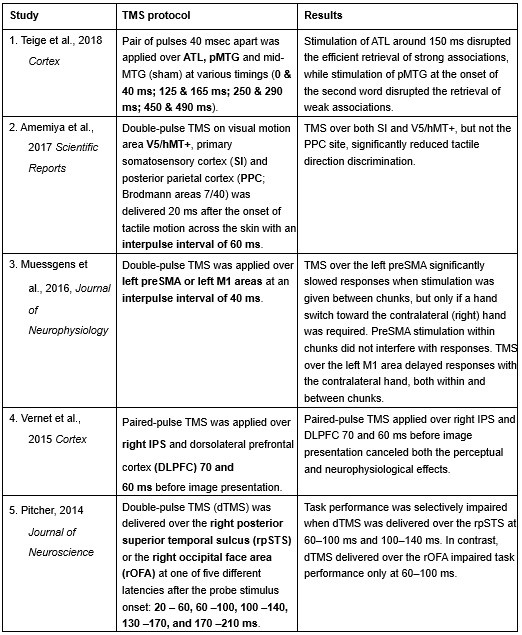
      Reference

      Teige, C., Mollo, G., Millman, R., Savill, N., Smallwood, J., Cornelissen, P. L., & Jefferies, E. (2018). Dynamic semantic cognition: Characterising coherent and controlled conceptual retrieval through time using magnetoencephalography and chronometric transcranial magnetic stimulation. Cortex, 103, 329-349.

      Amemiya, T., Beck, B., Walsh, V., Gomi, H., & Haggard, P. (2017). Visual area V5/hMT+ contributes to perception of tactile motion direction: a TMS study. Scientific reports, 7(1), 40937.

      Muessgens, D., Thirugnanasambandam, N., Shitara, H., Popa, T., & Hallett, M. (2016). Dissociable roles of preSMA in motor sequence chunking and hand switching—a TMS study. Journal of Neurophysiology, 116(6), 2637-2646.

      Vernet, M., Brem, A. K., Farzan, F., & Pascual-Leone, A. (2015). Synchronous and opposite roles of the parietal and prefrontal cortices in bistable perception: a double-coil TMS–EEG study. Cortex, 64, 78-88.

      Pitcher, D. (2014). Facial expression recognition takes longer in the posterior superior temporal sulcus than in the occipital face area. Journal of Neuroscience, 34(27), 9173-9177.

      Bardi, L., Kanai, R., Mapelli, D., & Walsh, V. (2012). TMS of the FEF interferes with spatial conflict. Journal of cognitive neuroscience, 24(6), 1305-1313.

      D’Ausilio, A., Bufalari, I., Salmas, P., & Fadiga, L. (2012). The role of the motor system in discriminating normal and degraded speech sounds. Cortex, 48(7), 882-887.

      Pitcher, D., Duchaine, B., Walsh, V., & Kanwisher, N. (2010). TMS evidence for feedforward and feedback mechanisms of face and body perception. Journal of Vision, 10(7), 671-671.

      Gagnon, G., Blanchet, S., Grondin, S., & Schneider, C. (2010). Paired-pulse transcranial magnetic stimulation over the dorsolateral prefrontal cortex interferes with episodic encoding and retrieval for both verbal and non-verbal materials. Brain Research, 1344, 148-158.

      Kalla, R., Muggleton, N. G., Juan, C. H., Cowey, A., & Walsh, V. (2008). The timing of the involvement of the frontal eye fields and posterior parietal cortex in visual search. Neuroreport, 19(10), 1067-1071.

      Pitcher, D., Garrido, L., Walsh, V., & Duchaine, B. C. (2008). Transcranial magnetic stimulation disrupts the perception and embodiment of facial expressions. Journal of Neuroscience, 28(36), 8929-8933.

      Til Ole Bergmann, Gesa Hartwigsen; Inferring Causality from Noninvasive Brain Stimulation in Cognitive Neuroscience. J Cogn Neurosci 2021; 33 (2): 195–225. https://doi.org/10.1162/jocn_a_01591

      Romero, M.C., Davare, M., Armendariz, M. et al. Neural effects of transcranial magnetic stimulation at the single-cell level. Nat Commun 10, 2642 (2019). https://doi.org/10.1038/s41467-019-10638-7

      Paulus W, Rothwell JC. Membrane resistance and shunting inhibition: where biophysics meets state-dependent human neurophysiology. J Physiol. 2016 May 15;594(10):2719-28. doi: 10.1113/JP271452. PMID: 26940751; PMCID: PMC4865581.

      Staat, C., Gattinger, N., & Gleich, B. (2022). PLUSPULS: A transcranial magnetic stimulator with extended pulse protocols. HardwareX, 13. https://doi.org/10.1016/j.ohx.2022.e00380

      Zhao, W., Li, Y., and Du, Y. (2021). TMS reveals dynamic interaction between inferior frontal gyrus and posterior middle temporal gyrus in gesture-speech semantic integration. The Journal of Neuroscience, 10356-10364. https://doi.org/10.1523/jneurosci.1355-21.2021.

      Reviewer #1 (Public review):

      Summary:

      The authors quantified information in gesture and speech, and investigated the neural processing of speech and gestures in pMTG and LIFG, depending on their informational content, in 8 different time-windows, and using three different methods (EEG, HD-tDCS and TMS). They found that there is a time-sensitive and staged progression of neural engagement that is correlated with the informational content of the signal (speech/gesture).

      Strengths:

      A strength of the paper is that the authors attempted to combine three different methods to investigate speech-gesture processing.

      We sincerely thank the reviewer for recognizing our efforts in conducting three experiments to explore the neural activity linked to the amount of information processed during multisensory gesture-speech integration. In Experiment 1, we observed that the extent of inhibition in the pMTG and LIFG was closely linked to the overlapping gesture-speech responses, as quantified by mutual information. Building on the established roles of the pMTG and LIFG in our previous study (Zhao et al., 2021, JN), we then expanded our investigation to determine whether the dynamic neural engagement between the pMTG and LIFG during gesture-speech processing was also associated with the quality of the information. This hypothesis was further validated through high-temporal resolution EEG, where we examined ERP components related to varying information contents. Notably, we observed a close time alignment between the ERP components and the time windows of the TMS effects, which were associated with the same informational matrices in gesture-speech processing.

      Weaknesses:

      (1) One major issue is that there is a tight anatomical coupling between pMTG and LIFG. Stimulating one area could therefore also result in stimulation of the other area (see Silvanto and Pascual-Leone, 2008). I therefore think it is very difficult to tease apart the contribution of these areas to the speech-gesture integration process, especially considering that the authors stimulate these regions in time windows that are very close to each other in both time and space (and the disruption might last longer over time).

      Response 1: We greatly appreciate the reviewer’s careful consideration. We trust that the explanation provided above has clarified this issue (see Response to Editors for detail).

      (2) Related to this point, it is unclear to me why the HD-TDCS/TMS is delivered in set time windows for each region. How did the authors determine this, and how do the results for TMS compare to their previous work from 2018 and 2023 (which describes a similar dataset+design)? How can they ensure they are only targeting their intended region since they are so anatomically close to each other?

      Response 2: The current study builds on a series of investigations that systematically examined the temporal and spatial dynamics of gesture-speech integration. In our earlier work (Zhao et al., 2018, J. Neurosci), we demonstrated that interrupting neural activity in the IFG or pMTG using TMS selectively disrupted the semantic congruency effect (reaction time costs due to semantic incongruence), without affecting the gender congruency effect (reaction time costs due to gender incongruence). These findings identified the IFG and pMTG as critical hubs for gesture-speech integration. This informed the brain regions selected for subsequent studies.

      In Zhao et al. (2021, J. Neurosci), we employed a double-pulse TMS protocol, delivering stimulation within one of eight 40-ms time windows, to further examine the temporal involvement of the IFG and pMTG. The results revealed time-window-selective disruptions of the semantic congruency effect, confirming the dynamic and temporally staged roles of these regions during gesture-speech integration.

      In Zhao et al. (2023, Frontiers in Psychology), we investigated the semantic predictive role of gestures relative to speech by comparing two experimental conditions: (1) gestures preceding speech by a fixed interval of 200 ms, and (2) gestures preceding speech at its semantic identification point. We observed time-window-selective disruptions of the semantic congruency effect in the IFG and pMTG only in the second condition, leading to the conclusion that gestures exert a semantic priming effect on co-occurring speech. These findings underscored the semantic advantage of gesture in facilitating speech integration, further refining our understanding of the temporal and functional interplay between these modalities.

      The design of the current study—including the choice of brain regions and time windows—was directly informed by these prior findings. Experiment 1 (HD-tDCS) targeted the entire gesture-speech integration process in the IFG and pMTG to assess whether neural activity in these regions, previously identified as integration hubs, is modulated by changes in informativeness from both modalities (i.e., entropy) and their interactions (mutual information, MI). The results revealed a gradual inhibition of neural activity in both areas as MI increased, evidenced by a negative correlation between MI and the tDCS inhibition effect in both regions. Building on this, Experiments 2 and 3 employed double-pulse TMS and ERPs to further assess whether the engaged neural activity was both time-sensitive and staged. These experiments also evaluated the contributions of various sources of information, revealing correlations between information-theoretic metrics and time-locked brain activity, providing insights into the ‘gradual’ nature of gesture-speech integration.

      We acknowledge that the rationale for the design of the current study was not fully articulated in the original manuscript. In the revised version, we provided a more comprehensive and coherent explanation of the logic behind the three experiments, as well as the alignment with our previous findings in Lines 75-102:

      ‘To investigate the neural mechanisms underlying gesture-speech integration, we conducted three experiments to assess how neural activity correlates with distributed multisensory integration, quantified using information-theoretic measures of MI. Additionally, we examined the contributions of unisensory signals in this process, quantified through unisensory entropy. Experiment 1 employed high-definition transcranial direct current stimulation (HD-tDCS) to administer Anodal, Cathodal and Sham stimulation to either the IFG or the pMTG. HD-tDCS induces membrane depolarization with anodal stimulation and membrane hyperpolarization with cathodal stimulation[26], thereby increasing or decreasing cortical excitability in the targeted brain area, respectively. This experiment aimed to determine whether the overall facilitation (Anodal-tDCS minus Sham-tDCS) and/or inhibitory (Cathodal-tDCS minus Sham-tDCS) of these integration hubs is modulated by the degree of gesture-speech integration, as measure by MI.

      Given the differential involvement of the IFG and pMTG in gesture-speech integration, shaped by top-down gesture predictions and bottom-up speech processing [23], Experiment 2 was designed to further assess whether the activity of these regions was associated with relevant informational matrices. Specifically, we applied inhibitory chronometric double-pulse transcranial magnetic stimulation (TMS) to specific temporal windows associated with integration processes in these regions[23], assessing whether the inhibitory effects of TMS were correlated with unisensory entropy or the multisensory convergence index (MI).

      Experiment 3 complemented these investigations by focusing on the temporal dynamics of neural responses during semantic processing, leveraging high-temporal event-related potentials (ERPs). This experiment investigated how distinct information contributors modulated specific ERP components associated with semantic processing. These components included the early sensory effects as P1 and N1–P2[27,28], the N400 semantic conflict effect[14,28,29], and the late positive component (LPC) reconstruction effect[30,31]. By integrating these ERP findings with results from Experiments 1 and 2, Experiment 3 aimed to provide a more comprehensive understanding of how gesture-speech integration is modulated by neural dynamics.’

      Although the IFG and pMTG are anatomically close, the consistent differentiation of their respective roles, as evidenced by our experiment across various time windows (TWs) and supported by previous research (see Response to editors for details), reinforces the validity of the stimulation effect observed in our study.

      References

      Zhao, W.Y., Riggs, K., Schindler, I., and Holle, H. (2018). Transcranial magnetic stimulation over left inferior frontal and posterior temporal cortex disrupts gesture-speech integration. Journal of Neuroscience 38, 1891-1900. 10.1523/Jneurosci.1748-17.2017.

      Zhao, W., Li, Y., and Du, Y. (2021). TMS reveals dynamic interaction between inferior frontal gyrus and posterior middle temporal gyrus in gesture-speech semantic integration. The Journal of Neuroscience, 10356-10364. https://doi.org/10.1523/jneurosci.1355-21.2021.

      Zhao, W. (2023). TMS reveals a two-stage priming circuit of gesture-speech integration. Front Psychol 14, 1156087. 10.3389/fpsyg.2023.1156087.

      Bikson, M., Inoue, M., Akiyama, H., Deans, J.K., Fox, J.E., Miyakawa, H., and Jefferys, J.G.R. (2004). Effects of uniform extracellular DC electric fields on excitability in rat hippocampal slices. J Physiol-London 557, 175-190. 10.1113/jphysiol.2003.055772.

      Federmeier, K.D., Mai, H., and Kutas, M. (2005). Both sides get the point: hemispheric sensitivities to sentential constraint. Memory & Cognition 33, 871-886. 10.3758/bf03193082.

      Kelly, S.D., Kravitz, C., and Hopkins, M. (2004). Neural correlates of bimodal speech and gesture comprehension. Brain and Language 89, 253-260. 10.1016/s0093-934x(03)00335-3.

      Wu, Y.C., and Coulson, S. (2005). Meaningful gestures: Electrophysiological indices of iconic gesture comprehension. Psychophysiology 42, 654-667. 10.1111/j.1469-8986.2005.00356.x.

      Fritz, I., Kita, S., Littlemore, J., and Krott, A. (2021). Multimodal language processing: How preceding discourse constrains gesture interpretation and affects gesture integration when gestures do not synchronise with semantic affiliates. J Mem Lang 117, 104191. 10.1016/j.jml.2020.104191.

      Gunter, T.C., and Weinbrenner, J.E.D. (2017). When to take a gesture seriously: On how we use and prioritize communicative cues. J Cognitive Neurosci 29, 1355-1367. 10.1162/jocn_a_01125.

      Ozyurek, A., Willems, R.M., Kita, S., and Hagoort, P. (2007). On-line integration of semantic information from speech and gesture: Insights from event-related brain potentials. J Cognitive Neurosci 19, 605-616. 10.1162/jocn.2007.19.4.605.

      (3) As the EEG signal is often not normally distributed, I was wondering whether the authors checked the assumptions for their Pearson correlations. The authors could perhaps better choose to model the different variables to see whether MI/entropy could predict the neural responses. How did they correct the many correlational analyses that they have performed?

      Response 3: We greatly appreciate the reviewer’s thoughtful comments.

      (1) Regarding the questioning of normal distribution of EEG signals and the use of Pearson correlation, in Figure 5 of the manuscript, we have already included normal distribution curves to illustrate the relationships between average ERP amplitudes across each ROI or elicited cluster and the three information models.

      Additionally, we performed the Shapiro-Wilk test, a widely accepted method for assessing bivariate normality, on both the MI/entropy and averaged ERP data. The p-values for all three combinations were greater than 0.05, indicating that the sample data from all bivariate combinations were normally distributed (Author response table 2).

      Author response table 2.

      Shapiro-Wilk results of bivariable normality test
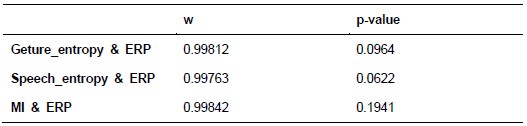
      To further consolidate the relationship between entropy/MI and various ERP components, we also conducted a Spearman rank correlation analysis (Author response table 3-5). While the correlation between speech entropy and ERP amplitude in the P1 component yielded a p-value of 0.061, all other results were consistent with those obtained from the Pearson correlation analysis across the three experiments. Therefore, our conclusion that progressive neural responses reflected the degree of information remains robust. Although the Spearman rank and Pearson correlation analyses yielded similar results, we opted to report the Pearson correlation coefficients throughout the manuscript to maintain consistency.

      Author response table 3.

      Comparison of Pearson and Spearman results in Experiment 1
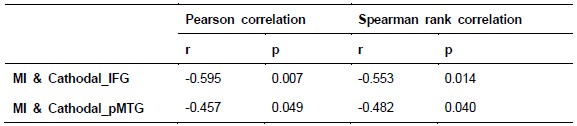
      Author response table 4.

      Comparison of Pearson and Spearman results in Experiment 2
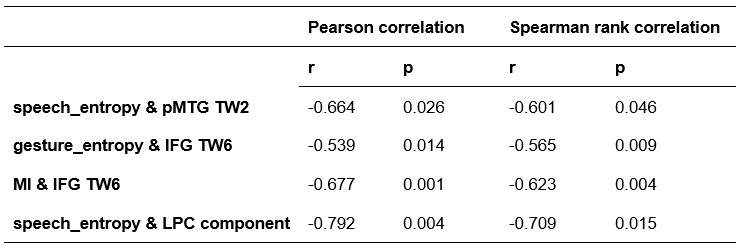
      Author response table 5.

      Comparison of Pearson and Spearman results in Experiment 3
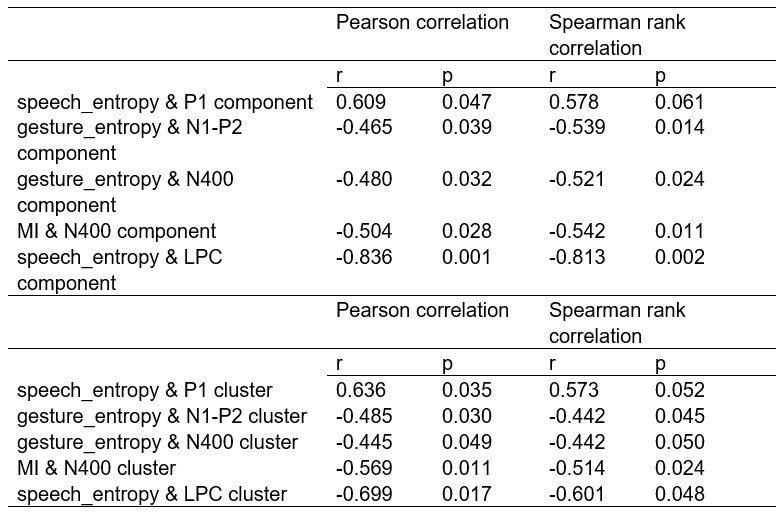
      (2) Regarding the reviewer’s comment ‘choose to model the different variables to see whether MI/entropy could predict the neural responses’, we employed Representational Similarity Analysis (RSA) (Popal et.al, 2019) with MI and entropy as continuous variables. This analysis aimed to build a model to predict neural responses based on these feature metrics.

      To capture dynamic temporal features indicative of different stages of multisensory integration, we segmented the EEG data into overlapping time windows (40 ms in duration with a 10 ms step size). The 40 ms window was chosen based on the TMS protocol used in Experiment 2, which also employed a 40 ms time window. The 10 ms step size (equivalent to 5 time points) was used to detect subtle shifts in neural responses that might not be captured by larger time windows, allowing for a more granular analysis of the temporal dynamics of neural activity.

      Following segmentation, the EEG data were reshaped into a four-dimensional matrix (42 channels × 20 time points × 97 time windows × 20 features). To construct a neural similarity matrix, we averaged the EEG data across time points within each channel and each time window. The resulting matrix was then processed using the pdist function to compute pairwise distances between adjacent data points. This allowed us to calculate correlations between the neural matrix and three feature similarity matrices, which were constructed in a similar manner. These three matrices corresponded to (1) gesture entropy, (2) speech entropy, and (3) mutual information (MI). This approach enabled us to quantify how well the neural responses corresponded to the semantic dimensions of gesture and speech stimuli at each time window.

      To determine the significance of the correlations between neural activity and feature matrices, we conducted 1000 permutation tests. In this procedure, we randomized the data or feature matrices and recalculated the correlations repeatedly, generating a null distribution against which the observed correlation values were compared. Statistical significance was determined if the observed correlation exceeded the null distribution threshold (p < 0.05). This permutation approach helps mitigate the risk of spurious correlations, ensuring that the relationships between the neural data and feature matrices are both robust and meaningful.

      Finally, significant correlations were subjected to clustering analysis, which grouped similar neural response patterns across time windows and channels. This clustering allowed us to identify temporal and spatial patterns in the neural data that consistently aligned with the semantic features of gesture and speech stimuli, thus revealing the dynamic integration of these multisensory modalities across time. Results are as follows:

      (1) Two significant clusters were identified for gesture entropy (Author response image 1 left). The first cluster was observed between 60-110 ms (channels F1 and F3), with correlation coefficients (r) ranging from 0.207 to 0.236 (p < 0.001). The second cluster was found between 210-280 ms (channel O1), with r-values ranging from 0.244 to 0.313 (p < 0.001).

      (2) For speech entropy (Author response image 1 middle), significant clusters were detected in both early and late time windows. In the early time windows, the largest significant cluster was found between 10-170 ms (channels F2, F4, F6, FC2, FC4, FC6, C4, C6, CP4, and CP6), with r-values ranging from 0.151 to 0.340 (p = 0.013), corresponding to the P1 component (0-100 ms). In the late time windows, the largest significant cluster was observed between 560-920 ms (across the whole brain, all channels), with r-values ranging from 0.152 to 0.619 (p = 0.013).

      (3) For mutual information (MI) (Author response image 1 right), a significant cluster was found between 270-380 ms (channels FC1, FC2, FC3, FC5, C1, C2, C3, C5, CP1, CP2, CP3, CP5, FCz, Cz, and CPz), with r-values ranging from 0.198 to 0.372 (p = 0.001).

      Author response image 1.
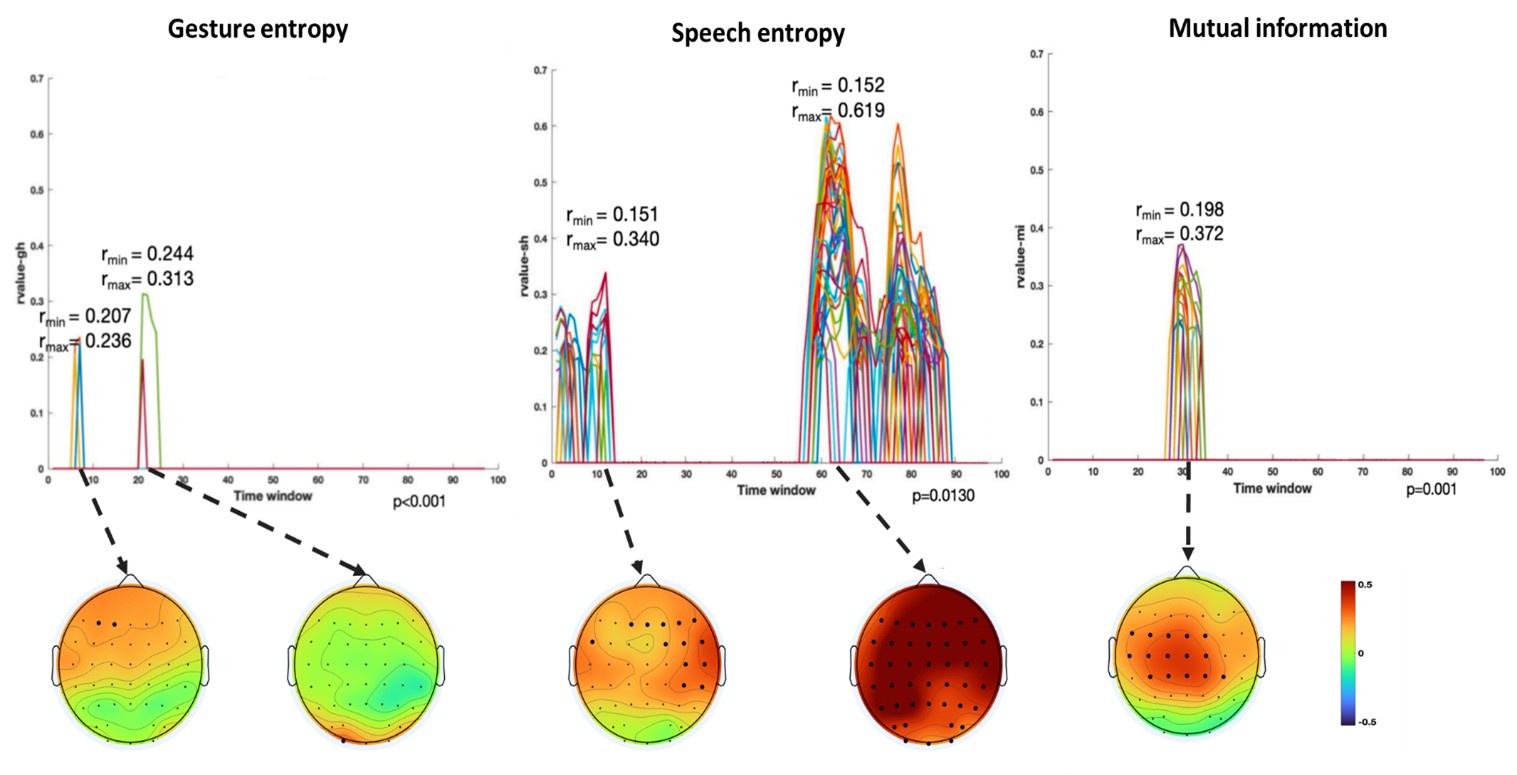
      Results of RSA analysis.

      These additional findings suggest that even using a different modeling approach, neural responses, as indexed by feature metrics of entropy and mutual information, are temporally aligned with distinct ERP components and ERP clusters, as reported in the current manuscript. This alignment serves to further consolidate the results, reinforcing the conclusion we draw. Considering the length of the manuscript, we did not include these results in the current manuscript.

      (3) In terms of the correction of multiple comparisons, in Experiment 1, two separate participant groups were recruited for HD-tDCS applied over either the IFG or pMTG. FDR correction was performed separately for each group, resulting in six comparisons for each brain region (three information matrices × two tDCS effects: anodal-sham or cathodal-sham). In Experiment 2, six comparisons (three information matrices × two sites: IFG or pMTG) were submitted for FDR correction. In Experiment 3, FDR correction was applied to the seven regions of interest (ROIs) within each component, resulting in five comparisons.

      Reference:

      Wilk, M.B. (2015). The Shapiro Wilk And Related Tests For Normality.

      Popal, H., Wang, Y., & Olson, I. R. (2019). A guide to representational similarity analysis for social neuroscience. Social cognitive and affective neuroscience, 14(11), 1243-1253.

      (4) The authors use ROIs for their different analyses, but it is unclear why and on the basis of what these regions are defined. Why not consider all channels without making them part of an ROI, by using a method like the one described in my previous comment?

      Response 4: For the EEG data, we conducted both a traditional ROI analysis and a cluster-based permutation approach. The ROIs were defined based on a well-established work (Habets et al., 2011), allowing for hypothesis-driven testing of specific regions. In addition, we employed a cluster-based permutation methods, which is data-driven and helps enhance robustness while addressing multiple comparisons. This method serves as a complement to the hypothesis-driven ROI analysis, offering an exploratory, unbiased perspective. Notably, the results from both approaches were consistent, reinforcing the reliability of our findings.

      To make the methods more accessible to a broader audience, we clarified the relationship between these approaches in the revised manuscript in Lines 267-270: ‘To consolidate the data, we conducted both a traditional region-of-interest (ROI) analysis, with ROIs defined based on a well-established work40, and a cluster-based permutation approach, which utilizes data-driven permutations to enhance robustness and address multiple comparisons’

      Additionally, we conducted an RSA analysis without defining specific ROIs, considering all channels in the analysis. This approach yielded consistent results, further validating the robustness of our findings across different analysis methods. See Response 3 for detail.

      Reference:

      Habets, B., Kita, S., Shao, Z.S., Ozyurek, A., and Hagoort, P. (2011). The Role of Synchrony and Ambiguity in Speech-Gesture Integration during Comprehension. J Cognitive Neurosci 23, 1845-1854. 10.1162/jocn.2010.21462

      (5) The authors describe that they have divided their EEG data into a "lower half" and a "higher half" (lines 234-236), based on entropy scores. It is unclear why this is necessary, and I would suggest just using the entropy scores as a continuous measure.

      Response 5: To identify ERP components or spatiotemporal clusters that demonstrated significant semantic differences, we split each model into higher and lower halves based on entropy scores. This division allowed us to capture distinct levels of information processing and explore how different levels of entropy or mutual information (MI) related to neural activity. Specifically, the goal was to highlight the gradual activation process of these components and clusters as they correlate with changes in information content. Remarkably, consistent results were observed between the ERP components and clusters, providing robust evidence that semantic information conveyed through gestures and speech significantly influenced the amplitude of these components or clusters. Moreover, the semantic information was shown to be highly sensitive, varying in tandem with these amplitude changes.

      Reviewer #2 (Public review):

      Comment:

      Summary:

      The study is an innovative and fundamental study that clarified important aspects of brain processes for integration of information from speech and iconic gesture (i.e., gesture that depicts action, movement, and shape), based on tDCS, TMS, and EEG experiments. They evaluated their speech and gesture stimuli in information-theoretic ways and calculated how informative speech is (i.e., entropy), how informative gesture is, and how much shared information speech and gesture encode. The tDCS and TMS studies found that the left IFG and pMTG, the two areas that were activated in fMRI studies on speech-gesture integration in the previous literature, are causally implicated in speech-gesture integration. The size of tDC and TMS effects are correlated with the entropy of the stimuli or mutual information, which indicates that the effects stem from the modulation of information decoding/integration processes. The EEG study showed that various ERP (event-related potential, e.g., N1-P2, N400, LPC) effects that have been observed in speech-gesture integration experiments in the previous literature, are modulated by the entropy of speech/gesture and mutual information. This makes it clear that these effects are related to information decoding processes. The authors propose a model of how the speech-gesture integration process unfolds in time, and how IFG and pMTG interact with each other in that process.

      Strengths:

      The key strength of this study is that the authors used information theoretic measures of their stimuli (i.e., entropy and mutual information between speech and gesture) in all of their analyses. This made it clear that the neuro-modulation (tDCS, TMS) affected information decoding/integration and ERP effects reflect information decoding/integration. This study used tDCS and TMS methods to demonstrate that left IFG and pMTG are causally involved in speech-gesture integration. The size of tDCS and TMS effects are correlated with information-theoretic measures of the stimuli, which indicate that the effects indeed stem from disruption/facilitation of the information decoding/integration process (rather than generic excitation/inhibition). The authors' results also showed a correlation between information-theoretic measures of stimuli with various ERP effects. This indicates that these ERP effects reflect the information decoding/integration process.

      We sincerely thank the reviewer for recognizing our efforts and the innovation of employing information-theoretic measures to elucidate the brain processes underlying the multisensory integration of gesture and speech.

      Weaknesses:

      The "mutual information" cannot fully capture the interplay of the meaning of speech and gesture. The mutual information is calculated based on what information can be decoded from speech alone and what information can be decoded from gesture alone. However, when speech and gesture are combined, a novel meaning can emerge, which cannot be decoded from a single modality alone. When example, a person produces a gesture of writing something with a pen, while saying "He paid". The speech-gesture combination can be interpreted as "paying by signing a cheque". It is highly unlikely that this meaning is decoded when people hear speech only or see gestures only. The current study cannot address how such speech-gesture integration occurs in the brain, and what ERP effects may reflect such a process. Future studies can classify different types of speech-gesture integration and investigate neural processes that underlie each type. Another important topic for future studies is to investigate how the neural processes of speech-gesture integration change when the relative timing between the speech stimulus and the gesture stimulus changes.

      We greatly appreciate Reviewer2 ’s thoughtful concern regarding whether "mutual information" adequately captures the interplay between the meanings of speech and gesture. We would like to clarify that the materials used in the present study involved gestures that were performed without actual objects, paired with verbs that precisely describe the corresponding actions. For example, a hammering gesture was paired with the verb “hammer”, and a cutting gesture was paired with the verb “cut”. In this design, all gestures conveyed redundant information relative to the co-occurring speech, creating significant overlap between the information derived from speech alone and that from gesture alone.

      We understand the reviewer’s concern about cases where gestures and speech might provide complementary, rather than redundant, information. To address this, we have developed an alternative metric for quantifying information gains contributed by supplementary multisensory cues, which will be explored in a subsequent study. However, for the present study, we believe that the observed overlap in information serves as a key indicator of multisensory convergence, a central focus of our investigation.

      Regarding the reviewer’s concern about how neural processes of speech-gesture integration may change with varying relative timing between speech and gesture stimuli, we would like to highlight findings from our previous study (Zhao, 2023, Frontiers in Psychology). In that study, we explored the semantic predictive role of gestures relative to speech under two timing conditions: (1) gestures preceding speech by a fixed interval of 200 ms, and (2) gestures preceding speech at its semantic identification point. Interestingly, only in the second condition did we observe time-window-selective disruptions of the semantic congruency effect in the IFG and pMTG. This led us to conclude that gestures play a semantic priming role for co-occurring speech. Building on this, we designed the present study with gestures deliberately preceding speech at its semantic identification point to reflect this semantic priming relationship. Additionally, ongoing research in our lab is exploring gesture and speech interactions in natural conversational settings to investigate whether the neural processes identified here remain consistent across varying contexts.

      To address potential concerns and ensure clarity regarding the limitations of the MI measurement, we have included a discussion of tthis in the revised manuscript in Lines 543-547: ‘Furthermore, MI quantifies overlap in gesture-speech integration, primarily when gestures convey redundant meaning. Consequently, the conclusions drawn in this study are constrained to contexts in which gestures serve to reinforce the meaning of the speech. Future research should aim to explore the neural responses in cases where gestures convey supplementary, rather than redundant, semantic information.’ This is followed by a clarification of the timing relationship between gesture and speech: ‘Note that the sequential cortical involvement and ERP components discussed above are derived from a deliberate alignment of speech onset with gesture DP, creating an artificial priming effect with gesture semantically preceding speech. Caution is advised when generalizing these findings to the spontaneous gesture-speech relationships, although gestures naturally precede speech[34].’ (Lines 539-543).

      Reviewer #3 (Public review):

      In this useful study, Zhao et al. try to extend the evidence for their previously described two-step model of speech-gesture integration in the posterior Middle Temporal Gyrus (pMTG) and Inferior Frontal Gyrus (IFG). They repeat some of their previous experimental paradigms, but this time quantifying Information-Theoretical (IT) metrics of the stimuli in a stroop-like paradigm purported to engage speech-gesture integration. They then correlate these metrics with the disruption of what they claim to be an integration effect observable in reaction times during the tasks following brain stimulation, as well as documenting the ERP components in response to the variability in these metrics.

      The integration of multiple methods, like tDCS, TMS, and ERPs to provide converging evidence renders the results solid. However, their interpretation of the results should be taken with care, as some critical confounds, like difficulty, were not accounted for, and the conceptual link between the IT metrics and what the authors claim they index is tenuous and in need of more evidence. In some cases, the difficulty making this link seems to arise from conceptual equivocation (e.g., their claims regarding 'graded' evidence), whilst in some others it might arise from the usage of unclear wording in the writing of the manuscript (e.g. the sentence 'quantitatively functional mental states defined by a specific parser unified by statistical regularities'). Having said that, the authors' aim is valuable, and addressing these issues would render the work a very useful approach to improve our understanding of integration during semantic processing, being of interest to scientists working in cognitive neuroscience and neuroimaging.

      The main hurdle to achieving the aims set by the authors is the presence of the confound of difficulty in their IT metrics. Their measure of entropy, for example, being derived from the distribution of responses of the participants to the stimuli, will tend to be high for words or gestures with multiple competing candidate representations (this is what would presumptively give rise to the diversity of responses in high-entropy items). There is ample evidence implicating IFG and pMTG as key regions of the semantic control network, which is critical during difficult semantic processing when, for example, semantic processing must resolve competition between multiple candidate representations, or when there are increased selection pressures (Jackson et al., 2021). Thus, the authors' interpretation of Mutual Information (MI) as an index of integration is inextricably contaminated with difficulty arising from multiple candidate representations. This casts doubt on the claims of the role of pMTG and IFG as regions carrying out gesture-speech integration as the observed pattern of results could also be interpreted in terms of brain stimulation interrupting the semantic control network's ability to select the best candidate for a given context or respond to more demanding semantic processing.

      Response 1: We sincerely thank the reviewer for pointing out the confound of difficulty. The primary aim of this study is to investigate whether the degree of activity in the established integration hubs, IFG and pMTG, is influenced by the information provided by gesture-speech modalities and/or their interactions. While we provided evidence for the differential involvement of the IFG and pMTG by delineating their dynamic engagement across distinct time windows of gesture-speech integration and associating these patterns with unisensory information and their interaction, we acknowledge that the mechanisms underlying these dynamics remain open to interpretation. Specifically, whether the observed effects stem from difficulties in semantic control processes, as suggested by the reviewer, or from resolving information uncertainty, as quantified by entropy, falls outside the scope of the current study. Importantly, we view these two interpretations as complementary rather than mutually exclusive, as both may be contributing factors. Nonetheless, we agree that addressing this question is a compelling avenue for future research.

      In the revised manuscript, we have included an additional analysis to assess whether the confounding effects of lexical or semantic control difficulty—specifically, the number of available responses—affect the neural outcomes. To address this, we performed partial correlation analyses, controlling for the number of responses.

      We would like to clarify an important distinction between the measure of entropy derived from the distribution of responses and the concept of response diversity. Entropy, in our analysis, is computed based on the probability distribution of each response, as captured by the information entropy formula. In contrast, response diversity refers to the simple count of different responses provided. Mutual Information (MI), by its nature, is also an entropy measure, quantifying the overlap in responses. For reference, although we observed a high correlation between the three information matrices and the number of responses (gesture entropy & gesture response number: r = 0.976, p < 0.001; speech entropy & speech response number: r = 0.961, p < 0.001; MI & total response number: r = 0.818, p < 0.001), it is crucial to emphasize that these metrics capture different aspects of the semantic information represented. In the revised manuscript, we have provided a table detailing both entropy and response numbers for each stimulus, to allow for greater transparency and clarity.

      Furthermore, we have added a comprehensive description of the partial correlation analysis conducted across all three experiments in the methodology section: for Experiment 1, please refer to Lines 213–222: ‘To account for potential confounds related to multiple candidate representations, we conducted partial correlation analyses between the tDCS effects and gesture entropy, speech entropy, and MI, controlling for the number of responses provided for each gesture and speech, as well as the total number of combined responses. Given that HD-tDCS induces overall disruption at the targeted brain regions, we hypothesized that the neural activity within the left IFG and pMTG would be progressively affected by varying levels of multisensory convergence, as indexed by MI. Moreover, we hypothesized that the modulation of neural activity by MI would differ between the left IFG and pMTG, as reflected in the differential modulation of response numbers in the partial correlations, highlighting their distinct roles in semantic processing[37].’

      Experiment 2: ‘To control for potential confounds, partial correlations were also performed between the TMS effects and gesture entropy, speech entropy, and MI, controlling for the number of responses for each gesture and speech, as well as the total number of combined responses. By doing this, we can determine how the time-sensitive contribution of the left IFG and pMTG to gesture–speech integration was affected by gesture and speech information distribution.’ (Lines 242–246).

      Experiment 3: ‘Additionally, partial correlations were conducted, accounting for the number of responses for each respective metric’ (Lines 292–293).

      As anticipated by the reviewer, we observed a consistent modulation of response numbers across both regions as well as across the four ERP components and associated clusters. The detailed results are presented below:

      Experiment 1: ‘However, partial correlation analysis, controlling for the total response number, revealed that the initially significant correlation between the Cathodal-tDCS effect and MI was no longer significant (r = -0.303, p = 0.222, 95% CI = [-0.770, 0.164]). This suggests that the observed relationship between Cathodal-tDCS and MI may be confounded by semantic control difficulty, as reflected by the total number of responses. Specifically, the reduced activity in the IFG under Cathodal-tDCS may be driven by variations in the difficulty of semantic control rather than a direct modulation of MI.’ (Lines 310-316) and ‘’Importantly, the reduced activity in the pMTG under Cathodal-tDCS was not influenced by the total response number, as indicated by the non-significant correlation (r = -0.253, p = 0.295, 95% CI = [-0.735, 0.229]). This finding was further corroborated by the unchanged significance in the partial correlation between Cathodal-tDCS and MI, when controlling for the total response number (r = -0.472, p = 0.048, 95% CI = [-0.903, -0.041]). (Lines 324-328).

      Experiment 2:’ Notably, inhibition of pMTG activity in TW2 was not influenced by the number of speech responses (r = -0.539, p = 0.087, 95% CI = [-1.145, 0.067]). However, the number of speech responses did affect the modulation of speech entropy on the pMTG inhibition effect in TW2. This was evidenced by the non-significant partial correlation between pMTG inhibition and speech entropy when controlling for speech response number (r = -0.218, p = 0.545, 95% CI = [-0.563, 0.127]).

      In contrast, the interrupted IFG activity in TW6 appeared to be consistently influenced by the confound of semantic control difficulty. This was reflected in the significant correlation with both gesture response number (r = -0.480, p = 0.032, 95% CI = [-904, -0.056]), speech response number (r = -0.729, p = 0.011, 95% CI = [-1.221, -0.237]), and total response number (r = -0.591, p = 0.008, 95% CI = [-0.993, -0.189]). Additionally, partial correlation analyses revealed non-significant relationship between interrupted IFG activity in TW6 and gesture entropy (r = -0.369, p = 0.120, 95% CI = [-0.810, -0.072]), speech entropy (r = -0.455, p = 0.187, 95% CI = [-1.072, 0.162]), and MI (r = -0.410, p = 0.091, 95% CI = [-0.856, -0.036]) when controlling for response numbers.’ (Lines 349-363)

      Experiment 3: ‘To clarify potential confounds of semantic control difficulty, partial correlation analyses were conducted to examine the relationship between the elicited ERP components and the relevant information matrices, controlling for response numbers. Results consistently indicated modulation by response numbers in the relationship of ERP components with the information matrix, as evidenced by the non-significant partial correlations between the P1 amplitude (P1 component over ML: r = -0.574, p = 0.082, 95% CI = [-1.141, -0.007]) and the P1 cluster (r = -0.503, p = 0.138, 95% CI = [-1.102, 0.096]) with speech entropy; the N1-P2 amplitude (N1-P2 component over LA: r = -0.080, p = 0.746, 95% CI = [-0.554, 0.394]) and N1-P2 cluster (r \= -0.179, p = 0.464, 95% CI = [-0.647, 0.289]) with gesture entropy; the N400 amplitude (N400 component over LA: r = 0.264, p = 0.247, 95% CI = [-0.195,0.723]) and N400 cluster (r = 0.394, p = 0.095, 95% CI = [-0.043, 0.831]) with gesture entropy; the N400 amplitude (N400 component over LA: r = -0.134, p = 0.595, 95% CI = [-0.620, 0.352]) and N400 cluster (r = -0.034, p = 0.894, 95% CI = [-0.524,0.456]) with MI; and the LPC amplitude (LPC component over LA: r \= -0.428, p = 0.217, 95% CI = [-1.054, 0.198]) and LPC cluster (r \= -0.202, p = 0.575, 95% CI = [-0.881, 0.477]) with speech entropy.’ (Lines 424-438)

      Based on the above results, we conclude that there is a dynamic interplay between the difficulty of semantic representation and the control pressures that shape the resulting neural responses. Furthermore, while the role of the IFG in control processes remains consistent, the present study reveals a more segmented role for the pMTG. Specifically, although the pMTG is well-established in the processing of distributed speech information, the integration of multisensory convergence, as indexed by MI, did not elicit the same control-related modulation in pMTG activity. A comprehensive discussion of the control process in shaping neural responses, as well as the specific roles of the IFG and pMTG in this process, is provided in the Discussion section in Lines (493-511): ‘Given that control processes are intrinsically integrated with semantic processing50, a distributed semantic representation enables dynamic modulation of access to and manipulation of meaningful information, thereby facilitating flexible control over the diverse possibilities inherent in a concept. Accordingly, an increased number of candidate responses amplifies the control demands necessary to resolve competing semantic representations. This effect was observed in the present study, where the association of the information matrix with the tDCS effect in IFG, the inhibition of pMTG activity in TW2, disruption of IFG activity in TW6, and modulation of four distinct ERP components collectively demonstrated that response quantity modulated neural activity. These results underscore the intricate interplay between the difficulty of semantic representation and the control pressures that shape the resulting neural responses. 

      The IFG and pMTG, central components of the semantic control network, have been extensively implicated in previous research 50-52. While the role of the IFG in managing both unisensory information and multisensory convergence remains consistent, as evidenced by the confounding difficulty results across Experiments 1 and 2, the current study highlights a more context-dependent function for the pMTG. Specifically, although the pMTG is well-established in the processing of distributed speech information, the multisensory convergence, indexed by MI, did not evoke the same control-related modulation in pMTG activity. These findings suggest that, while the pMTG is critical to semantic processing, its engagement in control processes is likely modulated by the specific nature of the sensory inputs involved’

      Reference:

      Tesink, C.M.J.Y., Petersson, K.M., van Berkum, J.J.A., van den Brink, D., Buitelaar, J.K., and Hagoort, P. (2009). Unification of speaker and meaning in language comprehension: An fMRI study. J Cognitive Neurosci 21, 2085-2099. 10.1162/jocn.2008.21161

      Jackson, R.L. (2021). The neural correlates of semantic control revisited. Neuroimage 224, 117444. 10.1016/j.neuroimage.2020.117444.

      Jefferies, E. (2013). The neural basis of semantic cognition: converging evidence from neuropsychology, neuroimaging and TMS. Cortex 49, 611-625. 10.1016/j.cortex.2012.10.008.

      Noonan, K.A., Jefferies, E., Visser, M., and Lambon Ralph, M.A. (2013). Going beyond inferior prefrontal involvement in semantic control: evidence for the additional contribution of dorsal angular gyrus and posterior middle temporal cortex. J Cogn Neurosci 25, 1824-1850. 10.1162/jocn_a_00442.

      In terms of conceptual equivocation, the use of the term 'graded' by the authors seems to be different from the usage commonly employed in the semantic cognition literature (e.g., the 'graded hub hypothesis', Rice et al., 2015). The idea of a graded hub in the controlled semantic cognition framework (i.e., the anterior temporal lobe) refers to a progressive degree of abstraction or heteromodal information as you progress through the anatomy of the region (i.e., along the dorsal-to-ventral axis). The authors, on the other hand, seem to refer to 'graded manner' in the context of a correlation of entropy or MI and the change in the difference between Reaction Times (RTs) of semantically congruent vs incongruent gesture-speech. The issue is that the discourse through parts of the introduction and discussion seems to conflate both interpretations, and the ideas in the main text do not correspond to the references they cite. This is not overall very convincing. What is it exactly the authors are arguing about the correlation between RTs and MI indexes? As stated above, their measure of entropy captures the spread of responses, which could also be a measure of item difficulty (more diverse responses imply fewer correct responses, a classic index of difficulty). Capturing the diversity of responses means that items with high entropy scores are also likely to have multiple candidate representations, leading to increased selection pressures. Regions like pMTG and IFG have been widely implicated in difficult semantic processing and increased selection pressures (Jackson et al., 2021). How is this MI correlation evidence of integration that proceeds in a 'graded manner'? The conceptual links between these concepts must be made clearer for the interpretation to be convincing.

      Response 2: Regarding the concern of conceptual equivocation, we would like to emphasize that this study represents the first attempt to focus on the relationship between information quantity and neural engagement, a question addressed in three experiments. Experiment 1 (HD-tDCS) targeted the entire gesture-speech integration process in the IFG and pMTG to assess whether neural activity in these regions, previously identified as integration hubs, is modulated by changes in informativeness from both modalities (i.e., entropy) and their interactions (MI). The results revealed a gradual inhibition of neural activity in both areas as MI increased, evidenced by a negative correlation between MI and the tDCS inhibition effect in both regions. Building on this, Experiments 2 and 3 employed double-pulse TMS and ERPs to further assess whether the engaged neural activity was both time-sensitive and staged. These experiments also evaluated the contributions of various sources of information, revealing correlations between information-theoretic metrics and time-locked brain activity, providing insights into the ‘gradual’ nature of gesture-speech integration.

      Therefore, the incremental engagement of the integration hub of IFG and pMTG along with the informativeness of gesture and speech during multisensory integration is different from the "graded hub," which refers to anatomical distribution. We sincerely apologize for this oversight. In the revised manuscript, we have changed the relevant conceptual equivocation in Lines 44-60: ‘Consensus acknowledges the presence of 'convergence zones' within the temporal and inferior parietal areas [1], or the 'semantic hub' located in the anterior temporal lobe[2], pivotal for integrating, converging, or distilling multimodal inputs. Contemporary theories frame the semantic processing as a dynamic sequence of neural states[3], shaped by systems that are finely tuned to the statistical regularities inherent in sensory inputs[4]. These regularities enable the brain to evaluate, weight, and integrate multisensory information, optimizing the reliability of individual sensory signals[5]. However, sensory inputs available to the brain are often incomplete and uncertain, necessitating adaptive neural adjustments to resolve these ambiguities [6]. In this context, neuronal activity is thought to be linked to the probability density of sensory information, with higher levels of uncertainty resulting in the engagement of a broader population of neurons, thereby reflecting the brain’s adaptive capacity to handle diverse possible interpretations[7,8]. Although the role of 'convergence zones' and 'semantic hubs' in integrating multimodal inputs is well established, the precise functional patterns of neural activity in response to the distribution of unified multisensory information—along with the influence of unisensory signals—remain poorly understood.

      To this end, we developed an analytic approach to directly probe the cortical engagement during multisensory gesture-speech semantic integration.’  

      Furthermore, in the Discussion section, we have replaced the term 'graded' with 'incremental' (Line 456,). Additionally, we have included a discussion on the progressive nature of neural engagement, as evidenced by the correlation between RTs and MI indices in Lines 483-492: ‘The varying contributions of unisensory gesture-speech information and the convergence of multisensory inputs, as reflected in the correlation between distinct ERP components and TMS time windows (TMS TWs), are consistent with recent models suggesting that multisensory processing involves parallel detection of modality-specific information and hierarchical integration across multiple neural levels[4,48]. These processes are further characterized by coordination across multiple temporal scales[49]. Building on this, the present study offers additional evidence that the multi-level nature of gesture-speech processing is statistically structured, as measured by information matrix of unisensory entropy and multisensory convergence index of MI, the input of either source would activate a distributed representation, resulting in progressively functioning neural responses.’

      Reference:

      Damasio, H., Grabowski, T.J., Tranel, D., Hichwa, R.D., and Damasio, A.R. (1996). A neural basis for lexical retrieval. Nature 380, 499-505. DOI 10.1038/380499a0.

      Patterson, K., Nestor, P.J., and Rogers, T.T. (2007). Where do you know what you know? The representation of semantic knowledge in the human brain. Nature Reviews Neuroscience 8, 976-987. 10.1038/nrn2277.

      Brennan, J.R., Stabler, E.P., Van Wagenen, S.E., Luh, W.M., and Hale, J.T. (2016). Abstract linguistic structure correlates with temporal activity during naturalistic comprehension. Brain and Language 157, 81-94. 10.1016/j.bandl.2016.04.008.

      Benetti, S., Ferrari, A., and Pavani, F. (2023). Multimodal processing in face-to-face interactions: A bridging link between psycholinguistics and sensory neuroscience. Front Hum Neurosci 17, 1108354. 10.3389/fnhum.2023.1108354.

      Noppeney, U. (2021). Perceptual Inference, Learning, and Attention in a Multisensory World. Annual Review of Neuroscience, Vol 44, 2021 44, 449-473. 10.1146/annurev-neuro-100120-085519.

      Ma, W.J., and Jazayeri, M. (2014). Neural coding of uncertainty and probability. Annu Rev Neurosci 37, 205-220. 10.1146/annurev-neuro-071013-014017.

      Fischer, B.J., and Pena, J.L. (2011). Owl's behavior and neural representation predicted by Bayesian inference. Nat Neurosci 14, 1061-1066. 10.1038/nn.2872.

      Ganguli, D., and Simoncelli, E.P. (2014). Efficient sensory encoding and Bayesian inference with heterogeneous neural populations. Neural Comput 26, 2103-2134. 10.1162/NECO_a_00638.

      Meijer, G.T., Mertens, P.E.C., Pennartz, C.M.A., Olcese, U., and Lansink, C.S. (2019). The circuit architecture of cortical multisensory processing: Distinct functions jointly operating within a common anatomical network. Prog Neurobiol 174, 1-15. 10.1016/j.pneurobio.2019.01.004.

      Senkowski, D., and Engel, A.K. (2024). Multi-timescale neural dynamics for multisensory integration. Nat Rev Neurosci 25, 625-642. 10.1038/s41583-024-00845-7.

      Reviewer #2 (Recommendations for the authors):

      I have a number of small suggestions to make the paper more easy to understand.

      We sincerely thank the reviewer for their careful reading and thoughtful consideration. All suggestions have been thoroughly addressed and incorporated into the revised manuscript.

      (1) Lines 86-87, please clarify whether "chronometric double-pulse TMS" should lead to either excitation or inhibition of neural activities

      Double-pulse TMS elicits inhibition of neural activities (see responses to editors), which has been clarified in the revised manuscript in Lines 90-93: ‘we applied inhibitory chronometric double-pulse transcranial magnetic stimulation (TMS) to specific temporal windows associated with integration processes in these regions[23], assessing whether the inhibitory effects of TMS were correlated with unisensory entropy or the multisensory convergence index (MI)’

      (2) Line 106 "validated by replicating the semantic congruencey effect". Please specify what the task was in the validation study.

      The description of the validation task has been added in Lines 116-119: ‘To validate the stimuli, 30 participants were recruited to replicate the multisensory index of semantic congruency effect, hypothesizing that reaction times for semantically incongruent gesture-speech pairs would be significantly longer than those for congruent pairs.’

      (3) Line 112. "30 subjects". Are they Chinese speakers?

      Yes, all participants in the present study, including those in the pre-tests, are native Chinese speakers.

      (4) Line 122, "responses for each item" Please specify whether you mean here "the comprehensive answer" as you defined in 118-119.

      Yes, and this information has been added in Lines 136-137: ‘comprehensive responses for each item were converted into Shannon's entropy (H)’

      (5) Line 163 "one of three stimulus types (Anodal, Cathodal or Sham)". Please specify whether the order of the three conditions was counterbalanced across participants. Or, whether the order was fixed for all participants.

      The order of the three conditions was counterbalanced across participants, a clearer description has been added in the revised manuscript in Lines 184-189: ‘Participants were divided into two groups, with each group undergoing HD-tDCS stimulation at different target sites (IFG or pMTG). Each participant completed three experimental sessions, spaced one week apart, during which 480 gesture-speech pairs were presented across various conditions. In each session, participants received one of three types of HD-tDCS stimulation: Anodal, Cathodal, or Sham. The order of stimulation site and type was counterbalanced using a Latin square design to control for potential order effects.’

      (6) Line 191-192, "difference in reaction time between semantic incongruence and semantic congruent pairs)" Here, please specify which reaction time was subtracted from which one. This information is very crucial; without it, you cannot interpret your graphs.

      (17) Figure 3. Figure caption for (A). "The semantic congruence effect was calculated as the reaction time difference between...". You need to specify which condition was subtracted from what condition; otherwise, you cannot interpret this figure. "difference" is too ambiguous.

      Corrections have been made in the revised manuscript in Lines 208-211: ‘Neural responses were quantified based on the effects of HD-tDCS (active tDCS minus sham tDCS) on the semantic congruency effect, defined as the difference in reaction times between semantic incongruent and congruent conditions (Rt(incongruent) - Rt(congruent))’ and Line 796-798: ‘The semantic congruency effect was calculated as the reaction time (RT) difference between semantically incongruent and semantically congruent pairs (Rt(incongruent) - Rt(congruent))’.

      (7) Line 363 "progressive inhibition of IFG and pMTG by HD-tDCS as the degree of gesture-speech interaction, indexed by MI, advanced." This sentence is very hard to follow. I don't understand what part of the data in Figure 3 speaks to "inhibition of IFG". And what is "HD-tDCS"? I think it is easier to read if you talk about correlation (not "progressive" and "advanced").

      High-Definition transcranial direct current stimulation (HD-tDCS) was applied to modulate the activity of pMTG and IFG, with cathodal stimulation inducing inhibitory effects and anodal stimulation facilitating neural activity. In Figure 3, we examined the relationship between the tDCS effects on pMTG and IFG and the three information matrices (entropy and MI). Our results revealed significant correlations between MI and the cathodal-tDCS effects in both regions. We acknowledge that the original phrasing may have been unclear, and in the revised manuscript, we have provided a more explicit explanation to enhance clarity in Lines 443-445: ‘Our results, for the first time, revealed that the inhibition effect of cathodal-tDCS on the pMTG and IFG correlated with the degree of gesture-speech multisensory convergence, as indexed by MI’.

      (8) Lines 367-368 I don't understand why gesture is top down and speech is bottom up. Is that because gesture precedes speech (gesture is interpretable at the point of speech onset)?

      Yes, since we employed a semantic priming paradigm by aligning speech onset with the gesture comprehension point, we interpret the gesture-speech integration process as an interaction between the top-down prediction from gestures and the bottom-up processing of speech. In the revised manuscript, we have provided a clearer and more coherent description that aligns with the results. Lines 445-449: ‘Moreover, the gradual neural engagement was found to be time-sensitive and staged, as evidenced by the selectively interrupted time windows (Experiment 2) and the distinct correlated ERP components (Experiment 3), which were modulated by different information contributors, including unisensory entropy or multisensory MI’

      (9) Line 380 - 381. Can you spell out "TW" and "IP"?

      (16) Line 448, NIBS, Please spell out "NIBS".

      "TW" have been spelled out in Lines 459: ‘time windows (TW)’,"IP" in Line 460: ‘identification point (IP)’. The term "NIBS" was replaced with "HD-tDCS and TMS" to provide clearer specification of the techniques employed: ‘Consistent with this, the present study provides robust evidence, through the application of HD-tDCS and TMS, that the integration hubs for gesture and speech—the pMTG and IFG—operate in an incremental manner.’ (Lines 454-457). 

      (10) Line 419, The higher certainty of gesture => The higher the certainty of gesture is

      (13) Line 428, "a larger MI" => "a larger MI is"

      (12) Line 427-428, "the larger overlapped neural populations" => "the larger, the overlapped neural populations"

      Changes have been made in Line 522 ‘The higher the certainty of gesture is’ , Line 531: ‘a larger MI is’ and Line 530 ‘the larger, overlapped neural populations’

      (11) Line 423 "Greater TMS effect over the IFG" Can you describe the TMS effect?

      TMS effect has been described as ‘Greater TMS inhibitory effect’ (Line 526)

      (14) Line 423 "reweighting effect" What is this? Please describe (and say which experiment it is about).

      Clearer description has been provided in Lines 535-538: ‘As speech entropy increases, indicating greater uncertainty in the information provided by speech, more cognitive effort is directed towards selecting the targeted semantic representation. This leads to enhanced involvement of the IFG and a corresponding reduction in LPC amplitude’.

      (15) Line 437 "the graded functionality of every disturbed period is not guaranteed" (I don't understand this sentence).

      Clearer description has been provided in Lines 552-557: ‘Additionally, not all influenced TWs exhibited significant associations with entropy and MI. While HD-tDCS and TMS may impact functionally and anatomically connected brain regions[55,56], whether the absence of influence in certain TWs can be attributed to compensation by other connected brain areas, such as angular gyrus[57] or anterior temporal lobe[58], warrants further investigation. Therefore, caution is needed when interpreting the causal relationship between inhibition effects of brain stimulation and information-theoretic metrics (entropy and MI).

      References:

      Humphreys, G. F., Lambon Ralph, M. A., & Simons, J. S. (2021). A Unifying Account of Angular Gyrus Contributions to Episodic and Semantic Cognition. Trends in neurosciences, 44(6), 452–463. https://doi.org/10.1016/j.tins.2021.01.006

      Bonner, M. F., & Price, A. R. (2013). Where is the anterior temporal lobe and what does it do?. The Journal of neuroscience : the official journal of the Society for Neuroscience, 33(10), 4213–4215. https://doi.org/10.1523/JNEUROSCI.0041-13.2013

      (18) Figure 4. "TW1", "TW2", etc. are not informative. Either replace them with the actual manuscript or add manuscript information (either in the graph itself or in the figure title).

      Information was added into the figure title ‘Figure 4. TMS impacts on semantic congruency effect across various time windows (TW).’ (Line 804), included a detailed description of each time window in Lines 805-807: ‘(A) Five time windows (TWs) showing selective disruption of gesture-speech integration were chosen: TW1 (-120 to -80 ms relative to speech identification point), TW2 (-80 to -40 ms), TW3 (-40 to 0 ms), TW6 (80 to 120 ms), and TW7 (120 to 160 ms).’

      (19) Table 2C.

      The last column is titled "p(xi, yi)". I don't understand why the authors use this label for this column.

      In the formula, at the very end, there is "p(xi|yi). I wonder why it is p(xi|yi), as opposed to p(yi|xi).

      Mutual Information (MI) was calculated by subtracting the entropy of the combined gesture-speech dataset (Entropy(gesture + speech)) from the sum of the individual entropies of gesture and speech (Entropy(gesture) + Entropy(speech)). Thus, the p(xi,yi) aimed to describe the entropy of the combined dataset. We acknowledge the potential ambiguity in the original description, and in the revised manuscript, we have changed the formula of p(xi,yi) into ‘p(xi+yi)’ (Line 848) in Table 2C, and the relevant equation of MI ‘’. Also we provided a clear MI calculation process in Lines 143-146: ‘MI was used to measure the overlap between gesture and speech information, calculated by subtracting the entropy of the combined gesture-speech dataset (Entropy(gesture + speech)) from the sum of their individual entropies (Entropy(gesture) + Entropy(speech)) (see Appendix Table 2C)’.

      Reviewer #3 (Recommendations for the authors):

      (1) The authors should try and produce data showing that the confound of difficulty due to the number of lexical or semantic representations is not underlying high-entropy items if they wish to improve the credibility of their claim that the disruption of the congruency effect is due to speech-gesture integration. Additionally, they should provide more evidence either in the form of experiments or references to better justify why mutual information is an index for integration in the first place.

      Response 1: An additional analysis has been conducted to assess whether the number of lexical or semantic representations affect the neural outcomes, please see details in the Responses to Reviewer 3 (public review) response 1.

      Mutual information (MI), a concept rooted in information theory, quantifies the reduction in uncertainty about one signal when the other is known, thereby capturing the statistical dependence between them. MI is calculated as the difference between the individual entropies of each signal and their joint entropy, which reflects the total uncertainty when both signals are considered together. This metric aligns with the core principle of multisensory integration: different modalities reduce uncertainty about each other by providing complementary, predictive information. Higher MI values signify that the integration of sensory signals results in a more coherent and unified representation, while lower MI values indicate less integration or greater divergence between the modalities. As such, MI serves as a robust and natural index for assessing the degree of multisensory integration.

      To date, the use of MI as an index of integration has been limited, with one notable study by Tremblay et al. (2016), cited in the manuscript, using pointwise MI to quantify the extent to which two syllables mutually constrain each other. While MI has been extensively applied in natural language processing to measure the co-occurrence strength between words (e.g., Lin et al., 2012), its application as an index of multisensory convergence—particularly in the context of gesture-speech integration as employed in this study—is novel. In the revised manuscript, we have clarified the relationship between MI and multisensory convergence: ‘MI assesses share information between modalities[25],indicating multisensory convergence and acting as an index of gesture-speech integration’ (Lines 73-74).

      Also, in our study, we calculated MI as per its original definition, by subtracting the entropy of summed dataset of gesture-speech from the combined entropies of gesture and speech. The detailed calculation method is provided in Lines 136-152: ‘To quantify information content, comprehensive responses for each item were converted into Shannon's entropy (H) as a measure of information richness (Figure 1A bottom). With no significant gender differences observed in both gesture (t(20) = 0.21, p = 0.84) and speech (t(20) = 0.52, p = 0.61), responses were aggregated across genders, resulting in 60 answers per item (Appendix Table 2). Here, p(xi) and p(yi) represent the distribution of 60 answers for a given gesture (Appendix Table 2B) and speech (Appendix Table 2A), respectively. High entropy indicates diverse answers, reflecting broad representation, while low entropy suggests focused lexical recognition for a specific item (Figure 2B). MI was used to measure the overlap between gesture and speech information, calculated by subtracting the entropy of the combined gesture-speech dataset (Entropy(gesture + speech)) from the sum of their individual entropies (Entropy(gesture) + Entropy(speech)) (see Appendix Table 2C). For specific gesture-speech combinations, equivalence between the combined entropy and the sum of individual entropies (gesture or speech) indicates absence of overlap in response sets. Conversely, significant overlap, denoted by a considerable number of shared responses between gesture and speech datasets, leads to a noticeable discrepancy between combined entropy and the sum of gesture and speech entropies. Elevated MI values thus signify substantial overlap, indicative of a robust mutual interaction between gesture and speech.’

      Additional examples outlined in Appendix Table 2 in Lines 841-848:

      This novel application of MI as a multisensory convergence index offers new insights into how different sensory modalities interact and integrate to shape semantic processing.

      Reference:

      Tremblay, P., Deschamps, I., Baroni, M., and Hasson, U. (2016). Neural sensitivity to syllable frequency and mutual information in speech perception and production. Neuroimage 136, 106-121. 10.1016/j.neuroimage.2016.05.018

      Lin, W., Wu, Y., & Yu, L. (2012). Online Computation of Mutual Information and Word Context Entropy. International Journal of Future Computer and Communication, 167-169.

      (2) Finally, if the authors wish to address the graded hub hypothesis as posited by the controlled semantic cognition framework (e.g., Rice et al., 2015), they would have to stimulate a series of ROIs progressing gradually through the anatomy of their candidate regions showing the effects grow along this spline, more than simply correlate MI with RT differences.

      Response 2: We appreciate the reviewer’s thoughtful consideration. The incremental engagement of the integration hub of IFG and pMTG along with the informativeness of gesture and speech during multisensory integration is different from the concept of "graded hub," which refers to anatomical distribution. See Responses to reviewer 3 (public review) response 2 for details.

      (3) The authors report significant effects with p values as close to the threshold as p=0.49 for the pMTG correlation in Experiment 1, for example. How confident are the authors these results are reliable and not merely their 'statistical luck'? Especially in view of sample sizes that hover around 22-24 participants, which have been called into question in the field of non-invasive brain stimulation (e.g., Mitra et al, 2021)?

      Response 3: In Experiment 1, a total of 52 participants were assigned to two groups, each undergoing HD-tDCS stimulation over either the inferior frontal gyrus (IFG) or posterior middle temporal gyrus (pMTG), yielding 26 participants per group for correlation analysis. Power analysis, conducted using G*Power, indicated that a sample size of 26 participants per group would provide sufficient power (0.8) to detect a large effect size (0.5) at an alpha level of 0.05, justifying the chosen sample size. To control for potential statistical artifacts, we compared the results to those from the unaffected control condition.

      In the Experiment 1, participants were tasked with a gender categorization task, where they responded as accurately and quickly as possible to the gender of the voice they saw, while gender congruency (e.g., a male gesture paired with a male voice or a female gesture with a male voice) was manipulated. This manipulation served as direct control, enabling the investigation of automatic and implicit semantic interactions between gesture and speech. This relevant information was provided in the manuscript in Lines 167-172:‘An irrelevant factor of gender congruency (e.g., a man making a gesture combined with a female voice) was created[22,23,35]. This involved aligning the gender of the voice with the corresponding gender of the gesture in either a congruent (e.g., male voice paired with a male gesture) or incongruent (e.g., male voice paired with a female gesture) manner. This approach served as a direct control mechanism, facilitating the investigation of the automatic and implicit semantic interplay between gesture and speech[35]’. Correlation analyses were conducted to examine the TMS disruption effects on gender congruency, comparing reaction times for gender-incongruent versus congruent trials. No significant correlations were found between TMS disruption effects on either the IFG (Cathodal-tDCS effect with MI: r = 0.102, p = 0.677; Anodal-tDCS effect with MI: r = 0.178, p = 0.466) or pMTG (Cathodal-tDCS effect with MI: r \= -0.201, p = 0.410; Anodal-tDCS effect with MI: r = -0.232, p = 0.338).

      Moreover, correlations between the TMS disruption effect on semantic congruency and both gesture entropy, speech entropy, and mutual information (MI) were examined. P-values of 0.290, 0.725, and 0.049 were observed, respectively.  

      The absence of a TMS effect on gender congruency, coupled with the lack of significance when correlated with the other information matrices, highlights the robustness of the significant finding at p = 0.049.

      (4) The distributions of entropy for gestures and speech are very unequal. Whilst entropy for gestures has high variability, (.12-4.3), that of speech is very low (ceiling effect?) with low variance. Can the authors comment on whether they think this might have affected their analyses or results in any way? For example, do they think this could be a problem when calculating MI, which integrates both measures? L130-131.'

      Response 4: We sincerely thank the reviewer for raising this insightful question. The core premise of the current study is that brain activity is modulated by the degree of information provided. Accordingly, the 20 entropy values for gesture and speech represent a subset of the overall entropy distribution, with the degree of entropy correlating with a distributed pattern of neural activity, regardless of the scale of variation. This hypothesis aligns with previous studies suggesting that neuronal activity is linked to the probability density of sensory information, with higher levels of uncertainty resulting in the engagement of a broader population of neurons, thereby reflecting the brain’s adaptive capacity to handle diverse possible interpretations (Fischer & Pena, 2011; Ganguli & Simoncelli, 2014).

      Importantly, we conducted another EEG experiment with 30 subjects. Given the inherent differences between gesture and speech, it is important to note that speech, being more structurally distinct, tends to exhibit lower variability than gesture. To prevent an imbalance in the distribution of gesture and speech, we manipulated the information content of each modality. Specifically, we created three conditions for both gesture and speech (i.e., 0.75, 1, and 1.25 times the identification threshold), thereby ensuring comparable variance between the two modalities: gesture (mean entropy = 2.91 ± 1.01) and speech (mean entropy = 1.82 ± 0.71) (Author response table 6).

      Full-factorial RSA analysis revealed an early P1 effect (0-100 ms) for gesture and a late LPC effect (734-780 ms) for speech (Author response image 2b). Crucially, the identified clusters showed significant correlations with both gesture (Author response image 2c1) and speech entropy (Author response image 2c3), respectively. These findings replicate the results of the present study, demonstrating that, irrespective of the variance in gesture and speech entropy, both modalities elicited ERP amplitude responses in a progressive manner that aligned with their respective information distributions.

      Regarding the influence on MI values, since MI was calculated based on the overlapping responses between gesture and speech, a reduction in uncertainty during speech comprehension would naturally result in a smaller contribution to the MI value. However, as hypothesized above, the MI values were also assumed to represent a subset of the overall distribution, where the contributions of both gesture and speech are expected to follow a normal distribution. This hypothesis was further supported by our replication experiment. When the contributions of gesture and speech were balanced, a correlation between MI values and N400 amplitude was observed (Author response image 2c2), consistent with the results reported in the present manuscript. These findings not only support the idea that the correlation between MI and ERP components is unaffected by the subset of MI values but also confirm the replicability of our results.

      Author response table 6.

      Quantitative entropy for each gesture stimulus (BD: before discrimination point; DP: discrimination point; AD: after discrimination point) and speech stimulus (BI: before identification point; IP: identification point; AI: after identification point).
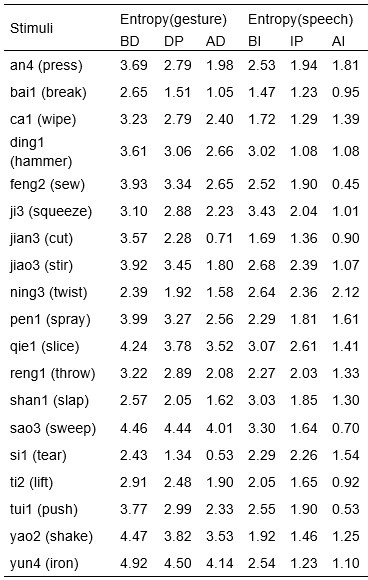
      Author response image 2.

      Results of group-level analysis and full-factorial RSA. a: The full-factorial representational similarity analysis (RSA) framework is illustrated schematically. Within the general linear model (GLM), the light green matrix denotes the representational dissimilarity matrix (RDM) for gesture semantic states, while light blue matrix represents speech semantic states, and the light red matrix illustrates the semantic congruency effect. The symbol ‘e’ indicates the random error term. All matrices, including the neural dissimilarity matrix, are structured as 18 * 18 matrices, corresponding to 18 conditions (comprising 3 gesture semantic states, 3 speech semantic states, and 2 congruency conditions). b: Coding strength for gesture states, speech states and congruency effect. Shaded clusters represent regions where each factor exhibited significant effects. Clusters with lower opacity correspond to areas where the grand-mean ERP amplitudes across conditions showed the highest correlation with unimodal entropy or MI. c1-c6: Topographical correlation maps illustrate the four significant RSA clusters (top), accompanied by the highest correlations between ERP amplitudes within the significant RSA clusters and the information matrices (bottom). Black dots represent electrodes exhibiting significant correlations, while black stars highlight the electrode with the highest correlation coefficient.
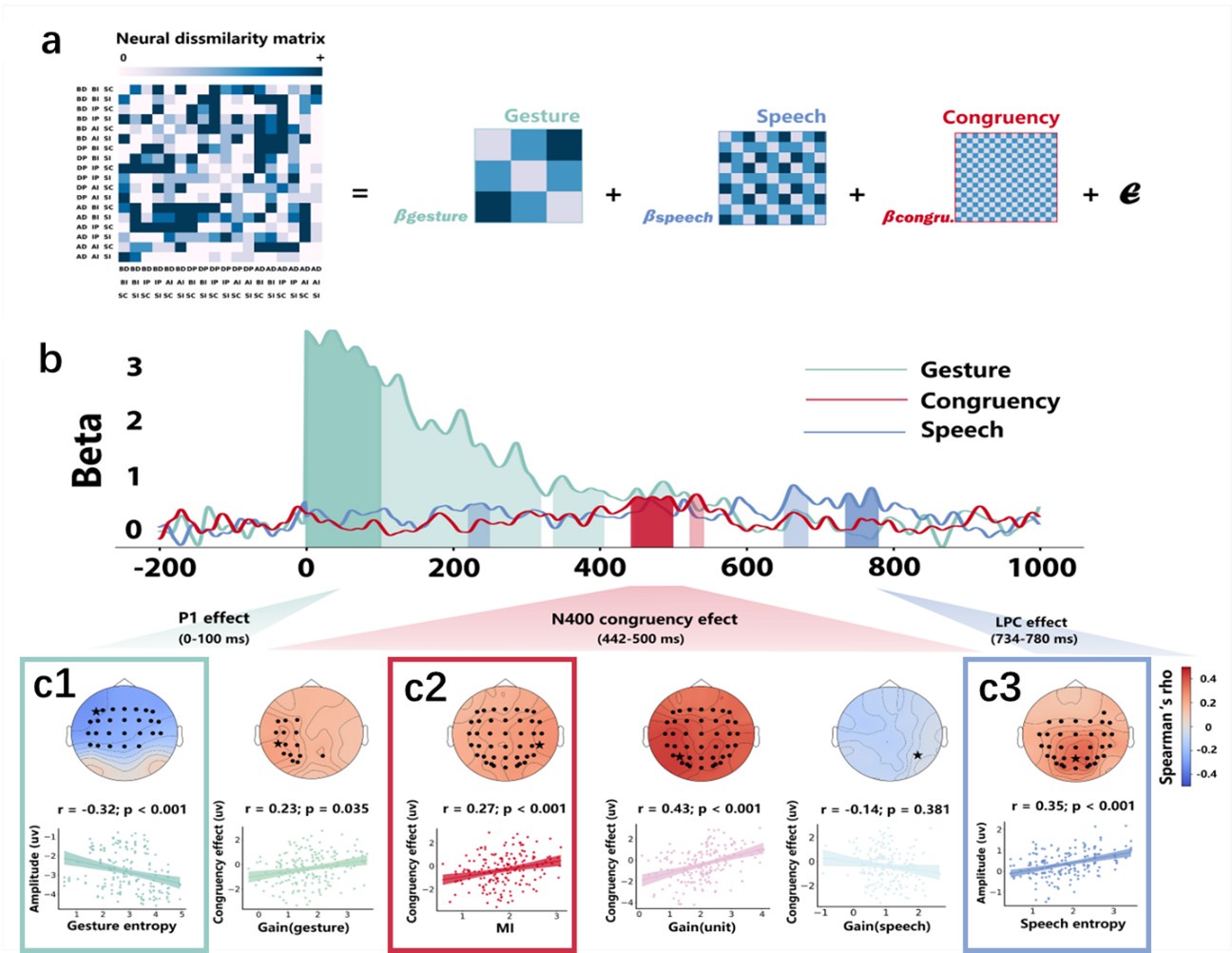
      (5) L383: Why are the authors calling TW2 pre-lexical and TW6 post-lexical? I believe they must provide evidence or references justifying calling these periods pre- and post-lexical. This seems critical given the argument they're trying to make in this paragraph.

      Response 5: The time windows (TWs) selected for the current study were based on our previous work (Zhao et al., 2021, J. Neurosci). In that study, we employed a double-pulse TMS protocol, delivering stimulation across eight 40-ms time windows: three windows preceding the speech identification point (TWs 1-3) and five windows following it (TWs 4-8). The pre-lexical time windows (TWs 1-3) occur before speech identification, while the post-lexical time windows (TWs 4-8) occur after this point. in the revised manuscript, we have made that clear in Lines 462-466:

      “In TW2 of gesture-speech integration, which precedes the speech identification point23 and represents a pre-lexical stage, the suppression effect observed in the pMTG was correlated with speech entropy. Conversely, during TW6, which follows the speech identification point23 and represents a post-lexical stage, the IFG interruption effect was influenced by both gesture entropy, speech entropy, and their MI”

      Reference:

      Zhao, W., Li, Y., and Du, Y. (2021). TMS reveals dynamic interaction between inferior frontal gyrus and posterior middle temporal gyrus in gesture-speech semantic integration. The Journal of Neuroscience, 10356-10364. 10.1523/jneurosci.1355-21.2021.

      (6) Below, I recommend the authors improve their description of the criteria employed to select ROIs. This is important for several reasons. For example, the lack of a control ROI presumably not implicated in integration makes the interpretation of the specificity of the results difficult. Additionally, other regions have been proposed more consistently by recent evidence as multimodal integrators, like for example, the angular gyrus (Humphreys, 2021), or the anterior temporal lobe. The inclusion of IFG as a key region for integration and the oversight of angular gyrus seems to me unjustified in the light of recent evidence.

      Response 6: We appreciate the reviewer’s thoughtful consideration. The selection of IFG and pMTG as ROIs was based on a meta-analysis of multiple fMRI studies on gesture-speech integration, in which these two locations were consistently identified as activated. See Table 2 for details of the studies and coordinates of brain locations reported.

      Author response table 7.

      Meta-analysis of previous studies on gesture-speech integration.
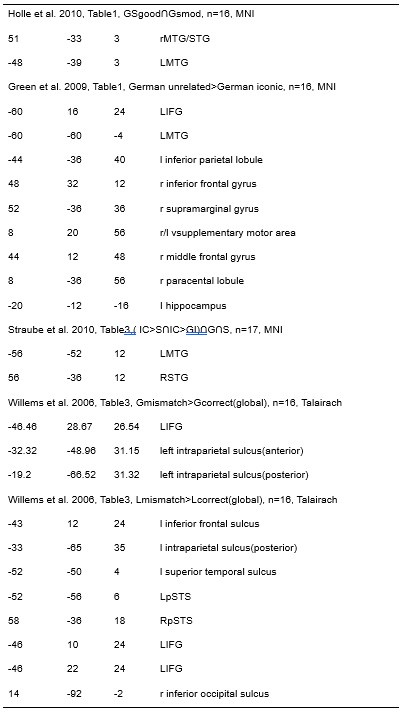
      Based on the meta-analysis of previous studies, we selected the IFG and pMTG as ROIs for gesture-speech integration. The rationale for selecting these brain regions is outlined in the introduction in Lines 65-68: ‘Empirical studies have investigated the semantic integration between gesture and speech by manipulating their semantic relationship[15-18] and revealed a mutual interaction between them[19-21] as reflected by the N400 latency and amplitude[14] as well as common neural underpinnings in the left inferior frontal gyrus (IFG) and posterior middle temporal gyrus (pMTG)[15,22,23]’.

      And further described in Lines 79-80: ‘_Experiment 1 employed high-definition transcranial direct current stimulation (HD-tDCS) to administer Anodal, Cathodal and Sham stimulation to either the IFG or the pMTG ’._ And Lines 87-90: ‘Given the differential involvement of the IFG and pMTG in gesture-speech integration, shaped by top-down gesture predictions and bottom-up speech processing [23], Experiment 2 was designed to assess whether the activity of these regions was associated with relevant informational matrices’.

      In the Methods section, we clarified the selection of coordinates in Lines 193-199: ‘Building on a meta-analysis of prior fMRI studies examining gesture-speech integration[22], we targeted Montreal Neurological Institute (MNI) coordinates for the left IFG at (-62, 16, 22) and the pMTG at (-50, -56, 10). In the stimulation protocol for HD-tDCS, the IFG was targeted using electrode F7 as the optimal cortical projection site[36], with four return electrodes placed at AF7, FC5, F9, and FT9. For the pMTG, TP7 was selected as the cortical projection site36, with return electrodes positioned at C5, P5, T9, and P9.’

      The selection of IFG or pMTG as integration hubs for gesture and speech has also been validated in our previous studies. Specifically, Zhao et al. (2018, J. Neurosci) applied TMS to both areas. Results demonstrated that disrupting neural activity in the IFG or pMTG via TMS selectively impaired the semantic congruency effect (reaction time costs due to semantic incongruence), while leaving the gender congruency effect unaffected. These findings identified the IFG and pMTG as crucial hubs for gesture-speech integration, guiding the selection of brain regions for our subsequent studies.

      In addition, Zhao et al. (2021, J. Neurosci) employed a double-pulse TMS protocol across eight 40-ms time windows to explore the temporal dynamics of the IFG and pMTG. The results revealed time-window-selective disruptions of the semantic congruency effect, further supporting the dynamic and temporally staged involvement of these regions in gesture-speech integration.

      While we have solid rationale for selecting the IFG and pMTG as key regions, we acknowledge the reviewer's point that the involvement of additional functionally and anatomically brain areas, cannot be excluded. We have included in the discussion as limitations in Lines 552-557: ‘Additionally, not all influenced TWs exhibited significant associations with entropy and MI. While HD-tDCS and TMS may impact functionally and anatomically connected brain regions[55,56], whether the absence of influence in certain TWs can be attributed to compensation by other connected brain areas, such as angular gyrus[57] or anterior temporal lobe[58], warrants further investigation. Therefore, caution is needed when interpreting the causal relationship between inhibition effects of brain stimulation and information-theoretic metrics (entropy and MI).

      References:

      Willems, R.M., Ozyurek, A., and Hagoort, P. (2009). Differential roles for left inferior frontal and superior temporal cortex in multimodal integration of action and language. Neuroimage 47, 1992-2004. 10.1016/j.neuroimage.2009.05.066.

      Drijvers, L., Jensen, O., and Spaak, E. (2021). Rapid invisible frequency tagging reveals nonlinear integration of auditory and visual information. Human Brain Mapping 42, 1138-1152. 10.1002/hbm.25282.

      Drijvers, L., and Ozyurek, A. (2018). Native language status of the listener modulates the neural integration of speech and iconic gestures in clear and adverse listening conditions. Brain and Language 177, 7-17. 10.1016/j.bandl.2018.01.003.

      Drijvers, L., van der Plas, M., Ozyurek, A., and Jensen, O. (2019). Native and non-native listeners show similar yet distinct oscillatory dynamics when using gestures to access speech in noise. Neuroimage 194, 55-67. 10.1016/j.neuroimage.2019.03.032.

      Holle, H., and Gunter, T.C. (2007). The role of iconic gestures in speech disambiguation: ERP evidence. J Cognitive Neurosci 19, 1175-1192. 10.1162/jocn.2007.19.7.1175.

      Kita, S., and Ozyurek, A. (2003). What does cross-linguistic variation in semantic coordination of speech and gesture reveal?: Evidence for an interface representation of spatial thinking and speaking. J Mem Lang 48, 16-32. 10.1016/S0749-596x(02)00505-3.

      Bernardis, P., and Gentilucci, M. (2006). Speech and gesture share the same communication system. Neuropsychologia 44, 178-190. 10.1016/j.neuropsychologia.2005.05.007.

      Zhao, W.Y., Riggs, K., Schindler, I., and Holle, H. (2018). Transcranial magnetic stimulation over left inferior frontal and posterior temporal cortex disrupts gesture-speech integration. Journal of Neuroscience 38, 1891-1900. 10.1523/Jneurosci.1748-17.2017.

      Zhao, W., Li, Y., and Du, Y. (2021). TMS reveals dynamic interaction between inferior frontal gyrus and posterior middle temporal gyrus in gesture-speech semantic integration. The Journal of Neuroscience, 10356-10364. 10.1523/jneurosci.1355-21.2021.

      Hartwigsen, G., Bzdok, D., Klein, M., Wawrzyniak, M., Stockert, A., Wrede, K., Classen, J., and Saur, D. (2017). Rapid short-term reorganization in the language network. Elife 6. 10.7554/eLife.25964.

      Jackson, R.L., Hoffman, P., Pobric, G., and Ralph, M.A.L. (2016). The semantic network at work and rest: Differential connectivity of anterior temporal lobe subregions. Journal of Neuroscience 36, 1490-1501. 10.1523/JNEUROSCI.2999-15.2016.

      Humphreys, G. F., Lambon Ralph, M. A., & Simons, J. S. (2021). A Unifying Account of Angular Gyrus Contributions to Episodic and Semantic Cognition. Trends in neurosciences, 44(6), 452–463. https://doi.org/10.1016/j.tins.2021.01.006

      Bonner, M. F., & Price, A. R. (2013). Where is the anterior temporal lobe and what does it do?. The Journal of neuroscience : the official journal of the Society for Neuroscience, 33(10), 4213–4215. https://doi.org/10.1523/JNEUROSCI.0041-13.2013

      (7) Some writing is obscure or unclear, in part due to superfluous words like 'intricate neural processes' on L74. Or the sentence in L47 - 48 about 'quantitatively functional mental states defined by a specific parser unified by statistical regularities' which, even read in context, fails to provide clarity about what a quantitatively functional mental state is, or how it is defined by specific parsers (or what these are), and what is the link to statistical regularities. In some cases, this lack of clarity leads to difficulties assessing the appropriateness of the methods, or the exact nature of the claims. For example, do they mean degree of comprehension instead of comprehensive value? I provide some more examples below:

      Response 7: We appreciate the reviewer’s thoughtful consideration. The revised manuscript now includes a clear description and a detailed explanation of the association with the statistical logic, addressing the concerns raised in Lines 47-55: ‘Contemporary theories frame the semantic processing as a dynamic sequence of neural states[3], shaped by systems that are finely tuned to the statistical regularities inherent in sensory inputs[4]. These regularities enable the brain to evaluate, weight, and integrate multisensory information, optimizing the reliability of individual sensory signals [5]. However, sensory inputs available to the brain are often incomplete and uncertain, necessitating adaptive neural adjustments to resolve these ambiguities[6]. In this context, neuronal activity is thought to be linked to the probability density of sensory information, with higher levels of uncertainty resulting in the engagement of a broader population of neurons, thereby reflecting the brain’s adaptive capacity to handle diverse possible interpretations[7,8].’

      References:

      Brennan, J.R., Stabler, E.P., Van Wagenen, S.E., Luh, W.M., and Hale, J.T. (2016). Abstract linguistic structure correlates with temporal activity during naturalistic comprehension. Brain and Language 157, 81-94. 10.1016/j.bandl.2016.04.008.

      Benetti, S., Ferrari, A., and Pavani, F. (2023). Multimodal processing in face-to-face interactions: A bridging link between psycholinguistics and sensory neuroscience. Front Hum Neurosci 17, 1108354. 10.3389/fnhum.2023.1108354.

      Noppeney, U. (2021). Perceptual Inference, Learning, and Attention in a Multisensory World. Annual Review of Neuroscience, Vol 44, 2021 44, 449-473. 10.1146/annurev-neuro-100120-085519.

      Ma, W.J., and Jazayeri, M. (2014). Neural coding of uncertainty and probability. Annu Rev Neurosci 37, 205-220. 10.1146/annurev-neuro-071013-014017.

      Fischer, B.J., and Pena, J.L. (2011). Owl's behavior and neural representation predicted by Bayesian inference. Nat Neurosci 14, 1061-1066. 10.1038/nn.2872.

      Ganguli, D., and Simoncelli, E.P. (2014). Efficient sensory encoding and Bayesian inference with heterogeneous neural populations. Neural Comput 26, 2103-2134. 10.1162/NECO_a_00638.

      Comment 7.1: a) I am not too sure what they mean by 'response consistently provided by participants for four to six consecutive instances' [L117-118]. They should be clearer with the description of these 'pre-test' study methods.

      Response 7.1: Thank you for this insightful question. An example of a participant's response to the gesture 'an' is provided below (Table 3). Initially, within 240 ms, the participant provided the answer "an," which could potentially be a guess. To ensure that the participant truly comprehends the gesture, we repeatedly present it until the participant’s response stabilizes, meaning the same answer is given consistently over several trials. While one might consider fixing the number of repetitions (e.g., six trials), this could lead to participants predicting the rule and providing the same answer out of habit. To mitigate this potential bias, we allow the number of repetitions to vary flexibly between four and six trials. 

      We understand that the initial phrase might be ambiguous, in the revised manuscript, we have changed the phrase into: ‘For each gesture or speech, the action verb consistently provided by participants across four to six consecutive repetitions—with the number of repetitions varied to mitigate learning effects—was considered the comprehensive response for the gesture or speech.’ (Lines 130-133)

      Author response table 8.

      Example of participant's response to the gesture 'an'
      Comment 7.2: b) I do not understand the paragraph in L143 - 146. This is important to rephrase for clarification. What are 'stepped' neural changes? What is the purpose of 'aggregating' neural responses with identical entropy / MI values?

      Response 7.2: It is important to note that the 20 stimuli exhibit 20 increments of gesture entropy values, 11 increments of speech entropy values, and 19 increments of mutual information values (Appendix Table 3). This discrepancy arises from the calculation of entropy and mutual information, where the distributions were derived from the comprehensive set of responses contributed by all 30 participants. As a result, these values were impacted not only by the distinct nameabilities of the stimuli but also by the entirety of responses provided. Consequently, in the context of speech entropy, 9 items demonstrate the nameability of 1, signifying unanimous comprehension among all 30 participants, resulting in an entropy of 0. Moreover, stimuli 'ning' and 'jiao' share an identical distribution, leading to an entropy of 0.63. Regarding MI, a value of 0.66 is computed for the combinations of stimuli 'sao' (gesture entropy: 4.01, speech entropy: 1.12, Author response image 32) and 'tui' (gesture entropy: 1.62, speech entropy: 0, Author response image 4). This indicates that these two sets of stimuli manifest an equivalent degree of integration.

      Author response image 3.

      Example of gesture answers (gesture sao), speech answers (speech sao), and mutual information (MI) for the ‘sao’ item
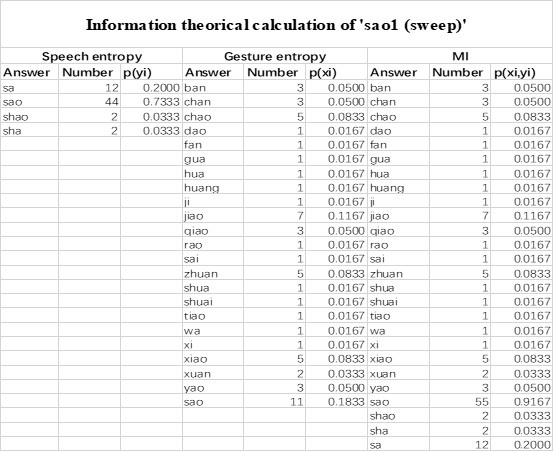
      Author response image 4.

      Example of gesture answers (gesture tui), speech answers (speech tui), and mutual information (MI) for the ‘tui’ item
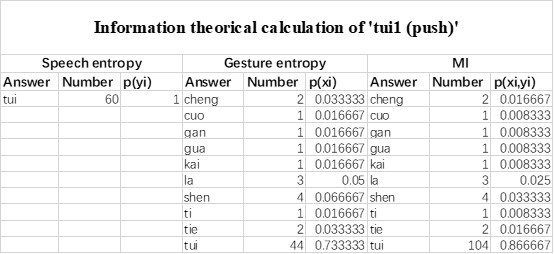
      To precisely assess whether lower entropy/MI corresponds to a smaller or larger neural response, neural responses (ERP amplitude or TMS inhibition effect) with identical entropy or MI values were averaged before undergoing correlational analysis. We understand that the phrasing might be ambiguous. Clear description has been changed in the revised manuscript in Lines 157-160: ‘To determine whether entropy or MI values corresponds to distinct neural changes, the current study first aggregated neural responses (including inhibition effects of tDCS and TMS or ERP amplitudes) that shared identical entropy or MI values, prior to conducting correlational analyses.’

      Comment 7.3: c) The paragraph in L160-171 is confusing. Is it an attempt to give an overview of all three experiments? If so, consider moving to the end or summarising what each experiment is at the beginning of the paragraph giving it a name (i.e., TMS). Without that, it is unclear what each experiment is counterbalancing or what 'stimulation site' refers to, for example, leading to a significant lack of clarity.

      Response 7.3: We are sorry for the ambiguity, in the revised manuscript, we have moved the relevant phrasing to the beginning of each experiment.

      ‘Experiment 1: HD-tDCS protocol and data analysis

      Participants were divided into two groups, with each group undergoing HD-tDCS stimulation at different target sites (IFG or pMTG). Each participant completed three experimental sessions, spaced one week apart, during which 480 gesture-speech pairs were presented across various conditions. In each session, participants received one of three types of HD-tDCS stimulation: Anodal, Cathodal, or Sham. The order of stimulation site and type was counterbalanced using a Latin square design to control for potential order effects’ (Lines 183-189)

      ‘Experiment 2: TMS protocol and data analysis

      Experiment 2 involved 800 gesture-speech pairs, presented across 15 blocks over three days, with one week between sessions. Stimulation was administered at three different sites (IFG, pMTG, or Vertex). Within the time windows (TWs) spanning the gesture-speech integration period, five TWs that exhibited selective disruption of integration were selected: TW1 (-120 to -80 ms relative to the speech identification point), TW2 (-80 to -40 ms), TW3 (-40 to 0 ms), TW6 (80 to 120 ms), and TW7 (120 to 160 ms)23 (Figure 1C). The order of stimulation site and TW was counterbalanced using a Latin square design.’ (Lines 223-230)

      ‘Experiment 3: Electroencephalogram (EEG) recording and data analysis

      Experiment 3, comprising a total of 1760 gesture-speech pairs, was completed in a single-day session.’ (Lines 249-250)

      Comment 7.4: d) L402-406: This sentence is not clear. What do the authors mean by 'the state of [the neural landscape] constructs gradually as measured by entropy and MI'? How does this construct a neural landscape? The authors must rephrase this paragraph using clearer language since in its current state it is very difficult to assess whether it is supported by the evidence they present.

      Response 7.4: We are sorry for the ambiguity, in the revised manuscript we have provided clear description in Lines 483-492: ‘The varying contributions of unisensory gesture-speech information and the convergence of multisensory inputs, as reflected in the correlation between distinct ERP components and TMS time windows (TMS TWs), are consistent with recent models suggesting that multisensory processing involves parallel detection of modality-specific information and hierarchical integration across multiple neural levels[4,48]. These processes are further characterized by coordination across multiple temporal scales[49]. Building on this, the present study offers additional evidence that the multi-level nature of gesture-speech processing is statistically structured, as measured by information matrix of unisensory entropy and multisensory convergence index of MI, the input of either source would activate a distributed representation, resulting in progressively functioning neural responses’

      References:

      Benetti, S., Ferrari, A., and Pavani, F. (2023). Multimodal processing in face-to-face interactions: A bridging link between psycholinguistics and sensory neuroscience. Front Hum Neurosci 17, 1108354. 10.3389/fnhum.2023.1108354.

      Meijer, G.T., Mertens, P.E.C., Pennartz, C.M.A., Olcese, U., and Lansink, C.S. (2019). The circuit architecture of cortical multisensory processing: Distinct functions jointly operating within a common anatomical network. Prog Neurobiol 174, 1-15. 10.1016/j.pneurobio.2019.01.004.

      Senkowski, D., and Engel, A.K. (2024). Multi-timescale neural dynamics for multisensory integration. Nat Rev Neurosci 25, 625-642. 10.1038/s41583-024-00845-7.

      (8) Some writing suffers from conceptual equivocation. For example, the link between 'multimodal representation' and gesture as a type of multimodal extralinguistic information is not straightforward. What 'multimodal representations' usually refer to in semantic cognition is not the co-occurrence of gesture and speech, but the different sources or modalities that inform the structure of a semantic representation or concept (not the fact we use another modality vision to perceive gestures that enrich the linguistic auditory communication of said concepts). See also my comment in the public review regarding the conceptual conflation of the graded hub hypothesis.

      Response 8: We aimed to clarify that the integration of gesture and speech, along with the unified representation it entails, is not merely a process whereby perceived gestures enhance speech comprehension. Rather, there exists a bidirectional influence between these two modalities, affecting both their external forms (Bernaidis et al., 2006) and their semantic content (Kita et al., 2003; Kelly et al., 2010). Given that multisensory processing is recognized as an interplay of both top-down and bottom-up mechanisms, we hypothesize that this bidirectional semantic influence between gesture and speech operates similarly. Consequently, we recorded neural responses—specifically the inhibitory effects observed through TMS/tDCS or ERP components—beginning at the onset of speech, which marks the moment when both modalities are accessible.

      We prioritize gesture for two primary reasons. Firstly, from a naturalistic perspective, speech and gesture are temporally aligned; gestures typically precede their corresponding speech segments by less than one second (Morrelsamuls et al., 1992). This temporal alignment has prompted extensive research aimed at identifying the time windows during which integration occurs (Obermeier et al., 2011, 2015). Results indicate that local integration of gesture and speech occurs within a time frame extending from -200 ms to +120 ms relative to gesture-speech alignment, where -200 ms indicates that gestures occur 200 ms before speech onset, and +120 ms signifies gestures occurring after the identification point of speech.

      Secondly, in our previous study (Zhao, 2023), we investigated this phenomenon by manipulating gesture-speech alignment across two conditions: (1) gestures preceding speech by a fixed interval of 200 ms, and (2) gestures preceding speech at its semantic identification point. Notably, only in the second condition did we observe time-window-selective disruptions of the semantic congruency effect in the IFG and pMTG. This led us to conclude that gestures serve a semantic priming function for co-occurring speech.

      We recognize that our previous use of the term "co-occurring speech" may have led to ambiguity. Therefore, in the revised manuscript, we have replaced those sentences with a detailed description of the properties of each modality in Lines 60-62: ‘Even though gestures convey information in a global-synthetic way, while speech conveys information in a linear segmented way, there exists a bidirectional semantic influence between the two modalities[9,10]’

      Conceptual conflation of the graded hub hypothesis has been clarified in the Response to Reviewer 3 (public review) response 2.

      References:

      Bernardis, P., & Gentilucci, M. (2006). Speech and gesture share the same communication system. Neuropsychologia, 44(2), 178-190

      Kelly, S. D., Ozyurek, A., & Maris, E. (2010b). Two sides of the same coin: speech and gesture mutually interact to enhance comprehension. Psychological Science, 21(2), 260-267. doi:10.1177/0956797609357327

      Kita, S., & Ozyurek, A. (2003). What does cross-linguistic variation in semantic coordination of speech and gesture reveal?: Evidence for an interface representation of spatial thinking and speaking. Journal of Memory and Language, 48(1), 16-32. doi:10.1016/s0749-596x(02)00505-3

      Obermeier, C., & Gunter, T. C. (2015). Multisensory Integration: The Case of a Time Window of Gesture-Speech Integration. Journal of Cognitive Neuroscience, 27(2), 292-307. doi:10.1162/jocn_a_00688

      Obermeier, C., Holle, H., & Gunter, T. C. (2011). What Iconic Gesture Fragments Reveal about Gesture-Speech Integration: When Synchrony Is Lost, Memory Can Help. Journal of Cognitive Neuroscience, 23(7), 1648-1663. doi:10.1162/jocn.2010.21498

      Morrelsamuels, P., & Krauss, R. M. (1992). WORD FAMILIARITY PREDICTS TEMPORAL ASYNCHRONY OF HAND GESTURES AND SPEECH. Journal of Experimental Psychology-Learning Memory and Cognition, 18(3), 615-622. doi:10.1037/0278-7393.18.3.615

      Hostetter, A., and Mainela-Arnold, E. (2015). Gestures occur with spatial and Motoric knowledge: It's more than just coincidence. Perspectives on Language Learning and Education 22, 42-49. doi:10.1044/lle22.2.42.

      McNeill, D. (2005). Gesture and though (University of Chicago Press). 10.7208/chicago/9780226514642.001.0001.

      Zhao, W. (2023). TMS reveals a two-stage priming circuit of gesture-speech integration. Front Psychol 14, 1156087. 10.3389/fpsyg.2023.1156087.

      (9) The last paragraph of the introduction lacks a conductive thread. The authors describe three experiments without guiding the reader through a connecting thread underlying the experiments. Feels more like three disconnected studies than a targeted multi-experiment approach to solve a problem. What is each experiment contributing to? What is the 'grand question' or thread unifying these?

      Response 9: The present study introduced three experiments to explore the neural activity linked to the amount of information processed during multisensory gesture-speech integration. In Experiment 1, we observed that the extent of inhibition in the pMTG and LIFG was closely linked to the overlapping gesture-speech responses, as quantified by mutual information. Building on the established roles of the pMTG and LIFG in our previous study (Zhao et al., 2021, JN), we then expanded our investigation to determine whether the dynamic neural engagement between the pMTG and LIFG during gesture-speech processing was also associated with the quality of the information. This hypothesis was further validated through high-temporal resolution EEG, where we examined ERP components related to varying information qualities. Notably, we observed a close time alignment between the ERP components and the time windows of the TMS effects, which were associated with the same informational matrices in gesture-speech processing.

      Linkage of the three experiments has been clarified in the introduction in Lines 75-102: ‘

      To investigate the neural mechanisms underlying gesture-speech integration, we conducted three experiments to assess how neural activity correlates with distributed multisensory integration, quantified using information-theoretic measures of MI. Additionally, we examined the contributions of unisensory signals in this process, quantified through unisensory entropy. Experiment 1 employed high-definition transcranial direct current stimulation (HD-tDCS) to administer Anodal, Cathodal and Sham stimulation to either the IFG or the pMTG. HD-tDCS induces membrane depolarization with anodal stimulation and membrane hyperpolarization with cathodal stimulation[26], thereby increasing or decreasing cortical excitability in the targeted brain area, respectively. This experiment aimed to determine whether the overall facilitation (Anodal-tDCS minus Sham-tDCS) and/or inhibitory (Cathodal-tDCS minus Sham-tDCS) of these integration hubs is modulated by the degree of gesture-speech integration, as measure by MI.

      Given the differential involvement of the IFG and pMTG in gesture-speech integration, shaped by top-down gesture predictions and bottom-up speech processing [23], Experiment 2 was designed to further assess whether the activity of these regions was associated with relevant informational matrices. Specifically, we applied inhibitory chronometric double-pulse transcranial magnetic stimulation (TMS) to specific temporal windows associated with integration processes in these regions[23], assessing whether the inhibitory effects of TMS were correlated with unisensory entropy or the multisensory convergence index (MI).

      Experiment 3 complemented these investigations by focusing on the temporal dynamics of neural responses during semantic processing, leveraging high-temporal event-related potentials (ERPs). This experiment investigated how distinct information contributors modulated specific ERP components associated with semantic processing. These components included the early sensory effects as P1 and N1–P2[27,28], the N400 semantic conflict effect[14,28,29], and the late positive component (LPC) reconstruction effect[30,31]. By integrating these ERP findings with results from Experiments 1 and 2, Experiment 3 aimed to provide a more comprehensive understanding of how gesture-speech integration is modulated by neural dynamics’

      References:

      Bikson, M., Inoue, M., Akiyama, H., Deans, J.K., Fox, J.E., Miyakawa, H., and Jefferys, J.G.R. (2004). Effects of uniform extracellular DC electric fields on excitability in rat hippocampal slices. J Physiol-London 557, 175-190. 10.1113/jphysiol.2003.055772.

      Federmeier, K.D., Mai, H., and Kutas, M. (2005). Both sides get the point: hemispheric sensitivities to sentential constraint. Memory & Cognition 33, 871-886. 10.3758/bf03193082.

      Kelly, S.D., Kravitz, C., and Hopkins, M. (2004). Neural correlates of bimodal speech and gesture comprehension. Brain and Language 89, 253-260. 10.1016/s0093-934x(03)00335-3.

      Wu, Y.C., and Coulson, S. (2005). Meaningful gestures: Electrophysiological indices of iconic gesture comprehension. Psychophysiology 42, 654-667. 10.1111/j.1469-8986.2005.00356.x.

      Fritz, I., Kita, S., Littlemore, J., and Krott, A. (2021). Multimodal language processing: How preceding discourse constrains gesture interpretation and affects gesture integration when gestures do not synchronise with semantic affiliates. J Mem Lang 117, 104191. 10.1016/j.jml.2020.104191.

      Gunter, T.C., and Weinbrenner, J.E.D. (2017). When to take a gesture seriously: On how we use and prioritize communicative cues. J Cognitive Neurosci 29, 1355-1367. 10.1162/jocn_a_01125.

      Ozyurek, A., Willems, R.M., Kita, S., and Hagoort, P. (2007). On-line integration of semantic information from speech and gesture: Insights from event-related brain potentials. J Cognitive Neurosci 19, 605-616. 10.1162/jocn.2007.19.4.605.

      Zhao, W., Li, Y., and Du, Y. (2021). TMS reveals dynamic interaction between inferior frontal gyrus and posterior middle temporal gyrus in gesture-speech semantic integration. The Journal of Neuroscience, 10356-10364. 10.1523/jneurosci.1355-21.2021.

      (10) The authors should provide a clearer figure to appreciate their paradigm, illustrating clearly the stimulus presentation (gesture and speech).

      Response 10: To reduce ambiguity, unnecessary arrows were deleted from Figure 1.

      Comment 11.1: (11) Required methodological clarifications to better assess the strength of the evidence presented:

      a) Were the exclusion criteria only handedness and vision? Did the authors exclude based on neurological and psychiatric disorders? Psychoactive drugs? If not, do they think the lack of these exclusion criteria might have influenced their results?

      Response 11.1: Upon registration, each participant is required to complete a questionnaire alongside the consent form and handedness questionnaire. This procedure is designed to exclude individuals with potential neurological or psychiatric disorders, as well as other factors that may affect their mental state or reaction times. Consequently, all participants reported in the manuscript do not have any of the aforementioned neurological or psychiatric disorders. The questionnaire is attached below:

      Author response image 4.

      Comment 11.2: b) Are the subjects from the pre-tests (L112-113) and the replication study (L107) a separate sample or did they take part in Experiments 1-3?

      Response 11.2: The participants in each pre-test and experiment were independent, resulting in a total of 188 subjects. Since the stimuli utilized in this study were previously validated and reported (Zhao et al., 2021), the 90 subjects who participated in the three pre-tests are not included in the final count for the current study, leaving a total of 98 participants reported in the manuscript in Lines 103-104: ‘Ninety-eight young Chinese participants signed written informed consent forms and took part in the present study’.

      Comment 11.3: c) L176. The authors should explain how they selected ROIs. This is very important for the reasons outlined above.

      Response 11.3: Please see Response to Comment 6 for details.

      Comment 11.4: d) The rationale for Experiment 1 and its analysis approach should be explicitly described. Why perform Pearson correlations? What is the conceptual explanation of the semantic congruency effect and why should it be expected to correlate with the three information-theoretic metrics? What effects could the authors expect to find and what would they mean? There is a brief description in L187-195 but it is unclear.

      Response 11.4: We thank the reviewer for their rigorous consideration. The semantic congruency effect is widely used as an index of multisensory integration. Therefore, the effects of HD-tDCS on the IFG and pMTG, as measured by changes in the semantic congruency effect, serve as an indicator of altered neural responses to multisensory integration. In correlating these changes with behavioral indices of information degree, we aimed to assess whether the integration hubs (IFG and pMTG) function progressively during multisensory gesture-speech integration. The rationale for using Pearson correlations is based on the hypothesis that the 20 sets of stimuli used in this study represent a sample from a normally distributed population. Thus, even with changes in the sample (e.g., using another 20 values), the gradual relationship between neural responses and the degree of information would remain unchanged. This hypothesis is supported by the findings from another experiment (see details in Response to Comment 4).

      In the revised manuscript, we have provided a clear description of the rationale for Experiment 1 in Lines 206-219: ‘To examine the relationship between the degree of information and neural responses, we conducted Pearson correlation analyses using a sample of 20 sets. Neural responses were quantified based on the effects of HD-tDCS (active tDCS minus sham tDCS) on the semantic congruency effect, defined as the difference in reaction times between semantic incongruent and congruent conditions (Rt(incongruent) - Rt(congruent)). This effect served as an index of multisensory integration[35] within the left IFG and pMTG. The variation in information was assessed using three information-theoretic metrics. To account for potential confounds related to multiple candidate representations, we conducted partial correlation analyses between the tDCS effects and gesture entropy, speech entropy, and MI, controlling for the number of responses provided for each gesture and speech, as well as the total number of combined responses. Given that HD-tDCS induces overall disruption at the targeted brain regions, we hypothesized that the neural activity within the left IFG and pMTG would be progressively affected by varying levels of multisensory convergence, as indexed by MI.’

      Additionally, in the introduction, we have rephrased the relevant rationale in Lines 75-86: _‘_To investigate the neural mechanisms underlying gesture-speech integration, we conducted three experiments to assess how neural activity correlates with distributed multisensory integration, quantified using information-theoretic measures of MI. Additionally, we examined the contributions of unisensory signals in this process, quantified through unisensory entropy. Experiment 1 employed high-definition transcranial direct current stimulation (HD-tDCS) to administer Anodal, Cathodal and Sham stimulation to either the IFG or the pMTG. HD-tDCS induces membrane depolarization with anodal stimulation and membrane hyperpolarization with cathodal stimulation[26], thereby increasing or decreasing cortical excitability in the targeted brain area, respectively. This experiment aimed to determine whether the overall facilitation (Anodal-tDCS minus Sham-tDCS) and/or inhibitory (Cathodal-tDCS minus Sham-tDCS) of these integration hubs is modulated by the degree of gesture-speech integration, as measure by MI

      Reference:

      Kelly, S.D., Creigh, P., and Bartolotti, J. (2010). Integrating speech and iconic gestures in a Stroop-like task: Evidence for automatic processing. Journal of Cognitive Neuroscience 22, 683-694. 10.1162/jocn.2009.21254.

      Comment 11.5: e) The authors do not mention in the methods if FDR correction was applied to the Pearson correlations in Experiment 1. There is a mention in the Results Figure, but it is unclear if it was applied consistently. Can the authors confirm, and explicitly state the way they carried out FDR correction for this family of tests in Experiment 1? This is especially important in the light of some of their results having a p-value of p=.049.

      Response 11.5: FDR correction was applied to Experiment 1, and all reported p-values were corrected using this method. In the revised manuscript, we have included a reference to FDR correction in Lines 221-222: ‘False discovery rate (FDR) correction was applied for multiple comparisons.’

      In Experiment 1, since two separate participant groups (each N = 26) were recruited for the HD-tDCS over either the IFG or pMTG, FDR correction was performed separately for each group. Therefore, for each brain region, six comparisons (three information matrices × two tDCS effects: anodal-sham or cathodal-sham) were submitted for FDR correction.

      In Experiment 2, six comparisons (three information matrices × two sites: IFG or pMTG) were submitted for FDR correction. In Experiment 3, FDR correction was applied to the seven regions of interest (ROIs) within each component, resulting in five comparisons

      The confidence of a p-value of 0.049 was clarified in Response to Comment 3.

      Comment 11.6: f) L200. What does the abbreviation 'TW' stands for in this paragraph? When was it introduced in the main text? The description is in the Figure, but it should be moved to the main text.]

      Comment 11.7: g) How were the TWs chosen? Is it the criterion in L201-203? If so, it should be moved to the start of the paragraph. What does the word 'selected' refer to in that description? Selected for what? The explanation seems to be in the Figure, but it should be in the main text. It is still not a complete explanation. What were the criteria for assigning TWs to the IFG or pMTG?

      Response 11.6& 11.7: Since the two comments are related, we will provide a synthesized response. 'TW' refers to time window, the selection of which was based on our previous study (Zhao et al., 2021, J. Neurosci). In Zhao et al. (2021), we employed the same experimental protocol—using inhibitory double-pulse transcranial magnetic stimulation (TMS) over the IFG and pMTG in one of eight 40-ms time windows relative to the speech identification point (IP; the minimal length of lexical speech), with three time windows before the speech IP and five after. Based on this previous work, we believe that these time windows encompass the potential gesture-speech integration process. Results demonstrated a time-window-selective disruption of the semantic congruency effect (i.e., reaction time costs driven by semantic conflict), with no significant modulation of the gender congruency effect (i.e., reaction time costs due to gender conflict), when stimulating the left pMTG in TW1, TW2, and TW7, and when stimulating the left IFG in TW3 and TW6. Based on these findings, the present study selected the five time windows that showed a selective disruption effect during gesture-speech integration.

      Note that in the present study, we applied stimulation to both the IFG and pMTG across all five time windows, and further correlated the TMS disruption effects with the three information matrices.

      We recognize that the rationale for the choice of time windows was not sufficiently explained in the original manuscript. In the revised manuscript, we have added the relevant description in Lines 223-228: ‘Stimulation was administered at three different sites (IFG, pMTG, or Vertex). Within the time windows (TWs) spanning the gesture-speech integration period, five TWs that exhibited selective disruption of integration were selected: TW1 (-120 to -80 ms relative to the speech identification point), TW2 (-80 to -40 ms), TW3 (-40 to 0 ms), TW6 (80 to 120 ms), and TW7 (120 to 160 ms)[23] (Figure 1C). The order of stimulation site and TW was counterbalanced using a Latin square design.’

      Comment 11.8: h) Again, the rationale for the Pearson correlations of semantic congruency with information-theoretic metrics should be explicitly outlined. What is this conceptually?

      Response 11.8: Given that the rationale behind Experiment 1 and Experiment 2 is similar—both investigating the correlation between interrupted neural effects and the degree of information—we believe that the introduction of the Pearson correlation between semantic congruency and information-theoretic metrics, as presented in Experiment 1 (see Response to Comment 11.4 for details), is sufficient for both experiments.

      Comment 11.9: i)What does 'gesture stoke' mean in the Figure referring to Experiment 3? Figure 1D is not clear. What are the arrows referring to?

      Response 11.9: According to McNeill (1992), gesture phases differ based on whether the gesture depicts imagery. Iconic and metaphoric gestures are imagistic and typically consist of three phases: a preparation phase, a stroke phase, and a retraction phrase. Figure 4 provides an example of these three phases using the gesture ‘break’. In the preparation phase, the hand and arm move away from their resting position to a location in gesture space where the stroke begins. As illustrated in the first row of Figure 4, during the preparation phase of the ‘break’ gesture, the hands, initially in a fist and positioned downward, rise to a center-front position. In the stroke phase, the meaning of the gesture is conveyed. This phase occurs in the central gesture space and is synchronized with the linguistic segments it co-expresses. For example, in the stroke phase of the ‘break’ gesture (second row of Figure 4), the two fists move 90 degrees outward before returning to a face-down position. The retraction phase involves the return of the hand from the stroke position to the rest position. In the case of the ‘break’ gesture, this involves moving the fists from the center front back into the resting position (see third row of Figure 4).

      Therefore, in studies examining gesture-speech integration, gestures are typically analyzed starting from the stroke phase (Habets et al., 2011; Kelly et al., 2010), a convention also adopted in our previous studies (Zhao et al., 2018, 2021, 2023). We acknowledge that this should be explained explicitly, and in the revised manuscript, we have added the following clarification in Lines 162-166: ‘Given that gestures induce a semantic priming effect on concurrent speech[33], this study utilized a semantic priming paradigm in which speech onset was aligned with the DP of each gesture[23,33], the point at which the gesture transitions into a lexical form[34]. The gesture itself began at the stroke phase, a critical moment when the gesture conveys its primary semantic content[34].’

      Additionally, Figure 1 has been revised in the manuscript to eliminate ambiguous arrows. (see Response 10 for detail).

      Author response image 5.

      An illustration of the gesture phases of the 'break' gesture.
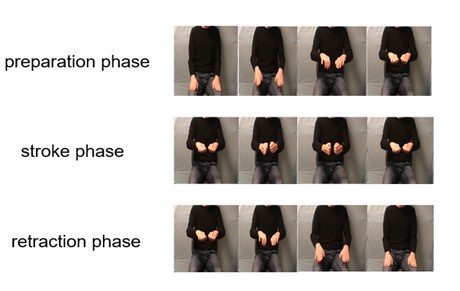
      References:

      Habets, B., Kita, S., Shao, Z. S., Ozyurek, A., & Hagoort, P. (2011). The Role of Synchrony and Ambiguity in Speech-Gesture Integration during Comprehension. Journal of Cognitive Neuroscience, 23(8), 1845-1854. doi:10.1162/jocn.2010.21462

      Kelly, S. D., Creigh, P., & Bartolotti, J. (2010). Integrating Speech and Iconic Gestures in a Stroop-like Task: Evidence for Automatic Processing. Journal of Cognitive Neuroscience, 22(4), 683-694. doi:DOI 10.1162/jocn.2009.21254

      Comment 11.10: j) L236-237: "Consequently, four ERP components were predetermined" is very confusing. Were these components predetermined? Or were they determined as a consequence of the comparison between the higher and lower halves for the IT metrics described above in the same paragraph? The description of the methods is not clear.

      Response 11.10: The components selected were based on a comparison between the higher and lower halves of the information metrics. By stating that these components were predetermined, we aimed to emphasize that the components used in our study are consistent with those identified in previous research on semantic processing. We acknowledge that the phrasing may have been unclear, and in the revised manuscript, we have provided a more explicit description in Lines 267-276: ‘To consolidate the data, we conducted both a traditional region-of-interest (ROI) analysis, with ROIs defined based on a well-established work[40], and a cluster-based permutation approach, which utilizes data-driven permutations to enhance robustness and address multiple comparisons.

      For the traditional ROI analysis, grand-average ERPs at electrode Cz were compared between the higher (≥50%) and lower (<50%) halves for gesture entropy (Figure 5A1), speech entropy (Figure 5B1), and MI (Figure 5C1). Consequently, four ERP components were determined: the P1 effect observed within the time window of 0-100 ms[27,28], the N1-P2 effect observed between 150-250ms[27,28], the N400 within the interval of 250-450ms[14,28,29], and the LPC spanning from 550-1000ms[30,31].’

      Reference: Habets, B., Kita, S., Shao, Z.S., Ozyurek, A., and Hagoort, P. (2011). The Role of Synchrony and Ambiguity in Speech-Gesture Integration during Comprehension. J Cognitive Neurosci 23, 1845-1854. 10.1162/jocn.2010.21462.

      (12) In the Results section for Experiment 2 (L292-295), it is not clear what the authors mean when they mention that a more negative TMS effect represents a stronger interruption of the integration effect. If I understand correctly, the correlation reported for pMTG was for speech entropy, which does not represent integration (that would be MI).

      Response 12: Since the TMS effect was defined as active TMS minus Vertex TMS, the inhibitory TMS effect is inherently negative. A greater inhibitory TMS effect corresponds to a larger negative value, such that a more negative TMS effect indicates a stronger disruption of the integration process. We acknowledge that the previous phrasing was somewhat ambiguous. In the revised manuscript, we have rephrased the sentence as follows: ‘a larger negative TMS effect signifies a greater disruption of the integration process’ (Lines 342-343)

      Multisensory integration transcends simple data amalgamation, encompassing complex interactions at various hierarchical neural levels and the parallel detection and discrimination of raw data from each modality (Benetti et al., 2023; Meijer et al., 2019). Therefore, we regard the process of gesture-speech integration as involving both unisensory processing and multisensory convergence. The correlation of gesture and speech entropy reflects contributions from unisensory processing, while the mutual information (MI) index indicates the contribution of multisensory convergence during gesture-speech integration. The distinction between these various source contributions will be the focus of Experiment 2 and Experiment 3, as described in the revised manuscript Lines 87-102: ‘Given the differential involvement of the IFG and pMTG in gesture-speech integration, shaped by top-down gesture predictions and bottom-up speech processing [23], Experiment 2 was designed to further assess whether the activity of these regions was associated with relevant informational matrices. Specifically, we applied inhibitory chronometric double-pulse transcranial magnetic stimulation (TMS) to specific temporal windows associated with integration processes in these regions[23], assessing whether the inhibitory effects of TMS were correlated with unisensory entropy or the multisensory convergence index (MI).

      Experiment 3 complemented these investigations by focusing on the temporal dynamics of neural responses during semantic processing, leveraging high-temporal event-related potentials (ERPs). This experiment investigated how distinct information contributors modulated specific ERP components associated with semantic processing. These components included the early sensory effects as P1 and N1–P2[27,28], the N400 semantic conflict effect[14,28,29], and the late positive component (LPC) reconstruction effect[30,31]. By integrating these ERP findings with results from Experiments 1 and 2, Experiment 3 aimed to provide a more comprehensive understanding of how gesture-speech integration is modulated by neural dynamics’.  

      References:

      Benetti, S., Ferrari, A., and Pavani, F. (2023). Multimodal processing in face-to-face interactions: A bridging link between psycholinguistics and sensory neuroscience. Front Hum Neurosci 17, 1108354. 10.3389/fnhum.2023.1108354.

      Meijer, G.T., Mertens, P.E.C., Pennartz, C.M.A., Olcese, U., and Lansink, C.S. (2019). The circuit architecture of cortical multisensory processing: Distinct functions jointly operating within a common anatomical network. Prog Neurobiol 174, 1-15. 10.1016/j.pneurobio.2019.01.004.

      (13) I find the description of the results for Experiment 3 very hard to follow. Perhaps if the authors have decided to organise the main text by describing the components from earliest to latest, the Figure organisation should follow suit (i.e., organise the Figure from the earliest to the latest component, instead of gesture entropy/speech entropy / mutual information). This might make the description of the results easier to follow.

      Response 13: As suggested, we have reorganized the results of experiment 3 based on components from earliest to latest, together with an updated Figure 5.

      The results are detailed in Lines 367-423: ‘Topographical maps illustrating amplitude differences between the lower and higher halves of speech entropy demonstrate a central-posterior P1 amplitude (0-100 ms, Figure 5B). Aligning with prior findings[27], the paired t-tests demonstrated a significantly larger P1 amplitude within the ML ROI (t(22) = 2.510, p = 0.020, 95% confidence interval (CI) = [1.66, 3.36]) when contrasting stimuli with higher 50% speech entropy against those with lower 50% speech entropy (Figure 5D1 left). Subsequent correlation analyses unveiled a significant increase in the P1 amplitude with the rise in speech entropy within the ML ROI (r = 0.609, p = 0.047, 95% CI = [0.039, 1.179], Figure 5D1 right). Furthermore, a cluster of neighboring time-electrode samples exhibited a significant contrast between the lower 50% and higher 50% of speech entropy, revealing a P1 effect spanning 16 to 78 ms at specific electrodes (FC2, FCz, C1, C2, Cz, and CPz, Figure 5D2 middle) (t(22) = 2.754, p = 0.004, 95% confidence interval (CI) = [1.65, 3.86], Figure 5D2 left), with a significant correlation with speech entropy (r = 0.636, p = 0.035, 95% CI = [0.081, 1.191], Figure 5D2 right).

      Additionally, topographical maps comparing the lower 50% and higher 50% gesture entropy revealed a frontal N1-P2 amplitude (150-250 ms, Figure 5A). In accordance with previous findings on bilateral frontal N1-P2 amplitude[27], paired t-tests displayed a significantly larger amplitude for stimuli with lower 50% gesture entropy than with higher 50% entropy in both ROIs of LA (t(22) = 2.820, p = 0.011, 95% CI = [2.21, 3.43]) and RA (t(22) = 2.223, p = 0.038, 95% CI = [1.56, 2.89]) (Figure 5E1 left).  Moreover, a negative correlation was found between N1-P2 amplitude and gesture entropy in both ROIs of LA (r = -0.465, p = 0.039, 95% CI = [-0.87, -0.06]) and RA (r = -0.465, p = 0.039, 95% CI = [-0.88, -0.05]) (Figure 5E1 right). Additionally, through a cluster-permutation test, the N1-P2 effect was identified between 184 to 202 ms at electrodes FC4, FC6, C2, C4, C6, and CP4 (Figure 5E2 middle) (t(22) = 2.638, p = 0.015, 95% CI = [1.79, 3.48], (Figure 5E2 left)), exhibiting a significant correlation with gesture entropy (r = -0.485, p = 0.030, 95% CI = [-0.91, -0.06], Figure 5E2 right).

      Furthermore, in line with prior research[42], a left-frontal N400 amplitude (250-450 ms) was discerned from topographical maps of gesture entropy (Figure 5A). Specifically, stimuli with lower 50% values of gesture entropy elicited a larger N400 amplitude in the LA ROI compared to those with higher 50% values  (t(22) = 2.455, p = 0.023, 95% CI = [1.95, 2.96], Figure 5F1 left). Concurrently, a negative correlation was noted between the N400 amplitude and gesture entropy (r = -0.480, p = 0.032, 95% CI = [-0.94, -0.03], Figure 5F1 right) within the LA ROI. The identified clusters showing the N400 effect for gesture entropy (282 – 318 ms at electrodes FC1, FCz, C1, and Cz, Figure 5F2 middle) (t(22) = 2.828, p = 0.010, 95% CI = [2.02, 3.64], Figure 5F2 left) also exhibited significant correlation between the N400 amplitude and gesture entropy (r = -0.445, p = 0.049, 95% CI = [-0.88, -0.01], Figure 5F2 right).

      Similarly, a left-frontal N400 amplitude (250-450 ms) [42] was discerned from topographical maps for MI (Figure 5C). A larger N400 amplitude in the LA ROI was observed for stimuli with lower 50% values of MI compared to those with higher 50% values (t(22) = 3.00, p = 0.007, 95% CI = [2.54, 3.46], Figure 5G1 left). This was accompanied by a significant negative correlation between N400 amplitude and MI (r = -0.504, p = 0.028, 95% CI = [-0.97, -0.04], Figure 5G1 right) within the LA ROI. The N400 effect for MI, observed in the 294–306 ms window at electrodes F1, F3, Fz, FC1, FC3, FCz, and C1 (Figure 5G2 middle) (t(22) = 2.461, p = 0.023, 95% CI = [1.62, 3.30], Figure 5G2 left), also showed a significant negative correlation with MI (r = -0.569, p = 0.011, 95% CI = [-0.98, -0.16], Figure 5G2 right).

      Finally, consistent with previous findings[30], an anterior LPC effect (550-1000 ms) was observed in topographical maps comparing stimuli with lower and higher 50% speech entropy (Figure 5B). The reduced LPC amplitude was evident in the paired t-tests conducted in ROIs of LA (t(22) = 2.614, p = 0.016, 95% CI = [1.88, 3.35]); LC (t(22) = 2.592, p = 0.017, 95% CI = [1.83, 3.35]); RA (t(22) = 2.520, p = 0.020, 95% CI = [1.84, 3.24]); and ML (t(22) = 2.267, p = 0.034, 95% CI = [1.44, 3.10]) (Figure 5H1 left). Simultaneously, a marked negative correlation with speech entropy was evidenced in ROIs of LA (r = -0.836, p =   0.001, 95% CI = [-1.26, -0.42]); LC (r = -0.762, p = 0.006, 95% CI = [-1.23, -0.30]); RA (r = -0.774, p = 0.005, 95% CI = [-1.23, -0.32]) and ML (r = -0.730, p = 0.011, 95% CI = [-1.22, -0.24]) (Figure 5H1 right). Additionally, a cluster with the LPC effect (644 - 688 ms at electrodes Cz, CPz, P1, and Pz, Figure 5H2 middle) (t(22) = 2.754, p = 0.012, 95% CI = [1.50, 4.01], Figure 5H2 left) displayed a significant correlation with speech entropy (r = -0.699, p = 0.017, 95% CI = [-1.24, -0.16], Figure 5H2 right).’

      (14) In the Discussion (L394 - 395) the authors mention for the first time their task being a semantic priming paradigm. This idea of the task as a semantic priming paradigm allowing top-down prediction of gesture over speech should be presented earlier in the paper, perhaps during the final paragraph of the introduction (as part of the rationale) or during the explanation of the task. The authors mention top-down influences earlier and this is impossible to understand before this information about the paradigm is presented. It would also make the reading of the paper significantly clearer. Critically, an appropriate description of the paradigm is missing in the Methods (what are the subjects asked to do? It states that it replicates an effect in Ref 28, but this manuscript does not contain a clear description of the task). To further complicate things, the 'Experimental Procedure' section of the methods states this is a semantic priming paradigm of gestures onto speech (L148) and proceeds to provide two seemingly irrelevant references (for example, the Pitcher reference is to a study that employed faces and houses as stimuli). How is this a semantic priming paradigm? The study where I found the first mention of this paradigm seems to clearly classify it as a Stroop-like task (Kelly et al, 2010).

      We appreciate the reviewer’s thorough consideration. The experimental paradigm employed in the current study differs from the Stroop-like task utilized by Kelly et al. (2010). In their study, the video presentation started with the stroke phase of the gesture, while speech occurred 200 ms after the gesture onset.

      As detailed in our previous study (Zhao et al., 2023, Frontiers in Psychology), we confirmed the semantic predictive role of gestures in relation to speech by contrasting two experimental conditions: (1) gestures preceding speech by a fixed 200 ms interval, and (2) gestures preceding speech at the semantic identification point of the gesture. Our findings revealed time-window-selective disruptions in the semantic congruency effect in the IFG and pMTG, but only in the second condition, suggesting that gestures exert a semantic priming effect on concurrent speech.

      This work highlighted the semantic priming role of gestures in the integration of speech found in Zhao et al. (2021, Journal of Neuroscience). In the study, a comparable approach was adopted by segmenting speech into eight 40-ms time windows based on the speech discrimination point, while manipulating the speech onset to align with the gesture identification point. The results revealed time-window-selective disruptions in the semantic congruency effect, providing support for the dynamic and temporally staged roles of the IFG and pMTG in gesture-speech integration.

      Given that the present study follows the same experimental procedure as our prior work (Zhao et al., 2021, Journal of Neuroscience; Zhao et al., 2023, Frontiers in Psychology), we refer to this design as a "semantic priming" of gesture upon speech. We agree with the reviewer that a detailed description should be clarified earlier in the manuscript. To address this, we have added a more explicit description of the semantic priming paradigm in the methods section of the revised manuscript in Lines 162-166: ‘Given that gestures induce a semantic priming effect on concurrent speech[33], this study utilized a semantic priming paradigm in which speech onset was aligned with the DP of each gesture[23,33], the point at which the gesture transitions into a lexical form[34]. The gesture itself began at the stroke phase, a critical moment when the gesture conveys its primary semantic content [34].’

      The task participants completed was outlined immediately following the explanation of the experimental paradigm: ‘Gesture–speech pairs were presented randomly using Presentation software (www.neurobs.com). Participants were asked to look at the screen but respond with both hands as quickly and accurately as possible merely to the gender of the voice they heard’ (Lines:177-180).

      Wrongly cited references have been corrected.

      (15) L413-417: How do the authors explain that they observe this earlier ERP component and TMS effect over speech and a later one over gesture in pMTG when in their task they first presented gesture and then speech? Why mention STG/S when they didn't assess this?

      (19) L436-440: This paragraph yields the timing of the findings represented in Figure 6 even more confusing. If gesture precedes speech in the paradigm, why are the first TMS and ERP results observed in speech?

      Response 15 &19: Since these two aspects are closely related, we offer a comprehensive explanation. Although gestures were presented before speech, the integration process occurs once both modalities are available. Consequently, ERP and TMS measurements were taken after speech onset to capture the integration of the two modalities. Neural responses were used as the dependent variable to reflect the degree of integration—specifically, gesture-speech semantic congruency in the TMS study and high-low semantic variance in the ERP study. Therefore, the observed early effect can be interpreted as an interaction between the top-down influence of gesture and the bottom-up processing of speech.

      To isolate the pure effect of gesture, neural activity would need to be recorded from gesture onset. However, if one aims to associate the strength of neural activity with the degree of gesture information, recording from the visual processing areas would be more appropriate.

      To avoid unnecessary ambiguity, the phrase "involved STG/S" has been removed from the manuscript.

      (16) L427-428: I find it hard to believe that MI, a behavioural metric, indexes the size of overlapped neural populations activated by gesture and speech. The authors should be careful with this claim or provide evidence in favour.

      Response 16: Mutual information (MI) is a behavioral metric that indexes the distribution of overlapping responses between gesture and speech (for further details, please see the Response to Comment 1). In the present study, MI was correlated with neural responses evoked by gesture and speech, with the goal of demonstrating that neural activity progressively reflects the degree of information conveyed, as indexed by MI.

      (17) Why would you have easier integration (reduced N400) with larger gesture entropy in IFG (Figure 6(3))? Wouldn't you expect more difficult processing if entropy is larger?

      (18) L431-432: The claim that IFG stores semantic information is controversial. The authors provide two references from the early 2000s that do not offer support for this claim (the IFG's purported involvement according to these is in semantic unification, not storage).

      Response 17 &18: As outlined in the Responses to Comment 1 of the public review, we have provided a re-explanation of the IFG as a semantic control region. Additionally, we have clarified the role of the IFG in relation to the various stages of gesture-speech integration in Lines 533-538: ‘Last, the activated speech representation would disambiguate and reanalyze the semantic information and further unify into a coherent comprehension in the pMTG[12,37]. As speech entropy increases, indicating greater uncertainty in the information provided by speech, more cognitive effort is directed towards selecting the targeted semantic representation. This leads to enhanced involvement of the IFG and a corresponding reduction in LPC amplitude’

      (20) Overall, the grammar makes some parts of the discussion hard to follow (e.g. the limitation in L446-447: 'While HD tDCS and TMS may impact functionally and anatomically connected brain regions, the graded functionality of every disturbed period is not guaranteed')

      Response 20: Clear description has been provided in the revised manuscript in Lines 552-557: ‘Additionally, not all influenced TWs exhibited significant associations with entropy and MI. While HD-tDCS and TMS may impact functionally and anatomically connected brain regions[55,56],  whether the absence of influence in certain TWs can be attributed to compensation by other connected brain areas, such as angular gyrus[57] or anterior temporal lobe[58], warrants further investigation. Therefore, caution is needed when interpreting the causal relationship between inhibition effects of brain stimulation and information-theoretic metrics (entropy and MI).’

      References:

      Hartwigsen, G., Bzdok, D., Klein, M., Wawrzyniak, M., Stockert, A., Wrede, K., Classen, J., and Saur, D. (2017). Rapid short-term reorganization in the language network. Elife 6. 10.7554/eLife.25964.

      Jackson, R.L., Hoffman, P., Pobric, G., and Ralph, M.A.L. (2016). The semantic network at work and rest: Differential connectivity of anterior temporal lobe subregions. Journal of Neuroscience 36, 1490-1501. 10.1523/JNEUROSCI.2999-15.2016

      Humphreys, G. F., Lambon Ralph, M. A., & Simons, J. S. (2021). A Unifying Account of Angular Gyrus Contributions to Episodic and Semantic Cognition. Trends in neurosciences, 44(6), 452–463. https://doi.org/10.1016/j.tins.2021.01.006

      Bonner, M. F., & Price, A. R. (2013). Where is the anterior temporal lobe and what does it do?. The Journal of neuroscience : the official journal of the Society for Neuroscience, 33(10), 4213–4215. https://doi.org/10.1523/JNEUROSCI.0041-13.2013

      (21) Inconsistencies between terminology employed in Figures and main text (e.g., pre-test study in text, gating study in Figure?)

      Response 21: Consistence has been made by changing the ‘gating study’ into ‘pre-tests’ in Figure 1 (Lines 758).
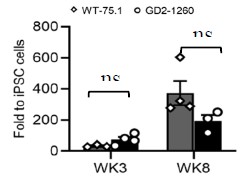

    1. Author Response

      Thanks to all the reviewers for their insightful and constructive comments, which are very helpful in improving the manuscript. We are encouraged by the many positive comments regarding the significance of our findings and the value of our data. Regarding the reviews’ concern on cell classification, we used several additional marker genes to explain the identification of cell clusters and subclusters. We have further analyzed and rewrote part of the text to address the concerns raised. Here is a point-by-point response to the reviewers’ comments and concerns. Figures R1-R9 were provided only for additional information for reviewers and were not included in the revised manuscript.

      Reviewer #1 (Public Review):

      In the article "Temporal transcriptomic dynamics in developing macaque neocortex", Xu et al. analyze the cellular composition and transcriptomic profiles of the developing macaque parietal cortex using single-cell RNA sequencing. The authors profiled eight prenatal rhesus macaque brains at five timepoints (E40, E50, E70, E80, and E90) and obtained a total of around 53,000 high-quality cells for downstream analysis. The dataset provides a high-resolution view into the developmental processes of early and mid-fetal macaque cortical development and will potentially be a valuable resource for future comparative studies of primate neurogenesis and neural stem cell fate specification. Their analysis of this dataset focused on the temporal gene expression profiles of outer and ventricular radial glia and utilized pesudotime trajectory analysis to characterize the genes associated with radial glial and neuronal differentiation. The rhesus macaque dataset presented in this study was then integrated with prenatal mouse and human scRNA-seq datasets to probe species differences in ventricular radial glia to intermediate progenitor cell trajectories. Additionally, the expression profile of macaque radial glia across time was compared to those of mouse apical progenitors to identify conserved and divergent expression patterns of transcription factors.

      The main findings of this paper corroborate many previously reported and fundamental features of primate neurogenesis: deep layer neurons are generated before upper layer excitatory neurons, the expansion of outer radial glia in the primate lineage, conserved molecular markers of outer radial glia, and the early specification of progenitors. Furthermore, the authors show some interesting divergent features of macaque radial glial gene regulatory networks as compared to mouse. Overall, despite some uncertainties surrounding the clustering and annotations of certain cell types, the manuscript provides a valuable scRNA-seq dataset of early prenatal rhesus macaque brain development. The dynamic expression patterns and trajectory analysis of ventricular and outer radial glia provide valuable data and lists of differentially expressed genes (some consistent with previous studies, others reported for the first time here) for future studies.

      The major weaknesses of this study are the inconsistent dissection of the targeted brain region and the loss of more mature excitatory neurons in samples from later developmental timepoint due to the use of single-cell RNA-seq. The authors mention that they could observe ventral progenitors and even midbrain neurons in their analyses. Ventral progenitors should not be present if the authors had properly dissected the parietal cortex. The fact that they obtained even midbrain cells point to an inadequate dissection or poor cell classification. If this is the result of poor classification, it could be easily fixed by using more markers with higher specificity. However, if it is the result of a poor dissection, some of the cells in other clusters could potentially be from midbrain as well. The loss of more mature excitatory neurons is also problematic because on top of hindering the analysis of these neurons in later developmental periods, it also affects the cell proportions the authors use to support some of their claims. The study could also benefit from the validation of some of the genes the authors uncovered to be specifically expressed in different populations of radial glia.

      We thank the Reviewer’s comments and apologize for the shortcomings of tissue dissection and cell capture.

      We used more marker genes for major cell classification, such as SHOX2, IGFBP5, TAC1, PNYN, FLT1, and CYP1B, in new Figure 1D, to improve the cell type annotation results. We improved the cell type annotation results by fixing cluster 20 from C20 as Ventral LGE-derived interneuron precursor and cluster by the expression of IGFBP5, TAC1, and PDYN; fixing cluster 23 from meningeal cells to thalamus cells by the expression of ZIC2, ZIC4, and SHOX2. These cell types were excluded in the follow-up analysis. Due to EN8 being previously incorrectly defined as midbrain neurons, it resulted in a misunderstanding of the dissection result as a poor dissection. After carefully reviewing the data analysis process, we determined that EN8 was a small group of cells in cluster 23 mistakenly selected during excitatory neuron analysis, as shown in Figure R5(A), which was corrected after revision. In the revised manuscript, we deleted the previous EN8 subcluster and renumbered the rest of the excitatory neuron subclusters in the new Figure 2.

      In addition, we also improved the description of sample collection as follows: “We collected eight pregnancy-derived fetal brains of rhesus macaque (Macaca mulatta) at five prenatal developmental stages (E40, E50, E70, E80, E90) and dissected the parietal lobe cortex. Because of the different development times of rhesus monkeys, prenatal cortex size and morphology are different. To ensure that the anatomical sites of each sample are roughly the same, we use the lateral groove as a reference to collect the parietal lobe for single-cell sequencing (as indicated by bright yellow in Figure S1A) and do not make a clear distinction between the different regional parts including primary somatosensory cortex and association cortices in the process of sampling”. As shown in Figure S1A, due to the small volume of the cerebral cortex at early time points, especially in E40, a small number of cells beyond the dorsal parietal lobe, including the ventral cortex cells and thalamus cells, were collected during the sampling process with the brain stereotaxic instrument.

      In this study, the BD method was used to capture single cells. Due to the fixed size of the micropores, this method might be less efficient in capturing mature excitatory neurons. However, it has a good capture effect on newborn neurons at each sampling time point so that the generation of excitatory neurons at different developmental time points can be well observed, as shown in Figure 2, which aligns with our research purpose.

      To verify the reliability of our cell annotation results, we compared the similarity of cell-type association between our study and recently published research(Micali N, Ma S, Li M, et al. Science. doi:10.1126/science.adf3786.PMID: 37824652), using the scmap package to project major cell types in our macaque development scRNA-seq dataset to GSE226451. The river plot in Author response image 1 illustrates the broadly similar relationships of cell type classification between the two datasets.

      Author response image 1.

      Riverplot illustrates relationships between datasets in this study and recently published developing macaque telencephalon datasets major cell type annotation.

      Furthermore, bioinformatics analysis is used for the validation of genes specifically expressed in outer radial glia. We verified terminal oRG differentiation genes in the recently published macaque telencephalic development dataset(Micali N, Ma S, Li M, et al. Science. doi:10.1126/science.adf3786.PMID: 37824652) (GEO accession: GSE226451). The results of Author response image 2 show that the gene expression showed states/stages. Most of the oRG terminal differentiation markers genes identified in our study were also expressed in the oRG cells of the GSE226451 dataset. In particular, the two datasets were consistent in the expression of ion channel genes ATP1A2, ATP1A2, and SCN4B.

      Author response image 2.

      Heatmap shows the relative expression of genes displaying significant changes along the pseudotime axis of vRG to oRG from the dataset of Nicola Micali et al.2023(GEO: GSE226451). The columns represent the cells being ordered along the pseudotime axis.

      Reviewer #2 (Public Review):

      Summary:

      This manuscript by Xu et al., is an interesting study aiming to identify novel features of macaque cortical development. This study serves as a valuable atlas of single cell data during macaque neurogenesis, which extends the developmental stages previously explored. Overall, the authors have achieved their aim of collecting a comprehensive dataset of macaque cortical neurogenesis and have identified a few unknown features of macaque development.

      Strengths:

      The authors have accumulated a robust dataset of developmental time points and have applied a variety of informatic approaches to interrogate this dataset. One interesting finding in this study is the expression of previously unknown receptors on macaque oRG cells. Another novel aspect of this paper is the temporal dissection of neocortical development across species. The identification that the regulome looks quite different, despite similar expression of transcription factors in discrete cell types, is intriguing.

      Weaknesses:

      Due to the focus on demonstrating the robustness of the dataset, the novel findings in this manuscript are underdeveloped. There is also a lack of experimental validation. This is a particular weakness for newly identified features (like receptors in oRG cells). It's important to show expression in relevant cell types and, if possible, perform functional perturbations on these cell types. The presentation of the data highlighting novel findings could also be clarified at higher resolution, and dissected through additional informatic analyses. Additionally, the presentation of ideas and goals of this manuscript should be further clarified. A major gap in the study rationale and results is that the data was collected exclusively in the parietal lobe, yet the rationale and interpretation of what this data indicates about this specific cortical area was not discussed. Last, a few textual errors about neural development are also present and need to be corrected.

      We thank you for your comments and suggestions concerning our manuscript. The comments and suggestions are all valuable and helpful for revising and improving our paper and the essential guiding significance to our research. We have studied the comments carefully and made corrections, which we hope to meet with approval. We have endeavored to address the multiple points raised by the referee.

      To support the reliability of our data and newly identified features, we verified terminal oRG differentiation genes in the recently published macaque telencephalic development dataset(Micali N, Ma S, Li M, et al. Science. doi:10.1126/science.adf3786.PMID: 37824652) (GEO accession: GSE226451). The results of Figure R2 show that the gene expression showed states/stages. Most of the oRG terminal differentiation markers genes identified in our study were also expressed in the oRG cells of the GSE226451 dataset. In particular, the two datasets were consistent in the expression of ion channel genes ATP1A2, ATP1A2, and SCN4B.

      Our research results mainly explore the conserved features of neocortex development across species. By comparing evolution, we found the types of neural stem cells in the intermediate state, their generative trajectories, and gene expression dynamics accompanying cell trajectories. We further explored the stages of transcriptional dynamics during vRG generating oRG. More analysis was performed through transcriptional factor regulatory network analysis. We performed the TFs regulation network analysis of human vRG with pyscenic workflow. The top transcription factors of every time point in human vRG were calculated, and we used the top 10 TFs and their top 5 target genes to perform interaction analysis and generate the regulation network of human vRG in revised figure 6. In comparison of the pyscenic results of mouse, macaque and human vRG, it was obvious that the regulatory networks were not evolutionarily conservative. Compared with macaque, the regulatory network of transcription factors and target genes in humans is more complex. Some conserved regulatory relationships present in more than one species are identified, such as HMGN3, EMX2, SOX2, and HMGA2 network at an early stage when deep lager generation and SOX10, ZNF672, ZNF672 network at a late stage when upper-layer generation.

      Although the parietal lobe is the center of the somatic senses and is significant for interpreting words as well as language understanding and processing. In this study, the parietal lobe area was selected mainly because of the convenience of sampling the dorsal neocortex. As we described in the Materials and Methods section as follows: “Because of the different development times of rhesus monkeys, prenatal cortex size and morphology are different. To ensure that the anatomical sites of each sample are roughly the same, we use the lateral groove as a reference to collect the parietal lobe for single-cell sequencing (as indicated by bright yellow in Figure S1A) and do not make a clear distinction between the different regional parts including primary somatosensory cortex and association cortices in the process of sampling”.

      Thanks for carefully pointing out our manuscript's textual errors about neural development. We have corrected them which were descripted in the following response.

      Reviewer #3 (Public Review):

      Summary: The study adds to the existing data that have established that cortical development in rhesus macaque is known to recapitulate multiple facets cortical development in humans. The authors generate and analyze single cell transcriptomic data from the timecourse of embryonic neurogenesis.

      Strengths:

      Studies of primate developmental biology are hindered by the limited availability and limit replication. In this regard, a new dataset is useful.

      The study analyzes parietal cortex, while previous studies focused on frontal and motor cortex. This may be the first analysis of macaque parietal cortex and, as such, may provide important insights into arealization, which the authors have not addressed.

      Weaknesses:

      The number of cells in the analysis is lower than recent published studies which may limit cell representation and potentially the discovery of subtle changes.

      The macaque parietal cortex data is compared to human and mouse pre-frontal cortex. See data from PMCID: PMC8494648 that provides a better comparison.

      A deeper assessment of these data in the context of existing studies would help others appreciate the significance of the work.

      We thank the reviewer for these suggestions and constructive comments. We agree with the reviewer that the cell number in our study is lower than in recently published studies. The scRNA sequencing in this study was completed between 2018 and 2019, the early stages of the single-cell sequencing technology application. Besides, we have been unable to get extra macaque embryos to enlarge the sample numbers recently since rhesus monkey samples are scarce. Therefore, the number of cells in our study is relatively small compared to recently published single-cell studies.

      The dataset suggested by the reviewers is extremely valuable, and we tried to perform analysis as the reviewer suggested to explore temporal expression patterns in different species of parietal cortex. The dataset from PMCID: PMC8494648 provides the developing human brain across regions from gestation week (GW)14 to gestation week (GW)25. Since this data set only covers the middle and late stages of embryonic neurogenesis, it did not fully match the developmental time points of our study for integration analysis. However, we quoted the results of this study in the discussion section.

      The human regulation analysis with pyscenic workflow was added into new figure 6 for the comparison of different species vRG regulatory network. Compared with macaque, the regulatory network of transcription factors and target genes in humans is more complex. Some conserved regulatory relationships present in more than one species are identified, such as HMGN3, EMX2, SOX2, and HMGA2 network at an early stage when deep lager generation and SOX10, ZNF672, ZNF672 network at a late stage when upper-layer generation.

      Besides, we performed additional integration analysis of our dataset with the recently published macaque neocortex development datase (GEO accession: GSE226451) to verify the reliability of our cell annotation results and terminal oRG differentiation genes. The river plot in Figure R1 illustrates the broadly similar relationships of cell type classification between the two datasets. The result in Figure R2 showed that most of the oRG terminal differentiation markers genes identified in our study were also expressed in the oRG cells of the GSE226451 dataset. In particular, the two datasets were consistent in the expression of ion channel genes ATP1A2, ATP1A2, and SCN4B.

      Reviewer #1 (Recommendations For The Authors):

      1) Throughout the manuscript, the term "embryonic" or "embryogenesis" is used in reference to all timepoints (E40-E90) in this study. The embryonic period is a morphologically and anatomically defined developmental period that ends ~E48-E50 in rhesus macaque. Prenatal or developing is a more accurate term when discussing all timepoints of this study.

      We thank the reviewer for pointing out this terminology that needs to be clarified. We have now replaced “embryonic” with “prenatal” as a more appropriate description for the sampling time points in the manuscript.

      2) Drosophila should be italicized in the introduction.

      Thanks for suggesting that we have set the “Drosophila” words to italics in the manuscript.

      3) Introduction - "In rodents, radial glia are found in the ventricular zone (VZ), where they undergo proliferation and differentiation." This sentence implies that only within rodents are radial glia found within the ventricular zone. Radial glia are present within the ventricular zone of all mammals.

      Thanks for careful reading. This sentence has been corrected “In mammals, radial glial cells are found in the ventricular zone (VZ), where they undergo proliferation and differentiation.”

      4) Figure 1A - an image of the E40 brain is missing.

      We first sampled the prenatal developmental cortex of rhesus monkeys at the E40 timepoint. Unfortunately, we forgot to save the photo of the sampling at the E40 time point.

      5) Figure 1B and 1C - it is unclear why cluster 20 is not annotated in Figure 1 as in the text it is stated "Each of the 28 identified clusters could be assigned to a cell type identity..." This cluster expresses VIM and PAX6 suggestive of ventricular radial glia and is located topographically approximate to IPC cluster 8 and seems to bridge the gap between neural stem cells and the interneuron clusters. Additionally, cluster 20 appears to be subclustered by itself in the progenitor subcluster UMAP (Figure 3A) suggestive of a batch effect or cells with low quality. The investigation, quality control, and proper annotation of this cluster 20 is necessary.

      We appreciate for the reviewer’s suggestion. We detected specific expression marker genes of cluster 20, cells in this cluster specifically expressed VIM, IGFBP5 and TAC. According to the cell annotation results from a published study, we relabeled cluster 20 as ventral LGE-derived interneuron precursors (Yu, Yuan et al. Nat Neurosci. 2021. doi:10.1038/s41593-021-00940-3. PMID: 34737447.). Cluster 20 cells have been deleted in the new Figure 3A.

      6) Figure 1B UMAP - it is unexpected that meningeal cells would cluster topographically closer to the excitatory neuron cluster (one could even argue that the meningeal cell cluster is located within the excitatory neuron clusters) instead of next to or with the endothelial cell clusters. This is suspicious for a mis-annotated cell cluster. ZIC2 and ZIC3 were used as the principal marker genes for meningeal cells. However, these genes are not specific for meninges (PanglaoDB) and had not been identified as marker genes in a developmental sc-RNAseq dataset of the developing mouse meninges (DeSisto et al. 2020). Additional marker genes (COL1A1, COL1A2, CEMIP, CYP1B1, SLC13A3) may be helpful to delineate the identity of this cluster and provide more evidence for a meningeal origin.

      We thank the reviewer for the constructive advice. The violin plot in Author response image 3 has checked additional marker genes, including COL1A1, COL1A2, CEMIP, and CYP1B2. Cluster 23 does not express these marker genes but specifically expresses thalamus marker genes SHOX2(Rosin, Jessica M et al. Dev Biol. 2015. doi:10.1016/j.ydbio.2014.12.013. PMID: 25528224.) and TCF7L2(Lipiec, Marcin Andrzej et al. Development. 2020. doi: 10.1242/dev.190181. PMID: 32675279). According to the gene expression results, we corrected the cell definition of cluster 23 to thalamic cells in the revised manuscript. Specifically, we added marker genes SHOX2 and CYP1B1 in the new Figure 1D violin plot and corrected the cell definition of cluster23 from meninges to thalamus cells in the revised manuscript and figures.

      Author response image 3.

      Vlnplot of additional markers in cluster 23.

      7) From Figure 1A, it appears that astrocytes (cluster 13) are present at E40 and E50 timepoints. This is inconsistent with literature and experimental data of the timing of the neuron-glia switch in primates and inconsistent with the claim within the text that, "Collectively, these results suggested that cortical neural progenitors undergo neurogenesis processes during the early stages of macaque embryonic cortical development, while gliogenic differentiation... occurs in later stages." The clarification of the percentage of astrocytes at each timepoint would clarify this point.

      According to the suggestion, we have statistically analyzed the percentage of astrocytes (cluster 13) at each time point. The statistical results showed that the proportion of astrocytes was low to 0.1783% and 0.1046% at E40 and E50 time points, and increased significantly at E80 and E90, suggesting the onset of macaque gliogenesis might be around embryonic 80 days to 90 days. The result was consistent with published research on the timing of the neuron-glial transition in primates (Rash, Brian G et al. Proc Natl Acad Sci U S A. 2019. doi:10.1073/pnas.1822169116. PMID: 30894491). Besides, we thought that the cells in cluster 13 captured at E40 to E50 time points, with a total number of less than 200, maybe astrocyte precursor cells expressing the AQP4 gene (Yang, Lin, et al. Neuroscience bulletin. 2022. doi:10.1007/s12264-021-00759-9. PMID: 34374948).

      8) A subcluster of ExN neurons was identified and determined to be of midbrain origin based on expression of TCF7L2. Did this subcluster express other known markers of the developing midbrain (OTX2, LMX1A, NR4A2, etc...)? Additionally, does this subcluster suggest that the limits of the dissection extended to the midbrain in samples E40 and E50?

      We apologize for the previous inadequacy of the excitatory neuron cell annotation. In the description of the previous version of the manuscript, we misidentified the cells of the EN8 as midbrain cells. Following the reviewer’s suggestion, we verified the expression of more tissue- specific marker genes of EN8. As the violin diagram in Author response image 4 shows, other developing midbrain markers OTX2, NR4A2, and PAX7 did not express in EN8, but thalamus marker genes SHOX2, TCF7L2, and NTNG1 were highly expressed in EN8. Besides, dorsal cortex excitatory neuron markers NEUROD2, NEUROD6, and EMX1 were not expressed in EN8, which suggests that EN8 might not belong to cortical cells. After carefully reviewing the data analysis process, we determined that EN8 was a small group of cells in cluster 23 mistakenly selected during excitatory neuron analysis, as shown in Figure R5(A), which was corrected after revision. In the revised manuscript, we have removed EN8 from the analysis of excitatory neurons. In the revised manuscript, we have deleted the previous EN8 subcluster and renumbered the left excitatory neuron subclusters in new Figure 2 and Figure S3.

      Author response image 4.

      (A). Modified diagram of clustering of excitatory neuron subclusters collected at all time points, visualized via UMAP related to Figure 2A. (B) Vlnplot of different marker genes in EN8.

      9) "These data suggested that the cell fate determination by diverse neural progenitors occurs in the embryonic stages of macaque cortical development and is controlled by several key transcriptional regulators" The authors present a list of differentially expressed genes specific to the various radial glia clusters along pseudotime. Some of these radial glia DEGs are known and have been characterized by previous literature while other DEGs they have identified had not been previously shown to be associated with radial glia specification/maturation. However, this list of DEGs does not support the claim that cell fate determination is controlled by several key transcriptional regulators. What were the transcriptional regulators of radial glia specification identified in this study and how were they validated?

      We agree with the reviewer and honestly admit that the description of this part in the previous manuscript is inaccurate. The description has been deleted in the revised manuscrip.

      10) "Comparing vRG to IPC trajectory between human, macaque, and mouse, we found this biological process of vRG-to-IPC is very conserved across species, but the vRG to oRG trajectory is divergent between species. The latter process is almost invisible in mice, but it is very similar in primates and macaque." Firstly, macaques are primates, and the text should be updated to reflect this. Secondly, from Figure 5C., it seems there were no outer radial glia detected at all within the vRG-oRG and vRG-IPC developmental trajectories. This would imply that oRGs are not "almost invisible" in mice, but rather do not exist. The authors need to clarify the presence or absence of identifiable outer radial glia in the integrated dataset and relate the relative abundance of these cells to their interpretation of the developmental trajectories for each species.

      We apologize for the description inaccuracies in the manuscript and thank the reviewer for pointing out the expression errors. At your two suggestions, the description has been corrected in the revised manuscript as "Comparing vRG to IPC trajectory between human, macaque, and mouse, we found this biological process of vRG-to-IPC is very conserved across species. However, the vRG to oRG trajectory is divergent between species because the oRG population was not identified in the mouse dataset. The latter process is almost invisible in mice but similar in humans and macaques".

      Although several published research has shown that oRG-like progenitor cells were present in the mouse embryonic neocortex(Wang, Xiaoqun et al. Nature neuroscience.2011. doi:10.1038/nn.2807; Vaid, Samir et al. Development. 2018, doi:10.1242/dev.169276. PMID: 30266827). However, oRG cells were barely detected in the scRNA-seq dataset of mice cortical development studies(Ruan, Xiangbin et al. Proc Natl Acad Sci U S A. 2021. doi:10.1073/pnas.2018866118. PMID: 33649223; Di Bella, Daniela J et al. Nature. 2021. doi:10.1038/s41586-021-03670-5. PMID: 34163074; Chen, Ao et al. Cell. 2022. doi:10.1016/j.cell.2022.04.003. PMID: 35512705). There were no oRG populations detected in the mouse embryonic cortical development dataset (GEO: GSE153164) used for integration analysis in our study.

      11) "Ventral radial glia cells generate excitatory neurons by direct and indirect neurogenesis" This should be corrected to dorsal radial glia cells as this paper is discussing radial glia of the dorsal pallium.

      13) Editorially, gene names need to be italicized in the text, figures, and figure legends.

      14) Figure 5B - a scale bar showing the scale of the relative expression denoted by the dark blue color would be beneficial.

      15) Figure S7D is mislabeled in the figure legend.

      Merged response to points 11 to 15: Thank you for kindly pointing out the errors in our manuscript. We have corrected the above four points in the revised version.

      Reviewer #2 (Recommendations For The Authors):

      Specific suggestions for authors:

      In the abstract the authors state: "thicker upper-layer neurons". I think it's important to be clear in the language by stating either that the layers are thicker or the neurons are most dense.

      Thanks for your good comments. The description of “thicker upper-layer neurons” was corrected to “the thicker supragranular layer” in the revised manuscript. The supragranular layer thickness in primates was much higher than in rodents, both in absolute thickness and in proportion to the thickness of the whole neocortex (Hutsler, Jeffrey J et al. Brain research. 2005. doi:10.1016/j.brainres.2005.06.015. PMID: 16018988). Here, we want to describe the supragranular layer of primates as significantly higher than that of rodents, both in absolute thickness and in proportion to the thickness of the whole neocortex.

      The introduction needs additional clarification regarding the vRG vs oRG discussion. I was unclear what the main takeaway for readers should be. Similarly, the discussion of previous studies and the importance for comparing human and macaque could be clarified.

      We appreciate the suggestion and apologize for the shortcomings of the introduction part. We have rewritten the section and added additional clarification in the revised introduction. In the revised manuscript, the contents of the introduction are as follows:

      “The neocortex is the center for higher brain functions, such as perception and decision-making. Therefore, the dissection of its developmental processes can be informative of the mechanisms responsible for these functions. Several studies have advanced our understanding of the neocortical development principles in different species, especially in mice. Generally, the dorsal neocortex can be anatomically divided into six layers of cells occupied by distinct neuronal cell types. The deep- layer neurons project to the thalamus (layer VI neurons) and subcortical areas (layer V neurons), while neurons occupying more superficial layers (upper-layer neurons) preferentially form intracortical projections1. The generation of distinct excitatory neuron cell types follows a temporal pattern in which early-born neurons migrate to deep layers (i.e., layers V and VI), while the later- born neurons migrate and surpass early-born neurons to occupy the upper layers (layers II-IV) 2. In Drosophila, several transcription factors are sequentially explicitly expressed in neural stem cells to control the specification of daughter neuron fates, while very few such transcription factors have been identified in mammals thus far. Using single-cell RNA sequencing (scRNA-seq), Telley and colleagues found that daughter neurons exhibit the same transcriptional profiles of their respective progenitor radial glia, although these apparently heritable expression patterns fade as neurons mature3. However, the temporal expression profiles of neural stem cells and the contribution of these specific temporal expression patterns in determining neuronal fate have yet to be wholly clarified in humans and non-human primates. Over the years, non-human primates (NHP) have been widely used in neuroscience research as mesoscale models of the human brain. Therefore, exploring the similarities and differences between NHP and human cortical neurogenesis could provide valuable insight into unique features during human neocortex development.

      In mammals, radial glial cells are found in the ventricular zone (VZ), where they undergo proliferation and differentiation. The neocortex of primates exhibits an extra neurogenesis zone known as the outer subventricular zone (OSVZ), which is not present in rodents. As a result of evolution, the diversity of higher mammal cortical radial glia populations increases. Although ventricular radial glia (vRG) is also found in humans and non-human primates, the vast majority of radial glia in these higher species occupy the outer subventricular zone (OSVZ) and are therefore termed outer radial glia (oRG). Outer radial glial (oRG) cells retain basal processes but lack apical junctions 4 and divide in a process known as mitotic somal translocation, which differs from vRG 5. VRG and oRG are both accompanied by the expression of stem cell markers such as PAX6 and exhibit extensive self-renewal and proliferative capacities 6. However, despite functional similarities, they have distinct molecular phenotypes. Previous scRNA-seq analyses have identified several molecular markers, including HOPX for oRGs, CRYAB, and FBXO32 for vRGs7. Furthermore, oRGs are derived from vRGs, and vRGs exhibit obvious differences in numerous cell-extrinsic mechanisms, including activation of the FGF-MAPK cascade, SHH, PTEN/AKT, and PDGF pathways, and oxygen (O2) levels. These pathways and factors involve three broad cellular processes: vRG maintenance, spindle orientation, and cell adhesion/extracellular matrix production8.

      Some transcription factors have been shown to participate in vRG generation, such as INSM and TRNP1. Moreover, the cell-intrinsic patterns of transcriptional regulation responsible for generating oRGs have not been characterized.

      ScRNA-seq is a powerful tool for investigating developmental trajectories, defining cellular heterogeneity, and identifying novel cell subgroups9. Several groups have sampled prenatal mouse neocortex tissue for scRNA-seq 10,11, as well as discrete, discontinuous prenatal developmental stages in human and non-human primates 7,12 13,14. The diversity and features of primate cortical progenitors have been explored 4,6,7,15. The temporally divergent regulatory mechanisms that govern cortical neuronal diversification at the early postmitotic stage have also been focused on 16. Studies spanning the full embryonic neurogenic stage in the neocortex of humans and other primates are still lacking. Rhesus macaque and humans share multiple aspects of neurogenesis, and more importantly, the rhesus monkey and human brains share more similar gene expression patterns than the brains of mice and humans17-19. To establish a comprehensive, global picture of the neurogenic processes in the rhesus macaque neocortex, which can be informative of neocortex evolution in humans, we sampled neocortical tissue at five developmental stages (E40, E50, E70, E80, and E90) in rhesus macaque embryos, spanning the full neurogenesis period. Through strict quality control, cell type annotation, and lineage trajectory inference, we identified two broad transcriptomic programs responsible for the differentiation of deep-layer and upper-layer neurons. We also defined the temporal expression patterns of neural stem cells, including oRGs, vRGs, and IPs, and identified novel transcription factors involved in oRG generation. These findings can substantially enhance our understanding of neocortical development and evolution in primates.”

      Why is this study focused on the parietal lobe? This should be discussed in the introduction and interpretation of the data should be contextualized in the context of this cortical area.

      In this study, samples were collected from the parietal lobe area mainly for the following reasons:

      (1) To ensure that the cortical anatomical parts collected at each time point are consistent, we used the lateral cerebral sulcus as a marker to collect the parietal lobe tissue above the lateral sulcus for single-cell sequencing sample collection. Besides, the parietal region is also convenient for sampling the dorsal cortex.

      (2) Previous studies have made the timeline of the macaque parietal lobe formation process during the prenatal development stage clear ( Finlay, B L, and R B Darlington.Science.1995. doi:10.1126/science.7777856. PMID: 7777856), which is also an essential reason for using the parietal lobe as the research object.

      Figure 1:

      Difficult to appreciate how single cell expression reflects the characterization of layers described in Figure 1A. A schematic for temporal development would be helpful. Also, how clusters correspond to discrete populations of excitatory neurons and progenitors would improve figure clarity. Perhaps enlarge and annotate the UMAPS on the bottom of Figure 1A.

      We thank the reviewer for the suggestion and apologize for that Figure 1A does not convey the relationship between single-cell expression and neocortex layer formation. In the revised manuscript, time points information associated with the hierarchy is labeled to the diagram in Figure S1A. The UMAPS on the bottom of Figure 1A was enlarged in the revised manuscript as new Figure 1C.

      Labels on top of clusters for 1A/1B would be helpful as it's difficult to see which colors the numbers correspond to on the actual UMAP.

      Many thanks to the reviewer for carefully reading and helpful suggestions. We have adjusted the visualization of UMAP in the revised vision. The numbers in the label bar of Figure 1B have been moved to the side of the dot so that the dot can be seen more clearly.

      Microglia and meninges are also non-neural cells. This needs to be changed in the discussion of the results.

      Thanks for the suggestion. We have fixed the manuscript as the reviewer suggested. The description in the revised manuscript has been fixed as follows: “According to the expression of the marker genes, we assigned clusters to cell type identities of neurocytes (including radial glia (RG), outer radial glia (oRG), intermediate progenitor cells (IPCs), ventral precursor cells (VP), excitatory neurons (EN), inhibitory neurons (IN), oligodendrocyte progenitor cells (OPC), oligodendrocytes, astrocytes, ventral LGE-derived interneuron precursors and Cajal-Retzius cells, or non-neuronal cell types (including microglia, endothelial, meninge/VALC(vascular cell)/pericyte, and blood cells). Based on the expression of the marker gene, cluster 23 was identified as thalamic cells, which are small numbers of non-cortical cells captured in the sample collection at earlier time points. Each cell cluster was composed of multiple embryo samples, and the samples from similar stages generally harbored similar distributions of cell types.”.

      It's important to define the onset of gliogenesis in the text and figure. What panels/ages show this?

      We identified the onset of gliogenesis by statistically analyzing the percentage of astrocytes (cluster 13) at each time point and added the result in Figure S1. The statistical results showed that the proportion of astrocytes was deficient at E40 and E50 time points and increased significantly at E80 and E90, suggesting the onset of macaque gliogenesis might be around embryonic 80 days to 90 days. The result was consistent with published research on the timing of the neuron-glial transition in primates (Rash, Brian G et al. Proceedings of the National Academy of Sciences of the United States of America 201. doi:10.1073/pnas.1822169116. PMID: 30894491).

      Figure 2:

      Why are there so few neurons at E90? Is it capture bias, dissociation challenges (as postulated for certain neuronal subtypes in the discussion), or programmed cell death at this time point?

      We thought it was because mature neurons at E90 with abundant axons and processes were hard to settle into micropores of the BD method for single cell capture. Due to the fixed size of the BD Rhapsody microwells, this sing-cell capture method might be less efficient in capturing mature excitatory neurons but has a good capture effect on newborn neurons at each sampling time point. In conclusion, based on the BD cell capture method feature, the immature neurons at each point are more easily captured than mature neurons in our study, so the generation of excitatory neurons at different developmental time points can be well observed, as shown in Figure 2, which aligns with our research purpose.

      The authors state: "We then characterized temporal changes in the composition of each EN subcluster. While the EN 5 and EN 11 (deep-layer neurons) subclusters emerged at E40 and E50 and disappeared in later stages, EN subclusters 1, 2, 3, and 4 gradually increased in population size from E50 to E80 (Figure 2D)." What about EN7? It's labeled as an upper layer neuron that is proportionally highest at E40. Could this be an interesting, novel finding? Does this indicate something unique about macaque corticogenesis? The authors don't describe/discuss this cell type at all.

      We apologize for the manuscript’s lack of detailed descriptions of EN results. In our study, EN7 is identified as CUX1-positive, PBX3-positive, and ZFHX3-positive excitatory neuron subcluster. The results of Fig. 2B show that EN7 was mainly captured from the early time points (E40/E50) samples. Above description was added in the revised manuscript.

      The Pbx/Zfhx3-positive excitatory neuron subtype reported in Moreau et al. study on mouse neocortex development progress ( Moreau, Matthieu X et al. Development. 2021. doi:10.1242/dev.197962. PMID: 34170322). Our study verified that the Pbx3/Zfhx3-positive cortical excitatory neurons also exist in the early stage of prenatal macaque cortex development.

      Is there any unique gene expression in identified subtypes that are surprising? Did the comparison against human data, in later figures, inform any unique features of gene expression?

      Based on the excitatory neuron subclusters analysis result in our study, we found no astonishing results in excitatory neuron subclusters. In subsequent integrated cross-species analyses, macaque excitatory neurons showed similar transcriptional characteristics to human excitatory neurons. In general, excitatory neurons tend to have a greater diversity in the cortex of animals that are more advanced in evolution (Ma, Shaojie et al. Science. 2022. doi:10.1126/science.abo7257. PMID: 36007006; Wei, Jia-Ru et al. Nat Commun. 2022. doi:10.1038/s41467-022-34590-1. PMID: 36371428; Galakhova, A A et al. Trends Cogn Sci. 2022. doi:10.1016/j.tics.2022.08.012. PMID: 36117080; Berg, Jim et al. Nature. 2021. doi:10.1038/s41586-021-03813-8. PMID: 34616067). Since only single-cell transcriptome data was analyzed in this study, we did not find any unique features of the prenatal developing macaque cortex excitatory neurons in the comparison against the human dataset due to the limitation of information dimension.

      Figure 3:

      The identification of terminal oRG differentiation genes is interesting. The confirmation of known gene expression as well as novel markers that indicate different states/stages of oRG cells is a valuable resource. As the identification of described ion channel expression is a novel finding, it should be explored more and would be strengthened by validation in tissue samples and, if possible, functional assays.

      E is the most novel part of this figure, but it's very hard to read. I think increasing the focus of this figure onto this finding and parsing these results more would be informative.

      Thanks for the positive comments. We apologize for the lack of clarity and conciseness in figure visualizations. We hypothesized vRG to oRG cell trajectories into three phases: onset, commitment, and terminal. The leading information conveyed by Figure 3E was the dynamic gene expression along the developmental trajectory from vRG to oRG. Specific genes were selected and shown in the schema diagram of new Figure 3.

      We verified terminal oRG differentiation genes in the recently published macaque telencephalic development dataset(Micali N, Ma S, Li M, et al. Science. doi:10.1126/science.adf3786.PMID: 37824652) (GEO accession: GSE226451). The results of Author response image 2 show that the gene expression showed states/stages. Most of the oRG terminal differentiation markers genes identified in our study were also expressed in the oRG cells of the GSE226451 dataset. In particular, the two datasets were consistent in the expression of ion channel genes ATP1A2, ATP1A2, and SCN4B.

      I'm curious about the granularity of the oRG_C12 terminal cluster. Are there ways to subdivide the different cells that seem to be glial-committed vs actively dividing vs neurogenically committed to IPCs? In the text, the authors referred to different oRG populations, but they are annotated as the same cluster and cell type. The authors should clarify this.

      According to the reviewer's suggestion, we subdivide the oRG_C12 into eight subclusters. Based on the marker gene in Author response image 5C, subclusters 1,2 and 4 might be glial- committed with AQP4/S100B positive expression; subclusters 3,6,7 might be neurogenically committed to IPCs with NEUROD6 positive expression; subclusters 0,3,5,6,7 might be actively dividing state with MKI67/TOP2A positive expression.

      Author response image 5.

      Subdivide analysis of oRG_C12. (A)and (B) Subdividing of e oRG_C12 visualized via UMAP. Cells are colored according to subcluster timepoint (A) and subcluster identities (B). (C) Violin plot of molecular markers for the subclusters.

      Figure 4:

      Annotating/labeling the various EN clusters (even as deep/upper) would help improve the clarity of this and other figures. It's clear what each progenitor subtype is but it's hard to read the transitions. Why are all the EN groups in pink/red? It makes the data challenging to interpret.

      In Figure4A, we use different yellow/orange colors for deep-layer excitatory neuron subclusters (EN5 and EN10), and different red/pink colors for upper-layer excitatory neuron subclusters (EN1, EN2, EN3, EN4, EN6, EN7, EN8 and EN9). We add the above information in the legend of Figure 4 in the revised manuscript.

      E50 seems to be unique - what's EN11?

      Based on the molecular markers for EN subclusters in Author response image 2, we recognized EN11 as a deep-layer excitatory neuron subcluster expressing BCL11B and FEZF2. As explained in the above reply, the microplate of BD has a good effect on capturing newborn neurons at each time point. The EN11 was mainly a newborn excitatory neuron at the E50 timepoint, which makes the subcluster seem unique.

      Author response image 6.

      Vlnplot of different markers in EN8.

      Figure 4E - the specificity of gene expression for deep vs upper layer markers seems to be over stated given the visualized gene expression pattern (ex FEZF2). Could the right hand panels be increased to better appreciate the data and confirm the specificity, as described.

      In our study, we used slingshot method to infer cell lineages and pseudotimes, which have been used to identifying biological signal for different branching trajectories in many scRNA- seq studies. We apologize for the lack of visualization clarity in the figure 4E. Due to the size limitation of the uploaded file, the file was compressed, resulting in a decrease in the clarity of the image. Below, we provided figure 4E with a higher definition and increased several genes’ slingshot branching tree results according to the reviewer's suggestion.

      Figure 5:

      There are some grammatical typos at the bottom of page 8. In this section, it also feels like there is a missing logical step between expansion of progenitors through elongated developmental windows that impact long-term expansion of the upper cortical layers.

      We apologize for the grammatical typos and have corrected them in the revised manuscript. We understand the reviewer’s concern. Primates have much longer gestation than rodents, and previous study evidence had shown that extending neurogenesis by transplanting mouse embryos to a rat mother increases explicitly the number of upper-layer cortical neurons, with concomitant abundant neurogenic progenitors in the subventricular zone(Stepien, Barbara K et al. Curr Biol. 2020. doi:10.1016/j.cub.2020.08.046. PMID: 32888487). We thought this mechanism could also explain primates' much more expanded abundance of upper-layer neurons.

      I'm curious about the IPCs that arise from the oRGs. Lineage trajectory shows vRG decision to oRG or IPC, but oRGs also differentiate into IPCs. Could the authors conjecture why they are not in this dataset or are indistinguishable from vRG-derived IPCs.

      Several published experiments have proved that oRG can generate IPC in human and macaque developing neocortex. (Hansen, David V et al. Nature. 2010. doi:10.1038/nature08845. PMID: 20154730; Betizeau, Marion et al. Neuron. 2013. doi:10.1016/j.neuron.2013.09.032. PMID: 24139044). Clearly identifying the difference between IPC generated from vRG and oRG at the transcriptional level in our single-cell transcriptome dataset is difficult. We hypothesized that the IPCs produced by both pathways have highly similar transcriptional features. Due to the limit of the scRNA data analysis algorithm used in this study, we didn’t distinguish the two kinds of IPC, which could not be in terms of pseudo-time trajectory reconstruction and transcriptional data.

      Figure 6 :

      How are the types 1-5 in 6A defined? Were they defined in one species and then applied across the others?

      We applied the same analysis to each species. We first picked up vRG cells in each species dataset and screened the differentially expressed genes (DEGs) between adjacent development time points using the “FindMarkers” function (with min. pct = 0.25, logfc. threshold = 0.25). After separate normalization of the DEG expression matrix from different species datasets, we use the “standardise” function from the Mfuzz package to standardize the data. The DEGs of vRG in each species were grouped into five clusters using the Mfuzz package in R with fuzzy c- means algorithm.

      The temporal dynamics in the highlighted section in B have interesting, consistent patterns of gene expression of the genes described, but what about the genes below that appear less consistent temporally? What processes do not appear to be conserved, given those gene expression differences?

      Many thanks for the constructive comments. The genes in Figure 6B below are temporal dynamics non-conserved transcription factors among the three species vRG. We performed a functional enrichment analysis on the temporal dynamics of non-conserved transcription factors with the PANTHER (Protein ANalysis THrough Evolutionary Relationships) Classification System(https://www.pantherdb.org/), and the analysis results are shown in Author response image 7. The gene ontology (GO) analysis results show that unconserved transcription factors were related to different biological processes, cellular components, and molecular functions. However, subsequent experiments are still needed to verify specific genes.

      Author response image 7.

      Gene Ontology (GO) analysis of unconserved temporal patterns transcription factors among mouse, macaque and human vRG cells.

      The identification of distinct regulation of gene networks, despite conservation of transcription factors in discrete cell types, is interesting. What does the comparison between humans and macaques indicate about regulatory differences evolutionarily?

      We appreciate the reviewer for the comments. We performed the TFs regulation network analysis of human vRG with pyscenic workflow. The top transcription factors of every time point in human vRG were calculated, and we used the top 10 TFs and their top 5 target genes to perform interaction analysis and generate the regulation network of human vRG in revised figure 6. In comparison of the pyscenic results of mouse, macaque and human vRG, it was obvious that the regulatory networks were not evolutionarily conservative. Compared with macaque, the regulatory network of transcription factors and target genes in humans is more complex. Some conserved regulatory relationships present in more than one species are identified, such as HMGN3, EMX2, SOX2, and HMGA2 network at an early stage when deep lager generation and SOX10, ZNF672, ZNF672 network at a late stage when upper-layer generation.

      Reviewer #3 (Recommendations For The Authors):

      The data should be compared to a similar brain region in human and mouse, if available. (See data from PMCID: PMC8494648).

      We appreciate the reviewer’s suggestions. In Figure 6, the species-integration analysis, the mouse data were from the perspective of the somatosensory cortex, macaque data were mainly from the parietal lobe in this study, and human data including the frontal lobe (FL), parietal lobe (PL), occipital lobe (OL), and temporal lobe (TL). PMC8494648 offered high-quality data covering the period of gestation week 14 to gestation week 25. However, our study's development stage of rhesus monkeys is E40-E90 days, corresponding to pcw8-pcw21 in humans. The quality of data from PMC8494648 is particularly good. However, the developmental processes covered by PMC8494648 don’t perfectly match the development time of the macaque cortex that we focused on in this study. Therefore, it is challenging to integrate the dataset (PMCID: PMC8494648) into the data analysis part. However, we have cited the results of this precious research (PMCID: PMC8494648) in the discussion part of the revised manuscript.

      A deeper assessment of these data in the context of existing studies would help distinguish the work and enable others to appreciate the significance of the work.

      We appreciate the reviewer’s constructive suggestions. The human regulation analysis with pyscenic workflow was added into new figure 6 for the comparison of different species vRG regulatory network. Analysis of the regulatory activity of human, macaque and mouse prenatal neocortical neurogenesis indicated that despite commonalities in the roles of classical developmental TFs such as GATA1, SOX2, HMGN3, TCF7L1, ZFX, EMX2, SOX10, NEUROG1, NEUROD1 and POU3F1. The top 10 TFs of the human, macaque, and mouse vRG each time point and their top 5 target genes identified by pySCENIC as an input to construct the transcriptional regulation network (Figure 6 D, F and H). Some conserved regulatory TFs present in more than one species are identified, such as HMGN3, EMX2, SOX2, and HMGA2 at an early stage when deep- lager generation and SOX10, ZNF672, and ZNF672 at a late stage when upper-lay generation.

      Besides, we performed some comparative analysis with our macaque dataset and the newly published macaque telencephalon development dataset. The results were only used to provide additional information to reviewers and were not included in the revised manuscript.

      To verify the reliability of our cell annotation results, we compared the similarity of cell-type association between our study and recently published research(Micali N, Ma S, Li M, et al. Science. doi:10.1126/science.adf3786.PMID: 37824652), using the scmap package to project major cell types in our macaque development scRNA-seq dataset to GSE226451. The river plot in Author response image 1 illustrates the broadly similar relationships of cell type classification between the two datasets. Otherwise, we used more marker genes for cell annotation to improve the results of cell type definition in new Figure 1D. Besides, the description of distinct excitatory neuronal types has been improved in the new Figure 2.

      Furthermore, we verified terminal oRG differentiation genes in the recently published macaque telencephalic development dataset(Micali N, Ma S, Li M, et al. Science. doi:10.1126/science.adf3786.PMID: 37824652) (GEO accession: GSE226451). The results of Authro response image 2 show that the gene expression showed states/stages. Most of the oRG terminal differentiation markers genes identified in our study were also expressed in the oRG cells of the GSE226451 dataset. In particular, the two datasets were consistent in the expression of ion channel genes ATP1A2, ATP1A2, and SCN4B.

    1. Author response:

      The following is the authors’ response to the original reviews.

      Public Reviews:

      Reviewer #1 (Public review):

      This study is part of an ongoing effort to clarify the effects of cochlear neural degeneration (CND) on auditory processing in listeners with normal audiograms. This effort is important because ~10% of people who seek help for hearing difficulties have normal audiograms and current hearing healthcare has nothing to offer them.

      The authors identify two shortcomings in previous work that they intend to fix. The first is a lack of cross-species studies that make direct comparisons between animal models in which CND can be confirmed and humans for which CND must be inferred indirectly. The second is the low sensitivity of purely perceptual measures to subtle changes in auditory processing. To fix these shortcomings, the authors measure envelope following responses (EFRs) in gerbils and humans using the same sounds, while also performing histological analysis of the gerbil cochleae, and testing speech perception while measuring pupil size in the humans.

      The study begins with a comprehensive assessment of the hearing status of the human listeners. The only differences found between the young adult (YA) and middle-aged (MA) groups are in thresholds at frequencies > 10 kHz and DPOAE amplitudes at frequencies > 5 kHz. The authors then present the EFR results, first for the humans and then for the gerbils, showing that amplitudes decrease more rapidly with increasing envelope frequency for MA than for YA in both species. The histological analysis of the gerbil cochleae shows that there were, on average, 20% fewer IHC-AN synapses at the 3 kHz place in MA relative to YA, and the number of synapses per IHC was correlated with the EFR amplitude at 1024 Hz.

      The study then returns to the humans to report the results of the speech perception tests and pupillometry. The correct understanding of keywords decreased more rapidly with decreasing SNR in MA than in YA, with a noticeable difference at 0 dB, while pupillary slope (a proxy for listening effort) increased more rapidly with decreasing SNR for MA than for YA, with the largest differences at SNRs between 5 and 15 dB. Finally, the authors report that a linear combination of audiometric threshold, EFR amplitude at 1024 Hz, and a few measures of pupillary slope is predictive of speech perception at 0 dB SNR.

      I only have two questions/concerns about the specific methodologies used:

      (1) Synapse counts were made only at the 3 kHz place on the cochlea. However, the EFR sounds were presented at 85 dB SPL, which means that a rather large section of the cochlea will actually be excited. Do we know how much of the EFR actually reflects AN fibers coming from the 3 kHz place? And are we sure that this is the same for gerbils and humans given the differences in cochlear geometry, head size, etc.?

      Thank you for raising this important point. The frequency regions that contribute to the generation of EFRs, especially at the suprathreshold sound levels presented here are expected to be broad, with a greater leaning towards higher frequencies and reaching up to one octave above the center frequency. We have investigated this phenomenon in earlier published articles using both low/high pass masking noise and computational models using data from rodent models and humans (Encina-Llamas et al. 2017; Parthasarathy, Lai, and Bartlett 2016). So, the expectation here is that the EFRs reflect a wider frequency region centered at 3 kHz. The difference in cochlear activation regions between humans and gerbils for EFRs have not been systematically studied to our knowledge but given the general agreement between humans and other rodent models stated above, we expect this to be similar to gerbils as well. Additionally, all current evidence points to cochlear synapse loss with age being flat across frequencies, in contrast to cochlear synapse loss with noise which is dependent on the bandwidth of the noise exposure.

      Histological evidence for this flat loss across frequencies is found in mice and human temporal bones (Parthasarathy and Kujawa 2018; Sergeyenko et al. 2013; Wu et al. 2018). We find this to be true in our gerbils as well. Author response image 1 shows the patterns of synapse loss as a function of cochlear place. We focused on synapse loss at 3 kHz to keep the analysis focused on the center frequency of the stimulus and minimize compounding errors due to averaging synapse counts across multiple frequency regions. We have now added some explanatory language in the discussion.

      Author response image 1.

      Cochlear synapse counts per inner hair cell (IHC) in young and middle-aged gerbils as a function of cochlear frequency.

      (2) Unless I misunderstood, the predictive power of the final model was not tested on heldout data. The standard way to fit and test such a model would be to split the data into two segments, one for training and hyperparameter optimization, and one for testing. But it seems that the only split was for training and hyperparameter optimization.

      The goal of the analysis in this current manuscript was inference, rather than prediction, i.e., to find the important/significant variables that contribute to speech intelligibility in noise, rather than predicting the behavioral deficit of speech performance in a yet-unforeseen sample of adults.

      Additionally, we used a repeated 10-fold cross-validation approach for our model building exercise as detailed in the Elastic Net Regression section of the methods. This repeated-cross validation calculated the mean square error on a held-out fold and average it repeatedly to reduce the inherent variability of randomly choosing a validation set. The repeated 10-fold CV approach is both more stable and efficient compared to a validation set approach, or splitting the data into two segments: training and test, and provides a better estimate of the test error by utilizing more observations for training (vide Chapter 5,(James et al. 2021). These predictive MSEs along with the R-squared for the final model give us a good idea of the predictive performance, as, for the linear model the R-squared is the correlation between the observed and the predicted response. Future studies with a larger sample size can facilitate having a designated test set and still have enough statistical power to perform predictive analyses.

      While I find the study to be generally well executed, I am left wondering what to make of it all. The purpose of the study with respect to fixing previous methodological shortcomings was clear, but exactly how fixing these shortcomings has allowed us to advance is not. I think we can be more confident than before that EFR amplitude is sensitive to CND, and we now know that measures of listening effort may also be sensitive to CND. But where is this leading us? I think what this line of work is eventually aiming for is to develop a clinical tool that can be used to infer someone's CND profile. That seems like a worthwhile goal but getting there will require going beyond exploratory association studies. I think we're ready to start being explicit about what properties a CND inference tool would need to be practically useful. I have no idea whether the associations reported in this study are encouraging or not because I have no idea what level of inferential power is ultimately required.

      Studies with CND have so far been largely inferential in humans, since currently we cannot confirm CND in vivo. Hence any measures of putative CND in humans can only be interpreted based on evidence from other animal studies. Our translational approach is partly meant to address this deficit, as mentioned in the Introduction section. By using identical stimuli, recording, acquisition and analysis parameters we hope to reduce some of the variability that may be associated with this inference between human and other animal models. Until direct measurements of CND in humans are possible, the intended goal is to provide diagnostic biomarkers that have face validity – i.e., that explain variance related to speech intelligibility deficits in this population.

      We’ve added more to the discussion to state that our work demonstrates the need for next generation diagnostic measures of auditory processing that incorporate cognitive factors associated with listening effort to better capture speech in noise perceptual abilities.

      That brings me to my final comment: there is an inappropriate emphasis on statistical significance. The sample size was chosen arbitrarily. What if the sample had been half the size? Then few, if any, of the observed effects would have been significant. What if the sample had been twice the size? Then many more of the observed effects would have been significant (particularly for the pupillometry). I hope that future studies will follow a more principled approach in which relevant effect sizes are pre-specified (ideally as the strength of association that would be practically useful) and sample sizes are determined accordingly.

      We agree that pre-determining sample sizes is the optimal approach towards designing a study. The sample sizes here were chosen a priori based on previously published data in young adults with normal hearing thresholds (McHaney et al. 2024; Parthasarathy et al. 2020). With the lack of published literature especially for the EFRs at 1024Hz AM in middle aged adults, there are practical challenges in pre-determining the sample size (given a prefixed power and an effect size) with limited precursors to supply good estimates of the parameters (e.g., mean, s.d. for each age group for a two-sample test). We hope that this data set now shared will enable us and other researchers to conduct power analyses for successive studies that use similar metrics on this population.

      Several authors, including Heinsburg and Weeks (2022) argue that post-hoc power could be “misleading and simply not informative” and encourage using other indicators of poorly powered studies such as the width of the confidence interval. Since the elastic net estimate is a non-linear and non-differentiable function of the response values—even for fixed tuning parameters—it is difficult to obtain an accurate estimate of its standard error (Tibshirani and Taylor 2012). While acknowledging the limitations of post-hoc power analyses, we performed a retrospective power calculation for our linear model with the predictors that we selected (EFR @ 1024Hz, Pupil slope for QuickSIN at selected SNRs and analyses windows, and PTA). The calculated Cohen’s effect size was 0.56, which is considered large (Cohen 2013). With this effect size, a power analysis with our sample size revealed a very high retrospective power of 0.99 with a significance level of 0.05. The minimum number of subjects needed to get 80% power with this effect size was N = 21. Hence for the final model, we are confident that our results hold true with adequate statistical power.

      So, in summary, I think this study is a valuable but limited advance. The results increase my confidence that non-invasive measures can be used to infer underlying CND, but I am unsure how much closer we are to anything that is practically useful.

      Thank you for your comments. We hope that this study establishes a framework for the eventual development of the next generation of objective diagnostics tests in the hearing clinic that provide insights into the underlying neurophysiology of the auditory pathway and take into effect top-down contributors such as listening effort.

      Reviewer #2 (Public review):

      Summary:

      This paper addresses the bottom-up and top-down causes of hearing difficulties in middleaged adults with clinically-normal audiograms using a cross-species approach (humans vs. gerbils, each with two age groups) mixing behavioral tests and electrophysiology. The study is not only a follow-up of Parthasarathy et al (eLife 2020), since there are several important differences.

      Parthasarathy et al. (2020) only considered a group of young normal-hearing individuals with normal audiograms yet with high complaints of hearing in noisy situations. Here, this issue is considered specifically regarding aging, using a between-subject design comparing young NH and older NH individuals recruited from the general population, without additional criterion (i.e. no specifically high problems of hearing in noise). In addition, this is a cross-species approach, with the same physiological EFR measurements with the same stimuli deployed on gerbils.

      This article is of very high quality. It is extremely clear, and the results show clearly a decrease of neural phase-locking to high modulation frequencies in both middle-aged humans and gerbils, compared to younger groups/cohorts. In addition, pupillometry measurements conducted during the QuickSIN task suggest increased listening efforts in middle-aged participants, and a statistical model including both EFRs and pupillometry features suggests that both factors contribute to reduced speech-in-noise intelligibility evidenced in middle-aged individuals, beyond their slight differences in audiometric thresholds (although they were clinically normal in both groups).

      These provide strong support to the view that normal aging in humans leads to auditory nerve synaptic loss (cochlear neural degeneration - CNR- or, put differently, cochlear synaptopathy) as well as increased listening effort, before any clearly visible audiometric deficits as defined in current clinical standards. This result is very important for the community since we are still missing direct evidence that cochlear synaptopathy might likely underlie a significant part of hearing difficulties in complex environments for listeners with normal thresholds, such as middle-aged and senior listeners. This paper shows that these difficulties can be reasonably well accounted for by this sensory disorder (CND), but also that listening effort, i.e. a top-down factor, further contributes to this problem. The methods are sound and well described and I would like to emphasize that they are presented concisely yet in a very precise manner so that they can be understood very easily - even for a reader who is not familiar with the employed techniques. I believe this study will be of interest to a broad readership.

      I have some comments and questions which I think would make the paper even stronger once addressed.

      Main comments:

      (1) Presentation of EFR analyses / Interpretation of EFR differences found in both gerbils and humans:

      a) Could the authors comment further on why they think they found a significant difference only at the highest mod. frequency of 1024 Hz in their study? Indeed, previous studies employing SAM or RAM tones very similar to the ones employed here were able to show age effects already at lower modulation freqs. of ~100H; e.g. there are clear age effects reported in human studies of Vasilikov et al. (2021) or Mepani et al. (2021), and also in animals (see Garrett et al. bioXiv: https://www.biorxiv.org/content/biorxiv/early/2024/04/30/2020.06.09.142950.full.p df).

      Previously published studies in animal models by us and others suggests that EFRs elicited to AM rates > 700Hz are most sensitive to confirmed CND (Parthasarathy and Kujawa 2018; Shaheen, Valero, and Liberman 2015). This is likely because these AM rates fall well outside of phase-locking limits in the auditory midbrain and cortex (Joris, Schreiner, and Rees 2004), and hence represent a ‘cleaner’ signal from the auditory periphery that may not be modulated by complex excitatory/inhibitory feedback circuits present more centrally (Caspary et al. 2008). We have also demonstrated that we are able to acquire high quality EFRs at 1024Hz AM rates both in a previously published study in young normal hearing adults (McHaney et al. 2024), and in middle aged adults in the present study as seen in Fig. 1 H-J. We posit that the lack of age-related differences at the lower AM rates may be indicative of compensatory plasticity with age (central ‘gain’) that occurs with age in more central regions of the auditory pathway (Auerbach, Radziwon, and Salvi 2019; Parthasarathy and Kujawa 2018). We now expand on this in the discussion. A secondary reason for the lack of change in slower modulation rates may be the difference in stimulus between sinusoidally amplitude modulated tones used here, and the rectangular amplitude modulated tones in other studies, as discussed in response to the comment below.

      Furthermore, some previous EEG experiments in humans that SAM tones with modulation freqs. of ~100Hz showed that EFRs do not exhibit a single peak, i.e. there are peaks not only at fm but also for the first harmonics (e.g. 2fm or 3fm) see e.g.Garrett et al. bioXiv https://www.biorxiv.org/content/biorxiv/early/2024/04/30/2020.06.09.142950.full.pd f. Did the authors try to extract EFR strength by looking at the summed amplitude of multiple peaks (Vasilikov Hear Res. 2021), in particular for the lower modulation frequencies? (indeed, there will be no harmonics for the higher mod. freqs).

      We examined peak amplitudes for the AM rate and harmonics for the 110 Hz AM condition as shown in Author response image 2. The quantified amplitudes of the first four harmonics did not differ with age (ps > .08).

      Additionally, the harmonic structures obtained were also not as robust as would be expected with rectangular amplitude modulated stimuli. The choice of sinusoidal modulation may explain why. We have previously published studies systematically modulating the rise time of the envelope per cycle in amplitude modulated tones, where the individual period of the envelope is described by Env (t) = t<sup>x</sup> (1-t), where t goes from 0 to 1 in one period, and where x = 0.05 represents a highly damped envelope akin to the rising envelope f a rectangular modulation, and x = 1 representing a symmetric, near-sinusoidal envelope (Parthasarathy and Bartlett 2011). The harmonic structure was much more developed in the damped envelopes compared to the symmetric envelopes and response amplitudes were also higher for the damped envelopes overall, a result also observed in Mepani et. al., 2021. Hence, we believe the rapid rise time may contribute to the harmonic structures evidenced in studies using RAM stimuli, and the absence of this rapid onset may result in reduced harmonic structures in our EFRs. Some language regarding this issue is now added to the discussion.

      Author response image 2.

      Harmonics analysis for the first four harmonics of envelope following responses elicited to the 110Hz AM stimulus.

      b) How do the present EFR results relate to FFR results, where effects of age are already at low carrier freqs? (e.g. Märcher-Rørsted et al., Hear. Res., 2022 for pure tones with freq < 500 Hz). Do the authors think it could be explained by the fact that this is not the same cochlear region, and that synapses die earlier in higher compared to lower CFs? This should be discussed. Beyond the main group effect of age, there were no negative correlations of EFRs with age in the data?

      We believe the current results are in close agreement with these studies showing deficits in pure tone phase locking with age. These tones are typically at ~300-500Hz or above, and phase locking to these tones likely involves the same or similar peripheral neural generators in the auditory nerve and brainstem. Emerging evidence also seems to suggest that TFS coding measured using pure tone phase locking is closely related to sound with amplitude modulation in the same range (Ponsot et al. 2024). Unpublished observations from our lab support this view as well. In this data set, we begin to see EFR responses at 512 Hz diverge with age, but this difference does not reach statistical significance. This may be due to specific AM frequencies selected or a lack of statistical power. Using more continuous AM frequency sweeps such as with our recently published dynamic amplitude modulated tones (Parida et al. 2024) may help resolve these AM frequency specific challenges and help us investigate changes over a broader range of AM frequencies. Ongoing studies are currently exploring this hypothesis. Some explanatory language is now presented in the discussion.

      (2) Size of the effects / comparing age effects between two species:

      Although the size of the age effect on EFRs cannot be directly compared between humans and gerbils - the comparison remains qualitative - could the authors at least provide references regarding the rate of synaptic loss with aging in both humans and gerbils, so that we understand that the yNH/MA difference can be compared between the two age groups used for gerbils; it would have been critical in case of a non-significant age effect in one species.

      Current evidence seems to suggest that humans have more synaptic loss than gerbils, though exact comparison of lifespan between the two species is challenging due to differences in slopes of growth trajectories between species. Post-mortem temporal bone studies demonstrate a ~40-50% loss of synapses in humans by the fifth decade of life. On the other hand, our gerbils in the current study showed approximately 15-20% loss. Based on our findings and previous studies, it is reasonable to assume that our gerbil data underestimate the temporal processing deficits that would be seen in humans due to CND.

      We have added this information and citations to the discussion section.

      Equalization/control of stimuli differences across the two species: For measuring EFRs, SAM stimuli were presented at 85 dB SPL for humans vs. 30 dB above the detection threshold (inferred from ABRs) for gerbils - I do not think the results strongly depend on this choice, but it would be good to comment on why you did not choose also to present stimuli 30 dB above thresholds in humans.

      We chose to record EFRs to stimuli presented at 85 dB SPL in humans, as opposed to 30 dB SL, because 30 dB SL in humans would have corresponded to an intensity that makes EEG recordings unfeasible. The average PTA across younger and middle-aged adults was 7.51 dB HL (~19.51 dB SPL), which would have resulted in an average stimulus intensity of ~50 dB SPL at 30 dB SL. This intensity level would have been far too low to reliably record EFRs without presenting many thousands of trials. In a pilot study, we recorded EFRs at 75 dB SL, which equated to an average of 83.9 dB SPL. Thus, we chose the suprathreshold level of 85 dB SPL for the current study to obtain reliable responses with just 1000 trials.

      Simulations of EFRs using functional models could have been used to understand (at least in humans) how the differences in EFRs obtained between the two groups are quantitatively compatible with the differences in % of remaining synaptic connections known from histopathological studies for their age range (see the approach in Märcher-Rørsted et al., Hear. Res., 2022)

      We agree with the reviewer that phenomenological models would be a useful approach to examining differences between age groups and species. We have previously used the Zilany/Carney model to examine differences in EFRs with age in rats (Parthasarathy, Lai, and Bartlett 2016). It is unclear if such models will directly translate to responses form gerbils. However, this is a subject of ongoing study in our lab.

      (3) Synergetic effects of CND and listening effort:

      Could you test whether there is an interaction between CND and listening effort? (e.g. one could hypothesize that MA subjects with the largest CND have also higher listening effort).

      We have previously reported that EFRs and listening effort are not linearly related (McHaney et al. 2024). We found the same to be largely true in the current study as well. We ran correlations between EFR amplitudes at 1024 Hz and listening effort at each SNR level in the listening and integrations windows. We did not observe any significant relationships between EFRs at 1024 Hz and listening effort in the listening window (all ps > .05). In the integration window, we did see a significant correlation between listening effort at SNR 5 and EFRs at 1024 Hz, which was significant after correcting for multiple comparisons (r = -.42, p-adj = .021). However, we chose to not report these multiple oneto-one correlations in the current study and instead opted for the elastic net regression analysis to better understand the multifactorial contributions to speech-in-noise abilities. These results also do not preclude non-linear relationships between listening effort and EFRs which may be present based on emerging results (Bramhall, Buran, and McMillan 2025), and will be explored in future studies.

      Recommendations for the authors:

      Reviewer #1 (Recommendations for the authors):

      A few more minor comments/questions:

      (1) How old were the YA gerbils on average? 18 weeks, or 19 weeks, or 22 weeks?

      Young gerbils were on average 22 weeks. We have updated the manuscript accordingly.

      (2) "Gerbils share the same hearing frequency range as humans" is misleading; the gerbil hearing range extends to much higher frequencies.

      We have revised the statement to say: “The hearing range of gerbils largely overlaps with that of humans, making them an ideal animal model for direct comparison in crossspecies studies.”

      (3) The writing contains more than a few typos and grammatical errors.

      We have completed a thorough revision to correct for grammatical and typographical errors.

      (4) Suggesting that correlation and linear modelling are "independent" methods is misleading since they are both measuring linear associations. A better word would be "different".

      Thank you for this suggestion. We have rephrased the sentence as “two separate approaches”

      (5) The phrase "Our results reveal perceptual deficits ... driven by CND" in the abstract is too strong. Correlation is not causation.

      We have revised this phrase to say they “are associated with CND.”

      Reviewer #2 (Recommendations for the authors):

      More general comments:

      (1) Recruitment criterion related to hearing-in-noise difficulties:

      If I understood correctly, the middle-aged participants recruited for this study do not have specific hearing in noise difficulties, some could, as with 10% in the general population, but they were not recruited using this criterion. If this is correct, this should be stated explicitly, as it constitutes an important methodological choice and a difference with your eLife 2020 study. If you were to use this specific recruitment criterion for both groups here, what differences would you expect?

      Our participants were not required to have specific complaints of speech perception in noise challenges to be eligible for this study. We included middle-aged adults here, as opposed to only younger adults as in Parthasarathy et al. (2020), with the assumption that middle-aged adults were likely to have some cochlear synapse loss and individual variability in the degree of synapse loss based on post-mortem data from human temporal bones. We have recently published studies identifying the specific clinical populations of patients with self-perceived hearing loss, including those adults who have received assessments for auditory processing disorders (Cancel et al. 2023). Ongoing studies in the lab are aimed at recruiting from this population.

      It is striking here that the QuickSIN test does not exhibit the same variability at low SNRS here as with the digits-in-noise used in your eLife 2020 study. Why would QuickSIN more appropriate than the Digits-in-noise test? Would you expect the same results with the Digits-in-noise test?

      Our 2020 eLife study investigated the effects of TFS coding in multi-talker speech intelligibility. TFS coding is specifically hypothesized to be related to multi-talker speech, compared to broadband maskers. The digits test was appropriate in that context as the ‘masker’ there was two competing speakers also speaking digits. In this study, we wanted to test the effects of CND on speech in noise perception using clinically relevant speech in noise tests. The Digits test is devoid of linguistic context and is essentially closed set (participants know that only a digit will be presented). However, QuickSIN consists of open set sentences of moderate context, making it closer to real world listening situations. Additionally, we recently published pupillometry recorded in response to QuickSIN in young adults ((McHaney et al. 2024) and identified QuickSIN as a promising screening tool for self-perceived hearing difficulties (Cancel et al. 2023). These factors informed our choice of using QuickSIN in the current study.

      (2) Why is the increase in listening effort interpreted as an increase in gain? please clarify (p10, 1st paragraph; [these data suggest a decrease in peripheral neural coding, with a concomitant increase in central auditory activity or 'gain'])

      In the above referenced paragraph, we were discussing the increase in 40 Hz AM rate EFRs in middle-aged adults as an increase in central gain. We have revised parts of this paragraph to better communicate that we were discussing the EFRs and not listening effort: “We observed decreases in EFRs at modulation rates that were selective to the auditory periphery (i.e., 1024 Hz) in middle-aged adults, while EFRs primarily generated from the central auditory structures were not different from those in younger adults (Fig. 1K). These data suggest that middle-aged adults exhibited an increase in central auditory activity, or ‘gain’, in the presence of decreased peripheral neural coding. The perceptual consequences of this gain are unclear, but our findings align with emerging evidence suggesting that gain is associated with selective deficits in speech-in-noise abilities”

      (3) Further discussion on the relationship/differences between markers EFR marker of CND (this study) and MEMR marker of CND(Bharadwaj et al., 2022) is needed.

      We now make mention of other candidate markers of CND (ABR wave I and MEMRs) in the discussion and expand on why we chose the EFR.

      (4) Further analyses and discussion would be needed to be related to extended high-freq thresholds:

      Did you test for a potential correlation of your EFR marker of CND with extended high-freq. thresholds ? (could be paralleling the amount of CND in these individuals) Why won't you also consider measuring extended HF in Gerbils?

      We acknowledge that there is increasing evidence to suggest extended high frequency thresholds may be an early marker for hidden hearing loss/CND. We have examined an additional correlation for extended high frequency pure tone averages (8k-16k Hz) with EFR amplitudes at 1024 Hz AM rate, which revealed a significant relationship (r = -.43, p < .001). However, we opted to exclude this analysis from our current study as we wanted to reduce reporting on several one-to-one correlations. Therefore, we chose the elastic net regression model to examine individual contributions to speech in noise abilities. EHF thresholds were included in the elastic net regression models, but were not found to be significant upon accounting for individual differences in PTA.

      Additionally, our electrophysiological experimental paradigm was not designed with the consideration of extended high frequencies—we used ER3C transducers which are not optimal for frequencies above ~6kHz. Future studies could use transducers such as the ER2 or free field speakers to examine the influence of extended high frequencies on the EFRs and measure high frequency thresholds in gerbils.

      Minor Comments:

      (1) Abstract: repetition of 'later in life' in the first two sentences - please reformulate.

      We have revised the first two sentences to state: “Middle-age is a critical period of rapid changes in brain function that presents an opportunity for early diagnostics and intervention for neurodegenerative conditions later in life. Hearing loss is one such early indicator linked to many comorbidities in older age.”

      (2) Sentence on page 3 [However, these behavioral readouts may minimize subliminal changes in perception that are reflected in listening effort but not in accuracies (26-28)] is not clear.

      We’ve added a sentence just after that states: “Specifically, two individuals may show similar accuracies on a listening task, but one individual may need to exert substantially more listening effort to achieve the same accuracy as the other.”

      (3) The second paragraph of page 11 should go to a methods (model) section, not to the discussion.

      We have now moved a portion of this paragraph to the Elastic Net Regression subsection of the Statistical Analysis in the Methods.

      (4) Please checks references: references 13 and 25 are identical.

      Fixed

      References

      Auerbach, Benjamin D., Kelly Radziwon, and Richard Salvi. 2019. “Testing the Central Gain Model: Loudness Growth Correlates with Central Auditory Gain Enhancement in a Rodent Model of Hyperacusis.” Neuroscience 407:93–107. https://doi.org/10.1016/j.neuroscience.2018.09.036.

      Bramhall, Naomi F., Brad N. Buran, and Garnett P. McMillan. 2025. “Associations Between Physiological Indicators of Cochlear Deafferentation and Listening Effort in Military Veterans with Normal Audiograms.” Hearing Research, April, 109263. https://doi.org/10.1016/j.heares.2025.109263.

      Cancel, Victoria E., Jacie R. McHaney, Virginia Milne, Catherine Palmer, and Aravindakshan Parthasarathy. 2023. “A Data-Driven Approach to Identify a Rapid Screener for Auditory Processing Disorder Testing Referrals in Adults.” Scientific Reports 13 (1): 13636. https://doi.org/10.1038/s41598-023-40645-0.

      Caspary, D. M., L. Ling, J. G. Turner, and L. F. Hughes. 2008. “Inhibitory Neurotransmission, Plasticity and Aging in the Mammalian Central Auditory System.” Journal of Experimental Biology 211 (11): 1781–91. https://doi.org/10.1242/jeb.013581.

      Cohen, Jacob. 2013. Statistical Power Analysis for the Behavioral Sciences. 2nd ed. New York: Routledge. https://doi.org/10.4324/9780203771587.

      Encina-Llamas, Gerard, Aravindakshan Parthasarathy, James Michael Harte, Torsten Dau, Sharon G. Kujawa, Barbara Shinn-Cunningham, and Bastian Epp. 2017. “Hidden Hearing Loss with Envelope Following Responses (EFRs): The off-Frequency Problem: 40th MidWinter Meeting of the Association for Research in Otolaryngology.” In .

      James, Gareth, Daniela Witten, Trevor Hastie, and Robert Tibshirani. 2021. An Introduction to Statistical Learning: With Applications in R. Springer Texts in Statistics. New York, NY: Springer US. https://doi.org/10.1007/978-1-0716-1418-1.

      Joris, P. X., C. E. Schreiner, and A. Rees. 2004. “Neural Processing of Amplitude-Modulated Sounds.” Physiological Reviews 84 (2): 541–77. https://doi.org/10.1152/physrev.00029.2003.

      McHaney, Jacie R., Kenneth E. Hancock, Daniel B. Polley, and Aravindakshan Parthasarathy. 2024. “Sensory Representations and Pupil-Indexed Listening Effort Provide Complementary Contributions to Multi-Talker Speech Intelligibility.” Scientific Reports 14 (1): 30882. https://doi.org/10.1038/s41598-024-81673-8.

      Parida, Satyabrata, Kimberly Yurasits, Victoria E. Cancel, Maggie E. Zink, Claire Mitchell, Meredith C. Ziliak, Audrey V. Harrison, Edward L. Bartlett, and Aravindakshan Parthasarathy. 2024. “Rapid and Objective Assessment of Auditory Temporal Processing Using Dynamic Amplitude-Modulated Stimuli.” Communications Biology 7 (1): 1–10. https://doi.org/10.1038/s42003-024-07187-1.

      Parthasarathy, A., and E. L. Bartlett. 2011. “Age-Related Auditory Deficits in Temporal Processing in F-344 Rats.” Neuroscience 192:619–30. https://doi.org/10.1016/j.neuroscience.2011.06.042.

      Parthasarathy, A., J. Lai, and E. L. Bartlett. 2016. “Age-Related Changes in Processing Simultaneous Amplitude Modulated Sounds Assessed Using Envelope Following Responses.” Jaro-Journal of the Association for Research in Otolaryngology 17 (2): 119–32. https://doi.org/10.1007/s10162-016-0554-z.

      Parthasarathy, A., Kenneth E Hancock, Kara Bennett, Victor DeGruttola, and Daniel B Polley. 2020. “Bottom-up and Top-down Neural Signatures of Disordered Multi-Talker Speech Perception in Adults with Normal Hearing.” Edited by Barbara G Shinn-Cunningham, Huan Luo, Fan-Gang Zeng, and Christian Lorenzi. eLife 9 (January):e51419. https://doi.org/10.7554/eLife.51419.

      Parthasarathy, Aravindakshan, and Sharon G. Kujawa. 2018. “Synaptopathy in the Aging Cochlea: Characterizing Early-Neural Deficits in Auditory Temporal Envelope Processing.” The Journal of Neuroscience. https://doi.org/10.1523/jneurosci.324017.2018.

      Ponsot, Emmanuel, Pauline Devolder, Ingeborg Dhooge, and Sarah Verhulst. 2024. “AgeRelated Decline in Neural Phase-Locking to Envelope and Temporal Fine Structure Revealed by Frequency Following Responses: A Potential Signature of Cochlear Synaptopathy Impairing Speech Intelligibility.” bioRxiv. https://doi.org/10.1101/2024.12.11.628010.

      Sergeyenko, Yevgeniya, Kumud Lall, M. Charles Liberman, and Sharon G. Kujawa. 2013. “Age-Related Cochlear Synaptopathy: An Early-Onset Contributor to Auditory Functional Decline.” Journal of Neuroscience 33 (34): 13686–94. https://doi.org/10.1523/jneurosci.1783-13.2013.

      Shaheen, L. A., M. D. Valero, and M. C. Liberman. 2015. “Towards a Diagnosis of Cochlear Neuropathy with Envelope Following Responses.” J Assoc Res Otolaryngol. https://doi.org/10.1007/s10162-015-0539-3.

      Tibshirani, Ryan J., and Jonathan Taylor. 2012. “Degrees of Freedom in Lasso Problems.” The Annals of Statistics 40 (2): 1198–1232. https://doi.org/10.1214/12-AOS1003.

      Wu, P. Z., L. D. Liberman, K. Bennett, V. de Gruttola, J. T. O’Malley, and M. C. Liberman. 2018. “Primary Neural Degeneration in the Human Cochlea: Evidence for Hidden Hearing Loss in the Aging Ear.” Neuroscience. https://doi.org/10.1016/j.neuroscience.2018.07.053.

    1. Author response:

      The following is the authors’ response to the original reviews.

      Reviewer #1 (Public review):

      Summary:

      Insulin is crucial for maintaining metabolic homeostasis, and its release is regulated by various pathways, including blood glucose levels and neuromodulatory systems. The authors investigated the role of neuromodulators in regulating the dynamics of the adult Drosophila IPC population. They showed that IPCs express various receptors for monoaminergic and peptidergic neuromodulators, as well as synaptic neurotransmitters with highly heterogeneous profiles across the IPC population. Activating specific modulatory inputs, e.g. dopaminergic, octopaminergic or peptidergic (Leucokinin) using an optogenetic approach coupled with in vivo electrophysiology unveiled heterogeneous responses of individual IPCs resulting in excitatory, inhibitory or no responses. Interestingly, calcium imaging of the entire IPC population with or without simultaneous electrophysiological recording of individual cells showed highly specific and stable responses of individual IPCs suggesting their intrinsic properties are determined by the expressed receptor repertoire. Using the adult fly connectome they further corroborate the synaptic input of excitatory and inhibitory neuronal subsets of IPCs. The authors conclude that the heterogeneous modulation of individual IPC activity is more likely to allow for flexible control of insulin release to adapt to changes in metabolic demand and environmental cues.

      Strengths:

      This study provides a comprehensive, multi-level analysis of IPC properties utilizing single-nucleus RNA sequencing, anatomical receptor expression mapping, connectomics, electrophysiological recordings, calcium-imaging and an optogeneticsbased 'intrinsic pharmacology' approach. It highlights the heterogeneous receptor profiles of IPCs, demonstrating complex and differential modulation within the IPC population. The authors convincingly showed that different neuromodulatory inputs exhibit varied effects on IPC activity and simultaneous occurrence of heterogeneous responses in IPCs with some populations exciting a subset of IPCs while inhibiting others, showcasing the intricate nature of IPC modulation and diverse roles of IPC subgroups. The temporal dynamic of IPC modulation showed that polysynaptic and neuromodulatory connections play a major role in IPC response. The authors demonstrated that certain neuromodulatory inputs, e.g. dopamine, can shift the overall IPC population activity towards either an excited or inhibited state. The study thus provides a fundamental entry point to understanding the complex influence of neuromodulatory inputs on the insulinergic system of Drosophila.

      We thank the reviewer for endorsing our study as a fundamental entry point to understanding the complex neuromodulation of the insulin system.

      Weakness:

      GPCRs are typically expressed at low levels and while the transcriptomic and reporter expression analysis was comprehensive, both approaches have the caveat that they do not allow validating protein level expression. Thus, some receptors might have been missed while others might be false positives. The authors acknowledged the challenges in accurately accessing receptor expression in complex modulatory systems indicating there are limitations in full understanding of the receptor profiles of IPCs.

      We agree with the reviewer and acknowledge that both the transcript and protein expression need to be examined in order to obtain higher confidence in receptor expression profiles. The T2A-GAL4 lines used in our anatomical analyses do in fact provide insights into which of the receptor transcripts are translated. We added the following statement to the discussion section to clarify this approach “The singlenucleus transcriptome analysis reveals which receptor transcripts are expressed whereas the T2A-GAL4 lines used in our anatomical analyses provide insights on which of the receptor transcripts are translated. This is based on the fact that T2A peptides induce ribosome skipping during translation. Therefore, GAL4 protein is only produced when the receptor protein is produced(42,88).”

      While this study provides valuable insights into the heterogeneity of IPC responses and receptor expression, it will require future studies to elucidate how these modulatory inputs affect insulin release and transcriptional long-term changes. The authors further analyzed male and female snRNAseq data and claimed that the differences in receptor expression were minimal. The experimental analyses used mated females only and while the study is very complete in this respect, it would have been extremely interesting to compare male flies in terms of their response profiles.

      We thank the reviewer for acknowledging that long-term effects on release and transcript levels go beyond the scope of this study and agree that these questions should be addressed in future investigations. Concerning the differences between females and males: we did not find significant differences in the snRNAseq data between the two sexes. Moreover, a parallel study from our lab found no differences between males and females in IPC baseline activity (Bisen et al. 2024, eLife https://doi.org/10.7554/eLife.98514.1). We therefore did not follow this path for the present study. We explained our reasoning in the results section of our paper, by adding: “Since there were little differences in receptor expression between males and females (Fig. S1C), we used the transcriptomes from both sexes for all subsequent analyses.” in the transcriptome section, and “Since baseline recordings from IPCs, in addition to our transcriptomic analysis, revealed no significant difference between male and female flies(26), we only used mated females for our physiological experiments.” in the transition to the physiology section of our manuscript.

      Lastly as also pointed out by the authors, their approach of using optogenetically driven excitation of modulatory neuronal subsets limits the interpretation of the results due to the possibly confounding direct or indirect effect of fast synaptic transmission on IPC excitation/inhibition, and the broad expression of some neuromodulatory lines used in this analysis.

      We agree that our results are limited to general effects of neuronal populations rather than individual neurons or specific inputs, and that it is generally hard to untangle effects of fast transmitters from those of modulatory inputs. However, we believe that we are careful in presenting and interpreting our results in this regard.

      Overall, however, the conclusions of this study are well supported by the data provided by the authors. Moreover, their detailed and thorough analysis of IPC modulation will have a significant impact on the field of metabolic regulation to understand the complex regulatory mechanism of insulin release, which can now be studied further to provide insight about metabolic homeostasis and neural control of metabolic processes.

      We thank the referee kindly for these comments!

      Reviewer #2 (Public review):

      Summary:

      Held et al. investigated the distinct activities of Insulin-Producing Cells (IPCs) by electrophysiological recordings and calcium imaging. In the brain of the fruit fly Drosophila melanogaster, there are approximately 14 IPCs that are analogous to mammalian pancreatic beta cells and provide a good model system for monitoring their activities in vivo. The authors performed single-nucleus RNA sequencing analysis to examine what types of neuromodulatory inputs are received by IPCs. A variety of neuromodulatory receptors are expressed heterogeneously in IPCs, which would explain the distinct activities of IPCs in response to the activations of neuromodulatory neurons. The authors also conducted the connectome analysis and G-protein prediction analysis to strengthen their hypothesis that the heterogeneity of IPCs may underlie the flexible insulin release in response to various environmental conditions.

      Strengths:

      The authors succeeded patch-clamp recordings and calcium imaging of individual IPCs in living animals at a single-cell resolution, which allows them to show the heterogeneity of IPCs precisely. They measured IPC activities in response to 9 types of neurons in patch-clamp recordings and 5 types of neurons in calcium imaging, comparing the similarities and differences in activities between two methods. These results support the idea that the neuromodulatory system affects individual IPC activities differently in a receptor-dependent manner.

      We thank the reviewer for emphasizing how our in vivo experiments allow for a precise characterization of the IPC responses to modulatory inputs.

      Weaknesses:

      One concern is how much extent the heterogeneity of IPC activities in a short time scale is relevant to the net output, a release of insulin-like peptides in response to metabolic demands in a relatively longer time scale. The authors can test their hypothesis by manipulating the heterogeneous expressions of receptor genes in IPCs and examining IPC activities on a longer time scale. Moreover, while the authors focus on IPC activities, they did not show the activation of the neuromodulatory inputs and the net output of insulin levels in the data. The readers might want to know which neurons are indeed activated to send signals to IPCs and how IPC activities result in the secretion of insulin peptides.

      We agree with the reviewer that the two experiments described, manipulating receptor expression before long-term recordings and measuring insulin levels after activating modulatory inputs, would deliver exciting insights into the interplay of modulatory inputs, IPC population activity, and insulin release. However, currently available methods for monitoring insulin release do not allow us to perform these experiments with a temporal resolution that would match the sensitivity and time resolution of our physiological experiments and are therefore not suited for a direct comparison. We also acknowledge that it would be extremely exciting to characterize the modulatory populations providing input to IPCs in terms of their sensitivity to internal state changes and external inputs. However, this clearly goes beyond the scope of our study. Essentially, one would have to perform experiments on a similar scale and breadth as we have done for IPCs here for the other populations. We aim to perform some of these experiments in follow up projects to this work.

      Reviewer #1 (Recommendations for the authors):

      (1) The authors used a 5% expression cutoff initially, which seems arbitrary. Can you explain the rationale for using this cutoff? If I interpret the authors' logic correctly and given there are 14 IPCs per animal, at 5% there is a 70% chance that 1 cell expresses that receptor.

      We used a 5% cutoff to reduce false positives in our transcriptomic analysis. This threshold translates to expression in 0.8 out of 16 IPCs found in an individual fly on average. Hence, this cutoff ensures that receptors are expressed in at least 1 cell. Based on 392 IPC transcriptomes used in our analysis, our 5% threshold means that any receptor expressed in less than 20 transcriptomes will be deemed to be absent. At the population level, this ensures that our expression analysis is based on cells from at least two flies. However, we expect the actual number of flies from which the IPC transcriptomes were derived from to be much higher. We added the following statement to the methods section to clarify this point: “To determine if a transcript is present in the IPC transcriptomes, we used a 5% cutoff to reduce false positives. This cutoff is equivalent to expression in 0.8 IPCs out of 16 on average in an individual fly, and hence less than one IPC in the entire population. Since we used 392 IPC transcriptomes in our analysis, this cutoff means that expression in less than 20 IPCs will be deemed false positive”

      (2) Were male and female brains examined separately and tested for divergent expression of T2A-reporter signals? While there were not many strong differences in the snRNAseq dataset, based on some discrepancies with the reporters it might be worthwhile to assess sex-specific differences that might account for the observed expression/non-expression of some receptors.

      We did not investigate sex-specific differences using anatomical mapping, since our scRNA analysis pointed against that being a major factor. We clarified our reasoning in the results section by adding “Since there were little differences in receptor expression between males and females (Fig. S1C), we used the transcriptomes from both sexes for all subsequent analyses.” in the transcriptome section, and “Since baseline recordings from IPCs, in addition to our transcriptomic analysis, revealed no significant difference between male and female flies(26), we only used mated females for our physiological experiments.” in the transition to the physiology section of our manuscript.

      (3) The anatomical reporter and transcriptome data for neuromodulatory receptor expression do not fully complement each other, e.g. in Fig1D Lkr is expressed only in one cluster but anatomical expression is observed in most IPCs. Ultimately, visualizing receptor expression at the protein level and functional analysis with genetic perturbation of the respective receptors is needed to draw strong conclusions.

      We agree with the reviewer that visualizing receptor expression at protein level could help clarify some of these differences since neuropeptide GPCR transcripts tend to be less abundant whereas we expect protein expression to be more stable. However, out of the 14 receptors examined in our study, antibodies are only available for two: DH31R and LKR. Since our DH31R-T2A-GAL4 line does not drive expression in IPCs, we did not pursue this further. We did perform preliminary experiments to validate LKR protein expression in IPCs. Unfortunately, we found that the LKR antibody labels cells in the pars intercerebralis in both the wild type and LKR mutants (see Author response image 1 below). Therefore, we do not think it suitable to monitor LKR protein expression. Thus, additional investigations must await future generations of neuropeptide receptor antibodies. One biological reason for the discrepancies could be that anatomical quantification is based on cumulative expression while transcriptomic analysis captures a brief snapshot. We included “One explanation for the discrepancies could be that transcriptomic analysis provides a single snapshot, whereas anatomical data is based on cumulative expression. Fluorescent markers persist long after transcription and translation has terminated. Therefore, a higher likelihood for receptor expression can be expected when it is quantified via anatomical techniques.” in our results part to give the readers more context.

      Author response image 1.

      (4) In Fig1E, As Dop2R reporter signal is not colocalizing with IPC whereas dop2R is expressed in all four clusters.

      We tested if additional transcript variants with different C-termini are the cause for the discrepancy between transcriptome data and anatomical mapping. However, using a Trojan-GAL4 line for Octa2R that should account for other transcript variants did also not show any expression. At this point, with the tools we have, we cannot conclusively determine what the cause of this discrepancy is. Since we only see them with Dop2R and Octa2R, a mismatch caused by more general differences,

      e.g. sex-specific differences, seems unlikely. A more plausible reason could be that for those lines, inadequate transgenes lead to failed expressions. We added “Hence, inadequate transgenes for Dop2R and Octα2R or the lack of protein translation are the likely cause for the discrepancy between transcriptome analysis and anatomical mapping.“ to our results part as a possible explanation for the discrepancy.

      (5) Moving the AstANs expression images to the main figure (Fig 1E) would make sense as the authors focus on AstAN rather than MsRT or Dop2R in the later parts of their work.

      We thank the reviewer for this suggestion and replaced the LKR image with an AstAR2 image, as suggested. We kept the other two receptors in the main figure as additional examples.

      (6) Have the authors considered gap junction coupling of IPCs, which might explain the simultaneous responses in some cases?

      We have indeed considered this exciting idea, as gap junctions between IPCs could potentially synchronize activity in connected IPC subpopulations. To test if gap junctions are a major factor in the IPC population, we performed experiments with patch-clamp recordings from a single IPC while performing calcium imaging of the IPC population (as demonstrated in Fig. 4J). In some of these experiments, we injected current into individual IPCs and tested for activity changes in the other IPCs. However, the preliminary data we acquired did not indicate that the current-induced train of action potentials was transmitted to others IPCs. Hence, it is unlikely that the IPCs are directly coupled by gap junctions. Given the challenging nature of these experiments, and the discouraging preliminary results, we have not followed up on the idea any further.

      Reviewer #2 (Recommendations for the authors):

      (1) Figure 3D was not described in the text.

      We thank the reviewer for pointing out this mistake, we included the panel in Figure 3C and added the reference in the text describing the results from multiple animals shown in the panel.

      (2) In Figure 4B, a scale of heat map is required. There is a blue spot with no ROI setting on the left side. On the right side of the photos, the ROI No.6 seemed to turn blue after activation. However, Figure 4D shows the ROI No.6 was inhibited.

      We are now using a simplified heatmap in Figure 4B and added a scalebar. We also changed the example images to avoid any confusion. Previously, we used a random snapshot from before LED onset, now we used a snapshot from the actual time window to which we normalized the traces. Regarding the spot where no ROI is depicted but a response is visible: in this area, a trachea made it difficult to clearly delimit the cell body underneath, and we therefore excluded this ROI. Occlusions by trachea are one reason why we can typically not image the entire IPC population in a single animal.

      (3) In Figure 4F, the regions of gray bars (baseline) contain blue and red colors to some extent, which makes me confused. Moreover, the description "within one cluster, the response seemed homogeneous, e.g., in fly #4 during the activation of DANs (Fig. 4F)." was not clear to me. How about fly #1, #2, and #3? It seems that the responses changed excitedly and inhibitory within a cluster. Although the authors tend to raise some consistent results with examples, it would not be so effective if I can see there are other counter-examples and exceptions in the results.

      We apologize for the confusion we caused. The gray bars indicate the time window we used for baseline subtraction: The median activity of each IPC in this window was subtracted from the activity of that IPC. Hence, the median activity in this window is zero, but individual frames can have positive or negative values.

      We thank the reviewer for pointing out the confusion about the homogeneous responses in one cluster. We clarified this part in the results, by adding “Recording from multiple IPCs at the same time uncovered that the activity of IPCs within a cluster was synchronized in some cases. For example, in fly #1 in the DAN activation experiment, the baseline activity pattern of the excited IPC cluster was already synchronized before the first activation (fly #1, cells 3-8). Furthermore, the excitation onset and duration during the activation of DANs was highly uniform in this cluster. However, in other flies, e.g. #2 and #3 in the DAN activation experiments, we did not observe this synchronicity. While all IPCs in the excited cluster displayed an excitatory response to the DAN activation in these flies, the onset and duration differed between individual IPCs. In addition, the IPCs also showed more variability in their baseline activity (Fig. 4F). These findings point towards a shared input that can lead to the synchronization of IPC activity in some clusters and time windows. One known such input is the behavioral state – flight strongly inhibits the activity of all IPCs with very short delays(22). The flies in our experiments were not flying, but this example illustrates the presence of strong, state-dependent inputs that can synchronize the IPC population activity.”

      (4) In Figure 4J, no explanations of arrowheads, gray boxes, or asterisks are available in the legend.

      We thank the reviewer for pointing out this omission. We added the missing information to the figure legend.

      (5) "IPCs form distinct clusters." Is this cluster located closely each other or distant from one another?

      We did not encounter a location-dependent relationship between the IPCs of one cluster in calcium imaging experiments, nor did the anatomical receptor mapping data or connectomics analysis give any indication for anatomical clusters. The location of individual IPC cell bodies is not stereotypical across flies. We clarified this point in the results by adding “IPCs form distinct functional clusters” and “However, we found no evidence in our anatomical data, calcium imaging experiments, or in the fly brain EM volume that these clusters are distinguishable based on IPC soma location in the pars intercerebralis.”

    1. Author Response:

      The following is the authors' response to the original reviews.

      Reviewer #1 (Public Review):

      [...] The experiments are well-designed and carefully conducted. The conclusions of this work are in general well supported by the data. There are a couple of points that need to be addressed or tested.

      1) It is unclear how LC phasic stimulation used in this study gates cortical plasticity without altering cellular responses (at least at the calcium imaging level). As the authors mentioned that Polack et al 2013 showed a significant effect of NE blockers in membrane potential and firing rate in V1 layer2/3 neurons during locomotion, it would be useful to test the effect of LC silencing (coupled to mismatch training) on both cellular response and cortical plasticity or applying NE antagonists in V1 in addition to LC optical stimulation. The latter experiment will also address which neuromodulator mediates plasticity, given that LC could co-release other modulators such as dopamine (Takeuchi et al. 2016 and Kempadoo et al. 2016). LC silencing experiment would establish a causal effect more convincingly than the activation experiment.

      Regarding the question of how phasic stimulation could alter plasticity without affecting the response sizes or activity in general, we believe there are possibilities supported by previous literature. It has been shown that catecholamines can gate plasticity by acting on eligibility traces at synapses (He et al., 2015; Hong et al., 2022). In addition, all catecholamine receptors are metabotropic and influence intracellular signaling cascades, e.g., via adenylyl cyclase and phospholipases. Catecholamines can gate LTP and LTD via these signaling pathways in vitro (Seol et al., 2007). Both of these influences on plasticity at the molecular level do not necessitate or predict an effect on calcium activity levels. We have now expanded on this in the discussion of the revised manuscript.

      While a loss of function experiment could add additional corroborating evidence that LC output is required for the plasticity seen, we did not perform loss-of-function experiments for three reasons:

      1. The effects of artificial activity changes around physiological set point are likely not linear for increases and decreases. The problem with a loss of function experiment here is that neuromodulators like noradrenaline affect general aspects of neuronal function. This is apparent in Polack et al., 2013: during the pharmacological blocking experiment, the membrane hyperpolarizes, membrane variance becomes very low, and the cells are effectively silenced (Figure 7 of (Polack et al., 2013)), demonstrating an immediate impact on neuronal function when noradrenaline receptor activation is presumably taken below physiological/waking levels. In light of this, if we reduce LC output/noradrenergic receptor activation and find that plasticity is prevented, this could be the result of a direct influence on the plasticity process, or, the result of a disruption of another aspect of neuronal function, like synaptic transmission or spiking. We would therefore challenge the reviewer’s statement that a loss-of-function experiment would establish a causal effect more convincingly than the gain- of-function experiment that we performed.

      2. The loss-of-function experiment is technically more difficult both in implementation and interpretation. Control mice show no sign of plasticity in locomotion modulation index (LMI) on the 10-minute timescale (Figure 4J), thus we would not expect to see any effect when blocking plasticity in this experiment. We would need to use dark-rearing and coupled-training of mice in the VR across development to elicit the relevant plasticity ((Attinger et al., 2017); manuscript Figure 5). We would then need to silence LC activity across days of VR experience to prevent the expected physiological levels of plasticity. Applying NE antagonists in V1 over the entire period of development seems very difficult. This would leave optogenetically silencing axons locally, which in addition to the problems of doing this acutely (Mahn et al., 2016; Raimondo et al., 2012), has not been demonstrated to work chronically over the duration of weeks. Thus, a negative result in this experiment will be difficult to interpret, and likely uninformative: We will not be able to distinguish whether the experimental approach did not work, or whether local LC silencing does nothing to plasticity.

      Note that pharmacologically blocking noradrenaline receptors during LC stimulation in the plasticity experiment is also particularly challenging: they would need to be blocked throughout the entire 15 minute duration of the experiment with no changes in concentration of antagonist between the ‘before’ and ‘after’ phases, since the block itself is likely to affect the response size, as seen in Polack et al., 2013, creating a confound for plasticity-related changes in response size. Thus, we make no claim about which particular neuromodulator released by the LC is causing the plasticity.

      1. There are several loss-of-function experiments reported in the literature using different developmental plasticity paradigms alongside pharmacological or genetic knockout approaches. These experiments show that chronic suppression of noradrenergic receptor activity prevents ocular dominance plasticity and auditory plasticity (Kasamatsu and Pettigrew, 1976; Shepard et al., 2015). Almost absent from the literature, however, are convincing gain-of-function plasticity experiments.

      Overall, we feel that loss-of-function experiments may be a possible direction for future work but, given the technical difficulty and – in our opinion – limited benefit that these experiments, would provide in light of the evidence already provided for the claims we make, we have chosen not to perform these experiments at this time. Note that we already discuss some of the problems with loss-of-function experiments in the discussion.

      2) The cortical responses to NE often exhibit an inverted U-curve, with higher or lower doses of NE showing more inhibitory effects. It is unclear how responses induced by optical LC stimulation compare or interact with the physiological activation of the LC during the mismatch. Since the authors only used one frequency stimulation pattern, some discussion or additional tests with a frequency range would be helpful.

      This is correct, we do not know how the artificial activation of LC axons relates to physiological activation, e.g. under mismatch. The stimulation strength is intrinsically consistent in our study in the sense that the stimulation level to test for changes in neuronal activity is similar to that used to probe for plasticity effects. We suspect that the artificial activation results in much stronger LC activity than seen during mismatch responses, given that no sign of the plasticity in LMI seen in high ChrimsonR occurs in low ChrimsonR or control mice (Figure 4J). Note, that our conclusions do not rely on the assumption that the stimulation is matched to physiological levels of activation during the visuomotor mismatches that we assayed. The hypothesis that we put forward is that increasing levels of activation of the LC (reflecting increasing rates or amplitude of prediction errors across the brain) will result in increased levels of plasticity. We know that LC axons can reach levels of activity far higher than that seen during visuomotor mismatches, for instance during air puff responses, which constitute a form of positive prediction error (unexpected tactile input) (Figures 2C and S1C). The visuomotor mismatches used in this study were only used to demonstrate that LC activity is consistent with prediction error signaling. We have now expanded on these points in the discussion as suggested.

      Reviewer #1 (Recommendations For The Authors):

      1) In Figure 3E, there is a rebound response of ChrimsonR at the offset of the mismatch. Is that common? If so, what does it mean? If not, maybe replace it with a more common example trace.

      This trace in fact represents the population average, so this offset response (or ‘rebound’) reflects a significant component of the population response to visual flow onset (i.e., mismatch offset), only under conditions of LC stimulation. See our response to reviewer 2 concerning this element of the response.

      2) It would be helpful to have some discussions on how a mismatch signal reaches and activates LC from cortical neurons.

      We have now added a short segment on this to the discussion.

      Reviewer #2 (Public Review):

      [...] The study provides very compelling data on a timely and fascinating topic in neuroscience. The authors carefully designed experiments and corresponding controls to exclude any confounding factors in the interpretation of neuronal activity in LC axons and cortical neurons. The quality of the data and the rigor of the analysis are important strengths of the study. I believe this study will have an important contribution to the field of system neuroscience by shedding new light on the role of a key neuromodulator. The results provide strong support for the claims of the study. However, I also believe that some results could have been strengthened by providing additional analyses and experimental controls. These points are discussed below.

      Calcium signals in LC axons tend to respond with pupil dilation, air puffs, and locomotion as the authors reported. A more quantitative analysis such as a GLM model could help understand the relative contribution (and temporal relationship) of these variables in explaining calcium signals. This could also help compare signals obtained in the sensory and motor cortical domains. Indeed, the comparison in Figure 2 seems a bit incomplete since only "posterior versus anterior" comparisons have been performed and not within-group comparisons. I believe it is hard to properly assess differences or similarities between calcium signal amplitude measured in different mice and cranial windows as they are subject to important variability (caused by different levels of viral expression for instance). The authors should at the very least provide a full statistical comparison between/within groups through a GLM model that would provide a more systematic quantification.

      To provide a more detailed comparison of responses, we have expanded on the analysis in Figure 2 to include comparative heatmaps from anterior and posterior imaging sites, as well as statistical comparisons of the response curves as a function of time. This shows how similar the responses are in the two regions.

      Beyond this, we are not sure how a regression analysis (GLM or otherwise) would help support the main point we aim to make here. The responses in anterior and posterior regions are similar, which supports a broadcast model of LC function in the cortex, rather than specialized routing of prediction error signals to cortical areas. Linear contributions of the signals are apparent from the stimulus triggered responses, and while non-linear interactions between the different variables are certainly an interesting question, they go beyond the point we aim to make and would also not be captured by a regression analysis. In addition, we have refined our language replacing descriptors of ‘the same’ or ‘indistinguishable’ between the two regions with ‘similar’, to highlight that while we find no evidence of a difference, our analysis does not cover all possible differences that might appear when looking at non-linear interactions.

      Previous studies using stimulations of the locus coeruleus or local iontophoresis of norepinephrine in sensory cortices have shown robust responses modulations (see McBurney-Lin et al., 2019, https://doi.org/10.1016/j.neubiorev.2019.06.009 for a review). The weak modulations observed in this study seem at odds with these reports. Given that the density of ChrimsonR-expressing axons varies across mice and that there are no direct measurements of their activation (besides pupil dilation), it is difficult to appreciate how they impact the local network. How does the density of ChrimsonR-expressing axons compare to the actual density of LC axons in V1? The authors could further discuss this point.

      In terms of estimating the percentage of cortical axons labelled based on our axon density measurements: we refer to cortical LC axonal immunostaining in the literature to make this comparison.

      In motor cortex, an average axon density of 0.07 µm/µm2 has been reported (Yin et al., 2021), and 0.09 µm/µm2 in prefrontal cortex (Sakakibara et al., 2021). Density of LC axons varies by cortical area, with higher density in motor cortex and medial areas than sensory areas (Agster et al., 2013): V1 axon density is roughly 70% of that in cingulate cortex (adjacent to motor and prefrontal cortices) (Nomura et al., 2014). So, we approximate a maximum average axon density in V1 of approximately 0.056 µm/µm2.

      Because these published measurements were made from images taken of tissue volumes with larger z-depth (~ 10 µm) than our reported measurements (~ 1 µm), they appear much larger than the ranges reported in our manuscript (0.002 to 0.007 µm/µm2). We repeated the measurements in our data using images of volumes with 10 µm z-depth, and find that the percentage axons labelled in our study in high ChrimsonR-expressing mice ranges between 0.012 to 0.039 µm/µm2. This corresponds to between 20% to 70% of the density we would expect based on previous work. Note that this is a potentially significant underestimate, and therefore should be used as a lower bound: analyses in the literature use images from immunostaining, where the signal to background ratio is very high. In contrast, we did not transcardially perfuse our mice leading to significant background (especially in the pia/L1, where axon density is high - (Agster et al., 2013; Nomura et al., 2014)), and the intensity of the tdTomato is not especially high. We therefore are likely missing some narrow, dim, and superficial fibers in our analysis.

      We also can quantify how our variance in axonal labelling affects our results: For the dataset in Figure 3, there doesn’t appear to be any correlation between the level of expression and the effect of stimulating the axons on the mismatch or visual flow responses for each animal (Author response image 1), while there is a significant correlation between the level of expression and the pupil dilation, consistent with the dataset shown in Figure 4. Thus, even in the most highly expressing mice, there is no clear effect on average response size at the level of the population. We have added these correlations to the revised manuscript as a new Figure S3.

      **Author response image 1. **

      Correlations between axon density and average effect of laser stimulation on stimulus responses and pupil dilation (data from manuscript Figure 3). Grey points show control mice, blue points show low ChrimsonR-expressing mice, and purple points show high ChrimsonR- expressing mice.

      To our knowledge, there has not yet been any similar experiment reported utilizing local LC axonal optogenetic stimulation while recording cortical responses, so when comparing our results to those in the literature, there are several important methodological differences to keep in mind. The vast majority of the work demonstrating an effect of LC output/noradrenaline on responses in the cortex has been done using unit recordings, and while results are mixed, these have most often demonstrated a suppressive effect on spontaneous and/or evoked activity in the cortex (McBurney-Lin et al., 2019). In contrast to these studies, we do not see a major effect of LC stimulation either on baseline or evoked calcium activity (Figure 3), and, if anything, we see a minor potentiation of transient visual flow onset responses (see also Author response image 2). There could be several reasons why our stimulation does not have the same effect as these older studies:

      1. Recording location: Unit recordings are often very biased toward highly active neurons (Margrie et al., 2002) and deeper layers of the cortex, while we are imaging from layer 2/3 – a layer notorious for sparse activity. In one of the few papers to record from superficial layers, it was been demonstrated that deeper layers in V1 are affected differently by LC stimulation methods compared to more superficial ones (Sato et al., 1989), with suppression more common in superficial layers. Thus, some differences between our results and those in the majority of the literature could simply be due to recording depth and the sampling bias of unit recordings.

      2. Stimulation method: Most previous studies have manipulated LC output/noradrenaline levels by either iontophoretically applying noradrenergic receptor agonists, or by electrically stimulating the LC. Arguably, even though our optogenetic stimulation is still artificial, it represents a more physiologically relevant activation compared to iontophoresis, since the LC releases a number of neuromodulators including dopamine, and these will be released in a more physiological manner in the spatial domain and in terms of neuromodulator concentration. Electrical stimulation of the LC as used by previous studies differs from our optogenetic method in that LC axons will be stimulated across much wider regions of the brain (affecting both the cortex and many of its inputs), and it is not clear whether the cause of cortical response changes is in cortex or subcortical. In addition, electrical LC stimulation is not cell type specific.

      3. Temporal features of stimulation: Few previous studies had the same level of temporal control over manipulating LC output that we had using optogenetics. Given that electrical stimulation generates electrical artifacts, coincident stimulation during the stimulus was not used in previous studies. Instead, the LC is often repeatedly or tonically stimulated, sometimes for many seconds, prior to the stimulus being presented. Iontophoresis also does not have the same temporal specificity and will lead to tonically raised receptor activity over a time course determined by washout times.

      4. State specificity: Most previous studies have been performed under anesthesia – which is known to impact noradrenaline levels and LC activity (Müller et al., 2011). Thus, the acute effects of LC stimulation are likely not comparable between anesthesia and in the awake animal.

      Due to these differences, it is hard to infer why our results differ compared to other papers. The study with the most similar methodology to ours is (Vazey et al., 2018), which used optogenetic stimulation directly into the mouse LC while recording spiking in deep layers of the somatosensory cortex with extracellular electrodes. Like us, they found that phasic optogenetic stimulation alone did not alter baseline spiking activity (Figure 2F of Vazey et al., 2018), and they found that in layers 5 and 6, short latency transient responses to foot touch were potentiated and recruited by simultaneous LC stimulation. While this finding appears more overt than the small modulations we see, it is qualitatively not so dissimilar from our finding that transient responses appear to be slightly potentiated when visual flow begins (Author response image 2). Differences in the degree of the effect may be due to differences in the layers recorded, the proportion of the LC recruited, or the fact anesthesia was used in Vazey et al., 2018.

      Note that we only used one set of stimulation parameters for optogenetic stimulation, and it is always possible that using different parameters would result in different effects. We have now added a discussion on the topic to the revised manuscript.

      In the analysis performed in Figure 3, it seems that red light stimulations used to drive ChrimsonR also have an indirect impact on V1 neurons through the retina. Indeed, figure 3D shows a similar response profile for ChrimsonR and control with calcium signals increasing at laser onset (ON response) and offset (OFF response). With that in mind, it is hard to interpret the results shown in Figure 3E-F without seeing the average calcium time course for Control mice. Are the responses following visual flow caused by LC activation or additional visual inputs? The authors should provide additional information to clarify this result.

      This is a good point. When we plot the average difference between the stimulus response alone and the optogenetic stimulation + stimulus response, we do indeed find that there is a transient increase in response at the visual flow onset (and the offset of mismatch, which is where visual flow resumes), and this is only seen in ChrimsonR-expressing mice (Author response image 2). We therefore believe that these enhanced transients at visual flow onset could be due to the effect of ChrimsonR stimulation, and indeed previous studies have shown that LC stimulation can reduce the onset latency and latency jitter of afferent-evoked activity (Devilbiss and Waterhouse, 2004; Lecas, 2004), an effect which could mediate the differences we see. We have added this analysis to the revised manuscript in Figure 3 and added discussion accordingly.

      **Author response image 2. **

      Difference in responses to visual stimuli caused by optogenetic stimulation, calculated by subtracting the average response when no laser was presented from the average response when the laser was presented concurrent with the visual stimulus. Pink traces show the response difference for ChrimsonR-expressing mice, and grey shows the same for control mice. Black blocks below indicate consecutive timepoints after stimulation showing a significant difference between ChrimsonR and control as determined by hierarchical bootstrapping (p<0.05).

      Some aspects of the described plasticity process remained unanswered. It is not clear over which time scale the locomotion modulation index changes and how many optogenetic stimulations are necessary or sufficient to saturate this index. Some of these questions could be addressed with the dataset of Figure 3 by measuring this index over different epochs of the imaging session (from early to late) to estimate the dynamics of the ongoing plasticity process (in comparison to control mice). Also, is there any behavioural consequence of plasticity/update of functional representation in V1? If plasticity gated by repeated LC activations reproduced visuomotor responses observed in mice that were exposed to visual stimulation only in the virtual environment, then I would expect to see a change in the locomotion behaviour (such as a change in speed distribution) as a result of the repeated LC stimulation. This would provide more compelling evidence for changes in internal models for visuomotor coupling in relation to its behavioural relevance. An experiment that could confirm the existence of the LC-gated learning process would be to change the gain of the visuomotor coupling and see if mice adapt faster with LC optogenetic activation compared to control mice with no ChrimsonR expression. Authors should discuss how they imagine the behavioural manifestation of this artificially-induced learning process in V1.

      Regarding the question of plasticity time course: Unfortunately, owing to the paradigm used in Figure 3, the time course of the plasticity will not be quantifiable from this experiment. This is because in the first 10 minutes, the mouse is in closed loop visuomotor VR experience, undergoing optogenetic stimulation (this is the time period in which we record mismatches). We then shift to the open loop session to quantify the effect of optogenetic stimulation on visual flow responses. Since the plasticity is presumably happening during the closed loop phase, and we have no read-out of the plasticity during this phase (we do not have uncoupled visual flow onsets to quantify LMI in closed loop), it is not possible to track the plasticity over time.

      Regarding the behavioral relevance of the plasticity: The type of plasticity we describe here is consistent with predictive, visuomotor plasticity in the form of a learned suppression of responses to self-generated visual feedback during movement. Intuitive purposes of this type of plasticity would be 1) to enable better detection of external moving objects by suppressing the predictable (and therefore redundant) self-generated visual motion and 2) to better detect changes in the geometry of the world (near objects have a larger visuomotor gain that far objects). In our paradigm, we have no intuitive read-out of the mouse’s perception of these things, and it is not clear to us that they would be reflected in locomotion speed, which does not differ between groups (manuscript Figure S5). Instead, we would need to turn to other paradigms for a clear behavioral read-out of predictive forms of sensorimotor learning: for instance, sensorimotor learning paradigms in the VR (such as those used in (Heindorf et al., 2018; Leinweber et al., 2017)), or novel paradigms that reinforce the mouse for detecting changes in the gain of the VR, or moving objects in the VR, using LC stimulation during the learning phase to assess if this improves acquisition. This is certainly a direction for future work. In the case of a positive effect, however, the link between the precise form of plasticity we quantify in this manuscript and the effect on the behavior would remain indirect, so we see this as beyond the scope of the manuscript. We have added a discussion on this topic to the revised manuscript.

      Finally, control mice used as a comparison to mice expressing ChrimsonR in Figure 3 were not injected with a control viral vector expressing a fluorescent protein alone. Although it is unlikely that the procedure of injection could cause the results observed, it would have been a better control for the interpretation of the results.

      We agree that this indeed would have been a better control. However, we believe that this is fortunately not a major problem for the interpretation of our results for two reasons:

      1. The control and ChrimsonR expressing mice do not show major differences in the effect of optogenetic LC stimulation at the level of the calcium responses for all results in Figure 3, with the exception of the locomotion modulation indices (Figure 3I). Therefore, in terms of response size, there is no major effect compared to control animals that could be caused by the injection procedure, apart from marginally increased transient responses to visual flow onset – and, as the reviewer notes, it is difficult to see how the injection procedure would cause this effect.

      2. The effect on locomotion modulation index (Figure 3I) was replicated with another set of mice in Figure 4C, for which we did have a form of injected control (‘Low ChrimsonR’), which did not show the same plasticity in locomotion modulation index (Figure 4E). We therefore know that at least the injection itself is not resulting in the plasticity effect seen.

      Reviewer #2 (Recommendations For The Authors):

      In experiments where axonal imaging was performed on LC axons, the authors should indicate the number of mice used in addition to the number of Field of View (FoV). Indeed, samples (FoVs) are not guaranteed to be independent as LC axons can span large cortical areas and the same axon can end up in different FoVs. Please provide statistics across mice/cranial windows to confirm the robustness of the results.

      All information requested regarding animal numbers in axonal imaging are provided in the statistical Table S1, as well as in the text and figures (e.g., Figure 2A). Samples will be independent in time (as different FoVs were imaged on different days), but it is indeed possible that axon segments from different FoVs within an animal come from the same axon.

      Averaging across animals greatly reduces statistical power. We have therefore implemented hierarchical bootstrapping instead: bootstrapping first occurs at the level of animal and then at the level of FoV. All p-values that were reported as significant in manuscript remained significant with this test, with no major reduction in significance level, with the exception of Figure S2B, where statistical significance was lost (p = 0.04 with Rank sum, p = 0.07 with hierarchical Bootstrapping). We therefore conclude that sampling from the same animals across days is not responsible for the significance of results reported.

      References

      Agster, K.L., Mejias-Aponte, C.A., Clark, B.D., Waterhouse, B.D., 2013. Evidence for a regional specificityi n the density and distribution of noradrenergic varicosities in rat cortex. Journal of Comparative Neurology 521, 2195–2207. https://doi.org/10.1002/cne.23270

      Attinger, A., Wang, B., Keller, G.B., 2017. Visuomotor Coupling Shapes the Functional Development of Mouse Visual Cortex. Cell 169, 1291-1302.e14. https://doi.org/10.1016/j.cell.2017.05.023

      Devilbiss, D.M., Waterhouse, B.D., 2004. The Effects of Tonic Locus Ceruleus Output on Sensory-Evoked Responses of Ventral Posterior Medial Thalamic and Barrel Field Cortical Neurons in the Awake Rat. J. Neurosci. 24, 10773–10785. https://doi.org/10.1523/JNEUROSCI.1573-04.2004

      He, K., Huertas, M., Hong, S.Z., Tie, X., Hell, J.W., Shouval, H., Kirkwood, A., 2015. Distinct Eligibility Traces for LTP and LTD in Cortical Synapses. Neuron 88, 528–538. https://doi.org/10.1016/j.neuron.2015.09.037

      Heindorf, M., Arber, S., Keller, G.B., 2018. Mouse Motor Cortex Coordinates the Behavioral Response to Unpredicted Sensory Feedback. Neuron 0. https://doi.org/10.1016/j.neuron.2018.07.046

      Hong, S.Z., Mesik, L., Grossman, C.D., Cohen, J.Y., Lee, B., Severin, D., Lee, H.-K., Hell, J.W., Kirkwood, A., 2022. Norepinephrine potentiates and serotonin depresses visual cortical responses by transforming eligibility traces. Nat Commun 13, 3202. https://doi.org/10.1038/s41467-022-30827-1

      Kasamatsu, T., Pettigrew, J.D., 1976. Depletion of brain catecholamines: failure of ocular dominance shift after monocular occlusion in kittens. Science 194, 206–209. https://doi.org/10.1126/science.959850

      Lecas, J.-C., 2004. Locus coeruleus activation shortens synaptic drive while decreasing spike latency and jitter in sensorimotor cortex. Implications for neuronal integration. European Journal of Neuroscience 19, 2519–2530. https://doi.org/10.1111/j.0953-816X.2004.03341.x

      Leinweber, M., Ward, D.R., Sobczak, J.M., Attinger, A., Keller, G.B., 2017. A Sensorimotor Circuit in Mouse Cortex for Visual Flow Predictions. Neuron 95, 1420-1432.e5. https://doi.org/10.1016/j.neuron.2017.08.036

      Mahn, M., Prigge, M., Ron, S., Levy, R., Yizhar, O., 2016. Biophysical constraints of optogenetic inhibition at presynaptic terminals. Nat Neurosci 19, 554–556. https://doi.org/10.1038/nn.4266

      Margrie, T.W., Brecht, M., Sakmann, B., 2002. In vivo, low-resistance, whole-cell recordings from neurons in the anaesthetized and awake mammalian brain. Pflugers Arch. 444, 491–498. https://doi.org/10.1007/s00424-002-0831-z

      McBurney-Lin, J., Lu, J., Zuo, Y., Yang, H., 2019. Locus coeruleus-norepinephrine modulation of sensory processing and perception: A focused review. Neurosci Biobehav Rev 105, 190–199. https://doi.org/10.1016/j.neubiorev.2019.06.009

      Müller, C.P., Pum, M.E., Amato, D., Schüttler, J., Huston, J.P., De Souza Silva, M.A., 2011. The in vivo neurochemistry of the brain during general anesthesia. Journal of Neurochemistry 119, 419–446. https://doi.org/10.1111/j.1471-4159.2011.07445.x

      Nomura, S., Bouhadana, M., Morel, C., Faure, P., Cauli, B., Lambolez, B., Hepp, R., 2014. Noradrenalin and dopamine receptors both control cAMP-PKA signaling throughout the cerebral cortex. Front Cell Neurosci 8. https://doi.org/10.3389/fncel.2014.00247

      Polack, P.-O., Friedman, J., Golshani, P., 2013. Cellular mechanisms of brain-state-dependent gain modulation in visual cortex. Nat Neurosci 16, 1331–1339. https://doi.org/10.1038/nn.3464

      Raimondo, J.V., Kay, L., Ellender, T.J., Akerman, C.J., 2012. Optogenetic silencing strategies differ in their effects on inhibitory synaptic transmission. Nat Neurosci 15, 1102–1104. https://doi.org/10.1038/nn.3143

      Sakakibara, Y., Hirota, Y., Ibaraki, K., Takei, K., Chikamatsu, S., Tsubokawa, Y., Saito, T., Saido, T.C., Sekiya, M., Iijima, K.M., n.d. Widespread Reduced Density of Noradrenergic Locus Coeruleus Axons in the App Knock-In Mouse Model of Amyloid-β Amyloidosis. J Alzheimers Dis 82, 1513–1530. https://doi.org/10.3233/JAD-210385

      Sato, H., Fox, K., Daw, N.W., 1989. Effect of electrical stimulation of locus coeruleus on the activity of neurons in the cat visual cortex. Journal of Neurophysiology. https://doi.org/10.1152/jn.1989.62.4.946

      Seol, G.H., Ziburkus, J., Huang, S., Song, L., Kim, I.T., Takamiya, K., Huganir, R.L., Lee, H.-K., Kirkwood, A., 2007. Neuromodulators control the polarity of spike-timing-dependent synaptic plasticity. Neuron 55, 919–929. https://doi.org/10.1016/j.neuron.2007.08.013

      Shepard, K.N., Liles, L.C., Weinshenker, D., Liu, R.C., 2015. Norepinephrine is necessary for experience-dependent plasticity in the developing mouse auditory cortex. J Neurosci 35, 2432–2437.https://doi.org/10.1523/JNEUROSCI.0532-14.2015

      Vazey, E.M., Moorman, D.E., Aston-Jones, G., 2018. Phasic locus coeruleus activity regulates cortical encoding of salience information. Proceedings of the National Academy of Sciences 115, E9439– E9448. https://doi.org/10.1073/pnas.1803716115

      Yin, X., Jones, N., Yang, J., Asraoui, N., Mathieu, M.-E., Cai, L., Chen, S.X., 2021. Delayed motor learning in a 16p11.2 deletion mouse model of autism is rescued by locus coeruleus activation. Nat Neurosci 24, 646–657. https://doi.org/10.1038/s41593-021-00815-7

    1. Author response:

      The following is the authors’ response to the original reviews.

      Public Reviews:

      Reviewer #1 (Public review):

      Neuronal activity spatiotemporal fine-tuning of cerebral blood flow balances metabolic demands of changing neuronal activity with blood supply. Several 'feed-forward' mechanisms have been described that contribute to activity-dependent vasodilation as well as vasoconstriction leading to a reduction in perfusion. Involved messengers are ionic (K+), gaseous (NO), peptides (e.g., NPY, VIP), and other messengers (PGE2, GABA, glutamate, norepinephrine) that target endothelial cells, smooth muscle cells, or pericytes. Contributions of the respective signaling pathways likely vary across brain regions or even within specific brain regions (e.g., across the cortex) and are likely influenced by the brain's physiological state (resting, active, sleeping) or pathological departures from normal physiology.

      The manuscript "Elevated pyramidal cell firing orchestrates arteriolar vasoconstriction through COX-2derived prostaglandin E2 signaling" by B. Le Gac, et al. investigates mechanisms leading to activitydependent arteriole constriction. Here, mainly working in brain slices from mice expressing channelrhodopsin 2 (ChR2) in all excitatory neurons (Emx1-Cre; Ai32 mice), the authors show that strong optogenetic stimulation of cortical pyramidal neurons leads to constriction that is mediated through the cyclooxygenase-2 / prostaglandin E2 / EP1 and EP3 receptor pathway with contribution of NPY-releasing interneurons and astrocytes releasing 20-HETE. Specifically, using a patch clamp, the authors show that 10-s optogenetic stimulation at 10 and 20 Hz leads to vasoconstriction (Figure 1), in line with a stimulation frequency-dependent increase in somatic calcium (Figure 2). The vascular effects were abolished in the presence of TTX and significantly reduced in the presence of glutamate receptor antagonists (Figure 3). The authors further show with RT-PCR on RNA isolated from patched cells that ~50% of analyzed cells express COX-1 or -2 and other enzymes required to produce PGE2 or PGF2a (Figure 4). Further, blockade of COX-1 and -2 (indomethacin), or COX-2 (NS-398) abolishes constriction. In animals with chronic cranial windows that were anesthetized with ketamine and medetomidine, 10-s long optogenetic stimulation at 10 Hz leads to considerable constriction, which is reduced in the presence of indomethacin. Blockade of EP1 and EP3 receptors leads to a significant reduction of the constriction in slices (Figure 5). Finally, the authors show that blockade of 20-HETE synthesis caused moderate and NPY Y1 receptor blockade a complete reduction of constriction.

      The mechanistic analysis of neurovascular coupling mechanisms as exemplified here will guide further in-vivo studies and has important implications for human neuroimaging in health and disease. Most of the data in this manuscript uses brain slices as an experimental model which contrasts with neurovascular imaging studies performed in awake (headfixed) animals. However, the slice preparation allows for patch clamp as well as easy drug application and removal. Further, the authors discuss their results in view of differences between brain slices and in vivo observations experiments, including the absence of vascular tone as well as blood perfusion required for metabolite (e.g., PGE2) removal, and the presence of network effects in the intact brain. The manuscript and figures present the data clearly; regarding the presented mechanism, the data supports the authors' conclusions.

      We thank the reviewer for his/her supportive comments as well as for pointing out pros and cons of the brain slice preparation.

      Some of the data was generated in vivo in head-fixed animals under anesthesia; in this regard, the authors should revise the introduction and discussion to include the important distinction between studies performed in slices, or in acute or chronic in-vivo preparations under anesthesia (reduced network activity and reduced or blockade of neuromodulation, or in awake animals (virtually undisturbed network and neuromodulatory activity).

      We have now added a paragraph in the introduction (lines 52-64) to highlight the distinction between ex vivo and in vivo models. We now also discuss that anesthetized animals exhibit slower NVC (Line 308-309).

      Further, while discussed to some extent, the authors could improve their manuscript by more clearly stating if they expect the described mechanism to contribute to CBF regulation under 'resting state conditions' (i.e., in the absence of any stimulus), during short or sustained (e.g., visual, tactile) stimulation, or if this mechanism is mainly relevant under pathological conditions; especially in the context of the optogenetic stimulation paradigm being used (10-s long stimulation of many pyramidal neurons at moderate-high frequencies) and the fact that constriction leading to undersupply in response to strongly increased neuronal activity seems counterintuitive?

      We now discuss more extensively the physiological relevance (lines 422-434 and 436-439) and the conditions where the described mechanisms of neurogenic vasoconstriction may occur.

      We agree with the reviewer that vasoconstriction in response to a large increase in neuronal activity is counterintuitive as it leads to undersupply despite an increased energy demand. We now discuss its potential physio/pathological role in attenuating neuronal activity by reducing energy supply (lines 453-464).

      Reviewer #2 (Public review):

      Summary:

      The present study by Le Gac et al. investigates the vasoconstriction of cerebral arteries during neurovascular coupling. It proposes that pyramidal neurons firing at high frequency lead to prostaglandin E2 (PGE2) release and activation of arteriolar EP1 and EP3 receptors, causing smooth muscle cell contraction. The authors further claim that interneurons and astrocytes also contribute to vasoconstriction via neuropeptide Y (NPY) and 20-hydroxyeicosatetraenoic acid (20-HETE) release, respectively. The study mainly uses brain slices and pharmacological tools in combination with Emx1Cre; Ai32 transgenic mice expressing the H134R variant of channelrhodopsin-2 (ChR2) in the cortical glutamatergic neurons for precise photoactivation. Stimulation with 470 nm light using 10-second trains of 5-ms pulses at frequencies from 1-20 Hz revealed small constrictions at 10 Hz and robust constrictions at 20 Hz, which were abolished by TTX and partially inhibited by a cocktail of glutamate receptor antagonists. Inhibition of cyclooxygenase-1 (COX-1) or -2 (COX-2) by indomethacin blocked the constriction both ex vivo (slices) and in vivo (pial artery), and inhibition of EP1 and EP3 showed the same effect ex vivo. Single-cell RT-PCR from patched neurons confirmed the presence of the PGE2 synthesis pathway.

      While the data are convincing, the overall experimental setting presents some limitations. How is the activation protocol comparable to physiological firing frequency? 

      As also suggested by Reviewer #1 we have now discussed more extensively the physiological relevance of our observations (lines 422-434 and 436-439).

      The delay (minutes) between the stimulation and the constriction appears contradictory to the proposed pathway, which would be expected to occur rapidly. The experiments are conducted in the absence of vascular "tone," which further questions the significance of the findings. 

      The slow kinetics observed ex vivo are probably due to the low recording temperature and the absence of pharmacologically induced vascular tone, as already discussed (lines 312-317). Furthermore, as recommended by reviewer #1, we have presented the advantages and limitations of ex vivo and in vivo approaches (lines 52-64).

      Some of the targets investigated are expressed by multiple cell types, which makes the interpretation difficult; for example, cyclooxygenases are also expressed by endothelial cells.

      Under normal conditions, endothelial cells only express COX-1 and barely COX-2, whose expression is essentially observed in pyramidal cells (see Tasic et al. 2016, Zeisel et al. 2015, Lacroix et al., 2015). As pointed out by Reviewer # 1, our ex vivo pharmacological data clearly indicate that vasoconstriction is mostly due to COX-2 activity, and to a much lesser extent to COX-1. Since it is well established that the previously described vascular effects of pyramidal cells are essentially mediated by COX-2 activity (Iadecola et al., 2000; Lecrux et al., 2011; Lacroix et al., 2015), we are quite confident that vasoconstriction described here is mainly due COX-2 activity of pyramidal cells.

      Finally, how is the complete inhibition of the constriction by the NPY Y1 receptor antagonist BIBP3226 consistent with a direct effect of PGE2 and 20-HETE in arterioles? 

      We agree with both reviewers that the complete blockade of the constriction by the NPY Y1 receptor antagonist BIBP3226 needs to be more carefully discussed. We have now included in the discussion the possible involvement of Y1 receptors in pyramidal cells, which could promote glutamate release and possibly COX-2, thereby contributing to PGE2 and 20-HETE signaling (lines 402-409).

      Overall, the manuscript is well-written with clear data, but the interpretation and physiological relevance have some limitations. However, vasoconstriction is a rather understudied phenomenon in neurovascular coupling, and the present findings may be of significance in the context of pathological brain hypoperfusion.

      We thank the reviewer for his/her comment and suggestions, which have helped us to improve our manuscript.

      Recommendations for the authors:

      Reviewer #1 (Recommendations for the authors):

      Methods:

      It is not clear if brain slices (or animals) underwent one, two, or several optogenetic stimulations - especially for experiments where 'control' is compared to 'treated' - does this data come from the same vessels (before and after treatment) or from two independent groups of vessels? If repeated stimulations are performed, do these repeated stimulations cause the same vascular response?

      As indicated in the Materials and Methods section, line 543: “Only one arteriole was monitored per slice” implies that the comparisons between the ‘control’ and ‘treated’ groups were made from independent groups of vessels. To clarify this point, we have added “receiving a single optogenetic or pharmacological stimulation” to this sentence lines 543-544.

      For in vivo experiments, animals underwent 10-20 optogenetic stimulations with a 5-minute interstimulus interval during an experiment lasting 2 hours for maximum. Trials from the same vessel were averaged (with a 0.1 s interpolation) for analysis, and the mean per vessels is presented in the graphics.

      Figure 2:

      Can the authors speculate about the cause for the slow increase in indicator fluorescence from minute 1.5 onward, which seems dependent on stimulation frequency? Is this increase also present when slices from a ChR2-negative animal undergo the same stimulation paradigm?

      Rhod2 was delivered by the patch pipette as indicated in the Materials and Methods section (line 514). Although a period of “at least 15 min after passing in whole-cell configuration to allow for somatic diffusion of the dye” (line 551-552) was observed, this single-wavelength Ca2+ indicator likely continued to diffuse into the cells during the optical recording thereby, inducing a slight increase in delta F/F0, which is consistent with the positive slopes of the mean fluorescence changes observed during the 30-s control baseline (Fig. 2b).

      Figure 4: Why did the authors include panel a) here? Also, do the authors observe that cells with different COX-1 or -2 expression profiles show different (electrical, morphological) properties?

      The purpose of panel a) in Fig. 4 was to ensure the regular spiking electrophysiological phenotype of the pyramidal neurons whose cytoplasm was harvested for subsequent RT-PCR analysis. Despite our efforts, we found no difference in the 32 electrophysiological features between COX-1 or COX-2 positive and negative cells. This is now clearly stated in the result section (lines 210-212) and a supplementary table of electrophysiological features is now provided. Because it is difficult to determine the morphology of neurons analyzed by single-cell RT-PCR (Devienne et al. 2018), these cells were not processed for biocytin labeling.

      Figure 5: (1) Maybe the authors could highlight panels b-f as in vivo experiments to emphasize that these are in-vivo observations while the other experiments (especially panels g, h) are made in slices? 

      We thank the reviewer for this suggestion. A black frame is now depicted in Figure 5 to emphasize in vivo experiments.

      (2) What is the power of the optogenetic stimulus in this experiment? 

      The power of the optogenetic stimulus was 38 mW/mm<sup>2</sup> in ex vivo experiments (see Line 527). For in vivo experiments, 1 mW pulses of 5 ms were used, the intensity being measured at the fiber end. We now provide the information for in vivo experiments in the Methods lines 639-640.

      (3) Experiments were performed with Fluorescein-Dextran at 920-nm excitation which would overlap with EYFP fluorescence from the ChR2-EYFP transgene. Did the authors encounter any issues with crosstalk between the two labels? 

      Crosstalk between EYFP and fluorescein fluorescence was indeed an issue. This is why arterioles were monitored at the pial level to avoid fluorescence contamination from the cortical parenchyma. Because of the perivascular space around pial arterioles, it was possible to measure vessel diameter without pollution for the parenchyma (see Author response image 1 below). To clarify this point we added the statement “which are not compromised by the fluorescence from the ChR2-EYFP transgene in the parenchyma (Madisen et al. 2012),” Line 628-629. Note that line scan acquisitions without photoactivation stimulation did not trigger any progressive change in the vessel size or resting fluorescence.

      Author response image 1.

      Example of a pial arteriole filled with fluorescein dextran (cyan) in an Emx1-EYFP mouse (parenchyma labeled with YFP, in cyan). The red line represents a line scan to record the change in diameter. Due to the perivascular space surrounding the arterioles, the vessel walls are clearly identified and separated from the fluorescent parenchyma.

      (4) Could the authors potentially extend the time course in panel e) to show the recovery of the preparation to the baseline? 

      Because arterioles were only monitored for a 40-s period during a session of optogenetic stimulation/imaging we cannot extend panel e. Nonetheless, a 5 minutes interstimulus interval was observed to allow the full recovery of the preparation to the baseline. This now clarified line 640. Of note, the arteriole shown in panel d before indomethacin treatment fully recovered to baseline after this treatment.

      Also, did the authors observe any 'abnormal' behavior of the vasculature after stimulation, such as large-amplitude oscillations? (5) 

      We did not specifically investigate resting state oscillations, such as vasomotion, but the 10-s long baseline recording for each measurement indicates no long lasting, abnormal and de novo behavior with a frequency higher than 0.1-0.2 Hz.

      Can the authors show in vivo data from control experiments in EYFP-expressing or WT mice that underwent the same stimulation paradigm (Supplementary Figure 1 shows data from brain slices)?

      The reviewer is correct to point out this important control, as optogenetic stimulation can induce a vascular response without channel rhodopsin activation at high power (see our study on the topic, Rungta et al, Nat Com 2017). We therefore tested this potential artefact in a WT mouse using our setup, with different intensities and durations of optogenetic stimulation.

      Author response image 2A shows that stimulations of 10 seconds, 10 Hz, 1 mW, 5 ms pulses, i.e. the conditions we used for the experiments in Emx1 mice, did not induce dilation or constriction. Stimulation for 5 seconds with the same number of pulses, but with a higher power (4 mW), longer duration (20 ms pulses) and at a higher frequency elicited a small dilation in 1 of 2 pial arterioles (Author response image 2B). For this reason, we used only shorter (5ms) and less intense (1 mW) optogenetic stimulation to ensure that the observed dilation was solely due to Emx1 activation and not to light-induced artefactual dilation.

      Author response image 2.

      Optogenetic stimulation in a wild-type mouse. A. No diameter changes upon stimulations of 10 seconds, 10 Hz, 1 mW, 5 ms pulses, i.e. the conditions we used for the experiments in Emx1 mice. B. Stimulation of higher power (4 mW), longer duration (20 ms pulses) and at a higher frequency elicited a small dilation in 1 (grey traces) of 2 pial arterioles.

      Figures 6 and 7: It is surprising that blockade of NPY Y1 receptors leads to a complete loss of the constriction response. As shown in Figure 7, the authors suggest that pyramidal neuron-released PGE2 (and glutamate) initiate several cascades acting on smooth muscle directly (PGE2-EP1/EP3), through astrocytes (Glu/COX-1/PGE2 or 20-HETE), or through NPY interneurons (Glu/NPY/Y1 or PGE2/NPY/Y1). This would imply that COX-1/2 and NPY/Y1 pathways act in series (as discussed by the authors). Besides the potential effects on NPY release mentioned in the discussion, could the authors comment if both (NPY and PGE2) pathways need to be co-activated in smooth muscle cells to cause constriction?

      We thank the reviewer for raising this surprising complete loss of vasoconstriction by Y1 antagonism, despite the contribution of other vasoconstrictive pathways. We now discuss (lines 402-409) the possibility that activation of the neuronal Y1 receptors in pyramidal cells may also have contributed to the vasoconstriction by promoting glutamate and possibly PGE2 release. The combined activation of vascular and neuronal Y1 receptors may explain the complete blockage of optogenetically induced vasoconstriction by BIBP3226.

      Reviewer #2 (Recommendations for the authors):

      The complete block of the constriction by BIBP3226 needs to be carefully considered.

      We thank the reviewer for stressing this point also raised by Reviewer #1. As mentioned above we now discuss (lines 402-409) the possibility that activation of the neuronal Y1 receptors in pyramidal cells may also have contributed to the vasoconstriction by promoting glutamate and possibly PGE2 release. The combined activation of vascular and neuronal Y1 receptors may explain the complete blockage of optogenetically induced vasoconstriction by BIBP3226.

    1. Author response:

      The following is the authors’ response to the original reviews

      Public Reviews:

      Reviewer 1:

      Summary:

      Identifying drugs that target specific disease phenotypes remains a persistent challenge. Many current methods are only applicable to well-characterized small molecules, such as those with known structures. In contrast, methods based on transcriptional responses offer broader applicability because they do not require prior information about small molecules. Additionally, they can be rapidly applied to new small molecules. One of the most promising strategies involves the use of “drug response signatures”-specific sets of genes whose differential expression can serve as markers for the response to a small molecule. By comparing drug response signatures with expression profiles characteristic of a disease, it is possible to identify drugs that modulate the disease profile, indicating a potential therapeutic connection.

      This study aims to prioritize potential drug candidates and to forecast novel drug combinations that may be effective in treating triple-negative breast cancer (TNBC). Large consortia, such as the LINCS-L1000 project, offer transcriptional signatures across various time points after exposing numerous cell lines to hundreds of compounds at different concentrations. While this data is highly valuable, its direct applicability to pathophysiological contexts is constrained by the challenges in extracting consistent drug response profiles from these extensive datasets. The authors use their method to create drug response profiles for three different TNBC cell lines from LINCS.

      To create a more precise, cancer-specific disease profile, the authors highlight the use of single-cell RNA sequencing (scRNA-seq) data. They focus on TNBC epithelial cells collected from 26 diseased individuals compared to epithelial cells collected from 10 healthy volunteers. The authors are further leveraging drug response data to develop inhibitor combinations.

      Strengths:

      The authors of this study contribute to an ongoing effort to develop automated, robust approaches that leverage gene expression similarities across various cell lines and different treatment regimens, aiming to predict drug response signatures more accurately. The authors are trying to address the gap that remains in computational methods for inferring drug responses at the cell subpopulation level.

      Weaknesses:

      One weakness is that the authors do not compare their method to previous studies. The authors develop a drug response profile by summarizing the time points, concentrations, and cell lines. The computational challenge of creating a single gene list that represents the transcriptional response to a drug across different cell lines and treatment protocols has been previously addressed. The Prototype Ranked List (PRL) procedure, developed by Iorio and co-authors (PNAS, 2010, doi:10.1073/pnas.1000138107), uses a hierarchical majority-voting scheme to rank genes. This method generates a list of genes that are consistently overexpressed or downregulated across individual conditions, which then hold top positions in the PRL. The PRL methodology was used by Aissa and co-authors (Nature Comm 2021, doi:10.1038/s41467-021-21884-z) to analyze drug effects on selective cell populations using scRNA-seq datasets. They combined PRL with Gene Set Enrichment Analysis (GSEA), a method that compares a ranked list of genes like PRL against a specific set of genes of interest. GSEA calculates a Normalized Enrichment Score (NES), which indicates how well the genes of interest are represented among the top genes in the PRL. Compared to the method described in the current manuscript, the PRL method allows for the identification of both upregulated and downregulated transcriptional signatures relevant to the drug’s effects. It also gives equal weight to each cell line’s contribution to the drug’s overall response signature.

      The authors performed experimental validation of the top two identified drugs; however, the effect was modest. In addition, the effect on TNBC cell lines was cell-line specific as the identified drugs were effective against BT20, whose transcriptional signatures from LINCS were used for drug identification, but not against the other two cell lines analyzed. An incorrect choice of genes for the signature may result in capturing similarities tied to experimental conditions (e.g., the same cell line) rather than the drug’s actual effects. This reflects the challenges faced by drug response signature methods in both selecting the appropriate subset of genes that make up the signature and managing the multiple expression profiles generated by treating different cell lines with the same drug.

      We appreciate the reviewer’s thoughtful feedback and their suggestion to refer to the Prototype Ranked List (PRL) manuscript. Unfortunately, since this methodology for the PRL isn’t implemented in an open-source package, direct comparison with our approach is challenging. Nonetheless, we investigated whether using ranks would yield similar results for the most likely active drug pairs identified by retriever. To do this, we calculated and compared the rankings of the average effect sizes provided by retriever. Although the Spearman (ρ \= 0.98) correlation coefficient was high, we observed that key genes are disadvantaged when using ranks compared to effect sizes. This difference is particularly evident in the gene set enrichment analysis, where using average ranks identified only one pathway as statistically significantly enriched. The code to replicate these analyses is available at https://github.com/dosorio/L1000-TNBC/blob/main/Code/.

      Author response image 1.

      Given the similarity in purpose between retriever and the PRL approach, we have added the following statement to the introduction: “Previously, this goal was approached using a majority-voting scheme to rank genes across various cell types, concentrations, and time points. This approach generates a prototype ranked list (PRL) that represents the consistent ranks of genes across several cell lines in response to a specific drug.”

      Regarding the experimental validation, we believe there is a misunderstanding about the evidence we provided. We would like to claridy that we used three different TNBC cell lines: CAL120, BT20, and DU4475. It’s important to note that CAL120 and DU4475 were not included in the signature generation process. Despite this, we observed effects that exceeded the additive effects expectations, particularly in the CAL120 cell line (Figure 5, Panel F).

      Reviewer 2:

      Summary:

      In their study, Osorio and colleagues present ‘retriever,’ an innovative computational tool designed to extract disease-specific transcriptional drug response profiles from the LINCS-L1000 project. This tool has been effectively applied to TNBC, leveraging single-cell RNA sequencing data to predict drug combinations that may effectively target the disease. The public review highlights the significant integration of extensive pharmacological data with high-resolution transcriptomic information, which enhances the potential for personalized therapeutic applications.

      Strengths:

      A key finding of the study is the prediction and validation of the drug combination QL-XII-47 and GSK-690693 for the treatment of TNBC. The methodology employed is robust, with a clear pathway from data analysis to experimental confirmation.

      Weaknesses:

      However, several issues need to be addressed. The predictive accuracy of ’retriever’ is contingent upon the quality and comprehensiveness of the LINCS-L1000 and single-cell datasets utilized, which is an important caveat as these datasets may not fully capture the heterogeneity of patient responses to treatment. While the in vitro validation of the drug combinations is promising, further in vivo studies and clinical trials are necessary to establish their efficacy and safety. The applicability of these findings to other cancer types also warrants additional investigation. Expanding the application of ’retriever’ to a broader range of cancer types and integrating it with clinical data will be crucial for realizing its potential in personalized medicine. Furthermore, as the study primarily focuses on kinase inhibitors, it remains to be seen how well these findings translate to other drug classes.

      We thank the reviewer for their thoughtful and constructive feedback. We appreciate your insights and agree that several important considerations need to be addressed.

      We recognize that the predictive accuracy of retriever depends on the LINCS-L1000 and single-cell datasets. These resources may not fully represent the complete range of transcriptional responses to disease and treatment across different patients. As you mentioned, this is an important limitation. However, we believe that by extrapolating the evaluation of the most likely active compound to each individual patient, we can help address this issue. This approach will provide valuable insights into which patients in the study are most likely to respond positively to treatment.

      On the in-vitro validation of drug combinations, we agree that while promising, these results are not sufficient on their own to establish clinical efficacy. Additional in-vivo studies will be essential in assessing the therapeutic potential and safety of these combinations, and clinical trials will be an important next step to validate the translational impact of our findings.

      Lastly, we appreciate the reviewer’s comment about the focus of our study on kinase inhibitors. This result was unexpected, as we tested the full set of compounds from the LINCS-L1000 project. We agree that exploring other top candidates, including different drug classes, will be important for assessing how broadly retriever approach can be applied.

      Reviewing Editor:

      I appreciate the interesting and potentially impactful nature of your research; the reviewers have some concerns that I believe need to be addressed. While your research addresses an important and timely topic in cancer treatment, the current manuscript does not provide a substantial advance in its present form.

      The significance of your findings is substantial, as you present a novel computational tool, ’retriever,’ which has the potential to revolutionize personalized cancer treatment strategies by predicting effective drug combinations for triple-negative breast cancer (TNBC). The integration of single-cell RNA-seq data with the LINCS-L1000 project’s transcriptional profiles is a powerful approach that could lead to more targeted and effective therapies. However, the manuscript would benefit from a more explicit discussion of how your work advances the field beyond current methodologies, particularly in the context of drug repurposing and combinatorial therapy.

      The strength of the evidence presented is robust, as evidenced by the systematic testing of 152 drug response profiles and 11,476 drug combinations. The identification of QL-XII-47 and GSK-690693 as promising treatment candidates for TNBC is a significant outcome that warrants further exploration. To enhance the manuscript, it would be beneficial to include a more detailed analysis of the biological pathways and mechanisms of action associated with these drugs, as well as a broader experimental validation beyond the cell lines tested.

      Taken together, I encourage you to address the issues raised and consider resubmitting a revised version of your work.

      Following the suggestions of the reviewing editor, we have included a more detailed discussion on how retriever advances the field, especially in the context of drug repurposing and combinatorial therapy in precision medicine, going beyond current methodologies.

      We agree with the suggestion of the editor to offer a more detailed analysis of the biological pathways and mechanisms of action related to these drugs. Consequently, we have expanded our evaluation of these mechanisms. We utilized the Biological Process Gene Ontology to identify changes associated with the mechanisms of each compound individually, as well as the proposed drug combination. Our findings reveal that the statistically significant processes are closely related to cancer deregulation, cross-validating our previous report using the Cancer Hallmarks.

      Author response image 2.

      Recommendations for the authors:

      Reviewer 1:

      (1) The LINCS-L1000 project is introduced in the manuscript as a resource for published transcriptional profiles of several cell lines. Since the original citation, it has been expanded into a vast resource, and the description probably needs to reflect the recent version of LINCS.

      We agree with the reviewer that the LINCS-L1000 project is introduced in the manuscript as a resource for transcriptional profiles of several cell lines. Since the original citation, the project has grown into a much larger resource.

      To reflect this, we have added a 2022 citation that summarizes efforts to link omics signatures with biological mechanisms using iLINCS: Pilarczyk, Marcin, et al. ”Connecting omics signatures and revealing biological mechanisms with iLINCS.” Nature communications 13.1 (2022): 4678.

      Reviewer 2:

      (1) It would be beneficial for the manuscript if the authors could expand on the potential limitations inherentto the ’retriever’ tool. This discussion could insightfully address how the foundational assumptions of the analysis may influence the predictive accuracy and the extent to which dataset quality could affect the reliability of the outcomes.

      We agree with the reviewer that expanding on the limitations of retriever would help raise awareness of the underlying assumptions in the analysis and how they affect the predictive accuracy and reliability of the results.

      The following paragraph was added to the Discussion section: “Although retriever represents a significant advancement in extracting disease-specific drug response profiles from the LINCS-L1000 dataset. Several limitations must be considered when interpreting its results. One key limitation is the restricted scope of gene expression data in the LINCS-L1000 project, which includes expression profiles for only 1,000 genes. While this gene set provides valuable insights into broad transcriptional changes, it may not fully capture the complexity of cellular responses to drug treatments. A possible solution to this limitation relies on imputation techniques to address the missing quantification in the gene expression matrix. The accuracy of the imputed values is dependent on the quality of the imputation model and the completeness of the available data. Consequently, there is an inherent risk that the imputed values may not accurately represent the true and complete underlying biological response.”

      (2) Enhancing the manuscript with a more detailed exploration of the clinical ramifications of the study’s findings would be valuable. The authors might consider including how these predictions could be strategically incorporated into the design of clinical trials, thereby bridging the gap between computational predictions and clinical application.

      We appreciate the opportunity provided by the reviewer to expand on the potential of retriever for the design of clinical trials and clinical application.

      The following paragraph was added to the discussion section: “Finally, we have shown that the approach implemented in retriever method can predict effective drug combinations for patients with triplenegative breast cancer (TNBC), but its potential goes beyond that. It can also be applied to single-cell RNA sequencing data from individual tumors and other diseases for which a the single-cell transcriptomic profile of a normal control population is available. In line with this, the LINCS project has released datasets for iPSC-derived cardiomyocytes and motor neurons, opening up new possibilities for precision medicine not only in cancer but also in a variety of other diseases. By predicting the most effective drug and combination treatments for each patient, clinical trials can be designed to target the right populations with the responsive transcriptional phenotype, leading to more successful outcomes.”

      (3) It would be insightful if the authors could discuss the potential for drug resistance in the context of thedrug combinations identified by ’retriever’. An analysis of this phenomenon could provide critical insights into the longevity and effectiveness of the proposed treatment strategies.

      We agree with the reviewer that the potential for drug resistance is a critical consideration when evaluating any therapeutic strategy in cancer, especially when using drug combinations. While the current study focuses on identifying effective drug pairings using ‘retriever’, we recognize that the emergence of resistance could limit their long-term utility. We have addressed the topic within the introduction: “Nonetheless, monotherapy in cancer is highly susceptible to the development of resistance following an initial response to treatment. Combination therapy, or the simultaneous administration of multiple drugs to treat a disease, has evolved into the standard pharmacological regimen for treating complex diseases such as cancer. Combination therapy prevent tumor evolution and help inhibit the development of drug resistance in cancer, thereby improving patient survival.”

      (4) Providing details regarding the computational resources necessary for the implementation of ’retriever’,along with any limitations associated with these requirements, could greatly enhance the transparency and reproducibility of the methodology. Such information would be instrumental for other researchers seeking to apply this tool in their own work.

      The following paragraph was added to the data availability section of the manuscript: “The retriever package is available from the Kuijjer Lab repository https://github.com/kuijjerlab/retriever or from the CRAN repositories at https://cran.r-project.org/package=retriever, and it is implemented as an R multiplatform package that can run on standard laptops or desktops with around 16 GB of RAM, making it accessible for most users. It is designed to work on Windows, macOS, and Linux. While the package can function with modest hardware, performance may vary based on dataset size and complexity. For larger datasets, systems with more RAM or cloud-based resources may improve efficiency.”

      (5) A thoughtful discussion on the ethical considerations surrounding the use of patient-derived data in thedevelopment and validation of ’retriever’ would round out the manuscript. Addressing issues of data privacy and the ethical use of such data could set a precedent for responsible research practices in the field of computational biology and personalized medicine.

      We agree with the reviewer on the need of discussing the ethical considerations surrounding the use of patient-derived data in the validation, development and re-purposing of drugs for disease treatment.

      The following paragraph was added to the discussion section: “We want to highlight the important ethical considerations involved in using patient-derived data for drug development and repurposing, particularly around data privacy, informed consent, and the reliability of predictive models. To protect patient privacy, it is crucial to adhere to data protection laws, such as HIPAA and GDPR, and to rigorously de-identify data to minimize the risk of re-identification. Additionally, datasets must be diverse and representative to prevent bias, ensuring that predictive models are applicable to a broad population. Computational models should undergo extensive validation before being used in clinical settings to ensure their accuracy and transparency. Ethical protocols for data sharing must also be established to respect patient autonomy and control over their data. Furthermore, continuous monitoring and validation of drug predictions are necessary to ensure treatment safety, effectiveness, and fairness.”

    1. Author response:

      The following is the authors’ response to the current reviews.

      Reviewer #1 (Public review): 

      Summary: 

      Nitric oxide (NO) has been implicated as a neuromodulator in the retina. Specific types of amacrine cells (ACs) produce and release NO in a light-dependent manner. NO diffuses freely through the retina and can modulate intracellular levels of cGMP, or directly modify and modulate proteins via S-nitrosylation, leading to changes in gap-junction coupling, synaptic gain, and adaptation. Although these system-wide effects have been documented, it is not well understood how the physiological function of specific neuronal types is affected by NO. This study aims to address this gap in our knowledge. 

      There are two major findings. 1) About a third of the retinal ganglion cells display cell-type specific adaptation to prolonged stimulus protocols. 2) Application of NO specifically affected Off-suppressed ganglion cells designated as G32 cells. The G32 cluster likely contains 3 ganglion cell types that are differentially affected. 

      This is the first comprehensive analysis of the functional effects of NO on ganglion cells in the retina. The cell-type specificity of the effects is surprising and provides the field with valuable new information. 

      Strengths: 

      NO was expected to produce small effects, and considerable effort was expended in validating the system to ensure that changes in the state of the preparation would not confound any effects of NO. The authors used a sequential stimulus protocol to control for changes in the sensitivity of the retina during the extended recording periods. The approach potentially increases the sensitivity of the measurements and allows more subtle effects to be observed. 

      Neural activity was measured by Ca-imaging. Responsive ganglion cells were grouped into 32 types using a clustering analysis. Initial control experiments demonstrated that the celltypes revealed by the analysis largely recapitulate those from their earlier landmark study using a similar approach. 

      Application of NO to the retina modulated responses of a single cluster of cells, labeled G32, while having little effect on the remaining 31 clusters. In separate experiments, ganglion cell spiking activity was recorded on a multi-electrode array (MEA). Together the Ca-imaging and MEA recordings provide complementary approaches and demonstrate that NO modulates the temporal but not spatial properties of affected cell-types.

      Weaknesses: 

      The concentration of NO used in these experiments was ~0.25µM, which is 5- to 10-fold lower than the endogenous concentration previously measured in rodent retina. It is perhaps surprising that this relatively low NO concentration produced significant effects. However, the endogenous measurements were done in an eye-cup preparation, while the current experiments were performed in a bare (no choroid) preparation. Perhaps the resting NO level is lower in this preparation. It is also possible that the low concentration of NO promoted more selective effects.

      Reviewer #2 (Public review): 

      Neuromodulators are important for circuit function, but their roles in the retinal circuitry are poorly understood. This study by Gonschorek and colleagues aims to determine the modulatory effect of nitric oxide on the response properties of retinal ganglion cells. The authors used two photon calcium imaging and multi-electrode arrays to classify and compare cell responses before and after applying a NO donor DETA-NO. The authors found that DETA-NO selectively increases activity in a subset of contrast-suppressed RGC types. In addition, the authors found cell-type specific changes in light response in the absence of pharmacological manipulation in their calcium imaging paradigm. This study focuses on an important question and the results are interesting. The limitations of the method and data interpretation are adequately discussed in the revised manuscript. 

      The authors have addressed my previous comments, included additional discussions on the limitations of the method, and provided a more careful interpretation of their data. 

      Recommendations for the authors: 

      Please correct the citation that reviewer #1 mentioned. In addition, a little more discussion of the NO concentration issue would be helpful. The low NO concentration is not a weakness in the data; it simply raises questions regarding the interpretation.

      Thank you for these recommendations.

      Regarding the citation error, we are not sure if Reviewer #1 refers to a citation   formatting error or incorrect placement. In any case, we modified the text: We  specified the extracted information regarding the NO concentrations and put the  applied concentration into that context (Lines 621-635). In addition, we made clear  that the citation of Guthrie (2014) refers to the dissertation, which can be easily  retrieved via Google Scholar. We also cited the mentioned ARVO abstract by   Guthrie and Mieler (2014). 

      We hope that these modifications solve the above-mentioned issues. 


      The following is the authors’ response to the original reviews.

      Reviewer #1 (Public Review):  

      Summary: 

      Nitric oxide (NO) has been implicated as a neuromodulator in the retina. Specific types of amacrine cells (ACs) produce and release NO in a light-dependent manner. NO diffuses freely through the retina and can modulate intracellular levels of cGMP, or directly modify and modulate proteins via S-nitrosylation, leading to changes in gap-junction coupling, synaptic gain, and adaptation. Although these system-wide effects have been documented, it is not well understood how the physiological function of specific neuronal types is affected by NO. This study aims to address this gap in our knowledge. 

      Strengths: 

      NO was expected to produce small effects, and considerable effort was expended in validating the system to ensure that any effects of NO would not be confounded by changes in the state of the preparation. The authors used a paired stimulus protocol to control for changes in the sensitivity of the retina during the extended recording periods. The approach potentially increases the sensitivity of the measurements and allows more subtle effects to be observed. 

      Neural activity was initially measured by Ca-imaging. Responsive ganglion cells were grouped into 32 types using a clustering analysis. Initial control experiments demonstrated that the cell-types revealed here largely recapitulate those from their earlier landmark study using the same approach (Fig. 2). 

      Application of NO to the retina strongly modulated responses of a single cluster of cells, labeled G32, while having little effect on the remaining 31 clusters. This result is evident in Fig. 3e. 

      Separate experiments measured ganglion cell spiking activity on a multi-electrode array (MEA). Clustering analysis of the peri-stimulus spike-time histograms (PSTHs) obtained from the MEA data also revealed 32 clusters. The PSTHs for each cluster were aligned to the Ca-imaging data using a convolution approach. The higher temporal resolution of the MEA recordings indicated that NO increased the speed of sub-cluster 2 responses but had no effect on receptive field size. The physiological significance of the small change in kinetics remains unclear. 

      We thank the reviewer for their detailed and constructive comments.

      Weaknesses: 

      The G32 cluster was further divided into three sub-types using Bayesian Information Criterion (BIC) based on the temporal properties of the Ca-responses. This sub-clustering result seems questionable due to the small difference in the BIC parameter between 2 and 3 clusters. Three sub-clusters of the G32 cluster were also revealed for the PSTH data, however, the BIC analysis was not applied to further validate this result. 

      (1.1) We agree with the reviewer that this is an important point to be clarified. To this end, we repeated the analysis with n=2 clusters (see Author response image 1 below). In brief, we found that the overall interpretation did not change: Both clusters in the Ctrl1-dataset showed barely any type-specific adaptational effects, whereas under NO application, temporal contrast responses decreased (see Author response image 1 below). If requested, we would be happy to add this image to the supplementary material. 

      Author response image 1.

      In an additional analysis, we evaluated if n=2 or n=3 was the “better” choice for the number of clusters. In the new Supplementary Fig. S4, we compared the clusters with n=2 (top) and n=3 (bottom). For n=2, the two clusters are relatively strongly correlated for both visual stimuli, whereas for n=3, the clusters become more distinct, especially with respect to differences in the correlations for the two stimuli (Fig. S4b). For n=2, the low intra-cluster correlation (ICC) strongly suggests that cluster 2 contains multiple response types (ICC(C2) = 0.5 ± 0.48, mean ± s.d.; Fig. S4c). For n=3, the mean ICC values are high for all three clusters (ICC(C1) = 0.81 ± 0.16; ICC(C2) = 0.86 ± 0.07; ICC(C3) = 0.83 ± 0.1; mean ± s.d.). Together, this suggests that n=3 clusters captures the response diversity in G32 better than n=2 clusters. 

      Finally, we performed a BIC analysis for the MEA dataset and found the optimal number of clusters to be also n=3 (see new Suppl. Fig. S5).

      The alignment of sub-clusters 1, 2, and 3 identified in the Ca-imaging and the MEA recordings seemed questionable, because the temporal properties of clusters did not align well, nor did the effects of NO. 

      (1.2) To address this important point, we analyzed the correlations between the control responses of the three clusters from the Ca<sup>2+</sup>-dataset with the ones from the MEA-dataset (see new Suppl. Fig. S7). To avoid confusion, we named the clusters in the MEA-dataset i,ii,iii (see Fig. 8). We found two of the three clusters to be highly correlated (Ca<sup>2+</sup> clusters 2,3 and MEA clusters iii, ii), whereas one cluster was much less so (cluster 1 vs. cluster i), likely due to differences in response kinetics. In clusters i and ii NO application led to a release of suppression for temporal contrasts – similar to what we observed in the Ca<sup>2+</sup> data (see also our new analysis of the MEA data in Suppl. Fig. S6, as discussed further below).

      We agree that the cell types underlying the Ca<sup>2+</sup> and MEA G32 clusters may not be the same – aligning functional types between those two methods is challenging due to several factors, mainly because while Ca<sup>2+</sup> is a proxy for spiking activity, other Ca<sup>2+</sup> sources as well as sub-threshold membrane potential changes affect the intracellular Ca<sup>2+</sup>, potentially in a cell type-specific way. We explain this now better in the text.

      In any case, our main point was not to unambiguously align the cell types but to show that in both datasets, we find three subclusters of G<sub>32</sub>, which are affected by NO in a differential manner, particularly their suppression to temporal contrasts.

      The title of the paper indicates that nitric oxide modulates contrast suppression in a subset of mouse retinal ganglion cells, however, this result appears to be inferred from previous results showing that G32 is identified as a "suppressed-by-contrast" cell. The present study does not explicitly evaluate the amount of contrast-suppression in G32 cells. 

      (1.3) The reviewer is correct in that we did not quantify contrast-suppression in G<sub>32</sub> in detail but focused on the responses to temporal contrast (chirp and moving bar) and its modulation by NO (Fig. 5). In this context, please note that G<sub>32</sub>’s responses to the moving bar stimulus suggests that the cells are also suppressed by spatial contrast (i.e., an edge appearing in their RF). The functional RGC type G<sub>32</sub> (“Off suppressed 2”) was defined in an earlier study (Baden et al. 2016); it was assigned to the “Suppressed-by-Contrast” (SbC) category mainly because temporal contrast suppresses its responses. Already then, coverage analysis indicated that G<sub>32</sub> may indeed contain several RGC types – in line with our clustering analysis. It is still unclear if G<sub>32</sub> contains one (or more) of the SbC cells described by Jacoby & Schwartz (2018); in their recent study, Wienbar and Schwarz (2022) introduced the novel bursty-SbC RGC, which Goetz et al. (2022) speculated to potentially align with G<sub>32</sub>.<br /> We now discuss the relationship between G<sub>32</sub> and the SbC RGCs defined in other studies in the revised manuscript.

      In its current form, the work is likely to have limited impact, since the morphological and functional properties of the affected sub-cluster remain unknown. The finding that there can be cell-specific adaptation effects during experiments on in vitro retina is important new information for the field.

      (1.4) Again, we thank the reviewer for the detailed and helpful feedback. We hope that the reviewer finds our revised manuscript improved.

      Reviewer #1 (Recommendations For The Authors):  

      Most of the calcium activity traces (dF/F) throughout the paper have neither vertical nor horizontal calibration bars. Presumably, most values are positive, but this is unclear as a zero level is not indicated anywhere. Without knowing where zero dF/F is, it is not possible to determine whether the NO increased the Ca-signal or blocked a decrease in the Ca-signal. 

      Both ∆F/F and z-scoring, as we used here, are ways to normalize Ca<sup>2+</sup> traces. We decided against using ∆F/F<sub>0</sub> because this typically assumes that F represents the cell’s Ca<sup>2+</sup> resting level (F<sub>0</sub>; without activity). However, in our measurements, the “resting” Ca<sup>2+</sup> levels (i.e. before presenting a stimulus) may indeed reflect no spiking activity (e.g., in an ON RGC) but may also reflect baseline spiking activity (e.g., in an G<sub>32</sub>, which has a baseline firing rate of ~10 Hz; see Fig. S6). Hence, we used z-scoring, which carries no assumption of resting Ca<sup>2+</sup> level equal to no activity. In practice, we normalized all traces to the Ca<sup>2+</sup> level prior to the light stimulus and defined this as zero (as described in the Methods).

      We considered the reviewer’s suggestion of adding zero lines to every trace but felt that this would hamper the overall readability of the figures.

      Regarding calibration bars: We made sure that horizontal bars (indicating time) are present in all figures. We decided to leave out vertical bars in Ca<sup>2+</sup> responses, because as explained above, the traces are normalized (and unit-free), and within a figure all traces are scaled the same.

      Points of clarification for the Methods: 

      (1) The stimulus field was 800 x 600 µm. Presumably, both scan fields were contained within this region when scanning either Field 1 or Field 2 so that the adaptation level of the preparation at both locations was maintained? 

      Yes, the stimulation field is always kept centered on the respective recording (scan) field and the adaptation level for each recording field was maintained.

      (2) There appeared to be an indeterminate amount of time between the initial 10-minute adaptation period and Ctrl1, whereas there were no such gaps between subsequent scans. Is this likely to produce differences in adaptation state and thus represent a systematic error? 

      At this time point, recording (scan) fields were selected to make sure that the cells in the field were uniformly labelled with the Ca<sup>2+</sup> indicator and responsive to light stimuli. This typically happened already at the end of the light adaptation phase and/or right after. When selecting the fields, light stimuli were presented (to test responsiveness) and thereby the adaptation level was maintained independent of the duration of this procedure, minimizing systematic errors.

      (3) Was the dense white noise stimulus applied during the wash-in period to maintain the adaptation state of the preparation prior to the subsequent scan? 

      The dense noise was not applied throughout the wash-in period but at least 5-10min before the field was recorded with a drug (e.g., NO). 

      Fig. 1d illustrates very nicely how the stimuli align with the responses. It would have been helpful to have this format continue throughout the paper but unfortunately, the vertical lines are dropped in Fig. 2a and then the stimulus waveform is omitted in Fig. 2e onwards. 

      Thanks, good idea. We added the vertical lines and the stimulus waveform to the figures where they were missing to improve the readability. 

      What was the rationale for selecting the concentration of the NO donor used? Is it likely to mimic natural levels? 

      A DETA/NO concentration of 100 µM is commonly used in studies investigating NOinduced effects. DETA/NO has a half-life time (t<sub>0.5</sub>) of 20 hours, which makes it more suitable for application in tissues (like our whole-mount preparation), because the donor can penetrate into the issue before releasing NO. In turn, this long t0.5 means that only a fraction of the bound NO is released per time unit.

      Based on t<sub>0.5</sub> for DETA/NO and NO, one can roughly estimate the NO range as follows: t<sub>0.5</sub> of NO strongly depends on the tissue and is estimated in the second to minute range (Beckman & Koppenol, 1996). Assuming a t<sub>0.5</sub> for NO of 2 minutes, a freshly prepared 100 µM DETA/NO solution is expected to result within the first hour a NO concentration of approx. 0.25 µM (taking into account that 1 mole of DETA/NO releases 1.5 moles of NO molecules; see Ramamurthi & Lewis 1997).

      In general, it is difficult to determine the physiological concentration of NO in the retina. Different measurements point at peaks of a few 100 nM (e.g., frog retina, ganglion cells: 0.25 µM, Kalamkarov et al. 2016; rodent inner retina, 0.1 to 0.4 µM, Micah et al. 2014). Hence, the NO concentrations we apply should be within the measured physiological range.

      Fig. 3e: what are the diamond symbols? If these are the individual cells, it might be better to plot them on top of the box plots so all are visible. 

      Indeed, the diamond symbols represent individual cells, yet outliers only. We decided not to plot all cells as a dot plot on top of the box plots since the readability will suffer as there are too many individual dots to show, e.g., n=251 for G<sub>32</sub> Ctrl and n=135 for G<sub>32</sub> DETA/NO.

      Fig. 3: please explain more clearly the x-axis units in a-d and the y-axis units in e. 

      To estimate potential response differences between the first and the second scan (i.e. either Ctrl 2 or NO), the traces were subtracted cell-pairwise (∆ Ctrl: Ctrl 2 – Ctrl 1; ∆ DETA/NO: NO – Ctrl 1). As all Ca<sup>2+</sup> traces were normalized, they are unit-free. Therefore, the x-axes in Fig. 3a-d represent the mean differences of each cell per cell type, e.g., a value of zero would mean that the traces of Ctrl 1 and Ctrl 2 for a cell are identical. The y-axis in Fig. 3e is also unit-free, because technically, it is the same measure as Fig. 3a-d. But since it summarizes the control- and NO-data, we refer to this as “delta mean trace.” We tried to make this clearer in the revised manuscript and a detailed description can be found in the Methods.

      Fig. 3: "...a substantial number of RGC types (34%) changed their responses to chirp and/or moving bar stimuli in the absence of any pharmacological perturbation in a highly reproducible manner...". How many of the cell types showed a significant difference? Two cell-types with p<0.001are highlighted with 3 asterisks. It would be helpful to indicate on this plot which of the other cells showed significant differences. 

      Yes, this is a good idea. Thank you. We tried to add this information to the figure, but it became rather crowded. Therefore, we added a new Suppl. Fig. S3 (same style as Fig. 3) where we exclusively summarized the control-dataset. 

      Fig. 7: To illustrate the transform from PSTH to Ca-imaging, why not use G32 data as an example?

      Fair point. We modified the figure and added G<sub>32</sub> as an example.

      It would be clearer if the cells were labeled consistently throughout the paper using their Baden cluster numbers rather than switching to the older nomenclature (JAM-B, local edge, alpha, etc), e.g. Fig. 7a,b. 

      In the revised manuscript, we now changed the nomenclature to the Ca2+ Baden et al. (2016) terminology. We used the alternative cell type names here because where Fig. 7a is discussed in the manuscript, the cell type matching did not happen yet. But we agree that a consistent nomenclature is helpful.

      The evidence supporting the sub-clustering of the G32 cells for the two recording methods could have been stronger. In Fig. 5, the BIC difference between 2 and 3 clusters is rather small. Is this result robust enough to justify 3 rather than 2 clusters? The BIC analysis should also be performed on the PSTH data-set to support the notion that the MEA G32 cluster also contains 3 rather than 2 sub-clusters. 

      Regarding the sub-clustering of G<sub>32</sub> into n=2 or n=3 clusters for both datasets, please see our detailed reply #1.1 in our response to the public comments above.

      The alignment of the three sub-clusters across the Ca-imaging and MEA data looked questionable. For example, the cluster 2 and cluster 3 traces in Fig. 5e,f look similar, with cluster 1 being more different. In Fig. 8c on the other hand, cluster 1 and 3 look similar with cluster 2 being more different. The pharmacological results also did not align well. For the Ca-imaging, NO appeared to have a large effect on cluster 1, a more modest effect on cluster 2 and less effect on cluster 3 (Fig. 5f). In comparison, the MEA results diverged, with NO producing the largest effect on cluster 2 and very modest if any effects on clusters 1 and 3 (Fig. 8c). Moreover, the temporal properties of cluster 1 and cluster 3 look very different between the Ca-imaging and MEA data. Without further comment, these differences raise concerns about the reliability of the clustering and the validity of comparisons made across the two sets of experiments. 

      We agree that this is a critical point. Please see our reply #1.2 in our response to the public comments above.

      Fig. 8: Transforming the PSTHs into Ca-traces is important to align the MEA recordings with the Ca-imaging data. It would also be very informative to see a more detailed overall presentation of the PSTH data since it provides a much higher temporal resolution of the responses. For example, illustrating the average PSTHs for the G32 cells under all the experimental conditions could be quite illuminating. 

      To address this point, we added a new Supplementary Fig. S6, which shows the pseudo-Ca<sup>2+</sup> traces for each cluster and condition next to the PSTHs. In addition, we quantified the cumulative firing rate for response features (time windows) where temporal suppression was observed in the Ca<sup>2+</sup> data. This new analysis shows that during NO-application, we can see an increase in firing rate in all clusters. Nevertheless, the effect of NO on the PSTHs is admittedly small and it is better visible in the pseudo-Ca<sup>2+</sup> transformed traces. One possible explanation for this difference may be that the overall firing rates are quite dynamic in G<sub>32</sub> such that a significant increase in “suppression” phases relative to the peak firing appears small.

      Reviewer #2 (Public Review):  

      Neuromodulators are important for circuit function, but their roles in the retinal circuitry are poorly understood. This study by Gonschorek and colleagues aims to determine the modulatory effect of nitric oxide on the response properties of retinal ganglion cells. The authors used two photon calcium imaging and multi-electrode arrays to classify and compare cell responses before and after applying a NO donor DETA-NO. The authors found that DETA-NO selectively increases activity in a subset of contrast-suppressed RGC types.

      In addition, the authors found cell-type specific changes in light response in the absence of pharmacological manipulation in their calcium imaging paradigm. While this study focuses on an important question and the results are interesting, the following issues need further clarification for better interpretation of the data. 

      We thank the reviewer for her/his detailed and constructive comments.

      (1) Design of the calcium imaging experiments: the control-control pair has a different time course from the control-drug pair (Fig 1e). First, the control-control pair has a 10 minute interval while the control-drug pair has a 25 minute interval. Second, Control 1 Field 2 was imaged 10 min later than Control 1 Field 1 since the start of the calcium imaging paradigm. 

      Given that the control dataset is used to control for time-dependent adaptational changes throughout the experiment, I wonder why the authors did not use the same absolute starting time of imaging and the same interval between the first and second round of imaging for both the control-control and the control-drug pairs. This can be readily done in one of the two ways: 1. In a set of experiment, add DETA/NO between "Control 1 Field 1 and "Control 2 Field 1" in Fig. 1e as the drug group; or 2. Omit DETA/NO in the Fig. 1e protocol as the control group to monitor the time course of adaptational changes. 

      Thank you for raising this point. We hope that in the following we can clarify the reasoning behind our protocol and the analysis approach.

      (2.1) Initially, we performed these experiments in different ways (also in the sequence suggested by the reviewer), before homing in on the paradigm illustrated in Fig. 1. We chose this paradigm for two reasons: First, we wanted to have for each retina both Ctrl1/Ctrl2 and Ctr1/NO data sets, to be sure that the time-dependent (adaptational) effects were not related to the general condition of an individual retina preparation. Second, we did not see obvious differences in time-dependent or NO-induced effects between paradigms. Therefore, while we cannot exclude that the absolute time between recordings can affect the observed changes, we do not think that such effects are substantial enough to change our conclusions.

      In the revised manuscript, we now explicitly point at the different intervals. 

      Related to the concern above, to determine NO-specific effect, the authors used the criterion that "the response changes observed for control (ΔR(Ctrl2−Ctrl1)) and NO (ΔR(NO−Ctrl1)) were significantly different". This criterion assumes that without DETA-NO, imaging data obtained at the time points of "Control 1 Field 2" and "DETA/NO Field 2" would give the same value of ΔR as ΔR(Ctrl2−Ctrl1) for all RGC types. It is not obvious to me why this should be the case, because of the unknown time-dependent trajectory of the adaptational change for each RGC type. For example, a RGC type could show stable response in the first 30 min and then change significantly in the following 30 min. DETA/NO may counteract this adaptational change, leading to the same ΔR as the control condition (false negative). Alternatively, DETA/NO may have no effect, but the nonlinear timedependent response drift can give false positive results. 

      (2.2) Initially, we assumed that after adapting the retina to a certain light level, RGCs exhibit stable responses over time, such that when adding a pharmacological agent, we can identify drug-induced response changes (e.g., by calculating the response difference). To our surprise, we found that for some RGC types the responses changed between the first and the second recording (referred to as cell type-specific adaptational effects), which is why we devised the Ctrl1/Ctrl2 vs. Ctr2/NO analysis. 

      The reviewer is correct in that we assume in our analysis that the adaptational- and NO-induced effects are independent and sum linearly. Further, we agree with the reviewer that there may be other possibilities, two of which are highlighted by the reviewer:

      (a) Interaction: for instance, if NO compensates for the adaptational effect, we would not be able to measure this; or, if this compensation was partial, underestimate both effects. 

      (b) More complex time-dependency: for example, if an RGC shows a pronounced adaptational effect with a longer delay (i.e. only after the second scan), or that a very transient NO effect has already disappeared when we perform the second scan. On the one hand, as we only can take snapshots of the RGC responses, we cannot exclude these possibilities. On the other hand, both effects (adaptational- and NO-dependent) were type-specific and reproducible between experiments (also with varying timing, see reply #2.1), which makes complex time dependencies less likely.

      The revised manuscript now reflects these limitations of our recording paradigm and points out which effects can be detected, and which likely not.

      I also wonder why washing-out, a standard protocol for pharmacological experiments, was not done for the calcium protocol since it was done in the MEA experiments. A reversible effect by washing in and out DETA/NO in the calcium protocol would provide a much stronger support that the observed NO modulation is due to NO and not to other adaptive changes. 

      (2.3) We agree that a clear wash-out would strengthen our findings. Indeed, in the beginning of our experiments, we tried to wash-out the agent in the Ca<sup>2+</sup> recordings, as we did in the MEA recordings. We soon stopped doing this in the Ca<sup>2+</sup> experiments, because response quality decreased for the third scan of the same field, likely due to bleaching of fluorescent indicator and photopigment. This is why we typically restrict the total recording time of the same field of RGCs to about 30 min (~ two scans with all light stimuli). Moreover, our MEA data showed that DETA/NO can largely be washed-out, which supports that we observed NO-specific effects. Therefore, we decided against further attempts to establish the wash-out also in the Ca<sup>2+</sup> experiments (e.g., shortening the recording time by presenting fewer light stimuli).

      (2) Effects of Strychnine: In lines 215-219, " In the light-adapted retina, On-cone BCs boost light-Off responses in Off-cone BCs through cross-over inhibition (83, 84) and hence, strychnine affects Off-response components in RGCs - in line with our observations (Fig. S2)" However, Fig. S2 doesn't seem to show a difference in the Off-response components. Rather, the On response is enhanced with strychnine. In addition, suppressed-by-contrast cells are known to receive glycinergic inhibition from VGluT3 amacrine cells (Tien et al., 2016). However, the G32 cluster in Fig. S2 doesn't seem to show a change with strychnine. More explanation on these discrepancies will be helpful.

      (2.4) We thank the reviewer for this comment. Regarding the first part, we agree that the figure does not support differences in the Off-response components. We therefore rephrased the corresponding text accordingly. Additionally, we now show all RGC types with n>3 cells per recording condition in the revised Suppl. Fig. S2 and added statistics.

      Regarding the second part, there are several possible explanations for these discrepancies:

      (a) The SbC (transient Off SbC) studied in Tien et al. (2016) likely corresponds to the RGC type G<sub>28</sub> (see Höfling et al. 2024). As mentioned above (see reply #1.2), it is unclear if G<sub>32</sub> corresponds to a previously described SbC, and if so, to which. Goetz et al. (2022) proposed that G<sub>32</sub> may align with the bursty-SbC (bSbC) type (their Supplemental Table 3), as described also by Wienbar and Schwartz (2022). An important feature of the bSbC type is that its contrast response function is mainly driven by intrinsic properties rather than synaptic input. If G<sub>32</sub> indeed included the bSbC, this may explain why strychnine does not interfere with the suppression of temporal contrast.

      (b) In Tien et al. (2016), the authors genetically removed the VG3-ACs (see their Fig. 3) and show that this ablation reduces the inhibition of tSbC cells in a stimulus size-dependent manner. Specifically, larger light stimuli (600 µm) only show marginal effects on the IPSCs and inhibitory synaptic conductance (see their Figs. 3c,d and 3e,f, respectively). In our study, the full-field chirp had a size of 800 x 600 µm. Therefore – and assuming that G<sub>32</sub> indeed included tSbCs – our observation that strychnine did not affect temporal suppression in the full-field chirp responses would be in line with Tien et al. (2016).   

      (3) This study uses DETA-NO as an NO donor for enhancing NO release. However, a previous study by Thompson et al., Br J Pharmacol. 2009 reported that DETA-NO can rapidly and reversible induce a cation current independent of NO release at the 100 uM used in the current study, which could potentially cause the observed effect in G32 cluster such as reduced contrast suppression and increased activity. This potential caveat should at least be discussed, and ideally excluded by showing the absence of DETA-NO effects in nNOS knockout mice, and/or by using another pharmacological reagent such as the NO donor SNAP or the nNOS inhibitor l-NAME. 

      Thank you for pointing out this potential caveat. We certainly cannot exclude such side effects. However, we think that this explanation of our observations is unlikely, because Thompson et al. barely see effects at 100 µM DETA/NO; in fact, their data suggests that clear NO-independent effects on the cation-selective channel occur at much higher DETA/NO concentrations, such as 3 mM. 

      In any case, in the revised manuscript, we refer to this paper in the Discussion

      (4) Clarification of methods: In the Methods, lines 1119-1127, the authors describe the detrending, baseline subtraction, and averaging. Then, line 1129, " the mean activity r(t) was computed and then traces were normalized such that: max t(|r(t)|) = 1. How is the normalization done? Is it over the entire recording (control and wash in) for each ROI? Or is it normalized based on the mean trace under each imaging session (i.e. twice for each imaging field)? 

      The normalization (z-scoring) was done for each ROI individually per stimulus and condition (Ctrl 1, Ctrl 2, DETA/NO). We normalized the traces, because the absolute Ca<sup>2+</sup> signal depends on factors, such as “resting” state of the cell (e.g., silent vs. baseline spiking activity in the absence of a light stimulus) and its fluorescent dye concentration. This also means that absolute response amplitudes are difficult to interpret. Hence, we focused on analyzing relative changes per ROI and condition, which still allowed us to investigate adaptational and drug-induced effects. In the revised manuscript, we changed the corresponding paragraph for clarification.

      As for the clustering of RGC types, I assume that each ROI's cluster identity remains unchanged through the comparison. If so, it may be helpful to emphasize this in the text.

      Yes, this is correct. We identified G<sub>32</sub> RGCs based on their Ctrl1 responses and then compares these responses with those for Ctrl2 or NO. We now clarified this in the revised manuscript.

      Reviewer #2 (Recommendations For The Authors):  

      The manuscript would benefit from a discussion of how the findings in this study relate to known mechanisms of NO modulation and previously reported effects of NO manipulations on RGC activity. 

      Thank you for the recommendation. We already refer to known mechanisms of NO within the retina in the Introduction. In the revised manuscript, we now added information to the Discussion.

      In the abstract, "a paired-recording paradigm" could be misleading because paired recording generally refers to the simultaneous recording of two neurons. However, the paradigm in this study is essentially imaging experiments done at two time points. 

      We agree with the reviewer. To avoid any confusion with paired electrophysiological recordings, we changed the term “paired-recording paradigm” to “sequential recording paradigm” and replaced the term “pair-/ed” with “sequentially recorded”.

    1. Author response:

      The following is the authors’ response to the original reviews.

      We thank all reviewers for their thorough and thoughtful comments. We have carefully addressed each point raised, conducting new experiments and analyses to strengthen the manuscript. Below is a summary:

      · Synchronous ensembles in new experiments: New experiments demonstrated synchronous ensembles during immobility in a novel environment (Figure 3-figure supplement 2) and revealed a significant reduction in such synchrony following familiarization training (Figure 4D).

      · Ripple-associated activity: We detected a much larger number of ripple events to confirm (a) the suppression of CA1PC spiking during ripples (Figure 4Ai) and (b) that synchronous ensembles mostly occur outside ripples (Figure 3-figure supplement 3). Additionally, spiking suppression was accompanied by decreased subthreshold membrane potentials (Figure 4Bi, Ci). Ripple-associated spiking and membrane potential dynamics shifted toward higher firing rates and more depolarization after familiarization training (Figure 4).

      · Public data analysis: Analysis of publicly available data identified thetaassociated synchronous ensembles, demonstrating the generalizability of our findings across different experimental conditions (Supplementary Figure 5).

      · Neuron morphology and algorithm validation: Images of recorded neurons after experiments confirmed their intact morphology. We also provided details on validating spike detection algorithms (Methods and Supplementary Figure 1).

      · Cell soma locations: New data and analyses illustrate the distribution of cells labeled at different embryonic days along the radial axis of the pyramidal layer (Supplementary Figure 1).

      · Analyses testing the robustness of synchronous ensembles: Additional analyses examined the impact of complex bursts and thetaphase locking, confirming the robustness of synchronous ensembles detection (Supplementary Figures 3 and 4).

      · Additional analyses and figures: We conducted further analyses and created new figures to address all remaining concerns (Response to Reviewer Figures 1-6).

      We believe these revisions have significantly enhanced the paper, and we sincerely thank all reviewers for their invaluable feedback.

      Public Reviews:

      Reviewer #1 (Public Review):

      Summary:

      For many years, there has been extensive electrophysiological research investigating the relationship between local field potential patterns and individual cell spike patterns in the hippocampus. In this study, using state-ofthe-art imaging techniques, they examined spike synchrony of hippocampal cells during locomotion and immobility states. In contrast to conventional understanding of the hippocampus, the authors demonstrated that hippocampal place cells exhibit prominent synchronous spikes locked to theta oscillations.

      Strengths:

      The voltage imaging used in this study is a highly novel method that allows recording not only suprathreshold-level spikes but also subthreshold-level activity. With its high frame rate, it offers time resolution comparable to electrophysiological recordings. Moreover, it enables the visualization of actual cell locations, allowing for the examination of spatial properties (e.g., Figure 4G).

      We thank the reviewer for recognizing the strength of our study.

      Weaknesses:

      There is a notable deviation from several observations obtained through conventional electrophysiological recordings. Particularly, as mentioned below in detail, the considerable differences in baseline firing rates and no observations of ripple-triggered firing patterns raise some concerns about potential artifacts from imaging and analsyis, such as cell toxicity, abnormal excitability, and false detection of spikes. While these findings are intriguing if the validity of these methods is properly proven, accepting the current results as new insights is challenging.

      We appreciate the reviewer’s insightful comments regarding the apparent deviation of our observation from conventional understanding, which we address in the following sections.

      Reviewer #1 (Recommendations For The Authors):

      (1) I am not particularly inclined to strongly adhere to conventional insights, but the findings obtained through this imaging method seem significantly different from those known from conventional electrophysiological recordings. For instance, there are noticeable differences in several basic firing characteristics. First, the average firing rates of 2.3-4.3 Hz (Line 97) appear higher than the distribution of firing frequencies reported in many electrophysiological recordings of pyramidal cells (e.g., Mizuseki et al., Cell Rep, 2013).

      We understand that some of our findings differ from conventional insights. However, it is important to emphasize that many of our observations align closely with prior electrophysiological recordings. For instance, individual neurons in our study exhibit expected modulation by locomotion, spatial locations, novelty, and theta oscillations, all of which are hallmarks of normal hippocampal physiology.

      Regarding the firing rates, it is important to highlight the heterogeneity of the firing rates, which range from 0.01 to 10 Hz, with a skewed distribution toward lower frequencies(1). While our values (2.3-4.3Hz) are higher than those reported by Mizuseki et al. (2013)(1) in rats, our recordings were obtained from mice and aligned with studies using mice, including firing rates of 2.1 Hz reported by McHugh et al. (1996) and 2.4-2.6 Hz by Buzsaki et al. (2003)(2,3).

      In addition, our recordings were performed in a novel environment, which is known to enhance the firing rates of the hippocampal neurons(4). Consistent with this, our new recordings in a familiar environment demonstrate significantly lower firing rates (see below).

      Results (line 279)

      “Mean firing rates were significantly reduced in the familiar group compared to the novel group (Familiar group: 1.1 to 5.2 Hz (25<sup>th</sup>-75<sup>th</sup> percentiles), median=2.3 Hz, n\=66 cells, 6 sessions, 4 mice; Novel group: 1.7 to 6.0 Hz (25<sup>th</sup>-75<sup>th</sup> percentiles), median=4.2 Hz, n\=111 cells, 6 sessions, 6 mice, p\=0.0083, Wilcoxon signed-rank test).”

      Second, while this finding suggests that spike synchrony is entirely unrelated to ripple-triggered events, it is indeed difficult to comprehend (researchers who have analyzed electrophysiological data, at the very least, should have experienced some degree of correlation between ripples and spikes).

      We thank the reviewer for raising this important point. We, too, found it surprising that population synchrony appears largely unrelated to ripples. To ensure the robustness of this observation, we conducted new experiments under conditions optimized for ripple detection to (a) confirm that the lack of positive correlation is also observed under conditions where we can detect more ripples and (b) demonstrate that our imaging methods can detect a higher correlation between ripples and spikes in a familiar environment (see details below).

      Results (line 251)

      “It was puzzling that these CA1PCs exhibited robust spiking activities outside of ripples yet generated few spikes during ripples. To further investigate neuronal activities during ripples, we established a recording condition that allowed us to capture more ripple episodes. Specifically, we immobilized mice in a tube to promote behaviors favoring ripple generation. The mice were habituated to head fixation in a tube in a room distinct from the one where imaging experiments were conducted. On the imaging day, the mice were introduced to the recording room and head-fixed under the microscope for the first time.

      CA1PCs were labeled in utero on embryonic day (E) 14.5 (n\=56 cells from 3 sessions in 3 mice) and E17.5 (n\=55 cells from 3 sessions in 3 mice) and imaged in adult brains. Both neuronal populations exhibited prominent peaks in their grand average CCGs and significantly higher synchronous event rates compared to jittered data (Figure 3-figure supplement 2A, B). Approximately 40% of the recorded neurons participated in synchronous ensembles, indicating robust synchronous activity involving a substantial proportion of the recorded cells (Figure 3-figure supplement 2C).

      In total, 1052 synchronous ensembles and 174 ripple episodes were detected across these imaging sessions. Consistent with findings from walking animals, few synchronous ensembles occurred during ripples when animals were immobilized in a tube (Figure 3-figure supplement 3A, B). Moreover, no distinguishable ripple oscillations were observed in synchronous events, and the average firing rates during ripple episodes were near zero (Figure 3-figure supplement 3C, D). At the single-cell level, 90% of neurons showed significant negative spiking modulation during ripples, with ripple modulation indexes close to -1, indicating strong suppression of spiking (Figure 4Ai). This suppression extended to subthreshold membrane potentials, as nearly all cells exhibited decreased fluorescence during ripples compared to baseline (Figure 4Bi, Ci). These results demonstrate that spiking activity and subthreshold membrane potentials are robustly suppressed during ripples.

      Contextual novelty plays a critical role in shaping hippocampal neuronal activities. To assess its influence, we trained mice to become familiar with the imaging procedure and the recording environment over five days and recorded CA1PC activities on the final day. Mean firing rates were significantly reduced in the familiar group compared to the novel group (Familiar group:

      1.1 to 5.2 Hz (25<sup>th</sup>-75<sup>th</sup> percentiles), median=2.3 Hz, n\=66 cells, 6 sessions, 4 mice; Novel group: 1.7 to 6.0 Hz (25<sup>th</sup>-75<sup>th</sup> percentiles), median=4.2 Hz, n\=111 cells, 6 sessions, 6 mice, p\=0.0083, Wilcoxon signed-rank test). Additionally, 15% of the neurons in the familiar group exhibited significantly positive spiking modulation by ripples, while fewer cells showed negative modulation compared to the novel group (Figure 4A). During ripples, neurons in the novel group predominantly displayed hyperpolarizing membrane voltage responses, whereas a subset of neurons in the familiar group exhibited prominent depolarizing responses (Figure 4B). The mean fluorescence changes in the familiar group shifted toward depolarization compared to the novel group (Figure 4C). Finally, synchronous event frequencies were significantly lower in the familiar context, indicating weaker synchronous activities under familiar conditions (Figure 4D). These results demonstrate that hippocampal neuronal activities, particularly synchronous ensembles, are strongly influenced by contextual novelty.”

      Third, the fact that more than 40% of cells frequently exhibit synchronous firing other than during ripples has not been reported before, and if it were the case, many electrophysiologists would have likely noticed it. Overall, the excitability of cells seems too high.

      We thank the reviewer for raising this point. As discussed above, the reported spike rates are within the range expected from the previous electrophysiology recordings in mice, especially given that we record cells in a novel environment. In addition, our jittering procedure ensures that the observed synchrony exceeds what could be expected from the given level of spike rates alone. These analyses support the robustness of our observations.

      As mentioned below, there are concerns about experimental artifacts and analytical issues from optical imaging.

      (2) Method: In surgery, the cortical tissue above the hippocampus was aspirated, which is a general method for in vivo calcium imaging from the hippocampus. Furthermore, they use a CAG promoter to express the sensors. To my knowledge, this promoter is excessively strong and may sometimes be toxic to cells. In addition, for imaging, they use DMSO and Pluronic F-127, which are relatively toxic materials (please describe their concentrations). These conditions might be damaging to hippocampal neurons.

      We thank the reviewer for raising these comments. As the reviewer mentioned, cortical aspiration is a general method for in vivo imaging from the hippocampus and has been employed in numerous studies, including behavioral and systems-level investigations(5-15). For example, place cells are routinely recorded in both familiar and novel environments using this method and other approaches. Additionally, synchronous population activities have been observed and studied in the hippocampus both with and without cortical aspiration(6,15-18). These findings demonstrate that the hippocampal neuronal network generates place cells and synchronous activities regardless of whether the cortical tissue above it has been aspirated.

      DMSO and Pluronic F-127 are used as solvents for dissolving the JF<sub>552</sub>HaloTag ligand, and the resulting solution is injected into the bloodstream rather than directly into brain tissue. The concentrations of these reagents in the dye solution are now described in the text (see below). Assuming a blood volume of 2 ml in adult mice, the final concentrations of DMSO and Pluronic F-127 in the bloodstream are estimated to be 1% upon injection and then decrease rapidly while they are metabolized and excreted out of the body. Moreover, the effective concentrations in the brain tissue would be even lower. These low concentrations have been demonstrated to have minimal impact on cells and tissue(19-22).

      Methods (line 616)

      “JF<sub>552</sub>-HaloTag ligand (a generous gift from Dr. Luke Lavis) was first dissolved in DMSO (20 μl, Sigma) and then diluted in Pluronic<sup>TM</sup> F-127 (20 μl, P3000MP, Invitrogen) and PBS to achieve a final concentration of 0.83 mM of JF<sub>552</sub>-HaloTag ligand. The solution was then injected intravenously through the retro-orbital sinus. Imaging sessions were initiated 3 hours after the injection of the JF<sub>552</sub>-HaloTag ligand.”

      We understand that the CAG promoter may sometimes be toxic to cells if it drives high expression. However, it is important to note that we injected highly diluted virus (20x, final titer: 2.7x10<sup>12</sup> GC/ml) to avoid excessive expression levels. This titer was determined from serial dilution experiments to ensure an optimal expression level free from toxicity (see below). The same titer was used in a previous study(23) to label CA1 interneurons, which exhibited physiological spike rates and synchrony (see Abdelfattah 2023, Neuron, Figure 8). Furthermore, Voltron expression does not significantly affect key cellular properties, including membrane resistance, membrane capacitance, resting membrane potentials, spike amplitudes, and spike width (see Abdelfattah 2019, Science, Supplementary Figures 11 and 12). In our recordings, individual neurons exhibit the expected modulation by locomotion, spatial locations, novelty, and theta oscillations. We now include images of the recorded neurons to demonstrate their intact morphology and healthy appearance following imaging experiments (Supplementary Figure 1A, B), further supporting minimal cytotoxic effects.

      Methods (line 577)

      “A serial dilution experiment was conducted to determine an optimal titer of the virus carrying Voltron2 genes, minimizing cell toxicity, for use in this and in previous imaging experiments. A fine injection pipette (tip diameter 10-60 um) was used to inject AAV2/1-CAG-flex-Voltron2-ST (2.7x10<sup>12</sup> GC/ml, a generous gift from Dr. Eric Schreiter and the GENIE team at HHMI Janelia Research Campus) into the exposed regions at a depth of 200 μm (up to six injection sites and 100-200 nL of viral suspension).”

      (3) Another concern is the relatively low number of cells simultaneously recorded during imaging compared to typical hippocampal imaging such as Inscopix which often records several hundred cells. In this study, however, this number is 20 or fewer. This is likely because the visualized cells at baseline were limited to this extent. It is possible that these cells represent particularly too strong sensor expression, which may facilitate visualization and high signal-to-noise ratio in voltage imaging. Consequently, there is a possibility of abnormal activity occurring in these cells.

      The Inscopix studies use calcium imaging, which has a temporal resolution that is too slow to resolve fast synchrony central to our study. To enable highspeed voltage imaging at 2000 frames per second, we employed strategies to achieve sparse labeling and carefully limited the number of labeled cells to minimize out-of-focus contamination. In our analysis, we applied a criterion to include only cells separated by 70 μm or longer, reducing the potential for channel cross-talk among nearby neurons. These criteria limited the number of simultaneously imaged cells in our experiments. To address this issue, we have now included new data from 12 additional animals with 177 neurons to support our findings.

      Furthermore, despite the limited number of simultaneously imaged cells, population synchrony beyond what could be expected by chance can be detected using rigorous statistical procedures. As discussed earlier, neuronal activities were within the expected range; they were modulated by animals’ locomotion (Figure 2 and Supplementary Figure 2), exhibited place tuning, and were significantly reduced when the recording context became familiar, supporting the normal physiology of the recorded cells.

      (4) Analysis: There are some criteria for detecting spikes (described in the Methods), but there are concerns about whether these criteria truly extract only spike activity. When examining the traces in Figure 1 and Figure 2, there appear to be some activities that show fluorescence increases up to the level of putative spikes. How can we determine that these are indeed subthreshold changes? Conversely, some activities detected as spikes may also be subthreshold synaptic potential (this possibility concerns me). There is a need for more precise validation of spike detection analysis to ensure its accuracy.

      Regarding spike detection, we used validated algorithms(23-25) to ensure robust and reliable spike identification. Spiking activity was first separated from slower subthreshold potentials using high-pass filtering. This approach prevents slow fluorescence increases from being misinterpreted as spikes, even if their amplitude is large. We benchmarked this detection algorithm in our recent publication (Huang et al., 2024)(24), demonstrating its high sensitivity and specificity in spike detection (see the figure below). While we acknowledge that a small number of spikes, particularly those occurring later in a burst, might be missed due to their smaller amplitudes (as illustrated in Figures 1 and 2 of the manuscript), we anticipate that any missed spikes would lead to a decrease, rather than an increase, in synchrony between neurons. Overall, we are confident that spike detection is performed in a rigorous and reliable manner.

      Method (line 670)

      “Previous studies have described and validated the procedure for imaging preprocessing and spike detection. In short, the fluorescence intensities of individual neurons were calculated by averaging the fluorescence intensities of pixels from the same ROIs. Bleaching was corrected by calculating the baseline fluorescence (F<sub>0</sub>) at each time point as an average of the fluorescence intensities within ±0.5 seconds around the time point. The dF/F was calculated as the F<sub>0</sub> minus the fluorescence intensity of the same time point divided by F<sub>0</sub>. Positive fluorescence transients were detected to identify spikes from the high-passed dF/F traces created by subtracting the dF/F traces from the median-filtered version with a 5-ms window. To simulate the noise of recordings, high-passed dF/F traces were inverted, and the amplitudes of the transients detected from the inverted traces were used to construct a noise distribution of the spike amplitudes. A threshold was set by comparing the amplitudes of the detected transients with the noise distribution of the spike amplitudes to minimize the sum of type I and type II errors. Spikes were first detected when transients were larger than the threshold. Then, spike amplitudes smaller than half of the top 5% spike amplitudes were excluded. The signal-to-noise ratio (SNR) was calculated for each neuron as a ratio of the averaged spike amplitudes over the standard deviation of the high-passed dF/F traces, excluding points 2 ms before and 4 ms after each detected spike to estimate the quality of the recordings.”

      (5) If the authors aim to establish this new physiological phenomenon, it is necessary to compare it with electrophysiological data or verify if similar phenomena can be detected from electrophysiological data. Recently, various datasets have been made publicly available (e.g. CRCNS and Mendeley data), and these should be easily verifiable without the need for conducting experiments.

      We thank the reviewer for the suggestion. To address this, we analyzed a publicly available dataset (hc-11 on CRCNS), which contains hippocampal recordings from rats navigating novel mazes for water rewards. Using our algorithm, we detected significant population synchrony in the dataset (Supplementary Figure 5A). The synchronous event rates were 6.4-fold higher than those in jittered controls, demonstrating the reliability of our findings.

      Additionally, these synchronous events mostly occurred in the absence of ripples and were coupled to theta oscillations (Supplementary Figure 5B-D). These results not only validate our findings using independent datasets but also highlight the generalizability of synchronous ensembles as a distinct network phenomenon relevant to hippocampal function.

      Results (line 366)

      “To further investigate synchronous ensembles across different datasets, we analyzed publicly available hippocampal recordings ‘hc-11’ from the CRCNS repository, where rats navigated novel mazes for water rewards (see Method). Using our algorithm, we identified a significant number of synchronous ensembles during the first three minutes of novel navigation. On average, the rates of synchronous events were 6.4-fold higher than those detected in jittered controls (mean event rate: 2.0 ± 0.3 Hz for the original data vs. 0.32 ± 0.03 Hz for jittered data, n \= 8 sessions, p \= 0.0078, W \= 36, Wilcoxon signedrank test; Supplementary Figure 5A). To assess whether ripple oscillations were associated with these synchronous ensembles, we analyzed ripple event rates and their relationship to population synchrony. During this period, ripple events were infrequent (mean ripple rate: 0.02 ± 0.01, n \= 8 sessions), and ripple power peaked during ripple episodes but remained low at the timings of population synchrony (Supplementary Figure 5B). Nevertheless, LFP traces aligned to population synchrony revealed prominent theta oscillations (Supplementary Figure 5C). Synchronous ensembles were modulated by LFP theta oscillation (modulation strength: 0.30 ± 0.04, n \= 8 sessions, p < 0.001), and the timings of individual ensembles were consistently locked to the preferred phase of each session, suggesting a functional coupling of synchronous ensembles to theta oscillations important for information processing (Supplementary Figure 5D).”

      (6) Please describe exact statistical information (e.g. statistical values, degree of freedom, and test types) throughout the manuscript.

      Statistical values, degree of freedom and test types have been included in the manuscript. Please see below an example in the manuscript:

      Result (line 96)

      “Consistent with previous studies, neurons labeled on E14.5 located more on the deep side of the pyramidal layer than those labeled on E17.5 (t<sub>(601)</sub>=22.8, p<0.0001, Student’s t-test; Supplementary Figure 1C, D).”

      Minor comment - Figure 2A legend: what is "gray rectangles"?

      We apologize for the inconsistency in nomenclature in the figure legends. We have now corrected this issue and consistently use the term “gray vertical bars” to indicate the timings and durations of synchronous events throughout the article.

      Reviewer #2 (Public Review):

      Summary:

      This study employed voltage imaging in the CA1 region of the mouse hippocampus during the exploration of a novel environment. The authors report synchronous activity, involving almost half of the imaged neurons, occurred during periods of immobility. These events did not correlate with SWRs, but instead, occurred during theta oscillations and were phasedlocked to the trough of theta. Moreover, pairs of neurons with high synchronization tended to display non-overlapping place fields, leading the authors to suggest these events may play a role in binding a distributed representation of the context.

      We thank the reviewer for a thorough and thoughtful review of our paper.

      Strengths:

      Technically this is an impressive study, using an emerging approach that allows single-cell resolution voltage imaging in animals, that while head-fixed, can move through a real environment. The paper is written clearly and suggests novel observations about population-level activity in CA1.

      We thank the reviewer for pointing out the technical strength and the novelty of our study.

      Weaknesses:

      The evidence provided is weak, with the authors making surprising population-level claims based on a very sparse data set (5 data sets, each with less than 20 neurons simultaneously recorded) acquired with exciting, but less tested technology. Further, while the authors link these observations to the novelty of the context, both in the title and text, they do not include data from subsequent visits to support this. Detailed comments are below:

      We understand the reviewer’s concerns regarding the dataset size. In the revised manuscript, we have included additional data to further strengthen our conclusions and provide a more robust dataset. Specifically, we expanded our analysis by increasing the number of sessions and neurons recorded, ensuring that the findings are more representative and less likely to be influenced by sample sizes.

      Moreover, synchronous ensembles exceeding what could be expected by chance were detected in all examined data, validating our claims regarding population synchrony. We have also carefully considered the potential impact of the technology used in our experiments and included additional validation and comparison with results from other studies employing complementary techniques to support the reliability of our conclusions.

      Regarding the link to novelty, we have included data from subsequent visits, as suggested by the reviewer. These new data demonstrate that the observed changes in synchronous ensembles are context-dependent and significantly influenced by novelty. This confirms the novelty-related effects observed during initial visits and further supports the conclusions drawn in the manuscript. Please see below for our detailed replies to each of the reviewer’s points.

      (1) My first question for the authors, which is not addressed in the discussion, is why these events have not been observed in the countless extracellular recording experiments conducted in rodent CA1 during the exploration of novel environments. Those data sets often have 10x the neurons simultaneously recording compared to these present data, thus the highly synchronous firing should be very hard to miss. Ideally, the authors could confirm their claims via the analysis of publicly available electrophysiology data sets. Further, the claim of high extra-SWR synchrony is complicated by the observation that their recorded neurons fail to spike during the limited number of SWRs recorded during behavior- again, not agreeing with much of the previous electrophysiological recordings.

      We thank the reviewer for raising these important questions. To address the first question, it is possible that synchronous ensembles were not previously detected in extracellular recordings due to differences in detection methods or analysis approaches. To investigate this further, we analyzed a publicly available dataset (hc-11 on CRCNs), which contains hippocampal recordings from rats navigating novel mazes for water rewards. Using our algorithm, we detected robust synchronous ensembles in the dataset (Supplementary Figure 5). The rates of synchronous events were significantly higher than those in jittered controls, demonstrating the reliability and generalizability of these synchronous ensembles.

      Results (line 366)

      “To further investigate synchronous ensembles across different datasets, we analyzed publicly available hippocampal recordings ‘hc-11’ from the CRCNS repository, where rats navigated novel mazes for water rewards (see Method). Using our algorithm, we identified a significant number of synchronous ensembles during the first three minutes of novel navigation. On average, the rates of synchronous events were 6.4-fold higher than those detected in jittered controls (mean event rate: 2.0 ± 0.3 Hz for the original data vs. 0.32 ± 0.03 Hz for jittered data, n \= 8 sessions, p \= 0.0078, W \= 36, Wilcoxon signedrank test; Supplementary Figure 5A). To assess whether ripple oscillations were associated with these synchronous ensembles, we analyzed ripple event rates and their relationship to population synchrony. During this period, ripple events were infrequent (mean ripple rate: 0.02 ± 0.01, n \= 8 sessions), and ripple power peaked during ripple episodes but remained low at the timings of population synchrony (Supplementary Figure 5B). Nevertheless, LFP traces aligned to population synchrony revealed prominent theta oscillations (Supplementary Figure 5C). Synchronous ensembles were modulated by LFP theta oscillation (modulation strength: 0.30 ± 0.04, n \= 8 sessions, p < 0.001), and the timings of individual ensembles were consistently locked to the preferred phase of each session, suggesting a functional coupling of synchronous ensembles to theta oscillations important for information processing (Supplementary Figure 5D).”

      To address the second question, we conducted new experiments under conditions optimized for ripple generation. Specifically, we recorded neurons in mice head-fixed in a novel environment, resulting in 174 ripple episodes across six sessions. Consistent with our original findings, spiking rates were significantly suppressed and membrane potentials were hyperpolarized during ripples (Figure 4Ai-Ci of the manuscript). Despite this suppression, the same neurons exhibit rich synchronous activities outside of ripples (Figure 3-figure supplement 3 of the manuscript). These results confirm that these synchronous ensembles are distinct from ripple-related neuronal activity and strengthen our claim that the observed synchronous ensembles represent a distinct physiological phenomenon, consistent across different datasets and experimental conditions.

      Results (line 251)

      “It was puzzling that these CA1PCs exhibited robust spiking activities outside of ripples yet generated few spikes during ripples. To further investigate neuronal activities during ripples, we established a recording condition that allowed us to capture more ripple episodes. Specifically, we immobilized mice in a tube to promote behaviors favoring ripple generation. The mice were habituated to head fixation in a tube in a room distinct from the one where imaging experiments were conducted. On the imaging day, the mice were introduced to the recording room and head-fixed under the microscope for the first time.

      CA1PCs were labeled in utero on embryonic day (E) 14.5 (n\=56 cells from 3 sessions in 3 mice) and E17.5 (n\=55 cells from 3 sessions in 3 mice) and imaged in adult brains. Both neuronal populations exhibited prominent peaks in their grand average CCGs and significantly higher synchronous event rates compared to jittered data (Figure 3-figure supplement 2A, B). Approximately 40% of the recorded neurons participated in synchronous ensembles, indicating robust synchronous activity involving a substantial proportion of the recorded cells (Figure 3-figure supplement 2C).

      In total, 1052 synchronous ensembles and 174 ripple episodes were detected across these imaging sessions. Consistent with findings from walking animals, few synchronous ensembles occurred during ripples when animals were immobilized in a tube (Figure 3-figure supplement 3A, B). Moreover, no distinguishable ripple oscillations were observed in synchronous events, and the average firing rates during ripple episodes were near zero (Figure 3-figure supplement 3C, D). At the single-cell level, 90% of neurons showed significant negative spiking modulation during ripples, with ripple modulation indexes close to -1, indicating strong suppression of spiking (Figure 4Ai). This suppression extended to subthreshold membrane potentials, as nearly all cells exhibited decreased fluorescence during ripples compared to baseline (Figure 4Bi, Ci). These results demonstrate that spiking activity and subthreshold membrane potentials are robustly suppressed during ripples.”

      (2) The authors posit that these events are linked to the novelty of the context, both in the text, as well as in the title and abstract. However, they do not include any imaging data from subsequent days to demonstrate the failure to see this synchrony in a familiar environment. If these data are available it would strengthen the proposed link to novelty if they were included.

      Following the reviewer’s suggestion, we record neuronal activities in a familiar context to test the proposed link between synchronous activity and contextual novelty. We found that synchronous activity levels were significantly lower in the familiar context compared to the novel context, demonstrating that synchronous activity is strongly modulated by contextual novelty (Figure 4D of the manuscript). These findings provide further support for a link of the synchronous ensembles to novel environmental contexts.

      Result (line 277)

      “Contextual novelty plays a critical role in shaping hippocampal neuronal activities. To assess its influence, we trained mice to become familiar with the imaging procedure and the recording environment over five days and recorded CA1PC activities on the final day. Mean firing rates were significantly reduced in the familiar group compared to the novel group (Familiar group:

      1.1 to 5.2 Hz (25<sup>th</sup>-75<sup>th</sup> percentiles), median=2.3 Hz, n\=66 cells, 6 sessions, 4 mice; Novel group: 1.7 to 6.0 Hz (25<sup>th</sup>-75<sup>th</sup> percentiles), median=4.2 Hz, n\=111 cells, 6 sessions, 6 mice, p\=0.0083, Wilcoxon signed-rank test). Additionally, 15% of the neurons in the familiar group exhibited significantly positive spiking modulation by ripples, while fewer cells showed negative modulation compared to the novel group (Figure 4A). During ripples, neurons in the novel group predominantly displayed hyperpolarizing membrane voltage responses, whereas a subset of neurons in the familiar group exhibited prominent depolarizing responses (Figure 4B). The mean fluorescence changes in the familiar group shifted toward depolarization compared to the novel group (Figure 4C). Finally, synchronous event frequencies were significantly lower in the familiar context, indicating weaker synchronous activities under familiar conditions (Figure 4D). These results demonstrate that hippocampal neuronal activities, particularly synchronous ensembles, are strongly influenced by contextual novelty.”

      (3) In the discussion the authors begin by speculating the theta present during these synchronous events may be slower type II or attentional theta. This can be supported by demonstrating a frequency shift in the theta recording during these events/immobility versus the theta recording during movement.

      We thank the reviewer for the suggestion. As the reviewer points out, we did observe a frequency shift in synchrony-associated theta during immobility compared to locomotion (see Figure 5B, red vs. blue curves). We have now highlighted this result in the discussion section. Please refer to the text below.

      Discussion (line 471)

      “On the other hand, type 2 theta, or attentional theta, is slightly slower and is blocked by muscarinic receptor antagonists, emerging during states of arousal or attention, such as when entering a new environment. Consistent with these distinctions, the peak of the power spectrum density shows a distinctively slower theta frequency during immobility compared to locomotion (Figure 5B).”

      (4) The authors mention in the discussion that they image deep-layer PCs in CA1, however, this is not mentioned in the text or methods. They should include data, such as imaging of a slice of a brain post-recording with immunohistochemistry for a layer-specific gene to support this.

      We thank the reviewer for the constructive suggestion. In response, we have added images of slices from both E14.5 and E17.5 brains and analyzed soma locations along the radial axis of the pyramidal layer. The results are included in the main text, Methods, and Supplementary Figure 1 of the manuscript (see below).

      Result (line 96)

      “Consistent with previous studies, neurons labeled on E14.5 located more on the deep side of the pyramidal layer than those labeled on E17.5 (t<sub>(601)</sub>=22.8, p<0.0001, Student’s t-test; Supplementary Figure 1C, D).”

      Methods (line 563)

      “The injection resulted in Cre expression among neurons born on the day of injection, with earlier injection labeling neurons located on the deeper side of the cell layer.”

      Reviewer #3 (Public Review):

      Summary:

      In the present manuscript, the authors use a few minutes of voltage imaging of CA1 pyramidal cells in head-fixed mice running on a track while local field potentials (LFPs) are recorded. The authors suggest that synchronous ensembles of neurons are differentially associated with different types of LFP patterns, theta and ripples. The experiments are flawed in that the LFP is not "local" but rather collected in the other side of the brain, and the investigation is flawed due to multiple problems with the point process analyses. The synchrony terminology refers to dozens of milliseconds as opposed to the millisecond timescale referred to in prior work, and the interpretations do not take into account theta phase locking as a simple alternative explanation.

      We appreciate the reviewer’s feedback and acknowledge the concerns raised. However, we believe these concerns can be effectively addressed without compromising the validity of our conclusions. With this in mind, we respectfully disagree with the assessment that our experiments and investigation are flawed. Please allow us to address these concerns and offer additional context to support the validity of our study.

      Weaknesses:

      The two main messages of the manuscript indicated in the title are not supported by the data. The title gives two messages that relate to CA1 pyramidal neurons in behaving head-fixed mice: (1) synchronous ensembles are associated with theta (2) synchronous ensembles are not associated with ripples.

      There are two main methodological problems with the work: (1) experimentally, the theta and ripple signals were recorded using electrophysiology from the opposite hemisphere to the one in which the spiking was monitored. However, both signals exhibit profound differences as a function of location: theta phase changes with the precise location along the proximo-distal and dorso-ventral axes, and importantly, even reverses with depth. And ripples are often a local phenomenon - independent ripples occur within a fraction of a millimeter within the same hemisphere, let alone different hemispheres. Ripples are very sensitive to the precise depth - 100 micrometers up or down, and only a positive deflection/sharp wave is evident.

      We acknowledge the reviewer’s consideration regarding the collection of LFP from the contralateral hemisphere. While we acknowledge the limitation of this design, we believe these contralateral LFP recordings still provide valuable insights into the dynamics of synchronous ensembles. Despite potential variations in theta phases due to differences in recording locations and depths, the occurrence and amplitudes of theta oscillations are generally wellcoordinated across hemispheres (Buzsaki et al., 2003, Fig 5)(3). The presence of prominent contralateral LFP theta activity around the times of synchronous ensembles in our study (Figure 5A of the manuscript) strongly supports our conclusion about their association with theta oscillations, even with LFP collected from the opposite hemisphere.

      Additionally, we explicitly noted in the manuscript that the “preferred phases” varied between sessions, likely reflecting variability in recording locations (see below). Thus, we believe the concern about theta phase variability has already been adequately addressed in the current manuscript.

      Result (line 321)

      “Although the preferred phases varied from session to session due to differences in recording sites along the proximal-distal axis of the hippocampus, the timings of individual ensembles were consistently locked to the preferred phase of each session (Figure 5C).”

      While we acknowledge that ripple oscillations can sometimes occur locally, the majority of ripples occur synchronously in both hemispheres (up to 70%)(3,26), as demonstrated both in the literature (Szabo et al., 2022, Supplementary Figure 2) and by data from our lab (Huang et al., 2024, Figure S6). As a result, using contralateral LFP to infer ripple occurrence on the ipsilateral side is a well-established practice in the field, commonly employed by many studies published in reputable journals(26-29). Given the high co-occurrence of both theta and ripple oscillations across hemispheres, we maintain that the two main messages of our manuscript are supported by data, despite the concern regarding phase discrepancy mentioned by the reviewer.

      (2) The analysis of the point process data (spike trains) is entirely flawed. There are many technical issues: complex spikes ("bursts") are not accounted for; differences in spike counts between the various conditions ("locomotion" and "immobility") are not accounted for; the pooling of multiple CCGs assumes independence, whereas even conditional independence cannot be assumed; etc.

      We acknowledge the reviewer’s concern regarding spike train analysis. Complex bursts or differences in behavioral conditions can indeed lead to variations in spike counts, which could potentially affect the detection of synchronous ensembles. However, our jittering procedure is specifically designed to account for variations in spike counts. Notably, while the jittered spike trains retain the same spike count variations, we observed 7.8 times more synchronous events in our data compared to the jitter controls (Figure 1G of the manuscript). This indicates that the specific spike timings in the original data - disrupted in the jitter data – are responsible for the observed synchrony.

      To further address the concern that complex bursts might influence the observed synchrony, we performed additional analyses in which we excluded all later spikes in bursts, considering only single spikes and the first spikes of bursts. Importantly, this procedure did not affect the rate or size of synchronous ensembles and did not significantly alter the grand-average CCG (Supplementary Figure 3). These results explicitly demonstrate that complex bursts do not significantly impact the analysis of synchronous ensembles.

      Result (line 131)

      The observed population synchrony was not attributable to spikes in complex bursts, as synchronous event rates did not differ significantly with or without the inclusion of later spikes in bursts (Supplementary Figure 3).

      Beyond those methodological issues, there are two main interpretational problems: (1) the "synchronous ensembles" may be completely consistent with phase locking to the intracellular theta (as even shown by the authors themselves in some of the supplementary figures).

      We agree with the reviewer that the synchronous ensembles are indeed consistent with theta phase locking. However, it is important to note that theta phase locking alone does not necessarily imply population synchrony. In fact, previous research has demonstrated that theta phase locking can “reduce” population synchrony(30). Thus, the presence of theta phase locking cannot be considered a simple alternative explanation for the synchronous ensembles.

      The idea that theta phase locking does not necessarily lead to population synchrony is illustrated in Author response image 1A. In this example, while all three neurons are perfectly locked to specific theta phases, no synchrony among neurons is evident. In contrast, our data align with the scenario depicted in Figure 4B, where spikes occur not only at specific theta phases but also in the same cycles, thereby facilitating population synchrony.

      Author response image 1.

      Illustrative diagram of the relationship between theta phase coupling and population synchrony. Illustration of theta phase coupling with low population synchrony. Illustration of population synchrony with theta phase coupling.

      To directly assess the contribution of theta phase locking to synchronous ensembles, we performed a new analysis in which the specific theta cycles during which neurons spike were randomized while keeping the spike phases unchanged. This manipulation disrupts spike co-occurrence while preserving theta phase locking, allowing us to test whether theta phase locking alone can explain the population synchrony. We found that theta-cycle randomization significantly reduced the rate of synchronous events by 4.5 folds (Supplementary Figure 4). This new analysis demonstrates that theta phase locking alone cannot account for the population synchrony observed in our data.

      Result (line 358)

      “Correlated intracellular theta and theta-phase locking of the synchronous ensembles raise the question of whether population synchrony among CA1PCs extends beyond synchrony derived from these effects. To address this, we analyzed population synchrony after randomizing the theta cycles during which neurons spiked, while keeping their theta phases unchanged. Supplementary Figure 4 illustrates a significant reduction in synchronous event rates following theta cycle randomization. The finding indicates spiking at specific theta cycles plays a major role in driving population synchrony.”

      (2) The definition of "synchrony" in the present work is very loose and refers to timescales of 20-30 ms. In previous literature that relates to synchrony of point processes, the timescales discussed are 1-2 ms, and longer timescales are referred to as the "baseline" which is actually removed (using smoothing, jittering, etc.).

      Regarding the timescale of synchronous ensembles, we acknowledge that it varies considerably across studies and cell types. However, it is important to note that a timescale of dozens or even hundreds of milliseconds is commonly used in the context of synchrony terminology for CA1 pyramidal neurons(6,31-33). In fact, a timescale of 20-30 ms is considered particularly important for information transmission and storage in CA1, as it aligns with the membrane time constant of pyramidal neurons, the period of hippocampal gamma oscillations, and the time window for synaptic plasticity. Therefore, we believe this timescale is highly relevant and consistent with established practices in the field.

      Reviewer #3 (Recommendations For The Authors):

      (1) L19-20: "these synchronous ensembles were not associated with ripple oscillations" - this is a main fallacy in the present work (ripples are from the other side; there are not enough ripples to obtain sufficient statistical power to even test the hypothesis; etc.). The sentence should be removed.

      As we have addressed in the public review, most ripples occur synchronously in both hemispheres(3,26). Many studies have used contralateral LFP to infer ripple occurrence on the ipsilateral side(26-29). Moreover, our new data now support the dissociation between synchronous ensembles and ripples with a much larger number of ripples and rigorous statistical testing (Figure 3-figure supplement 3 of the manuscript). These findings support our conclusion that synchronous ensembles are not associated with ripple oscillations.

      Result (line 266)

      “In total, 1052 synchronous ensembles and 174 ripple episodes were detected across these imaging sessions. Consistent with findings from walking animals, few synchronous ensembles occurred during ripples when animals were immobilized in a tube (Figure 3-figure supplement 3A, B). Moreover, no distinguishable ripple oscillations were observed in synchronous events, and the average firing rates during ripple episodes were near zero (Figure 3-figure supplement 3C, D). At the single-cell level, 90% of neurons showed significant negative spiking modulation during ripples, with ripple modulation indexes close to -1, indicating strong suppression of spiking (Figure 4Ai). This suppression extended to subthreshold membrane potentials, as nearly all cells exhibited decreased fluorescence during ripples compared to baseline (Figure 4Bi, Ci). These results demonstrate that spiking activity and subthreshold membrane potentials are robustly suppressed during ripples.”

      (2) L135/Figure 1: panel C and elsewhere: show the same traces after removing (clipping) the spikes. You may be able to see the intracellular theta nicely, which may be very strongly synchronized between neurons and could then be supplemented by ticks (as in conventional raster plots). This will allow a clearer visualization of the spiking and their relations with Vm.

      We have created the plot as suggested (Author response image 2). As demonstrated in our figures (Figure 5 in the manuscript), the subthreshold membrane potentials of individual neurons are strongly correlated and coherent at theta frequency, consistent with the reviewer’s viewpoint.

      Author response image 2.

      Fluorescence traces of 19 simultaneously recorded cells with truncated spikes replaced by dots. Horizontal scale bar: 25 ms; vertical scale bar: -3%.

      (3) Related to the above comment, in general, a much more robust approach with the present dataset may be to derive an estimate of the LFP from the intracellular records. Extracellular theta is related to intracellular theta (approximately the negative), and extracellular ripples co-occur with intracellular high-frequency oscillations. However, because the precise transfer function (TF) between the two is not well established, ground truth data should first be collected. This may be done by voltage imaging of even a single neuron in parallel with an extracellular glass pipette placed in near proximity of the same cell, at the same depth. Such datasets have been collected in the past, so it may be sufficient to contact those authors and derive the TF from existing data. Alternatively, new experiments may be required. It is possible that the TF will not be well defined - in which case there are two options: (1) limit the analyses to the relation between spikes in Vm, or (2) record new datasets with true LOCAL field potentials in every case.

      We thank the reviewer for the insightful suggestion. Establishing a precise TF between intracellular and extracellular recordings is indeed crucial when exact phase information is required to draw conclusions. However, our goal is to understand the occurrence of specific network oscillation states surrounding these synchronous ensembles, rather than pinpointing the precise phase at which they occur. Therefore, we believe that the strong bilateral cooccurrence of both theta and ripple oscillations provides a practical and valid foundation for supporting our objective.

      While the approach suggested by the reviewer is an excellent idea, conducting simultaneous voltage imaging and local LFP recording is currently not feasible due to technical constraints associated with the implanted glass windows. Nevertheless, we recognize the potential value of this approach and plan to incorporate it into future experimental designs, which could provide further insights into the specific oscillatory phases associated with population synchrony.

      (4) L135/Figure 1: panel D and elsewhere: Account for second-order spike train statistics (e.g., bursts). The simplest way to do this is to remove all spikes that are not the first spike in a burst. Otherwise, the zero-lag bin of a pair-wise CCG will be filled with counts that are due e.g., to the first spike of the second neuron co-occurring with the last spike in a burst of the first neuron. In other words, without accounting for bursts, sequential activity may be interpreted as synchrony.

      We thank the reviewer for this insightful comment. As recommended, we have performed the suggested analysis by removing all spikes that are not the first spike in a burst (Supplementary Figure 3). The results demonstrate that, even after removing the subsequent spikes in bursts, the rates of synchronous events remain unchanged compared to the original data, and the sizes of the synchronous ensembles are also unaffected. These findings indicate that our conclusions are robust and not confounded by the presence of later spikes within bursts.

      Result (line131)

      “The observed population synchrony was not attributable to spikes in complex bursts, as synchronous event rates did not differ significantly with or without the inclusion of later spikes in bursts (Supplementary Figure 3).”

      (5) L135/Figure 1: panel D and elsewhere: Related to the previous comment: the "grand average" CCG of a single neuron with all the other simultaneouslyrecorded neurons is prone to a peak at zero lag ("synchrony") even if all pairs of neurons have pure mono-synaptic connections (e.g., at a 2 ms time lag). This is because neuron1 (N1) may precede N2, whereas then N3 may precede N2. In such a case, the pooled CCG will have two peaks - at e.g., 2 ms and -2 ms. However, if bursts occur (as is the case in CA1 and Figure 1C), there will also be non-zero counts around zero lag, which will accumulate as well. Together, these will build up to a peak around zero - even without any theta phase locking or any other alternative correlations.

      Please see our reply to comment #6 below.

      (6) L135/Figure 1: panel D and elsewhere: refrain from averaging "grand averages" over neurons. This problem is distinct from the above (where e.g., N2-N1 is averaged with N2-N3). In any case, all visualizations and measures should be derived from individual (pair-wise) CCGs, and not "grand averages"

      We thank the reviewer for the detailed comments and appreciate the opportunity to clarify our methods and analyses related to population synchrony. In response to the suggestion to replace grand average CCGs with pairwise CCGs, we have now included a heatmap to visualize individual pairwise CCGs for all recorded neuronal pairs that meet our inclusion criteria (497 pairs, Author response image 3). The heatmap provides a comprehensive view of the temporal relationships between neuron pairs.

      Author response image 3.

      Color-coded plot of pairwise CCGs for all cell pairs that meet our inclusion criteria.

      While we have chosen to keep the grand-average CCGs, we emphasize that they are served only to summarize the overall temporal scale of the population synchrony. Importantly, our conclusions regarding synchronous ensembles are not based on grand-average CCGs. Instead, we assess population synchrony using a rigorous approach: we compute spike counts across the population in 25-ms sliding windows and compare these counts to those derived from jittered data, where spike timings are randomly shifted by ±75 ms while preserving the overall spike count distribution. Synchrony is identified when the original spike counts exceed those from the jittered data by more than 4 standard deviations. This approach accounts for the potential accumulation of zero-lag counts arising from mixed mono-synaptic connections or bursting, as noted by the reviewer. By perturbing spike timings and preserving spike count distributions, our method identifies synchrony beyond what is expected by chance, ensuring robust and artifact-free conclusions.

      (7) L135/Figure 1: panel D and elsewhere: after deriving measures (peak lag, FWHM, synchrony strength, etc.) from individual pairwise CCGs, show the measures as a function of the spike counts. For a pair of neurons N1-N2, derive the geometric mean spike count (or the mean, or the max). For instance, if there are 500 pairs of neurons, show e.g., pairwise synchrony strength as a function of the spike count geometric mean. While little correlation is expected when the timescale is small (1-2 ms), the "synchrony" effect at a timescale of 20-30 ms is expected to be very strongly related to the spike counts. Because the spike counts may differ between the lower and higher speed "states", many results reported in the present manuscript may be an epiphenomenon of that relationship.

      We thank the reviewer for these valuable comments. In response, we analyzed pairwise synchronization strengths as a function of spike counts geometric mean of neuron pairs, as suggested. As shown in Author response image 4, the CCG peak counts in the original data (red dots) increase with the spike count geometric mean, consistent with the expected trend. However, this trend is also captured by the jitter control (black dots), which reflects synchrony levels expected by chance given the spike count levels.

      Importantly, the normalized synchronization strengths - defined as the ratio of CCG peak counts in the original data to the jitter control – are not positively correlated with spike counts and remain significantly greater than 1 across all spike count levels (Author response image 5). This demonstrates synchrony beyond what could be explained by spike count variations alone.

      While we understand the potential influence of state-dependent spike count variations, our jittering approach effectively controls for this by removing chance-level synchrony that could arise from these variations. This ensures that the observed synchrony reflects genuine neuronal interactions rather than an epiphenomenon of spike count variations between states.

      Author response image 4.

      Plot of peak spike counts of pairwise CCGs (red) and mean spike counts from jittered data (black) against geometric means of pair spike counts.

      Author response image 5.

      Plot of normalized synchronization strengths against spike count geometric means.

      (8) L135/Figure 1: show all CCGs in a color matrix.

      We have generated a color matrix visualization of all pairwise CCGs, as recommended (Author response image 3). This visualization highlights the consistency of our results across neuron pairs.

      (9) L168/Figure 2: the LFPO is nearly irrelevant - it is from the other hemisphere, and it is unclear whether the depth is the same as in the "deep" (closer to the brain surface) imaging plain used for the voltage recordings.

      As previously explained, the LFPO is relevant because it reveals the occurrence of theta and ripple states, which are highly synchronous across both hemispheres and serve as reliable indicators of network states relevant to our findings.

      (10) L222/Figure 3: The ripple-related analyses are completely irrelevant - ripples are a local phenomenon, and recording from the other hemisphere is completely irrelevant.

      We thank the reviewer’s suggestions. As we have explained in the public review, as well as in the reviewer’s comments #1 and #3, the occurrences of theta and ripple oscillations are well-coordinated across hemispheres. As our analyses only depend on the occurrences of these oscillations, our conclusions regarding the association of the synchronous ensembles with theta but not ripple oscillations are supported by data.

      (11) L292/Figure 4, panels A-E: please trigger Vm on the same-neuron spikes, not on the "synchrony events". This will already explain most of the observations. Some of this is already shown in the supplementary figures.

      As the reviewer correctly noted, we have already presented data triggered on same-neuron spikes in Figure 5-figure supplement 1C and D. The reason we show synchrony-triggered LFP and subthreshold Vm in the figure is to highlight the network dynamics during synchronous events. This approach provides a broader perspective on how neural networks function and interact during periods of synchrony, offering insights beyond individual neuron activity

      (12) L351/Figure 5, panel C: typo - should read "strength"

      The typo has been corrected.

      (13) L351/Figure 5: show "spatial tuning correlation" vs. inter-soma distance (as in Fig. 4G). This may explain part (if not all) of the observations

      We have followed the reviewer’s suggestion and generated the plot (Author response image 6). Consistent with the literature, the plot demonstrates that the spatial tuning correlations of place cell pairs exhibit little relationship with their inter-soma distances.

      Author response image 6.

      Plot of spatial tuning correlation vs. inter-soma distance (Spearman correlation coefficient=0.06, p\=0.54, n\=91 pairs).

      (14) L937/Figure S3: panel A: the ripples here appear to be recorded from the top part of the layer, i.e., the electrode is not in the center of the layer. Panel B: add statistical testing.

      We agree with the reviewer that this is possible, as we aimed to place our LFP electrodes in the stratum pyramidale. Regarding panel B of the figure, we verified the quality of LFP recordings by acquiring data from subsequent sessions following the initial imaging sessions. The detection of ripples in the same animals during these later sessions indicates that the absence of ripples during the first sessions is not due to deterioration in LFP recording quality. However, due to the small sample size, the statistical power is insufficient to demonstrate significance (n\=5 sessions, p\=0.06, Wilcoxon signed-rank test). Nevertheless, our conclusions are not contingent upon achieving statistical significance in this test.

      (15) L944/Figure S4: The "R=1" is very likely to be an outcome of n=1 spike. In other words, estimates of phase are unreliable when the spike count is very low. This is related to the problem referred to in Comment #7 above.

      We understand that phase estimates can be unreliable when the spike counts are low. We now highlight that this effect has been taken into account by a shuffling procedure that assesses the significance of phase modulation, and by excluding neurons with nonsignificant modulation strengths. Neurons with low spike count or inconsistent spike phases are typically excluded due to the non-significant strength of phase modulation.

      Method (line 828)

      “The significance of the modulation strength was tested by shuffling the spike timings and recalculating the modulation strength a thousand times to generate a distribution based on the shuffled spike timings. The original modulation strength was then compared to the distribution, with significance determined if it exceeded the 95% confidence interval of the shuffled values.

      Significant modulation strengths were plotted and compared across groups.”

      (16) L944/Figure S4: Putting the spike count issue (Comment #15) aside for a moment, the analyses in this figure are actually valid - they are carried out at the single-neuron level, with respect to the local (same-neuron) Vm. These findings provide a key alternative explanation to the observations purported in the main figures: (1) if spiking is locked to intracellular theta (occurring at the peak of Vm); and if (2) intra-cellular (Vm) theta is locked to extracellular theta (antiphase); and if (3) extracellular theta is similar for nearby neurons (the imaged neurons), then synchrony is a necessary outcome. The key question is then whether there is any EXTRA synchrony between the CA1PC - beyond that which necessarily derives from (1)+(2)+(3).

      We acknowledge the reviewer’s perspective. However, the factors (1)+(2)+(3) alone do not account for the synchrony we observed. As the reviewer points out (and as discussed in our response to the public review and in Supplementary Figure 4), theta phase locking does not necessarily imply population synchrony. To demonstrate that population synchrony extends beyond the contribution of (1)+(2)+(3), we performed an analysis where the theta cycles in which neurons spike were randomized, while the theta phases remained unchanged (Supplementary Figure 4). The analysis revealed that randomizing the theta cycles while preserving theta phases significantly reduces population synchrony. This finding indicates that spiking in specific theta cycles plays a major role in driving population synchrony.

      Result (line 358)

      “Correlated intracellular theta and theta-phase locking of the synchronous ensembles raise the question of whether population synchrony among CA1PCs extends beyond synchrony derived from these effects. To address this, we analyzed population synchrony after randomizing the theta cycles during which neurons spiked, while keeping their theta phases unchanged. Supplementary Figure 4 illustrates a significant reduction in synchronous event rates following theta cycle randomization. The finding indicates spiking at specific theta cycles plays a major role in driving population synchrony.”

      (17) L944/Fig. S4: Why 71 neurons in AB and only 59 in CD?

      In the previous version, panels A and B included 71 neurons, as we collected data from 71 cells across 5 mice (see the text below).

      Result (line 93)

      “…in total, 71 cells imaged from 5 fields of view in 5 mice; Figure 1B and

      Supplementary Figure 1A and 1B).”

      In the current version, we only include neurons with significant modulation strengths, reducing the number of cells from 71 to 65 in panel A and from 71 to 54 in panel B.

      Methods (line 828)

      “The significance of the modulation strength was tested by shuffling the spike timings and recalculating the modulation strength a thousand times to generate a distribution based on the shuffled spike timings. The original modulation strength was then compared to the distribution, with significance determined if it exceeded the 95% confidence interval of the shuffled values. Significant modulation strengths were plotted and compared across groups.”

      “Figure 5-figure supplement 1 Figure legend (line 1231)

      Polar plot comparing subVm theta modulation between spikes participating in synchronous ensembles (sync spikes) and spikes not participating in synchronous ensembles (other spikes) during immobility. Each dot represents the averaged modulation of a cell. Cells with modulation strengths that are not significant are excluded in the plot and in the comparison.”

      For panels C and D, we excluded neurons with four or fewer triggering events from the analysis, which reduced the number of cells from 71 to 59 (see the second text paragraph below).

      Method (line 835)

      “We extracted segments of fluorescence traces using a ±300 ms time window centered on the spike timings. To examine variations in fluorescence waveforms triggered by spikes within and outside synchronous events, we categorized the fluorescence traces based on whether the spikes occurred within or outside these events. Subsequently, we performed pairwise comparisons of the fluorescence values from the same neuron, concentrating on spikes occurring during corresponding behavioral states. Neurons with four or fewer triggering events in any of these categories were omitted from the analysis.”

      (1) Mizuseki, K. & Buzsaki, G. Preconfigured, skewed distribution of firing rates in the hippocampus and entorhinal cortex. Cell Rep 4, 1010-1021 (2013). https://doi.org:10.1016/j.celrep.2013.07.039

      (2) McHugh, T. J., Blum, K. I., Tsien, J. Z., Tonegawa, S. & Wilson, M. A. Impaired hippocampal representation of space in CA1-specific NMDAR1 knockout mice. Cell 87, 1339-1349 (1996). https://doi.org:10.1016/s0092-8674(00)81828-0 3

      (3) Buzsaki, G. et al. Hippocampal network patterns of activity in the mouse. Neuroscience 116, 201-211 (2003). https://doi.org:10.1016/s03064522(02)00669-3

      (4) Karlsson, M. P. & Frank, L. M. Network dynamics underlying the formation of sparse, informative representations in the hippocampus. J Neurosci 28, 14271-14281 (2008). https://doi.org:10.1523/JNEUROSCI.4261-08.2008

      (5) Dombeck, D. A., Harvey, C. D., Tian, L., Looger, L. L. & Tank, D. W. Functional imaging of hippocampal place cells at cellular resolution during virtual navigation. Nat Neurosci 13, 1433-1440 (2010). https://doi.org:10.1038/nn.2648

      (5) Malvache, A., Reichinnek, S., Villette, V., Haimerl, C. & Cossart, R. Awake hippocampal reactivations project onto orthogonal neuronal assemblies. Science 353, 1280-1283 (2016). https://doi.org:10.1126/science.aaf3319

      (7) Sheffield, M. E. J., Adoff, M. D. & Dombeck, D. A. Increased Prevalence of Calcium Transients across the Dendritic Arbor during Place Field Formation. Neuron 96, 490-504 e495 (2017). https://doi.org:10.1016/j.neuron.2017.09.029

      (8) Adam, Y. et al. Voltage imaging and optogenetics reveal behaviour-dependent changes in hippocampal dynamics. Nature 569, 413-417 (2019). https://doi.org:10.1038/s41586-019-1166-7

      (9) Go, M. A. et al. Place Cells in Head-Fixed Mice Navigating a Floating RealWorld Environment. Front Cell Neurosci 15, 618658 (2021). https://doi.org:10.3389/fncel.2021.618658

      (10) Geiller, T. et al. Local circuit amplification of spatial selectivity in the hippocampus. Nature 601, 105-109 (2022). https://doi.org:10.1038/s41586021-04169-9

      (11) Rolotti, S. V. et al. Local feedback inhibition tightly controls rapid formation of hippocampal place fields. Neuron 110, 783-794 e786 (2022). https://doi.org:10.1016/j.neuron.2021.12.003

      (12) Pettit, N. L., Yap, E. L., Greenberg, M. E. & Harvey, C. D. Fos ensembles encode and shape stable spatial maps in the hippocampus. Nature 609, 327-334 (2022). https://doi.org:10.1038/s41586-022-05113-1

      (13) Hainmueller, T. & Bartos, M. Parallel emergence of stable and dynamic memory engrams in the hippocampus. Nature 558, 292-296 (2018). https://doi.org:10.1038/s41586-018-0191-2

      (14) Gauthier, J. L. & Tank, D. W. A Dedicated Population for Reward Coding in the Hippocampus. Neuron 99, 179-193 e177 (2018). https://doi.org:10.1016/j.neuron.2018.06.008

      (15) Grosmark, A. D., Sparks, F. T., Davis, M. J. & Losonczy, A. Reactivation predicts the consolidation of unbiased long-term cognitive maps. Nat Neurosci 24, 1574-1585 (2021). https://doi.org:10.1038/s41593-021-00920-7

      (16) Farrell, J. S., Hwaun, E., Dudok, B. & Soltesz, I. Neural and behavioural state switching during hippocampal dentate spikes. Nature 628, 590-595 (2024). https://doi.org:10.1038/s41586-024-07192-8

      (17) McHugh, S. B. et al. Offline hippocampal reactivation during dentate spikes supports flexible memory. Neuron 112, 3768-3781 e3768 (2024). https://doi.org:10.1016/j.neuron.2024.08.022

      (18) Gava, G. P. et al. Organizing the coactivity structure of the hippocampus from robust to flexible memory. Science 385, 1120-1127 (2024). https://doi.org:10.1126/science.adk9611

      (19) Galvao, J. et al. Unexpected low-dose toxicity of the universal solvent DMSO. FASEB J 28, 1317-1330 (2014). https://doi.org:10.1096/fj.13-235440

      (20) Yuan, C. et al. Dimethyl sulfoxide damages mitochondrial integrity and membrane potential in cultured astrocytes. PloS one 9, e107447 (2014). https://doi.org:10.1371/journal.pone.0107447

      (21) Modrzynski, J. J., Christensen, J. H. & Brandt, K. K. Evaluation of dimethyl sulfoxide (DMSO) as a co-solvent for toxicity testing of hydrophobic organic compounds. Ecotoxicology 28, 1136-1141 (2019). https://doi.org:10.1007/s10646-019-02107-0

      (22) Hoyberghs, J. et al. DMSO Concentrations up to 1% are Safe to be Used in the Zebrafish Embryo Developmental Toxicity Assay. Front Toxicol 3, 804033 (2021). https://doi.org:10.3389/ftox.2021.804033

      (23) Abdelfattah, A. S. et al. Sensitivity optimization of a rhodopsin-based fluorescent voltage indicator. Neuron (2023). https://doi.org:10.1016/j.neuron.2023.03.009

      (24) Huang, Y. C. et al. Dynamic assemblies of parvalbumin interneurons in brain oscillations. Neuron 112, 2600-2613 e2605 (2024). https://doi.org:10.1016/j.neuron.2024.05.015

      (25) Abdelfattah, A. S. et al. Bright and photostable chemigenetic indicators for extended in vivo voltage imaging. Science 365, 699-704 (2019). https://doi.org:10.1126/science.aav6416

      (26) Szabo, G. G. et al. Ripple-selective GABAergic projection cells in the hippocampus. Neuron 110, 1959-1977 e1959 (2022). https://doi.org:10.1016/j.neuron.2022.04.002

      (27) Dudok, B. et al. Alternating sources of perisomatic inhibition during behavior. Neuron 109, 997-10<sup>12</sup> e1019 (2021). https://doi.org:10.1016/j.neuron.2021.01.003

      (28) Terada, S. et al. Adaptive stimulus selection for consolidation in the hippocampus. Nature 601, 240-244 (2022). https://doi.org:10.1038/s41586021-04118-6

      (29) Geiller, T. et al. Large-Scale 3D Two-Photon Imaging of Molecularly Identified CA1 Interneuron Dynamics in Behaving Mice. Neuron 108, 968-983 e969 (2020). https://doi.org:10.1016/j.neuron.2020.09.013

      (30) Mizuseki, K. & Buzsaki, G. Theta oscillations decrease spike synchrony in the hippocampus and entorhinal cortex. Philos Trans R Soc Lond B Biol Sci 369, 20120530 (2014). https://doi.org:10.1098/rstb.2012.0530

      (31) Csicsvari, J., Hirase, H., Mamiya, A. & Buzsaki, G. Ensemble patterns of hippocampal CA3-CA1 neurons during sharp wave-associated population events. Neuron 28, 585-594 (2000). https://doi.org:10.1016/s08966273(00)00135-5

      (32) Harris, K. D., Csicsvari, J., Hirase, H., Dragoi, G. & Buzsaki, G. Organization of cell assemblies in the hippocampus. Nature 424, 552-556 (2003). https://doi.org:10.1038/nature01834

      (33) Yagi, S., Igata, H., Ikegaya, Y. & Sasaki, T. Awake hippocampal synchronous events are incorporated into offline neuronal reactivation. Cell Rep 42, 112871 (2023). https://doi.org:10.1016/j.celrep.2023.112871

    1. Author response:

      The following is the authors’ response to the original reviews.

      Reviewer #1 (Public review):

      This paper presents a comprehensive study of how neural tracking of speech is a ected by background noise. Using five EEG experiments and Temporal response function (TRF), it investigates how minimal background noise can enhance speech tracking even when speech intelligibility remains very high. The results suggest that this enhancement is not attention-driven but could be explained by stochastic resonance. These findings generalize across di erent background noise types and listening conditions, o ering insights into speech processing in real-world environments. I find this paper well-written, the experiments and results are clearly described. However, I have a few comments that may be useful to address.

      I thank the reviewer for their positive feedback.

      (1) The behavioral accuracy and EEG results for clear speech in Experiment 4 di er from those of Experiments 1-3. Could the author provide insights into the potential reasons for this discrepancy? Might it be due to linguistic/ acoustic di erences between the passages used in experiments? If so, what was the rationale behind using di erent passages across di erent experiments?

      The slight di erences in behavior and EEG magnitudes may be due to several factors. Di erent participants took part in the di erent experiments (with some overlap). Stories and questions were generated using ChatGPT using the same approach, but di erent research assistants have supported story and question generation, and ChatGPT advanced throughout the course of the study, such that di erent versions were used over time (better version control was only recently introduced by OpenAI). The same Google voice was used for all experiments, so this cannot be a factor. Most critically, within each experiment, assignment of speech-clarity conditions to di erent stories was randomized, such that statistical comparisons are una ected by these minor di erences between experiments. The noise-related enhancement generalizes across all experiments, showing that minor di erences in experimental materials do not impact it.

      (2) Regarding peak amplitude extraction, why were the exact peak amplitudes and latencies of the TRFs for each subject not extracted, and instead, an amplitude average within a 20 ms time window based on the group-averaged TRFs used? Did the latencies significantly di er across di erent SNR conditions?

      Estimation of peak latency can be challenging if a deflection is not very pronounced in a participant. Especially the N1 was small for some conditions. Using the mean amplitude in a specific time window is very common practice in EEG research that mitigates this issue. Another, albeit less common, approach is to use a Jackknifing procedure to estimate each participant’s latencies (Smulders 2010 Psychophysiology; although this may sometimes not work well). For the revision, I used the Jackknifing approach to estimate peak latencies for each participant and condition, and extracted the mean amplitude around the peak latency. As expected, this approach provides very similar e ects as reported in the main article, here exemplified for Experiments 1 and 2. The results are thus not a ected by this data analysis choice. The estimated latencies di ered across SNRs, e.g., the N1 increased with decreasing SNR (this is less surprising/novel and was thus not added to the manuscript to avoid increasing the amount of information).

      Author response image 1.

      P1-minus-N1 amplitude for Experiment 1 and 2, using amplitudes centered on individually estimated peak latencies. The asterisk indicates a significant di erence from the clear speech condition (FDR-thresholded).

      (3) How is neural tracking quantified in the current study? Does improved neural tracking correlate with EEG prediction accuracy or individual peak amplitudes? Given the di ering trends between N1 and P2 peaks in babble and speech-matched noise in experiment 3, how is it that babble results in greater envelope tracking compared to speech-matched noise?

      Neural tracking is generally used for responses resulting from TRF analyses, crosscorrelations, or coherence, where the speech envelope is regressed against the brain signals (see review of Brodbeck & Simon 2020 Current Opinion in Physiology). Correlations between EEG prediction accuracy and individual peak amplitudes was not calculated because the data used for the analyses are not independent. The EEG prediction accuracy essentially integrates information over a longer time interval (here 0–0.4 s), whereas TRF amplitudes are more temporally resolved. If one were to shorten the time interval (e.g., 0.08–0.12 s), then EEG prediction accuracy would look more similar to the TRF results (because the TRF is convolved with the amplitude-onset envelope of the speech [predicted EEG] before calculating the EEG prediction accuracy). Regarding the enhancement di erence between speech-matched noise and babble, I have discussed a possible interpretation in the discussion section. The result is indeed surprising, but it replicates across two experiments (Experiments 3 and 4), and is consistent with previous work using speech-matched noise that did not find the enhancement. I reproduce the part of the discussion here.

      “Other work, using a noise masker that spectrally matches the target speech, have not reported tracking enhancements (Ding and Simon, 2013; Zou et al., 2019; Synigal et al., 2023). However, in these works, SNRs have been lower (<10 dB) to investigate neural tracking under challenging listening conditions. At low SNRs, neural speech tracking decreases (Ding and Simon, 2013; Zou et al., 2019; Yasmin et al., 2023; Figures 1 and 2), thus resulting in an inverted u-shape in relation to SNR for attentive and passive listening (Experiments 1 and 2).”

      “The noise-related enhancement in the neural tracking of the speech envelope was greatest for 12talker babble, but it was also present for speech-matched noise, pink noise, and, to some extent, white noise. The latter three noises bare no perceptional relation to speech, but resemble stationary, background buzzing from industrial noise, heavy rain, waterfalls, wind, or ventilation. Twelve-talker babble – which is also a stationary masker – is clearly recognizable as overlapping speech, but words or phonemes cannot be identified (Bilger, 1984; Bilger et al., 1984; Wilson, 2003; Wilson et al., 2012b). There may thus be something about the naturalistic, speech nature of the background babble that facilitates neural speech tracking.”

      “Twelve-talker babble was associated with the greatest noise-related enhancement in neural tracking, possibly because the 12-talker babble facilitated neuronal activity in speech-relevant auditory regions, where the other, non-speech noises were less e ective.”

      (4) The paper discusses how speech envelope-onset tracking varies with di erent background noises. Does the author expect similar trends for speech envelope tracking as well? Additionally, could you explain why envelope onsets were prioritized over envelope tracking in this analysis?

      The amplitude-onset envelope was selected because several previous works have used the amplitude-onset envelope, our previous work that first observed the enhancement also used the amplitude-onset envelope, and the amplitude-onset envelope has been suggested to work better for speech tracking. This was added to the manuscript. For the manuscript revision, analyses were calculated for the amplitude envelope, largely replicating the results for the amplitude-onset envelope. The results for the amplitude envelope are now presented in the Supplementary Materials and referred to in the main text.

      “The amplitude-onset envelope was selected because a) several previous works have used it (Hertrich et al., 2012; Fiedler et al., 2017; Brodbeck et al., 2018a; Daube et al., 2019; Fiedler et al., 2019), b) our previous work first observing the enhancement also used the amplitude-onset envelope (Yasmin et al., 2023; Panela et al., 2024), and c) the amplitude-onset envelope has been suggested to elicit a strong speech tracking response (Hertrich et al., 2012). Results for analyses using the amplitude envelope instead of the amplitude-onset envelope show similar e ects and are provided in the Supplementary Materials (Figure 1-figure supplement 1).”

      Recommendations for the authors:

      (1) Include all relevant parameters related to data analysis where applicable. For example, provide the filter parameters (Line 154, Line 177, Line 172), and the default parameters of the speech synthesizer (Line 131).

      Additional filter information and parameter values are provided in the revised manuscript.

      (2) Please share the data and codes or include a justification as to why the data cannot be shared.

      Data and code are provided on OSF (https://osf.io/zs9u5/). A materials availability statement has been added to the manuscript.

      Reviewer #2 (Public review):

      The author investigates the role of background noise on EEG-assessed speech tracking in a series of five experiments. In the first experiment, the influence of di erent degrees of background noise is investigated and enhanced speech tracking for minimal noise levels is found. The following four experiments explore di erent potential influences on this e ect, such as attentional allocation, di erent noise types, and presentation mode. The step-wise exploration of potential contributors to the e ect of enhanced speech tracking for minimal background noise is compelling. The motivation and reasoning for the di erent studies are clear and logical and therefore easy to follow. The results are discussed in a concise and clear way. While I specifically like the conciseness, one inevitable consequence is that not all results are equally discussed in depth. Based on the results of the five experiments, the author concludes that the enhancement of speech tracking for minimal background noise is likely due to stochastic resonance. Given broad conceptualizations of stochastic resonance as a noise benefit this is a reasonable conclusion. This study will likely impact the field as it provides compelling support questioning the relationship between speech tracking and speech processing.

      I thank the reviewer for the positive review and thoughtful feedback.

      Recommendations for the authors:

      As mentioned in the public review, I like the conciseness. However, some points might benefit from addressing them.

      (1) The absence of comprehension e ects is on the one hand surprising, as the decreased intelligibility should (theoretically) be visible in this data. On the other hand, from my own experience, the generation of "good" comprehension questions is quite di icult. While it is mentioned in the methods section, that comprehension accuracy and gist rating go hand in hand, this is not the case here. I am wondering if the data here should be rather understood as "there is no di erence in intelligibility" or that comprehension assessment via comprehension questions is potentially not a valid measure.

      I assume that the reviewer refers to Experiment 1, where SNRs approximately below 15 dB led to reduced gist ratings (used as a proxy for speech intelligibility; Davis and Johnsrude, 2003, J Neurosci; Ritz et al., 2022, J Neurosci). That story comprehension accuracy does not decrease could be due to the comprehension questions themselves (as indicated by the reviewer, “good” questions can be hard to generate, potentially having low sensitivity). On the other hand, speech for the most di icult SNR was still ‘reasonably’ intelligible (gist ratings suggest ~85% of words could be understood), and participants may still have been able to follow the thread of the story. I do not further discuss this point in the manuscript, since it is not directly related to the noise-related enhancement in the neural tracking response, because the enhancement was present for high SNRs for which gist ratings did not show a di erence relative to clear speech (i.e., 20 dB and above).

      (2) However, if I understood correctly, the "lower" manipulation (same RMS for the whole sound stimulus) of experiment 3 was, what was also used in experiment 1. In experiment 3, unlike 1, there are comprehension e ects. I wondered if there are ideas about why that is.

      Yes indeed, the ‘lower’ manipulation in Experiment 3 was also used in Experiments 1, 2, 4, and 5. The generation of the stimulus materials was similar across experiments. However, a new set of stories and comprehension questions was used for each experiment and the participants di ered as well (with some overlap). These aspects may have contributed to the di erence. 

      (3) Concerning the prediction accuracy, for a naive reader, some surrounding information would be helpful: What is the purpose/expectation of this measure? Is it to show that all models are above chance?

      EEG prediction accuracy was included here, mainly because it is commonly used in studies using TRFs. A reader may wonder about EEG prediction accuracy if it were not reported. The hypotheses of the current study are related to the TRF weights/amplitude. This was added to the manuscript.

      “EEG prediction accuracy was calculated because many previous studies report it (e.g., Decruy et al., 2019; Broderick et al., 2021; Gillis et al., 2021; Weineck et al., 2022; Karunathilake et al., 2023), but the main focus of the current study is on the TRF weights/amplitude.”

      (4) Regarding the length of training and test data I got confused: It says per story 50 25-s snippets. As the maximum length of a story was 2:30 min, those snippets were mostly overlapping, right? It seems that depending on the length of the story and the "location within the time series" of the snippets, the number of remaining non-over-lapping snippets is variable. Also, within training, the snippets were overlapping, correct? Otherwise, the data for training would be too short. Again, as a naive reader, is this common, or can overlapping training data lead to overestimations?

      The short stories made non-overlapping windows not feasible, but the overlap unlikely a ects the current results. Using cross-correlation (Hertrich et al 2012 Psychophysiology; which is completely independent for di erent snippets) instead of TRFs shows the same results (now provided in the supplementary materials). In one of our previous studies where the enhancement was first observed (Yasmin et al. 2023 Neuropsychologia), non-overlapping data were used because the stories were longer. This makes any meaningful impact of the overlap very unlikely. Critically, speech-clarity levels were randomized and all analyses were conducted in the same way for all conditions, thus not confounding any of the results/conclusions. The methods section was extended to further explain the choice of overlapping data snippets.

      “Speech-clarity levels were randomized across stories and all analyses were conducted similarly for all conditions. Hence, no impact of overlapping training data on the results is expected (consistent with noise-related enhancements observed previously when longer stories and non-overlapping data were used; Yasmin et al., 2023). Analyses using cross-correlation, for which data snippets are treated independently, show similar results compared to those reported here using TRFs (Figure 1figure supplement 2).”

      (5) For experiment 1, three stories were clear, while the other 21 conditions were represented by one story each. Presumably, the ratio of 3:1 can a ect TRFs?

      TRFs were calculated for each story individually and then averaged across three stories: either three clear stories, or three stories in babble for neighboring SNRs. Hence, the same number of TRFs were averaged for clear and noise conditions, avoiding exactly this issue. This was described in the methods section and is reproduced here:

      “Behavioral data (comprehension accuracy, gist ratings), EEG prediction accuracy, and TRFs for the three clear stories were averaged. For the stories in babble, a sliding average across SNR levels was calculated for behavioral data, EEG prediction accuracy, and TRFs, such that data for three neighboring SNR levels were averaged. Averaging across three stories was calculated to reduce noise in the data and match the averaging of three stories for the clear condition.”

      (6) Was there an overlap in participants?

      Some participants took part in several of the experiments in separate sessions on separate days. This was added to the manuscript.

      “Several participants took part in more than one of the experiments, in separate sessions on separate days: 7, 7, 9, 9, and 14 (for Experiments 1-5, respectively) participated only in one experiment; 3 individuals participated in all 5 experiments; 68 unique participants took part across the 5 experiments.”

      (7) Can stochastic resonance also explain inverted U-shape results with vocoded speech?

      This is an interesting question. Distortions to the neural responses to noise-vocoding may reflect internal noise, but this would require additional research. For example, the Hauswald study (2022 EJN), showing enhancements due to noise-vocoding, used vocoding channels that also reduced speech intelligibility. The study would ideally be repeated with a greater number of vocoding channels to make sure the e ects are not driven by increased attention due to reduced speech intelligibility. I did not further discuss this in detail in the manuscript as it would go too far away from the experiments of the current study.

      (8) Typo in the abstract: box sexes is probably meant to say both sexes?

      This text was removed, because more detailed gender identification is reported in the methods, and the abstract needed shortening to meet the eLife guidelines.

      Reviewing Editor Comments:

      Interesting series of experiments to assess the influence of noise on cortical tracking in di erent conditions, interpreting the results with the mechanism of stochastic resonance.

      I thank the editor for their encouraging feedback.

      For experiment 2, the author wishes to exclude the role of attention, by making participants perform a visual task. Data from low performers on the visual task was excluded, to avoid that participants attended the spoken speech. However, from the high performers on the visual task, how can you be sure that they did not pay attention to the auditory stimuli as well (as auditory attention is quite automatic, and these participants might be good at dividing their attention)? I understand that you can not ask participants about the auditory task during the experiment, but did you ask AFTER the experiment whether they were able to understand the stimuli? I think this is crucial for your interpretation.

      Participants were not asked whether they were able to understand the stimuli. Participants would unlikely invest e ort/attention in understanding the stories in babble without a speech-related task. Nevertheless, for follow-up analyses, I removed participants who performed above 0.9 in the visual task (i.e., the high performers), and the di erence between clear speech and speech in babble replicates. In the plots, data from all babble conditions above 15 dB SNR (highly intelligible) were averaged, but the results look almost identical if all SNRs are averaged. Moreover, the correlation between visual task performance and the babble-related enhancement was not-significant. These analyses were added to the Supplementary Materials (Figure 2-figure supplement 1).  

      Statistics: inconsistencies across experiments with a lot of simple tests (FDR corrected) and in addition sometimes rmANOVA added - if interactions in rmANOVA are not significant then all the simple tests might not be warranted. So a bit of double dipping and over-testing here, but on the whole the conclusions do not seem to be overstated.

      The designs of the di erent experiments di ered, thus requiring di erent statistical approaches. Moreover, the di erent tests assess di erent comparisons. For all experiments, contrasting the clear condition to all noise conditions was the main purpose of the experiments. To correct for multiple comparison, the False Discovery Rate correction was used. Repeated-measures ANOVAs were conducted in addition to this – excluding the clear condition because it would not fit into a factorial structure (e.g., Experiment 3) or to avoid analyzing it twice (e.g., Experiment 5) – to investigate di erences between di erent noise conditions. There was thus no over-testing in the presented study.

      Small points:

      Question on methods: For each story, 50 25-s data snippets were extracted (Page 7, line 190). As you have stories with a duration of 1.5 to 2 minutes, does that mean there is a lot of overlap across data snippets? How does that influence the TRF/prediction accuracy?

      The short stories made non-overlapping windows not feasible, but the overlap unlikely a ects the current results. Using cross-correlation (Hertrich et al 2012 Psychophysiology; which is completely independent for di erent snippets) instead of TRFs shows the same results (newly added Figure 1-figure supplement 2). In one of our previous studies where the enhancement was first observed (Yasmin et al. 2023 Neuropsychologia), non-overlapping data were used because the stories were longer. This makes any meaningful impact of the overlap very unlikely. Critically, speechclarity levels were randomized and all analyses were conducted in the same way for all conditions, thus not confounding any of the results/conclusions. The methods section was extended to further explain the choice of overlapping data snippets.

      “Overlapping snippets in the training data were used to increase the amount of data in the training given the short duration of the stories. Speech-clarity levels were randomized across stories and all analyses were conducted similarly for all conditions. Hence, no impact of overlapping training data on the results is expected (consistent with noise-related enhancements observed previously when longer stories and non-overlapping data were used; Yasmin et al., 2023). Analyses using crosscorrelation, for which data snippets are treated independently, show similar results compared to those reported here using TRFs (Figure 1-figure supplement 2).”

      Results Experiment 3: page 17, line 417: no di erences were found between clear speech and masked speech - is this a power issue (as it does look di erent in the figure, Figure 4b)?

      I thank the editor for pointing this out. Indeed, I made a minor mistake. Two comparisons were significant after FDR-thresholding. This is now included in the revised Figure 4. I also made sure the mistake was not present for other analyses; which it was not.

    1. Author response:

      The following is the authors’ response to the current reviews.

      We have significant concerns about the eLife assessment and the reviews. The reviewers acknowledged substantial strengths in our work:

      • Reviewer 3 noted that “the single-unit analyses of tuning direction are robustly characterized”, “the differences in neural correlations across behaviors, regions and perturbations are robust”, and “The evidence for these claims is solid.”

      • Reviewer 2 stated that “the manuscript has been improved” with “new analyses [that] provide improved rigor”.

      Despite these, the final eLife assessment inexplicably downplayed the significance of the findings and strength of evidence.

      Broader Impact and Significance. The findings, not only the data, have theoretical and/or practical implications extending well beyond a single subfield relevant to:

      1. behavioral neuroscientists studying sensorimotor integration

      2. systems and theoretical neuroscientists

      3. neural and biomechanical engineers working on brain-computer interfaces for speech or oral or limb prosthetics

      4. soft robotics researchers

      5. comparative motor control researchers

      6. clinicians involved in the evaluation and rehabilitation of orolingual function (e.g., after stroke or glossectomy, dysphagia)

      Given this broad relevance, we question why the significance was characterized as merely "useful" rather than "important."

      Dismissive Tone Toward Descriptive Research. Some reviews displayed a dismissive or skeptical tone of the findings and their significance, even when methods were solid and support for the claims were strong. They critiqued the “descriptive nature” of our study, faulting the lack of mechanistic explanation. However, in poorly understood fields such as orofacial sensorimotor control, descriptive studies provide the empirical foundation for mechanistic studies. Rich descriptive data generate testable hypotheses that drive mechanistic discoveries forward, while mechanistic studies conducted without this groundwork often pursue precise answers to poorly formulated questions.

      Specific Issues with Reviews:

      1. Significant omission in study description:

      The eLife Assessment’s second sentence states: “The data, which include both electrophysiology and nerve block manipulations, will be of value to neuroscientists and

      neural engineers interested in tongue use.”

      This description omits our simultaneously recorded high-resolution 3D kinematics data—a significant oversight given that combining high-density electrophysiological recording from multiple cortical regions with high-resolution 3D tongue kinematics during naturalistic behaviors in non-human primates represents one of our study's key strengths. Currently, only two research labs in the US possess this capability.

      2. Overemphasis on the “smaller” and “inconsistent” findings

      While we acknowledge some inconsistent findings between animals, the reviews overemphasized these inconsistencies in ways that cast unwarranted doubt on our more significant and consistent results.

      a. Reviewer 1: “[...] the discrepancies in tuning changes across the two NHPs, coupled with the overall exploratory nature of the study, render the interpretation of these subtle differences somewhat speculative. “[...] in some recording sessions, they blocked sensory feedback using bilateral nerve block injections, which seemed to result in fewer directionally tuned units and changes in the overall distribution of the preferred direction of the units.”

      The skeptical tone of the critique is in opposition to Reviewer 3’s statement that: “the evidence for these claims were solid”. In this statement, the reviewer characterized our findings as “somewhat speculative”, seemingly overlooking robust and consistent changes we documented:

      • “Following nerve block, MIo and SIo showed significant decreases in the proportion of directionally modulated neurons across both tasks (Fig. 10A; Chi-square, MIo: p <0.001, SIo: p < 0.05).”

      • “Nerve block significantly altered PD distributions during both tasks. During feeding, MIo neurons in both subjects exhibited a significant clockwise shift in mean PD toward the center (0°), resulting in more uniform distributions (Fig. 11A; circular k-test, p < 0.01).”

      These results were obtained through careful subsampling of trials with similar kinematics for both feeding and drinking tasks, ensuring that the tuning changes in the nerve block experiments could not be attributed to differing kinematics.

      b. Reviewer 2: “One weakness of the current study is that there is substantial variability in results between monkeys.”

      This vague critique, without specifying which results showed “substantial variability”, reads as though most findings were inconsistent, unfairly casting doubt on our study’s validity.

      3. Inaccurate statements in the Reviewers’ summaries

      Several reviewer statements contain factual inaccuracies:

      a. Reviewer 2: “A majority of neurons in MIo and a (somewhat smaller) percentage of SIo modulated their firing rates during tongue movements, with different modulation depending on the direction of movement (i.e., exhibited directional tuning).”

      Reviewer 2's characterization of directional tuning misrepresents our findings. We reported substantial differences in the proportion of directionally tuned neurons between MIo and SIo during the feeding task but a smaller difference in the drinking task:

      • “The proportion of directionally tuned neurons [...] differed significantly between MIo and SIo during the feeding task in both subjects (Chi-square, p < 0.001). In rostral and caudal MIo, 80% of neurons were modulated to 3D direction (bootstrap, p < 0.05, Fig. 3B, left), compared to 52% in areas 1/2 and 3a/3b.

      • “During drinking, the proportion of directionally modulated neurons was more similar between regions (69% in MIo vs. 60% in SIo: Chi-square, p > 0.05, Fig. 3B right).”

      b. Reviewer 2: “There were differences observed in the proportion and extent of directional tuning between the feeding and licking behaviors, with stronger tuning overall during licking.”

      Reviewer 2's claim about task differences directly contradicts our findings. We consistently reported stronger tuning in feeding compared to drinking across multiple measures:

      • “The proportion of directionally tuned neurons was higher in the feeding vs. drinking task (Chi-square, p < 0.05, feeding: 72%, drinking: 66%)”;

      • “Cumulative explained variance for the first three factors was higher in feeding (MIo: 82%, SIo: 81%) than in drinking (MIo: 74%, SIo: 63%)”;

      • “Decoding using LSTM showed consistently higher accuracies in feeding compared to drinking regardless of the length of intervals used ..., behavioral window .., and directional angles ...”

      These results were also summarized in the Discussion.

      c. Reviewer 1: In Figure 12, factor 2 and 3 are plotted against each other? and factor 1 is left out?

      Reviewer 1’s observation about Figure 12 is incorrect. Factor 1 was included: Top subplots (feeding) show Factor 1 vs 3 (MIo) and Factor 1 vs 2 (SIo) while the bottom subplots (drinking) show Factor 2 vs 3 (MIo) and Factor 1 vs 2 (SIo). We plotted the two latent factors with highest explained variance for clarity, though all 20 factors were included in intertrajectory distance calculations.

      4. Framing and interpretive over-scrutiny

      Several critiques targeted framing rather than methodological rigor and emphasized that interpretations were speculative even when appropriately hedged:

      a. Reviewer 2: “A revised version of the manuscript incorporates more population-level analyses, but with inconsistent use of quantifications/statistics and without sufficient contextualization of what the reader is to make of these results.”

      Reviewer 2 mentioned "inconsistent use of quantifications/statistics" without specifying which analyses were problematic or updating their summary to include our additional population-level findings.

      b. Reviewer 2: “The described changes in tuning after nerve block could also be explained by changes in kinematics between these conditions, which temper the interpretation of these interesting results”

      Despite our addressing kinematic concerns through subsampled data analysis, Reviewer 2 remained unsatisfied, contrasting sharply with Reviewer 3's assessment that our arguments were "convincing" with "solid" evidence.

      c. Reviewer 2: “I am not convinced of the claim that tongue directional encoding fundamentally changes between drinking and feeding given the dramatically different kinematics and the involvement of other body parts like the jaw”

      Reviewer 2 expressed skepticism about fundamental encoding differences between tasks, despite our comprehensive controls including subsampled data with similar kinematics and multiple verification analyses (equal neuron numbers, stable neurons, various interval lengths, behavioral windows, and directional angles).

      Without describing why these analyses were insufficient, this criticism goes beyond methods or statistics. It casts doubt and challenges whether the conclusions are even worth drawing despite careful experimental controls.

      d. Reviewer 2: “The manuscript states that "An alternative explanation be more statistical/technical in nature: that during feeding, there will be more variability in exactly what somatosensation afferent signals are being received from trial to trial (because slight differences in kinematics can have large differences in exactly where the tongue is and the where/when/how of what parts of it are touching other parts of the oral cavity)? This variability could "smear out" the apparent tuning using these types of trial-averaged analyses. Given how important proprioception and somatosensation are for not biting the tongue or choking, the speculation that somatosensory cortical activity is suppressed during feedback is very counter-intuitive to this reviewer".

      By not updating this section, Reviewer 2 failed to acknowledge our responsive revisions, including Fano factor analysis showing higher variability in SIo during feeding versus drinking, and our updated discussion addressing their concerns about trial-to-trial variability: “Varying tongue shape, tongue’s contact with varying bolus properties (size and texture) and other oral structures (palate, teeth) may weaken the directional signal contained in SIo activity. Thus, small differences in tongue kinematics might create large differences in sensory signals across trials. When looking at trial-averaged signals, this natural variability could make the neural response patterns appear less precise or specific than they are. These are consistent with our findings that for both tasks, spiking variability was higher in SIo.”

      Authors’ Response to Recommendations for the authors:

      We thank the editors and the reviewers for their helpful comments. We have provided a response to reviewers’ recommendations and made some revisions on the manuscript. 

      Reviewer #1 (Recommendations for the authors): 

      In the newly added population factor analysis, several methodological decisions remain unclear to me:

      In Figure 7, why do the authors compare the mean distance between conditions in the latent spaces of MIo and SIo? Since these latent spaces are derived separately, they exist on different scales (with MIo appearing roughly four times larger than SIo), and this discrepancy is reflected in the reported mean distances (Figure 7, inset plots). Wouldn't this undermine a direct comparison?

      Thank you for this helpful feedback. The reviewer is correct that the latent spaces are derived separately for MIo and SIo, thus they exist on different scales as we have noted in the caption of Figure 7: “Axes for SIo are 1/4 scale of MIo.” 

      To allow for a direct comparison between MIo and SIo, we corrected the analysis by comparing their normalized mean inter-trajectory distances obtained by first calculating the geometric index (GI) of the inter-trajectory distances, d, between each pair of population trajectories per region as: GI= (d<sub>1</sub>-d<sub>2</sub>)/ (d<sub>1</sub>+d<sub>2</sub>). We then performed the statistics on the GIs and found a significant difference between mean inter-trajectory distances in MIo vs. SIo. We performed the same analysis comparing the distance travelled between MIo and SIo trajectories by getting the normalized difference in distances travelled and still found a significant difference in both tasks. We have updated the results and figure inset to reflect these changes.

      In Figure 12, unlike Figure 7 which shows three latent dimensions, only two factors are plotted. While the methods section describes a procedure for selecting the optimal number of latent factors, Figure 7 - figure supplement 3 shows that variance explained continues to increase up to about five latent dimensions across all areas. Why, then, are fewer dimensions shown?

      Thank you for the opportunity to clarify the figure. The m obtained from the 3-fold crossvalidation varied for the full sample and was 20 factors for the subsample. We clarify that all statistical analyses were done using 20 latent factors. Using the full sample of neurons, the first 3 factors explained 81% of variance in feeding data compared to 71% in drinking data. When extended to 5 factors, feeding maintained its advantage with 91% variance explained versus 82% for drinking. Because feeding showed higher variance explained than drinking across 3 or 5 factors, only three factors were shown in Figure 7 for better visualization. We added this clarification to the Methods and Results.

      Figure 12 shows the differences in the neural trajectories between the control and nerve block conditions. The control vs. nerve block comparison complicated the visualization of the results. Thus, we plotted only the two latent factors with the highest separation between population trajectories. This was clarified in the Methods and caption of Figure 12.

      In Figure 12, factor 2 and 3 are plotted against each other? and factor 1 is left out?

      This observation is incorrect; Factor 1 was included: Top subplots (feeding) show Factor 1 vs 3 (MIo) and Factor 1 vs 2 (SIo) while the bottom subplots (drinking) show Factor 2 vs 3 (MIo) and Factor 1 vs 2 (SIo).  We have clarified this in the Methods and caption of Figure 12.

      Finally, why are factor analysis results shown only for monkey R? 

      Factor analysis results were performed on both animals, but the results were shown only for monkey R to decrease the number of figures in the manuscript. Figure 7- figure supplement 1 shows the data for both monkeys. Here are the equivalent Figure 7 plots for monkey Y. 

      Author response image 1.

      Reviewer #2 (Recommendations for the authors): 

      Overall, the manuscript has been improved. 

      New analyses provide improved rigor (as just one example, organizing the feeding data into three-category split to better match the three-direction drinking data decoding analysis and also matching the neuron counts).

      The updated nerve block change method (using an equal number of trials with a similar leftright angle of movement in the last 100 ms of the tongue trajectory) somewhat reduces my concern that kinematic differences could account for the neural changes, but on the other hand the neural analyses use 250 ms (meaning that the neural differences could be related to behavioral differences earlier in the trial). Why not subselect to trials with similar trajectories throughout the whole movement(or at least show that as an additional analysis, albeit one with lower trial counts). 

      As the reviewer pointed out, selecting similar trajectories throughout the whole movement would result in lower trial counts that lead to poor statistical power. We think that the 100 ms prior to maximum tongue protrusion is a more important movement segment to control for similar kinematics between the control and nerve block conditions since this represents the subject’s intended movement endpoint. 

      A lot of the Results seemed like a list of measurements without sufficient hand-holding or guide-posting to explain what the take-away for the reader should be. Just one example to make concrete this broadly-applicable feedback: "Cumulative explained variance for the first three factors was higher in feeding (MIo: 82%, SIo: 81%) than in drinking (MIo: 74%, SIo: 63%) when all neurons were used for the factor analysis (Fig. 7)": why should we care about 3 factors specifically? Does this mean that in feeding, the neural dimensionality is lower (since 3 factors explain more of it)? Does that mean feeding is a "simpler" behavior (which is counter-intuitive and does not conform to the authors' comments about the higher complexity of feeding). And from later in that paragraph: what are we do make of the differences in neural trajectory distances (aside from quantifying using a different metric the same larger changes in firing rates that could just as well be quantified as statistics across single-neuron PETHs)?

      Thank you for the feedback on the writing style. We have made some revisions to describe the takeaway for the reader. That fewer latent factors explain 80% of the variance in the feeding data means that the underlying network activity is relatively simple despite apparent complexity. When neural population trajectories are farther away from each other in state space, it means that the patterns of activity across tongue directions are more distinct and separable, thus, less likely to be confused with each other. This signifies that neural representations of 3D tongue directions are more robust. When there is better neural discrimination and more reliable information processing, it is easier for downstream brain regions to distinguish between different tongue directions.  

      The addition of more population-level analyses is nice as it provides a more efficient summary of the neural measurements. However, it's a surface-level dive into these methods; ultimately the goal of ensemble "computation through dynamics" analyses is to discover simpler structure / organizational principles at the ensemble level (i.e., show things not evidence from single neurons), rather than just using them as a way to summarize data. For instance, here neural rotations are remarked upon in the Results, without referencing influential prior work describing such rotations and why neural circuits may use this computational motif to separate out conditions and shape muscle activity-generating readouts (Churchland et al. Nature 2012 and subsequent theoretical iterations including the Russo et al.). That said, the Russo et al tangling study was well-referenced and the present tangling results were eGectively contextualized with respect to that paper in terms of the interpretation. I wish more of the results were interpreted with comparable depth. 

      Speaking of Russo et al: the authors note qualitative differences in tangling between brain areas, but do not actually quantify tangling in either. These observations would be stronger if quantified and accompanied with statistics.

      Contrary to the reviewer’s critique, we did frame these results in the context of structure/organizational principles at the ensemble level. We had already cited prior work of Churchland et al., 2012; Michaels et al., 2016and Russo et al., 2018. In the Discussion, Differences across behaviors, we wrote: “In contrast, MIo trajectories in drinking exhibited a consistent rotational direction regardless of spout location (Fig. 7). This may reflect a predominant non-directional information such as condition-independent time-varying spiking activity during drinking (Kaufman et al., 2016; Kobak et al., 2016; Arce-McShane et al., 2023).” 

      Minor suggestions: 

      Some typos, e.g. 

      • no opening parenthesis in "We quantified directional differences in population activity by calculating the Euclidean distance over m latent factors)"

      • missing space in "independent neurons(Santhanam et al., 2009;..."); 

      • missing closing parentheses in "followed by the Posterior Inferior (Figure 3 - figure supplement 1."

      There is a one-page long paragraph in the Discussion. Please consider breaking up the text into more paragraphs each organized around one key idea to aid readability.

      Thank you, we have corrected these typos.

      Could it be that the Kaufman et al 2013 reference was intended to be Kaufman et al 2015 eNeuro (the condition-invariant signal paper)?

      Thank you, we have corrected this reference.

      At the end of the Clinical Implications subsection of the Discussion, the authors note the growing field of brain-computer interfaces with references for motor read-out or sensory write-in of hand motor/sensory cortices, respectively. Given that this study looks at orofacial cortices, an even more clinically relevant development is the more recent progress in speech BCIs (two     recent reviews: https://www.nature.com/articles/s41583-024-00819-9, https://www.annualreviews.org/content/journals/10.1146/annurev-bioeng-110122012818) many of which record from human ventral motor cortex and aspirations towards FES-like approaches for orofacial movements (e.g., https://link.springer.com/article/10.1186/s12984-023-01272-y).  

      Thank you, we have included these references.

      Reviewer #3 (Recommendations for the authors): 

      Major Suggestions 

      (1) For the factor analysis of feeding vs licking, it appears that the factors were calculated separately for the two behaviors. It could be informative to calculate the factors under both conditions and project the neural data for the two behaviors into that space. The overlap/separations of the subspace could be informative. 

      We clarify that we performed a factor analysis that included both feeding and licking for MIo, as stated in the Results: “To control for factors such as different neurons and kinematics that might influence the results, we performed factor analysis on stable neurons across both tasks using all trials (Fig. 7- figure supplement 2A) and using trials with similar kinematics (Fig. 7- figure supplement 2B).” We have revised the manuscript to reflect this more clearly.

      (2) For the LSTM, the Factor analyses and the decoding it is unclear if the firing rates are mean subtracted and being normalized (the methods section was a little unclear). Typically, papers in the field either z-score the data or do a softmax.

      The firing rates were z-scored for the LSTM and KNN. For the factor analysis, the spike counts were not z-scored, but the results were normalized. We clarified this in the Methods section.

      Minor: 

      Page 1: Abstract- '... how OSMCx contributes to...' 

      Since there are no direct causal manipulations of OSMCx in this manuscript, this study doesn't directly study the OSMCx's contribution to movement - I would recommend rewording this sentence.

      Similarly, Page 2: 'OSMCx plays an important role in coordination...' the citations in this paragraph are correlative, and do not demonstrate a causal role.

      There are similar usages of 'OSMCx coordinates...' in other places e.g. Page 8. 

      Thank you, we revised these sentences.

      Page 7: the LSTM here has 400 units, which is a very large network and contains >12000 parameters. Networks of this size are prone to memorization, it would be wise to test the rsquare of the validation set against a shuGled dataset to see if the network is actually working as intended. 

      Thank you for bringing up this important point of verifying that the network is learning meaningful patterns versus memorizing. Considering the size of our training samples, the ratio of samples to parameters is appropriate and thus the risk of memorization is low. Indeed, validation tests and cross-validation performed indicated expected network behavior and the R squared values obtained here were similar to those reported in our previous paper (Laurence-Chasen et al., 2023).


      The following is the authors’ response to the original reviews

      Public Reviews:

      Reviewer #1 (Public review):

      Summary:

      In their paper, Hosack and Arce-McShane investigate how the 3D movement direction of the tongue is represented in the orofacial part of the sensory-motor cortex and how this representation changes with the loss of oral sensation. They examine the firing patterns of neurons in the orofacial parts of the primary motor cortex (MIo) and somatosensory cortex (SIo) in non-human primates (NHPs) during drinking and feeding tasks. While recording neural activity, they also tracked the kinematics of tongue movement using biplanar videoradiography of markers implanted in the tongue. Their findings indicate that most units in both MIo and SIo are directionally tuned during the drinking task. However, during the feeding task, directional turning was more frequent in MIo units and less prominent in SIo units. Additionally, in some recording sessions, they blocked sensory feedback using bilateral nerve block injections, which resulted in fewer directionally tuned units and changes in the overall distribution of the preferred direction of the units.

      Strengths:

      The most significant strength of this paper lies in its unique combination of experimental tools. The author utilized a video-radiography method to capture 3D kinematics of the tongue movement during two behavioral tasks while simultaneously recording activity from two brain areas. Moreover, they employed a nerve-blocking procedure to halt sensory feedback. This specific dataset and experimental setup hold great potential for future research on the understudied orofacial segment of the sensory-motor area.

      Weaknesses:

      Aside from the last part of the result section, the majority of the analyses in this paper are focused on single units. I understand the need to characterize the number of single units that directly code for external variables like movement direction, especially for less-studied areas like the orofacial part of the sensory-motor cortex. However, as a field, our decadelong experience in the arm region of sensory-motor cortices suggests that many of the idiosyncratic behaviors of single units can be better understood when the neural activity is studied at the level of the state space of the population. By doing so, for the arm region, we were able to explain why units have "mixed selectivity" for external variables, why the tuning of units changes in the planning and execution phase of the movement, why activity in the planning phase does not lead to undesired muscle activity, etc. See (Gallego et al. 2017; Vyas et al. 2020; Churchland and Shenoy 2024) for a review. Therefore, I believe investigating the dynamics of the population activity in orofacial regions can similarly help the reader go beyond the peculiarities of single units and in a broader view, inform us if the same principles found in the arm region can be generalized to other segments of sensorymotor cortex.

      We thank and agree with the reviewer on the value of information gained from studying population activity. We also appreciate that population analyses have led to the understanding that individual neurons have “mixed selectivity”. We have shown previously that OSMCx neurons exhibit mixed selectivity in their population activity and clear separation between latent factors associated with gape and bite force levels (Arce-McShane FI, Sessle BJ, Ram Y, Ross CF, Hatsopoulos NG (2023) Multiple regions of primate orofacial sensorimotor cortex encode bite force and gape. Front Systems Neurosci. doi: 10.3389/fnsys.2023.1213279. PMID: 37808467 PMCID: 10556252), and chew-side and food types (Li Z & Arce-McShane FI (2023). Cortical representation of mastication in the primate orofacial sensorimotor cortex. Program No. NANO06.05. 2023 Neuroscience Meeting Planner. Washington, D.C.: Society for Neuroscience, 2023. Online.). 

      The primary goal of this paper was to characterize single units in the orofacial region and to do a follow-up paper on population activity. In the revised manuscript, we have now incorporated the results of population-level analyses. The combined results of the single unit and population analyses provide a deeper understanding of the cortical representation of 3D direction of tongue movements during natural feeding and drinking behaviors. 

      Further, for the nerve-blocking experiments, the authors demonstrate that the lack of sensory feedback severely alters how the movement is executed at the level of behavior and neural activity. However, I had a hard time interpreting these results since any change in neural activity after blocking the orofacial nerves could be due to either the lack of the sensory signal or, as the authors suggest, due to the NHPs executing a different movement to compensate for the lack of sensory information or the combination of both of these factors. Hence, it would be helpful to know if the authors have any hint in the data that can tease apart these factors. For example, analyzing a subset of nerve-blocked trials that have similar kinematics to the control.

      Thank you for bringing this important point. We agree with the reviewer that any change in the neural activity may be attributed to lack of sensory signal or to compensatory changes or a combination of these factors. To tease apart these factors, we sampled an equal number of trials with similar kinematics for both control and nerve block feeding sessions. We added clarifying description of this approach in the Results section of the revised manuscript: “To confirm this e ect was not merely due to altered kinematics, we conducted parallel analyses using carefully subsampled trials with matched kinematic profiles from both control and nerve-blocked conditions.”

      Furthermore, we ran additional analysis for the drinking datasets by subsampling a similar distribution of drinking movements from each condition. We compared the neural data from an equal number of trials with a similar left-right angle of movement in the last 100 ms of the tongue trajectory, nearest the spout. We compared the directional tuning across an equal number of trials with a similar left-right angle of movement in the last 100 ms of the tongue trajectory, nearest the spout. These analyses that control for similar kinematics showed that there was still a decrease in the proportion of directionally modulated neurons with nerve block compared to the control. This confirms that the results may be attributed to the lack of tactile information. These are now integrated in the revised paper under Methods section: Directional tuning of single neurons, as well as Results section: E ects of nerve block: Decreased directional tuning of MIo and SIo neurons and Figure 10 – figure supplement 1.

      Reviewer #2 (Public review):

      Summary:

      This manuscript by Hosack and Arce-McShane examines the directional tuning of neurons in macaque primary motor (MIo) and somatosensory (SIo) cortex. The neural basis of tongue control is far less studied than, for example, forelimb movements, partly because the tongue's kinematics and kinetics are difficult to measure. A major technical advantage of this study is using biplanar video-radiography, processed with modern motion tracking analysis software, to track the movement of the tongue inside the oral cavity. Compared to prior work, the behaviors are more naturalistic behaviors (feeding and licking water from one of three spouts), although the animals were still head-fixed.

      The study's main findings are that:

      • A majority of neurons in MIo and a (somewhat smaller) percentage of SIo modulated their firing rates during tongue movements, with different modulations depending on the direction of movement (i.e., exhibited directional tuning). Examining the statistics of tuning across neurons, there was anisotropy (e.g., more neurons preferring anterior movement) and a lateral bias in which tongue direction neurons preferred that was consistent with the innervation patterns of tongue control muscles (although with some inconsistency between monkeys).

      • Consistent with this encoding, tongue position could be decoded with moderate accuracy even from small ensembles of ~28 neurons.

      • There were differences observed in the proportion and extent of directional tuning between the feeding and licking behaviors, with stronger tuning overall during licking. This potentially suggests behavioral context-dependent encoding.

      • The authors then went one step further and used a bilateral nerve block to the sensory inputs (trigeminal nerve) from the tongue. This impaired the precision of tongue movements and resulted in an apparent reduction and change in neural tuning in Mio and SIo.

      Strengths:

      The data are difficult to obtain and appear to have been rigorously measured, and provide a valuable contribution to this under-explored subfield of sensorimotor neuroscience. The analyses adopt well-established methods, especially from the arm motor control literature, and represent a natural starting point for characterizing tongue 3D direction tuning.

      Weaknesses:

      There are alternative explanations for some of the interpretations, but those interpretations are described in a way that clearly distinguishes results from interpretations, and readers can make their own assessments. Some of these limitations are described in more detail below.

      One weakness of the current study is that there is substantial variability in results between monkeys, and that only one session of data per monkey/condition is analyzed (8 sessions total). This raises the concern that the results could be idiosyncratic. The Methods mention that other datasets were collected, but not analyzed because the imaging pre-processing is very labor-intensive. While I recognize that time is precious, I do think in this case the manuscript would be substantially strengthened by showing that the results are similar on other sessions.

      We acknowledge the reviewer’s concern about inter-subject variability. Animal feeding and drinking behaviors are quite stable across sessions, thus, we do not think that additional sessions will address the concern that the results could be idiosyncratic. Each of the eight datasets analyzed here have su icient neural and kinematic data to capture neural and behavioral patterns.  Nevertheless, we performed some of the analyses on a second feeding dataset from Monkey R. The results from analyses on a subset of this data were consistent across datasets; for example, (1) similar proportions of directionally tuned neurons, (2) similar distances between population trajectories (t-test p > 0.9), and (3) a consistently smaller distance between Anterior-Posterior pairs than others in MIo (t-test p < 0.05) but not SIo (p > 0.1). 

      This study focuses on describing directional tuning using the preferred direction (PD) / cosine tuning model popularized by Georgopoulous and colleagues for understanding neural control of arm reaching in the 1980s. This is a reasonable starting point and a decent first-order description of neural tuning. However, the arm motor control field has moved far past that viewpoint, and in some ways, an over-fixation on static representational encoding models and PDs held that field back for many years. The manuscript benefits from drawing the readers' attention (perhaps in their Discussion) that PDs are a very simple starting point for characterizing how cortical activity relates to kinematics, but that there is likely much richer population-level dynamical structure and that a more mechanistic, control-focused analytical framework may be fruitful. A good review of this evolution in the arm field can be found in Vyas S, Golub MD, Sussillo D, Shenoy K. 2020. Computation Through Neural Population Dynamics. Annual Review of Neuroscience. 43(1):249-75

      Thank you for highlighting this important point. Research on orofacial movements hasn't progressed at the same pace as limb movement studies. Our manuscript focused specifically on characterizing the 3D directional tuning properties of individual neurons in the orofacial area—an analysis that has not been conducted previously for orofacial sensorimotor control. While we initially prioritized this individual neuron analysis, we recognize the value of broader population-level insights.

      Based on your helpful feedback, we have incorporated additional population analyses to provide a more comprehensive picture of orofacial sensorimotor control and expanded our discussion section. We appreciate your expertise in pushing our work to be more thorough and aligned with current neuroscience approaches.

      Can the authors explain (or at least speculate) why there was such a large difference in behavioral e ect due to nerve block between the two monkeys (Figure 7)?

      We acknowledge this as a variable inherent to this type of experimentation. Previous studies have found large kinematic variation in the effect of oral nerve block as well as in the following compensatory strategies between subjects. Each animal’s biology and response to perturbation vary naturally. Indeed, our subjects exhibited different feeding behavior even in the absence of nerve block perturbation (see Figure 2 in Laurence-Chasen et al., 2022). This is why each individual serves as its own control.

      Do the analyses showing a decrease in tuning after nerve block take into account the changes (and sometimes reduction in variability) of the kinematics between these conditions? In other words, if you subsampled trials to have similar distributions of kinematics between Control and Block conditions, does the effect hold true? The extreme scenario to illustrate my concern is that if Block conditions resulted in all identical movements (which of course they don't), the tuning analysis would find no tuned neurons. The lack of change in decoding accuracy is another yellow flag that there may be a methodological explanation for the decreased tuning result.

      Thank you for bringing up this point. We accounted for the changes in the variability of the kinematics between the control and nerve block conditions in the feeding dataset where we sampled an equal number of trials with similar kinematics for both control and nerve block. However, we did not control for similar kinematics in the drinking task. In the revised manuscript, we have clarified this and performed similar analysis for the drinking task. We sampled a similar distribution of drinking movements from each condition. We compared the neural data from an equal number of trials with a similar left-right angle of movement in the last 100 ms of the tongue trajectory, nearest the spout. There was a decrease in the percentage of neurons that were directionally modulated (between 30 and 80%) with nerve block compared to the control. These results have been included in the revised paper under Methods section: Directional tuning of single neurons, as well as Results section: E ects of nerve block: Decreased directionality of MIo and SIo neurons.

      While the results from decoding using KNN did not show significant differences between decoding accuracies in control vs. nerve block conditions, the results from the additional factor analysis and decoding using LSTM were consistent with the decrease in directional tuning at the level of individual neurons.  

      The manuscript states that "Our results suggest that the somatosensory cortex may be less involved than the motor areas during feeding, possibly because it is a more ingrained and stereotyped behavior as opposed to tongue protrusion or drinking tasks". Could an alternative explanation be more statistical/technical in nature: that during feeding, there will be more variability in exactly what somato sensation afferent signals are being received from trial to trial (because slight differences in kinematics can have large differences in exactly where the tongue is and the where/when/how of what parts of it are touching other parts of the oral cavity)? This variability could "smear out" the apparent tuning using these types of trial-averaged analyses. Given how important proprioception and somatosensation are for not biting the tongue or choking, the speculation that somatosensory cortical activity is suppressed during feedback is very counter-intuitive to this reviewer.

      Thank you for bringing up this point. We have now incorporated this in our revised Discussion (see Comparison between MIo and SIo). We agree with the reviewer that trialby-trial variability in the a erent signals may account for the lower directional signal in SIo during feeding than in drinking. Indeed, SIo’s mean-matched Fano factor in feeding was significantly higher than those in drinking (Author response image 1). Moreover, the results of the additional population and decoding analyses also support this.  

      Author response image 1.

      Comparison of mean-matched Fano Factor between Sio neurons during feeding and drinking control tasks across both subjects (Wilcoxon rank sum test, p < 0.001).

      Reviewer #3 (Public review):

      Summary:

      In this study, the authors aim to uncover how 3D tongue direction is represented in the Motor (M1o) and Somatosensory (S1o) cortex. In non-human primates implanted with chronic electrode arrays, they use X-ray-based imaging to track the kinematics of the tongue and jaw as the animal is either chewing food or licking from a spout. They then correlate the tongue kinematics with the recorded neural activity. Using linear regressions, they characterize the tuning properties and distributions of the recorded population during feeding and licking. Then, they recharacterize the tuning properties after bilateral lidocaine injections in the two sensory branches of the trigeminal nerve. They report that their nerve block causes a reorganization of the tuning properties. Overall, this paper concludes that M1o and S1o both contain representations of the tongue direction, but their numbers, their tuning properties, and susceptibility to perturbed sensory input are different.

      Strengths:

      The major strengths of this paper are in the state-of-the-art experimental methods employed to collect the electrophysiological and kinematic data.

      Weaknesses:

      However, this paper has a number of weaknesses in the analysis of this data.

      It is unclear how reliable the neural responses are to the stimuli. The trial-by-trial variability of the neural firing rates is not reported. Thus, it is unclear if the methods used for establishing that a neuron is modulated and tuned to a direction are susceptible to spurious correlations. The authors do not use shuffling or bootstrapping tests to determine the robustness of their fits or determining the 'preferred direction' of the neurons. This weakness colors the rest of the paper.

      Thank you for raising these points. We have performed the following additional analyses: (1) We have added analyses to ensure that the results could not be explained by neural variability. To show the trial-by-trial variability of the neural firing rates, we have calculated the Fano factor (mean overall = 1.34747; control = 1.46471; nerve block = 1.23023). The distribution was similar across directions, suggesting that responses of MIo and SIo neurons to varying 3D directions were reliable. (2) We have used a bootstrap procedure to ensure that directional tuning cannot be explained by mere chance. (3) To test the robustness of our PDs we also performed a bootstrap test, which yielded the same results for >90% of neurons, and a multiple linear regression test for fit to a cosine-tuning function. In the revised manuscript, the Methods and Results sections have been updated to include these analyses.  

      Author response image 2.

      Comparison of Fano Factor across directions for MIo and SIo Feeding Control (Kruskal-Wallis, p > 0.7).

      The authors compare the tuning properties during feeding to those during licking but only focus on the tongue-tip. However, the two behaviors are different also in their engagement of the jaw muscles. Thus many of the differences observed between the two 'tasks' might have very little to do with an alternation in the properties of the neural code - and more to do with the differences in the movements involved. 

      Using the tongue tip for the kinematic analysis of tongue directional movements was a deliberate choice as the anterior region of the tongue is highly mobile and sensitive due to a higher density of mechanoreceptors. The tongue tip is the first region that touches the spout in the drinking task and moves the food into the oral cavity for chewing and subsequent swallowing. 

      We agree with the reviewer that the jaw muscles are engaged differently in feeding vs. drinking (see Fig. 2). For example, a wider variety of jaw movements along the three axes are observed in feeding compared to the smaller amplitude and mostly vertical jaw movements in drinking. Also, the tongue movements are very different between the two behaviors. In feeding, the tongue moves in varied directions to position the food between left-right tooth rows during chewing, whereas in the drinking task, the tongue moves to discrete locations to receive the juice reward. Moreover, the tongue-jaw coordination differs between tasks; maximum tongue protrusion coincides with maximum gape in drinking but with minimum gape in the feeding behavior. Thus, the different tongue and jaw movements required in each behavior may account for some of the differences observed in the directional tuning properties of individual neurons and population activity. These points have been included in the revised Discussion.

      Author response image 3.

      Tongue tip position (mm) and jaw pitch(degree) during feeding (left) and drinking (right) behaviors. Most protruded tongue position coincides with minimum gape (jaw pitch at 0°) during  feeding but with maximum gape during drinking.

      Many of the neurons are likely correlated with both Jaw movements and tongue movements - this complicates the interpretations and raises the possibility that the differences in tuning properties across tasks are trivial.

      We thank the reviewer for raising this important point. In fact, we verified in a previous study whether the correlation between the tongue and jaw kinematics might explain differences in the encoding of tongue kinematics and shape in MIo (see Supplementary Fig. 4 in Laurence-Chasen et al., 2023): “Through iterative sampling of sub-regions of the test trials, we found that correlation of tongue kinematic variables with mandibular motion does not account for decoding accuracy. Even at times where tongue motion was completely un-correlated with the jaw, decoding accuracy could be quite high.” 

      The results obtained from population analyses showing distinct properties of population trajectories in feeding vs. drinking behaviors provide strong support to the interpretation that directional information varies between these behaviors.

      The population analyses for decoding are rudimentary and provide very coarse estimates (left, center, or right), it is also unclear what the major takeaways from the population decoding analyses are. The reduced classification accuracy could very well be a consequence of linear models being unable to account for the complexity of feeding movements, while the licking movements are 'simpler' and thus are better accounted for.

      We thank the reviewer for raising this point. The population decoding analyses provide additional insight on the directional information in population activity,  as well as a point of comparison with the results of numerous decoding studies on the arm region of the sensorimotor cortex. In the revised version, we have included the results from decoding tongue direction using a long short-term memory (LSTM) network for sequence-tosequence decoding. These results differed from the KNN results, indicating that a linear model such as KNN was better for drinking and that a non-linear and continuous decoder was better suited for feeding.  These results have been included in the revised manuscript.

      The nature of the nerve block and what sensory pathways are being affected is unclear - the trigeminal nerve contains many different sensory afferents - is there a characterization of how e ectively the nerve impulses are being blocked? Have the authors confirmed or characterized the strength of their inactivation or block, I was unable to find any electrophysiological evidence characterizing the perturbation.

      The strength of the nerve block is characterized by a decrease in the baseline firing rate of SIo neurons, as shown in Supplementary Figure 6 of “Loss of oral sensation impairs feeding performance and consistency of tongue–jaw coordination” (Laurence-Chasen et al., 2022)..

      Overall, while this paper provides a descriptive account of the observed neural correlations and their alteration by perturbation, a synthesis of the observed changes and some insight into neural processing of tongue kinematics would strengthen this paper.

      We thank the reviewer for this suggestion. We have revised the Discussion to provide a synthesis of the results and insights into the neural processing of tongue kinematics.

      Recommendations for the authors:

      Reviewer #1 (Recommendations for the authors):

      (1) The procedure for anesthesia explained in the method section was not clear to me. The following information was missing: what drug/dose was used? How long the animal was under anesthesia? How long after the recovery the experiments were done?

      The animals were fully sedated with ketamine (100 mg/ml, 10 mg/kg) for less than 30 minutes, and all of the data was collected within 90 minutes after the nerve block was administered.

      (2) In Figure 10, panels A and B are very close together, it was not at first clear whether the text "Monkey R, Monkey Y" belongs to panel A or B.

      We have separated the two panels further in the revised figure.

      (3) I found Figure 11 very busy and hard to interpret. Separating monkeys, fitting the line for each condition, or using a bar plot can help with the readability of the figure.

      Thank you for the suggestion. We agree with you and have reworked this figure. To simplify it we have shown the mean accuracy across iterations.

      (4) I found the laterality discussions like "This signifies that there are more neurons in the left hemisphere contributes toward one direction of tongue movement, suggesting that there is some laterality in the PDs of OSMCx neurons that varies between individuals" bit of an over-interpretation of data, given the low n value and the dissimilarity in how strongly the nerve blocking altered monkies behavior.

      Thank you for sharing this viewpoint. We do think that laterality is a good point of comparison with studies on M1 neurons in the arm/hand region. In our study, we found that the peak of the PD distribution coincides with leftward tongue movements in feeding. The distribution of PDs provides insight into how tongue muscles are coordinated during movement. Intrinsic and extrinsic tongue muscles are involved in shaping the tongue (e.g., elongation, broadening) and positioning the tongue (e.g., protrusion/retraction, elevation/depression), respectively. These muscles receive bilateral motor innervation except for genioglossus. Straight tongue protrusion requires the balanced action of the right and left genioglossi while the lateral protrusion involves primarily the contralateral genioglossus. Given this unilateral innervation pattern, we hypothesized that left MIo/SIo neurons would preferentially respond to leftward tongue movements, corresponding to right genioglossus activation. 

      Reviewer #2 (Recommendations for the authors):

      Are the observation of tuning peaks being most frequently observed toward the anterior and superior directions consistent with the statistics of the movements the tongue typically makes? This could be analogous to anisotropies previously reported in the arm literature, e.g., Lillicrap TP, Scott SH. 2013. Preference Distributions of Primary Motor Cortex Neurons Reflect Control Solutions Optimized for Limb Biomechanics. Neuron. 77(1):168-79

      Thank you for bringing our attention to analogous findings by Lillicrap & Scott, 2013. Indeed, we do observe the highest number of movements in the Anterior Superior directions, followed by the Posterior Inferior. This does align with the distribution of tuning peaks that we observed. Author response image 4 shows the proportions of observed movements in each group of directions across all feeding datasets. We have incorporated this data in the Results section: Neuronal modulation patterns differ between MIo and SIo, as well as added this point in the Discussion.

      Author response image 4.

      Proportion of feeding trials in each group of directions. Error bars represent ±1 standard deviation across datasets (n = 4).

      "The Euclidean distance was used to identify nearest neighbors, and the number of nearest neighbors used was K = 7. This K value was determined after testing different Ks which yielded comparable results." In general, it's a decoding best practice to tune hyperparameters (like K) on fully held-out data from the data used for evaluation. Otherwise, this tends to slightly inflate performance because one picks the hyperparameter that happened to give the best result. It sounds like that held-out validation set wasn't used here. I don't think that's going to change the results much at all (especially given the "comparable results" comment), but providing this suggestion for the future. If the authors replicate results on other datasets, I suggest they keep K = 7 to lock in the method.

      K = 7 was chosen based on the size of our smallest training dataset (n = 55). The purpose of testing different K values was not to select which value gave the best result, but to demonstrate that similar K values did not affect the results significantly. We tested the different K values on a subset of the feeding data, but that data was not fully held-out from the training set. We will keep your suggestion in mind for future analysis.

      The smoothing applied to Figure 2 PSTHs appears perhaps excessive (i.e., it may be obscuring interesting finer-grained details of these fast movements). Can the authors reduce the 50 ms Gaussian smoothing (I assume this is the s.d.?) ~25 ms is often used in studying arm kinematics. It also looks like the movement-related modulation may not be finished in these 200 ms / 500 ms windows. I suggest extending the shown time window. It would also be helpful to show some trial-averaged behavior (e.g. speed or % displacement from start) under or behind the PSTHs, to give a sense of what phase of the movement the neural activity corresponds to.

      Thank you for the suggestion. We have taken your suggestions into consideration and modified Figure 2 accordingly. We decreased the Gaussian kernel to 25 ms and extended the time window shown. The trial-averaged anterior/posterior displacement was also added to the drinking PSTHs.

      Reviewer #3 (Recommendations for the authors):

      The major consideration here is that the data reported for feeding appears to be very similar to that reported in a previous study:

      "Robust cortical encoding of 3D tongue shape during feeding in macaques"

      Are the neurons reported here the same as the ones used in this previous paper? It is deeply concerning that this is not reported anywhere in the methods section.

      These are the same neurons as in our previous paper, though here we include several additional datasets of the nerve block and drinking sessions. We have now included this in the methods section.

      Second, I strongly recommend that the authors consider a thorough rewrite of this manuscript and improve the presentation of the figures. As written, it was not easy to follow the paper, the logic of the experiments, or the specific data being presented in the figures.

      Thank you for this suggestion. We have done an extensive rewrite of the manuscript and revision of the figures.

      A few recommendations:

      (1) Please structure your results sections and use descriptive topic sentences to focus the reader. In the current version, it is unclear what the major point being conveyed for each analysis is.

      Thank you for this suggestion. We have added topic sentences to the begin each section of the results.

      (2) Please show raster plots for at least a few example neurons so that the readers have a sense of what the neural responses look like across trials. Is all of Figure 2 one example neuron or are they different neurons? Error bars for PETH would be useful to show the reliability and robustness of the tuning.

      Figure 2 shows different neurons, one from MIo and one from SIo for each task. There is shading showing ±1 standard error around the line for each direction, however this was a bit difficult to see. In addition to the other changes we have made to these figures, we made the lines smaller and darkened the error bar shading to accentuate this. We also added raster plots corresponding to the same neurons represented in Figure 2 as a supplement.

      (3) Since there are only two data points, I am not sure I understand why the authors have bar graphs and error bars for graphs such as Figure 3B, Figure 5B, etc. How can one have an error bar and means with just 2 data points?

      Those bars represent the standard error of the proportion. We have changed the y-axis label on these figures to make this clearer.

      (4) Results in Figure 6 could be due to differential placement of the electrodes across the animals. How is this being accounted for?

      Yes, this is a possibility which we have mentioned in the discussion. Even with careful placement there is no guarantee to capture a set of neurons with the exact same function in two subjects, as every individual is different. Rather we focus on analyses of data within the same animal. The purpose of Figure 6 is to show the difference between MIo and SIo, and between the two tasks, within the same subject. The more salient result from calculating the preferred direction is that there is a change in the distribution between control and nerve block within the same exact population. Discussions relating to the comparison between individuals are speculative and cannot be confirmed without the inclusion of many more subjects.

      (5) For Figure 7, I would recommend showing the results of the Sham injection in the same figure instead of a supplement.

      Thank you for the suggestion, we have added these results to the figure.

      (6) I think the e ects of the sensory block on the tongue kinematics are underexplored in Figure 7 and Figure 8. The authors could explore the deficits in tongue shape, and the temporal components of the trajectory.

      Some of these effects on feeding have been explored in a previous paper, LaurenceChasen et al., 2022. We performed some additional analyses on changes to kinematics during drinking, including the number of licks per 10 second trial and the length of individual licks. The results of these are included below. We also calculated the difference in the speed of tongue movement during drinking, which generally decreased and exhibited an increase in variance with nerve block (f-test, p < 0.001). However, we have not included these figures in the main paper as they do not inform us about directionality.

      Author response image 5.

      Left halves of hemi-violins (black) are control and right halves (red) are nerve block for an individual. Horizontal black lines represent the mean and horizontal red lines the median. Results of two-tailed t-test and f-test are indicated by asterisks and crosses, respectively: *,† p < 0.05; **,†† p < 0.01; ***,††† p < 0.001.

      (9) In Figures 9 and 10. Are the same neurons being recorded before and after the nerve block? It is unclear if the overall "population" properties are different, or if the properties of individual neurons are changing due to the nerve block.

      Yes, the same neurons are being recorded before and after nerve block. Specifically, Figure 9B shows that the properties of many individual neurons do change due to the nerve block. Differences in the overall population response may be attributed to some of the units having reduced/no activity during the nerve block session.

      Additionally, I recommend that the authors improve their introduction and provide more context to their discussion. Please elaborate on what you think are the main conceptual advances in your study, and place them in the context of the existing literature. By my count, there are 26 citations in this paper, 4 of which are self-citations - clearly, this can be improved upon.

      Thank you for this suggestion. We have done an extensive rewrite of the Introduction and Discussion. We discussed the main conceptual advances in our study and place them in the context of the existing literature.

    1. Author response:

      The following is the authors’ response to the original reviews.

      eLife Assessment

      This valuable study investigates how the neural representation of individual finger movements changes during the early period of sequence learning. By combining a new method for extracting features from human magnetoencephalography data and decoding analyses, the authors provide incomplete evidence of an early, swift change in the brain regions correlated with sequence learning, including a set of previously unreported frontal cortical regions. The addition of more control analyses to rule out that head movement artefacts influence the findings, and to further explain the proposal of offline contextualization during short rest periods as the basis for improvement performance would strengthen the manuscript.

      We appreciate the Editorial assessment on our paper’s strengths and novelty. We have implemented additional control analyses to show that neither task-related eye movements nor increasing overlap of finger movements during learning account for our findings, which are that contextualized neural representations in a network of bilateral frontoparietal brain regions actively contribute to skill learning. Importantly, we carried out additional analyses showing that contextualization develops predominantly during rest intervals.

      Public Reviews:

      Reviewer #1 (Public review):

      Summary:

      This study addresses the issue of rapid skill learning and whether individual sequence elements (here: finger presses) are differentially represented in human MEG data. The authors use a decoding approach to classify individual finger elements and accomplish an accuracy of around 94%. A relevant finding is that the neural representations of individual finger elements dynamically change over the course of learning. This would be highly relevant for any attempts to develop better brain machine interfaces - one now can decode individual elements within a sequence with high precision, but these representations are not static but develop over the course of learning.

      Strengths:

      The work follows a large body of work from the same group on the behavioural and neural foundations of sequence learning. The behavioural task is well established and neatly designed to allow for tracking learning and how individual sequence elements contribute. The inclusion of short offline rest periods between learning epochs has been influential because it has revealed that a lot, if not most of the gains in behaviour (ie speed of finger movements) occur in these socalled micro-offline rest periods. The authors use a range of new decoding techniques, and exhaustively interrogate their data in different ways, using different decoding approaches. Regardless of the approach, impressively high decoding accuracies are observed, but when using a hybrid approach that combines the MEG data in different ways, the authors observe decoding accuracies of individual sequence elements from the MEG data of up to 94%.

      We have previously showed that neural replay of MEG activity representing the practiced skill was prominent during rest intervals of early learning, and that the replay density correlated with micro-offline gains (Buch et al., 2021). These findings are consistent with recent reports (from two different research groups) that hippocampal ripple density increases during these inter-practice rest periods, and predict offline learning gains (Chen et al., 2024; Sjøgård et al., 2024). However, decoder performance in our earlier work (Buch et al., 2021) left room for improvement. Here, we reported a strategy to improve decoding accuracy that could benefit future studies of neural replay or BCI using MEG.

      Weaknesses:

      There are a few concerns which the authors may well be able to resolve. These are not weaknesses as such, but factors that would be helpful to address as these concern potential contributions to the results that one would like to rule out. Regarding the decoding results shown in Figure 2 etc, a concern is that within individual frequency bands, the highest accuracy seems to be within frequencies that match the rate of keypresses. This is a general concern when relating movement to brain activity, so is not specific to decoding as done here. As far as reported, there was no specific restraint to the arm or shoulder, and even then it is conceivable that small head movements would correlate highly with the vigor of individual finger movements. This concern is supported by the highest contribution in decoding accuracy being in middle frontal regions - midline structures that would be specifically sensitive to movement artefacts and don't seem to come to mind as key structures for very simple sequential keypress tasks such as this - and the overall pattern is remarkably symmetrical (despite being a unimanual finger task) and spatially broad. This issue may well be matching the time course of learning, as the vigor and speed of finger presses will also influence the degree to which the arm/shoulder and head move. This is not to say that useful information is contained within either of the frequencies or broadband data. But it raises the question of whether a lot is dominated by movement "artefacts" and one may get a more specific answer if removing any such contributions.

      Reviewer #1 expresses concern that the combination of the low-frequency narrow-band decoder results, and the bilateral middle frontal regions displaying the highest average intra-parcel decoding performance across subjects is suggestive that the decoding results could be driven by head movement or other artefacts.

      Head movement artefacts are highly unlikely to contribute meaningfully to our results for the following reasons. First, in addition to ICA denoising, all “recordings were visually inspected and marked to denoise segments containing other large amplitude artifacts due to movements” (see Methods). Second, the response pad was positioned in a manner that minimized wrist, arm or more proximal body movements during the task. Third, while online monitoring of head position was not performed for this study, it was assessed at the beginning and at the end of each recording. The head was restrained with an inflatable air bladder, and head movement between the beginning and end of each scan did not exceed 5mm for all participants included in the study.

      The Reviewer states a concern that “it is conceivable that small head movements would correlate highly with the vigor of individual finger movements”. We agree that despite the steps taken above, it is possible that minor head movements could still contribute to some remaining variance in the MEG data in our study. However, such correlations between small head movements and finger movements could only meaningfully contribute to decoding performance if: (A) they were consistent and pervasive throughout the recording (which might not be the case if the head movements were related to movement vigor and vigor changed over time); and (B) they systematically varied between different finger movements, and also between the same finger movement performed at different sequence locations (see 5-class decoding performance in Figure 4B). The possibility of any head movement artefacts meeting all these conditions is unlikely. Alternatively, for this task design a much more likely confound could be the contribution of eye movement artefacts to the decoder performance (an issue raised by Reviewer #3 in the comments below).

      Remember from Figure 1A in the manuscript that an asterisk marks the current position in the sequence and is updated at each keypress. Since participants make very few performance errors, the position of the asterisk on the display is highly correlated with the keypress being made in the sequence. Thus, it is possible that if participants are attending to the visual feedback provided on the display, they may generate eye movements that are systematically related to the task. Since we did record eye movements simultaneously with the MEG recordings (EyeLink 1000 Plus; Fs = 600 Hz), we were able to perform a control analysis to address this question. For each keypress event during trials in which no errors occurred (which is the same time-point that the asterisk position is updated), we extracted three features related to eye movements: 1) the gaze position at the time of asterisk position update (triggered by a KeyDown event), 2) the gaze position 150ms later, and 3) the peak velocity of the eye movement between the two positions. We then constructed a classifier from these features with the aim of predicting the location of the asterisk (ordinal positions 1-5) on the display. As shown in the confusion matrix below (Author response image 1), the classifier failed to perform above chance levels (overall cross-validated accuracy = 0.21817):

      Author response image 1.

      Confusion matrix showing that three eye movement features fail to predict asterisk position on the task display above chance levels (Fold 1 test accuracy = 0.21718; Fold 2 test accuracy = 0.22023; Fold 3 test accuracy = 0.21859; Fold 4 test accuracy = 0.22113; Fold 5 test accuracy = 0.21373; Overall cross-validated accuracy = 0.2181). Since the ordinal position of the asterisk on the display is highly correlated with the ordinal position of individual keypresses in the sequence, this analysis provides strong evidence that keypress decoding performance from MEG features is not explained by systematic relationships between finger movement behavior and eye movements (i.e. – behavioral artefacts) (end of figure legend).

      Remember that the task display does not provide explicit feedback related to performance, only information about the present position in the sequence. Thus, it is possible that participants did not actively attend to the feedback. In fact, inspection of the eye position data revealed that on majority of trials, participants displayed random-walk-like gaze patterns around a central fixation point located near the center of the screen. Thus, participants did not attend to the asterisk position on the display, but instead intrinsically generated the action sequence. A similar realworld example would be manually inputting a long password into a secure online application. In this case, one intrinsically generates the sequence from memory and receives similar feedback about the password sequence position (also provided as asterisks) as provided in the study task – feedback which is typically ignored by the user.

      The minimal participant engagement with the visual task display observed in this study highlights another important point – that the behavior in explicit sequence learning motor tasks is highly generative in nature rather than reactive to stimulus cues as in the serial reaction time task (SRTT). This is a crucial difference that must be carefully considered when designing investigations and comparing findings across studies.

      We observed that initial keypress decoding accuracy was predominantly driven by contralateral primary sensorimotor cortex in the initial practice trials before transitioning to bilateral frontoparietal regions by trials 11 or 12 as performance gains plateaued. The contribution of contralateral primary sensorimotor areas to early skill learning has been extensively reported in humans and non-human animals.(Buch et al., 2021; Classen et al., 1998; Karni et al., 1995; Kleim et al., 1998) Similarly, the increased involvement of bilateral frontal and parietal regions to decoding during early skill learning in the non-dominant hand is well known. Enhanced bilateral activation in both frontal and parietal cortex during skill learning has been extensively reported (Doyon et al., 2002; Grafton et al., 1992; Hardwick et al., 2013; Kennerley et al., 2004; Shadmehr & Holcomb, 1997; Toni, Ramnani, et al., 2001), and appears to be even more prominent during early fine motor skill learning in the non-dominant hand (Lee et al., 2019; Sawamura et al., 2019). The frontal regions identified in these studies are known to play crucial roles in executive control (Battaglia-Mayer & Caminiti, 2019), motor planning (Toni, Thoenissen, et al., 2001), and working memory (Andersen & Buneo, 2002; Buneo & Andersen, 2006; Shadmehr & Holcomb, 1997; Toni, Ramnani, et al., 2001; Wolpert et al., 1998) processes, while the same parietal regions are known to integrate multimodal sensory feedback and support visuomotor transformations (Andersen & Buneo, 2002; Buneo & Andersen, 2006; Shadmehr & Holcomb, 1997; Toni, Ramnani, et al., 2001; Wolpert et al., 1998), in addition to working memory (Grover et al., 2022). Thus, it is not surprising that these regions increasingly contribute to decoding as subjects internalize the sequential task. We now include a statement reflecting these considerations in the revised Discussion.

      A somewhat related point is this: when combining voxel and parcel space, a concern is whether a degree of circularity may have contributed to the improved accuracy of the combined data, because it seems to use the same MEG signals twice - the voxels most contributing are also those contributing most to a parcel being identified as relevant, as parcels reflect the average of voxels within a boundary. In this context, I struggled to understand the explanation given, ie that the improved accuracy of the hybrid model may be due to "lower spatially resolved whole-brain and higher spatially resolved regional activity patterns".

      We disagree with the Reviewer’s assertion that the construction of the hybrid-space decoder is circular for the following reasons. First, the base feature set for the hybrid-space decoder constructed for all participants includes whole-brain spatial patterns of MEG source activity averaged within parcels. As stated in the manuscript, these 148 inter-parcel features reflect “lower spatially resolved whole-brain activity patterns” or global brain dynamics. We then independently test how well spatial patterns of MEG source activity for all voxels distributed within individual parcels can decode keypress actions. Again, the testing of these intra-parcel spatial patterns, intended to capture “higher spatially resolved regional brain activity patterns”, is completely independent from one another and independent from the weighting of individual inter-parcel features. These intra-parcel features could, for example, provide additional information about muscle activation patterns or the task environment. These approximately 1150 intra-parcel voxels (on average, within the total number varying between subjects) are then combined with the 148 inter-parcel features to construct the final hybrid-space decoder. In fact, this varied spatial filter approach shares some similarities to the construction of convolutional neural networks (CNNs) used to perform object recognition in image classification applications (Srinivas et al., 2016). One could also view this hybrid-space decoding approach as a spatial analogue to common timefrequency based analyses such as theta-gamma phase amplitude coupling (θ/γ PAC), which assess interactions between two or more narrow-band spectral features derived from the same time-series data (Lisman & Jensen, 2013).

      We directly tested this hypothesis – that spatially overlapping intra- and inter-parcel features portray different information – by constructing an alternative hybrid-space decoder (Hybrid<sub>Alt</sub>) that excluded average inter-parcel features which spatially overlapped with intra-parcel voxel features, and comparing the performance to the decoder used in the manuscript (Hybrid<sub>Orig</sub>). The prediction was that if the overlapping parcel contained similar information to the more spatially resolved voxel patterns, then removing the parcel features (n=8) from the decoding analysis should not impact performance. In fact, despite making up less than 1% of the overall input feature space, removing those parcels resulted in a significant drop in overall performance greater than 2% (78.15% ± 7.03% SD for Hybrid<sub>Orig</sub> vs. 75.49% ± 7.17% for Hybrid<sub>Alt</sub>; Wilcoxon signed rank test, z = 3.7410, p = 1.8326e-04; Author response image 2).

      Author response image 2.

      Comparison of decoding performances with two different hybrid approaches. Hybrid<sub>Alt</sub>: Intra-parcel voxel-space features of top ranked parcels and inter-parcel features of remaining parcels. Hybrid<sub>Orig</sub>: Voxel-space features of top ranked parcels and whole-brain parcel-space features (i.e. – the version used in the manuscript). Dots represent decoding accuracy for individual subjects. Dashed lines indicate the trend in performance change across participants. Note, that Hybrid<sub>Orig</sub> (the approach used in our manuscript) significantly outperforms the Hybrid<sub>Alt</sub> approach, indicating that the excluded parcel features provide unique information compared to the spatially overlapping intra-parcel voxel patterns (end of figure legend).

      Firstly, there will be a relatively high degree of spatial contiguity among voxels because of the nature of the signal measured, i.e. nearby individual voxels are unlikely to be independent. Secondly, the voxel data gives a somewhat misleading sense of precision; the inversion can be set up to give an estimate for each voxel, but there will not just be dependence among adjacent voxels, but also substantial variation in the sensitivity and confidence with which activity can be projected to different parts of the brain. Midline and deeper structures come to mind, where the inversion will be more problematic than for regions along the dorsal convexity of the brain, and a concern is that in those midline structures, the highest decoding accuracy is seen.

      We agree with the Reviewer that some inter-parcel features representing neighboring (or spatially contiguous) voxels are likely to be correlated, an important confound in connectivity analyses (Colclough et al., 2015; Colclough et al., 2016), not performed in our investigation.

      In our study, correlations between adjacent voxels effectively reduce the dimensionality of the input feature space. However, as long as there are multiple groups of correlated voxels within each parcel (i.e. – the rank is greater than 1), the intra-parcel spatial patterns could meaningfully contribute to the decoder performance, as shown by the following results:

      First, we obtained higher decoding accuracy with voxel-space features (74.51% ± 7.34% SD) compared to parcel space features (68.77% ± 7.6%; Figure 3B), indicating individual voxels carry more information in decoding the keypresses than the averaged voxel-space features or parcel space features. Second, individual voxels within a parcel showed varying feature importance scores in decoding keypresses (Author response image 3). This finding shows that correlated voxels form mini subclusters that are much smaller spatially than the parcel they reside within.

      Author response image 3.:

      Feature importance score of individual voxels in decoding keypresses: MRMR was used to rank the individual voxel space features in decoding keypresses and the min-max normalized MRMR score was mapped to a structural brain surface. Note that individual voxels within a parcel showed different contribution to decoding (end of figure legend).

      Some of these concerns could be addressed by recording head movement (with enough precision) to regress out these contributions. The authors state that head movement was monitored with 3 fiducials, and their time courses ought to provide a way to deal with this issue. The ICA procedure may not have sufficiently dealt with removing movement-related problems, but one could eg relate individual components that were identified to the keypresses as another means for checking. An alternative could be to focus on frequency ranges above the movement frequencies. The accuracy for those still seems impressive and may provide a slightly more biologically plausible assessment.

      We have already addressed the issue of movement related artefacts in the first response above. With respect to a focus on frequency ranges above movement frequencies, the Reviewer states the “accuracy for those still seems impressive and may provide a slightly more biologically plausible assessment”. First, it is important to note that cortical delta-band oscillations measured with local field potentials (LFPs) in macaques is known to contain important information related to end-effector kinematics (Bansal et al., 2011; Mollazadeh et al., 2011) muscle activation patterns (Flint et al., 2012) and temporal sequencing (Churchland et al., 2012) during skilled reaching and grasping actions. Thus, there is a substantial body of evidence that low-frequency neural oscillatory activity in this range contains important information about the skill learning behavior investigated in the present study. Second, our own data shows (which the Reviewer also points out) that significant information related to the skill learning behavior is also present in higher frequency bands (see Figure 2A and Figure 3—figure supplement 1). As we pointed out in our earlier response to questions about the hybrid space decoder architecture (see above), it is likely that different, yet complimentary, information is encoded across different temporal frequencies (just as it is encoded across different spatial frequencies) (Heusser et al., 2016). Again, this interpretation is supported by our data as the highest performing classifiers in all cases (when holding all parameters constant) were always constructed from broadband input MEG data (Figure 2A and Figure 3—figure supplement 1).

      One question concerns the interpretation of the results shown in Figure 4. They imply that during the course of learning, entirely different brain networks underpin the behaviour. Not only that, but they also include regions that would seem rather unexpected to be key nodes for learning and expressing relatively simple finger sequences, such as here. What then is the biological plausibility of these results? The authors seem to circumnavigate this issue by moving into a distance metric that captures the (neural network) changes over the course of learning, but the discussion seems detached from which regions are actually involved; or they offer a rather broad discussion of the anatomical regions identified here, eg in the context of LFOs, where they merely refer to "frontoparietal regions".

      The Reviewer notes the shift in brain networks driving keypress decoding performance between trials 1, 11 and 36 as shown in Figure 4A. The Reviewer questions whether these shifts in brain network states underpinning the skill are biologically plausible, as well as the likelihood that bilateral superior and middle frontal and parietal cortex are important nodes within these networks.

      First, previous fMRI work in humans assessed changes in functional connectivity patterns while participants performed a similar sequence learning task to our present study (Bassett et al., 2011). Using a dynamic network analysis approach, Bassett et al. showed that flexibility in the composition of individual network modules (i.e. – changes in functional brain region membership of orthogonal brain networks) is up-regulated in novel learning environments and explains differences in learning rates across individuals. Thus, consistent with our findings, it is likely that functional brain networks rapidly reconfigure during early learning of novel sequential motor skills.

      Second, frontoparietal network activity is known to support motor memory encoding during early learning (Albouy et al., 2013; Albouy et al., 2012). For example, reactivation events in the posterior parietal (Qin et al., 1997) and medial prefrontal (Euston et al., 2007; Molle & Born, 2009) cortex (MPFC) have been temporally linked to hippocampal replay, and are posited to support memory consolidation across several memory domains (Frankland & Bontempi, 2005), including motor sequence learning (Albouy et al., 2015; Buch et al., 2021; F. Jacobacci et al., 2020). Further, synchronized interactions between MPFC and hippocampus are more prominent during early as opposed to later learning stages (Albouy et al., 2013; Gais et al., 2007; Sterpenich et al., 2009), perhaps reflecting “redistribution of hippocampal memories to MPFC” (Albouy et al., 2013). MPFC contributes to very early memory formation by learning association between contexts, locations, events and adaptive responses during rapid learning (Euston et al., 2012). Consistently, coupling between hippocampus and MPFC has been shown during initial memory encoding and during subsequent rest (van Kesteren et al., 2010; van Kesteren et al., 2012). Importantly, MPFC activity during initial memory encoding predicts subsequent recall (Wagner et al., 1998). Thus, the spatial map required to encode a motor sequence memory may be “built under the supervision of the prefrontal cortex” (Albouy et al., 2012), also engaged in the development of an abstract representation of the sequence (Ashe et al., 2006). In more abstract terms, the prefrontal, premotor and parietal cortices support novice performance “by deploying attentional and control processes” (Doyon et al., 2009; Hikosaka et al., 2002; Penhune & Steele, 2012) required during early learning (Doyon et al., 2009; Hikosaka et al., 2002; Penhune & Steele, 2012). The dorsolateral prefrontal cortex DLPFC specifically is thought to engage in goal selection and sequence monitoring during early skill practice (Schendan et al., 2003), all consistent with the schema model of declarative memory in which prefrontal cortices play an important role in encoding (Morris, 2006; Tse et al., 2007). Thus, several prefrontal and frontoparietal regions contributing to long term learning (Berlot et al., 2020) are also engaged in early stages of encoding. Altogether, there is strong biological support for the involvement of bilateral prefrontal and frontoparietal regions to decoding during early skill learning. We now address this issue in the revised manuscript.

      If I understand correctly, the offline neural representation analysis is in essence the comparison of the last keypress vs the first keypress of the next sequence. In that sense, the activity during offline rest periods is actually not considered. This makes the nomenclature somewhat confusing. While it matches the behavioural analysis, having only key presses one can't do it in any other way, but here the authors actually do have recordings of brain activity during offline rest. So at the very least calling it offline neural representation is misleading to this reviewer because what is compared is activity during the last and during the next keypress, not activity during offline periods. But it also seems a missed opportunity - the authors argue that most of the relevant learning occurs during offline rest periods, yet there is no attempt to actually test whether activity during this period can be useful for the questions at hand here.

      We agree with the Reviewer that our previous “offline neural representation” nomenclature could be misinterpreted. In the revised manuscript we refer to this difference as the “offline neural representational change”. Please, note that our previous work did link offline neural activity (i.e. – 16-22 Hz beta power (Bonstrup et al., 2019) and neural replay density (Buch et al., 2021) during inter-practice rest periods) to observed micro-offline gains.

      Reviewer #2 (Public review):

      Summary

      Dash et al. asked whether and how the neural representation of individual finger movements is "contextualized" within a trained sequence during the very early period of sequential skill learning by using decoding of MEG signal. Specifically, they assessed whether/how the same finger presses (pressing index finger) embedded in the different ordinal positions of a practiced sequence (4-1-3-2-4; here, the numbers 1 through 4 correspond to the little through the index fingers of the non-dominant left hand) change their representation (MEG feature). They did this by computing either the decoding accuracy of the index finger at the ordinal positions 1 vs. 5 (index_OP1 vs index_OP5) or pattern distance between index_OP1 vs. index_OP5 at each training trial and found that both the decoding accuracy and the pattern distance progressively increase over the course of learning trials. More interestingly, they also computed the pattern distance for index_OP5 for the last execution of a practice trial vs. index_OP1 for the first execution in the next practice trial (i.e., across the rest period). This "off-line" distance was significantly larger than the "on-line" distance, which was computed within practice trials and predicted micro-offline skill gain. Based on these results, the authors conclude that the differentiation of representation for the identical movement embedded in different positions of a sequential skill ("contextualization") primarily occurs during early skill learning, especially during rest, consistent with the recent theory of the "micro-offline learning" proposed by the authors' group. I think this is an important and timely topic for the field of motor learning and beyond.

      Strengths

      The specific strengths of the current work are as follows. First, the use of temporally rich neural information (MEG signal) has a large advantage over previous studies testing sequential representations using fMRI. This allowed the authors to examine the earliest period (= the first few minutes of training) of skill learning with finer temporal resolution. Second, through the optimization of MEG feature extraction, the current study achieved extremely high decoding accuracy (approx. 94%) compared to previous works. As claimed by the authors, this is one of the strengths of the paper (but see my comments). Third, although some potential refinement might be needed, comparing "online" and "offline" pattern distance is a neat idea.

      Weaknesses

      Along with the strengths I raised above, the paper has some weaknesses. First, the pursuit of high decoding accuracy, especially the choice of time points and window length (i.e., 200 msec window starting from 0 msec from key press onset), casts a shadow on the interpretation of the main result. Currently, it is unclear whether the decoding results simply reflect behavioral change or true underlying neural change. As shown in the behavioral data, the key press speed reached 3~4 presses per second already at around the end of the early learning period (11th trial), which means inter-press intervals become as short as 250-330 msec. Thus, in almost more than 60% of training period data, the time window for MEG feature extraction (200 msec) spans around 60% of the inter-press intervals. Considering that the preparation/cueing of subsequent presses starts ahead of the actual press (e.g., Kornysheva et al., 2019) and/or potential online planning (e.g., Ariani and Diedrichsen, 2019), the decoder likely has captured these future press information as well as the signal related to the current key press, independent of the formation of genuine sequential representation (e.g., "contextualization" of individual press). This may also explain the gradual increase in decoding accuracy or pattern distance between index_OP1 vs. index_OP5 (Figure 4C and 5A), which co-occurred with performance improvement, as shorter inter-press intervals are more favorable for the dissociating the two index finger presses followed by different finger presses. The compromised decoding accuracies for the control sequences can be explained in similar logic. Therefore, more careful consideration and elaborated discussion seem necessary when trying to both achieve high-performance decoding and assess early skill learning, as it can impact all the subsequent analyses.

      The Reviewer raises the possibility that (given the windowing parameters used in the present study) an increase in “contextualization” with learning could simply reflect faster typing speeds as opposed to an actual change in the underlying neural representation.

      We now include a new control analysis that addresses this issue as well as additional re-examination of previously reported results with respect to this issue – all of which are inconsistent with this alternative explanation that “contextualization” reflects a change in mixing of keypress related MEG features as opposed to a change in the underlying representations themselves. As correct sequences are generated at higher and higher speeds over training, MEG activity patterns related to the planning, execution, evaluation and memory of individual keypresses overlap more in time. Thus, increased overlap between the “4” and “1” keypresses (at the start of the sequence) and “2” and “4” keypresses (at the end of the sequence) could artefactually increase contextualization distances even if the underlying neural representations for the individual keypresses remain unchanged. One must also keep in mind that since participants repeat the sequence multiple times within the same trial, a majority of the index finger keypresses are performed adjacent to one another (i.e. - the “4-4” transition marking the end of one sequence and the beginning of the next). Thus, increased overlap between consecutive index finger keypresses as typing speed increased should increase their similarity and mask contextualization related changes to the underlying neural representations.

      We addressed this question by conducting a new multivariate regression analysis to directly assess whether the neural representation distance score could be predicted by the 4-1, 2-4 and 4-4 keypress transition times observed for each complete correct sequence (both predictor and response variables were z-score normalized within-subject). The results of this analysis also affirmed that the possible alternative explanation that contextualization effects are simple reflections of increased mixing is not supported by the data (Adjusted R<sup>2</sup> = 0.00431; F = 5.62). We now include this new negative control analysis in the revised manuscript.

      We also re-examined our previously reported classification results with respect to this issue. We reasoned that if mixing effects reflecting the ordinal sequence structure is an important driver of the contextualization finding, these effects should be observable in the distribution of decoder misclassifications. For example, “4” keypresses would be more likely to be misclassified as “1” or “2” keypresses (or vice versa) than as “3” keypresses. The confusion matrices presented in Figures 3C and 4B and Figure 3—figure supplement 3A display a distribution of misclassifications that is inconsistent with an alternative mixing effect explanation of contextualization.

      Based upon the increased overlap between adjacent index finger keypresses (i.e. – “4-4” transition), we also reasoned that the decoder tasked with separating individual index finger keypresses into two distinct classes based upon sequence position, should show decreased performance as typing speed increases. However, Figure 4C in our manuscript shows that this is not the case. The 2-class hybrid classifier actually displays improved classification performance over early practice trials despite greater temporal overlap. Again, this is inconsistent with the idea that the contextualization effect simply reflects increased mixing of individual keypress features.

      In summary, both re-examination of previously reported data and new control analyses all converged on the idea that the proximity between keypresses does not explain contextualization.

      We do agree with the Reviewer that the naturalistic, generative, self-paced task employed in the present study results in overlapping brain processes related to planning, execution, evaluation and memory of the action sequence. We also agree that there are several tradeoffs to consider in the construction of the classifiers depending on the study aim. Given our aim of optimizing keypress decoder accuracy in the present study, the set of trade-offs resulted in representations reflecting more the latter three processes, and less so the planning component. Whether separate decoders can be constructed to tease apart the representations or networks supporting these overlapping processes is an important future direction of research in this area. For example, work presently underway in our lab constrains the selection of windowing parameters in a manner that allows individual classifiers to be temporally linked to specific planning, execution, evaluation or memory-related processes to discern which brain networks are involved and how they adaptively reorganize with learning. Results from the present study (Figure 4—figure supplement 2) showing hybrid-space decoder prediction accuracies exceeding 74% for temporal windows spanning as little as 25ms and located up to 100ms prior to the KeyDown event strongly support the feasibility of such an approach.

      Related to the above point, testing only one particular sequence (4-1-3-2-4), aside from the control ones, limits the generalizability of the finding. This also may have contributed to the extremely high decoding accuracy reported in the current study.

      The Reviewer raises a question about the generalizability of the decoder accuracy reported in our study. Fortunately, a comparison between decoder performances on Day 1 and Day 2 datasets does provide insight into this issue. As the Reviewer points out, the classifiers in this study were trained and tested on keypresses performed while practicing a specific sequence (4-1-3-2-4). The study was designed this way as to avoid the impact of interference effects on learning dynamics. The cross-validated performance of classifiers on MEG data collected within the same session was 90.47% overall accuracy (4-class; Figure 3C). We then tested classifier performance on data collected during a separate MEG session conducted approximately 24 hours later (Day 2; see Figure 3 — figure supplement 3). We observed a reduction in overall accuracy rate to 87.11% when tested on MEG data recorded while participants performed the same learned sequence, and 79.44% when they performed several previously unpracticed sequences. Both changes in accuracy are important with regards to the generalizability of our findings. First, 87.11% performance accuracy for the trained sequence data on Day 2 (a reduction of only 3.36%) indicates that the hybrid-space decoder performance is robust over multiple MEG sessions, and thus, robust to variations in SNR across the MEG sensor array caused by small differences in head position between scans. This indicates a substantial advantage over sensor-space decoding approaches. Furthermore, when tested on data from unpracticed sequences, overall performance dropped an additional 7.67%. This difference reflects the performance bias of the classifier for the trained sequence, possibly caused by high-order sequence structure being incorporated into the feature weights. In the future, it will be important to understand in more detail how random or repeated keypress sequence training data impacts overall decoder performance and generalization. We strongly agree with the Reviewer that the issue of generalizability is extremely important and have added a new paragraph to the Discussion in the revised manuscript highlighting the strengths and weaknesses of our study with respect to this issue.

      In terms of clinical BCI, one of the potential relevance of the study, as claimed by the authors, it is not clear that the specific time window chosen in the current study (up to 200 msec since key press onset) is really useful. In most cases, clinical BCI would target neural signals with no overt movement execution due to patients' inability to move (e.g., Hochberg et al., 2012). Given the time window, the surprisingly high performance of the current decoder may result from sensory feedback and/or planning of subsequent movement, which may not always be available in the clinical BCI context. Of course, the decoding accuracy is still much higher than chance even when using signal before the key press (as shown in Figure 4 Supplement 2), but it is not immediately clear to me that the authors relate their high decoding accuracy based on post-movement signal to clinical BCI settings.

      The Reviewer questions the relevance of the specific window parameters used in the present study for clinical BCI applications, particularly for paretic patients who are unable to produce finger movements or for whom afferent sensory feedback is no longer intact. We strongly agree with the Reviewer that any intended clinical application must carefully consider the specific input feature constraints dictated by the clinical cohort, and in turn impose appropriate and complimentary constraints on classifier parameters that may differ from the ones used in the present study. We now highlight this issue in the Discussion of the revised manuscript and relate our present findings to published clinical BCI work within this context.

      One of the important and fascinating claims of the current study is that the "contextualization" of individual finger movements in a trained sequence specifically occurs during short rest periods in very early skill learning, echoing the recent theory of micro-offline learning proposed by the authors' group. Here, I think two points need to be clarified. First, the concept of "contextualization" is kept somewhat blurry throughout the text. It is only at the later part of the Discussion (around line #330 on page 13) that some potential mechanism for the "contextualization" is provided as "what-and-where" binding. Still, it is unclear what "contextualization" actually is in the current data, as the MEG signal analyzed is extracted from 0-200 msec after the keypress. If one thinks something is contextualizing an action, that contextualization should come earlier than the action itself.

      The Reviewer requests that we: 1) more clearly define our use of the term “contextualization” and 2) provide the rationale for assessing it over a 200ms window aligned to the KeyDown event. This choice of window parameters means that the MEG activity used in our analysis was coincident with, rather than preceding, the actual keypresses. We define contextualization as the differentiation of representation for the identical movement embedded in different positions of a sequential skill. That is, representations of individual action elements progressively incorporate information about their relationship to the overall sequence structure as the skill is learned. We agree with the Reviewer that this can be appropriately interpreted as “what-and-where” binding. We now incorporate this definition in the Introduction of the revised manuscript as requested.

      The window parameters for optimizing accurate decoding individual finger movements were determined using a grid search of the parameter space (a sliding window of variable width between 25-350 ms with 25 ms increments variably aligned from 0 to +100ms with 10ms increments relative to the KeyDown event). This approach generated 140 different temporal windows for each keypress for each participant, with the final parameter selection determined through comparison of the resulting performance between each decoder. Importantly, the decision to optimize for decoding accuracy placed an emphasis on keypress representations characterized by the most consistent and robust features shared across subjects, which in turn maximize statistical power in detecting common learning-related changes. In this case, the optimal window encompassed a 200ms epoch aligned to the KeyDown event (t<sub>0</sub> = 0 ms). We then asked if the representations (i.e. – spatial patterns of combined parcel- and voxel-space activity) of the same digit at two different sequence positions changed with practice within this optimal decoding window. Of course, our findings do not rule out the possibility that contextualization can also be found before or even after this time window, as we did not directly address this issue in the present study. Future work in our lab, as pointed out above, are investigating contextualization within different time windows tailored specifically for assessing sequence skill action planning, execution, evaluation and memory processes.

      The second point is that the result provided by the authors is not yet convincing enough to support the claim that "contextualization" occurs during rest. In the original analysis, the authors presented the statistical significance regarding the correlation between the "offline" pattern differentiation and micro-offline skill gain (Figure 5. Supplement 1), as well as the larger "offline" distance than "online" distance (Figure 5B). However, this analysis looks like regressing two variables (monotonically) increasing as a function of the trial. Although some information in this analysis, such as what the independent/dependent variables were or how individual subjects were treated, was missing in the Methods, getting a statistically significant slope seems unsurprising in such a situation. Also, curiously, the same quantitative evidence was not provided for its "online" counterpart, and the authors only briefly mentioned in the text that there was no significant correlation between them. It may be true looking at the data in Figure 5A as the online representation distance looks less monotonically changing, but the classification accuracy presented in Figure 4C, which should reflect similar representational distance, shows a more monotonic increase up to the 11th trial. Further, the ways the "online" and "offline" representation distance was estimated seem to make them not directly comparable. While the "online" distance was computed using all the correct press data within each 10 sec of execution, the "offline" distance is basically computed by only two presses (i.e., the last index_OP5 vs. the first index_OP1 separated by 10 sec of rest). Theoretically, the distance between the neural activity patterns for temporally closer events tends to be closer than that between the patterns for temporally far-apart events. It would be fairer to use the distance between the first index_OP1 vs. the last index_OP5 within an execution period for "online" distance, as well.

      The Reviewer suggests that the current data is not enough to show that contextualization occurs during rest and raises two important concerns: 1) the relationship between online contextualization and micro-online gains is not shown, and 2) the online distance was calculated differently from its offline counterpart (i.e. - instead of calculating the distance between last Index<sub>OP5</sub> and first Index<sub>OP1</sub> from a single trial, the distance was calculated for each sequence within a trial and then averaged).

      We addressed the first concern by performing individual subject correlations between 1) contextualization changes during rest intervals and micro-offline gains; 2) contextualization changes during practice trials and micro-online gains, and 3) contextualization changes during practice trials and micro-offline gains (Figure 5 – figure supplement 4). We then statistically compared the resulting correlation coefficient distributions and found that within-subject correlations for contextualization changes during rest intervals and micro-offline gains were significantly higher than online contextualization and micro-online gains (t = 3.2827, p = 0.0015) and online contextualization and micro-offline gains (t = 3.7021, p = 5.3013e-04). These results are consistent with our interpretation that micro-offline gains are supported by contextualization changes during the inter-practice rest periods.

      With respect to the second concern, we agree with the Reviewer that one limitation of the analysis comparing online versus offline changes in contextualization as presented in the original manuscript, is that it does not eliminate the possibility that any differences could simply be explained by the passage of time (which is smaller for the online analysis compared to the offline analysis). The Reviewer suggests an approach that addresses this issue, which we have now carried out. When quantifying online changes in contextualization from the first Index<sub>OP1</sub> the last Index<sub>OP5</sub> keypress in the same trial we observed no learning-related trend (Figure 5 – figure supplement 5, right panel). Importantly, offline distances were significantly larger than online distances regardless of the measurement approach and neither predicted online learning (Figure 5 – figure supplement 6).

      A related concern regarding the control analysis, where individual values for max speed and the degree of online contextualization were compared (Figure 5 Supplement 3), is whether the individual difference is meaningful. If I understood correctly, the optimization of the decoding process (temporal window, feature inclusion/reduction, decoder, etc.) was performed for individual participants, and the same feature extraction was also employed for the analysis of representation distance (i.e., contextualization). If this is the case, the distances are individually differently calculated and they may need to be normalized relative to some stable reference (e.g., 1 vs. 4 or average distance within the control sequence presses) before comparison across the individuals.

      The Reviewer makes a good point here. We have now implemented the suggested normalization procedure in the analysis provided in the revised manuscript.

      Reviewer #3 (Public review):

      Summary:

      One goal of this paper is to introduce a new approach for highly accurate decoding of finger movements from human magnetoencephalography data via dimension reduction of a "multiscale, hybrid" feature space. Following this decoding approach, the authors aim to show that early skill learning involves "contextualization" of the neural coding of individual movements, relative to their position in a sequence of consecutive movements. Furthermore, they aim to show that this "contextualization" develops primarily during short rest periods interspersed with skill training and correlates with a performance metric which the authors interpret as an indicator of offline learning.

      Strengths:

      A clear strength of the paper is the innovative decoding approach, which achieves impressive decoding accuracies via dimension reduction of a "multi-scale, hybrid space". This hybrid-space approach follows the neurobiologically plausible idea of the concurrent distribution of neural coding across local circuits as well as large-scale networks. A further strength of the study is the large number of tested dimension reduction techniques and classifiers (though the manuscript reveals little about the comparison of the latter).

      We appreciate the Reviewer’s comments regarding the paper’s strengths.

      A simple control analysis based on shuffled class labels could lend further support to this complex decoding approach. As a control analysis that completely rules out any source of overfitting, the authors could test the decoder after shuffling class labels. Following such shuffling, decoding accuracies should drop to chance level for all decoding approaches, including the optimized decoder. This would also provide an estimate of actual chance-level performance (which is informative over and beyond the theoretical chance level). Furthermore, currently, the manuscript does not explain the huge drop in decoding accuracies for the voxel-space decoding (Figure 3B). Finally, the authors' approach to cortical parcellation raises questions regarding the information carried by varying dipole orientations within a parcel (which currently seems to be ignored?) and the implementation of the mean-flipping method (given that there are two dimensions - space and time - what do the authors refer to when they talk about the sign of the "average source", line 477?).

      The Reviewer recommends that we: 1) conduct an additional control analysis on classifier performance using shuffled class labels, 2) provide a more detailed explanation regarding the drop in decoding accuracies for the voxel-space decoding following LDA dimensionality reduction (see Fig 3B), and 3) provide additional details on how problems related to dipole solution orientations were addressed in the present study.

      In relation to the first point, we have now implemented a random shuffling approach as a control for the classification analyses. The results of this analysis indicated that the chance level accuracy was 22.12% (± SD 9.1%) for individual keypress decoding (4-class classification), and 18.41% (± SD 7.4%) for individual sequence item decoding (5-class classification), irrespective of the input feature set or the type of decoder used. Thus, the decoding accuracy observed with the final model was substantially higher than these chance levels.

      Second, please note that the dimensionality of the voxel-space feature set is very high (i.e. – 15684). LDA attempts to map the input features onto a much smaller dimensional space (number of classes – 1; e.g. – 3 dimensions, for 4-class keypress decoding). Given the very high dimension of the voxel-space input features in this case, the resulting mapping exhibits reduced accuracy. Despite this general consideration, please refer to Figure 3—figure supplement 3, where we observe improvement in voxel-space decoder performance when utilizing alternative dimensionality reduction techniques.

      The decoders constructed in the present study assess the average spatial patterns across time (as defined by the windowing procedure) in the input feature space. We now provide additional details in the Methods of the revised manuscript pertaining to the parcellation procedure and how the sign ambiguity problem was addressed in our analysis.

      Weaknesses:

      A clear weakness of the paper lies in the authors' conclusions regarding "contextualization". Several potential confounds, described below, question the neurobiological implications proposed by the authors and provide a simpler explanation of the results. Furthermore, the paper follows the assumption that short breaks result in offline skill learning, while recent evidence, described below, casts doubt on this assumption.

      We thank the Reviewer for giving us the opportunity to address these issues in detail (see below).

      The authors interpret the ordinal position information captured by their decoding approach as a reflection of neural coding dedicated to the local context of a movement (Figure 4). One way to dissociate ordinal position information from information about the moving effectors is to train a classifier on one sequence and test the classifier on other sequences that require the same movements, but in different positions (Kornysheva et al., 2019). In the present study, however, participants trained to repeat a single sequence (4-1-3-2-4). As a result, ordinal position information is potentially confounded by the fixed finger transitions around each of the two critical positions (first and fifth press). Across consecutive correct sequences, the first keypress in a given sequence was always preceded by a movement of the index finger (=last movement of the preceding sequence), and followed by a little finger movement. The last keypress, on the other hand, was always preceded by a ring finger movement, and followed by an index finger movement (=first movement of the next sequence). Figure 4 - Supplement 2 shows that finger identity can be decoded with high accuracy (>70%) across a large time window around the time of the key press, up to at least +/-100 ms (and likely beyond, given that decoding accuracy is still high at the boundaries of the window depicted in that figure). This time window approaches the keypress transition times in this study. Given that distinct finger transitions characterized the first and fifth keypress, the classifier could thus rely on persistent (or "lingering") information from the preceding finger movement, and/or "preparatory" information about the subsequent finger movement, in order to dissociate the first and fifth keypress. Currently, the manuscript provides no evidence that the context information captured by the decoding approach is more than a by-product of temporally extended, and therefore overlapping, but independent neural representations of consecutive keypresses that are executed in close temporal proximity - rather than a neural representation dedicated to context.

      Such temporal overlap of consecutive, independent finger representations may also account for the dynamics of "ordinal coding"/"contextualization", i.e., the increase in 2-class decoding accuracy, across Day 1 (Figure 4C). As learning progresses, both tapping speed and the consistency of keypress transition times increase (Figure 1), i.e., consecutive keypresses are closer in time, and more consistently so. As a result, information related to a given keypress is increasingly overlapping in time with information related to the preceding and subsequent keypresses. The authors seem to argue that their regression analysis in Figure 5 - Figure Supplement 3 speaks against any influence of tapping speed on "ordinal coding" (even though that argument is not made explicitly in the manuscript). However, Figure 5 - Figure Supplement 3 shows inter-individual differences in a between-subject analysis (across trials, as in panel A, or separately for each trial, as in panel B), and, therefore, says little about the within-subject dynamics of "ordinal coding" across the experiment. A regression of trial-by-trial "ordinal coding" on trial-by-trial tapping speed (either within-subject or at a group-level, after averaging across subjects) could address this issue. Given the highly similar dynamics of "ordinal coding" on the one hand (Figure 4C), and tapping speed on the other hand (Figure 1B), I would expect a strong relationship between the two in the suggested within-subject (or group-level) regression. Furthermore, learning should increase the number of (consecutively) correct sequences, and, thus, the consistency of finger transitions. Therefore, the increase in 2-class decoding accuracy may simply reflect an increasing overlap in time of increasingly consistent information from consecutive keypresses, which allows the classifier to dissociate the first and fifth keypress more reliably as learning progresses, simply based on the characteristic finger transitions associated with each. In other words, given that the physical context of a given keypress changes as learning progresses - keypresses move closer together in time and are more consistently correct - it seems problematic to conclude that the mental representation of that context changes. To draw that conclusion, the physical context should remain stable (or any changes to the physical context should be controlled for).

      The issues raised by Reviewer #3 here are similar to two issues raised by Reviewer #2 above. We agree they must both be carefully considered in any evaluation of our findings.

      As both Reviewers pointed out, the classifiers in this study were trained and tested on keypresses performed while practicing a specific sequence (4-1-3-2-4). The study was designed this way as to avoid the impact of interference effects on learning dynamics. The cross-validated performance of classifiers on MEG data collected within the same session was 90.47% overall accuracy (4class; Figure 3C). We then tested classifier performance on data collected during a separate MEG session conducted approximately 24 hours later (Day 2; see Figure 3—supplement 3). We observed a reduction in overall accuracy rate to 87.11% when tested on MEG data recorded while participants performed the same learned sequence, and 79.44% when they performed several previously unpracticed sequences. This classification performance difference of 7.67% when tested on the Day 2 data could reflect the performance bias of the classifier for the trained sequence, possibly caused by mixed information from temporally close keypresses being incorporated into the feature weights.

      Along these same lines, both Reviewers also raise the possibility that an increase in “ordinal coding/contextualization” with learning could simply reflect an increase in this mixing effect caused by faster typing speeds as opposed to an actual change in the underlying neural representation. The basic idea is that as correct sequences are generated at higher and higher speeds over training, MEG activity patterns related to the planning, execution, evaluation and memory of individual keypresses overlap more in time. Thus, increased overlap between the “4” and “1” keypresses (at the start of the sequence) and “2” and “4” keypresses (at the end of the sequence) could artefactually increase contextualization distances even if the underlying neural representations for the individual keypresses remain unchanged (assuming this mixing of representations is used by the classifier to differentially tag each index finger press). If this were the case, it follows that such mixing effects reflecting the ordinal sequence structure would also be observable in the distribution of decoder misclassifications. For example, “4” keypresses would be more likely to be misclassified as “1” or “2” keypresses (or vice versa) than as “3” keypresses. The confusion matrices presented in Figures 3C and 4B and Figure 3—figure supplement 3A in the previously submitted manuscript do not show this trend in the distribution of misclassifications across the four fingers.

      Following this logic, it’s also possible that if the ordinal coding is largely driven by this mixing effect, the increased overlap between consecutive index finger keypresses during the 4-4 transition marking the end of one sequence and the beginning of the next one could actually mask contextualization-related changes to the underlying neural representations and make them harder to detect. In this case, a decoder tasked with separating individual index finger keypresses into two distinct classes based upon sequence position might show decreased performance with learning as adjacent keypresses overlapped in time with each other to an increasing extent. However, Figure 4C in our previously submitted manuscript does not support this possibility, as the 2-class hybrid classifier displays improved classification performance over early practice trials despite greater temporal overlap.

      As noted in the above reply to Reviewer #2, we also conducted a new multivariate regression analysis to directly assess whether the neural representation distance score could be predicted by the 4-1, 2-4 and 4-4 keypress transition times observed for each complete correct sequence (both predictor and response variables were z-score normalized within-subject). The results of this analysis affirmed that the possible alternative explanation put forward by the Reviewer is not supported by our data (Adjusted R<sup>2</sup> = 0.00431; F = 5.62). We now include this new negative control analysis result in the revised manuscript.

      Finally, the Reviewer hints that one way to address this issue would be to compare MEG responses before and after learning for sequences typed at a fixed speed. However, given that the speed-accuracy trade-off should improve with learning, a comparison between unlearned and learned skill states would dictate that the skill be evaluated at a very low fixed speed. Essentially, such a design presents the problem that the post-training test is evaluating the representation in the unlearned behavioral state that is not representative of the acquired skill. Thus, this approach would miss most learning effects on a task in which speed is the main learning metrics.

      A similar difference in physical context may explain why neural representation distances ("differentiation") differ between rest and practice (Figure 5). The authors define "offline differentiation" by comparing the hybrid space features of the last index finger movement of a trial (ordinal position 5) and the first index finger movement of the next trial (ordinal position 1). However, the latter is not only the first movement in the sequence but also the very first movement in that trial (at least in trials that started with a correct sequence), i.e., not preceded by any recent movement. In contrast, the last index finger of the last correct sequence in the preceding trial includes the characteristic finger transition from the fourth to the fifth movement. Thus, there is more overlapping information arising from the consistent, neighbouring keypresses for the last index finger movement, compared to the first index finger movement of the next trial. A strong difference (larger neural representation distance) between these two movements is, therefore, not surprising, given the task design, and this difference is also expected to increase with learning, given the increase in tapping speed, and the consequent stronger overlap in representations for consecutive keypresses. Furthermore, initiating a new sequence involves pre-planning, while ongoing practice relies on online planning (Ariani et al., eNeuro 2021), i.e., two mental operations that are dissociable at the level of neural representation (Ariani et al., bioRxiv 2023).

      The Reviewer argues that the comparison of last finger movement of a trial and the first in the next trial are performed in different circumstances and contexts. This is an important point and one we tend to agree with. For this task, the first sequence in a practice trial is pre-planned before the first keypress is performed. This occurs in a somewhat different context from the sequence iterations that follow, which involve temporally overlapping planning, execution and evaluation processes. The Reviewer is concerned about a difference in the temporal mixing effect issue raised above between the first and last keypresses performed in a trial. Please, note that since neural representations of individual actions are competitively queued during the pre-planning period in a manner that reflects the ordinal structure of the learned sequence (Kornysheva et al., 2019), mixing effects are most likely present also for the first keypress in a trial.

      Separately, the Reviewer suggests that contextualization during early learning may reflect preplanning or online planning. This is an interesting proposal. Given the decoding time-window used in this investigation, we cannot dissect separate contributions of planning, memory and sensory feedback to contextualization. Taking advantage of the superior temporal resolution of MEG relative to fMRI tools, work under way in our lab is investigating decoding time-windows more appropriate to address each of these questions.

      Given these differences in the physical context and associated mental processes, it is not surprising that "offline differentiation", as defined here, is more pronounced than "online differentiation". For the latter, the authors compared movements that were better matched regarding the presence of consistent preceding and subsequent keypresses (online differentiation was defined as the mean difference between all first vs. last index finger movements during practice). It is unclear why the authors did not follow a similar definition for "online differentiation" as for "micro-online gains" (and, indeed, a definition that is more consistent with their definition of "offline differentiation"), i.e., the difference between the first index finger movement of the first correct sequence during practice, and the last index finger of the last correct sequence. While these two movements are, again, not matched for the presence of neighbouring keypresses (see the argument above), this mismatch would at least be the same across "offline differentiation" and "online differentiation", so they would be more comparable.

      This is the same point made earlier by Reviewer #2, and we agree with this assessment. As stated in the response to Reviewer #2 above, we have now carried out quantification of online contextualization using this approach and included it in the revised manuscript. We thank the Reviewer for this suggestion.

      A further complication in interpreting the results regarding "contextualization" stems from the visual feedback that participants received during the task. Each keypress generated an asterisk shown above the string on the screen, irrespective of whether the keypress was correct or incorrect. As a result, incorrect (e.g., additional, or missing) keypresses could shift the phase of the visual feedback string (of asterisks) relative to the ordinal position of the current movement in the sequence (e.g., the fifth movement in the sequence could coincide with the presentation of any asterisk in the string, from the first to the fifth). Given that more incorrect keypresses are expected at the start of the experiment, compared to later stages, the consistency in visual feedback position, relative to the ordinal position of the movement in the sequence, increased across the experiment. A better differentiation between the first and the fifth movement with learning could, therefore, simply reflect better decoding of the more consistent visual feedback, based either on the feedback-induced brain response, or feedback-induced eye movements (the study did not include eye tracking). It is not clear why the authors introduced this complicated visual feedback in their task, besides consistency with their previous studies.

      We strongly agree with the Reviewer that eye movements related to task engagement are important to rule out as a potential driver of the decoding accuracy or contextualizaton effect. We address this issue above in response to a question raised by Reviewer #1 about the impact of movement related artefacts on our findings.

      First, the assumption the Reviewer makes here about the distribution of errors in this task is incorrect. On average across subjects, 2.32% ± 1.48% (mean ± SD) of all keypresses performed were errors, which were evenly distributed across the four possible keypress responses. While errors increased progressively over practice trials, they did so in proportion to the increase in correct keypresses, so that the overall ratio of correct-to-incorrect keypresses remained stable over the training session. Thus, the Reviewer’s assumptions that there is a higher relative frequency of errors in early trials, and a resulting systematic trend phase shift differences between the visual display updates (i.e. – a change in asterisk position above the displayed sequence) and the keypress performed is not substantiated by the data. To the contrary, the asterisk position on the display and the keypress being executed remained highly correlated over the entire training session. We now include a statement about the frequency and distribution of errors in the revised manuscript.

      Given this high correlation, we firmly agree with the Reviewer that the issue of eye movement related artefacts is still an important one to address. Fortunately, we did collect eye movement data during the MEG recordings so were able to investigate this. As detailed in the response to Reviewer #1 above, we found that gaze positions and eye-movement velocity time-locked to visual display updates (i.e. – a change in asterisk position above the displayed sequence) did not reflect the asterisk location above chance levels (Overall cross-validated accuracy = 0.21817; see Author response image 1). Furthermore, an inspection of the eye position data revealed that most participants on most trials displayed random walk gaze patterns around a center fixation point, indicating that participants did not attend to the asterisk position on the display. This is consistent with intrinsic generation of the action sequence, and congruent with the fact that the display does not provide explicit feedback related to performance. As pointed out above, a similar real-world example would be manually inputting a long password into a secure online application. In this case, one intrinsically generates the sequence from memory and receives similar feedback about the password sequence position (also provided as asterisks), which is typically ignored by the user.

      The minimal participant engagement with the visual display in this explicit sequence learning motor task (which is highly generative in nature) contrasts markedly with behavior observed when reactive responses to stimulus cues are needed in the serial reaction time task (SRTT). This is a crucial difference that must be carefully considered when comparing findings across studies using the two sequence learning tasks.

      The authors report a significant correlation between "offline differentiation" and cumulative microoffline gains. However, it would be more informative to correlate trial-by-trial changes in each of the two variables. This would address the question of whether there is a trial-by-trial relation between the degree of "contextualization" and the amount of micro-offline gains - are performance changes (micro-offline gains) less pronounced across rest periods for which the change in "contextualization" is relatively low? Furthermore, is the relationship between micro-offline gains and "offline differentiation" significantly stronger than the relationship between micro-offline gains and "online differentiation"?

      In response to a similar issue raised above by Reviewer #2, we now include new analyses comparing correlation magnitudes between (1) “online differentiation” vs micro-online gains, (2) “online differentiation” vs micro-offline gains and (3) “offline differentiation” and micro-offline gains (see Figure 5 – figure supplement  4, 5 and 6). These new analyses and results have been added to the revised manuscript. Once again, we thank both Reviewers for this suggestion.

      The authors follow the assumption that micro-offline gains reflect offline learning.

      We disagree with this statement. The original (Bonstrup et al., 2019) paper clearly states that micro-offline gains do not necessarily reflect offline learning in some cases and must be carefully interpreted based upon the behavioral context within which they are observed. Further, the paper lays out the conditions under which one can have confidence that micro-offline gains reflect offline learning. In fact, the excellent meta-analysis of (Pan & Rickard, 2015), which re-interprets the benefits of sleep in overnight skill consolidation from a “reactive inhibition” perspective, was a crucial resource in the experimental design of our initial study (Bonstrup et al., 2019), as well as in all our subsequent work. Pan & Rickard state:

      “Empirically, reactive inhibition refers to performance worsening that can accumulate during a period of continuous training (Hull, 1943 . It tends to dissipate, at least in part, when brief breaks are inserted between blocks of training. If there are multiple performance-break cycles over a training session, as in the motor sequence literature, performance can exhibit a scalloped effect, worsening during each uninterrupted performance block but improving across blocks(Brawn et al., 2010; Rickard et al., 2008 . Rickard, Cai, Rieth, Jones, and Ard (2008 and Brawn, Fenn, Nusbaum, and Margoliash (2010 (Brawn et al., 2010; Rickard et al., 2008 demonstrated highly robust scalloped reactive inhibition effects using the commonly employed 30 s–30 s performance break cycle, as shown for Rickard et al.’s (2008 massed practice sleep group in Figure 2. The scalloped effect is evident for that group after the first few 30 s blocks of each session. The absence of the scalloped effect during the first few blocks of training in the massed group suggests that rapid learning during that period masks any reactive inhibition effect.”

      Crucially, Pan & Rickard make several concrete recommendations for reducing the impact of the reactive inhibition confound on offline learning studies. One of these recommendations was to reduce practice times to 10s (most prior sequence learning studies up until that point had employed 30s long practice trials). They state:

      “The traditional design involving 30 s-30 s performance break cycles should be abandoned given the evidence that it results in a reactive inhibition confound, and alternative designs with reduced performance duration per block used instead (Pan & Rickard, 2015 . One promising possibility is to switch to 10 s performance durations for each performance-break cycle Instead (Pan & Rickard, 2015 . That design appears sufficient to eliminate at least the majority of the reactive inhibition effect (Brawn et al., 2010; Rickard et al., 2008 .”

      We mindfully incorporated recommendations from (Pan & Rickard, 2015) into our own study designs including 1) utilizing 10s practice trials and 2) constraining our analysis of micro-offline gains to early learning trials (where performance monotonically increases and 95% of overall performance gains occur), which are prior to the emergence of the “scalloped” performance dynamics that are strongly linked to reactive inhibition effects.

      However, there is no direct evidence in the literature that micro-offline gains really result from offline learning, i.e., an improvement in skill level.

      We strongly disagree with the Reviewer’s assertion that “there is no direct evidence in the literature that micro-offline gains really result from offline learning, i.e., an improvement in skill level.” The initial (Bonstrup et al., 2019) report was followed up by a large online crowd-sourcing study (Bonstrup et al., 2020). This second (and much larger) study provided several additional important findings supporting our interpretation of micro-offline gains in cases where the important behavioral conditions clarified above were met (see Author response image 4 below for further details on these conditions).

      Author response image 4.

      This Figure shows that micro-offline gains o ser ed in learning and nonlearning contexts are attri uted to different underl ing causes. Micro-offline and online changes relative to overall trial-by-trial learning. This figure is based on data from (Bonstrup et al., 2019). During early learning, micro-offline gains (red bars) closely track trial-by-trial performance gains (green line with open circle markers), with minimal contribution from micro-online gains (blue bars). The stated conclusion in Bönstrup et al. (2019) is that micro-offline gains only during this Early Learning stage reflect rapid memory consolidation (see also (Bonstrup et al., 2020)). After early learning, about practice trial 11, skill plateaus. This plateau skill period is characterized by a striking emergence of coupled (and relatively stable) micro-online drops and micro-offline increases. Bönstrup et al. (2019) as well as others in the literature (Brooks et al., 2024; Gupta & Rickard, 2022; Florencia Jacobacci et al., 2020), argue that micro-offline gains during the plateau period likely reflect recovery from inhibitory performance factors such as reactive inhibition or fatigue, and thus must be excluded from analyses relating micro-offline gains to skill learning. The Non-repeating groups in Experiments 3 and 4 from Das et al. (2024) suffer from a lack of consideration of these known confounds (end of Fig legend).

      Evidence documented in that paper (Bonstrup et al., 2020) showed that micro-offline gains during early skill learning were: 1) replicable and generalized to subjects learning the task in their daily living environment (n=389); 2) equivalent when significantly shortening practice period duration, thus confirming that they are not a result of recovery from performance fatigue (n=118); 3) reduced (along with learning rates) by retroactive interference applied immediately after each practice period relative to interference applied after passage of time (n=373), indicating stabilization of the motor memory at a microscale of several seconds consistent with rapid consolidation; and 4) not modified by random termination of the practice periods, ruling out a contribution of predictive motor slowing (N = 71) (Bonstrup et al., 2020). Altogether, our findings were strongly consistent with the interpretation that micro-offline gains reflect memory consolidation supporting early skill learning. This is precisely the portion of the learning curve (Pan & Rickard, 2015) refer to when they state “…rapid learning during that period masks any reactive inhibition effect”.

      This interpretation is further supported by brain imaging evidence linking known memory-related networks and consolidation mechanisms to micro-offline gains. First, we reported that the density of fast hippocampo-neocortical skill memory replay events increases approximately three-fold during early learning inter-practice rest periods with the density explaining differences in the magnitude of micro-offline gains across subjects (Buch et al., 2021). Second, Jacobacci et al. (2020) independently reproduced our original behavioral findings and reported BOLD fMRI changes in the hippocampus and precuneus (regions also identified in our MEG study (Buch et al., 2021)) linked to micro-offline gains during early skill learning. These functional changes were coupled with rapid alterations in brain microstructure in the order of minutes, suggesting that the same network that operates during rest periods of early learning undergoes structural plasticity over several minutes following practice (Deleglise et al., 2023). Crucial to this point, Chen et al. (2024) and Sjøgård et al (2024) provided direct evidence from intracranial EEG in humans linking sharp-wave ripple density during rest periods (which are known markers for neural replay (Buzsaki, 2015)) in the human hippocampus (80-120 Hz) to micro-offline gains during early skill learning.

      Thus, there is now substantial converging evidence in humans across different indirect noninvasive and direct invasive recording techniques linking hippocampal activity, neural replay dynamics and offline performance gains in skill learning.

      On the contrary, recent evidence questions this interpretation (Gupta & Rickard, npj Sci Learn 2022; Gupta & Rickard, Sci Rep 2024; Das et al., bioRxiv 2024). Instead, there is evidence that micro-offline gains are transient performance benefits that emerge when participants train with breaks, compared to participants who train without breaks, however, these benefits vanish within seconds after training if both groups of participants perform under comparable conditions (Das et al., bioRxiv 2024).

      The recent work of (Gupta & Rickard, 2022, 2024) does not present any data that directly opposes our finding that early skill learning (Bonstrup et al., 2019) is expressed as micro-offline gains during rest breaks. These studies are an extension of the Rickard et al (2008) paper that employed a massed (30s practice followed by 30s breaks) vs spaced (10s practice followed by 10s breaks) experimental design to assess if recovery from reactive inhibition effects could account for performance gains measured after several minutes or hours. Gupta & Rickard (2022) added two additional groups (30s practice/10s break and 10s practice/10s break as used in the work from our group). The primary aim of the study was to assess whether it was more likely that changes in performance when retested 5 minutes after skill training (consisting of 12 practice trials for the massed groups and 36 practice trials for the spaced groups) had ended reflected memory consolidation effects or recovery from reactive inhibition effects. The Gupta & Rickard (2024) follow-up paper employed a similar design with the primary difference being that participants performed a fixed number of sequences on each trial as opposed to trials lasting a fixed duration. This was done to facilitate the fitting of a quantitative statistical model to the data.

      To reiterate, neither study included any analysis of micro-online or micro-offline gains and did not include any comparison focused on skill gains during early learning trials (only at retest 5 min later). Instead, Gupta & Rickard (2022), reported evidence for reactive inhibition effects for all groups over much longer training periods than early learning. In fact, we reported the same findings for trials following the early learning period in our original 2019 paper (Bonstrup et al., 2019) (Author response image 4). Please, note that we also reported that cumulative microoffline gains over early learning did not correlate with overnight offline consolidation measured 24 hours later (Bonstrup et al., 2019) (see the Results section and further elaboration in the Discussion). We interpreted these findings as indicative that the mechanisms underlying offline gains over the micro-scale of seconds during early skill learning versus over minutes or hours very likely differ.

      In the recent preprint from (Das et al., 2024), the authors make the strong claim that “micro-offline gains during early learning do not reflect offline learning” which is not supported by their own data. The authors hypothesize that if “micro-offline gains represent offline learning, participants should reach higher skill levels when training with breaks, compared to training without breaks”. The study utilizes a spaced vs. massed practice groups between-subjects design inspired by the reactive inhibition work from Rickard and others to test this hypothesis.

      Crucially, their design incorporates only a small fraction of the training used in other investigations to evaluate early skill learning (Bonstrup et al., 2020; Bonstrup et al., 2019; Brooks et al., 2024; Buch et al., 2021; Deleglise et al., 2023; F. Jacobacci et al., 2020; Mylonas et al., 2024). A direct comparison between the practice schedule designs for the spaced and massed groups in Das et al., and the training schedule all participants experienced in the original Bönstrup et al. (2019) paper highlights this issue as well as several others (Author response image 5):

      Author response image 5.

      This figure shows (A) Comparison of Das et al. Spaced & Massed group training session designs, and the training session design from the original (Bonstrup et al., 2019) paper. Similar to the approach taken by Das et al., all practice is visualized as 10-second practice trials with a variable number (either 0, 1 or 30) of 10-second-long inter-practice rest intervals to allow for direct comparisons between designs. The two key takeaways from this comparison are that (1) the intervention differences (i.e. – practice schedules) between the Massed and Spaced groups from the Das et al. report are extremely small (less than 12% of the overall session schedule) (gaps in the red shaded area) and (2) the overall amount of practice is much less than compared to the design from the original Bönstrup report (Bonstrup et al., 2019) (which has been utilized in several subsequent studies). (B) Group-level learning curve data from Bönstrup et al. (2019) (Bonstrup et al., 2019) is used to estimate the performance range accounted for by the equivalent periods covering Test 1, Training 1 and Test 2 from Das et al (2024). Note that the intervention in the Das et al. study is limited to a period covering less than 50% of the overall learning range (end of figure legend).

      Participants in the original (Bonstrup et al., 2019) experienced 157.14% more practice time and 46.97% less inter-practice rest time than the Spaced group in the Das et al. study (Author response image 5). Thus, the overall amount of practice and rest differ substantially between studies, with much more limited training occurring for participants in Das et al.

      In addition, the training interventions (i.e. – the practice schedule differences between the Spaced and Massed groups) were designed in a manner that minimized any chance of effectively testing their hypothesis. First, the interventions were applied over an extremely short period relative to the length of the total training session (5% and 12% of the total training session for Massed and Spaced groups, respectively; see gaps in the red shaded area in Author response image 5). Second, the intervention was applied during a period in which only half of the known total learning occurs. Specifically, we know from Bönstrup et al. (2019) that only 46.57% of the total performance gains occur in the practice interval covered by Das et al Training 1 intervention. Thus, early skill learning as evaluated by multiple groups (Bonstrup et al., 2020; Bonstrup et al., 2019; Brooks et al., 2024; Buch et al., 2021; Deleglise et al., 2023; F. Jacobacci et al., 2020; Mylonas et al., 2024), is in the Das et al experiment amputated to about half.

      Furthermore, a substantial amount of learning takes place during Das et al’s Test 1 and Test 2 periods (32.49% of total gains combined). The fact that substantial learning is known to occur over both the Test 1 (18.06%) and Test 2 (14.43%) intervals presents a fundamental problem described by Pan and Rickard (Pan & Rickard, 2015). They reported that averaging over intervals where substantial performance gains occur (i.e. – performance is not stable) inject crucial artefacts into analyses of skill learning:

      “A large amount of averaging has the advantage of yielding more precise estimates of each subject’s pretest and posttest scores and hence more statistical power to detect a performance gain. However, calculation of gain scores using that strategy runs the risk that learning that occurs during the pretest and (or posttest periods (i.e., online learning is incorporated into the gain score (Rickard et al., 2008; Robertson et al., 2004 .”

      The above statement indicates that the Test 1 and Test 2 performance scores from Das et al. (2024) are substantially contaminated by the learning rate within these intervals. This is particularly problematic if the intervention design results in different Test 2 learning rates between the two groups. This in fact, is apparent in their data (Figure 1C,E of the Das et al., 2024 preprint) as the Test 2 learning rate for the Spaced group is negative (indicating a unique interference effect observable only for this group). Specifically, the Massed group continues to show an increase in performance during Test 2 and 4 relative to the last 10 seconds of practice during Training 1 and 2, respectively, while the Spaced group displays a marked decrease. This post-training performance decrease for the Spaced group is in stark contrast to the monotonic performance increases observed for both groups at all other time-points. One possible cause could be related to the structure of the Test intervals, which include 20 seconds of uninterrupted practice. For the Spaced group, this effectively is a switch to a Massed practice environment (i.e., two 10-secondlong practice trials merged into one long trial), which interferes with greater Training 1 interval gains observed for the Space group. Interestingly, when statistical comparisons between the groups are made at the time-points when the intervention is present (Figure 1E) then the stated hypothesis, “If micro-offline gains represent offline learning, participants should reach higher skill levels when training with breaks, compared to training without breaks”, is confirmed.

      In summary, the experimental design and analyses used by Das et al does not contradict the view that early skill learning is expressed as micro-offline gains during rest breaks. The data presented by Gupta and Rickard (2022, 2024) and Das et al. (2024) is in many ways more confirmatory of the constraints employed by our group and others with respect to experimental design, analysis and interpretation of study findings, rather than contradictory. Still, it does highlight a limitation of the current micro-online/offline framework, which was originally only intended to be applied to early skill learning over spaced practice schedules when reactive inhibition effects are minimized (Bonstrup et al., 2019; Pan & Rickard, 2015). Extrapolation of this current framework to postplateau performance periods, longer timespans, or non-learning situations (e.g. – the Nonrepeating groups from Das et al. (2024)), when reactive inhibition plays a more substantive role, is not warranted. Ultimately, it will be important to develop new paradigms allowing one to independently estimate the different coincident or antagonistic features (e.g. - memory consolidation, planning, working memory and reactive inhibition) contributing to micro-online and micro-offline gains during and after early skill learning within a unifying framework.

      Recommendations for the authors:

      Reviewer #1 (Recommendations for the authors):

      (1) I found Figure 2B too small to be useful, as the actual elements of the cells are very hard to read.

      We have removed the grid colormap panel (top-right) from Figure 2B. All of this colormap data is actually a subset of data presented in Figure 2 – figure supplement 1, so can still be found there.

      Reviewer #2 (Recommendations for the authors):

      (1) Related to the first point in my concerns, I would suggest the authors compare decoding accuracy between correct presses followed by correct vs. incorrect presses. This would clarify if the decoder is actually taking the MEG signal for subsequent press into account. I would also suggest the authors use pre-movement MEG features and post-movement features with shorter windows and compare each result with the results for the original post-movement MEG feature with a longer window.

      The present study does not contain enough errors to perform the analysis proposed by the Reviewer. As noted above, we did re-examine our data and now report a new control regression analysis, all of which indicate that the proximity between keypresses does not explain contextualization effects.

      (2) I was several times confused by the author's use of "neural representation of an action" or "sequence action representations" in understanding whether these terms refer to representation on the level of whole-brain, region (as defined by the specific parcellation used), or voxels. In fact, what is submitted to the decoder is some complicated whole-brain MEG feature (i.e., the "neural representation"), which is a hybrid of voxel and parcel features that is further dimension-reduced and not immediately interpretable. Clarifying this point early in the text and possibly using some more sensible terms, such as adding "brain-wise" before the "sequence action representation", would be the most helpful for the readers.

      We now clarified this terminology in the revised manuscript.

      (3) Although comparing many different ways in feature selection/reduction, time window selection, and decoder types is undoubtedly a meticulous work, the current version of the manuscript seems still lacking some explanation about the details of these methodological choices, like which decoding method was actually used to report the accuracy, whether or not different decoding methods were chosen for individual participants' data, how training data was selected (is it all of the correct presses in Day 1 data?), whether the frequency power or signal amplitude was used, and so on. I would highly appreciate these additional details in the Methods section.

      The reported accuracies were based on linear discriminant analysis classifier. A comparison of different decoders (Figure 3 – figure supplement 4) shows LDA was the optimal choice.

      Whether or not different decoding methods were chosen for individual participants' data

      We selected the same decoder (LDA) performance to report the final accuracy.

      How training data was selected (is it all of the correct presses in Day 1 data?),

      Decoder training was conducted as a randomized split of the data (all correct keypresses of Day 1) into training (90%) and test (10%) samples for 8 iterations.

      Whether the frequency power or signal amplitude was used

      Signal amplitude was used for feature calculation.

      (4) In terms of the Methods, please consider adding some references about the 'F1 score', the 'feature importance score,' and the 'MRMR-based feature ranking,' as the main readers of the current paper would not be from the machine learning community. Also, why did the LDA dimensionality reduction reduce accuracy specifically for the voxel feature?

      We have now added the following statements to the Methods section that provide more detailed descriptions and references for these metrics:

      “The F1 score, defined as the harmonic mean of the precision (percentage of true predictions that are actually true positive) and recall (percentage of true positives that were correctly predicted as true) scores, was used as a comprehensive metric for all one-versus-all keypress state decoders to assess class-wise performance that accounts for both false-positive and false-negative prediction tendencies [REF]. A weighted mean F1 score was then computed across all classes to assess the overall prediction performance of the multi-class model.”

      and

      “Feature Importance Scores

      The relative contribution of source-space voxels and parcels to decoding performance (i.e. – feature importance score) was calculated using minimum redundant maximum relevance (MRMR) and highlighted in topography plots. MRMR, an approach that combines both relevance and redundancy metrics, ranked individual features based upon their significance to the target variable (i.e. – keypress state identity) prediction accuracy and their non-redundancy with other features.”

      As stated in the Reviewer responses above, the dimensionality of the voxel-space feature set is very high (i.e. – 15684). LDA attempts to map the input features onto a much smaller dimensional space (number of classes-1; e.g. – 3 dimensions for 4-class keypress decoding). It is likely that the reduction in accuracy observed only for the voxel-space feature was due to the loss of relevant information during the mapping process that resulted in reduced accuracy. This reduction in accuracy for voxel-space decoding was specific to LDA. Figure 3—figure supplement 3 shows that voxel-space decoder performance actually improved when utilizing alternative dimensionality reduction techniques.

      (5) Paragraph 9, lines #139-142: "Notably, decoding associated with index finger keypresses (executed at two different ordinal positions in the sequence) exhibited the highest number of misclassifications of all digits (N = 141 or 47.5% of all decoding errors; Figure 3C), raising the hypothesis that the same action could be differentially represented when executed at different learning state or sequence context locations."

      This does not seem to be a fair comparison, as the index finger appears twice as many as the other fingers do in the sequence. To claim this, proper statistical analysis needs to be done taking this difference into account.

      We thank the Reviewer for bringing this issue to our attention. We have now corrected this comparison to evaluate relative false negative and false positive rates between individual keypress state decoders, and have revised this statement in the manuscript as follows:

      “Notably, decoding of index finger keypresses (executed at two different ordinal positions in the sequence) exhibited the highest false negative (0.116 per keypress) and false positive (0.043 per keypress) misclassification rates compared with all other digits (false negative rate range = [0.067 0.114]; false positive rate range = [0.020 0.037]; Figure 3C), raising the hypothesis that the same action could be differentially represented when executed within different contexts (i.e. - different learning states or sequence locations).”

      (6) Finally, the authors could consider acknowledging in the Discussion that the contribution of micro-offline learning to genuine skill learning is still under debate (e.g., Gupta and Rickard, 2023; 2024; Das et al., bioRxiv, 2024).

      We have added a paragraph in the Discussion that addresses this point.

      Reviewer #3 (Recommendations for the authors):

      In addition to the additional analyses suggested in the public review, I have the following suggestions/questions:

      (1) Given that the authors introduce a new decoding approach, it would be very helpful for readers to see a distribution of window sizes and window onsets eventually used across individuals, at least for the optimized decoder.

      We have now included a new supplemental figure (Figure 4 – figure Supplement 2) that provides this information.

      (2) Please explain in detail how you arrived at the (interpolated?) group-level plot shown in Figure 1B, starting from the discrete single-trial keypress transition times. Also, please specify what the shading shows.

      Instantaneous correct sequence speed (skill measure) was quantified as the inverse of time (in seconds) required to complete a single iteration of a correctly generated full 5-item sequence. Individual keypress responses were labeled as members of correct sequences if they occurred within a 5-item response pattern matching any possible circular shifts of the 5-item sequence displayed on the monitor (41324). This approach allowed us to quantify a measure of skill within each practice trial at the resolution of individual keypresses. The dark line indicates the group mean performance dynamics for each trial. The shaded region indicates the 95% confidence limit of the mean (see Methods).

      (3) Similarly, please explain how you arrived at the group-level plot shown in Figure 1C. What are the different colored lines (rows) within each trial? How exactly did the authors reach the conclusion that KTT variability stabilizes by trial 6?

      Figure 1C provides additional information to the correct sequence speed measure above, as it also tracks individual transition speed composition over learning. Figure 1C, thus, represents both changes in overall correct sequence speed dynamics (indicated by the overall narrowing of the horizontal speed lines moving from top to bottom) and the underlying composition of the individual transition patterns within and across trials. The coloring of the lines is a shading convention used to discriminate between different keypress transitions. These curves were sampled with 1ms resolution, as in Figure 1B. Addressing the underlying keypress transition patterns requires within-subject normalization before averaging across subjects. The distribution of KTTs was normalized to the median correct sequence time for each participant and centered on the mid-point for each full sequence iteration during early learning.

      (4) Maybe I missed it, but it was not clear to me which of the tested classifiers was eventually used. Or was that individualized as well? More generally, a comparison of the different classifiers would be helpful, similar to the comparison of dimension reduction techniques.

      We have now included a new supplemental figure that provides this information.

      (5) Please add df and effect sizes to all statistics.

      Done.

      (6) Please explain in more detail your power calculation.

      The study was powered to determine the minimum sample size needed to detect a significant change in skill performance following training using a one-sample t-test (two-sided; alpha = 0.05; 95% statistical power; Cohen’s D effect size = 0.8115 calculated from previously acquired data in our lab). The calculated minimum sample size was 22. The included study sample size (n = 27) exceeded this minimum.

      This information is now included in the revised manuscript.

      (7) The cut-off for the high-pass filter is unusually high and seems risky in terms of potential signal distortions (de Cheveigne, Neuron 2019). Why did the authors choose such a high cut-off?

      The 1Hz high-pass cut-off frequency for the 1-150Hz band-pass filter applied to the continuous raw MEG data during preprocessing has been used in multiple previous MEG publications (Barratt et al., 2018; Brookes et al., 2012; Higgins et al., 2021; Seedat et al., 2020; Vidaurre et al., 2018).

      (8) "Furthermore, the magnitude of offline contextualization predicted skill gains while online contextualization did not", lines 336/337 - where is that analysis?

      Additional details pertaining to this analysis are now provided in the Results section (Figure 5 – figure supplement 4).

      (9) How were feature importance scores computed?

      We have now added a new subheading in the Methods section with a more detailed description of how feature importance scores were computed.

      (10)  Please add x and y ticks plus tick labels to Figure 5 - Figure Supplement 3, panel A

      Done

      (11) Line 369, what does "comparable" mean in this context?

      The sentence in the “Study Participants” part of the Methods section referred to here has now been revised for clarity.

      (12) In lines 496/497, please specify what t=0 means (KeyDown event, I guess?).

      Yes, the KeyDown event occurs at t = 0. This has now been clarified in the revised manuscript.

      (13) Please specify consistent boundaries between alpha- and beta-bands (they are currently not consistent in the Results vs. Methods (14/15 Hz or 15/16 Hz)).

      We thank the Reviewer for alerting us to this discrepancy caused by a typographic error in the Methods. We have now corrected this so that the alpha (8-14 Hz) and beta-band (15-24 Hz) frequency limits are described consistently throughout the revised manuscript.

      References

      Albouy, G., Fogel, S., King, B. R., Laventure, S., Benali, H., Karni, A., Carrier, J., Robertson, E. M., & Doyon, J. (2015). Maintaining vs. enhancing motor sequence memories: respective roles of striatal and hippocampal systems. Neuroimage, 108, 423-434. https://doi.org/10.1016/j.neuroimage.2014.12.049

      Albouy, G., King, B. R., Maquet, P., & Doyon, J. (2013). Hippocampus and striatum: dynamics and interaction during acquisition and sleep-related motor sequence memory consolidation. Hippocampus, 23(11), 985-1004. https://doi.org/10.1002/hipo.22183 Albouy, G., Sterpenich, V., Vandewalle, G., Darsaud, A., Gais, S., Rauchs, G., Desseilles, M., Boly, M., Dang-Vu, T., Balteau, E., Degueldre, C., Phillips, C., Luxen, A., & Maquet, P. (2012). Neural correlates of performance variability during motor sequence acquisition. NeuroImage, 60(1), 324-331. https://doi.org/10.1016/j.neuroimage.2011.12.049

      Andersen, R. A., & Buneo, C. A. (2002). Intentional maps in posterior parietal cortex. Annu Rev Neurosci, 25, 189-220. https://doi.org/10.1146/annurev.neuro.25.112701.142922 112701.142922 [pii]

      Ashe, J., Lungu, O. V., Basford, A. T., & Lu, X. (2006). Cortical control of motor sequences. Curr Opin Neurobiol, 16(2), 213-221. http://www.ncbi.nlm.nih.gov/entrez/query.fcgi?cmd=Retrieve&db=PubMed&dopt=Citati on&list_uids=16563734

      Bansal, A. K., Vargas-Irwin, C. E., Truccolo, W., & Donoghue, J. P. (2011). Relationships among low-frequency local field potentials, spiking activity, and three-dimensional reach and grasp kinematics in primary motor and ventral premotor cortices. J Neurophysiol, 105(4), 1603-1619. https://doi.org/10.1152/jn.00532.2010

      Barratt, E. L., Francis, S. T., Morris, P. G., & Brookes, M. J. (2018). Mapping the topological organisation of beta oscillations in motor cortex using MEG. NeuroImage, 181, 831-844. https://doi.org/10.1016/j.neuroimage.2018.06.041

      Bassett, D. S., Wymbs, N. F., Porter, M. A., Mucha, P. J., Carlson, J. M., & Grafton, S. T. (2011). Dynamic reconfiguration of human brain networks during learning. Proc Natl Acad Sci U S A, 108(18), 7641-7646. https://doi.org/10.1073/pnas.1018985108

      Battaglia-Mayer, A., & Caminiti, R. (2019). Corticocortical Systems Underlying High-Order Motor Control. J Neurosci, 39(23), 4404-4421. https://doi.org/10.1523/JNEUROSCI.2094-18.2019

      Berlot, E., Popp, N. J., & Diedrichsen, J. (2020). A critical re-evaluation of fMRI signatures of motor sequence learning. Elife, 9. https://doi.org/10.7554/eLife.55241

      Bonstrup, M., Iturrate, I., Hebart, M. N., Censor, N., & Cohen, L. G. (2020). Mechanisms of offline motor learning at a microscale of seconds in large-scale crowdsourced data. NPJ Sci Learn, 5, 7. https://doi.org/10.1038/s41539-020-0066-9

      Bonstrup, M., Iturrate, I., Thompson, R., Cruciani, G., Censor, N., & Cohen, L. G. (2019). A Rapid Form of Offline Consolidation in Skill Learning. Curr Biol, 29(8), 1346-1351 e1344. https://doi.org/10.1016/j.cub.2019.02.049

      Brawn, T. P., Fenn, K. M., Nusbaum, H. C., & Margoliash, D. (2010). Consolidating the effects of waking and sleep on motor-sequence learning. J Neurosci, 30(42), 13977-13982. https://doi.org/10.1523/JNEUROSCI.3295-10.2010

      Brookes, M. J., Woolrich, M. W., & Barnes, G. R. (2012). Measuring functional connectivity in MEG: a multivariate approach insensitive to linear source leakage. NeuroImage, 63(2), 910-920. https://doi.org/10.1016/j.neuroimage.2012.03.048

      Brooks, E., Wallis, S., Hendrikse, J., & Coxon, J. (2024). Micro-consolidation occurs when learning an implicit motor sequence, but is not influenced by HIIT exercise. NPJ Sci Learn, 9(1), 23. https://doi.org/10.1038/s41539-024-00238-6

      Buch, E. R., Claudino, L., Quentin, R., Bonstrup, M., & Cohen, L. G. (2021). Consolidation of human skill linked to waking hippocampo-neocortical replay. Cell Rep, 35(10), 109193. https://doi.org/10.1016/j.celrep.2021.109193

      Buneo, C. A., & Andersen, R. A. (2006). The posterior parietal cortex: sensorimotor interface for the planning and online control of visually guided movements. Neuropsychologia, 44(13), 2594-2606. https://doi.org/10.1016/j.neuropsychologia.2005.10.011

      Buzsaki, G. (2015). Hippocampal sharp wave-ripple: A cognitive biomarker for episodic memory and planning. Hippocampus, 25(10), 1073-1188. https://doi.org/10.1002/hipo.22488

      Chen, P.-C., Stritzelberger, J., Walther, K., Hamer, H., & Staresina, B. P. (2024). Hippocampal ripples during offline periods predict human motor sequence learning. bioRxiv, 2024.2010.2006.614680. https://doi.org/10.1101/2024.10.06.614680

      Churchland, M. M., Cunningham, J. P., Kaufman, M. T., Foster, J. D., Nuyujukian, P., Ryu, S. I., & Shenoy, K. V. (2012). Neural population dynamics during reaching. Nature, 487(7405), 51-56. https://doi.org/10.1038/nature11129

      Classen, J., Liepert, J., Wise, S. P., Hallett, M., & Cohen, L. G. (1998). Rapid plasticity of human cortical movement representation induced by practice. J Neurophysiol, 79(2), 1117-1123. http://www.ncbi.nlm.nih.gov/entrez/query.fcgi?cmd=Retrieve&db=PubMed&dopt=Citati on&list_uids=9463469

      Colclough, G. L., Brookes, M. J., Smith, S. M., & Woolrich, M. W. (2015). A symmetric multivariate leakage correction for MEG connectomes. NeuroImage, 117, 439-448. https://doi.org/10.1016/j.neuroimage.2015.03.071

      Colclough, G. L., Woolrich, M. W., Tewarie, P. K., Brookes, M. J., Quinn, A. J., & Smith, S. M. (2016). How reliable are MEG resting-state connectivity metrics? NeuroImage, 138, 284-293. https://doi.org/10.1016/j.neuroimage.2016.05.070

      Das, A., Karagiorgis, A., Diedrichsen, J., Stenner, M.-P., & Azanon, E. (2024). “Micro-offline gains” convey no benefit for motor skill learning. bioRxiv, 2024.2007.2011.602795. https://doi.org/10.1101/2024.07.11.602795

      Deleglise, A., Donnelly-Kehoe, P. A., Yeffal, A., Jacobacci, F., Jovicich, J., Amaro, E., Jr., Armony, J. L., Doyon, J., & Della-Maggiore, V. (2023). Human motor sequence learning drives transient changes in network topology and hippocampal connectivity early during memory consolidation. Cereb Cortex, 33(10), 6120-6131. https://doi.org/10.1093/cercor/bhac489

      Doyon, J., Bellec, P., Amsel, R., Penhune, V., Monchi, O., Carrier, J., Lehéricy, S., & Benali, H. (2009). Contributions of the basal ganglia and functionally related brain structures to motor learning. [Review]. Behavioural brain research, 199(1), 61-75. https://doi.org/10.1016/j.bbr.2008.11.012

      Doyon, J., Song, A. W., Karni, A., Lalonde, F., Adams, M. M., & Ungerleider, L. G. (2002). Experience-dependent changes in cerebellar contributions to motor sequence learning. Proc Natl Acad Sci U S A, 99(2), 1017-1022. http://www.ncbi.nlm.nih.gov/entrez/query.fcgi?cmd=Retrieve&db=PubMed&dopt=Citati on&list_uids=11805340

      Euston, D. R., Gruber, A. J., & McNaughton, B. L. (2012). The role of medial prefrontal cortex in memory and decision making. Neuron, 76(6), 1057-1070. https://doi.org/10.1016/j.neuron.2012.12.002

      Euston, D. R., Tatsuno, M., & McNaughton, B. L. (2007). Fast-forward playback of recent memory sequences in prefrontal cortex during sleep. Science, 318(5853), 1147-1150. https://doi.org/10.1126/science.1148979

      Flint, R. D., Ethier, C., Oby, E. R., Miller, L. E., & Slutzky, M. W. (2012). Local field potentials allow accurate decoding of muscle activity. J Neurophysiol, 108(1), 18-24. https://doi.org/10.1152/jn.00832.2011

      Frankland, P. W., & Bontempi, B. (2005). The organization of recent and remote memories. Nat Rev Neurosci, 6(2), 119-130. https://doi.org/10.1038/nrn1607

      Gais, S., Albouy, G., Boly, M., Dang-Vu, T. T., Darsaud, A., Desseilles, M., Rauchs, G., Schabus, M., Sterpenich, V., Vandewalle, G., Maquet, P., & Peigneux, P. (2007). Sleep transforms the cerebral trace of declarative memories. Proc Natl Acad Sci U S A, 104(47), 1877818783. https://doi.org/10.1073/pnas.0705454104

      Grafton, S. T., Mazziotta, J. C., Presty, S., Friston, K. J., Frackowiak, R. S., & Phelps, M. E. (1992). Functional anatomy of human procedural learning determined with regional cerebral blood flow and PET. J Neurosci, 12(7), 2542-2548.

      Grover, S., Wen, W., Viswanathan, V., Gill, C. T., & Reinhart, R. M. G. (2022). Long-lasting, dissociable improvements in working memory and long-term memory in older adults with repetitive neuromodulation. Nat Neurosci, 25(9), 1237-1246. https://doi.org/10.1038/s41593-022-01132-3

      Gupta, M. W., & Rickard, T. C. (2022). Dissipation of reactive inhibition is sufficient to explain post-rest improvements in motor sequence learning. NPJ Sci Learn, 7(1), 25. https://doi.org/10.1038/s41539-022-00140-z

      Gupta, M. W., & Rickard, T. C. (2024). Comparison of online, offline, and hybrid hypotheses of motor sequence learning using a quantitative model that incorporate reactive inhibition. Sci Rep, 14(1), 4661. https://doi.org/10.1038/s41598-024-52726-9

      Hardwick, R. M., Rottschy, C., Miall, R. C., & Eickhoff, S. B. (2013). A quantitative metaanalysis and review of motor learning in the human brain. NeuroImage, 67, 283-297. https://doi.org/10.1016/j.neuroimage.2012.11.020

      Heusser, A. C., Poeppel, D., Ezzyat, Y., & Davachi, L. (2016). Episodic sequence memory is supported by a theta-gamma phase code. Nat Neurosci, 19(10), 1374-1380. https://doi.org/10.1038/nn.4374

      Higgins, C., Liu, Y., Vidaurre, D., Kurth-Nelson, Z., Dolan, R., Behrens, T., & Woolrich, M. (2021). Replay bursts in humans coincide with activation of the default mode and parietal alpha networks. Neuron, 109(5), 882-893 e887. https://doi.org/10.1016/j.neuron.2020.12.007

      Hikosaka, O., Nakamura, K., Sakai, K., & Nakahara, H. (2002). Central mechanisms of motor skill learning. Curr Opin Neurobiol, 12(2), 217-222. http://www.ncbi.nlm.nih.gov/entrez/query.fcgi?cmd=Retrieve&db=PubMed&dopt=Citati on&list_uids=12015240

      Jacobacci, F., Armony, J. L., Yeffal, A., Lerner, G., Amaro, E., Jr., Jovicich, J., Doyon, J., & Della-Maggiore, V. (2020). Rapid hippocampal plasticity supports motor sequence learning. Proc Natl Acad Sci U S A, 117(38), 23898-23903. https://doi.org/10.1073/pnas.2009576117

      Jacobacci, F., Armony, J. L., Yeffal, A., Lerner, G., Amaro Jr, E., Jovicich, J., Doyon, J., & DellaMaggiore, V. (2020). Rapid hippocampal plasticity supports motor sequence learning.

      Proceedings of the National Academy of Sciences, 117(38), 23898-23903. Karni, A., Meyer, G., Jezzard, P., Adams, M. M., Turner, R., & Ungerleider, L. G. (1995). Functional MRI evidence for adult motor cortex plasticity during motor skill learning. Nature, 377(6545), 155-158. https://doi.org/10.1038/377155a0

      Kennerley, S. W., Sakai, K., & Rushworth, M. F. (2004). Organization of action sequences and the role of the pre-SMA. J Neurophysiol, 91(2), 978-993. https://doi.org/10.1152/jn.00651.2003 00651.2003 [pii]

      Kleim, J. A., Barbay, S., & Nudo, R. J. (1998). Functional reorganization of the rat motor cortex following motor skill learning. J Neurophysiol, 80, 3321-3325.

      Kornysheva, K., Bush, D., Meyer, S. S., Sadnicka, A., Barnes, G., & Burgess, N. (2019). Neural Competitive Queuing of Ordinal Structure Underlies Skilled Sequential Action. Neuron, 101(6), 1166-1180 e1163. https://doi.org/10.1016/j.neuron.2019.01.018

      Lee, S. H., Jin, S. H., & An, J. (2019). The difference in cortical activation pattern for complex motor skills: A functional near- infrared spectroscopy study. Sci Rep, 9(1), 14066. https://doi.org/10.1038/s41598-019-50644-9

      Lisman, J. E., & Jensen, O. (2013). The theta-gamma neural code. Neuron, 77(6), 1002-1016. https://doi.org/10.1016/j.neuron.2013.03.007

      Mollazadeh, M., Aggarwal, V., Davidson, A. G., Law, A. J., Thakor, N. V., & Schieber, M. H. (2011). Spatiotemporal variation of multiple neurophysiological signals in the primary motor cortex during dexterous reach-to-grasp movements. J Neurosci, 31(43), 15531-15543. https://doi.org/10.1523/JNEUROSCI.2999-11.2011

      Molle, M., & Born, J. (2009). Hippocampus whispering in deep sleep to prefrontal cortex--for good memories? Neuron, 61(4), 496-498. https://doi.org/10.1016/j.neuron.2009.02.002

      Morris, R. G. M. (2006). Elements of a neurobiological theory of hippocampal function: the role of synaptic plasticity, synaptic tagging and schemas. [Review]. The European journal of neuroscience, 23(11), 2829-2846. https://doi.org/10.1111/j.1460-9568.2006.04888.x

      Mylonas, D., Schapiro, A. C., Verfaellie, M., Baxter, B., Vangel, M., Stickgold, R., & Manoach, D. S. (2024). Maintenance of Procedural Motor Memory across Brief Rest Periods Requires the Hippocampus. J Neurosci, 44(14). https://doi.org/10.1523/JNEUROSCI.1839-23.2024

      Pan, S. C., & Rickard, T. C. (2015). Sleep and motor learning: Is there room for consolidation? Psychol Bull, 141(4), 812-834. https://doi.org/10.1037/bul0000009

      Penhune, V. B., & Steele, C. J. (2012). Parallel contributions of cerebellar, striatal and M1 mechanisms to motor sequence learning. Behav. Brain Res., 226(2), 579-591. https://doi.org/10.1016/j.bbr.2011.09.044

      Qin, Y. L., McNaughton, B. L., Skaggs, W. E., & Barnes, C. A. (1997). Memory reprocessing in corticocortical and hippocampocortical neuronal ensembles. Philos Trans R Soc Lond B Biol Sci, 352(1360), 1525-1533. https://doi.org/10.1098/rstb.1997.0139

      Rickard, T. C., Cai, D. J., Rieth, C. A., Jones, J., & Ard, M. C. (2008). Sleep does not enhance motor sequence learning. J Exp Psychol Learn Mem Cogn, 34(4), 834-842. https://doi.org/10.1037/0278-7393.34.4.834

      Robertson, E. M., Pascual-Leone, A., & Miall, R. C. (2004). Current concepts in procedural consolidation. Nat Rev Neurosci, 5(7), 576-582. http://www.ncbi.nlm.nih.gov/entrez/query.fcgi?cmd=Retrieve&db=PubMed&dopt=Citati on&list_uids=15208699

      Sawamura, D., Sakuraba, S., Suzuki, Y., Asano, M., Yoshida, S., Honke, T., Kimura, M., Iwase, Y., Horimoto, Y., Yoshida, K., & Sakai, S. (2019). Acquisition of chopstick-operation skills with the non-dominant hand and concomitant changes in brain activity. Sci Rep, 9(1), 20397. https://doi.org/10.1038/s41598-019-56956-0

      Schendan, H. E., Searl, M. M., Melrose, R. J., & Stern, C. E. (2003). An FMRI study of the role of the medial temporal lobe in implicit and explicit sequence learning. Neuron, 37(6), 1013-1025. https://doi.org/10.1016/s0896-6273(03)00123-5

      Seedat, Z. A., Quinn, A. J., Vidaurre, D., Liuzzi, L., Gascoyne, L. E., Hunt, B. A. E., O'Neill, G. C., Pakenham, D. O., Mullinger, K. J., Morris, P. G., Woolrich, M. W., & Brookes, M. J. (2020). The role of transient spectral 'bursts' in functional connectivity: A magnetoencephalography study. NeuroImage, 209, 116537. https://doi.org/10.1016/j.neuroimage.2020.116537

      Shadmehr, R., & Holcomb, H. H. (1997). Neural correlates of motor memory consolidation. Science, 277, 821-824.

      Sjøgård, M., Baxter, B., Mylonas, D., Driscoll, B., Kwok, K., Tolosa, A., Thompson, M., Stickgold, R., Vangel, M., Chu, C., & Manoach, D. S. (2024). Hippocampal ripples mediate motor learning during brief rest breaks in humans. bioRxiv. https://doi.org/10.1101/2024.05.02.592200

      Srinivas, S., Sarvadevabhatla, R. K., Mopuri, K. R., Prabhu, N., Kruthiventi, S. S. S., & Babu, R. V. (2016). A Taxonomy of Deep Convolutional Neural Nets for Computer Vision [Technology Report]. Frontiers in Robotics and AI, 2. https://doi.org/10.3389/frobt.2015.00036

      Sterpenich, V., Albouy, G., Darsaud, A., Schmidt, C., Vandewalle, G., Dang Vu, T. T., Desseilles, M., Phillips, C., Degueldre, C., Balteau, E., Collette, F., Luxen, A., & Maquet, P. (2009). Sleep promotes the neural reorganization of remote emotional memory. J Neurosci, 29(16), 5143-5152. https://doi.org/10.1523/JNEUROSCI.0561-09.2009

      Toni, I., Ramnani, N., Josephs, O., Ashburner, J., & Passingham, R. E. (2001). Learning arbitrary visuomotor associations: temporal dynamic of brain activity. Neuroimage, 14(5), 10481057. http://www.ncbi.nlm.nih.gov/entrez/query.fcgi?cmd=Retrieve&db=PubMed&dopt=Citati on&list_uids=11697936

      Toni, I., Thoenissen, D., & Zilles, K. (2001). Movement preparation and motor intention. NeuroImage, 14(1 Pt 2), S110-117. https://doi.org/10.1006/nimg.2001.0841

      Tse, D., Langston, R. F., Kakeyama, M., Bethus, I., Spooner, P. A., Wood, E. R., Witter, M. P., & Morris, R. G. (2007). Schemas and memory consolidation. Science, 316(5821), 76-82. https://doi.org/10.1126/science.1135935

      van Kesteren, M. T., Fernandez, G., Norris, D. G., & Hermans, E. J. (2010). Persistent schemadependent hippocampal-neocortical connectivity during memory encoding and postencoding rest in humans. Proc Natl Acad Sci U S A, 107(16), 7550-7555. https://doi.org/10.1073/pnas.0914892107

      van Kesteren, M. T., Ruiter, D. J., Fernandez, G., & Henson, R. N. (2012). How schema and novelty augment memory formation. Trends Neurosci, 35(4), 211-219. https://doi.org/10.1016/j.tins.2012.02.001

      Vidaurre, D., Hunt, L. T., Quinn, A. J., Hunt, B. A. E., Brookes, M. J., Nobre, A. C., & Woolrich, M. W. (2018). Spontaneous cortical activity transiently organises into frequency specific phase-coupling networks. Nat Commun, 9(1), 2987. https://doi.org/10.1038/s41467-01805316-z

      Wagner, A. D., Schacter, D. L., Rotte, M., Koutstaal, W., Maril, A., Dale, A. M., Rosen, B. R., & Buckner, R. L. (1998). Building memories: remembering and forgetting of verbal experiences as predicted by brain activity. [Comment]. Science (New York, N.Y.), 281(5380), 1188-1191. http://eutils.ncbi.nlm.nih.gov/entrez/eutils/elink.fcgi?dbfrom=pubmed&id=9712582 &retmode=ref&cmd=prlinks

      Wolpert, D. M., Goodbody, S. J., & Husain, M. (1998). Maintaining internal representations: the role of the human superior parietal lobe. Nat Neurosci, 1(6), 529-533. https://doi.org/10.1038/2245

    1. Author Response

      The following is the authors’ response to the original reviews.

      eLife assessment

      This study of extrachromosomal DNA (ecDNA) aims to identify genes that distinguish ecDNA+ and ecDNA- tumors. This timely study is important in addressing the genes responding to the amplification of the ecDNA. The data presented are for the most part solid, there were concerns regarding the clarity in the description of the analysis methods and whether the evidence for specific genes required to maintain the ecDNA+ state was entirely conclusive.

      Public Reviews:

      Reviewer #1 (Public Review):

      Recently discovered extrachromosomal DNA (ecDNA) provides an alternative non-chromosomal means for oncogene amplification and a potent substrate for selective evolution of tumors. The current work aims to identify key genes whose expression distinguishes ecDNA+ and ecDNA- tumors and the associated processes to shed light on the biological mechanisms underlying ecDNA genesis and their oncogenic effects. While this is clearly an important question, the analysis and the evidence supporting the claims are weak. The specific machine learning approach seems unnecessarily convoluted, insufficiently justified and explained, and the language used by the authors conflates correlation with causality. This work points to specific GO processes associated (up and down) with ecDNA+ tumors, many of which are expected but some seem intriguing, such as association with DSB pathways. My specific comments are listed below.

      Response. As some of the specific questions below address similar concerns, we have answered them briefly here. As a high level point, the reviewer is correct in that other statistical or ML approaches could potentially have been used, and that some are simpler. However, the test used here directly addresses the question: Find a collection of genes whose expression value is predictive of ecDNA status in the sample. Because the underlying method in the Boruta analysis uses random forests, it can test predictive power without relying on a linearity assumption implicit in other methods. In this revision, we also compare against a Generalized Linear Model and show that it is less suited to the specific task above. We also address the reviewer concerns about specific parameter choices by showing robustness to the specific parameter.

      (A) The claim of identifying genes required to 'maintain' ecDNA+ status is not justified - predictive features are not necessarily causal.

      Response. We agree with the reviewer that predictive features are correlative and not causal. In the manuscript, we identify genes whose expression (when used as a feature) is predictive of ecDNA presence or absence. Such predictive genes are consistently over-expressed or consistently under-expressed in ecDNA(+) samples relative to ecDNA(-) samples even though they are not required to be on ecDNA. To our knowledge, we did not claim that these genes are causal for ecDNA formation or maintenance, only that such genes and the underlying biological processes are worth investigating. In the beginning of the manuscript, we had written the following paragraph, but we have removed the last line (struck out here):

      “In lieu of identifying genes that are highly differentially expressed between ecDNA(+) and ecDNA(-) samples but driven by a small subset of cases (e.g. gene A in Fig. S1a), we sought to identify genes (e.g. gene B) whose expression level was predictive of ecDNA presence. We assumed that genes that were persistently over-expressed or under-expressed in ecDNA(+) samples relative to ecDNA(-) samples were more likely to be involved in ecDNA biogenesis or maintenance, or in mediating the cellular response to the presence of ecDNA.”

      We revised the manuscript to make sure that there are no claims that refer to causality. We revisited all phrases where the words like “maintain” were used and added appropriate disclaimers, or replaced them by the phrase, “ecDNA presence.” The remaining statements say, for example, “These results are consistent with a pan-cancer role of CorEx genes in ecDNA biogenesis and maintenance,” and do not claim causality.

      (B) The methods and procedures to identify the key genes is hyper-parameterized and convoluted and casts doubt on the robustness of the findings given the size and heterogeneity of the data.

      (a) In the first two paragraphs of Boruta Analysis Methods section, authors describe an iterative procedure where in each iteration, a binomial p-value is computed for each gene based on number of iterations thus far in which the gene was selected (higher GINI index than max of shadow features). But then in the third paragraph they simply perform Random Forest in 200 random 80% of samples and pick a gene if it is selected in at least 10/200. It is ultimately not clear what was done. Why 10/200? Also "the probability that a gene is a "hit" or "non-hit" in each iteration is 0.5" is unclear. That probability is of a gene achieving GINI index higher than the max of shadow features. How can it be 0.5?

      Response. We believe that there is some misunderstanding about the algorithm, and we agree that the description should have been more clear. We have greatly simplified the description in the manuscript. However, we want to provide some higher-level explanation here. Boruta is a standard feature extraction algorithm (Kursa, Journal of Statistical Software September 2010, Volume 36, Issue 11), and we used a Python implementation of the method. Given a gene expression data-set with class labels on samples, Boruta extracts features (genes) that best predict the class labels using a Random Forest Classifier, as long as the features are more predictive than permuted features added in each iteration. As we are using an implementation of a published method, we have removed non-essential details, referring directly to the publication. Nevertheless, to address the reviewer’s specific critique, the number of false-features added changes in each iteration (it equals the number of accepted+uncommitted features). Therefore, the choice of 0.5 by Boruta (it is fixed in the published method and not a user-specified parameter) is a conservative approach. If a gene was no better than a randomly chosen feature, its predictive performance would exceed the most predictive randomly chosen feature by at most 0.5 (but could be lower, making the choice of 0.5 conservative).

      While Boruta iteratively picks genes that are significantly better than random features, the list of genes predicted might be specific to the data-set, and might change with different data-sets. Therefore, we employed a bootstrapping strategy: we performed 200 trials each time picking 80% of the ecDNA(+) samples and 80% of the ecDNA(-) samples at random, thus generating many data-sets while maintaining class imbalance. For each of the 200 trials, we performed a Boruta analysis. Finally, we picked a gene if it was selected as a Boruta feature in at least 10 of 200 trials.

      The reviewer has a reasonable critique about why 10 (of 200) specifically, and why not fewer or more. Most genes are weak predictors by themselves. For example, RAE1, which is the top ranked gene, picked in all 200 Boruta trials, can only predict ecDNA status with poor recall for any meaningful precision.

      Author response image 1.

      Given the weakness of an individual gene as a classifier, its repeated selection in multiple Boruta trials is already a significant event. By requiring a gene to be picked in 5% of the trials (10/200), we were selecting a small, but more robust list of genes. However, to further explore the reviewer’s concerns, we also applied 8 other selection criteria ranging from 5 (of 200 Boruta trials) to 200 of 200 Boruta trials. See Figure below. The number of CorEx genes expectedly decreases. However, of the 187 GO terms that were enriched by 262 UP-genes using 10 of 200 Boruta trials as the selection criteria, 93 terms (49.7%) were enriched for each cut-off (see Author response image 2), and 155 terms (82.9%) were enriched in at least 5 of the 8 cut-off criteria. Given that the remaining analysis works on the hierarchy of GO terms and finds 4 GO-categories (Mitotic Cell Cycle, G1/S, G2/M; cell-division; DSB DNA Damage response; and the HOX Gene cluster) enriched by UP-regulated genes, those conclusions would hold regardless of the specific cut-off.

      Author response image 2.

      The number of GO terms that were enriched by DOWN-regulated genes is smaller, only 73, and falls rapidly for higher cut-offs, with 25 at a cut-off of 15. Therefore we see fewer terms enriched for more stringent cut-offs. However, they all support immune processes. These results do suggest that there are fewer genes that are consistently down-regulated in ecDNA(+) cancers, and expression change in a small number of genes may be sufficient to promote conditions for ecDNA.

      Finally, we note that in the final section we discuss the 65 most highly ranked genes with a harmonic mean rank <= 3. These 65 CorEx genes (or a member of their cluster) appear in each of 200 Boruta trials. Thus, their choice is also not dependent on the cut-off of 10 in 200. In summary, the conclusions of the paper do not depend upon the specific cut-off of 10 in 200 trials.

      We have added the figure as a supplemental figure and have added the following text to the manuscript on pages 17 and 18.

      “Any CorEx gene is either a Core gene that was selected as a feature in at least 5% of 200 Boruta trials, or be highly co-expressed with a Core gene. Because the selection criterion of 5% is arbitrary, we also tested robustness with 8 other cut-offs ranging from 5-of-200 to 200-of-200 Boruta trials. The number of CorEx genes expectedly decreases with more stringent cut-offs. However, of the 187 GO terms that were enriched by 262 CorEx UP-genes using 10 of 200 Boruta trials as the selection criteria, 93 terms (49.7%) were enriched for each cut-off (Fig. S9), and 155 terms (82.9%) were enriched in at least 5 of the 8 cut-offs. Given that our subsequent analyses utilized the hierarchy of GO terms and identified 4 GO-categories enriched by UP-regulated genes, the conclusions would hold regardless of the specific cut-off.”

      (b) The approach of combining genes with clusters is arbitrary. Why not start with clusters and evaluate each cluster (using some gene set summary score) for their ability to discriminate? Ultimately, one needs additional information to disambiguate correlated genes (i.e. in a coexpression cluster) in terms of causality.

      Response. In general, the approach proposed by the reviewer is reasonable. However, we did consider that possibility and found that our approach was easier to implement. For example, if we clustered first, we would have the challenge of choosing the correct set of clusters. Also, the Boruta analysis would become very difficult while dealing with clusters (e.g., how to define falsefeatures?). We tested other methods of picking genes that were suggested by other reviewers such as generalized linear models. They turned out not to be as predictive of ecDNA status, as described later in the response. Finally, we performed many experiments to ensure the validity of the clustering. Specifically, we had the following text in the paper:

      “Notably, among the 354 clusters, only 2 clusters (with 14 total genes) did not contain any Core genes. As most genes do not have completely identical expression patterns, we would expect one gene to be consistently picked as a Boruta gene over another co-expressed gene. Consistent with this hypothesis, most (344/354) clusters contained only 1 or 2 Core genes (Fig. 1c). When selecting clusters that contained at least 1 Core and 1 co-expressed gene, 53 of 71 clusters contained 1 to 3 Core genes (Fig. S1b), confirming that a few genes per co-expressed cluster provide sufficient predictive value, but other co-expressed genes might still play an important functional role in maintaining ecDNA(+) status.”

      These experiments suggest that the genes found by extending the Core genes through clustering do not radically change the Core genes, but only enhance the set.

      (c) The cross-validation procedure is not clear at all. There is a mention of 80-20 split but exactly how/if the evaluation is done on the 20% is muddled. The way precision-recall procedure is also a bit convoluted - why not simply use the area under the PR curve?

      Response. We apologize if the method was unclear. We have rewritten the methods part to make things clearer. As a high level point, there are two places where we use the same 80-20 split, and that resulted in some confusion. We start by randomly picking 80% of the ecDNA(+) and 80% of ecDNA(-) samples to create an 80-20 split of all samples. This procedure is repeated to generate 200 80-20 split data-sets. These data-sets are hereafter called 200 training and test samples.

      In the first usage, we use only the ‘training’ part of the 200 samples. We apply Boruta to each training set, and this helps us select the Core genes, which are then expanded to form the CorEx set. At this point, the CorEx genes are frozen for analysis in the rest of the paper. One question that we subsequently answer is what is the predictive power of the CorEx genes in determining if the sample is ecDNA(+) or ecDNA(-)? We also compare the predictive performance of CorEx genes relative to (a) Core genes, (b) LFC genes, and (c) random genes. In the revised manuscript, we have added another list of 3,012 genes selected using a single gene generalized linear model (GLM) for feature prediction. To make these comparisons, we utilized the same 200 training and test data-sets as before. In each test, we trained a random forest classifier on the training set and predicted on the ‘test’ set, for each of the 5 gene lists. This provided a uniform and fair method for testing which of the 5 gene lists was the better predictor of ecDNA status.

      The precision recall values are plotted in Fig. 2b (also included below). We note that none of the gene lists was a great predictor of ecDNA status of a sample. However, the CorEx and Core genes were significantly more predictive than GLM, LFC, and random genes. The predictive power of GLM genes was very similar to LFC, and better than random.

      For each of these 200 tests, we obtained a separate area under the precision-recall curve number for each of the gene-sets. To address the reviewer’s comments regarding a single number, we reported the average of the AUPRC for each of the gene-sets in the revision. The mean AUPRC values were added to the manuscript and are described here as well: Core_408_genes: 0.495 CorEx_643_genes: 0.48 Random_643_genes: 0.36 top_lfc_643_genes: 0.429 GLM_R_3012_genes: 0.426

      We also changed Figure 2b to show box-plots showing distribution of recall values for specific precision windows instead of maximum recall. For ease of checking, the figure is reproduced below.

      Author response image 3.

      (d) The claim is that Boruta genes are different from differentially expressed genes but the differential expression seems to be estimated without regards to cancer type, which would certainly be highly biased and misleading. Why not do a simple regression of gene expression by ecDNA status, cancer type and select the genes that show significant coefficient for ecDNA status?

      Response. As requested by the reviewer, and in the more detailed questions below, we added an alternative model with a generalized linear model (GLM) analysis that controlled for tumor subtype. The method itself is described in the Methods section and pasted below. The GLM genes were tested along with the LFC, CorEx, Core genes as described in response to the previous question, and those results are now presented in Figure 2b and on pages 6 and 7 of the revised manuscript.

      “We tested each of 16,309 genes independently in a separate logistic regression model using the glm() function in the R stats package (v4.2.0), and retained genes that were significant (p-value 0.01). Specifically, the model was defined as glm(𝑦 ~ 𝑔𝑗 + 𝑡𝑡, data = 𝑀, family = binomial(link = 'logit')), where y is the response vector where 𝑦𝑖=1 if sample 𝑖 ∈ {1, . . . ,870} is ecDNA(+) and 𝑦𝑖 =0 otherwise, 𝑔𝑗 is the vector of expression values for gene j ∈ {1, . . . ,16309} in samples 𝑖 ∈ {1,. . . ,870}, t is the covariate vector representing the tumor subtypes of samples 𝑖 ∈ {1, . . . ,870}, and 𝑀 is the data matrix containing values of gene expression, tumor subtype, and ecDNA status for all samples. The equation for the binomial logistic regression described above 𝑝𝑝 is formulated as where p is the probability that the dependent variable y is 1, 𝑋 are the independent variables, and 𝛽 are the coefficients of the model. In this case, k=1 represents independent variable gene j and k=2 represents the tumor subtype covariate t. Of the 16,309 genes tested independently, 3,012 genes were significant at pvalue<0.01.”

      (C) After identifying key features (which the authors inappropriate imply to be causal) they perform a series of enrichment/correlative analysis.

      Response. We have reviewed the document to ensure that we did not use the word ‘causal.’ If the reviewer can point to specific text, we are happy to change the phrasing.

      (a) It is known that ecDNA status associates with poor survival, and so are cell cycle related signal. Then the association between Boruta genes and those processes is entirely expected. Is it not? The same goes for downregulation of immune processes.

      Response. We agree with the reviewer that cell cycle related signals and immune related signals are associated with low survival, and so does ecDNA. However, many cellular processes could be associated with low survival (including for example, metabolic processes, protein and DNA biosynthesis, etc.). The unexpected part is that there appear to be only 4 major processes that are upregulated in ecDNA(+) cancers relative to ecDNA(-) cancers, and only one (immune response) that is downregulated.

      (b) The association with DSB specifically is interesting. Further analysis or discussion of why this should be would strengthen the work.

      Response. We thank the reviewer for their comment, and agree with their perspective. Note that we devoted a fair amount of text to analysis of DSB pathways. Specifically, we parsed the 4 main pathways in Figure 3b, and found our data to suggest that many genes in the classical nonhomologous end joining repair pathway are down-regulated in ecDNA(+) samples relative to ecDNA(-) samples. In contrast, Alternative end-joining and homology directed repair pathways are upregulated. This is a surprising result because c-NHEJ is considered to be an important mechanism of DSB repair. We have some lines in the discussion that address this:

      “The DNA damage genes are broadly up-regulated in ecDNA(+) samples, especially in double-strand break repair. Within this broad category of mechanisms, our analysis suggests that alternative DSB repair pathways such as Alt-EJ are preferred relative to classical NHEJ. This is consistent with previous observations of small microhomologies at breakpoint junctions, and has important implications in therapeutic selection that will need to be validated in future experimental studies. We note, however, the microhomology analyses typically study breakpoint junctions, and might ignore double-strand breaks in non-junctional sequences which could be observed, for example at replication-transcription junctions.”

      We note that additional experimental work to corroborate these findings is significant effort and will be part of ongoing research in our collaborators’ laboratories.

      (c) On page 15, second paragraph, when providing the up versus down CorEx genes, please also provide up versus down for non-CorEx genes as well to get a sense of magnitude.

      Response. We thank the reviewer for the comment. We note that Supplementary Table S15 has the complete contingency tables as well as the Fisher Exact Test statistic for all categories. For the specific categories mentioned in the paper, the chi-square tables are reproduced below. As we are citing TableS15 (containing all numbers and the statistic p-value) in the main text, we thought it was better to leave the text as it was.

      Category: Inflammation (p-value: 0.005)

      CorEx: 18 (UP), 76 (DOWN)

      Non-CorEx: 325 (UP), 657 (DOWN)

      Category: Leukocyte migration and chemotaxis (p-value: 0.03)

      CorEx: 13 (UP), 49 (DOWN)

      Non-CorEx: 213 (UP), 410 (DOWN)

      Category: Lymphocyte activation (p-value: 0.0075)

      CorEx: 23 (UP), 75 (DOWN)

      Non-CorEx: 334 (UP), 560 (DOWN)

      Category: Cytokine production (p-value: 0.117)

      CorEx: 6 (UP), 28 (DOWN)

      Non-CorEx: 93 (UP), 208 (DOWN)

      (d) The finding that Boruta genes are associated with high mutation burden is intriguing because in general mutation burden is associated with better survival and immunotherapy response. This counter-intuitive result should be scrutinized more to strengthen the work.

      Response. We agree with the reviewer that it is an intriguing observation. However, we are cautious in our interpretation. This is for the following reasons (all mentioned in the text):

      (1) The total mutation burden was significantly higher in ecDNA(+) samples relative to ecDNA(-) samples (Fig. 5a). However, when controlling for cancer type, only glioblastoma, low-grade gliomas, and uterine corpus endometrial carcinoma continued to show differential total mutational burden (Fig. S7b).

      (2) We tested if specific genes were differentially mutated between the two classes (Fig. 5b). For deleterious/high-impact mutations, TP53 was the only gene whose mutational patterns were significantly higher in ecDNA(+) compared to ecDNA(-) (OR 2.67, Bonferroni adjusted p-value 4.22e-07). BRAF mutations, however, were more common in ecDNA(-) samples and were significant to an adjusted p-value < 0.1 (OR 0.27).

      (3) In response to another reviewer’s comment, we also tested correlation with variant allele frequencies, and did not find any significant correlation except for TP53. We decided not to include that result in the paper.

      These tissue specific cases might be confounding the main observation, but we have placed all of them together so that the reader can gain a better understanding. It is worth noting that the correlation between high TMB and immunotherapy response is also now controversial, and perhaps not true for all cancer types. See for example (https://www.annalsofoncology.org/article/S0923-7534(21)00123-X/fulltext), which suggests that this relationship is not true for Glioma, and in Glioma (which is ecDNA enriched), higher TMB is associated with worse immunotherapy response. Our results are consistent with that finding. We have modified the discussion paragraph to better reflect this.

      “Mutation data alone does not provide as clear a picture of the genes involved in ecDNA maintenance. We did observe that the total mutation burden (TMB) was higher in ecDNA(+) samples. However, that relationship is much less clear after controlling for cancer type. High TMB has been positively correlated with sensitivity to immunotherapy52, and better patient outcomes; however, the gene expression patterns suggest that immunomodulatory genes are downregulated in ecDNA(+) samples, and patients with ecDNA(+) tumors have worse outcomes2. Notably, other results have suggested that the correlation between TMB and response to immunotherapy is not uniform, and it can vary across different tumor subtypes53. Specifically, our data is consistent with previous results which showed that Gliomas with high TMB have worse response to immunotherapy relative to gliomas with low TMB53. In general, no collection of gene mutations was predictive of ecDNA status, although mutations in TP53 were more likely in ecDNA(+) samples, and perhaps are an important driver for ecDNA formation5.”

      (e) On page 17 "12 of the 47 genes not specifically enriching any known GO biological Process" is confusing. How can individual gene enrich for a GO process?

      Response. We agree that the statement was incorrectly phrased. We have changed it to state that “Only 12 of the 47 genes were not included in the gene sets of any enriched GO term.”

      Reviewer #2 (Public Review):

      In their manuscript entitled "Transcriptional immune suppression and upregulation of double stranded DNA damage and repair repertoires in ecDNA-containing tumors" Lin et al. describe an important study on the transcriptional programs associated with the presence of extrachromosomal DNA in a cohort of 870 cancers of different origin. The authors find that compared to cancers lacking such amplifications, ecDNA+ cancers express higher levels of DNA damage repair-associated genes, but lower levels of immune-related gene programs.

      This work is very timely and its findings have the potential to be very impactful, as the transcriptional context differences between ecDNA+ and ecDNA- cancers are currently largely unknown. The observation that immune programs are downregulated in ecDNA+ cancers may initiate new preclinical and translational studies that impact the way ecDNA+ cancers are treated in the future. Thus, this study has important theoretical implications that have the potential to substantially advance our understanding of ecDNA+ cancers.

      Strengths

      The authors provide compelling evidence for their conclusions based on large patient datasets. The methods they used and analyses are rigorous.

      Weaknesses

      The biological interpretation of the data remains observational. The direct implication of these genes in ecDNA(+) tumors is not tested experimentally.

      Response. We agree with the reviewer that experimental tests would be ideal. Towards that, there are some challenges. The immune system genes cannot be tested in cell line models as they need a tumor microenvironment. Tests of DSB repair mechanisms and cell cycle control can be performed in cell-lines, but not with the TCGA samples which are not available. Some of our collaborators are actively working on these topics, but that extensive experimental work is beyond the scope of this paper.

      Reviewer #3 (Public Review):

      Summary:

      Using a combination of approaches, including automated feature selection and hierarchical clustering, the author identified a set of genes persistently associated with extrachromosomal DNA (ecDNA) presence across cancer types. The authors further validated the gene set identified using gene ontology enrichment analysis and identified that upregulated genes in extrachromosomal DNA-containing tumors are enriched in biological processes like DNA damage and cell proliferation, whereas downregulated genes are enriched in immune response processes.

      Major comments:

      (1) The authors presented a solid comparative analysis of ecDNA-containing and ecDNA-free tumors. An established automated feature selection approach, Boruta, was used to select differentially expressed genes (DEG) in ecDNA(+) and ecDNA(-) TCGA tumor samples, and the iterative selection process and two-tier multiple hypothesis testing ensured the selection of reliable DEGs. The author showed that the DEG selected using Boruta has stronger predictive power than genes with top log-fold changes.

      (2) The author performed a thorough interpretation of the findings with GO enrichment analysis of biological processes enriched in the identified DEG set, and presented interesting findings, including the enrichment in DNA damage process among the genes upregulated in ecDNA(+) tumors.

      (3) Overall, the authors achieved their aims with solid data mining and analysis approaches applied to public data tumor data sets.

      (4) While it may not be the scope of this study, it will be interesting to at least have some justification for choosing Boruta over other feature selection methods, such as Recursive Feature Elimination (RFE) and backward stepwise selection.

      Response. We actually agree with the reviewer that some other feature selection methods could work just as well, and note that the Boruta analysis is not our creation, but a published feature selection method (Kursa, Journal of Statistical Software September 2010, Volume 36, Issue 11). We use Boruta to identify relevant genes, but the bulk of the paper is to understand the biological processes driven by that gene selection. Even if we had chosen another method that performed slightly better, it likely would not change the main conclusions. However, to address the reviewers concerns on over-reliance on one method, we added a different gene list created by a generalized linear model analysis, with the goal of checking if the expression of a gene could predict the ecDNA status of the sample after controlling for tumor subtype. Thus, we tested 5 different genelists in terms of their power in predicting ecDNA. While none of the lists is a great predictor of ecDNA status, the Core and CorEx gene lists are significantly better than the other lists. The Figure below replaces the previous Figure panels 2b and 2c.

      Author response image 4.

      (1) The authors showed that DESEQ-selected DEGs with top log-fold changes have less strong predictive power and speculated that this may be due to the fact that genes with top log-fold changes (LFC) are confined only to a small subset of samples. It will be interesting to select DEGs with top log-fold changes after first partitioning the tumor samples. For example, randomly partition the tumor samples, identify the DEGs with top LFC, combine the DEGs identified from each partition, then evaluate the predictive power of these DEGs against the Boruta-selected DEGs.

      Response. This is a great comment. We added a generalized linear model test for selecting genes whose expression is predictive of ecDNA status. The GLM list described above uses a standard methodology (Analysis of Variance) controls for tumor type as a covariate, and its predictive performance is only slightly better than the Top-|LFC| genes, while improving over a random gene set.

      (2) While the authors showed that the presence of mutations was not able to classify ecDNA(+) and (-) tumor samples, it will be interesting to see if variant allele frequencies of the genes containing these mutations have predictive power.

      Response. This is a great suggestion. To address the reviewer’s question, we used allelic counts (REFs and ALTs) information from the MC3 variant callset, and calculated allele frequencies of all variants from samples where ecDNA status was available. Next, we conducted a Wilcoxon rank-sum test between VAFs of the ecDNA(+) group and VAFs of the ecDNA(-) group for every mutated gene. We found 1,073 genes with p<0.05, but among them, only TP53 passed the multiple testing correction (padj<0.05, Benjamini-Hochberg). As the results are identical to the tests based solely on presence of mutations, we decided not to include this data.

      Reviewer #1 (Recommendations For The Authors):

      (A) The presentation should be substantially streamlined.

      (B) Preferably use a more intuitive simpler ML approach with fewer parameters to make it more credible. Because there are relatively few samples across numerous cancer types with greater variability in representation, a simpler procedure with transparent controls will be more convincing.

      Response. We accept the reviewer’s criticism in that other statistical or ML approaches could potentially have been used, and that some are simpler. However, the test used here directly addresses the question: Find a collection of genes whose expression value is predictive of ecDNA status in the sample. Because the underlying method in the Boruta analysis uses random forests, it can test predictive power without relying on a linearity assumption implicit in other methods. In this revision, we also compare against a Generalized Linear Model (regression analysis) and show that it is less suited to the specific task above. We address the reviewer concerns about specific parameter choices by showing robustness to the specific parameter. All details are provided in the initial questions, and in the revised manuscript.

      (C) Avoid using any term implying causality unless you can bring in direct experimental evidence (e.g. mutagenesis experiment followed by ecDNA measurement. Some places you use the word 'maintain ecDNA' and other places 'ecDNA impact'. But these are all associations. How can you distinguish causal genes from downstream effects without additional data?

      Response. We note that the word causal does not appear anywhere in the manuscript, and was not intended. Additionally we have revised the manuscript and are open to specific changes requested by the reviewer or the editors.

      (D) Along these lines, if Boruta genes are indeed causal, one would expect Boruta-Up genes to be amplified more than expected in the ecDNA+; converse for Boruta-down genes.

      Response. We did not understand the reviewer’s question. By “amplified,” if the reviewer means “amplification of transcript level,” then that is exactly what the Boruta analysis is showing. Specifically, for each gene, we have the ability to pick a transcript level cut-off ‘t’ so that samples in which the expression is higher than t are more likely to be ecDNA(+). However, we are not claiming that there is causality, just that the transcript level is (weakly) predictive of the ecDNA status of the sample.

      (E) A strawman control should be a simple regression-based gene identification that controls for ecDNA status and cancer type.

      Response. We agree that this was a very good suggestion. In the revision, we have applied a GLM, which controls for tumor type. Thus, we have 5 gene-lists (including the Core and CorEx genes). As described in the revised manuscript but also in response to the main comments above, none of the lists are a great predictor. However, the CorEx and Core genes are significantly better at predicting ecDNA status of a sample.

      Reviewer #2 (Recommendations For The Authors):

      Comments

      (1) The analysis hinges on a classification of tumors into ecDNA(+) and ecDNA(-) using AmpliconClassifier. It would be good to know how robust the outcomes are with respect to the performance of AmpliconClassifier - how many false positives and negatives will AmpliconClassifier generate on this dataset and how would this influence the CorEx genes?

      Response. This is a very reasonable request. AA has been extensively tested on established cell-lines for its ability in predicting ecDNA status, and this information is published in multiple venues, including Kim, Nature genetics 2020, and shows precision 85% for recall 83%. For completeness, we have reproduced the relevant plot from that paper here, and the relevant text here, but are not including it in the manuscript.

      “To evaluate the accuracy of the AmpliconArchitect predictions, we analyzed whole-genome sequencing data from a panel of 44 cancer cell lines, and examined tumor cells in metaphase. We used 35 unique fluorescence in-situ hybridization (FISH) probes in combination with matched centromeric probes (81 distinct “cell-line, probe” combinations) to determine the intranuclear location of amplicons (Supplementary Table 2). Following automated analysis >1,600 images, we observed that 85% of amplicons characterized as ‘Circular’ by whole genome sequencing profile demonstrated an extrachromosomal fluorescent signal, representing the positive predictive value. Of the amplicons corresponding to extrachromosomally located FISH probes, 83% were classified as Circular, representing the sensitivity (Extended Data Fig. 1A).”

      Author response image 5.

      (2) It is unclear why genes are labeled Boruta genes when they are present in 10 out of 200 runs, this seems like an unexpectedly low number. How did the authors arrive at this number? Do the authors have any ground truth to estimate how well Boruta works in this setting and implementation?

      Response. This is a great question and asked by another reviewer as well. Given the weakness of an individual gene as a classifier, its repeated selection in multiple Boruta trials is already a significant event. By requiring a gene to be picked in 5% of the trials (10/200), we were selecting a small, but more robust list of genes. However, to further explore the reviewer’s concerns, we also applied 8 other selection criteria ranging from 5 (of 200 Boruta trials) to 200 of 200 Boruta trials. See Figure below. The number of CorEx genes expectedly decreases with increasing stringency. However, of the 187 GO terms that were enriched by UP-genes, 93 terms (50%) were enriched regardless of the cut-off (see Figure below), and 153 terms (82%) were enriched in at least 5 of the 8 cut-offs. Given that the remaining analysis works on the hierarchy of GO terms and finds 4 GO-categories (Mitotic Cell Cycle, G1/S, G2/M; cell-division; DSB DNA Damage response; and the HOX Gene cluster) enriched by UP-regulated genes, those conclusions would hold regardless of the specific cut-off.

      Author response image 6.

      The number of GO terms that were enriched by DOWN-regulated genes is smaller, only 73, and falls rapidly for higher cut-offs, with 25 at a cut-off of 15. Therefore we see fewer terms enriched for more stringent cut-offs. However, they all support immune processes. These results do suggest that there are fewer genes that are consistently down-regulated in ecDNA(+) cancers, and expression change in a small number of genes may be sufficient to promote conditions for ecDNA.

      We have added the figure as a supplemental figure and have added the following text to the manuscript on pages 17 and 18.

      “Any CorEx gene is either a Core gene that was selected as a feature in at least 5% of 200 Boruta trials, or be highly co-expressed with a Core gene. Because the selection criterion of 5% is arbitrary, we also tested robustness with 8 other cut-offs ranging from 5-of-200 to 200-of-200 Boruta trials. The number of CorEx genes expectedly decreases with more stringent cut-offs.

      However, of the 187 GO terms that were enriched by 262 CorEx UP-genes using 10 of 200 Boruta trials as the selection criteria, 93 terms (49.7%) were enriched for each cut-off (Fig. S9), and 155 terms (82.9%) were enriched in at least 5 of the 8 cut-offs. Given that our subsequent analyses utilized the hierarchy of GO terms and identified 4 GO-categories enriched by UP-regulated genes, the conclusions would hold regardless of the specific cut-off.”

      (3) Authors extend the core gene set with co-expressed genes, arguing that "gene C" would not add predictive power in addition to "gene B" and is therefore not identified as a Boruta gene. However, from its description in the manuscript (summarized: "Boruta [...] selects the highest feature importance score, s, of shadow features as a cut off, and returns features with a higher score than s."), it isn't immediately obvious to me why Boruta would not return both genes B and C. Maybe the authors could explain this better.

      Response. We consider the following.

      (1) Consider 100 ecDNA(+) and 100 ecDNA(-) samples. Let the expression levels of genes B and C in the data-sets be as described in the figure below; y-axis is the gene expression, and x-axis is just a listing of all samples, with green color denoting ecDNA(+) samples and orange color denoting ecDNA(-) samples.

      Author response image 7.

      (2) Then, if we choose gene B and a transcript level of 1.25, we have a perfect prediction of ecDNA status because all samples where gene B has a transcript level higher than 1.25 are ecDNA(+) and otherwise they are ecDNA(-). Similarly, using Gene C, we can get perfect predictions. Thus, when Boruta has to select a gene, it will pick either Gene B or Gene C, because picking both will not improve prediction. We can therefore use Boruta to pick one gene, and then co-expression clustering to pick the other gene.

      As an example, cluster #3 consists of 21 genes that were up-regulated in ecDNA(+) samples and enriched in cell-cycle related biological processes (Table S3). While these genes were expressed similarly in ecDNA(+) samples, and separately, in ecDNA(-) samples, out of the 21 genes, only 9 genes were selected in at least 10 out of 200 Boruta trials (i.e., Core genes). Of the 12 remaining genes (i.e., CorEx genes), 8 genes were not selected by the Boruta method at all, 3 genes were selected in less than 5 out of 200 Boruta trials, and 1 gene was selected in 9 out of 200 Boruta trials.

      Author response image 8.

      (4) In Fig 2a, I would like to see the variability of the precision and recall in the main text, not only the maximum values. Authors could plot mean + standard deviation for precision and recall separately, or use S2a/b.

      Response. We have replaced Figures 2b and 2c with a combined figure (Fig. 2b) that gives a box-plot describing the distribution of recall values for 5 gene lists: four from the original manuscript, and another gene list created using a Generalized Linear Model (GLM).

      Author response image 9.

      (5) Since the authors analyze bulk RNA, the gene expression signatures they notice could, in principle, originate from non-tumor cells as well. I do not believe this is the case, however, the paper would be strengthened by an analysis that shows that the difference in expression patterns of the Corex genes between ecDNA(+) and ecDNA(-)-samples does come from tumor cells. One way of showing this would be by using single-cell mRNA-sequencing data, and another way of showing this would be to show that Corex gene-expression correlates with tumor purity in bulk samples.

      Response. The reviewer is correct. Unfortunately, our analysis requires data with whole-genome sequencing (WGS) for ecDNA prediction, as well as RNA-seq for transcriptome profiling. The TCGA data-set is the only available data-set with a significant number of samples that includes both WGS and RNA-seq. They have not made tissue samples available for scRNA analysis, to our knowledge. The reviewer raises an important question regarding purity, but testing if CorEx gene expression correlates with tumor purity would require a large range of purity values, something that scientists would avoid when collecting samples.

      However, the presence of non-cancer tissue (impurity) could reduce sensitivity of ecDNA detection, and therefore, change the results. To better investigate this, we started with a publication that investigated multiple tumor purity metrics and devised a composite score (CPE; Aran et al., 2015). Using their composite tumor purity, we find that ecDNA(-) samples have slightly lower purity than ecDNA(+) samples (p-value 0.0036; Fig. S2a).

      This result is not surprising because one would expect lower detection of ecDNA in less pure samples. The presence of undetected ecDNA in ecDNA(-) samples would confound the results by reducing the discriminating power of genes, but would not give false results. To test this, we measured the expression directionality in CorEx genes in all samples versus samples which had a high tumor purity (CPE 0.8). The results suggest that the p-values of directionality in the pure samples were highly correlated with the expression data from all samples (Fig. S2b).

      Author response image 10.

      (6) The biological interpretation of the data remains a bit too observational. Can the authors offer an interpretation of the enriched GO terms? And are any of these genes already implicated in ecDNA(+) tumors?

      Response. To answer the second question first, prior to our study, the focus was on genes that were amplified on ecDNA. Indeed many oncogenes known to be amplified in cancer are in fact amplified on ecDNA (Turner, Nature 2017, Kim Nature genetics 2020). This study is unique in that it identifies genes whose expression values are predictive of ecDNA(+) status. The Figure below lists 24 genes most frequently amplified on ecDNA from Kim, Nature Genetics 2020. With the exception of EGFR and CDK4, none of these 24 genes was included in the list of the 65 genes reported by us as the most frequently selected genes in the Boruta trials (lowest harmonic rank). Thus, most persistent CorEx genes do not lie on ecDNA. However, they all play important roles in biological processes relevant to cancer pathology including Immune Response, Mitotic cell Cycle, Cell division, and DSB repair. We agree with the reviewer that the results are observational (although statistically significant in populations), and some of our collaborators are actively working to experimentally validate some of these genes. The experimental work, however, is beyond the scope of this paper.

      We have added the following statement to the manuscript. “Notably, of the 24 genes most frequently expressed on ecDNA,2 only EGFR and CDK4 were included in the list of 65 genes, suggesting that the most persistent CorEx genes do not themselves appear frequently on ecDNA.”

      Author response image 11.

      Reviewer #3 (Recommendations For The Authors):

      Minor comments:

      (1) The authors performed gene ontology enrichment test but referred to it as gene set enrichment analysis. Usually gene set enrichment analysis does not refer to Fischer's exact test-based analysis but rather the one described in Subramanian et al 2005. The term correction should be made to avoid confusion.

      Response. We have rephrased text in the manuscript to prevent confusion between enrichment analysis on gene sets using an one-sided Fisher’s exact test and the Gene Set Enrichment Analysis (GSEA) method that exists as a software. We have also revised the header in the methods section from “Gene set enrichment analysis” to “Gene Ontology (GO) enrichment analysis”.

      (2) A couple of figures could use more detailed labels and captions. In Figure 2c, it is unclear what the numbers 100 and 54 right next to the Cliff's Delta heatmap indicate. In Figures 3a and 4a, it is not immediately clear what the barplot on top of the heatmap indicates and there is no label for the y-axis.

      Response. These are good suggestions, and we have added descriptions to the figure captions.

    1. Author response:

      The following is the authors’ response to the original reviews

      Reviewer #1 (Public review):

      Weaknesses:  

      (1) The heatmaps (for example, Figure 3A, B) are challenging to read and interpret due to their size. Is there a way to alter the visualization to improve interpretability? Perhaps coloring the heatmap by general anatomical region could help? We feel that these heatmaps are critical to the utility of the registration strategy, and hence, clear visualization is necessary. 

      We thank the reviewers for this point on aesthetic improvement, and we agree that clearer visualization of our correlation heatmaps is important. To address this point, we have incorporated the capability of grouping “child” subregions in anatomical order by their more general “parent” region into the package function, plot_correlation_heatmaps(). Parent regions will be can now be plotted as smaller sub-facets in the heatmaps. We have also rearranged our figures to fit enlarged heatmaps in Figures 3-5, and Supplementary Figure 10 for easier visualization. 

      (2) Additional context in the Introduction on the use of immediate early genes to label ensembles of neurons that are specifically activated during the various behavioral manipulations would enable the manuscript and methodology to be better appreciated by a broad audience. 

      We thank the reviewers for this suggestion and have revised the first part of our Introduction to reflect the broader use and appeal of immediate early genes (IEGs) for studying neural changes underlying behavior.

      (3) The authors mention that their segmentation strategies are optimized for the particular staining pattern exhibited by each reporter and demonstrate that the manually annotated cell counts match the automated analysis. They mention that alternative strategies are compatible, but don't show this data. 

      We thank the reviewers for this comment. We also appreciate that integration with alternative strategies is a major point of interest to readers, given that others may be interested in compatibility with our analysis and software package, rather than completely revising their own pre-existing pipelines. 

      Generally, we have validated the ability to import datasets generated from completely different workflows for segmentation and registration. We have since released documentation on our package website with step-by-step instructions on how to do so (https://mjin1812.github.io/SMARTTR/articles/Part5.ImportingExternalDatasets). We believe this tutorial is a major entry point to taking advantage of our analysis package, without adopting our entire workflow.

      This specific point on segmentation refers to the import_segmentation_custom()function in the package. As there is currently not a standard cell segmentation export format adopted by the field, this function still requires some data wrangling into an import format saved as a .txt file. However, we chose not to visually demonstrate this capability in the paper for a few reasons.  

      i) A figure showing the broad testing of many different segmentation algorithms, (e.g., Cellpose, Vaa3d, Trainable Weka Segmentation) would better demonstrate the efficacy of segmentation of these alternative approaches, which have already been well-documented. However, demonstrating importation compatibility is more of a demonstration of API interface, which is better shown in website documentation and tutorial notebooks.

      ii) Additionally, showing importation with one well-established segmentation approach is still a demonstration of a single use case. There would be a major burden-of-proof in establishing importation compatibility with all potential alternative platforms, their specific export formats, which may be slightly different depending on post-processing choices, and the needs of the experimenters (e.g., exporting one versus many channels, having different naming conventions, having different export formats). For example, output from Cellpose can take the form of a NumPy file (_seg.npy file), a .png, or Native ImageJ ROI archive output, and users can have chosen up to four channels. Until the field adopts a standardized file format, one flexible enough to account for all the variables of experimental interest, we currently believe it is more efficient to advise external groups on how to transform their specific data to be compatible with our generic import function.  

      (4) The authors provided highly detailed information for their segmentation strategy, but the same level of detail was not provided for the registration algorithms. Additional details would help users achieve optimal alignment.

      We apologize for this lack of detail. The registration strategy depends upon the WholeBrain (Fürth et al., 2018) package for registration to the Allen Mouse Common Coordinate Framework. While this strategy has been published and documented elsewhere, we have substantially revised our methods section on the registration process to better incorporate details of this approach.

      (5) The authors illustrate registration to the Allen atlas. Can they comment on whether the algorithm is compatible with other atlases or with alternative sectioning planes (horizontal/sagittal)? 

      Since the current registration workflow integrates WholeBrain (Fürth et al., 2018), any limitations of WholeBrain apply to our approach, which means limited support for registering non-coronal sectioning planes and reliance on the Allen Mouse Atlas (Dong, 2008). However, network analysis and plotting functions are currently compatible with the Allen Mouse Brain Atlas and the Kim Unified Mouse Brain Atlas version (2019) (Chon et al., 2019). Therefore, current limitations in registration do not preclude the usefulness of the SMARTTR software in generating valuable insights from network analysis of externally imported datasets. 

      There are a number of alternative workflows, such as the QUINT workflow (Yates et al., 2019), that support multiple different mouse atlases, and registration of arbitrarily sectioned angles. We have plans to support and a facilitate an entry point for this workflow in a future iteration of SMARTTR, but believe it is of benefit to the wider community to release and support SMARTTR in its current state.

      (6) Supplemental Figures S10-13 do not have a legend panel to define the bar graphs. 

      We apologize for this omission and have fixed our legends in our resubmission. Our supplement figure orders have changed and the corresponding figures are now Supplemental Figures S11-14.

      (7) When images in a z-stack were collapsed, was this a max intensity projection or average? Assuming this question is in regards to our manual cell counting validation approach, the zstacks were collapsed as a maximum intensity projection.  

      Reviewer #2 (Public review): 

      Weaknesses: 

      (1) While I was able to install the SMARTR package, after trying for the better part of one hour, I could not install the "mjin1812/wholebrain" R package as instructed in OSF. I also could not find a function to load an example dataset to easily test SMARTR. So, unfortunately, I was unable to test out any of the packages for myself. Along with the currently broken "tractatus/wholebrain" package, this is a good example of why I would strongly encourage the authors to publish SMARTR on either Bioconductor or CRAN in the future. The high standards set by Bioc/CRAN will ensure that SMARTR is able to be easily installed and used across major operating systems for the long term. 

      We greatly thank the reviewer for pointing out this weakness; long-term maintenance of this package is certainly a mutual goal. Loading an .RDATA file is accomplished by either doubleclicking directly on the file in a directory window, after specifying this file type should be opened in RStudio or by using the load() function, (e.g., load("directory/example.RData")). We have now explicitly outlined these directions in the online documentation. 

      Moreover, we have recently submitted our package to CRAN and are currently working on revisions following comments. This has required a package rebranding to “SMARTTR”, as there were naming conflicts with a previously archived repository on CRAN. Currently, SMARTTR is not dependent on the WholeBrain package, which remains optional for the registration portion of our workflow. Ultimately, this independence will allow us to maintain the analysis and visualization portion of the package independently.

      In the meantime, we have fully revised our installation instructions (https://mjin1812.github.io/SMARTTR/articles/SMARTTR). SMARTTR is now downloadable from a CRAN-like repository as a bundled .tar.gz file, which should ease the burden of installation significantly. Installation has been verified on a number of different versions of R on different platforms. Again, we hope these changes are sufficient and improve the process of installation. 

      (2) The package is quite large (several thousand lines include comments and space). While impressive, this does inherently make the package more difficult to maintain - and the authors currently have not included any unit tests. The authors should add unit tests to cover a large percentage of the package to ensure code stability. 

      We have added unit testing to improve the reliability of our package. Unit tests now cover over 71% of our source code base and are available for evaluation on our github website (https://github.com/mjin1812/SMARTTR). We focused on coverage of the most front-facing functions. We appreciate this feedback, which has ultimately enhanced the longevity of our software.

      (3) Why do the authors choose to perform image segmentation outside of the SMARTTR package using ImageJ macros? Leading segmentation algorithms such as CellPose and StarMap have well-documented APIs that would be easy to wrap in R. They would likely be faster as well. As noted in the discussion, making SMARTTR a one-stop shop for multi-ensemble analyses would be more appealing to a user. 

      We appreciate this feedback. We believe parts of our response to Reviewer 1, Comment 3, are relevant to this point. Interfaces for CellPose and ClusterMap (which processes in situ transcriptomic approaches, like STARmap) are both in python, and currently there are ways to call python from within R (https://rstudio.github.io/reticulate/index.html). We will certainly explore incorporating these APIs from R. However, we would anticipate this capability is more similar to “translation” between programming languages, but would not currently preclude users from the issue of needing some familiarity with the capabilities of these python packages, and thus with python syntax.

      (4) Given the small number of observations for correlation analyses (n=6 per group), Pearson correlations would be highly susceptible to outliers. The authors chose to deal with potential outliers by dropping any subject per region that was> 2 SDs from the group mean. Another way to get at this would be using Spearman correlation. How do these analyses change if you use Spearman correlation instead of Pearson? It would be a valuable addition for the author to include Spearman correlations as an option in SMARTTR. 

      We thank reviewers for this suggestion and we have updated our code base to include the possibility for using Spearman’s correlation coefficient as opposed to Pearson’s correlation coefficient for heatmaps in the get_correlations() function. Users can now use the `method` parameter, set to either “pearson” or “spearman” and results will propagate throughout the rest of the analysis using these results.

      Below, in Author response image 1 we show a visual comparison of the correlation heat maps for active eYFP<sup>+</sup> ensembles in the CT and IS groups using both Pearson and Spearman correlations. We see a strongly qualitative similarity between the heat maps. Of course, since the statistical assumptions underlying the relationship between variables using Pearson correlation (linear) vs Spearman correlation (monotonic) are different, users should take this into account when interpreting results using different approaches.

      Author response image 1.

      Pearson and Spearmen regional correlations of eYFP+ ensembles activity in the CT and IS groups.

      (5) I see the authors have incorporated the ability to adjust p-values in many of the analysis functions (and recommend the BH procedure) but did not use adjusted p-values for any of the analyses in the manuscript. Why is this? This is particularly relevant for the differential correlation analyses between groups (Figures 3P and 4P). Based on the un-adjusted pvalues, I assume few if any data points will still be significant after adjusting. While it's logical to highlight the regional correlations that strongly change between groups, the authors should caution which correlations are "significant" without adjusting for multiple comparisons. As this package now makes this analysis easily usable for all researchers, the authors should also provide better explanations for when and why to use adjusted p-values in the online documentation for new users. 

      We appreciate the feedback note that our dataset is presented as a more demonstrative and exploratory resource for readers and, as such, we accept a high tolerance for false positives, while decreasing risk of missing possible interesting findings. As noted by Reviewer #2, it is still “logical to highlight the regional correlations that strongly change between groups.” We have clarified in our methods that we chose to present uncorrected p-values when speaking of significance. 

      We have also removed any previous recommendations for preferred methods for multiple comparisons adjustment in our function documentations, as some previous documentation was outdated. Moreover, the standard multiple comparisons adjustment approaches assume complete independence between tests, whereas this assumption is violated in our differential correlational analysis (i.e., a region with one significantly altered connection is more likely than another to have another significantly altered connection).

      Ultimately, the decision to correct for multiple comparisons with standard FDR, and choice of significance threshold, should still be informed by standard statistical theory and user-defined tolerance for inclusion of false-positives and missing of false-negatives. This will be influenced by factors, such as the nature and purpose of the study, and quality of the dataset.  

      (6) The package was developed in R3.6.3. This is several years and one major version behind the current R version (4.4.3). Have the authors tested if this package runs on modern R versions? If not, this could be a significant hurdle for potential users. 

      We thank reviewers for pointing out concerns regarding versioning. We have since updated our installation approach for SMARTTR, which is compatible with versions of R >= 3.6 and has been tested on Mac ARM-based (Apple silicon) architecture (R v4.4.2), and Windows 10 (R v3.6.3, v4.5.0 [devel]). 

      The recommendation for users to install R 3.6.3 is primarily for those interested in using our full workflow, which requires installation of the WholeBrain package, which is currently a suggested package. We anticipate updating and supporting the visualization and network analysis capabilities, whilst maintaining previous versioning for the full workflow presented in this paper.  

      (7) In the methods section: "Networks were constructed using igraph and tidygraph packages." - As this is a core functionality of the package, it would be informative to specify the exact package versions, functions, and parameters for network construction. 

      We thank reviewers for pointing out the necessity for these details for code reproducibility. We have since clarified our language in the manuscript on the exact functions we use in our analysis and package versions, which we also fully document in our online tutorial. Additionally. We have printed our package development and analysis environment online at https://mjin1812.github.io/SMARTTR/articles/Part7.Development.

      (8) On page 11, "Next, we examined the cross-correlations in IEG expression across brain regions, as strong co-activation or opposing activation can signify functional connectivity between two regions" - cross-correlation is a specific analysis in signal processing. To avoid confusion, the authors should simply change this to "correlations". 

      We thank the reviewer for pointing out this potentially confusing phrasing. We have changed all instances of “cross-correlation” to “correlation”.

      (9) Panels Q-V are missing in Figure 5 caption. 

      We thank the reviewer for pointing out this oversight. We have now fixed this in our revision.

      References

      Chon, U., Vanselow, D. J., Cheng, K. C., & Kim, Y. (2019). Enhanced and unified anatomical labeling for a common mouse brain atlas. Nature Communications, 10(1), 5067. https://doi.org/10.1038/s41467-019-13057-w

      Dong, H. W. (2008). The Allen reference atlas: A digital color brain atlas of the C57Bl/6J male mouse (pp. ix, 366). John Wiley & Sons Inc.

      Fürth, D., Vaissière, T., Tzortzi, O., Xuan, Y., Märtin, A., Lazaridis, I., Spigolon, G., Fisone, G., Tomer, R., Deisseroth, K., Carlén, M., Miller, C. A., Rumbaugh, G., & Meletis, K. (2018). An interactive framework for whole-brain maps at cellular resolution. Nature Neuroscience, 21(1), 139–149. https://doi.org/10.1038/s41593-017-0027-7

      Yates, S. C., Groeneboom, N. E., Coello, C., Lichtenthaler, S. F., Kuhn, P.-H., Demuth, H.-U., Hartlage-Rübsamen, M., Roßner, S., Leergaard, T., Kreshuk, A., Puchades, M. A., & Bjaalie, J. G. (2019). QUINT: Workflow for Quantification and Spatial Analysis of Features in Histological Images From Rodent Brain. Frontiers in Neuroinformatics, 13. https://www.frontiersin.org/articles/10.3389/fninf.2019.00075

    1. Author response:

      The following is the authors’ response to the original reviews.

      Response to Reviewer #1:

      Thank you for the careful reading and the positive evaluation of our manuscript. As you mentioned, the present study tried to address the question of how the lost genomic functions could be compensated by evolutionary adaptation, indicating the potential mechanism of "constructive" rather than "destructive" evolution. Thank you for the instructive comments that helped us to improve the manuscript. We sincerely hope the revised manuscript and the following point-to-point response meet your concerns.

      • Line 80 "Growth Fitness" is this growth rate?

      Yes. The sentence was revised as follows.

      (L87-88) “The results demonstrated that most evolved populations (Evos) showed improved growth rates, in which eight out of nine Evos were highly significant (Fig. 1B, upper).”

      • Line 94 a more nuanced understanding of r/K selection theory, allows for trade-ups between R and K, as well as trade-offs. This may explain why you did not see a trade-off between growth and carrying capacity in this study. See this paper https://doi.org/10.1038/s41396-023-01543-5. Overall, your evos lineages evolved higher growth rates and lower carrying capacity (Figures 1B, C, E). If selection was driving the evolution of higher growth rates, it may have been that there was no selective pressure to maintain high carrying capacity. This means that the evolutionary change you observed in carrying capacity may have been neutral "drift" of the carrying capacity trait, during selection for growth rate, not because of a trade-off between R and K. This is especially likely since carrying capacity declined during evolution. Unless the authors have convincing evidence for a tradeoff, I suggest they remove this claim.

      • Line 96 the authors introduce a previous result where they use colony size to measure growth rate, this finding needs to be properly introduced and explained so that we can understand the context of the conclusion.

      • Line 97 This sentence "the collapse of the trade-off law likely resulted from genome reduction." I am not sure how the authors can draw this conclusion, what is the evidence supporting that the genome size reduction causes the breakdown of the tradeoff between R and K (if there was a tradeoff)?

      Thank you for the reference information and the thoughtful comments. The recommended paper was newly cited, and the description of the trade-off collapse was deleted. Accordingly, the corresponding paragraph was rewritten as follows.

      (L100-115) “Intriguingly, a positive correlation was observed between the growth fitness and the carrying capacity of the Evos (Fig. 1D). It was somehow consistent with the positive correlations between the colony growth rate and the colony size of a genome-reduced strain 11 and between the growth rates and the saturated population size of an assortment of genome reduced strains 13. Nevertheless, the negative correlation between growth rate and carrying capacity, known as the r/K selection30,31 was often observed as the trade-off relationship between r and K in the evolution and ecology studies 32 33,34. As the r/K trade-off was proposed to balance the cellular metabolism that resulted from the cost of enzymes involved 34, the deleted genes might play a role in maintaining the metabolism balance for the r/K correlation. On the other hand, the experimental evolution (i.e., serial transfer) was strictly performed within the exponential growth phase; thus, the evolutionary selection was supposed to be driven by the growth rate without selective pressure to maintain the carrying capacity. The declined carrying capacity might have been its neutral "drift" but not a trade-off to the growth rate. Independent and parallel experimental evolution of the reduced genomes selecting either r or K is required to clarify the actual mechanisms.”

      • Line 103 Genome mutations. The authors claim that there are no mutations in parallel but I see that there is a 1199 base pair deletion in eight of the nine evo strains (Table S3). I would like the author to mention this and I'm actually curious about why the authors don't consider this parallel evolution.

      Thank you for your careful reading. According to your comment, we added a brief description of the 1199-bp deletion detected in the Evos as follows.

      (L119-122) “The number of mutations largely varied among the nine Evos, from two to 13, and no common mutation was detected in all nine Evos (Table S3). A 1,199-bp deletion of insH was frequently found in the Evos (Table S3, highlighted), which well agreed with its function as a transposable sequence.”

      • Line 297 Please describe the media in full here - this is an important detail for the evolution experiment. Very frustrating to go to reference 13 and find another reference, but no details of the method. Looked online for the M63 growth media and the carbon source is not specified. This is critical for working out what selection pressures might have driven the genetic and transcriptional changes that you have measured. For example, the parallel genetic change in 8/9 populations is a deletion of insH and tdcD (according to Table S3). This is acetate kinase, essential for the final step in the overflow metabolism of glucose into acetate. If you have a very low glucose concentration, then it could be that there was selection to avoid fermentation and devote all the pyruvate that results from glycolysis into the TCA cycle (which is more efficient than fermentation in terms of ATP produced per pyruvate).

      Sorry for the missing information on the medium composition, which was additionally described in the Materials and Methods. The glucose concentration in M63 was 22 mM, which was supposed to be enough for bacterial growth. Thank you for your intriguing thinking about linking the medium component to the genome mutation-mediated metabolic changes. As there was no experimental result regarding the biological function of gene mutation in the present study, please allow us to address this issue in our future work.

      (L334-337) “In brief, the medium contains 62 mM dipotassium hydrogen phosphate, 39 mM potassium dihydrogen phosphate, 15 mM ammonium sulfate, 15 μM thiamine hydrochloride, 1.8 μM Iron (II) sulfate, 0.2 mM magnesium sulfate, and 22 mM glucose.”

      • Line 115. I do not understand this argument "They seemed highly related to essentiality, as 11 out of 49 mutated genes were essential (Table S3)." Is this a significant enrichment compared to the expectation, i.e. the number of essential genes in the genome? This enrichment needs to be tested with a Hypergeometric test or something similar.

      • Also, "As the essential genes were known to be more conserved than nonessential ones, the high frequency of the mutations fixed in the essential genes suggested the mutation in essentiality for fitness increase was the evolutionary strategy for reduced genome." I do not think that there is enough evidence to support this claim, and it should be removed.

      Sorry for the unclear description. Yes, the mutations were significantly enriched in the essential genes (11 out of 45 genes) compared to the essential genes in the whole genome (286 out of 3290 genes). The improper description linking the mutation in essential genes to the fitness increase was removed, and an additional explanation on the ratio of essential genes was newly supplied as follows.

      (L139-143) “The ratio of essential genes in the mutated genes was significantly higher than in the total genes (286 out of 3290 genes, Chi-square test p=0.008). As the essential genes were determined according to the growth35 and were known to be more conserved than nonessential ones 36,37, the high frequency of the mutations fixed in the essential genes was highly intriguing and reasonable.”

      • Line 124 Regarding the mutation simulations, I do not understand how the observed data were compared to the simulated data, and how conclusions were drawn. Can the authors please explain the motivation for carrying out this analysis, and clearly explain the conclusions?

      Random simulation was additionally explained in the Materials and Methods and the conclusion of the random simulation was revised in the Results, as follows.

      (L392-401) “The mutation simulation was performed with Python in the following steps. A total of 65 mutations were randomly generated on the reduced genome, and the distances from the mutated genomic locations to the nearest genomic scars caused by genome reduction were calculated. Subsequently, Welch's t-test was performed to evaluate whether the distances calculated from the random mutations were significantly longer or shorter than those calculated from the mutations that occurred in Evos. The random simulation, distance calculation, and statistic test were performed 1,000 times, which resulted in 1,000 p values. Finally, the mean of p values (μp) was calculated, and a 95% reliable region was applied. It was used to evaluate whether the 65 mutations in the Evos were significantly close to the genomic scars, i.e., the locational bias.”

      (L148-157) “Random simulation was performed to verify whether there was any bias or hotspot in the genomic location for mutation accumulation due to the genome reduction. A total of 65 mutations were randomly generated on the reduced genome (Fig. 2B), and the genomic distances from the mutations to the nearest genome reduction-mediated scars were calculated. Welch's t-test was performed to evaluate whether the genomic distances calculated from random mutations significantly differed from those from the mutations accumulated in the Evos. As the mean of p values (1,000 times of random simulations) was insignificant (Fig. 2C, μp > 0.05), the mutations fixed on the reduced genome were either closer or farther to the genomic scars, indicating there was no locational bias for mutation accumulation caused by genome reduction.”

      • Line 140 The authors should give some background here - explain the idea underlying chromosomal periodicity of the transcriptome, to help the reader understand this analysis.

      • Line 142 Here and elsewhere, when referring to a method, do not just give the citation, but also refer to the methods section or relevant supplementary material.

      The analytical process (references and methods) was described in the Materials and Methods, and the reason we performed the chromosomal periodicity was added in the Results as follows.

      (L165-172) “As the E. coli chromosome was structured, whether the genome reduction caused the changes in its architecture, which led to the differentiated transcriptome reorganization in the Evos, was investigated. The chromosomal periodicity of gene expression was analyzed to determine the structural feature of genome-wide pattern, as previously described 28,38. The analytical results showed that the transcriptomes of all Evos presented a common six-period with statistical significance, equivalent to those of the wild-type and ancestral reduced genomes (Fig. 3A, Table S4).”

      • Line 151 "The expression levels of the mutated genes were higher than those of the remaining genes (Figure 3B)"- did this depend on the type of mutation? There were quite a few early stops in genes, were these also more likely to be expressed? And how about the transcriptional regulators, can you see evidence of their downstream impact?

      Sorry, we didn't investigate the detailed regulatory mechanisms of 49 mutated genes, which was supposed to be out of the scope of the present study. Fig. 3B was the statistical comparison between 3225 and 49 genes. It didn't mean that all mutated genes expressed higher than the others. The following sentences were added to address your concern.

      (L181-185) “As the regulatory mechanisms or the gene functions were supposed to be disturbed by the mutations, the expression levels of individual genes might have been either up- or down-regulated. Nevertheless, the overall expression levels of all mutated genes tended to be increased. One of the reasons was assumed to be the mutation essentiality, which remained to be experimentally verified.”

      • Line 199 onward. The authors used WGCNA to analyze the gene expression data of evolved organisms. They identified distinct gene modules in the reduced genome, and through further analysis, they found that specific modules were strongly associated with key biological traits like growth fitness, gene expression changes, and mutation rates. Did the authors expect that there was variation in mutation rate across their populations? Is variation from 3-16 mutations that they observed beyond the expectation for the wt mutation rate? The genetic causes of mutation rate variation are well understood, but I could not see any dinB, mutT,Y, rad, or pol genes among the discovered mutations. I would like the authors to justify the claim that there was mutation rate variation in the evolved populations.

      Thank you for the intriguing thinking. We don't think the mutation rates were significantly varied across the nine populations, as no mutation occurred in the MMR genes, as you noticed. Our previous study showed that the spontaneous mutation rate of the reduced genome was higher than that of the wild-type genome (Nishimura et al., 2017, mBio). As nonsynonymous mutations were not detected in all nine Evos, the spontaneous mutation rate couldn't be calculated (because it should be evaluated according to the ratio of nonsynonymous and synonymous single-nucleotide substitutions in molecular evolution). Therefore, discussing the mutation rate in the present study was unavailable. The following sentence was added for a better understanding of the gene modules.

      (L242-245) “These modules M2, M10 and M16 might be considered as the hotspots for the genes responsible for growth fitness, transcriptional reorganization, and mutation accumulation of the reduced genome in evolution, respectively.”

      • Line 254 I get the idea of all roads leading to Rome, which is very fitting. However, describing the various evolutionary strategies and homeostatic and variable consequence does not sound correct - although I am not sure exactly what is meant here. Looking at Figure 7, I will call strategy I "parallel evolution", that is following the same or similar genetic pathways to adaptation and strategy ii I would call divergent evolution. I am not sure what strategy iii is. I don't want the authors to use the terms parallel and divergent if that's not what they mean. My request here would be that the authors clearly describe these strategies, but then show how their results fit in with the results, and if possible, fit with the naming conventions, of evolutionary biology.

      Thank you for your kind consideration and excellent suggestion. It's our pleasure to adopt your idea in tour study. The evolutionary strategies were renamed according to your recommendation. Both the main text and Fig. 7 were revised as follows.

      (L285-293) “Common mutations22,44 or identical genetic functions45 were reported in the experimental evolution with different reduced genomes, commonly known as parallel evolution (Fig. 7, i). In addition, as not all mutations contribute to the evolved fitness 22,45, another strategy for varied phenotypes was known as divergent evolution (Fig. 7, ii). The present study accentuated the variety of mutations fixed during evolution. Considering the high essentiality of the mutated genes (Table S3), most or all mutations were assumed to benefit the fitness increase, partially demonstrated previously 20. Nevertheless, the evolved transcriptomes presented a homeostatic architecture, revealing the divergent to convergent evolutionary strategy (Fig. 7, iii).”

      Author response image 1.

      • Line 327 Growth rates/fitness. I don't think this should be called growth fitness- a rate is being calculated. I would like the authors to explain how the times were chosen - do the three points have to be during the log phase? Can you also explain what you mean by choosing three ri that have the largest mean and minor variance?

      Sorry for the confusing term usage. The fitness assay was changed to the growth assay. Choosing three ri that have the largest mean and minor variance was to avoid the occasional large values (blue circle), as shown in the following figure. In addition, the details of the growth analysis can be found at https://doi.org/10.3791/56197 (ref. 59), where the video of experimental manipulation, protocol, and data analysis is deposited. The following sentence was added in accordance.

      Author response image 2.

      (L369-371) “The growth rate was determined as the average of three consecutive ri, showing the largest mean and minor variance to avoid the unreliable calculation caused by the occasionally occurring values. The details of the experimental and analytical processes can be found at https://doi.org/10.3791/56197.”

      • Line 403 Chromosomal periodicity analysis. The windows chosen for smoothing (100kb) seem big. Large windows make sense for some things - for example looking at how transcription relates to DNA replication timing, which is a whole-genome scale trend. However, here the authors are looking for the differences after evolution, which will be local trends dependent on specific genes and transcription factors. 100kb of the genome would carry on the order of one hundred genes and might be too coarse-grained to see differences between evos lineages.

      Thank you for the advice. We agree that the present analysis focused on the global trend of gene expression. Varying the sizes may lead to different patterns. Additional analysis was performed according to your comment. The results showed that changes in window size (1, 10, 50, 100, and 200 kb) didn't alter the periodicity of the reduced genome, which agreed with the previous study on a different reduced genome MDS42 of a conserved periodicity (Ying et al., 2013, BMC Genomics). The following sentence was added in the Materials and Methods.

      (L460-461) “Note that altering the moving average did not change the max peak.”

      • Figures - the figures look great. Figure 7 needs a legend.

      Thank you. The following legend was added.

      (L774-777) “Three evolutionary strategies are proposed. Pink and blue arrowed lines indicate experimental evolution and genome reduction, respectively. The size of the open cycles represents the genome size. Black and grey indicate the ancestor and evolved genomes, respectively.”

      Response to Reviewer #2:

      Thank you for reviewing our manuscript and for your fruitful comments. We agree that our study leaned towards elaborating observed findings rather than explaining the detailed biological mechanisms. We focused on the genome-wide biological features rather than the specific biological functions. The underlying mechanisms indeed remained unknown, leaving the questions as you commented. We didn't perform the fitness assay on reconstituted (single and combinatorial) mutants because the research purpose was not to clarify the regulatory or metabolic mechanisms. It's why the RNA-Seq analysis provided the findings on genome-wide patterns and chromosomal view, which were supposed to be biologically valuable. We did understand your comments and complaints that the conclusions were biologically meaningless, as ALE studies that found the specific gene regulation or improved pathway was the preferred story in common, which was not the flow of the present study.

      For this reason, our revision may not address all these concerns. Considering your comments, we tried our best to revise the manuscript. The changes made were highlighted. We sincerely hope the revision and the following point-to-point response are acceptable.

      Major remarks:

      (1) The authors outlined the significance of ALE in genome-reduced organisms and important findings from published literature throughout the Introduction section. The description in L65-69, which I believe pertains to the motivation of this study, seems vague and insufficient to convey the novelty or necessity of this study i.e. it is difficult to grasp what aspects of genome-reduced biology that this manuscript intends to focus/find/address.

      Sorry for the unclear writing. The sentences were rewritten for clarity as follows.

      (L64-70) “Although the reduced growth rate caused by genome reduction could be recovered by experimental evolution, it remains unclear whether such an evolutionary improvement in growth fitness was a general feature of the reduced genome and how the genome-wide changes occurred to match the growth fitness increase. In the present study, we performed the experimental evolution with a reduced genome in multiple lineages and analyzed the evolutionary changes of the genome and transcriptome.”

      (2) What is the rationale behind the lineage selection described in Figure S1 legend "Only one of the four overnight cultures in the exponential growth phase (OD600 = 0.01~0.1) was chosen for the following serial transfer, highlighted in red."?

      The four wells (cultures of different initial cell concentrations) were measured every day, and only the well that showed OD600=0.01~0.1 (red) was transferred with four different dilution rates (e.g., 10, 100, 1000, and 10000 dilution rates). It resulted in four wells of different initial cell concentrations. Multiple dilutions promised that at least one of the wells would show the OD600 within the range of 0.01 to 0.1 after the overnight culture. They were then used for the next serial transfer. Fig. S1 provides the details of the experimental records. The experimental evolution was strictly controlled within the exponential phase, quite different from the commonly conducted ALE that transferred a single culture in a fixed dilution rate. Serial transfer with multiple dilution rates was previously applied in our evolution experiments and well described in Nishimura et al., 2017, mBio; Lu et al., 2022, Comm Biol; Kurokawa et al., 2022, Front Microbiol, etc. The following sentence was added in the Materials and Methods.

      (L344-345) “Multiple dilutions changing in order promised at least one of the wells within the exponential growth phase after the overnight culture.”

      (3) The measured growth rate of the end-point 'F2 lineage' shown in Figure S2 seemed comparable to the rest of the lineages (A1 to H2), but the growth rate of 'F2' illustrated in Figure 1B indicates otherwise (L83-84). What is the reason for the incongruence between the two datasets?

      Sorry for the unclear description. The growth rates shown in Fig. S2 were obtained during the evolution experiment using the daily transfer's initial and final OD600 values. The growth rates shown in Fig. 1B were obtained from the final population (Evos) growth assay and calculated from the growth curves (biological replication, N=4). Fig. 1B shows the precisely evaluated growth rates, and Fig. S2 shows the evolutionary changes in growth rates. Accordingly, the following sentence was added to the Results.

      (L84-87) “As the growth increases were calculated according to the initial and final records, the exponential growth rates of the ancestor and evolved populations were obtained according to the growth curves for a precise evaluation of the evolutionary changes in growth.”

      (4) Are the differences in growth rate statistically significant in Figure 1B?

      Eight out of nine Evos were significant, except F2. The sentences were rewritten and associated with the revised Fig. 1B, indicating significance.

      (L87-90) “The results demonstrated that most evolved populations (Evos) showed improved growth rates, in which eight out of nine Evos were highly significant (Fig. 1B, upper). However, the magnitudes of growth improvement were considerably varied, and the evolutionary dynamics of the nine lineages were somehow divergent (Fig. S2).”

      (5) The evolved lineages showed a decrease in their maximal optical densities (OD600) compared to the ancestral strain (L85-86). ALE could accompany changes in cell size and morphologies, (doi: 10.1038/s41586-023-06288-x; 10.1128/AEM.01120-17), which may render OD600 relatively inaccurate for cell density comparison. I suggest using CFU/mL metrics for the sake of a fair comparison between Anc and Evo.

      The methods evaluating the carrying capacity (i.e., cell density, population size, etc.) do not change the results. Even using CFU is unfair for the living cells that can not form colonies and unfair if the cell size changes. Optical density (OD600) provides us with the temporal changes of cell growth in a 15-minute interval, which results in an exact evaluation of the growth rate in the exponential phase. CFU is poor at recording the temporal changes of population changes, which tend to result in an inappropriate growth rate. Taken together, we believe that our method was reasonable and reliable. We hope you can accept the different way of study.

      (6) Please provide evidence in support of the statement in L115-119. i.e. statistical analysis supporting that the observed ratio of essential genes in the mutant pool is not random.

      The statistic test was performed, and the following sentence was added.

      (L139-141) “The ratio of essential genes in the mutated genes was significantly higher than in the total genes (286 out of 3290 genes, Chi-square test p=0.008).”

      (7) The assumption that "mutation abundance would correlate to fitness improvement" described in L120-122: "The large variety in genome mutations and no correlation of mutation abundance to fitness improvement strongly suggested that no mutations were specifically responsible or crucially essential for recovering the growth rate of the reduced genome" is not easy to digest, in the sense that (i) the effect of multiple beneficial mutations are not necessarily summative, but are riddled with various epistatic interactions (doi: 10.1016/j.mec.2023.e00227); (ii) neutral hitchhikers are of common presence (you could easily find reference on this one); (iii) hypermutators that accumulate greater number of mutations in a given time are not always the eventual winners in competition games (doi: 10.1126/science.1056421). In this sense, the notion that "mutation abundance correlates to fitness improvement" in L120-122 seems flawed (for your perusal, doi: 10.1186/gb-2009-10-10-r118).

      Sorry for the improper description and confusing writing, and thank you for the fruitful knowledge on molecular evolution. The sentence was deleted, and the following one was added.

      (L145-146) “Nevertheless, it was unclear whether and how these mutations were explicitly responsible for recovering the growth rate of the reduced genome.”

      (8) Could it be possible that the large variation in genome mutations in independent lineages results from a highly rugged fitness landscape characterized by multiple fitness optima (doi: 10.1073/pnas.1507916112)? If this is the case, I disagree with the notion in L121-122 "that no mutations were specifically responsible or crucially essential" It does seem to me that, for example, the mutations in evo A2 are specifically responsible and essential for the fitness improvement of evo A2 in the evolutionary condition (M63 medium). Fitness assessment of individual (or combinatorial) mutants reconstituted in the Ancestral background would be a bonus.

      Thank you for the intriguing thinking. The sentence was deleted. Please allow us to adapt your comment to the manuscript as follows.

      (L143-145) “The large variety of genome mutations fixed in the independent lineages might result from a highly rugged fitness landscape 38.”

      (9) L121-122: "...no mutations were specifically responsible or crucially essential for recovering the growth rate of the reduced genome". Strictly speaking, the authors should provide a reference case of wild-type E. coli ALE in order to reach definitive conclusions that the observed mutation events are exclusive to the genome-reduced strain. It is strongly recommended that the authors perform comparative analysis with an ALEed non-genome-reduced control for a more definitive characterization of the evolutionary biology in a genome-reduced organism, as it was done for "JCVI-syn3.0B vs non-minimal M. mycoides" (doi: 10.1038/s41586-023-06288-x) and "E. coli eMS57 vs MG1655" (doi: 10.1038/s41467-019-08888-6).

      The improper description was deleted in response to comments 7 and 8. The mentioned references were cited in the manuscript (refs 21 and 23). Thank you for the experimental advice. We are sorry that the comparison of wild-type and reduced genomes was not in the scope of the present study and will probably be reported soon in our future work.

      (10) L146-148: "The homeostatic periodicity was consistent with our previous findings that the chromosomal periodicity of the transcriptome was independent of genomic or environmental variation" A Previous study also suggested that the amplitudes of the periodic transcriptomes were significantly correlated with the growth rates (doi: 10.1093/dnares/dsaa018). Growth rates of 8/9 Evos were higher compared to Anc, while that of Evo F2 remained similar. Please comment on the changes in amplitudes of the periodic transcriptomes between Anc and each Evo.

      Thank you for the suggestion. The correlation between the growth rates and the amplitudes of chromosomal periodicity was statistically insignificant (p>0.05). It might be a result of the limited data points. Compared with the only nine data points in the present study, the previous study analyzed hundreds of transcriptomes associated with the corresponding growth rates, which are suitable for statistical evaluation. In addition, the changes in growth rates were more significant in the previous study than in the present study, which might influence the significance. It's why we did not discuss the periodic amplitude.

      (11) Please elaborate on L159-161: "It strongly suggested the essentiality mutation for homeostatic transcriptome architecture happened in the reduced genome.".

      Sorry for the improper description. The sentence was rewritten as follows.

      (L191-193) “The essentiality of the mutations might have participated in maintaining the homeostatic transcriptome architecture of the reduced genome.”

      (12) Is FPKM a valid metric for between-sample comparison? The growing consensus in the community adopts Transcripts Per Kilobase Million (TPM) for comparing gene expression levels between different samples (Figure 3B; L372-379).

      Sorry for the unclear description. The FPKM indicated here was globally normalized, statistically equivalent to TPM. The following sentence was added to the Materials and Methods.

      (L421-422) “The resulting normalized FPKM values were statistically equivalent to TPM.”

      (13) Please provide % mapped frequency of mutations in Table S3.

      They were all 100%. The partially fixed mutations were excluded in the present study. The following sentence was added to the caption of Table S3.

      (Supplementary file, p 9) “Note that the entire population held the mutations, i.e., 100% frequency in DNA sequencing.”

      (14) To my knowledge, M63 medium contains glucose and glycerol as carbon sources. The manuscript would benefit from discussing the elements that impose selection pressure in the M63 culture condition.

      Sorry for the missing information on M63, which contains 22 mM glucose as the only carbon source. The medium composition was added in the Materials and Methods, as follows.

      (L334-337) “In brief, the medium contains 62 mM dipotassium hydrogen phosphate, 39 mM potassium dihydrogen phosphate, 15 mM ammonium sulfate, 15 μM thiamine hydrochloride, 1.8 μM Iron (II) sulfate, 0.2 mM magnesium sulfate, and 22 mM glucose.”

      (15) The RNA-Seq datasets for Evo strains seemed equally heterogenous, just as their mutation profiles. However, the missing element in their analysis is the directionality of gene expression changes. I wonder what sort of biological significance can be derived from grouping expression changes based solely on DEGs, without considering the magnitude and the direction (up- and down-regulation) of changes? RNA-seq analysis in its current form seems superficial to derive biologically meaningful interpretations.

      We agree that most studies often discuss the direction of transcriptional changes. The present study aimed to capture a global view of the magnitude of transcriptome reorganization. Thus, the analyses focused on the overall features, such as the abundance of DEGs, instead of the details of the changes, e.g., the up- and down-regulation of DEGs. The biological meaning of the DEGs' overview was how significantly the genome-wide gene expression fluctuated, which might be short of an in-depth view of individual gene expression. The following sentence was added to indicate the limitation of the present analysis.

      (L199-202) “Instead of an in-depth survey on the directional changes of the DEGs, the abundance and functional enrichment of DEGs were investigated to achieve an overview of how significant the genome-wide fluctuation in gene expression, which ignored the details of individual genes.”

      Minor remarks

      (1) L41: brackets italicized "(E. coli)".

      It was fixed as follows.

      (L40) “… Escherichia coli (E. coli) cells …”

      (2) Figure S1. It is suggested that the x-axis of ALE monitor be set to 'generations' or 'cumulative generations', rather than 'days'.

      Thank you for the suggestion. Fig. S1 describes the experimental procedure, so the" day" was used. Fig. S2 presents the evolutionary process, so the "generation" was used, as you recommended here.

      (3) I found it difficult to digest through L61-64. Although it is not within the job scope of reviewers to comment on the language style, I must point out that the manuscript would benefit from professional language editing services.

      Sorry for the unclear writing. The sentences were revised as follows.

      (L60-64) “Previous studies have identified conserved features in transcriptome reorganization, despite significant disruption to gene expression patterns resulting from either genome reduction or experimental evolution 27-29. The findings indicated that experimental evolution might reinstate growth rates that have been disrupted by genome reduction to maintain homeostasis in growing cells.”

      (4) Duplicate references (No. 21, 42).

      Sorry for the mistake. It was fixed (leaving ref. 21).

      (5) Inconsistency in L105-106: "from two to 13".

      "From two to 13" was adopted from the language editing. It was changed as follows.

      (L119) “… from 2 to 13, …”

      Response to Reviewer #3:

      Thank you for reviewing our manuscript and for the helpful comments, which improved the strength of the manuscript. The recommended statistical analyses essentially supported the statement in the manuscript were performed, and those supposed to be the new results in the scope of further studies remained unconducted. The changes made in the revision were highlighted. We sincerely hope the revised manuscript and the following point-to-point response meet your concerns. You will find all your suggested statistic tests in our future work that report an extensive study on the experimental evolution of an assortment of reduced genomes.

      (1) Line 106 - "As 36 out of 45 SNPs were nonsynonymous, the mutated genes might benefit the fitness increase." This argument can be strengthened. For example, the null expectation of nonsynonymous SNPs should be discussed. Is the number of observed nonsynonymous SNPs significantly higher than the expected one?

      (2) Line 107 - "In addition, the abundance of mutations was unlikely to be related to the magnitude of fitness increase." Instead of just listing examples, a regression analysis can be added.

      Yes, it's significant. Random mutations lead to ~33% of nonsynonymous SNP in a rough estimation. Additionally, the regression is unreliable because there's no statistical significance between the number of mutations and the magnitude of fitness increase. Accordingly, the corresponding sentences were revised with additional statistical tests.

      (L123-129) “As 36 out of 45 SNPs were nonsynonymous, which was highly significant compared to random mutations (p < 0.01), the mutated genes might benefit fitness increase. In addition, the abundance of mutations was unlikely to be related to the magnitude of fitness increase. There was no significant correlation between the number of mutations and the growth rate in a statistical view (p > 0.1). Even from an individual close-up viewpoint, the abundance of mutations poorly explained the fitness increase.”

      (3) Line 114 - "They seemed highly related to essentiality, as 11 out of 49 mutated genes were essential (Table S3)." Here, the information mentioned in line 153 ("the ratio of essential to all genes (302 out of 3,290) in the reduced genome.") can be used. Then a statistical test for a contingency table can be used.

      (4) Line 117 - "the high frequency of the mutations fixed in the essential genes suggested the mutation in essentiality for fitness increase was the evolutionary strategy for reduced genome." What is the expected number of fixed mutations in essential genes vs non-essential genes? Is the observed number statistically significantly higher?

      Sorry for the improper and insufficient information on the essential genes. Yes, it's significant. The statistical test was additionally performed. The corresponding part was revised as follows.

      (L134-146) “They seemed highly related to essentiality7 (https://shigen.nig.ac.jp/ecoli/pec/genes.jsp), as 11 out of 49 mutated genes were essential (Table S3). Although the essentiality of genes might differ between the wild-type and reduced genomes, the experimentally determined 302 essential genes in the wild-type E. coli strain were used for the analysis, of which 286 were annotated in the reduced genome. The ratio of essential genes in the mutated genes was significantly higher than in the total genes (286 out of 3290 genes, Chi-square test p=0.008). As the essential genes were determined according to the growth35 and were known to be more conserved than nonessential ones 36,37, the high frequency of the mutations fixed in the essential genes was highly intriguing and reasonable. The large variety of genome mutations fixed in the independent lineages might result from a highly rugged fitness landscape 38. Nevertheless, it was unclear whether and how these mutations were explicitly responsible for recovering the growth rate of the reduced genome.”

      (5) The authors mentioned no overlapping in the single mutation level. Is that statistically significant? The authors can bring up what the no-overlap probability is given that there are in total x number of fixed mutations observed (either theory or simulation is good).

      Sorry, we feel confused about this comment. It's unclear to us why it needs to be statistically simulated. Firstly, the mutations were experimentally observed. The result that no overlapped mutated genes were detected was an Experimental Fact but not a Computational Prediction. We feel sorry that you may over-interpret our finding as an evolutionary rule, which always requires testing its reliability statistically. We didn't conclude that the evolution had no overlapped mutations. Secondly, considering 65 times random mutations happened to a ~3.9 Mb sequence, the statistical test was meaningful only if the experimental results found the overlapped mutations. It is interesting how often the random mutations cause the overlapped mutations in parallel evolutionary lineages while increasing the evolutionary lineages, which seems to be out of the scope of the present study. We are happy to include the analysis in our ongoing study on the experimental evolution of reduced genomes.

      (6) The authors mentioned no overlapping in the single mutation level. How about at the genetic level? Some fixed mutations occur in the same coding gene. Is there any gene with a significantly enriched number of mutations?

      No mutations were fixed in the same gene of biological function, as shown in Table S3. If we say the coding region, the only exception is the IS sequences, well known as the transposable sequences without genetic function. The following description was added.

      (L119-122) “The number of mutations largely varied among the nine Evos, from 2 to 13, and no common mutation was detected in all nine Evos (Table S3). A 1,199-bp deletion of insH was frequently found in the Evos (Table S3, highlighted), which well agreed with its function as a transposable sequence.”

      (7) Line 151-156- It seems like the authors argue that the expression level differences can be just explained by the percentage of essential genes that get fixed mutations. One further step for the argument could be to compare the expression level of essential genes with vs without fixed mutations. Also, the authors can compare the expression level of non-essential genes with vs without fixed mutations. And the authors can report whether the differences in expression level became insignificant after the control of the essentiality.

      It's our pleasure that the essentiality intrigued you. Thank you for the analytical suggestion, which is exciting and valuable for our studies. As only 11 essential genes were detected here and "Mutation in essentiality" was an indication but not the conclusion of the present study, we would like to apply the recommended analysis to the datasets of our ongoing study to demonstrate this statement. Thank you again for your fruitful analytical advice.

      (8) Line 169- "The number of DEGs partially overlapped among the Evos declined significantly along with the increased lineages of Evos (Figure 4B). " There is a lack of statistical significance here while the word "significantly" is used. One statistical test that can be done is to use re-sampling/simulation to generate a null expectation of the overlapping numbers given the DEGs for each Evo line and the total number of genes in the genome. The observed number can then be compared to the distribution of the simulated numbers.

      Sorry for the inappropriate usage of the term. Whether it's statistically significant didn't matter here. The word "significant" was deleted as follows.

      (L205--206) “The number of DEGs partially overlapped among the Evos declined along with the increased lineages of Evos (Fig. 4B).”

      (9) Line 177-179- "In comparison,1,226 DEGs were induced by genome reduction. The common DEGs 177 of genome reduction and evolution varied from 168 to 540, fewer than half of the DEGs 178 responsible for genome reduction in all Evos" Is the overlapping number significantly lower than the expectation? The hypergeometric test can be used for testing the overlap between two gene sets.

      There's no expectation for how many DEGs were reasonable. Not all numbers experimentally obtained are required to be statistically meaningful, which is commonly essential in computational and data science.

      (10) The authors should give more information about the ancestral line used at the beginning of experimental evolution. I guess it is one of the KHK collection lines, but I can not find more details. There are many genome-reduced lines. Why is this certain one picked?

      Sorry for the insufficient information on the reduced genome used for the experimental evolution. The following descriptions were added in the Results and the Materials and Methods, respectively.

      (L75-79) “The E. coli strain carrying a reduced genome, derived from the wild-type genome W3110, showed a significant decline in its growth rate in the minimal medium compared to the wild-type strain 13. To improve the genome reduction-mediated decreased growth rate, the serial transfer of the genome-reduced strain was performed with multiple dilution rates to keep the bacterial growth within the exponential phase (Fig. S1), as described 17,20.”

      (L331-334) “The reduced genome has been constructed by multiple deletions of large genomic fragments 58, which led to an approximately 21% smaller size than its parent wild-type genome W3110.”

      (11) How was the saturated density in Figure 1 actually determined? In particular, the fitness assay of growth curves is 48h. But it seems like the experimental evolution is done for ~24 h cycles. If the Evos never experienced a situation like a stationary phase between 24-48h, and if the author reported the saturated density 48 h in Figure 1, the explanation of the lower saturated density can be just relaxation from selection and may have nothing to do with the increase of growth rate.

      Sorry for the unclear description. Yes, you are right. The evolution was performed within the exponential growth phase (keeping cell division constant), which means the Evos never experienced the stationary phase (saturation). The final evolved populations were subjected to the growth assay to obtain the entire growth curves for calculating the growth rate and the saturated density. Whether the decreased saturated density and the increased growth rate were in a trade-off relationship remained unclear. The corresponding paragraph was revised as follows.

      (L100-115) “Intriguingly, a positive correlation was observed between the growth fitness and the carrying capacity of the Evos (Fig. 1D). It was somehow consistent with the positive correlations between the colony growth rate and the colony size of a genome-reduced strain 11 and between the growth rates and the saturated population size of an assortment of genome reduced strains 13. Nevertheless, the negative correlation between growth rate and carrying capacity, known as the r/K selection30,31 was often observed as the trade-off relationship between r and K in the evolution and ecology studies 32 33,34. As the r/K trade-off was proposed to balance the cellular metabolism that resulted from the cost of enzymes involved 34, the deleted genes might play a role in maintaining the metabolism balance for the r/K correlation. On the other hand, the experimental evolution (i.e., serial transfer) was strictly performed within the exponential growth phase; thus, the evolutionary selection was supposed to be driven by the growth rate without selective pressure to maintain the carrying capacity. The declined carrying capacity might have been its neutral "drift" but not a trade-off to the growth rate. Independent and parallel experimental evolution of the reduced genomes selecting either r or K is required to clarify the actual mechanisms.”

      (12) What annotation of essentiality was used in this paper? In particular, the essentiality can be different in the reduced genome background compared to the WT background.

      Sorry for the unclear definition of the essential genes. They are strictly limited to the 302 essential genes experimentally determined in the wild-type E coli strain. Detailed information can be found at the following website: https://shigen.nig.ac.jp/ecoli/pec/genes.jsp. We agree that the essentiality could differ between the WT and reduced genomes. Identifying the essential genes in the reduced genome will be an exhaustedly vast work. The information on the essential genes defined in the present study was added as follows.

      (L134-139) “They seemed highly related to essentiality7 (https://shigen.nig.ac.jp/ecoli/pec/genes.jsp), as 11 out of 49 mutated genes were essential (Table S3). Although the essentiality of genes might differ between the wild-type and reduced genomes, the experimentally determined 302 essential genes in the wild-type E. coli strain were used for the analysis, of which 286 were annotated in the reduced genome.”

      (13) The fixed mutations in essential genes are probably not rarely observed in experimental evolution. For example, fixed mutations related to RNA polymerase can be frequently seen when evolving to stressful environments. I think the author can discuss this more and elaborate more on whether they think these mutations in essential genes are important in adaptation or not.

      Thank you for your careful reading and the suggestion. As you mentioned, we noticed that the mutations in RNA polymerases (rpoA, rpoB, and rpoD) were identified in three Evos. As they were not shared across all Evos, we didn't discuss the contribution of these mutations to evolution. Instead of the individual functions of the mutated essential gene functions, we focused on the enriched gene functions related to the transcriptome reorganization because they were the common feature observed across all Evos and linked to the whole metabolic or regulatory pathways, which are supposed to be more biologically reasonable and interpretable. The following sentence was added to clarify our thinking.

      (L268-273) “In particular, mutations in the essential genes, such as RNA polymerases (rpoA, rpoB, rpoD) identified in three Evos (Table S3), were supposed to participate in the global regulation for improved growth. Nevertheless, the considerable variation in the fixed mutations without overlaps among the nine Evos (Table 1) implied no common mutagenetic strategy for the evolutionary improvement of growth fitness.”

      (14) In experimental evolution to new environments, several previous literature also show that long-term experimental evolution in transcriptome is not consistent or even reverts the short-term response; short-term responses were just rather considered as an emergency plan. They seem to echo what the authors found in this manuscript. I think the author can refer to some of those studies more and make a more throughput discussion on short-term vs long-term responses in evolution.

      Thank you for the advice. It's unclear to us what the short-term and long-term responses referred to mentioned in this comment. The "Response" is usually used as the phenotypic or transcriptional changes within a few hours after environmental fluctuation, generally non-genetic (no mutation). In comparison, long-term or short-term experimental "Evolution" is associated with genetic changes (mutations). Concerning the Evolution (not the Response), the long-term experimental evolution (>10,000 generations) was performed only with the wild-type genome, and the short-term experimental evolution (500~2,000 generations) was more often conducted with both wild-type and reduced genomes, to our knowledge. Previous landmark studies have intensively discussed comparing the wild-type and reduced genomes. Our study was restricted to the reduced genome, which was constructed differently from those reduced genomes used in the reported studies. The experimental evolution of the reduced genomes has been performed in the presence of additional additives, e.g., antibiotics, alternative carbon sources, etc. That is, neither the genomic backgrounds nor the evolutionary conditions were comparable. Comparison of nothing common seems to be unproductive. We sincerely hope the recommended topics can be applied in our future work.

      Some minor suggestions

      • Figures S3 & Table S2 need an explanation of the abbreviations of gene categories.

      Sorry for the missing information. Figure S3 and Table S3 were revised to include the names of gene categories. The figure was pasted followingly for a quick reference.

      Author response image 3.

      • I hope the authors can re-consider the title; "Diversity for commonality" does not make much sense to me. For example, it can be simply just "Diversity and commonality."

      Thank you for the suggestion. The title was simplified as follows.

      (L1) “Experimental evolution for the recovery of growth loss due to genome reduction.”

      • It is not easy for me to locate and distinguish the RNA-seq vs DNA-seq files in DRA013662 at DDBJ. Could you make some notes on what RNA-seq actually are, vs what DNA-seq files actually are?

      Sorry for the mistakes in the DRA number of DNA-seq. DNA-seq and RNA-seq were deposited separately with the accession IDs of DRA013661 and DRA013662, respectively. The following correction was made in the revision.

      (L382-383) “The raw datasets of DNA-seq were deposited in the DDBJ Sequence Read Archive under the accession number DRA013661.”

    1. Author response:

      The following is the authors’ response to the original reviews.

      We thank the reviewers and editors for their careful read of our paper, and appreciate the thoughtful comments.

      Both reviewers agreed that our work had several major strengths: the large dataset collected in collaboration across ten labs, the streamlined processing pipelines, the release of code repositories, the multi-task neural network, and that we definitively determined that electrode placement is an important source of variability between datasets.

      However, a number of key potential improvements were noted: the reviewers felt that a more standard model-based characterization of single neuron responses would benefit our reproducibility analysis, that more detail was needed about the number of cells, sessions, and animals, and that more information was needed to allow users to deploy the RIGOR standards and to understand their relationship to other metrics in the field.

      We agree with these suggestions and have implemented many major updates in our revised manuscript. Some highlights include:

      (1)  A new regression analysis that specifies the response profile of each neuron, allowing a comparison of how similar these are across labs and areas (See Figure 7 in the new section, “Single neuron coefficients from a regression-based analysis are rep oducible across labs”);

      (2) A new decoding analysis (See Figure 9 in the section, “Decodability of task variables is consistent across labs, but varies by brain region”);

      (3) A new RIGOR notebook to ease useability;

      (4) A wealth of additional information about the cells, animals and sessions in each figure;

      (5) Many new additional figure panels in the main text and supplementary material to clarify the specific points raised by the reviewers.

      Again, we are grateful to the reviewers and editors for their helpful comments, which have significantly improved the work. We are hopeful that the many revisions we have implemented will be sufficient to change the “incomplete” designation that was originally assigned to the manuscript.

      Reviewer #1 (Public review):

      Summary:

      The authors explore a large-scale electrophysiological dataset collected in 10 labs while mice performed the same behavioral task, and aim to establish guidelines to aid reproducibility of results collected across labs. They introduce a series of metrics for quality control of electrophysiological data and show that histological verification of recording sites is important for interpreting findings across labs and should be reported in addition to planned coordinates. Furthermore, the authors suggest that although basic electrophysiology features were comparable across labs, task modulation of single neurons can be variable, particularly for some brain regions. The authors then use a multi-task neural network model to examine how neural dynamics relate to multiple interacting task- and experimenter-related variables, and find that lab-specific differences contribute little to the variance observed. Therefore, analysis approaches that account for correlated behavioral variables are important for establishing reproducible results when working with electrophysiological data from animals performing decision-making tasks. This paper is very well-motivated and needed. However, what is missing is a direct comparison of task modulation of neurons across labs using standard analysis practice in the fields, such as generalized linear model (GLM). This can potentially clarify how much behavioral variance contributes to the neural variance across labs; and more accurately estimate the scale of the issues of reproducibility in behavioral systems neuroscience, where conclusions often depend on these standard analysis methods.

      We fully agree that a comparison of task-modulation across labs is essential. To address this, we have performed two new analyses and added new corresponding figures to the main text (Figures 7 and 9). As the reviewer hoped, this analysis did indeed clarify how much behavioral variance contributes to the variance across labs. Critically, these analyses suggested that our results were more robust to reproducibility than the more traditional analyses would indicate.

      Additional details are provided below (See detailed response to R1P1b).

      Strengths:

      (1) This is a well-motivated paper that addresses the critical question of reproducibility in behavioural systems neuroscience. The authors should be commended for their efforts.

      (2) A key strength of this study comes from the large dataset collected in collaboration across ten labs. This allows the authors to assess lab-to-lab reproducibility of electrophysiological data in mice performing the same decision-making task.

      (3) The authors' attempt to streamline preprocessing pipelines and quality metrics is highly relevant in a field that is collecting increasingly large-scale datasets where automation of these steps is increasingly needed.

      (4) Another major strength is the release of code repositories to streamline preprocessing pipelines across labs collecting electrophysiological data.

      (5) Finally, the application of MTNN for characterizing functional modulation of neurons, although not yet widely used in systems neuroscience, seems to have several advantages over traditional methods.

      Thanks very much for noting these strengths of our work.

      Weaknesses:

      (1) In several places the assumptions about standard practices in the field, including preprocessing and analyses of electrophysiology data, seem to be inaccurately presented:

      a) The estimation of how much the histologically verified recording location differs from the intended recording location is valuable information. Importantly, this paper provides citable evidence for why that is important. However, histological verification of recording sites is standard practice in the field, even if not all studies report them. Although we appreciate the authors' effort to further motivate this practice, the current description in the paper may give readers outside the field a false impression of the level of rigor in the field.

      We agree that labs typically do perform histological verification. Still, our methods offer a substantial improvement over standard practice, and this was critical in allowing us to identify errors in targeting. For instance, we used new software, LASAGNA, which is an innovation over the traditional, more informal approach to localizing recording sites. Second, the requirement that two independent reviewers concur on each proposed location for a recording site is also an improvement over standard practice. Importantly, these reviewers use electrophysiological features to more precisely localize electrodes, when needed, which is an improvement over many labs. Finally, most labs use standard 2D atlases to identify recording location (a traditional approach); our use of a 3D atlas and a modern image registration pipeline has improved the accuracy of identifying the true placement of probes in 3D space.

      Importantly, we don’t necessarily advocate that all labs adopt our pipeline; indeed, this would be infeasible for many labs. Instead, our hope is that the variability in probe trajectory that we uncovered will be taken into account in future studies. Here are 3 example ways in which that could happen. First, groups hoping to target a small area for an experiment might elect to use a larger cohort than previously planned, knowing that some insertions will miss their target. Second, our observation that some targeting error arose because experimenters had to move probes due to blood vessels will impact future surgeries: when an experimenter realizes that a blood vessel is in the way, they might still re-position the probe, but they can also adjust its trajectory (e.g., changing the angle) knowing that even little nudges to avoid blood vessels can have a large impact on the resulting insertion trajectory. Third, our observation of a 7 degree deviation between stereotaxic coordinates and Allen Institute coordinates can be used for future trajectory planning steps to improve accuracy of placement. Uncovering this deviation required many insertions and our standardized pipeline, but now that it is known, it can be easily corrected without needing such a pipeline.

      We thank the reviewer for bringing up this issue and have added new text (and modified existing text) in the Discussion to highlight the innovations we introduced that allowed us to carefully quantify probe trajectory across labs (lines 500 - 515):

      “Our ability to detect targeting error benefited from an automated histological pipeline combined with alignment and tracing that required agreement between multiple users, an approach that greatly exceeds the histological analyses done by most individual labs. Our approach, which enables scalability and standardization across labs while minimizing subjective variability, revealed that much of the variance in targeting was due to the probe entry positions at the brain surface, which were randomly displaced across the dataset. … Detecting this offset relied on a large cohort size and an automated histological pipeline, but now that we have identified the offset, it can be easily accounted for by any lab. Specifically, probe angles must be carefully computed from the CCF, as the CCF and stereotaxic coordinate systems do not define the same coronal plane angle. Minimizing variance in probe targeting is another important element in increasing reproducibility, as slight deviations in probe entry position and angle can lead to samples from different populations of neurons. Collecting structural MRI data in advance of implantation could reduce targeting error, although this is infeasible for most labs. A more feasible solution is to rely on stereotaxic coordinates but account for the inevitable off-target measurements by increasing cohort sizes and adjusting probe angles when blood vessels obscure the desired location.”

      b) When identifying which and how neurons encode particular aspects of stimuli or behaviour in behaving animals (when variables are correlated by the nature of the animals behaviour), it has become the standard in behavioral systems neuroscience to use GLMs - indeed many labs participating in the IBL also has a long history of doing this (e.g., Steinmetz et al., 2019; Musall et al., 2023; Orsolic et al., 2021; Park et al., 2014). The reproducibility of results when using GLMs is never explicitly shown, but the supplementary figures to Figure 7 indicate that results may be reproducible across labs when using GLMs (as it has similar prediction performance to the MTNN). This should be introduced as the first analysis method used in a new dedicated figure (i.e., following Figure 3 and showing results of analyses similar to what was shown for the MTNN in Figure 7). This will help put into perspective the degree of reproducibility issues the field is facing when analyzing with appropriate and common methods. The authors can then go on to show how simpler approaches (currently in Figures 4 and 5) - not accounting for a lot of uncontrolled variabilities when working with behaving animals - may cause reproducibility issues.

      We fully agree with the reviewer's suggestion. We have addressed their concern by implementing a Reduced-Rank Regression (RRR) model, which builds upon and extends the principles of Generalized Linear Models (GLMs). The RRR model retains the core regression framework of GLMs while introducing shared, trainable temporal bases across neurons, enhancing the model’s capacity to capture the structure in neural activity (Posani, Wang, et al., bioRxiv, 2024). Importantly, Posani, Wang et al compared the predictive performance of GLMs vs the RRR model, and found that the RRR model provided (slightly) improved performance, so we chose the RRR approach here.

      We highlight this analysis in a new section (lines 350-377) titled, “Single neuron coefficients from a regression-based analysis are reproducible across labs”. This section includes an entirely new Figure (Fig. 7), where this new analysis felt most appropriate, since it is closer in spirit to the MTNN analysis that follows (rather than as a new Figure 3, as the reviewer suggested). As the reviewer hoped, this analysis provides some reassurance that including many variables when characterizing neural activity furnishes results with improved reproducibility. We now state this in the Results and the Discussion (line 456-457), highlighting that these analyses complement the more traditional selectivity analyses, and that using both methods together can be informative.

      When the authors introduce a neural network approach (i.e. MTNN) as an alternative to the analyses in Figures 4 and 5, they suggest: 'generalized linear models (GLMs) are likely too inflexible to capture the nonlinear contributions that many of these variables, including lab identity and spatial positions of neurons, might make to neural activity'). This is despite the comparison between MTNN and GLM prediction performance (Supplement 1 to Figure 7) showing that the MTNN is only slightly better at predicting neural activity compared to standard GLMs. The introduction of new models to capture neural variability is always welcome, but the conclusion that standard analyses in the field are not reproducible can be unfair unless directly compared to GLMs.

      In essence, it is really useful to demonstrate how different analysis methods and preprocessing approaches affect reproducibility. But the authors should highlight what is actually standard in the field, and then provide suggestions to improve from there.

      Thanks again for these comments. We have also edited the MTNN section slightly to accommodate the addition of the previous new RRR section (line 401-402).

      (2) The authors attempt to establish a series of new quality control metrics for the inclusion of recordings and single units. This is much needed, with the goal to standardize unit inclusion across labs that bypasses the manual process while keeping the nuances from manual curation. However, the authors should benchmark these metrics to other automated metrics and to manual curation, which is still a gold standard in the field. The authors did this for whole-session assessment but not for individual clusters. If the authors can find metrics that capture agreed-upon manual cluster labels, without the need for manual intervention, that would be extremely helpful for the field.

      We thank the reviewer for their insightful suggestions regarding benchmarking our quality control metrics against manual curation and other automated methods at the level of individual clusters. We are indeed, as the reviewer notes, publishing results from spike sorting outputs that have been automatically but not manually verified on a neuron-by-neuron basis. To get to the point where we trust these results to be of publishable quality, we manually reviewed hundreds of recordings and thousands of neurons, refining both the preprocessing pipeline and the single-unit quality metrics along the way. All clusters, both those passing QCs and those not passing QCs, are available to review with detailed plots and quantifications at https://viz.internationalbrainlab.org/app (turn on “show advanced metrics” in the upper right, and navigate to the plots furthest down the page, which are at the individual unit level). We would emphasize that these metrics are definitely imperfect (and fully-automated spike sorting remains a work in progress), but so is manual clustering. Our fully automated approach has the advantage of being fully reproducible, which is absolutely critical for the analyses in the present paper. Indeed, if we had actually done manual clustering or curation, one would wonder whether our results were actually reproducible independently. Nevertheless, it is not part of the present manuscript’s objectives to validate or defend these specific choices for automated metrics, which have been described in detail elsewhere (see our Spike Sorting whitepaper, https://figshare.com/articles/online_resource/Spike_sorting_pipeline_for_the_International_Brain_La boratory/19705522?file=49783080). It would be a valuable exercise to thoroughly compare these metrics against a careful, large, manually-curated set, but doing this properly would be a paper in itself and is beyond the scope of the current paper. We also acknowledge that our analyses studying reproducibility across labs could, in principle, result in more or less reproducibility under a different choice of metrics, which we now describe in the Discussion (line 469-470)”:

      “Another significant limitation of the analysis presented here is that we have not been able to assess the extent to which other choices of quality metrics and inclusion criteria might have led to greater or lesser reproducibility.”

      (3) With the goal of improving reproducibility and providing new guidelines for standard practice for data analysis, the authors should report of n of cells, sessions, and animals used in plots and analyses throughout the paper to aid both understanding of the variability in the plots - but also to set a good example.

      We wholeheartedly agree and have added the number of cells, mice and sessions for each figure. This information is included as new tabs in our quality control spreadsheet (https://docs.google.com/spreadsheets/d/1_bJLDG0HNLFx3SOb4GxLxL52H4R2uPRcpUlIw6n4 n-E/). This is referred to in line 158-159 (as well as its original location on line 554 in the section, “Quality control and data inclusion”).

      Other general comments:

      (1) In the discussion (line 383) the authors conclude: 'This is reassuring, but points to the need for large sample sizes of neurons to overcome the inherent variability of single neuron recording'. - Based on what is presented in this paper we would rather say that their results suggest that appropriate analytical choices are needed to ensure reproducibility, rather than large datasets - and they need to show whether using standard GLMs actually allows for reproducible results.

      Thanks. The new GLM-style RRR analysis in Figure 7, following the reviewer’s suggestion, does indeed indicate improved reproducibility across labs. As described above, we see this new analysis as complementary to more traditional analyses of neural selectivity and argue that the two can be used together. The new text (line 461) states:

      “This is reassuring, and points to the need for appropriate analytical choices to ensure reproducibility.”

      (2) A general assumption in the across-lab reproducibility questions in the paper relies on intralab variability vs across-lab variability. An alternative measure that may better reflect experimental noise is across-researcher variability, as well as the amount of experimenter experience (if the latter is a factor, it could suggest researchers may need more training before collecting data for publication). The authors state in the discussion that this is not possible. But maybe certain measures can be used to assess this (e.g. years of conducting surgeries/ephys recordings etc)?

      We agree that understanding experimenter-to-experimenter variability would be very interesting and indeed we had hoped to do this analysis for some time. The problem is that typically, each lab employed one trainee to conduct all the data collection. This prevents us from comparing outcomes from two different experimenters in the same lab. There are exceptions to this, such as the Churchland lab in which 3 personnel (two postdocs and a technician) collected the data. However, even this fortuitous situation did not lend itself well to assessing experimenter-to-experimenter variation: the Churchland lab moved from Cold Spring Harbor to UCLA during the data collection period, which might have caused variability that is totally independent of experimenter (e.g., different animal facilities). Further, once at UCLA, the postdoc and technician worked closely together- alternating roles in animal training, surgery and electrophysiology. We believe that the text in our current Discussion (line 465-468) accurately characterizes the situation:

      “Our experimental design precludes an analysis of whether the reproducibility we observed was driven by person-to-person standardization or lab-to-lab standardization. Most likely, both factors contributed: all lab personnel received standardized instructions for how to implant head bars and train animals, which likely reduced personnel-driven differences.”

      Quantifying the level of experience of each experimenter is an appealing idea and we share the reviewer’s curiosity about its impact on data quality. Unfortunately, quantifying experience is tricky. For instance, years of conducting surgeries is not an unambiguously determinable number. Would we count an experimenter who did surgery every day for a year as having the same experience as an experimenter who did surgery once/month for a year? Would we count a surgeon with expertise in other areas (e.g., windows for imaging) in the same way as surgeons with expertise in ephys-specific surgeries? Because of the ambiguities, we leave this analysis to be the subject of future work; this is now stated in the Discussion (line 476).

      (3) Figure 3b and c: Are these plots before or after the probe depth has been adjusted based on physiological features such as the LFP power? In other words, is the IBL electrophysiological alignment toolbox used here and is the reliability of location before using physiological criteria or after? Beyond clarification, showing both before and after would help the readers to understand how much the additional alignment based on electrophysiological features adjusts probe location. It would also be informative if they sorted these penetrations by which penetrations were closest to the planned trajectory after histological verification.

      The plots in Figure 3b and 3c reflect data after the probe depth has been adjusted based on electrophysiological features. This adjustment incorporates criteria such as LFP power and spiking activity to refine the trajectory and ensure precise alignment with anatomical landmarks. The trajectories have also been reviewed and confirmed by two independent reviewers. We have clarified this in line 180 and in the caption of Figure 3.

      To address this concern, we have added a new panel c in Figure 3 supplementary 1 (also shown below) that shows the LFP features along the probes prior to using the IBL alignment toolbox. We hope the reviewer agrees that a comparison of panels (a) and (c) below make clear the improvement afforded by our alignment tools.

      In Figure 3 and Figure 3 supplementary 1, as suggested, we have also now sorted the probes by those that were closest to the planned trajectory. This way of visualizing the data makes it clear that as the distance from the planned trajectory increases, the power spectral density in the hippocampal regions becomes less pronounced and the number of probes that have a large portion of the channels localized to VISa/am, LP and PO decreases. We have added text to the caption to describe this. We thank the reviewer for this suggestion and agree that it will help readers to understand how much the additional alignment (based on electrophysiological features) adjusts probe location.

      (4) In Figures 4 and 6: If the authors use a 0.05 threshold (alpha) and a cell simply has to be significant on 1/6 tests to be considered task modulated, that means that they have a false positive rate of ~30% (0.05*6=0.3). We ran a simple simulation looking for significant units (from random null distribution) from these criteria which shows that out of 100.000 units, 26500 units would come out significant (false error rate: 26.5%). That is very high (and unlikely to be accepted in most papers), and therefore not surprising that the fraction of task-modulated units across labs is highly variable. This high false error rate may also have implications for the investigation of the spatial position of task-modulated units (as effects of the spatial position may drown in falsely labelled 'task-modulated' cells).

      Thank you for this concern. The different tests were kept separate, so we did not consider a neuron modulated if it was significant in only one out of six tests, but instead we asked whether a neuron was modulated according to test one, whether it was modulated according to test two, etc., and performed further analyses separately for each test. Thus, we are only vulnerable to the ‘typical’ false positive rate of 0.05 for any given test. We made this clearer in the text (lines 232-236) and hope that the 5% false positive rate seems more acceptable.

      (5) The authors state from Figure 5b that the majority of cells could be well described by 2 PCs. The distribution of R2 across neurons is almost uniform, so depending on what R2 value one considers a 'good' description, that is the fraction of 'good' cells. Furthermore, movement onset has now been well-established to be affecting cells widely and in large fractions, so while this analysis may work for something with global influence - like movement - more sparsely encoded variables (as many are in the brain) may not be well approximated with this suggestion. The authors could expand this analysis into other epochs like activity around stimulus presentation, to better understand how this type of analysis reproduces across labs for features that have a less global influence.

      We thank the reviewer for the suggestion and fully agree that the window used in our original analysis would tend to favor movement-driven neurons. To address this, we repeated the analysis, this time using a window centered around stimulus onset (from -0.5 s prior to stimulus onset until 0.1 s after stimulus onset). As the reviewer suspected, far fewer neurons were active in this window and consequently far fewer were modelled well by the first two PCs, as shown in Author response image 1b (below). Similar to our original analysis using the post-movement window, we found mixed results for the stimulus-centered window across labs. Interestingly, regional differences were weaker in this new analysis compared to the original analysis of the post-movement window. We have added a sentence to the results describing this. Because the results are similar to the post-movement window main figure, we would prefer to restrict the new analysis only to this point-by-point response, in the hopes of streamlining the paper.

      Author response image 1.

      PCA analysis applied to a stimulus-aligned window ([-0.5, 0.1] sec relative to stim onset). Figure conventions as in main text Fig 5. Results are comparable to the post-movement window analysis, however regional differences are weaker here, possibly because fewer cells were active in the pre-movement window. We added panel j here and in the main figure, showing cell-number-controlled results. I.e. for each test, the minimum neuron number of the compared classes was sampled from all classes (say labs in a region), this sampling was repeated 1000 times and p-values combined via Fisher’s method, overall resulting in much fewer significant differences across laboratories and, independently, regions.

      (6) Additionally, in Figure 5i: could the finding that one can only distinguish labs when taking cells from all regions, simply be a result of a different number of cells recorded in each region for each lab? It makes more sense to focus on the lab/area pairing as the authors also do, but not to make their main conclusion from it. If the authors wish to do the comparison across regions, they will need to correct for the number of cells recorded in each region for each lab. In general, it was a struggle to fully understand the purpose of Figure 5. While population analysis and dimensionality reduction are commonplace, this seems to be a very unusual use of it.

      We agree that controlling for varying cell numbers is a valuable addition to this analysis. We added panel j in Fig. 5 showing cell-number-controlled test results of panel i. I.e. for a given statistical comparison, we sample the lowest number of cells of compared classes from the others, do the test, and repeat this sampling 1000 times, before combining the p-values using Fisher’s method. This cell-number controlled version of the tests resulted in clearly fewer significant differences across distributions - seen similarly for the pre-movement window shown in j in Author response image 1. We hope this clarified our aim to illustrate that low-dimensional embedding of cells’ trial-averaged activity can show how regional differences compare with laboratory differences.

      As a complementary statistical analysis to the shown KS tests, we fitted a linear-mixed-effects model (statsmodels.formula.api mixedlm), to the first and second PC for both activity windows (“Move”: [-0.5,1] first movement aligned; “Stim”: [-0.5,0.1] stimulus onset aligned), independently. Author response image 2 (in this rebuttal only) is broadly in line with the KS results, showing more regional than lab influences on the distributions of first PCs for the post-movement window.

      Author response image 2:

      Linear mixed effects model results for two PCs and two activity windows. For the post-movement window (“Move”), regional influences are significant (red color in plots) for all but one region while only one lab has a significant model coefficient for PC1. For PC2 more labs and three regions have significant coefficients. For the pre-movement window (“Stim”) one region for PC1 or PC2 has significant coefficients. The variance due to session id was smaller than all other effects (“eids Var”). “Intercept” shows the expected value of the response variable (PC1, PC2) before accounting for any fixed or random effects. All p-values were grouped as one hypothesis family and corrected for multiple comparisons via Benjamini-Hochberg.

      (7) In the discussion the authors state: " Indeed this approach is a more effective and streamlined way of doing it, but it is questionable whether it 'exceeds' what is done in many labs.

      Classically, scientists trace each probe manually with light microscopy and designate each area based on anatomical landmarks identified with nissl or dapi stains together with gross landmarks. When not automated with 2-PI serial tomography and anatomically aligned to a standard atlas, this is a less effective process, but it is not clear that it is less precise, especially in studies before neuropixels where active electrodes were located in a much smaller area. While more effective, transforming into a common atlas does make additional assumptions about warping the brain into the standard atlas - especially in cases where the brain has been damaged/lesioned. Readers can appreciate the effectiveness and streamlining provided by these new tools without the need to invalidate previous approaches.

      We thank the reviewer for highlighting the effectiveness of manual tracing methods used traditionally. Our intention in the statement was not to invalidate the precision or value of these classical methods but rather to emphasize the scalability and streamlining offered by our pipeline. We have revised the language to more accurately reflect this (line 500-504):

      “Our ability to detect targeting error benefited from an automated histological pipeline combined with alignment and tracing that required agreement between multiple users, an approach that greatly exceeds the histological analyses done by most individual labs. Our approach, which enables scalability and standardization across labs while minimizing subjective variability, revealed that much of the variance in targeting was due to the probe entry positions at the brain surface, which were randomly displaced across the dataset.”

      (8) What about across-lab population-level representation of task variables, such as in the coding direction for stimulus or choice? Is the general decodability of task variables from the population comparable across labs?

      Excellent question, thanks! We have added the new section “Decodability of task variables is consistent across labs, but varies by brain region” (line 423-448) and Figure 9 in the revised manuscript to address this question. In short, yes, the general decodability of task variables from the population is comparable across labs, providing additional reassurance of reproducibility.

      Reviewer #2 (Public review):

      Summary:

      The authors sought to evaluate whether observations made in separate individual laboratories are reproducible when they use standardized procedures and quality control measures. This is a key question for the field. If ten systems neuroscience labs try very hard to do the exact same experiment and analyses, do they get the same core results? If the answer is no, this is very bad news for everyone else! Fortunately, they were able to reproduce most of their experimental findings across all labs. Despite attempting to target the same brain areas in each recording, variability in electrode targeting was a source of some differences between datasets.

      Major Comments:

      The paper had two principal goals:

      (1) to assess reproducibility between labs on a carefully coordinated experiment

      (2) distill the knowledge learned into a set of standards that can be applied across the field.

      The manuscript made progress towards both of these goals but leaves room for improvement.

      (1) The first goal of the study was to perform exactly the same experiment and analyses across 10 different labs and see if you got the same results. The rationale for doing this was to test how reproducible large-scale rodent systems neuroscience experiments really are. In this, the study did a great job showing that when a consortium of labs went to great lengths to do everything the same, even decoding algorithms could not discern laboratory identity was not clearly from looking at the raw data. However, the amount of coordination between the labs was so great that these findings are hard to generalize to the situation where similar (or conflicting!) results are generated by two labs working independently.

      Importantly, the study found that electrode placement (and thus likely also errors inherent to the electrode placement reconstruction pipeline) was a key source of variability between datasets. To remedy this, they implemented a very sophisticated electrode reconstruction pipeline (involving two-photon tomography and multiple blinded data validators) in just one lab-and all brains were sliced and reconstructed in this one location. This is a fantastic approach for ensuring similar results within the IBL collaboration, but makes it unclear how much variance would have been observed if each lab had attempted to reconstruct their probe trajectories themselves using a mix of histology techniques from conventional brain slicing, to light sheet microscopy, to MRI imaging.

      This approach also raises a few questions. The use of standard procedures, pipelines, etc. is a great goal, but most labs are trying to do something unique with their setup. Bigger picture, shouldn't highly "significant" biological findings akin to the discovery of place cells or grid cells, be so clear and robust that they can be identified with different recording modalities and analysis pipelines?

      We agree, and hope that this work may help readers understand what effect sizes may be considered “clear and robust” from datasets like these. We certainly support the reviewer’s point that multiple approaches and modalities can help to confirm any biological findings, but we would contend that a clear understanding of the capabilities and limitations of each approach is valuable, and we hope that our paper helps to achieve this.

      Related to this, how many labs outside of the IBL collaboration have implemented the IBL pipeline for their own purposes? In what aspects do these other labs find it challenging to reproduce the approaches presented in the paper? If labs were supposed to perform this same experiment, but without coordinating directly, how much more variance between labs would have been seen? Obviously investigating these topics is beyond the scope of this paper. The current manuscript is well-written and clear as is, and I think it is a valuable contribution to the field. However, some additional discussion of these issues would be helpful.

      We thank the reviewer for raising this important issue. We know of at least 13 labs that have implemented the behavioral task software and hardware that we published in eLife in 2021, and we expect that over the next several years labs will also implement these analysis pipelines (note that it is considerably cheaper and faster to implement software pipelines than hardware). In particular, a major goal of the staff in the coming years is to continue and improve the support for pipeline deployment and use. However, our goal in this work, which we have aimed to state more clearly in the revised manuscript, was not so much to advocate that others adopt our pipeline, but instead to use our standardized approach as a means of assessing reproducibility under the best of circumstances (see lines 48-52): “A high level of reproducibility of results across laboratories when procedures are carefully matched is a prerequisite to reproducibility in the more common scenario in which two investigators approach the same high-level question with slightly different experimental protocols.”

      Further, a number of our findings are relevant to other labs regardless of whether they implement our exact pipeline, a modified version of our pipeline, or something else entirely. For example, we found probe targeting to be a large source of variability. Our ability to detect targeting error benefited from an automated histological pipeline combined with alignment and tracing that required agreement between multiple users, but now that we have identified the offset, it can be easily accounted for by any lab. Specifically, probe angles must be carefully computed from the CCF, as the CCF and stereotaxic coordinate systems do not define the same coronal plane angle. Relatedly, we found that slight deviations in probe entry position can lead to samples from different populations of neurons. Although this took large cohort sizes to discover, knowledge of this discovery means that future experiments can plan for larger cohort sizes to allow for off-target trajectories, and can re-compute probe angle when the presence of blood vessels necessitates moving probes slightly. These points are now highlighted in the Discussion (lines 500-515).

      Second, the proportion of responsive neurons (a quantity often used to determine that a particular area subserves a particular function), sometimes failed to reproduce across labs. For example, for movement-driven activity in PO, UCLA reported an average change of 0 spikes/s, while CCU reported a large and consistent change (Figure 4d, right most panel, compare orange vs. yellow traces). This argues that neuron-to-neuron variability means that comparisons across labs require large cohort sizes. A small number of outlier neurons in a session can heavily bias responses. We anticipate that this problem will be remedied as tools for large scale neural recordings become more widely used. Indeed, the use of 4-shank instead of single-shank Neuropixels (as we used here) would have greatly enhanced the number of PO neurons we measured in each session. We have added new text to Results explaining this (lines 264-268):

      “We anticipate that the feasibility of even larger scale recordings will make lab-to-lab comparisons easier in future experiments; multi-shank probes could be especially beneficial for cortical recordings, which tend to be the most vulnerable to low cell counts since the cortex is thin and is the most superficial structure in the brain and thus the most vulnerable to damage. Analyses that characterize responses to multiple parameters are another possible solution (See Figure 7).”

      (2) The second goal of the study was to present a set of data curation standards (RIGOR) that could be applied widely across the field. This is a great idea, but its implementation needs to be improved if adoption outside of the IBL is to be expected. Here are three issues:

      (a) The GitHub repo for this project (https://github.com/int-brain-lab/paper-reproducible-ephys/) is nicely documented if the reader's goal is to reproduce the figures in the manuscript. Consequently, the code for producing the RIGOR statistics seems mostly designed for re-computing statistics on the existing IBL-formatted datasets. There doesn't appear to be any clear documentation about how to run it on arbitrary outputs from a spike sorter (i.e. the inputs to Phy).

      We agree that clear documentation is key for others to adopt our standards. To address this, we have added a section at the end of the README of the repository that links to a jupyter notebook (https://github.com/int-brain-lab/paper-reproducible-ephys/blob/master/RIGOR_script.ipynb) that runs the RIGOR metrics on a user’s own spike sorted dataset. The notebook also contains a tutorial that walks through how to visually assess the quality of the raw and spike sorted data, and computes the noise level metrics on the raw data as well as the single cell metrics on the spike sorted data.

      (b) Other sets of spike sorting metrics that are more easily computed for labs that are not using the IBL pipeline already exist (e.g. "quality_metrics" from the Allen Institute ecephys pipeline [https://github.com/AllenInstitute/ecephys_spike_sorting/blob/main/ecephys_spike_sorting/m odules/quality_metrics/README.md] and the similar module in the Spike Interface package [https://spikeinterface.readthedocs.io/en/latest/modules/qualitymetrics.html]). The manuscript does not compare these approaches to those proposed here, but some of the same statistics already exist (amplitude cutoff, median spike amplitude, refractory period violation).

      There is a long history of researchers providing analysis algorithms and code for spike sorting quality metrics, and we agree that the Allen Institute’s ecephys code and the Spike Interface package are the current options most widely used (but see also, for example, Fabre et al. https://github.com/Julie-Fabre/bombcell). Our primary goal in the present work is not to advocate for a particular implementation of any quality metrics (or any spike sorting algorithm, for that matter), but instead to assess reproducibility of results, given one specific choice of spike sorting algorithm and quality metrics. That is why, in our comparison of yield across datasets (Fig 1F), we downloaded the raw data from those comparison datasets and re-ran them under our single fixed pipeline, to establish a fair standard of comparison. A full comparison of the analyses presented here under different choices of quality metrics and spike sorting algorithms would undoubtedly be interesting and useful for the field - however, we consider it to be beyond the scope of the present work. It is therefore an important assumption of our work that the result would not differ materially under a different choice of sorting algorithm and quality metrics. We have added text to the Discussion to clarify this limitation:

      “Another significant limitation of the analysis presented here is that we have not been able to assess the extent to which other choices of quality metrics and inclusion criteria might have led to greater or lesser reproducibility.”

      That said, we still intend for external users to be able to easily run our pipelines and quality metrics.

      (c) Some of the RIGOR criteria are qualitative and must be visually assessed manually. Conceptually, these features make sense to include as metrics to examine, but would ideally be applied in a standardized way across the field. The manuscript doesn't appear to contain a detailed protocol for how to assess these features. A procedure for how to apply these criteria for curating non-IBL data (or for implementing an automated classifier) would be helpful.

      We agree. To address this, we have provided a notebook that runs the RIGOR metrics on a user’s own dataset, and contains a tutorial on how to interpret the resulting plots and metrics (https://github.com/int-brain-lab/paper-reproducible-ephys/blob/master/RIGOR_script.ipynb).

      Within this notebook there is a section focused on visually assessing the quality of both the raw data and the spike sorted data. The code in this section can be used to generate plots, such as raw data snippets or the raster map of the spiking activity, which are typically used to visually assess the quality of the data. In Figure 1 Supplement 2 we have provided examples of such plots that show different types of artifactual activity that should be inspected.

      Other Comments:

      (1) How did the authors select the metrics they would use to evaluate reproducibility? Was this selection made before doing the study?

      Our metrics were selected on the basis of our experience and expertise with extracellular electrophysiology. For example: some of us previously published on epileptiform activity and its characteristics in some mice (Steinmetz et al. 2017), so we included detection of that type of artifact here; and, some of us previously published detailed investigations of instability in extracellular electrophysiological recordings and methods for correcting them (Steinmetz et al. 2021, Windolf et al. 2024), so we included assessment of that property here. These metrics therefore represent our best expert knowledge about the kinds of quality issues that can affect this type of dataset, but it is certainly possible that future investigators will discover and characterize other quality issues.

      The selection of metrics was primarily performed before the study (we used these assessments internally before embarking on the extensive quantifications reported here), and in cases where we refined them further during the course of preparing this work, it was done without reference to statistical results on reproducibility but instead on the basis of manual inspection of data quality and metric performance.

      (2) Was reproducibility within-lab dependent on experimenter identity?

      We thank the reviewer for this question. We have addressed it in our response to R1 General comment 2, as follows:

      We agree that understanding experimenter-to-experimenter variability would be very interesting and indeed we had hoped to do this analysis for some time. The problem is that typically, each lab employed one trainee to conduct all the data collection. This prevents us from comparing outcomes from two different experimenters in the same lab. There are exceptions to this, such as the Churchland lab in which 3 personnel (two postdocs and a technician) collected the data. However, even this fortuitous situation did not lend itself well to assessing experimenter-to-experimenter variation: the Churchland lab moved from Cold Spring Harbor to UCLA during the data collection period, which might have caused variability that is totally independent of experimenter (e.g., different animal facilities). Further, once at UCLA, the postdoc and technician worked closely together- alternating roles in animal training, surgery and electrophysiology. We believe that the text in our current Discussion (line 465-468) accurately characterizes the situation:

      “Our experimental design precludes an analysis of whether the reproducibility we observed was driven by person-to-person standardization or lab-to-lab standardization. Most likely, both factors contributed: all lab personnel received standardized instructions for how to implant head bars and train animals, which likely reduced personnel-driven differences.”

      Quantifying the level of experience of each experimenter is an appealing idea and we share the reviewer’s curiosity about its impact on data quality. Unfortunately, quantifying experience is tricky. For instance, years of conducting surgeries is not an unambiguously determinable number. Would we count an experimenter who did surgery every day for a year as having the same experience as an experimenter who did surgery once/month for a year? Would we count a surgeon with expertise in other areas (e.g., windows for imaging) in the same way as surgeons with expertise in ephys-specific surgeries? Because of the ambiguities, we leave this analysis to be the subject of future work; this is now stated in the Discussion (line 476).

      (3) They note that UCLA and UW datasets tended to miss deeper brain region targets (lines 185-188) - they do not speculate why these labs show systematic differences. Were they not following standardized procedures?

      Thank you for raising this point. All researchers across labs were indeed following standardised procedures. We note that our statistical analysis of probe targeting coordinates and angles did not reveal a significant effect of lab identity on targeting error, even though we noted the large number of mis-targeted recordings in UCLA and UW to help draw attention to the appropriate feature in the figure. Given that these differences were not statistically significant, we can see how it was misleading to call out these two labs specifically. While the overall probe placement surface error and angle error both show no such systematic difference, the magnitude of surface error showed a non-significant tendency to be higher for samples in UCLA & UW, which, compounded with the direction of probe angle error, caused these probe insertions to land in a final location outside LP & PO.

      This shows how subtle differences in probe placement & angle accuracy can lead to compounded inaccuracies at the probe tip, especially when targeting deep brain regions, even when following standard procedures. We believe this is driven partly by the accuracy limit or resolution of the stereotaxic system, along with slight deviations in probe angle, occurring during the setup of the stereotaxic coordinate system during these recordings.

      We have updated the relevant text in lines 187-190 as follows, to clarify:

      “Several trajectories missed their targets in deeper brain regions (LP, PO), as indicated by gray blocks, despite the lack of significant lab-dependent effects in targeting as reported above. These off-target trajectories tended to have both a large displacement from the target insertion coordinates and a probe angle that unfavorably drew the insertions away from thalamic nuclei (Figure 2f).”

      (4) The authors suggest that geometrical variance (difference between planned and final identified probe position acquired from reconstructed histology) in probe placement at the brain surface is driven by inaccuracies in defining the stereotaxic coordinate system, including discrepancies between skull landmarks and the underlying brain structures. In this case, the use of skull landmarks (e.g. bregma) to determine locations of brain structures might be unreliable and provide an error of ~360 microns. While it is known that there is indeed variance in the position between skull landmarks and brain areas in different animals, the quantification of this error is a useful value for the field.

      We thank the reviewer for their thoughtful comment and are glad that they found the quantification of variance useful for the field.

      (5) Why are the thalamic recording results particularly hard to reproduce? Does the anatomy of the thalamus simply make it more sensitive to small errors in probe positioning relative to the other recorded areas?

      We thank the reviewer for raising this interesting question. We believe that they are referring to Figure 4: indeed when we analyzed the distribution of firing rate modulations, we saw some failures of reproducibility in area PO (bottom panel, Figure 4h). However, the thalamic nuclei were not, in other analyses, more vulnerable to failures in reproducibility. For example, in the top panel of Figure 4h, VisAM shows failures of reproducibility for modulation by the visual stimulus. In Fig. 5i, area CA1 showed a failure of reproducibility. We fear that the figure legend title in the previous version (which referred to the thalamus specifically) was misleading, and we have revised this. The new title is, “Neural activity is modulated during decision-making in five neural structures and is variable between laboratories.” This new text more accurately reflects that there were a number of small, idiosyncratic failures of reproducibility, but that these were not restricted to a specific structure. The new analysis requested by R1 (now in Figure 7) provides further reassurance of overall reproducibility, including in the thalamus (see Fig. 7a, right panels; lab identity could not be decoded from single neuron metrics, even in the thalamus).

      Reviewer #1 (Recommendations for the authors):

      (1) Figure font sizes and formatting are variable across panels and figures. Please streamline the presentation of results.

      Thank you for your feedback. We have remade all figures with the same standardized font sizes and formatting.

      (2) Please correct the noncontinuous color scales in Figures 3b and 3d.

      Thank you for pointing this out, we fixed the color bar.

      (3) In Figures 5d and g, the error bars are described as: 'Error bands are standard deviation across cells normalised by the square root of the number of sessions in the region'. How does one interpret this error? It seems to be related to the standard error of the mean (std/sqrt(n)) but instead of using the n from which the standard deviation is calculated (in this case across cells), the authors use the number of sessions as n. If they took the standard deviation across sessions this would be the sem across sessions, and interpretable (as sem*1.96 is the 95% parametric confidence interval of the mean). Please justify why these error bands are used here and how they can be interpreted - it also seems like it is the only time these types of error bands are used.

      We agree and for clarity use standard error across cells now, as the error bars do not change dramatically either way.

      (4) It is difficult to understand what is plotted in Figures 5e,h, please unpack this further and clarify.

      Thank you for pointing this out. We have added additional explanation in the figure caption (See caption for Figure 5c) to explain the KS test.

      (5) In lines 198-201 the authors state that they were worried that Bonferroni correction with 5 criteria would be too lenient, and therefore used 0.01 as alpha. I am unsure whether the authors mean that they are correcting for multiple comparisons across features or areas. Either way, 0.01 alpha is exactly what a Bonferroni corrected alpha would be when correcting for either 5 features or 5 areas: 0.05/5=0.01. Or do they mean they apply the Bonferroni correction to the new 0.01 alpha: i.e., 0.01/5=0.002? Please clarify.

      Thank you, that was indeed written confusingly. We considered all tests and regions as whole, so 7 tests * 5 regions = 35 tests, which would result in a very strong Bonferroni correction. Indeed, if one considers the different tests individually, the correction we apply from 0.05 to 0.01 can be considered as correcting for the number of regions, which we now highlight better. We apply no further corrections of any kind to our alpha=0.01. We clarified this in the manuscript in all relevant places (lines 205-208, 246, 297-298, and 726-727).

      (6) Did the authors take into account how many times a probe was used/how clean the probe was before each recording. Was this streamlined between labs? This can have an effect on yield and quality of recording.

      We appreciate the reviewer highlighting the potential impact of probe use and cleanliness on recording quality and yield. While we did not track the number of times each probe was used, we ensured that all probes were cleaned thoroughly after each use using a standardized cleaning protocol (Section 16: Cleaning the electrode after data acquisition in Appendix 2: IBL protocol for electrophysiology recording using Neuropixels probe). We acknowledge that tracking the specific usage history of each probe could provide additional insights, but unfortunately we did not track this information for this project. In prior work the re-usability of probes has been quantified, showing insignificant degradation with use (e.g. Extended Data Fig 7d from Jun et al. 2017).

      (7) Figure 3, Supplement1: DY_013 missed DG entirely? Was this included in the analysis?

      Thank you for this question. We believe the reviewer is referring to the lack of a prominent high-amplitude LFP band in this mouse, and lack of high-quality sorted units in that region. Despite this, our histology did localize the recording trajectory to DG. This recording did pass our quality control criteria overall, as indicated by the green label, and was used in relevant analyses.

      The lack of normal LFP features and neuron yield might reflect the range of biological variability (several other sessions also have relatively weak DG LFP and yield, though DY_013 is the weakest), or could reflect some damage to the tissue, for example as caused by local bleeding. Because we could not conclusively identify the source of this observation, we did not exclude it.

      (8) Given that the authors argue for using the MTNN over GLMs, it would be useful to know exactly how much better the MTNN is at predicting activity in the held-out dataset (shown in Figure 7, Supplement 1). It looks like a very small increase in prediction performance between MTNN and GLMs, is it significantly different?

      The average variance explained on the held-out dataset, as shown in Figure 8–Figure Supplement 1 Panel B, is 0.065 for the GLMs and 0.071 for the MTNN. As the reviewer correctly noted, this difference is not significant. However, one of the key advantages of the MTNN over GLMs lies in its flexibility to easily incorporate covariates, such as electrophysiological characteristics or session/lab IDs, directly into the analysis. This feature is particularly valuable for assessing effect sizes and understanding the contributions of various factors.

      (9) In line 723: why is the threshold for mean firing rate for a unit to be included in the MTNN results so high (>5Hz), and how does it perform on units with lower firing rates?      

      We thank the reviewer for pointing this out. The threshold for including units with a mean firing rate above 5 Hz was set because most units with firing rates below this threshold were silent in many trials, and reducing the number of units helped keep the MTNN training time reasonable. Based on this comment, we ran the MTNN experiments including all units with firing rates above 1 Hz, and the results remained consistent with our previous conclusions (Figure 8). Crucially, the leave-one-out analysis consistently showed that lab and session IDs had effect sizes close to zero, indicating that both within-lab and between-lab random effects are small and comparable.

      Reviewer #2 (Recommendations for the authors):

      (1) Most of the more major issues were already listed in the above comments. The strongest recommendation for additional work would be to improve the description and implementation of the RIGOR statistics such that non-IBL labs that might use Neuropixels probes but not use the entire IBL pipeline might be able to apply the RIGOR framework to their own data.

      We thank the reviewer for highlighting the importance of making the RIGOR statistics more accessible to a broader audience. We agree that improving the description and implementation of the RIGOR framework is essential for facilitation of non-IBL labs using Neuropixels probes. To address this we created a jupyter notebook with step-by-step guidance that is not dependent on the IBL pipeline. This tool (https://github.com/int-brain-lab/paper-reproducible-ephys/blob/develop/RIGOR_script.ipynb) is publicly available through the repository, accompanied by example datasets and usage tutorials.

      (2) Table 1: How are qualitative features like "drift" defined? Some quantitative statistics like "presence ratio" (the fraction of the dataset where spikes are present) already exist in packages like ecephys_spike_sorting. Who measured these qualitative features? What are the best practices for doing these qualitative analyses?

      At the probe level, we compute the estimate of the relative motion of the electrodes to the brain tissue at multiple depths along the electrode. We overlay the drift estimation over a raster plot to detect sharp displacements as a function of time. Quantitatively, the drift is the cumulative absolute electrode motion estimated during spike sorting (µm). We clarified the corresponding text in Table 1.

      The qualitative assessments were carried out by IBL staff and experimentalists. We have now provided code to run the RIGOR metrics along with an embedded tutorial, to complement the supplemental figures we have shown about qualitative metric interpretation.

      (3) Table 1: What are the units for the LFP derivative?

      We thank the reviewer for noting that the unit was missing. The unit (decibel per unit of space) is now in the table.

      (4) Table 1: For "amplitude cutoff", the table says that "each neuron must pass a metric". What is the metric?

      We have revised the table to include this information. This metric was designed to detect potential issues in amplitude distributions caused by thresholding during deconvolution, which could result in missed spikes. There are quantitative thresholds on the distribution of the low tail of the amplitude histogram relative to the high tail, and on the relative magnitude of the bins in the low tail. We now reference the methods text from the table, which includes a more extended description and gives the specific threshold numbers. Also, the metric and thresholds are more easily understood with graphical assistance; see the IBL Spike Sorting Whitepaper for this (Fig. 17 in that document and nearby text; https://doi.org/10.6084/m9.figshare.19705522.v4). This reference is now also cited in the text.

      (5) Figure 2: In panel A, the brain images look corrupted.

      Thanks; in the revised version we have changed the filetype to improve the quality of the panel image.

      (6) Figure 7: In panel D, make R2 into R^2 (with a superscript)

      Panel D y-axis label has been revised to include superscript (note that this figure is now Figure 8).

      Works Cited

      Julie M.J. Fabre, Enny H. van Beest, Andrew J. Peters, Matteo Carandini, and Kenneth D. Harris. Bombcell: automated curation and cell classification of spike-sorted electrophysiology data, July 2023. URL https://doi.org/10.5281/zenodo.8172822.

      James J. Jun, Nicholas A. Steinmetz, Joshua H. Siegle, Daniel J. Denman, Marius Bauza, Brian Barbarits, Albert K. Lee, Costas A. Anastassiou, Alexandru Andrei, C¸ a˘gatayAydın, Mladen Barbic, Timothy J. Blanche, Vincent Bonin, Jo˜ao Couto, Barundeb Dutta, Sergey L. Gratiy, Diego A. Gutnisky, Michael H¨ausser, Bill Karsh, Peter Ledochowitsch, Carolina Mora Lopez, Catalin Mitelut, Silke Musa, Michael Okun, Marius Pachitariu, Jan Putzeys, P. Dylan Rich, Cyrille Rossant, Wei-lung Sun, Karel Svoboda, Matteo Carandini, Kenneth D. Harris, Christof Koch, John O’Keefe, and Timothy D.Harris. Fully integrated silicon probes for high-density recording of neural activity.Nature, 551(7679):232–236, Nov 2017. ISSN 1476-4687. doi: 10.1038/nature24636. URL https://doi.org/10.1038/nature24636.

      Simon Musall, Xiaonan R. Sun, Hemanth Mohan, Xu An, Steven Gluf, Shu-Jing Li, Rhonda Drewes, Emma Cravo, Irene Lenzi, Chaoqun Yin, Bj¨orn M. Kampa, and Anne K. Churchland. Pyramidal cell types drive functionally distinct cortical activity patterns during decision-making. Nature Neuroscience, 26(3):495– 505, Mar 2023. ISSN 1546-1726. doi: 10.1038/s41593-022-01245-9. URL https://doi.org/10.1038/s41593-022-01245-9.

      Ivana Orsolic, Maxime Rio, Thomas D Mrsic-Flogel, and Petr Znamenskiy. Mesoscale cortical dynamics reflect the interaction of sensory evidence and temporal expectation during perceptual decision-making. Neuron, 109(11):1861–1875.e10, April 2021. Hyeong-Dong Park, St´ephanie Correia, Antoine Ducorps, and Catherine Tallon-Baudry.Spontaneous fluctuations in neural responses to heartbeats predict visual detection.Nature Neuroscience, 17(4):612–618, Apr 2014. ISSN 1546-1726. doi: 10.1038/nn.3671. URL https://doi.org/10.1038/nn.3671.

      Lorenzo Posani, Shuqi Wang, Samuel Muscinelli, Liam Paninski, and Stefano Fusi. Rarely categorical, always high-dimensional: how the neural code changes along the cortical hierarchy. bioRxiv, 2024. doi: 10.1101/2024.11.15.623878. URL https://www.biorxiv.org/content/early/2024/12/09/2024.11.15.623878.

      Nicholas A. Steinmetz, Christina Buetfering, Jerome Lecoq, Christian R. Lee, Andrew J. Peters, Elina A. K. Jacobs, Philip Coen, Douglas R. Ollerenshaw, Matthew T. Valley, Saskia E. J. de Vries, Marina Garrett, Jun Zhuang, Peter A. Groblewski, Sahar Manavi, Jesse Miles, Casey White, Eric Lee, Fiona Griffin, Joshua D. Larkin, Kate Roll, Sissy Cross, Thuyanh V. Nguyen, Rachael Larsen, Julie Pendergraft, Tanya Daigle, Bosiljka Tasic, Carol L. Thompson, Jack Waters, Shawn Olsen, David J. Margolis, Hongkui Zeng, Michael Hausser, Matteo Carandini, and Kenneth D. Harris. Aberrant cortical activity in multiple gcamp6-expressing transgenic mouse lines. eNeuro, 4(5), 2017. doi: 10.1523/ENEURO.0207-17.2017. URL https://www.eneuro.org/content/4/5/ENEURO.0207-17.2017.

      Nicholas A. Steinmetz, Peter Zatka-Haas, Matteo Carandini, and Kenneth D. Harris. Distributed coding of choice, action and engagement across the mouse brain. Nature, 576(7786):266–273, Dec 2019. ISSN 1476-4687. doi: 10.1038/s41586-019-1787-x. URL https://doi.org/10.1038/s41586-019-1787-x.

      Nicholas A. Steinmetz, Cagatay Aydin, Anna Lebedeva, Michael Okun, Marius Pachitariu, Marius Bauza, Maxime Beau, Jai Bhagat, Claudia B¨ohm, Martijn Broux, Susu Chen, Jennifer Colonell, Richard J. Gardner, Bill Karsh, Fabian Kloosterman, Dimitar Kostadinov, Carolina Mora-Lopez, John O’Callaghan, Junchol Park, Jan Putzeys, Britton Sauerbrei, Rik J. J. van Daal, Abraham Z. Vollan, Shiwei Wang, Marleen Welkenhuysen, Zhiwen Ye, Joshua T. Dudman, Barundeb Dutta, Adam W. Hantman,Kenneth D. Harris, Albert K. Lee, Edvard I. Moser, John O’Keefe, Alfonso Renart, Karel Svoboda, Michael H¨ausser, Sebastian Haesler, Matteo Carandini, and Timothy D. Harris. Neuropixels 2.0: A miniaturized high-density probe for stable, long-term brain recordings. Science, 372(6539):eabf4588, 2021. doi: 10.1126/science.abf4588.URL https://www.science.org/doi/abs/10.1126/science.abf4588.

      Charlie Windolf, Han Yu, Angelique C. Paulk, Domokos Mesz´ena, William Mu˜noz, Julien Boussard, Richard Hardstone, Irene Caprara, Mohsen Jamali, Yoav Kfir, Duo Xu, Jason E. Chung, Kristin K. Sellers, Zhiwen Ye, Jordan Shaker, Anna Lebedeva, Manu Raghavan, Eric Trautmann, Max Melin, Jo˜ao Couto, Samuel Garcia, Brian Coughlin, Csaba Horv´ath, Rich´ard Fi´ath, Istv´an Ulbert, J. Anthony Movshon, Michael N. Shadlen, Mark M. Churchland, Anne K. Churchland, Nicholas A. Steinmetz, Edward F. Chang, Jeffrey S. Schweitzer, Ziv M. Williams, Sydney S. Cash, Liam Paninski, and Erdem Varol. Dredge: robust motion correction for high-density extracellular recordings across species. bioRxiv, 2023. doi: 10.1101/2023.10.24.563768. URL https://www.biorxiv.org/content/early/2023/10/29/2023.10.24.563768.

    1. Author response:

      The following is the authors’ response to the original reviews.

      Public Reviews:

      Reviewer #1 (Public Review):

      Summary:

      The authors aim to consider the effects of phonotactics on the effectiveness of memory reactivation during sleep. They have created artificial words that are either typical or atypical and showed that reactivation improves memory for the latter but not the former.

      Comment 1:

      Strengths:

      This is an interesting design and a creative way of manipulating memory strength and typicality. In addition, the spectral analysis on both the wakefulness data and the sleep data is well done. The article is clearly written and provides a relevant and comprehensive of the literature and of how the results contribute to it.

      We thank the reviewer for his/her positive evaluation of our manuscript. 

      Comment 2:

      Weaknesses:

      (1) Unlike most research involving artificial language or language in general, the task engaged in this manuscript did not require (or test) learning of meaning or translation. Instead, the artificial words were arbitrarily categorised and memory was tested for that categorisation. This somewhat limits the interpretation of the results as they pertain to language science, and qualifies comparisons with other language-related sleep studies that the manuscript builds on.

      We thank the reviewer for this comment. We agree that we did not test for meaning or translation but used a categorization task in which we trained subjects to discriminate artificial words according to their reward associations (rewarded vs. non-rewarded). Previous language studies (Batterink et al., 2014; Batterink and Paller, 2017; Reber, 1967) used artificial words to investigate implicit learning of hidden grammar rules. Here, the language researchers studied generalization of the previously learned grammar knowledge by testing subject’s ability to categorize correctly a novel set of artificial words into rule-congruent versus rule-incongruent words. These differences to our study design might limit the comparability between the results of previous language studies of artificial grammar learning and our findings. We discussed now this aspect as a limitation of our novel paradigm. 

      We added the following sentences to the discussion on p.14, ll. 481-488:

      Based on our paradigm, we investigated categorization learning of artificial words according to their reward associations (rewarded vs. unrewarded) and did not studied aspects of generalization learning of artificial grammar rules (Batterink et al., 2014; Batterink and Paller, 2017; Reber, 1967). This difference might limit the comparability between these previous language-related studies and our findings. However, the usage of artificial words with distinct phonotactical properties provided a successful way to manipulate learning difficulty and to investigate word properties on TMR, whereas our reward categorization learning paradigm had the advantage to increase the relevance of the word learnings due to incentives.    

      Comment 3:

      (2) The details of the behavioural task are hard to understand as described in the manuscript. Specifically, I wasn't able to understand when words were to be responded to with the left or right button. What were the instructions? Were half of the words randomly paired with left and half with right and then half of each rewarded and half unrewarded? Or was the task to know if a word was rewarded or not and right/left responses reflected the participants' guesses as to the reward (yes/no)? Please explain this fully in the methods, but also briefly in the caption to Figure 1 (e.g., panel C) and in the Results section.

      We thank the reviewer for this comment and added additional sentences into the document to provide additional explanations. We instructed the participants to respond to each word by left- and right-hand button presses, whereas one button means the word is rewarded and the other button means the word is unrewarded. The assignment of left- and right-hand button presses to their meanings (rewarded versus unrewarded) differed across subjects. In the beginning, they had to guess. Then over trial repetitions with feedback at the end of each trial, they learned to respond correctly according to the rewarded/unrewarded associations of the words.        

      We added the following sentences to the results section on p.5, ll. 161-168: 

      As a two alternative forced-choice task, we assigned left- and right-hand button presses to the rewarded and the unrewarded word category, counterbalanced across subjects. We instructed the participants to respond to each word by left- or right-hand button presses, whereas one button means the word is rewarded (gain of money points) and the other button means the word is unrewarded (avoid the loss of money points). In the beginning, they had to guess. By three presentations of each word in randomized order and by feedback at the end of each trial, they learned to respond correctly according to the rewarded/unrewarded associations of the words (Fig. 1c). 

      We added the following sentences to the caption of Figure 1 on p.6, ll. 188-194:

      As a two alternative forced-choice task, responses of left- and right-hand button presses were assigned to the rewarded and the unrewarded word category, respectively. The participants were instructed to respond to each word by left- or right-hand button presses, whereas one button means the word is rewarded (gain of money points) and the other button means the word is unrewarded (avoid the loss of money points). d) Feedback matrix with the four answer types (hits: rewarded and correct; CR, correct rejections: unrewarded and correct; misses: rewarded and incorrect; FA, false alarms: unrewarded and incorrect) regarding to response and reward assignment of the word.

      We added the following sentences to the methods on p.19, ll. 687-692:  

      As a two alternative forced-choice task, we assigned left- and right-hand button presses to the rewarded and the unrewarded word category, counterbalanced across subjects. We instructed the participants to respond to each word by left- or right-hand button presses, whereas one button means the word is rewarded (gain of money points) and the other button means the word is unrewarded (avoid the loss of money points).

      Comment 4:  

      (3) Relatedly, it is unclear how reward or lack thereof would translate cleanly into a categorisation of hits/misses/correct rejections/false alarms, as explained in the text and shown in Figure 1D. If the item was of the non-rewarded class and the participant got it correct, they avoided loss. Why would that be considered a correct rejection, as the text suggests? It is no less of a hit than the rewarded-correct, it's just the trial was set up in a way that limits gains. This seems to mix together signal detection nomenclature (in which reward is uniform and there are two options, one of which is correct and one isn't) and loss-aversion types of studies (in which reward is different for two types of stimuli, but for each type you can have H/M/CR/FA separably). Again, it might all stem from me not understanding the task, but at the very least this required extended explanations. Once the authors address this, they should also update Fig 1D. This complexity makes the results relatively hard to interpret and the merit of the manuscript hard to access. Unless there are strong hypotheses about reward's impact on memory (which, as far as I can see, are not at the core of the paper), there should be no difference in the manner in which the currently labelled "hits" and "CR" are deemed - both are correct memories. Treating them differently may have implications on the d', which is the main memory measure in the paper, and possibly on measures of decision bias that are used as well.

      We thank the reviewer for this comment giving us the opportunity to clarify. As explained in the previous comment, for our two alternative forced-choice task, we instructed the participants to press one button when they were thinking the presented word is rewarded and the other button, when they were thinking the word is unrewarded. Based on this instruction, we applied the signal detection theory (SDT), because the subjects had the task to detect when reward was present or to reject when reward was absent. Therefore, we considered correct responses of words of the rewarded category as hits and words of the unrewarded category as correct rejections (see Table below). However, the reviewer is correct because in addition to false alarms, we punished here the incorrect responses by subtraction of money points to control for alternative task strategies of the participants instead of reward association learning of words. We agree that further explanation/argumentation to introduce our nomenclature is necessary.  

      Author response table 1.

      We adjusted the results section on p.5, ll. 169-177:

      To obtain a measurement of discrimination memory with respect to the potential influence of the response bias, we applied the signal detection theory (Green and Swets, 1966). Because, we instructed the participants to respond to each word by left- or right-hand button presses and that one button means reward is present whereas the other button means reward is absent, we considered correct responses of words of the rewarded category as hits and words of the unrewarded category as correct rejections. Accordingly, we assigned the responses with regard to the reward associations of the words to the following four response types: hits (rewarded, correct); correct rejections (unrewarded, correct); misses (rewarded, incorrect); and false alarms (unrewarded, incorrect). Dependent on responses, subjects received money points (Fig. 1d). 

      Comment 5:

      (4) The study starts off with a sample size of N=39 but excludes 17 participants for some crucial analyses. This is a high number, and it's not entirely clear from the text whether exclusion criteria were pre-registered or decided upon before looking at the data. Having said that, some criteria seem very reasonable (e.g., excluding participants who were not fully exposed to words during sleep). It would still be helpful to see that the trend remains when including all participants who had sufficient exposure during sleep. Also, please carefully mention for each analysis what the N was.

      Our study was not pre-registered. Including all the subjects independent of low prememory performance, but with respect to a decent number of reactivations (> 160 reactivations, every word at least 2 times), resulted in a new dataset with 15 and 13 participants of the high- and low-PP cueing condition, respectively. Here, statistical analyses revealed no significant overnight change anymore in memory performance in the high-PP cueing condition (Δ memory (d'): t(14) = 1.67, p = 0.12), whereas the increase of the bias in decision making towards risk avoidance still remained significant (Δ bias (c-criterion): t(14) = 3.36, p = 0.005).

      We modified and added the following sentences to the discussion on p.13, ll. 456-458:

      Our study has limitations due to a small sample size and between-subject comparisons. The criteria of data analyses were not pre-registered and the p-values of our behavior analyses were not corrected for multiple comparisons.

      Comment 6:             

      (5) Relatedly, the final N is low for a between-subjects study (N=11 per group). This is adequately mentioned as a limitation, but since it does qualify the results, it seemed important to mention it in the public review.

      We agree with the reviewer that the small sample size and the between subject comparisons represent major limitations of our study. Accordingly, we now discussed these limitations in more detail by adding alternative explanations and further suggestions for future research to overcome these limitations.        

      We added the following sentences to the discussion about the limitations on p.14, ll. 465-488: 

      To control for potential confounders despite the influence of difficulty in word learning on TMR, we compared parameters of sleep, the pre-sleep memory performance and the vigilance shortly before the post-sleep memory test, revealing no significant group differences (see Table S1 and S2). Nevertheless, we cannot rule out that other individual trait factors differed between the groups, such as the individual susceptibility to TMR. To rule out these alternative explanations based on individual factors, we suggest for future research to replicate our study by conducting a within-subject design with cueing of subsets of previously learned low- and high-PP words providing all conditions within the same individuals as shown in other TMR studies (Cairney et al., 2018; Schreiner and Rasch, 2015).

      Comment 7:

      (6) The linguistic statistics used for establishing the artificial words are all based on American English, and are therefore in misalignment with the spoken language of the participants (which was German). The authors should address this limitation and discuss possible differences between the languages. Also, if the authors checked whether participants were fluent in English they should report these results and possibly consider them in their analyses. In all fairness, the behavioural effects presented in Figure 2A are convincing, providing a valuable manipulation test.

      We thank the reviewer pointing to the misalignment between the German-speaking participants and the used artificial words based on American English. Further, we did not assessed the English language capability of the participants to control it as a potential confounder, whereas comparative control analyses revealed no significant differences between the both cueing groups in pre-sleep memory performance (see Table S1). 

      We now discussed these comments as limitations on p.14, ll. 473-481: 

      Further, we used artificial words based on American English in combination with German speaking participants, whereas language differences of pronunciation and phoneme structures might affect word perception and memory processing (Bohn and Best, 2012). On the other hand, both languages are considered to have the same language family (Eberhard et al., 2019) and the phonological distance between English and German is quite short compared for example to Korean (Luef and Resnik, 2023). Thus, major common phonological characteristics across both languages are still preserved. In addition, our behavior analyses revealed robust word discrimination learning and distinct memory performance according to different levels of phonotactic probabilities providing evidence of successful experimental manipulation. 

      Comment 8:

      (7) With regard to the higher probability of nested spindles for the high- vs low-PP cueing conditions, the authors should try and explore whether what the results show is a general increase for spindles altogether (as has been reported in the past to be correlated with TMR benefit and sleep more generally) or a specific increase in nested spindles (with no significant change in the absolute numbers of post-cue spindles). In both cases, the results would be interesting, but differentiating the two is necessary in order to make the claim that nesting is what increased rather than spindle density altogether, regardless of the SW phase.

      We conducted additional analyses based on detected sleep spindles to provide additional data according to this question. 

      We added the following section to the supplementary data on pp. 31-32, ll. 1007-1045:  

      After conducting a sleep spindle detection (frequency range of 12-16Hz, see methods for details), we compared the sleep spindle density between the TMR conditions of high- and lowPP showing no significant difference (see Fig. S8a and Table S9). Next, we subdivided the detected sleep spindles into coupled and uncoupled sleep spindles with the previously detected slow waves (SW; analyses of Fig. 4). Sleep spindles were defined as coupled when their amplitude peak occurred during the SW up-state phase (0.3 to 0.8s time-locked to the SW troughs). A two-way mixed design ANOVA on the amplitude size of the sleep spindles with the cueing group as a between-subject factor (high-PP-cued vs. low-PP-cued) and SW-coupling as a within-subject factor (coupled vs. uncoupled) showed a significant interaction effect (cueing group × SW-coupling: F(1,20) = 4.51, p = 0.046, η2 = 0.18), a significant main effect of SW-coupling (F(1,20) = 85.02, p < 0.001, η2 = 0.81), and a trend of significance of the main effect of the cueing group (F(1,20) = 3.54, p = 0.08). Post-hoc unpaired t-tests revealed a significant higher amplitude size of the coupled sleep spindles of the cueing group of high- compared to low-PP (t(20) = 2.13, p = 0.046, Cohen’s d = 0.91; Fig. S8b) and no significant group difference of the uncoupled sleep spindles (t(20) = 1.62, p = 0.12). An additional comparison of the amount of coupled sleep spindles between the cueing groups revealed no significant difference (see Table S9). 

      Here, we found that detected sleep spindles coupled to the SW up-state phase occurred with higher amplitude after TMR presentations of the high-PP words in comparison to the low-PP words, whereas the sleep spindle density and the amount of sleep spindles coupled to the SW up-state phase did not differed between the cueing conditions.     

      We added the following sentences to the methods on pp. 22-23, ll. 822-839:  

      Sleep spindle analyses 

      We detected fast sleep spindles by band-pass filtering (12-16Hz) the signal of the Pz electrode during the auditory cueing trials in the time windows of -2 to 8s according to stimulus onsets. The amplitude threshold was calculated individually for each subject as 1.25 standard deviations (SDs) from the mean. The beginning and end times of the sleep spindles were then defined as the points at which the amplitude fell below 0.75 SDs before and after the detected sleep spindle. Only sleep spindles with a duration of 0.5-3 s were included in subsequent analyses. 

      To compare the sleep spindle densities between the different cueing conditions of high- and low-PP, we computed the grand average sleep spindle density distribution in number per trial with a bin size of 0.5s from -0.5 to 6s time-locked to stimulus onset in each condition (see Fig. S8a and Table S9).     

      Based on the detected slow waves and sleep spindles, we defined coupling events when the positive amplitude peak of a detected sleep spindle was occurring during the slow wave upstate phase in a time window of 0.3 to 0.8s according to the trough of a slow wave. 

      We computed the averaged amplitude size of each detected sleep spindle by calculating the mean of the absolute amplitude values of all negative and positive peaks within a detected sleep spindle (see Fig. S8b).

      We added the following sentences to the results on p.10, ll. 338-343:  

      By conducting an additional analyses based on detection of fast sleep spindles (12-16Hz; see methods), we confirmed that fast sleep spindles during the SW up-states (from 0.3 to 0.8s after the SW trough) occurred with significantly higher amplitude after the cueing presentation of high- compared to low-PP words, whereas parameters of sleep spindle density and the amount sleep spindles coupled to the SW up-state did not differed between the cueing conditions (see Fig. S8 and Table S9).       

      Reviewer #2 (Public Review):

      Summary:

      The work by Klaassen & Rasch investigates the influence of word learning difficulty on sleepassociated consolidation and reactivation. They elicited reactivation during sleep by applying targeted memory reactivation (TMR) and manipulated word learning difficulty by creating words more similar (easy) or more dissimilar (difficult) to our language. In one group of participants, they applied TMR of easy words and in another group of participants, they applied TMR of difficult words (between-subjects design). They showed that TMR leads to higher memory benefits in the easy compared to the difficult word group. On a neural level, they showed an increase in spindle power (in the up-state of an evoked response) when easy words were presented during sleep.

      Comment 9:

      Strengths:

      The authors investigate a research question relevant to the field, that is, which experiences are actually consolidated during sleep. To address this question, they developed an innovative task and manipulated difficulty in an elegant way.

      Overall, the paper is clearly structured, and results and methods are described in an understandable way. The analysis approach is solid.

      We thank the reviewer for his/her positive evaluation of our manuscript.

      Weaknesses:

      Comment 10:

      (1) Sample size

      For a between-subjects design, the sample size is too small (N = 22). The main finding (also found in the title "Difficulty in artificial word learning impacts targeted memory reactivation") is based on an independent samples t-test with 11 participants/group.

      The authors explicitly mention the small sample size and the between-subjects design as a limitation in their discussion. Nevertheless, making meaningful inferences based on studies with such a small sample size is difficult, if not impossible.

      We agree with the reviewer that the small sample size and the between subject comparisons represent major limitations of our study. Accordingly, we now discussed these limitations in more detail by adding alternative explanations and further suggestions for future research to overcome these limitations.        

      We added the following sentences to the discussion about the limitations on p.14, ll. 465-473: 

      To control for potential confounders despite the influence of difficulty in word learning on TMR, we compared parameters of sleep, the pre-sleep memory performance and the vigilance shortly before the post-sleep memory test, revealing no significant group differences (see Table

      S1 and S2). Nevertheless, we cannot rule out that other individual trait factors differed between the groups, such as the individual susceptibility to TMR. To rule out these alternative explanations based on individual factors, we suggest for future research to replicate our study by conducting a within-subject design with cueing of subsets of previously learned low- and high-PP words providing all conditions within the same individuals as shown in other TMR studies (Cairney et al., 2018; Schreiner and Rasch, 2015).

      Comment 11:

      (2) Choice of task

      though the task itself is innovative, there would have been tasks better suited to address the research question. The main disadvantage the task and the operationalisation of memory performance (d') have is that single-trial performance cannot be calculated. Consequently, choosing individual items for TMR is not possible.

      Additionally, TMR of low vs. high difficulty is conducted between subjects (and independently of pre-sleep memory performance) which is a consequence of the task design.

      The motivation for why this task has been used is missing in the paper.

      We used a reward task combined with TMR because previous studies revealed beneficial effects of reward related information on sleep dependent memory consolidation and reactivation (Asfestani et al., 2020; Fischer and Born, 2009; Lansink et al., 2009; Sterpenich et al., 2021). In addition, we wanted to increase the motivation of the participants, as they could receive additional monetary compensation according to their learning and memory task performances. Furthermore, we designed the task, with the overall possibility to translate this task to operant conditioning in rats (see research proposal: https://data.snf.ch/grants/grant/168602). However, the task turned out to be too difficult to translate to rats, whereas we developed a different learning paradigm for the animal study (Klaassen et al., 2021) of this cross-species research project.       

      We added the following sentence to the introduction on p.4, ll. 134-137:

      To consider the beneficial effect of reward related information on sleep dependent memory consolidation and reactivation (Asfestani et al., 2020; Fischer and Born, 2009; Lansink et al., 2009; Sterpenich et al., 2021), we trained healthy young participants to categorize these words into rewarded and unrewarded words to gain and to avoid losses of money points.  

      Reviewer #3 (Public Review):

      Summary:

      In this study, the authors investigated the effects of targeted memory reactivation (TMR) during sleep on memory retention for artificial words with varying levels of phonotactical similarity to real words. The authors report that the high phonotactic probability (PP) words showed a more pronounced EEG alpha decrease during encoding and were more easily learned than the low PP words. Following TMR during sleep, participants who had been cued with the high PP TMR, remembered those words better than 0, whilst no such difference was found in the other conditions. Accordingly, the authors report higher EEG spindle band power during slow-wave up-states for the high PP as compared to low PP TMR trials. Overall, the authors conclude that artificial words that are easier to learn, benefit more from TMR than those which are difficult to learn.

      Comment 12 & 13:

      Strengths:

      (1) The authors have carefully designed the artificial stimuli to investigate the effectiveness of TMR on words that are easy to learn and difficult to learn due to their levels of similarity with prior wordsound knowledge. Their approach of varying the level of phonotactic probability enables them to have better control over phonotactical familiarity than in a natural language and are thus able to disentangle which properties of word learning contribute to TMR success.

      (2) The use of EEG during wakeful encoding and sleep TMR sheds new light on the neural correlates of high PP vs. low PP both during wakeful encoding and cue-induced retrieval during sleep.

      We thank the reviewer for his/her positive evaluation of our manuscript.

      Weaknesses:

      Comment 14:

      (1) The present analyses are based on a small sample and comparisons between participants. Considering that the TMR benefits are based on changes in memory categorization between participants, it could be argued that the individuals in the high PP group were more susceptible to TMR than those in the low PP group for reasons other than the phonotactic probabilities of the stimuli (e.g., these individuals might be more attentive to sounds in the environment during sleep). While the authors acknowledge the small sample size and between-subjects comparison as a limitation, a discussion of an alternative interpretation of the data is missing.

      We agree with the reviewer that the small sample size and the between subject comparisons represent major limitations of our study. We thank the reviewer for this helpful comment and now discussed these limitations in more detail by adding alternative explanations and further suggestions for future research to overcome these limitations.

      We added the following sentences to the discussion on p.14, ll. 465-473: 

      To control for potential confounders despite the influence of difficulty in word learning on TMR, we compared parameters of sleep, the pre-sleep memory performance and the vigilance shortly before the post-sleep memory test, revealing no significant group differences (see Table S1 and S2). Nevertheless, we cannot rule out that other individual trait factors differed between the groups, such as the individual susceptibility to TMR. To rule out these alternative explanations based on individual factors, we suggest for future research to replicate our study by conducting a within-subject design with cueing of subsets of previously learned low- and high-PP words providing all conditions within the same individuals as shown in other TMR studies (Cairney et al., 2018; Schreiner and Rasch, 2015).

      Comment 15:

      (2) While the one-tailed comparison between the high PP condition and 0 is significant, the ANOVA comparing the four conditions (between subjects: cued/non-cued, within-subjects: high/low PP) does not show a significant effect. With a non-significant interaction, I would consider it statistically inappropriate to conduct post-hoc tests comparing the conditions against each other. Furthermore, it is unclear whether the p-values reported for the t-tests have been corrected for multiple comparisons. Thus, these findings should be interpreted with caution.

      We thank the reviewer for this comment giving us the opportunity to correct our analyses and clarify with additional description. Indeed, we investigated at first overnight changes in behavior performance within the four conditions, conducting t-tests against 0 of Δ-values of d' and c-criterion. Whereas for all our statistical analyses the p-value was set at p < 0.05 for two-tailed testing, we did not corrected the p-value of our behavior analyses for multiple comparisons. To investigate subsequently differences between conditions, we conducted additional ANOVAs. We agree with the reviewer that without significant of results of the ANOVA, post-hoc analyses should not be conducted. Taken in account as well the recommendation of reviewer 1, we included now only post-hoc pairwise comparisons when the interaction effect of the ANOVA revealed at least a trend of significance (p < 0.1). 

      We removed the following post-hoc analyses from the results section on p.9, ll. 291-295: 

      Additional post-hoc pairwise comparisons revealed a significant difference between the highPP cued and low-PP uncued (high-PP cued vs. low-PP uncued: t(10) = 2.43, p = 0.04), and no difference to other conditions (high-PP cued vs.: high-PP uncued t(20) = 1.28, p = 0.22; lowPP cued t(20) = 1.57, p = 0.13).  

      Further, we mentioned the lack of correction for multiple comparisons as a limitation of our results in the discussion on p.13, ll. 456-458:  

      The criteria of data analyses were not pre-registered and the p-values of our behavior analyses were not corrected for multiple comparisons.

      We added the following sentences to the methods p.23, ll. 842-849:

      To analyze overnight changes of sleep behavioral data within TMR conditions, we conducted at first dependent sample t-tests against 0 of Δ-values (post-sleep test minus pre-sleep test) of d' and c-criterion (see Fig. 3). Two-way mixed design ANOVAs were computed to compare Δvalues between TMR conditions. After confirming at least a trend of significance (p < 0.1) for the interaction effect, we conducted post-hoc pairwise comparisons by independent and dependent sample t-tests. For all behavior statistical analyses, the p-value was set at p < 0.05 for two-tailed testing. A p-value < 0.1 and > 0.05 was reported as a trend of significance.

      Comment 16:

      (3) With the assumption that the artificial words in the study have different levels of phonotactic similarity to prior word-sound knowledge, it was surprising to find that the phonotactic probabilities were calculated based on an American English lexicon whilst the participants were German speakers. While it may be the case that the between-language lexicons overlap, it would be reassuring to see some evidence of this, as the level of phonotactic probability is a key manipulation in the study.

      We thank the reviewer pointing to the misalignment between the German-speaking participants and the used artificial words based on American English. In line with this recommendation, we added a more outlined argumentation to the manuscript about the assumption of our study that major common phonetic characteristics across both languages are still preserved.       

      We now discussed these aspects on p.14, ll. 473-481:

      Further, we used artificial words based on American English in combination with German speaking participants, whereas language differences of pronunciation and phoneme structures might affect word perception and memory processing (Bohn and Best, 2012). On the other hand, both languages are considered to have the same language family (Eberhard et al., 2019) and the phonological distance between English and German is quite short compared for example to Korean (Luef and Resnik, 2023). Thus, major common phonological characteristics across both languages are still preserved. In addition, our behavior analyses revealed robust word discrimination learning and distinct memory performance according to different levels of phonotactic probabilities providing evidence of successful experimental manipulation. 

      Comment 17:

      (4) Another manipulation in the study is that participants learn whether the words are linked to a monetary reward or not, however, the rationale for this manipulation is unclear. For instance, it is unclear whether the authors expect the reward to interact with the TMR effects.

      We used a reward task combined with TMR because previous studies revealed beneficial effects of reward related information on sleep dependent memory consolidation and reactivation (Asfestani et al., 2020; Fischer and Born, 2009; Lansink et al., 2009; Sterpenich et al., 2021). In addition, we wanted to increase the motivation of the participants, as they could receive additional monetary compensation according to their learning and memory task performances. Furthermore, we designed the task, with the overall possibility to translate this task to operant conditioning in rats (see research proposal: https://data.snf.ch/grants/grant/168602). However, the task turned out to be too difficult to translate to rats, whereas we developed a different learning paradigm for the animal study (Klaassen et al., 2021) of this cross-species research project.       

      We added the following sentence to the introduction on p.4, ll. 134-137:

      To consider the beneficial effect of reward related information on sleep dependent memory consolidation and reactivation (Asfestani et al., 2020; Fischer and Born, 2009; Lansink et al., 2009; Sterpenich et al., 2021), we trained healthy young participants to categorize these words into rewarded and unrewarded words to gain and to avoid losses of money points.  

      Recommendations for the authors:

      Reviewer #1 (Recommendations For The Authors):

      Comment 18:

      (1) Please clearly define all linguistics terms - and most importantly the term "phonotactics" - at first use.

      We thank the reviewer for this recommendation and we added the definition of phonotactics and further reduced the diversity of linguistic terms to improve readability. 

      We added the following sentences to the beginning of the introduction on p.3, ll. 72-76:

      One critical characteristic of similarity to pre-existing knowledge in auditory word processing is its speech sound (phoneme) pattern. In phonology as the field of language specific phoneme structures, phonotactics determines the constraints of word phoneme composition of a specific language.

      Comment 19:

      (2) Some critical details about the methods should be included in the Results section to make it comprehensible. For example, the way the crucial differences between G1-4 words should be addressed in the Results, not only in Figure 1.

      According to the recommendation, we added this information to the results section.  We added the following sentences to the results section on p.4, ll. 145-154:

      To study the impact of difficulty in word learning on TMR, we developed a novel learning paradigm. We formed four sets of artificial words (40 words per set; see Table S3 and S4) consisting of different sequences of two vowels and two consonants. Here, we subdivided the alphabet into two groups of consonants (C1: b, c, d, f, g, h, j, k, l, m; C2: n, p, q, r, s, t, v, w, x, z) and vowels (V1: a, e, I; V2: o, u, y). Four-letter-words were created by selecting letters from the vowel and consonant groups according to four different sequences (G1:C1, V1, V2, C2; G2: C1, V1, C2, V2; G3: V1, C1, C2, V2; G4: V1, C1, V2, C2; Fig. 1a; see methods for further details). Comparison analyses between the sets revealed significant differences in phonotactic probability (PP; Fig. 1b; unpaired t-tests: G1 / G2 > G3 / G4, p < 0.005, values of Cohen’s d > 0.71).

      Comment 20

      (3) Was scoring done both online and then verified offline? If so, please note that.

      We included now this information.  

      We adjusted the method section on p.21, ll. 765-769:   

      The sleep stages of NREM 1 to 3 (N1 to N3), wake, and REM sleep were scored offline and manually according to the criteria of the American Academy of Sleep Medicine (AASM) by visual inspection of the signals of the frontal, central, and occipital electrodes over 30s epochs (Iber et al., 2007). Based on offline scoring, we confirmed TMR exposure during N2 and N3 and no significant differences (p-values > 0.05) of sleep parameters between the cueing groups (see Table S2).  

      Comment 21:

      (4) In Figure 2, please arrange the panel letters in an easier-to-read way (e.g., label upper right panel b with a different letter).

      Now we rearranged the panel letters according to the recommendation.

      We adjusted Figure 2 on p.8, ll. 242-258:     

      Comment 22

      (5) In the first paragraph on TMR effects, please note which memory measure you are comparing (i.e., d').

      We added this information according to the recommendation.  

      We adjusted the sentence of the results on p.8, ll. 260-263:

      To examine whether TMR during sleep impacts memory consolidation of discrimination learning with respect to learning difficulty, we calculated the overnight changes by subtracting the pre- from the post-sleep memory performance based on d'-values of the reactivated sequences (cued) and non-reactivated sequences (uncued).

      Comment 23:

      (6) Please show the pre-sleep and post-sleep test scores for both word categories (not only the delta). It may be best to show this as another data point in Fig 2a, but it may be helpful to also see this split between cued and uncued.

      We added the pre-sleep and post-sleep test scores with the individual data points as an additional figure. 

      We added the following figure to the supplementary data on p.28, ll. 936-940:  

      Comment 24:

      (7) In the sentence "An additional two-way mixed design ANOVA on the same values with cueing as a between-subject factor (cued vs. uncued) ...", a more exact phrasing for the last parentheses would probably be "(high-PP-Cued vs Low-PP-Cued)". Both groups were cued.

      We thank the reviewer pointing this out. According to the recommendation, we corrected the descriptions of the two-way mixed design ANOVAs. In addition, we detected a mistake of wrong assignments of the conditions to ANOVAs and corrected the reported values.   

      We adjusted the sentences and corrected the values on p.9, ll. 271-275 and ll. 289-291: 

      An additional two-way mixed design ANOVA on the same values with the factor cueing (cued vs. uncued) as a within-subject factor and group as a between-subject factor revealed trends of significance (p < 0.1) for the interaction (cueing × group: F(1,20) = 3.47, p = 0.08) and the main effect of group (F(1,20) = 3.28, p = 0.09). The main effect of cueing was not significant (F(1,20) = 0.58, p = 0.46).

      An ANOVA on c-criterion changes showed no significant effects (interaction cueing × group: F(1,20) = 2.66, p = 0.12; main effect cueing  F(1,20) = 2.08, p = 0.17; main effect group F(1,20) = 0.38, p = 0.55).

      Comment 25:

      (8) In the same ANOVA, please mention that there is a trend toward an interaction effect. If there wasn't one, the post-hoc comparison would be unwarranted. Please consider noting other p<0.1 pvalues as a trend as well, for consistency.

      Regarding this recommendation, we included now only post-hoc pairwise comparisons after confirming at least a trend toward an interaction effect of these ANOVAs and reported consistently a p-value < 0.1 and > 0.05 as a trend of significance.

      We added the following sentences to the methods p.23, ll. 844-849:

      Two-way mixed design ANOVAs were computed to compare Δ-values between TMR conditions. After confirming at least a trend of significance (p < 0.1) for the interaction effect, we conducted post-hoc pairwise comparisons by independent and dependent sample t-tests. For all behavior statistical analyses, the p-value was set at p < 0.05 for two-tailed testing. A p-value < 0.1 and > 0.05 was reported as a trend of significance.

      We removed the following post-hoc analyses from the results section on p.9, ll. 291-295: 

      Additional post-hoc pairwise comparisons revealed a significant difference between the highPP cued and low-PP uncued (high-PP cued vs. low-PP uncued: t(10) = 2.43, p = 0.04), and no difference to other conditions (high-PP cued vs.: high-PP uncued t(20) = 1.28, p = 0.22; lowPP cued t(20) = 1.57, p = 0.13).          

      Comment 26:      

      (9) Please consider adding an analysis correlating spindle power with memory benefit across participants. Even if it is non-significant, it is important to report given that some studies have found such a relationship.

      According to this recommendation, we conducted an additional correlation analyses.

      We added the following sentences to the manuscript into the results (pp. 10-11, ll. 346-349), the discussion (p.12, ll. 413-417), and the methods (p.23, ll. 864-867):   

      Whereas we found a significant group difference in spindle power nested during SW up-states,   conducting further whole sample (n = 22) correlation analyses between the individual spindle power values of the significant cluster and the overnight changes of behavior measurements revealed no significant correlations (Δ d': r = 0.16, p = 0.48; Δ c-criterion: r = 0.19, p = 0.40).

      In addition to our result of the significant group difference, we failed to find significant correlations between SW nested spindle power values and overnight changes in behavior measurements, whereas previous studies reported associations of SW and spindle activities during sleep with the integration of new memories in pre-existing knowledge networks (Tamminen et al., 2013, 2010).

      By using the same extracted power values (0.3 to 0.8s; 11-14Hz; Pz, P3, P4, O2, P7) per subject, we performed whole sample (n = 22) Pearson correlation analyses between these power values and the overnight changes of behavior measurements of the cued condition (Δ d' and Δ ccriterion).

      Reviewer #2 (Recommendations For The Authors):

      (1) Choice of task

      Comment 27:      

      In general, I find your task well-designed and novel. In light of your research question, however, I wonder why you chose this task. When you outlined the research question in the introduction, I expected a task similar to Schreiner et al. (2015). For example, participants have to associate high PP words with each other and low PP words. The advantage here would be that you could test the benefits of TMR in a within-subjects design (for example, cueing half of the remembered high and half of the remembered low PP words).

      Please see our previous response at comment 14.    

      Comment 28:

      Why did you decide to introduce a reward manipulation?

      Please see our previous response at comment 11.    

      Comment 29:

      Why did you do the cueing on a category level (cueing all high PP or all low PP words instead of single word cueing or instead of cueing 20 reward high-PP, 20 unrewarded high-PP plus 20 reward low-PP and 20 unrewarded low-PP)? Both alternatives would have provided you the option to run your statistics within participants.

      Please see our previous response at comment 14.    

      Comment 30:

      (2) Between-subjects design and small sample size.

      Why did you decide on a between-subjects design that severely reduces your power?

      Why did you just collect 22 participants with such a design? Were there any reasons for this small sample size? Honestly, I think publishing a TMR study with healthy participants and such a small sample size (11 participants for some comparisons) is not advisable.

      Please see our previous response at comment 14.

      Comment 31:

      (3) Encoding performance.

      Is d' significantly above 0 in the first repetition round? I would assume that the distinction between rewarded and non-rewarded words is just possible after the first round of feedback.

      Indeed, conducting t-tests against 0 revealed significantly increased d'-values in the first repetition round (2nd presentation) in both PP conditions (high-PP: 0.85 ± 0.09, t(32) = 9.17, p < 0.001; low-PP: 0.62 ± 0.09, t(32) = 6.83, p < 0.001).  

      Comment 32:

      (4) Encoding response options

      If you want to you could make it more explicit what exactly the response options are. I assume that one button means a word has a high reward and the other button means a word has a low reward. Making it explicit increases the understanding of the results section.

      Please see our previous response at comment 3.

      Comment 33:           

      (5) Alpha desynchronisation.

      Relative change

      Why did you subtract alpha power during the 1st presentation from alpha power during 2nd and 3rd presentation? You baseline-corrected already and individually included the 1st, 2nd, and 3rd repetition in your behavioural analysis.

      Based on this analysis, we aimed to examine the relative change in alpha power between PP-conditions of memory-relevant word repetitions. Therefore, to extract memory relevant changes of EEG activities, the first word presentation of naive stimulus processing could serve as a more representative baseline condition covering the time-window of interest of 0.7 to 1.9 s after the stimulus onset compared to a baseline condition before stimulus onset (-1 to -0.1s). 

      To explain the rational of the analyses with the baseline condition more clearly, we added this information to the results section on p.7, ll. 222-226: 

      We obtained the changes in power values by subtracting the first from the second and third presentation for the high- and low-PP condition, respectively. Here, the first word presentation of naive stimulus processing served us with a more representative baseline condition covering the time-window of interest of 0.7 to 1.9 s after the stimulus onset to examine relevant changes of encoding.  

      Comment 34:

      (6) Alpha desynchronisation as a neural correlate of encoding depth & difficulty?

      "In addition to the behavior results, these EEG results indicate differences between PP conditions in desynchronization of alpha oscillations, as an assumed neural correlate of encoding depth. In addition to the behavior results, these EEG results indicate differences between PP conditions in desynchronization of alpha oscillations, as an assumed neural correlate of encoding depth."

      Given that the low-PP words are more difficult to learn, I was expecting to see higher alpha desynchronisation in the low-PP relative to the high-PP words. Could you outline in a bit more detail how your findings fit into the literature (e.g., Simon Hanslmayr did a lot of work on this)?

      I would also advise you to add citations e.g., after your sentence in the quote above ("as an assumed neural correlate of encoding depth").

      We thank the reviewer for the recommendation giving us the opportunity to discuss in more detail how our results relate to previous findings. 

      We added additional sentences to the discussion on p.13, ll. 441-455:    

      Additional studies linked alpha desynchronization to cognitive effort and cognitive load (Proskovec et al., 2019; Zhu et al., 2021). So, one could assume to observe higher alpha desynchronization in the more difficult to learn condition of low-PP compared to high-PP. On the other hand numerous studies investigating oscillatory correlates of learning and memory showed that alpha desynchronization is associated with memory across different tasks, modalities and experimental phases of encoding and retrieval (Griffiths et al., 2016, 2021, 2019a, 2019b; Hanslmayr et al., 2009; Michelmann et al., 2016). Strikingly, Griffith and colleagues (Griffiths et al., 2019a) revealed by simultaneous EEG-fMRI recordings a negative correlation between the occurrence of patterns of stimulus-specific information detected by fMRI and cortical alpha/beta suppression. Here, the authors suggested that a decrease of alpha/beta oscillations might represent the neuronal mechanism of unmasking the task-critical signal by simultaneous suppression of task-irrelevant neuronal activities to promote information processing. Following this interpretation, we assume that over the course of learning elevated memory processing of the easier to learn stimuli is associated with enhanced information processing and thus accompanied by higher cortical alpha desynchronization in comparison of the more difficult to learn stimuli.

      In addition, we added the mentioned quote on p.7, ll. 239-240:

      In addition to the behavior results, these EEG results indicate differences between PP conditions in desynchronization of alpha oscillations, as an assumed neural correlate of encoding depth (Griffiths et al., 2021; Hanslmayr et al., 2009).

      Comment 35:

      (7) Exclusion criterion.

      Why did you use a d' > 0.9 as a criterion for data inclusion?

      This criterion ensured that each included subject had at least in one PP-condition a d' > 1.05 of pre-sleep memory performance, which corresponds to a general accuracy rate of 70%. 

      Accordingly, we adjusted these sentences of the method section on p.19, ll. 677-680: 

      Data were excluded from subjects who did not reach the minimal learning performance of d' > 1.05 during the pre-sleep memory test in at least one of the two PP conditions, whereas this threshold value corresponds to accuracy rates of 70% (n = 5). In addition, we excluded one subject who showed a negative d' in one PP condition of the pre-sleep memory test (n = 1). 

      Comment 36:

      (8) Coherence of wording.

      When you talk about your dependent variable (d') you sometimes use sensitivity. I would stick to one term.

      We replaced the word sensitivity with d'.    

      (9) Criterion

      Comment 37:

      Why do you refer to a change in criterion (Figure 3b, axis labels) as a change in memory? Do you think the criterion says something about memory?

      We corrected the axis label of Figure 3b and deleted here the word memory.

      Comment 38:

      Additionally, why did you analyse the effect of TMR on the criterion? Do you expect the criterion to change due to sleep-dependent memory consolidation? This section would benefit from more explanation. Personally, I am very interested in your thoughts and your hypothesis (if you had one, if not that is also fine but then, make it explicit that it was an exploratory analysis).

      By conducting exploratory analyses of overnight changes of the c-criterion measurements, we aimed to examine the bias of decision-making to provide comprehensive data according to the framework of the signal detection theory. Regarding the previous literature showing mainly beneficial effects of sleep on learning and memory, we focused with our hypothesis on d' and explored additionally the c-criterion.

      Despite our task design with gains/hits of +10 money points and losses/FAs of -8 (instead of -10), the subjects showed already during the pre-sleep memory task significant biases towards loss avoidance in both PP conditions (t-tests against 0: high-PP: 0.44 ± 0.07, t(21) = 5.63, p < 0.001; low-PP: 0.47 ± 0.09, t(21) = 5.51, p < 0.001). As already reported in the preprint, we found an additional significant increase of c-criterion by TMR solely for the high-PP words (see Fig. 3b). Even by integrating subjects with poor pre-sleep memory performance (high-PP-cueing group: n = 15; low-PP-cueing group: n = 13), t-tests against 0 revealed a significant increase of the high-PP cueing condition (t(14) = 3.36, p = 0.005) and no significant overnight changes in the other conditions (high-PP uncued: t(12) = 1.39, p = 0.19; low-PP cued: t(12) = 1.47, p = 0.17; low-PP uncued: t(14) = -0.20, p = 0.84). These exploratory findings on c-criterion suggest potential applications of TMR to affect decision-making biases in combination with reward learning.      

      We revised the manuscript mentioning the exploratory character of the c-criterion analyses of the results on p.9, ll. 282-283 and of the discussion on p.12, ll. 400-402:  

      We examined next as an exploratory analysis whether TMR conditions influence biases in decision-making.

      By conducting an additional exploratory analysis, we observed a significant change of the decision bias in the cueing condition of the easy to learn words and no overnight changes in the other conditions.

      Comment 39:

      (10) You detected SWs in the time range of 0-6 sec post sound stimulation. How was the distribution of all detected SW down-states in this time range? (You could plot a histogram for this.)

      We illustrated now the detected SWs in the time range of 0 to 6 s after stimulus onset. 

      We added a histogram to the supplementary section on p.30, ll. 982-986:  

      Reviewer #3 (Recommendations For The Authors):

      Comment 40:

      (1) In line with the weakness outlined above, I would recommend including a discussion of how the between-subject comparison and small sample size could affect the results and provide alternative interpretations.

      Please see our previous response at comment 14.

      Comment 41:

      (2) Regarding my point about statistical comparisons, I would recommend that the authors follow best practice guidelines for post-hoc tests and multiple comparisons. In Figures 3a and b, I would also recommend removing the stars indicating significance from the post-hoc tests (if this is what they reflect). Perhaps this link will be useful: https://www.statology.org/anova-post-hoc-tests/

      Please see our previous response at comment 15.    

      Comment 42:

      (3) Furthermore, to address any doubts about the possible phonotactic probability differences between languages, I would recommend that the authors show whether the languages overlap, the level of English fluency in the German-speaking participants, and/or another way of reassuring that this is unlikely to have affected the results.

      Please see our previous response at comment 7.    

      Comment 43:

      (4) In the introduction, I would recommend that the authors outline a clear rationale for the reward/no reward manipulation.

      Please see our previous response at comment 11.    

      Comment 44:

      (5) Figure 1c: Please include what response options participants had, e.g., 'rewarded/not rewarded'. This would make the type of categorization clearer to the reader.

      Please see our previous response at comment 3.

      Comment 45:

      (6) It is unclear whether the additional ANOVA conducted on the time and frequency of the identified clusters included all channels or only the channels contributing to the cluster. Consider clarifying this in the relevant methods and results. Furthermore, I would recommend labelling this as a posthoc test as this analysis was guided by an initial peak at the data and the timings, frequencies, and channels of interest were not selected a-priori.

      We thank the reviewer for this recommendation and labelled the additional repeatedmeasure ANOVA as a post-hoc test. Further, we mentioned the used channels (Pz and Cz) for this analyses.

      We adjusted the results section on p.7, ll. 230-233 and the methods section on p.23, ll. 858-860:            

      A post-hoc repeated-measure ANOVA on alpha power changes (merged over Pz and Cz electrodes) with PP (high vs. low) and presentations (2 to 3) as within-subjects factors revealed a main effect of PP (F(1,32) = 5.42, p = 0.03, η2 = 0.15), and a significant interaction (F(1,32)  = 7.38, p = 0.01, η2 = 0.19; Fig. 2e).

      After confirming the existence of a significant cluster, we conducted an additional post-hoc repeated-measure ANOVA with averaged values of the identified time and frequency range of interest and merged over the Pz and Cz electrodes (see Fig. 2e).

      Comment 46:

      (7) Figure 3: To better illustrate within- vs. between-subjects comparisons and promote transparency, please add individual points and lines between the within-subjects conditions.

      According to this recommendation, we changed Figure 3 to add the individual data points by lines.  

      We modified Figure 3 on p.9, ll. 299-303:  

      Comment 47:

      (8) For the SW density time-bin analyses, please include statistics for all comparisons (i.e., through 0 s to 3 s) and say whether these were corrected for multiple comparisons.

      According to this recommendation, we included now statistics for all comparisons. 

      We added table S6 table to the supplementary data on p.29, l.962:     

      Comment 48:

      (9) Consider reporting effect sizes.

      We thank the reviewer for this recommendation and we added now effect sizes of significant results. 

      Comment 49:

      (10) For transparency and replicability, consider including a list of the four stimulus sets including their phoneme and biphone probabilities.

      We included a list of the four stimulus sets with their phoneme and biphone probabilities  

      We added table S3 and table S4 to the supplementary data on pp. 26-27:       

      References

      Asfestani MA, Brechtmann V, Santiago J, Peter A, Born J, Feld GB. 2020. Consolidation of Reward Memory during Sleep Does Not Require Dopaminergic Activation. J Cogn Neurosci 32:1688– 1703. doi:10.1162/JOCN_A_01585

      Batterink LJ, Oudiette D, Reber PJ, Paller KA. 2014. Sleep facilitates learning a new linguistic rule.

      Neuropsychologia 65:169–79. doi:10.1016/j.neuropsychologia.2014.10.024

      Batterink LJ, Paller KA. 2017. Sleep-based memory processing facilitates grammatical generalization: Evidence from targeted memory reactivation. Brain Lang 167:83–93. doi:10.1016/J.BANDL.2015.09.003

      Bohn OS, Best CT. 2012. Native-language phonetic and phonological influences on perception of American English approximants by Danish and German listeners. J Phon 40:109–128. doi:10.1016/J.WOCN.2011.08.002

      Cairney SA, Guttesen A á. V, El Marj N, Staresina BP. 2018. Memory Consolidation Is Linked to Spindle-Mediated Information Processing during Sleep. Curr Biol 28:948-954.e4. doi:10.1016/j.cub.2018.01.087

      Eberhard DM, Simons GF, Fennig CD. 2019. Ethnologue: Languages of the world . SIL International. Online version: http://www.ethnologue.com.

      Fischer S, Born J. 2009. Anticipated reward enhances offline learning during sleep. J Exp Psychol Learn Mem Cogn 35:1586–1593. doi:10.1037/A0017256

      Green DM, Swets JA. 1966. Signal detection theory and psychophysics., Signal detection theory and psychophysics. Oxford,  England: John Wiley.

      Griffiths B, Mazaheri A, Debener S, Hanslmayr S. 2016. Brain oscillations track the formation of episodic memories in the real world. Neuroimage 143:256–266. doi:10.1016/j.neuroimage.2016.09.021

      Griffiths BJ, Martín-Buro MC, Staresina BP, Hanslmayr S, Staudigl T. 2021. Alpha/beta power decreases during episodic memory formation predict the magnitude of alpha/beta power decreases during subsequent retrieval. Neuropsychologia 153. doi:10.1016/j.neuropsychologia.2021.107755

      Griffiths BJ, Mayhew SD, Mullinger KJ, Jorge J, Charest I, Wimber M, Hanslmayr S. 2019a. Alpha/beta power decreases track the fidelity of stimulus specific information. Elife 8. doi:10.7554/eLife.49562

      Griffiths BJ, Parish G, Roux F, Michelmann S, van der Plas M, Kolibius LD, Chelvarajah R, Rollings DT, Sawlani V, Hamer H, Gollwitzer S, Kreiselmeyer G, Staresina B, Wimber M, Hanslmayr S. 2019b. Directional coupling of slow and fast hippocampal gamma with neocortical alpha/beta oscillations in human episodic memory. Proc Natl Acad Sci U S A 116:21834–21842. doi:10.1073/pnas.1914180116

      Hanslmayr S, Spitzer B, Bäuml K-H. 2009. Brain oscillations dissociate between semantic and nonsemantic encoding of episodic memories. Cereb Cortex 19:1631–40. doi:10.1093/cercor/bhn197

      Iber C, Ancoli‐Israel S, Chesson AL, Quan SF. 2007. The AASM Manual for the Scoring of Sleep and Associated Events: Rules, Terminology and Technical Specifications. Westchester, IL: American Academy of Sleep Medicine.

      Klaassen AL, Heiniger A, Sánchez PV, Harvey MA, Rainer G. 2021. Ventral pallidum regulates the default mode network, controlling transitions between internally and externally guided behavior. Proc Natl Acad Sci U S A 118:1–10. doi:10.1073/pnas.2103642118

      Lansink CS, Goltstein PM, Lankelma J V., McNaughton BL, Pennartz CMA. 2009. Hippocampus leads ventral striatum in replay of place-reward information. PLoS Biol 7. doi:10.1371/JOURNAL.PBIO.1000173

      Luef EM, Resnik P. 2023. Phonotactic Probabilities and Sub-syllabic Segmentation in Language

      Learning. Theory Pract Second Lang Acquis 9:1–31. doi:10.31261/TAPSLA.12468

      Michelmann S, Bowman H, Hanslmayr S. 2016. The Temporal Signature of Memories: Identification of a General Mechanism for Dynamic Memory Replay in Humans. PLoS Biol 14:e1002528. doi:10.1371/journal.pbio.1002528

      Proskovec AL, Heinrichs-Graham E, Wilson TW. 2019. Load Modulates the Alpha and Beta Oscillatory Dynamics Serving Verbal Working Memory. Neuroimage 184:256. doi:10.1016/J.NEUROIMAGE.2018.09.022

      Reber AS. 1967. Implicit learning of artificial grammars. J Verbal Learning Verbal Behav 6:855–863.

      doi:10.1016/S0022-5371(67)80149-X

      Schreiner T, Rasch B. 2015. Boosting vocabulary learning by verbal cueing during sleep. Cereb Cortex 25:4169–4179. doi:10.1093/cercor/bhu139

      Sterpenich V, van Schie MKM, Catsiyannis M, Ramyead A, Perrig S, Yang H-D, Van De Ville D, Schwartz S. 2021. Reward biases spontaneous neural reactivation during sleep. Nat Commun 2021 121 12:1–11. doi:10.1038/s41467-021-24357-5

      Tamminen J, Lambon Ralph MA, Lewis PA. 2013. The role of sleep spindles and slow-wave activity in integrating new information in semantic memory. J Neurosci 33:15376–15381. doi:10.1523/JNEUROSCI.5093-12.2013

      Tamminen J, Payne JD, Stickgold R, Wamsley EJ, Gaskell MG. 2010. Sleep spindle activity is associated with the integration of new memories and existing knowledge. J Neurosci 30:14356–60. doi:10.1523/JNEUROSCI.3028-10.2010

      Zhu Y, Wang Q, Zhang L. 2021. Study of EEG characteristics while solving scientific problems with different mental effort. Sci Rep 11. doi:10.1038/S41598-021-03321-9

    1. Author response:

      The following is the authors’ response to the original reviews.

      Public Reviews:

      Reviewer #1 (Public Review):

      In this manuscript, the authors investigated the dynamics of a neural network model characterized by sparsely connected clusters of neuronal ensembles. They found that such a network could intrinsically generate sequence preplay and place maps, with properties like those observed in the real-world data. Strengths of the study include the computational model and data analysis supporting the hippocampal network mechanisms underlying sequence preplay of future experiences and place maps.

      Previous models of replay or theta sequences focused on circuit plasticity and usually required a pre-existing place map input from the external environment via upstream structures. However, those models failed to explain how networks support rapid sequential coding of novel environments or simply transferred the question to the upstream structure. On the contrary, the current proposed model required minimal spatial inputs and was aimed at elucidating how a preconfigured structure gave rise to preplay, thereby facilitating the sequential encoding of future novel environments.

      In this model, the fundamental units for spatial representation were clusters within the network. Sequential representation was achieved through the balance of cluster isolation and their partial overlap. Isolation resulted in a self-reinforced assembly representation, ensuring stable spatial coding. On the other hand, overlap-induced activation transitions across clusters, enabling sequential coding.

      This study is important when considering that previous models mainly focused on plasticity and experience-related learning, while this model provided us with insights into how network architecture could support rapid sequential coding with large capacity, upon which learning could occur efficiently with modest modification via plasticity.

      I found this research very inspiring and, below, I provide some comments aimed at improving the manuscript. Some of these comments may extend beyond the scope of the current study, but I believe they raise important questions that should be addressed in this line of research.

      (1) The expression 'randomly clustered networks' needs to be explained in more detail given that in its current form risks to indicate that the network might be randomly organized (i.e., not organized). In particular, a clustered network with future functionality based on its current clustering is not random but rather pre-configured into those clusters. What the authors likely meant to say, while using the said expression in the title and text, is that clustering is not induced by an experience in the environment, which will only be later mapped using those clusters. While this organization might indeed appear as randomly clustered when referenced to a future novel experience, it might be non-random when referenced to the prior (unaccounted) activity of the network. Related to this, network organization based on similar yet distinct experiences (e.g., on parallel linear tracks as in Liu, Sibille, Dragoi, Neuron 2021) could explain/configure, in part, the hippocampal CA1 network organization that would appear otherwise 'randomly clustered' when referenced to a future novel experience.

      As suggested by the reviewer, we have revised the text to clarify that the random clustering is random with respect to any future, novel environment (lines 111-114 and 710-712).

      Lines 111-114: “To reconcile these experimental results, we propose a model of intrinsic sequence generation based on randomly clustered recurrent connectivity, wherein place cells are connected within multiple overlapping clusters that are random with respect to any future, novel environment.”

      Lines 710-712: “Our results suggest that the preexisting hippocampal dynamics supporting preplay may reflect general properties arising from randomly clustered connectivity, where the randomness is with respect to any future, novel experience.”

      The cause of clustering could be prior experiences (e.g. Bourjaily and Miller, 2011) or developmental programming (e.g. Perin et al., 2011; Druckmann et al., 2014; Huszar et al., 2022), and we have modified lines 116 and 714-718 to state this.

      Lines 116: Added citation of “Perin et al., 2011”

      Lines 714-718: “Synaptic plasticity in the recurrent connections of CA3 may primarily serve to reinforce and stabilize intrinsic dynamics, which could be established through a combination of developmental programming (Perin et al., 2011; Druckmann et al., 2014; Huszar et al., 2022) and past experiences (Bourjaily and Miller, 2011), rather than creating spatial maps de novo.”

      We thank the reviewer for suggesting that the results of Liu et al., 2021 strengthen the support for our modeling motivations. We agree, and we now cite their finding that the hippocampal representations of novel environments emerged rapidly but were initially generic and showed greater discriminability from other environments with repeated experience in the environment (lines 130-134).

      Lines 130-134: “Further, such preexisting clusters may help explain the correlations that have been found in otherwise seemingly random remapping (Kinsky et al., 2018; Whittington et al., 2020) and support the rapid hippocampal representations of novel environments that are initially generic and become refined with experience (Liu et al., 2021).”

      (2) The authors should elaborate more on how the said 'randomly clustered networks' generate beyond chance-level preplay. Specifically, why was there preplay stronger than the time-bin shuffle? There are at least two potential explanations:

      (1) When the activation of clusters lasts for several decoding time bins, temporal shuffle breaks the continuity of one cluster's activation, thus leading to less sequential decoding results. In that case, the preplay might mainly outperform the shuffle when there are fewer clusters activating in a PBE. For example, activation of two clusters must be sequential (either A to B or B to A), while time bin shuffle could lead to non-sequential activations such as a-b-a-b-a-b where a and b are components of A and B;

      (2) There is a preferred connection between clusters based on the size of overlap across clusters. For example, if pair A-B and B-C have stronger overlap than A-C, then cluster sequences A-B-C and C-B-A are more likely to occur than others (such as A-C-B) across brain states. In that case, authors should present the distribution of overlap across clusters, and whether the sequences during run and sleep match the magnitude of overlap. During run simulation in the model, as clusters randomly receive a weak location cue bias, the activation sequence might not exactly match the overlap of clusters due to the external drive. In that case, the strength of location cue bias (4% in the current setup) could change the balance between the internal drive and external drive of the representation. How does that parameter influence the preplay incidence or quality?

      Explanation 1 is correct: Our cluster-activation analyses (Figure 5) showed that the parameter values that generate preplay correspond to the parameter regions that support sustained cluster activity over multiple decoding time bins, which led us to the conclusion of the reviewer’s first proposed explanation.

      We have now added additional analyses supporting the conclusion that cluster-wise activity is the main driver of preplay rather than individual cell-identity (Figures 6 and 7). In Figure 6 we show that cluster-identity alone is sufficient to produce significant preplay by performing decoding after shuffling cell identity within clusters, and in Figure 7 we show that this result holds true when considering the sequence of spiking activity within population bursts rather than the spatial decoding.

      Lines 495-515: The pattern of preplay significance across the parameter grid in Figure 4f shows that preplay only occurs with modest cluster overlap, and the results of Figure 5 show that this corresponds to the parameter region that supports transient, isolated cluster-activation. This raises the question of whether cluster-identity is sufficient to explain preplay. To test this, we took the sleep simulation population burst events from the fiducial parameter set and performed decoding after shuffling cell identity in three different ways. We found that when the identity of all cells within a network are randomly permuted the resulting median preplay correlation shift is centered about zero (t-test 95% confidence interval, -0.2018 to 0.0012) and preplay is not significant (distribution of p-values is consistent with a uniform distribution over 0 to 1, chi-square goodness-of-fit test p=0.4436, chi-square statistic=2.68; Figure 6a). However, performing decoding after randomly shuffling cell identity between cells that share membership in a cluster does result in statistically significant preplay for all shuffle replicates, although the magnitude of the median correlation shift is reduced for all shuffle replicates (Figure 6b). The shuffle in Figure 6b does not fully preserve cell’s cluster identity because a cell that is in multiple clusters may be shuffled with a cell in either a single cluster or with a cell in multiple clusters that are not identical. Performing decoding after doing within-cluster shuffling of only cells that are in a single cluster results in preplay statistics that are not statistically different from the unshuffled statistics (t-test relative to median shift of un-shuffled decoding, p=0.1724, 95% confidence interval of -0.0028 to 0.0150 relative to the reference value; Figure 6c). Together these results demonstrate that cluster-identity is sufficient to produce preplay.

      Lines 531-551: While cluster-identity is sufficient to produce preplay (Figure 6b), the shuffle of Figure 6c is incomplete in that cells belonging to more than one cluster are not shuffled. Together, these two shuffles leave room for the possibility that individual cell-identity may contribute to the production of preplay. It might be the case that some cells fire earlier than others, both on the track and within events. To test the contribution of individual cells to preplay, we calculated for all cells in all networks of the fiducial parameter point their mean relative spike rank and tested if this is correlated with the location of their mean place field density on the track (Figure 7). We find that there is no relationship between a cell’s mean relative within-event spike rank and its mean place field density on the track (Figure 7a). This is the case when the relative rank is calculated over the entire network (Figure 7, “Within-network”) and when the relative rank is calculated only with respect to cells with the same cluster membership (Figure 7, “Within-cluster”). However, because preplay events can proceed in either track direction, averaging over all events would average out the sequence order of these two opposite directions. We performed the same correlation but after reversing the spike order for events with a negative slope in the decoded trajectory (Figure 7b). To test the significance of this correlation, we performed a bootstrap significance test by comparing the slope of the linear regression to the slope that results when performing the same analysis after shuffling cell identities in the same manner as in Figure 6. We found that the linear regression slope is greater than expected relative to all three shuffling methods for both the within-network mean relative rank correlation (Figure 6c) and the within-cluster mean relative rank correlation (Figure 6d).

      Lines 980-1000:

      “Cell identity shuffled decoding

      We performed Bayesian decoding on the fiducial parameter set after shuffling cell identities in three different manners (Figures 6 and 7). To shuffle cells in a cluster-independent manner (“Across-network shuffle”), we randomly shuffled the identity of cells during the sleep simulations. To shuffle cells within clusters (“Within-cluster shuffle”), we randomly shuffled cell identity only between cells that shared membership in at least one cluster. To shuffle cells within only single clusters (“Within-single-cluster shuffle”), we shuffled cells in the same manner as the within-cluster shuffle but excluded any cells from the shuffle that were in multiple clusters.

      To test for a correlation between spike rank during sleep PBEs and the order of place fields on the track (Figure 7), we calculated for each excitatory cell in each network of the fiducial parameter set its mean relative spike rank and correlated that with the location of its mean place field density on the track (Figure 7a). To account for event directionality, we calculated the mean relative rank after inverting the rank within events that had a negatively sloped decoded trajectory (Figure 7b). We calculated mean relative rank for each cell relative to all cells in the network (“Within-network mean relative rank”) and relative to only cells that shared cluster membership with the cell (“Within-cluster mean relative rank”). We then compared the slope of the linear regression between mean relative rank and place field location against the slope that results when applying the same analysis to each of the three methods of cell identify shuffles for both the within-network regression (Figure 7c) and the within-cluster regression (Figure 7d).”

      We also now show that the sequence of cluster-activation in events with 3 active clusters does not match the sequence of cluster biases on the track above chance levels and that events with fewer active clusters have the largest increase in median weighted decode correlation (Figure 5—figure supplement 1), showing that the reviewer’s second explanation is not the case.

      Lines 466-477: “The results of Figure 5 suggest that cluster-wise activation may be crucial to preplay. One possibility is that the random overlap of clusters in the network spontaneously produces biases in sequences of cluster activation which can be mapped onto any given environment. To test this, we looked at the pattern of cluster activations within events. We found that sequences of three active clusters were not more likely to match the track sequence than chance (Figure 5—figure supplement 1a). This suggests that preplay is not dependent on a particular biased pattern in the sequence of cluster activation. We then we asked if the number of clusters that were active influenced preplay quality. We split the preplay events by the number of clusters that were active during each event and found that the median preplay shift relative to shuffled events with the same number of active clusters decreased with the number of active clusters (Spearman’s rank correlation, p=0.0019, =-0.13; Figure 5—figure supplement 1b).”

      Lines 1025-1044:

      “Active cluster analysis

      To quantify cluster activation (figure 5), we calculated the population rate for each cluster individually as the mean firing rate of all excitatory cells belonging to the cluster smoothed with a Gaussian kernel (15 ms standard deviation). A cluster was defined as ‘active’ if at any point its population rate exceeded twice that of any other cluster during a PBE. The active clusters’ duration of activation was defined as the duration for which it was the most active cluster.

      To test whether the sequence of activation in events with three active clusters matched the sequence of place fields on the track, we performed a bootstrap significance test (Figure 5—figure supplement 1). For all events from the fiducial parameter set that had three active clusters, we calculated the fraction in which the sequence of the active clusters matched the sequence of the clusters’ left vs right bias on the track in either direction. We then compared this fraction to the distribution expected from randomly sampling sequences of three clusters without replacement.

      To determine if there was a relationship between the number of active clusters within an event and it’s preplay quality we performed a Spearman’s rank correlation between the number of active clusters and the normalized absolute weighted correlation across all events at the fiducial parameter set. The absolute weighted correlations were z-scored based on the absolute weighted correlations of the time-bin shuffled events that had the same number of active clusters.”

      We also now add control simulations showing that without the cluster-dependent bias the population burst events no longer significantly decode as preplay (Figure 4—figure supplement 4e).

      (3) The manuscript is focused on presenting that a randomly clustered network can generate preplay and place maps with properties similar to experimental observations. An equally interesting question is how preplay supports spatial coding. If preplay is an intrinsic dynamic feature of this network, then it would be good to study whether this network outperforms other networks (randomly connected or ring lattice) in terms of spatial coding (encoding speed, encoding capacity, tuning stability, tuning quality, etc.)

      We agree that this is an interesting future direction, but we see it as outside the scope of the current work. There are two interesting avenues of future work: 1) Our current model does not include any plasticity mechanisms, but a future model could study the effects of synaptic plasticity during preplay on long-term network dynamics, and 2) Our current model does not include alternative approaches to constructing the recurrent network, but future studies could systematically compare the spatial coding properties of alternative types of recurrent networks.

      (4) The manuscript mentions the small-world connectivity several times, but the concept still appears too abstract and how the small-world index (SWI) contributes to place fields or preplay is not sufficiently discussed.

      For a more general audience in the field of neuroscience, it would be helpful to include example graphs with high and low SWI. For example, you can show a ring lattice graph and indicate that there are long paths between points at opposite sides of the ring; show randomly connected graphs indicating there are no local clustered structures, and show clustered graphs with several hubs establishing long-range connections to reduce pair-wise distance.

      How this SWI contributes to preplay is also not clear. Figure 6 showed preplay is correlated with SWI, but maybe the correlation is caused by both of them being correlated with cluster participation. The balance between cluster overlap and cluster isolation is well discussed. In the Discussion, the authors mention "...Such a balance in cluster overlap produces networks with small-world characteristics (Watts and Strogatz, 1998) as quantified by a small-world index..." (Lines 560-561). I believe the statement is not entirely appropriate, a network similar to ring lattice can still have the balance of cluster isolation and cluster overlap, while it will have small SWI due to a long path across some node pairs. Both cluster structure and long-range connection could contribute to SWI. The authors only discuss the necessity of cluster structure, but why is the long-range connection important should also be discussed. I guess long-range connection could make the network more flexible (clusters are closer to each other) and thus increase the potential repertoire.

      We agree that the manuscript would benefit from a more concrete explanation of the small-world index. We have added a figure illustrating different types of networks and their corresponding SWI (Figure 1—figure supplement 1) and a corresponding description in the main text (lines 228-234).

      Lines 228-234: “A ring lattice network (Figure 1—figure supplement 1a) exhibits high clustering but long path lengths between nodes on opposite sides of the ring. In contrast, a randomly connected network (Figure 1—figure supplement 1c) has short path lengths but lacks local clustered structure. A network with small world structure, such as a Watts-Strogatz network (Watts and Strogatz, 1998) or our randomly clustered model (Figure 1—figure supplement 1b), combines both clustered connectivity and short path lengths. In our clustered networks, for a fixed connection probability the SWI increases with more clusters and lower cluster participation…”

      We note that while our most successful clustered networks are indeed those with small-world characteristics, there are other ways of producing small-world networks which may not show good place fields or preplay. We have modified lines 690-692 to clarify that that statement is specific to our model.

      Lines 690-692: “In our clustered network structure, such a balance in cluster overlap produces networks with small-world characteristics (Watts and Strogatz, 1998) as quantified by a small-world index (SWI, Figure 1g; Neal, 2015; Neal, 2017).”

      (5) What drives PBE during sleep? Seems like the main difference between sleep and run states is the magnitude of excitatory and inhibitory inputs controlled by scaling factors. If there are bursts (PBE) in sleep, do you also observe those during run? Does the network automatically generate PBE in a regime of strong excitation and weak inhibition (neural bifurcation)?

      During sleep simulations, the PBEs are spontaneously generated by the recurrent connections in the network. The constant-rate Poisson inputs drive low-rate stochastic spiking in the recurrent network, which then randomly generates population events when there is sufficient internal activity to transiently drive additional spiking within the network.

      During run simulations, the spatially-tuned inputs drive greater activity in a subset of the cells at a given point on the track, which in turn suppress the other excitatory cells through the feedback inhibition.

      We have added a brief explanation of this in the text in lines 281-284.

      Lines 281-284: “During simulated sleep, sparse, stochastic spiking spontaneously generates sufficient excitement within the recurrent network to produce population burst events resembling preplay (Figure 2d-f)”

      (6) Is the concept of 'cluster' similar to 'assemblies', as in Peyrache et al, 2010; Farooq et al, 2019? Does a classic assembly analysis during run reveal cluster structures?

      Our clusters correspond to functional assemblies in that cells that share a cluster membership have more-similar place fields and are more likely to reactivate together during population burst events. In the figure to the right, we show for an example network at the fiducial parameter set the Pearson correlation between all pairs of place fields split by whether the cells share membership in a cluster (blue) or do not (red).

      Author response image 1.

      We expect an assembly analysis would identify assemblies similarly to the experimental data, but we see this additional analysis as a future direction. We have added a description of this correspondence in the text at lines 134-137.

      Lines 134-137: “Such clustered connectivity likely underlies the functional assemblies that have been observed in hippocampus, wherein groups of recorded cells have correlated activity that can be identified through independent component analysis (Peyrache et al., 2010; Farooq et al., 2019).”

      (7) Can the capacity of the clustered network to express preplay for multiple distinct future experiences be estimated in relation to current network activity, as in Dragoi and Tonegawa, PNAS 2013?

      We agree this is an interesting opportunity to compare the results of our model to what has been previously found experimentally. We report here preliminary results supporting this as an interesting future direction.

      Author response image 2.

      We performed a similar analysis to that reported in Figure 3C of Dragoi and Tonegawa, 2013. We determined the statistical significance of each event individually for each of the two environments by testing whether the decoded event’s absolute weighted correlation exceeded that 99th percentile of the corresponding shuffle events. We then fit a linear regression to the fraction of events that were significant for each of the two tracks and that were significant to either of the two tracks (left panel of above figure). We then estimated the track capacity as the number of tracks at the point where the linear regression reached 100% of the network capacity. We find that applying this analysis to our fiducial parameter set returns an estimate of ~8.6 tracks (Dragoi and Tonegawa, 2013, found ~15 tracks).

      We performed this same analysis for each parameter point in our main parameter grid (right panel of above figure). The parameter region that produces significant preplay (Figure 4f) corresponds to the region that has a track capacity of approximately 8-25 tracks. In the parameter grid region that does not produce preplay, the estimated track capacity approaches the high values that this analysis would produce when applied to events that are significant only at the false-positive rate. This analysis is based on the assumption that each preplay event would significantly correspond to at least one future event. Interesting interpretation issues arise when applying this analysis to parameter regions that do not produce statistically significant preplay, which we leave to future directions to address.

      We note two differences between our analysis here and that in Dragoi and Tonegawa, 2013. First, their track capacity analysis was performed on spike sequences rather than decoded spatial sequences, which is the focus of our manuscript. Second, they recorded rats exploring three novel tracks, while in our manuscript we only simulated two novel tracks, which reduces the accuracy of our linear extrapolation of track capacity.

      Reviewer #2 (Public Review):

      Summary:

      The authors show that a spiking network model with clustered neurons produces intrinsic spike sequences when driven with a ramping input, which are recapitulated in the absence of input. This behavior is only seen for some network parameters (neuron cluster participation and number of clusters in the network), which correspond to those that produce a small world network. By changing the strength of ramping input to each network cluster, the network can show different sequences.

      Strengths:

      A strength of the paper is the direct comparison between the properties of the model and neural data.

      Weaknesses:

      My main critiques of the paper relate to the form of the input to the network.

      First, because the input is the same across trials (i.e. all traversals are the same duration/velocity), there is no ability to distinguish a representation of space from a representation of time elapsed since the beginning of the trial. The authors should test what happens e.g. with traversals in which the animal travels at different speeds, and in which the animal's speed is not constant across the entire track, and then confirm that the resulting tuning curves are a better representation of position or duration.

      We thank the reviewer for pointing out this important limitation. We see extensive testing of the time vs space coding properties of this network as a future direction, but we have performed simulations that demonstrate the robustness of place field coding to variations in traversal speeds and added the results as a supplemental figure (Figure 3—figure supplement 1).

      Lines 332-336: “To verify that our simulated place cells were more strongly coding for spatial location than for elapsed time, we performed simulations with additional track traversals at different speeds and compared the resulting place fields and time fields in the same cells. We find that there is significantly greater place information than time information (Figure 3—figure supplement 1).

      Lines 835-841: “To compare coding for place vs time, we performed repeated simulations for the same networks at the fiducial parameter point with 1.0x and 2.0x of the original track traversal speed. We then combined all trials for both speed conditions to calculate both place fields and time fields for each cell from the same linear track traversal simulations. The place fields were calculated as described below (average firing rate within each of the fifty 2-cm long spatial bins across the track) and the time fields were similarly calculated but for fifty 40-ms time bins across the initial two seconds of all track traversals.”

      Second, it's unclear how much the results depend on the choice of a one-dimensional environment with ramping input. While this is an elegant idealization that allows the authors to explore the representation and replay properties of their model, it is a strong and highly non-physiological constraint. The authors should verify that their results do not depend on this idealization. Specifically, I would suggest the authors also test the spatial coding properties of their network in 2-dimensional environments, and with different kinds of input that have a range of degrees of spatial tuning and physiological plausibility. A method for systematically producing input with varying degrees of spatial tuning in both 1D and 2D environments has been previously used in (Fang et al 2023, eLife, see Figures 4 and 5), which could be readily adapted for the current study; and behaviorally plausible trajectories in 2D can be produced using the RatInABox package (George et al 2022, bioRxiv), which can also generate e.g. grid cell-like activity that could be used as physiologically plausible input to the network.

      We agree that testing the robustness of our results to variations in feedforward input is important. We have added new simulation results (Figure 4—figure supplement 4) showing that the existence of preplay in our model is robust to variations in the form of input.

      Testing the model in a 2D environment is an interesting future direction, but we see it as outside the scope of the current work. To our knowledge there are no experimental findings of preplay in 2D environments, but this presents an interesting opportunity for future modeling studies.

      Lines 413-420: To test the robustness of our results to variations in input types, we simulated alternative forms of spatially modulated feedforward inputs. We found that with no parameter tuning or further modifications to the network, the model generates robust preplay with variations on the spatial inputs, including inputs of three linearly varying cues (Figure 4—figure supplement 4a) and two stepped cues (Figure 4—figure supplement 4b-c). The network is impaired in its ability to produce preplay with binary step location cues (Figure 4—figure supplement 4d), when there is no cluster bias (Figure 4—figure supplement 4e), and at greater values of cluster participation (Figure 4—figure supplement 4f).

      Finally, I was left wondering how the cells' spatial tuning relates to their cluster membership, and how the capacity of the network (number of different environments/locations that can be represented) relates to the number of clusters. It seems that if clusters of cells tend to code for nearby locations in the environment (as predicted by the results of Figure 5), then the number of encodable locations would be limited (by the number of clusters). Further, there should be a strong tendency for cells in the same cluster to encode overlapping locations in different environments, which is not seen in experimental data.

      Thank you for making this important point and giving us the opportunity to clarify. We do find that subsets of cells with identical cluster membership have correlated place fields, but as we show in Figure 9b (original Figure 7b) the network place map as a whole shows low remapping correlations across environments, which is consistent with experimental data (Hampson et al., 1996; Pavlides, et al., 2019).

      Our model includes a relatively small number of cells and clusters compared to CA3, and with a more realistic number of clusters, the level of correlation across network place maps should reduce even further in our model network. The reason for a low level of correlation in the model is because cluster membership is combinatorial, whereby cells that share membership in one cluster can also belong to separate/distinct other clusters, rendering their activity less correlated than might be anticipated.

      We have added text at lines 627-630 clarifying these points.

      Lines 628-631: “Cells that share membership in a cluster will have some amount of correlation in their remapping due to the cluster-dependent cue bias, which is consistent with experimental results (Hampson et al., 1996; Pavlides et al., 2019), but the combinatorial nature of cluster membership renders the overall place field map correlations low (Figure 9b).”

      Reviewer #3 (Public Review):

      Summary:

      This work offers a novel perspective on the question of how hippocampal networks can adaptively generate different spatial maps and replays/preplays of the corresponding place cells, without any such maps pre-existing in the network architecture or its inputs. Unlike previous modeling attempts, the authors do not pre-tune their model neurons to any particular place fields. Instead, they build a random, moderately-clustered network of excitatory (and some inhibitory) cells, similar to CA3 architecture. By simulating spatial exploration through border-cell-like synaptic inputs, the model generates place cells for different "environments" without the need to reconfigure its synaptic connectivity or introduce plasticity. By simulating sleep-like random synaptic inputs, the model generates sequential activations of cells, mimicking preplays. These "preplays" require small-world connectivity, so that weakly connected cell clusters are activated in sequence. Using a set of electrophysiological recordings from CA1, the authors confirm that the modeled place cells and replays share many features with real ones. In summary, the model demonstrates that spontaneous activity within a small-world structured network can generate place cells and replays without the need for pre-configured maps.

      Strengths:

      This work addresses an important question in hippocampal dynamics. Namely, how can hippocampal networks quickly generate new place cells when a novel environment is introduced? And how can these place cells preplay their sequences even before the environment is experienced? Previous models required pre-existing spatial representations to be artificially introduced, limiting their adaptability to new environments. Other models depended on synaptic plasticity rules which made remapping slower than what is seen in recordings. This modeling work proposes that quickly-adaptive intrinsic spiking sequences (preplays) and spatially tuned spiking (place cells) can be generated in a network through randomly clustered recurrent connectivity and border-cell inputs, avoiding the need for pre-set spatial maps or plasticity rules. The proposal that small-world architecture is key for place cells and preplays to adapt to new spatial environments is novel and of potential interest to the computational and experimental community.

      The authors do a good job of thoroughly examining some of the features of their model, with a strong focus on excitatory cell connectivity. Perhaps the most valuable conclusion is that replays require the successive activation of different cell clusters. Small-world architecture is the optimal regime for such a controlled succession of activated clusters.

      The use of pre-existing electrophysiological data adds particular value to the model. The authors convincingly show that the simulated place cells and preplay events share many important features with those recorded in CA1 (though CA3 ones are similar).

      Weaknesses:

      To generate place cell-like activity during a simulated traversal of a linear environment, the authors drive the network with a combination of linearly increasing/decreasing synaptic inputs, mimicking border cell-like inputs. These inputs presumably stem from the entorhinal cortex (though this is not discussed). The authors do not explore how the model would behave when these inputs are replaced by or combined with grid cell inputs which would be more physiologically realistic.

      We chose the linearly varying spatial inputs as the minimal model of providing spatial input to the network so that we could focus on the dynamics of the recurrent connections. We agree our results will be strengthened by testing alternative types of border-like input. We show in Figure 4—figure supplement 4that our preplay results are robust to several variations in the location-cue inputs. However, given that a sub-goal of our model was to show that place fields could arise in locations at which no neurons receive a peak in external input, whereas combining input from multiple grid cells produces peaked place-field like input, adding grid cell input (and the many other types of potential hippocampal input) is beyond the scope of the paper.

      Even though the authors claim that no spatially-tuned information is needed for the model to generate place cells, there is a small location-cue bias added to the cells, depending on the cluster(s) they belong to. Even though this input is relatively weak, it could potentially be driving the sequential activation of clusters and therefore the preplays and place cells. In that case, the claim for non-spatially tuned inputs seems weak. This detail is hidden in the Methods section and not discussed further. How does the model behave without this added bias input?

      We apologize for a lack of clarity if we have caused confusion about the type of inputs and if we implied an absence of spatially-tuned information in the network. In order for place fields to appear the network must receive spatial information, which we model as linearly-varying cues and illustrate in Figure 1b and describe in the caption (original lines 156-157), Results (original lines 189-190 & 497-499), and Methods (original lines 671-683). Such input is not place-field like, as the small bias to any cell linearly decreases from one boundary of the track or the other.

      The cluster-dependent bias, which is also described in the same lines (Figure 1 caption (original lines 156-157), Results (original lines 189-190 & 497-499), and Methods (original lines 671-683)), only affects the strength of the spatial cues that are present during simulated run periods. Crucially, this cluster-dependent bias is absent during sleep simulations when preplay occurs, which is why preplay can equally correlate with place field sequences in any context.

      We have modified the text (lines 207-210, 218, and 824-827) to clarify these points. We have also added results from a control simulation (Figure 4—figure supplement 4e) showing that preplay is not generated in the absence of the cluster-dependent bias.

      Lines 207-210: “This bias causes cells that share cluster memberships to have more similar place fields during the simulated run period, but, crucially, this bias is not present during sleep simulations so that there is no environment-specific information present when the network generates preplay.”

      Lines 218: “Second, to incorporate cluster-dependent correlations in place fields, a small…”

      Lines 824-827: “The addition of this bias produced correlations in cells’ spatial tunings based on cluster membership, but, importantly, this bias was not present during the sleep simulations, and it did not lead to high correlations of place-field maps between environments (Figure 9b).”

      Unlike excitation, inhibition is modeled in a very uniform way (uniform connection probability with all E cells, no I-I connections, no border-cell inputs). This goes against a long literature on the precise coordination of multiple inhibitory subnetworks, with different interneuron subtypes playing different roles (e.g. output-suppressing perisomatic inhibition vs input-gating dendritic inhibition). Even though no model is meant to capture every detail of a real neuronal circuit, expanding on the role of inhibition in this clustered architecture would greatly strengthen this work.

      This is an interesting future direction, but we see it as outside the scope of our current work. While inhibitory microcircuits are certainly important physiologically, we focus here on a minimal model that produces the desired place cell activity and preplay, as measured in excitatory cells. We have added a brief discussion of this to the manuscript.

      Lines 733-739: “Additionally, the in vivo microcircuitry of CA3 is complex and includes aspects such as nonlinear dendritic computations and a variety of inhibitory cell types (Rebola et al., 2017). This microcircuitry is crucial for explaining certain aspects of hippocampal function, such as ripple and gamma oscillogenesis (Ramirez-Villegas et al., 2017), but here we have focused on a minimal model that is sufficient to produce place cell spiking activity that is consistent with experimentally measured place field and preplay statistics.”

      For the modeling insights to be physiologically plausible, it is important to show that CA3 connectivity (which the model mimics) shares the proposed small-world architecture. The authors discuss the existence of this architecture in various brain regions but not in CA3, which is traditionally thought of and modeled as a random or fully connected recurrent excitatory network. A thorough discussion of CA3 connectivity would strengthen this work.

      We agree this is an important point that is missing, and we have modified lines 114-116 to address the clustered connectivity reported in CA3.

      Lines 114-116: “Such clustering is a common motif across the brain, including the CA3 region of the hippocampus (Guzman et al., 2016) as well as cortex (Song et al., 2005), …”

      Recommendations for the authors:

      Reviewer #1 (Recommendations For The Authors):

      (1) Based on Figure 3, the place fields are not uniformly distributed in the maze. Meanwhile, based on Figure 1b and Methods, the total input seems to be uniform across the maze. Why does the uniform total external input lead to nonuniform network activities?

      While the total input to the network is constant across the maze, the input to any individual cell can peak only at either end of the track. All excitatory cells receive input from both the left-cue and the right-cue with different input strengths. By chance and due to the cluster-dependent bias some cells will have stronger input from one cue than the other and will therefore be more likely to have a place field toward that side of the track. However, no cell receives a peak of input in the center of the track. We have modified lines 141-143 to clarify this.

      Lines 141-143: “While the total input to the network is constant as a function of position, each cell only receives a peak in its spatially linearly varying feedforward input at one end of the track.”

      (2) I find these sentences confusing: "...we expected that the set of spiking events that significantly decode to linear trajectories in one environment (Figure 4) should decode with a similar fidelity in another environment..." (Lines 513-515) and "As expected... but not with the place fields of trajectories from different environments (Figure 7c)" (Line 517-520). What is the expectation for cross-environment decoding? Should they be similar or different? Also, in Figure 7c, the example is not fully convincing. In the figure caption, it states that decoding is significant in the top row but not in the bottom row, but they look similar across rows.

      Original lines 513-515 refer to the entire set of events, while original lines 517-520 refer to one example event. The sleep events are simulated without any track-specific information present, so the degree to which preplay occurs when decoding based on the place fields of a specific future track should be independent of any particular track when considering the entire set of decoded PBEs, as shown in Figure 9d (original Figure 7). However, because there is strong remapping across tracks (Figure 9b), an individual event that shows a strong decoded trajectory based on the place fields of one track (Figure 9c, top row) should show chance levels of a decoded trajectory when decoded with the place fields of an alternative track (Figure 9c, bottom row).

      We have revised lines 643-650 for clarity, and we have added statistics for the events shown in Figure 9c.

      Lines 644-651: “Since the place field map correlations are high for trajectories on the same track and near zero for trajectories on different tracks, any individual event would be expected to have similar decoded trajectories when decoding based on the place fields from different trajectories in the same environment and dissimilar decoded trajectories when decoding based on place fields from different environments. A given event with a strong decoded trajectory based on the place fields of one environment would then be expected to have a weaker decoded trajectory when decoded with place fields from an alternative environment (Figure 9c).

      Lines 604-608: “(c) An example event with a statistically significant trajectory when decoded with place fields from Env. 1 left (absolute correlation at the 99th percentile of time-bin shuffles) but not when decoded with place fields of the other trajectories (78th, 45th, and 63rd percentiles, for Env. 1 right, Env. 2 left, and Env. 2 right, respectively). shows a significant trajectory when it is decoded with place fields from one environment (top row), but not when it is decoded with place fields from another environment (bottom row). “

      (3) In Methods, the equation at line 610, E in the last term should be E_ext.

      We modeled the feedforward inputs as excitatory connections with the same reversal potential as the recurrent excitatory connections, so  is the proper value.

      (4) Equation line 617 states that conductances follow exponential decay, but the initial conductances of g_I.g_E and g_SRA are not specified.

      We have added a description of the initial values in lines 760-764.

      Lines 760-764: “Initial feed-forward input conductances were set to values approximating their steady-state values by randomly selecting values from a Gaussian with a mean of   and a standard deviation of . Initial values of the recurrent conductances and the SRA conductance were set to zero.”

      (5) In the parameter table below line 647, W_E-E, W_E-I, and W_I-E are not described in the text.

      We have clarified in lines 757-760 that the step increase in conductance corresponds to these parameter values.

      Lines 757-760: “A step increase in conductance occurs at the time of each spike by an amount corresponding to the connection strength for each synapse ( for E-to-E connections, for E-to-I connections, and  for I-to-E connections), or by  for .”

      (6) On line 660, "...Each environment and the sleep session had unique context cue input weights...". Does that mean that within a sleep session, the network received the same context input? How strongly are the sleep dynamics driven by that context input rather than by intrinsic dynamics? Usually, sleep activity is high dimensional, what would happen if the input during sleep is more stochastic?

      Yes, within a sleep session each network receives a single set of context inputs, which are implemented as independent Poisson spike trains (so being independent, in small time-windows the dimensionality is equal to the number of neurons). The effects of any particular set of sleep context cue inputs should be minor, since the standard deviation of the input weights, , is small. Further, because the preplay analysis is performed across many networks at each parameter point, the observation of preplay is independent of any particular realization of either the recurrent network or the sleep context inputs.

      Further exploring the effects of more biophysically realistic neural dynamics during simulated sleep is an interesting future direction.

      (7) One bracket is missing in the denominator in line 831.

      We have fixed this error.

      Line 1005: “)” -> “()”

      Reviewer #2 (Recommendations For The Authors):

      - I would suggest the authors cite Chenkov et al 2017, PLOS Comp Bio, in which "replay" sequences were produced in clustered networks, and discuss how their work differs.

      We have included a contrast of our model to that of Chenkov et al., 2017 in lines 73-78.

      Lines 73-78: “Related to replay models based on place-field distance-dependent connectivity is the broader class of synfire-chain-like models. In these models, neurons (or clusters of neurons) are connected in a 1-dimensional feed-forward manner (Diesmann et al., 1999; Chenkov et al., 2017). The classic idea of a synfire-chain has been extended to included recurrent connections, such as by Chenkov et al., 2017, however such models still rely on an underlying 1-dimensional sequence of activity propagation.”

      - Figure legend 2e says "replay", should be "preplay".

      We have fixed this error.

      Line 255: “(e) Example preplay event…”

      - How much does the context cue affect the result? e.g. Is sleep notably different with different sleep context cues?

      As discussed above in our response to Reviewer 1, the context cue weights have a small standard deviation, , which means that differences in the effects of different realizations of the context inputs are small. Different sets of context cues will cause cells to have slightly higher or lower spiking rates during sleep simulations, but because there is no correlation between the sleep context cue and the place field simulations there should be no effect on preplay quality.

      - Figure 4 should include a control with a single cluster.

      We thank the reviewer for this suggestion and have added additional control simulations.

      In our model, the recurrent structure of a network with a single cluster is equivalent to a cluster-less random network. Additionally, any network where cluster participation equals the number of clusters is equivalent to a cluster-less random network, since all neurons belong to all clusters and can therefore potentially connect to any other neuron. Such a condition corresponds to a diagonal boundary where the number of clusters equals the cluster participation, which occurs at higher values of cluster participation than we had shown in our primary parameter grid.

      We now include simulation results that extend to this boundary, corresponding to cluster-less networks (Figure 4—figure supplement 4f). Networks at these parameter points do not show preplay. See our earlier response for the new text associated with Figure 4—figure supplement 4.

      - The results of Figure 4 are very noisy. I would recommend increasing the sampling, both in terms of the number of population events in each condition and the number of conditions.

      We have run simulations for longer durations (300 seconds) and with more networks (20) to produce more accurate empirical values for the statistics calculated across the parameter grids in Figures 3 and 4. Our additional simulations (Figure 4—figure supplement 4) provide support that the parameter region of preplay significance is reliable.

      Lines 831-833: “For the parameter grids in Figures 3 and 4 we simulated 20 networks with 300 s long sleep sessions in order to get more precise empirical estimates of the simulation statistics.”

      - It's not entirely clear what's different between the analysis described in lines 334-353, and the preplay analysis in Figure 2. In general, the description of this result was difficult to follow, as it included a lot of text that would be better served in the methods.

      In Figure 2 we first introduce the Bayesian decoding method, but it is not until Figure 4 that the shuffle-based significance testing is first introduced. We have simplified the description of the shuffle comparison in lines 371-375 and now refer the reader to the methods for details.

      Lines 371-375: “We find significant preplay in both our reference experimental data set (Shin et al., 2019; Figure 4a, b; see Figure 4—figure supplement 1 for example events) and our model (Figure 4c, d) when analyzed by the same methods as Farooq et al., 2019, wherein the significance of preplay is determined relative to time-bin shuffled events (see Methods). For each detected event we calculated its absolute weighted correlation. We then generated 100 time-bin shuffles of each event, and for each shuffle recalculated the absolute weighted correlation to generate a null distribution of absolute weighted correlations.”

      - Many of the figures have low text resolution (e.g. Figure 6).

      We have now fixed this.

      - How does the clustered small world network compare to e.g. a small world ring network as used in Watts and Strogatz 1998?

      As described in our above response to Reviewer 1's fourth point, we have added a supplementary figure (Figure 1—figure supplement 1, with corresponding text) comparing our model with the Watts-Strogatz model.

      Reviewer #3 (Recommendations For The Authors):

      Figure 5 would benefit from a plot of the overlap of activated clusters per event.

      In our cluster activation analysis in Figure 5, we defined a cluster as “active” if at any point in the event its population rate was twice that of any other clusters’. We used this definition—which permits no overlap of activated clusters—rather than a definition based on a z-scoring of the rate, because we determined that preplay required periods of spiking dominated by individual clusters.

      Author response image 3.

      The choice of such a definition is supported by our observation that most spiking activity within an event is dominated by whichever cluster is most active at each point in time. In the left panel of the above figure we show the distribution of the average fraction of spikes within each event that came from the most active cluster at each point in time. The right panel shows the distribution of the average across time within each event of the ratio of the population activity rate of the most active cluster to the second most active cluster. The data for both panels comes from all events at the fiducial parameter set.

      Author response image 4.

      Rather than overlapping at a given moment in time, clusters might have overlap in their probability of being active at some point within an event. We do find that there is a small but significant correlation in cluster co-activation. For each network we calculated the activation correlation across events for each pair of clusters (example network show in the left panel). We compared the distribution of resulting absolute correlations against the values that results after shuffling the correlations between cluster activations (right panel, all correlations for all networks from the fiducial parameter point).

      Figures 4e/f are referred to as 4c/d in the text (pg 14).

      We have fixed this error.

      Lines 400-412: “4c” -> “4e” and “4d” -> “4f”

    1. Author response:

      The following is the authors’ response to the original reviews

      Public Reviews: 

      Reviewer #1 (Public review): 

      Summary:  

      Wang et al. investigate sexual dimorphic changes in the transcriptome of aged humans. This study relies upon analysis of the Genotype-Tissue Expression dataset that includes 54 tissues from human donors. The authors investigate 17,000 transcriptomes from 35 tissues to investigate the effect of age and sex on transcriptomic variation, including the analysis of alternative splicing. Alternative splicing is becoming more appreciated as an influence in the aging process, but how it is affected by sexual dimorphism is still largely unclear. The authors investigated multiple tissues but ended up distilling brain tissue down to four separate regions: decision, hormone, memory, and movement. Building upon prior work, the authors used an analysis method called principal component-based signal-to-variation ratio (pcSVR) to quantify differences between sex or age by considering data dispersion. This method also considers differentially expressed genes and alternative splicing events. 

      Strengths:  

      (1) The authors investigate sexual dimorphism on gene expression and alternative splicing events with age in multiple tissues from a large publicly available data set that allows for reanalysis. 

      (2) Furthermore, the authors take into account the ethnic background of donors. Identification of agingmodulating genes could be useful for the reanalysis of prior data sets. 

      Weaknesses:  

      The models built off of the GTEx dataset should be tested in another data set (ex. Alzheimer's disease) where there are functional changes that can be correlated. Gene-length-dependent transcription decline, which occurs with age and disease, should also be investigated in this data set for potential sexual dimorphism. 

      We appreciate the reviewer’s constructive feedback and acknowledgment of the strengths of our study. The detailed results are included in the ‘Recommendations for the authors’ from the editorial office. Below we summarize our feedback that address the concerns of this reviewer:

      (1) Independent Alzheimer’s disease (AD) datasets:

      We acknowledge the importance of validating our models beyond GTEx to assess their generalizability aging to Alzheimer’s disease. While GTEx provides valuable transcriptomic data across multiple tissues, it lacks direct functional assessments linked to disease states. We have already analyzed RNA-seq data from ROSMAP and GEO in Figure 4, focusing on sex-biased gene expression and splicing changes between aging and AD.  The results showed a male-biased association with Alzheimer’s disease at AS resolution, indicating that the AS changes during aging could contribute more to AD in males than females. We added a highlight to this analysis in the manuscript (Pages 6-7).

      (2) Sexual dimorphism in Gene-Length-Dependent Transcription Decline (GLTD) 

      We appreciate the reviewer’s suggestion to explore gene-length-dependent transcription decline (GLTD), which has been implicated in both aging and disease. As the reviewer suggested, our analysis revealed that GLTD exhibits sex-biased patterns in different tissues, aligning with recent literature on sex-dimorphic transcriptional aging. Our findings also revealed that longer genes with greater transcriptional decline are enriched in AD-related pathways. We have incorporated this new analysis in the ‘Recommendations for the authors’ in Author response image 5-6 and expanded the discussion of the biological relevance. 

      Reviewer #2 (Public review): 

      Summary: 

      In this manuscript, Wang et al analyze ~17,000 transcriptomes from 35 human tissues from the GTEx database and address transcriptomic variations due to age and sex. They identified both gene expression changes as well as alternative splicing events that differ among sexes. Using breakpoint analysis, the authors find sex dimorphic shifts begin with declining sex hormone levels with males being affected more than females. This is an important pan-tissue transcriptomic study exploring age and sex-dependent changes although not the first one. 

      Strengths:  

      (1) The authors use sophisticated modeling and statistics for differential, correlational, and predictive analysis. 

      (2) The authors consider important variables such as genetic background, ethnicity, sampling bias, sample sizes, detected genes, etc. 

      (3) This is likely the first study to evaluate alternative splicing changes with age and sex at a pan-tissue scale. 

      (4) Sex dimorphism with age is an important topic and is thoroughly analyzed in this study.  Weaknesses:  

      (1) The findings have not been independently validated in a separate cohort or through experiments. Only selective splicing factor regulation has been verified in other studies. 

      (2) It seems the authors have not considered PMI or manner of death as a variable in their analysis. 

      (3) The manuscript is very dense and sometimes difficult to follow due to many different types of analyses and correlations. 

      (4) Short-read data can detect and quantify alternative splicing events with only moderate confidence and therefore the generalizability of these findings remains to be experimentally validated. 

      We appreciate the thorough review and thoughtful feedback. We have addressed the reviewer’s concerns and added clarification. The detailed results are included in Recommendations for the authors. Here are the summaries.

      (1) Challenge of independent validation in separate cohorts

      • The GTEx dataset includes the most comprehensive transcriptome resource for studying population-level differences in age and sex across tissues, particularly including large-scale brain samples. This provides a unique opportunity to analyze sex-dimorphic aging and the relevance of age-associated diseases.  Several technical issues, including cell type heterogeneity, postmortem artifacts, as well as sequencing biases, lead to technical challenges in different cohorts.

      • As the reviewer mentioned, we analyzed transcriptomic data from Shen et al. (2024) and compared them with GTEx results (Author response image 2). Limited overlap in differentially expressed genes again highlighted the challenges in cross-dataset validation due to the differences in cell composition and data processing (peripheral blood mononuclear cells (PBMCs) vs whole blood). 

      • Due to the limited human brain transcriptome data covering different age and sex groups, we found mouse hippocampus datasets from Mass spectrometry (MS), including young and old, as well as female and male groups.  The results validated the expression of splicing factors in brain (Author response image 9). This cross-species consistency supports the robustness of our findings in human brain aging.

      (2) Effects of Postmortem Interval, Manner of Death, and Time of Death

      • We agree that the sample collections could introduce confounding effects. To address this, we calculated the correlations between the confounding factors with Postmortem Interval (PMI), Manner of Death (DTHMNNR), or Time of Death (DTHTIME and DTHSEASON). We observed strong correlations in some surrogate variables in most tissues, indicating that those factors could be well-regressed during our analysis (Recommendations for the authors, Figure S4 and R8). 

      • In addition, we re-evaluated our analyses while incorporating PMI as a covariate in our models. Our results align with our initial findings (Author response image 1), suggesting that age- and sex-dependent transcriptomic changes are not strongly confounded by PMI and confirming that our model has controlled PMI. These results are detailed in ‘Recommendations for the authors’ and included in Figure S4C-E with the description in text, Page 5. 

      (3) Readability of manuscript and flow of analyses

      • In summary, our study first examined global alternative splicing (AS) and gene expression (GE) across all tissues before focusing on specific regions for deeper insights. To improve clarity, we have made the following revisions:

      • Add clearer statements when transitioning between all-tissue and brain-specific analyses (Page 6-7).

      • Modify the subtitle of Results to highlight all-tissue vs. brain analyses (Page 6).

      • These refinements could enhance the manuscript’s structure, making the flow of analysis and conclusions more intuitive for readers.

      (4) Limitations of short-read RNA-seq for splicing analysis

      • Short-read RNA-seq provides only moderate confidence in detecting and quantifying full-length isoforms. However, its higher sequencing depth makes it more suitable for quantifying changes in alternative splicing (AS) events.

      • Our analysis focused on splicing event-level quantification, applying stringent filters and using our GPU-based tool, which showed strong concordance with RT-PCR and other pipelines. Therefore, we also cited and included the updated Paean manuscript that benchmarks its performance in AS analysis.

      Reviewer #3 (Public review): 

      Summary:  

      In this study, Wang et al utilized the available GTEx data to compile a comprehensive analysis that attempt to reveal aging-related sex-dimorphic gene expression as well as alternative splicing changes in humans. 

      The key conclusions based on their analysis are that. 

      (1) extensive sex-dimorphisms during aging with distinct patterns of change in gene expression and alternative splicing (AS), and 

      (2) the male-biased age-associated AS events have a stronger association with Alzheimer's disease, and  (3) the female-biased events are often regulated by several sex-biased splicing factors that may be controlled by estrogen receptors. They further performed break-point analysis and revealed that in males there are two main breakpoints around ages 35 and 50, while in females, there is only one breakpoint at 45. 

      Strengths:  

      This study sets an ambitious goal, leveraging the extensive GTEx dataset to investigate aging-related, sexdimorphic gene expression and alternative splicing changes in humans. The research addresses a significant question, as our understanding of sex-dimorphic gene expression in the context of human aging is still in its early stages. Advancing our knowledge of these molecular changes is vital for identifying therapeutic targets for age-related diseases and extending the human health span. The study is highly comprehensive, and the authors are commendable for their attempted thorough analysis of both gene expression and alternative splicing - an area often overlooked in similar studies. 

      We thank this reviewer for the insightful review and recognition of our study's significance.  We agree with the reviewer on how to examine sex-dimorphic gene expression and alternative splicing in aging by using the GTEx dataset.  This is indeed an essential aspect of developing potential therapeutic targets for agerelated diseases to promote human health span.

      Weaknesses:  

      Due to the inherent noise within the GTEx dataset - which includes numerous variables beyond aging and sex - there are significant technical concerns surrounding this study. Additionally, the lack of crossvalidation with independent, existing data raises questions about whether the observed gene expression changes genuinely reflect those associated with human aging. For instance, the break-point analysis in this study identifies two major breakpoints in males around ages 35 and 50, and one breakpoint in females at age 45; however, these findings contradict a recent multi-omics longitudinal study involving 108 participants aged 25 to 75 years, where breakpoint at 44 and 60 years was observed in both male and females (Shen et al, 2024). These issues cast doubt on the robustness of the study's conclusions. Specific concerns are outlined below: 

      References: 

      Ferreira PG, Muñoz-Aguirre M, Reverter F, Sá Godinho CP, Sousa A, Amadoz A, Sodaei R, Hidalgo MR, Pervouchine D, Carbonell-Caballero J et al (2018) The effects of death and post-mortem cold ischemia on human tissue transcriptomes. Nature Communications 9: 490. 

      Shen X, Wang C, Zhou X, Zhou W, Hornburg D, Wu S, Snyder MP (2024) Nonlinear dynamics of multiomics profiles during human aging. Nature Aging. 

      Wucher V, Sodaei R, Amador R, Irimia M, Guigó R (2023) Day-night and seasonal variation of human gene expression across tissues. PLOS Biology 21: e3001986. 

      (1) The primary method used in this study is linear regression, incorporating age, sex, and age-by-sex interactions as covariates, alongside other confounding factors (such as ethnicity) as unknown variables. However, the analysis overlooks two critical known variables in the GTEx dataset: time of death (TOD) and postmortem interval (PMI). Both TOD and PMI are recorded for each sample and account for substantial variance in gene expression profiles. A recent study by Wucher et al.(Wucher et al, 2023) demonstrated the powerful impact of TOD on gene expression by using it to reconstruct human circadian and even circannual datasets. Similarly, Ferreira et al. (Ferreira et al, 2018) highlighted PMI's influence on gene expression patterns. Without properly adjusting for these two variables, confidence in the study's conclusions remains limited at best. 

      We appreciate the reviewer for raising this important point regarding the impact of post-mortem interval (PMI) and time of death (TOD) on gene expression, including the death seasons (DTHSEASON) and daytime (DTHTIME). To address this point, we carefully evaluated whether our linear model controlled for these factors as potential confounders. 

      Our results showed that PMI and TOD significantly correlated with the estimated covariates in most tissues, suggesting that their effects could be effectively regressed out using our model (Figure S4).  As the reviewers and editors suggested, we have now included this correlation analysis in the updated Figure S4C-E and the text in the Results section, citing relevant literature [1,2] (Page 5). 

      Author response image 1.

      The results of differential gene expression analysis with vs without the inclusion of PMI correction as a known covariate. The scatter plots show the correlations of significance levels (pvalues, left panel) and effect sizes (coefficients, right panel) of sex (A) and age (B). Whole-blood tissue is used as an example.


      In addition, we did the differential analysis that incorporated PMI as a covariate in the regression models and re-evaluated the age- and sex-related transcriptomic changes. Using WholeBlood gene expression as an example, our revised analysis shows that the inclusion of PMI in the covariates has minimal impact on the significance levels and effects of sex and age (i.e., p-values and coefficients, respectively), indicating that our findings are robust using confounding factors (Author response image 1). 

      (2) To demonstrate that their analysis is robust and that the covariates TOD and PMI are otherwise negligible - the authors should cross-validate their findings with independent datasets to confirm that the identified gene expression changes are reproducible for some tissues. For instance, the recent study by Shen et al. (Shen et al., 2024) in Nature Aging offers an excellent dataset for cross-validation, particularly for blood samples. Comparing the GTEx-derived results with this longitudinal transcriptome dataset would enable verification of gene expression changes at both the individual gene and pathway levels. Without such validation, confidence in the study's conclusions remains limited. 

      We thank the reviewer for the insightful suggestion regarding cross-validation with independent datasets. We understand that validating findings across datasets is crucial for ensuring robustness. As the reviewers suggested, we see whether there are some shared findings in the GTEx data with the study by Shen et al. (2024) in Nature Aging. However, after performing comparisons with our GTEx results in whole blood tissue, we found that the overlaps of differentially expressed genes are limited (Fig. 3). In our results, we found a large proportion of age-associated genes in the GTEx data, whereas just 54 genes are age-associated from Shen et al.’s PBMC data. 3 in 7 genes are differentially expressed in both datasets (Fig. 3A). Additionally, we performed the functional enrichment analysis on the GTEx-specific age-associated genes.

      We observed a strong enrichment in the biological pathways related to neutrophil functions and innate immune responses, which are specific to the cell compositions in whole blood rather than PBMC (Fig. 3B).

      Author response image 2.

      The comparison between the gene expression of whole blood tissue from GTEx and PBMCs from Shen et al. (A) The bar plot shows the number of age (left panel) or sex-associated  (right panel) genes in the two datasets. The grey bars highlight the proportion of overlapped genes in both datasets. (B) The top 10 significantly enriched biological processes in the GTEx-specific age-associated genes. The color bar shows the number of age-associated genes in specific pathways.

      These discrepancies highlighted the crucial factors in cross-dataset comparison:

      • Cell compositions: GTEx used whole blood, which contains all blood components, including neutrophils and erythrocytes, whereas PBMCs contain lymphocytes and monocytes. Under the influence of granulocytes and red blood cells in whole blood, the gene expression profiles between these two datasets are different.

      • Biological functions: Whole blood includes both innate and adaptive immune components; thus, aging-related gene expression changes in whole blood may include a broader systemic response than those in PBMCs. This difference in biological context contributes to the observed variation in the differentially expressed genes, as demonstrated by our functional enrichment analysis (Fig. 3B). 

      • Sequencing biases and data processing: The two datasets were generated using different RNAseq processing pipelines, including distinct normalization, batch correction, and quantification methodologies. These technical differences may introduce systematic variations that complicate direct cross-validation.

      Due to these fundamental problems, a direct one-to-one validation between the two datasets is challenging. We understand the importance of independent dataset validation and appreciate the reviewer’s suggestion. However, future studies could be performed more precisely if comparable whole-blood-based datasets are available. In addition, GTEx data provides nearly thousands of samples in whole blood, which is a largescale, comprehensive, and clinically relevant dataset for studying aging-related changes, particularly in innate immunity and inflammation, which are not well captured in PBMCs.

      (3) As a demonstration of the lack of such validation, in the Shen et al. study (Shen et al., 2024), breakpoints at 44 and 60 years were observed in both males and females, while this study identifies two major breakpoints in males around ages 35 and 50, and one breakpoint in females at age 45. What caused this discrepancy? 

      We thank the reviewer and the editors for both coming up with the non-linear multi-omic aging patterns observed by Shen et al.  They observed two prominent crests around the ages of 45 and 60 from omics data.

      Similarly, we also identified two breakpoints in our analysis, with some differences in specific age breakpoints. These could be the result of sample preparation methods and breakpoint definition. These responses are also included in the editor’s recommendations.

      Definition of breakpoints vs crests:

      • Crests represent age-related molecular changes at each time point across the human lifespan. They indicate the number of molecules that are differentially expressed during aging (q < 0.05), without considering individual expression levels.

      • Our breakpoints, in contrast, are identified after filtering the chronological trends using the Autoregressive Integrated Moving Average (ARIMA) model. We calculated the rate of change at each age point using the smooth approach and sliding windows. Breakpoints are defined as local maxima where the distance to the nearest minimum, relative to the global maximum. We indeed found some local wide peaks around 60 in some tissues, shown in Figure S10, however, we excluded these due to our strict cutoffs to remove noise.

      Differences and similarities between sequenced tissues: 

      • Whole-blood vs PBMC: In the GTEx RNA-seq data used in our study, whole blood samples from donors were sequenced, whereas their study used PBMCs. Whole blood contains all blood components, including red blood cells, platelets, granulocytes (e.g., neutrophils), lymphocytes, and monocytes, while PBMCs represent a subset of white blood cells, primarily consisting of lymphocytes (T cells, B cells, NK cells) and monocytes, excluding granulocytes and erythrocytes. As we mentioned in the previous responses, the gene expression changes observed in whole blood capture the contributions of neutrophils and other granulocytes, which are neglected in the PBMC profile (also shown in Figure S11C). 

      • For the shared tissues in two studies – skin, we looked at the non-linear changes during aging and found the same two breakpoints: 43 and 58. 

      Novelties in our study:

      • Whole blood can serve as a readily accessible resource for testing age-related disease biomarkers without cell separation, making it more practical for clinical applications.

      • Our analysis was performed on females and males, respectively. The main object of our analysis is to compare the differences in aging rates between sexes. Our results reveal clear sex-specific differences across multiple human tissues. Therefore, the identified breakpoints may differ when sex effects are not taken into account, highlighting the specificity of our analysis. 

      • Additionally, our breakpoints are integrated across multiple tissues. Our results showed that there is a large diversity of aging patterns in different tissues.

      As the reviewers and editors suggested, we have added the following statements to clarify this distinction in the Discussion section: ‘Our analysis observed the non-linear aging patterns with two breakpoints, which is consistent with recent findings, with differences in specific age points due to sex differences as well as tissue diversities 3.’ (Page 14), and ‘These breakpoints could represent key junctures in the aging process that align with the non-linear patterns of aging and disease progression.’ (Page 15)

      (4) Although the alternative splicing analysis is intriguing, the authors did not differentiate between splicing events that alter the protein-coding sequence and those that do not. Many splicing changes occurring in the 5' UTR and 3' UTR regions do not impact protein coding, so it is essential to filter these out and focus specifically on alternative splicing events that can modify protein-coding sequences. 

      The reviewer raises an important point. In our study, we included the AS events in protein-coding genes to gain a comprehensive understanding of sex-biased age-associated splicing. As the reviewer suggested, focusing on coding-sequence-altering events is particularly relevant to protein function. To address this, we performed an additional analysis to specifically annotate sBASEs occurring within the coding sequence (defeined as CDS-altering sBASEs) and reanalyzed their functional pathways and AD-associations (Author response image 3).  

      Our analysis revealed that most of the sBASEs are relevant to protein-coding sequences (CDS) across multiple tissues (Author response image 3A).  We then confirmed our findings using CDS-altering sBASEs. We found that those sBASEs in brain regions were significantly enriched in pathways related to amyloid-beta formation and actin filament organization (Author response image 3B). Notably, male-biased sBASEs in decision-related brain regions were particularly associated with dendrite development and regulation of cell morphogenesis, highlighting the sex-specific roles of sBASEs in brain functions. Additionally, we performed a random forest classification using only CDS-altering sBASEs in AD datasets (Author response image 3C-D), again confirming the malebiased association between aging and AD.

      Overall, we found that most of the identified sBASEs could modify protein-coding sequences, and our main conclusions remain consistent even after filtering out non-coding events. 

      Nevertheless, in addition to AS events that impact protein sequences, alternative splicing in untranslated regions (UTRs) also plays a critical regulatory role. Splicing events in the 5′ UTR can influence translation efficiency by modifying upstream open reading frames (uORFs) or RNA secondary structures, while splicing in the 3′UTR can affect mRNA stability, localization, and translation by altering microRNA binding sites and RNA-binding protein interactions. Given these functional implications, we believe that UTR-targeted AS events should also be considered to supplement the understanding of post-transcriptional gene regulation in future research.

      Author response image 3.

      The distribution and functional relevance of sBASEs with coding effects. (A) The number of sBASEs and CDS-altering sBASEs across multiple tissues. The deeper bars show the number of sBASEs whose alternative splice sites are located at protein-coding regions. (B) GO biological pathways in each sex and brain region. Heatmap shows the sex-specific pathways that are significantly enriched by CDS-altering sBASEs in more than 2 brain regions and sex. (C) Correlation between ADassociated and age-associated AS changes across the CDS-altering sBASEs that alter protein-coding sequences in females and males. (D) Performances of sex-stratified models predicted by CDS-altering sBASEs in 100 iterations using the random forest approach

      (5) One of the study's main conclusions - that "male-biased age-associated AS events have a stronger association with Alzheimer's disease" - is not supported by the data presented in Figure 4A, which shows an association with "regulation of amyloid precursor formation" only in female, not male, alternative splicing genes. Additionally, the gene ontology term "Alzheimer's disease" is absent from the unbiased GO analysis in Figure S6. These discrepancies suggest that the focus on Alzheimer's disease may reflect selective data interpretation rather than results driven by an unbiased analysis. 

      We thank the reviewer for this point. In our functional analysis, we identified distinct biological processes enriched in female- and male-biased AS genes, such as the regulation of amyloid precursor formation in females and structural constituents of the cytoskeleton in males. However, Alzheimer’s disease (AD) is a complex neurodegenerative disorder with multiple pathological mechanisms beyond amyloid-beta (Aβ) formation, many of which are strongly age-related in both sexes. This complexity motivates us to explore novel relationships between splicing and AD in distinct sexes.

      Although Figure 4A shows the enrichment of “regulation of amyloid precursor formation” in female-biased AS events, this does not contradict the broader enrichment of AD-related processes in male-biased AS events. Our disease ontology analysis supports this finding, as male-biased age-associated AS events are enriched in neurodegenerative diseases, including cognitive disorders. Additionally, we considered not only individual GO terms but also the disease-associated transcriptomic signatures from AD-related datasets, which collectively indicate a stronger association in males. 

      Regarding Figure S6 mentioned by the reviewer, the GO term “Alzheimer’s disease” is not explicitly listed in the heatmap because we filtered the pathways that are consistently enriched in multiple tissues. As noted in the figure legend, we only displayed sex-specific GO terms that were significant in at least 15 tissues. Then, since the brain is highly affected by age-related processes and neurological conditions show sex differences, the sex-biased AS events could help explain differential susceptibility to age-related cognitive decline and neurodegeneration. That’s why we chose the brain data for detailed analysis.

      To improve clarity, we have revised the text to describe the purpose of our analysis in brain rather than other tissues (Page 6-7). We appreciate the reviewer’s feedback, and we will consider additional analyses to further explore the sex-biased AS as well as disease risk in other tissues.

      (6) The experimental data presented in Figures 5E - I merely demonstrate that estrogen receptor regulates the expression of two splicing factors, SRSF1 and SRSF7, in an estradiol-dependent manner. However, this finding does not support the notion that this regulation actually contributes to sex-dimorphic alternative splicing changes during human aging. Notably, the authors do not provide evidence that SRSF1 and SRSF7 expression changes actually occur in a sex-dependent manner with human aging (in a manner similar to TIA1). As such, this experimental dataset is disconnected from the main focus of the study and does not substantiate the conclusions on sex-dimorphic splicing during human aging. The authors performed RNAseq in wild-type and ER mutant cells, and they should perform a comprehensive analysis of ER-dependent alternative splicing and compare the results with the GTEx data. It should be straightforward. 

      Thanks for the reviewer’s feedback. The main purpose of the analyses in Figures 5E-I was to explore which factors affect the sex-biased expression of splicing factors during aging and substantially regulate alternative splicing (AS). To address the reviewer’s concerns, we have included additional analysis and explained the challenge of linking estrogen receptor (ER)-regulated splicing factors to sex-dimorphic AS changes during human aging in specific human cell types. 

      • As suggested by the reviewer, we first examined the expression changes of SRSF1 and SRSF7 during aging in males and females, like TIA1 in decision-related brain regions (Fig. 5I).

      • Secondly, the regulation is based on a highly complex regulatory network involving multiple splicing factors and cell heterogeneity. Due to these complexities, we did not overlap ER-dependent AS changes with sBASEs from GTEx datasets directly. As far as the reviewer is concerned, we supplemented the AS analysis in the GSE89888 dataset (Fig. 5H) and identified the estrogenregulated AS events mediated by ESR1. We found that ~6% (26/396) of female-specific ageassociated AS events were regulated by ESR1, of which 6 sBASEs can be regulated by femalebiased splicing factors. The low overlaps could be represented by the limited coverage of different RNA-seq datasets and cell types used across these analyses. Notably, the results indicated that only a fraction of AS could be directly accounted for by estrogen via ESR1, suggesting the complexity of transcriptional and splicing regulatory networks during aging. 

      • Meanwhile, we downloaded independent experimental datasets to discover the regulation by our candidate splicing factors. Due to SRSF1 is identified as a potential regulator of sex-biased splicing, we analyzed RNA-seq data with SRSF1 knock-down (KD) glioblastoma cell lines (U87MG and U251), a type of brain cancer formed from astrocytes that support nerve cells 4.  As a result, we indeed found that some sBASEs are regulated by SRSF1 during aging through this experiment using brain cell lines (Author response image 4). Together, these results suggested that some of the SF-RNA regulatory relationships can be observed in another cellular system, further supporting our findings. 

      Due to the limitations of cell-based models and the complexity in the splicing regulatory network, it is challenging to directly validate aging regulation, particularly between different sexes, based on ER treatments in vivo. However, our findings still provide valuable mechanistic insights into ER-regulated splicing factors, implying their potential role in sex-biased aging.

      Author response image 4.

      SRSF1 regulations on specific sBASEs using SRSF1 knock-down RNA-seq data in GBM cells. Three examples are shown to be regulated during aging with significant changes between SRSF1 KD vs control in U251 and U87MG cell lines. The splicing diagrams are shown below.

      Recommendations for the authors:

      Reviewer #1 (Recommendations for the authors): 

      The authors found that alternative splicing was affected by both sex and age across many tissues, with gene expression differences affected by both parameters only present in some tissues. This trend was consistent when the effects of sex chromosomes were subtracted from the analysis. The effect of aging on differential gene expression and alternative splicing was more prevalent in male than female samples. For analysis purposes, young subjects were deemed to be anyone under 40, and old subjects were over 60 years old. The authors then investigated if specific genes or alternative splicing events were responsible for these effects. Some candidate genes or splicing events were identified but there was little overlap between tissues, suggesting no universal gene or event as a driver of aging. Surrogate variables like the ethnic backgrounds of donors were also investigated. Ultimately the authors found that alternative splicing events showed a stronger sexual dimorphic effect with age than did differential gene expression and that at least for the brain, alternative splicing changes showed a bias for Alzheimer's disease in male samples. This was highlighted by examples of exon skipping in SCL43A2 and FAM107A in males that were associated respectively with plaques and tangles. 

      The authors go on to identify sexual dimorphic differences in splicing factors in particular brain regions during age. Finally, the authors performed analysis for aging-modulated genes, identifying nearly 1000 across the tissues, nearly 70% of which are sex-specific. Their work suggests that further analysis of these aging-modulated genes could be differentially modulating the transcriptome based on sex. The work is novel and interesting, especially investigating sexual dimorphism in alternative splicing. However, the work is still preliminary, and these assumptions need to be applied to other data sets beyond GTEx for validation as well as some other phenomena that need to be considered. I recommend major revisions to address the points below. 

      (1) At the beginning of the results section, the authors state that the brain is stratified into four functional regions. It would be useful to explicitly state those four regions in the text at that point. 

      We agree that specifying these regions early in the text will improve clarity and provide the reader with a clear understanding of the analysis. As the reviewer’s suggestion, we revised the Results section (Page 3) to explicitly state the four functional brain regions as follows: ‘Due to data sparseness, the brain tissues were recombined into four functional regions (table S1), including hormone- or emotion-related region, movement-related region, memory-related region, and decision-related region (See Methods).’. This ensures that the regions are clearly defined before the subsequent analysis is presented. 

      (2) The manuscript becomes a bit confusing when the authors shift from all the tissues as a whole specifically to the brain and then back to the larger tissue set to make assumptions. This can be a bit confusing and should be better delineated.

      We thank the reviewer and editor for the feedback regarding the transitions between the analysis of all tissues and the brain-specific analysis. In our study, we first conducted a broad analysis of alternative splicing (AS) and gene expression (GE) across all tissues. For the AS analyses, we did sBASEs analysis in all tissues and then focused on specific tissue (i.e., brain) whose splicing changes are functionally enriched with age-related diseases.  For the GE analyses, we also analyzed the aging rate across tissues and identified the tissue-specific/shared patterns. 

      We agree that the shifts of the tissues for AS and GE may cause some confusion, and have made the following revisions to delineate why we focused on different tissues for distinct analyses:

      • We have added clear statements to better delineate when we shift focus from the analysis of all tissues to the region-specific analysis and vice versa. For instance, in the Results section (Page 67), we include a transitional phrase: ‘Having established patterns across all tissues, we now turn to a more focused analysis to investigate tissue-specific alternative splicing changes.’

      • To improve the overall structure, we have reorganized the Results section, adding distinct subheadings for the analysis of all tissues and the brain (Page 6), which should make the transition between these sections smoother and more intuitive for the reader.

      We believe that these revisions will make the manuscript’s structure clearer and allow the reader to better follow the flow of the analysis and the subsequent conclusions.

      (3) Gene-length-dependent transcription decline (GLTD) is another phenomenon that occurs with aging and is known to be associated with Alzheimer's disease [PMID38519330]. The authors should make some statement if this is present in their dataset and if any sexual dimorphism in tissues is present. 

      We thank the editors and reviewers for bringing up the possible connection of gene-length-dependent transcription decline (GLTD), which was reported to be associated with both aging and Alzheimer’s disease (AD). We appreciate the reviewer’s suggestion and have addressed whether GLTD is present in our dataset and whether any sex differences are observed in this context.

      We evaluated GLTD using the correlation between gene length with age-associated changes (i.e., the coefficients of the ‘age’ term in the linear regression model) in GTEx data. We did observe strong evidence of GLTD, particularly in the brain, heart, muscle, pancreas, spleen, skin, muscle, etc (Author response image 5A). In brain, we performed the functional enrichment analysis on the genes with Foldchange > 2 and length > 10<sup>5</sup> bp (Author response image 5B). We found that these extremely long genes are significantly relevant to synapse and neuron functions. These findings align with previous studies showing that GLTD can occur with aging in the tissues that are relevant to Alzheimer’s disease, cardiovascular diseases, and common failures of metabolism (e.g., diabetes) [5,6]. Additionally, it was not a ubiquitous phenomenon across all tissues. The correlations could be positive in tissues like adipose and artery.  These findings suggested the GLTD could be varied and tissuespecific in its manifestation during aging. 

      Author response image 5.

      (A) The correlation between gene length and age-associated changes across GTEx tissues in human samples. The correlation tests are evaluated using Spearman’s approach. The color bar indicates the -log10 transformed p-values in the correlation test. (B) The results of GO enrichment analysis using the genes with Foldchange > 2 and length > 10<sup>5</sup> bp. The parent terms calculated by ‘rrvgo’ with a similarity threshold of 0.9 are shown.

      Regarding sexual dimorphism, we conducted this analysis in females and males, respectively (Author response image 6). We found GLTD exists in both females and males in most tissues, such as brain, whole blood, muscle, etc, consistent with the previous results without considering the sex groups. Interestingly, we observed sexbiased patterns in certain tissues. In particular, the left ventricle, pancreas, and hippocampus showed notable male-biased patterns in the degree of transcriptional decline with gene length, whereas skin, liver, small intestine, and esophagus showed that in females. These findings suggest that GLTD could be relevant to aging and age-related diseases; the levels of expression and sexual dimorphism may vary depending on the tissue type. We hope this clarification addresses the reviewer’s concern and provides a more comprehensive understanding of the GLTD and sex differences observed in our dataset. 

      Author response image 6.

      The correlation between gene length and age-associated changes across tissues in females and males, respectively. The correlation tests are evaluated using the Spearman’s approach. The red dots indicate the significant correlations in females, while the navy dots show those in males.

      (4) Because the majority of this work has been performed in the GTEx dataset, applying this analysis to another publicly available dataset would be useful validation. For instance, the authors have interesting findings in the brain and correlations to Alzheimer's disease. Analysis of an existing RNAseq dataset from Alzheimer's disease patients and controls (with functional outcomes) would provide more evidence beyond the preliminary findings from GTEx. 

      We appreciate the reviewer’s suggestion on the validation of our findings by applying our analysis to independent RNA-seq datasets from Alzheimer’s disease patients. 

      • We have used two Alzheimer’s disease datasets, GEO and ROSMAP, to investigate the correlation between aging and Alzheimer’s disease (AD) and included these analyses in our study (Fig. 4B-C and Figure S8C).

      • In the Results section (Page 7), we have presented the results of this validation, where we identified correlations between sex-biased aging-related splicing changes and AD-related changes. These findings support the conclusions from the GTEx dataset and further strengthen the relevance of our results to AD.

      As suggested, we have updated the manuscript to more explicitly highlight this validation in the Discussion section (Page 12), noting: ‘We further validated our findings using Alzheimer’s disease dataset, ROSMAP, where we observed consistent correlations between aging-related splicing changes and Alzheimer’s disease-related changes, providing additional evidence for the robustness of our results.’ 

      Reviewer #2 (Recommendations for the authors): 

      (1) In the text (Introduction and Discussion), the authors mention analyzing 54 tissues, the abstract states 35 tissues, Table S1 lists 48, and Figure 2A-B shows 33. Could the authors please clarify exactly how many tissues they used? I am also confused by the sample numbers in Table S1. For example: for adiposesubcutaneous tissue, the total number of females is listed as 218 but the sum of young and old females is only 110. Does this mean some samples were excluded? What is the exclusion criterion? 

      We thank the reviewers and editors for pointing out the discrepancies regarding the number of tissues analyzed and the sample numbers in Table S1. We appreciate the opportunity to clarify these points:

      Number of tissues analyzed:

      • We downloaded and analyzed 17,382 samples in 54 tissues from GTEx in total (31 tissues and 13 brain regions), as mentioned in the Results, Methods, and Discussion sections. Table S1 lists 48 tissues (31 tissues, 13 brain regions, and 4 merged brain regions), which include a refined classification of the tissues we analyzed, accounting for the variations in brain region categorization in the dataset.

      • The discrepancy also arises from the different sample size cutoffs in specific analyses. For pcSVR analysis (Figure 2A-B), we did the subsampling for the permutation analysis for certain key findings, so we filtered a subset of 33 tissues (29 tissues and 4 merged brain regions), which included at least 3 samples in each age group in females or males. 

      • To resolve this, we have clarified the total number of tissues analyzed and aligned the numbers across the manuscript. In the revised manuscript, we now explicitly state in both the Abstract and Methods sections that 54 tissues were analyzed in the context of this study. We added a note in Methods to clarify that 35 tissues are 31 tissues and 4 merged brain regions (Page 16). In Figure 2A-B, we clarified that the 33 tissues are filtered due to the usage in this analysis (Page 17).

      Sample numbers in Table S1:

      • Regarding the sample sizes of age groups, the discrepancy occurred due to the classification of the age groups. We classify the samples into three: Young, Middle, and Old, as mentioned in the Results section (Page 4). 

      • Additionally, we excluded the sample sizes in 13 single brain regions. We aligned the total tissue number to 35 with our texts.

      We hope this resolves the confusion regarding the number of tissues and the sample sizes used in the analysis. These clarifications have been incorporated into the revised manuscript to ensure consistency.

      (2) Was post-mortem interval (PMI) or manner of death considered in the model? For example, traumatic death may have major consequences on gene expression. Similarly, a few tissues have low sample numbers, for example, kidney cortex and brain. The pooling of brain samples is explained and the kidney cortex is excluded, so why is it listed in Table S1? 

      Thank you for raising this important point regarding the potential impact of post-mortem interval (PMI) and manner of death (DTHMNNR) on gene expression. We carefully considered both factors as potential confounders in our analysis. 

      Specifically, to evaluate their impacts, we calculated the correlations between the coefficients of PMI or manner of death, with the confounding factors. Our results showed that PMI and DTHMNNR are significantly correlated with the covariates in most tissues, suggesting that their effects could be effectively regressed in our model (Figure S4). As we have mentioned in Figure S4 and Author response image 1, we conducted a differential analysis that incorporated PMI as a covariate in the regression models and re-evaluated the age- and sex-related transcriptomic changes to address this concern. The high correlations showed the minor effect size of PMI when including the covariates in the model. As suggested by the reviewers and editors, we have now included this correlation analysis in Figure S4C-E and updated the text in the results section (Page 5).

      Additionally, as the responses above, Table S1 provides the general sample sizes of all GTEx tissues without filtering. We have modified the table to include a total of 35 tissues, including 31 non-brain tissues and 4 brain regions.

      (3) It might be important to show a simple visual of cohort details such as age ranges, sexes, ethnicities, PMIs, etc. 

      To address this, we added summary figures to illustrate the distributions of key demographic variables, including age, sex, BMI, ethnicity, post-mortem intervals (PMIs), and manner of death (DTHMNNR) (Author response image 7 and Author response image 8). This will provide readers with a clearer overview of the dataset composition and potential covariates affecting the analysis. 

      Author response image 7.

      Age (left panel), BMI (Body Mass Index) (middle panel), and PMI (Post-Mortem Interval) (right panel) distribution in GTEx v8 cohort.

      Author response image 8.

      Sex (left panel), ethnicity (middle panel), and manner of death (DTHMNNR) (right panel) distribution in GTEx v8 cohort.

      (4) Since this study is highly correlative, it is impossible to determine if the findings hold true without an independent cohort validation or experimental validation. They used the ROSMAP cohort for AD samples, and some splicing factors regulation but the generalizability to the age and sex effects have not been independently tested.

      The reviewer raises an important point regarding the independent validation of sex- and age-associated splicing changes associated with AD. We used GTEx primarily because it includes approximately 17,000 RNA-seq samples across multiple human tissues, making it the most comprehensive public resource for studying population-level differences in age and sex. In particular, its large-scale brain samples provide a unique opportunity to analyze transcriptomic changes in sex-dimorphic aging.

      We understand the reviewer’s concern that our findings are mainly supported by correlative evidence, which could be affected by dataset-specific biases. However, there are several technical issues in crossvalidation with transcriptomes across different datasets, including limited comparability due to cell type heterogeneity, postmortem artifacts, and sequencing biases.

      Specifically, GTEx data is bulk RNA-seq that does not capture cell-type-specific transcriptomic changes. Given the cellular complexity of the brain and other tissues, observed differences in gene expression and splicing may be influenced by shifts in cellular composition rather than intrinsic transcriptional regulation. For example, we compared our results from GTEx whole blood with the analysis using an external dataset from Peripheral Blood Mononuclear Cells (PBMCs) provided by Shen et al. (2024) [3] (Author response image 2).  We observed limited overlap in differentially expressed genes between these datasets (probably because the whole blood contains diverse immune cell populations), highlighting the challenges in cross-dataset validation due to differences in tissue composition and sample processing.

      Therefore, we applied surrogate variable analysis (SVA) to minimize technical and biological confounders. This approach helped reduce biases from genetic background to hidden batch effects, including postmortem artifacts, sequencing biases (Figure S4), and other covariates. This approach could help us identify whether sex-biased splicing events are biologically meaningful rather than technical artifacts.  

      In addition, to address the reviewer’s concern on the splicing factor regulation, we managed to find a dataset in decision-related brain regions. Due to the limitation of human brain data covering different age and sex groups, we used mouse hippocampus datasets, including young and old, as well as female and male groups [7].  The analysis of protein levels from MS data identified sex-biased age-associated splicing factors, including Srsf1 and Srsf7.  We found that the changes are consistent with the findings from GTEx (Author response image 9), aligning with our sex-biased splicing factor expression during aging in the same region of the human brain. This cross-species consistency supports the robustness of our findings in human brain aging.

      Author response image 9.

      Protein levels of some male-specific splicing factors in human hippocampus quantified using MS data. The Y-axis shows the protein intensity. Different facets mean different sample batch sets. The yellow boxes indicate the protein levels in the young group, while the brown boxes indicate those in the old group.

      In summary, despite the inherent limitations of RNA-seq studies in sex- and age-related transcriptomics, we have made our best efforts to address these concerns through comparisons with external datasets, statistical corrections, and validation using proteomic data. We appreciate the reviewer’s feedback and include additional discussion on these points (Page 13). 

      (5) Are AS predictions from short-read data accurate enough to make the predictions the authors report? 

      The reviewer is correct that the short-read sequencing has inherent limitations in reconstructing full-length isoforms.  However, the higher sequencing depth for short reads makes it a better choice in quantifying the relative change of each AS event across different conditions.  As a result, short-read data are extensively used in the splicing field to quantitatively measure the AS changes.  For this reason, we focused on the levels of alternative splicing events, rather than the quantification of full-length isoforms.  We used a series of stringent filters in our analyses to increase the reliability of our results.

      Specifically, we filtered the read counts of the junction read counts (JC) of most differential AS events that were higher than 10, as mentioned in the Methods section. Also, we used our GPU-based gene expression quantification tool, Paean, which performed better in cross-validation with quantitative RT-PCR results. The results of Paean are consistent with other pipelines. We cited an updated version of Paean that included the comparison with other tools in analyzing AS for consistency.  The manuscript on the new Paean version is being reviewed in another journal, and we included the PDF of that manuscript (Fig. 3 in the Paean manuscript) in the revised documents. 

      (6) Along the same lines, the finding that male age-related AS events are linked to Alzheimer's disease somewhat contradicts epidemiological studies that show that even after adjusting for age, women still have a greater risk of developing Alzheimer's than men. The authors show a significant overlap with AD GE events in females but don't explain the discrepancy. 

      We appreciate the editor’s comment regarding these discrepancies with the epidemiological studies. Previous studies suggested that the disease manifestations of Alzheimer’s Disease (AD) showed sex differences in AD phenotypes, including cognitive decline and brain atrophy [8].  The analyses on the sex/age effect of AD are indeed pretty complex, depending on the molecular criteria (GE or AS vs epidemiological data) in distinct studies, probably due to the difficulty in capturing how environmental exposures interact with biological pathways.  We hope to bring up three related points regarding this concern, which were also discussed in the revised manuscript. 

      • As we have mentioned in the Discussion section, an early study investigated the relationship between age, sex, and cognitive function in a large cohort of 17,127 UK Biobank participants [9]. Their study highlighted more apparent age-related changes in cognitive function among men, suggesting a potential vulnerability of men to cognitive decline with age.  Their main conclusion is consistent with our findings. 

      • While men and women can both suffer from Alzheimer's disease, women are more likely to be diagnosed, possibly due to longer lifespans and potential differences in brain structure or other factors. Although women exhibit a higher overall risk of AD, they may also have distinct molecular compensatory mechanisms that influence disease progression. 

      • To avoid the age effect, in our AD datasets, including ROSMAP, we filtered the samples over 90 years old to match the number of both sexes and the age distribution between the AD and control groups. Our analysis avoided the age biases in comparing AD and control, suggesting the crucial roles of sBASEs in AD during male aging.

      Moreover, for gene expression (GE), we showed distinct patterns of AD-related genes in females with AS. These two molecular processes do not necessarily have the same functional impact. AS changes may precede or contribute to disease onset in different ways compared to GE alterations. Our study came up with the underlying mechanisms linking cognitive disorders and alternative splicing (AS) at a higher molecular resolution.   

      (7) Could the authors explain which sBASE subset they used for their random forest prediction model and what was the rationale? 

      We are sorry for missing the details in selecting sBASEs (sex-biased age-associated splicing events) for the random forest prediction model. We specifically used sBASEs that exhibited specific sex-biased changes in splicing associated with aging. This subset of sBASEs was chosen in terms of those that could also be detected in the ROSMAP AD dataset due to different sequencing depths or technical biases across datasets. These sBASEs were further input to a prediction model with the feature selection algorithm RFE, and then evaluated their contributions. In the revised manuscript, we added the details of this selection in the Methods (Page 7).

      (8) The breakpoint analysis is particularly interesting. Can this be speculated to correlate with the recent non-linear multi-omic aging patterns observed by Shen et al in Nature Aging? 

      Thank you for highlighting the interesting aspects of our breakpoint analysis and suggesting its potential correlation with the non-linear aging patterns observed by Shen et al. 

      Shen et al. observed two prominent crests around the ages of 45 and 60 using omics data. Similarly, we also identified the non-linear aging patterns with two breakpoints in our analysis. However, there are some notable differences in specific breakpoints between these two studies, resulting from the breakpoint definition, as well as the sample preparations. According to the response in Author response image 2, the differences come from the following aspects:

      The definition of breakpoints vs crests:

      • Crests represent age-related molecular changes at each time point across the human lifespan. They indicate the number of molecules that are differentially expressed during aging (q < 0.05), without considering individual expression levels.

      • Our breakpoints, in contrast, are identified after filtering the chronological trends based on the expression levels and calculating the rate of change at each age point using sliding windows. Breakpoints are defined as local maxima where the distance to the nearest minimum, relative to the global maximum, exceeds 10%. We indeed found some local wide peaks around 60 in some tissues, shown in Figure S10, however, we excluded these due to our strict cutoffs.

      The sequenced biosamples: 

      • Whole-blood vs Peripheral Blood Mononuclear Cells (PBMC): As mentioned in previous responses, in GTEx, whole blood samples from donors were sequenced, whereas their study used PBMCs. Whole blood contains all blood components, including red blood cells, platelets, granulocytes (e.g., neutrophils), lymphocytes, and monocytes, while PBMCs only represent a subset of white blood cells, primarily consisting of lymphocytes (T cells, B cells, NK cells) and monocytes, excluding granulocytes and erythrocytes. Gene expression changes observed in whole blood capture the contributions from neutrophils and other granulocytes, which are absent in PBMC analyses (as shown in Figure S11C and Author response image 2). Additionally, whole blood can serve as a readily accessible biomarker source for testing age-related diseases without the need for cell separation, making it a more practical option for clinical applications.

      • For both studies, we share a tissue, which is skin, we looked at the non-linear changes during aging and found the same two breakpoints: 43 and 58. 

      Sex-specific analysis in females and males:

      • The main object of our analysis is to compare the differences in aging rates between sexes. Notably, the identified breakpoints may differ when sex effects are not taken into account, highlighting the importance of analyzing males and females separately.

      We have added the following statements to further clarify this connection: ‘Our analysis observed the nonlinear aging patterns with two breakpoints, which is consistent with recent findings (Nature Aging, 2024), with differences in specific age points due to the sex differences as well as tissue diversities.’ (Page 14), and ‘These breakpoints could represent key junctures in the aging process that align with the non-linear patterns of aging and disease progression.’ (Page 15)

      (9) Minor - the authors should refer to figures in the Discussion. They do so in some cases but this needs to be more extensive. 

      Thank you for pointing this out. In response, we have reviewed the Discussion section and added references to relevant figures where appropriate. In the section discussing the discrepancies between the profiles of GE vs. AS, we now refer to Figure 3 to highlight the earlier onset of different transcriptomic resolutions (Page 12); When describing the sex-specific age-associated AS changes and their associations with Alzheimer’s disease, we have added references to Figure 4 (Page 12); In the discussion of estrogen-mediated regulation of splicing factors, we have referred to Figure 5A, which detail the construction of RBP-RNA regulatory network integrating muti-dimensional data obtained through several orthogonal state-of-the-art approaches (Page 14).

      Reference:

      (1) Ferreira, P.G. et al. The effects of death and post-mortem cold ischemia on human tissue transcriptomes. Nature communications 9, 490 (2018).

      (2) Wucher, V., Sodaei, R., Amador, R., Irimia, M. & Guigó, R. Day-night and seasonal variation of human gene expression across tissues. PLoS Biology 21, e3001986 (2023).

      (3) Shen, X. et al. Nonlinear dynamics of multi-omics profiles during human aging. Nature aging, 116 (2024).

      (4) Zhou, X. et al. Splicing factor SRSF1 promotes gliomagenesis via oncogenic splice-switching of MYO1B. The Journal of clinical investigation 129, 676-693 (2019).

      (5) Soheili-Nezhad, S., Ibáñez-Solé, O., Izeta, A., Hoeijmakers, J.H. & Stoeger, T. Time is ticking faster for long genes in aging. Trends in Genetics 40, 299-312 (2024).

      (6) Brouillette, M. Gene length could be a critical factor in the aging of the genome. Proceedings of the National Academy of Sciences 121, e2416630121 (2024).

      (7) Keele, G.R. et al. Global and tissue-specific aging effects on murine proteomes. Cell reports 42(2023).

      (8) Ferretti, M.T. et al. Sex differences in Alzheimer disease—the gateway to precision medicine. Nature Reviews Neurology 14, 457-469 (2018).

      (9) Foo, H. et al. Age-and sex-related topological organization of human brain functional networks and their relationship to cognition. Frontiers in aging neuroscience 13, 758817 (2021).

    1. Author response:

      The following is the authors’ response to the original reviews

      Reviewer 1:

      (1) In general, the representation of target and distractor processing is a bit of a reach. Target processing is represented by SSVEP amplitude, which is most likely going to be related to the contrast of the dots, as opposed to representing coherent motion energy, which is the actual target. These may well be linked (e.g., greater attention to the coherent motion task might increase SSVEP amplitude), but I would call it a limitation of the interpretation. Decoding accuracy of emotional content makes sense as a measure of distractor processing, and the supplementary analysis comparing target SSVEP amplitude to distractor decoding accuracy is duly noted.

      We agree with the reviewer. The SSVEP amplitude of the target at the whole trial level indeed reflected the combined effect of the stimulus parameters (e.g., contrast of the moving dots) as well as attention. However, the time course of the target SSVEP amplitude within a trial, derived from the moving window analysis, reflected the temporal fluctuations of target processing, since the stimulus parameters remained the same during the trial. We now make this clearer in the revised manuscript.

      (2) Comparing SSVEP amplitude to emotional category decoding accuracy feels a bit like comparing apples with oranges. They have different units and scales and probably reflect different neural processes. Is the result the authors find not a little surprising in this context? This relationship does predict performance and is thus intriguing, but I think this methodological aspect needs to be discussed further. For example, is the phase relationship with behaviour a result of a complex interaction between different levels of processing (fundamental contrast vs higher order emotional processing)?

      Traditionally, the SSVEP amplitude at the distractor frequency is used to quantify distractor processing. Given that the target SSVEP amplitude is stronger than that of the distractor, it is possible that the distractor SSVEP amplitude is contaminated by the target SSVEP amplitude due to spectral power leakage; see Figure S4 for a demonstration of this. Because of this issue we therefore introduced the use of decoding accuracy as an index of distractor processing. The lack of correlation between the distractor SSVEP amplitude and the distractor decoding accuracy, although it is kind of like comparing apples with oranges as pointed out by the reviewer, serves the purpose of showing that these two measures are not co-varying, and the use of decoding accuracy is free from the influence of the distractor SSVEP amplitude which is influenced by the target SSVEP amplitude. Also, to address the apples-vs-oranges issue, the correlation was computed on normalized time series, in which a z-score time series replaced the original time series so that the correlated variables are dimensionless. Regarding the question of assessing the relation between behavior and different levels of processing, we do not have means to address it, given that we are not able to empirically separate the effects of stimulus parameters versus attention.

      Reviewer 2:

      (1) Incomplete Evidence for Rhythmicity at 1 Hz: The central claim of 1 Hz rhythmic sampling is insufficiently validated. The windowing procedure (0.5s windows with 0.25s step) inherently restricts frequency resolution, potentially biasing toward low-frequency components like 1 Hz. Testing different window durations or providing controls would significantly strengthen this claim.

      We appreciate the reviewer’s insightful suggestion. In response, we tested different windowing parameters, e.g., 0.1s sliding window with a 0.05s step size. Figure S5 demonstrates that the strength of both target and distractor processing fluctuates around ~1 Hz, both at the individual and group levels. Additionally, Figures S6(A) and S6(B) show that the relative phase between target and distractor processing time series exhibits a uniform distribution across subjects. In terms of the relation between relative phase and behavior, Figure S6(C) illustrates two representative cases: a high-performing subject with 84.34% task accuracy exhibited a relative phase of 0.9483π (closer to π), while a low-performing subject with 30.95% accuracy showed a phase of 0.29π close to 0). At the group level, a significant positive correlation between relative phase and task performance was found (r = 0.6343, p = 0.0004), as shown in Figure S6(D). All these results, aligning closely with our original findings (0.5s window length and 0.25s step size), suggest that the conclusions are not dependent on windowing parameters. We discuss these results in the revised manuscript.

      To further validate our findings, we also employed the Hilbert transform to extract amplitude envelopes of the target and distractor signals on a time-point-by-time-point basis, providing a window-free estimate of signal strength (Figures R3 and R4). The results remain consistent with both the original findings and the new sliding window analyses (Figure S6). Specifically, Figure S7 reveals ~1 Hz fluctuations in target and distractor processing at both individual and group levels. Figures S8(A) and S8(B) confirm a uniform distribution of the relative phase across subjects. In Figure S8(C), the relative phase was 0.9567π for a high-performing subject (84.34% accuracy) and 0.2247π for a low-performing subject (28.57% accuracy). At the group level, a significant positive correlation was again observed between relative phase and task performance (r = 0.4020, p = 0.0376), as shown in Figure S8(D).

      (2) No-Distractor Control Condition: The study lacks a baseline or control condition without distractors. This makes it difficult to determine whether the distractor-related decoding signals or the 1 Hz effect reflect genuine distractor processing or more general task dynamics.

      The lack of a no-distractor control condition is certainly a limitation and will be acknowledged as such in the revised manuscript. However, given that our decoding results are between two different classes of distractors, we are confident that they reflect distractor processing.

      (3) Decoding Near Chance Levels: The pairwise decoding accuracies for distractor categories hover close to chance (~55%), raising concerns about robustness. While statistically above chance, the small effect sizes need careful interpretation, particularly when linked to behavior.

      This is an important point. To test robustness, we have implemented a random permutation procedure in which trial labels were randomly shuffled to construct a nullhypothesis distribution for decoding accuracy. We then compared the decoding accuracy from the actual data to this distribution. Figure S9 shows the results based on 1,000 permutations. For each of the three pairwise classifications—pleasant vs. neutral, unpleasant vs. neutral, and pleasant vs. unpleasant—as well as the three-way classification, the actual decoding accuracies fall far outside the null-hypothesis distribution (p < 0.001), and the effect size in all four cases is extremely large. These findings indicate that the observed decoding accuracies are statistically significant and robust in terms of both statistical inference and effect size.

      (4) No Clear Correlation Between SSVEP and Behavior: Neither target nor distractor signal strength (SSVEP amplitude) correlates with behavioral accuracy. The study instead relies heavily on relative phase, which - while interesting - may benefit from additional converging evidence.

      We felt that what the reviewer pointed out is actually the main point of our study, namely, it is not the target or distractor strength over the whole trial that matters for behavior, it is their temporal relationship within the trial that matters for behavior. This reveals a novel neuroscience principle that has not been reported in the past. We have stressed this point further in the revised manuscript.

      (5) Phase-analysis: phase analysis is performed between different types of signals hindering their interpretability (time-resolved SSVEP amplitude and time-resolved decoding accuracy).

      The time-resolved SSVEP amplitude is used to index the temporal dynamics of target processing whereas the time-resolved decoding accuracy is used to index the temporal dynamics of distractor processing. As such, they can be compared, using relative phase for example, to examine how temporal relations between the two types of processes impact behavior. This said, we do recognize the reviewer’s concern that these two processes are indexed by two different types of signals. We thus normalized each time course using zscoring, making them dimensionless, and then computed the temporal relations between them.

      Appraisal of Aims and Conclusions:

      The authors largely achieved their stated goal of assessing rhythmic sampling of distractors. However, the conclusions drawn - particularly regarding the presence of 1 Hz rhythmicity - rest on analytical choices that should be scrutinized further. While the observed phaseperformance relationship is interesting and potentially impactful, the lack of stronger and convergent evidence on the frequency component itself reduces confidence in the broader conclusions.

      Impact and Utility to the Field:

      If validated, the findings will advance our understanding of attentional dynamics and competition in complex visual environments. Demonstrating that ignored distractors can be rhythmically sampled at similar frequencies to targets has implications for models of attention and cognitive control. However, the methodological limitations currently constrain the paper's impact.

      Thanks for these comments and positive assessment of our work’s potential implications and impact. As indicated above, in the revision process, we have carried out a number of additional analyses, some suggested by the reviewers, and the results of the additional analyses, now included in the Supplementary Materials, served to further validate the main findings and strengthen our conclusions.

      Additional Context and Considerations:

      (1) The use of EEG-fMRI is mentioned but not leveraged. If BOLD data were collected, even exploratory fMRI analyses (e.g., distractor modulation in visual cortex) could provide valuable converging evidence.

      Indeed, leveraging fMRI data in EEG studies would be very beneficial, as has been demonstrated in our previous work. However, given that this study concerns the temporal relationship between target and distractor processing, it is felt that fMRI data, which is known to possess low temporal resolution, has limited potential to contribute. We will be exploring this rich dataset in other ways in the future, where we will be integrating the two modalities for more insights that are not possible with either modality used alone.

      Author response image 1.

      Appyling moving window analysis (0.02s window duration and 0.01 step size) to a different EEG-fMRI dataset. (A) The amplitude time series of the 4.29 Hz component and the Fourier spectrum. (B) The group level Fourier spectrum. At both individual and group level, no 1 Hz modulation is observed, suggesting that the 1 Hz modulation observed in our data is not introduced by the artifact removal procedure.

      (2) In turn, removal of fMRI artifacts might introduce biases or alter the data. For instance, the authors might consider investigating potential fMRI artifact harmonics around 1 Hz to address concerns regarding induced spectral components.

      We have done extensive work in the area of simultaneous EEG-fMRI and have not encountered artifacts with a 1Hz rhythmicity. Our scanner artifact removal procedure is very standardized. As such, it stands to reason that if the 1Hz rhythmicity observed here results from the artifact removal process, it should also be present in other datasets where the same preprocessing steps were implemented. We tested this using another EEG-fMRI dataset (Rajan et al., 2019) . Author response image 1 shows that the EEG power time series of the new dataset doesn't have 1 Hz rhythmicity, whether at the individual level or at the group level, suggesting that the 1 Hz rhythmicity reported in the manuscript is not coming from the removal of the scanner artifacts, but instead reflects true rhythmic sampling of stimulus information. Also, the fact that the temporal relations between target processing and distractor processing at 1Hz impact behavior is another indication that the 1Hz rhythmicity is a neuroscientific effect, not an artifact.

      References

      Rajan, A., Siegel, S. N., Liu, Y., Bengson, J., Mangun, G. R., & Ding, M. (2019). Theta Oscillations Index Frontal Decision-Making and Mediate Reciprocal Frontal–Parietal Interactions in Willed Attention. Cerebral Cortex, 29(7), 2832–2843. https://doi.org/10.1093/cercor/bhy149

    1. Author Response

      The following is the authors’ response to the original reviews.

      eLife assessment

      This important work identifies a previously uncharacterized capacity for songbirds to recover vocal targets even without sensory experience. While the evidence supporting this claim is solid, with innovative experiments exploring vocal plasticity in deafened birds, additional behavioral controls and analyses are necessary to shore up the main claims. If improved, this work has the potential for broad relevance to the fields of vocal and motor learning.

      We were able to address the requests for additional behavioral controls about the balancing of the groups (reviewer 1) and the few individual birds that showed a different behavior (reviewer 2) without collecting any further data. See our detailed replies below.

      Public Reviews:

      Reviewer #1 (Public Review):

      Summary:

      Zai et al test if songbirds can recover the capacity to sing auditory targets without singing experience or sensory feedback. Past work showed that after the pitch of targeted song syllables is driven outside of birds' preferred target range with external reinforcement, birds revert to baseline (i.e. restore their song to their target). Here the authors tested the extent to which this restoration occurs in muted or deafened birds. If these birds can restore, this would suggest an internal model that allows for sensory-to-motor mapping. If they cannot, this would suggest that learning relies entirely on feedback-dependent mechanisms, e.g. reinforcement learning (RL). The authors find that deafened birds exhibit moderate but significant restoration, consistent with the existence of a previously under-appreciated internal model in songbirds.

      Strengths:

      The experimental approach of studying vocal plasticity in deafened or muted birds is innovative, technically difficult, and perfectly suited for the question of feedback-independent learning. The finding in Figure 4 that deafened birds exhibit subtle but significant plasticity toward restoration of their pre-deafening target is surprising and important for the songbird and vocal learning fields, in general.

      Weaknesses:

      The evidence and analyses related to the directed plasticity in deafened birds are confusing, and the magnitude of the plasticity is far less than the plasticity observed in control birds with intact feedback. The authors acknowledge this difference in a two-system model of vocal plasticity, but one wonders why the feedback-independent model, which could powerfully enhance learning speed, is weak in this songbird system.

      We fully agree with the reviewer. This surprising weakness applies to birds’ inability rather than our approach for characterizing it.

      There remains some confusion about the precise pitch-change methods used to study the deafened birds, including the possibility that a critical cohort of birds was not suitably balanced in a way where deafened birds were tested on their ability to implement both pitch increases and decreases toward target restoration.

      Both deaf groups were balanced: (dLO and WNd) were balanced in that half of the birds (5/10 WNm and 4/8 dLO) shifted their pitch up (thus target restoration corresponded to decreasing pitch) and half of the birds (5/10 WNd and 4/8 dLO) shifted their pitch down (thus target restoration corresponded to increasing pitch), see Methods.

      To clarify the precise pitch-change method used, we added to the methods an explanation about why we used the sensitivity index 𝒅′ in Fig. 4:

      We used sensitivity 𝒅′ relative to the last 2 h of WN/LO instead of NRP because we wanted to detect a pitch change, which is the realm of detection theory, i.e. 𝒅′. Furthermore, by measuring local changes in pitch relative to the last 2 h of WN/LO reinforcement, our measurements are only minimally affected by the amount of reinforcement learning that might have occurred during this 2 h time window — choosing an earlier or longer window would have blended reinforced pitch changes into our estimates. Last but not least, changes in the way in which we normalized 𝒅’ values — dividing by 𝑺𝑩, — or using the NRP relative to the last 2 h of WN/LO did not qualitatively change the results shown in Fig. 4D.

      Reviewer #2 (Public Review):

      Summary:

      This paper investigates the role of motor practice and sensory feedback when a motor action returns to a learned or established baseline. Adult male zebra finches perform a stereotyped, learned vocalization (song). It is possible to shift the pitch of particular syllables away from the learned baseline pitch using contingent white noise reinforcement. When the reinforcement is stopped, birds will return to their baseline over time. During the return, they often sing hundreds of renditions of the song. However, whether motor action, sensory feedback, or both during singing is necessary to return to baseline is unknown.

      Previous work has shown that there is covert learning of the pitch shift. If the output of a song plasticity pathway is blocked during learning, there is no change in pitch during the training. However, as soon as the pathway is unblocked, the pitch immediately shifts to the target location, implying that there is learning of the shift even without performance. Here, they ask whether the return to baseline from such a pitch shift also involves covert or overt learning processes. They perform a series of studies to address these questions, using muting and deafening of birds at different time points. learning.

      Strengths:

      The overall premise is interesting and the use of muting and deafening to manipulate different aspects of motor practice vs. sensory feedback is a solid approach.

      Weaknesses:

      One of the main conclusions, which stems primarily from birds deafened after being pitch-shifted using white noise (WNd) birds in comparison to birds deafened before being pitchshifted with light as a reinforcer (LOd), is that recent auditory experience can drive motor plasticity even when an individual is deprived of such experience. While the lack of shift back to baseline pitch in the LOd birds is convincing, the main conclusion hinges on the responses of just a few WNd individuals who are closer to baseline in the early period. Moreover, only 2 WNd individuals reached baseline in the late period, though neither of these were individuals who were closer to baseline in the early phase. Most individuals remain or return toward the reinforced pitch. These data highlight that while it may be possible for previous auditory experience during reinforcement to drive motor plasticity, the effect is very limited. Importantly, it's not clear if there are other explanations for the changes in these birds, for example, whether there are differences in the number of renditions performed or changes to other aspects of syllable structure that could influence measurements of pitch.

      We thank the reviewer for these detailed observations. We looked into the reviewer’s claim that our main conclusion of revertive pitch changes in deaf birds with target mismatch experience hinges on only few WNd birds in the early period.

      When we remove the three birds that were close to baseline (NRP=0) in the early period, we still get the same trend that WNd birds show revertive changes towards baseline: Early 𝒅’ = −𝟎. 𝟏𝟑, 𝒑 = 𝟎. 𝟐𝟒, tstat = −𝟎.𝟕𝟒, 𝒅𝒇 = 𝟔, 𝑵 = 𝟕 birds, one-sided t-test of H0: 𝒅′ = 𝟎; Late 𝒅’ = −𝟏. 𝟐𝟔, 𝒑 = 𝟎. 𝟎𝟖, tstat = −𝟏.𝟔𝟑, 𝒅𝒇 = 𝟔, 𝑵 = 𝟕 birds, one-sided t-test of H0: 𝒅′ = 𝟎. Furthermore, even without these three birds, bootstrapping the difference between WNd and dC birds shows the same trend in the early period (p=0.22) and a significant reversion in the late period (p<0.001). Thus, the effect of reversion towards baseline in the late period is robustly observed on a population level, even when discounting for three individual birds that the reviewer suspected would be responsible for the effect.

      Moreover, note that there are not two but three WNd individuals that reached baseline in the late period (see Figure 2C, D). One of them was already close to baseline in the early period and another one was already relatively close, too.

      Also, the considerable variability among birds is not surprising, it is to be expected that the variability across deaf birds is large because of their ongoing song degradation that might lead to a drift of pitch over time since deafening.

      Last but not least, see also our multivariate model (below).

      With regards to the “differences in the number of renditions” that could explain pitch changes: Deaf birds sing less after deafening than hearing birds: they sing less during the first 2 hours (early): 87±59 renditions (WNd) and 410±330 renditions (dLO) compared to 616±272 renditions (control birds). Also, WN deaf birds sing only 4300±2300 motif renditions between the early and late period compared to the average of 11000±3400 renditions that hearing control birds produce in the same time period. However, despite these differences, when we provide WNd birds more time to recover, namely 9 days after the early period, they sung on average 12000±6000 renditions, yet their NRP was still significantly different from zero (NRP = 0.37, p=0.007, tstat=3.47, df=9). Thus, even after producing more practice songs, deaf birds do not recover baseline pitch and so the number of songs alone cannot explain why deaf birds do not fully recover pitch. We conclude that auditory experience seems to be necessary to recover song.

      We added this information to the Results.

      In this context, note that the interesting part of our work is not that deaf birds do not fully recover, but that they recover anything at all (“main conclusion”, Fig. 4). The number of songs does not explain why deaf birds with mismatch experience (WNd, singing the least and singing significantly less than control birds, p=2.3*10-6, two-tailed t-test) partially revert song towards baseline, unlike deaf birds without mismatch experience (dLO, singing significantly more than WNd birds, p=0.008, and indistinguishable from control birds, p=0.1). We added this information to the Results section.

      With regards to ‘other aspects of syllable structure’: We did not look into this. Regardless of the outcome of such a hypothetical analysis, whether other syllable features change is irrelevant for our finding that deaf birds do not recover their target song. Nevertheless, note that in Zai et al. 2020 (supplementary Figure 1), we analyzed features other than pitch change in deaf birds. Absolute change in entropy variance was larger in deaf birds than in hearing birds, consistent with the literature on song degradation after deafening (Lombardino and Nottebohm, 2000, Nordeen and Nordeen 2010 and many others). In that paper, we found that only pitch changes consistently along the LO direction. All other features that we looked at (duration, AM, FM and entropy) did not change consistently with the LO contingency. We expect that a similar result would apply for the changes across the recovery period in WNd and dLO birds, i.e., that song degradation can be seen in many features and that pitch is the sole feature that changes consistently with reinforcement (LO/WN) direction.

      While there are examples where the authors perform direct comparisons between particular manipulations and the controls, many of the statistical analyses test whether each group is above or below a threshold (e.g. baseline) separately and then make qualitative comparisons between those groups. Given the variation within the manipulated groups, it seems especially important to determine not just whether these are different from the threshold, but how they compare to the controls. In particular, a full model with time (early, late), treatment (deafened, muted, etc), and individual ID (random variable) would substantially strengthen the analysis.

      We performed a full model of the NRP as the reviewer suggests and it supports our conclusions: Neither muting, deafening nor time without practice between R and E windows have a significant effect on pitch in the E window, but the interaction between deafening and time (late, L) results in a significant pitch change (fixed effect 0.67, p=2*10-6), demonstrating that deaf birds are significantly further away from baseline (NRP=0) than hearing birds in late windows, thereby confirming that birds require auditory feedback to recover a distant pitch target. Importantly, we find a significant fixed effect on pitch in the direction of the target with mismatch experience (fixed effect -0.37, p=0.006), supporting our finding that limited vocal plasticity towards a target is possible even without auditory feedback.

      We included this model as additional analysis to our manuscript.

      The muted birds seem to take longer to return to baseline than controls even after they are unmuted. Presumably, there is some time required to recover from surgery, however, it's unclear whether muting has longer-term effects on syrinx function or the ability to pass air. In particular, it's possible that the birds still haven't recovered by 4 days after unmuting as a consequence of the muting and unmuting procedure or that the lack of recovery is indicative of an additional effect that muting has on pitch recovery. For example, the methods state that muted birds perform some quiet vocalizations. However, if birds also attempt to sing, but just do so silently, perhaps the aberrant somatosensory or other input from singing while muted has additional effects on the ability to regain pitch. It would also be useful to know if there is a relationship between how long they are muted and how quickly they return to baseline.

      We agree, it might be the case that muting has some longer-term effects that could explain why WNm birds did not recover pitch 4 days after unmuting. However, if such an effect exists, it is only weak. Arguing against the idea that a longer muting requires longer recovery, we did not find a correlation between the difference in NRP between early and late and 1. the duration the birds were muted (correlation coefficient = -0.50, p=0.20), and 2. the number of renditions the birds sung between early and late (correlation coefficient = 0.03, p=0.95), and 3. the time since they last sung the target song (last rendition of baseline, correlation coefficient = -0.43, p=0.29). Neither did we find a correlation between the early NRP and the time since the muting surgery (correlation coefficient = 0.26, p=0.53), suggesting that the lack of pitch recovery while muted was not due to a lingering burden of the muting surgery. We added these results to the results section.

      In summary, we used the WNm group to assess whether birds can recover their target pitch in the absence of practice, i.e. whether they recovered pitch in the early time period. Whether or not some long-term effect of the muting/unmuting procedure affects recovery does not impair the main finding we obtained from WNm birds in Figure 1 (that birds do not recover without practice).

      Reviewer #3 (Public Review):

      Summary:

      Zai et al. test whether birds can modify their vocal behavior in a manner consistent with planning. They point out that while some animals are known to be capable of volitional control of vocalizations, it has been unclear if animals are capable of planning vocalizations -that is, modifying vocalizations towards a desired target without the need to learn this modification by practicing and comparing sensory feedback of practiced behavior to the behavioral target. They study zebra finches that have been trained to shift the pitch of song syllables away from their baseline values. It is known that once this training ends, zebra finches have a drive to modify pitch so that it is restored back to its baseline value. They take advantage of this drive to ask whether birds can implement this targeted pitch modification in a manner that looks like planning, by comparing the time course and magnitude of pitch modification in separate groups of birds who have undergone different manipulations of sensory and motor capabilities. A key finding is that birds who are deafened immediately before the onset of this pitch restoration paradigm, but after they have been shifted away from baseline, are able to shift pitch partially back towards their baseline target. In other words, this targeted pitch shift occurs even when birds don't have access to auditory feedback, which argues that this shift is not due to reinforcement-learning-guided practice, but is instead planned based on the difference between an internal representation of the target (baseline pitch) and current behavior (pitch the bird was singing immediately before deafening).

      The authors present additional behavioral studies arguing that this pitch shift requires auditory experience of the song in its state after it has been shifted away from baseline (birds deafened early on, before the initial pitch shift away from baseline, do not exhibit any shift back towards baseline), and that a full shift back to baseline requires auditory feedback. The authors synthesize these results to argue that different mechanisms operate for small shifts (planning, does not need auditory feedback) and large shifts (reinforcement learning, requires auditory feedback).

      We thank the reviewer for this concise summary of our paper. To clarify, we want to point out that we do not make any statement about the learning mechanism birds use to make large shifts to recover their target pitch, i.e. we do not say that large shifts are learned by reinforcement learning requiring auditory feedback. We only show that large shifts require auditory feedback.

      The authors also make a distinction between two kinds of planning: covert-not requiring any motor practice and overt-requiring motor practice but without access to auditory experience from which target mismatch could be computed. They argue that birds plan overtly, based on these deafening experiments as well as an analogous experiment involving temporary muting, which suggests that indeed motor practice is required for pitch shifts.

      Strengths:

      The primary finding (that partially restorative pitch shift occurs even after deafening) rests on strong behavioral evidence. It is less clear to what extent this shift requires practice, since their analysis of pitch after deafening takes the average over within the first two hours of singing. If this shift is already evident in the first few renditions then this would be evidence for covert planning. This analysis might not be feasible without a larger dataset. Similarly, the authors could test whether the first few renditions after recovery from muting already exhibit a shift back toward baseline.

      This work will be a valuable addition to others studying birdsong learning and its neural mechanisms. It documents features of birdsong plasticity that are unexpected in standard models of birdsong learning based on reinforcement and are consistent with an additional, perhaps more cognitive, mechanism involving planning. As the authors point out, perhaps this framework offers a reinterpretation of the neural mechanisms underlying a prior finding of covert pitch learning in songbirds (Charlesworth et al., 2012).

      A strength of this work is the variety and detail in its behavioral studies, combined with sensory and motor manipulations, which on their own form a rich set of observations that are useful behavioral constraints on future studies.

      Weaknesses:

      The argument that pitch modification in deafened birds requires some experience hearing their song in its shifted state prior to deafening (Fig. 4) is solid but has an important caveat. Their argument rests on comparing two experimental conditions: one with and one without auditory experience of shifted pitch. However, these conditions also differ in the pitch training paradigm: the "with experience" condition was performed using white noise training, while the "without experience" condition used "lights off" training (Fig. 4A). It is possible that the differences in the ability for these two groups to restore pitch to baseline reflect the training paradigm, not whether subjects had auditory experience of the pitch shift. Ideally, a control study would use one of the training paradigms for both conditions, which would be "lights off" or electrical stimulation (McGregor et al. 2022), since WN training cannot be performed in deafened birds. This is difficult, in part because the authors previously showed that "lights off" training has different valences for deafened vs. hearing birds (Zai et al. 2020). Realistically, this would be a point to add to in discussion rather than a new experiment.

      We added the following statement to our manuscript:

      It is unlikely that dLO birds’ inability to recover baseline pitch is somehow due to our use of a reinforcer of a non-auditory (visual) modality, since somatosensory stimuli do not prevent reliable target pitch recovery in hearing birds (McGregor et al 2022).

      A minor caveat, perhaps worth noting in the discussion, is that this partial pitch shift after deafening could potentially be attributed to the birds "gaining access to some pitch information via somatosensory stretch and vibration receptors and/or air pressure sensing", as the authors acknowledge earlier in the paper. This does not strongly detract from their findings as it does not explain why they found a difference between the "mismatch experience" and "no mismatch experience groups" (Fig. 4).

      We added the following statement: Our insights were gained in deaf birds and we cannot rule out that deaf birds could gain access to pitch information via somatosensoryproprioceptive sensory modalities. However, such information, even if available, cannot explain the difference between the "mismatch experience” (WNd) and the "no mismatch experience" (dLO) groups, which strengthens our claim that the pitch reversion we observe is a planned change and not merely a rigid motor response (as in simple usedependent forgetting).

      More broadly, it is not clear to me what kind of planning these birds are doing, or even whether the "overt planning" here is consistent with "planning" as usually implied in the literature, which in many cases really means covert planning. The idea of using internal models to compute motor output indeed is planning, but why would this not occur immediately (or in a few renditions), instead of taking tens to hundreds of renditions?

      Indeed, what we call ‘covert planning’ refers to what usually is called ‘planning’ in the literature. Also, there seems to be currently no evidence for spontaneous overt planning in songbirds (which we elicited with deafening). Replay of song-like syringeal muscle activity can be induced by auditory stimuli during sleep (Bush, A., Doppler, J. F., Goller, F., and Mindlin, G. B. (2018), but to our knowledge there are no reports of similar replay in awake, non-singing birds, which would constitute evidence for overt planning.

      We cannot ascertain how fast birds can plan their song changes, but our findings are not in disagreement with fast planning. The smallest time window of analysis we chose is 2h, which sets a lower bound of the time frame within which we can measure pitch changes. Our approach is probably not ideally suited for determining the minimal planning time, because the deafening and muting procedures cause an increase in song variability, which calls for larger pitch sample sizes for statistical testing, and the surgeries themselves cause a prolonged period without singing during which we have no access to the birds’ planned motor output. Note that fast planning is demonstrated by the recent finding of instant imitation in nightingales (Costalunga, Giacomo, et al. 2023) and is evidenced by fast re-pitching upon context changes in Bengalese finches (Veit, L., Tian, L. Y., Monroy Hernandez, C. J., & Brainard, M. S., 2021).

      To resolve confusion, it would be useful to discuss and add references relating "overt" planning to the broader literature on planning, including in the introduction when the concept is introduced.

      Overt and covert planning are terms used in the literature on child development and on adult learning, see (Zajic, Matthew Carl, et al., Overt planning behaviors during writing in school-age children with autism spectrum disorder and attention-deficit/hyperactivity disorder, 2020) and (Abbas zare-ee, Researching Aptitude in a Process-Based Approach to Foreign Language Writing Instruction. Advances in Language and Literary Studies, 2014), and references therein.

      Indeed, muddying the interpretation of this behavior as planning is that there are other explanations for the findings, such as use-dependent forgetting, which the authors acknowledge in the introduction, but don't clearly revisit as a possible explanation of their results. Perhaps this is because the authors equate use-dependent forgetting and overt planning, in which case this could be stated more clearly in the introduction or discussion.

      We do not mean to strictly equate use-dependent forgetting and overt planning, although they can be related, namely when ‘use’ refers to ‘altered use’ as is the case when something about the behavior is missing (e.g. auditory feedback in our study), and the dependence is not just on ‘use’ but also on ‘experience’.

      We added the following sentence to the discussion: We cannot distinguish the overt planning we find from more complex use-and-experience dependent forgetting, since we only probed for recovery of pitch and did not attempt to push birds into planning pitch shifts further away from baseline.

      Recommendations for the authors:

      Reviewer #1 (Recommendations For The Authors):

      (1) The single main issue with this paper is in the section related to Figure 4, and the Figure itself - this is the most important part of the paper essential to buttress the claim of covert learning. However, there are several sources of confusion in the text, analyses, and figures. The key result is in Figure 4B, C - and, in the context of Figs 1-3, the data are significant but subtle. That is, as the authors state, the birds are mostly dependent on slow sensory feedback-dependent (possibly RL) mechanisms but there is a small component of target matching that evidences an internal model. One wonders why this capacity is so small - if they had a good internal model they'd be much faster and better at recovering target pitches after distortion-driven deviations even without sensory feedback.

      (1a) The analysis of the WNd and DLO reversions of pitch (related to Fig. 4) uses a d' analysis which is a pivot from the NRP analysis used in the rest of the paper. It is not clear why different analyses are being used here to compute essentially the same measure, i.e. how much did the pitch revert. It's also odd that different results are now obtained - Fig. 4 has a small but significant reversion of pitch in WNd birds but Fig. 2 shows no significant return to baseline.

      We did not test for reversion towards baseline in Fig. 2 and made no statement about whether there is a significant reversion or not. But when we do such a test, we find a significant reversion for WNd birds in the ‘late’ window (NRP=0.5, p=0.02, N=10, tstat=-1.77, two-tailed t-test), which agrees with Figure 4. In the ‘early’ window in Fig. 2, we find only a trend but no reversion (NRP = 0.76, p=0.11, n=10, tstat=-1.76), which contrasts with our findings in Figure 4. However, the discrepancy can be simply explained by the difference in time alignment that we detail in the Materials and Methods. Namely, in Figure 2, we measure pitch relative to the pitch in the morning on the day before, which is not a good measure of ‘reversion’ (since pitch had been reinforced further away during the day), which is why we do not present this analysis in the paper and dedicate a separate analysis in Figure 4 to reversion.

      (1b) Also in Fig. 4 is it the case that, as in the schematic of 4a, ALL birds in these experiments had their pitch pushed up - so that the return to baseline was all down? If this is the case the analysis may be contaminated by a pitch-down bias in deafened birds. This would ideally be tested with a balance of pitch-up and pitch-down birds in the pre-deafening period, and/or analysis of non-targeted harmonic stacks to examine their pitch changes. If non-targeted stacks exhibit pitch-down changes after deafening, then the reversion that forms the key discovery of this paper will be undermined. Please address.

      Both groups in Figure 4 were balanced (same number of birds were shifted their pitch up and down), see response to public review and Methods.

      (1c) After multiple re-reads and consultations with the Methods section I still do not understand the motivation or result for Figure 4E. Please provide clarification of the hypothesis/control being assessed and the outcome.

      Figure 4E does not add an additional result but strengthens our previous findings because we obtain the same result with a different method. The pitch of deaf birds tends to drift after deafening. To discount for this drift and the effect of time elapsed since deafening, we bootstrapped the magnitude of the pitch change in WNd and dLO birds by comparing them to dC birds in matched time windows. We modified the sentence in the results section to clarify this point:

      To discount for the effect of time elapsed since deafening and quantify the change in pitch specifically due to reinforcement, we bootstrapped the difference in 𝒅′ between dLO/WNd birds and a new group of dC birds that were deafened but experienced no prior reinforcement (see methods).

      (1d) Line 215. It's not clear in the text here how the WNd birds experience a pitch mismatch. Please clarify the text that this mismatch was experienced before deafening. This is a critical paragraph to set up the main claims of the paper. Also, it's not clear what is meant by 'fuel their plan'? I can imagine this would simply be a DA-dependent plasticity process in Area X that does not fuel a plan but rather re-wires and HVC timestep to medium spiny neurons whose outputs drive pitch changes - i.e. not a fueled plan but simply an RL-dependent re-mapping in the motor system. Alternatively, a change could result in plasticity in pallial circuits (e.g. auditory to HVC mappings) that are RL independent and invoke an inverse model along the lines of the author's past work (e.g. Ganguli and Hahnlsoer). This issue is taken up in the discussion but the setup here in the results is very confusing about the possible outcomes. This paragraph is vague with respect to the key hypotheses. It's possible that the WNd and DLO groups enable dissection of the two hypotheses above - because the DLO groups would presumably have RL signals but without recovery - but there remains a real lack of clarity over exactly how the authors are interpreting Fig 4 at the mechanistic level.

      WNd birds experience a pitch mismatch because while singing they hear that their pitch differs from baseline pitch, but the same is not true for dLO birds. We simply tested whether this experience makes a difference for reversion and it does. We added ‘before deafening’ to the paragraph and changed the wording of our hypothesis to make it clearer (we reworded ‘fuel their plan’). Mechanistic interpretations we left in the discussion. Without going to details, all we are saying is that birds can only plan to revert motor changes they are aware of in the first place.

      Minor issues

      The songs of deafened birds degrade, at a rate that depends on the bird's age. Younger crystalized birds degrade much faster, presumably because of lower testosterone levels that are associated with increased plasticity and LMAN function. Some background is needed on deafened birds to set up the WNd experiments.

      Despite deafening leading to the degradation of song (Lombardino and Nottebohm, 2000), syllable detection and pitch calculation were still possible in all deaf birds (up to 13-50 days after deafening surgery, age range 90-300 dph, n=44 birds).

      Since pitch shifting was balanced in both deaf bird groups (the same number of birds were up- and down-shifted), systematic changes in pitch post deafening (Lombardino and Nottebohm, 2000) will average out and so would not affect our findings.

      Lines 97-103. The paragraph is unclear and perhaps a call to a SupFig to show the lack of recovery would help. If I understand correctly, the first two birds did not exhibit the normal recovery to baseline if they did not have an opportunity to hear themselves sing without the WN. I am failing to understand this.

      In the early window (first 2 hours after unmuting) birds have not changed their pitch compared to their pitch in the corresponding window at the end of reinforcement (with matching time-of-day). We added ‘immediately after unmuting (early)’ to clarify this statement.

      Lines 68-69. What is the difference between (2) and (3)? Both require sensory representation/target to be mapped to vocal motor output. Please clarify or fuse these concepts.

      We fused the concept and changed the figure and explanation accordingly.

      Line 100. Please name the figure to support the claim.

      We marked the two birds in the Fig. 1H and added a reference in the text.

      Line 109. Is there a way to confirm / test if muted birds attempted to sing?

      Unfortunately, we do not have video recordings to check if there are any signs of singing attempts in muted birds.

      Line 296: Why 'hierarchically 'lower'?

      Lower because without it there is nothing to consolidate, i.e. the higher process can only be effective after the lower but not before. We clarified this point in the text.

      Past work on temporal - CAF (tcaf) by the Olveczky group showed that syllable durations and gaps could be reinforced in a way that does not depend on Area X and, therefore, related to the authors' discussion on the possible mechanisms of sensory-feedback independent recovery, may rely on the same neural substrates that Fig. 4 WNd group uses to recover. Yet the authors find in this paper that tCAF birds did not recover. There seems to be an oddity here - if covert recovery relies on circuits outside the basal ganglia and RL mechanisms, wouldn't t-CAF birds be more likely to recover? This is not a major issue but is a source of confusion related to the authors' interpretations that could be fleshed out.

      This is a good point, we reinvestigated the tCAF birds in the context of Fig 4 where we looked for pitch reversions towards baseline. tCAF birds do also revert towards baseline. We added this information to the supplement. We cannot say anything about the mechanistic reasons for lack of recovery, especially given that we did not look at brain-level mechanisms.

      Reviewer #2 (Recommendations For The Authors):

      The data presentation could be improved. It is difficult to distinguish between the early and late symbols and to distinguish between the colors for the individual lines on the plots or to match them with the points on the group data plots. In addition, because presumably, the points in plots like 2D are for the same individuals, lines connecting those points would be useful rather than trying to figure out which points are the same color.

      We added lines in Fig. 2D connecting the birds in early and late.

      The model illustrations (Fig 1A, Fig 5) are not intuitive and do not help to clarify the different hypotheses or ideas. I think these need to be reworked.

      We revised the model illustrations and hope they improved to clarify the different hypothesis.

      Some of the phrasing is confusing. Especially lines 157-158 and 256-257.

      Lines 157-158: we removed an instance of ‘WNd’, which was out of place.

      Lines 256-257: we rephrased to ‘showing that prior experience of a target mismatch is necessary for pitch reversion independently of auditory feedback’

      Reviewer #3 (Recommendations For The Authors):

      For Fig. 1, the conclusion in the text "Overall, these findings suggest that either motor practice, sensory feedback, or both, are necessary for the recovery of baseline song" is not aligned with the figure header "Recovery of pitch target requires practice".

      We rephrased the conclusion to: Overall, these findings rule out covert planning in muted birds and suggest that motor practice is necessary for recovery of baseline song.

      The use of the term "song experience" can be confusing as to whether it means motor or auditory experience. Perhaps replace it with "singing experience" or "auditory experience" where appropriate.

      We did the requested changes.

      Fig. 1A, and related text, reads as three hypotheses that the authors will test in the paper, but I don't think this turns out to the be the main goal (and if it is, it is not clear their results differentiate between hypotheses 1, 2, and 3). Perhaps reframe as discussion points and have this panel not be so prominent at the start, just to avoid this confusion.

      We modified the illustration in Fig 1A and simplified it. We now only show the 2 hypotheses that we test in the paper.

      Line 275-276, "preceding few hours necessitates auditory feedback, which sets a limit to zebra finches' covert planning ability". Did the authors mean "overt", not covert? Since their study focuses on overt planning.

      Our study focuses on covert planning in figure 1 and overt planning in subsequent figures.

      The purpose of the paragraph starting on line 278 could be more clear. Is the goal to say that overt planning and what has previously been described as use-dependent forgetting are actually the same thing? If not, what is the relationship between overt planning and forgetting? In other words, why should I care about prior work on use-dependent forgetting?

      We moved the paragraph further down where it does not interrupt the narrative. See also our reply to reviewer 3 on use-dependent forgetting.

      Line 294, "...a dependent process enabled by experience of the former...", was not clear what "former" is referring to. In general, this paragraph was difficult to understand. Line 296: Which is the "lower" process?

      We added explanatory parentheses in the text to clarify. We rephrased the sentence to ‘the hierarchically lower process of acquisition or planning as we find is independent of immediate sensory experience.’

      Line 295, the reference to "acquisition" vs. "retention". It is not clear how these two concepts relate to the behavior in this study, and/or the hierarchical processes referenced in the previous sentence. Overall, it is not clear how consolidation is related to the paper's findings.

      We added explanatory parentheses in the text and changed figure 5 to better explain the links.

      Line 305, add a reference to Warren et al. 2011, which I believe was the first study (or one of them) that showed that AFP bias is required for restoring pitch to baseline.

      We are citing Warren et al. 2011 in the sentence:

      Such separation also applies to songbirds. Both reinforcement learning of pitch and recovery of the original pitch baseline depend on the anterior forebrain pathway and its output, the lateral magnocellular nucleus of the anterior nidopallium (LMAN)(1).

      Line 310, "Because LMAN seems capable of executing a motor plan without sensory feedback", is this inferred from this paper (in which case this is an overreach) or is this referencing prior work (if so, which one, and please cite)?

      We changed the wording to ‘It remains to be seen whether LMAN is capable of executing a motor plans without sensory feedback’.

      Line 326, "which makes them well suited for planning song in a manner congruent with experience." I don't fully understand the logic. Can this sentence be clarified?

      We rephrased the sentence and added an explanation as follows: …which makes them well suited for executing song plans within the range of recent experience (i.e., if the song is outside recent experience, it elicits no LMAN response and so does not gain access to planning circuits).

    1. Author response:

      The following is the authors’ response to the original reviews.

      Reviewer 1 (Public Comments):

      (1) The central concern for this manuscript is the apparent lack of reproducibility. The way the authors discuss the issue (lines 523-554) it sounds as though they are unable to reproduce their initial results (which are reported in the main text), even when previous versions of AlphaFold2 are used. If this is the case, it does not seem that AlphaFold can be a reliable tool for predicting antibody-peptide interactions.

      The driving point behind the multiple sequence alignment (MSA) discussion was indeed to point out that AlphaFold2 (AF2) performance when predicting scFv:peptide complexes is highly dependent upon the MSA, but that is a function of MSA generation algorithm (MMseqs2, HHbiltz, jackhmmer, hhsearch, kalign, etc) and sequence databases, and less an intrinsic function of AF2. It is important to report MSA-dependent performance precisely because this results in changing capabilities with respect to peptide prediction.

      Performance also significantly varies with the target peptide and scFv framework changes. By reporting the varying success rates (as a function of MSA, peptide target, and framework changes) we aim to help future researchers craft modified algorithms that can achieve increased reliability at protein-peptide binding predictions. Ultimately, tracking down how MSA generation details vary results (especially when the MSA’s are hundreds long) is significantly outside the scope of this paper. Our goal for this paper was to show a general method for identification of linear antibody epitopes using only sequence information, and future work by us or others should focus on optimization of the process. 

      (2) Aside from the fundamental issue of reproducibility, the number of validating tests is insufficient to assess the ability of AlphaFold to predict antibody-peptide interactions. Given the authors' use of AlphaFold to identify antibody binding to a linear epitope within a whole protein (in the mBG17:SARS-Cov-2 nucleocapsid protein interaction), they should expand their test set well beyond Myc- and HA-tags using antibody-antigen interactions from existing large structural databases.

      Performing the calculations at the scale that the reviewer is requesting is not feasible at this time. We showed in this manuscript that we were able to predict 3 of 3 epitopes, including one antigen and antibody pair that have not been deposited into the PDB with no homologs. While we feel that an N=3 is acceptable to introduce this method to the scientific community, we will consider adding more examples of success and failure in the future to optimize and refine the method as computational resources become available. Notably, future efforts that attempt high-throughput predictions of this class using existing databases should take particular care to avoid contamination.

      (3) As discussed in lines 358-361, the authors are unsure if their primary control tests (antibody binding to Myc-tag and HA-tag) are included in the training data. Lines 324-330 suggest that even if the peptides are not included in the AlphaFold training data because they contain fewer than 10 amino acids, the antibody structures may very well be included, with an obvious "void" that would be best filled by a peptide. The authors must confirm that their tests are not included in the AlphaFold training data, or re-run the analysis with these templates removed.

      First, we address the simpler question of templates.

      The reruns of AF2 with the local 2022 rebuild, the most reproducible method used with results most on par with the MMSEQS server in the Fall of 2022, were run without templates. This is because the MSA was generated locally; no templates were matched and generated locally. The only information passed then was the locally generated MSA, and the fasta sequence of the unchanging scFv and the dynamic epitope sequence. Because of how well this performed despite the absence of templates, we can confidently say the inclusion of the template flag is not significant with respect to how universally accurately PAbFold can identify the correct epitope. 

      Second, we can partially address the question of whether the AlphaFold models had access to models suitable, in theory, for “memorization” of pertinent structural details. 

      With respect to tracking the exact role and inclusion of specific PDB entries, the AF2 paper provides the following:

      “Structures from the PDB were used for training and as templates (https://www.wwpdb.org/ftp/pdb-ftp-sites; for the associated sequence data and 40% sequence clustering see also https://ftp.wwpdb.org/pub/pdb/derived_data/ and https://cdn.rcsb.org/resources/sequence/clusters/bc-40.out). Training used a version of the PDB downloaded 28 August 2019, while the CASP14 template search used a version downloaded 14 May 2020. The template search also used the PDB70 database, downloaded 13 May 2020 (https://wwwuser.gwdg.de/~compbiol/data/hhsuite/databases/hhsuite_dbs/).”

      Three of these links are dead. As such, it is difficult to definitively assess the role of any particular PDB entry with respect to AF2 training/testing, nor what impact homologous training structures given the very large number of immunoglobin structures in the training set. That said, we can summarize information for the potentially relevant PDB entries (l 2or9, which is shown in Fig. 1 and 1frg), and believe it is most conservative to assume that each such entry was within the training set.

      PDB entry 2or9 (released 2008): the anti-c-myc antibody 9E10 Fab fragment in complex with an 11-amino acid synthetic epitope: EQKLISEEDLN. This crystal structure is also noteworthy for featuring a binding mode where the peptide is pinned between two Fab. The apo structure (2orb) is also in the database but lacks the peptide and a resolved structure for CDR H3.

      PDB entry 1a93 (released 1998): a c-Myc-Max leucine zipper structure, where the c-Myc epitope (in a 34-amino acid protein) adopts an alpha helical conformation completely different from the epitope captured in entry 2or9.

      PDB entries 5xcs and 5xcu (released 2017): engineered Fv-clasps (scFv alternatives) in complex with the 9-amino acid synthetic HA epitope: YPYDVPDYA.

      PDB entry 1frg (released 1994): anti-HA peptide Fab in complex with HA epitope subset Ace-DVPDYASL-NH2.

      Since the 2or9 entry has our target epitope (10 aa) embedded within an 11aa sequence, we have revised this line in the manuscript:

      The AlphaFold2 training set was reported to exclude chains of less than 10, which would eliminate the myc and HA epitope peptides. => The AlphaFold2 training set was reported to exclude chains of less than 10, which would eliminate the HA epitope peptide from potential training PDB entries such as 5xcs or 5xcu”

      It is important to note that we obtained the best prediction performance for the scFv:peptide pair that had no pertinent PDB entries (mBG17). Specifically, doing a Protein Blast against the PDB using the mBG17 scFv revealed diverse homologs, but a maximum sequence identity of 89.8% for the heavy chain (to an unrelated antibody) and 93.8% for the light chain (to an unrelated antibody). Additionally, while it is possible that the AF2 models might have learned from the complex in pdb entry 2or9, Supplemental Figure 3 shows how often the peptide is “misplaced”, and the performance does not exceed the performance for mBG17.

      (4) The ability of AlphaFold to refine the linear epitope of antibody mBG17 is quite impressive and robust to the reproducibility issues the authors have run into. However, Figure 4 seems to suggest that the target epitope adopts an alpha-helical structure. This may be why the score is so high and the prediction is so robust. It would be very useful to see along with the pLDDT by residue plots a structure prediction by residue plot. This would help to see if the high confidence pLDDT is coming more from confidence in the docking of the peptide or confidence in the structure of the peptide.

      The reviewer is correct that target mBG17 epitope adopts an alpha helical conformation, and we concur that this likely contributes to the more reliable structure prediction performance.  When we predict the structure of the epitope alone without the mBG17 scFv, AF2 confidently predicts an alpha helix with an average pLDDT of 88.2 (ranging from 74.6 to 94.4). 

      Author response image 1.

      The AF2 prediction for the mBG17 epitope by itself.

      However, as one interesting point of comparison, a 10 a.a. poly-alanine peptide is also consistently folded into an alpha-helical coil by AF2. The A<sub>10</sub> peptide is also predicted to bind among the traditional scFv CDR loops, but the pLDDT scores are very poor (Supplemental Figure 5J). We also observed the opposite case; when a peptide has a very unstructured region in the binding domain but is nonetheless still be placed confidently, as seen in Supplemental Figure 3 C&D. Therefore, while we suspect peptides with strong alpha helical propensity are more likely to be accurately predicted, the data suggests that that alpha helix adoption is neither necessary nor sufficient to reach a confident prediction.

      (5) Related to the above comment, pLDDT is insufficient as a metric for assessing antibody antigen interactions. There is a chance (as is nicely shown in Figure S3C) that AlphaFold can be confident and wrong. Here we see two orange-yellow dots (fairly high confidence) that place the peptide COM far from the true binding region. While running the recommended larger validation above, the authors should also include a peptide RMSD or COM distance metric, to show that the peptide identity is confident, and the peptide placement is roughly correct. These predictions are not nearly as valuable if AlphaFold is getting the right answer for the wrong reasons (i.e. high pLDDT but peptide binding to a nonCDR loop region). Eventual users of the software will likely want to make point mutations or perturb the binding regions identified by the structural predictions (as the authors do in Figure 4).

      We agree with the reviewer that pLDDT is not a perfect metric, and we are following with great interest the evolving community discussion as to what metrics are most predictive of binding affinity (e.g. pAE, or pITM as a decent predictor for binding, but not affinity ranking). To our knowledge, there is not yet a consensus for the most predictive metrics for protein:protein binding nor protein:peptide binding. Intriguingly, since the antigen peptides are so small in our case, the pLDDT of the peptide residues should be mostly reporting on the confidence of the distances to neighboring protein residues.

      As to the suggestion for a RMSD or COM distance metric, we agree that these are useful -with the caveat that these require a reference structure. The goal of our method is to quickly narrow down candidate linear epitopes and thereby guide experimentalists to more efficiently determine the actual binding sequence of an antibody-antigen sequence. Presumably this would not be necessary if a reference structure were known. 

      It may also be possible to invent a method to filter unlikely binding modes that is specific to antibodies and peptide epitopes that does not require a known reference structure, but this would be an interesting problem for subsequent study.

      Reviewer 1 (Recommendations for the Authors):

      (1) "Linear epitope" should be more precisely defined in the text. It isn't clear whether the authors hope that they can use AlphaFold to predict where on a given protein antigen an antibody will bind, or which antigenic peptide the antibody will bind to. The authors discuss both problems, and there is an important distinction between the two. If the authors are only concerned with isolated antigenic peptides, rather than linear epitopes in their full length structural contexts, they should be more precise in the introduction and discussion.

      We thank the reviewer for the prompt towards higher precision. We are using the short contiguous antigen definition of “linear epitope” that depends on secondary rather than tertiary structure. The linear epitopes this paper considers are short “peptides” that form secondary structure independent of their structure in the complete folded antigen protein. We have clarified our definition of “linear epitope” in the text (lines 64-66). 

      (2) Line 101: "Not all portions of the antibody are critical". First, this is not consistent with the literature, particularly where computational biology is concerned.

      See https://pubs.acs.org/doi/10.1021/acs.jctc.7b00080 . Second, while I largely agree with what I think the authors are trying to say (that we can largely reduce the problem to the CDR loops), this is inconsistent with what the authors later find, which is that inexplicably the VH/VL scaffold used alters results strongly.

      We have adopted verbiage that should be less provocative: “Fortunately, with respect to epitope specificity, antibody constant domains are less critical than the CDR loops and the remainder of the variable domain framework regions.”

      (3) Related to the above comment, do the authors have any idea why epitope prediction performance improved for the chimeric scFvs? Is this due to some stochasticity in AlphaFold? Or is there something systematic? Expanding the test dataset would again help answer this question.

      We agree that future study with a larger test set could help address this intriguing result, for which we currently lack a conclusive explanation. Part of our motivation for this publication was to bring to light this unexpected result. Notably, these framework differences are not only implicated as a factor in driving AF2 performance, but also changing experimental intracellular performance as reported by our group (DOI: 10.1038/s41467-019-10846-1 ). We can generate a variety of hypotheses for this phenomenon. Just as MSA sub-sampling has been a popular approach to drive AF2 to sample alternative conformations, sequence recombination may be a generically effective way to generate usefully different binding predictions. However, it is difficult to discriminate between recombination inducing subtle structural tweaks that increase protein intracellular fitness and binding, from recombination causing changes to the MSA that affect the likelihood of sampling a good epitope binding conformation. It is also possible that the chimeras are more deftly predicted by AF2 due to differences in sequence representation during the training of the AF2 models (e.g. more exposure to models containing 15F11 or 2E2 structures). We attempted to deconvolute MSA differences by using single-sequence mode (Supplementary Figure 13) but this ablated performance.

      (4) Figure 2: The reported consensus pLDDT scores are actually quite low here, suggesting low confidence in the result. This is in strong contrast to the reported consensus scores for mBG17. Again, a larger test dataset would help set a quantitative cutoff for where to draw the line for "trustworthy" AlphaFold predictions in antibody-peptide binding applications.

      We agree that a larger dataset will be useful to begin to establish metrics and thresholds and will contribute to the aforementioned community discussion about reliable predictors of binding. Our current focus is not structure prediction per se. In the current work we are more focused on relative binding likelihood and increasing the efficiency of experimental epitope verification by flagging the most likely linear epitopes. Thus, while the pLDDT scores are low for Myc in Figure 2, it is remarkable (and worth reporting) that there is still useful signal in the relative variation in pLDDT. The utility of the signal variation is evident in the ability to short-list correct lead peptides via the two methods we demonstrate (consensus and per-residue max).

      (5) Figure 4: if the authors are going to draw conclusions from the actual structure predictions of AlphaFold (not just the pLDDT scores), the side-chain accuracy placement should be assessed in the test dataset (RMSD or COM distance).

      We agree with the reviewer that side-chain placement accuracy is important when evaluating the accuracy of AF2 structure predictions. However, here our focus was relative binding likelihood rather than structure prediction. The one case where we attempted to draw conclusions from the structure prediction was in the context of mBG17, where there is not yet an experimental reference structure. Absolutely, if we were to obtain a crystal structure for that complex, we would assess side-chain placement accuracy. 

      (6) Lines 493-508: I am not sure that this assessment for why AlphaFold has difficulty with antibody-antigen interactions is correct. If the authors' interpretation is correct (larger complicated structures are more challenging to move) then AlphaFold-Multimer (https://www.biorxiv.org/content/10.1101/2021.10.04.463034v2.full) wouldn't perform as well as it does. Instead, the issue is likely due to the incredibly high diversity in antibody CDR loops, which reduces the ability of the AlphaFold MSA step (which the authors show is quite critical to predictions: Figure S13) to inform structure prediction. This, coupled with the importance of side chain placement in antibody and TCR interactions, which is notoriously difficult (https://elifesciences.org/articles/90681), are likely the largest source of uncertainty in antibody-antigen interaction prediction.

      We agree with the reviewer that CDR loop diversity (and associated side chain placement challenges) are a major barrier to successfully predict antibody-antigen complexes. Presumably this is true for both peptide antigens and protein antigens. Indeed, the authors of AlphaFold-multimer admit that the updated model struggles with antibody-antigen complexes, saying “As a limitation, we observe anecdotally that AlphaFold-Multimer is generally not able to predict binding of antibodies and this remains an area for future work.” The point about how loop diversity could reduce MSA quality is well taken. We have included the following thanks to the guidance of the reviewer when discussing MSA sensitivity is discussed later on in lines 570-572.: 

      “These challenges are presumably compounded by the incredible diversity of the CDR loops in antibodies which could decrease the useful signal from the MSA as well as drive inconsistent MSA-dependent performance”.

      With respect to lines 493-508, we have also rephrased a key sentence to try to better explain that we are comparing the often-good recognition performance for short epitopes to the never-good performance when those epitopes are embedded within larger sequences. Instead of saying, “In contrast, a larger and complicated structure may be more challenging to move during the AlphaFold2 structure prediction or recycle steps.” we now say in lines 520-522 , “In contrast, embedding the epitope within a larger and more complicated structure appears to degrade the ability of AlphaFold2 to sample a comparable bound structure within the allotted recycle steps.”

      (7) Related to major comment 1: Are AlphaFold predictions deterministic? That is, if you run the same peptide through the PAbFold pipeline 20 times, will you get the same pLDDT score 20 times? The lack of reproducibility may be in part due to stochasticity in AlphaFold, which the authors could actually leverage to provide more consistent results.

      This is a good question that we addressed while dissecting the variable performance. When the random seed is fixed, AF2 returns the same prediction every time. After running this 10 times with a fixed seed, the mBG17 epitope was predicted with an average pLDDT of 88.94, with a standard deviation of 1.4 x 10<sup>-14</sup>. In contrast, when no seed is specified, AF2 did not return an *identical* result. However, the results were still remarkably consistent. Running the mBG17 epitope prediction 10 times with a different seed gave an average pLDDT of 89.24, with a standard deviation of 0.49. 

      (8) Related to major comment 2: The authors could use, for example, this previous survey of 1833 antibody-antigen interactions (https://www.sciencedirect.com/science/article/pii/S2001037023004725) the authors could likely pull out multiple linear epitopes to test AlphaFold's performance on antibody peptide interactions. A large number of tests are necessary for validation.

      We thank the reviewer for this report of antibody-antigen interactions and will use it as a source of complexes in a future expanded study. Given the quantity and complexity of the data that we are already providing, as well as logistical challenges for compute and personnel the reviewer is asking for, we must defer this expansion to future work.

      (9) Related to major comment 3: Apologies if this is too informal for a review, but this Issue on the AlphaFold GitHub may be useful: https://github.com/googledeepmind/alphafold/issues/416 .

      We thank the reviewer for the suggestion – per our response above we have indeed run predictions with no templates. Since we are using local AlphaFold2 calculations with localcolabfold, the use or non-use of templates is fairly simple: including a “—templates” flag or not.

      (10) Related to major comment 4: I am not sure if AlphaFold outputs by-residue secondary structure prediction by default, but I know that Phyre2 does http://www.sbg.bio.ic.ac.uk/~phyre2/html/page.cgi?id=index .

      To our knowledge, AF2 does not predict secondary structure independent of the predicted tertiary structure. When we need to analyze the secondary structure we typically use the program DSSP from the tertiary structure. 

      (11) The documentation for this software is incomplete. The GitHub ReadMe should include complete guidelines for users with details of expected outputs, along with a thorough step-by-step walkthrough for use.

      We thank the reviewer for pointing this out, but we feel that the level of detail we provide in the GitHub is sufficient for users to utilize the method described.

      Stylistic comments:

      (1) I do not think that the heatmaps (as in 1C, top) add much information for the reader. They are largely uniform across the y-axis (to my eyes), and the information is better conveyed by the bar and line graphs (as in 1C, middle and bottom panels).

      We thank the reviewer for this feedback but elect to leave it in on the premise of more data presented is (usually) better. Including the y-axis reveals common patterns such as the lower confidence of the peptide termini, as well as the lack of some patterns that might have occurred. For example, if a subset of five contiguous residues was necessary and sufficient for local high confidence this could be visually apparent as a “staircase” in the heat map.

      (2) A discussion of some of the shortcomings of other prediction-based software (lines 7177) might be useful. Why are these tools less well-equipped than AlphaFold for this problem? And if they have tried to predict antibody-antigen interactions, why have they failed?

      We agree with the reviewer that a broader review of multiple methods would be interesting and useful. One challenge is that the suite of available methods is evolving rapidly, though only a subset work for multimeric systems. Some detail on deficiencies of other approaches was provided in lines 71-77 originally, although we did not go into exhaustive detail since we wanted to focus on AF2. We view using AF2 in this manner is novel and that providing additional options predict antibody epitopes will be of interest to the scientific community. We also chose AF2 because we have ample experience with it and is a software that many in the scientific community are already using and comfortable with. Additionally, AF2 provided us with a quantification parameter (pLDDT) to assess the peptides’ binding abilities. We think a future study that compares the ability of multiple emerging tools for scFv:peptide prediction will be quite interesting. 

      (3) Similar to the above comment, more discussion focused on why AlphaFold2 fails for antibodies (lines 126-128) might be useful for readers.  

      We thank the reviewer for the suggestion. The following line has been added shortly after lines 135-137:

      “Another reason for selecting AF2 is to attempt to quantify its abilities the compare simple linear epitopes, since the team behind AF-multimer reported that conformational antibody complexes were difficult to predict accurately (14).”

      Per earlier responses, we also added text that flags one particular possible reason for the general difficulty of predicting antibody-antigen complexes (the diversity of the CDR loops and associated MSA challenges).

      (4) The first two paragraphs of the results section (lines 226-254) could likely be moved to the Methods. Additionally, details of how the scores are calculated, not just how the commands are run in python, would be useful.

      Per the reviewer suggestion, we moved this section to the end of the Methods section. Also, to aid in the reader’s digestion of the analysis, the following text has been added to the Results section (lines 256-264):

      “Both the ‘Simple Max’ and ‘Consensus’ methods were calculated first by parsing every pLDDT score received by every residue in the antigen sequence sliding window output structures. From the resulting data structure, the Simple Max method simply finds the maximum pLDDT value ever seen for a single residue (across all sliding windows and AF2 models). For the Consensus method, per-residue pLDDT was first averaged across the 5 AF2 models. These averages are reported in the heatmap view, and further averaged per sliding window for the bar chart below.

      In principle, the strategy behind the Consensus method is to take into account agreement across the 5 AF2 models and provide insight into the confidence of entire epitopes (whole sliding windows of n=10 default) instead of disconnected, per-residue pLDDT maxima.” 

      (5) Figure 1 would be more useful if you could differentiate specifically how the Consensus and Simple Max scoring is different. Providing examples for how and why the top 5 peptide hits can change (quite significantly) using both methods would greatly help readers understand what is going on.

      Per the reviewer suggestion, we have added text to discuss the variable hit selection that results from the two scoring metrics. The new text (lines 264-271) adds onto the added text block immediately above:

      “Having two scoring metrics is useful because the selection of predicted hits can differ. As shown in Figure 2, part of the Myc epitope makes it into the top 5 peptides when selection is based on summing per-residue maximum pLDDT (despite there being no requirement that these values originate in the same physical prediction). In contrast, a Consensus method score more directly reports on a specific sliding window, and the strength of the highest confidence peptides is more directly revealed with superior signal to noise as shown in Figure 3. Variability in the ranking of top hits between the two methods arises from the fundamental difference in strategy (peptide-centric or residue-centric scoring) as well as close competition between the raw AF2 confidence in the known peptide and competing decoy sequences.”

      (6) Hopefully the reproducibility issue is alleviated, but if not the discussion of it (lines 523554) should be moved to the supplement or an appendix.

      The ability of the original AF2 model to predict protein-protein complexes was an emergent behavior, and then an explicit training goal for AF2.multimer. In this vein, the ability to predict scFv:peptide complexes is also an emergent capability of these models. It is our hope that by highlighting this capacity, as well as the high level of sensitivity, that this capability will be enhanced and not degraded in future models/algorithms (both general and specialized). In this regard, with an eye towards progress, we think it is actually important to put this issue in the scientific foreground rather than the background. When it comes to improving machine learning methods negative results are also exceedingly important.

      Reviewer 2 (Recommendations for the Author):

      - Line 113, page 3 - the structures of the novel scFv chimeras can be rapidly and confidently be predicted by AlphaFold2 to the structures of the novel scFv chimeras can be rapidly and confidently predicted by AlphaFold2.

      The superfluous “be” was removed from the text.

      - Line 276 and 278 page 9 - peptide sequences QKLSEEDLL and EQKLSEEDL in the text are different from the sequences reported in Figures 1 and 2 (QKLISEEDLL and EQKLISEEDL). Please check throughout the manuscript and also in the Figure caption (as in Figure 2).

      These changes were made throughout the text. 

      - I would include how you calculate the pLDDT score for both Simple Max approach and Consensus analysis.

      Good suggestion, this should be covered via the additions noted above.

    1. Author Response

      The following is the authors’ response to the original reviews.

      We are pleased to send you a revised version of our manuscript entitled “voyAGEr: free web interface for the analysis of age-related gene expression alterations in human tissues” and the associated shiny web app, in which we incorporate the referees’ feedback. We would like to express our gratitude for their time and valuable insights, which have contributed to the improvement of our work. We appreciate the rigorous evaluation process that eLife maintains.

      In this letter, we address each of the reviewers' comments and concerns, point-by-point, offering detailed responses and clarifications. We have made several revisions to our manuscript following their recommendations.

      We must note that the revised version of the manuscript has two novel joint first authors, Rita Martins-Silva and Alexandre Kaizeler, who performed all the requested reanalyses, given that the initial first author, Arthur Schneider, already left our lab. We must also point to the following minor unsolicited improvements we took the opportunity to make:

      • Added a comprehensive tutorial to the GitHub repository on how to navigate through voyAGEr’s features.

      • Implemented sample randomisation in the scatter plots depicting gene expression across the age axis to ensure data privacy.

      • Implemented minor adjustments within the web app to enhance user comprehension and clarity when visualizing the data.

      • Improved clarity of the methodological sections.

      Reviewer 1

      (1.1) While this may be obvious to others for some reason that escaped me, I was unsure what was the basis for the authors' choice of 16 years as the very specific sliding window size. If I'm not alone in this, it might add clarity for other readers and users if this parameter choice were explained and justified more explicitly.

      We apologise for our omission in providing the rationale behind our choice in the previous version. We chose 16 years as our sliding window size because this was the minimum needed to guarantee the presence of more than one sample per window, across all the tissues considered in the study (Figure R1 below).

      We added the following sentence to the manuscript (v. Methods, ShARP-LM):

      “This was the minimum age span needed to guarantee the presence of more than one sample per window, across all considered tissues.”

      (1.2) "In particular, tissue-specific periods of major transcriptional changes in the fifth and eighth decades of human lifespan have been revealed, reflecting the so-called digital aging and consistently with what is observed in mice" here I think that "consistently" should be "consistent".

      We thank the reviewer for the comment and following the suggestion, we have revised 'Consistently' to 'consistent' as it is the correct usage in our sentence.

      (1.3) "On a different note, sex biases have been reported in for the expression of SALL1 and KAL1 in adipose tissue and lung, respectively." Here I think that "in for" should be "in".

      As recommended by the reviewer, we have replaced ‘in for’ for ‘in’. As we substituted KAL1, the current sentence now stands as “On a different note, sex biases have been reported in the expression of SALL1 and DDX43 in adipose tissue and lung, respectively”.

      (1.4) "We downloaded the matrix with the RNA-seq read counts for each gene in each GTEx v7 sample from the project's data portal (https://www.gtexportal.org/)." In my pdf manuscript this hyperlink appears to be broken.

      We appreciate the reviewer's attention to the broken link, and we have rectified the issue. The link should now be fully operational, effectively directing users to the GTEx Portal.

      (1.5) Under methods, I might suggest "Development platform" or "Development platforms" over "Development's platform" as a heading.

      We have modified the heading of this section in the methods to 'Development Platforms', as we believe it better reflects the information conveyed.

      Reviewer 2

      (2.1) In this tool/resource paper, it is crucial that the data used is up-to-date to provide the most comprehensive and relevant information to users. However, the authors utilized GTEx v7, which is an outdated (2016) version of the dataset. It is worth noting that GTEx v8 includes over 940 individuals, representing a 35% increase in individuals, and a 50% increase in the total number of samples. The authors should check the newer versions of GTEx and update the data.

      When the development of the voyAGEr web application began, GTEx version 7 was the most up to date. Nevertheless, we agree that the version 8 offers a notably more extensive dataset, encompassing a larger number of individuals, samples, and introducing new tissues. Consequently, we have updated our application to incorporate the data from GTEx version 8.

      (2.2) The authors did not address any correction for batch effects or RNA integrity numbers, which are known to affect transcriptome profiles. For instance, our analysis of GTEx v8 Cortex tissue revealed that after filtering out lowly expressed genes, in the same way authors did, PC1 (which accounts for 24% of the variation) had a Spearman's correlation value of 0.48 (p<6.1e-16) with RNA integrity number.

      We acknowledge the validity of the reviewer’s comment and appreciate the importance of such corrections to enhancing data interpretation. In response, we conducted a thorough unbiased investigation into potential batch effects, with the COHORT variable emerging as the primary driver of those observed across most tissues. Furthermore, SMRIN (as the reviewer pointed), DTHHRDY, MHSMKYRS and the number of detected genes in each sample were consistently associated with the primary sources of variation. As a result, we implemented batch effect correction for those five conditions, in a tissue-specific manner.

      We provide a detailed explanation of the batch effect correction methodology and its importance in the biological interpretation of results in the Methods section, specifically under "Read count data pre-processing". Additionally, we have included two new supplementary figures, Sup. Figures 7 and 8, to illustrate a batch effect example in lung tissue and emphasise the critical role of this correction in data interpretation.

      (2.3) The data analyzed in the GTEx dataset is not filtered or corrected for the cause of death, which can range from violent and sudden deaths to slow deaths or cases requiring a ventilator. As a result, the data may not accurately represent healthy aging profiles but rather reflect changes in the transcriptome specific to certain diseases due to the age-related increase in disease risk. While the authors do acknowledge this limitation in the discussion, stating that it is not a healthy cohort and disease-specific analysis is not feasible due to the limited number of samples, it would be useful for users to have the option to analyze only cases of fast death, excluding ventilator cases and deaths due to disease. This is typically how GTEx data is utilized in aging studies. Alternatively, the authors should consider including the "cause of death" variable in the model.

      This comment is closely related to the prior discussion (point 2.2). Notably, two of the covariates selected for batch effect correction, namely, DTHHRDY (Death classification based on the 4-point Hardy Scale1) and COHORT (indicating whether the participant was a postmortem, organ, or surgical donor1), have a direct relevance to this issue, i.e., both relate to the cause of death of the individual.

      1 According to the nomenclature of variables described in https://www.ncbi.nlm.nih.gov/projects/gap/cgibin/ GetListOfAllObjects.cgi?study_id=phs000424.v9.p2&object_type=variable

      We therefore effectively account for their influence on gene expression, mitigating these factors' impact.

      This approach represents a compromise, as it is practically infeasible to ascertain the absence of underlying health conditions in the remaining samples, even if only considering cases of “fast death”. Hence, we opted to keep all samples, independently of the cause of death of its donor, to dilute potential effects associated with individual causes of death.

      (2.4) The age distribution varies across tissues which may impact the results of the study. The authors' claim that age distribution does not affect the outcomes is inconclusive. Since the study aims to provide cross-tissue analysis, it is important to note that differing age distributions across tissues can influence the overall results. To address this, the authors should conduct downsampling to different age distributions across tissues and evaluate the level of tissue-specific or common changes that remain after the distributions are made similar.

      We acknowledge that variations in age distributions are evident across different tissues, with brain tissues displaying a notably pronounced disparity (green density lines in Figure R2 below).

      To address this issue comprehensively, we conducted tissue-specific downsampling, by reducing the number of samples in a given age window to the minimum available sample size within all age windows for a given tissue. The histograms (density plots) of the number of samples per age window of 16 years considered in the ShARP-LM model, as well as the minimum number of samples in each age window, per tissue are illustrated in Figure R1. After performing downsampling, we computed the logFC and p-value of differential expression for each gene, per age window, and compared them (for all genes in a given age window) with those involving all samples.

      Despite changes in logFC with downsampling, a considerable positive correlation is maintained (Figure R3, top panel). This suggests that the overall trends in gene expression changes persist. However, the downsampling process expectedly results in a decrease of statistical power within each age window concomitant with the decreased sample size, evident from the shift of genes from the third to the first quadrant in Figure R3, bottom panel. Consequently, we have opted for maintaining results encompassing all samples and removing the paragraph in the Discussion that asserted the absence of age distribution impact on the overall outcomes (“Indeed, we found no confounding between the distribution of samples’ ages and the trend of gene expression progression over age in any tissue.”), as we deem it inaccurate, potentially leading to misinterpretation. We have added a supplementary figure (Supplementary Figure 8, identical to Figure R3) illustrating the effect of downsampling, and the following paragraph to the manuscript’s Discussion section:

      “When downsampling to ensure a balanced age distribution, a loss of statistical power is apparent but a considerable positive correlation with the original results is maintained and a substantial number of significant alterations remain so (Supplementary Figure 8).”

      We acknowledge that this limitation can be addressed with the growing accumulation of human tissue transcriptomes in publicly available databases, a trend we anticipate in the near future. We are committed to promptly updating voyAGEr with any new data releases that may offer a solution to this concern.

      Nonetheless, we want to underscore, as the reviewer has astutely pointed out, that while voyAGEr can facilitate cross-tissue comparisons, it must be done with caution. In this regard, we inserted the following paragraph into the Discussion:

      “Due to the tissue-specific nature of the pre-processing steps (v. Read count data preprocessing in the Methods section), and given that most of the plotted gene expression distributions are centred and scaled by tissue, it is important to note that voyAGEr may not be always suited for direct comparisons between different tissues. For instance, it does not allow to directly ascertain if a gene exhibits different expression levels in different tissues or if the expression of a particular gene in one tissue changes more drastically with age than in another tissue.”

      (2.5) The GTEx resource is extremely valuable, however, it comes with challenges. GTEx contains tissue samples from the same individuals across different tissues, resulting in varying degrees of overlap in sample origin across tissues as not all tissues are collected for all individuals. This could affect the similar/different patterns observed across tissues. As this tool is meant for broader use by the community, it is crucial for the authors to either rule out this possibility by conducting a cross-tissue comparison using a non-parametric model that accounts for the dependency between samples from the same individual, or to provide information on the degree of similarity between samples so that the users can keep this possibility in mind when using the tool for hypothesis generation.

      We agree that the variable degrees of overlap between tissues (Figure R4) could lead to a confounding between trends in a population of common individuals and those associated with age. We therefore examined the contributions of variables 'donor,' 'tissue,' and 'age' to the overall variance in the data (Figure R5, panel A), having normalised the data collectively across all tissues. Tissue and donor contribute approximately 90% and 10% of the variance, respectively. Age exhibits minimal impact (around 1%), which may be attributed to the relative subtlety of its effects on gene expression and to the tissue specificity of ageing-associated changes. Notably, removing the 'donor' variable does not transfer this variance to 'age', suggesting a limited confounding between these variables (see Figure R5, panel B).

      We also specifically examined the pairs of tissues exhibiting the lowest (Brain Amygdala / Small Intestine), median (Pancreas / Heart Left Ventricle), and highest (Kidney Cortex / Muscle Skeletal) percentages of shared donors. We identified and selectively removed samples from shared donors while maintaining the original sample size imbalance between tissues. Subsequently, we calculated each gene’s mean expression within each age window from the ShARP-LM pipeline, followed by each gene’s Pearson’s correlation of expression between tissue pairs. The resulting coefficients, both with and without the removal of common donors, were compared in scatter plots (Figure R6, left plots). As this process inherently involves downsampling, which may impact results (v. comment 2.4), we performed additional downsampling by randomly removing samples from both tissues according to the proportions defined for the removal of common donors (Figure R6, right plots).

      In the chosen scenarios, we note a similar impact between the targeted removal of common donors and random downsampling. Nevertheless, the effects of removing samples may vary according to the absolute number of remaining samples. Consequently, singling out individual cases may not provide conclusive insights. To systematically address this, we represented all tissue pairs in a heatmap, colour-coded based on whether the removal of common donors is more impactful (red) or less impactful (blue) than random downsampling (Figure R7). The values depicted in the heatmap, denoted as the Impact of Common Donors (ICD), are computed for each tissue pair. This calculation involves several steps: first, we determined the absolute difference in Pearson’s correlation for each gene’s mean expression within each age window from the ShARP-LM pipeline, between the original data and the subset of data without common donors (DiffWoCD) or with random downsampling (DiffRD). Subsequently, the medians of DiffWoCD and DiffRD are computed, and the difference between these median values provides the ICD for each tissue pair. Due to the unidirectional nature of correlation (i.e., the results for tissue 1 vs tissue 2 mirror those for tissue 2 vs tissue 1), the resulting matrix is triangular in form.

      We have added a supplementary figure (Supplementary Figure 4, a composition of Figures R4-R7, together with a scatterplot relating the values of heatmaps R4 and R7) that aims to provide guidance to users when interpreting specific tissue pairs, acknowledging inherent limitations (refer to comment 2.4). We have also inserted the following paragraph into the manuscript’s Discussion section:

      “Furthermore, we must emphasise that the majority of GTEx donors contributed samples to multiple tissues (Supplementary Figure 4A), potentially introducing biases and confounders when comparing gene expression patterns between tissues. Our analyses of variance (Supplementary Figure 4B) and downsampling to control for common donors (Supplementary Figures 4C-E) suggest very limited global confounding between the impacts of donor and age on gene expression and that any potential cross-tissue bias not to depend much on the proportion of common donors (Supplementary Figure 4E). However, this effect must be taken into account when comparing specific pairs of tissues (e.g., Colon – Transverse and Whole Blood, Supplementary Figure 4D).”

      (2.6) The authors aimed to create an open-source and ever-evolving resource that could be adapted and improved with new functionality. However, this goal was only partially achieved. Although the code for the web app is open source, crucial components such as the statistical tests or the linear model are not included in the repository, limiting the tool's customizability and adaptability.

      We greatly appreciate the reviewer’s concern and share their commitment to maintaining the principles of openness, reproducibility, and adaptability for voyAGEr. voyAGEr was primarily designed as a visualisation tool, displaying pre-processed results, and indeed only the code for the Shiny app itself was accessible through the project's GitHub repository.

      To address this shortcoming, we have made the entire data preprocessing script publicly available in the GitHub repository of voyAGEr. This script encompasses, among others, filtration, normalisation, batch effect correction, the ShARP-LM pipeline and statistical tests employed, and module definition. Moreover, the web app itself offers functionality to export relevant plots and tables.

      (2.7) Furthermore, the authors' choice of visualization platform (R shiny) may not be the best fit for extensibility and open-source collaboration, as it lacks modularity. A more suitable alternative could be production-oriented platforms such as Flask or FastAPI.

      We appreciate this thoughtful concern. The decision to use Shiny was primarily driven by our data having already been prepared in the R environment during pre-processing steps. Consequently, and as the web app serves the purpose of visualisation only (and not data processing), Shiny is as a natural and convenient extension of our scripts, enabling data visualisation seamlessly.

      We acknowledge that Shiny may lack the modularity required for optimal open-source collaboration. While we recognise the merits of alternative platforms like Flask or FastAPI, we decided to keep Shiny because the current iteration of voyAGEr offers significant value to the community. Transitioning to a different platform would be a time-consuming endeavour, that would postpone the release of such resource.

      However, the reviewer’s feedback regarding modularity and open-source collaboration is duly noted and highly valuable. We will certainly take it into account when developing new web applications within our laboratory.

      (2.8) To facilitate collaboration and improve the tool's adaptability, data resulting from the preprocessing pipeline should be made publicly available. This would make it easier for others to contribute and extend the tool's functionality, ultimately enhancing its value for the scientific community.

      As outlined in point 2.6 of this rebuttal letter, certain metadata used in our analysis are subject to restricted access. To address this, we have taken several measures to foster transparency and reproducibility of our analyses. First, we have made the scripts for data pre-processing publicly available, along with a comprehensive explanation of our methodology within the main manuscript. This empowers users to replicate our analyses and provides a foundation for those interested in contributing to the tool's development. Furthermore, we have created new issues on voyAGEr’s GitHub repository, outlining novel features and improvements we envision for the application in the future. We actively encourage users to engage with this section.

      (2.9) It is unfortunate that the manuscript has no line numbers, which makes pointing out language issues or typos cumbersome. Below are some minor typos present in the current version mostly due to inconsistent usage of British vs US English, and the authors would be advised to do a thorough proofreading for the final submission.

      • Page 12: Inconsistent spelling of "analyzed" and "analysed". Should be "analyzed", since US English is used throughout the rest of the paper.

      • Page 14: "randomised"

      • Page 15: "emphasise"

      We apologise for it and include line numbers in the revised version. We have opted for British English and corrected the manuscript accordingly.

      (2.10) Some figures in the supplemental material have a low resolution (e.g. S. Fig 5). Especially figures that are not based on screenshots would ideally be of a higher resolution.

      As voyAGEr is designed as a web application for visualisation, it is inherent that some screenshots of the final resource may have lower resolutions. In response to this concern, we re-generated the figures in this manuscript with a resolution that maintains clarity and readability. We also recreated figures not derived from screenshots, further improving their resolution.

      We saved all figures in PDF format and are sending them together with this letter and the revised manuscript, to address any potential issues related to low-resolution figures that may occur during the export of the Word document.

      <(2.11) In Fig. 1 in the bottom row the sex labels are hard to see.

      We have adapted the figure to address this concern.

      (2.12) Math symbols and equations are not well formatted. For example, the GE equation on p. 13, or Oiij equation should be properly typeset. Also, the Oiij notation might be confusing, I believe the authors meant to use a capital "I", i.e. OI_ij.

      We have incorporated these recommendations into the revised manuscript.

      (2.13) The Readme file in the git repo is very short. It would be helpful to have build and run instructions.

      We have updated the README file in the GitHub repository, which now contains, among other features, instructions for launching the Shiny app and building the associated Docker image. Additionally, a simple tutorial has also been included to assist users in navigating through voyAGEr's functionalities.

      (2.14> "Module" tab's UI inconsistent to other tabs (i.e. "Gene" and "Tissue"), since it contains an "About" page. Adding the "About" page in the actual "Module" page might make the UI clearer.

      We believed that the Modules section, due to its distinct methodology, would benefit from an additional tab explaining its underlying rationale. We relate to the reviewer’s concern regarding the use of tabs throughout the application and made changes to the app in order to ensure consistency.

      (2.15) I would suggest changing the type of the article to "Tools and Resources".

      We agree and followed the reviewer’s suggestion.

      Reviewer 3

      (3.1) In the gene-centric analyses section of the result, to improve this manuscript and database, linear regression tests accounting for the entire range of age should be added. The authors' algorithm, ShARP-LM, tests locally within a 16-year window which makes it has lower power than the linear regression test with the whole ages. I suspect that the power reduction is strongly affected in the younger age range since a larger number of GTEx donors are enriched in old age. By adding the results from the lm tests, readers would gain more insight and evidence into how significantly their interest genes change with age.

      We are grateful for the reviewer's thoughtful and pertinent recommendation and have thus conducted linear regression tests covering the entire age range. The outcomes of these tests have been integrated into the web application, denoted by a dotted orange line on the 'Gene Expression Alterations Over Age' plots. Additionally, a summary of statistics of overall changes, encompassing pvalues, t-statistics, and logFC per year, has been included below the plot title. We have also updated the manuscript to include such changes (v. Methods, Gene-centric visualisation of tissue-specific expression changes across age):

      “We also applied a linear model across the entire age range, thereby providing users with more insight and supporting evidence into how a specific gene changes with age. For visualisation purposes, we incorporated a dashed orange line, with the logFC per year for the Age effect as slope, in the respective scatter plots (Figure 3B c). We depict the Sex effect therein by prominent dots on the average samples, with pink and blue denoting females and males, respectively.”

      Concerning the observation about the potential reduction in statistical power due to the limited number of samples in younger ages, we acknowledge its validity. Indeed, we have addressed this issue in the manuscript's Discussion (v. Supplementary Figure 6).

      (3.1) In line with the ShARP-LM test results, it is not clear which criterion was used to define the significant genes and the following enrichment analyses. I assume that the criterion is P < 0.05, but it should be clearly noted. Additionally, the authors should apply adjusted p-values for multiple-test correction. The ideal criterion is an adjusted P < 0.05. However, if none or only a handful of genes were found to be significant, the authors could relax the criteria, such as using a regular P < 0.01 or 0.05.

      We apologise for any confusion regarding the terminology "significant genes." Our choice to use nonadjusted p-values for determining the significance of gene expression changes with Age, Sex, and their interaction was deliberate, and we would like to clarify our reasoning:

      (1) In the "Gene" tab of the application, individual genes are examined. When users inquire about a specific gene, multiple-testing correction of the p-value does not apply.

      (2) In the "Tissue" tab, using adjusted p-values and a threshold of 0.05 yielded very few differentially expressed genes, limiting the utility of Peaks. Our objective therein is not to assess the significance of alterations in individual genes but to provide a metric for global alterations within a tissue. We then determine significance based on the False Discovery Rate (FDR), using the p-values as a nominal metric of gene expression alterations.

      To avoid using the concept of “differential expression”, commonly linked to significance, we now refer to 'altered genes' in both the manuscript and the app. For clarity and to align with voyAGEr's role as a hypothesis-generation tool, we define 'altered genes' as those with non-adjusted p-values < 0.01 or < 0.05, as discriminated in the Methods section.

      (3.3) In the gene-centric analyses section, authors should provide a full list of donor conditions and a summary table of conditions as supplementary.

      We appreciate the suggestion and we have now included a reference that directs readers to those data, alternatively to including this information as an additional supplementary table. We would like to emphasise that the web app includes information on donor conditions we hypothesise to affect gene expression.

      3.4) The tissue-specific assessment section has poor sub-titles. Every title has to contain information.

      We agree and revised the sub-titles to more accurately reflect the information conveyed in each corresponding section.

      (3.5) I have an issue understanding the meaning of NES from GSEA in the tissue-specific assessment section. The authors performed GSEA for the DEGs against the background genes ordered by tstatistics (from positive to negative) calculated from the linear model. I understand the p-value was two-tailed, which means that both positive and negative NES are meaningful as they represent up-regulated expression direction (positive coefficient) and down-regulated expression direction (negative coefficient) with age, respectively, within a window. However, in the GSEA section of Methods, authors were not fully elaborate on this directionality but stated, "The NES for each pathway was used in subsequent analyses as a metric of its over- or downrepresentation in the Peak". The authors should clearly elaborate on how to interpret the NES from their results.

      We added the following paragraph to the manuscript’s Methods section, in order to clarify the NES’ directionality:

      “We extracted the GSEA normalised enrichment score (NES), which represents the degree to which a certain gene set is overrepresented at the extreme ends of the ranked list of genes. A positive NES corresponds to the gene set’s overrepresentation amongst up-regulated genes within the age window, whereas a negative NES signifies its overrepresentation amongst down-regulated genes. The NES for each pathway was used in subsequent analyses as a metric of its up- or down-regulation in the Peak.”

      (3.6) In the Modules of co-expressed genes section, the authors did not explain how or why they selected the four tissues: brain, skeletal muscle, heart (left ventricle), and whole blood. This should be elaborated on.

      We apologise for not providing a detailed explanation for this selection. As the ‘Modules of coexpressed genes’ section was primarily intended as a proof of concept, we opted to include tissues for which we had a substantial number of samples available and availability of comprehensive cell type signatures, those being the tissues that met such criteria. Nonetheless, as the diversity of cell type signatures increases (e.g., through the increasing availability of scRNA-seq datasets), we plan to encompass a wider range of tissues in the near future. However, as this task is time-demanding and in order to avoid a substantial delay in the release of voyAGEr, we opted to approach this issue in the next version of the App and included a dedicated issue in the projects’ GitHub repository so that users can share their preferences of the next tissues to include.

      We also added a brief sentence in this regard to the Methods section of the manuscript:

      “The four tissues (Brain - Cortex, Muscle - Skeletal, Heart - Left Ventricle, and Whole Blood) covered by the Module section of voyAGEr were selected due to their relatively high sample sizes and availability of comprehensive cell type signatures. The increasing availability of human tissue scRNA-seq datasets (e.g., through the Human Cell Atlas) will allow future updates of voyAGEr to encompass a wider range of tissues.”

      (3.7) In the modules of the co-expressed genes section, the authors did not provide an explanation of the "diseases-manual" sub-tab of the "Pathway" tab of the voyAGEr tool. It would be helpful for readers to understand how the candidate disease list was prepared and what the results represent.

      We greatly appreciate the reviewer's feedback, and in response, we have restructured the 'Modules of co-expressed genes' method section to provide a more comprehensive explanation of the 'diseases' sub-section. To clarify, we obtained a curated set of diseases and their associated genes from DisGeNET v.7.0. We assessed the enrichment of modules in relation to these diseases through two methods: a manual approach utilising Fisher’s tests (i.e. comparing the genes of a given module with the genes associated with a given disease) and another through use of the disgenet2r package, employing the function disease_enrichment. Significance of these enrichments were determined by adjusting p-values using the Benjamini-Hochberg correction.

      (3.8) Most figures have low resolutions, and their fonts are too small to read.

      As already mentioned in issue 2.10, we have recreated all of the images with better resolution to enhance legibility. We also exported such figures in PDF, which we attach to this revision.

      (3.9) Authors used GTEx V7, which is not latest version. Although researchers have developed a huge amount of pipelines and tools for their research, most of them were neglected without a single update. I am sure many users, including myself, would appreciate it if the authors kept updating the database with GTEx V8 for the future version of the database.

      We express our gratitude to the reviewer for their valuable suggestion, and, as already explained in issue 2.1, we have incorporated GTEx V8 into voyAGEr.

      (3.10) I would like to have an option for downloading the results as a whole for gene, tissue, and coexpressed genes. This would be a great option for secondary analysis by users.

      The implementation of such feature would be a time-demanding endeavour that would delay the release of voyAGEr, and we therefore chose not to perform it for this version. However, we agree that it would be a good resource for secondary analyses and acknowledge the possibility of adding this feature in the future. For now, voyAGEr allows the user to download all plots and corresponding data.

      (3.11) How the orders of tissues in the heatmaps (both gene and tissue section) were determined? Did the authors apply hierarchical clustering? If not, I would recommend the authors perform the hierarchical clustering and add it to display the heatmap display.

      We apologise for the oversight in explaining the process behind determining the order of tissues. To clarify, we employed hierarchical clustering to establish the tissue order for visualisation within the app. Although the reviewer suggested adding a dendrogram to illustrate this clustering, we decided against it. The reason for such is that including a dendrogram, while informative, is not essential for the app's primary purpose.

      (3.12) I understand that this is a vast amount of work, but I hope that the authors can expand the coexpressed module analysis to include other tissues in the future version of the database.

      Knowing what co-expressed genes in line with aging are and their pathway and disease enrichments across tissues would be highly informative, and I'm sure many users, including myself, would greatly appreciate it. <br /> We express our gratitude to the reviewer for the valuable suggestion and for acknowledging the extensive effort required to incorporate new tissues into the module section. We completely agree that understanding co-expressed genes across the aging process is of significant value, and we are committed to the ongoing inclusion of additional tissues. As already stated in issue 3.6, comprehensive list of tissues slated for integration in future voyAGEr versions is readily available on voyAGEr’s GitHub repository.

      Author response image 1.

      Density plots (“smoothed” histograms) of the distribution of numbers of samples per moving age window for the ShARP-LM pipeline, categorised by tissue. The numerical value within each rectangle represents the minimum number of samples observed across all age windows for that particular tissue.

      Author response image 2.

      Density lines (“smoothed” histograms) of the distribution of the age of donors per tissue. As depicted in the chart, there are more samples for older ages, particularly of brain tissues.

      Author response image 3.

      Effect of downsampling in ShARP-LM results. A – Per tissue violin plots of gene-wide distributions of Pearson’s correlation coefficients between original and downsampled logFC values for the Age variable across age windows, with tissues coloured by and ordered by increasing percentage of downsampling-associated reduction in the number of samples. B – Density scatter plots of comparison of associated original and downsampled p-values for each tissue, coloured by the downsampling percentage in each age window, highlighting the low range of p-values (from 0 to 0.1). Despite changes in logFC with downsampling, a considerable correlation in significance is maintained, although downsampling naturally results in a loss of statistical power, evident by the shift of points towards the first quadrant (dashed lines: p-value = 0.05).

      Author response image 4.

      Heatmap depicting the percentage of common donors between pairs of tissues. A given square illustrates the percentage of all samples of tissue in the x axis (Tissue 1) that is in common with the tissue in the y axis (Tissue 2)

      Author response image 5.

      Assessment of the relative contributions of different sources to the dataset’s variance. A - tissue accounts for approximately 90% of the total variance, while donor contributes around 10%; age has a minimal impact (1%), likely due to the relative subtlety of its effects on gene expression and to the tissue specificity of ageing dynamics. B - Removal of the donor variable does not transfer variance to age, suggesting limited confounding between the two variables.

      Author response image 6.

      Impact of the relative proportion of common donors on gene expression correlation between tissue pairs. Panels A, B, and C showcase the tissue pairs with the highest (Muscle Skeletal / Kidney Cortex), median (Pancreas / Heart Left Ventricle), and lowest (Small Intestine / Brain Amygdala) percentages of common donors, respectively. The left panels illustrate gene-bygene Pearson’s correlations of gene expression between the two tissues, comparing the scenarios with (x-axis) and without (yaxis) the removal of common donors. The ri ght panels depict the same comparisons, but with random downsampling (y-axis) in both tissues based on the proportions defined for common donor removal. The depicted examples show that the outcomes are comparable when removing common donors or employing random downsampling.

      Author response image 7.

      Comparison of the impacts of removing common donor samples and random downsampling across tissue pairs. The heatmap is coloured based on whether the removal of common donors has a greater (red) or lesser impact (blue) than random downsampling. The values depicted in the heatmap, denoted as the Impact of Common Donors (ICD), are computed for each tissue pair. This calculation involves several steps: first, by determining the absolute difference in Pearson’s correlation for each gene’s mean expression within each age window from the ShARP-LM pipeline, between the original data and the subset of data without common donors (DiffWoCD) or with random downsampling (DiffRD). Subsequently, the medians of DiffWoCD and DiffRD are computed, and the difference between these median values provides the ICD for each tissue pair. Due to the unidirectional nature of correlation (i.e., the results for tissue 1 vs tissue 2 mirror those for tissue 2 vs tissue 1), the resulting matrix is triangular in form. Grey tiles denote NA values, i.e., where the tissue-tissue comparison does not have a meaning, namely self-self and between sex-specific tissues. Top right insert: density line (“smoothed” histogram) of all ICD values.

    1. Author response:

      The following is the authors’ response to the current reviews.

      Reviewer #2:

      Line 295 – was the time post-infection, which varies considerably between groups and across samples, taken into consideration when comparison of response was between ChatCre mice (4-9 weeks post-infection) and WT mice (four to five weeks post-infection)?

      Thank you for your comment. We did not originally assess the effects of time post-injection on DREADD response. Generally, AAV transgene expression has been demonstrated to be long-term and stable in the CNS of mice.[1] However, there is some variation in the reporting time of peak transgene expression[2], and this may potentially impact our results.

      In investigating this issue further, we discovered an error in our reporting as we did have n = 1 wild-type mouse that underwent EMG recordings 62 days (~9 weeks) post-AAV injection. This has been corrected in the manuscript (lines 87-88).

      Addressing this question is challenging due to the uneven distribution of time points within the 4–9-week windows for each group. Essentially, there were two groups per cohort, one studied at 4-5 weeks and one at 8-9 weeks. More specifically:

      - Wild-type cohort: n = 10 animals were studied 28–33 days post-injection, and n = 1 at 62 days.

      - ChAT-Cre cohort: n = 4 animals were studied 28–30 days post-injection, and n = 5 at 56–59 days.

      We performed Pearson correlation analyses between time post-injection and diaphragm EMG response to DREADD activation (peak amplitude and area under the curve, AUC) for both cohorts (Author response image 1):

      - ChAT-Cre: No significant correlations were found (peak amplitude: r<sup>2</sup> = -0.117, r = -0.1492, p = 0.702, Figure 1a-b; AUC:r<sup>2</sup> = -0.0883, r = 0.2184, p = 0.572, Figure 1c-d).

      - Wild type: Initial analysis of all data showed significant correlations (peak amplitude:r<sup>2</sup> = 0.362, r = 0.6523, p = 0.0296, Figure 1a; AUC: r<sup>2</sup> = 0.347, r = 0.6424, p = 0.033, Figure 1c), suggesting a moderate positive correlation between time post-injection and EMG response. However, when the single 8–9-week wild-type mouse was excluded, these correlations were no longer significant (peak amplitude: r<sup>2</sup> = 0.172, r = 0.5142, p = 0.128, Figure 1b; AUC: r<sup>2</sup> = 0.23, r = 0.5614, p = 0.0913, Figure1d).

      Comparing wild-type and ChAT-Cre groups directly was unreliable due to the single wild-type mouse studied at the later time point. We attempted to model time post-injection as a continuous variable (i.e., exact days post-injection) using a restricted maximum likelihood mixed linear model in JMP; however, the analysis could not be performed because there were not sufficient overlapping time points between the two cohorts (i.e., not all days post-injection were represented in both groups). To mitigate this, we binned animals into two groups: 4–5 weeks and 8–9 weeks post-injection. This analysis returned a significant interaction between cohort and time post-injection (p = 0.0391), however there were no significant multiple comparisons upon Tukey post hoc test (i.e., p > 0.05).

      Based on these findings, we feel confident that time post-injection is unlikely to have a significant impact on diaphragm EMG response to DREADD activation in the ChAT-Cre cohort. However, in the wild-type cohort, it is difficult to draw definitive conclusions, as only one animal was studied at the 8–9-week time point. For similar reasons, it remains unclear whether the relationship between time post-AAV transduction and DREADD response differs between cohorts. Given the inconclusive nature of these results, we have elected not to include this analysis in the manuscript. Nevertheless, to ensure transparency, we have provided Author response image 1 below of peak amplitude and AUC plotted against time, allowing readers to evaluate the data independently.

      Author response image 1.

      Plots of diaphragm EMG peak amplitude (a-b) and area under the curve (c-d) vs. days post-AAV injection for wild-type (blue) and ChAT-Cre (orange) mice. Pearson correlation analyses were performed to assess the relationship between time post-AAV injection and diaphragm EMG DREADD response in wild-type and ChAT-Cre mouse cohorts. r<sup>2</sup>, r, and p-values are shown in each panel for both cohorts. Panels a and c display peak amplitude and AUC, respectively, including all animals. Panels b and d present the same variables with the n = 1 wild-type mouse at the 9-week time point excluded; ChAT-Cre data is unchanged between corresponding panels. Scatter points represent data from individual animals. Polynomial trendlines are displayed for each cohort with wild-type in blue and ChAT-Cre in orange.

      REFERENCES

      (1) Kim, J. Y., Grunke, S. D., Levites, Y., Golde, T. E. & Jankowsky, J. L. Intracerebroventricular viral injection of the neonatal mouse brain for persistent and widespread neuronal transduction. J Vis Exp, 51863 (2014). https://doi.org/10.3791/51863

      (2) Hollidge, B. S. et al. Kinetics and durability of transgene expression after intrastriatal injection of AAV9 vectors. Front Neurol 13, 1051559 (2022). https://doi.org/10.3389/fneur.2022.1051559


      The following is the authors’ response to the original reviews.

      Response to reviewer’s public reviews:

      We chose the dose of J60 based on a prior publication that established that off-target effects were possible at relatively high doses[1]. The dose that we used (0.1 mg/kg) was 30-fold less than the dose that was reported in that paper to potentially have off-target responses (3 mg/kg). Further, Author response image 1 shows the results of experiments in which J60 was given to animals that did not have the excitatory DREADD expressed in the spinal cord. This includes a sample of mice (n = 2) and rats (n = 3), recorded from using the same diaphragm EMG procedure described in the manuscript. The figure shows that there was no consistent response to the J60 at 0.1 mg/kg in the “control experiment” in which the DREADD was not expressed in the spinal cord.

      Author response image 1.

      Diaphragm EMG response to J60 administrated to naïve rats and mice. Panel a-b show raw EMG values at baseline, following vehicle (saline) and J60 administration for the left and right hemidiaphragm. Panel c-d shows EMG values normalized to baseline. Neither One-way RM ANOVA (panel a-b) nor paired t-test (panel c-d) returned significant p values (p < 0.05).

      Response to specific reviewer comments:

      Reviewer #1:

      How old were the animals at the time of AAV injection, and in subsequent experiments?

      The wildtype cohort of mice were 7-9 weeks old at time of AAV injection and DREADD experiments took place 4-5 weeks after AAV injection. ChAT-Cre mice were 6-10 weeks old at time of AAV injection and DREADD experiments took place 4-9 weeks after AAV injection. ChAT-Cre rats were 2-5 months old at time of AAV spinal injection. These animals underwent plethysmography recordings 3-4 months post-AAV injection and subsequently phrenic nerve recording 3-8 weeks later. These details have been added to the Method section.

      How many mice were excluded from electrophysiology experiments due to deteriorating electrode contact?

      No mice were excluded from electrophysiology experiments due to deteriorating electrode contact. If you are referring to the n = 1 excluded ChAT-Cre mouse (line 368) this animal was excluded because it showed no histological evidence of DREADD expression (lines 200-206).

      What was the urethane dose?

      The urethane dose for phrenic nerve recordings was 2.1 g/kg. See methods section line 395.

      A graphical timeline of the experimental progression for plethysmography and electrophysiology studies would enhance clarity.

      A graphical timeline has been added. See Figure S6.

      Significance indicators in the figures would greatly enhance clarity. It is a little awkward to have to refer to supplemental tables to figure out statistical differences.

      Significance indicators have been added. See Figures 1, 2, 4, and 5

      In Figures 1, 2, and 5, individual data points should be shown, as in Fig 4.

      Thank you for this suggestion. We agree that, in general, it is best practice to scatter individual data points. However, when we drafted the new figures, it was apparent that including individual scatter points, in this case, created very “cluttered” figures that were very difficult to interpret.

      More detail regarding the plethysmography studies is needed. Was saline/J60 infused via a tail vein catheter? Were animals handled during the infusion? How long is the "IV" period? What volume of fluid was delivered?

      All IV infusions were delivered via a tail vein catheter. Animals were not handled during infusion nor at any point during the recording. An IV catheter was externalized via a port in the plethysmograph allowing for IV infusion without handling of the animal or opening the plethysmograph. The infusion period for both saline and J60 was standardized to 2 minutes. The volume of fluid of both saline and J60 was standardized to 0.6 mL. This information has been added to the methods section (lines 408-410, 415-16, 419-420).

      Reviewer #2:

      The abstract could be improved by briefly highlighting the rationale, scope, and novelty of the study - the intro does a great job of highlighting the scope of the study and the research questions.

      A brief explanation of the rationale, scope, and novelty of the study has been added to the abstract. See lines 2-8.

      Line 18, specifies that this was done under urethane anesthesia.

      This detail has been added to the abstract (line 20).

      The methods section should be moved to the end of the manuscript according to Journal policy.

      The methods section has been moved to the end of the manuscript.

      The authors mention the use of both female and male rats but it is not indicated if they tested for and observed any differences between sexes across experiments.

      We included the use of both male and female animals in this study to improve the generalizability of the results. However, we were not adequately powered for sex comparisons and therefore did not perform any statistical analysis to assess differences between sexes across experiments. Text has been added to the methods section (lines 534-537) to clarify.

      Line 40, since delivery of J60 was performed in both IV and IP, this general statement should be updated.

      This detail has been revised to include both IV and IP. See line 43.

      Line 42. "First, we determined if effective diaphragm activation requires focal DREADD expression targeting phrenic motor neurons, or if non-specific expression in the immediate vicinity of the phrenic motor nucleus would be sufficient...." I don't think that in the experiments with wild-type mice the authors can claim that they selectively targeted the cervical propriospinal network (in isolation from the motoneurons). Given the fact that the histological analysis did not quantify interneurons or motoneurons in the spinal cord, authors should be cautious in proposing which neuronal population is activated in the non-specific approach.

      We agree, and this was a poorly worded statement in our original text. We agree that wild-type DREADD expression was not limited to the cervical propriospinal networks but likely a mix of interneurons and motoneurons. The text has been edited to reflect that (see lines 56-60).

      AAV virus source is not described.

      All AAVs were obtained from the UF Powell Gene Therapy Center. Details of virus source and production have been added to the methods section. See lines 336-347.

      Line 108-125. Because the diaphragm EMG recordings are only described for mice here, I would suggest editing this methods section to clearly state mice instead of vaguely describing "animals" in the procedure.

      “Animals” has been changed to “mice” to avoid ambiguity.

      Line 120, add parenthesis.

      Parenthesis has been added.

      Line 126. Whole body plethysmography protocol. Three hypercapnic hypoxic challenges are a lot for a rat within a 3-hour recording session in freely behaving rats. Did the authors verify with control/ vehicle experiments that repeated challenges in the absence of J60 do not cause potentiation of the response? I understand that it is not possible to invert the order of the injections (due to likely long-term effects of J60) or it is too late to perform vehicle and J60 injections on different days, but controls for repeated challenges should be performed in this type of experiment, especially considering the great variability in the response observed in Figure 4 (in normoxic conditions).

      We did not conduct control experiments to assess the impact of repeated hypercapnic hypoxic challenges on the naïve response (i.e., in the absence of J60). However, our experimental protocol was designed such that each experimental period (i.e., post-vehicle or post-J60 infusion) was normalized to baseline recordings taken immediately prior to the vehicle or J60 infusion. While repeated exposure to hypercapnic hypoxic challenges may have altered respiratory output, we are confident that normalizing each experimental period to its respective baseline effectively captures the impact of DREADD activation on ventilation, independent of any potential potentiation that may have occurred due to gas challenge exposure. We have included raw values for all plethysmography outcomes (see Figure 4, panels a-c) to ensure full data transparency. Still, we believe that the baseline-normalized values more accurately reflect the impact of DREADD activation on the components of ventilation.

      Furthermore, why the response to the hypercapnic hypoxic challenges are not reported? These could be very interesting to determine the effects of DREADD stimulation on chemosensory responses and enhance the significance of the study.

      Response to the hypercapnic hypoxic challenges has been added to the manuscript. See Figure S3 and results section lines 162-167. Briefly, there were no statistically significant (p < 0.05) differences in tidal volume, respiratory rate, or minute ventilation between J60 vs sham condition during hypercapnic-hypoxic ventilatory challenges.

      Line 200 - what is the reason behind performing a qualitative analysis of mCherry in various quadrants? This limits the interpretation of the results. If the authors used Chat-cre rats, the virus should only be in Chat+ MN. Knowing how selective the virus is, and whether its expression was selective for Phrenic MN versus other MN pools, could address several technical questions.

      We agree that detailed quantification of expression by motoneuron pool would be of value in future work.  However, for these initial proof-of-concept experiments, we performed the quadrant-based qualitative analysis of mCherry expression to provide a simple comparison of mCherry expression between groups (i.e., ChAT-Cre vs. wildtype mice). This analysis allowed us to: 1) show the reader that each animal included in the study showed evidence of mCherry expression and 2) give the reader an idea of patterns of mCherry expression throughout the mid-cervical spinal cord. Additionally, it is important to note that while ChAT is a marker of motoneurons some populations of interneurons also express ChAT(2-4).

      Given the increased values of Dia EMG AUC and no changes in respiratory rate, did the authors determine if there was a change in the inspiratory time with J60 administration?

      We did not assess inspiratory time.

      High death rate in DREADD WT mice - was histological analysis performed on these mice? Could it be due to the large volume injected into the spinal cord that affects not only descending pathways but also ascending ones? Or caused by neuronal death due to the large volume of viral solution in injected in mice.

      Histological analysis was performed on these animals to assess mCherry expression only (i.e., no staining for NeuN or other markers was performed). While the reviewer's speculations are reasonable, we feel these reasons are unlikely to explain the death rate in DREADD WT mice as ChAT-Cre mice received the same volume injected into their spine and lived up until and during diaphragm EMG recordings. Additionally, WT mice lived for 4-5 weeks post-injection which would be past the acute phase that a large immune response to the viral dose would have occurred.

      Line 299-304. Can you please clarify whether these rats were tested under anesthesia?

      These rats were assessed under anesthesia. This detail has been added (line 146).

      Given some of the unexpected results on cardiovascular parameters in urethane anesthetized rats, did the authors test the effects of J60 in the absence of AAV construct infection?

      A small cohort (n = 2) of urethane anesthetized naïve wildtype rats were given the J60 ligand (IV, 0.1 mg/kg dose). We did observe a sudden drop in blood pressure after J60 administration that was sustained for the duration of the recording. One animal showed a 12% decrease in mean arterial blood pressure following J60 administration while the other showed a 35% decrease. Thus, it does appear that in this preparation the J60 ligand is producing a drop in arterial blood pressure.

      Line 393. I believe this comment is referred to the intrapleural and diaphragmatic injection. Maybe this should clarified in the sentence.

      This sentence has been revised for clarity (see lines 248-250).

      Figures 1 and 2. It would be informative to show raw traces of the Diaphragm EMG to demonstrate the increase in tonic EMG. It is not possible to determine that from the integrated traces in Figures 1A and B.

      Thank you for bringing up this concern. While the mean data in Figures 1F and 2F do indicate that, on average, animals had tonic diaphragm EMG responses to DREADD activation, the examples given in Figures 1A and 2A show minimal responses. This makes it difficult to fully appreciate the tonic response from those particular traces. However, clear tonic activity can be appreciated from Figures 5A and S2. In these figures, tonic activity is evident from the integrated EMG signals, presenting as a sustained increase in baseline activity between bursts—essentially an upward shift from the zero point.

      References

      (1) Van Savage, J. & Avegno, E. M. High dose administration of DREADD agonist JHU37160 produces increases in anxiety-like behavior in male rats. Behav Brain Res 452, 114553 (2023). https://doi.org/10.1016/j.bbr.2023.114553

      (2) Mesnage, B. et al. Morphological and functional characterization of cholinergic interneurons in the dorsal horn of the mouse spinal cord. J Comp Neurol 519, 3139-3158 (2011). https://doi.org/10.1002/cne.22668

      (3) Gotts, J., Atkinson, L., Yanagawa, Y., Deuchars, J. & Deuchars, S. A. Co-expression of GAD67 and choline acetyltransferase in neurons in the mouse spinal cord: A focus on lamina X. Brain Res 1646, 570-579 (2016). https://doi.org/10.1016/j.brainres.2016.07.001

      (4) Alkaslasi, M. R. et al. Single nucleus RNA-sequencing defines unexpected diversity of cholinergic neuron types in the adult mouse spinal cord. Nat Commun 12, 2471 (2021). https://doi.org/10.1038/s41467-021-22691-2

    1. Author response:

      The following is the authors’ response to the original reviews

      Reviewer #1 (Public review):

      Summary:

      This study aimed at replicating two previous findings that showed (1) a link between prediction tendencies and neural speech tracking, and (2) that eye movements track speech. The main findings were replicated which supports the robustness of these results. The authors also investigated interactions between prediction tendencies and ocular speech tracking, but the data did not reveal clear relationships. The authors propose a framework that integrates the findings of the study and proposes how eye movements and prediction tendencies shape perception.

      Strengths:

      This is a well-written paper that addresses interesting research questions, bringing together two subfields that are usually studied in separation: auditory speech and eye movements. The authors aimed at replicating findings from two of their previous studies, which was overall successful and speaks for the robustness of the findings. The overall approach is convincing, methods and analyses appear to be thorough, and results are compelling.

      Weaknesses:

      Linking the new to the previous studies could have been done in more detail, and the extent to which results were replicated could have been discussed more thoroughly.

      Eye movement behavior could have been presented in more detail and the authors could have attempted to understand whether there is a particular component in eye movement behavior (e.g., microsaccades) that drives the observed effects.

      We would like to thank you for your time and effort in reviewing our work and we appreciate the positive comments!

      We extended our manuscript, now providing intermediate results on individual prediction tendency, which can be compared to our results from Schubert et al., (2023).

      Furthermore, we expanded our discussion now detailing the extent to which our results (do not) replicate the previous findings (e.g. differences in horizontal vs. vertical ocular speech tracking, lack of distractor tracking, link between ocular speech tracking and behavioral outcomes).

      While we agree with the reviewer that it is an important and most interesting question, to what extent individual features of gaze behavior (such as microsaccades, blinks etc.) contribute to the ocular speech tracking effect, it is beyond the scope of the current manuscript. It will be methodologically and conceptually challenging to distinguish these features from one another and to relate them to diverse cognitive processes. We believe that a separate manuscript is needed to give these difficult questions sufficient space for new methodological approaches and control analyses. The primary goal of this manuscript was to replicate the findings of Gehmacher et al. (2024) using similar methods and to relate them to prediction tendencies, attention, and neural speech tracking. 

      Reviewer #2 (Public review):

      Summary

      Schubert et al. recorded MEG and eye-tracking activity while participants were listening to stories in single-speaker or multi-speaker speech. In a separate task, MEG was recorded while the same participants were listening to four types of pure tones in either structured (75% predictable) or random (25%) sequences. The MEG data from this task was used to quantify individual 'prediction tendency': the amount by which the neural signal is modulated by whether or not a repeated tone was (un)predictable, given the context. In a replication of earlier work, this prediction tendency was found to correlate with 'neural speech tracking' during the main task. Neural speech tracking is quantified as the multivariate relationship between MEG activity and speech amplitude envelope. Prediction tendency did not correlate with 'ocular speech tracking' during the main task. Neural speech tracking was further modulated by local semantic violations in the speech material, and by whether or not a distracting speaker was present. The authors suggest that part of the neural speech tracking is mediated by ocular speech tracking. Story comprehension was negatively related to ocular speech tracking.

      Strengths

      This is an ambitious study, and the authors' attempt to integrate the many reported findings related to prediction and attention in one framework is laudable. The data acquisition and analyses appear to be done with great attention to methodological detail (perhaps even with too much focus on detail-see below). Furthermore, the experimental paradigm used is more naturalistic than was previously done in similar setups (i.e. stories instead of sentences).

      Weaknesses

      For many of the key variables and analysis choices (e.g. neural/ocular speech tracking, prediction tendency, mediation) it is not directly clear how these relate to the theoretical entities under study, and why they were quantified in this particular way. Relatedly, while the analysis pipeline is outlined in much detail, an overarching rationale and important intermediate results are often missing, which makes it difficult to judge the strength of the evidence presented. Furthermore, some analysis choices appear rather ad-hoc and should be made uniform and/or better motivated.

      We would like to thank you very much for supporting our paper and your thoughtful feedback!

      To address your concerns, that our theoretical entities as well as some of our analytical choices lack transparency, we expanded our manuscript in several ways:

      (1) We now provide the intermediate results of our prediction tendency analysis (see new Figure 2 of our manuscript). These results are comparable to our findings from Schubert et al. (2023), demonstrating that on a group level there is a tendency to pre-activate auditory stimuli of high probability and illustrating the distribution of this tendency value in our subject population.

      (2) We expanded our methods section in order to explain our analytical choices (e.g. why this particular entropy modulation paradigm was used to measure individual prediction tendency).

      (3) We now provide an operationalisation of the terms “neural speech tracking” and “ocular speech tracking” at their first mention, to make these metrics more transparent to the reader.

      (4) We are summarizing important methodological information ahead of each results section, in order to provide the reader with a comprehensible background, without the necessity to read through the detailed methods section. 

      (5) We expanded our discussion section, with a special emphasis on relating the key variables of the current investigation to theoretical entities.

      Reviewer #3 (Public review):

      Summary:

      In this paper, the authors measured neural activity (using MEG) and eye gaze while individuals listened to speech from either one or two speakers, which sometimes contained semantic incongruencies.

      The stated aim is to replicate two previous findings by this group: (1) that there is "ocular speech tracking" (that eye-movements track the audio of the speech), (2) that individual differences in neural response to tones that are predictable vs. not-predictable in their pitch is linked to neural response to speech. In addition, here they try to link the above two effects to each other, and to link "attention, prediction, and active sensing".

      Strengths:

      This is an ambitious project, that tackles an important issue and combines different sources of data (neural data, eye-movements, individual differences in another task) in order to obtain a comprehensive "model" of the involvement of eye-movements in sensory processing.

      The authors use many adequate methods and sophisticated data-analysis tools (including MEG source analysis and multivariate statistical models) in order to achieve this.

      Weaknesses:

      Although I sympathize with the goal of the paper and agree that this is an interesting and important theoretical avenue to pursue, I am unfortunately not convinced by the results and find that many of the claims are very weakly substantiated in the actual data.

      Since most of the analyses presented here are derivations of statistical models and very little actual data is presented, I found it very difficult to assess the reliability and validity of the results, as they currently stand. I would be happy to see a thoroughly revised version, where much more of the data is presented, as well as control analyses and rigorous and well-documented statistical testing (including addressing multiple comparisons).

      We thank you for your thoughtful feedback. We appreciate your concerns and will address them below in greater detail.

      These are the main points of concern that I have regarding the paper, in its current format.

      (1) Prediction tendencies - assessed by listening to sequences of rhythmic tones, where the pitch was either "predictable" (i.e., followed a fixed pattern, with 25% repetition) or "unpredictable" (no particular order to the sounds). This is a very specific type of prediction, which is a general term that can operate along many different dimensions. Why was this specific design selected? Is there theoretical reason to believe that this type of prediction is also relevant to "semantic" predictions or other predictive aspects of speech processing?

      Theoretical assumptions and limitations of our quantification of individual prediction tendency are now shortly summarized in the first paragraph of our discussion section. With this paradigm we focus on anticipatory “top-down” predictions, whilst controlling for possibly confounding “bottom-up” processes. Since this study aimed to replicated our previous work we chose the same entropy-modulation paradigm as in other studies from our group (e.g. Demarchi et al. 2019, Schubert et al. 2023;2024, Reisinger et al. 2024), which has proven to give reproducible findings of feature-specific preactivations of sounds in a context of low entropy. One advantage of this design is that it gives us the opportunity to directly compare the processing of “predictable” and “unpredictable” sounds of the same frequency in a time-resolved manner (this argument is now also included in the Methods section).

      Regarding the question to what extent this type of prediction might also be relevant to “semantic” predictions we would like to refer to our previous study (Schubert et al., 2023), where we explicitly looked at the interaction between individual prediction tendency and encoding of semantic violations in the cortex. (In short, there we found a spatially dissociable interaction effect, indicating an increased encoding of semantic violations that scales with prediction tendency in the left hemisphere, as well as a disrupted encoding of semantic violations for individuals with stronger prediction tendency in the right hemisphere.) We did not aim to replicate all our findings in the current study, but instead we focused on merging the most important results from two independent phenomena in the domain of speech processing and bringing them into a common framework. However, as now stated in our discussion, we believe that “predictions are directly linked to the interpretation of sensory information. This interpretation is likely to occur at different levels along the cognitive (and anatomical) hierarchy…” and that “this type of prediction is relevant for acoustic processing such as speech and music, whose predictability unfolds over time.”

      (2) On the same point - I was disappointed that the results of "prediction tendencies" were not reported in full, but only used later on to assess correlations with other metrics. Even though this is a "replication" of previous work, one would like to fully understand the results from this independent study. On that note, I would also appreciate a more detailed explanation of the method used to derive the "prediction tendency" metric (e.g, what portion of the MEG signal is used? Why use a pre-stimulus and not a post-stimulus time window? How is the response affected by the 3Hz steady-state response that it is riding on? How are signals integrated across channels? Can we get a sense of what this "tendency" looks like in the actual neural signal, rather than just a single number derived per participant (an illustration is provided in Figure 1, but it would be nice to see the actual data)? How is this measure verified statistically? What is its distribution across the sample? Ideally, we would want enough information for others to be able to replicate this finding).

      We now included a new figure (similar to Schubert et al. 2023) showing the interim results of the “prediction tendency” effect as well as individual prediction tendency values of all subjects.

      Furthermore we expanded the description of the “prediction tendency” metric in the Methods section, where we explain our analytical choices in more detail. In particular we used a pre-stimulus time window in order to capture “anticipatory predictions”. The temporally predictably design gives us the opportunity to capture this type of predictions. The integration across channels is handled by the multivariate pattern analysis (MVPA), which inherently integrates multidimensional data (as mentioned in the methods section we used data from 102 magnetometers) and links it to (in this case) categorical information.

      (3) Semantic violations - half the nouns ending sentences were replaced to create incongruent endings. Can you provide more detail about this - e.g., how were the words selected? How were the recordings matched (e.g., could they be detected due to audio editing?)? What are the "lexically identical controls that are mentioned"? Also, is there any behavioral data to know how this affected listeners? Having so many incongruent sentences might be annoying/change the nature of listening. Were they told in advance about these?

      We expanded the Methods section and included the missing information: 

      “We randomly selected half of the nouns that ended a sentence (N = 79) and replaced them with the other half to induce unexpected semantic violations. The swap of nouns happened in the written script before the audio material was recorded in order to avoid any effects of audio clipping. Narrators were aware of the semantic violations and had been instructed to read out the words as normal. Consequently all target words occurred twice in the text, once in a natural context (serving as lexical controls) and once in a mismatched context (serving as semantic violations) within each trial, resulting in two sets of lexically identical words that differed greatly in their contextual probabilities (see Figure 1F for an example). Participants were unaware of these semantic violations.” Since we only replaced 79 words with semantic violations in a total of ~ 24 minutes of audio material we believe that natural listening was not impaired. In fact none of the participants mentioned to have noticed the semantic violations during debriefing (even though they had an effect on speech tracking in the brain). 

      (4) TRF in multi-speaker condition: was a univariate or multivariate model used? Since the single-speaker condition only contains one speech stimulus - can we know if univariate and multivariate models are directly comparable (in terms of variance explained)? Was any comparison to permutations done for this analysis to assess noise/chance levels?

      For mTRF models it depends on the direction (“encoding” vs. “decoding”) whether or not the model is comparable to a univariate model. In our case of an encoding model the TRFs are fitted to each MEG channel independently. This gives us the possibility to explore the effect over different areas (whereas a multivariate “decoding” model would result in only one speech reconstruction value).

      In both conditions (single and multi speaker) a single input feature (the envelope of the attended speech stream) was used. Of course it would be possible to fit the model to use a multivariate encoding model, predicting the brain’s response to the total input of sounds. This would, however, target a slightly different question than ours as we aimed to investigate how much of the attended speech is tracked.

      Regarding your suggestion of a comparison to permutations to assess noise levels we would like to point out that we chose the same methodological approach as in our previous studies, that we aimed to replicate here. Indeed in these original studies no permuted versions (with exception of the mediation analysis where comparing a model with an additional input predictor to a single predictor model would not result in a fair comparison) have been used. We conducted the mTRF approach considering the guidelines of Crosse et al. (2016) to the best of our knowledge and in accordance with similar studies in this field.

      Crosse, M. J., Di Liberto, G. M., Bednar, A., & Lalor, E. C. (2016). The multivariate temporal response function (mTRF) toolbox: a MATLAB toolbox for relating neural signals to continuous stimuli. Frontiers in human neuroscience, 10, 604.

      (5) TRF analysis at the word level: from my experience, 2-second segments are insufficient for deriving meaningful TRFs (see for example the recent work by Mesik & Wojtczak). Can you please give further details about how the analysis of the response to semantic violations was conducted? What was the model trained on (the full speech or just the 2-second long segments?) Is there a particular advantage to TRFs here, relative - say - to ERPs (one would expect a relatively nice N400 response, not)? In general, it would be nice to see the TRF results on their own (and not just the modulation effects).

      We fully agree with the reviewers statement that 2-second segments would have been too short to derive meaningful TRFs. To investigate the effect of semantic violations, we used the same TRFs trained on the whole dataset (with 4-fold cross validation). The resulting true as well as the predicted data was segmented into single word epochs of 2 seconds. We selected semantic violations as well as their lexically identical controls and correlated true with predicted responses for every word. Thus, we conducted the same analysis as for the overall encoding effect, focusing on only part of the data. We have reformulated the Methods section accordingly to clear up this misunderstanding. Since the TRFs are identical to the standard TRFs from the overall neural speech tracking, they are not informative to the semantic violation effect. However, since the mTRF approach is the key method throughout the manuscript (and our main focus is not on the investigations of brain responses to semantic violations) we have favoured this approach over the classical ERF analysis. 

      (6) Another related point that I did not quite understand - is the dependent measure used for the regression model "neural speech envelope tracking" the r-value derived just from the 2sec-long epochs? Or from the entire speech stimulus? The text mentions the "effect of neural speech tracking" - but it's not clear if this refers to the single-speaker vs. twospeaker conditions or to the prediction manipulation. Or is it different in the different analyses? Please spell out exactly what metric was used in each analysis.

      As suggested we now provide a clear definition of each dependent metric for each analysis.

      “Neural speech tracking” refers to the correlation coefficients between predicted and true brain responses from the aforementioned encoding model, trained and tested on the whole audio material within condition (single vs. multi-speaker).

      Recommendations for the authors:

      Reviewing Editor Comments:

      The reviewers have provided a number of recommendations to improve the manuscript, particularly requesting that more data be reported, with an emphasis on the measurements themselves (eye movements and TRFs) rather than just the numerical outputs of mathematical models.

      We appreciate all the reviewers' and editor’s comments and effort to improve our manuscript. In the revised version we provide interim findings and missing data, updated figures that include an intuitive illustration of the metrics (such as TRFs), and a thoroughly revised discussion section where we focus on the relationship between our observed quantities and theoretical entities. We now offer operationalized definitions of the relevant concepts (“prediction tendency”, “active ocular sensing” and “selective attention”) and suggest how these entities might be related in the context of speech processing, based on the current findings. We are confident that this revision has improved the quality of our paper a lot and we are grateful for all the feedback and suggestions. 

      Reviewer #1 (Recommendations for the authors):

      (1) Participants had to fixate throughout the tasks. How did the authors deal with large eye movements that violated the instructed fixation?

      As described in the Methods section: “Participants were instructed to look at a black fixation cross at the center of a grey screen.” This instruction was not intended to enforce strict fixation but rather to provide a general reference point, encouraging participants to keep their gaze on the grey screen and avoid freely scanning the room or closing their eyes. Unlike trial-based designs, where strict fixation is feasible due to shorter trial durations, this approach did not impose rigid fixation requirements. Consequently, the threshold for "instruction violation" was inherently more flexible, and no additional preprocessing was applied to the gaze vectors.

      Fixating for such an extended period of time (1.5 hours?) is hard. Did fixation behavior change over time? Could (fixation) fatigue affect the correlations between eye movements and speech tracking? For example, fatigued participants had to correct their fixation more often and this drives, in part, the negative correlation with comprehension?

      Yes, participants spent approximately 2 hours in the MEG, including preparation time (~30 minutes). However, participants were given opportunities to rest their eyes between different parts and blocks of the experiment (e.g., resting state, passive listening, and audiobook blocks), which should help mitigate fatigue to some extent.

      That said, we agree that it is an intriguing idea that fatigue could drive the ocular speech tracking effect, with participants potentially needing to correct their gaze more as the experiment progresses. However, our analysis suggests this is unlikely for several reasons:

      (1) Cross-validation in encoding models: Ocular speech tracking effects were calculated using a 4-fold cross-validation approach (this detail has now been added to the Methods section; please see our response to public review #3). This approach reduces the influence of potential increases in gaze corrections over time, as the models are trained and validated on independent data splits.  Moreover, if there were substantial differences in underlying response magnitudes between folds - for instance, between the first and fourth fold - this would likely compromise the TRF's ability to produce valid response functions for predicting the left-out data. Such a scenario would not result in significant tracking, further supporting the robustness of the observed effects.

      (2) TRF time-course stability: If fatigue were driving increased gaze corrections, we would expect this to be reflected in a general offset (capturing the mean difference between folds) in the TRF time-courses shown in Figure 4 (right panel). However, no such trend / offset is evident.

      (3) Comparison of eye movement data: To directly investigate this possibility, we compared the amount of total eye movements between the first and last blocks for both the single and multi-speaker conditions. Total movement was calculated by first calculating the differences in pixel values between consecutive eye positions on both the x- and y-axes. The Euclidean distance was then computed for each difference, providing a measure of movement between successive time points. Summing these distances yielded the total movement for each block. Statistical analysis was performed separately for the single speaker (ASS) and multi-speaker (AMS) conditions. For each condition, paired comparisons were made between the first and last blocks (we resorted to non-parametric tests, if assumptions of normality were violated):

      For the single speaker condition (ASS), the normality assumption was not satisfied (p≤0.05p, Kolmogorov-Smirnov test). Consequently, a Wilcoxon signedrank test was conducted, which revealed no significant difference in total movements between the first and last blocks (z=−1.330, p=0.184). For the multi-speaker condition (AMS), the data met the normality assumption (p>0.05), allowing the use of a paired t-test. The results showed no significant difference in total movements between the first and last blocks (t=−0.184, p=0.855).

      The results are visualized in a bar plot (see below), where individual data points are displayed alongside the mean and standard error for each block. Statistical annotations indicate that neither condition demonstrated significant differences between the blocks. These findings suggest that total eye movements remained stable across the experimental conditions, regardless of whether participants were exposed to a single or multiple speakers.

      Author response image 1.

      (4) Behavioral responses: Participants’ behavioral responses did not indicate any decrease in comprehensibility for later blocks compared to earlier ones. Specifically, a comparison of comprehension scores between the first and last blocks revealed no significant difference in either the single-speaker condition (ASS; Wilcoxon signed-rank test Z=−0.5911, p=0.5545) or the multi-speaker condition (AMS; Wilcoxon signed-rank test: Z=0.5018, p=0.6158). These findings suggest that participants maintained consistent levels of comprehension throughout the experiment, regardless of the condition or block order. The results are visualized in a bar plot (see below), where individual data points are displayed alongside the mean and standard error for each block. Statistical annotations indicate that neither condition demonstrated significant differences between the blocks.

      Author response image 2.

      Together, these factors suggest that fatigue is unlikely to be a significant driver of the ocular speech tracking effects observed in this study.

      (2) The authors should provide descriptive statistics of fixation behavior /fixational eye movements. What was the frequency and mean direction of microsaccades, do they follow the main sequence, etc., quantify drift and tremor?

      Thank you for their suggestion regarding descriptive statistics. To address this, we computed the rates of microsaccades (which were extracted using the microsaccade detection algorithm as proposed in Liu, B., Nobre, A. C. & van Ede, F. Functional but not obligatory link between microsaccades and neural modulation by covert spatial attention. Nat. Commun. 13, 3503 (2022)) and fixations as these metrics are directly relevant to our study and the requests above.

      Microsaccade Rates:

      - Single speaker Condition: Mean = 2.306 Hz, SD = 0.363 Hz. ○ Multi speaker: Mean = 2.268 Hz, SD = 0.355 Hz.

      Fixation Rates:

      - Single speaker Condition: Mean = 2.858 Hz, SD = 1.617 Hz. ○ Multi speaker Condition: Mean = 2.897 Hz, SD = 1.542 Hz.

      These values fall within the expected ranges reported in the literature (fixation rates: 2– 4 Hz, microsaccade rates: ~0.5–2.5 Hz) and serve as a sanity check, confirming the plausibility of our eye-tracking data. Regarding the reviewer’s request for additional metrics (e.g., microsaccade direction, main sequence analysis, drift, and tremor), extracting these features would require advanced algorithms and analyses not supported by our current preprocessing pipeline or dataset. We hope that the provided metrics, which were the main focus of this study, serve as a sufficient sanity check and highlight the robustness of our data.

      Related to this, I am wondering whether microsaccades are the feature that drives speech tracking.

      This is an important and pressing question that we aim to address in future publications. Currently, our understanding - and the reason microsaccades and blinks are not analysed in this manuscript - is limited by methodological constraints. Specifically, microsaccades are binary response vectors, which are not compatible with TRF analyses. Addressing this would require adapting future models to handle timecontinuous binary response data or exploring alternative approaches, such as regression-based ERFs (for example as in Heilbron et al. 2022). As the primary goal of this manuscript was to replicate the findings of Gehmacher et al. (2024) using similar methods and to integrate these findings into an initial unified framework, we did not investigate additional eye movement features here. However, we agree that microsaccades (and also blinks, see below) likely contribute, at least in part, to the observed ocular speech tracking effects, and we now suggest this in the Discussion:  

      “Relatedly, it remains an open question whether microsaccades are a key feature driving ocular speech tracking. However, our current study does not analyze microsaccades due to methodological constraints: microsaccades are binary response vectors, which are incompatible with TRF analyses used here. Addressing this would require adapting models to handle time-continuous binary response data or potentially exploring alternative approaches, such as regression-based ERFs (e.g., as in Heilbron et al., 2022). While these limitations preclude microsaccade analysis in the current study, we hypothesize that they could enhance temporal precision and selectively amplify relevant sensory input, supporting auditory perception. Future studies should explore this possibility to uncover the specific contributions of microsaccades to speech tracking.”

      (3) Can the authors make sure that interpolated blinks did not drive any of the effects? Can interpolated blink trials be excluded?

      Using continuous audiobooks as stimuli meant that we could not exclude blink periods from the analysis without introducing substantial continuation artifacts in the TRF analysis. Importantly, the concept of covert motor routines and active sensing suggests that participants engage more strongly in motor routines - including ocular behaviors such as microsaccades and blinks - during tasks like speech tracking. These motor routines are inherently tied to individual gaze patterns, making microsaccades and blinks correlated with other ocular behaviors. This complicates efforts to disentangle their individual contributions to the observed ocular speech tracking effects.

      Engagement in these motor routines, as posited by active sensing, would naturally load onto various viewing behaviors, further intertwining their roles.

      Even if we were to examine correlations, such as the amount of blinks with the ocular speech tracking effect, it is unlikely to provide a clearer understanding due to these inherent overlaps. The methodological and conceptual challenge lies in distinguishing these features from one another and understanding their respective roles in driving the observed effects.

      However, the aim of this manuscript was not to dissect the ocular speech tracking effect in greater detail, but rather to relate it - based on similar analytical choices as in Gehmacher et al - to prediction tendencies, attention, and neural speech tracking. While it will be crucial in future work to differentiate these patterns and their connections to diverse cognitive processes, it is beyond the scope of this study to address all these questions comprehensively.

      We acknowledge that eye movements, including microsaccades and blinks (however, see challenges for this in response 2), remain underexplored in many experimental paradigms. Their interplay with cognitive processes - such as attention, prediction, and sensory integration - will undoubtedly be an important focus for future studies. 

      (4) Could the authors provide more details on how time shuffling was done for the eyemovement predictor, and include a circularly shifted version (or a version that does not destroy temporal contiguity) in their model comparisons? Some types of shuffling can result in unrealistic time series, which would end up in an unfair comparison with the model that has the real eye movement traces as predictors.

      We thank the reviewer for their insightful question regarding the time-shuffling procedure for the eye-movement predictor and for suggesting the inclusion of a circularly shifted version in our model comparisons. Below, we provide further details about our approach and the rationale behind it:

      (1) Random Shuffling: In our analysis, the eye-movement predictor was randomly shuffled over time, meaning that individual samples were randomly replaced. This method completely disrupts the temporal structure of the signal, providing a null model that directly tests whether the temporal mediation observed is due to the specific temporal relationship between ocular movements and envelope tracking.

      (2) Circular Shifting: While circular shifting maintains temporal contiguity, it introduces certain challenges in the context of TRF analysis. Specifically:

      - Adaptation to Shifts: The TRF model could adapt to the introduced shift, potentially reducing the validity of the null comparison.

      - Similarity due to Repetition: The broadband envelope exhibits strong repetitive patterns over time, such as rhythms inherent to speech. Circular shifting can therefore produce predictors that are very similar to the original signal. As a result, this similarity may lead to null distributions that do not adequately disrupt the temporal mediation we aim to test, making it less robust as a control.

      (3) Rationale for Random Shuffling: The primary goal of our mediation analysis is to determine whether there is a temporal mediation of envelope tracking by ocular movements. By deliberately destroying the temporal structure through random shuffling, we ensure that the null model tests for the specific temporal relationship that is central to our hypothesis. Circularly shifted predictors, on the other hand, may partially preserve temporal dependencies, making them less suitable for this purpose.

      In summary, while circular shifting is a valuable approach in other contexts, it is less appropriate for the specific goals of this study. We hope this explanation clarifies our methodological choices and demonstrates their alignment with the aims of our analysis.

      (5) Replication: I want to point out that it is great that the previous findings were in principle replicated. However, I would like to suggest a more nuanced evaluation of the replication:

      a) Instead of a (direct) replication, the present study should be called a 'conceptual replication', since modifications in design and procedure were made.

      Thank you very much for this suggestion! We now use the term ‘conceptual replication’ throughout the manuscript.

      b) Not all the findings from the Gehmacher et al., 2024 study were replicated to a full extent:

      Did the authors find indications of a vertical vs. horizontal tracking difference in the Gehmacher 2024 data? Could they check this in the Gehmacher 2024 data?

      The findings for horizontal and vertical gaze tracking in Gehmacher et al. (2024) are detailed in the supplementary material of that publication. Both single-speaker and multi-speaker target conditions showed significant speech tracking effects in both horizontal and vertical directions. However, there was a slightly stronger tracking effect for the single-speaker condition in the vertical direction. Due to the highly predictable structure of words in Gehmacher et al. effects here were probably overall boosted as compared to continuous audiobook listening, likely leading to the differentiation of horizontal and vertical gaze. See figures in Gehmacher et al. supplementary file for reference.

      c) Another difference between their previous and this study is the non-existent tracking of the multi-speaker distractor in this study. The authors should point this out clearly in the discussion and potentially provide an explanation.

      Thank you for highlighting this point! We now address this in the discussion:

      “Importantly, in contrast to Gehmacher et al. (2024), we did not observe ocular tracking of the multi-speaker distractor in this study. This difference is likely attributable to the simplistic single-trial, 5-word task structure in Gehmacher et al., which resulted in high temporal overlap between the target and distractor speech streams and likely drove the significant distractor-tracking effects observed in that study. The absence of such an effect during continuous listening in our study suggests that ocular tracking is indeed more specific to selective attention.”

      Minor:

      (1) I was a little surprised to not see an indication of eyes/eye movements in Figure 6. The intention of the authors might have been to create a general schematic illustration, but I find this a bit misleading. This paper provides nice evidence for a specific ocular effect in speech tracking. There is, to my knowledge, no indication that speech would be influenced by different kinds of active sensing (if there are, please include them in the discussion). Given that the visuomotor system is quite dominant in humans, it might actually be the case that the speech tracking the authors describe is specifically ocular.

      Taking into account all the reviewers' remarks on the findings and interpretations, we have updated this figure (now Fig. 7) in the manuscript to make it more specific and aligned with the revised discussion section. Throughout the manuscript, we now explicitly refer to active ocular sensing in relation to speech processing and have avoided the broader term 'active sensing' in this context. We hope these revisions address the concerns raised.

      (2) I find the part in the discussion (page 2, last paragraph) on cognitive processes hard to follow. I don't agree that 'cognitive processes' are easily separable from any of the measured responses (eye and brain). Referring to the example they provide, there is evidence that eye movements are correlated with brain activity that is correlated with memory performance. How, and more importantly, why would one separate those?

      Thank you for raising this important point. We have carefully considered your comments, particularly regarding the interplay between cognitive processes and measured responses (eye and brain), as well as the challenge of conceptually separating them. Additionally, we have incorporated Reviewer #2's query (13) into a unified and complementary reasoning. In response, we have rewritten the relevant paragraph in the discussion to provide a clearer and more detailed explanation of how ocular and neural responses contribute to speech processing in an interdependent manner. We hope this revision addresses your concerns and offers a more precise and coherent discussion on this topic:

      “Despite the finding that eye movements mediate neural speech tracking, the behavioural relevance for semantic comprehension appears to differ between ocular and neural speech tracking. Specifically, we found a negative association between ocular speech tracking and comprehension, indicating that participants with lower comprehension performance exhibited increased ocular speech tracking. Interestingly, no significant relationship was observed between neural tracking and comprehension.

      In this context, the negative association between ocular tracking and comprehension might reflect individual differences in how participants allocate cognitive resources. Participants with lower comprehension may rely more heavily on attentional mechanisms to process acoustic features, as evidenced by increased ocular tracking. This reliance could represent a compensatory strategy when higher-order processes, such as semantic integration or memory retrieval, are less effective. Importantly, our comprehension questions (see Experimental Procedure) targeted a broad range of processes, including intelligibility and memory, suggesting that this relationship reflects a trade-off in resource allocation between low-level acoustic focus and integrative cognitive tasks.

      Rather than separating eye and brain responses conceptually, our analysis highlights their complementary contributions. Eye movements may enhance neural processing by increasing sensitivity to acoustic properties of speech, while neural activity builds on this foundation to integrate information and support comprehension. Together, these systems form an interdependent mechanism, with eye and brain responses working in tandem to facilitate different aspects of speech processing.

      This interpretation is consistent with the absence of a difference in ocular tracking for semantic violations (e.g., words with high surprisal versus lexically matched controls), reinforcing the view that ocular tracking primarily reflects attentional engagement with acoustic features rather than direct involvement in semantic processing. This aligns with previous findings that attention modulates auditory responses to acoustic features (e.g., Forte et al., 2017), further supporting the idea that ocular tracking reflects mechanisms of selective attention rather than representations of linguistic content.

      Future research should investigate how these systems interact and explore how ocular tracking mediates neural responses to linguistic features, such as lexical or semantic processing, to better understand their joint contributions to comprehension.”.  

      (3) Attention vs. predictive coding. I think the authors end up with an elegant description of the observed effects, "as an "active sensing" mechanism that implements the attentional optimization of sensory precision." However, I feel the paragraph starts with the ill-posed question "whether ocular speech tracking is modulated not by predictive, but other (for example attentional) processes". If ocular tracking is the implementation of a process (optimization of sensory precision, aka attention), how could it be at the same time modulated by that process? In my opinion, adding the notion that there is a modulation by a vague cognitive concept like attention on top of what the paper shows does not improve our understanding of how speech tracking in humans works.

      Thank you for raising this point. We agree that it is critical to clarify the relationship between ocular speech tracking, attention, and predictive processes, and we appreciate the opportunity to refine this discussion.  

      To avoid the potential confusion that active ocular sensing represents on the one hand an implementation of selective attention on the other it seems to be modulated by it, we now use  the formulation “ocular speech tracking reflects attentional mechanisms rather than predictive processes.”

      To address your concern that the conceptualization of attention seems rather vague, we have revised the whole paragraph in order to redefine the theoretical entities in question (including selective attention) and to provide a clearer and more precise picture (see also our revised version of Fig. 6, now Fig. 7). We now focus on highlighting the distinct yet interdependent roles of selective attention and individual prediction tendencies for speech tracking.:

      “With this speculative framework we attempt to describe and relate three important phenomena with respect to their relevance for speech processing: 1) “Anticipatory predictions” that are created in absence of attentional demands and contain probabilistic information about stimulus features (here, inferred from frequency-specific pre-activations during passive listening to sound sequences). 2) “Selective attention” that allocates resources towards relevant (whilst suppressing distracting) information (which was manipulated by the presence or absence of a distractor speaker). And finally 3) “active ocular sensing”, which refers to gaze behavior that is temporally aligned to attended (but not unattended) acoustic speech input (inferred from the discovered phenomenon of ocular speech tracking). We propose that auditory inflow is, at a basic level, temporally modulated via active ocular sensing, which “opens the gates” in the sensory periphery at relevant timepoints. How exactly this mechanism is guided (for example where the information about crucial timepoints comes from, if not from prediction, and whether it requires habituation to a speechstream etc.) is yet unclear. Unlike predictive tendencies, active ocular sensing appears to reflect selective attention, manifesting as a mechanism that optimizes sensory precision. Individual differences with respect to anticipatory predictions on the other hand, seem to be independent from the other two entities, but nevertheless relevant for speech processing. We therefore support the notion that representational content is interpreted based on prior probabilistic assumptions. If we consider the idea that “a percept” of an (auditory) object is actually temporally and spatially distributed (across representational spacetime - see Fig. 7), the content of information depends on where and when it is probed (see for example Dennett, 1991 for similar ideas on consciousness). Having to select from multiple interpretations across space and time requires a careful balance between the weighting of internal models and the allocation of resources based on current goals. We suggest that in the case of speech processing, this challenge results in an independent adaptation of feature-based precision-weighting by predictions on the one hand and temporal precision-weighting by selective attention on the other.”

      Reviewer #2 (Recommendations for the authors):

      My main recommendation is outlined in the Weaknesses above: the overarching rationale for many analysis choices should be made explicit, and intermediate results should be shown where appropriate, so the reader can follow what is being quantified and what the results truly mean. Specifically, I recommend to pay attention to the following (in no particular order):

      (1) Define 'neural speech tracking' early on. (e.g.: 'The amount of information in the MEG signal that can multivariately be explained by the speech amplitude envelope.' (is that correct?))

      Thank you for pointing out that this important definition is missing. It is now defined at the first mention in the Introduction as follows: “Here (and in the following) “neural speech tracking” refers to a correlation coefficient between actual brain responses and responses predicted from an encoding model based solely on the speech envelope”.

      (2) Same for 'ocular speech tracking'. Here even reading the Methods does not make it unambiguous how this term is used.

      It is now defined at the first mention in the Introduction as follows: “Ocular speech tracking” (similarly to “neural speech tracking” refers to the correlation coefficient between actual eye movements and movements predicted from an encoding model based on the speech envelope”.

      In addition also define both (neural and ocular speech tracking) metrics in the Methods Section.

      (3) Related to this: for ocular speech tracking, are simply the horizontal and vertical eye traces compared to the speech envelope? If so, this appears somewhat strange: why should the eyes move more rightward/upward with a larger envelope? And the direction here depends on the (arbitrary) sign of right = positive, etc. (It would make more sense to quantify 'amount of movement' in some way, but if this is done, I missed it in Methods.)

      Thank you for your insightful comments. You are correct that the horizontal and vertical traces were used for ocular speech tracking, and no additional details were included in the Methods. While we agree that the observed rightward/upward movement may seem unusual, this pattern is consistent with previous findings, including those reported in Gehmacher et al. (2024). In that study, we discussed how ocular speech tracking could reflect a broader engagement of the motor system during speech perception. For example, we observed a general right-lateralized gaze bias when participants attended to auditory speech, which we hypothesized might resemble eye movements during text reading, with a similar temporal alignment (~200 ms). We also speculated that this pattern might differ in cultures that read text from right to left.

      We appreciate your suggestion to explore alternative methods for quantifying gaze patterns, such as the "amount of movement" or microsaccades. While these approaches hold promise for future studies, our primary aim here was to replicate previous findings using the same signal and analysis methods to establish a basis for further exploration.  

      (4) In the Introduction, specifically blink-related ocular activity is mentioned as being related to speech tracking (for which a reference is, incidentally, missing), while here, any blink-related activity is excluded from the analysis. This should be motivated, as it appears in direct contradiction.

      Thank you for pointing this out. The mention of blink-related ocular activity in the Introduction refers to findings by Jin et al. (2018), where such activity was shown to align with higher-order syntactic structures in artificial speech. We have now included the appropriate reference for clarity.

      While Jin et al. focused on blink-related activity, in the present study, we focused on gaze patterns to investigate ocular speech tracking, replicating findings from

      Gehmacher et al. (2024). This approach was motivated by our goal to validate previous results using the same methodology. Importantly to this point, the exclusion of blinks in our analysis was due to methodological constraints of TRF analysis, which requires a continuous response signal; blinks, being discrete and artifact-prone, are incompatible with this approach.

      To address your concern, we revised the Introduction to clarify this distinction and provide explicit motivation for focusing on gaze patterns. It now reads:

      “Along these lines, It has been shown that covert, mostly blink related eye activity aligns with higher-order syntactic structures of temporally predictable, artificial speech (i.e. monosyllabic words; Jin et al, 2018). In support of ideas that the motor system is actively engaged in speech perception (Galantucci et al., 2006; Liberman & Mattingly, 1985), the authors suggest a global entrainment across sensory and (oculo)motor areas which implements temporal attention. 

      In another recent study from our lab (Gehmacher et al., 2024), we showed that eye movements continuously track intensity fluctuations of attended natural speech, a phenomenon we termed ocular speech tracking. In the present study, we focused on gaze patterns rather than blink-related activity, both to replicate findings from

      Gehmacher et al. (2024) and because blink activity is unsuitable for TRF analysis due to its discrete and artifact-prone nature. Hence, “Ocular speech tracking” (similarly to “neural speech tracking” refers to the correlation coefficient between actual eye movements and movements predicted from an encoding model based on the speech envelope.”

      Jin, P., Zou, J., Zhou, T., & Ding, N. (2018). Eye activity tracks task-relevant structures during speech and auditory sequence perception. Nature communications, 9(1), 5374.

      (5) The rationale for the mediation analysis is questionable. Let speech envelope = A, brain activity = B, eye movements = C. The authors wish to claim that A -> C -> B. But it is equally possible that A -> B -> C. They reflect on this somewhat in Discussion, but throughout the rest of the paper, the mediation analysis is presented as specifically testing whether A -> B is mediated by C, which is potentially misleading.

      Indeed we share your concern regarding the directionality of the relationships in the mediation analysis. Our choice of ocular movements as a mediator was motivated by the fact that the relationship between acoustic speech and neural activity is well established, as well as previous results indicating that oculomotor activity contributes to cognitive effects in auditory attention (Popov et al., 2022). 

      Indeed, here we treat both interpretations (“ocular movements contribute to neural speech tracking” versus “neural activity contributes to ocular speech tracking”) as equal.  We now emphasise this point in our discussion quite thoroughly:

      “It is important to note that our current findings do not allow for inference on directionality. Our choice of ocular movements as a mediator was motivated by the fact that the relationship between acoustic speech and neural activity is well established, as well as previous results indicating that oculomotor activity contributes to cognitive effects in auditory attention (Popov et al., 2022). However, an alternative model may suggest that neural activity mediates the effect of ocular speech tracking. Hence, it is possible that ocular mediation of speech tracking may reflect a) active (ocular) sensing for information driven by (top-down) selective attention or b) improved neural representations as a consequence of temporally aligned increase of sensory gain or c) (not unlikely) both. In fact, when rejecting the notion of a single bottom-up flow of information and replacing it with a model of distributed parallel and dynamic processing, it seems only reasonable to assume that the direction of communication (between our eyes and our brain) will depend on where (within the brain) as well as when we look at the effect. Thus, the regions and time-windows reported here should be taken as an illustration of oculo-neural communication during speech processing rather than an attempt to "explain" neural speech processing by ocular movements.”

      (6) The mediation analysis can be improved by a proper quantification of the effect (sizes or variance explained). E.g. how much % of B is explained by A total, and how much of that can in turn be explained by C being involved? For drawing directional conclusions perhaps Granger causality could be used.

      In Figure 4 (now Figure 5) of our manuscript we use standardized betas (which correspond to effect sizes) to illustrate the mediation effect. With the current mTRF approach it is however not possible (or insightful) to compare the variance explained. It is reasonable to assume that variance in neural activity will be explained better when including oculomotor behavior as a second predictor along with acoustic simulation. However this increase gives no indication to what extent this oculomotor behavior was task relevant or irrelevant (since all kinds of “arbitrary” movements will be captured with brain activity and therefore lead to an increase in variance explained). For this reason we chose to pursue the widely accepted framework of mediation (Baron & Kenny, 1986). This (correlational) approach is indeed limited in its interpretations (see prev. response), however the goal of the current study was to replicate and illustrate the triad relationship of acoustic speech input, neural activity and ocular movements with no particular hypotheses on directionality.

      (7) Both prediction tendency and neural speech tracking depend on MEG data, and thus on MEG signal-to-noise ratio (SNR). It is possible some participants may have higher SNR recordings in both tasks, which may result in both higher (estimated) prediction tendency and higher (estimated) speech tracking. This would result in a positive correlation, as the authors observe. This trivial explanation should be ruled out, by quantifying the relative SNR and testing for the absence of a mediation here.

      We agree that for both approaches (MVPA and mTRF models) individual MEG SNR plays an important role. This concern has been raised previously and addressed in our previous manuscript (Schubert et al., 2023). First, it should be noted that our prediction tendency value is the result of a condition contrast (rather than simple decoding accuracy) which compensates for the influence of subject specific signal-to-noise ratio (as no vacuous difference in SNR is to be expected between conditions). Second, in our previous study we also used frequency decoding accuracy as a control variable to correlate with speech tracking variables of interest and found no significant effect.

      (8) Much of the analysis pipeline features temporal response functions (TRFs). These should be shown in a time-resolved manner as a key intermediate step.

      We now included the Neural Speech tracking TRFs into the Figure (now Figure 3).

      (9) Figure 2 shows much-condensed results from different steps in the pipeline. If I understand correctly, 2A shows raw TRF weights (averaged over some time window?), while 2B-F shows standardized mean posterior regressor weights after Bayesian stats? It would be very helpful to make much more explicit what is being shown here, in addition to showing the related TRFs.

      Thank you for pointing this out! The figure description so far has been indeed not very insightful on this issue. We now adapted the caption and hope this clarifies the confusion: “ Neural speech tracking is related to prediction tendency and word surprisal, independent of selective attention. A) Envelope (x) - response (y) relationships are estimated using deconvolution (Boosting). The TRF (filter kernel, h) models how the brain processes the envelope over time. This filter is used to predict neural responses via convolution. Predicted responses are correlated with  actual neural activity to evaluate model fit and the TRF's ability to capture response dynamics. Correlation coefficients from these models are then used as dependent variables in Bayesian regression models. (Panel adapted from Gehmacher et al., 2024b). B) Temporal response functions (TRFs) depict the time-resolved neural tracking of the speech envelope for the single speaker and multi speaker target condition, shown here as absolute values averaged across channels. Solid lines represent the group average. Shaded areas represent 95% Confidence Intervals. C–H) The beta weights shown in the sensor plots are derived from Bayesian regression models in A). For Panel C, this statistical model is based on correlation coefficients computed from the TRF models (further details can be found in the Methods Section). C) In a single speaker condition, neural tracking of the speech envelope was significant for widespread areas, most pronounced over auditory processing regions. D) The condition effect indicates a decrease in neural speech tracking with increasing noise (1 distractor). E) Stronger prediction tendency was associated with increased neural speech tracking over left frontal areas. F) However, there was no interaction between prediction tendency and conditions of selective attention. G) Increased neural tracking of semantic violations was observed over left temporal areas. H) There was no interaction between word surprisal and speaker condition, suggesting a representation of surprising words independent of background noise. Marked sensors indicate ‘significant’ clusters, defined as at least two neighboring channels showing a significant result. N = 29.”

      Gehmacher, Q., Schubert, J., Kaltenmaier, A., Weisz, N., & Press, C. (2024b). The "Ocular Response Function" for encoding and decoding oculomotor related neural activity. bioRxiv, 2024-11.

      (10) Bayesian hypothesis testing is not done consistently. Some parts test for inclusion of 0 in 94% HDI, while some parts adopt a ROPE approach. The same approach should be taken throughout. Additionally, Bayes factors would be very helpful (I appreciate these depend on the choice of priors, but the default Bambi priors should be fine).

      Our primary aim in this study was to replicate two recent findings: (1) the relationship between individual prediction tendencies and neural speech tracking, and (2) the tracking of the speech envelope by eye movements. To maintain methodological consistency with the original studies, we did not apply a ROPE approach when analyzing these replication effects. Instead, we followed the same procedures as the original work, focusing on the inclusion of 0 in the HDI for the neural effects and using the same methods for the ocular effects. Additionally, we were not specifically interested in potential null effects in these replication analyses, as our primary goal was to test whether we could reproduce the previously reported findings.

      For the mediation analysis, however, we chose to extend the original approach by not only performing the analysis in a time-resolved manner but also applying a ROPE approach. This decision was motivated by our interest in gaining more comprehensive insights — beyond the replication goals — by also testing for potential null effects, which can provide valuable information about the presence or absence of mediation effects.

      We appreciate your thoughtful feedback and hope this clarifies our rationale for the differing approaches in our Bayesian hypothesis testing. 

      Regarding Bayes Factors, 

      We understand that some researchers find Bayes Factors appealing, as they offer a seemingly simple and straightforward way to evaluate the evidence in favor of/ or against H0 in relation to H1 (e.g. BF10 > 102 =  Decisive; according to the Jeffreys Scale). However, in practice Bayes Factors are often misunderstood e.g. by interpreting Bayes Factor as posterior odds or not acknowledging the notion of relative evidence in the Bayes Factor (see Wong et al. 2022). Instead of using Bayes Factors, we prefer to rely on estimating and reporting the posterior distribution of parameters given the data, prior and model assumptions (in form of the 94% HDI). This allows for a continuous evaluation of evidence for a given hypothesis that is in our eyes easier to interpret as a Bayes Factor.

      Jeffreys, Harold (1998) [1961]. The Theory of Probability (3rd ed.). Oxford, England. p. 432. ISBN 9780191589676.

      Wong, T. K., Kiers, H., & Tendeiro, J. (2022). On the Potential Mismatch Between the Function of the Bayes Factor and Researchers’ Expectations. Collabra: Psychology, 8(1), 36357. https://doi.org/10.1525/collabra.36357

      (11) It would be helpful if Results could be appreciated without a detailed read of Methods. I would recommend a recap of each key methodological step before introducing the relevant Result. (This may also help in making the rationale explicit.)

      In addition to the short recaps of methods that were already present, and information on quantifications of neural and ocular tracking and bayes statistics (see responses 1, 2, 9), we now added the following parts below to the results sections. Please refer to them in the context of the manuscript where they should now complement a key recap of methodological steps necessary to readily understand each analysis and rational that led to the results:

      Individual prediction tendency is related to neural speech tracking:

      “Thus, this measure is a single value per subject, which comprises a) differences between two contextual probabilities (i.e. ordered vs. random) in b) feature-specific tone representations c) in advance of their observation (summed over a time-window of -0.3 - 0 s). Importantly, this prediction tendency was assessed in an independent entropy modulation paradigm (see Fig. 1). On a group level we found an increased tendency to pre-activate a stimulus of high probability (i.e. forward transition) in an ordered context compared to a random context (see Fig, 2A). This effect replicates results from our previous work (Schubert et al., 2023, 2024). Using the summed difference between entropy levels (ordered - random) across pre-stimulus time, one value was extracted per subject (Fig. 2B). This value was used as a proxy for “individual prediction tendency” and correlated with encoding of clear speech across different MEG sensors. [...]

      Neural speech tracking, quantified as the correlation coefficients between predicted and observed MEG responses to the speech envelope, was used as the dependent variable in Bayesian regression models. These models included condition (single vs. multi-speaker) as a fixed effect, with either prediction tendency or word surprisal as an additional predictor, and random effects for participants.”

      Eye movements track acoustic speech in selective attention:

      “For this, we separately predicted horizontal and vertical eye movements from the acoustic speech envelope using temporal response functions (TRFs). The resulting model fit (i.e. correlation between true and predicted eye movements) is commonly referred to as “speech tracking”. Bayesian regression models were applied to evaluate tracking effects under different conditions of selective attention (single speaker, attended multi-speaker, unattended multi-speaker). Furthermore, we assessed whether individual prediction tendency or semantic word surprisal influenced ocular speech tracking.”

      Neural speech tracking is mediated by eye movements:

      “This model evaluates to what extent gaze behaviour functions as a mediator between acoustic speech input and brain activity.”

      Neural and ocular speech tracking are differently related to comprehension: “Bayesian regression models were used to investigate relationships between neural/ocular speech tracking and comprehension or difficulty. Ocular speech tracking was analyzed separately for horizontal and vertical eye movements.”

      (12) The research questions in the Introduction should be sharpened up, to make explicit when a question concerns a theoretical entity, and when it concerns something concretely measured/measurable.

      We sharpened them up:

      “Taking into account the aforementioned study by Schubert and colleagues (2023), the two recently uncovered predictors of neural tracking (individual prediction tendency and ocular tracking) raise several empirical questions regarding the relationship between predictive processes, selective attention, and active ocular sensing in speech processing:

      (1) Are predictive processes related to active ocular sensing in the same way they are to neural speech tracking? Specifically, do individuals with a stronger tendency to anticipate predictable auditory features, as quantified through prestimulus neural representations in an independent tone paradigm, show increased or even decreased ocular speech tracking, measured as the correlation between predicted and actual eye movements? Or is there no relationship at all?

      (2) To what extent does selective attention influence the relationship between prediction tendency, neural speech tracking, and ocular speech tracking? For example, does the effect of prediction tendency or ocular speech tracking on neural tracking differ between a single-speaker and multi-speaker listening condition?

      (3) Are individual prediction tendency and ocular speech tracking related to behavioral outcomes, such as comprehension and perceived task difficulty? Speech comprehension is assessed through accuracy on comprehension questions, and task difficulty is measured through subjective ratings.

      Although predictive processes, selective attention, and active sensing have been shown to contribute to successful listening, their potential interactions and specific roles in naturalistic speech perception remain unclear. Addressing these questions will help disentangle their contributions and establish an integrated framework for understanding how neural and ocular speech tracking support speech processing.”

      (13) The negative relationship between story comprehension and ocular speech tracking appears to go against the authors' preferred interpretation, but the reflection on this in the Discussion is very brief and somewhat vague.

      Thank you for pointing this out. We have taken your comments into careful consideration and also incorporated Reviewer #1's query (Minor point 2) into a unified and complementary reasoning. We have rewritten the relevant paragraph in the discussion to provide a clearer and more detailed explanation. We hope this revision offers a more precise and less vague discussion on this important point.

      “Despite the finding that eye movements mediate neural speech tracking, the behavioural relevance for semantic comprehension appears to differ between ocular and neural speech tracking. Specifically, we found a negative association between ocular speech tracking and comprehension, indicating that participants with lower comprehension performance exhibited increased ocular speech tracking. Interestingly, no significant relationship was observed between neural tracking and comprehension.

      In this context, the negative association between ocular tracking and comprehension might reflect individual differences in how participants allocate cognitive resources. Participants with lower comprehension may rely more heavily on attentional mechanisms to process acoustic features, as evidenced by increased ocular tracking. This reliance could represent a compensatory strategy when higher-order processes, such as semantic integration or memory retrieval, are less effective. Importantly, our comprehension questions (see Experimental Procedure) targeted a broad range of processes, including intelligibility and memory, suggesting that this relationship reflects a trade-off in resource allocation between low-level acoustic focus and integrative cognitive tasks.

      Rather than separating eye and brain responses conceptually, our analysis highlights their complementary contributions. Eye movements may enhance neural processing by increasing sensitivity to acoustic properties of speech, while neural activity builds on this foundation to integrate information and support comprehension. Together, these systems form an interdependent mechanism, with eye and brain responses working in tandem to facilitate different aspects of speech processing.

      This interpretation is consistent with the absence of a difference in ocular tracking for semantic violations (e.g., words with high surprisal versus lexically matched controls), reinforcing the view that ocular tracking primarily reflects attentional engagement with acoustic features rather than direct involvement in semantic processing. This aligns with previous findings that attention modulates auditory responses to acoustic features (e.g., Forte et al., 2017), further supporting the idea that ocular tracking reflects mechanisms of selective attention rather than representations of linguistic content.

      Future research should investigate how these systems interact and explore how ocular tracking mediates neural responses to linguistic features, such as lexical or semantic processing, to better understand their joint contributions to comprehension.”.  

      (14) Page numbers would be helpful.

      We added the page numbers.

      Reviewer #3 (Recommendations for the authors):

      Results

      (1) Figure 2 - statistical results are reported in this figure, but they are not fully explained in the text, nor are statistical values provided for any of the analyses (as far as I can tell).

      Also, how were multiple comparisons dealt with (the choice of two neighboring channels seems quite arbitrary)? Perhaps for this reason, the main result - namely the effect of "prediction tendency" and "semantic violations" - is quite sparse and might not survive more a rigorous statistical criterion. I would feel more comfortable with these results if the reporting of the statistical analysis had been more thorough (ideally, including comparison to control models).

      We would like to thank you again for your detailed queries, comments, and questions on our work. We first of all adapted this figure (now Figure 3 in the manuscript, please see responses 8 and 9 to Reviewer #2) to help readers understand the metrics and values within each statistical analysis. In addition, we indeed did not include the detailed statistics in the text! We now added the missing statistic reports calculated as averages over ‘clusters’:

      “Replicating previous findings (Schubert et al., 2023), we found widespread encoding of clear speech (average over cluster: β = 0.035, 94%HDI = [0.024, 0.046]), predominantly over auditory processing regions (Fig. 3C), that was decreased (β = -0.018, 94%HDI = [0.029, -0.006]) in a multi-speaker condition (Fig. 3D). Furthermore, a stronger prediction tendency was associated with increased neural speech tracking (β = 0.014, 94%HDI = [0.004, 0.025]) over left frontal sensors (see Fig. 3E). We found no interaction between prediction tendency and condition (see Fig. 3F).” [...] “In a direct comparison with lexically identical controls, we found an increased neural tracking of semantic violations (β = 0.039, 94%HDI = [0.007, 0.071]) over left temporal areas (see Fig. 3G). Furthermore, we found no interaction between word surprisal and speaker condition (see Fig. 3H).”

      Regarding the "prediction tendency" effect, it is important to note that this finding replicates a result from Schubert et al. (2023). The left frontal location of this effect is also consistent over studies, which convinces us of the robustness of the finding. Furthermore, testing this relationship properly requires a mixed-effects model in order to account for the variability across subjects that is not explained by fixed effects and the repeated measures design. For this reason a random Intercept had to be fitted for each subject (1|subject in the respective model formula). This statistical requirement motivated our decision to use bayesian statistics as (at least to our knowledge) there is no implementation of a cluster-based permutation mixed effects model (yet). In order to provide a more conservative criterion (as bayesian statistics don’t require a multiple comparison correction) we chose to impose in addition the requirement of a “clustered” effect.

      The choice of using two neighboring channels is consistent with the default parameter settings in FieldTrip’s cluster-based permutation testing (cfg.minnbchan = 2). This parameter specifies the minimum number of neighboring channels required for a sample to be included in the clustering algorithm, ensuring spatial consistency in the identified clusters. This alignment ensures that our methodology is comparable to numerous prior studies in the field, where such thresholds are standard. While it is true that all statistical analyses involve some degree of arbitrariness in parameter selection (e.g., alpha levels or clustering thresholds), our approach reflects established conventions and ensures comparability with previous findings.

      While the original study utilized source space analyses, we replicated this effect using only 102 magnetometers. This choice was made for computational simplicity, demonstrating that the effect is robust even without source-level modeling. Similarly, the "semantic violation" effect, while perceived as sparse, is based solely on magnetometer data and - in our opinion - should not be viewed as overly sparse given the methods employed. This effect aligns with the two-neighbor clustering approach, ensuring spatial consistency across magnetometers. The results reflect the robustness of the effects within the constraints of magnetometer-level analyses.

      Overall, the methodological choices, including the choice of a bayesian linear mixed effects model, the use of two neighboring channels and the reliance on magnetometers, are grounded in established practices and methodological considerations. While stricter thresholds or alternative approaches might yield different results, our methods align with best practices in the field and ensure the robustness, comparability, and replicability of our findings.

      (2) Figure 3 - the difference between horizontal and vertical eye-movements. This result is quite confusing and although the authors do suggest a possible interpretation for this in the discussion, I do wonder how robust this difference is or whether the ocular signal (in either direction) is simply too noisy or the effect too small to be detected consistently across conditions. Also, the ocular-TRFs themselves are not entirely convincing in suggesting reliable response/tracking of the audio - despite the small-but-significant increase in prediction accuracy.

      The horizontal versus vertical comparison was conducted to explore potential differences in how these dimensions contribute to ocular tracking of auditory stimuli (please also see our response to Reviewer #1, Response 5b, that includes the vertical vs. horizontal effects of Gehmacher at al. 2024). It would indeed be interesting to develop a measure that combines the two directions into a more natural representation of 'viewing,' such as a combined vector. However, this approach would require the use of complex numbers to represent both magnitude and direction simultaneously, hence the development of novel TRF algorithms capable of modeling this multidimensional signal. While beyond the scope of the current study, this presents an exciting avenue for future research and would allow us to move closer to understanding ocular speech tracking and the robustness of these effects, above and beyond the already successful replication.

      It is also important to emphasize that ocular-TRFs are derived from (viewing) behavioral data rather than neural signals, and are thus inherently subject to greater variability across participants and time. This higher variability does not necessarily indicate a small or unreliable effect but reflects the dynamic and task-dependent nature of eye movement behavior. The TRFs with shaded error margins represent this variability, highlighting how eye movements are influenced by both individual differences and moment-to-moment changes in task engagement.

      Despite this inherent variability, the significant prediction accuracy improvements confirm that ocular-TRFs reliably capture meaningful relationships between eye movements and auditory stimuli. The observed differences between horizontal and vertical TRFs further support the hypothesis that these dimensions are differentially involved in the task, possibly driven by the specific roles they play in sensorimotor coupling.

      (3) Figure 4 - this figure shows source distribution of 3 PCA components, derived from the results of the mediation effect of eye movements on the speech-tracking. Here too I am having difficulty in interpreting what the results actually are. For one, all three components are quite widespread and somewhat overlapping, so although they are statistically "independent" it is hard to learn much from them about the brain regions involved and whether they truly represent separable contributions. Similarly difficult to interpret are the time courses, which share some similarities with the known TRFs to speech (especially PC3). I would have expected to find a cleaner "auditory" response, and clearer separation between sensory regions and regions involved in the control of eye movements. I also wonder why the authors chose not to show the sourcelocalization of the neural and ocular speech-tracking responses alone - this could have helped us between understand what "mediation" of the neural response might look like.

      We appreciate the reviewer’s interest in better understanding the source distribution and time courses of the PCA components. While we acknowledge that the widespread and overlapping nature of the components may make a more fine grained interpretation challenging, it is important to emphasize that our analysis simply reflects the data, hence we can only present and interpret what the analysis revealed.

      Regarding your suggestion to show the source localization of ocular speech tracking and neural speech tracking alone, we would like to point out that ocular tracking is represented by only one channel for vertical and one channel for horizontal eye movements. Thus, in this case the estimated source of the effect are the eyes themselves. We believe that the source localization of neural speech tracking has been a thoroughly studied topic in research so far (locating it to perisylvian, auditory areas with a stronger preference for the left hemisphere) and can also be seen in Schubert et al., (2023). Nevertheless, we believe the observed PCA components still provide valuable, and most importantly novel insights into the interplay between eye movements and neural responses in speech tracking.  

      Discussion/interpretation

      (1) Although I appreciate the authors' attempt to propose a "unified" theoretical model linking predictions about low-level features to higher features, and the potential involvement of eye movements in 'active sensing' I honestly think that this model is overambitious, given the data presented in the current study. Moreover, there is very little discussion of past literature and existing models of active sensing and hierarchical processing of speech, that could have helped ground the discussion in a broader theoretical context. The entire discussion contains fewer than 20 citations (some of which are by these authors) and needs to be substantially enriched in order to provide context for the authors' claims.

      Thank you very much for your thoughtful feedback and for appreciating our approach. We hope that the revised manuscript addresses your concerns. Specifically, we now emphasize that our proposal is a conceptual framework, with the main goal to operationale “prediction tendency”, “active ocular sensing”, and “selective attention” and to “organise these entities according to their assumed function for speech processing and to describe their relationship with each other.” We did this by thoroughly revising our discussion section with a clear emphasis on the definition of terms, for example: 

      “With this speculative framework we attempt to describe and relate three important phenomena with respect to their relevance for speech processing: 1) “Anticipatory predictions” that are created in absence of attentional demands and contain probabilistic information about stimulus features (here, inferred from frequency-specific pre-activations during passive listening to sound sequences). 2) “Selective attention” that allocates resources towards relevant (whilst suppressing distracting) information (which was manipulated by the presence or absence of a distractor speaker). And finally 3) “active ocular sensing”, which refers to gaze behavior that is temporally aligned to attended (but not unattended) acoustic speech input (inferred from the discovered phenomenon of ocular speech tracking).”

      Our theoretical proposals are now followed by a recap of our results that support the respective idea, for example: 

      “...these predictions are formed in parallel and carry high feature-specificity but low temporal precision (as they are anticipatory in nature). This idea is supported by our finding that pure-tone anticipation is visible over a widespread prestimulus interval, instead of being locked to sound onset”

      “....we suggest that active (ocular) sensing does not necessarily convey feature- or content-specific information, it is merely used to boost (and conversely filter) sensory input at specific timescales (similar to neural oscillations). This assumption is supported by our finding that semantic violations are not differentially encoded in gaze behaviour than lexical controls.”

      And we put a strong focus on highlighting the boundaries of these ideas, in order to avoid theoretical confusion, misunderstandings or implicit theoretical assumption that are not grounded in data, in particular: 

      “In fact, when rejecting the notion of a single bottom-up flow of information and replacing it with a model of distributed parallel and dynamic processing, it seems only reasonable to assume that the direction of communication (between our eyes and our brain) will depend on where (within the brain) as well as when we look at the effect. Thus, the regions and time-windows reported here should be taken as an illustration of oculo-neural communication during speech processing rather than an attempt to "explain" neural speech processing by ocular movements.”

      “Even though the terminology [“hierarchy”] is suggestive of a fixed sequence (similar to a multi storey building) with levels that must be traversed one after each other (and even the more spurious idea of a rooftop, where the final perceptual experience is formed and stored into memory), we distance ourselves from these (possibly unwarranted) ideas. Our usage of “higher” or “lower” simply refers to the observation that the probability of a feature at a higher (as in more associative) level affects the interpretation (and thus the representation and prediction) of a feature at lower (as in more segregated) levels (Caucheteux et al., 2023).”

      Additionally, we have made substantial efforts to present complementary results (see response to Reviewer #2, point 8) to further substantiate our interpretation. Importantly, we have updated the illustration of the model (see response to Reviewer #, minor point 1) and refined both our interpretations and the conceptual language in the Discussion. Furthermore, we have included additional citations where appropriate to strengthen our argument.

      We would also like to briefly note that this section of the Discussion aimed to highlight existing literature that bridges the gap our model seeks to address. However, as this is a relatively underexplored area, the references available are necessarily limited.

      (2) Given my many reservations about the data, as presented in the current version of the manuscript, I find much of the discussion to be an over-interpretation of the results. This might change if the authors are able to present more robust results, as per some of my earlier comments.

      We sincerely hope that our comprehensive revisions have addressed your concerns and improved the manuscript to your satisfaction.

    1. Author response:

      The following is the authors’ response to the original reviews.

      Reviewer #1 (Public Review):

      We appreciate the valuable and constructive comments of Reviewer #1 on our manuscript. We have addressed the comments from Reviewer #1 in the public review in the response to the recommendations for the authors, as the public review comments largely overlap with that of the recommendations for the authors.

      Reviewer #1 (Recommendations For The Authors):

      (1.1) Figure 1 did not use a mock-infected control for the development of R-loops but only a time before infection. I think it would have been a good control to have that after the same time of infection non-infected cells did not show increases in R-loops and this is not a product of the cell cycle.

      We prepared our DRIPc-seq library using cell extracts harvested at 0, 3, 6, and 12 h post-infection (hpi), all at the same post-seeding time point. Each sample was infected with HIV-1 virus in a time-dependent manner. Therefore, it is unlikely that the host cellular R-loop induction observed in our DRIPc-seq results was due to R-loop formation during the cell cycle. In Lines 93–95 of the Results section of the revised manuscript, we have provided a more detailed description of our DRIPc-seq library experimental scheme. Thank you. 

      (1.2) Figure 2 should have included a figure showing the proportion of DRIPc-seq peaks located in different genome features relative to one another instead of whether they were influenced by time post-infection. Figure 2C was performed in HeLa cells, but primary T cell data would have been more relevant as primary CD4+ T cells are more relevant to HIV infection.

      We have included a new figure presenting the relative proportion of DRIPc-seq peaks mapped to different genomic features at each hpi (Fig. 2C of the revised manuscript). We found that the proportion of DRIPc-seq peaks mapped to various genomic compartments remained consistent over the hours following the HIV-1 infection. This further supports our original claim that HIV-1 infection does not induce R-loop enrichment at specific genomic features but that the accumulation of R-loops after HIV-1 infection is widely distributed.

      We considered HeLa cells as the primary in vitro infection model, therefore, we conducted RNA-seq only on HeLa cells. However, we agree with the reviewer's opinion that data from primary CD4+ T cells may be more physiologically relevant. Nevertheless, as demonstrated in the new figure (Fig. 2C of the revised manuscript), HIV-1 infection did not significantly alter the proportion of R-loop peaks mapped to specific genomic compartments, such as gene body regions, in HeLa, primary CD4+ T, and Jurkat cells. Therefore, we anticipate no clear correlation between changes in gene expression levels and R-loop peak detection upon HIV-1 infection, even in primary T cells. Thank you.   

      (1.3) Figure 5G is very hard to see when printed, is there a change in brightness or contrast that could be used? The arrows are helpful but they don't seem to be pointing to much.

      We have highlighted the intensity of the PLA foci and magnified the images in Fig. 5G in the revised manuscript. While editing the images according to your suggestion, we found a misannotation regarding the multiplicity of infection in the number of PLA foci per nucleus quantification analysis graph in Fig. 5G of the original manuscript. We have corrected this issue and hope that it is now much clearer. 

      (1.4) The introduction provided a good background for those who may not have a comprehensive understanding of DNA-RNA hybrids and R-loops, but the rationale that integration in non-expressed sequence implies that R-loops may be involved is very weak and was not addressed experimentally. A better rationale would have been to point out that, although integration in genes is strongly associated with gene expression, the association is not perfect, particularly in that some highly expressed genes are, nonetheless, poor integration targets.

      In accordance with the reviewer's comment, we revised the Introduction. We have deleted the statement and reference in the introduction "... the most favored region of HIV-1 integration is an intergenic locus, ...”, which may overstate the relevance of the R-loop in HIV-1 integration events in non-expressed sequences. Instead, we introduced a more recent finding that high levels of gene expression do not always predict high levels of integration, together with the corresponding citation (Lines 46– 47 of the revised manuscript), according to the reviewer’s suggestion in the reviewer's public review 2)-(a).

      (1.5) The discussion was seriously lacking in connecting their conclusions regarding R-loop targeting of integration to how integration works at the structural level, where it is very clear that concerted integration on the two DNA strands ca 5 bp apart is essential to correct, 2-ended integration. It is very difficult to visualize how this would be possible with the triple-stranded R-loop as a target. The manuscript would be greatly strengthened by an experiment showing concerted integration into a triplestranded structure in vitro using PICs or pure integrase.

      We believe there has been a misunderstanding of our interpretation regarding the putative role of R-loop structures in the HIV-1 integration site mechanism because of some misleading statements in our original manuscript. Based primarily on our current data, we believe that R-loop structures are bound by HIV-1 integrase proteins and lead to HIV-1 viral genome integration into the vicinity regions of the host genomic R-loops. By carefully revising our manuscript, we found that the title, abstract, and discussion of our original manuscript includes phrases, such as “HIV-1 targets R-loops for integration,” which may overstate our finding on the role of R-loop in HIV-1 integration site selection. We replaced these phrases. For example, we used phrases, such as, “HIV-1 favors vicinity regions of R-loop for the viral genome integration,” in the revised manuscript. We apologize for the inconvenience caused by the unclear and nonspecific details of our findings.  

      Using multiple biochemical experiments, we successfully demonstrated the interaction between the cellular R-loop and HIV-1 integrase proteins in cells and in vitro (Fig. 5 of the revised manuscript). However, we could not validate whether the center of the triple-stranded R-loops is the extraction site of HIV-1 integration, where the strand transfer reaction by integrase occurs. This is because an R-loop can be multi-kilobase in size (1, 2); therefore, we displayed a large-scale genomic region (30-kb windows) to present the integration sites surrounding the R-loop centers. Nevertheless, we believe that we validated R-loop-mediated HIV-1 integration in R-loop-forming regions using our pgR-poor and pgR-rich cell line models. When infected with HIV-1, pgR-rich cells, but not pgR-poor cells, showed higher infectivity upon R-loop induction in designated regions following DOX treatment (Fig. 3C and 3D of the revised manuscript). In addition, we quantified site-specific integration events in R-loop regions, and found that a greater number of integration events occurred in designated regions of the pgR-rich cellular genome upon R-loop induction by DOX treatment, but not in pgR-poor cells (Fig. 3E–G of the revised manuscript). 

      We agree with the reviewer that an experiment showing the concerted integration of purified PICs into a triple-stranded structure in vitro would greatly strengthen our manuscript. We attempted the purification of viral DNA (vDNA)-bound PICs using either Sso7d-tagged HIV-1 integrase proteins or non-tagged HIV-1 integrase proteins (F185K/C280S) procured from the NIH HIV reagent program (HRP-20203), following the method described by Passos et al., Science, 2017; 355 (89-92) (3). Despite multiple attempts, we could not purify the nucleic acid-bound protein complexes for in vitro integration assays. However, we believe that pgR-poor and pgR-rich cell line models provide a strong advantage in specificity of our primer readouts. Compounded with our in cellulo observation, we believe that our work provides strong evidence for a causative relationship between R-loop formation/R-loop sites and HIV-1 integration.

      Additionally, in the Discussion section of the revised manuscript, we have expanded our discussion on the role of genomic R-loops contributing in molding the host genomic environment for HIV-1 integration site selection, and the potential explanation on how R-loops are driving integration over long-range genomic regions. Thank you. 

      (1.6) There are serious concerns with the quantitation of integration sites used here, which should be described in detail following line 503 but isn't. In Figure 3, E-G, they are apparently shown as reads per million, while in Figure 4B as "sites (%)" and in 4C as log10 integration frequency." Assuming the authors mean what they say, they are using the worst possible method for quantitation. Counting reads from restriction enzyme-digested, PCR-digested DNA can only mislead. At the numbers provided (MOI 0.6, 10 µg DNA assayed) there would be about 1 million proviruses in the samples assayed, so the probability of any specific site being used more than once is very low, and even less when one considers that a 10% assay efficiency is typical of integration site assays. Although the authors may obtain millions of reads per experiment, the number of reads per site is an irrelevant value, determined only by technical artefacts in the PCR reactions, most significantly the length of the amplicons, a function of the distance from the integration site to the nearest MstII site, further modified by differences in Tm. Better is to collapse identical reads to 1 per site, as may have been done in Figure 4B, however, the efficiency of integration site detection will still be inversely related to the length of the amplicon. Indeed, if the authors were to plot the read frequency against distance to the nearest MstII site, it is likely that they would get plots much like those in Figure 4B.

      Detailed methods for integration site sequencing data processing are described in the Materials and Methods section of the revised manuscript (Line 621–631 of the revised manuscript). We primarily followed HIV-1 integration site sequencing data processing methods previously described by Li et al., mBio, 2020; 11(5) (4).  

      While it may be correct that the HIV-1 integration event cannot occur more than once at a given site, our Fig. 3E, 4C, and 4D of the revised manuscript present the number of integration-site sequencing read counts expressed in reads-per-million (RPM) units or as log10-normalized values. Based on the number of mapped reads from the integration site sequencing results, we can infer that there was an integration event at this site, whether it was a single or multiple event.

      We believe that the original annotation of y-axis, “Integration frequency,” may be misleading as it can be interpreted as a probability of any specific site being used for HIV-1 integration. Therefore, we corrected it as “number of mapped read” for clarity (Fig. 3E–G, 4C and 4D, and the corresponding figure legends of the revised manuscript). We apologize for any confusion. Thank you.

      Other points:

      (1.7) Overall: There are numerous grammatical and usage errors, especially in agreement of subject and verb, and missing articles, sometimes multiple times in the same sentence. These must be corrected prior to resubmission.

      The revised manuscript was edited by a professional editing service. Thank you.

      (1.8) Line 126-134: A striking result, but it needs more controls, as discussed above, including a dose-response analysis.

      We determined the doses of NVP and RAL inhibitors in HeLa cells by optimizing the minimum dose of drug treatment that provided a sufficient inhibitory effect on HIV1 infection (Author response image 1). The primary objective of this experiment was to determine R-loop formation while reverse transcription or integration of the HIV-1 life cycle was blocked, therefore, we do not think that a dose-dependent analysis of inhibitors is required.

      Author response image 1.

      (A and B) Representative flow cytometry histograms of VSV-G-pseudotyped HIV-1-EGFP-infected HeLa cells at an MOI of 1, harvested at 48 hpi. The cells were treated with DMSO, the indicated doses of nevirapine (NVP) (A) or indicated doses of raltegravir (RAL) (B) for 24 h before infection. 

      (1.9) Line 183: Please tell us what ECFP is and why it was chosen. Is there a reference for its failure to form R-loops?

      Ibid: The human AIRN gene is a very poor target for HIV integration in PBMC.

      A high GC skew value (> 0) is a predisposing factor for R-loop formation at the transcription site. This is because a high GC skew causes a newly synthesized RNA strand to hybridize to the template DNA strand, and the non-template DNA strand remains looped out in a single-stranded conformation (5) (Ref 36 in the revised manuscript). The ECFP sequence possessed a low GC skew value, as previously used for an R-loop-forming negative sequence (6) (Ref 17 of the revised manuscript). We have added this description and the corresponding references to Lines 188–192 of the revised manuscript.  

      The human AIRN gene (RefSeq DNA sequence: NC_000006.12) sequence possesses a GC skew value of -0.04, in a window centered at base 2186, while the mouse AIRN (mAIRN) sequence is characterized by a GC skew value of 0.213. The ECFP sequence gave a GC skew value of -0.086 in our calculation. We anticipated that the human AIRN gene region does not form a stable R-loop, and in fact, it did not harbor R-loop enrichment upon HIV-1 infection in our DRIPc-seq data analysis of multiple cell types (Author response image 2)

      Author response image 2.

      Genome browser screenshot over the chromosomal regions in 20-kb windows centered on human AIRN showing results from DRIPc-seq in the indicated HIV-1-infected cells (blue, 0 hpi; yellow, 3 hpi; green, 6 hpi; red, 12 hpi)

      (1.10) Line 190: You haven't shown dependence. Associated is a better word.

      Thank you for the suggestion. We have changed “R-loop-dependent site-specific HIV-1 integration events...” to “R-loop-associated site-specific HIV-1 integration events...” (Line 198 of the revised manuscript) according to the reviewer’s suggestion in the revised manuscript. 

      (1.11) Line 239: What happened to P1? What is the relationship of the P and N regions to genes?

      We have added superimpositions of the P1 chromatin region on DRIPc-seq and the HIV-1 integration frequency to Figure 4C of the revised manuscript. We observed a relevant integration event within the P1 R-loop region, but to a lesser extent than in the P2 and P3 R-loop regions, perhaps because the P1 region has relatively less R-loop enrichment than the P2 and P3 regions, as examined by DRIP-qPCR in S3A Fig. of the revised manuscript.

      Genome browser screenshots with annotations of accommodating genes in the P and N regions are shown in S2A–E Fig. of the revised manuscript, and RNA-seq analysis of the relative gene expression levels of the P1-3 and N1,2 R-loop regions are shown in S4 Table of the revised manuscript. Thank you.

      (1.12) Line 261: But the binding affinity of integrase to the R-loop is somewhat weaker than to double-stranded DNA according to Figure 5A.

      Nucleic acid substrates were loaded at the same molarity, and the percentage of the unbound fraction was calculated by dividing the intensity of the unbound fraction in each lane by the intensity of the unbound fraction in the lane with 0 nM integrase in the binding reaction. The calculated percentages of the unbound fraction from three independent replicate experiments are shown in Fig. 5A, right of the revised manuscript. In our analysis and measurements, the integrase proteins showed higher binding affinities to the R-loop and R-loop comprising nucleic acid structures than to dsDNA in vitro. We hope that this explanation clarifies this point. 

      (1.13) Line 337: "accumulate". This is a not uncommon misinterpretation of the results of studies on the distribution of intact proviruses in elite controllers. The only possible correct interpretation of the finding is that proviruses form everywhere else but cells containing them are eliminated, most likely by the immune system.

      Thank you for the suggestion. We have changed the Line 337 of the original manuscript to “... HIV-1 proviruses in heterochromatic regions are not eliminated but selected by immune system,” in Lines 361-363 of the revised manuscript. 

      (1.14) Line 371 How many virus particles per cell does this inoculum amount to?

      We determined the amount of GFP reporter viruses required to transduce ∼50% of WT Jurkat T cells, corresponding to an approximate MOI of 0.6. We repeatedly obtained 30–50% of VSV-G-pseudotyped HIV-1-EGFP positively infected cells for HIV1 integration site sequencing library construction for Jurkat T cells. 

      (1.15) Line 503 and Figures 3 and 4: There must be a clear description of how integration events are quantitated.

      Detailed methods for integration site sequencing data processing are described in the Materials and Methods section of the revised manuscript (Line 621–631 of the revised manuscript). We primarily followed HIV-1 integration site sequencing data processing methods previously described in Li et al., mBio, 2020; 11(5) (4).

      Reviewer #2 (Public Review):

      Retroviral integration in general, and HIV integration in particular, takes place in dsDNA, not in R-loops. Although HIV integration can occur in vitro on naked dsDNA, there is good evidence that, in an infected cell, integration occurs on DNA that is associated with nucleosomes. This review will be presented in two parts. First, a summary will be provided giving some of the reasons to be confident that integration occurs on dsDNA on nucleosomes. The second part will point out some of the obvious problems with the experimental data that are presented in the manuscript.

      We appreciate your comments. We have carefully addressed the concerns expressed as follows (your comments are in italics):  

      (2.1) 2017 Dos Passos Science paper describes the structure of the HIV intasome. The structure makes it clear that the target for integration is dsDNA, not an R-loop, and there are very good reasons to think that structure is physiologically relevant. For example, there is data from the Cherepanov, Engelman, and Lyumkis labs to show that the HIV intasome is quite similar in its overall structure and organization to the structures of the intasomes of other retroviruses. Importantly, these structures explain the way integration creates a small duplication of the host sequences at the integration site. How do the authors propose that an R-loop can replace the dsDNA that was seen in these intasome structures?

      We do appreciate the current understanding of the HIV-1 integration site selection mechanism and the known structure of the dsDNA-bound intasome. Our study proposes an R-loop as another contributor to HIV-1 integration site selection. Recent studies providing new perspectives on HIV-1 integration site targeting motivated our current work. For instance, Ajoge et al., 2022 (7) indicated that a guanine-quadruplex (G4) structure formed in the non-template DNA strand of the R-loop influences HIV-1 integration site targeting. Additionally, I. K. Jozwik et al., 2022 (8) showed retroviral integrase protein structure bound to B-to-A transition in target DNA. R-loop structures are a prevalent class of alternative non-B DNA structures (9). We acknowledge the current understanding of HIV-1 integration site selection and explore how R-loop interactions may contribute to this knowledge in the Discussion section of our manuscript. 

      Primarily based on our current data, we believe that R-loop structures are bound by HIV-1 integrase proteins and lead to HIV-1 viral genome integration into the vicinity regions of the host genomic R-loops, but we do not claim that R-loops completely replace dsDNA as the target for HIV-1 integration. An R-loop can be multi-kilobase in size and the R-loop peak length widely varies depending on the immunoprecipitation and library construction methods (1, 2), therefore, we could not validate whether the center of triple-stranded R-loops is the extraction site of HIV-1 integration where the strand transfer reaction by integrase occurs. Therefore, we replaced phrases such as, “HIV-1 targets R-loops for integration,” which may overstate our finding on the role of R-loop in HIV-1 integration site selection, with phrases, such as, “HIV-1 favors vicinity regions of R-loop for the viral genome integration,” in the revised manuscript. We apologize for the inconvenience caused by the unclear and non-specific details of our findings. Nevertheless, we believe that we validated R-loop-mediated HIV-1 integration in R-loop-forming regions using our pgR-poor and pgR-rich cell line models. We quantified site-specific integration events in the R-loop regions, and found that a greater number of integration events occurred in designated regions of the pgR-rich cellular genome upon R-loop induction by DOX treatment, but not in pgR-poor cells (Fig. 3E–G of the revised manuscript). 

      dsDNA may have been the sole target of the intasome demonstrated in vitro possibly because dsDNA has only been considered as a substrate for in vitro intasome assembly. We hope that our work will initiate and advance future investigations on target-bound intasome structures by considering R-loops as potential new targets for integrated proteins and intasomes.  

      (2.2) As noted above, concerted (two-ended) integration can occur in vitro on a naked dsDNA substrate. However, there is compelling evidence that, in cells, integration preferentially occurs on nucleosomes. Nucleosomes are not found in R loops. In an infected cell, the viral RNA genome of HIV is converted into DNA within the capsid/core which transits the nuclear pore before reverse transcription has been completed. Integration requires the uncoating of the capsid/core, which is linked to the completion of viral DNA synthesis in the nucleus. Two host factors are known to strongly influence integration site selection, CPSF6 and LEDGF. CPSF6 is involved in helping the capsid/core transit the nuclear pore and associate with nuclear speckles. LEDGF is involved in helping the preintegration complex (PIC) find an integration site after it has been released from the capsid/core, most commonly in the bodies of highly expressed genes. In the absence of an interaction of CPSF6 with the core, integration occurs primarily in the lamin-associated domains (LADs). Genes in LADs are usually not expressed or are expressed at low levels. Depending on the cell type, integration in the absence of CPSF6 can be less efficient than normal integration, but that could well be due to a lack of LEDGF (which is associated with expressed genes) in the LADs. In the absence of an interaction of IN with LEDGF (and in cells with low levels of HRP2) integration is less efficient and the obvious preference for integration in highly expressed genes is reduced. Importantly, LEDGF is known to bind histone marks, and will therefore be preferentially associated with nucleosomes, not R-loops. LEDGF fusions, in which the chromatin binding portion of the protein is replaced, can be used to redirect where HIV integrates, and that technique has been used to map the locations of proteins on chromatin. Importantly, LEDGF fusions in which the chromatin binding component of LEDGF is replaced with a module that recognizes specific histone marks direct integration to those marks, confirming integration occurs efficiently on nucleosomes in cells. It is worth noting that it is possible to redirect integration to portions of the host genome that are poorly expressed, which, when taken with the data on integration into LADs (integration in the absence of a CPSF6 interaction) shows that there are circumstances in which there is reasonably efficient integration of HIV DNA in portions of the genome in which there are few if any R-loops.

      Although R-loops may not wrap around nucleosomes, long and stable R-loops likely cover stretches of DNA corresponding to multiple nucleosomes (10). For example, R-loops are associated with high levels of histone marks, such as H3K36me3, which LEDGF recognizes (2, 11). R-loops dynamically regulate the chromatin architecture. Possibly by altering nucleosome occupancy, positioning, or turnover, R-loop structures relieve superhelical stress and are often associated with open chromatin marks and active enhancers (2, 10). These features are also distributed over HIV-1 integration sites (12). In the Discussion section of the revised manuscript, we explored the R-loop molding mechanisms in the host genomic environment for HIV-1 integration site selection and its potential collaborative role with LEDGF/p75 and CPSF6 governing HIV-1 integration site selection. 

      By carefully revising our original manuscript, with respect to the reviewer's comment, we recognized the need to tone down our statements. We found that the title, abstract, and discussion of our original manuscript includes phrases, such as, “HIV-1 targets Rloops for integration,” which may overstate our finding on the role of R-loop in HIV-1 integration site selection. We replaced these phrases. For example, we used phrases, such as “HIV-1 favors vicinity regions of R-loop for the viral genome integration,” in the revised manuscript. We apologize for the inconvenience caused by the unclear and non-specific details of our findings.

      (2.3) Given that HIV DNA is known to preferentially integrate into expressed genes and that R-loops must necessarily involve expressed RNA, it is not surprising that there is a correlation between HIV integration and regions of the genome to which R loops have been mapped. However, it is important to remember that correlation does not necessarily imply causation.

      We understand the reviewer's concern regarding the possibility of a coincidental correlation between the R-loop regions and HIV-1 integration sites, particularly when the interpretation of this correlation is primarily based on a global analysis. 

      Therefore, we designed pgR-poor and pgR-rich cell lines, which we believe are suitable models for distinguishing between integration events driven by transcription and the presence of R-loops. Although the two cell lines showed comparable levels of transcription at the designated region upon DOX treatment via TRE promoter activation (Fig. 3B of the revised manuscript), only pgR-rich cells formed R-loops at the designated regions (Fig. 3C of the revised manuscript). When infected with HIV1, pgR-rich cells, but not pgR-poor cells, showed higher infectivity after DOX treatment (Fig. 3D of the revised manuscript). Moreover, we quantified site-specific integration events in the R-loop regions, and found that a greater number of integration events occurred in designated regions of the pgR-rich cellular genome upon R-loop induction by DOX treatment, but not in pgR-poor cells (Fig. 3E of the revised manuscript). Therefore, we concluded that transcriptional activation without an R-loop (in pgR-poor cells) may not be sufficient to drive HIV-1 integration. We believe that our work provides strong evidence for a causative relationship between R-loop formation/Rloop sites and HIV-1 integration. We hope that our explanation addresses your concerns. Thank you.

      If we consider some of the problems in the experiments that are described in the manuscript:

      (2.4) In an infected individual, cells are almost always infected by a single virion and the infecting virion is not accompanied by large numbers of damaged or defective virions. This is a key consideration: the claim that infection by HIV affects R-loop formation in cells was done with a VSVg vector in experiments in which there appears to have been about 6000 virions per cell. Although most of the virions prepared in vitro are defective in some way, that does not mean that a large fraction of the defective virions cannot fuse with cells. In normal in vivo infections, HIV has evolved in ways that avoid signaling infected the cell of its presence. To cite an example, carrying out reverse transcription in the capsid/core prevents the host cell from detecting (free) viral DNA in the cytoplasm. The fact that the large effect on R-loop formation which the authors report still occurs in infections done in the absence of reverse transcription strengthens the probability that the effects are due to the massive amounts of virions present, and perhaps to the presence of VSVg, which is quite toxic. To have physiological relevance, the infections would need to be carried out with virions that contain HIV even under circumstances in which there is at most one virion per cell.

      Our virus production and in vitro and ex vivo HIV-1 infection experimental conditions, designed for infecting cell types, such as HeLa cells and primary CD4+ T cells with VSV-G pseudotyped HIV, were based on a comprehensive review of numerous references. At the very beginning of this study, we tested HIV-1-specific host genomic R-loop induction using empty virion particles (virus-like particles, VLP) or other types of viruses (non-retrovirus, SeV; retroviruses, FMLV and FIV), all produced with a VSV G protein donor. We could not include a control omitting the VSV G protein or using natural HIV-1 envelope protein to prevent viral spread in culture. We observed that despite all types of virus stocks being prepared using VSV-G, only cells infected with HIV-1 viruses showed R-loop signal enrichment (Author response image 3). Therefore, we omitted the control for the VSV G protein in subsequent analyses, such as DRIPcseq. We have also revised our manuscript to provide a clearer description of the experimental conditions. In particular, we now clearly stated that we used VSV-G pseudotyped HIV-1 in this study, throughout the abstract, results, and discussion sections of the revised manuscript. Thank you.

      Author response image 3.

      (A) Dot blot analysis of the R-loop in gDNA extracts from HIV-1 infected U2OS cells with MOI of 0.6 harvested at 6 hpi. The gDNA extracts were incubated with or without RNase H in vitro before membrane loading (anti-S9.6 signal). (B) Dot blot analysis of the R-loop in gDNA extracts from HeLa cells infected with 0.3 MOI of indicated viruses. The infected cells were harvested at 6 hpi. The gDNA extracts were incubated with or without RNase H in vitro before membrane loading (anti-S9.6 signal).

      HIV-1 co-infection may also be expected in cell-free HIV-1 infections. However, it was previously suggested that the average number of infection events varies within 1.02 to 1.65 based on a mathematical model that estimates the frequency of multiple infections with the same virus (Figure 4c of Ito et al., Sci. Rep, 2017; 6559) (13). 

      (2.5) Using the Sso7d version of HIV IN in the in vitro binding assays raises some questions, but that is not the real question/problem. The real problem is that the important question is not what/how HIV IN protein binds to, but where/how an intasome binds. An intasome is formed from a combination of IN bound to the ends of viral DNA. In the absence of viral DNA ends, IN does not have the same structure/organization as it has in an intasome. Moreover, HIV IN (even Sso7d, which was modified to improve its behavior) is notoriously sticky and hard to work with. If viral DNA had been included in the experiment, intasomes would need to be prepared and purified for a proper binding experiment. To make matters worse, there are multiple forms of multimeric HIV IN and it is not clear how many HIV INs are present in the PICs that actually carry out integration in an infected cell.

      As the reviewer has noted, HIV IN, even with Sso7d tagging, is difficult. We attempted the purification of viral DNA (vDNA)-bound PICs using either Sso7d-tagged HIV-1 integrase proteins or non-tagged HIV-1 integrase proteins (F185K/C280S), procured from the NIH HIV reagent program (HRP-20203), following the method described by Passos et al., Science, 2017; 355 (89-92) (3). Despite multiple attempts, we were unable to purify the vDNA-bound IN protein complexes for in vitro assays. However, through multiple biochemical experiments, we believe that we have successfully demonstrated the interaction between cellular R-loops and HIV-1 integrase proteins both in cells and in vitro (Fig. 5A–F of the revised manuscript). We also observed a close association between integrase proteins and host cellular Rloops in HIV-1-infected cells, using a fluorescent recombinant virus (HIV-IN-EGFP) with intact IN-EGFP PICs (Fig. 5G of the revised manuscript). 

      (2.6) As an extension of comment 2, the proper association of an HIV intasome/PIC with the host genome requires LEDGF and the appropriate nucleic acid targets need to be chromatinized.

      The interaction between cellular R-loops and HIV-1 integrase proteins in HeLa cells endogenously expressing LEDGF/p75 was examined using reciprocal immunoprecipitation assays in Fig. 5C–F, S6B, and S6D Fig. of the revised manuscript. In addition, as discussed in more detail in our response to comment [28], we observed a close association between host cellular R-loops and HIV-1 integrase proteins by PLA assay, in HIV-1-infected HeLa cells. 

      (2.7) Expressing any form of IN, by itself, in cells to look for what IN associates with is not a valid experiment. A major factor that helps to determine both where integration takes place and the sites chosen for integration is the transport of the viral DNA and IN into the nucleus in the capsid core. However, even if we ignore that important part of the problem, the IN that the authors expressed in HeLa cells won't be bound to the viral DNA ends (see comment 2), even if the fusion protein would be able to form an intasome. As such, the IN that is expressed free in cells will not form a proper intasome/PIC and cannot be expected to bind where/how an intasome/PIC would bind.

      As discussed in more detail in our response to comment [2-8], we believe that our PLA experiment using the pVpr-IN-EGFP virus, which has previously been examined for virion integrity, as well as the IN-EGFP PICs (14), demonstrated a close association between host cellular R-loops and HIV-1 integrase proteins in HIV-1-infected cells. 

      (2.8) As in comment 1, for the PLA experiments presented in Figure 5 to work, the number of virions used per cell (which differs from the MOI measured by the number of cells that express a viral marker) must have a high, which is likely to have affected the cells and the results of the experiment. However, there is the additional question of whether the IN-GFP fusion is functional. The fact that the functional intasome is a complex multimer suggests that this could be a problem. There is an additional problem, even if IN-GFP is fully functional. During a normal infection, the capsid core will have delivered copies of IN (and, in the experiments reported here, the IN-GFP fusion) into the nucleus that is not part of the intasome. These "free" copies of IN (here IN-GFP) are not likely to go to the same sites as an intasome, making this experiment problematic (comment 4).

      The HIV-IN-EGFP virus stock was produced by polyethylenimine-mediated transfection of HEK293T cells with 6 µg of pVpr-IN-EGFP, 6 µg of HIV-1 NL4-3 noninfectious molecular clone (pD64E; NIH AIDS Reagent Program 10180), and 1 µg of pVSV-G as previously described in (14), and described in the Materials and Methods section of our manuscript. The pVpr-IN-EGFP vector used to produce HIV-1-IN-EGFP virus stock was provided by Anna Cereseto group (Albanese et al., PLOS ONE, 2008; 6(6); Ref 34 of the revised manuscript). It was previously reported that the HIV-1INEGFP virions produced by IN-EGFP trans-incorporation through Vpr are intact and infective viral particles (Figure 1 of Albanese et al., PLOS ONE, 2008; 6(6)). Therefore, we believe that the HIV-IN-EGFP used in our PLA experiments was functional. 

      Additionally, Albanese et al. showed that the EGFP signal of HIV-IN-EGFP virions colocalizes with the viral protein matrix (p17MA) and capsid (P24CA) as well as with the newly synthesized cDNA produced by reverse transcriptase by labeling and visualizing the synthesized cDNA (14). In addition, the fluorescent recombinant virus (HIV-INEGFP) was structurally intact at the nuclear level (Figure 6 of Albanese et al., PLOS ONE, 2008; 6(6)). Therefore, we believe that our PLA experimental result is not likely misled as the reviewer concerns due to the integrity of the HIV-IN-EGFP virion as well as IN-EGFP PICs.

      Furthermore, the in vitro HIV-1 infection setting of our PLA experiments was carefully determined based on multiple studies that performed image-based assays on HIV-1infected cells. For instance, Albanese et al. infected 4 × 10⁴ cells with viral loads equivalent to 1.5 or 3 µg of HIV-1 p24 for their immunofluorescence analysis, in their previous report (14). We titrated the fluorescent HIV-1 virus stocks by examining both the multiplicity of infection (MOI) and quantifying the HIV-1 p24 antigen content (Author response image 4). In our calculation, we infected 5 × 10⁴ HeLa cells with viral loads equivalent to 1.3 ug of HIV-1 p24, which is indicated as 2 MOI in Fig. 5G of our manuscript, for our PLA experiments. 

      Image-Based Assays often require increased and enhanced signal for statistical robustness. For example, Achuthan et al. infected cells with VSV-G-pseudotyped HIV1 at the approximate MOI of 350 for vDNA and PIC visualization (15). Therefore, we believe our experimental condition for PLA experiments, which we carefully designed based on previous study that are frequently referred, are reasonable. We really hope that our discussion sufficiently addressed the reviewer’s concern. 

      Author response image 4.

      Gating strategy used to determine HIV-1-infectivity in HeLa cells at 48 hpi. Cells were infected with a known p24 antigen content in the stock of the VSV-G-pseudotyped HIV-1-EGFP-virus. The percentages of GFP-positive cell population are indicated.

      (2.9) In the Introduction, the authors state that the site of integration affects the probability that the resulting provirus will be expressed. Although this idea is widely believed in the field, the actual data supporting it are, at best, weak. See, for example, the data from the Bushman lab showing that the distribution of integration sites is the same in cells in which the integrated proviruses are, and are not, expressed. However, given what the authors claim in the introduction, they should be more careful in interpreting enzyme expression levels (luciferase) as a measure of integration efficiency in experiments in which they claim proviruses are integrated in different places.

      We thank the reviewer for the constructive comment. We have changed the statement in Lines 41–42 in the Introduction section of our original manuscript to “The chromosomal landscape of HIV-1 integration influences proviral gene expression, persistence of integrated proviruses, and prognosis of antiretroviral therapy.” (Lines 39-41 of the revised manuscript). We believe that this change can tone-down the relevance between the site of integration and the provirus expression level.

      The piggyBac transposase randomly insert the “cargo (transposon)” into TTAA chromosomal sites of the target genome, generating efficient insertions at different genomic loci (16, 17). We believe that this random insertion of the pgR-poor/rich vector mediated by the piggyBac system allows us not to mislead the R-loop-mediated HIV1 integration site because of the genome locus bias of the vector insertion. Therefore, Figure 3 in our manuscript does not claim any relevance between the site of integration and the resulting provirus expression levels. Instead, as noted in Line 214 of the revised manuscript, using the luciferase reporter HIV-1 virus, we attempted to examine HIV-1 infection in cells with an "extra number of R-loops” in the host cellular genome. We observed that pgR-rich cells showed higher luciferase activity upon DOX treatment than pgR-poor cells (Fig. 3D of the revised manuscript). We believe that this is because a greater number of HIV-1 integration events may occur in pgR-rich cells, where DOX-inducible de novo R-loop regions are introduced. This has been further examined in Fig. 3E–G of the revised manuscript. We hope this explanation clarifies the Figure 3. Thank you. 

      (2.10) Using restriction enzymes to create an integration site library introduces biases that derive from the uneven distribution of the recognition sites for the restriction enzymes.

      As described in the Materials and Methods section, we adopted a sequencing library construction method using a previously established protocol (18, 19). Although we recognize the advantages of DNA fragmentation by sonication, in in vitro or ex vivo HIV-1 infection settings, where the multiplicity of infection is carefully determined based on multiple references, more copies of integrated viral sequences are expected compared to that in samples from infected patients (18). Therefore, in these settings, restriction enzyme-based DNA fragmentation and ligation-mediated PCR sequencing are well-established methods that provide significant data sources for HIV-1 integration site sequencing (15, 20-22). Furthermore, our data showing the proportion of integration sites over R-loop regions (Fig. 4B of the revised manuscript) are presented alongside the respective random controls (i.e., proportion of integration sites within the 30-kb windows centered on randomized DRIPc-seq peaks, gray dotted lines; control comparisons between randomized integration sites with DRIPc-seq peaks, black dotted lines; and randomized integration sites with randomized DRIPcseq peaks, gray solid lines), which do not show such a correlation between the HIV-1 integration sites and nearby areas of the R-loop regions. Therefore, we believe that our results from the integration site sequencing data analysis are unlikely to be biased. 

      Reviewer #3 (Public Review):

      In this manuscript, Park and colleagues describe a series of experiments that investigate the role of R-loops in HIV-1 genome integration. The authors show that during HIV-1 infection, R-loops levels on the host genome accumulate. Using a synthetic R-loop prone gene construct, they show that HIV-1 integration sites target sites with high R-loop levels. They further show that integration sites on the endogenous host genome are correlated with sites prone to R-loops. Using biochemical approaches, as well as in vivo co-IP and proximity ligation experiments, the authors show that HIV-1 integrase physically interacts with R-loop structures.

      My primary concern with the paper is with the interpretations the authors make about their genome-wide analyses. I think that including some additional analyses of the genome-wide data, as well as some textual changes can help make these interpretations more congruent with what the data demonstrate. Here are a few specific comments and questions:

      We are grateful for the time and effort we spent on our behalf and the reviewer’s appreciation for the novelty of our work, in particular, R-loop induction by HIV-1 infection and the correlation between host R-loops and the genomic site of HIV-1 integration. In the following sections, we provide our responses to your comments and suggestions. Your comments are in italics. We have carefully addressed the following issues.

      (3.1) I think Figure 1 makes a good case for the conclusion that R-loops are more easily detected HIV-1 infected cells by multiple approaches (all using the S9.6 antibody). The authors show that their signals are RNase H sensitive, which is a critical control. For the DRIPc-Seq, I think including an analysis of biological replicates would greatly strengthen the manuscript. The authors state in the methods that the DRIPc pulldown experiments were done in biological replicates for each condition. Are the increases in DRIPc peaks similar across biological replicates? Are genomic locations of HIV-1-dependent peaks similar across biological replicates? Measuring and reporting the biological variation between replicate experiments is crucial for making conclusions about increases in R-loop peak frequency. This is partially alleviated by the locus-specific data in Figure S3A. However, a better understanding of how the genome-wide data varies across biological replicates will greatly enhance the quality of Figure 1.

      DRIPc-seq experiments were conducted with two biological replicates. To define consensus DRIPc-seq peaks using these two replicates, we used two methods applicable to ChIP-seq analysis: the irreproducible discovery rate (IDR) method and sequencing data pooling. We found that the sequencing data pooling method yielded significantly more DRIPc-seq peaks than consensus peak identification through IDR, and we decided to utilize R-loop peaks from pooled sequencing data for our downstream analyses, as described in the figure legends and Materials and Methods of the revised manuscript. 

      As noted by the reviewer, it is important to verify whether the increasing trend in the number of R-loop peaks and genomic locations of HIV-1 dependent R-loops were consistently observed across the two biological replicates. Therefore, we independently performed R-loop calling on each replicate of the sequencing data of primary CD4+ T cells from two individual donors to verify that the increase in R-loop numbers was consistent (Author response image 5). Additionally, the overlap of the R-loop peaks between the two replicates was statistically significant across the genome (Author response table 1). Thank you.

      Author response image 5.

      Bar graph indicating DRIPc-seq peak counts for HIV-1-infected primary CD4+ T cells harvested at the indicated hours post infection (hpi). Pre-immunoprecipitated samples were untreated (−) or treated (+) with RNase H, as indicated. Each dot corresponds to an individual data set from two biologically independent experiments.

      Author response table 1.

      DRIPc-seq peak length and Chi-square p-value in CD4+ T cells from individual donor 1 and 2 

      (3.2) I think that the conclusion that R-loops "accumulate" in infected cells is acceptable, given the data presented. However, in line 134 the authors state that "HIV1 infection induced host genomic R-loop formation". I suggest being very specific about the observation. Accumulation can happen by (a) inducing a higher frequency of the occurrence of individual R-loops and/or (b) stabilizing existing R-loops. I'm not convinced the authors present enough evidence to claim one over the other. It is altogether possible that HIV-1 infection stabilizes R-loops such that they are more persistent (perhaps by interactions with integrase?), and therefore more easily detected. I think rephrasing the conclusions to include this possibility would alleviate my concerns.

      We thank the reviewer for the considerable discussion on our manuscript. We have now changed Line 134 to, “HIV-1 infection induces host genomic R-loop enrichment” (Lines 132-133 of the revised manuscript), and added a new conclusion sentence implicating the possible explanation for the R-loop signal enrichment upon HIV-1 infection (Lines 133–135 of the revised manuscript), according to the reviewer's suggestion.    

      (3.3) A technical problem with using the S9.6 antibody for the detection of R-loops via microscopy is that it cross-reacts with double-stranded RNA. This has been addressed by the work of Chedin and colleagues (as well as others). It is absolutely essential to treat these samples with an RNA:RNA hybrid-specific RNase, which the authors did not include, as far as their methods section states. Therefore, it is difficult to interpret all of the immunofluorescence experiments that depend on S9.6 binding.

      We understand the reviewer's concern regarding the cross-reactivity of the S9.6 antibody with more abundant dsRNA, particularly in imaging applications. We carefully designed the experimental and analytical methods for R-loop detection using microscopy. For example, we pre-extracted the cytoplasmic fraction before staining with the S9.6 antibody and quantified the R-loop signal by subtracting the nucleolar signal. Both of these steps were taken to eliminate the possibility of misdetecting Rloops via microscopy because of the prominent cytoplasmic and nucleolar S9.6 signals, which primarily originate from ribosomal RNA. In addition, we included R-loop negative control samples in our microscopy analysis that were subjected to intensive RNase H treatment (60U/mL RNase H for 36 h) and observed a significant reduction in the S9.6 signal (Figure 1E of the revised manuscript). RNase H-treated samples served as essential and widely accepted negative controls for R-loop detection. 

      We would like to point out that recent studies have reported strong intrinsic specificity of S9.6 anybody for DNA:RNA hybrid duplex over dsDNA and dsRNA, along with the structural elucidations of S9.6 antibody recognition of hybrids (23, 24). Therefore, our interpretation of host cellular R-loop enrichment after HIV-1 infection using S9.6 antibodies in multiple biochemical approaches is well supported. Nevertheless, we agree with the reviewer's opinion that additional negative controls for the detection of R-loops via microscopy, such as RNase T1-and RNase III-treated samples, could improve the robustness and accuracy of R-loop imaging data (25).  

      (3.4) Given that there is no clear correlation between expression levels and R-loop peak detection, combined with the data that show increased detection of R-loop frequency in non-genic regions, I think it will be important to show that the R-loop forming regions are indeed transcribed above background levels. This will help alleviate possible concerns that there are technical errors in R-loop peak detection.

      Figures S5D and S5E in the revised manuscript show the relative gene expression levels of the R-loop-forming positive regions (P1-3) and the referenced Rloop-positive loci (RPL13A and CALM3). The gene expression levels of these R-loopforming regions were significantly higher than those of the ECFP or mAIRN genes without DOX treatment, which can be considered background levels of transcription in cells. Thank you. 

      (3.5) In Figures 4C and D the hashed lines are not defined. It is also interesting that the integration sites do not line up with R-loop peaks. This does not necessarily directly refute the conclusions (especially given the scale of the genomic region displayed), but should be addressed in the manuscript. Additionally, it would greatly improve Figure 4 to have some idea about the biological variation across replicates of the data presented 4A.

      We thank the reviewer for the considerable comment on our study. First of all, we added an annotation for the dashed lines in the figure legends of Figures 4C and 4D in the revised manuscript.

      We agree with the reviewer's interpretation of the relationship between the integration sites and R-loop peaks. Primarily based on our current data, we believe R-loop structures are bound by HIV-1 integrase proteins and lead HIV-1 viral genome integration into the “vicinity” regions of the host genomic R-loops. We displayed a large-scale genomic region (30-kb windows) to present integration sites surrounding R-loop centers because an R-loop can be multi-kilobase in size (1, 2). Depending on the immunoprecipitation and library construction methods, the R-loop peaks varied in size, and the peak length showed a wide distribution (Figure 3B of Malig et al., 2020, Figure 1B of Sanz et al., 2016, and Figure 2A of the revised manuscript). Therefore, presenting integration site events within a wide window of R-loop peaks could be more informative and better reflect the current understanding of R-loop biology.

      R-loop formation recruits diverse chromatin-binding protein factors, such as H3K4me1, p300, CTCF, RAD21, and ZNF143 (Figure 6A and 6B of Sanz et al., 2016) (26), which allow R-loops to exhibit enhancer and insulator chromatin states, which can act as distal regulatory elements (26, 27). We have demonstrated physical interactions between host cellular R-loops and HIV-1 integrase proteins (Figure 5 of the revised manuscript), therefore, we believe that this ‘distal regulatory element-like feature’ of the R-loop can be a potential explanation for how R-loops drive integration over longrange genomic regions.

      According to your suggestion, we added this explanation to the relevant literature in the Discussion section of the revised manuscript.

      Author response image 6 which represents the biological variation across replicates of the data shown in Figure 4A. The integration site sequencing data for Jurkat cells were adopted from SRR12322252 (4), which consists of the integration site sequencing data of HIV-1-infected wild type Jurkat cells with one biological replicate. We hope that our explanations and discussion have successfully addressed your concerns. Thank you. 

      Author response image 6.

      Bar graphs showing the quantified number of HIV-1 integration sites per Mb pair in total regions of 30-kb windows centered on DRIPc-seq peaks from HIV-1 infected HeLa cells and primary CD4+ T cells (magenta) or non-R-loop region in the cellular genome (gray). Each dot corresponds to an individual data set from two biologically independent experiments.

      (3.6) The authors do not adequately describe the Integrase mutant that they use in their biochemical experiments in Figure 5A. Could this impact the activity of the protein in such a way that interferes with the interpretation of the experiment? The mutant is not used in subsequent experiments for Figure 5 and so even though the data are consistent with each other (and the conclusion that Integrase interacts with R-loops) a more thorough explanation of why that mutant was used and how it impacts the biochemical activity of the protein will help the interpretation of the data presented in Figure 5.

      We appreciate the reviewer’s suggestions. In our EMSA analysis, we purified and used Sso7d-tagged HIV-1 integrase proteins with an active-site amino acid substitution, E152Q. First, we used the Sso7d-tagged HIV-1 integrase protein, as it has been suggested in previous studies that the fusion of small domains, such as Sso7d (DNA binding domain) can significantly improve the solubility of HIV integrase proteins without affecting their ability to assemble with substrate nucleic acids and their enzymatic activity (Figure 1B of Li et al., PLOS ONE, 2014;9 (8) (28, 29). We used an integrase protein with an active site amino acid substitution, E152Q, in our mobility shift assay, because the primary goal of this experiment was to examine the ability of the protein to bind or form a complex with different nucleic acid substrates. We thought that abolishing the enzymatic activity of the integrase protein, such as 3'-processing that cleaves DNA substrates, would be more appropriate for our experimental objective. This Sso7d tagged- HIV-1 integrase with the E152Q mutation has also been used to elucidate the structural model of the integrase complex with a nucleic acid substrate by cryo-EM (3) and has been shown to not disturb substrate binding.   Based on the reviewer’s comments, we have added a description of the E152Q mutant integrase protein in Lines 268–270 of the revised manuscript. Thank you.

      Reviewer #3 (Recommendations For The Authors):

      The paper suffers from many grammatical errors, which sometimes interfere with the interpretations of the experiments. In the view of this reviewer, the manuscript must be carefully revised prior to publication. For example, lines 247-248 "Intasomes consist of HIV-1 viral cDNA and HIV-1 coding protein, integrases." It is unclear from this sentence whether there are multiple integrases or multiple proteins that interact with the viral genome to facilitate integration. This makes the subsequent experiments in Figure 5 difficult to interpret. There are many other examples, too numerous to point out individually.

      We thoughtfully revised the original manuscript, making the best efforts to provide clearer details of our findings. We believe that we have made substantial changes to the manuscript, including Lines 247–248 of the original manuscript that the reviewer noted. Furthermore, the revised manuscript was edited by a professional editing service. Thank you.     (1) M. Malig, S. R. Hartono, J. M. Giafaglione, L. A. Sanz, F. Chedin, Ultra-deep Coverage Singlemolecule R-loop Footprinting Reveals Principles of R-loop Formation. J Mol Biol 432, 22712288 (2020).

      (2) L. A. Sanz et al., Prevalent, Dynamic, and Conserved R-Loop Structures Associate with Specific Epigenomic Signatures in Mammals. Mol Cell 63, 167-178 (2016).

      (3) D. O. Passos et al., Cryo-EM structures and atomic model of the HIV-1 strand transfer complex intasome. Science 355, 89-92 (2017).

      (4) W. Li et al., CPSF6-Dependent Targeting of Speckle-Associated Domains Distinguishes Primate from Nonprimate Lentiviral Integration. mBio 11,  (2020).

      (5) P. A. Ginno, Y. W. Lim, P. L. Lott, I. Korf, F. Chedin, GC skew at the 5' and 3' ends of human genes links R-loop formation to epigenetic regulation and transcription termination. Genome Res 23, 1590-1600 (2013).

      (6) S. Hamperl, M. J. Bocek, J. C. Saldivar, T. Swigut, K. A. Cimprich, Transcription-Replication Conflict Orientation Modulates R-Loop Levels and Activates Distinct DNA Damage Responses. Cell 170, 774-786 e719 (2017).

      (7) H. O. Ajoge et al., G-Quadruplex DNA and Other Non-Canonical B-Form DNA Motifs Influence Productive and Latent HIV-1 Integration and Reactivation Potential. Viruses 14,  (2022).

      (8) I. K. Jozwik et al., B-to-A transition in target DNA during retroviral integration. Nucleic Acids Res 50, 8898-8918 (2022).

      (9) F. Chedin, C. J. Benham, Emerging roles for R-loop structures in the management of topological stress. J Biol Chem 295, 4684-4695 (2020).

      (10) F. Chedin, Nascent Connections: R-Loops and Chromatin Patterning. Trends Genet 32, 828838 (2016).

      (11) P. B. Chen, H. V. Chen, D. Acharya, O. J. Rando, T. G. Fazzio, R loops regulate promoterproximal chromatin architecture and cellular differentiation. Nat Struct Mol Biol 22, 9991007 (2015).

      (12) A. R. Schroder et al., HIV-1 integration in the human genome favors active genes and local hotspots. Cell 110, 521-529 (2002).

      (13) Y. Ito et al., Number of infection events per cell during HIV-1 cell-free infection. Sci Rep 7, 6559 (2017).

      (14) A. Albanese, D. Arosio, M. Terreni, A. Cereseto, HIV-1 pre-integration complexes selectively target decondensed chromatin in the nuclear periphery. PLoS One 3, e2413 (2008).

      (15) V. Achuthan et al., Capsid-CPSF6 Interaction Licenses Nuclear HIV-1 Trafficking to Sites of Viral DNA Integration. Cell Host Microbe 24, 392-404 e398 (2018).

      (16) X. Li et al., piggyBac transposase tools for genome engineering. Proc Natl Acad Sci U S A 110, E2279-2287 (2013).

      (17) Y. Cao et al., Identification of piggyBac-mediated insertions in Plasmodium berghei by next generation sequencing. Malar J 12, 287 (2013).

      (18) E. Serrao, P. Cherepanov, A. N. Engelman, Amplification, Next-generation Sequencing, and Genomic DNA Mapping of Retroviral Integration Sites. J Vis Exp,  (2016).

      (19) K. A. Matreyek et al., Host and viral determinants for MxB restriction of HIV-1 infection. Retrovirology 11, 90 (2014).

      (20) G. A. Sowd et al., A critical role for alternative polyadenylation factor CPSF6 in targeting HIV-1 integration to transcriptionally active chromatin. Proc Natl Acad Sci U S A 113, E10541063 (2016).

      (21) B. Lucic et al., Spatially clustered loci with multiple enhancers are frequent targets of HIV-1 integration. Nat Commun 10, 4059 (2019).

      (22) P. K. Singh, G. J. Bedwell, A. N. Engelman, Spatial and Genomic Correlates of HIV-1 Integration Site Targeting. Cells 11,  (2022).

      (23) C. Bou-Nader, A. Bothra, D. N. Garboczi, S. H. Leppla, J. Zhang, Structural basis of R-loop recognition by the S9.6 monoclonal antibody. Nat Commun 13, 1641 (2022).

      (24) Q. Li et al., Cryo-EM structure of R-loop monoclonal antibody S9.6 in recognizing RNA:DNA hybrids. J Genet Genomics 49, 677-680 (2022).

      (25) J. A. Smolka, L. A. Sanz, S. R. Hartono, F. Chedin, Recognition of RNA by the S9.6 antibody creates pervasive artifacts when imaging RNA:DNA hybrids. J Cell Biol 220,  (2021).

      (26) L. A. Sanz, F. Chedin, High-resolution, strand-specific R-loop mapping via S9.6-based DNARNA immunoprecipitation and high-throughput sequencing. Nat Protoc 14, 1734-1755 (2019).

      (27) M. Merkenschlager, D. T. Odom, CTCF and cohesin: linking gene regulatory elements with their targets. Cell 152, 1285-1297 (2013).

      (28) M. Li, K. A. Jurado, S. Lin, A. Engelman, R. Craigie, Engineered hyperactive integrase for concerted HIV-1 DNA integration. PLoS One 9, e105078 (2014).

      (29) M. Li et al., A Peptide Derived from Lens Epithelium-Derived Growth Factor Stimulates HIV1 DNA Integration and Facilitates Intasome Structural Studies. J Mol Biol 432, 2055-2066 (2020).

    1. Author Response

      The following is the authors’ response to the original reviews.

      Response to the Referee Comments We would like to express our appreciation to the editor and the reviewers for their thoughtful comments and constructive suggestions on the manuscript. We agree with most of the comments and have carefully revised the manuscript accordingly. The revisions are highlighted in red font in the revised manuscript. Below are point-by-point responses to the referee’s comments.

      Public Reviews:

      Reviewer #1 (Public Review):

      Microglia are increasingly recognized as playing an important role in shaping the synaptic circuit and regulating neural dynamics in response to changes in their surrounding environment and in brain states. While numerous studies have suggested that microglia contribute to sleep regulation and are modulated by sleep, there has been little direct evidence that the morphological dynamics of microglia are modulated by the sleep/wake cycle. In this work, Gu et al. applied a recently developed miniature two-photon microscope in conjunction with EEG and EMG recording to monitor microglia surveillance in freely-moving mice over extended period of time. They found that microglia surveillance depends on the brain state in the sleep/wake cycle (wake, non-REM, or REM sleep). Furthermore, they subjected the mouse to acute sleep deprivation, and found that microglia gradually assume an active state in response. Finally, they showed that the state-dependent morphological changes depend on norepinephrine (NE), as chemically ablating noradrenergic inputs from locus coeruleus abolished such changes; this is in agreement with previous publications. The authors also showed that the effect of NE is partially mediated by β2-adrenergic receptors, as shown with β2-adrenergic receptor knock-out mice. Overall, this study is a technical tour de force, and its data add valuable direct evidence to the ongoing investigations of microglial morphological dynamics and its relationship with sleep. However, there are a number of details that need to be clarified, and some conclusions need to be corroborated by more control experiments or more rigorous statistical analysis. Specifically:

      1. The number of branch points per microglia shown here (e.g., Fig. 2g) is much lower than the values of branch points in the literature, e.g., Liu T et al., Neurobiol. Stress 15: 100342, 2021 (mouse dmPFC, IHC); Liu YU et al., Nat. Neurosci. 22: 1771-81, 2019 (mouse S1, in vivo 2P imaging). The authors need to discuss the possible source of such discrepancy.

      Thank you for raising this important point. Two reasons may account for this difference. Firstly, the difference in the definition of branch points in the software. Liu YU et al. used the Sholl analysis of image J software to analyze the number of branch points of microglia. Sholl analysis defines the number of branch points as the number of crossings between branches and concentric circles of increasing radii. We reconstructed microglia morphology using Imaris, a software that defines branching points based on the number of bifurcation points. The number of bifurcations calculated represents the number of microglia branch points. Secondly, this and previous studies found that more branching points present in the state of anesthesia. The morphological characteristics of microglia in head-fixed mice under anesthesia was reported by Liu T et al. and the microglia reconstruction results presented by the authors are indeed more complex than ours. In short, this is an aspect that we have been paying attention to, and the main reasons for this difference may lie in the definition of branch points, analysis methods and related choice of thresholds. True differences in brain states and the heterogeneity of microglia in different brain regions may also contribute to the apparent discrepancy.

      1. Microglia process end-point speed (Fig. 2h, o): here the authors show that the speed is highest in the wake state and lowest in NREM, which agrees with the measurement on microglia motility during wakefulness vs NREM in a recent publication (Hristovska I et al., Nat. Commun. 13: 6273, 2022). However, Hristovska et al. also reported lower microglia complexity in NREM vs wake state, which seems to be the opposite of the finding in this paper. The authors need to discuss the possible source of such differences.

      This is also an important point. Hristovska et al. reported the morphodynamic characteristics of microglia during wakefulness and NREM sleep. It is worth noting that the sleep state of the mice in their experiments was unnatural due to the head fixation and body limitations, the duration of NREM sleep (sleep stability) being quite different from the NREM sleep analyzed under natural sleep. The limitations of this approach are also discussed by Hristovska et al. “Even though sleep episodes were, as anticipated, shorter than those observed in freely moving animals, changes in neuronal activity characteristic of NREM sleep were monitored by EEG recordings, and changes in morphodynamics were observed during single episodes. Several episodes of REM sleep were detected, but they were too short and rare to be analyzed reliably.” The unnatural sleep state would lead to an increase in the microarousal state, and ultimately a change in the structure of the sleep state, which may be the main reason for the difference in microglia behavior from our natural sleep. We have discussed this in the revised manuscript. Please see line 292298.

      1. Fig. 3: the authors used single-plane images to analyze the morphological changes over 3 or 6 hours of SD, which raises the concern that the processes imaged at the baseline may drift out of focus, leading to the dramatic reduction in process lengths, surveillance area, and number of branch points. In fact, a previous study (Bellesi M et al., J. Neurosci. 37(21): 5263-73, 2017) shows that after 8 h SD, the number of microglia process endpoints per cell and the summed process length per cell do not change significantly (although there is a trend to decline). The authors may confirm their findings by either 3D imaging in vivo, or 3D imaging in fixed tissue.

      Three lines of evidence indicate that microglia morphology changes in Fig 3 are due to SD, rather than variations in the focal plane. First, our single-plane images were quite stable over 3 or 6 hours of SD, though occasional reversible drifts might happen due to sudden motions. Second, per your suggestion, further experiments and analysis of 3D imaging were performed to monitor microglia dynamics during sleep deprivation. The new result is shown in revised Fig. S3 C-D: the length of microglia branches and the number of branching points were significantly reduced after SD, in agreement with the results of single-plane imaging. Furthermore, we detected no significant difference in microglia branching characteristics during 6h sleep deprivation in 2AR KO mice (Fig.S4), and this indirectly affirmed that singleplane imaging is stable enough for detecting true changes in branching during SD.

      1. Fig. 4b: the EEG and EMG signals look significantly different from the example given in Fig. 2a. In particular, the EMG signal appears completely flat except for the first segment of wake state; the EEG power spectrum for REM appears dark; and the wake state corresponds to stronger low frequency components (below ~ 4 Hz) compared to NREM, which is the opposite of Fig. 2a. This raises the concern whether the classification of sleep stage is correct here.

      Thank you for insightful comments. We carefully examined the behavioral video of Figure 4b, there were occasionally microarousal events indicated by slow head rotation during NREM sleep, while the companion EMG signals were completely flat, which is atypical during sleep wake cycle. The microarousal events were not excluded from sleep, which makes this set of data unrepresentative and contrary to Fig.4b. In our revised manuscript, we replaced it with more representative data that can clearly and consistently distinguish between different brain states in mice on EMG and EEG. Please see revised Fig.2a, page 34; revised Fig.4b, page 37.

      1. Fig. 4 NE dynamics. • How long is a single continuous imaging session for NE? • When monitoring microglia surveillance, the authors were able to identify wake or NREM states longer than 15 min, and REM states longer than 5 min. Here the authors selected wake/NREM states longer than 1 min and REM states longer than 30 s. What makes such a big difference in the time duration selected for analysis? • Also, the definition of F0 is a bit unclear. Is the same F0 used throughout the entire imaging session, or is it defined with a moving window?

      A single continuous session of NE imaging usually took about 1 hour. Subsequent analysis was performed on imaging data from each recording that included wake, NREM sleep, and REM sleep. Because of the different time scales of microglia morphological dynamic (relatively slow) and NE signals (fast), we used different time windows in the previous analysis in the previous version of the manuscript.

      Per your suggestion, we have now set the same time window selection criteria for both microglia morphological and NE dynamic analysis: for wake and NREM sleep durations longer than 1 minute, and REM sleep durations longer than 30 seconds. We updated the Methods and all statistics in related figures, please see line 151-154, 481-485, 490-492; Fig. 2e-g and 2l-n, page 34. F0 definition is now explained in the Methods section. Please see line 521-522.

      1. Fig. 5b: how does the microglia morphology in LC axon ablation mice compare with wild type mice under the wake state? The text mentioned "more contracted" morphology but didn't give any quantification. Also, the morphology of microglia in the wake state (Fig. 5b) appears very different from that shown in Fig. S3C1 (baseline). What is the reason?

      The morphology of microglia is indeed heterogeneous and variable, affected by factors including brain state, brain region, microenvironmental changes, along with animal-to-animal difference. We didn’t perform the microglia morphology comparison between the LC axon ablation mice and wild type mice and, in view of this, we removed the description of “more contracted morphology” from the main text. It should also be noted that, as we primarily focused on changes of a microglia in different states over time by selfcomparison, we minimized possible effects of heterogeneity in microglia morphology on our conclusions.

      1. The relationship between NE level and microglia dynamics. Fig. 4C shows that the extracellular NE level is the highest in the wake state and the lowest in REM. Previous studies (Liu YU et al., Nat. Neurosci. 22(11):1771-1781, 2019; Stowell RD et al., Nat. Neurosci. 22(11): 1782-1792, 2019) suggest that high NE tone corresponds to reduced microglia complexity and surveillance. Hence, it would be expected that microglia process length, branch point number, and area/volume are higher in REM than in NREM. However, Fig. 2l-n show the opposite. How should we understand this ?

      Your point is well-taken. On the one hand, our data clearly showed that NE is critically involved in the brain state-dependent microglia dynamic surveillance, with evidence from the ablation of the LC-NE projection and from the β2AR knockout animal model.

      On the other hand, we also understand that NE is not the sole determinant, so the relationship between the NE level and the complexity and surveillance may not be unique.

      In this regard, other potential modulators also present dynamic during sleepwake cycle and may partake in the regulation of microglia dynamic surveillance. previous studies (Liu YU et al., 2019; Stowell RD et al., 2019) have shown that microglia can be jointly affected by surrounding neuronal activity and NE level during wake. It has been reported that LC firing stops (Aston-Jones et al., 1981; Rasmussen et al., 1986), while inhibitory neurons, such as PV neurons and VIP neurons, become relatively active during REM sleep (Brécier et al., 2022). ATP level in basal forebrain is shown to be higher in REM than NREM (Peng et al., 2023). In addition, our own preliminary result (Author response image 1) also showed a higher adenosine level in REM than NREM in somatosensory cortex. Last but not the least, we found that β2AR knockout failed to abolish microglial responses to sleep state switch and SD stress altogether.

      In brief, microglia are highly sensitive to varied changes in the surrounding environment, and many a modulator may participate in the microglia dynamic during sleep state. This may underlie the microglia complexity difference between REM and NREM. Future investigations are warranted to delineate the signal-integrative role of microglia in physiology and under stress. We have discussed the pertinent points in the revised manuscript. Please see line 343-354.

      Author response image 1.

      Extracellular adenosine levels in somatosensory cortex in different brain states. AAV2/9-hSyn-GRABAdo1.0 (Peng W. et al., Science. 2020) was injected into the somatosensory cortex (A/P, -1 mm; M/L, +2 mm; D/V, -0.3 mm). Data from the same recording are connected by lines. n = 9 from 3 mice.

      Reviewer #2 (Public Review):

      The manuscript describes an approach to monitor microglial structural dynamics and correlate it to ongoing changes in brain state during sleep-wake cycles. The main novelty here is the use of miniaturized 2p microscopy, which allows tracking microglia surveillance over long periods of hours, while the mice are allowed to freely behave. Accordingly, this experimental setup would permit to explore long-lasting changes in microglia in a more naturalistic environment, which were previously not possible to identify otherwise. The findings could provide key advances to the research of microglia during natural sleep and wakefulness, as opposed to anesthesia. The main findings of the paper are that microglia increase their process motility and surveillance during REM and NREM sleep as compared to the awake state. The authors further show that sleep deprivation induces opposite changes in microglia dynamics- limiting their surveillance and size. The authors then demonstrate potential causal role for norepinephrine secretion from the locus coeruleus (LC) which is driven by beta 2 adrenergic receptors (b2AR) on microglia. However, there are several methodological and experimental concerns which should be addressed.

      The major comments are summarized below:

      1. The main technological advantage of the 2p miniaturized microscope is the ability to track single cells over sleep cycles. A main question that is unclear from the analysis and the way the data is presented is: are the structural changes in microglia reversible? Meaning, could the authors provide evidence that the same cell can dynamically change in sleep state and then return to similar size in wakefulness? The same question arises again with the data which is presented for anesthesia, is this change reversible?

      As revealed by long-term free behavioral mTPM imaging, the brain-statedependent morphological changes in microglia were reproducible and reversible. Author response image 2 shows that microglia displayed reversible dynamic changes during multiple rounds of sleep-wake transition. Author response image 3 shows that microglia dynamics induced by anesthesia also exhibited reversibility.

      Author response image 2.

      Long-term tracking of microglia process area in different brain states. Data analysis used 8 cells. Data total of 31 time points were selected from in vivo imaging data and were used to characterize the morphological changes of microglia over a continuous 7-hour period.

      Author response image 3.

      Reversible changes of microglial process length, area, number of branch points under anesthesia. Wake group: 30 minute-accommodation to new environment; Isoflurane group: 1.5% in air applied at a flow rate of 0.4 L/min for 30 minutes; Recovery group: 30 minutes after recovery from anesthesia. n = 9 cells from 3 mice for each group.

      1. The binary comparison between brain states is misleading, shouldn't the changes in structural dynamics compared to the baseline of the state onset? The authors method describes analysis of the last 5 minutes in each sleep/wake state. However, these transitions are directional- for instance, REM usually follows NREM, so the description of a decrease in length during REM sleep could be inaccurate.

      As you know, the time scale of microglia morphological dynamic is relatively slow, so we analyzed the microglia morphological dynamic of the last part (30s in the revised manuscript) of each state instead of the state onset, allowing time for stabilization of the microglia response to inter-state transition.

      Further, we compared microglia dynamic between two NREM groups transiting to different subsequent states: group1 (NREM to REM) vs group2 (NREM to Wake). This precaution was to exclude the directional effect of state transitions. Our results showed that there was no difference in microglial length, area, number of branching points between the two NREM groups (Author response image 4), indicating that the last 30s of each NREM was not affected by its following state and that it’s reasonable to perform binary comparison.

      Author response image 4.

      Microglial morphological length, area change, and number of branch points of the last 30s of NREM sleep followed by REM or Wake. n = 9 cells from 3 mice for each group.

      1. Sleep deprivation- again, it is unclear whether these structural changes are reversible. This point is straightforward to address using this methodology by measuring sleep following SD. In addition, the authors chose a method to induce sleep deprivation that is rather harsh. It is unclear if the effect shown is the result of stress or perhaps an excess of motor activity.

      We adopted the method of forced exercise as it has been commonly used for sleep deprivation (Pandi-Perumal et al., 2007; Nollet M et al., 2020), though it does have the potential limitation of excess of motor activity.

      In light of your comments and suggestion, we presented new data demonstrating that sleep duration of the mice, mostly NREM sleep, increased compensatively (ZT9-10) after the 6-hour sleep deprivation (ZT2-8) (revised Fig. S3B). This result shows that sleep deprivation indeed increase sleep pressure in the mice. As the sleep pressure was eased during recovery sleep, morphological changes of microglia were reversed over a timescale of several hours (revised Fig. S3 E-J).

      1. The authors perform measurements of norepinephrine with a recently developed GRAB sensor. These experiments are performed to causally link microglia surveillance during sleep to norepinephrine secretion. They perform 2p imaging and collect data points which are single neurons, and it is unclear why the normalization and analysis is performed for bulk fluorescence similar to data obtained with photometry.

      We did not perform single-neuron analysis for two reasons. First, our experimental conditions, e.g., the expression of the NE indicator and the control of imaging laser intensity, did not yield sufficient signal-to-noise to clearly discriminate individual neurons with two-photon imaging. Second, NE signal may play a modulatory role, and fluorescence changes appeared to be global, rather than local or cell-specific. Therefore, we analyzed fluorescence changes in different brain states over the whole field-of-view in Fig. 4, rather than at the subregional or single-cell level.

      1. The experiments involving b2AR KO mice are difficult to interpret and do not provide substantial mechanistic insight. Since b2AR are expressed throughout numerous cell types in the brain and in the periphery, it is entirely not clear whether the effects on microglia dynamics are direct. The conclusion and the statement regarding the expression of b2AR in microglia is not supported by the references the authors present, which simply demonstrate the existence and function of b2AR in microglia. In addition, these mice show significant changes in sleep pattern and increased REM sleep. This could account for reasons for the changes in microglia structure rather than the interpretation that these are direct effects.

      To summarize, the main conclusions of the paper require further support with analysis of existing data and experimental validation.

      Previous studies have revealed that norepinephrine (NE) has a modulating effect on microglial dynamics through β2AR pathway (Stowell RD et al., 2019; Liu YU et al., 2019). Stowell et al. and Liu et al. use in vivo two-photon imaging to demonstrate that microglia dynamics differ between awake and anesthetized mice and to highlight the roles of NE and β2AR in these states (Gyoneva S et al., 2013; Stowell RD et al., 2019; Liu YU et al., 2019). To evaluate the direct effect of β2AR on microglial dynamics, Stowell et al. administered the β2AR agonist clenbuterol to anesthetized mice and found that this decreased the motility, arbor complexity, and process coverage of microglia in the parenchyma (Stowell RD et al., 2019). Inhibition of β2AR by antagonist ICI-118,551 in awake mice recapitulated the effects of anesthesia by enhancing microglial arborization and surveillance (Stowell RD et al., 2019). In addition, it has been shown microglia expressed higher numbers of β2ARs than any other cells in the brain (Zhang et al., 2014).

      To this end, our current work provided new evidence to support the involvement of the LC-NE-β2AR axis in modulating microglia dynamics both during natural sleep-wake cycle and under SD stress. While we were aware the limitation of using pan-tissue β2AR knockout model that precluded us from pinpointing role of microglial β2AR, it is safe to state that β2-adrenergic receptor signaling plays a significant role in the sleep-state dependent microglia dynamic surveillance, based on the present and previous data.

      We have discussed this in the revised manuscript. Please see line 324-354. As you suggested, we added references to support the statement regarding the expression of β2AR in microglia (please see line 333).

      Recommendations for the authors: please note that you control which, if any, revisions, to undertake

      Reviewer #1 (Recommendations For The Authors):

      Some technical details need to be clarified. Also, please double-check for typos.

      1. In vivo imaging preparation: how long is the recovery time between window/EEG implantation surgery and imaging/recording?

      Imaging data were collected one month after the surgery. We have added descriptions to the methods section of the revised manuscript. Please see line 419.

      1. Statistical analysis: the authors used t-test or ANOVA without first checking whether the data pass the normality test. If the data does not follow a normal distribution, nonparametric tests would be more appropriate.

      Per your suggestion, we performed the test of statistical significance using parametric (ANOVA) if past the normality test, or the non-parametric (Friedman) tests for non-normal data. Please see line 533-535.

      1. Fig. 1b needs a minor change. In the figure, the EMG electrodes appear to be connected to the brain as well.

      We have corrected this oversight. Thank you.

      1. Fig. 1c: it would be helpful to give examples of raw EEG and EMG traces for REM and NREM separately.

      Raw traces are now shown as suggested. Please see Fig. 1c, page 32.

      1. Fig. 1h: is each data point one microglia or one end-point?

      In Fig. 1h, each data represents the average speed of all branches of one microglia, not one end-point.

      1. Sleep deprivation starts at 9 am. What time corresponds to Zeitgeber Time 0 (ZT0, the beginning of the light phase)?

      We now clarified that 9 am corresponds to Zeitgeber time 2. Please see line 196.

      1. Line 61: the authors referred to Ramon y Cajal's original suggestion that microglia dynamics are coupled to the sleep-wake cycle. However, the cited paper only indicates that Cajal suggested a role of astrocytes in the sleep-wake cycle, not microglia. In addition, there is a typo in the line: there should be a space between "Ramon" and "y" in Cajal's name.

      We have updated the statement and reference literature to point out the microglia’s involvement in the sleep-wake cycle. The typo was corrected. Please see line 64-65.

      1. Fig. S3B: As each group has only 3 mice, it is unclear how t-test can yield p < 0.01 or even 0.001.

      We checked the original data again and it was correct. This small p-values may be due to the small intra-group difference of control group.

      1. Line 251-253, "Figure 4h-n" should be "Figure 5h-n"?

      We have revised it. Please see line 265-266.

      1. Fig. 5h: the receptor should be "adrenergic receptor", not "adrenal receptor".

      We changed the term to “adrenergic receptor”. Please see Fig 5h.

      1. Fig. 5g, n: the number of data points is apparently less than the sample size given in the figure legend. Perhaps some data points have exactly the same value so they overlap? The authors may consider plotting identical values with a slight shift so that the number of data points shown matches the actual sample size, to avoid confusion.

      Yes, we have added small jitters so different data points can be seen to avoid confusion. Please see Fig. 5n.

      1. There are some typos (e.g., Line 217, "he" should be "the") and some incomplete references (e.g., [13], [22], [34], [35] lack volume and page number, [15] and [39] lack publisher information). Some references have inconsistent formats (e.g., "Journal of Neuroscience" is sometimes abbreviated and sometimes not). Please correct these.

      We have corrected these oversights. Please see references, page 27.

      Reviewer #2 (Recommendations For The Authors):

      Major issues:

      1. Re-analyze the data in a manner that allows to follow and compare the same cells over different state transitions. This is necessary to evaluate the reversibility of microglia structure. In addition, consider analysis of the change from the beginning to the end of each state.

      As shown in response figure 2, microglia dynamics were reversible during multiple rounds of sleep-wake transition.

      1. It would be nice to see the raw data obtained over time, at least for Figure 1, before offline correction of movement to evaluate the imaging quality and level of drift during imaging.

      We agree to your good suggestion. Please see the supporting material video.

      1. It would be helpful to add an analysis of the percent time spent in each state for the 10 hour recordings.

      Advice has been adopted. Please see revised Fig. S4C.

      1. In Figure 2 the results are from 15 cells from several animals. How much do the results vary between mice? It will be helpful to show if this varies between different mice by labeling cells from each mouse differently.

      In Author response image 5, in which we have labeled the distribution of data points from seven mice, there was mixed distribution of data from different animals at each brain state, but no clear animal-to-animal difference.

      Author response image 5.

      Quantitative analysis of microglial length based on multi-plane microglial imaging. n = 17 cells from 7 mice for each group. In right panel, each color codes data from the same animal.

      1. SD- please add some quantification for sleep and EEG to show that the manipulation really caused sleep deprivation. To address the confound of forced movement and stress, it might be helpful to add quantification of movement compared to an undisturbed wakefulness.

      We have added related data (revised Fig. S3B), as suggested. Please see line 196-197.

      1. The DSP4 application should be also performed with NE measurements to verify the specific of the NE signal measured as well as the DSP4 toxin.

      Following your suggestion, we have added DSP4 data in revised Fig. S4B.

      1. Some suggested refined experiments for the b2AR KO are: a-A conditional b2AR KO in microglia, as cited in the work. b- Local application of a b2 blocker during SD. c- Imaging of NE dynamics in the b2 animals. If NE dynamics during natural sleep cycle are perturbed, then this suggests upstream mechanisms rather than direct microglia effects as suggested by the authors.

      We agree that the current study cannot pinpoint a direct effect of microglia harbored β2AR. We have discussed this limitation in the revised manuscript.

      Please see line 324-354.

      Minor:

      1. Typo on page 4 (microcopy instead of microscopy).

      It was corrected. Please see line 87.

      1. Typo page 11- 'and he largest changes in NE' - supposed to be 'the'.

      We have corrected these mistakes. Please see line 228.

      1. Fig. 4- there are several units missing in the figure in panel b: the top is Hz, but what does the color bar indicate exactly? 2 what? both for theta/delta and for NE. We have modified this figure and legend for clarity. Please see Fig. 4, page 37.

      2. Bottom of page 12- referring to figure 4 but talking about figure 5.

      The typo was corrected. Please see line 265-266.

      Reference

      1. Aston-Jones G, Bloom FE. Activity of norepinephrine-containing locus coeruleus neurons in behaving rats anticipates fluctuations in the sleep-waking cycle. J Neurosci. 1, 876–886 (1981).

      2. Bellesi M, de Vivo L, Chini M, Gilli F, Tononi G, Cirelli C. Sleep loss promotes astrocytic phagocytosis and microglial activation in mouse cerebral cortex. J Neurosci. 37, 5263–5273 (2017).

      3. Brécier A, Borel M, Urbain N, Gentet LJ. Vigilance and behavioral state-dependent modulation of cortical neuronal activity throughout the sleep/wake cycle. J Neurosci. 42, 4852–66 (2022).

      4. Dworak M, McCarley RW, Kim T, Kalinchuk AV, Basheer R. Sleep and brain energy levels: ATP changes during sleep. J Neurosci. 30, 9007-16 (2010).

      5. Gyoneva S., Traynelis SF. Norepinephrine modulates the motility of resting and activated microglia via different adrenergic receptors. J Biol Chem. 288, 15291302 (2013).

      6. Kjaerby C, Andersen M, Hauglund N, Untiet V, Dall C, Sigurdsson B, Ding F, Feng J, Li Y, Weikop P, Hirase H, Nedergaard M. Memory-enhancing properties of sleep depend on the oscillatory amplitude of norepinephrine. Nat Neurosci. 25, 1059–1070 (2022).

      7. Liu T, Lu J, Lukasiewicz K, Pan B, Zuo Y. Stress induces microglia-associated synaptic circuit alterations in the dorsomedial prefrontal cortex. Neurobiology of Stress. 15, 100342 (2021).

      8. Liu YU, Ying Y, Li Y, Eyo UB, Chen T, Zheng J, Umpierre AD, Zhu J, Bosco DB, Dong H, Wu LJ. Neuronal network activity controls microglial process surveillance in awake mice via norepinephrine signaling. Nat Neurosci. 22, 1771–1781 (2019).

      9. Nollet M, Wisden W, Franks NP. Sleep deprivation and stress: a reciprocal relationship. Interface Focus. 10, 20190092 (2020).

      10. Pandi-Perumal SR, Cardinali DP, Chrousos GP. 2007. Neuroimmunology of sleep. New York, NY: Springer.

      11. Peng W, Liu X, Ma G, Wu Z, Wang Z, Fei X, Qin M, Wang L, Li Y, Zhang S, Xu M. Adenosine-independent regulation of the sleep-wake cycle by astrocyte activity. Cell Discov. 9, 16 (2023).

      12. Peng W, Wu Z, Song K, Zhang S, Li Y, Xu M. Regulation of sleep homeostasis mediator adenosine by basal forebrain glutamatergic neurons. Science. 369, 6508 (2020).

      13. Rasmussen K, Morilak DA, Jacobs BL. Single unit activity of locus coeruleus neurons in the freely moving cat: I. During naturalistic behaviors and in response to simple and complex stimuli. Brain Research. 371, 324–334 (1986).

      14. Stowell RD, Sipe GO, Dawes RP, Batchelor HN, Lordy KA, Whitelaw BS, Stoessel MB, Bidlack JM, Brown E, Sur M, Majewska AK. Noradrenergic signaling in the wakeful state inhibits microglial surveillance and synaptic plasticity in the mouse visual cortex. Nat Neurosci. 22, 1782-1792 (2019).

      15. Umpierre AD, Bystrom LL, Ying Y, Liu YU, Worrell G, Wu LJ. Microglial calcium signaling is attuned to neuronal activity in awake mice. Elife. 27, e56502 (2020).

      16. Wang Z, Fei X, Liu X, Wang Y, Hu Y, Peng W, Wang YW, Zhang S, Xu M. REM sleep is associated with distinct global cortical dynamics and controlled by occipital cortex. Nat Commun. 13, 6896 (2022).

      17. Zhang Y, Chen K, Sloan SA, Bennett ML, Scholze AR, O’Keeffe S, Phatnani HP, Guarnieri P, Caneda C, Ruderisch N, Deng S, Liddelow SA, Zhang C, Daneman R, Maniatis T, Barres BA, Wu JQ. An RNA-sequencing transcriptome and splicing database of glia, neurons, and vascular cells of the cerebral cortex. J Neurosci. 34, 11929–11947 (2014).

    1. Author response:

      The following is the authors’ response to the original reviews.

      Public Reviews:

      Reviewer #1 (Public Review):

      Summary:

      This paper presents a compelling and comprehensive study of decision-making under uncertainty. It addresses a fundamental distinction between belief-based (cognitive neuroscience) formulations of choice behaviour with reward-based (behavioural psychology) accounts. Specifically, it asks whether active inference provides a better account of planning and decision-making, relative to reinforcement learning. To do this, the authors use a simple but elegant paradigm that includes choices about whether to seek both information and rewards. They then assess the evidence for active inference and reinforcement learning models of choice behaviour, respectively. After demonstrating that active inference provides a better explanation of behavioural responses, the neuronal correlates of epistemic and instrumental value (under an optimised active inference model) are characterised using EEG. Significant neuronal correlates of both kinds of value were found in sensor and source space. The source space correlates are then discussed sensibly, in relation to the existing literature on the functional anatomy of perceptual and instrumental decision-making under uncertainty.

      Strengths:

      The strengths of this work rest upon the theoretical underpinnings and careful deconstruction of the various determinants of choice behaviour using active inference. A particular strength here is that the experimental paradigm is designed carefully to elicit both information-seeking and reward-seeking behaviour; where the information-seeking is itself separated into resolving uncertainty about the context (i.e., latent states) and the contingencies (i.e., latent parameters), under which choices are made. In other words, the paradigm - and its subsequent modelling - addresses both inference and learning as necessary belief and knowledge-updating processes that underwrite decisions.

      The authors were then able to model belief updating using active inference and then look for the neuronal correlates of the implicit planning or policy selection. This speaks to a further strength of this study; it provides some construct validity for the modelling of belief updating and decision-making; in terms of the functional anatomy as revealed by EEG. Empirically, the source space analysis of the neuronal correlates licences some discussion of functional specialisation and integration at various stages in the choices and decision-making.

      In short, the strengths of this work rest upon a (first) principles account of decision-making under uncertainty in terms of belief updating that allows them to model or fit choice behaviour in terms of Bayesian belief updating - and then use relatively state-of-the-art source reconstruction to examine the neuronal correlates of the implicit cognitive processing.

      Response: We are deeply grateful for your careful review of our work and for the thoughtful feedback you have provided. Your dedication to ensuring the quality and clarity of the work is truly admirable. Your comments have been invaluable in guiding us towards improving the paper, and We appreciate your time and effort in not just offering suggestions but also providing specific revisions that I can implement. Your insights have helped us identify areas where I can strengthen the arguments and clarify the methodology.

      Comment 1:

      The main weaknesses of this report lies in the communication of the ideas and procedures. Although the language is generally excellent, there are some grammatical lapses that make the text difficult to read. More importantly, the authors are not consistent in their use of some terms; for example, uncertainty and information gain are sometimes conflated in a way that might confuse readers. Furthermore, the descriptions of the modelling and data analysis are incomplete. These shortcomings could be addressed in the following way.

      First, it would be useful to unpack the various interpretations of information and goal-seeking offered in the (active inference) framework examined in this study. For example, it will be good to include the following paragraph:

      "In contrast to behaviourist approaches to planning and decision-making, active inference formulates the requisite cognitive processing in terms of belief updating in which choices are made based upon their expected free energy. Expected free energy can be regarded as a universal objective function, specifying the relative likelihood of alternative choices. In brief, expected free energy can be regarded as the surprise expected following some action, where the expected surprise comes in two flavours. First, the expected surprise is uncertainty, which means that policies with a low expected free energy resolve uncertainty and promote information seeking. However, one can also minimise expected surprise by avoiding surprising, aversive outcomes. This leads to goal-seeking behaviour, where the goals can be regarded as prior preferences or rewarding outcomes.

      Technically, expected free energy can be expressed in terms of risk plus ambiguity - or rearranged to be expressed in terms of expected information gain plus expected value, where value corresponds to (log) prior preferences. We will refer to both decompositions in what follows; noting that both decompositions accommodate information and goal-seeking imperatives. That is, resolving ambiguity and maximising information gain have epistemic value, while minimising risk or maximising expected value have pragmatic or instrumental value. These two kinds of values are sometimes referred to in terms of intrinsic and extrinsic value, respectively [1-4]."

      Response 1: We deeply thank you for your comments and corresponding suggestions about our interpretations of active inference. In response to your identified weaknesses and suggestions, we have added corresponding paragraphs in the Methods section (The free energy principle and active inference, line 95-106):

      “Active inference formulates the necessary cognitive processing as a process of belief updating, where choices depend on agents' expected free energy. Expected free energy serves as a universal objective function, guiding both perception and action. In brief, expected free energy can be seen as the expected surprise following some policies. The expected surprise can be reduced by resolving uncertainty, and one can select policies with lower expected free energy which can encourage information-seeking and resolve uncertainty. Additionally, one can minimize expected surprise by avoiding surprising or aversive outcomes (oudeyer et al., 2007; Schmidhuber et al., 2010). This leads to goal-seeking behavior, where goals can be viewed as prior preferences or rewarding outcomes.

      Technically, expected free energy can also be expressed as expected information gain plus expected value, where the value corresponds to (log) prior preferences. We will refer to both formulations in what follows. Resolving ambiguity, minimizing risk, and maximizing information gain has epistemic value while maximizing expected value have pragmatic or instrumental value. These two types of values can be referred to in terms of intrinsic and extrinsic value, respectively (Barto et al., 2013; Schwartenbeck et al., 2019).”

      Oudeyer, P. Y., & Kaplan, F. (2007). What is intrinsic motivation? A typology of computational approaches. Frontiers in neurorobotics, 1, 108.

      Schmidhuber, J. (2010). Formal theory of creativity, fun, and intrinsic motivation (1990–2010). IEEE transactions on autonomous mental development, 2(3), 230-247.

      Barto, A., Mirolli, M., & Baldassarre, G. (2013). Novelty or surprise?. Frontiers in psychology, 4, 61898.

      Schwartenbeck, P., Passecker, J., Hauser, T. U., FitzGerald, T. H., Kronbichler, M., & Friston, K. J. (2019). Computational mechanisms of curiosity and goal-directed exploration. elife, 8, e41703.

      Comment 2:

      The description of the modelling of choice behaviour needs to be unpacked and motivated more carefully. Perhaps along the following lines:

      "To assess the evidence for active inference over reinforcement learning, we fit active inference and reinforcement learning models to the choice behaviour of each subject. Effectively, this involved optimising the free parameters of active inference and reinforcement learning models to maximise the likelihood of empirical choices. The resulting (marginal) likelihood was then used as the evidence for each model. The free parameters for the active inference model scaled the contribution of the three terms that constitute the expected free energy (in Equation 6). These coefficients can be regarded as precisions that characterise each subjects' prior beliefs about contingencies and rewards. For example, increasing the precision or the epistemic value associated with model parameters means the subject would update her beliefs about reward contingencies more quickly than a subject who has precise prior beliefs about reward distributions. Similarly, subjects with a high precision over prior preferences or extrinsic value can be read as having more precise beliefs that she will be rewarded. The free parameters for the reinforcement learning model included..."

      Response 2: We deeply thank you for your comments and corresponding suggestions about our description of the behavioral modelling. In response to your identified weaknesses and suggestions, we have added corresponding content in the Results section (Behavioral results, line 279-293):

      “To assess the evidence for active inference over reinforcement learning, we fit active inference (Eq.9), model-free reinforcement learning, and model-based reinforcement learning models to the behavioral data of each participant. This involved optimizing the free parameters of active inference and reinforcement learning models. The resulting likelihood was used to calculate the Bayesian Information Criterion (BIC) (Vrieze 2012) as the evidence for each model. The free parameters for the active inference model (AL, AI, EX, prior, and α) scaled the contribution of the three terms that constitute the expected free energy in Eq.9. These coefficients can be regarded as precisions that characterize each participant's prior beliefs about contingencies and rewards. For example, increasing α means participants would update their beliefs about reward contingencies more quickly, increasing AL means participants would like to reduce ambiguity more, and increasing AI means participants would like to learn the hidden state of the environment and avoid risk more. The free parameters for the model-free reinforcement learning model are the learning rate α and the temperature parameter γ and the free parameters for the model-based are the learning rate α, the temperature parameter γ and prior (the details for the model-free reinforcement learning model can be seen in Eq.S1-11 and the details for the model-based reinforcement learning model can be seen Eq.S12-23 in the Supplementary Method). The parameter fitting for these three models was conducted using the `BayesianOptimization' package in Python (Frazire 2018), first randomly sampling 1000 times and then iterating for an additional 1000 times.”

      Vrieze, S. I. (2012). Model selection and psychological theory: a discussion of the differences between the Akaike information criterion (AIC) and the Bayesian information criterion (BIC). Psychological methods, 17(2), 228.

      Frazier, P. I. (2018). A tutorial on Bayesian optimization. arXiv preprint arXiv:1807.02811.

      Comment 3:

      In terms of the time-dependent correlations with expected free energy - and its constituent terms - I think the report would benefit from overviewing these analyses with something like the following:

      "In the final analysis of the neuronal correlates of belief updating - as quantified by the epistemic and intrinsic values of expected free energy - we present a series of analyses in source space. These analyses tested for correlations between constituent terms in expected free energy and neuronal responses in source space. These correlations were over trials (and subjects). Because we were dealing with two-second timeseries, we were able to identify the periods of time during decision-making when the correlates were expressed.

      In these analyses, we focused on the induced power of neuronal activity at each point in time, at each brain source. To illustrate the functional specialisation of these neuronal correlates, we present whole-brain maps of correlation coefficients and pick out the most significant correlation for reporting fluctuations in selected correlations over two-second periods. These analyses are presented in a descriptive fashion to highlight the nature and variety of the neuronal correlates, which we unpack in relation to the existing EEG literature in the discussion. Note that we did not attempt to correct for multiple comparisons; largely, because the correlations observed were sustained over considerable time periods, which would be almost impossible under the null hypothesis of no correlations."

      Response 3: We deeply thank you for your comments and corresponding suggestions about our description of the regression analysis in the source space. In response to your suggestions, we have added corresponding content in the Results section (EEG results at source level, line 331-347):

      “In the final analysis of the neural correlates of the decision-making process, as quantified by the epistemic and intrinsic values of expected free energy, we presented a series of linear regressions in source space. These analyses tested for correlations over trials between constituent terms in expected free energy (the value of avoiding risk, the value of reducing ambiguity, extrinsic value, and expected free energy itself) and neural responses in source space. Additionally, we also investigated the neural correlate of (the degree of) risk, (the degree of) ambiguity, and prediction error. Because we were dealing with a two-second time series, we were able to identify the periods of time during decision-making when the correlates were expressed. The linear regression was run by the "mne.stats.linear regression" function in the MNE package (Activity ~ Regressor + Intercept). Activity is the activity amplitude of the EEG signal in the source space and regressor is one of the regressors that we mentioned (e.g., expected free energy, the value of reducing ambiguity, etc.).

      In these analyses, we focused on the induced power of neural activity at each time point, in the brain source space. To illustrate the functional specialization of these neural correlates, we presented whole-brain maps of correlation coefficients and picked out the brain region with the most significant correlation for reporting fluctuations in selected correlations over two-second periods. These analyses were presented in a descriptive fashion to highlight the nature and variety of the neural correlates, which we unpacked in relation to the existing EEG literature in the discussion. Note that we did not attempt to correct for multiple comparisons; largely, because the correlations observed were sustained over considerable time periods, which would be almost impossible under the null hypothesis of no correlations.”

      Comment 4:

      There was a slight misdirection in the discussion of priors in the active inference framework. The notion that active inference requires a pre-specification of priors is a common misconception. Furthermore, it misses the point that the utility of Bayesian modelling is to identify the priors that each subject brings to the table. This could be easily addressed with something like the following in the discussion:

      "It is a common misconception that Bayesian approaches to choice behaviour (including active inference) are limited by a particular choice of priors. As illustrated in our fitting of choice behaviour above, priors are a strength of Bayesian approaches in the following sense: under the complete class theorem [5, 6], any pair of choice behaviours and reward functions can be described in terms of ideal Bayesian decision-making with particular priors. In other words, there always exists a description of choice behaviour in terms of some priors. This means that one can, in principle, characterise any given behaviour in terms of the priors that explain that behaviour. In our example, these were effectively priors over the precision of various preferences or beliefs about contingencies that underwrite expected free energy."

      Response 4: We deeply thank you for your comments and corresponding suggestions about the prior of Bayesian methods. In response to your suggestions, we have added corresponding content in the Discussion section (The strength of the active inference framework in decision-making, line 447-453):

      “However, it may be the opposite. As illustrated in our fitting results, priors can be a strength of Bayesian approaches. Under the complete class theorem (Wald 1947; Brown 1981), any pair of behavioral data and reward functions can be described in terms of ideal Bayesian decision-making with particular priors. In other words, there always exists a description of behavioral data in terms of some priors. This means that one can, in principle, characterize any given behavioral data in terms of the priors that explain that behavior. In our example, these were effectively priors over the precision of various preferences or beliefs about contingencies that underwrite expected free energy.”

      Wald, A. (1947). An essentially complete class of admissible decision functions. The Annals of Mathematical Statistics, 549-555.

      Brown, L. D. (1981). A complete class theorem for statistical problems with finite sample spaces. The Annals of Statistics, 1289-1300.

      Reviewer #2 (Public Review):

      Summary:

      Zhang and colleagues use a combination of behavioral, neural, and computational analyses to test an active inference model of exploration in a novel reinforcement learning task.

      Strengths:

      The paper addresses an important question (validation of active inference models of exploration). The combination of behavior, neuroimaging, and modeling is potentially powerful for answering this question.

      Response: We want to express our sincere gratitude for your thorough review of our work and for the valuable comments you have provided. Your attention to detail and dedication to improving the quality of the work are truly commendable. Your feedback has been invaluable in guiding us towards revisions that will strengthen the work. We have made targeted modifications based on most of the comments. However, due to factors such as time and energy constraints, we have not added corresponding analyses for several comments.

      Comment 1:

      The paper does not discuss relevant work on contextual bandits by Schulz, Collins, and others. It also does not mention the neuroimaging study of Tomov et al. (2020) using a risky/safe bandit task.

      Response 1:

      We deeply thank you for your suggestions about the relevant work. We now discussion and cite these representative papers in the Introduction section (line 42-55):

      “The decision-making process frequently involves grappling with varying forms of uncertainty, such as ambiguity - the kind of uncertainty that can be reduced through sampling, and risk - the inherent uncertainty (variance) presented by a stable environment. Studies have investigated these different forms of uncertainty in decision-making, focusing on their neural correlates (Daw et al., 2006; Badre et al., 2012; Cavanagh et al., 2012).

      These studies utilized different forms of multi-armed bandit tasks, e.g the restless multi-armed bandit tasks (Daw et al., 2006; Guha et al., 2010), risky/safe bandit tasks (Tomov et al., 2020; Fan et al., 2022; Payzan et al., 2013), contextual multi-armed bandit tasks (Schulz et al., 2015; Schulz et al., 2015; Molinaro et al., 2023). However, these tasks either separate risk from ambiguity in uncertainty, or separate action from state (perception). In our work, we develop a contextual multi-armed bandit task to enable participants to actively reduce ambiguity, avoid risk, and maximize rewards using various policies (see Section 2.2) and Figure 4(a)). Our task makes it possible to study whether the brain represents these different types of uncertainty distinctly (Levy et al., 2010) and whether the brain represents both the value of reducing uncertainty and the degree of uncertainty. The active inference framework presents a theoretical approach to investigate these questions. Within this framework, uncertainties can be reduced to ambiguity and risk. Ambiguity is represented by the uncertainty about model parameters associated with choosing a particular action, while risk is signified by the variance of the environment's hidden states. The value of reducing ambiguity, the value of avoiding risk, and extrinsic value together constitute expected free energy (see Section 2.1).”

      Daw, N. D., O'doherty, J. P., Dayan, P., Seymour, B., & Dolan, R. J. (2006). Cortical substrates for exploratory decisions in humans. Nature, 441(7095), 876-879.

      Badre, D., Doll, B. B., Long, N. M., & Frank, M. J. (2012). Rostrolateral prefrontal cortex and individual differences in uncertainty-driven exploration. Neuron, 73(3), 595-607.

      Cavanagh, J. F., Figueroa, C. M., Cohen, M. X., & Frank, M. J. (2012). Frontal theta reflects uncertainty and unexpectedness during exploration and exploitation. Cerebral cortex, 22(11), 2575-2586.

      Guha, S., Munagala, K., & Shi, P. (2010). Approximation algorithms for restless bandit problems. Journal of the ACM (JACM), 58(1), 1-50.

      Tomov, M. S., Truong, V. Q., Hundia, R. A., & Gershman, S. J. (2020). Dissociable neural correlates of uncertainty underlie different exploration strategies. Nature communications, 11(1), 2371.

      Fan, H., Gershman, S. J., & Phelps, E. A. (2023). Trait somatic anxiety is associated with reduced directed exploration and underestimation of uncertainty. Nature Human Behaviour, 7(1), 102-113.

      Payzan-LeNestour, E., Dunne, S., Bossaerts, P., & O’Doherty, J. P. (2013). The neural representation of unexpected uncertainty during value-based decision making. Neuron, 79(1), 191-201.

      Schulz, E., Konstantinidis, E., & Speekenbrink, M. (2015, April). Exploration-exploitation in a contextual multi-armed bandit task. In International conference on cognitive modeling (pp. 118-123).

      Schulz, E., Konstantinidis, E., & Speekenbrink, M. (2015, November). Learning and decisions in contextual multi-armed bandit tasks. In CogSci.

      Molinaro, G., & Collins, A. G. (2023). Intrinsic rewards explain context-sensitive valuation in reinforcement learning. PLoS Biology, 21(7), e3002201.

      Levy, I., Snell, J., Nelson, A. J., Rustichini, A., & Glimcher, P. W. (2010). Neural representation of subjective value under risk and ambiguity. Journal of neurophysiology, 103(2), 1036-1047.

      Comment 2:

      The statistical reporting is inadequate. In most cases, only p-values are reported, not the relevant statistics, degrees of freedom, etc. It was also not clear if any corrections for multiple comparisons were applied. Many of the EEG results are described as "strong" or "robust" with significance levels of p<0.05; I am skeptical in the absence of more details, particularly given the fact that the corresponding plots do not seem particularly strong to me.

      Response 2: We deeply thank you for your comments about our statistical reporting. We have optimized the fitting model and rerun all the statistical analyses. As can be seen (Figure 6, 7, 8, S3, S4, S5), the new regression results are significantly improved compared to the previous ones. Due to the limitation of space, we place the other relevant statistical results, including t-values, std err, etc., on our GitHub (https://github.com/andlab-um/FreeEnergyEEG). Currently, we have not conducted multiple comparison corrections based on Reviewer 1’s comments (Comments 3) “Note that we did not attempt to correct for multiple comparisons; largely, because the correlations observed were sustained over considerable time periods, which would be almost impossible under the null hypothesis of no correlations”.

      Author response image 1.

      Comment 3:

      The authors compare their active inference model to a "model-free RL" model. This model is not described anywhere, as far as I can tell. Thus, I have no idea how it was fit, how many parameters it has, etc. The active inference model fitting is also not described anywhere. Moreover, you cannot compare models based on log-likelihood, unless you are talking about held-out data. You need to penalize for model complexity. Finally, even if active inference outperforms a model-free RL model (doubtful given the error bars in Fig. 4c), I don't see how this is strong evidence for active inference per se. I would want to see a much more extensive model comparison, including model-based RL algorithms which are not based on active inference, as well as model recovery analyses confirming that the models can actually be distinguished on the basis of the experimental data.

      Response 3: We deeply thank you for your comments about the model comparison details. We previously omitted some information about the comparison model, as classical reinforcement learning is not the focus of our work, so we put the specific details in the supplementary materials. Now we have placed relevant information in the main text (see the part we have highlighted in yellow). We have now added the relevant information regarding the model comparison in the Results section (Behavioral results, line 279-293):

      “To assess the evidence for active inference over reinforcement learning, we fit active inference (Eq.9), model-free reinforcement learning, and model-based reinforcement learning models to the behavioral data of each participant. This involved optimizing the free parameters of active inference and reinforcement learning models. The resulting likelihood was used to calculate the Bayesian Information Criterion (BIC) as the evidence for each model. The free parameters for the active inference model (AL, AI, EX, prior, and α) scaled the contribution of the three terms that constitute the expected free energy in Eq.9. These coefficients can be regarded as precisions that characterize each participant's prior beliefs about contingencies and rewards. For example, increasing α means participants would update their beliefs about reward contingencies more quickly, increasing AL means participants would like to reduce ambiguity more, and increasing AI means participants would like to learn the hidden state of the environment and avoid risk more. The free parameters for the model-free reinforcement learning model are the learning rate α and the temperature parameter γ and the free parameters for the model-based are the learning rate α, the temperature parameter γ and prior (the details for the model-free reinforcement learning model can be found in Eq.S1-11 and the details for the model-based reinforcement learning model can be found in Eq.S12-23 in the Supplementary Method). The parameter fitting for these three models was conducted using the `BayesianOptimization' package in Python, first randomly sampling 1000 times and then iterating for an additional 1000 times.”

      We have now incorporated model-based reinforcement learning into our comparison models and placed the descriptions of both model-free and model-based reinforcement learning algorithms in the supplementary materials. We have also changed the criterion for model comparison to Bayesian Information Criterion. As indicated by the results, the performance of the active inference model significantly outperforms both comparison models.

      Sorry, we didn't do model recovery before, but now we have placed the relevant results in the supplementary materials. From the result figures, we can see that each model fits its own generated simulated data well:

      “To demonstrate how reliable our models are (the active inference model, model-free reinforcement learning model, and model-based reinforcement learning model), we run some simulation experiments for model recovery. We use these three models, with their own fitting parameters, to generate some simulated data. Then we will fit all three sets of data using these three models.

      The model recovery results are shown in Fig.S6. This is the confusion matrix of models: the percentage of all subjects simulated based on a certain model that is fitted best by a certain model. The goodness-of-fit was compared using the Bayesian Information Criterion. We can see that the result of model recovery is very good, and the simulated data generated by a model can be best explained by this model.”

      Author response image 2.

      Comment 4:

      Another aspect of the behavioral modeling that's missing is a direct descriptive comparison between model and human behavior, beyond just plotting log-likelihoods (which are a very impoverished measure of what's going on).

      Response 4: We deeply thank you for your comments about the comparison between the model and human behavior. Due to the slight differences between our simulation experiments and real behavioral experiments (the "you can ask" stage), we cannot directly compare the model and participants' behaviors. However, we can observe that in the main text's simulation experiment (Figure 3), the active inference agent's behavior is highly consistent with humans (Figure 4), exhibiting an effective exploration strategy and a desire to reduce uncertainty. Moreover, we have included two additional simulation experiments in the supplementary materials, which demonstrate that active inference may potentially fit a wide range of participants' behavioral strategies.

      Author response image 3.

      (An active inference agent with AL=AI=EX=0. It can accomplish tasks efficiently like a human being, reducing the uncertainty of the environment and maximizing the reward.)

      Author response image 4.

      (An active inference agent with AL=AI=0, EX=10. It will only pursue immediate rewards (not choosing the "Cue" option due to additional costs), but it can also gradually optimize its strategy due to random effects.)

      Author response image 5.

      (An active inference agent with EX=0, AI=AL=10. It will only pursue environmental information to reduce the uncertainty of the environment. Even in "Context 2" where immediate rewards are scarce, it will continue to explore.) (a) shows the decision-making of active inference agents in the Stay-Cue choice. Blue corresponds to agents choosing the "Cue" option and acquiring "Context 1"; orange corresponds to agents choosing the "Cue" option and acquiring "Context 2"; purple corresponds to agents choosing the "Stay" option and not knowing the information about the hidden state of the environment. The shaded areas below correspond to the probability of the agents making the respective choices. (b) shows the decision-making of active inference agents in the Stay-Cue choice. The shaded areas below correspond to the probability of the agents making the respective choices. (c) shows the rewards obtained by active inference agents. (d) shows the reward prediction errors of active inference agents. (e) shows the reward predictions of active inference agents for the "Risky" path in "Context 1" and "Context 2".

      Comment 5:

      The EEG results are intriguing, but it wasn't clear that these provide strong evidence specifically for the active inference model. No alternative models of the EEG data are evaluated.

      Overall, the central claim in the Discussion ("we demonstrated that the active inference model framework effectively describes real-world decision-making") remains unvalidated in my opinion.

      Response 5: We deeply thank you for your comments. We applied the active inference model to analyze EEG results because it best fit the participants' behavioral data among our models, including the new added results. Further, our EEG results serve only to verify that the active inference model can be used to analyze the neural mechanisms of decision-making in uncertain environments (if possible, we could certainly design a more excellent reinforcement learning model with a similar exploration strategy). We aim to emphasize the consistency between active inference and human decision-making in uncertain environments, as we have discussed in the article. Active inference emphasizes both perception and action, which is also what we wish to highlight: during the decision-making process, participants not only passively receive information, but also actively adopt different strategies to reduce uncertainty and maximize rewards.

      Reviewer #3 (Public Review):

      Summary:

      This paper aims to investigate how the human brain represents different forms of value and uncertainty that participate in active inference within a free-energy framework, in a two-stage decision task involving contextual information sampling, and choices between safe and risky rewards, which promotes a shift from exploration to exploitation. They examine neural correlates by recording EEG and comparing activity in the first vs second half of trials and between trials in which subjects did and did not sample contextual information, and perform a regression with free-energy-related regressors against data "mapped to source space." Their results show effects in various regions, which they take to indicate that the brain does perform this task through the theorised active inference scheme.

      Strengths:

      This is an interesting two-stage paradigm that incorporates several interesting processes of learning, exploration/exploitation, and information sampling. Although scalp/brain regions showing sensitivity to the active-inference-related quantities do not necessarily suggest what role they play, it can be illuminating and useful to search for such effects as candidates for further investigation. The aims are ambitious, and methodologically it is impressive to include extensive free-energy theory, behavioural modelling, and EEG source-level analysis in one paper.

      Response: We would like to express our heartfelt thanks to you for carefully reviewing our work and offering insightful feedback. Your attention to detail and commitment to enhancing the overall quality of our work are deeply admirable. Your input has been extremely helpful in guiding us through the necessary revisions to enhance the work. We have implemented focused changes based on a majority of your comments. Nevertheless, owing to limitations such as time and resources, we have not included corresponding analyses for a few comments.

      Comment 1:

      Though I could surmise the above general aims, I could not follow the important details of what quantities were being distinguished and sought in the EEG and why. Some of this is down to theoretical complexity - the dizzying array of constructs and terms with complex interrelationships, which may simply be part and parcel of free-energy-based theories of active inference - but much of it is down to missing or ambiguous details.

      Response 1: We deeply thank you for your comments about our work’s readability. We have significantly revised the descriptions of active inference, models, research questions, etc. Focusing on active inference and the free energy principle, we have added relevant basic descriptions and unified the terminology. We have added information related to model comparison in the main text and supplementary materials. We presented our regression results in clearer language. Our research focused on the brain's representation of decision-making in uncertain environments, including expected free energy, the value of reducing ambiguity, the value of avoiding risk, extrinsic value, ambiguity, and risk.

      Comment 2:

      In general, an insufficient effort has been made to make the paper accessible to readers not steeped in the free energy principle and active inference. There are critical inconsistencies in key terminology; for example, the introduction states that aim 1 is to distinguish the EEG correlates of three different types of uncertainty: ambiguity, risk, and unexpected uncertainty. But the abstract instead highlights distinctions in EEG correlates between "uncertainty... and... risk" and between "expected free energy .. and ... uncertainty." There are also inconsistencies in mathematical labelling (e.g. in one place 'p(s|o)' and 'q(s)' swap their meanings from one sentence to the very next).

      Response 2: We deeply thank you for your comments about the problem of inconsistent terminology. First, we have unified the symbols and letters (P, Q, s, o, etc.) that appeared in the article and described their respective meanings more clearly. We have also revised the relevant expressions of "uncertainty" throughout the text. In our work, uncertainty refers to ambiguity and risk. Ambiguity can be reduced through continuous sampling and is referred to as uncertainty about model parameters in our work. Risk, on the other hand, is the inherent variance of the environment and cannot be reduced through sampling, which is referred to as uncertainty about hidden states in our work. In the analysis of the results, we focused on how the brain encodes the value of reducing ambiguity (Figure 8), the value of avoiding risk (Figure 6), and (the degree of) ambiguity (Figure S5) during action selection. We also analyzed how the brain encodes reducing ambiguity and avoiding risk during belief update (Figure 7).

      Comment 3:

      Some basic but important task information is missing, and makes a huge difference to how decision quantities can be decoded from EEG. For example:

      - How do the subjects press the left/right buttons - with different hands or different fingers on the same hand?

      Response 3: We deeply thank you for your comments about the missing task information. We have added the relevant content in the Methods section (Contextual two-armed bandit task and Data collection, line 251-253):

      “Each stage was separated by a jitter ranging from 0.6 to 1.0 seconds. The entire experiment consists of a single block with a total of 120 trials. The participants are required to use any two fingers of one hand to press the buttons (left arrow and right arrow on the keyboard).”

      Comment 4:

      - Was the presentation of the Stay/cue and safe/risky options on the left/right sides counterbalanced? If not, decisions can be formed well in advance especially once a policy is in place.

      Response 4: The presentation of the Stay/cue and safe/risky options on the left/right sides was not counterbalanced. It is true that participants may have made decisions ahead of time. However, to better study the state of participants during decision-making, our choice stages consist of two parts. In the first two seconds, we ask participants to consider which option they would choose, and after these two seconds, participants are allowed to make their choice (by pressing the button).

      We also updated the figure of the experiment procedure as below (We circled the time that the participants spent on making decisions).

      Author response image 6.

      Comment 5:

      - What were the actual reward distributions ("magnitude X with probability p, magnitude y with probability 1-p") in the risky option?

      Response 5: We deeply thank you for your comments about the missing task information. We have placed the relevant content in the Methods section (Contextual two-armed bandit task and Data collection, line 188-191):

      “The actual reward distribution of the risky path in "Context 1" was [+12 (55%), +9 (25%), +6 (10%), +3 (5%), +0 (5%)] and the actual reward distribution of the risky path in "Context 2" was [+12 (5%), +9 (5%), +6 (10%), +3 (25%), +0 (55%)].”

      Comment 6:

      The EEG analysis is not sufficiently detailed and motivated.

      For example,

      - why the high lower-filter cutoff of 1 Hz, and shouldn't it be acknowledged that this removes from the EEG any sustained, iteratively updated representation that evolves with learning across trials?

      Response 6: We deeply thank you for your comments about our EEG analysis. The 1Hz high-pass filter may indeed filter out some useful information. We chose a 1Hz high-pass filter to filter out most of the noise and prevent the noise from affecting our results analysis. Additionally, there are also many decision-related works that have applied 1Hz high-pass filtering in EEG data preprocessing (Yau et al., 2021; Cortes et al., 2021; Wischnewski et al., 2022; Schutte et al., 2017; Mennella et al., 2020; Giustiniani et al., 2020).

      Yau, Y., Hinault, T., Taylor, M., Cisek, P., Fellows, L. K., & Dagher, A. (2021). Evidence and urgency related EEG signals during dynamic decision-making in humans. Journal of Neuroscience, 41(26), 5711-5722.

      Cortes, P. M., García-Hernández, J. P., Iribe-Burgos, F. A., Hernández-González, M., Sotelo-Tapia, C., & Guevara, M. A. (2021). Temporal division of the decision-making process: An EEG study. Brain Research, 1769, 147592.

      Wischnewski, M., & Compen, B. (2022). Effects of theta transcranial alternating current stimulation (tACS) on exploration and exploitation during uncertain decision-making. Behavioural Brain Research, 426, 113840.

      Schutte, I., Kenemans, J. L., & Schutter, D. J. (2017). Resting-state theta/beta EEG ratio is associated with reward-and punishment-related reversal learning. Cognitive, Affective, & Behavioral Neuroscience, 17, 754-763.

      Mennella, R., Vilarem, E., & Grèzes, J. (2020). Rapid approach-avoidance responses to emotional displays reflect value-based decisions: Neural evidence from an EEG study. NeuroImage, 222, 117253.

      Giustiniani, J., Nicolier, M., Teti Mayer, J., Chabin, T., Masse, C., Galmès, N., ... & Gabriel, D. (2020). Behavioral and neural arguments of motivational influence on decision making during uncertainty. Frontiers in Neuroscience, 14, 583.

      Comment 7:

      - Since the EEG analysis was done using an array of free-energy-related variables in a regression, was multicollinearity checked between these variables?

      Response 7: We deeply thank you for your comments about our regression. Indeed, we didn't specify our regression formula in the main text. We conducted regression on one variable each time, so there was no need for a multicollinearity check. We have now added the relevant content in the Results section (“EEG results at source level” section, line 337-340):

      “The linear regression was run by the "mne.stats.linear regression" function in the MNE package (Activity ~ Regressor + Intercept). Activity is the activity amplitude of the EEG signal in the source space and regressor is one of the regressors that we mentioned (e.g., expected free energy, the value of reducing ambiguity, etc.).”

      Comment 8:

      - In the initial comparison of the first/second half, why just 5 clusters of electrodes, and why these particular clusters?

      Response 8: We deeply thank you for your comments about our sensor-level analysis. These five clusters are relatively common scalp EEG regions to analyze (left frontal, right frontal, central, left parietal, and right parietal), and we referred previous work analyzed these five clusters of electrodes (Laufs et al., 2006; Ray et al., 1985; Cole et al., 1985). In addition, our work pays more attention to the analysis in source space, exploring the corresponding functions of specific brain regions based on active inference models.

      Laufs, H., Holt, J. L., Elfont, R., Krams, M., Paul, J. S., Krakow, K., & Kleinschmidt, A. (2006). Where the BOLD signal goes when alpha EEG leaves. Neuroimage, 31(4), 1408-1418.

      Ray, W. J., & Cole, H. W. (1985). EEG activity during cognitive processing: influence of attentional factors. International Journal of Psychophysiology, 3(1), 43-48.

      Cole, H. W., & Ray, W. J. (1985). EEG correlates of emotional tasks related to attentional demands. International Journal of Psychophysiology, 3(1), 33-41.

      Comment 9:

      How many different variables are systematically different in the first vs second half, and how do you rule out less interesting time-on-task effects such as engagement or alertness? In what time windows are these amplitudes being measured?

      Response 9 (and the Response for Weaknesses 11): There were no systematic differences between the first half and the second half of the trials, with the only difference being the participants' experience. In the second half, participants had a better understanding of the reward distribution of the task (less ambiguity). The simulation results can well describe these.

      Author response image 7.

      As shown in Figure (a), agents can only learn about the hidden state of the environment ("Context 1" (green) or "Context 2" (orange)) by choosing the "Cue" option. If agents choose the "Stay" option, they will not be able to know the hidden state of the environment (purple). The risk of agents is only related to wh

      ether they choose the "Cue" option, not the number of rounds. Figure (b) shows the Safe-Risky choices of agents, and Figure (e) is the reward prediction of agents for the "Risky" path in "Context 1" and "Context 2". We can see that agents update the expected reward and reduce ambiguity by sampling the "Risky" path. The ambiguity of agents is not related to the "Cue" option, but to the number of times they sample the "Risky" path (rounds).

      In our choosing stages, participants were required to think about their choices for the first two seconds (during which they could not press buttons). Then, they were asked to make their choices (press buttons) within the next two seconds. This setup effectively kept participants' attention focused on the task. And the two second during the “Second choice” stage when participants decide which option to choose (they cannot press buttons) are measured for the analysis of the sensor-level results.

      Comment 10:

      In the comparison of asked and not-asked trials, what trial stage and time window is being measured?

      Response 10: We have added relevant descriptions in the main text. The two second during the “Second choice” stage when participants decide which option to choose (they cannot press buttons) are measured for the analysis of the sensor-level results.

      Author response image 8.

      Comment 11:

      Again, how many different variables, of the many estimated per trial in the active inference model, are different in the asked and not-asked trials, and how can you know which of these differences is the one reflected in the EEG effects?

      Response 11: The difference between asked trials and not-asked trials lies only in whether participants know the specific context of the risky path (the level of risk for the participants). A simple comparison indeed cannot tell us which of these differences is reflected in the EEG effects. Therefore, we subsequently conducted model-based regression analysis in the source space.

      Comment 12:

      The authors choose to interpret that on not-asked trials the subjects are more uncertain because the cue doesn't give them the context, but you could equally argue that they don't ask because they are more certain of the possible hidden states.

      Response 12: Our task design involves randomly varying the context of the risky path. Only by choosing to inquire can participants learn about the context. Participants can only become increasingly certain about the reward distribution of different contexts of the risky path, but cannot determine which specific context it is. Here are the instructions for the task that we will tell the participants (line 226-231).

      "You are on a quest for apples in a forest, beginning with 5 apples. You encounter two paths: 1) The left path offers a fixed yield of 6 apples per excursion. 2) The right path offers a probabilistic reward of 0/3/6/9/12 apples, and it has two distinct contexts, labeled "Context 1" and "Context 2," each with a different reward distribution. Note that the context associated with the right path will randomly change in each trial. Before selecting a path, a ranger will provide information about the context of the right path ("Context 1" or "Context 2") in exchange for an apple. The more apples you collect, the greater your monetary reward will be."

      Comment 13:

      - The EEG regressors are not fully explained. For example, an "active learning" regressor is listed as one of the 4 at the beginning of section 3.3, but it is the first mention of this term in the paper and the term does not arise once in the methods.

      Response 13: We have accordingly revised the relevant content in the main text (as in Eq.8). Our regressors now include expected free energy, the value of reducing ambiguity, the value of avoiding risk, extrinsic value, prediction error, (the degree of) ambiguity, reducing ambiguity, and avoiding risk.

      Comment 14:

      - In general, it is not clear how one can know that the EEG results reflect that the brain is purposefully encoding these very parameters while implementing this very mechanism, and not other, possibly simpler, factors that correlate with them since there is no engagement with such potential confounds or alternative models. For example, a model-free reinforcement learning model is fit to behaviour for comparison. Why not the EEG?

      Response 14: We deeply thank you for your comments. Due to factors such as time and effort, and because the active inference model best fits the behavioral data of the participants, we did not use other models to analyze the EEG data. At both the sensor and source level, we observed the EEG signal and brain regions that can encode different levels of uncertainties (risk and ambiguity). The brain's uncertainty driven exploration mechanism cannot be explained solely by a simple model-free reinforcement learning approach.

      Recommendations for the authors:

      Response: We have made point-to-point revisions according to the reviewer's recommendations, and as these revisions are relatively minor, we have only responded to the longer recommendations here.

      Reviewer #1 (Recommendations For The Authors)

      I enjoyed reading this sophisticated study of decision-making. I thought your implementation of active inference and the subsequent fitting to choice behaviour - and study of the neuronal (EEG) correlates - was impressive. As noted in my comments on strengths and weaknesses, some parts of your manuscript with difficult to read because of slight collapses in grammar and an inconsistent use of terms when referring to the mathematical quantities. In addition to the paragraphs I have suggested, I would recommend the following minor revisions to your text. In addition, you will have to fill in some of the details that were missing from the current version of the manuscript. For example:

      Recommendation 1:

      Which RL model did you use to fit the behavioural data? What were its free parameters?

      Response 1: We have now added information related to the comparison models in the behavioral results and supplementary materials. We applied both simple model-free reinforcement learning and model-based reinforcement learning. The free parameters for the model-free reinforcement learning model are the learning rate α and the temperature parameter γ, while the free parameters for the model-based approach are the learning rate α, the temperature parameter γ, and the prior.

      Recommendation 2:

      When you talk about neuronal activity in the final analyses (of time-dependent correlations) what was used to measure the neuronal activity? Was this global power over frequencies? Was it at a particular frequency band? Was it the maximum amplitude within some small window et cetera? In other words, you need to provide the details of your analysis that would enable somebody to reproduce your study at a certain level of detail.

      Response 2: In the final analyses, we used the activity amplitude at each point in the source space for our analysis. Previously, we had planned to make our data and models available on GitHub to facilitate easier replication of our work.

      Reviewer #3 (Recommendations For The Authors)

      Recommendation 1:

      It might help to explain the complex concepts up front, to use the concrete example of the task itself - presumably, it was designed so that the crucial elements of the active inference framework come to the fore. One could use hypothetical choice patterns in this task to exemplify different factors such as expected free energy and unexpected uncertainty at work. It would also be illuminating to explain why behaviour on this task is fit better by the active inference model than a model-free reinforcement learning model.

      Response 1: Thank you for your suggestions. We have given clearer explanations to the three terms in the active inference formula: the value of reducing ambiguity, the value of avoiding risk, and the extrinsic value (Eq.8), which makes it easier for readers to understand active inference.

      In addition, we can simply view active inference as a computational model similar to model-based reinforcement learning, where the expected free energy represents a subjective value, without needing to understand its underlying computational principles or neurobiological background. In our discussion, we have argued why the active inference model fits the participants' behavior better than our reinforcement learning model, as the active inference model has an inherent exploration mechanism that is consistent with humans, who instinctively want to reduce environmental uncertainty (line 435-442).

      “Active inference offers a superior exploration mechanism compared with basic model-free reinforcement learning  (Figure 4 (c)). Since traditional reinforcement learning models determine their policies solely on the state, this setting leads to difficulty in extracting temporal information (Laskin et al., 2020) and increases the likelihood of entrapment within local minima. In contrast, the policies in active inference are determined by both time and state. This dependence on time (Wang et al., 2016) enables policies to adapt efficiently, such as emphasizing exploration in the initial stages and exploitation later on. Moreover, this mechanism prompts more exploratory behavior in instances of state ambiguity. A further advantage of active inference lies in its adaptability to different task environments (Friston et al., 2017). It can configure different generative models to address distinct tasks, and compute varied forms of free energy and expected free energy.”

      Laskin, M., Lee, K., Stooke, A., Pinto, L., Abbeel, P., & Srinivas, A. (2020). Reinforcement learning with augmented data. Advances in neural information processing systems, 33, 19884-19895.

      Wang, J. X., Kurth-Nelson, Z., Tirumala, D., Soyer, H., Leibo, J. Z., Munos, R., ... & Botvinick, M. (2016). Learning to reinforcement learn. arXiv preprint arXiv:1611.05763.

      Friston, K., FitzGerald, T., Rigoli, F., Schwartenbeck, P., & Pezzulo, G. (2017). Active inference: a process theory. Neural computation, 29(1), 1-49.

      Recommendation 2:

      Figure 1A provides a key example of the lack of effort to help the reader understand. It suggests the possibility of a concrete example but falls short of providing one. From the caption and text, applied to the figure, I gather that by choosing either to run or to raise one's arms, one can control whether it is daytime or nighttime. This is clearly wrong but it is what I am led to think by the paper.

      Response 2: Thank you for your suggestion, which we had not considered before. In this figure, we aim to illustrate that "the agent receives observations and optimizes his cognitive model by minimizing variational free energy → the agent makes the optimal action by minimizing expected free energy → the action changes the environment → the environment generates new observations for the agent." We have now modified the image to be simpler to prevent any possible confusion for readers. Correspondingly, we removed the figure of a person raising their hand and the shadowed house in Figure a.

      Author response image 9.

      Recommendation 3:

      I recommend an overhaul in the labelling and methodological explanations for consistency and full reporting. For example, line 73 says sensory input is 's' and the cognitive model is 'q(s),' and the cause of the sensory input is 'p(s|o)' but on the very next line, the cognitive model is 'p(s|o)' and the causes of sensory input are 'q(s).' How this sensory input s relates to 'observations' or 'o' is unclear, and meanwhile, capital S is the set of environmental states. P seems to refer to the generative distribution, but it also means probability.

      Response 3: Thank you for your advice. Now we have revised the corresponding labeling and methodological explanations in our work to make them consistent. However, we are not sure how to make a good modification to P here. In many works, P can refer to a certain probability distribution or some specific probabilities.

      Recommendation 4:

      Even the conception of a "policy" is unclear (Figure 2B). They list 4 possible policies, which are simply the 4 possible sequences of steps, stay-safe, cue-risky, etc, but with no contingencies in them. Surely a complete policy that lists 'cue' as the first step would entail a specification of how they would choose the safe or risky option BASED on the information in that cue

      Response 4: Thank you for your suggestion. In active inference, a policy actually corresponds to a sequence of actions. The policy of "first choosing 'Cue' and then making the next decision based on specific information" differs from the meaning of policy in active inference.

      Recommendation 5:

      I assume that the heavy high pass filtering of the EEG (1 Hz) is to avoid having to baseline-correct the epochs (of which there is no mention), but the authors should directly acknowledge that this eradicates any component of decision formation that may evolve in any way gradually within or across the stages of the trial. To take an extreme example, as Figure 3E shows, the expected rewards for the risky path evolve slowly over the course of 60 trials. The filter would eliminate this.

      Response 5: Thank you for your suggestion. The heavy high pass filtering of the EEG (1 Hz) is to minimize the noise in the EEG data as much as possible.

      Recommendation 6:

      There is no mention of the regression itself in the Methods section - the section is incomplete.

      Response 6: Thank you for your suggestion. We have now added the relevant content in the Results section (EEG results at source level, line 337-340):

      “The linear regression was run by the "mne.stats.linear regression" function in the MNE package (Activity ∼ Regressor + Intercept, Activity is the activity amplitude of the EEG signal in the source space and regressor is one of the regressors that we mentioned).”

      Recommendation 7:

      On Lines 260-270 the same results are given twice.

      Response 7: Thank you for your suggestion. We have now deleted redundant content.

      Recommendation 8:

      Frequency bands are displayed in Figure 5 but there is no mention of those in the Methods. In Figure 5b Theta in the 2nd half is compared to Delta in the 1st half- is this an error?

      Response 8: Thank you for your suggestion. It indeed was an error (they should all be Theta) and now we have corrected it.

      Author response image 10.

    1. Author Response

      The following is the authors’ response to the original reviews.

      Public Comments

      Reviewer 1

      (1) Despite the well-established role of Netrin-1 and UNC5C axon guidance during embryonic commissural axons, it remains unclear which cell type(s) express Netrin-1 or UNC5C in the dopaminergic axons and their targets. For instance, the data in Figure 1F-G and Figure 2 are quite confusing. Does Netrin-1 or UNC5C express in all cell types or only dopamine-positive neurons in these two mouse models? It will also be important to provide quantitative assessments of UNC5C expression in dopaminergic axons at different ages.

      Netrin-1 is a secreted protein and in this manuscript we did not examine what cell types express Netrin-1. This question is not the focus of the study and we consider it irrelevant to the main issue we are addressing, which is where in the forebrain regions we examined Netrin-1+ cells are present. As per the reviewer’s request we include below images showing Netrin-1 protein and Netrin-1 mRNA expression in the forebrain. In Figure 1 below, we show a high magnification immunofluorescent image of a coronal forebrain section showing Netrin-1 protein expression.

      Author response image 1.

      This confocal microscope image shows immunofluorescent staining for Netrin-1 (green) localized around cell nuclei (stained by DAPI in blue). This image was taken from a coronal section of the lateral septum of an adult male mouse. Scale bar = 20µm

      In Figures 2 and 3 below we show low and high magnification images from an RNAscope experiment confirming that cells in the forebrain regions examined express Netrin-1 mRNA.

      Author response image 2.

      This confocal microscope image of a coronal brain section of the medial prefrontal cortex of an adult male mouse shows Netrin-1 mRNA expression (green) and cell nuclei (DAPI, blue). Brain regions are as follows: Cg1: Anterior cingulate cortex 1, DP: dorsopeduncular cortex, fmi: forceps minor of the corpus callosum, IL: Infralimbic Cortex, PrL: Prelimbic Cortex

      Author response image 3.

      A higher resolution image from the same sample as in Figure 2 shows Netrin-1 mRNA (green) and cell nuclei (DAPI; blue). DP = dorsopeduncular cortex

      Regarding UNC5c, this receptor homologue is expressed by dopamine neurons in the rodent ventral tegmental area (Daubaras et al., 2014; Manitt et al., 2010; Phillips et al., 2022). This does not preclude UNC5c expression in other cell types. UNC5c receptors are ubiquitously expressed in the brain throughout development, performing many different developmental functions (Kim and Ackerman, 2011; Murcia-Belmonte et al., 2019; Srivatsa et al., 2014). In this study we are interested in UNC5c expression by dopamine neurons, and particularly by their axons projecting to the nucleus accumbens. We therefore used immunofluorescent staining in the nucleus accumbens, showing UNC5 expression in TH+ axons. This work adds to the study by Manitt et al., 2010, which examined UNC5 expression in the VTA. Manitt et al. used Western blotting to demonstrate that UNC5 expression in VTA dopamine neurons increases during adolescence, as can be seen in the following figure:

      References:

      Daubaras M, Bo GD, Flores C. 2014. Target-dependent expression of the netrin-1 receptor, UNC5C, in projection neurons of the ventral tegmental area. Neuroscience 260:36–46. doi:10.1016/j.neuroscience.2013.12.007

      Kim D, Ackerman SL. 2011. The UNC5C Netrin Receptor Regulates Dorsal Guidance of Mouse Hindbrain Axons. J Neurosci 31:2167–2179. doi:10.1523/jneurosci.5254-10.20110.2011

      Manitt C, Labelle-Dumais C, Eng C, Grant A, Mimee A, Stroh T, Flores C. 2010. Peri-Pubertal Emergence of UNC-5 Homologue Expression by Dopamine Neurons in Rodents. PLoS ONE 5:e11463-14. doi:10.1371/journal.pone.0011463

      Murcia-Belmonte V, Coca Y, Vegar C, Negueruela S, Romero C de J, Valiño AJ, Sala S, DaSilva R, Kania A, Borrell V, Martinez LM, Erskine L, Herrera E. 2019. A Retino-retinal Projection Guided by Unc5c Emerged in Species with Retinal Waves. Current Biology 29:1149-1160.e4. doi:10.1016/j.cub.2019.02.052

      Phillips RA, Tuscher JJ, Black SL, Andraka E, Fitzgerald ND, Ianov L, Day JJ. 2022. An atlas of transcriptionally defined cell populations in the rat ventral tegmental area. Cell Reports 39:110616. doi:10.1016/j.celrep.2022.110616

      Srivatsa S, Parthasarathy S, Britanova O, Bormuth I, Donahoo A-L, Ackerman SL, Richards LJ, Tarabykin V. 2014. Unc5C and DCC act downstream of Ctip2 and Satb2 and contribute to corpus callosum formation. Nat Commun 5:3708. doi:10.1038/ncomms4708

      (2) Figure 1 used shRNA to knockdown Netrin-1 in the Septum and these mice were subjected to behavioral testing. These results, again, are not supported by any valid data that the knockdown approach actually worked in dopaminergic axons. It is also unclear whether knocking down Netrin-1 in the septum will re-route dopaminergic axons or lead to cell death in the dopaminergic neurons in the substantia nigra pars compacta?

      First we want to clarify and emphasize, that our knockdown approach was not designed to knock down Netrin-1 in dopamine neurons or their axons. Our goal was to knock down Netrin-1 expression in cells expressing this guidance cue gene in the dorsal peduncular cortex.

      We have previously established the efficacy of the shRNA Netrin-1 knockdown virus used in this experiment for reducing the expression of Netrin-1 (Cuesta et al., 2020). The shRNA reduces Netrin-1 levels in vitro and in vivo.

      We agree that our experiments do not address the fate of the dopamine axons that are misrouted away from the medial prefrontal cortex. This research is ongoing, and we have now added a note regarding this to our manuscript.

      Our current hypothesis, based on experiments being conducted as part of another line of research in the lab, is that these axons are rerouted to a different brain region which they then ectopically innervate. In these experiments we are finding that male mice exposed to tetrahydrocannabinol in adolescence show reduced dopamine innervation in the medial prefrontal cortex in adulthood but increased dopamine input in the orbitofrontal cortex. In addition, these mice show increased action impulsivity in the Go/No-Go task in adulthood (Capolicchio et al., Society for Neuroscience 2023 Abstracts)

      References:

      Capolicchio T., Hernandez, G., Dube, E., Estrada, K., Giroux, M., Flores, C. (2023) Divergent outcomes of delta 9 - tetrahydrocannabinol in adolescence on dopamine and cognitive development in male and female mice. Society for Neuroscience, Washington, DC, United States [abstract].

      Cuesta S, Nouel D, Reynolds LM, Morgunova A, Torres-Berrío A, White A, Hernandez G, Cooper HM, Flores C. 2020. Dopamine Axon Targeting in the Nucleus Accumbens in Adolescence Requires Netrin-1. Frontiers Cell Dev Biology 8:487. doi:10.3389/fcell.2020.00487

      (3) Another issue with Figure1J. It is unclear whether the viruses were injected into a WT mouse model or into a Cre-mouse model driven by a promoter specifically expresses in dorsal peduncular cortex? The authors should provide evidence that Netrin-1 mRNA and proteins are indeed significantly reduced. The authors should address the anatomic results of the area of virus diffusion to confirm the virus specifically infected the cells in dorsal peduncular cortex.

      All the virus knockdown experiments were conducted in wild type mice, we added this information to Figure 1k.

      The efficacy of the shRNA in knocking down Netrin-1 was demonstrated by Cuesta et al. (2020) both in vitro and in vivo, as we show in our response to the reviewer’s previous comment above.

      We also now provide anatomical images demonstrating the localization of the injection and area of virus diffusion in the mouse forebrain. In Author response image 4 below the area of virus diffusion is visible as green fluorescent signal.

      Author response image 4.

      Fluorescent microscopy image of a mouse forebrain demonstrating the localization of the injection of a virus to knock down Netrin-1. The location of the virus is in green, while cell nuclei are in blue (DAPI). Abbreviations: DP: dorsopeduncular cortex IL: infralimbic cortex

      References:

      Cuesta S, Nouel D, Reynolds LM, Morgunova A, Torres-Berrío A, White A, Hernandez G, Cooper HM, Flores C. 2020. Dopamine Axon Targeting in the Nucleus Accumbens in Adolescence Requires Netrin-1. Frontiers Cell Dev Biology 8:487. doi:10.3389/fcell.2020.00487

      (4) The authors need to provide information regarding the efficiency and duration of knocking down. For instance, in Figure 1K, the mice were tested after 53 days post injection, can the virus activity in the brain last for such a long time?

      In our study we are interested in the role of Netrin-1 expression in the guidance of dopamine axons from the nucleus accumbens to the medial prefrontal cortex. The critical window for these axons leaving the nucleus accumbens and growing to the cortex is early adolescence (Reynolds et al., 2018b). This is why we injected the virus at the onset of adolescence, at postnatal day 21. As dopamine axons grow from the nucleus accumbens to the prefrontal cortex, they pass through the dorsal peduncular cortex. We disrupted Netrin-1 expression at this point along their route to determine whether it is the Netrin-1 present along their route that guides these axons to the prefrontal cortex. We hypothesized that the shRNA Netrin-1 virus would disrupt the growth of the dopamine axons, reducing the number of axons that reach the prefrontal cortex and therefore the number of axons that innervate this region in adulthood.

      We conducted our behavioural tests during adulthood, after the critical window during which dopamine axon growth occurs, so as to observe the enduring behavioral consequences of this misrouting. This experimental approach is designed for the shRNa Netrin-1 virus to be expressed in cells in the dorsopeduncular cortex when the dopamine axons are growing, during adolescence.

      References:

      Capolicchio T., Hernandez, G., Dube, E., Estrada, K., Giroux, M., Flores, C. (2023) Divergent outcomes of delta 9 - tetrahydrocannabinol in adolescence on dopamine and cognitive development in male and female mice. Society for Neuroscience, Washington, DC, United States [abstract].

      Reynolds LM, Yetnikoff L, Pokinko M, Wodzinski M, Epelbaum JG, Lambert LC, Cossette M-P, Arvanitogiannis A, Flores C. 2018b. Early Adolescence is a Critical Period for the Maturation of Inhibitory Behavior. Cerebral cortex 29:3676–3686. doi:10.1093/cercor/bhy247

      (5) In Figure 1N-Q, silencing Netrin-1 results in less DA axons targeting to infralimbic cortex, but why the Netrin-1 knocking down mice revealed the improved behavior?

      This is indeed an intriguing finding, and we have now added a mention of it to our manuscript. We have demonstrated that misrouting dopamine axons away from the medial prefrontal cortex during adolescence alters behaviour, but why this improves their action impulsivity ability is something currently unknown to us. One potential answer is that the dopamine axons are misrouted to a different brain region that is also involved in controlling impulsive behaviour, perhaps the dorsal striatum (Kim and Im, 2019) or the orbital prefrontal cortex (Jonker et al., 2015).

      We would also like to note that we are finding that other manipulations that appear to reroute dopamine axons to unintended targets can lead to reduced action impulsivity as measured using the Go No Go task. As we mentioned above, current experiments in the lab, which are part of a different line of research, are showing that male mice exposed to tetrahydrocannabinol in adolescence show reduced dopamine innervation in the medial prefrontal cortex in adulthood, but increased dopamine input in the orbitofrontal cortex. In addition, these mice show increased action impulsivity in the Go/No-Go task in adulthood (Capolicchio et al., Society for Neuroscience 2023 Abstracts)

      References

      Capolicchio T., Hernandez, G., Dube, E., Estrada, K., Giroux, M., Flores, C. (2023) Divergent outcomes of delta 9 - tetrahydrocannabinol in adolescence on dopamine and cognitive development in male and female mice. Society for Neuroscience, Washington, DC, United States [abstract].

      Jonker FA, Jonker C, Scheltens P, Scherder EJA. 2015. The role of the orbitofrontal cortex in cognition and behavior. Rev Neurosci 26:1–11. doi:10.1515/revneuro2014-0043 Kim B, Im H. 2019. The role of the dorsal striatum in choice impulsivity. Ann N York Acad Sci 1451:92–111. doi:10.1111/nyas.13961

      (6) What is the effect of knocking down UNC5C on dopamine axons guidance to the cortex?

      We have found that mice that are heterozygous for a nonsense Unc5c mutation, and as a result have reduced levels of UNC5c protein, show reduced amphetamine-induced locomotion and stereotypy (Auger et al., 2013). In the same manuscript we show that this effect only emerges during adolescence, in concert with the growth of dopamine axons to the prefrontal cortex. This is indirect but strong evidence that UNC5c receptors are necessary for correct adolescent dopamine axon development.

      References

      Auger ML, Schmidt ERE, Manitt C, Dal-Bo G, Pasterkamp RJ, Flores C. 2013. unc5c haploinsufficient phenotype: striking similarities with the dcc haploinsufficiency model. European Journal of Neuroscience 38:2853–2863. doi:10.1111/ejn.12270

      (7) In Figures 2-4, the authors only showed the amount of DA axons and UNC5C in NAcc. However, it remains unclear whether these experiments also impact the projections of dopaminergic axons to other brain regions, critical for the behavioral phenotypes. What about other brain regions such as prefrontal cortex? Do the projection of DA axons and UNC5c level in cortex have similar pattern to those in NAcc?

      UNC5c receptors are expressed throughout development and are involved in many developmental processes (Kim and Ackerman, 2011; Murcia-Belmonte et al., 2019; Srivatsa et al., 2014). We cannot say whether the pattern we observe here is unique to the nucleus accumbens, but it is certainly not universal throughout the brain.

      The brain region we focus on in our manuscript, in addition to the nucleus accumbens, is the medial prefrontal cortex. Close and thorough examination of the prefrontal cortices of adult mice revealed practically no UNC5c expression by dopamine axons. However, we did observe very rare cases of dopamine axons expressing UNC5c. It is not clear whether these rare cases are present before or during adolescence.

      Below is a representative set of images of this observation, which is now also included as Supplementary Figure 4:

      Author response image 5.

      Expression of UNC5c protein in the medial prefrontal cortex of an adult male mouse. Low (A) and high (B) magnification images demonstrate that there is little UNC5c expression in dopamine axons in the medial prefrontal cortex. Here we identify dopamine axons by immunofluorescent staining for tyrosine hydroxylase (TH, see our response to comment #9 regarding the specificity of the TH antibody for dopamine axons in the prefrontal cortex). This figure is also included as Supplementary Figure 4 in the manuscript. Abbreviations: fmi: forceps minor of the corpus callosum, mPFC: medial prefrontal cortex.

      References:

      Kim D, Ackerman SL. 2011. The UNC5C Netrin Receptor Regulates Dorsal Guidance of Mouse Hindbrain Axons. J Neurosci 31:2167–2179. doi:10.1523/jneurosci.5254- 10.20110.2011

      Murcia-Belmonte V, Coca Y, Vegar C, Negueruela S, Romero C de J, Valiño AJ, Sala S, DaSilva R, Kania A, Borrell V, Martinez LM, Erskine L, Herrera E. 2019. A Retino-retinal Projection Guided by Unc5c Emerged in Species with Retinal Waves. Current Biology 29:1149-1160.e4. doi:10.1016/j.cub.2019.02.052

      Srivatsa S, Parthasarathy S, Britanova O, Bormuth I, Donahoo A-L, Ackerman SL, Richards LJ, Tarabykin V. 2014. Unc5C and DCC act downstream of Ctip2 and Satb2 and contribute to corpus callosum formation. Nat Commun 5:3708. doi:10.1038/ncomms4708

      (8) Can overexpression of UNC5c or Netrin-1 in male winter hamsters mimic the observations in summer hamsters? Or overexpression of UNC5c in female summer hamsters to mimic the winter hamster? This would be helpful to confirm the causal role of UNC5C in guiding DA axons during adolescence.

      This is an excellent question. We are very interested in both increasing and decreasing UNC5c expression in hamster dopamine axons to see if we can directly manipulate summer hamsters into winter hamsters and vice versa. We are currently exploring virus-based approaches to design these experiments and are excited for results in this area.

      (9) The entire study relied on using tyrosine hydroxylase (TH) as a marker for dopaminergic axons. However, the expression of TH (either by IHC or IF) can be influenced by other environmental factors, that could alter the expression of TH at the cellular level.

      This is an excellent point that we now carefully address in our methods by adding the following:

      In this study we pay great attention to the morphology and localization of the fibres from which we quantify varicosities to avoid counting any fibres stained with TH antibodies that are not dopamine fibres. The fibres that we examine and that are labelled by the TH antibody show features indistinguishable from the classic features of cortical dopamine axons in rodents (Berger et al., 1974; 1983; Van Eden et al., 1987; Manitt et al., 2011), namely they are thin fibres with irregularly-spaced varicosities, are densely packed in the nucleus accumbens, sparsely present only in the deep layers of the prefrontal cortex, and are not regularly oriented in relation to the pial surface. This is in contrast to rodent norepinephrine fibres, which are smooth or beaded in appearance, relatively thick with regularly spaced varicosities, increase in density towards the shallow cortical layers, and are in large part oriented either parallel or perpendicular to the pial surface (Berger et al., 1974; Levitt and Moore, 1979; Berger et al., 1983; Miner et al., 2003). Furthermore, previous studies in rodents have noted that only norepinephrine cell bodies are detectable using immunofluorescence for TH, not norepinephrine processes (Pickel et al., 1975; Verney et al., 1982; Miner et al., 2003), and we did not observe any norepinephrine-like fibres.

      Furthermore, we are not aware of any other processes in the forebrain that are known to be immunopositive for TH under any environmental conditions.

      To reduce confusion, we have replaced the abbreviation for dopamine – DA – with TH in the relevant panels in Figures 1, 2, 3, and 4 to clarify exactly what is represented in these images. As can be seen in these images, fluorescent green labelling is present only in axons, which is to be expected of dopamine labelling in these forebrain regions.

      References:

      Berger B, Tassin JP, Blanc G, Moyne MA, Thierry AM (1974) Histochemical confirmation for dopaminergic innervation of the rat cerebral cortex after destruction of the noradrenergic ascending pathways. Brain Res 81:332–337.

      Berger B, Verney C, Gay M, Vigny A (1983) Immunocytochemical Characterization of the Dopaminergic and Noradrenergic Innervation of the Rat Neocortex During Early Ontogeny. In: Proceedings of the 9th Meeting of the International Neurobiology Society, pp 263–267 Progress in Brain Research. Elsevier.

      Levitt P, Moore RY (1979) Development of the noradrenergic innervation of neocortex. Brain Res 162:243–259.

      Manitt C, Mimee A, Eng C, Pokinko M, Stroh T, Cooper HM, Kolb B, Flores C (2011) The Netrin Receptor DCC Is Required in the Pubertal Organization of Mesocortical Dopamine Circuitry. J Neurosci 31:8381–8394.

      Miner LH, Schroeter S, Blakely RD, Sesack SR (2003) Ultrastructural localization of the norepinephrine transporter in superficial and deep layers of the rat prelimbic prefrontal cortex and its spatial relationship to probable dopamine terminals. J Comp Neurol 466:478–494.

      Pickel VM, Joh TH, Field PM, Becker CG, Reis DJ (1975) Cellular localization of tyrosine hydroxylase by immunohistochemistry. J Histochem Cytochem 23:1–12.

      Van Eden CG, Hoorneman EM, Buijs RM, Matthijssen MA, Geffard M, Uylings HBM (1987) Immunocytochemical localization of dopamine in the prefrontal cortex of the rat at the light and electron microscopical level. Neurosci 22:849–862.

      Verney C, Berger B, Adrien J, Vigny A, Gay M (1982) Development of the dopaminergic innervation of the rat cerebral cortex. A light microscopic immunocytochemical study using anti-tyrosine hydroxylase antibodies. Dev Brain Res 5:41–52.

      (10) Are Netrin-1/UNC5C the only signal guiding dopamine axon during adolescence? Are there other neuronal circuits involved in this process?

      Our intention for this study was to examine the role of Netrin-1 and its receptor UNC5C specifically, but we do not suggest that they are the only molecules to play a role. The process of guiding growing dopamine axons during adolescence is likely complex and we expect other guidance mechanisms to also be involved. From our previous work we know that the Netrin-1 receptor DCC is critical in this process (Hoops and Flores, 2017; Reynolds et al., 2023). Several other molecules have been identified in Netrin-1/DCC signaling processes that control corpus callosum development and there is every possibility that the same or similar molecules may be important in guiding dopamine axons (Schlienger et al., 2023).

      References:

      Hoops D, Flores C. 2017. Making Dopamine Connections in Adolescence. Trends in Neurosciences 1–11. doi:10.1016/j.tins.2017.09.004

      Reynolds LM, Hernandez G, MacGowan D, Popescu C, Nouel D, Cuesta S, Burke S, Savell KE, Zhao J, Restrepo-Lozano JM, Giroux M, Israel S, Orsini T, He S, Wodzinski M, Avramescu RG, Pokinko M, Epelbaum JG, Niu Z, Pantoja-Urbán AH, Trudeau L-É, Kolb B, Day JJ, Flores C. 2023. Amphetamine disrupts dopamine axon growth in adolescence by a sex-specific mechanism in mice. Nat Commun 14:4035. doi:10.1038/s41467-023-39665-1

      Schlienger S, Yam PT, Balekoglu N, Ducuing H, Michaud J-F, Makihara S, Kramer DK, Chen B, Fasano A, Berardelli A, Hamdan FF, Rouleau GA, Srour M, Charron F. 2023. Genetics of mirror movements identifies a multifunctional complex required for Netrin-1 guidance and lateralization of motor control. Sci Adv 9:eadd5501. doi:10.1126/sciadv.add5501

      (11) Finally, despite the authors' claim that the dopaminergic axon project is sensitive to the duration of daylight in the hamster, they never provided definitive evidence to support this hypothesis.

      By “definitive evidence” we think that the reviewer is requesting a single statistical model including measures from both the summer and winter groups. Such a model would provide a probability estimate of whether dopamine axon growth is sensitive to daylight duration. Therefore, we ran these models, one for male hamsters and one for female hamsters.

      In both sexes we find a significant effect of daylength on dopamine innervation, interacting with age. Male age by daylength interaction: F = 6.383, p = 0.00242. Female age by daylength interaction: F = 21.872, p = 1.97 x 10⁻⁹. The full statistical analysis is available as a supplement to this letter (Response_Letter_Stats_Details.docx).

      Reviewer 3

      (1) Fig 1 A and B don't appear to be the same section level.

      The reviewer is correct that Fig 1B is anterior to Fig 1A. We have changed Figure 1A to match the section level of Figure 1B.

      (2) Fig 1C. It is not clear that these axons are crossing from the shell of the NAC.

      We have added a dashed line to Figure 1C to highlight the boundary of the nucleus accumbens, which hopefully emphasizes that there are fibres crossing the boundary. We also include here an enlarged image of this panel:

      Author response image 6.

      An enlarged image of Figure1c in the manuscript. The nucleus accumbens (left of the dotted line) is densely packed with TH+ axons (in green). Some of these TH+ axons can be observed extending from the nucleus accumbens medially towards a region containing dorsally oriented TH+ fibres (white arrows).

      (3) Fig 1. Measuring width of the bundle is an odd way to measure DA axon numbers. First the width could be changing during adult for various reasons including change in brain size. Second, I wouldn't consider these axons in a traditional bundle. Third, could DA axon counts be provided, rather than these proxy measures.

      With regards to potential changes in brain size, we agree that this could have potentially explained the increased width of the dopamine axon pathway. That is why it was important for us to use stereology to measure the density of dopamine axons within the pathway. If the width increased but no new axons grew along the pathway, we would have seen a decrease in axon density from adolescence to adulthood. Instead, our results show that the density of axons remained constant.

      We agree with the reviewer that the dopamine axons do not form a traditional “bundle”. Therefore, throughout the manuscript we now avoid using the term bundle.

      Although we cannot count every single axon, an accurate estimate of this number can be obtained using stereology, an unbiassed method for efficiently quantifying large, irregularly distributed objects. We used stereology to count TH+ axons in an unbiased subset of the total area occupied by these axons. Unbiased stereology is the gold-standard technique for estimating populations of anatomical objects, such as axons, that are so numerous that it would be impractical or impossible to measure every single one. Here and elsewhere we generally provide results as densities and areas of occupancy (Reynolds et al., 2022). To avoid confusion, we now clarify that we are counting the width of the area that dopamine axons occupy (rather than the dopamine axon “bundle”).

      References:

      Reynolds LM, Pantoja-Urbán AH, MacGowan D, Manitt C, Nouel D, Flores C. 2022. Dopaminergic System Function and Dysfunction: Experimental Approaches. Neuromethods 31–63. doi:10.1007/978-1-0716-2799-0_2

      (4) TH in the cortex could also be of noradrenergic origin. This needs to be ruled out to score DA axons

      This is the same comment as Reviewer 1 #9. Please see our response below, which we have also added to our methods:

      In this study we pay great attention to the morphology and localization of the fibres from which we quantify varicosities to avoid counting any fibres stained with TH antibodies that are not dopamine fibres. The fibres that we examine and that are labelled by the TH antibody show features indistinguishable from the classic features of cortical dopamine axons in rodents (Berger et al., 1974; 1983; Van Eden et al., 1987; Manitt et al., 2011), namely they are thin fibres with irregularly-spaced varicosities, are densely packed in the nucleus accumbens, sparsely present only in the deep layers of the prefrontal cortex, and are not regularly oriented in relation to the pial surface. This is in contrast to rodent norepinephrine fibres, which are smooth or beaded in appearance, relatively thick with regularly spaced varicosities, increase in density towards the shallow cortical layers, and are in large part oriented either parallel or perpendicular to the pial surface (Berger et al., 1974; Levitt and Moore, 1979; Berger et al., 1983; Miner et al., 2003). Furthermore, previous studies in rodents have noted that only norepinephrine cell bodies are detectable using immunofluorescence for TH, not norepinephrine processes (Pickel et al., 1975; Verney et al., 1982; Miner et al., 2003), and we did not observe any norepinephrine-like fibres.

      References:

      Berger B, Tassin JP, Blanc G, Moyne MA, Thierry AM (1974) Histochemical confirmation for dopaminergic innervation of the rat cerebral cortex after destruction of the noradrenergic ascending pathways. Brain Res 81:332–337.

      Berger B, Verney C, Gay M, Vigny A (1983) Immunocytochemical Characterization of the Dopaminergic and Noradrenergic Innervation of the Rat Neocortex During Early Ontogeny. In: Proceedings of the 9th Meeting of the International Neurobiology Society, pp 263–267 Progress in Brain Research. Elsevier.

      Levitt P, Moore RY (1979) Development of the noradrenergic innervation of neocortex. Brain Res 162:243–259.

      Manitt C, Mimee A, Eng C, Pokinko M, Stroh T, Cooper HM, Kolb B, Flores C (2011) The Netrin Receptor DCC Is Required in the Pubertal Organization of Mesocortical Dopamine Circuitry. J Neurosci 31:8381–8394.

      Miner LH, Schroeter S, Blakely RD, Sesack SR (2003) Ultrastructural localization of the norepinephrine transporter in superficial and deep layers of the rat prelimbic prefrontal cortex and its spatial relationship to probable dopamine terminals. J Comp Neurol 466:478–494.

      Pickel VM, Joh TH, Field PM, Becker CG, Reis DJ (1975) Cellular localization of tyrosine hydroxylase by immunohistochemistry. J Histochem Cytochem 23:1–12.

      Van Eden CG, Hoorneman EM, Buijs RM, Matthijssen MA, Geffard M, Uylings HBM (1987) Immunocytochemical localization of dopamine in the prefrontal cortex of the rat at the light and electron microscopical level. Neurosci 22:849–862.

      Verney C, Berger B, Adrien J, Vigny A, Gay M (1982) Development of the dopaminergic innervation of the rat cerebral cortex. A light microscopic immunocytochemical study using anti-tyrosine hydroxylase antibodies. Dev Brain Res 5:41–52.

      (5) Netrin staining should be provided with NeuN + DAPI; its not clear these are all cell bodies. An in situ of Netrin would help as well.

      A similar comment was raised by Reviewer 1 in point #1. Please see below the immunofluorescent and RNA scope images showing expression of Netrin-1 protein and mRNA in the forebrain.

      Author response image 7.

      This confocal microscope image shows immunofluorescent staining for Netrin-1 (green) localized around cell nuclei (stained by DAPI in blue). This image was taken from a coronal section of the lateral septum of an adult male mouse. Scale bar = 20µm

      Author response image 8.

      This confocal microscope image of a coronal brain section of the medial prefrontal cortex of an adult male mouse shows Netrin-1 mRNA expression (green) and cell nuclei (DAPI, blue). RNAscope was used to generate this image. Brain regions are as follows: Cg1: Anterior cingulate cortex 1, DP: dorsopeduncular cortex, IL: Infralimbic Cortex, PrL: Prelimbic Cortex, fmi: forceps minor of the corpus callosum

      Author response image 9.

      A higher resolution image from the same sample as in Figure 2 shows Netrin-1 mRNA (green) and cell nuclei (DAPI; blue). DP = dorsopeduncular cortex

      (6) The Netrin knockdown needs validation. How strong was the knockdown etc?

      This comment was also raised by Reviewer 1 #1.

      We have previously established the efficacy of the shRNA Netrin-1 knockdown virus used in this experiment for reducing the expression of Netrin-1 (Cuesta et al., 2020). The shRNA reduces Netrin-1 levels in vitro and in vivo.

      References:

      Cuesta S, Nouel D, Reynolds LM, Morgunova A, Torres-Berrío A, White A, Hernandez G, Cooper HM, Flores C. 2020. Dopamine Axon Targeting in the Nucleus Accumbens in Adolescence Requires Netrin-1. Frontiers Cell Dev Biology 8:487. doi:10.3389/fcell.2020.00487

      (7) If the conclusion that knocking down Netrin in cortex decreases DA innervation of the IL, how can that be reconciled with Netrin-Unc repulsion.

      This is an intriguing question and one that we are in the planning stages of addressing with new experiments.

      Although we do not have a mechanistic answered for how a repulsive receptor helps guide these axons, we would like to note that previous indirect evidence from a study by our group also suggests that reducing UNC5c signaling in dopamine axons in adolescence increases dopamine innervation to the prefrontal cortex (Auger et al, 2013).

      References

      Auger ML, Schmidt ERE, Manitt C, Dal-Bo G, Pasterkamp RJ, Flores C. 2013. unc5c haploinsufficient phenotype: striking similarities with the dcc haploinsufficiency model. European Journal of Neuroscience 38:2853–2863. doi:10.1111/ejn.12270

      (8) The behavioral phenotype in Fig 1 is interesting, but its not clear if its related to DA axons/signaling. IN general, no evidence in this paper is provided for the role of DA in the adolescent behaviors described.

      We agree with the reviewer that the behaviours we describe in adult mice are complex and are likely to involve several neurotransmitter systems. However, there is ample evidence for the role of dopamine signaling in cognitive control behaviours (Bari and Robbins, 2013; Eagle et al., 2008; Ott et al., 2023) and our published work has shown that alterations in the growth of dopamine axons to the prefrontal cortex leads to changes in impulse control as measured via the Go/No-Go task in adulthood (Reynolds et al., 2023, 2018a; Vassilev et al., 2021).

      The other adolescent behaviour we examined was risk-like taking behaviour in male and female hamsters (Figures 4 and 5), as a means of characterizing maturation in this behavior over time. We decided not to use the Go/No-Go task because as far as we know, this has never been employed in Siberian Hamsters and it will be difficult to implement. Instead, we chose the light/dark box paradigm, which requires no training and is ideal for charting behavioural changes over short time periods. Indeed, risk-like taking behavior in rodents and in humans changes from adolescence to adulthood paralleling changes in prefrontal cortex development, including the gradual input of dopamine axons to this region.

      References:

      Bari A, Robbins TW. 2013. Inhibition and impulsivity: Behavioral and neural basis of response control. Progress in neurobiology 108:44–79. doi:10.1016/j.pneurobio.2013.06.005

      Eagle DM, Bari A, Robbins TW. 2008. The neuropsychopharmacology of action inhibition: cross-species translation of the stop-signal and go/no-go tasks. Psychopharmacology 199:439–456. doi:10.1007/s00213-008-1127-6

      Ott T, Stein AM, Nieder A. 2023. Dopamine receptor activation regulates reward expectancy signals during cognitive control in primate prefrontal neurons. Nat Commun 14:7537. doi:10.1038/s41467-023-43271-6

      Reynolds LM, Hernandez G, MacGowan D, Popescu C, Nouel D, Cuesta S, Burke S, Savell KE, Zhao J, Restrepo-Lozano JM, Giroux M, Israel S, Orsini T, He S, Wodzinski M, Avramescu RG, Pokinko M, Epelbaum JG, Niu Z, Pantoja-Urbán AH, Trudeau L-É, Kolb B, Day JJ, Flores C. 2023. Amphetamine disrupts dopamine axon growth in adolescence by a sex-specific mechanism in mice. Nat Commun 14:4035. doi:10.1038/s41467-023-39665-1

      Reynolds LM, Pokinko M, Torres-Berrío A, Cuesta S, Lambert LC, Pellitero EDC, Wodzinski M, Manitt C, Krimpenfort P, Kolb B, Flores C. 2018a. DCC Receptors Drive Prefrontal Cortex Maturation by Determining Dopamine Axon Targeting in Adolescence. Biological psychiatry 83:181–192. doi:10.1016/j.biopsych.2017.06.009

      Vassilev P, Pantoja-Urban AH, Giroux M, Nouel D, Hernandez G, Orsini T, Flores C. 2021. Unique effects of social defeat stress in adolescent male mice on the Netrin-1/DCC pathway, prefrontal cortex dopamine and cognition (Social stress in adolescent vs. adult male mice). Eneuro ENEURO.0045-21.2021. doi:10.1523/eneuro.0045-21.2021

      (9) Fig2 - boxes should be drawn on the NAc diagram to indicate sampled regions. Some quantification of Unc5c would be useful. Also, some validation of the Unc5c antibody would be nice.

      The images presented were taken medial to the anterior commissure and we have edited Figure 2 to show this. However, we did not notice any intra-accumbens variation, including between the core and the shell. Therefore, the images are representative of what was observed throughout the entire nucleus accumbens.

      To quantify UNC5c in the accumbens we conducted a Western blot experiment in male mice at different ages. A one-way ANOVA analyzing band intensity (relative to the 15-day-old average band intensity) as the response variable and age as the predictor variable showed a significant effect of age (F=5.615, p=0.01). Posthoc analysis revealed that 15-day-old mice have less UNC5c in the nucleus accumbens compared to 21- and 35-day-old mice.

      Author response image 10.

      The graph depicts the results of a Western blot experiment of UNC5c protein levels in the nucleus accumbens of male mice at postnatal days 15, 21 or 35 and reveals a significant increase in protein levels at the onset adolescence.

      Our methods for this Western blot were as follows: Samples were prepared as previously (Torres-Berrío et al., 2017). Briefly, mice were sacrificed by live decapitation and brains were flash frozen in heptane on dry ice for 10 seconds. Frozen brains were mounted in a cryomicrotome and two 500um sections were collected for the nucleus accumbens, corresponding to plates 14 and 18 of the Paxinos mouse brain atlas. Two tissue core samples were collected per section, one for each side of the brain, using a 15-gauge tissue corer (Fine surgical tools Cat no. NC9128328) and ejected in a microtube on dry ice. The tissue samples were homogenized in 100ul of standard radioimmunoprecipitation assay buffer using a handheld electric tissue homogenizer. The samples were clarified by centrifugation at 4C at a speed of 15000g for 30 minutes. Protein concentration was quantified using a bicinchoninic acid assay kit (Pierce BCA protein assay kit, Cat no.PI23225) and denatured with standard Laemmli buffer for 5 minutes at 70C. 10ug of protein per sample was loaded and run by SDS-PAGE gel electrophoresis in a Mini-PROTEAN system (Bio-Rad) on an 8% acrylamide gel by stacking for 30 minutes at 60V and resolving for 1.5 hours at 130V. The proteins were transferred to a nitrocellulose membrane for 1 hour at 100V in standard transfer buffer on ice. The membranes were blocked using 5% bovine serum albumin dissolved in tris-buffered saline with Tween 20 and probed with primary (UNC5c, Abcam Cat. no ab302924) and HRP-conjugated secondary antibodies for 1 hour. a-tubulin was probed and used as loading control. The probed membranes were resolved using SuperSignal West Pico PLUS chemiluminescent substrate (ThermoFisher Cat no.34579) in a ChemiDoc MP Imaging system (Bio-Rad). Band intensity was quantified using the ChemiDoc software and all ages were normalized to the P15 age group average.

      Validation of the UNC5c antibody was performed in the lab of Dr. Liu, from whom it was kindly provided. Briefly, in the validation study the authors showed that the anti-UNC5C antibody can detect endogenous UNC5C expression and the level of UNC5C is dramatically reduced after UNC5C knockdown. The antibody can also detect the tagged-UNC5C protein in several cell lines, which was confirmed by a tag antibody (Purohit et al., 2012; Shao et al., 2017).

      References:

      Purohit AA, Li W, Qu C, Dwyer T, Shao Q, Guan K-L, Liu G. 2012. Down Syndrome Cell Adhesion Molecule (DSCAM) Associates with Uncoordinated-5C (UNC5C) in Netrin-1mediated Growth Cone Collapse. The Journal of biological chemistry 287:27126–27138. doi:10.1074/jbc.m112.340174

      Shao Q, Yang T, Huang H, Alarmanazi F, Liu G. 2017. Uncoupling of UNC5C with Polymerized TUBB3 in Microtubules Mediates Netrin-1 Repulsion. J Neurosci 37:5620–5633. doi:10.1523/jneurosci.2617-16.2017

      (10) "In adolescence, dopamine neurons begin to express the repulsive Netrin-1 receptor UNC5C, and reduction in UNC5C expression appears to cause growth of mesolimbic dopamine axons to the prefrontal cortex".....This is confusing. Figure 2 shows a developmental increase in UNc5c not a decrease. So when is the "reduction in Unc5c expression" occurring?

      We apologize for the mistake in this sentence. We have corrected the relevant passage in our manuscript as follows:

      In adolescence, dopamine neurons begin to express the repulsive Netrin-1 receptor UNC5C, particularly when mesolimbic and mesocortical dopamine projections segregate in the nucleus accumbens (Manitt et al., 2010; Reynolds et al., 2018a). In contrast, dopamine axons in the prefrontal cortex do not express UNC5c except in very rare cases (Supplementary Figure 4). In adult male mice with Unc5c haploinsufficiency, there appears to be ectopic growth of mesolimbic dopamine axons to the prefrontal cortex (Auger et al., 2013). This miswiring is associated with alterations in prefrontal cortex-dependent behaviours (Auger et al., 2013).

      References:

      Auger ML, Schmidt ERE, Manitt C, Dal-Bo G, Pasterkamp RJ, Flores C. 2013. unc5c haploinsufficient phenotype: striking similarities with the dcc haploinsufficiency model. European Journal of Neuroscience 38:2853–2863. doi:10.1111/ejn.12270

      Manitt C, Labelle-Dumais C, Eng C, Grant A, Mimee A, Stroh T, Flores C. 2010. Peri-Pubertal Emergence of UNC-5 Homologue Expression by Dopamine Neurons in Rodents. PLoS ONE 5:e11463-14. doi:10.1371/journal.pone.0011463

      Reynolds LM, Pokinko M, Torres-Berrío A, Cuesta S, Lambert LC, Pellitero EDC, Wodzinski M, Manitt C, Krimpenfort P, Kolb B, Flores C. 2018a. DCC Receptors Drive Prefrontal Cortex Maturation by Determining Dopamine Axon Targeting in Adolescence. Biological psychiatry 83:181–192. doi:10.1016/j.biopsych.2017.06.009

      (11) In Fig 3, a statistical comparison should be made between summer male and winter male, to justify the conclusions that the winter males have delayed DA innervation.

      This analysis was also suggested by Reviewer 1, #11. Here is our response:

      We analyzed the summer and winter data together in ANOVAs separately for males and females. In both sexes we find a significant effect of daylength on dopamine innervation, interacting with age. Male age by daylength interaction: F = 6.383, p = 0.00242. Female age by daylength interaction: F = 21.872, p = 1.97 x 10⁻⁹. The full statistical analysis is available as a supplement to this letter (Response_Letter_Stats_Details.docx).

      (12) Should axon length also be measured here (Fig 3)? It is not clear why the authors have switched to varicosity density. Also, a box should be drawn in the NAC cartoon to indicate the region that was sampled.

      It is untenable to quantify axon length in the prefrontal cortex as we cannot distinguish independent axons. Rather, they are “tangled”; they twist and turn in a multitude of directions as they make contact with various dendrites. Furthermore, they branch extensively. It would therefore be impossible to accurately quantify the number of axons. Using unbiased stereology to quantify varicosities is a valid, well-characterized and straightforward alternative (Reynolds et al., 2022).

      References:

      Reynolds LM, Pantoja-Urbán AH, MacGowan D, Manitt C, Nouel D, Flores C. 2022. Dopaminergic System Function and Dysfunction: Experimental Approaches. Neuromethods 31–63. doi:10.1007/978-1-0716-2799-0_2

      (13) In Fig 3, Unc5c should be quantified to bolster the interesting finding that Unc5c expression dynamics are different between summer and winter hamsters. Unc5c mRNA experiments would also be important to see if similar changes are observed at the transcript level.

      We agree that it would be very interesting to see how UNC5c mRNA and protein levels change over time in summer and winter hamsters, both in males, as the reviewer suggests here, and in females. We are working on conducting these experiments in hamsters as part of a broader expansion of our research in this area. These experiments will require a lengthy amount of time and at this point we feel that they are beyond the scope of this manuscript.

      (14) Fig 4. The peak in exploratory behavior in winter females is counterintuitive and needs to be better discussed. IN general, the light dark behavior seems quite variable.

      This is indeed a very interesting finding, which we have expanded upon in our manuscript as follows:

      When raised under a winter-mimicking daylength, hamsters of either sex show a protracted peak in risk taking. In males, it is delayed beyond 80 days old, but the delay is substantially less in females. This is a counterintuitive finding considering that dopamine development in winter females appears to be accelerated. Our interpretation of this finding is that the timing of the risk-taking peak in females may reflect a balance between different adolescent developmental processes. The fact that dopamine axon growth is accelerated does not imply that all adolescent maturational processes are accelerated. Some may be delayed, for example those that induce axon pruning in the cortex. The timing of the risk-taking peak in winter female hamsters may therefore reflect the amalgamation of developmental processes that are advanced with those that are delayed – producing a behavioural effect that is timed somewhere in the middle. Disentangling the effects of different developmental processes on behaviour will require further experiments in hamsters, including the direct manipulation of dopamine activity in the nucleus accumbens and prefrontal cortex.

      Full Reference List

      Auger ML, Schmidt ERE, Manitt C, Dal-Bo G, Pasterkamp RJ, Flores C. 2013. unc5c haploinsufficient phenotype: striking similarities with the dcc haploinsufficiency model. European Journal of Neuroscience 38:2853–2863. doi:10.1111/ejn.12270

      Bari A, Robbins TW. 2013. Inhibition and impulsivity: Behavioral and neural basis of response control. Progress in neurobiology 108:44–79. doi:10.1016/j.pneurobio.2013.06.005

      Cuesta S, Nouel D, Reynolds LM, Morgunova A, Torres-Berrío A, White A, Hernandez G, Cooper HM, Flores C. 2020. Dopamine Axon Targeting in the Nucleus Accumbens in Adolescence Requires Netrin-1. Frontiers Cell Dev Biology 8:487. doi:10.3389/fcell.2020.00487

      Daubaras M, Bo GD, Flores C. 2014. Target-dependent expression of the netrin-1 receptor, UNC5C, in projection neurons of the ventral tegmental area. Neuroscience 260:36–46. doi:10.1016/j.neuroscience.2013.12.007

      Eagle DM, Bari A, Robbins TW. 2008. The neuropsychopharmacology of action inhibition: crossspecies translation of the stop-signal and go/no-go tasks. Psychopharmacology 199:439– 456. doi:10.1007/s00213-008-1127-6

      Hoops D, Flores C. 2017. Making Dopamine Connections in Adolescence. Trends in Neurosciences 1–11. doi:10.1016/j.tins.2017.09.004

      Jonker FA, Jonker C, Scheltens P, Scherder EJA. 2015. The role of the orbitofrontal cortex in cognition and behavior. Rev Neurosci 26:1–11. doi:10.1515/revneuro-2014-0043

      Kim B, Im H. 2019. The role of the dorsal striatum in choice impulsivity. Ann N York Acad Sci 1451:92–111. doi:10.1111/nyas.13961

      Kim D, Ackerman SL. 2011. The UNC5C Netrin Receptor Regulates Dorsal Guidance of Mouse Hindbrain Axons. J Neurosci 31:2167–2179. doi:10.1523/jneurosci.5254-10.2011

      Manitt C, Labelle-Dumais C, Eng C, Grant A, Mimee A, Stroh T, Flores C. 2010. Peri-Pubertal Emergence of UNC-5 Homologue Expression by Dopamine Neurons in Rodents. PLoS ONE 5:e11463-14. doi:10.1371/journal.pone.0011463

      Murcia-Belmonte V, Coca Y, Vegar C, Negueruela S, Romero C de J, Valiño AJ, Sala S, DaSilva R, Kania A, Borrell V, Martinez LM, Erskine L, Herrera E. 2019. A Retino-retinal Projection Guided by Unc5c Emerged in Species with Retinal Waves. Current Biology 29:1149-1160.e4. doi:10.1016/j.cub.2019.02.052

      Ott T, Stein AM, Nieder A. 2023. Dopamine receptor activation regulates reward expectancy signals during cognitive control in primate prefrontal neurons. Nat Commun 14:7537. doi:10.1038/s41467-023-43271-6

      Phillips RA, Tuscher JJ, Black SL, Andraka E, Fitzgerald ND, Ianov L, Day JJ. 2022. An atlas of transcriptionally defined cell populations in the rat ventral tegmental area. Cell Reports 39:110616. doi:10.1016/j.celrep.2022.110616

      Purohit AA, Li W, Qu C, Dwyer T, Shao Q, Guan K-L, Liu G. 2012. Down Syndrome Cell Adhesion Molecule (DSCAM) Associates with Uncoordinated-5C (UNC5C) in Netrin-1-mediated Growth Cone Collapse. The Journal of biological chemistry 287:27126–27138. doi:10.1074/jbc.m112.340174

      Reynolds LM, Hernandez G, MacGowan D, Popescu C, Nouel D, Cuesta S, Burke S, Savell KE, Zhao J, Restrepo-Lozano JM, Giroux M, Israel S, Orsini T, He S, Wodzinski M, Avramescu RG, Pokinko M, Epelbaum JG, Niu Z, Pantoja-Urbán AH, Trudeau L-É, Kolb B, Day JJ, Flores C. 2023. Amphetamine disrupts dopamine axon growth in adolescence by a sex-specific mechanism in mice. Nat Commun 14:4035. doi:10.1038/s41467-023-39665-1

      Reynolds LM, Pantoja-Urbán AH, MacGowan D, Manitt C, Nouel D, Flores C. 2022. Dopaminergic System Function and Dysfunction: Experimental Approaches. Neuromethods 31–63. doi:10.1007/978-1-0716-2799-0_2

      Reynolds LM, Pokinko M, Torres-Berrío A, Cuesta S, Lambert LC, Pellitero EDC, Wodzinski M, Manitt C, Krimpenfort P, Kolb B, Flores C. 2018a. DCC Receptors Drive Prefrontal Cortex Maturation by Determining Dopamine Axon Targeting in Adolescence. Biological psychiatry 83:181–192. doi:10.1016/j.biopsych.2017.06.009

      Reynolds LM, Yetnikoff L, Pokinko M, Wodzinski M, Epelbaum JG, Lambert LC, Cossette M-P, Arvanitogiannis A, Flores C. 2018b. Early Adolescence is a Critical Period for the Maturation of Inhibitory Behavior. Cerebral cortex 29:3676–3686. doi:10.1093/cercor/bhy247

      Schlienger S, Yam PT, Balekoglu N, Ducuing H, Michaud J-F, Makihara S, Kramer DK, Chen B, Fasano A, Berardelli A, Hamdan FF, Rouleau GA, Srour M, Charron F. 2023. Genetics of mirror movements identifies a multifunctional complex required for Netrin-1 guidance and lateralization of motor control. Sci Adv 9:eadd5501. doi:10.1126/sciadv.add5501

      Shao Q, Yang T, Huang H, Alarmanazi F, Liu G. 2017. Uncoupling of UNC5C with Polymerized TUBB3 in Microtubules Mediates Netrin-1 Repulsion. J Neurosci 37:5620–5633. doi:10.1523/jneurosci.2617-16.2017

      Srivatsa S, Parthasarathy S, Britanova O, Bormuth I, Donahoo A-L, Ackerman SL, Richards LJ, Tarabykin V. 2014. Unc5C and DCC act downstream of Ctip2 and Satb2 and contribute to corpus callosum formation. Nat Commun 5:3708. doi:10.1038/ncomms4708

      Torres-Berrío A, Lopez JP, Bagot RC, Nouel D, Dal-Bo G, Cuesta S, Zhu L, Manitt C, Eng C, Cooper HM, Storch K-F, Turecki G, Nestler EJ, Flores C. 2017. DCC Confers Susceptibility to Depression-like Behaviors in Humans and Mice and Is Regulated by miR-218. Biological psychiatry 81:306–315. doi:10.1016/j.biopsych.2016.08.017

      Vassilev P, Pantoja-Urban AH, Giroux M, Nouel D, Hernandez G, Orsini T, Flores C. 2021. Unique effects of social defeat stress in adolescent male mice on the Netrin-1/DCC pathway, prefrontal cortex dopamine and cognition (Social stress in adolescent vs. adult male mice). Eneuro ENEURO.0045-21.2021. doi:10.1523/eneuro.0045-21.2021

      Private Comments

      Reviewer #1

      (12) The language should be improved. Some expression is confusing (line178-179). Also some spelling errors (eg. Figure 1M).

      We have removed the word “Already” to make the sentence in lines 178-179 clearer, however we cannot find a spelling error in Figure 1M or its caption. We have further edited the manuscript for clarity and flow.

      Reviewer #2

      (1) The authors claim to have revealed how the 'timing of adolescence is programmed in the brain'. While their findings certainly shed light on molecular, circuit and behavioral processes that are unique to adolescence, their claim may be an overstatement. I suggest they refine this statement to discuss more specifically the processes they observed in the brain and animal behavior, rather than adolescence itself.

      We agree with the reviewer and have revised the manuscript to specify that we are referring to the timing of specific developmental processes that occur in the adolescent brain, not adolescence overall.

      (2) Along the same lines, the authors should also include a more substantiative discussion of how they selected their ages for investigation (for both mice and hamsters), For mice, their definition of adolescence (P21) is earlier than some (e.g. Spear L.P., Neurosci. and Beh. Reviews, 2000).

      There are certainly differences of opinion between researchers as to the precise definition of adolescence and the period it encompasses. Spear, 2000, provides one excellent discussion of the challenges related to identifying adolescence across species. This work gives specific ages only for rats, not mice (as we use here), and characterizes post-natal days 28-42 as being the conservative age range of “peak” adolescence (page 419, paragraph 1). Immediately thereafter the review states that the full adolescent period is longer than this, and it could encompass post-natal days 20-55 (page 419, paragraph 2).

      We have added the following statement to our methods:

      There is no universally accepted way to define the precise onset of adolescence. Therefore, there is no clear-cut boundary to define adolescent onset in rodents (Spear, 2000). Puberty can be more sharply defined, and puberty and adolescence overlap in time, but the terms are not interchangeable. Puberty is the onset of sexual maturation, while adolescence is a more diffuse period marked by the gradual transition from a juvenile state to independence. We, and others, suggest that adolescence in rodents spans from weaning (postnatal day 21) until adulthood, which we take to start on postnatal day 60 (Reynolds and Flores, 2021). We refer to “early adolescence” as the first two weeks postweaning (postnatal days 21-34). These ranges encompass discrete DA developmental periods (Kalsbeek et al., 1988; Manitt et al., 2011; Reynolds et al., 2018a), vulnerability to drug effects on DA circuitry (Hammerslag and Gulley, 2014; Reynolds et al., 2018a), and distinct behavioral characteristics (Adriani and Laviola, 2004; Makinodan et al., 2012; Schneider, 2013; Wheeler et al., 2013).

      References:

      Adriani W, Laviola G. 2004. Windows of vulnerability to psychopathology and therapeutic strategy in the adolescent rodent model. Behav Pharmacol 15:341–352. doi:10.1097/00008877-200409000-00005

      Hammerslag LR, Gulley JM. 2014. Age and sex differences in reward behavior in adolescent and adult rats. Dev Psychobiol 56:611–621. doi:10.1002/dev.21127

      Hoops D, Flores C. 2017. Making Dopamine Connections in Adolescence. Trends in Neurosciences 1–11. doi:10.1016/j.tins.2017.09.004

      Kalsbeek A, Voorn P, Buijs RM, Pool CW, Uylings HBM. 1988. Development of the Dopaminergic Innervation in the Prefrontal Cortex of the Rat. The Journal of Comparative Neurology 269:58–72. doi:10.1002/cne.902690105

      Makinodan M, Rosen KM, Ito S, Corfas G. 2012. A critical period for social experiencedependent oligodendrocyte maturation and myelination. Science 337:1357–1360. doi:10.1126/science.1220845

      Manitt C, Mimee A, Eng C, Pokinko M, Stroh T, Cooper HM, Kolb B, Flores C. 2011. The Netrin Receptor DCC Is Required in the Pubertal Organization of Mesocortical Dopamine Circuitry. J Neurosci 31:8381–8394. doi:10.1523/jneurosci.0606-11.2011

      Reynolds LM, Flores C. 2021. Mesocorticolimbic Dopamine Pathways Across Adolescence: Diversity in Development. Front Neural Circuit 15:735625. doi:10.3389/fncir.2021.735625

      Reynolds LM, Yetnikoff L, Pokinko M, Wodzinski M, Epelbaum JG, Lambert LC, Cossette MP, Arvanitogiannis A, Flores C. 2018. Early Adolescence is a Critical Period for the Maturation of Inhibitory Behavior. Cerebral cortex 29:3676–3686. doi:10.1093/cercor/bhy247

      Schneider M. 2013. Adolescence as a vulnerable period to alter rodent behavior. Cell and tissue research 354:99–106. Doi:10.1007/s00441-013-1581-2

      Spear LP. 2000. Neurobehavioral Changes in Adolescence. Current directions in psychological science 9:111–114. doi:10.1111/1467-8721.00072

      Wheeler AL, Lerch JP, Chakravarty MM, Friedel M, Sled JG, Fletcher PJ, Josselyn SA, Frankland PW. 2013. Adolescent Cocaine Exposure Causes Enduring Macroscale Changes in Mouse Brain Structure. J Neurosci 33:1797–1803. doi:10.1523/jneurosci.3830-12.2013

      (3) Figure 1 - the conclusions hinge on the Netrin-1 staining, as shown in panel G, but the cells are difficult to see. It would be helpful to provide clearer, more zoomed images so readers can better assess the staining. Since Netrin-1 expression reduces dramatically after P4 and they had to use antigen retrieval to see signal, it would be helpful to show some images from additional brain regions and ages to see if expression levels follow predicted patterns. For instance, based on the allen brain atlas, it seems that around P21, there should be high levels of Netrin-1 in the cerebellum, but low levels in the cortex. These would be nice controls to demonstrate the specificity and sensitivity of the antibody in older tissue.

      We do not study the cerebellum and have never stained this region; doing so now would require generating additional tissue and we’re not sure it would add enough to the information provided to be worthwhile. Note that we have stained the forebrain for Netrin-1 previously, providing broad staining of many brain regions (Manitt et al., 2011)

      References:

      Manitt C, Mimee A, Eng C, Pokinko M, Stroh T, Cooper HM, Kolb B, Flores C. 2011. The Netrin Receptor DCC Is Required in the Pubertal Organization of Mesocortical Dopamine Circuitry. J Neurosci 31:8381–8394. doi:10.1523/jneurosci.0606-11.2011

      (4) Figure 3 - Because mice tend to avoid brightly-lit spaces, the light/dark box is more commonly used as a measure of anxiety-like behavior than purely exploratory behavior (including in the paper they cited). It is important to address this possibility in their discussion of their findings. To bolster their conclusions about the coincidence of circuit and behavioral changes in adolescent hamsters, it would be useful to add an additional measure of exploratory behaviors (e.g. hole board).

      Regarding the light/dark box test, this is an excellent point. We prefer the term “risk taking” to “anxiety-like” and now use the former term in our manuscript. Furthermore, our interest in the behaviour is purely to chart the development of adolescent behaviour across our treatment groups, not to study a particular emotional state. Regardless of the specific emotion or emotions governing the light/dark box behaviour, it is an ideal test for charting adolescent shifts in behaviour as it is well-characterized in this respect, as we discuss in our manuscript.

      (5) Supplementary Figure 4,5 The authors defined puberty onset using uterine and testes weights in hamsters. While the weights appear to be different for summer and winter hamsters, there were no statistical comparison. Please add statistical analyses to bolster claims about puberty start times. Also, as many studies use vaginal opening to define puberty onset, it would be helpful to discuss how these measurements typically align and cite relevant literature that described use of uterine weights. Also, Supplementary Figures 4 and 5 were mis-cited as Supp. Fig. 2 in the text (e.g. line 317 and others).

      These are great suggestions. We have added statistical analyses to Supplementary Figures 5 and 6 and provided Vaginal Opening data as Supplementary Figure 7. The statistical analyses confirm that all three characters are delayed in winter hamsters compared to summer hamsters.

      We have also added the following references to the manuscript:

      Darrow JM, Davis FC, Elliott JA, Stetson MH, Turek FW, Menaker M. 1980. Influence of Photoperiod on Reproductive Development in the Golden Hamster. Biol Reprod 22:443–450. doi:10.1095/biolreprod22.3.443

      Ebling FJP. 1994. Photoperiodic Differences during Development in the Dwarf Hamsters Phodopus sungorus and Phodopus campbelli. Gen Comp Endocrinol 95:475–482. doi:10.1006/gcen.1994.1147

      Timonin ME, Place NJ, Wanderi E, Wynne-Edwards KE. 2006. Phodopus campbelli detect reduced photoperiod during development but, unlike Phodopus sungorus, retain functional reproductive physiology. Reproduction 132:661–670. doi:10.1530/rep.1.00019

      (6) The font in many figure panels is small and hard to read (e.g. 1A,D,E,H,I,L...). Please increase the size for legibility.

      We have increased the font size of our figure text throughout the manuscript.

      Reviewer #3

      (15) Fig 1 C,D. Clarify the units of the y axis

      We have now fixed this.

      Full Reference List

      Adriani W, Laviola G. 2004. Windows of vulnerability to psychopathology and therapeutic strategy in the adolescent rodent model. Behav Pharmacol 15:341–352. doi:10.1097/00008877-200409000-00005

      Hammerslag LR, Gulley JM. 2014. Age and sex differences in reward behavior in adolescent and adult rats. Dev Psychobiol 56:611–621. doi:10.1002/dev.21127

      Hoops D, Flores C. 2017. Making Dopamine Connections in Adolescence. Trends in Neurosciences 1–11. doi:10.1016/j.tins.2017.09.004

      Kalsbeek A, Voorn P, Buijs RM, Pool CW, Uylings HBM. 1988. Development of the Dopaminergic Innervation in the Prefrontal Cortex of the Rat. The Journal of Comparative Neurology 269:58–72. doi:10.1002/cne.902690105

      Makinodan M, Rosen KM, Ito S, Corfas G. 2012. A critical period for social experiencedependent oligodendrocyte maturation and myelination. Science 337:1357–1360. doi:10.1126/science.1220845

      Manitt C, Mimee A, Eng C, Pokinko M, Stroh T, Cooper HM, Kolb B, Flores C. 2011. The Netrin Receptor DCC Is Required in the Pubertal Organization of Mesocortical Dopamine Circuitry. J Neurosci 31:8381–8394. doi:10.1523/jneurosci.0606-11.2011

      Reynolds LM, Flores C. 2021. Mesocorticolimbic Dopamine Pathways Across Adolescence: Diversity in Development. Front Neural Circuit 15:735625. doi:10.3389/fncir.2021.735625 Reynolds LM, Yetnikoff L, Pokinko M, Wodzinski M, Epelbaum JG, Lambert LC, Cossette M-P, Arvanitogiannis A, Flores C. 2018. Early Adolescence is a Critical Period for the Maturation of Inhibitory Behavior. Cerebral cortex 29:3676–3686. doi:10.1093/cercor/bhy247

      Schneider M. 2013. Adolescence as a vulnerable period to alter rodent behavior. Cell and tissue research 354:99–106. doi:10.1007/s00441-013-1581-2

      Spear LP. 2000. Neurobehavioral Changes in Adolescence. Current directions in psychological science 9:111–114. doi:10.1111/1467-8721.00072

      Wheeler AL, Lerch JP, Chakravarty MM, Friedel M, Sled JG, Fletcher PJ, Josselyn SA, Frankland PW. 2013. Adolescent Cocaine Exposure Causes Enduring Macroscale Changes in Mouse Brain Structure. J Neurosci 33:1797–1803. doi:10.1523/jneurosci.3830-12.2013

    1. Author Response

      The following is the authors’ response to the original reviews.

      Reviewer #1 (Public Review):

      Summary:

      Mice can learn to associate sensory cues (sound and light) with a reward or activation of dopamine neurons in the ventral tegmental area (VTA), and then anticipate the reward from the sensory cue only. Using this paradigm, Harada et al. showed that after learning, the cue is able to induce dopamine release in the projection targets of the VTA, namely the nucleus accumbens and lateral hypothalamus (LH). Within the LH, dopamine release from VTA neurons (either by presentation of the cue or direct optical stimulation of VTA neurons) activates orexin neurons, measured as an increase in intracellular calcium levels.

      Strengths:

      This study utilized genetically encoded optical tools to selectively stimulate dopamine neurons and to monitor dopamine release in target brain areas and the calcium response of orexin neurons. This allowed a direct assessment of the relationship between the behavioral response of the animals, the release of a key neurotransmitter in select brain areas, and its effect on target cells, with a precision previously not possible. The results shed light on the mechanism underlying reward-related learning and expectation.

      Weaknesses: - The Ca increase in orexin neurons in response to optical stimulation of VTA DA neurons is convincing. However, there is an accumulated body of literature indicating that dopamine inhibits orexin neurons through D2 receptors, particularly at high concentrations both directly and indirectly (PMID 15634779, 16611835, 26036709, 30462527; but note that synaptic effects at low conc are excitatory - PMID 30462527, 26036709). There should be a clear acknowledgment of these previous studies and a discussion directly addressing the discrepancy. Furthermore, there are in-vivo studies that investigated the role of dopamine in the LH involving orexin neurons in different behavioral contexts (e.g. PMID 24236888). The statement found in the introduction "whether and how dopamine release modulates orexin neuronal activity has not been investigated vigorously" (3rd para of Introduction) is an understatement of these previous reports.

      We thank the Reviewer for pointing out that we missed several important citations. We added the references mentioned and the discrepancy of concern is addressed in the discussion section

      • Along these lines, previous reports of concentration-dependent bidirectional dopaminergic modulation of orexin neurons suggest that high and low levels of DA would affect orexin neurons differently. Is there any way to estimate the local concentration of DA released by the laser stimulation protocol used in this study? Could there be a dose dependency in the Intensity of laser stimulation and orexin neuron response?

      We agree that this is an interesting point. However, one limitation of our study, and of intensity-based genetically-encoded sensors in general, is that the estimation of the concentration is technically difficult. The sensor effectively reports changes in extra-synaptic levels of neurotransmitters, but to get the absolute value other modalities would be needed such as fast scan voltammetry. This limitation is now included in the discussion section.

      • The transient dip in DA signal during omission sessions in Fig2C (approx 1% decrease from baseline) is similar in amplitude compared to the decrease seen in non-laser trails shown in Fig 1C right panel (although the time course of the latter is unknown as the data is truncated). The authors should clarify whether those dips are a direct effect of the cue itself or indeed reward prediction error.

      Thanks for raising this important point. Indeed, there is a dip of the signal during non-stimulation trials. At day 1, the delivery of the cue triggered a dip and at day 10, there was a slight increase of the signal and followed by the dip. The data is difficult to interpret but our hypothesis is that two components trigger this dip of the signal. One is the aversiveness of the cue. Because a relatively loud sound (90dB) was used for the cue, it would not be surprising if the auditory cue was slightly aversive to the experimental animals. It has been shown that aversive stimuli induce a dip of dopamine in the NAc, although it is specific to NAc subregions. The second component is reward prediction error. Although the non-laser paired cue never triggered the laser stimulation, it is similar to the laser paired one. In a way both are composed of loud tone and same color of the visual cue (spatially different). We think it is possible that reward-related neuronal circuit was slightly activated by the non-laser paired cue. In line with this interpretation, a small increase of the signal was observed at day 10 but not day 1. If our hypothesis is true, since this signal was induced by two components, further analysis is unfortunately difficult.

      • There seem to be orexin-negative-GCaMP6 positive cells (Fig. 4B), suggesting that not all cells were phenotypically orexin+ at the time of imaging.<br /> The proportion of GCaMP6 cells that were ORX+ or negative and whether they responded differently to the stimuli should be indicated.

      While we acknowledge the observation of orexin-negative-GCaMP6 positive cells in Figure 4B, it's important to note that this phenomenon is consistent with the characteristics of the hOX-GCaMP virus used in prior experiments. The virus has undergone thorough characterization, and it has been reported to exhibit over 90% specificity, as demonstrated in prior work conducted in the laboratory of one of our contributing authors (PMID: 27546579). To address the concern raised by the reviewer, we have included Supplemental Figure 4 confirming that all mice consistently exhibited qualitatively similar hOX-GCaMP transients upon dopaminergic terminal stimulation. This additional evidence supports the reliability and specificity of our experimental approach.

      • Laser stimulation of DA neurons at the level of cell bodies (in VTA) induces an increase in DA release within the LH (Fig. 3C, D), however, there is no corresponding Ca signal in orexin neurons (Fig.4C).

      We realized that the figures were not clear and we understood that the reviewer did not see any corresponding Ca signal, but this description is not true. We now added Supplemental Figure 3 to show that there is Ca signal at day 1 already.

      In contrast, stimulating DA terminals within the LH induces a robust, long-lasting Ca signal (> 30s) in orexin neurons (Fig. 5). The initial peak is blocked by raclopride but the majority of Ca signal is insensitive to DA antagonists (please add a positive control or cite references indicating that the dose of antagonists used was sufficient; also the timing of antagonist administration should be indicated).

      This is now included in the discussion section. Also, the timing and dose of the antagonist is now described in the method section.

      Taken together, these results seem to suggest that DA does not directly increase Ca signal in orexin neurons. What could be mediating the remaining component?

      This point has been included in the discussion section.

      • Similarly, there is an elevation of Ca signal in orexin neurons that remains significantly higher after the cue/laser stimulation (Fig. 4F). It appears that it is this sustained component that is missing in omission trials. This can be analyzed further.

      It is true that there is a sustained component in stimulation trials, that is missing in omission trials. Most likely that is evoked by the stimulation of dopamine neurons. We argue that this component is isolated in Fig 5 and analyzed as much as we can.

      • Mice of both sexes were used in this study; it would be interesting to know whether sex differences were observed or not.

      We agree that this is an important point. However, our sample number is not high enough to make a meaningful comparison between male and female.

      Reviewer #2 (Public Review):

      Summary:

      This is an interesting and well-written study assessing the role of dopaminergic inputs from the VTA on orexin cell responses in an opto-pavlovian conditioning task. These data are consistent with a possible role of this system in reward expectation and are surprisingly one of the first demonstrations of a role for dopamine in this phenomenon.

      Strengths:

      The study has used an interesting opto-Pavlovian approach combined with fibre photometry.

      Weaknesses:

      It is unclear what n size was used or analysed, particularly for AUC measures e.g. Figures 1 D/E and 3 G. The number of trials reflected and the animal numbers need clarification.

      The sample size is indicated in the legend section.

      The study focused on opto-stim omissions - this work would be significantly strengthened by a comparison to a real-world examination where animals are trained for a radiation reward (food pellet).

      We agree that this would be an important experiment. This experiment is partially done in one of the contributing authors laboratories (doi.org/10.1101/2022.04.13.488195) and would be one of our follow up study.

      Have the authors considered the role of orexin in the opposing situation i.e. a surprise addition of reward?

      That would be an interesting experiment. To do that, natural reward, not optical stimulation, should be used as a reinforcer. This could be part of our follow up study.

      Similarly, there remains some conjecture regarding the role of these systems in reward and aversion - have the authors considered aversive learning paradigms - fear, or fear extinction - to further explore the roles of this system? There are some (important) discussions about the possible role of orexin in negative reinforcement. Further studies to address this could be warranted.

      It is true that dopamine also plays a significant role in aversive learning. Therefore, this would be an interesting experiment. The discussion section now includes this point.

      I think some further discussion of the work by Lineman concerning the interesting bidirectional actions of d1/d2 r signalling on glutamatergic transmission onto orexin neurons is worthwhile. While this work is currently cited, the nuance and perhaps relevance to d1 and d2 signalling could be contextualised a little more (https://doi.org/10.1152/ajpregu.00150.2018).

      Thanks for the suggestion. The discussion has been expanded.

      Reviewer #3 (Public Review):

      Summary:

      Harada and colleagues describe an interesting set of experiments characterizing the relationship between dopamine cell activity in the ventral tegmental area (VTA) and orexin neuron activity in the lateral hypothalamus (LH). All experiments are conducted in the context of an opto-Pavlovian learning task, in which a cue predicts optogenetic stimulation of VTA dopamine neurons. With training, cues that predict DA stimulation come to elicit dopamine release in LH (a similar effect is seen in accumbens). After training, omission trials (cue followed by no laser) result in a dip (inhibition) of dopamine release in LH, characteristic of reward prediction error observed in the striatum. Across cue training, the activity pattern of orexin neurons in LH mirrors that of LH DA levels. However, unlike the DA signal, orexin neurons do not exhibit a decrease in activity in omission trials. Systemic blockade of D2 but not D1 receptors blocked DA release in LH following VTA DA cell stimulation.

      Strengths: Although much work has been dedicated to examining projections from orexin cells to VTA, less has been done to characterize reciprocal projections and their function. In this way, this paper is a very important addition to the literature. The experiments are technically sound (with some limitations, below) and utilize sophisticated approaches, the manuscript is nicely written, and the conclusions are mostly reasonable based on the data collected.

      Weaknesses:

      I believe the impact of the paper could be enhanced by considering and/or addressing the following:

      Major:

      • I encourage the authors to discuss in the Introduction previous work on DA regulation of orexin neurons. In particular, the authors cite, but do not describe in any detail, the very relevant Linehan paper (2019; Am J Physiol Regul) which shows that DA differentially alters excitatory/inhibitory input onto orexin neurons and that these actions are reversed by D1 vs D2 receptor antagonists. Another paper (Bubser, 2005, EJN) showed that dopamine agonists increase the activity of orexin neurons and that these effects are blocked by D1/D2 antagonists. The current findings should be discussed in the context of these (and any other relevant) papers in the Discussion, too.

      Thanks for the valuable suggestion. This point has been integrated and the introduction and discussion sections have been revised carefully.

      • In the Discussion, the authors provide two (plausible) explanations for why they did not observe a dip in the calcium signal of orexin neurons during omission trials. Is it not possible that these cells do not encode for this type of RPE?

      We completely agree that it is possible. Now our current hypothesis is that dopamine in the LH encodes RPE and that information is transmitted to orexin neurons. Orexin neurons integrate other information and encode something else, we call it ‘multiplexed cognitive information’. It is still open question what this means exactly. This point is now mentioned in the discussion section.

      • Related to the above - I am curious about the authors' thoughts on why there is such redundancy in the system. i.e. why is dopamine doing the same thing in NAC and LH in the context of cue-reward learning?

      Thank you for the question. This is an important point, indeed. Our current hypothesis is described in the discussion section.

      ’Our data indicate that dopamine in both the NAc and LH encodes reward prediction error (RPE). One open question is the existence of such a redundant mechanism. We hypothesize that dopamine in the LH boosts dopamine release via a positive feedback loop between the orexin and dopamine systems. It has already been established that some orexin neurons project to dopaminergic neurons in the VTA, positively modulating firing. On the other hand, our data indicate that dopamine in the LH stimulates orexinergic neurons. These collective findings suggest that when either the orexin or dopamine system is activated, the other system is also activated consequently. Although the current findings align with this idea, the hypothesis should be carefully challenged and scrutinized.’

      • The data, as they stand, are largely correlative and do not indicate that DA recruitment of orexin neurons is necessary for learning to occur. It would be compelling if blocking the orexin cell recruitment affected some behavioral outcomes of learning. Similarly - does raclopride treatment across training prevent learning?

      We appreciate the insightful comment. It is indeed a limitation of our study that we lack behavioral data. However, given the extensive previous research on the crucial role of orexin in motivated behavior, we argue that establishing dopaminergic regulation of the orexin system itself is a valuable contribution. This perspective is thoroughly discussed in the dedicated section of our paper. It's important to note that the injection of D2 antagonists, including raclopride, is known to induce significant sedation. Due to this sedative effect, combining behavioral experiments with these drugs poses considerable challenges.

      • Only single doses of SCH23390 and raclopride were used. How were these selected? It would be nice to use more of a dose range to show that 1) and effect of D1R blockade was not missed, and 2) that the reduction in orexin signal with raclopride was dose-dependent.

      The rationale of the dose has been added to the discussion session. It is reported that these doses block dopamine receptors. We agree that it would be nice to have a dose-response curve, we are reluctant to increase the doses to avoid adverse effect to the experimental animals. The doses we used effectively induced hypo-locomotion, although data is not shown.

      • Fig 1C, could the effect the authors observed be due to movement?

      We argue this is unlikely. We recorded two channels one for the control and the other one for the signal. The motion-related artifact is corrected based on the control channel. One example trace around the laser stimulation is shown below. Please note that a typical motion-related artifact is a fast dip of the signal, normally observed in both 405 and 465 nm channels.

      Relatedly, what was the behavior like when the cue was on? Did mice orient/approach the cue?

      Although it has been reported that rats approach the cue (PMID: 30038277) in a similar task, it was not obvious in our case. It could be because we used both visual and auditory cues. Mice showed a general increase of locomotion during the cue and the stimulation but the direction was not clear to the experimenter.

      Also, when does the learning about the cue occur? Does it take all 10 days of learning or does this learning/cue-induced increase in dopamine signaling occur in less than 10 days?

      It is hard to say when the learning occurs. When we look at the learning curve of Figures 1,3 and 4, it seems the response to the cue plateaus at day 5 but since we don’t have behavioral data, the assessment is relayed only on the neuronal signal.

      • Also related to the above, could the observed dopamine signal be a result of just the laser turning on? It would seem important to include mice with a control sensor.

      We recorded two channels, 405 nm and 465 nm wavelength. 405 nm signal did not show increase of the signal while 465 nm signal did. The example trace is shown. Besides, the sensor has been characterized by the corresponding author already so we argue that this is unlikely.

      Author response image 1.

      Fig 1E, the effect seems to be driven by one mouse which looks like it could be a statistical outlier. The inclusion of additional animals would make these data more compelling.

      We agree that adding more mice would make data more compelling. However, considering the fact that dopamine in the accumbens has been investigated vigorously and our data is in line with the prior studies, we argue that we have enough data to claim our conclusion.

      • For Fig 1C, 3D, 3F, and 4D, could the authors please show the traces for the entire length of laser onset? It would be helpful to see both the rise and the fall of dopamine signals.

      For Fig 1C, one panel has been added. For fig 3, 4, supplemental figure was created to show the signal around laser stimulation.

      • Fig 2C, could the authors comment on how they compared the AUC to baseline? Was this comparison against zero? Because of natural hills and troughs during signals prior to cue (which may not equate to a zero), comparing the omission-induced dip to a zero may not be appropriate. A better baseline might be using the signals prior to the cue.

      The signal immediately before the cue onset was considered as a baseline, and baseline was subtracted. This means zero and baseline would be the same in our way of analysis.

      • Could the authors comment on how they came up with the 4-5.3s window to observe the AUC in Fig 3H?

      Since the kinetic of dopamine in the NAc and LH is different, different time windows have been used to observed a dip of dopamine. The analysis of the kinetics has been added.

      Recommendations for the authors:

      Reviewer #1 (Recommendations For The Authors):

      Specific feedback to the authors

      • Sample size for each experiment/group could not be found.

      The sample size is now included in the legends.

      • In most figures, the timing of onset for the cue and laser stimulation is unclear. This makes the data interpretation difficult. They should be labeled as in Fig. 3C, for example.

      Panels have been updated to address this point.

      • Please provide the rationale for selecting the time range for the measurement of AUC for different experiments (e.g. Fig. 2C, 3H, 4A, 5F).

      The kinetics of dopamine in NAc and LH are different. This is now shown in the new Supplemental Figure 2. Based on this difference, the different window was chosen.

      • Fig. 1E, 3G right, 4E right: statistical analysis should use two-way repeated measures ANOVA rather than one-way ANOVA. Fig 1D, 3G left and 4E left panels can also be analyzed by two-way repeated measures ANOVA.

      We realized that those panels were redundant. Some panels have been removed and the analysis has been conducted according to this point.

      Minor comments:

      Fig. 2C can also show non-omission trials as a comparison.

      The panel has been updated.

      • The term "laser cue" is confusing, as the cue itself does not involve a laser.

      ’Laser-paired cue’ is used instead.

      • Color contrast can be improved for some figures, including Fig. 2C right, Fig. 3H right, and green and blue fluorescent fonts.

      The panels have been updated.

      • Figure legends: Tukey's test, rather than Tekey's test.

      This has been fixed.

      • There are some long-winded sentences that are hard to follow.

      Edited.

      • p.2, line 11 from bottom: should read ...the VTA evokes the release of dopamine.

      Edited

      • p.3, line 9: remove e from release.

      This has been addressed.

      Reviewer #3 (Recommendations For The Authors):

      Minor:

      • When discussing the understudied role of dopamine in brain regions other than the striatum in the Introduction, it might be helpful to cite this article: https://elifesciences.org/articles/81980 where the authors characterize dopamine in the bed nucleus of stria terminalis in associative behaviors and reward prediction error.

      The discussion session has been updated accordingly.

      • In the Discussion, it might be better to refrain from describing the results as 'measuring dopamine release' in the LH. Since there was no direct detection of dopamine release, rather a dopamine binding to the dLight receptors, referring to the detection as dopamine signaling/binding/transients is a better alternative.

      This point has been addressed.

      • In the Discussion, without measuring tonic dopamine release, it is difficult to say that there was a tonic dopamine release in the LH prior to negative RPE. In addition, I wouldn't describe the negative RPE as silencing of dopamine neurons projecting to the LH since this was not directly measured and it is hard to say for sure if the dip in dopamine is caused by silencing of the neurons. There certainly seems to be a reduction in extra-synaptic dopamine signaling in LH, however, what occurs upstream is unknown.

      We respectfully disagree with this point. In our opinion, the dopamine transient is more important than the firing of dopamine neurons because what matters for downstream neurons is dopamine concentration. For example, administration of cocaine increases the dopamine concentration extra-synaptically via blockade of DAT, while the firing of dopamine neurons go down via activation of D2 receptors expressed in dopamine neurons. Administration of cocaine is not known to induce negative RPE.

      • Typo at multiple places: 'Tekey's multiple comparison test'.

      This has been fixed.

    1. Author response:

      The following is the authors’ response to the current reviews.

      Public Reviews:

      Reviewer #1 (Public review):

      Summary:

      This paper examines patterns of diversity and divergence in two closely related sub-species of Zea mays. While the data are interesting and the authors have tried to exclude multiple confounding factors, many patterns cannot clearly be ascribed to one cause or another.

      Strengths:

      The paper presents interesting data from sets of sympatric populations of the two sub-species, maize and teosinte. This sampling offers unique insights into the diversity and divergence between the two, as well as the geographic structure of each. Many analyses and simulations to check analyses have been carried out.

      Weaknesses:

      The strength of conclusions that can be drawn from the analyses was low, partly because there are many strange patterns. The authors have done a good job of adding caveats, but clearly, these species do not meet many assumptions of our methods.

      Thank you for the comments. We appreciate the multiple rounds of revision the manuscript has undergone and the work has improved as a consequence. Overall we disagree that the patterns are strange, and have made considerable efforts to explain in the text and in our responses why the patterns make sense based on what we know about the history of Zeamays from previous research. We agree that currently available methods are not capable of answering all questions we propose adequately. This reflects both limitations with the available data for these populations (i.e. phenotypes and spatially explicit sampling), and limitations in available methods tailored to the questions at hand (spatially explicit inference of the range over which an allele is adaptive). We have made considerable effort to point out the places where our inferences are likely to have low accuracy or limited resolution. These limitations are in many ways inherent to all inferential based science and should not be considered a weak point specific to this work, nor do they take away from the fundamental conclusions, which have changed quantitatively but not qualitatively over the course of peer review.

      Recommendations for the authors:

      Reviewer #1 (Recommendations for the authors):

      -The manuscript should say something about the fact that range-wide PSMC does not show a decline.

      We did not use PSMC methods but instead mushi as described in the methods. On line 356 we described how the lower sample size and strong regularization are the most likely explanations for the lack of a population size decline in the rangewide samples.

      - The manuscript should explain how rdmc was run and what "overlapping" means.

      We described how sweep intervals were inferred starting on line 823 (Methods subsection “Identifying Selective Sweeps”). Sweep regions were defined as the outermost coordinates from all populations that shared any overlap in their respectively defined sweep intervals. The details of how we ran rdmc, including all of the parameters, is described starting on line 895 (methods subsection “Inferring modes of convergent adaptation”).

      - Figure 4: "Negative log10" is messed up

      Thank you. This has been fixed for the Version Of Record.

      - Line 318: "accruacy"

      Thank you. We have edited this typo for the Version Of Record.

      - New Table S3: why don't the proportions add to 1?

      These values represent what proportion of fixed differences at 0 fold sites are unique to each population. The denominator is the total number of fixed differences for each population separately, so each proportion is distinct for each population and thus should not sum to one across them. The table caption has been reworded in efforts to clarify for the Version Of Record.


      The following is the authors’ response to the original reviews.

      Public Reviews:

      Reviewer #1 (Public Review):

      Summary:

      This paper examines patterns of diversity and divergence in two closely related sub-species of Zea mays. While the patterns are interesting, the strength of evidence in support of the conclusions drawn from these patterns is weak overall. Most of the main conclusions are not supported by convincing analyses.

      Strengths:

      The paper presents interesting data from sets of sympatric populations of the two sub-species, maize and teosinte. This sampling offers unique insights into the diversity and divergence between the two, as well as the geographic structure of each.

      Weaknesses:

      There were issues with many parts of the paper, especially with the strength of conclusions that can be drawn from the analyses. I list the major issues in the order in which they appear in the paper.

      (1) Gene flow and demography.

      The f4 tests of introgression (Figure 1E) are not independent of one another. So how should we interpret these: as gene flow everywhere, or just one event in an ancestral population? More importantly, almost all the significant points involve one population (Crucero Lagunitas), which suggests that the results do not simply represent gene flow between the sub-species. There was also no signal of increased migration between sympatric pairs of populations. Overall, the evidence for gene flow presented here is not convincing. Can some kind of supporting evidence be presented?

      We agree that the standard approach to f4 tests that we employed here is not without limitations, namely, that the tests are conducted independently, while the true evolutionary history is not. While a joint demographic inference across all populations would be useful, it did not seem tractable to perform over all of our populations with currently available methods, given the number of populations being analyzed, nor does it directly address the question of interest. Our purpose for including the f4 was testing if there was more gene flow between sympatric pairs than in other comparisons (we have made that point more clear in the text near line 174. As described in the text, the distribution of Z scores is generated by pairing focal populations with all other non-focal populations across both subspecies, which means the gene flow signal of interest is marginalized over the effects of gene flow in the other non-focal populations. This is not nearly as rich as inferring the full history, but it gives us some sense of the average amount of gene flow experienced between populations and allows us to address one of our primary questions of interest when conceiving this paper - do sympatric pairs show more geneflow than other pairs? We agree with the reviewer that that answer is largely no, and the writing reflects this.

      Overall, we think both points mentioned by the reviewer here; finding that most but not all tests involved Crucero Lagunitas maize, and that sympatric pairs don’t show higher gene flow; nicely contributes to the overall theme in the paper - the history of both subspecies is idiosyncratic and impacted by humans in ways that do not reflect geographic proximity that we did not anticipate (see expectations near line 110). We have emphasized the connection between f4 tests and the revised rdmc results near line 653.

      The paper also estimates demographic histories (changes in effective population sizes) for each population, and each sub-species together. The text (lines 191-194) says that "all histories estimated a bottleneck that started approximately 10 thousand generations ago" but I do not see this. Figure 2C (not 2E, as cited in the text) shows that teosinte had declines in all populations 10,000 generations ago, but some of these declines were very minimal. Maize has a similar pattern that started more recently, but the overall species history shows no change in effective size at all. There's not a lot of signal in these figures overall.

      I am also curious: how does the demographic model inferred by mushi address inbreeding and homozygosity by descent (lines 197-202)? In other words, why does a change in Ne necessarily affect inbreeding, especially when all effective population sizes are above 10,000?

      All maize populations show a decline beginning 10,000 generations ago. The smallest decline for maize is from 100,000 to 30,000. All teosinte populations show a reduction in population size. The smallest of these drops more than 70% from around 300,000 to 100,000. Three of the teosinte populations showed a reduction in population size from ~10^5 to ~10^3, which is well below 10,000. Thus all populations show declines.

      These large reductions should lead to inbreeding and increased homozygosity by descent. Mushi does not specifically model these features of the data, yet as we show, simulations under the model estimated by Mushi matched the true HBD levels fairly well (Figure 2D).

      The rangewide sample does not show declines, likely because there is enough isolation between populations that the reduction in variation at any given locus is not shared, and is maintained in the populations that did not experience the population decline.

      (2) Proportion of adaptive mutations.

      The paper estimates alpha, the proportion of nonsynonymous substitutions fixed by positive selection, using two different sampling schemes for polymorphism. One uses range-wide polymorphism data and one uses each of the single populations. Because the estimates using these two approaches are similar, the authors conclude that there is little local adaptation. However, this conclusion is not justified.

      There is little information as to how the McDonald-Kreitman test is carried out, but it appears that polymorphism within either teosinte or maize (using either sampling scheme) is compared to fixed differences with an outgroup. These species might be Z. luxurians or Z. diploperennis, as both are mentioned as outgroups. Regardless of which is used, this sampling means that almost all the fixed differences in the MK test will be along the ancestral branch leading to the ancestor of maize or teosinte, and on the branch leading to the outgroup. Therefore, it should not be surprising that alpha does not change based on the sampling scheme, as this should barely change the number of fixed differences (no numbers are reported).

      The lack of differences in results has little to do with range-wide vs restricted adaptation, and much more to do with how MK tests are constructed. Should we expect an excess of fixed amino acid differences on very short internal branches of each sub-species tree? It makes sense that there is more variation in alpha in teosinte than maize, as these branches are longer, but they all seem quite short (it is hard to know precisely, as no Fst values or similar are reported).

      The section “Genetic Diversity” in the methods provides details about how luxurians and diploperennis were used as outgroups. The section “Estimating the Rate of Positive Selection, α”, in the methods includes the definition of α and full joint non-linear regression equation and the software used to estimate it (brms), and the relevant citations crediting the authors of the original method. However, some of the relevant information about the SFS construction is provided in the previous section entitled, “Genetic Diversity”. We added reference to this in results near line 800.

      While we appreciate the concern that “almost all the fixed differences in the MK test will be along the ancestral branch leading to the ancestor of maize or teosinte”, this is only a problem if there aren’t enough fixed differences that are unshared between populations. This is more of a concern for maize than teosinte, which we make clear as a caveat in the manuscript in several places already. The fact that there is variation in alpha among teosinte populations is evidence that these counts do differ among pops. As we can see in the population trees in Figure 1, there is a considerable amount of terminal branch length for all the populations. Indeed if we look at the number of fixed differences at 0 fold sites across populations:

      The variation in the number of fixed differences, particularly across teosinte means that a large number cannot be shared between populations. We can estimate the fixed differences unique to each subpopulation (and total count) demonstrating that, in general, there are a large number of substitutions unique to each population. This is good evidence the rangewide estimates do not reflect a lack of variation within populations, at least not for teosinte. This is now included in the supplement (Table S3).

      Finally, we note that the branches leading to outgroups are likely not substantially longer than those among populations. Given our estimates of Ne, the coalescent within maize and teosinte should be relatively deep (with Ne of 30K it should be ~120K years). The divergence time between Zea mays and these outgroup taxa has been estimated at ~150K years (Chen et al. 2022). This is now mentioned in the text on line 407.

      We have added a caveat about the reviewers concern for the non-independence of fixed difference for maize near line 386.

      (3) Shared and private sweeps.

      In order to make biological inferences from the number of shared and private sweeps, there are a number of issues that must be addressed.

      One issue is false negatives and false positives. If sweeps occur but are missed, then they will appear to be less shared than they really are. Table S3 reports very high false negative rates across much of the parameter space considered, but is not mentioned in the main text. How can we make strong conclusions about the scale of local adaptation given this? Conversely, while there is information about the false positive rate provided, this information doesn't tell us whether it's higher for population-specific events. It certainly seems likely that it would be. In either case, we should be cautious saying that some sweeps are "locally restricted" if they can be missed more than 85% of the time in a second population or falsely identified more than 25% of the time in a single population.

      The reviewer brings up a worthwhile point. The simulation results indeed call into question how many of the sweeps we claim are exclusive to one population actually are. This caveat is already made, but we now make clearer the reviewer’s concern regarding the high false negative rate (near line 299). However, if anything this suggests sweeps are shared even more often than what is reported. One of the major takeaways from the paper is that convergent adaptation is more common than we expected. The most interesting part about the unique sweeps is the comparison between maize and teosinte. While the true proportions may vary, the relatively higher proportion of sweeps exclusive to one population in teosinte compared to maize is unlikely to be affected by false negatives, since the accuracy to identify sweeps pretty similar across subspecies (though perhaps with some exceptions for the populations with stronger bottlenecks). Further, these criticisms are specific to the raisd results. All sweeps shared across multiple populations were analyzed using rdmc. After adjustments made to the number of proposed sites for selection (see response below), there is good agreement between the raisd and rdmc results - the regions we proposed as selective sweeps with raisd all show evidence convergence using rdmc. Recall too that rdmc uses a quite different approach to inference - all populations are used jointly, labelling those that did and did not experience the sweep. If sweeps were present in populations that were labeled as neutral (or vice versa), this would weaken the power to infer selection at the locus. Much of the parameter space we explored is for quite weak selection, and the simulated analysis shows we are likely to miss those instances, often entirely. For strong sweeps, however, our simulations show we have appreciable accuracy.

      Together, there is reason to be optimistic about our detection of strong shared sweeps and that the main conclusions we make are sound.

      Finally, we note that we are unaware of any other empirical study that has performed similar estimates of the accuracy of the sweep calling in their data (as opposed to using simulations). We thus see these analyses as a significant contribution towards transparency that is completely lacking from most papers.

      A second, opposite, issue is shared ancestral events. Maize populations are much more closely related than teosinte (Figure 2B). Because of this, a single, completed sweep in the ancestor of all populations could much more readily show a signal in multiple descendant populations. This is consistent with the data showing more shared events (and possibly more events overall). There also appear to be some very closely (phylogenetically) related teosinte populations. What if there's selection in their shared ancestor? For instance, Los Guajes and Palmar Chico are the two most closely related populations of teosinte and have the fewest unique sweeps (Figure 4B). How do these kinds of ancestrally shared selective events fit into the framework here?

      The reviewer brings up another interesting point and one that likely impacts some of our results.

      As the reviewer describes, this is an issue that is of more concern to the more closely related populations and is less likely to explain results across the subspecies. We have added this as a caveat (near line 456). As is clear in the writing, sharing across subspecies is our primary interest for the rdmc results.

      These analyses of shared sweeps are followed by an analysis of sweeps shared by sympatric pairs of teosinte and maize. Because there are not more events shared by these pairs than expected, the paper concludes that geography and local environment are not important. But wouldn't it be better to test for shared sweeps according to the geographic proximity of populations of the same sub-species? A comparison of the two sub-species does not directly address the scale of adaptation of one organism to its environment, and therefore it is hard to know what to conclude from this analysis.

      We did not intend to conclude that local adaptation is not important. Especially for teosinte, we report and interpret evidence that many sweeps are happening exclusively to one population, which is consistent with the action of location adaptation and consistent with some of our expectations.

      More directly, this is another instance of us having clear hypotheses going into the paper and constructing specific analyses to test them. As we explain in the paper, we expected the scale of local adaptation to be very small, such that subspecies growing next to each other have more opportunities to exchange alleles that are locally adapted to their shared environment. The analysis we conducted makes sense in light of this expectation. We considered conducting tests regarding geographic proximity, but there is limited power with the number of populations we have within subspecies, and the meaning of the tests is unclear if all populations of both subspecies are naively included together. This analysis shows that, at least for sweeps and fixations, adaptation is larger than a single location. While it may not be a complete description on its own, the work here does provide information about the scale of adaptation and is useful to our overall claims and objectives of the paper. As mentioned in the paper, the story might be very different if we were to study through a lens of polygenic adaptation. We also now include in the discussion in several places mention of where broader sampling could improve inference.

      (4) Convergent adaptation

      My biggest concern involves the apparent main conclusion of the paper about the sources of "convergent adaptations". I believe the authors are misapplying the method of Lee and Coop (2017), and have not seriously considered the confounding factors of this method as applied. I am unconvinced by the conclusions that are made from these analyses.

      The method of Lee and Coop (referred to as rdmc) is intended to be applied to a single locus (or very tightly linked loci) that shows adaptation to the same environmental factor in different populations. From their paper: "Geographically separated populations can convergently adapt to the same selection pressure. Convergent evolution at the level of a gene may arise via three distinct modes." However, in the current paper, we are not considering such a restricted case. Instead, genome-wide scans for sweep regions have been made, without regard to similar selection pressures or to whether events are occurring in the same gene. Instead, the method is applied to large genomic regions not associated with known phenotypes or selective pressures.

      I think the larger worry here is whether we are truly considering the "same gene" in these analyses. The methods applied here attempt to find shared sweep regions, not shared genes (or mutations). Even then, there are no details that I could find as to what constitutes a shared sweep. The only relevant text (lines 802-803) describes how a single region is called: "We merged outlier regions within 50,000 Kb of one another and treated as a single sweep region." (It probably doesn't mean "50,000 kb", which would be 50 million bases.) However, no information is given about how to identify overlap between populations or sub-species, nor how likely it is that the shared target of selection would be included in anything identified as a shared sweep. Is there a way to gauge whether we are truly identifying the same target of selection in two populations?

      The question then is, what does rdmc conclude if we are simply looking at a region that happened to be a sweep in two populations, but was not due to shared selection or similar genes? There is little testing of this application here, especially its accuracy. Testing in Lee and Coop (2017) is all carried out assuming the location of the selected site is known, and even then there is quite a lot of difficulty distinguishing among several of the non-neutral models. This was especially true when standing variation was only polymorphic for a short time, as is estimated here for many cases, and would be confused for migration (see Lee and Coop 2017). Furthermore, the model of Lee and Coop (2017) does not seem to consider a completed ancestral sweep that has signals that persist into current populations (see point 3 above). How would rdmc interpret such a scenario?

      Overall, there simply doesn't seem to be enough testing of this method, nor are many caveats raised in relation to the strange distributions of standing variation times (bimodal) or migration rates (opposite between maize and teosinte). It is not clear what inferences can be made with confidence, and certainly the Discussion (and Abstract) makes conclusions about the spread of beneficial alleles via introgression that seem to outstrip the results.

      We have fixed the “50,000 Kb” typo.

      There are several important points the reviewer makes here worth considering. First and most importantly, the method of Lee and Coop (2017) actually does include sites as part of the composite likelihood calculation. For computational feasibility, the number of positions we initially considered was 20 (20 different positions along the input sequence were proposed as the site of the shared beneficial mutation). In efforts to further address the reviewer’s concern about adaptive mutations at distinct loci, we have increased the number of proposed selected sites to 200. This fact should greatly diminish the reviewer’s concern that we are picking up independent sweeps that happened at different nucleotide positions in the same region - evidence for a beneficial mutation must be shared by the selected populations at a proposed site. As the revisions show, this has modified the results of our paper in a number of ways, including changing all of the previous neutral regions to shared via standing variation or migration. Despite these changes, our previous conclusions are intact, including the pattern that migration rates are high when maize populations share the sweep. Relatedly, we disagree with the reviewer’s characterization of the migration results. The pattern is quite clear and makes sense - when a maize population is involved in the sweep, migration rate is inferred to be high. Sweeps exclusive to teosinte are rarer and are inferred to have a low migration rate. This relates directly to the idea that humans have moved maize relatively rapidly across the landscape.

      We have now included a plot showing how the difference between the maximum composite likelihood (CLE) site compares to the next highest CLE site varies across our inferences (Figure S8), which strongly suggests that patterns are not muddled across multiple loci, but are centered at a focal region where the beneficial allele is inferred to be located. While there are too many to show in the manuscript across all sweeps, here is a nice example of what inference looks like for one of the proposed sweep regions.

      Author response image 1.

      Furthermore, the situation the reviewer is describing would be selection acting on independent mutations (mutations at different loci), which would not create an increase in the amount of allele frequency covariance above and beyond what would be expected by drift under the migration and standing variation models.

      We also note that we are not alone in applying this approach to shared outlier signals in the absence of known genes; indeed the authors of the DMC method have applied it to regions of shared outlier signal themselves (e.g. https://journals.plos.org/plosgenetics/article?id=10.1371/journal.pgen.1008593).

      Reviewer #2 (Public Review):

      Summary:

      The authors sampled multiple populations of maize and teosinte across Mexico, aiming to characterise the geographic scale of local adaptation, patterns of selective sweeps, and modes of convergent evolution between populations and subspecies.

      Strengths & Weaknesses:

      The population genomic methods are standard and appropriate, including Fst, Tajima's D, α, and selective sweep scans. The whole genome sequencing data seems high quality. However, limitations exist regarding limited sampling, potential high false-positive sweep detection rates, and weak evidence for some conclusions, like the role of migration in teosinte adaptation.

      Aims & Conclusions:

      The results are interesting in supporting local adaptation at intermediate geographic scales, widespread convergence between populations, and standing variation/gene flow facilitating adaptation. However, more rigorous assessments of method performance would strengthen confidence. Connecting genetic patterns to phenotypic differences would also help validate associations with local adaptation.

      Impact & Utility:

      This work provides some of the first genomic insights into local adaptation and convergence in maize and teosinte. However, the limited sampling and need for better method validation currently temper the utility and impact. Broader sampling and connecting results to phenotypes would make this a more impactful study and valuable resource. The population genomic data itself provides a helpful resource for the community.

      Additional Context:

      Previous work has found population structure and phenotypic differences consistent with local adaptation in maize and teosinte. However, genomic insights have been lacking. This paper takes initial steps to characterise genomic patterns but is limited by sampling and validation. Additional work building on this foundation could contribute to understanding local adaptation in these agriculturally vital species.

      We appreciate the reviewer’s thoughtful reading of the paper and scrutiny. We hope that the added caveats made in response to reviewer 1 (as well as the previous rounds of peer review) will provide readers with the proper amount of skepticism in the accuracy of some of our initial sweep results, while also demonstrating that many of our conclusions are robust to the concerns raised over the various stages of review.

      We agree with the reviewer that better sampling and the incorporation inference about phenotypic data would be excellent additions, but the information is not available for the studied populations, and is outside scope of this paper.

      Recommendations for the authors:

      Reviewer #1 (Recommendations For The Authors):

      - Sometimes alpha is described as a rate, and sometimes as a proportion. The latter is correct.

      We have updated this. Thanks.

      - Line 79: are they really "discrete" populations?

      The teosinte populations sampled are all clearly separated from each other and are physically discrete. The maize population samples came from individual farmer fields. Traditional maize is grown as open-pollinated (outcrossing) populations, and farmers save seed for subsequent generations. An individual farmer’s field thus behaves as a discrete population for our purposes, impacted of course by gene flow, selection, and other evolutionary processes.

      - Lines 418-420: "Large genomes may lead to more soft sweeps, where no single mutation driving adaptive evolution would fix (Mei et al. 2018)." I'm not sure I understand this statement. Why is this a property of genome size?

      Mei et al. 2018 lay out the logic, but essentially they present data arguing that the total number of functionally relevant base pairs increases with genome size (less than linearly). If true, genomes with a large number of potentially functional bp are more likely to undergo soft sweeps (see theory by Hermisson and Pennings cited in Mei et al. 2018).

      - Lines 500-1: selection does not cause one to underestimate effective population sizes. Selection directly affects Ne. I'm not sure what biases the sentences on lines 502-508 are trying to explain.

      We have simplified this section. Not accounting for linked selection (especially positive selection) results in a biased inference of demographic history. See Marsh and Johri (2024) for another example. https://doi.org/10.1093/molbev/msae118

      - Line 511-3: does Uricchio et al. (2019) show any difference in the estimate of alpha from Messer and Petrov (2013) when taking background selection into account?

      What we initially wrote was incorrect. The aMK method of Messer and Petrov (2013) accounts for weakly deleterious polymorphisms, but it does not account for positively selected ones. We have updated this text and suggested our method may underestimate alpha if positively selected segregating alleles are common (near line 539).

      - Lines 598-599: "which would limit the rate of new and beneficial mutations." I don't understand this - shouldn't a bottleneck only affect standing variation? Why would a bottleneck affect new mutations?

      This is simply to say that during the low Ne period of a bottleneck, fewer total mutations (and therefore beneficial mutations) will be generated since there are fewer individuals for mutations to occur in. We have changed “rate” to amount to clarify we do not mean the mutation rate itself.

      Reviewer #2 (Recommendations For The Authors):

      Experiments/Analyses:

      (1) Consider simulating polygenic adaptation in addition to hard and soft sweeps to see if this improves the power to detect adaptive signatures shared between populations. This could involve simulating the coordinated change in allele frequencies across many loci to match a specified shift in trait value due to selection. The ability to detect shared polygenic adaptation between population replicates could be assessed using methods tailored to polygenic signals, such as the Polygenic Selection Score approach. Comparing the power to detect shared polygenic adaptation versus shared hard and soft sweeps would provide further insight into what adaptive modes current methods can uncover. If the power to detect shared polygenic adaptation is very low, the extent of shared adaptation between populations may be even more common than currently inferred. Adding simulations of polygenic adaptation would strengthen the study.

      While this would be a worthwhile undertaking in general, it would be a considerable amount of work outside of the scope and aims of this paper.

      (2) Explore using machine learning approaches like S/HIC to improve power over summary statistic methods potentially.

      We in fact put considerable effort into applying diplo S/HIC before switching to raisd for this project. While predictions on simulations had good power to detect sweeps, we found that applying to our actual data had a dubious number of windows classified as sweeps (e.g. >90% of the genome), which we believed to be false positives. We speculated that this may have to do with sensitivity to demographic or other types of misspecification in the simulations, such as our choice of window sizes compared to local recombination rates. It would likely be fruitful to our further efforts into using machine learning methods for maize and teosinte, but a deeper exploration of the right hyper parameters and simulation choices is likely needed to apply them effectively.

      (3) Increase geographic sampling density, if possible, especially near population pairs showing high differentiation, to better understand the scale of local adaptation.

      We agree this would be valuable research. Hopefully this work inspires further efforts into the question of the spatial and temporal scales of local adaptation with more ambitious spatial sampling designed at the onset

      Writing/Presentation:

      (1) Provide more intuition about the biological interpretation of the migration rates inferred under the migration model of convergence. What do the rates imply about the amount or timing of gene flow?

      We have expanded the discussion sections (starting near line 653) to elaborate on the migration results and connect the rdmc and f4 tests more explicitly. The timing of gene flow is more challenging to address directly with the approaches we used, but we agree it would be interesting to explore more in future papers.

      (2a) Expand the discussion of power limitations and the need for simulation tests. Consider adding ROC curves for sweep detection on simulated data. The relatively low proportion of shared selective sweeps between population replicates highlights limitations in the power to detect sweeps, especially incomplete or soft sweeps. I think it would be a good idea to expand the discussion of the power tradeoffs shown in the simulation analyses. In particular, the ROC curves in Figure S4 clearly show how power declines for weaker selection coefficients across the different sweep types. I suggest making these ROC curves part of the main figures to feature the issue of power limitations more prominently.

      (2b) The discussion would benefit from commenting on how power changes across the sweep simulation scenarios. Adding a summary figure to visualise the effects of sweep type, selection strength, and frequency on detectability could further clarify the power constraints. Stating the proportion of sweeps likely missed strengthens the argument that sharing adaptive alleles is likely even more common than inferred. Discussing power will also motivate the need for developing methods with improved abilities to uncover incomplete and soft sweeps.

      While these are useful suggestions (2a and 2b), the aim of this paper at its core is empirical, and was not intended to give an exhaustive analysis of the power to detect sweeps. We report what parts of the analysis may be impacted by low power and what aspects of our inferences have higher uncertainty due to power. We agree that there is more work to be done to improve methods to detect selection given our findings (see below concerning our efforts to use machine learning as well). While we do not highlight this in the paper, we also note that ours is one of extremely few empirical studies that actually perform power analyses on real data (as opposed to simulations). We think this extra transparency by itself is of substantial utility to the community in demonstrating that the results from simulation studies performed in publications describing a method do not necessarily translate well to empirical data.

      (3) Improve clarity in describing f4 test results. Consider visualising results on a map to show spatial patterns.

      We have expanded the discussion concerning f4 tests (see several comments to reviewer 1). We are not clear on how to effectively visualize f4 spatially, but hope the updates have made the results more clear.

      Minor:

      -  Increase the font size of figure axis labels for improved readability.

      We have looked over and figures and increased font sizes where possible.

      -  Add units to selection coefficient axis labels in Figure 5.

      Selection coefficients are derived in Lee and Coop (2017) from classical population genetics theory. They do not have units, but denote the relative fitness advantage of the heterozygous genotype carrying the beneficial mutation of interest.

      -  Fix the typo 'cophenetic' in Figure S3 caption.

      Fixed. Thank you.

    1. Author response:

      The following is the authors’ response to the original reviews.

      We thank the three reviewers for their positive comments and useful suggestions. We have implemented most of the reviewers’ recommendations and hope the manuscript is clearer now.

      The main modifications are:

      - A revision of the introduction to better explain what Transitional Probabilities are and clarify the rationale of the experimental design

      - A revision of the discussion

      - To tune down and better explain the interpretation of the different responses between duplets after a stream with phonetic or voice regularities (possibly an N400).

      - To better clarify the framing of statistical learning as a universal learning mechanism that might share computational principles across features (or domains).

      Below, we provide detailed answers to each reviewer's point.

      Response to Reviewer 1:

      There are no significant weaknesses to signal in the manuscript. However, in order to fully conclude that there is no obvious advantage for the linguistic dimension in neonates, it would have been most useful to test a third condition in which the two dimensions were pitted against each other, that is, in which they provide conflicting information as to the boundaries of the words comprised in the artificial language.

      This last condition would have allowed us to determine whether statistical learning weighs linguistic and non-linguistic features equally, or whether phonetic content is preferentially processed.

      We appreciate the reviewers' suggestion that a stream with conflicting information would provide valuable insights. In the present study, we started with a simpler case involving two orthogonal features (i.e., phonemes and voices), with one feature being informative and the other uninformative, and we found similar learning capacities for both. Future work should explore whether infants—and humans more broadly—can simultaneously track regularities in multiple speech features. However, creating a stream with two conflicting statistical structures is challenging. To use neural entrainment, the two features must lead to segmentation at different chunk sizes so that their effects lead to changes in power/PLV at different frequencies—for instance, using duplets for the voice dimension and triplets for the linguistic dimension (or vice versa). Consequently, the two dimensions would not be directly comparable within the same participant in terms of the number of distinguishable syllables/voices, memory demand, or SNR given the 1/F decrease in amplitude of background EEG activity. This would involve comparisons between two distinct groups counter-balancing chunk size and linguistic non-linguistic dimension. Considering the test phase, words for one dimension would have been part-words for the other dimension. As we are measuring differences and not preferences, interpreting the results would also have been difficult. Additionally, it may be difficult to find a sufficient number of clearly discriminable voices for such a design (triplets imply 12 voices). Therefore, an entirely different experimental paradigm would need to be developed.

      If such a design were tested, one possibility is that the regularities for the two dimensions are calculated in parallel, in line with the idea that the calculation of statistical regularities is a ubiquitous implicit mechanism (see Benjamin et al., 2024, for a proposed neural mechanism). Yet, similar to our present study, possibly only phonetic features would be used as word candidates. Another possibility is that only one informative feature would be explicitly processed at a time due to the serial nature of perceptual awareness, which may prioritise one feature over the other.

      We added one sentence in the discussion stating that more research is needed to understand whether infants can track both regularities simultaneously (p.13, l.270 “Future work could explore whether they can simultaneously track multiple regularities.”).

      Note: The reviewer’s summary contains a typo: syllabic rate (4 Hz) –not 2 Hz, and word rate (2 Hz) –not 4 Hz.

      Response to Reviewer 2:

      N400: I am skeptical regarding the interpretation of the phoneme-specific ERP effect as a precursor of the N400 and would suggest toning it down. While the authors are correct in that infant ERP components are typically slower and more posterior compared to adult components, and the observed pattern is hence consistent with an adult N400, at the same time, it could also be a lot of other things. On a functional level, I can't follow the author's argument as to why a violation in phoneme regularity should elicit an N400, since there is no evidence for any semantic processing involved. In sum, I think there is just not enough evidence from the present paradigm to confidently call it an N400.

      The reviewer is correct that we cannot definitively determine the type of processing reflected by the ERP component that appears when neonates hear a duplet after exposure to a stream with phonetic regularities. We interpreted this component as a precursor to the N400, based on prior findings in speech segmentation tasks without semantic content, where a ~400 ms component emerged when adult participants recognised pseudowords (Sander et al., 2002) or during structured streams of syllables (Cunillera et al., 2006, 2009). Additionally, the component we observed had a similar topography and timing to those labelled as N400 in infant studies, where semantic processing was involved (Parise et al., 2010; Friedrich & Friederici, 2011).

      Given our experimental design, the difference we observed must be related to the type of regularity during familiarisation (either phonemes or voices). Thus, we interpreted this component as reflecting lexical search— a process which could be triggered by a linguistic structure but which would not be relevant to a non-linguistic regularity such as voices. However, we are open to alternative interpretations. In any case, this difference between the two streams reveals that computing regularities based on phonemes versus voices does not lead to the same processes.

      We revised the abstract (p.2, l.33) and the discussion of this result (p.15, l.299), toning them down. We hope the rationale of the interpretation is clearer now, as is the fact that it is just one possible interpretation of the results.

      Female and male voices: Why did the authors choose to include male and female voices? While using both female and male stimuli of course leads to a higher generalizability, it also introduces a second dimension for one feature that is not present for this other (i.e., phoneme for Experiment 1 and voice identity plus gender for Experiment 2). Hence, couldn't it also be that the infants extracted the regularity with which one gender voice followed the other? For instance, in List B, in the words, one gender is always followed by the other (M-F or F-M), while in 2/3 of the part-words, the gender is repeated (F-F and M-M). Wouldn't you expect the same pattern of results if infants learned regularities based on gender rather than identity?

      We used three female and three male voices to maximise acoustic variability. The streams were synthesised using MBROLA, which provides a limited set of artificial voices. Indeed, there were not enough French voices of acceptable quality, so we also used two Italian voices (the phonemes used existed in both Italian and French).

      Voices differ in timbre, and female voices tend to be higher pitched. However, it is sometimes difficult to categorise low-pitched female voices and high-pitched male voices. Given that gender may be an important factor in infants' speech perception (newborns, for instance, prefer female voices at birth), we conducted tests to assess whether this dimension could have influenced our results.

      We report these analyses in SI and referred to them in the methods section (p.25, l.468 “We performed post-hoc tests to ensure that the results were not driven by a perception of two voices: female and male (see SI).”).

      We first quantified the transitional probabilities matrices during the structured stream of Experiment 2, considering that there are only two types of voices: Female and Male.

      For List A, all transition probabilities are equal to 0.5 (P(M|F), P(F|M), P(M|M), P(F|F)), resulting in flat TPs throughout the stream (see Author response image 1, top). Therefore, we would not expect neural entrainment at the word rate (2 Hz), nor would we anticipate ERP differences between the presented duplets in the test phase.

      For List B, P(M|F)=P(F|M)=0.66 while P(M|M)=P(F|F)=0.33. However, this does not produce a regular pattern of TP drops throughout the stream (see Author response image 1, bottom). As a result, strong neural entrainment at 2 Hz was unlikely, although some degree of entrainment might have occasionally occurred due to some drops occurring at a 2 Hz frequency. Regarding the test phase, all three Words and only one Part-word presented alternating patterns (TP=0.6). Therefore, the difference in the ERPs between Words and Part- words in List B might be attributed to gender alternation.

      However, it seems unlikely that gender alternation alone explains the entire pattern of results, as the effect is inconsistent and appears in only one of the lists. To rule out this possibility, we analysed the effects in each list separately.

      Author response image 1.

      Transition probabilities (TPs) across the structured stream in Experiment 2, considering voices processed by gender (Female or Male). Top: List A. Bottom: List B.

      We computed the mean activation within the time windows and electrodes of interest and compared the effects of word type and list using a two-way ANOVA. For the difference between Words and Part-words over the positive cluster, we observed a main effect of word type (F(1,31) = 5.902, p = 0.021), with no effects of list or interactions (p > 0.1). Over the negative cluster, we again observed a main effect of word type (F(1,31) = 10.916, p = 0.0016), with no effects of list or interactions (p > 0.1). See Author response image 2.

      Author response image 2:

      Difference in ERP voltage (Words – Part-words) for the two lists (A and B); W=Words; P=Part-Words,

      We conducted a similar analysis for neural entrainment during the structured stream on voices. A comparison of entrainment at 2 Hz between participants who completed List A and List B showed no significant differences (t(30) = -0.27, p = 0.79). A test against zero for each list indicated significant entrainment in both cases (List A: t(17) = 4.44, p = 0.00036; List B: t(13) = 3.16, p = 0.0075). See Author response image 3.

      Author response image 3.

      Neural entrainment at 2Hz during the structured stream of Experiment 2 for Lists A and B.

      Words entrainment over occipital electrodes: Do you have any idea why the duplet entrainment effect occurs over the electrodes it does, in particular over the occipital electrodes (which seems a bit unintuitive given that this is a purely auditory experiment with sleeping neonates).

      Neural entrainment might be considered as a succession of evoked response induced by the stream. After applying an average reference in high-density EEG recordings, the auditory ERP in neonates typically consists of a central positivity and a posterior negativity with a source located at the electrical zero in a single-dipole model (i.e. approximately in the superior temporal region (Dehaene-Lambertz & Dehaene, 1994). In adults, because of the average reference (i.e. the sum of voltages is equal to zero at each time point) and because the electrodes cannot capture the negative pole of the auditory response, the negativity is distributed around the head. In infants, however, the brain is higher within the skull, allowing for a more accurate recording of the negative pole of the auditory ERP (see Figure 4 for the location of electrodes in an infant head model).

      Besides the posterior electrodes, we can see some entrainment on more anterior electrodes that probably corresponds to the positive pole of the auditory ERP.

      We added a phrase in the discussion to explain why we can expect phase-locked activity in posterior electrodes (p.14, l.277: “Auditory ERPs, after reference-averaged, typically consist of a central positivity and posterior negativity”).

      Author response image 4:

      International 10–20 sensors' location on the skull of an infant template, with the underlying 3-D reconstruction of the grey-white matter interface and projection of each electrode to the cortex. Computed across 16 infants (from Kabdebon et al, Neuroimage, 2014). The O1, O2, T5, and T6 electrodes project lower than in adults.

      Response to Reviewer 3:

      (1) While it's true that voice is not essential for language (i.e., sign languages are implemented over gestures; the use of voices to produce non-linguistic sounds, like laughter), it is a feature of spoken languages. Thus I'm not sure if we can really consider this study as a comparison between linguistic and non-linguistic dimensions. In turn, I'm not sure that these results show that statistical learning at birth operates on non-linguistic features, being voices a linguistic dimension at least in spoken languages. I'd like to hear the authors' opinions on this.

      On one hand, it has been shown that statistical learning (SL) operates across multiple modalities and domains in human adults and animals. On the other hand, SL is considered essential for infants to begin parsing speech. Therefore, we aimed to investigate whether SL capacities at birth are more effective on linguistic dimensions of speech, potentially as a way to promote language learning.

      We agree with the reviewer that voices play an important role in communication (e.g., for identifying who is speaking); however, they do not contribute to language structure or meaning, and listeners are expected to normalize across voices to accurately perceive phonemes and words. Thus, voices are speech features but not linguistic features. Additionally, in natural speech, there are no abrupt voice changes within a word as in our experiment; instead, voice changes typically occur on a longer timescale and involve only a limited number of voices, such as in a dialogue. Therefore, computing regularities based on voice changes would not be useful in real-life language learning. We considered that contrasting syllables and voices was an elegant way to test SL beyond its linguistic dimension, as the experimental paradigm is identical in both experiments.

      We have rephrased the introduction to make this point clearer. See p.5, l.88-92: “To test this, we have taken advantage of the fact that syllables convey two important pieces of information for humans: what is being said and who is speaking, i.e. linguistic content and speaker’s identity. While statistical learning…”.

      Along the same line, in the Discussion section, the present results are interpreted within a theoretical framework showing statistical learning in auditory non-linguistic (string of tones, music) and visual domains as well as visual and other animal species. I'm not sure if that theoretical framework is the right fit for the present results.

      (2) I'm not sure whether the fact that we see parallel and independent tracking of statistics in the two dimensions of speech at birth indicates that newborns would be able to do so in all the other dimensions of the speech. If so, what other dimensions are the authors referring to?

      The reviewer is correct that demonstrating the universality of SL requires testing additional modalities and acoustic dimensions. However, we postulate that SL is grounded in a basic mechanism of long-term associative learning, as proposed in Benjamin et al. (2024), which relies on a slow decay in the representation of a given event. This simple mechanism, capable of operating on any representational output, accounts for many types of sequence learning reported in the literature (Benjamin et al., in preparation).

      We have revised the discussion to clarify this theoretical framework.

      In p.13, l.264: “This mechanism might be rooted in associative learning processes relying on the co- existence of event representations driven by slow activation decays (Benjamin et al., 2024). ”

      In p., l. 364: “Altogether, our results show that statistical learning works similarly on different speech features in human neonates with no clear advantage for computing linguistically relevant regularities in speech. This supports the idea that statistical learning is a general learning mechanism, probably operating on common computational principles across neural networks (Benjamin et al., 2024)…”.

      (3) Lines 341-345: Statistical learning is an evolutionary ancient learning mechanism but I do not think that the present results are showing it. This is a study on human neonates and adults, there are no other animal species involved therefore I do not see a connection with the evolutionary history of statistical learning. It would be much more interesting to make claims on the ontogeny (rather than philogeny) of statistical learning, and what regularities newborns are able to detect right after birth. I believe that this is one of the strengths of this work.

      We did not intend to make claims about the phylogeny of SL. Since SL appears to be a learning mechanism shared across species, we use it as a framework to suggest that SL may arise from general operational principles applicable to diverse neural networks. Thus, while it is highly useful for language acquisition, it is not specific to it.

      We have removed the sentence “Statistical learning is an evolutionary ancient learning mechanism.”, and replaced it by (p.18, l.364) “Altogether, our results show that statistical learning works similarly on different speech features in human neonates with no clear advantage for computing linguistically relevant regularities in speech.” We now emphasise in the discussion that infants compute regularities on both features and propose that SL might be a universal learning mechanism sharing computational principles (Benjamin et al., 2024) (see point 2).

      (4) The description of the stimuli in Lines 110-113 is a bit confusing. In Experiment 1, e.g., "pe" and "tu" are both uttered by the same voice, correct? ("random voice each time" is confusing). Whereas in Experiment 2, e.g., "pe" and "tu" are uttered by different voices, for example, "pe" by yellow voice and "tu" by red voice. If this is correct, then I recommend the authors to rephrase this section to make it more clear.

      To clarify, in Experiment 1, the voices were randomly assigned to each syllable, with the constraint that no voice was repeated consecutively. This means that syllables within the same word were spoken by different voices, and each syllable was heard with various voices throughout the stream. As a result, neonates had to retrieve the words based solely on syllabic patterns, without relying on consistent voice associations or specific voice relationships.

      In Experiment 2, the design was orthogonal: while the syllables were presented in a random order, the voices followed a structured pattern. Similar to Experiment 1, each syllable (e.g., “pe” and “tu”) was spoken by different voices. The key difference is that in Experiment 2, the structured regularities were applied to the voices rather than the syllables. In other words, the “green” voice was always followed by the “red” voice for example but uttered different syllables.

      We have revised the description of the stimuli and the legend of Figure 1 to clarify these important points.

      See p.6, l. 113: “The structure consisted of the random concatenation of three duplets (i.e., two-syllable units) defined only by one of the two dimensions. For example, in Experiment 1, one duplet could be petu with each syllable uttered by a random voice each time they appear in the stream (e.g pe is produced by voice1 and tu by voice6 in one instance and in another instance pe is produced by voice3 and tu by

      voice2). In contrast, in Experiment 2, one duplet could be the combination [voice1- voice6], each uttering randomly any of the syllables.”

      p.20, l. 390 (Figure 1 legend): “For example, the two syllables of the word “petu” were produced by different voices, which randomly changed at each presentation of the word (e.g. “yellow” voice and “green” voice for the first instance, “blue” and “purple” voice for the second instance, etc..). In Experiment 2, the statistical structure was based on voices (TPs alternated between 1 and 0.5), while the syllables changed randomly (uniform TPs of 0.2). For example, the “green” voice was always followed by the “red” voice, but they were randomly saying different syllables “boda” in the first instance, “tupe” in the second instance, etc... “

      (5) Line 114: the sentence "they should compute a 36 x 36 TPs matrix relating each acoustic signal, with TPs alternating between 1/6 within words and 1/12 between words" is confusing as it seems like there are different acoustic signals. Can the authors clarify this point?

      Thank you for highlighting this point. To clarify, our suggestion is that neonates might not track regularities between phonemes and voices as separate features. Instead, they may treat each syllable-voice combination as a distinct item—for example, "pe" spoken by the "yellow" voice is one item, while "pe" spoken by the "red" voice is another. Under this scenario, there would be a total of 36 unique items (6 syllables × 6 voices), and infants would need to track regularities between these 36 combinations.

      We have modified this sentence in the manuscript to make it clearer.

      See p.7, l. 120: “If infants at birth compute regularities based on a neural representation of the syllable as a whole, i.e. comprising both phonetic and voice content, this would require computing a 36 × 36 TPs matrix relating each token.”

      Reviewer #1 (Recommendations for the authors):

      (1) The acronym TP should be spelled out, and a brief description of the fact that dips in TPs signal boundaries while high TPs signal a cohesive unit could be useful for non-specialist readers.

      We have added it at the beginning of the introduction (lines 52-60)

      (2) p.5, l.76: "Here, we aimed to further characterise the characteristics of this mechanism...". I suggest this is rephrased as "to further characterise this mechanism".

      We have changed it as suggested by the reviewer (now p.5, l.81)

      (3) p.9, l.172: "[...] this contribution is unlikely since the electrodes differ from the electrodes, showing enhanced word-rate activity at 2 Hz."

      It is unclear which electrodes differ from which electrodes. I figure that the authors mean that the electrodes showing stronger activity at 2 Hz differ from those showing it at 4 Hz, but the sentence could use rephrasing.

      This part has been rephrased (p.9, l.177-181)

      (4) p.10, l.182: "[...] the entrainment during the first minute of the structure stream [… ]".

      Structured stream.

      It has been corrected (p.10, l.190)

      (5) p.12, l.234: "we compared STATISTICAL LEARNING"

      Why the use of capitals?

      This was an error and it was corrected (p.12, l.242).

      (6) p.15, l.298: "[...] suggesting that such negativity might be related to semantic."

      The sentence feels incomplete. To semantics? To the processing of semantic information?

      The phrase has been corrected (p.15, l.314). Additionally, the discussion of the posterior negativity observed for duplets after familiarisation with a stream with regularities over phonemes has been rephrased (p.15, l.)

      (7) Same page, l.301: "3-mo-olds" 3-month-olds.

      It has been corrected (now in p.16, l.333)

      (8) Same page, l.307: "(see also (Bergelson and Aslin, 2017)" (see also Bergelson and Aslin, 2017).

      It has been corrected (now in p.17, l.340)

      (9) Same page, l.310: "[...] would be considered as possible candidate" As possible candidates.

      This has been rephrased and corrected (now in p.17, l.343)

      Reviewer #2 (Recommendations for the authors):

      (1) Figure 2: The authors mention a "thick orange line", which I think should be a "thick black line".

      We are sorry for this. It has been corrected.

      (2) Ln 166: Should be Figure 2C rather than 3C.

      It has been corrected (now in p.9, l.173)

      (3) Figure 4 is not referenced in the manuscript.

      We referred to it now on p. 12, l.236

    1. Author response:

      The following is the authors’ response to the original reviews.

      In this letter, we respond to each of the reviewers’ comments. We support responses by referring to the revised manuscript and, where necessary, by including additional descriptions and analyses that we consider extrinsic to the manuscript itself. In this letter, all changes to the manuscript are shown in blue. As noted, the displayed figures have been added to the manuscript or the SI. We believe that we have successfully addressed all comments and that the quality of our paper has improved significantly.

      Comment 1: In addition to the technical comments by the reviewers, I would encourage the authors to discuss the dependency of their observations, e.g. emergence of microphase separation, not only on the sequence of the polypeptides, but also on the solution conditions. Similarly, the distributions of ions in the condensate bulk, interphase, and diluted phase, and hence the interfacial free energy, are significantly affected both by the chemical composition of the condensate and the salt concentration itself, see: https://pubs.acs.org/doi/10.1021/acs.nanolett.1c03138

      We thank the editor for this suggestion. Here, we have focused on the effect of sequence on condensate organization. We agree that how changes in solution condition affect condensate, including microphase separation of ELPs, is potentially interesting as well. We note this as a possible future direction at multiple places in the revised Conclusions and Discussion:

      “The simulations successfully reproduced condensate stability variation upon amino acid substitution. While our study is performed at set salt concentration and temperature to isolate the contributions of amino acid hydrophobicity to condensate organization, future studies may consider implementing temperature [cite] or salt [cite] dependent models to explore how solution conditions affect the organization of ELP condensates.”

      “Such a microenvironment arises from the collective behavior of many proteins, can deviate from that of individual chains, and is likely sensitive to the solution conditions,[cite] which are held constant in our study. Future work on systems with double amino acid substitutions or changes to salt concentration or temperature could elucidate the generality of the mean field interpretation and the additivity of individual contributions.”

      Response to referee 1

      Comment 0: This is an interesting, informative, and well-designed study that combines theoretical and experimental methodologies to tackle the phenomenon of higher-resolution structures/substructures in model biomolecular condensates. The results should be published. However, there is significant room for improvement in the presentation and interpretation of the results. As it stands, the precise definition of “frustration,” which is a main theme of this manuscript (as emphasized in the title), is not sufficiently well articulated. This situation should be rectified to avoid ””rustration” becoming a ”catch-all” term without a clear perimeter of applicability rather than a precise, informative description of the physical state of affairs. There are also a few other concerns, e.g., regarding interpretation of correlation of phase-separation critical temperature and transfer free energy of amino acid residues as well as the difference between critical temperature and onset temperature, and the way the simulated configurations are similar to that of gyroids.

      We want to thank the reviewers for their insightful comments. We revised the manuscript extensively to improve its clarity and to address the reviewers’ concerns. In the following, we provide point-to-point responses to all the comments.

      Comment 1: It is accurately pointed out on p.4 that elastin-like polypeptides (ELPs) undergo heat-induced phase separation and therefore exhibit lower critical solution temperatures (LCSTs). But it is not entirely clear how this feature is reproduced by the authors’ simulation. A relationship between simulated surface tension and “transition temperature” is provided in Fig.1C; but is the ”transition temperature” (authors cited ref.41 by Urry) the same as critical temperature? Apparently, Urry’s Tt is””critical onset temperature”, the temperature when phase separation happens at a given polymer concentration. This is different from the (global) critical temperature LCST - though the two may be correlated-or not-depending on the shape of the phase boundary. Moreover, is the MOFF coarse-grained forcefield (first step in the multi-scale simulation), by itself, capable of reproducing heat-induced phase separation in a way similar to the forcefield of Dignon et al., ACS Cent Sci 5, 821-230 (2019)? Or is this temperature-dependent effect appearing only subsequently, after the implementation of the MARTINI and/or all-atom steps? Clarification is needed. To afford a more informative context for the authors’ introductory discussion, the aforementioned Dignon et al. work and the review by Cinar et al. [Chem Eur J 25, 13049-13069 (2019)], both touching upon the physical underpinning of the LCST feature of elastin, should also be cited along with refs.41-43.

      We thank the reviewer for their comment. First, we apologize for the lack of clarity between the global lower critical solution temperature, Tc, and the transition temperature, Tt. We have modified the manuscript to be more explicit that the transition temperature we utilize is dependent on the solution conditions, instead of the global lower critical solution temperature.

      Author response image 1.

      Tt as a function of concentration for ELP[V5A2G3] constructs of different chain lengths. Logarithmic fits to the data for each construct using Eq. 1 are also shown. It is evident that the different curves converge to the critical temperature Tc at the critical concentration Cc. Figure reproduced from ref.[2] CC BY 4.0.

      However, as shown by Chilkoti and coworkers [1, 2] and in Author response image 1, the critical temperature of ELPs Tc is indeed linearly related to Tt with the following relationship

      The above equation highlights the dependence of Tt on the chain length (length) and polymer concentration (conc). The parameter Cc is the corresponding theoretical polypeptide concentration that would be required to achieve Tc, and k is the proportionality constant. Instead of making computationally expensive predictions of condensate critical temperatures, we focused on the surface tension, which can be more readily determined from single constant temperature simulations as detailed in the Methods section. This decision was made so to make it computationally feasible to systematically probe the properties of all 20 amino acids in diblock ELPs in our multiscale model. Furthermore, an expected relationship between the critical temperature and the surface tension can be inferred based on the Flory Huggins theory. In particular, relationships between the Flory Huggins parameter, χ, and interfacial tension (τ) have been investigated, and the relationship can be approximated as

      where α is a positive constant, whose exact value depends on the proximity of χ to the critical value of χ necessary for phase separation (χC).[3, 4] As detailed in new Supplemental Theory of the Supporting Information, for systems undergoing LCST,

      with Therefore, we have

      Several conclusions can be drawn from Eq. 4. First, for α = 1, τ is linearly proportional to Tc. Secondly, τ decreases at larger values for Tc since trend that is consistent with results presented in Figure 1 of the main text. Finally, as detailed in the Supplemental Theory, the inverse relationship between τ and Tc is only expected for systems exhibiting LCSTs. For systems with UCST, τ increases at larger Tc. Therefore, reproducing the correct trend supports the model’s ability to capture the temperature-dependent effect specific to the ELP system.

      We modified the text to define the physical meaning of Tt more explicitly. Furthermore, we added a new section in the Supporting Information titled Supplemental Theory to detail the relationship between Tt, Tc, the Flory-Huggins parameter χ, and the surface tension τ. The updated text now reads:

      “Utilizing the simulated condensate conformations, we computed various quantities to benchmark against experimental measurements. While the critical temperature has been widely used as a measure for condensate stability, determining it computationally is expensive. As an alternative, we computed the surface tension, τ, using 100-µs-long MARTINI simulations performed with the NPNAT ensemble.[cite] As detailed in the Supplemental Theory in the Supporting information, an inverse relationship is expected between τ and the critical temperature, Tc, for systems exhibiting LCSTs. We further approximate Tc with the transition temperatures (Tt) of ELP sequences,[cite] which are the temperatures at which ELPs undergo an LCST transition at a specified solution condition. Tt was shown to be linearly proportional to TC[cite]. As expected, a negative correlation can be readily seen between computed surface tension and experimental Tt (Fig. 1C). This observed negative correlation between Tt and τ supports the simulation approach’s accuracy in reproducing the sequence-dependent changes in ELP phase behavior.”

      The reviewer is correct that MOFF does not explicitly account for temperature-dependent effects in its interaction parameters. But as mentioned above and indicated by the reviewer, the following steps with explicit solvent simulations in the multiscale strategy succeed in capturing sequence-dependent differences in ELP systems, which are evident in both transition temperature and surface tension.

      We cited the two references suggested by the reviewer in the introduction. We further added the following text in the discussion section to suggest explicitly exploring temperature-dependent effects as an interesting future direction.

      “While our study is performed at set salt concentration and temperature to isolate the contributions of amino acid hydrophobicity to condensate organization, future studies may consider implementing temperature[cite] or salt[cite] dependent models to explore how solution conditions effect the organization of ELP condensates.”

      Comment 2: “Frustration” and ”frustrated” are used prominently in the manuscript to characterize certain observed molecular configurations (11 times total, in both the title and in the abstract). Apparently, it is the most significant conceptual pronouncement of this work, hence its precise meaning is of central importance to the authors’ thesis. Whereas one should recognize that the theoretical and experimental observations are striking without invocation of the “frustration” terminology, usage of the term can be useful if it offers a unifying conceptual framework. However, as it stands, a clear definition of the term “frustration” is lacking, leaving readers to wonder what molecular configurations are considered “frustrated” and what are not (i.e., is the claim of observation of frustration falsifiable?). For instance, “frustrated microphase separation” appears in both the title and abstract. A logical question one may ask is: “Are all microphase separations frustrated”? If the answer is in the affirmative, does invocation of the term “frustration” add anything to our physical insight? If the answer is not in the affirmative, then how does one distinguish between microphase separations that are frustrated from those that are not frustrated? Presumably all simulated and experimental molecular configurations in the present study are those of lowest free energy for the given temperature. In other words, they are what they are. In the discussion about frustrated phase separation on p.13, for example, the authors appear to refer to the fact that chain connectivity is preventing hydrophobic residues to come together in a way to achieve the most favorable interactions as if there were no chain connectivity (one may imagine in that case all the hydrophobic residues will form a large cluster without microphase separation). Is this what the authors mean by “frustration”? If that’s true, isn’t that merely stating the obvious, at least for the observed microphase separation? In general, does “frustration” always mean deviation of actual, physical molecular configurations from certain imagined/hypothetical/reference molecular configurations, and therefore dependent upon the choice of the imagined reference configuration? If this is how the authors apply the term “frustration” in the present work, what is the zero-frustration reference state/configuration for microphase separation? And, similarly, what is the zero-frustration reference state/configuration when frustrated EPS-water interactions are discussed (p.14-p.15, Fig.5)? How do non-frustrated water-protein interactions look like? Is the classic clathrate-like organization of water hydrogen bonds around small nonpolar solute “frustrated”?

      We thank the reviewer for their insightful comment, and agree that the concept of “frustration” is both important to our conclusions and, upon review, is too vague in our previous draft of the manuscript.

      For conceptual simplicity and to maximize transferability to real biological systems, we will focus our discussion of frustration on one specific type, which we term “chain frustration.” Chain frustration occurs in states where tertiary interactions between chemically distinct polymer blocks favor phase separation, while chain connectivity prevents macroscopic phase separation from occurring.[5] This frustration leads to microphase separation with microdomains of different monomers.

      We agree with the reviewer that “all microphase separations” are frustrated, and have revised the title to

      “Microphase Separation Produces Interfacial Environment within Diblock Biomolecular Condensates”

      Furthermore, we also removed frustration from the abstract to read

      “The interspersion of hydrophilic and hydrophobic residues and a lack of secondary structure formation result in an interfacial environment, which explains both the strong correlation between ELP condensate stability and interfacial hydrophobicity scales, as well as the prevalence of protein-water hydrogen bonds.”

      We have limited our discussion of the frustration to the incomplete separation of hydrophobic and hydrophobic groups. As pointed out by the reviewer, in this case, frustration refers to the fact that chain connectivity is preventing hydrophobic residues from coming together in a way to achieve the most favorable interactions as if there were no chain connectivity. The reference would be a perfectly macroscopic phase separation that partitions hydrophobic from hydrophilic groups.

      While the frustration from chain connectivity is well understood for block copolymers[5], its effect on producing the interfacial solvation environment, to the best of our knowledge, has not been emphasized before. We have revised the text at the point where we mention frustration to clearly define its meaning.

      “Therefore, while microphase separation occurs in ELP condensates, frustration remains in the system. Hydrophilic residues cannot completely separate from hydrophobic ones due to constraints imposed by the acid sequence, creating unique microenvironments.”

      When discussing the interactions between ELP and water, we used the hydrogen bond analysis to emphasize the interfacial environment. For example, the hydrophobic residues tend to “repel” water molecules, reducing the hydrogen bond density; on the other hand, hydrophilic residues and backbone retain water molecules. This difference resulted in the positive and negative correlation with Tt shown in Fig 5C. The behavior of water molecules is, therefore, inhomogeneous inside the condensate. We expect water molecules to become frustrated due to the simultaneous contact with both hydrophobic and hydrophilic chemical groups, and a perfect reference state would be the pure water environment. However, since this point is not central to our study, to avoid confusion, we have avoided mentioning frustration and revised the text to read amino acid sequence, creating unique microenvironments.”

      “The water hydrogen bond density also highlights an interfacial environment of blended hydrophobic and hydrophilic regions.”

      After revising the text, frustration only appears three times in the manuscript.

      Comment 3: In the discussion about the correlation of various transfer free energy scales for amino acids and Urry’s critical onset temperature (ref.41) on p.11 and Fig.4, is there any theoretical relationship to be expected between the interactions among amino acids of ELPs and their critical onset temperatures? While a certain correlation may be intuitively expected if the free energy scale ”is working”, is there any theoretical insight into the mathematical form of this relationship? A clarifying discussion is needed because it bears logically on whether the observed correlation or lack thereof for different transfer energy scales is a good indication of the adequacy of the energy scales in describing the actual physical interactions at play. This question requires some prior knowledge of the expected mathematical relationship between interaction parameters and onset temperature.

      We thank the reviewer for their comment. The exact relationship between the interactions between amino acids and their transition temperature can be understood in terms of the Flory-Huggins theory, which describes the thermodynamics of polymer mixtures using a lattice model. The chemical composition of the mixture is built into the polymer-solvent interaction parameter

      Where is the coordination number, T is the temperature, kB is the Boltzmann constant, and {ϵpp, ϵss, ϵps} are the strength of polymer-polymer, solventsolvent, and polymer-solvent interactions respectively.[6]

      From the original derivation of Flory-Huggins theory, it can be shown that phase separation occurs when χ is greater than its critical value, or χC, we can derive the critical temperature as

      Δϵ can indeed be interpreted as the free energy cost of transferring a polymer bead from a solution phase to a polymer phase. It corresponds to the change of energy from a mixed state, with contacts between polymer and solvent (ϵps), to the demixed state with only polymer-polymer (ϵpp) and solvent-solvent (ϵss) contacts.

      Therefore, the transfer free energy, and the interactions among amino acids of ELPs, are expected to correlate with the critical temperature. The above discussion has been incorporated into the new section Supplemental Theory in the Supporting Information. There, we also discuss the more general scenario where Δϵ is temperature dependent, which is essential for giving rise to LCST.

      We have modified the main text in the discussions of Figure 4 to better explain these mathematical relationships and their necessary assumptions in order to help interpret our simulations. Here is an expert from where we discuss Figure 4:

      “The strong dependence of molecular organization on amino acid hydrophobicity suggests that the solvation environment of individual residues might be a determining factor for condensate stability. Indeed, as shown in the Supplemental Theory of the Supporting Information, the critical temperature is closely related to the free energy cost of transferring polymer beads from a solution state to a polymer-only environment. This transfer free energy is often used to quantify the hydrophobicity of amino acids [cite]. To explore their relationship more quantitatively, we compared the transition temperature for ELP condensates measured by Urry [cite] to several hydrophobicity scales.”

      Comment 4: To provide a more comprehensive context for the present study, it is useful to compare the microphase separation seen in the authors’ simulation with the micelle-like structures observed in recent simulated condensed/aggregated states of hydrophobic-polar (HP) model sequences in Statt et al., J Chem Phys 152, 075101 (2020) [see esp. Fig.6] and Wesse´n et al., J Phys Chem B 126, 9222-9245 (2022) [see, e.g., Fig.10].

      We thank the reviewer for this suggestion. The results of Statt et al. and Wessen et al.´ indeed provide a nice comparison to our results. While we capture some of the same behavior they observe, the full array of chemical space in our model seems to give some additional morphologies as well.

      First, as predicted by the self-consistent field theory, block copolymers are expected to form primarily lamellar like micelles that clearly seperate the dense and dilute phase when the volume fraction, f, is 0.5 (Response to Comment 5). This prediction is indeed consistent with results from simulations with the HP model, and is consistent with our simulations when the substituted amino acid, X, is sufficiently polar.

      However, this observation is only one of several behaviors we observe. In particular, our simulations also produce gyroid-like structures, which are predicted to emerge at small volume differences, i.e. f ≈ 0.4 or f ≈ 0.6. These different configurations likely emerge due to the more realistic representation of amino acids in our model, which presents more frustration than the HP model. In particular, the backbone atoms are inherently hydrophilic and cannot separate from the hydrophobic side chains. Therefore, under microphase separation, it is inherently difficult to separate the different chemical groups to form lamellar or micelle-like structures. This produces a condensate interior with interfacial properties that may not be captured by the HP model.

      We make note of the micelle-like topologies predicted by HP models in the revised text, citing both Statt et al. and Wessen et al.:´

      “Surprisingly, microphase separation did not produce lamellar morphology as expected for block copolymers with equal volume fraction of the two blocks (Fig. S3 in the Supporting Information) [cite]. In particular, the condensates appear to form gyroid-like structures (Fig. S4 in the Supporting Information), in which the V and X blocks form two interpenetrating networks. This morphology also differs from micelle-like structures seen in simplified hydrophobicpolar (HP) polymers [cite]. It promotes interfacial contacts while maintaining substantial self-interactions as well. Weak interfacial tension between different ELP blocks has also been noted by Hassouneh et al.[cite]”

      Comment 5: ”Gyroid-like morphology” is mentioned several times in the manuscript (p.4, p.8, p.17, Fig.S3). This is apparently an interesting observation, but a clear explanation is lacking. A more detailed and specific discussion, perhaps with additional graphical presentations, should be provided to demonstrate why the simulated condensed-phase ELP configurations are similar to the classical description of gyroid as in, e.g., Terrones & Mackay, Chem Phys Lett 207, 45-50 (1993) and Lambert et al., Phil Trans R Soc A 354, 2009-2023 (1996).

      We thank the reviewer for their comment. Gyroids are canonical structures for diblock copolymers.[5, 7, 8, 9] Their stability is predicted using self-consistent field theory (SCFT), and occurs due to the balance of the volume fraction of polymer block A (fA), the length of the polymer (N), and the Flory-Huggins interaction parameter (χ).[8, 9] The prediction from SCFT suggests that gyroids occur at smaller values of χN and values fA near, but not equal to 0.5 (Author response image 2).[10] We hypothesize that these configurations emerge at equal molar fraction of V and X amino acids due to small differences in solvation volume between each half of the polymer chain.

      Our support for gyroid-like structures is mainly from observations of two interpenetrating networks formed by the two ELP blocks. We have revised Figure S4 to clearly highlight the two networks as shown in Author response image 3.

      We have revised the main text to clearly define the gyroid-like structures as interpenetrating networks, and added the theoretical phase diagram of diblock copolymers predicted by SCFT as Figure S3 in the Supporting Information.

      “In particular, the condensates appear to form gyroid-like structures (Fig. S4 in the Supporting Information), in which the V and X blocks form two interpenetrating networks. This morphology also differs from micelle-like structures seen in simplified hydrophobic-polar (HP) polymers [cite]. It promotes interfacial contacts while maintaining substantial self-interactions as well. Weak interfacial tension between different ELP blocks has also been noted by Hassouneh et al.[cite]”

      We note, however, that proving that our observations are indeed gyroid structures requires more sophisticated mathematical analysis that is beyond the scope of the study. It is also possible that these structures are metastable in our simulations. We emphasize these caveats in the updated Discussion Section.

      “Further studies on the thermodynamic stability of these morphologies and comparing them with predictions from the self-consistent field theory shall provide more insights into the driving forces for their emergence [cite].”

      Author response image 2.

      Theoretical phase diagram[8] and corresponding morphologies for diblock copolymers. The phases are labeled as: body centered cubic (BCC), hexagonal cylinders (HEX), gyroid (GYR), and lamellar (LAM). fA is the volume fraction of a single polymer block, denoted A, χ is the Flory-Huggins interaction parameter, and N is the total degree of polymerisation. Figure reproduced from ref.[10] CC BY 4.0.

      Author response image 3.

      Representative configurations of (A) V5F5 and (B) V5L5 condensates from MARTINI simulations. The valine substituted half of the chain is colored blue (V5) and the X substituted half of the chain is colored red (X5). To highlight the interpenetrating networks formed by the two halves, only the X substituted half of the chain is shown on the left. Simulation interfaces are once repeated periodically in the positive x and positive y dimensions for clarity. High density regions formed by the multiple X substituted half of the chains are highlighted in yellow circles, with one of the chain shown in green.

      Response to referee 2

      Comment 1: The experimental characterization relies on BODIPY and SBD reporting, respectively, on viscosity and polarity. The fluorescent signal of these dyes can possibly depend on many other factors, including quenching. Additional controls are required, or a more extensive discussion with additional references, and a mention to potential limitations of this approach.

      We agree with the reviewer that the fluorescence lifetime signal will be affected by many factors. Compared with the fluorescence intensity, the fluorescence lifetime mainly depends on the dyes’ self properties and environmental factors. BODIPY and SBD have been used in biological systems to detect the microviscosity and micropolarity of condensates. Our group published the same SBD and BODIPY fluorophores in previous work to quantify the microenvironment of protein aggregation and condensations. The extended data (ChemBioChem 20:1078–1087. doi: 10.1002/cbic.201800782; Aggregate 4:e301. doi:10.1002/agt2.301; Nat Chem Biol 1–9. doi:10.1038/s41589-023-01477-1) shows evidences that the BODIPY is only sensitive to the viscosity while SBD is only sensitive to the polarity, but nonsensitive to other environmental factors. As for the quenched issue, the fluorophores with extended pi-rich structure display aggregation-caused quenching (ACQ) effect in high probe concentration, which will lower the fluorescence lifetime and intensity. We usually labeled the 20% molar ratio of the ELPs using NHS-ester fluorophores to get stock solutions. Due to the labeling efficiency, the exact labeling ratio is much lower than 20%. The labeled ELP stock solution will be further mixed with unlabeled ELP to get ELP solutions with low labeling fractions. We measured the ELPs labeled with a different fraction of dyes. The result shows that only BODIPY performs slight ACQ phenomena at a high

      Author response image 4.

      FLIM images of ELP condensates labeled with different fractions of dyes. A) FLIM images of V30A30 condensates with 5%, 2.5%, and 1% BODIPY labels. B) FLIM images of V30A30 condensates with 5%, 2.5%, and 1% fraction of SBD. Droplets were formed with a final concentration of 70 µM ELP labeled with different fractions of BODIPY or SBD in 2 M NaCl solution. Scale bar:5 µm.

      To mostly avoid the potential ACQ effect and achieve enough fluorescence signals, we finally use the ELP labeled with a lower fraction of dyes, 1% of BODIPY and 2.5 % of SBD, to perform the FLIM experiments. The data in Figure 3 will be corrected with the following data.

      Author response image 5.

      Structures of NHS-BODIPY and NHS-SBD, and representative FLIM images of V30A30, A30V30, V30G30 and G30V30 labeled with respective fluorophores. The fluorescence lifetime of each image is the average acquired from three independent experiments. Scale bar: 5 µm.

      We revised the text in the section Microphase separation of ELP condensates as follows “To experimentally test the microphase separation behavior uncovered in simulations, we studied the micro-physicochemical properties of the V-end and X-end of the peptides. We constructed diblock peptides with the combination of 30 pentameric repeats of V block and X (A or G) block, namely V30A30 and V30G30 (Experimental Sequences Section in the Supporting Information). The amino-termini of V30A30 and V30G30 sequences were subsequently labeled with environmentally sensitive BODIPY or SBD fluorophores [cite], whose lifetime could be measured to quantify the viscosity or polarity of the V-end (Fig. 3A, left panel) [cite]. These probes have been reported to be only sensitive to single physicochemical properties.[cite] To avoid artifacts induced by fluorophore labeling, we usually used ELPs labeled with a low fraction of dyes. We also constructed A30V30 and G30V30 diblock peptides, wherein the viscosity or polarity of the A-end or the G-end could be measured by fluorophores that are attached at the amino-terminus (Fig. 3A, right panel). Using FLIM, we found that the lifetime of BODIPY for the V-end (5.43 ns) was longer than that for the A-end (4.35 ns), suggesting that the V-end indeed has a higher microviscosity than the A-end (ηV= 2233.54 cp vs ηA= 969.57 cp). Accordingly, the lifetime of SBD was longer for the V-end (8.75 ns) than the A-end (7.00 ns), indicating that the micropolarity of the V-end was lower than the A-end (ϵV= 13.25 vs ϵA = 18.97). These observations could be largely attributed to the greater extent of dehydration at the V-end due to its higher local peptide density. We further showed that the observed differences are not results of possible artifacts arising from any subtle distinctions between the two sequences V30A30 and A30V30 (Experimental Characterization of ELP Condensates Section in the Supporting Information, Fig. S8-S9 in the Supporting Information). Similar results were observed using the V-G sequences. FLIM experiments revealed that the V-end was more viscous than the G-end (ηV= 2972.72 cp vs ηG= 1958.60 cp) and the V-end was less polar than the G-end (ϵV= 9.14 vs ϵG = 27.50). These experimental observations provided the first line of evidence to support the microphase separation, as suggested by the simulation results.”

      We revised the text in the section Experimental methods as follows

      “The proteins of interest were labeled with NHS ester fluorophore. We used ELPs with 1% BODIPY labels or 2.5% SBD labels to form condensates, which avoid the artifacts induced by fluorophores. Droplets were formed with the final concentration of 70 µM ELP in 2 M NaCl for V-A and 1.5 M NH4SO4 for V-G diblock, respectively. A drop of droplets containing solution was placed on a 0.17 mm coverslip with a 500 µm spacer. Images were acquired by Leica Falcon Fluorescence Microscope equipped with Wil pulse laser and 63X/0.12 oil-immersion objective. The BODIPY was excited at 488 nm and the SBD was excited at 448 nm. The fluorescence lifetime fitting and image analysis were performed in LAS X and Image J.”

      We also used a lower concentration of free dyes to remeasure the properties of the ELP condensates. The Figure S9 data are corrected as follows. The slight differences between the results are caused by experimental errors, which don’t affect the conclusion.

      Author response image 6.

      FLIM image of unlabeled ELP condensates. A) Chemical structure of free fluorophore, which can measure the physicochemical properties of condensates without labeling. B) Representative FLIM images of V30A30 and A30V30. The mix is the mixture of V30A30 (35 µM) and A30V30 (35 µM). Droplets were formed with a final concentration of 70 µM ELP in 2 M NaCl solution with 1 µM fluorophore. C) Representative FLIM images of V30G30 and G30V30. Droplets were formed with a final concentration of 70 µM ELP in 1.5 M (NH4)2SO4 solution with 1 µM fluorophore. The mix is the mixture of V30G30(35 µM) and G30V30 (35 µM). Scale bar, 5 µm. The fluorescence lifetime of each image is the average from three independent measurements.

      We also revised the Sequence dependence of micro-viscosity and polarity section of the Supporting Information as follows

      “Since we used V30X30 and X30V30 to quantify the V- and X-end of the V-X blocks, it is possible that the observed differences arose from the innate property of the V30X30 and X30V30 sequences. To rule out this artifact, we formed the ELP condensates with sequences of V30X30, X30V30, or the V30X30 and X30V30 mixture. The condensates were subsequently treated with the aldehydeBODIPY and methyl-ester SBD fluorophores without the NHS ester reactive warhead (Fig. S9A in the Supporting Information). After brief incubation, aldehyde-BODIPY and methyl-ester SBD fluorophores were recruited into and homogeneously distributed in the ELP condensates. The fluorescence lifetime of aldehyde-BODIPY was the same for V30A30 (4.96 ns), A30V30 (4.99 ns), and their mixture (4.98 ns) (Fig. S9B in the Supporting Information, upper panel). Interestingly, this value is around the average (4.89 ns) of the A-end (4.35 ns) and the V-end (5.43 ns) labeled NHS-BODIPY. For the SBD measurement, methyl-ester SBD resulted in almost identical lifetime values of V30A30 (8.25 ns), A30V30 (8.27 ns), and their mixture (8.28 ns) (Fig. S9B in the Supporting Information, lower panel), again around the average values (7.88 ns) of the A-end (7.00 ns) and the V-end (8.75 ns) labeled NHS-SBD. In addition to the V-A blocks, similar observations were made for the V-G blocks as V30G30 and G30V30 sequences (Fig. S9C in the Supporting Information). The slight difference between the results is attributed to the experiment errors. Because the fluorophores did not covalently label the amino-terminus of the ELP peptides, their lifetime reports closer to the averaged property of the condensates instead of the microscopic property of the V-end or the X-end when the number of molecules is sufficient and the molecular distribution has no preference.

      Our results reveal that the V30X30 and X30V30 condensates exhibited similar macroscopic viscosity or polarity, suggesting that the previously observed different viscosity or polarity of V30X30 and X30V30 could be attributed to the microscopic property of the V-end or X-end.”

      The FLIM technique combined with environment-sensitive fluorophores is a powerful tool for us to investigate the physicochemical properties of the microenvironment within the condensates. However, there are some limitations to this method. As the fluorophore is labeled in the protein, we can only detect the microenvironment surrounding the surface of the probe(the distance may be angstrom level). The fluorescence signal values we got are the statistical average of the fluorescence signals from the complex microenvironments. The signal from the probes is determined by the sampling position, orientation, and number of fluorescent probes. So the quantified values can be compared relatively, but these values can not accurately describe the physical or chemical states in different systems. In addition, the resolution in FLIM experiments is not enough to directly distinguish the microstructure in condensates.

      Comment 2: It is unclear if, after the application of stretching, the micro-structure will eventually return to the original configuration or not. Overall, the point of this experiment remains somewhat unclear.

      We thank the reviewer for this comment. The ELP condensates are actually viscous fluids and they could coalesce into larger droplets within seconds. Due to the high viscosity, ELP condensates show slow fluorescence recovery after photobleaching. As stretching the condensates, the micro-structure of condensates changes to show a response to the outer force. The fluorophores may be pulled out from the microenvironment. For such a dynamic system, we speculate that the microstructure will return to the original after the condensation system equilibrium, which may be a long process. However, it is hard to characterize whether these microstructures have completely returned to their original positions. The purpose of this experiment is to show the microenvironment properties of each terminal in another aspect. The experiment also shows evidence that the microenvironment around the V terminus is more dense than the A terminus.

      Comment 3: The title is too generic and does not reflect the content of the work. There is no analysis of biological condensates. The results are specific to di-block polypetides with specific sequences. This should be clearly specified in text and title.

      We have revised the title to ”Microphase Separation Produces Interfacial Environment within Diblock Biomolecular Condensates”

      Comment 4: MD is out of the expertise of this reviewer. However, when looking at the density profiles (Figure S2), the simulation does not seem to be fully converged. The densities fluctuate inconsistently along the Z direction. The authors should comment on assessing simulation convergence. In many cases, the section used for the density values in the plot (i.e., below 0.06 box lengths away from the condensate center) does not seem representative of the dense phase. It should be justified, why these simulations can still be used for density/hydrogen bonding analysis.

      We thank the reviewer for their comment, and agree that convergence of MD simulations is simultaneously important and difficult to control for. To demonstrate the convergence of our simulations, we have taken an example system (V5F5) and reproduced the density profile in 4 unique time windows of 50 ns each (Author response image 7A-D). We find that all distributions are nearly identical, indicating that further extending these simulations is unlikely to change our findings.

      While we agree that the choice of 0.06 box lengths is arbitrary, it was chosen as an approximation for the interior of the condensate, where the more hydrophobic half of the protein chain tends to be at higher concentration. However, this choice is not important to our overall conclusion. Halving (Author response image 7E) or doubling (Author response image 7F) the cutoff maintains the inverse correlation between the protein density of the X5 half of the condensate and experimental transition temperature.

      Finally, in our multiscale simulation approach, the all-atom portion of the simulation is mostly used to examine water structure and protein solvation. We can see that dividing the simulation into four independent time estimates does not substantially change these properties, resulting in low standard deviations in Figure 5 and Figure 6. Similarly, our previous work on the dielectric of ELP condensates has shown that choosing different starting structures from MARTINI simulations is unlikely to effect the estimate of similar quantities.[11]

      Author response image 7.

      Checking convergence of all-atom simulations of ELP condensates. (A-D) The relative mass density along the Z-distance from the condensate center is shown for the V-substituted and X-substituted halves of V5F5 in four independent time windows of 50 ns each. The Z−axis is defined as the direction perpendicular to the condensate-water interface. The dashed line represents a Z-distance of 0.06 box lengths away from the condensate center, which was the original cutoff for correlation analysis. E-F) Correlation between the mass fraction of the X5 half of the condensate and transition temperature (Tt) from Urry.[12] The condensate is defined as having a Z-distance of 0.03 box lengths (E) or 0.12 box lengths (F) away from the condensate center. ρ is the Pearson correlation coefficient between the two data sets, and the dashed diagonal line is the best fit line. Error bars represent standard deviations of the mean taken over box length intervals of 0.01.

      References

      (1) McDaniel JR, Radford DC, Chilkoti A (2013) A unified model for de novo design of elastin-like polypeptides with tunable inverse transition temperatures. Biomacromolecules 14:2866–2872.

      ](2) Meyer DE, Chilkoti A (2004) Quantification of the effects of chain length and concentration on the thermal behavior of elastin-like polypeptides. Biomacromolecules 5:846–851.

      (3) Helfand E, Tagami Y (1972) Theory of the interface between immiscible polymers. J. Chem. Phys. 56:3592.

      (4) Roe RJ (1975) Theory of the interface between polymers or polymer solutions. I. Two components system. J. Chem. Phys. 62:490–499.

      (5) Shi AC (2021) Frustration in block copolymer assemblies. J. Phys. Condens. Matter 33.

      (6) Flory PJ (1942) Thermodynamics of high polymer solutions. J. Chem. Phys. 10:51.

      (7) Grason GM (2006) The packing of soft materials: Molecular asymmetry, geometric frustration and optimal lattices in block copolymer melts. Phys. Rep. 433:1–64.

      (8) Matsen MW, Bates FS (1996) Unifying weak- and strong-segregation block copolymer theories. Macromolecules 29:1091–1098.

      (9) Matsen MW, Schick M (1994) Stable and unstable phases of a diblock copolymer melt. Phys. Rev. Lett. 72:2660–2663.

      (10) Swann JM, Topham PD (2010) Design and application of nanoscale actuators using block-copolymers. Polymers 2:454–469.

      (11) Ye S et al. (2023) Micropolarity governs the structural organization of biomolecular condensates. Nat. Chem. Biol. pp 1–9.

      (12) Urry DW (1997) Physical chemistry of biological free energy transduction as demonstrated by elastic protein-based polymers. J. Phys. Chem. B 101:11007–11028.

    1. Author Response

      The following is the authors’ response to the original reviews.

      Public Reviews:

      Reviewer #1 (Public Review):

      Summary:

      In this paper, Song, Shi, and Lin use an existing deep learning-based sequence model to derive a score for each haplotype within a genomic region, and then perform association tests between these scores and phenotypes of interest. The authors then perform some downstream analyses (fine-mapping, various enrichment analyses, and building polygenic scores) to ensure that these associations are meaningful. The authors find that their approach allows them to find additional associations, the associations have biologically interpretable enrichments in terms of tissues and pathways, and can slightly improve polygenic scores when combined with standard SNP-based PRS.

      Strengths:

      • I found the central idea of the paper to be conceptually straightforward and an appealing way to use the power of sequence models in an association testing framework.

      • The findings are largely biologically interpretable, and it seems like this could be a promising approach to boost power for some downstream applications.

      Weaknesses:

      • The methods used to generate polygenic scores were difficult to follow. In particular, a fully connected neural network with linear activations predicting a single output should be equivalent to linear regression (all intermediate layers of the network can be collapsed using matrix-multiplication, so the output is just the inner product of the input with some vector). Using the last hidden layer of such a network for downstream tasks should also be equivalent to projecting the input down to a lower dimensional space with some essentially randomly chosen projection. As such, I am surprised that the neural network approach performs so well, and it would be nice if the authors could compare it to other linear approaches (e.g., LASSO or ridge regression for prediction; PCA or an auto-encoder for converting the input to a lower dimensional representation).

      Response: We thank the reviewer for the recognition and valuable suggestion on our work. Just as the reviewer suggested, our polygenic prediction procedure is equivalent to linear transformation and in this revision, we indeed found that it was unnecessary to use neural network framework to replace linear model. Indeed, both our result and previous work indicated that linear model fitted polygenic traits better than non-linear one, which was also the reason we chose linear activation for neural network in the original manuscript.

      In this revision, we followed the reviewer’s suggestion to apply a more straightforward linear framework for polygenic prediction. We first calculated weighted sum of HFS for each block (1,361 independent blocks in total), then, in each target ancestry, we used LASSO regression to integrate them with SNP PRS into one final score. We also conducted comparative analysis in British European test set and found that LASSO, ridge and elastic net gave similar result, and LASSO performed slightly better. By applying this straightforward framework and sliding window strategy, we moderately improved the prediction performance.

      Line 349: “Using height as a representative trait, we first estimated the proportion of variance captured by top loci, and found that HFS of loci with PIP>0.4 (n=5,101) captured roughly 80% of variance explained by all genome-wide loci (n=1,200,024 corresponded to sling-window strategy; Figure 5A). We then calculated HFS+LDAK in non-British European (NBE), South Asian (SAS), East Asian (EAS) and African (AFR) population in UK Biobank, and observed 17.5%, 16.1%, 17.2% and 39.8% improvement over LDAK alone (p=3.21×10⁻¹⁶, 0.0001, 0.002 and 0.001, respectively. Figure 5C).”

      Author response image 1.

      • A very interesting point of the paper was the low R^2 between the HFS scores in adjacent windows, but the explanation of this was unclear to me. Since the HFS scores are just deterministic functions of the SNPs, it feels like if the SNPs are in LD then the HFS scores should be and vice versa. It would be nice to compare the LD between adjacent windows to the average LD of pairs of SNPs from the two windows to see if this is driven by the fact that SNPs are being separated into windows, or if sei is somehow upweighting the importance of SNPs that are less linked to other SNPs (e.g., rare variants).

      Response: We thank the reviewer for the suggestion on understanding LD mechanism. In this revision, we used chromosome 1 as an example and calculate the pairwise LD among all SNPs within two adjacent loci. As shown in Figure S1 (below), although HFS-based LD is still significantly lower than median SNP-based LD (paired Wilcoxon test p=1.76e-5), we found that median SNP LD between loci was still lower than what typically observed between adjacent SNPs in GWAS (histogram of x axis; median =0.06). We reasoned that dividing SNPs into block is one of the reasons that HFS suffer less LD than standard GWAS, but not the whole story.

      Author response image 2.

      We agree with the reviewer that the effect of rare variants could also play an important role. In fact, sei author has also found that rare variants tended to have larger sei-predicted effects. We conducted an approximate analysis that remove all rare variants and repeated HFS calculation. Indeed, here HFS LD has profoundly raised to median=0.14, indicating that involving rare variants was vital for low LD.

      Author response image 3.

      Line 123: “Further evaluation indicated that this low LD was led by two factors: integration of rare variant impacts and segmentation. Firstly, excluding rare variants from HFS caused the LD raised to median=0.14 (Method; Figure S2C). Secondly, median LD of SNPs from adjacent loci was 0.06, which was significantly higher than HFS LD (paired Wilcoxon p=1.76×10⁻⁵) but significantly lower than HFS LD without rare variants (paired Wilcoxon p<2.2×10⁻¹⁶).”

      • There were also a number of robustness checks that would have been good to include in the paper. For instance, do the findings change if the windows are shifted? Do the findings change if the sequence is reverse-complemented?

      Response: Following the reviewer’s suggestion, we conducted a sliding window analysis where all loci were shifted 2048 bp, thereby doubling the total number of loci. In fine-mapping analysis, more than 90% of the causal loci were reproduced in sliding window analysis, either by themselves or by a overlapping locus:

      Line 207: “29.4% of causal loci (PIP>0.95) in the original analysis were still causal in sliding window analysis. 31.1% and 29.3% of causal loci whose 5’ and 3’ overlapping locus had PIP>0.95 in sliding window analysis, respectively, while themselves were no longer causal.”

      In polygenic prediction analysis, sliding window strategy significantly improved prediction accuracy, as we discussed in question 1.

      As for the issue of reverse complement, the nature of sei input layer is to encode both strand in a symmetric manner, such that the output for both strands would be the same. We have also run sei on the reverse complement (generated by seqkit seq -r -p) to verify that original sequence and reverse complement give the same output.

      Response: Following the reviewer’s suggestion, we added a new discussion paragraph on the issue of sequence model performance on interindividual variations. In brief, we suggest that although the drawback of lack of cross-individual training sets exists and future improvement is necessary, chromatin changes could be better predicted than gene expression. This is because the latter task requires information on long range interaction, which varies among genes and are difficult to be captured by using reference genome as training set. We made a schematic to clarify this:

      Author response image 4.

      We also noticed a few recent studies that directly validated sei predictions by experiments and showed significant accuracy, such as https://doi.org/10.1016/j.neuron.2022.12.026. Taken together, while we agreed that it is necessary to improve sequence model by adding more cross-individual training samples, the current SOTA model sei could still provide unique value to our study.

      Line 423: “The challenge of using sequence-based deep learning (DL) models in HFS applications is further compounded by their difficulty in predicting variations between individuals. Recent studies(Huang et al., 2023; Sasse et al., 2023) indicate that DL models, trained on the reference human genome, demonstrate limited accuracy in predicting gene expression levels across different individuals. This limitation is likely due to the models' inability to account for long-range regulatory patterns, which are crucial for understanding the impact of variants on gene expression and vary across genes. In contrast, our study leveraged sequence-determined functional genomic profiles in association studies, which mitigates this issue to an extent. For instance, although sei cannot identify the specific gene regulated by a given input sequence, it can predict changes in the sequence's functional activity. Future improvements in DL models' ability to predict interindividual differences could be achieved by incorporating cross-individual data in the training process. An example of such data is the EN-TEX(Rozowsky et al., 2023) dataset, which aligns functional genomic peaks with the specific individuals and haplotypes they correspond to.”

      Reviewer #2 (Public Review):

      Summary:

      In this work, Song et al. propose a locus-based framework for performing GWAS and related downstream analyses including finemapping and polygenic risk score (PRS) estimation. GWAS are not sufficiently powered to detect phenotype associations with low-frequency variants. To overcome this limitation, the manuscript proposes a method to aggregate variant impacts on chromatin and transcription across a 4096 base pair (bp) loci in the form of a haplotype function score (HFS). At each locus, an association is computed between the HFS and trait. Computing associations at the level of imputed functional genomic scores should enable the integration of information across variants spanning the allele frequency spectrum and bolster the power of GWAS.

      The HFS for each locus is derived from a sequence-based predictive model. Sei. Sei predicts 21,907 chromatin and TF binding tracks, which can be projected onto 40 pre-defined sequence classes ( representing promoters, enhancers, etc.). For each 4096 bp haplotype in their UKB cohort, the proposed method uses the Sei sequence class scores to derive the haplotype function score (HFS). The authors apply their method to 14 polygenic traits, identifying ~16,500 HFS-trait associations. They finemap these trait-associated loci with SuSie, as well as perform target gene/pathway discovery and PRS estimation.

      Strengths:

      Sequence-based deep learning predictors of chromatin status and TF binding have become increasingly accurate over the past few years. Imputing aggregated variant impact using Sei, and then performing an HFS-trait association is, therefore, an interesting approach to bolster power in GWAS discovery. The manuscript demonstrates that associations can be identified at the level of an aggregated functional score. The finemapping and pathway identification analyses suggest that HFS-based associations identify relevant causal pathways and genes from an association study. Identifying associations at the level of functional genomics increases the portability of PRSs across populations. Imputing functional genomic predictions using a sequence-based deep learning model does not suffer from the limitation of TWAS where gene expression is imputed from a limited-size reference panel such as GTEx.

      However, there are several major limitations that need to be addressed.

      Major concerns/weaknesses:

      (1) There is limited characterization of the locus-level associations to SNP-level associations. How does the set of HFS-based associations differ from SNP-level associations?

      Response: We thank the reviewer for the recognition and the valuable suggestion on our manuscript. Following the reviewer’s suggestion, in this revision we added a paragraph to compare the basic characteristics between HFS-based and SNP-based association study. These comparisons suggested that HFS had no advantage in testing marginal association, but performed better in detecting causal associations.

      Line 144: “When comparing HFS association with the standard SNP-based GWAS on the same data, we found that 98% of significant HFS loci also harbored a significant SNP. There were a few cases (n=0~5) where significant HFS loci did not harbored even marginal SNP association (GWAS p>0.01), which were due to the lack of common SNP in these loci. HFS association p value was higher than GWAS p value in 95 % of significant loci, suggested that HFS did not improve power to detect marginal effect. The genomic control inflation factor (λGC) for the HFS association test varied between 0.99 for asthma and 1.50 for height, closely resembling the SNP GWAS (Pearson Correlation Coefficient [PCC]=0.91, paired t-test p=0.16; Method and Figure S3). We concluded that HFS-based association tests had adequate power and do not introduce additional p-value inflation.”

      (2) A clear advantage of performing HFS-trait associations is that the HFS score is imputed by considering variants across the allele frequency spectrum. However, no evidence is provided demonstrating that rare variants contribute to associations derived by the model. Similarly, do the authors find evidence that allelic heterogeneity is leveraged by the HFS-based association model? It would be useful to do simulations here to characterize the model behavior in the presence of trait-associated rare variants.

      Response: Following the reviewer’s suggestion, we conducted a sensitivity analysis that removed all rare (MAF<0.01) variants and repeated the HFS analysis (HFScommon) on chromosome 1. In linear association analysis, we found that 10.6% of HFS signals (p<5×10⁻⁸) were missed by HFScommon. In fine-mapping, 55.3% of HFS causal signals (PIP>0.95) were missed by HFScommon. We concluded that rare variants played an important role in the performance of HFS, especially its advantages in fine-mapping.

      Line 175: “We also found that rare variants played an important role in the good find-mapping performance of HFS: when variants with MAF<0.01 were removed, 55.3% of the causal signals would be missed in HFS+SUSIE analysis.”

      We then attempted to conduct a simulation analysis where rare variants were causal to the phenotype, and the association statistics were the same as real GWAS of height. However, such simulation seemed not to properly reflect real scenario: no matter how we changed the association between rare variants and the phenotype, HFS association p-value could hardly reached the significance level of SNP association. We proposed that this is because simulation could not properly reflect how variants impact functional genomics: in fact, when randomly selected a rare variant as causal variant, there is high possibility that it had no impact on functional genomics, therefore its HFS would be close to zero. When such a variant was set as causal (which is unlikely in real scenario), HFS would not properly capture the association. We reasoned that it might be difficult to evaluate HFS by simulation, since the nonlinear relation between SNP and HFS as well as among SNPs were difficult to be properly simulated.

      Author response image 5.

      (3) Sei predicts chromatin status / ChIP-seq peaks in the center of a 4kb region. It would therefore be more relevant to predict HFS using overlapping sequence windows that tile the genome as opposed to using non-overlapping windows for computing HFS scores. Specifically, in line 482, the authors state that "the HFS score represents overall activity of the entire sequence, not only the few bp at the center", but this would not hold given that Sei is predicting activity at the center for any sequence.

      Response: We thank the reviewer for the suggestion on sliding window design. In this revision, we shifted all loci 2,048 bp to double the number of loci and repeated the fine-mapping and polygenic prediction analysis. For fine-mapping, we found that the result was generally robust with regard to sliding window procedure, and the majority of the causal associations were retained:

      Line 207: “29.4% of causal loci (PIP>0.95) in the original analysis were still causal in sliding window analysis. 31.1% and 29.3% of causal loci whose 5’ and 3’ overlapping locus had PIP>0.95 in sliding window analysis, respectively, while themselves were no longer causal.”

      In polygenic prediction, sliding window analysis provided a significantly improved performance compared with previous analysis on non-overlapping loci:

      However, since in this revision we have several updates on the polygenic prediction procedure, it was difficult to quantify how much improvement was led by sliding window design. Thus, we directly showed the new result in figure 5 but did not compare it with the original result.

      We also modified the previously imprecise statement to:

      Line 490: “…it integrated information of the entire sequence, not only the few bp at the center.”

      (4) Is the HFS-based association going to miss coding variation and several regulatory variants such as splicing variants? There are also going to be cases where there's an association driven by a variant that is correlated with a Sei prediction in a neighboring window. These would represent false positives for the method, it would be useful to identify or characterize these cases.

      Response: As the reviewer suggested, sei captured only functional genomic features and is by nature prone not to perform well when the causal variants impact protein sequences. In this revision, we characterized this by focusing on causal exonic variants (SNP PIP>0.95):

      Line 322: “On the other hand, HFS perform worse than SNP-based fine-mapping on exonic regions. Taking height as an example, PolyFun detected 125 causal SNPs (PIP>0.95) in the exonic regions, but only 16% (20) of loci that harbored them also reached PIP>0. 5 (11 reached PIP>0.95) in HFS+SUSIE analysis. Among the 105 loci that missed such signals (HFS PIP<0.5), 12 had a nearby locus (within 10kb) showing HFS PIP>0.95, which likely reflected false positive led by LD. Thus, SNP-based analysis should be prioritized over HFS in coding regions.”

      Additional minor concerns:

      (1) It's not clear whether SuSie-based finemapping is appropriate at the locus level, when there is limited LD between neighboring HFS bins. How does the choice of the number of causal loci and the size of the segment being finemapped affect the results and is SuSie a good fit in this scenario?

      Response: Following the reviewer’s suggestion, we reran SUSIE under different predefined causal loci number (from 2 to 10), and found that the identified causal loci were consistent.

      Author response image 6.

      Line 211: “Besides, HFS+SUSIE was also robust when the predefined number of causal loci (L=2 to 10) was changed, and the number of detected loci were not changed.”

      As for the size of segmentation, we divided the predefined segmentations (independent blocks detected by LDetect) into two half and reran SUSIE, and found that three additional causal loci emerged in one half. This suggested that using too small segmentation might increase the false positive rate. However, since there is no LD between independent blocks (which was guaranteed by LDetect), it is not necessary to use even longer blocks.

      Author response image 7.

      Line 133: “Simulation analysis revealed that when a non-reference sequence class score was associated the trait, reference class score could still capture median 70% of HFS-trait association R2.”

      (2) It is not clear how a single score is chosen from the 117 values predicted by Sei for each locus. SuSie is run assuming a single causal signal per locus, an assumption which may not hold at ~4kb resolution (several classes could be associated with the trait of interest). It's not clear whether SuSie, run in this parameter setting, is a good choice for variable selection here.

      Response: As we discussed below (question 3), in this revision we no longer applied SUSIE to find one sequence class score for each locus due to the impact of overfitting, and use the reference sequence class uniformly for all loci. As reviewer suggested, we applied simulation to evaluate how this procedure influence HFS performance, especially when multiple sequence class of the same locus is causal to the phenotype. We found that reference sequence class score could capture median 69.1% of phenotypic R2 when the causal sequence class is not the reference, and captured median 59.2% of R2 when there was 2~5 non-reference causal class. We concluded that the loss led by skipping sequence class selection is mild, and it is necessary to do so in consideration of the risk of overfitting.

      Author response image 8.

      (3) A single HFS score is being chosen from amongst multiple tracks at each locus independently. Does this require additional multiple-hypothesis correction?

      Response: We agree with the reviewer that choosing the sequence class for each locus represented multiple testing, and with additional experiments we indeed observed some evidences of overfitting of this procedure. Thus, in this revision, we no longer applied the per-locus feature selection procedure, but instead used the sequence class corresponded to the reference (hg38) sequence. Consequently, additional multiple-testing correction is avoided with this procedure. We admitted that such simplification missed certain information, but as mentioned above, such lost is moderate, and is necessary to ensure statistical robustness and reduce false positive. In fact, with such simplification we better controlled the inflation factor of HFS GWAS and got better portability in polygenic prediction.

      (4) The results show that a larger number of loci are identified with HFS-based finemapping & that causal loci are enriched for causal SNPs. However, it is not clear how the number of causal loci should relate to the number of SNPs. It would be really nice to see examples of cases where a previously unresolved association is resolved when using HFS-based GWAS + finemapping.

      Response: In this revision, we did not observe a clear relation between causal loci number and causal gene number. The only trend is that SNP-based fine-mapping seemed to perform better at coding regions, in accordance with the fact that HFS capture functional genomic signals. We also added new interpretations to highlight some examples where HFS resolve previously unresolved association signals. For example,

      Line 287: “Specifically, in 1q32.1 region, HFS+SUSIE identified two loci with PIP>0.9 (Figure 4B). SNP-based association also found significant association in this region, but SNP fine-mapping(Weissbrod et al., 2020) could not resolve this signal and only found seven signals between PIP=0.1 to 0.5.”

      (5) Sequence-based deep learning model predictions can be miscalibrated for insertions and deletions (INDELs) as compared to SNPs. Scaling INDEL predictions would likely improve the downstream modeling.

      Response: Following the reviewer’s suggestion, we conducted a sensitivity analysis that removed all indel on chromosome 1 and repeated HFS analysis. Removing indel has indeed increased the number of significant (p<5e-8) association by 9%, but also slightly increased inflation factor (paired wilcox test p=0.0001). In fine mapping analysis, removing indel caused a 4.7% decrement in the number of detected causal association (PIP>0.95). We reasoned that the potential miscalibration on indel has indeed impacted the statistical power of HFS, but the proper approach to control this impact might not be direct and is still await optimizing. In this revision, we still kept all indels in the analysis, since we proposed that the power of fine-mapping is more important than the power of marginal association.

      Line 213: “Lastly, removing insertion and deletion would reveal 9% more significant association (p<5×10⁻⁸) but 4.7% less causal association (PIP>0.95), and slightly increased inflation factor (Wilcoxon p=0.0001, Figure S4).”

      Author response image 9.

      Reviewer #1 (Recommendations For The Authors):

      It was unclear to me why the sei output was rounded to two decimal places to "avoid influence of sei prediction noise". Wouldn't rounding introduce additional noise?

      Response: We thank the reviewer for pointing out our inadequate description. The rounding procedure is used to mask the low value that likely did not reflect any real change. The idea is that, even if a variant actually does not bring about any functional changes, sei would still output a very low HFS value that is not equal to, but close to, zero. By rounding procedure, such low values would be set to zero, which could avoid noise. We have added this rationale to the method section:

      Line 529: “This is due to the fact that even if a variant actually makes no impact on functional genomics, sei would still output a value that are close to but not equal to reference sequence class score. Rounding procedure would set such HFS to zero and remove the random value from sei.”

      Minor comments / typos:

      • There are many typos in the abstract.

      Response: We have revised the typo and grammar issues in the abstract in this revision.

      • I believe "Arachnoid acid-intelligence" should be "Arachidonic acid-intelligence".

      • Consistently there is no space between text and parenthetical citations. For example, "sei(Chen et al., 2022)" should be "sei (Chen et al., 2022)".

      • Line 110: "at least one non-reference haplotypes" --> "at least one non-reference haplotype".

      • Line 155: "data-based method" --> "data-based methods".

      • Lines 165-166: "functionally importance" --> "functional importance".

      Response: We have made these revisions accordingly.

      • Line 210: the sentence containing "this annotation on conditioned of a set of baseline annotations" is unclear.

      Response: We have revised this sentence as “…regressed the PIP against this annotation, with a set of baseline annotations included as covariates, similar to the LDSC framework.”

      • Line 213: "association" --> "associations".

      • Line 219: "association" --> "associations".

      • Line 251: "result" --> "results".

      • Line 269: "result" --> "results".

      • Line 289: "known to involved" --> "known to be involved".

      • Line 356: "LDAK along" --> "LDAK alone".

      • Line 362: "BOLT-LMM along" --> "BOLT-LMM alone".

      • Supplement: "Hihglighted" --> "Highlighted".

      Response: We have made these revisions accordingly.

      • Line 444: Were "British ancestry Caucasians" defined as individuals that self-identified as "white British"? If so, then they should be described as "self-identified "white British"".

      Response: As the reviewer pointed out, we have changed the description as self-identified British ancestry Caucasians.

      Reviewer #2 (Recommendations For The Authors):

      (1) A 2022 cistrome-wide association study (CWAS) computed associations between genetically-predicted chromatin activity and phenotypes. Adding a reference to this paper would be helpful. https://pubmed.ncbi.nlm.nih.gov/36071171/

      Response: Following the reviewer’s suggestion, we discussed the similarity between CWAS and our study:

      Line 89: “In line with this notion, a recent similar strategy called cistrome-wide association study (CWAS) integrated variant-chromatin activity and variant-phenotype association to boost power of genetic study of cancer. (Baca et al., 2022).”

      (2) Line 487 states: "We applied sei to predict 21,906 functional genomic tracks for each sequence, without normalizing for histone mark." It's not clear what normalization is being referred to here.

      Response: We have revised the sentence to:

      Line 495: “We applied sei to predict 21,906 functional genomic tracks for each sequence, without normalizing for histone mark (divided each track score by the sum of histone mark score) as suggested by the sei author.”

      (3) The figures are extremely low resolution, they need to be updated.

      Response: In this revision, we uploaded separate pdf file for each figure to provide high resolution graphs.

      (4). The results section was difficult to follow and would benefit from being written more clearly.

      Response: In this revision, we re-arranged some of the result section to better clarify the main idea. We moved all statistical results to the bracket and focused our main text on the interpretation. For example,

      Line 123: “Further evaluation indicated that this low LD was led by two factors: integration of rare variant impacts and segmentation. Firstly, excluding rare variants from HFS caused the LD raised to median=0.14 (Method; Figure S2C). Secondly, median LD of SNPs from adjacent loci was 0.06, which was significantly higher than HFS LD (paired Wilcoxon p=1.76×10⁻⁵) but significantly lower than HFS LD without rare variants (paired Wilcoxon p<2.2×10⁻¹⁶).”

      (5) "Along" is used several times in the final results section (PRS estimation), this should be "alone".

      Response: We have modified all misused “along” by “alone” in this revision.

      (6) Instead of using notation identifying genomic location, it might be clearer to provide gene names when illustrating examples of trait-associated promoters.

      Response: In this revision, we added gene name of the corresponding promoters to the main text to better clarify the findings.

    1. Author response:

      The following is the authors’ response to the original reviews.

      Public Reviews: 

      Reviewer #1 (Public review): 

      Summary: 

      Liu and colleagues applied the hidden Markov model on fMRI to show three brain states underlying speech comprehension. Many interesting findings were presented: brain state dynamics were related to various speech and semantic properties, timely expression of brain states (rather than their occurrence probabilities) was correlated with better comprehension, and the estimated brain states were specific to speech comprehension but not at rest or when listening to non-comprehensible speech. 

      Strengths: 

      Recently, the HMM has been applied to many fMRI studies, including movie watching and rest. The authors cleverly used the HMM to test the external/linguistic/internal processing theory that was suggested in comprehension literature. I appreciated the way the authors theoretically grounded their hypotheses and reviewed relevant papers that used the HMM on other naturalistic datasets. The manuscript was well written, the analyses were sound, and the results had clear implications. 

      Weaknesses: 

      Further details are needed for the experimental procedure, adjustments needed for statistics/analyses, and the interpretation/rationale is needed for the results. 

      For the Experimental Procedure, we will provide a more detailed description about stimuli, and the comprehension test, and upload the audio files and corresponding transcriptions as the supplementary dataset. 

      For statistics/analyses, we have reproduced the states' spatial maps using unnormalized activity pattern. For the resting state, we observed a state resembling the baseline state described in Song, Shim, & Rosenberg (2023). However, for the speech comprehension task, all three states were characterized by network activities varying largely from zero. In addition, we have re-generated the null distribution for behaviorbrain state correlations using circular shift. The results are largely consistent with the previous findings. We have also made some other adjustment to the analyses or add some new analyses as recommended by the reviewer. We will revise the manuscript to incorporate these changes.

      For the interpretation/rationale: We will add a more detailed interpretation for the association between state occurrence and semantic coherence. Briefly speaking, higher semantic coherence may allow for the brain to better accumulate information over time.

      State #2 seems to be involved in the integration of information at shorter timescales (hundreds of milliseconds) while State #3 seems to be involved in the longer timescales (seconds). 

      We greatly appreciate the reviewer for the insightful comments and constructive suggestions.  

      Reviewer #2 (Public review): 

      Liu et al. applied hidden Markov models (HMM) to fMRI data from 64 participants listening to audio stories. The authors identified three brain states, characterized by specific patterns of activity and connectivity, that the brain transitions between during story listening. Drawing on a theoretical framework proposed by Berwick et al. (TICS 2023), the authors interpret these states as corresponding to external sensory-motor processing (State 1), lexical processing (State 2), and internal mental representations (State 3). States 1 and 3 were more likely to transition to State 2 than between one another, suggesting that State 2 acts as a transition hub between states. Participants whose brain state trajectories closely matched those of an individual with high comprehension scores tended to have higher comprehension scores themselves, suggesting that optimal transitions between brain states facilitated narrative comprehension. 

      Overall, the conclusions of the paper are well-supported by the data. Several recent studies (e.g., Song, Shim, and Rosenberg, eLife, 2023) have found that the brain transitions between a small number of states; however, the functional role of these states remains under-explored. An important contribution of this paper is that it relates the expression of brain states to specific features of the stimulus in a manner that is consistent with theoretical predictions. 

      (1) It is worth noting, however, that the correlation between narrative features and brain state expression (as shown in Figure 3) is relatively low (~0.03). Additionally, it was unclear if the temporal correlation of the brain state expression was considered when generating the null distribution. It would be helpful to clarify whether the brain state expression time courses were circularly shifted when generating the null. 

      In the revision, we generated the null distribution by circularly shifting the state time courses. The results remain consistent with our previous findings: p = 0.002 for the speech envelope, p = 0.007 for word-level coherence, and p = 0.001 for clause-level coherence.

      We note that in other studies which examined the relationship between brain activity and word embedding features, the group-mean correlation values are similarly low but statistically significant and theoretically meaningful (e.g., Fernandino et al., 2022; Oota et al., 2022). We think these relatively low correlations are primarily due to the high level of noise inherent in neural data. Brain activity fluctuations are shaped by a variety of factors, including task-related cognitive processing, internal thoughts, physiological states, as well as arousal and vigilance. Additionally, the narrative features we measured may account for only a small portion of the cognitive processes occurring during the task. As a result, the variance in narrative features can only explain a limited portion of the overall variance in brain activity fluctuations.

      We will replace Figure 3 and the related supplementary figures with new ones, in which the null distribution is generated via circular shift. Furthermore, we will expand our discussion to address why the observed brain-stimuli correlations are relatively small, despite their statistical significance.

      (2) A strength of the paper is that the authors repeated the HMM analyses across different tasks (Figure 5) and an independent dataset (Figure S3) and found that the data was consistently best fit by 3 brain states. However, it was not entirely clear to me how well the 3 states identified in these other analyses matched the brain states reported in the main analyses. In particular, the confusion matrices shown in Figure 5 and Figure S3 suggests that that states were confusable across studies (State 2 vs. State 3 in Fig. 5A and S3A, State 1 vs. State 2 in Figure 5B). I don't think this takes away from the main results, but it does call into question the generalizability of the brain states across tasks and populations. 

      We identified matching states across analyses based on similarity in the activity patterns of the nine networks. For each candidate state identified in other analyses, we calculate the correlation between its network activity pattern and the three predefined states from the main analysis, and set the one it most closely resembled to be its matching state. For instance, if a candidate state showed the highest correlation with State #1, it was labelled State #1 accordingly. 

      Each column in the confusion matrix depicts the similarity of each candidate state with the three predefined states. In Figure S3 (analysis for the replication dataset), the highest similarity occurred along the diagonal of the confusion matrix. This means that each of the three candidate states was best matched to State #1, State #2, and State #3, respectively, maintaining a one-to-one correspondence between the states from two analyses.

      For the comparison of speech comprehension task with the resting and the incomprehensible speech condition, there was some degree of overlap or "confusion."

      In Figure 5A, there were two candidate states showing the highest similarity to State #2. In this case, we labelled the candidate state with the strongest similarity as State #2, while the other candidate state is assigned as State #3 based on the ranking of similarity. This strategy was also applied to naming of states for the incomprehensible condition. The observed confusion supports the idea that the tripartite-state space is not an intrinsic, task-free property. To make the labeling clearer in the presentation of results, we will use a prime symbol (e.g., State #3') to indicate cases where such confusion occurred, helping to distinguish these ambiguous matches.

      (3) The three states identified in the manuscript correspond rather well to areas with short, medium, and long temporal timescales (see Hasson, Chen & Honey, TiCs, 2015).

      Given the relationship with behavior, where State 1 responds to acoustic properties, State 2 responds to word-level properties, and State 3 responds to clause-level properties, the authors may want to consider a "single-process" account where the states differ in terms of the temporal window for which one needs to integrate information over, rather than a multi-process account where the states correspond to distinct processes. 

      The temporal window hypothesis provides a more fitting explanation for our results. Based on the spatial maps and their modulation by speech features, States #1, #2, and #3 seem to correspond to short, medium, and long processing timescales, respectively. We will update the discussion to reflect this interpretation.

      We sincerely appreciate the constructive suggestions from the two anonymous reviewers, which have been highly valuable in improving the quality of the manuscript.  

      Recommendations for the authors:

      Reviewer #1 (Recommendations for the authors): 

      (1) The "Participants and experimental procedure" section deserves more details. I've checked Liu et al. (2020), and the dataset contained 43 participants aged 20-75 years, whereas this study contained data from 64 young adults and 30 old adult samples. The previous dataset seems to have two stories, whereas this study seems to have three. Please be specific, given that the dataset does not seem the same. Could the authors also include more descriptions of what the auditory stories were? For example, what were the contents, and how were they recorded? 

      The citation is partially incorrect. The dataset of young adults is shared with our work published in (2022). The 64 participants listened to one of three stories told by a female college student in Mandarin, recounting her real-life experience of hiking, a graduate admission interview, and her first time taking a flight, respectively. The sample of older adults is from our work published in (2020), which includes 30 older adults and additionally 13 young adults. The stimuli in this case were two stories told by an older woman in a Chinese dialect, describing her experience in Thailand and riding a warship, respectively. Since we aim to explore whether the main results can be replicated on a different age group, we excluded the 13 young adults from the analysis. 

      All the stories were recorded during fMRI scanning using a noise-canceling microphone (FOMRI-III; Optoacoustics Ltd, Or-Yehuda, Israel) positioned above the speaker’s mouth. The audio recordings were subsequently processed offline with Adobe Audition 3.0 (Adobe Systems Inc., USA) to further eliminate MRI scanner noise.

      In the revised manuscript, we have updated the citation, and provided a more detailed description of the stimuli in the supplementary material. We have also uploaded the audio files along with their corresponding transcriptions to GitHub.

      (2) I am curious about individual differences in comprehension scores. Did participants have less comprehension of the audio-narrated story because the story was a hard-tocomprehend narrative or because the audio quality was low? Could the authors share examples of comprehension tests? 

      We believe two factors contribute to the individual differences in comprehension scores. First, the audio quality is indeed moderately lower than in dailylife story-listening conditions. This is because those stories were recorded and played during fMRI scanning. Although a noise-canceling equipment was used, there were still some noises accompanying the speech, which may have made speech perception and comprehension more difficult than usual.

      Second, the comprehension test measured how much information about the story (including both main themes and details) participants could recall. Specifically, participants were asked to retell the stories in detail immediately after the scanning session. Following this free recall, the experimenters posed a few additional questions drawn from a pre-prepared list, targeting information not mentioned in their recall. If participants experienced lapses of attention or did not store the incoming information into memory promptly, they might fail to recall the relevant content. In several studies, such a task has been called a narrative recall test. However, memory plays a crucial role in real-time speech comprehension, while comprehension affects the depth of processing during memory encoding, thereby influencing subsequent recall performance. To align with prior work (e.g., Stephens et al., 2010) and our previous publications, we chose to referred to this task as narrative comprehension. 

      In the revised manuscript, we have provided a detailed description about the comprehension test (Line 907-933) and share the examples on GitHub. 

      (3) Regarding Figure 3, what does it mean for a state occurrence to follow semantic coherence? Is there a theoretical reason why semantic coherence was measured and related to brain state dynamics? A related empirical question is: is it more likely for the brain states to transition from one state to another when nearby time points share low semantic similarity compared to chance? 

      We analyzed semantic coherence and sound envelope as they capture different layers of linguistic and acoustic structure that unfold over varying temporal scales. Changes in the sound envelope typically occur on the order of milliseconds to a few hundred milliseconds, changes in word-level semantic coherence span approximately 0.24 ± 0.15 seconds, and changes in clause-level semantic coherence extend to 3.2 ± 1.7 seconds. Previous theory and empirical studies suggest that the timescales of information accumulation vary hierarchically, progressing from early sensory areas to higher-order areas (Hasson et al., 2015; Lerner et al., 2011). Based on this work, we anticipate that the three brain states, which are respectively associated with the auditory and sensory motor network, the language network and the DMN, would be selectively modulated by these speech properties corresponding to distinct timescales. 

      Accordingly, when a state occurrence aligns with (clause-level) semantic coherence, it suggests that this state is engaged in processing information accumulated at the clause level (i.e., its semantic relationship). Higher coherence facilitates better accumulation, making it more likely for the associated brain state to be activated. 

      We analyzed the relationship between state transition probability and semantic coherence, but did not find significant results. Here, the transition probability was calculated as Gamma(t) – Gamma(t-1), where Gamma refers to the state occurrence probability. The lack of significant findings may be because brain state transitions are driven primarily by more slowly changing factors. Indeed, we found the average dwell time of the three states ranges from 9.66 to 15.29s, which is a much slower temporal dynamics compared to the relatively rapid shifts in acoustic/semantic properties. 

      In the revised version, we have updated the Introduction to clarify the rational for selecting the three speech properties and to explore their relationship with brain dynamics (Line 111-118)

      (4) When running the HMM, the authors iterated K of 2 to 10 and K = 4, 10, and 12. However, the input features of the model consist of only 9 functional networks. Given that the HMM is designed to find low-dimensional latent state sequences, the choice of the number of latent states being higher than the number of input features sounds odd to me - to my speculation, it is bound to generate almost the exact same states as 9 networks and/or duplicates of the same state. I suggest limiting the K iterations from 2 to 8. For replication with Yeo et al.'s 7 networks, K iteration should also be limited to K of less than 7, or optionally, Yeo's 7 network scheme could be replaced with a 17network scheme. 

      We understand your concern. However, the determination of the number (K) of hidden states is not directly related to the number of features (in this case, the number of networks), but rather depends on the complexity of the time series and the number of underlying patterns. Given that each state corresponds to a distinct combination of the features, even a small number of features can be used to model a system with complex temporal behaviors and multiple states. For instance, for a system with n features, assuming each is a binary variable (0 or 1), there are maximally 2<sup>n</sup> possible underlying states. 

      In our study, we recorded brain activity over 300 time points and used the 9 networks as features. At different time points, the brain can exhibit distinct spatial configurations, reflected in the relative activity levels of the nine networks and their interactions. To accurately capture the temporal dynamics of brain activity, it is essential to explore models that allow for more states than the number of features. We note that in other HMM studies, researchers have also explored states more than the number of networks to find the best number of hidden states (e.g., Ahrends et al., 2022; Stevner et al., 2019). 

      Furthermore, Ahrends et al. (2022) suggested that “Based on the HCP-dataset, we estimate as a rule of thumb that the ratio of observations to free parameters per state should not be inferior to 200”, where free parameters per state is [𝐾 ∗(𝐾 −1)+ (𝐾 −1)+𝐾 ∗𝑁 ∗(𝑁 +1)/2]/𝐾. According to this, there should be above 10, 980 observations when the number of states (K) is 10 (the maximal number in our study) and the number of networks (N) is 9. In our group-level HMM model, there were 64 (valid runs) * 300 (TR) = 19200 observations for young adults, and 50 (valid runs) * 210 (TR) = 10500 observations for older adults. Aside from the older adults' data being slightly insufficient (4.37% less than the suggestion), all other hyperparameter combinations in this study meet the recommended number of observations. 

      (5) In Figure 2, the authors write that the states' spatial maps were normalized for visualization purposes. Could the authors also show visualization of brain states that are not normalized? The reason why I ask is, for example, in Song, Shim, & Rosenberg (2023), the base state was observed which had activity levels all close to the mean (which is 0 because the BOLD activity was normalized). If the activity patterns of this brain state were to be normalized after state estimation, the base state would have looked drastically different than what is reported. 

      We derived the spatial maps of the states using unnormalized activity patterns, with the BOLD signals Z-score normalized to a mean of zero. Under the speech comprehension task, the three states exhibited relatively large fluctuations in network activity levels. The activity ranges were as follows: [-0.71 to 0.51] for State #1, [-0.26 to 0.30] for State #2, and [-0.82 to 0.40] for State #3. For the resting state, we observed a state resembling the baseline state as described in Song, Shim, & Rosenberg (2023), with activity values ranging from -0.133 to 0.09. 

      In the revision, we have replaced the states' spatial maps with versions showing unnormalized activity patterns. 

      (6) In line 297, the authors speculate that "This may be because there is too much heterogeneity among the older adults". To support this speculation, the authors can calculate the overall ISC of brain state dynamics among older adults and compare it to the ISC estimated from younger adults.  

      We analyzed the overall ISC of brain state dynamics, and found the ISC was indeed significantly lower among the older adults than that among the younger adults. We have revised this statement as follows:

      These factors can diminish the inter-subject correlation of brain state dynamics— indeed, ISCs among older adults were significantly lower than those among younger adults (Figure S5)—and reduce ISC's sensitivity to individual differences in task performance (Line 321-326).

      Other comments: 

      (7) In Figure 4, the authors showed a significant positive correlation between head movement ISC with the best performer and comprehension scores. Does the average head movement of all individuals negatively correlate with comprehension scores, given that the authors argue that "greater task engagement is accompanied by decreased movement"? 

      We examined the relationship between participants' average head movement across the comprehension task and their comprehension scores. There was no significant correlation (r = 0.041, p = 0.74). In the literature (e.g. ,Ballenghein et al., 2019) , the relationship between task engagement and head movement was also assessed at the moment-by-moment level, rather than by using time-averaged data.

      Real-time head movements reflect fluctuations in task engagement and cognitive state. In contrast, mean head movement, as a static measure, fails to capture these changes, and thus is not effective in predicting task performance.

      (8) The authors write the older adults sample, the "independent dataset". Technically, however, this dataset cannot be independent because they were collected at the same time by the same research group. I would advise replacing the word independent to something like second dataset or replication dataset. 

      We have replaced the phrase “independent dataset” with “replication dataset”. 

      (9) Pertaining to a paragraph starting in line 586: For non-parametric permutation tests, the authors note that the time courses of brain state expression were "randomly shuffled". How was this random shuffling done: was this circular-shifted randomly, or were the values within the time course literally shuffled? The latter approach, literal shuffling of the values, does not make a fair null distribution because it does not retain temporal regularities (autocorrelation) that are intrinsic to the fMRI signals. Thus, I suggest replacing all non-parametric permutation tests with random circular shifting of the time series (np. roll in python).  

      In the original manuscript, the time course was literally shuffled. In the revised version, we circular-shifted the time course randomly (circshift.m in Matlab) to generate the null distribution. The results remain consistent with our previous findings: p = 0.002 for the speech envelope, p = 0.007 for word-level coherence, and p = 0.001 for clause-level coherence (Line 230-235). 

      (10) The p value calculation should be p = (1+#(chance>=observed))/(1+#iterations) for one-tailed test and p = (1+#(abs(chance)>=abs(observed)))/(1+#iterations) for twotailed test. Thus, if 5,000 iterations were run and none of the chances were higher than the actual observation, the p-value is p = 1/5001, which is the minimal value it can achieve. 

      Have corrected. 

      (11) State 3 in Figure S2 does not resemble State 3 of the main result. Could the authors explain why they corresponded State 3 of the Yeo-7 scheme to State 3 of the nineparcellation scheme, perhaps using evidence of spatial overlap? 

      The correspondence of states between the two schemes was established using evidence of state expression time course. 

      To assess temporal overlap, we calculated Pearson’s correlation between each candidate state obtained by the Yeo-7 scheme and the three predefined states obtained by the nine-network parcellation scheme in terms of state expression probabilities. The time courses of the 64 participants were concatenated, resulting in 19200 (300*64) time points for each state. The one that the candidate state most closely resembled was set to be its corresponding state. For instance, if a candidate state showed the highest correlation with State #1, it was labelled State #1 accordingly. As demonstrated in the confusion matrix, each of the three candidate states was best matched to State #1, State #2, and State #3, respectively, maintaining a one-to-one correspondence between the states from the two schemes.

      We also assessed the spatial overlap between the two schemes. First, a state activity value was assigned to each voxel across the whole brain (including a total of 34,892 voxels covered by both parcellation schemes). This is done for each brain state. Next, we calculated Spearman’s correlation between each candidate state obtained by the Yeo-7 scheme and the three predefined states obtained by the nine-network scheme in terms of whole-brain activities. The pattern of spatial overlap is consistent with the pattern of temporal overlap, such that each of the three candidate states was best matched to State #1, State #2, and State #3, respectively.

      Author response image 1.

      We noted that the networks between the two schemes are not well aligned in their spatial location, especially for the DMN (as shown below). This may lead to the low spatial overlap of State #3, which is dominated by DMN activity. Consequently, establishing state correspondence based on temporal information is more appropriate in this context. We therefore only reported the results of temporal overlap in the manuscript. 

      We have added a paragraph in the main text for “Establishing state correspondence between analyses” (Line 672-699). We have also updated the associated figures (Fig.S2, Fig.S3 and Fig.5)

      Author response image 2.

      (12) Line 839: gamma parameter, on a step size of? 

      (16) Figure 3. Please add a legend in the "Sound envelope" graph what green and blue lines indicate. The authors write Coh(t) and Coh(t, t+1) at the top and Coh(t) and Coh(t+1) at the bottom. Please be consistent with the labeling. Shouldn't they be Coh(t-1, t) and Coh(t, t+1) to be exact for both? 

      Have corrected. 

      (17) In line 226, is this one-sample t-test compared to zero? If so, please write it inside the parentheses. In line 227, the authors write "slightly weaker"; however, since this is not statistically warranted, I suggest removing the word "slightly weaker" and just noting significance in both States 1 and 2.  

      Have corrected.

      (18) In line 288, please fix "we also whether". 

      Have corrected. 

      (19) In Figure 2C, what do pink lines in the transition matrix indicate? Are they colored just to show authors' interests, or do they indicate statistical significance? Please write it in the figure legend.   

      Yes, the pink lines indicate a meaningful trend, showing that the between-state transition probabilities are significantly higher than those in permutation.

      We have added this information to the figure legend. 

      Reviewer #2 (Recommendations for the authors):

      (1) It is unclear how the correspondence between states across different conditions and datasets was computed. Given the spatial autocorrelation of brain maps, I recommend reporting the Dice coefficient along with a spin-test permutation to test for statistical significance.  

      The state correspondence between different conditions and between the two datasets are established using evidence of spatial overlap. The spatial overlap between states was quantified by Pearson’s correlation using the activity values (derived from HMM) of the nine networks. For each candidate state identified in other analyses (for the Rest, MG and older-adult datasets), we calculate the correlation between its network activity pattern and the three predefined states from the main analysis (for the young-adults dataset), and set the one it most closely resembled to be its matching state. For instance, if a candidate state showed the highest correlation with State #1, it was labelled State #1 accordingly. 

      For the comparison between the young and older adults’ datasets (as shown below), the largest spatial overlap occurred along the diagonal of the confusion matrix, with high correlation values. This means that each of the three candidate states was best matched to State #1, State #2, and State #3, respectively, maintaining a one-to-one correspondence between the states from the two datasets. As the HMM is modelled at the level of networks which lack accurate coordinates, we did not apply the spin-test to assess the statistical significance of overlap. Instead, we extracted the state activity patterns from the 1000 permutations (wherein the original BOLD time courses were circularly shifted and an HMM was conducted) for the older-adults dataset. Applying the similar state-correspondence strategy, we generated a null distribution of spatial overlap. The real overlap of the three states was greater than and 97.97%, 95.34% and 92.39% instances from the permutation (as shown below). 

      Author response image 3.

      For the comparison of main task with the resting and the incomprehensible speech condition, there was some degree of confusion: there were two candidate states showing the highest similarity to State #2. In this case, we labeled the most similar candidate as State #2. The other candidate was then assigned to the predefined state with which it had the second-highest correlation. We used a prime symbol (e.g., State #3') to denote cases where such confusion occurred. These findings support our conclusion that the tripartite-organization of brain states is not a task-free, intrinsic property.

      When establishing the correspondence between the Yeo-7 network and the ninenetwork parcellation schemes, we primarily relied on evidence from temporal overlap measures, as a clear network-level alignment between the two parcellation schemes is lacking. Temporal overlap was quantified by calculating the correlation of state occurrence probabilities between the two schemes. To achieve this, we concatenated the time courses of 64 participants, resulting in a time series consisting of 19,200 time points (300 time points per participant) for each state. Each of the three candidate states from the Yeo-7 network scheme was best matched to State #1, State #2, and State #3 from the main analyses, respectively. To determine the statistical significance of the temporal overlap, we circular shifted each participant’s time course of state expression obtained from the Yeo-7network scheme for 1000 times. Applying the same strategy to find the matching states, we generated a null distribution of overlap. The real overlap was much higher than the instances from permutation. 

      Author response image 4.

      In the revision, we have provided detailed description for how the state correspondence is established and reported the statistical significance of those correspondence (Line 671-699). The associated figures have also been updated (Fig.5, Fig. S2 and Fig.S3).  

      (2) Please clarify if circle-shifting was applied to the state expression time course when generating the null distribution for behavior-brain state correlations reported in Figure (3). This seems important to control for the temporal autocorrelation in the time courses.  

      We have updated the results by using circle-shifting to generated the null distribution. The results are largely consistent with the previous on without circular shifting (Line 230-242). 

      (3) Figure 3: What does the green shaded area around the sound envelope represent? In the caption, specify whether the red line in the null distributions indicates the mean or median R between brain state expression and narrative features. It would also be beneficial to report this value in the main text. 

      The green shaded area indicated the original amplitude of speech signal, while blue line indicates the smoothed, low-frequency contour of amplitude changes over time (i.e., speech envelope). We have updated the figure and explained this in the figure caption. 

      The red line in the null distributions indicates the R between brain state expression and narrative features for the real data. and reported the mean R of the permutation in the main text. 

      (4) The manuscript is missing a data availability statement (https://elifesciences.org/inside-elife/51839f0a/for-authors-updates-to-elife-s-datasharing-policies). 

      We have added a statement of data availability in the revision, as follows: 

      “The raw and processed fMRI data are available on OpenNeuro: https://openneuro.org/datasets/ds005623. The experimental stimuli, behavioral data and main scripts used in the analyses are provided on Github. ”

      (5) There is a typo in line 102 ("perceptual alalyses"). 

      Have corrected. 

      We sincerely thank the two reviewers for their constructive feedback, thorough review, and the time they dedicated to improving our work.

      Reference: 

      Ahrends, C., Stevner, A., Pervaiz, U., Kringelbach, M. L., Vuust, P., Woolrich, M. W., & Vidaurre, D. (2022). Data and model considerations for estimating timevarying functional connectivity in fMRI. Neuroimage, 252, 119026. 

      Ballenghein, U., Megalakaki, O., & Baccino, T. (2019). Cognitive engagement in emotional text reading: concurrent recordings of eye movements and head motion. Cognition and Emotion. 

      Fernandino, L., Tong, J.-Q., Conant, L. L., Humphries, C. J., & Binder, J. R. (2022). Decoding the information structure underlying the neural representation of concepts. Proceedings of the national academy of sciences, 119(6), e2108091119. https://doi.org/10.1073/pnas.2108091119  

      Hasson, U., Chen, J., & Honey, C. J. (2015). Hierarchical process memory: memory as an integral component of information processing. Trends in Cognitive Sciences, 19(6), 304-313. 

      Lerner, Y., Honey, C. J., Silbert, L. J., & Hasson, U. (2011). Topographic mapping of a hierarchy of temporal receptive windows using a narrated story [Article]. Journal of Neuroscience, 31(8), 2906-2915. https://doi.org/10.1523/JNEUROSCI.3684-10.2011  

      Liu, L., Li, H., Ren, Z., Zhou, Q., Zhang, Y., Lu, C., Qiu, J., Chen, H., & Ding, G. (2022). The “two-brain” approach reveals the active role of task-deactivated default mode network in speech comprehension. Cerebral Cortex, 32(21), 4869-4884. 

      Liu, L., Zhang, Y., Zhou, Q., Garrett, D. D., Lu, C., Chen, A., Qiu, J., & Ding, G. (2020). Auditory–Articulatory Neural Alignment between Listener and Speaker during Verbal Communication. Cerebral Cortex, 30(3), 942-951. https://doi.org/10.1093/cercor/bhz138

    1. Author Response

      The following is the authors’ response to the original reviews.

      In this manuscript, Xie et al report the development of SCA-seq, a multiOME mapping method that can obtain chromatin accessibility, methylation, and 3D genome information at the same time. This method is highly relevant to a few previously reported long read sequencing technologies. Specifically, NanoNome, SMAC-seq, and Fiber-seq have been reported to use m6A or GpC methyltransferase accessibility to map open chromatin, or open chromatin together with CpG methylation; Pore-C and MC-3C have been reported to use long read sequencing to map multiplex chromatin interactions, or together with CpG methylation. Therefore, as a combination of NanoNome/SMAC-seq/Fiber-seq and Pore-C/MC-3C, SCA-seq is one step forward. The authors tested SCA-seq in 293T cells and performed benchmark analyses testing the performance of SCA-seq in generating each data module (open chromatin and 3D genome). The QC metrics appear to be good and the methods, data and analyses broadly support the claims. However, there are some concerns regarding data analysis and conclusions, and some important information seems to be missing.

      1. The chromatin accessibility tracks from SCA-seq seem to be noisy, with higher background than DNase-seq and ATAC-seq (Fig. 2f, Fig. 4a and Fig. S5). Also, SCA-seq is much less sensitive than both DNase-seq and ATAC-seq (Figs. 2a and 2b). This and other limitations of SCA-seq (high background, high sequencing cost, requirement of specific equipment, etc) need to be carefully discussed.

      We thank the reviewer for the important comment about noisy GpC methylation signal in SCA-seq. We acknowledge that the SCA-seq signal presented in Fig. 2f, Fig. 4a, and Fig. S5 in our first draft was indeed noisy, as we present the raw 1D genomic signal. In this revision, we have taken steps to reduce the noise in GpC methylation signal by identifying the accessible regions on each segment of every single molecule. For each segment, we performed the sliding window analysis (50bp window sliding by a 10 bp step) with binomial test to identify accessible windows that significantly deviate from background GpC methylation ratio. The overlapping accessible windows (p < 0.05 for binomial test and contain at least two GpC sites) on the single fragments are merged as accessible region. Then we retain the GpC methylation signal inside the accessible region to reduce the background noise (Sfig 5ab). The details of the noise filtering steps are described in the Methods section (page 22 lines 13-23).

      Visually, we can observe from the updated exemplary view of 1D signal track that the noise is dramatically reduced in filtered SCA-seq GpC methylation signal compared to the raw signal (Sfig5c). The clean SCA-seq GpC methylation 1D signals were also updated (Fig2f and Fig4a). We have observed an increase in the TSS enrichment score, which is a commonly used metric for assessing the signal-to-noise ratios in ATAC-seq data quality control. Specifically, the TSS enrichment score increased to 2.74 when using the filtered signal, compared to 1.93 when using the raw signal (Sfig5d). After noise filtering, 80% of SCA-seq 1D peaks overlaps with peaks called by ATAC-seq and/or DNase-seq (Fig2ab), compared to 74% from the raw signal in the first draft.

      We thank the reviewer for raising up the concern about the sequencing cost and requirement of specific equipment. The sequencing cost is approximately 1300 USD per sample to sequence 30X depth human sample and obtain saturated GpC methylation signal (Sfig4d) as well as loop signal similar to the NGS-based Hi-C (Fig3gh). Considering that SCA-seq simultaneously provides higher-order chromatin structure and chromatin accessibility at single molecule resolution, we believe the cost is acceptable. However, it is worth noting that SCA-seq requires a regular Oxford nanopore sequencer with R9.4.1 chip, which is currently available but might be discontinued by Oxford Nanopore in the future. We have addressed all these concerns in the discussion section.

      1. In Fig. 2f, many smaller peaks are present besides the major peaks. Are they caused by baseline DNA methylation? How many of the small methylation signals are called peaks? In Fig. 4a, it seems that the authors define many more enhancers from SCA-seq data than what will be defined from ATAC-seq or DHS. Are those additional enhancers false positives? Also, it is difficult to distinguish the gray "inaccessible segments" from the light purple "accessible segments.

      We thank the reviewer for bringing up these concerns.

      Regarding the smaller peaks in the 1D genomic GpC methylation signal, we have addressed this issue by implementing the noise filtering in this revision, the small peaks on 1D tracks are greatly reduced (Fig2f, Sfig5c). It is important to note that SCA-seq generates accessibility signals specifically on ligation junctions, which differs from the one-dimensional (1D) signals obtained through ATAC-seq or DNase-seq. The presence of remaining small peaks in the SCA-seq data can be attributed to the varied sequencing depth, which is influenced by the enriched spatial interactions occurring in regions of the genome that are enriched with ligation junctions. In general, the SCA-seq 1D peaks are well correlated with the high confidence peaks from 1D track of ATAC-seq and DNase-seq (Fig2b).

      We apologize for the lack of clarity in our enhancer annotation. The enhancer regions were obtained from The Ensembl Regulatory Build (PMID: 25887522). We have now included this information in the method section (page 24 line 16).

      We thank the reviewer for pointing out this visualization problem. The color scheme has been revised, with purple now representing the inaccessible segments and yellow representing the accessible segments.

      1. For 3D genome analysis, it is important to provide information about data yield from SCA-seq. With 30X sequencing depth, how many contacts are obtained (with long-read sequencing, this should be the number of ligation junctions)? How is the number compared to Hi-C.

      We thank the reviewer for raising up this crucial point about the sequencing yield that we missed. We have now included this information in the revised result section (page 11, lines 11-14).

      We have checked the public data of a successful HEK293T Hi-C run (PMID: 34400762). The Hi-C experiment produced 699,464,541 reads (105G base), and we obtained 388,031,859 contacts.

      From 100G bases of HEK293T SCA-seq data, we obtained 81,229,369 ligation junctions and 378,848,187 virtual pairwise contacts (3.8M pairwise contacts per Gb). The SCA-seq performance of virtual pairwise contact number per Gb is similar to that of PORE-C (PMID: 35637420).

      1. Fig 3j. Because SCA-seq only do GpC methylation, the capability to detect the footprint at individual CTCF peaks depends on the density of GpC nearby. Have the authors taken GpC density into account when defining CTCF sites with or without footprint?

      We appreciate the reviewer for bringing up the concern about the GpC site density at CTCF site. We would like to highlight that Battaglia et al. have demonstrated the feasibility of identifying transcription factor binding events using GpC labeling (PMID: 36195755). In our study, we have implemented a high-resolution sliding window approach to enhance the sensitivity of CTCF binding detection. We have taken GpC density into account by performing a sliding window (50 bp window, 10 bp step) binomial test on every single molecule overlapping with CTCF site to call accessible region. The detailed steps to call accessible region has been described in the answer of the first question. Based on the pattern in Fig3j, we identify CTCF footprints if the accessible regions are called nearby the CTCF sites (at least 20 bp away from the center of CTCF sites) but not on the CTCF sites.

      To ensure that the GpC site density is sufficient for binomial test of each sliding window of the regions around CTCF site genome-wide, we examined the number of GpC sites in each window. Our analysis revealed that GpC sites are evenly distributed, and over 87% of the windows contain at least 2 GpC sites, which qualifies them for a binomial test (Author response image 1). This indicates that we are able to detect the CTCF footprint at most of the CTCF sites, taking into consideration the GpC density.

      Author response image 1.

      Genome wide GpC site density at CTCF site centered region. Distribution of the number of GpC sites (y-axis) at each 50 bp sliding window region (x-axis) was presented in violin plots.

      1. This study only performs higher resolution chromatin interaction analysis based on individual read concatenates. It is unclear to me if the data have enough depth to perform loop analysis with Hi-C pipelines.

      We thank the reviewer for highlighting this important concern about the depth of data for performing loop analysis. We have performed Aggregate peak analysis for SCA-seq and Hi-C side-by-side using hiccups function in Juicer (v1.9.9) (PMID: 27467249). We acknowledge that the level of loop signal enrichment is relatively weaker (one-fold less) in SCA-seq compared to Hi-C (Fig3h). This difference can be attributed to the lower sequencing yield per Gb in SCA-seq, which resulted in 4.93M pairwise contacts per Gb, compared to the 7M contacts per Gb in Hi-C. Despite this discrepancy, we were still able to observe the clear genome-wide loop enrichment pattern in SCA-seq (Fig3gh).

      1. It appears that SCA-seq is of low efficiency in detecting chromatin interactions. As shown in Fig. S7a, 65.4% of sequenced reads contained only one restriction enzyme (RE) fragment/segment (with no genomic contact), which is much higher than that reported in published PORE-C methods. In addition, Fig. S7g is very confusing and in conflict with Fig. S7a. For example, in Fig. S7g, 21.4% and 22.2% of CSA-seq concatemers contain one and two segments, whereas the numbers are 65.4% and 14.7% in Fig. S7a, respectively. Please explain.

      We apologize for the confusion in sfig7a and sfig7g.

      Sfig7a was intended to illustrate the cardinality count of concatemers with only chr7 segments included, representing the intra-chromosome cardinality instead of the genome-wide cardinality. We have revised sfig7a and its corresponding figure legend to clarify that the figure describes segments of intra-chromosome interactions.

      On the other hand, sfig7g shows the concatemers including both intra-chromosome and inter-chromosome segments, which explains the differences in the percentages of different cardinality ranges compared to Figure S7a. Moreover, the percentages reported in Figure S7g are similar to what is typically reported in PORE-C methods when considering both intra- and inter-chromosome interactions.

      To provide a comprehensive view of the genome-wide concatemer cardinality distribution, we have also included a histogram in Fig3k, which demonstrates the detailed distribution of cardinality for genome-wide concatemers.

      1. I disagree with the rationale of the entire Fig. S9. Biologically there is no evidence that chromatin accessibility will change due to genome interactions (the opposite is more likely), therefore the definition of "expected chromatin accessibility" is hard to believe. If the authors truly believe this is possible, they will need to test their hypothesis by deleting cohesin and check if the chromatin accessibility driven by "power center" are truly abolished. The math in Fig. S9 is also confusing. Firstly, the dimension of the contact matrix in Fig. S9 appears to be wrong, it should have 8 rows. Secondly, I don't understand why the interaction matrix is not symmetric. Third, if I understand correctly the diagonal of the matrix should be all 1, it is also hard to understand why the matrix only has 1, 0 or -1. It appears that the authors assume that the observed accessibility is a simple sum of the expected accessibility of all its interacting regions; this is wrong. In my opinion, the whole Fig. S9 should be deleted unless the authors can make sense of it and ideally also provide more evidence.

      I apologize for any confusion caused by the rationale and figures in Fig. S9. The purpose of the hypothesis presented in the figure is to explore the potential relationship between chromatin accessibility and genome interactions. While there is currently no direct biological evidence supporting this hypothesis, it is a possibility that warrants further investigation.

      Regarding the suggestion to delete Fig. S9 unless more evidence is provided, it is important to note that this paper primarily focuses on the methodology and theoretical framework. Experimental validation of the hypothesis falls outside the scope of this particular study.

      We have made corrections to the schematic matrix in Fig. S9 to accurately represent the dimensions and symmetry. The numbers in the matrix represent mean accessible values of the contacts. Specifically, accessible-accessible contacts are represented by 2, accessible-inaccessible contacts are represented by 0, and inaccessible-inaccessible contacts are represented by -2.

      Minor concerns:

      1. The authors may want to clearly demonstrate the specificity and sensitivity of the ATAC part and the efficiency of the Hi-C part of SCA-seq.

      We appreciate the reviewer’s suggestion to demonstrate the specificity and sensitivity of the ATAC-seq part and the efficiency of the Hi-C part in SCA-seq.

      We considered the non-peak region genomic bins shared by ATAC-seq and DNase-seq as true negatives and the overlapping peaks of ATAC-seq and DNase-seq as true positives. Based on these criteria, the specificity of SCA-seq 1D peaks is calculated as TN / N, where TN represents the number of true negatives (89107) and N represents the sum of true negatives and false positives (89107 + 9345). The resulting specificity is 0.91. The sensitivity of SCA-seq 1D peaks is calculated as TP / P, where TP represents the number of true positives (33190) and P represents the sum of true positives and false negatives (33190 + 11758). The resulting sensitivity is 0.73.
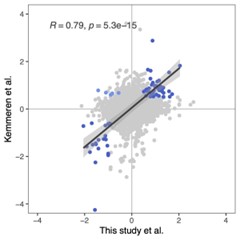
      We evaluate the efficiency of spatial interaction by the restriction enzyme digested fragments recovered in the pairwise contacts that contain ligation junctions. In SCA-seq, the efficiency is calculated as the number of dpnII digested fragments recovered by pairwise contacts (5625908) divided by the total number of in silico dpnII digested fragments (7127633). The resulting efficiency is 0.79.

      We have now included this information in the revised result section (page 8 lines 15-18)

      1. Fig 4g, colors with apparent differences might be used to clearly discriminate the three types of interactions (I-I, I-A and A-A).

      We appreciate the reviewer for bringing up the issue regarding the visualization in Fig 4g. The color scheme has been revised, with purple now representing I-I interactions, orange representing I-A interactions, and red representing A-A interactions. We believe that these modifications have significantly improved the clarity.

      1. Fig. 4c, when fitting an unknown curve, R-square becomes meaningless.

      We appreciate the reviewer for pointing out the issue regarding the interpretation of R-square. We have removed the R-square value from Fig. 4c.

      1. Fig 5a, "oCGIs comprised 65% CGIs that did not directly contact enhancers or promoters". Should it be "oCGIs comprised 65% of all CGIs"?

      We appreciate the reviewer for pointing out the clarification needed in Fig 5a. We have revised the phrase in the figure legend to accurately state that “oCGIs comprised 65% of all CGIs”. Thank you for bringing this to our attention.

      1. Page 15 lines 5-8, "By examining the methylation status on reads, as expected, these read segments demonstrated lower CpG methylation and higher chromatin accessibility (GpC methylation), which further supports their roles in gene activation (Fig 5b)". This statement seems to be inconsistent with the figure legend.

      We appreciate the reviewer for pointing out the inconsistency in the legend of Fig 5b. We have revised the legend of Fig 5b to accurately highlight the low CpG methylation on oCGI regions. Thank you for bringing this to our attention.

      1. Language editing and proof reading are needed.

      I apologize for any errors or mistakes in the language. We have carefully reviewed the manuscript and made the necessary language editing and proofreading revisions to ensure its quality for publication.

    1. Author response:

      The following is the authors’ response to the original reviews.

      We would like to thank the reviewer and the editor for carefully reading our manuscript, and acknowledging the strength of combining quantitative analysis with semi-naturalistic experiments on mice social behavior. Please find below our response to both the public review and the recommendation to the authors. As a summary, we have included additional figures and texts such as 

      - a new Results subsection “Choosing timescales for analysis ” (page 6)

      - a new Materials and Methods subsection “Maximum entropy model with triplet interactions” (page 17)

      - new supplementary figures, which have current labels of:

      - Figure 2 - figure supplement 5

      - Figure 2 - figure supplement 6

      - Figure 2 - figure supplement 7

      - Figure 4 - figure supplement 1

      - Figure 4 - figure supplement 2    

      Public Reviews: 

      Reviewer #1 (Public Review): 

      Summary: 

      In this manuscript, Chen et al. investigate the statistical structure of social interactions among mice living together in the ECO-Hab. They use maximum entropy models (MEM) from statistical physics that include individual preferences and pair-wise interactions among mice to describe their collective behavior. They also use this model to track the evolution of these preferences and interactions across time and in one group of mice injected with TIMP-1, an enzyme regulating synaptic plasticity. The main result is that they can explain group behavior (the probability of being together in one compartment) by a MEM that only includes pair-wise interactions. Moreover, the impact of TIMP-1 is to increase the variance of the couplings J_ij, the preference for the compartment containing food, as well as the dissatisfaction triplet index (DTI). 

      Strengths: 

      The ECO-Hab is a really nice system to ask questions about the sociability of mice and to tease apart sociability from individual preference. Moreover, combining the ECO-Hab with the use of MEM is a powerful and elegant approach that can help statistically characterize complex interactions between groups of mice -- an important question that requires fine quantitative analysis. 

      Weaknesses: 

      However, there is a risk in interpreting these models. In my view, several of the comparisons established in the current study would require finer and more in-depth analysis to be able to establish firmer conclusions (see below). Also, the current study, which closely resembles previous work by Shemesh et al., finds a different result but does not provide the same quantitative model comparison included there, nor a conclusive explanation of why their results are different. In total, I felt that some of the results required more solid statistical testing and that some of the conclusions of the paper were not entirely justified. In particular, the results from TIMP-1 require proper interaction tests (group x drug) which I couldn't find. This is particularly important when the control group has a smaller N than the drug groups.  

      We would like to thank the reviewer and the editor for carefully reading our manuscript, and acknowledging the strength of combining quantitative analysis with semi-naturalistic experiments on mice social behavior. Thanks to the reviewer’s suggestion, we have improved our manuscript by 

      (1) A proper comparison with Shemesh et al., especially to include maximum entropy models with triplet interactions. We show that triplet models overfit even given the entire 10 day dataset, which limits our study to look at pairwise interactions.

      (2) Results on cross-validation for both triplet interaction models and pairwise interaction models, completed on aggregates of various length of days. This analysis showed that pairwise models overfit for single-day data, and led us to learn pairwise models only on 5day aggregation of data. We have updated the manuscript (both the text and the figures) to present these results.

      (3) New results that subsample the drug groups to the same size as the control group. The conclusions about TIMP-1 treated mice hordes hold when we compare groups of the same size. 

      Recommendations for the authors:  

      Reviewer #1 (Recommendations For The Authors): 

      (1) COMPARISON WITH PREVIOUS WORK. The comparison with the cited previous work of Shemesh et al. 2013 rests novelty to the use of ME models in characterizing social interactions between groups of mice as well as sheds doubts on the main claim of the manuscript, namely that second-order correlations are sufficient to describe the joint distribution of occupancies of all mice (in particular triplets; there is no quantification of the variance explained by model in panel Fig. 2D). In my view, to make the claim "These results show that pairwise interaction among mice are sufficient to assess the observed collective behavior", the authors should compare models with 2nd and 3rd order interactions and quantify how much of the total correlation can be explained by pair-wise interactions, triplet interactions, and so on. Without a proper model comparison, it is unclear how the authors can make such a claim. One thing observed by Shemesh et al. is that, on average, J_ij are negative. This does not seem to be the case in the current study and the authors should discuss why. 

      Finally, the explanation provided in the Discussion about this discrepancy (spatial resolution and different group size) are not completely satisfactory. With more animals, one would imagine that the impact of higher order correlations would increase (and not decrease) as the number of terms of 3rd, 4th, ... order will be very big. I would also think that the same could be true for the spatial scale: assessing interactions with a coarser spatial grid (whole cages in the case of the ECO-Hab) would allow for simultaneous interactions among more mice to happen compared with a situation in which the spatial grid is so small that only a few animals can fit in each subdivision. 

      We thank the reviewer for the recommendation. In the updated version of the manuscript, we explicitly learn the triplet interaction model. We show that because the number of mice in our experiment is much larger than Shemesh et al., a triplet model runs into the problem of overfitting.

      In particular, we found that the test set likelihood increases monotonically when the L2 regularization strength increases, which corresponds to a suppression of the triplet interaction strength (see additional supplementary figure, now Figure 2 - figure supplement 5). More specifically, for the range of regularization strength (β<sub>G</sub>) we tested (10<sup>-1</sup> < β<sub>G</sub> < 10<sup>1</sup>), the maximum test set likelihood is achieved at β<sub>G</sub> = 10<sup>1</sup>, which corresponds to . Notice that those learned triplet interactions are very close to zero. This means we should select a model with pairwise interactions over a model with triplet interactions.

      We have added the above reasoning in page 5, line 166-169 of the Results section with the sentence “Moreover, models with triplet interactions show signs of overfitting under crossvalidation, which is mitigated when the triplet interactions are suppressed close to zero using L2 regularization”,  a new subsection “Maximum entropy model with triplet interactions” in Materials and Methods (page 16-17, line 548 - 563) to describe the protocols of learning and crossvalidation for these triplet interaction models. 

      Furthermore, we extended the discussion about the difference between Shemesh et al. and our results in the Discussion section. In addition to the difference of spatial scales (chamber vs. location in the chamber), and the difference of group size and its impact on data analysis (N = 15 in our largest cohort and N = 4 in theirs), we added a discussion about the difference of experimental arena, which in Eco-HAB contains connected chambers that mimic the naturalistic environment, and in Shemesh et al. contains a single chamber. The change in the text is on page 12, between line 390 and line 394.

      We thank the reviewers for pointing out that the mean 2nd order interaction in Shemesh et al. is negative. One possibility is that the labeled areas in Shemesh et al. are much smaller than in our Eco-HAB setup, which could suggest that mice do have the space to stay in the same area, which will lead to a negative mean 2nd order interaction.

      (2) ASSESSMENT OF THE TEMPORAL EVOLUTION OF THE INTERACTIONS. The analysis of the stability of the social structure is not conclusive. First, I don't think the authors can conclude that "These results suggest that the structure of social interactions in a cohort as a whole is consistent across all days." If anything is preserved, they would be the statistics of that structure but not the structure itself (i.e., there is no evidence for that). The comparison of the stability of the mean <h\_i> and the mean <J\_ik> would also require a statistical test to be able to state that "Delta h_i changed more strongly from day to day (Fig. 3D, top panel) relative to the interaction measured as the Jij's." The same is true for the assessment of the TIMP: the differences found in the variability in J_ij and in the mean and variance of the h_i's, look noisy and would require a proper statistical test. The traces look quite variable across days in the control condition, so assessing differences may be difficult. Finally, it would be good to know if the variability in individual J_ij is because they truly vary from day to day or because estimating them within one day is difficult (statistical error). If the reason is the latter, one could decrease the temporal resolution to 2-3 days and see whether the estimated J_ijs are more stable. Perhaps, also for that reason, the summed interaction strength J_i is also more stable, simply because it aggregates more data and has a smaller statistical error. 

      We thank the reviewer for pointing out the necessity of assessing the temporal evolution of the interactions. The problem of shorter data duration leads to more noise in the estimation, together with the reviewer’s Comment 4 about the risk of overfitting, led us to add a new Results subsection “Choosing timescales for analysis” (page 6, line 171 to line 189). Specifically, we assess whether the pairwise maximum entropy model overfits using data from _K-_day aggregates, by computing the log-likelihood of both the training sets and the test sets,which is chosen to be 1 hour from the 6 hour data window of each day. We found that for single day data, the pairwise maximum entropy model overfits. In contrast, for data with aggregates of more or equal to 4 days of data, the pairwise model does not overfit. This new result is supported by an additional supplementary figure, now Figure 2 - figure supplement 6.

      To be consistent with later approaches in the manuscript where we consider the effects of TIMP1, we choose the analysis windows to be data aggregates from 5 days. This means for the experiment that collects a total of 10 days of data, there are only two time points, thus a study of the temporal evolution is limited to comparison between the first 5 days and the last 5 days of the experiment. We describe these results in the Results subsection “Stability of sociability over time” (page 6, line 190 - 220). An additional supplementary figure, now Figure 2 - figure supplement 7, shows in details the comparison of the inferred interaction strength J and the chamber preference between the first 5 days and the last 5 days for the 4 cohorts of male C57BL6/J mice, which shows the inferred interactions have a consistent variability across first and last 5 days, and across all cohorts. The small value of Pearsons’ correlation coefficient shows that the exact structure (pairspecific J<sub>ij</sub>) is not stable. At the end of the Results subsection “Stability of sociability over time”, we explicitly say that “This implies that the maximum entropy model does not infer a social structure that is stable over time.”

      (3) EFFECT OF TIMP-1. The reported effects of TIMP-1 on the variance of the J_ij seem very small and possibly caused by a few outlier J_ijs (perhaps from one or two animals) which

      are not present in the control group which seems to have fewer animals (N = 9 minus two mice that died after the surgery vs. N = 14 in the drug group), so the lack of a significant difference in the sigma[J_ij] could simply be due to a smaller N (a test for the interaction group x drug was not done). 

      The clearest effect of TIMP-1 seems to be a change in place preference (h_i) and not the interaction terms (J_ij) (Fig. 3F bottom). But this could be explained by a number of factors that have nothing to do with sociability such as that recovery from surgery makes them eat more/less. The fact that it seems to be present, as recognized by the authors, in the control group with no TIMP-1 and that this effect was not observed in the female group F1, puts into question the specificity and reproducibility of the result. 

      Finally, the effect of TIMP-1 in the DTI would require more statistics (testing the interaction group x drug). The fact that the control group has fewer animals (N = 9 vs. 15 and 13 in the drug groups), and that there is a weaker trend in the DTI of the control group to start high and then decrease, makes this test necessary.  

      Now, after we select a proper timescale to learn the pairwise maximum entropy model, we update the manuscript to present results only on 5-day aggregation of data (see updated Figure 3, updated supplementary figures, Figure 3 - figure supplement 1 and 2). For the variance of the J<sub>ij</sub>, the F-test between different 5-day aggregates before and after TIMP for the male drug group now shows a nonsignificant p-value after applying the Bonferroni correction. For the female drug group, the difference of the J<sub>ij</sub> variance is still significant. 

      To test the effect of different group size on DTI, we subsampled the drug groups by 1) subsampling the inferred interactions learned from the original N = 15 or N = 13 data, or 2) subsampling the mice colocalization data and then inferring the pairwise interactions.  In both cases, the resulting DTI for the subsampled drug group still exhibits the same global pattern as before, i.e. after TIMP-1 injection, DTI significantly increases, which after 5 days falls back to the baseline level. The results are supported by two additional supplementary figures, Figure 4 - figure supplement 1 and 2. This result is referred to in the text in the Results subsection “Impaired neuronal plasticity in the PL affects the structure of social interactions” (page 10, line 333 - 336): “Notably, the difference of the DTI is not due to the control group M4 has less mice, as subsampling both on the level of the inferred interactions (Figure 4 - figure supplement 1) and on the level of the mice locations (Figure 4 - figure supplement 2) give the same DTI for cohorts M1 and F1.”

      (4) MODEL COMPARISON. Any quantitative measure of "goodness" of the model , (i.e., comparison of the predictions of the model with triplet frequency as well as the distribution of p(K)) should be cross-validated. In particular, Fig. S2 needs to be cross-validated for the goodness of fit to be properly quantified. Is the analysis shown in Fig. 3F crossvalidated? Because otherwise, there is an expected increase in the likelihood simply explained by an increase in the number of parameters of the model (i.e., adding the J_ij's). 

      As discussed in our responses to Comment 1 and 2, we have added results about cross-validation in the new supplementary figures, Figure 2 – figure supplement 5 and 6 , for which we computed the test-set and training-set likelihood for maximum entropy models with pairwise interactions and also for models with triplet interactions. Figure 2 - figure supplement 6 shows the pairwise model does not overfit when we consider the aggregated data from more or equal to 4 days. 

      (5) EFFECT OF SLEEP. The comparison of p(K) between the data and the model requires a bit more investigation: the model underestimates instances in which almost all mice were in the same compartment (i.e., for K >= 13. p(K)_data >> p(K)_MEM; btw where is the pairwise point p(15) in Fig. 2E and Fig. S4?). Could this be because there were still short periods during the dark cycle in which all mice were asleep in one of the cages? As explained by the authors, sleep introduces very strong higher order correlations between animals as they like sleeping altogether. Knowing whether removing light periods was enough to remove this "sleep contamination" or not, would be important in order to interpret discrepancies between the pairwise model and the data. 

      Figure 2E shows that the pairwise maximum entropy model (in black) overestimates the data (in blue circles) for P(K) at large K (and not underestimates). In the data, we never observe all 15 mice being in the same box; hence P<sub>data</sub>(15) = 0, and does not show up in the log-scaled figure (same for Figure 2 - figure supplement 3). A possible explanation for the pairwise model overestimating P(K) at large K is that the finite-sized box limits the total number of mice that are comfortably staying in the same box. It can also be due to the fact that the number of time points at which K >= 13 is small and hence causes an underestimation due to finite data. We have added this interpretation of the discrepancy of P(K) to Section “Pairwise interaction model explains the statistics of social behavior” in page 6, line 160. 

      We thank the Reviewer for raising the point of “sleep contamination”. Indeed, Eco-HAB data, as do data from other 24h-testing behavioral systems, demonstrate distinct differences in activity levels during the light and dark phases of the light-dark cycle (Rydzanicz et al., EMBO Mol. Med., 2024). During the light phases, mice primarily sleep and, as noted, they huddle, so many individuals within the cohort tend to remain in close proximity for extended periods. We acknowledge that including such periods in the analysis could potentially introduce confounding effects to the model due to limited movement and interactions, and this is why we decided not to use this data. However, during the dark phases, mice are highly active, with individuals rarely staying in the same compartment for long periods. Specifically, in the dark phases, while there are occasional instances where a few mice may remain in the same compartment for over 1 hour, the majority exhibit considerable mobility, actively exploring and transitioning between compartments. We see no compelling reason to exclude these periods from our analysis, as such activity aligns with the natural behavioral repertoire of the mice and provides robust data for our model. Furthermore, it is well-established that mammals, including nocturnal species such as mice, are most active shortly after waking, typically at the onset of their active phase (i.e., the beginning of the dark phase). To ensure a conservative approach, we specifically analyzed the first 6 hours of the dark phase when the cumulative number of box visits is at its peak, indicating heightened activity levels. In our view, this period offers an optimal window for studying natural behaviors, including social interactions.

      Additionally, prior studies using the Eco-HAB system have consistently demonstrated that mice engage in social interactions both within the compartments and in the connecting tubes during the dark phase (Puścian et al., eLife, 2016, Winiarski et al. in press). Given this evidence and the observed behavioral dynamics in our data, the likelihood of mice being asleep during the analyzed periods of the dark phase is very low.

      We hope this clarification addresses the reviewer’s concerns and highlights the rationale underpinning our analysis choices. Thank you for raising this important point, which allowed us to provide additional context for our approach.

      (6) COMPARTMENT PREFERENCES. The differences between p(K) across compartments also would require a bit more attention: of a MEM with non-spatially dependent pair-wise interactions shows differences across compartments, it must be because of the terms h_{i,r} terms which contain a compartment index, right? Wouldn't this imply that the independence model, which always underrepresents data events with large K, already contains the difference in goodness of fit between compartments (1, 3) and (2, 4)? In the plots, it does not look like the goodness of the independent model depends on the compartment (the authors could compare directly the models' predictions between compartments). Moreover, when looking at Fig. 2C, it does not look like the value of h_{i,r} in compartments (1,3) is higher than in (2,4) (if anything, it would be the other way around). How can this be explained? It would be good to know if the difference across compartments comes from differences in the empirical p(K) or in the models' prediction? If the difference is in the data p(K), could it be that the compartments 2-4 showing higher p(K=15) (i.e., larger difference with the pairwise MEM prediction) are those chosen by mice to sleep during the light cycle? If not, what could explain these differences across compartments? Could the presence of food and water explain this difference? 

      The reviewer is correct, in the pairwise MEM, the difference across compartments enter in the box preference h<sub>ir</sub>. Greater h<sub>ir</sub> means compartment r is more attractive to mouse i. Because box 2 and 4 contain food and water, we expect that mice are more attracted to box 2 and 4, and this is what we see in Figure 2C, bottom subpanels. To reduce the number of parameters to look at, we introduce an index Δh<sub>i</sub> = h<sub>i2</sub> + h<sub>i4</sub> - h<sub>i1</sub> - h<sub>i3</sub>. This index Δh<sub>i</sub> is found to be mostly positive (see updated Figure 3C), which makes sense because mice are attracted to food and water. 

      Next we analyze the difference of P(K) across compartments (Figure 2 - figure supplement 3). There is already a difference in the P(K) calculated from empirical data. For example, P(K) in compartment 2 has a maximum at K = 5 while P(K) in compartment 1 has a maximum at K = 3

      One interesting observation is that it seems from Figure 2 - figure supplement 3 that the pairwise model explains P(K) in compartment 1 and compartment 3 better than in compartment 2 and in compartment 4. In compartment 2 and 4, the pairwise MEM overestimates P(K) for large K. An alternative MEM could include compartment-specific interaction strength, but it will also introduce 315 new parameters for a mice cohort with size N = 15.

      MINOR

      (1) A more quantitative comparison between in-cohort sociability and couplings J_ij as œwell as mean rates and parameters h_i is required. The matrices in Fig. 2C do look similar. So it is not clear how the comparison between these values is contributing to characterizing the correlation structure of the data. 

      The comparison between in-cohort sociability and coupling J<sub>ij</sub> is given by supplementary Figure 2 - figure supplement 2.  The key point for the model with the learned J<sub>ij</sub> reproducing the in-cohort sociability is given by Figure 2 - figure supplement 1.

      (2) Analysis of "in-state" probability is not explained. To me, it wasn't obvious what Fig. S5 is showing. I was assuming that this analysis was comparing the prediction of the MEM about the position of each animal at each time point, given its preference (h), pairwise interactions (J_ij), and the position of all other animals and the true position of the animal. But it seems like it is comparing the shape of the distribution of this prob across time between the data and the model (I guess the data had to be temporally binned in coarser temporal periods to yield prob values other than 0s and 1s). Also, not clear whether this analysis was done for each compartment separately and then averaged. This needs explanation. 

      The in-state probability is comparing the prediction of the MEM about the position of each animal at each time point, given its preference (h), pairwise interactions (J<sub>ij</sub>), and the position of all other animals and the true position of the animal. To achieve values between 0s and 1s, we bin the data temporally according to the model-predicted in-state probability. 

      We have added the explanation of in-state probability on page 6, line 163-166. We have also improved the description of in-state probability in Materials and Methods (subsection “Comparing in-state probability between model prediction and data”, line 493 - 503, page 15), and added a pointer from the main text to it. 

      (3) Looks like Fig. S3 is not cited in the text. 

      We added a pointer to Fig. S3 (now Figure 2 - figure supplement 2) in line 154. 

      (4) The authors say that "TIMP-1 release from the TIMP-1-loaded nanoparticles diminishes after 5 days." Does that mean from the day of the injection (4-5 days before the "After Day 1") or five days after reintroduced in the ECO-Hab? 

      It means five days after the mice were re-introduced in the ECO-Hab. We have updated the text in Results/Effects of impairing neuronal plasticity in the PL on subterritory preferences and sociability (the end of the first paragraph of this subsection) to 

      “The choice of five-day aggregated data for analysis is in line both with the proper timescales needed for the pairwise maximum entropy model to not overfit, and with the literature that TIMP-1 release from the TIMP-1-loaded nanoparticles is stable for 7-10 days after injection (Chaturvedi et al., 2014)  (i.e. 2-5 days after the mice are reintroduced to Eco-HAB).” (line 272 - 276, page 9)

      (5) In Methods, the authors should report the final N of each of the three groups. 

      The number of final N is reported in Table 1 (page 13). In the updated version, we have added a pointer to Table 1 in Materials and Methods/Animals, and in Materials and Methods/Exclude inactive and dead mice from analysis. We have also expanded the caption of Table 1 to clarify the difference between final N and initial N, and added a pointer to Materials and Methods/Exclude inactive and dead mice from analysis.

    1. Author response:

      The following is the authors’ response to the original reviews.

      Public Reviews:

      Reviewer #1 (Public Review):

      Hippocampal place cells display a sequence of firing activities when the animal travels through a spatial trajectory at a behavioral time scale of seconds to tens of seconds. Interestingly, parts of the firing sequence also occur at a much shorter time scale: ~120 ms within individual cycles of theta oscillation. These so-called theta sequences are originally thought to naturally result from the phenomenon of theta phase precession. However, there is evidence that theta sequences do not always occur even when theta phase precession is present, for example, during the early experience of a novel maze. The question is then how they emerge with experience (theta sequence development). This study presents evidence that a special group of place cells, those tuned to fast-gamma oscillations, may play a key role in theta sequence development.

      The authors analyzed place cells, LFPs, and theta sequences as rats traveled a circular maze in repeated laps. They found that a group of place cells were significantly tuned to a particular phase of fast-gamma (FG-cells), in contrast to others that did not show such tunning (NFG-cells). The authors then omitted FG-cells or the same number of NFG-cells, in their algorithm of theta sequence detection and found that the quality of theta sequences, quantified by a weighted correlation, was worse with the FG-cell omission, compared to that with the NFG-cell omission, during later laps, but not during early laps. What made the FG-cells special for theta sequences? The authors found that FG-cells, but not NFG-cells, displayed phase recession to slow-gamma (25 - 45 Hz) oscillations (within theta cycles) during early laps (both FG- and NFG-cells showed slow-gamma phase precession during later laps). Overall, the authors conclude that FG-cells contribute to theta sequence development through slow-gamma phase precession during early laps.

      How theta sequences are formed and developed during experience is an important question, because these sequences have been implicated in several cognitive functions of place cells, including memory-guided spatial navigation. The identification of FG-cells in this study is straightforward. Evidence is also presented for the role of these cells in theta sequence development. However, given several concerns elaborated below, whether the evidence is sufficiently strong for the conclusion needs further clarification, perhaps, in future studies.

      We thank the reviewer for these positive comments.

      (1) The results in Figure 3 and Figure 8 seems contradictory. In Figure 8, all theta sequences displayed a seemingly significant weighted correlation (above 0) even in early laps, which was mostly due to FG-cell sequences but not NFG-cell sequences (correlation for NFG-sequences appeared below 0). However, in Figure 3H, omitting FG-cells and omitting NFG-cells did not produce significant differences in the correlation. Conversely, FG-cell and NFG-cell sequences were similar in later laps in Figure 8 (NFG-cell sequences appeared even better than FG-cell sequences), yet omitting NFG-cells produced a better correlation than omitting FG-cells. This confusion may be related to how "FG-cell-dominant sequences" were defined, which is unclear in the manuscript. Nevertheless, the different results are not easy to understand.

      We thank the reviewer for pointing out this important problem.  The potential contradictory can be interpreted by different sequence dataset included in Fig3 and Fig8, described as follows.

      (1) In Fig 3, all sequences decoded without either FG or NFG cells were included, defined as exFG-sequences and exNFG sequences, so that we couldn’t observe sequence development at early phase and thus the weighted correlation was low.  (2) In Fig8, however, the sequences with either FG or NFG cells firing across at least 3 slow gamma cycles were included, defined as FG-cell sequences and NFG-cell sequences.  This criterion ensures to investigate the relationship between sequence development and slow gamma phase precession, so that these sequences were contributed by cells likely to show slow gamma phase precession.  These definitions have been updated to the “Theta sequences detection” section of the Methods (Line 606-619).

      At early phase, there’s still no difference of weighted correlation between FG-cell sequences and NFG-cell sequences (Author response image 1A, Student’s t test, t(65)=0.2, p=0.8, Cohen's D=0.1), but the FG-cell sequences contained high proportion of slow gamma phase precession (Fig8F).  At late phase, both FG-cell sequences and NFG-cell sequences exhibited slow gamma phase precession, so that their weighted correlation were high with no difference (Author response image 1B, Student’s t test, t(62)=-1.1, p=0.3, Cohen's D=0.3).  This result further indicates that the theta sequence development requires slow gamma phase precession, especially for FG cells during early phase.

      Author response image 1.

      (2) The different contributions between FG-cells and NFG-cells to theta sequences are supposed not to be caused by their different firing properties (Figure 5). However, Figure 5D and E showed a large effect size (Cohen's D = 07, 0.8), although not significant (P = 0.09, 0.06). But the seemingly non-significant P values could be simply due to smaller N's (~20). In other parts of the manuscript, the effect sizes were comparable or even smaller (e.g. D = 0.5 in Figure 7B), but interpreted as positive results: P values were significant with large N's (~480 in Fig. 7B). Drawing a conclusion purely based on a P value while N is large often renders the conclusion only statistical, with unclear physical meaning. Although this is common in neuroscience publications, it makes more sense to at least make multiple inferences using similar sample sizes in the same study.

      We thank the reviewer for this kind suggestion.  We made multiple inferences using similar sample sizes as much as possible.  In Fig7B, we did the statistical analysis with sessions as samples, and we found the significant conclusion was maintained.  These results have been updated to the revised manuscript (Lines 269-270).and the Fig7B has been replaced correspondingly.

      (3) In supplementary Figure 2 - S2, FG-cells displayed stronger theta phase precession than NFG-cells, which could be a major reason why FG-cells impacted theta sequences more than NFG cells. Although factors other than theta phase precession may contribute to or interfere with theta sequences, stronger theta phase precession itself (without the interference of other factors), by definition, can lead to stronger theta sequences.

      This is a very good point.  The finding that FG-cells displayed stronger theta phase precession than NFG-cells was consistent with the finding of Guardamagna et al., 2023 Cell Rep, that the theta phase precession pattern emerged with strong fast gamma.  Since slow gamma phase precession occurred within theta cycles, it is hard to consider the contribution of these factors to theta sequences development, without taking theta phase precession into account.  But one should be noted that the theta sequences could not be developed even if theta phase precession existed from the very beginning of the exploration (Feng et al., 2025 J Neurosci).  These findings suggest that theta phase precession, together with other factors, impact theta sequence development.  However, the weight of each factor and their interaction still need to be further investigated.  We have discussed this possibility in the Discussion section (Lines 361- 373).

      (4) The slow-gamma phase precession of FG-cells during early laps is supposed to mediate or contribute to the emergence of theta sequences during late laps (Figure 1). The logic of this model is unclear. The slow-gamma phase precession was present in both early and late laps for FG-cells, but only present in late laps for NFG-cells. It seems more straightforward to hypothesize that the difference in theta sequences between early and later laps is due to the difference in slow-gamma phase precession of NFG cells between early and late laps. Although this is not necessarily the case, the argument presented in the manuscript is not easy to follow.

      We thank the reviewer for pointing this out.  The slow gamma phase precession was first found in my previous publication (Zheng et al., 2016 Neuron), which indicates a temporally compressed manner for coding spatial information related to memory retrieval.  In this case, we would expect that slow gamma phase precession occurred in all cells during late laps, because spatial information was retrieved when rats have been familiar with the environment.  However, during early laps when novel information was just encoded, there would be balance between fast gamma and slow gamma modulation of cells for upcoming encoding-retrieval transition.  A possibility is that FG-cells support this balance by receiving modulation of both fast gamma and slow gamma, but with distinct phase-coding modes (fast gamma phase locking and slow gamma phase precession) in a temporally coordinated manner.  We have discussed this possibility in the Discussion section (Lines 415- 428).
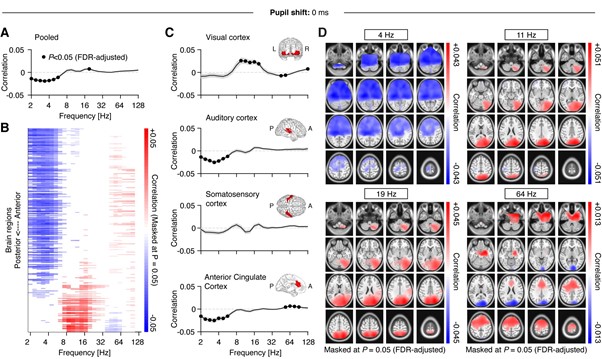
      (5) There are several questions on the description of methods, which could be addressed to clarify or strengthen the conclusions.

      (i) Were the identified fast- and slow-gamma episodes mutually exclusive?

      Yes, the fast- and slow-gamma episodes are mutually exclusive. We have added descriptions in the “Detection of gamma episodes” section in the Methods part (Lines 538-550).
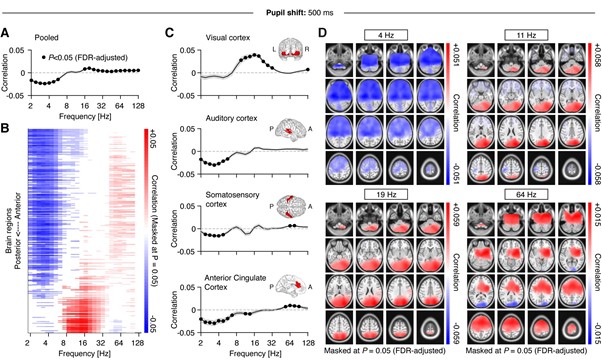
      (ii) Was the task novel when the data were acquired? How many days (from the 1st day of the task) were included in the analysis? When the development of the theta sequence was mentioned, did it mean the development in a novel environment, in a novel task, or purely in a sense of early laps (Lap 1, 2) on each day?

      We thank the reviewer for pointing this out.  The task was not novel to rats in this dataset, because only days with good enough recording quality for sequence decoding were included in this paper, which were about day2-day10 for each rat.  However, we still observed the process of sequence formation because of the rat’s exploration interest during early laps.  Thus, when the development of the theta sequence was mentioned, it meant a sense of early laps on each day.
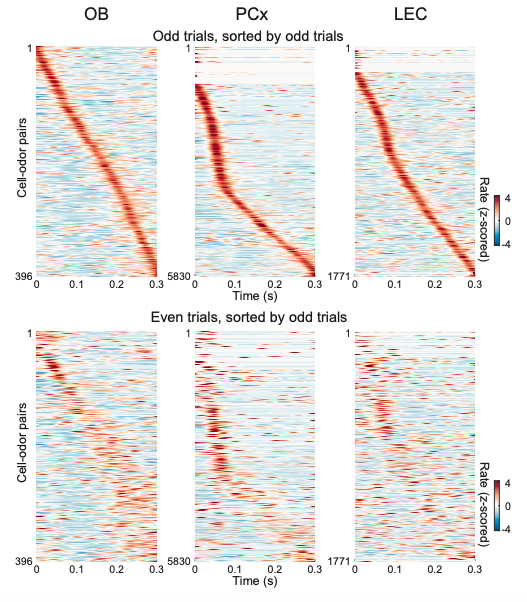
      (iii) How were the animals' behavioral parameters equalized between early and later laps? For example, speed or head direction could potentially produce the differences in theta sequences.

      This is a very good point.  In terms of the effect of running speed on theta sequences, we quantified the running speeds during theta sequences across trials 1-5.  We found that the rats were running at stable running speed, which has been reported in Fig.3F.  In terms of the effect of head direction on theta sequences, we measured the angle difference between head direction and running direction.  We found that the angle difference for each lap was distributed around 0, with no significant difference across laps (Fig.S3, Watson-Williams multi-sample test, F(4,55)=0.2, p=0.9, partial η<sup>2</sup>= 0.01).  These results indicate that the differences in theta sequences across trials cannot be interpreted by the variability of behavioral parameters.  We have updated these results and corresponding methods in the revised manuscript (Lines 172-175, Lines 507-511, with a new Fig.S3).

      Reviewer #2 (Public Review):

      This manuscript addresses an important question that has not yet been solved in the field, what is the contribution of different gamma oscillatory inputs to the development of "theta sequences" in the hippocampal CA1 region? Theta sequences have received much attention due to their proposed roles in encoding short-term behavioral predictions, mediating synaptic plasticity, and guiding flexible decision-making. Gamma oscillations in CA1 offer a readout of different inputs to this region and have been proposed to synchronize neuronal assemblies and modulate spike timing and temporal coding. However, the interactions between these two important phenomena have not been sufficiently investigated. The authors conducted place cell and local field potential (LFP) recordings in the CA1 region of rats running on a circular track. They then analyzed the phase locking of place cell spikes to slow and fast gamma rhythms, the evolution of theta sequences during behavior, and the interaction between these two phenomena. They found that place cells with the strongest modulation by fast gamma oscillations were the most important contributors to the early development of theta sequences and that they also displayed a faster form of phase precession within slow gamma cycles nested with theta. The results reported are interesting and support the main conclusions of the authors. However, the manuscript needs significant improvement in several aspects regarding data analysis, description of both experimental and analytical methods, and alternative interpretations, as I detail below.

      • The experimental paradigm and recordings should be explained at the beginning of the Results section. Right now, there is no description whatsoever which makes it harder to understand the design of the study.

      We thank the reviewer for this kind suggestion.  The description of experimental paradigm and recordings has been added to the beginning of the results section (Lines 114-119).

      • An important issue that needs to be addressed is the very small fraction of CA1 cells phased-locked to slow gamma rhythms (3.7%). This fraction is much lower than in many previous studies, that typically report it in the range of 20-50%. However, this discrepancy is not discussed by the authors. This needs to be explained and additional analysis considered. One analysis that I would suggest, although there are also other valid approaches, is to, instead of just analyzing the phase locking in two discrete frequency bands, compute the phase locking will all LFP frequencies from 25-100 Hz. This will offer a more comprehensive and unbiased view of the gamma modulation of place cell firing. Alternative metrics to mean vector length that is less sensitive to firing rates, such as pairwise phase consistency index (Vinck et a., Neuroimage, 2010), could be implemented. This may reveal whether the low fraction of phase-locked cells could be due to a low number of spikes entering the analysis.

      We thank the reviewer for this constructive suggestion.  A previous work also on Long-Evans rats showed that the proportion of slow gamma phase-locked cells during novelty exploration was ~20%, however it dropped to ~10% during familiar exploration (Fig.4E, Kitanishi et al., 2015 Neuron).  This suggests that the proportion of slow gamma phase-locked cells may decreased with familiarity of the environment, which supports our data.  In addition, we also calculated the pairwise phase consistency index in terms of the effect of spike counts on MVL.  We could observe that the tendency of PPC (Author response image 2A) and MVL (Author response image 2B) along frequency bands were consistent across different subsets of cells, suggesting that the determination of cell subsets by MVL metric was not biased by the low number of spikes.  These results further shed light to the contribution of slow gamma phase precession of place cells to theta sequence development.

      Author response image 2.

      • From the methods, it is not clear to me whether the reference LFP channel was consistently selected to be a different one that where the spikes analyzed were taken. This is the better practice to reduce the contribution of spike leakage that could substantially inflate the coupling with faster gamma frequencies. These analyses need to be described in more detail.

      We thank the reviewer for pointing this out.  In the main manuscript, we used local LFPs as the cells were recorded from the same tetrode.  In addition, we selected an individual tetrode which located at stratum pyramidale and at the center of the drive bundle for each rat.  We detected a similar proportion of FG-cells by using LFPs on this tetrode, compared with that using local LFPs (Author response image 3A-B, Chi-squared test, χ<sup>2</sup>= 0.9, p=0.4, Cramer V=0.03).  We further found that the PPC measurement of FG- and NFG-cells were different at fast gamma band by using central LFPs (Author response image 3D), consistent with that by using local LFPs (Author response image 3C).  Therefore, these results suggest that the findings related to fast gamma was not due to the contribution of spike leakage in the local LFPs.  We have updated the description in the manuscript (Lines 553-557, 566-568).

      Author response image 3.

      • The initial framework of the authors of classifying cells into fast gamma and not fast gamma modulated implies a bimodality that may be artificial. The authors should discuss the nuances and limitations of this framework. For example, several previous work has shown that the same place cell can couple to different gamma oscillations (e.g., Lastoczni et al., Neuron, 2016; Fernandez-Ruiz et al., Neuron, 2017; Sharif et al., Neuron,2021).

      We thank the reviewer for this kind suggestion.  We have cited these references and discussed the possibility of bimodal phase-locking in the manuscript (Lines 430-433).

      • It would be useful to provide a more thorough characterization of the physiological properties of FG and NFG cells, as this distinction is the basis of the paper. Only very little characterization of some place cell properties is provided in Figure 5. Important characteristics that should be very feasible to compare include average firing rate, burstiness, estimated location within the layer (i.e., deep vs superficial sublayers) and along the transverse axis (i.e., proximal vs distal), theta oscillation frequency, phase precession metrics (given their fundamental relationship with theta sequences), etc.

      We thank the reviewer for this constructive suggestion.  In addition to the characterizations shown in Fig5, we also analyzed firing rate, anatomical location and theta modulation to compare the physiological properties of FG- and NFG-cells.

      In terms of the firing properties of both types of cells, we found that the mean firing rate of FG-cell was higher than NFG-cell (Fig. 5A, Student's t-test, t(22) = 2.1, p = 0.04, Cohen's D = 0.9), which was consistent with the previous study that the firing rate was higher during fast gamma than during slow gamma (Zheng et al., 2015 Hippocampus).  However, the spike counts of excluded FG- and NFG-cells for decoding were similar (Fig. 5B, Student's t-test, t(22) = 1.2, p = 0.3, Cohen's D = 0.5), suggesting that the differences found in theta sequences cannot be accounted for by different decoding quality related to spike counts.  In addition, we measured the burstiness based on the distribution of inter-spike-intervals, and we found that the bursting probability of spikes was not significantly different between FG and NFG cells (Author response image 4A, Student's t-test, t(22) = 0.6, p=0.5, Cohen's d=0.3).
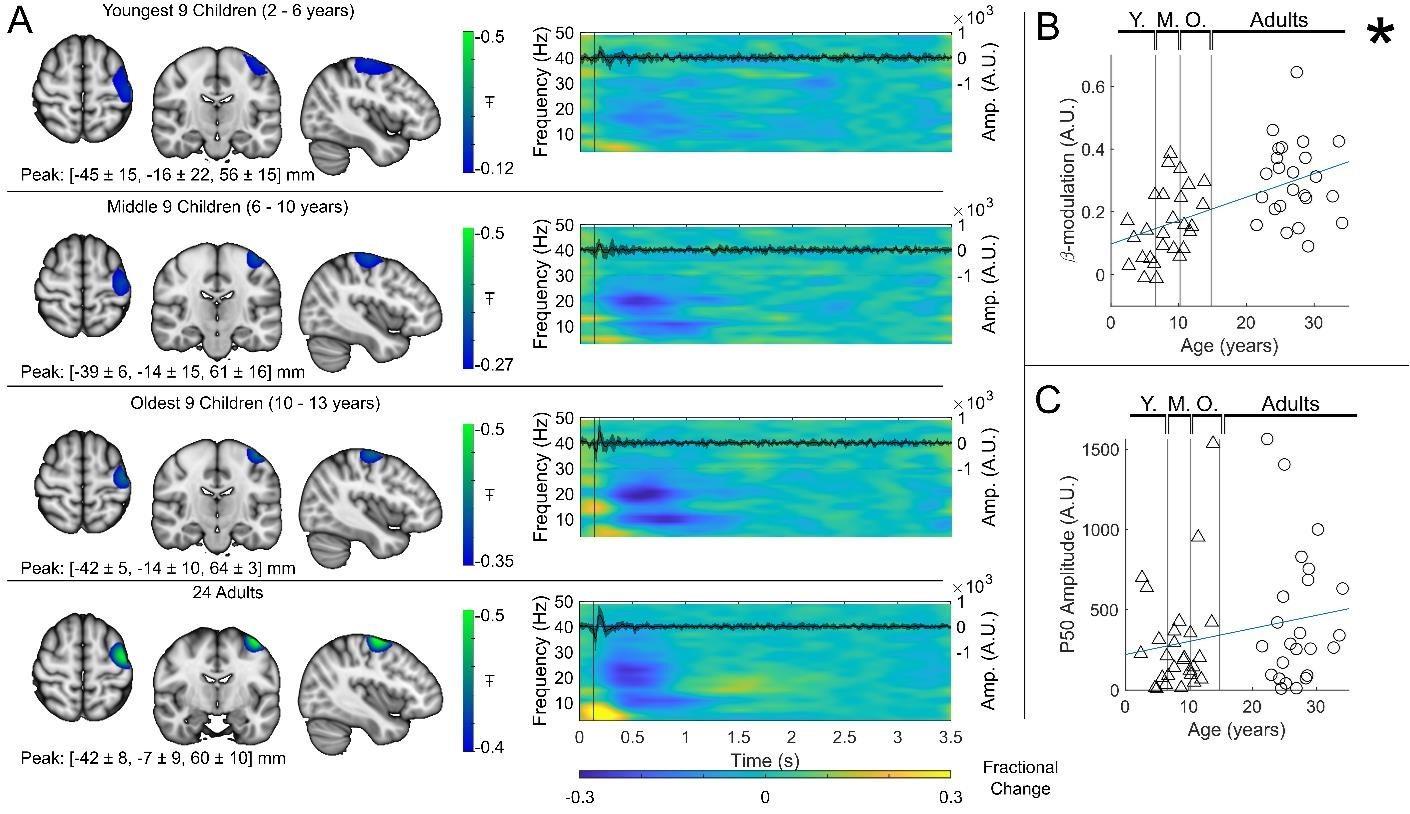
      In terms of theta modulation of cells, we first compared the theta frequency related to the firing of FG and NFG cells.  We detected the instantaneous theta frequency at each spike timing of FG and NFG cells, and found that it was not significantly different between cell types (Author response image 4B, Student's t-test, t(22) = -0.5, p=0.6, Cohen's d=0.2).  In addition, we found the proportion of cells with significant theta phase precession was greater in FG-cells than in NFG-cells (Fig. S2E).  However, the slope and starting phase of theta phase precession was not significantly different between FG and NFG cells (Author response image 4C, Student's t-test, t(21) = 0.3, p=0.8, Cohen's d=0.1; Author response image 4D, Watson-Williams test, F(1,21)=0.5, p=0.5, partial η<sup>2</sup>=0.02).

      In terms of the anatomical location of FG and NFG cells, we identified tetrode traces in slices for each cell.  We found that both FG and NFG cells were recorded from the deep layer of dorsal CA1, with no difference of proportions between cell types (Author response image 4E, Chi-squared test, χ<sup>2</sup>=0.5, p=0.5, Cramer V=0.05).  The distribution of FG-cells he NFG-cells along the transverse axis was also similar between cell types (Author response image 4F, χ<sup>2</sup>=0.08, p=0.8, Cramer V=0.02).

      Author response image 4.

      • It is not clear to me how the analysis in Figure 6 was performed. In Figure 6B I would think that the grey line should connect with the bottom white dot in the third panel, which would be the interpretation of the results.

      We thank the reviewer for raising this good point.  The grey line was just for intuitional observation, not a quantitative analysis.  We have removed the grey lines from all heat maps in Fig.6.

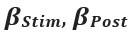
      Reviewer #3 (Public Review):

      [Editors' note: This review contains many criticisms that apply to the whole sub-field of slow/fast gamma oscillations in the hippocampus, as opposed to this particular paper. In the editors' view, these comments are beyond the scope of any single paper. However, they represent a view that, if true, should contextualise the interpretation of this paper and all papers in the sub-field. In doing so, they highlight an ongoing debate within the broader field.]

      Summary:

      The authors aimed to elucidate the role of dynamic gamma modulation in the development of hippocampal theta sequences, utilizing the traditional framework of "two gammas," a slow and a fast rhythm. This framework is currently being challenged, necessitating further analyses to establish and secure the assumed premises before substantiating the claims made in the present article.

      The results are too preliminary and need to integrate contemporary literature. New analyses are required to address these concerns. However, by addressing these issues, it may be possible to produce an impactful manuscript.

      We thank the reviewer for raising these important questions in the hippocampal gamma field.  We have done a lot of new analyses according to the comments to strengthen our manuscript.

      I. Introduction

      Within the introduction, multiple broad assertions are conveyed that serve as the premise for the research. However, equally important citations that are not mentioned potentially contradict the ideas that serve as the foundation. Instances of these are described below:

      (1) Are there multiple gammas? The authors launched the study on the premise that two different gamma bands are communicated from CA3 and the entorhinal cortex. However, recent literature suggests otherwise, offering that the slow gamma component may be related to theta harmonics:

      From a review by Etter, Carmichael and Williams (2023)

      "Gamma-based coherence has been a prominent model for communication across the hippocampal-entorhinal circuit and has classically focused on slow and fast gamma oscillations originating in CA3 and medial entorhinal cortex, respectively. These two distinct gammas are then hypothesized to be integrated into hippocampal CA1 with theta oscillations on a cycle-to-cycle basis (Colgin et al., 2009; Schomburg et al., 2014). This would suggest that theta oscillations in CA1 could serve to partition temporal windows that enable the integration of inputs from these upstream regions using alternating gamma waves (Vinck et al., 2023). However, these models have largely been based on correlations between shifting CA3 and medial entorhinal cortex to CA1 coherence in theta and gamma bands. In vivo, excitatory inputs from the entorhinal cortex to the dentate gyrus are most coherent in the theta band, while gamma oscillations would be generated locally from presumed local inhibitory inputs (Pernía-Andrade and Jonas, 2014). This predominance of theta over gamma coherence has also been reported between hippocampal CA1 and the medial entorhinal cortex (Zhou et al., 2022). Another potential pitfall in the communication-through-coherence hypothesis is that theta oscillations harmonics could overlap with higher frequency bands (Czurkó et al., 1999; Terrazas et al., 2005), including slow gamma (Petersen and Buzsáki, 2020). The asymmetry of theta oscillations (Belluscio et al., 2012) can lead to harmonics that extend into the slow gamma range (Scheffer-Teixeira and Tort, 2016), which may lead to a misattribution as to the origin of slow-gamma coherence and the degree of spike modulation in the gamma range during movement (Zhou et al., 2019)."

      And from Benjamin Griffiths and Ole Jensen (2023)

      "That said, in both rodent and human studies, measurements of 'slow' gamma oscillations may be susceptible to distortion by theta harmonics [53], meaning open questions remain about what can be attributed to 'slow' gamma oscillations and what is attributable to theta."

      This second statement should be heavily considered as it is from one of the original authors who reported the existence of slow gamma.

      Yet another instance from Schomburg, Fernández-Ruiz, Mizuseki, Berényi, Anastassiou, Christof Koch, and Buzsáki (2014):

      "Note that modulation from 20-30 Hz may not be related to gamma activity but, instead, reflect timing relationships with non-sinusoidal features of theta waves (Belluscio et al., 2012) and/or the 3rd theta harmonic."

      One of this manuscript's authors is Fernández-Ruiz, a contemporary proponent of the multiple gamma theory. Thus, the modulation to slow gamma offered in the present manuscript may actually be related to theta harmonics.

      With the above emphasis from proponents of the slow/fast gamma theory on disambiguating harmonics from slow gamma, our first suggestion to the authors is that they A) address these statements (citing the work of these authors in their manuscript) and B) demonstrably quantify theta harmonics in relation to slow gamma prior to making assertions of phase relationships (methodological suggestions below). As the frequency of theta harmonics can extend as high as 56 Hz (PMID: 32297752), overlapping with the slow gamma range defined here (25-45 Hz), it will be important to establish an approach that decouples the two phenomena using an approach other than an arbitrary frequency boundary.

      We agree with the reviewer that the theta oscillations harmonics could overlap with higher frequency bands including slow gamma, as the above reviews discussed.  In order to rule out the possibility of theta harmonics effects in this study, we added new analyses in this letter (see below).

      (2) Can gammas be segregated into different lamina of the hippocampus? This idea appears to be foundational in the premise of the research but is also undergoing revision.

      As discussed by Etter et al. above, the initial theory of gamma routing was launched on coherence values. However, the values reported by Colgin et al. (2009) lean more towards incoherence (a value of 0) rather than coherence (1), suggesting a weak to negligible interaction. Nevertheless, this theory is coupled with the idea that the different gamma frequencies are exclusive to the specific lamina of the hippocampus.

      Recently, Deschamps et al. (2024) suggested a broader, more nuanced understanding of gamma oscillations than previously thought, emphasizing their wide range and variability across hippocampal layers. This perspective challenges the traditional dichotomy of gamma sub-bands (e.g., slow vs. medium gamma) and their associated cognitive functions based on a more rigid classification according to frequency and phase relative to the theta rhythm. Moreover, they observed all frequencies across all layers.

      Similarly, the current source density plots from Belluscio et al. (2012) suggest that SG and FG can be observed in both the radiatum and lacunosum-moleculare.

      Therefore, if the initial coherence values are weak to negligible and both slow and fast gamma are observed in all layers of the hippocampus, can the different gammas be exclusively related to either anatomical inputs or psychological functions (as done in the present manuscript)? Do these observations challenge the authors' premise of their research? At the least, please discuss.

      We thank the reviewer for raising this point, which I believe still remains controversial in this field.  We also thank the reviewer for providing detailed proofs of existence forms of gamma rhythms.  The reviewer was considering 2 aspects of gamma: 1) the reasonability of dividing slow and fast gamma by specific frequency bands; 2) the existence of gamma across all hippocampal layers, which challenged the functional significance of different types of gamma rhythms.  Although the results in Douchamps et al., 2024 challenged the idea of rigid gamma sub-bands, we still could see separate slow and fast gamma components exclusively occurred along time course, with central frequency of slow gamma lower than ~60Hz and central frequency of fast gamma higher than ~60Hz (Fig.1b of Douchamps et al., 2024).  This was also seen in the rat dataset of this reference (Fig. S3).  Since their behavioral test required both memory encoding and retrieval processes, it was hard to distinguish the role of different gamma components as they may dynamically coordinate during complex memory process.  Thus, although the behavioral performance can be decoded from broad range of gamma, we still cannot deny the existence of difference gamma rhythms and their functional significance during difference memory phases.

      (3) Do place cells, phase precession, and theta sequences require input from afferent regions? It is offered in the introduction that "Fast gamma (~65-100Hz), associated with the input from the medial entorhinal cortex, is thought to rapidly encode ongoing novel information in the context (Fernandez-Ruiz et al., 2021; Kemere, Carr, Karlsson, & Frank, 2013; Zheng et al., 2016)".

      CA1 place fields remain fairly intact following MEC inactivation include Ipshita Zutshi, Manuel Valero, Antonio Fernández-Ruiz , and György Buzsáki (2022)- "CA1 place cells and assemblies persist despite combined mEC and CA3 silencing" and from Hadas E Sloin, Lidor Spivak, Amir Levi, Roni Gattegno, Shirly Someck, Eran Stark (2024) - "These findings are incompatible with precession models based on inheritance, dual-input, spreading activation, inhibition-excitation summation, or somato-dendritic competition. Thus, a precession generator resides locally within CA1."

      These publications, at the least, challenge the inheritance model by which the afferent input controls CA1 place field spike timing. The research premise offered by the authors is couched in the logic of inheritance, when the effect that the authors are observing could be governed by local intrinsic activity (e.g., phase precession and gamma are locally generated, and the attribution to routed input is perhaps erroneous). Certainly, it is worth discussing these manuscripts in the context of the present manuscript.

      We thank the review for this discussion.  The main purpose of our current study is to investigate the mechanism of theta sequence development along with learning, which may or may not dependent on theta phase precession of single place cells as it remains controversial in this field.  Also, there is a limitation in this study that all gamma components were recorded from stratum pyramidale, thus we cannot make any conclusion on the originate of gamma in modulating sequence development.

      II. Results

      (1) Figure 2-

      a. There is a bit of a puzzle here that should be discussed. If slow and fast frequencies modulate 25% of neurons, how can these rhythms serve as mechanisms of communication/support psychological functions? For instance, if fast gamma is engaged in rapid encoding (line 72) and slow gamma is related to the integration processing of learned information (line 84), and these are functions of the hippocampus, then why do these rhythms modulate so few cells? Is this to say 75% of CA1 neurons do not listen to CA3 or MEC input?

      The proportion ~25% was the part of place cells phase-locked to either slow or fast gamma.  However, one of the main findings in this study was that most cells were modulated by slow gamma as they fired at precessed slow gamma phase within a theta cycle (Figs 6-8), which would promote information compression for theta sequence development.  Therefore, we didn’t mean that only a small proportion of cells were modulated by gamma rhythms and contributed to this process.

      b. Figure 2. It is hard to know if the mean vector lengths presented are large or small. Moreover, one can expect to find significance due to chance. For instance, it is challenging to find a frequency in which modulation strength is zero (please see Figure 4 of PMID: 30428340 or Figure 7 of PMID: 31324673).

      i. Please construct the histograms of Mean Vector Length as in the above papers, using 1 Hz filter steps from 1-120Hz and include it as part of Figure 2 (i.e., calculate the mean vector length for the filtered LFP in steps of 1-2 Hz, 2-3 Hz, 3-4 Hz,... etc). This should help the authors portray the amount of modulation these neurons have relative to the theta rhythm and other frequencies. If the theta mean vector length is higher, should it be considered the primary modulatory influence of these neurons (with slow and fast gammas as a minor influence)?

      We thank the review for this suggestion.  We measured the mean vector length at 5Hz step (equivalent to 1Hz step), and we found that the FG-cells were phase-locked to fast gamma rhythms even stronger than that to theta (Author response image 2B, mean MVL of theta=0.126±0.007, mean MVL of theta=0.175±0.006, paired t-test, t(112)=-5.9, p=0.01, Cohen's d=0.7).  In addition, in some previous studies with significant fast gamma phase locking, the MVL values were around 0.15 by using broad gamma band (Kitanishi et al., 2015 Neuron, Lasztóczi et al., 2016 Neuron, Tomar et al., 2021 Front Behav Neurosci, and Asiminas et al., 2022 Molecular Autism), which was consistent with the value in this study.  Therefore, we don’t believe that fast gamma was only a minor influence of these neurons.

      ii. It is possible to infer a neuron's degree of oscillatory modulation without using the LFP. For instance, one can create an ISI histogram as done in Figure 1 here (https://www.biorxiv.org/content/10.1101/2021.09.20.461152v3.full.pdf+html; "Distinct ground state and activated state modes of firing in forebrain neurons"). The reciprocal of the ISI values would be "instantaneous spike frequency". In favor of the Douchamps et al. (2024) results, the figure of the BioRXiV paper implies that there is a single gamma frequency modulate as there is only a single bump in the ISIs in the 10^-1.5 to 10^-2 range. Therefore, to vet the slow gamma results and the premise of two gammas offered in the introduction, it would be worth including this analysis as part of Figure 2.

      By using suggested method, we calculated the ISI distribution on log scale for FG-cells and NFG-cells during behavior (Author response image 5).  We could observe that the ISI distribution of FG-cells had a bump in the 10<sup>-1.5</sup>= to 10<sup>-2</sup>= range (black bar), in particular in the fast gamma range (10<sup>-2</sup>= to 10<sup>-1.8</sup>=).

      Author response image 5.

      c. There are some things generally concerning about Figure 2.

      i. First, the raw trace does not seem to have clear theta epochs (it is challenging to ascertain the start and end of a theta cycle). Certainly, it would be worth highlighting the relationship between theta and the gammas and picking a nice theta epoch.

      We thank the review for this suggestion.  We've updated this figure with a nice theta epoch in the revised manuscript.

      ii. Also, in panel A, there looks to be a declining amplitude relationship between the raw, fast, and slow gamma traces, assuming that the scale bars represent 100uV in all three traces. The raw trace is significantly larger than the fast gamma. However, this relationship does not seem to be the case in panel B (in which both the raw and unfiltered examples of slow and fast gamma appear to be equal; the right panels of B suggest that fast gamma is larger than slow, appearing to contradict the A= 1/f organization of the power spectral density). Please explain as to why this occurs. Including the power spectral density (see below) should resolve some of this.

      We thank the review for pointing this out.  The scales of y-axis of LFPs tracs in Fig.2B was not consistent, which mislead the comparison of amplitude between slow and fast gamma.  We have unified y axis scales across different gamma types in the revised manuscript.  Moreover, we also have replaced these examples with more typical ones (also see the response below).

      iii. Within the example of spiking to phase in the left side of Panel B (fast gamma example)- the neuron appears to fire near the trough twice, near the peak twice, and somewhere in between once. A similar relationship is observed for the slow gamma epoch. One would conclude from these plots that the interaction of the neuron with the two rhythms is the same. However, the mean vector lengths and histograms below these plots suggest a different story in which the neuron is modulated by FG but not SG. Please reconcile this.

      We thank the review for pointing this out.  We found that the fast gamma phase locking was robust across FG-cells with fast gamma peak as the preferred phase.  Therefore, we have replaced these examples with more typical ones, so that the examples were consistent with the group effect.

      iv. For calculating the MVL, it seems that the number of spikes that the neuron fires would play a significant role. Working towards our next point, there may be a bias of finding a relationship if there are too few spikes (spurious clustering due to sparse data) and/or higher coupling values for higher firing rate cells (cells with higher firing rates will clearly show a relationship), forming a sort of inverse Yerkes-Dodson curve. Also, without understanding the magnitude of the MVL relative to other frequencies, it may be that these values are indeed larger than zero, but not biologically significant.

      - Please provide a scatter plot of Neuron MVL versus the Neuron's Firing Rate for 1) theta (7-9 Hz), 2) slow gamma, and 3) fast gamma, along with their line of best fit.

      - Please run a shuffle control where the LFP trace is shifted by random values between 125-1000ms and recalculate the MVL for theta, slow, and fast gamma. Often, these shuffle controls are done between 100-1000 times (see cross-correlation analyses of Fujisawa, Buzsaki et al.).

      - To establish that firing rate does not play a role in uncovering modulation, it would be worth conducting a spike number control, reducing the number of spikes per cell so that they are all equal before calculating the phase plots/MVL.

      We thank the review for raising this point.  Beside of the MVL value, we also calculated the pairwise phase consistency (PPC) as suggested by Reviewer2, which is not sensitive to the spike counts.  We found that the phase locking strength to either rhythm (theta or gamma) was comparable between MVL and PPC measurements (Author response image 2).  Moreover, we quantified the relationship between MVL and mean firing rate, as suggested.  We found that the MVL value for theta, slow gamma and fast gamma was negatively correlated with mean firing rate (Author response image 6, Pearson correlation, theta: R<sup>2</sup>= 0.06, Pearson’s r=-0.3, p=1.3×10<sup>-8</sup>=; slow gamma: R<sup>2</sup>= 0.1, Pearson’s r=-0.4, p=2.4×10<sup>-17</sup>=; fast gamma: R<sup>2</sup>= 0.03, Pearson’s r=-0.2, p=4.3×10<sup>-5</sup>=).  These results help us rule out the concerns of the effect of spikes counts on the phase modulation measurement.
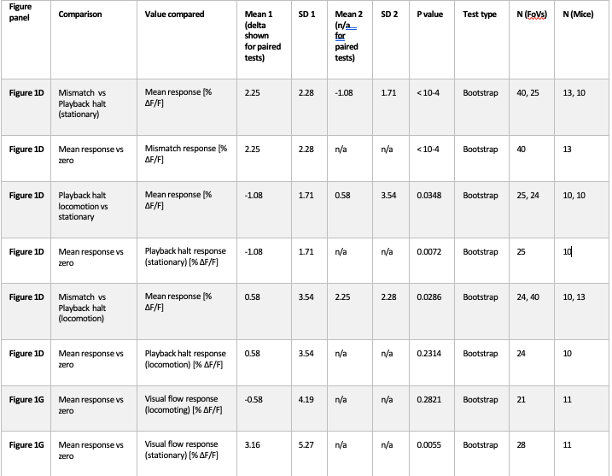
      Author response image 6.

      (2) Something that I anticipated to see addressed in the manuscript was the study from Grosmark and Buzsaki (2016): "Cell assembly sequences during learning are "replayed" during hippocampal ripples and contribute to the consolidation of episodic memories. However, neuronal sequences may also reflect preexisting dynamics. We report that sequences of place-cell firing in a novel environment are formed from a combination of the contributions of a rigid, predominantly fast-firing subset of pyramidal neurons with low spatial specificity and limited change across sleep-experience-sleep and a slow-firing plastic subset. Slow-firing cells, rather than fast-firing cells, gained high place specificity during exploration, elevated their association with ripples, and showed increased bursting and temporal coactivation during postexperience sleep. Thus, slow- and fast-firing neurons, although forming a continuous distribution, have different coding and plastic properties."

      My concern is that much of the reported results in the present manuscript appear to recapitulate the observations of Grosmark and Buzsaki, but without accounting for differences in firing rate. A parsimonious alternative explanation for what is observed in the present manuscript is that high firing rate neurons, more integrated into the local network and orchestrating local gamma activity (PING), exhibit more coupling to theta and gamma. In this alternative perspective, it's not something special about how the neurons are entrained to the routed fast gamma, but that the higher firing rate neurons are better able to engage and entrain their local interneurons and, thus modulate local gamma. However, this interpretation challenges the discussion around the importance of fast gamma routed from the MEC.

      a. Please integrate the Grosmark & Buzsaki paper into the discussion.

      b. Also, please provide data that refutes or supports the alternative hypothesis in which the high firing rate cells are just more gamma modulated as they orchestrate local gamma activity through monosynaptic connections with local interneurons (e.g., Marshall et al., 2002, Hippocampal pyramidal cell-interneuron spike transmission is frequency dependent and responsible for place modulation of interneuron discharge). Otherwise, the attribution to a MEC routed fast gamma routing seems tenuous.

      c. It is mentioned that fast-spiking interneurons were removed from the analysis. It would be worth including these cells, calculating the MVL in 1 Hz increments as well as the reciprocal of their ISIs (described above).

      We thank the review for this suggestion.  Because we found the mean firing rate of FG-cells was higher than that of NFG-cells, it would be possible that the FG-cells are mainly overlapped with fast-firing cells (rigid cells) in Grosmark et al., 2016 Science.  Actually, in this study, we aimed to investigate how fast and slow gamma rhythms modulated neurons dynamically during learning, rather than defining new cell types.  Thus, we don’t think this work was just a replication of the previous publication.  We have added this description in the Discussion part (Lines 439-441).  In addition, we don’t have enough number of interneurons to support the analysis between interneurons and place cells.  Therefore, we couldn’t make any statement about where was the fast gamma originated (CA1 locally or routed from MEC) in this study.

      (3) Methods - Spectral decomposition and Theta Harmonics.

      a. It is challenging to interpret the exact parameters that the authors used for their multi-taper analysis in the methods (lines 516-526). Tallon-Baudry et al., (1997; Oscillatory γ-Band (30-70 Hz) Activity Induced by a Visual Search Task in Humans) discuss a time-frequency trade-off where frequency resolution changes with different temporal windows of analysis. This trade-off between time and frequency resolution is well known as the uncertainty principle of signal analysis, transcending all decomposition methods. It is not only a function of wavelet or FFT, and multi-tapers do not directly address this. (The multitaper method, by using multiple specially designed tapers -like the Slepian sequences- smooths the spectrum. This smoothing doesn't eliminate leakage but distributes its impact across multiple estimates). Given the brevity of methods and the issues of theta harmonics as offered above, it is worth including some benchmark trace testing for the multi-taper as part of the supplemental figures.

      i. Please spectrally decompose an asymmetric 8 Hz sawtooth wave showing the trace and the related power spectral density using the multiple taper method discussed in the methods.

      ii. Please also do the same for an elliptical oscillation (perfectly symmetrical waves, but also capable of casting harmonics). Matlab code on how to generate this time series is provided below:

      A = 1; % Amplitude

      T = 1/8; % Period corresponding to 8 Hz frequency

      omega = 2*pi/T; % Angular frequency

      C = 1; % Wave speed

      m = 0.9; % Modulus for the elliptic function (0<m<1 for cnoidal waves)

      x = linspace(0, 2*pi, 1000); % temporal domain

      t = 0; % Time instant

      % Calculate B based on frequency and speed

      B = sqrt(omega/C);

      % Cnoidal wave equation using the Jacobi elliptic function

      u = A .* ellipj(B.*(x - C*t), m).^2;

      % Plotting the cnoidal wave

      figure;

      plot(x./max(x), u);

      title('8 Hz Cnoidal Wave');

      xlabel('time (x)');

      ylabel('Wave amplitude (u)');

      grid on;

      The Symbolic Math Toolbox needs to be installed and accessible in your MATLAB environment to use ellipj. Otherwise, I trust that, rather than plotting a periodic orbit around a circle (sin wave) the authors can trace the movement around an ellipse with significant eccentricity (the distance between the two foci should be twice the distance between the co-vertices).

      We thank the review for this suggestion.  In the main text of manuscript, we only applied Morlet's wavelet method to calculate the time varying power of rhythms.  Multitaper method was used for the estimation of power spectra across running speeds, which was shown in the manuscript.  Therefore, we removed the description of Multitaper method and updated the Morlet's wavelet power spectral analysis in the Methods (Lines 541-544).

      As suggested, we estimated the power spectral densities of 8 Hz sawtooth and elliptical oscillation by using these methods, and compared them with the results from FFT.  We found that both the Multitaper's and Morlet's wavelet methods could well capture the 8Hz oscillatory components (Author response image 7).  However, we could observe harmonic components from FFT spectrum.

      Author response image 7.

      iii. Line 522: "The power spectra across running speeds and absolute power spectrum (both results were not shown).". Given the potential complications of multi-taper discussed above, and as each convolution further removes one from the raw data, it would be the most transparent, simple, and straightforward to provide power spectra using the simple fft.m code in Matlab (We imagine that the authors will agree that the results should be robust against different spectral decomposition methods. Otherwise, it is concerning that the results depend on the algorithm implemented and should be discussed. If gamma transience is a concern, the authors should trigger to 2-second epochs in which slow/fast gamma exceeds 3-7 std. dev. above the mean, comparing those resulting power spectra to 2-second epochs with ripples - also a transient event). The time series should be at least 2 seconds in length (to avoid spectral leakage issues and the issues discussed in Talon-Baudry et al., 1997 above).

      Please show the unmolested power spectra (Y-axis units in mV2/Hz, X-axis units as Hz) as a function of running speed (increments of 5 cm/s) for each animal. I imagine three of these PSDs for 3 of the animals will appear in supplemental methods while one will serve as a nice manuscript figure. With this plot, please highlight the regions that the authors are describing as theta, slow, and fast gamma. Also, any issues should be addressed should there be notable differences in power across animals or tetrodes (issues with locations along proximal-distal CA1 in terms of MEC/LEC input and using a local reference electrode are discussed below).

      As suggested, we firstly estimated the power spectra as a function of running speeds in each running lap, and showed them separately for each rat, by using the multitaper spectral analysis (Author response image 8).  In addition, to achieve unmolested power spectra, the short-time Fourier transform (STFT) was used for this analysis at the same frequency resolution (Author response image 9).  We could see that the power spectra were consistent between these two methods.  Notably, there seems no significant theta harmonic component in the slow gamma band range.

      The multitaper spectral analysis was performed as follows.  The power spectra were measured across different running speeds as described previously (Ahmed et al., 2012 J Neurosci; Zheng et al., 2015 Hippocampus; Zheng et al., 2016 eNeuro).  Briefly, the absolute power spectrum was calculated for 0.5s moving window and 0.2s step size of the LFPs recordings each lap, using the multitaper spectral analysis in the Chronux toolbox (Mitra and Bokil, 2008, http://chronux.org/) and STFT spectral analysis in Matlab script stft.m.  In the multitaper method, the time-bandwidth product parameter (TW) was set at 3, and the number of tapers (K) was set at 5.  In the STFT method, the FFT length was set at 2048, which was equivalent with the parameters used in multitaper method.  Running speed was calculated (see “Estimation of running speed and head direction” section in the manuscript) and averaged within each 0.5s time window corresponding to the LFP segments.  Then, the absolute power at each frequency was smoothed with a Gaussian kernel centered on given speed bin.  The power spectral as a function of running speed and frequency were plotted in log scale.  Also, the colormap was in log scale, allowing for comparisons across different frequencies that would otherwise be difficult due to the 1/f decay of power in physiological signals.
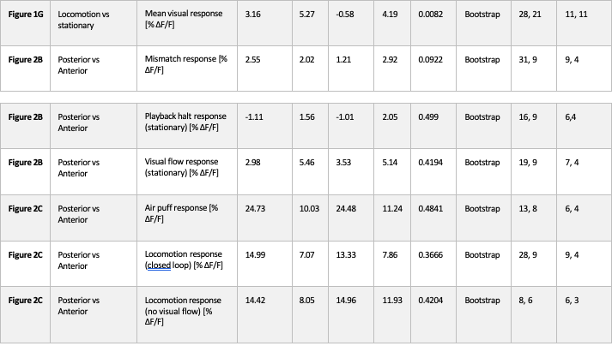

      Author response image 8.
      Author response image 9.

      iv. Schomberg and colleagues (2014) suggested that the modulation of neurons in the slow gamma range could be related to theta harmonics (see above). Harmonics can often extend in a near infinite as they regress into the 1/f background (contributing to power, but without a peak above the power spectral density slope), making arbitrary frequency limits inappropriate. Therefore, in order to support the analyses and assertions regarding slow gamma, it seems necessary to calculate a "theta harmonic/slow gamma ratio". Aru et al. (2015; Untangling cross-frequency coupling in neuroscience) offer that: " The presence of harmonics in the signal should be tested by a bicoherence analysis and its contribution to CFC should be discussed." Please test both the synthetic signals above and the raw LFP, using temporal windows of greater than 4 seconds (again, the large window optimizes for frequency resolution in the time-frequency trade-off) to calculate the bicoherence. As harmonics are integers of theta coupled to itself and slow gamma is also coupled to theta, a nice illustration and contribution to the field would be a method that uses the bispectrum to isolate and create a "slow gamma/harmonic" ratio.

      We thank the reviewer for providing the method regarding on the theta harmonics.  We firstly measured the theta harmonics on the synthesized signal by using the biphasic coherence method, and we could clearly observe the nonlinear coupling between theta rhythm and its harmonics (Author response image 10).

      Author response image 10.

      In addition, we also measured the bicoherence on raw traces during slow gamma episodes.  We did not see nonlinear coupling between slow gamma and theta bands in this real data (mean bicoherence=0.1±0.0002) compared with that in the synthesized signal (mean bicoherence=0.7 for elliptical waves and 0.5 for sawtooth waves), suggesting that the slow gamma detected in this study was not pure theta harmonic (Author response image 11C, F, I, in red boxes).  Therefore, we believe that the contribution of theta harmonic in slow gamma is not significant.

      Author response image 11.

      (4) I appreciate the inclusion of the histology for the 4 animals. Knerim and colleagues describe a difference in MEC projection along the proximal-distal axis of the CA1 region (https://www.ncbi.nlm.nih.gov/pmc/articles/PMC3866456/)- "There are also differences in their direct projections along the transverse axis of CA1, as the LEC innervates the region of CA1 closer to the subiculum (distal CA1), whereas the MEC innervates the region of CA1 closer to CA2 and CA3 (proximal CA1)" From the histology, it looks like some of the electrodes are in the part of CA1 that would be dominated by LEC input while a few are closer to where the MEC would project.

      a. How do the authors control for these differences in projections? Wouldn't this change whether or not fast gamma is observed in CA1?

      b. I am only aware of one manuscript that describes slow gamma in the LEC which appeared in contrast to fast gamma from the MEC (https://www.science.org/doi/10.1126/science.abf3119). One would surmise that the authors in the present manuscript would have varying levels of fast gamma in their CA1 recordings depending on the location of the electrodes in the Proximal-distal axis, to the extent that some of the more medial tetrodes may need to be excluded (as they should not have fast gamma, rather they should be exclusively dominated by slow gamma). Alternatively, the authors may find that there is equal fast gamma power across the entire proximal-distal axis. However, this would pose a significant challenge to the LEC/slow gamma and MEC/fast gamma routing story of Fernandez-Ruiz et al. and require reconciliation/discussion.

      c. Is there a difference in neuron modulation to these frequencies based on electrode location in CA1?

      We thank the reviewer for this concern, which was also raised by Reviewer2.  We aligned the physical location of LFP channels in the proximal-distal axis based on histology.  In our dataset, only 2 rats were recorded from both distal and proximal hippocampus, so we calculated the gamma power from both sites in these rats.  We found that slow power was higher from proximal tetrodes than that from distal tetrodes (Author response image 12, repeated measure ANOVA, F(1,7)=10.2, p=0.02, partial η <sup>2</sup>=0.8).  However, fast gamma power were similar between different recording sites (F(1,7)=0.008, p=0.9, partial η <sup>2</sup>=0.001).  These results are partially consistent with the LEC/slow gamma and MEC/fast gamma routing story of Fernandez-Ruiz’s work.  The main reason would be that all LFPs were recorded from tetrodes in stratum pyramidale, deep layer in particular (Author response image 4E), so that it was hard to precisely identify their distance to distal/proximal apical dendrites.

      Author response image 12.

      In terms of the anatomical location of FG and NFG cells, we identified tetrode traces in slices for each cell.  We found that both FG and NFG cells were recorded from the deep layer of dorsal CA1, with no difference of proportions between cell types (Author response image 4E, Chi-squared test, χ<sup>2</sup>=0.5, p=0.5, Cramer V=0.05).  The distribution of FG-cells he NFG-cells along the transverse axis was also similar between cell types (Author response image 4F, χ<sup>2</sup>=0.08, p=0.8, Cramer V=0.02).

      (5) Given a comment in the discussion (see below), it will be worth exploring changes in theta, theta harmonic, slow gamma, and fast gamma power with running speed as no changes were observed with theta sequences or lap number versus. Notably, Czurko et al., report an increase in theta and harmonic power with running speed (1999) while Ahmed and Mehta (2012) report a similar effect for gamma.

      a. Please determine if the oscillations change in power and frequency of the rhythms discussed above change with running speed using the same parameters applied in the present manuscript. The specific concern is that how the authors calculate running speed is not sensitive enough to evaluate changes.

      We thank the reviewer for this suggestion.  The description of running speed quantification has been updated in the Method (see “Estimation of running speed and head direction” section, Lines 501-511).  Overall, the sample frequency of running speed was25Hz which would be sensitive enough to evaluate the behavioral changes.

      By measuring the rhythmic power changing as a function of running speed (Author response image 8 and Author response image 9), we could observe that theta power was increased as running speed getting higher.  Consistent with the results in (Ahmed and Mehta, 2012) and our previous study (Zheng et al., 2015), the fast gamma power was increasing and slow gamma power was decreasing when running speed was getting high.

      In addition, we also estimated the rhythmic frequency as a function of running speed in the slow and fast episodes respectively.  We found that fast gamma frequency was increased with running speed (Author response image 13, linear regression, R<sup>2</sup>=0.4, corr=0.6, p=9.9×10<sup>-15</sup>), whereas slow gamma frequency was decreased with running speed (R<sup>2</sup>=0.2, corr=-0.4, p=8.8×10<sup>-6</sup>).  Although significant correlation was found between gamma frequency and running speed, consistent with the previous studies, the frequency change (~70-75Hz for fast gamma and ~30-28Hz for slow gamma) was not big enough to affect the sequence findings in this study.  In additiontheta frequency was maintained in either slow episodes (R<sup>2</sup>=0.02, corr=-0.1, p=0.1) or fast episodes (R<sup>2</sup>=0.004, corr=0.06, p=0.5), consistent with results in Fig.1G of Kropff et al., 2021 Neuron.

      Author response image 13.

      b. It is astounding that animals ran as fast as they did in what appears to be the first lap (Figure 3F), especially as rats' natural proclivity is thigmotaxis and inquisitive exploration in novel environments. Can the authors expand on why they believe their rats ran so quickly on the first lap in a novel environment and how to replicate this? Also, please include the individual values for each animal on the same plot.

      We thank the reviewer for pointing this out.  The task was not brand new to rats in this dataset, because only days with good enough recording quality for sequence decoding were included in this paper, which were about day2-day10 for each rat.  However, we still observed the process of sequence formation because of the rat’s exploration interest during early laps.  Thus, in terms exploration behaviors, the rats ran at relative high speeds across laps (Author response image 14, each gray line represents the running speed within an individual session).

      Author response image 14.

      c. Can the authors explain how the statistics on line 169 (F(4,44)) work? Specifically, it is challenging to determine how the degrees of freedom were calculated in this case and throughout if there were only 4 animals (reported in methods) over 5 laps (depicted in Figure 3F. Given line 439, it looks like trials and laps are used synonymously). Four animals over 5 laps should have a DOF of 16.

      This statistic result was performed with each session/day as a sample (n=12 sessions/days).  The statistics were generated by repeated measures ANOVA on 5 trials in 12 sessions, with a DOF of 44.

      (6) Throughout the manuscript, I am concerned about an inflation of statistical power. For example on line 162, F(2,4844). The large degrees of freedom indicate that the sample size was theta sequences or a number of cells. Since multiple observations were obtained from the same animal, the statistical assumption of independence is violated. Therefore, the stats need to be conducted using a nested model as described in Aarts et al. (2014; https://pubmed.ncbi.nlm.nih.gov/24671065/). A statistical consult may be warranted.

      We thank the reviewer for this suggestion.  We have replaced this statistic result by using generalized linear mixed model with ratID being a covariate.  These results have been updated in the revised manuscript (Lines 164-167).

      (7) It is stated that one tetrode served as a quiet recording reference. The "quiet" part is an assumption when often, theta and gamma can be volume conducted to the cortex (e.g., Sirota et al., 2008; This is often why laboratories that study hippocampal rhythms use the cerebellum for the differential recording electrode and not an electrode in the corpus callosum). Generally, high frequencies propagate as well as low frequencies in the extracellular milieu (https://www.eneuro.org/content/4/1/ENEURO.0291-16.2016). For transparency, the authors should include a limitation paragraph in their discussion that describes how their local tetrode reference may be inadvertently diminishing and/or distorting the signal that they are trying to isolate. Otherwise, it would be worth hearing an explanation as to how the author's approach avoids this issue.

      In terms of the locations of references, we had 2 screws above the cerebellum in the skull connected to the recording drive ground, and 1 tetrode in a quiet area of the cortex serving as the recording reference.  We agree that the theta and gamma can be volume conducted to the cortex which may affect the power of these rhythms in the stratum pyramidale.  However, we didn’t mean to measure or compare the absolute theta or gamma power in this study, as we only cared about the phase modulation of gamma to place cells.  Therefore, we believe the location of recording reference would not make significant effect on our conclusion.

      Apologetically, this review is already getting long. Moreover, I have substantial concerns that should be resolved prior to delving into the remainder of the analyses. e.g., the analyses related to Figure 3-5 assert that FG cells are important for sequences. However, the relationship to gamma may be secondary to either their relationship to theta or, based on the Grosmark and Buzsaki paper, it may just be a phenomenon coupled to the fast-firing cells (fast-firing cells showing higher gamma modulation due to a local PING dynamic). Moreover, the observation of slow gamma is being challenged as theta harmonics, even by the major proponents of the slow/fast gamma theory. Therefore, the report of slow gamma precession would come as an unsurprising extension should they be revealed to be theta harmonics (however, no control for harmonics was implemented; suggestions were made above). Following these amendments, I would be grateful for the opportunity to provide further feedback.

      III. Discussion.

      a. Line 330- it was offered that fast gamma encodes information while slow gamma integrates in the introduction. However, in a task such as circular track running (from the methods, it appears that there is no new information to be acquired within a trial), one would guess that after the first few laps, slow gamma would be the dominant rhythm. Therefore, one must wonder why there are so few neurons modulated by slow gamma (~3.7%).

      The proportion of ~3.7% was the part of place cells phase-locked to slow gamma.  However, we aimed to find that the slow gamma phase precession of place cells promoted the theta sequence development.  We would not expect the cells phase-locked to slow gamma if phase precession occurred.

      b. Line 375: The authors contend that: "...slow gamma, related to information compression, was also required to modulate fast gamma phase-locked cells during sequence development. We replicated the results of slow gamma phase precession at the ensemble level (Zheng et al., 2016), and furthermore observed it at late development, but not early development, of theta sequences." In relation to the idea that slow gamma may be coupled to - if not a distorted representation of - theta harmonics, it has been observed that there are changes in theta relative to novelty.

      i. A. Jeewajee, C. Lever, S. Burton, J. O'Keefe, and N. Burgess (2008) report a decrease in theta frequency in novel circumstances that disappears with increasing familiarity.

      ii. One could surmise that this change in frequency is associated with alterations in theta harmonics (observed here as slow gamma), challenging the author's interpretation.

      iii. Therefore, the authors have a compelling opportunity to replicate the results of Jeewajee et al., characterizing changes of theta along with the development of slow gamma precession, as the environment becomes familiar. It will become important to demonstrate, using bicoherence as offered by Aru et al., how slow gamma can be disambiguated from theta harmonics. Specifically, we anticipate that the authors will be able to quantify A) theta harmonics (the number, and their respective frequencies and amplitudes), B) the frequency and amplitude of slow gamma, and C) how they can be quantitatively decoupled. Through this, their discussion of oscillatory changes with novelty-familiarity will garner a significant impact.

      We think we have demonstrated that the slow gamma observed in this study was not purely theta harmonics.  We didn’t focus on the frequency change of slow gamma or theta rhythms in this study.  Further investigation will be carried out on this topic in the future.

      c. Broadly, it is interesting that the authors emphasize the gamma frequency throughout the discussion. Given that the power spectral density of the Local Field Potential (LFP) exhibits a log-log relationship between amplitude and frequency, as described by Buzsáki (2005) in "Rhythms of the Brain," and considering that the LFP is primarily generated through synaptic transmembrane currents (Buzsáki et al., 2012), it seems parsimonious to consider that the bulk of synaptic activity occurs at lower frequencies (e.g., theta). Since synaptic transmission represents the most direct form of inter-regional communication, one might wonder why gamma (characterized by lower amplitude rhythms) is esteemed so highly compared to the higher amplitude theta rhythm. Why isn't the theta rhythm, instead, regarded as the primary mode of communication across brain regions? A discussion exploring this question would be beneficial.

      We thank the reviewer for this deep thinking.  When stating the conclusion on gamma rhythms, we didn’t mean to weaken the role of theta rhythm.  Conversely, the fast or slow gamma episodes were detected riding on theta rhythms, and we believe that the information compression should occur at a finer scale within a theta cycle scale.  More investigation will be carried out on this topic in the future.

      Recommendations for the authors:

      Reviewer #1 (Recommendations For The Authors):

      (1) It is helpful to clearly define "FG-cell sequences" before the relevant results are described in the Results section. More importantly, the seemingly conflicting results between Figure 3 and Figure 8 may need to be clarified.

      The “exFG-sequences and exNFG sequences”, “FG-cell sequences and NFG-cell sequences” have been defined clearly in the revised manuscript.  Moreover, the seemingly conflicting results between Figure 3 and Figure 8 have been interpreted properly.

      (2) It is helpful to clearly state the N and what defines a sample whenever a result is described.

      In each statistical results, the N and what defines a sample have been clarified in the revised manuscript.

      (3) Addressing the questions regarding the methods (#5) would clarify some of the results.

      The questions regarding the Methods part has addressed in the revised manuscript.

      (4) Line #244: "successful" should be "successive"?

      Fixed.

      Reviewer #2 (Recommendations For The Authors):

      - The writing of the manuscript can be substantially improved.

      The manuscript can be substantially revised and updated.

      - I noticed that the last author of the manuscript is not the lead or corresponding and has only provided a limited contribution to this work (according to the detailed author contributions). The second to last author seems to be the main senior intellectual contributor and supervisor, together with the third to last author. This speaks of potential bad academic practices where a senior person whose intellectual contribution to the study is relatively minor takes the last author position, against the standard conventions on authorship worldwide. I strongly suggest that this is corrected.

      We thank the reviewer for raising this problem.  The last author Dr. Ming was also a senior author and supervised this project with large contribution.  We have fixed his role as a co-corresponding author in the revised manuscript.

    1. Author response:

      The following is the authors’ response to the original reviews.

      Summary of revisions

      Title

      We have changed the title of the manuscript to “Chromatin endogenous cleavage provides a global view of yeast RNA polymerase II transcription kinetics”.

      Text

      Additional discussion of the patterns for elongation factors added (detailed below).

      Small text changes throughout, as mentioned in the detailed response below.

      Figures

      Updated legend-image in Figure 2F to reflect correct colors

      Added Figure 2 – supplement 1F – RNAPII enrichment with shorter promoter dwell times

      Added Figure 2 - supplement 2 with ChIP-seq outcomes (and text legend)

      Removed gene numbers in Figure 5C and put them in the legend.

      Substituted Med1 and Med8 ChEC over Rap1 sites in Figure 5F.

      Moved kin28-is growth inhibition to Figure 5 – Supplement 1.

      Substituted a new panel overlaying the RNAPII enrichment over UASs or promoters for all three strains in Figure 7D.

      Improved the labeling and legend of Figure 7E

      Methods

      Added ChIP-seq performed to confirm that the MNase fusion proteins are able to produce the expected pattern for ChIP.

      Point-by-point response to reviewers’ comments

      Reviewer 1:

      (1) Extending this work to elongation factors Ctk1 and Spt5 unexpectedly give strong signals near the PIC location and little signals over the coding region. This, and mapping CTD S2 and S5 phosphorylation by ChEC suggests to me that, for some reason, ChEC isn't optimal for detecting components of the elongation complex over coding regions. 

      (3) mapping the elongation factors Spt5 and Ctk1 by ChEC gives unexpected results as the signals over the coding sequences appear weak but unexpectedly strong at promoters and terminators. It would be helpful if the authors could comment on reasons why ChEC may not work well with elongation factors. For example, could this be something to do with the speed of Pol elongation and/or the chromatin structure of coding sequences such that coding sequence DNA is less accessible to MNase cleavage? 

      (7) The mintbodys are an interesting attempt to measure Pol II CTD modifications during elongation but give unexpected results as the signals in the coding region are lower than at promoters and terminators. It seems like ChIP is still a much better option for elongation factors unless I'm missing something. 

      We agree with the reviewer that this is a point that could confuse the reader.  Therefore, we have devoted two additional paragraphs to possible interpretations of our data in the Discussion:

      ChEC with factors involved in elongation (Ctk1, Spt5, Ser2p-RNAPII), when normalized to total RNAPII, showed greater enrichment over the CDS (Figure 3G), as expected. However, it is surprising that we also observed clear enrichment of these factors at promoters (e.g. Figure 3A, E & F). The association of elongation factors with the promoter seems to be biologically relevant. Changes in transcription correlate with changes in ChEC enrichment for these factors and modifications (Figure 4C). Blocking initiation by inhibiting TFIIH kinase led to a reduction of Ser5p RNAPII and Ser2p RNAPII over both the promoter and the transcribed region (Figure 5G). This suggests either that the true signal of these factors over transcribed regions is less evident by ChEC than by ChIP or that ChEC can reveal interactions of elongation factors at early stages of transcription that are missed by ChIP. The expectations for enrichment of elongation factors and phosphorylated CTD are largely based on ChIP data. Because ChIP fails to capture RNAPII enrichment at UASs and promoters, it is possible that ChIP also fails to capture promoter interaction of factors involved in elongation as well.

      Factors important for elongation can also function at the promoter. For example, Ctk1 is required for the dissociation of basal transcription factors from RNAPII at the promoter (Ahn et al., 2009). Transcriptional induction leads to increases in Ctk1 ChEC enrichment both over the promoter and over the 3’ end of the transcribed region (Figure 4C). Dynamics of Spt4/5 association with RNAPII from in vitro imaging (Rosen et al., 2020) indicate that the majority of Spt4/5 binding to RNAPII does not lead to elongation; Spt4/5 frequently dissociates from DNA-bound RNAPII. Association of Spt4/5 with RNAPII may represent a slow, inefficient step in the transition to productive elongation. If so, then ChEC-seq2 may capture transient Spt4/5 interactions that occur prior to productive elongation, producing enrichment of Spt5 at the promoter.

      (2) Finally, the role of nuclear pore binding by Gcn4 is explored, although the results do not seem convincing (10) In Figure 7, it's not convincing to me that ChEC is revealing the reason for the transcriptional defect in the Gcn4 PD mutant. The plots in panel D look nearly the same and I don't follow the authors' description of the differences stated in the text. In panel A, replotting the data in some other way might make the transcriptional differences between WT and Gcn4 PD mutants more obvious. 

      The phenotype of the gcn4-pd mutant is a quantitative decrease in transcription and this leads to a quantitative decrease, rather than qualitative loss, of RNA polymerase II over the promoter, without impacting the association of RNA polymerase II over the UAS region. This effect is small but statistically significant (p = 4e5). We have changed the title of this section of the manuscript to “ChEC-seq2 suggests a role for the NPC in stabilizing promoter association of RNAPII”. Also, to make comparison clearer, we have plotted the data together in the revised figure (Figure 7D).

      The magnitude of the decrease is not large, but we would highlight that is almost as large as that produced by inhibiting the Kin28 kinase (Figure 5H). Because the promoter-bound RNAPII is poorly captured by ChIP, this effect might be difficult to observe by techniques other than ChEC. Obviously, more mechanistic studies will need to be performed to fully understand this phenotype, but this result supports a role for the interaction with the nuclear pore complex in either enhancing the transfer of RNA polymerase II from the enhancer to the promoter or in preventing its dissociation from the promoter.

      I think that the related methods cut&run/cut&tag have been used to map elongating pol II. The authors should summarize what is known from this approach in the introduction and/or discussion. 

      CUT&RUN has been used to map RNAPII in mammals, but we are not aware of reports in S. cerevisiae.  Work from the Henikoff Lab in yeast mapped transcription factors and histone modifications (PMIDs 28079019 and 31232687).  A report using CUT&RUN in a human cell line reported a promoter-5’ bias of RNAPII that appeared to be dependent on fragment length (PMID 33070289). Regardless, the report highlights a key distinction between yeast and other eukaryotes: paused RNAPII. Indeed, paused RNAPII dominates ChIP-seq tracks in metazoans, and so we are hesitant to speculate between CUT&RUN in other species vs. ChEC-seq2 in S. cerevisiae

      Are the Rpb1, Rpb3, TFIIA, and TFIIE cleavage patterns expected based on the known structure of the PIC (Figures 2C, E)? 

      Rpb1 and 3 show peaks at approximately -17 and +34 with respect to TATA. TFIIA (Toa2) shows peaks at -12 and + 12.  And TFIIE (Tfa1) shows a peak around +34 (Figure 2C & E):

      As shown in the supplementary movie (based on the cMed-PIC structure; PDB #5OQM; Schilbach et al., 2017), upon binding to TBP/TFIID, TFIIA would be expected to cleave slightly upstream and downstream of the protected TATA (-12 and +12), while TFIIE binds downstream after the +12 site is protected and would be closest to the +34 unprotected site (to the right in the image below). RNAPII, which binds the fully assembled PIC, should be able to access either the upstream site (-12) or the downstream site (+34). Rpb1’s unstructured carboxy terminal domain, to which MNase is fused, would give it maximum flexibility, which likely explains why Rpb1 cleaves both at -12 and +34, with a preference for -12. Rpb3 also cleaves both sites, but without an obvious preference. 

      Author response image 1.

      Author response image 2.

      cleavage at -12, +12 and +34

      Author response image 3.

      Highlighted sites corresponding to the peaks in TFIIA assembled with TBP:

      Author response image 4.

      The complete PIC, protecting the +12 site, but leaving the +34 site exposed: 

      (6) Figure 2 S1: Pol II ChIP in the coding region gives a better correlation with transcription vs ChEC in promoters. Also, Pol II ChIP at terminators is almost as good as ChEC at promoters for estimating transcription. This latter point seems at odds with the text. The authors should comment on this and modify the text as needed. 

      Thank you for this comment.  We have clarified the text.

      In Figures 4 and 5, it's hard to tell how well changes in transcription correlate with changes in Pol II ChEC signals. It might be helpful to have a scatterplot or some other type of plot so that this relationship can be better evaluated. 

      While we find corresponding increase/decrease in ChEC-seq2 signal in genes identified as up/downregulated by SLAM-seq, the magnitude in change is not well correlated between the two techniques.  This was not surprising, because neither ChIP nor ChEC correlate especially well with SLAM-seq (Figure 2 – supplement 1E).

      In Figure 5, it's unclear why Pol association with Rap1 is being measured. Buratowski/Gelles showed that Pol associates with strong acidic activators - presumably through Mediator. Rap1 supposedly does not bind Mediator - so how is Pol associating here? Perhaps it would be better to measure Pol binding at STM genes that show Mediator-UAS binding. 

      Thank you; this is a good point.  We chose Rap1 because we had generated high-confidence binding sites in our strains under these conditions by ChEC-seq2. The results suggest that RNAPII is recruited well to these sites and that this recruitment does not require TFIIB. However, in disagreement with the notion that Mediator does not interact with Rap1, ChEC with Mediator subunits Med1 and Med8 also show peaks at these sites (new Figure 5F; the old Figure 5F is now Figure 5 – Supplement 1).  Therefore, either these sites are co-occupied by other transcription factors that mind Mediator, or Mediator is recruited by Rap1.  In either case, this correlates with binding of RNAPII. 

      Reviewer 2:

      (1) The term "nascent transcription" is all too often used interchangeably for NET-seq, PRO-seq, 4sUseq, and other assays that often provide different types of information. The authors should make it clear their use of the term refers to SLAM-seq data. 

      We have clarified throughout the manuscript that nascent transcription measured by SLAM-seq.

      The authors should explicitly state that experiments were performed in S. cerevisiae in the Results section. 

      We have made it clear in the title and the text that these experiments were performed in S. cerevisiae.

      Lines 216-218 state that "None of the 24 predicted the strong signal over the transcribed region with promoter depletion characteristic of ChIP-seq". I understand the authors' point, but there are parameter combinations that produce a flat profile with slightly less signal over the promoter (e.g., 5 sec dwell times and 3000 bp/ min elongation rate). If flanking windows were included, this profile would look something like ChIP-seq. I'd encourage the authors to be more precise with their language. 

      Thank you for highlighting this over-statement.

      We have now clarified the text and added another supplementary panel as follows:

      “While some combinations predicted a relatively flat distribution across the gene with lower levels in the promoter, none of the 24 predicted the strong signal over the transcribed region with promoter depletion characteristic of ChIP-seq. Only very short promoter dwell times (i.e., < 1s), produced the low promoter occupancy seen in ChIP-seq (Figure 2 – supplement 1F).”