10,000 Matching Annotations
  1. Feb 2026
    1. Now, it is clear that the decline of a language must ultimately have political and economic causes: it is not due simply to the bad influence of this or that individual writer. But an effect can become a cause, reinforcing the original cause and producing the same effect in an intensified form, and so on indefinitely. A man may take to drink because he feels himself to be a failure, and then fail all the more completely because he drinks

      Orwell seems to be asserting here that an individual writer can have an outsize influence on the development (and decline) of a language.

    1. the mundane to the memorable.They wiil want to tell their friendsand parents about their experi-ences.

      I know that I have been truly delighted by many English and Social Studies classes, but I am struggling to remember the last time I was delighted by Phys Ed. The only fitness-based delights I can remember through school came from Grade 3 and under (then that gym teacher moved) and from recesses where I would climb anything and everything. In those climbing examples, it was similar to the concept discussed in the adjacent paragraph: the climbing would be difficult and I had to work hard for any success I had. As such, it was incredibly satisfying to reach the top of the light pole (or whatever I was climbing that day).

      I did enjoy Phys Ed to a certain extent, but it did not delight me. I am not sure how exactly to achieve delight for my students either.

    2. making physical educa-tion fun should not be horriblydifficult.

      I agree with this but I do think that I need to improve my ability to make more mundane topics fun. Physical education has the advantage of flexibility. Although there are curricular outcomes that need to be met, they are fairly open-ended and can be met in a large variety of ways. This means that physical education should have variety as well. I regret not taking my gym class outside more during my internship. A skill that I need to develop is the ability to be fun in an uncontrolled/less controlled space. The better I get at this skill, the easier it will be to have an effective outdoor/ non-gym Phys Ed class.

    3. 15. It offers a refreshing play-ground, a respite, something tolook forward to.

      This is a concept that is heavily taught for early years but seems to disappear as the students get older. Everyone needs play. Of course, that play will look different depending on the age of the person, but everyone (including adults) needs play. It is one of the best ways to unwind and to have fun. Regardless of age, it is necessary to have a break for fun at some point.

    4. makes economic sense;

      Although I am sure this is true, I am curious to the reasoning/research behind this point. I understand that it may help with prevention for various health issues but I am wondering if this point is referring to something else.

    1. The crash made it all too clear that mathematics, once my refuge, wasnot only deeply entangled in the world’s problems but also fueling manyof them. The housing crisis, the collapse of major financial institutions,the rise of unemployment—all had been aided and abetted bymathematicians wielding magic formulas. What’s more, thanks to theextraordinary powers that I loved so much, math was able to combinewith technology to multiply the chaos and misfortune, adding efficiencyand scale to systems that I now recognized as flawed

      This, to me, is the thesis of this week's readings. The power that data has, and its multiplied chaos thanks to tech is something we need to teach to everyone - not just Ph.D. students.

    1. EC2- scalable virtuals instances of machines that a can be used for variety of applications hoseted in the cloud. On-Demand - pay for instance by the hour or even seconds, Resevred Instance: - get discount rate if up to 1 year - 3years,<br /> Spot Instances - bid for unused EC2 at lower price, but connected can be lost at any point. .Configurations: Type, Size, Storage, ELB,Networking and auto scaling - Types General Purpose, Memory - OPtimized, Computer OPtimuized, Storage optimized,

    1. Looking at the screen, theteacher marvels: “You seem to understand the history of Haussmannization inParis, but you do not understand its implications.”

      Teaching depends on reading the room and responding in the moment to what students do or do not understand.

    Annotators

    1. “Little” again? Nothing ⌜but⌝ “low” and “little”?

      Through this conflict, we can see Helena and Hermia become more well rounded characters. Their flaws emerge in interesting ways. New dimension is given to Helena's jealousy and remorse while we learn that Hermia has a chip on her shoulder about her height, which causes her to make the situation worse.

    1. due to the real or perceived sense that “micro” states or implies that these interactions are small or minor in impact.

      Like this piece of text says micro mean small. I find that although micro means small the word microaggression is quite deceiving. The action may seem minor, but the outcome of this action can have a big impact on someone or a group of people.

    1. La Maison Perchée : Analyse d'une Communauté de Rétablissement

      Résumé Exécutif

      Ce document de synthèse analyse les thèmes, les témoignages et la structure de l'association "La Maison Perchée", tels que présentés dans le contexte source.

      Fondée en juin 2020 par un groupe de jeunes adultes, dont trois sur quatre sont directement concernés par des troubles psychiques,

      La Maison Perchée se positionne comme "la brique manquante du rétablissement".

      Son objectif principal est de créer une communauté d'entraide non médicalisée pour les 18-40 ans vivant avec un trouble psychique, en se basant sur le principe fondamental de la pair-aidance.

      L'analyse révèle plusieurs axes majeurs :

      1. Le Vécu Intime des Troubles : Des récits personnels poignants sur la bipolarité et la schizophrénie illustrent la réalité des symptômes (manie, dépression, psychose, paranoïa), la violence des crises, l'épreuve de l'hospitalisation et la souffrance psychique intense, souvent qualifiée de "handicap invisible".

      2. La Philosophie du Rétablissement : Le concept de rétablissement est central. Il ne s'agit pas d'une guérison, mais d'un processus d'apprentissage pour "vivre et non plus survivre" avec une maladie chronique. Ce chemin est jalonné de difficultés et de petites victoires qui doivent être célébrées.

      3. La Puissance de la Pair-Aidance : L'entraide entre pairs est le cœur du projet.

      Le partage d'un vécu similaire offre des modèles, une compréhension authentique et un soutien que le système de soin traditionnel ne fournit pas toujours.

      L'association forme activement ses membres à cette pratique.

      4. La Création d'un Espace Physique : Le projet s'est concrétisé par l'ouverture d'un café-lieu de rencontre à Paris.

      Cet espace vise à déstigmatiser la santé mentale et à offrir un refuge où les conversations profondes et l'acceptation sont la norme, créant ainsi des liens sociaux essentiels.

      En somme, La Maison Perchée émerge comme une initiative vitale, une "pulsion de vie" qui répond à un besoin criant de soutien communautaire, de reconnaissance et d'espoir pour une population souvent marginalisée par la maladie et la stigmatisation.

      --------------------------------------------------------------------------------

      1. Origine et Mission de La Maison Perchée

      1.1. Fondation et Équipe

      L'association "La Maison Perchée" a été officiellement fondée en juin 2020. L'équipe fondatrice est composée de quatre jeunes adultes, tous âgés de moins de 30 ans au moment de la création :

      Maxime : Diagnostiqué bipolaire.

      Victoria : Diagnostiquée d'un trouble bipolaire psychotique.

      Lucile : Atteinte de schizophrénie.

      Caroline Mats : Non concernée directement par un trouble psychique.

      Cette composition, où trois des quatre fondateurs sont "concernés", incarne la philosophie de l'association.

      L'idée est née d'expériences personnelles directes et indirectes avec la maladie psychique, l'hospitalisation et le sentiment d'injustice face au manque de soutien.

      Lucile évoque le déclenchement de sa schizophrénie en 2016 et son expérience en tant qu'enfant d'un parent malade. Maxime mentionne l'injustice ressentie à l'hôpital en voyant d'autres patients sans visites, ce qui a été un moteur initial : "je me suis dit il leur faut un endroit".

      1.2. Philosophie et Objectifs

      La mission de La Maison Perchée repose sur des concepts forts visant à combler un vide dans le parcours de soin.

      "La brique manquante du rétablissement" : L'association se définit comme le "lieu manquant de la psychiatrie", un espace non médicalisé essentiel qui complète le suivi clinique.

      "Apprendre à vivre et non plus survivre" : L'objectif est de dépasser la simple gestion de la maladie pour permettre aux individus de s'épanouir et de mener une vie riche de sens.

      C'est une démarche décrite comme une "p***** de pulsion de vie".

      La Pair-Aidance : Le principe de l'aide par les pairs (P.A.I.R.) est central.

      Il s'agit de s'appuyer sur "une personne avec un vécu similaire au sien" pour obtenir des conseils, des modèles de rétablissement et une compréhension authentique de ce qu'ils traversent.

      Une Communauté Jeune : Le ciblage d'une tranche d'âge spécifique (18-40 ans) répond à un besoin d'être avec des personnes de son âge, une problématique rencontrée par certains dans des structures de soin plus traditionnelles (C.T.T.P.).

      2. Témoignages : Le Vécu des Troubles Psychiques

      Le documentaire est jalonné de témoignages directs et crus sur l'expérience de la maladie mentale.

      2.1. Le Trouble Bipolaire

      L'expérience de Maxime : Il décrit une phase de manie survenue à 22 ans en Chine, où il avait créé quatre entreprises.

      Cette période était caractérisée par un sentiment de toute-puissance ("devant moi un vieux sage"), des délires mystiques ("prières cheloues avec des couleurs") et des comportements obsessionnels ("je compte tout"). Cette phase a été suivie d'une hospitalisation sous contention, puis de 17 mois de profonde dépression et une tentative de suicide.

      L'expérience de Victoria : Diagnostiquée à 20 ans, elle décrit le trouble comme une "alternation assez extrême de l'humeur". La maladie et les effets secondaires du traitement ont été un "parcours du combattant" qui l'a contrainte à interrompre ses études de design pendant un an.

      2.2. La Schizophrénie

      Le vécu de Lucile : Elle insiste sur le fait qu'il n'y a pas "une schizophrénie, mais des schizophrénies". Son quotidien est marqué par des épisodes psychotiques avec une "impression de mort imminente" et la peur que les lieux publics "explosent".

      Elle décrit une anxiété constante et une "impression paranoïque que les gens parlent sur nous" dans les environnements bruyants. Elle qualifie sa condition de "handicap invisible", car la souffrance n'est pas apparente.

      2.3. Crises, Hospitalisation et Souffrance

      Les récits des crises psychotiques sont particulièrement intenses.

      Dissociation et mise en danger : Victoria raconte des "bouffées délirantes" où, se sentant "complètement enfermée", elle a couru nue dans Paris et s'est "tabassée contre le sol", animée par un désir de "désexister" et de "s'atomiser". Une "toute petite partie" d'elle restait consciente, rendant l'expérience "terrible".

      L'expérience de l'hôpital : Les séjours en psychiatrie sont décrits comme des périodes d'"incertitude et de solitude".

      Les témoignages évoquent l'isolement (se faire livrer des choses "à travers la grille"), le choc de la contention et la froideur du système.

      La réalité de la souffrance : Un point est martelé : "les maladies psy c'est une p***** de souffrance". La douleur psychique est comparée à la douleur physique, avec une échelle de souffrance de 0 à 10.

      Le suicide est présenté comme une pensée qui émerge de cette souffrance extrême, non par désir de mort mais par besoin que "ça s'arrête".

      3. Le Rétablissement et la Pair-Aidance

      3.1. Définir le Rétablissement

      Le concept de rétablissement est présenté de manière nuancée, loin de "vendre du rêve".

      Un Processus, pas une Guérison : Il s'agit d'apprendre à mener une vie épanouissante malgré la maladie. C'est un compromis, car "vivre avec une maladie chronique, c'est un compromis".

      Un Chemin Laborieux : Le processus peut être long et difficile ("Est-ce que c'est facile ? Non. Est-ce qu'on en chie par un moment ? Oui.").

      Célébrer les Petites Victoires : Le rétablissement passe par la reconnaissance des progrès, même les plus simples, comme "reprendre les transports" ou "sortir de chez soi".

      Les Marqueurs du Rétablissement : Pour Maxime, être rétabli signifie avoir surmonté les prédictions négatives de ses psychiatres ("vous pourrez plus jamais entreprendre, vous pourrez pas avoir de vie amoureuse") et simplement "être content de se lever le matin".

      3.2. Le Pouvoir de la Pair-Aidance

      La pair-aidance est le pilier de La Maison Perchée. Son efficacité réside dans le partage d'expériences vécues.

      Compréhension Mutuelle : Elle permet des "échanges de gens qui peuvent réellement comprendre ce que vous vivez".

      Source d'Espoir : Recevoir une carte postale d'un pair en étant hospitalisé est décrit comme un contact qui rend l'hôpital "un peu moins froid, moins impressionnant".

      Formation Active : L'association identifie des membres "plus ou moins rétablis" et les forme à la pair-aidance pour qu'ils puissent à leur tour "donner en retour".

      4. La Concrétisation du Projet : Du Virtuel au Physique

      4.1. Les Débuts et la Stratégie

      La création de l'association a suivi une approche pragmatique et résiliente. Face à l'hésitation initiale, la stratégie de Maxime était directe : "Bon les gars, vous allez chercher trois potes d'HP et on va faire un zoom". Ils ont persisté en créant des événements en ligne, même lorsque personne ne s'inscrivait au début.

      4.2. Le Lieu : Un Café Communautaire

      Le projet a franchi une étape décisive avec l'ouverture d'un lieu physique.

      Adresse : Avenue de la République, à Paris.

      Concept : Un café ouvert à tous, conçu pour parler de santé mentale et déstigmatiser les troubles psychiques.

      Ambiance : Le lieu favorise des interactions immédiates et profondes. Un témoignage décrit la magie du lieu : "tout le monde se parle de trucs méga deep et méga perso, genre au bout de 1 seconde 30". Il attire un public mixte : membres, proches, et simples passants.

      Financement : L'aménagement du lieu a été en partie financé par l'obtention d'un "appel à projet" de 20 000 €, destinés à l'achat de matériel, dont une machine à café professionnelle estimée à 10 000 €.

      4.3. Activités et Communauté

      Le lieu est un hub pour diverses activités qui renforcent les liens et le soutien.

      Écriture de cartes : Des ateliers sont organisés pour écrire des mots de soutien à des personnes actuellement hospitalisées.

      Discussions thématiques : Des événements comme les "Tête Perchée" permettent de discuter publiquement de sujets comme la vie professionnelle avec un trouble psychique.

      Création de liens : Le but premier pour beaucoup de membres est simple : "j'ai surtout envie d'avoir des amis". Le lieu offre cet espace de socialisation sécurisant.

      5. Thèmes Transversaux et Enjeux

      5.1. La Stigmatisation

      La lutte contre la stigmatisation est un combat permanent.

      Dans le monde professionnel : La réponse à la question "Comment avez-vous géré le regard d'autrui ?" est "En disant rien pendant longtemps".

      Préjugés du public : Une anecdote relate une rencontre avec une personne exprimant sa peur des "fous" et des "schizophrènes", à qui les fondatrices ont dû répondre : "on vous fait peur ?".

      Action de déstigmatisation : La Maison Perchée combat ces stéréotypes par la prise de parole publique et l'ouverture de son lieu à tous.

      5.2. Le Rôle des Proches

      La famille et les amis jouent un rôle ambivalent mais souvent crucial.

      Souffrance collatérale : Lucile et Caroline témoignent de la souffrance vécue "en tant que proche", une expérience qui a motivé leur engagement.

      Soutien fondamental : Maxime souligne l'importance du soutien de sa mère, sa tante et sa sœur à sa sortie d'hôpital, le qualifiant de "chance dans sa malchance".

      5.3. Identité et Créativité

      La maladie est également présentée comme une facette de l'identité, parfois source de force et de créativité.

      Une vision positive : Un membre compare les personnes atteintes de troubles à des "X-Men", possédant "un truc en plus que les autres n'ont pas".

      L'art comme exutoire : Plusieurs membres canalisent leurs expériences à travers l'art : une membre travaille sur un roman graphique de sa vie de 15 ans à aujourd'hui, Lucile lit des poèmes, un autre écrit, chante et filme.

      La citation inspirante : Une phrase partagée lors d'un atelier d'écriture résume cette dualité : "Si tu es tombé si bas, dis-toi que tu peux monter aussi haut".

    1. Finally, while TIR-Flow signifi-564cantly elevates reasoning ceilings, the iterative na-565ture of System-2 active perception entails a mod-566est trade-off in inference speed compared to static,567single-pass baselines.

      speed is mentioned as a limitation, but the paper doesn't include any measures for this.

    Annotators

    1. Synthèse sur la Santé Mentale : Témoignages et Enjeux

      Résumé Exécutif

      Ce document de synthèse analyse un ensemble de témoignages et d'expertises sur la santé mentale, en se concentrant sur les expériences vécues par des athlètes de haut niveau et des jeunes.

      Il met en lumière le caractère universel des troubles psychiques, qui touchent toutes les strates de la société, indépendamment du succès ou du statut social. Les principaux points à retenir sont les suivants :

      1. Universalité du Mal-être : La santé mentale est une composante de la vie de chacun, susceptible de se dégrader. Les témoignages révèlent que même les champions du monde, au sommet de leur carrière, peuvent souffrir de dépression sévère, illustrant la dichotomie fréquente entre la réussite professionnelle et la détresse personnelle.

      2. Stigmatisation et Silence : La honte, la peur d'être perçu comme "faible" et la pression sociale, particulièrement dans des environnements compétitifs comme le sport de haut niveau, constituent des obstacles majeurs à l'expression de la souffrance. Beaucoup souffrent en silence, cachant leur mal-être derrière une façade de normalité.

      3. Facteurs de Risque Spécifiques :

      Pour les Athlètes : La pression de la performance, la gestion difficile de la "redescente" après un grand succès, l'isolement lié aux blessures mal gérées, et la culture du vestiaire où "il n'y a pas de place pour les faibles".    ◦ Pour les Jeunes : La pression scolaire, les traumatismes infantiles, l'environnement familial, le harcèlement (scolaire et en ligne), et l'influence des algorithmes des réseaux sociaux qui peuvent créer des "bulles numériques" toxiques.

      4. Symptômes et Conséquences : La détresse psychologique se manifeste par un large éventail de symptômes : isolement social, anxiété, crises d'angoisse, troubles du comportement alimentaire (TCA), scarifications, idées suicidaires, et symptômes physiques chroniques. La solitude est décrite comme une force destructrice capable de "tuer une personne".

      5. Voies de Guérison : Le déclencheur de la guérison est souvent une rencontre ou la décision de parler. Les solutions passent par la recherche d'une aide professionnelle adaptée (psychologues, coachs mentaux), le soutien de l'entourage, l'expression des émotions (par l'écriture, le sport, l'art) et l'acceptation que la vulnérabilité n'est pas une faiblesse.

      6. Initiatives et Prise de Conscience : Des initiatives comme le fonds de dotation "Génération 2018", créé par des footballeurs champions du monde, témoignent d'une volonté croissante de "mettre le sujet sur la table", de déstigmatiser la santé mentale et d'avoir un impact positif sur la jeunesse.

      1. Définitions et Perceptions de la Santé Mentale

      La santé mentale est décrite comme une composante fondamentale et universelle de l'être humain, souvent comparée à la santé physique. Elle n'est pas un état statique mais un équilibre fluctuant.

      Définitions Personnelles :

      ◦ "La santé mentale au sens large, on en a tous une, plus ou moins bonne, plus ou moins efficiente."    ◦ C'est "comment tu te sens à l'intérieur de soi", le "bien-être du cerveau", et se ressent "dans la tête, dans le cœur, dans le ventre".    ◦ Elle est perçue comme un équilibre essentiel : "si on n'a pas ça, ben on a plus envie de rien faire."    ◦ Elle inclut la connaissance de sa "propre écologie", l'harmonie entre le mental et le physique.

      Déterminants Multiples : La santé mentale est influencée par une multitude de facteurs : le logement, le travail, l'ambiance sociale, les amis, le sport, et même la météo ou le contexte international. L'état psychologique (bonheur, conflits, questionnements) en est un déterminant central.

      Dégradation Générale : Des études médicales sérieuses indiquent une "aggravation constante sur les 10 dernières années" des troubles anxieux et dépressifs, une tendance accentuée par la crise du Covid-19. La santé mentale des jeunes semble s'être "considérablement dégradée depuis 2019".

      2. Le Sport de Haut Niveau : Une Arène de Pression Psychologique

      Les athlètes, bien que perçus comme des modèles de force, font face à des défis psychologiques uniques et intenses, souvent cachés derrière l'image du succès.

      La Dichotomie entre la Réussite et la Souffrance

      Le succès professionnel peut coexister avec une profonde détresse personnelle, créant un décalage difficile à gérer.

      Témoignage d'un Champion du Monde : "Quand tu es champion du monde, ben on voit la coupe et elle est en or quoi. Et on voit que ça et mais derrière il y a beaucoup de choses qui se passent dans la tête des joueurs."

      Expérience Personnelle : Un joueur décrit son arrivée en Espagne à 18 ans : "à la fois, je vivais le rêve au niveau professionnel et à la fois au niveau personnel, j'étais pas bien, j'étais en dépression."

      La "Redescente" Post-Victoire et les Blessures

      L'après-succès et la gestion des blessures sont des périodes de grande vulnérabilité.

      L'Après-Graal : "Quand tu es arrivé tout en haut, tu as atteint le graal, une redescente après qui n'est pas facile à gérer." Un joueur mentionne qu'Adil Rami a vécu un "espèce de burnout après le mondial".

      L'Impact des Blessures : Une blessure peut signifier la perte de son identité. Un joueur raconte : "j'avais du mal à même le matin me réveiller, c'était dur. Je me demandais ce que j'allais faire parce que pour moi, il y avait que le foot dans la vie."

      Mauvaise Gestion par les Clubs : Un joueur témoigne avoir été mal accompagné, poussé à jouer malgré une blessure pour les besoins de l'équipe, ce qui a aggravé son état physique. Les fuites d'informations confidentielles dans la presse l'ont fait passer pour "un poids pour ce club-là", entraînant un harcèlement de la part des supporters et un profond isolement.

      La Culture du Silence et la Peur de la Faiblesse

      Le milieu sportif impose une culture où la vulnérabilité est souvent assimilée à une faiblesse inacceptable.

      La Loi du Vestiaire : "Quand tu arrives dans le vestiaire, il y a pas de place pour les faibles. [...] Il faut être meilleur que l'autre pour avoir sa place le weekend."

      Stigmatisation par l'Encadrement : Une joueuse de handball en national raconte avoir été renvoyée par sa coach avec cette justification : "je préfère quelqu'un de moins fort que toi mais de stable mentalement plutôt que toi qui est instable mentalement." Elle ajoute : "je me suis vraiment rendu compte que la santé mentale dans le sport c'était tabou."

      Auto-Censure : Les athlètes eux-mêmes intériorisent cette norme. L'un d'eux déclare : "Le fond du problème, c'est que eux-mêmes se l'interdisent."

      3. La Vulnérabilité de la Jeunesse

      Les jeunes sont confrontés à une série de pressions et de traumatismes qui peuvent déclencher des crises de santé mentale sévères.

      Pression Scolaire et Épuisement

      L'environnement scolaire et la pression à la réussite sont des facteurs de stress majeurs.

      Origine des Troubles : Une jeune femme lie sa dépression aux cours : "très vite on m'a mis la pression et je me suis mise la pression. Et donc ça, ça s'est enchaîné à la phobie scolaire et puis après [...] mes TCA."

      Statistiques : Il est noté que "7-8 jeunes sur 10 ont une pression à la réussite plus ou moins forte et plus ils se la mettent forte et plus effectivement ils ont un risque anxio-dépressif qui est élevé."

      Surmenage (Burnout) : Le surmenage n'est pas exclusif au monde du travail. Une jeune femme engagée dans une association décrit un épuisement physique et émotionnel : "Le rythme il baissait pas, il baissait jamais. [...] je pense qu'à un moment mon cerveau il s'est dit stop."

      Traumatismes et Environnement Familial

      Les expériences vécues dans l'enfance et la dynamique familiale jouent un rôle crucial.

      Traumatisme Précoce : Un jeune homme raconte la mort de son petit frère de deux mois alors qu'il n'avait que 14 ans, et le sentiment de culpabilité qui l'a envahi : "je me suis senti coupable. Je me suis dit c'est de ma faute." Il a gardé ce fardeau pour lui pendant des mois.

      Environnement Familial :

      ◦ Certaines familles sont "assez réservées" et ont du mal à exprimer leurs problèmes.    ◦ Une jeune femme décrit une famille "dans le paraître", où il faut "paraître forte, faut pas montrer ses faiblesses", ce qui l'a empêchée de parler de sa scarification. Sa mère a qualifié ses blessures de "foutaises", provoquant un sentiment de non-compréhension et de repli sur soi.    ◦ Un autre jeune, ayant grandi dans un quartier populaire, a endossé très tôt le rôle de "sauveur" familial, portant une pression immense.

      Harcèlement et L'Influence des Réseaux Sociaux

      Le harcèlement, qu'il soit physique, psychologique ou en ligne, a des conséquences dévastatrices.

      Définition du Harcèlement : "Si quelqu'un dit qu'il est harcelé, il est harcelé. C'est ça la définition du harcèlement."

      Violence Psychologique : Une jeune femme décrit un harcèlement moral au collège : "de m'humilier, de me dire des mots méchants. Il y a aussi du chantage", ce qui a "ruiné" son estime de soi.

      Algorithmes Toxiques : Les réseaux sociaux peuvent enfermer les utilisateurs dans une "bulle numérique".

      ◦ Un jeune homme raconte comment, en état de dépression, les algorithmes lui proposaient des contenus "qui glamorisaient, qui incitaient au comportement autodommageable".    ◦ Une autre témoigne : "j'avais peur d'avoir une maladie grave, bah moi mon algorithme vraiment il y avait que des personnes qui allaient mourir."    ◦ Ces contenus, bien que procurant un sentiment paradoxal de "réconfort" et de "compréhension", aggravent le mal-être.

      4. Les Chemins vers le Rétablissement

      Malgré la profondeur de la souffrance, les témoignages montrent que la guérison est possible, bien que le chemin soit souvent long et difficile.

      L'Importance Cruciale de la Parole

      Briser le silence est la première étape, et la plus fondamentale, vers la guérison.

      Le Déclic : Souvent, "le déclic, il vient souvent d'une rencontre".

      Parler pour Aller Mieux : "On va mieux grâce à l'échange, à pouvoir parler de sa situation." L'important est de trouver une "oreille attentive", que ce soit un ami, un professionnel, ou un guide spirituel.

      Lignes d'Écoute : L'appel à une ligne d'écoute, même tenue par des étudiants, a été une porte d'entrée pour "déballer son histoire".

      La Recherche d'un Soutien Professionnel

      Trouver le bon professionnel est un processus parfois ardu mais essentiel.

      La Difficulté de Trouver le Bon Psy : Un jeune homme exprime son blocage : "je suis tombé sur des psy qui qui était pas bien après avoir entendu mon histoire. C'est à dire voir un psy pleurer."

      Persévérance : La recommandation est de ne pas abandonner : "c'est pas parce que tu en as tu es tombé sur trois pas bien que le 4e ou la 4e ou la 5e ou le 5e va pas être bien."

      Terminologie : Dans le sport, il est plus courant de parler de "prépa mental" ou "coach mental" que de "psychologue", car le terme "psy" "fait un peu peur". L'important reste la démarche.

      Médicaments : Les traitements comme les antidépresseurs sont mentionnés comme une aide potentielle, souvent mal vue mais qui, "bien utilisé, ça peut vraiment aider."

      Stratégies Personnelles de Guérison

      Chaque individu développe ses propres outils pour surmonter les épreuves.

      Faire ce qu'on a pas envie de faire : "Quand tu fais une grosse dépression, tout ce que tu tout ce que tu as pas envie de faire, c'est ce qu'il faut que tu fasses." Cela inclut bien manger, faire du sport, et parler à un psychologue.

      L'Écriture : "J'ai acheté un cahier. J'écrivais ma colère, ma tristesse. Je cherchais à comprendre." Noter les déclencheurs des crises d'angoisse permet de "déconstruire" le processus.

      Activités Passion : L'équitation est citée comme un refuge permettant de "stopper mon cerveau". Retrouver goût à la vie passe par "faire les choses que j'aime", comme le dessin, sortir, manger.

      L'Humour et le Soutien des Pairs : Un joueur raconte comment ses coéquipiers ont désamorcé un titre de presse ("le mal-aimé") en chantant la chanson, transformant une situation douloureuse en un moment de camaraderie.

      Le Rôle des Initiatives Collectives

      La prise de conscience collective mène à la création de structures de soutien.

      Génération 2018 : Ce fonds de dotation, créé par les joueurs de l'équipe de France de football 2018, a choisi la santé mentale comme thématique pour "laisser une trace, un héritage" et "mettre le sujet sur la table". Leur but est d'aider les autres, mais aussi de "s'aider nous-mêmes".

      5. Ressources et Lignes d'Aide

      Plusieurs organisations sont mentionnées comme des ressources pour obtenir de l'aide et de l'information :

      E-Enfance 3018 : Lutte contre le harcèlement et les violences numériques. Numéro d'appel : 3018.

      Nightline : Association visant à améliorer la santé mentale des jeunes et étudiants. Site web : nightline.fr.

      Psycom : Propose de l'information fiable et accessible sur la santé mentale. Site web : psycom.org.

    1. players to freely project or occupy diverse or at least undefined racial, gen-dered, or other identities into their gameworlds. However, when these char-acters exist within familiar narrative tropes, a representational landscapedominated so pervasively by white-masculine defaults, or are adopted intowhite families when gameplay begins, certain interpretations become morelikely.

      Or friends, pronouns, voice, or status, or ticks, what and where they shop, their verbose/jargon they use to talk! Not that it should be homogenised, one can be black and countersteroetypically introverted, but they commonly are (reliance on clichés)!

    Annotators

    1. Synthèse sur la Crise de la Santé Mentale de la Jeunesse en France

      Résumé Exécutif

      Le système de santé mentale pour la jeunesse en France est en état de crise profonde, caractérisée par une augmentation exponentielle du mal-être psychique chez les mineurs et un effondrement structurel du système de soin public.

      Un jeune sur cinq souffre désormais de symptômes dépressifs sévères, et les passages aux urgences psychiatriques pour mineurs ont triplé en cinq ans.

      Cette détresse est aggravée par une pénurie abyssale de moyens : plus de la moitié des lits en pédopsychiatrie ont été supprimés en une décennie, les Centres Médico-Psychologiques (CMP) sont saturés avec des listes d'attente pouvant atteindre deux ans, et le nombre de pédopsychiatres est dramatiquement insuffisant.

      Face à ce système public exsangue, les familles et les soignants sont poussés à bout.

      Les médecins sont contraints de "trier" les adolescents suicidaires, renvoyant chez eux des cas graves par manque de place, ce qui mène à des situations de non-assistance à personne en danger.

      En réponse, des solutions palliatives émergent, dont l'efficacité est souvent contestée.

      On observe une sur-médicamentation croissante, avec un doublement des prescriptions d'antidépresseurs en sept ans, parfois sans suivi psychologique adéquat et avec des effets secondaires dangereux.

      Simultanément, le secteur privé lucratif se développe, profitant des défaillances du public mais soulevant des questions d'inégalité d'accès aux soins et de déstabilisation de l'hôpital public.

      Les initiatives gouvernementales, comme les formations aux premiers secours en santé mentale ou les financements par appels à projets, apparaissent largement insuffisantes pour endiguer une crise systémique qui nécessite une refonte politique et financière massive.

      --------------------------------------------------------------------------------

      I. Une Crise Sanitaire d'Ampleur Inédite

      La santé mentale de la jeunesse française traverse une période de détresse sans précédent.

      Les témoignages et les données statistiques dressent le portrait d'une génération en grande souffrance, confrontée à un vide psychologique et un système de soin incapable de répondre à ses besoins.

      A. L'Augmentation Alarmante du Mal-être Psychique

      Les indicateurs de santé mentale chez les jeunes sont au rouge, témoignant d'une épidémie silencieuse.

      Statistiques Clés :

      Un jeune sur cinq en France souffre de symptômes dépressifs sévères.  

      ◦ Le nombre de passages de mineurs aux urgences psychiatriques a triplé au cours des cinq dernières années.  

      ◦ Les tentatives de suicide sont de plus en plus nombreuses et concernent des enfants de plus en plus jeunes (8, 9, 10 ans).

      Témoignages de la Souffrance :

      ◦ Un jeune décrit sa dépression : "L'envie de mourir me revient. Elle plane au-dessus de moi comme un grand oiseau sombre [...]. Elle prend toute la place. Elle prend ma place."  

      ◦ Un adolescent de 15 ans aux urgences confie avoir des idées suicidaires "en permanence" depuis l'âge de 11 ans.   

      ◦ Une mère de famille résume l'expérience : "Si j'avais à résumer et à imager en un mot la dépression de notre enfant, ce serait enfer."

      B. Les Facteurs Contributifs

      Plusieurs phénomènes sociaux et conjoncturels sont identifiés comme des catalyseurs de cette crise.

      Facteurs Sociaux : Le harcèlement scolaire, l'impact des réseaux sociaux, les difficultés économiques et sociales des familles, ainsi que l'éco-anxiété sont cités comme des éléments fragilisant les adolescents et les jeunes adultes.

      L'Effet du Covid-19 : La période de la pandémie a exacerbé ce phénomène de mal-être de manière significative.

      --------------------------------------------------------------------------------

      II. L'Effondrement du Système de Soin Public en Pédopsychiatrie

      Le principal paradoxe de cette crise est que, alors que la détresse psychique n'a jamais été aussi forte, l'accès à une prise en charge adéquate et durable n'a jamais été aussi difficile.

      Le système public de pédopsychiatrie est en état de délabrement avancé.

      A. Une Pénurie Structurelle et Historique

      La crise actuelle est le résultat de décennies de décisions politiques et de sous-investissement.

      Origine Politique : Le "virage ambulatoire" initié dans les années 1980, visant à favoriser les soins en dehors de l'hôpital, a conduit à une fermeture excessive de lits.

      Manque de Lits :

      ◦ Plus de la moitié des lits en pédopsychiatrie ont disparu en seulement 10 ans.  

      ◦ Une dizaine de départements français ne possèdent plus aucun lit de pédopsychiatrie.  

      ◦ En Loire-Atlantique, il n'y a que 14 lits pour plus de 320 000 mineurs.

      Manque de Personnel :

      ◦ Seulement 600 pédopsychiatres exercent encore dans le service public sur tout le territoire.  

      ◦ Les conditions de travail exténuantes provoquent un épuisement professionnel et des démissions, comme en témoigne un médecin :

      "En moins de 6 mois, ce sont deux de mes collègues pédopsychiatres excellents [...] qui sont partis [...] sinon ils allaient y laisser leur peau."

      Surcharge des Structures Ambulatoires : Les Centres Médico-Psychologiques (CMP), devenus le pilier du soin, sont submergés.

      Dans certaines régions, les délais d'attente pour un rendez-vous peuvent atteindre deux ans.

      B. Conséquences Dévastatrices pour les Patients et les Familles

      Le "manque de soin est abyssal", forçant les familles à un véritable "parcours du combattant".

      | Problème Systémique | Conséquences Directes | | --- | --- | | Manque de lits et de places | Tri des patients suicidaires : Les médecins doivent choisir qui hospitaliser. Un médecin de l'hôpital Kremlin-Bicêtre explique : "On avait à manager trois. Ben, on prend le plus grave." | | Saturation des urgences | Renvois à domicile de cas critiques : Au CHU de Nantes, 162 enfants ont été renvoyés chez eux en 2024, bien que leur état ait été jugé comme nécessitant une hospitalisation. | | Absence de structures adaptées | Hospitalisations inappropriées : Des mineurs sont placés dans des services de psychiatrie pour adultes, une pratique traumatisante et désormais illégale mais toujours en cours. Une jeune fille témoigne : "J'étais avec des personnes qui criaient la nuit, qui se cognent la tête contre les vitres." | | Désengagement de l'État | Isolement et détresse des familles : Laissés sans solution, les parents vivent dans une peur constante. "On a peur d'ouvrir la porte \[de la chambre de notre enfant\]", confie un père. Certains sont contraints d'arrêter de travailler, s'endettant pour tenter de sauver leur enfant. Ils créent des groupes de soutien sur les réseaux sociaux pour briser l'isolement. |

      C. L'Épuisement et la Colère des Soignants

      Les professionnels de santé sont en première ligne, confrontés à l'impossibilité d'accomplir leur mission.

      Souffrance Morale : Un psychiatre déclare : "J'ai affaire tous les jours à des collègues qui pleurent régulièrement parce que [...] on fait de la merde au quotidien."

      Sentiment d'Impuissance : La seule réponse souvent possible est : "Nous n'avons rien à vous proposer."

      Actions de Protestation : À Nantes, des soignants ont saisi symboliquement la justice pour "non-assistance à personne en danger".

      Des manifestations et des alertes publiques se multiplient depuis deux décennies, sans résultats concrets.

      --------------------------------------------------------------------------------

      III. Des Solutions Contestées et l'Avènement du Secteur Privé

      Face à la défaillance du public, diverses réponses émergent, allant de la sur-médicamentation à des initiatives gouvernementales jugées insuffisantes, jusqu'à une privatisation croissante du secteur.

      A. La Sur-médicamentation et ses Dangers

      Le manque de temps et de moyens pour des suivis psychologiques pousse à un recours massif aux traitements médicamenteux.

      Explosion des Prescriptions : La prescription d'antidépresseurs chez les jeunes a plus que doublé en seulement 7 ans.

      Une Pratique Douteuse : Des médecins avouent prescrire massivement, à l'encontre de leurs pratiques passées.

      "Avant, j'avais l'impression de soigner et maintenant je prescris", affirme une professionnelle.

      Ces prescriptions sont souvent faites dès la première consultation, sans accompagnement psychologique, ce qui est contraire aux recommandations officielles.

      Effets Secondaires Graves :

      ◦ Les antidépresseurs peuvent aggraver les pulsions suicidaires dans les premières semaines de traitement.

      Une jeune fille témoigne avoir fait une tentative de suicide avec les médicaments prescrits par un psychiatre qui l'avait laissée sans suivi.   

      ◦ Le cas de Romain, 16 ans, est emblématique. Après la prescription de paroxétine, il a développé des comportements désinhibés et euphoriques avant de se suicider.

      Mise en Cause des Laboratoires : Les parents de Romain ont découvert que les essais cliniques de la paroxétine (laboratoire GSK) sur les enfants avaient été faussés.

      GSK a été condamné à une amende de 3 milliards de dollars aux États-Unis pour ces faits.

      B. Des Réponses Politiques et Technologiques Insuffisantes

      Les autorités tentent de répondre à la crise, mais les mesures mises en place sont critiquées pour leur superficialité.

      "Premiers Secours en Santé Mentale" : Une formation de 14 heures importée d'Australie et massivement déployée.

      Une chercheuse ayant analysé 46 études internationales conclut que rien ne prouve l'efficacité de ce programme pour inciter les personnes en souffrance à se faire soigner.

      L'argent investi (plus de 12 millions d'euros) serait mieux utilisé ailleurs.

      Le Système des "Appels à Projet" : Le gouvernement finance des projets "innovants" pour une durée limitée (3 ans).

      Exemple du CAP d'Amiens : Ce centre d'accueil post-crise a montré des résultats probants (80% des jeunes n'ont pas été ré-hospitalisés dans les 6 mois).  

      Problème de Pérennité : Malgré son succès, son financement n'a pas été pérennisé, au motif qu'il n'avait pas dépensé tout son budget, illustrant une logique comptable déconnectée des besoins de soin à long terme.

      Thérapies Virtuelles et Chatbots : Une tendance venue des États-Unis, où des start-ups développent des IA pour remplacer les thérapeutes.

      Des experts alertent sur le danger de ces outils, qui peuvent créer une dépendance, aggraver l'isolement et ont été reliés à une augmentation des actes suicidaires chez les 10-14 ans.

      C. La Montée en Puissance du Privé Lucratif

      Le vide laissé par le service public est de plus en plus comblé par des acteurs privés à but lucratif.

      Le Dernier Recours des Familles : Des familles se tournent vers des cliniques privées, souvent à des centaines de kilomètres de chez elles et à des coûts prohibitifs (ex: 210 € par jour).

      Le Cas d'Éméis à Strasbourg : Ce groupe (anciennement Orpea) prévoit de construire une clinique psychiatrique de 80 lits.

      Controverse : Le projet est critiqué car il risque de "dépouiller" l'hôpital public de ses professionnels et de ne prendre en charge que les cas les moins complexes, laissant les situations les plus dramatiques au public.  

      Rôle Ambigu de l'ARS : L'Agence Régionale de Santé a approuvé ce projet privé tout en refusant la création d'un hôpital de jour public au même endroit, soulevant des questions sur l'influence du lobbying.  

      Interrogations : Le délégué ministériel à la santé mentale s'étonne lui-même d'un tel projet, le jugeant à contre-courant des recommandations qui privilégient les prises en charge ambulatoires.

    1. Basic Orienting Facts-Lets the reader know who, when, where, and what is happening. Organization-The reason you order your content the way you do. Structure-The order in which you choose to present your events to your reader Scene-Vivid descriptions of the setting and what you said in order to feel immersed in a story. Scene is the opposite of summary. Use scene sparingly when you want to slow down and focus on an important part of the story. Summary– A way to manage time. When you tell the reader what used to happen in your family, for example, you could explain, “My mother used to cook Sunday dinner for the family. She often made a roast.” You are summarizing what used to happen in the past. If you were to write about a specific Sunday, and you fleshed out what happened in scene with dialogue, included details about the sound of vegetables being chopped, described the smells in the kitchen, and told the reader what your mother was wearing, and reflected on the conversation you had, that would be a scene. Summary condenses information in both academic and creative writing, but in creative writing, summary is linked to time management. Persona– The character of you that you construct. It’s not literally you, because you are not words on the page, right? You are flesh and bone and you have a rich inner life. Use that rich inner life to develop your persona. Persona comes from the Latin word for mask. It’s the version of you that you would like to illustrate for the reader in your memoir. This is a complicated concept. One way to think of your persona is you in relationship to the situation or people in the story. The persona can also be shaped by time: who and what you were like when you were twelve, for example. It can be shaped by relationship to your topic: who and what you are like in relationship to your mother or third grade teacher or your sergeant in boot camp. Readers Trust in You-Readers won’t automatically question your credibility as a narrator on the page, but if you seem very infallible or somehow superhuman while everyone else in the story is tragically flawed, then the reader will wonder about the truthfulness of your own self-depiction. You are accountable to telling the story to your reader as truthfully as you can, while using craft elements to engage the reader. It’s a daunting task. Also, readers like protagonists who are flawed, so be truthful about your mistakes. Setting-Where and when the story takes place. Mood-The emotional weight or atmosphere of a story, created through details, description, and other craft features, for example, sometimes setting can help create a mood. Imagery-An image in a story, or in a poem, is a description that appeals to one of the five senses. An image should also convey additional meaning, either emotional and/or intellectual. It’s not an image to say green gelatin. Green gelatin is meaningless until the reader injects the gelatin with meaning. You can, however, create an image if you were to write, “The Frog Eye Salad recipe that my beloved grandmother used to make for Sunday picnics.” The latter description is specific and contains emotional content. Reflection-The sense and interpretation that you make of the events that transpired in your memoir and how you feel and/or think about them. You can also reflect on the story and relate the events to the universal meaning or theme you would like to include in the story.

      Useful word descriptions

    2. but it is important that you tell the emotional truth. In other words, you convey the heart of what happened and what it meant, rather than intentionally changing aspects of the story to make it more interesting or to make yourself

      Very clear description on non fiction

    3. A reader may not have experienced similar life circumstances as yours, but that doesn’t mean the reader won’t be able to identify emotionally with what you and your characters go through

      Empathy is human nature. Even though someone may not be able to fully reflect on your words from a personal experience, they can identify how they'd feel if they were in your shoes.

    1. Synthèse sur les Auteurs Mineurs de Violences Sexuelles

      Résumé Exécutif

      Ce document de synthèse analyse les témoignages et expertises concernant des mineurs auteurs de violences sexuelles.

      L'analyse révèle une corrélation quasi systématique entre le passage à l'acte et un historique de victimisation durant l'enfance.

      Ces jeunes, loin d'être des "monstres", sont souvent des individus au psychisme "cabossé" par des traumatismes précoces, notamment des abus sexuels, des dysfonctionnements familiaux profonds (abandon, négligence, secrets) et une exposition précoce à une pornographie violente.

      Le passage à l'acte est mû par des mécanismes psychologiques complexes tels que la répétition traumatique, l'identification à l'agresseur, la vengeance ou une dépendance compulsive.

      Face à cette complexité, la prise en charge psychiatrique et psychologique est présentée comme un levier fondamental et efficace.

      Elle vise à la fois la responsabilisation de l'auteur et la compréhension des racines de son acte, permettant une évolution positive et un faible taux de récidive.

      L'impact sur les familles, qualifiées de "victimes collatérales", est immense, marqué par la culpabilité, la honte et un besoin crucial de soutien.

      Enfin, le document souligne un manque criant de moyens dédiés à la santé mentale des jeunes et l'urgence de renforcer la prévention, arguant que prendre en charge les auteurs est une forme essentielle de protection des futures victimes.

      --------------------------------------------------------------------------------

      I. Le Cycle Victime-Agresseur : Une Thématique Centrale

      L'un des constats les plus saillants émergeant des sources est le lien direct entre le statut de victime dans l'enfance et celui d'agresseur à l'adolescence.

      La quasi-totalité des parcours examinés débute par une expérience traumatisante de violence sexuelle subie.

      Traumatisme Précoce comme Racine du Comportement :

      Un expert psychiatre souligne qu'un jeune homme consommateur de pédopornographie "a subi des violences sexuelles lorsqu'il était lui-même enfant et qui a marqué son cerveau de cette expérience".

      Cette expérience, même "fugace", a été "extrêmement choquante" et a "traumatisé" son psychisme.

      Reproduction de Schémas Subis : Un homme, qui a agressé deux mineurs à 14 ans, avait été lui-même violé par son frère aîné dès l'âge de 8 ans.

      Il explique que son frère lui a appris ces actes "sous forme de jeu".

      Plus tard, son propre passage à l'acte visait à "assouvir la pulsion pour retrouver le bien-être" qu'il associait à la fin de la relation abusive avec son frère, percevant cette dynamique comme "la normalité".

      De la Victimisation à l'Agression au sein de la Fratrie : Un autre témoignage relate un homme abusé par son beau-père dès l'âge de 3 ans, forcé de tourner dans des films pornographiques et d'abuser de sa propre petite sœur.

      Il exprime son incapacité à se pardonner, le beau-père lui ayant martelé "Tu vas me ressembler, tu vas me ressembler".

      II. Facteurs Déclenchants et Mécanismes Psychologiques

      Le passage à l'acte chez les mineurs s'inscrit dans un contexte de vulnérabilités personnelles et de dynamiques familiales complexes, catalysé par des mécanismes psychologiques spécifiques.

      A. Traumatismes et Dysfonctionnements Familiaux

      Les témoignages mettent en lumière des environnements familiaux profondément insécurisants qui constituent un terreau fertile pour le développement de comportements déviants.

      Rupture des Liens Affectifs : Une jeune femme explique son passage à l'acte sur son petit frère par le divorce de ses parents, son sentiment d'abandon par un père avec qui elle était "fusionnelle" et la dépression de sa mère.

      Elle se sentait seule, sans "place", et nourrissait des "envies de mourir".

      Le Poids des Secrets de Famille : Dans un cas, le fils passe à l'acte alors qu'il est révélé plus tard que l'ex-compagnon de la mère était lui-même auteur de violences sexuelles sur d'autres enfants de la famille.

      Le passage à l'acte du fils est interprété par une thérapeute comme une manière inconsciente de "faire exploser tout ça".

      La Négligence Parentale : Un agresseur exprime de la "colère envers mes parents qui n'ont rien vu", soulignant que le manque de surveillance et de protection est un facteur aggravant.

      L'environnement familial est décrit comme "un système de toutes les sécurités mais aussi de tous les dangers".

      B. Passages à l'Acte : Logiques et Motivations

      Plusieurs logiques psychologiques distinctes semblent présider au passage à l'acte.

      | Mécanisme | Description | Exemples et Citations | | --- | --- | --- | | La Dépendance | Le comportement devient une compulsion, une addiction qu'il faut nourrir pour apaiser une angoisse ou un manque. | Un consommateur de pédopornographie décrit son envie comme une "faim" ou une "soif" qu'il doit "nourrir \[...\] quotidiennement". Il note que "à force de consommer, on se satisfait plus de ce qu'on a en fait et on cherche toujours plus en fait plus de sensation". | | La Vengeance | L'agression est une forme d'agressivité déplacée, dirigée vers une cible de substitution pour punir une injustice perçue. | Une jeune femme ayant agressé son petit frère explique : "C'était de la haine, de l'injustice. Mon petit frère a pris ma place \[...\] C'était une vengeance avec le recul d'aujourd'hui. C'était pour le punir". | | La Répétition Traumatique | L'individu rejoue activement le trauma subi, passant du rôle de victime passive à celui d'agresseur actif, dans une tentative inconsciente de maîtriser l'expérience. | Un homme abusé par son beau-père explique qu'il a reproduit les actes car il a été "démoli psychologiquement". Un autre, abusé par son frère, n'avait "pas la conscience de faire mal" car pour lui, c'était la "normalité". | | Théorie du "Foutu pour Foutu" | L'enfant internalise un sentiment de dévalorisation profonde et agit de manière à confirmer cette mauvaise image de lui-même. | Un psychiatre explique ce mécanisme : "puisque je suis pas bon, autant que je sois vraiment pas bon. Et une fois que j'ai fait quelque chose \[...\] là je mérite qu'on ne s'occupe plus de moi". |

      III. La Prise en Charge Thérapeutique : Un Levier Essentiel

      Face à la gravité des actes, les experts et les témoignages insistent unanimement sur le rôle crucial du soin et de l'accompagnement psychologique pour prévenir la récidive et permettre la reconstruction.

      A. Objectifs et Modalités du Soin

      La prise en charge est un processus structuré et multifacette.

      Évaluation et Responsabilisation : La première étape consiste en une "évaluation" pour cerner "le trouble du jeune" et son niveau de "dangerosité".

      Le but n'est pas de "minimiser ou le banaliser" l'acte, mais de mettre les jeunes "face à leur responsabilité".

      Approches Thérapeutiques : Le soin est principalement "psychothérapeutique", en groupe ou en individuel, et peut s'accompagner d'une "prise en charge médicamenteuse". L'objectif est de trouver la racine du mal pour "le soigner depuis la racine".

      Briser l'Isolement : Un psychiatre identifie le problème central comme "la question de la solitude et l'isolement". La thérapie offre un espace pour parler et ne plus "rester tout seul".

      B. L'Efficacité du Suivi et la Prévention de la Récidive

      Les experts se montrent optimistes quant aux perspectives d'évolution positive des mineurs pris en charge.

      Évolution Positive : Une mère témoigne que son fils, après sa condamnation et son suivi, a "littéralement changé", a "pris en maturité" et en "réflexion".

      Faible Taux de Récidive : Un professionnel affirme que "dans les faits, il y a peu de récidives".

      Prendre en charge un jeune "tôt" permet une intervention "active, précoce" et de "l'orienter vers le mieux".

      Une Vision Humaniste : La prise en charge repose sur le postulat que "Ce ne sont pas des monstres, ce sont des jeunes qui commettent fait monstrueux".

      Un psychiatre affirme : "je ne renoncerai jamais à accompagner un patient dans sa quête de ne plus recommencer".

      Protéger les Futures Victimes : L'argument est clairement posé : "mieux on va prendre en charge les auteurs, moins il y aura de victimes. Donc, on a tout intérêt à travailler ensemble."

      IV. L'Impact sur l'Entourage Familial

      Les familles des jeunes auteurs sont profondément et durablement affectées, portant un fardeau de douleur, de culpabilité et de questionnements.

      Les Parents, "Victimes Collatérales" : Une mère décrit l'onde de choc de la révélation : "c'est tout votre monde s'écroule".

      Les émotions ressenties incluent "colère, de honte, de culpabilité, de jugement". Beaucoup se demandent "qu'est-ce qu'elles ont fait pour en arriver là".

      La culpabilité est omniprésente : "si j'avais fait ce qu'il fallait, peut-être ça serait jamais arrivé".

      La Gestion du Secret : La question de la parole est centrale. Un couple en thérapie s'interroge sur le moment et la manière d'expliquer le passé du père (victime et auteur) à leurs filles.

      L'enjeu est de transmettre la vérité sans créer de jugement ou de confusion, reconnaissant que "quand un enfant pose une question, il faut lui répondre".

      La Reconstruction Familiale : Malgré le tsunami, la thérapie familiale aide à "analyser la situation et à voir les choses autrement".

      Une mère explique comment, après la révélation des secrets, la famille "reconstruit" et que ses "enfants se parlent".

      V. Enjeux Sociétaux et Perspectives

      Les témoignages convergent vers un constat alarmant sur l'état des ressources allouées à la jeunesse et un appel pressant à l'action.

      Manque de Moyens : Un constat est dressé sur le "manque criant de moyens à la disposition de leur santé mentale, physique et sexuelle" des enfants.

      Urgence de la Prévention : La prévention est jugée "indispensable" mais "pas encore assez présente" dans les mentalités.

      Son développement est considéré comme "bénéfique pour tous les mineurs".

      Un Appel à l'Action : La conclusion est sans appel : "La situation est très urgente".

      Il est impératif que la société dans son ensemble gagne à "prendre soin de ses enfants même quand ils ont commis des faits aussi graves".

    1. Dossier d'Information : Le Groupe de Protection des Mineurs

      Résumé Exécutif

      Ce document de synthèse analyse le fonctionnement, les défis et les succès d'un Groupe de protection des mineurs (GPM) au sein de la gendarmerie, basé sur des extraits d'enregistrements.

      Il met en lumière une problématique de violences sur mineurs d'une ampleur alarmante sur le territoire du Plateau Picard, avec une fréquence d'un viol tous les six jours et trois nouveaux dossiers par semaine, un constat qui a motivé la création de cette unité spécialisée.

      Le groupe a été formé pour rationaliser et professionnaliser le traitement de ces affaires complexes et urgentes, souvent mal gérées par des militaires non formés.

      Les résultats sont probants, avec une réduction drastique des délais de traitement des procédures de plusieurs mois à seulement trois ou quatre mois.

      La méthodologie du groupe repose sur deux piliers : une prise en charge immédiate et bienveillante des victimes pour éviter les rétractations, et l'application d'un protocole d'audition judiciaire rigoureux pour les enfants, visant à recueillir un témoignage précis et non-induit, essentiel pour caractériser les infractions.

      Parallèlement, les interrogatoires des mis en cause (gardes à vue) sont menés avec une stratégie mêlant pression psychologique, analyse de preuves numériques et recherche de rapport humain pour obtenir des aveux.

      Le travail des enquêteurs est psychologiquement éprouvant, les confrontant à des "actes de barbarie" et à une misère humaine intense.

      Pour y faire face, ils développent une "carapace" et s'appuient sur une cohésion de groupe exceptionnelle, décrite comme une relation amicale fondamentale à leur équilibre et à l'efficacité de l'unité.

      Cette solidarité, combinée à une forte conscience de leur mission de protection de l'enfance, constitue le moteur de leur engagement.

      --------------------------------------------------------------------------------

      I. Contexte et Création du Groupe

      A. Un Constat Alarmant sur le Plateau Picard

      À son arrivée, un responsable a rapidement constaté que la priorité de la lutte contre la délinquance (cambriolages, stupéfiants) masquait un problème plus profond et plus grave : l'ampleur des violences, en particulier celles commises sur les mineurs.

      Volume des affaires : La compagnie enregistrait environ trois nouveaux dossiers par semaine concernant des violences sur mineurs.

      Gravité des faits : Les statistiques révélaient un viol tous les six jours sur le territoire de la compagnie, une fréquence jugée effrayante.

      Lieux des violences : Ces actes se produisaient dans divers contextes : le milieu familial, les foyers et les écoles.

      B. La Nécessité d'une Approche Spécialisée

      Avant la création du groupe, le traitement de ces affaires présentait de graves lacunes :

      Manque de formation : Certains militaires ne se sentaient pas capables de traiter ces dossiers sensibles.

      Prise en charge inadaptée : Les victimes n'étaient pas prises en charge correctement, ce qui compromettait le recueil de la parole.

      Lenteur des procédures : Les dossiers "traînaient sur les bureaux", accumulant des mois de retard, ce qui nuisait à l'efficacité de la réponse pénale.

      Face à ce constat, la décision a été prise de "rationaliser ce travail" en créant un groupe d'enquêteurs spécialisés et dédiés, afin de concentrer les compétences et de traiter ces affaires complexes en urgence.

      C. Résultats et Efficacité

      Malgré un scepticisme initial ("Au mois de septembre, le groupe il est mort, il existera pas"), le groupe a rapidement prouvé son efficacité :

      Réduction des délais : Le temps de traitement des procédures a été réduit à une moyenne de trois à quatre mois, contre des retards de plusieurs mois auparavant.

      Professionnalisation : L'unité permet une gestion centralisée et experte des dossiers, garantissant que les enquêtes sont menées par du personnel formé.

      II. Le Processus d'Enquête : De la Victime à l'Auteur

      A. La Prise en Charge Immédiate des Victimes

      L'un des principes cardinaux du groupe est l'intervention rapide auprès des victimes.

      L'urgence de l'écoute : "Le plus important, c'est la prise en compte immédiate des victimes. [...] si on attend des fois peut-être deux jours, c'est suffisant pour qu'elle se rétracte parce que ils vont penser aux conséquences."

      Le rôle proactif : Les enquêteurs se déplacent immédiatement pour rassurer les victimes et leur signifier leur soutien ("maintenant on est là, on va vous aider").

      B. L'Audition des Mineurs : Un Exercice Délicat

      L'audition d'un enfant victime est une étape cruciale et encadrée par un protocole strict.

      Objectif judiciaire : L'audition vise à recueillir des éléments permettant de "caractériser l'infraction" et d'éviter un "classement sans suite".

      Le témoignage de l'enfant est souvent la pièce maîtresse du dossier.

      Le protocole comme guide : Un protocole d'audition filmée est utilisé pour rassurer l'enquêteur et l'enfant.

      Il fournit des outils pour ramener l'enfant sur le sujet de la discussion et instaure un climat de confiance.

      Le danger de la suggestion : La principale difficulté est de ne jamais induire les réponses. "Il faut surtout pas suggérer à l'enfant quand on fait les auditions quoi que ce soit en fait."

      Des erreurs, comme des questions fermées ou suggestives, peuvent être "préjudiciables" à la procédure.

      La gestion du stress : Le stress de l'enquêteur peut le faire "perdre pied". Il est conseillé de faire des pauses pour se recentrer.

      C. La Garde à Vue et l'Interrogatoire des Auteurs

      Les enregistrements détaillent une garde à vue de 48 heures, illustrant la stratégie des enquêteurs.

      | Étape | Description | | --- | --- | | Interpellation | L'opération est menée à 6h du matin pour créer un effet de surprise. Le dispositif est sécurisé pour parer à un risque de fuite, même si l'individu n'est pas connu comme violent. | | Perquisition | Une fouille minutieuse du domicile est effectuée, avec saisie de tout le matériel informatique et multimédia ("Tout nous intéresse clairement"). | | Exploitation Numérique | Les enquêteurs s'appuient sur la fiabilité de la "preuve numérique" (journaux d'appels, localisation, etc.), car "on laisse toujours une trace". Un logiciel spécialisé extrait toutes les données des appareils saisis. | | Auditions | Les auditions progressent d'un "CV" général à l'abord des faits. La stratégie consiste à alterner des moments de tension et de relâchement ("C'est important dans une garde à vue qu'il y a des moments \[...\] pour souffler, pour réfléchir"). L'enquêteur confronte le suspect à ses contradictions ("vous êtes en train de vous tirer une balle dans le pied comme un con") pour briser le déni. | | Les Aveux | Les aveux sont obtenus progressivement. Le suspect passe de la négation à la reconnaissance de consultations de sites, puis à des aveux partiels sur des attouchements, et enfin à une description précise des faits, incluant une tentative de pénétration. L'enquêteur doit "mouliner" dès que le suspect "ferre le poisson" et est "prêt à parler". | | Gestion Juridique | Le procureur est tenu informé en permanence et autorise la prolongation de la garde à vue pour mener toutes les investigations nécessaires. | | Défèrement | À l'issue des 48 heures, le suspect est déféré devant le substitut du procureur, qui lui notifie les faits reprochés et saisit le juge en vue d'une détention provisoire. |

      III. La Dimension Humaine et Psychologique du Travail d'Enquêteur

      A. Le Poids Émotionnel des Dossiers

      Le quotidien des enquêteurs est marqué par l'exposition à des faits d'une violence extrême.

      L'horreur des récits : "La plupart de la population pourrait pas entendre ce que nous on entend. Il y a des choses horribles. On peut aller jusqu'à des actes de barbarie."

      La nécessité d'une "carapace" : Pour se protéger, les enquêteurs doivent se détacher émotionnellement. "On se crée une carapace, on est obligé. [...] tu rentres chez toi, il faut que tu penses à autre chose."

      L'un des gendarmes trouve son équilibre dans le jardinage, une activité qui "soigne le corps" et "l'esprit".

      L'impact persistant : Malgré cette protection, le travail les poursuit parfois. "Ça m'arrive hein des fois le soir d'aller me coucher, de penser aux procédures."

      B. La Motivation et le Sens de la Mission

      La principale motivation des membres du groupe est un sentiment d'utilité et la conviction de mener une mission essentielle.

      Protéger les enfants : L'objectif premier est clair : "Mon but c'est ça en fait, protéger les enfants."

      La "première victoire, c'est quand l'enfant arrive à dire les choses et que on voit à la fin qui est ce soulagement chez l'enfant."

      Un travail sur le long terme : Les enquêteurs ont conscience de l'impact durable de leur action. "Je fais un travail dans le temps, je fais pas un travail dans l'immédiat. Je travaille sur des dizaines d'années. [...] on va le construire en tant qu'adulte."

      Un lien avec les victimes : Un contact direct et un "affect" se développent avec les familles, qui ont leurs numéros de téléphone et peuvent appeler même en dehors des heures de service.

      C. L'Importance Cruciale de la Cohésion de Groupe

      La solidarité au sein de l'équipe est présentée comme la clé de voûte de leur résilience et de leur succès.

      Plus que des collègues : "On n'est pas que des collègues, on est des amis quoi.

      Maintenant, c'est c'est magique quoi."

      Ils se décrivent comme "quatre enquêteurs mais aussi quatre copains."

      Un soutien mutuel indispensable : "Si on avait pas ce groupe là, ça serait beaucoup plus compliqué de passer autre chose le soir quand tu rentres chez toi."

      Le groupe se relance mutuellement en cas de "fatigue mentale".

      Condition de fonctionnement : "Je pense que s'il y avait pas cette cohésion entre nous quatre, le groupe ne pourrait pas fonctionner comme il fonctionne actuellement."

      IV. Citations Clés

      Sur la Mission et son Impact

      "Le plus important, c'est la prise en compte immédiate des victimes. [...] si on attend [...] c'est suffisant pour qu'elle se rétracte."

      "Redonner le sourire à un enfant, l'aider à se reconstruire, c'est ça ça te nourrit en fait."

      "Je fais un travail dans le temps, je fais pas un travail dans l'immédiat. Je travaille sur des dizaines d'années."

      Sur la Difficulté et la Réalité du Métier

      "La plupart de la population pourrait pas entendre ce que nous on entend. Il y a des choses horribles. On peut aller jusqu'à des actes de barbarie."

      "On se crée une carapace, on est obligé. [...] tu rentres chez toi, il faut que tu penses à autre chose."

      "Il faut surtout pas suggérer à l'enfant quand on fait les auditions quoi que ce soit en fait."

      Sur l'Importance du Groupe

      "Si on avait pas ce groupe là, ça serait beaucoup plus compliqué de passer autre chose le soir quand tu rentres chez toi."

      "On s'appelle groupe d'atteinte aux personnes mais c'est vraiment ça, on est un groupe de quatre enquêteurs mais aussi de quatre quatre copains maintenant."

      "Il faut que des groupes comme les nôtres se créent partout en France. C'est super important la prise en charge de la victime."

    1. We often have a preconception about “primitive” people, that they were dumb. Mere “cave men” who were good at the violence needed to take down a wooly mammoth or defend against a cave lion, but little more. This seems ridiculous in several ways.

      As I continue to learn more about early humans I progressively begin to question more and more why we have this idea that early humans were dumb.

    2. Not necessarily the prey animals they depended on, which would have been rather obvious. But things like where to get the right kinds of stone to chip into spearpoints. High-silica rocks like chert, flint, jasper, chalcedony, and obsidian were most easily “knapped” into sharp-edged tools.

      I always assumed people would follow the food and I never considered the necessary materials to make tools.

    1. but an image of a cart drawn on a ceramic pot found in Central Europe dates back to about 5,500 years ago.

      Really neat we can also trace back to when the wheel was created from ceramics with a picture drawn of them from almost 6,000 years ago.

      Can't even begin to imagine how life altering that was to them at the time.

    1. he genes have also been discovered in Yamnaya burials dating back about 4,500 years

      To be able to distinguish genes from that far back is mind-blowing, I knew about carbon dating but being able to see the genes is crazy.

    1. wild bovines that stood over six feet at the shoulder and had long, curved horns (they're now extinct).

      It's slightly terrifying how massive this animals were, but also understandable how useful they must've been for pulling/carrying things especially for agriculture.

    1. Broadband Access definitely an issue in terms of thinking about if you have access to the internet, but you don't have Broadband access where broadband referring to high-speed internet service. Then, that means that you may not be able to use the web as effectively, or use the resources that are on the web as effectively. So, if you have Broadband, that usually means that you have it through a cable or DSL modem in a DSL, digital subscriber line, one that's connected via your home telephone Network. You can see here, there's about 72 percent Broadband penetration in its member. So, within the OECD (The Organization for Economic Co-operation and Development) countries, and you can see some of them listed there. You'll notice that a couple of them Finland, Australia, Japan, Sweden, Denmark, create even the United States. It's just barely over that 100 percent mark. So, what that means is that there is more than one Broadband connection for every person. So, for example, I have a connection. I have multiple connections, including my cable network here at home. I have an internet service plan for one of my tablets, and I also have cellular data plans, you know, for each of the phones that are in our house. So, if you start to think about the different plans you have four different devices. You can see how we're now getting over a hundred percent penetration, but to notice that many countries, like if you go down to the last one, they're on the list. Mexico doesn't even have 25 penetration for Broadband yet, so that means that they're using something, means if they have internet access, because more than 25 of Mexico's population has internet access. They are using something slower than Broadband access.

    1. But only when you start to organize your ideas will you be able to translate your raw insights into a form that will communicate meaning to your audience.

      organizing your ideas helps make your writing clearer and it keeps your ideas organized so the story flows better

    1. Taken collectively, the interdependence of life chances (fundamental causes) and life conduct (proximate risk factors) can be particularly helpful in understanding health and illness

      I believe this sentence summarizes Weber's ideas that health isn't shaped by just one alone but by both, the interaction between structural conditions and an individuals behaviors.

    2. Most sociologists define health as the capacity to perform roles and tasks of everyday living, while acknowledging social differences in people’s perceptions of healt

      Health is not just a biological state but a social one, it's measured by a person's ability to function in their roles. This part of the reading also touches on how health is socially constructed meaning it is shaped by social factors like culture, age, gender, class, experiences, etc. From Parson, Twaddle, and Blaxter's findings it expands this idea that health is tied to social norms and expectations.

    1. They even imagine that a priest can never be anything but a priest--that is, he can never become a layman.

      Humans invention think that priest can never become a layman after they have been a priest and Luther doesn't agree with that and agree with what the scripture says.

    2. the thieves and men of bad conscience grab them wishing to have the things and wares of this kingdom

      This passage acknowledges African participation in kidnapping, but frames it as consequence of foreign economic pressure rather than cultural acceptance of slavery,

    3. And us we have got neither dispensaries nor drugs which might help us in this forlornness, many of those who had been already confirmed and instructed in the holy faith of Our Lord Jesus Christ perish and die; and the rest of the people in their majority cure themselves with herbs and breads and other ancient methods, so that they put all their faith in the mentioned herbs and ceremonies if they live, and believe that they are saved if they die; and this is not much in the service of God

      People who are confirmed in the holy faith will perish and die but those who aren't will just cure themselves with other things. This is another example of how religion was so big during this time. If you were a follower of Christ you would perish and die and if you aren't then you will have to find another way to cure it.

    4. Hinduism, which is still the dominant religion of India, is based on ancient traditions and practices originating centuries before the development of Judaism and other religions in the Middle East. It is a polytheistic religion in which stories of the relations and conflicts among the gods and goddesses help explain the human condition.

      Even though Hinduism is still a large and dominant religion of India, you don't really hear about it much. I hear a lot about Christians and Muslims but not a lot about Hinduism. I think this is because of the area I live it. I think if I went somewhere else in the United State I may hear of it a lot more.

    5. The Ottoman Empire tried to modernize in other ways as well, but fell behind its European neighbors in the nineteenth century and finally met its end during the First World War. We’ll return to that story in a few chapters.

      It’s interesting that the Ottoman Empire tried to modernize but still fell behind Europe. Modernization depends not only on new technology or reforms but also on political stability, economic strength, and social structures.

    1. If you didn’t know any better, you would expect almost all normal users to have [2] and professional engineers to have something like [1], but it’s actually the inverse: only few professional software engineers can “afford” to have the second option as their personal website, and almost all normal users are stuck with overcomplicated solutions.

      This is confusingly worded. The author is saying it is only the professionals (experts) who can "afford" the latter—not that only a small number of them can.

    1. Datasets can be poisoned unintentionally. For example, many scientists posted online surveys that people can get paid to take. Getting useful results depended on a wide range of people taking them. But when one TikToker’s video about taking them went viral, the surveys got filled out with mostly one narrow demographic, preventing many of the datasets from being used as intended.

      I feel like unintentional data poisoning can also occur even without influencers informing their viewers about it. For example, if a website offers benefits to users in exchange for collecting their data, and that specific website becomes widely used, the data will also become more narrowly defined in terms of demographics.

    1. One of the main goals of social media sites is to increase the time users are spending on their social media sites. The more time users spend, the more money the site can get from ads, and also the more power and influence those social media sites have over those users. So social media sites use the data they collect to try and figure out what keeps people using their site, and what can they do to convince those users they need to open it again later. Social media sites then make their money by selling targeted advertising, meaning selling ads to specific groups of people with specific interests. So, for example, if you are selling spider stuffed animal toys, most people might not be interested, but if you could find the people who want those toys and only show your ads to them, your advertising campaign might be successful, and those users might be happy to find out about your stuffed animal toys. But targeting advertising can be used in less ethical ways, such as targeting gambling ads at children, or at users who are addicted to gambling, or the 2016 Trump campaign ‘target[ing] 3.5m black Americans to deter them from voting’

      I also want to add that social media platforms have become more and more efficient at targeting ads to their target audiences, which are based on their likes and feeds. I find this quite efficient, but also the companies can abuse this method by putting more ads than other people's posts, which can annoy the users.

  2. Jan 2026
    1. After you choose a topic, critical reading is essential to the development of a topic. While reading almost any document, evaluate the author’s point of view by thinking about his/her main idea and support. When you judge the author’s argument, you discover more about not only the author’s opinion but also your own. If this step already seems daunting, remember that even the best writers need to use prewriting strategies to generate ideas.

      Critical Thinking is really important at this stage. To develop a topic you need to understand your POV.

    1. But before we do that, it’s important to understand that the histories of China and India are as old as western history if not older, and Asia has always been the center of world population.

      I never knew that China and India are as old as western history if not older that's an interesting point.

    2. They even imagine that a priest can never be anything but a priest--that is, he can never become a layman. All this is nothing but mere talk and a figment of human invention.

      The idea in these sentences is that the Catholic Church says that once a man becomes a priest, he cannot revert to a laymen, an idea that Luther points out is a human invention and not supported by Scripture.

    3. That is why, in cases of necessity, every man can baptize and absolve, which would not be possible if we were not all priests.

      Again, Luther's point is clearly against not the church, but with their dogma. He wants faith to be something for everyone, and that is beautiful.

    4. Christians are truly of the spiritual estate, and there is no difference among them, save of office.

      I like this statement. I don't personally believe in an religions, but this is a truth of them. To claim one part of religion is more holy than the rest only leads to more pain. I think this assertion by Luther is one of his best.

    5. Thirdly, if they are threatened with a council, they invented the notion that no one may call a council but the Pope.

      This makes for a fair complaint. Luther is reasonable in his frustration with this practice. To have authority be the only one to investigate leads to nothing but corruption.

    6. And to avoid such a great evil we passed a law so that any white man living in our kingdoms and wanting to purchase goods in any way should first inform three of our noblemen and officials of our court whom we rely upon in this matter…who should investigate if the mentioned goods are captives or free men, and if cleared by them there will be no further doubt nor embargo for them to be taken and embarked.

      I understand this action. You don't want war, so you use laws. It's a simple move, but I know it didn't end up working.

    7. immediately ironed and branded with fire, and when they are carried to be embarked, if they are caught by our guards' men the whites allege that they have bought them but they cannot say from whom, so that it is our duty to do justice and to restore to the freemen their freedom, but it cannot be done if your subjects feel offended, as they claim to be.

      This is just disgusting, and more proof of blatant kidnapping. You don't brand people, you don't steal them. Slavery is an evil of history, and even in modern day, but the practice will always leave a bad taste in my mouth.

    8. since the mentioned merchants are taking every day our natives, sons of the land and the sons of our noblemen and vassals and our relatives,

      This is just baffling to me. Arica wasn't considerably weaker than Europe at this point in history, at least not on the land. I understand the reason you don't retaliate with violence, but I wouldn't be so patient in their shoes.

    1. But you cannot appeal to a WMD. That’s part of their fearsome power.They do not listen. Nor do they bend. They’re deaf not only to charm,threats, and cajoling but also to logic—even when there is good reason toquestion the data that feeds their conclusions

      It's incredible that so few people question information - data should always be reviewed by those using it. If the administrators were regularly in classrooms, they would know their teachers and the work they are doing instead of taking data at face value.

    1. What's important to recognize is that Advantage/Disadvantage doesn't technically ban or even replace the diegetic conversation. In theory the two procedures can co-exist, but in practice—with player priorities, optimal play, and finite time—A/D takes precedence.

      One solution might be to. Have NPCs use the mechanics in ways that teach the player how effective they are. Similar to the way that Pokemon uses mechanics to teach people how to play the Pokemon game and helps them to avoid the trap of simply getting large damage moves and using only them.

    1. Democracy for Realists

      It's a fairly dense text. When I assigned it in class my students did not like it at all. But I find the evidence persuasive and the authors do have some witty remarks that I enjoyed.

    1. If I restrainmy will so that I form opinions only on what the intellectvividly and clearly reveals, I cannot possibly go wrong

      But since Descartes is finite doesn't that mean he could still g wrong?

    2. hat someoneis able to deceive others may be a sign of his skill or power,but his wanting to deceive them is a sign of his malice orweakness; and those are not to be found in God

      Able and willing do not depend on each other. Something can be able to do something but not willing to, that does not mean that God is not omnipotent because willingness does not affect this reality.

    3. Now, when I consider the factthat I have doubts—which means that I am incomplete anddependent—that leads to my having a vivid and clear idea ofa being who is independent and complete, that is, an idea ofGod

      How is the finite able to grasp the infinite when it is so much greater than us? The infinite can create the finite, but not the other way around, so then how do our minds have the ability to understand this concept?

    4. I understand that I am a thing that•is incomplete and •dependent on something else, and that•aspires without limit to ever greater and better things; but Ialso understand at the same time that he on whom I dependhas within him all those greater things

      This is like the relationship between a baby and an adult (parent, etc) the baby is completely dependent and would be unable to exist without the adult

    5. So I have to ask myself whether I have the power to bringit about that I, who now exist, will still exist a minute fromnow. For since I am nothing but a thinking thing—or anywaythat is the only part of me that I am now concerned with—ifI had such a power I would undoubtedly be aware of it

      This really stood out to me. If the only thing we can for sure do is think then that is not enough to keep ourselves existing.

    6. If one concentrates carefully, all this is quite evident bythe natural light. But when I relax my concentration, and mymental vision is blurred by the images of things I perceiveby the senses

      We can manipulate our own senses, as well as senses already being manipulated to begin with

    7. So the natural light makes itclear to me that my ideas are like pictures or images that caneasily •fall short of the perfection of the things from whichthey are taken, but which can’t •exceed it

      The quality of something depends on the extent to which the creator has the capacity to create. Finite cannot make something infinite but infinite can make something finite.

    8. Thus, for example, althoughGod is obviously not himself hot, he can cause something tobe hot because he contains heat not straightforwardly but ina higher form·

      Isn't this saying God 'can't' be something? Thus saying he is not omnipotent?

    9. though they seemopposed to my will, come from within me; ·which providesevidence that I can cause things that my will does not cause

      Can we go over this in class? I think I know what it is trying to say but I want clarification. Having thoughts that we don't want to have proves we cause things our wills don't want? Is our 'will' then separate from 'ourselves?'

    1. But rather than dreaming about what you will know when you are finished with college, picture who you will become as the result of your quest for learning.

      This is huge to be able to find out what I want to become and what purpose I want to achieve.

    2. When you stop viewing college as an obstacle, you are ready to learn

      This is vert accurate to me and many others, I have always thought of it as something I have to do to receive a higher education, but instead I can use it as an opportunity to grow rather then waste time.

    3. If you develop a lazy and dishonest character in college, you will be that way in your work situations and in your personal life. But if you become a person of high character, others will trust you, enabling you to be successful even in the middle of challenging circumstances.

      This resonates with me because I struggle with being lazy and just getting the work simply done, however I can look at it from a way to grow and become a creative critical thinker.

    1. not only preserved classical Greek philosophy and science that was lost in much of Europe but made important original contributions to knowledge and culture.

      This highlights how, despite Eurocentric thinking, Africa, the Middle East and Asia were responsible for a lot of the world's scientific advancements during the medieval era.

    1. But I know she was studying that pattern, and I am determined that nobody shall find it out but myself!
      Secrecy allows the narrator to preserve her own voice against social and familial surveillance.
      
    2. “I don’t weigh a bit more,” said I, “nor as much; and my appetite may be better in the evening when you are here, but it is worse in the morning when you are away!” “Bless her little heart!” said he with a big hug, “she shall be as sick as she pleases! But now let’s improve the shining hours by going to sleep, and talk about it in the morning!” “And you won’t go away?” I asked gloomily. “Why, how can I, dear? It is only three weeks more and then we will take a nice little trip of a few days while Jennie is getting the house ready. Really dear you are better!” “Better in body perhaps—” I began, and stopped short, for he sat up straight and looked at me with such a stern, reproachful look that I could not say another word.

      Dialogue reveals author's critique

    3. There are things in that paper that nobody knows but me, or ever will. Behind that outside pattern the dim shapes get clearer every day. It is always the same shape, only very numerous. And it is like a woman stooping down and creeping about behind that pattern.

      Wallpaper evolving

    1. In this document, I describe what is, in my humble but correct opinion, the best known algorithm for threading messages (that is, grouping messages together in parent/child relationships based on which messages are replies to which others.) This is the threading algorithm that was used in Netscape Mail and News 2.0 and 3.0, and in Grendel.

      The contents of this page are a great candidate for smart documentation.

      The fact that the reference implementation from Grendel ("Javagator") is in Java should make it straightforward to create port to mostly readable JS (limited mainly to the readability of the original).

    1. Ideally this means a simple series of lower case letters, possibly separated by a dash (-) or and underscore(_) that isn’t absurdly long

      It is important to name files that are concise, but within those few words the must represent the contents of the file.

    1. All but the smallest libraries tend to have a substantial "public service" unit.

      This is a community informatic practice that could also be seen in museums.

    1. t $10 to digitize a long-playing record if you do them in bulk. That's not toobad. It costs quite a bit more if you're dealing with old tapes. But if you're deal-ing with relatively modern tapes and you can go through them without restora-tion, you can do it in bul

      Older tapes cost more to digitize to account for the restoration process which may effect how accessible historical information/media is and how it's archive.

    1. Note: This response was posted by the corresponding author to Review Commons. The content has not been altered except for formatting.

      Learn more at Review Commons


      Reply to the reviewers

      Reviewer #1 Reviewer 1 Point 1- The authors describe cortical neuronal counts across several mammalian species, which is quite impressive, but the information on the methods of counting is lacking: how representative are the data used / shown; how many individuals / brains / sections were used for each species considered? Much more detailed description of the quantifications should be provided to judge the validity of this first conclusion.

      Response: We sincerely thank the reviewer for this insightful and constructive suggestion. We agree that the methodological description of our comparative histological analysis, which is the fundamental basis of this study, was insufficient in the original manuscript. Following the reviewer’s advice, we have extensively revised the Materials and Methods section entitled “Nissl staining and neuronal cell number count” (Page 32, Line 15).

      Reviewer 1 Point 2- The authors use several markers of cortical neuron identity to confirm their neuron number measurements, but from the data shown in Figure 1D,E it seems that only some markers (Satb2) show species-differences while others do not (CTIP2 / Tbr1). How do the authors explain this discrepancy - does this mean that it is mainly Satb2 neurons that are increased in number? But if so how to explain the relative increase in subcortical projections shown in Figure S7?

      Response: We appreciate the reviewer’s insightful comments regarding the marker expression patterns. Upon re-evaluating our data in light of your feedback, we agree that the species differences in deep-layer (DL) markers such as Ctip2 and Tbr1 in the adult stage appear relatively modest compared to the robust differences observed in Satb2 and the projection data shown in Figure S8.

      To address this point, we have incorporated a comparison between the adult data (Figure 1) and our findings from P7 (Figure S2). As shown in the revised manuscript, the species differences for all markers are significantly more pronounced at P7 than in the adult. Notably, in the lower layers, rats exhibit a significantly higher number of marker-positive cells across all markers, including those newly added in this revision, compared to mice.

      We offer the following interpretation regarding these temporal differences:

      1. Developmental Relevance: The marker molecules analyzed are well-established regulators of neuronal subtype fate and projection identity during development. Their critical fate-determining functions are primarily exercised during the migration and maturation phases of nascent neurons.
      2. Postnatal Expression Shifts: Whether these molecules maintain functional roles in the fully matured adult brain remains less certain. It is plausible that marker expression may diminish in certain neuronal populations during late postnatal development, leading to the attenuated species differences observed in adults. Consequently, we believe the strong correlation between P7 quantitative data and projection fate provides a biologically sound validation of our hypothesis.

      While we have kept the discussion in the main text concise to maintain focus for the general reader, we have provided comprehensive data in Figure 1 and Figure S2. This ensures that the necessary evidence is readily available for specialists interested in these developmental dynamics.

      Reviewer 1 Point 3- The authors focus their study almost exclusively on somatosensory cortex, but can they comment on other areas (motor, visual for instance)? It would be nice to provide additional comparative data on other areas, at least for some of the parameters examined across mouse and rat. Alternatively the authors should be more explicit in the abstract and description of the study that it is limited to a single area.

      Response: We sincerely appreciate the reviewer’s insightful comment. As suggested, we have revised the Abstract to explicitly state that our current analysis is focused on the somatosensory cortex. Furthermore, as demonstrated in Figure 1B, we have added a discussion regarding the possibility that the species differences observed in the primary somatosensory cortex may be a general feature shared across the entire cerebral cortex, as follows: “This DL-biased thickening in rats was evident in the primary somatosensory area, but is consistently observed throughout the rostral-caudal cortical regions. (Page 19, Lines 29-31)“

      Reviewer 1 Point 4- The authors provide convincing evidence of increased Wnt signaling pathway in the rat. They should show more explicitly how other classical pathways of neurogenic balance / temporal patterning are expressed in their mouse and rat transcriptome data sets. These would include Notch, FGF, BMP, for which all the data should be available to provide meaningful species comparison.

      Response: We sincerely thank the reviewer for this insightful suggestion. Following your advice, we have newly included comparative data on key signaling pathways essential for cortical development—namely Wnt, FGF, NOTCH, mTOR, SHH, and BMP—across different species. These results are now presented in Figure S17. Rat progenitors show comparable patterns to other species for FGF, mTOR, and Notch signaling, but elevated Wnt and BMP expression, especially at early stages. A detailed heatmap of raw Wnt pathway gene expression across species is also included in the same supplementary figure. We believe these additions provide a more comprehensive evolutionary perspective and significantly strengthen our findings.

      Reviewer 1 Point 5- The alignment of mouse and rat trajectories is very nicely showing a delay at early-mid-corticogenesis. But there is also heterochronic transcriptome at latest stages (end of 5). How can this be interpreted? Does this mean potentially prolonged astrogliogenesis in the rat cortex?

      Response: We sincerely appreciate the reviewer’s insightful comment and the meticulous attention given to our data. Regarding the heterochronic shift observed at Day 5, we agree that this point was not sufficiently addressed in the original manuscript.

      We would like to clarify the two primary reasons for this omission, which are inherent to the current study’s design:

      1. Resolution of Stage Alignment at Temporal Extremes: In our developmental stage alignment analysis, corresponding stages are defined by pairs showing the highest transcriptomic similarity within the sampled range. By definition, the precision of this alignment tends to decrease at the earliest and latest time points of a dataset. Since the "true" biological equivalent might lie outside our sampling window, we must be cautious in interpreting shifts at these temporal boundaries.
      2. Difference in Validation Rigor: Our study prioritized the early stages of deep-layer (DL) neuron production. Consequently, we rigorously defined the onset of neurogenesis in rats (Day 1) using multiple independent methods, including clonal analysis, immunohistochemistry, and gene expression. In contrast, Day 5 was defined simply as five days post-initiation of neurogenesis, without equivalent multi-modal validation. Given that our primary focus is the early phase of neurogenesis, the precision of the transition from late neurogenesis to gliogenesis is relatively lower. For these reasons, we believe that an in-depth discussion of the heterochronic shift at Day 5 might lead to over-interpretation. To reflect this more accurately and avoid misleading the reader, we have revised Figure 6F to de-emphasize the Day 5 shift. In addition, we revised the manuscript as “Importantly, while this analysis identified stage pairs with the highest similarity, the correspondence at the edges of the temporal sampling window is inherently less certain than at the center. Consequently, we focus on the notable reflection point at the center of our dataset. (Page 13, Lines 37-39)”.

      We believe these changes more faithfully represent the biological scope of our data while maintaining the scientific integrity of our primary conclusions.

      Reviewer 1 Point 6- Figure 7: description implies that module 3 is a subset of module 4, but this is not obvious at all from the panels shown. Please clarify.

      Response: We sincerely appreciate the reviewer’s careful reading of our manuscript. As suggested, we have revised Figure 7 to clarify the hierarchical relationship between Module 3 and Module 4, ensuring that their inclusion is now explicitly presented.


      Reviewer #2 Reviewer 2 Point 1. The introduction lacks sufficient background and fails to convey the significance of the study. Specifically, why the research was undertaken, what knowledge gap it addresses, and how the findings could be applied. Addressing these questions already in the introduction would enhance the impact of the work and broaden its readership.

      Response: We sincerely appreciate the reviewer’s insightful comment on this point. Our study reports evolutionary insights gained through an unconventional approach: a single-cell level comparison between mice and rats. We agree that clarifying the necessity of this specific approach is crucial for the manuscript. Accordingly, we have added the following two points to the Introduction:

      1. At the end of the first paragraph, we emphasized the current lack of research on the evolutionary adaptation of cortical circuits, despite the established functional importance of evolutionarily conserved circuits. (Page 3, Lines 7-10); “Paradoxically, despite the importance of these variations, research has predominantly focused on the conserved aspects of cortical architecture. Consequently, the degree of evolutionary plasticity inherent in these circuits and the cell-intrinsic mechanisms driving their modification remain profoundly enigmatic.”)
      2. At the end of the third paragraph, we revised and added text (Page3, Lines 26-27; “This lack of comparative insight represents a significant gap in our understanding of how conserved developmental programs give rise to species-specific brain architectures.”).

      Reviewer 2 Point 2. In figure 5 the authors conclude that "differences in cell cycle kinetics and indirect neurogenesis are unlikely to be the primary factors driving the species-specific variation in DL neuron production. Instead, the temporal regulation of progenitor neurogenic competence, which determines the duration of the DL production phase, provides a more plausible explanation for the greater number of DL subtypes observed in rats". It is not clear to this reviewer how the authors come to this conclusion. Authors observe a significant proportion of mitotic cells in rat VZ from day 1, and a higher constant proportion of mitotic progenitors in SVZ rats compared to mouse (Figure 5C). This points to an early difference in mitotic progenitors that may also lead to increased IP numbers, and potentially an increased number in DL cells, even before day 1. In addition, the higher abundance of IPs in the G2/S phase (statistically significant in 4 of the 7 time points) (Figure 5F), would suggest that this difference might play a role in the species-specific variation of DL neuron production. The authors should estimate cell cycle length instead of just measuring proportions to conclude something about cell cycle kinetics. They can then model growth curves to predict the effect caused if there were differences in cell cycle length between equivalent cell types across species.

      Response: We sincerely thank the reviewer for their careful reading of our manuscript and for pointing out the overstatements in our original descriptions. We agree that a more nuanced interpretation of the data was necessary. In response to these constructive suggestions, we have made the following revisions:

      1. Refinement of Descriptions: We have revised the text to more accurately reflect our findings, specifically noting that the increase in RG division on Day 1 and IP proliferation throughout the neurogenic period showed a significant trend. These features are now described more fairly and cautiously in the revised manuscript. (Page 11, Lines 42-46; “Remarkably, while the temporal dynamics of mitotic density were strikingly conserved between the two species, subtle yet discernible species-specific signatures emerged. Specifically, rats exhibited a higher ratio of mitotic cells in the VZ at the onset of neurogenesis, the precise period when DL subtypes are generated in both species. Further assessment of G2/S-phase cells via pulse-EdU labeling (Figure 5D, E) “)
      2. Inclusion of Time-lapse Imaging Data: The reviewer is correct that measuring the proportions of M and G2/S phases provides only a limited snapshot of cell cycle dynamics. To gain a more precise insight, we performed primary cultures of neural progenitor cells (NPCs) from Day 1 and conducted live-cell time-lapse imaging. This allowed us to directly quantify the cell cycle duration of mouse and rat NPCs (Figure S9A-C).
      3. Comparative Analysis and Mathematical Modeling: Our new data revealed that the cell cycle lengths of the two species are remarkably similar, with no significant differences observed under these culture conditions. Furthermore, to validate the impact of these findings on overall brain development, we developed a mathematical model based on our experimental data. This model predicts the total number of cells produced over the five-day neurogenic period, providing a more robust theoretical framework for our conclusions (Figure S9D). We believe these additions significantly strengthen the manuscript and address the reviewer's concerns regarding the physiological relevance of our observations.

      Reviewer 2 Point 3. In Figure 6 the authors focus only on the mouse and rat datasets. Given the availability of datasets from primates that the author used already for Figure 7, it would give the reader a broader prospective if also these datasets would be integrated in the analysis done for Figure 6, particularly it would be interesting to integrate them in the pseudotime alignment of cortical progenitor. How do human and/or macaque early and late neurogenic phase would compare to mouse and rat in this model?

      Response: We sincerely appreciate the reviewer’s insightful suggestion. In accordance with this comment, we have now incorporated pseudotime alignments of cortical progenitors between primates (human, macaque) and rodents (mouse, rat), presented as pairwise gene expression distance matrices with dynamic time warping in Figure S13. These heatmaps illustrate temporal compression or stretching in progenitor gene expression progression across species. Notably, macaque progenitors show no definitive deviations from rodents, whereas human progenitors exhibit distinct protraction relative to rats and even more so to mice. These additions provide a more comprehensive cross-species perspective without altering the study's core conclusions.

      Reviewer 2 Point 4. In Figures 6C and 6D, the authors distinguish between cycling and non-cycling NECs and RGCs. Could the authors clarify the rationale behind making this distinction? Could the authors comment on how they interpret the impact of cycling versus non-cycling states on species-specific non-uniform scaling? Do they consider the observed non-linear correspondences to be driven by differences in cell cycle activity?

      Response: We are grateful to the reviewer for their insightful observation. We agree that our initial classification of neural progenitor cell (NPC) populations based on proliferation marker expression levels followed a convention used in other studies but was, in the context of this work, unnecessary and potentially misleading. To avoid further confusion and focus on the core biological question, we have re-organized the data by pooling these populations into a single group. Regarding the concern about species differences in cell cycle kinetics, we believe there is no significant divergence between mice and rats that could explain the observed developmental patterns in temporal progression of neurogenesis. This is supported by two lines of evidence:

      1. Quantitative analysis of pH3-positive cells (Figure 5).
      2. New time-lapse imaging data of primary cultured NPCs, which shows no substantial difference in cell cycle length between the two species (Figure S9). These results indicate that the species-specific differences in deep-layer (DL) neuron production are not driven by cell division kinetics. Consequently, we conclude that the non-linear developmental progression of NPCs occurs independently of cell cycle regulation.

      Reviewer 2 Point 5. For the non-uniform scaling in Figure 6F, the authors identify critical inflection points and mention that "the largest delay in rat progenitors occurring where Day 1 and Day 3 progenitors overlapped". It would be good if the authors could discuss what they think all the inflection points represents. How much can it be explained by the heterogeneity within progenitors per time point? There is a clear higher spread of histograms at days 3 and 5, and the histogram at day 5 almost overlaps with day 1. I wonder if the same conclusion about non-uniform scaling would be detected if the distance matrix was built separately for specific cell types, for example only looking at NECs or RGCs.

      Response: We sincerely appreciate the reviewer’s insightful perspective on this point. In alignment with the suggestions from both this reviewer and Reviewer 1 (Point 5), we have updated the manuscript to discuss all identified inflection points. Specifically, we have clarified why our discussion focuses on the correspondence between Mouse D1 and Rat Day 3.

      A recognized limitation of our current analytical approach is that it identifies the closest matching expression profiles within the specific timeframes sampled for each species. For stages at the beginning or end of our sampling window, the "true" corresponding stage in the other species may lie outside our sampled range, which naturally limits the strength of any conclusions regarding those boundary points. Consequently, while we can confidently confirm the correspondence between Mouse Day 1 and Rat Day 3—both of which sit centrally within our sampled window—we have intentionally avoided over-interpreting data near the temporal boundaries.

      Regarding the cell types analyzed, this specific analysis was conducted exclusively on NECs and RGs (now shown in Figure 6F). Extensive prior research (Susan McConnell lab, Sally Temple lab, Fumio Matsuzaki lab, Dennis Jabaudon lab, and more) has established that the time-dependent mechanisms governing the fate determination of cortical excitatory neuron subtypes are encoded within RGs. Therefore, we focused our investigation on these lineages and did not include other cell types in this study. We believe this focused approach maintains the highest degree of biological relevance for our conclusions.

      Reviewer 2 Point 6. The authors conclude that the elevated and prolonged expression of Wnt-ligand genes in rat RGs extend the DL neurogenic window and contribute to rat-specific expansion of deep cortical layer. In order to validate this finding it would be good for the authors to perform a perturbation experiment and reduce Wnt signalling/ Axin 2 levels in rats or depleted the Lmx1a and Lhx2 double-positive population. Response: __We thank the reviewer for this insightful suggestion. We agree that providing direct experimental evidence is crucial to demonstrating that elevated Wnt signaling in RG progenitors drives the production of DL subtype neurons in rats. To address this, we performed a functional intervention on Day 3, a stage when Wnt signaling (indicated by Axin2 expression) is significantly higher in rats than in mice (__Figure 7C, D). By introducing a dominant-negative form of TCF7L2 (dnTCF7L2) to inhibit Wnt signaling specifically in RG progenitors, we tracked the fate of the resulting neurons (Figure 7I, J). Our results showed a clear reduction in the proportion of DL neurons, accompanied by a reciprocal increase in upper-layer (UL) neurons. These findings demonstrate that maintained high levels of Wnt signaling are essential for the prolonged neurogenic capacity for DL neurons in rats. This new data has been incorporated into Figure 7.

      Reviewer 2 Point 7. The authors conclude that Wnt signaling is a rat specific effect since they did not observe any clear temporal change in wnt receptors in gyrencephalic species, and only a subset of RG in rats co-express Lmx1a and Lhx2. However, specific Wntligands and receptors (Wnt5a, Fzd and Lrp6) seem to be upregulated in human as well (Fig 7G), non RG cells could act as wnt ligand inducers in other species, and it has not been demonstrated that Lmx1a and Lhx2 are the source for Wntligand production. I wonder if the authors can completely rule out a role for Wnt in the protracted neurogenesis of other species.

      Response: We sincerely appreciate the reviewer’s insightful and broad perspective regarding Wnt signaling dynamics across diverse species. In this study, our primary focus was to elucidate the specific mechanisms underlying the differences between mice and rats. Consequently, we did not initially explore Wnt dynamics in other species or their roles in developmental timing in great depth in the original manuscript. We fully acknowledge that lineage-specific adaptations occur at the individual gene level; for instance, Silver and colleagues have reported that human-specific upregulation of Wnt receptor gene FZD8 modulates neural progenitor behavior (Boyd et al., Current Biology 2008, Liu et al., Nature 2025). However, our comparative analysis of five mammalian species—carefully aligned by developmental stage—reveals a distinct global trend. While individual gene variations exist like human FZD8, the expression levels of multiple Wnt-related genes, particularly ligands, are markedly higher in rats than in the other four species.

      Following the reviewer’s insightful suggestion, we examined the potential role of Lmx1a in activating Wnt ligand transcription in rat cortical progenitors by analyzing their expression correlation at the single-cell level. Our analysis revealed that several Wnt ligand genes are co-expressed with Lmx1a with a remarkably strong positive correlation. While we have not yet experimentally demonstrated the direct transcriptional activation of Wnt ligands by Lmx1a in these cells, this robust correlation at single-cell resolution strongly suggests that Lmx1a regulates Wnt ligand expression. These new findings are now included in Figure 7 and Figure S16, and the corresponding results section (Page 15, Lines 42-44) has been revised accordingly.

      __Reviewer 2 Point 8 __Minor comments: The RNAscope experiment is currently qualitative. Is it the mRNA copy number per cell equal in both species but more cells are positive in rat, or are there differences in number of mRNA molecules as well? It is not indicated if the RNAscopeprobes are the same for mouse and rat.

      Response: We sincerely thank the reviewer for this insightful suggestion. Following the comment, we performed RNAscope analysis for Axin2 in both mice and rats and quantified the results (now included in Figure 7D). The new data successfully validate the species differences initially observed in our scRNAseq analysis: specifically, the period of high-level Axin2 expression is significantly extended in rats compared to mice. These findings provide histological evidence that reinforces our conclusions regarding the distinct temporal dynamics between the two species.

      Regarding probe design, the Axin2 RNAscope probes target conserved and corresponding sequences between mouse and rat, with species-specific probes optimized for each organism to ensure maximal specificity and sensitivity. We have updated the Methods section ("Fluorescent in situ hybridization with RNAscope") to include these details.

      Reviewer #3

      Reviewer 3 Point 1. Satb2 is also widely recognized as a deep layer marker. The authors need to perform analysis and quantification in Figs 1 and 4 with other II/III and IV markers such as Cux1 and Rorb.

      Response: We thank the reviewer for their insightful comments regarding the marker specificity. We fully agree that while Satb2 is a robust marker for callosal projection identity, its broad distribution across both deep and upper layers limits its utility as a layer-specific marker. As the reviewer suggested, Cux1 (Layers 2/3) and Rorb (Layer 4) are indeed superior markers for defining laminar identity.

      To address this, we have incorporated new immunohistochemical data for these markers in both the quantification of somatosensory cortical neurons (Figure S2) and the birth-dating analysis (Figure 4).

      Our new findings are as follows:

      1. Layer Quantification (Figure S2): By utilizing Cux1 and Rorb as more specific upper-layer (UL) markers, we confirmed that there are no significant differences in the number of these neurons between mice and rats.
      2. Birth-dating Analysis (Figure 4): These markers allowed us to more precisely define the timing of Cux1/Rorb-positive cell generation, revealing subtle but important differences between the two species. While these additions do not alter the fundamental narrative of the original manuscript, they have significantly enhanced the precision and rigor of our analysis. We are grateful to the reviewer for guiding us toward this more robust validation.

      Reviewer 3 Point 2. Rats have larger cortices. Therefore, quantification of neurons should also be normalized to cortical thickness in Fig 1E and also represented with individual data points.

      Response: We sincerely appreciate the reviewer’s constructive suggestion. We agree that normalizing the number of cortical neurons by thickness provides a more rigorous comparison. Accordingly, we have calculated the neuronal density (cell count per unit thickness) for Tbr1- and Ctip2-positive cells and included these data in Figure S2C. Our analysis confirms that these populations are distributed at a significantly higher density in mice compared to rats.

      Furthermore, we have updated the visualization in Figure 1E to display individual data points, ensuring full transparency of the underlying distribution. We believe these revisions, prompted by the reviewer’s insight, have substantially strengthened the clarity and persuasiveness of our manuscript.

      Reviewer 3 Point 3. The clonal analysis in Figs 2 and 3 quantifies GFP and RFP and reports these as neurons. However, without using cell-specific markers, it seems the authors cannot exclude that some progeny are also glia derived from a radial glial progeny. I don't expect all experiments to have this but they must have some measures of both populations to address this possibility. This needs to be addressed to build confidence in the conclusion that there is clonal production of neurons.

      Related to this, the relationship between position and fate is not always 1 to 1. The data summarized in Fig 2G are based on position and not using subtype markers. They should include assessment of markers as they do in Fig 4.

      Response: We sincerely thank the reviewer for this insightful comment. We agree that a clear definition of cell types is essential for the accuracy of clonal analysis.

      In this study, we primarily identified neurons based on their distinct morphological characteristics and performed measurements specifically on these cells. To validate this approach, we confirmed that the vast majority of cells identified as neurons were positive for NeuN and cortical excitatory neuron markers, while remaining negative for glial markers such as Olig2 and SOX9. (Notably, at postnatal day 7, most cells in the glial lineage exist as undifferentiated Olig2-positive progenitors). These observations support our conclusion that the cells analyzed based on morphology are indeed cortical excitatory neurons.

      As the reviewer rightly pointed out, evaluating cell composition using fate-specific marker expression is the ideal approach. However, our current experimental setup required multiple fluorescence channels for DAPI staining (to assess tissue architecture) and immunostaining for GFP and RFP (to identify labeled clones). Due to these technical constraints regarding available detection channels and host species compatibility, we relied on morphological criteria for the primary analysis.

      To address this concern and ensure the reliability of our findings, we performed additional analyses using a subset of samples. By co-staining retrovirally labeled neurons with cell-fate markers, we obtained results consistent with our other data (Figures 1 and 4) regarding laminar position and marker expression. Based on this consistency, we are confident that our classification based on morphology and laminar position does not alter the fundamental conclusions of this study.

      Reviewer 3 Point 4. In Fig 5, the authors use PH3 as well as EdU to measure differences in indirect neurogenesis. Using EdU and Tbr2 they report more dividing IPs. However they need to measure this over the total number of Tbr2 cells as it is not normalized to differences in Tbr2 cells between species. Are there total differences in Tbr2+ cells when normalized to DAPI as well? Moreover, little analyses is performed to measure any impact on radial glia. As no striking differences were observed in IPs this leaves the cellular mechanism a bit unclear and begs the impact on radial glia. Measuring PH3+ cells in VZ and SVZ is not cell specific nor does it yield information to support the prolonged neurogenesis.

      Response: We sincerely thank the reviewer for this insightful suggestion. We agree that quantifying Tbr2+/EdU+ double-positive cells alone was insufficient to fully capture the IP dynamics. Following the reviewer’s advice, we have now quantified the total population of Tbr2+ cells, normalized to the number of DAPI-stained nuclei. This new analysis reveals that mice and rats exhibit nearly indistinguishable temporal dynamics (Figure S10). When integrated with the original Tbr2+/EdU+ data in Figure 5, these findings suggest that rats maintain a slightly higher IP pool throughout the neurogenic period. This implies that the increased neuronal production in rats is not restricted to a specific phase, but rather occurs consistently across all developmental stages. We believe these additional data significantly strengthen our conclusions.


      Reviewer 3 Point 5. The sc-seq is done in rat and compared to published mouse data from corresponding stages. They conclude species specific differences in progenitor gene expression. I am unsure how appropriate this is. Are similar sequencing platforms used? Can they find similar results if using multiple dataset? There are other datasets that may be used to validate these findings beyond DiBella et al.

      Response: We sincerely thank the reviewer for this insightful comment. We agree that establishing the validity of our analytical approach is crucial for the reader’s confidence in our findings. To address this, we have explicitly stated in the revised manuscript that both our rat scRNAseq data and the publicly available datasets were generated using consistent experimental platforms. This ensures that the integration process is technically sound.

      Revised text (Page 13, Lines 16-18): “After quality control, we integrated these profiles with previously published mouse cortical cell data from corresponding neurogenic stages, which is prepared using the consistent platform with ours (35) (Figure S11).”

      Furthermore, to ensure the robustness of our comparative analysis, we have incorporated an additional independent dataset (Ruan et al., PNAS 2021) in addition to the Di Bella et al. Nature 2021 data used in the original manuscript. We confirmed that the results obtained using this second dataset are highly consistent with our initial findings, further validating our conclusions across different studies (Figure S13A).

      Reviewer 3 Point 6. Wnt ligand analysis requires validation in situ across developmental stages, to support their conclusions. Ideally they might consider doing some manipulations to provide context to this observation.

      Response: We sincerely thank the reviewer for these insightful suggestions. We agree that validating the spatial expression patterns of Wnt ligands and confirming their expression in rat-specific RG, as suggested by our scRNAseq data, is crucial for strengthening our conclusions.

      Regarding the expression of Wnt3a, a key ligand in cortical development: although immunohistochemical analysis clearly identified Wnt3a expression in the cortical hem, the expression levels in RG within the cortical area were substantially lower than those in the hem, making definitive visualization challenging. To complement these findings and provide more robust evidence, we performed the following additional experiments:

      1. Validation of Wnt signaling levels: Using RNAscope-based in situ hybridization for Axin2, we successfully confirmed the elevated Wnt signaling levels in rat-specific RG (Figure 7C, D), consistent with our scRNAseq findings.
      2. Elucidating strikingly high correlated expressions of Lmx1a and Wnt ligand genes in the rat cortical progenitors in our scRNAseq dataset (Figure S16B).
      3. Functional analysis: To test the functional significance of this signaling, we inhibited Wnt signaling by electroporating dominant-negative TCF7L2 into rat RG at E15.5. This manipulation resulted in a subtype shift of the generated neurons toward an upper-layer identity (Figure 7I, J). These new results demonstrate that the rat-specific extension of high Wnt signaling levels serves as a fundamental mechanism for the prolonged production of deep-layer (DL) neurons. We are grateful to the reviewer for these suggestions; these additional data have significantly strengthened our core argument that the heterochronic regulation of Wnt signaling states drives the evolution of cortical neuronal composition.

      __Reviewer 3 Point 7 __Minor concerns-1

      Please separate images in Fig 1D it is very strange to have them all on top of each other.

      Response: We sincerely thank the reviewer for this suggestion. As requested, we have provided individual channel images alongside the merged multicolor panels. We agree that this modification significantly enhances the clarity of our data and makes the results much easier to interpret.

      __Reviewer 3 Point 8 __Minor concerns-2

      Are data in Fig 4E Edu+Tbr1+EdU+? This should be clarified and would be most accurate.

      Response: We appreciate the reviewer’s suggestion. We added the label of Y axes of the plots in Figure 4E-K. The procedure of cell count in these analyses are documented in the caption of Figure 4E-K, “Normalized counts of neurons colabeled for EdU and projection-specific markers, relative to the peak of EdU+ and marker+ cells.”.

      __Reviewer 3 Point 9 __Minor concerns-3

      Fig 4 graphs only have titles without Y axis. Please adjust location of title or repeat for clarity.

      Response: We thank the reviewer for this helpful suggestion. To clarify the definition of the Y-axis, we have now added a descriptive label to the axis in the revised figure.

      __Reviewer 3 Point 10 __Minor concerns-4

      Fig 4A implies cumulative incorporation which I don't think is being performed here. They should clarify this in the figure.

      Response: We appreciate the reviewer’s insightful comment. To avoid any potential misunderstanding regarding the additivity of the effect, we have revised the illustration in Figure 4A for greater clarity.

      __Reviewer 3 Point 11 __Minor concerns-5

      Fig 5 needs labels for the actual stages assayed, as illustrated in Fig 4A.

      Response: We thank the reviewer for this helpful suggestion. Following your comment, we have added the developmental stage information (expressed as embryonic days) for both mice and rats in the revised manuscript.

    2. Note: This preprint has been reviewed by subject experts for Review Commons. Content has not been altered except for formatting.

      Learn more at Review Commons


      Referee #3

      Evidence, reproducibility and clarity

      In this study the authors investigate differences between two closely related species, rats and mice, in terms of cortical development and neuronal composition. They first perform comparative analysis of cortical layers which revealed the density and markers of deep layer neurons of rats is disproportionately larger compared to adult mice. They then use retroviruses for lineage analysis from embryonic stages to P7. They find in general that there are temporal differences in when mice and rats produce upper versus deep layer neurons, with the process being protracted in rats. EdU injections were used to report differences in the timing of cortical neuron generation between species and they note no striking differences in IPs. Sc-sequencing of rat cortices at different stages was then used to measure temporal changes in gene expression and compared to published mouse data. They note that rats have sustained Wnt ligand expression in radial glia highlighting that as a potential mechanism of action.

      Major concerns 1. Satb2 is also widely recognized as a deep layer marker. The authors need to perform analysis and quantification in Figs 1 and 4 with other II/III and IV markers such as Cux1 and Rorb. 2. Rats have larger cortices. Therefore, quantification of neurons should also be normalized to cortical thickness in Fig 1E and also represented with individual data points. 3. The clonal analysis in Figs 2 and 3 quantifies GFP and RFP and reports these as neurons. However, without using cell-specific markers, it seems the authors cannot exclude that some progeny are also glia derived from a radial glial progney. I don't expect all experiments to have this but they must have some measures of both populations to address this possibility. This needs to be addressed to build confidence in the conclusion that there is clonal production of neurons. Related to this, the relationship between position and fate is not always 1 to 1. The data summarized in Fig 2G are based on position and not using subtype markers. They should include assessment of markers as they do in Fig 4. 4. In Fig 5, the authors use PH3 as well as EdU to measure differences in indirect neurogenesis. Using EdU and Tbr2 they report more dividing IPs. However they need to measure this over the total number of Tbr2 cells as it is not normalized to differences in Tbr2 cells between species. Are there total differences in Tbr2+ cells when normalized to DAPI as well? Moreover, little analyses is performed to measure any impact on radial glia. As no striking differences were observed in IPs this leaves the cellular mechanism a bit unclear and begs the impact on radial glia. Measuring PH3+ cells in VZ and SVZ is not cell specific nor does it yield information to support the prolonged neurogenesis. 5. The sc-seq is done in rat and compared to published mouse data from corresponding stages. They conclude species specific differences in progenitor gene expression. I am unsure how appropriate this is. Are similar sequencing platforms used? Can they find similar results if using multiple dataset? There are other datasets that may be used to validate these findings beyond DiBella et al. 6. Wnt ligand analysis requires validation in situ across developmental stages, to support their conclusions. Ideally they might consider doing some manipulations to provide context to this observation.

      Minor concerns 1. Please separate images in Fig 1D it is very strange to have them all on top of each other. 2. Are data in Fig 4E Edu+Tbr1+EdU+? This should be clarified and would be most accurate. 3. Fig 4 graphs only have titles without Y axis. Please adjust location of title or repeat for clarity. 4. Fig 4A implies cumulative incorporation which I don't think is being performed here. They should clarify this in the figure. 5. Fig 5 needs labels for the actual stages assayed, as illustrated in Fig 4A.

      Significance

      Strengths:

      The finding that there are differences in cortical composition between rats and mice and that this is linked to prolonged neurogenesis in rats Use of careful and detailed lineage analysis to define differences in temporal production of neurons Inclusion of single cell sequencing

      Limitations:

      Largely descriptive Requires additional investigation to support some conclusions about neurons Concerns about inferring too much from single cell sequencing done by the authors but compared to publication

      Advance: Finding that there are differences in neurogenesis between closely related species is interesting and provides insight into mechanisms of cortical evolution.

      Audience: Evolution, cortical development

      Expertise: Cortical development, evolution

    3. Note: This preprint has been reviewed by subject experts for Review Commons. Content has not been altered except for formatting.

      Learn more at Review Commons


      Referee #2

      Evidence, reproducibility and clarity

      Summary:

      Yamauchi et al. performed a comparative anatomical analysis of the layer architecture in the primary somatosensory cortex across 8 mammalian species. Unlike primates, which show an expansion of upper layers (UL), rodents, especially rats, display a pronounced thickening of deep layers (DL). In this study they focus on comparing rats and mice, given the higher abundance of DL neuron subtypes in rats. Using histological analysis, they showed that rats possess significantly more DL neurons per cortical column than mice, while UL neuron counts remain similar. Clonal lineage tracing showed that rat radial glial (RG) progenitors generate more DL neurons, indicating species-specific differences in progenitor neurogenic activity. Birth dating assays confirmed an extended DL neurogenesis phase in rats, followed by a conserved UL generation phase. Single-cell RNA sequencing further revealed that rats maintain an early progenitor state longer than mice, marked by sustained expression of DL-associated genes. Specifically, rat RG progenitors exhibit prolonged and elevated expression of Wnt signaling genes, particularly Wnt ligands. Comparative analysis of published single-cell RNA-Seq across species highlighted that this extended Wnt-high period in rats is exceptional, suggesting a species-specific extension of a conserved neurogenic program.

      Major comments:

      This reviewer thinks the topic is exciting, and the experiments elegant, insightful and well described. The paper is well written and follows a very logical flow, the conclusion for each experiment is supported by the data and they are carefully stated. This reviewer really appreciated the summary illustration included as a panel in each figure, they think that this greatly enhanced the clarity and accessibility of the data presented, especially because species comparison can be difficult to follow.

      In this reviewer's opinion, there are some aspects of the findings that the authors would need to clarify/address to explain in clarify the phenotype observed and to enhance the overall significance of this very well-made paper: 1. The introduction lacks sufficient background and fails to convey the significance of the study. Specifically, why the research was undertaken, what knowledge gap it addresses, and how the findings could be applied. Addressing these questions already in the introduction would enhance the impact of the work and broaden its readership. 2. In figure 5 the authors conclude that "differences in cell cycle kinetics and indirect neurogenesis are unlikely to be the primary factors driving the species-specific variation in DL neuron production. Instead, the temporal regulation of progenitor neurogenic competence, which determines the duration of the DL production phase, provides a more plausible explanation for the greater number of DL subtypes observed in rats". It is not clear to this reviewer how the authors come to this conclusion. Authors observe a significant proportion of mitotic cells in rat VZ from day 1, and a higher constant proportion of mitotic progenitors in SVZ rats compared to mouse (Figure 5C). This points to an early difference in mitotic progenitors that may also lead to increased IP numbers, and potentially an increased number in DL cells, even before day 1. In addition, the higher abundance of IPs in the G2/S phase (statistically significant in 4 of the 7 time points) (Figure 5F), would suggest that this difference might play a role in the species-specific variation of DL neuron production. The authors should estimate cell cycle length instead of just measuring proportions to conclude something about cell cycle kinetics. They can then model growth curves to predict the effect caused if there were differences in cell cycle length between equivalent cell types across species. 3. In Figure 6 the authors focus only on the mouse and rat datasets. Given the availability of datasets from primates that the author used already for Figure 7, it would give the reader a broader prospective if also these datasets would be integrated in the analysis done for Figure 6, particularly it would be interesting to integrate them in the pseudotime alignment of cortical progenitor. How do human and/or macaque early and late neurogenic phase would compare to mouse and rat in this model? 4. In Figures 6C and 6D, the authors distinguish between cycling and non-cycling NECs and RGCs. Could the authors clarify the rationale behind making this distinction? Could the authors comment on how they interpret the impact of cycling versus non-cycling states on species-specific non-uniform scaling? Do they consider the observed non-linear correspondences to be driven by differences in cell cycle activity? 5. For the non-uniform scaling in Figure 6F, the authors identify critical inflection points and mention that "the largest delay in rat progenitors occurring where Day 1 and Day 3 progenitors overlapped". It would be good if the authors could discuss what they think all the inflection points represents. How much can it be explained by the heterogeneity within progenitors per time point? There is a clear higher spread of histograms at days 3 and 5, and the histogram at day 5 almost overlaps with day 1. I wonder if the same conclusion about non-uniform scaling would be detected if the distance matrix was built separately for specific cell types, for example only looking at NECs or RGCs. 6. The authors conclude that the elevated and prolonged expression of Wnt-ligand genes in rat RGs extend the DL neurogenic window and contribute to rat-specific expansion of deep cortical layer. In order to validate this finding it would be good for the authors to perform a perturbation experiment and reduce Wnt signalling/ Axin 2 levels in rats or depleted the Lmx1a and Lhx2 double-positive population. 7. The authors conclude that Wnt signaling is a rat specific effect since they did not observe any clear temporal change in wnt receptors in gyrencephalic species, and only a subset of RG in rats co-express Lmx1a and Lhx2. However, specific Wnt ligands and receptors (Wnt5a, Fzd and Lrp6) seem to be upregulated in human as well (Fig 7G), non RG cells could act as wnt ligand inducers in other species, and it has not been demonstrated that Lmx1a and Lhx2 are the source for Wnt ligand production. I wonder if the authors can completely rule out a role for Wnt in the protracted neurogenesis of other species.

      Minor comments:

      The RNAscope experiment is currently qualitative. Is it the mRNA copy number per cell equal in both species but more cells are positive in rat, or are there differences in number of mRNA molecules as well? It is not indicated if the RNAscope probes are the same for mouse and rat.

      Significance

      How different species achieve such remarkable differences in brain shape and size remains poorly understood. A critical aspect of this process is the duration of the neurogenic phase: the period during which neural progenitors generate neurons. This phase tends to be extended in species with larger brains and contains multiple neuronal stem cell types in varying proportions. It is thought that this accounts for their increased neuronal numbers. In their search for mechanisms that prolong neurogenesis across species, the authors propose a rat-specific role for Wnt ligands in expanding the neurogenic period in the rat brain. Importantly, they rule out that this mechanism operates in other species, such as primates or ferrets, to achieve similar extensions.

      The study is of high quality, incorporating rigorous lineage-tracing experiments in two species and single-cell RNA sequencing. Previous work established a role for Wnt signaling in regulating early neurogenesis in mice. Here, the authors characterize a novel population of radial glial cells (Lmx1a and Lhx2 double-positive) that may explain increased Wnt ligand secretion in rats. However, functional validation of this mechanism is still lacking. To strengthen its evolutionary relevance, it would be important to determine whether similar effects occur during earlier neural stages in other species (such as neuroepithelium thickening), or whether other cell types have co-opted the proposed Lmx1a-Lhx2 regulatory module in other species.

      From the perspective of a researcher with a stem cell and developmental background focused on neural evo-devo, this manuscript represents a solid and novel contribution. The proposed model of a rat-specific mechanism for extending the neurogenic phase contrasts with the prevailing concept of convergence in mechanisms underlying species-specific cortical development. This raises intriguing questions about how multiple molecular pathways have been co-opted to achieve similar developmental outcomes. Furthermore, we know very little about what determines the duration of specific developmental processes. This work suggests that extended Wnt signaling may account for prolonged neurogenesis in rats compared to mice. Future studies should aim to validate the proposed rat-specific co-option of an Lmx1a-Wnt ligand cascade in cortical radial glia, potentially through relief of Lhx2-mediated repression of Lmx1a.

    4. Note: This preprint has been reviewed by subject experts for Review Commons. Content has not been altered except for formatting.

      Learn more at Review Commons


      Referee #1

      Evidence, reproducibility and clarity

      Yamauchi and colleagues explore how species-specific differences in timing of neurogenesis may contribute to cell composition in the mature brain, using rat and mouse cortex as a main model of study. They first estimate and compare among 8 mammalian species the number of cortical neurons corresponding to deep layer (DL) and upper layer (UL) neurons. They find a species-specific relative increase of DL/UL neurons in rats, compared with all other species tested. They then explore the cellular mechanisms underlying these differences in mouse and rat, using retrovirus-based clonal analyses and EdU nuclear labeling, as well as axonal projection retrograde tracing. They conclude that the increased number of DL neurons in the rat is correlated with an increase in the period of DL neuron generation at early stages of corticogenesis. They also report a lack of obvious difference in cell cycle kinetics and indirect vs direct neurogenesis that could explain the DL/UL differences. Finally, they perform comparative scRNAseq analysis in mouse vs rat embryonic cortical cells. This first confirms at the transcriptomic level an apparent prolonged period of early neurogenesis in the rat cortex. Moreover they find among modules of co-expression detectable at these stages an increase in genes corresponding to Wnt signalling, a pathway previously linked to increased self-renewal and delayed differentiation of radial glial progenitors. They thus conclude that the species-differences in neuronal number in the rat is linked to increased Wnt signaling at a critical time of corticogenesis.

      Overall this is a thorough and elegant study focused on a timely and interesting topic. The data shown are convincing and carefully interpreted. I have however a couple of comments and questions to make the study fully clear and convincing.

      • The authors describe cortical neuronal counts across several mammalian species, which is quite impressive, but the information on the methods of counting is lacking: how representative are the data used / shown; how many individuals / brains / sections were used for each species considered? Much more detailed description of the quantifications should be provicded to judge the validity of this first conclusion.
      • The authors use several markers of cortical neuron identity to confirm their neuron number measurements, but from the data shown in Figure 1D,E it seems that only some markers (Satb2) show species-differences while others do not (CTIP2 / Tbr1). How do the authors explain this discrepancy - does this mean that it is mainly Satb2 neurons that are increased in number? But if so how to explain the relative increase in subcortical projections shown in Figure S7?
      • The authors focus their study almost exclusively on somatosensory cortex, but can they comment on other areas (motor, visual for instance)? It would be nice to provide additional comparative data on other areas, at least for some of the parameters examined acros mouse and rat. Alternatively the authors should be more explicit in the abstract and description of the study that it is limited to a single area.
      • The authors provide convincing evidence of increased Wnt signaling pathway in the rat. They should show more explicitely how other classical pathways of neurogenic balance / temporal patterning are expressed in their mouse and rat transcriptome data sets. These would include Notch, FGF, BMP, for which all the data should be available to provide meaningful species comparison.
      • The alignment of mouse and rat trajectories is very nicely showing a delay at early-mid-corticogenesis. But there is also heterochronic transcriptome at latest stages (end of 5). How can this be interpreted? Does this mean potentially prolonged astrogliogenesis in the rat cortex?
      • Figure 7: description implies that module 3 is a subset of module 4, but this is not obvious at all from the panels shown. Please clarify.

      Significance

      The topic of the study if of general interest and original, and the conclusions original and important. The approaches used are state of the art and applied in an elegant fashion to the topic. This study should be of broad interest to developmental neurobiologists, but also developmental biologists interesting in temporal patterning and developmental timing across species.

    1. As the ATP is consumed, the muscle cells are unable to keep up with the demand for respiration, O2 becomes limiting, and NADH accumulates. Cells need to get rid of the excess and regenerate NAD+, so pyruvate serves as an electron acceptor, generating lactate and oxidizing NADH to NAD+. Many bacteria use this pathway as a way to complete the NADH/NAD+ cycle.

      Slightly unrelated to the topic at hand but did this evolve in species after they started becoming more physically active? I wouldn't think that bacteria would have any use for this pathway within this specific context (generating lactic acid to meet demand for energy due to exercise). Also how important is the production of lactic acid; does the acid itself have benefits or is it simply a byproduct/tradeoff?

    1. A variety of mechanisms have emerged over the 3.25 billion years of evolution to create ATP from ADP and AMP

      I think this is implying that ADP came first and then ATP evolved from ADP but this leads me to think about how ADP came into existence. I dont think its a case similar to the phospholipid bilayer where it just happens if theres enough of the needed molecules floating around and without ATP which is what releases energy after turning into ADP, I don't understand its function or importance in organisms before

    2. Can you state what you know so far about the relationship between NADH/NAD+ and ATP?

      I remember from my high school biology that NADH is an electron carrier that carries the electrons to the transport chain at the very end. On the other hand, ATP turning into ADP should be releasing energy that is used to go against a gradient. I don't remember exactly but I think there is a pump in the membrane related to ATP that uses it to pump H+

    3. The hydrolysis reactions that liberate one or more of ATP's phosphates are exergonic

      This is what I have been so confused about. In chemistry I've learned that it takes energy to break bonds so the reactions that involve the breaking of bonds are endothermic but then that challenged my idea that liberating a phosphate is an exergonic process. I don't understand how these ideas co-exist. Is it that the ATP into ADP is happening at a bigger scale than the chemistry I am talking about so it is not as relevant?

    1. During my adolescence, I was able to observe the genetics of my father's family, and as I grew older, I had to go to the dermatologist because I had acne on my skin, and I also had to go to the gynecologist, which terrified me. But that's what a teenager has to go through because those are the stages, and that's how it is habitual ** And I feel that my father's paternal nature protected me throughout that time. And it's incredible how you see it in retrospect, from your father's perspective, because despite everything, he takes care of you, and even when the situation is very pathetic, he's always there for you. That's why my father's love is perennial and omnipotent **because he dont leave me alone

    2. 1)How did he learn to read if it was forbidden? So brave! I feel bad for his suffering, it’s so unfair. Wow! His mistress changed because of slavery, that’s sad but interesting. I like how he used kids to learn, so smart. “Columbian Orator”? I need to look this up, sounds important. It’s so intense that learning to read made him suffer more… cruel that freedom was only a dream.

      2) Chattel -someone’s property (like an object) Stratagems -strategies, tricks Emancipation - freedom from slavery Vindication - defense or justification Writhed -twisted, squirmed Unabated - without decreasing

      3) Frederick Douglass was born a slave in Maryland around 1817. - Origin He went to Baltimore and learned to read with his master’s wife’s help. - Learning He escaped in 1838, got married, and changed his name. -Freedom

      Became a speaker, wrote his autobiography, fought for Black rights. - Activism In Master Hugh’s house, he had to use strategies to keep learning, because his mistress stopped teaching him. -Obstacles His mistress was kind at first, but slavery made her harsh and cruel. - Change of people Douglass befriended white kids to teach him how to read more. -Cleverness The book Columbian Orator taught him about freedom and arguing against slavery. - Education Learning to read caused pain because he saw his situation but couldn’t change it. -Pain

      4) “Slavery proved as injurious to her as it did to me.” “Education and slavery were incompatible with each other.” “The more I read, the more I was led to abhor and detest my enslavers.” “The silver trump of freedom had roused my soul to eternal wakefulness.” Freedom was always on his mind, motivating and torturing him at the same time. - Desire for freedom

      5) My thesis: Learning to read was a double-edged sword for Frederick Douglass: it freed him intellectually and gave him power to fight for freedom, but it also caused him pain by revealing the cruelty of slavery and his own oppression.

    1. An interpretive claim involves a more complex intellectual response than a descriptive claim. Interpretive claims present an argument about a film’s meaning and significance.

      This line changed how I thought about film analysis. I used to think analysis meant explaining the story or sharing an opinion, but this passage explains analysis as an argument built from patterns across scenes, characters, and choices. The example of Lale relying on people outside her family helps me see how repeated actions support one central idea across the film.

    1. Farmers had always been dependent on the whims of the weather and local markets. But now they staked their financial security on a national economic system subject to rapid price swings, rampant speculation, and limited regulation.

      Farmers were harmed by industrialization and corporate power, leading them to organize and launch the Populist movement in response to economic inequality.

    1. The long-term significance of this new Qing imperial state was tremendous. It greatly expanded the territory of China and added a small but important minority of non-Chinese people to the empire’s vast population (see Map 13.3).

      I am not too familiar with a lot on China in this time period. I would love to learn a little more on it so I can be more prepared.

    2. To those colonial societies, Europeans and Africans brought not only their germs and their people but also their plants and animals. Wheat, rice, sugarcane, grapes, and many garden vegetables and fruits, as well as numerous weeds, took hold in the Americas, where they transformed the landscape and made possible a recognizably European diet and way of life

      I think that it is interesting to see how the diet has changed when the European people were introduced to the new world. As they settled the shift in not only diet but the way of life drastically changed as well.

    3. Still, Europeans found a very profitable substitute in sugar, which was much in demand in Europe, where it was used as a medicine, a spice, a sweetener, a preservative, and in sculptured forms as a decoration that indicated high status.

      A not so good use of the term "if there's a will, there's a way". These empires had no care or worry about the native populations or their benefits but rather only profit and resources. Spice and sugar seemed to be all the rave back then and it came at a very heavy and lasting cost to the indigenous people.

    4. A Dutch observer in New Netherland (later New York)

      Something that again doesn't ever get spoken of is the influence the Dutch had on NYC, one of the most influential cities in the entire world. The city flag mimics the colonial Dutch flag, but other than that there seems to be little traces of Dutch influence in the current day.

    5. Empire building was an extended process, involving the Russian state and its officials as well as a variety of private interests — merchants, hunters, peasants, churchmen, exiles, criminals, and adventurers.

      What kind of roles were needed in an empire?? And what constituted the need for those roles? Obviously roles such as hunting, gathering, and caretaking were necessary as they are today in a way. But who takes these roles? and how do they decide which roles are needed

    6. While the Ottoman and Safavid empires brought both a new political unity and a sharp division to the heartland of Islam, two other states performed a similar role on the expanding African and Asian frontiers of the faith. In the West African savannas, the Songhay Empire rose in the second half of the fifteenth century. It was the most recent and the largest in a series of impressive states that operated at a crucial intersection of the trans-Saharan trade routes and that derived much of their revenue from taxing that commerce. Islam was a growing faith in Songhay but was limited largely to urban elites. This cultural divide within Songhay largely accounts for the religious behavior of its fifteenth-century monarch Sonni Ali (r. 1464?–1492), who gave alms and fasted during Ramadan in proper Islamic style but also enjoyed a reputation as a magician and possessed a charm thought to render his soldiers invisible to their enemies. Nonetheless, Songhay had become a major center of Islamic learning and commerce by the early sixteenth century. A North African traveler known as Leo Africanus remarked on the city of Timbuktu:

      What stood out to me was how Islam spread differently in Songhay, mainly among urban elites at first. It shows how religion and local traditions blended instead of fully replacing existing beliefs.

    7. Many of these Christians had welcomed Ottoman conquest because taxes were lighter and oppression less pronounced than under their former Christian rulers.

      In hindsight it seems like so many of the cultures are missing the point when it comes to not facing oppression. The Ottoman Empire "switched" from majority Muslim to majority Christian. The goal shouldn't be to oppress the oppressor, but whomever is the dominant religion has political, economic, and cultural power.

    8. Cross-racial unions accounted for only about 10 percent of all marriages, but the use of concubines and informal liaisons among Indians, Africans, and Portuguese produced a substantial multiracial population

      It is fascinating that the mixed population came from not people marrying across race, but rather essentially cheating and having accidental children. However it is also telling to how mixed people were treated then; because of the stigma around their whole existence!

    9. Intermarriage, prostitution, and sexual abuse resulted in some multiracial offspring, but these were generally absorbed as Russians rather than identified as distinctive communities, as in Latin America.

      What were the differences between European countries and Russia, cultural or otherwise, that caused the mixed population to be considered Russian when their populations exist for similar reasons.

    10. It was dominated by Europeans, to be sure, but was a rather more fluid and culturally blended society than the racially rigid colonies of British North America.

      This sentence really highlights how South American countries allowed more racial and cultural mixing than that of Northern American British colonies.

    11. But it also reminds us that human activity — the importation of deadly diseases to the Americas, in this case — also helped shape the climate, and that this has been true long before our current climate crisis.

      It will be interesting to see how the future is impacted by the changes in the climate that is currently obviously a problem but has not yet had massive impacts like other climate issues in the past.

    12. Indeed, empire building has been largely discredited during the twentieth and twenty-first centuries, and “imperialist” has become a term of insult rather than a source of pride.

      I have always found it interesting that historians tend to praise some leaders of the older empires such as Alexander the Great or Julius Cesar, but don't feel nearly as fond about recent leaders who have attempted to create an empire such as Hirohito or others who have attempted to do so.

    13. A light-skinned person of biracial or multiracial background who had acquired some wealth or education might well pass as a white. One curious visitor to Brazil was surprised to find a darker-skinned man serving as a local official. “Isn’t the governor a mulatto?” inquired the visitor. “He was, but he isn’t any more,” was the reply. “How can a governor be a mulatto?”15

      When there is a great mixture of races and ethnicities, it is difficult to determine social status solely on skin color. Bi or multi-racial people in Brazil could be considered of higher social status from higher education or economic standing.

    14. In short, Spanish military victories were not solely of their own making, but the product of alliances with local peoples, who supplied the bulk of the Europeans’ conquering armies.

      The local people were a very big help to the Spanish people during their battles and conquering. The Spanish helped liberate them from the Aztecs. Which was the main cause of how the Spanish won. My question is why did some of the Aztec go to the Spanish to help defeat themselves and their powerful rule? Weren't the Aztecs a very powerful and wealthy empire?

    1. But remote [. ..J needs carefulmanaging to ensure that itenhances rather thandiminishes the quality of thework or the productivity ofthose who are still on site mostf h . ,,o t e time

      proper due diligence needed for productive fwas (theme)

    Annotators

    1. According to Gray (2014), the key to living more sustainably is mainly about the choicesthat individuals and society make, but having the option to adapt our work practices tosupport a more eco-friendly lifestyle can play a big part in enabling these choice

      two way street (indiv. & society), birds-stone

    Annotators

    1. restless, nervous energy

      Turner is saying that the frontier didn’t just shape where Americans lived, but how they thought and acted. When he talks about traits like “individualism,” “restless energy,” and being practical and inventive he’s arguing that these attitudes came from having to survive and adapt on the frontier. Even though free land is gone, Turner thinks that mindset didn’t disappear with it. This helps explain why Americans still tend to push for new opportunities and resist limits, because expansion trained people to constantly look forward instead of settling into tradition.

    2. This brief official statement marks the closing of a great historic movement.

      Turner is saying that the closing of the frontier marked a major turning point in American history, not just geographically but culturally. When he wrote, “This brief official statement marks the closing of a great historic movement,” he’s saying that westward expansion wasn’t just something happening in the background, but it was the driving force of American development. By also saying American history is “the history of the colonization of the Great West,” Turner hints that American identity itself was shaped by constant expansion and access to free land. The fact that the frontier is now closed shows uncertainty about what will define American growth going forward.

    1. Once you have the gravel in the bottom of the container and the soil on top, you are ready to transplant the tomato. Pick up the tomato in the plastic container it comes in from the nursery. Turn it upside down, and holding the stem between your fingers, pat the bottom lightly several times, and the plant should fall into your hand. Next, you should gently break up the root ball that formed in the nursery container with your hands. Be gentle, but be sure to rip them up a bit; this helps generate new root growth in the new container. Be careful not to damage the roots too much, as this could stunt the growth or even destroy the plant altogether.

      Description: A tomato plant is finally grown because all the correct directions were followed.

    2. I recommend that you plant your tomatoes in containers. If you have the space and sunlight, then you can certainly plant them in the ground, but a container has several advantages and is usually most manageable for the majority of gardeners. The containers can be used in the house, on a patio, or anywhere in the backyard, and they are portable. Containers also tend to better regulate moisture and drain excess water. Choose a container that is at least 10 inches in diameter and at least 1 foot deep. This will provide sufficient room for root development.

      Explanions: You must follow the exact steps while growing tomoatoes otherwise it may not grow.

    1. but they can reduce barriers that mightotherwise limit fathers’ involvement (Chung and Booker, 2023). Notwithstanding, finan-cial circumstances further complicate this dynamic

      again, fwas seen as a tool to fight barriers

    2. ccess to FWAs can be discouraged by managers, whostill commonly perceive FWAs as a ‘women’s issue’ (Borgkvist et al., 2021), but also byemployers and peers who tend to mock or oppose fathers who embrace active parenting

      more obstacles for fathers exploring fwas

    Annotators

  3. www.reddit.com www.reddit.com
    1. Your alcohol is making the old oil and dust fluid again for a while, but without either fully flushing it out or blowing it out with compressed air, the solvent evaporates and the remaining solid oil/dust freezes things up again.

      Rubbing alcohol is probably one of the worst degreasers, but people recommend it because most people often have some in their house already. (Depending on the type, it also contains high proportions of water which isn't the best thing to mix with your metal typewriter.)

      To get your sticky typewriter keys working again, while you're flushing out the segment with your solvent of choice (lacquer thinner, paint thinner, mineral spirits, alcohol, etc.), actually move the typebars using the keys or by other means (be careful for splattering and cover the plastic and painted portions of the machine and surroundings with a rag). This will help to get them moving and allow the solvent and subsequently compressed air to help flush the oil, dust, hair, etc. out of your machine. You've already got a mechanical cleaning device of sorts (the typebar itself) inside the segment, so move it while you're flushing it out.

      2-5 flushes can sometimes be required before you've really gotten all the old gunk out of your machine. I often wait several hours or even overnight to test the action after flushing before I re-attach body panels, etc.

      If you can acquire a small plastic oiler (see https://boffosocko.com/2024/08/11/adding-to-my-typewriter-toolset/) it can help to minimize the amounts of solvent you're using and the flexible tip will allow you to not only direct the flow of solvent, but create some fluid pressure when you squeeze the bottle.

      (Naturally use your degreaser in a well-ventilated space away from open flames and sparks...)

      See also: https://boffosocko.com/2024/08/09/on-colloquial-advice-for-degreasing-cleaning-and-oiling-manual-typewriters/

      Reply to https://reddit.com/r/typewriters/comments/1qroqbf/halp/

    1. illegal immigration

      illegal immigration. i don't know how else you would call it. But also calling people who migrated without the prefered process by the United States, illegal aliens. People online agree the term "Alien" is right because it desribes those group of people but even if it is the legal code/name. Does not mean it's morally right. Alien, that term has a name in the main populous that is a in a negative connotation. It also dehumanizes them. Humans are not aliens, they are human beings on the plant earth. Why do that?

    2. iving in fear of a government that is sworn to protect their liberties and keep them safe.

      Well i mean ehhh. You know what yes. Cause Trump in did promise to get rid of immigrant "criminals." Criminals. But ummm. No, he fucking lied like he always does. Even before politics and stuff. He was a scam artist.

    3. ow afraid to speak Spanish or listen to Spanish music in public.

      How i feel when i have my parents around. I will speak as much Spanish as i want as a US citizen but my parents are vulnerable, and with this political landscape they are even more vulnerable

    1. Social factors—our attitudes, values, ethics, and lifestyles—influence what, how, where, and when people purchase products or services. They are difficult to predict, define, and measure because they can be very subjective. They also change as people move through different life stages. People of all ages have a broader range of interests, defying traditional consumer profiles.

      Social factors are something that I hadn't really taken into consideration in a business, but now I realize how important they are. Location is a factor that can be so beneficial to your company as well as the people who are a part of it. Running a successful business isn't always only about maximizing profits. There are so many other external factors that we need to learn about, such as the social factors that can impact a business.

    2. Businesses do not operate in a vacuum but rather in a dynamic environment that has a direct influence on how they operate and whether they will achieve their objectives.

      Instead of functioning alone, businesses must navigate accordingly to an environment where multiple factors, inside and out, all contribute to it's operation.

    1. I twist together two lengths of kevlar fishing line that's 0.4mm diameter and rated for 29kg, so combined roughly 0.8mm diameter and ~58kg pull. This is about the sweet spot imo in terms of thickness, slim enough to fit in small routing holes on mainspring housings and thick enough to get a good sized knot when you tie it. It's also pretty close to the thickness of old sinew drawbands I've replaced. The rated strength is definitely overkill but better over than under. In practise a drawband shouldn't experience more than 750g-1,5kg of pull under normal use.

      u/Koponewt aka Pelicram's advice for using fishing line to replace drawbands.

    1. AI tools eliminate the discovery phase of learning

      I agree with this statement, there are a lot of reasons why I heavily dislike generative AI and don't use it willingly but the most crucial detriment of AI is that it causes people to use their brains less and less and become dependent on it rather than the actual act of learning. AI doesn't actually help people learn most of the time and as a psychology student, I will even go as far as predict that my generation will have an uptick in Alzheimer's cases when we are older because of this brain atrophy.

    1. Second, many self-contained classrooms are grouped by disability.

      I have actually seen the opposite of this in more than one placement, where students of different disabilities are placed together and it becomes the responsibility of the teacher to create a curriculum that can be taught to all students in the class. It provides some challenges but in my opinion is also rewarding when an activity works for the entire group!

    1. Thus you see, poor Moses, that thereis none in heaven, or earth, that can help you, but Christ; he alone has power to save, and togive life.

      Only Jesus can help Moses now, because although nothing can be done on Earth, he can still turn to Christ in hopes of not facing eternal damnation.

    2. That eternal life and happiness is the free gift of God through Jesus Christ our Lord

      Interesting how similar Christianity is today, at least this aspect of it. It's something that I never really understood. How is it a gift to be allowed not to suffer eternal Hell on the condition that you give your life to worship? It never sounded like a gift to me. It sounds like a threat. I can't put it in very good words right now but it's disconcerting.

    1. The following table lists kinetics data for this reaction at 25°C. Determine the rate law and calculate the rate constant. kinetics data for this reaction at 25°C. Experiment [S2O82−]0 (M) [I−]0 (M) Initial Rate (M/s) 1 0.27 0.38 2.05 2 0.40 0.38 3.06 3 0.40 0.22 1.76 Answer: rate = k[S2O82−][I−]; k = 20 M−1·s−1

      Maybe I missed it, but I didn't see anywhere in this chapter in an example or in word where it tells you what to do when the math for determining the rate doesn't give you a clean integer.

      Based on the answer it seems like you can round but I don't get how that makes sense . . . ?

    1. Living with family members often introduces additional time stresses. You may have family obligations that require careful time management. Use all the strategies described earlier, including family time in your daily plans the same as you would hours spent at work. Don’t assume that you’ll be “free” every hour you’re home, because family events or a family member’s need for your assistance may occur at unexpected times. Schedule your important academic work well ahead and in blocks of time you control. See also the earlier suggestions for controlling your space: you may need to use the library or another space to ensure you are not interrupted or distracted during important study times. Students with their own families are likely to feel time pressures. After all, you can’t just tell your partner or kids that you’ll see them in a couple years when you’re not so busy with job and college! In addition to all the planning and study strategies discussed so far, you also need to manage your family relationships and time spent with family. While there’s no magical solution for making more hours in the day, even with this added time pressure there are ways to balance your life well: Talk everything over with your family. If you’re going back to school, your family members may not have realized changes will occur. Don’t let them be shocked by sudden household changes. Keep communication lines open so that your partner and children feel they’re together with you in this new adventure. Eventually you will need their support. Work to enjoy your time together, whatever you’re doing. You may not have as much time together as previously, but cherish the time you do have—even if it’s washing dishes together or cleaning house. If you’ve been studying for two hours and need a break, spend the next ten minutes with family instead of checking e-mail or watching television. Ultimately, the important thing is being together, not going out to movies or dinners or the special things you used to do when you had more time. Look forward to being with family and appreciate every moment you are together, and they will share your attitude.

      The main idea of this passage is that students with family responsibilities must plan their time carefully to balance academics and family life. It emphasizes scheduling study time in blocks you control, using distraction-free spaces, and including family time in your plans. Open communication with family and valuing the time you do spend together helps maintain support and harmony while managing school, work, and family obligations.

    2. If you’re both working and taking classes, you seldom have large blocks of free time. Avoid temptations to stay up very late studying, for losing sleep can lead to a downward spiral in performance at both work and school. Instead, try to follow these guidelines: If possible, adjust your work or sleep hours so that you don’t spend your most productive times at work. If your job offers flex time, arrange your schedule to be free to study at times when you perform best. Try to arrange your class and work schedules to minimize commuting time. If you are a part-time student taking two classes, taking classes back-to-back two or three days a week uses less time than spreading them out over four or five days. Working four ten-hour days rather than five eight-hour days reduces time lost to travel, getting ready for work, and so on. If you can’t arrange an effective schedule for classes and work, consider online courses that allow you to do most of the work on your own time. Use your daily and weekly planner conscientiously. Any time you have thirty minutes or more free, schedule a study activity. Consider your “body clock” when you schedule activities. Plan easier tasks for those times when you’re often fatigued and reserve alert times for more demanding tasks. Look for any “hidden” time potentials. Maybe you prefer the thirty-minute drive to work over a forty-five-minute train ride. But if you can read on the train, that’s a gain of ninety minutes every day at the cost of thirty minutes longer travel time. An hour a day can make a huge difference in your studies. Can you do quick study tasks during slow times at work? Take your class notes with you and use even five minutes of free time wisely. Remember your long-term goals. You need to work, but you also want to finish your college program. If you have the opportunity to volunteer for some overtime, consider whether it’s really worth it. Sure, the extra money would help, but could the extra time put you at risk for not doing well in your classes? Be as organized on the job as you are academically. Use your planner and to-do list for work matters, too. The better organized you are at work, the less stress you’ll feel—and the more successful you’ll be as a student also. If you have a family as well as a job, your time is even more limited. In addition to the previous tips, try some of the strategies that follow.

      The main idea of this passage is that students who work while taking classes must manage their time very carefully to avoid burnout and protect their academic success. It emphasizes using realistic schedules, respecting sleep, taking advantage of small time blocks, and aligning work, study, and energy levels wisely. Overall, the message is that smart planning, flexibility, and focus on long-term goals help working students succeed without sacrificing health or grades.

    3. Here are some more tips for successful schedule planning: Studying is often most effective immediately after a class meeting. If your schedule allows, block out appropriate study time after class periods. Be realistic about time when you make your schedule. If your class runs to four o’clock and it takes you twenty minutes to wrap things up and reach your study location, don’t figure you’ll have a full hour of study between four o’clock and five o’clock. Don’t overdo it. Few people can study four or five hours nonstop, and scheduling extended time periods like that may just set you up for failure. Schedule social events that occur at set times, but just leave holes in the schedule for other activities. Enjoy those open times and recharge your energies! Try to schedule some time for exercise at least three days a week. Plan to use your time between classes wisely. If three days a week you have the same hour free between two classes, what should you do with those three hours? Maybe you need to eat, walk across campus, or run an errand. But say you have an average forty minutes free at that time on each day. Instead of just frittering the time away, use it to review your notes from the previous class or for the coming class or to read a short assignment. Over the whole term, that forty minutes three times a week adds up to a lot of study time. If a study activity is taking longer than you had scheduled, look ahead and adjust your weekly planner to prevent the stress of feeling behind. If you maintain your schedule on your computer or smartphone, it’s still a good idea to print and carry it with you. Don’t risk losing valuable study time if you’re away from the device. If you’re not paying close attention to everything in your planner, use a colored highlighter to mark the times blocked out for really important things. When following your schedule, pay attention to starting and stopping times. If you planned to start your test review at four o’clock after an hour of reading for a different class, don’t let the reading run long and take time away from studying for the test.

      Effective schedule planning means studying at the right times, especially soon after class when the material is fresh. Being realistic about how much time you truly have helps avoid stress and disappointment. Short, focused study sessions work better than long hours without breaks, and free moments between classes can add up to valuable study time. A good schedule also leaves room for social life, exercise, and rest to stay balanced and motivated.

    4. Calendar Planners and To-Do Lists Calendar planners and to-do lists are effective ways to organize your time. Many types of academic planners are commercially available (check your college bookstore), or you can make your own. Some people like a page for each day, and some like a week at a time. Some use computer calendars and planners. Almost any system will work well if you use it consistently. Some college students think they don’t need to actually write down their schedule and daily to-do lists. They’ve always kept it in their head before, so why write it down in a planner now? Some first-year students were talking about this one day in a study group, and one bragged that she had never had to write down her calendar because she never forgot dates. Another student reminded her how she’d forgotten a preregistration date and missed taking a course she really wanted because the class was full by the time she went online to register. “Well,” she said, “except for that time, I never forget anything!” Of course, none of us ever forgets anything—until we do. Calendars and planners help you look ahead and write in important dates and deadlines so you don’t forget. But it’s just as important to use the planner to schedule your own time, not just deadlines. For example, you’ll learn later that the most effective way to study for an exam is to study in several short periods over several days. You can easily do this by choosing time slots in your weekly planner over several days that you will commit to studying for this test. You don’t need to fill every time slot, or to schedule every single thing that you do, but the more carefully and consistently you use your planner, the more successfully will you manage your time. But a planner cannot contain every single thing that may occur in a day. We’d go crazy if we tried to schedule every telephone call, every e-mail, every bill to pay, every trip to the grocery store. For these items, we use a to-do list, which may be kept on a separate page in the planner. Check the example of a weekly planner form in Figure 2.5 “Weekly Planner”. (You can copy this page and use it to begin your schedule planning. By using this first, you will find out whether these time slots are big enough for you or whether you’d prefer a separate planner page for each day.) Fill in this planner form for next week. First write in all your class meeting times; your work or volunteer schedule; and your usual hours for sleep, family activities, and any other activities at fixed times. Don’t forget time needed for transportation, meals, and so on. Your first goal is to find all the blocks of “free time” that are left over. Remember that this is an academic planner. Don’t try to schedule in everything in your life—this is to plan ahead to use your study time most effectively. Next, check the syllabus for each of your courses and write important dates in the planner. If your planner has pages for the whole term, write in all exams and deadlines. Use red ink or a highlighter for these key dates. Write them in the hour slot for the class when the test occurs or when the paper is due, for example. (If you don’t yet have a planner large enough for the whole term, use Figure 2.5 “Weekly Planner” and write any deadlines for your second week in the margin to the right. You need to know what’s coming next week to help schedule how you’re studying this week.)

      Calendar planners and to-do lists help students organize their time and avoid forgetting important dates. Writing schedules down is more reliable than keeping everything in your head, because everyone forgets things sometimes. Planners are not only for deadlines but also for scheduling study time in advance so work is spread out and less stressful. To-do lists are useful for smaller daily tasks that don’t fit into a planner, helping you stay organized without feeling overwhelmed.

    5. Procrastination is a way of thinking that lets one put off doing something that should be done now. This can happen to anyone at any time. It’s like a voice inside your head keeps coming up with these brilliant ideas for things to do right now other than studying: “I really ought to get this room cleaned up before I study” or “I can study anytime, but tonight’s the only chance I have to do X.” That voice is also very good at rationalizing: “I really don’t need to read that chapter now; I’ll have plenty of time tomorrow at lunch.…” Procrastination is very powerful. Some people battle it daily, others only occasionally. Most college students procrastinate often, and about half say they need help avoiding procrastination. Procrastination can threaten one’s ability to do well on an assignment or test. People procrastinate for different reasons. Some people are too relaxed in their priorities, seldom worry, and easily put off responsibilities. Others worry constantly, and that stress keeps them from focusing on the task at hand. Some procrastinate because they fear failure; others procrastinate because they fear success or are so perfectionistic that they don’t want to let themselves down. Some are dreamers. Many different factors are involved, and there are different styles of procrastinating. Just as there are different causes, there are different possible solutions for procrastination. Different strategies work for different people. The time management strategies described earlier can help you avoid procrastination. Because this is a psychological issue, some additional psychological strategies can also help: Since procrastination is usually a habit, accept that and work on breaking it as you would any other bad habit: one day at a time. Know that every time you overcome feelings of procrastination, the habit becomes weaker—and eventually you’ll have a new habit of being able to start studying right away. Schedule times for studying using a daily or weekly planner. Carry it with you and look at it often. Just being aware of the time and what you need to do today can help you get organized and stay on track. If you keep thinking of something else you might forget to do later (making you feel like you “must” do it now), write yourself a note about it for later and get it out of your mind. Counter a negative with a positive. If you’re procrastinating because you’re not looking forward to a certain task, try to think of the positive future results of doing the work. Counter a negative with a worse negative. If thinking about the positive results of completing the task doesn’t motivate you to get started, think about what could happen if you keep procrastinating. You’ll have to study tomorrow instead of doing something fun you had planned. Or you could fail the test. Some people can jolt themselves right out of procrastination. On the other hand, fear causes procrastination in some people—so don’t dwell on the thought of failing. If you’re studying for a test, and you’re so afraid of failing it that you can’t focus on studying and you start procrastinating, try to put things in perspective. Even if it’s your most difficult class and you don’t understand everything about the topic, that doesn’t mean you’ll fail, even if you may not receive an A or a B. Study with a motivated friend. Form a study group with other students who are motivated and won’t procrastinate along with you. You’ll learn good habits from them while getting the work done now. Keep a study journal. At least once a day write an entry about how you have used your time and whether you succeeded with your schedule for the day. If not, identify what factors kept you from doing your work. (Use the form at the end of this chapter.) This journal will help you see your own habits and distractions so that you can avoid things that lead to procrastination. Get help. If you really can’t stay on track with your study schedule, or if you’re always putting things off until the last minute, see a college counselor. They have lots of experience with this common student problem and can help you find ways to overcome this habit.

      Procrastination is a common habit where people delay important tasks by making excuses to do something else. It affects many students for different reasons, such as stress, fear of failure, or poor time management, and can hurt academic performance. However, with planning, positive thinking, and the right strategies, procrastination can be reduced and overcome over time.

    6. ime Management Strategies for Success Following are some strategies you can begin using immediately to make the most of your time: Prepare to be successful. When planning ahead for studying, think yourself into the right mood. Focus on the positive. “When I get these chapters read tonight, I’ll be ahead in studying for the next test, and I’ll also have plenty of time tomorrow to do X.” Visualize yourself studying well! Use your best—and most appropriate—time of day. Different tasks require different mental skills. Some kinds of studying you may be able to start first thing in the morning as you wake, while others need your most alert moments at another time. Break up large projects into small pieces. Whether it’s writing a paper for class, studying for a final exam, or reading a long assignment or full book, students often feel daunted at the beginning of a large project. It’s easier to get going if you break it up into stages that you schedule at separate times—and then begin with the first section that requires only an hour or two. Do the most important studying first. When two or more things require your attention, do the more crucial one first. If something happens and you can’t complete everything, you’ll suffer less if the most crucial work is done. If you have trouble getting started, do an easier task first. Like large tasks, complex or difficult ones can be daunting. If you can’t get going, switch to an easier task you can accomplish quickly. That will give you momentum, and often you feel more confident tackling the difficult task after being successful in the first one. If you’re feeling overwhelmed and stressed because you have too much to do, revisit your time planner. Sometimes it’s hard to get started if you keep thinking about other things you need to get done. Review your schedule for the next few days and make sure everything important is scheduled, then relax and concentrate on the task at hand. If you’re really floundering, talk to someone. Maybe you just don’t understand what you should be doing. Talk with your instructor or another student in the class to get back on track. Take a break. We all need breaks to help us concentrate without becoming fatigued and burned out. As a general rule, a short break every hour or so is effective in helping recharge your study energy. Get up and move around to get your blood flowing, clear your thoughts, and work off stress. Use unscheduled times to work ahead. You’ve scheduled that hundred pages of reading for later today, but you have the textbook with you as you’re waiting for the bus. Start reading now, or flip through the chapter to get a sense of what you’ll be reading later. Either way, you’ll save time later. You may be amazed how much studying you can get done during downtimes throughout the day. Keep your momentum. Prevent distractions, such as multitasking, that will only slow you down. Check for messages, for example, only at scheduled break times. Reward yourself. It’s not easy to sit still for hours of studying. When you successfully complete the task, you should feel good and deserve a small reward. A healthy snack, a quick video game session, or social activity can help you feel even better about your successful use of time. Just say no. Always tell others nearby when you’re studying, to reduce the chances of being interrupted. Still, interruptions happen, and if you are in a situation where you are frequently interrupted by a family member, spouse, roommate, or friend, it helps to have your “no” prepared in advance: “No, I really have to be ready for this test” or “That’s a great idea, but let’s do it tomorrow—I just can’t today.” You shouldn’t feel bad about saying no—especially if you told that person in advance that you needed to study. Have a life. Never schedule your day or week so full of work and study that you have no time at all for yourself, your family and friends, and your larger life. Use a calendar planner and daily to-do list. We’ll look at these time management tools in the next section.

      The main idea of “Time Management Strategies for Success” is that managing your time well is about working smarter, not just harder. This section gives practical, realistic strategies students can use right away to stay productive, reduce stress, and avoid procrastination—while still having a life.

      In simple terms, it teaches you how to:

      Plan ahead with a positive mindset, so studying feels less stressful and more motivating.

      Use your energy wisely by doing tasks at the time of day when you focus best.

      Break big tasks into smaller, manageable pieces to avoid feeling overwhelmed.

      Set priorities, so the most important work gets done first.

      Build momentum by starting with easier tasks when motivation is low.

      Stay flexible by reviewing your schedule when things feel out of control.

      Ask for help when needed, instead of staying stuck and confused.

      Take regular breaks to avoid burnout and stay mentally fresh.

      Use small pockets of free time during the day to get work done early.

      Avoid distractions, especially multitasking, to keep your focus strong.

      Reward yourself after completing tasks to stay motivated.

      Learn to say no to interruptions without feeling guilty.

      Balance work and life, making time for rest, friends, and personal well-being.

      Use planners and to-do lists to stay organized and on track.

    1. Social workers should consider ethical theory and principles generally, social work theory and research, laws, regulations, agency policies, and other relevant codes of ethics, recognizing that among codes of ethics social workers should consider the NASW Code of Ethics as their primary source.

      I highlighted this section to relate it to some of the times at work I have seen social workers fail their clients and not live up to the ethical standards placed by the NASW. While the NASW Code of Ethics is an important guide, putting it into practice isn’t as straightforward as it sometimes sounds. Our decisions are shaped not only by ethical theory and agency policies, but also by the real-life systems our clients are navigating every day. Many of the communities social workers work with, immigrants, people of color, those living in poverty and dealing with homelessness, are dealing with systems that were never designed with them in mind or rather it was staged as it was . Laws, policies, and even helping institutions can unintentionally reinforce the same inequalities they claim to address. As a Latina woman, I can’t ignore how racism, classism, and gender inequality show up in these systems, because I see how they directly impact the people sitting across from me. The code of ethics reminds social workers constantly to keep questioning the role social workers play within these power structures. Are we truly advocating for our clients, or are we sometimes acting as gatekeepers for systems that continue to marginalize them? Regardless there is much that needs to change.

    2. Rather, a code of ethics sets forth values, ethical principles, and ethical standards to which professionals aspire and by which their actions can be judged.

      I chose to annotate this due to the first idea that a code of ethics lays out values and principles that guide our actions really shows up in day-to-day work. The NASW Code of Ethics isn’t something I think about only in theory it’s something that helps me decide how to respond to people in real situations, especially in places like a detox unit where emotions are high and people are vulnerable. In substance use treatment, a lot of clients already feel judged or ashamed before they even walk through the door. As a Latina, I see how cultural expectations, family pressure, and stigma around addiction can affect how someone acts in treatment. When clients seem withdrawn or unmotivated, it’s often not because they don’t care, but because they’re scared, embarrassed, or trying to protect their family image. For example, on a detox unit that offers both inpatient and outpatient services, I worked with a Latina client detoxing from alcohol. She barely spoke in groups and kept asking to be discharged early. Some staff saw her as resistant or noncompliant. When I talked with her individually, she opened up about feeling like she had let her family down. She was also worried about outpatient appointments interfering with work and potentially losing her job. Looking at the situation through the lens of the NASW Code of Ethics helped me respond differently, especially not on a judgemental level.

    1. Hume left this essay out of the first edition of his book, An Enquiry into Human Understanding, to avoid antagonizing the faithful.

      I wonder if he left out the essay not only because he was not trying to antagonize believers, but also because of he saw how religious authorities persecuted scholars like Galileo.

    1. The idea is not for you to just rewrite what is already written in the text, but for you to restate the idea in your own words and to take ownership of the author’s ideas.

      When annotating you don't copy exactly what you see, you show your understanding of what you read.

    1. Russia became the largest kingdom in the world, stretching from the Black Sea to the Pacific Ocean, but much of it was unoccupied and primitive. Peter I (Peter the Great, r. 1672-1725) visited Europe in disguise for 18 months to study shipbuilding and new administrative techniques that he used to modernize his realm and establish the Russian Empire.

      Peter the Great going to Europe in disguise is a testament to how little his kingdom had developed at that point. The fact that the Tsar had to go undercover just to study modern shipbuilding and learn to be a ruler shows that Russia had very little to work with.

    1. • Every student will receive 3 late days• A late day is a 1 day extension that can be applied to any programming assignment. They CANNOTbe used for quizzes, exams, in class work, group assignments, or extra credit.• You may use a single extension, or multiple extensions on an assignment• You must indicate on your assignment how many late days you wish to use on the assignmentwhen you turn it in. This can be done in the assignment comment section in Canvas. Do not emailme to state how many late days you want to use.• After all late days have been used up late assignments will not be graded and assigned a score of zero.

      This is a unique late date system. You can submit late work without penalties to the grade but you only have 3 days total for the whole semester. Quite nice as it helps with time management. For example if there is an important exam in another class that coincides with an assignment.

    1. Sometimes going to the library or elsewhere is not practical for studying, and you have to find a way to cope in a shared space. Part of the solution is time management. Agree with others on certain times that will be reserved for studying; agree to keep the place quiet, not to have guests visiting, and to prevent other distractions. These arrangements can be made with a roommate, spouse, and older children. If there are younger children in your household and you have child-care responsibility, it’s usually more complicated. You may have to schedule your studying during their nap time or find quiet activities for them to enjoy while you study. Try to spend some time with your kids before you study, so they don’t feel like you’re ignoring them. (More tips are offered later in this chapter.) The key is to plan ahead. You don’t want to find yourself, the night before an exam, in a place that offers no space for studying. Finally, accept that sometimes you’ll just have to say no. If your roommate or a friend often tries to engage you in conversation or suggests doing something else when you need to study, just say no. Learn to be firm but polite as you explain that you just really have to get your work done first. Students who live at home may also have to learn how to say no to parents or family members—just be sure to explain the importance of the studying you need to do! Remember, you can’t be everything to everyone all the time.

      This paragraph talks about studying in shared spaces: If you must study at home or with roommates/family, interruptions are common. A solution is to agree on specific quiet study times, times when no guests visit, etc.

      With kids or family responsibilities, you may need to plan your study around their schedules (e.g., nap times). The paragraph ends by reminding you that sometimes you’ll need to say “no” politely when friends/family want your attention — you can’t always be available to everyone.

    2. Multitasking is the term commonly used for being engaged in two or more different activities at the same time, usually referring to activities using devices such as cell phones, smartphones, computers, and so on. Many people claim to be able to do as many as four or five things simultaneously, such as writing an e-mail while responding to an instant message (IM) and reading a tweet, all while watching a video on their computer monitor or talking on the phone. Many people who have grown up with computers consider this kind of multitasking a normal way to get things done, including studying. Even people in business sometimes speak of multitasking as an essential component of today’s fast-paced world. It is true that some things can be attended to while you’re doing something else, such as checking e-mail while you watch television news—but only when none of those things demands your full attention. You can concentrate 80 percent on the e-mail, for example, while 20 percent of your attention is listening for something on the news that catches your attention. Then you turn to the television for a minute, watch that segment, and go back to the e-mail. But you’re not actually watching the television at the same time you’re composing the e-mail—you’re rapidly going back and forth. In reality, the mind can focus only on one thing at any given moment. Even things that don’t require much thinking are severely impacted by multitasking, such as driving while talking on a cell phone or texting. An astonishing number of people end up in the emergency room from just trying to walk down the sidewalk while texting, so common is it now to walk into a pole or parked car while multitasking! “Okay,” you might be thinking, “why should it matter if I write my paper first and then answer e-mails or do them back and forth at the same time?” It actually takes you longer to do two or more things at the same time than if you do them separately—at least with anything that you actually have to focus on, such as studying. That’s true because each time you go back to studying after looking away to a message or tweet, it takes time for your mind to shift gears to get back to where you were. Every time your attention shifts, add up some more “downtime”—and pretty soon it’s evident that multitasking is costing you a lot more time than you think. And that’s assuming that your mind does fully shift back to where you were every time, without losing your train of thought or forgetting an important detail. It doesn’t always. The other problem with multitasking is the effect it can have on the attention span—and even on how the brain works. Scientists have shown that in people who constantly shift their attention from one thing to another in short bursts, the brain forms patterns that make it more difficult to keep sustained attention on any one thing. So when you really do need to concentrate for a while on one thing, such as when studying for a big test, it becomes more difficult to do even if you’re not multitasking at that time. It’s as if your mind makes a habit of wandering from one thing to another and then can’t stop.

      This section explains multitasking doing more than one thing at once: Many people think they can multitask by checking messages, emails, social media, while studying, but actually the brain can only focus on one thing at a time. What seems like multitasking is really rapid switching between tasks, and every switch makes you lose focus and time. Constantly shifting attention trains your brain to be less able to sustain focus, even when you stop multitasking. To avoid this, it’s better to turn off technology distractions when studying (phones, messaging, Wi-Fi), or go to a place like the library without your phone.

    3. Choose a place you can associate with studying. Make sure it’s not a place already associated with other activities (eating, watching television, sleeping, etc.). Over time, the more often you study in this space, the stronger will be its association with studying, so that eventually you’ll be completely focused as soon as you reach that place and begin. Your study area should be available whenever you need it. If you want to use your home, apartment, or dorm room but you never know if another person may be there and possibly distract you, then it’s probably better to look for another place, such as a study lounge or an area in the library. Look for locations open at the hours when you may be studying. You may also need two study spaces—one in or near where you live, another on campus. Maybe you study best at home but have an hour free between two classes, and the library is too far away to use for only an hour? Look for a convenient empty classroom.

      Analyze your needs and past experiences — what worked or didn’t in your old study spots.

      Choose a space associated with studying only — avoid places where you eat, sleep, watch TV, etc., so your brain links that spot with focus.

    4. What about listening to music while studying? Some don’t consider that multitasking, and many students say they can listen to music without it affecting their studying. Studies are inconclusive about the positive or negative effects of music on people’s ability to concentrate, probably because so many different factors are involved. But there’s a huge difference between listening to your favorite CD and spontaneously singing along with some of the songs and enjoying soft background music that enhances your study space the same way as good lighting and pleasant décor. Some people can study better with low-volume instrumental music that relaxes them and does not intrude on their thinking, while others can concentrate only in silence. And some are so used to being immersed in music and the sounds of life that they find total silence more distracting—such people can often study well in places where people are moving around. The key thing is to be honest with yourself: if you’re actively listening to music while you’re studying, then you’re likely not studying as well as you could be. It will take you longer and lead to less successful results.

      Here the text discusses whether listening to music while studying counts as a distraction: Some students feel music helps; others find it distracting. Soft background music might help if it doesn’t take over your attention, but singing along or paying active attention to it will hurt your focus. The key is to be honest: if you’re actively listening, you’re likely not studying as well as you could.

    5. Everyone needs his or her own space. This may seem simple, but everyone needs some physical area, regardless of size, that is really his or her own—even if it’s only a small part of a shared space. Within your own space, you generally feel more secure and in control. Physical space reinforces habits. For example, using your bed primarily for sleeping makes it easier to fall asleep there than elsewhere and also makes it not a good place to try to stay awake and alert for studying. Different places create different moods. While this may seem obvious, students don’t always use places to their best advantage. One place may be bright and full of energy, with happy students passing through and enjoying themselves—a place that puts you in a good mood. But that may actually make it more difficult to concentrate on your studying. Yet the opposite—a totally quiet, austere place devoid of color and sound and pleasant decorations—can be just as unproductive if it makes you associate studying with something unpleasant. Everyone needs to discover what space works best for himself or herself—and then let that space reinforce good study habits.

      These sentences list several reasons space is important:

      Everyone needs their own physical study area — even a small spot where you feel in control helps you focus.

      Space reinforces habits — for example, if you always use your bed for sleep, your brain connects it with sleeping — making it hard to study there.

      Different places create different moods — a lively place might lift your mood but also distract you; a very quiet place might feel boring and make studying unpleasant. -> You need to find the space that works best for you

    1. For justice to be achieved systemic shifts would be so comprehensive that all materials would be designed with every type of reader in mind such that no special surveying/assistance is needed. This is an ambitious but important goal for any of us in leadership/power positions.

      When considering learning disabilities, there really isn't a one size fits all approach that can level the playing field. Do some disabilities get marginalized because they aren't seen as serious or complicated as others?

    1. wander

      Wander evokes the sound-alike wonder. To wonder is to experience intense awe, but in the British register in particular this can have negative connotations. "I wonder that they should try something that stupid."

    1. the act of "observing" or "measuring" an object is irreversible, and no truth can be attributed to an object except according to the results of its measurement

      once an object is observed, then the object takes the shape of that state. but does will it stay in the state? if so, why? if not, why?

    1. Student Profile “When I came to college, I was a great STEM student. I knew the best ways to study for understanding the complexity of cellular mechanisms, but I had no idea how to study for classes where I would need to draw upon political theory or even how to memorize vocabulary words for language classes. Since I am now a humanities student studying Russian, I learned the hard way that you cannot study for every class the same way. For my first Russian vocabulary quiz, I studied almost 14 hours because I could not remember the words no matter how hard I tried. I was studying the Russian textbook the same way that I would study for a Chemistry or Biology class: to simply read the chapter or vocabulary list over and over again. I knew that I could not afford to be this time-inefficient for the entire semester, so I asked my professor for some tips on how to study for her class. Now, I start studying three days before each quiz by making flash cards the first day, studying the words from Russian to English the second day, and then studying the words from English to Russian by writing them down the third day. This new method is not one that works well for every class, but that’s the beauty of it! I am a better learner because I have found ways to use a more diverse range of studying tactics.” — Gabby Kennedy, Baylor University

      Finding and trying new method, indeed is helpful

    2. Taken as a list or a single sentence, this can be a bit overwhelming to digest. There are many things being said at the same time, and they may not all be immediately clear. To better understand what each of the “areas of concern” are and how they can impact learning, each has been separated and explained in the table below. Area of ConcernWhat it means for youHow it applies to learningReal-world example 1. Social and psychological origins of …Your motivations, not only as a student but as a person, and both the social and psychological factors that influence youThis can be everything from the original motivation behind enrolling in school in the first place, down to more specific goals like why you want to learn to write and communicate well.A drive to be self-supporting and to take on a productive role in society. 2. needs, which generate …Better job, increased income, satisfying career, prestigeThis can include the area of study you select and the school you choose to attend.Pursuing a degree to seek a career in a field you enjoy. 3. expectations of …Expectation and perception (preconceived and continuing) of educational materialWhat you expect to learn to fulfill goals and meet needs.Understanding what you need to accomplish the smaller goals. An example would be “study for an exam.” 4. the mass media or other sources, which lead to…The content and learning activities of the programSelection of content aimed at fulfilling needs. Results are student satisfaction, perceived value, and continued enrollment.Choosing which learning activities to use (e.g., texts, watch videos, research alternative content, etc.). 5. differential patterns of media exposure, resulting in …Frequency and level of participationHow you engage with learning activities and how often. Results are student satisfaction and perceived value, and continued enrollment.When, how often, and how much time you spend in learning activities. 6. needs gratification and …Better job, increased income, satisfying career, prestige, more immediate goals like pass an exam, earn a good grade, etc.Needs fulfillment and completion of goals.Learning activities that meet your learning needs, including fulfillment of your original goals. 7. other unintended consequences.Increased skills and knowledge, entertainment, social involvement and networkingCauses positive loop-back into 4, 5, and 6, reinforcing those positive outcomes.Things you learn beyond your initial goals.

      Helpful.

    3. Social adjustment. A new place often equals new people. But in college, those new relationships can have even more meaning. Getting to know professors not only can help you learn more in your classes, but it can also help you figure out what career pathway you want to take and how to get desired internships and jobs. Learning to reduce conflicts during group work or when living with others helps build essential workplace and life skills.

      This hits so hard

    4. Worry about making a mistake. This concern often goes with imposter syndrome. Students who worry about making a mistake don’t like to answer questions in class, volunteer for a challenging assignment, and even ask for help from others. Instead of avoiding situations where you may fail, embrace the process of learning, which includes—is even dependent on—making mistakes. The more you practice courage in these situations and focus on what you are going to learn from failing, the more confident you become about your abilities.

      This is so me, I do not like mistakes at all, but have gotten to know that we learn from our mistakes.

    5. Here is a secret about college success that not many people know: successful students seek help. They use resources. And they do that as often as necessary to get what they need.

      I always think of asking for help as a disturbance to one, if asked severally, but withe the reading of this, i understand it is not rather it is to my own benefit.

    6. In true grit fashion, for your next try, you study those items on your list where you found you needed a bit more information, and then you go through your list again. This time you are able to write down summaries of all the important points, and you are confident you have the knowledge you need to do well on the exam. After this, you still do not stop, but instead you change your approach to use other methods that keep what you have learned fresh in your mind.

      Those Changes really matters.

    7. Grit can be defined as personal perseverance toward a task or goal. In learning, it can be thought of as a trait that drives a person to keep trying until they succeed. It is not tied to talent or ability, but is simply a tendency to not give up until something is finished or accomplished.

      Is Grit and Resilience the same thing? because it sounds like they have the same scope or so, but I am really familiar with resilience which to me is the ability to bounce back from set backs.

    8. Simply put, procrastination is the act of delaying some task that needs to be completed. It is something we all do to greater and lesser degrees. For most people, a little minor procrastination is not a cause for great concern. But there are situations where procrastination can become a serious problem with a lot of risk. These include: when it becomes a chronic habit, when there are a number of tasks to complete and little time, or when the task being avoided is very important. Because we all procrastinate from time to time, we usually do not give it much thought, let alone think about its causes or effects. Ironically, many of the psychological reasons for why we avoid a given task also keep us from using critical thinking to understand why procrastination can be extremely detrimental, and in some cases difficult to overcome. To succeed at time management, you must understand some of the hurdles that may stand in your way. Procrastination is often one of the biggest. What follows is an overview of procrastination with a few suggestions on how to avoid it.

      I think it’s helpful that the reading points out that procrastination isn’t just laziness, it often has psychological causes that make it hard to overcome.

    9. High school homework often consists of worksheets or tasks based on reading or classroom activities. In other words, all the students are doing the same tasks, at relatively the same time, with little autonomy over their own education. Using the earlier example of the presentation assignment, not only will what you do be larger in scale, but the depth of understanding and knowledge you will put into it will be significantly more than you may have encountered in previous assignments. This is because there are greater expectations required of college graduates in the workplace. Nearly any profession that requires a college degree has with it a level of responsibility that demands higher-level thinking and therefore higher learning. An often-cited example of this is the healthcare professional. The learning requirements for that profession are strict because we depend on those graduates for our health and, in some cases, our lives. While not every profession may require the same level of study needed for healthcare, most do require that colleges maintain a certain level of academic rigor to produce graduates who are competent in their fields. Footnotes

      I think this is important because it shows why college prepares students for real-world jobs that require responsibility and problem-solving.

    10. concept of grit has been taken beyond the original studies of successful learning. While the concept of grit as a personality trait was originally recognized as something positive in all areas of activity, encouraging grit became very popular in education circles as a way to help students become more successful. In fact, many of those that were first introduced to grit through education have begun applying it to business, professional development, and their personal lives. Using a grit approach and working until the goal is achieved has been found to be very effective in not only academics, but in many other areas.2

      I like that grit can be applied to many areas of life, not just academics it makes the idea more practical and useful.

    11. example, simple memorization is a form of learning that does not always require deeper understanding. Children often learn this way when they memorize poems or verses they recite. An interesting example of this can be found in the music industry, where there have been several hit songs sung in English by vocalists who do not speak English. In these cases, the singers did not truly understand what they were singing, but instead they were taught to memorize the sounds of the words in the proper order.

      I think this is interesting because it shows that learning doesn’t always have to be about deep understanding, it can still be effective in certain situations.

    12. Thankfully, birching (striking someone with a rod made from a birch tree) has fallen out of favor in education circles, and our institutions of learning have adopted different approaches. In this chapter, not only will you learn about current learning theories that are backed by neuroscience (something we did not have back in the days of birching), but you will also learn other learning theories that did not turn out to be as effective or as thoroughly researched as once thought. That does not mean those ideas about learning are useless. Instead, in these cases you find ways to separate the valuable parts from the myths to make good learning

      I like that the chapter doesn’t completely dismiss older theories but instead looks for useful parts while removing the myths.

    13. some students struggle at first because they don’t know about these habits, behaviors, and strategies. But once they learn them, they are able to meet them with ease.

      This means students may struggle at first simply because they haven’t learned the expectations yet, not because they aren’t capable

    14. One way to think about the change in how your professors will relate to you is to think about the nature of relationships you have had growing up. In Figure 1.X: You and Your Relationships Before College you will see a representation of what your relationships probably looked like. Your family may have been the greatest influencer on you and your development.

      This makes sense because growing up, most decisions are guided by family, but in college that influence starts to shift.

    1. Rick says: I’ve wanted to work in radio since I was in high school and had great opportunities in college to learn at the campus station. I interned for a semester at a local Top 40 station and, after graduation, was offered a position as the producer of the station’s morning show. The only problem: I had to be at the radio station by 4:45 a.m. I couldn’t do it. I tried everything—alarms on my phone, clock radio alarms, friends calling me. This is not a job you can be late for—dead air is a radio DJ’s greatest nightmare. But no matter what I tried, I could not wake up on time. The third time I arrived late, the radio station let me go.

      So sorry for Rick in this situation. situations can make the unexpected things happen.

    1. Student Profile “I never considered myself a problem solver. I was more creative. I wrote music and fiction, and saw myself in a musical theater career. Two years of college and two majors later, I had moved into a related pathway: entertainment management. I was thrilled to find something that suited my passions and gave me a great shot at a number of jobs. But I hadn’t counted on the business and math courses I needed to take. Solving these types of problems wasn’t in my skill set. I didn’t have the background, and kept missing half the ideas. I started going to the academic success center and office hours, and managed to keep my grades in the passing range. But I wasn’t excelling and couldn’t stay ahead. It was a struggle. During a study session, a success counselor noticed that I was approaching a problem all wrong. She helped me for the next hour -- not working on the problem itself, but on how I was thinking about it and others like it. She asked me about the information I knew, how I put it together, and so on. She taught me a progression of steps to analyze the components, get the data I needed, ignore the unimportant information, and run the numbers. Then she had me watch a TED talk with some more information. I realized that it wasn’t my prior knowledge that was holding me back. It was the way I was thinking about the work. I started asking my professors more about how to approach the courses -- how to think about them. I didn’t start getting A’s right away, but I did get better results, and even felt more creative as I started to try new things.”

      Just wow, knowing how to approach certain problems is significant

    1. Thinking isn’t something we can turn on and off when we enter or leave a classroom—we think about everything. We may have different strategies and processes for thinking in different environments, but all thinking starts with our own ideas coming into contact with new information and experiences. What would you like to learn more about? Choose topics from the list below, or create your own ideas relative to thinking and research them. learning to be a creative thinker

      i will surely go deeply and research on how to be a creative thinker. thinking with creativity not just casual thinking.

    1. This position capitalises on the dynamics of participation in community prac-tices and on unique individual contributions to transform these practices as the ground-ing for both identity and learning. ‘Identity is about the search of a meaningful activitythat can make a difference that matters to others and to ourselves and thereforeconstitutes the uniqueness of ourselves’ (Stetsenko 2017, 228).

      This part of the document speaks to me as it truly shows the importance of capturing student identity and individual learner needs within our daily instruction. However, not only do we need to be mindful of the individuals, but how to collectively plays into the community of learners that we are building. Often times, I see the best learning happening when student groups are collaboratively participating in an activity. When students work together, there is often higher engagement and higher engagement leads to new knowledge acquired.

    1. I crave your leave and patience to present you with some few considerations occasioned by the late transactions between your colony and ours. The last year you were pleased to tell me that you longed to see my face once more before you died. I embraced your love, though I feared my old lame bones and yours had arrested traveling in this world.

      Okay, I know that people went above for describing their affection for a close friend back in the days. But, I cannot help myself from thinking that Roger was romantically enamored with John out of context. I fear that in today's world, you would automatically be labeled or suspected of being queer after writing things like "I embraced your love." Despite already having a wife, children, and being under some form of Christianity.

    1. till, Zborowski exerted decisive influence on all aspects of the book, none more than on its emphasis on social status. On rereading Life is with People, it is striking how pivotal this theme is to its portrait of Jewish life. Social stratification is, of course, a central theme in the social sciences, but it was Zborowski who thrust the issue into the heart of the group’s deliberations with an interest that seemed anything but dispassionate. At nearly every meeting of the group there was close analysis of the impact on religious and cultural life of “sheyne” and “proste” yidn. The index heading in Life is with People for “social stratification” lists sixteen subheadings, and the book lavishes no fewer than seven pages on who sits closest to the Eastern Wall in the synagogue (no wonder it was picked up on by the writers of Fiddler on the Roof).

      social strafication would be a huge focus in the book

    2. Ukranian town of 28,000, and though he might, conceivably, have cherished the idea of writing an ethnology of Eastern European Jewry, it was not a culture that he himself held dear. In fact, he had been estranged from it since adolescence, and his most significant professional experience was not as an anthropologist (he never really received a doctorate, as he sometimes claimed, from the Sorbonne), but as a Sovi

      the man who wrote this book was never one who actually partook in these activities in his life

    3. ife is with People examines shtetls not in their considerable variety but as instances of a single ideal type presented in the present tense, as if it still existed.

      book focuses on an idealized model of what a shetetl was

    4. The world it explored was, it insisted, continuous with—but also distinct from—everything around it, not quite part of Russia or Poland yet inside both, a kind of island of unadulterated Yiddishkayt before it was diluted, then destroyed.

      This is a book that attempts to explore the jewish communities that existed within non-jewish states and how they were like islands in a vast sea of Christians

    1. mulberry trees

      Mulberry trees can be found in Texas, the eastern US, China, and around Western/Southwest Asia when they are in their native locations. Then, mulberries can come in colors like red, white, and black. They are edible, but when they're unripe, they can cause gastrointestinal issues and hallucinations. In places like Pennsylvania, people may compare them to blackberries. I do also know that they may be used for medicinal purposes, depending on where you are.

    1. Some of the Spanish explained native success in 1680 as the work of the Devil, who had stirred up the Pueblo to take arms against God’s chosen people.

      I often find Christianity being used to justify all the horrendous deeds of history on a repetitive whim. Instead of taking accountability, people love placing the blame on unproven factors, concepts, and figures. Sometimes it's very hard for me to believe Christianity is a religion full of "love" for one another when people are consistently using it as a weapon. It's also one of many reasons why I left Christianity in the first place... I don't resonate with it as a result. How can someone be actively proud of their religion when it has been used to dehumanize, terrorize, and enact violence on others? It's what I do not understand. I believe it has been stated before in previous annotations I may have placed, but it's truly starting to sink in more whenever I continue to see scenarios like this, and it's disheartening.

    2. Europeans typically built their cities on top of previous native settlements: other examples are Mexico City, Cusco, and Plymouth. The Timucua population had been devastated by diseases introduced by the Spanish, shrinking from around 200,000 before contact to fifty thousand by 1590. By 1700, only one thousand Timucua remained.

      No compensation was provided by the Europeans at all, and after they just acted like they weren't the cause of a mass cultural extinction. It makes me feel sick to my stomach because it's infuriating. Some of these indigenous people truly cared for these European colonizers. But, behind their backs, the Europeans backstabbed them. Didn't matter if it was indirectly/directly, or unintentionally/intentionally. After the course of events, they did nothing to comfort or de-escalate the issue. With this case, they just stole their homes, relabeled and forced cultural assimilation, and erased their history. Rather than making any last efforts to preserve the indigenous tribes' culture.

      Side note or TLDR (too long, didn't read): The Europeans were like, "Free real estate!" after the deaths of the indigenous with a disease the Europeans originally carried. Not once did a majority feel remorse. Which is why I am absolutely upset about this topic every time I am reminded of it.

    3. Only sixty out of 500 settlers survived the winter and some resorted to stealing bodies from graves for food.

      Yes, cannibalism existed during these times. Unfortunately, a lot of middle and high schools do not go over this. I did at Glencoe-Silver Lake Junior High at least and got some reenactments shown to me through the 7th grade Social Studies/History teacher (Ms. Carlson). But, it gets very grim. When some bodies were found, they could even find a few having cracked open skulls, which is assumed to be connected to their brains being eaten. A victim in Jamestown was a 14 year old, and her nickname was Jane. I'm not sure of her nickname either... Because researchers had a hard time of identifying her due to the extreme damages with her bones. It's very scary on what hunger, survival, and greed can do to a human. I'm so glad that many of us now are out of that level of poverty.

    1. But I wish the United States would evaluate more deeply the great contribution that we (Latinos) are, and give opportunities to those who are here doing everything legally and properly

      Same, its just unfair morally. You cant continute to claim to be great nation with a great economy without giving thanks or some sort of compensation of Latines.

    2. Carla Rodríguez

      I guess im not the only only feeling that. This sentiment is only though that i feel sounds touristy but being a child of Mexican parents and being to Mexican and the heart of Mexican, that of a small town full of farmers and variety, i felt connected to it. Though not to much because im unsure how they feel about gay people.

    1. Component parts refer to the separate elements of a situation or problem. It might include the people involved, the locations of the people, the weather, market fluctuations, or any number of other characteristics of the situation you’re examining. If you don’t identify all parts of a problem, you run the risk of ignoring a critical element when you offer the solution. For example, if you have a scheduling problem at home and seem to never see your loved ones, the first step in thinking through this problem analytically would be to decide what is contributing to this unfavorable result. To begin, you may examine the family members’ individual work, school, and personal schedules, and then create a group calendar to determine if pockets of time exist that are not taken by outside commitments. Perhaps rather than reading your homework assignments at the college library, you could plan to one day a week read with other members of your family who are doing quiet work. You may also need to determine how time is spent to better understand the family’s use of time, perhaps using categories such as work/school, recreation, exercise, sleep, and meals. Once you sort the categories for all the family members, you may see blocks of time spent that would lend themselves to combining with other categories—if you and your significant other both exercise three times a week for an hour each time but at separate locations, one possible solution may be to work out together. You could alternate locations if both people have favorite places to run, or you could compromise and decide on one location for both of you—one week at the park, one week at the campus rec center. This may not ultimately be the solution, but after establishing the component parts and thinking analytically, you have provided at least one viable solution.

      This shows that breaking a problem into component parts helps you understand all the factors before coming up with a solution.

    2. Thinking helps in many situations, as we’ve discussed throughout this chapter. When we work out a problem or situation systematically, breaking the whole into its component parts for separate analysis, to come to a solution or a variety of possible solutions, we call that analytical thinking. Characteristics of analytical thinking include setting up the parts, using information literacy, and verifying the validity of any sources you reference. While the phrase analytical thinking may sound daunting, we actually do this sort of thinking in our everyday lives when we brainstorm, budget, detect patterns, plan, compare, work puzzles, and make decisions based on multiple sources of information. Think of all the thinking that goes into the logistics of a dinner-and-a-movie date—where to eat, what to watch, who to invite, what to wear, popcorn or candy—when choices and decisions are rapid-fire, but we do it relatively successfully all the time.

      I like that the reading shows analytical thinking isn’t just for school or work, it’s something we practice all the time in normal life.

    1. In assessing search results, there are a few important considerations. Typically, the sites linked first in a search (using Google) are "sponsored links", sites that have paid to have their links first in line. The next hits listed are those which Google's algorithm has determined are the most popular related to the topic searched. These sites, however, may be linked higher not due to real popularity – or to the usefulness of their information – but because of the effectiveness of their search engine optimization (SEO).

      It wasn't always like this, the reason Google is now worse than it was was a deliberate corporate choice. Article on this: https://seo2.onreact.com/google-search-is-bad

    1. He didn’t mean anything bythat mistranslation, I’m sure. But somehow Icould feel myself being erased

      This is an example of how something that seems harmless can really have a negative effect in someone.

    2. But the truth is, I wanted him tointerrupt. I wanted my father to understandwhat it was I was scribbling, to introduce me as“My only daughter, the writer.” Not as “This isonly my daughter

      This shows how we crave the approval of the people we love, and how it truly makes an impact on us.

    1. A significant outcome of this research lies in its broader implications for forest stewardship. This study recognizes the importance of incorporating Indigenous perspectives—particularly those of the Northern Pomo, the original stewards of these lands—into the responsible management of keystone species such as tanoak. For millennia, Indigenous Californians actively shaped redwood–tanoak ecosystems through intentional and frequent use of fire, sustaining food resources, promoting desired stand conditions, and limiting hazardous fuel accumulation. Tanoak remains culturally central to the Pomo people as a primary food source, emphasizing the need for genuine, collaborative partnerships in future management and research efforts. Integrating Indigenous fire stewardship with contemporary forest management represents not only a pathway toward the practice of pyrosiviculture, but also an essential step toward respectful and sustainable land stewardship.

      not really a conclusion of your study per se...but could be incorporated into earlier portions of your discussion (especially around tanoak responses to treatment). What treatments would promote tanoak representation that would be of value to the Pomo and other indigenous groups in the region?

    2. Limitations and future work

      aha. some of my recommendations above are provided here. This is fine. Sometimes it is clearer to weave these into to the main discussion rather than keep as a distinct section. But up to you.

    3. live and dead vegetation components were combined

      But you separate these above...not sure I follow. I also think it is worth mentioning that openning the stand results in more live fuels that can contribute to increases in surface fire behavior under dry conditions. Highlighting the trade off of opening up the stand to promote growth of sprouts.

    4. Sprout height

      if there was no observed difference in basal area among treatments but differences in height growth, seems like diameter:height ratios and total biomass would differ...could be worth explaining a bit.

    5. redwood growth

      what do you mean by growth...height growth? I recommend keeping a consistent order of discussing results as presented in the results section. In other words, start with discussing basal area. You might start by saying (assuming I'm interpreting things correctly) that you found differences in basal area among species but not among treatments.

    1. In the natural world, a mother provides both food and contact comfort at once, so when the baby clings to her, it is impossible to tell why. To test the alternative theories, Harlow had to separate the two influences—food and contact comfort. The only way he could do so was to create “mothers” of his own. He built two monkey foster “mothers”—the only mothers his lab-reared baby monkeys ever had. One of the mothers was made of bare wire mesh with a bottle of milk built in. This wire mother offered food, but not comfort. The other was covered with fuzzy terrycloth and was warmed by a lightbulb suspended inside, but she had no milk. This cloth mother offered comfort, but not food.

      This experiment tested the food and contact comfort. When the monkeys were put with both the fuzzy mother with no food and the wired mother with food, they clung to the fuzzy mother for hours only interacting with the wired mother when hungry. This proved the comfort theory. It’s interesting testing survival vs. comfort. Overall, the monkeys wanted both. If we did this experiment with humans, would it be morally acceptable?

    2. Some psychology students are fascinated by the research process and intend to become producers of research. Perhaps they hope to get a job studying brain anatomy, documenting the behavior of dolphins or monkeys in their natural habitats, administering personality questionnaires, observing children in a school setting, or analyzing data. They expect to write up their results and present them at research meetings. These students dream about working as research scientists or professors. Other psychology students may not want to work in a lab, but they do enjoy reading about the structure of the brain, the natural behavior of dolphins or monkeys, the personalities of their fellow students, or the behavior of children in a school setting. They are interested in being consumers of research information—reading about research so they can later apply it to their work, hobbies, relationships, or personal growth. In practice, psychologists engage in both roles. When they are planning their research and creating new knowledge, they study the work of others who have gone before them. Research producers and consumers also share a commitment to empiricism—answering psychological questions with direct, formal observations—and to communicating with others about what they have learned.

      The paragraph explains the difference between research, producers and consumers in psychology. Research producers can be students or professionals who often create new research by collecting data and sharing their findings. While research consumers only read and use research to better understand behavior and apply it to real life this point out that most psychologist take on both roles since they learned from past research while creating new knowledge of their own. Is it important for psychology students to understand both the producer and consumer roles, even if they don’t plan on becoming one or the other?

    1. Interestingly, of the twenty-five blackstate legislators in Louisiana, all but one voted in favor of theact.

      Are we really blaming them for not seeing the century long consequences when faced with an imminent fiscal threat, fuck you.

    2. leasing outconvicts appeared to be a cost-effective short-term alternative tothe more resource-intensive penitentiary model.

      But it would still stem from a place of keeping racial hierarchy with the penal codes

    3. that leasing initiallyseemed to be a response to growing prisoner numbers but overtime became a driving force of incarceration in the postbellumSouth.

      Just establishing what is a side effect of what

    Annotators

    1. Author response:

      We thank all reviewers for their comments. We appreciate the acknowledgement that the paper is important and that results support the major conclusions. We are planning to address the specific concerns as noted by the reviewers in the following way:

      Public Reviews:

      Reviewer #2 (Public review):

      (1) The authors generate a new tool, a Gal4 knock-in of the jam2b locus, to track EGFP-expressing cells over time and follow the developmental trajectory of jam2b-expressing cells. Figure 1 characterizes the line. However, it lacks quantification, e.g., how many etv2-expressing cells also show EGFP expression or the contribution of EGFP-expressing cells to different types of blood vessels. This type of quantification would be useful, as it would also allow for comparison of their findings to their previous data examining the contribution of SVF cells to different types of blood vessels. All the authors state that at 30 hpf, EGFP-expressing cells can be seen in the vasculature (apparently the PCV).

      It is not clear why the authors do not use a nuclear marker for both ECs (as they did in their previous publication) and for jam2b-expressing cells. UAS:nEGFP and UAS:NLS-mcherry (e.g. pt424tg) transgenic lines are available. This would circumvent the problem the authors encounter with the strong fluorescence visible in the yolk extension. It would also facilitate quantifying the contribution of jam2b cells to different types of blood vessels.

      We agree with the importance of quantification. We had performed quantification of jam2b<sup>Gt(2A-Gal4)</sup>;UAS:GFP contribution to different vascular beds, which was shown in Suppl. Fig. S3. We will clarify this in the revision. We also agree that nuclear GFP or mCherry would help to visualize and quantify cells. Unfortunately, we do not have nuclear UAS:GFP or UAS:mCherry line in our possession, and it will take too long to import it for the standard revision timeline. We are working on the construct, and will attempt to establish the line; therefore we are hoping to clarify these results with the nuclear line in the revised manuscript.

      (2) The time-lapse movie in Figure 2 is not very informative, as it just provides a single example of a dividing cell contributing to the PCV. Also, quantifications are needed. As SVF cells appear to expand significantly after their initial specification, it would be informative to know how many cell divisions and which types of blood vessels jam2b-expressing cells contribute to. Can the authors observe cells that give rise to different types of blood vessels? Jam2b expression in LPM cells apparently precedes expression of etv2. Is etv2 needed for maintenance, or do Jam2b-expressing cells contribute to different types of tissues in etv2 mutant embryos? Comparing time-lapse analysis in wildtype and etv2 mutant embryos would address this question.

      The time-lapse was meant to serve as an illustration and confirmation of jam2b cell contribution to vasculature. As noted above, Suppl. Fig. S3 provides quantification of jam2b cell contribution to different vascular beds. We had previously performed detailed time-lapse analysis and quantification of SVF cell migration to PCV, SIA and SIV using etv2-2A-Venus line (Metikala et al 2022, Dev Cell), which has some of the same (or similar) information. It is very challenging to obtain this data using jam2b reporter line due to extensive and bright GFP expression in the mesothelial layer over the yolk and yolk extension; for that reason we can only trace some GFP cells but not all of them. Regarding etv2 requirement for jam2b maintenance, we intend to address this question by analyzing jam2b cell contribution in etv2 MO injected embryos, which recapitulates the phenotype in jam2b mutants.

      (3) In Figure 3, the authors generate UAS:Cre and UAS:Cre-ERT2 transgenic lines to lineage trace the jam2b-expressing cells. It is again not clear why the authors do not use a responder line containing nuclear-localized fluorescent proteins to circumvent the strong expression of fluorescent proteins in the yolk extension. It is also unclear why the two transgenic lines give very different results regarding the number of cells being labelled. The ERT2 fusions label around 3 cells in the SIA, while the Cre line labels only about 1.5 cells per embryo, with very little contribution of labelled cells to other blood vessels. One would expect the Cre line requiring tamoxifen induction to label fewer cells when compared to the constitutive Cre line. What is the reason for this discrepancy? Are the lines single integration? Is there silencing? This needs to be better characterized, also regarding the reproducibility of the experiments. If the Cre lines were to be multiple copy integrations, outcrossing the line might lead to lower expression levels in future generations. 

      It is also not clear how the authors conclude from these findings that "SVF cells show major contribution to the SIA and SIV" when only 1.5 or 3 cells of the SIA are labelled, with even fewer cells labelled in other blood vessels. They speculate that this might be due to low recombination efficiency, a question they then set out to answer using photoconversion of etv2:KAEDE expressing cells, an experiment that they also performed in their 2014 and 2022 publications. To check for low recombination efficiency, the authors could examine the expression of Cre mRNA in their transgenic embryos. Do many more jam2b expressing cells express Cre mRNA than they observe in their switch lines? They could also compare their experiments using Cre recombinase with those using EGFP expression in jam2b cells. EGFP is relatively stable, and the time frames the authors analyze are short. As no quantification of EGFP-expressing cells is provided in Figure 1, this comparison is currently not possible. Do these two different approaches answer different questions here? 

      The reviewer brings up important points, we appreciate that. Unfortunately, we do not have a nuclear switch line in our possession, and it is not possible to obtain it in the normal manuscript revision time line. Regarding UAS:Cre and UAS:CreERT2 lines, they both show rather similar labeling, with most labeled cells present in the SIA. The difference in cell number (1.5 versus 3) is likely due to different levels of Cre expression, which may vary dependent on the integration site. The lines most likely are multi-copy integrations, which can be helpful, as this would result in higher Cre expression. We will address the silencing question by performing in situ hybridization or HCR analysis for Cre or CreERT2 and comparing it with endogenous jam2b expression, as the reviewer suggested. We have noticed that the switch line used, actb2:loxP-BFP-loxP-dsRed, exhibits lower recombination frequency compared to other switch lines (we used it because it was compatible with endothelial fli1:GFP line). We will attempt to answer this question by crossing to other switch lines, which may exhibit higher recombination frequency. In principle, UAS:GFP and switch lines should produce a similar result, except that GFP decays over time and therefore our initial expectation was that switch lines may produce a more accurate result. However, this may not be the case due to low recombination efficiency, which we will attempt to address in the revision.

      (4) Concerning the etv2:KAEDE photoconversion experiments: The percentages the authors report for SVF cells' contribution to the SIV and SIA differ from their previous study (Dev Cell, 2022). In that publication, SVF cells contributed 28% to the SIA and 48% to the SIV. In the present study, the numbers are close to 80% for both vessels. The difference is that the previous study analyzed 2dpf old embryos and the new one 4dpf old embryos. Do SVF-derived cells proliferate more than PCV-derived cells, or is there another explanation for this change in percentage contribution? 

      These numbers refer to different experiments; we apologize for the confusion. As reported earlier in Metikala et 2022, 28% of SVF cells contributed to the SIA and 48% to the SIV by 3 dpf (not 2 dpf; only PCV analysis was done at 2 dpf); SIA and SIV analysis was done based on time-lapse image analysis of etv2-2A-Venus line at 3 dpf, shown in Fig. 3C in Metikala et al. However, this only refers to SVF cell contribution. It does not mean that 28% or 48% cells in SIA or SIV are derived from SVF. The total fraction of SIA and SIV cells that are derived from SVF has not been quantified in the previous study, because that would require accurate tracking of all SVF cells, which is experimentally challenging. Etv2:Kaede experiment is slighly different, because it reports newly formed cells after 24 hpf. It cannot tell if new cells are all derived from SVF cells, although we are not aware of any other source of new endothelial cells at these stages. In the previous study by Metikala et al 2022, we reported ~22 newly formed SIA and ~50 newly formed cells in SIV by 3 dpf (Fig. 1 in Metikala et al 2022), although the entire number of cells was not quantified, therefore the percentage was not known. In the current study, we attempted to estimate the entire percentage of green only Kaede cells, which was close to 80% in both SIA or SIV at 4 dpf. Please note that this estimate was performed in the posterior portion of SIA and SIV that overlies the yolk extension and where SVF cells are observed. We did not quantify cells in the anterior SIV portion, which forms the basket over the yolk.

      (5) Single-cell sequencing data: Why do the authors not show jam2b expression in their single-cell sequencing data? They sorted for (presumably) jam2b-expressing cells and hypothesize that jam2b expression in ECs at this time point is important for the generation of intestinal vasculature. Do ECs in cluster 15 express jam2b? Why are no other top marker genes (tal1, etv2, egfl7, npas4l) included in the dot blot in Figure 5b?

      We appreciate the suggestion and will include additional marker genes as well as jam2b in the revised version of the manuscript.

      (6) Concerns about cell autonomy of mutant phenotypes: The authors need to perform in situ hybridization to characterize jam2a expression. Can it be seen in SVF cells? The double mutants show a clear phenotype in intestinal vessel development; however, it is unclear whether this is due to a cell-autonomous function of jam2a/b within SVF cells. The authors need to address this issue, as jam2b and potentially also jam2a are expressed within the tissue surrounding the forming SVF. For instance, do transplanted mutant cells contribute to the intestinal vasculature to the same extent as wild-type cells do?

      jam2a expression has been characterized in the previous studies and it is shown in the Suppl. Fig. S4E. It is primarily enriched in the skeletal muscle. However, our single-cell RNA-seq analysis shows that SVF cells also express jam2a. We will include additional data on jam2a expression in the revised manuscript. We agree that transplation to address cell autonomy is an important experiment, yet there are some practical challenges to it. Jam2a,jam2b mutant phenotype is only partially penetrant, and about 50% reduction in SVF cell number, as well as partial SIA and SIV phenotypes are observed. Only a small number of transplanted cells may contribute to intestinal vasculature, therefore it may be challenging to see the differences, given the partial penetrance. In an attempt to address cell -autonomy question, we will try a different approach. We will overexpress jam2b labeled with 2A-mCherry, and test if it can rescue the mutant phenotype in cell autonomous manner. Overexpression will be done in a mosaic manner, with higher number of cells labeled than in a typical transplantation experiment.

      (7) Finally, the authors analyze the phenotypes of hand2 mutants and their impact on the expression of jam2b and etv2. They observe a reduction in jam2b and etv2 expression in SVF cells. However, they do not show the vascular phenotypes of hand2 mutants. Is the formation of the SIA and SIV disturbed? Is hand2 cell autonomously needed in ECs? The authors suggest that hand2 controls SVF development through the regulation of jam2b. However, they also show that jam2b mutants do not have a phenotype on their own. Clearly, hand2, if it were to be required in ECs, regulates other genes important for SVF development. These might then regulate jam2b expression. The clear linear relationship, as the title suggests, is not convincingly shown by the data.

      As suggested, we will add the analysis of SIA and SIV in hand2 mutants during the revision process. We could not assess that easily because the line was not maintained in vascular fli1:GFP background. We do not know if hand2 is required cell-autonomously. This is an important question, but it may be answered better in a separate study. Regarding hand2-jam2b axis, it is very clear that jam2b expression in the posterior lateral plate mesoderm is completely lost in hand2 mutants, except for its more anterior domain over the yolk. This does support the idea that hand2 functions upstream of jam2b. However, the relationship may not be necessarily direct. We agree that hand2 may regulate additional genes involved in SVF cell development. We will attempt to clarify this relationship and test if jam2b overexpression may rescue hand2 mutant phenotype.

      Reviewer #3 (Public review):

      (1) Overall molecular mechanisms of Jam2 function are not fully uncovered in the study. How do the adhesion molecules Jam2a and Jam2b regulate SVF cell formation? Are they responsible for migration, adhesion or fate determination of these structures? The authors should provide a more in-depth study of the jam2a, jam2b mutations and assess the processes affected in these mutants. Combining these mutants with etv2:Kaede can also provide a stronger causative link between their functions and defects in SVF formation.

      Our data argue that the initial SVF cell specification (based on etv2 expression) is reduced in jam2a;jam2b mutants. We do not know if the migration or fate determination of the remaining SVF cells is also affected, although this may be more challenging to answer, as there are only few SVF cells remaining. We agree that further mechanistic studies of jam2a,jam2b function are needed. However, we think that this would be better addressed in a separate study. We are currently raising mutants crossed into fli1:Kaede line, which should confirm that there are fewer new cells that emerge after Kaede photoconversion in jam2a,jam2b mutants.

      (2) Have the authors tested the specificity of the jam2b knock-in reporter line? This is an important experiment, as many of the conclusions derive from lineage tracing and fluorescence reporting from this knock-in line. One suggestion is to cross the jam2b:GFP or jam2b:Gal4, UAS:GFP line to the generated jam2b mutants, and examine the expression pattern of these lines. Considering that the ISH experiment showed lack of jam2b expression, the reporter line should not be expressed in the jam2b mutants.

      We show in Suppl. Fig. 2 that jam2b<sup>Gt(2A-Gal4)</sup>;UAS:GFP knock-in line has similar expression pattern as jam2b mRNA by in situ hybridization, which argues for its specificity. In the revision, we plan to use HCR analysis to confirm than jam2b mRNA is expressed in the same cells as jam2b<sup>Gt(2A-Gal4)</sup>;UAS:GFP, as an additional evidence for its specificity. Unfortunately, it is not feasible to cross jam2b knock-in line into jam2b mutants, as suggested by the reviewer. Because jam2b knock-in line targets the endogenous jam2b genomic locus, which is very close in the genome to jam2b promoter deletion in jam2b mutants, the recombination frequency would be very low, and we would not get double jam2b knock-in and knock-out events in the same chromosome.

      (3) The rationale behind the regeneration study is not clear, and the mechanisms underlying the phenotype are not well described. How do the authors explain the phenotype with the impaired regeneration, and what is the significance of this finding as it relates to SVF formation and function? 

      We apologize for this omission. This experiment was more thouroughly described in our previous study by Metikala et al 2022. In that study we showed that when endothelial cells are ablated by treating with MTZ from 6 to 45 hpf, this results in ablation of all vascular endothelial cells except for SVF cells, because they originate later than other cells. We subsequently showed that these SVF cells can partially form PCV and intestinal vasculature, helping them regenerate, which was confirmed by time-lapse imaging. In the current study, we tested if jam2a; jam2b double mutants show defects in such vascular regeneration. Indeed, regeneration after cell ablation was reduced, which correlated with reduction in SVF cell number. This argues that jam2a/b function is required for SVF cell emergence and vascular recovery after endothelial cell ablation. We will provide better description of this experiment and discuss interpretations in the revised manuscript.

      (4) The authors need to include representative images of jam2b>CreERT2 with 4-OH activation at different timepoints in Figure 3.

      Yes, thanks for noting this; these images will be included in the revised manuscript.

      (5) The etv2:Kaede photoconversion experiment to show that the majority of intestinal vasculature derives after 24 hours needs to be supplemented with additional data on photoconverted post-24-hour-old endothelial cells, with the expectation that the majority of intestinal endothelial cells at 4 days will then be labeled with red Kaede. In addition, there have been data that show the red Kaede protein is not stable past several days in vivo, and 3 days might be sufficient for the removal or degradation of this photoconverted protein. Thus, the statement that intestinal vasculature forms largely by new vasculogenesis might be too strong based on existing data.

      It is apparent from Fig. 4B that many other vessels, such as the dorsal aorta and many intersegmental vessels show robust red Kaede expression at 4 dpf, arguing that there is sufficient photoconverted Kaede present at this stage, and its degradation is unlikely to be the reason. However, we are planning to include additional control experiments, as suggested by the reviewer, to make this argument stronger.

      (6) To strengthen the claim that hand2 acts upstream of jam2b, the authors can perform combinatorial genetic epistatic analysis and examine whether jam2b mutations worsen hand2 homozygous or heterozygous effects on the SVF. Similarly, overexpressing jam2b might rescue the loss of SVF/etv2 expression in hand2 mutants. 

      We appreciate this suggestion. Double epistatic analysis, while informative, can be tricky. In this case, we are dealing with jam2a; jam2b redundancy and also the maternal effect. It may take a while considerable effort to generate different combinations of tripple mutant lines (jam2a,jam2b,hand2), and it is unclear whether double or tripple heterozygous embryos will show any defects to clarify their epistatic relationship. Instead, as suggested, we are planning to overexpress jam2b in wild-type and hand2 mutants to address this point.

    2. Reviewer #3 (Public review):

      Summary:

      This study by Griciunaite et al. investigates the function of the adhesion molecule Jam2 in initiating the formation of organ (intestinal)-specific vasculature in zebrafish. Their previous studies identified a group of late-forming vascular progenitors from the lateral plate mesoderm along the yolk extension termed the secondary vascular field (SVF), which can contribute to intestinal vasculature. Transcriptomic analysis of the zebrafish trunk region identified SVF-enriched marker genes, which include jam2b. They then performed expression analysis of jam2b using whole-mount in situ hybridization and Gal4 knock-in transgenic line analysis. These analyses show that jam2b is expressed in the SVF cells that correspond to etv2 and kdrl expression past 24 hours. Lineage tracing combining jam2b:Gal4 and UAS:Cre or UAS:CreERT2 show the contribution of jam2b in SVF and intestinal vasculature formation. jam2b mutations did not cause observable defects in the vasculature, but combined jam2a; jam2b mutations led to impaired ISV, PCV, SIA, SIV and thoracic duct lymphatic vasculature formation. Finally, the authors show that mutations in the transcription factor hand2 led to reduced jam2b expression and impaired SVF formation.

      Strengths:

      The authors accomplished many feats in generating new reporter lines and mutations that are valuable to the community. The study provided an interesting perspective on organ-specific vascular development and origin heterogeneity. The genetic aspects of the study are clean, and the mutational phenotypes are convincing.

      Several suggestions and major comments that can improve the manuscript include:

      (1) Overall molecular mechanisms of Jam2 function are not fully uncovered in the study. How do the adhesion molecules Jam2a and Jam2b regulate SVF cell formation? Are they responsible for migration, adhesion or fate determination of these structures? The authors should provide a more in-depth study of the jam2a, jam2b mutations and assess the processes affected in these mutants. Combining these mutants with etv2:Kaede can also provide a stronger causative link between their functions and defects in SVF formation.

      (2) Have the authors tested the specificity of the jam2b knock-in reporter line? This is an important experiment, as many of the conclusions derive from lineage tracing and fluorescence reporting from this knock-in line. One suggestion is to cross the jam2b:GFP or jam2b:Gal4, UAS:GFP line to the generated jam2b mutants, and examine the expression pattern of these lines. Considering that the ISH experiment showed lack of jam2b expression, the reporter line should not be expressed in the jam2b mutants.

      (3) The rationale behind the regeneration study is not clear, and the mechanisms underlying the phenotype are not well described. How do the authors explain the phenotype with the impaired regeneration, and what is the significance of this finding as it relates to SVF formation and function?

      (4) The authors need to include representative images of jam2b>CreERT2 with 4-OH activation at different timepoints in Figure 3.

      (5) The etv2:Kaede photoconversion experiment to show that the majority of intestinal vasculature derives after 24 hours needs to be supplemented with additional data on photoconverted post-24-hour-old endothelial cells, with the expectation that the majority of intestinal endothelial cells at 4 days will then be labeled with red Kaede. In addition, there have been data that show the red Kaede protein is not stable past several days in vivo, and 3 days might be sufficient for the removal or degradation of this photoconverted protein. Thus, the statement that intestinal vasculature forms largely by new vasculogenesis might be too strong based on existing data.

      (6) To strengthen the claim that hand2 acts upstream of jam2b, the authors can perform combinatorial genetic epistatic analysis and examine whether jam2b mutations worsen hand2 homozygous or heterozygous effects on the SVF. Similarly, overexpressing jam2b might rescue the loss of SVF/etv2 expression in hand2 mutants.

    1. Digital games, on the other hand, have long had issues withfinite life cycles on electronic media, circuit wear and malfunctions, obsoles-cence, and basic technological and/or legal preservation.41 A dedicated collec-tor of older digital games must do more than gather games; ignoring the legaldimensions for a moment, they need to actively maintain a broader hard-ware ecosystem that permits access to those games

      Link rot (hosting cartels reselling and redirecting to porn and casino sites)... but also flash (damn Adobe)!

    Annotators

    1. but close to the currently favoured ‘excavate-like’ ancestry of eukaryotes

      I don't agree. Tom's inference that LECA was an "excavate" type cell is similar to what we proposed in Williamson et al., but topologically his idea is quite different from our proposed root.

    2. that members of the original Archezoa are not monophyletic

      This is where the issue of the definition of monophyly (that you discuss below) becomes difficult. In Tom's view the original Archezoa were "monophyletic but paraphyletic"...but most reader's conception of monophyly means "forms a clade". As you know, Tom never thought they were a clade. If I were you I'd say something like "members of the original Archezoa were not deeply-branching lineages in the eukaryote tree".

    3. Later, Microsporidia were also removed from the Archezoa [36] because protein sequence data suggested that they were highly degenerate fungi, which have secondarily lost mitochondria [37].

      The relative timing of the kinds of evidence here and what Tom was responding to in his papers is a bit complicated. Mitochondrial hsp70 proteins were described in 1997 (https://www.sciencedirect.com/science/article/pii/S0960982206004209). I think it was both the phylogenetic evidence and the mt-hsp70s that swayed Tom. Note that the evidence that Microsporidia were fungi was first published by Tom Edlund (prior to the Keeling paper). I know this because I reviewed Edlund's paper and it was the first hint that we had that microsporidia were fungi...Patrick Keeling was a fellow graduate student in Ford Doolittle's labin 1995 and both he and I had sequenced tubulin genes from Nosema locustae (Antonospora locustae) at that time, but hadn't done the phylogenies: https://www.sciencedirect.com/science/article/abs/pii/S1055790396900317?via%3Dihub

    4. While more recent phylogenies suggest that eukaryotes derived from within archaea and are not sisters to them, many arguments and cellular details of Tom’s eukaryogenesis theory remain valid and unchallenged.

      As you probably know Tom was well aware of what the latest phylogenies by others showed w.r.t. eukaryotes being derived from within Archaea. I believe he strongly argued in his 2020 paper that these were artefacts. He thought that the unique membrane characteristics of Archaea were an important synapomorphy that argued for an archaeal clade to the exclusion of eukaryotes. I honestly think that part of this is because Tom liked to be iconoclastic and represent sides of arguments that weren't mainstream. I remember arguing with him about whether or not eukaryotes came from within Archaea and, in conversation at least, he thought it was plausible that they did...but he definitely thought people shouldn't accept it as readily as they had.

    5. a preference for the old world and an optimistic picture of Britain becoming more integrated into the EU.

      Its not necessary to change this but I also think he very much bought-in to the prestige of Oxford . I suspect he thought the Oxbridge universities were the best in the world.

    1. For, sir, he was a man,—and you are but another man. And, woman, though dressed in silk and jewels, you are but a woman, and, in life’s great straits and mighty griefs, ye feel but one sorrow!

      This quote explains author Stowe's message of the book; for readers not to see enslaved people as tools to be sold, but rather as human beings with hearts and emotions.

    1. . I am galledwith irons; but even these are more tolerable than the consciousness, the galling consciousness of cowardice and indecisio

      Madison shows that slavery hurts mentally as much as physically. He feels shame and frustration about not escaping, showing how slavery crushes the spirit and identity of enslaved people.

    2. But here am I, a man,--yes, a man!--with thoughts and wishes, with powers and facultie

      Douglass repeats “a man” to remind readers that enslaved people are fully human. This challenges racist ideas that justified slavery by claiming Black people were less than human

    Annotators

    1. Reviewer #2 (Public review):

      Summary:

      This manuscript investigates age-related differences in cooperative behavior by comparing adolescents and adults in a repeated Prisoner's Dilemma Game (rPDG). The authors find that adolescents exhibit lower levels of cooperation than adults. Specifically, adolescents reciprocate partners' cooperation to a lesser degree than adults do. Through computational modeling, they show that this relatively low cooperation rate is not due to impaired expectations or mentalizing deficits, but rather a diminished intrinsic reward for reciprocity. A social reinforcement learning model with asymmetric learning rate best captured these dynamics, revealing age-related differences in how positive and negative outcomes drive behavioral updates. These findings contribute to understanding the developmental trajectory of cooperation and highlight adolescence as a period marked by heightened sensitivity to immediate rewards at the expense of long-term prosocial gains.

      Strengths:

      Rigid model comparison and parameter recovery procedure. Conceptually comprehensive model space. Well-powered samples.

      Weaknesses:

      A key conceptual distinction between learning from non-human agents (e.g., bandit machines) and human partners is that the latter are typically assumed to possess stable behavioral dispositions or moral traits. When a non-human source abruptly shifts behavior (e.g., from 80% to 20% reward), learners may simply update their expectations. In contrast, a sudden behavioral shift by a previously cooperative human partner can prompt higher-order inferences about the partner's trustworthiness or the integrity of the experimental setup (e.g., whether the partner is truly interactive or human). The authors may consider whether their modeling framework captures such higher-order social inferences. Specifically, trait-based models-such as those explored in Hackel et al. (2015, Nature Neuroscience)-suggest that learners form enduring beliefs about others' moral dispositions, which then modulate trial-by-trial learning. A learner who believes their partner is inherently cooperative may update less in response to a surprising defection, effectively showing a trait-based dampening of learning rate.

      This asymmetry in belief updating has been observed in prior work (e.g., Siegel et al., 2018, Nature Human Behaviour) and could be captured using a dynamic or belief-weighted learning rate. Models incorporating such mechanisms (e.g., dynamic learning rate models as in Jian Li et al., 2011, Nature Neuroscience) could better account for flexible adjustments in response to surprising behavior, particularly in the social domain.

      Second, the developmental interpretation of the observed effects would be strengthened by considering possible non-linear relationships between age and model parameters. For instance, certain cognitive or affective traits relevant to social learning-such as sensitivity to reciprocity or reward updating-may follow non-monotonic trajectories, peaking in late adolescence or early adulthood. Fitting age as a continuous variable, possibly with quadratic or spline terms, may yield more nuanced developmental insights.

      Finally, the two age groups compared-adolescents (high school students) and adults (university students)-differ not only in age but also in sociocultural and economic backgrounds. High school students are likely more homogenous in regional background (e.g., Beijing locals), while university students may be drawn from a broader geographic and socioeconomic pool. Additionally, differences in financial independence, family structure (e.g., single-child status), and social network complexity may systematically affect cooperative behavior and valuation of rewards. Although these factors are difficult to control fully, the authors should more explicitly address the extent to which their findings reflect biological development versus social and contextual influences.

      Comments on revisions:

      The authors have addressed most of my previous comments adequately. I only have a minor question: The models with some variations of RL seem to have very similar AIC. What were the authors' criteria in deciding which model is the "winning" model when several models have similar AIC? Are there ways of integrating models with similar structures into a "model family"? Alternatively, is it possible that different models fit better for different subgroups of participants (e.g., high schoolers vs. college students)?

    2. Author response:

      The following is the authors’ response to the previous reviews

      Public Reviews:

      Reviewer #1 (Public review):

      Summary:

      Wu and colleagues aimed to explain previous findings that adolescents, compared to adults, show reduced cooperation following cooperative behaviour from a partner in several social scenarios. The authors analysed behavioural data from adolescents and adults performing a zero-sum Prisoner's Dilemma task and compared a range of social and non-social reinforcement learning models to identify potential algorithmic differences. Their findings suggest that adolescents' lower cooperation is best explained by a reduced learning rate for cooperative outcomes, rather than differences in prior expectations about the cooperativeness of a partner. The authors situate their results within the broader literature, proposing that adolescents' behaviour reflects a stronger preference for self-interest rather than a deficit in mentalising.

      Strengths:

      The work as a whole suggests that, in line with past work, adolescents prioritise value accumulation, and this can be, in part, explained by algorithmic differences in weighted value learning. The authors situate their work very clearly in past literature, and make it obvious the gap they are testing and trying to explain. The work also includes social contexts that move the field beyond non-social value accumulation in adolescents. The authors compare a series of formal approaches that might explain the results and establish generative and modelcomparison procedures to demonstrate the validity of their winning model and individual parameters. The writing was clear, and the presentation of the results was logical and wellstructured.

      We thank the reviewer for recognizing the strengths of our work.

      Weaknesses:

      (Q1) I also have some concerns about the methods used to fit and approximate parameters of interest. Namely, the use of maximum likelihood versus hierarchical methods to fit models on an individual level, which may reduce some of the outliers noted in the supplement, and also may improve model identifiability.

      We thank the reviewer for this suggestion. Following the comment, we added a hierarchical Bayesian estimation. We built a hierarchical model with both group-level (adolescent group and adult group) and individual-level structures for the best-fitting model. Four Markov chains with 4,000 samples each were run, and the model converged well (see Figure supplement 7)

      We then analyzed the posterior parameters for adolescents and adults separately. The results were consistent with those from the MLE analysis (see Figure 2—figure supplement 5). These additional results have been included in the Appendix Analysis section (also see Figure supplement 5 and 7). In addition, we have updated the code and provided the link for reference. We appreciate the reviewer’s suggestion, which improved our analysis.

      (Q2) There was also little discussion given the structure of the Prisoner's Dilemma, and the strategy of the game (that defection is always dominant), meaning that the preferences of the adolescents cannot necessarily be distinguished from the incentives of the game, i.e. they may seem less cooperative simply because they want to play the dominant strategy, rather than a lower preferences for cooperation if all else was the same.

      We thank the reviewer for this comment and agree that adolescents’ lower cooperation may partly reflect a rational response to the incentive structure of the Prisoner’s Dilemma.

      However, our computational modeling explicitly addressed this possibility. Model 4 (inequality aversion) captures decisions that are driven purely by self-interest or aversion to unequal outcomes, including a parameter reflecting disutility from advantageous inequality, which represents self-oriented motives. If participants’ behavior were solely guided by the payoff-dominant strategy, this model should have provided the best fit. However, our model comparison showed that Model 5 (social reward) performed better in both adolescents and adults, suggesting that cooperative behavior is better explained by valuing social outcomes beyond payoff structures.

      Besides, if adolescents’ lower cooperation is that they strategically respond to the payoff structure by adopting defection as the more rewarding option. Then, adolescents should show reduced cooperation across all rounds. Instead, adolescents and adults behaved similarly when partners defected, but adolescents cooperated less when partners cooperated and showed little increase in cooperation even after consecutive cooperative responses. This pattern suggests that adolescents’ lower cooperation cannot be explained solely by strategic responses to payoff structures but rather reflects a reduced sensitivity to others’ cooperative behavior or weaker social reciprocity motives. We have expanded our Discussion to acknowledge this important point and to clarify how the behavioral and modeling results address the reviewer’s concern.

      “Overall, these findings indicate that adolescents’ lower cooperation is unlikely to be driven solely by strategic considerations, but may instead reflect differences in the valuation of others’ cooperation or reduced motivation to reciprocate. Although defection is the payoffdominant strategy in the Prisoner’s Dilemma, the selective pattern of adolescents’ cooperation and the model comparison results indicate that their reduced cooperation cannot be fully explained by strategic incentives, but rather reflects weaker valuation of social reciprocity.”

      Appraisal & Discussion:

      (Q3) The authors have partially achieved their aims, but I believe the manuscript would benefit from additional methodological clarification, specifically regarding the use of hierarchical model fitting and the inclusion of Bayes Factors, to more robustly support their conclusions. It would also be important to investigate the source of the model confusion observed in two of their models.

      We thank the reviewer for this comment. In the revised manuscript, we have clarified the hierarchical Bayesian modeling procedure for the best-fitting model, including the group- and individual-level structure and convergence diagnostics. The hierarchical approach produced results that fully replicated those obtained from the original maximumlikelihood estimation, confirming the robustness of our findings. Please also see the response to Q1.

      Regarding the model confusion between the inequality aversion (Model 4) and social reward (Model 5) models in the model recovery analysis, both models’ simulated behaviors were best captured by the baseline model. This pattern arises because neither model includes learning or updating processes. Given that our task involves dynamic, multi-round interactions, models lacking a learning mechanism cannot adequately capture participants’ trial-by-trial adjustments, resulting in similar behavioral patterns that are better explained by the baseline model during model recovery. We have added a clarification of this point to the Results:

      “The overlap between Models 4 and 5 likely arises because neither model incorporates a learning mechanism, making them less able to account for trial-by-trial adjustments in this dynamic task.”

      (Q4) I am unconvinced by the claim that failures in mentalising have been empirically ruled out, even though I am theoretically inclined to believe that adolescents can mentalise using the same procedures as adults. While reinforcement learning models are useful for identifying biases in learning weights, they do not directly capture formal representations of others' mental states. Greater clarity on this point is needed in the discussion, or a toning down of this language.

      We sincerely thank the reviewer for this professional comment. We agree that our prior wording regarding adolescents’ capacity to mentalise was somewhat overgeneralized. Accordingly, we have toned down the language in both the Abstract and the Discussion to better align our statements with what the present study directly tests. Specifically, our revisions focus on adolescents’ and adults’ ability to predict others’ cooperation in social learning. This is consistent with the evidence from our analyses examining adolescents’ and adults’ model-based expectations and self-reported scores on partner cooperativeness (see Figure 4). In the revised Discussion, we state:

      “Our results suggest that the lower levels of cooperation observed in adolescents stem from a stronger motive to prioritize self-interest rather than a deficiency in predicting others’ cooperation in social learning”.

      (Q5) Additionally, a more detailed discussion of the incentives embedded in the Prisoner's Dilemma task would be valuable. In particular, the authors' interpretation of reduced adolescent cooperativeness might be reconsidered in light of the zero-sum nature of the game, which differs from broader conceptualisations of cooperation in contexts where defection is not structurally incentivised.

      We thank the reviewer for this comment and agree that adolescents’ lower cooperation may partly reflect a rational response to the incentive structure of the Prisoner’s Dilemma. However, our behavioral and computational evidence suggests that this pattern cannot be explained solely by strategic responses to payoff structures, but rather reflects a reduced sensitivity to others’ cooperative behavior or weaker social reciprocity motives. We have expanded the Discussion to acknowledge this point and to clarify how both behavioral and modeling results address the reviewer’s concern (see also our response to Q2).

      (Q6) Overall, I believe this work has the potential to make a meaningful contribution to the field. Its impact would be strengthened by more rigorous modelling checks and fitting procedures, as well as by framing the findings in terms of the specific game-theoretic context, rather than general cooperation.

      We thank the reviewer for the professional comments, which have helped us improve our work.

      Reviewer #2 (Public review):

      Summary:

      This manuscript investigates age-related differences in cooperative behavior by comparing adolescents and adults in a repeated Prisoner's Dilemma Game (rPDG). The authors find that adolescents exhibit lower levels of cooperation than adults. Specifically, adolescents reciprocate partners' cooperation to a lesser degree than adults do. Through computational modeling, they show that this relatively low cooperation rate is not due to impaired expectations or mentalizing deficits, but rather a diminished intrinsic reward for reciprocity. A social reinforcement learning model with asymmetric learning rate best captured these dynamics, revealing age-related differences in how positive and negative outcomes drive behavioral updates. These findings contribute to understanding the developmental trajectory of cooperation and highlight adolescence as a period marked by heightened sensitivity to immediate rewards at the expense of long-term prosocial gains.

      Strengths:

      (1) Rigid model comparison and parameter recovery procedure.

      (2) Conceptually comprehensive model space.

      (3) Well-powered samples.

      We thank the reviewer for highlighting the strengths of our work.

      Weaknesses:

      (Q1) A key conceptual distinction between learning from non-human agents (e.g., bandit machines) and human partners is that the latter are typically assumed to possess stable behavioral dispositions or moral traits. When a non-human source abruptly shifts behavior (e.g., from 80% to 20% reward), learners may simply update their expectations. In contrast, a sudden behavioral shift by a previously cooperative human partner can prompt higher-order inferences about the partner's trustworthiness or the integrity of the experimental setup (e.g., whether the partner is truly interactive or human). The authors may consider whether their modeling framework captures such higher-order social inferences. Specifically, trait-based models-such as those explored in Hackel et al. (2015, Nature Neuroscience)-suggest that learners form enduring beliefs about others' moral dispositions, which then modulate trial-bytrial learning. A learner who believes their partner is inherently cooperative may update less in response to a surprising defection, effectively showing a trait-based dampening of learning rate.

      We thank the reviewer for this thoughtful comment. We agree that social learning from human partners may involve higher-order inferences beyond simple reinforcement learning from non-human sources. To address this, we had previously included such mechanisms in our behavioral modeling. In Model 7 (Social Reward Model with Influence), we tested a higher-order belief-updating process in which participants’ expectations about their partner’s cooperation were shaped not only by the partner’s previous choices but also by the inferred influence of their own past actions on the partner’s subsequent behavior. In other words, participants could adjust their belief about the partner’s cooperation by considering how their partner’s belief about them might change. Model comparison showed that Model 7 did not outperform the best-fitting model, suggesting that incorporating higher-order influence updates added limited explanatory value in this context. As suggested by the reviewer, we have further clarified this point in the revised manuscript.

      Regarding trait-based frameworks, we appreciate the reviewer’s reference to Hackel et al. (2015). That study elegantly demonstrated that learners form relatively stable beliefs about others’ social dispositions, such as generosity, especially when the task structure provides explicit cues for trait inference (e.g., resource allocations and giving proportions). By contrast, our study was not designed to isolate trait learning, but rather to capture how participants update their expectations about a partner’s cooperation over repeated interactions. In this sense, cooperativeness in our framework can be viewed as a trait-like latent belief that evolves as evidence accumulates. Thus, while our model does not include a dedicated trait module that directly modulates learning rates, the belief-updating component of our best-fitting model effectively tracks a dynamic, partner-specific cooperativeness, potentially reflecting a prosocial tendency.

      (Q2) This asymmetry in belief updating has been observed in prior work (e.g., Siegel et al., 2018, Nature Human Behaviour) and could be captured using a dynamic or belief-weighted learning rate. Models incorporating such mechanisms (e.g., dynamic learning rate models as in Jian Li et al., 2011, Nature Neuroscience) could better account for flexible adjustments in response to surprising behavior, particularly in the social domain.

      We thank the reviewer for the suggestion. Following the comment, we implemented an additional model incorporating a dynamic learning rate based on the magnitude of prediction errors. Specifically, we developed Model 9:  Social reward model with Pearce–Hall learning algorithm (dynamic learning rate), in which participants’ beliefs about their partner’s cooperation probability are updated using a Rescorla–Wagner rule with a learning rate dynamically modulated by the Pearce–Hall (PH) Error Learning mechanism. In this framework, the learning rate increases following surprising outcomes (larger prediction errors) and decreases as expectations become more stable (see Appendix Analysis section for details).

      The results showed that this dynamic learning rate model did not outperform our bestfitting model in either adolescents or adults (see Figure supplement 6). We greatly appreciate the reviewer’s suggestion, which has strengthened the scope of our analysis. We now have added these analyses to the Appendix Analysis section (also Figure Supplement 6) and expanded the Discussion to acknowledge this modeling extension and further discuss its implications.

      (Q3) Second, the developmental interpretation of the observed effects would be strengthened by considering possible non-linear relationships between age and model parameters. For instance, certain cognitive or affective traits relevant to social learning-such as sensitivity to reciprocity or reward updating-may follow non-monotonic trajectories, peaking in late adolescence or early adulthood. Fitting age as a continuous variable, possibly with quadratic or spline terms, may yield more nuanced developmental insights.

      We thank the reviewer for this professional comment. In addition to the linear analyses, we further conducted exploratory analyses to examine potential non-linear relationships between age and the model parameters. Specifically, we fit LMMs for each of the four parameters as outcomes (α+, α-, β, and ω). The fixed effects included age, a quadratic age term, and gender, and the random effects included subject-specific random intercepts and random slopes for age and gender. Model comparison using BIC did not indicate improvement for the quadratic models over the linear models for α<sup>+</sup> (ΔBIC<sub>quadratic-linear</sub> = 5.09), α<sup>-</sup>(ΔBIC<sub>quadratic-linear</sub> = 3.04), β (ΔBIC<sub>quadratic-linear</sub> = 3.9), or ω (ΔBIC<sub>quadratic-linear</sub>= 0). Moreover, the quadratic age term was not significant for α<sup>+</sup>, α<sup>−</sup>, or β (all ps > 0.10). For ω, we observed a significant linear age effect (b = 1.41, t = 2.65, p = 0.009) and a significant quadratic age effect (b = −0.03, t = −2.39, p = 0.018; see Author response image 1). This pattern is broadly consistent with the group effect reported in the main text. The shaded area in the figure represents the 95% confidence interval. As shown, the interval widens at older ages (≥ 26 years) due to fewer participants in that range, which limits the robustness of the inferred quadratic effect. In consideration of the limited precision at older ages and the lack of BIC improvement, we did not emphasize the quadratic effect in the revised manuscript and present these results here as exploratory.

      Author response image 1.

      Linear and quadratic model fits showing the relationship between age and the ω parameter, with 95% confidence intervals.
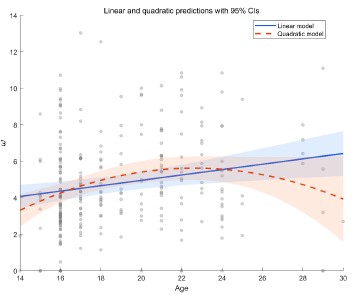
      (Q4) Finally, the two age groups compared - adolescents (high school students) and adults (university students) - differ not only in age but also in sociocultural and economic backgrounds. High school students are likely more homogenous in regional background (e.g., Beijing locals), while university students may be drawn from a broader geographic and socioeconomic pool. Additionally, differences in financial independence, family structure (e.g., single-child status), and social network complexity may systematically affect cooperative behavior and valuation of rewards. Although these factors are difficult to control fully, the authors should more explicitly address the extent to which their findings reflect biological development versus social and contextual influences.

      We appreciate this comment. Indeed, adolescents (high school students) and adults (university students) differ not only in age but also in sociocultural and socioeconomic backgrounds. In our study, all participants were recruited from Beijing and surrounding regions, which helps minimize large regional and cultural variability. Moreover, we accounted for individual-level random effects and included participants’ social value orientation (SVO) as an individual difference measure.

      Nonetheless, we acknowledge that other contextual factors, such as differences in financial independence, socioeconomic status, and social experience—may also contribute to group differences in cooperative behavior and reward valuation. Although our results are broadly consistent with developmental theories of reward sensitivity and social decisionmaking, sociocultural influences cannot be entirely ruled out. Future work with more demographically matched samples or with socioeconomic and regional variables explicitly controlled will help clarify the relative contributions of biological and contextual factors. Accordingly, we have revised the Discussion to include the following statement:

      “Third, although both age groups were recruited from Beijing and nearby regions, minimizing major regional and cultural variation, adolescents and adults may still differ in socioeconomic status, financial independence, and social experience. Such contextual differences could interact with developmental processes in shaping cooperative behavior and reward valuation. Future research with demographically matched samples or explicit measures of socioeconomic background will help disentangle biological from sociocultural influences.”

      Reviewer #3 (Public review):

      Summary:

      Wu and colleagues find that in a repeated Prisoner's Dilemma, adolescents, compared to adults, are less likely to increase their cooperation behavior in response to repeated cooperation from a simulated partner. In contrast, after repeated defection by the partner, both age groups show comparable behavior.

      To uncover the mechanisms underlying these patterns, the authors compare eight different models. They report that a social reward learning model, which includes separate learning rates for positive and negative prediction errors, best fits the behavior of both groups. Key parameters in this winning model vary with age: notably, the intrinsic value of cooperating is lower in adolescents. Adults and adolescents also differ in learning rates for positive and negative prediction errors, as well as in the inverse temperature parameter.

      Strengths:

      The modeling results are compelling in their ability to distinguish between learned expectations and the intrinsic value of cooperation. The authors skillfully compare relevant models to demonstrate which mechanisms drive cooperation behavior in the two age groups.

      We thank the reviewer’s recognition of our work’s strengths.

      Weaknesses:

      (Q1) Some of the claims made are not fully supported by the data:

      The central parameter reflecting preference for cooperation is positive in both groups. Thus, framing the results as self-interest versus other-interest may be misleading.

      We thank the reviewer for this insightful comment. In the social reward model, the cooperation preference parameter is positive by definition, as defection in the repeated rPDG always yields a +2 monetary advantage regardless of the partner’s action. This positive value represents the additional subjective reward assigned to mutual cooperation (e.g., reciprocity value) that counterbalances the monetary gain from defection. Although the estimated social reward parameter ω was positive, the effective advantage of cooperation is Δ=p×ω−2. Given participants’ inferred beliefs p, Δ was negative for most trials (p×ω<2), indicating that the social reward was insufficient to offset the +2 advantage of defection. Thus, both adolescents and adults valued cooperation positively, but adolescents’ smaller ω and weaker responsiveness to sustained partner cooperation suggest a stronger weighting on immediate monetary payoffs.

      In this light, our framing of adolescents as more self-interested derives from their behavioral pattern: even when they recognized sustained partner cooperation and held high expectations of partner cooperation, adolescents showed lower cooperative behavior and reciprocity rewards compared with adults. Whereas adults increased cooperation after two or three consecutive partner cooperations, this pattern was absent among adolescents. We therefore interpret their behavior as relatively more self-interested, reflecting reduced sensitivity to the social reward from mutual cooperation rather than a categorical shift from self-interest to other-interest, as elaborated in the Discussion.

      (Q2) It is unclear why the authors assume adolescents and adults have the same expectations about the partner's cooperation, yet simultaneously demonstrate age-related differences in learning about the partner. To support their claim mechanistically, simulations showing that differences in cooperation preference (i.e., the w parameter), rather than differences in learning, drive behavioral differences would be helpful.

      We thank the reviewer for raising this important point. In our model, both adolescents and adults updated their beliefs about partner cooperation using an asymmetric reinforcement learning (RL) rule. Although adolescents exhibited a higher positive and a lower negative learning rate than adults, the two groups did not differ significantly in their overall updating of partner cooperation probability (Fig. 4a-b). We then examined the social reward parameter ω, which was significantly smaller in adolescents and determined the intrinsic value of mutual cooperation (i.e., p×ω). This variable differed significantly between groups and closely matched the behavioral pattern.

      Following the reviewer’s suggestion, we conducted additional simulations varying one model parameter at a time while holding the others constant. The difference in mean cooperation probability between adults and adolescents served as the index (positive = higher cooperation in adults). As shown in the Author response image 2, decreases in ω most effectively reproduced the observed group difference (shaded area), indicating that age-related differences in cooperation are primarily driven by variation in the social reward parameter ω rather than by others.

      Author response image 2.

      Simulation results showing how variations in each model parameter affect the group difference in mean cooperation probability (Adults – Adolescents). Based on the bestfitting Model 8 and parameters estimated from all participants, each line represents one parameter (i.e., α+, α-, ω, β) systematically varied within the tested range (α±:0.1–0.9; ω, β:1–9) while other parameters were held constant. Positive values indicate higher cooperation in adults. Smaller ω values most strongly reproduced the observed group difference, suggesting that reduced social reward weighting primarily drives adolescents’ lower cooperation.
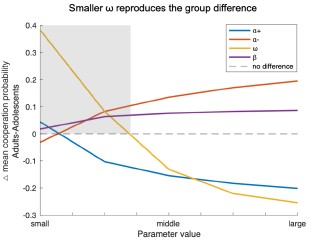
      (Q3) Two different schedules of 120 trials were used: one with stable partner behavior and one with behavior changing after 20 trials. While results for order effects are reported, the results for the stable vs. changing phases within each schedule are not. Since learning is influenced by reward structure, it is important to test whether key findings hold across both phases.

      We thank the reviewer for this thoughtful and professional comment. In our GLMM and LMM analyses, we focused on trial order rather than explicitly including the stable vs. changing phase factor, due to concerns about multicollinearity. In our design, phases occur in specific temporal segments, which introduces strong collinearity with trial order. In multi-round interactions, order effects also capture variance related to phase transitions.

      Nonetheless, to directly address this concern, we conducted additional robustness analyses by adding a phase variable (stable vs. changing) to GLMM1, LMM1, and LMM3 alongside the original covariates. Across these specifications, the key findings were replicated (see GLMM<sub>sup</sub>2 and LMM<sub>sup</sub>4–5; Tables 9-11), and the direction and significance of main effects remained unchanged, indicating that our conclusions are robust to phase differences.

      (Q4) The division of participants at the legal threshold of 18 years should be more explicitly justified. The age distribution appears continuous rather than clearly split. Providing rationale and including continuous analyses would clarify how groupings were determined.

      We thank the reviewer for this thoughtful comment. We divided participants at the legal threshold of 18 years for both conceptual and practical reasons grounded in prior literature and policy. In many countries and regions, 18 marks the age of legal majority and is widely used as the boundary between adolescence and adulthood in behavioral and clinical research. Empirically, prior studies indicate that psychosocial maturity and executive functions approach adult levels around this age, with key cognitive capacities stabilizing in late adolescence (Icenogle et al., 2019; Tervo-Clemmens et al., 2023). We have clarified this rationale in the Introduction section of the revised manuscript.

      “Based on legal criteria for majority and prior empirical work, we adopt 18 years as the boundary between adolescence and adulthood (Icenogle et al., 2019; Tervo-Clemmens et al., 2023).”

      We fully agree that the underlying age distribution is continuous rather than sharply divided. To address this, we conducted additional analyses treating age as a continuous predictor (see GLMM<sub>sup</sub>1 and LMM<sub>sup</sub>1–3; Tables S1-S4), which generally replicated the patterns observed with the categorical grouping. Nevertheless, given the limited age range of our sample, the generalizability of these findings to fine-grained developmental differences remains constrained. Therefore, our primary analyses continue to focus on the contrast between adolescents and adults, rather than attempting to model a full developmental trajectory.

      (Q5) Claims of null effects (e.g., in the abstract: "adults increased their intrinsic reward for reciprocating... a pattern absent in adolescents") should be supported with appropriate statistics, such as Bayesian regression.

      We thank the reviewer for highlighting the importance of rigor when interpreting potential null effects. To address this concern, we conducted Bayes factor analyses of the intrinsic reward for reciprocity and reported the corresponding BF10 for all relevant post hoc comparisons. This approach quantifies the relative evidence for the alternative versus the null hypothesis, thereby providing a more direct assessment of null effects. The analysis procedure is now described in the Methods and Materials section:

      “Post hoc comparisons were conducted using Bayes factor analyses with MATLAB’s bayesFactor Toolbox (version v3.0, Krekelberg, 2024), with a Cauchy prior scale σ = 0.707.”

      (Q6) Once claims are more closely aligned with the data, the study will offer a valuable contribution to the field, given its use of relevant models and a well-established paradigm.

      We are grateful for the reviewer’s generous appraisal and insightful comments.

      Recommendations for the authors:

      Reviewer #1 (Recommendations for the authors):

      (1) I commend the authors on a well-structured, clear, and interesting piece of work. I have several questions and recommendations that, if addressed, I believe will strengthen the manuscript.

      We thank the reviewer for commending the organization of our paper.

      (2) Introduction: - Why use a zero-sum (Prisoner's Dilemma; PD) versus a mixed-motive game (e.g. Trust Task) to study cooperation? In a finite set of rounds, the dominant strategy can be to defect in a PD.

      We thank the reviewer for this helpful comment. We agree that both the rationale for using the repeated Prisoner’s Dilemma (rPDG) and the limitations of this framework should be clarified. We chose the rPDG to isolate the core motivational conflict between selfinterest and joint welfare, as its symmetric and simultaneous structure avoids the sequential trust and reputation dependencies/accumulation inherent to asymmetric tasks such as the Trust Game (King-Casas et al., 2005; Rilling et al., 2002).

      Although a finitely repeated rPDG theoretically favors defection, extensive prior research shows that cooperation can still emerge in long repeated interactions when players rely on learning and reciprocity rather than backward induction (Rilling et al., 2002; Fareri et al., 2015). Our design employed 120 consecutive rounds, allowing participants to update expectations about partner behavior and to establish stable reciprocity patterns over time. We have added the following clarification to the Introduction:

      “The rPDG provides a symmetric and simultaneous framework that isolates the motivational conflict between self-interest and joint welfare, avoiding the sequential trust and reputation dynamics characteristic of asymmetric tasks such as the Trust Game (Rilling et al., 2002; King-Casas et al., 2005)”

      (3) Methods:

      Did the participants know how long the PD would go on for?

      Were the participants informed that the partner was real/simulated?

      Were the participants informed that the partner was going to be the same for all rounds?

      We thank the reviewer for the meticulous review work, which helped us present the experimental design and reporting details more clearly. the following clarifications: I. Participants were not informed of the total number of rounds in the rPDG. This prevented endgame expectations and avoided distraction from counting rounds, which could introduce additional effects. II. Participants were told that their partner was another human participant in the laboratory. However, the partner’s behavior was predetermined by a computer program. This design enabled tighter experimental control and ensured consistent conditions across age groups, supporting valid comparisons. III. Participants were informed that they would interact with the same partner across all rounds, aligning with the essence of a multiround interaction paradigm and stabilizing partner-related expectations. For transparency, we have clarified these points in the Methods and Materials section:

      “Participants were told that their partner was another human participant in the laboratory and that they would interact with the same partner across all rounds. However, in reality, the actions of the partner were predetermined by a computer program. This setup allowed for a clear comparison of the behavioral responses between adolescents and adults. Participants were not informed of the total number of rounds in the rPDG.”

      (4) The authors mention that an SVO was also recorded to indicate participant prosociality. Where are the results of this? Did this track game play at all? Could cooperativeness be explained broadly as an SVO preference that penetrated into game-play behaviour?

      We thank the reviewer for pointing this out. We agree that individual differences in prosociality may shape cooperative behavior, so we conducted additional analyses incorporating SVO. Specifically, we extended GLMM1 and LMM3 by adding the measured SVO as a fixed effect with random slopes, yielding GLMM<sub>sup</sub>3 and LMM<sub>sup</sub>6 (Tables 12–13). The results showed that higher SVO was associated with greater cooperation, whereas its effect on the reward for reciprocity was not significant. Importantly, the primary findings remained unchanged after controlling for SVO. These results indicate that cooperativeness in our task cannot be explained solely by a broad SVO preference, although a more prosocial orientation was associated with greater cooperation. We have reported these analyses and results in the Appendix Analysis section.

      (5) Why was AIC chosen rather an BIC to compare model dominance?

      Sorry for the lack of clarification. Both the Akaike Information Criterion (AIC, Akaike, 1974) and Bayesian Information Criterion (BIC, Schwarz, 1978) are informationtheoretic criterions for model comparison, neither of which depends on whether the models to be compared are nested to each other or not (Burnham et al., 2002). We have added the following clarification into the Methods.

      “We chose to use the AICc as the metric of goodness-of-fit for model comparison for the following statistical reasons. First, BIC is derived based on the assumption that the “true model” must be one of the models in the limited model set one compares (Burnham et al., 2002; Gelman & Shalizi, 2013), which is unrealistic in our case. In contrast, AIC does not rely on this unrealistic “true model” assumption and instead selects out the model that has the highest predictive power in the model set (Gelman et al., 2014). Second, AIC is also more robust than BIC for finite sample size (Vrieze, 2012).”

      (6) I believe the model fitting procedure might benefit from hierarchical estimation, rather than maximum likelihood methods. Adolescents in particular seem to show multiple outliers in a^+ and w^+ at the lower end of the distributions in Figure S2. There are several packages to allow hierarchical estimation and model comparison in MATLAB (which I believe is the language used for this analysis;

      see https://journals.plos.org/ploscompbiol/article?id=10.1371/journal.pcbi.1007043).

      We thank the reviewer for this helpful comment and for referring us to relevant methodological work (Piray et al., 2019). We have addressed this point by incorporating hierarchical Bayesian estimation, which effectively mitigates outlier effects and improves model identifiability. The results replicated those obtained with MLE fitting and further revealed group-level differences in key parameters. Please see our detailed response to Reviewer#1 Q1 for the full description of this analysis and results.

      (7) Results: Model confusion seems to show that the inequality aversion and social reward models were consistently confused with the baseline model. Is this explained or investigated? I could not find an explanation for this.

      The apparent overlap between the inequality aversion (Model 4) and social reward (Model 5) models in the recovery analysis likely arises because neither model includes a learning mechanism, making them unable to capture trial-by-trial adjustments in this dynamic task. Consequently, both were best fit by the baseline model. Please see Response to Reviewer #1 Q3 for related discussion.

      (8) Figures 3e and 3f show the correlation between asymmetric learning rates and age. It seems that both a^+ and a^- are around 0.35-0.40 for young adolescents, and this becomes more polarised with age. Could it be that with age comes an increasing discernment of positive and negative outcomes on beliefs, and younger ages compress both positive and negative values together? Given the higher stochasticity in younger ages (\beta), it may also be that these values simply represent higher uncertainty over how to act in any given situation within a social context (assuming the differences in groups are true).

      We appreciate this insightful interpretation. Indeed, both α+ and α- cluster around 0.35–0.40 in younger adolescents and become increasingly polarized with age, suggesting that sensitivity to positive versus negative feedback is less differentiated early in development and becomes more distinct over time. This interpretation remains tentative and warrants further validation. Based on this comment, we have revised the Discussion to include this developmental interpretation.

      We also clarify that in our model β denotes the inverse temperature parameter; higher β reflects greater choice precision and value sensitivity, not higher stochasticity. Accordingly, adolescents showed higher β values, indicating more value-based and less exploratory choices, whereas adults displayed relatively greater exploratory cooperation. These group differences were also replicated using hierarchical Bayesian estimation (see Response to Reviewer #1 Q1). In response to this comment, we have added a statement in the Discussion highlighting this developmental interpretation.

      “Together, these findings suggest that the differentiation between positive and negative learning rates changes with age, reflecting more selective feedback sensitivity in development, while higher β values in adolescents indicate greater value sensitivity. This interpretation remains tentative and requires further validation in future research.”

      (9) A parameter partial correlation matrix (off-diagonal) would be helpful to understand the relationship between parameters in both adolescents and adults separately. This may provide a good overview of how the model properties may change with age (e.g. a^+'s relation to \beta).

      We thank the reviewer for this helpful comment. We fully agree that a parameter partial correlation matrix can further elucidate the relationships among parameters. Accordingly, we conducted a partial correlation analysis and added the visually presented results to the revised manuscript as Figure 2-figure supplement 4.

      (10) It would be helpful to have Bayes Factors reported with each statistical tests given that several p-values fall within the 0.01 and 0.10.

      We thank the reviewer for this important recommendation. We have conducted Bayes factor analyses and reported BF10 for all relevant post hoc comparisons. We also clarified our analysis in the Methods and Materials section:

      “Post hoc comparisons were conducted using Bayes factor analyses with MATLAB’s bayesFactor Toolbox (version v3.0, Krekelberg, 2024), with a Cauchy prior scale σ = 0.707.”

      (11) Discussion: I believe the language around ruling out failures in mentalising needs to be toned down. RL models do not enable formal representational differences required to assess mentalising, but they can distinguish biases in value learning, which in itself is interesting. If the authors were to show that more complex 'ToM-like' Bayesian models were beaten by RL models across the board, and this did not differ across adults and adolescents, there would be a stronger case to make this claim. I think the authors either need to include Bayesian models in their comparison, or tone down their language on this point, and/or suggest ways in which this point might be more thoroughly investigated (e.g., using structured models on the same task and running comparisons: https://journals.plos.org/plosone/article?id=10.1371/journal.pone.0087619).

      We thank the reviewer for the comments. Please see our response to Reviewer 1 (Appraisal & Discussion section) for details.

      Reviewer #2 (Recommendations for the authors):

      (1) The authors may want to show the winning model earlier (perhaps near the beginning of the Results section, when model parameters are first mentioned).

      We thank the reviewer for this suggestion. We agree that highlighting the winning model early improves clarity. Currently, we have mentioned the winning model before the beginning of the Results section. Specifically, in the penultimate paragraph of the Introduction we state:

      “We identified the asymmetric RL learning model as the winning model that best explained the cooperative decisions of both adolescents and adults.”

      Reviewer #3 (Recommendations for the authors):

      (1) In addition to the points mentioned above, I suggest the following:

      Clarify plots by clearly explaining each variable. In particular, the indices 1 vs. 1,2 vs 1,2,3 were not immediately understandable.

      We thank the reviewer for this suggestion. We agree that the indices were not immediately clear. We have revised the figure captions (Figure 1 and 4) to explicitly define these terms more clearly:

      “The x-axis represents the consistency of the partner’s actions in previous trials (t<sub>−1</sub>: last trial; t<sub>−1,2</sub>: last two trials;<sub>t−1,2,3</sub>: last three trials).”

      (2) It's unclear why the index stops at 3. If this isn't the maximum possible number of consecutive cooperation trials, please consider including all relevant data, as adolescents might show a trend similar to adults over more trials.

      We thank the reviewer for raising this point. In our exploratory analyses, we also examined longer streaks of consecutive partner cooperation or defection (up to four or five trials). Two empirical considerations led us to set the cutoff at three in the final analyses. First, the influence of partner behavior diminished sharply with temporal distance. In both GLMMs and LMMs, coefficients for earlier partner choices were small and unstable, and their inclusion substantially increased model complexity and multicollinearity. This recency pattern is consistent with learning and decision models emphasizing stronger weighting of recent evidence (Fudenberg & Levine, 2014; Fudenberg & Peysakhovich, 2016). Second, streaks longer than three were rare, especially among some participants, leading to data sparsity and inflated uncertainty. Including these sparse conditions risked biasing group estimates rather than clarifying them. Balancing informativeness and stability, we therefore restricted the index to three consecutive partner choices in the main analyses, which we believe sufficiently capture individuals’ general tendencies in reciprocal cooperation.

      (3) The term "reciprocity" may not be necessary. Since it appears to reflect a general preference for cooperation, it may be clearer to refer to the specific behavior or parameter being measured. This would also avoid confusion, especially since adolescents do show negative reciprocity in response to repeated defection.

      We thank you for this comment. In our work, we compute the intrinsic reward for reciprocity as p × ω, where p is the partner cooperation expectation and ω is the cooperation preference. In the rPDG, this value framework manifests as a reciprocity-derived reward: sustained mutual cooperation maximizes joint benefits, and the resulting choice pattern reflects a value for reciprocity, contingent on the expected cooperation of the partner. This quantity enters the trade-off between U<sub>cooperation</sub> and U<sub>defection</sub> and captures the participant’s intrinsic reward for reciprocity versus the additional monetary reward payoff of defection. Therefore, we consider the term “reciprocity” an acceptable statement for this construct.

      (4) Interpretation of parameters should closely reflect what they specifically measure.

      We thank the reviewer for pointing this out. We have refined the relevant interpretations of parameters in the current Results and Discussion sections.

      (5) Prior research has shown links between Theory of Mind (ToM) and cooperation (e.g., Martínez-Velázquez et al., 2024). It would be valuable to test whether this also holds in your dataset.

      We thank the reviewer for this thoughtful comment. Although we did not directly measure participants’ ToM, our design allowed us to estimate participants’ trial-by-trial inferences (i.e., expectations) about their partner’s cooperation probability. We therefore treat these cooperation expectations as an indirect representation for belief inference, which is related to ToM processes. To test whether this belief-inference component relates to cooperation in our dataset, we further conducted an exploratory analysis (GLMM<sub>sup</sub>4) in which participants’ choices were regressed on their cooperation expectations, group, and the group × cooperation-expectation interaction, controlling for trial number and gender, with random effects. Consistent with the ToM–cooperation link in prior research (MartínezVelázquez et al., 2024), participants’ expectations about their partner’s cooperation significantly predicted their cooperative behavior (Table 14), suggesting that decisions were shaped by social learning about others’ inferred actions. Moreover, the interaction between group and cooperation expectation was not significant, indicating that this inference-driven social learning process likely operates similarly in adolescents and adults. This aligns with our primary modeling results showing that both age groups update beliefs via an asymmetric learning process. We have reported these analyses in the Appendix Analysis section.

      (6) More informative table captions would help the reader. Please clarify how variables are coded (e.g., is female = 0 or 1? Is adolescent = 0 or 1?), to avoid the need to search across the manuscript for this information.

      We thank the reviewer for raising this point. We have added clear and standardized variable coding in the table notes of all tables to make them more informative and avoid the need to search the paper. We have ensured consistent wording and formatting across all tables.

      (7) I hope these comments are helpful and support the authors in further strengthening their manuscript.

      We thank the three reviewers for their comments, which have been helpful in strengthening this work.

      References

      (1) Fudenberg, D., & Levine, D. K. (2014). Recency, consistent learning, and Nash equilibrium. Proceedings of the National Academy of Sciences of the United States of America, 111(Suppl. 3), 10826–10829. https://doi.org/10.1073/pnas.1400987111.

      (2) Fudenberg, D., & Peysakhovich, A. (2016). Recency, records, and recaps: Learning and nonequilibrium behavior in a simple decision problem. ACM Transactions on Economics and Computation, 4(4), Article 23, 1–18. https://doi.org/10.1145/2956581

      (3) Hackel, L., Doll, B., & Amodio, D. (2015). Instrumental learning of traits versus rewards: Dissociable neural correlates and effects on choice. Nature Neuroscience, 18, 1233– 1235. https://doi.org/10.1038/nn.4080

      (4) Icenogle, G., Steinberg, L., Duell, N., Chein, J., Chang, L., Chaudhary, N., Di Giunta, L., Dodge, K. A., Fanti, K. A., Lansford, J. E., Oburu, P., Pastorelli, C., Skinner, A. T.Sorbring, E., Tapanya, S., Uribe Tirado, L. M., Alampay, L. P., Al-Hassan, S. M.,Takash, H. M. S., & Bacchini, D. (2019). Adolescents’ cognitive capacity reaches adult levels prior to their psychosocial maturity: Evidence for a “maturity gap” in a multinational, cross-sectional sample. Law and Human Behavior, 43(1), 69–85. https://doi.org/10.1037/lhb0000315

      (5) Krekelberg, B. (2024). Matlab Toolbox for Bayes Factor Analysis (v3.0) [Computer software]. Zenodo. https://doi.org/10.5281/zenodo.13744717

      (6) Martínez-Velázquez, E. S., Ponce-Juárez, S. P., Díaz Furlong, A., & Sequeira, H. (2024). Cooperative behavior in adolescents: A contribution of empathy and emotional regulation? Frontiers in Psychology, 15,1342458. https://doi.org/10.3389/fpsyg.2024.1342458

      (7) Tervo-Clemmens, B., Calabro, F. J., Parr, A. C., et al. (2023). A canonical trajectory of executive function maturation from adolescence to adulthood. Nature Communications, 14, 6922. https://doi.org/10.1038/s41467-023-42540-8

      (8) King-Casas, B., Tomlin, D., Anen, C., Camerer, C. F., Quartz, S. R., & Montague, P. R. (2005). Getting to know you: reputation and trust in a two-person economic exchange. Science, 308(5718), 78-83. https://doi.org/10.1126/science.1108062

      (9) Rilling, J. K., Gutman, D. A., Zeh, T. R., Pagnoni, G., Berns, G. S., & Kilts, C. D. (2002).A neural basis for social cooperation. Neuron, 35(2), 395-405. https://doi.org/10.1016/s0896-6273(02)00755-9

      (10) Fareri, D. S., Chang, L. J., & Delgado, M. R. (2015). Computational substrates of social value in interpersonal collaboration. Journal of Neuroscience, 35(21), 8170-8180. https://doi.org/10.1523/JNEUROSCI.4775-14.2015

      (11) Akaike, H. (2003). A new look at the statistical model identification. IEEE transactions on automatic control, 19(6), 716-723. https://doi.org/10.1109/TAC.1974.1100705

      (12) Schwarz, G. (1978). Estimating the dimension of a model. The annals of statistics, 461464. https://doi.org/10.1214/aos/1176344136

      (13) Burnham, K. P., & Anderson, D. R. (2002). Model selection and multimodel inference: A practical information-theoretic approach (2nd ed.). Springer.https://doi.org/10.1007/b97636

      (14) Gelman, A., & Shalizi, C. R. (2013). Philosophy and the practice of Bayesian statistics. British Journal of Mathematical and Statistical Psychology, 66(1), 8–38. https://doi.org/10.1111/j.2044-8317.2011.02037.x

      (15) Gelman, A., Carlin, J. B., Stern, H. S., Dunson, D. B., Vehtari, A., & Rubin, D. B. (2014). Bayesian data analysis (3rd ed.). Chapman and Hall/CRC. https://doi.org/10.1201/b16018

      (16) Vrieze, S. I. (2012). Model selection and psychological theory: A discussion of the differences between the Akaike Information Criterion (AIC) and the Bayesian Information Criterion (BIC). Psychological Methods, 17(2), 228–243. https://doi.org/10.1037/a0027127