857 Matching Annotations
- Aug 2026
-
www.facebook.com www.facebook.com
-
www.libraryjournal.com www.libraryjournal.com
-
In other words, while they share similar features, print books and digital books are not the same product. In fact, digital books are not simply a product, but also a service.
Library e-books as a service
E-books turn into a service only when we let them. They don't have to be a service any more than a shelving contractor or courier is a physical book service.
-
- Jul 2026
-
-
Freeman, Michael Stuart. 1991. “Pen, Ink, Keys, and Cards: Some Reflections on Library Technology.” College and Research Libraries 52(4): 328–35. https://hdl.handle.net/2142/41489 (July 26, 2026).
-
The card catalog was one of those li-brary inventions that greatly helped in-dividual libraries, but it did so at theexpense of library cooperation.
-
Unlike the card catalog thathad to be consulted in one place, thebook catalog was a portable index
pros and cons of library card catalog versus a book catalog
- ease of use/comfort
- theft/security/defacement/misfiling
- size
- queueing
- display
- speed
-
We maychuckle at John Cotton Dana's proposalin 1907 to use vending machines, justcoming into popular use for chewinggum and novelties, to display and circu-late books, but the concept behind themachine-that of the self-service li-brary-was and is a good idea. In hissuggestion that users insert their librarycard (or more precisely an encodedmetal strip "not larger than a Yale key")so borrower data could be recorded, wesee a distinctly modern application oftechnology to solve a library problem.
I've actually used a library vending machine that had books and DVDs in it in the last 2 years at a local pizza parlor.
Tags
- quote
- typewriters
- telegraph
- Desk Set (1957)
- British Museum
- References
- read
- book circulation
- library card catalog
- book catalogues
- library technology
- vending machines
- John Cotton Dana
- cooperation
- libraries
- electric lighting
- Richard Garnett
- library science
- printing telegraph
- library cards
- 1907
- Michael Stuart Freeman
Annotators
-
-
www.newyorker.com www.newyorker.comDiscards33
-
Baker, Nicholson. 1994. “Discards.” The New Yorker 70(7): 64. https://www.newyorker.com/magazine/1994/04/04/discards (August 6, 2021).
-
looking at these expressive dirt bands
dirt bands in library card catalogs, similar to dirt and wear marks on the fore edges of books gives some evidence of use
this can be useful research, but it has silently disappeared over time due to lack of archiving materials like card catalogs
some of these issues also pop up with digitizing physical books and throwing them away... we lose the information about how they were bound, how they might have been used, all the physicality is gone
-
Fifty drawers compose it. They are made of blond wood. Pull out one of the C drawers, the one labelled “Catalogs.” Here are several guide cards: one for “Catalogs,” one for “Censorship,” one for “Children’s Literature.” Before you have read or touched a single card, you have learned something important about the library-school library, and even possibly about librarianship in general: the edges of the cards following the guide cards for “Censorship” and “Children’s Literature” are dark with handling, whereas the ones following “Catalogs” are not. Thus “Censorship” and “Children’s Literature” have over the years been of more interest to library-school students than “Catalogs” has. This is a surprise—at least, it was a surprise to me. Maybe it’s one reason we’re in this pickle.
wear on library card catalog cards as an indicator of use
a similar thing can be found in one's personal note cards and has been noticed in Niklas Luhmann's zettelkasten
-
But for the time being, if some afternoon, depressed by thoughts of cardnage now in progress, you were to travel to the stacks of the library-school library, you could restore your good spirits by contemplating an unharmed, unshrunk, fully operational (though frozen) subject catalogue.
-
“Studies of online catalog use and users have uncovered a pair of problems that seem to be endemic in today’s online catalog systems,” Ray Larson, a professor at Berkeley’s library school (or, as it is now called, the School of Information Management and Systems), wrote conclusively in 1991:These are: (1) a large percentage of subject searches fail to retrieve any bibliographic records; and (2) when subject searches succeed in retrieving records, they often retrieve too much material for the user to evaluate effectively.Larson cites an earlier study of his own in which he found that the average number of on-line records retrieved in his sample was 77.5, whereas the average number that users actually took a look at was 9.1. The “futility point” in on-line searches—the point at which you give up and go with what you have—is, because of screen fatigue and the lethargy of system response, much lower than in card-catalogue searches. The life of the mind suffers as a result.
This sort of search fatigue still persists in 2026 as most online searches don't go past the first page of results.
-
Subject searches are obvious confessions of ignorance; author-title searches aren’t, or aren’t so straightforwardly.
Is it the case that subject searches are more interesting for syntopic work than other forms of generic reading?
-
In a study of some fourth, sixth, and eighth graders carried out at the Downers Grove Public Library, in Illinois, Leslie Edmonds found that sixty-five per cent of the kids’ card-catalogue searches were successful, versus only eighteen per cent of their on-line searches. No fourth graders used the on-line catalogue successfully. (They were asked to look up things like “Fire Stations,” “Insects—Poetry,” “Octopus Pie,” and “The Curse of the Blue Figurine.”)
-
By studying Haverford’s card catalogue, Michael Stuart Freeman, Librarian of Haverford College, was able to determine when his predecessors deployed their first typewriter (it was during the summer of 1916)—a tiny fact, perhaps, but one of sufficient interest to Freeman that he published a brief paper which discussed the history of typewriters in libraries. Freeman kept several handwritten cards as samples (“I save a few, because I’m a sentimentalist,” he confided to me); but once his own passing curiosity was satisfied, he dumped the rest of his catalogue.
-
Berkeley’s subject catalogue is already gone. Though it was more or less frozen in the nineteen-eighties, it was nonetheless very efficient for some kinds of searches: if the primary sources in your field were published in the eighteenth and nineteenth centuries, you don’t want your retrievals spread among the thousands of irrelevant records that a mechanical database subject haul brings up. Any drawer of an out-of-date paper catalogue represents the equivalent of a filtered computer search, a Boolean date-limited search, of a very sophisticated sort—in fact, one drawer represents the outcome of a kind of search that most on-line catalogues can’t and won’t ever be able to perform, since it offers clues to what books were in the library during different eras. If in seventy years a historian of science (say) wants to know whether some Nobel-laureate physics professor could possibly have seen and been influenced by a certain out-of-the-way Dutch mathematical monograph from the thirties which bears important similarities to his work—whether, that is, it was part of the library’s collection during the period when the professor was developing his ideas or was acquired only after the professor’s papers were published (perhaps acquired by the library as a gift from the professor’s estate, in fact, because the professor was sent the monograph by the Dutchman himself, anxious to establish primacy)—the historian of science will have little chance of finding an answer to his question now, because the computer record will bear the (to him) meaningless date of the retrospective conversion of the card, i.e., sometime in the late eighties or early nineties, which has no relation to the time that the card was originally produced (and the book placed on the shelf), whereas the original card, even if it bore no direct date of creation, would have exhibited distinct features (typewriter style, format, cataloguing conventions) that might have enabled a cataloguecard paleographer to place it within a five-year Period.
interesting research example of a search not enabled by a digital card catalog
-
There have been a few embarrassments along the way, naturally: “Madonna” was globally altered by O.C.L.C. to “Mary, Blessed Virgin, Saint” as part of an authority-control routine—a change that, before it was corrected, caused problems for libraries interested in cataloguing the recent work of Ms. Ciccone.
-
I have no doubt that Dale Flecker believed what he was saying when he told me that “the machine catalogue is in almost no cases worse and in most cases better than the card catalogue was.”
-
“The card catalogue,” as Tom Delsey, of the National Library of Canada, wrote in 1989, “exhibited a relatively high tolerance for deviation from literal and logical norms. . . . Typographical errors or inconsistencies in headings could be silently corrected in the process of filing the card; added entries that did not match exactly the corresponding main entry on the card to which they were related could nevertheless be placed in their proper sequence in the file.”
the benefits of the actual filing process can subtly correct for errors in categorizing
-
The whine of power erasers was heard through the land. (In librarianship, “eraser lung” was the seventies equivalent of carpal-tunnel syndrome.
-
And the brilliance of Kilgour’s enterprise was that if the cataloguer did not find a record, she could undertake to describe the book herself, and contribute her work to the system as a “master record” for that book, for the good of all members. She wrote a sort of poem, following a set of rules more rigorous than a villanelle’s; she sent it off to people in Ohio who published it for her; and then she got paid a few dollars—in the form of a cataloguing credit against fixture O.C.L.C. charges. The more fresh “copy” a cataloguing department offered O.C.L.C., the cheaper its use of O.C.L.C. was, and thus there was plenty of incentive for all libraries, engaged in the creation of a kind of virtual community long before there were such things as the Internet, to pump up the burgeoning database. What began mainly as a handy, unilateral way of delivering the Library of Congress MARC files to member libraries turned into a highly democratic, omnidirectional collaboration among hundreds of thousands of once isolated documentalists: currently, there are close to thirty million records in the database, only a quarter of which originally came from the Library of Congress, the majority being the work of seven thousand member libraries.
OCLC's original arrangement could also make an interesting sort of model for academic publishing in a general sense.
-
A shelf list is a card catalogue arranged in call-number order, cataloguers use it to help them shelve like books with like.
-
This same pre-computer-age study, published by M.I.T., determined that the average number of cards in a drawer was eight hundred and twenty-six, that the typical book represented by a card was 276.6 pages long, and that the growth rate of Rice’s library holdings closely tracked that of the United States gross national product.
-
Charles Ammi Cutter (1837-1903), the author of what is in Mr. Ranz’s opinion the finest library catalogue ever made. Cutter’s masterpiece is the five-volume catalogue of the Boston Atheneum, published between 1874 and 1882. “I’m not sure he wasn’t the greatest cataloguer that lived,” Mr. Ranz told me. The work is three thousand four hundred and two pages long, and is elaborately and commonsensically cross-referenced; it cost the Athenaeum almost a hundred thousand dollars to produce. It is still of interest and utility to historians—as is the card catalogue for the Athenaeum, which Cutter also developed.
-
Jim Ranz, retired Dean of the Libraries of the University of Kansas, from whose immortal monograph “The Printed Book Catalogue in American Libraries: 1723-1900” (1964)
-
In 1848, Antonio Panizzi, Keeper of Printed Books for the British Museum, had a similar notion:By an alphabetical catalogue it is understood that the titles be entered in it under some “headings” alphabetically arranged. Now, inasmuch as in a large. library no one can know beforehand the j uxtaposition of these headings, and it would beimpossible to arrange them in the requisite order, if they cannot be easily shifted, each title is therefore written on separate “slips” of paper . . . which are frequently changed from one place to another as required. It is selfevident that if these “slips . . . be not uniform, both in size or substance, their arrangement will cause mechanical difficulties which take time and trouble to overcome.
-
but they left their own beloved manuscript unclassified and undescribed, and thus it never attained the status of a holding, which it so obviously deserved, and was instead tacitly understood to be merely a “finding aid,” a piece of furniture, wholly vulnerable to passing predators, subject to janitorial, rather than curatorial, juris diction—even though this catalogue was, in truth, the one holding that people who entered the building would be likely to have in common, to know how to use from childhood, even to love.
-
Their card catalogue was nowhere mentioned in their card catalogue.
-
are in many cases stripped of whole classes of specific historical information (e.g., the original price of the book, its acquisition date, its original cataloguing date, its accession number, the original cataloguer’s own initials, the record of any copies that have been withdrawn, and whether it was a gift or a purchase)
data lost from card catalogs when they were digitized
-
And on-line catalogues, despite their neolithic screen displays and excruciatingly slow retrieval rates, offer many amenities. They do not grow mold, as the card catalogue of the Engineering Library of the University of Toronto once did, following water damage. And they are harder to vandalize. Radical students destroyed roughly a hundred thousand cards from the catalogue at the University of Illinois in the sixties. Berkeley’s library staff was told to keep watch over the university’s card catalogues during the antiwar turmoil there. Someone reportedly poured ink on the Henry Cabot Lodge cards at Stanford. The huge frozen card catalogue of the Library of Congress currently suffers from alarming levels of public trauma: like the movie trope in which the pri vate eye tears a page from a phone book at a public phone rather than bothering to copy down an address and a phone number, library visitors—the heedless, the crazy—have, especially since the late eighties, been increasingly capable of tearing out the card referring to a book they want. Indeed, one of the reasons that the New York Public Library had to close its public catalogue was that the public was destroying it. The Hetty Green cards disappeared. Someone calling himself “Cosmos” was periodically making off with all the cards for “Mein Kampf.” Cards for two Dante manuscripts were stolen: not the manuscripts, the cards for the manuscripts. Card catalogues constitute vandalizable entities because they are expressive of needful social trust and communal achievement, as are other common targets, such as subway cars, railroad bridges, mailboxes, and traffic signs. To the extent that a duster of computer terminals linked to an online catalogue protects a room full of older card cabinets by marginalizing them, they are performing a great service.
A nice long list of card catalog cards being destroyed, damaged, or stolen!
-
Even at the beginning of this century, a writer for the Boston Evening Transcript could playfully fret about the unwieldiness of card catalogues:As these cabinets of drawers increase in number until it seems as if the old joke about the catalogues of the Boston Public Library and Harvard University meeting on Harvard Bridge might become literally true, the mental distress and physical exhaustion suffered by those consulting one of them becomes too important to be disregarded.
Not too dissimilar to Anatole France's Penguin Island (1908)...
What was the exact year of this quote w.r.t. France? Could it have inspired him?
-
collection that is growing, as some currently are, at a rate of five hundred items a day.
Some libraries were growing at a rate of five hundred items a day.
Source?
-
N-LINE catalogues are wonderful things in principle—things of efficacy, and even, occasionally (as in the case of O.C.L.C.’s Online Union Catalog), of grandeur. As a result of the publicly financed expansion of higher education in the sixties, and the boom in academic publishing that followed it, the holdings of the typical university library have doubled over the last twenty years. Without on-line catalogues, and the circulation and acquisition modules of software with which on-line catalogues are linked, libraries would simply not have been able to process all the books and journals that were arriving on their loading docks. By the early seventies, there was an ominous arrearage of uncatalogued material waiting on herds of rolling carts near the overtaxed cataloguing departments of most large libraries. Cataloguing had reached a state of crisis similar to the one that forced the financial markets to close early during some of the high-volume weeks of 1969, when Wall Street’s paper-based methods of order processing couldn’t keep up with each day’s orders to buy and sell stock. Computerized stock-execution saved Wall Street (and made program trading and Brack Monday possible, too), and computerized cataloguing procedures saved libraries.
-
”Library hand” was a special kind of backward-slanting penmanship meant specifically for card catalogues, and taught in library school through the nineteen-twenties.
-
An image of the front of every card for Widener thus now exists on microfiche, available to users in a room off the lobby. (Any information on the backs of the cards—and many notes do carry over—was not photographed.)
-
It is true that they seldom have formal training in the intricacies of the cataloguer’s art: they are not necessarily up on the elaborate Anglo-American cataloguing rules, nor are they current concerning the periodic “Rrs, or Rule Interpretations, issued by the Library of Congress, which—like hermeneutical dispatches from the I.R.S. or the Financial Accounting Standards perplexing cases in classification as they emerge. Most operators have had no library-school courses in the Dewey Decimal system (still thriving, by the way, and very big in Europe), or the “Sears List of Subject Headings,” or Cutter numbers, or the abbreviational niceties of the International Standard Bibliographic Description (I.S.B.D.) format—but they do apparently pick up a great deal as they go.
-
The RETROCON business is good right now. When I visited O.C.L.C. in September, there were three shifts of sixty operators each, plowing through RETROCONs for about forty different libraries, including, besides Harvard, the Los Angeles Public Library, a consortium of French libraries, Hughes Aircraft, Brown, Queen’s University of Belfast, Northwestern, the library at Kew Gardens, the Cincinnati Public Library, the San Francisco Public Library, and Waseda University in Japan.
-
As an added publicity flourish during the Great Discard the Maryland Health Sciences Library published a commemorative chapbook called “101 Uses for a Dead Catalogue Card.”
-
The New York Public Library, ahead of the game, renovated the entire ten-million-card catalogue of its Research Libraries between 1977 and 1980, microfilmed it, and threw it out.
-
as universities and public libraries have completed the “retrospective conversions” of their catalogues to computer databases (frequently with the help of federal Title II-C money, as part of the “Strengthening Research Library Resources” program)
Tags
- typewriters
- gross national product (GNP)
- growth rates
- open questions
- card index as database
- Wall Street
- analogies
- References
- Vladimir Nabokov
- databases
- Boston Atheneum
- chapbooks
- carnage
- carpal-tunnel syndrome
- digitization
- subject searching
- errors
- Evening Transcript
- Haverford College
- Anatole France
- Judith Brugger
- user interface
- Harvard University
- Antonio Panizzi
- libraries
- furniture
- analog vs. digital
- information overload
- Cutter numbers
- Boston
- Sears List of Subject Headings
- British Museum
- Velveteen Rabbit
- speed of technology
- 1969
- 101 uses for
- Library of Congress
- use patterns
- ignorance
- Dewey Decimal System
- Rolodexes
- academic publishing
- Rule Interpretations (Rrs)
- International Standard Bibliographic Description (I.S.B.D.)
- Title II-C (Strengthening Research Library Resources program)
- models
- library science
- call numbers
- write only on one side
- Virginia Pratt
- technology
- note collection loss and damage
- Jim Ranz
- shelf lists
- Timofey Pnin
- microfilm
- Charles Cutter
- intellectual history
- reading practices
- power erasers
- OCLC
- library hand
- health
- microfiche
- art
- handwriting
- New York Public Library
- indexing systems
- poetry
- wear
- Widener Libraray
- cardnage
- error corrections
- meta
- economics
- Maureen Finn
- problems with digitization
- 1848
- definitions
- history of science
- neologisms
- Online Computer Library Center (OCLC)
- Michael Stuart Freeman
- read
- portmanteau
- Dale Flecker
- missing data
- library card catalog
- collocation
- history
- book catalogues
- Fred Kilgour
- cards of equal size
- metadata
- eraser lung
- RETROCON
- search fatigue
- Madonna
- MARC (Machine-Readable Cataloging)
- French Cataloging Code of 1791
- search engines
- library holdings
- intellectual furniture
- Tom Johnston
- typewriters in libraries
- authority control
Annotators
URL
-
-
worldwidesidewalkjoy.com worldwidesidewalkjoy.com
-
www.youtube.com www.youtube.com
-
I Hate Modern Desks... So I Built This. by Morley Kert
-
-
on.liminary.io on.liminary.io
Tags
Annotators
URL
-
- Jun 2026
-
-
The "Out Card. MAs a safeguard where folders are taken from the filingroom, the " out card " supplied by the Library Bureau,Ltd., meets all requirements and entirely obviates thenecessity for costly charging cabinets which are some-times recommended.
-
-
-
en.wikipedia.org en.wikipedia.org
-
Ranganathan, S. R. 1931. The Five Laws of Library Science. 1st ed. Madras, London: The Madras Library Association; E. Goldston. https://catalog.hathitrust.org/Record/001661182 (June 15, 2026).
-
- May 2026
-
www.raymondgeddes.com www.raymondgeddes.com
-
The Evolution of the Card Catalog System – Raymond Geddes<br /> accessed on 2026-05-13T21:39:37
-
-
brick-library.com brick-library.com
-
-
www.instagram.com www.instagram.com
- Apr 2026
-
www.theguardian.com www.theguardian.com
-
Einer neuen Modellierung zufolge sind die wirtschaftlichen Auswirkungen der globalen Erhitzung deutlich gravierender, als es bisher von vielen in den Wirtschaftswissenschaften angenommen wurde. Eine globale Temperaturerhöhung um 2° wird danach das Bruttosozialprodukt weltweit um 16% senken. Bei einer Temperaturerhöhung um vier Grad wären die Menschen auf der Erde durchschnittlich 40 % ärmer als ohne diese Erhöhung. Die neue Modellierung bezieht die Folgen von Extremereignissen und anderen Auswirkungen der Erhitzung ein, die bisher meist nicht berücksichtigt wurden. https://www.theguardian.com/environment/2025/apr/01/average-person-will-be-40-poorer-if-world-warms-by-4c-new-research-shows
Der Bericht eines britischen Instituts für Versicherungsmathematik geht davon aus, dass die Folgen der globalen Erhitzung das Bruttosozialprodukt um 15% verringern werden, wenn die aktuelle Politik fortgesetzt wird.
Studie: https://iopscience.iop.org/article/10.1088/1748-9326/adbd58 Bericht von Institute und Faculty of Actuaries der Universität Exeter: https://actuaries.org.uk/planetary-solvency
-
-
-
Kenneth Goldsmith: Retyping a Library - Announcements<br /> by [[e-flux]]<br /> accessed on 2026-04-01T09:34:24
June 9–August 7, 2022<br /> Curated by: Francesco Urbano Ragazzi with Anne Hilde Neset
-
-
www.instagram.com www.instagram.com
-
Professor and poet Kenneth Goldsmith has spent the past 24 years transcribing manuscripts onto ultra-thin onion-skin paper, amassing a total of 750 to date, as part of his ‘Retyping a Library’ project.Find out why he finds digital so passé, via link in bio. DOP: @kalumkoCamera assistant: Rory WagnerInterview: @donnasalekEditor: Daniel FinnSenior creative producer: @valmessersiDigital director: @ellycparsons
https://www.instagram.com/reel/DWAosAxjIRI/ via The World of Interiors
Why in God's name would he choose the worst typewriter on the planet to effect this project?
-
-
kunstnerneshus.no kunstnerneshus.no
-
Kenneth Goldsmith – Kunstnernes Hus<br /> accessed on 2026-03-31T22:06:40
-
-
retypingalibrary.com retypingalibrary.com
-
About - retypingalibrary<br /> by [[Kenneth Goldsmith]] <br /> accessed on 2026-03-31T22:00:26
-
- Mar 2026
-
www.indiewire.com www.indiewire.com
-
'Porgy and Bess' to Screen at Quentin Tarantino's Vista Theatre<br /> by [[Jim Hemphill]] in IndieWire accessed on 2026-03-30T10:47:37
-
-
-
These days, doesn't appear any better than built-in useState hook
Tags
Annotators
URL
-
- Jan 2026
-
www.youtube.com www.youtube.com
-
“NFORMATION RETRIEVAL” 1961 IBM BUSINESS COMPUTER PROMO MAINFRAME PUNCHCARD COMPUTERS SM10435<br /> by [[Periscope Film]] on YouTube <br /> accessed on 2026-01-04T15:56:12
Some great visuals hiding in here.<br /> Starts out with details for properly threading film projector<br /> keywords - indexing methods<br /> Key Word in Context (KWIC)<br /> inverted file (aka lookup file)<br /> Notice this is a few years after Desk Set (1957)<br /> Selective dissemination of information<br /> Fake company name: Alamer
-
- Dec 2025
-
www.loc.gov www.loc.gov
-
https://www.loc.gov/aba/publications/FreeLCGFT/freelcgft.html
This page provides print-ready PDF files for the the Library of Congress Genre/Form Terms for Library and Archival Materials (LCGFT), as well as the Genre/Form Terms Manual, which provides guidelines and instructions for making proposals and for applying genre/form terms. LCGFT is available as part of LC's web-based subscription product, Classification Web Plus .
-
-
www.loc.gov www.loc.gov
-
https://www.loc.gov/aba/publications/FreeLCSH/freelcsh.html
This page provides print-ready PDF files for the 46th Edition of the Library of Congress Subject Headings (LCSH). Data for the 46th edition was selected in April 2025. For users desiring enhanced functionality, LCSH will continue as part of the web-based subscription product, Classification Web Plus.
-
-
id.loc.gov id.loc.gov
-
https://id.loc.gov/authorities/subjects.html<br /> Library of Congress Subject Headings (LCSH)
-
-
-
https://id.loc.gov/<br /> Library of Congress Linked Data Service
-
-
en.wikipedia.org en.wikipedia.org
-
Library of Congress Subject Headings (LCSH)<br /> https://en.wikipedia.org/wiki/Library_of_Congress_Subject_Headings
-
-
www.amazon.com www.amazon.com
-
librarytechnology.org librarytechnology.org
-
https://librarytechnology.org/mergers/<br /> Library technology Mergers
-
-
koha-community.org koha-community.org
-
Koha Library Software The world's first free and open source library system
-
-
www.reddit.com www.reddit.com
-
warburg.sas.ac.uk warburg.sas.ac.uk
-
Fig. 3: View of selected dividers in ZK 19: “Religion – Myth”, “Mythology pragmatic”, “Venus and her entourage”, “Ancient Superstition Afterlife”, “Mysteries”. © Warburg Institute

Somewhat curious of the dates/times of the creation of these tabbed cards. Surely made in the 20th century, but since Warburg was likely creating notes in the late 1800s, where does this sit with respect to the invention of the tab card in 1894 claimed by Progressive Indexing and Filing (Remington Rand, 1950, p205)?
-
-
www.youtube.com www.youtube.com
-
Ep. 87 RESTORATION of Valuable Carnegie Library Card Catalog - YouTube<br /> by [[Mad City Modern]] <br /> accessed on 2025-12-03T00:00:15
-
-
Local file Local file
-
little consideration of the advantages and disadvantages of thisvariation of alphabetic indexing will prove that the standard alpha-betic systems are much more satisfactory in the majority of cases.
subject indexes are considered more useful than the duplex name indexes.
-
- Nov 2025
-
www.etsy.com www.etsy.com
-
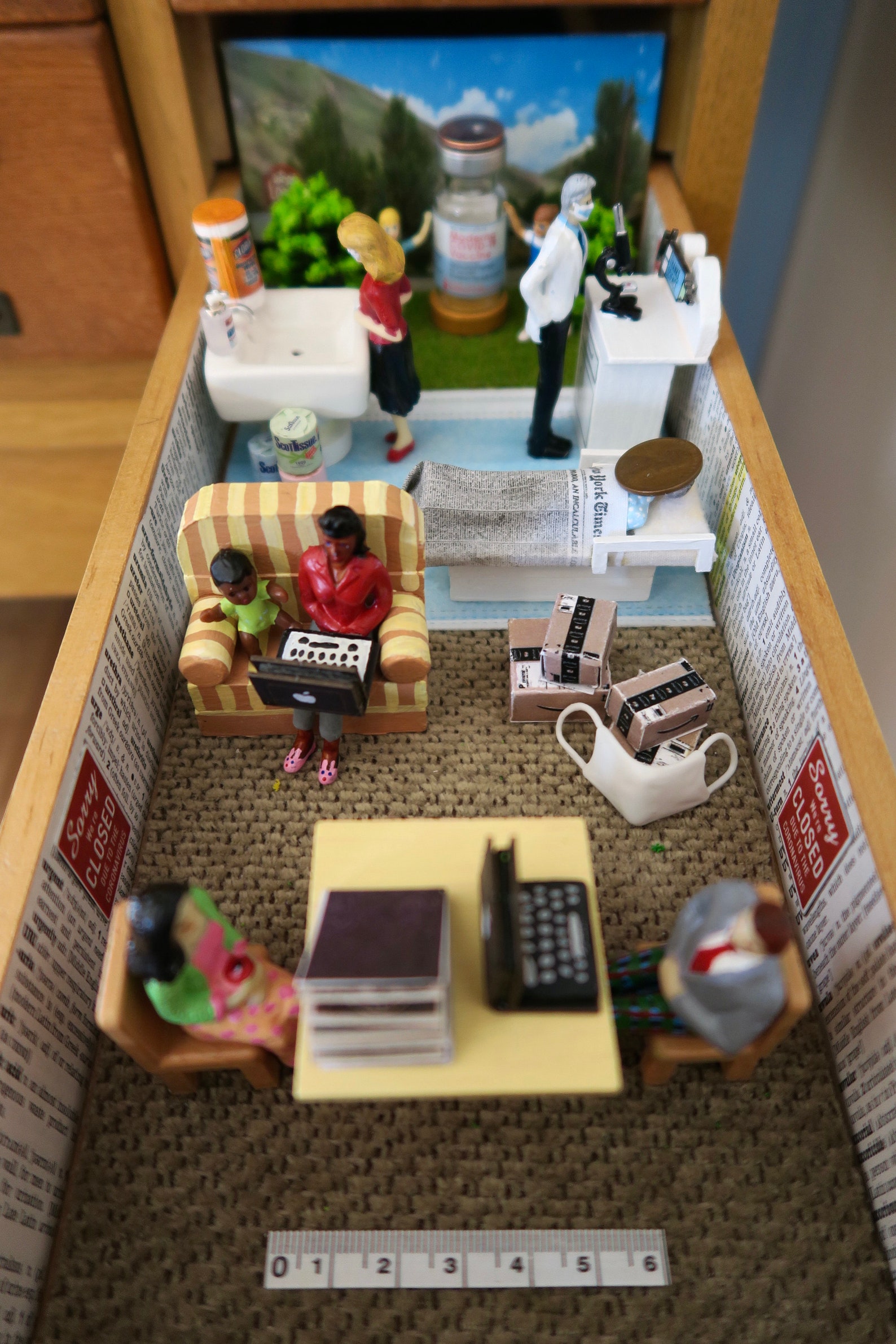
https://www.etsy.com/listing/1283073189/museum-of-tiny-things-founding-member
Woman has created a Museum of Tiny Things inside her library card catalog.
-
-
www.instagram.com www.instagram.com
-
-
[01:02:30] Memory and permanence<br /> 400,000 books burned; 700,000 books damaged<br /> Susan Orlean book on library fire
-
Award-Winning Writer Explains Her Entire Process — Susan Orlean - YouTube<br /> by [[David Perell]]<br /> accessed on 2025-11-05T09:13:24
0:00:38 Susan Orlean uses index cards as part of her process. She's done this for three or four books by October 29, 2025.
She uses her index cards (often in the range of 700) to arrange and re-arrange the material. She uses it to refresh her memory as she's working with it.
Things can be as small as a name of a character. Some are references to longer research documents.
"chunk of thought" (her version of atomic notes)
attention economy [7:59]
-
- Jul 2025
-
www.youtube.com www.youtube.com
-
Quite useful video about organizing tracks and finding new songs.
-
-
crimereads.com crimereads.com
-
“I always carry a pistol when I go [to the New York Public Library]. Never did trust those stone lions.”
-
-
dukespace.lib.duke.edu dukespace.lib.duke.edu
-
Abstract
In May & June 2025, Duke University Libraries (DUL) staff successfully implemented Anubis, a configurable open source web application firewall (WAF), in order to stave off persistent onslaughts of AI-related bot scraping activity. During this pilot period (May 1 - June 10, 2025), aggressive bot scraping led to extended outages for three critical library platforms (Duke Digital Repository, Archives & Manuscripts, and the Books & Media Catalog), and in each case, implementing Anubis mitigated the problem.
Permalink
https://hdl.handle.net/10161/32990
Citation
Aery, Sean (2025). Anubis Pilot Project Report - June 2025. Retrieved from https://hdl.handle.net/10161/32990.
-
- Jun 2025
-
pinia.vuejs.org pinia.vuejs.orgPinia 🍍1
-
pinia.vuejs.org pinia.vuejs.orgPinia 🍍1
- May 2025
-
mutabit.com mutabit.com
-
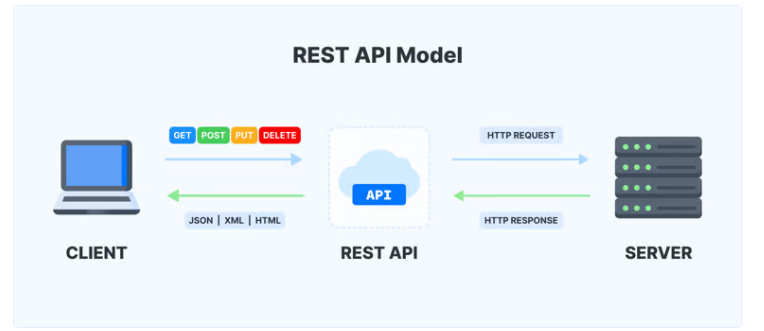
ormato ampliamente utilizado en el intercambio de datos en la web
Dicho formato (JSON) también es comúnmente utilizado para el desarrollo de interfaces de programación de aplicaciones (API REST), por ejemplo, en las Bibliotecas universitarias se utiliza usualmente para el vaciado de datos entre los sistemas de información académicos con los ILS para descargar/actualizar los datos de los estudiantes matriculados en una Universidad sin necesidad de hacer cargas por archivo txt, xls, etc.
-
-
www.youtube.com www.youtube.com
-
Oh man this website is so freaking useful. dr.loudness-war.info
Gives dynamic range information on albums/tracks.
-
This guy has Bandcamp as favorite site for buying music.
As second, he has Qobuz.
He also uses 7digital & HDtracks
-
- Apr 2025
-
-
Why not a library? We've found it extremely hard to develop a library that: Supports the many database libraries, ORMs, frameworks, runtimes, and deployment options available in the ecosystem. Provides enough flexibility for the majority of use cases. Does not add significant complexity to projects.
-
Lucia is now a learning resource on implementing auth from scratch.
-
-
github.com github.com
-
Lucia, the authentication library that we are using, is deprecated (Q1/2025). However, the author of Lucia decided to make it a learning resource, because Lucia is just a thin wrapper around cryptographic libraries like Oslo. So we are following the migration path on their website and will also use Oslo instead of Lucia.
-
-
github.com github.com
-
If I follow the new examples and implement them in my code (e.g. Passkeys), how will I know if a security issue is found in the examples in the future? Currently, libraries get updated and I pull in the new version. Unless I remember to check back occasionally, I'll never know if the example code is updated or fixed.
-
- Mar 2025
-
github.com github.com
-
The goal of Lucia v3 was to be the easiest and cleanest way to implement database-backed sessions in your projects. It didn't have to be a library. I just assumed that a library will be the answer. But I ultimately came to conclusion that my assumption was wrong. I don't see this change as me abandoning the project. In fact, I think it's a step forward. If implementing sessions wasn't easy, I wouldn't be deprecating the package. But why wouldn't a library be the answer? It seems like a such an obvious answer. One word - database. I talked about how database adapters were a significant complexity tax to the library. I think a lot of people interpreted that as maintenance burden on myself. That's not wrong, but the bigger issue is how the adapters limit the API. Adapters always felt like a black box to me as both an end user and a maintainer. It's very hard to design something clean around it and makes everything clunky and fragile, especially when you need to deal with TypeScript shenanigans.
Tags
- creating/using library vs. copying code
- too easy/simple/trivial for end-developers to write from scratch to expect (don't need library to do it for them; don't need to provide feature)
- when not to create a library: too hard to support/maintain the many ways it would need to be flexible
- when not to create a library
Annotators
URL
-
-
en.wikipedia.org en.wikipedia.org
-
cross reference Universal Decimal Classification, Dewey Decimal Classification
-
-
-
Known today as the father of library science, S.R. Ranganathan was an Indian mystic and mathematician that in the 1930s saw the coming failure of the Dewey Decimal System to scale. He envisioned a better way to classify knowledge known as the Colon Classification System.
-
-
www.loc.gov www.loc.gov
-
that it shall be lawful for the president of the United States to cause so much of any territory belonging to the United States, west of the Mississippi river, not included in any state or organized territory, and to which the Indian title has been extinguished
-
-
superforms.rocks superforms.rocks
Tags
Annotators
URL
-
- Feb 2025
-
www.reaganlibrary.gov www.reaganlibrary.gov
-
by the 1970s the FCC called the doctrine the “single most important requirement of operation in the public interest – the sine qua non for grant of a renewal of license.
for - Fairness Doctrine - FCC - most important requirement - Ronald Reagan library
-
-
blog.archive.org blog.archive.org
- Dec 2024
-
www.edonnelly.com www.edonnelly.com
-
DownLOEBables<br /> http://www.edonnelly.com/loebs.html
-
-
www.loc.gov www.loc.gov
-
Stanley Kubrick photos - Of the more than 300 assignments Kubrick did for Look (1946-1951), a little more than 100 are in Library of Congress collection; other Kubrick material may be found in the Museum of the City of New York (see Related Resources). Because of interest expressed in Kubrick's work, all Look jobs with which Stanley Kubrick was associated are cataloged, with descriptions focusing on negatives that have been printed.
https://www.loc.gov/collections/look-magazine/about-this-collection/
-
-
www.loc.gov www.loc.gov
-
cran.r-project.org cran.r-project.org
-
~/.Renviron. R_LIBS_SITE
dont have
~/.Renviron
-
- Nov 2024
-
www.zotero.org www.zotero.org
-
A great collection of sources on tools for thought, by the looks of it by [[Chris Aldrich]] Books, texts and more.
-
- Oct 2024
-
Local file Local file
-
I generallyuse the Cards of the Library Bureau (Bloomsbury Street, London),or those by Messrs. Evans and Hallewell, 5, Ave Maria Lane,London, E.C. The latter are the cheaper.
Love that Miles talks about what index cards he uses, where he gets them from and even their relative prices!
-
- Sep 2024
-
www.mikeperham.com www.mikeperham.com
-
Let your operating system handle daemons, respawning and logging while you focus on your application features and users.
-
Less system administration, easier debugging, simpler code, all because you leveraged the init system to do the work for you!
-
-
-
github.com github.com
-
Looks well-written, but probably not needed in a Rails project, which already has ActiveSupport for dealing with duration and periods
Tags
Annotators
URL
-
-
-
Utopia is a website generation framework which provides a robust set of tools to build highly complex dynamic websites. It uses the filesystem heavily for content and provides functions for interacting with files and directories as structure representing the website.
Tags
Annotators
URL
-
-
github.com github.com
-
drip engine for managing, creating, and performing scheduled messages sequences
Tags
Annotators
URL
-
-
www.gettyimages.com www.gettyimages.com
-
Another fun photo of "linked" strings wrapped around a library card catalog representing the links between ideas within a paper database.
-
-
-
Looks really nice. May switch to this from Memoist. This alt is much more configurable.
Tags
Annotators
URL
-
-
github.com github.com
-
mount IndexController do # all methods will be mounted automatically, it's just an example of refinement get '/hello', :hello_world end
-
-
-
.time {|timer = Timer.new.start| ... } ⇒ Object Takes a block and returns the total time it took to execute.
-
-
socketry.github.io socketry.github.io
- Aug 2024
-
www.claudiaserrato.net www.claudiaserrato.net
-
Claudia Serrato<br /> https://www.claudiaserrato.net/
-
-
www.youtube.com www.youtube.com
-
His library contains more than 30k books for sure.
He said: "When I arrived 25 years ago, they were 30,000... I have no more time to count them."
Seems logical that his library contained more than 30k books for this reason.
( ~9:25)
-
Lol Umberto Eco was evicted from one of his houses because the engineers thought the floors would collapse because of his books.
( ~9:00)
-
Apparently, Eco was interested in occultism, or at least in understanding it.
( ~7:10)
-
At the beginning of this video, Umberto Eco is seen walking in his library (0:48)
-
-
mui.com mui.com
Tags
Annotators
URL
-
-
www.youtube.com www.youtube.com
-
This person argues that one should cultivate a personal library, the tangibleness of the physical, to safeguard knowledge and prevent information control from falling to a single institution or person, so that they may never control the past.
I think he should go deeper into his argument, I do not fully understand what he means.
-
-
www.youtube.com www.youtube.com
-
Lol seriously? How serendipitous I came across your channel then. Yes I am in the Scheper tribe, but I am not active as much over there--as well as the fact that I do not pay for the newsletter anymore due to finances.
Reply to LibraryLin
-
@productivity6693 Hi There! I don't have a community for myself, but I am in Scott Schepler's Antinet Zettelkasten community. Are you there as well?
Interesting. LibraryLin is a Scheperian as well.
Tags
Annotators
URL
-
-
www.youtube.com www.youtube.com
-
( ~8:00 )
This explanation of why to read books in a certain order in dependency of each other is analogous to why a Zettelkasten (in Luhmannian sense) cannot be used collaboratively.
In order for someone else to understand your notes (not meant to be published), they would have to understand both the source text you are referencing and the implicit references you make. Things you understand instinctively and do not need to write down.
Because others do not have your experiences and worldview, it is more difficult for them, perhaps impossible, to completely comprehend your Zettels, your notes.
-
-
- Jul 2024
-
www.youtube.com www.youtube.com
-
( ~ 10:45)
This is basically layered learning and making use of the creation of prior knowledge.
-
(~10:00)
It's not just about your domain knowledge on a subject, it's also about your reading skill in general and how difficult a book is written.
-
This video tells me I need to spend more time actually reflecting on the table of contents and title. As well as with the pigeonholing; classify in the mind in what categories this book falls.
-
( ~1:55)
Interesting sentiment. Library Lin supposes that most people who do not like reading don't like it because of bad reading habits and that when they improve on their reading habits, they will start liking it.
-
Off-topic, I love this woman's accent.
-
- Jun 2024
-
docdrop.org docdrop.org
- May 2024
-
media.dltj.org media.dltj.org
-
So I'm not surprised, and perhaps the last question about user privacy.
Question about the privacy of the user interacting with the RAG
It doesn't seem like JSTOR has thought about this thoroughly. In the beta there is kind of an expectation that the service is being validated so what users are doing is being watched closer.
-
- Apr 2024
-
www.reddit.com www.reddit.com
-
scholar Elaine Svenonius talks about the "invisible hand of the classification system" where you serendipitously find a book on the shelf that you didn't know you were seeking.
I've always appreciated this serendipity, but never read a source talking about it specifically.
-
-
archive.org archive.org
-
[Narrator]: The power of the MC 68000 permitted another breakthrough:the common user interface.[Bill Atkinson]: On Lisa we make each of the programs have a similar user interface,so that what you've learned from using one programcarries over and you feel naturally how to use the next.
While the idea of a common user interface on computers may have felt like a selling point when facing a new scary machine with a variety of functionalities, did it really save that much time, effort, and learning curve? Particularly with respect to the common office tools it was replacing?
The common user interface was really more a benefit to the company and all the companies which programmed for it at scale. The benefits are like Melvil Dewey's standardization of the Dewey Decimal Classification which allowed libraries everywhere to work on the same system rather than needing to reinvent their own individually.
This sort of innovation with scalability is helpful as humans are far better at imitation than innovation.
-
- Mar 2024
-
www.facebook.com www.facebook.com
-
Chào mọi người, em xin chia sẻ về một người Thầy dạy em nhiều điều trong chứng khoán1) Thầy ấy rất hay khoe lãi lên facebook, lại còn là một Giám đốc học thuật của một trung tâm nên em rất tin tưởng. Địa điểm học tập là ở Tòa Nhà Ban Tuyên Giáo Q3 Nguyễn Đình Chiểu. Đặc điểm của Thầy là profile rất nice, hay nói về đạo lý và nước hoa và khoe body của Thầy (dù nó béo và đầy lipit)2) Năm 2022, Thầy ấy kêu gọi mọi người mua NLG all in đến dưới 69 full margin TP80, sau đó nó sập về 30, à, thế là cháy mất rồi. Sau đó Thầy bảo là chỉ chịu trách nhiệm hết t+3 thôi. Sau đó Thầy bảo là do xui, ra tin bắt anh Quyết thì phải chạy chứ. Thầy call ITA full margin sau đó Chị Yến bắt.3) Sau đó Thầy call PDR từ 15 nó sập về 10 sau khi nó hồi lên 14, Thầy bảo có thể còn biến số nên giảm vị thế đi, thế là nó lên 30. Thầy gáy nhân 3 nhưng hàng không biết Thầy còn cầm không4) 9 tháng trước, Thầy phân tích rất kỹ càng rồi call học viên mua AGG giá 28, giá sau đó lên 36 thì bị đạp, nhưng đạp thì Thầy vẫn bảo mọi người giữ, giữ đến 24 Thầy hỏi còn margin cho Thầy mua không và giờ nó đang có giá 21-22. Thầy phân tích AGG rất kỹ, kỹ tới nỗi Market tăng 250 điểm, BDS tăng 20 30% thì AGG từ 36 về 20. 5) Chuyện sẽ chẳng là gì nếu- Thầy bảo do xui nhưng bản chất Thầy call học viên mua cho quỹ xả, lần 2 Thầy call cho Thầy xả- Thầy bảo Quỹ Nhật vào mua AGG, Thầy nói The Sóng book lợi nhuận nhưng thì ra Thầy book lợi nhuận trên đầu con dân- Chuyện xảy ra Thầy bảo là do bạn học viên call chứ Thầy không call. Bằng bùa lợi Satire/Parody mang trên người Thầy có quyền nói mọi thứ chỉ là chế giễu thôi.- Năm 2023, Thầy call short Bank, Bank tăng, Thầy chê BTC nhưng không dám bet kèo 30 BTC cho ETF được duyệt khi có người thách.- Thầy bảo lớp được xem full danh mục, báo trước, khi có cức mà Thầy cho xem, mà chắc gì là tài khoản của Thầy hay Thầy bảo skin in the game nhưng ai biết là bỏ 500 đồng hay 500 đô. Mình viết bài này ra đây là để mọi người cẩn thận với Thầy, à mà nghe đồn Thầy từng bị trường R đuổi vì không đạt KPI, Thầy làm trái phiếu thì sai pháp lý phải làm lại, Thầy lấy profile 1 trường bên NZ nhưng chỉ là profile liên kết, chứ Thầy làm gì có bằng PhD để trường M bên NZ tuyển chính thức. À trung thâm của Thầy lùa đủ thứ, lùa quản lý tài sản, lùa CFA dù chả khác gì sách nói, lùa MA dù Thầy toàn chém gió lại.Mọi người copy share thoải mái, để người ta không còn bị lùa và để cho người ta thấy uy tín của Thầy như cái chart AGG vậy đó: Cấm thủng lòng đất
Tai Tran?
-
-
storage.courtlistener.com storage.courtlistener.com
-
Complaint
OCLC Online Computer Library Center, Inc. v. Anna's Archive (2:24-cv-00144)
District Court, Southern District of Ohio
-
-
hardhistoriesjhu.substack.com hardhistoriesjhu.substack.com
-
Read [[Martha S. Jones]] in Sleuthing the Card Catalog
-
The Library of Congress discontinued the use of “Negroes” as a subject heading in 1976.
-
I fingered my way through where I thought I’d find entries: African American, Afro-American, Black. Nothing there. I had to then brainstorm like it was 1999, or was it 1989, 1979, or even earlier, to discover the right term. As far back as 1984, the Library of Congress, whose subject headings most research libraries in the United States utilize, admitted that it was “frustrating” to search for Black people in its catalog because two terms were simultaneously in use: “Afro-Americans” and “Blacks.”1 Neither term made it into the old Peabody Library catalog, so perhaps it and the terminology it reflected dated from an even earlier time.
Research on keywords and their shifting meanings over time can make things difficult for the novice researcher. This example from Martha S. Jones certainly highlights this perspective even in under a century of semantic shift.
-
-
www.ebay.com www.ebay.com
-
https://www.ebay.com/itm/374936561744
Previously listed (late Summer 2023). Offered for bidding at $7,200 for a Jens Risom Library Card catalog on/around 2023-09-16. Local pickup from Pageland, SC. Ex-library from Davidson College Library in North Carolina tag number 01359.
Section of 6x5 and another of 6x7 for a total of 72 drawers with a middle section which has two pull out writing drawers.

Cost per drawer at opening bid: $100.00
2023-09-25: Relisted at https://www.ebay.com/itm/374948492633
2024-02-29 Relisted at https://www.ebay.com/itm/375282966486
-
- Feb 2024
-
Local file Local file
-
Only the largepelican, squatting in the trees, can break the connection, a symbol ofbad audience, staring insolently, resolutely offstage. But she is beinggradually struck out, her colours fading as the original red and giltborders reassert themselves reprimandingly from beneath, themanuscript exacting a slow punishment for the sin of inattention.
Dennis Duncan completely misreads this image of Grosseteste and the Pelican which appears in the Lambeth Palace Library's MS 522 of The Castle of love. (for image see: https://hypothes.is/a/RzHLjsz8Ee6dZLOTV5h65Q)
Duncan identifies Grosseteste's pose with his hand raised and his index finger extended as "the classic gesture of the storyteller." In fact, the bishop is pointing directly up at the pelican which sits just on top of the frame of the illuminated scene. This pelican is elevated above and just beyond the scene of the image because it represents, as was common in the time period, the suffering of Christ.
Bestiaries of the age commonly depicted the "pelican in her piety" which was noted by Isidore of Seville in his Etymologies (Book 12, 7:26) from the 7th century, a text which heavily influenced many of these bestiaries. It was also thought at the time that the insatiable and rapacious pelican ate lizards and crocodiles (or lived off of them); as these were associated with snakes and by way of the story of the Garden of Eden the devil, they were also further associated with Christ and driving sin out of the world.
Thus the image is more appropriately read in its original context as Grosseteste giving a sermon about the suffering of Christ who is represented by a pelican floating above the scene being depicted.
-
-
www.lambethpalacelibrary.info www.lambethpalacelibrary.info
-
https://www.lambethpalacelibrary.info/collections/manuscripts/
Bibliotheca Lambethana - manuscripts
-
-
images.lambethpalacelibrary.org.uk images.lambethpalacelibrary.org.uk
-
ar.pinterest.com ar.pinterest.com
-
images.lambethpalacelibrary.org.uk images.lambethpalacelibrary.org.uk
-
Robert Grosseteste, Bishop of Lincoln (face rubbed), in mitre and red cope, with crosier, seated on left speaks to a seated group of five people, mostly women. Tree on right; large bird with long beak at top.
image of MS 522 f1r Lambeth Palace Library

Close up of inset image via link

Book and images mentioned in Chapter 2 of @Duncan2022 Index, A History of the
-
-
hardhistoriesjhu.substack.com hardhistoriesjhu.substack.com
-
Read [[Martha S. Jones]] in A New Face for an Old Library Catalog
Discussion on harmful content in library card catalogs and finding aids.
The methods used to describe archive material can not only be harmful to those using them, but they also provide a useful historical record of what cataloguers may have been thinking contemporaneously as they classified and organized materials.
This is another potentially useful set of information to have while reading into historical topics from library card catalogs compared to modern-day digital methods.
Is anyone using version control on their catalogs?
-
-
Local file Local file
-
but they left their own belovedmanuscript unclassied and undescribed, and thus it never attainedthe status of a holding, which it so obviously deserved, and wasinstead tacitly understood to be merely a “nding aid,” a piece offurniture, wholly vulnerable to passing predators, subject tojanitorial, rather than curatorial, jurisdiction—even though thiscatalog was, in truth, the one holding that people who entered thebuilding would be likely to have in common, to know how to usefrom childhood, even to love. A new administrator came by onemorning and noticed that there was some old furniture taking upspace that could be devoted to bound volumes of Technicalities, TheElectronic Library, and the Journal of Library Automation. The cardcatalog, for want of having been cataloged itself, was thrown into adumpster.
-
The authors made one serious mistake, however. Although theyhad taken great pains to be sure that within their massive workevery book and manuscript stored in their building was representedby a three-by-ve page, and often by several pages, describing it,they had forgotten to devote any page, anywhere, to the very book
that they had themselves been writing all those years.
Baker describes the library card catalog as a massive book made up of 3 x 5 inch pages describing all the other books. Sadly he laments, they never bothered to catalog this meta-book itself.
-
Together, over the years, they achieved what one of their earlymasters, Charles Ammi Cutter, called a “syndetic” structure—that is,a system of referential links—of remarkable coherency andresolution.
reference for this?
definition: syndetic structure is one of coherency and resolution made up by referential links.
Why is no one using this word in the zettelkasten space?
The adjective "syndetic" means "serving to connect" or "to be connected by a conjunction". (A conjunction being a word used to connect words, phrases and clauses, for example: and, but, if). The antonym is "asyndetic" (connections made without conjoins)
-
By the early seventies, therewas an ominous arrearage of uncataloged material waiting on herdsof rolling carts near the overtaxed cataloging departments of mostlarge libraries. Cataloging had reached a state of crisis
-
SUNY Brockport’s Drake Memorial Library greets its userswith a typographically generated image of a card catalog:Your automated catalog, by DYNIX.Copyright (c) 1992 by DYNIX, Incorporated.
A library card catalog drawn using ASCII art. :)
-
Thus, the New York Public Library has CATNYP.There is BEARCAT (Kutztown University) and ALLECAT (Allegheny) andBOBCAT (NYU’s Bobst Library) and CATS (Cambridge). There is VIRGO(the University of Virginia), FRANCIS (Williams College), LUCY(Skidmore), CLIO (Columbia), CHESTER (the University of Rochester),SHERLOCK (Bualo State College), ARLO (the University of Colorado atColorado Springs), FRANKLIN (the University of Pennsylvania), andHarvard’s appropriately Eustace Tilleyish HOLLIS. There is BISON(SUNY Bualo), OASIS (the University of Iowa), ORION (UCLA),SOCRATES (Stanford), ILIAD (Butler), EUCLIDPLUS (Case Western), LUMINA(the University of Minnesota), and THE CONNELLY EXPLORER (La Salle).MELVYL (the University of California system) is named after MelvilDewey; the misspelling was reportedly intentional, meant toemphasize the dierence between Dewey’s cataloging universe andour own.
List of names for computerized library card catalogs at various libraries.
-
, one of the reasons that the New York Public Library had toclose its public catalog was that the public was destroying it. TheHetty Green cards disappeared. Someone calling himself Cosmoswas periodically making o with all the cards for Mein Kampf. Cardsfor two Dante manuscripts were stolen: not the manuscripts, thecards for the manuscripts.
-
book at a public phone rather than bothering to copy down anaddress and a phone number, library visitors—the heedless, thecrazy—have, especially since the late eighties, been increasinglycapable of tearing out the card referring to a book they want.
The huge frozen card catalog of the Library of Congress currently suers from alarming levels of public trauma: like the movie trope in which the private eye tears a page from a phone
-
Radical students destroyed roughly ahundred thousand cards from the catalog at the University of Illinoisin the sixties. Berkeley’s library sta was told to keep watch overthe university’s card catalogs during the antiwar turmoil there.Someone reportedly poured ink on the Henry Cabot Lodge cards atStanford
-
They donot grow mold, as the card catalog of the Engineering Library of theUniversity of Toronto once did, following water damage.
-
obody canexpect a library to maintain sequences of alphabetized cardboard fora collection that is growing, as some currently are, at a rate of vehundred items a day.
In 1994, some libraries were acquiring material at the rate of five hundred items per day. Rates like this made it difficult for catalogers to keep up with uncatalogued material going back to the 1970s for some institutions.
-
“Atthe end of this project,” Dale Flecker told me, “there won’t be cardcatalogs left in the university.” I asked him if there were any cardcatalogs, anywhere in the world, that he thought worthy ofpreservation. “In general, they’re being discarded,” he said. “I’m notsure I know of anybody who’s decided to preserve them as physicalobjects.” Maureen Finn said much the same thing to me: “Theinstitutions still want the cards back, and then I think they’re storingthem. But most library managers that I talk to will say, ‘We arestoring them because it makes the sta feel good, and we will begetting rid of them.’ ”
Interesting psychology being played out here....
-
And some undetermined but large fraction of thetotality is being sent to an artist named Thomas Johnston, atWestern Washington University.
Card catalog cards being repurposed for art.
-
“Library hand” was a special kind ofbackward-slanting penmanship meant specically for card catalogs,and taught in library school through the 1920s.
-
OCLC owns the largestdatabase of bibliographic information in the world, and it oers aservice called RETROCON, contracting with libraries to transfer oldcatalog cards to “machine-readable form,” at anywhere from ftycents to six dollars per card.
-
An image of the front of every card for Widener thus now exists onmicroche, available to users in a room o the lobby. (Anyinformation on the backs of the cards—and many notes do carryover—was not photographed
-
theMaryland Health Sciences Library published a commemorativechapbook called 101 Uses for a Dead Catalog Card.
-
At Cosumnes River College, in California, the card catalog wasceremonially put out of its misery by an ocial who pointed a gunat it and “shot” it. D
Wow!
-
The cards datingfrom 1911 to 1975 at the New York State Library in Albany (whereMelvil Dewey was librarian from 1889 to 1906) were thrown awaylast month as a consequence of a historical-preservation projectinvolving the building in which they were stored.
Sad that a "historical-preservation project" resulted in the loss of such an interesting historical artifact.
-
The New York Public Library, ahead of the game, renovated theentire ten-million-card catalog of its Research Libraries between1977 and 1980, microlmed it, and threw it out.
-
universities and public libraries have completed the“retrospective conversions” of their catalogs to computer databases(frequently with the help of federal Title II-C money, as part of the“Strengthening Research Library Resources” program),
-
cards printed by theLibrary of Congress, Baker & Taylor, and OCLC;
In the 21st century, many library card catalog cards were commercially printed by OCLC, Baker & Taylor, and the Library of Congress
-
Chancellor Edward N. Brandt, Jr., wearing ared T-shirt that said “The Great Discard,” chose a drawer of thecatalog and pulled it from the cabinet. With the help of a beamingCyril Feng, who was then the director of the library, he drew theretaining rod from the chosen drawer and let its several hundredcards ceremonially spill into a trash can decorated with coloredpaper.
The intellectual historian in me: 😱
Tags
- syndetic structure
- typewriters
- publishing
- cataloging crisis
- bibliographies
- Title II-C
- OCLC
- manuscript studies
- library hand
- library card catalog cards
- microfiche
- art
- New York Public Library
- quotes
- digitization
- Baker & Taylor
- Nicholson Baker
- digital library cataloging
- Strengthening Research Library Resources
- Dante Gabriel Rossetti
- theives
- Edward N. Brandt Jr.
- yes and
- elegies
- definitions
- Mein Kampf
- historical preservation
- guns
- ASCII art
- Cyril Feng
- zettelkasten naming
- Charles Ammi Cutter
- theft
- Thomas Johnston
- upcycling
- library acquisitions
- Library of Congress
- library card catalog
- 1970s
- naming computers
- vandalism
- vandals
- card catalog rods
- cataloging
- RETROCON
- XXI
- card index for writing
- scanning
- zettelkasten
- collage
- retcon
- Melvil Dewey
- The Great Discard
- note collection loss and damage
- hw-library hand
- Wordnik
- Widener University
Annotators
-
-
news.virginia.edu news.virginia.edu
-
Curtis mentioned one example of information that he found: “One of the first drawers of the author-title catalog I looked through held a card for Benjamin Smith Barton’s ‘Elements of Botany’ [the 1804 edition]. The card indicated that UVA’s copy of this book was signed by Joseph C. Cabell, who was instrumental in the founding of the University.”Curtis checked to see if the Virgo entry included this detail, but he found no record of the book at all. “I thought perhaps that was because the book had been lost, and the Virgo entry deleted, but just in case, I emailed David Whitesell [curator in the Albert and Shirley Small Special Collections Library] and asked him if this signed copy of Barton’s ‘Elements of Botany’ was on the shelves over there. Indeed it was.
Digitization efforts in card collections may result in the loss or damage of cards or loss of the materials which the original cards represented in the case of library card catalogs.
-
The information neatly typed on the cards – which library workers sometimes supplemented with handwritten notes on front and back – includes details that in many cases are not typically part of the electronic catalog system, Virgo, that the University Library switched to in 1989. At the time, the catalog was transferred by scanning that captured only the front of the cards.
Libraries may have handwritten notes on the back of library card catalog cards in the 20th century, a practice which caused data loss in the case of the Alderman Library which only scanned the front of their cards in 1989 when they made the switch from physical cards to a digital catalog.
-
Created over a 50-year span from 1939 to 1989, that catalog grew to about 4 million cards in 65 cabinets with 4,000 drawers.
This is roughly 65 cabinets of 60 drawers each.
4 million cards over 50 years is approximately 220 cards per day. This isn't directly analogous to my general statistics on number of notes per day for individual people's excerpting practice, but it does give an interesting benchmark for a larger institution and their acquisitions over 50 years. (Be sure to divide by 3 for duplication over author/title/subject overlap, which would be closer to 73 per day)
Shifted from analog cards to digital version in 1989.
-
-
americanlibrariesmagazine.org americanlibrariesmagazine.org
-
https://americanlibrariesmagazine.org/highsmith-purchased-by-w-w-grainger/<br /> Highsmith Purchased by W. W. Grainger
-
Founded in 1956, Highsmith is a distributor of equipment, supplies, and furniture to public, academic, and school libraries.
-
Library supply company Highsmith, headquartered in Fort Atkinson, Wisconsin, has been purchased by Lab Safety Supply, a direct-marketing subsidiary of Chicago-based facilities maintenance supplier W. W. Grainger. Terms of the acquisition, announced in the business press July 10, were not disclosed. Highsmith’s operations, with anticipated sales for 2008 in the range of $20–$30 million, will be integrated with LSS by the end of the year.
Purchased July 2008.
-
-
resourcemate.com resourcemate.com
-
www.primasoft.com www.primasoft.com
-
www.primasoft.com www.primasoft.com
-
https://www.primasoft.com/help/print_library_catalog_cards.htm
Software for printing library catalog cards. Small Library Pro being replaced by Handy Library Manager
-
-
www.ebay.com www.ebay.com
-
www.librarything.com www.librarything.com
-
https://www.librarything.com/topic/85852
People circa 2010 interested in exporting their Library Thing book data to print out on library card catalog cards.
(I'm not the only one...)
-
-
www.lapl.org www.lapl.org
-
-
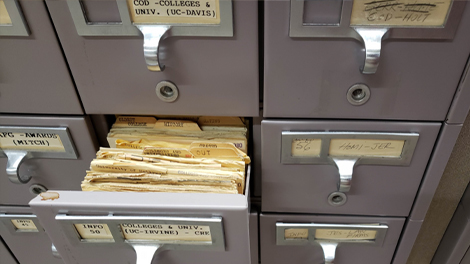
The smallest collection of card catalogs is near the librarian’s information desk in the Social Science/Philosophy/Religion department on lower level three. It is rarely used and usually only by librarians. It contains hundreds of cards that reflect some of the most commonly asked questions of the department librarians. Most of the departments on the lower levels have similar small collections. Card catalog behind the reference desk on lower level three, photo credit: Tina Lernø
-
The surname Index for the library’s genealogy includes 315 drawers of about 750 cards each for a total of more than 236,250 cards patrons can use when they visit the History/Map/Travel section, photo credit: Diana Rosen

-
The delight-inducing art piece, A Place for Everything and Everything in its Place, is featured in the two elevator cars on the north side of the building, accessible in the Tom Bradley Wing.One car has cards for the "Comprehensive" and the other for the "Complete" works of various authors and topics. When moving, the elevator cars expose cards in the shaft window that reflect books that are found on the floor the elevator is passing.Artist David Bunn was given nearly 2 million catalog cards to play with for his art installation, yet he only used a little more than 9,500 in the two elevator cars. He has, since the early 1990s, been creating art projects, found poetry, and sculptures with the remaining cards.
-
-
www.levenger.com www.levenger.com
-
https://www.levenger.com/products/vintage-library-catalog-cards-set-of-50?variant=43444256243861
These don't have the pre-drilled holes, but at least are still offered, though at the price gouging cost of $14.50 for 50 (in 2024).
Cost per card: $0.29

-
-
www.universityproducts.com www.universityproducts.com
-
www.ebay.com www.ebay.com
-
https://www.ebay.com/itm/235422435211
37 books listed 133 - 3.59 each 148 - 4 185 - 5 222 - 6
-
-
localhost:5674 localhost:5674
-
There was a high number of librarians among the Americans, such asCharles Ammi Cutter of Harvard and the Boston Athenæum (who producedAmerica’s first public library card catalogue).
-
-
www.indiamart.com www.indiamart.com
-
https://www.indiamart.com/proddetail/library-catalogue-cards-23374811530.html
IndiaMart.com still selling 3x5" library catalog cards predrilled. Listing for 1,200 R for 1000 cards.

-
-
www.libraryhistorybuff.org www.libraryhistorybuff.org
-
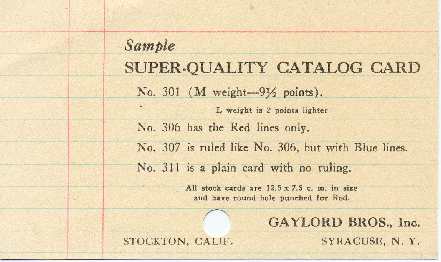
sample catalog card included in a Gaylord Brothers supply catalog.
Gaylord Bros. sold several types of card catalog cards including:
- No. 301 medium weight
- No. 306 with red rules (classical three lines)
- No. 307 with blue rules
- No. 311 pain card
all were predrilled with holes
-
-
www.thelibrarystore.com www.thelibrarystore.com
-
https://www.thelibrarystore.com/ The Library Store
Tags
Annotators
URL
-
-
www.gaylord.com www.gaylord.com
-
The current incarnation of Gaylord Bros.
-