104 Matching Annotations
  1. Last 7 days
    1. Opus 4.7 uses an updated tokenizer that improves how the model processes text. The tradeoff is that the same input can map to more tokens—roughly 1.0–1.35× depending on the content type.

      tokenizer的更新虽然增加了token使用量,但提高了文本处理效率,这反映了AI模型在基础架构上的持续优化,这种优化虽然带来短期成本增加,但长期将提升AI的处理能力和准确性。

    1. scaling Muse Spark with multi-agent thinking enables superior performance with comparable latency.

      这一结果挑战了传统认知,即增加推理时间必然导致延迟增加,表明多智能体并行可能是实现高效推理的关键,为未来AI架构设计提供了新思路。

    2. After compressing, the model again extends its solutions to achieve stronger performance.

      令人惊讶的是:Muse Spark在测试时展现出一种独特的'思想压缩'能力,模型在最初通过延长思考时间提高性能后,会在时间惩罚机制下自发压缩推理过程,然后再扩展解决方案以获得更强的性能。这种动态的自我优化机制在AI模型中前所未见。

    1. The standard autoresearch loop (brainstorm from code, run experiments, check metrics) works when the optimization surface is visible in the source. The Liquid results prove that. But for problems where the codebase doesn't contain enough information to generate good hypotheses, giving the agent access to papers and competing implementations changes what it tries.

      这一声明清晰地区分了两种优化场景:代码可见的优化和需要外部知识的优化。它揭示了AI代理开发中的一个关键洞察:优化方法必须根据问题性质进行调整。对于某些问题,简单的代码分析就足够了;但对于更复杂的问题,需要引入外部知识和研究。这一发现对AI辅助编程系统的设计具有重要指导意义。

    2. The variance is also worth noting: baseline+FA TG has ±19 t/s of noise, while optimized+FA has ±0.59 t/s on x86. The fusions eliminate intermediate writes that pollute the cache, making the hot paths more predictable.

      这一数据揭示了优化的一个意外但重要的好处:不仅提高了性能,还显著降低了结果变异性。这表明通过减少缓存污染和内存访问模式的不确定性,优化可以使系统行为更加可预测。这一发现对构建可靠的高性能系统具有重要意义,强调了优化的一致性而不仅仅是峰值性能。

    3. Without experience with compiler behavior, the agent couldn't have predicted which 'optimizations' the compiler would already handle.

      这一观察揭示了AI代理在编译优化方面的局限性:代理无法准确预测编译器已经自动处理的优化。这表明AI代理需要更深入理解编译器行为和现代编译技术,以避免徒劳的优化尝试。这一发现对AI辅助编程系统的发展具有重要启示,强调了领域知识整合的重要性。

    4. A 606 MiB model at ~49 tokens/s consumes ~30 GB/s of memory bandwidth, close to the c6i.2xlarge's DRAM limit. No amount of SIMD tricks will help when the CPU is stalled waiting for model weights to arrive from DRAM.

      这一数据揭示了现代CPU推理的关键瓶颈:内存带宽限制。代理最初尝试的SIMD微优化无法突破这一根本限制,这表明理解硬件特性和系统瓶颈对于有效优化至关重要。这一发现挑战了传统上认为计算是主要瓶颈的观念,强调了内存效率在AI推理中的核心地位。

    5. Studying forks and other backends was more productive than searching arxiv. ik_llama.cpp and the CUDA backend directly informed two of the five final optimizations.

      这是一个令人惊讶的发现,表明实践中的代码实现比学术论文更能直接指导优化工作。代理通过研究实际项目分支和不同后端实现获得了更有价值的见解,而不是依赖理论研究。这强调了在AI代理开发中,实践经验和现有实现的重要性可能超过理论文献。

    6. Coding agents working from code alone generate shallow hypotheses. Adding a research phase — arxiv papers, competing forks, other backends — produced 5 kernel fusions that made llama.cpp CPU inference 15% faster.

      这一声明揭示了AI代理在代码优化中的关键局限:仅基于代码的优化会产生浅显的假设。通过引入研究阶段,包括阅读学术论文、研究竞争项目和后端实现,代理能够发现更深层次的优化机会,实现了显著的性能提升。这表明AI代理需要更广泛的上下文信息才能做出有意义的创新。

    7. The variance is also worth noting: baseline+FA TG has ±19 t/s of noise, while optimized+FA has ±0.59 t/s on x86.

      令人惊讶的是:优化后的代码不仅提高了性能,还显著减少了结果方差(从±19 t/s降至±0.59 t/s)。这表明AI代理的优化不仅关注速度,还考虑了内存访问模式的可预测性,这种全面性思维令人印象深刻。

    8. Total cost: ~$29 ($20 in CPU VMs, $9 in API calls) over ~3 hours with 4 VMs.

      令人惊讶的是:仅花费29美元和3小时,AI代理就实现了显著的性能提升(x86上提升15.1%,ARM上提升5%)。这种低成本高效能的优化方式颠覆了传统认为高性能优化需要大量人力和时间的观念。

    9. The agent fused them into one: for (int i = 0; i < nc; i++) { wp[i] = sp[i] * scale + mp_f32[i]; }

      令人惊讶的是:AI代理能够将原本需要三次内存访问的softmax操作优化为单次循环,这种优化方式对人类开发者来说可能不是最直观的,但却显著减少了内存带宽使用,提高了CPU推理效率。

    1. GLM-5.1 pushes this frontier further, delivering 3.6× speedup and continuing to make progress well into the run. While its rate of improvement also slows over time, it sustains useful optimization for substantially longer than GLM-5.

      令人惊讶的是:在机器学习工作负载优化任务中,GLM-5.1能够实现3.6倍的速度提升,并且在长时间运行中持续改进,而其他模型很快就会达到性能瓶颈。这种持续优化的能力对于实际应用中的复杂问题解决具有重要意义。

    2. GLM-5.1 did not plateau after 50 or 100 submissions, but continued to find meaningful improvements over 600+ iterations with 6,000+ tool calls, ultimately reaching 21.5k QPS—roughly 6× the best result achieved in a single 50-turn session.

      令人惊讶的是:GLM-5.1在向量数据库优化任务中能够持续改进600多次迭代,性能提升达到原来的6倍,这打破了传统模型很快达到性能瓶颈的局限。这种长时间持续优化的能力在AI模型中极为罕见,展示了模型在长期任务处理上的突破性进步。

    1. In 23 months, the same capability that needed 1.8 trillion parameters now fits in 4 billion parameters. A 450x compression.

      令人惊讶的是:AI模型参数量在短短23个月内实现了450倍的压缩,这意味着原本需要超级计算机才能运行的强大AI模型现在可以完全在手机上运行。这种技术进步的速度远超摩尔定律,展示了算法优化和模型压缩技术的惊人突破。

    1. PagedAttention algorithm and vLLM system enhance the throughput of large language models by efficiently managing memory and reducing waste in the key-value cache.

      令人惊讶的是:通过简单的内存管理优化,PagedAttention算法和vLLM系统能够显著提高大语言模型的吞吐量,减少键值缓存中的浪费。这展示了在模型规模不断扩大的今天,系统优化可能比模型创新本身更具实际价值。

    1. Artificial Analysis has also positioned Gemini 3.1 Flash TTS within its 'most attractive quadrant' for its ideal blend of high-quality speech generation and low cost.

      令人惊讶的是:这个模型不仅质量高,而且成本效益也非常出色,在'最具吸引力象限'中占据一席之地。这表明Google在平衡AI性能和商业可行性方面取得了显著突破,这对大多数用户来说是意想不到的。

    1. We introduce a pipelined double-buffered execution engine that overlaps parameter prefetching, computation, and gradient offloading across multiple CUDA streams, enabling continuous GPU execution.

      令人惊讶的是:通过双缓冲执行引擎和多CUDA流的重叠计算,研究团队能够实现GPU的持续执行,有效解决了CPU-GPU带宽瓶颈。这种流水线设计展示了系统级优化如何克服硬件限制,实现看似不可能的效率提升。

  2. Apr 2026
    1. the design of the retrieval and cache policy, especially how they decide what to keep, reuse, or drop across scenes, seems to be what actually drives the latency and throughput gains

      大多数研究者可能关注模型架构或算法创新来提升性能,但评论者指出检索和缓存策略的设计才是延迟和吞吐量提升的关键。这一观点挑战了AI研究中过度关注模型本身的倾向,暗示系统优化和资源管理策略可能比模型架构创新对性能影响更大,这是一个反直觉的系统设计见解。

    1. For higher-interactivity scenarios, execution time for MoE models is bound by expert weight load time. By splitting, or sharding, the experts across multiple GPUs across NVL72 nodes, this bottleneck is reduced, improving end-to-end performance.

      大多数人认为MoE模型的主要瓶颈在于计算能力,但作者指出专家权重加载时间是真正的瓶颈,并提出通过跨GPU分片专家权重来解决问题,这挑战了AI模型优化的传统认知,暗示了I/O可能比计算更重要。

    2. Co-designed hardware, software, and models are key to delivering the highest AI factory throughput and lowest token cost. Measuring this goes far beyond peak chip specifications.

      大多数人认为AI性能主要由芯片规格决定,但作者强调硬件、软件和模型的协同设计才是关键,这挑战了以芯片为中心的行业认知,暗示了全栈优化比单纯追求芯片性能更重要。

    3. This means 2.7x more tokens from the same GB300 NVL72-based infrastructure and power footprint, reducing the cost to manufacture each token by more than 60%.

      大多数人认为硬件升级是提高AI性能的主要方式,但作者认为通过软件优化可以在相同硬件上实现2.7x的性能提升和60%以上的成本降低,这挑战了行业对硬件升级的依赖。这种观点暗示软件优化可能比硬件升级更具成本效益。

    1. NVFP4 enables 4-bit precision while maintaining nearly identical accuracy to 8-bit precision, increasing performance per watt and lowering cost per token.

      大多数人认为降低模型精度会显著牺牲性能,但作者声称Gemma 4通过NVFP4量化技术实现了4位精度与8位精度几乎相同的准确率。这一反直觉的结论挑战了传统量化会大幅降低模型性能的认知,暗示NVIDIA可能在量化技术方面取得了突破性进展。

  3. Dec 2025
    1. Optimizations that don’t need Rust Some of uv’s speed comes from Rust. But not as much as you’d think. Several key optimizations could be implemented in pip today: HTTP range requests for metadata. Wheel files are zip archives, and zip archives put their file listing at the end. uv tries PEP 658 metadata first, falls back to HTTP range requests for the zip central directory, then full wheel download, then building from source. Each step is slower and riskier. The design makes the fast path cover 99% of cases. This is HTTP protocol work, not Rust. Parallel downloads. pip downloads packages one at a time. uv downloads many at once. This is concurrency, not language magic. Global cache with hardlinks. pip copies packages into each virtual environment. uv keeps one copy globally and uses hardlinks (or copy-on-write on filesystems that support it). Installing the same package into ten venvs takes the same disk space as one. This is filesystem ops, not language-dependent. Python-free resolution. pip needs Python running to do anything, and invokes build backends as subprocesses to get metadata from legacy packages. uv parses TOML and wheel metadata natively, only spawning Python when it hits a setup.py-only package that has no other option. PubGrub resolver. uv uses the PubGrub algorithm, originally from Dart’s pub package manager. pip uses a backtracking resolver. PubGrub is faster at finding solutions and better at explaining failures. It’s an algorithm choice, not a language choice

      Many of uv's optimisations come from improvements that can be made without rust such as http range requests for packages, parallel downloading, better local caching

    2. No .egg support. Eggs were the pre-wheel binary format. pip still handles them; uv doesn’t even try. The format has been obsolete for over a decade. No pip.conf. uv ignores pip’s configuration files entirely. No parsing, no environment variable lookups, no inheritance from system-wide and per-user locations. No bytecode compilation by default. pip compiles .py files to .pyc during installation. uv skips this step, shaving time off every install. You can opt in if you want it. Virtual environments required. pip lets you install into system Python by default. uv inverts this, refusing to touch system Python without explicit flags. This removes a whole category of permission checks and safety code. Stricter spec enforcement. pip accepts malformed packages that technically violate packaging specs. uv rejects them. Less tolerance means less fallback logic. Ignoring requires-python upper bounds. When a package says it requires python<4.0, uv ignores the upper bound and only checks the lower. This reduces resolver backtracking dramatically since upper bounds are almost always wrong. Packages declare python<4.0 because they haven’t tested on Python 4, not because they’ll actually break. The constraint is defensive, not predictive. First-index wins by default. When multiple package indexes are configured, pip checks all of them. uv picks from the first index that has the package, stopping there. This prevents dependency confusion attacks and avoids extra network requests. Each of these is a code path pip has to execute and uv doesn’t.

      UV does not support egg files or legacy pip.conf and it doesn't check for upper bounds on dependencies or compile py files to pyc bytecode by default. This removes a number of codepaths and allows the tool to run faster.

    3. PEP 658 went live on PyPI in May 2023. uv launched in February 2024. The timing isn’t coincidental. uv could be fast because the ecosystem finally had the infrastructure to support it. A tool like uv couldn’t have shipped in 2020. The standards weren’t there yet.

      Before February 2024 the pip standards for pyproject.toml and wheel management weren't there and UV would not have been possible.

      The relevant PEP standards are 517, 518, 621 and 658

  4. Oct 2024
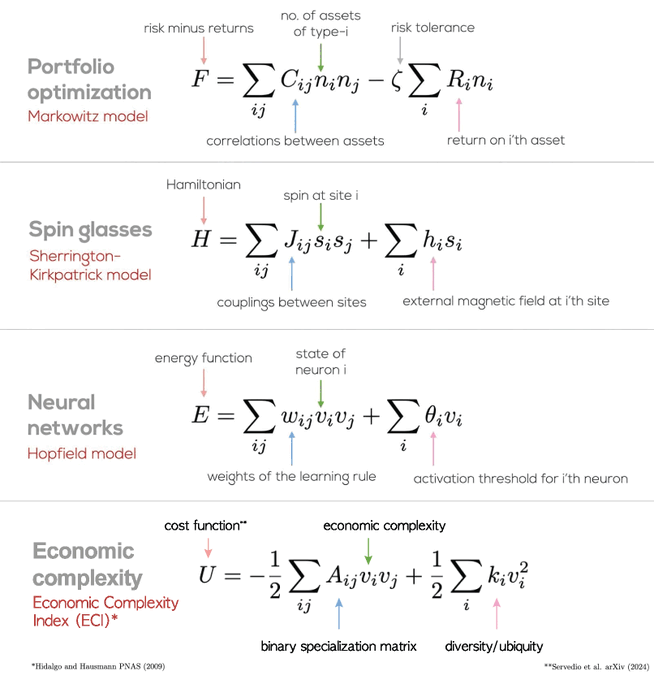
    1. The similarity is because they are all saying roughly the same thing: Total (result) = Kinetic (cost) + Potential (benefit) Cost is either imaginary squared or negative (space-like), benefit is real (time-like), result is mass-like. Just like physics, the economic unfavourable models are the negative results. In economics, diversity of products is a strength as it allows better recovery from failure of any one, comically DEI of people fails miserably at this, because all people are not equal. Here are some other examples you will know if you do physics: E² + (ipc)² = (mc²)² (relativistic Einstein equation), mass being the result, energy time-like (potential), momentum the space-like (kinetic). ∇² - 1/c² ∂²/∂t² = (mc/ℏ)² (Klein-Gordon equation), mass is the result, ∂²/∂t² potential, ∇² is kinetic. Finally we have Dirac equation, which unlike the previous two as "sum of squares" is more like vector addition (first order differentials, not second). iℏγ⁰∂₀ψ + iℏγⁱ∂ᵢψ = mcψ First part is still the time-like potential, second part is the space-like kinetic, and the mass is still the result though all the same. This is because energy is all forms, when on a flat (free from outside influence) worksheet, acts just like a triangle between potential, kinetic and resultant energies. E.g. it is always of the form k² + p² = r², quite often kinetic is imaginary to potential (+,-,-,-) spacetime metric, quaternion mathematics. So the r² can be negative, or imaginary result if costs out way benefits, or work in is greater than work out. Useless but still mathematical solution. Just like physics, you always want the mass or result to be positive and real, or your going to lose energy to the surrounding field, with negative returns. Economic net loss do not last long, just like imaginary particles in physics.

      in reply to Cesar A. Hidalgo at https://x.com/realAnthonyDean/status/1844409919161684366

      via Anthony Dean @realAnthonyDean

  5. Mar 2024
  6. Dec 2023
    1. Technique #1: Changing numeric representations

      For most purposes having a huge amount of accuracy isn’t too important.

      Instead of representing the values as floating numbers, we can represent them as percentages between 0 and 100. We’ll be down to two-digit accuracy, but again for many use cases that’s sufficient. Plus, if this is output from a model, those last few digits of “accuracy” are likely to be noise, they won’t actually tell us anything useful.

      Whole percentages have the nice property that they can fit in a single byte, an int8—as opposed to float64, which uses eight bytes:

  7. Apr 2023
  8. Feb 2023
  9. Jan 2023
  10. Jul 2022
  11. Jun 2022
  12. Apr 2022
    1. Algospeak refers to code words or turns of phrase users have adopted in an effort to create a brand-safe lexicon that will avoid getting their posts removed or down-ranked by content moderation systems. For instance, in many online videos, it’s common to say “unalive” rather than “dead,” “SA” instead of “sexual assault,” or “spicy eggplant” instead of “vibrator.”

      Definition of "Algospeak"

      In order to get around algorithms that demote content in social media feeds, communities have coined new words or new meanings to existing words to communicate their sentiment.

      This is affecting TikTok in particular because its algorithm is more heavy-handed in what users see. This is also causing people who want to be seen to tailor their content—their speech—to meet the algorithms needs. It is like search engine optimization for speech.

      Article discovered via Cory Doctorow at The "algospeak" dialect

  13. Jan 2022
  14. scattered-thoughts.net scattered-thoughts.net
    1. The latest SQLite 3.8.7 alpha version is 50% faster than the 3.7.17 release from 16 months ago. [...] This is 50% faster at the low-level grunt work of moving bits on and off disk and search b-trees. We have achieved this by incorporating hundreds of micro-optimizations. Each micro-optimization might improve the performance by as little as 0.05%. If we get one that improves performance by 0.25%, that is considered a huge win. Each of these optimizations is unmeasurable on a real-world system (we have to use cachegrind to get repeatable run-times) but if you do enough of them, they add up.
  15. Sep 2021
    1. don’t store all the values from onerow together, but store all the values from each column together instead. If each col‐umn is stored in a separate file, a query only needs to read and parse those columnsthat are used in that query, which can save a lot of work.

      Why column storage is better query optimized

    1. our application continuously checks the current block and retrieves transactions from historical blocks;Our application was very heavy on reads and light on writes, so we thought using ‘cached reads’ would be a good approach;We developed a small application to act as a thin proxy between our application and Infura. The proxy application is simple and it only hits Infura/Ethereum on the initial call. All future calls for the same block or transaction are then returned from cache;Writes are automatically forwarded to Infura. This was a seamless optimization. We simply had to point our application to our proxy and everything worked without any changes to our application.
  16. Aug 2021
    1. Grötschel, an expert in optimization, observes that a benchmark production planning model solved using linear programming would have taken 82 years to solve in 1988, using the computers and the linear programming algorithms of the day. Fifteen years later – in 2003 – this same model could be solved in roughly 1 minute, an improvement by a factor of roughly 43 million. Of this, a factor of roughly 1,000 was due to increased processor speed, whereas a factor of roughly 43,000 was due to improvements in algo-rithms
  17. Mar 2021
    1. If a UTF8-encoded Ruby string contains unicode characters, then indexing into that string becomes O(N). This can lead to very bad performance in string_end_with_semicolon?, as it would have to scan through the whole buffer for every single file. This commit fixes it to use UTF32 if there are any non-ascii characters in the files.
    1. What is the point of avoiding the semicolon in concat_javascript_sources

      For how detailed and insightful his analysis was -- which didn't elaborate or even touch on his not understanding the reason for adding the semicolon -- it sure appeared like he knew what it was for. Otherwise, the whole issue would/should have been about how he didn't understand that, not on how to keep adding the semicolon but do so in a faster way!

      Then again, this comment from 3 months afterwards, indicates he may not think they are even necessary: https://github.com/rails/sprockets/issues/388#issuecomment-252417741

      Anyway, just in case he really didn't know, the comment shortly below partly answers the question:

      Since the common problem with concatenating JavaScript files is the lack of semicolons, automatically adding one (that, like Sam said, will then be removed by the minifier if it's unnecessary) seems on the surface to be a perfectly fine speed optimization.

      This also alludes to the problem: https://github.com/rails/sprockets/issues/388#issuecomment-257312994

      But the explicit answer/explanation to this question still remains unspoken: because if you don't add them between concatenated files -- as I discovered just to day -- you will run into this error:

         (intermediate value)(...) is not a function
             at something.source.js:1
      

      , apparently because when it concatenated those 2 files together, it tried to evaluate it as:

         ({
           // other.js
         })()
         (function() {
           // something.js
         })();
      

      It makes sense that a ; is needed.

  18. Feb 2021
  19. Jan 2021
    1. If you manage to make Svelte aware of what needs to be tracked, chances are that the resulting code will be more performant than if you roll your own with events or whatever. In part because it will use Svelte's runtime code that is already present in your app, in part because Svelte produces seriously optimized change tracking code, that would be hard to hand code all while keeping it human friendly. And in part because your change tracking targets will be more narrow.
  20. Dec 2020
    1. In this study, we have quantitated yields of low copy and single copy number plasmid DNAs after growth of cells in four widely used broths (SB, SOC, TB, and 2xYT) and compared results to those obtained with LB, the most common E. coli cell growth medium

      TB (terrific broth) consistently generated the greatest amount of plasmid DNA, in agreement with its ability to produce higher cell titers. The superiority of TB was primarily due to its high levels of yeast extract (24 g/L) and was independent of glycerol, a unique component of this broth. Interestingly, simply preparing LB with similarly high levels of yeast extract (LB24 broth) resulted in plasmid yields that were equivalent to those of TB.

  21. Nov 2020
  22. Oct 2020
    1. This is a very dangerous practice as each optimization means making assumptions. If you are compressing an image you make an assumption that some payload can be cut out without seriously affecting the quality, if you are adding a cache to your backend you assume that the API will return same results. A correct assumption allows you to spare resources. A false assumption introduces a bug in your app. That’s why optimizations should be done consciously.
  23. Sep 2020
    1. The more I think about this, the more I think that maybe React already has the right solution to this particular issue, and we're tying ourselves in knots trying to avoid unnecessary re-rendering. Basically, this JSX... <Foo {...a} b={1} {...c} d={2}/> ...translates to this JS: React.createElement(Foo, _extends({}, a, { b: 1 }, c, { d: 2 })); If we did the same thing (i.e. bail out of the optimisation allowed by knowing the attribute names ahead of time), our lives would get a lot simpler, and the performance characteristics would be pretty similar in all but somewhat contrived scenarios, I think. (It'll still be faster than React, anyway!)
  24. Aug 2020
  25. Jul 2020
  26. Jun 2020
  27. Dec 2019
    1. Practical highlights in my opinion:

      • It's important to know about data padding in PG.
      • Be conscious when modelling data tables about columns ordering, but don't be pure-school and do it in a best-effort basis.
      • Gains up to 25% in wasted storage are impressive but always keep in mind the scope of the system. For me, gains are not worth it in the short-term. Whenever a system grows, it is possible to migrate data to more storage-efficient tables but mind the operative burder.

      Here follows my own commands on trying the article points. I added - pg_column_size(row()) on each projection to have clear absolute sizes.

      -- How does row function work?
      
      SELECT pg_column_size(row()) AS empty,
             pg_column_size(row(0::SMALLINT)) AS byte2,
             pg_column_size(row(0::BIGINT)) AS byte8,
             pg_column_size(row(0::SMALLINT, 0::BIGINT)) AS byte16,
             pg_column_size(row(''::TEXT)) AS text0,
             pg_column_size(row('hola'::TEXT)) AS text4,
             0 AS term
      ;
      
      -- My own take on that
      
      SELECT pg_column_size(row()) AS empty,
             pg_column_size(row(uuid_generate_v4())) AS uuid_type,
             pg_column_size(row('hola mundo'::TEXT)) AS text_type,
             pg_column_size(row(uuid_generate_v4(), 'hola mundo'::TEXT)) AS uuid_text_type,
             pg_column_size(row('hola mundo'::TEXT, uuid_generate_v4())) AS text_uuid_type,
             0 AS term
      ;
      
      CREATE TABLE user_order (
        is_shipped    BOOLEAN NOT NULL DEFAULT false,
        user_id       BIGINT NOT NULL,
        order_total   NUMERIC NOT NULL,
        order_dt      TIMESTAMPTZ NOT NULL,
        order_type    SMALLINT NOT NULL,
        ship_dt       TIMESTAMPTZ,
        item_ct       INT NOT NULL,
        ship_cost     NUMERIC,
        receive_dt    TIMESTAMPTZ,
        tracking_cd   TEXT,
        id            BIGSERIAL PRIMARY KEY NOT NULL
      );
      
      SELECT a.attname, t.typname, t.typalign, t.typlen
        FROM pg_class c
        JOIN pg_attribute a ON (a.attrelid = c.oid)
        JOIN pg_type t ON (t.oid = a.atttypid)
       WHERE c.relname = 'user_order'
         AND a.attnum >= 0
       ORDER BY a.attnum;
      
      -- What is it about pg_class, pg_attribute and pg_type tables? For future investigation.
      
      -- SELECT sum(t.typlen)
      -- SELECT t.typlen
      SELECT a.attname, t.typname, t.typalign, t.typlen
        FROM pg_class c
        JOIN pg_attribute a ON (a.attrelid = c.oid)
        JOIN pg_type t ON (t.oid = a.atttypid)
       WHERE c.relname = 'user_order'
         AND a.attnum >= 0
       ORDER BY a.attnum
      ;
      
      -- Whoa! I need to master mocking data directly into db.
      
      INSERT INTO user_order (
          is_shipped, user_id, order_total, order_dt, order_type,
          ship_dt, item_ct, ship_cost, receive_dt, tracking_cd
      )
      SELECT true, 1000, 500.00, now() - INTERVAL '7 days',
             3, now() - INTERVAL '5 days', 10, 4.99,
             now() - INTERVAL '3 days', 'X5901324123479RROIENSTBKCV4'
        FROM generate_series(1, 1000000);
      
      -- New item to learn, pg_relation_size. 
      
      SELECT pg_relation_size('user_order') AS size_bytes,
             pg_size_pretty(pg_relation_size('user_order')) AS size_pretty;
      
      SELECT * FROM user_order LIMIT 1;
      
      SELECT pg_column_size(row(0::NUMERIC)) - pg_column_size(row()) AS zero_num,
             pg_column_size(row(1::NUMERIC)) - pg_column_size(row()) AS one_num,
             pg_column_size(row(9.9::NUMERIC)) - pg_column_size(row()) AS nine_point_nine_num,
             pg_column_size(row(1::INT2)) - pg_column_size(row()) AS int2,
             pg_column_size(row(1::INT4)) - pg_column_size(row()) AS int4,
             pg_column_size(row(1::INT2, 1::NUMERIC)) - pg_column_size(row()) AS int2_one_num,
             pg_column_size(row(1::INT4, 1::NUMERIC)) - pg_column_size(row()) AS int4_one_num,
             pg_column_size(row(1::NUMERIC, 1::INT4)) - pg_column_size(row()) AS one_num_int4,
             0 AS term
      ;
      
      SELECT pg_column_size(row(''::TEXT)) - pg_column_size(row()) AS empty_text,
             pg_column_size(row('a'::TEXT)) - pg_column_size(row()) AS len1_text,
             pg_column_size(row('abcd'::TEXT)) - pg_column_size(row()) AS len4_text,
             pg_column_size(row('abcde'::TEXT)) - pg_column_size(row()) AS len5_text,
             pg_column_size(row('abcdefgh'::TEXT)) - pg_column_size(row()) AS len8_text,
             pg_column_size(row('abcdefghi'::TEXT)) - pg_column_size(row()) AS len9_text,
             0 AS term
      ;
      
      SELECT pg_column_size(row(''::TEXT, 1::INT4)) - pg_column_size(row()) AS empty_text_int4,
             pg_column_size(row('a'::TEXT, 1::INT4)) - pg_column_size(row()) AS len1_text_int4,
             pg_column_size(row('abcd'::TEXT, 1::INT4)) - pg_column_size(row()) AS len4_text_int4,
             pg_column_size(row('abcde'::TEXT, 1::INT4)) - pg_column_size(row()) AS len5_text_int4,
             pg_column_size(row('abcdefgh'::TEXT, 1::INT4)) - pg_column_size(row()) AS len8_text_int4,
             pg_column_size(row('abcdefghi'::TEXT, 1::INT4)) - pg_column_size(row()) AS len9_text_int4,
             0 AS term
      ;
      
      SELECT pg_column_size(row(1::INT4, ''::TEXT)) - pg_column_size(row()) AS int4_empty_text,
             pg_column_size(row(1::INT4, 'a'::TEXT)) - pg_column_size(row()) AS int4_len1_text,
             pg_column_size(row(1::INT4, 'abcd'::TEXT)) - pg_column_size(row()) AS int4_len4_text,
             pg_column_size(row(1::INT4, 'abcde'::TEXT)) - pg_column_size(row()) AS int4_len5_text,
             pg_column_size(row(1::INT4, 'abcdefgh'::TEXT)) - pg_column_size(row()) AS int4_len8_text,
             pg_column_size(row(1::INT4, 'abcdefghi'::TEXT)) - pg_column_size(row()) AS int4_len9_text,
             0 AS term
      ;
      
      SELECT pg_column_size(row()) - pg_column_size(row()) AS empty_row,
             pg_column_size(row(''::TEXT)) - pg_column_size(row()) AS no_text,
             pg_column_size(row('a'::TEXT)) - pg_column_size(row()) AS min_text,
             pg_column_size(row(1::INT4, 'a'::TEXT)) - pg_column_size(row()) AS two_col,
             pg_column_size(row('a'::TEXT, 1::INT4)) - pg_column_size(row()) AS round4;
      
      SELECT pg_column_size(row()) - pg_column_size(row()) AS empty_row,
             pg_column_size(row(1::SMALLINT)) - pg_column_size(row()) AS int2,
             pg_column_size(row(1::INT)) - pg_column_size(row()) AS int4,
             pg_column_size(row(1::BIGINT)) - pg_column_size(row()) AS int8,
             pg_column_size(row(1::SMALLINT, 1::BIGINT)) - pg_column_size(row()) AS padded,
             pg_column_size(row(1::INT, 1::INT, 1::BIGINT)) - pg_column_size(row()) AS not_padded;
      
      SELECT a.attname, t.typname, t.typalign, t.typlen
        FROM pg_class c
        JOIN pg_attribute a ON (a.attrelid = c.oid)
        JOIN pg_type t ON (t.oid = a.atttypid)
       WHERE c.relname = 'user_order'
         AND a.attnum >= 0
       ORDER BY t.typlen DESC;
      
      DROP TABLE user_order;
      
      CREATE TABLE user_order (
        id            BIGSERIAL PRIMARY KEY NOT NULL,
        user_id       BIGINT NOT NULL,
        order_dt      TIMESTAMPTZ NOT NULL,
        ship_dt       TIMESTAMPTZ,
        receive_dt    TIMESTAMPTZ,
        item_ct       INT NOT NULL,
        order_type    SMALLINT NOT NULL,
        is_shipped    BOOLEAN NOT NULL DEFAULT false,
        order_total   NUMERIC NOT NULL,
        ship_cost     NUMERIC,
        tracking_cd   TEXT
      );
      
      -- And, what about other varying size types as JSONB?
      
      SELECT pg_column_size(row('{}'::JSONB)) - pg_column_size(row()) AS empty_jsonb,
             pg_column_size(row('{}'::JSONB, 0::INT4)) - pg_column_size(row()) AS empty_jsonb_int4,
             pg_column_size(row(0::INT4, '{}'::JSONB)) - pg_column_size(row()) AS int4_empty_jsonb,
             pg_column_size(row('{"a": 1}'::JSONB)) - pg_column_size(row()) AS basic_jsonb,
             pg_column_size(row('{"a": 1}'::JSONB, 0::INT4)) - pg_column_size(row()) AS basic_jsonb_int4,
             pg_column_size(row(0::INT4, '{"a": 1}'::JSONB)) - pg_column_size(row()) AS int4_basic_jsonb,
             0 AS term;
      
  28. Jan 2019
  29. Nov 2018
    1. Learning with Random Learning Rates

      作者提出了一种新的Alrao优化算法,让网络中每个 unit 或 feature 都各自从不同级别的随机分布中采样获得其自己的学习率。该算法没有额外计算损耗,可以更快速达到理想 lr 下的SGD性能,用来测试 DL 模型很棒!

    2. On the loss landscape of a class of deep neural networks with no bad local valleys

      文章声称的全局最小训练,事实上主要基于一个比较特殊的人工神经网络的结构,用了各种连接到 output 的 skip connection,还有几个额外的assumptions 作为理论保证。

    3. Revisiting Small Batch Training for Deep Neural Networks

      这篇文章简而言之就是mini-batch sizes取得尽可能小一些可能比较好。自己瞅了一眼正在写的 paper,这不禁让我小肝微微一颤,心想:还是下次再把 batch-size 取得小一点吧。。。[挖鼻] ​​​​

    4. Don't Use Large Mini-Batches, Use Local SGD

      最近(2018/8)在听数学与系统科学的非凸最优化进展时候,李博士就讲过:现在其实不太欣赏变 learning rate 了,反而逐步从 SGD 到 MGD 再到 GD 的方式,提高 batch-size 会有更好的优化效果!

    5. Backprop Evolution

      这似乎是说反向传播的算法,在函数结构本身上,就还有很大的优化空间。作者在一些初等函数和常见矩阵操作基础上探索了一些操作搭配,发现效能轻易的就优于传统的反向传播算法。

      不禁启发:我们为什么不能也用网络去拟合优化梯度更新函数呢?

    6. A Convergence Theory for Deep Learning via Over-Parameterization

      又一个全篇的数学理论证明,但是没找到 conclusion 到底是啥,唯一接近的是 remark 的信息,但内容也都并不惊奇。不过倒是一个不错的材料,若作为熟悉DNN背后的数学描述的话。

  30. Feb 2018
  31. Dec 2017
  32. Jun 2017

    Tags

    Annotators

  33. Feb 2017
  34. Apr 2016
    1. While there are assets that have not been assigned to a cluster If only one asset remaining then Add a new cluster Only member is the remaining asset Else Find the asset with the Highest Average Correlation (HC) to all assets not yet been assigned to a Cluster Find the asset with the Lowest Average Correlation (LC) to all assets not yet assigned to a Cluster If Correlation between HC and LC > Threshold Add a new Cluster made of HC and LC Add to Cluster all other assets that have yet been assigned to a Cluster and have an Average Correlation to HC and LC > Threshold Else Add a Cluster made of HC Add to Cluster all other assets that have yet been assigned to a Cluster and have a Correlation to HC > Threshold Add a Cluster made of LC Add to Cluster all other assets that have yet been assigned to a Cluster and have Correlation to LC > Threshold End if End if End While

      Fast Threshold Clustering Algorithm

      Looking for equivalent source code to apply in smart content delivery and wireless network optimisation such as Ant Mesh via @KirkDBorne's status https://twitter.com/KirkDBorne/status/479216775410626560 http://cssanalytics.wordpress.com/2013/11/26/fast-threshold-clustering-algorithm-ftca/

    1. Effect of step size. The gradient tells us the direction in which the function has the steepest rate of increase, but it does not tell us how far along this direction we should step.

      That's the reason why step size is an important factor in optimization algorithm. Too small step can cause the algorithm longer to converge. Too large step can cause that we change the parameters too much thus overstepped the optima.

  35. Jan 2015
    1. There are other ways of performing the optimization (e.g. LBFGS), but Gradient Descent is currently by far the most common and established way of optimizing Neural Network loss functions.

      Are there any studies that compare different pros and cons of the optimization procedures with respect to some specific NN architectures (e.g., classical LeNets)?