1. Last 7 days
    1. Reviewer #1 (Public review):

      Summary:

      This article provides new insights into the organisational changes of the X4-tropic HIV-1 co-receptor CXCR4 upon binding of the viral receptor-binding protein X4-gp120, either in its soluble form or when displayed as Env on virus-like particles (VLPs). The study employs single-particle tracking total internal reflection fluorescence (SPT-TIRF) microscopy to quantify the dynamics and clustering of CXCR4 on CD4+ T cells. The data show that CXCR4 clusters in the presence of X4-gp120 and VLPs, a phenomenon that is also observed for the primary HIV-1 receptor CD4. The authors also show that a WHIM mutant of CXCR4 (CXCR4-R334X) that does not cluster in the presence of its natural ligand, CXCL12, clusters in the presence of X4-gp120 and VLPs.

      Major strengths:

      The data are well presented, discussed, and supported by solid evidence. Literature is cited appropriately.

      Major weaknesses:

      The authors have addressed my concerns in the revised manuscript.

      Significance:

      In summary, the work is presented in a clear fashion, and the main findings are properly highlighted. The paper will be of interest to the broader virology community as well as to researchers studying cell receptor clustering. The findings are not entirely surprising because it has been shown previously that the binding of Env to CD4 mediates CD4 clustering, which would also suggest clustering of the co-receptor. Nonetheless, the paper provides strong evidence that CXCR4 clusters and changes its dynamics in the presence of CD4 and X4-gp120. Moreover, the evidence that X4-gp120 clusters CXCR4-R334X is of high interest as it suggests a different binding mechanism for X4-gp120 from that of the natural ligand CXCL12, raising questions for further research.

    2. Reviewer #2 (Public review):

      Summary:

      The author investigates how the HIV-1 Env glycoprotein modulates the nanoscale organisation and dynamics of the CXCR4 co-receptor on CD4⁺ T cells. The author demonstrates that HIV-1 Env induces CXCR4 clustering distinct from that triggered by its natural ligand (CXCL12), implicating spatial receptor organization as a determinant of infection. This study investigates how HIV-1 Env (specifically X4-tropic gp120) alters the membrane organization and dynamics of the chemokine receptor CXCR4 and its WHIM-associated mutant, CXCR4R334X, in a CD4-dependent manner. Using single-particle tracking total internal reflection fluorescence microscopy (SPT-TIRF-M), the authors demonstrate that both soluble gp120 and virus-like particles (VLPs) displaying gp120 induce CXCR4 nanoclustering, reduce receptor diffusivity, and promote immobile nanoclusters of CXCR4 at the membrane of Jurkat T cells and primary CD4⁺ T cell blasts. The work offers new insights into the spatial organisation of receptors during HIV-1 entry and infection. The manuscript is well-written, and the findings are significant.

      Significance:

      Nature and significance of the advance:<br /> This work marks a conceptual and mechanistic breakthrough in understanding HIV-1 entry. It goes beyond the static view of Env-co-receptor interaction to show that nanoscale reorganization of CXCR4, distinct from chemokine-induced clustering, occurs during HIV-1 Env engagement and may be essential for infection.

      Context within existing literature. Previous studies established Env-induced CD4 clustering (Yin et al., 2020) and chemokine-induced CXCR4 nanocluster formation (Martínez-Muñoz et al., 2018), but the exact nanoscale rearrangement of CXCR4 in the context of HIV-1 Env and physiological Env densities remains unquantified. This study addresses this gap using SPT-TIRF, STED microscopy, and functional assays.

      Audience and influence: The findings will be of interest to researchers in HIV virology, membrane receptor biology, viral entry mechanisms, and therapeutic target development. The receptor-clustering aspect could also influence broader fields of study, such as GPCR organization and immune receptor signalling.

      Reviewer expertise: I can evaluate HIV-1 entry mechanisms, viral glycoprotein-host-host-host receptor interactions, single-molecule fluorescence microscopy, and membrane protein dynamics. I am less equipped to evaluate the deep structural modelling aspects, though the in silico AlphaFold results are straightforward to interpret in context.

    3. Reviewer #3 (Public review):

      Summary:

      The authors investigate how HIV-1 Env engagement affects the nanoscale organization and dynamics of the CXCR4 coreceptor on target cells. Using single-particle tracking TIRF microscopy, they analyze CXCR4 distribution following exposure to gp120 or HIV virus-like particles, including both wild-type CXCR4 and the WHIM-associated CXCR4.R334X variant. The study further examines the role of CD4-CXCR4 heterodimerization and contrasts Env-induced receptor organization with that elicited by the natural ligand CXCL12.

      Evaluation:

      A major strength of this work is the integration of high-resolution imaging with functional and comparative analyses that distinguish Env-induced CXCR4 clustering from chemokine-driven effects. The experiments are clearly described, include appropriate controls, and are supported by quantitative analyses that are consistent across experiments. The revised manuscript appears to have addressed many of the technical and interpretive issues raised during initial review, improving clarity around data analysis and strengthening confidence in the conclusions.

      I am not an expert in TIRF microscopy or single-molecule tracking and defer to other reviewers regarding limits of imaging and tracking methods. However, I did not identify major inconsistencies between the biological data presented and the conclusions drawn.

      The authors data support the conclusion that HIV-1 Env, delivered as gp120 or virus-like particles, promotes CD4-dependent nanoscale clustering of CXCR4, including the CXCR4.R334X variant associated with WHIM syndrome, in a manner distinct from CXCL12-induced receptor organization. The authors are generally careful to frame their conclusions in proportion to the evidence and avoid overinterpretation.

      Overall, this study builds on prior work on CXCR4 distribution and HIV entry by providing higher-resolution insight into receptor nanoclustering and its modulation by Env. The findings provide a mechanistic refinement rather than a conceptual paradigm shift but is a valuable dataset useful to researchers studying HIV entry, coreceptor biology, and membrane receptor organization.

      Reviewer expertise: HIV-1 Envelope glycoproteins and entry assays, HIV broadly neutralizing antibodies, HIV vaccine design

      Comments on revised version:

      This reviewer has no further recommendations and thanks the authors for clarifying that the Env content in gp120-VLPs was lower than the NL4-3deltaIN particles but that the percentage of mature particles in the gp120-VLPs was higher.

    4. Reviewer #4 (Public review):

      Summary:

      The authors investigate the impact of surface bound HIV gp120 and VLPs on CXCR4 dynamics in Jurkat T cells expressing WT or WHIM syndrome mutated CXCR4, which has a defective response to CXCL12. Jurkat cells were transfected with CXCR4-AcGFP. Images were acquired and a single particle tracking routine was applied to generate information about nanoclustering and diffusion, and FRET was used to investigate CD4-CXCR4 proximity. They compare effects of soluble gp120 to immature and mature VLPs, which include varying degrees of gp120 clustering. They find that solid phase gp120 or VLP can increase CXCR4 clustering size and decrease diffusion in Jurkat cells. Surprisingly, VLP lacking gp120 could increase CXCR4 clustering and speed, which is paradoxical as there were no known ligands on the VLPs, but they likely carry many cellular proteins with potential interactions. The impact of CXCL12 and gp120 binding to CXCR4 was different in terms of clustering and receptor down-regulation.

      Significance:

      The strengths are that it's an important question and the reagents are well prepared and characterised. They are detecting quantitative effects that will likely be reproducible. The information generated is potentially useful for those studying HIV infection processes and strategies to prevent infection.

      The major weakness is that the conditions for the SPT experiments are not ideal in that the density of particles is too high for SPT and the single molecule basis for assessing nanoclusters is not clear. This means that the data is getting at complex molecules phenomena and less likely be generating pure single molecules measurements.

      Comments on revised version:

      The authors should make the tracking data available and this will aid others in following up on it.

    5. Author response:

      Point-by-point description of the revisions

      Reviewer #1:

      Thank you very much for considering that our manuscript evaluates an important question and that the reagents used are well prepared and characterized. We also much appreciate that you consider the information generated as potentially useful for those studying HIV infection processes and strategies to prevent infection.

      (1) While a single particle tracking routine was applied to the data, it's not clear how the signal from a single GFP was defined and if movement during the 100 ms acquisition time impacts this. My concern would be that the routine is tracking fluctuations, and these are related to single particle dynamics, it appears from the movies that the density or the GFP tagged receptors in the cells is too high to allow clear tracking of single molecules. SPT with GFP is very difficult due to bleaching and relatively low quantum yield. Current efforts in this direction that are more successful include using SNAP tags with very photostable organic fluorophores. The data likely does mean something is happening with the receptor, but they need to be more conservative about the interpretation.

      Some of the paradoxical effects might be better understood through deeper analysis of the SPT data, particularly investigation of active transport and more detailed analysis of "immobile" objects. Comments on early figures illustrate how this could be approached. This would require selecting acquisitions where the GFP density is low enough for SPT and performing a more detailed analysis, but this may be difficult to do with GFP.

      When the authors discuss clusters of <2 or >3, how do they calibrate the value of GFP and the impact of diffusion on the measurement. One way to approach this might be single molecules measurements of dilute samples on glass vs in a supported lipid bilayer to map the streams of true immobility to diffusion at >1 µm2/sec.

      We fully understand the reviewer’s apprehensions regarding the application of these high-end biophysical techniques, in particular the associated complexity of the data analysis. We provide below extensive explanations on our methodology, which we hope will satisfactorily address all of the reviewer’s concerns.

      We would first like to emphasize that the experimental conditions and the quantitative analysis used in our current experiments are similar to the established protocols and methodologies applied by our group previously (Martinez-Muñoz et al. Mol. Cell, 2018; García-Cuesta et al. PNAS, 2022; Gardeta et al. Frontiers in Immunol., 2022; García-Cuesta et al. eLife, 2024; Gardeta et al. Cell. Commun. Signal., 2025) and by others (Calebiro et al. PNAS, 2013; Jaqaman et al. Cell, 2011; Mattila et al. Immunity, 2013; Torreno-Pina et al. PNAS, 2014; Torreno-Pina et al. PNAS, 2016).

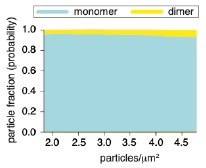
      As SPT (single-particle tracking) experiments require low-expressing conditions in order to follow individual trajectories (Manzo & García-Parajo Rep. Prog. Phys., 2015), we transiently transfected Jurkat CD4<sup>+</sup> cells with CXCR4-AcGFP or CXCR4<sup>R334X</sup>-AcGFP. At 24 h post-transfection, cells expressing low CXCR4-AcGFP levels were selected by a MoFlo Astrios Cell Sorter (BeckmanCoulter) to ensure optimal conditions for SPT. Using Dako Qifikit (DakoCytomation), we quantified the number of CXCR4 receptors and found ~8,500 – 22,000 CXCR4-AcGFP receptors/cell, which correspond to a particle density ~2 – 4.5 particles/µm<sup>2</sup> (Author response image 1) and are similar to the expression levels found in primary human lymphocytes.

      Author response image 1.

      Purified AcGFP monomeric protein was immobilized on glass at various concentrations. Dependency of the distribution of particle components on particle density was calculated; >95% were monomeric single particles at 2.0-4.5 particles/µm<sup>2</sup>. This range of particle density was used to analyze the dynamics of CXCR4-AcGFP, or CXCR4<sup>R334X</sup>-AcGFP single particles on JKCD4 cells.
      These cells were resuspended in RPMI supplemented with 2% FBS, NaPyr and L-glutamine and plated on 96-well plates for at least 2 h. Cells were centrifuged and resuspended in a buffer with HBSS, 25 mM HEPES, 2% FBS (pH 7.3) and plated on glass-bottomed microwell dishes (MatTek Corp.) coated with fibronectin (FN) (Sigma-Aldrich, 20 µg/ml, 1 h, 37°C). To observe the effect of the ligand, we coated dishes with FN + CXCL12; FN + X4-gp120 or FN + VLPs, as described in material and methods; cells were incubated (20 min, 37°C, 5% CO<sub>2</sub>) before image acquisition.

      For SPT measurements, we use a total internal reflection fluorescence (TIRF) microscope (Leica AM TIRF inverted) equipped with an EM-CCD camera (Andor DU 885-CS0-#10-VP), a 100x oilimmersion objective (HCX PL APO 100x/1.46 NA) and a 488-nm diode laser. The microscope was equipped with incubator and temperature control units; experiments were performed at 37°C with 5% CO<sub>2</sub>. To minimize photobleaching effects before image acquisition, cells were located and focused using the bright field, and a fine focus adjustment in TIRF mode was made at 5% laser power, an intensity insufficient for single-particle detection that ensures negligible photobleaching. Image sequences of individual particles (500 frames) were acquired at 49% laser power with a frame rate of 10 Hz (100 ms/frame). The penetration depth of the evanescent field used was 90 nm.

      We performed automatic tracking of individual particles using a very well established and common algorithm first described by Jaqaman (Jaqaman et al. Nat. Methods, 2008). Nevertheless, we would stress that we implemented this algorithm in a supervised fashion, i.e., we visually inspect each individual trajectory reconstruction in a separate window. Indeed, this algorithm is not able to quantify merging or splitting events.

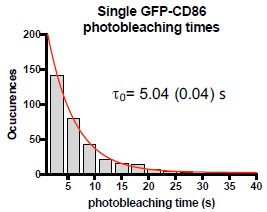
      We follow each individual fluorescence spot frame-by-frame using a three-by-three matrix around the centroid position of the spot, as it diffuses on the cell membrane. To minimize the effect of photon fluctuations, we averaged the intensity over 20 frames. Nevertheless, to assure the reviewer that most of the single molecule traces last for at least 50 frames (i.e., 5 seconds), we provide the following data and arguments. We currently measure the photobleaching times from individual CD86-AcGFP spots exclusively having one single photobleaching step to guarantee that we are looking at individual CD86-AcGFP molecules. The distribution of the photobleaching times is shown below (Author response image 2). Fitting of the distribution to a single exponential decay renders a t0 value of ~5 s. Thus, with 20 frames averaging, we are essentially measuring the whole population of monomers in our experiments. As the survival time of a molecule before photobleaching will strongly depend on the excitation conditions, we used low excitation conditions (2 mW laser power, which corresponds to an excitation power density of ~0.015 kW/cm<sup>2</sup> considering the illumination region) and longer integration times (100 ms/frame) to increase the signal-to-background for single GFP detection while minimizing photobleaching.

      Author response image 2.

      Single molecule photobleaching times measured directly from single molecule trajectories of CD86-AcGFP, considering only traces that exhibit single molecule photobleaching steps. The experimental data are shown in gray bars (n=273 trajectories over 3 independent experiments). The red line corresponds to a single exponential decay fitting of the experimental data, from where t<sub>o</sub> has been extracted.
      To infer the stoichiometry of receptor complexes, we also perform single-step photobleaching analysis of the TIRF trajectories to establish the existence of different populations of monomers, dimers, trimers and nanoclusters and extract their percentage. Some representative trajectories of CXCR4-AcGFP with the number of steps detected are shown in new Supplementary Figure 1.  

      The emitted fluorescence (arbitrary units, a.u.) of each spot in the cells is quantified and normalized to the intensity emitted by monomeric CD86-AcGFP spots that strictly showed a single photobleaching step (Dorsch et al. Nat. Methods, 2009). We have preferred to use CD86-AcGFP in cells rather than AcGFP on glass to exclude any potential effect on the different photodynamics exhibited by AcGFP when bound directly to glass. We have also previously shown pharmacological controls to exclude CXCL12-mediated receptor clustering due to internalization processes (Martinez-Muñoz et al. Mol. Cell, 2018) that, together with the evaluation of single photobleaching steps and intensity histograms, allow us to exclude the presence of vesicles in our data. Thus, the dimers, trimers and nanoclusters found in our data do correspond to CXCR4 molecules on the cell surface. Finally, distribution of monomeric particle intensities, obtained from the photobleaching analysis, was analyzed by Gaussian fitting, rendering a mean value of 980 ± 86 a.u. This value was then used as the monomer reference to estimate the number of receptors per particle in both cases, CXCR4-AcGFP and CXCR4<sup>R334X</sup>-AcGFP (new Supplementary Figure 1).

      (2) I understand that the CXCL12 or gp120 are attached to the substrate with fibronectin for adhesion. I'm less clear how how that VLPs are integrated. Were these added to cells already attached to FN?

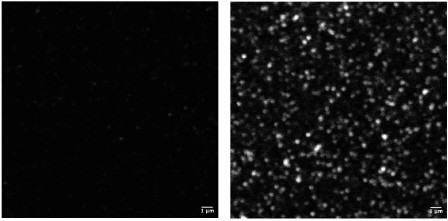
      For TIRF-M experiments, cells were adhered to glass-bottomed microwell dishes coated with fibronectin, fibronectin + CXCL12, fibronectin + X4-gp120, or fibronectin + VLPs. As for CXCL12 and X4-gp120, the VLPs were attached to fibronectin taking advantage of electrostatic interactions. To clarify the integration of the VLPs in these assays, we have stained the microwell dishes coated with fibronectin and those coated with fibronectin + VLPs with wheat germ agglutinin (WGA) coupled to Alexa647 (Author response image 3) and evaluated the staining by confocal microscopy. These results indicate the presence of carbohydrates on the VLPs and are, therefore, indicative of the presence of VLPs on the fibronectin layer.

      Author response image 3.

      Representative confocal images of microwell dishes coated with fibronectin ((left panel) or fibronectin + VLPs (right panel)) and stained with wheat germ agglutinin (WGA) coupled to Alexa647. Bar scale 1µm.
      Moreover, it is important to remark that the effect of the VLPs on CXCR4 behavior at the cell surface observed by TIRF-M confirmed that the VLPs remained attached to the substrate during the experiment.

      (3) Fig 1A - The classification of particle tracks into mobile and immobile is overly simplistic description that goes back to bulk FRAP measurements and it not really applicable to single molecule tracking data, where it's rare to see anything that is immobile and alive. An alternative classification strategy uses sub-diffusion, normal diffusion and active diffusion (or active transport) to descriptions and particles can transition between these classes over the tracking period. Fig 1B- this data might be better displayed as histograms showing distributions within the different movement classes.

      In agreement with the reviewer’s commentary, the majority of the particles detected in our TIRFM experiments were indeed mobile. However, we also detected a variable, and biologically appreciable, percentage of immobile particles depending on the experimental condition analyzed (Figure 1A in the main manuscript). To establish a stringent threshold for identifying these immobile particles under our specific experimental conditions, we used purified monomeric AcGFP proteins immobilized on glass coverslips. Our analysis demonstrated that 95% of these immobilized proteins showed a diffusion coefficient £0.0015 µm<sup>2</sup>/s; consequently, this value was established as the cutoff to distinguish immobile from mobile trajectories. While the observation of truly immobile entities in a dynamic, living system is rare, the presence of these particles under our conditions is biologically significant. For instance, the detection of large, immobile receptor nanoclusters at the plasma membrane is entirely consistent with facilitating key cellular processes, such as enabling the robust signaling cascade triggered by ligand binding or promoting the crucial events required for efficient viral entry into the cells.

      Regarding the mobile receptors (defined as those with D<sub>1-4</sub> values exceeding 0.0015 µm<sup>2</sup>/s), we observed distinct diffusion profiles derived from mean square displacement (MSD) plots (Figure V) (Manzo & García-Parajo Rep. Prog. Phys., 2015), which were further classified based on motion, using the moment scaling spectrum (MSS) (Ewers et al. PNAS, 2005). Under all experimental conditions, the majority of mobile particles, ~85%, showed confined diffusion: for example under basal conditions, without ligand addition, ~90% of mobile particles showed confined diffusion, ~8.5% showed Brownian-free diffusion and ~1.5% exhibited directed motion (new Supplementary Figure 5A in the main manuscript). These data have been also included in the revised manuscript to show, in detail, the dynamic parameters of CXCR4.

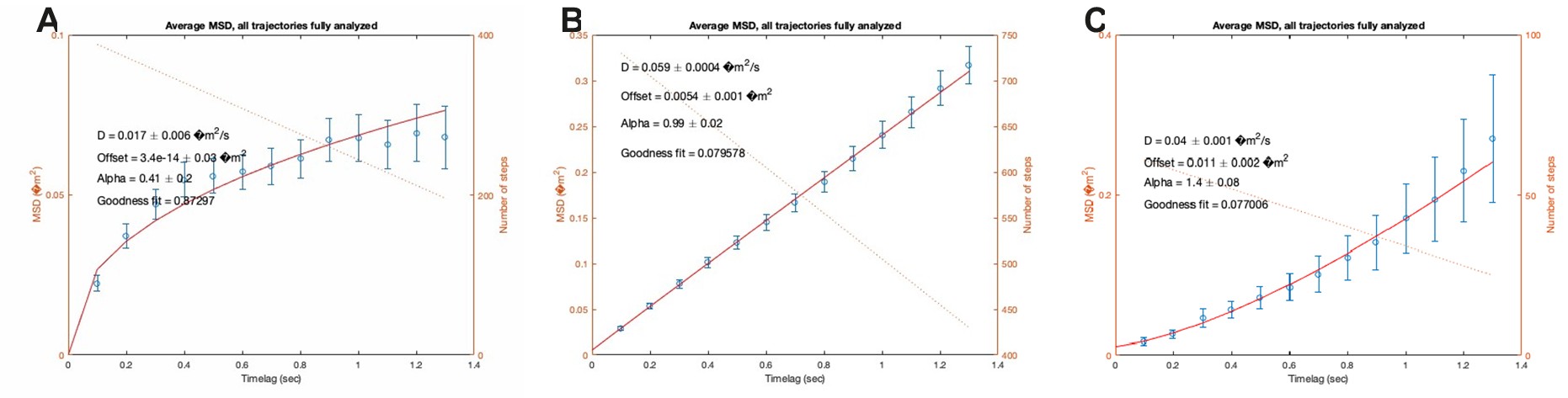
      Due to the space constraints, it is very difficult to include all the figures generated. However, to ensure comprehensive assessment and transparency (for the purpose of this review), we have included below representative plots of the MSD values as a function of time from individual trajectories, showing different types of motion obtained in our experiments (Author response image 4).

      Author response image 4.

      Representative MSD plots from individual trajectories of CXCR4AcGFP detected by SPT-TIRF in resting JKCD4 cells showing different types of motion: A) confined, B) Brownian/Free, C) direct transport.
      (4) Fig 1C,D - It would be helpful to see a plot of D vs MSI at a single particle level. In comparing C and D I'm surprised there is not a larger difference between CXCL12 and X4-gp120. It would also be very important to see the behaviour of X4-gp120 on the CXCR4 deficient Jurkat that would provide a picture of CD4 diffusion. The CXCR4 nanoclustering related to the X4-gp120 could be dominated by CD4 behaviour.

      As previously described, all analyses were performed under SPT conditions (see previous response to point 1). Figure 1C details the percentage of oligomers (>3 receptors/particle) calibrated using Jurkat CD4<sup>+</sup> cells electroporated with monomeric CD86-AcGFP (Dorsch et al. Nat. Methods, 2009). The monomer value was determined by analyzing photobleaching steps as described in our previous response to point 1.

      In our experiments, we observed a trend towards a higher number of oligomers upon activation with CXCL12 compared with X4-gp120. This trend was further supported by measurements of Mean Spot Intensity. However, the values are also influenced by the number of larger spots, which represents a minor fraction of the total spots detected.

      The differences between the effect triggered by CXCL12 or X4-gp120 might also be attributed to a combination of factors related to differences in ligand concentration, their structure, and even to the technical requirements of TIRF-M. Both ligands are in contact with the substrate (fibronectin) and the specific nature of this interaction may differ between both ligands and influence their accessibility to CXCR4. Moreover, the requirement of the prior binding of gp120 to CD4 before CXCR4 engagement, in contrast to the direct binding of CXCL12 to CXCR4, might also contribute to the differences observed.

      We previously reported that CXCL12-mediated CXCR4 dynamics are modulated by CD4 coexpression (Martinez-Muñoz et al. Mol. Cell, 2018). We have now detected the formation of CD4 heterodimers with both CXCR4 and CXCR4<sup>R334X</sup>, and found that these conformations are influenced by gp120-VLPs. In the present manuscript, we did not focus on CD4 clustering as it has been extensively characterized previously (Barrero-Villar et al. J. Cell Sci., 2009; JiménezBaranda et al. Nat. Cell. Biol., 2007; Yuan et al. Viruses, 2021). Regarding the investigation of the effects of X4-gp120 on CXCR4-deficient Jurkat cells, which would provide a picture of CD4 diffusion, we would note that a previous report has already addressed this issue using single molecule super-resolution imaging, and revealed that CD4 molecules on the cell membrane are predominantly found as individual molecules or small clusters of up to 4 molecules, and that the size and number of these clusters increases upon virus binding or gp120 activation (Yuan et al. Viruses, 2021).

      (5) Fig S1D- This data is really interesting. However, if both the CD4 and the gp120 have his tags they need to be careful as poly-His tags can bind weakly to cells and increasing valency could generate some background. So, they should make the control is fair here. Ideally, using non-his tagged person of sCD4 and gp120 would be needed ideal or they need a His-tagged Fab binding to gp120 that doesn't induce CXCR4 binding.

      New Supplementary Figure 2D shows that X4-gp120 does not bind Daudi cells (these cells do not express CD4) in the absence of soluble CD4. While the reviewer is correct to state that both proteins contain a Histidine Tag, cell binding is only detected if X4-gp120 binds sCD4. Nonetheless, we have included in the revised Supplementary Figure 2D a control showing the negative binding of sCD4 to Daudi cells in the absence of X4-gp120. Altogether, these results confirm that only sCD4/X4-gp120 complexes bind these cells.

      (6) Fig S4- Panel D needs a scale bar. I can't figure out what I'm being shown without this.

      Apologies. A scale bar has been included in this panel (new Supplementary Figure 6D).

      Reviewer #2:

      (1) This study is well described in both the main text and figures. Introduction provides adequate background and cites the literature appropriately. Materials and Methods are detailed. Authors are careful in their interpretations, statistical comparisons, and include necessary controls in each experiment. The Discussion presents a reasonable interpretation of the results. Overall, there are no major weaknesses with this manuscript.

      We very much appreciate the positive comments of the reviewer regarding the broad interest and strength of our work.

      (2) NL4-3deltaIN and immature HIV virions are found to have less associated gp120 relative to wild-type particles. It is not obvious why this is the case for the deltaIN particles or genetically immature particles. Can the authors provide possible explanations? (A prior paper was cited, Chojnacki et al Science, 2012 but can the current authors provide their own interpretation.)

      Our conclusion from the data is actually exactly the opposite. As shown in Figure 2D, the gp120 staining intensity was higher for NL4-3DIN particles (1,786 a.u.) than for gp120-VLPs (1,223 a.u.), indicating lower expression of Env proteins in the latter. Furthermore, analysis of gp120 intensity per particle (Figure 2E) confirmed that gp120-VLPs contained fewer gp120 molecules per particle than NL4-3DIN virions. These levels were comparable with, or even lower than, those observed in primary HIV-1 viruses (Zhu et al. Nature, 2006). This reduction was a direct consequence of the method used to generate the VLPs, as our goal was to produce viral particles with minimal gp120 content to prevent artifacts in receptor clustering that might occur using high levels of Env proteins in the VLPs to activate the receptors.  

      This misunderstanding may arise from the fact that we also compared Gag condensation and Env distribution on the surface of gp120-VLPs with those observed in genetically immature particles and integrase-defective NL4-3ΔIN virions, which served as controls. STED microscopy data revealed differences in Env distribution between gp120-VLPs and NL4-3ΔIN virions, supporting the classification of gp120-VLPs as mature particles (Figure 2 A,B).

      Reviewer #3:

      We thank the reviewer for considering that our work offers new insights into the spatial organization of receptors during HIV-1 entry and infection and that the manuscript is well written, and the findings significant.

      (1) For mechanistic basis of gp120-CXCR4 versus CXCL12-CXCR4 differences. Provide additional structural or biochemical evidence to support the claim that gp120 stabilises a distinct CXCR4 conformation compared to CXCL12. If feasible, include molecular modelling, mutagenesis, or crosslinking experiments to corroborate the proposed conformational differences.

      We appreciate the opportunity to clarify this point. The specific claim that gp120 stabilizes a conformation of CXCR4 that is distinct from the CXCL12-bound state was not explicitly stated in our manuscript, although we agree that our data strongly support this possibility. It is important to consider that CXCL12 binds directly to CXCR4, whereas gp120 requires prior sequential binding to CD4, and its subsequent interaction is with a CXCR4 molecule that is already forming part of the CD4/CXCR4 complex, as demonstrated by our FRET experiments and supported by previous studies (Zaitseva et al. J. Leuk. Biol., 2005; Busillo & Benovic Biochim. Biophys. Acta, 2007; Martínez-Muñoz et al. PNAS, 2014). This difference makes it inherently complex to compare the conformational changes induced by gp120 and CXCL12 on CXCR4.

      However, our findings show that both stimuli induce oligomerization of CXCR4, a phenomenon not observed when mutant CXCR4<sup>R334X</sup> was exposed to the chemokine CXCL12 (García-Cuesta et al. PNAS, 2022).

      (1) CXCL12 induced oligomerization of CXCR4 but did not affect the dynamics of CXCR4<sup>R334X</sup> (Martinez-Muñoz et al. Mol. Cell, 2018; García-Cuesta et al. PNAS, 2022). By contrast, X4-gp120 and the corresponding VLPs—which require initial binding to CD4 to engage the chemokine receptor—stabilized oligomers of both CXCR4 and CXCR4<sup>R334X</sup>.

      (2) FRET analysis revealed distinct FRET<sub>50</sub> values for CD4/CXCR4 (2.713) and CD4/CXCR4<sup>R334X</sup> (0.399) complexes, suggesting different conformations for each complex.

      (3) Consistent with previous reports (Balabanian et al. Blood, 2005; Zmajkovicova et al. Front. Immunol., 2024; García-Cuesta et al. PNAS, 2022), the molecular mechanisms activated by CXCL12 are distinct when comparing CXCR4 with CXCR4<sup>R334X</sup>. For instance, CXCL12 induces internalization of CXCR4, but not of mutant CXCR4<sup>R334X</sup>. Conversely, X4-gp120 triggers approximately 25% internalization of both receptors. Similarly, CXCL12 does not promote CD4 internalization in cells co-expressing CXCR4 or CXCR4<sup>R334X</sup>, whereas X4-gp120 does, although CD4 internalization was significantly higher in cells co-expressing CXCR4.

      These findings suggest that CD4 influences the conformation and the oligomerization state of both co-receptors. To further support this hypothesis, we have conducted new in silico molecular modeling of CD4 in complex with either CXCR4 or its mutant CXCR4<sup>R334X</sup> using AlphaFold 3.0 (Abramson et al. Nature, 2024). The server was provided with both sequences, and the interaction between the two molecules for each protein was requested. It produced a number of solutions, which were then analyzed using the software ChimeraX 1.10 (Meng et al. Protein Sci., 2023). CXCR4 and its mutant, CXCR4<sup>R334X</sup> bound to CD4, were superposed using one of the CD4 molecules from each complex, with the aim of comparing the spatial positioning of CD4 molecules when interacting with CXCR4.

      Author response image 5.

      CD4/CXCR4 complexes were superimposed with CD4/CXCR4 complexes (left panel) or CD4/CXCR4<sup>R334X</sup> complexes (right panels). Arrows indicate the CD4 molecule used as reference for the superimposing.
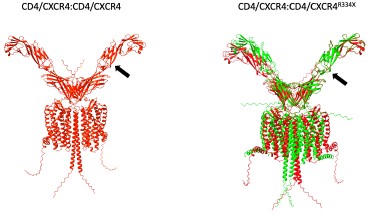
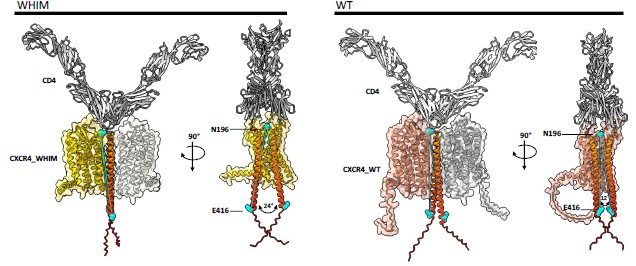
      As illustrated in Author response image 5, the superposition of the CD4/CXCR4 complexes was complete. However, when CD4/CXCR4 complexes were superimposed with CD4/CXCR4<sup>R334X</sup> complexes using the same CD4 molecule as a reference, indicated by an arrow in the figure, a clear structural deviation became evident. The main structural difference detected was the positioning of the CD4 transmembrane domains when interacting with either the wild-type or mutant CXCR4. While in complexes with CXCR4, the angle formed by the lines connecting residues E416 at the C-terminus end of CD4 with N196 in CXCR4 was 12°, for the CXCR4<sup>R334X</sup> complex, this angle increased to 24°, resulting in a distinct orientation of the CD4 extracellular domain (Author response image 6).

      Author response image 6.

      Comparison of the angle between the transmembrane domains of CD4 in CXCR4 WT and WHIM complexes. The angle between residues N196 from one CXCR4 molecule and E416 from the two CD4 dimer molecules was calculated for the CXCR4 WT (12°) and WHIM (24°) complexes to demonstrate the difference in CD4 positioning.
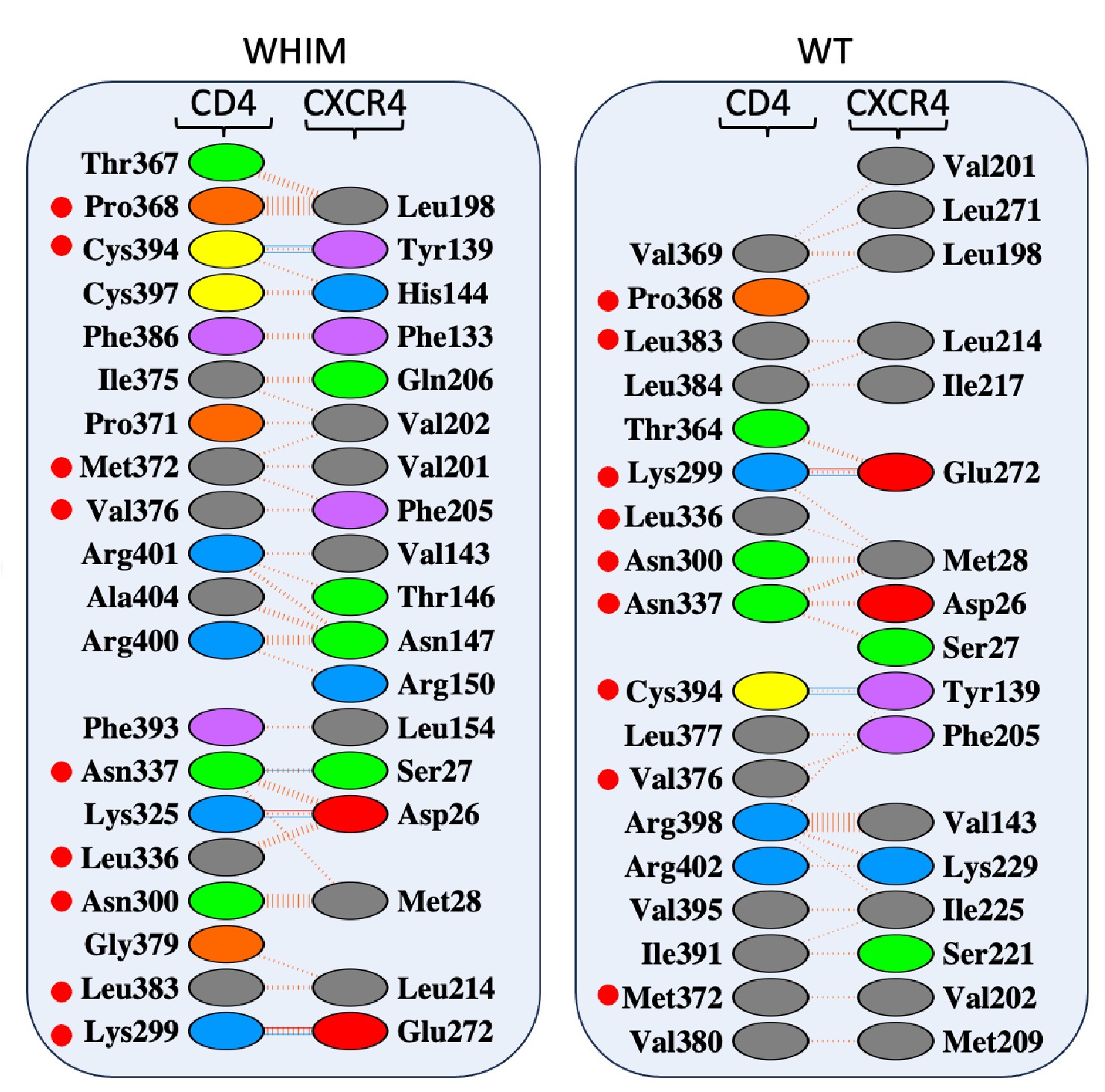
      To further analyze the models obtained, we employed PDBsum software (Laskowski & Thornton Protein Sci., 2021) to predict the CD4/CXCR4 interface residues. Data indicated that at least 50% of the interaction residues differed when the CD4/CXCR4 interaction surface was compared with that of the CD4/CXCR4<sup>R334X</sup> complex (Author response image 7). It is important to note that while some hydrogen bonds were present in both complex models, others were exclusive to one of them. For instance, whereas Cys<sup>394</sup>(CD4)-Tyr<sup>139</sup> and Lys<sup>299</sup>(CD4)-Glu<sup>272</sup> were present in both CD4/CXCR4 and CD4/CXCR4<sup>R334X</sup> complexes, the pairs Asn<sup>337</sup>(CD4)-Ser<sup>27</sup>(CXCR4<sup>R334X</sup>) and Lys<sup>325</sup>(CD4)-Asp<sup>26</sup>(CXCR4<sup>R334X</sup>) were only found in CD4/CXCR4<sup>R334X</sup> complexes.

      Author response image 7.

      Interacting residues at the CD4/CXCR4 interface. The panel displays the interface residues from the CXCR4 and CD4 oligomer. CD4 residues labeled with a red sphere show the interacting residues present in both CXCR4-WT and –WHIM hetero- oligomers. The continuous red lines represent a saline bridge, while the blue lines indicate a hydrogen bond and the dashed red lines represent non-bonded interactions. As illustrated in the figure, half of the interacting residues differ between the WT and WHIM models, indicating that the interacting surfaces are also distinct.
      These findings, which are consistent with our FRET results, suggest distinct interaction surfaces between CD4 and the two chemokine receptors. Overall, these results are compatible with differences in the spatial conformation adopted by these complexes.

      (2) For Empty VLP effects on CXCR4 dynamics: Explore potential causes for the observed effects of Envdeficient VLPs. It's valuable to include additional controls such as particles from non-producer cells, lipid composition analysis, or blocking experiments to assess nonspecific interactions.

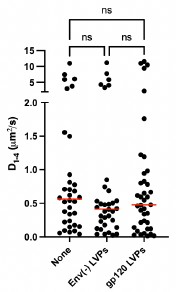
      As VLPs are complex entities, we thought that the relevant results should be obtained comparing the effects of Env(-) VLPs with gp120-VLPs. Therefore, we would first remark that regardless of the effect of Env(-) VLPs on CXCR4 dynamics, the most evident finding in this study is the strong effect of gp120-VLPs compared with control Env(-) VLPs. Nevertheless, regarding the effect of the Env(-) VLPs compared with medium, we propose several hypotheses. As several virions can be tethered to the cell surface via glycosaminoglycans (GAGs), we hypothesized that VLPs-GAGs interactions might indirectly influence the dynamics of CXCR4 and CXCR4<sup>R334X</sup> at the plasma membrane. Additionally, membrane fluidity is essential for receptor dynamics, therefore VLPs interactions with proteins, lipids or any other component of the cell membrane could also alter receptor behavior. It is well known that lipid rafts participate in the interaction of different viruses with target cells (Nayak & Hu Subcell. Biochem., 2004; Manes et al. Nat. Rev. Immunol., 2003; Rioethmullwer et al. Biochim. Biophys. Acta, 2006) and both the lipid composition and the presence of co-expressed proteins modulate ligand-mediated receptor oligomerization (Gardeta et al. Frontiers in Immunol., 2022; Gardeta et al. Cell. Commun. Signal., 2025). We have thus performed Raster Image Correlation Spectroscopy (RICS) analysis to assess membrane fluidity through membrane diffusion measurements on cells treated with Env(-) VLPs.

      Jurkat cells were labeled with Di-4-ANEPPDHG and seeded on FN and on FN + VLPs prior to analysis by RICS on confocal microscopy. The results indicated no significant differences in membrane diffusion under the treatment tested, thereby discarding an effect of VLPs on overall membrane fluidity (Author response image 8).

      Author response image 8.

      VLPs treatment does not alter cell membrane fluidity. Diffusion values obtained by RICS from JKCD4X4 cells. (n = 3, with at least 10 cells analyzed per experiment and condition; n.s., not significant).
      Nonetheless, these results do not rule out other non-specific interactions of Env(-) VLPs with membrane proteins that could affect receptor dynamics. For instance, it has been reported that Ctype lectin DC-SIGN acts as an efficient docking site for HIV-1 (Cambi et al. J. Cell. Biol., 2004; Wu & KewalRamani Nat. Rev. Immunol., 2006). However, a detailed investigation of these possible mechanisms is beyond the scope of this manuscript.

      (3) For Direct link between clustering and infection efficiency - Test whether disruption of CXCR4 clustering (e.g., using actin cytoskeleton inhibitors, membrane lipid perturbants, or clustering-deficient mutants) alters HIV-1 fusion or infection efficiency.

      Designing experiments using tools that disrupt receptor clustering by interacting with the receptors themselves is difficult and challenging, as these tools bind the receptor and can therefore alter parameters such as its conformation and/or its distribution at the cell membrane, as well as affect some cellular processes such as HIV-1 attachment and cell entry. Moreover, effects on actin polymerization or lipids dynamics can affect not only receptor clustering but also impact on other molecular mechanisms essential for efficient infection.

      Many previous reports have, nonetheless, indirectly correlated receptor clustering with cell infection efficiency. Cholesterol plays a key role in the entry of several viruses. Its depletion in primary cells and cell lines has been shown to confer strong resistance to HIV-1-mediated syncytium formation and infection by both CXCR4- and CCR5-tropic viruses (Liao et al. AIDS Res. Hum. Retroviruses, 2021). Moderate cholesterol depletion also reduces CXCL12-induced CXCR4 oligomerization and alters receptor dynamics (Gardeta et al. Cell. Commun. Signal., 2025). By restricting the lateral diffusion of CD4, sphingomyelinase treatment inhibits HIV-1 fusion (Finnegan et al. J. Virol., 2007). Depletion of sphingomyelins also disrupts CXCL12mediated CXCR4 oligomerization and its lateral diffusion (Gardeta et al. Front Immunol., 2022). Additional reports highlight the role of actin polymerization at the viral entry site, which facilitates clustering of HIV-1 receptors, a crucial step for membrane fusion (Serrano et al. Biol. Cell., 2023). Blockade of actin dynamics by Latrunculin A treatment, a drug that sequesters actin monomers and prevents its polymerization, blocks CXCL12-induced CXCR4 dynamics and oligomerization (Martínez-Muñoz et al. Mol. Cell, 2018).

      Altogether, these findings strongly support our hypothesis of a direct link between CXCR4 clustering and the efficiency of HIV-1 infection.

      (4) CD4/CXCR4 co-endocytosis hypothesis - Support the proposed model with direct evidence from livecell imaging or co-localization experiments during viral entry. Clarification is needed on whether internalization is simultaneous or sequential for CD4 and CXCR4.

      When referring to endocytosis of CD4 and CXCR4, we only hypothesized that HIV-1 might promote the internalization of both receptors either sequentially or simultaneously. The hypothesis was based in several findings:

      a) Previous studies have suggested that HIV-1 glycoproteins can reduce CD4 and CXCR4 levels during HIV-1 entry (Choi et al. Virol. J., 2008; Geleziunas et al. FASEB J, 1994; Hubert et al. Eur. J. Immunol., 1995).

      b) Receptor endocytosis has been proposed as a mechanism for HIV-1 entry (Daecke et al. J. Virol., 2005; Aggarwal et al. Traffick, 2017; Miyauchi et al. Cell, 2009; Carter et al. Virology, 2011).

      c) Our data from cells activated with X4-gp120 demonstrated internalization of CD4 and chemokine receptors, which correlated with HIV-1 infection in PBMCs from WHIM patients and healthy donors.

      d) CD4 and CXCR4 have been shown to co-localize in lipid rafts during HIV-1 infection (Manes et al. EMBO Rep., 2000; Popik et al. J. Virol., 2002)

      e) Our FRET data demonstrated that CD4 and CXCR4 form heterocomplexes and that FRET efficiency increased after gp120-VLPs treatment.

      We agree with the reviewer that further experiments are required to test this hypothesis, however, we believe that this is beyond the scope of the current manuscript.

      Minor Comments:

      (1) The conclusions rely solely on the HXB2 X4-tropic Env. It would strengthen the study to assess whether other X4 or dual-tropic strains induce similar receptor clustering and dynamics.

      The primary goal of our current study was to investigate the dynamics of the co-receptor CXCR4 during HIV-1 infection, motivated by previous reports showing CD4 oligomerization upon HIV1 binding and gp120 stimulation (Yuan et al. Viruses, 2021). We initially used a recombinant X4gp120, a soluble protein that does not fully replicate the functional properties of the native HIV-1 Env. Previous studies have shown that Env consists of gp120 trimers, which redistribute and cluster on the surface of virions following proteolytic Gag cleavage during maturation (Chojnacki et al. Nat. Commun., 2017). An important consideration in receptor oligomerization studies is the concentration of recombinant gp120 used, as it does not accurately reflect the low number of Env trimers present on native HIV-1 particles (Hart et al. J. Histochem. Cytochem., 1993; Zhu et al. Nature, 2006). To address these limitations, we generated virus-like particles (VLPs) containing low levels of X4-gp120 and repeated the dynamic analysis of CXCR4. The use of primary HIV-1 isolates was limited, in this project, to confirm that PBMCs from both healthy donors and WHIM patients were equally susceptible to infection. This result using a primary HIV-1 virus supports the conclusion drawn from our in vitro approaches. We thus believe that although the use of other X4- and dual-tropic strains may complement and reinforce the analysis, it is far beyond the scope of the current manuscript.

      (2) Given the observed clustering effects, it would be valuable to explore whether gp120-induced rearrangements alter epitope exposure to broadly neutralizing antibodies like 17b or 3BNC117. This would help connect the mechanistic insights to therapeutic relevance.

      As 3BNC117, VRC01 and b12 are broadly neutralizing mAbs that recognize conformational epitopes on gp120 (Li et al. J. Virol., 2011; Mata-Fink et al. J. Mol. Biol., 2013), they will struggle to bind the gp120/CD4/CXCR4 complex and therefore may not be ideal for detecting changes within the CD4/CXCR4 complex. The experiment suggested by the reviewer is thus challenging but also very complex. It would require evaluating antibody binding in two experimental conditions, in the absence and in the presence of oligomers. However, our data indicate that receptor oligomerization is promoted by X4-gp120 binding, and the selected antibodies are neutralizing mAbs, so they should block or hinder the binding of gp120 and, consequently, receptor oligomerization. An alternative approach would be to study the neutralizing capacity of these mAbs on cells expressing CD4/CXCR4 or CD4/CXCR4<sup>R334X</sup> complexes. Variations in their neutralizing activity could be then extrapolated to distinct gp120 conformations, which in turn may reflect differences between CD4/CXCR4 and CD4/CXCR4<sup>R334X</sup> complexes.

      We thus assessed the ability of the VRC01 and b12, anti-gp120 mAbs, which were available in our laboratory, to neutralize gp120 binding on cells expressing CD4/CXCR4 or CD4/CXCR4<sup>R334X</sup>. Specifically, increasing concentrations of each antibody were preincubated (60 min, 37ºC) with a fixed amount of X4-gp120 (0.05 µg/ml). The resulting complexes were then incubated with Jurkat cells expressing CD4/CXCR4 or CD4/CXCR4<sup>R334X</sup> (30 min, 37ºC) and, finally, their binding was analyzed by flow cytometry. Although we did not observe statistically significant differences in the neutralization capacity of b12 or VRC01 for the binding of X4-gp120 depending on the presence of CXCR4 or CXCR4<sup>334X</sup>, we observed a trend for greater concentrations of both mAbs to neutralize X4-gp120 binding in Jurkat CD4/CXCR4 cells than in Jurkat CD4/CXCR4<sup>R334X</sup> cells (Author response image 9).

      Author response image 9.

      Flow cytometry analysis of gp120 binding to Jurkat cells expressing CD4/CXCR4 or CD4/CXCR4<sup>R334X</sup> in the presence of different concentrations of the neutralizing anti-gp120 antibodies b12 (left panel) and VRC01 (right panel). AUC comparison by Welch’s t-test: pvalues 0.2950 and 0.2112 for b12 and VRC01 respectively (n = 2).
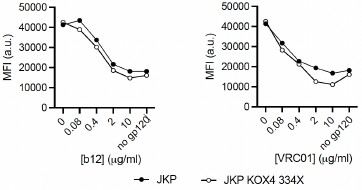
      These slight alterations in the neutralizing capacity of b12 and VRC01 mAbs may thus suggest minimal differences in the conformations of gp120 depending of the coreceptor used. We also detected that X4-gp120 and VLPs expressing gp120, which require initial binding to CD4 to engage the chemokine receptor, stabilized oligomers of both CXCR4 and CXCR4<sup>R334X</sup>, but FRET data indicated distinct FRET<sub>50</sub> values between the partners, (2.713) for CD4/CXCR4 and (0.399) for CD4/CXCR4<sup>R334X</sup> (Figure 5A,B in the main manuscript). Moreover, we also detected significantly more CD4 internalization mediated by X4-gp120 in cells co-expressing CD4 and CXCR4 than in those co-expressing CD4 and CXCR4<sup>R334X</sup> (Figure 6 in the main manuscript). Overall these latter data and those included in Author response images 5,6 and 7 indicate distinct conformations within each receptor complexes.

      (3) TIRF imaging limits analysis to the cell substrate interface. It would be useful to clarify whether CXCR4 receptor clustering occurs elsewhere, such as at immunological synapses or during cell-to-cell contact.

      In recent years, chemokine receptor oligomerization has gained significant research interest due to its role in modulating the ability of cells to sense chemoattractant gradients. This molecular organization is now recognized as a critical factor in governing directed cell migration (Martínez-Muñoz et al. Mol. Cell, 2018; García-Cuesta et al. PNAS, 2022, Hauser et al. Immunity, 2016). In addition, advanced imaging techniques such as single-molecule and super-resolution microscopy have been used to investigate the spatial distribution and dynamic behaviour of CXCR4 within the immunological synapse in T cells (Felce et al. Front. Cell Dev. Biol., 2020). Building on these findings, we are currently conducting a project focused on characterizing CXCR4 clustering specifically within this specialized cellular region.

      (4) In LVP experiments, it would be useful to report transduction efficiency (% GFP+ cells) alongside MSI data to relate VLP infectivity with receptor clustering functionally.

      These experiments were designed to validate the functional integrity of the gp120 conformation on the LVPs, confirming their suitability for subsequent TIRF microscopy. Our objective was to establish a robust experimental tool rather than to perform a high-throughput quantification of transduction efficiency. It is for that reason that these experiments were included in new Supplementary Figure S6, which also contains the complete characterization of gp120-VLPs and LVPs. In such experimental conditions, quantifying the percentage of GFP-positive cells relative to the total number of cells plated in each well is very difficult. However, in line with the reviewer’s commentary and as we used the same number of cells in each experimental condition, we have included, in the revised manuscript, a complementary graph illustrating the GFP intensity (arbitrary units) detected in all the wells analyzed (new Supplementary Fig. 6E).

      (5) To ensure that differences in fusion events (Figure 7B) are attributable to target cell receptor properties, consider confirming that effector cells express similar levels of HIV-1 Env. Quantifying gp120 expression by flow cytometry or western blot would rule out the confounding effects of variable Env surface density.

      In these assays (Figure 7B), we used the same effector cells (cells expressing X4-gp120) in both experimental conditions, ensuring that any observed differences should be attributable solely to the target cells, either JKCD4X4 or JKCD4X4<sup>R334X</sup>. For this reason, in Figure 7A we included only the binding of X4-gp120 to the target cells which demonstrated similar levels of the receptors expressed by the cells.

      (6) HIV-mediated receptor downregulation may occur more slowly than ligand-induced internalization. Including a 24-hour time point would help assess whether gp120 induces delayed CD4 or CXCR4 loss beyond the early effects shown and to better capture potential delayed downregulation induced by gp120.

      The reviewer suggests using a 24-hour time point to facilitate detection of receptor internalization. However, such an extended incubation time may introduce some confounding factors, including receptor degradation, recycling and even de novo synthesis, which could affect the interpretation of the results. Under our experimental conditions, we observed that CXCL12 did not trigger CD4 internalization whereas X4-gp120 did. Interestingly, CD4 internalization depended on the coreceptor expressed by the cells.

      (7) Increase label font size in microscopy panels for improved readability.

      Of course; the font size of these panels has been increased in the revised version.

      (8) Consider adding more references on ligand-induced co-endocytosis of CD4 and chemokine receptors during HIV-1 entry.

      We have added more references to support this hypothesis (Toyoda et al. J. Virol., 2015; Venzke et al. J. Virol., 2006; Gobeil et al J. Virol., 2013).

      (9) For Statistical analysis. Biological replicates are adequate, and statistical tests are generally appropriate. For transparency, report n values, exact p-values, and the statistical test used in every figure legend and discussed in the results.

      Thank you for highlighting the importance of transparency in statistical reporting. We confirm that the n values for all experiments have been included in the figure legends. The statistical tests used for each analysis are also clearly indicated in the figure legends, and the interpretation of these results is discussed in detail in the Results section. Furthermore, the Methods section specifies the tests applied and the thresholds for significance, ensuring full transparency regarding our analytical approach.

      In accordance with established conventions in the field, we have utilized categorical significance indicators (e.g., n.s., *, **, ***) within our figures to enhance readability and focus on biological trends. This approach is widely adopted in high-impact literature to prevent visual clutter. However, to ensure full transparency and reproducibility, we have ensured that the underlying statistical tests and thresholds are clearly defined in the respective figure legends and Methods section.

      Reviewer #4:

      We thank the reviewer for considering that this work is presented in a clear fashion, and the main findings are properly highlighted, and for remarking that the paper is of interest to the retrovirology community and possibly to the broader virology community.

      We also agree on the interest that X4-gp120 clusters CXCR4<sup>R334X</sup> suggests a different binding mechanism for X4-gp120 from that of the natural ligand CXCL12, an aspect that we are now evaluating. These data also indicate that WHIM patients can be infected by HIV-1 similarly to healthy people.

      (1) The observation that "empty VLPs" reduce CXCR4 diffusivity is potentially interesting. However, it is not supported by the data owing to insufficient controls. The authors correctly discuss the limitations of that observation in the Discussion section (lines 702-704). However, they overinterpret the observation in the Results section (lines 509-512), suggesting non-specific interactions between empty VLPs, CD4 and CXCR4. I suggest either removing the sentence from the Results section or replacing it with a sentence similar to the one in the Discussion section.

      In accordance with the reviewer`s suggestion, the sentence in the result section has been replaced with one similar to that found in the discussion section. In addition, we have performed Raster Image Correlation Spectroscopy (RICS) analysis using the Di-4-ANEPPDHQ lipid probe to assess membrane fluidity by means of membrane diffusion, and compared the results with those of cells treated with Env(-) VLPs. The results indicated that VLPs did not modulate membrane fluidity (Author response image 8). Nonetheless, these results do not rule out other potential non-specific interactions of the Env(-) VLPs with other components of the cell membrane that might affect receptor dynamics (see our response to point 2 of reviewer #3).

      (2) In the case of the WHIM mutant CXCR4-R334X, the addition of "empty VLPs" did not cause a significant change in the diffusivity of CXCR4-R334X (Figure 4B). This result is in contrast with the addition of empty VLPs to WT CXCR4. However, the authors neither mention nor comment on that result in the results section. Please mention the result in the paper and comment on it in relation to the addition of empty VLPs to WT CXCR4.

      We would remark that the main observation in these experiments should focus on the effect of gp120-VLPs, and the results indicates that gp120-VLPs promoted clustering of CXCR4 and of CXCR4<sup>R334X</sup> and reduced their diffusion at the cell membrane. The Env(- ) VLPs were included as a negative control in the experiments, to compare the data with those obtained using gp120VLPs. However, once we observed some residual effect of the Env(-) VLPs, we decided to give a potential explanation, formulated as a hypothesis, that the Env(-) VLPs modulated membrane fluidity. We have now performed a RICS analysis using Di-4-ANEPPDHQ as a lipid probe (Author response image 9). The results suggest that Env(-) VLPs do not modulate cell membrane fluidity, although we do not rule out other potential interactions with membrane proteins that might alter receptor dynamics. We appreciate the reviewer’s observation and agree that this result can be noted. However, since the main purpose of Figure 4B is to show that gp120-VLPs modulate the dynamics of CXCR4<sup>R334X</sup> rather than to remark that the Env(-) VLPs also have some effects, we consider that a detailed discussion of this specific aspect would detract from the central finding and may dilute the primary narrative of the study.

      Minor comments

      (1) It would be helpful for the reader to combine thematically or experimentally linked figures, e.g., Figures 3 and 4.

      (2) Figures 3 and 4 are very similar. Please unify the colours in them and the order of the panels (e.g. Figure 3 panel A shows diffusivity of CXCR4, while Figure 4 panel A shows MSI of CXCR4-R334X).

      While we considered consolidating Figures 3 and 4, we believe that maintaining them as separate entities enhances conceptual clarity. Since Figure 3 establishes the baseline dynamics for wildtype CXCR4 and Figure 4 details the distinct behavior of the CXCR4<sup>R334X</sup> mutant, keeping them separate allows the reader to fully appreciate the specificities of each system before making a cross-comparison.

      (3) Some parts of the Discussion section could be shortened, moved to the Introduction (e.g., lines 648651), or entirely removed (e.g., lines 633-635 about GPCRs).

      In accordance, the Discussion section has been reorganized and shortened to improve clarity.

      (4) I suggest renaming "empty VLPs" to "Env(−) VLPs" (or similar). The name empty VLPs can mislead the reader into thinking that these are empty vesicles.

      The term empty VLPs has been renamed to Env(−) VLPs throughout the manuscript to more accurately reflect their composition. Many thanks for this suggestion.

      (5) Line 492 - please rephrase "...lower expression of Env..." to "...lower expression of Env or its incorporation into the VLPs...".

      The sentence has been rephrased

      (6) Line 527 - The data on CXCL12 modulating CXCR4-R334X dynamics and clustering are not present in Figure 4 (or any other Figure). Please add them or rephrase the sentence with an appropriate reference. Make clear which results are yours.

      (7) Line 532 - Do the data in the paper really support a model in which CXCL12 binds to CXCR4R334X? If not, please rephrase with an appropriate reference.

      Previous studies support the association of CXCL12 with CXCR4<sup>R334X</sup> (Balabanian et al. Blood, 2005; Hernandez et al. Nat Genet., 2003; Busillo & Benovic Biochim. Biophys. Acta, 2007). In fact, this receptor has been characterized as a gain-of-function variant for this ligand (McDermott et al. J. Cell. Mol. Med., 2011). The revised manuscript now includes these bibliographic references to support this commentary. In any case, our previous data indicate that CXCL12 binding does not affect CXCR4<sup>R334X</sup> dynamics (García-Cuesta et al. PNAS, 2022).

      (8) Line 695 - "...lipid rafts during HIV-1 (missing word?) and their ability to..." During what?

      Many thanks for catching this mistake. The sentence now reads: “Although direct evidence for the internalization of CD4 and CXCR4 as complexes is lacking, their co-localization in lipid rafts during HIV-1 infection (97–99) and their ability to form heterocomplexes (22) strongly suggest they could be endocytosed together.”

    1. SoutherncitiessuchasMontgomery, Birmingham, Memphis,andAtlanta,infact,nowmarket themselvespartlythroughcivilrights tour-ism—attimesrightalongsideConfederatetourism,asintheaseofMontgomery.ButcometoNewYork,Boston,orDetroitand historicalmarkerstolocalcivilrightsmovementsarehardtofind.

      Although it is very important to raise awareness of what happened in the Southern cities, it is difficult to place awareness on the Northern cities with all the marketing that is directed at the South. It seems to be already implanted in people’s heads that the South primarily struggled, and although it is true, the North is rarely mentioned and they also had quite the struggle.

    1. Vous avez l’impression de faire des choix libres alors même que l’environnement dans lequel vous les faites est en partie structuré par des algorithmes.

      La surveillance numérique est-elle tolérée par les utilisateurs parce qu’elle est utile, ou parce qu’elle est invisible ?

    Annotators

    1. Pratiques et perspectives sur l'anxiété en milieu scolaire : Document de synthèse

      Résumé exécutif

      L'anxiété en milieu scolaire est une émotion universelle et normale, mais dont la manifestation et l'intensité varient considérablement d'un élève à l'autre.

      Ce document synthétise les réflexions de Julie Beaulieu, docteure en psychopédagogie, sur les moyens de soutenir les élèves anxieux pour favoriser leur réussite et leur bien-être.

      Les points clés à retenir sont les suivants :

      • Nature de l'anxiété : Contrairement au stress qui est une réaction ponctuelle à un déclencheur précis, l'anxiété est une appréhension diffuse, souvent liée à une perception subjective de menace ou de défi insurmontable.

      • Le Triangle des manifestations : L'anxiété s'exprime à travers trois composantes interdépendantes : les pensées (cognitif), les sensations physiques/émotions (physiologique) et les comportements (évitement, fuite).

      • Approche pédagogique : L'intervention doit privilégier la relation de confiance, la bienveillance et la normalisation de l'anxiété et de l'erreur au sein de la classe.

      • Stratégie d'action : L'exposition graduelle et la fixation d'objectifs réalistes sont essentielles pour développer le sentiment de compétence de l'élève et réduire l'emprise de l'anxiété à long terme.

      --------------------------------------------------------------------------------

      1. Comprendre l'anxiété : Définitions et distinctions

      L'anxiété est une émotion saine qui possède une fonction d'adaptation et de protection.

      Elle permet, par exemple, de se préparer à une évaluation ou de réagir face à un danger réel.

      Distinction entre stress et anxiété

      | Caractéristique | Stress | Anxiété | | --- | --- | --- | | Nature | Réaction à une situation précise. | Appréhension de ce qui pourrait survenir. | | Durée | Souvent circonscrit et diminue après l'événement. | Peut se maintenir sur le long terme. | | Déclencheur | Élément réel et modéré. | Peut être basé sur une situation imaginaire. | | Perception | Réaction directe à un stresseur. | Filtre de perception qui amplifie la menace. |

      Le rôle de la perception

      L'anxiété est profondément subjective.

      Elle repose sur l'interprétation que l'élève fait de son environnement.

      Un élève peut percevoir une situation comme menaçante pour son ego ou comme un défi trop grand (nouveauté, imprévu), ce qui génère un état d'hypervigilance.

      --------------------------------------------------------------------------------

      2. Les manifestations de l'anxiété : Le modèle du triangle

      L'anxiété se manifeste par trois composantes qui fonctionnent comme des vases communicants.

      Intervenir sur l'une d'elles permet souvent d'influencer les autres.

      Composante cognitive (Les pensées)

      • Pensées erronées ou négatives.

      • Scénarios catastrophiques.

      • Anticipation anxieuse de l'avenir.

      Composante physiologique et émotionnelle (Le ressenti)

      • Sensations physiques : Rythme cardiaque accéléré (souvent le premier signe), respiration rapide, maux de tête, maux de ventre, nausées, mains moites, rougeurs, boule dans la gorge.

      • Émotions associées : Peur, honte, culpabilité (de ne pas être comme les autres), sentiment de panique ou d'angoisse.

      Composante comportementale (Les actions)

      • Évitement : Refus de participer à une activité (le réflexe le plus courant).

      • Fuite ou opposition : Tentatives de quitter la situation ou réactions de rejet.

      • Procrastination : Repousser la tâche pour éviter l'inconfort.

      • Désorganisation : Perte de moyens ou retrait total dans ses pensées.

      --------------------------------------------------------------------------------

      3. Pratiques éducatives à privilégier

      L'objectif n'est pas de faire disparaître totalement l'anxiété, mais d'aider l'élève à fonctionner malgré un certain inconfort.

      Climat et relations

      • Relation enseignant-élève : Une relation de confiance est le fondement nécessaire pour que l'élève accepte de partager son vécu et ses craintes.

      • Climat de classe bienveillant : Créer un environnement où les émotions sont accueillies et non jugées.

      • Normalisation universelle : Expliquer à l'ensemble du groupe que l'anxiété et l'erreur sont des éléments normaux de l'apprentissage et de la vie.

      Soutien à l'autonomie et au courage

      • Validation de la perception : Sans minimiser la peur de l'élève, l'aider à comprendre la source de son anxiété pour élaborer des solutions.

      • Soutien social : Encourager les liens entre pairs.

      Le modèle des autres élèves affrontant des situations similaires peut aider l'élève anxieux.

      • Développement du sentiment de compétence : Faire vivre des succès à l'élève pour renforcer son estime de soi et sa capacité à affronter les défis.

      --------------------------------------------------------------------------------

      4. Stratégies d'intervention concrètes

      L'exposition graduelle

      L'évitement, bien que soulageant à court terme, nourrit l'anxiété à long terme.

      La pratique recommandée est celle de l'escalier ou du "pas à pas" :

      • Fixer des objectifs réalistes et progressifs.

      • Exemple de l'exposé oral : Commencer par présenter devant l'enseignant seul, puis devant un petit groupe, avant d'envisager la classe entière.

      Gestion des sensations physiologiques

      Utiliser des outils pour "calmer le corps" :

      • Respiration profonde : Pour ralentir le rythme cardiaque et stabiliser la respiration.

      • Objets sensoriels : Pour aider à l'autorégulation physique.

      Collaboration avec les parents

      Les parents peuvent parfois, par désir de protection, encourager l'évitement chez leur enfant.

      Il est conseillé de :

      • Sensibiliser les parents à l'effet de la communication de leur propre anxiété.

      • Encourager les parents à verbaliser leurs propres stratégies de gestion du stress devant l'enfant.

      • Éviter les mesures d'évitement systématiques (comme les horaires allégés prolongés) qui renforcent le sentiment d'incapacité.

      --------------------------------------------------------------------------------

      5. Principes directeurs pour les intervenants

      • Absence de recette miracle : Chaque élève est unique ; les interventions doivent être adaptées aux besoins spécifiques (besoin de sécurité, etc.).

      • Constance et cohérence : Les élèves anxieux sont très vigilants au changement ; la prévisibilité de l'adulte est rassurante.

      • Persévérance : Le changement prend du temps et de l'énergie. Il faut maintenir les pratiques sur la durée.

      • Confiance : L'intervenant doit se faire confiance et faire confiance aux capacités de l'élève à progresser.

      --------------------------------------------------------------------------------

      6. Ressources recommandées

      Pour approfondir le sujet, les ressources suivantes sont suggérées par les experts :

      • Fondation Jeunes en Tête : Site complet pour élèves, parents et intervenants.

      • Éditions Midi Trente :

        • 10 questions sur l'anxiété (Caroline Berthiaume).
      • Maîtrise-moi (pour le primaire).

      • Alex (format blog pour les adolescents).

      • Ouvrages sur l'anxiété de performance (Nathalie Parent).

  2. stylo.ecrituresnumeriques.ca stylo.ecrituresnumeriques.ca
    1. Ces technologies permettent donc aux utilisateurs de surveiller leur santé et d’adopter des comportements plus favorables à leur bien-être.

      Les inégalités sociales et économiques constituent-elles aussi un enjeu dans le développement de la e-santé, notamment en ce qui concerne l’accès aux objets connectés de santé ?

    1. tandis que certains influenceurs littéraires sont désormais rémunérés pour promouvoir des titres.

      Les influenceurs remplacent les critiques, mais sont-ils vraiment crédibles ? Sans diplôme en littérature et avec des livres offerts par les éditeurs, il est difficile de savoir si leur avis est vrm sincère ou s'il s'agit d'une publicité déguisée qd le livre est envoyé gratuitement

    1. Briefing : Le Soutien à la Compétence Sociale chez l'Enfant

      Résumé Exécutif

      La compétence sociale ne se limite pas à la simple interaction polie ; elle constitue le "trait d'union" essentiel entre l'instruction scolaire et la qualification professionnelle.

      Ce document synthétise les réflexions d'Éric Morissette, expert en sciences de l'éducation, sur l'importance cruciale de la socialisation dans le développement global de l'enfant.

      Les points saillants indiquent que le développement explicite des compétences sociales entraîne une augmentation de 13 % de la réussite scolaire.

      Le parent y joue un rôle prépondérant non pas par l'intuition, mais par un modelage intentionnel et une posture de "compagnonnage".

      En favorisant une approche basée sur la psychologie positive et la résolution de problèmes, les parents peuvent transformer les défis relationnels en leviers de résilience, tant durant la petite enfance qu'à l'adolescence.

      --------------------------------------------------------------------------------

      1. Définition et Composantes de la Compétence Sociale

      La socialisation est une mission fondamentale de l'école, au même titre que l'instruction.

      Lorsqu'elle est maîtrisée, elle apaise l'affectif de l'élève, le rendant pleinement disponible pour les apprentissages.

      Elle repose sur cinq piliers interdépendants :

      | Composante | Description Concrète | | --- | --- | | Conscience de soi | Reconnaissance de ses propres forces et faiblesses. | | Gestion des émotions | Capacité à identifier ses émotions pour trouver des moyens de les résoudre. | | Conscience des autres | Développement de l'empathie et compréhension d'autrui. | | Compétences relationnelles | Efficacité dans les interactions avec les adultes, les pairs et les amis. | | Résolution de problèmes | Choix de moyens positifs pour surmonter l'adversité et développer la résilience. |

      --------------------------------------------------------------------------------

      2. L'Impact de la Socialisation sur la Réussite Scolaire

      Les recherches, notamment celles du groupe Castle en 2017, démontrent un lien direct entre l'enseignement explicite des compétences sociales et la performance académique.

      • Gain de performance : On observe une augmentation de 13 % des résultats scolaires lorsque les compétences sociales sont enseignées de façon explicite en milieu scolaire.

      • Disponibilité cognitive : Un enfant dont les relations sont conflictuelles (intimidation, disputes) est préoccupé par son affectif.

      À l'inverse, un climat relationnel apaisé permet à l'enfant de se concentrer sur l'instruction et l'évaluation.

      • Agilité relationnelle : La psychologie positive permet à l'enfant de mieux s'intégrer dans les deux systèmes majeurs de sa vie : la famille et l'école.

      --------------------------------------------------------------------------------

      3. Le Parent comme Modèle de Socialisation

      Le parent est le principal modèle de l'enfant.

      L'apprentissage se fait majoritairement par apprentissage vicarien, c'est-à-dire par observation et imitation (copiage).

      Le Modelage Intentionnel

      Le parent doit passer d'une éducation intuitive à une éducation intentionnelle :

      • Gestion des émotions : Si le parent veut enseigner le contrôle de soi, il doit lui-même être en harmonie avec ses émotions et les réguler devant l'enfant.

      • Mentalisation : Ce processus consiste à transformer un ressenti affectif en théorie ou concept pour le résoudre.

      Le parent qui "mentalise" ses réactions montre à l'enfant comment ne pas céder à la violence ou à la colère.

      • Humilité et excuses : S'excuser auprès de son enfant n'est pas un signe de faiblesse, mais un acte d'enseignement.

      Cela modèle le comportement que l'on attend de l'enfant lorsqu'il commettra une erreur.

      La Résolution de Problèmes par le Compagnonnage

      Faire participer l'enfant à des tâches concrètes (ex: réparer un robinet) permet de lui montrer comment résoudre un problème par l'action plutôt que par la critique.

      Cela favorise le transfert de compétences vers d'autres situations de la vie.

      --------------------------------------------------------------------------------

      4. Stratégies d'Intervention selon l'Âge

      Bien que l'idéal soit de commencer dès la petite enfance (périodes du "Terrible 2" ou du "Fameux 4"), il n'est jamais trop tard pour intervenir, même à l'adolescence.

      L'approche avec l'adolescent

      L'adolescence est une phase de distanciation normale où les amis prennent une place prépondérante.

      Pour maintenir le lien :

      • Privilégier le questionnement : Au lieu de donner des conseils non sollicités ou de faire des monologues, il faut poser des questions pour amener l'adolescent à réfléchir.

      • Éviter le blâme et la comparaison : Dire "à ton âge, j'aurais fait ceci" invalide l'expérience de l'enfant et crée une distance.

      • S'intéresser sincèrement : La réciprocité est la clé.

      En s'intéressant aux intérêts de l'adolescent (sa musique, ses passions), le parent modèle un comportement empathique que l'enfant finira par retourner.

      --------------------------------------------------------------------------------

      5. Fondements Théoriques et Ressources

      L'approche préconisée s'appuie sur la psychologie positive, une branche de la psychologie qui ne se limite pas au "jovialisme", mais qui étudie comment les individus peuvent s'épanouir malgré l'adversité.

      • Auteur de référence : Martin Seligman, notamment avec son ouvrage S’épanouir (Flourish), qui traite de l'éducation positive et de son impact scientifique sur l'adaptation de la personne.

      • Organismes ressources :

        • La Chaire de recherche sur la prévention de la violence et de l'intimidation à l'école (Chaire sur le bien-être).
      • Les outils développés par l'Unité Mixte de Recherche (UMR) Synergia.

      • Les concepts d'apprentissage socio-émotionnel largement documentés au Québec et en France.

      Conclusion

      Soutenir la compétence sociale de l'enfant demande de la persévérance et une analyse constante de ses propres comportements en tant qu'adulte.

      En devenant un modèle conscient et en utilisant le dialogue plutôt que la confrontation, le parent équipe l'enfant des outils nécessaires pour naviguer harmonieusement dans la société et réussir son parcours scolaire.

    1. L'Accompagnement Professionnel en Milieu Scolaire : Conditions de Mise en Œuvre et d'Efficacité

      Résumé Exécutif

      L'accompagnement professionnel en milieu scolaire est un levier essentiel pour l'inclusion des élèves et le développement des compétences pédagogiques.

      Toutefois, les recherches démontrent que les formations ponctuelles (conférences ou journées pédagogiques isolées) sont insuffisantes pour transformer durablement les pratiques.

      Pour être efficace, l'accompagnement doit s'inscrire dans la durée — avec un minimum de cinq rencontres — et reposer sur une analyse rigoureuse des besoins spécifiques des intervenants.

      Le succès de ces dispositifs repose sur une approche volontaire et collaborative, soutenue par une direction d'école qui valorise l'accompagnement comme un privilège plutôt qu'une obligation.

      Qu'il s'agisse de coaching pour des compétences précises, de mentorat pour l'insertion professionnelle ou d'approches interdisciplinaires pour les cas complexes, la flexibilité et la qualité de la relation entre l'accompagnateur et l'accompagné demeurent les pierres angulaires du changement.

      --------------------------------------------------------------------------------

      I. Les Mandats de l'Accompagnateur

      L'accompagnement professionnel se décline en trois mandats principaux, définis par l'objectif central de l'intervention :

      • Mandat centré sur l'élève : Vise à soutenir l'enseignant et les intervenants gravitant autour d'un élève en difficulté pour favoriser son inclusion scolaire.

      • Mandat centré sur l'intervenant : Orienté vers l'amélioration des pratiques professionnelles, de la compréhension des problématiques et du sentiment d'auto-efficacité des enseignants, techniciens en éducation spécialisée ou autres professionnels.

      • Mandat centré sur l'organisation : Concerne la mise en place de programmes de prévention à l'échelle de l'école ou le développement de cadres de référence (ex. : gestion de crise, prévention du suicide).

      --------------------------------------------------------------------------------

      II. Modalités d'Accompagnement selon les Objectifs

      Le choix de la modalité dépend directement de la complexité du problème et des compétences à développer.

      1. Pour favoriser l'adaptation des élèves

      Trois approches se révèlent particulièrement efficaces, partageant une structure commune : analyse de la situation, intervention collaborative et suivi.

      | Approche | Description et Focus | | --- | --- | | Comportementale | Analyse des antécédents et des conséquences pour comprendre la fonction du comportement. L'efficacité est accrue par l'intégration des parents. | | Santé Mentale | Analyse approfondie des facteurs de risque et de protection (individuels, familiaux, environnementaux). Nécessite généralement 4 à 5 rencontres. | | Équipe Interdisciplinaire | Réservée aux cas complexes (comorbidités). Réunit divers experts autour de l'enseignant sous la coordination d'une personne pivot. |

      2. Pour le changement de pratiques pédagogiques

      L'amélioration des compétences, comme la gestion de classe, requiert des dispositifs ciblés :

      • Formation-Accompagnement : Combine de courtes capsules théoriques et des périodes de mise en œuvre en classe avec suivi.

      Le format de groupe est privilégié ici pour réduire la résistance au changement et favoriser la collaboration.

      • Coaching : Destiné au développement de compétences très précises (ex. : enseignement explicite des comportements). Il s'agit d'un accompagnement individuel par un expert offrant un feedback correctif sur une période de 5 à 10 rencontres.

      3. Pour l'insertion professionnelle

      L'accueil des nouveaux enseignants ou professionnels nécessite une approche hybride :

      • Formation-Accompagnement adaptée : Centrée sur les thèmes de l'insertion (connaissance du milieu, gestion administrative).

      • Mentorat : Accompagnement par un pair expérimenté.

      Au-delà des compétences techniques, le mentorat travaille sur l'identité professionnelle, les valeurs et les attitudes, favorisant ainsi la rétention du personnel.

      --------------------------------------------------------------------------------

      III. Conditions Universelles de Mise en Œuvre

      Quelle que soit la modalité choisie, plusieurs conditions transversales garantissent la qualité de l'accompagnement :

      • Analyse des besoins : L'accompagnement doit être "taillé sur mesure" et non standardisé.

      Il doit partir des besoins réels exprimés par les personnes accompagnées.

      • Expertise du processus : L'accompagnateur doit maîtriser non seulement le contenu, mais aussi le processus de changement (gestion de la résistance, approche collaborative, positionnement égalitaire).

      • Durée et Étalement : Les interventions de moins de cinq rencontres sont jugées inefficaces.

      Le changement nécessite du temps et des interactions répétées.

      • Format de rencontre :

        • Individuel : Préférable pour les intervenants en grande détresse.
      • Groupe : Favorise le positivisme et aide à vaincre les résistances grâce au soutien des pairs.

      • Virtuel vs Présentiel : Le virtuel est efficace à condition d'établir la relation de confiance en présentiel lors des deux premières rencontres.

      • Activités diversifiées : L'accompagnement doit inclure de la résolution de problèmes, du débriefing, de la rétroaction et, idéalement, de l'observation directe en milieu de travail.

      --------------------------------------------------------------------------------

      IV. Facteurs d'Efficacité et Climat Organisationnel

      L'organisation doit offrir un contexte favorable pour que l'accompagnement porte ses fruits :

      • Volontariat et Engagement : L'adhésion doit être volontaire.

      L'imposition d'une formation nuit à l'engagement et à l'autodétermination de l'intervenant.

      • Soutien de la Direction : La direction doit promouvoir l'accompagnement comme une opportunité positive et non comme une mesure corrective ou évaluative.

      • Libération de temps : L'accompagnement doit être intégré à l'horaire de travail.

      Les participants doivent être libérés de leurs tâches régulières pour s'y consacrer pleinement.

      • Clarification des rôles : Il est crucial de dissocier l'accompagnement de l'évaluation administrative pour préserver la confiance.

      • Prévention : L'accompagnement doit être proactif.

      Il est préférable d'intervenir tôt, dès l'identification d'un défi (ex. : classe difficile), plutôt que d'attendre l'épuisement de l'intervenant.

      --------------------------------------------------------------------------------

      V. Ressources Complémentaires

      Pour approfondir les différentes modalités d'accompagnement, il est suggéré de consulter l'ouvrage de référence suivant :

      • Ouvrage : Le développement professionnel en milieu éducatif, dirigé par Nancy Gaudreau, Nathalie Trépanier et Sonia Daigle.

      • Accessibilité : Ce livre, publié en collaboration avec le Réverbère, est disponible gratuitement en format PDF et traite en détail de chaque modalité d'accompagnement par des chapitres spécifiques.

    1. En effet, les algorithmes mettent en avant certains contenus qui contribuent à la reproduction des stéréotypes de genre, comme le note Florian Dauphin.

      Je pense que c'est à nuancer: les algorithmes ne sont pas les seuls coupables de la reproduction des stéréotypes de genre. Les algorithmes de recommandation ne font que refléter et amplifier ce que les utilisateurs valident déjà. Je pense que les utilisateurs sont grandement responsables. Si le public ne cliquait pas sur ces contenus genrés, l'algorithme ne les mettrait pas en avant.

    1. un outil pour être plus « vrai »

      Je suis d'accord avec cette partie, mais je pense que le pseudonyme ouvre une porte a la haine, la violence verbale et la désinformation. Pouvoir se cacher derrière une identité n'est pas une bonne chose pour les personnes mal intentionnées; on pourrait se demander si, sans pseudonymes, il y aurait autant d'harcelement et de haine sur les réseaux sociaux.

  3. inst-fs-iad-prod.inscloudgate.net inst-fs-iad-prod.inscloudgate.net
    1. Listening just once to a song stored in the Cloud uses less energy than pur-chasing and shipping a CD, taking into account manufacturing and transportenergy. Listening to the song a couple of dozen times leads to more overallenergy used, largely because of greater use of the networks. The Cloud usesmore energy streaming a high-def movie just once than does fabricating andshipping a DVD.43Clearly, the cloud offers convenience and less visible clutter, at a price. Thereare power savings to be had with remote data storage and sharing if theservices are used infrequently, but many use the cloud less as archive thanwardrobe, a place to keep things that are used every day. If we downloadphotos often enough, we would do better to store them on our own comput-ers, rather than the cloud: “A laptop hard drive operates at ~1 watt whetheraccessing a photo twice a day (~0.1 downloads/hr) or accessing 100 photos.As download frequency rises the Cloud can consume over 10 times moreenergy to store and access information than storing on a laptop.”

      Consider, though, whether and how the CD will leave physical trash behind, in contrast to a game file, considering you need a machine for its sound nevertheless. Shall this machine be individual, or could it be shared?

    2. Is playing a game online an environ-mentally dubious alternative to playing a game off one’s own computer harddrive? Are single-player, or better yet analog games the most sustainablechoices?

      Playdate?

    3. Tuan claims that vertically oriented cultures, like those of peasantsand subsistence farmers, tend to live by cyclical time, to see themselves aspart of a religious cosmos and seasonal shifts, rather than the secularizedand aestheticized horizontal expanses of modernity, indicated in our termslandscape, scenery, and countryside.Tuan’s broad-stroke observations support an interpretation of game envi-ronments that prioritizes their manipulation of the player’s experience oftime and distance. Rather than the physicist’s formula, distance = rate × time

      Against linear progress models

    1. on n’a pas ce budget, pas ce corps, pas cette vie sociale. Toutefois, L’article «They Post, I Scroll, I Envy, I Buy» montre que certains abonnés développent une distance critique et ne sont pas de simples victimes passives.

      Et justement je pense que tu pourrais ajouter qu'il y a certains mouvements (encore timides) qui apparaissent sur les réseaux sociaux, comme celui de montrer la réalité, afin de faire décomplexer les gens (ex: Instagram VS Reality). De plus en plus de résistances émergent avec notamment l'essor d'appli comme BeReal, qui veulent montrer la vie "réelle".

    1. Les Effets des Comportements Difficiles en Classe : Perspectives de la Recherche et du Terrain

      Résumé Exécutif

      Ce document de synthèse examine l'impact de l'inclusion des élèves présentant des difficultés de comportement sur leurs pairs, en croisant les données de la recherche scientifique et l'expertise clinique de terrain.

      Contrairement aux idées reçues, la littérature scientifique (basée sur des recensions systématiques de 2007 à 2021) indique que dans plus de 80 % des cas, l'inclusion n'a pas d'effet négatif systématique sur les apprentissages scolaires des autres élèves.

      Au contraire, elle peut favoriser des gains sociaux significatifs, tels que l'ouverture à la diversité et l'empathie.

      La réussite de cette inclusion repose toutefois sur des conditions rigoureuses : * des pratiques enseignantes différenciées, * un soutien multidisciplinaire solide, * des protocoles d'intervention prévisibles et une posture d'ouverture de la part des intervenants.

      1. Définition et Nature des Difficultés de Comportement

      Il est essentiel de clarifier ce que recouvre le terme « élève en difficulté de comportement » pour comprendre les dynamiques de classe.

      • Profils types : Il s'agit d'élèves réactifs, manifestant des comportements dérangeants, perturbateurs, voire violents.

      Ces élèves éprouvent des difficultés marquées d'autorégulation émotionnelle et comportementale.

      • Manifestations : Bien que les difficultés puissent être intériorisées, la littérature et le milieu scolaire se concentrent principalement sur les comportements extériorisés (opposition, défi de l'autorité).

      • Complexité sous-jacente : Ces difficultés sont souvent le symptôme de problématiques complexes et diversifiées, fréquemment accompagnées de difficultés d'apprentissage.

      Ces élèves mobilisent une part importante de l'attention et des ressources des adultes.

      2. Analyse des Effets sur les Autres Élèves : Ce que dit la Recherche

      Marie-Claude Salvas a analysé six recensions systématiques et méta-analyses intégrant des dizaines d'études sur l'inclusion.

      Les résultats permettent de nuancer la perception de « nuisance » :

      | Type d'effet | Constats de la recherche | | --- | --- | | Effets Académiques | La majorité des études ne rapporte aucun effet négatif sur les notes ou les résultats aux examens des élèves « ordinaires ». | | Effets Neutres | Dans la plupart des contextes, il n'y a pas de différence significative entre être scolarisé dans une classe inclusive ou homogène. | | Effets Positifs | L'inclusion peut amener une meilleure différenciation pédagogique, plus de rétroaction et des ressources supplémentaires qui bénéficient à l'ensemble du groupe. | | Effets Sociaux | On observe un développement de l'ouverture, de la compréhension de la réalité d'autrui et du développement moral chez les pairs. |

      Nuances importantes :

      • Au secondaire, certaines études notent des effets négatifs, mais ceux-ci restent généralement de faible amplitude.

      • Les résultats de recherche sont des moyennes ; des variations existent selon les contextes spécifiques, soulignant l'importance d'une analyse fine de chaque situation.

      3. Conditions de Mise en Œuvre et Pratiques Enseignantes Gagnantes

      La réussite de l'inclusion n'est pas automatique ; elle dépend de « l'ingrédient » des pratiques pédagogiques et relationnelles.

      Pratiques Universelles et Pédagogie

      • Différenciation et Individualisation : Suivre le rythme des élèves et offrir une rétroaction constante.

      • Enseignement Planifié : Agir de façon préventive sur les situations plutôt que de réagir aux comportements une fois qu'ils surviennent.

      • Mise en valeur des forces : L'enseignant doit identifier et souligner les qualités des élèves en difficulté pour modifier la perception du groupe à leur égard.

      Climat de Classe et Modélisation

      • L'enseignant comme « chef d'orchestre » : Sa capacité à établir une relation chaleureuse, empreinte de respect et d'empathie, sert de modèle aux autres élèves.

      • Activités sociales : Organiser intentionnellement des interactions entre les élèves en difficulté et leurs pairs pour renforcer le tissu social de la classe.

      4. Stratégies d'Intervention et Soutien Multidisciplinaire

      Julie Bellavance souligne que face aux situations intenses (violence, crises explosives), l'enseignant ne doit pas rester seul.

      • Vision 360 degrés : Mobiliser une équipe multidisciplinaire (psychologue, psychoéducateur, ergothérapeute, orthophoniste, orthopédagogue, technicien en éducation spécialisée).

      • Protocoles clairs : Disposer de procédures d'intervention connues et pratiquées avec l'ensemble de la classe.

      Cela permet aux autres élèves de savoir comment réagir, ce qui minimise l'impact émotionnel et le sentiment d'insécurité.

      • Gestion des crises : Prévoir des moments d'apaisement hors de la classe si nécessaire, tout en visant systématiquement une réinclusion rapide.

      • Soutien par les pairs : Utiliser des « pairs aidants » ayant de bonnes compétences socio-émotionnelles.

      Cette stratégie valorise le pair aidant et offre un modèle positif à l'élève en difficulté.

      5. Postures et Compétences Professionnelles

      L'attitude de l'adulte est présentée comme un prérequis fondamental à l'efficacité des mesures d'aide.

      • Sentiment d'efficacité : Un enseignant qui se sent soutenu et formé est moins stressé, ce qui réduit le recours à des pratiques punitives ou négatives.

      • Attentes élevées : Croire en la capacité de progression de l'élève.

      Les élèves en difficulté sont particulièrement sensibles au regard porté sur eux ; un regard positif peut rééquilibrer leur estime de soi souvent fragile.

      • Autorégulation de l'adulte : L'intervenant doit être capable de gérer ses propres émotions face à la provocation pour maintenir une relation éducative stable.

      6. Limites et Perspectives de Recherche

      Le document conclut sur la nécessité de poursuivre les investigations scientifiques, notamment dans le contexte spécifique du Québec.

      • Manque de données locales : Une grande partie de la recherche actuelle provient de contextes étrangers.

      • Perspective des élèves : Il existe peu d'études documentant directement le vécu et le point de vue des élèves « ordinaires » scolarisés en milieu inclusif.

      • Dialogue Recherche-Terrain : La collaboration entre les chercheurs et les milieux de pratique (centres de services scolaires) est jugée essentielle pour affiner les connaissances et les adapter aux réalités quotidiennes des écoles.

    1. Document d'information : Prévention et gestion des crises et des fugues au préscolaire

      Résumé analytique

      Ce document synthétise les réflexions et les expertises de Marie-André Peltier, chercheuse spécialisée en éducation préscolaire, concernant l'augmentation des difficultés de comportement chez les jeunes enfants.

      Le constat principal révèle une hausse de la vulnérabilité développementale au Québec, passant de 26 % à environ 29 % en dix ans, un phénomène que la pandémie a légèrement accentué sans en être la cause première.

      L'analyse souligne que les comportements difficiles, tels que les crises et les fugues, ne doivent pas être traités uniquement comme des problèmes à éteindre, mais comme des manifestations de besoins non comblés ou de déficits de compétences (langagières, émotionnelles ou sociales).

      La prévention repose sur une approche multidimensionnelle incluant la sensibilisation des parents, le développement des compétences socio-émotionnelles par le jeu et la littérature jeunesse, ainsi qu'une régulation accrue de l'état émotionnel des intervenants eux-mêmes.

      --------------------------------------------------------------------------------

      État des lieux et contexte actuel

      Le milieu de l'éducation préscolaire observe une tendance à la hausse des difficultés de comportement.

      Les données statistiques permettent de situer l'ampleur du phénomène :

      • À l'échelle du Canada : Environ 10 à 15 % des enfants de 4 ans ne possèdent pas les préalables requis pour l'entrée à l'école, notamment en ce qui concerne la maturité affective et les compétences sociales.

      • Au Québec : Environ 29 % des enfants de 5 ans sont considérés comme vulnérables dans au moins un domaine de leur développement global.

      • Impact de la pandémie : Bien que souvent pointée du doigt, la pandémie n'est pas l'unique responsable.

      Elle a agi comme un facteur aggravant ou stabilisateur d'une tendance déjà existante, sans aider à l'amélioration de la situation.

      --------------------------------------------------------------------------------

      Facteurs explicatifs des troubles du comportement

      L'apparition de comportements tels que les crises ou les fugues résulte d'une interaction complexe entre plusieurs types de facteurs.

      Analyse des facteurs d'influence

      | Catégorie de facteurs | Éléments constitutifs | | --- | --- | | Intrapersonnels | Capacités langagières (l'absence de mots peut mener aux coups), tempérament de l'enfant (capacité à réagir à la nouveauté ou à la frustration) et gestion des émotions. | | Familiaux | Type de discipline (hostile, laxiste ou sévère) et discours parental sur les émotions (soutien versus exigence d'autonomie précoce). | | Contextuels | Ratios d'enfants, organisation du milieu, aisance de l'éducateur face aux émotions négatives et phénomènes de rejet par les pairs. | | Environnementaux | Milieu socio-économique, sentiment de compétence des parents face aux intervenants et alignement des valeurs entre la famille et le milieu de garde. |

      --------------------------------------------------------------------------------

      Stratégies de prévention

      La prévention efficace repose sur quatre piliers majeurs visant à outiller l'enfant et son entourage avant que le comportement difficile ne survienne.

      1. Sensibilisation et communication avec les parents

      • Expertise partagée : Reconnaître le parent comme expert de son enfant tout en l'outillant sur le développement global.

      • Communication bidirectionnelle : Aborder ouvertement des thèmes cruciaux comme le sommeil, l'hygiène de vie et le temps d'écran.

      • Implication versus Réplication : Encourager les parents à s'impliquer activement plutôt que de simplement répliquer les comportements de leur enfant par frustration.

      2. Développement des compétences socio-émotionnelles

      • Inclusion : Éviter de retirer systématiquement l'enfant du groupe pour intervenir, car cela peut stigmatiser l'enfant et priver ses pairs d'un apprentissage social.

      • Médiation : Entrer dans le jeu des enfants pour les faire parler de leurs besoins et de leurs peurs lors de situations conflictuelles.

      3. Utilisation du jeu

      • Jeu extérieur : Essentiel pour canaliser le stress et permettre à l'enfant de se défouler physiquement.

      • Apprentissage des règles : Utiliser le jeu de "faire semblant" pour enseigner les règles de sécurité (ex: regarder avant de traverser) de manière active plutôt que passive.

      4. Littérature jeunesse

      • Identification : Utiliser les personnages pour illustrer des sensations physiques et des émotions similaires à celles vécues par l'enfant.

      • Modélisation : L'adulte peut partager ses propres expériences à travers les récits pour montrer à l'enfant qu'il n'est pas seul.

      --------------------------------------------------------------------------------

      Intervention en situation de crise ou de fugue

      L'approche préconisée déplace l'objectif de la simple "extinction du comportement" vers la "réponse au besoin".

      Gestion de la crise intense

      • Identifier le besoin : Se demander quel élément déclencheur ou quel besoin non comblé se cache derrière la crise.

      • Prioriser la proximité physique : Lors d'une crise intense, l'enfant n'a plus accès à sa logique ("cerveau intérieur").

      Les longs discours sont inefficaces ; la présence physique calme et rassurante est préférable.

      • Bienveillance : Laisser l'émotion s'exprimer jusqu'au bout dans un cadre sécuritaire.

      Gestion de la fugue

      • Comprendre l'intention : La fugue peut être motivée par un besoin d'attention ("être vu"), un besoin d'exploration (aller voir un animal) ou un besoin de mouvement.

      • Communication positive : Éviter les formulations négatives (ex: "ne cours pas") que le cerveau de l'enfant traite difficilement.

      Privilégier des consignes claires et positives.

      • Éviter la peur : Expliquer les règles de sécurité comme on explique le port du casque à vélo, sans utiliser de menaces anxiogènes (ex: peur des enlèvements).

      --------------------------------------------------------------------------------

      Posture et autorégulation de l'intervenant

      L'efficacité de l'intervention dépend intrinsèquement de l'état de l'adulte.

      • Conscience de l'état émotionnel : L'enfant ressent l'irritation ou l'urgence de l'adulte.

      Un intervenant calme favorise le retour au calme de l'enfant.

      • Gestion de la vulnérabilité : L'intervenant doit s'affranchir de la peur du jugement de ses pairs (ex: crainte d'être perçu comme incompétent si une crise dure).

      L'intérêt de l'enfant doit primer sur l'image professionnelle.

      • Modélisation de l'autorégulation : L'adulte ne doit pas hésiter à verbaliser son propre besoin de calme (ex: "Je vais prendre trois respirations").

      Cela démontre à l'enfant que le retour au calme est un outil de gestion de soi et non une punition.

    1. eLife Assessment

      This study presents important findings for the understanding of central brain circuits that underlie nociception-induced escape. Using a laser-based nociception assay, chronic neuronal silencing, trans-Tango anatomical tracing, and reference to connectomic data, the authors propose that nociceptive signals (from painless- and trpA1-expressing neurons) converge on a subset of dopaminergic neurons (subsets of PPL1 and PAM), which in turn engage mushroom body output neurons (MBONs) to shape escape latency. However, methods and controls fall short of fully supporting the findings, rendering the evidence incomplete. This study will be of interest to scientists studying nociception and learning and memory circuits.

    2. Reviewer #1 (Public review):

      Summary:

      Yang et al. investigate the central pathways underlying nociceptive responses in Drosophila. The authors employ a behavioral platform they previously developed, which uses laser stimulation to deliver nociceptive stimuli while enabling automated tracking of fly behavior. By combining large-scale behavioral screening with circuit tracing approaches, the study identifies a set of dopaminergic neurons (DANs) and mushroom body output neurons (MBONs) that participate in the transmission of nociceptive signals. Nociceptive escape behavior has generally been regarded as largely reflexive. It is therefore intriguing that the mushroom body, a neural circuit classically associated with learning, is involved in this process. In particular, the recruitment of dopaminergic neurons typically linked to both appetitive and aversive valence is noteworthy and raises interesting questions about how nociceptive information is integrated within the circuits. Overall, the findings are conceptually interesting and may provide useful insights into dissecting the nociceptive escape behavior.

      Strengths:

      The behavioral assay used in this study is high-throughput and appears reproducible. The authors screened a large number of genetic lines, and the behavioral responses were carefully quantified. The trans-Tango tracing results are consistent with the behavioral screening results. And the observation that circuits typically associated with learned behaviors (mushroom body) contribute to a nociceptive escape response, generally considered a hard-wired reflex, is conceptually interesting.

      Weaknesses:

      The use of laser stimulation to induce nociceptive stimuli makes the paradigm difficult to combine with calcium imaging or optogenetic manipulations. As a result, the study lacks functional and temporally precise tests of the proposed circuit mechanisms.

      Several aspects of the Methods section require additional detail:

      (1) How was the behavioral potency level calculated? Since some of the split-GAL4 lines label multiple neurons, and the individual neurons may innervate multiple compartments. It is therefore unclear how a single "behavioral potency level" value was assigned to a compartment.

      (2) Additional details are needed on how velocity was calculated, particularly the time window used for the analysis. In the Kir-silenced condition, the variation in velocity appears smaller than in the control group, which would benefit from clarification.

      (3) Connectome analysis. More details are needed regarding how DAN-MBON connectivity was quantified in Figure 5. For example, were only DAN → MBON connections considered, or were bidirectional connections included?

    3. Reviewer #2 (Public review):

      Summary:

      This manuscript aims to identify the central nervous system circuitry, specifically within the mushroom body (MB), that mediates nociception-induced escape behavior in adult Drosophila. The authors provide a detailed map of the neural pathways underlying defensive actions in flies. Overall, the study is technically solid, clearly written, and conceptually<br /> interesting.

      Strengths:

      The authors present compelling evidence by integrating multiple complementary approaches. The ALTOMS laser system enables precise, automated measurement of escape latency, allowing for high-throughput and objective behavioral quantification. Neuronal silencing experiments assess functional necessity and demonstrate that specific dopaminergic neurons (DANs) and mushroom body output neurons (MBONs) are critical for escape behavior. Trans-Tango anatomical mapping further supports the proposed circuit by identifying putative synaptic connections consistent with the authors' model.

      Weaknesses:

      A central limitation of the study is its heavy reliance on chronic Kir2.1-mediated neuronal silencing as the primary functional manipulation. This approach raises concerns about potential developmental compensation and indirect network effects. The authors could strengthen their conclusions by incorporating more temporally precise, reversible silencing strategies, such as recently developed optogenetic- or chemogenetic-based methods.

      In addition, the study relies on the trans-Tango system to identify downstream synaptic partners, which has several inherent limitations. Trans-Tango detects only chemical synapses and cannot reveal electrical coupling. The system may also yield false negatives due to reporter sensitivity, and anatomical labeling alone does not establish functional connectivity in the context of the specific behavior examined.

    4. Reviewer #3 (Public review):

      Summary:

      Yang et al sought to describe central brain circuits that underlie nociception-induced escape in Drosophila using a combination of neurogenetic tools to silence subsets of neurons and to trace their postsynaptic connections. They present interesting data that identify subsets of DANs and MBONs that are required for a jumping response to an aversive stimulus, but not for baseline locomotion, and present a model for linking peripheral nociception to MB- dependent escape behavior.

      Strengths:

      They use an innovative avoidance assay to elicit a robust behavioral response and use trans-tango to identify downstream targets of painless and TrpA1-expressing neurons.

      Weaknesses:

      This reviewer's enthusiasm for the study is lowered due to an incomplete description of methods, methods section, appropriate behavioral controls, immunohistochemistry data, and a complete behavioral screen of DANs and MBONs. Below I list my suggestions, questions, and criticisms.

      (1) Behavioral studies are interesting. The assay is simple, yet innovative. However, there is no power analysis or explanation of how sample sizes were selected. I commend the authors for including a positive control; however, although UAS-controls are present, there are no GAL4-controls included in the study. Given that many of the lines used for behavior are split-GAL4's, it's unclear if the additional transgene influenced behavior. This should be addressed.

      (2) It is also not clear from the methods how the behavior was run and how it was analyzed. Was baseline locomotion recorded before the laser was introduced? I assume this is the case; however, more importantly, how long after the flies were introduced to the arena were baseline recordings collected? How much data was used to calculate velocity? Were the experimenters blind to the conditions they were assessing? More detail in the methods is essential for understanding the data and providing an opportunity to replicate results.

      (3) At times, the authors describe "locomotion velocity" as baseline locomotion, but other times, they describe it as escape velocity (see reference to Figure 1F). The authors should clarify whether escape velocity was calculated.

      (4) Immunohistochemistry: There is a lack of detail regarding a description of the flies used for trans-tango experiments. How many brains were evaluated? Was there variability across brains? Were the flies males or females? This is an important detail as sex could impact the level of expression of the ligand and therefore the results. It is also not clear at what age these flies were dissected and at what temperature they were raised. This can also significantly affect the post-synaptic signal that is measured (see Talay et al 2017).

      (5) Figure 2 shows the overlap of trans-tango and dopamine signal, but there is no signal for the GAL4-line to evaluate the overlap between presynaptic signal and postsynaptic signal. This expression is an important consideration and should be included.

      (6) Expression of the GAL4 lines in the central brain is also important to show because the authors suggest that, because painless and TrpA1 expression does not fully overlap in peripheral tissue, it might converge in the central brain. Does that central brain expression of painless and TrpA1 overlap?

      (7) Further, although the authors clearly label the different dopamine subsets (PPL1, PAL, and PAM), some orientation with regard to where these images were taken would be helpful. I recommend a stack showing the location of the cell bodies and then a zoom in to see the overlap.

      (8) Behavioral data for DANs and MBONSs: I recommend that the authors discuss the results by the neurons that are targeted and not the driver lines. For instance, the authors suggest they get the largest effects for 433B, 434B, and 298B, but all of these lines target very similar neuronal subsets y4>y1y2. It's also not clear why different split-lines were selected. Several of the lines have overlapping expression, and other compartments were not included at all. In order to determine which MBONs and DANs are required for escape behavior, all MBONs and DANs should be included. See Aso et al for a list of recommended lines for behavior based on specificity and intensity.

      (9) Based on trans-tango data, it is not clear why the authors focus exclusively on PPL1 and PAM when PAL, PPM1, 2, 3, and PPL2 also overlap with painless and trpA1. Certainly, PPL1 and PAM DANs innervate the MB, but so do some of the other DANs identified.

      (10) For Figure 5, the titles of A and B are DANs and MBONs, but it is really showing the average jumping response when neurons that innervate MB compartments are silenced. Many DANs and MBONs innervate multiple compartments (PPL1-a`2a2, etc.); thus, if the intention is to identify neural circuits that modulate escape response, the analysis should focus on the neurons, not the MB compartments. I recommend reorganizing this data so it highlights the DANs and MBONs instead of the MB compartments. I also recommend showing error bars for averages and/or raw data and organizing the x-axes so DAN and MBON compartments can be easily compared.

      (11) Lastly, nuance is lost here in the Behavioral Potency Level, given that some of these compartments are over-represented and not adjusted for the strength of expression in different split-GAL4 lines. Aso et al. (2014) recommended specific split-GAL4 lines based on specificity and intensity. Some of the lines that are included in the average Behavioral Potency are not recommended for behavior based on the intensity of expression, which could significantly influence the potency score.

    5. Author Response:

      We sincerely thank the reviewers for their insightful and constructive suggestions on our manuscript. We are encouraged by the positive recognition of our study’s conceptual significance, particularly the involvement of the mushroom body (MB) in nociceptive escape behavior and the utility of our ALTOMS behavioral platform.

      We fully agree with the reviewers’ assessments and have initiated several key revisions, additional experiments, and analytical refinements to strengthen the study.

      Below is a summary of our planned improvements:

      1. Experimental Revisions and Scope Expansion

      To address concerns regarding potential developmental compensation (Reviewers 1 and 2), we are performing new experiments using temporally precise manipulation tools to confirm the acute necessity of the identified circuits. Additionally, responding to Reviewer 3, we are conducting further behavioral assays to include necessary genetic controls (e.g., split-GAL4-only lines) and expanding our screen to cover all major MBON and DAN compartments using standardized lines to ensure a comprehensive functional map.

      2. Analytical Refinements and Methodological Transparency

      We are revising our quantitative and anatomical reporting to address several technical suggestions from all three reviewers. Specifically, we will implement a weighted “Behavioral Potency Level” that accounts for driver-specific expression intensity and specificity. Anatomical clarity will be enhanced by providing presynaptic expression patterns alongside trans-Tango signals and a neuron-centric data model for Figure 5. Furthermore, the Materials and Methods will be updated to explicitly detail habituation protocols, stimulation timing, sample sizes, while incorporating a more nuanced discussion on the limitations of the tracing systems.

      We believe these revisions will significantly enhance the rigor and clarity of our manuscript. We look forward to submitting the revised version upon completion of these supplementary tasks.

    1. Cette viralité renforcée des discours d’indignation ou de haine entraîne une fragmentation profonde de la société post-digitale. En privilégiant ce qui divise pour mieux régner sur l’attention, le mécanisme de récompense transforme la polarisation en une caractéristique structurelle des réseaux sociaux. Ce système finit par influencer la nature même des débats, où la recherche de la “récompense” (le like de son camp) prime sur la recherche d’un terrain d’entente ou d’une vérité partagée.

      Je trouve cette partie très pertinente, et l'on pourrait meme se demander si les plateformes ont un réel interêt financier à moderer la haine, vu que ça génère parfois plus d'audience.

    1. Par exemple, une personnalité qui défend la sobriété énergétique tout en affichant un mode de vie luxueux risque de provoquer un rejet immédiat

      Tu pourrais peut etre prendre l'exemple de célébrités qui defendent l'écologie (ex: Taylor Swift) et qui prennent des jet privés... C'est contradictoire. Tu pourrais meme ajouter en hyperlien un article de presse qui parle de ça si tu en trouves un !

    2. la relation parasociale. Ce lien psychologique particulier explique pourquoi l’opinion d’une célébrité a souvent plus de poids dans l’esprit du public que celle d’un expert ou d’un chercheur. Contrairement aux responsables politiques, souvent perçus comme distants, froids ou stratégiques, la célébrité entre dans la vie quotidienne des citoyens à travers les écrans.

      On comprend vraiment bien ce concept, l'explication est très claire. Je trouve que c'est une idée centrale de ton texte.

    1. eLife Assessment

      This work presents a valuable new open-source tool for wirelessly controlling optogenetic stimulation in neuroscience experiments in behaving rodents. Evidence for its potential usefulness in different types of optogenetic experiments is solid, although some details and concerns were viewed as lacking or overlooked (e.g., system latency, battery weight). The work is expected to interest neuroscientists working with optogenetics and neuroengineers developing small-sized integrated devices for rodent experiments.

    2. Reviewer #1 (Public review):

      Summary:

      This paper presents a wireless device for closed-loop control of optogenetic stimulation based on behavioral triggers. The authors demonstrate the device through two behavioral experiments in mice, showcasing the device's capabilities and emphasizing open accessibility and using off-the-shelf components.

      Strengths:

      The paper presents a device that is open access and easily reproducible for wireless stimulation in a closed loop based on behavioral triggers. Other strengths of the device include the simultaneous use of multiple devices in parallel and the claimed ease of integration with existing frameworks. The paper shows to behavioral experiments on multiple mice along with some device validation results.

      Weaknesses:

      The main weakness of the presented device lies in the lack of flexibility in stimulation power. For a device that is intended for stimulation only, having to physically change a component on the board to adapt stimulation power is a major downside. Reprogrammable stimulation current is not complex to implement and should really have been included on this device. Another weakness lies in the limited battery life of the device. While using a battery-powered device decreases spatial constraints, allowing for the maze experiment presented in the paper, it also means the lifespan of the device is limited compared to an inductively powered device, limiting its ability for long-term experiments.

    3. Reviewer #2 (Public review):

      Summary:

      The authors have developed an elegant, lightweight, open-source system that should be able to be widely disseminated to the community. They have used this system in multiple experimental paradigms and demonstrate its functionality quite elegantly. One of these experiments involves two of three animals in the arena being stimulated, a situation that clearly requires an untethered approach. They have appropriately quantified key system parameters (latency and battery life).

      Strengths:

      The introduction places this work in a broader context. That context includes a number of previous solutions, many of which are smaller or more technically complex. However, I agree with the authors that there is a need for something that is easy for labs to acquire and deploy in terms of both what goes on the head and the broader infrastructure (i.e., not needing complex wireless power delivery approaches).

      The paper does an excellent job of describing the system architecture. And the architecture is good! Their system comprises more than just the bluetooth enabled head-mounted devices - they also have built an interface that allows for TTL triggers that link into existing workflows.

      The key metrics for a device like this are weight, battery life, and latency. The weight is 1.4g, which is appropriate for adult mice; the battery life is ~100 minutes of continuous stimulation, which should be sufficient for many experiments, and the latency is typically less than 30 ms, which is fine for all but the most demanding closed-loop experiments.

      Performance is demonstrated in two experiments, a continuous Y-maze, which elegantly demonstrates how transfected animals learn to sense optogenetic closed-loop stimulation to drive their choice behavior in a way that control-stimulated animals do not. While authors claim that the ~2m diameter apparatus is "large scale", the second behavior more convincingly demonstrates the need for wireless stimulation.

      They used closed-loop monitoring of animal pose to selectively stimulate animals for approaching the tails of a dominant conspecific (based on pre-experimental pairwise assessments). It seems that the original hope was that the increases in following that they observe would result in long-lasting changes in the hierarchy of a cage, but as they report, this was not observed. Critically, their supplementary video demonstrates that they conducted this experiment with two instrumented animals simultaneously. This is a situation where a tether would have been hopelessly tangled within a few moments!

      The online documentation seems complete, and it seems quite possible for other labs to adopt and deploy the system.

      Weaknesses:

      The battery life is highly dependent on the stimulation paradigm. It makes sense that the LED is a major component of power consumption. It would have been elegant to measure the total optical energy that can be provided by the system. In addition, Bluetooth transmission is probably a major consumer of power, and receiving may not be "free". Quantifying power as a function of Bluetooth message rates would have been useful.

      Presumably, the major constraint on latency is that the Bluetooth receiver polls at ~10 Hz, resulting in latency blocks of 20+, 30+, or 40+ ms. Why latency is never less than 10 ms is unclear. Could latency be reduced by changing a setting? Having a low-latency option would be very helpful for some experimental situations. Latency is probably the primary weakness of the system.

      The programming process sounds quite complicated. It would be nice if they had OTA updates. But described and open source. Similarly, the configuration process (Arduino IDE) seems a bit complex. It would be nice if there were a dedicated cross-platform application.

      It is unclear what the maximum number of devices that could be used without wireless interference is. The base station has two charging stations, but it would have been nice to understand the limits beyond this number.

      There is a very nice website for the system, but there is some concern that the code and design files are not archived. Could they be deposited with the paper?

    4. Reviewer #3 (Public review):

      Summary:

      This study presents a novel device for wireless control of optogenetic stimulation of the mouse brain, the Blueberry, using Bluetooth Low Energy (BLE) communication for parallel activation of up to 4 devices through an Arduino interface. The authors also present two types of brain implants for light delivery that can be connected to the Blueberry: one using uLEDs for surface cortical stimulation, and another using optical fibers for intra- or sub-cortical implants. The architecture of the system, including electronics, communication, and programming, is thoroughly described. Because the system was especially designed to be integrated with existing software used for neuroscience behavioral experiment for closed-loop experiments, validation of the system is shown on two different scenarios: a learning task in a "infinite" Y-maze, where light delivery at precise locations conditions arm choice for navigation; and a social interaction analysis where 3 animals are simultaneously stimulated in order to alter social dynamics among the group.

      Strengths:

      (1) The full system can be built by individual labs with simple PCB printing, off-the-shelf components, and readily available hardware (Arduino) for widespread dissemination.

      (2) Four headstages can be controlled in parallel for simultaneous experiments with multiple mice.

      (3) Validation across different relevant behavioral tests, demonstrating the potential of integrating Bluberry in closed-loop setups.

      Weaknesses:

      (1) Some details in the manuscript regarding system characterization (latency, battery life, etc) are included only in the supplementary materials.

      (2) The practical details of integration with other commercial and open-source software used for the closed-loop experiments, which could help third-party researchers interested in using the system, are lacking sufficient detail.

      (3) System range (3 meters reported) is limited for a BLE device.

      (4) Light output amplitude is not programmable, limiting the choice of stimulation protocols and LEDs used.

      (5) Thermal modeling of the cortical surface stimulator was not performed, and it is unclear if the brain implant for this purpose is within the safety limits.

      (6) The paper is missing a comparison with other state-of-the-art devices for wireless control of optogenetic stimulation in mice.

    5. Author response:

      eLife Assessment

      This work presents a valuable new open-source tool for wirelessly controlling optogenetic stimulation in neuroscience experiments in behaving rodents. Evidence for its potential usefulness in different types of optogenetic experiments is solid, although some details and concerns were viewed as lacking or overlooked (e.g., system latency, battery weight). The work is expected to interest neuroscientists working with optogenetics and neuroengineers developing small-sized integrated devices for rodent experiments.

      We thank the eLife team for taking the time to consider and assess our manuscript. Please find below our provisional author responses accompanying the first version of the Reviewed Preprint.

      We would like to clarify an important error regarding the battery model reported in the manuscript. We mistakenly referred to the CP1254-A3 (1.8 g), whereas the battery used for all devices is the CP9440 A4X (0.8 g).

      Importantly, this correction reduces the total device weight by approximately 1 g compared to the value assumed by Reviewer #3. We believe this directly addresses the concern raised regarding battery weight in both the individual review and the overall eLife assessment.

      We will correct this error in the revised manuscript and clearly report the exact battery model and total device weight.

      For reference, the official VARTA CoinPower catalog is available here:

      https://www.varta-ag.com/fileadmin/varta/industry/downloads/products/lithium-ion-cells/VARTA_CoinPower_EN_digital_221124_A5_6p.pdf

      The battery used in BlueBerry is listed on the last line of page 2.

      Public Reviews:

      Reviewer #1 (Public review):

      Summary:

      This paper presents a wireless device for closed-loop control of optogenetic stimulation based on behavioral triggers. The authors demonstrate the device through two behavioral experiments in mice, showcasing the device's capabilities and emphasizing open accessibility and using off-the-shelf components.

      Strengths:

      The paper presents a device that is open access and easily reproducible for wireless stimulation in a closed loop based on behavioral triggers. Other strengths of the device include the simultaneous use of multiple devices in parallel and the claimed ease of integration with existing frameworks. The paper shows to behavioral experiments on multiple mice along with some device validation results.

      We thank the reviewer for the statement.

      Weaknesses:

      The main weakness of the presented device lies in the lack of flexibility in stimulation power. For a device that is intended for stimulation only, having to physically change a component on the board to adapt stimulation power is a major downside. Reprogrammable stimulation current is not complex to implement and should really have been included on this device. Another weakness lies in the limited battery life of the device. While using a battery-powered device decreases spatial constraints, allowing for the maze experiment presented in the paper, it also means the lifespan of the device is limited compared to an inductively powered device, limiting its ability for long-term experiments.

      We thank the reviewer for these valuable comments. We did consider implementing programmable control of stimulation power, for example using a digital potentiometer. However, in our current design this approach was not sufficient because the output current supported by typical digital potentiometers is too low for the high-power LEDs used in our system. For this reason, we did not include programmable stimulation current in the present version. We agree that this is a limitation and that further work is needed to identify a suitable solution for adjustable stimulation power, which we plan to pursue in future versions of the device. We will revise the manuscript to make this limitation and future direction clearer.

      We also agree that the use of a battery-powered wireless system introduces an important trade-off. We will revise the manuscript to discuss this limitation more explicitly.

      Reviewer #2 (Public review):

      Summary:

      The authors have developed an elegant, lightweight, open-source system that should be able to be widely disseminated to the community. They have used this system in multiple experimental paradigms and demonstrate its functionality quite elegantly. One of these experiments involves two of three animals in the arena being stimulated, a situation that clearly requires an untethered approach. They have appropriately quantified key system parameters (latency and battery life).

      Strengths:

      The introduction places this work in a broader context. That context includes a number of previous solutions, many of which are smaller or more technically complex. However, I agree with the authors that there is a need for something that is easy for labs to acquire and deploy in terms of both what goes on the head and the broader infrastructure (i.e., not needing complex wireless power delivery approaches).

      The paper does an excellent job of describing the system architecture. And the architecture is good! Their system comprises more than just the bluetooth enabled head-mounted devices - they also have built an interface that allows for TTL triggers that link into existing workflows.

      The key metrics for a device like this are weight, battery life, and latency. The weight is 1.4g, which is appropriate for adult mice; the battery life is ~100 minutes of continuous stimulation, which should be sufficient for many experiments, and the latency is typically less than 30 ms, which is fine for all but the most demanding closed-loop experiments.

      Performance is demonstrated in two experiments, a continuous Y-maze, which elegantly demonstrates how transfected animals learn to sense optogenetic closed-loop stimulation to drive their choice behavior in a way that control-stimulated animals do not. While authors claim that the ~2m diameter apparatus is "large scale", the second behavior more convincingly demonstrates the need for wireless stimulation.

      They used closed-loop monitoring of animal pose to selectively stimulate animals for approaching the tails of a dominant conspecific (based on pre-experimental pairwise assessments). It seems that the original hope was that the increases in following that they observe would result in long-lasting changes in the hierarchy of a cage, but as they report, this was not observed. Critically, their supplementary video demonstrates that they conducted this experiment with two instrumented animals simultaneously. This is a situation where a tether would have been hopelessly tangled within a few moments!

      The online documentation seems complete, and it seems quite possible for other labs to adopt and deploy the system.

      We appreciate the reviewer’s enthusiasm. Thank you.

      Weaknesses:

      The battery life is highly dependent on the stimulation paradigm. It makes sense that the LED is a major component of power consumption. It would have been elegant to measure the total optical energy that can be provided by the system. In addition, Bluetooth transmission is probably a major consumer of power, and receiving may not be "free". Quantifying power as a function of Bluetooth message rates would have been useful.

      We thank the reviewer for this important suggestion. We agree that this is a missing characterization in the current manuscript. In the revised version, we will include a more detailed analysis of the system’s power budget, including the maximum stimulation power supported by the BlueBerry device, the corresponding output currents, and the contribution of the main integrated circuits to overall current consumption.

      Presumably, the major constraint on latency is that the Bluetooth receiver polls at ~10 Hz, resulting in latency blocks of 20+, 30+, or 40+ ms. Why latency is never less than 10 ms is unclear. Could latency be reduced by changing a setting? Having a low-latency option would be very helpful for some experimental situations. Latency is probably the primary weakness of the system.

      In the revised manuscript, we will clarify more explicitly that latency is a key limitation of the current system. We will also further investigate the source of this latency, including whether it can be reduced through additional configuration changes. In addition, we will include comparative latency measurements using different Arduino modules as the central BLE controller for the BlueHub device.

      The programming process sounds quite complicated. It would be nice if they had OTA updates. But described and open source. Similarly, the configuration process (Arduino IDE) seems a bit complex. It would be nice if there were a dedicated cross-platform application.

      We will investigate this matter and provide a simpler install and configuration script to setup both the BlueHub and Blueberry systems.

      It is unclear what the maximum number of devices that could be used without wireless interference is. The base station has two charging stations, but it would have been nice to understand the limits beyond this number.

      Due to the current structure of the ArduinoBLE library used in BlueHub devices, each BlueHub unit can support active communication with up to maximum 3 BlueBerry units. We thank the reviewer for highlighting this point and in the next version of the paper we will clarify this point.

      There is a very nice website for the system, but there is some concern that the code and design files are not archived. Could they be deposited with the paper?

      In the revised submission, we will deposit all code used to program both the BlueHub and BlueBerry devices, together with the Gerber files required for PCB fabrication, alongside the paper.

      Reviewer #3 (Public review):

      Summary:

      This study presents a novel device for wireless control of optogenetic stimulation of the mouse brain, the Blueberry, using Bluetooth Low Energy (BLE) communication for parallel activation of up to 4 devices through an Arduino interface. The authors also present two types of brain implants for light delivery that can be connected to the Blueberry: one using uLEDs for surface cortical stimulation, and another using optical fibers for intra- or sub-cortical implants. The architecture of the system, including electronics, communication, and programming, is thoroughly described. Because the system was especially designed to be integrated with existing software used for neuroscience behavioral experiment for closed-loop experiments, validation of the system is shown on two different scenarios: a learning task in a "infinite" Y-maze, where light delivery at precise locations conditions arm choice for navigation; and a social interaction analysis where 3 animals are simultaneously stimulated in order to alter social dynamics among the group.

      Strengths:

      (1) The full system can be built by individual labs with simple PCB printing, off-the-shelf components, and readily available hardware (Arduino) for widespread dissemination.

      (2) Four headstages can be controlled in parallel for simultaneous experiments with multiple mice.

      (3) Validation across different relevant behavioral tests, demonstrating the potential of integrating Bluberry in closed-loop setups.

      We thank the reviewer for the statement.

      Weaknesses:

      (1) Some details in the manuscript regarding system characterization (latency, battery life, etc) are included only in the supplementary materials.

      As correctly mentioned, in the revised manuscript we will move the necessary quantifications from supplementary section to main section.

      (2) The practical details of integration with other commercial and open-source software used for the closed-loop experiments, which could help third-party researchers interested in using the system, are lacking sufficient detail.

      We will clarify this point more clearly in the revised manuscript.

      (3) System range (3 meters reported) is limited for a BLE device.

      The system range reported is the range considered as reliable communication range. In the revised manuscript we quantify this problem by reporting the Received Signal Strength (RSS) value for multiple BlueBerry devices across varying distances.  

      (4) Light output amplitude is not programmable, limiting the choice of stimulation protocols and LEDs used.

      That is indeed a limitation of our system, we will investigate the feasibility of integrating programmable stimulation protocols in the updated version of BlueBerry device.

      (5) Thermal modeling of the cortical surface stimulator was not performed, and it is unclear if the brain implant for this purpose is within the safety limits.

      We thank the reviewer for this comment. In the revised manuscript, we will clarify that the thermal measurements reported here apply only to the specific superficial implant geometry and stimulation conditions used in this study. Because tissue heating depends strongly on implant design and on parameters such as optical power, pulse width, and stimulation frequency, a general safety statement cannot be made for all possible implant configurations. Since the primary goal of this work is to present the wireless device platform rather than to validate a particular implant design, thermal safety should be evaluated individually for each implant and stimulation paradigm.

      (6) The paper is missing a comparison with other state-of-the-art devices for wireless control of optogenetic stimulation in mice.

      In the revised manuscript, we will include a comparison table summarizing our system alongside currently available wireless optogenetic devices.

    1. De aard van de gevolgen spelen daarbij echter geen rol.

      je kan niet zeggen gezien het gevolg moet de verdachte het wel hebben geweten dat dit kon intreden, het moet echt af te leiden zijn uit de gedragingen dat er sprake was van culpa: je weet dat het kan gebeuren

    1. By their own lights, the movements of 1968 everywhere failed.

      SLAYYYY --> anarchy may have lasted for a momement in 1968, but this was not a continued disruption for the entire period. Anarchy lasted for a moment, but it didn't last forever. Nevertheless, blah has highlighted how, while the student movement was not a cause for a social crisis for the entire period, it caused significant distruption, with a large proportion of society involved. Furthermore, some have highlighted how it presented a turning point in western european history, announcing the arrival of a new generation who, unlike their conservative inclined parents who wished to retain stability, wished the shake the foundations of society.

    2. he state’s response hardened, with massarrests of 826 in April, and 1,314 in September.

      We don't see as much social resistance as previous attempts in the earlier 60s were shot down immediately by the government - britain's response ensured a retainment of the social peace

    3. uding theNotting Hill Free School, the Anti-University, Indica Gallery, the Arts Lab,Apple, the Electric Cinema, the Macrobiotic Restaurant, a series of clubs,and a mosaic of ‘happenings’ and festival

      While Britain may not have neccisarily had the anarchy that was present in France and Belgium, (this arthur)

      Britain did not neccisarily have a social crisis of students the same scale as france and belgium. However, with a thriving counterculture so very different from every generation before, (this guy) highlights the disruption that this caused, annonymity between generations clearly evident

    4. n the elections of 23–30 June, the ruling coalition easily won. The FifthRepublic’s electoral system helped (Gaullists took 60 percent of seats on 40percent of the vote), but the Left’s demoralization was no match for anti-Communist rhetorics of order. The PCF lost 39 seats; the Socialists lost 61;the PSU’s 3 seats were gone. The government returned with 358 seats out of485. Young people under 21, the active bearers of the May events, wereexcluded from the vote

      will this turn people crazy again? shows tho how political structures could restore order ig?

    5. Aware that nobroader antigovernment challenge could happen without them, the CGTreluctantly combined with the other unions in a one-day protest strike on 13May, when eight hundred thousand workers marched in a massive validationof the students’ actions.

      It grew with workers joining

    6. o one escaped the frenzy: professors, tourists,nurses, medical personnel, or pregnant women. Misogyny and xenophobiaran rampant. By dawn, barricades were cleared, and 180 vehiclessmouldered. There were a thousand recorded injuries and 468 arrests. On theradio, Cohn-Bendit called for a general strike

      This VERY much suggests that there was a crisis of social peace then - everyone was targeted regardless of their stance, and many people were hurt!!

    7. Tuesday–Wednesday saw large peaceful marches of 30,000–50,000 people,followed on Thursday by intensive debate.

      evidence of more traditional, and peaceful, methods to fix problems --> shows how violence didn't pervail

    Annotators

    1. NEVER use generic AI-generated aesthetics like overused font families (Inter, Roboto, Arial, system fonts), cliched color schemes (particularly purple gradients on white backgrounds), predictable layouts and component patterns, and cookie-cutter design that lacks context-specific character.

      特异化

    2. Tone: Pick an extreme: brutally minimal, maximalist chaos, retro-futuristic, organic/natural, luxury/refined, playful/toy-like, editorial/magazine, brutalist/raw, art deco/geometric, soft/pastel, industrial/utilitarian, etc. There are so many flavors to choose from. Use these for inspiration but design one that is true to the aesthetic direction.

      引入随机性