, compared to weeks or months with CCB
remove
, compared to weeks or months with CCB
remove
Switching from Church Community Builder to ChMeetings is fast, simple, and completely free. Our team handles your data migration, including members, attendance, giving, and groups at no cost
Switching from Church Community Builder to ChMeetings is straightforward. ChMeetings handles data migration at no cost for churches on any paid plan.
unlike CCB which bundles it into expensive plans
remove
Absolutely
Yes
Many large churches save over 50% annually after switching from CCB to ChMeetings without sacrificing quality or functionality.
remove
ChMeetings is built to scale with you, whether you’re managing a church of 100 or 100,000 members
ChMeetings is designed to scale with churches of all sizes, including large congregations and multi-campus organizations.
Why is ChMeetings a better fit for large churches than Church Community Builder (CCB)?
Is ChMeetings a good fit for large churches switching from CCB?
Free Cancellation, Anytime
Cancellation Terms
PushPay requires a 90-day cancellation notice. With ChMeetings you can cancel anytime, with just a few clicks and zero fees.
ChMeetings can be cancelled at any time with no notice period and no cancellation fees. The process requires just a few steps within the platform settings.
Church Community Builder requires a 90-day cancellation notice. Churches considering CCB should factor this term into their evaluation, particularly if they anticipate needing flexibility in the future.
If you move to ChMeetings and choose any of our paid plans, we’ll move your data for free.
ChMeetings provides free data migration for all churches moving to any paid plan. The ChMeetings team handles the transfer of member records, giving history, groups, and attendance data, accounting data, and most churches report being fully operational within a few days of starting the migration process.
Church Community Builder's migration process typically involves a structured onboarding engagement. For churches moving away from CCB, ChMeetings' team has experience handling data exports from CCB specifically, which simplifies the transition.
Free Move-In
Data Migration
PushPay asks prospects to contact them before getting access to a trial. All they provide is a guided tour which doesn’t let you explore their solution on your own. ChMeetings gives you a 30-day free trial, which you can instantly access and use, to get a pretty good idea about whether our platform fits your church. You can also add demo data to work with during the trial, so you don’t need to spend time adding it yourself. We provide a quick guided tour too, and also include overview videos for many major features. After the trial, you can continue with our free plan or subscribe. Check out our Pricing page for details.
ChMeetings offers a 30-day free trial that can be activated instantly without a credit card. The trial includes access to demo data, so administrators can explore the platform with realistic content rather than starting from a blank system. Video overviews are available for major features within the trial environment.
Church Community Builder requires prospective customers to contact their team before accessing a trial. CCB offers a guided product tour, which provides a structured overview of the platform but does not allow independent, hands-on exploration of the system.
Both approaches have merit, a guided tour ensures administrators see the most relevant features for their church size, while a self-serve trial allows teams to evaluate the platform on their own schedule and terms.
At ChMeetings we publish every cost involved with using our platform, including fees for text messaging or payment processing - it’s all there in our product interface or documentation, where relevant. All our fees are also listed on our pricing page so you always know what you pay, for what, and to whom. Our Diocese plan is the only one where pricing depends on your needs, which is why we don’t list it.
ChMeetings publishes all its pricing publicly, including per-member plan costs, add-on fees, and payment processing rates. Churches can review the full cost structure independently before making any contact with the ChMeetings team.
Church Community Builder does not publish its pricing. Churches interested in CCB need to contact their sales team to receive a custom quote. This makes side-by-side cost comparison more time-consuming for administrators evaluating multiple platforms simultaneously.
What Else Distinguishes ChMeetings From Church Community Builder?
Beyond features and pricing, there are several practical factors that church administrators commonly raise when evaluating church management software, particularly around how easy it is to get started, what switching looks like, and what level of commitment is required before and after signing up. Below are four areas where ChMeetings and Church Community Builder differ in ways that may be relevant to your decision.
In summary, Church Community Builder from Pushpay offers high value for money through its comprehensive feature set, scalability, and integration with PushPay, providing churches with the tools they need to keep up with operations and foster growth.
CCB does not publish its pricing publicly, churches need to contact the sales team for a custom quote. Third-party sources report starting costs between $145 and $179 per month, scaling with congregation size. Additionally, CCB requires a 90-day cancellation notice, and PushPay's giving platform carries its own separate fee structure. Churches evaluating CCB should request a full cost breakdown, including giving fees and implementation costs before making a commitment.
1. Comprehensive Features: Church Community Builder provides an all-in-one solution for church management, covering essential areas like member management, group management, volunteer coordination, event planning, donation tracking, and communication tools. Its integration with Pushpay’s giving and engagement platform enhances its functionality, creating a seamless experience for both financial and community management. 2. Scalable: Church Community Builder is designed to support churches as they grow, with scalable tools that can handle the needs of both small congregations and large megachurches. This flexibility ensures that churches get the right level of service for their current needs, and they can continue using the software even as their community expands. 3. PushPay Integration: Church Community Builder is owned by PushPay, so it’s deeply integrated with their giving and engagement platform. This simplifies the donation process for members and adds insightful reporting tools for church administrators, thus reducing complexity and increasing efficiency.
Overall, ChMeetings combines affordability, rich functionality, and ease of use, making it a high-value solution for churches looking to manage their operations efficiently while optimizing costs without missing out on growth opportunities.
One consideration worth noting: ChMeetings' pricing is based on the number of active people stored in the system, which means costs will increase as your congregation grows. Churches should review the pricing tiers carefully to anticipate future costs as they scale.
1. Affordable and scalable: ChMeetings provides flexible and affordable pricing plans, catering to churches of all sizes, offering the option to scale in price and feature requirements as your church grows. Our platform even offers a free plan, perfect for churches on a tight budget, and managing smaller congregations. Our paid tiers are competitively priced compared to many other church management systems, ensuring churches get a robust set of tools without overspending. 2. Comprehensive features: Despite its cost-effectiveness, ChMeetings is an all-in-one solution that includes a wide range of powerful features. It handles member management, event scheduling, attendance tracking, donation management, communication, and more, all in one package. This means churches don’t have to spend extra on multiple software solutions, boosting overall value. 3. User-friendly interface: ChMeetings is designed to be intuitive and easy to use, reducing the time and resources needed for training. Churches can get started quickly, maximizing benefits without extensive technical support. 4. Accessible: ChMeetings is cloud-based, meaning churches can access it anytime, anywhere, and on any device. This flexibility is valuable, particularly for remote servants or volunteers, and eliminates the need for costly on-premise hardware or software maintenance. 5. Responsive: ChMeetings offers highly responsive customer support, and our team is known for continuously adding new features based on user feedback. This active improvement cycle ensures churches always get the most out of their investment with us.
ChMeetings offers high value for money in several key ways that make it a strong choice for church management
ChMeetings is built around transparent, publicly available pricing that scales with congregation size. Paid plans start at $12 per month for very small churches, and the platform offers a free plan for congregations managing up to 50 people.
Value For Money
Value for Money: ChMeetings vs Church Community Builder
Evaluating value for money in church management software goes beyond the monthly subscription cost — it includes giving fees, implementation costs, contract flexibility, and what features are included at each price tier. ChMeetings and Church Community Builder take fundamentally different approaches to pricing, and understanding those differences will help you assess the true cost of each platform for your specific church size and needs.
Church Community Builder offers high value for money for several reasons, making it a popular choice among churches of various siz
Church Community Builder offers a broad and mature feature set that has proven valuable to many mid-to-large churches over the years. However, its pricing structure and contract terms introduce financial considerations that church administrators should evaluate carefully.
Overall, Church Community Builder offers powerful features with a moderate learning curves for administrative users but may be easy for casual users. Training and support services from Pushpay help streamline the onboarding process.
Churches with dedicated administrative staff and structured onboarding processes tend to get the most out of Church Community Builder's feature depth. The platform's capabilities are best utilized when there is sufficient internal capacity to configure, maintain, and train users on an ongoing basis.
Church administrators benefit from comprehensive tools for managing members, events, donations, and reporting, though some aspects may require some setup and training. Pastoral and ministry leaders can easily manage engagement, follow-ups and small groups with intuitive tools. Volunteer coordinators and event planners may find it useful for scheduling and organizing church events and volunteers. Church members can manage communication, attendance, and participation, with user-friendly features accessible through mobile apps.
Church Community Builder caters to a variety of software users within a church setting, each with specific needs. Here are a few use cases you may consider:
Church Community Builder is a comprehensive platform with a wide feature set that gives administrators significant control over workflows, processes, and data management. This depth is genuinely valuable for large churches with dedicated administrative staff who can invest time in configuration and training.
Overall, Chmeetings is designed to be used by everyone in your church. Its modern interface is optimized for simplicity and efficiency, to allow people in every role to benefit from using it. The intuitive user interface, comprehensive help center, and highly responsive support team enhance effectiveness and reduce the need for training when first getting started.
Churches that need deep customization or highly complex workflow automation may find ChMeetings' streamlined approach somewhat limiting compared to more feature-heavy platforms. However, for most churches, its balance of functionality and simplicity represents a significant advantage.
Church administrators benefit from comprehensive tools for managing members, events, donations, and communication, all in one platform. The user-friendly interface and comprehensive help center make it easy to start quickly with minimal training. Pastoral and ministry leaders can use Chmeetings to track engagement, attendance, and group activities, with simple and easy-to-manage reports, lists, and communication tools that are built for simplicity and efficiency. Volunteers and event organizers can smoothly manage schedules, organize events, and coordinate activities, with easy-to-navigate features that simplify planning. Church members can use the platform to stay connected, and register for events, submit forms, browse content, volunteer, give, and more. All this can be done by pretty much anyone who can use a computer or mobile phone.
Chmeetings is designed to serve a wide range of church software users, including administrators, pastoral leaders, volunteers, and members, focusing on modern design and ease of use. Let’s see how people in your church may find working with ChMeetings:
ChMeetings prioritizes simplicity and accessibility across all user roles. Its interface is designed to minimize the need for training, making it particularly well suited for churches where administrative capacity is limited or where volunteers and members need to self-serve independently.
Ease Of Use Comparison
Title: Ease of Use: ChMeetings vs Church Community Builder
Description: Ease of use means different things depending on who in your church is using the software. For churches with dedicated IT staff and complex administrative needs, a powerful but complex system may be acceptable. For churches where staff, volunteers, and members have varying technical comfort levels, simplicity becomes a priority. On Capterra, ChMeetings holds a 4.9/5 overall rating , with ease of use frequently cited as a strength. Church Community Builder holds a 3.9/5 ease of use rating on the same platform, below the 4.5 category average for church management software.
You are a large church. You absolutely need features like facility management, sacrament tracking or text giving. Your servants are tech-savvy and can work with more complex software.
Church Community Builder is a long-standing church management system and has been recently acquired by PushPay. It provides a wide range of features, particularly suitable for mid-to-large-sized churches.
Church Community Builder (CCB) is a church management system that has been in the market for many years and built a loyal user base, particularly among mid-to-large churches. In 2021, CCB was acquired by PushPay, which was subsequently taken private by BGH Capital in 2023. CCB is now part of a private equity-owned portfolio, which has implications for pricing, product roadmap, and long-term support that church administrators should factor into their evaluation.
You want to optimize the costs incurred by your ChMS. Features such as Appointments, digitally signed forms or multiple languages are mandatory for your church. You want a platform that is easy to use for pretty much everyone, with fast and reliable support.
ChMeetings is an all-in-one Church ChMeetings is an all-in-one church management software focusing on ease of use, high value for money, and features that suit most churches, regardless of size or denomination.
ChMeetings is an all-in-one church management platform built for churches of all sizes and denominations. It covers member management, events, giving, volunteer scheduling, communication, worship planning, and accounting, all in a single system with transparent pricing and no long-term contracts. Over 7,000 churches and dioceses worldwide currently use ChMeetings to manage their day-to-day operations.
Upgrade Your Church Software with a Church Community Builder (CCB) Alternative If you are looking for Church Management Software and are considering Church Community Builder (CCB), you may also be looking for other alternatives. This article introduces you to ChMeetings as a potentially feasible option, taking you through the similarities and differences between the two systems, to help you search for the software that best suits your church.
Meta Title: ChMeetings vs Church Community Builder (CCB) | 2026 Guide
Meta Description: Thinking of leaving CCB? Compare ChMeetings and Church Community Builder on features, pricing, ease of use, and migration and see which fits your church best.
Title: Church Community Builder (CCB) Alternative: ChMeetings Compared on Features, Pricing & Ease of Use
Description: Church Community Builder (CCB) is a long-standing church management system that was acquired by PushPay in 2021. PushPay was subsequently taken private by BGH Capital in 2023, placing CCB within a private equity-owned portfolio. Following these transitions, a growing number of church administrators have begun evaluating alternative platforms, weighing factors such as pricing transparency, product continuity, and long-term vendor reliability. This page provides a structured comparison between Church Community Builder and ChMeetings across features, pricing, ease of use, and migration to help church administrators make an informed decision.
The ad — which Apple has since apologized for — is meant to communicate, I suppose, that this tiny, thin iPad can contain what is important from all these things. It can replace them all. You can make your music with it. You can paint with it. You can play games on it. You can take your photos with it. And it suggests this means you can finally destroy all those things that have been so burdensome, like massive pianos and messy paint.
Holmes uses a "pro-con" or "concession-refutation" structure here. By stating what the ad is "meant to communicate", portability, efficiency, creativity in one device, she demonstrates an objective understanding of Apple’s marketing goals. This makes her subsequent "But..." in the next paragraph it is much more powerful. She isn't just complaining; she is arguing that Apple’s rhetorical intent failed because it ignored the cultural resonance of the objects being destroyed.
Tuta useful overview of age verification efforts globally.
Весь день кружатся, падают листы, как будто бы небесные сады их сбрасывают на поля земли. А ночью падает земля, что тяжела. И тяжек свет звезды. И тяжесть разливается в глазах. Мы падаем. Падение безбрежно. Но кто-то держит бесконечно нежно паденье наше в бережных руках.
When social media companies like Facebook hire moderators, they often hire teams in countries where they can pay workers less. The moderators then are given sets of content to moderate and have to make quick decisions about each item before looking at the next one. They have to get through many posts during their time, and given the nature of the content (e.g., hateful content, child porn, videos of murder, etc.), this can be traumatizing for the moderators: Facebook Is Ignoring Moderators’ Trauma: ‘They Suggest Karaoke and Painting’ In addition to the trauma, by finding places where they can pay workers less and get them to do undesirable work, they are exploiting current inequalities to increase their profits. So, for example, “[Colombia’s Ministry of Labor has launched an investigation into TikTok subcontractor Teleperformance [for content moderators], relating to alleged union-busting, traumatic working conditions and low pay]”(https://time.com/6231625/tiktok-teleperformance-colombia-investigation/)
I feel like this is the biggest problem that is currently happening on many social media companies, which leads to less better performance. I think companies should have their own department of moderators that are well-trained for better moderation.
When social media companies like Facebook hire moderators, they often hire teams in countries where they can pay workers less. The moderators then are given sets of content to moderate and have to make quick decisions about each item before looking at the next one. They have to get through many posts during their time, and given the nature of the content (e.g., hateful content, child porn, videos of murder, etc.), this can be traumatizing for the moderators:
I had never truly considered how moderators of social media platforms must feel- and its incredibly sad to know that their job results in them having trauma. I would feel like that's an incredibly difficult thing to have to deal with, especially when it's your job. I hope that these platforms switch to automated bots to moderate this type of content, I dont feel a person should be subjected to trauma, just because it's their job.
This section focuses on the hidden labor behind content moderation. It explains that companies often outsource moderation work to lower-wage countries and require workers to make quick decisions about disturbing content, such as violent or hateful posts. This can cause serious psychological trauma.
Good journalism, exposing a network of companies doing 90 billion USD of oil exports from Russia. The give-away was that network of over 400 companies all used the same email server.
From the (paywalled) story:
"The FT was able to identify 442 web domains whose public registrations show they all use a single private server for their email, “mx.phoenixtrading.ltd”, showing that they share back-office functions."
"The FT was then able to identify companies by comparing the names in the domain to those of entities that appear in Russian and Indian customs records as involved in carrying Russian oil."
"For example, Foxton FZCO, a Dubai-based entity listed as the buyer of $5.6bn of oil in Russian export filings, matches “foxton-fzco.com”. Similarly, Advan Alliance, an entity listed in Indian filings as having sold $1.5bn of Russian oil into the country, can be linked to “advanalliance.ltd”. "
"Filings linked by the FT to the domain list show oil exports from Russia amounting to more than $90bn."
14.3.2. Reddit (subreddits with volunteer moderators)# Reddit is composed of many smaller discussion boards, called subreddits. These subreddits range from friendly to very toxic, with different moderators in charge of each subreddit. Reddit as a larger platform decided to ban and remove some of its most toxic and hateful subreddits, including r/c***town (note: I censored out a racial slur for Black people), and r/fatpeoplehate. In a study of what happened after this ban: Post-ban, hate speech by the same users was reduced by as much as 80-90 percent. […] “Members of banned communities left Reddit at significantly higher rates than control groups. […] Migration was common, both to similar subreddits (i.e. overtly racist ones) and tangentially related ones (r/The_Donald). […] However, within those communities, hate speech did not reliably increase, although there were slight bumps as the invaders encountered and tested new rules and moderators.
I think that the Reddit moderators have a lot of gray areas, as even though they have people in charge of a certain subreddit, there should be some posts or subreddits that shouldn't even exist. As it ranges from really disturbing and horrific.
the more likely a post is to violate Facebook’s community standards, the more user engagement it receives, because the algorithms that maximize engagement reward inflammatory content.”
This feels like a structural problem more than just a moderation problem. If the system rewards the very content that later needs to be removed, then moderation is always reacting instead of preventing. It makes me wonder whether the design incentives matter more than the moderation rules themselves.
Facebook uses hired moderators to handle content moderation on the platform at large (though Facebook groups are moderated by users). When users (or computer programs) flag content, the hired moderators will look at it and decide what to do.
I wonder if this would be considered a disrespect or invasion on privacy/freedom of speech. However even if it is it probably makes sense because sometimes social media can become a very harmful place
Facebook uses hired moderators to handle content moderation on the platform at large (though Facebook groups are moderated by users). When users (or computer programs) flag content, the hired moderators will look at it and decide what to do.
I once read a book based on anonymous stories from people who worked as Facebook content moderators. They saw extremely disturbing stuff every single day and it seriously affected their mental health, relationships, world view etc.. I once had a similar job so I really related. When it becomes your everyday it's hard to remember that it's not actually everyday, and you find yourself having trouble going out into the world without your brain believing that there's horror behind every corner.
while this page is highly irritatingly designed wrt readability, it asks a good question wrt the basic layout of feedreaders. And the app looks very nice. Vgl [[Mijn ideale feedreader 20180703063626]] en Fraidycat w its sparklines. I'd like heatmaps across communities etc.
Vgl [[Claude code workshop Frank]] last Friday where I started implementing some things
n:: phantom obligation as a design choice that gives you chores (inbox zero etc) but really is not an obligation
Very interesting thought experiment by Ben Werdmüller. If you switch out newsroom for any NGO or civil society organisation all the more so. Not just in the USA, but elsewhere too, akin to what [[Arjen Kamphuis p]] worked on. Vgl [[Attack Surface by Cory Doctorow]] Nice title that works as shorthand too. n:: Zurich protocol - [ ] return to dig out a few of the mentioned concepts / solutions / work flows into a list and muse about how you'd set such a thing up #pkm #60mins
…Слово «УМ» хранит древнейшие связи со словом «ЯВЬ», которое в свою очередь этимологически родственно греческому αἰσθάνομαι, «ЧУЮ». Та же смысловая связь повторяется в одном из основных слов философии, греческом νοῦς УМ, этимология которого указывает на восприятие и чутье (родственник греческого νοῦς наше «НЮХАТЬ»). В самом древнегреческом языке это прошлое слова было забыто, и только наш язык, если можно так сказать, еще помнит, что высокое философское νοῦς восходит к нюху, чутью. На ту же память загадочно намекает фрагмент Гераклита, перестающий в свете этого русско-древнегреческого соответствия казаться причудливым. «Если бы все вещи стали дымом, их распознавали бы носом». И еще: «В Аиде души вдыхают запахи» (фр. 7 и 98 по Дильсу-Кранцу). Бестелесные души должны вдыхать запахи в безвидном месте, Аиде, потому что оно лишено привычного света, да и у душ уже нет земного зрения. У них, по-видимому, не должно быть вообще никаких земных чувств. Их обоняние необычно: оно тот нюх, νοῦς, который не прекращается и после смерти тела. Ум — чистая открытость, свобода вбирающей пустоты. Такой ум не перестает и после смерти. Он вбирает в себя и смерть. Смертный принимает и смерть тоже.
[[Doug Belshaw p]] vibecoded a calendly replacement after switching to Proton.
call for nominations
The former civil servant said: “Andrew was seen as a liability. He went off-script, he thought he was an expert, when he wasn’t. He thought he was funny, when he was being rude to people.”
Another data point wrt [[On the Epstein Files and Oligarchs with Room Temperature IQs]]
yes the banality of it all is striking. The 'banter' that no sane thinking mind would put in writing. Ofc same is true of any 'high level' grouping, be it a government cabinet or board. High rates of vibeleading all over.
心の奥に抱えた悩みを解消できないまま
いいいい いいいいい
株式会社一休で執行役員CTO
あああああ あああああ あああああああ
Long-distance communication latency is dominated by the length of the network and the propagation speed of fiber. Modern fiber optic can propagate signal at two-thirds the speed of light, for a latency of 5us/km.17 This would make our 4,800km network have a latency of 24ms.18
?!! I
Some systems have no moderators. For example, a personal website that can only be edited by the owner of the website doesn’t need any moderator set up (besides the person who makes their website). If a website does let others contribute in some way, and is small, no one may be checking and moderating it. But as soon as the wrong people (or spam bots) discover it, it can get flooded with spam, or have illegal content put up (which could put the owner of the site in legal jeopardy).
This sounds scary if a personal website falls into wrong hands to do disturbing, even illegal activities, maybe some people build up a website for others to use as a tool, but without moderators, online activities in this website can be very dangerous and may be leaked to the wrong hands.
In order to make social media sites usable and interesting to users, they may ban different types of content such as advertisements, disinformation, or off-topic posts. Almost all social media sites (even the ones that claim “free speech”) block spam [n1], mass-produced unsolicited messages, generally advertisements, scams, or trolling. Without quality control moderation, the social media site will likely fill up with content that the target users of the site don’t want, and those users will leave. What content is considered “quality” content will vary by site, with 4chan considering a lot of offensive and trolling content to be “quality” but still banning spam (because it would make the site repetitive in a boring way), while most sites would ban some offensive content.
I agree with this idea, we definitely need a social media platform with useful information, rather than meaningless, disturbing advertisement, every time when I enjoys those funny videos or working on my driving test practice, those annoying ads just pop up and make me to triggered off.
Pydanticが提供する
「Pydanticをベースにした」のほうが説明としては適切のような気がします。
eLife Assessment
This study is a valuable contribution that comprehensively identifies and characterizes LC3B-binding peptides through a bacterial cell-surface display screen covering approximately 500,000 human peptides. The data presented are solid, although this approach has limitations (e.g., it cannot assess the effects of post-translational modifications, which are often relevant to LIR-mediated interactions). Validation of the newly identified binding peptides by demonstrating their interactions with full-length proteins in cells would further strengthen this manuscript.
Reviewer #1 (Public review):
Summary:
This study uses high-throughput bacterial cell-surface display to identify LC3B-interacting peptides in the human proteome. The screen is unbiased, and this type of assay has not previously been used for selecting LC3B-interacting peptides. The screen was done with a library of 500,000 peptides, and they ended up with 427 peptides that they scored as high-confidence LC3B binders. The experiments performed are solid, and data are analyzed using well-documented methods and statistics.
The aim of the authors was to isolate LC3B-interacting peptides from the human proteome, and the screen succeeded in doing so. The selected set of peptides included several previously reported LIR motifs, but also many novel LC3B binding peptides that either contained or did not contain the canonical core LIR motif [WFY]xx[LVI].
Another aim was to identify binding determinants important for the LC3B interaction, and they made an interesting sequence logo based on selected LIR-containing peptides. However, this study does not really extend our knowledge related to binding determinants essential for LIR motifs in LC3B binding. They basically verify known characteristics, including the importance of varied types of electrostatic interactions supporting the docking of the core LIR into the LDS of LC3B.
Strengths:
The approach used here (high-throughput bacterial-surface-display) is new. The screen is unbiased, and the fact that peptides are directly tested for LC3B binding may facilitate the discovery of non-canonical LIR motifs. The screen appears to be highly selective and manages to distinguish between peptides that interact with LC3B and peptides that do not interact.
Weaknesses:
It is a limitation that no proteins are analyzed in this study. Further work is therefore needed to verify that identified LIR motifs are functional in full-length proteins and in cells.
Reviewer #2 (Public review):
Summary:
To discover peptides that interact with autophagy-related protein LC3B and profile the key binding determinants, the authors screened a library of ~500,000 36-residue peptides derived from the human proteome using bacterial cell-surface display. Analysis of the screening data revealed exceptions to the reported LIR motif and a strong preference for negatively charged residues adjacent to the LIR.<br /> These results support a refinement of the LIR motif definition and expand the network of candidate LC3B interaction partners.
Strengths:
High-throughput approach.
Weaknesses:
Lack of in vitro data and molecular dynamics simulations.
Reviewer #3 (Public review):
Summary:
The LC3 family of proteins, which includes LC3B, are ubiquitin-like proteins that are covalently linked to phosphatidylethanolamine in the expanding autophagosomal membrane during autophagy. LC3 family members bind to short sequences of amino acids that reside within dynamic regions in a wide variety of proteins. These sequences, termed LC3 Interacting Regions (LIRs), were initially thought to function primarily to link LIR-containing autophagy cargo receptors to LC3 family members to help facilitate their capture during autophagy. However, the functional importance of LIRs in autophagy has broadened to include more general functions in autophagy as well. While a general consensus for LIR sequences has been described as [FWY]0-X1-X2-[LVI]3, recent work has suggested that additional sequences outside of the canonical LIR sequence can bind LC3 family members and play important roles in autophagy. In this manuscript by Kosmatka et al, the authors perform a high-throughput screen using bacterial surface display coupled with fluorescence-associated cell sorting to identify which human sequences can bind to LC3B. They identify a variety of peptides capable of binding LC3B, including peptides from proteins that have not previously been described as LC3B-binding proteins. The results from the bacterial surface display were then used to guide sequence analysis, mutational analysis, and structural studies to further characterize the range of LIR sequences that are capable of binding LC3B. Taken together, this work adds to the growing knowledge of how LIR sequences interact with LC3 family members and demonstrates which amino acids both inside and outside of the LIR sequence aid in binding. This work also identifies new potential LC3 binding proteins, which may play unknown roles in autophagy regulation. Lastly, this work reinforces the importance of alternative LIR sequences such as the [WFY]0-X1-X2-[WFY]3 sequence, which the authors have dubbed the LIR+ sequence.
Strengths:
The manuscript uses a robust approach to identify and characterize different peptide sequences that can interact with LC3B. They validate a large number of sequences using biolayer interferometry (BLI) and attempt to correlate different amino acids with their binding affinity for LC3B. The large number of LC3B binding sequences and their dissociation constants adds significant new information to the field that will help others understand what sequences can bind to LC3B. The authors are also very careful to accurately report on their data and not overly interpret their findings.
Weaknesses:
After the authors identify proteins from their bacterial display assay, the remainder of the manuscript is focused on characterizing the different types of sequences that are identified in addition to validating the LC3B-LIR interactions using biochemical approaches, including BLI and X-ray crystallography. However, it's not entirely clear if the screen identified novel LC3B binders that interact with LC3B in cells. While I acknowledge that the focus of the manuscript is on the characterization of LIR sequences that can bind LC3B, it seems like a missed opportunity not to validate a few of the novel LC3B binders in vivo. This may result in the demonstration of novel binders of LC3B in cells and may further demonstrate the strength of this approach for identifying LC3 family member binding partners. Therefore, it would be helpful to look at a few proteins identified in the HC set that have not previously been identified as LC3B binders in cells to determine if they CO-IP with LC3B or interact with LC3B using a different approach.
eLife Assessment
The work convincingly demonstrates the role of the mycobacterial secreted effector protein MmpE, which translocates to the host nucleus and exhibits phosphatase activity. The study is particularly valuable in showing that both the nuclear localization signal sequences and residues critical for phosphatase function are essential for host gene regulation, lysosomal biogenesis, and intracellular survival. Future studies will be needed to explore additional host pathways modulated by MmpE, particularly in the context of infection with a fully virulent Mycobacterium tuberculosis strain.
Reviewer #1 (Public review):
Summary:
The study provides insightful characterization of the mycobacterial secreted effector protein MmpE which translocates to the host nucleus and exhibits phosphatase activity. The study characterizes the nuclear localization signal sequences and residues critical for the phosphatase activity, both of which are required for intracellular survival
Strengths:
(1) The study addresses the role of nucleomodulins, an understudied aspect in mycobacterial infections.
(2) The authors employ a combination of biochemical and computational analyses along with in vitro and in vivo validations to characterize the role of MmpE.
Weaknesses:
(1) While the study establishes that the phosphatase activity of MmpE operates independently of its NLS, there is a clear gap in understanding how this phosphatase activity supports mycobacterial infection. The investigation lacks experimental data on specific substrates of MmpE or pathways influenced by this virulence factor.
(2) The study does not explore whether the phosphatase activity of MmpE is dependent on the NLS within macrophages, which would provide critical insights into its biological relevance in host cells. Conducting experiments with double knockout/mutant strains and comparing their intracellular survival with single mutants could elucidate these dependencies and further validate the significance of MmpE's dual functions.
(3) The study does not provide direct experimental validation of the MmpE deletion on lysosomal trafficking of the bacteria.
(4) The role of MmpE as a mycobacterial effector would be more relevant using virulent mycobacterial strains such as H37Rv.
Comments on revisions:
I appreciate the work the authors have done to address reviewers comments. The revised manuscript looks significantly improved. My major concern in the revised version is the microscopy data where the BCG staining using the DiD fluorescent stain does not bring out the rod-shaped bacilli structure. I suggest the authors either use a GFP reporter or some other fluorescent stain to address this issue.
Reviewer #2 (Public review):
Summary:
In this paper, the authors have characterized Rv2577 as a Fe3+/Zn2+ -dependent metallophosphatase and a nucleomodulin protein. The authors have also identified His348 and Asn359 as critical residues for Fe3+ coordination. The authors show that the proteins encode for two nuclease localization signals. Using C-terminal Flag expression constructs, the authors have shown that MmpE protein is secretory. The authors have prepared genetic deletion strains and show that MmpE is essential for intracellular survival of M. bovis BCG in THP-1 macrophages, RAW264.7 macrophages and mice model of infection. The authors have also performed RNA-seq analysis to compare the transcriptional profiles of macrophages infected with wild type and mmpE mutant strain. The relative levels of ~ 175 transcripts were altered in mmpE mutant infected macrophages and majority of these were associated with various immune and inflammatory signalling pathways. Using these deletion strains, the authors proposed that MmpE inhibits inflammatory gene expression by binding to the promoter region of vitamin D receptor. The authors also showed that MmpE arrests phagosome maturation by regulating the expression of several lysosome associated genes such as TFEB, LAMP1, LAMP2 etc. These findings reveal a sophisticated mechanism by which a bacterial effector protein manipulates gene transcription and promotes intracellular survival.
Strength:
The authors have used a combination of cell biology, microbiology and transcriptomics to elucidate the mechanisms by which Rv2577 contributes to intracellular survival.
Weakness:
The authors should thoroughly check the mice data and show individual replicate values in bar graphs.
Comments on revisions:
Thanks to the authors for addressing the concerns raised during the review of the original manuscript. The data is now presented with clarity, and discrepancies in mouse experiments have also been addressed with additional experiments.
Reviewer #3 (Public review):
Summary:
In this manuscript titled "Mycobacterial Metallophosphatase MmpE Acts as a Nucleomodulin to Regulate Host Gene Expression and Promote Intracellular Survival", Chen et al describe biochemical characterisation, localisation and potential functions of the gene using a genetic approach in M. bovis BCG and perform macrophage and mice infections to understand the roles of this potentially secreted protein in the host cell nucleus. The findings demonstrate the role of a secreted phosphatase of M. bovis BCG in shaping the transcriptional profile of infected macrophages, potentially through nuclear localisation and direct binding to transcriptional start sites, thereby regulating the inflammatory response to infection.
Strengths:
The authors demonstrate using a transient transfection method that MmpE when expressed as a GFP-tagged protein in HEK293T cells, exhibits nuclear localisation. The authors identify two NLS motifs that together are required for nuclear localisation of the protein. A deletion of the gene in M. bovis BCG results in poorer survival compared to the wild type parent strain, which is also killed by macrophages. Relative to the WT strain infected macrophages, macrophages infected with the mmpE strain exhibited differential gene expression. Overexpression of the gene in HEK293T led to occupancy of the transcription start site of several genes, including the Vitamin D Receptor. Expression of VDR in THP1 macrophages was lower in case of mmpE infection compared to WT infection. This data supports the utility of the overexpression system in identifying potential target loci of MmpE using the HEK293T transfection model. The authors also demonstrate that the protein is a phosphatase and the phosphatase activity of the protein is partially required for bacterial survival but not for regulation of the VDR gene expression.
Weaknesses:
There are significant differences in lysosomal retention between M. tuberculosis and M. bovis BCG. This study uses BCG and MMPE overexpression to draw conclusions about the impact of the MMPE gene on host gene expression and the bacteria's lysosomal localisation. While the authors have convincingly supported their claims with this model system, the relevance of this mechanism in M. tuberculosis infection remains unaddressed.
Author response:
The following is the authors’ response to the original reviews.
Public Reviews:
Reviewer #1 (Public review):
Summary:
Review of the manuscript titled " Mycobacterial Metallophosphatase MmpE acts as a nucleomodulin to regulate host gene expression and promotes intracellular survival".
The study provides an insightful characterization of the mycobacterial secreted effector protein MmpE, which translocates to the host nucleus and exhibits phosphatase activity. The study characterizes the nuclear localization signal sequences and residues critical for the phosphatase activity, both of which are required for intracellular survival.
Strengths:
(1) The study addresses the role of nucleomodulins, an understudied aspect in mycobacterial infections.
(2) The authors employ a combination of biochemical and computational analyses along with in vitro and in vivo validations to characterize the role of MmpE.
Weaknesses:
(1) While the study establishes that the phosphatase activity of MmpE operates independently of its NLS, there is a clear gap in understanding how this phosphatase activity supports mycobacterial infection. The investigation lacks experimental data on specific substrates of MmpE or pathways influenced by this virulence factor.
We thank the reviewer for this insightful comment and agree that identification of the substrates of MmpE is important to fully understand its role in mycobacterial infection. MmpE is a putative purple acid phosphatase (PAP) and a member of the metallophosphoesterase (MPE) superfamily. Enzymes in this family are known for their catalytic promiscuity and broad substrate specificity, acting on phosphomonoesters, phosphodiesters, and phosphotriesters (Matange et al., Biochem J, 2015). In bacteria, several characterized MPEs have been shown to hydrolyze substrates such as cyclic nucleotides (e.g., cAMP) (Keppetipola et al., J Biol Chem, 2008; Shenoy et al., J Mol Biol, 2007), nucleotide derivatives (e.g., AMP, UDP-glucose) (Innokentev et al., mBio, 2025), and pyrophosphate-containing compounds (e.g., Ap4A, UDP-DAGn) (Matange et al., Biochem J., 2015). Although the binding motif of MmpE has been identified, determining its physiological substrates remains challenging due to the low abundance and instability of potential metabolites, as well as the limited sensitivity and coverage of current metabolomic technologies in mycobacteria.
(2) The study does not explore whether the phosphatase activity of MmpE is dependent on the NLS within macrophages, which would provide critical insights into its biological relevance in host cells. Conducting experiments with double knockout/mutant strains and comparing their intracellular survival with single mutants could elucidate these dependencies and further validate the significance of MmpE's dual functions.
We thank the reviewer for the comment. Deletion of the NLS motifs did not impair MmpE’s phosphatase activity in vitro (Figure 2F), indicating that MmpE's enzymatic function operates independently of its nuclear localization. Indeed, we confirmed that Fe<sup>3+</sup>-binding ability via the residues H348 and N359 is required for enzymatic activity of MmpE. We have expanded on this point in the Discussion section “MmpE is a bifunctional virulence factor in Mtb”.
(3) The study does not provide direct experimental validation of the MmpE deletion on lysosomal trafficking of the bacteria.
We thank the reviewer for the comment. To validate the role of MmpE in lysosome maturation during infection, we conducted fluorescence colocalization assays in THP-1 macrophages infected with BCG strains, including WT, ∆MmpE, Comp-MmpE, Comp-MmpE<sup>ΔNLS1</sup>, Comp-MmpE<sup>ΔNLS2</sup>, Comp-MmpE<sup>ΔNLS1-2</sup>. These strains were stained with the lipophilic membrane dye DiD, while macrophages were treated with the acidotropic probe LysoTracker<sup>TM</sup> Green (Martins et al., Autophagy, 2019). The result indicated that ΔMmpE and MmpE<sup>NLS1-2</sup> mutants exhibited significantly higher co-localization with LysoTracker compared to WT and Comp-MmpE strains (New Figure 5G), suggesting that MmpE deletion leads to enhanced lysosomal maturation during infection.
(4) The role of MmpE as a mycobacterial effector would be more relevant using virulent mycobacterial strains such as H37Rv.
We thank the reviewer for the comment. Previously, the role of Rv2577/MmpE as a virulence factor has been demonstrated in M. tuberculosis CDC 1551, where its deletion significantly reduced bacterial replication in mouse lungs at 30 days post-infection (Forrellad et al., Front Microbiol, 2020). However, that study did not explore the underlying mechanism of MmpE function. In our study, we found that MmpE enhances M. bovis BCG survival in macrophages (THP-1 and RAW264.7 both) and in mice (Figure 3, Figure 7A), consistent with its proposed role in virulence. To investigate the molecular mechanism by which MmpE promotes intracellular survival, we used M. bovis BCG as a biosafe surrogate and this model is widely accepted for studying mycobacterial pathogenesis (Wang et al., Nat Immunol, 2015; Wang et al., Nat Commun, 2017; Péan et al., Nat Commun, 2017).
Reviewer #2 (Public review):
Summary:
In this paper, the authors have characterized Rv2577 as a Fe3+/Zn2+ -dependent metallophosphatase and a nucleomodulin protein. The authors have also identified His348 and Asn359 as critical residues for Fe3+ coordination. The authors show that the proteins encode for two nuclease localization signals. Using C-terminal Flag expression constructs, the authors have shown that the MmpE protein is secretory. The authors have prepared genetic deletion strains and show that MmpE is essential for intracellular survival of M. bovis BCG in THP-1 macrophages, RAW264.7 macrophages, and a mouse model of infection. The authors have also performed RNA-seq analysis to compare the transcriptional profiles of macrophages infected with wild-type and MmpE mutant strains. The relative levels of ~ 175 transcripts were altered in MmpE mutant-infected macrophages and the majority of these were associated with various immune and inflammatory signalling pathways. Using these deletion strains, the authors proposed that MmpE inhibits inflammatory gene expression by binding to the promoter region of a vitamin D receptor. The authors also showed that MmpE arrests phagosome maturation by regulating the expression of several lysosome-associated genes such as TFEB, LAMP1, LAMP2, etc. These findings reveal a sophisticated mechanism by which a bacterial effector protein manipulates gene transcription and promotes intracellular survival.
Strength:
The authors have used a combination of cell biology, microbiology, and transcriptomics to elucidate the mechanisms by which Rv2577 contributes to intracellular survival.
Weakness:
The authors should thoroughly check the mice data and show individual replicate values in bar graphs.
We kindly appreciate the reviewer for the advice. We have now updated the relevant mice data in the revised manuscript.
Reviewer #3 (Public review):
Summary:
In this manuscript titled "Mycobacterial Metallophosphatase MmpE Acts as a Nucleomodulin to Regulate Host Gene Expression and Promote Intracellular Survival", Chen et al describe biochemical characterisation, localisation and potential functions of the gene using a genetic approach in M. bovis BCG and perform macrophage and mice infections to understand the roles of this potentially secreted protein in the host cell nucleus. The findings demonstrate the role of a secreted phosphatase of M. bovis BCG in shaping the transcriptional profile of infected macrophages, potentially through nuclear localisation and direct binding to transcriptional start sites, thereby regulating the inflammatory response to infection.
Strengths:
The authors demonstrate using a transient transfection method that MmpE when expressed as a GFP-tagged protein in HEK293T cells, exhibits nuclear localisation. The authors identify two NLS motifs that together are required for nuclear localisation of the protein. A deletion of the gene in M. bovis BCG results in poorer survival compared to the wild-type parent strain, which is also killed by macrophages. Relative to the WT strain-infected macrophages, macrophages infected with the ∆mmpE strain exhibited differential gene expression. Overexpression of the gene in HEK293T led to occupancy of the transcription start site of several genes, including the Vitamin D Receptor. Expression of VDR in THP1 macrophages was lower in the case of ∆mmpE infection compared to WT infection. This data supports the utility of the overexpression system in identifying potential target loci of MmpE using the HEK293T transfection model. The authors also demonstrate that the protein is a phosphatase, and the phosphatase activity of the protein is partially required for bacterial survival but not for the regulation of the VDR gene expression.
Weaknesses:
(1) While the motifs can most certainly behave as NLSs, the overexpression of a mycobacterial protein in HEK293T cells can also result in artefacts of nuclear localisation. This is not unprecedented. Therefore, to prove that the protein is indeed secreted from BCG, and is able to elicit transcriptional changes during infection, I recommend that the authors (i) establish that the protein is indeed secreted into the host cell nucleus, and (ii) the NLS mutation prevents its localisation to the nucleus without disrupting its secretion.
We kindly appreciate the reviewer for this insightful comment. To confirm the translocation of MmpE into the host nucleus during BCG infection, we first detected the secretion of MmpE by M. bovis BCG, using Ag85B as a positive control and GlpX as a negative control (Zhang et al., Nat commun, 2022). Our results showed that MmpE- Flag was present in the culture supernatant, indicating that MmpE is secreted by BCG indeed (new Figure S1C).
Next, we performed immunoblot analysis of the nuclear fractions from infected THP-1 macrophages expressing FLAG-tagged wild-type MmpE and NLS mutants. The results revealed that only wild-type MmpE was detected in the nucleus, while MmpE<sup>ΔNLS1</sup>, MmpE<sup>ΔNLS2</sup> and MmpE<sup>ΔNLS1-2</sup> were not detectable in the nucleus (New Figure S1D). Taken together, these findings demonstrated that MmpE is a secreted protein and that its nuclear translocation during infection requires both NLS motifs.
Demonstration that the protein is secreted: Supplementary Figure 3 - Immunoblotting should be performed for a cytosolic protein, also to rule out detection of proteins from lysis of dead cells. Also, for detecting proteins in the secreted fraction, it would be better to use Sauton's media without detergent, and grow the cultures without agitation or with gentle agitation. The method used by the authors is not a recommended protocol for obtaining the secreted fraction of mycobacteria.
We kindly appreciate the reviewer for the advice. To avoid the effects of bacterial lysis, we cultured the BCG strains expressing MmpE-Flag in Middlebrook 7H9 broth with 0.5% glycerol, 0.02% Tyloxapol, and 50 µg/mL kanamycin at 37 °C with gentle agitation (80 rpm) until an OD<sub>600</sub> of approximately 0.6 (Zhang et al., Nat Commun, 2022). Subsequently, we assessed the secretion of MmpE-Flag in the culture supernatant, using Ag85B as a positive control and GlpX as a negative control (New Figure S1C). The results showed that GlpX was not detected in the supernatant, while MmpE and Ag85B were detected, indicating that MmpE is indeed a secreted protein in BCG.
Demonstration that the protein localises to the host cell nucleus upon infection: Perform an infection followed by immunofluorescence to demonstrate that the endogenous protein of BCG can translocate to the host cell nucleus. This should be done for an NLS1-2 mutant expressing cell also.
We thank the reviewer for the suggestion. We agree that this experiment would be helpful to further verify the ability of MmpE for nuclear import. However, MmpE specific antibody is not available for us for immunofluorescence experiment. Alternatively, we performed nuclear-cytoplasmic fractionation for the THP-1 cells infected with the M. bovis BCG strains expressing FLAG-tagged wild-type MmpE, as well as NLS deletion mutants (MmpE<sup>ΔNLS1</sup>, MmpE<sup>ΔNLS2</sup>, and MmpE<sup>ΔNLS1-2</sup>). The WT MmpE is detectable in both cytoplasmic and nuclear compartments, while MmpE<sup>ΔNLS1</sup>, MmpE<sup>ΔNLS2</sup> or MmpE<sup>ΔNLS1-2</sup> were almost undetectable in nuclear fractions (New Figure S1D), suggesting that both NLS motifs are necessary for nuclear import.
(2) In the RNA-seq analysis, the directionality of change of each of the reported pathways is not apparent in the way the data have been presented. For example, are genes in the cytokine-cytokine receptor interaction or TNF signalling pathway expressed more, or less in the ∆mmpE strain?
We thank the reviewer for the comment. The KEGG pathway enrichment diagrams in our RNA-seq analysis primarily reflect the statistical significance of pathway enrichment based on differentially expressed genes, but do not indicate the directionality of genes expression changes. To address this concern, we conducted qRT-PCR on genes associated with the cytokine-cytokine receptor interaction pathway, specifically IL23A, CSF2, and IL12B. The results showed that, compared to the WT strain, infection with the ΔMmpE strain resulted in significantly increased expression levels of these genes in THP-1 cells (Figure 4F, Figure S4B), consistent with the RNA-seq data. Furthermore, we have submitted the complete RNA-seq dataset to the NCBI GEO repository [GSE312039], which includes normalized expression values and differential expression results for all detected genes.
(3) Several of these pathways are affected as a result of infection, while others are not induced by BCG infection. For example, BCG infection does not, on its own, produce changes in IL1β levels. As the author s did not compare the uninfected macrophages as a control, it is difficult to interpret whether ∆mmpE induced higher expression than the WT strain, or simply did not induce a gene while the WT strain suppressed expression of a gene. This is particularly important because the strain is attenuated. Does the attenuation have anything to do with the ability of the protein to induce lysosomal pathway genes? Does induction of this pathway lead to attenuation of the strain? Similarly, for pathways that seem to be downregulated in the ∆mmpE strain compared to the WT strain, these might have been induced upon infection with the WT strain but not sufficiently by the ∆mmpE strain due to its attenuation/ lower bacterial burden.
We thank the reviewer for the comment. Previous studies have shown that wild-type BCG induces relatively low levels of IL-1β, while retaining partial capacity to activate the inflammasome (Qu et al., Sci Adv, 2020). Our data (Figures 3G) show that infection with the ΔMmpE strain results in enhanced IL-1β expression, consistent with findings by Master et al. (Cell Host Microbe, 2008), in which deletion of zmp1 in BCG or M. tuberculosis led to increased IL-1β levels due to reduced inhibition of inflammasome activation.
In the revised manuscript, we have provided additional qRT-PCR data using uninfected macrophages as a baseline control. These results demonstrate that the WT strain suppresses lysosome-associated gene expression, whereas the ΔMmpE strain upregulates these genes, indicating that MmpE inhibits lysosome-related genes expression (Figure 4G). Furthermore, bacterial burden analysis revealed that ∆mmpE exhibited ~3-fold lower intracellular survival than the WT strain in THP-1 cells. However, when lysosomal maturation was inhibited, the difference in bacterial load between the two strains was reduced to ~1-fold (New Figures S6B and C). These findings indicate that MmpE promotes intracellular survival primarily by inhibiting lysosomal maturation, which is consistent with a previous study (Chandra et al., Sci Rep, 2015).
(4) CHIP-seq should be performed in THP1 macrophages, and not in HEK293T. Overexpression of a nuclear-localised protein in a non-relevant line is likely to lead to several transcriptional changes that do not inform us of the role of the gene as a transcriptional regulator during infection.
We thank the reviewer for the comment. We performed ChIP-seq in HEK293T cells based on their high transfection efficiency, robust nuclear protein expression, and well-annotated genome (Lampe et al., Nat Biotechnol, 2024; Marasco et al., Cell, 2022). These characteristics make HEK293T an ideal system for the initial identification of genome-wide chromatin binding profiles by MmpE.
Further, we performed comprehensive validation of the ChIP-seq findings in THP-1 macrophages. First, CUT&Tag and RNA-seq analyses in THP-1 cells revealed that MmpE modulates genes involved in the PI3K–AKT signaling and lysosomal maturation pathways (Figure 4C; Figure S5A-B). Correspondingly, we found that infection with the ΔMmpE strain led to reduced phosphorylation of AKT (S473), mTOR (S2448), and p70S6K (T389) (New Figure 5E-F), and upregulation of lysosomal genes such as TFEB, LAMP1, and LAMP2 (Figure 4G), compared to infection with the WT strain, and lysosomal maturation in cells infected with the ΔMmpE strain more obviously (New Figure 5G). Additionally, CUT&Tag profiling identified MmpE binding at the promoter region of the VDR gene, which was further validated by EMSA and ChIP-qPCR. Also, qRT-PCR demonstrated that MmpE suppresses VDR transcription, supporting its role as a transcriptional regulator (Figure 6). Collectively, these data confirm the biological relevance and functional significance of the ChIP-seq findings obtained in HEK293T cells.
(5) I would not expect to see such large inflammatory reactions persisting 56 days post-infection with M. bovis BCG. Is this something peculiar for an intratracheal infection with 1x10⁷ bacilli? For images of animal tissue, the authors should provide images of the entire lung lobe with the zoomed-in image indicated as an inset.
We thank the reviewer for the comment. The lung inflammation peaked at days 21–28 and had clearly subsided by day 56 across all groups (New Figure 7B), consistent with the expected resolution of immune responses to an attenuated strain like M. bovis BCG. This temporal pattern is in line with previous studies using intravenous or intratracheal BCG vaccination in mice and macaques, which also demonstrated robust early immune activation followed by resolution over time (Smith et al., Nat Microbiol, 2025; Darrah et al., Nature, 2020).
In this study, the infectious dose (1×10<sup>7</sup> CFU intratracheal) was selected based on previous studies in which intratracheal delivery of 1×10<sup>7</sup> CFU produced consistent and measurable lung immune responses and pathology without causing overt illness or mortality (Xu et al., Sci Rep, 2017; Niroula et al., Sci Rep, 2025). We have provided whole-lung lobe images with zoomed-in insets in the source dataset.
(6) For the qRT-PCR based validation, infections should be performed with the MmpE-complemented strain in the same experiments as those for the WT and ∆mmpE strain so that they can be on the same graph, in the main manuscript file. Supplementary Figure 4 has three complementary strains. Again, the absence of the uninfected, WT, and ∆mmpE infected condition makes interpretation of these data very difficult.
We thank the reviewer for the comment. As suggested, we have conducted the qRT-PCR experiment including the uninfected, WT, ∆mmpE, Comp-MmpE, and the three complementary strains infecting THP-1 cells (Figure 4F and G; New Figure S4B–D).
(7) The abstract mentions that MmpE represses the PI3K-Akt-mTOR pathway, which arrests phagosome maturation. There is not enough data in this manuscript in support of this claim. Supplementary Figure 5 does provide qRT-PCR validation of genes of this pathway, but the data do not indicate that higher expression of these pathways, whether by VDR repression or otherwise, is driving the growth restriction of the ∆mmpE strain.
We thank the reviewer for the comment. In the updated manuscript, we have provided more evidence. First, the RNA-seq analysis indicated that MmpE affects the PI3K-AKT signaling pathway (Figure 4C). Second, CUT&Tag analysis suggested that MmpE binds to the promoter regions of key pathway components, including PRKCB, PLCG2, and PIK3CB (Figure S5A). Third, confocal microscopy showed that ΔMmpE strain promotes significantly increased lysosomal maturation compared to the WT, a process downstream of the PI3K-AKT-mTOR axis (New Figure 5G).
Further, we measured protein phosphorylation for validating activation of the pathway (Zhang et al., Stem Cell Reports, 2017). Our results showed that cells infected with WT strains exhibited significantly higher phosphorylation of Akt, mTOR, and p70S6K compared to those infected with ΔMmpE strains (New Figures 5E and F). Moreover, the dual PI3K/mTOR inhibitor BEZ235 abolished the survival advantage of WT strains over ΔMmpE mutants in THP-1 macrophages (New Figure S6B and C). Collectively, these results support that MmpE activates the PI3K–Akt–mTOR signaling pathway to enhance bacterial survival within the host.
(8) The relevance of the NLS and the phosphatase activity is not completely clear in the CFU assays and in the gene expression data. Firstly, there needs to be immunoblot data provided for the expression and secretion of the NLS-deficient and phosphatase mutants. Secondly, CFU data in Figure 3A, C, and E must consistently include both the WT and ∆mmpE strain.
We thank the reviewer for the comment. We have now added immunoblot analysis for expression and secretion of MmpE mutants. The result show that NLS-deficient and phosphatase mutants can detected in supernatant (New Figure S1C). Additionally, we have revised Figures 3A, 3C, and 3E to consistently include both the WT and ΔMmpE strains in the CFU assays (Figures 3A, 3C, and 3E).
Recommendations for the authors:
Reviewer #2 (Recommendations for the authors):
The authors should attempt to address the following comments:
(1) Please perform densitometric analysis for the western blot shown in Figure 1E.
We sincerely thank the reviewer for the suggestion. In the updated manuscript, we have performed densitometric analysis of the western blot shown in New Figure 1F and G.
(2) Is it possible to measure the protein levels for MmpE in lysates prepared from infected macrophages.
We thank the reviewer for the comment. In the revised manuscript, we performed immunoblot analysis to measure MmpE levels in lysates from infected macrophages. The results demonstrated that wild-type MmpE was present in both the cytoplasmic and nuclear fractions during infection in THP-1 cells (New Figure S1D).
(3) The authors should perform circular dichroism studies to compare the secondary structure of wild type and mutant proteins (in particular MmpEHis348 and MmpEAsn359.
We thank the reviewer for this valuable suggestion. We agree that circular dichroism spectroscopy could provide useful information in comparison of the differences on the secondary structures. However, due to the technical limitations, we instead compared the structures of wild-type MmpE and the His348 and Asn359 mutant proteins predicted by AlphaFold. These structural models showed almost no differences in secondary structures between the wild-type and mutants (Figure S1B).
(4) The authors should perform more experiments to determine the binding motif for MmpE in the promoter region of VDR.
We thank the reviewer for this suggestion. In the current study, we have identified the MmpE-binding motif within the promoter region of VDR using CUT&Tag sequencing. This prediction was further validated by ChIP-qPCR and EMSA (Figure 6). These complementary approaches collectively support the identification of a specific MmpE-binding motif and demonstrate its functional relevance. Such approach was acceptable in many publications (Wen et al., Commun Biol, 2020; Li et al., Nat Commun, 2022).
(5) Were the transcript levels of VDR also measured in the lung tissues of infected animals?
We thank the reviewer for this suggestion. In the revised manuscript, we have performed qRT-PCR to assess VDR transcript levels in the lung tissues of infected mice (New Figure S8B).
(6) How does MmpE regulate the expression of lysosome-associated genes?
We thank the reviewer for this question. Our experiments suggested that MmpE suppresses lysosomal maturation probably by activating the host PI3K–AKT–mTOR signaling pathway (New Figure 5E–I). This pathway is well established as a negative regulator of lysosome biogenesis and function (Yang et al., Signal Transduct Target Ther, 2020; Cui et al., Nature, 2023; Cui et al., Nature, 2025). During infection, THP-1 cells infected with the WT showed increased phosphorylation of Akt, mTOR, and p70S6K compared to those infected with ΔMmpE (New Figure S5C, New Figure 5E and F), and concurrently downregulated key lysosomal maturation markers, including TFEB, LAMP1, LAMP2, and multiple V-ATPase subunits (Figure 4G). Given that PI3K–AKT–mTOR signaling suppresses TFEB activity and lysosomal gene transcription (Palmieri et al., Nat Commun, 2017), we propose that MmpE modulates lysosome-associated gene expression and lysosomal function probably by PI3K–AKT–mTOR signaling pathway.
(7) Mice experiment:
(a) The methods section states that mice were infected intranasally, but the legend for Figure 6 states intratracheally. Kindly check?
(b) Supplementary Figure 7 - this is not clear. The legend says bacterial loads in spleens (CFU/g) instead of DNA expression, as shown in the figure.
(c) The data in Figure 6 and Figure S7 seem to be derived from the same experiment, but the number of animals is different. In Figure 6, it is n = 6, and in Figure S7, it is n=3.
We thank the reviewer for the comments.
(a) The infection was performed intranasally, and the figure legend for New Figure 7 has now been corrected.
(b) We adopted quantitative PCR method to measure bacterial DNA levels in the spleens of infected mice. We have now revised the legend.
(c) We have conducted new experiments where each experiment now includes six mice. The results are showed in Figure 7B and C, as well as in the new Figure S8.
(8) The authors should show individual values for various replicates in bar graphs (for all figures).
We thank the reviewer for this helpful suggestion. We have now updated all relevant bar graphs to include individual data points for each biological replicate.
(9) The authors should validate the relative levels of a few DEGs shown in Figure 3F, Figure 3G, and Figure S4C, in the lung tissues of mice infected with wild-type, mutant, and complemented strains.
We thank the reviewer for this suggestion. In the revised manuscript, we have performed qRT-PCR to validate the expression levels of selected DEGs, including inflammation-related and lysosome-associated genes, in lung tissues from mice infected with wild-type, mutant, and complemented strains (New Figure S8C-H).
(10) Did the authors perform an animal experiment using a mutant strain complemented with the phosphatase-deficient MmpE (Comp-MmpE-H348AN359H)?
We appreciate the reviewer's comment. We agree that an additional animal experiment would be useful to assess the effects of the phosphatase. However, our study mainly focused on interpreting the function of the nuclear localization of MmpE during BCG infection. Additionally, we have assessed the role of the phosphatase of MmpE during infection with cell model (Figure 3E).
Minor comment:
The mutant strain should be verified by either Southern blot or whole genome sequencing.
We thank the reviewer for this comment. We verified deletion of mmpE gene by PCR method (Figure S3A-D) which was acceptable in many publications (Zhang et al., PLoS Pathog, 2020; Zhang et al., Nat Commun, 2022).
Reviewer #3 (Recommendations for the authors):
(1) Line 195: cytokine.
We thank the reviewer for the comments. We have now corrected it.
(2) Line 225: rewording required.
Corrected.
(3) Figure 4A. "No difference" instead of "No different".
Corrected.
(4) "KommpE" should be replaced with "∆mmpE strain" (∆=delta symbol).
Corrected.
(5) Supplementary Figure 7. The figure legend states CFU assays, but the y-axis and the graph seem to depict IS1081 quantification.
We thank the reviewer for the comment. The figure is based on IS1081 quantification using qRT-PCR, not CFU assays. We have now revised the legend for New Figure S8A.
References
Chandra P, Ghanwat S, Matta SK, Yadav SS, Mehta M, Siddiqui Z, Singh A, Kumar D (2015) Mycobacterium tuberculosis Inhibits RAB7 Recruitment to Selectively Modulate Autophagy Flux in Macrophages Sci Rep 5:16320.
Darrah PA, Zeppa JJ, Maiello P, Hackney JA, Wadsworth MH 2nd, Hughes TK, Pokkali S, Swanson PA 2nd, Grant NL, Rodgers MA, Kamath M, Causgrove CM, Laddy DJ, Bonavia A, Casimiro D, Lin PL, Klein E, White AG, Scanga CA, Shalek AK, Roederer M, Flynn JL, Seder RA (2020) Prevention of tuberculosis in macaques after intravenous BCG immunization Nature 577:95-102.
Forrellad MA, Blanco FC, Marrero Diaz de Villegas R, Vázquez CL, Yaneff A, García EA, Gutierrez MG, Durán R, Villarino A, Bigi F (2020) Rv2577 of Mycobacterium tuberculosis Is a virulence factor with dual phosphatase and phosphodiesterase functions Front Microbiol 11:570794.
Innokentev A, Sanchez AM, Monetti M, Schwer B, Shuman S (2025) Efn1 and Efn2 are extracellular 5'-nucleotidases induced during the fission yeast response to phosphate starvation mBio 16: e0299224.
Keppetipola N, Shuman S (2008) A phosphate-binding histidine of binuclear metallophosphodiesterase enzymes is a determinant of 2',3'-cyclic nucleotide phosphodiesterase activity J Biol Chem 283:30942-9.
Lampe GD, King RT, Halpin-Healy TS, Klompe SE, Hogan MI, Vo PLH, Tang S, Chavez A, Sternberg SH (2024) Targeted DNA integration in human cells without double-strand breaks using CRISPR-associated transposases Nat Biotechnol 42:87-98.
Li Z, Sheerin DJ, von Roepenack-Lahaye E, Stahl M, Hiltbrunner A (2022) The phytochrome interacting proteins ERF55 and ERF58 repress light-induced seed germination in Arabidopsis thaliana Nat Commun 13:1656.
Marasco LE, Dujardin G, Sousa-Luís R, Liu YH, Stigliano JN, Nomakuchi T, Proudfoot NJ, Krainer AR, Kornblihtt AR (2022) Counteracting chromatin effects of a splicing-correcting antisense oligonucleotide improves its therapeutic efficacy in spinal muscular atrophy Cell 185:2057-2070.e15.
Martins WK, Santos NF, Rocha CS, Bacellar IOL, Tsubone TM, Viotto AC, Matsukuma AY, Abrantes ABP, Siani P, Dias LG, Baptista MS (2019) Parallel damage in mitochondria and lysosomes is an efficient way to photoinduce cell death Autophagy 15:259-279.
Master SS, Rampini SK, Davis AS, Keller C, Ehlers S, Springer B, Timmins GS, Sander P, Deretic V (2008) Mycobacterium tuberculosis prevents inflammasome activation Cell Host Microbe 3:224-32.
Matange N, Podobnik M, Visweswariah SS (2015) Metallophosphoesterases: structural fidelity with functional promiscuity Biochem J 467:201-16.
Niroula N, Ghodasara P, Marreros N, Fuller B, Sanderson H, Zriba S, Walker S, Shury TK, Chen JM (2025) Orally administered live BCG and heat-inactivated Mycobacterium bovis protect bison against experimental bovine tuberculosis Sci Rep 15:3764.
Palmieri M, Pal R, Nelvagal HR, Lotfi P, Stinnett GR, Seymour ML, Chaudhury A, Bajaj L, Bondar VV, Bremner L, Saleem U, Tse DY, Sanagasetti D, Wu SM, Neilson JR, Pereira FA, Pautler RG, Rodney GG, Cooper JD, Sardiello M (2017) mTORC1-independent TFEB activation via Akt inhibition promotes cellular clearance in neurodegenerative storage diseases Nat Commun 8:14338.
Péan CB, Schiebler M, Tan SW, Sharrock JA, Kierdorf K, Brown KP, Maserumule MC, Menezes S, Pilátová M, Bronda K, Guermonprez P, Stramer BM, Andres Floto R, Dionne MS (2017) Regulation of phagocyte triglyceride by a STAT-ATG2 pathway controls mycobacterial infection Nat Commun 8:14642.
Qu Z, Zhou J, Zhou Y, Xie Y, Jiang Y, Wu J, Luo Z, Liu G, Yin L, Zhang XL (2020) Mycobacterial EST12 activates a RACK1-NLRP3-gasdermin D pyroptosis-IL-1β immune pathway Sci Adv 6: eaba4733.
Shenoy AR, Capuder M, Draskovic P, Lamba D, Visweswariah SS, Podobnik M (2007) Structural and biochemical analysis of the Rv0805 cyclic nucleotide phosphodiesterase from Mycobacterium tuberculosis J Mol Biol 365:211-25.
Smith AA, Su H, Wallach J, Liu Y, Maiello P, Borish HJ, Winchell C, Simonson AW, Lin PL, Rodgers M, Fillmore D, Sakal J, Lin K, Vinette V, Schnappinger D, Ehrt S, Flynn JL (2025) A BCG kill switch strain protects against Mycobacterium tuberculosis in mice and non-human primates with improved safety and immunogenicity Nat Microbiol 10:468-481.
Wang J, Ge P, Qiang L, Tian F, Zhao D, Chai Q, Zhu M, Zhou R, Meng G, Iwakura Y, Gao GF, Liu CH (2017) The mycobacterial phosphatase PtpA regulates the expression of host genes and promotes cell proliferation Nat Commun 8:244.
Wang J, Li BX, Ge PP, Li J, Wang Q, Gao GF, Qiu XB, Liu CH (2015) Mycobacterium tuberculosis suppresses innate immunity by coopting the host ubiquitin system Nat Immunol 16:237–245
Wen X, Wang J, Zhang D, Ding Y, Ji X, Tan Z, Wang Y (2020) Reverse Chromatin Immunoprecipitation (R-ChIP) enables investigation of the upstream regulators of plant genes Commun Biol 3:770.
Xu X, Lu X, Dong X, Luo Y, Wang Q, Liu X, Fu J, Zhang Y, Zhu B, Ma X (2017) Effects of hMASP-2 on the formation of BCG infection-induced granuloma in the lungs of BALB/c mice Sci Rep 7:2300.
Zhang L, Hendrickson RC, Meikle V, Lefkowitz EJ, Ioerger TR, Niederweis M. (2020) Comprehensive analysis of iron utilization by Mycobacterium tuberculosis PLoS Pathog 16: e1008337.
Zhang L, Kent JE, Whitaker M, Young DC, Herrmann D, Aleshin AE, Ko YH, Cingolani G, Saad JS, Moody DB, Marassi FM, Ehrt S, Niederweis M (2022) A periplasmic cinched protein is required for siderophore secretion and virulence of Mycobacterium tuberculosis Nat Commun 13:2255.
Zhang X, He X, Li Q, Kong X, Ou Z, Zhang L, Gong Z, Long D, Li J, Zhang M, Ji W, Zhang W, Xu L, Xuan A (2017) PI3K/AKT/mTOR Signaling Mediates Valproic Acid-Induced Neuronal Differentiation of Neural Stem Cells through Epigenetic Modifications Stem Cell Reports 8:1256-1269.
Note de Synthèse : Réalités et Idées Reçues sur le Trouble Déficitaire de l'Attention avec ou sans Hyperactivité (TDAH)
Ce document synthétise les interventions d'experts — Franck Ramus (chercheur au CNRS), Magalie Laviel Guida (psychologue et orthophoniste) et Clément Freze (patient et illusionniste) — lors d'une table ronde consacrée au TDAH.
Les points clés à retenir sont les suivants :
• Définition Officielle : Le TDAH est un trouble neurodéveloppemental caractérisé par une inattention persistante et/ou une hyperactivité-impulsivité, impactant négativement le fonctionnement social, scolaire ou professionnel.
• Augmentation des Diagnostics : Il ne s'agit pas d'une "épidémie" mais d'une meilleure connaissance du trouble par les professionnels et le public, ainsi que d'une meilleure intégration dans les formations médicales.
• Origine et Histoire : Contrairement aux idées reçues, le TDAH n'est pas une invention de "Big Pharma" ; il est décrit par la médecine depuis la fin du XVIIIe siècle, bien avant la synthèse des premiers traitements.
• Prise en Charge : Le traitement pharmacologique (méthylphénidate) est efficace et non addictif, mais il doit s'insérer dans une approche pluridisciplinaire incluant les Thérapies Cognitivo-Comportementales (TCC), la psychomotricité et l'activité physique.
• Enjeux Sociaux : La France souffre d'un retard de diagnostic dû à une influence persistante de la psychanalyse et à des inégalités d'accès aux soins selon le milieu socio-économique.
--------------------------------------------------------------------------------
Le TDAH est classé par l'Organisation mondiale de la santé (OMS) dans la 11e version de la Classification internationale des maladies (CIM-11) parmi les troubles neurodéveloppementaux.
1. Inattention : Difficulté à maintenir sa concentration, distractibilité.
2. Hyperactivité et Impulsivité : Besoin de mouvement incessant, difficulté à inhiber les comportements inappropriés.
Bien que souvent combinées, ces catégories peuvent se manifester isolément.
Par exemple, le trouble de l'attention sans hyperactivité (TDA) est souvent plus discret et détecté tardivement par le biais des performances scolaires ou professionnelles.
Le TDAH se présente rarement seul. Les experts soulignent la fréquence des troubles associés :
• Troubles neurodéveloppementaux : Autisme (TSA), dyslexie, troubles du langage, troubles de la coordination motrice.
• Troubles psychiatriques : Dépression, troubles anxieux généralisés, trouble bipolaire, trouble borderline.
--------------------------------------------------------------------------------
La table ronde s'est attachée à invalider plusieurs mythes persistants dans l'opinion publique et certains milieux médicaux.
| Idée Reçue | Réalité Scientifique et Clinique | | --- | --- | | Diagnostic à la mode | L'augmentation des cas reflète une meilleure formation des professionnels et une sensibilisation accrue de la société. | | Invention de "Big Pharma" | Le trouble est décrit dès le XVIIIe et XIXe siècles (ex: cas de Mozart). Les médicaments n'ont été synthétisés qu'à partir des années 1940. | | Simple manque de volonté | Le TDAH est un trouble des fonctions cognitives (planification, régulation) et non un trait de caractère ou de la paresse. | | Faute des parents | Le comportement de l'enfant n'est pas causé par une "éducation défaillante" ; au contraire, le stress des parents est souvent une réaction au trouble de l'enfant. | | Disparition à l'âge adulte | Bien que les symptômes puissent s'atténuer ou repasser sous un seuil clinique, le trouble peut persister toute la vie. |
--------------------------------------------------------------------------------
Le diagnostic doit être posé par une équipe pluridisciplinaire et validé par un médecin (psychiatre ou pédopsychiatre). Il repose sur :
• Une batterie de tests évaluant les fonctions cognitives (planification, attention sélective et soutenue).
• Des examens médicaux complémentaires pour exclure d'autres pathologies (EEG, ECG, IRM, prises de sang).
• L'identification d'un impact négatif direct sur la vie quotidienne.
La France se distingue par une résistance culturelle forte issue de la psychanalyse, qui tend à interpréter le TDAH exclusivement sous l'angle de causes affectives ou relationnelles (ex: complexe d'Œdipe).
Cette approche engendre des retards de diagnostic et des erreurs d'orientation thérapeutique.
--------------------------------------------------------------------------------
Le méthylphénidate (Ritaline) est le traitement de première intention.
• Efficacité : Très élevée pour une grande proportion de patients.
• Sécurité : Molécule non addictive. Les effets secondaires (perte d'appétit, léger retard de croissance) sont modérés et gérables par un suivi médical.
• Usage : Permet souvent de briser le cercle vicieux de l'échec pour instaurer un cercle vertueux de réussite sociale et scolaire.
• TCC et Thérapie ACT : Travaillent sur l'acceptation des émotions, la régulation du comportement et la modification des schémas de pensée automatiques.
• Remédiation Cognitive : Travail spécifique sur la planification et l'organisation des tâches.
• Orthophonie : Intervient sur la pragmatique de la communication (respect des tours de parole, continuité thématique).
• Activité Physique : Le sport aide à canaliser l'hyperactivité, sécrète des endorphines et facilite le sommeil.
--------------------------------------------------------------------------------
Le milieu scolaire, par son exigence d'immobilité et de concentration prolongée, agit comme un révélateur des symptômes du TDAH.
Un enfant qui grimperait aux arbres en plein air pourrait ne pas être perçu comme "troublé", mais il devient "inadapté" dans une salle de classe.
Il existe un écart de diagnostic entre les sexes :
• Les garçons manifestent plus souvent une hyperactivité externe, jugée gênante, ce qui mène à un diagnostic rapide.
• Les filles peuvent présenter des symptômes plus "sages" ou intériorisés, ou être victimes de critères diagnostiques historiquement basés sur des comportements masculins.
Le TDAH non traité a un impact négatif mesurable sur :
• La stabilité professionnelle (difficulté à garder un emploi).
• La gestion financière (achats impulsifs, oublis administratifs).
• La santé mentale globale (risque accru de harcèlement scolaire, anxiété, troubles du sommeil).
Le TDAH est une réalité clinique documentée nécessitant une approche scientifique et bienveillante.
L'accès au diagnostic reste inégal, dépendant fortement du milieu socio-économique et de la proximité avec des professionnels formés aux troubles neurodéveloppementaux (plateformes TND, associations de patients).
La réussite de la prise en charge repose sur la collaboration entre le patient, sa famille, les médecins et le corps enseignant.
L’Enseignement Explicite des Comportements : Synthèse et Stratégies de Mise en Œuvre
L'enseignement explicite des comportements est une approche pédagogique structurée visant à transformer les attentes comportementales, souvent implicites, en objets d'apprentissage formels.
Fondée sur les travaux de chercheurs tels que Steve Bissonnette, Clermont Gautier et Mire Castonget, cette méthode repose sur l'idée que les comportements pro-sociaux doivent être enseignés avec la même rigueur que les matières académiques.
Le processus suit quatre étapes clés : la présentation des attentes, la modélisation (ou verbalisation de la pensée), la pratique guidée et la pratique autonome.
La mise en œuvre réussie nécessite une adhésion massive des équipes éducatives (au moins 80 %) et une traduction des valeurs de l'établissement en comportements observables et positifs.
Les recherches menées en Belgique, au Canada et aux États-Unis démontrent des résultats probants, notamment une réduction significative des incidents disciplinaires (jusqu'à 50 %) et une amélioration globale du climat scolaire.
L'enseignement explicite est initialement défini comme une méthode permettant aux élèves de s'approprier les processus mentaux nécessaires aux apprentissages. Lorsqu'elle est appliquée aux comportements, elle rompt avec l'idée que les règles de vie sont des évidences acquises.
Le passage d'un comportement inapproprié à un comportement positif s'articule autour d'un cycle précis :
1. Présentation des attendus : L'enseignant définit clairement la tâche et réactive les prérequis. Il explique le "pourquoi" de la règle (ex: se lever quand un adulte entre pour montrer du respect et écouter).
2. Modélisation (Le "haut-parleur sur la pensée") : L'enseignant verbalise sa propre réflexion en réalisant la tâche ou en expliquant le comportement. Il rend visible le raisonnement derrière l'action.
3. Pratique guidée : Les élèves réalisent la tâche sous la supervision de l'enseignant ou de leurs pairs, bénéficiant d'un étayage constant.
4. Pratique autonome : L'élève répète le comportement de manière indépendante pour consolider les connaissances et tendre vers l'automatisation.
Le déploiement de cette pratique ne peut être individuel ; il doit s'inscrire dans un projet d'établissement global et cohérent, du jardin d'enfants au lycée.
• Adhésion de l'équipe : Un seuil minimal de 80 % du personnel doit soutenir le projet pour garantir sa cohérence et son efficacité.
• Identification des valeurs : Les équipes doivent s'accorder sur trois valeurs fondamentales à développer (ex: autonomie, respect, bienveillance, esprit critique).
• Définition des moments de vie : Identifier les contextes où ces valeurs s'appliquent (travaux de groupe, récréation, couloirs, cantine).
Les valeurs abstraites sont converties en "observables" formulés de manière affirmative. L'objectif est de dire à l'élève ce qu'il doit faire plutôt que ce qui est interdit.
| Lieu | Valeur : Respect / Autonomie | Comportement Observable (Exemple) | | --- | --- | --- | | Classe | Engagement | "Je sors mon matériel et je présente mes devoirs." | | Couloirs | Sécurité | "Je marche à droite, je regarde devant moi et je parle bas." | | Cantine | Politesse | "Je dis bonjour au personnel de service." |
Le système prévoit une réponse structurée aux comportements inappropriés, distinguant la gravité et la récurrence des faits.
• Écarts mineurs : Comportements ne perturbant pas l'ensemble de la classe. Ils sont gérés directement par l'enseignant via un rappel au comportement positif attendu.
• Écarts majeurs : Comportements répétés ou perturbant gravement le fonctionnement collectif. Ces écarts sont pris en charge par la direction de l'établissement.
L'enseignement explicite s'appuie sur le "soutien au comportement positif". Il ne s'agit pas seulement de corriger, mais de célébrer les réussites :
• Feedback qualitatif : Fournir un retour précis sur la posture de l'élève (ex: "Bravo d'avoir levé la main comme convenu, je te donne la parole").
• Supports visuels : Utilisation d'affiches co-conçues avec les élèves dans tous les lieux de vie pour rappeler les attendus.
• Transitions facilitées : L'alignement des attentes entre les cycles (maternelle, élémentaire, collège, lycée) renforce la confiance des élèves envers les adultes et les institutions.
L'efficacité de cette approche est documentée par plusieurs études internationales qui soulignent une amélioration notable du climat scolaire et de la réussite éducative.
| Source de l'étude | Localisation | Résultats observés | | --- | --- | --- | | Caroline Deltour | Belgique | Réduction des problèmes de gestion de classe et augmentation du taux de présence. | | Étude 2004 | États-Unis | Réduction de 50 % des incidents disciplinaires après un an de mise en œuvre. | | Recherche nationale | Canada | Diminution de 39 % des écarts de conduite majeurs. |
L'enseignement explicite des comportements offre un cadre rigoureux qui transforme la gestion de classe.
En explicitant les règles de vie et en les enseignant comme des compétences à part entière, les établissements scolaires créent un environnement sécurisant et propice aux apprentissages, tout en fédérant les équipes pédagogiques autour d'objectifs communs et mesurables.
crucial
peut être ?
[nakala/10.34847/nkl.5adfn031/img]
are you sure?
eLife Assessment
The authors provide a useful resource and approach to identify early-stage biomarkers of MASLD progression, notably when no other apparent symptoms have arisen. The strength of evidence to support new MASLD signatures is solid as the work combines metabolomic and transcriptomic measures in blood and liver biopsies.
[Editors' note: this paper was reviewed by Review Commons.]
Reviewer #1 (Public review):
Summary:
Metabolic dysfunction-associated steatotic liver disease (MASLD) ranges from simple steatosis, steatohepatitis, fibrosis/cirrhosis, and hepatocellular carcinoma. In the current study, the authors aimed to determine the early molecular signatures differentiating patients with MASLD associated fibrosis from those patients with early MASLD but no symptoms. The authors recruited 109 obese individuals before bariatric surgery. They separated the cohorts as no MASLD (without histological abnormalities) and MASLD. The liver samples were then subjected to transcriptomic and metabolomic analysis. The serum samples were subjected to metabolomic analysis. The authors identified dysregulated lipid metabolism, including glyceride lipids, in the liver samples of MASLD patients compared to the no MASLD ones. Circulating metabolomic changes in lipid profiles slightly correlated with MASLD, possibly due to the no MASLD samples derived from obese patients. Several genes involved in lipid droplet formation were also found elevated in MASLD patients. Besides, elevated levels of amino acids, which are possibly related to collagen synthesis, were observed in MASLD patients. Several antioxidant metabolites were increased in MASLD patients. Furthermore, dysregulated genes involved in mitochondrial function and autophagy were identified in MASLD patients, likely linking oxidative stress to MASLD progression. The authors then determined the representative gene signatures in the development of fibrosis by comparing this cohort with the other two published cohorts. Top enriched pathways in fibrotic patients included GTPas signaling and innate immune responses, suggesting the involvement of GTPas in MASLD progression to fibrosis. The authors then challenged human patient derived 3D spheroid system with a dual PPARa/d agonist and found that this treatment restored the expression levels of GTPase-related genes in MASLD 3D spheroids. In conclusion, the authors suggested the involvement of upregulated GTPase-related genes during fibrosis initiation.
Significance:
Overall, the current study might provide some new resources regarding transcriptomic and metabolomic data derived from obese patients with and without MASLD. The MASLD research community will be interested in the resource data.
Comments on revised version:
I have no further comments. Thank you.
Reviewer #3 (Public review):
Summary:
Metabolic dysfunction associated liver disease (MASLD) describes a spectrum of progressive liver pathologies linked to life style-associated metabolic alterations (such as increased body weight and elevated blood sugar levels), reaching from steatosis over steatohepatitis to fibrosis and finally end stage complications, such as liver failure and hepatocellular carcinoma. Treatment options for MASLD include diet adjustments, weight loss, and the receptor-β (THR-β) agonist resmetirom, but remain limited at this stage, motivating further studies to elucidate molecular disease mechanisms to identify novel therapeutic targets.
In their present study, the authors aim to identify early molecular changes in MASLD linked to obesity. To this end, they study a cohort of 109 obese individuals with no or early-stage MASLD combining measurements from two anatomic sides: 1. bulk RNA-sequencing and metabolomics of liver biopsies, and 2. metabolomics from patient blood. Their major finding is that GTPase-related genes are transcriptionally altered in livers of individuals with steatosis with fibrosis compared to steatosis without fibrosis.
Major comments:
(1) Confounders (such as (pre-)diabetes)
The patient table shows significant differences in non-MASLD vs. MASLD individuals, with the latter suffering more often from diabetes or hypertriglyceridemia. Rather than just stating corrections, subgroup analyses should be performed (accompanied with designated statistical power analyses) to infer the degree to which these conditions contribute to the observations. I.e., major findings stating MASLD-associated changes should hold true in the subgroup of MASLD patients without diabetes/of female sex and so forth (testing for each of the significant differences between groups).
Post-rebuttal update: The authors have performed the requested sub-group analysis and find the gene signatures hold for the non-diabetic sub-cohort, but not the diabetic subgroup. They denote a likely interaction between fibrosis and diabetes, that was not corrected for in the original analysis.
Post-post-rebuttal update: I thank the authors for having added Figure 5-figure supplement 2 to show this analysis.
(2) External validation
Additionally, to back up the major GTPase signature findings, it would be desirable to analyze an external dataset of (pre)diabetes patients (other biased groups) for alternations in these genes. It would be important to know if this signature also shows in non-MASLD diabetic patients vs. healthy patients or is a feature specific to MASLD. Also, could the matched metabolic data be used to validate metabolite alterations that would be expected under GTPase-associated protein dysregulation?
Post-rebuttal update: The authors confirm that with the present data, insulin resistance cannot be fully ruled out as a confounder to the GTP-ase related gene signature. They however plan future mouse model experiments to study whether the GTPase-fibrosis signature differs in diabetic vs. non-diabetic conditions.
(3) 3D liver spheroid MASH model, Fig. 6D/E
This 3D experiment is technically not an external validation of GTPase-related genes being involved in MASLD, since patient-derived cells may only retain changes that have happened in vivo. To demonstrate that the GTPase expression signature is specifically invoked by fibrosis the LX-2 set up is more convincing, however, the up-regulation of the GTPase-related genes upon fibrosis induction with TGF-beta, in concordance with the patient data, needs to be shown first (qPCR or RNA-seq). Additionally, the description of the 3D model is too uncritical. The maintenance of functional PHHs is a major challenge (PMID: 38750036, PMID: 21953633, PMID: 40240606, PMID: 31023926). It cannot be ruled out that their findings are largely attributable to either 1) the (other present) mesenchymal cells (i.e., mesenchyme-derived cells, such as for example hepatic stellate cells, not to be confused with mesenchymal stem cells, MSCs), or 2) related to potential changes in PHHs in culture, and these limitations need to be stated.
Post-rebuttal update: To address the concern of other cells than hepatocytes contributing to the observed effects in culture, the authors performed TGF-beta treatment in independent mono-cultures (Figure R4): LX-2 and hepatocytes, and the spheroid system. Surprisingly, important genes highlighted in Figure 6E for the spheroid system (RAB6A, ARL4A, RAB27B, DIRAS2) are all absent from this qPCR(?) validation experiment. The authors evaluate instead RAC1, RHOU, VAV1, DOCK2, RAB32. In spheroids, RHOU and RAB32 are down-regulated with TGF-B. In hepatocytes DOCK2 and RAC seemed up-regulated. They find no difference in these genes in LX-2 cells. Surprisingly, ACTA2 expression values are missing for LX-2 cells. Together, it is hard to judge which individual cell type recapitulates the changes observed in patients in this validation experiment, as the major genes called out in Figure 6E are not analyzed.
Post-post-rebuttal update: I thank the authors for having added Figure 6-figure supplement 5 to show qPCR results for this question.
Unfortunately, the 3D liver spheroid model used (as presented in PMID39605182) lacks important functional validation tests of maintained hepatocyte identity in culture (at the very least Albumin expression and secretion plus CYP3A4 assay). This functional data (acquired at the time point in culture when the RNA expression analysis in 6E was performed) is indispensable prior to stating that mature hepatocytes cause the observed effects.
Post-post-rebuttal update: I thank the authors for having added more references, I still think a quick functional validation of the system (at the time point in culture when the RNA expression analysis in 6E was performed) would be beneficial.
(4) Novelty / references
Similar studies that also combined liver and blood lipidomics/metabolomics in obese individuals with and without MASLD (e.g. PMID 39731853, 39653777) should be cited. Additionally, it would benefit the quality of the discussion to state how findings in this study add new insights over previous studies, if their findings/insights differ, and if so, why.
Post-rebuttal update: The authors have included the studies into their discussion.
Overall post-post-rebuttal update: I thank the authors for having added more data, important discussion points, and references, and have no further requests.
Author response:
The following is the authors’ response to the original reviews
Public Reviews:
Reviewer #1 (Public Review):
Thank you for the authors' responses to my concerns. I do not have any further comments.
We thank this reviewer for the positive and constructive evaluation of our manuscript.
Reviewer #2 (Public Review):
I have no further comment about this amended version, aside from suggesting to add (if known) the time at which biopsies were collected. Time-of-day is an important yet often overlooked parameter of gene expression variation, and along the same line, the imposed fasting to bariatric surgery patients is also a matter of variation of gene expression and of metabolite abundance. It is hoped that future investigations will more precisely characterize the role of the newly identified targets in MASLD.
We agree with this and are fully aware that metabolism in the liver is controlled by circadian rhythm and therefore the time-of-day is an important parameter when liver samples are collected. All liver samples were collected between 8am and 1pm, and this information has been added to the Methods section. We are already working on the characterization of the newly identified targets. Thank you for the positive and constructive evaluation of our manuscript.
Reviewer #3 (Public Review):
(1) Confounders (such as (pre-)diabetes)
The patient table shows significant differences in non-MASLD vs. MASLD individuals, with the latter suffering more often from diabetes or hypertriglyceridemia. Rather than just stating corrections, subgroup analyses should be performed (accompanied with designated statistical power analyses) to infer the degree to which these conditions contribute to the observations. I.e., major findings stating MASLD-associated changes should hold true in the subgroup of MASLD patients without diabetes/of female sex and so forth (testing for each of the significant differences between groups).
Post-rebuttal update: The authors have performed the requested sub-group analysis and find the gene signatures hold for the non-diabetic sub-cohort, but not the diabetic subgroup. They denote a likely interaction between fibrosis and diabetes, that was not corrected for in the original analysis.
(2) External validation
Additionally, to back up the major GTPase signature findings, it would be desirable to analyze an external dataset of (pre)diabetes patients (other biased groups) for alternations in these genes. It would be important to know if this signature also shows in non-MASLD diabetic patients vs. healthy patients or is a feature specific to MASLD. Also, could the matched metabolic data be used to validate metabolite alterations that would be expected under GTPase-associated protein dysregulation?
Post-rebuttal update: The authors confirm that with the present data, insulin resistance cannot be fully ruled out as a confounder to the GTPase related gene signature. They however plan future mouse model experiments to study whether the GTPase-fibrosis signature differs in diabetic vs. non-diabetic conditions.
(3) 3D liver spheroid MASH model, Fig. 6D/E
This 3D experiment is technically not an external validation of GTPase-related genes being involved in MASLD, since patient-derived cells may only retain changes that have happened in vivo. To demonstrate that the GTPase expression signature is specifically invoked by fibrosis the LX-2 set up is more convincing, however, the up-regulation of the GTPase-related genes upon fibrosis induction with TGF-beta, in concordance with the patient data, needs to be shown first (qPCR or RNA-seq). Additionally, the description of the 3D model is too uncritical. The maintenance of functional PHHs is a major challenge (PMID: 38750036, PMID: 21953633, PMID: 40240606, PMID: 31023926). It cannot be ruled out that their findings are largely attributable to either 1) the (other present) mesenchymal cells (i.e., mesenchyme-derived cells, such as for example hepatic stellate cells, not to be confused with mesenchymal stem cells, MSCs), or 2) related to potential changes in PHHs in culture, and these limitations need to be stated.
Post-rebuttal update: To address the concern of other cells than hepatocytes contributing to the observed effects in culture, the authors performed TGF-beta treatment in independent mono-cultures (Figure R4): LX-2 and hepatocytes, and the spheroid system. Surprisingly, important genes highlighted in Figure 6E for the spheroid system (RAB6A, ARL4A, RAB27B, DIRAS2) are all absent from this qPCR(?) validation experiment. The authors evaluate instead RAC1, RHOU, VAV1, DOCK2, RAB32. -In spheroids, RHOU and RAB32 are down-regulated with TGF-B. In hepatocytes DOCK2 and RAC seemed up-regulated. They find no difference in these genes in LX-2 cells. Surprisingly, ACTA2 expression values are missing for LX-2 cells. Together, it is hard to judge which individual cell type recapitulates the changes observed in patients in this validation experiment, as the major genes called out in Figure 6E are not analyzed.
All biological experiments show variations and especially when analyzing various cell types (lines), we are not completely surprised that not all results are completely aligned. In other words, some of the GTPases will be upregulated in hepatocytes, while other may be upregulated in hepatic stellate cells due to the complex signaling arrangement in each cell. To address this reviewer’s concerns, we have done qPCR for RAB6A, ARL4A, RAB27B, DIRAS2 in LX-2 cells and the results are shown in the revised now Figure 6– figure supplement 5. To align all three graphs displaying the same genes analyzed, we have now depicted the gene expression for the co-culture (hepatocytes, hepatic stellate cells, and Kupffer cells) and mono-culture (hepatocytes only) from RNAseq analysis.
Unfortunately, the 3D liver spheroid model used (as presente-d in PMID39605182) lacks important functional validation tests of maintained hepatocyte identity in culture (at the very least Albumin expression and secretion plus CYP3A4 assay). This functional data (acquired at the time point in culture when the RNA expression analysis in 6E was performed) is indispensable prior to stating that mature hepatocytes cause the observed effects.
We agree that the characterization of the liver spheroid model derived from human patient samples is important. The functional characterization has already been published in these papers:
(1) Bell, C. C. et al. Transcriptional, Functional, and Mechanistic Comparisons of Stem Cell–Derived Hepatocytes, HepaRG Cells, and Three-Dimensional Human Hepatocyte Spheroids as Predictive In Vitro Systems for Drug-Induced Liver Injury. Drug Metab. Dispos. 45, 419–429 (2017).
(2) Bell, C. C. et al. Characterization of primary human hepatocyte spheroids as a model system for drug-induced liver injury, liver function and disease. Sci. Rep. 6, 25187 (2016). 3.Vorrink, S. U. et al. Endogenous and xenobiotic metabolic stability of primary human hepatocytes in long‐term 3D spheroid cultures revealed by a combination of targeted and untargeted metabolomics. FASEB J. 31, 2696–2708 (2017).
(4) Messner, S. et al. Transcriptomic, Proteomic, and Functional Long-Term Characterization of Multicellular Three-Dimensional Human Liver Microtissues. Appl. In Vitro Toxicol. 4, 1–12 (2018).
(5) Bell, C. C. et al. Comparison of Hepatic 2D Sandwich Cultures and 3D Spheroids for Long-term Toxicity Applications: A Multicenter Study. Toxicol. Sci. 162, 655–666 (2018). We have mentioned this now in the manuscript on page 18 to make this point clear.
(4) Novelty / references
Similar studies that also combined liver and blood lipidomics/metabolomics in obese individuals with and without MASLD (e.g. PMID 39731853, 39653777) should be cited. Additionally, it would benefit the quality of the discussion to state how findings in this study add new insights over previous studies, if their findings/insights differ, and if so, why.
Post-rebuttal update: The authors have included the studies into their discussion.
Recommendations for the authors:
Reviewer #3 (Recommendations for the authors):
(1) Add the plots showing diabetes/non-diabetes sub-group analysis and power estimates to the Supplementary Figures (rather than just as a Supplementary table)
We have added this as Figure 5-figure supplement 2 in the revised manuscript (R2).
(2) Add a short note on the validity of the results limiting to the non-diabetes subgroup to the limitations section
We have done this in the revised manuscript (R2).
(3) Add a short note on the missing adjustment for fibrosis/diabetes interactions in the study to the limitations paragraph
We appreciate the reviewer’s suggestion to address the lack of adjustment for potential fibrosis–diabetes interaction. We added a note to the limitations paragraph in the Limitations section. Although diabetes considerably modulates the risk for steatohepatitis, only a small number of participants had diabetes (29 of 109) in our study, undermining statistical power to detect meaningful interaction effects.
Author response table 1.

(4) Fig S10/6E: In vitro TGF-b stimulation on spheroids, LX-2 cells, hepatocytes: evaluate expression of RAB6A, ARL4A, RAB27B, DIRAS2 genes from 6E to create consistency between the findings. Confirm ACTA2 up-regulation in LX-2 cells treated with TGF-β as a positive control. Also specify methods for gene expression analysis in spheroids and the cell types in the figure legends (RNA-Seq? qPCR?)
To address this reviewer’s concerns, we have done qPCR for RAB6A, ARL4A, RAB27B, DIRAS2 in LX-2 cells stimulated with TGF-β and the results are shown in the revised now Figure 6–figure supplement 5. To align all three graphs displaying the same genes analyzed, we have now depicted the gene expression for the co-culture (hepatocytes, hepatic stellate cells, and Kupffer cells) and mono-culture (hepatocytes only) from RNAseq analysis. We have also updated the methods that we used in the figure legend.
(5) Validate the functionality of hepatocytes in the 3D liver spheroid model used (PMID: 39605182) at the time points of which the experiments have been performed (e.g. Albumin secretion, CYP-assays).
We agree that the characterization of the liver spheroids from human patients using fully differentiated cells, is important but this has already been done and is published in these papers:
(1) Bell, C. C. et al. Transcriptional, Functional, and Mechanistic Comparisons of Stem Cell–Derived Hepatocytes, HepaRG Cells, and Three-Dimensional Human Hepatocyte Spheroids as Predictive In Vitro Systems for Drug-Induced Liver Injury. Drug Metab. Dispos. 45, 419–429 (2017).
(2) Bell, C. C. et al. Characterization of primary human hepatocyte spheroids as a model system for drug-induced liver injury, liver function and disease. Sci. Rep. 6, 25187 (2016). 3.Vorrink, S. U. et al. Endogenous and xenobiotic metabolic stability of primary human hepatocytes in long‐term 3D spheroid cultures revealed by a combination of targeted and untargeted metabolomics. FASEB J. 31, 2696–2708 (2017).
(4) Messner, S. et al. Transcriptomic, Proteomic, and Functional Long-Term Characterization of Multicellular Three-Dimensional Human Liver Microtissues. Appl. In Vitro Toxicol. 4, 1–12 (2018).
(5) Bell, C. C. et al. Comparison of Hepatic 2D Sandwich Cultures and 3D Spheroids for Long-term Toxicity Applications: A Multicenter Study. Toxicol. Sci. 162, 655–666 (2018).
We have mentioned this now in the manuscript on page 18 and also the Limitation section to make this point clear.
(6) Add a note on limitations of the PHH-spheroid and cell line in vitro models to the limitations section and discuss the need for future experiments to examine the cellular crosstalk and cell types potentially responsible for the proposed GTPase-gene dysregulation.
We have added this to the limitation section on page 13 this in the revised manuscript (R2).
La Production de l'Ignorance Collective en Éducation : Analyse de la Structuration du Débat Public
Ce document de synthèse analyse les recherches de Xavier Pons, sociologue de l'action publique, concernant les mécanismes de production de l'ignorance collective dans le champ de l'éducation en France.
Contrairement à une vision simpliste, l'ignorance n'est pas une simple absence de savoir, mais le résultat d'une construction sociale et culturelle appelée « agnotologie ».
L'analyse repose sur une étude de quatre ans portant sur trois dossiers majeurs : les enquêtes PISA, l'absentéisme scolaire et la Loi organique relative aux lois de finances (LOLF).
Elle démontre que le débat public français est structuré par cinq logiques dominantes — émotionnalisation, instrumentalisation, confinement, routinisation et fragmentation — qui empêchent l'émergence d'une discussion sereine et scientifiquement étayée.
La notion de « configuration de dissibilité » explique que ce qui peut être dit publiquement dépend étroitement des rapports d'interdépendance entre les acteurs.
En fin de compte, cette ignorance collective freine l'apprentissage institutionnel et maintient une expertise publique concentrée entre les mains d'une élite administrative, au détriment d'un débat démocratique informé.
--------------------------------------------------------------------------------
L'étude se fonde sur l'agnotologie, un terme emprunté à l'historien Robert Proctor, défini comme la symétrie de l'épistémologie : c'est l'étude de l'ignorance et des conditions de sa production culturelle.
• Ignorance Collective : Ensemble des questions qu'un groupe social n'approfondit pas, soit par méconnaissance, soit parce qu'elles sont volontairement minorées.
• Stratégies de production : L'ignorance peut résulter de stratégies délibérées telles que le déni d'agenda (refus d'aborder un problème), la désinformation, le secret d'État ou la création d'un doute scientifique artificiel (stratégie des « marchands de doute »).
• Application à l'éducation : L'analyse cherche à expliquer pourquoi certains sujets éducatifs sont systématiquement occultés ou simplifiés, sans nécessairement invoquer le cynisme pur des acteurs, mais plutôt en étudiant la structuration même du débat public.
--------------------------------------------------------------------------------
L'étude compare trois thèmes aux caractéristiques techniques et médiatiques distinctes pour observer l'évolution de la connaissance et de l'ignorance dans l'espace public.
| Dossier | Nature du sujet | Évolution du débat | | --- | --- | --- | | PISA | Évaluation internationale (OCDE) | Passage d'un débat d'initiés (2001-2004) à une politisation banalisée où l'on parle moins de statistiques que de diagnostics idéologiques anciens. | | Absentéisme | Enjeu social et disciplinaire | Transition d'un simple indicateur de malaise (1997-2001) vers une problématisation centrée sur la sanction des parents et la violence (2001-2012). | | LOLF | Réforme budgétaire technique | Phase d'enthousiasme technique (2003-2005) suivie d'un durcissement et d'un repli sur le débat classique des « moyens » plutôt que de l'efficacité (2008-2012). |
--------------------------------------------------------------------------------
La production de l'ignorance collective résulte de la combinaison de cinq logiques interdépendantes qui cadrent ce qui est dicible ou non.
Les acteurs s'appuient sur des « sentiments publics » (présupposés normatifs) plutôt que sur des faits.
• Exemple : Le sentiment diffus que les parents manquent d'autorité (80 % des Français le pensent pour les autres parents) cadre les réformes de l'absentéisme vers la sanction.
• Conséquence : Préférence pour la persuasion émotionnelle au détriment de la conviction étayée, menant à des politiques de court terme (ex: proposer un examen d'entrée en 6ème pour rassurer sur le « niveau »).
Les enjeux éducatifs sont utilisés comme marqueurs idéologiques pour des gains partisans (« politics »).
• Exemple : La suspension des allocations familiales pour absentéisme ne concernait que 6 000 familles sur 12 millions d'élèves.
C'est une mesure mineure mais utilisée comme un puissant levier de distinction politique.
• Conséquence : Le débat se fige sur des oppositions binaires et répétitives.
Certaines dimensions d'un problème sont marginalisées pour se concentrer sur une définition étroite et commode.
• Exemple : Focalisation sur la baisse du niveau dans PISA, occultant les questions d'approche par compétences ou de stratégie d'influence internationale de la France.
• Conséquence : Exclusion des visions alternatives du problème.
Les discours deviennent des jeux de rôles prévisibles où chaque acteur intègre les nouveaux faits (comme PISA) pour justifier ses positions préexistantes.
• Exemple : Pour certains, PISA prouve l'échec du collège unique ; pour d'autres, il prouve la nécessité de le renforcer.
• Conséquence : Saturation de l'espace de parole par des positions connues, empêchant tout renouvellement de la pensée.
L'espace public est une mosaïque de fragments (médiatique, politique, académique, institutionnel) qui communiquent mal entre eux.
• Le rôle des médias : La médiatisation tend à réduire les enjeux, dramatiser les faits et privilégier la parole politique sur l'expertise.
• L'obstacle à la circulation : Les conclusions techniques (ex: rôle de l'institution dans l'absentéisme) peinent à passer des sphères académiques vers les sphères politiques et médiatiques.
--------------------------------------------------------------------------------
Xavier Pons introduit le concept de configuration de dissibilité (néologisme issu des travaux de Norbert Elias) pour expliquer pourquoi certains discours l'emportent sur d'autres.
• Interdépendance des acteurs : Ce qui est dit dépend de la relation entre les politiques, les médias et les experts.
• Cas de l'absentéisme : La radicalisation de l'offre politique à droite (2004-2007) a rencontré un écho favorable car :
◦ L'opinion publique était réceptive (soutien aux sanctions).
◦ Les médias privilégiaient les journalistes politiques (traitant l'annonce gouvernementale) sur les journalistes spécialisés en éducation.
◦ Les chercheurs (experts du sujet) communiquent peu hors de la sphère académique.
◦ Il n'y avait pas de contre-pouvoir professionnel fort (les conseillers principaux d'éducation étant peu structurés politiquement).
--------------------------------------------------------------------------------
L'ancrage de l'ignorance collective dans le débat public entraîne trois effets délétères majeurs :
1. Entrave à l'apprentissage collectif : L'impossibilité de refroidir les débats et de relativiser les problématisations dominantes empêche toute véritable évaluation et évolution de la gouvernance éducative.
2. Maintien d'une « doxa » : L'illusion de connaissance (« 60 millions d'experts ») fondée sur l'expérience personnelle de scolarité occulte la technicité réelle des enjeux éducatifs.
3. Faible démocratisation de l'expertise : L'expertise reste concentrée au sein d'une élite administrative (inspecteurs généraux, directeurs centraux) soumise au devoir de réserve.
Le débat public, pauvre en contenu technique, ne parvient pas à compenser cette rétention de savoir par les hautes sphères de l'État.
The Tumblr porn ban example really drives home how risky it is for platforms to make sudden, sweeping changes to their moderation policies.
s interesting how platforms like 4chan have such different ideas of “quality” content compared to mainstream sites. Even though they allow a lot of offensive material, they still draw the line at spam because it ruins the user experience in a boring, repetitive way. This shows that moderation is always tied to what a platform thinks will keep its core users engaged, not just some universal idea of good content.
“The porn ban of 2018 was a defining event for Tumblr that led to a 30 percent drop in traffic and a mass exodus of users that blindsided the company.”
I was wondering if this would come up! I'm a big fan of s3x worker rights, so I remember vividly when FOSTA/SESTA was on the horizon, when it passed, and when we started seeing its effects. I remember seeing posts on blogs saying "my friend can't find clients safely since Backpage got shut down, and she needed to feed her kids so she went out to work the street, and now she's missing." Like, people died in secret because of this law.
Social media sites also might run into legal concerns with allowing some content to be left up on their sites, such as copyrighted material (like movie clips) or child pornography. So most social media sites will often have rules about content moderation, and at least put on the appearance of trying to stop illegal content (though a few will try to move to countries that won’t get them in trouble, like 8kun is getting hosted in Russia). With copyrighted content, the platform YouTube is very aggressive in allowing movie studios to get videos taken down, so many content creators on YouTube have had their videos taken down erroneously.
I think its really interesting to see just how seriously different platforms consider copyright content being posted on their websites. YouTube is well-known for giving strikes to creators who play a 10-second clip of copyrighted music, even resorting to banning creators from posting content. Meanwhile, TikTok is much more lenient, so much so that users make frequent comments about watching full movies on TikTok through clips that are posted online. I wonder why TikTok is much more lenient on their copyright policies compared to TikTok, however, I'm sure a lot of it has to do with the fact that most YouTubers create monetized videos, while TikTok is mostly a platform where monetization isn't that popular, unless creators are sponsored to advertise a product.
De l'Éducation des Parents au Soutien à la Parentalité : Analyse des Politiques Publiques et des Dynamiques Sociales
Ce document synthétise l'intervention de Claude Martin, directeur de recherche émérite au CNRS, consacrée à l'évolution de l'attitude de l'État et des pouvoirs publics à l'égard des parents.
L'analyse met en lumière le passage historique d'une « éducation des parents » directive à un « soutien à la parentalité » plus diffus, mais tout aussi normatif.
Les points clés identifiés sont :
• L'Emprise Scolaire : Une pression croissante sur la réussite scolaire transforme les parents en « coaches » et génère une épidémie d'anxiété chez les jeunes (phobie scolaire, retrait social).
• L'Invention de la Parentalité : Un néologisme apparu dans les années 1990 qui déplace l'attention de l'identité du parent (géniteur) vers ses pratiques et sa fonction (parenting).
• La Médicalisation de la Souffrance : Une augmentation alarmante de la consommation de psychotropes chez les mineurs, palliant les carences du système de soin psychiatrique.
• Le Risque du Déterminisme Parental : Une tendance des politiques publiques à rendre les parents individuellement responsables des problèmes sociaux, occultant la « condition parentale » (contexte socio-économique).
• La Diversité des Cultures Parentales : La nécessité de reconnaître que les modèles d'éducation varient selon les classes sociales et les origines culturelles, s'opposant à l'imposition d'un modèle unique de la classe moyenne éduquée.
--------------------------------------------------------------------------------
L'intervention de l'État dans la sphère familiale n'est pas nouvelle, mais ses objectifs ont évolué au fil des siècles.
Dès le XIXe siècle, les pouvoirs publics se centrent sur le « maternage » pour répondre à des priorités sociales :
• Lutte contre la mortalité infantile.
• Protection sanitaire et hygiène des enfants pauvres pour éviter qu'ils ne deviennent des « problèmes sociaux » futurs.
• Construction d'un cadre juridique sur le statut de l'enfant.
L'École des Parents, créée dans les années 1930, naît dans un contexte de crise morale.
Madame Verine, figure de proue de ce mouvement et proche du régime de Vichy, prônait une vision traditionnelle :
• Citation de Madame Verine (1941) : « La femme épouse et mère est faite pour l'homme, pour le foyer, pour l'enfant. [...] L'œuvre d'art de la femme, ses chefs-d'œuvre, doivent être ses enfants. »
• Cette approche visait à protéger le rôle des parents contre l'intrusion jugée excessive de l'État républicain, notamment sur les questions de sexualité.
À partir de 1945, l'influence idéologique recule au profit d'un marché d'experts en psychologie :
• Benjamin Spock (1946) : Valorisation du savoir inné des mères.
• Françoise Dolto et Laurence Pernoud : Médiatisation des conseils éducatifs en France.
• Psychologie positive : Émergence aux États-Unis (Norman Vincent Peale, Martin Seligman) mettant l'accent sur le bien-être et la performance émotionnelle.
--------------------------------------------------------------------------------
Claude Martin souligne que l'interaction entre parents, enfants et école est aujourd'hui « polluée » par l'enjeu de la réussite.
La massification scolaire a transformé l'école en une « course au rat » ou une « guerre des places ».
Le diplôme, bien qu'insuffisant pour garantir l'emploi, est devenu une condition nécessaire.
En conséquence :
• Les interactions familiales sont colonisées par le suivi scolaire (notes, devoirs, Pronote).
• L'école exerce une véritable « emprise » sur l'éducation familiale.
Cette pression engendre des pathologies nouvelles :
• Phobie scolaire et retrait social anxieux : Phénomènes en forte augmentation, touchant même des élèves issus de milieux favorisés.
• Le phénomène Hikikomori : Importé du Japon, il concerne des centaines de milliers de jeunes se repliant dans leur chambre.
• Consommation de psychotropes : Entre 2014 et 2021, la consommation chez les enfants a bondi de :
◦ +63 % pour les antidépresseurs.
◦ +80 % pour les psychostimulants.
◦ +155 % pour les hypnotiques et sédatifs.
--------------------------------------------------------------------------------
Le « soutien à la parentalité » se structure comme politique publique dans les années 1990, sous l'impulsion de conventions internationales (Convention sur les droits des enfants, 1989).
Selon Mary Daly (Conseil de l'Europe), ce soutien regroupe l'information, le conseil et la formation visant à aider les parents à assumer leur rôle.
En France, cela s'est traduit par :
• La création des REAAP (Réseaux d'écoute, d'accueil et d'accompagnement des parents) en 1998.
• Le développement de programmes « fondés sur des preuves » (evidence-based), comme le Triple P (Positive Parenting Program), d'origine australienne.
Claude Martin identifie plusieurs tensions majeures dans la mise en œuvre de ces politiques :
• Soutien vs Contrôle : Oscillation entre l'accompagnement bienveillant et la volonté de punir les « parents défaillants » (ex: discours post-émeutes de 2023).
• Universalité vs Ciblage : Doit-on aider tous les parents ou seulement ceux jugés « à problèmes » ?
• Prévention de la délinquance : Dérive vers une détection précoce de comportements dits « déviants » dès la maternelle (controverse du rapport Inserm 2005).
--------------------------------------------------------------------------------
L'analyse dénonce un glissement vers un déterminisme qui fait peser une responsabilité démesurée sur les épaules des parents, et particulièrement des mères.
Le rapport de la commission Cyrulnik est critiqué pour son approche exclusivement centrée sur la psychiatrie et la neurologie, omettant les sciences sociales.
• Critique de John Bruer : Le concept du « tout se joue avant trois ans » est qualifié de mythe.
L'usage politique des neurosciences simplifie des données scientifiques complexes pour imposer un « parentage contrôlé ».
• L'injonction au plaisir : On demande désormais aux mères de prendre du plaisir (ex: lors de l'allaitement) pour garantir la bonne connectivité cérébrale de l'enfant, faisant entrer la science « sous la peau » des individus.
• Déterminisme social (Bourdieu) : La réussite dépendait du capital culturel et du diplôme de la mère.
• Déterminisme parental (Furedi) : Aujourd'hui, on considère que le déficit de compétence parentale est la source unique de tous les maux (santé mentale, antisocialité), ignorant le contexte de vie.
--------------------------------------------------------------------------------
Il n'existe pas de modèle unique et universel de « bonne » parentalité. Les pratiques sont profondément ancrées dans la stratification sociale.
| Modèle (Annette Lareau) | Caractéristiques | Milieu Social | | --- | --- | --- | | Mise en culture concertée | Investissement intense, contrôle des loisirs, valorisation des talents, capital culturel. | Couches moyennes et supérieures | | Croissance naturelle | Confiance en la pousse naturelle, autonomie de l'enfant dans un cadre prédéfini, moins de contrôle. | Couches populaires |
Claude Martin propose de substituer la notion de « parentalité » par celle de condition parentale. Celle-ci inclut :
• Les ressources économiques et le capital social.
• Les conditions d'habitat et les horaires de travail.
• Les trajectoires migratoires et les héritages culturels.
--------------------------------------------------------------------------------
Pour améliorer les interactions entre l'école, les parents et les enfants, l'analyse suggère de :
1. Désindividualiser les problèmes : Cesser de pointer la défaillance individuelle pour reconnaître une responsabilité générationnelle collective.
2. Baisser la pression scolaire : L'anxiété de performance est contre-productive.
Il faut privilégier la « découverte du monde » plutôt que de redoubler l'école à la maison.
3. Favoriser l'immersion : Permettre aux parents de comprendre la réalité concrète du travail enseignant (effectifs, bruit, complexité) et réciproquement.
4. Reconnaître la pluralité : Éviter d'imposer le modèle des couches moyennes éduquées comme norme universelle, au risque de disqualifier les parents issus d'autres cultures ou classes sociales.
eLife Assessment
Kambali et al use optogenetic manipulations to examine whether the ventral hippocampal Schaffer collateral (vCA3-to-vCA1) and temporoammonic (EC-to-vCA1) pathways regulate anxiety- and fear-related behaviors in mice. They find that both pathways regulate the expression of fear (freezing) responses to a context and auditory conditioned stimulus paired with foot shock (trace conditioning protocol), but only the Schaffer collateral pathway regulates the expression of anxiety-related behaviors in the elevated plus maze, open field test, and Vogel conflict test. Overall, the study is valuable: it detects bidirectional effects of optogenetic excitation and inhibition in both pathways. However, the strength of the evidence in support of its main claims is incomplete.
Reviewer #1 (Public review):
Summary:
The hippocampus, especially the ventral subregion, has been related to emotional processing. However, the specific circuitry involved deserves further investigation. By using a bidirectional optogenetic modulation, Kambali et al. have investigated the role of different inputs to vCA1 (i.e., from vCA3 and entorhinal cortex) in anxiety- and fear-related responses. The major findings of this work suggested that both inputs to vCA1 control fear-related responses, whereas only the projection between vCA3 and vCA1 controls anxiety-related behavior. Overall, the authors used an advanced methodological approach, which allows them to modulate specific brain circuits, to study specific hippocampal projections, providing some new information regarding the hippocampal function in anxiety and fear.
Strengths:
(1) The manuscript is well written, clear and has a detailed and specific discussion.
(2) Results from each optogenetic manipulation are clear in different anxiety- and fear-related tasks, demonstrating the robustness of the findings.
(3) The overall conclusions are very interesting and might be relevant for the field of mental health disorders accompanied by anxiety- and fear-related alterations.
Weaknesses:
(1) The major differences in basal behavioral performance in the different paradigms between the two optogenetic modulations prevent the achievement of strong conclusive results.
(2) Data presentation and representative figures need a major revision.
(3) No analysis has been performed to analyze potential sex differences in behavioral domains where sex is important.
Reviewer #2 (Public review):
Summary:
This paper uses an optogenetic approach to either activate or inhibit separate neural pathways projecting to the ventral CA1 hippocampal subregion, from either CA3 or the entorhinal cortex. The authors report that manipulation of the vCA3→vCA1 pathway affected behavioural performance on a number of tasks: elevated plus maze, open field, Vogel conflict test and freezing behaviour to both context and a trace CS cue. In contrast, optogenetic manipulation of neural activity in the EC→vCA1 pathway only affected behaviour on the trace CS/context fear memory test but had no effect on the elevated plus maze, open field or Vogel conflict test. The authors suggest different roles for these two ventral hippocampal pathways in fear versus anxiety.
Strengths:
This is an interesting study addressing an important question in a highly topical subject area. The experiments are well conducted and have generated interesting and important data.
Weaknesses:
While I am broadly sympathetic to the overall narrative of the paper, I have some questions/comments around the specific interpretation of the results presented. In my view, the authors' claims may not be completely supported by their data, but the data are interesting nonetheless.
In terms of the framework presented by the authors for interpreting their data, many would argue that freezing (or at least reduced activity/behavioural inhibition) to the context provides a readout of conditioned anxiety rather than fear. In this sense, the context is a signal of potential threat (i.e. the context becomes associated with both shock and with the absence of shock) and thus generates anxiety rather than fear. Likewise, the trace CS cue could be considered as an ambiguous predictor of shock in that the shock doesn't occur straight away. In contrast, a punctate CS cue which co-terminates with shock would be a reliable signal of imminent threat and thus generates a fear response. Thus, it might be argued that all of the assays adopted by the authors are readouts of anxiety (albeit comprising tests of both conditioned and unconditioned anxiety). For example, from the authors' perspective, it is not clear a priori why the Vogel conflict test is considered anxiety, but contextual freezing is considered fear? Indeed, in the Discussion, the authors mention another study in which the data from the Vogel conflict test align with fear assays rather than anxiety tests. Can the authors elaborate on their distinction? I appreciate that, in practice, it might be difficult to distinguish between fear and anxiety at the behavioural level in rodents (although opposing effects of fear and anxiety on pain responses might be one option). At the very least, this issue merits further discussion.
Another question is whether rather than representing a qualitative difference between the contributions of the vCA3→vCA1 and EC→vCA1 pathways to different aspects of fear/anxiety behaviours, the different results reflect a quantitative difference between the magnitude of effects in vCA1 that are generated from optogenetic manipulation of the two pathways, coupled with the possibility that behaviour on the trace CS/context fear memory task is more sensitive to manipulation than the "anxiety tests". The possibility that vCA3→vCA1 stimulation is more effective is potentially supported by the c-fos measurements in vCA1. vCA3→vCA1 stimulation produced a much bigger vCA1 c-fos response (approx. 350% c-fos cell activation; see Figure 1E) compared to activation of the EC→vCA1 pathway (approx. 170% c-fos cell activation; see Figure 4E).
Furthermore, in some studies, there seem to be quite large differences between the laser OFF conditions for the different groups (which presumably one would not expect to be different). For example, compare laser OFF for the Inhibition group for time in open arms of EPM in Figure 5C (> 40%) versus laser OFF for the Inhibition group for time in open arms of EPM in Fig. 2C (< 20%). This could potentially result in ceiling effects, such that it is very hard to see a further increase in time in the open arms from a level already above 40% when the laser is then switched on. This could complicate the interpretation of the laser ON condition.
Likewise, there is a big difference between the behavioral performance of the two SHAM groups in Figure 3 (compare SHAM in 3 B, C and SHAM in 3 D, E). How is this explained? Could this generate a ceiling effect? This may also merit some discussion. More details on the SHAM procedure(s) in the main manuscript may also be helpful.
According to Figure 3A, the test of freezing response to the trace Tone CS is conducted in a different context from the conditioning context. The data presented in Figure 3 for tone fear are the levels of freezing during the presentation of this cue in the different contexts. It would be important to present both pre-CS and CS freezing levels here to determine how much of the freezing is actually driven by the punctate tone CS. The pre-CS freezing levels in this different context would also provide a nice control for the contextual fear conditioning.
Reviewer #3 (Public review):
Summary:
In their paper entitled "Ventral hippocampal temporoammonic and Schaffer collateral pathways differential control fear- and anxiety-related behaviors" the authors use a bidirectional optogenetic approach to elucidate the role of temporammonic (TA) and Schaffer collateral (SC) inputs to the ventral hippocampus (CA1) in modulating both fear and anxiety-related behaviors. While fear and anxiety behaviors are often considered on a continuous spectrum, identifying neural pathways that are differentially activated represents an important open question in the field. The authors find that optogenetic stimulation or inhibition of the Schaffer Collateral pathway in the ventral hippocampus (CA3-CA1) bidirectionally modulates both fear-related and anxiety-related behavioral paradigms. More specifically, optogenetic excitation of the CA3-CA1 pathway using ChR2-expressing viral constructs increases anxiety-like behaviors in numerous behavioral paradigms (elevated plus maze, open field, Vogel conflict test). Conversely, optogenetic inhibition using halorhodopsin reduced anxiety-like behaviours. To examine fear behaviors, the authors examined contextual and trace fear conditioning. Similar to their results with anxiety-like behaviors, the authors observed bidirectional fear modulation following optogenetic stimulation of the vCA3-vCA1 pathway. The authors next examined the temporammonic pathway originating from the lateral entorhinal cortex to vCA1. Unlike with SC stimulation, stimulation of the TA pathway had no effect on anxiety-like behaviors but did bidirectionally modulate contextual fear conditioning. Together, these results differentiate the SC and TA pathways in the ventral hippocampus as distinct regulators of affective behavior.
Strengths:
The paper has numerous technical strengths, including dissecting the role of both excitation and inhibition of both pathways and the use of behavioral measures of anxiety and fear. This balanced and internally controlled design allows readers to evaluate the effects of both pathways in a single study, thereby reducing technical complications from experiments being completed across laboratories and experimental conditions.
Weaknesses:
There are a few limitations of the study, however, which bear discussion.
(1) The authors use halorhodopsin to achieve optogenetic inhibition. Halorhodopsin is generally considered a first-generation optogenetic actuator, as it is a Cl- pump rather than an ion channel. This limits the degree of inhibition (i.e. by preventing shunting inhibition) and can result in altered chloride gradients in the period immediately following optogenetic stimulation. This is of particular concern in this paper as the stimulation parameters and behavioral analysis are not temporally correlated, therefore confounds of disrupted chloride cannot be experimentally accounted for or controlled.
(2) The authors use an AAV-CaMKII-eGFP as a control (Sham) throughout the dataset; however, in the trace fear conditioning experiments, there are no AAV-CaMKII-ChR2-eYFP or AAV-CaMKII-eNpHR3.0-eYFP controls without optogenetic stimulation. Therefore, it is unclear the extent to which viral expression of optogenetic actuators impacts behavior. Additionally, the authors only provided optogenetic stimulation during contextual fear recall and tone fear recall. Additional experiments disrupting each pathway during trace conditioning would have provided additional insight into the role of each pathway in the initial encoding of fear memories.
(3) The location and extent of viral expression across animals were not systematically quantified.
Overall, however, these weaknesses do not significantly detract from the main conclusions of the paper. The authors' data convincingly demonstrates that disruption of the trisynaptic circuit bidirectionally modulates both fear- and anxiety-like behaviors while disruption of the temporammonic pathway has no effect on anxiety-like behaviors but disrupts fear-related behaviors. It is interesting to note, however, that the TA activation had no effect on tone-related fear conditioning, suggesting a potential specialized role of the temporammonic pathway specifically in contextual fear memory.
Author response:
Public Reviews:
Reviewer #1 (Public review):
Summary:
The hippocampus, especially the ventral subregion, has been related to emotional processing. However, the specific circuitry involved deserves further investigation. By using a bidirectional optogenetic modulation, Kambali et al. have investigated the role of different inputs to vCA1 (i.e., from vCA3 and entorhinal cortex) in anxiety- and fear-related responses. The major findings of this work suggested that both inputs to vCA1 control fear-related responses, whereas only the projection between vCA3 and vCA1 controls anxiety-related behavior. Overall, the authors used an advanced methodological approach, which allows them to modulate specific brain circuits, to study specific hippocampal projections, providing some new information regarding the hippocampal function in anxiety and fear.
Strengths:
(1) The manuscript is well written, clear and has a detailed and specific discussion.
(2) Results from each optogenetic manipulation are clear in different anxiety- and fear-related tasks, demonstrating the robustness of the findings.
(3) The overall conclusions are very interesting and might be relevant for the field of mental health disorders accompanied by anxiety- and fear-related alterations.
Weaknesses:
(1) The major differences in basal behavioral performance in the different paradigms between the two optogenetic modulations prevent the achievement of strong conclusive results.
The two projections of ventral CA1 were studied independently in different cohorts of animals tested at different times during the study. This difference in timing may have contributed to variations in the basal behavioral performance between the two projections. Importantly we found that within each cohort – control and optogenetic manipulation, the basal performance within each set of experiments (i.e., corresponding to projections) is highly consistent, e.g., basal cued and contextual freezing responses and responses to OFF conditions in Vogel conflict test. Moreover, the ANOVA statistics conducted across the baseline and ON conditions for each task revealed robust significant effects of bidirectional optogenetic modulation for each cohort. In case of the fear responses, a point to note is that the freezing levels in SHAM controls differ between projections but are consistent between two types of assessments (tone and context) within each projection. We will mention these limitations in the revised manuscript.
(2) Data presentation and representative figures need a major revision.
The figures will be rearranged according to the projections. The anxiety-related figures and fear response related figures will be grouped for each projection to improve clarity and readability. The revised manuscript will include representative heat maps for each behavioral task for both projections in addition to population quantification data.
(3) No analysis has been performed to analyze potential sex differences in behavioral domains where sex is important.
This assessment was not done in the original submission. We will perform statistical analysis for male and female mice separately and if the results are sex-dependent, we will present separate figures. Otherwise, the combined data presentation will be followed.
Reviewer #2 (Public review):
Summary:
This paper uses an optogenetic approach to either activate or inhibit separate neural pathways projecting to the ventral CA1 hippocampal subregion, from either CA3 or the entorhinal cortex. The authors report that manipulation of the vCA3→vCA1 pathway affected behavioural performance on a number of tasks: elevated plus maze, open field, Vogel conflict test and freezing behaviour to both context and a trace CS cue. In contrast, optogenetic manipulation of neural activity in the EC→vCA1 pathway only affected behaviour on the trace CS/context fear memory test but had no effect on the elevated plus maze, open field or Vogel conflict test. The authors suggest different roles for these two ventral hippocampal pathways in fear versus anxiety.
Strengths:
This is an interesting study addressing an important question in a highly topical subject area. The experiments are well conducted and have generated interesting and important data.
Weaknesses:
While I am broadly sympathetic to the overall narrative of the paper, I have some questions/comments around the specific interpretation of the results presented. In my view, the authors' claims may not be completely supported by their data, but the data are interesting nonetheless.
In terms of the framework presented by the authors for interpreting their data, many would argue that freezing (or at least reduced activity/behavioural inhibition) to the context provides a readout of conditioned anxiety rather than fear. In this sense, the context is a signal of potential threat (i.e. the context becomes associated with both shock and with the absence of shock) and thus generates anxiety rather than fear. Likewise, the trace CS cue could be considered as an ambiguous predictor of shock in that the shock doesn't occur straight away.
In contrast, a punctate CS cue which co-terminates with shock would be a reliable signal of imminent threat and thus generates a fear response. Thus, it might be argued that all of the assays adopted by the authors are readouts of anxiety (albeit comprising tests of both conditioned and unconditioned anxiety).
We agree with the reviewer that context and trace fear conditioning do not represent an “imminent” threat as severe as would likely be internalized in delay fear conditioning. However, the goal of the study was to probe hippocampal dependent processes (contextual and trace fear conditioning are strongly modulated by the hippocampus while delay conditioning is not). Consistent with several other studies, we believe the conditional nature of the task (context and trace are invariably linked to shock) provides support for a “non-ambiguous” relationship that is conducive for measuring the assessment of fear-based behavior.
Several studies show clear differences in the involvement of amygdala and hippocampus in delay vs. trace fear conditioning. Inactivating amygdala led to deficits in contextual and delay conditioning but had no effect on trace conditioning. In contrast, inactivating hippocampus led to deficits in trace and contextual but not delay fear conditioning. These findings suggest that a temporal gap between the CS and US can generate amygdala-independent but hippocampal-dependent fear conditioning (Raybuck J. D., Lattal K. M 2011, PMID: 21283812). Lesions of the entorhinal cortex impair the acquisition of trace fear conditioning but not the acquisition of delay fear conditioning (Raybuck J. D., Lattal K. M 2011, PMID: 21283812) . Further, using single unit recording during fear retention tests after delay or trace fear conditioning, the study showed that entorhinal neurons specifically respond after trace but not after delay fear conditioning (Kong et al 2023, PMID: 36919333). These findings demonstrate that trace fear conditioning and delay fear conditioning may involve overlapping but largely different neuronal circuits. A knockdown of the expression of the α5-subunit–containing GABA<sub>𝐴</sub> receptors in the CA1 region (α5CA1KO mice) leads to improved spatial learning and enhanced trace fear conditioning memory, actually to the level of delay fear conditioning, suggesting that α5GABA<sub>𝐴</sub>Rs in CA1 pyramidal neurons normally constrain hippocampus-dependent memory processes and that trace fear conditioning in the absence of a5-GABA<sub>𝐴</sub> receptors in CA1 has the same effect size as delay fear conditioning (Engin et al 2020, PMID: 32934095), supporting the view that trace fear conditioning is not “ambiguous”.
For example, from the authors' perspective, it is not clear a priori why the Vogel conflict test is considered anxiety, but contextual freezing is considered fear? Indeed, in the Discussion, the authors mention another study in which the data from the Vogel conflict test align with fear assays rather than anxiety tests. Can the authors elaborate on their distinction? I appreciate that, in practice, it might be difficult to distinguish between fear and anxiety at the behavioral level in rodents (although opposing effects of fear and anxiety on pain responses might be one option). At the very least, this issue merits further discussion.
We will make this distinction clearer in the revisions. Briefly, behavioral actions in the Vogel conflict test are generally considered to be most pertinent to general anxiety disorders in humans and anxiolytics have high predictive validity in animals in this task. In particular, the robust actions of benzodiazepines and 5-HT<sub>1A</sub> partial agonists parallel their clinical efficacy in patients (McMillan and Brocco, 2003, PMID: 12600703).
Our previous study (Engin et al 2016, PMID: 26971710) used global diazepam-induced neuronal inhibition and identified that positive modulation of α2-GABA<sub>𝐴</sub>Rs in dentate gyrus granule cells and CA3 pyramidal neurons is required to reduce anxiety-like behaviors while inhibition of positive modulation of α2-GABA<sub>𝐴</sub>Rs in CA1 pyramidal neurons is required to reduce fear-related behaviors. The effects were absent when α2-GABA<sub>𝐴</sub>Rs was knocked out in the respective subregions. These results indicate that these intrahippocampal subregions can modulate fear and anxiety-like behaviors independently of the amygdala. In the previous study we used conditional α2-GABA<sub>𝐴</sub>R knockouts in hippocampal subregions and subjected these mice to systemic diazepam. In these experiments, diazepam still acts on α1-, α3- and α5-<sub>𝐴</sub>Rs in the hippocampal subregions and cell types in which when α2-GABA<sub>𝐴</sub>Rs are lacking. Therefore, for example when α2CA1KO mice were administered diazepam, diazepam still led to inhibition of pyramidal neurons in CA3 and DG via α1-, α2-, α3- and α5- GABA<sub>𝐴</sub>Rs, and in addition, diazepam also inhibited α1-, α3- and α5- GABA<sub>𝐴</sub>Rs in CA1 itself. Diazepam also acted on GABA<sub>𝐴</sub>Rs in amygdala or other brain regions. These are fundamentally different experimental conditions compared to the optogenetic experiment described in this paper. Moreover, in contrast to the current paper, the previous work did not examine projections but used global diazepam-induced neuronal inhibition as a baseline. Moreover, whereas the previous paper examined whether a specific neuronal cell type was required for anxiolytic-like or fear-like actions, the current manuscript examined whether activation or inhibition of neuronal projections is sufficient to modulate anxiety- and fear-related behaviors. Overall, one cannot easily compare the results in the Vogel conflict test in both papers.
Another question is whether rather than representing a qualitative difference between the contributions of the vCA3→vCA1 and EC→vCA1 pathways to different aspects of fear/anxiety behaviours, the different results reflect a quantitative difference between the magnitude of effects in vCA1 that are generated from optogenetic manipulation of the two pathways, coupled with the possibility that behaviour on the trace CS/context fear memory task is more sensitive to manipulation than the "anxiety tests". The possibility that vCA3→vCA1 stimulation is more effective is potentially supported by the c-fos measurements in vCA1. vCA3→vCA1 stimulation produced a much bigger vCA1 c-fos response (approx. 350% c-fos cell activation; see Figure 1E) compared to activation of the EC→vCA1 pathway (approx. 170% c-fos cell activation; see Figure 4E).
Furthermore, in some studies, there seem to be quite large differences between the laser OFF conditions for the different groups (which presumably one would not expect to be different). For example, compare laser OFF for the Inhibition group for time in open arms of EPM in Figure 5C (> 40%) versus laser OFF for the Inhibition group for time in open arms of EPM in Fig. 2C (< 20%). This could potentially result in ceiling effects, such that it is very hard to see a further increase in time in the open arms from a level already above 40% when the laser is then switched on. This could complicate the interpretation of the laser ON condition.
The magnitude of activation as evidenced by c-fos measurements differs between the two projections. This might reflect different levels of modulations of CA1 neuronal activity. The fact that the two projections were studied at different time points (see response to reviewer 1) may also have contributed to the difference. The revised manuscript will include a formal discussion about magnitude of modulation that could contribute to differential sensitivity for the modulation of anxiety-like behaviors. However, the inputs from these two projections systems target different regions of CA1 pyramidal neurons and each pathway has distinct roles in other processes (sensory versus memory-based completion) – thus a dissociation may also be present for other types of behavior as well including the modulation of anxiety-like behaviors.
While it is possible that ceiling effects could impact our interpretation, we believe ceiling effects would only impact one direction of the optogenetic manipulation and there was no effect of activation (Fig. 5C) or bidirectional modulation of anxiety-related behavior in the novel open field test (Fig. 5F) which has levels of behavior comparable to Figure 2F.
Likewise, there is a big difference between the behavioral performance of the two SHAM groups in Figure 3 (compare SHAM in 3 B, C and SHAM in 3 D, E). How is this explained? Could this generate a ceiling effect? This may also merit some discussion. More details on the SHAM procedure(s) in the main manuscript may also be helpful.
With respect to contextual fear, ceiling effects are not a major factor as we still see enhanced freezing in the activation condition. With tone fear, we cannot formally exclude a ceiling effect, and this will be addressed as a potential confound in the manuscript.
According to Figure 3A, the test of freezing response to the trace Tone CS is conducted in a different context from the conditioning context. The data presented in Figure 3 for tone fear are the levels of freezing during the presentation of this cue in different contexts. It would be important to present both pre-CS and CS freezing levels here to determine how much of the freezing is actually driven by the punctate tone CS. The pre-CS freezing levels in this different context would also provide a nice control for the contextual fear conditioning.
We agree and will analyze and report the pre-CS freezing data in the revision.
Reviewer #3 (Public review):
Summary:
In their paper entitled "Ventral hippocampal temporoammonic and Schaffer collateral pathways differential control fear- and anxiety-related behaviors" the authors use a bidirectional optogenetic approach to elucidate the role of temporammonic (TA) and Schaffer collateral (SC) inputs to the ventral hippocampus (CA1) in modulating both fear and anxiety-related behaviors. While fear and anxiety behaviors are often considered on a continuous spectrum, identifying neural pathways that are differentially activated represents an important open question in the field. The authors find that optogenetic stimulation or inhibition of the Schaffer Collateral pathway in the ventral hippocampus (CA3-CA1) bidirectionally modulates both fear-related and anxiety-related behavioral paradigms. More specifically, optogenetic excitation of the CA3-CA1 pathway using ChR2-expressing viral constructs increases anxiety-like behaviors in numerous behavioral paradigms (elevated plus maze, open field, Vogel conflict test). Conversely, optogenetic inhibition using halorhodopsin reduced anxiety-like behaviours. To examine fear behaviors, the authors examined contextual and trace fear conditioning. Similar to their results with anxiety-like behaviors, the authors observed bidirectional fear modulation following optogenetic stimulation of the vCA3-vCA1 pathway. The authors next examined the temporammonic pathway originating from the lateral entorhinal cortex to vCA1. Unlike with SC stimulation, stimulation of the TA pathway had no effect on anxiety-like behaviors but did bidirectionally modulate contextual fear conditioning. Together, these results differentiate the SC and TA pathways in the ventral hippocampus as distinct regulators of affective behavior.
Strengths:
The paper has numerous technical strengths, including dissecting the role of both excitation and inhibition of both pathways and the use of behavioral measures of anxiety and fear. This balanced and internally controlled design allows readers to evaluate the effects of both pathways in a single study, thereby reducing technical complications from experiments being completed across laboratories and experimental conditions.
Weaknesses:
There are a few limitations of the study, however, which bear discussion.
(1) The authors use halorhodopsin to achieve optogenetic inhibition. Halorhodopsin is generally considered a first-generation optogenetic actuator, as it is a Cl- pump rather than an ion channel. This limits the degree of inhibition (i.e. by preventing shunting inhibition) and can result in altered chloride gradients in the period immediately following optogenetic stimulation. This is of particular concern in this paper as the stimulation parameters and behavioral analysis are not temporally correlated, therefore confounds of disrupted chloride cannot be experimentally accounted for or controlled.
Choice of halorhodopsin was in part influenced by a report that spontaneous archaerhodopsin activation was paradoxically associated with increased spontaneous release of neurotransmitter from presynaptic terminals, whereas activation of chloride-reducing halorhodopsin triggered neurotransmitter release upon light onset (Mahn et al., PMID: 26950004), suggesting that halorhodospin may be advantageous in studies inhibiting presynaptic nerve terminals. Halorhodpsin has been used in several studies to effectively silence activity and had substantial influence on behavioral in our studies that was inversely proportional to ChR2 stimulation. While perhaps not optimal out of an abundance of caution, we chose it over Archaerhodopsin based on the cited literature.
(2) The authors use an AAV-CaMKII-eGFP as a control (Sham) throughout the dataset; however, in the trace fear conditioning experiments, there are no AAV-CaMKII-ChR2-eYFP or AAV-CaMKII-eNpHR3.0-eYFP controls without optogenetic stimulation. Therefore, it is unclear the extent to which viral expression of optogenetic actuators impacts behavior. Additionally, the authors only provided optogenetic stimulation during contextual fear recall and tone fear recall. Additional experiments disrupting each pathway during trace conditioning would have provided additional insight into the role of each pathway in the initial encoding of fear memories.
Thank you for your observation. We have used a SHAM control that was injected with the AAV vector without any opsins. In fear conditioning experiments we performed optogenetic manipulations only during the fear response either with context or cue recall. This aligned well with our hypothesis to test whether the intrahippocampal projections play any role in fear response modulation. Investigating the role of each pathway during acquisition of trace and/or contextual fear conditioning is also highly relevant; however, evaluating these projections in fear memory formation was beyond the scope of this study. The observation that we can bidirectionally modulate fear responses with light is consistent with (although it does not prove) a light-specific modulation. In any case, even if there were baseline effects without light, they would still be suggestive of the effects observed being mediated by the optogenetic actuators.
(3) The location and extent of viral expression across animals were not systematically quantified.Overall, however, these weaknesses do not significantly detract from the main conclusions of the paper. The authors' data convincingly demonstrates that disruption of the trisynaptic circuit bidirectionally modulates both fear- and anxiety-like behaviors while disruption of the temporammonic pathway has no effect on anxiety-like behaviors but disrupts fear-related behaviors. It is interesting to note, however, that the TA activation had no effect on tone-related fear conditioning, suggesting a potential specialized role of the temporammonic pathway specifically in contextual fear memory.
Thank you for your thoughtful description of the present study. It is true that TA pathway is distinct from vCA3 to vCA1 pathway in various ways, one being the synapse formation of these two projections are at different locations or layers on vCA1 neurons i.e., the TA pathway synapses on the stratum lacunosum-moleculare (LMol) layer while the vCA3 to vCA1 pathway synapses at stratum radiatum (Rad), close to the CA1 pyramidal cell layer, which is in line with differential functions of the two projections They modulate the pyramidal cell activity in a different way, with TA pathway synapses being distinct from vCA3 to vCA1 synapses on the pyramidal cell layer, which may result in different computational properties of the two projections. Additionally, TA projections are modulated by dopamine while projections from vCA3 are not, but the projections from vCA3 receive inputs from various sources including collaterals, and entorhinal via dentate gyrus. These distinct features of the two projections may contribute to differential modulation of vCA1 activity. We note that cue-related fear is not affected by the TA activation, however even in this case, the TA pathway activation by channelrhodopsin or inhibition by halorhodopsin results in a decrease or an increase of the contextual fear response, respectively.
These teams of content moderators could be considered human computers hired to evaluate examples against the content moderation policy of the platform they are working for.
Calling moderators “human computers” makes the job sound mechanical, but it probably isn’t that simple. They’re making judgment calls in emotionally difficult situations all day. That tension between policy and human impact seems easy to overlook from the outside.
After a company starts working on moderation, they might decide to invest in teams specifically dedicated to content moderation. These teams of content moderators could be considered human computers hired to evaluate examples against the content moderation policy of the platform they are working for.
Sites that have dedicated moderation teams often sustain a level of quality and user trust that others might fail to attain. Having no site moderation is a risky endeavor but having too much can sometimes put strain on users feeling of freedom. I wonder what is the perfect middle ground for a moderation model?
What dangers are posed with languages that have limited or no content moderation?
There are an abundance of dangers associated with not being able to moderate certain languages. The risk of exposure to either racist, inappropriate, or hate posts highly increases if people have the liberty to post whatever they want in certain languages. Facebook is mostly used by I'd say the older generations but there are still kids who use it or even browse on their parents account that can be traumatized by the things that they have access to on this platform.
Reddit is valued at more than ten billion dollars, yet it is extremely dependent on mods who work for absolutely nothing. Should they be paid, and does this lead to power-tripping mods?
Reddit moderators should definitely be paid especially because of the platform/name the reddit has built for itself. There are always desensitize and inappropriate posts circulating throughout the website that ultimately end up getting banned but that is because moderators are so active within the community.
Wikipedia is an online encyclopedia that is crowdsourced by volunteer editors. You can go right now and change a Wikipedia page’s content if you want (as long as the page isn’t locked)! You can edit anonymously, or you can create an account. The Wikipedia community gives some editors administrator access, so they can perform more moderation tasks like blocking users or locking pages. Editors and administrators are generally not, paid, though they can be paid by other groups if they disclose and fill out forms
I think it's unfortunate how wikipedia started with a really good intent and output of information and has now become a platform of misinformation. However I believe if they can figure out some ways to restrict random input of information it can be more credibly succesful
You might help your classmates, for example, notice the significance ofa term that they might otherwise overlook
I never really thought about helping the homies with a term through annotation before, noted
Students are often encouraged to annotate while reading.
I'm not even sure how to annotate
What is your typical reading workflow? How do you anticipate it changingwhen you socially annotate?
I'm the kind of reader that doesn't dwell on topics for too long, which has made annotating pretty difficult. being real, I'm probably not going to annotate much more because of this, but I will put more thought into them and not just leave one word annotations that waste peoples time
f you’ve beenlearning about a new topic or interpreting an argument, summarize thekey point in your own words
Yeah, that actually makes a lot of sense. I think I'm going to do that from now on
Social annotators often spend most of their time digging in
So you're saying someone that leaves an annotation usually actually read what they're annotating? I don't think this was written in the 2020s
Skimming can give you an overview of the text and the conversation.Skim through the introduction and the conclusion and the headings of thetext—what does it seem to be about?
I do this more than I'd like to admit
What other affordances might social annotation tools offer?
You could use it as a way to store your own personal thoughts, and let others follow your thought process
#audience, #word-Choice, #ethos, #structure, and #style
huh. Maybe I should try that next time
As you share your thinking and begin to participate in marginal conversa-tions, you may find yourself wanting a way to sort and organize the notes.Enter hashtags
People use # to organize annotations? I always just either use a line or numbers
Of course, just like in class, you don’t need an extended monologuethat leaves no room for anyone to respond
Good, because there's no way I could write for that long
If you’ve ever annotated a paperback book, you’ve probably found yourselfshort on space to write notes
yeah. It's not easy. most of the time, I just write on a scrap piece of paper and staple it to the thing I'm annotating (on the rare occasions I'm actually annotating)
As a writer, you can use this annotation to reflect on when andhow you might choose to use technical vocabulary to make your own writ-ing more accessible for a wider audience
So you can go the route where you make things simple, the route where your vocabulary is exemplary, or a mix of the two. it just depends on who and what you're writing for
Shared annotations can also help us to understand theresponses readers might have to an authors’ writing choices.
So they can give context? guess that makes sense
Have you ever wondered about the inspiration for the lyrics to yourfavorite song?
several times. maybe I'm just not creative enough, but I don't understand how some people can write an entire song based off a relatively simple image or a short phrase that doesn't mean much
Community is an important aspect of social annotation.
I'd upgrade it to a Vital aspect, as annotation would be useless without community
It got me thinking more and now I’m reading it once again just tosee what the author meant by that term
I know this is somewhat unrelated, but I think its worth mentioning. One of the things my high school introduced was talking to a rubber duck when things didn't make sense. the crazy thing is, it actually worked. I still do it sometimes
Many of my students that find it difficult to speak up in whole-classdiscussions
Yeah, usually. for me, its like "what should I say? oh someone already beat me to it. oh well" I've had that thought process a few times
Whether written into the margins of texts, integratedinto the print, or digitally superimposed, in what contexts have you encoun-tered annotations written by another person? In what ways have you sharedyour annotations with other readers?
There's here for starters. In a book that I have, part of the experience is that it exists in universe and one of the characters has written annotations.
Whether you are an annotation expert or novice, I invite you to makeand share your own annotations on this chapter.
I know that my annotations are meager, but hopefully by the end they're at least somewhat decent.
Annotation has been practiced for thousands of years as a way to improvereading.
Thank you for my daily fun fact
索引优化详细讲讲
索引优化的cese
前缀索引
用空间换时间
One concept that comes up in a lot of different ethical frameworks is moderation. Famously, Confucian thinkers prized moderation as a sound principle for living, or as a virtue, and taught the value of the ‘golden mean’, or finding a balanced, moderate state between extremes. This golden mean idea got picked up by Aristotle—we might even say ripped off by Aristotle—as he framed each virtue as a medial state between two extremes. You could be cowardly at one extreme, or brash and reckless at the other; in the golden middle is courage. You could be miserly and penny-pinching, or you could be a reckless spender, but the aim is to find a healthy balance between those two. Moderation, or being moderate, is something that is valued in many ethical frameworks, not because it comes naturally to us, per se, but because it is an important part of how we form groups and come to trust each other for our shared survival and flourishing.
It is vital to set boundaries on social media, this should be done to keep online forums safe, respectful and centered around constructive conversations. Aiming for moderation is also crucial and I understand its value ethnically. Moderation allows for us to avoid developing extreme beliefs/ideas and protect ourselves and our communities from harm.
Navigate to IntentsClick on the Intents tab to access intent configuration.
i don't know about this - do we have an environment where i can test it? intents are only defined in workflow and in case the user intent is to navigate somewhere we will have a special node to Navigate in UI flow.
Conversational forms
i believe this was only presented in research
Quick reply configuration Report incorrect codeCopyAsk AI
AI agents dont support this in this iteration
Pattern types
I will check with Bogdan Raduta, I believe for this iteration we will support semantic matching, not regex or keyword
Intent Classification
we decided on Intent Classification instead of Routing
Process-linked
for now chat interface is only available in UI flows.
Platform documentation - Built-in FlowX.AI knowledge
it applies for build agents (ai assistant etc) not to agents from workflows
Model selection - Choose the LLM for processing Temperature - Control creativity vs consistency Max tokens - Limit output length
we don't expose these settings to the end user, can be configured only per environment at setup
Custom Agent node allows you to create agents with advanced capabilities using MCP tools.
knowledge base is also only available on custom agent
AI-assisted building The Agent Builder includes AI assistance for creating agents:
we still don't offer this
Use AI chat to describe what you want your agent to do
we do not support generating AI agents with AI for now.
RRID:AB_2892682
Traceback (most recent call last): File "/home/ubuntu/dashboard/py/create_release_tables.py", line 54, in format_anno_for_release parsedanno = HypothesisAnnotation(anno) File "/home/ubuntu/dashboard/py/hypothesis.py", line 192, in init t = row['document']['title'] TypeError: string indices must be integers
RRID:AB_3718609
Traceback (most recent call last): File "/home/ubuntu/dashboard/py/create_release_tables.py", line 54, in format_anno_for_release parsedanno = HypothesisAnnotation(anno) File "/home/ubuntu/dashboard/py/hypothesis.py", line 192, in init t = row['document']['title'] TypeError: string indices must be integers
RRID:AB_955447
Traceback (most recent call last): File "/home/ubuntu/dashboard/py/create_release_tables.py", line 54, in format_anno_for_release parsedanno = HypothesisAnnotation(anno) File "/home/ubuntu/dashboard/py/hypothesis.py", line 192, in init t = row['document']['title'] TypeError: string indices must be integers
RRID:AB_2753196
Traceback (most recent call last): File "/home/ubuntu/dashboard/py/create_release_tables.py", line 54, in format_anno_for_release parsedanno = HypothesisAnnotation(anno) File "/home/ubuntu/dashboard/py/hypothesis.py", line 192, in init t = row['document']['title'] TypeError: string indices must be integers
RRID:AB_2107448
Traceback (most recent call last): File "/home/ubuntu/dashboard/py/create_release_tables.py", line 54, in format_anno_for_release parsedanno = HypothesisAnnotation(anno) File "/home/ubuntu/dashboard/py/hypothesis.py", line 192, in init t = row['document']['title'] TypeError: string indices must be integers
RRID:AB_302459
Traceback (most recent call last): File "/home/ubuntu/dashboard/py/create_release_tables.py", line 54, in format_anno_for_release parsedanno = HypothesisAnnotation(anno) File "/home/ubuntu/dashboard/py/hypothesis.py", line 192, in init t = row['document']['title'] TypeError: string indices must be integers
RRID:AB_2756528
Traceback (most recent call last): File "/home/ubuntu/dashboard/py/create_release_tables.py", line 54, in format_anno_for_release parsedanno = HypothesisAnnotation(anno) File "/home/ubuntu/dashboard/py/hypothesis.py", line 192, in init t = row['document']['title'] TypeError: string indices must be integers
RRID:AB_2894870
Traceback (most recent call last): File "/home/ubuntu/dashboard/py/create_release_tables.py", line 54, in format_anno_for_release parsedanno = HypothesisAnnotation(anno) File "/home/ubuntu/dashboard/py/hypothesis.py", line 192, in init t = row['document']['title'] TypeError: string indices must be integers
RRID:AB_10597232
Traceback (most recent call last): File "/home/ubuntu/dashboard/py/create_release_tables.py", line 54, in format_anno_for_release parsedanno = HypothesisAnnotation(anno) File "/home/ubuntu/dashboard/py/hypothesis.py", line 192, in init t = row['document']['title'] TypeError: string indices must be integers
RRID:AB_2289842
Traceback (most recent call last): File "/home/ubuntu/dashboard/py/create_release_tables.py", line 54, in format_anno_for_release parsedanno = HypothesisAnnotation(anno) File "/home/ubuntu/dashboard/py/hypothesis.py", line 192, in init t = row['document']['title'] TypeError: string indices must be integers
RRID:AB_3083804
Traceback (most recent call last): File "/home/ubuntu/dashboard/py/create_release_tables.py", line 54, in format_anno_for_release parsedanno = HypothesisAnnotation(anno) File "/home/ubuntu/dashboard/py/hypothesis.py", line 192, in init t = row['document']['title'] TypeError: string indices must be integers
RRID:AB_2210545
Traceback (most recent call last): File "/home/ubuntu/dashboard/py/create_release_tables.py", line 54, in format_anno_for_release parsedanno = HypothesisAnnotation(anno) File "/home/ubuntu/dashboard/py/hypothesis.py", line 192, in init t = row['document']['title'] TypeError: string indices must be integers
RRID:AB_2801561
Traceback (most recent call last): File "/home/ubuntu/dashboard/py/create_release_tables.py", line 54, in format_anno_for_release parsedanno = HypothesisAnnotation(anno) File "/home/ubuntu/dashboard/py/hypothesis.py", line 192, in init t = row['document']['title'] TypeError: string indices must be integers
RRID:AB_955417
Traceback (most recent call last): File "/home/ubuntu/dashboard/py/create_release_tables.py", line 54, in format_anno_for_release parsedanno = HypothesisAnnotation(anno) File "/home/ubuntu/dashboard/py/hypothesis.py", line 192, in init t = row['document']['title'] TypeError: string indices must be integers
RRID:AB_2714032
Traceback (most recent call last): File "/home/ubuntu/dashboard/py/create_release_tables.py", line 54, in format_anno_for_release parsedanno = HypothesisAnnotation(anno) File "/home/ubuntu/dashboard/py/hypothesis.py", line 192, in init t = row['document']['title'] TypeError: string indices must be integers
RRID:AB_2076150
Traceback (most recent call last): File "/home/ubuntu/dashboard/py/create_release_tables.py", line 54, in format_anno_for_release parsedanno = HypothesisAnnotation(anno) File "/home/ubuntu/dashboard/py/hypothesis.py", line 192, in init t = row['document']['title'] TypeError: string indices must be integers
RRID:AB_10644283
Traceback (most recent call last): File "/home/ubuntu/dashboard/py/create_release_tables.py", line 54, in format_anno_for_release parsedanno = HypothesisAnnotation(anno) File "/home/ubuntu/dashboard/py/hypothesis.py", line 192, in init t = row['document']['title'] TypeError: string indices must be integers
RRID:AB_3678465
Traceback (most recent call last): File "/home/ubuntu/dashboard/py/create_release_tables.py", line 54, in format_anno_for_release parsedanno = HypothesisAnnotation(anno) File "/home/ubuntu/dashboard/py/hypothesis.py", line 192, in init t = row['document']['title'] TypeError: string indices must be integers
This is more than a routine.
Add a step 4: Reactivate with Gua Sha Gently massage the scalp for 3-5 minutes using a 100% sandalwood scalp gua sha, or your hands to promote microcirculation, tension release, and relaxation. Allow yourself to savor the moment
Step 5
Step 3
Restore with Care
Repair with Care
Protect and Style
Reinforce Against Damage
Awaken and Cleanse the Scalp
Reset and Purify the Scalp
Step 4
Step 2
Step 2
Step 1
Step 1
Prepare
Quiet the Mind, Lather, and Let Go
Remove this step
Gently massage onto the scalp and invite stillness. Allow 1-3 minutes for the bioactive ingredients to penetrate and nourish the scalp.
Gently massage onto the scalp and invite stillness. Allow 1-3 minutes for the bioactive ingredients to penetrate and nourish the scalp. Add water and let the lather bloom. If needed, repeat.
Apply to damp hair to add 360 degree protection, light hold, and all-day shine. Wait 1-3 minutes for it to absorb. Comb through and style as you wish - with ease, confidence, and grace.
Apply a small amount of leave-in to damp hair before styling. It's unique gel-serum texture adds 360° protection (heat, UV, pollution), light-hold, and all-day shine. Comb through and style as you wish - with ease, confidence, and grace.
Apply a generous amount of conditioner, working your way from ends to roots. Let it absorb for 3-5 minutes as you gently detangle. Each pass of your fingers is a reminder: softness is strength.
Apply a generous amount of conditioner, working your way from ends to roots, massaging remaining product onto the scalp. Let it absorb for 3-5 minutes as you gently detangle. Use as a scalp mask and leave it on for 10-15 minutes for extra nourishment
Stronger strands, less shedding, a balanced scalp. The 4R Protocol is working. This is what healthy hair growth looks like.
Stronger strands, less shedding, a balanced scalp. The 4R Protocol is working. This is what a healthy scalp feels like.
Your scalp may feel different as it adjusts to clean, sulfate-free formulas. You might notice temporarily increased shedding as your scalp clears away weaker hair that was already ready to fall out. This is completely normal - it means the system is working.
Your scalp may feel different as it adjusts to clean, sulfate-free formulas. You might notice a temporary slight increase in hair shed as your scalp clears away weaker hair that was already ready to fall out. This is completely normal and should lessen as the scalp environment rebalances
What To Expect
add a picture
Bioavailable peptides that repair environmental and styling damage, restoring elasticity and heat resistance from the inside out.
Bioavailable peptides that help repair environmental and styling damage, restoring elasticity and heat resistance from the inside out.
Two molecular weights work together - low-weight HA penetrates the scalp for deep hydration, while high-weight HA forms a protective moisture barrier on the hair strand.
Two molecular weights work together - low-weight HA penetrates the scalp for deep hydration, while high-weight HA forms a protective moisture barrier.
The result is the AWAREBIO™ Complex - a patent-pending blend of bioactive ingredients, each chosen for a specific scalp and hair function.
please reduce gaps
Dryness gets a moisturizer. Oil gets a clarifier. Thinning gets a thickener.
dryness gets moisturized, oil gets clarified, and thinning gets thickening
One System Nine Functions Every wash. Every product. All nine. 01 Density 02 Microbiome 03 Color 04 Shine 05 Protection 06 Volume 07 Moisture 08 Strength 09 Frizz Control
remove this
{{ person|lookup:'first_name'|default:'Hi' }},
remove the personalization
Vegan. Cruelty-free. Dermatologist tested. Made in Los Angeles.
remove this
What We Left Out
make this into the icons
Thank You for
Combine with the AWAREBIO complex email
What Happens Next
please remove
Dear {{ person|lookup:'first_name'|default:"friend" }}, Thank you for your order. AWARE was born in my salon after four decades as a stylist and trichologist. I set out to translate my salon-tested methods into a simple, holistic ritual - one that supports long-term scalp wellness and leaves your hair looking and feeling its best. Together with my daughter, Jade, we create small-batch formulas that pair high-purity natural bioactives with clinically proven ingredients. I use AWARE daily on real clients and see the difference firsthand. It's the kind of standard only a mother would insist on, and a simple ritual you can truly trust. Your order is being prepared with care. Here's what to expect.
Dear friend, Thank you for your order. AWARE Hair was born in my salon after seeing countless clients (including my own daughter) struggle with scalp issues. After 40 years of helping clients as a stylist and trichologist, I I set out to translate my salon-tested methods into a simple, holistic ritual - one that supports long-term scalp wellness and leaves your hair looking its best.
Together with my daughter, Jade, our mission is to create professional-grade formulas that actually work, without any of the harsh tradeoffs. Made in small batches, each formula pairs high-purity natural and organic antioxidants with clinically-proven bioactives to reset the scalp barrier, balance the microbiome, and defend against environmental stress. I use AWARE daily on real clients and see the difference firsthand. It’s the standard only a mother would insist on, and a simple ritual you can truly trust.
Your order is being prepared with care. Here's what to expect.
Uses per set
please mention "average, varies based on usage"
a and Jade
add the footer
Our Guarantee 14 days to seethe difference.
remove this
Recommendto friends 98% ◆ Saw resultsday one 92% ◆ Fuller hairat 6 weeks
please reduced the gaps
What Our Customers Report
change to "What our customers say"
Results youcan see.
Change this to "Results you can feel and see"
Or your money back.
Change this to "guaranteed"
Are we allowed to eat snacks during class?
What are we expected to do during each class meeting? Or is most of our work completed online?
Do we only need the book that the professor mentioned on the first day of class?
Can I submit the assignment late? What should I do to make it up?
Can I submit the assignment late? What should I do to make it up?
Our grade is determined by our assignments and exams, and the exams mainly focus on writing essays.
We are not allowed to use AI to help us complete our assignments.
When we read articles, we should annotate them to organize our thoughts and questions.
In this course, we have to read a lot and write a lot.
We meet our proI will meet with our professor every Thursday morning, but this is a hybrid course, so we also need to complete online assignments.
Go forth and annotate!
OKayyyy
Feelings are weather. Logs are coordinates.
The Systemic Explanation: In systemic navigation, particularly "dead reckoning," a vessel calculates its current position by using a previously determined position and advancing that position based upon known or estimated speeds, elapsed time, and course. Your emotions (anxiety, temporary peace, frustration) are environmental forces—they push against the hull like wind or current. If you steer by the weather, your vector will constantly shift, resulting in drift. A written log provides objective, fixed coordinates. It allows you to calculate exactly how far the "weather" has pushed you off course so you can recalibrate your trajectory back to true north.
God keeps a book of remembrance. If Heaven records, you should too.
The Scripture: The Hebrew concept of remembrance (zakar) is fundamentally different from the Western idea of passive mental recall. In Scripture, zakar is an active, covenantal accounting. It is doing something tangible to honour a truth. In Malachi 3:16, a "book of remembrance" (sepher zikkaron) was written before the Lord for those who feared Him. Kingdom architecture relies on the written word because it bridges the spiritual and the material. By keeping a physical log, you are participating in the divine mechanics of zakar—moving a spiritual revelation out of the ether and locking it into the physical realm where it can govern your behaviour.
The mind is a processor, not a hard drive.
The Neuroscience: Your brain’s working memory—housed primarily in the prefrontal cortex—is designed to process incoming data, not store it indefinitely. It has a severely limited capacity. When you attempt to hold daily spiritual and emotional coordinates purely in your working memory, you create massive cognitive friction. This forces the brain into "survival mode," where it drops nuanced data (like profound lessons or subtle lies) to conserve energy. By writing the data down, you mechanically offload this burden. Externalisation transfers the information from the volatile "processor" to a permanent physical ledger, freeing the prefrontal cortex to remain regulated and present.
p.s. Want the visual map? You'll find a full FieldNote Sketch Summary of this inside the 'hidden' layer. Click this highlight to see the synthesis, share it with someone you know needs it and save a copy for yourself.
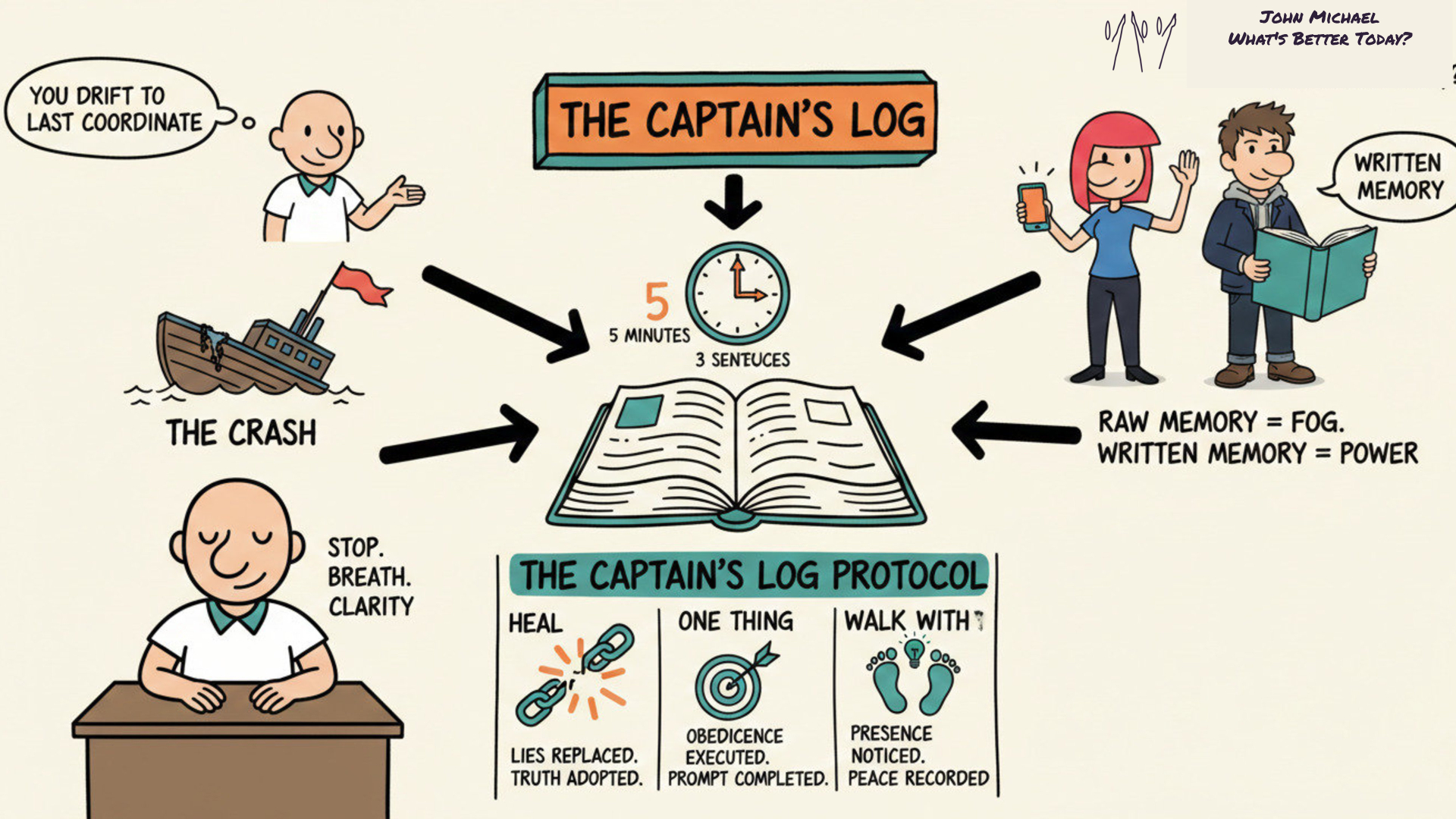 Download this SketchNote for your own notes and to share
Some browsers expose an interface for querying the approximate amount of storage that your origin is using, along with the upper limit, via navigator.storage.estimate().
storage estimate
This section explains why social media platforms moderate content under the idea of “quality control.” Even platforms that claim to support free speech still block spam, scams, and mass-produced advertisements. The text argues that without moderation, platforms would become filled with unwanted content, and users would leave.
To solve problems, researchers may employ a range of methods. Each discipline has its own methods for making or vetting knowledge claims. In Psychology, for example, experimentation with human subjects is quite common, but it is less common in Mathematics. Part of becoming a skilled researcher is learning the epistemology of one’s discipline. Say a mathematician was trying to solve an equation that had not yet been solved. If the approach was to put twenty people in a room and watch how they solved it, other scholars in the discipline would not take the results seriously, but if something similar were done by a psychologist, the results could be quite important (see Research
Different subjects use different ways to solve problems, so good researchers learn which methods make sense for their specific field.
Now imagine that you are doing academic work or professional research. You are a member of a discipline or profession and you have a good idea of the foundational texts for your research topic. A bit of reading you have done has caught your attention: perhaps a text, newspaper article, or journal article. You begin to question how this reading fits in with what you know about your discipline. First you search to see if scholars have been writing about this question (textual research). They may have answered it, but most likely, they have not yet come to a firm conclusion. You decide to do some research on your own to try to answer the question.
When something you read makes you curious, you start asking questions, look at what others have already studied, and then do your own research to better understand it.
Thus, as they engage in inquiry, researchers will choose methods based on the values of the Communities of Practitioners in their disciplines. They may sift through research publications across disciplines with hopes of synthesizing published information in a new way; test past research claims in a lab; or interview people.
Researchers select the methods that make the most sense for their field, enabling them to understand their questions better and learn something meaningful.
p.s. Want the visual map? You'll find a full FieldNote Sketch Summary of this inside the 'hidden' layer. Click this highlight to see the synthesis, share it with someone you know needs it and save a copy for yourself.
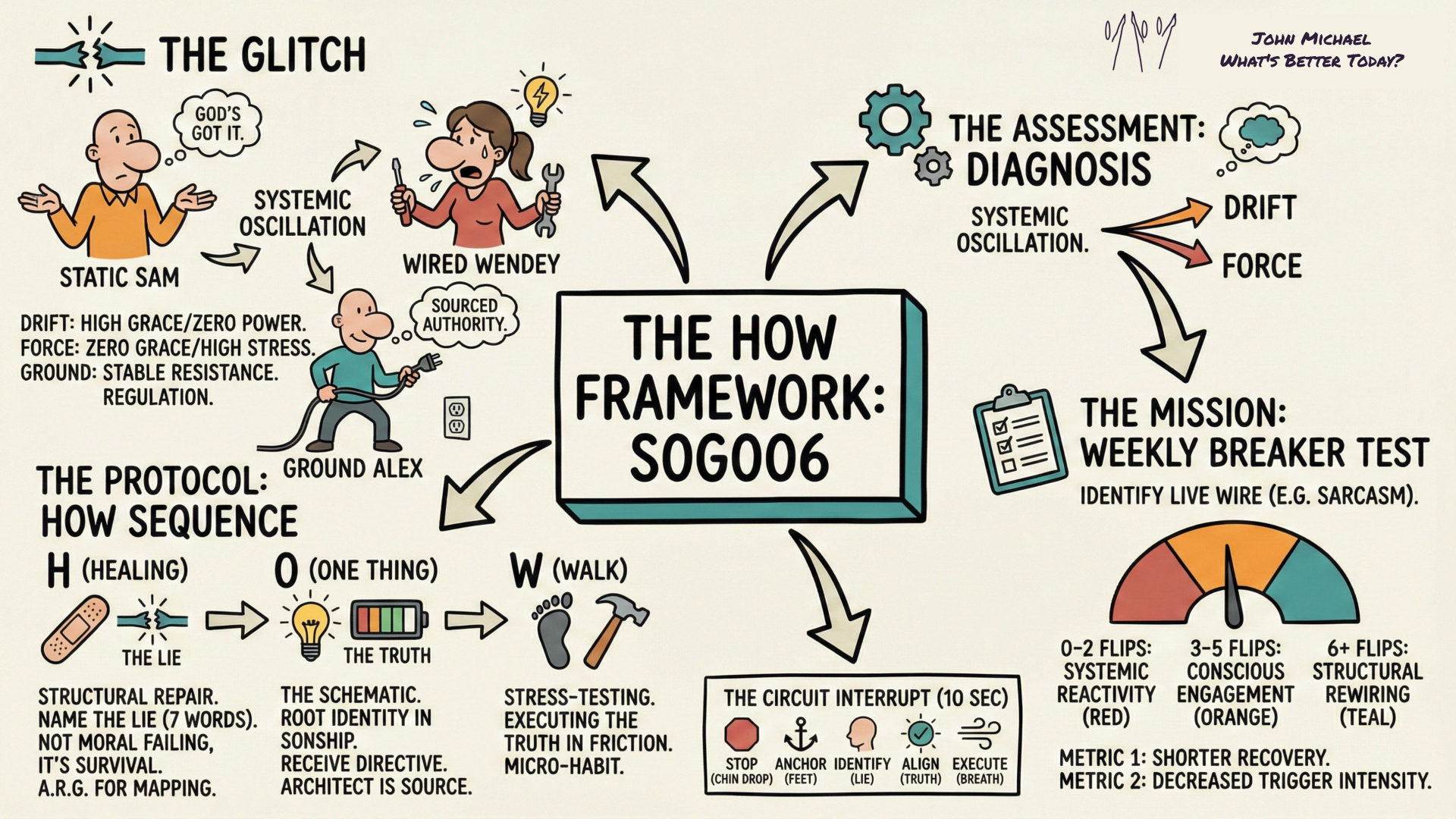 Download this SketchNote of the HOW Framework for your own notes and to share.
He is the source of rest. Root your identity in Sonship.
The Scriptural Foundation: In the Biblical framework, "rest" is not a synonym for taking a nap; it is an active state of governance. The Hebrew concept of Menuha implies a secure, ordered settling where chaos has been subdued (much like God resting on the seventh day to rule His ordered creation). Furthermore, the Greek term for Sonship, Huiothesia (adoption as heirs), guarantees that your standing in the Kingdom is inherited, not earned through frantic output. Sonship is the legal and spiritual access point to Menuha. You cannot access the Kingdom's power grid while operating like an anxious employee.