10,000 Matching Annotations
  1. Last 7 days
    1. The European Union (EU) is itself such a shock, because it introduces rule by those who are regarded as foreigners, diminishes the authority exercised by national states over their own populations, produces economic insecurity among those who lack mobile assets, and facilitates immigration. Immigration is perceived as a particular threat by those who resent cultural intermixing and the erosion of national values, by those who must compete with immigrants for housing and jobs, and, more generally, by those who seek cultural or economic shelter in the rights of citizenship.

      OKAY -> so it is EU project as a whole that is a "shock" to the elecoral system (comparable to previous crises outlined in 1967 article, unclear what those are) BECAUSE it strips nations of absolute sovereignty and hands some of that sovereignty to "foreigners" (i.e., other member state govts) ALSO facilitates immigration -> seen as competition w/ jobs and housing BY electorate.

      "The European Union (EU) is itself such a shock, because it introduces rule by those who are regarded as foreigners, diminishes the authority exercised by national states over their own populations, produces economic insecurity among those who lack mobile assets, and facilitates immigration. Immigration is perceived as a particular threat by those who resent cultural intermixing and the erosion of national values, by those who must compete with immigrants for housing and jobs, and, more generally, by those who seek cultural or economic shelter in the rights of citizenship."

    1. Rather, it gives allwriters permission to keep learning, to fail, and to engage in newkinds of writing in new situations

      Again a skill that can not be mastered. There will always be something new you learn each time you go to write something.

    2. SDUHQWV VKRXOG H[SHFW WKDWtheir child might struggle when writing in a new class, or whenmoving from high school to college because learning takes timeDQGUHTXLUHVEHLQJLPPHUVHGLQWKHFRQWH[W

      Reading this statement will help me give my daughter some grace in her classes. When it comes to her writing.

    3. but she will have to learn new things and notexpect that what she already knows about writing is easily appli-cable in new situations.

      What I have gathered is that writing is a skill that can not be learned and when you think you have mastered it, You have to learn something knew. Its an UNMASTERABLE SKILL.

    4. writerswho believe it are easily discouraged because they don’t know howto learn what they need to learn in new writing situations

      There is a certain tone and energy that every piece of writing has from a one page journal entry to the biggest award winning piece ever written, everything in-between. They all have their own structure, energy, setting , Their own VOICE!

    5. AsVWXGHQWV ZULWH DFURVV WKHLU JHQHUDO HGXFDWLRQ FRXUVHV WKH\ ÀQGthemselves repeatedly asked to write essays or research papers, butoften learn the hard way that their history teacher, poetry teacher,DQGSKLORVRSK\WHDFKHUDOOPHDQDQGH[SHFWYHU\GLŲHUHQWWKLQJVby “essay” or “research paper.

      This statement alone hits home with me. As i write a bio paper and the paper I am currently writing in this class are both very different writing styles. The papers i have written in other classes as well are all different than this one. The structure are all taught differently

    6. It’s not just common sense that tells us that learning to write ingeneral is not possible.

      SIDE NOTE: Not speaking about learning to write your A,B,C's: Even though there is meaning behind that as well.

    7. Writing is always in particular

      Wardle makes a statement to emphasize: The meaning behind something that is written, can always change however there is always a particular reason its written

    1. Impact of social media on people and industry

      Este apartado tiene un poder y peso bastante grandes. El impacto de las redes sociales en las personas y en la industria es algo de doble filo, si bien se mencionan cosas tales cómo que "el impacto de la opinión pública puede extenderse de maneras inimaginables" y que las personas están interesadas en las nuevas formas en cómo se recibe la información, hay que tener en cuenta que esta misma información queda expuesta en la red (a veces hasta sin consentimiento ni conocimiento de las personas), Facebook y su creador se han vuelto inmersos en varias polémicas cómo ya sabemos, pero es este el riesgo de manejar datos sensibles, los algoritmos moldean a las personas, las redes sociales vuelven dependientes a estas personas, si bien la forma en cómo nos comunicamos y consumimos información ha crecido a pasos gigantes cabe recalcar que vamos perdiendo humanidad e identidad propia a base del consumismo provisto por la industria

    2. Dissemination has historically been interpreted as unilateral communication of information. With the advent of the internet, and the explosion in popularity of online communities, social media has changed the information landscape in many respects, and creates both new modes of communication and new types of information",[36] changing the interpretation of the definition of dissemination. The nature of social networks allows for faster diffusion of information than through organizational sources.[37] The internet has changed the way we view, use, create, and store information; now it is time to re-evaluate the way we share and spread it.

      Si bien, se define la comunicación de la información cómo algo "unilateral" -que está muy bien, dependiendo desde que arista se vea- cambiaría esto (Incluso con la mención "desde antes de la llegada del Internet") al hecho de que esto puede llegar a modificarse cómo algo BILATERAL en algunos o en la gran mayoría de casos.

      Un caso puntual sería, donde un individuo difunde información y esta llega a un receptor o un espacio receptivo que está a la espera de este conocimiento para seguir difundiéndolo interactúa con este primer individuo y su conocimiento compartido creando y generando el famoso "intercambio de saberes".

      Esto nace de que no es que haya un solo creador de conocimiento que simplemente se encarga de difundirlo y ya, sino que en su lugar, aparecería un agente externo que lo recibe e intercambia conocimiento con este

    3. Information science[1][2][3] (abbreviated as infosci) is an academic field that is primarily concerned with the analysis, collection, classification, manipulation, storage, retrieval, movement, dissemination, and protection of information.[4]

      Si bien es una concepción general muy contundente y clara, desde un punto subjetivo no deja de ser susceptible a cambios y redefiniciones dependiendo de la persona y el campo desde el que se explique, ya que esto es un campo de acción tan amplio que no se puede limitar a una simple (o única) definición

    4. Históricamente, la ciencia de la información ha evolucionado como unacampo transdisciplinario, que se nutren y contribuyen a diversos ámbitos.

      Esto es algo completamente cierto que muchos de nosotros podemos llegar a olvidar o no tener en cuenta y es que se vive esa cooperación o integración de varios campos de acción, conocimiento o profesiones que permiten buscar soluciones más integrales en cooperativo

    5. No debe confundirse con teoría de la información , tecnología de la información , ingeniería de la información , ciencia de datos , informática , bibliotecología o sistemas de información (disciplina) .

      Si bien podría considerarse algo "básico" no puedo dejar pasar que es un bien necesario el hecho que es bueno eso de aclararle de forma inicial, a la audiencia y/o lectores que no hay que confundir o tergiversar conceptos por más parecidos o afines que sean.

    1. One form of digital self-harm is self-bullying, where people set up fake alternate accounts which they then use to post bullying messages at themselves.

      This surprised me because it shows how social validation online can become internalized in a strange way. Instead of avoiding negativity, people recreate it themselves, almost to confirm a belief they already have. That makes online harm feel psychological, not just social.

    2. Given the complex relationship between internet-based social media and mental health, let’s first look at some social media activities that people may find harmful to their mental health. Here are a few examples: 13.2.1. Doomscrolling# Doomscrolling is: “Tendency to continue to surf or scroll through bad news, even though that news is saddening, disheartening, or depressing. Many people are finding themselves reading continuously bad news about COVID-19 without the ability to stop or step back.” Merriam-Webster Dictionary Fig. 13.1 Tweet on doomscrolling the day after insurrectionists stormed the US Capital (while still in the middle of the COVID pandemic).# The seeking out of bad news, or trying to get news even though it might be bad, has existed as long as people have kept watch to see if a family member will return home safely. But of course, new mediums can provide more information to sift through and more quickly, such as with the advent of the 24-hour news cycle in the 1990s, or, now social media.

      Doomscrolling isn’t a totally new impulse, people have always sought information during scary times, but social media makes it much harder to stop because the stream is endless and constantly updating. That’s why newer platforms can intensify anxiety even when the underlying desire (staying informed) is understandable.

    1. Some researchers have found that people using social media may enter a dissociation state, where they lose track of time (like what happens when someone is reading a good book).

      I like how this compares social media to reading a book, because it shows the effect isn’t automatically negative. But the difference is that platforms are designed to keep extending that state indefinitely. It feels less like getting absorbed in something and more like getting stuck.

    2. Some people view internet-based social media (and other online activities) as inherently toxic and therefore encourage a digital detox, where people take some form of a break from social media platforms and digital devices. While taking a break from parts or all of social media can be good for someone’s mental health (e.g., doomscrolling is making them feel more anxious, or they are currently getting harassed online), viewing internet-based social media as inherently toxic and trying to return to an idyllic time from before the Internet is not a realistic or honest view of the matter. In her essay “The Great Offline,” Lauren Collee argues that this is just a repeat of earlier views of city living and the “wilderness.” As white Americans were colonizing the American continent, they began idealizing “wilderness” as being uninhabited land (ignoring the Indigenous people who already lived there, or kicking them out or killing them).

      This highlights how “digital detox” can be helpful as a personal tool, but treating the internet as inherently toxic turns into the same kind of nostalgia we’ve seen before. Collee’s point is that idealizing a return to “offline” can ignore who is actually included or excluded in that fantasy, similar to how “wilderness” was romanticized while Indigenous people were erased.

    3. Many have anecdotal experiences with their own mental health and those they talk to. For example, cosmetic surgeons have seen how photo manipulation on social media has influenced people’s views of their appearance:

      This is such a real issue—when edited photos become the “normal” standard, people can start feeling like their unfiltered face or body isn’t good enough. Cosmetic surgeons are noticing that some patients now bring filtered selfies as goals, which shows how social media can reshape self-image in unhealthy ways. It’s a good reminder that what we see online is often curated or altered, not a fair baseline for how real people should look.

    1. O romance histórico é um gênero literário em prosa em que a narrativa ficcional se ambienta no passado. Geralmente, os romances históricos são marcados pela influência (em menor ou maior grau) de eventos e personagens históricos no desenrolar da trama. Ao longo da história, o gênero teve um papel importante em trazer

      I'm sure I shouldn't be able to do that.

    2. grau) de eventos e personagens históricos no desenrolar da trama. Ao longo da história, o gênero teve um papel importante em trazer para um público leitor conhecimentos históricos através das narrativas de ficção. Apesar de tradicionalmente a origem do roma

      hi devs?

    1. inquiry often treatsculture as an object (or context), as a process (or assemblage), or some combination of the two

      also stated in the other article from this week "our story"

    Annotators

    1. An assignment sheet may be lengthy, but resist the temptation to skim it. Observe and interpret every detail of the text

      Doing this definitely makes it harder than It is truly is because we tend to look at it and think "Omg this is a lot" and we start getting overwhelmed by it.

    2. That process works for her; however, that process might not work for you. We are all different. Our brains respond differently to the task of writing

      This is very true we all take information in different ways and we all respond different to it due to us thinking and doing our work differently.

    3. waiting until the night before the due date, writing until far past her bedtime, getting only three hours of sleep, and turning in the assignment.

      I think we all tend to do that from time to time and it does affect our quality of writing.

    1. Rejet, victimisation par les pairs et émotions négatives : Synthèse des dynamiques d'influence en milieu scolaire

      Synthèse opérationnelle

      Ce document présente une analyse approfondie des recherches récentes menées par l'Institut universitaire Jeunes en difficulté concernant les liens entre l'isolement social, la victimisation par les pairs et les émotions négatives chez les élèves du primaire.

      Les points saillants de cette étude sont les suivants :

      Prévalence élevée : Un nombre significatif de jeunes, particulièrement les filles, éprouvent une détresse émotionnelle quotidienne et un sentiment de non-acceptation dès le début du secondaire, des tendances amorcées au primaire.

      Renversement de la perspective traditionnelle :

      Contrairement à l'idée reçue voulant que les problèmes relationnels causent les émotions négatives, les résultats indiquent que les émotions négatives (tristesse, désespoir) précèdent et prédisent souvent la victimisation.

      Boucle de rétroaction pour l'isolement : Il existe une relation bidirectionnelle entre l'isolement et les émotions négatives, créant un cycle d'aggravation mutuelle.

      Stabilité des traits vs États changeants : L'étude distingue les caractéristiques chroniques des élèves des fluctuations momentanées, révélant que si les relations sociales peuvent se réinitialiser partiellement entre deux années scolaires, les émotions négatives ont tendance à persister, voire à s'intensifier lors des transitions.

      Nécessité d'interventions multidimensionnelles : La simple prévention de l'intimidation est jugée insuffisante.

      Les interventions doivent impérativement intégrer la promotion du bien-être et la gestion des émotions pour rompre les cycles de victimisation.

      --------------------------------------------------------------------------------

      1. État des lieux : Un portrait préoccupant chez les jeunes

      Les données statistiques issues d'enquêtes canadiennes et québécoises révèlent une réalité complexe pour les élèves :

      | Indicateur | Garçons | Filles | | --- | --- | --- | | Tristesse ou désespoir quotidien (début secondaire) | 19 % | 36 % | | Sentiment de ne pas être accepté tel que l'on est | 36 % | 52 % | | Victimes d'intimidation (12 derniers mois - Québec) | ~11 % | ~11 % |

      Note sur la victimisation : Bien que le chiffre de 11 % soit cité, la proportion peut grimper jusqu'à 20 %, voire 40 % pour des événements isolés, soulignant la difficulté de cerner précisément ce phénomène.

      --------------------------------------------------------------------------------

      2. Définition des concepts fondamentaux

      L'étude s'articule autour de trois réalités distinctes mais interconnectées :

      Émotions négatives : Comprennent la tristesse, le sentiment de désespoir et les idées négatives.

      Elles sont considérées comme des précurseurs de la dépression, bien qu'elles ne correspondent pas nécessairement à un diagnostic clinique à ce stade (primaire).

      Isolement des pairs : Fait d'avoir peu d'interactions sociales, que ce soit par choix ou par rejet subi. Le rejet est la forme d'isolement non volontaire la plus fréquente.

      Victimisation : Actes d'agressivité intentionnels et répétitifs caractérisés par un déséquilibre des forces (physiques ou de réputation).

      Elle peut être directe (frapper, insulter) ou indirecte (nuire à la réputation, propager des rumeurs).

      --------------------------------------------------------------------------------

      3. Modèles théoriques de la relation pairs-émotions

      Trois modèles alternatifs tentent d'expliquer l'interaction entre ces variables :

      1. Modèle des risques interpersonnels : Les expériences difficiles avec les pairs agissent comme des stresseurs qui s'accumulent et génèrent des émotions négatives.

      C'est le modèle le plus testé et documenté à ce jour.

      2. Modèle axé sur les symptômes : Les émotions négatives (ou l'affectivité négative) entraînent un retrait social ou une vulnérabilité qui fait de l'élève une cible privilégiée pour la victimisation.

      3. Modèle transactionnel : Suppose une influence réciproque et un renforcement mutuel entre les émotions et les expériences sociales.

      --------------------------------------------------------------------------------

      4. Méthodologie de la recherche

      L'étude a suivi 992 élèves de la 3e à la 6e année du primaire (Québec) sur deux années scolaires, avec quatre points de mesure.

      L'originalité de l'approche réside dans l'utilisation de modèles statistiques ("modèles à décalage croisé avec intercept aléatoire") permettant de distinguer :

      Le Trait (stable/chronique) : La tendance d'un élève à être d'une certaine façon sur le long terme.

      L'État (changeant) : Les fluctuations d'un élève autour de sa propre tendance stable à un moment précis.

      --------------------------------------------------------------------------------

      5. Analyse des résultats : Des dynamiques différenciées

      Interrelations stables (Traits)

      De manière chronique, les trois dimensions sont liées : un élève ayant une tendance stable à l'isolement aura également une tendance stable à la victimisation et aux émotions négatives.

      Ces réalités co-occurrent sans ordre temporel défini.

      Dynamiques temporelles (États changeants)

      L'analyse des fluctuations d'un moment à l'autre révèle des mécanismes distincts :

      Émotions négatives et Isolement : Suivent un modèle transactionnel.

      Un niveau élevé d'émotions négatives en début d'année prédit un isolement accru en fin d'année, et inversement. C'est une boucle d'accentuation.

      Émotions négatives et Victimisation : Suivent un modèle axé sur les symptômes.

      Les émotions négatives en début d'année prédisent une victimisation accrue plus tard, mais la victimisation ne semble pas augmenter les émotions négatives de manière immédiate.

      Ce lien est direct et ne passe pas par l'intermédiaire de l'isolement.

      Stabilité temporelle :

      ◦ La victimisation et l'isolement sont plus stables au sein d'une même année qu'entre deux années.

      Le changement de classe ou d'enseignant atténue l'effet de réputation.    ◦

      Les émotions négatives sont plus stables entre les années scolaires, suggérant une anticipation anxieuse de la rentrée ou une persistance des traits internes malgré les changements d'environnement.

      Constat important : Ces mécanismes sont identiques pour les garçons et les filles, ainsi que pour les élèves plus jeunes ou plus vieux au sein du primaire.

      --------------------------------------------------------------------------------

      6. Conclusions et orientations pour l'action

      Pour la recherche

      Les résultats de cette étude québécoise, bien que novateurs, ne font pas encore consensus au niveau international, d'autres études montrant parfois des résultats inverses ou sexués.

      Une réplication du modèle est prévue en Belgique (Flandre) pour valider ces observations.

      Pour l'intervention en milieu scolaire

      L'étude remet en question les stratégies d'intervention uniquement centrées sur le comportement social :

      Insuffisance de la lutte contre l'intimidation seule : Retirer un élève d'une situation de victimisation ne garantit pas la disparition de ses émotions négatives.

      Approche multifactorielle : Il est impératif d'agir simultanément sur l'environnement social et sur le bien-être psychologique interne.

      Priorité à la promotion du bien-être : La prévention de la dépression et la gestion des émotions négatives dès le primaire sont des leviers essentiels pour réduire, par ricochet, les risques de victimisation et d'isolement.

      "Les efforts de prévenir la victimisation sont essentiels, mais nos résultats suggèrent qu'ils ne sont potentiellement pas suffisants parce qu'il y a une dynamique plus large."

    1. we made the argument that cultural practices are built, shaped, and dismantled based on theencounters people have with one another within and across particular systems of shared belief. Mari providesan excellent example here of how responsibility is not a set of static practices but is dependent on theencounters we have in particular communities.

      connecting earlier with now

    2. "decolonial," we're referring specifically to stories from the perspective ofcolonized cultures and communities that are working to delink from the mechanisms of colonialism.

      term

    3. discipline, built, as Foucault tells us:by groups of objects, methods, their corpus of propositions considered to be true, the interplay ofrules and definitions, of techniques and tools: all these constitut[ing] a sort of anonymous system,freely available to whoever wishes, or whoever is able to make use of them, without there beingany question of their meaning or their validity being derived from whoever happened to inventthem. (222)

      Term.

      Discipline, Foucault

    4. to instruct its participants in thedominant practices of that cultural community and to reward them for following the rules of that community

      The importance of instruction in the academic discipline

    5. the way that different cultures have different waysto draw relations between stars in the sky, and how naming those relations, those constellations (Ursa Major,the Bear, the Big Dipper, the pathway to Sagitarrius) is an act of meaning-making

      an act of meaning-making. - I really like that

    6. constellation, however, allows for all the meaning-making practices and their relationships tomatter. It allows for multiply-situated subjects to connect to multiple discourses at the same time, as well asfor those relationships (among subjects, among discourses, among kinds of connections) to shift and changewithout holding a subject captive

      reasoning behind the use of constellations

    7. people11 make things (texts, baskets, performances), people make relationships, people make culture.

      very simple way of explaining how culture is constructed

    8. It's interesting how you chose De Certeau to talk about rhetoric—not a lot ofpeople really think of him as a "rhetorician.

      I didn't know this about De Certeau

    9. to understand how the making of culture occurs through everyday practice instead of through official,sanctioned dominant acts of cultural installation (xiv).

      i like this line

    10. scholars in rhet/comp rely on this object-oriented approach to cultures because itallows us to select "exemplars" from specific oppressed cultural traditions as a way of feeling good about howinclusive our discipline has become.

      this feels like a call out

    11. "object-oriented,"8 we mean scholarship that identifies "culture" as an object of inquiry, one that can be isolated fromother human, economic, political, geographical, historical frameworks that exist around and within it.

      Object Oriented Definition

    12. anthropology, sociology, cultural studies andfrom the borrowings that folks in rhet/comp studies have initiated from these inter/disciplines.

      I like that they highlight the particular areas

    13. as themselves, representing their ownexperiences with cultural rhetorics practice/methodology apart from the collective

      Its good to establish this early

    14. , the questions that s/he asks have helped us think more deeply, more persistently, and more broadlyabout our collective work and its relationship to the discipline of rhetoric and composition.

      I wonder if this is a fictional character. someone they have created.

    15. name using one of the original languages of the place6 where much of this article waswritten,

      a way of (kinda) honoring the space that they are in

    16. working through ideas for the article, yes, but also working throughour relationships with one another; renewing familiar patterns, starting new ones.

      This paints a nice collaborative picture

    Annotators

    1. Have missionaries practice offering one of the bullets in “Give Experiences or Information They Would Value” (171) that may be helpful.

      How could this experience help this person come closer to the Savior? What's an experience you've had with this that you could testify of?

    2. Help missionaries identify a few bullet points in “Talk with Everyone” that could improve the interaction

      What principle could help the person I'm talking to come closer to the Savior? What have you learned about the significance of that principle?

    1. In the U.S., both Facebook and Twitter users spend more time on these services via mobile devices (7 h/day and 2 h/day respectively) than via personal computers (6 h/day and 20 min/day respectively)

      does this relate to you? what is your screen time? what are you using your phone for? is it healthy or unhealthy?

    1. Briefing : L’autorégulation chez les enfants victimes d’agression sexuelle

      Résumé exécutif

      Ce document synthétise les résultats de recherches doctorales portant sur l’autorégulation des enfants ayant survécu à une agression sexuelle (AS).

      L’autorégulation, définie comme la capacité à moduler ses réponses cognitives et émotionnelles pour générer des comportements adaptatifs, est un processus clé souvent altéré par le trauma.

      Les conclusions principales soulignent que si l’agression sexuelle est globalement associée à des difficultés de fonctionnement exécutif (inhibition et flexibilité cognitive), l'impact n'est pas uniforme.

      La recherche identifie quatre profils distincts d'autorégulation chez les victimes : disrégulé, inhibé, flexible et régulation identifiée par les parents.

      L'étude démontre également que des facteurs tels que le sexe de l'enfant, l'historique de maltraitance multiple et l'environnement socio-économique (défavorisation du quartier) influencent de manière significative les capacités d'autorégulation.

      Les implications cliniques suggèrent d'abandonner les approches universelles au profit d'interventions différenciées et d'évaluations multi-méthodes (tâches cognitives et questionnaires) impliquant plusieurs répondants (parents et enseignants).

      --------------------------------------------------------------------------------

      1. Cadre théorique et définitions

      L'agression sexuelle est une problématique de santé publique mondiale touchant environ une fille sur cinq et un garçon sur dix avant l'âge de 18 ans.

      Elle entraîne des conséquences psychologiques variées, notamment des problèmes de comportement intériorisés (dépression, retrait) et extériorisés (agression, opposition).

      L'autorégulation

      Le concept d'autorégulation repose sur deux composantes interdépendantes :

      La régulation émotionnelle : Stratégies et compétences modulant l'expression et l'expérience des émotions.

      Les fonctions exécutives : Processus mentaux orientés vers un but, incluant :

      L'inhibition : Capacité à freiner une réponse automatique face à un stimulus (ex: répondre "nuit" quand on montre un soleil).    ◦ La flexibilité cognitive : Capacité à s'adapter au changement de règles dans l'environnement.

      Le mécanisme biologique du trauma

      L'exposition précoce à un stress intense (maltraitance, pauvreté) provoque une dysrégulation des hormones de stress, entraînant des atteintes structurelles et fonctionnelles au cerveau, ce qui fragilise les capacités d'autorégulation.

      --------------------------------------------------------------------------------

      2. Impact de l'agression sexuelle sur les fonctions exécutives

      Les recherches présentées indiquent que l'agression sexuelle est un prédicteur significatif de difficultés exécutives, même après avoir contrôlé d'autres facteurs comme le TDAH ou la défavorisation sociale.

      Constats par type de fonction

      Flexibilité cognitive : L'agression sexuelle est directement associée à une moins bonne performance dans les tâches mesurant cette capacité.

      Inhibition : Les enfants victimes montrent une performance significativement inférieure aux enfants non victimes.

      Effet modérateur du sexe

      L'étude révèle des différences marquées selon le sexe de l'enfant :

      Garçons : Les enseignants rapportent beaucoup plus de difficultés de fonctionnement exécutif chez les garçons victimes que chez les non-victimes. Ils affichent également des performances plus faibles aux tâches d'inhibition.

      Filles : Il y a peu de différence significative entre les filles victimes et non victimes sur le plan de l'évaluation des fonctions exécutives par les enseignants ou dans les tâches d'inhibition.

      --------------------------------------------------------------------------------

      3. Typologie des profils d'autorégulation

      L'analyse a permis de dégager quatre profils types chez les enfants victimes d'agression sexuelle (échantillon de 225 enfants) :

      | Profil | Proportion | Caractéristiques principales | Problèmes de comportement associés | | --- | --- | --- | --- | | Disrégulé | 39 % | Faible performance cognitive, forte labilité émotionnelle, difficultés rapportées par les parents. | Problèmes intériorisés et extériorisés élevés (comorbidité). | | Inhibé | 19 % | Excellente performance aux tâches d'inhibition, mais faibles compétences émotionnelles perçues par les parents. | Niveaux les plus élevés de problèmes intériorisés. | | Flexible | ~28 % | Autorégulation supérieure à la moyenne, profil concordant (maison/école), résilience. | Faible symptomatologie. | | Régulation (Parents) | 14 % | Performance cognitive faible, mais parents rapportant de très bonnes capacités (profil discordant). | Symptômes visibles par les enseignants mais sous-estimés par les parents. |

      Analyse des profils spécifiques

      Le profil "Inhibé" : Ces enfants semblent utiliser une sur-régulation cognitive pour contrôler leurs impulsions, mais au prix d'une grande détresse interne.

      Chez les filles, ce profil est un facteur de risque pour les problèmes intériorisés, tandis que chez les garçons, il semble agir comme un facteur de protection apparent contre les problèmes extériorisés.

      Le profil "Discordant" : Souvent associé à des agressions sexuelles intrafamiliales (80-90 % des cas dans ce groupe). Les parents peuvent surévaluer les compétences de l'enfant par désir de normalité ou sous l'effet d'un cadre familial trop rigide.

      --------------------------------------------------------------------------------

      4. Facteurs de risque et de protection contextuels

      L'autorégulation ne dépend pas uniquement de l'acte traumatique, mais d'un écosystème de facteurs :

      Historique de maltraitance : Les profils "disrégulé" et "inhibé" sont corrélés à une exposition à un plus grand nombre de formes de maltraitance.

      Défavorisation du quartier : Les enfants vivant dans des quartiers favorisés présentent une meilleure autorégulation. Cela s'expliquerait par l'accès aux ressources (bibliothèques, musées, espaces verts) et une moindre exposition à la violence communautaire.

      Éducation parentale : Un niveau d'études plus élevé chez les parents favorise le développement des compétences langagières, lesquelles soutiennent directement l'autorégulation de l'enfant.

      --------------------------------------------------------------------------------

      5. Recommandations pour l'intervention clinique

      Évaluation multidimensionnelle

      Il est impératif de multiplier les sources d'information :

      1. Multi-modalité : Combiner les questionnaires (perceptions) et les tâches cognitives (mesures objectives), car les résultats sont souvent divergents.

      2. Multi-répondants : Inclure systématiquement le point de vue des enseignants pour identifier les difficultés qui pourraient être masquées dans le cadre familial.

      Approche différenciée

      L'intervention ne doit pas être identique pour tous les profils :

      Pour les enfants disregulés : Approche standard axée sur le renforcement des fonctions exécutives et de la régulation émotionnelle.

      Pour les enfants inhibés : Éviter de renforcer l'inhibition (potentiellement néfaste). Prioriser la reconnaissance, la compréhension et l'expression des émotions, ainsi que la flexibilité cognitive.

      Pour les enfants "flexibles" : L'intervention sur l'autorégulation peut être inutile. Se concentrer sur le soutien psychosocial et la prévention de la revictimisation.

      Pour le profil discordant : Évaluer la flexibilité des parents et utiliser des sources d'évaluation externes pour pallier la sous-estimation parentale des difficultés.

      Pistes d'activités pratiques

      Pour l'inhibition : Jeux de type "1, 2, 3 Soleil", coloriage attentionnel (arrêter au signal), ou jeux de rôle où l'enfant doit attendre son tour face à une frustration.

      Pour la flexibilité : Jeux avec changement de règles fréquent (ex: varier qui gagne à "Roche-Papier-Ciseau"), résolution de problèmes avec des solutions multiples ou inversions de rôles.

      Implication des parents : Travailler sur l'autorégulation propre des parents et favoriser un attachement sécurisant, facteur de protection majeur pour l'enfant.

      --------------------------------------------------------------------------------

      Conclusion

      La recherche souligne la complexité des trajectoires de développement après une agression sexuelle.

      Le constat majeur est que le trauma n'entraîne pas systématiquement une dysrégulation.

      Près de 42 % des enfants présentent des profils adaptés.

      L'enjeu clinique réside dans l'identification des profils "surrégulés" ou "discordants", qui peuvent passer inaperçus tout en présentant des risques élevés de pathologie à long terme.

    1. No matter what field of study you are interested in, you will most likely be asked to write a research paper during your academic career. Boundless Writing explains that a research paper is an expanded essay that relies on existing discourse to analyze a perspective or construct an argument. Because a research paper includes an extensive information-gathering process in addition to the writing process, it is important to develop a research plan to ensure your final paper will accomplish its goals. As a researcher, you have countless resources at your disposal, and it can be difficult to sift through each source while looking for specific information. If you begin researching without a plan, you could find yourself wasting hours reading sources that will be of little or no help to your paper. To save time and effort, decide on a research plan before you begin.

      You need to learn to develop your writing skills regardless of your field of study or area of ​​interest. You'll most likely be asked to write a research paper during your academic career, so being able to write an essay is essential. Have a plan for how you'll gather information and implement it in your writing in a way that looks professional.

    1. As you do this you might consider personality differences (such as introverts and extroverts), and neurodiversity, the ways people’s brains work and process information differently (e.g., ADHD, Autism, Dyslexia, Face blindness, depression, anxiety). But be careful generalizing about different neurotypes (such as Autism), especially if you don’t know them well. Instead try to focus on specific traits (that may or may not be part of a specific group) and the impacts on them (e.g., someone easily distracted by motion might…., or someone sensitive to loud sounds might…, or someone already feeling anxious might…).

      This is a really thoughtful way to approach it—focus on specific traits and needs, not labels. Different people can react very differently to the same app feature: autoplay videos, constant alerts, or crowded layouts might overwhelm one person but not another. Designing with flexibility (like mute options, reduced motion, clear layouts, and notification control) helps more people feel comfortable and included.

    1. A thesis statement must concentrate on a specific area of a general topic. As you may recall, the creation of a thesis statement begins when you choose a broad subject and then narrow down its parts until you pinpoint a specific aspect of that topic. For example, health care is a broad topic, but a proper thesis statement would focus on a specific area of that topic, such as options for individuals without health-care coverage.

      Being specific when writing is important, both for your readers and for yourself. Know the order in which you will write and be specific about the key points of the text.

    1. . In the course of their work, the team con-cluded that people who remember being abducted by aliens were reallysuffering from sleep paralysis in the liminal state between sleeping andwaking.

      Although modern scientists have a very scientific way to explain why so many people have abduction experiences with aliens, it is still worth exploring why it is aliens and not something else. Why do so many people have the same descriptions? Maybe later people are influenced by alien stories. How did the first people have the alien experience?

    1. Preparation implies developing competency in the secure management of information, which makes it possible to establish levels of perfection and mastery in the protection of data.

    1. enthusiastically supporting the political parties that oversaw and facilitated thedestruction of their communities

      and fair enough, but shouldn,t they attach that to both parties, or to specific policies

    2. From scrapyards in theupper Midwest, material was loaded on otherwise empty trains and ships forthe return trip to China.

      Midwest city was literally being robbed of its livelhood

    3. Much less commented upon is theeffects of extreme devalorization on the physical structure of the region’s neigh-bourhoods and communities.

      Which was not happening in the city

    4. unions were still hamstrung, a freetrade regime in international commerce was being established, and disinvest-ment was continuing unchecked in the upper Midwest

      His policies hurt the people of the midwest besides just ignoring them

    5. Rather than beingthe ‘universal class’ associated with America, the industrial working class wasreclassified as a ‘special interest’ that was scuttling the American economy withits greed.

      Dark

    6. incentivize a shift ofinvestment from manufacturing to finance, tech and services, and ensure theinvestment would pay off due to lower risk and higher profits than other invest-ments

      Midwest to coast shift

    7. While it is notthe most important inter-group tension in American society, it is one of themost clearly evident ones

      And also as professionals defect to the democratic larty, one with clear political implications

    8. Indeed, looking atvoting behaviour in this election it would appear that the poor and workingclass of the region are unified in their growing hostility to the Democratic Partyeven if they are not unified in their attraction to Trump.

      Because trump remains at least in part decided by race while the hostility towards democrats is more ubiquitsly economic

    9. More importantly, the inevitable transformation and decline of place will shapethe values of those living there, just as the initial development of industrial soci-ety once did

      Getting ignored dismantled the institutions that kept the midwest democratic and now they are revolting

    10. Organizations, institutions, networks and associations, in turn, poten-tially shape these into political subjectivities and moral values which can beinstrumentalized and expressed in politics, development strategies, and culture,which we can summarize as a ‘communal ethos’

      Individuals feeling is shaped by the institutions in their community

    11. . For the first time in the history of thetwo parties, Republicans did better among poor white voters than among afflu-ent whites

      Saying this was a long time coming but I have trouble buying that it was not also connected to trump

    12. but what is more recent isthe collapse of the institutions that had been built to incorporate industrialworkers and their communities into the mainstream political life of the country,including governance arrangements, work and consumption arrangements, civicassociations, social policies, party organizations, and labour unions

      Why now?

    13. But the collapse of the regional economy has alsoresulted in the collapse of the institutions and organizations that provided thoseconnections.

      But the dems might have been oblivious

    14. This paper argues that the election of Donald Trump is the product of a con-fluence of historical factors rather than the distinctive appeal of the victorhimself. B

      Ready to buy that

    Annotators

    1. Comportements Parentaux Disrégulés et Fonctionnement des Enfants Victimes de Maltraitance : Document de Synthèse

      Résumé Analytique

      Ce document synthétise les résultats d'une thèse doctorale portant sur les liens entre les comportements parentaux disrégulés (CPD) et le développement socio-émotionnel de jeunes enfants suivis par les services de protection de la jeunesse.

      L'analyse met en lumière un cycle de transmission intergénérationnelle de la maltraitance : les parents ayant vécu des traumatismes durant leur propre enfance sont plus susceptibles de manifester des comportements parentaux atypiques, effrayants ou intrusifs.

      Les conclusions majeures de la recherche indiquent que :

      1. Impact des CPD : Des niveaux élevés de comportements parentaux disrégulés sont directement associés à l'attachement désorganisé et à des problèmes de comportement (intériorisés et extériorisés) chez l'enfant.

      2. Effet Protecteur : L'attachement sécurisant agit comme un modérateur crucial, protégeant l'enfant des impacts néfastes des CPD sur son développement comportemental.

      3. Efficacité de l'Intervention : L'Intervention Relationnelle (IR), basée sur la rétroaction vidéo, réduit significativement la sévérité des comportements parentaux disrégulés, offrant ainsi une avenue clinique prometteuse pour les services de protection de l'enfance.

      --------------------------------------------------------------------------------

      1. Caractérisation des Comportements Parentaux Disrégulés (CPD)

      Les comportements parentaux disrégulés sont des manifestations atypiques et perturbatrices qui surviennent lors des interactions avec l'enfant, particulièrement face à sa détresse.

      Ces comportements sont souvent observés chez les parents signalés pour abus ou négligence.

      Typologie des comportements selon l'échelle AMBIANCE

      La recherche s'appuie sur la mesure AMBIANCE pour catégoriser cinq sous-types de comportements disrégulés :

      | Sous-type de comportement | Description | | --- | --- | | Erreurs de communication affective | Minimiser, ignorer ou répondre de manière inappropriée à la détresse (ex: rire ou imiter l'enfant qui pleure). | | Confusion des rôles | Le parent aborde l'enfant comme s'il devait répondre aux propres besoins du parent (renversement de rôle) ou traite l'enfant comme un partenaire intime. | | Comportements effrayants ou apeurés | Manifestations d'effroi face aux besoins de l'enfant ou adoption d'une posture menaçante. | | Intrusion et négativité | Hostilité physique ou verbale, contrôle excessif des mouvements ou des interactions. | | Retrait | Création active d'une distance physique ou verbale, position d'impuissance et évitement de l'enfant lors des réunions. |

      Le paradoxe de la peur sans solution

      Ces comportements placent l'enfant dans un paradoxe insoluble.

      La source habituelle de réconfort (le parent) devient simultanément la source de menace ou de détresse.

      L'enfant ne peut donc pas élaborer de stratégie cohérente pour réguler son stress, ce qui mène à une désorganisation de l'attachement.

      --------------------------------------------------------------------------------

      2. Analyse des Impacts Développementaux et Facteurs de Protection

      L'étude de 70 familles signalées au centre jeunesse de Montréal révèle les dynamiques entre l'exposition aux CPD et le fonctionnement de l'enfant.

      Corrélations entre CPD et dysfonctionnement

      L'exposition à des niveaux élevés de CPD est associée à :

      L'attachement désorganisé : Présent chez 50 % des enfants de l'échantillon.

      Problèmes de comportement : Augmentation des comportements agressifs (extériorisés) et des symptômes de retrait ou d'anxiété (intériorisés).

      Difficultés sociales et cognitives : Méfiance envers autrui, difficultés d'apprentissage et déficits de régulation émotionnelle.

      L'attachement sécurisant comme bouclier

      Un résultat central de la recherche montre que l'attachement sécurisant joue un rôle de facteur de protection.

      • Pour les enfants ayant un attachement insécurisant, il existe un lien direct et significatif entre la sévérité des CPD et la présence de problèmes de comportement.

      • À l'inverse, chez les enfants ayant un attachement sécurisant, ce lien n'est pas significatif.

      Ces enfants présentent moins de problèmes de comportement malgré l'exposition aux mauvais traitements ou aux CPD.

      --------------------------------------------------------------------------------

      3. L'Intervention Relationnelle (IR) : Mécanismes et Efficacité

      La recherche a évalué l'efficacité de l'Intervention Relationnelle par rapport aux services habituels (psycho-éducatifs).

      Protocole de l'intervention

      L'IR se déroule généralement sur 8 séances d'environ 1h30 et utilise la rétroaction vidéo comme levier de changement :

      1. Discussion thématique : Aborde le rôle parental et le développement de l'enfant.

      2. Période de jeu filmée (10-15 min) : Le parent réalise une activité spécifique avec une consigne orientée (ex: "observez votre enfant et décrivez ce qu'il fait").

      3. Rétroaction vidéo : L'intervenant souligne les forces du parent et ses comportements sensibles.

      Cela permet au parent de constater l'impact positif de ses actions sur son enfant (contacts visuels, rires, apaisement).

      Résultats cliniques

      L'intervention a démontré une réduction significative de plusieurs types de CPD comparativement au groupe contrôle :

      • Diminution des erreurs de communication affective.

      • Diminution des comportements d'intrusion.

      • Diminution des comportements de retrait.

      • Amélioration du score global de régulation parentale.

      Note : Les comportements apeurés/effrayants et la confusion des rôles se sont révélés plus difficiles à modifier, étant plus subtils et moins facilement identifiables par le parent lors de la rétroaction vidéo.

      --------------------------------------------------------------------------------

      4. Implications pour les Services de Protection

      L'étude conclut à la nécessité d'intégrer l'évaluation des CPD dans les pratiques cliniques courantes.

      Utilisation d'outils adaptés : L'adoption de l'instrument AMBIANCE brief est recommandée pour permettre aux intervenants de terrain de repérer les CPD sans nécessiter les protocoles lourds de recherche.

      Ciblage de l'attachement : Les interventions doivent viser prioritairement la sécurité d'attachement comme levier pour atténuer les conséquences des traumatismes.

      Formation continue : Former les intervenants à la reconnaissance des signaux de disrégulation subtils (hésitations, expressions faciales, postures) pour mieux accompagner les parents dans la réparation des interactions perturbées.

      En résumé, l'Intervention Relationnelle s'avère être un outil puissant non seulement pour optimiser la sensibilité parentale, mais aussi pour réduire les placements à l'extérieur du milieu familial en améliorant la qualité fondamentale du lien parent-enfant.

    1. But if the visuals are only included to make the materials “pretty,” the learner will waste cognitive energy processing the visual material without gaining new information or meaning.

      I have noticed I feel like I have a more limited cognitive load space during lectures when my professor uses really active slides. I've gotten distracted or lost during instruction before, and felt like a "bad" student. As pretty and fun as they are, animations often distract me, and it can be hard to note-take when the audio doesn't match the transcriptions, as mentioned above. This felt validating!

    2. Also, some readers cannot distinguish color, so we should never use color to convey meaning.

      As someone who color codes things often, I wouldn't have considered this on my own! I always thought lighter colors were better for highlighting because it allows me to see more text, but I can see how different students will have different visual/contrast needs. I never knew that bolding and underlining text were recommended over colored text or highlight tools.

    1. pers and magazines the “Trump Democrats” narrative and its historicalantecedent—stories about Ronald Reagan’s capture of the industrial Mid-west—will return with a vengeance once campaigning for the 2020 presi-dential election begins in earnest

      But the question is will trump leave behind the urban centers that screwed over reagan? does he even need them?

    2. Yet, as compelling as these critiquesmight be, they have had little effect on the broader narratives. Indeed, thepublication of articles on “Trump Democrats” continued without sign ofabatement.

      This is whats being studied in the other paper

    3. politics was often shaped or driven moreby a desire to resolve problems that seemed to imperil the whole commu-nity than by deeply held ideological principles

      Fickle, easily changed

    4. challenges narratives that depict the 1980s as a de-cade of growing antitax, antigovernment conservatism.

      At least in the industrial midwest, basically the republicnas help coause the decay but then the dems turn a blind eye to it which makes midwesterns ultimatly turn back towards rep

    5. At a state level, tax rises were even more commonplace. Much as withCleveland and Detroit, it was often fear of default and fiscal emergencydriving these decisions.

      And they were not getting helped out by Reagan

    6. the political centerof gravity in the industrial Midwest did not shift decidedly to the rightduring the Reagan years. Perhaps most importantly, it also demonstratesthat though national politicians may have rediscovered the market andembraced a politics of antistatist individualism, this was not a develop-ment that inevitably led (or trickled down) to state and municipal politics

      There was a schism between state and federal support, which would eventually have secondhand influence on the common wealth

    7. Cleveland’s Republican mayor George Voinovich described cuts infederal government urban programs as being carried out with “a meatax” rather than a “scalpel.

      Some might call this tension between the municipal and the federal government

    8. Young and his diverse coalition of public and private sector supportersembraced the Ford administration’s offer of funding for the constructionof a major new mass transit network.

      Ignored once

    9. Sincemost US cities depended on property and income tax revenues to providemunicipal services and maintain infrastructure, this eroded municipalrevenues

      And then people went out of work, white flight is a real bitch ya know.

    10. The economic shockwaves created by these events helped producetwo recessions and the worst economic downturn since the Great De-pression.

      Which the midwest felt disproportionately as their industry was outsourced

    1. Settler Colonialism which “destroys to replace” (Itsuji Saranillio, in Teves, Smith & Raheja, 2015) adopts and promotes the same rapist genocidal mentality as colonialism, should actually be termed "invader colonialism" because to use the term "settler" seems to be innocuous and implies that the land and the people needed to be "settled" because it was/they were "wild" and "out of control" at the time of the invasion.

      settler colonialism concept

    2. Self-determination refers to the social movements, legislation, and beliefs by which Native American tribes in the United States exercise self-governance and decision making on issues that affect their own people. Self-determination is an integral piece of sovereignty and the right of a people to decide upon its own form of government, without outside influence and relates to the freedom and free will of the people of a given area to determine their own political status and independence.

      piece of sovereignty concept

    1. Give feedback and re-practice.

      What promptings did you receive as you were teaching? What is Heavenly Father teaching you to apply with this friend?

      How do you think applying this principle is helping you fulfill your missionary purpose? What would Heavenly Father have you do to build and expand on what we've practiced?

    2. briefly demonstrate how you might teach a portion of what you planned to address the person’s needs.

      Where did you see me apply the principle we identified? What impact did it make on the Spirit we felt during that demonstration?

    3. After you demonstrate, ask missionaries what impact using the scriptures to teach had on them as learners.

      What experiences have you had when you've felt the Spirit when studying the scriptures? How can you apply that to help the people you are teaching?

      Why was this scripture impactful to you as a learner? Why is the Lord asking you to use the scriptures when teaching your friends?

    1. qui se trouvent à l'intérieur d'autres balises

      <div style="color: blue;">

      Ce texte sera bleu.

      </div>

      C'est ça l'héritage de style, la couleur bleue est appliquée au div et à tout ce qu'il contient, en tant que balises imbriquées (Mais toutes les propriétés ne sont pas héritables)

    1. Consider the following very common academic goal as you read about SMART goals.

      Smart Goal- Specific- My goal is to become balanced in things I have to do in my schedule to succeed with getting a 3.0 GPA or higher.

      Measurable- To do this I will plan out my schedule with a to do list, and work on. Things one at a time while checking it off, and working hard on assignments but ask for tutoring or help if needed to succeed on the tests and overall get the 3.0 GPA or higher

      Attainable- This goal is attainable if I ask for help, stay focused, disciplined, and timely.

      This goal is realistic.

      Time- This will be by the end of 2026 spring semetster, while making sure I plan my time out each day in my schedule.

    2. Lasting relationships with diverse individuals in a learning community—peers, faculty, and staff

      My leadership qualities are more of resilience and team appreciation which relate to Lightning Mcqueen’s leadership qualities because he learns to work in a team and keep pushing through even when he just wants to get the end result and not do the work.

      To develop my leadership qualities I should talk to new people, maybe even join a group with the same interests as me, and keep pushing to ask for help with the struggles of college.

      The greatest barrier I have in accomplishing this is fear. I get scared to fail, so I hold back and don’t let opportunities succeed as well as I could which is something I am trying to work on.

    1. OpenClaw, like many other open-source tools, allows users to connect to different AI models via an application programming interface, or API. Within days of OpenClaw’s release, the team revealed that Kimi’s K2.5 had surpassed Claude Opus and became the most used AI model—by token count, meaning it was handling more total text processed across user prompts and model responses.

      Wow, I had no idea that Kimi 2.5 had subbed in for Claude Opus so quickly.

    1. the conflicts that arise over competing theoretical interpretations.

      conflicts between therohetical perspectives arise from the parts of theory that are left out or what is considered irrelevant

    Annotators

    1. Meanwhile, under China's 'Eastern Data, Western Computing' initiative in the early 2020s, numerous startups constructed large AI and cloud data centers across western regions of China, where electricity costs are lower, with the goal of serving demand from economically stronger eastern provinces. While the strategy reduced power expenses, it turned out that longer distances increased latency and made these facilities less attractive for many latency-sensitive applications, which limited actual usage

      Is this what happened with them? They got,built and weren’t used as much in the end?

    1. Abigail and John Adams Converse on Women’s Rights, 1776
      • It Is an Early Call for Women’s Rights Abigail’s request to “remember the ladies” is one of the earliest and clearest arguments for women’s legal protections in American history. She challenges male authority in marriage and government.
      • It Shows Women’s Political Awareness. Her letter shows that women were thinking critically about government and justice even if they were excluded from formal power.
      • It Exposes Gender Roles in the 18th Century John’s joking tone reflects common attitudes of the time, that women’s demands were not to be taken seriously. His response helps historians understand how deeply rooted patriarchal systems were.
    1. Fifthly, They are to have a Governor and Council appointed from among themselves, to see the Laws of the Assembly put in due execution; but the Governor is to rule but 3 years, and then learn to obey; also he hath no power to lay any Tax, or make or abrogate any Law, without the Consent of the Colony in their Assembly

      Talking about freedom of choosing their government

    1. Without further federal commitments, 70,000 programs might close, wiping out 3.2 million slots and $9 billion in annual parent earnings,

      Establishing what's at stake, showing that not passing the funding isn't a neutral act, it's harmful.

    1. Synthèse du Séminaire sur l'Enseignement Explicite : Des Coulisses à la Classe

      Ce document de breffage synthétise les interventions du séminaire organisé par l'Université de Mons (UMons) et l'Institut d'administration scolaire.

      Il détaille les fondements théoriques, les modalités pratiques et les outils de recherche liés à l'enseignement explicite, une approche pédagogique éprouvée pour favoriser l'équité et l'efficacité des systèmes éducatifs.

      Résumé Exécutif

      L'enseignement explicite (EE) est une approche pédagogique issue de l'observation de pratiques de classe efficaces, particulièrement dans les milieux défavorisés.

      Son principe central est de « rendre visible » ce qui est invisible : les démarches cognitives de l'enseignant et les processus d'apprentissage des élèves.

      Fondée sur le modèle PIC (Préparation, Interaction, Consolidation), cette méthode suit une progression rigoureuse : ouverture, modelage (« Je fais »), pratique guidée (« Nous faisons »), pratique autonome (« Tu fais ») et clôture.

      Au-delà de la transmission des savoirs, l'EE s'applique également à la gestion des comportements et s'appuie sur une « vision professionnelle » que les outils technologiques, comme le suivi oculaire (eye-tracking), permettent désormais d'objectiver.

      La formation des enseignants repose sur une collaboration étroite au sein d'une triade (stagiaire, maître de stage, superviseur) visant à transformer le novice en un praticien réflexif capable d'ajuster ses gestes professionnels aux besoins de ses élèves.

      --------------------------------------------------------------------------------

      1. Cadre de Référence et Principes Fondamentaux

      L'intérêt de l'Université de Mons pour l'enseignement explicite s'inscrit dans une réflexion de vingt ans sur l'amélioration des systèmes éducatifs.

      Objectifs de l'Éducation

      Équité et Efficacité : L'objectif est de réduire les écarts entre les élèves et d'élever la moyenne des résultats, tant sur le plan cognitif (instruction) que comportemental (éducation).

      Liberté et Responsabilité : Si la liberté d'enseignement est garantie, elle doit s'appuyer sur des choix documentés et éclairés par la recherche pour éviter les modes passagères.

      Libération du Déterminisme : L'école doit permettre à chaque individu de se libérer des déterminismes sociaux dont il n'est pas responsable.

      Le Modèle de l'Enseignant Efficace

      L'enseignement est comparé à la médecine ou au sport de haut niveau : c'est un métier complexe qui repose sur des savoir-faire qui ne sont pas innés, mais qui s'apprennent et se développent par l'accumulation de connaissances et la pratique.

      --------------------------------------------------------------------------------

      2. Le Modèle de l'Enseignement Explicite

      L'enseignement explicite n'est pas une théorie abstraite mais une approche issue de recherches corrélationnelles débutées dans les années 70.

      La Structure PIC (Préparation, Interaction, Consolidation)

      Préparation (Planification) : Travail de l'enseignant en amont de la classe.

      Interaction : Le cœur de la leçon, décomposé en cinq étapes chronologiques.

      Consolidation : Automatisation des acquis et évaluation.

      Les 5 Étapes de l'Interaction en Classe

      | Étape | Rôle de l'Enseignant | Description Clé | | --- | --- | --- | | Ouverture | Présenter | Annonce des objectifs, du plan de cours et réactivation des connaissances préalables. | | Modelage | « Je fais » | L'enseignant met un « haut-parleur sur sa pensée » pour expliciter ses démarches à voix haute. | | Pratique Guidée | « Nous faisons » | Vérification constante de la compréhension. L'enseignant questionne les élèves jusqu'à obtenir 80 % de réussite. | | Pratique Autonome | « Tu fais » | L'élève travaille seul. L'enseignant circule pour apporter un support individualisé. | | Clôture | Objectiver | Synthèse de la leçon, métacognition et lien avec la leçon suivante. |

      Caractère Itératif : Cette démarche n'est pas figée. Si la pratique guidée échoue, l'enseignant doit revenir au modelage. Elle permet ainsi une différenciation pédagogique réelle en fonction des besoins des élèves.

      --------------------------------------------------------------------------------

      3. Gestion de Classe et des Comportements

      L'enseignement explicite considère que la gestion des apprentissages et la gestion de classe sont deux rouages indissociables : l'un ne peut fonctionner sans l'autre.

      L'Objectivation de la Compréhension

      L'enseignant doit rendre observable le cheminement de pensée des élèves. On distingue plusieurs types d'objectivations :

      Stéréotypée : « Ça va ? Vous avez compris ? » (Peu efficace car l'élève répond souvent par l'affirmative sans preuve).

      Spécifique : « Peux-tu reformuler avec tes propres mots ? » ou « Cite les caractéristiques de... ».

      Métacognitive : Questionner les étapes par lesquelles l'élève est passé pour trouver une réponse.

      L'Enseignement Explicite des Comportements

      Plutôt que de punir l'élève qui ne sait pas se comporter, on lui enseigne les attentes sociales.

      1. Définir les valeurs : (ex: Respect, Responsabilité, Sécurité).

      2. Traduire en comportements observables : Utiliser des formulations positives (ex: « Je marche calmement » au lieu de « Ne pas courir »).

      3. Appliquer la démarche EE : Modelage du comportement attendu, pratique guidée et renforcement en contexte réel (classe, couloirs, réfectoire).

      --------------------------------------------------------------------------------

      4. Vision Professionnelle et Observation des Pratiques

      L'expertise enseignante réside dans la capacité à balayer l'environnement, repérer les indices pertinents et raisonner avant d'agir.

      Différences entre Novices et Experts (Apports de l'Eye-Tracking)

      Grâce au suivi oculaire, la recherche à l'UMons a identifié des différences marquées dans l'observation d'une classe :

      Enseignants Experts / Formateurs :

      ◦ Focus prioritaire sur les élèves, notamment ceux à risque ou discrets.  

      ◦ Balayage visuel dynamique et itératif (stratégies de « coup d'œil »).  

      ◦ Raisonnement basé sur l'anticipation des conséquences et les cadres théoriques.

      Enseignants Novices / Futurs Enseignants :

      ◦ Focus excessif sur l'enseignant ou les éléments visuels saillants (bruit, mouvement).   

      ◦ Attention portée uniquement aux élèves « hyper-participatifs » ou très perturbateurs.   

      ◦ Difficulté à se détacher de la gestion disciplinaire immédiate.

      Outils de Formation

      Micro-enseignement : Entraînement en milieu sécurisé devant ses pairs avant de faire face à de vrais élèves.

      Grille Miroir : Outil de codage des gestes professionnels permettant un feedback objectif basé sur la vidéo.

      Vidéos enrichies : Utilisation de prompts (indices visuels) pour orienter le regard du novice vers les zones importantes.

      --------------------------------------------------------------------------------

      5. La Triade de l'Accompagnement en Stage

      Le développement du futur enseignant repose sur une interaction entre trois acteurs clés : le stagiaire, le maître de stage (terrain) et le superviseur (institution).

      Le Dialogue Collaboratif

      La recherche souligne l'importance de dépasser le simple échange « question-réponse » pour viser la co-construction.

      Style de Supervision : Les superviseurs doivent être capables de moduler leur style (directif ou non-directif) comme un musicien change de registre.

      Défis de la Collaboration : Le dialogue peut être freiné par la peur de l'évaluation ou par des visions discordantes entre l'université et le terrain.

      Objectif : Transformer le stage en un espace de réflexion où le stagiaire n'est pas un simple exécutant, mais un praticien capable d'analyser ses propres erreurs comme des leviers d'apprentissage.

      --------------------------------------------------------------------------------

      Conclusion

      L'enseignement explicite est une approche pragmatique qui refuse l'opposition entre instruction et éducation.

      En outillant les enseignants avec des gestes professionnels documentés et en développant leur vision professionnelle, ce modèle vise à instaurer une culture de la réussite où l'enseignant est pleinement responsable de la progression de chaque élève, tout en conservant sa liberté pédagogique au sein d'un cadre scientifique rigoureux.

    1. eLife Assessment

      Stearns and Poletti present a technically impressive study that aims to uncover a deeper understanding of microsaccade function: their role in perceptual modulation and the associated temporal dynamics. The question is useful, and advances prior work by adding temporal granularity. However, the strength of the evidence is currently incomplete. Additional analysis is needed to control for the effects of endogenous attention and to demonstrate changes in perceptual performance.

    2. Reviewer #1 (Public review):

      Summary:

      Using high-precision eyetracking, the authors measure foveolar sensitivity modulations before, during, and after instructed microsaccades to a centrally cued orientation stimulus.

      Strengths:

      The article is clearly written, and the stimulus presentation method is sophisticated and well-established. The data provide interesting insights that will be useful for comparisons between trans-saccadic and trans-microsaccadic sensitivity modulations.

      Weaknesses:

      Nonetheless, I have major concerns regarding the interpretation of the measured time courses (in particular, inconsistencies in distinguishing enhancement from suppression), the attempt to disentangle these effects from endogenous attention shifts, and the overstatement of the findings' novelty.

      (1) Overstatement of novelty

      The authors motivate their study by stating that "the temporal dynamics of these pre-microsaccadic modulations remain unknown" (l. 55-56). However, Shelchkova & Poletti (2020) already report a microsaccade-aligned sensitivity time course. I understand that the present study uses shorter target durations and thus provides a more resolved estimate. Nonetheless, a fairer characterization of the study's novelty would be that observers' discrimination performance is continuously measured across the pre-, intra-, and post-movement interval, within the same observers and experimental design. Relatedly, the authors state that it is unclear whether pre-microsaccadic sensitivity modulations reflect "suppression at the non-foveated location, enhancement at the microsaccade target, or both" (l. 70). Guzhang et al. (2024) examined the spatial spread of pre-microsaccadic sensitivity modulations by measuring performance at the PRL, the movement target, and several other equidistant locations. They report that "whereas fine spatial vision is enhanced at the microsaccade goal location, it drops at the very center of gaze". The current authors' reasoning seems to be that performances at locations that are neither the target nor the PRL may behave differently. Why would that be the case? If my understanding is correct, I would recommend incorporating these clarifications into the motivation paragraph, so that readers less familiar with the literature do not overestimate the novelty of the findings. Moreover, and related to point 3, I am unsure if the current analyses provide decisive evidence to distinguish enhancement from suppression, as claimed by the authors.

      (2) Distinction from endogenous attention

      To "rule out the possible influence of covert attention" (l. 232), the authors compute a cue-aligned in addition to the movement-aligned performance time course. A difference in alignment cannot rule out the influence of a certain mechanism; it can only dilute it. Just like endogenous attention may contribute to the movement-aligned time course, movement preparation will necessarily contribute to the cue-aligned time course, since these timelines are intrinsically correlated: as the trial progresses, observers will be in later and later stages of saccade preparation. For this and several additional reasons, an effect in the cue-aligned time course is in fact expected-and, in my view, clearly present (see below). As the authors themselves note, endogenous attention has been shown to operate within the foveola and should therefore be engaged in the present experiment in addition to movement-related attentional shifts (unless the authors believe that specific design features, e.g., stimulus timing, preclude its involvement?). Regardless of the theoretical considerations, the empirical data show a pronounced, near-linear increase in performance at the target location, with d′ doubling from approximately 1 to 2. Although the interaction between condition and time does not reach significance (p = 0.09), this result should not be taken as conclusive evidence against a plausible and perhaps expected contribution of endogenous attention. I suggest an additional analysis that could more directly address these issues. In previous work (Rolfs & Carrasco, 2012; Kroell & Rolfs, 2025; see Figure 3), the relative contributions of cue-alinged influences and pre-saccadic attention were disentangled by reweighting each data point according to its position on both the cue-locked and saccade-locked timelines. Applied to the present study, the authors could compute, for each cue-to-target offset bin, its proportional contribution to each pre-movement time bin. Microsaccade-locked sensitivities could then be reweighted based on these proportions. As a result, each movement-locked time bin would contain equal contributions from all cue-locked time bins, effectively isolating the effect of microsaccade preparation.

      (3) Interpretation and analysis of the time course

      (3.1) Discrimination before microsaccade onset<br /> In lines 151-153, the author state "While the enhancement at the target location did not reach significance relative to baseline, the impairment at the non-target location did", suggesting that pre-movement sensitivity advantages for information presented at the target location are due to a decrease in performance at the non-target location and not an enhancement at the target location per se. After analyzing the difference between the two locations, the authors state, "These results show that approximately 100 milliseconds before microsaccade onset, discrimination rapidly improved at the intended target location while decreasing at the non-target location." (l. 159-161). How is the statement that discrimination performance rapidly improved (which is repeated throughout the manuscript) justified by the results?

      More generally, the authors may benefit from applying bootstrapping or permutation-based analyses to their data. Such approaches would, for example, allow direct comparisons between congruent and incongruent conditions at every individual time point in Figure 3B and may be more sensitive to temporally confined sensitivity variations while requiring fewer assumptions than analyses based on manually segregated temporal bins and aggregate measures. If enhancement at the target location does not reach significance even in these analyses, all corresponding statements should be removed throughout the manuscript. The term "enhancement" should then be rephrased as "detection advantage" or "relative performance benefit" to emphasize the contrast to enhancement effects classically associated with pre-saccadic attention shifts.

      Relatedly, the authors state that pre-microsaccadic enhancement peaks around 70 ms before microsaccade onset, which is earlier than sensitivity enhancements preceding large-scale saccades that often increase monotonically up until movement onset. The authors suggest potential reasons for this in the Discussion, yet an additional one seems conceivable based on Figure 3B. Performances at both the cue-congruent and incongruent location decrease leading up to the movement, reaching values even below their early baselines around 100 ms and 25 ms before movement onset for the incongruent and congruent location, respectively. A spatially non-specific decline that drives sensitivities toward a common absolute minimum may thus dictate the time course of detection advantages. In other words, a spatially widespread decrease in foveolar sensitivity likely contributes to both "suppression" at the non-target location and the decrease in "enhancement" at the target location. If this general decrease is due to saccadic suppression, as the authors suggest, it appears to exert a much more pronounced influence on sensitivity modulations than it does before large-scale saccades (which is interesting). Are there other findings suggesting an increased magnitude of micro-saccadic (as compared to saccadic) suppression? Another potentially related phenomenon is the decrease in pre-saccadic foveal detection performances reported twice before (Hanning & Deubel, 2022; Kroell & Rolfs, 2022). It is possible that whatever mechanism triggers this decrease is engaged by the preparation of microsaccadic and saccadic motor programs alike. In any case, I would ask the authors to acknowledge this general decrease early on to clarify that any currently significant advantage for the target location relies on varied degrees of suppression, and not on true enhancement similar to pre-saccadic attention shifts.

      Moreover, in Figure 3C, the final 25 ms before microsaccade onset are excluded from the aggregate measure, presumably since including this interval substantially reduces the effect size. Since the last 25 ms before movement onset is the interval most commonly associated with saccadic suppression, I think that this choice can be justified. Nonetheless, it should be mentioned explicitly in the main text. On a minor note, the authors state that "Performance (evaluated as percent of correct responses) was averaged within a 50 millisecond sliding window, advancing in 1 ms steps (with 24 ms overlap)". Why is the overlap not 49 ms?

      (3.2) Discrimination during the microsaccade:<br /> The authors state that "in the "during" trials the target must be presented during the peak speed of the microsaccade." Since the target was presented for 50 ms and the average microsaccade duration was around 60 ms, this implies that the intra-microsaccadic condition includes many trials in which the target overlapped with the pre- or post-movement fixation interval. Were there not enough trials to isolate purely intra-microsaccadic presentations? Are the results descriptively comparable?

      (4) Additional analyses

      Several additional analyses could strengthen the authors' conclusions. If there are enough trials in which observers erroneously saccaded to the uncued (i.e., wrong) location, these trials could experimentally isolate the influence of pre-microsaccadic attention, assuming that endogenous attention went to the cued location. In addition, the authors speculate whether differences in saccadic and microsaccadic movement latencies may underlie the differences in perceptual time courses. The latency distributions provided in the manuscript look sufficiently broad, such that intra-individual variation could be harnessed to explore this question. Do sensitivity time courses differ before microsaccades with shorter vs. longer latencies?

      (5) Clarifications regarding the design

      At 50 ms, the duration of the to-be discriminated stimulus, although shorter than in previous investigations, is still rather long. What is the reason for this? I would encourage the authors to state in the main text that the duration of the analyzed/plotted time bins is often shorter than the stimulus duration (i.e., there is some overlap between bins that likely introduces smoothing). In Figure 3A, it would be helpful to plot raw data points computed from non-overlapping bins on top of the moving-window estimates, to allow readers to assess the degree of smoothing and potential temporal delays introduced by this analysis. Moreover, I wonder whether the abrupt onset of the target unmasked by flickering noise masks might induce saccadic inhibition, which would manifest as a transient dip in saccade execution probability. The distributions shown in Figure 2B appear too smoothed or fitted to clearly reveal such a dip. How exactly are all distributions in the manuscript computed (e.g., binning, smoothing, fitting procedures)? Finally, on a minor note, explicitly stating on line 105 that two different orientations can be presented at the cued and non-cued location would help avoid potential confusion.

    3. Reviewer #2 (Public review):

      Summary and overall evaluation:

      The authors assessed how visual discrimination of stimuli in the foveola changes before, during, and after small instructed eye movements (in the "micro" range). Consistent with (and advancing) related prior work, their main finding regards a pre-saccadic modulation of visual performance at the saccade target vs. the opposite location. This pre-saccadic modulation in foveal vision peaks ~70 ms prior to the instructed small saccade.

      Strengths:

      The study uses an impressive, technically advanced set-up and zooms in on peri-saccadic modulations in visual acuity at the micro scale. The findings build on related prior findings from the literature on smaller and larger eye movements and add temporal granularity over prior work from the same lab. The writing is easy to follow, and the figures are clear.

      Weaknesses:

      At the same time, the findings remain relatively empirical in nature and do not profoundly advance theoretical understanding beyond adding valuable granularity to existing knowledge. Relevant prior literature could be better introduced and acknowledged. In addition, there remain concerns regarding potential cue-driven attentional influences that may confound the reported effects (leaving the possibility that the reported effects may be related to cue-driven attention, rather than saccade planning/execution per se). There are also some issues regarding specific statistical inferences. I detail these points below.

      Major Points:

      (1) Novelty framing and introduction of relevant prior literature

      At times, this study is introduced as if no prior study explored the time course of changes in visual perception surrounding small (micro) saccades. Yet, it appears that a prior study from the same lab, using a very similar task, already showed a time course (Figure 5 in Shelchkova & Poletti, 2020). While this study is discussed in the introduction, it is not mentioned that at least some pre-saccade time course was already reported there, albeit a more crude one than the one in the current article. Moreover, the 2013 study by Hafed also specifically looked at "peri-microsaccade modulation in visual perception" and also already showed a temporal modulation that peaked ~50 ms before microsaccade onset. I appreciate how the current study differs in a number of ways (focusing on visual acuity in the foveola), but I was nevertheless surprised to see the first reference to this relevant prior finding in the discussion (and without any elaboration). Though more recent, the same could be argued for the 2025 study by Bouhnik et al. on pre-microsaccade modulations in visual processing in V1, which, like the Hafed study, is first mentioned only in the discussion. Perhaps these studies could be introduced in the paragraph starting at line 48, or in the next paragraph, to do better justice to the existing literature on this topic when motivating the study. This would likely also help to better point out the major advances provided by the current study.

      Relatedly, in Shelchkova & Poletti (PNAS, 2020), an apparently similar congruency effect on performance was reported >200 ms milliseconds before saccade onset, as evident from Fig 5 in that article. How should readers rhyme this with the current findings? Ideally, the authors would not only acknowledge that such a time course was already reported previously, but also discuss the discrepancies between these findings further: why may the performance effects appear much earlier in this prior study compared to in the current study, where the congruency effect emerges only ~100 ms prior to the instructed small saccade?

      (2) Saccade- or cue-driven? (assumption that attention is unaltered in failed saccade trials)

      Because the authors used a cue to instruct saccade direction, it remains a possibility that the reported modulations in visual performance may be driven directly by the spatial cue (cue-related attentional allocation), rather than the instructed small saccade per se. While the authors are clearly aware of this potential confound, questions remain regarding the convincingness of the presented control analyses. In my view, a more compelling control would require an additional experiment.

      The central argument against a cue-locked (purely attentional) modulation is the absence of a performance modulation in so-called "failed" saccade trials. However, a key assumption here is that putative cue-driven attention was unaltered in these trials. This is never verified and, in my opinion, highly unlikely. Rather, trials with failed microsaccades could very well be the result of failing to process the cue in the first place (indeed, if the task is to make a saccade to the cue, failure to make a saccade equates failure to perform the task). In such trials, any putative cue-driven influences over spatial attention would also be expected to be substantially reduced. Accordingly, just because failed saccade trials show little performance modulation does not rule out cue-driven attention effects, because attention may also have "failed" in these failed saccade trials. The control for potential cue-driven attention effects would be more convincing if the authors included a condition with the same cues, where participants are simply not instructed to make any saccades to the cues. Unfortunately, such an experimental condition appears not to have been included here. The author may still consider adding such a control experiment.

      Another argument against a cue-driven effect is that the authors found no interaction with time in the cue-locked data, whereas they did find such an interaction in the saccade-locked data. However, the lack of significance in the cue-locked data but significance in the saccade-locked data is not strong evidence against a cue-driven influence. Statistically, there is no direct comparison here, and more importantly, with longer delays, the cue-locked data may also start to show a dip (this could potentially be tested by the authors if they have enough trials available to extend their cue-locked analysis further in time). Indeed, exogenous attention, that may have been automatically evoked by the spatial cue, is known to be transient and to eventually even reverse after a brief initial facilitation (see e.g., Klein TiCS, 2000).

      Finally, the authors consistently refer to "endogenous" attention (starting at line 221) when addressing potential cue-driven attention confounds. However, because the cue is not predictive, but is a spatial cue that differs in a bottom-up manner between left and right cues, "exogenous" attention is a more likely confound here in my view. Specifically, the spatial cue may automatically trigger attention in the direction of the target location it points to (and such exogenous effects would be expected even for unpredictive cues).

      (3) Benefit and cost, or just cost?

      Line 151 states that no statistically significant benefit for the saccade target was found compared to the neutral baseline. Yet, the claim throughout the article is distinct, such as in line 159: "These results show that approximately 100 milliseconds before microsaccade onset, discrimination rapidly improved at the intended target location". I do not question the robustness of the congruency effect, but the authors should be more careful when inferring "improved" perception at the target location because, as far as I could tell (as well as in the authors' own writing in line 151), this is not substantiated statistically when compared to the neutral baseline.

      Related to this point, in Figure 3B, it would be informative to also see the average performance in the neutral cue condition (for example, as a straight line as in some other figures). This would help to better appreciate the relative benefits and/or costs compared to the neutral condition, also in the time-resolved data.

      (4) Statistical inference for the comparison between failed and non-failed trials

      Currently, the lack of modulation in the failed saccade trials hinges on a null effect. It would be stronger to support the claims with a significant difference in the congruency effect between failed and non-failed trials. Indeed, lack of significance in failed saccade trials does by itself not constitute valid evidence that the congruency effect is larger in saccade compared to failed saccade trials. For this, a significant interaction between saccade-trial-type (failed/non-failed) and congruency (congruent/incongruent) should be established (see e.g., Nieuwenhuis et al., Nat Neurosci, 2011).

      (5) Time window justification

      While the authors nicely depict their data across the full time axis, all statistics are currently performed on data extracted from specific time windows. How exactly were these time windows determined and justified? Likewise, how were the specific times picked for visualizing and statistically quantifying the data in e.g., Figures 3D and E? It would be reassuring to add justification for these specific time windows and/or to verify (using follow-up analyses) that the presented results are robust when different time windows are chosen.

      (6) Microsaccade definition

      Microsaccades are explicitly defined as being below half a degree. This appears rather arbitrary and rigid. Does the size of saccades not ultimately depend on the task and stimulus (e.g., Otero-Millan et al., PNAS, 2013) rather than being a fixed biological property? Perhaps this could be stated less rigidly, such as by stating how microsaccades are often observed below 0.5 degrees.

      (Relatedly, one may wonder whether the type of instructed saccades that the authors studied here involves the same type of eye movements as the type of fixational microsaccades that have been the focus of ample prior studies. However, I recognize that this specific reflection may open a debate that is beyond the scope of this article.

    1. Who owns the order of Black memory? The person who brought it to the White institution

      Archives shift power and ownership of Black history to the White institutions and collectors, rather than the Black individuals and communities who originally lived and created those memories.

    2. archives are institutions defining documentary history: the things within the archive are the facts and the things without are suspect

      This shows how archives have the power to determine what is considered true. If something is included in an archive, it is treated as fact, but if it is not archived, people may questions its legitimacy even if it is real.

    3. Here is a photo of a baptism, in a river a few minutes walk from my family homestead, cataloged: date, unknown; individuals, unknown; creator, unknown

      Shows that archives lose important contextual knowledge, even when the originating community knows exactly who and what is represented.

    1. BLOG: How NOT to Answer the Salary Question
      • The article argues that answering the "What is your current/expected salary?" question with a single number is a strategic mistake that limits your earning potential.
      • Giving a specific number early in the process creates an "anchor" that recruiters will use to keep the offer as low as possible.
      • Instead of providing a number, the author suggests pivoting the conversation toward the value you bring to the role and the total compensation package.
      • A key strategy is to ask for the company's budgeted range for the position first, which puts the onus on the employer to disclose their limits.
      • If forced to give a range, ensure the bottom of your range is the minimum you would actually accept, while the top represents your "dream" scenario.
      • The goal of salary discussions in early interviews should be to establish "alignment" rather than a final price tag.
      • Delaying the specific salary talk until after you have "wowed" the team gives you more leverage, as they are now invested in hiring you specifically.

      Hacker News Discussion

      • Many commenters emphasize that while "not answering" is a common piece of advice, it can be impractical for those who lack extreme leverage or are in urgent need of work.
      • A popular counter-strategy mentioned is to confirm the salary range during the very first recruiter call to avoid wasting hours on interviews for a role that cannot meet your financial requirements.
      • Users suggested that if you do provide a number first, you should always include a disclaimer that you "look at the entire package holistically" (benefits, equity, PTO) to maintain flexibility for later negotiation.
      • There is a consensus that once a final offer is made, you should almost always ask, "Is there any way you can come up a little bit from that?" as this simple question frequently results in a 5-10% bump with minimal risk.
      • Some participants shared "pleasant surprise" stories where refusing to name a price led to offers significantly higher (+50% or more) than what they would have asked for.
      • The discussion highlights a shift toward transparency, with many noting that asking for the "salary band" is becoming a standard and respected practice in tech hiring.
    1. What about engaging in a virtual game world where you can have a conversation with a character that knows you and your backstory?

      Hmmm intriguing and somewhat creepy at the same time.

    2. spending time engaging in popular games such as Minecraft or Fortnitemay foster an appreciation of exciting experiences in high-fidelity immersive

      Note to self.

    3. Online reading needs to be supported by other cognitive skills such as cyber-safe skills and relatedly, internet cognition: that is, accurate conceptions of the internet (Edwards et al., 2018).

      When collecting COTR data students didn't have an accurate conception of the internet.

    1. Anthropologists are quick to put dates on our existence in North America because of their colonized mindset to attempt to "prove" we have no history or "not enough" history in our homelands to lay claim to it. By trying to date our existence closer to the invasion of the Americas, they are attempting to dismiss our connection to our place of origin and our creation.

      after reading this paragraph it remain me of the history they told us in elementary about Europeans being tht goos guys in the stories.

    1. eLife Assessment

      This important study identifies a novel role for Hes5+ astrocytes in modulating the activity of descending pain-inhibitory noradrenergic neurons from the locus coeruleus during stress-induced pain facilitation. The role of glia in modulating neurological circuits including pain is poorly understood, and in that light, the role of Hes5+ astrocytes in this circuit is a key finding with broader potential impacts. This work is supported by convincing evidence, albeit somewhat limited by the indirect nature of the evidence linking adenosine to nearby neuronal modulation, and possible questions on the population specificity of the transgenic approach.

    2. Reviewer #1 (Public review):

      Review of the revised submission:

      I thank the authors for their detailed consideration of my comments and for the additional data, analyses, and clarifications they have incorporated. The new behavioral experiments, quantification of targeted manipulations, and expanded methodological details strengthen the manuscript and address many of my initial concerns. While some questions remain for future work, the authors' careful responses and the additional evidence provided help resolve the main issues I raised, and I am generally satisfied with the revisions.

      Review of original submission:

      Summary

      In this article, Kawanabe-Kobayashi et al., aim to examine the mechanisms by which stress can modulate pain in mice. They focus on the contribution of noradrenergic neurons (NA) of the locus coeruleus (LC). The authors use acute restraint stress as a stress paradigm and found that following one hour of restraint stress mice display mechanical hypersensitivity. They show that restraint stress causes the activation of LC NA neurons and the release of NA in the spinal cord dorsal horn (SDH). They then examine the spinal mechanisms by which LC→SDH NA produces mechanical hypersensitivity. The authors provide evidence that NA can act on alphaA1Rs expressed by a class of astrocytes defined by the expression of Hes (Hes+). Furthermore, they found that NA, presumably through astrocytic release of ATP following NA action on alphaA1Rs Hes+ astrocytes, can cause an adenosine-mediated inhibition of SDH inhibitory interneurons. They propose that this disinhibition mechanism could explain how restraint stress can cause the mechanical hypersensitivity they measured in their behavioral experiments.

      Strengths:

      (1) Significance. Stress profoundly influences pain perception; resolving the mechanisms by which stress alters nociception in rodents may explain the well-known phenomenon of stress-induced analgesia and/or facilitate the development of therapies to mitigate the negative consequences of chronic stress on chronic pain.

      (2) Novelty. The authors' findings reveal a crucial contribution of Hes+ spinal astrocytes in the modulation of pain thresholds during stress.

      (3) Techniques. This study combines multiple approaches to dissect circuit, cellular, and molecular mechanisms including optical recordings of neural and astrocytic Ca2+ activity in behaving mice, intersectional genetic strategies, cell ablation, optogenetics, chemogenetics, CRISPR-based gene knockdown, slice electrophysiology, and behavior.

      Weaknesses:

      (1) Mouse model of stress. Although chronic stress can increase sensitivity to somatosensory stimuli and contribute to hyperalgesia and anhedonia, particularly in the context of chronic pain states, acute stress is well known to produce analgesia in humans and rodents. The experimental design used by the authors consists of a single one-hour session of restraint stress followed by 30 min to one hour of habituation and measurement of cutaneous mechanical sensitivity with von Frey filaments. This acute stress behavioral paradigm corresponds to the conditions in which the clinical phenomenon of stress-induced analgesia is observed in humans, as well as in animal models. Surprisingly, however, the authors measured that this acute stressor produced hypersensitivity rather than antinociception. This discrepancy is significant and requires further investigation.

      (2) Specifically, is the hypersensitivity to mechanical stimulation also observed in response to heat or cold on a hotplate or coldplate?

      (3) Using other stress models, such as a forced swim, do the authors also observe acute stress-induced hypersensitivity instead of stress-induced antinociception?

      (4) Measurement of stress hormones in blood would provide an objective measure of the stress of the animals.

      (5) Results:

      (a) Optical recordings of Ca2+ activity in behaving rodents are particularly useful to investigate the relationship between Ca2+ dynamics and the behaviors displayed by rodents.

      (b) The authors report an increase in Ca2+ events in LC NA neurons during restraint stress: Did mice display specific behaviors at the time these Ca2+ events were observed such as movements to escape or orofacial behaviors including head movements or whisking?

      (c) Additionally, are similar increases in Ca2+ events in LC NA neurons observed during other stressful behavioral paradigms versus non-stressful paradigms?

      (d) Neuronal ablation to reveal the function of a cell population.

      (e) The proportion of LC NA neurons and LC→SDH NA neurons expressing DTR-GFP and ablated should be quantified (Figures 1G and J) to validate the methods and permit interpretation of the behavioral data (Figures 1H and K). Importantly, the nocifensive responses and behavior of these mice in other pain assays in the absence of stress (e.g., hotplate) and a few standard assays (open field, rotarod, elevated plus maze) would help determine the consequences of cell ablation on processing of nociceptive information and general behavior.

      (f) Confirmation of LC NA neuron function with other methods that alter neuronal excitability or neurotransmission instead of destroying the circuit investigated, such as chemogenetics or chemogenetics, would greatly strengthen the findings. Optogenetics is used in Figure 1M, N but excitation of LC→SDH NA neuron terminals is tested instead of inhibition (to mimic ablation), and in naïve mice instead of stressed mice.

      (g) Alpha1Ars. The authors noted that "Adra1a mRNA is also expressed in INs in the SDH".

      (h) The authors should comprehensively indicate what other cell types present in the spinal cord and neurons projecting to the spinal cord express alpha1Ars and what is the relative expression level of alpha1Ars in these different cell types.

      (i) The conditional KO of alpha1Ars specifically in Hes5+ astrocytes and not in other cell types expressing alpha1Ars should be quantified and validated (Figure 2H).

      (j) Depolarization of SDH inhibitory interneurons by NA (Figure 3). The authors' bath applied NA, which presumably activates all NA receptors present in the preparation.

      k) The authors' model (Figure 4H) implies that NA released by LC→SDH NA neurons leads to the inhibition of SDH inhibitory interneurons by NA. In other experiments (Figure 1L, Figure 2A), the authors used optogenetics to promote the release of endogenous NA in SDH by LC→SDH NA neurons. This approach would investigate the function of NA endogenously released by LC NA neurons at presynaptic terminals in the SDH and at physiological concentrations and would test the model more convincingly compared to the bath application of NA.

      (l) As for other experiments, the proportion of Hes+ astrocytes that express hM3Dq, and the absence of expression in other cells, should be quantified and validated to interpret behavioral data.

      (m) Showing that the effect of CNO is dose-dependent would strengthen the authors' findings.

      (n) The proportion of SG neurons for which CNO bath application resulted in a reduction in recorded sIPSCs is not clear.

      (o) A1Rs. The specific expression of Cas9 and guide RNAs, and the specific KD of A1Rs, in inhibitory interneurons but not in other cell types expressing A1Rs should be quantified and validated.

      (6) Methods:

      It is unclear how fiber photometry is performed using "optic cannula" during restraint stress while mice are in a 50ml falcon tube (as shown in Figure 1A).

    3. Reviewer #2 (Public review):

      Summary:

      This study investigates the role of spinal astrocytes in mediating stress-induced pain hypersensitivity, focusing on the LC (locus coeruleus)-to-SDH (spinal dorsal horn) circuit and its mechanisms. The authors aimed to delineate how LC activity contributes to spinal astrocytic activation under stress conditions, explore the role of noradrenaline (NA) signaling in this process, and identify the downstream astrocytic mechanisms that influence pain hypersensitivity.

      The authors provide strong evidence that 1-hour restraint stress-induced pain hypersensitivity involves the LC-to-SDH circuit, where NA triggers astrocytic calcium activity via alpha1a adrenoceptors (alpha1aRs). Blockade of alpha1aRs on astrocytes-but not on Vgat-positive SDH neurons-reduced stress-induced pain hypersensitivity. These findings are rigorously supported by well-established behavioral models and advanced genetic techniques, uncovering the critical role of spinal astrocytes in modulating stress-induced pain.

      However, the study's third aim-to establish a pathway from astrocyte alpha1aRs to adenosine-mediated inhibition of SDH-Vgat neurons-is less compelling. While pharmacological and behavioral evidence is intriguing, the ex vivo findings are indirect and lack a clear connection to the stress-induced pain model. Despite these limitations, the study advances our understanding of astrocyte-neuron interactions in stress-pain contexts and provides a strong foundation for future research into glial mechanisms in pain hypersensitivity.

      Strengths:

      The study is built on a robust experimental design using a validated 1-hour restraint stress model, providing a reliable framework to investigate stress-induced pain hypersensitivity. The authors utilized advanced genetic tools, including retrograde AAVs, optogenetics, chemogenetics, and subpopulation-specific knockouts, allowing precise manipulation and interrogation of the LC-SDH circuit and astrocytic roles in pain modulation. Clear evidence demonstrates that NA triggers astrocytic calcium activity via alpha1aRs, and blocking these receptors effectively reduces stress-induced pain hypersensitivity.

      Weaknesses:

      The study offers mainly indirect evidence for astrocyte-released adenosine acting on SDH-VGAT neurons. The potential contributions of astrocyte-derived D-serine and adenosine to different spinal neuron subtypes, as well as the transient "dip" in astrocytic calcium following LC optostimulation, merit further clarification in future work once appropriate tools become available.

      Comments on revisions:

      The authors have thoroughly addressed my previous comments, resolving most of the points I raised except those noted in the "Weaknesses" section above. I understand that some of these aspects will require future tool development.

    4. Reviewer #3 (Public review):

      Summary

      This is an exciting and timely study addressing the role of descending noradrenergic systems in nocifensive responses. While it is well-established that spinally released noradrenaline (aka norepinephrine) generally acts as an inhibitory factor in spinal sensory processing, this system is highly complex. Descending projections from the A6 (locus coeruleus, LC) and the A5 regions typically modulate spinal sensory processing and reduce pain behaviours, but certain subpopulations of LC neurons have been shown to mediate pronociceptive effects, such as those projecting to the prefrontal cortex (Hirshberg et al., PMID: 29027903).

      The study proposes that descending cerulean noradrenergic neurons potentiate touch sensation via alpha-1 adrenoceptors on Hes5+ spinal astrocytes, contributing to mechanical hyperalgesia. This finding is consistent with prior work from the same group (dd et al., PMID:). However, caution is needed when generalising about LC projections, as the locus coeruleus is functionally diverse, with differences in targets, neurotransmitter co-release, and behavioural effects. Specifying the subpopulations of LC neurons involved would significantly enhance the impact and interpretability of the findings.

      Strengths

      The study employs state-of-the-art molecular, genetic, and neurophysiological methods, including precise CRISPR and optogenetic targeting, to investigate the role of Hes5+ astrocytes. This approach is elegant and highlights the often-overlooked contribution of astrocytes in spinal sensory gating. The data convincingly support the role of Hes5+ astrocytes as regulators of touch sensation, coordinated by brain-derived noradrenaline in the spinal dorsal horn, opening new avenues for research into pain and touch modulation.

      Furthermore, the data support a model in which superficial dorsal horn (SDH) Hes5+ astrocytes act as non-neuronal gating cells for brain-derived noradrenergic (NA) signalling through their interaction with substantia gelatinosa inhibitory interneurons. Locally released adenosine from NA-stimulated Hes5+ astrocytes, following acute restraint stress, may suppress the function of SDH-Vgat+ inhibitory interneurons, resulting in mechanical pain hypersensitivity. However, the spatially restricted neuron-astrocyte communication underlying this mechanism requires further investigation in future studies.

      Comments on revisions:

      One important point remains insufficiently resolved. In Figure S4C, two of the three visible neurons in the A5 example appear to show a white "halo" at the cell border, suggesting a merge of eGFP (green) and TH (magenta) and therefore possible transgene positivity. To draw a confident conclusion about the specificity of the approach for the A6 (LC) population, the authors are kindly asked to provide high-resolution images of several representative A5 sections, presented both as merged and as separate colour channels. Ideally, quantification across multiple rostrocaudal sections of A5, A6 and A7 should be provided. This is essential for determining whether any transgene expression occurs within the A5 nucleus, particularly given its several-millimetre rostrocaudal extent. As the behavioural phenotype arises from manipulation of only a small subset of A6 neurons, ruling out any contribution from A5 (or A7) is critical for validating pathway specificity, especially in light of prior reports showing that similar approaches can label A5 fibres.

    5. Author response:

      The following is the authors’ response to the original reviews.

      Public reviews:

      Reviewer #1 (Public review):

      Summary:

      In this article, Kawanabe-Kobayashi et al., aim to examine the mechanisms by which stress can modulate pain in mice. They focus on the contribution of noradrenergic neurons (NA) of the locus coeruleus (LC). The authors use acute restraint stress as a stress paradigm and found that following one hour of restraint stress mice display mechanical hypersensitivity. They show that restraint stress causes the activation of LC NA neurons and the release of NA in the spinal cord dorsal horn (SDH). They then examine the spinal mechanisms by which LC→SDH NA produces mechanical hypersensitivity. The authors provide evidence that NA can act on alphaA1Rs expressed by a class of astrocytes defined by the expression of Hes (Hes+). Furthermore, they found that NA, presumably through astrocytic release of ATP following NA action on alphaA1Rs Hes+ astrocytes, can cause an adenosine-mediated inhibition of SDH inhibitory interneurons. They propose that this disinhibition mechanism could explain how restraint stress can cause the mechanical hypersensitivity they measured in their behavioral experiments.

      Strengths:

      (1) Significance. Stress profoundly influences pain perception; resolving the mechanisms by which stress alters nociception in rodents may explain the well-known phenomenon of stress-induced analgesia and/or facilitate the development of therapies to mitigate the negative consequences of chronic stress on chronic pain.

      (2) Novelty. The authors' findings reveal a crucial contribution of Hes+ spinal astrocytes in the modulation of pain thresholds during stress.

      (3) Techniques. This study combines multiple approaches to dissect circuit, cellular, and molecular mechanisms including optical recordings of neural and astrocytic Ca2+ activity in behaving mice, intersectional genetic strategies, cell ablation, optogenetics, chemogenetics, CRISPR-based gene knockdown, slice electrophysiology, and behavior.

      Weaknesses:

      (1) Mouse model of stress. Although chronic stress can increase sensitivity to somatosensory stimuli and contribute to hyperalgesia and anhedonia, particularly in the context of chronic pain states, acute stress is well known to produce analgesia in humans and rodents. The experimental design used by the authors consists of a single one-hour session of restraint stress followed by 30 min to one hour of habituation and measurement of cutaneous mechanical sensitivity with von Frey filaments. This acute stress behavioral paradigm corresponds to the conditions in which the clinical phenomenon of stress-induced analgesia is observed in humans, as well as in animal models. Surprisingly, however, the authors measured that this acute stressor produced hypersensitivity rather than antinociception. This discrepancy is significant and requires further investigation.

      We thank the reviewer for evaluating our work and for highlighting both its strengths and weaknesses. As stated by the reviewer, numerous studies have reported acute stress-induced antinociception. However, as shown in a new additional table (Table S1) in which we have summarized previously published data using the acute restraint stress model employed in our present study, most studies reporting antinociceptive effects of acute restraint stress assessed behavioral responses to heat stimuli or formalin. This observation is consistent with the findings from our previous study (Uchiyama et al., Mol Brain, 2022 (PMID: 34980215)). The present study also confirms that acute restraint stress reduces behavioral responses to noxious heat (see also our response to Comment #2 below). In contrast to the robust and consistent antinociceptive effects observed with thermal stimuli, some studies evaluating behavioral responses to mechanical stimuli have reported stress-induced hypersensitivity (see Table S1), which aligns with our current findings. Taken together, these data support our original notion that the effects of acute stress on pain-related behaviors depend on several factors, including the nature, duration, and intensity of the stressor, as well as the sensory modality assessed in behavioral tests. We have incorporated this discussion and Table S1 into the revised manuscript (lines 344-353). Furthermore, we have slightly modified the text including the title, replacing "pain facilitation" with "mechanical pain hypersensitivity" to more accurately reflect our research focus and the conclusion of this study that LC<sup>→SDH</sup> NAergic signaling to spinal astrocytes is required for stress-induced mechanical pain hypersensitivity. Finally, while mouse models of stress could provide valuable insights, the clinical relevance of stress-induced mechanical pain hypersensitivity remains to be elucidated and requires further investigation. We hope these clarifications address your concerns.

      (2) Specifically, is the hypersensitivity to mechanical stimulation also observed in response to heat or cold on a hotplate or coldplate?

      Thank you for your important comment. We have now conducted additional behavioral experiments to assess responses to heat using the hot-plate test. We found that mice subjected to restraint stress did not exhibit behavioral hypersensitivity to heat stimuli; instead, they displayed antinociceptive responses (Figure S2; lines 95-98). These results are consistent with our previous findings (Uchiyama et al., Mol Brain, 2022 (PMID: 34980215)) as well as numerous other reports (Table S1).

      (3) Using other stress models, such as a forced swim, do the authors also observe acute stress-induced hypersensitivity instead of stress-induced antinociception?

      As suggested by the reviewer, we conducted a forced swim test. We found that mice subjected to forced swimming, which has been reported to produce analgesic effects on thermal stimuli (Contet et al., Neuropsychopharmacology, 2006 (PMID: 16237385)), did not exhibit any changes in mechanical pain hypersensitivity (Figure S2; lines 98-99). Furthermore, a previous study demonstrated that mechanical pain sensitivity is enhanced by other stress models, such as exposure to an elevated open platform for 30 min (Kawabata et al., Neuroscience, 2023 (PMID: 37211084)). However, considering our data showing that changes in mechanosensory behavior induced by restraint stress depend on the duration of exposure (Figure S1), and that restraint stress also produced an antinociceptive effect on heat stimuli (Figure S2), stress-induced modulation of pain is a complex phenomenon influenced by multiple factors, including the stress model, intensity, and duration, as well as the sensory modality used for behavioral testing (lines 100-103).

      (4) Measurement of stress hormones in blood would provide an objective measure of the stress of the animals.

      A previous study has demonstrated that plasma corticosterone levels—a stress hormone—are elevated following a 1-hour exposure to restraint stress in mice (Kim et al., Sci Rep, 2018 (PMID: 30104581)), using a stress protocol similar to that employed in our current study. We have included this information with citing this paper (lines 104-105).

      (5) Results:

      (a) Optical recordings of Ca2+ activity in behaving rodents are particularly useful to investigate the relationship between Ca2+ dynamics and the behaviors displayed by rodents.

      In the optical recordings of Ca<sup>2+</sup> activity in LC neurons, we monitored mouse behavior during stress exposure. We have now included a video of this in the revised manuscript (video; lines 111-114).

      (b) The authors report an increase in Ca2+ events in LC NA neurons during restraint stress: Did mice display specific behaviors at the time these Ca2+ events were observed such as movements to escape or orofacial behaviors including head movements or whisking?

      By reanalyzing the temporal relationship between Ca<sup>2+</sup> events and mouse behavior during stress exposure, we found that the Ca<sup>2+</sup> transients and escape behaviors (struggling) occurred almost simultaneously (video). A similar temporal correlation is also observed in Ca<sup>2+</sup> responses in the bed nucleus of the stria terminalis (Luchsinger et al., Nat Commun, 2021 (PMID: 34117229)). The video file has been included in the revised manuscript (video; lines 111-113, 552-553, 573-575).

      Additionally, as described in the Methods section and shown in Figure S2 of the initial version (now Figure S3), non-specific signals or artifacts—such as those caused by head movements—were corrected (although such responses were minimal in our recordings).

      (c) Additionally, are similar increases in Ca2+ events in LC NA neurons observed during other stressful behavioral paradigms versus non-stressful paradigms?

      We appreciate the reviewer's valuable suggestion. Since the present, initial version of our manuscript focused on acute restraint stress, we did not measure Ca<sup>2+</sup> events in LC-NA neurons in other stress models, but a recent study has shown an increase in Ca<sup>2+</sup> responses in LC-NA neurons by social defeat stress (Seiriki et al., BioRxiv, https://www.biorxiv.org/content/10.1101/2025.03.07.641347v1).

      (d) Neuronal ablation to reveal the function of a cell population.

      This method has been widely used in numerous previous studies as an effective experimental approach to investigate the role of specific neuronal populations—including SDH-projecting LC-NA neurons (Ma et al., Brain Res, 2022 (PMID: 34929182); Kawanabe et al., Mol Brain, 2021 (PMID: 33971918))—in CNS function.

      (e) The proportion of LC NA neurons and LC→SDH NA neurons expressing DTR-GFP and ablated should be quantified (Figures 1G and J) to validate the methods and permit interpretation of the behavioral data (Figures 1H and K). Importantly, the nocifensive responses and behavior of these mice in other pain assays in the absence of stress (e.g., hotplate) and a few standard assays (open field, rotarod, elevated plus maze) would help determine the consequences of cell ablation on processing of nociceptive information and general behavior.

      As suggested, we conducted additional experiments to quantitatively analyze the number of LC<sup>→SDH</sup>-NA neurons. We used WT mice injected with AAVretro-Cre into the SDH (L4 segment) and AAV-FLEx[DTR-EGFP] into the LC. In these mice, 4.4% of total LC-NA neurons [positive for tyrosine hydroxylase (TH)] expressed DTR-GFP, representing the LC<sup>→SDH</sup>-NA neuronal population (Figure S4; lines 126-127). Furthermore, treatment with DTX successfully ablated the DTR-expressing LC<sup>→SDH</sup>-NA neurons. Importantly, the neurons quantified in this analysis were specifically those projecting to the L4 segment of the SDH; therefore, the total number of SDH-projecting LC-NA neurons across all spinal segments is expected to be much higher.

      We also performed the rotarod and paw-flick tests to assess motor function and thermal sensitivity following ablation of LC<sup>→SDH</sup>-NA neurons. No significant differences were observed between the ablated and control groups (Figure S5; lines 131-134), indicating that ablation of these neurons does not produce non-specific behavioral deficits in motor function or other sensory modalities.

      (f) Confirmation of LC NA neuron function with other methods that alter neuronal excitability or neurotransmission instead of destroying the circuit investigated, such as chemogenetics or chemogenetics, would greatly strengthen the findings. Optogenetics is used in Figure 1M, N but excitation of LCLC<sup>→SDH</sup> NA neuron terminals is tested instead of inhibition (to mimic ablation), and in naïve mice instead of stressed mice.

      We appreciate the reviewer’s comment. The optogenetic approach is useful for manipulating neuronal excitability; however, prolonged light illumination (> tens of seconds) can lead to undesirable tissue heating, ionic imbalance, and rebound spikes (Wiegert et al., Neuron, 2017 (PMID: 28772120)), making it difficult to apply in our experiments, in which mice are exposed to stress for 60 min. For this reason, we decided to employ the cell-ablation approach in stress experiments, as it is more suitable than optogenetic inhibition. In addition, as described in our response to weakness (1)-a) by Reviewer 3 (Public review), we have now demonstrated the specific expression of DTRs in NA neurons in the LC, but not in A5 or A7 (Figure S4; lines 127-128), confirming the specificity of LCLC<sup>→SDH</sup>-NAergic pathway targeting in our study. Chemogenetics represent another promising approach to further strengthen our findings on the role of LCLC<sup>→SDH</sup>-NA neurons, but this will be an important subject for future studies, as it will require extensive experiments to assess, for example, the effectiveness of chemogenetic inhibition of these neurons during 60 min of restraint stress, as well as optimization of key parameters (e.g., systemic DCZ doses).

      (g) Alpha1Ars. The authors noted that "Adra1a mRNA is also expressed in INs in the SDH".

      The expression of α<sub>1A</sub>Rs in inhibitory interneurons in the SDH is consistent with our previous findings (Uchiyama et al., Mol Brain, 2022 (PMID: 34980215)) as well as with scRNA-seq data (http://linnarssonlab.org/dorsalhorn/, Häring et al., Nat Neurosci, 2018 (PMID: 29686262)).

      (h) The authors should comprehensively indicate what other cell types present in the spinal cord and neurons projecting to the spinal cord express alpha1Ars and what is the relative expression level of alpha1Ars in these different cell types.

      According to the scRNA-seq data (https://seqseek.ninds.nih.gov/genes, Russ et al., Nat Commun, 2021 (PMID: 34588430); http://linnarssonlab.org/dorsalhorn/, Häring et al., Nat Neurosci, 2018 (PMID: 29686262)), we confirmed that α<sub>1A</sub>Rs are predominantly expressed in astrocytes and inhibitory interneurons in the spinal cord. Also, an α<sub>1A</sub>R-expressing excitatory neuron population (Glut14) expresses Tacr1, GPR83, and Tac1 mRNAs, markers that are known to be enriched in projection neurons of the SDH. This raises the possibility that α<sub>1A</sub> Rs may also be expressed in a subset of projection neurons, although further experiments are required to confirm this. In DRG neurons, α<sub>1A</sub>R expression was detected to some extent, but its level seems to be much lower than in the spinal cord (http://linnarssonlab.org/drg/ Usoskin et al., Nat Neurosci, 2015 (PMID: 25420068)). Consistent with this, primary afferent glutamatergic synaptic transmission has been shown to be unaffected by α<sub>1A</sub>R agonists (Kawasaki et al., Anesthesiology, 2003 (PMID: 12606912); Li and Eisenach, JPET, 2001 (PMID: 11714880)). This information has been incorporated into the Discussion section (lines 317-319).

      (i) The conditional KO of alpha1Ars specifically in Hes5+ astrocytes and not in other cell types expressing alpha1Ars should be quantified and validated (Figure 2H).

      We have previously shown a selective KO of α<sub>1A</sub>R in Hes5<sup>+</sup> astrocytes in the same mouse line (Kohro et al., Nat Neurosci, 2020 (PMID: 33020652)). This information has been included in the revised text (line 166-167).

      (j) Depolarization of SDH inhibitory interneurons by NA (Figure 3). The authors' bath applied NA, which presumably activates all NA receptors present in the preparation.

      We believe that the reviewer’s concern may pertain to the possibility that NA acts on non-Vgat<sup>+</sup> neurons, thereby indirectly causing depolarization of Vgat<sup>+</sup> neurons. As described in the Method section of the initial version, in our electrophysiological experiments, we added four antagonists for excitatory and inhibitory neurotransmitter receptors—CNQX (AMPA receptor), MK-801 (NMDA receptor), bicuculline (GABA<sub>A</sub> receptor), and strychnine (glycine receptor)—to the artificial cerebrospinal fluid to block synaptic inputs from other neurons to the recorded Vgat<sup>+</sup> neurons. Since this method is widely used for this purpose in many previous studies (Wu et al., J Neurosci, 2004 (PMID: 15140934); Liu et al., Nat Neurosci, 2010 (PMID: 20835251)), it is reasonable to conclude that NA directly acts on the recorded SDH Vgat<sup>+</sup> interneurons to produce excitation (lines 193-196).

      (k) The authors' model (Figure 4H) implies that NA released by LC→SDH NA neurons leads to the inhibition of SDH inhibitory interneurons by NA. In other experiments (Figure 1L, Figure 2A), the authors used optogenetics to promote the release of endogenous NA in SDH by LC→SDH NA neurons. This approach would investigate the function of NA endogenously released by LC NA neurons at presynaptic terminals in the SDH and at physiological concentrations and would test the model more convincingly compared to the bath application of NA.

      We appreciate the reviewer’s valuable comment. As noted, optogenetic stimulation of LC<sup>→SDH</sup>-NA neurons would indeed be useful to test this model. However, in our case, it is technically difficult to investigate the responses of Vgat<sup>+</sup> inhibitory neurons and Hes5<sup>+</sup> astrocytes to NA endogenously released from LC<sup>→SDH</sup>-NA neurons. This would require the use of Vgat-Cre or Hes5-CreERT2 mice, but employing these lines precludes the use of NET-Cre mice, which are necessary for specific and efficient expression of ChrimsonR in LC<sup>→SDH</sup>-NA neurons. Nevertheless, all of our experimental data consistently support the proposed model, and we believe that the reviewer will agree with this, without additional experiments that is difficult to conduct because of technical limitations (lines 382-388).

      (l) As for other experiments, the proportion of Hes+ astrocytes that express hM3Dq, and the absence of expression in other cells, should be quantified and validated to interpret behavioral data.

      We thank the reviewer for raising this point. In our experiments, we used an HA-tag (fused with hM3Dq) to confirm hM3Dq expression. However, it is difficult to precisely analyze individual astrocytes because, as shown in Figure 3J, the boundaries of many HA-tag<sup>+</sup> astrocytes are indistinguishable. This seems to be due to the membrane localization of HA-tag, the complex morphology of astrocytes, and their tile-like distribution pattern (Baldwin et al., Trends Cell Biol, 2024 (PMID: 38180380)). Nevertheless, our previous study demonstrated that ~90% of astrocytes in the superficial laminae are Hes5<sup>+</sup> (Kohro et al., Nat Neurosci, 2020 (PMID: 33020652)), and intra-SDH injection of AAV-hM3Dq labeled the majority of superficial astrocytes (Figure 3J). Thus, AAV-FLEx[hM3Dq] injection into Hes5-CreERT2 mice allows efficient expression of hM3Dq in Hes5<sup>+</sup> astrocytes in the SDH. Importantly, our previous studies using Hes5-CreERT2 mice have confirmed that hM3Dq is not expressed in other cell types (neurons, oligodendrocytes, or microglia) (Kohro et al., Nat Neurosci, 2020 (PMID: 33020652); Kagiyama et al., Mol Brain, 2025 (PMID: 40289116)). This information regarding the cell-type specificity has now been briefly described in the revised version (lines 218-219).

      (m) Showing that the effect of CNO is dose-dependent would strengthen the authors' findings.

      Thank you for your comment. We have now demonstrated a dose-dependent effect of CNO on Ca<sup>2+</sup> responses in SDH astrocytes (please see our response to Major Point (4) from Reviewer #2 (Recommendations for the Authors) (Figure S7; lines 225-228). In addition, we also confirmed that the effect of CNO is not nonspecific, as CNO application did not alter sIPSCs in spinal cord slices prepared from mice lacking hM3Dq expression in astrocytes (Figure S7; lines 225-228).

      (n) The proportion of SG neurons for which CNO bath application resulted in a reduction in recorded sIPSCs is not clear.

      We have included individual data points in each bar graph to more clearly illustrate the effect of CNO on each neuron (Figure 3L, N).

      (o) A1Rs. The specific expression of Cas9 and guide RNAs, and the specific KD of A1Rs, in inhibitory interneurons but not in other cell types expressing A1Rs should be quantified and validated.

      In addition to the data demonstrating the specific expression of SaCas9 and sgAdora1 in Vgat<sup>+</sup> inhibitory neurons shown in Figure 3G of the initial version, we have now conducted the same experiments with a different sample and confirmed this specificity: SaCas9 (detected via HA-tag) and sgAdora1 (detected via mCherry) were expressed in PAX2<sup>+</sup> inhibitory neurons (Author response image 1). Furthermore, as shown in Figure 3H and I in the initial version, the functional reduction of A<sub>1</sub>Rs in inhibitory neurons was validated by electrophysiological recordings. Together, these results support the successful deletion of A<sub>1</sub>Rs in inhibitory neurons.

      Author response image 1.

      Expression of HA-tag and mCherry in inhibitory neurons (a different sample from Figure 3G) SaCas9 (yellow, detected by HA-tag) and mCherry (magenta) expression in the PAX2<sup>+</sup> inhibitory neurons (cyan) at 3 weeks after intra-SDH injection of AAV-FLEx[SaCas9-HA] and AAV-FLEx[mCherry]-U6-sgAdora1 in Vgat-Cre mice. Arrowheads indicate genome-editing Vgat<sup>+</sup> cells. Scale bar, 25 µm.
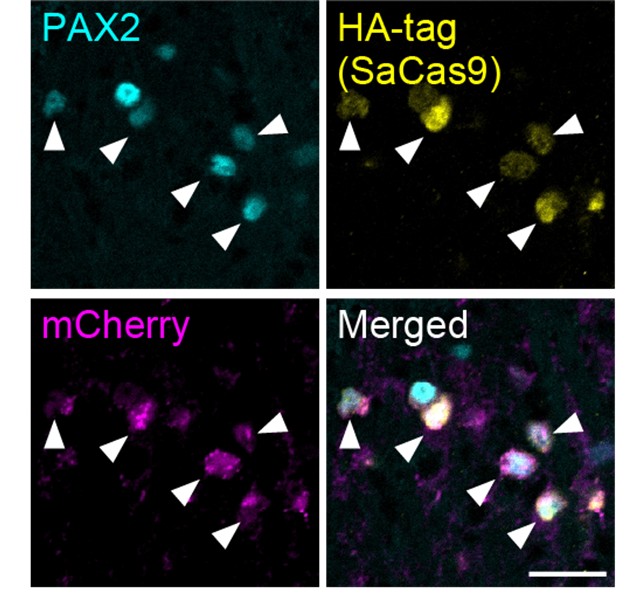
      (6) Methods:

      It is unclear how fiber photometry is performed using "optic cannula" during restraint stress while mice are in a 50ml falcon tube (as shown in Figure 1A).

      We apologize for the omission of this detail in the Methods section. To monitor Ca<sup>2+</sup> events in LC-NA neurons during restraint stress, we created a narrow slit on the top of the conical tube, allowing mice to undergo restraint stress while connected to the optic fiber (see video). This information has now been added to the Methods section (lines 552-553).

      Recommendations for the authors:

      Reviewer #1 (Recommendations for the authors):

      (1) Scientific rigor:

      It is unclear if the normal distribution of the data was determined before selecting statistical tests.

      We apologize for omitting this description. For all statistical analyses in this study, we first assessed the normality of the data and then selected appropriate statistical tests accordingly. We have added this information to the revised manuscript (lines 711-712).

      (2) Nomenclature:

      (a) Mouse Genome Informatics (MGI) nomenclature should be used to describe mouse genotypes (i.e., gene name in italic, only first letter is capitalized, alleles in superscript).

      (b) FLEx should be used instead of flex.

      Thank you for the suggestion. We have corrected these terms (including FLEx) according to MGI nomenclature.

      Reviewer #2 (Public review):

      Summary:

      This study investigates the role of spinal astrocytes in mediating stress-induced pain hypersensitivity, focusing on the LC (locus coeruleus)-to-SDH (spinal dorsal horn) circuit and its mechanisms. The authors aimed to delineate how LC activity contributes to spinal astrocytic activation under stress conditions, explore the role of noradrenaline (NA) signaling in this process, and identify the downstream astrocytic mechanisms that influence pain hypersensitivity.

      The authors provide strong evidence that 1-hour restraint stress-induced pain hypersensitivity involves the LC-to-SDH circuit, where NA triggers astrocytic calcium activity via alpha1a adrenoceptors (alpha1aRs). Blockade of alpha1aRs on astrocytes - but not on Vgat-positive SDH neurons - reduced stress-induced pain hypersensitivity. These findings are rigorously supported by well-established behavioral models and advanced genetic techniques, uncovering the critical role of spinal astrocytes in modulating stress-induced pain.

      However, the study's third aim - to establish a pathway from astrocyte alpha1aRs to adenosine-mediated inhibition of SDH-Vgat neurons - is less compelling. While pharmacological and behavioral evidence is intriguing, the ex vivo findings are indirect and lack a clear connection to the stress-induced pain model. Despite these limitations, the study advances our understanding of astrocyte-neuron interactions in stress-pain contexts and provides a strong foundation for future research into glial mechanisms in pain hypersensitivity.

      Strengths:

      The study is built on a robust experimental design using a validated 1-hour restraint stress model, providing a reliable framework to investigate stress-induced pain hypersensitivity. The authors utilized advanced genetic tools, including retrograde AAVs, optogenetics, chemogenetics, and subpopulation-specific knockouts, allowing precise manipulation and interrogation of the LC-SDH circuit and astrocytic roles in pain modulation. Clear evidence demonstrates that NA triggers astrocytic calcium activity via alpha1aRs, and blocking these receptors effectively reduces stress-induced pain hypersensitivity.

      Weaknesses:

      Despite its strengths, the study presents indirect evidence for the proposed NA-to-astrocyte(alpha1aRs)-to-adenosine-to-SDH-Vgat neurons pathway, as the link between astrocytic adenosine release and stress-induced pain remains unclear. The ex vivo experiments, including NA-induced depolarization of Vgat neurons and chemogenetic stimulation of astrocytes, are challenging to interpret in the stress context, with the high CNO concentration raising concerns about specificity. Additionally, the role of astrocyte-derived D-serine is tangential and lacks clarity regarding its effects on SDH Vgat neurons. The astrocyte calcium signal "dip" after LC optostimulation-induced elevation are presented without any interpretation.

      We appreciate the reviewer's careful reading of our paper. According to the reviewer's comments, we have performed new additional experiments and added some discussion in the revised manuscript (please see the point-by-point responses below).

      Reviewer #2 (Recommendations for the authors):

      The astrocyte-mediated pathway of NA-to-astrocyte (alpha1aRs)-to-adenosine-to-SDH Vgat neurons (A1R) in the context of stress-induced pain hypersensitivity requires more direct evidence. While the data showing that the A1R agonist CPT inhibits stress-induced hypersensitivity and that stress combined with Aβ fiber stimulation increases pERK in the SDH are intriguing, these findings primarily support the involvement of A1R on Vgat neurons and are only behaviorally consistent with SDH-Vgat neuronal A1R knockdown. The role of astrocytes in this pathway in vivo remains indirect. The ex vivo chemogenetic Gq-DREADD stimulation of SDH astrocytes, which reduced sIPSCs in Vgat neurons in a CPT-dependent manner, needs revision with non-DREADD+CNO controls to validate specificity. Furthermore, the ex vivo bath application of NA causing depolarization in Vgat neurons, blocked by CPT, adds complexity to the data leaving me wondering how astrocytes are involved in such processes, and it does not directly connect to stress-induced pain hypersensitivity. These findings are potentially useful but require additional refinement to establish their relevance to the stress model.

      We thank the reviewer for the insightful feedback. First, regarding the role of astrocytes in this pathway in vivo, we showed in the initial version that mechanical pain hypersensitivities induced by intrathecal NA injection and by acute restraint stress were attenuated by both pharmacological blockade and Vgat<sup>+</sup> neuron-specific knockdown of A<sub>1</sub>Rs (Figure 4A, B). Given that NA- and stress-induced pain hypersensitivity is mediated by α<sub>1A</sub>R-dependent signaling in Hes5<sup>+</sup> astrocytes (Kohro et al., Nat Neurosci, 2020 (PMID: 33020652); this study), these findings provide in vivo evidence supporting the involvement of the NA → Hes5<sup>+</sup> astrocyte (via α<sub>1A</sub>Rs) → adenosine → Vgat<sup>+</sup> neuron (via A<sub>1</sub>Rs) pathway. As noted in the reviewer’s major comment (2), in vivo monitoring of adenosine dynamics in the SDH during stress exposure would further substantiate the astrocyte-to-neuron signaling pathway. However, we did not detect clear signals, potentially due to several technical limitations (see our response below). Acknowledging this limitation, we have now added a new paragraph in the end of Discussion section to address this issue. Second, the specificity of the effect of CNO has now been validated by additional experiments (see our response to major point (4)). Third, the reviewer’s concern regarding the action of NA on Vgat<sup>+</sup> neurons has also been addressed (see our response to major point (3) below).

      Major points:

      (1) The in vivo pharmacology using DCK to antagonize D-serine signaling from alpha1a-activated astrocytes is tangential, as there is limited evidence on how Vgat neurons (among many others) respond to D-serine. This aspect requires more focused exploration to substantiate its relevance.

      We propose that the site of action of D-serine in our neural circuit model is the NMDA receptors (NMDARs) on excitatory neurons, a notion supported by our previous findings (Kohro et al., Nat Neurosci, 2020 (PMID: 33020652); Kagiyama et al., Mol Brain, 2025 (PMID: 40289116)). However, we cannot exclude the possibility that D-serine also acts on NMDARs expressed by Vgat<sup>+</sup> inhibitory neurons. Nevertheless, given that intrathecal injection of D-serine in naïve mice induces mechanical pain hypersensitivity (Kohro et al., Nat Neurosci, 2020 (PMID: 33020652)), it appears that the pronociceptive effect of D-serine in the SDH is primarily associated with enhanced pain processing and transmission, presumably via NMDARs on excitatory neurons. We have added this point to the Discussion section in the revised manuscript (lines 325-330).

      (2) Additionally, employing GRAB-Ado sensors to monitor adenosine dynamics in SDH astrocytes during NA signaling would significantly strengthen conclusions about astrocyte-derived adenosine's role in the stress model.

      We agree with the reviewer’s comment. Following this suggestion, we attempted to visualize NA-induced adenosine (and ATP) dynamics using GRAB-ATP and GRAB-Ado sensors (Wu et al., Neuron, 2022 (PMID: 34942116); Peng et al., Science, 2020 (PMID: 32883833)) in acutely isolated spinal cord slices from mice after intra-SDH injection of AAV-hSyn-GRABATP<sub>1.0</sub> and -GRABAdo<sub>1.0</sub>. We confirmed expression of these sensors in the SDH (Author response image 2a) and observed increased signals after bath application of ATP (0.1 or 1 µM) or adenosine (1 µM) (Author response image 2b, c). However, we were unable to detect clear signals following NA stimulation (Author response image 2b, c). The reason for this lack of detectable changes remains unclear. If the release of adenosine from astrocytes is a highly localized phenomenon, it may be measurable using high-resolution microscopy capable of detecting adenosine levels at the synaptic level and more sensitive sensors. Further investigation will therefore be required (lines 340-341).

      Author response image 2.

      Ex vivo imaging of GRAB-ATP and GRAB-Ado sensors.(a) Representative images of GRAB<sub>ATP1.0</sub> (left, green) or GRAB<sub>Ado1.0</sub> (right, green) expression in the SDH at 3 weeks after SDH injection of AAV-hSyn-GRAB<sub>Ado1.0</sub> or AAV-hSyn-GRAB<sub>Ado1.0</sub> in Hes5-CreERT2 mice. Scale bar, 200 µm. (b) Left: Representative fluorescence images showing GRAB<sub>ATP1.0</sub> responses before and after perfusion with NA or ATP. Right: Representative traces showing responses to ATP (0.1 and 1 µM) or NA (10 µM). (c) Left: Representative fluorescence images showing GRABAdo1.0 responses before and after perfusion with NA or adenosine (Ado). Right: Representative traces showing responses to Ado (0.01, 0.1, and 1 µM), NA (10 µM), or no application (negative control).
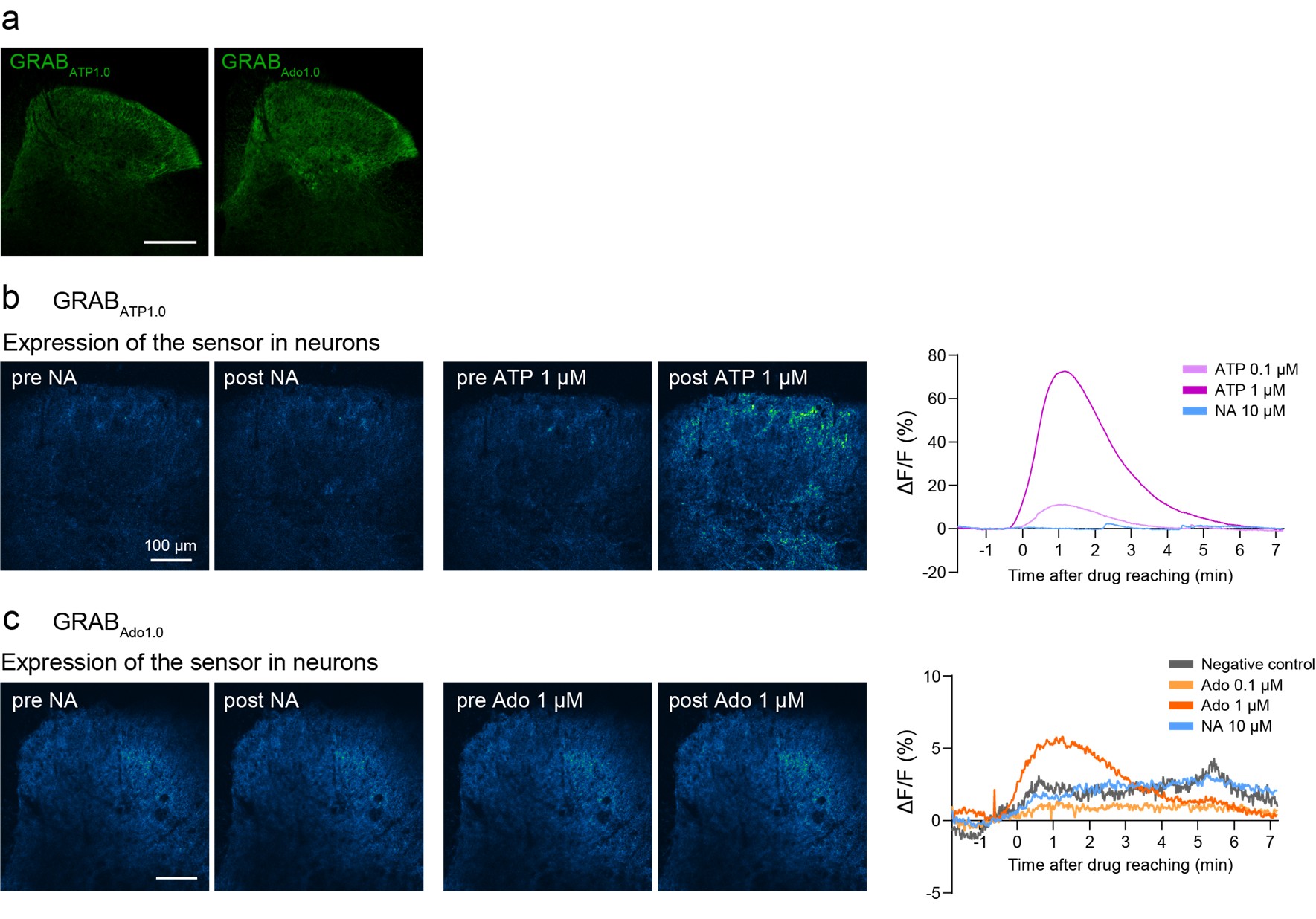
      (3) The interpretation of Figure 3D is challenging. The manuscript implies that 20 μM NA acts on Adra1a receptors on Vgat neurons to depolarize them, but this concentration should also activate Adra1a on astrocytes, leading to adenosine release and potential inhibition of depolarization. The observation of depolarization despite these opposing mechanisms requires explanation, as does the inhibition of depolarization by bath-applied A1R agonist. Of note, 20 μM NA is a high concentration for Adra1a activation, typically responsive at nanomolar levels. The discussion should reconcile this with prior studies indicating dose-dependent effects of NA on pain sensitivity (e.g., Reference 22).

      Like the reviewer, we also considered that bath-applied NA could activate α<sub>1A</sub>Rs expressed on Hes5<sup>+</sup> astrocytes. To clarify this point, we have performed additional patch-clamp recordings and found that knockdown of A<sub>1</sub>Rs in Vgat<sup>+</sup> neurons tended to increase the proportion of Vgat<sup>+</sup> neurons with NA-induced depolarizing responses (Figure S8). Therefore, it is conceivable that NA-induced excitation of Vgat<sup>+</sup> neurons may involve both a direct effect of NA activating α<sub>1A</sub>Rs in Vgat<sup>+</sup> neurons and an indirect inhibitory signaling from NA-stimulated Hes5<sup>+</sup> astrocytes via adenosine (lines 298-300).

      The concentration of NA used in our ex vivo experiments is higher than that typically used in vitro with αR-<sub>1A</sub>expressing cell lines or primary culture cells, but is comparable to concentrations used in other studies employing spinal cord slices (Kohro et al., Nat Neurosci, 2020 (PMID: 33020652); Baba et al., Anesthesiology, 2000 (PMID: 10691236); Lefton et al., Science, 2025 (PMID: 40373122)). In slice experiments, drugs must diffuse through the tissue to reach target cells, resulting in a concentration gradient. Therefore, higher drug concentrations are generally necessary in slice experiments, in contrast to cultured cell experiments, where drugs are directly applied to target cells. Importantly, we have previously shown that the pharmacological effects of 20 μM NA on Vgat<sup>+</sup> neurons and Hes5<sup>+</sup> astrocytes are abolished by loss of α<sub>1A</sub>Rs in these cells (Uchiyama et al., Mol Brain, 2022 (PMID: 34980215); Kohro et al., Nat Neurosci, 2020 (PMID: 33020652)), confirming the specificity of these NA actions.

      Regarding the dose-dependent effect of NA on pain sensitivity, NA-induced pain hypersensitivity is abolished in Hes5<sup>+</sup> astrocyte-specific α<sub>1A</sub>R-KO mice (Kohro et al., Nat Neurosci, 2020 (PMID: 33020652)), indicating that this behavior is mediated by α<sub>1A</sub>Rs expressed on Hes5<sup>+</sup> astrocytes. In contrast, the suppression of pain sensitivity by high doses of NA was unaffected in the KO mice (Kohro et al., Nat Neurosci, 2020 (PMID: 33020652)), suggesting that other adrenergic receptors may contribute to this phenomenon. Clarifying the responsible receptors will require future investigation.

      (4) In Figure 3K-M, the CNO concentration used (100 μM) is unusually high compared to standard doses (1 to a few μM), raising concerns about potential off-target effects. Including non-hM3Dq controls and using lower CNO concentrations are essential to validate the specificity of the observed effects. Similarly, the study should clarify whether astrocyte hM3Dq stimulation alone (without NA) would induce hyperpolarization in Vgat neurons and how this interacts with NA-induced depolarization.

      We acknowledge that the concentration of CNO used in our experiments is relatively high compared to that used in other reports. However, in our experiments, application of CNO at 1, 10, and 100 μM induced Ca<sup>2+</sup> increases in GCaMP6-expressing astrocytes in spinal cord slices in a concentration-dependent manner (Figure S7). Among these, 100 μM CNO most effectively replicated the NA-induced Ca<sup>2+</sup> signals in astrocytes. Based on these findings, we selected this concentration for use in both the current and previous studies (Kohro et al., Nat Neurosci., 2020 (PMID: 33020652)). Importantly, to rule out non-specific effects, we conducted control experiments using spinal cord slices from mice that did not express hM3Dq in astrocytes and confirmed that CNO had no effect on Ca<sup>2+</sup> responses in astrocytes and sIPSCs in substantial gelatinosa (SG) neurons (Figure S7; lines 223-228). Thus, although the CNO concentration used is relatively high, the observed effects of CNO are not non-specific but result from the chemogenetic activation of hM3Dq-expressing astrocytes.

      In this study, we used Hes5-CreERT2 and Vgat-Cre mice to manipulate gene expression in Hes5<sup>+</sup> astrocytes and Vgat<sup>+</sup> neurons, respectively. In order to fully address the reviewer’s comment, the use of both Cre lines is necessary. However, simultaneous and independent genetic manipulation in each cell type using Cre activity alone is not feasible with the current genetic tools. We have mentioned this as a technical limitation in the Discussion section (lines 382-388).

      (5) The role of D-serine released by hM3Dq-stimulated astrocytes in (separately) modulating sub-types of neurons including excitatory neurons and Vgat positives needs more detailed discussion. If no effect of D-serine on Vgat neurons is observed, this should be explicitly stated, and the discussion should address why this might be the case.

      As mentioned in our response to Major Point (1) above, we have added a discussion of this point in the revised manuscript (lines 325-330).

      (6) Finally, the observed "dip" in astrocyte calcium signals below baseline following the large peaks with LC optostimulation should be discussed further, as understanding this phenomenon could provide valuable insights into astrocytic signaling dynamics in the context of single acute or repetitive chronic stress.

      Thank you for your comment. We found that this phenomenon was not affected by pretreatment with the α<sub>1A</sub>R-specific antagonist silodosin (Author response image 3), which effectively suppressed Ca<sup>2+</sup> elevations evoked by stimulation of LC-NA neurons (Figure 2F). This implies that the phenomenon is independent of α<sub>1A</sub>R signaling. Elucidating the detailed underlying mechanism remains an important direction for future investigation.

      Author response image 3.

      The observed "dip" in astrocyte Ca<sup>2+</sup> signals was not affected by pretreatment with the α<sub>1A</sub>R-specific antagonist silodosin. Representative traces of astrocytic GCaMP6m signals in response to optogenetic stimulation of LC-NAe<sup>→SDH</sup>rgic axons/terminals in a spinal cord slice. Each trace shows the GCaMP6m signal before and after optogenetic stimulation (625 nm, 1 mW, 10 Hz, 5 ms pulse duration, 10 s). Slices were pretreated with silodosin (40 nM) for 5 min prior to stimulation.
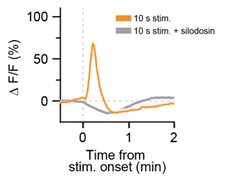
      Reviewer #3 (Public review):

      Summary:

      This is an exciting and timely study addressing the role of descending noradrenergic systems in nocifensive responses. While it is well-established that spinally released noradrenaline (aka norepinephrine) generally acts as an inhibitory factor in spinal sensory processing, this system is highly complex. Descending projections from the A6 (locus coeruleus, LC) and the A5 regions typically modulate spinal sensory processing and reduce pain behaviours, but certain subpopulations of LC neurons have been shown to mediate pronociceptive effects, such as those projecting to the prefrontal cortex (Hirshberg et al., PMID: 29027903).

      The study proposes that descending cerulean noradrenergic neurons potentiate touch sensation via alpha-1 adrenoceptors on Hes5+ spinal astrocytes, contributing to mechanical hyperalgesia. This finding is consistent with prior work from the same group (dd et al., PMID:). However, caution is needed when generalising about LC projections, as the locus coeruleus is functionally diverse, with differences in targets, neurotransmitter co-release, and behavioural effects. Specifying the subpopulations of LC neurons involved would significantly enhance the impact and interpretability of the findings.

      Strengths:

      The study employs state-of-the-art molecular, genetic, and neurophysiological methods, including precise CRISPR and optogenetic targeting, to investigate the role of Hes5+ astrocytes. This approach is elegant and highlights the often-overlooked contribution of astrocytes in spinal sensory gating. The data convincingly support the role of Hes5+ astrocytes as regulators of touch sensation, coordinated by brain-derived noradrenaline in the spinal dorsal horn, opening new avenues for research into pain and touch modulation.

      Furthermore, the data support a model in which superficial dorsal horn (SDH) Hes5+ astrocytes act as non-neuronal gating cells for brain-derived noradrenergic (NA) signalling through their interaction with substantia gelatinosa inhibitory interneurons. Locally released adenosine from NA-stimulated Hes5+ astrocytes, following acute restraint stress, may suppress the function of SDH-Vgat+ inhibitory interneurons, resulting in mechanical pain hypersensitivity. However, the spatially restricted neuron-astrocyte communication underlying this mechanism requires further investigation in future studies.

      Weaknesses

      (1) Specificity of the LC Pathway targeting

      The main concern lies with how definitively the LC pathway was targeted. Were other descending noradrenergic nuclei, such as A5 or A7, also labelled in the experiments? The authors must convincingly demonstrate that the observed effects are mediated exclusively by LC noradrenergic terminals to substantiate their claims (i.e. "we identified a circuit, the descending LC→SDH-NA neurons").

      (a) For instance, the direct vector injection into the LC likely results in unspecific effects due to the extreme heterogeneity of this nucleus and retrograde labelling of the A5 and A7 nuclei from the LC (i.e., Li et al., PMID: 26903420).

      We appreciate the reviewer's valuable comments. To address this point, we performed additional experiments and demonstrated that intra-SDH injection of AAVretro-Cre followed by intra-LC injection of AAV2/9-EF1α-FLEx[DTR-EGFP] specifically results in DTR expression in NA neurons of the LC, but not of the A5 or A7 regions (Figure S4; lines 127-128). These results confirm the specificity of targeting the LC<sup>→SDH</sup>-NAergic pathway in our study.

      (b) It is difficult to believe that the intersectional approach described in the study successfully targeted LC→SDH-NA neurons using AAVrg vectors. Previous studies (e.g., PMID: 34344259 or PMID: 36625030) demonstrated that similar strategies were ineffective for spinal-LC projections. The authors should provide detailed quantification of the efficiency of retrograde labelling and specificity of transgene expression in LC neurons projecting to the SDH.

      Thank you for your comment. As we described in our response to the weakness (5)-e) of Reviewer #1 (Public review), our additional analysis showed that, under our experimental conditions, expression of genes (for example DTR) was observed in 4.4% of NA (TH<sup>+</sup>) neurons in the LC (Figure S4; lines 126-127).

      The reasons for this difference between the previous studies and our current study is unclear; however, it is likely attributed to methodological differences, including the type of viral vectors employed, species differences (mouse (PMID: 34344259, our study) vs. rat (PMID: 36625030)), the amount of AAV injected into the SDH (300 nL at three sites (PMID: 34344259), and 300 nL at a single site (our study)) and LC (500 nL at a single site (PMID: 34344259), and 300 nL at a single site (our study)), as well as the depth of AAV injection in the SDH (200–300 µm from the dorsal surface of the spinal cord (PMID: 34344259), and 120–150 µm in depth from the surface of the dorsal root entry zone (our study)).

      (c) Furthermore, it is striking that the authors observed a comparably strong phenotypical change in Figure 1K despite fewer neurons being labelled, compared to Figure 1H and 1N with substantially more neurons being targeted. Interestingly, the effect in Figure 1K appears more pronounced but shorter-lasting than in the comparable experiment shown in Figure 1H. This discrepancy requires further explanation.

      Although only a representative section of the LC was shown in the initial version, LC<sup>→SDH</sup>-NA neurons are distributed rostrocaudally throughout the LC, as previously reported (Llorca-Torralba et al., Brain, 2022 (PMID: 34373893)). Our additional experiments analyzing multiple sections of the anterior and posterior regions of the LC have now revealed that approximately sixty LC<sup>→SDH</sup>-NA neurons express DTR, and these neurons are eliminated following DTX treatment (Figure S4; lines 126-128) (it should be noted that these neurons specifically project to the L4 segment of the SDH, and the total number of LC<sup>→SDH</sup>-NA neurons is likely much higher). Considering the specificity of LC<sup>→SDH</sup>-NAergic pathway targeting demonstrated in our study (as described above), together with the fact that primary afferent sensory fibers from the plantar skin of the hindpaw predominantly project to the L4 segment of the SDH, these data suggest that the observed behavioral changes are attributable to the loss of these neurons and that ablation of even a relatively small number of NA neurons in the LC can have a significant impact on behavior. We have added this hypothesis in the Discussion section (lines 373-382).

      Regarding the data in Figures 1H and 1K, as the reviewer pointed out, a statistically significant difference was observed at 90 min in mice with ablation of LC-NA neurons, but not in those with LC<sup>→SDH</sup>-NA neuron ablation. This is likely due to a slightly higher threshold in the control group at this time point (Figure 1K), and it remains unclear whether there is a mechanistic difference between the two groups at this specific time point.

      (d) A valuable addition would be staining for noradrenergic terminals in the spinal cord for the intersectional approach (Figure 1J), as done in Figures 1F/G. LC projections terminate preferentially in the SDH, whereas A5 projections terminate in the deep dorsal horn (DDH). Staining could clarify whether circuits beyond the LC are being ablated.

      As suggested, we performed DTR immunostaining in the SDH; however, we did not detect any DTR immunofluorescence there. A similar result was also observed in the spinal terminals of DTR-expressing primary afferent fibers (our unpublished data). The reason for this is unclear, but to the best of our knowledge, no studies have clearly shown DTR expression at presynaptic terminals, which may be because the action of DTX on the neuronal cell body is necessary for cell ablation. Nevertheless, as described in our response to the weakness (5)-f) by Reviewer 1 (Public review), we have now confirmed the specific expression of DTR in the LC, but not in the A5 and A7 regions (Figure S4; lines 127-128).

      (e) Furthermore, different LC neurons often mediate opposite physiological outcomes depending on their projection targets-for example, dorsal LC neurons projecting to the prefrontal cortex PFCx are pronociceptive, while ventral LC neurons projecting to the SC are antinociceptive (PMIDs: 29027903, 34344259, 36625030). Given this functional diversity, direct injection into the LC is likely to result in nonspecific effects.

      To avoid behavioral outcomes resulting from a mixture of facilitatory and inhibitory effects caused by activating the entire population of LC-NA neurons, we employed a specific manipulation targeting LC<sup>→SDH</sup>-NA neurons using AAV vectors. The specificity of this manipulation was confirmed in our previous study (Kohro et al., Nat Neurosci, 2020 (PMID: 33020652)) and in the current study (Figure S4). Using this approach, we previously demonstrated that LC neurons can exert pronociceptive effects via astrocytes in the SDH (Kohro et al., Nat Neurosci, 2020 (PMID: 33020652)). This pronociceptive role is further supported by the current study, which uses a more selective manipulation of LC<sup>→SDH</sup>-NA neurons through a NET-Cre mouse line. In addition, intrathecal administration of relatively low doses of NA in naïve mice clearly induces mechanical pain hypersensitivity. Nevertheless, we have also acknowledged that several recent studies have reported an inhibitory role of LC<sup>→SDH</sup>-NA neurons in spinal nociceptive signaling. The reason for these differing behavioral outcomes remains unclear, but several methodological differences may underlie the discrepancy. First, the degree of LC<sup>→SDH</sup>-NA neuronal activity may play a role. Although direct comparisons between studies reporting pro- and anti-nociceptive effects are difficult, our previous studies demonstrated that intrathecal administration of high doses of NA in naïve mice does not induce mechanical pain hypersensitivity (Kohro et al., Nat Neurosci, 2020 (PMID: 33020652)). Second, the sensory modality used in behavioral testing may be a contributing factor as the pronociceptive effect of NA appears to be selectively observed in responses to mechanical, but not thermal, stimuli (Kohro et al., Nat Neurosci, 2020 (PMID: 33020652)). This sensory modality-selective effect is also evident in mice subjected to acute restraint stress (Table S1). Therefore, the role of LC<sup>→SDH</sup>-NA neurons in modulating nociceptive signaling in the SDH is more complex than previously appreciated, and their contribution to pain regulation should be reconsidered in light of factors such as NA levels, sensory modality, and experimental context. In revising the manuscript, we have included some points described above in the Discussion (lines 282-291).

      Conclusion on Specificity: The authors are strongly encouraged to address these limitations directly, as they significantly affect the validity of the conclusions regarding the LC pathway. Providing more robust evidence, acknowledging experimental limitations, and incorporating complementary analyses would greatly strengthen the manuscript.

      We appreciate the reviewer’s comments. We fully acknowledge the limitations raised and agree that addressing them directly is important for the rigor of our conclusions on the LC pathway. To this end, we have performed additional experiments (e.g., Figure A and S4), which are now included in the revised manuscript. Furthermore, we have also newly added a new paragraph for experimental limitations in the end of Discussion section (lines 373-408). We believe these new data substantially strengthen the validity of our findings and have clarified these points in the Discussion section.

      (2) Discrepancies in Data

      (a) Figures 1B and 1E: The behavioural effect of stress on PWT (Figure 1E) persists for 120 minutes, whereas Ca2+ imaging changes (Figure 1B) are only observed in the first 20 minutes, with signal attenuation starting at 30 minutes. This discrepancy requires clarification, as it impacts the proposed mechanism.

      Thank you for your important comment. As pointed out by the reviewer, there is a difference between the duration of behavioral responses and Ca<sup>2+</sup> events, although the exact time point at which the PWT begins to decline remains undetermined (as behavioral testing cannot be conducted during stress exposure). A similar temporal difference was also observed following intraplantar injection of capsaicin (Kohro et al., Nat Neurosci, 2020 (PMID: 33020652)); while LC<sup>→SDH</sup>-NA neuron-mediated astrocytic Ca<sup>2+</sup> responses in SDH astrocytes last for 5–10 min after injection, behavioral hypersensitivity peaks around 60 min post-injection and gradually returns to baseline over the subsequent 60–120 min. These findings raise the possibility that astrocyte-mediated pain hypersensitivity in the SDH may involve a sustained alteration in spinal neural function, such as central sensitization. We have added this hypothesis to the Discussion section of the revised manuscript (lines 399-408), as it represents an important direction for future investigation.

      (b) Figure 4E: The effect is barely visible, and the tissue resembles "Swiss cheese," suggesting poor staining quality. This is insufficient for such an important conclusion. Improved staining and/or complementary staining (e.g., cFOS) are needed. Additionally, no clear difference is observed between Stress+Ab stim. and Stress+Ab stim.+CPT, raising doubts about the robustness of the data.

      As suggested, we performed c-FOS immunostaining and obtained clearer results (Figure 4E,F; lines 243-252). We also quantitatively analyzed the number of c-FOS<sup>+</sup> cells in the superficial laminae, and the results are consistent with those obtained from the pERK experiments.

      (c) Discrepancy with Existing Evidence: The claim regarding the pronociceptive effect of LC→SDH-NAergic signalling on mechanical hypersensitivity contrasts with findings by Kucharczyk et al. (PMID: 35245374), who reported no facilitation of spinal convergent (wide-dynamic range) neuron responses to tactile mechanical stimuli, but potent inhibition to noxious mechanical von Frey stimulation. This discrepancy suggests alternative mechanisms may be at play and raises the question of why noxious stimuli were not tested.

      In our experiments, ChrimsonR expression was observed in the superficial and deeper laminae of the spinal cord (Figure S6). Due to the technical limitations of the optical fibers used for optogenetics, the light stimulation could only reach the superficial laminae; therefore, it may not have affected the activity of neurons (including WDR neurons) located in the deeper laminae. Furthermore, the study by Kucharczyk et al. (Brain, 2022 (PMID: 35245374)) employed a stimulation protocol that differed from ours, applying continuous stimulation over several minutes. Given that the levels of NA released from LC<sup>→SDH</sup>-NAergic terminals in the SDH increase with the duration of terminal stimulation (as shown in Figure 2B), longer stimulation may result in higher levels of NA in the SDH. Considering also our data indicating that the pro- and anti-nociceptive effects of NA are dose dependent (Kohro et al., Nat Neurosci, 2020 (PMID: 33020652)), these differences may be related to LC<sup>→SDH</sup>-NA neuron activity, NA levels in the SDH, and the differential responses of SDH neurons in the superficial versus deeper laminae (lines 388-395).

      (3) Sole reliance on Von Frey testing

      The exclusive use of von Frey as a behavioural readout for mechanical sensitisation is a significant limitation. This assay is highly variable, and without additional supporting measures, the conclusions lack robustness. Incorporating other behavioural measures, such as the adhesive tape removal test to evaluate tactile discomfort, the needle floor walk corridor to assess sensitivity to uneven or noxious surfaces, or the kinetic weight-bearing test to measure changes in limb loading during movement, could provide complementary insights. Physiological tests, such as the Randall-Selitto test for noxious pressure thresholds or CatWalk gait analysis to evaluate changes in weight distribution and gait dynamics, would further strengthen the findings and allow for a more comprehensive assessment of mechanical sensitisation.

      Thank you for your suggestion. Based on our previous findings that Hes5<sup>+</sup> astrocytes in the SDH selectively modulate mechanosensory signaling (Kohro et al., Nat Neurosci, 2020 (PMID: 33020652)), the present study focused on behavioral responses to mechanical stimuli using von Frey filaments. As we have not previously conducted most of the behavioral tests suggested by the reviewers, and as we currently lack the necessary equipments for these tests (e.g., Randall–Selitto test, CatWalk gait analysis, and weight-bearing test), we were unable to include them in this study. However, it will be of great interest in future research to investigate whether activation of the LC<sup>→SDH</sup>-NA neuron-to-SDH Hes5<sup>+</sup> astrocyte signaling pathway similarly sensitizes behavioral responses to other types of mechanical stimuli and also to investigate the sensory modality-selective pro- and antinociceptive role of LC<sup>→SDH</sup>-NAergic signaling in the SDH (lines 396-399).

      Overall Conclusion

      This study addresses an important and complex topic with innovative methods and compelling data. However, the conclusions rely on several assumptions that require more robust evidence. Specificity of the LC pathway, experimental discrepancies, and methodological limitations (e.g., sole reliance on von Frey) must be addressed to substantiate the claims. With these issues resolved, this work could significantly advance our understanding of astrocytic and noradrenergic contributions to pain modulation.

      We have made every effort to address the reviewer’s concerns through additional experiments and analyses. Based on the new control data presented, we believe that our explanation is reasonable and acceptable. Although additional data cannot be provided on some points due to methodological constraints and limitations of the techniques currently available in our laboratory, we respectfully submit that the evidence presented sufficiently supports our conclusions.

      Reviewer #3 (Recommendations for the authors):

      A lot of beautiful and challenging-to-collect data is presented. Sincere congratulations to all the authors on this achievement!

      Notwithstanding, please carefully reconsider the conclusions regarding the LC pathway, as additional evidence is required to ensure their specificity and robustness.

      We thank the reviewer for the kind comments and for raising an important point regarding the LC pathway. The reviewer’s feedback prompted us to conduct additional investigations to further strengthen the validity of our conclusions. We have incorporated these new data and analyses into the revised manuscript, and we believe that these revisions substantially enhance the robustness and reliability of our findings.

    1. The two judgessaid that archivists have a duty to boththe government and the public. Unfor-tunately, archival dogma can lead ar-chivists to consider the needs of govern-ment first.

      I agree with the judges final decision that the archivists do have a duty to the public. I think the wording is interesting, government and the public. The two are separate here. But the government is suppose to serve the people. The "immediate operational needs" I think is a way that it is serving the government and how it operates, but again, it is suppose to be in service of the people. I think the case is interesting overall because it exposed multiple ways in which a part of the government does not, particularly with destroying of documents pertaining to its citizens.

    1. I

      This report is about women in the music industry and the percentages of the feminine gender participating in musical projects across 1,300 songs from 2012-2024. Also, they are analyzing the Billboard Hot 100 Year-End Charts and how "a total of 130 artists appeared on the Hot 100 Year-End chart of 2024 and men account[ed] for 62.3% of performers and women account[ed] for 37.7% " (Prior 1). Overall, this source claims that there is progress for women in the industry, but not as much as society wants or is expecting. They show categories and percentages of total women artists, songwriters, producers, Grammy award winners, and more that participate in the industry. The report also mentions that "women artists were relegated almost exclusively to Pop and R&B genres" (1). which means they are usually confided into certain music styles. The authors also discuss about marginalized groups that struggle in the industry, but I am focusing on women and their main obstacles for now. This study was conducted by USC Annenberg. They conducted a survey that directly correlated with Spotify. Spotify is a well-known music streaming platform for artists. The study includes percentages, graphs, ratios, and visuals that help the readers understand the data that is shown about women and men. This source is important to my research because it highlights specific percentages and data for women across 1,300 of the most popular songs from 2012-2024, which is a practical timeline to analyze. Also, the report gives me multiple categories of data on females, specifically on songwriters, artists, producers, Grammy awards, and more which are my main focus points for my research.

    1. A large detection literature

      I wonder whether we should motivate the paper with a big picture policy question (how to fight corruption) that requires understanding how it works and is organized. Knowing that we can better understand how the organizing responds to enforcement, what are signatures to look for (and which signatures are easily circumvented). Not sure exactly. But point is we must start with a very clear policy question. Then argue that existing literature comes short. Not just start with literature gap.

    1. Yup. When I was in college, they assigned everyone with a task to design and develop a website for a local business founded by the elderly and for the elderly. Worked super hard (was just getting into web design and dev) and created, what I and my friends thought, was a beautiful site form scratch. I thought I had a good shot at winning but they ended up picking a website that was covered in one color and used a very basic free pre-built bootstrap theme. It even had a little footer that said ‘theme from xyz’ at the bottom of the page when they presented it to the client. Old people and their taste can be surprising.

      The complainants' comments here are pure occupational psychosis.

      See also: déformation professionnelle.

    1. Kuntillet Ajrud inscriptions

      BiblicalArchaeology.org confirms that the Kuntillet Ajrud inscriptons mention Asherah. These inscriptions were found on large storage containers, but according to this website, some scholars have interpreted both figures as male. Furthermore, another article from this website says that there is a plural term for Ashera, Asherim, which may mean that this term refers to a type of deity. It is also mentioned that there are both masculine and feminine forms of this word "asherim" in Hebrew.

    1. Women

      This source is about women in the music industry that continue to face misogyny and how society wants to change this issue. Misogyny is a problem in the music industry, and it happens worldwide every day. Women still struggle with "discrimination, misogyny, and sexual abuse in an industry that is still routinely described as a 'boys’ club." Women are taken advantage of usually when working with other men--especially when drugs, money, and threats of fame come into play. Even though women are being credited more for their creative works and performing in front of large audiences, they still do not get treated the same as their male counterparts. The UK is developing the Creative Industries Independent Standards Authority (CIISA) to help prevent harassment and injustice in the music industry for women and others who experience inappropriate scenarios. There are also more organizations that are helping women face gender biases and harassment, "including the F-List, Black Lives in Music, Cactus City, and Women in CTRL, to more local schemes such as Girls Rock London, Yorkshire Sound Women Network and Manchester-based Brighter Sound, just to name a few." This source is important to my research because it shares the issues that women are currently facing within the music industry but also showcasing how we can improve the industry to make it a better place for everyone. This article also provides many reliable quotes that can be added in the paper from leaders or institutions in the music industry.