celebrate the success of others
yes
that creates abundance
celebrate the success of others
yes
that creates abundance
abundance mentality, or abundance mindset, a way of thinking in which a person believes there are enough resources and successes to share with others.
Trust the Universe
Trust One Self not selfishly
but knowing the more give the more you will become
Do good, expect good.
Good is not the dual of Bad or Evil, but is
a self0sustaining postive attitude that creates its rewards without expectations or demands or entitlement but measured with grratitude one feels count your blessings, allways
an open mind to be influenced
synonym of care and attention what else is the point of listenting?
Use empathetic listening to genuinely understand a person
You mean pay real attention, yes Attention is sacred
well
everything is
"Seek first to understand, then to be understood"
So this is where it comes from.
"you are the programmer",
let go of control,
Let it be so
Let IT grow and grow with it
people should spend the majority of their time on II
sure
Not urgent but important (Plan) – long-term development
focus on imnportance engineer against ever facing urgent demands
burning desire detachment from outcomes
wu wei
by doing (seemingly nothing as urgent) accomplish the maximum you can, that would be your own everything
Grow and stay humble
stay humble
who you want to be?
take the wanting out of being
make your efforts rewards in themselves
"Begin with the end in mind"
cultivating attitude and reflecting on available means (personal strength and weaknesses) to purse chosen path not ends
effectiveness as the balance of obtaining desirable results with caring for that which produces those results.
caring about what produces result
Covey presents an approach to being effective in attaining goals by aligning oneself to what he calls "true north" principles based on a character ethic that he presents as universal and timeless

Collective intelligence
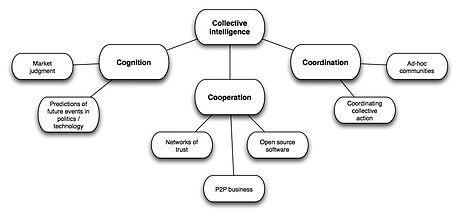
Stigmergic Collaboration: a theoretical framework for mass collaboration
stygmergic collaboration

George Pór defined the collective intelligence phenomenon as "the capacity of human communities to evolve towards higher order complexity and harmony, through such innovation mechanisms as differentiation and integration, competition and collaboration.

The Holy Grail" is symbolic of the Round Table being broken apart, a key reason for the doom of Camelot.
The holy grail caused the members of the round table to leave in search for it. The theme to of giving into your passions (see Excalibur) seems to recur.
“The old order changeth, yielding place to new.” This phrase is repeated by Arthur throughout the work. Tennyson's use of the phrase in both the first and last Idyll, and throughout the work, is indicative of the change in Britain's, and Arthur's, fortunes. At this point, the phrase indicates the passing of Rome and the Heathens; In The Passing of Arthur, it indicates the downfall of Arthur's kingdom.
This seems to represent the cycle of life, that the old will make place for the new, and will be forgotten or remembered. The new comes, trying to make inroads, and tries to be remembered? (work on this further...)
Conrad Gessner was born on 26 March 1516, in Zürich, Switzerland, the son of Ursus Gessner, a poor Zürich furrier.
16th century (Gessner)
A zettelkasten involves a lot of layers in Bloom's taxonomy (see third annotation with context)
In the 1956 original version of the taxonomy, the cognitive domain is broken into the six levels of objectives listed below.[10] In the 2001 revised edition of Bloom's taxonomy, the levels have slightly different names and their order was revised: Remember, Understand, Apply, Analyze, Evaluate, and Create (rather than Synthesize)
The models were named after Benjamin Bloom, who chaired the committee of educators that devised the taxonomy. He also edited the first volume of the standard text, Taxonomy of Educational Objectives: The Classification of Educational Goals
Benjamin Bloom was the originator (and the taxonomy was named after him)
Bloom's taxonomy is a set of three hierarchical models used for classification of educational learning objectives into levels of complexity and specificity. The three lists cover the learning objectives in cognitive, affective and psychomotor domains. The cognitive domain list has been the primary focus of most traditional education and is frequently used to structure curriculum learning objectives, assessments and activities.
Bloom's taxonomy is actually a list of three (the cognitive one being the most dominant: me thinking this was the only "taxonomy")
Apollonian and Dionysian juxtapositions appear in the interplay of tragedy: the tragic hero of the drama, the main protagonist, struggles to make (Apollonian) order of his unjust and chaotic (Dionysian) fate, though he dies unfulfilled.
The hero in a story, like Arthur, dies unfulfilled, knowing that he never reached unity.
Apollo represents harmony, progress, clarity, logic and the principle of individuation, whereas Dionysus represents disorder, intoxication, emotion, ecstasy and unity (hence the omission of the principle of individuation). Nietzsche used these two forces because, for him, the world of mind and order on one side, and passion and chaos on the other, formed principles that were fundamental to the Greek culture:[3][4] the Apollonian a dreaming state, full of illusions; and Dionysian a state of intoxication, representing the liberations of instinct and dissolution of boundaries. In this mould, a man appears as the satyr
Apollo as representing order, clarity, a dream-state of life, an illusion.
Dionysus, on the other hand, represent chaos, and the dissolution of this dream.
It is a type of class attribute (or class property, field, or data member).
Of course, the personal computer and its cousin, the smartphone, have brought about some big changes. And many goods and services are now more plentiful and of better quality. But compared with what my grandmother witnessed, the basic accoutrements of life have remained broadly the same.
transition its users to Google Chat

by the end of August 2019,[4] later changing that date to April 2, 2019.
in reality parts started to be shutdown late January
Communities and Collections more prominen
communities
and collections
eliminated the Google+ social layer; users no longer needed a Google+ profile to share content and communicate with contacts.
elliminted social layer
removing features not supporting "an interest-based social experience".
interest based social experience
the significance of Google+ was less as a Facebook competitor than as a means of gathering and connecting user information from Google's various services
gathering and connecting user information
"a social layer across all of Google's services",
social layer across ambient autonomous personal first long tail services
instituted a company-wide "lockdown", signaling that employees were supposed to dedicate time to bringing Facebook's features into line with Google+
lockdown
bring Facebook features into line wti G+
ability to post photos and status updates to the stream or interest-based communities, group different types of relationships (rather than simply "friends") into Circles, a multi-person instant messaging, text and video chat called Hangouts, events, location tagging, and the ability to edit and upload photos to private cloud-based albums
ability to post photos and status updates to the stream or interest-based communities, group different types of relationships (rather than simply "friends") into Circles, a multi-person instant messaging, text and video chat called Hangouts, events, location tagging, and the ability to edit and upload photos to private cloud-based albums

Discipline Global Mobile

for - Celtic Knot
Celtic knot


The trefoil can be obtained by joining together the two loose ends of a common overhand knot, resulting in a knotted loop. As the simplest knot, the trefoil is fundamental to the study of mathematical knot theory.
obtained by joining together
celtic knot

https://en.wikipedia.org/wiki/Personal_Memoirs_of_U._S._Grant
Early precursor to the sort of publishing and marketing work of James Patterson?
and is often intentionally limited further to reduce instability introduced by a fluctuating tickrate
Although an alternative approach of processing inputs as soon as they arrive is used as well, and may provide for better experience.
E.g., as seen in CS2.
Entradas En ingles y español Una diferencia notable entre las páginas de Wikipedia de Talcott Parsons en inglés y español puede ser el nivel de detalle y extensión de la información proporcionada. Generalmente, la versión en inglés de Wikipedia tiende a ser más completa y detallada que la versión en español, ya que cuenta con una comunidad de editores más grande y activa.
state or condition of 'good spirit',
eudaimonia
ataraxia is
from long tail services
Writing the wave equations in the light-cone coordinates returns this equation without utilizing any approximation.[18]
How can you get a paraxial equation without making a paraxial approximation?
Ooit in NB bij de weg vragen zei een ouder iemand 'straks rechts de macadamweg op', ipv asfaltweg. Macadam roads, named after MacAdam, are a 18th/19th road building concept of layers of stones in decreasing sizes (the top layer smaller than the average wheel), enabling easier road building and maintenance. Tar was used sometimes to reduce dust,, esp after the intro of cars who had much wider tires than carriage wheels and created more dust. Until the top layer stones and the tar were pre-mixed as asphalt. Tarmac= tarred-macadam
Desire path


responded with typical self-effacing matter-of-factness
"Of course, there isn’t any 'God of the Internet.' The Internet works because a lot of people cooperate to do things together."
A flaw can become entrenched as a de facto standard. Any implementation of the protocol is required to replicate the aberrant behavior, or it is not interoperable. This is both a consequence of applying the robustness principle, and a product of a natural reluctance to avoid fatal error conditions. Ensuring interoperability in this environment is often referred to as aiming to be "bug for bug compatible".
Rose therefore recommended "explicit consistency checks in a protocol ... even if they impose implementation overhead".
Special numerical methods which exploit the structure of the oscillation are required, an example of which is Ooura's method for Fourier integrals[6] This method attempts to evaluate the integrand at locations which asymptotically approach the zeros of the oscillation (either the sine or cosine), quickly reducing the magnitude of positive and negative terms which are summed.
Interesting. Maybe need to use this in your simulations.
Ambient isotopy

Trefoil knot
for : ambient isotopy
"boring" polychaetes
Read this as first with the other meaning and was like ":( why would you say that…."
Roth-Eisenberg created TeuxDeux, a to-do app, with her studio mates Cameron Kozcon and Evan Haas.
the Carthusian monks decided in 2019 to limit Chartreuse production to 1.6 million bottles per year, citing the environmental impacts of production, and the monks' desire to focus on solitude and prayer.[10] The combination of fixed production and increased demand has resulted in shortages of Chartreuse across the world.
In 2019, Carthusian monks went back to their values and decided to scale back their production of Chartreuse.
不像预期的那样容易实现。首先,即使在民主制度下,统治者也不总是与被统治者是同一类人。[11]其次,存在“多数人的暴政”的风险,在这种情况下,多数人压迫少数人,而根据民主理想,少数人同样有权追求他们的合法目的。
民主制度下的统治者并不能保证一直都是民主的君主 多数人的暴政剥夺了少数人追求他们合法目的的权利
Shipley East[1]
The reference can be improved.
"District results: Bradford". The Yorkshire Post. 2 May 1980. is only a link to a provincial newspaper. So I believe it's better to look at City of Bradford Metropolitan District Council Election Results 1973-2012 from The Elections Centre.
Note that 'K. Taylor' is a fairly common name. Both in general, and within election results. However, this is the only time that this particular K. Taylor has stood in any government election.
For my life since 1980, start at Web2 Keith Taylor or Web3 Keith Taylor.
政治学认为话语与政治[3] [4]和政策制定密切相关。[5]同样,不同学科的不同理论将话语理解为与权力和国家相关联,只要话语的控制被理解为对现实本身的控制
西方在东方主义中话语的控制权,体现了西方话语的霸权
aid said that "The idea of representation is a theatrical one: the Orient is the stage on which the whole East is confined",[22] and that the subject of learned Orientalists "is not so much the East itself as the East made known, and therefore less fearsome, to the Western reading public".[23]
东方的表述方式更多的是一种被动的表示,甚至是一种被迫的表现。
Web of trust

// next level - leverage cryptography, DHTs - to weave interpersonal/community webs of trusts
// flip that too make keys ephemeral contextual dynamically generated
Scritti Politti – British post-punk band, named in honour of Gramsci. The name is a rough Italian translation of political scripts/writings.
!?
An analysis of the modern capitalist state that distinguishes between political society, which dominates directly and coercively, and civil society, where leadership is constituted through consent
What is the current separation of political and civil society in America in 2023? Do the differences in these two (particularly with respect to Antonio Gramsci's framing) still have distinguishing features?
the Prison Notebooks, contain Gramsci's tracing of Italian history and nationalism, as well as some ideas in Marxist theory, critical theory and educational theory associated with his name, such as: Cultural hegemony as a means of maintaining and legitimising the capitalist state The need for popular workers' education to encourage development of intellectuals from the working-class An analysis of the modern capitalist state that distinguishes between political society, which dominates directly and coercively, and civil society, where leadership is constituted through consent Absolute historicism A critique of economic determinism that opposes fatalistic interpretations of Marxism A critique of philosophical materialism
During his imprisonment, Gramsci wrote more than 30 notebooks and 3,000 pages of history and analysis. His Prison Notebooks are considered a highly original contribution to 20th-century political theory.
Antonio Gramsci, an Italian Marxist philosopher, journalist, writer, politician, and linguist, was imprisoned from 1926 until his death in 1937 as a vocal critic of Benito Mussolini. While in prison he wrote more than 3,000 pages in more than 30 notebooks. His Prison Notebooks comprise a fascinating contribution to political theory.
Is there potentially a worry amongst Republicans that by losing the "culture wars" that they'll somehow lose control of society and the capitalist order which funds their party and helps to keep them in control?
Link to Gramsci's idea about cultural hegemony: https://hypothes.is/a/pRnPLPTtEe2_pyt2-Z7pwg
Cultural hegemony is therefore used to maintain consent to the capitalist order, rather than the use of force to maintain order.
This attainment was understood as a kind of non-dual state in which one is neither limited to samsara nor nirvana. A being who has reached this kind of nirvana is not restricted from manifesting in the samsaric realms, and yet they remain fully detached from the defilements found in these realms (and thus they can help others).

bodhisatva is a person who is on the path towards bodhi ('awakening') or Buddhahood.

active bodhicitta (bodhiprasthanacitta) which consists of actually practicing the path in line with one's intent
active
bodhicitta as an immanent inner awakening
immanent inner awakening

There is little consensus on the definition of hypertext literature.
These two resources contradict this statement https://youtu.be/KLJp98H3-NQ
The play is set in Troezen, a coastal town in the north-eastern Peloponnese. Theseus, the king of Athens, is serving a year's voluntary exile after having murdered a local king and his sons. His illegitimate son is Hippolytus, whose birth is the result of Theseus's rape of the Amazon Hippolyta. Hippolytus has been trained since childhood by the king of Troezen, Pittheus. At the opening of the play Aphrodite, Goddess of love, explains that Hippolytus has sworn chastity and refuses to revere her. Instead, he honours the Goddess of the hunt, Artemis. This has led her to initiate a plan of vengeance on Hippolytus. When Hippolytus went to Athens two years previously Aphrodite inspired Phaedra, Hippolytus' stepmother, to fall in love with him. Hippolytus appears with his followers and shows reverence to a statue of Artemis, a chaste goddess. A servant warns him about slighting Aphrodite, but Hippolytus refuses to listen. The chorus, consisting of young married women of Troezen, enters and describes how Theseus's wife, Phaedra has not eaten or slept in three days. Phaedra, sickly, appears with her nurse. After an agonizing discussion, Phaedra finally confesses why she is ill: she loves Hippolytus. The nurse and the chorus are shocked. Phaedra explains that she must starve herself and die with her honour intact and to save Theseus from shame. However, the nurse quickly retracts her initial response and tells Phaedra that she has a magical charm to cure her. However, in an aside she reveals different plans. The nurse, after making Hippolytus swear not to tell anyone, informs Hippolytus of Phaedra's desire and suggests that Hippolytus consider yielding to her. He reacts with a furious tirade and threatens to tell his father, Theseus, everything as soon as he arrives. Phaedra realizes disaster has fallen. After making the chorus swear secrecy, she goes inside and hangs herself. Theseus returns and discovers his wife's dead body. Because the chorus is sworn to secrecy, they cannot tell Theseus why she killed herself. Theseus discovers a letter on Phaedra's body, which falsely asserts that she was raped by Hippolytus. Enraged, Theseus curses his son either to death or at least exile. To execute the curse, Theseus calls upon his father, the god Poseidon, who has promised to grant his son three wishes. Hippolytus enters and protests his innocence but cannot tell the truth because of the binding oath that he swore. Taking Phaedra's letter as proof, Hippolytus proudly defends his innocence, saying that he has never looked at any women with sexual desire. Theseus does not believe his son and still exiles him. As Hippolytus is departing he swears that if he lying then Zeus should strike him down on the spot. The chorus sings a lament for Hippolytus. A messenger enters and describes a gruesome scene to Theseus; as Hippolytus got in his chariot to leave the kingdom, a bull roared out of the sea, frightening his horses, which dashed his chariot among the rocks, dragging Hippolytus behind. Hippolytus seems to be dying. The messenger protests Hippolytus' innocence, but Theseus refuses to believe him. Theseus is glad that Hippolytus is suffering and about to die. But then the goddess, Artemis, appears and rages at Theseus for killing his own son; she brutally tells him the truth and that Aphrodite was behind all their suffering due to her feeling disrespected due to Hippolytus's pride in his chastity: there was no rape, Phaedra had lied, his son was innocent. Theseus is painfully devastated by this revelation. Hippolytus is carried in physically battered and barely clinging to life. In the last moments of the play, Hippolytus forgives his father, kind words are exchanged between father and son, and then Hippolytus dies. Theseus is then left living to dwell on the fact that he killed his beloved son.
CC Licensing: Creative Commons Attribution-NonCommercial-ShareAlike 4.0 International (CC BY-NC-SA 4.0)
Title: Gender Roles and Tragic Consequences in Hippolytus
The play "Hippolytus" by Euripides explores the complex dynamics of gender roles and the tragic consequences that arise from societal expectations and the manipulation of divine powers. The story revolves around the conflict between Aphrodite, the goddess of love, and Hippolytus, a devoted follower of Artemis, the goddess of the hunt. By examining key quotes and significant events, we can delve into the portrayal of gender roles and the repercussions they have on the characters within the play.
At the beginning of the play, Aphrodite expresses her frustration with Hippolytus's refusal to revere her and his unwavering devotion to Artemis (2, 1-3). This sets the stage for Aphrodite's plan of vengeance, highlighting the power dynamics between male and female deities and the consequences of defying traditional gender expectations. The conflict between the two goddesses serves as a backdrop for the subsequent events that unfold.
When Phaedra, Hippolytus's stepmother, falls in love with him due to Aphrodite's influence, it highlights the vulnerability of women in a patriarchal society and their susceptibility to the manipulation of divine powers (2, 6-7). Phaedra's unrequited love for Hippolytus becomes a catalyst for the tragic events that follow, illustrating the destructive consequences of crossing societal boundaries and challenging established gender roles.
Throughout the play, Phaedra grapples with her forbidden desires and the notion of preserving her honor (5, 19-22). Her internal struggle reflects the societal pressures placed on women to adhere to strict moral codes and maintain their virtuous reputation. Phaedra's ultimate decision to starve herself and die to protect Theseus from shame illustrates the extreme lengths she is willing to go to uphold the expectations of female purity and chastity.
The nurse, a secondary character, plays a significant role in circulating gender norms and contributing to the tragic outcome. Initially, she appears to be supportive of Phaedra's plight and offers a magical charm to cure her (4, 15-17). However, in an aside, the nurse reveals her ulterior motive, suggesting that Phaedra should yield to her desires (4, 16-18). This manipulation demonstrates the complexities of gender dynamics and the potential for women to contribute to the perpetuation of the patriarchal norms.
Hippolytus, on the other hand, vehemently rejects Phaedra's advances and fiercely defends his chastity and loyalty to Artemis (5, 17-19). His refusal to yield to Aphrodite's power highlights his unwavering commitment to his chosen deity and his defiance of traditional gender expectations. Hippolytus's unwavering adherence to his principles ultimately leads to his tragic downfall.
The false accusation of rape leveled against Hippolytus exposes the destructive potential of gender-based assumptions and societal biases. Theseus, Phaedra's husband and Hippolytus's father, believes the fabricated story and condemns his son to exile or death (6, 21-26). Theseus's inability to question the validity of the accusation reflects the deeply ingrained prejudices and expectations placed on women and men within the society.
The tragic climax of the play occurs when Artemis reveals the truth to Theseus, exposing Aphrodite's manipulations and Phaedra's deception (9, 31-33). This revelation highlights the devastating consequences that arise from the manipulation of gender roles and the abuse of power by divine entities. The final reconciliation between Hippolytus and Theseus serves as a poignant moment, emphasizing the tragedy of a father's realization that he has killed his own son due to his blind adherence to societal expectations.
In conclusion, "Hippolytus" delves into the complexities of gender roles and the tragic outcomes that arise from the manipulation of societal expectations and divine powers. The play highlights the vulnerability of women, the defiance of male protagonists, and the destructive consequences of rigid gender norms. By examining key quotes and pivotal events, we gain a deeper understanding of the portrayal of gender roles in the play and the profound impact they have on the characters' lives.
Chatti notes that Connectivism misses some concepts, which are crucial for learning, such as reflection, learning from failures, error detection and correction, and inquiry. He introduces the Learning as a Network (LaaN) theory which builds upon connectivism, complexity theory, and double-loop learning. LaaN starts from the learner and views learning as the continuous creation of a personal knowledge network (PKN).[18]
Learning as a Network LaaN and Personal Knowledge Network PKN , do these labels give me anything new?
Mohamed Amine Chatti: The LaaN Theory. In: Personalization in Technology Enhanced Learning: A Social Software Perspective. Aachen, Germany: Shaker Verlag, 2010, pp. 19-42. http://mohamedaminechatti.blogspot.de/2013/01/the-laan-theory.html I've followed Chatti's blog in the past I think. Prof. Dr. Mohamed Amine Chatti is professor of computer science and head of the Social Computing Group in the Department of Computer Science and Applied Cognitive Science at the University of Duisburg-Essen. (did his PhD at RWTH in 2010, which is presumably how I came across him, through Ralf Klamma)
Literary Machines a través de exploración de enlaces estructurar.
Apophenia (/æpoʊˈfiːniə/) is the tendency to perceive meaningful connections between unrelated things.[1] The term (German: Apophänie from the Greek verb ἀποφαίνειν (apophaínein)) was coined by psychiatrist Klaus Conrad in his 1958 publication on the beginning stages of schizophrenia.[2] He defined it as "unmotivated seeing of connections [accompanied by] a specific feeling of abnormal meaningfulness".[3][4] He described the early stages of delusional thought as self-referential over-interpretations of actual sensory perceptions, as opposed to hallucinations.[1][5]
link to: - https://boffosocko.com/2022/05/14/55804938/ - Aby Warburg's coinage of Verknüpfungszwang
Robert Hunt in his Popular Romances of the West of England states: The second Thursday before Christmas-day is a festival observed by the tinners of the district of Blackmore, and known as Picrous day. It is not at present marked by any distinctive ceremonies, but it is the occasion of a supper and much merry-making. The owner of the tin-stream contributes a shilling a man towards it. This is said to be the feast of the discovery of tin by a man named Picrous. My first impression was that the day took its name from the circumstance of a pie forming the pièce de résistance of the supper; but this explanation is not allowed by tinners, nor sanctioned by the usages of the feast. What truth there may be in the tradition of the first tinner, Picrous, it is now too late to discover, but the notion is worth recording. It has occurred to me whether, from some similarity between the names (not a close one, I admit it), the honours of Picrous may not have been transferred to St Piran, who is generally said to be the patron saint of tinners. St Piran is not known in Blackmore, and his festival is on the 5th of March. The tinners also have a festival to commemorate the discovery of smelting[2]
Festivals and myths around technology.
The Hawthorne effect is a type of human behavior reactivity
explore relationships here with body doubling, observer effect (physics), and Heisenberg's uncertainty principle...
URNs are globally unique persistent identifiers assigned within defined namespaces so they will be available for a long period of time, even after the resource which they identify ceases to exist or becomes unavailable.
{Global}
Approximately sixty formal URN namespace identifiers have been registered.
{Unambiguous Allocation}
In order to ensure the global uniqueness of URN namespaces, their identifiers (NIDs) are required to be registered with the IANA. Registered namespaces may be "formal" or "informal".
{Unique}
A Uniform Resource Name (URN) is a Uniform Resource Identifier (URI) that uses the urn scheme. URNs are globally unique persistent identifiers assigned within defined namespaces so they will be available for a long period of time, even after the resource which they identify ceases to exist or becomes unavailable
{Persistence}
A truth window (or truth wall[1]) is an opening in a wall surface, created to reveal the layers or components within the wall.[2][3] In a strawbale house, a truth window is often used to show the walls are actually made from straw bales. A small section of a wall is left unplastered on the interior, and a frame is used to create a window which shows only straw, which makes up the inside of the wall.[4]
I wonder what the history is of the motivation
Sock puppet account

without necessarily knowing the correspondence of identities to local entities
correspondance
A reputation system's vulnerability to a Sybil attack depends on how cheaply identities can be generated, the degree to which the reputation system accepts inputs from entities that do not have a chain of trust linking them to a trusted entity, and whether the reputation system treats all entities identically
have a chain of trust linking
The cartel tested their bulbs and fined manufacturers for bulbs that lasted more than 1,000 hours. A 1929 table listed the amount of Swiss francs paid that depended on the exceeding hours of lifetime.[8]
ingenuity
Formula One
This is a test
throw it back on the compost heap of language to recycle and revitalize it.
The bone is named for Atlas of Greek mythology, for just as Atlas bore the weight of the heavens, the first cervical vertebra supports the head.[1] However, the term atlas was first used by the ancient Romans for the seventh cervical vertebra (C7) due its suitability for supporting burdens.[2] In Greek mythology, Atlas was condemned to bear the weight of the heavens as punishment for rebelling against Zeus. Ancient depictions of Atlas show the globe of the heavens resting at the base of his neck, on C7. Sometime around 1522, anatomists decided to call the first cervical vertebra the atlas.[2] Scholars believe that by switching the designation atlas from the seventh to the first cervical vertebra Renaissance anatomists were commenting that the point of man’s burden had shifted from his shoulders to his head--that man’s true burden was not a physical load, but rather, his mind.[2]
Deeper significance of naming of a bone
https://en.wikipedia.org/wiki/The_Skeptical_Environmentalist
tangentially mentioned in the Dan Allosso Book Club 2023-04-29
Lomborg proposes that since the Kyoto agreement limits economic activities, developing countries that suffer from pollution and poverty most, will be perpetually handicapped economically.
code refactoring is the process of restructuring existing computer code—changing the factoring—without changing its external behavior. Refactoring is intended to improve the design, structure, and/or implementation of the software (its non-functional attributes), while preserving its functionality. Potential advantages of refactoring may include improved code readability and reduced complexity; these can improve the source code's maintainability and create a simpler, cleaner, or more expressive internal architecture or object model to improve extensibility
重构目的:抽象与复用
Catalog cards were 2 by 5 inches (5 cm × 13 cm); the Harvard College size.
Early library card catalogs used cards that were 2 x 5" cards, the Harvard College size, before the standardization of 3 x 5" index cards.
Each book was assigned a call number which identified the subject and location, with a decimal point dividing different sections of the call number.
Why do people not generally use the name "call number" when referring to the numbers on their Niklas Luhmann-esque zettelkasten cards?
any kind of communication over the Internet that offers a real-time transmission of text messages from sender to receiver.

A MUD (/mʌd/; originally multi-user dungeon, with later variants multi-user dimension and multi-user domain)[1][2] is a multiplayer real-time virtual world, usually text-based or storyboarded. MUDs combine elements of role-playing games, hack and slash, player versus player, interactive fiction, and online chat.
MUD
Massively multiplayer online game
MMO
the trailing-shield head invented by Michael Mallary. This head offered higher field gradients
How does it work? It seems like the trailing sheild would cause the magnetic field lines to be less perpendicular, and hence less effective. Maybe it's because the increase in field strength outweighs the decrease in perpendicular projection.
control the level of exchange-coupling between grains
I assume they mean to reduce the exchange coupling.
oxide-segregant exchange-break between grains
What's that?
uniaxial anisotropy constant Ku, which in turn is higher for a material with a higher magnetic coercivity
What is the exact relationship between the two?
Perpendicular recording uses higher coercivity materials because the head's write field penetrates the medium more efficiently in the perpendicular geometry.
If the reason for PMA being better is simply that the write head is better, then there would be no advantage for out of plane spin torques.
superparamagnetic limit
In what way is this a limit?
Hard disk technology with longitudinal recording has an estimated limit of 100 to 200 gigabit per square inch (16 to 31 Gb/cm2) due to the superparamagnetic effect, though this estimate is constantly changing.
How does this follow from the superparamagnetic effect?
re. During this period, Agamben began to elaborate his primary concerns, although their political bearings were not yet made explicit. In 1974–1975 he was a fellow at the Warburg Institute, University of London, due to the courtesy of Frances Yates, whom he met through Italo Calvino. During this fellowship, Agamben began to develop his seco
leoleoeoleoeoel
Whereas U2F only supports multi-factor mode, having been designed to strengthen existing username/password-based login flows, FIDO2 adds support for single-factor mode.
The word penguin first appe
My annotation!
The Incoherence also marked a turning point in Islamic philosophy in its vehement rejections of Aristotle and Plato.
The Incoherence of the Philosophers by al-Ghazali marks a dramatic turn in Islamic philosophy away from Aristotle and Plato which had been followed by previous Arab philosophers like Avicenna and al-Farabi.
al-Ghazali to investigate a form of theological occasionalism, or the belief that all causal events and interactions are not the product of material conjunctions but rather the immediate and present will of God.
al-Ghazali practiced a theological form of occasionalism, which suggested that God was the cause of events. This was rebutted by Averroes a century later, but al-Ghazali's influence on Islamic thought broadly won out.
the Tahāfut al-Falāsifa ("Incoherence of the Philosophers") is a landmark in the history of philosophy, as it advances the critique of Aristotelian science developed later in 14th-century Europe.[35]
Al-Ghazali (c. 1058 – 19 December 1111; ٱلْغَزَّالِيُّ), full name Abū Ḥāmid Muḥammad ibn Muḥammad aṭ-Ṭūsiyy al-Ġazzālīy (أَبُو حَامِدٍ مُحَمَّدُ بْنُ مُحَمَّدٍ ٱلطُّوسِيُّ ٱلْغَزَالِيُّ),[a] and known in Persian-speaking countries as Imam Muhammad-i Ghazali (Persian: امام محمد غزالی) or in Medieval Europe by the Latinized as Algazelus or Algazel, was a Persian Muslim polymath.
Google allowed third parties to build their own Wave services (be it private or commercial) because it wanted the Wave protocol to replace the e-mail protocol.[2][16][17] Initially, Google was the only Wave service provider, but it was hoped that other service providers would launch their own Wave services, possibly designing their own unique web-based clients as is common with many email service providers.
Refusing her advances, Siavash will have nothing to do with her stratagems to lure him into intercourse. She fakes a rape and abortion scene and blames the double calamity on Siavash who is forced to prove his innocence by riding through a colossal mountain of fire. Despite his proven innocence, the Shah eventually grows cold towards Siavash as he does not want to punish the woman he loves or anger her father, a powerful ally in the East.
The character of Siavash in the Shahnameh is a tragic figure who is ultimately destroyed by the jealousy and deceit of others. His story highlights the consequences of false accusations and wrongful judgments, and the importance of upholding justice and truth. Siavash's character also serves as a symbol of cultural exchange, as his parents come from two different cultures and his character embodies the best of both worlds. Overall, Siavash's story is a powerful reminder of the dangers of betrayal and the importance of standing up for what is right.
The dream
While in prison, Joseph correctly interpreted the dreams of two fellow prisoners, which eventually led to him being summoned by Pharaoh to interpret his own dreams. Joseph's interpretation of Pharaoh's dreams led to him being made the second most powerful man in Egypt, and he was put in charge of managing the country's food supply during a severe famine.
5 nm nodes in mass production[32][33][38][39][40]
Mac M2 chip has 5nm nodes and 30 billion transistors. Mac M3 chip is spec'd to have 3nm nodes and 100 billion transistors
Similar to Base64, but modified to avoid both non-alphanumeric characters (+ and /) and letters that might look ambiguous when printed (0 – zero, I – capital i, O – capital o and l – lower-case L).
A variant of Base58 encoding which further sheds the lowercase 'i' and 'o' characters in order to minimise the risk of fraud and human-error.
a change in a weight of evidence of 1 deciban (i.e., a change in the odds from evens to about 5:4) is about as finely as humans can reasonably be expected to quantify their degree of belief in a hypothesis
average level of "information", "surprise", or "uncertainty"
I like the use of "surprise" here
the entropy of a random variable is the average level of "information", "surprise", or "uncertainty" inherent to the variable's possible outcomes
where she was involved with The Kitchen art center
Rea Tajiri was part of the art center The Kitchen when she moved to New York
Currently, Tajiri is working on a documentary feature entitled Wisdom Gone Wild,[8] a film which details her sixteen-year journey as a caregiver for her mother who had dementia.
Wisdom Gone Wild described as a documentary feature
Llosa moved from Peru to Madrid in the late 1990s. From 1998 to 2001 she studied there at the film academy Escuela TAI.
Claudia LLosa moves to Barcelona in 1990s.
eridat ha-dorot (Hebrew: ירידת הדורות), meaning literally "the decline of the generations", or nitkatnu ha-dorot (נתקטנו הדורות), meaning "the diminution of the generations", is a concept in classical Rabbinic Judaism and contemporary Orthodox Judaism expressing a belief in the intellectual inferiority of subsequent, and contemporary Torah scholarship and spirituality in comparison to that of the past.
Essence of Richie's idea of premodernism
In the Roman Catholic Church, pouring the consecrated wine, the Blood of Christ, or the Host down a sacrarium is forbidden.[3] Extremely rarely, the Eucharistic species spoils or becomes contaminated such that it cannot be consumed. The host is then dissolved in water until it disappears, and then the water is poured down into the sacrarium.
Spoiled flesh must be diluted till it isn't evident to the eye
It has been estimated that 60% of all bridge failures result from scour and other hydraulic-related causes.[2] It is the most common cause of highway bridge failure in the United States,[3] where 46 of 86 major bridge failures resulted from scour near piers from 1961 to 1976.[4]
Bridges fail because the water carves out under their supports
Due to spin-orbit coupling, undoped GaAs single crystal exhibits much larger Faraday rotation than glass (SiO2).
Interesting
gyration vector,
not obvious how?
anisotropic permittivity,
isn't this an inverse problem?
orthogonal velocity components,
What orthogonal velocity components? MCD? MOKE? ...
known as the Cotton-Mouton effect and used for a Circulator.
how is it used in a circulator?
Then, if we let g lie in the z direction for simplicity, the ε tensor simplifies to the form:
Ah, this was in the other paper, and the magneto optics book, without justification.
can obtain a nonlinear optical effect of magneto-optical parametric generation (somewhat analogous to a Pockels effect whose strength is controlled by the applied magnetic field).
Wild. Something to look into later.
resulting principal axes become complex as well, corresponding to elliptically-polarized light where left- and right-rotating polarizations
Seems to be the connection between permittivity and the reflectivity matrix
losses can be neglected, ε is a Hermitian matrix.
Said again. Does that imply no MCD?
depending on the frequency ω of incident light.
reason for frequency dependence of the MOKE signal.
with reversed rotation directions of the two principal polarizations, corresponding to complex-conjugate ε tensors for lossless media, are called optical isomers.
Trying to disentangle this. What do they mean by reversed rotation of the two principal axes?
s well as Lorentz reciprocity, which is a necessary condition to construct devices such as optical isolators (through which light passes in one direction but not the other).
Not sure how this stacks up against the wave plate argument you have.
quasistatic magnetic field.
Explicit assumption
Woods, William A (1970). "Transition Network Grammars for Natural Language Analysis" (PDF). Communications of the ACM. 13 (10): 591–606. doi:10.1145/355598.362773.
What's in a Link Author
adding a recursive mechanism
top down recursive descent parsing as in Meta-Lisp
An augmented transition network or ATN is a type of graph theoretic structure used in the operational definition of formal languages, used especially in parsing relatively complex natural languages, and having wide application in artificial intelligence.
is a - graph theoretic structure
used in - definition of formal languages - parsing natural languages - AI
// TrailMarks goes in the opposite direction - practical graph overlaying intentional mark in notation working at the level of associative complexes powered by praxtical extensible co-evolving graph based affordances - progressive injection of structure and interpretational affordances in a new way of augmented writing - augmenting human intellect rather than the machines
such as a computer keyboard and screen
The first computer with keyboard and screen didn't appear until after Turing's landmark thought experiment.
Alphabet took "Do the right thing" as its motto
motto - for : Alphabet Inc - "Do the right thing"
"Don't be evil" is a phrase used in Google's corporate code of conduct, which it also formerly preceded as a motto.
motto too
exploiting the users
exploting users
Information Handling Services (IHS)
市场调研机构IHS- Information Handling Services
The Imperial Wireless Chain was a strategic international communications network of powerful long range radiotelegraphy stations, created by the British government to link the countries of the British Empire.
Why is this name so powerful
apparent specific gravity
Densidade relativa
Since 2012, he leads the division of Economic Studies, Fundación Acordar, a think tank of national scope.[5] He is also a member of the B20, the Economic Policy Group of International Chamber of Commerce (an advisor to the G20), and the World Economic Forum. He is a specialist in economic growth and has been professor of several economic subjects in Argentine universities and abroad. He has authored nine books.[6] Currently, he works for Argentine tycoon Eduardo Eurnekián.
dsSA
(2014) 'De los picapiedras a los supersónicos: Maravillas del progreso tecnológico con convergencia', Revista Actualidad Económica, Universidad Nacional de Córdoba, Facultad de Ciencias Económicas, Instituto de Economía y Finanzas, vol. 0(83), pp. 5–18.
milei4 VLLC
an abstract model that organizes elements of data and standardizes how they relate to one another and to the properties of real-world entities.
definition
Lax–Friedrichs method
The forward time scheme seems slightly different
or the unknown u i n + 1 , {\displaystyle u_{i}^{n+1},}
which one is the numerical dissipation term
boundary conditions
how many boundary condtions are needed to confirm the solution to a partial differential equation?
Literary Machines
El software de Literary Machines ofrecía una forma innovadora de estructurar y navegar por la información en la pantalla, permitiendo al usuario navegar por enlaces y organizar información de formas no lineales. También presentaba una visión de cómo las computadoras podían ser utilizadas para mejorar la comunicación y el acceso a la información.
Aunque el software de Literary Machines nunca alcanzó una gran popularidad, tuvo una influencia significativa en el desarrollo de la teoría y la práctica de la hipertextualidad y la creación de software de escritura y publicación en línea. El trabajo de Nelson en el diseño de Literary Machines ayudó a establecer la idea de que las computadoras podrían ser utilizadas para crear un entorno de publicación más democrático y accesible, lo que a su vez ha influido en el desarrollo de tecnologías web como los wikis y los blogs.
Contents move to sidebar hide (Top) 1Format 2History 3Literary reception 4See also 5Notes 6References 7External links Toggle the table of contents Toggle the table of contents Choose Your Own Adventure
Creo que los libros de "Choose Your Own Adventure" son una excelente herramienta para fomentar la lectura y la imaginación en niños y jóvenes. Asi como su capacidad de tomar decisiones y de afectar el curso de una historia puede ser motivador para ellos. Además, al ofrecer diferentes opciones y finales, los libros ayudan a desarrollar la habilidad de tomar decisiones y entender que cada elección tiene una consecuencia.
La famosa frase “Elige tu propia aventura” nació cuando Ed Packard vendió su segundo y tercer libro. El segundo, Deadwood City , era una saga del oeste, y a la editora junior Dinah Stevenson se le asignó la tarea de crear una línea de portada que explicara este estilo narrativo desconocido a los lectores; A Stevenson se le ocurrió "Elige tu propia aventura en el Salvaje Oeste". [ cita requerida ] La frase se adaptó para el siguiente título con el eslogan, El tercer planeta de Altair: Elige tu propia aventura en el espacio exterior .
Propone otras formas de interacción con los textos desde la comprensión hasta la producción textual .
During that time he deployed it in crucial experiments involving polarization, birefringence, and optical rotation,[3][4][5] all of which contributed to the eventual acceptance of his transverse-wave theory of light.
That's crazy that that's how the transverse theory of light came about.
Otro papel importante de la practicidad en la tecnología es el método de asociación y selección. "Puede haber millones de pensamientos finos, y el relato de la experiencia en la que se basan, todos encerrados dentro de paredes de piedra de forma arquitectónica aceptable;
Importante para la organización y actualización de la información.
De hecho, hoy en día, "la ciencia ha proporcionado la comunicación más rápida entre individuos; ha proporcionado un registro de ideas y ha permitido al hombre manipular y hacer extractos de ese registro para que el conocimiento evolucione y perdure a lo largo de la vida de una raza en lugar de de un individuo".
Se podría hablar de una construcción colectiva de conocimiento.
De hecho, hoy en día, "la ciencia ha proporcionado la comunicación más rápida entre individuos; ha proporcionado un registro de ideas y ha permitido al hombre manipular y hacer extractos de ese registro para que el conocimiento evolucione y perdure a lo largo de la vida de una raza en lugar de de un individuo".
Permite que fluya de manera rápida y efectiva el conocimiento.
flow in the x-direction of spins polarized along y is transformed to a flow in the y-direction of spins polarized along x.
Why does this happen?
For now left and forlorn
shift in use of tenses further underlines gap between lover's blissful fancy and the cruel reality he suffers
longing for bliss in imagined action of 'infinitive verbs' 'to kiss' or 'to touch': suffering is real and personal
deadly pain and endless misery.
plight of the suffering lover
To see, to hear, to touch, to kiss, to die,
five verbs associated with the exstacy of love
sit, I sigh, I weep, I faint, I die
with pain