the derivative of a function of a real variable measures the sensitivity to change of the function value (output value) with respect to a change in its argument (input value).
what the exact difference between derivatives and differentiation???
the derivative of a function of a real variable measures the sensitivity to change of the function value (output value) with respect to a change in its argument (input value).
what the exact difference between derivatives and differentiation???
Glossary of terms
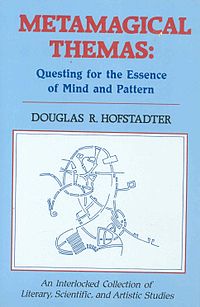
Metamagical Themas
The Cluetrain Manifesto
A strong argument is said to be cogent if it has all true premises. Otherwise, the argument is uncogent.
The definition of "cogent" is "clear, logical and convincing." If any premises turn out to be untrue, the argument becomes strong yet not cogent. For example, the argument that Earhart safely landed and lived out her days on a deserted island is strong (there are such islands out there; as a pilot she'd logically look for one) yet not cogent (she had limited time flying over a near landless ocean).
If the premises of an inductive argument are assumed true, is it probable the conclusion is also true? If yes, the argument is strong. If no, it is weak.
The strength of an argument relies in its ability to resist dispute or skepticism. While there are many theories on how pilot Amelia Earhart disappeared and died, these are usually based in what could have probably happened in the region where we lost contact with her.
Arguments that involve predictions are inductive since the future is uncertain.
Deductive reasoning can help us define what has been and what exists in the moment, while inductive reasoning can help us define what might have been or may exist in the moment.
Inductive reasoning can go into the future in ways deductive reasoning cannot. If we say something like "the sun will rise and set tomorrow," that is still inductive reasoning because it assumes circumstances or conditionals (i.e., the sun doesn't suddenly go supernova, or get blown up by an alien fleet).
An inductive argument asserts that the truth of the conclusion is supported by the probability of the premises.
Good inductive arguments are one that are hard to dispute, but the difficulty is based on agreeable and logical premises.
For example, consider the following arguments:
None of these conclusions can be supported by deductive reasoning, but can be supported by varying qualities of inductive reasoning.
If a deductive argument is valid and its premises are all true, then it is also referred to as sound. Otherwise, it is unsound, as "bats are birds".
Deductive arguments must be valid before they are sound. We declare an argument sound when we cannot deny any of the presented premises.
If one assumes the premises to be true (ignoring their actual truth values), would the conclusion follow with certainty? If yes, the argument is valid.
Here are some examples to help.
Deductive arguments are sometimes referred to as "truth-preserving" arguments.
In other worlds, deductive arguments help us cut to where we can all agree. They provide a foundation on which to establish more deductive or inductive arguments.
A deductive argument asserts that the truth of the conclusion is a logical consequence of the premises.
Understand that truth is not the same as facts. Truth is sometimes agreed upon, and certainly based on perception. Consider, for instance, how the sun is portrayed as yellow and red in different parts of the world. Are some people wrong?
An argument cannot start from purely logical principles. An argument is based on premises and some methods for reasoning from premises to conclusions.
Case in point: Something like "murder is the most evil crime" will often serve as a premise for other arguments, like "murderers should get the death penalty."
This premise, however, is itself an argument. It is neither fact nor truth.
Though any argument about politics is in a sense a political argument, an effective political argument is one that can actually change the social preference ranking. Effective political argument is a concept distinct from valid political argument.
One (perhaps unfortunate) implication of this: You don't always have to worry about the logic of your argument, if you have found an argument that works.
In this case, political argument is an important element of political strategy.
Consider your positionality in political argumentation. Maybe you are arguing about health care because you have an important medical concern. Maybe you are sharing an argument because a politician respect influenced you, but you yourself have not further investigated the issue. We all can potentially take part in someone else's strategy.
Political argument though is not generally a purely intellectual activity, since it may also serve the strategic goal of promoting a political agenda.
We accept political arguments as having practical goals (like convincing you to vote), but these can of course be philosophical or (as we see on the Internet) intensely personal.
Political argument should be distinguished from propaganda, in that propaganda has little or no structure or the rationale, if it exists, is egregiously fallacious.
Another way of looking at it: Propaganda exists to discourage or eliminate debate. You believe or you don't, and that's all that matters, with propaganda.
A political argument is an instance of a logical argument applied to politics.
Emphasis on logic. If we cannot rely on agreeable truths or facts, we cannot argue. For example, consider the difference between these religious arguments:
Notice what can be argued (the first) and not (the latter).
Qualifier
You'll only reach this point if a rebuttal was required, and sometimes qualifications can be as simple as using some hedging to allow for remote possibilities.
Rebuttal (Reservation)
Not every claim requires a rebuttal, but it's imperative you consider it. Also, think of rebuttals as 'checks' against your work. If checks are necessary, that's where qualifiers come in.
Backing
We cannot expect readers to immediately respect our grounds or warrants, and the backing therefore may be necessary to guide them to our viewpoint.
Warrant
Think of the warrant as an 'invisible bridge' between claim and grounds. It's the thing you don't necessarily have to say because the reader will understand it once the other two are established.
Ground (Fact, Evidence, Data)
This is the backbone or impetus of your claim. Without this you are just stating a preference or generic belief.
Claim (Conclusion)
In your own essays, you'll make many claims. There will be the thesis, of course, but all sorts of other claims within your writing.
Whereas theoretical arguments make inferences based on a set of principles to arrive at a claim, practical arguments first find a claim of interest, and then provide justification for it.
What's the best approach for a problem we're looking at: theoretical or practical? Circumstances often dictate this. If I look at college rankings and think 'that doesn't look useful,' I consider a practical approach to making sure I'm right.
Stephen E. Toulmin's contributions
Toulmin is not the only source when it comes to argumentation theory, but he's a great reference. We will practice with the Toulmin Model for class.
Argumentation includes deliberation and negotiation which are concerned with collaborative decision-making procedures.
Though note how different that may be in a monolinguistic circumstances. In essays, writers do what they can to before putting together these ideas, and attempt to coax you into their way of thinking after the fact.
Argumentation theory, or argumentation, is the interdisciplinary study of how conclusions can be reached through logical reasoning; that is, claims based, soundly or not, on premises.
Note how different this is from simply opinions. Many people can tell you their favorite color and never articulate the reason why.
The intention economy is an approach to viewing markets and economies focusing on buyers as a scarce commodity. Customers' intention to buy drives the production of goods to meet their specific needs. It is also the title of Doc Searls book: The Intention Economy: When Customers Take Charge published in May, 2012.

The various connections between op-eds, editors, and funding from interest groups have raised concern. In 2011, in an open letter to The New York Times, a group of U.S. journalists and academics called for conflict of interest transparency in op-eds.[9][10]
Another useful item to consider. For example, what if the op-ed writer stands to profit from his advocation?
Swope included only opinions by employees of his newspaper, leaving the "modern" op-ed page to be developed in 1970 under the direction of The New York Times editor John B. Oakes.[5] The first op-ed page of The New York Times appeared on 21 September 1970.[6]
This should suggest the idea of op-eds being a source of pride for the NYT.
An op-ed, short for "opposite the editorial page" or as a backronym the "opinions and editorials page", is a written prose piece typically published by a newspaper or magazine which expresses the opinion of an author usually not affiliated with the publication's editorial board.[1]
Among other things, op-eds are important for a media publisher's credibility. By entertaining input from non-affiliated persons, the media allows for multiple informative and persuasive perspectives.
The history of anonymous expression in political dissent is both long and with important effect
We should also consider this in the context of opportunity cost. If a political figure publishes an op-ed on a controversial topic, there will likely be some kind of backlash that impacts their career.
Most modern newspapers and magazines attribute their articles to individual editors, or to news agencies. An exception is the Markker weekly The Economist. All British newspapers run their leaders, or editorials, anonymously. The Economist fully adopts this policy, saying "Many hands write The Economist, but it speaks with a collective voice".[10] Guardian considers that "people will often speak more honestly if they are allowed to speak anonymously".[11][12] According to Ross Eaman, in his book The A to Z of Journalism, until the mid-19th century, most writers in Great Britain, especially the less well known, did not sign their names to their work in newspapers, magazines and reviews.[13]
This can be quite different in the American context.
Anonymity is perceived as a right by many, especially the anonymity in the internet communications. The partial right for anonymity is legally protected to various degrees in different jurisdictions.
If an American publisher shares an anonymous piece that details outstanding criminal activity, it can become a major court issue of freedom of the press vs. protecting criminals.
Attempts at anonymity are not always met with support from society. Anonymity sometimes clashes with the policies and procedures of governments or private organizations
For op-eds, we are right to speculate at the choice of anonymous submissions, though such skepticism should be supported by logic.
Here Comes Everybody

Petrus Ramus
Just making note of the fact that Petrus Ramus was the advisor of Theodor Zwinger and apparently influcnced Jean Bodin, about whom Ann M. Blair writes about in Too Much to Know: Managing Scholarly Information Before the Modern Age.
I suspect these influences may impinge on my work on the history of memory and its downfall due to Ramism since the late 1500s and which impacts the history of information.
The inability to match blank nodes increases the delta size (the number of triples that need to be deleted and added in order to transform one RDF graph to another) and does not assist in detecting the changes between subsequent versions of a Knowledge Base. Building a mapping between the blank nodes of two compared Knowledge Bases that minimizes the delta size is NP-Hard in the general case.[6]
blank nodes increase delta size
In RDF, a blank node (also called bnode) is a node in an RDF graph representing a resource for which a URI or literal is not given.[1] The resource represented by a blank node is also called an anonymous resource. According to the RDF standard a blank node can only be used as subject or object of an RDF triple.
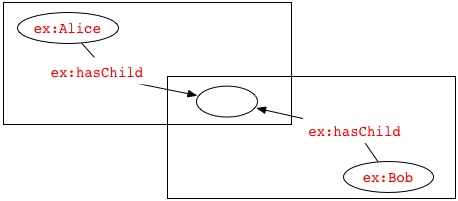
The open-world assumption (OWA) codifies the informal notion that in general no single agent or observer has complete knowledge, and therefore cannot make the closed-world assumption. The OWA limits the kinds of inference and deductions an agent can make to those that follow from statements that are known to the agent to be true. In contrast, the closed world assumption allows an agent to infer, from its lack of knowledge of a statement being true, anything that follows from that statement being false.
codifies lack of complete knowledge
Open-world assumption
中心再难维系。这个国家随处可见破产通告,拍卖通知,谋杀报道,寻人启事,被遗弃的房屋,以及无法正确拼写四字单词的涂鸦。这个国家的家庭随时随地可能消失,留下跳票的支票和房屋充公的报告。青年们从城市漂泊到破败的城市,甩掉过去和未来就像蛇脱掉旧皮。小孩们从未被教育也不再能习得维系社会稳定的游戏。人群失踪。儿童失踪。父母失踪。留下的人潦草地发表了寻人启事后便不再等待。这不是一个公开革命的国家,也不是一个被敌军包围的国家。这是1967年晚春的美利坚合众国。市场平稳,GNP高涨,而且那些思路保持清晰的人们似乎仍然能看到社会的终极目标。或许对这些人来说,这仍然是一个坐拥伟大希望的春天。但事实并非如此,而且越来越多的人意识到,事实并非如此。 ——琼恩·迪迪安(Joan Didion),《缓缓走向伯利恒(Slouching Towards Bethlehem)》,1967
Of the past let us make a clean slate
Du passé faisons table rase
Is that Tabula rasa here?
Tabula rasa (/ˈtæbjələ ˈrɑːsə, -zə, ˈreɪ-/; "blank slate") is the theory that individuals are born without built-in mental content, and therefore all knowledge comes from experience or perception.
Hopscotch (Cortázar novel)

Orbis Pictus, or Orbis Sensualium Pictus (Visible World in Pictures), is a textbook for children written by Czech educator John Amos Comenius and published in 1658. It was the first widely used children's textbook with pictures, published first in Latin and German and later republished in many European languages.
This would seem to be the sort of ancestor of the bestiary that might be used as a mnemonic tool, but given it's 1658 publication date, it's likely the case that this would have been too late for it to have served this purpose for most (without prior knowledge).
Apparently the Encyclopaedia Britannica labeled it as “the first children’s picture book.”
He proposed the standardized paper size system used globally today except in Canada and the US defined by ISO 216, which has A4 as the most commonly used size.
This is an interesting bit of trivia.
Arthur Schopenhauer admired Lichtenberg greatly for what he had written in his notebooks. He called him one of those who "think ... for their own instruction", who are "genuine 'thinkers for themselves' in both senses of the words".[4] Other admirers of Lichtenberg's notebooks include Friedrich Nietzsche, Sigmund Freud, Ludwig Wittgenstein and Jacques Barzun.
It would almost have to be the case that with his method and notebooks being so well known that they influenced Niklas Luhmann's idea of a zettelkasten.
The scrapbooks reveal a critical and analytical way of thinking and emphasis on experimental evidence in physics, through which he became one of the early founders and advocates of modern scientific methodology. The more experience and experiments are accumulated during the exploration of nature, the more faltering its theories become. It is always good though not to abandon them instantly. For every hypothesis which used to be good at least serves the purpose of duly summarizing and keeping all phenomena until its own time. One should lay down the conflicting experience separately, until it has accumulated sufficiently to justify the efforts necessary to edifice a new theory. (Lichtenberg: scrapbook JII/1602)
Georg Christoph Lichtenberg used his notebooks as thinking tools with respect to scientific methodology.
Waste books were also used in the tradition of the commonplace book. A well know example is Isaac Newton's Waste Book in which he did much of the development of the calculus.[4] Another example is that of Georg Christoph Lichtenberg, who called his waste books sudelbücher, and which were known to have influenced Leo Tolstoy, Albert Einstein, Andre Breton, Friedrich Nietzsche, and Ludwig Wittgenstein.[
I added this section.
I've heard references of people using these in combination with or also for commonplace books.
compare Vademecum with commonplace books
Turkic peoples[edit] Main article: Taoyuan County, Hunan § Taoyuan Uyghurs Descendants of Uyghurs who migrated to Taoyuan County, Hunan have largely assimilated into the Han Chinese and Hui population and practice Chinese customs, speaking varieties of Chinese as their language.
wow. no cite
Hi, Professor Goodwin's students! This is a page note--an annotation of the entire webpage. Cool feature, huh? One other cool feature of this is that you can attach images, hyperlinks, lists (bulleted or numbered), as well as make your text bold or italicized.
that allows a Buddha to remain engaged in the world.
remain engaged in the world
Some argue that a more appropriate standard should be fairness and accuracy (as enshrined in the names of groups like Fairness and Accuracy in Reporting). Under this standard, taking sides on an issue would be permitted as long as the side taken was accurate and the other side was given a fair chance to respond. Many professionals believe that true objectivity in journalism is not possible and reporters must seek balance in their stories (giving all sides their respective points of view), which fosters fairness.
With fairness, we are recognizing conflicts, even if we take a side. With accuracy, we are representing those perspectives in ways agreeable to the source.
Some scholars and journalists criticize the understanding of objectivity as neutrality or nonpartisanship, arguing that it does a disservice to the public because it fails to attempt to find truth.[6] They also argue that such objectivity is nearly impossible to apply in practice—newspapers inevitably take a point of view in deciding what stories to cover, which to feature on the front page, and what sources they quote.[6] The media critics Edward S. Herman and Noam Chomsky have advanced a propaganda model hypothesis proposing that such a notion of objectivity results in heavily favoring government viewpoints and large corporations.[6] Mainstream commentators accept that news value drives selection of stories, but there is some debate as to whether catering to an audience's level of interest in a story makes the selection process non-objective.[6]
Note that even with subjective reporting, some of those virtues or practices of objective journalism still stand. For example, an editorial might come across as neutral or detached in its presentation, even if the language is clearly subjective.
truthfulness, neutrality, and detachment.[6]
Truthfulness is always required, even when being subjective. Neutrality rests in your angle and purpose for the piece. Detachment is a matter of tone, and its importance shifts with the reporting context.
Most newspapers and TV stations depend upon news agencies for their material, and each of the four major global agencies (Agence France-Presse (formerly the Havas agency), Associated Press, Reuters, and Agencia EFE) began with and continue to operate on a basic philosophy of providing a single objective news feed to all subscribers. That is, they do not provide separate feeds for conservative or liberal newspapers. Journalist Jonathan Fenby has explained the notion:
As you take sources from other reporting, you'll want to consider how you represent them, and how that collection represents you.
Journalistic objectivity is a considerable notion within the discussion of journalistic professionalism. Journalistic objectivity may refer to fairness, disinterestedness, factuality, and nonpartisanship, but most often encompasses all of these qualities. First evolving as a practice in the 18th century, a number of critiques and alternatives to the notion have emerged since, fuelling ongoing and dynamic discourse surrounding the ideal of objectivity in journalism.
Not every article requires complete objectivity or neutrality, but then we readers really start caring about issues of transparency and informed perspective.
In journalism, attribution is the identification of the source of reported information.
Rather like references and citations in academia, attributions are vital considerations.
News organizations may impose safeguards, such as requiring that information from an anonymous source be corroborated by a second source before it can be printed.
This is an important consideration as well. As well as possible, we want to confirm that anonymous sources aren't fiction.
The identity of anonymous sources is sometimes revealed to senior editors or a news organization's lawyers, who would be considered bound by the same confidentiality as the journalist.
In context to a class assignment, if the professor is something like a senior editor then you should be clear about source identities in your notes. Also consider that anonymous sources will often be taken less seriously than other options.
Off-the-record material is often valuable and reporters may be eager to use it, so sources wishing to ensure the confidentiality of certain information are generally advised to discuss the "terms of use" before disclosing the information, if possible.
In context to a class assignment, you most need to worry about this as it concerns publishing anything online. You'll want to be quite clear with your human sources about how you'll use their information.
As a rule of thumb, but especially when reporting on controversy, reporters are expected to use multiple sources.
Note that multiple sources suggests multiple perspectives. For example, an article about a politician's speech might have multiple reactions from the crowd, not just one. Yet in addition, the article might have recent polling data to contextualize the event.
Reporters often, but not always, give greater leeway to sources with little experience. For example, sometimes a person will say they don't want to talk, and then proceed to talk; if that person is not a public figure, reporters are less likely to use that information.
This of course reminds us that evidence has a hierarchy. A direct eyewitness, or a knowledgeable expert, often has more to tell us than some random person.
Examples of sources include but are not limited to official records, publications or broadcasts, officials in government or business, organizations or corporations, witnesses of crime, accidents or other events, and people involved with or affected by a news event or issue.
A good way to think about how to seek out sources is to consider what entities have connections to the news. For example, are there stakeholders or influencers?
In journalism, a source is a person, publication, or other record or document that gives timely information.
As with academia, primary and secondary sources are vital and abundant in journalism. In this field, however, the rigor of source collection is defined by the journalist's attempts to reach a complete perspective on an event or phenomena where controls seldom exist.
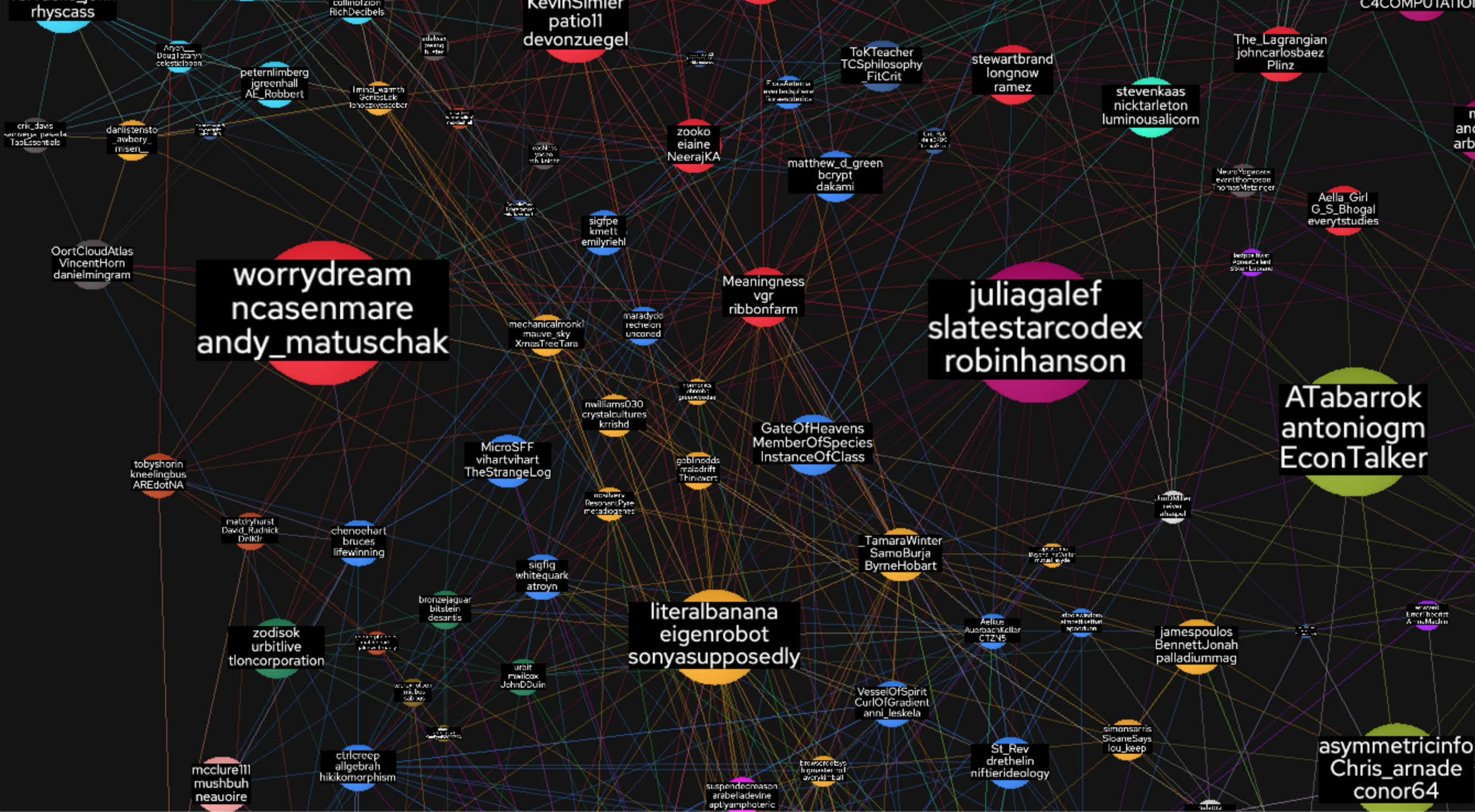
A virtual community is a social network of individuals who connect through specific social media,
We need Personal First social media for virtual communities to thrive
https://social.coop/@indiehub Empower individuals to Weave their own
WebNative
Decent(ralized)
Personal first
Inter Planetary
Emergent
spontaneously self-organizing
Virtual Communities
to connect with each other engage in deep conversations aimed at bootstrapping, co-creating, co-evolving the digital means they need, to augment their ability to solve their problems themselves together

Group (online social networking)
Isthmus of Panama
this is interesting and I didn't know what it was until I looked it up
Hale ʻaina, the women's eating house. Women ate at their own separate eating house. Men and women could not eat with each other for fear that men were vulnerable while eating to have their mana, or divine spirit, stolen by women.
this is wise
Native legends often talk of the little people playing pranks on people, such as singing and then hiding when an inquisitive person searches for the music.
Why is this such a common description? COINCIDENCE??
Large regions of memory can be allocated without the need to be contiguous in physical memory – the IOMMU maps contiguous virtual addresses to the underlying fragmented physical addresses. Thus, the use of vectored I/O (scatter-gather lists) can sometimes be avoided.
2008
SUMMARY: Indigenous people in modern-day Canada experienced some of the same tragedies as in modern-day America. However, it seems like some interactions were less antagonistic and since then, Canada has tried to help heal collective trauma.
Truth and Reconciliation Commission of Canada
This reminds me of the restorative justice component of our last unit
redress
redress: remedy or compensation for a wrong or grievance.
These attempts reached a climax in the late 19th and early 20th centuries with forced integration and relocations
This reminds me of Andrew Windy Boy and other Indigenous people who were in colonial schools
Although not without conflict, European Canadians' early interactions with First Nations and Inuit populations were relatively peaceful
This seems "couching"
The decline is attributed to several causes, including the transfer of European diseases, such as influenza, measles, and smallpox to which they had no natural immunity,[29][33] conflicts over the fur trade, conflicts with the colonial authorities and settlers, and the loss of Indigenous lands to settlers and the subsequent collapse of several nations' self-sufficiency
Painful and persistent history
Some of these cultures had collapsed by the time European explorers arrived in the late 15th and early 16th centuries and have only been discovered through archeological investigations
Ancient civilizations
First Nations
This seems like a better term than "Native Americans"
the last being a mixed-blood people who originated in the mid-17th century when First Nations people married European settlers and subsequently developed their own identity
In Central & South America, they say "Creole" or "Mestizo"
much of the history it recounts is accurate
Again it is seen how they frame it as recounting history (that is, written after the events), not prophesying events that were still in the future at the time of writing. They are essentially saying the author was being deceptive, deliberating seeking to mislead the reader into thinking that they received divine insight when it was all just written after the events (so they say).
Because many modern scholars deny the existence of the supernatural realm, the idea of accurately predicting future events is too far fetched to entertain. So any accurate prophecies get recast as history written after the fact. They do this with Isaiah and other prophets who accurately foretold events in advance.
Essentially, don't read Wikipedia for any true biblical scholarship. You will only get a view that is stripped of all divine and supernatural elements, which amounts to not much value or accuracy in the end.
late Persian/early Hellenistic period
That is, they say chapters 1-6 were written about 350 to 300 BCE. Notice how far removed it is from their opinion about when chapters 7-12 were written: ~165 BCE. That's a gap of about 150-200 years between when chapters 6 and 7 were penned. Since they deny that Daniel ever existed, they remove any need to fit the writing of the book into one person's lifetime. In an effort downplay its authenticity, they have instead chosen to view it as a compilation of tales and history, not visions and prophecy. They can therefore flex with whatever dates will make it most unsupernatural and palatable to a secular mind.
It is generally accepted by modern scholars that the Daniel who appears as the hero of the Book of Daniel never existed
A baseless claim, but quite convenient if one wants to dismiss the authenticity of the book and its excellent prophecies.
Daniel asks the angel
Note that they don't actually believe Daniel asked an angel anything. At this point they are just reciting the 'mythical story' that they think Daniel was telling.
earthly events reflect what happens in heaven
If only the author knew how correct he was in this.
the mythological concept sees standing behind every nation a god/angel
Notice their worldview shining forth here. Anything they see of the supernatural realm they call mythical. The secular bible scholars cannot tolerate a spiritual realm with real beings who do real things.
The earliest recorded human presence in modern-day Argentina dates back to the Paleolithic period.
This is my annotation
Gambler’s fallacy. (2021). In Wikipedia. https://en.wikipedia.org/w/index.php?title=Gambler%27s_fallacy&oldid=1006742838
"brown grease"
Ok so how is it supposed to be disposed of?
reuse.
What happens to all the solid stuff? Is it made into a fertilizer stuff? It doesn't al become gas.
reducing greenhouse gas emissions.
reducing maybe, but still burning shit. It turns A mole of methane and two moles of O2 into a mole of CO2 and two of H2O, both green house gasses, but not as strong as methane and H2O has a short lifespan in the atmosphere
beds.
What does the every-day person do with it? Fertilize plants maybe
d composting
Do they have to compost themselves? Or is it still picked up?
t decomposes aerobically and does not produce methane, but instead produces organic compost that can then be utilized in agriculture.
Very important. Does it make CO2 or O2?
By redistributing nutrients and high microbial populations, compost reduces water runoff and soil erosion by enhancing rainfall penetration, which has been shown to reduce the loss of sediment, nutrients, and pesticide losses to streams by 75–95%
Seems important. Look at source later if I go this route
backyard chickens is a large part of that movement's claim to sustainability, though not all backyard chicken growers recommend it.
more people should have. Love eggs
he animals turn roughly two thirds of their ingested food into gas or fecal waste,
goddamn, feeding to animals not as great as i thought
25 times greater to impact climate change than CO2
true, bring up in paper
very easily
not true
biorefined
added to source list
r reuse
I have a green bin. Look into where it goes.
piggeries.
fun word
substitutive consumption
Micro econ term for using your spending money for more things because stuff is cheaper instead of saving.
farmers to provide surplus produce (produce they would otherwise discard due to too low prices) to people that bring glass and metal to recycling facilities (to encourage further waste reduction).
Recycling for recycling. Love it
h temperature-sensitive ink,
so cool. Look into
Widespread educational campaigns have been shown to be an effective way to reduce food waste.
Good, funded by who?
(FAO)
Come up a lot, research them
35 million tons to 103 million tons
Numbers this big mean nothing to me mentally
30–50%
Many old sources, 8-12 years old. Still shocking
per year
Enforces that I should read source 5
In developing countries, it is estimated that 400–500 calories per day per person are wasted, while in developed countries 1,500 calories per day per person are wasted
Necessity diminished weight. Damn
auto-consumption
people growing for eating themselves. Subsistence farming
shattering
look into, idk
rusts
Plant fungus
losses may be 100%, for example when there is a price collapse and it would cost the farmer more to harvest and market the produce than to plough it back into the ground.
Wow. Learned in Micro Econ about the idea of fixed costs staying the same, so stopping production if revenue less than variable costs
North Sea.
Go check out Stuart, Tristram (2009). Waste: Uncovering the Global Food Scandal: The True Cost of What the Global Food Industry Throws Away. Penguin. ISBN 978-0-14-103634-2.
40–60% of fish caught in Europe is discarded as the wrong size or wrong species.
WHAT!?? Jesus, if things were done more efficiently they could be returned alive
on their website
Seems like one very keystone place you could change things and have big effects
pearance
Source good
Failure to supply agreed quantities renders farmers or processors liable to have their contracts cancelled. As a consequence, they plan to produce more than actually required to meet the contract, to have a margin of error.
Wow! Is there a way around this in our rigid contract-driven world?
such as confusion in deciphering best before, sell-by or use-by dates.
Very interesting and I relate to this. I think of them as one conflated thing.
meat and dairy products
Sucks that a lot of these kinds of problems are because of keeping too many animals close and transporting stuff over time. WOuldn't happen if locally, smally grown
difficult to estimate.
Thought it would be easy because you just see what is tossed in production? Just looked at source and it's 43 years old. WTF
From
Thought: because there aren't really beneficiaries of food waste, I don't really see why people would put false info on this page. It's not like fossil fuels ya know?
farmers often harvest selectively, preferring to leave crops not to standard in the field (where they can be used as fertilizer or animal feed), since they would otherwise be discarded later.
good thing? Why left in the field and not put in a place for that. Place for further inquiry.
these unpredictable conditions.
good point, some kind of unavoidable. I wonder if this is just because like floods or drought kill crops. Look into how the loss actually happens.
not wasted.
it is now a "resource" or "scrap" not waste
he definitions by the UN and EU have come under criticism for including food that goes to non-food productive use in their definitions of food waste
hey that's what I said!
t.[22]
Great reliable source. 26 pages but good info
decrease in quantity or quality of food.
This feels like a nothing definition. Decrease in quantity? I don't get what that means
unavoidable food waste
Not unnavoidable because natives used to use all of animals
s counted as food loss or waste.
by who? I don't think it should be. I guess because it's not directly to people
Project Drawdown
This page lists reducing food waste as the number one way to get to net negative GHGs
Sustainable Development Goal 12 seeking to "Halve global per capita food waste"
Important that it is recognized by the UN, but these goals are all wishy washy
impact of agriculture on climate change.
Whole other MASSIVE page to look at.
[5]
Good report I'll use. Didn't read it to confirm this though. Seemed like a great source, I think made for a packaging and trade conference in 2011.
f[4]
This source is from 2013 and itself doesn't give a link or citation to where its info comes from, although it is the Huff post so I trust it a decent amount.
consumption.
Soooo many links if you have questions and need background
Conway's law is an adage stating that organizations design systems which mirror their own communication structure. It is named after computer programmer Melvin Conway, who introduced the idea in 1967.[1]
system design mirror communication structure
invert that
design communications structures to drive the creation of better organizations Decentralized Autonomous Organizations?
The immediate consequence of the exogeneity assumption is that the errors have mean zero: E[ε] = 0, and that the regressors are uncorrelated with the errors: E[XTε] = 0.
remember we are talking about the errors in the true equation not the estimated residuals ... the latter are set orthogonal to the X's as part of the minimization problem.
OLS estimation can be viewed as a projection onto the linear space spanned by the regressors. (Here each of X 1 {\displaystyle X_{1}} and X 2 {\displaystyle X_{2}} refers to a column of the data matrix.)
the diagram is not so clear. So the \(X\hat{\beta}\) is some vector in \(x_1, x_2\) space, but what exactly does it represent?
Perhaps it would be the line in the direction along which we get the greatest predicted increase (per distance) in the the y variable... but so what?
applicable
what do you mean 'applicable'?
This is illustrated at the right.
illustration missing
In other words, the gradient equations at the minimum can be written as: ( y − X β ^ ) T X = 0. {\displaystyle (\mathbf {y} -X{\hat {\boldsymbol {\beta }}})^{\rm {T}}X=0.}
this comes from a standard first order condition in vector calculus
when y is projected orthogonally onto the linear subspace spanned by the columns of X.
Here I believe they mean ...
the goal is to minimize the 'length' of the residual vector, where the 'length' is defined by squaring all the residuals and adding them up
this goal is attained (derived through vector calculus) when 'y is projected orthogonally onto the linear subspace spanned by the column.'
But, suppose there are 2 predictor variables, age and height. The linear subspace spanned by columns of X will typically represent (e.g.) all values of age and height (including negative and ridiculously large ones.)
So what does it mean 'when \(\hat{y}\) is projected orthogonally unto this subspace'?
. Thus, the residual vector y − Xβ
vector of residuals of dimension equal to the number of observations
ing from the moment conditions E [ x i ( y i − x i T β ) ] = 0. {\displaystyle \mathrm {E} {\big [}\,x_{i}(y_{i}-x_{i}^{T}\beta )\,{\big ]}=0.}
rem: \(y_i - x_i^{T}\beta\) is the distance between the "predicted" (or 'projected') and actual y. It is a distance or difference in the y (outcome) dimension only. I.e., (in 2 dimensions) the 'vertical distance'.
This is not the same as the Euclidean distance (L2 norm) between the observation in x,y space and the 'prediction plane' -- the latter is orthogonal by definition.
Here we are saying that the sum of the 'prediction error' (the vertical distances) weighted by the values of each x is set to be zero, and this must hold for all x's. But each vertical distance is of course positive and thus each of these terms themselves must be positive. The orthogonality condition is saying 'get these weighted vertical distances to sum to zero please'.
This condition arises as a result of the previous 'minimize the sum of squared deviations' problem.
In particular, this assumption implies that for any vector-function ƒ, the moment condition E[ƒ(xi)·εi] = 0 will hold.
but we sometimes use other fancier moment conditions in Econometrics IIRC.
The OLS estimator β ^ {\displaystyle {\hat {\beta }}} in this case can be interpreted as the coefficients of vector decomposition of ^y = Py along the basis of X.
as in principal-component analysis
In statistics and signal processing, a minimum mean square error (MMSE) estimator is an estimation method which minimizes the mean square error (MSE), which is a common measure of estimator quality, of the fitted values of a dependent variable. In the Bayesian setting, the term MMSE more specifically refers to estimation with quadratic loss function. In such case, the MMSE estimator is given by the posterior mean of the parameter to be estimated. Since the posterior mean is cumbersome to calculate, the form of the MMSE estimator is usually constrained to be within a certain class of functions. Linear MMSE estimators are a popular choice since they are easy to use, easy to calculate, and very versatile. It has given rise to many popular estimators such as the Wiener–Kolmogorov filter and Kalman filter.
And remember that the Max Likelihood estimator is setting the parameters (betas) so as to 'maximize the likelihood of the data given these parameters, assuming (e.g.) a normally distributed error structure'.
In contrast, the Bayesian 'estimator' (really the posterior) will consider the likelihood of different parameters given the data (the 'likelihood') and the prior (normal) distribution.
as defined above
Note, if you just want to find the probability for a particular sigma then an easy way to do it is:
https://www.wolframalpha.com/input/?i=Prob+x+%3E+3.09+or+x+%3C+-3.09+if+x+is+standard+normal
That example is 3.09 sigma
海伦·邓肯(Helen Duncan)。她是人类历史上,最后一名被判处“女巫罪”的人。据传说,她被控犯有女巫罪的原因,是因为英国政府担心她会预知到“诺曼底登陆”的作战计划,泄露军事机密。
The form of the obelus as a horizontal line with a dot above and a dot below, ÷, was first used as a symbol for division by the Swiss mathematician Johann Rahn in his book Teutsche Algebra in 1659.
Originally, one of these marks (or a plain line) was used in ancient manuscripts to mark passages that were suspected of being corrupted or spurious; the practice of adding such marginal notes became known as obelism. The dagger symbol †, also called an obelisk, is derived from the obelus, and continues to be used for this purpose.
recension
re·cen·sion
/rəˈsen(t)SH(ə)n/
noun
noun: recension; plural noun: recensions
a revised edition of a text; an act of making a revised edition of a text.
Example "under the Carolingians new recensions of the code were made"
Origin mid 17th century (in the sense ‘survey, review’): from Latin recensio(n- ), from recensere ‘revise’, from re- ‘again’ + censere ‘to review’.

See also: https://en.wikipedia.org/wiki/Recension
vector field (or vector-valued function)
Any vector field will be a vector valued function. Not all vector-valued functions are vector fields. In this case we focus on vector field
"The Analytical Language of John Wilkins" (Spanish: "El idioma analítico de John Wilkins") is a short essay by Argentine writer Jorge Luis Borges originally published in Otras Inquisiciones (1937–1952).[1][2] It is a critique of the English natural philosopher and writer John Wilkins's proposal for a universal language and of the representational capacity of language generally. In it, Borges imagines a bizarre and whimsical (and fictional) Chinese taxonomy later quoted by Michel Foucault, David Byrne, and others.
He is particularly known for An Essay towards a Real Character and a Philosophical Language (1668) in which, amongst other things, he proposed a universal language and an integrated system of measurement, similar to the metric system.
This may be well worth reading with respect to my research on memory, stenography, shorthand, etc.
The UN investigation team confirmed "clear and convincing evidence" of the use of sarin delivered by surface-to-surface rockets,[18][29] and a 2014 report by the UN Human Rights Council found that "significant quantities of sarin were used in a well-planned indiscriminate attack targeting civilian-inhabited areas, causing mass casualties.
Results of the UN investigation into the Ghouta attack, which is only the most deadly of the chemical attacks during the war.
The Ghouta chemical attack occurred in Ghouta, Syria, during the Syrian civil war, in the early hours of 21 August 2013. Two opposition-controlled areas in the suburbs around Damascus were struck by rockets containing the chemical agent sarin. Estimates of the death toll range from at least 281 people[3] to 1,729.[14] The attack was the deadliest use of chemical weapons since the Iran–Iraq War.
Syrian forces have used chemical weapons against civillian targets in Ghouta.
Quantum mechanics arose gradually from theories to explain observations which could not be reconciled with classical physics, such as Max Planck's solution in 1900 to the black-body radiation problem, and the correspondence between energy and frequency in Albert Einstein's 1905 paper which explained the photoelectric effect. These early attempts to understand microscopic phenomena, now known as the "old quantum theory", led to the full development of quantum mechanics in the mid-1920s by Niels Bohr, Erwin Schrödinger, Werner Heisenberg, Max Born and others. The modern theory is formulated in various specially developed mathematical formalisms. In one of them, a mathematical entity called the wave function provides information, in the form of probability amplitudes, about what measurements of a particle's energy, momentum, and other physical properties may yield.
ai pprt planck era mo cuzao sem maldadii
human rights violations and the disappearances of Argentine citizens.
talked about in Luisa Valenzuela
City Building Start date End date Duration Ref Second Continental Congress Philadelphia, Pennsylvania Independence Hall July 4, 1776 (convened May 10, 1775, prior to independence) December 12, 1776 5 months and 8 days [8] Baltimore, Maryland Henry Fite House December 20, 1776 February 27, 1777 2 months and 7 days [9] Philadelphia, Pennsylvania Independence Hall March 5, 1777 September 18, 1777 6 months and 13 days [10] Lancaster, Pennsylvania Court House September 27, 1777 September 27, 1777 1 day [10] York, Pennsylvania Court House (now Colonial Court House) September 30, 1777 June 27, 1778 8 months and 28 days [10] Philadelphia, Pennsylvania College Hall[citation needed] July 2, 1778 March 1, 1781 2 years, 7 months and 27 days [11] Congress of the Confederation Philadelphia, Pennsylvania Independence Hall March 2, 1781 June 21, 1783 2 years, 3 months and 19 days [11] Princeton, New Jersey Nassau Hall June 30, 1783 November 4, 1783 4 months and 5 days [11] Annapolis, Maryland Maryland State House November 26, 1783 August 19, 1784 8 months and 24 days [11] Trenton, New Jersey French Arms Tavern November 1, 1784 December 24, 1784 1 month and 23 days [11] New York, New York City Hall January 11, 1785 October 6, 1788 3 years, 11 months and 5 days
[1] https://ipfs.2read.net/ipfs/QmTwBAJtD5c9NoJA2hDK1fcxd5LC13mGbF5wVDDZaWpqEA/
[2] https://ipfs.2read.net/ipfs/QmTwBAJtD5c9NoJA2hDK1fcxd5LC13mGbF5wVDDZaWpqEA/
Everything Was Forever, Until It Was No More: The Last Soviet Generation (2006)
forever until no more
HyperNormalisation

Peers are equally privileged, equipotent participants in the application. They are said to form a peer-to-peer network of nodes.
equally privileged equipotent participants in a network of nodes
Peer-to-peer (P2P) computing or networking is a distributed application architecture that partitions tasks or workloads between peers.
distributed application architecture partitions tasks between peers
Global environmental inequality refers to "the expression of an environmental burden that would be borne primarily by disadvantaged and /or minority populations or by territories suffering from a certain poverty and exclusion of these inhabitants
Definition of GEI
It was lowered to DEFCON 4 on September 14
Better source:
On September 14, Rumsfeld announced that the overall alertstatus of U.S. forces worldwide had been reduced a notch to DEFCON 4, which put the alert level back to its normal peace time status. Lambeth, B.S., 2001. Air power against terror: America's conduct of operation enduring freedom. Rand Corporation. From: CHAPTER TWO A Nation Girds for War: 22
Noesis is a classic philosophical term, sometimes equated to intellect or intelligence

Monty 1955年出生在西德,后来在英国汉普郡长大。从小父母就对Monty非常严格,父亲是个军官,他们家中有一块地,母亲总是要求他和其他兄弟姐妹一起帮忙做园艺。
那时他并不喜欢这些工作,直到17岁的春天,在播种种子时,突然感受到园艺的乐趣。他回忆说:“突然被一种彻底的幸福感惊呆了,感觉自己完全不想要其他任何东西。要知道这是1971年的事,那时世界上最有魅力的东西是性、毒品和摇滚乐,而不是园艺。”
后来他考进了剑桥大学麦格达林学院,并在那儿遇到了自己未来的妻子Sarah Erskine,一位优秀的珠宝商和建筑师。
20世纪80年代初,两人一起创立了时尚珠宝公司,取得了巨大的成功。他们的顾客包括迈克尔·杰克逊和戴安娜王妃,还给大卫·鲍伊做过袖扣。
然而,1987年的股市崩盘导致他们破产,从成功的商人直接跌落谷底。他们不得不卖掉所有东西,家具、房子以及所有一切。生活上的意外让Monty患上了严重的抑郁症,整日情绪低落。
身心俱疲的Monty和家人离开伦敦,搬到了偏远的赫里福德郡,拿着母亲留给自己的一点财产买下了一处破败的房屋,和一片灌木丛生、荒无人烟的土地。
在那儿,他重新拾起年少时对土地的热爱,建设起自己的花园。花园成了他的工作场所,也是他的“避难所”。
Tests by a California-based group led by Katherine P. Rankin indicate that the lobe may play a crucial role in identifying social context as well, including paralinguistic elements of verbal communication.
test3
Damage to the PPA (for example, due to stroke) often leads to a syndrome in which patients cannot visually recognize scenes even though they can recognize the individual objects in the scenes (such as people, furniture, etc.).
test2
PPA plays an important role in the encoding and recognition of environmental scenes (rather than faces). fMRI studies indicate that this region of the brain becomes highly active when human subjects view topographical scene stimuli such as images of landscapes, cityscapes, or rooms (i.e. images of "places").
test1
The use of U+212B 'Angstrom sign', which was encoded due to round-trip mapping compatibility with an East-Asian character encoding, is discouraged, and the preferred representation is U+00C5 'capital letter A with ring above', which has the same glyph.
Is there a difference in semantic meaning between the two? And if so, what is it? 
Denialism is an essentially irrational action that withholds the validation of a historical experience or event, when a person refuses to accept an empirically verifiable reality.
Holocaust denial is a subset of genocide denial, which is a form of politically motivated denialism.
The term COVID-19 denialism or new coronavirus denialism[31] (or viral denialism)[32] refers to the thinking of those who deny[33][34][35] the reality of the COVID-19 pandemic [36][37][38][39][40] or, at the very least, deny that deaths are happening in the manner or proportions scientifically recognized by the World Health Organization
Historical negationism,[1][2] also called denialism, is falsification[3][4] or distortion of the historical record. It should not be conflated with historical revisionism, a broader term that extends to newly evidenced, fairly reasoned academic reinterpretations of history.
the term historical revisionism identifies the re-interpretation of a historical account.[1] It usually involves challenging the orthodox (established, accepted or traditional) views held by professional scholars about an historical event or time-span or phenomenon, introducing contrary evidence, or reinterpreting the motivations and decisions of the people involved.
The basic rule of thumb is: "I'm not aware of all types of security exploits. I must protect against those I do know of and then I must be proactive!".
A good heuristic is to not trust the libraries you did not write either.