Event selection, data, and simulated samples are common to both methods.
Avoid 1-sentence paragraphs. Combine this with the following text.
Event selection, data, and simulated samples are common to both methods.
Avoid 1-sentence paragraphs. Combine this with the following text.
representative combination
"... representative combinations..."
bTrig
This notation ,with a capital "T" in the subscript, is clumsy. I recommend we just simplify this to $\epsilon_{\mathrm{trig}}$, since we are only talking about b-jet triggers here.
spot
"identify" ("spot" is too casual)
A handy
Too colloquial. "A guide to decoding..."
denoted∗
"... marked by a * ..." (this appears in a number of places - correct them all)
denoted∗
"... marked by a * ..."
Tables??
Fix broken reference.
≈40%
Use $\sim$, not $\approx$, in this context.
70% 77%
Missing comma in list.
Further details of the performance and usage of the muon-jet chains inPbPbcollisions are detailed in365Appendix H and will be summarised here for the paper once we better understand from the HI experts366what plots they would like to have made public, how much detail they need us to cover here etc
Do we have more information about what is desired for this part of the paper? It feels highly unfinished.
HI r
Was "HI" defined?
to face the very
"... were required to be robust against the high-multiplicity environment..."
es, th
"... small angles; this is the so-called..."
so called
"so-called"
golden probe
This is a colloquial phrase. Define it, or use a more general term.
muon jet
Hyphenate "muon-jet"
A
Has "A" been defined? At the very least, cite the paper for this analysis here.
bbb, a
Missing parenthesis after"bbbb".
s, a
No comma - dependent clause.
1TeVand
Space needed between "TeV" and "and"
and
Remove comma - a dependent clause follows.
jets, and c
No comma before "and"
GSC
".. or GSC"
Run 1 style
"Run 1-style" -> hyphenate, since it's used as an adjective.
he exact d
"The exact" implies you have already discussed a target topology. Perhaps "An exact..." is better.
, plus
Replace ", plus" with " and ".
anti-Kt
"anti-$k_T$"
volume that the tracking must be run o
"... the volume on which tracking must be run ... "
GeVwere
Put a space after "GeV".
Mean: 0.000098 +/- 0.000074RMS: 0.006637 +/- 0.000053Non-SplitMean: -0.000016 +/- 0.000090RMS: 0.007982 +/- 0.00006
These font margins should be improved, so the text doesn't run into the right bounding box. This goes for all of these plots in Figure 4.
and which follows closely the offline primary vertex finding strategy
Make this phrase parenthetical
weighted by found relative
This phrase, "weighted by found relative," makes no sense. Please rephrase.
inηandφ.
"... in both eta and phi."
downside of wasting
How about "...inefficient use of CPU resources..." instead?
selected
"selected" or "produced"? Not sure what the intent is here for the underlying verb. ROIs would normally result (be produced) from the L1 trigger, then be used in the HLT. So is "produced" the right word?
processed
"Process" appears twice, once in the first two sentences. It has an over-use feel to it here. Replace one instance of "process" with an appropriate synonym.
< μ >
This looks like $<\mu>$. Instead, use $\langle \mu \rangle$. I recommend defining this in LATEX to simplify:
\def\avgmu{\ensuremath{\langle \mu \rangle}}
secondary
Place secondary in quotes.
—Even losing you (the joking voice, a gesture I love) I shan't have lied. It's evident the art of losing's not too hard to master though it may look like (Write it!) like disaster.
he fifth stanza leads us to a brief look at the structure of the poem. The villanelle allows for a break in its pattern of tercets and tight rhyme, giving away to one quatrain with a repeated rhyme. Just as the structure cracks, as does the poetic voice. The final stanza opens with a dash, which could perhaps be seen as an attempt at a casual tone but in fact serves to slow the poem down here, allowing for yet more emotion to permeate the final words. The reader is forced to consider this “you”, and we see how the poem has taken a journey: starting with the little objects, going through thought and memory, to houses, places and continents forming one huge picture until at the end, zooming in on and pinpointing this “you”. A “you” with, as we infer from the parentheses, a personality, a memorable tone of voice and gestures. A person lost; an irreplaceable entity, in fact.
He then showed you how he could make a few strokes on the keyset to designate the type of link he wanted established, and pick the two symbol structures that were to be linked by means of the light pen. He said that most links possessed a direction, i.e., they were like an arrow pointing from one substructure to another, so that in setting up a link he must specify the two substructures in a given order.
"Most of the structuring forms I'll show you stem from the simple capability of being able to establish arbitrary linkages between different substructures, and of directing the computer subsequently to display a set of linked substructures with any relative positioning we might designate among the different substructures. You can designate as many different kinds of links as you wish, so that you can specify different display or manipulative treatment for the different types."
"You usually think of an argument as a serial sequence of steps of reason, beginning with known facts, assumptions, etc., and progressing toward a conclusion. Well, we do have to think through these steps serially, and we usually do list the steps serially when we write them out because that is pretty much the way our papers and books have to present them—they are pretty limiting in the symbol structuring they enable us to use. Have you even seen a 'scrambled-text' programmed instruction book? That is an interesting example of a deviation from straight serial presentation of steps.3b6b "Conceptually speaking, however, an argument is not a serial affair. It is sequential, I grant you, because some statements have to follow others, but this doesn't imply that its nature is necessarily serial. We usually string Statement B after Statement A, with Statements C, D, E, F, and so on following in that order—this is a serial structuring of our symbols. Perhaps each statement logically followed from all those which preceded it on the serial list, and if so, then the conceptual structuring would also be serial in nature, and it would be nicely matched for us by the symbol structuring.3b6c "But a more typical case might find A to be an independent statement, B dependent upon A, C and D independent, E depending upon D and B, E dependent upon C, and F dependent upon A, D, and E. See, sequential but not serial? A conceptual network but not a conceptual chain. The old paper and pencil methods of manipulating symbols just weren't very adaptable to making and using symbol structures to match the ways we make and use conceptual structures. With the new symbol-manipulating methods here, we have terrific flexibility for matching the two, and boy, it really pays off in the way you can tie into your work.3b6d This makes you recall dimly the generalizations you had heard previously about process structuring limiting symbol structuring, symbol structuring limiting concept structuring, and concept structuring limiting mental structuring.
As we are currently using it, the term includes the organization, study, modification, and execution of processes and process structures. Whereas concept structuring and symbol structuring together represent the language component of our augmentation means, process structuring represents the methodology component (plus a little more, actually). There has been enough previous discussion of process structures that we need not describe the notion here, beyond perhaps an example or two. The individual processes (or actions) of my hands and fingers have to be cooperatively organized if the typewriter is to do my bidding. My successive actions throughout my working day are meant to cooperate toward a certain over-all professional goal.
Critique
pourquoi la critique est-elle une sous-partie de la partie contenu ? Il y a ici un problème de niveau entre les titres stylo.
C’est ce détail qui m’a le plus fait apprécié l’article de Fabrice Maroux.
Il manque une conclusion ici qui permettrait de faire le lien entre la synthèse et la critique
Rossana de Angelis
Il aurait été nécessaire de présenter un peu l'auteure
Article de Joanie Grenier (2017), extrait de la revue « Mémoires du livre ».
Il aurait été attendu une présentation de l'auteure.
Résumé
bonne présentation de la structure
Mais il a une méfiance des auteurs de la transparence du système de contrôle qui doit donc s’adapter. L’auteur questionne « les instances de validation » et la valorisation du contrôle par les « pairs » avec la contre-expertise. Il y a donc trois tendances : le libre accès à la science, la recherche contrôlée par les intermédiaires et les revues en libre accès qui sont créés par les chercheurs.
le passage d'une idée à l'autre est ici un peu abrupt, manque de fluidité
Introduction
très bonne contextualisation
Ce texte remet en question la posture de l’écriture électronique, dans un contexte où le texte écrit est né en ligne à l’instar d’avoir été numérisé. L’auteur questionne aussi sur la valeur de l’écriture en ligne quand elle est placée en comparaison avec une écriture papier dite plus “conventionnelle”.
Il aurait été nécessaire en introduction de présenter davantage l'article (édition et date de publication) ainsi que l'auteure (institution, champs de recherche)
Désintermédiation ou « hyperintermédiation » ?
cette partie critique, quoique très documentée, quitte un peu trop l'ouvrage et propose une enquête, qui demeure intéressante, du cas d'étude : nous perdons un peu de vue la structure et la logique d'un compte rendu critique
Dans le cas présent, l’intermédiaire en question est le distributeur De Marque, entreprise fondée en 2009 et rapidement devenue le leader du livre numérique au Québec, grâce notamment à une entente avec l’Association nationale des éditeurs de livres (ANEL) et à la mise sur pied de l’Entrepôt numérique, espace virtuel abritant les contenus numériques qui sont ensuite offerts à la vente.
la présentation du cas d'étude aurait pu être présente plus tôt
dont certains ne sont plus fonctionnels - qu’il est possible de consulter directement d’un clic
ce passage appartient davantage à la critique (absence de permaliens)
Compte rendu critique de « De l’éditeur au lecteur : De Marque et la distribution du livre numérique ». Un texte de Joanie Grenier de l’Université de Sherbrooke, diffusé le 2 mai 2017 dans la revue Mémoires du livre, consulté sur Érudit, la plateforme universitaire québécoise de diffusion numérique.
Ce passage aurait pu se trouver en résumé
Un aspect rassurant L’aspect pédagogique du texte va ici de pair avec une certaine bienveillance vis-à-vis des lecteurs. En effet, à la conclusion, les auteurs mentionnent le côté « flottant » qu’a l’environnement numérique qui évolue de façon assez rapide. Apporter une vue globale sur le sujet de l’auctorialité permet ainsi de mieux le comprendre et de l’appréhender tout en brisant quelques idées présupposées.
cette partie aurait pu être intégrée dans la partie précédente pour établir un point plus important.
Méthodologie
très bonne description synthètique ici
soit la « technologie wiki » et « le wiki en contexte » (Ibid.).
la troisième ?
Pour finir l’objectif est également de faire comprendre que l’édition numérique n’est que le produit d’une évolution culturelle et que sans le développement des téléphonnes, des ordinateurs, du web et d’Internet, l’édition numérique et électronique ne serait pas ce qu’elle est. Ce texte permet de mieux comprendre et mieux réaliser certains faits et la corrélation entre différents secteurs et évolutions au sein de la société. Un texte est toujours le reflet d’une époque.
Ceci est votre conclusion et elle est très bonne
L’objectif est également d’expliquer en quoi constitue cette nouvelle notion d’édition électronique, en expliquant point par point les trois principales dimensions de ce processus. Il est important d’expliquer cette notion car en compraraison aux méthodes d’éditions précédentes non numériques, elle vient se situer à la fois en continuité ainsi qu’en rupture de celles-ci. L’objectif de cet article est aussi de clarifier l’opinion publique et l’inquiétude que cette évolution a suscité quant aux différents rôles qui se voyaient émancipés dans ce processus numérique, Marin Daco et Pierre Mounier l’expliquent dans leur article en disant : […] on en effet pu laisser penser à une évolution rendant obsolète toute position intermédiaire entre le producteur (auteur) et le consommateur (lecteur). […] Plutôt qu’à une disparition de la position éditoriale, c’est à sa transformation qu’il faut penser. L’objectif est donc d’informer de la manière la plus objective possible et complète, la société, les lecteurs, les auteurs et les éditeurs quant à ce que représente l’édition électronique et ses nombreux et importants enjeux. L’objectif est également d’instruire la société quant à la révolution majeure de la notion de l’accessibilité et de la diffusion du savoir qu’occasionne l’édition électronique diffusée par le web sur Internet. C’est un rapport tout au autre au savoir qu’elle propose, ainsi qu’elle offre également cette notion de collaboration qui n’était guère possible avant.
Cette partie aurait été placée dans la partie synthèse pour bien présenter les enjeux de leurs recherches.
Objectifs et conclusion
il est inhabituel de présenter les objectifs de l'ouvrage en conclusion....
L’article Édition électronique qui nous intéresse ici, est comprit entre les pages 47 jusqu’à la page 55 de l’ouvrage Communication
appartient davantage à l'introduction du document
L’auteur démontre que le numérique s’inscrit dans un héritage de pratiques qu’il ne fait que réunir.
bon point qui aurait mérité d'être en partie de synthèse
Les deux premières parties tournent autour de la définition de la littérature électronique et du numérique. La troisième partie explique brièvement que le numérique se place dans une continuité de pratiques et caractéristiques qui existent depuis longtemps. Finalement, la quatrième partie propose pour chaque aspect culturel du numérique identifié par Vitali-Rosati, un aspect concordant dans l’œuvre de Plamondon (qui est un livre physique bien réel).
Il aurait été préférable de procéder dans cette partie à une analyse chronologique : les allers-retours entre les différentes parties peuvent étourdir
La quatrième partie et la première partie sont beaucoup plus longues que la deuxième et la troisième, qui elles ne prennent que quelques paragraphes. La deuxième et la troisième partie auraient gagné à être jumelées.
Nous sommes déjà ici dans la critique
Le texte souffre malheureusement de quelque inepties orthographiques et syntaxiques1. L
Ce passage appartient à la critique
Le texte expose une certaine tension entre la culture numérique avec l’idéalisme du partage et de la libre circulation du savoir et la culture imprimée qui est centrée sur l’objet livre (le livre papier). L’avènement du livre numérique affecte tous les secteurs gravitant de près ou de loin autour du livre. Il induit de prime abord une modification des habitudes de lecture qui suscite de l’enthousiasme chez certains et de la méfiance chez d’autres. La lecture immersive et linéaire (celle du livre relié) est mise à mal au profit de modes de lecture rapide et fragmentaire qui, semble-t-il, érige en modèle cognitif le déficit d’attention caractéristique des enfants difficiles. On parle de baisse du temps consacré à la lecture et on perçoit une menace à l’acte de lecture lui-même. Le monde éditorial est ébranlé par la dématérialisation des supports de diffusion et la pression vers la gratuité d’accès sur les biens informationnels. Il existe une certaine inquiétude face à la perspective de voir Google et Amazon, devenir les grands éditeurs de demain.
Cette partie appartient davantage à la partie précédente.
Propos du document
Cette partie aurait mérité d'être davantage structurée avec un point sur les trois axes principaux de l'article, leurs limites, leurs remises en question, les phénomènes qui y sont liés.
Topological Structures: How Objects are Organized in Spatial Systems
New York-based startup Tastemakers has raised a $1 million seed-round — led by Precursor Ventures — for its business that connects Africa adventures to global consumers.
The first sentence states the main idea, so basically what the rest of the reading is going to be about
Because of this distinction, outcome and impact evaluations are going to look a little different.
This sentence might fit better, I think, if inserted earlier in the paragraph. To improve the general flow and logical presentation of important points, consider revising so that this paragraph looks something like:
"When we talk about research or program evaluation, a lot of us tend to use the terms 'outcome' and 'impact' interchangeably. The truth, however, is that these are two distinct terms, and it's important to understand the differences between them. Because of these distinctions, outcome and impact evaluations are going to look a little different."
In the end, it’s important to remember that these are guidelines, and you will no doubt encounter program evaluation projects that cross the lines of research, and vice versa. Understanding how the two differ will help you decide how to move forward when you encounter the need to assess the effect of a program in practice.
Not sure if this was intentional or if this is an error, but I did want to mention: This paragraph ("In the end, it's important to remember that these are guidelines...") is a verbatim repetition of the concluding paragraph in the Execution subsection (right-arrow dropdown) above.
Explain defining features of content analysis as a strategy for qualitative data analysis and when it is most effectively used
These two learning objectives are perhaps best presented separately, since they're both important and both represent major goals for readers. Also, the way the sentence currently reads, it's not technically clear what is meant by "when it is most effectively used." Grammatically, "it" could refer to qualitative data analysis OR content analysis, depending on how the reader interprets this sentence. Consider revising to something like:
"Learners will be able to:
Explain defining features of content analysis as a strategy for analyzing qualitative data.
Determine when content analysis can be most effectively used."
A few exemplars of studies employing Thematic Analysis:
I appreciate the author's inclusion of exemplars here. Is there a way to thread some of these exemplars into the main bodies of text in the Thematic Analysis sections? Some readers may tend to skip over these end-of-section details, in my experience.
We are usually relatively unfamiliar with our participants, at least on a personal level. This can make sitting down for an interview where we might be asking some deep questions a bit awkward and uncomfortable, at least at first. Because of this, we want to craft our questions in such a way that they are not off-putting, inadvertently accusatory or judgmental, or culturally insensitive. To accomplish this we want to make sure we phrase questions in a neutral tone (e.g. “Tell me what that was like”, as opposed to, “That sounds horrible, what was that like”). To accomplish this we can shift perspectives and think about what it would be like for us to be asked these questions (especially by a stranger), and we can pilot test our questions to see how they ‘feel’ to others. Also, if we are conducting interviews on topics that may be particularly hard for people to talk about, we likely will want to start out with some questions that are easier to address prior to getting into the heavier topics. Make them relatable Unlike surveys, where researchers may not be able to explain the meaning of question, when conducting interviews, we are present to help further explain questions if there is some confusion. However, ideally our questions are as clear as possible from the beginning. This means that we avoid jargon or technical terms, we anticipate areas that might be hard to explain and try to provide some examples or a metaphor that might help to get the point across, and we do our homework to relay our questions in a cultural context that is appropriate. Like the discussion above, pilot testing our questions can be very helpful for ensuring the relatability of our questions, especially with community representatives. What sounds good in our heads as a question, might make little sense to our intended audience. Make them individually distinct, but collectively comprehensive Just like when we are developing survey questions, you don’t want to ask more than one question at the same time. This is confusing and hard to respond to for the participant, so make sure you are only asking about one idea in each question. However, when you are thinking about your list of questions, or your whole interview guide collectively, ensure that you have comprehensively included all the ideas related to your topic. It’s extremely disheartening as a qualitative researcher that has concluded their interviews and realized there was a really important area that you failed to include in your guide. To avoid this, make sure to know the literature in your area well and talk to other people who study this area to get there perspective on what topics need to be included.
This table is a great review resource for student readers. However, perhaps the text can be formatted differently or broken up to facilitate quick review. Can we organize important points as bullet points rather than complete sentences? This may make for easier reader review.
These two categories exist as opposite extremes on a continuum.
I would suggest that we begin a new paragraph with the sentence "These two categories..."
We may also want to very briefly reiterate the relevant topics. For example, the first sentence of the new paragraph might read something like "Idiographic and nomothetic research represent two different research categories existing at opposite extremes on a continuum."
assure there is fair distribution of risks and benefits related to our research, be conscientious in our recruitment efforts to support equitable representation, and that we ensure special protections to vulnerable groups involved in research activities. As you plan your qualitative research study sampling plan, make sure to consider who is invited and able to participate and who is not.
While this is certainly useful information, I think the sentence/paragraph structure may be a bit too dense to allow for adequate reader concept absorption. Is there a way to break down these 3 concepts into a more reader-friendly bulleted or numbered list? For example, instead of the current format/structure, we might present these topics in the following way:
"Within this context, we need to:
(1) Assure there is a fair distribution of risks and benefits related to our research;
(2) Be conscientious in our recruitment efforts to support equitable representation; and
(3) Ensure special protections for vulnerable groups involved in research activities."
Then, perhaps we could begin a new paragraph with the sentence "As you plan your qualitative research study sampling method, make sure to consider..."
I think the above might be helpful for readers who are better able to absorb content in smaller, more visually bite-sized chunks. Anyway, just a thought!
across our participants.
We might want to tweak the wording a bit here. Reading the sentence "...that reflects the ideas across our participants, I stumbled a bit when I ran into the word "across." Perhaps revise to something like "...reflects the ideas common among our participants" ?
Federal Reserve System
The Federal Reserve System is the central bank of the United States. It was founded by Congress in 1913 to provide the nation with a safer, more flexible, and more stable monetary and financial system.
In this chapter you will learn:
I like these introduction/ overview sections.
Il n'en reste pas moins que, du point de vue des relations plus que des représenta-tions, du dynamisme intellectuel.plus que des syntagmes, la ratiocina-tion est marquée par une engrammation dans l'imaginaire.
Il est étonnant, et cela complexifie la lisibilité du propos, que autant de nature de points de vue entrent en compte dans une pensée de l'image en une seule phrase .... engrammation = biologique; ratiocination = rhétorique/littéraire; intellectuel etc. à moins que certains ne soient employés pour figurer une image ...
2 1 L'INTELLECT IMAGEANT
Cette partie qui suit est étonnamment plus référencée que la première.
mais au lieu de les affecter à un sens littéral, à un message d'ex-pression ou de communication, elle les inscrit dans de nouvelles combi-naisons linguistiques qui rendent active une pluralité de niveaux de signi-fications, entre lesquels s'instaure une coexistence, par libre jeu, de sens figurés.
Toute la pensée de l'image chez l'auteur semble passer par une science de la parole et du mot.
les images médiatement riches de pensée, parce qu'elles nécessitent une démarche interprétative pour livrer leur profon-deur de pensée
catégorie 2
les images immédiatement donatrices de savoirs, parce qu'elles laissent l'information effieurer sans délai à la surface des figures (formes spatiales et images verbales)
catégorie 1
Impact of Fully Connected Layers on Performance of Convolutional Neural Networks for Image Classification
作者总结说:1)CNN 层越少,FC 层里的node 就要越多才行。相反 CNN 越深,FC node 少就够了;2)浅的 CNN 除了需要更多 FC node 外,数据集 class 类目数越多,FC 层应该越多越好,反之亦然;3)对于单个 class 内样本越多的数据集,网络越深越好,但若 class 类目数很多,浅的网络表现会更好。
Deep convolutional Gaussian processes
似乎很有趣,可惜我统计没学好,没掌握到背后的本质,需要回炉重造了[委屈]~ 文章居然用的是今年年初发表的 UMAP 进行降维可视化,而不是 t-sne,这很新颖嘛!
Deep processing of structured data
此文提出“set aggregation network”(SAN)子网络,但说白了是将卷积完的各特征图都做非线性化操作后再求和为一个图,so就有所谓pooling和flatten是其特例了。后文的实验还远算不上效果显著,甚至在我看来还没做完[挖鼻]~此文就随便看看得了~我这还没吐槽: 图像文本等不应该是“非结构化数据”嘛?[哼]
On the loss landscape of a class of deep neural networks with no bad local valleys
文章声称的全局最小训练,事实上主要基于一个比较特殊的人工神经网络的结构,用了各种连接到 output 的 skip connection,还有几个额外的assumptions 作为理论保证。
How deep is deep enough? - Optimizing deep neural network architecture
精心构造了一个度量:generalized discrimination value(GDV),实现了对网络各层中对不同输入类别的量化评价。这个评价定义还关于输入数据有平移不变性和缩放不变性 ,同时,并不依赖特征图的数目,也不依赖于每层中神经元的数目和排序。
Create a note by selecting some text and clicking the button
And yet, by heaven, I think my love as rare As any she belied with false compare.
Create a note by selecting some text and clicking the button
Sonnet 130: My mistress' eyes are nothing like the sun
CREATE Overview
Create is a non-profit organization dedicated to providing resources for the development and creation of educational technology to enhance the independence and productivity of older adult learners.
The sight includes publications, resources, research, news, social media and information all relevant to aging and technology. It is the consortium of five universities including: Weill Cornell Medicine,University of Miami, Florida State University,Georgia Institute of Technology, and University of Illinois at Urbana-Champaign.
RATING: 4/5 (rating based upon a score system 1 to 5, 1= lowest 5=highest in terms of content, veracity, easiness of use etc.)
As virtuous men pass mildly away, And whisper to their souls to go, Whilst some of their sad friends do say The breath goes now, and some say, No: So let us melt, and make no noise, No tear-floods, nor sigh-tempests move; 'Twere profanation of our joys To tell the laity our love. Moving of th' earth brings harms and fears, Men reckon what it did, and meant; But trepidation of the spheres, Though greater far, is innocent. Dull sublunary lovers' love (Whose soul is sense) cannot admit Absence, because it doth remove Those things which elemented it. But we by a love so much refined, That our selves know not what it is, Inter-assured of the mind, Care less, eyes, lips, and hands to miss. Our two souls therefore, which are one, Though I must go, endure not yet A breach, but an expansion, Like gold to airy thinness beat. If they be two, they are two so As stiff twin compasses are two; Thy soul, the fixed foot, makes no show To move, but doth, if the other do. And though it in the center sit, Yet when the other far doth roam, It leans and hearkens after it, And grows erect, as that comes home. Such wilt thou be to me, who must, Like th' other foot, obliquely run; Thy firmness makes my circle just, And makes me end where I begun.
Structure- traditional 9 stanza quatrains Mood- sullen, solemn Tone- encouraging, pensive Theme- true love transcends time and space
This argument dictates that one might reasonably withhold access to A (desirable), where it is likely or inevitable that such freedom will lead to circumstance B (undesirable).
The author states his second argument,which argues that sometimes what people want will not happen. Instead, it may torward an exactly oppsite way. So people thought the determination they made is benefical for society, but at times they may lead to a bad situation which they haven't expected before.
Schedule: I'm not a big fan of the "NOUVEAU" button placed on the pictures. Could it be possible to have it more like a ribbon (as the image example I sent you)? Same for the colors on the levels added by you. I understand the meaning though. Would it be helpful to have me sending pictures for each boxes with everyhting on it (ribbon, colored frame,...) + respective details buttons?
Les Cours Planning Tarifs Les Salles Inscriptions
I would like to have the menu in the order of the scrolling:
“If you’re not on MySpace, you don’t exist.”
In prior generations, if you couldn't borrow dad's car, you didn't exist...
Cross reference the 1955 cultural touchstone film Rebel Without a Cause. While the common perception is that James Dean, portraying Jim Stark, was the rebel (as seen in the IMDB.com description of the film "A rebellious young man with a troubled past comes to a new town, finding friends and enemies."), it is in fact Plato, portrayed by Sal Mineo, who is the true rebel. Plato is the one who is the disruptive and rebellious youth who is always disrupting the lives of those around him. (As an aside, should we note Plato's namesake was also a rebel philosopher in his time?!?)
Plato's first disruption in the film is the firing of the cannon at school. While unstated directly, due to the cultural mores of Hollywood at the time, Plato is a closeted homosexual who's looking to befriend someone, anyone. His best shot is the new kid before the new kid manages to find his place in the pecking order. Again Jim Stark does nothing in the film but attempt to fit into the social fabric around him, his only problem is that he's the new guy. Most telling here about their social structures is that Jim has ready access to an automobile (a literal rolling social club--notice multiple scenes in the film with cars full of teenagers) while Plato is relegated to an old scooter (a mode of transport focused on the singleton--the transport of the outcast, the rebel).
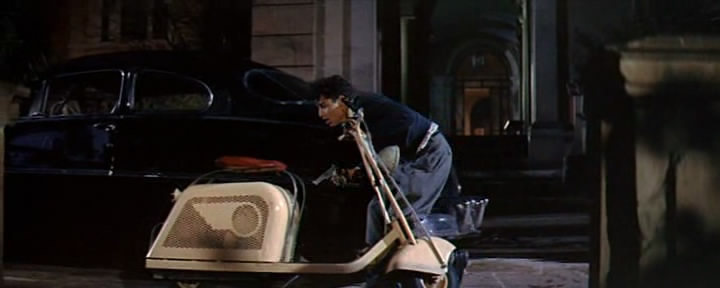 Plato as portrayed by Sal Mineo in Rebel Without a Cause (1955). Notice that as the rebel, he's pictured in the middleground with a gun while his scooter protects him in the foreground. In the background is the automobile, the teens' coveted source of freedom at the time.
Understanding how content travels and how to optimize it for successful rhetorical effect(s) in these travels is a key reason to attend to structure.
Ok. How so?
structure
Consequently, efforts to design for temporal experience must do more than simply build desirable temporal models into technologies.
Quote this for CHI paper.
In their view, time is both independent of and dependent on behaviour: temporal structures are produced and reproduced through everyday action, and these in turn shape the rhythm and form of ongoing practices. Existing temporal structures become taken for granted and appear to be unbending, but time is also treated as malleable in that temporal structures can be changed and new ones estab-lished. The objective/subjective dichotomy is not inherent to the nature of time, but is a property of the particular tem-poral structures being enacted at a particular moment. They call for a focus on examining how temporal structures be-come established for a particular activity, and how they are sustained, reinforced or modified in practice.
Org studies perspective on temporal structures.
Does this have some implications for Reddy's paper on trajectories/rhythms/horizons?
Designing for an alternative temporal experience means understanding the ways in which multiple temporali-ties intersect, whether these frame a person’s working day, or allow a family to spend time together. While scheduling technologies do of course have a role to play here [see e.g. 31], many of the temporal structures that frame everyday life are not so much scheduled as unfold in a way that isunremarkable [54], or are so firmly established that they are no longer seen as alterable.
Design implication: To integrate multiple temporalities into technology we need to reconsider temporal structures -- or the patterns of social coordination that we use as rules, rhythms, habits, and practices that guide activity.
Journalists usually describe the organization or structure of a news story as an inverted pyramid. The essential and most interesting elements of a story are put at the beginning, with supporting information following in order of diminishing importance. This structure enables readers to stop reading at any point and still come away with the essence of a story.
Charney states that "an effective lead is a 'brief, sharp statement of the story's essential facts.'"[10][full citation needed][clarification needed] The lead is usually the first sentence, or in some cases the first two sentences, and is ideally 20–25 words in length. A lead must balance the ideal of maximum information conveyed with the constraint of the unreadability of a long sentence. This makes writing a lead an optimization problem, in which the goal is to articulate the most encompassing and interesting statement that a writer can make in one sentence, given the material with which he or she has to work. While a rule of thumb says the lead should answer most or all of the five Ws, few leads can fit all of these.
News writing attempts to answer all the basic questions about any particular event—who, what, when, where and why (the Five Ws) and also often how—at the opening of the article. This form of structure is sometimes called the "inverted pyramid", to refer to the decreasing importance of information in subsequent paragraphs.
In the meantime, however, white labor had continued to regard the United States as a place of refuge; as a place for free land; for continuous employment and high wage; for freedom of thought and faith. It was here, however, that employers intervened; not because of any moral obliquity but because’ the Industrial Revolution, based upon the crops raised by slave labor in the Caribbean and in the southern United
I have chosen this paragraph in particular to discuss the structure of Du Bois' sentences. The appeal is marked by long sentences separated by semicolons and commas. Often these long sentences build on each other to create the effect of a kind of breathlessness, an endless list of the conditions that mark the ways in which Blacks are discriminated in the US and the ways in which this hurts prospects for democracy at home and abroad.
In its stead
Dickens moved this chapter, "A Marriage Contract," to his third installment (as chapter 10) because it was too long for the second. In its place he added a Chapter 7 titled "In Which Mr Wegg Looks After Himself." In the manuscript at the end of chapter 9, Dickens wrote "Marriage Contract last Chapter of No. 2, to be added here."
They found that people’s ability to detect road hazards, reaction time, and control of the vehicle were all impaired by cell phone use.
The sentence is confusing and incorrectly structured
A Professor is proposed for antient Languages, the Latin, Greek and Hebrew, particularly, but these Languages being the foundation common to all the Sciences, it is difficult to foresee what may be the extent of this school. At the same time no greater obstruction to industrious study could be proposed than the presence, the intrusions, and the noisy turbulence of a Multitude of small boys: and if they are to be placed here for the rudiments of the Languages, they may be so numerous, that its character & Value as an university, will be mixed in those of a Grammar school. It is therefore greatly to be wished, that preliminary schools, either on private or public establishment, would be distributed in districts thro the state, as preparatory to the entrance of Students into the University.
This quotation strikes me particularly as brilliant and also ironic. In the rockfish report, the founders are including not only the foundation of UVA but also a prep. school system to feed into UVA. This is mentioned in with the purpose of including the multiples languages being taught because it is indicative of the element of selective control that UVA was founded to uphold. It seems as if, on top of selectively admitting students who are deemed ideal enough to study at Mr. Jefferson' University, the board finds it crucial to grow generations of boys who will continue to fit their mold for years to come. The idea of preparatory schooling for a university is pretty progressive for the time which makes it brilliant as this model continues to be followed. However, it is ironic as it is going against the "life-long learning" mindset of Jefferson's plans. With a school filled with the exact same type of student, what dynamic between collaboration is there to learn from?
Muhammad Amjad
Genome-wide methylation data mirror ancestry information
Ekman and Friesen ultimately assembled all these combinations
The process described in this paragraph, and in the three or four previous paragraphs, maintains the flow of one big idea. He uses this structure to make the point that the study of the face requires attention to the minute details and a massive time commitment. It also describes the sheer magnitude of the study itself and the daunting task that these two scholars took on.
By listing out the names of each expression without actually identifying them or using very scientific language to describe specific movements, Gladwell conveys how deeply Ekman has studied the face. The structure here also emphasizes the insane number of different facial expressions that are possible and grants Ekman authority by demonstrating how thoroughly he has studied each and every one of them.
First, though, I will show how this dissension was lost to historical view by considering how the recurrent critical narra-tive of Charlotte’s regrettable but inevitable “minor[ing]”
Moe explicitly separates her argument into two parts here. The first will be to analyze how the critical tradition led to Charlotte's "minoring."
Sample of food riots in Bilād al-Shām {#tbl:food-riots}
This table should be moved one paragraph downwards
After an introduction into the overall argument, the first part of this paper focusses on price data and potential correlation with food riots.
I am not sure if this summary paragraph is at the right location in this paper.
who we associate with, and understanding the impact of those relationships increases
This is fundamental to sociology as a discipline. We call it peer pressure, social support, social capital, norms, etc. This is why many who use SNA see it as the best methodology for doing sociology.
In its stead
For more information on this change, see note 16 beside the old chapter seven in the right-hand-side notes.
proletarianise
Proletarianization is the social process by which people move from being either the employer or self-employment to being employed as a wage laborer by an employer.
Marx, Karl, and David McLellan. Karl Marx: selected writings. Oxford University Press, USA, 2000.
Here are the top 5 conspiracy theories associated with measles and other sorts of vaccines.
structure to provide more credibility
He lay there he did not know how long. He strained his ears to catch the sound of the train, but he heard nothing more than a vague rattling and buzzing far off . . . Presently he grew tired of lying down there. He rose and walked back to the station. There was a good crowd on the platform. He asked someone, ‘What has happened to the train?’‘A goods train has derailed three stations off, and the way is blocked. They have sent up a relief. All the trains will be at least three hours late today . . .’‘God, you have shown me mercy!’ Rama Rao cried, and ran home.His wife was waiting at the door, looking down the street. She brightened up and sighed with relief on seeing Rama Rao. She welcomed him with a warmth he had not known for over a year now. ‘Oh, why are you so late today?’ she asked. ‘I was somehow feeling very restless the whole evening. Even the children were worried. Poor creatures! They have just gone to sleep.’When he sat down to eat she said, ‘Our tenants in the Extension bungalow came in the evening to ask if you would sell the house. They are ready to offer good cash for it immediately.’ She added quietly, ‘I think we may sell the house.’‘Excellent idea,’ Rama Rao replied jubilantly. ‘This minute we can get four and a half thousand for it. Give me the half thousand and I will go away to Madras and see if I can do anything useful there. You keep the balance with you and run the house. Let us first move to a better locality . . .’‘Are you going to employ your five hundred to get more money out of crossword puzzles?’ she asked quietly. At this Rama Rao felt depressed for a moment and then swore with great emphasis, ‘No, no. Never again.’
So fate offers a twist just at the most crucial point.
People came to him when the patient was on his last legs. Dr Raman often burst out, ‘Why couldn’t you have come a day earlier?’ The reason was obvious—visiting fee twenty-five rupees, and more than that, people liked to shirk the fact that the time had come to call in Dr Raman; for them there was something ominous in the very association. As a result, when the big man came on the scene it was always a quick decision one way or another. There was no scope or time for any kind of wavering or whitewashing. Long years of practice of this kind had bred in the doctor a certain curt truthfulness; for that very reason his opinion was valued; he was not a mere doctor expressing an opinion but a judge pronouncing a verdict. The patient’s life hung on his words. This never unduly worried Dr Raman. He never believed that agreeable words ever saved lives. He did not think it was any of his business to provide comforting lies when as a matter of course nature would tell them the truth in a few hours. However, when he glimpsed the faintest sign of hope, he rolled up his sleeve and stepped into the arena: it might be hours or days, but he never withdrew till he wrested the prize from Yama’s hands.Today, standing over a bed, the doctor felt that he himself needed someone to tell him soothing lies. He mopped his brow with his kerchief and sat down in the chair beside the bed. On the bed lay his dearest friend in the world: Gopal. They had known each other for forty years now, starting with their kindergarten days. They could not, of course, meet as much as they wanted, each being wrapped in his own family and profession. Occasionally, on a Sunday, Gopal would walk into the consulting room and wait patiently in a corner till the doctor was free. And then they would dine together, see a picture and talk of each other’s life and activities. It was a classic friendship, which endured untouched by changing times, circumstances and activities.
Notice in this exposition how the writer covers an expanse of narrative time, in order to build up Dr Raman's character, his relationship with Gopal, and introducing the story problem. This is 'telling,' rather than 'showing.' The rising actions, will show the detail. How important is this technique to story-telling? All kinds of narratives?
Furthermore, the conflict suggested here is between the doctor and Death itself. How do you respond to this?
system B, I think Terry called it? too structured?)
This is important question.
Structure or structureless.
‘As I know all other things. Guru Nayak, listen carefully to what I have to say. Your village is two days’ journey due north of this town. Take the next train and be gone. I see once again great danger to your life if you go from home.’ He took out a pinch of sacred ash and held it out to him. ‘Rub it on your forehead and go home. Never travel southward again, and you will live to be a hundred.’‘Why should I leave home again?’ the other said reflectively. ‘I was only going away now and then to look for him and to choke out his life if I met him.’ He shook his head regretfully. ‘He has escaped my hands. I hope at least he died as he deserved.’ ‘Yes,’ said the astrologer. ‘He was crushed under a lorry.’ The other looked gratified to hear it.
How does the earlier description of the area around the Town Hall as both sacred and profane reveal about this event here?
‘Ah, tell me more.’‘A knife has passed through you once?’ said the astrologer.‘Good fellow!’ He bared his chest to show the scar. ‘What else?’‘And then you were pushed into a well nearby in the field. You were left for dead.’
Narayan leaves details here and there, without explaining their significance. Earlier on, the narrator informs us that the Astrologer "caught a glimpse of the stranger's face", which makes him "uncomfortable". At which point of your reading did you notice its significance? Here, or elsewhere? What can you say about Narayan's story-telling?
The tiger had held a reign of terror for nearly five years, in the villages that girt Mempi Forest.
Why do you think Narayan ends this introductory paragraph with a picture of the tiger which contrasts with the characterisation which precedes it?
In a mood of optimism they named him ‘Attila’. What they wanted of a dog was strength, formidableness and fight, and hence he was named after the ‘Scourge of Europe’.The puppy was only a couple of months old; he had square jaws, red eyes, a pug nose and a massive head, and there was every reason to hope that he would do credit to his name. The immediate reason for buying him was a series of house-breakings and thefts in the neighbourhood, and our householders decided to put more trust in a dog than in the police. They searched far and wide and met a dog fancier. He held up a month-old black-and-white puppy and said, ‘Come and fetch him a month hence. In six months he will be something to be feared and respected.’ He spread out before them a pedigree sheet which was stunning. The puppy had running in his veins the choicest and the most ferocious blood.
Consider here how fate plays with human expectations. Here, the name Attila symbolises the roles which the family hopes the dog to live up to. Then, there is hereditary genetics, which should bolster the family's hope.
Also, notice the time shift in the second paragraph. Why does Narayan begin with the naming of the dog and then go back in time?
See Narrative Techniques.
The company had been owned by members of the same family for more than a century and their management style was characterized by benevolent paternalism. However, with increased market competition, declining profits, lost export contracts and redundancy, the company’s owners decided to distance Beverage Co from its informal industrial relations history. In its place they introduced a more strategic form of human resource management, which included several employee participation (EP) schemes.
A similar team structure exists at the head office, with clerical workers engaged in administration, sales and marketing. However, there is no union recognition for these employees and despite several requests from the GMB union; management has decided to keep this side of the business non-unionized.
dark visitation of The Word
How does the religious imagery here jar with the rest of the images? Why do you think such imagery is used in a contrastive way?
I have never written a true poem, it seems. Snatchesof my salacious dreams, sandwiched together all afternoon at my desk, awaiting the dark visitation of The Word.When you arrive, unfasten your notebook, and recite,I am only a schoolboy with a schoolboy’s hard mind.You are the headmaster. Now you must master me.
Consider the deep structure of the following contrast: mundane/smallness vs transcendent/powerful. How would you fit the images under each category?
your practiced slouch, your porkpie hat at rakish angle,commending the dumpling-shaped lump atop your pelvis—as if we’ve one more thing to consider amidst the striptease of all your stanzas and all your lines—draws me down into the center of you: the prize peony,so that I’m nothing more than an ant whose singular laboris to gather the beading liquid inside you; bring it to light.
Consider the deep structure of the following contrast: Playfulness vs hard work. How would you fit the images under each category?
How is
Structurally, this sonnet is divided into stanzas of an octave and a sestet. Why is the first stanza longer than the second? What is the nature of the volte in stanza 2? How has the topic/ situation transitioned between the two stanzas?
.
A period here divides the sonnet into two septet. We expect a turning point (vole) thereafter. What has changed? Structurally, the addressee "You" is contrasted with "my" — why?
Let’s sayit’s the Almighty, twirling His whistle, ready to blow itat any moment and let loose the bottomless Apocalypse:the ocean would make bone of a body, coral of bone.
How does language here contrast images of magnitude/power and smallness/vulnerability?
THE SNAKE-SONG
In this story, identify the exposition, rising action, turning point and resolution.
Once you have identified the plot structure, can you put it all into a statement about life that has relevance universally? This statement should be specific, but not so narrow that it is only about the text.
Why I Don’t Piss in the Ocean
This poem is structured in a verse that can be divided into two septet, but presented in one stanza. (For stanza forms, see this page.)
Consider the following (as you annotate the poem), First septet: Who is the central figure here? What is the dominant impression here? What is the key message contained here?
Repeat for the second septet.
What are the connections between the two septet?
ROMEO Have not saints lips, and holy palmers too?------------------E JULIET Ay, pilgrim, lips that they must use in prayer.-----------------F ROMEO O, then, dear saint, let lips do what hands do;---------------E They pray, grant thou, lest faith turn to despair.--------------F
In the first two quatrains, both Romeo and Juliet spoke their respective parts for the entire stanzas. In this quatrain, the lines are distributed between the two. To what effects?
Notice also that English sonnets aim to increase tension. What kind of tension is heightened here, and how is it resolved in the volta?
It matters not how strait the gate, How charged with punishments the scroll, I am the master of my fate, I am the captain of my soul.
This poem is written with deliberate craft — it is a fixed verse, rather than a free verse. What evidence of such deliberation can you find? What state of mind does it reveal of the speaker's?
Out of the night
Can you find the contrasting images? Imagery are the larger impression built up from individual images. What kinds of contrasting imagery do you find here?
That is, Pixar’s films encourage adult audiences to both encounter and deny each film’s veiled dark content and its implications for them.
This shows that Pixar wants the adult audience to recognize these messages and the meaning of these messages.
All That’s Plastic Melts: Pixar Noir
This topic dives into the dark reality of Pixars desire to engage the parents or adults to think directly about their violent and "Rated R" values. The author points out the scene in which Woody pushes Buzz out of the window. It also goes into telling the viewers how we are altering our values from "us revolving around objects" to "objects revolving us around". The argument in this section is that we will surround ourselves with objects and eventually dump them and forget them. We will create a "city of mass-consumption". It will collectively join the rest of the conversation in the arguments desire to expose just how great Pixar films are engaging children to begin to question their own involvement of "mass-consumption" and exposing adults to decide whether or not we should continue the path of "mass-consumption" and overall destructive tendencies.
They also cause them to ponder their relationship to “the end”
This marks a transition sentence.
If identification with the object is ex-hilarating, it is also, at moments, fright-ening.
This is the topic sentence for the first paragraph.
A more specific framework for ana-lyzing female scientists emerges when drawing on studies across fiction genres.
Framework for analyzing female scientists emerge from fiction genres. Goes along lines with the previous paragraph
While previous scholarship gener-ally considers audiences’ reactions to the representations of scientists and ex-perts within non-fiction programming, the scholarship on their representations in fiction programming garners a little more depth of inquiry.
Fiction representation of scientists has to be more in depth
Scientists of all types—doctors, fo-rensics experts, chemists, biologists, physicists, and others—appear regularly throughout television programming.
Different types of scientists appear throughout tv programming.
The Big Bang Theory offers a unique moment to explore the representations of female scientists within the situa-tion comedy
BBT offers to explore the representation of female scientists in a sit-com
Starting with the third and fourth sea-sons, The Big Bang Theory introduced more regular female characters as love interests for the main characters.
BBT introduced female characters in the season 3-4 for love interests. *regular?
UNLIKE SCIENCE FICTION AND POLICE PROCEDURALS,the situation comedy genre historically has offered few, if any, represen-tations of female scientists.
Few representation of female scientists in sit-coms.
Bernadette’s and Amy’s scientific careers set them up as suitable partners for their accomplished boyfriends, but these careers become fodder for the developments of their relationships.
Includes both Amy and Bernadette. Careers are key to the development of relationships
While both Bernadette and Amy pos-sess achievements as scientists as part of their characters, sharp contrasts appear in those representations.
Contrast about their representation both including Amy and Bernadette
Both Bernadette and Amy earn rec-ognition for their achievements in their fields.
The topic sentence for the 2nd previous (?) one, Amy was only in the intro, however this topic sentence, includes both female characters.
While discussions of work become one way to show their professional roles, another way lies in showing these characters performing their professional roles in a work setting.
How characters perform professional role in the show.
Amy’s discussions of her expertise and her work appear more frequently throughout the show.
Topic sentence is about Amy's expertise and work
Because Bernadette and Amy work as scientists, they both have the potential to contribute to the discussions among the friends about their own work and to share their own observations based on scientific inquiry.
Because? Female characters contribute to conversations with their friends that are based on scientific inquiry.
The professional aspirations for fe-male characters thus become an oppor-tunity for ridicule within situation com-edies.
Female scientists in a sit-com are ridiculed for aspiring a professional role
A professional role refers to a char-acter’s job or occupation outside the home.
Defining a professional role for a character
Unlike other television genres, the situation comedy offers the opportunity to push the boundaries of these repre-sentations in terms of female scientists through their professional roles, their gender roles, and their intelligence.
Topic sentence about the structure of the paper
A hegemonic tension operates throughout situation comedies and pro-vides a flexible boundary along which these tensions humorously play out.
Sit com provides flexible boundary while humors tensions plays out.
Among all these studies, few focus on scientists generally and female scien-tists specifically in situation comedies.
The topic sentence of the paragraph is about focusing on female scientists in sit-com
A third theme centers on work-life balance, in that female scientists strug-gle to find equilibrium (Long et al. 359).
The topic sentence dives right into the third theme. I know when you read you find out about 1 and 2 but the topic sentence started with theme three.
The structure of the textbook was a map that Sarah could easily follow.
This is so me, It is easier for me to read in a textbook
lesh, the engineering manager, and Dubusker drew on all of McDonnell's experience with shingled-skin structures around jet afterburners for heat protection.
Richard B. Freeman and colleagues [28] havecharacterized the problem as follows: ‘‘Research in the biosciences fits a tournamenteconomic structure. A tournament offers participants the chance of winning a bigprize—an independent research career, tenure, a named chair, scientific renown,awards—through competition.... It fosters intense competition by amplifying smalldifferences in productivity into large differences in recognition and reward. Well-structured tournaments stimulate competition. Because the differences in rewardsexceed the differences in output, there is a disproportionate incentive to ‘win’’’(p.2293). Research environments in which only small numbers of scientists have theopportunity to gain significant attention increase the competitive stakes: playing thegame may be a gamble, but the payoff for winning is significant [28,36]
The tournament structure of biosciences.
Explain major differences between poems, drama, and prose, and refer to the structural elements of poems (e.g., verse, rhythm, meter) and drama (e.g., casts of characters, settings, descriptions, dialogue, stage directions) when writing or speaking about a text.
For this standard, students would have to read a variety of poems, plays and prose to understand the structural differences. Then the students must use the structural knowledge to properly write and speak about poems and plays. A good play for this standard would be Annie and a good collections of poems to understand structure would be from poet Roald Dahl.
Even the free flow of goods that constitutes a laissez-faire economyrests on an infrastructural base that organizes both market and society.
So even in a hands free scenario, the market and society are still being structured by the government..? Does that really leave it to be hands free? The way the government decides to structure it surely must have an influence on how the turnout is
The girls unanimously agree that this is a constant problem in their work and they feel helpless to combat it.
But they're okay with it...... ??? They seem to just accept the fact that these are the working conditions and it's "a part of the job"..
the customer won't leave her alone and she must do her best to ignore him....
This is interesting because it counteracts the original problem presented about the waitress being ignored. It seems because of the way the social structure influences the atmosphere of the bar, the waitress is essentially in a losing position each time..
emphasizes the importance of the use of space in social interaction and posits a relationship between social status and space.
Refers to how we are making use of the "built environment" when interacting with our peers or people from different social classes
Architects continue to be fascinated with finding and describing parallels between symbolic structures and architectural forms.
As mentioned by someone else in a previous comment, the red archway on Whittier College's campus is supposedly a "symbolic structure" and its architectural characteristics offer an interesting representation of something that looks flexible, but is in fact extremely rigid. What could be relatable to this?
regarding the interactions of the built environment with social organization and spatial behavior
"social organization and spatial behavior"
how we structure our society and interact with our built surroundings
Some combine structuralist interpretations of house form and culture with the metaphor of the human body
Our body is the home for our soul and mind, but our body needs a home as well.. Depending on our individualistic needs and wants that can influence how we develop and use the structure.
It was when my sister finally dragged me out of bed and took me to the beach, I looked up in the sky and saw birds flying around, I instantly knew that this was a call, from Trace, telling me that hes free at last.
Sentence too long
,
Sentence structure
that the ease of horizontal mobilization afforded by social networks is of limited help if it doesn’t generate more lasting political structures that can contest the military rule outside the squares
Therefore, generalising, more long lasting political structures are required. So the question in the West is to what extent are democratic structures augmented, enhanced or detracted from? If the Internet is used to effectively syphon off discontent while amplifying indoctrinating messages this is not what can be called progress.
But at the level of the capability hierarchy where we wish to work, it seems useful to us to distinguish several different types of structuring--even though each type is fundamentally a structuring of the basic physical processes. Tentatively we have isolated five such types--although we are not sure how many we shall ultimately want to use in considering the problem of augmenting the human intellect, nor how we might divide and subdivide these different manifestations of physical-process structuring. We use the terms "mental structuring", "concept structuring", "symbol structuring", "process structuring," and "physical structuring."
The 5 structuring types outlined by Doug Engelbart:
The fundamental principle used in building sophisticated capabilities from the basic capabilities is structuring--the special type of structuring (which we have termed synergetic) in which the organization of a group of elements produces an effect greater than the mere addition of their individual effects. Perhaps "purposeful" structuring (or organization) would serve us as well, but since we aren't sure yet how the structuring concept must mature for our needs, we shall tentatively stick with the special modifier, "synergetic." We are developing a growing awareness of the significant and pervasive nature of such structure within every physical and conceptual thing we inspect, where the hierarchical form seems almost universally present as stemming from successive levels of such organization.
and the doctrine at issue here, the “first sale” doctrine (§109).
The issue
Sample Model Case Brief (Should be ONE page (Typed) MAXIMUM!):
Concurring/Dissenting Opinion: You don’t need to spend too much time on this part other than the pinpoint the concurring or dissenting judge’s main point of contention with the majority opinion and rationale. Concurring and dissenting opinions hold lots of law professor Socratic Method fodder, and you can be ready by including this part in your case brief.
Reasoning: This is the most important part of your brief as it describes why the court ruled the way it did; some law professors dwell on facts more than others, some more on procedural history, but all spend the most time on the court’s reasoning as it combines all parts of the case rolled in one, describing the application of the rule of law to the facts of the case, often citing other court’s opinions and reasoning or public policy considerations in order to answer the issue presented. This part of your brief traces the court’s reasoning step by step, so be sure that you record it without gaps in logic as well.
Rule of Law: In some cases this will be clearer than others, but basically you want to identify the principle of law on which the judge or justice is basing the resolution of the case. This is what you’ll often hear called “black letter law.”
Holding: The holding should directly respond to the question in the Issue Presented, begin with “yes” or “no,” and elaborate with “because…” from there. If the opinion says “We hold…” that’s the holding; some holdings aren’t so easy to pinpoint, though, so look for the lines in the opinion that answer your Issue Presented question.
Issue Presented: Formulate the main issue or issues in the case in the form of questions, preferably with a yes or no answer, which will help you more clearly state the holding in the next section of the case brief.
Procedural History: Record what has happened procedurally in the case up until this point. The dates of case filings, motions of summary judgment, court rulings, trials, and verdicts or judgments should be noted, but usually this isn’t an extremely important part of a case brief unless the court decision is heavily based in procedural rules—or unless you note that your professor loves to focus on procedural history.
Facts: Pinpoint the determinative facts of a case, i.e., those that make a difference in the outcome. Your goal here is to be able to tell the story of the case without missing any pertinent information but also not including too many extraneous facts either; it takes some practice to pick out the determinative facts, so don’t get discouraged if you miss the mark the first few times. Above all, make sure you have clearly marked the parties’ names and positions in the case (Plaintiff/Defendant or Appellee/Appellant).
Concurri ng and/or Diss enting Opinio ns. Concurring and dissenting opinions (a.k.a. “concu rrence s” and “dissents”) are opinions by judges w ho did not se e entire ly e ye -to-ey e with the other judges of the court, and wish to express a slightly or even dramatically diff erent view of the case. In g en er al , a co nc ur ri ng op in io n i s a n o pi ni on by a judge who would have reached the same result as the majority, but f or a different reason. Dissenting opinions are opinions by judges who disagree with the majority’s result entirely. I n most cases, dissenting opinions try to persuade the reader that the majority ’s decision was simply incorre ct.
Disposition : The dispo sition usua lly a ppears a t t he en d of the ma in opinion, and tells you what action the court is taking with the case. For example, an appeals court ma y affirm the lower court decision , upholding it; or it ma y reverse the decision, overturning it, and remand the case, sendi ng i t back to th e lower c ourt for further procee dings. F or now, y ou should k eep in mind that when a higher court affirms it means that the lower court had it right (in result, if not in reasoning). Words like reverse , remand , and vacate means that the higher court though the lower court had it wrong
Keywords:
Law of the Case
Facts of the Case
Author of t he Opinion
Case Citation
The Caption: The caption is the title of the case, such as Brown v. Board of Education , or Miranda v. Arizona . In most cases, the cap tio n refle cts the la st names o f the two p arties to the dispute, and it tells you who was involved in the case. If Ms . Smith sues Mr. Jones, t he case caption may be Smith v. Jones (or, depending on the court, Jones v. Smith ). In a criminal case , the government brings the case, a nd the government itself is listed as a party. I f the f ederal government charges Sam Jones with a crime, for example, the ca se capt ion would be United States v. Jones .
THE ELEMENTS OF BRIEFING Procedural History Legal Issue Facts of Case Statement of Rule Policy Dicta Reasoning Holding Concurrence Dissents
the parties, the procedural posture, the facts, the issue , the h olding, and the analysis.
Parts of a judicial opinion identified in a student brief:
H o w t o R e a d O p i n i o n s
This section on how to read judicial opinions helpfully describes the components of what an opinion contains and some discussion of the challenges in identifying those components within the structure of the opinion.
The components identified here are:
Next, Quintilian's greater weakness concerns effects. For he put these forward in the topics of persons, yet here once again he repeats them as if they were now different.
It follows, then, that the only necessary parts of a speech are the Statement and the Argument. These are the essential features of a speech; and it cannot in any case have more than Introduction, Statement, Argument, and Epilogue.