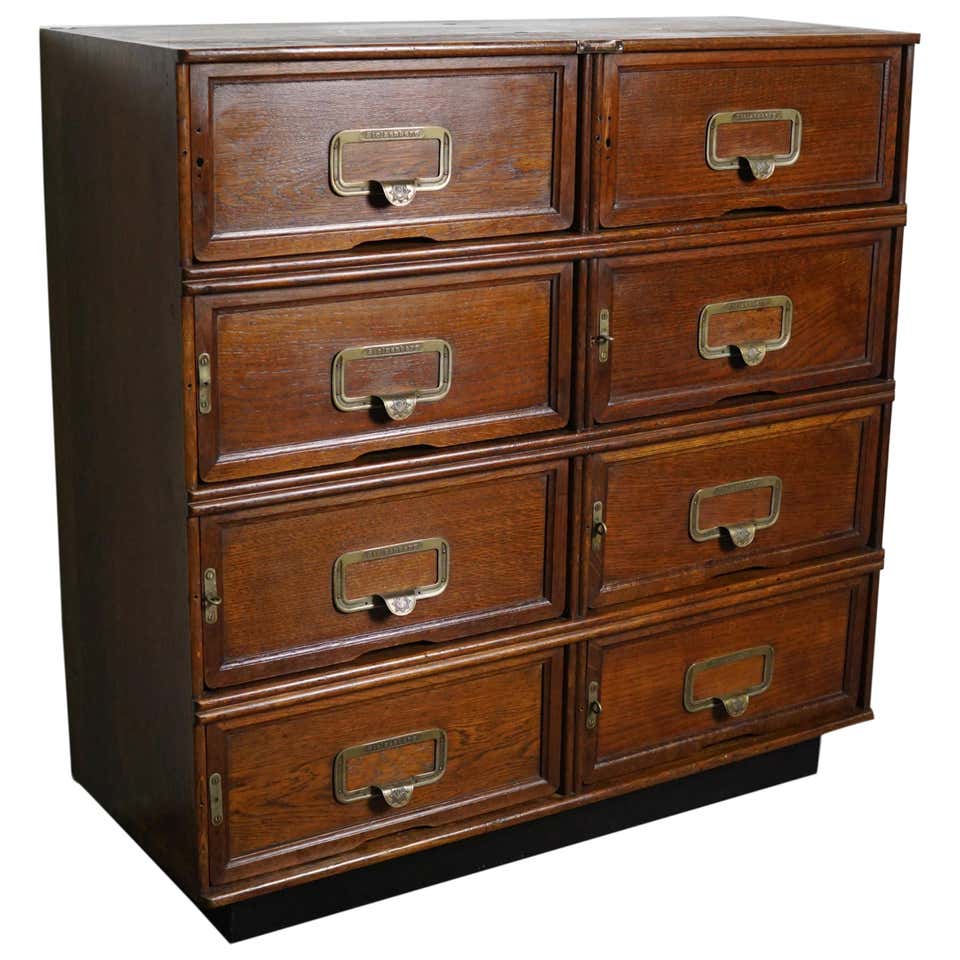
Felger, A. H. 1902. “A Plan for Recording in a Condensed Form the Life-History Notes of Birds.” The Auk 19(2): 189–95. doi:10.2307/4069312.
10,000 Matching Annotations
- Last 7 days
-
-
-
Felger describes the sorts of data an ornithologist would be interested in collecting and then delineates how to create a spreadsheet (though he doesn't use this term) for collecting this data.
In a follow up article five years later, he suggests using a card index system instead. See: @Felger1907 whith notes at: https://hypothes.is/a/qeki7oU4EfGv8QNy5SVDgA
-
After all, it is the positive and not the negative records that aremost important.
-
-
Local file Local file
-
Felger, A. H. 1907. “A Card System of Note-Keeping.” The Auk 24(2): 200–205. doi:10.2307/4070853.
Ornithologist A. H. Felger describes the use and form of a custom card index system for creating a paper database of data for tracking and counting birds.
In particular he recommends it over prior uses of journaling methods. He suggests the ability to look at multiple cards in a row to be able to more easily extract usable data versus those older journaling methods.
-
The system is self indexing.
-
the ordinary 'stock cards' furnished by firms for card cataloguepurposes. In large quantities they should be obtained in thisway ruled, cut, and printed, for $1.35$1.50 per M
These cards can be made by any printing establishment provided with a ruling machine at a cost considerably below that of
-
In running overa hundred cards on a certain species that one is studying it is avery simple matter by reference to the 'barred cards' to selectthose that contain notes on 'mating,' 'nest-building,' or the like.(3) If the cards on any given species are arranged chronologic-ally in a horizontal row, one will have in line before him forvery easy study all the notes with reference to any desired phaseof the bird's life history
Felger broad describes how to use index cards to create a paper database for ornithology.
-
By the use of theseprinted forms no note indicated thereon that should be recordedis ever forgotten, as is lamentably the case when the diary systemis employed
Pre-formatted index cards used in creating a database help one not to forget any of the desired data to be collected in a project.
-
o indicate the positions ofgenera I use colored 'j guide cards' containing the generic nameTo indicate the positions of species within each genus I use differ-ently colored ' guide cards' containing the specific names.To indicate the positions of the subspecies I use cards of still difent color.
1/3 guide cards and 1/5 guide cards in use as well as colored cards
-
There are other cases of what I call 'compound notes' thatoccasionally make their appearance in the work of every or
Felger defines "compound notes" as cross-references or cross-indexed ideas which allow the use of two different ideas or subjects/topics on a single card.
-
The cards- are ruled and printed on one side only, the notesbeing confined wholly to this one side.
-
In casethere is not sufficient space on this card to record all desirabledata with respect to 'Floral' and 'Faunal Changes,' these notesare continued by the use of index letters onto an 'extension card'as indicated in Fig. 1, cards 1 and
The method by which Felger links notes on one card in his database to other cards.
-
In this system I use three distinct types of cards, each 3 in. X5 in. and of 'medium weight,' which, for convenience of referencehere, I shall designate 'condition card' (Fig. 1, card 1), 'barredcard' (Fig. 2, card 1), and 'extension card' (Fig. 1, card 2; Fig.2, card 2). The cards for these plates were not selected withreference to contemporaneity, which I hope will not confuse, butselected with a view to illustrating to better advantage the plan ofamplifying notes on the 'extension cards.'
Tags
- ornithology
- card index system
- card index as database
- self-indexing
- barred cards
- A. H. Felger
- cost of idex cards
- bidirectional links
- 1907
- card index for research
- pre-formatted index cards
- note taking manuals
- read
- color
- extension cards
- References
- idea links
- custom made index cards
- 3 x 5" index cards
- condition cards
- cross referencing
- compound notes
- note taking
- tabbed dividers
- definitions
- write only on one side
Annotators
-
-
poets.org poets.org
-
Poem read as bedtime story in The Waltons S1 E2 "The Carnival" by John Boy to the kids as he put them to bed.
He only read part of one stanza, namely:
An’ they seeked him in the rafter-room, an’ cubby-hole, an’ press,<br /> An’ seeked him up the chimbly-flue, an’ ever’wheres, I guess;<br /> But all they ever found was thist his pants an' roundabout-- An’ the Gobble-uns’ll git you<br /> Ef you Don’t Watch Out!
-
-
galerie-alte-technik.de galerie-alte-technik.de
-
via Koponewt (aka Pelicram ❤️ Slug Goblin) at https://www.reddit.com/r/typewriters/comments/1v1fcw8/comment/oyntwp4/
Get in touch with Galerie Alte Technik, they specialize in selling off collections of antique typewriters.
-
-
www.avito.ru www.avito.ru
-
New shop opened in April 2026 in Moscow, Russia
via <br /> https://www.reddit.com/r/typewriters/comments/1v1ar6h/my_typewriter_repair_shop_vibes/<br /> https://www.instagram.com/iskra.machines
-
-
www.typewriterservices.com www.typewriterservices.com
-
www.facebook.com www.facebook.com
-
I’m almost out of the R&D phase to offer it for the Eastern Canada region. Follow Rétrodactyle - Espace vintage for when I’ll start taking orders.Like
Matthieu Théorêt is in the R&D phase for being able to offer platen recovery services.
https://www.facebook.com/groups/705152958470148/posts/1323404683311636/
-
I have used resin 3D printed platens on a few machines now and I am very happy with them. 95A Duro, they work well.
Milton Solomon reports having used a resin 3D printed platen at 95A duro.
-
-
www.reddit.com www.reddit.com
-
reply to u/shadowwolf892 at https://www.reddit.com/r/typewriters/comments/1uzynlz/a_portable_compared_to_sg1/
You're comparing apples and oranges and the apple you're looking for will never be an orange. (i.e. Standard machines are almost always going to beat out portables: https://boffosocko.com/2025/03/21/standard-typewriters-versus-portable-typewriters-and-ultraportable-typewriters.)
The feel question is also going to be so variable across people's experiences (not to mention the condition of the machines on which they were formed which is a tremendous amount of noise in the secondary market) that you're highly unlikely to find what works best for you in this way. Incidentally, this is also a great way to end up with 30 typewriters and still be unsatisfied.
Your best bet for all of the variables you're trying to optimize for is to go to a shop with a variety of machines in good condition to try and purchase something you think will suit you best.
All this aside, I nearly guarantee that neither of your machines are well tuned, so you might consider looking into this for your Sterling: https://www.youtube.com/watch?v=OYOXgqiHBmg.
-
-
typewritersandbeer.wordpress.com typewritersandbeer.wordpress.com
-
the rule for telling the difference between a SS and a Nakajima is: look at the margin set buttons, SS button ends turn up, Nakajimas turn down. There’s not a lot of other obvious visual differences.
via Ted Munk at https://typewritersandbeer.wordpress.com/2020/02/24/silver-seiko-speedwriter-7200-and-stone-ruination-2-0/#comment-95
-
-
www.facebook.com www.facebook.com
-
https://www.facebook.com/groups/721704878218903/posts/3068179956904705
Reddy Kilowatt as a custom slug on a Royal KHM.


-
-
www.facebook.com www.facebook.com
-
You mean like a fish key?
via Mark Schrad at https://www.facebook.com/groups/705152958470148/posts/1321966286788809
An L. C. Smith standard with a fish glyph for a type slug.

-
-
typewriterdatabase.com typewriterdatabase.com
-
https://typewriterdatabase.com/show.28476.typewriter
An Underwood Champion with a built-in typing stand and instruction manual.
-
-
www.reddit.com www.reddit.com
-
Don't feel bad. Your not the only one. This misconception has been going on for years simply because no typewriter repairman has stood up and said " Now wait a minute! " The collectors have done all the talking and publishing while the typewriter man isn't heard. Consequently, it's the big typewriter collectors that are heard. They never talk about how many times they had to reclean a machine. They often have several and may only use 1 or 2. Also there isn't that many of us real typewriter repairman left to do the talking.
Due to the nature of online communication, it may often be the case that typewriter collectors and their colloquial advice may drown out the more experienced and professional typewriter repair people.
-
Most typewriter shops did not use alcohol as it was ineffective and contained water. Industrial alcohols contained keytones and acetones that will melt plastic and remove paint.
Solvents for typewriters used in repair shops: - White mineral spirits with a squeeze bottle. (Sometimes also called Varsol, Stoddard's Formula, and possibly Inhibisol) - Naphtha (aka lighter fluid; used in Zippo lighters, and frequently seen in Europe). PB B'laster is essentially pressurized naphtha in a can. - Auto carb and brake cleaners, usually pressurized in a can. These usually have acetone in them and will melt plastic. Will remove WD-40 if accidentally used on a typewriter.
For cleaning typeslugs, one can use naphtha or mineral spirits with a brass bristle brush.
For platen cleaning try mineral spirits or fedron.
Only oil the carriage rails for the bearings or trucks.
(This is all colloquial advice, albeit with experience, so check specific facts about what certain products contain.)
-
-
www.instagram.com www.instagram.com
-
https://www.instagram.com/p/DafbWAMx4xw/
Video of Fine Line's ribbon manufacturing machine.
-
-
www.reddit.com www.reddit.com
-
What you need: a small wooden board, six long screws, two short screws (with heads that fit through the center hole of the ribbon spools), a small kitchen sponge cut in half lengthwise with scissors, and light machine oil (like sewing machine oil). The two short screws are mounted on the left and right of the wooden board to act as axles for the spools. The two sponge halves are placed flat on top of each other in the center and secured along the sides with the six long screws so that they press tightly against one another. The typewriter ribbon is threaded from one spool, through the sponge halves, and onto the other spool. Before pulling it through, apply a little light machine oil to the inside faces of the sponges. The ribbon is then slowly pulled through once, which evenly massages the oil into the fabric. After pulling it through, the spools must rest in a sealed bag for 12 to 24 hours so the oil can distribute fully throughout the fabric. Notes: This method only works for ribbons that are simply dried out but not actually "typed out" (meaning they still contain enough ink pigment). It only works for solid-color ribbons; using it on two-color (black/red) ribbons will cause the colors to bleed together. The advantages of this design include a clean application without messy hands, precise and twist-free ribbon guiding, and optimal oil dosage thanks to the even pressure of the sponges. If the ribbon is still too wet after resting, it can easily be pulled through a pair of dry sponges to strip off the excess.
https://www.reddit.com/r/typewriters/comments/1uy67c4/diy_jig_for_rejuvenating_driedout_typewriter/
-
-
www.bargainjohn.com www.bargainjohn.com
-
en.wikiquote.org en.wikiquote.org
-
https://en.wikiquote.org/wiki/George_Stillman_Hillard
Hillard has so many great commonplace-able quotes!
-
-
forum.zettelkasten.de forum.zettelkasten.de
-
In German, I would've introduced the term "Zugriff" which roughly translate as "access". Literally translated, "Zugriff" would be something like "the very act of grapping something". So, it is a physical, right-hemisphere concept. Perhaps, "embodied" would be another good characterisation.
also via Sascha at https://forum.zettelkasten.de/discussion/comment/25362/#Comment_25362
PS: "Zugriff" is also the command if you start a raid with the goal to capture somebody.
-
Shelving together, as well as using subject terms to reflect similarity or relatedness, are methods to create collocation.
Collocation of books in libraries via Dewey Decimal and other methods is a useful method for creating serendipity.
-
Serendipity - Find the unexpected. Synergy - Feel the reinforcement. Syzygy - Ride the resonance.
via tomp at https://forum.zettelkasten.de/discussion/comment/25361#Comment_25361
this is an interesting framing for zettelkasten work
-
Actually, I have a z-card about it:
tomp calls (in English) their zettels or "digital cards" z-cards.
-
-
www.reddit.com www.reddit.com
-
www.advocate.com www.advocate.com
-
'Never Seen a Vagina': Lindsey Graham’s Sexuality Is a Joke<br /> by [[John Casey]] in Advocate.com<br /> accessed on 2026-07-15T07:48:54
-
-
www.advocate.com www.advocate.com
-
If Lindsey Graham was gay, Pride does not claim him<br /> by [[John Casey]] Advocate.com<br /> accessed on 2026-07-15T07:44:57
-
Being gay, and coming to terms with it, can require real courage. Standing up for our rights, protesting, and pushing for change requires empathy and guts.By those measures, Lindsey Graham doesn't deserve to be called gay, even if he was.
-
I also thought about longtime FBI Director J. Edgar Hoover. Those of us of a certain age know the rumors about his cross-dressing, which have been repeated as fact in pop culture for the last 50 years.That rumor originates from a single, widely discredited 1993 biography and remains completely unsubstantiated by mainstream historians.
-
- Jul 2026
-
www.keybr.com www.keybr.com
-
www.typingtest.com www.typingtest.com
Tags
Annotators
URL
-
www.facebook.com www.facebook.com
-
In the photo with the three brushes at the top: the bottom tool is used to split the platen rubber for removal before mailing them to Ames for recovering. We had a special reusable shipping box with fabric straps and buckles and a reversible label. Stripping the rubber enabled more to fit in the box and saved postage. We would mail about 20 cores at a time.

-
-
site.xavier.edu site.xavier.edu
-
Users of the Royal KHM typewriter:<br /> William Faulkner, L. Ron Hubbard, David McCullough, Al Neuharth, Mickey Spillane, Dalton Trumbo, Frank Lloyd Wright, J. D. Salinger, Georges Simenon, Richard Wright, Eric Hodgins, William Peter Blatty, Post Malone, and Taylor Swift.
-
-
www.reddit.com www.reddit.com
-
https://www.reddit.com/r/typewriters/comments/1uttoqn/what_do_you_use_your_typewriter_for_read_body/ via u/TomReef_Reddit (who later deleted the body of the question)
-
-
www.reddit.com www.reddit.com
-
www.facebook.com www.facebook.com
-
www.reddit.com www.reddit.com
-
This crate was originally shipped via the Railway Express Agency, who were the precursors to companies such as FedEx or UPS. The remains of the prepaid shipping label are still visible pasted on the lid. Below and to the the right of the letter “Y” in the word agency you can see the numbers 12 and 7-30 in parentheses. The 7-30 indicates the month and year that the label was printed. While I don’t know much about typewriters and how how long an older model may have sat in stock; I can pretty confidently say that this box and it’s contents would have been shipped to either it’s new owner, or possibly a department store no earlier than July of 1930, and likely no later than sometime in 1931 as there were constantly new sets of labels being printed.
via u/Charliev1630 at https://www.reddit.com/r/typewriters/comments/1ubgozb/acquired_early_1900s_wooden_woodstock_standard/
-
-
www.youtube.com www.youtube.com
-
Smith Corona Typewriter Type Alignment Adjustment, Uneven Characters, Type Guide Loose, Repaired<br /> by [[Phoenix Typewriter]]
-
-
www.youtube.com www.youtube.com
-
Smith Corona Portable Typewriter, Type Guide Plate Alignment Process, Repaired Uneven Characters<br /> by [[Phoenix Typewriter]]
-
-
www.reddit.com www.reddit.com
-
Replacing a single typewriter key legend:
The keys on these are metal bases with a cardboard legend (with the glyph printed on it) which is typically covered by a clear acetate lens and held on by a metal keyring. Fortunately you've got the keyring. If you can't source a single acetate lens from a repair shop you can buy a set from https://mytypewriter.com/products/hello-qwerty-replacement-keytop-disc-set
Richard Polt has some of the process described here as well as as high resolution scans that you can use to print out the key legends you may need. https://writingball.blogspot.com/2016/10/legendary.html
Ames Supply Company used to sell keycards for doing this. Some of them had colors including green, so keep this in mind if you try something like creating rainbows across your keyboard or other visual fun. https://typewriterdatabase.com/1960-Ames_Gen_Cat_10-March.misc-supplies.manual
Our friend Lucas Dul of Chicago Typewriter has a great YouTube video of the tool and some of the process, though you can probably get away without a pair of custom pliers since you only need to do one: https://www.youtube.com/watch?v=jYHrBjfQxpM
As a fun example, Heiko Stolten recently did a whole keyboard on a Remington using custom made legends that use the font from the Netflix series Wednesday: https://www.facebook.com/groups/TypewriterCollectors/posts/10163537426144678/ If you ask nicely, they've got the original files if you need them for printing out.
Good luck!
reply to u/saved_rae at https://old.reddit.com/r/typewriters/comments/1uvehmb/missing_period_key_repaint/ who was missing a period legend and the acetate lens.
-
-
www.johndickerson.com www.johndickerson.com
-
Presidential historian, Atlantic writer, and former CBS anchor John Dickerson's GOOD QUESTION, an examination of the basic unit of curiosity—the question itself—featuring stories from New York City detectives, doctors, philosophers, and more to illustrate the question's fundamental role in every facet of a life well lived; also revealing new findings from the science of curiosity and explaining why we ask and why we fail to, how a single question can reorganize a civilization, and why the follow-up and the hypothetical question can rebuild our connections with each other, to Molly Turpin at Random House, by Tina Bennett at Bennett Literary.
-
-
www.wellappointeddesk.com www.wellappointeddesk.com
-
Paper Review: Life Typewriter Paper<br /> by [[Ana Reinert]] – The Well-Appointed Desk accessed on 2026-07-10T17:17:27
Review, but of what really? The didn't bother with the ability to erase or how it looks with white out or similar cover ups. Ugh.
-
-
5forms.com 5forms.com
-
www.deluxe.com www.deluxe.com
-
www.merriam-webster.com www.merriam-webster.com
-
www.facebook.com www.facebook.com
-
apnews.com apnews.com
-
Singer Bonnie Tyler of 'Total Eclipse of the Heart' dies at 75<br /> by [[Mark Kennedy]] for AP News<br /> accessed on 2026-07-09T08:20:38
-
-
www.ribbonsfortypewriters.com www.ribbonsfortypewriters.com
-
https://www.ribbonsfortypewriters.com/
According to Richard Polt, TB Writers Plus makes their own bulk ribbon.
-
-
steelsantos.com steelsantos.com
-
Vintage Steel Tanker Furniture<br /> by [[Steel Santos]]<br /> accessed on 2026-07-08T11:36:15
Their location in Sherman Oaks has been closed for about 2 years via conversation with owner. (2026-07-07)
-
-
www.youtube.com www.youtube.com
-
I Hate Modern Desks... So I Built This. by Morley Kert
-
-
www.youtube.com www.youtube.com
-
Joe Van Cleave uses thin tin foil with a carbon to type onto paper as an experiment in the case that typewriter ribbon is no longer manufactured.
He find better imprints by placing additional backing sheets in front of his carbon paper, presumably because the pressure of the imprint is better.
-
Carbon Paper: The Future of Typing?<br /> by [[Joe Van Cleave]] on YouTube<br /> accessed on 2026-07-08T09:39:21
-
-
en.wikipedia.org en.wikipedia.org
-
Carbonless copy paper<br /> by [[Wikipedia]]<br /> accessed on 2026-07-08T09:14:46
-
-
www.reddit.com www.reddit.com
-
I found it in an old Italian typewriting course that I’m studying, it says translated “on olivetti machines both manual and electric , if you press the margin release key while performing line return, the carriage will stop ten spaces before the set left margin. This creates a fix indentation useful for starting new paragraphs”
https://www.reddit.com/r/typewriters/comments/1upt285/did_you_know_about_this_hidden_feature_on_the/
-
-
www.reddit.com www.reddit.com
-
If you need parts, hit me up. I have nearly an entire disassembled QDL (same vintage as your machines) in good condition that I will not be using.
u/typercito has a 50s Royal Quiet De Luxe that is a parts machine if necessary.
https://www.reddit.com/r/typewriters/comments/1ua62rl/comment/osohxex/?context=1&screen_view_count=2
-
-
www.telegraph.co.uk www.telegraph.co.uk
-
How Netflix became the home of ‘cancelled’ comedians<br /> by [[Stephen Armstrong]]<br /> accessed on 2026-07-06T15:37:16
-
-
-
Louis C.K.’s new Netflix special is a master class in surviving so-called ‘cancellation’<br /> by [[Jacques Berlinerblau]]<br /> accessed on 2026-07-06T15:35:08
-
-
-
Someone has used a spatula and spring feedback from the Hermes Ambassador's space bar to effectuate a power space functionality. https://www.reddit.com/media?url=https://v.redd.it/4js8jq2snhbh1/HLSPlaylist.m3u8
Of interest, the power space on most of the Smith-Corona machines works exactly like this internally—they've just hidden the rectangular rubber "spatula" inside the right rear of the machine.
-
-
www.reddit.com www.reddit.com
-
my Halda P in a Sears electric typewriter case (made in Japan)
https://www.reddit.com/r/typewriters/comments/1uow243/just_in_case/
-
my Torpedo 18s which fits perfectly in a spare Underwood-Olivetti 21 case
https://www.reddit.com/r/typewriters/comments/1uow243/just_in_case/
-
-
clickamericana.com clickamericana.com
-
https://clickamericana.com/topics/science-technology/vintage-portable-manual-typewriters
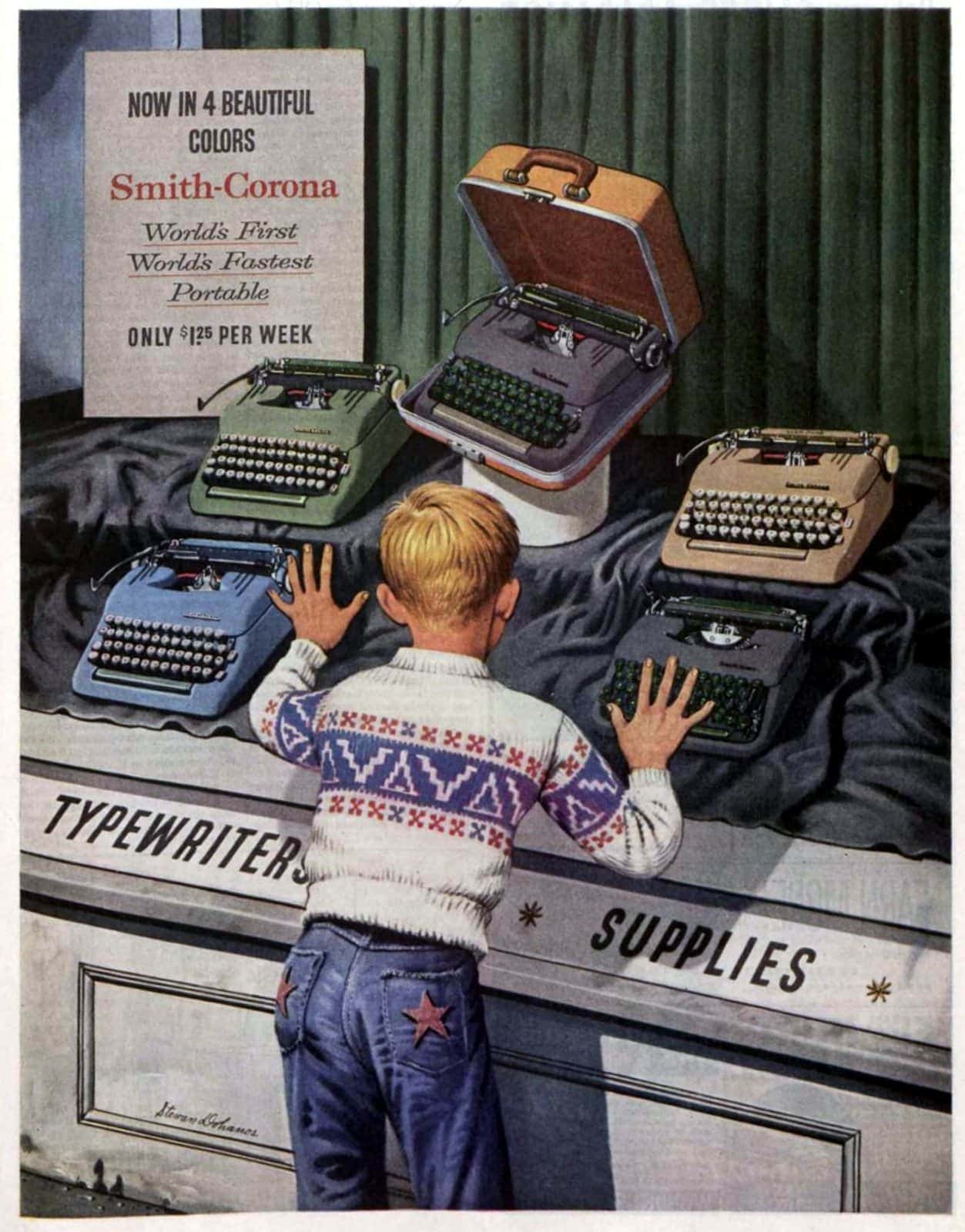
The Smith-Coronas were offered in 4 different colors.

The Remington Quiet-Riter was eventually offered in white sand, desert sage, mist green, and French gray,

The Royal HH was offered in 6 colors including green, pink, and blue. Brown was the most ubiquitous.
-
-
www.google.com www.google.com
-
Why bother with dozens of big standards in your office when you can have a portable or two that you can move and which are always in demand?
100% The Practical Magazine of Efficient Management, November 1916, Volume 7, No. 45, p49. https://www.google.com/books/edition/Management/hqj2SD6khL4C?hl=en&gbpv=1&dq=corona&pg=RA4-PA49&printsec=frontcover
-
-
www.youtube.com www.youtube.com
-
xoverit.blogspot.com xoverit.blogspot.com
-
Origin of Royal's Vogue by [[x over it]]
-
-
www.youtube.com www.youtube.com
-
Remington Quie- Riter Typewriter 1955
"students who use typewriters get up to 38% better grades."
"gives book reports and themes a professional look"
gendered sales technique - "girls particularly appreciate" the easy change ribbon system...
-
-
www.youtube.com www.youtube.com
-
VINTAGE 1958 COMMERCIAL - REMINGTON RAND - OFFICE-RITER TYPEWRITER
Up to 10 carbons!<br /> Cuts clear, clean stencils 149.50 plus carrying case additional<br /> $1.50 a week payable monthly
-
-
www.youtube.com www.youtube.com
-
Successful Secretary Presented by Royal Office Typewriters. A Thomas Craven Film Corporation Production, 1966. https://www.youtube.com/watch?v=If5b2FiDaLk.
Script: Lee Thuna<br /> Educational Consultant: Catharine Stevens<br /> Assistant Director: Willis F. Briley<br /> Design: Francisco Reynders<br /> Director & Producer: Carl A. Carbone<br /> A Thomas Craven Film Corporation Production
"Mother the mail"
gendered subservience
"coding boobytraps"
"I think you'll like the half sheet better. It is faster." —Mr. Typewriter, timestamp
A little bit of the tone of "HAL" from 2001: A Space Odyssey (1968). This is particularly suggestive as H.A.L. was a one letter increment from I.B.M. and the 1966 Royal 660 was designed to compete with IBM's Selectric
This calm voice makes suggestions to a secretary while H.A.L. does it for a male astronaut (a heroic figure of the time period). Suddenly the populace feels the computer might be a bad actor.
"We're living in an electric world, more speed and less effort."—Mr. Typewriter<br /> (techno-utopianism)
Tags
- H.A.L.
- secretaries
- efficiency
- Royal 660
- effort
- Mr. Typewriter
- productivity
- artificial intelligence as overlord
- typewriter advertisements
- Royal typewriters
- techno-utopianism
- typewriter shortcuts
- power over
- gendered subservience
- quotes
- voice over
- typewriters
- 2001: A Space Odyssey (1968)
- 1966
- IBM selectric
Annotators
URL
-
-
www.facebook.com www.facebook.com
-
oztypewriter.blogspot.com oztypewriter.blogspot.com
-
oz.Typewriter: Portuguese Typewriter<br /> by [[Robert Messenger]]<br /> accessed on 2026-07-02T23:54:38
-
-
dynamicallytyped.org dynamicallytyped.org
-
https://dynamicallytyped.org/ Site "released" on 2026-07-02<br /> via https://www.facebook.com/groups/4770669677/posts/10163825687234678
-
-
www.facebook.com www.facebook.com
-
I have a question for you collectors. If you purchase a typewriter for say $250 or $300. Do you expect it to be clean, with a new ribbon or is that just me?As I passed an antique store I saw a Smith-Corona Zephyr on the window. It didn't have a lid, but it drew my attention enough to lure me into the shop. I learned the Zephyr was for sale for $300 without a lid. I want a typewriter for travel (an ultra portable), so I was mildly disappointed. The shop keeper said he had other typewriters with cases. He brought out three cases. Two Smith-Coronas and a Remington Portable. They all were in working order (at least for the quick test I did), but they were all dirty. One of them the ribbon was dry and all of them were between $250 and $350. I thanked him and walked away. Am I delusional in wanting to have a typewriter at the very least be cleaned if its being sold for $250 or $350?
Antique/Vintage shops have a different market that isn't really "us" (collectors or enthusiasts with some baseline knowledge.) They're getting machines either at yard sales or house clean outs for $5-20 and marking them up for presentation long term in their stores until they can turn their profit. They'll rarely go less than 10-20% (in my experience) because they know that some sucker who knows nothing will come in and buy it. Most of their customers are buying things for display and not for actual use. They're also buying based on perceived value rather than solid research.
Generally I find that there is a "dead zone" for typewriters between $50 and $250. When you find one in this range it's almost always being sold by someone who has no idea how to use a typewriter, knows anything about the market, or what sort of condition a machine is actually in.
Often people may get their start by overpaying for a machine at an antique store, but then as they research how to use it they find out either they need to self-service it or that they need to take it to a repair shop. If it's the latter, they realize they ought to have bought a machine from the repair shop and they'd have come out far ahead. Based on my experience from type-ins, people are limping along using and putting up with some machines in pretty marginal condition.
reply to Ed Medina at https://www.facebook.com/groups/TypewriterCollectors/posts/10163822675949678/
-
reply to Ed Medina at https://www.facebook.com/groups/TypewriterCollectors/posts/10163822675949678/
Antique/Vintage shops have a different market that isn't really "us" (collectors or enthusiasts with some baseline knowledge.) They're getting machines either at yard sales or house clean outs for $5-20 and marking them up for presentation long term in their stores until they can turn their profit. They'll rarely go less than 10-20% (in my experience) because they know that some sucker who knows nothing will come in and buy it. Most of their customers are buying things for display and not for actual use. They're also buying based on perceived value rather than solid research.
Generally I find that there is a "dead zone" for typewriters between $50 and $250. When you find one in this range it's almost always being sold by someone who has no idea how to use a typewriter, knows anything about the market, or what sort of condition a machine is actually in.
Often people may get their start by overpaying for a machine at an antique store, but then as they research how to use it they find out either they need to self-service it or that they need to take it to a repair shop. If it's the latter, they realize they ought to have bought a machine from the repair shop and they'd have come out far ahead. Based on my experience from type-ins, people are limping along using and putting up with some machines in pretty marginal condition.
-
-
www.thedailybeast.com www.thedailybeast.com
-
Karoline Leavitt’s Failed Campaign Makes Bleak Admission It Still Owes $300,000 in Debt<br /> by [[Will Neal]]<br /> accessed on 2026-07-02T10:31:05
-
-
torontotypewriters.com torontotypewriters.com
-
https://torontotypewriters.com/products/keymaster-toolset-presale
Presale version for $216 versus $504 at Toronto Typewriters
-
-
mytypewriter.com mytypewriter.com
-
www.reddit.com www.reddit.com
-
Looks like an expensive hobby!
reply to u/Valuable_Discount_26 at https://old.reddit.com/r/typewriters/comments/1ullgmc/first_typewriter/
It all depends on how you want to practice your individual version of a typewriter hobby.
Some only have 2 or 3 typewriters. Others have hundreds they've thrifted for $20-30 each while others only buy refurbished machines for several hundreds from repair shops. Some collect inexpensive colorful machines from the 70s while others focus on the incredibly rare machines from the 1890s. Some (like me) get them for pennies on the dollar and lovingly refurbish and restore them. Some are content to stare longingly at a single rusty old Underwood they spent $450 on and have on the shelf as decor.
Some collectors only have portables because they're easy to stack while others prefer only machines over 50 pounds with ultra-wide platens. One or two strip them down to make sculpture. Some use a different machine every day to write to a typewriter pen pal. Some take them to baseball games to score what they're sure will be the winning home run. Others only collect typewriters of famous authors. A few only collect toy typewriters. At least one collects Barbie typewriters.
Some are Royal or Remington completists. Some are Olympia maximalists and others are Hermes minimalists. Some just watch movies and tv shows with typewriters in them. Some write articles about typewriters. A handful collect typewriter ribbon tins. Some are fulfilled collecting typewriter ads out of magazines and newspapers. Others study how typewriters impacted society while a select few practice forensic document analysis.
Some collect ephemera, others serial numbers and photos of machines they've found in the wild. Others have no machines and just compare all the specs and features for the day that they decide they've found their one and only holy grail so that they can spend $1,500+ on pure perfection. Others buy a machine or two and keep them for six months before re-homing them elsewhere and acquiring a new machine to replace it. Some have six typewriters sitting around the house for various uses. Some have them hiding in the walls, in their attics or basements and blissfully live their lives not knowing what they're missing out on. Others use their machines to write poetry or create zines.
A few run typewriter shops. Some write books about typewriters. Yet others read them. Some are typewriter academicians. A handful design and create 3-D replacement parts. A rare handful are typewriter-enablers who give away functioning typewriters to aspiring young writers. Some choose to host type-ins to hang out with other typewriter-y people. A few make YouTube videos about typewriters.
If there are N typewriter hobbyists in the world, I'm positive there are at least N+1 ways of having a typewriter hobby. Speaking of which, there is also the N+1 hobbyist who always knows that the next typewriter is going to better than all the rest.
Which sort of typewriter hobbyist do you imagine yourself to be? What sort will you become?
It all starts with the inexpensive dream of a typewriter...
-
-
www.facebook.com www.facebook.com
-
garden.patsitive.co.nz garden.patsitive.co.nz
-
Gartenkasten colophon
-
-
-
“Masks, Identities & Cosplay” IndieWeb Carnival<br /> by [[Joe Crawford]]<br /> accessed on 2026-06-30T23:17:14
-
-
www.facebook.com www.facebook.com
- Jun 2026
-
www.medievalists.net www.medievalists.net
-
The Holy Grail of Arthurian Manuscripts is for auction at Christie’s<br /> by [[Christopher Berard]] in Medievalists.net<br /> accessed on 2026-06-30T12:24:44
-
-
www.christies.com www.christies.com
-
The Master of the Liège Apocalypse The Clermont-Tonnerre Grail, in French, illuminated manuscript on vellum [Metz, c.1290-1310]
https://www.christies.com/en/lot/the-master-of-the-li-ge-apocalypse-6594748
-
-
www.instagram.com www.instagram.com
-
https://www.instagram.com/p/DaDYDNLg8la/
For the long, dramatic close ups on soap operas at the end of a scene, one should use the time in various stages of thinking and reacting to the three ideas:<br /> - Did I leave the stove on? - I did leave the stove on. - No, I turned the stove off.
-
-
en.wikipedia.org en.wikipedia.org
-
The Modernaires<br /> by [[Contributors to Wikimedia projects]]<br /> accessed on 2026-06-29T13:24:12
-
-
secondhandsongs.com secondhandsongs.com
-
Vocal group founded by Charles (Chuck) Goldstein in the mid 1940s. Goldstein previously was founder of The Modernaires. Four Chicks & Chuck also included Diane Carol, Claire Frim, Fran Barber and Marilyn Jackson.
Artist: Four Chicks & Chuck<br /> by [[Second Hand Songs]]<br /> accessed on 2026-06-29T13:13:36
-
-
search.catalog.loc.gov search.catalog.loc.gov
-
Olympia typewriter song [sound recording]. - Record details - Library of Congress Catalog <br /> accessed on 2026-06-29T13:10:26
-
-
www.reddit.com www.reddit.com
-
Chuck Goldstein, was a members of The Modernaires singing group from the early/mid 30's until 1942. In 1940, they began singing with Glenn Miller and his orchestra. The day after Glenn disbanded the orchestra in 1942 (so he could join the Army), Chuck had left The Modernaires to pursue his own career. I believe around 1945 he formed a new singing group... That being Four Chicks and Chuck! They sung a few commercials, but they also did other songs. They sung with Kate Smith a decent amount. They weren't a long lasting group though, only going until around 1953. After that, Chuck formed Chuck Goldstein Productions, which focused on commercial jingles.
See also: Olympia Typewriter Song
-
-
www.ebay.co.uk www.ebay.co.uk
-
www.instagram.com www.instagram.com
-
https://www.instagram.com/p/DZSwHjyGgMz/
Cartoon typewriter depicted on the cover of House of Secrets, No. 18 (DC Comics)
-
-
typewriterdatabase.com typewriterdatabase.com
-
Some interesting typewriter hunters:<br /> - Joe Van Cleave<br /> - Richard Polt<br /> - Michael Hoehne<br /> - Robert Messenger - Ted Munk<br /> - Ian Brumfield - Sarah Everett (aka JustMyTypewriter) - Mei Travis<br /> - Currie Russell - Otto Koponen - Marcin Wichary<br /> - Martin Howard - James Grooms - Suzanne LaPierre - Chris Aldrich<br /> - Matt Watkins (Ignaciob) aka u/TC3Guy<br /> - Alexander Neff
Typewriter repair people: - Scott Connors<br /> - Elisa Makoon-Singh
-
-
www.reddit.com www.reddit.com
-
https://reddit.com/r/typewriters/comments/1ugjhg6/brooksaw_back_at_it_again/
Brooksaw Antiques purchased 1959 Olympia SM3 Script No. 75 on 2026-06-18 for $259.00 on eBay and relisted it, likely with almost no real work, on 2026-06-26 at eBay for $2,000.
Reduced by 20% days later to $1,600.
-
-
www.instagram.com www.instagram.com
-
www.reddit.com www.reddit.com
-
Get a "bar service mat" from eBay or your local restaurant supply house.
via u/Pete1885 at https://www.reddit.com/r/typewriters/comments/1ui9d7c/new_writing_desk_for_my_royal/
-
-
www.reddit.com www.reddit.com
-
reply to u/psitaxx at https://www.reddit.com/r/typewriters/comments/1ui2vvo/does_it_even_count_as_a_second_typewriter_if_its/
You're right that sometimes 1+1 is not equal to two.
For example 1 pile of laundry plus 1 pile of laundry is still 1 pile of laundry (just bigger), or 1 cloud merging with 1 cloud is still 1 cloud (albeit a different cloud). Sadly this is not the case with typewriters. 1 typewriter plus another 1 typewriter is 2 typewriters.
According to typewriter collector Keanu Reeves, you don't have a collection yet. That happens when you have 3, something you could never accomplish unless the math worked in the standard way.
Would that 1 typewriter + 1 typewriter = 1 typewriter! Then my collection of well over 30 wouldn't bother my wife, and I could say that I only have 1 typewriter...
Of course I can commiserate with your mint condition typewriter conundrum. Sometimes there's nothing better than getting something in mint condition, but often we all have hopes that it's not mint for one reason or another. I too was disappointed by a recent $21.95 purchase of an Olympia in perfect condition. Perhaps, as Frank Navasky said in You've Got Mail (Warner Bros., 1998), "I needed a backup."

-
-
www.reddit.com www.reddit.com
-
reply to u/Typed_Anew at https://old.reddit.com/r/typewriters/comments/1ug4q1i/any_information_on_thisa_repair_question/
There don't appear to be any examples in the typewriter database, so be sure to create an account and upload the data and photos you've got. https://typewriterdatabase.com/register-today.php (It's not every day someone gets to upload a new make/model!)
Similar machines and details: - Gundka https://typewriterdatabase.com/no_info.414.typewriter-serial-number-database - Frolio https://typewriterdatabase.com/no_info.415.typewriter-serial-number-database
By drilling down into the database and looking at pictures and descriptions of other models as well as looking at the galleries for specific examples, you may be able to troubleshoot what is missing or "off" on your machine (which is obviously missing the spools, though you may be able to fashion something similar to get yours working.)
Other examples via online search may be helpful as well: - https://www.glennsantiques.co.uk/shop/p/02/060/11 - https://www.worthpoint.com/worthopedia/vintage-toy-typewriter-emg-dover-1000802769 - https://www.ebay.com/sch/i.html?_nkw=EMG+Dover+Junior+typewriter&_sacat=0&_from=R40&_trksid=m570.l1313
Documenting your own example will make it much easier for collectors in the future.
-
-
www.youtube.com www.youtube.com
-
Secrets to Remembering Names and Faces (1988 Harry Lorayne) (VHS Rip)<br /> https://www.youtube.com/watch?v=qtrMtoxHGjI
Tags
Annotators
URL
-
-
en.wikipedia.org en.wikipedia.org
-
Miroslav Šašek illustrations<br /> https://en.wikipedia.org/wiki/Miroslav_%C5%A0a%C5%A1ek
-
-
www.golddustantiques.com www.golddustantiques.com
-
Local file Local file
-
Byles, R. B. 1911. The Card Index System; Its Principles, Uses, Operation, and Component Parts. London: Sir Isaac Pitman & Sons, Ltd. http://archive.org/details/cardindexsystemi00bylerich (February 13, 2024).
Annotations<br /> Alternate annotations: urn:x-pdf:9c84c139e7502ca806dd83bfecf80c20
Read: 2026-06-23 to 06-26
-
The preju-dice due to the supposed American origin of thesystem, stupid if the assumption were correct, doublystupid in view of its known European origin, hasceased to have its old influence, and as the necessity forgreater efficiency and a more accurate knowledge ofbusiness facts has become apparent, the popularity ofthe Card Index has increased, and it is not un-reasonable to anticipate that its ever-widening influencewill in the course of the next decade cause all othersystems to pass into oblivion.
R. B. Byles attributes the origin of the card index system to Europe, but provides no direct details or history.
-
Filing of Replies.
Interesting section here on the state of the art of carbon copies of letters
-
The "Out Card. MAs a safeguard where folders are taken from the filingroom, the " out card " supplied by the Library Bureau,Ltd., meets all requirements and entirely obviates thenecessity for costly charging cabinets which are some-times recommended.
-
-
The capacity of asingle vertical drawer is approximately 2,000 letters
-
AmbergFile & Index Co.)
-
would mean a considerable amount of work in sortingand re-arranging, ah drawers should be fitted with anautomatic locking appliance so that the drawer whenopened hurriedly cannot come right out of the cabinetuntil the lock is released. A similar appliance shouldalso be used with all vertical file drawers
To guard against an accidental upset of the drawer and its entire contents which in the absence of a rod
Card indexes and filing cabinets should have tray stops to help prevent pulling drawers out too quickly and losing all the file organization by dropping the drawer out on the floor.
-
The Question of the Rod.
There are generally two types of rods for a card index:<br /> - plain rod with round hole that typically needs to be removed to insert cards. These are useful for safety (and not dumping cards out) or losing them (esp. in public settings like a library. - flat rod (various forms) allows cards to be 'locked" or released easily for filing efficiency, especially valuable for business use. - no rod at all; by 1911 there were more easily moved follower blocks which helped to get rid of the necessity of rods at all, at least in Byles' estimation.
-
Cards are made in three weights, and in calculatingthe sized card cabinet required, it is convenient torecollect that the capacity of the standard depth draweris 1,000 light cards, 750 medium weight, and 500 heavycards.
-
Cards are made in three standard sizes, the approximatemeasurements being 3 in. x 5, 4 in. x 6, and 5 in. x 8.The smallest size is sufficient for the file index, and thelargest is almost invariably used for the Ledger Cards.Whether for other purposes the middle or largest sizeis most suitable, must depend entirely on the specialruling, and the amount of information it is to contain.
-
In a mistaken effort after economy some peoplerefrain from taking this advice, and have cards printedand cut at the local printing office. Whatever initialsaving is effected is dearly bought, for such cards areseldom cut with the mathematical accuracy necessaryfor satisfactory work.
He's not using the traditional wording, but he's talking about the need for having "cards of equal size" for use in a card index here.
-
To purchase desks having innumerablepigeon-holes and drawers on the assumption that theywill be useful for something is both uneconomical andunwise. In the modern office every receptacle formaterial that has no definite purpose is a snare, itinvites disorder, and encourages slovenly methods.
In the past, desks with a number of pigeon holes were used as part of one's database and organizational system. Once card indexes and filing cabinets came to the fore, these affordances of desks ultimately disappeared.
-
As regards appliances the makers cater for the manwhose ledger accounts can be housed in a single drawer,as well as for the business whose accounts are numberedby the hundreds of thousands. Generally, ledger cardsare made 8 inches wide by 5 inches high, but to meetthe demand for a card giving more room for entries,cards are often printed eight inches high and five incheswide. These necessitate a different shaped drawer,and when used in large quantities a considerable economyin space is effected by building them into a book-keeper'sdesk, provided with a sliding top.
-
enough has been said to show both itselasticity and adaptability.
card systems are highly adaptable
-
Elasticity of the Card Index.
the fact that one's notes can grow in any individual location by placing a new card between any two others is a supremely valuable affordance
-
A card (index) ledger desk
-
The argument most frequently put forward is that thebound book affords greater security against falsification.
-
C.F. and I.
cost, freight, and insurance
-
not alive to the import-ance
what a phrase!
-
A compre-hensive register of this description will naturally involvesome labour, but in most cases it will be built up bydegrees, and the time occupied will merely be the timeof a subordinate, whilst the time such a register willeventually save, will be that of a principal or executiveofficer.
-
colours can be used to differentiatebetwreen various classes of possible customers.
-
The districts visited by different travellerscan be kept distinct, and to prevent the possibility ofmisfiling a colour, distinction can be introduced.
-
ageographical arrangement of the cards will be necessary.
-
Each day, the cards under the day's date aretaken out, attended to and put back under the datewhen they will next require attention, with the resultthat no matter of importance is overlooked, and yet
the mind is relieved from the strain of attempting to recollect innumerable details.
Similar to the idea of a Memindex which was contemporaneous.
-
Example of a follow up card for a business.
-
If newspaper advertising has been employed, ananalysis of these returns will show the exact advertisingcost per order, and the relative value of different adver-tising media.
-
A better method is toarrange the cards alphabetically and rely on the assist-ance of signals to indicate the days on which they are toreceive attention.
By signals, he means flags (perhaps colored) attached to an individual card to mean something specific for potential follow up, for example: a date or day of the week.
-
A decreased turnoverwith a particular customer must have some cause.
The card index system is certainly an early form of customer relationship management (CRM).
What are the 1-1 details that it has (as described in this book or Kaiser's) and modern versions? - contact information<br /> - detailed notes about interactions and history<br /> - follow up / reminder features<br /> - Others??
-
In no other form and under noother system could the same information be registered,with as small an expenditure of time and trouble, andwith the same certainty of its attracting attention.
-
or a reminder tray.
This may be done either by means of a follow-up cabinet
-
Nosystem can be made fool-proof, but the object shouldbe to make it as near fool-proof as possible on theside where error can work most harm.
-
as it grows older a press cutting has a tendencyto increase in interest and value. With correspondencethe exact opposite is the case. To file the two together istherefore illogical.
-
To indicate subjects requiringindex cards, when answering a letter, it is only necessaryto circle the essential words with a blue pencil,
-
Such letters should therefore be not merelyindexed under the name of the writer, but a second andpossibly a third and fourth card should be made outunder subject or place.
-
A certain type of clerk, if given a free hand, will indexfor the sake of indexing, apparently under the impressionthat the value of his work is to be judged by the numberof cards used. Such misplaced energy should of coursebe repressed at once, as the multiplication of uselesscards is a hindrance rather than a help.
A similar disease can be seen in electronic tagging systems of some PKM people...
-
Numerical Arrangement.
Byles lays out a consecutive numbering system for correspondence folders.
-
press copy
aka carbon copy via different technology
-
A file based on thecard index system is, on the other hand, a satisfactoryand economical system of dealing with every sort ofmaterial, and is moreover a thing alive, ready at alltimes to place at the disposal of those who consult itall that information which in the past was regardedas the special attribute of the man of long experience.
esp. note the idea of it being alive
begs the question of what "alive" means....
-
The card systemis a " one-place " system.
How does the "one-place" system work with respect to the idea of "multiple storage"?
What about cross-indexing?
-
The card index, on the other hand,allows for unlimited expansion.
In contrast to, for example, an address book which is not reorderable (easily).
-
the cardindex suggests finality
-
It would be un-grateful not to acknowledge with appreciation theobligation owed to the publishers of that most excellentbusiness magazine, " System/' from the pages of whichanyone interested in modern business methods mustinevitably derive some inspiration.
-
Roughly speaking, the world is divided into two classes :those who use the Card Index System and those whodo not.
HA!
I wonder where this trope started?
Tags
- Library Bureau
- fool-proof systems
- open questions
- accounting
- press copies
- letter books
- paper weight
- quote
- finality
- References
- 3 x 5" index cards
- card index system origin
- 1911
- Getting Things Done (GTD)
- card index for business
- Customer Relationship Management (CRM)
- systems theory
- business administration
- abbreviations
- reordering
- card index as flywheel
- efficiency
- subject filing
- rotary copiers
- indexing methods
- read
- filing cabinets
- Shannon, Ltd.
- dense sets
- correspondence management
- value over time
- cross referencing
- R. B. Byles
- world is divided into two classes
- categorization
- note card sizes
- letter press
- Shaw-Walker
- geographic filing systems
- cost per mille (CPM) (advertising)
- carbon copies
- note collection loss and damage
- capacity
- design
- falsification
- poetry
- 4 x 6" index cards
- 5 x 8" index cards
- pigeon holes
- memory
- history
- expansion
- follow blocks
- advertising
- indexing
- color
- phrases
- elasticity
- address books
- filing methods
- office furniture manufacturers
- press clippings
- Memindex
- complexity
- Amberg File & Index Co.
- note taking affordances
- card index system
- signals
- card index as database
- experience
- tracking
- alive
- what is life?
- card index for accounting
- card catalog rods
- cards of equal size
- numbering systems
- multiple storage
- tray stops
- charging trays
- office furniture
- definitions
- note card weights
- economy
- out card
- adaptability
- card index as tickler file
- System The Magazine of Business
Annotators
-
-
archive.org archive.org
-
archive.org archive.org
-
www.facebook.com www.facebook.com
-
oldbobsoldtypewriters.com oldbobsoldtypewriters.com
-
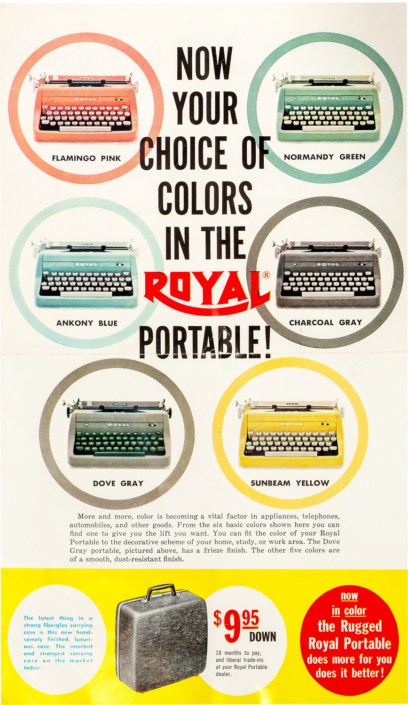
https://oldbobsoldtypewriters.com/portfolio-item/1955-royal-quiet-de-luxe-blue/
Royal Quiet De Luxe in ankony Blue (AB)
-
-
www.youtube.com www.youtube.com
-
Tom Hanks' quote about the Series 5 Smith-Corona typewriters https://youtu.be/AWfgpL1X_oE?si=-dA9HOQYXWv1w8wZ&t=5810
-
-
en.wikipedia.org en.wikipedia.org
-
https://en.wikipedia.org/wiki/Vabbing
vaginal dabbing = vabbing
Tags
Annotators
URL
-
-
www.reddit.com www.reddit.com
-
You said the difference between your commonplace and a Zettelkasten was form and binding? Could you expand on your set up/process? It looks like your cards are loose like a zettel, but I do see a to-do tab which isn’t zettel-y.
reply to u/LowkeyHooligan at https://reddit.com/r/commonplacebook/comments/1gdpiis/space_for_a_commonplace/
I'm not talking about my specific practice but commonplacing and Zettelkasten writ large. Early users of slips in the tradition of ars excerpendi were commonplacing, they were just putting their excerpts onto slips (or scraps) of paper rather than in a notebook. Far too many think the idea of Zettelkasten was "invented" by Niklas Luhmann when in fact the tradition goes back to at least Konrad Gessner in the 16th century. There was absolutely nothing innovative about Luhmann's Zettelkasten—even his numbering system was widely used by the mid 1910s. Early Zettelkasten (aka card indexes in English) were commonplaces, just done on slips of paper rather than bound "slips" in book format.
The more recent "Zettelkasten Method" practitioners, (roughly after June 2013) have largely omitted the centuries-long intellectual history of their practice and are guilty of too much Luhmann worship. On the other hand, they hew heavily toward the minimalist approach and don't decorate their work with stickers, drawings, or other art which seems to have come into fashion in the social media era. This is what I would call "drolleries on acid" without the benefit of knowing about the tradition of ars memoria.
My practice with these goes well beyond commonplacing. Most early 20th century card indexes were used for a variety of purposes beyond commonplacing too including indexing, tickler files, databases, rolodexes, etc. What you're describing sounds more like my modified Memindex practice (https://boffosocko.com/2023/03/09/the-memindex-method-an-early-precursor-of-the-memex-hipster-pda-43-folders-gtd-basb-and-bullet-journal-systems/). You'll find more on my particular practice and the historical practices of others at: https://boffosocko.com/research/zettelkasten-commonplace-books-and-note-taking-collection/
For early 20th century uses, try: - Kaiser, Julius Otto. 1908. Card System at the Office. London: Vacher and Sons. http://archive.org/details/cardsystematoffi00kaisrich. - Kaiser, Julius Otto. 1911. Systematic Indexing. London: Sir Isaac Pitman & Sons, Ltd. http://archive.org/details/systematicindexi00kaisuoft. - Duffield, David Walter, and Various. 1951. Progressive Indexing and Filing. 5th ed. New York, NY: Remington Rand Inc. http://archive.org/details/progressiveindex0000varo.
-
-
en.wikipedia.org en.wikipedia.org
-
www.advocate.com www.advocate.com
-
NYT helped fuel trans controversy, analysis finds<br /> by [[Christopher Wiggins]] in The Advocate<br /> accessed on 2026-06-24T09:52:19
-
“Among the major news outlets we tracked, the Times had by far the most stories mentioning the trans community, and the lowest percentage of stories that quoted a trans person,” Assigned Media editor Evan Urquhart wrote.
-
Caraballo’s report argues that the issue extends beyond sourcing. It says the Times increasingly moved away from stories about transgender people’s lives, culture, arts, and ordinary experiences, and toward stories about legislation, lawsuits, medical controversies, and political conflicts.
-
Readers can see for themselves the depth of our coverage on gender identity.”
And how many individual readers are going to spend the time and effort to do this analysis. Rhoades Ha knows this and naturally pushes back when a particular reader happens to have done this analysis.
-
The problem, she said, was not always factual error, but the cumulative effect of framing, story selection, and prominence.
-
-
newrepublic.com newrepublic.com
-
Trump Cancels Signing of Biggest Housing Affordability Bill in Decades<br /> by [[Malcolm Ferguson]] in The New Republic<br /> accessed on 2026-06-24T09:29:56
-
-
-
Why MAGA buys Trump’s Lincoln Memorial Reflecting Pool hoax - Salon.com<br /> by [[Amanda Marcotte]]<br /> accessed on 2026-06-24T08:47:31
Love that Marcotte makes the connection between Trump, the reflecting pool, and Narcissus.
If Trump spent even half the time on homelessness, poverty, or education as he has on this idiotic reflecting pool, America might be marginally better.
-
-
-
Todd Blanche hit with state bar complaint backed by 101 former judges<br /> by [[Steve Benen]]<br /> accessed on 2026-06-24T00:19:53
-
-
writingslowly.com writingslowly.com
-
Top level categories in my notes<br /> by [[Richard Griffiths]] in Writing Slowly<br /> accessed on 2026-06-23T21:20:11
-
-
arstechnica.com arstechnica.com
-
Trump may be mystery patient in odd case of 79yo getting experimental obesity drug<br /> by [[Beth Mole]] in Ars Technica<br /> accessed on 2026-06-23T21:06:22
Tags
- bariatric surgery
- Retatrutide
- GLP-1
- drug trials
- Eli Lilly
- Donald J. Trump obesity
- Donald J. Trump health
- Donald J. Trump
- weight loss drugs
- Kush Desai
- United States Food and Drug Administration (US FDA)
- read
- National Institutes of Health (NIH)
- United States Department of Health and Human Services
Annotators
URL
-
-
www.legacy.com www.legacy.com
-
https://www.legacy.com/us/obituaries/northjersey/name/donald-bolander-obituary?id=24573183
Founded Career Institute and edited several of their books on English, spelling, synonyms, antonyms, etc.
-
-
www.nytimes.com www.nytimes.com
-
See also:<br /> - https://www.pbs.org/newshour/politics/trump-drives-across-lincoln-memorial-reflecting-pool-to-inspect-blue-coating-hes-adding <br /> - https://apnews.com/article/trump-lincoln-memorial-reflecting-pool-blue-visit-214814ea23ae9412093167e49bbc20e8?utm_source=copy&utm_medium=share
-
Trump Gave Out a No-Bid Contract to Turn D.C.’s Reflecting Pool Blue<br /> by [[David A. Fahrenthold]], [[Luke Broadwater]] in The New York Times<br /> accessed on 2026-06-23T11:12:35
Did driving across the Reflecting Pool cause the damage Trump is saying was vandalism?!?
-
-
raymondsofficemachinesandsupplies.com raymondsofficemachinesandsupplies.com
-
https://raymondsofficemachinesandsupplies.com/<br /> Darwin Raymond, Raymond's Office Machines, 927 Grand Ave., Glenwood Springs, CO 81601. (970) 945-5872.
See also:<br /> - https://coloradosun.com/2019/04/24/vintage-typewriters-glenwood/ - https://gazette.com/life/from-underground-typewriters-rise-thanks-to-man-and-bird-colorful/article_c9bfab92-3ed1-11ea-8113-77af98cc4fa2.html
-
-
-
https://www.si.edu/object/archives/sova-nmah-ac-0260<br /> Railway Express Agency Records<br /> American History Museum
-
-
www.youtube.com www.youtube.com
-
Celebrating Typewriter Day 2026 on a WORKING 1887 Hall (Salem) Typewriter <br /> by Dynamically Typed (aka Joel Berger)<br /> via https://www.reddit.com/r/typewriters/comments/1udalhf/comment/otd01ki/
Tags
Annotators
URL
-
-
www.nytimes.com www.nytimes.com
-
The Best Turntables and Record Players https://www.nytimes.com/wirecutter/reviews/best-turntable/
-
-
en.wikiquote.org en.wikiquote.org
-
https://en.wikiquote.org/wiki/George_Stillman_Hillard
Apparently he wrote: “If liberty with law is fire on the hearth, liberty without law is fire on the floor.” — George Stillman Hillard<br /> source?
-
-
www.ebay.com www.ebay.com
-
https://www.ebay.com/itm/137381943497

Sticker underneath lid of 3x5" card index (recipe-type) box:
Main section:
"Jogger 'Trade mark'<br /> No. 2<br /> 3 x 5 - closed<br /> Sectionets 'Finger-Tip' Office Systems<br /> Sectionuls Vertical Files of Big Capacity<br /> Sectionups Four Drawer Vertical Letter Files<br /> Shaw-Walker"
Advertising text:
"No matter how small your business you should have Shaw-Walker Systems and Filing Devices to help make it grow larger---systematically. When it is larger Shaw-Walker equipment will take care of it.
With Shaw-Walker Modern files your work is methodical and systematic; you obtain the best results in the shortest time; they are to your office what modern machinery is to your factory. Ask for our Big Catalog."
via photos at https://www.ebay.com/itm/137381943497 which sold for $25.00
-
-
www.youtube.com www.youtube.com
-
www.reddit.com www.reddit.com
-
https://www.reddit.com/r/math/comments/1ud2eoa/advice_for_amateur_mathematicians_from_an_amateur/
Advice on how not to be a crackpot.
-
-
www.huffpost.com www.huffpost.com
-
Marjorie Taylor Greene Quits Republican Party Amid Trump Feud<br /> by [[Ed Mazza]] in HuffPost<br /> accessed on 2026-06-23T10:00:55
-
-
www.axios.com www.axios.com
-
"I would not support the Republican Party. There's no chance I would support the Republican Party," Carlson said, adding that the GOP has "betrayed" voters by prioritizing Israel's national security over America's."How could I or any American voter support a political party that's not loyal to the United States. That puts the interests of a foreign country above those of its own citizens. It's not possible to vote for people like that, and I'm not going to."
via https://www.axios.com/2026/06/22/tucker-carlson-quits-republicans-maga-fractures
Quoting from an episode of "Can't Be Censored"
-
-
www.theguardian.com www.theguardian.com
-
Texas anti-ICE protesters convicted of terrorism charges sentenced to at least 50 years in prison | Trump administration | The Guardian<br /> by [[Sam Levine]]<br /> accessed on 2026-06-23T09:12:06
-
-
hibid.com hibid.com
Tags
Annotators
URL
-
www.reddit.com www.reddit.com
-
If your old belts are shot, these O-rings from McMaster-Carr are the perfect replacement.
via https://old.reddit.com/r/typewriters/comments/1ucvk38/i_pulled_my_old_smith_corona_put_of_the_attic/ <br /> u/pete1885 reports good success with o-rings from McMaster-Carr
Specs: 9452K191 3 3/4 ID; 4" OD; 70A durometer; black

-
-
www.instagram.com www.instagram.com
-
https://www.instagram.com/p/DZ5Wv2kFGu7/
Portland Stamp Company perforated the typewriter stamps that Lou Spirito designed.
-
-
www.instagram.com www.instagram.com
-
A 1950s Smith-Corona “Eighty-Eight” Secretarial model, this typewriter was purchased at Byers Office Equipment Co. in Ames.In 1955, Mer Byers established Byers Office Equipment at 126 Main Street in Ames. Art Taylor purchased the company in 1957 and operated it with his son Paul. Around 1963, the business moved to 417 Main Street.By the 1960s, the company offered machine rentals and repair along with new and used models of typewriters, calculators, and adding machines. The showroom also featured office drapery options and furniture. At its peak, Byers Office Equipment Co. served a seven county area with 65% of sales taking place outside of Ames.In 1973, the name changed to Taylor Office Equipment Inc., and operations moved to a new, larger space at 705 East Lincoln Way. The business continued to serve Ames and surrounding area through the early 1990s.
https://www.instagram.com/p/DLS_eretU9c/<br /> via Ames Museum
-
-
www.youtube.com www.youtube.com
-
Tom Hanks' love of typewriters by [[CBS Sunday Morning]] by Lee Cowan
-
-
gramercytypewriter.com gramercytypewriter.com
-
https://gramercytypewriter.com/<br /> Gramercy Typewriter Co.
-
-
www.linkedin.com www.linkedin.com
-
https://www.linkedin.com/in/james-rea-03a67a6/
Northeast Typewriter Exchange is opening 2026-07-18
-