But creative thought and essentially repetitive thought are very different things.
This distinction seems particularly significant.
But creative thought and essentially repetitive thought are very different things.
This distinction seems particularly significant.
A girl strokes its keys languidly
Dude, stop it already!
girl
Ouch. C'mon Vannevar!
will the author of the future cease writing by hand or typewriter and talk directly to the record?
Some people do this now, but they seem to be a minority.
Even the modern great library is not generally consulted; it is nibbled at by a few.
So true.
Today, with microfilm, reductions by a linear factor of 20 can be employed and still produce full clarity when the material is re-enlarged for examination.
Is it even possible to think what this factor is for today's digital storage technologies?
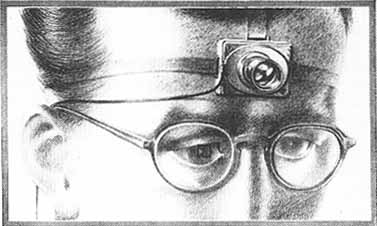
Often it would be advantageous to be able to snap the camera and to look at the picture immediately.
It would be, and is!
A record if it is to be useful to science, must be continuously extended, it must be stored, and above all it must be consulted.
Valuable ideas often appear before they are viable. But they must be discoverable when the environment changes in ways that make the idea more tractable.
publication has been extended far beyond our present ability to make real use of the record
This makes me wonder if that's where we still are. Connecting documents/information with people when they need it is still a huge challenge. Although being able to go to Google to ask a question on your phone is a huge advantage for those who have questions that are amenable and the device to ask it.
But there is increased evidence that we are being bogged down today as specialization extends.
The now familiar information overload.
strange destructive gadgets
the atomic bomb, among others.
First, we can look at it directly in terms of content, i.e. what signs it has and how they are organized. Second, we can look at it in terms of how people interact with that content or with each other over that content.
If we apply this to the classroom, we could think of different content spaces as subjects, however when we think in terms of how people interact with the space, those processes may seem similar despite content area.
If you think everybody answers the same way, you may be an advocate of critical theory.
I do not think a single person I know who has read any amount of critical theory or even agreed with it would really think that people would ascribe universal values onto words and not understand that value systems are historically and socially inflected. They might, as do Adorno and Horkheimer, consider the holocaust to be an absolute moral evil, but if that's something that Lyotard is here supposed to free us from, I don't quite know what we gain.
I agree with the conclusion that hierarchies and letting users put things in places is good, but I want to posit a more nuanced explanation than "we are set in our ways".
I think sometimes we don't remember what exactly it is we're looking for. We may not have a word, or a name, or date. But if we put it some place in particular we can find it spatially rather than linguistically.
This is why I think labels are superior to hierarchies. When we transcend the limitations of physical space would should not throw out space, but we should throw away the constraints of 3D space with its contiguous, volumetric forms. Labels let you put things in as many places as you like. Labels can, too, be hierarchical.
The problem with the current crop of systems that eschew hierarchy is that they replace it with a text box.
One could make the argument that smart indexing is just automatic labeling, but I think there's a memory function in having created the labels oneself.
I'd like to see systems that experiment with more ways to fold space. Shortcuts are like wormholes. Maybe we should have common actions for creating bi-directional ones. On mobile devices I think we should take more advantage of zooming and z-planes.
As a speaker of English, there is little need to know specific details of how to articulate various sounds. As a writer of English, you may occasionally refer to spelling conventions (such as “ i before e , except after c ”) but probably generally rely upon me mory and constant repetition to cue spelling patterns. However, as teachers of spoken and written English, our general knowledge of English will not suffice. To be precise in our assistance of students, we must have real knowledge of the construction of English speech and print.
it is important to think about why words are spelt the way they are.
Forcing those who design products to actually use and rely on them is often thought to improve quality and usability, but software developers may be blind to usability and may have knowledge to make software work that an end user will lack.
This is why I think it is important for full participation, regardless of your own role in the organization, as we all bring different skill sets, areas of focus, interests, and so forth.
But the problem with thinking of Mars as a fallback planet (besides the lack of oxygen and air pressure and food and liquid water) is that it overlooks the obvious. Wherever we go, we’ll take ourselves with us. Either we’re capable of dealing with the challenges posed by our own intelligence or we’re not.
It is a trick of the language to think of humankind as a unitary "we." We are not one. We are diverse groups of people attempting to build different sorts of communities, on Earth and off. Pilgrims left for America and founded a nation that changed how state and religion interacted. Likewise, groups from earth may leave certain problems behind, even as they encounter others.
building a web (haha)
It's true, though! Annotation (as much as hyperlinking) is part of what shaped the metaphor of "the Web" for the Internet. As Vannevar Bush wrote in "As We May Think" in 1945:
Wholly new forms of encyclopedias will appear, ready made with a mesh of associative trails running through them, ready to be dropped into the memex and there amplified.
For example, in literacy studies, we might ask how “reading,” as an assemblage, may have been organized in an entirely different way, with different configurations of social bodies, human bodies, and textual materials
This assumes humans are not organized to maximize and seek out different affordances and tools. Maybe the assemblage that emerges is the most logical.
I refer then of course to verbocentric definitions of reading as Leander & Rowe put reading in quotes. I do think you can read any encoded text. I draw a line there between universal sign systems and what we read in nature versus texts encoded through human activity.
The educational thought experiment I wish to undertake concerns curriculum. Not the specific content of curriculum, but the idea of curriculum, what any curriculum is, regardless of subject. Like Copernicus, I propose that for the sake of better results we need to turn conventional wisdom on it is head: let’s see what results if we think of action, not knowledge, as the essence of an education; let’s see what results from thinking of future ability, not knowledge of the past, as the core; let’s see what follows, therefore, from thinking of content knowledge as neither the aim of curriculum nor the key building blocks of it but as the offshoot of learning to do things now and for the future.
What is "the essence of an education"?
intentional re-identification is different from accidental re-identification. accidents frequent. intention is hard.
Accidental Data Recognitions
@KenNeumiester suggested in this tweet:
@dbarthjones intentional re-identification is different from accidental re-identification. accidents frequent. intention is hard.
— Ken Neumeister (@KenNeumeister) March 29, 2015
<script async="" src="//<a href=" http:="" <a="" href="http://platform.twitter.com" target="_blank" rel="nofollow noopener">platform.twitter.com="" widgets.js"="" target="_blank" rel="nofollow noopener">platform.twitter.com/widgets.js" charset="utf-8"></script>
that accidental data re-identifications occur frequently. His comment was surprising to me because I've never experienced an accidental or "spontaneous" data re-identification in 25 years of working on health data de-identification. Our twitter exchange about this was interesting and I learned that his take on this may differ from mine because he apparently works in a different data domain than I do, but it started me thinking.
Part of the reason for my having never encountered a single spontaneous re-identification in over two decades of opportunity for this to happen might be that I'd ended my experience providing patient care in a clinical setting before I began working in the area of data de-identification. I don't doubt that spontaneous health data re-identifications might occasionally occur for clinicians who work with de-identified data for patients that they've personally seen (or maybe even with their recognizing patients that have been treated in the units/offices where they work).
A couple of points are probably worth mentioning though about such spontaneous clinical environment data "re-identifications". First, if they occur, they would typically only impact a single person and certainly not any large numbers of persons. In any large healthcare data set this should presumably constitute a very small re-identification risk among the total number of persons at risk of re-identification. Secondly, and more importantly, I not really sure we should consider such spontaneous events as "re-identifications". I'd propose that "spontaneous data recognitions" would be a more illuminating name for such events.
Why does the distinction I'm making matter? Well, because it speaks to both the real source of potential privacy concern and the likelihood of privacy harms resulting from such an event. The de-identified data isn't the source of the critical information needed to enable possible privacy concerns here. The knowledge of a patient's details enabling a spontaneous recognition of the patient within a de-identified data set hasn't come from the data set -- it comes from external information that the data viewer already possessed independent of the data.
Sure, on occasion we might suppose that the data "recognizer" might also learn something new about the patient from the data which wasn't already known to them. But with respect to the possibility of resulting privacy harms from such events, we need to remind ourselves that the likelihood of the newly revealed information being of great sensitivity or otherwise capable of producing possible privacy harms for the patient will likely be a comparatively rare occurrence.This is because it will have most likely have been the case that the patient was recognizable primarily due to their having some atypical / rare characteristics enabling their spontaneous recognition. There might be additional info within the data that the recognizer didn't already know, but initial recognitions will be rare events, and additional revelations resulting in privacy harms will be rarer still. This is basic probabilistic reasoning (in spite of the problem that even very smart people will sometimes avoid "doing the math" if they've been poked with a scary scenario first). See http://blogs.law.harvard.edu/infolaw/2014/11/21/the-antidote-for-anecdata-a-little-science-can-separate-data-privacy-facts-from-folklore/
But the probabilistic reality remains that the result of a final outcome B stemming from an initial rare event A, which then can lead to yet another rare event (or even moderately frequent) event B, yields only rarer still occurrences of event B.
We can add to this probabilistic assurance that because, in general (at least for this context of spontaneous health data recognitions) having sufficiently detailed knowledge that a person has atypical characteristics (or a rare medical condition) which could enable their spontaneous recognition usually comes from having already been placed in a general position of trust with respect to the participating in the patient's care, or otherwise having already had some sort of trusted relationship with the patient.
So in the same way the we generally trust doctors, nurses and other healthcare providers to with our personal health information, the same trust - and ethics that enable such trust - should be rightly expected to be in place for sensitive information revealed through spontaneous medical care data recognition events.
The very same reasoning also generally applies even for the context of non-medically trained personnel.(statisticians, data analysts, etc.) accessing de-identified medical data. With properly de-identified data, spontaneous data recognitions are only likely to occur extremely rarely for those cases where there isn't already some sort of existing relationship with the person being recognized that enabled the detailed knowledge required to realize the recognition.
Yes, on extremely rare occasions, statisticians and data analysts, might spontaneously recognize their family members, neighbors, or workplace friends/ acquaintances or even themselves within properly de-identified health data, but the number of people for they will know sufficient details to allow this to occur will be very small in any large and properly de-identified data set. And when this does rarely occur, resultant privacy harms will likely also be rare because, in general, the knowledge of the details through which a spontaneous re-identification could occur will be have been obtained through having an existing relationship with the individual who has been recognized. Put in statistical terms, we are helped in this specific context of spontaneous recognitions by the fact that knowledge of our intimate details that are needed to enable such recognitions is typically correlated with having some sort of trust relationship with us.
I'd further argue though that we should also be supplementing these inherently probabilistic protections by consistently providing ethical training and mentorship to all personnel who access de-identified medical data. In my training as an HIV epidemiologist, I received plenty of meaningful mentorship about privacy ethics, but had admittedly little course-based training on these issues. This is an area where we can and should do more.
However, I think it's helpful to recognize that although accidental or spontaneous re-identification might occur on occasion, there's good reason to understand that they are likely to be quite rare and when they do occur, they most often will be unlikely to pose an influential source of privacy harms.
to demonstrate that Israel's patience was wearing thin. Still oth- ers are inclined to think the signal was intended for both audi- ences. A final group admits being baffled by the move, inter- preting it primarily as a sign of Israeli frustration. Whatever the case may be, Israel now began to insist on play- ing a role in hunting the Scuds. The United States initially attempted to deflect the request, arguing that there was nothing Israel could add to the effort and that any overt Israeli partici- pation could disrupt the coalition. But Israel insisted, and the United States ultimately agreed,
israel pushes and succeeds in attempt to be apart of the scud hunters club....dude we are sooo in they think we are cool
The Spirit that is on me this morning is the Spirit of the Lord; it is the Holy Ghost, although some of you may not think that the Holy Ghost is ever cheerful. Well, let me tell you, the Holy Ghost is a man; he is one of the sons of our Father and our God; and he is that man that stood next to Jesus Christ, just as I stand by brother Brigham. If brother Brigham goes ahead, and I stand by him, and Daniel stands by me, and the Twelve by us, we never shall be separated—never, no, never.
Holy ghost
We feel this is a deeper and more complex issue than the question of fuzzy anchoring as a technical solution for annotating a portion of text that might change. To support annotation in the manuscript development/editorial process, the expectation and goal is for the entire document to evolve, perhaps radically. For the annotations to remain useful, Hypothes.is will need to entirely integrate with–or become!–some kind of version controlled authoring platform.
Comment BY 'Dan Whaley' ON '2014-09-03T17:29:21' 'I think the handling of versions should be done by the underlying CMS, whether that's WP, github, gdocs, or whatever. We exist as a layer above that, but can interact with it if integrated. Not all CMSs handle versioning, and so therefore, an integrated experience may differ considerably based on the CMS or document store being used. We have notions eventually to support memento style queries for time stamped versions of a document-- and being able to go back to the version of a page at the point that an an annotation is created. I think the notion of "resolving" is potentially the right way to think about things. All annotations are always preserved (in the same way that all track changes in word are). There may be a few kinds of affordances that track changes gives you that a CMS+annotation approach do not, but this combination may allow a fair amount of functionality. Experiment and iterate.'
Unlike inception proper (which I don't think actually exists), cultural imprinting is fully compatible with the Homo economicus model of human decision-making. It leaves our goals fully intact (typically: wanting the respect of our peers), and by imprinting itself on the external cultural landscape, merely changes the optimal means of pursuing those goals. The result is the same — we buy more of the products being advertised — but the pathways of influence are different.
Starting to recover my attention and release my ire, because it's evident now that the author may not be defending advertising as not manipulative, but actually trying to articulate the mechanisms more thoughtfully.
Science has provided the swiftest communication between individuals; it has provided a record of ideas and has enabled man to manipulate and to make extracts from that record so that knowledge evolves and endures throughout the life of a race rather than that of an individual.
Definitely sounds like what we're doing here.
Finally, as we think about the relationship between the structure of information and cultural production and liberal society, there is the question of how the transition to more commons-based production will affect social justice, or equality. Here in particular it is important to retain a cautious perspective as to how much can be changed by reorganizing our information production system. Raw poverty and social or racial stratification will not be substantially affected by these changes. Education will do much more than a laptop and a high speed Internet connection in every home, though these might contribute in some measure to avoiding increasing inequality in the advanced economies, where opportunities for both production and consump- tion may increasingly be known only to those connected.
Man cannot hope fully to duplicate this mental process artificially, but he certainly ought to be able to learn from it. In minor ways he may even improve, for his records have relative permanency. The first idea, however, to be drawn from the analogy concerns selection. Selection by association, rather than indexing, may yet be mechanized. One cannot hope thus to equal the speed and flexibility with which the mind follows an associative trail, but it should be possible to beat the mind decisively in regard to the permanence and clarity of the items resurrected from storage.
Selection by association, rather than indexing.
The real heart of the matter of selection, however, goes deeper than a lag in the adoption of mechanisms by libraries, or a lack of development of devices for their use. Our ineptitude in getting at the record is largely caused by the artificiality of systems of indexing. When data of any sort are placed in storage, they are filed alphabetically or numerically, and information is found (when it is) by tracing it down from subclass to subclass. It can be in only one place, unless duplicates are used; one has to have rules as to which path will locate it, and the rules are cumbersome. Having found one item, moreover, one has to emerge from the system and re-enter on a new path. The human mind does not work that way. It operates by association. With one item in its grasp, it snaps instantly to the next that is suggested by the association of thoughts, in accordance with some intricate web of trails carried by the cells of the brain. It has other characteristics, of course; trails that are not frequently followed are prone to fade, items are not fully permanent, memory is transitory. Yet the speed of action, the intricacy of trails, the detail of mental pictures, is awe-inspiring beyond all else in nature.
With the advent of Google Docs we're finally moving away from the archaic indexing mentioned here. The filesystem metaphor was simple and dominated how everyone manages their data-- which extended into how we developed web content, as well.
The declaration that Hierarchical File Systems are Dead has led to better systems of tagging and search, but we're still far from where we need to be since there is still a heavy focus on the document as a whole instead of also the content within the document.
The linearity of printed books is even more treacherously entrenched in our minds than the classification systems used by libraries to store those books.
One day maybe we'll liberate every piece of content from every layer of its concentric cages: artificial systems of indexing, books, web pages, paragraphs, even sentences and words themselves. Only then will we be able to re-dress those thoughts automatically into those familiar and comforting forms that keep our thoughts caged.
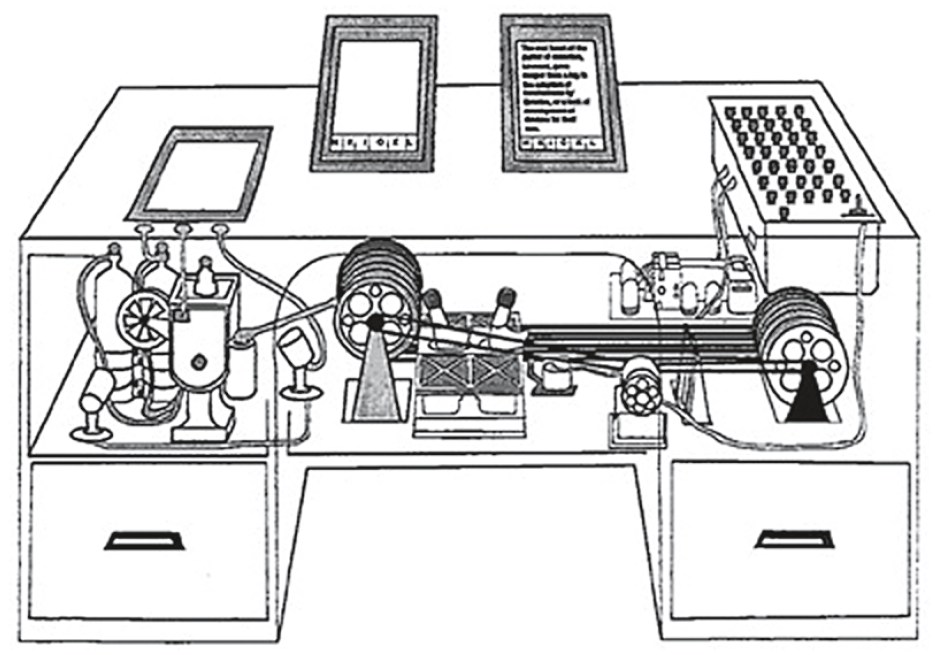
It affords an immediate step, however, to associative indexing, the basic idea of which is a provision whereby any item may be caused at will to select immediately and automatically another. This is the essential feature of the memex. The process of tying two items together is the important thing.
The essential feature of the memex is its ability of association; tying two items together.
First he runs through an encyclopedia, finds an interesting but sketchy article
The first reference to Wikipedia?! :)
When the user is building a trail, he names it, inserts the name in his code book, and taps it out on his keyboard. Before him are the two items to be joined, projected onto adjacent viewing positions
I love this early UX imagining of the linking/annotation process by Vannevar. What's notable here of course is that he suggested that creating links between things was a function that something visitors (trailblazers) could do. In a sense, to him the notion of a hypertext link, and a clickable annotation w/ two targets were mutually interchangeable ideas. Today, these are distinct. The idea that a visitor can do this, is only possible within the emerging idea of Open Annotation as we understand it now. It's why those of us exploring it are so excited about its potential.
The process of tying two items together is the important thing.
Annotations are at the Web’s core.
Difference between XZ and LZMA2 Short answer: xz is a format that (currently) only uses the lzma2 compression algorithm. Long answer: think of xz as a container for the compression data generated by the lzma2 algorithm. We also have this paradigm for video files for example: avi/mkv/mov/mp4/ogv are containers, and xvid/x264/theora are compression algorithms. The confusion is often made because currently, the xz format only supports the lzma2 algorithm (and it’ll remain the default, even if some day, others algorithms may be added). This confusion doesn’t happen with other formats/algorithms, as for example gzip is both a compression algorithm and a format. To be exact, the gzip format only supports to encapsulate data generated by gzip… the compression algorithm. In this article I’ll use “xz” to say “the lzma2 algorithm whose data is being encapsulated by the xz format”. You’ll probably agree it’s way simpler
The key here is the notion of a format as a container. Lots of content is moving towards that notion-- that a "file" is really an opaque (to the OS filesystem) directory or container of some sort and some other program understands the format of the "file" as a container to know how to open it to access the files inside.
She then, however, turns to systems theory--specifically complex systems theory as the "environment" or "context" in which decision makers operate
I think the context and the environment are essential for understanding both the rationality of the decision maker as well as the structure and functioning of the system itself. We may run into the same boundary drawing problem here, because some might say that the decision makers within a system have their own rationality, while others might say that the system itself has a rationality built into it, and that this rationality emerged in part from the environment in which the system developed.
Vannevar Bush
Who is Vannevar Bush? See [Wikipedia article on V. Bush(https://en.wikipedia.org/wiki/Vannevar_Bush)
Of the modes of persuasion furnished by the spoken word there are three kinds. The first kind depends on the personal character of the speaker; the second on putting the audience into a certain frame of mind; the third on the proof, or apparent proof, provided by the words of the speech itself. Persuasion is achieved by the speaker's personal character when the speech is so spoken as to make us think him credible. We believe good men more fully and more readily than others: this is true generally whatever the question is, and absolutely true where exact certainty is impossible and opinions are divided. This kind of persuasion, like the others, should be achieved by what the speaker says, not by what people think of his character before he begins to speak. It is not true, as some writers assume in their treatises on rhetoric, that the personal goodness revealed by the speaker contributes nothing to his power of persuasion; on the contrary, his character may almost be called the most effective means of persuasion he possesses. Secondly, persuasion may come through the hearers, when the speech stirs their emotions. Our judgements when we are pleased and friendly are not the same as when we are pained and hostile. It is towards producing these effects, as we maintain, that present-day writers on rhetoric direct the whole of their efforts. This subject shall be treated in detail when we come to speak of the emotions. Thirdly, persuasion is effected through the speech itself when we have proved a truth or an apparent truth by means of the persuasive arguments suitable to the case in question.
Persuasion is achieved by the speaker's personal character when the speech is so spoken as to make us think him credible. We believe good men more fully and more readily than others: this is true generally whatever the question is, and absolutely true where exact certainty is impossible and opinions are divided. This kind of persuasion, like the others, should be achieved by what the speaker says, not by what people think of his character before he begins to speak. It is not true, as some writers assume in their treatises on rhetoric, that the personal goodness revealed by the speaker contributes nothing to his power of persuasion; on the contrary, his character may almost be called the most effective means of persuasion he possesses.
they do not believe that our minds, which are naturally superior to our bodies, can be made more serviceable through education and suitable training; again, they observe that some people possess the art of training horses and dogs and most other animals by which they make them more spirited, gentle or intelligent, as the case may be, yet they do not think that any education has been discovered for training human nature, such as can improve men in any of those respects in which we improve the beasts.
Sophist critics don't seem to believe that the mind can be trained...so rhetoricians are scam artists
Also those who speak ill of us, and show contempt for us, in connexion with the things we ourselves most care about: thus those who are eager to win fame as philosophers get angry with those who show contempt for their philosophy; those who pride themselves upon their appearance get angry with those who show contempt for their appearance and so on in other cases. We feel particularly angry on this account if we suspect that we are in fact, or that people think we are, lacking completely or to any effective extent in the qualities in question.
Anger (emotion) in relation to image/success in philosophy. People only feels anger if what has been said about them is something they are unsure of (insecure). Anger thus may be a cue for someone's insecurities or uncertainties.
Home | Book I | Book II | Book III | Index | Bibliography Book I - Chapter 1 [1354a] Rhetoric is the counterpart of Dialectic. Both alike are concerned with such things as come, more or less, within the general ken of all men and belong to no definite science. Accordingly all men make use, more or less, of both; for to a certain extent all men attempt to discuss statements and to maintain them, to defend themselves and to attack others. Ordinary people do this either at random or through practice and from acquired habit. Both ways being possible, the subject can plainly be handled systematically, for it is possible to inquire the reason why some speakers succeed through practice and others spontaneously; and every one will at once agree that such an inquiry is the function of an art. Now, the framers of the current treatises on rhetoric have constructed but a small portion of that art. The modes of persuasion are the only true constituents of the art: everything else is merely accessory. These writers, however, say nothing about enthymemes, which are the substance of rhetorical persuasion, but deal mainly with non-essentials. The arousing of prejudice, pity, anger, and similar emotions has nothing to do with the essential facts, but is merely a personal appeal to the man who is judging the case. Consequently if the rules for trials which are now laid down some states -- especially in well-governed states -- were applied everywhere, such people would have nothing to say. All men, no doubt, think that the laws should prescribe such rules, but some, as in the court of Areopagus, give practical effect to their thoughts and forbid talk about non-essentials. This is sound law and custom. It is not right to pervert the judge by moving him to anger or envy or pity -- one might as well warp a carpenter's rule before using it. Again, a litigant has clearly nothing to do but to show that the alleged fact is so or is not so, that it has or has not happened. As to whether a thing is important or unimportant, just or unjust, the judge must surely refuse to take his instructions from the litigants: he must decide for himself all such points as the law-giver has not already defined for him. Now, it is of great moment that well-drawn laws should themselves define all the points they possibly can and leave as few as may be to the decision of the judges; and this for several reasons. First, to find one man, or a few men, who are sensible persons and [1354b] capable of legislating and administering justice is easier than to find a large number. Next, laws are made after long consideration, whereas decisions in the courts are given at short notice, which makes it hard for those who try the case to satisfy the claims of justice and expediency. The weightiest reason of all is that the decision of the lawgiver is not particular but prospective and general, whereas members of the assembly and the jury find it their duty to decide on definite cases brought before them. They will often have allowed themselves to be so much influenced by feelings of friendship or hatred or self-interest that they lose any clear vision of the truth and have their judgement obscured by considerations of personal pleasure or pain. In general, then, the judge should, we say, be allowed to decide as few things as possible. But questions as to whether something has happened or has not happened, will be or will not be, is or is not, must of necessity be left to the judge, since the lawgiver cannot foresee them. If this is so, it is evident that any one who lays down rules about other matters, such as what must be the contents of the "introduction" or the "narration" or any of the other divisions of a speech, is theorizing about non-essentials as if they belonged to the art. The only question with which these writers here deal is how to put the judge into a given frame of mind. About the orator's proper modes of persuasion they have nothing to tell us; nothing, that is, about how to gain skill in enthymemes. Hence it comes that, although the same systematic principles apply to political as to forensic oratory, and although the former is a nobler business, and fitter for a citizen, than that which concerns the relations of private individuals, these authors say nothing about political oratory, but try, one and all, to write treatises on the way to plead in court. The reason for this is that in political oratory there is less inducement to talk about nonessentials. Political oratory is less given to unscrupulous practices than forensic, because it treats of wider issues. In a political debate the man who is forming a judgement is making a decision about his own vital interests. There is no need, therefore, to prove anything except that the facts are what the supporter of a measure maintains they are. In forensic oratory this is not enough; to conciliate the listener is what pays here. It is other people's affairs that are to be decided, so that the judges, intent on their own satisfaction and listening with partiality, surrender themselves to the disputants instead of judging between them. [1355a] Hence in many places, as we have said already, irrelevant speaking is forbidden in the law-courts: in the public assembly those who have to form a judgement are themselves well able to guard against that. It is clear, then, that rhetorical study, in its strict sense, is concerned with the modes of persuasion. Persuasion is clearly a sort of demonstration, since we are most fully persuaded when we consider a thing to have been demonstrated. The orator's demonstration is an enthymeme, and this is, in general, the most effective of the modes of persuasion. The enthymeme is a sort of syllogism, and the consideration of syllogisms of all kinds, without distinction, is the business of dialectic, either of dialectic as a whole or of one of its branches. It follows plainly, therefore, that he who is best able to see how and from what elements a syllogism is produced will also be best skilled in the enthymeme, when he has further learnt what its subject-matter is and in what respects it differs from the syllogism of strict logic. The true and the approximately true are apprehended by the same faculty; it may also be noted that men have a sufficient natural instinct for what is true, and usually do arrive at the truth. Hence the man who makes a good guess at truth is likely to make a good guess at probabilities. It has now been shown that the ordinary writers on rhetoric treat of non-essentials; it has also been shown why they have inclined more towards the forensic branch of oratory. Rhetoric is useful (1) because things that are true and things that are just have a natural tendency to prevail over their opposites, so that if the decisions of judges are not what they ought to be, the defeat must be due to the speakers themselves, and they must be blamed accordingly.
But if men tend toward the truth and speakers can convince men to the contrary, isn't rhetoric more hurtful that useful?
SOCRATES: And that, Gorgias, was what I was suspecting to be your notion; yet I would not have you wonder if by-and-by I am found repeating a seemingly plain question; for I ask not in order to confute you, but as I was saying that the argument may proceed consecutively, and that we may not get the habit of anticipating and suspecting the meaning of one another's words; I would have you develope your own views in your own way, whatever may be your hypothesis. GORGIAS: I think that you are quite right, Socrates.
Socrates himself seems to be a master of persuasion via making the opinions of his opponents sound an awful lot like his own.