persuasive technology, BJ Fog's contribution to the problem that we're all faced with today, which is that were addicted to our devices. So how does that work? Well, basically his theory has three parts where you have motivation, you have ability, and there's a trigger. And if you're above a certain threshold, you have the right motivation and the right ability, that trigger will trigger a behavior. If you don't have enough motivation, or if you don't have enough skill set, then that trigger won't work. Or if you have the motivation in the skill set, and the trigger doesn't happen, then you'll never trip into the behavior.
10,000 Matching Annotations
- Mar 2024
-
theinformed.life theinformed.life
-
-
This episode's transcript was produced by an AI. If you notice any errors, please get in touch.
puts the work on the reader/user rather than the producer
-
-
www.shopbrodart.com www.shopbrodart.com
-
2024-03-07 Brodart's website is up and running again, finally.
-
-
en.wikipedia.org en.wikipedia.org
-
en.wikipedia.org en.wikipedia.org
-
www.geograph.org.uk www.geograph.org.ukGeograph1
-
fontmeme.com fontmeme.com
-
https://fontmeme.com/fonts/special-elite-font/<br /> Special Elite
-
-
en.wikipedia.org en.wikipedia.org
-
https://en.wikipedia.org/wiki/Prestige_Elite<br /> Prestige Elite
-
-
fonts.google.com fonts.google.com
-
Installing & managing fonts—including variable fonts
https://fonts.google.com/knowledge/using_type/installing_and_managing_fonts
-
-
www.ylolfa.com www.ylolfa.com
-
https://www.ylolfa.com/products/9781800992887/my-way-to-welsh<br /> My Way to Welsh: A complete course for home learning<br /> Heini Gruffudd
ᔥDeborah-SSi in Heini Gruffudd's new book - Welsh / General / Questions - SSi Forum<br /> (accessed:: 2024-03-07 07:59:11)
-
-
www.texasstandard.org www.texasstandard.org
-
-
Paul Otlet, another great information visionary, to create a worldwide database for allsubjects.
Otlet's effort was more than a "database for all subjects", wasn't it? This seems a bit simplistic.
-
http://userpages.umbc.edu/~burke
http://userpages.umbc.edu/~burke
Bibliography and thanks sections for the book
Bibliography available at https://userpages.umbc.edu/~burke/fieldbib716pdf.pdf
-
This volume traces the Fields and science information systems to the beginningsof the Cold War.
summary of the book in 1 sentence
-
Concilium Bibliographicum
-
Burke, Colin B. Information and Intrigue: From Index Cards to Dewey Decimals to Alger Hiss. History and Foundations of Information Science. Cambridge, MA: MIT Press, 2014. https://mitpress.mit.edu/9780262027021/information-and-intrigue/
annotation URL: urn:x-pdf:3ca2bc5e94d24cfc51c7b40b4ea7daf9
-
-
github.com github.com
-
https://github.com/pdurbin/slopi-communication<br /> SLOPI communication
via SJ FoTL
-
-
opencollective.com opencollective.com
-
-
https://github.com/holepunchto/hypercore
Hypercore is an evolution of DAT.
(See also: https://awesome.datproject.org/)
It's one of the most interesting and promising things Aram Zucker-Scharf has seen in a decade.
-
-
composer.dxos.org composer.dxos.orgREADME1
-
composer.dxos.org composer.dxos.orgComposer1
-
Short url: https://tinyurl.com/3cfysbvp
-
-
photos.google.com photos.google.com
-
Jerry Michalski's trip to Bahrain in Feb 2024 for Meta and Formula 1
-
-
pkmsummit.com pkmsummit.com
-
jarche.com jarche.com
-
read [[Harold Jarche]] in dead blog walking at 20
-
-
www.zylstra.org www.zylstra.org
-
www.pcusa.org www.pcusa.org
-
www.icongrouponline.com www.icongrouponline.com
-
en.forum.saysomethingin.com en.forum.saysomethingin.com
-
This morning I ran across a copy of Jane Austen's novel Emma with some of the keywords on each page translated into Welsh as footnotes at the bottom of the page. Apparently it's part of a series of classic books published by Icon into a variety of different languages and meant for language learners.
The full list of their titles with Welsh can be found here: Webster's Welsh Thesaurus Editions
I'm curious if anyone has used these before, and if so, how helpful they've found them for building their Welsh vocabulary as they read English language works.
Is anyone aware of Welsh language books that have this sort of English vocabulary cross listed on the page? (Sort of the way in which lingo.360.cymru has news stories in Welsh with English translation help along the way?)
syndication link: https://en.forum.saysomethingin.com/t/websters-welsh-thesaurus-editions/40131
-
-
en.wikipedia.org en.wikipedia.org
-
NovelsSense and Sensibility (1811) Pride and Prejudice (1813) Mansfield Park (1814) Emma (1816) Northanger Abbey (1818, posthumous) Persuasion (1818, posthumous) Lady Susan (1871, posthumous)Unfinished fictionThe Watsons (1804) Sanditon (1817)Other worksSir Charles Grandison (adapted play) (1793, 1800)[p] Plan of a Novel (1815) Poems (1796–1817) Prayers (1796–1817) Letters (1796–1817)
https://en.wikipedia.org/wiki/Jane_Austen#List_of_works
Novels
- Sense and Sensibility (1811)
- Pride and Prejudice (1813)
- Mansfield Park (1814)
- Emma (1816)
- Northanger Abbey (1818, posthumous)
- Persuasion (1818, posthumous)
- Lady Susan (1871, posthumous)
Tags
Annotators
URL
-
-
boffosocko.com boffosocko.com
-
indieweb.org indieweb.org
-
www.amazon.com www.amazon.com
-
Catmull, Ed, and Amy Wallace. Creativity, Inc.: Overcoming the Unseen Forces That Stand in the Way of True Inspiration. 1st ed. New York: Random House, 2014.
-
-
www.cgdev.org www.cgdev.org
-
David Witzel said:
I was trying to find David Roodman's "open book" on microfinance from 2010. Lots of link rot - not sure where it best lives now.
He had interesting stories about how difficult/useful the open writing process was. https://www.cgdev.org/article/microfinance-open-book-blog-qa-david-roodman
-
-
-
Cahoone, Lawrence. The Modern Intellectual Tradition: From Descartes to Derrida - Course Guidebook. The Great Courses 4790. Chantilly, VA: The Teaching Company, 2010. https://www.thegreatcourses.com/courses/modern-intellectual-tradition-from-descartes-to-derrida.
Cahoone, Lawrence. The Modern Intellectual Tradition: From Descartes to Derrida. Audible Audio Edition. The Great Courses 4790. Chantilly, VA: The Teaching Company, 2013. https://www.amazon.com/Modern-Intellectual-Tradition-Descartes-Derrida/dp/B00DTO5BTO.
Annotation URL: urn:x-pdf:92bff7dc89e6440afc484388b7b72d79
alternate version: https://jonudell.info/h/facet/?user=chrisaldrich&max=100&exactTagSearch=true&expanded=true&url=urn%3Ax-pdf%3A92bff7dc89e6440afc484388b7b72d79
-
-
www.reddit.com www.reddit.com
-
Facebook marketplace, set location in various regions. (Ymmv)Ebay (flooded with junk, diamonds in the rough are either overpriced or seller wants high shipping)Auctionninja.com (like shopgoodwill, but higher quality items on average and higher final bids on interesting items)Hibid.com (I've gotten a thing or two here)Estatesales.net (I've gotten good deals here)Estatesales.org (usually redirects to respective company sites to bid there)Shopgoodwill.com (hard to win bids on interesting items)Goodwillfinds.com (the higher end/rarer items they receive go here, so higher prices)Craigslist (usually baren of typewriters)Kijiji (I don't find much that's both interesting and feasible to ship)Etsy (meh, overpriced)
-
-
www.404media.co www.404media.co
-
typewriterdatabase.com typewriterdatabase.com
-
The platen was quite hard to begin with, around 100 on the Shore A hardness scale, though it would feed two sheets reliably. The platen was cleaned and treated with methyl salicylate, which brought the hardness down to about 92, and has remained at that hardness for several months.
https://typewriterdatabase.com/1948-smith-corona-clipper.21427.typewriter
-
-
shopgoodwill.com shopgoodwill.com
-
Smith-Corona Galaxie 12 XII Blue
https://shopgoodwill.com/item/191956978<br /> 2024-03-02 sold $102.00 !! 4 bids
-
-
shopgoodwill.com shopgoodwill.com
-
Smith-Corona Silent
https://shopgoodwill.com/item/192328912<br /> 2024-03-02 sold<br /> $9.99 fair<br /> 1 bid
-
-
shopgoodwill.com shopgoodwill.com
-
Olympia
https://shopgoodwill.com/item/192255013<br /> 2024-03-02 sold<br /> $112.00<br /> 8 bids<br /> (broken space bar)
Tags
Annotators
URL
-
-
sources.werd.io sources.werd.io
-
shopgoodwill.com shopgoodwill.com
-
1969 Smith-Corona Galaxie Deluxe Steel Blue
https://shopgoodwill.com/item/192125668 <br /> 2023-03-02 sold<br /> $18.00 (opening price)<br /> 1 bid
-
-
shopgoodwill.com shopgoodwill.com
-
Brother Charger 11
https://shopgoodwill.com/item/192239320<br /> 2024-03-02 sold<br /> $31.00<br /> 11 bids
-
-
shopgoodwill.com shopgoodwill.com
-
Remington Standard Super Riter Vintage 1956 Mechanical Desktop Typewriter-TESTED
https://shopgoodwill.com/item/191848428<br /> 2024-03-02 sold<br /> $26.00<br /> 5 bids
-
-
shopgoodwill.com shopgoodwill.com
-
Remington Quiet-Riter
https://shopgoodwill.com/item/192242999<br /> 2024-03-02 sold<br /> $16.00<br /> 3 bids
-
-
shopgoodwill.com shopgoodwill.com
-
Sears Malibu
https://shopgoodwill.com/item/192251351<br /> 2024-03-02 sold<br /> $18.00<br /> 5 bids
-
-
shopgoodwill.com shopgoodwill.com
-
L.C. Smith & Corona
https://shopgoodwill.com/item/191521413<br /> 2024-03-02 UNSOLD<br /> $24.99<br /> 0 bids
-
-
shopgoodwill.com shopgoodwill.com
-
Smith Corona Galaxy 12
https://shopgoodwill.com/item/192252614<br /> 2024-03-02 sold<br /> $36.00<br /> 2 bids
-
-
shopgoodwill.com shopgoodwill.com
-
SMITH CORONA Super Correct Model 6E Typewriter with Hard Case
https://shopgoodwill.com/item/192474910<br /> 2024-03-02 UNSOLD<br /> $11.99<br /> 0 bids
-
-
shopgoodwill.com shopgoodwill.com
-
Smith Corona Sterling
https://shopgoodwill.com/item/192152257<br /> 2024-03-02 sold<br /> $23.50 3 bids
-
-
shopgoodwill.com shopgoodwill.com
-
Smith Corona Classic 12 Typewriter W/Case
https://shopgoodwill.com/item/192262866<br /> 2024-03-02 sold<br /> $23.00<br /> 4 bids
-
-
shopgoodwill.com shopgoodwill.com
-
Rheinmetall Green Typewriter with Case and Key
https://shopgoodwill.com/item/192239575<br /> 2024-03-02 sold<br /> $402.00 31 bids
-
-
www.reddit.com www.reddit.com
-
WM2D2
Based on context here, u/WM2D2 of Florian Lengyel of zettelkasten.de context.
-
-
www.ebay.com www.ebay.com
-
https://www.ebay.com/itm/386823811291
Don't see these often. Rubbermaid stackable plastic card indexes offered for $70.00 on 2024-03-02
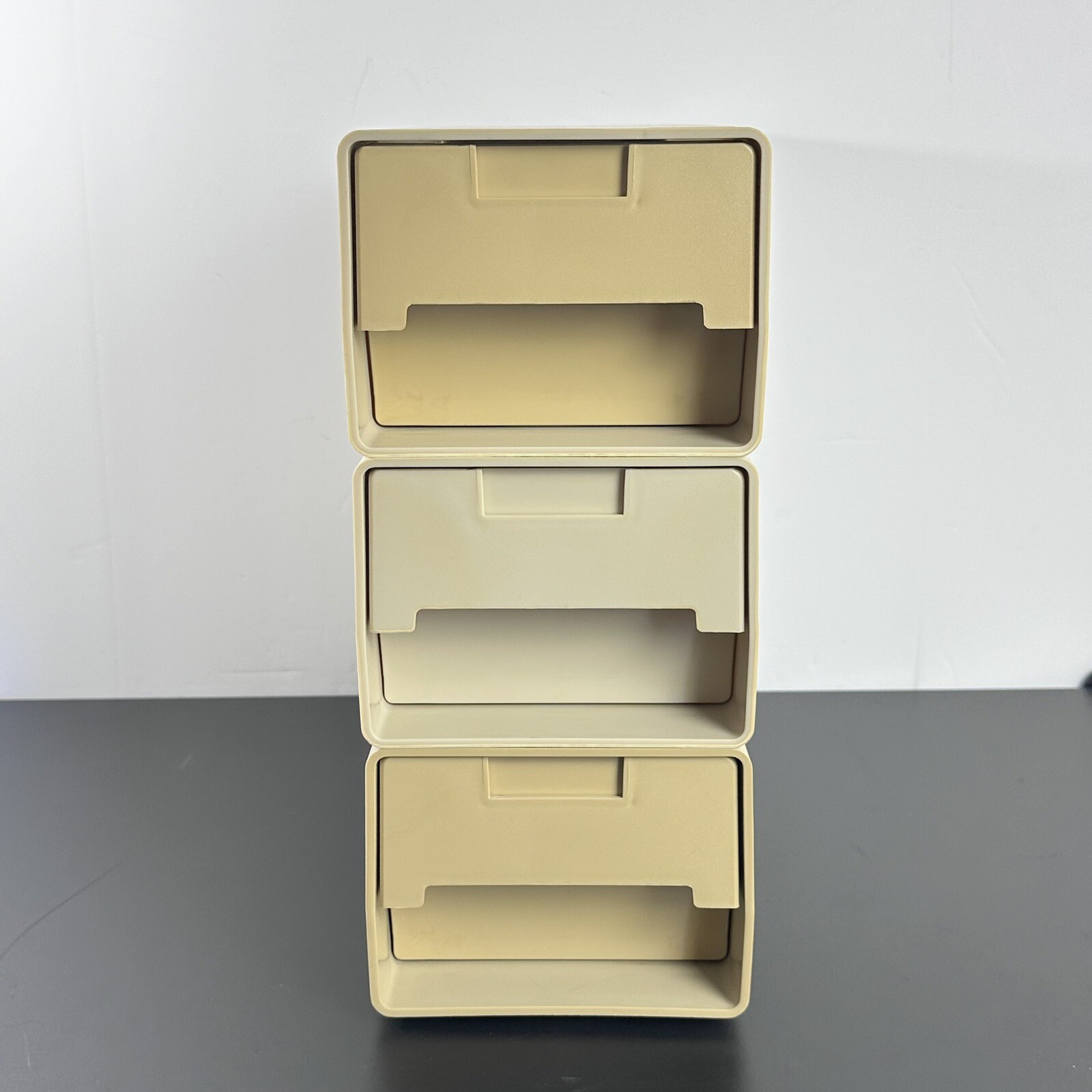
cost per drawer: $23.33
Tags
Annotators
URL
-
-
www.ebay.com www.ebay.com
-
https://www.ebay.com/itm/266697740403
2024-03-02 Listed for sale or best offer at 1,275. 72 drawers with plastic drawers. Darker wood, in good shape. missing 4 rods and has one damaged front frame.
Likely mid-70s to early 80s
Freight shipping available or local pick up in Comfort, TX.

Cost per drawer: $17.70
Tags
Annotators
URL
-
-
shopgoodwill.com shopgoodwill.com
-
Brother Charger 11
2024-03-01<br /> $53.99<br /> https://shopgoodwill.com/item/192321322
-
-
shopgoodwill.com shopgoodwill.com
-
Olivetti Underwood 21
2024-03-01<br /> $67.99 sale<br /> https://shopgoodwill.com/item/192324052
-
-
www.goodwillfinds.com www.goodwillfinds.com
-
-
Positivism asserted that allcultures move through progressive stages of development: first the-ological, then metaphysical, and finally “positive.”
Is positivism the source of some of the "progress of human civilization" which David Graeber and David Wengrow point out as problematic in The Dawn of Everything?
Were their prior philosophical movements which may have fed into this forward moving impression? Great chain of being also plays into some of this from a hierarchical perspective.
-
. Positivism asserted that allcultures move through progressive stages of development: first the-ological, then metaphysical, and finally “positive.”
-
-
Local file Local file
-
Notes
The audiobook version of this "text" omits the notes, acknowledgements, and importantly the indexes!
It ends with the coda followed by a copyright and production statement.
-
Anindexer who tags a document has already done the work needed toproduce an ‘active index’, where each locator is a clickable link thatwill bring up its target page immediately.
-
Theindexer will want a feel, before they begin, for the concepts that willneed to be flagged, or taxonomized with subheadings. They mightskim the book – reading it in full but at a canter – before tackling itproperly with the software open. Or they may spend a while, as apreliminary, with the book’s introduction, paying attention to itschapter outline – if it has one – to gain a sense of what to look outfor. Often, having reached the end of the book, the indexer will returnto the first few chapters, going over them again now that they havegained a conceptual mapping of the work as a whole.
It's no wonder that Mortimer J. Adler was able to write such a deep analysis of reading in How to Read a Book after having spent so much time indexing the ideas behind The Great Books of the Western World.
Indexing requires a solid inspectional read at minimum, but will often go deeper into contexts which require at least some analytical reading. To produce the Syntopicon, one must go even further into analytical reading to provide the proper indexing of ideas so that they may be sub-categorized and used for deeper analysis for things such as comparison and contrast of those ideas.
-
-
hardhistoriesjhu.substack.com hardhistoriesjhu.substack.com
-
Read [[Martha S. Jones]] in Sleuthing the Card Catalog
-
The Library of Congress discontinued the use of “Negroes” as a subject heading in 1976.
-
I fingered my way through where I thought I’d find entries: African American, Afro-American, Black. Nothing there. I had to then brainstorm like it was 1999, or was it 1989, 1979, or even earlier, to discover the right term. As far back as 1984, the Library of Congress, whose subject headings most research libraries in the United States utilize, admitted that it was “frustrating” to search for Black people in its catalog because two terms were simultaneously in use: “Afro-Americans” and “Blacks.”1 Neither term made it into the old Peabody Library catalog, so perhaps it and the terminology it reflected dated from an even earlier time.
Research on keywords and their shifting meanings over time can make things difficult for the novice researcher. This example from Martha S. Jones certainly highlights this perspective even in under a century of semantic shift.
-
-
www.ebay.com www.ebay.com
-
https://www.ebay.com/itm/374936561744
Previously listed (late Summer 2023). Offered for bidding at $7,200 for a Jens Risom Library Card catalog on/around 2023-09-16. Local pickup from Pageland, SC. Ex-library from Davidson College Library in North Carolina tag number 01359.
Section of 6x5 and another of 6x7 for a total of 72 drawers with a middle section which has two pull out writing drawers.

Cost per drawer at opening bid: $100.00
2023-09-25: Relisted at https://www.ebay.com/itm/374948492633
2024-02-29 Relisted at https://www.ebay.com/itm/375282966486
-
- Feb 2024
-
-
en.wikipedia.org en.wikipedia.org
-
-
https://github.com/travisbrown/cancel-culture
Cancel culture, tool for fighting abuse on Twitter, which can also be used to archive one's Tweets.
Example: An archive of a user's Tweets: https://gist.github.com/rondy/e6fc62e6968f39428df5eb1746f0d308
-
-
press.princeton.edu press.princeton.edu
-
Dames, Nicholas. The Chapter: A Segmented History from Antiquity to the Twenty-First Century. Princeton University Press, 2023. https://press.princeton.edu/books/hardcover/9780691135199/the-chapter.
Suggested by Eric Sinclair in Dan Allosso Book Club
-
-
chat.openai.com chat.openai.com
-
https://chat.openai.com/g/g-z5XcnT7cQ-zettel-critique-assistant
Zettel Critique Assistant<br /> By Florian Lengyel<br /> Critique Zettels following three rules: Zettels should have a single focus, WikiLinks indicate a shift in focus, Zettels should be written for your future self. The GPT will suggest how to split multi-focused notes into separate notes. Create structure note from a list of note titles and abstracts.
ᔥ[[ZettelDistraction]] in Share with us what is happening in your ZK this week. February 20, 2024
-
-
-
en.wikipedia.org en.wikipedia.org
-
www.reddit.com www.reddit.com
-
Let's reframe things here in part because it's highly illustrative of both the phrases as well as the specific question you raise.
Imagine Andy Matuschak reading Sonke Ahrens' How to Make Smart Notes (CreateSpace, 2017) and making notes on what he feels is important. As he reads, he does what is prescribed, namely, he restates the idea in his own words based on what he's read. In doing this he takes the idea of "evergreen" content from journalism settings (and later SEO settings) which he was familiar with and applies that name to what Ahrens called permanent notes to expound on his understanding of Ahrens! (An evergreen article in newspaper work is an article which was written for a particular recurring holiday, event, or story and is regular. Why spend huge amounts of staff time writing that truly original Valentine's day article? The broad stories about gifts to give and restaurants to visit really don't change from year to year. Just dust it off and reprint it, as readers are unlikely to have saved or remembered it and it becomes free re-purposable content.)
Of course, in rewriting this definition, Matuschak adds in some additional baggage for those who aren't carefully reading his work. He adds some additional emphasis on revisiting one's ideas and rewriting them over time, which is certainly fine, but I think the novice note maker puts too much emphasis on this portion thinking that each permanent or evergreen note must eventually become polished to perfection. In practice, most seasoned writers don't and won't do this. In fact, I suspect if you looked at Matuschak's note on evergreen notes, you'd find that it probably hasn't changed since the day he wrote it other than agglutinating links from other notes.
This doesn't mean that one can't modify or change their ideas over time, this is certainly useful and good, but I suspect that the majority aren't doing it the way that might be imagined by Matuschak's original statement or the way that his idea was picked up by the (niche) digital gardening community and spread primarily in the work of Maggie Appleton. It's some of this evolution of Matuschak's definition which bled into digital gardens, which have some overlap with zettelkasten and the note taking realms, which have muddied the waters. As a result, one should take it as general advice and apply it to their own situation, needs, and practice.
For those who use their own notes for writing, one will often mark their cards/notes to indicate that they've used those ideas in various projects so that they're not actively repeating themselves ad nauseum. Some of the additional tweaks one might make to their notes from a style or context specific perspective are also left to the editing portion rather than being done in the notes themselves. As a result of some of this, unless there is a dramatic flaw in a note, there isn't generally a lot of additional work one would come back to it to revise it. If it does require that sort of major revision, then perhaps the better method would be to make a new note and linking it to the original along with an explanation of the error. I typically wouldn't recommend polishing individual notes to some Plationic idea of perfection. Doing so is often just make-work which distracts from one's time which could be better spent doing additional reading or actual thinking. If you're going to do that sort of polishing work, do it at the end when you've got a longer piece of writing you're including your note in.
The real question now, is how are you personally going to define permanent notes, evergreen notes, or other related phrases like atomic notes? This practice is called by Mortimer J. Adler and Charles Van Doren "coming to terms" with an author's work and is part of their analysis for how one should read a book to get the most out of it. I highly recommend reading How to Read a Book (Simon & Schuster, 1972 or Touchstone, 2011) as a companion to any of the usual note taking manuals.
If you want to continue the experiment on a better unified definition of permanent notes, evergreen notes, atomic notes, etc., you can find a pretty solid bibliography of note making, writing, and reading manuals to peruse at https://boffosocko.com/2024/01/18/note-taking-and-knowledge-management-resources-for-students/#Recommended%20reading.
While one could certainly go down the rabbit hole of reading all these resources, I would recommend only looking at one or two and spending your time working on actual practice. It's through practice that you're more likely to make actual progress on your own problems and questions.
reply to u/franrodalg at https://www.reddit.com/r/Zettelkasten/comments/1azoo9m/permanent_vs_evergreen_notes_am_i_thinking_about/
-
-
Local file Local file
-
Duncan, Dennis. Index, A History of the: A Bookish Adventure from Medieval Manuscripts to the Digital Age. 1st ed. London: Allen Lane, 2021. https://wwnorton.com/books/9781324002543.
annotation link: urn:x-pdf:a4bd1877f0712efcc681d33d58777e55
-
scholastic learning
How much different things may have been if the state, and not the Church, had been the progenitor and supporter of the early university?
How might education have been different if it came out of itself (or something like curiosity or even society in general) without the influences on either church or state?
-
scholastic learning would favour externaldemonstration over inner revelation, intellectual agility over endlessmeditation.
-
the reading-out of commentaries (a format with a now-familiar name: the lecture)
Link between the commentaries of the early middle ages and modern lectures
-
centralizing reforms of Pope Gregory VII calledfor a more professionalized clergy. Church officials should now betrained administrators, versed not only in the scriptures but also inthe principles of accounting and law. A papal decree of 1079 orderedthat cathedrals should establish schools for the training of priests,
-
Not so the tenth-century John of Gorze, who issaid to have pored continuously over the psalms with a soft buzzing‘in morem apis’: in the manner of a bee.8
quoted portion via:<br /> John of St Arnulf, ‘Vita Joannis abbatis Gorziensis’, Patrologia Latina, 137.280D.
relationship to collecting like the bees (rhetoric)
relationship to humming and rocking practices of Hassidic readers/learners/memorizers
-
Looking back on his first encounters withAmbrose, Bishop of Milan, in the late fourth century, Augustineremembers noticing the curious way Ambrose would read: ‘his eyeswould scan over the pages and his heart would scrutinize theirmeaning – yet his voice and tongue remained silent’.7 This –reading in silence – is not normal, and Augustine wonders whatcould possess Ambrose to adopt such a practice. (Was it to preservehis voice? Or a way of avoiding unwanted discussions about the texthe was reading?)
quoted section via:<br /> St Augustine, Confessions, trans. by Carolyn J. B. Hammond, 2 vols. (Cambridge, MA: Harvard University Press, 2014), I, p. 243 (VI 3.3).
-
As thehistorian Jean Leclercq, himself a Benedictine monk, puts it, ‘in theMiddle Ages, one generally read by speaking with one’s lips, at leastin a whisper, and consequently hearing the phrases that the eyessee’.6
quoted section from:<br /> [au moyen âge, on lit généralement en pronançant avec les lèvres, au moins à voix basse, par conséquent en entendant les phrases que les yeux voient.] Jean Leclercq, Initiation aux auteurs monastiques du Moyen Âge, 2nd edn (Paris: Cerf, 1963), p. 72.
What connection, if any, is there to the muscle memory of movement while speaking/reading along with sound/hearing to remembering what we read? Is there research on this? Implications for orality and memory?
-
in the nunnery, where St Caesarius prescribes two hours to beset aside for reading in the early morning and a nominated reader tobe the only audible voice both at mealtimes and during the nuns’daily weaving. And woe betide the sister who finds herself drifting off:‘If anyone should become drowsy, she shall be ordered to standwhile the others are seated, so that she can banish the heaviness ofsleep.’5
quoted portion from:<br /> The Rule for Nuns of St Caesarius of Arles, trans. by Maria McCarthy (Washington, DC: Catholic University of America Press, 1960), p. 175.
see related version in Benedictine Rule: https://hypothes.is/a/oJWB5tKAEe6FRGuIAPWmZQ
-
the Benedictine Rule stipulatesthat monks should then apply themselves to two hours of reading,after which they may either go back to bed, ‘or if anyone mayperhaps want to read, let him read to himself in such a way as not todisturb anyone else’.4 At mealtimes, one monk will be appointed toread to the others, who must keep absolute silence ‘so that nowhispering may be heard nor any voice except the reader’s’.
quoted portions from:<br /> St. Benedict’s Rule for Monasteries, trans. by Leonard J. Doyle (Collegeville, MN: Liturgical Press, 1948), p. 67.
-
StAugustine draws this same parallel when he writes to a communityof nuns, ‘let it not be only your mouth that takes food, but let yourears also drink in the word of God’.3
quoted section from:
St Augustine, Letters, trans. by Wilfrid Parsons, 5 vols. (Baltimore, MD: Catholic University of America Press, 1956), V, Letter 211, ‘To a Convent of Consecrated Virgins’, p. 43.
-
‘Blessed Lord, which hast caused al holy Scriptures to bee written forour learnyng; graunte us that we maye in such wise heare them,read, marke, learne, and inwardly digeste them.’2
quote from:<br /> The Booke of the Common Prayer and Administration of the Sacraments (London: 1549), sig. B iiv.
-
What happens to the page layout now that the book is beingused as a container for many discrete pieces of information, ratherthan for a single, continuous narrative?
-
Hugh will be the first to produce aconcordance to the Bible, to break the book down and rearrange itinto an alphabetical index of its words.
Hugh of Saint-Cher was the first person to produce a concordance of the Bible around 1230.
-
was the first to argue that rainbows arecaused by light refraction
earlier source:
Amelia Carolina Sparavigna, ‘On the Rainbow, Robert Grosseteste’s Treatise on Optics’, International Journal of Sciences 2.9 (2013): 108–13 (109).
-
In fact, this final detail is a mistake, an anachronism. Hugh died acouple of decades too early to have benefitted from this invention:two magnifying glasses bound together by a rivet in their handles.
The image of Hugh of Saint-Cher wearing glasses in the fresco at the former convent of San Niccolò, Chapter Room, Treviso, is an anachronism as their invention was decades following his death in 1263.
-
the fresco, byTomasso da Modena, was painted in 1352). It stresses theDominicans’ commitment to Bible study and to scholarship, and noportrait conveys this more than the image of Hugh of St Cher.
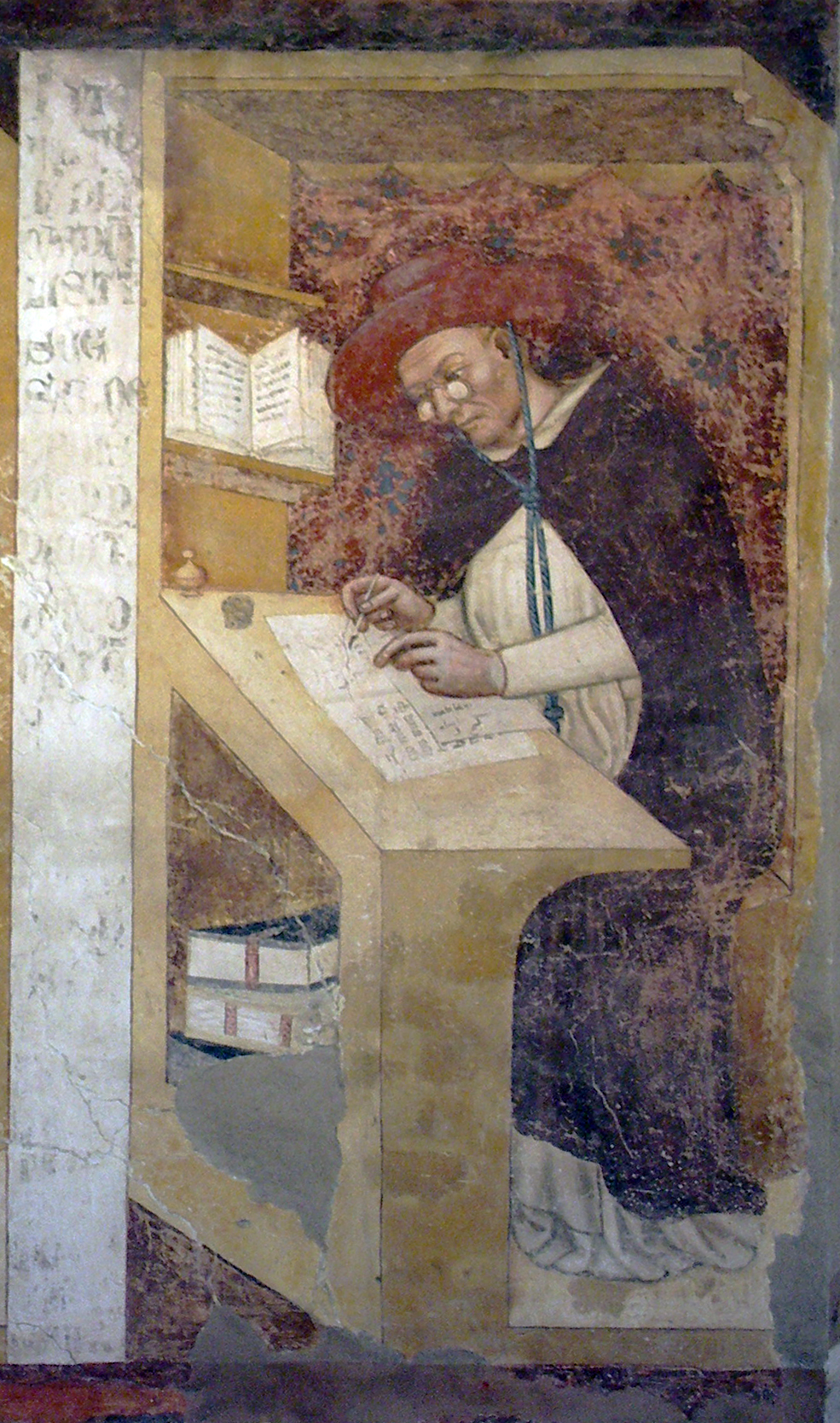 Image from: https://commons.wikimedia.org/wiki/File:38_Ugo_da_San_Caro.jpg
Ugo da San Caro, serie dei Quaranta domenicani illustri, ex convento di San Niccolò, Sala del Capitolo, Treviso, 1352 (altezza di ciascun ritratto 150 cm circa) Image by Risorto Celebrano, licensed under the Creative Commons Attribution-Share Alike 3.0 Unported license.
Thought to be one of the first images of a person wearing glasses. Image dated 1352.
-
Between them, theyset up the axes by which we think about indexing: word versusconcept; concordance versus subject index; specific versusuniversal.
context: the simultaneous invention of two different methods of indexing: subject indexes and concordances
-
Grosseteste’s great table – or Tabula
This introduction to Grosseteste's Tabula seems to be in medias res...
-
imagined the birth of the universe asan expanding sphere of luminescence, taking science and scriptureand blending them into a kind of Big Bang Theory that still leavesroom for God to start it all off with ‘Let there be light’.
This blends a tidbit of scientific history regarding Robert Grosseteste's thought with modern science fiction. Surely Grosseteste was NOT prefiguring the Big Bang Theory.
Curious what the original citation was here.
-
Only the largepelican, squatting in the trees, can break the connection, a symbol ofbad audience, staring insolently, resolutely offstage. But she is beinggradually struck out, her colours fading as the original red and giltborders reassert themselves reprimandingly from beneath, themanuscript exacting a slow punishment for the sin of inattention.
Dennis Duncan completely misreads this image of Grosseteste and the Pelican which appears in the Lambeth Palace Library's MS 522 of The Castle of love. (for image see: https://hypothes.is/a/RzHLjsz8Ee6dZLOTV5h65Q)
Duncan identifies Grosseteste's pose with his hand raised and his index finger extended as "the classic gesture of the storyteller." In fact, the bishop is pointing directly up at the pelican which sits just on top of the frame of the illuminated scene. This pelican is elevated above and just beyond the scene of the image because it represents, as was common in the time period, the suffering of Christ.
Bestiaries of the age commonly depicted the "pelican in her piety" which was noted by Isidore of Seville in his Etymologies (Book 12, 7:26) from the 7th century, a text which heavily influenced many of these bestiaries. It was also thought at the time that the insatiable and rapacious pelican ate lizards and crocodiles (or lived off of them); as these were associated with snakes and by way of the story of the Garden of Eden the devil, they were also further associated with Christ and driving sin out of the world.
Thus the image is more appropriately read in its original context as Grosseteste giving a sermon about the suffering of Christ who is represented by a pelican floating above the scene being depicted.
Tags
- open questions
- accounting
- Château d'amour
- indices
- suffering
- Bible studies
- Tomasso da Modena
- storytelling
- internal vs. external
- XIII
- professionalization
- refraction
- Tabula
- References
- reading practices
- pedagogy
- papal decrees
- John of Gorze
- inventions
- pelican Christ symbolism
- history of education
- images
- book as container
- church vs. state
- zettelkasten
- annotations
- Ambrose of Milan (Saint Ambrose)
- Hugh of Saint-Cher
- MS 522 Lambeth Palace Library
- rainbows
- apes
- orality and memory
- Benedictine Rule
- Book of Common Prayer
- sound
- silent reading
- pelican in her piety
- 1549
- 1079
- frescos
- card index
- Robert Grosseteste
- giving voice
- scholasticism
- religious reforms
- reading with a pen in hand
- quotes
- symbolism
- history of universities
- index finger
- Jean Leclercq
- lectures
- XI
- meditation
- XVI
- Augustine
- buzzing
- pelicans
- law
- history
- Big Bang Theory
- education reform
- Pope Gregory VII
- indexing
- orality vs. literacy
- analogies
- digital age
- humming
- digesting material
- expanding universe
- Dennis Duncan
- St. Caesarius' Rule
- symbolic gestures
- intellectual history
- firsts
- optics
- commentaries
- card index as database
- food analogies
- anachronisms
- prayers
- glasses
- concordances
- archaeology of orality
- containers
- Benedictine Order
- reading aloud
- Thomas Cranmer
- muscle memory
- church and state
- X
- definitions
- educational reform
- piety
- universitites
Annotators
-
-
-
[[Kevin Kelly]] in 1,000 True Fans
-
-
www.youtube.com www.youtube.com
-
https://www.youtube.com/watch?v=hWVrz5oCt2w<br /> The meaning of Hand Gestures in Art History<br /> Amuze Art Lectures
Middle and ring fingers together to represent modesty. (He doesn't say it, but it also could stand for "M" as in Medici??)
Finger pointing at viewer may indicate a self portrait.
Woman's hand on abdomen may represent pregnancy, a fertile marriage, or the desire to bear children.
-
-
en.wikipedia.org en.wikipedia.org
-
I'm curious if anyone frames their zettelkasten practice in terms of disputation via the scholastic tradition? <br /> context: https://en.wikipedia.org/wiki/Disputation
-
-
www.npr.org www.npr.org
-
Why not have heart balm tortes as a pastry for Valentine's Day
-
HASDAY: The joke about criminal conversation is that it's not criminal, and it's not conversation. That's how you can remember it.BERAS: That's good.HASDAY: It's not criminal. It's not conversation.BERAS: It's sex. That's what it is - just sex. Essentially, you had sex with my wife. It was often the husband suing.
-
Jill Hasday, a law professor at the University of Minnesota, and she is kind of like a heart balm expert. She wrote about them in this book called "Intimate Lies And The Law."
relationship of this area of law with respect to debt and David Graeber's Debt theses?
-
https://www.npr.org/transcripts/1197958200
rel-alternate: https://www.npr.org/2024/02/09/1197958200/heart-balm-cheating-infidelity-sue
-
-
www.youtube.com www.youtube.com
-
If you're into music producers and creativity, Brian Eno and his collaborator Peter Schmidt created and sold a custom "zettelkasten" called "Oblique Strategies" which Eno frequently used in the recording studio during live sessions when he hit creative walls. There are various digital versions of his card set online for playing around with in your own creative work.
Thanks for this mini-review. I've had Rubin in my reading pile for a while, specifically to see what he says with respect to the idea of combinatorial creativity. Perhaps it's time to bump him up the list?
-
https://www.youtube.com/watch?v=5vhEmiHodUU How to Automatically Be More Creative by Morganeua
Tags
Annotators
URL
-
-
ghs-garlandisdschools.libguides.com ghs-garlandisdschools.libguides.com
-
https://ghs-garlandisdschools.libguides.com/c.php?g=613369&p=7227110
Revisit this overview for extraction.
-
-
triviumbinder.blogspot.com triviumbinder.blogspot.com
-
https://triviumbinder.blogspot.com/
trivium resources/blog
-
-
www.reddit.com www.reddit.com
-
https://www.reddit.com/r/Zettelkasten/comments/1aquhwp/the_problem_of_zettelkasen_transparency/
One of the more philosophical posts in the r/zettelkasten space....
-
-
www.ebooksforus.com www.ebooksforus.com
-
athenaze.com athenaze.comAthenaze1
-
Cross reference with Hans H. Ørberg's LINGVA LATINA for Latin.
-
-
-
https://www.ebay.com/itm/256416691118
2024-02-19 120 drawer cabinet, solid in four sections of 8x4 with a set of four writing drawers in the middle. No table, but a very low slung simple base. Listed for $4,000 or best offer for pick up only in Greenbriar, TN. No manufacturer listed. Appears to be all wood and metal, but no photos of internals.
Relatively rough shape with mediocre finish. Two drawers are mismatched and darker. A couple of the label/pulls are broken or hanging, Missing a few rods. One drawer front is entirely broken.

Cost per drawer: $33.33 per drawer.
Tags
Annotators
URL
-
-
www.ebay.com www.ebay.com
-
https://www.ebay.com/itm/166584466393
2024-02-06: 15 drawer (5x3) card catalog offered for starting bid of $200. 3 piece sectional with top, drawers and simple table base with spindle legs. Appears to be in maple with polished steel fittings.
Manufacturer: none listed<br /> Location: Local pick up from Niagara Falls, NY
Condition: the finish on this is shot and is either cracked, peeling, or generally non-existent on the outside. Missing two rods. Finish on the wood inside appears solid.
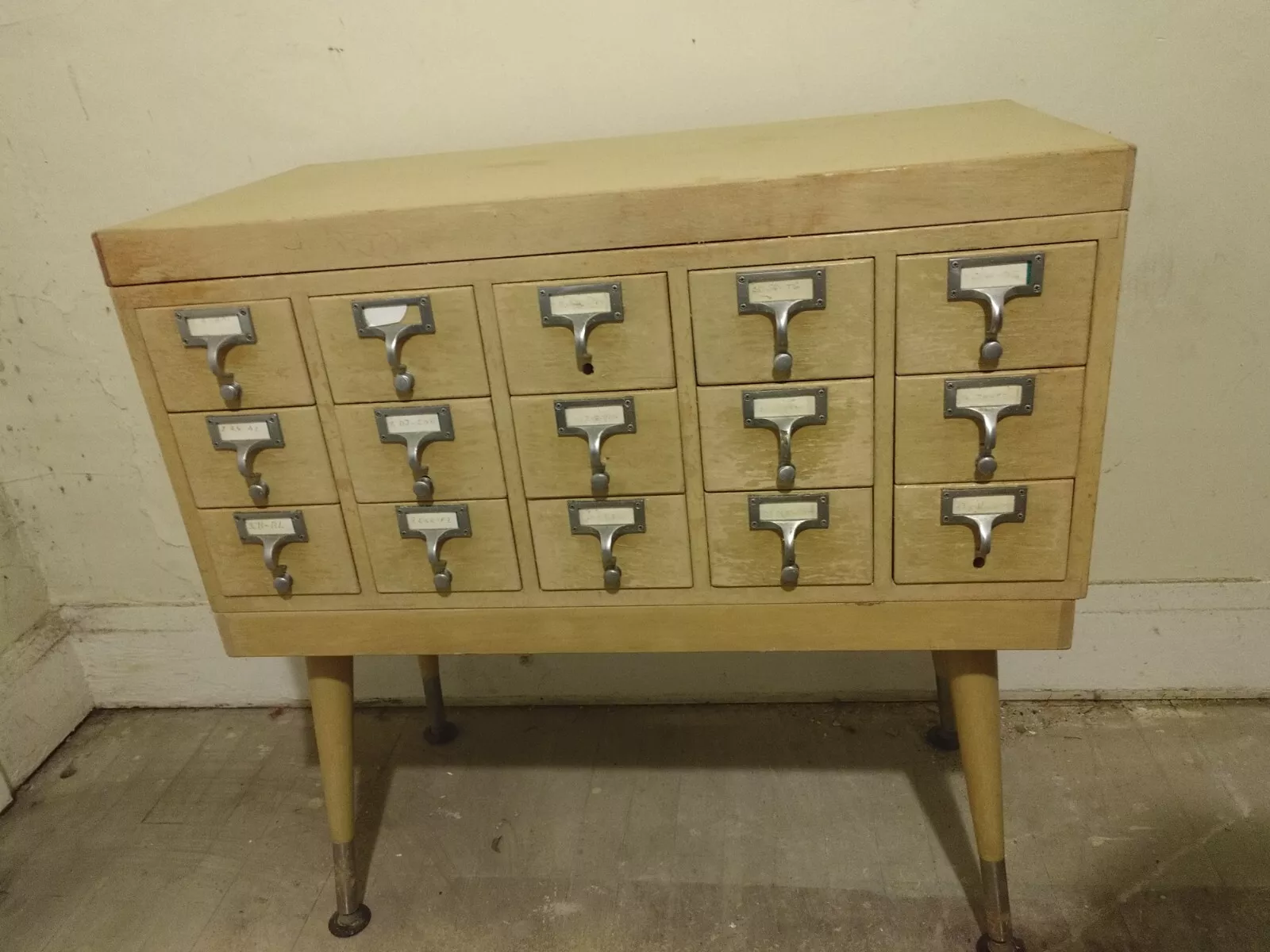
Cost per drawer: - opening bid of $200: $13.33
This was later relisted at https://www.ebay.com/itm/166595950156 and ultimately sold for $255.00.
Cost per drawer: $17.00
-
-
www.facebook.com www.facebook.com
-
https://www.facebook.com/marketplace/item/945071177181845/

2024-02-01 Listed Shaw-Walker four drawer side table for $95 and it sold within a day for local pick up.
Cost per drawer: $23.75
I inquired about this, but missed out on it by just a few hours. I totally want a pair of these as end tables for a couch or a cozy club/reading chair.
-
-
www.facebook.com www.facebook.com
-
https://www.facebook.com/marketplace/item/694743405502203/
Seller description: 1902 Shaw Walker Card Catalog and File Cabinet 3 piece stackable $765 Listed 19 weeks ago in San Bernardino, CA Details
Condition
Used - Good
Color
Brown
Material
Wood
Super nice old antique card catalog Stackable Oak wood Very few marks for its age 1902 original tags inside it Simply elegant piece No missing pieces no scratches 76 t 16 w 19 d
Jeanie Lowry listing from October 2023 and sold in late 2023 potentially for $765 or less.
Sectional Shaw-Walker modular card catalog and filing cabinet. 3 sections of 2x3 drawers for 3x5" cards and one section of 2x1 along with a two 8.5x11" filing drawers and a writing desk pullout section.
22 total drawers but 20 for index cards

Cost per drawer: $34.77 (sold)
-
-
www.facebook.com www.facebook.com
-
https://www.facebook.com/marketplace/item/1020494389229110/
Solid Gaylord Bros. 60 drawer card catalog for pick up in San Bernardino, CA by Jeanie Lowry on Facebook. Reasonable shape despite some dings, especially to the wood facia at the bottom. One metal drawer pull shorn off, but looks like it had all it's rods as well as three writing drawers in the middle.
2023-01 Listed for ??<br /> Sold sometime in early 2024 presumably for $525
Seller description: Beautiful Vintage 1950’s Bro Dart Card Catalog Vintage 60 Drawer Card Catalog One drawer handle has the hook missing 3 of the slide in bars missing Some wear on the bottom panel Drawers are strong with brass handles and screws 60 inches tall 40 1/2 wide 17 1/2 deep Drawers are 5 1/2 inches wide Very heavy Great piece would look so great in a retail setting

Cost per drawer: $8.75
-
-
www.facebook.com www.facebook.com
-
https://www.facebook.com/marketplace/item/406045722112862/
2024-02-01 Originally listed for 1,100 or so and slowly decreased to $990 on 2024-02-17 at which point it was listed as "not in stock", so unsure if actually sold.
Gaylord Bros. 25 drawer modular card catalog in 4 sections including top and table/legs and two drawer sections of 5x2 and 5x3. in reasonable but somewhat rough condition. for pick up in San Bernardino, CA from Jeanie Lowry
Offered as part of a Facebook garage sale which included a similar 30 drawer catalog with pull out writing desks and a handful of metal card filing cabinets meant for punch cards.
1960’s 25 Drawer Card Catalog Hard to find item In great shape 40 1/2 T, 33 W, 17 D
-
-
bestiary.ca bestiary.ca
-
Isidore of Seville [7th century CE] (Etymologies, Book 12, 7:26): The pelican [pelicanus] is an Egyptian bird inhabiting the solitary places of the river Nile, whence it takes its name, for Egypt is called canopos. It is reported, if it may be true, that this bird kills its offspring, mourns them for three days, and finally wounds itself and revives its children by sprinkling them with its own blood. - [Barney, Lewis, et. al. translation]
Despite the now commonly accepted etymology of pelican stemming from the Greek pelekys or pelekus meaning "ax", a referent to the bird's large beak, in Etymologies (book 12, 7:26) Isidore of Seville says it "takes its name for Egypt which is called canopos."
question: There is a thing called a canoptic jar (from Egypt), is it possible that trade via these jars caused the ancients to associate Egypt with them, or is there a separate etymology at play?
-
Pliny the Elder [1st century CE] (Natural History, Book 10, 66): Pelicans have a resemblance to swans, and would be thought not to differ from them at all were it not that they have a kind of second stomach in their actual throats. Into this the insatiable creature stows everything, so that its rapacity is marvelous. Afterwards when it has done plundering it gradually returns the things from this pouch into its mouth and passes them into the true stomach like a ruminant animal. These birds come to us from the extreme north of Gaul. - [Rackham translation]
In his Natural History (Book 10, 66), Pliny the Elder indicates that pelicans resemble swans, but have a second stomach in their throats into which they insatiably and rapaciously stow everything only later passing them into their true stomachs like ruminant animals.
-
-
forum.eastgate.com forum.eastgate.com
-
www.lambethpalacelibrary.info www.lambethpalacelibrary.info
-
https://www.lambethpalacelibrary.info/collections/manuscripts/
Bibliotheca Lambethana - manuscripts
-
-
images.lambethpalacelibrary.org.uk images.lambethpalacelibrary.org.uk
-
ar.pinterest.com ar.pinterest.com
-
images.lambethpalacelibrary.org.uk images.lambethpalacelibrary.org.uk
-
Robert Grosseteste, Bishop of Lincoln (face rubbed), in mitre and red cope, with crosier, seated on left speaks to a seated group of five people, mostly women. Tree on right; large bird with long beak at top.
image of MS 522 f1r Lambeth Palace Library

Close up of inset image via link

Book and images mentioned in Chapter 2 of @Duncan2022 Index, A History of the
-
-
medieval.bodleian.ox.ac.uk medieval.bodleian.ox.ac.uk
-
https://medieval.bodleian.ox.ac.uk/catalog/work_4353
Manuscript copies of Chasteau d'amour (The Castle of Love) by Robert Grosseteste (1175? - 1253) in the Oxford Libraries.
No copies available digitally as of 2024-02-16
-
-
vimeo.com vimeo.com
-
watched Tinderbox Meetup 2023-12-03 featuring Jorge Arango
Attendees: Mark Bernstein, Michael Becker, Jorge Arango,
Introductions: Rolf Huber (Information Architect)
Featured
- many different definitions of notes (types...)
- Damien Newman scribble drawing as a representation or diagram of the design process (22:42)
- 2x2 grid matrix of evergreen versus transient and mnemonic versus generative.(27:00)
-
contacts, recipes, book highlights and marginalia in the mnemonic/evergreen quadrant; to do lists, grocery list, appointments in the mnemonic/transient quadrant; sticky notes, mind maps, project plans, tinderbox in the generative/transient quadrant; knowledge gardens, zettelkasten, pkm systems in the generative/evergreen;
-
What does the structure of containers in each of these spaces look like? How simple or complex are they?
-
There can be growth from one space into others, (especially from the mnemonic into generative).
-
Chuck Wade mentions that email fits into all four of the quadrants.
-
Cathy Marshall used "information gardening" in Xerox Park setting... (source?) It may have been mentioned in Arango's interview of Mark Bernstein on The Informed Life.
Arango came to knowledge gardening via Brian Eno essay on architecture and gardening metaphor.
Three Rules of Knowledge Gardening
- Make short notes; create enough context to help out your future self
- Connect your notes
- Nurture your notes; revisit, build, feedback
Q&A
Dave Rogers - we should challenge our notes rather than "nurturing them";
JA: Perhaps we could use AI/GPT to "steel man" our arguments?
Hookmark: https://hookproductivity.com/
Gordon Brander's Noosphere - protocol to define the problem of linking things quickly at internet scale.
-
-
forum.eastgate.com forum.eastgate.com
-
foxtrot-search.com foxtrot-search.com
-
FoxTrot Search https://foxtrot-search.com/
Search tool for XML and other meta data for macOS
-
-
forum.eastgate.com forum.eastgate.com
-
vimeo.com vimeo.com
-
Tinderbox Meetup 2023-06-10 featuring Jerry Michalski and The Brain
-
-
-

Make sense of your messy world. Kumu makes it easy to organize complex data into relationship maps that are beautiful to look at and a pleasure to use.
tagline:
The art of mapping is to create a context in which others can think.
Tool mentioned on [[2022-06-02]] by Jerry Michalski during [[Friends of the Link]] meeting.
-
-
www.kevinmarks.com www.kevinmarks.com
-
[[Kevin Marks]] in Tools For Thinking
-
-
hardhistoriesjhu.substack.com hardhistoriesjhu.substack.com
-
Read [[Martha S. Jones]] in A New Face for an Old Library Catalog
Discussion on harmful content in library card catalogs and finding aids.
The methods used to describe archive material can not only be harmful to those using them, but they also provide a useful historical record of what cataloguers may have been thinking contemporaneously as they classified and organized materials.
This is another potentially useful set of information to have while reading into historical topics from library card catalogs compared to modern-day digital methods.
Is anyone using version control on their catalogs?
-
-
www.youtube.com www.youtube.com
-
Able to see lots of cards at once.
ZK practice inspired by Ahrens, but had practice based on Umberto Eco's book before that.
Broad subjects for his Ph.D. studies: Ecology in architecture / environmentalism
3 parts: - zk main cards - bibliography / keywords - chronological section (history of ecology)
Four "drawers" and space for blank cards and supplies. Built on wheels to allow movement. Has a foldable cover.
He has analog practice because he worries about companies closing and taking notes with them.
Watched TheNoPoet's How I use my analog Zettelkasten.
-
-
Bought a photo printer so he could include images and photos in his zettelkasten
-
-
www.youtube.com www.youtube.com
-
Watched [[The Unenlightened Generalists]] in Linked Notes: An Introduction to the Zettelkasten Method
A 28:30 intro to zettelkasten. I could only make it about 10 minutes in. Fine, but nothing more than yet another "one pager" on method with a modified version of the Luhmann myth as motivation.
Tags
Annotators
URL
-
-
techcrunch.com techcrunch.com
-
Local file Local file
-
but they left their own belovedmanuscript unclassied and undescribed, and thus it never attainedthe status of a holding, which it so obviously deserved, and wasinstead tacitly understood to be merely a “nding aid,” a piece offurniture, wholly vulnerable to passing predators, subject tojanitorial, rather than curatorial, jurisdiction—even though thiscatalog was, in truth, the one holding that people who entered thebuilding would be likely to have in common, to know how to usefrom childhood, even to love. A new administrator came by onemorning and noticed that there was some old furniture taking upspace that could be devoted to bound volumes of Technicalities, TheElectronic Library, and the Journal of Library Automation. The cardcatalog, for want of having been cataloged itself, was thrown into adumpster.
-
The authors made one serious mistake, however. Although theyhad taken great pains to be sure that within their massive workevery book and manuscript stored in their building was representedby a three-by-ve page, and often by several pages, describing it,they had forgotten to devote any page, anywhere, to the very book
that they had themselves been writing all those years.
Baker describes the library card catalog as a massive book made up of 3 x 5 inch pages describing all the other books. Sadly he laments, they never bothered to catalog this meta-book itself.
-
Together, over the years, they achieved what one of their earlymasters, Charles Ammi Cutter, called a “syndetic” structure—that is,a system of referential links—of remarkable coherency andresolution.
reference for this?
definition: syndetic structure is one of coherency and resolution made up by referential links.
Why is no one using this word in the zettelkasten space?
The adjective "syndetic" means "serving to connect" or "to be connected by a conjunction". (A conjunction being a word used to connect words, phrases and clauses, for example: and, but, if). The antonym is "asyndetic" (connections made without conjoins)
-
he very degree of wornness ofcertain cards that you once ipped to daily but now perhaps do not—since that author is drunk and forgotten or that magazine editorhas been red and now makes high-end apple chutneys inBinghamton—constitutes signicant information about what partsof the Rolodex were of importance to you over the years.
The wear of cards can be an important part of your history with the information you handle.
Luhmann’s slips show some of this sort of wear as well, though his show it to extreme as he used thinner paper than the standard index card so some of his slips have incredibly worn/ripped/torn tops more than any grime. Many of my own books show that grime layer on the fore-edge in sections which I’ve read and re-read.
One of my favorite examples of this sort of wear through use occurs in early manuscripts (usually only religious ones) where readers literally kissed off portions of illuminations when venerating the images in their books. Later illuminators included osculation targets to help prevent these problems. (Cross reference: https://www.researchgate.net/publication/370119878_Touching_Parchment_How_Medieval_Users_Rubbed_Handled_and_Kissed_Their_Manuscripts_Volume_1_Officials_and_Their_Books)
(syndication link: https://boffosocko.com/2024/02/04/55821315/#comment-430267)
-
Would it bestretching things too much, you suddenly wonder, to call yourRolodex a form of autobiography—a manuscript that you have beenwriting these fteen years, tinkering with, revising?
-
By the early seventies, therewas an ominous arrearage of uncataloged material waiting on herdsof rolling carts near the overtaxed cataloging departments of mostlarge libraries. Cataloging had reached a state of crisis
-
SUNY Brockport’s Drake Memorial Library greets its userswith a typographically generated image of a card catalog:Your automated catalog, by DYNIX.Copyright (c) 1992 by DYNIX, Incorporated.
A library card catalog drawn using ASCII art. :)
-
Thus, the New York Public Library has CATNYP.There is BEARCAT (Kutztown University) and ALLECAT (Allegheny) andBOBCAT (NYU’s Bobst Library) and CATS (Cambridge). There is VIRGO(the University of Virginia), FRANCIS (Williams College), LUCY(Skidmore), CLIO (Columbia), CHESTER (the University of Rochester),SHERLOCK (Bualo State College), ARLO (the University of Colorado atColorado Springs), FRANKLIN (the University of Pennsylvania), andHarvard’s appropriately Eustace Tilleyish HOLLIS. There is BISON(SUNY Bualo), OASIS (the University of Iowa), ORION (UCLA),SOCRATES (Stanford), ILIAD (Butler), EUCLIDPLUS (Case Western), LUMINA(the University of Minnesota), and THE CONNELLY EXPLORER (La Salle).MELVYL (the University of California system) is named after MelvilDewey; the misspelling was reportedly intentional, meant toemphasize the dierence between Dewey’s cataloging universe andour own.
List of names for computerized library card catalogs at various libraries.
-
, one of the reasons that the New York Public Library had toclose its public catalog was that the public was destroying it. TheHetty Green cards disappeared. Someone calling himself Cosmoswas periodically making o with all the cards for Mein Kampf. Cardsfor two Dante manuscripts were stolen: not the manuscripts, thecards for the manuscripts.
-
book at a public phone rather than bothering to copy down anaddress and a phone number, library visitors—the heedless, thecrazy—have, especially since the late eighties, been increasinglycapable of tearing out the card referring to a book they want.
The huge frozen card catalog of the Library of Congress currently suers from alarming levels of public trauma: like the movie trope in which the private eye tears a page from a phone
-
Radical students destroyed roughly ahundred thousand cards from the catalog at the University of Illinoisin the sixties. Berkeley’s library sta was told to keep watch overthe university’s card catalogs during the antiwar turmoil there.Someone reportedly poured ink on the Henry Cabot Lodge cards atStanford
-
They donot grow mold, as the card catalog of the Engineering Library of theUniversity of Toronto once did, following water damage.
-
obody canexpect a library to maintain sequences of alphabetized cardboard fora collection that is growing, as some currently are, at a rate of vehundred items a day.
In 1994, some libraries were acquiring material at the rate of five hundred items per day. Rates like this made it difficult for catalogers to keep up with uncatalogued material going back to the 1970s for some institutions.
-
“Atthe end of this project,” Dale Flecker told me, “there won’t be cardcatalogs left in the university.” I asked him if there were any cardcatalogs, anywhere in the world, that he thought worthy ofpreservation. “In general, they’re being discarded,” he said. “I’m notsure I know of anybody who’s decided to preserve them as physicalobjects.” Maureen Finn said much the same thing to me: “Theinstitutions still want the cards back, and then I think they’re storingthem. But most library managers that I talk to will say, ‘We arestoring them because it makes the sta feel good, and we will begetting rid of them.’ ”
Interesting psychology being played out here....
-
And some undetermined but large fraction of thetotality is being sent to an artist named Thomas Johnston, atWestern Washington University.
Card catalog cards being repurposed for art.
-
“Library hand” was a special kind ofbackward-slanting penmanship meant specically for card catalogs,and taught in library school through the 1920s.
-
Even OCLC, one ofthe very best retrospective-conversion contractors in the business, isbound to make thousands of typos in the course of a huge projectlike the Harvard “recon.”
"Recon" from RETROCON, a division of OCLC, which retroactively digitized and converted the data on library card catalog cards into digital format from roughly the late 1980s into the 90s.
-
(The more modication a library demands of eachMARC record, the more it costs.) In Harvard’s case she typicallyaccepts the record as is, even when the original card bearsadditional subject headings or enriching notes of various kinds.
Information loss in digitizing catalog cards...
-
Each operator, though initially hired asa temp, and, in some cases, no more than high-school-educated, isthe survivor of a rigorous two-week training program. (Most hiresdo not make it through training.)
Observation in 1994 of short term training of high school graduates for specific tasks which seems to hold true of similar customer service reps in 2024 based on anecdotal evidence of a friend who does customer service training.
-
OCLC owns the largestdatabase of bibliographic information in the world, and it oers aservice called RETROCON, contracting with libraries to transfer oldcatalog cards to “machine-readable form,” at anywhere from ftycents to six dollars per card.
-
An image of the front of every card for Widener thus now exists onmicroche, available to users in a room o the lobby. (Anyinformation on the backs of the cards—and many notes do carryover—was not photographed
-
theMaryland Health Sciences Library published a commemorativechapbook called 101 Uses for a Dead Catalog Card.
-
At Cosumnes River College, in California, the card catalog wasceremonially put out of its misery by an ocial who pointed a gunat it and “shot” it. D
Wow!
-
The cards datingfrom 1911 to 1975 at the New York State Library in Albany (whereMelvil Dewey was librarian from 1889 to 1906) were thrown awaylast month as a consequence of a historical-preservation projectinvolving the building in which they were stored.
Sad that a "historical-preservation project" resulted in the loss of such an interesting historical artifact.
-
The New York Public Library, ahead of the game, renovated theentire ten-million-card catalog of its Research Libraries between1977 and 1980, microlmed it, and threw it out.
-
universities and public libraries have completed the“retrospective conversions” of their catalogs to computer databases(frequently with the help of federal Title II-C money, as part of the“Strengthening Research Library Resources” program),
-
cards printed by theLibrary of Congress, Baker & Taylor, and OCLC;
In the 21st century, many library card catalog cards were commercially printed by OCLC, Baker & Taylor, and the Library of Congress
-
Chancellor Edward N. Brandt, Jr., wearing ared T-shirt that said “The Great Discard,” chose a drawer of thecatalog and pulled it from the cabinet. With the help of a beamingCyril Feng, who was then the director of the library, he drew theretaining rod from the chosen drawer and let its several hundredcards ceremonially spill into a trash can decorated with coloredpaper.
The intellectual historian in me: 😱
-
Discards
Baker, Nicholson. “Discards.” In The Size of Thoughts: Essays and Other Lumber, by Nicholson Baker, 1st ed. Vintage Contemporaries. 1994. Reprint, Vintage, 1997. https://www.penguinrandomhouse.com/books/7554/the-size-of-thoughts-by-nicholson-baker/.
Originally published in Baker, Nicholson. “Discards.” The New Yorker, April 4, 1994. p. 64. https://www.newyorker.com/magazine/1994/04/04/discards
2024-02-14 Moving over some notes and quick reread.
-
Baker, Nicholson. The Size of Thoughts: Essays and Other Lumber. First edition. Vintage, 1997. https://www.penguinrandomhouse.com/books/7554/the-size-of-thoughts-by-nicholson-baker/.
Tags
- note collection loss and damage
- XXI
- signs of use
- OCLC
- card index as autobiography
- manuscript studies
- art
- 1970s
- library acquisitions
- index cards
- theft
- publishing
- digital library cataloging
- RETROCON
- reading practices
- collage
- high school graduates
- Cyril Feng
- References
- Melvil Dewey
- cataloging
- zettelkasten
- typewriters
- scanning
- theives
- The Great Discard
- Charles Ammi Cutter
- training
- Library of Congress
- intellectual history
- historical preservation
- cataloging crisis
- New York Public Library
- library card catalog
- Baker & Taylor
- naming computers
- zettelkasten naming
- library hand
- customer service
- library card catalog cards
- card catalog rods
- yes and
- rolodexes
- hw-library hand
- wear through use
- digitization
- human resources
- bibliographies
- retcon
- microfiche
- syndetic structure
- Edward N. Brandt Jr.
- upcycling
- Nicholson Baker
- Widener University
- vandalism
- guns
- card index as co-author
- ASCII art
- Mein Kampf
- hw-recon
- quotes
- elegies
- card index for writing
- Title II-C
- definitions
- Wordnik
- Dante Gabriel Rossetti
- data loss
- Strengthening Research Library Resources
- vandals
- Thomas Johnston
Annotators
-
-
www.vaultofculture.com www.vaultofculture.com
-
twitter.com twitter.com
-
<script async src="https://platform.twitter.com/widgets.js" charset="utf-8"></script>Each day on twitter there is one main character. The goal is to never be it
— maple cocaine (@maplecocaine) January 3, 2019
-
-
subethaedit.net subethaedit.net
-
Similar to hackmd and etherpad... perhaps related to them genealogically?
-
-
en.wikipedia.org en.wikipedia.org
-
Conflict-free Replicated Data Type (CRDT) https://en.wikipedia.org/wiki/Conflict-free_replicated_data_type
-
-
forum.eastgate.com forum.eastgate.com
-
-
www.braneframe.com www.braneframe.com
-
writingslowly.com writingslowly.com
-
[[Writing Slowly]] (Richard) in Ross Ashby's other card index
-
-
www.youtube.com www.youtube.com
-
watched [[Odin Halvorson]] and [[Lea David]] in Personal Knowledge Management & Indigenous Mnemonics (Introduction)
He describes Ahren's Smart Notes as "groundbreaking" when in fact it just rehashed known techniques.
meh... teaser trailer for what, I don't know...
Tags
Annotators
URL
-
-
indubitablyodin.medium.com indubitablyodin.medium.com
-
Read [[Odin Halvorson]] in Indigenous Mnemonics and Personal Knowledge Management
I read in this area and this is the first I've heard the phrase IKS or “Indigenous Knowledge Systems”.
-
-
alexwright.com alexwright.com
-
Personal website
-
-
www.librarything.com www.librarything.com
-
https://www.librarything.com/mds
Melvil Decimal System (LibraryThing's equivalent of DDC, apparently in an attempt not to run afoul of the OCLC's Trademark.)
-
-
blog.librarything.com blog.librarything.com
-
Introducing Dewmoji: Emoji for Dewey Decimals®. A joke on Twitter about finding Emojis for every top-level Dewey Decimal class spun out of control and I ended up implementing something half-wonderful and half-terrible!
-
-
monoskop.org monoskop.org
-
news.virginia.edu news.virginia.edu
-
https://news.virginia.edu/content/old-card-catalog-collaborative-effort-will-preserve-its-history The Old Card Catalog: Collaborative Effort Will Preserve Its History<br /> December 9, 2019 By Anne E. Bromley, anneb@virginia.edu <br /> Photos By Sanjay Suchak, sanjay@virginia.edu
-
Curtis mentioned one example of information that he found: “One of the first drawers of the author-title catalog I looked through held a card for Benjamin Smith Barton’s ‘Elements of Botany’ [the 1804 edition]. The card indicated that UVA’s copy of this book was signed by Joseph C. Cabell, who was instrumental in the founding of the University.”Curtis checked to see if the Virgo entry included this detail, but he found no record of the book at all. “I thought perhaps that was because the book had been lost, and the Virgo entry deleted, but just in case, I emailed David Whitesell [curator in the Albert and Shirley Small Special Collections Library] and asked him if this signed copy of Barton’s ‘Elements of Botany’ was on the shelves over there. Indeed it was.
Digitization efforts in card collections may result in the loss or damage of cards or loss of the materials which the original cards represented in the case of library card catalogs.
-
The information neatly typed on the cards – which library workers sometimes supplemented with handwritten notes on front and back – includes details that in many cases are not typically part of the electronic catalog system, Virgo, that the University Library switched to in 1989. At the time, the catalog was transferred by scanning that captured only the front of the cards.
Libraries may have handwritten notes on the back of library card catalog cards in the 20th century, a practice which caused data loss in the case of the Alderman Library which only scanned the front of their cards in 1989 when they made the switch from physical cards to a digital catalog.
-
Created over a 50-year span from 1939 to 1989, that catalog grew to about 4 million cards in 65 cabinets with 4,000 drawers.
This is roughly 65 cabinets of 60 drawers each.
4 million cards over 50 years is approximately 220 cards per day. This isn't directly analogous to my general statistics on number of notes per day for individual people's excerpting practice, but it does give an interesting benchmark for a larger institution and their acquisitions over 50 years. (Be sure to divide by 3 for duplication over author/title/subject overlap, which would be closer to 73 per day)
Shifted from analog cards to digital version in 1989.
-
-
americanlibrariesmagazine.org americanlibrariesmagazine.org
-
https://americanlibrariesmagazine.org/highsmith-purchased-by-w-w-grainger/<br /> Highsmith Purchased by W. W. Grainger
-
Founded in 1956, Highsmith is a distributor of equipment, supplies, and furniture to public, academic, and school libraries.
-
Library supply company Highsmith, headquartered in Fort Atkinson, Wisconsin, has been purchased by Lab Safety Supply, a direct-marketing subsidiary of Chicago-based facilities maintenance supplier W. W. Grainger. Terms of the acquisition, announced in the business press July 10, were not disclosed. Highsmith’s operations, with anticipated sales for 2008 in the range of $20–$30 million, will be integrated with LSS by the end of the year.
Purchased July 2008.
-
-
resourcemate.com resourcemate.com
-
www.primasoft.com www.primasoft.com
-
www.primasoft.com www.primasoft.com
-
https://www.primasoft.com/help/print_library_catalog_cards.htm
Software for printing library catalog cards. Small Library Pro being replaced by Handy Library Manager
-
-
www.blyberg.net www.blyberg.net
-
https://www.blyberg.net/darien-statements
The Darien Statements on the Library and Librarians<br /> Written by John Blyberg, Kathryn Greenhill, and Cindi Trainor<br /> Originally published April 3, 2009
-
-
www.knapeandvogt.com www.knapeandvogt.com
-
Manufacturer of index followers
-