10,000 Matching Annotations
  1. Jan 2026
    1. While more recent phylogenies suggest that eukaryotes derived from within archaea and are not sisters to them, many arguments and cellular details of Tom’s eukaryogenesis theory remain valid and unchallenged.

      As you probably know Tom was well aware of what the latest phylogenies by others showed w.r.t. eukaryotes being derived from within Archaea. I believe he strongly argued in his 2020 paper that these were artefacts. He thought that the unique membrane characteristics of Archaea were an important synapomorphy that argued for an archaeal clade to the exclusion of eukaryotes. I honestly think that part of this is because Tom liked to be iconoclastic and represent sides of arguments that weren't mainstream. I remember arguing with him about whether or not eukaryotes came from within Archaea and, in conversation at least, he thought it was plausible that they did...but he definitely thought people shouldn't accept it as readily as they had.

    2. a preference for the old world and an optimistic picture of Britain becoming more integrated into the EU.

      Its not necessary to change this but I also think he very much bought-in to the prestige of Oxford . I suspect he thought the Oxbridge universities were the best in the world.

    3. The following year, he applied and received a position of Full Professor of Botany at UBC. The final straw that stimulated his move to Canada was Mrs Thatcher’s threat in late 1987 to put the UK universities more under her thumb. After his move, he became a Fellow of the Canadian Institute for Advanced Research (1989–1998).

      I believe that Tom's position at UBC was actually created and funded (at least in part) by the Canadian Institute for Advanced Research. I think Ford Doolittle, who was the Director of the CIAR Evolutionary Biology Program, actively recruited Tom and the deal was made with UBC to create a position. I'm not 100% certain of that, but perhaps you can ask someone (Ema?) if I'm right about that. Ford's email is "ford@dal.ca" and he might remember -- I'm sure he'd answer your email if you send him one.

    1. Reviewer #2 (Public review):

      Summary:

      This manuscript investigates age-related differences in cooperative behavior by comparing adolescents and adults in a repeated Prisoner's Dilemma Game (rPDG). The authors find that adolescents exhibit lower levels of cooperation than adults. Specifically, adolescents reciprocate partners' cooperation to a lesser degree than adults do. Through computational modeling, they show that this relatively low cooperation rate is not due to impaired expectations or mentalizing deficits, but rather a diminished intrinsic reward for reciprocity. A social reinforcement learning model with asymmetric learning rate best captured these dynamics, revealing age-related differences in how positive and negative outcomes drive behavioral updates. These findings contribute to understanding the developmental trajectory of cooperation and highlight adolescence as a period marked by heightened sensitivity to immediate rewards at the expense of long-term prosocial gains.

      Strengths:

      Rigid model comparison and parameter recovery procedure. Conceptually comprehensive model space. Well-powered samples.

      Weaknesses:

      A key conceptual distinction between learning from non-human agents (e.g., bandit machines) and human partners is that the latter are typically assumed to possess stable behavioral dispositions or moral traits. When a non-human source abruptly shifts behavior (e.g., from 80% to 20% reward), learners may simply update their expectations. In contrast, a sudden behavioral shift by a previously cooperative human partner can prompt higher-order inferences about the partner's trustworthiness or the integrity of the experimental setup (e.g., whether the partner is truly interactive or human). The authors may consider whether their modeling framework captures such higher-order social inferences. Specifically, trait-based models-such as those explored in Hackel et al. (2015, Nature Neuroscience)-suggest that learners form enduring beliefs about others' moral dispositions, which then modulate trial-by-trial learning. A learner who believes their partner is inherently cooperative may update less in response to a surprising defection, effectively showing a trait-based dampening of learning rate.

      This asymmetry in belief updating has been observed in prior work (e.g., Siegel et al., 2018, Nature Human Behaviour) and could be captured using a dynamic or belief-weighted learning rate. Models incorporating such mechanisms (e.g., dynamic learning rate models as in Jian Li et al., 2011, Nature Neuroscience) could better account for flexible adjustments in response to surprising behavior, particularly in the social domain.

      Second, the developmental interpretation of the observed effects would be strengthened by considering possible non-linear relationships between age and model parameters. For instance, certain cognitive or affective traits relevant to social learning-such as sensitivity to reciprocity or reward updating-may follow non-monotonic trajectories, peaking in late adolescence or early adulthood. Fitting age as a continuous variable, possibly with quadratic or spline terms, may yield more nuanced developmental insights.

      Finally, the two age groups compared-adolescents (high school students) and adults (university students)-differ not only in age but also in sociocultural and economic backgrounds. High school students are likely more homogenous in regional background (e.g., Beijing locals), while university students may be drawn from a broader geographic and socioeconomic pool. Additionally, differences in financial independence, family structure (e.g., single-child status), and social network complexity may systematically affect cooperative behavior and valuation of rewards. Although these factors are difficult to control fully, the authors should more explicitly address the extent to which their findings reflect biological development versus social and contextual influences.

      Comments on revisions:

      The authors have addressed most of my previous comments adequately. I only have a minor question: The models with some variations of RL seem to have very similar AIC. What were the authors' criteria in deciding which model is the "winning" model when several models have similar AIC? Are there ways of integrating models with similar structures into a "model family"? Alternatively, is it possible that different models fit better for different subgroups of participants (e.g., high schoolers vs. college students)?

    2. Author response:

      The following is the authors’ response to the previous reviews

      Public Reviews:

      Reviewer #1 (Public review):

      Summary:

      Wu and colleagues aimed to explain previous findings that adolescents, compared to adults, show reduced cooperation following cooperative behaviour from a partner in several social scenarios. The authors analysed behavioural data from adolescents and adults performing a zero-sum Prisoner's Dilemma task and compared a range of social and non-social reinforcement learning models to identify potential algorithmic differences. Their findings suggest that adolescents' lower cooperation is best explained by a reduced learning rate for cooperative outcomes, rather than differences in prior expectations about the cooperativeness of a partner. The authors situate their results within the broader literature, proposing that adolescents' behaviour reflects a stronger preference for self-interest rather than a deficit in mentalising.

      Strengths:

      The work as a whole suggests that, in line with past work, adolescents prioritise value accumulation, and this can be, in part, explained by algorithmic differences in weighted value learning. The authors situate their work very clearly in past literature, and make it obvious the gap they are testing and trying to explain. The work also includes social contexts that move the field beyond non-social value accumulation in adolescents. The authors compare a series of formal approaches that might explain the results and establish generative and modelcomparison procedures to demonstrate the validity of their winning model and individual parameters. The writing was clear, and the presentation of the results was logical and wellstructured.

      We thank the reviewer for recognizing the strengths of our work.

      Weaknesses:

      (Q1) I also have some concerns about the methods used to fit and approximate parameters of interest. Namely, the use of maximum likelihood versus hierarchical methods to fit models on an individual level, which may reduce some of the outliers noted in the supplement, and also may improve model identifiability.

      We thank the reviewer for this suggestion. Following the comment, we added a hierarchical Bayesian estimation. We built a hierarchical model with both group-level (adolescent group and adult group) and individual-level structures for the best-fitting model. Four Markov chains with 4,000 samples each were run, and the model converged well (see Figure supplement 7)

      We then analyzed the posterior parameters for adolescents and adults separately. The results were consistent with those from the MLE analysis (see Figure 2—figure supplement 5). These additional results have been included in the Appendix Analysis section (also see Figure supplement 5 and 7). In addition, we have updated the code and provided the link for reference. We appreciate the reviewer’s suggestion, which improved our analysis.

      (Q2) There was also little discussion given the structure of the Prisoner's Dilemma, and the strategy of the game (that defection is always dominant), meaning that the preferences of the adolescents cannot necessarily be distinguished from the incentives of the game, i.e. they may seem less cooperative simply because they want to play the dominant strategy, rather than a lower preferences for cooperation if all else was the same.

      We thank the reviewer for this comment and agree that adolescents’ lower cooperation may partly reflect a rational response to the incentive structure of the Prisoner’s Dilemma.

      However, our computational modeling explicitly addressed this possibility. Model 4 (inequality aversion) captures decisions that are driven purely by self-interest or aversion to unequal outcomes, including a parameter reflecting disutility from advantageous inequality, which represents self-oriented motives. If participants’ behavior were solely guided by the payoff-dominant strategy, this model should have provided the best fit. However, our model comparison showed that Model 5 (social reward) performed better in both adolescents and adults, suggesting that cooperative behavior is better explained by valuing social outcomes beyond payoff structures.

      Besides, if adolescents’ lower cooperation is that they strategically respond to the payoff structure by adopting defection as the more rewarding option. Then, adolescents should show reduced cooperation across all rounds. Instead, adolescents and adults behaved similarly when partners defected, but adolescents cooperated less when partners cooperated and showed little increase in cooperation even after consecutive cooperative responses. This pattern suggests that adolescents’ lower cooperation cannot be explained solely by strategic responses to payoff structures but rather reflects a reduced sensitivity to others’ cooperative behavior or weaker social reciprocity motives. We have expanded our Discussion to acknowledge this important point and to clarify how the behavioral and modeling results address the reviewer’s concern.

      “Overall, these findings indicate that adolescents’ lower cooperation is unlikely to be driven solely by strategic considerations, but may instead reflect differences in the valuation of others’ cooperation or reduced motivation to reciprocate. Although defection is the payoffdominant strategy in the Prisoner’s Dilemma, the selective pattern of adolescents’ cooperation and the model comparison results indicate that their reduced cooperation cannot be fully explained by strategic incentives, but rather reflects weaker valuation of social reciprocity.”

      Appraisal & Discussion:

      (Q3) The authors have partially achieved their aims, but I believe the manuscript would benefit from additional methodological clarification, specifically regarding the use of hierarchical model fitting and the inclusion of Bayes Factors, to more robustly support their conclusions. It would also be important to investigate the source of the model confusion observed in two of their models.

      We thank the reviewer for this comment. In the revised manuscript, we have clarified the hierarchical Bayesian modeling procedure for the best-fitting model, including the group- and individual-level structure and convergence diagnostics. The hierarchical approach produced results that fully replicated those obtained from the original maximumlikelihood estimation, confirming the robustness of our findings. Please also see the response to Q1.

      Regarding the model confusion between the inequality aversion (Model 4) and social reward (Model 5) models in the model recovery analysis, both models’ simulated behaviors were best captured by the baseline model. This pattern arises because neither model includes learning or updating processes. Given that our task involves dynamic, multi-round interactions, models lacking a learning mechanism cannot adequately capture participants’ trial-by-trial adjustments, resulting in similar behavioral patterns that are better explained by the baseline model during model recovery. We have added a clarification of this point to the Results:

      “The overlap between Models 4 and 5 likely arises because neither model incorporates a learning mechanism, making them less able to account for trial-by-trial adjustments in this dynamic task.”

      (Q4) I am unconvinced by the claim that failures in mentalising have been empirically ruled out, even though I am theoretically inclined to believe that adolescents can mentalise using the same procedures as adults. While reinforcement learning models are useful for identifying biases in learning weights, they do not directly capture formal representations of others' mental states. Greater clarity on this point is needed in the discussion, or a toning down of this language.

      We sincerely thank the reviewer for this professional comment. We agree that our prior wording regarding adolescents’ capacity to mentalise was somewhat overgeneralized. Accordingly, we have toned down the language in both the Abstract and the Discussion to better align our statements with what the present study directly tests. Specifically, our revisions focus on adolescents’ and adults’ ability to predict others’ cooperation in social learning. This is consistent with the evidence from our analyses examining adolescents’ and adults’ model-based expectations and self-reported scores on partner cooperativeness (see Figure 4). In the revised Discussion, we state:

      “Our results suggest that the lower levels of cooperation observed in adolescents stem from a stronger motive to prioritize self-interest rather than a deficiency in predicting others’ cooperation in social learning”.

      (Q5) Additionally, a more detailed discussion of the incentives embedded in the Prisoner's Dilemma task would be valuable. In particular, the authors' interpretation of reduced adolescent cooperativeness might be reconsidered in light of the zero-sum nature of the game, which differs from broader conceptualisations of cooperation in contexts where defection is not structurally incentivised.

      We thank the reviewer for this comment and agree that adolescents’ lower cooperation may partly reflect a rational response to the incentive structure of the Prisoner’s Dilemma. However, our behavioral and computational evidence suggests that this pattern cannot be explained solely by strategic responses to payoff structures, but rather reflects a reduced sensitivity to others’ cooperative behavior or weaker social reciprocity motives. We have expanded the Discussion to acknowledge this point and to clarify how both behavioral and modeling results address the reviewer’s concern (see also our response to Q2).

      (Q6) Overall, I believe this work has the potential to make a meaningful contribution to the field. Its impact would be strengthened by more rigorous modelling checks and fitting procedures, as well as by framing the findings in terms of the specific game-theoretic context, rather than general cooperation.

      We thank the reviewer for the professional comments, which have helped us improve our work.

      Reviewer #2 (Public review):

      Summary:

      This manuscript investigates age-related differences in cooperative behavior by comparing adolescents and adults in a repeated Prisoner's Dilemma Game (rPDG). The authors find that adolescents exhibit lower levels of cooperation than adults. Specifically, adolescents reciprocate partners' cooperation to a lesser degree than adults do. Through computational modeling, they show that this relatively low cooperation rate is not due to impaired expectations or mentalizing deficits, but rather a diminished intrinsic reward for reciprocity. A social reinforcement learning model with asymmetric learning rate best captured these dynamics, revealing age-related differences in how positive and negative outcomes drive behavioral updates. These findings contribute to understanding the developmental trajectory of cooperation and highlight adolescence as a period marked by heightened sensitivity to immediate rewards at the expense of long-term prosocial gains.

      Strengths:

      (1) Rigid model comparison and parameter recovery procedure.

      (2) Conceptually comprehensive model space.

      (3) Well-powered samples.

      We thank the reviewer for highlighting the strengths of our work.

      Weaknesses:

      (Q1) A key conceptual distinction between learning from non-human agents (e.g., bandit machines) and human partners is that the latter are typically assumed to possess stable behavioral dispositions or moral traits. When a non-human source abruptly shifts behavior (e.g., from 80% to 20% reward), learners may simply update their expectations. In contrast, a sudden behavioral shift by a previously cooperative human partner can prompt higher-order inferences about the partner's trustworthiness or the integrity of the experimental setup (e.g., whether the partner is truly interactive or human). The authors may consider whether their modeling framework captures such higher-order social inferences. Specifically, trait-based models-such as those explored in Hackel et al. (2015, Nature Neuroscience)-suggest that learners form enduring beliefs about others' moral dispositions, which then modulate trial-bytrial learning. A learner who believes their partner is inherently cooperative may update less in response to a surprising defection, effectively showing a trait-based dampening of learning rate.

      We thank the reviewer for this thoughtful comment. We agree that social learning from human partners may involve higher-order inferences beyond simple reinforcement learning from non-human sources. To address this, we had previously included such mechanisms in our behavioral modeling. In Model 7 (Social Reward Model with Influence), we tested a higher-order belief-updating process in which participants’ expectations about their partner’s cooperation were shaped not only by the partner’s previous choices but also by the inferred influence of their own past actions on the partner’s subsequent behavior. In other words, participants could adjust their belief about the partner’s cooperation by considering how their partner’s belief about them might change. Model comparison showed that Model 7 did not outperform the best-fitting model, suggesting that incorporating higher-order influence updates added limited explanatory value in this context. As suggested by the reviewer, we have further clarified this point in the revised manuscript.

      Regarding trait-based frameworks, we appreciate the reviewer’s reference to Hackel et al. (2015). That study elegantly demonstrated that learners form relatively stable beliefs about others’ social dispositions, such as generosity, especially when the task structure provides explicit cues for trait inference (e.g., resource allocations and giving proportions). By contrast, our study was not designed to isolate trait learning, but rather to capture how participants update their expectations about a partner’s cooperation over repeated interactions. In this sense, cooperativeness in our framework can be viewed as a trait-like latent belief that evolves as evidence accumulates. Thus, while our model does not include a dedicated trait module that directly modulates learning rates, the belief-updating component of our best-fitting model effectively tracks a dynamic, partner-specific cooperativeness, potentially reflecting a prosocial tendency.

      (Q2) This asymmetry in belief updating has been observed in prior work (e.g., Siegel et al., 2018, Nature Human Behaviour) and could be captured using a dynamic or belief-weighted learning rate. Models incorporating such mechanisms (e.g., dynamic learning rate models as in Jian Li et al., 2011, Nature Neuroscience) could better account for flexible adjustments in response to surprising behavior, particularly in the social domain.

      We thank the reviewer for the suggestion. Following the comment, we implemented an additional model incorporating a dynamic learning rate based on the magnitude of prediction errors. Specifically, we developed Model 9:  Social reward model with Pearce–Hall learning algorithm (dynamic learning rate), in which participants’ beliefs about their partner’s cooperation probability are updated using a Rescorla–Wagner rule with a learning rate dynamically modulated by the Pearce–Hall (PH) Error Learning mechanism. In this framework, the learning rate increases following surprising outcomes (larger prediction errors) and decreases as expectations become more stable (see Appendix Analysis section for details).

      The results showed that this dynamic learning rate model did not outperform our bestfitting model in either adolescents or adults (see Figure supplement 6). We greatly appreciate the reviewer’s suggestion, which has strengthened the scope of our analysis. We now have added these analyses to the Appendix Analysis section (also Figure Supplement 6) and expanded the Discussion to acknowledge this modeling extension and further discuss its implications.

      (Q3) Second, the developmental interpretation of the observed effects would be strengthened by considering possible non-linear relationships between age and model parameters. For instance, certain cognitive or affective traits relevant to social learning-such as sensitivity to reciprocity or reward updating-may follow non-monotonic trajectories, peaking in late adolescence or early adulthood. Fitting age as a continuous variable, possibly with quadratic or spline terms, may yield more nuanced developmental insights.

      We thank the reviewer for this professional comment. In addition to the linear analyses, we further conducted exploratory analyses to examine potential non-linear relationships between age and the model parameters. Specifically, we fit LMMs for each of the four parameters as outcomes (α+, α-, β, and ω). The fixed effects included age, a quadratic age term, and gender, and the random effects included subject-specific random intercepts and random slopes for age and gender. Model comparison using BIC did not indicate improvement for the quadratic models over the linear models for α<sup>+</sup> (ΔBIC<sub>quadratic-linear</sub> = 5.09), α<sup>-</sup>(ΔBIC<sub>quadratic-linear</sub> = 3.04), β (ΔBIC<sub>quadratic-linear</sub> = 3.9), or ω (ΔBIC<sub>quadratic-linear</sub>= 0). Moreover, the quadratic age term was not significant for α<sup>+</sup>, α<sup>−</sup>, or β (all ps > 0.10). For ω, we observed a significant linear age effect (b = 1.41, t = 2.65, p = 0.009) and a significant quadratic age effect (b = −0.03, t = −2.39, p = 0.018; see Author response image 1). This pattern is broadly consistent with the group effect reported in the main text. The shaded area in the figure represents the 95% confidence interval. As shown, the interval widens at older ages (≥ 26 years) due to fewer participants in that range, which limits the robustness of the inferred quadratic effect. In consideration of the limited precision at older ages and the lack of BIC improvement, we did not emphasize the quadratic effect in the revised manuscript and present these results here as exploratory.

      Author response image 1.

      Linear and quadratic model fits showing the relationship between age and the ω parameter, with 95% confidence intervals.

      (Q4) Finally, the two age groups compared - adolescents (high school students) and adults (university students) - differ not only in age but also in sociocultural and economic backgrounds. High school students are likely more homogenous in regional background (e.g., Beijing locals), while university students may be drawn from a broader geographic and socioeconomic pool. Additionally, differences in financial independence, family structure (e.g., single-child status), and social network complexity may systematically affect cooperative behavior and valuation of rewards. Although these factors are difficult to control fully, the authors should more explicitly address the extent to which their findings reflect biological development versus social and contextual influences.

      We appreciate this comment. Indeed, adolescents (high school students) and adults (university students) differ not only in age but also in sociocultural and socioeconomic backgrounds. In our study, all participants were recruited from Beijing and surrounding regions, which helps minimize large regional and cultural variability. Moreover, we accounted for individual-level random effects and included participants’ social value orientation (SVO) as an individual difference measure.

      Nonetheless, we acknowledge that other contextual factors, such as differences in financial independence, socioeconomic status, and social experience—may also contribute to group differences in cooperative behavior and reward valuation. Although our results are broadly consistent with developmental theories of reward sensitivity and social decisionmaking, sociocultural influences cannot be entirely ruled out. Future work with more demographically matched samples or with socioeconomic and regional variables explicitly controlled will help clarify the relative contributions of biological and contextual factors. Accordingly, we have revised the Discussion to include the following statement:

      “Third, although both age groups were recruited from Beijing and nearby regions, minimizing major regional and cultural variation, adolescents and adults may still differ in socioeconomic status, financial independence, and social experience. Such contextual differences could interact with developmental processes in shaping cooperative behavior and reward valuation. Future research with demographically matched samples or explicit measures of socioeconomic background will help disentangle biological from sociocultural influences.”

      Reviewer #3 (Public review):

      Summary:

      Wu and colleagues find that in a repeated Prisoner's Dilemma, adolescents, compared to adults, are less likely to increase their cooperation behavior in response to repeated cooperation from a simulated partner. In contrast, after repeated defection by the partner, both age groups show comparable behavior.

      To uncover the mechanisms underlying these patterns, the authors compare eight different models. They report that a social reward learning model, which includes separate learning rates for positive and negative prediction errors, best fits the behavior of both groups. Key parameters in this winning model vary with age: notably, the intrinsic value of cooperating is lower in adolescents. Adults and adolescents also differ in learning rates for positive and negative prediction errors, as well as in the inverse temperature parameter.

      Strengths:

      The modeling results are compelling in their ability to distinguish between learned expectations and the intrinsic value of cooperation. The authors skillfully compare relevant models to demonstrate which mechanisms drive cooperation behavior in the two age groups.

      We thank the reviewer’s recognition of our work’s strengths.

      Weaknesses:

      (Q1) Some of the claims made are not fully supported by the data:

      The central parameter reflecting preference for cooperation is positive in both groups. Thus, framing the results as self-interest versus other-interest may be misleading.

      We thank the reviewer for this insightful comment. In the social reward model, the cooperation preference parameter is positive by definition, as defection in the repeated rPDG always yields a +2 monetary advantage regardless of the partner’s action. This positive value represents the additional subjective reward assigned to mutual cooperation (e.g., reciprocity value) that counterbalances the monetary gain from defection. Although the estimated social reward parameter ω was positive, the effective advantage of cooperation is Δ=p×ω−2. Given participants’ inferred beliefs p, Δ was negative for most trials (p×ω<2), indicating that the social reward was insufficient to offset the +2 advantage of defection. Thus, both adolescents and adults valued cooperation positively, but adolescents’ smaller ω and weaker responsiveness to sustained partner cooperation suggest a stronger weighting on immediate monetary payoffs.

      In this light, our framing of adolescents as more self-interested derives from their behavioral pattern: even when they recognized sustained partner cooperation and held high expectations of partner cooperation, adolescents showed lower cooperative behavior and reciprocity rewards compared with adults. Whereas adults increased cooperation after two or three consecutive partner cooperations, this pattern was absent among adolescents. We therefore interpret their behavior as relatively more self-interested, reflecting reduced sensitivity to the social reward from mutual cooperation rather than a categorical shift from self-interest to other-interest, as elaborated in the Discussion.

      (Q2) It is unclear why the authors assume adolescents and adults have the same expectations about the partner's cooperation, yet simultaneously demonstrate age-related differences in learning about the partner. To support their claim mechanistically, simulations showing that differences in cooperation preference (i.e., the w parameter), rather than differences in learning, drive behavioral differences would be helpful.

      We thank the reviewer for raising this important point. In our model, both adolescents and adults updated their beliefs about partner cooperation using an asymmetric reinforcement learning (RL) rule. Although adolescents exhibited a higher positive and a lower negative learning rate than adults, the two groups did not differ significantly in their overall updating of partner cooperation probability (Fig. 4a-b). We then examined the social reward parameter ω, which was significantly smaller in adolescents and determined the intrinsic value of mutual cooperation (i.e., p×ω). This variable differed significantly between groups and closely matched the behavioral pattern.

      Following the reviewer’s suggestion, we conducted additional simulations varying one model parameter at a time while holding the others constant. The difference in mean cooperation probability between adults and adolescents served as the index (positive = higher cooperation in adults). As shown in the Author response image 2, decreases in ω most effectively reproduced the observed group difference (shaded area), indicating that age-related differences in cooperation are primarily driven by variation in the social reward parameter ω rather than by others.

      Author response image 2.

      Simulation results showing how variations in each model parameter affect the group difference in mean cooperation probability (Adults – Adolescents). Based on the bestfitting Model 8 and parameters estimated from all participants, each line represents one parameter (i.e., α+, α-, ω, β) systematically varied within the tested range (α±:0.1–0.9; ω, β:1–9) while other parameters were held constant. Positive values indicate higher cooperation in adults. Smaller ω values most strongly reproduced the observed group difference, suggesting that reduced social reward weighting primarily drives adolescents’ lower cooperation.

      (Q3) Two different schedules of 120 trials were used: one with stable partner behavior and one with behavior changing after 20 trials. While results for order effects are reported, the results for the stable vs. changing phases within each schedule are not. Since learning is influenced by reward structure, it is important to test whether key findings hold across both phases.

      We thank the reviewer for this thoughtful and professional comment. In our GLMM and LMM analyses, we focused on trial order rather than explicitly including the stable vs. changing phase factor, due to concerns about multicollinearity. In our design, phases occur in specific temporal segments, which introduces strong collinearity with trial order. In multi-round interactions, order effects also capture variance related to phase transitions.

      Nonetheless, to directly address this concern, we conducted additional robustness analyses by adding a phase variable (stable vs. changing) to GLMM1, LMM1, and LMM3 alongside the original covariates. Across these specifications, the key findings were replicated (see GLMM<sub>sup</sub>2 and LMM<sub>sup</sub>4–5; Tables 9-11), and the direction and significance of main effects remained unchanged, indicating that our conclusions are robust to phase differences.

      (Q4) The division of participants at the legal threshold of 18 years should be more explicitly justified. The age distribution appears continuous rather than clearly split. Providing rationale and including continuous analyses would clarify how groupings were determined.

      We thank the reviewer for this thoughtful comment. We divided participants at the legal threshold of 18 years for both conceptual and practical reasons grounded in prior literature and policy. In many countries and regions, 18 marks the age of legal majority and is widely used as the boundary between adolescence and adulthood in behavioral and clinical research. Empirically, prior studies indicate that psychosocial maturity and executive functions approach adult levels around this age, with key cognitive capacities stabilizing in late adolescence (Icenogle et al., 2019; Tervo-Clemmens et al., 2023). We have clarified this rationale in the Introduction section of the revised manuscript.

      “Based on legal criteria for majority and prior empirical work, we adopt 18 years as the boundary between adolescence and adulthood (Icenogle et al., 2019; Tervo-Clemmens et al., 2023).”

      We fully agree that the underlying age distribution is continuous rather than sharply divided. To address this, we conducted additional analyses treating age as a continuous predictor (see GLMM<sub>sup</sub>1 and LMM<sub>sup</sub>1–3; Tables S1-S4), which generally replicated the patterns observed with the categorical grouping. Nevertheless, given the limited age range of our sample, the generalizability of these findings to fine-grained developmental differences remains constrained. Therefore, our primary analyses continue to focus on the contrast between adolescents and adults, rather than attempting to model a full developmental trajectory.

      (Q5) Claims of null effects (e.g., in the abstract: "adults increased their intrinsic reward for reciprocating... a pattern absent in adolescents") should be supported with appropriate statistics, such as Bayesian regression.

      We thank the reviewer for highlighting the importance of rigor when interpreting potential null effects. To address this concern, we conducted Bayes factor analyses of the intrinsic reward for reciprocity and reported the corresponding BF10 for all relevant post hoc comparisons. This approach quantifies the relative evidence for the alternative versus the null hypothesis, thereby providing a more direct assessment of null effects. The analysis procedure is now described in the Methods and Materials section:

      “Post hoc comparisons were conducted using Bayes factor analyses with MATLAB’s bayesFactor Toolbox (version v3.0, Krekelberg, 2024), with a Cauchy prior scale σ = 0.707.”

      (Q6) Once claims are more closely aligned with the data, the study will offer a valuable contribution to the field, given its use of relevant models and a well-established paradigm.

      We are grateful for the reviewer’s generous appraisal and insightful comments.

      Recommendations for the authors:

      Reviewer #1 (Recommendations for the authors):

      (1) I commend the authors on a well-structured, clear, and interesting piece of work. I have several questions and recommendations that, if addressed, I believe will strengthen the manuscript.

      We thank the reviewer for commending the organization of our paper.

      (2) Introduction: - Why use a zero-sum (Prisoner's Dilemma; PD) versus a mixed-motive game (e.g. Trust Task) to study cooperation? In a finite set of rounds, the dominant strategy can be to defect in a PD.

      We thank the reviewer for this helpful comment. We agree that both the rationale for using the repeated Prisoner’s Dilemma (rPDG) and the limitations of this framework should be clarified. We chose the rPDG to isolate the core motivational conflict between selfinterest and joint welfare, as its symmetric and simultaneous structure avoids the sequential trust and reputation dependencies/accumulation inherent to asymmetric tasks such as the Trust Game (King-Casas et al., 2005; Rilling et al., 2002).

      Although a finitely repeated rPDG theoretically favors defection, extensive prior research shows that cooperation can still emerge in long repeated interactions when players rely on learning and reciprocity rather than backward induction (Rilling et al., 2002; Fareri et al., 2015). Our design employed 120 consecutive rounds, allowing participants to update expectations about partner behavior and to establish stable reciprocity patterns over time. We have added the following clarification to the Introduction:

      “The rPDG provides a symmetric and simultaneous framework that isolates the motivational conflict between self-interest and joint welfare, avoiding the sequential trust and reputation dynamics characteristic of asymmetric tasks such as the Trust Game (Rilling et al., 2002; King-Casas et al., 2005)”

      (3) Methods:

      Did the participants know how long the PD would go on for?

      Were the participants informed that the partner was real/simulated?

      Were the participants informed that the partner was going to be the same for all rounds?

      We thank the reviewer for the meticulous review work, which helped us present the experimental design and reporting details more clearly. the following clarifications: I. Participants were not informed of the total number of rounds in the rPDG. This prevented endgame expectations and avoided distraction from counting rounds, which could introduce additional effects. II. Participants were told that their partner was another human participant in the laboratory. However, the partner’s behavior was predetermined by a computer program. This design enabled tighter experimental control and ensured consistent conditions across age groups, supporting valid comparisons. III. Participants were informed that they would interact with the same partner across all rounds, aligning with the essence of a multiround interaction paradigm and stabilizing partner-related expectations. For transparency, we have clarified these points in the Methods and Materials section:

      “Participants were told that their partner was another human participant in the laboratory and that they would interact with the same partner across all rounds. However, in reality, the actions of the partner were predetermined by a computer program. This setup allowed for a clear comparison of the behavioral responses between adolescents and adults. Participants were not informed of the total number of rounds in the rPDG.”

      (4) The authors mention that an SVO was also recorded to indicate participant prosociality. Where are the results of this? Did this track game play at all? Could cooperativeness be explained broadly as an SVO preference that penetrated into game-play behaviour?

      We thank the reviewer for pointing this out. We agree that individual differences in prosociality may shape cooperative behavior, so we conducted additional analyses incorporating SVO. Specifically, we extended GLMM1 and LMM3 by adding the measured SVO as a fixed effect with random slopes, yielding GLMM<sub>sup</sub>3 and LMM<sub>sup</sub>6 (Tables 12–13). The results showed that higher SVO was associated with greater cooperation, whereas its effect on the reward for reciprocity was not significant. Importantly, the primary findings remained unchanged after controlling for SVO. These results indicate that cooperativeness in our task cannot be explained solely by a broad SVO preference, although a more prosocial orientation was associated with greater cooperation. We have reported these analyses and results in the Appendix Analysis section.

      (5) Why was AIC chosen rather an BIC to compare model dominance?

      Sorry for the lack of clarification. Both the Akaike Information Criterion (AIC, Akaike, 1974) and Bayesian Information Criterion (BIC, Schwarz, 1978) are informationtheoretic criterions for model comparison, neither of which depends on whether the models to be compared are nested to each other or not (Burnham et al., 2002). We have added the following clarification into the Methods.

      “We chose to use the AICc as the metric of goodness-of-fit for model comparison for the following statistical reasons. First, BIC is derived based on the assumption that the “true model” must be one of the models in the limited model set one compares (Burnham et al., 2002; Gelman & Shalizi, 2013), which is unrealistic in our case. In contrast, AIC does not rely on this unrealistic “true model” assumption and instead selects out the model that has the highest predictive power in the model set (Gelman et al., 2014). Second, AIC is also more robust than BIC for finite sample size (Vrieze, 2012).”

      (6) I believe the model fitting procedure might benefit from hierarchical estimation, rather than maximum likelihood methods. Adolescents in particular seem to show multiple outliers in a^+ and w^+ at the lower end of the distributions in Figure S2. There are several packages to allow hierarchical estimation and model comparison in MATLAB (which I believe is the language used for this analysis;

      see https://journals.plos.org/ploscompbiol/article?id=10.1371/journal.pcbi.1007043).

      We thank the reviewer for this helpful comment and for referring us to relevant methodological work (Piray et al., 2019). We have addressed this point by incorporating hierarchical Bayesian estimation, which effectively mitigates outlier effects and improves model identifiability. The results replicated those obtained with MLE fitting and further revealed group-level differences in key parameters. Please see our detailed response to Reviewer#1 Q1 for the full description of this analysis and results.

      (7) Results: Model confusion seems to show that the inequality aversion and social reward models were consistently confused with the baseline model. Is this explained or investigated? I could not find an explanation for this.

      The apparent overlap between the inequality aversion (Model 4) and social reward (Model 5) models in the recovery analysis likely arises because neither model includes a learning mechanism, making them unable to capture trial-by-trial adjustments in this dynamic task. Consequently, both were best fit by the baseline model. Please see Response to Reviewer #1 Q3 for related discussion.

      (8) Figures 3e and 3f show the correlation between asymmetric learning rates and age. It seems that both a^+ and a^- are around 0.35-0.40 for young adolescents, and this becomes more polarised with age. Could it be that with age comes an increasing discernment of positive and negative outcomes on beliefs, and younger ages compress both positive and negative values together? Given the higher stochasticity in younger ages (\beta), it may also be that these values simply represent higher uncertainty over how to act in any given situation within a social context (assuming the differences in groups are true).

      We appreciate this insightful interpretation. Indeed, both α+ and α- cluster around 0.35–0.40 in younger adolescents and become increasingly polarized with age, suggesting that sensitivity to positive versus negative feedback is less differentiated early in development and becomes more distinct over time. This interpretation remains tentative and warrants further validation. Based on this comment, we have revised the Discussion to include this developmental interpretation.

      We also clarify that in our model β denotes the inverse temperature parameter; higher β reflects greater choice precision and value sensitivity, not higher stochasticity. Accordingly, adolescents showed higher β values, indicating more value-based and less exploratory choices, whereas adults displayed relatively greater exploratory cooperation. These group differences were also replicated using hierarchical Bayesian estimation (see Response to Reviewer #1 Q1). In response to this comment, we have added a statement in the Discussion highlighting this developmental interpretation.

      “Together, these findings suggest that the differentiation between positive and negative learning rates changes with age, reflecting more selective feedback sensitivity in development, while higher β values in adolescents indicate greater value sensitivity. This interpretation remains tentative and requires further validation in future research.”

      (9) A parameter partial correlation matrix (off-diagonal) would be helpful to understand the relationship between parameters in both adolescents and adults separately. This may provide a good overview of how the model properties may change with age (e.g. a^+'s relation to \beta).

      We thank the reviewer for this helpful comment. We fully agree that a parameter partial correlation matrix can further elucidate the relationships among parameters. Accordingly, we conducted a partial correlation analysis and added the visually presented results to the revised manuscript as Figure 2-figure supplement 4.

      (10) It would be helpful to have Bayes Factors reported with each statistical tests given that several p-values fall within the 0.01 and 0.10.

      We thank the reviewer for this important recommendation. We have conducted Bayes factor analyses and reported BF10 for all relevant post hoc comparisons. We also clarified our analysis in the Methods and Materials section:

      “Post hoc comparisons were conducted using Bayes factor analyses with MATLAB’s bayesFactor Toolbox (version v3.0, Krekelberg, 2024), with a Cauchy prior scale σ = 0.707.”

      (11) Discussion: I believe the language around ruling out failures in mentalising needs to be toned down. RL models do not enable formal representational differences required to assess mentalising, but they can distinguish biases in value learning, which in itself is interesting. If the authors were to show that more complex 'ToM-like' Bayesian models were beaten by RL models across the board, and this did not differ across adults and adolescents, there would be a stronger case to make this claim. I think the authors either need to include Bayesian models in their comparison, or tone down their language on this point, and/or suggest ways in which this point might be more thoroughly investigated (e.g., using structured models on the same task and running comparisons: https://journals.plos.org/plosone/article?id=10.1371/journal.pone.0087619).

      We thank the reviewer for the comments. Please see our response to Reviewer 1 (Appraisal & Discussion section) for details.

      Reviewer #2 (Recommendations for the authors):

      (1) The authors may want to show the winning model earlier (perhaps near the beginning of the Results section, when model parameters are first mentioned).

      We thank the reviewer for this suggestion. We agree that highlighting the winning model early improves clarity. Currently, we have mentioned the winning model before the beginning of the Results section. Specifically, in the penultimate paragraph of the Introduction we state:

      “We identified the asymmetric RL learning model as the winning model that best explained the cooperative decisions of both adolescents and adults.”

      Reviewer #3 (Recommendations for the authors):

      (1) In addition to the points mentioned above, I suggest the following:

      Clarify plots by clearly explaining each variable. In particular, the indices 1 vs. 1,2 vs 1,2,3 were not immediately understandable.

      We thank the reviewer for this suggestion. We agree that the indices were not immediately clear. We have revised the figure captions (Figure 1 and 4) to explicitly define these terms more clearly:

      “The x-axis represents the consistency of the partner’s actions in previous trials (t<sub>−1</sub>: last trial; t<sub>−1,2</sub>: last two trials;<sub>t−1,2,3</sub>: last three trials).”

      (2) It's unclear why the index stops at 3. If this isn't the maximum possible number of consecutive cooperation trials, please consider including all relevant data, as adolescents might show a trend similar to adults over more trials.

      We thank the reviewer for raising this point. In our exploratory analyses, we also examined longer streaks of consecutive partner cooperation or defection (up to four or five trials). Two empirical considerations led us to set the cutoff at three in the final analyses. First, the influence of partner behavior diminished sharply with temporal distance. In both GLMMs and LMMs, coefficients for earlier partner choices were small and unstable, and their inclusion substantially increased model complexity and multicollinearity. This recency pattern is consistent with learning and decision models emphasizing stronger weighting of recent evidence (Fudenberg & Levine, 2014; Fudenberg & Peysakhovich, 2016). Second, streaks longer than three were rare, especially among some participants, leading to data sparsity and inflated uncertainty. Including these sparse conditions risked biasing group estimates rather than clarifying them. Balancing informativeness and stability, we therefore restricted the index to three consecutive partner choices in the main analyses, which we believe sufficiently capture individuals’ general tendencies in reciprocal cooperation.

      (3) The term "reciprocity" may not be necessary. Since it appears to reflect a general preference for cooperation, it may be clearer to refer to the specific behavior or parameter being measured. This would also avoid confusion, especially since adolescents do show negative reciprocity in response to repeated defection.

      We thank you for this comment. In our work, we compute the intrinsic reward for reciprocity as p × ω, where p is the partner cooperation expectation and ω is the cooperation preference. In the rPDG, this value framework manifests as a reciprocity-derived reward: sustained mutual cooperation maximizes joint benefits, and the resulting choice pattern reflects a value for reciprocity, contingent on the expected cooperation of the partner. This quantity enters the trade-off between U<sub>cooperation</sub> and U<sub>defection</sub> and captures the participant’s intrinsic reward for reciprocity versus the additional monetary reward payoff of defection. Therefore, we consider the term “reciprocity” an acceptable statement for this construct.

      (4) Interpretation of parameters should closely reflect what they specifically measure.

      We thank the reviewer for pointing this out. We have refined the relevant interpretations of parameters in the current Results and Discussion sections.

      (5) Prior research has shown links between Theory of Mind (ToM) and cooperation (e.g., Martínez-Velázquez et al., 2024). It would be valuable to test whether this also holds in your dataset.

      We thank the reviewer for this thoughtful comment. Although we did not directly measure participants’ ToM, our design allowed us to estimate participants’ trial-by-trial inferences (i.e., expectations) about their partner’s cooperation probability. We therefore treat these cooperation expectations as an indirect representation for belief inference, which is related to ToM processes. To test whether this belief-inference component relates to cooperation in our dataset, we further conducted an exploratory analysis (GLMM<sub>sup</sub>4) in which participants’ choices were regressed on their cooperation expectations, group, and the group × cooperation-expectation interaction, controlling for trial number and gender, with random effects. Consistent with the ToM–cooperation link in prior research (MartínezVelázquez et al., 2024), participants’ expectations about their partner’s cooperation significantly predicted their cooperative behavior (Table 14), suggesting that decisions were shaped by social learning about others’ inferred actions. Moreover, the interaction between group and cooperation expectation was not significant, indicating that this inference-driven social learning process likely operates similarly in adolescents and adults. This aligns with our primary modeling results showing that both age groups update beliefs via an asymmetric learning process. We have reported these analyses in the Appendix Analysis section.

      (6) More informative table captions would help the reader. Please clarify how variables are coded (e.g., is female = 0 or 1? Is adolescent = 0 or 1?), to avoid the need to search across the manuscript for this information.

      We thank the reviewer for raising this point. We have added clear and standardized variable coding in the table notes of all tables to make them more informative and avoid the need to search the paper. We have ensured consistent wording and formatting across all tables.

      (7) I hope these comments are helpful and support the authors in further strengthening their manuscript.

      We thank the three reviewers for their comments, which have been helpful in strengthening this work.

      References

      (1) Fudenberg, D., & Levine, D. K. (2014). Recency, consistent learning, and Nash equilibrium. Proceedings of the National Academy of Sciences of the United States of America, 111(Suppl. 3), 10826–10829. https://doi.org/10.1073/pnas.1400987111.

      (2) Fudenberg, D., & Peysakhovich, A. (2016). Recency, records, and recaps: Learning and nonequilibrium behavior in a simple decision problem. ACM Transactions on Economics and Computation, 4(4), Article 23, 1–18. https://doi.org/10.1145/2956581

      (3) Hackel, L., Doll, B., & Amodio, D. (2015). Instrumental learning of traits versus rewards: Dissociable neural correlates and effects on choice. Nature Neuroscience, 18, 1233– 1235. https://doi.org/10.1038/nn.4080

      (4) Icenogle, G., Steinberg, L., Duell, N., Chein, J., Chang, L., Chaudhary, N., Di Giunta, L., Dodge, K. A., Fanti, K. A., Lansford, J. E., Oburu, P., Pastorelli, C., Skinner, A. T.Sorbring, E., Tapanya, S., Uribe Tirado, L. M., Alampay, L. P., Al-Hassan, S. M.,Takash, H. M. S., & Bacchini, D. (2019). Adolescents’ cognitive capacity reaches adult levels prior to their psychosocial maturity: Evidence for a “maturity gap” in a multinational, cross-sectional sample. Law and Human Behavior, 43(1), 69–85. https://doi.org/10.1037/lhb0000315

      (5) Krekelberg, B. (2024). Matlab Toolbox for Bayes Factor Analysis (v3.0) [Computer software]. Zenodo. https://doi.org/10.5281/zenodo.13744717

      (6) Martínez-Velázquez, E. S., Ponce-Juárez, S. P., Díaz Furlong, A., & Sequeira, H. (2024). Cooperative behavior in adolescents: A contribution of empathy and emotional regulation? Frontiers in Psychology, 15,1342458. https://doi.org/10.3389/fpsyg.2024.1342458

      (7) Tervo-Clemmens, B., Calabro, F. J., Parr, A. C., et al. (2023). A canonical trajectory of executive function maturation from adolescence to adulthood. Nature Communications, 14, 6922. https://doi.org/10.1038/s41467-023-42540-8

      (8) King-Casas, B., Tomlin, D., Anen, C., Camerer, C. F., Quartz, S. R., & Montague, P. R. (2005). Getting to know you: reputation and trust in a two-person economic exchange. Science, 308(5718), 78-83. https://doi.org/10.1126/science.1108062

      (9) Rilling, J. K., Gutman, D. A., Zeh, T. R., Pagnoni, G., Berns, G. S., & Kilts, C. D. (2002).A neural basis for social cooperation. Neuron, 35(2), 395-405. https://doi.org/10.1016/s0896-6273(02)00755-9

      (10) Fareri, D. S., Chang, L. J., & Delgado, M. R. (2015). Computational substrates of social value in interpersonal collaboration. Journal of Neuroscience, 35(21), 8170-8180. https://doi.org/10.1523/JNEUROSCI.4775-14.2015

      (11) Akaike, H. (2003). A new look at the statistical model identification. IEEE transactions on automatic control, 19(6), 716-723. https://doi.org/10.1109/TAC.1974.1100705

      (12) Schwarz, G. (1978). Estimating the dimension of a model. The annals of statistics, 461464. https://doi.org/10.1214/aos/1176344136

      (13) Burnham, K. P., & Anderson, D. R. (2002). Model selection and multimodel inference: A practical information-theoretic approach (2nd ed.). Springer.https://doi.org/10.1007/b97636

      (14) Gelman, A., & Shalizi, C. R. (2013). Philosophy and the practice of Bayesian statistics. British Journal of Mathematical and Statistical Psychology, 66(1), 8–38. https://doi.org/10.1111/j.2044-8317.2011.02037.x

      (15) Gelman, A., Carlin, J. B., Stern, H. S., Dunson, D. B., Vehtari, A., & Rubin, D. B. (2014). Bayesian data analysis (3rd ed.). Chapman and Hall/CRC. https://doi.org/10.1201/b16018

      (16) Vrieze, S. I. (2012). Model selection and psychological theory: A discussion of the differences between the Akaike Information Criterion (AIC) and the Bayesian Information Criterion (BIC). Psychological Methods, 17(2), 228–243. https://doi.org/10.1037/a0027127

    1. Author response:

      The following is the authors’ response to the original reviews.

      Public Reviews:

      Reviewer #1 (Public review):

      This work by Reitz, Z. L. et al. developed an automated tool for high-throughput identification of microbial metallophore biosynthetic gene clusters (BGCs) by integrating knowledge of chelating moiety diversity and transporter gene families. The study aimed to create a comprehensive detection system combining chelator-based and transporter-based identification strategies, validate the tool through large-scale genomic mining, and investigate the evolutionary history of metallophore biosynthesis across bacteria.

      Major strengths include providing the first automated, high-throughput tool for metallophore BGC identification, representing a significant advancement over manual curation approaches. The ensemble strategy effectively combines complementary detection methods, and experimental validation using HPLC-HRMS strengthens confidence in computational predictions. The work pioneers a global analysis of metallophore diversity across the bacterial kingdom and provides a valuable dataset for future computational modeling.

      Some limitations merit consideration. First, ground truth datasets derived from manual curation may introduce selection bias toward well-characterized systems, potentially affecting performance assessment accuracy. Second, the model's dependence on known chelating moieties and transporter families constrains its ability to detect novel metallophore architectures, limiting discovery potential in metagenomic datasets. Third, while the proposed evolutionary hypothesis is internally consistent, it lacks direct validation and remains speculative without additional phylogenetic studies.

      The authors successfully achieved their stated objectives. The tool demonstrates robust performance metrics and practical utility through large-scale application to representative genomes. Results strongly support their conclusions through rigorous validation, including experimental confirmation of predicted metallophores via HPLC-HRMS analysis.

      The work provides a significant and immediate impact by enabling the transition from labor-intensive manual approaches to automated screening. The comprehensive phylogenetic framework advances understanding of bacterial metal acquisition evolution, informing future studies on microbial metal homeostasis. Community utility is substantial, since the tool and accompanying dataset create essential resources for comparative genomics, algorithm development, and targeted experimental validation of novel metallophores.

      We thank the reviewer for their valuable feedback. We appreciate the positive words, and agree with their listed limitations. Regarding the following comment:

      “Third, while the proposed evolutionary hypothesis is internally consistent, it lacks direct validation and remains speculative without additional phylogenetic studies.”

      We agree that additional phylogenetic analyses are needed in future studies. For the revised manuscript, we have validated our evolutionary hypotheses by additionally analyzing two gene families using the likelihood-based tool AleRax, which implements a probabilistic DTL model. The results were consistent with the eMPRess parsimony-based reconstructions, showing comparable patterns of rare duplication, moderate gene loss, and extensive horizontal transfer. Both methods identified similar lineages as the most probable origin and major recipients of transfer events. This agreement between independent reconciliation frameworks supports the reliability of our evolutionary conclusions. We have added a statement referencing this cross-method validation in the revised manuscript.

      Reviewer #2 (Public review):

      Summary:

      This study presents a systematic and well-executed effort to identify and classify bacterial NRP metallophores. The authors curate key chelator biosynthetic genes from previously characterized NRP-metallophore biosynthetic gene clusters (BGCs) and translate these features into an HMM-based detection module integrated within the antiSMASH platform.

      The new algorithm is compared with a transporter-based siderophore prediction approach, demonstrating improved precision and recall. The authors further apply the algorithm to large-scale bacterial genome mining and, through reconciliation of chelator biosynthetic gene trees with the GTDB species tree using eMPRess, infer that several chelating groups may have originated prior to the Great Oxidation Event.

      Overall, this work provides a valuable computational framework that will greatly assist future in silico screening and preliminary identification of metallophore-related BGCs across bacterial taxa.

      Strengths:

      (1) The study provides a comprehensive curation of chelator biosynthetic genes involved in NRP-metallophore biosynthesis and translates this knowledge into an HMM-based detection algorithm, which will be highly useful for the initial screening and annotation of metallophore-related BGCs within antiSMASH.

      (2) The genome-wide survey across a large bacterial dataset offers an informative and quantitative overview of the taxonomic distribution of NRP-metallophore biosynthetic chelator groups, thereby expanding our understanding of their phylogenetic prevalence.

      (3) The comparative evolutionary analysis, linking chelator biosynthetic genes to bacterial phylogeny, provides an interesting and valuable perspective on the potential origin and diversification of NRP-metallophore chelating groups.

      We greatly appreciate these comments.

      Weaknesses:

      (1) Although the rule-based HMM detection performs well in identifying major categories of NRP-metallophore biosynthetic modules, it currently lacks the resolution to discriminate between fine-scale structural or biochemical variations among different metallophore types.

      We agree that this is a current limitation to the methodology. More specific metallophore structural prediction is among our future goals for antiSMASH. We have added a statement to this effect in the conclusion.

      (2) While the comparison with the transporter-based siderophore prediction approach is convincing overall, more information about the dataset balance and composition would be appreciated. In particular, specifying the BGC identities, source organisms, and Gram-positive versus Gram-negative classification would improve transparency. In the supplementary tables, the "Just TonB" section seems to include only BGCs from Gram-negative bacteria - if so, this should be clearly stated, as Gram type strongly influences siderophore transport systems.

      The reviewer raises good points here. An additional ZIP file containing all BGCs used for the manual curation was inadvertently left out of the supplemental dataset for the first version of the manuscript. We have added columns with source organisms and Gram stain (retrieved from Bacdive) to Table S2. F1 scores were similar for Gram positive and negative subsets, as seen in the new Table S2.

      We thank the reviewer for suggesting this additional analysis, and have added a brief statement in the revised manuscript.

      The “Just TonB” section (in which we tested the performance of requiring TonB without another transporter) was not used for the manuscript. We will preserve it in the revised Table S2 for transparency.

      Recommendations for the authors:

      Reviewer #1 (Recommendations for the authors):

      (1) In line 43:

      "excreted" should be replace by "secreted".

      Done.

      (2) In lines 158-159:

      "we manually predicted metallophore production among a large set of BGCs."

      If they are first "annotated with default antiSMASH v6.1", then it is not entirely manual, right? I would suggest making this sentence clearer.

      We have revised the language.

      (3) In lines 165-169:

      It would be good to show the confusion matrix of these results.

      The confusion matrices are found in Table S2, columns AL-AR.

      (4) In Table 1:

      Method names (AntiSMASH rules/Transporter genes) could be misleading, since they are all AntiSMASH-based, right?

      We have adjusted the methods to clarify that while the transporter genes were detected using a modified version of antiSMASH, they are not related to our chelator-based detection rule (which is now correctly singular throughout the text).

      (5) Line 198:

      There are accidental spaces and characters inserted here.

      We could not find any accidental spaces and characters here.

      (6) Line 209:

      "In total, 3,264 NRP metallophore BGC regions were detected"

      Is this number correct? I don't see a correspondence in Table 1.

      We have added the following sentence to the Table 1 legend: “An additional 54 BGC regions were detected as NRP metallophores without meeting the requirements for the antiSMASH NRPS rule.”

      (7) Line 294:

      "From B. brennerae, we identified four catecholic compounds"

      From the bacterial cells or the culture supernatant? I think it is important to state this in a more precise way. If it is from the supernatant, it could be from EVs.

      We state in line 292 that “organic compounds were extracted from the culture supernatants”. As our goal was only to confirm the ability of the strains to produce the predicted metallophores, the precise localization (including cell pellet or EVs) was not explored.

      (8) Lines 349-357:

      These results would benefit greatly from a visualization strategy.

      Thank you, we have added a reference to the existing visualization in Fig. 5, Ring C.

      (9) Lines 452-454:

      How could clusters be de-replicated? Is there an identity equivalence scheme or similarity metric?

      The BGC regions were de-replicated with BiG-SCAPE, which uses multiple similarity metrics as described in Navarro-Muñoz et al, 2020. Clusters could be dereplicated further using a more strict cutoff.

      (10) Line 457:

      "relatively low number of published genomes."

      Could metagenome-assembled genomes help in that matter?

      This is a good question, but we find that MAGs are usually too fragmented to yield complete NRPS BGC regions. We’ve added additional sentences earlier in the discussion: “Detection rates were also lower for fragmented genomes; unfortunately, this limitation (inherent to antiSMASH itself) may hinder the identification of metallophore biosynthesis in metagenomes. As long-read sequencing of metagenomes becomes more common, we expect that detection will improve.”

      (11) Lines 514-515:

      "Adequately-performing pHMMs for Asp and His β-hydroxylase subtypes could not be constructed using the above method."

      What is the overall impact of this discrepancy in the methodology for these specific groups?

      The phylogeny-based methodology was used to reduce false positives. We expect this method will have improved precision at the possible expense of recall.

      (12) Lines 543-545:

      "RefSeq representative bacterial genomes were dereplicated at the genus level using R, randomly selecting one genome for each of the 330 genera determined by GTDB"

      Isn't it more of a random sampling than a dereplication? Dereplication would involve methods such as ANI computation.

      You are correct; we have adjusted the language to clarify.

      (13) Lines 559-560: "were filtered to remove clusters on contig edges."

      This sentence is confusing because networks will be mentioned soon, and they also have edges (not the edges mentioned here), and they could also be clustered (not the clusters mentioned here). Is there a way to make the terminology clearer?

      Thank you, we have adjusted the text to read “BGC regions on contig boundaries”

      (14) Line 560:

      "The resulting 2,523 BGC regions, as well as 78 previously reported BGCs "

      How many were there before filtering?

      We have added the number: 3,264

      (15) Lines 579-580:

      Confusing terminology, as mentioned in Lines 559-560.

      Adjusted as above.

      General comments and questions:

      An objective suggestion to enrich the discussion is to address the role of bacterial extracellular vesicles (EVs) as metallophore carriers. Studies show that EVs, such as outer membrane vesicles, can transport siderophores or other metallophores for iron acquisition in various bacteria, functioning as "public goods" for community-wide nutrient sharing. Highlighting this mechanism would add ecological and functional context to the manuscript. In the future, EV-associated metallophore transport could also be considered for integration into computational detection tools.

      We thank the reviewer for the suggestion; however, we do not think that such a discussion is needed. We briefly discuss the ecological function of metallophores as public goods (and public bads) in the first paragraph of the introduction. We did not find any reports that EV-associated genes co-localize with metallophore BGCs, which would be required for their presence to be a useful marker of metallophore production.

      Is there a feasible path to more generalizable detection of chelating motifs using chemistry-aware features? For example, a machine learning classifier trained on submolecular descriptors (e.g., functional groups, coordination motifs, SMARTS patterns, graph fingerprints, metal-binding propensity scores) could complement the current genome-based approach and broaden coverage beyond known metallophore families. While the discussion mentions future extensions centered on genomic features, integrating chemical information from predicted or known products (or biosynthetic logic inferred from BGC composition) could be explored. A hybrid framework-linking BGC-derived features with chemistry-derived features-may improve both recall for novel metallophore classes and precision in distinguishing true chelators from confounders, thereby increasing overall accuracy.

      We can envision a classifier that uses submolecular descriptors to predict the ability of a molecule to bind metal ions. However, starting with a BGC and accurately predicting the structure of a hitherto unknown chelating moiety will likely prove difficult.  We have added a sentence to the discussion stating that a future tool could use accessory genes to more completely predict chemical structure.

      Although the initial analysis was conducted using RefSeq genomes, what are the anticipated challenges and limitations when scaling this method for BGC prospecting in metagenome-assembled genomes (MAGs), particularly considering the inherent quality differences, assembly fragmentation, and taxonomic uncertainties that characterize MAG datasets compared to curated reference genomes?

      Please see our response to comment 10, line 457. Our pHMM-based approach is designed to be robust to organism taxonomy; however, fragmentation is a significant barrier to accurate antiSMASH-based BGC detection (including in contig-level single-isolate genomes, see Table 1).

      Reviewer #2 (Recommendations for the authors):

      (1) In the "Chemical identification of genome-predicted siderophores across taxa" section, it would be helpful to annotate the cross-species similarities between predicted metallophore BGCs and their reference clusters (Ref BGCs). As currently described, the main text seems to highlight the cross-species resolving power of BiG-SCAPE itself rather than demonstrating the taxonomic generalizability of the chelator HMM-based detection module.

      Thank you for this comment. We intended to display that the new rule is useful for detecting BGCs in unexplored taxa, but we acknowledge that there is not a great diversity in the strains we selected. We have removed “across taxa” to avoid misleading the reader and clarify our intent.

      (2) In addition to using eMPRess for gene-species reconciliation, it may be beneficial to explore or at least reference alternative reconciliation tools to validate the inferred duplication, transfer, and loss (DTL) scenarios. Incorporating such cross-method comparisons would enhance the robustness and credibility of the evolutionary conclusions.

      We appreciate this valuable suggestion. To validate the robustness of our reconciliation-based inferences, we additionally analyzed two gene families using the likelihood-based tool AleRax, which implements a probabilistic DTL model. The results were consistent with the eMPRess parsimony-based reconstructions, showing comparable patterns of rare duplication, moderate gene loss, and extensive horizontal transfer. Both methods identified similar lineages as the most probable origin and major recipients of transfer events. This agreement between independent reconciliation frameworks supports the reliability of our evolutionary conclusions. We have added a brief statement referencing this cross-method validation in the revised manuscript.

    1. Synthèse du Documentaire : « Didier, moi et les autres... les enfants du silence »

      Résumé Exécutif

      Ce document synthétise les témoignages et les analyses issus du documentaire de LCP consacré aux victimes masculines de violences sexuelles durant l'enfance.

      Le récit s'articule autour de quatre hommes — Nicolas, Didier, Arnaud et Adrien — qui, après des décennies de silence, tentent de reconstruire leur identité fracturée.

      Les thèmes centraux incluent le mécanisme de l'amnésie traumatique, l'impact dévastateur du déni familial, et l'utilisation de l'image ou du militantisme comme outils de résilience.

      Le document souligne une réalité systémique : 160 000 enfants sont victimes de violences sexuelles chaque année en France, soit un enfant toutes les trois minutes, souvent dans une indifférence ou une impuissance collective.

      --------------------------------------------------------------------------------

      I. La Mécanique du Silence et du Traumatisme

      Le documentaire explore comment le silence devient une stratégie de survie pour l'enfant victime, se transformant en une « expertise » qui dure parfois des décennies.

      1. L'Amnésie Traumatique et la Dissociation

      L'amnésie traumatique est présentée non comme un oubli volontaire, mais comme une réponse biologique à une horreur indicible.

      Processus biologique : Face à une charge insupportable d'adrénaline et de cortisol sécrétée par l'amygdale, le cerveau « disjoncte » pour protéger l'individu d'une mort potentielle par peur.

      Conséquences : Cette déconnexion empêche la mémoire d'encoder l'événement.

      La victime est alors incapable de faire le récit de l'agression, ce qui peut être interprété à tort par l'entourage comme du mensonge ou de l'indifférence.

      La Réviviscence : Le retour des souvenirs est décrit comme un séisme.

      Pour Adrien, cela s'est manifesté par des douleurs somatiques (« des fourmis sous la peau ») avant que les images ne se recomposent comme une mosaïque 19 ans plus tard.

      2. La Confusion et la Culpabilité

      La question du plaisir physiologique durant l'agression est abordée comme un « tabou dans le tabou ».

      Réaction somatique vs Consentement : Les victimes clarifient qu'une réaction physique à une stimulation n'est pas du désir.

      Outil de destruction : Cette confusion est souvent utilisée par l'agresseur pour silencer la victime ou par la victime elle-même pour s'auto-accuser, renforçant la conviction d'avoir été « consentant ».

      --------------------------------------------------------------------------------

      II. Le Rôle de l'Entourage : Entre Déni et Impuissance

      La réaction des parents et de la famille constitue souvent une « double peine » pour la victime.

      | Type de Réaction | Description et Citations Clés | | --- | --- | | Le Déni Total | La mère de Nicolas refuse de croire les faits : « Si ce que tu as vécu est vrai, tu me l'aurais dit quand tu avais neuf ans. Donc c'est pas vrai. » | | La Minimisation | La mère de Didier, bien que croyante, incite à l'oubli : « Didier, allez, c'est bon... il faut oublier. » | | L'Incapacité d'Agir | Les parents de Nicolas expliquent leur silence par la prescription légale : « On ne pouvait plus rien faire parce qu'il y a péremption. » | | L'Exclusion | Arnaud relate avoir été exclu des réunions familiales au profit de ses agresseurs (ses cousins) : « Ils préféraient avoir mes cousins agresseurs à la table, plutôt que moi. » |

      --------------------------------------------------------------------------------

      III. Parcours de Résilience : Transformer la Douleur

      Chaque victime développe sa propre méthode pour « recoller les morceaux » de son identité lézardée.

      1. La Maîtrise par l'Image (Didier et Nicolas)

      Pour Didier et Nicolas, devenir caméraman ou photographe n'est pas un hasard.

      C'est une manière de « cadrer le monde » pour y mettre de l'ordre face au chaos intérieur.

      Le Cadre : « Un truc qui borne, qui contient, qui arrête un peu le bordel. »

      Le Négatif et la Lumière : Didier utilise la métaphore photographique : faire émerger la lumière à partir du noir pour « recoller le trou noir » de sa vie.

      2. Le Militantisme comme Arme (Arnaud)

      Arnaud a transformé sa souffrance en un combat public et tranchant.

      La Voix des Victimes : Il dénonce les institutions (notamment l'Église et l'enseignement catholique) et réclame « Vérité, Justice, Réparation, Prévention ».

      La Grenade Dégoupillée : Nicolas décrit les victimes qui parlent comme des « grenades dégoupillées » que la société préfère éviter car elles sont « radioactives ».

      --------------------------------------------------------------------------------

      IV. La Quête de Justice et la Confrontation

      Le documentaire souligne le besoin de reconnaissance, même lorsque l'action judiciaire est entravée par la prescription.

      La Traque de l'Agresseur : Didier a passé des années à traquer son agresseur, le filmant à son insu comme un « exutoire ».

      Son but ultime était qu'il sache qu'une plainte existait, même pour des faits prescrits depuis 50 ans.

      L'Échec de la Confrontation Physique : Une tentative de Didier pour confronter son agresseur se solde par une méprise sur l'identité de l'homme, illustrant l'obsession de « faire cesser le cirque » et le besoin désespéré de conclusion.

      L'Évolution Judiciaire : Le Garde des Sceaux a sollicité les procureurs pour enquêter sur des faits prescrits afin de permettre une forme de reconnaissance officielle, bien que l'accès à ces enquêtes reste difficile pour les victimes.

      --------------------------------------------------------------------------------

      V. Conclusions et Perspectives

      Le traumatisme des violences sexuelles est décrit comme une « effraction à vie ». La guérison ne signifie pas l'effacement du souvenir, mais l'apprentissage d'une vie avec la cicatrice.

      L'Importance de la Parole : Témoigner permet de briser le cycle de l'abandon et d'aider d'autres hommes à sortir du silence.

      Un Enjeu Collectif : Le documentaire conclut que la protection des enfants n'est pas seulement une affaire privée mais un devoir sociétal. Comme le souligne Adrien, il s'agit de sortir du « cadre limitant » du passé pour retrouver une place saine dans la société.

      « On ne tourne jamais la page. Je pense qu'on vit avec. »Didier

    1. For Duff & Litter, the largest difference was between the HD and HA treatments. The HD treatment had about 54.4 Mg ha-1, and was about 14.39 Mg ha-1 greater than the HA treatment (p = 0.09). Generally, all treatments were similar, with estimated loading of around 47 Mg ha-1.

      as stated above...weird to lump these two measures. Seems like you could find some representative bulk density for duff and litter separately. Graham has this...but it's oddly reported. Or you could use some generic values or representative species from van wagtendonk Sierra Nevada species...not great but would still allow fair comparisons between treatments.

    2. Figure 3.2 shows the same model as Figure 3.1, but with an emphasis on treatment comparisons between redwood and tanoak. This shows that we expect on average, 7.88 m2 ha-1 greater redwood basal area than tanoak basal area in the GS treatment (p = 0.1), about 1.69 m2 ha-1 in the LD treatment (p = 0.4), and about 0.6 m2 ha-1 in the HA treatment (p = 0.48). In the HD treatment, we expect to see slightly higher tanoak basal area (p = 0.55).

      not sure this adds distinct value since you already provided this information.

    1. eLife Assessment

      This manuscript describes a series of studies using four different Go/No Go task variants in combination with fast-scan cyclic voltammetry to determine the role of dopamine release in the ventromedial striatum in action selection, controllability of reward pursuit, effort, and reward approach. The authors conclude that dopamine signals in the ventromedial striatum integrate the invigoration of action initiation with continuous estimation of spatial, but not temporal, proximity to rewards. There are, however, a number of concerns regarding methodology that could affect the interpretation of the results. Thus, while the findings are useful, they are considered incomplete, with the primary claims only partially supported.

    2. Reviewer #1 (Public review):

      Summary:

      Poh and colleagues investigate dopamine signaling in the nucleus accumbens (ventromedial striatum) in rats engaged in several forms of Go/No Go tasks, which differed in reward controllability (self-initiated reward seeking or cue-evoked/quasi-pavlovian), and in the specific timing of the action-reward contingencies. They analyze dopamine recordings made with fast scan cyclic voltammetry, and find that dopamine signals vary most consistently to cues that signal a required action (Go cues) vs cues signaling action withholding (No Go cues). Through various analyses, they report that dopamine signals align most clearly with action initiation and with the approach to the reward-delivery location. Collectively, these data support aspects of a variety of frameworks related to accumbens dopamine signaling in movement, action vigor, approach, etc.

      Strengths:

      These studies use several task variants that consolidate a few different components of dopamine signal functions and allow for a broad comparison of many psychological and behavioral aspects. The behavioral analysis is detailed. These results touch on many previous findings, largely showing consistent results with past studies.

      Weaknesses:

      The paper could heavily benefit from some revision to increase clarity of the figures, the methods, and the analysis. The inclusion of many tasks is a strength, but also somewhat overshadows specific points in the data, which could be improved with some revision/reworking.

      Some conclusions are not fully justified. As shown, support for the conclusion "dopamine reflects action initiation but not controllability or effort" is lacking without more analyses and additional context. Further, the notion that the dopamine signals reported here reflect spatial information could be justified more strongly.

      Additional details on subjects used in each study, analysis details on trialwise vs subjects-wise data, and other context would be helpful for improving the paper.

    3. Reviewer #2 (Public review):

      Here, the authors record dopamine release using fast-scan cyclic voltammetry in the nucleus accumbens/ ventromedial striatum (VMS) while rats perform variants of a Go/No Go task. Two versions are self-paced, in that the rat can initiate a trial by nosepoking at the odor port at any time once the ITI has elapsed, whereas the other two require the rat to wait for a cue-light before responding. Two "long" variants also require either more lever-presses on Go trials, or a longer nosepoke time for No Go trials, and also incorporate "free" trials in which the rat is rewarded for just heading straight to the food tray. The authors find that dopamine levels increase more during the response requirement for Go than No Go trials, indicating a role for invigorating to-be-rewarded actions. Dopamine levels also steadily increased as rats approached the site of reward delivery, and the authors demonstrate quite elegantly that this was not due to orientation to the food tray, or time-to-reward, or action initiation, but instead reflects spatial proximity to the rewarded location. Contrary to previous reports, the authors did not discern any differences in dopamine dynamics depending on whether the trials were cue- or self-paced, and dopamine release did not scale with effort requirements.

      The manuscript is well-written, and the authors use figures to great effect to explain what could otherwise be a hard-to-parse set of data. The authors make good use of the richness of their behavioral data to justify or negate potential conclusions. I have the following comments.

      Re: The lack of relationship between effort to acquire reward in the current study and the magnitude of dopamine release, can the authors unpack this a bit more? Why the difference between the Walton and Bouret studies? Were the shifts in effort requirements comparable across the behavioral tasks? What else could be different between the methodologies?

      I would argue that the cue- vs self-initiated distinction was pretty minor, given that there was a fixed ITI of 5s. How does this task modification compare to those used previously to show that dopamine release corresponds to behavioral controllability? It would help the reader if the authors could spend more time discussing these disparate findings and looking for points of methodological divergence/ commonality.

    4. Reviewer #3 (Public review):

      Summary:

      The manuscript by Poh et al. investigated whether dopamine release in the ventral medial striatum integrates information about action selection, controllability of reward pursuit, effort, and reward approach. Rats were implanted with FSCV probes and trained in four Go/No Go task variants:

      (1) trials were self-initiated and had two trial types (Go vs. No Go) that were auditorily cued,

      (2) trials were cue-initiated and had two trial types (Go vs. No Go) that were auditorily cued,

      (3) trials were self-initiated and had three trial types (Go vs. No Go vs. free reward) that were auditorily cued, and effort was increased,

      (4) trials were cue-initiated and had three trial types (Go vs. No Go vs. free reward) that were auditorily cued.

      The authors report that dopamine levels rose during Go trials and slowly rose in No Go trials, but this pattern did not differ across task variants that modified effort and whether trials were cued or initiated. They also report that dopamine levels rose as rats approached the reward location and were greater in rats that bit the noseport while holding during the No Go response.

      Strengths:

      (1) Interesting task and variants within the task paradigm that would allow the authors to isolate specific behavioral metrics.

      (2) The goal of determining precisely what VMS dopamine signals do is highly significant and would be of interest to many researchers.

      Weaknesses:

      (1) This Go/No-Go procedure is different from the traditional tasks, and this leads to several problems with interpreting the results:

      (a) Go/No Go tasks typically require subjects to refrain from doing any action. In this task, a response is still required for the No Go trials (e.g., continue holding the nosepoke). The problem with this modified design is that failure to withhold a response on No Go trials could be because i) rats could not continue holding the response, as holding responses are difficult for rodents, or ii) rats could not suppress the prepotent go response. This makes interpreting the behavior and the dopamine signal in No Go trials very difficult.

      (b) Most Go/No Go tasks bias or overrepresent Go trials so that the Go response is prepotent, and consequently, successful suppression of the Go response is challenging. I didn't see any information in the manuscript about how often each trial type was presented or how the authors ensured that No Go responses (or lack thereof) were reflecting a suppression of the Go response.

      (2) The authors observe relatively consistent differences in the DA signal between Go and No Go trials after the action-cue onset. However, the response type was not randomized between trial type, so there is a confound between trial type (Go/No Go) and response (lever/nosepoke). The difference in DA signal may have nothing to do with the cue type, but reflects differences in DA signal elicited by levers vs. nosepokes.

      (3) Both Go and No Go trials start with the rat having their nose in the noseport. One cue (Go cue) signals the rat to remove their nose from the noseport and make two lever responses in 5 seconds, whereas the other cue (No Go cue) signals the rat to keep their nose in the noseport for an additional 1.7-1.9 s. The authors state that the time between cue onset and reward delivery was kept the same for all trial types, and Figure 1 suggests this is 2 s, so was reward delivered before rats completed the two lever presses? I would imagine reward was only delivered if rats completed the FR requirement, but again, the descriptions in the text and figures are incongruent.

      (4) The manuscript is difficult to understand because key details are not in the main text or are not mentioned at all. I've outlined several points below:

      (a) The author's description in the manuscript makes it appear as a discrimination task versus a Go/No Go task. I suggest including more details in the main text that clarify what is required at each step in the task. Additionally, providing clarity regarding what task events the voltammetry traces are aligned to would be very useful.

      (b) How many subjects were included in each task variant? The text makes it seem like all rats complete each task variant, but the behavioral data suggest otherwise. Moreover, it appears that some rats did more than one version. Was the order counterbalanced? If not, might this influence the DA signal?

      (5) There is a major challenge in their design and interpretation of the dopamine signal. Both trial types (Go and No Go) start with the rat having their nose in the noseport. An auditory cue is presented for 2-3 s signaling to the rat to either leave the noseport and make a lever response (Go trial) or to stay in the noseport (No Go trial). The timing of these actions and/or decisions is entirely independent, so it is not clear to me how the authors would ever align these traces to the exact decision point for each trial type. They attempt to do this with the nose-port exit analysis, but exiting the noseport for a Go trial (a rat needs to make 2 lever presses and then get a reward) versus a No Go trial (a rat needs to go retrieve the reward) is very different and not comparable.

      (6) The voltammetry analysis did not appear to test the hypotheses the authors outlined in the intro. All comparisons were done within task variants (DA dynamics in Go vs. No Go trials, aligned to different task events), but there were no comparisons across task variants to determine if the DA signal differed in cued vs self-initiated trials.

      (7) Classification of No Go behaviors was interesting, but was not well integrated with the rest of the paper and was underdeveloped. It also raised more questions for me than answers. For example:

      (a) Was the behavior classification consistent across rats for all No Go trials? If not, did the DA signal change within subjects between biting vs digging vs calm?

      (b) If "biting rats" were not always biting rats on every No Go trial, then is it fair to collapse animals into a single measure (Figure 3C).

      (c) Some of the classification groups only had 2 or fewer rats in them, making any statistical comparison and inference difficult.

    1. as AI gets more sophisticated and becomes integrated into our everydaylives, we shouldn’t be afraid to allow it to lend us a hand

      The ideology shown in this text is optimism about technology. This is because this whole article is about how technology can be used to help solve human social and emotional problems. McArthur's stance is that AI does not diminish our humanity but can rather enhance it by helping connect people, and also help get past that dystopian view people have about using it.

    2. McArthur's intended audience mainly consists of single adults who seem to find themselves struggling with their dating life. He specifically addresses people who know how to use tech and apps but may feel skeptical about using AI for their dating lives. He acknowledges people's problem points, like struggling with creating their dating profile, and directly addresses the problems with solutions on how to utilize AI to help.

    3. Dating is hard, but as AI gets more sophisticated and becomes integrated into our everydaylives, we shouldn’t be afraid to allow it to lend us a hand. Just don’t forget to thank it at thewedding.

      Because McArthur claims "...we shouldn't be afraid to allow it to lend us a hand," this shows that he's suggesting the reader to have a change of attitude towards AI and that we should let our guard down and allow it to help us.

    4. But it’s not all doom and gloom. Used in the right way, AI can actually make datingbetter.

      McArthur is giving his opinion, claiming that AI can make dating better if used correctly. That take would go down as a Claim of Value because he says AI can be positive or helpful, instead of stating a fact.

    1. Kim et al45 found a negative association between internet surfing for entertainment purposes and academic performance, but a positive association was found when the internet was used for educational activities.

      Does spending too much time on the internet, even if it's for educational purposes, have negative effects on academic performance?

    2. positive association of screen media with academic performance when adolescents spent from 2 to 4 hours on screen-based activities, but a negative association was found when they spent 7 or more hours per day.

      Negative effects happen at higher amounts of screen time. Does the amount of time correlate to the content?

    3. However, studies into the association between screen media use and academic performance have shown controversial results, reporting not only negative6,7,8,9 but also positive10,11 and null associations.12,13

      Inconclusive argument. In what context are these results varying? What research or experiments are being conducted?

    1. AbstractCancer cells are heterogeneous, each harboring distinct molecular aberrations and are dependent on different genes for their survival and proliferation. While successful targeted therapies have been developed based on driver DNA mutations, many patient tumors lack druggable mutations and have limited treatment options. Here, we hypothesize that new precision oncology targets may be identified through “expression-driven dependency”, whereby cancer cells with high expression of a targeted gene are more vulnerable to the knockout of that gene. We introduce a Bayesian approach, BEACON, to identify such targets by jointly analyzing global transcriptomic and proteomic profiles with genetic dependency data of cancer cell lines across 17 tissue lineages. BEACON identifies known druggable genes, e.g., BCL2, ERBB2, EGFR, ESR1, MYC, while revealing new targets confirmed by both mRNA- and protein-expression driven dependency. Notably, the identified genes show an overall 3.8-fold enrichment for approved drug targets and enrich for druggable oncology targets by 7 to 10-fold. We experimentally validate that the depletion of GRHL2, TP63, and PAX5 effectively reduce tumor cell growth and survival in their dependent cells. Overall, we present the catalog of express-driven dependency targets as a resource for identifying novel therapeutic targets in precision oncology.

      This work has been peer reviewed in GigaScience (see https://doi.org/10.1093/gigascience/giag011), which carries out open, named peer-review. These reviews are published under a CC-BY 4.0 license and were as follows:

      Reviewer 2

      The authors introduce BEACON, a Bayesian correlation approach designed to identify expression-driven dependency in cancer. Their hypothesis suggests that cancer cells with elevated expression of specific genes demonstrate increased vulnerability to the knockout of those same genes, thereby unveiling a promising new category of targets in precision oncology—particularly valuable for targeting cancer cells lacking druggable mutations. BEACON models expression levels and dependency scores as bivariate Gaussians and employs Markov Chain Monte Carlo (MCMC) sampling to estimate the correlation coefficient between them. They then compute p-values followed by rigorous multiple testing correction (BH based FDR correction). A notable strength of their approach lies in the integration of mass spectrometry proteomics data alongside transcriptomic and perturbation screening data, enhancing the robustness of their findings. Their work highlights some key insights: - Gene expression-driven dependency (GED) candidates identified across lineages demonstrate enrichment for "DNA-binding transcription activator activity" and "DNA-binding transcription activator activity, RNA polymerase II-specific" pathways. - The analysis successfully identifies compelling candidates with robust signals in both GED and PED (FERMT2, GRHL2, KLF5, CDK6, and CCND1), which are well-supported by existing drug evidence or established literature - Clustering analyses reveal that cancer cells from pancreas and biliary tract tissues, as well as kidney and urinary tract tissue lineages, exhibit remarkably similar expression-driven dependency profiles. Additionally, lineage-specific genes such as transcription factors, cluster together in a manner consistent with existing literature - Through Fisher's exact test, the authors demonstrate significant enrichments of druggable gene lists from DrugBank with expression-driven dependency patterns at both proteomic and transcriptomic levels - Experimental validation shows that PAX5 is essential for PAX5-high B cell lymphoma cell growth, while TP63 and GRHL2 are essential for LSCC cell growth.

      However, I have several principal concerns about the study that should be addressed to demonstrate the robust and superior performance of this proposed approach.

      Major Comments:

      1.Quantitative benchmarking: While the authors present a valuable contribution, the concept of correlating gene dependency scores to expression has been explored previously through approaches like Project DRIVE (E. Robert McDonald, III et al.) and APSIC (Montazeri et al.). BEACON demonstrates strong correlations across multiple lineages, representing broader scope compared to existing methods that appear more lineage-restricted. However, establishing BEACON's comparative advantages requires more rigorous evaluation. Notably, Project DRIVE—a foundational paper in this field—already identified several BEACON candidates in their "Expression Correlation Analysis Identifies Oncogenes and Lineage-Specific Transcription Factors" section, while APSIC characterized many lineage-specific discoveries as tumor effector genes. BEACON's strength lies in integrating proteomic data with transcriptomic and perturbation screens, enabling identification of additional candidates like PAX5 for hematopoietic and lymphoid tissue. To demonstrate the method's impact, I recommend systematic quantitative benchmarking against existing approaches.

      Importantly, BEACON utilizes richer/complementary datasets than previous studies. Disentangling contributions of data richness versus methodological innovation would provide valuable insights into whether enhanced performance stems from improved data availability or genuine method improvements.

      Overall for benchmarking, the authors are strongly encouraged to utilize any comprehensive datasets that best demonstrate their method's competitive advantage and are not limited to the specific comparisons recommended above.

      2.Correlation method comparisons: Figure S2 shows that BEACON exhibits higher MSE at extremes, and the claimed advantage over Pearson for small sample sizes is difficult to quantify from the current visualization. While the theoretical expectation that BEACON should outperform Pearson in small samples is reasonable, the practical significance remains unclear from these simulations. I recommend demonstrating BEACON's advantage using real data by creating a curated list of established GEDs/PEDs and comparing performance between the two methods. This is particularly important since several of BEACON's hits were previously reported by Project DRIVE using simple Pearson correlations. Alternatively, if BEACON's advantage is indeed significant, please elaborate on the simulation results to better justify this claim with clearer quantitative metrics.

      3.Validation experiments: I'm seeking clarification on the validation experiments for TP63 and GRHL2. These candidates were not sensitive to predicted dependency and the authors say that "pan-lineage targets may represent universal vulnerability and their inhibition may lead to undesired off-target effects on other cells". Are the authors positioning them as weaker candidates to illustrate the superiority of lineage-specific predictions like PAX5? Additionally, why were different experimental approaches used—CRISPR for PAX5 versus shRNA for TP63 and GRHL2? For a method aimed at identifying druggable targets, would drug based experiments be more relevant than knockdown approaches to better demonstrate clinical applicability?

      Minor comments

      1. In Figure 4A, the caption refers to the plot as a heatmap, but the visualization appears to be a scatterplot. Please clarify whether the heatmap is missing or modify the caption appropriately. Additionally, I recommend using a different shade of green, as the current color choice makes some gene names difficult to read.
      2. In Fig S5A, please add a legend for tumor and normal
      3. For the TP63 and GRHL2 validation experiments, please include results for all four cell lines. The current manuscript is missing HCC15-shTP63, HCC15-shGRHL2, and HARA-shGRHL2 plots.
      4. How many replicates were the experiments performed on? Is it N= 3 for all experiments?
      5. Missing some text here - "BEACON offers the unique advantage of utilizing prior distributions that are less susceptible to outliers, especially in multiple lineages where the number of cell lines."
    2. AbstractCancer cells are heterogeneous, each harboring distinct molecular aberrations and are dependent on different genes for their survival and proliferation. While successful targeted therapies have been developed based on driver DNA mutations, many patient tumors lack druggable mutations and have limited treatment options. Here, we hypothesize that new precision oncology targets may be identified through “expression-driven dependency”, whereby cancer cells with high expression of a targeted gene are more vulnerable to the knockout of that gene. We introduce a Bayesian approach, BEACON, to identify such targets by jointly analyzing global transcriptomic and proteomic profiles with genetic dependency data of cancer cell lines across 17 tissue lineages. BEACON identifies known druggable genes, e.g., BCL2, ERBB2, EGFR, ESR1, MYC, while revealing new targets confirmed by both mRNA- and protein-expression driven dependency. Notably, the identified genes show an overall 3.8-fold enrichment for approved drug targets and enrich for druggable oncology targets by 7 to 10-fold. We experimentally validate that the depletion of GRHL2, TP63, and PAX5 effectively reduce tumor cell growth and survival in their dependent cells. Overall, we present the catalog of express-driven dependency targets as a resource for identifying novel therapeutic targets in precision oncology.

      This work has been peer reviewed in GigaScience (see https://doi.org/10.1093/gigascience/giag011), which carries out open, named peer-review. These reviews are published under a CC-BY 4.0 license and were as follows:

      Reviewer 4

      Reproducibility report for: Expression-Driven Genetic Dependency Reveals Targets for Precision Oncology Journal: Gigascience ID number/DOI: GIGA-D-25-00147 Reviewer(s): Laura Caquelin, Department of Clinical Neuroscience, Karolinska Institutet, Sweden


      1. Summary of the Study The authors developed a Bayesian method called BEACON to integrate multi-omics data. The method was tested on cancer cell lines across 17 tissue types to identify expression- driven dependencies. The method recovered known drug targets and identified novel candidates. The study concludes this method provides a systematic approach to identify precision oncology targets.

      1. Scope of reproducibility According to our assessment the primary objective is: to identify expression-driven dependencies across cancer cell lines from multiple lineages enabling the discovery of genes whose expression levels correlate with cancer cell dependency scores.
      2. Outcome: Identification of genes with significant expression-driven dependencies across pan-lineage cancer cell lines.
      3. Analysis method outcome: "BEACON calculated the Bayesian correlation between the gene's expressions and CERES cancer dependency scores 25 across the pan-lineage cell lines. BEACON modeled expression levels and dependency scores as the bivariate Gaussians and used Markov Chain Monte Carlo (MCMC) sampling to estimate the correlation coefficient rho between them. Given the null hypothesis that the uncorrelated expression and dependency of a gene has the 0 rho coefficient, we statistically tested each gene's rho estimate obtained from the MCMC simulation as follows. Assume that the MCMC sampling is carried out for a null gene's expression and dependency, then we expect that the distribution of the rho estimate accumulated over the MCMC iterations will be centered at zero. Based on this rationale, we computed the z-score of i-th gene as the deviation of the MCMC estimate of rho from the expected (null) value (i.e., zero) in terms of the standard deviation observed in the simulated distribution, i.e., z(i) = rhoMCMC(i) / SDMCMC(i). Since the z-values, by nature, follow a normal distribution with zero-mean and unit-variance, then we computed the p- value for each gene's rho estimate as the probability of observing a value as extreme as the computed z-value for that gene. We multi-testing corrected the resulting p-values using the BH procedure for FDR." (page 19 -Methods section / mRNA expression-driven dependency (GED))
      4. Main result: "We first analyzed the pan-lineage GED by using mRNA levels and the corresponding dependency scores from 854 cell lines with available data across 17 lineages and identified 244 genes showing significant association (correlation coefficient, rho < -0.25, FDR < 0.05)" (page 7 - Results section / Cancer vulnerability targets showing gene expression-driven dependency (GED))

      1. Availability of Materials a. Data
      2. Data availability: Open
      3. Data completeness: Complete, all data necessary to reproduce main results are available.
      4. Access Method: Repository
      5. Repository: https://doi.org/10.6084/m9.figshare.19700056.v2 -Data quality: Structured

      b. Code - Code availability: Open - Programming Language(s): R - Repository link: https://github.com/Huang-lab/BEACON - License: MIT license - Repository status: Public - Documentation: Readme file


      1. Computational environment of reproduction analysis
      2. Operating system for reproduction: MacOS 15.5
      3. Programming Language(s): R
      4. Code implementation approach: Using shared code
      5. Version environment for reproduction: R version 4.5.0/RStudio 2025.05.1

      1. Results 5.1 Original study results
      2. Results 1: Supplementary table S2 5.2 Steps for reproduction -> Run the code PanLineageMCMC.R
      3. Issue 1: File import paths and incorrect file name -- Resolved: In the original code, there were fixed file paths that only worked on one specific computer. This caused problems when running the code on other computers. To fix this, I recommended to use relative paths, which are based on where the script is located. This way, the code can be run on any computer without needing to change the paths each time.

      ------------------ Start of script ------------------ sam.dep = read.csv(file.path(getwd(), "DepMap_data", "sample_info.csv")) ------------------- End of script -------------------

      • Issue 2: Missing function "intsect" at line 162 -- Resolved: The script called a function intsect that was not defined, leading to an error. Upon request, the authors provided the missing function and added it to the main script (PanLineageMCMC.R).

      • Issue 3: Output directory not created. -- Resolved: The script attempted to write output files to a directory that was not created beforehand. This caused errors during the loop execution when trying to save results. A directory check and automatic creation script was added. If the output folder does not exist, it is now created automatically before the loop runs.

      ------------------ Start of script ------------------ dir_path <- paste0('../out/jags.nadapt',n.adapt,'.update',n.update,'.mcmc ',n.iter,'.simulation_SD_22Q2') if (!dir.exists(dir_path)) { dir.create(dir_path, recursive = TRUE) } ------------------- End of script -------------------

      5.3 Statistical comparison Original vs Reproduced results - Results: Table.mRNA.dependency.Bayesian.pancancer file attached - Comments: The Bayesian PanCancer analysis was re-run, but only on the 244 significant genes listed in Supplementary Table S2, not on the full set of 17 285 genes. This choice was made due to limited computational resources, as running the full model would have required an estimated 100 hours. - Errors detected: - - Statistical Consistency: Among the 244 significant genes originally reported, the reproduced analysis confirmed the statistical significance of these same genes. However, the exact numerical values (Mean, standard deviation, Z value, P-value and adjusted P-value) differed slightly. These discrepancies are expected due to the nature of Bayesian inference, the absence of a random seed, and the relatively low number of MCMC iterations used (n.iter = 500). These settings may not be sufficient to ensure full convergence or reproducibility of posterior estimates and should be interpreted with caution. We were unable to compare the rho values because they were not available in the provided Supplementary table S2, nor extracted in the R code to be include in the resulting output files.


      1. Conclusion
      2. Summary of the computational reproducibility review The results of the Supplementary table S2 in the original study was partially reproduced. We were able to confirm the statistical significance of the 244 genes reported in Supplementary Table S2 using the Bayesian PanCancer model in the provided code. However, the numerical results were not always identical. This is expected because Bayesian methods involve random sampling, the original code did not set a fixed random seed, and the number of iterations used was relatively low. Furthermore, the rho values were not available for comparison, limiting a full reproducibility assessment. Several technical issues were also fixed during the reproduction process, such as hardcoded file paths, a missing function, and the absence of output directories, which were resolved to allow the code to run correctly on a different system. Due to computational limitations, running the full model on all 17,285 genes was not performed.

      3. Recommendations for authors While the original analysis code was successfully used to confirm the statistical significance of the 244 genes, we recommend several improvements to enhance reproducibility: -- Code annotation: Adding more detailed comments within the scripts would help users understand the logic behind each step and the purpose of specific commands or operations. -- Set a random seed: Include set.seed() in all scripts to improve reproducibility across different runs. -- Specify R and package versions: Provide the R version and exact package versions needed to run the code, via a requirements file for example. -- Use relative file paths: Ensure that all necessary folders and functions are created or included by default to avoid path issues. -- Increase MCMC robustness: Use a higher number of iterations and appropriate parameter settings to ensure better convergence and stability of posterior estimates. -- Inform users about computation time: Clearly indicate in the README or publication the expected runtime of the code, especially if it requires several hours or days to complete.

    3. AbstractCancer cells are heterogeneous, each harboring distinct molecular aberrations and are dependent on different genes for their survival and proliferation. While successful targeted therapies have been developed based on driver DNA mutations, many patient tumors lack druggable mutations and have limited treatment options. Here, we hypothesize that new precision oncology targets may be identified through “expression-driven dependency”, whereby cancer cells with high expression of a targeted gene are more vulnerable to the knockout of that gene. We introduce a Bayesian approach, BEACON, to identify such targets by jointly analyzing global transcriptomic and proteomic profiles with genetic dependency data of cancer cell lines across 17 tissue lineages. BEACON identifies known druggable genes, e.g., BCL2, ERBB2, EGFR, ESR1, MYC, while revealing new targets confirmed by both mRNA- and protein-expression driven dependency. Notably, the identified genes show an overall 3.8-fold enrichment for approved drug targets and enrich for druggable oncology targets by 7 to 10-fold. We experimentally validate that the depletion of GRHL2, TP63, and PAX5 effectively reduce tumor cell growth and survival in their dependent cells. Overall, we present the catalog of express-driven dependency targets as a resource for identifying novel therapeutic targets in precision oncology.

      This work has been peer reviewed in GigaScience (see https://doi.org/10.1093/gigascience/giag011), which carries out open, named peer-review. These reviews are published under a CC-BY 4.0 license and were as follows:

      Reviewer 3

      The authors develop a method for correlating gene and protein expression with cellular dependencies using the resources of DepMap. The innovation appears to be a Bayesian approach to the correlation analysis. They use this approach to identify potential therapeutic targets and evaluate some top candidates using in vitro experiments. The paper is fairly straightforward to follow.

      Major comments:

      1. Benchmarking - given the non-linear relationships shown in Fig 2, is a comparison with the Pearson method the most appropriate? Would a Spearman's be better?

      2. The analysis identifies dependencies that are proposed as therapeutic targets, however while the proteins can be druggable, what about normal tissue effects? Some of these are likely lineage-defining proteins that could be highly expressed in normal tissues. Is is notable that in Fig 5B, C that the existing drug targets have a lower association strength than other GEDs identified. Does this suggest that the strongest correlations might be lineage-crucial genes that are too important for normal tissue function to make good drug targets? This needs further consideration in the discussion. Are there any pathways differences between these groups (known drug targets vs others)? For example you might expect more tissue lineage Tfs in the "other" category, while the approved drug targets perhaps more cell surface receptors.

      3. The cell assays performed should effectively be replicating the results of the dependencies on which BEACON is based (DepMap), so why do you get different results? Is it because of the different methods used ie shRNA (not seeing the correlation between expression and dependency) vs CRISPR (replicating the correlation)? If you look at older DepMap scores when they used knockdown rather than CRISPR can you replicate your results?

      4. Although mycoplasma testing was done, were the cell lines re-authenticated by STR profiling at any point?

      5. QPCR is mentioned n the methods but not provided in the results that I can find. Did this validate gene knockdown by shRNA? Any correlation between % KD and proliferation/colony forming effect?

      6. In the discussion it should be acknowledged that cancer subtypes exist within lineages that are molecularly and clinically distinct and so the method might be missing targets specific for these eg ER+ and ER- breast cancer.

      Minor comments: 1. Results para 1 "especially in multiple lineages where the number of cell lines." Missing something in this sentence?

      1. Needs some grammar review

      3, Please italicise all gene names (when referring to gene, not protein) eg CCNE1 amplification etc

      1. Fig S5A - legend or axis labels for N and T needed.
      2. Fig S5C, D - these are proliferation not colony forming assays as stated in the text.

      3. Please include number of replicates and type of error bars in figure legends for cell assays

    4. AbstractCancer cells are heterogeneous, each harboring distinct molecular aberrations and are dependent on different genes for their survival and proliferation. While successful targeted therapies have been developed based on driver DNA mutations, many patient tumors lack druggable mutations and have limited treatment options. Here, we hypothesize that new precision oncology targets may be identified through “expression-driven dependency”, whereby cancer cells with high expression of a targeted gene are more vulnerable to the knockout of that gene. We introduce a Bayesian approach, BEACON, to identify such targets by jointly analyzing global transcriptomic and proteomic profiles with genetic dependency data of cancer cell lines across 17 tissue lineages. BEACON identifies known druggable genes, e.g., BCL2, ERBB2, EGFR, ESR1, MYC, while revealing new targets confirmed by both mRNA- and protein-expression driven dependency. Notably, the identified genes show an overall 3.8-fold enrichment for approved drug targets and enrich for druggable oncology targets by 7 to 10-fold. We experimentally validate that the depletion of GRHL2, TP63, and PAX5 effectively reduce tumor cell growth and survival in their dependent cells. Overall, we present the catalog of express-driven dependency targets as a resource for identifying novel therapeutic targets in precision oncology.

      This work has been peer reviewed in GigaScience (see https://doi.org/10.1093/gigascience/giag011), which carries out open, named peer-review. These reviews are published under a CC-BY 4.0 license and were as follows:

      Reviewer 1

      The authors present BEACON, a method for identifying associations between the expression of a gene and sensitivity to the CRISPR knockout of that gene across a panel of cancer cell lines. These 'oncogene like' dependencies represent potential therapeutic targets that might be exploited for the development of new precision medicines in cancer. The issue that BEACON aims to address is the limited sample size (cell line count) in some specific cancer lineages and experimental noise that might result in spurious correlations between expression and CRISPR sensitivity. The authors demonstrate, using a modelling approach, that BEACON is more reliable for estimating correlation than simple Pearson's correlation when there is high-noise in the measurements. The majority of the manuscript focuses on analyses of dependencies systematically identified using the BEACON approach and their enrichment in drug targets and biological pathways. There is some experimental testing of three potential expression driven dependencies presented. The rationale for the overall approach and analyses are clear.

      Major comments

      • Previous efforts have systematically associated gene/protein expression with CRISPR sensitivity across the same or related datasets (e.g. Pacini et al, Cancer Cell 2024 and Rohde et al, Molecular Systems Biology 2025 using CRISPR; McDonald et al, Cell 2017 and Tsherniak et al, Cell 2017 using RNAi) and so the primary contribution of this paper can be considered the development of the BEACON method. It is thus somewhat surprising that there is no real assessment of the improvements offered by BEACON when compared to simpler methods (Pearson correlation, Spearman correlation) or more more complex recent approaches (Rohde et al's BACON approach). The modelling approach suggests some improvements in specific circumstances (especially high noise) but it is not clear that this leads to improved dependency identification in the real data. Does BEACON identify known oncogene addictions better than these methods? Are the associations identified more reproducible (e.g. across alternative CRISPR screens or RNAi screens)?

      • The experimental validation and the conclusions drawn from it are somewhat confusing. The authors assess three potential expression associated dependencies - two pan-cancer dependencies (GRHL2 and TP63) and one lineage specific dependency (PAX5 in myeloid cells). Only the lineage-specific dependency validated in the way that might be expected, with higher expression associated with increased dependency, leading the authors to conclude that lineage-specific dependencies may be more suitable targets than pan-cancer ones. Given the numbers analysed (3 genes) this suggestion is not well supported. Moreover the perturbation was performed using distinct approaches - CRISPR for PAX5 and shRNA for the other two genes - and only the knockdown of PAX5 was validated by Western blot. It is very hard to know what phenotypes might be a false positive from off-target shRNA effects or false-negatives from variable shRNA knockdown of the target. The results in S5C suggest that the two shRNAs for each gene cause somewhat discordant phenotypes, suggesting there may be some issues with knockdown efficiency. This could potentially be addressed by adding additional shRNAs for GRHL2 / TP63 or testing them using CRISPR perturbation as was done for PAX5. Validation of the knockdown of the intended target could also shed some light here. The manuscript also mentions experiments in an additional cell line (HCC15) but I cannot see these results presented in the main figures or supplement. It would be useful if all results for these two genes were presented in a single figure, with high and low expressing cell lines clearly marked,

      Minor:

      • Previous work has established that in some cases lower expression of a gene can make cells more vulnerable to its perturbation (CYCLOPS genes, Nijhawan et al, Cell 2012). While these are not the focus of this manuscript, it would be useful for the authors to comment on the utility of BEACON for their identification.

      • p14 "Moreover, GED/PED targets were depleted of genes that were Essential In Culture" - it's not clear what this means or where the data comes from. By definition the gene set analysed are at least somewhat essential in culture

    1. Try this yourself and see what Google thinks of you!

      This kind of surprised me, I feel like I behave my age on the internet but apparently i'm 35-44 years old. It got a lot of things wrong like it says i'm a house owner, in a relationship and that a high income. I can't help but wonder what I did on the internet that makes the algorithm think that about me??

    1. Will it be challenging at times? Yes, it will. Will it take time to reflect on those challenges and find better ways to learn and reach your goals? Most definitely. But the effort you put into completing your college degree will result in the confidence you will gain from knowing that anything you set your mind to do—and you work hard for—can be accomplished.

      Here, Determination is the key.

    2. grit, the ability to stay focused on a goal over the long-term, along the way. As Duckworth (2016) has said, it takes passion and perseverance to be gritty. It also takes resilience, or the ability to bounce back from adversity. The challenges you face will certainly stretch you, but if you have these three things—purpose, strategies, and resources—you will be more likely to bounce back, even become stronger in the process. This book has been designed with these things in mind.

      with this, I will know my purposes, have my own strategies, explore resources in order to bounce back from any set back I encounter during this my academic journey

    1. Basic Orienting Facts-Lets the reader know who, when, where, and what is happening. Organization-The reason you order your content the way you do. Structure-The order in which you choose to present your events to your reader Scene-Vivid descriptions of the setting and what you said in order to feel immersed in a story. Scene is the opposite of summary. Use scene sparingly when you want to slow down and focus on an important part of the story. Summary– A way to manage time. When you tell the reader what used to happen in your family, for example, you could explain, “My mother used to cook Sunday dinner for the family. She often made a roast.” You are summarizing what used to happen in the past. If you were to write about a specific Sunday, and you fleshed out what happened in scene with dialogue, included details about the sound of vegetables being chopped, described the smells in the kitchen, and told the reader what your mother was wearing, and reflected on the conversation you had, that would be a scene. Summary condenses information in both academic and creative writing, but in creative writing, summary is linked to time management. Persona– The character of you that you construct. It’s not literally you, because you are not words on the page, right? You are flesh and bone and you have a rich inner life. Use that rich inner life to develop your persona. Persona comes from the Latin word for mask. It’s the version of you that you would like to illustrate for the reader in your memoir. This is a complicated concept. One way to think of your persona is you in relationship to the situation or people in the story. The persona can also be shaped by time: who and what you were like when you were twelve, for example. It can be shaped by relationship to your topic: who and what you are like in relationship to your mother or third grade teacher or your sergeant in boot camp. Readers Trust in You-Readers won’t automatically question your credibility as a narrator on the page, but if you seem very infallible or somehow superhuman while everyone else in the story is tragically flawed, then the reader will wonder about the truthfulness of your own self-depiction. You are accountable to telling the story to your reader as truthfully as you can, while using craft elements to engage the reader. It’s a daunting task. Also, readers like protagonists who are flawed, so be truthful about your mistakes. Setting-Where and when the story takes place. Mood-The emotional weight or atmosphere of a story, created through details, description, and other craft features, for example, sometimes setting can help create a mood. Imagery-An image in a story, or in a poem, is a description that appeals to one of the five senses. An image should also convey additional meaning, either emotional and/or intellectual. It’s not an image to say green gelatin. Green gelatin is meaningless until the reader injects the gelatin with meaning. You can, however, create an image if you were to write, “The Frog Eye Salad recipe that my beloved grandmother used to make for Sunday picnics.” The latter description is specific and contains emotional content. Reflection-The sense and interpretation that you make of the events that transpired in your memoir and how you feel and/or think about them. You can also reflect on the story and relate the events to the universal meaning or theme you would like to include in the story. You can use all of these tools or craft features to help you tell a story that is vibrant and focused. All of these craft features work together in a story to help the writer convey the ultimate theme or universal experience in a nonfiction work. That universal experience, what reading and writing means for you, personally, getting down to that level of personal experience actually makes your writing more appealing and universal to the reader. The more specific your descriptions and stories become, the more easily the reader can relate and enjoy your stories.

      A list of important things to organize your narrative. Basic orienting facts, organization, structure, scene, summary, persona, readers trust in you, setting, mood, imagery, reflection. Creating a vibrant narrative.

    2. Plot – The events as they unfold in sequence Characters -The people who inhabit the story and move it forward. Typically, there are minor characters and main characters. The minor characters generally play supporting roles to the main character, or the protagonist. Characters are fleshed out not only through how the author describes them, but also through their actions, dialogue, and thoughts. Conflict -The primary problem or obstacle that unfolds in the plot that the protagonist must solve or overcome by the end of the narrative. The way in which the protagonist resolves the conflict of the plot results in the theme of the narrative Theme – The ultimate message the narrative is trying to express; it can be either explicit or implicit. The theme of a story is also what makes it significant. If the story has lasting meaning to you, it will be meaningful to your readers.

      a few craft features, successful writing. Plot, characters, conflict, theme.

    3. Creative writing can take place in a variety of forms: poems, short stories, memoirs, novels, and even song lyrics. Literacy narratives can also be classified as creative nonfiction. Narratives whether in the form of a poem, a story, or an essay, often attempt to achieve, or create, an effect in the minds of the readers. In this class, you will only write nonfiction, but if you would like to learn more about creative writing, check out the creative writing courses the CNM English department offers: English 2120 (nonfiction), English 2310 (three genres of CW), English 2320 (fiction), English 2330 (poetry). Additionally, the student literary journal at CNM, Leonardo, publishes creative nonfiction, fiction, and poetry. If you write a memoir for class that you are proud of, consider submitting your memoir essay to Leonardo, which accepts submissions in the fall and spring semesters. To learn more, email leonardo@cnm.edu.

      creative writing information, memoir submissions

    4. But what if I don’t remember all the details?” That’s okay! Chances are that you won’t remember every word you spoke or what the weather was like, but it is important that you tell the emotional truth.

      This is right because its about the audience also feel the same emotions you felt meanwhile that situation was happening. It also gives a lesson to the audience as is better explaining an experience.

    5. Plot – The events as they unfold in sequence Characters -The people who inhabit the story and move it forward. Typically, there are minor characters and main characters. The minor characters generally play supporting roles to the main character, or the protagonist. Characters are fleshed out not only through how the author describes them, but also through their actions, dialogue, and thoughts. Conflict -The primary problem or obstacle that unfolds in the plot that the protagonist must solve or overcome by the end of the narrative. The way in which the protagonist resolves the conflict of the plot results in the theme of the narrative Theme – The ultimate message the narrative is trying to express; it can be either explicit or implicit. The theme of a story is also what makes it significant. If the story has lasting meaning to you, it will be meaningful to your readers.

      Important features to include in your narrative.

    6. Creative writing can take place in a variety of forms: poems, short stories, memoirs, novels, and even song lyrics. Literacy narratives can also be classified as creative nonfiction. Narratives whether in the form of a poem, a story, or an essay, often attempt to achieve, or create, an effect in the minds of the readers. In this class, you will only write nonfiction, but if you would like to learn more about creative writing, check out the creative writing courses the CNM English department offers: English 2120 (nonfiction), English 2310 (three genres of CW), English 2320 (fiction), English 2330 (poetry). Additionally, the student literary journal at CNM, Leonardo, publishes creative nonfiction, fiction, and poetry. If you write a memoir for class that you are proud of, consider submitting your memoir essay to Leonardo, which accepts submissions in the fall and spring semesters. To learn more, email leonardo@cnm.edu. The intended effect of creative writing differs depending on the writer’s goals. The intention or purpose may be to expound on the grieving process (catharsis), or to encourage an emotional response from the reader, for example, making a person laugh or cry. The potential results are unlimited. Creative writing can also be used as an outlet for people to get their thoughts and feelings out and onto paper. Many people enjoy creative writing but prefer not to share it. For this class, be prepared to share your narratives with your teacher and potentially classmates if your teacher uses peer review.

      Creative writing comes in many forms and aims to make readers feel something. Narrative writing tells real events in a clear, emotionally engaging way.

    1. Sometimes these blind spots don’t matter. When we ask Google Mapsfor directions, it models the world as a series of roads, tunnels, andbridges. It ignores the buildings, because they aren’t relevant to the task.When avionics software guides an airplane, it models the wind, the speedof the plane, and the landing strip below, but not the streets, tunnels,buildings, and people.

      Relativity

    2. by an algorithm, represented half of her overall evaluation, and itoutweighed the positive reviews from school administrators and thecommunity. This left the district with no choice but to fire her, along with205 other teachers who had IMPACT scores below the minimalthreshold.

      Ahh this story makes me so upset. Sarah received consistently positive feedback from those who observed her teaching on a daily basis and recognized her effectiveness in the classroom. However, a new scoring method(likely not developed by educators)was used to evaluate her performance. The evaluation tool may not have captured her strengths or accurately reflected her teaching practice, and there could be many reasons for her low score that are unrelated to her ability as a teacher.

    1. With so many colleges and universities to choose from, it may be difficult for a student to narrow down his or her selection, but once a student knows what he or she is looking for, the process may become much easier. It is very important for students to learn about the different types of higher education programs available before making their selections.

      This essay is very important to us the readers because it teaches people all about the benefits of having a higher education and there is so many diffrent options to choose from.

    2. Community college is a type of higher education program popular with students on a limited budget who want to take college courses but may not know what they want to major in. Most schools offer degrees after two years of study, usually an associate’s degree that prepares students to enter the work force; many students choose to study at a community college for two years and then transfer to a four-year college to complete their undergraduate degree. Like liberal arts schools, classes are small and allow instructors to pay more attention to their students. Community college allows students to live at home rather than in a dormitory, which also keeps costs down. While some young people might not like the idea of living at home for school, many adults choose to attend community college so they can advance their education while working and living with their families.

      Prisise Details: How Community Collge works, and what students do if they attend a Community College.

    1. Integration of TEK into broader environmental management is challenging because of the need to safeguard indigenous rights in its protection- and respect-related processes. Indigenous communities have usually been marginalized and dispossessed of their lands, often undermining the traditional knowledge systems. It is not only about recognizing the value of TEK; effective integration also involves the associated empowerment of indigenous peoples as equal partners in conservation efforts (Ford et al., 2020; Shawoo & Thornton, 2019; Usher, 2000).

      Reflection: This statement is very close to any real-life field research since it points out that making TEK a technical matter, is not only a technical problem, but a social and political one. The Indigenous people in most of the field settings are consulted on the basis of their understanding, but they are seldom considered as equal decision-makers. In the eyes of the field researcher, this poses a disconnect between the process of knowledge extraction and actual cooperation. As an illustration, in the course of undertaking environmental or agricultural projects, researchers usually consult the local communities on seasonal variations, species behavior or land-use methods, yet project results are regulated by external institutions. This is indicative of the difficulty that was noted in the passage: unless historical marginalization is tackled and Indigenous rights and empowerment secured, TEK will not be treated like a living knowledge system, but as an instrument.

    2. The persistence of Traditional Ecological Knowledge (TEK) among Indigenous and local communities is often associated with socio-economic constraints, poverty, and lack of choices. Such a perspective argues against underpinning profound environmental consciousness and sustainable practices that underlie TEK. The paper challenges reductionism—viewing TEK solely as a creation of necessity—and tries to argue that it entails a sophisticated understanding of ecological balance and conservation ethics.

      This line makes the argument that Traditional Ecological Knowledge (TEK) cannot be regarded merely as a consequence of poverty or lack of choice, but is rather a highly complex and advanced body of environmental knowledge relying on long-term observation, ecological balance and conservation ethics. TEK is not just a survival strategy but rather it reveals conscious and knowledgeable sustainable practices. As an example, controlled burning is practiced in my community to control forests. Such controlled fires minimize the chances of a catastrophic wild fire, enhance the fertility of the soil and promote biodiversity. This is done not because of absence of technology, but rather a demonstration of the successful and long-standing ecological knowledge that is passed form generation to generation.

    1. certain common traits

      I feel as though most people that went West had the same outcome because they all went for gold. Some were very lucky but most were not, without gold and large colonies most travelers tried to create a colony but failed.

    2. primitive economic and political conditions of the frontier into the complexity of city life

      This feels degrading and it fills me with a sense of sympathy for the Native Americans. Not only is this writing stating that the Natives are primitive (simple, unrefined, and undeveloped), but also considering the American colonies to be complex to create a distinct juxtaposition. That is most certainly used as propaganda since it’s an exaggerated and close minded perspective towards what they’re doing.

    1. In the late 1800s, New York World publisher Joseph Pulitzer developed a new journalistic style that relied on an intensified use of sensationalism—stories focused on crime, violence, emotion, and sex. Although he made major strides in the newspaper industry by creating an expanded section focusing on women and by pioneering the use of advertisements as news, Pulitzer relied largely on violence and sex in his headlines to sell more copies.

      In the late 1800s, Pulitzer and Hearst were obsessed with outselling each other. They started using crazy, dramatic headlines about sex and violence to get people to buy their papers pretty much exactly like modern tabloids or clickbait.

      "Yellow Journalism" proved that drama sells better than the boring truth.

      This showed that when news becomes a cutthroat business, facts can take a backseat to entertainment. It’s why we have tabloids today, but it also eventually forced the industry to start caring about "real" journalism to win back trust.

    1. need data

      yes...data I suppose...but really they need information to evaluate their practices. A picky wording choice but typically better to focus on the information rather than the data.

    1. The native cultures of the Northeastern woodlands were generally egalitarian. They weren't necessarily peaceful: bands or tribes often fought each other. But they also incorporated captives into their societies, choosing between either killing captives immediately or adopting them as full members of their bands.

      I believe its interesting that if they dint kill the people they adopted them how would them chose which member was viable and which member wasn't

    1. In a criterion-related study, there is a tight focus on a test score and a performance score. In content-related validation, there is a tight focus on a job analysis.

      Is it ethical to use a test for hiring if its construct validity is unclear but its predictive validity is strong? I keep going back and forth in my head because where is there a happy middle to this? This must mean there's a lot of personal judgement being used here instead of statistics and science.

    2. Formulating ethical guidelines for I-O psychologists can be very challenging because the work of an I-O psychologist is incredibly varied.

      I had to do a lot of surveys for my internship capstone project this past summer. These were anonymous but they ended up being shared with my manager and team and then went to her superordinate. So I am wondering who should own employee data: the employee, their employer, boss or I-O psychologist? I feel like it can get really messy because if the I-O psychologist believes their superordinate should know but it is confidential information, the lines could get blurry.

    3. Industrial-Organizational (called I-O) Psychologists recognize the interdependence of individuals, organizations, and society, and they recognize the impact of factors such as increasing government influences, growing consumer awareness, skill shortages, and the changing nature of the workforce. I-O psychologists facilitate responses to issues and problems involving people at work by serving as advisors and catalysts for business, industry, labor, public, academic, community, and health organizations.

      If you think about it, IO psychologists really are trained to care about the well-being of individuals in the company. There's really no other group of people in a workplace that are trained like that and are tasked with that responsibility. There are individual people in a workplace that are, but IO psychologists can really be the backbone of a quality workplace.

    1. Whether or not you guessed correctly, this exercise illustrates a larger point: generative AI has gotten really good, really fast, at generating multimodal content, or stuff that isn’t just text (i.e. images, video, and audio).

      Wow, I thought I guessed correctly as to which one was AI. I could have sworn it was the second one! But nope, I was wrong. Very scary!

    1. We hope this overview helps explain why digitization within archival institutions proceeds the way it does – and why we may never, in fact, digitize everything.

      It genuinely did, I wondered the same thing at one point, but seeing the process that goes behind every single digital archive makes me see why.

    2. As archivists we like these questions because they tell us that people are eager for access to archival records. They also show that people realize that not everything is digitized. Indeed only a tiny fraction of the world’s primary resources are available digitally.

      Sure, some individuals may be more eager for physical records, but it should not be a question that digital archives are significantly easier to access. So I think that is a big factor to consider.

    1. ne development far outstripped the impact of any other during the 1990s. This was the arrival of the Internet, but more especially the World Wide Web. The first graphical browser, Mosaic, appeared on the scene in 1993. Now the use of the Internet is a vital part of any academic activity. A generation of students has grown up with it and naturally looks to it as the first source of any information.

      This is really where a lot of that data entry that was done before really began to pay off. Now this data could easily be accessed by everyone and anyone using the Internet, giving rise to the digital humanities we know today.

    2. The other widely used citation scheme was more dependent on punched card format. In this scheme, often called "fixed format", every line began with a coded sequence of characters giving citation information. Each unit within the citation was positioned in specific columns across the line, for example the title in columns 1–3, verse number in columns 5–6, and line number in columns 7–9. The entry of this information was speeded up by functions on the punched card machine, but the information also occupied more space within the computer file.

      Like I said before, this feels so cryptic and difficult in comparison to what we have today.

    3. At this time much attention was paid to the limitations of the technology. Data to be analyzed were either texts or numbers. They were input laboriously by hand either on punched cards, with each card holding up to eighty characters or one line of text (uppercase letters only), or on paper tape, where lower-case letters were perhaps possible but which could not be read in any way at all by a human being.

      As someone who was born in an age where the graphic user interface (GUI) was the standard when it came to Computers, it is always really interesting to hear about this time in history. Inputing all of that data sounds like such a painstaking process for the time.

    1. The paper's idea is interesting, but there are some notes that should be handled by the authors: 1- sub-section 1.2 is not required. 2- Figure 2 is not clear at all. 3- Proofreading for the whole article is required.

  2. socialsci.libretexts.org socialsci.libretexts.org
    1. In fact, the exercise described above was designed to make students aware of the emotional intensity of their own religious beliefs. This can help build self-awareness as well as an appreciation of the fact that others' beliefs and values may be as crucially important in their lives.

      Everybody would like to believe they are self-aware, but that's already a flawed premise. Reactionary responses (getting angry over the thought exercise) are directly correlated to perspective/experience. Being forced into a position where your experience is symbolically being attacked encourages such a response.

    2. Rather than trying to understand outcomes based on a person's background or status, interactions instead will be analyzed to understand their myriad dynamics. The goal is not to predict behaviors and outcomes but to describe and understand.

      Consider the interaction as the goal in the first place rather than a desired outcome.

    1. Note: This response was posted by the corresponding author to Review Commons. The content has not been altered except for formatting.

      Learn more at Review Commons


      Reply to the reviewers

      We thank the reviewers and editors for their careful evaluation of our manuscript and their positive comments on the importance and rigor of the work. Below you will find our point-by-point response to each reviewer's suggestions. We believe that we have addressed (in the response and the revised manuscript) all of the concerns. Please note that in some cases, we have numbered a reviewer's comments for clarity, however beyond this, we have not altered any of the reviewers' text.

      Reviewer #1 (Evidence, reproducibility and clarity (Required)):

      Lo et al., report a high-throughput functional profiling study on the gene encoding for argininosuccinate synthase (ASS1), done in a yeast experimental system. The study design is robust (see lines 141-143, main text, Methods), whereby "approximately three to four independent transformants of each variant would be isolated and assayed." (lines 140 - 141, main text, Methods). Such a manner of analysis will allow for uncertainty of the functional readout for the tested variants to be accounted for.

      This is an outstanding study providing insights on the functional landscape of ASS1. Functionally impaired ASS1 may cause citrullinemia type I, and disease severity varies according to the degree of enzyme impairment (line 30, main text; Abstract). Data from this study forms a valuable resource in allowing for functional interpretation of protein-altering ASS1 variants that could be newly identified from large-scale whole-genome sequencing efforts done in biobanks or national precision medicine programs. I have some suggestions for the Authors to consider:

      1. The specific function of ASS1 is to condense L-citrulline and L-aspartate to form argininosuccinate. Instead of measuring either depletion of substrate or formation of product, the Authors elected to study 'growth' of the yeast cells. This is a broader phenotype which could be determined by other factors outside of ASS1. Whereas i agree that the experiments were beautifully done, the selection of an indirect phenotype such as ability of the yeast cells to grow could be more vigorously discussed.

      We appreciate the reviewer's point regarding the indirect nature of growth as a functional readout. In our system, yeast growth is tightly and specifically coupled to ASS enzymatic activity. The strains used are isogenic and lack the native yeast argininosuccinate synthetase, such that arginine biosynthesis, and therefore yeast replication on minimal medium lacking arginine, depends exclusively on the activity of human ASS1. Under these defined and limiting conditions, growth provides a quantitative proxy for ASS1 function. However, we acknowledge that this assay does not resolve specific molecular mechanisms underlying reduced function, such as altered catalytic activity versus effects on protein stability. We have updated the text to clarify these points.

      "While growth is an indirect phenotype relative to direct measurement of substrate turnover or product formation, it is tightly coupled to ASS enzymatic activity in this system and is expected to be impaired by amino acid substitutions that reduce catalytic activity or protein stability. Therefore, growth on minimal medium lacking arginine is a quantitative measure of ASS enzyme function, allowing the impact of ASS1 missense variants to be assessed at scale through a high-throughput growth assay, in a single isogenic strain background, under controlled, defined conditions that limit confounding factors unrelated to ASS1 activity. We expect that the assay will detect reductions in both catalytic activity and protein stability but will not distinguish between these mechanisms."

      1. One of the key reasons why studies such as this one are valuable is due to the limitations of current variant classification methods that rely on 'conservation' status of amino acid residues to predict which variants might be 'pathogenic' and which variants might be 'likely benign'. However, there are serious limitations, and Figures 2 and 6 in the main text shows this clearly. Specifically, there is an appreciable number of variants that, despite being classified as "ClinVar Pathogenic", were shown by the assay to unlikely be functionally impaired. This should be discussed vigorously. Could these inconsistencies be potentially due to the read out (growth instead of a more direct evaluation of ASS1 function)?

      We interpret this discrepancy as reflecting a sensitivity limitation of the growth-based readout rather than a fundamental disagreement between functional effect and clinical annotation. Specifically, we believe that our assay is unable to resolve the very mildest hypomorphic variants from true wild type, i.e., the residual activity of these variants is sufficient to fully support yeast growth under the conditions used. On this basis, we have chosen not to treat wild-type-like growth in our assay as informative for benignity; conversely, reduced growth provides evidence supporting pathogenicity (all clinically validated variants examined in this range are pathogenic).

      We have revised the manuscript to clarify this point explicitly and to frame these variants as lying outside the effective resolution limit of the assay rather than representing true false positives. Additional discussion of this limitation and its implications is provided in our responses to Reviewer 2 (points 1 and 4) along with specific changes made to the text.

      1. Figure 3 is very interesting, showing a continuum of functional readout ranging from 'wild-type' to 'null'. It is very interesting that the Authors used a threshold of less than 0.85 as functionally hypomorphic. What does this mean? It would be very nice if they have data from patients carrying two hypomorphic ASS1 alleles, and correlate their functional readout with severity of clinical presentation. The reader might be curious as to the clinical presentation of individuals carrying, for example, two ASS1 alleles with normalized growth of 0.7 to 0.8.

      I hope you will find these suggestions helpful.

      We thank the reviewer for this thoughtful comment. Figure 3 indeed illustrates a continuum of functional effects, and we agree that careful interpretation of the thresholds used is important. To clarify the rationale for the hypomorphic threshold, the interpretation of intermediate growth values, and to emphasize that these labels reflect only behavior in the functional assay, we have rewritten the relevant section of the Results:

      "The normalized growth scores of the 2,193 variants tested in our functional assay form a clear bimodal distribution (Figure 3), with two distinct peaks corresponding to functional extremes, as is commonly reported in large-scale functional assays of protein function [9, 10]. The smaller peak, centered around the null control (normalized growth = 0), represents variants that fail to support growth in the assay (growth 0.85). Variants with growth values falling between these two peak-based thresholds display partial functional impairment and are classified as functionally hypomorphic (n = 323). Crucially, these classifications are entirely derived from the observed peaks in the distribution of growth values and reflect differences in functional activity under the assay conditions. They do not provide direct evidence for clinical pathogenicity or benignity and should not be used for clinical variant interpretation without proper benchmarking against clinical reference datasets, as implemented below within an OddsPath framework."

      We agree with the reviewer that correlating functional measurements with clinical severity in individuals carrying two hypomorphic ASS1 alleles would be highly informative, particularly given that ASS1 deficiency is an autosomal recessive disorder. While mild hypomorphic variants (for example, variants with normalized growth values of 0.7-0.8 in our assay) could plausibly contribute to disease when paired with a complete loss-of-function allele, systematic analysis of combinatorial genotype effects and genotype-phenotype correlations is beyond the scope of the present study, which focuses on the functional effects of individual variants. We view this as an important direction for future work.

      Reviewer #1 (Significance (Required)):

      This is an outstanding study providing insights on the functional landscape of ASS1. Functionally impaired ASS1 may cause citrullinemia type I, and disease severity varies according to the degree of enzyme impairment (line 30, main text; Abstract). Data from this study forms a valuable resource in allowing for functional interpretation of protein-altering ASS1 variants that could be newly identified from large-scale whole-genome sequencing efforts done in biobanks or national precision medicine programs.

      Reviewer #2 (Evidence, reproducibility and clarity (Required)):

      In this manuscript, Lo et al characterize the phenotypic effect of ~90% of all possible ASS1 missense mutations using an elegant yeast-based system, and use this dataset to aid the interpretation of clinical ASS1 variants. Overall, the manuscript is well-written and the experimental data are interpretated rigorously. Of particular interest is the identification of pairs of deleterious alleles that rescue ASS1 activity in trans. My comments mainly pertain to the relevance of using a yeast screening methodology to infer functional effects of human ASS1 mutations.

      1. Since human ASS1 is heterologously expressed in yeast for this mutational screen, direct comparison of native expression levels between human cells and yeast is not possible. Could the expression level of human ASS1 (driven by the pARG1 promoter) in yeast alter the measured fitness defect of each variant? For instance, if ASS1 expression in yeast is sufficiently high to mask modest reductions in catalytic activity, such variants may be misclassified as hypomorphic rather than amorphic. Conversely, if expression is intrinsically low, even mild catalytic impairments could appear deleterious. While it is helpful that the authors used non-human primate SNV data to calibrate their assay, experiments could be performed to directly address this possibility.

      The nature of the relationship between yeast growth and availability of functional ASS1 could also influence the interpretation of results from the yeast-based screen. Does yeast growth scale proportionately with ASS1 enzymatic activity?

      We completely agree that the expression level of human ASS1 in yeast could influence the measured fitness effects of individual variants. We expect the rank ordering of variants in our growth assay to reflect their relative enzymatic activity (i.e. a monotonic relationship) but acknowledge that the precise mapping between activity and growth is unknown and may include ceiling and floor effects that limit the assay's dynamic range. As the reviewer notes, under high expression conditions moderate loss-of-function variants could appear indistinguishable from wild type (ceiling effect), whereas under lower expression the same variants could behave closer to the null control (floor effect).

      In our system, ASS1 is expressed from the pARG1 promoter, chosen under the assumption that the native expression level of ARG1 (the yeast ASS1 ortholog) is appropriately tuned for yeast growth. Crucially, rather than assuming a fixed mapping from assay growth to clinical pathogenicity (given potential nonlinearities in the relationship between ASS function and growth) we benchmark the assay against external data, including known pathogenic and benign variants and non-human primate SNVs, to calibrate thresholds and guide interpretation within an OddsPath framework. This benchmarking indicates that ceiling effects are likely present, with some mild loss-of-function pathogenic variants appearing indistinguishable from wild type in the growth assay. We explicitly account for this by not using high-growth scores as evidence toward benignity. We have made the following changes the manuscript:

      "A subset of clinically pathogenic ASS1 variants exhibit near-wild-type growth in our yeast assay. In general, we expect a monotonic relationship between ASS function and yeast growth, but with the potential for floor and ceiling effects that constrain the assay's dynamic range. In this context, we interpret high-growth pathogenic variants as likely causing mild loss of function that cannot be distinguished from wild type in our assay"

      "Based on these findings and given that 22/56 pathogenic variants show >85% growth, we conclude that growth above this threshold should not be used as evidence toward benignity."

      1. It would be helpful to add an additional diagram to Figure 1A explaining how the screen was performed, in particular: when genotype and phenotype were measured, relative to plating on selective vs non-selective media? This is described in "Variant library sequence confirmation" and "Measuring the growth of individual isolates" of the Methods section but could also be distilled into a diagram.

      We thank the reviewer for this helpful suggestion. We have updated Figure 1 by adding a new schematic panel (Figure 1C) that distills the experimental workflow into a visual overview. This diagram is intended to complement the detailed descriptions in the Methods and improve clarity for the reader.

      1. The authors rationalize the biochemical consequences of ASS1 mutations in the context of ASS1 per se - for example, mutations in the active site pocket impair substrate binding and therefore catalytic activity, which is expected. Does ASS1 physically interact with other proteins in human cells, and could these interactions be altered in the presence of specific ASS1 mutations? Such effects may not be captured by performing mutational scanning in yeast.

      We are not aware of any specific protein-protein interactions involving ASS that are required for its enzymatic function. However, we agree that ASS could engage in non-essential interactions with other human proteins that might be altered by specific missense variants and that such interactions would not necessarily be captured in a yeast-based assay.

      Importantly, our complementation system depends on human ASS providing the essential enzymatic activity required for arginine biosynthesis in yeast. If ASS1 required obligate human-specific protein interactions to function, even the wild-type enzyme would fail to support yeast growth, which is clearly not the case. We therefore conclude that the assay robustly reports on the intrinsic enzymatic activity of ASS, while acknowledging that non-essential human-specific interactions may not be assessed. We have updated the manuscript to reflect this point.

      "Importantly, successful functional complementation indicates that ASS enzymatic activity does not depend on any obligate human-specific protein interactions."

      1. The authors note that only a small number (2/11) of mutations at the ASS1 monomer-monomer interface lead to growth defects in yeast. It would be helpful for the authors to discuss this further.

      As discussed in response to the reviewer's comments on the relationship between ASS activity and yeast growth (point 1 above), we expect growth to be a monotonic but nonlinear function of enzymatic activity, with potential ceiling effects at high activity. Under this model, variants causing weak or moderate loss of function may remain indistinguishable from wild type when residual activity is sufficient to support normal growth. We favor this explanation for the observation that only 2/11 interface variants show reduced growth, as many pathogenic interface substitutions are associated with milder disease presentations, consistent with higher residual enzyme function. Consistent with this interpretation, variants affecting the active site, where substitutions are expected to cause large reductions in catalytic activity, are readily detected by the assay.

      Although we cannot exclude partial buffering of dimerization defects in yeast, we interpret the reduced sensitivity to interface variants primarily as a general limitation of growth-based assays. Accordingly, our decision not to use growth >85% as evidence toward benignity is conservative relative to approaches that would classify high-growth variants as benign except at the monomer-monomer interface, avoiding reliance on structural subclassification and minimizing the risk of false benign interpretation. Reduced growth, by contrast, provides strong evidence of loss of ASS1 function and pathogenicity, validated under the OddsPath framework.

      We have updated the Results and Discussion sections to clarify these points (also see response to the reviewer's point 1).

      "A subset of clinically pathogenic ASS1 variants exhibit near-wild-type growth in our yeast assay. In general, we expect a monotonic relationship between ASS function and yeast growth, but with the potential for floor and ceiling effects that constrain the assay's dynamic range. In this context, we interpret high-growth pathogenic variants as likely causing mild loss of function that cannot be distinguished from wild type in our assay. Consistent with this view, many pathogenic variants with high assay growth are located at the monomer-monomer interface rather than the active site, and are associated with milder or later-onset clinical presentations, suggesting partial enzymatic impairment that is clinically relevant in humans but not resolved by the yeast assay."

      "Based on these findings and given that 22/56 pathogenic variants show >85% growth, we conclude that growth above this threshold should not be used as evidence toward benignity. Notably, this approach is conservative relative to treating high-growth variants as benign except at the monomer-monomer interface, avoiding reliance on structural subclassification and minimizing the risk of false benign interpretation arising from assay ceiling effects. Conversely, the variants with

      Reviewer #2 (Significance (Required)):

      This study presents the first comprehensive mutational profiling of human ASS1 and would be of broad interest to clinical geneticists as well as those seeking biochemical insights into the enzymology of ASS1. The authors' use of a yeast system to profile human mutations would be particularly useful for researchers performing deep mutational scans, given that it provides functional insights in a rapid and inexpensive manner.

      Reviewer #3 (Evidence, reproducibility and clarity (Required)):

      Section 1 - Evidence, reproducibility, and clarity Summary This manuscript presents a comprehensive functional profiling of 2,193 ASS1 missense variants using a yeast complementation assay, providing valuable data for variant interpretation in the rare disease citrullinemia type I. The dataset is extensive, technically sound, and clinically relevant. The demonstration of intragenic complementation in ASS1 is novel and conceptually important. Overall, the study represents a substantial contribution to functional genomics and rare disease variant interpretation.

      Major comments 1. This is an exciting paper as it can provide support to clinicians to make actionable decisions when diagnosing infants. I have a few major comments, but I want to emphasize the label of "functionally unimpaired" variants to be misleading. The authors explain that there are several pathogenic ClinVar variants that fall into this category (above the >.85 growth threshold) but I think this category needs a more specific name and I would ask the authors to reiterate the shortcomings of the assay again in the Discussion section.

      We thank the reviewer for raising this important point. We agree that the label "functionally unimpaired" could be misleading if interpreted as implying clinical benignity rather than assay behavior. We have therefore clarified that this designation refers strictly to variant behavior in the yeast growth assay and does not imply absence of pathogenicity.

      In addition, we have expanded the Discussion to explicitly address the existence of clinically pathogenic variants with high growth scores (>0.85), emphasizing that these likely reflect a ceiling effect of the assay and represent a key limitation for interpretation. This clarification reiterates that high-growth scores should not be used as evidence toward benignity, while reduced growth provides strong functional evidence of pathogenicity. Relevant revisions are described in our responses to Reviewers 1 and 2.

      1. I think there's an important discussion to be had here, is the assay detecting variants that alter the function of ASS or is it detecting a complete ablation of enzymatic activity? The results might be strengthened with a follow-up experiment that identifies stably expressed ASS1 variants.

      We agree with the review that distinguishing between stability and enzyme activity would be valuable information. Unfortunately, we do not currently have the resources to perform this type of large-scale study. We have acknowledged in the text that our assay does not distinguish between enzyme activity and protein stability:

      "We expect that the assay will detect reductions in both catalytic activity and protein stability, but will not distinguish between these mechanisms."

      At the very least, it would be great to see the authors replicate some of their interesting results from the high-throughput screen by down-selecting to ~12 variants of uncertain significance that could be newly considered pathogenic.

      We have included new analysis of all 25 VUS variants falling in the pathogenic range of our assay (Supplemental Table S7). Reclassification under current guidelines (in the absence of our data) shifts six variants to Pathogenic/Likely Pathogenic and 11 more are reclassified to Likely Pathogenic with the application of our functional data as PS3_Supporting. The remaining eight VUS are all reclassified to Likely Pathogenic when inclusion of homozygous PrimateAI-benign variants allows the assay to satisfy full PS3 criteria.

      1. I would ask the authors to provide more citations of the literature in the introduction of the manuscript. I would be especially interested in knowing more about human ASS being identified as a homolog of yeast ARG1, as they share little sequence similarity (27.5%) at the protein level. That said, I find the yeast complementation assay exciting.

      We thank the reviewer for this suggestion. Human ASS and yeast Arg1 catalyze the same biochemical reaction and share approximately 49% amino acid sequence identity. We have revised the Introduction to clarify this relationship and to note explicitly that the Saccharomyces Genome Database (SGD) identifies the human gene encoding argininosuccinate synthase (ASS1) as the ortholog of yeast ARG1. An appropriate citation has been added to support this statement. The protein alignments have been provided as File S2.

      "This assay is based on the ability of human ASS to functionally replace (complement) its yeast ortholog (Arg1) in S. cerevisiae (Saccharomyces Genome Database, 2026). Importantly, successful functional complementation indicates that ASS enzymatic activity does not depend on any obligate human-specific protein interactions. At the protein level, human ASS and yeast Arg1 display 49% sequence identity (File S2) and share identical enzymatic roles in converting citrulline and aspartate into argininisuccinate."

      1. I appreciate the efforts made by the authors to share their work and make this study more reproducible, such as sharing the hASS1 and yASS1 plasmids being shared on NCBI Genbank (Line 121) and publishing the ONT reads on SRA (Line 154). I made a requests for additional data to be shared, such as the custom method/code for codon optimization and a table of Twist variant cassettes that were ordered. I would also love to see these results shared on MaveDB.org.

      We thank the reviewer for these suggestions regarding data sharing and reproducibility. As requested, we have provided the custom codon optimization script as File S1 and the amino acid alignment used to perform codon harmonization as File S2. The sequence of the underlying variant cassette is included in the corresponding GenBank entry, and we have clarified this point in the legend of Figure 1. For each amino acid substitution, Twist Bioscience used a yeast-specific codon scheme with a single consistent codon per amino acid; accordingly, the sequence of each variant cassette can be inferred from the base construct and the specified amino acid change. A complete list of variant amino acid substitutions used in this study is provided in Table S3.

      1. I find this manuscript very exciting as the authors have a compelling assay that identifies pathogenic variants, but I was generally disappointed by the quality and organization of the figures. For example, Figure 4 provides very little insight, but could be dramatically improved with an overlay of the normalized growth score data or highlighting variants surrounding the substrate or ATP interfaces. There are some very interesting aspects of this manuscript that could be shine through with some polished figures.

      We thank the reviewer for this feedback and agree that clear and well-organized figures are essential for conveying the key results of the study. In response, we have substantially revised Figure 4 by adding colored overlays showing residue conservation and median normalized growth scores (new panels Figure 4C and 4D), which more directly link structural context to functional outcomes and highlight patterns surrounding the active site and substrate interfaces.

      I would also encourage the authors to generate a heatmap of the data represented in Figure 2 (see Fowler and Fields 2014 PMID 25075907, Figure 2), this would be more helpful reference to the readers.

      The reviewer also suggested that a heatmap representation, similar to that used in Fowler and Fields (2014), might aid interpretation of the data shown in Figure 2. Because our dataset consists of sparse single-amino acid substitutions rather than a complete mutational scan, such heatmaps are inherently less dense and less effective at conveying patterns than in saturation mutagenesis studies. Nevertheless, to aid readers who may find this visualization useful, we have generated and included a single-nucleotide variant heatmap as Supplemental Figure S1.

      My major comments are as follows: 6. Citations needed - especially in the introduction and for establishing that hASS is a homolog of yARG1

      We have added the requested citations and clarified the ASS1-ARG1 orthology in the Introduction, as described in our response to point 3 above.

      1. Generally, the authors do a nice job distinguishing the ASS1 gene from the ASS enzyme, though I found some ambiguities (Line 685). Please double-check the use of each throughout the manuscript.

      We have edited the manuscript to ensure consistent and unambiguous use of gene and enzyme nomenclature throughout.

      1. Generally, I'm confused about what strain was used for integrating all these variants, was is the arg1 knock-out strain from the yeast knockout collection or was it FY4? I think FY4 was used for the preliminary experiments, then the KO collection strain was used for making the variant library but I think this could be made more clear in the text and figures. Lines 226-229 describes introducing the hASS1 and yASS1 sequences into the native ARG1 locus in strain FY4, but the Fig1A image depicts the ASS1 variants going into arg1 KO locus. Fig1A should be moved to Fig2.

      We agree that the strain construction steps were not described as clearly as they could have been. We have therefore clarified the strain construction workflow in the Materials & Methods and Results sections, as well as in the Figure 1 legend, to explicitly distinguish preliminary experiments performed in strain FY4 from construction of the variant library in the arg1 knockout background.

      As we have also added an additional panel to Figure 1 that schematically explains how the screen was performed (per Reviewer #2's request), we believe that Figure 1A is appropriately placed and should remain in Figure 1.

      1. Line 303 - "We classify these variants as 'functionally unimpaired'", this is not an accurate description of these variants as Figure 2 highlights 24 pathogenic ClinVar variants that would fall into this category of "functionally unimpaired". The yeast growth assay appears to capture pathogenic variants, but there is likely some nuance of human ASS functionality that is not being assessed here. I would make the language more specific, e.g. "complementary to Arg1" or "growth-compatible".

      We agree that the label "functionally unimpaired" could be misinterpreted if read as implying clinical benignity. We have therefore clarified within the manuscript that this designation refers strictly to variant behavior in the yeast growth assay (i.e., wild-type-like growth under assay conditions) and does not imply absence of pathogenicity. We also expanded the Discussion to explicitly address the subset of clinically pathogenic variants with high growth scores (>0.85), consistent with a ceiling effect of the assay and a key limitation for interpretation. See response to reviewer #3 point 1. Relevant revisions are also discussed in our responses to Reviewers #1 and #2.

      1. Lines 345-355 - It is interesting that there are variants that appear functional at the substrate interfacing sites. Is there anything common across these variants? Are they maintaining the polarity or hydrophobicity of the WT residue? Are any of these variants included in ClinVar or gnomAD? Are pathogenic variants found at any of these sites

      Yes. For highly sensitive active-site residues that have few permissible variants, the vast majority of amino acid substitutions that do retain activity preserve key physicochemical properties of the wild-type residue, such as hydrophobicity or charge. We have added this important observation to the manuscript:

      "Any variants at these sensitive residues that are permissive for activity in our assay retain hydrophobicity or charged states relative to the original amino acid side chain (Figure 5A & Table S5)."

      None of these variants are present in ClinVar. Only L15V and E191D are present in gnomAD (Table S4).

      1. Lines 423-430 - The OddsPath calculation would seem to rely heavily on the thresholds of .85 for normalized growth. The OddsPath calculation could be bolstered with some additional analysis that emphasizes the robustness to alternative thresholds.

      We agree that the sensitivity of the OddsPath calculation to the choice of growth thresholds is an important consideration. In our assay, benign ClinVar variants and non-human primate variants are observed exclusively within the peak centered on wild-type growth, whereas clinically annotated variants falling below this peak are exclusively pathogenic. On this basis, we defined the upper boundary of the assay range interpreted as supporting pathogenicity as the lower boundary of the wild-type-centered peak in the growth distribution (as defined in Figure 3), rather than selecting a cutoff by direct optimization of the OddsPath. This choice reflects the observed concordance, in our dataset, between the onset of measurable functional impairment in the assay and clinical pathogenic annotation. Importantly, in practice the OddsPath value is locally robust to the precise placement of this boundary, remaining invariant across the range 0.82-0.88. Supporting our chosen threshold of 0.85, the lowest-growth benign or primate variant observed has a normalized growth value of 0.88, while the lowest growth observed among variants present as homozygotes in gnomAD was 0.86. We have clarified this rationale and analysis in the revised manuscript.

      "Notably, the "Among all nine of the human ASS1 missense variants observed as homozygotes in gnomAD which were tested as amino acid substitutions in our assay, the lowest observed growth value was 0.86 (Ala258Val) consistent with the lower boundary of the PrimateAI variants which was a growth value of 0.87 (Ala81Thr) (Figure 6) and with our use of a 0.85 classification threshold."

      "If we treat PrimateAI variants as benign (solely for OddsPath calculation purposes), the OddsPath for growth

      1. Lines 432-441 - This is an interesting idea to use variants observed in primates, has ACMG weighed in on this? I understand that CTLN1 is an autosomal recessive disorder but I'd still be interested in seeing how the observed ASS1 missense variants in gnomAD perform in your growth assay, possibly a supplemental figure?

      To our knowledge, the ACMG/AMP guidelines do not currently address the use of homozygous missense variants observed in non-human primates. We are currently in discussion with two ClinGen working groups to discuss the possibility of formalizing the use of this data source.

      We agree that comparison with human population data is also important. Accordingly, total gnomAD allele counts and homozygous counts for all applicable ASS1 missense variants are provided in Table S4, and the growth behavior of ASS1 missense variants observed in the homozygous state in gnomAD is shown in Figure 6. These homozygous variants uniformly exhibit high growth in our assay, consistent with the absence of strong loss-of-function effects. We have updated the manuscript text to clarify these points.

      Minor comments 1. Lines 53-59 - This paragraph needs to cite the literature, especially lines 56, 57, and 59 2. Line 61 - no need to repeat "citrullinemia type I", just use the abbreviation as it was introduced in the paragraph above 3. Lines 61-71 - again, this paragraph needs more literature citations 4. Line 62 - change to "results"

      The changes suggested in points 1-4 have all been implemented in the revised manuscript.

      1. Line 74-75 - "RUSP" acronym not needed as it's never used in the manuscript, the same goes for "HHS"

      We agree that the acronyms "RUSP" and "HHS" are not reused elsewhere in the manuscript. We have nevertheless retained them at first mention, alongside the expanded names, because these acronyms are commonly used in newborn screening and public health policy contexts and may be more familiar to some readers than the expanded terms. We would be happy to remove the acronyms if preferred.

      1. Line 86 - "ASS1" I think is referring to the enzyme and should just be "ASS"? If referring to the gene then italicize to "ASS1"
      2. Lines 91-93 - It would be helpful to mention this is a functional screen in yeast
      3. Line 101 - It would be helpful to the readers to define SD before using the acronym, consider changing to "minimal synthetic defined (SD) medium" and afterwards can refer to as "SD medium"
      4. 109-114 - It would be great if you could share your method for designing the codon-harmonized yASS1 gene, consider sharing as a supplemental script or creating a GitHub repository linked to a Zenodo DOI for publication.

      The changes suggested in points 6-9 have all been implemented in the revised manuscript. The codon harmonization script has been provided as File S1.

      1. Lines 135-137 - I think it's helpful to provide a full table of the cassettes ordered from Twist as well as the primers used to amplify them, consider a supplemental table.

      Details of Twist cassette and the primer sequences used for amplification have been added to the Materials & Methods.

      1. Line 138 - "standard methods" is a bit vague, I'm guessing this is a Geitz and Schiestl 2007 LiAc/ssDNA protocol (PMID 17401334)? Also, was ClonNAT used to select for natMX colonies?

      The reviewer is correct about which protocol was used, and we have added the citation. We have also clarified that selection was carried out based on resistance to nourseothricin.

      1. Line 150 - change to "sequence the entire open reading frame, as previously described [4]."
      2. Line 222-223 - remove "replace" and just use "complement" (and remove the parenthesis)
      3. Line 249 - It would be great to see a supplemental alignment of the hASS1 and yASS1 sequences.
      4. Line 261 - spelling "citrullemia" should be corrected to "citrullinemia"
      5. Line 280 - "using Oxford Nanopore sequencing" is a bit vague, I suggest specifying the equipment used (e.g. Oxford Nanopore Technologies MinION platform) or simplify to "via long-read sequencing (see Materials & Methods)"

      The changes suggested in points 12-16 have all been implemented in the revised manuscript. An alignment of the ASS and Arg1 protein sequences has been provided as File S2.

      1. Line 287-289 - It would be great to see the average number of isolates per variant, as well as a plot of the variant growth estimate vs individual isolate growth.

      We agree with the reviewer that conveying measurement precision is important. The number of isolates assayed per variant is provided in Table S4, and we have added explicit mention of this in the text. Because variants were assayed with a mixture of 1, 2, or {greater than or equal to}3 independent isolates, a scatterplot of variant-level growth estimates versus individual isolate measurements would be difficult to interpret and potentially misleading. Instead, we report standard error estimates for each variant in Table S4, derived from the linear model used to estimate growth effects, which more appropriately summarizes measurement uncertainty given the experimental design.

      1. Lines 324-25 - consider removing the last sentence of this paragraph, it is redundant as the following paragraph starts with the same statement.

      We have removed this sentence.

      1. Lines 327-335 - This is interesting and would benefit from its own subpanel or plot in which the normalized growth score is plotted against variants that are at conserved or diverse residues in human ASS, and see if there's a statistical difference in score between the two groupings.

      As suggested by the reviewer, we have added Supplemental Figure 2 (Figure S2) in which the normalized growth score of each variant is plotted against the conservation of the corresponding residue, as measured by ConSurf. The manuscript already includes a statistical analysis of the relationship between residue conservation and functional impact, showing that amorphic variants occur significantly more frequently at highly conserved residues than unimpaired variants do (one-sided Fisher's exact test). We now refer to this new supplemental figure in the relevant Results section.

      1. Lines 339-341 - As written, it is unclear if aspartate interacts with all of the same residues as citrulline or just Asn123 and Thr119.
      2. Lines 345-355 - As with my above comment, I find this interesting and would
      3. Line 353 - add a period to "al" in "Diez-Fernandex et al."

      The issues raised in points 20 and 22 have all addressed. Point 21 appears to be truncated.

      1. Figure 1 a. Remove "Figure" from the subpanels and show just "A" and "B" (as you do for Figure 4) and combine the two images into a single image. Also make this correction to Figure 5 and Figure 8. b. Panel A - I thought the hASS1 and yASS1 were dropped into FY4, not the arg1 KO strain. This needs clarification. c. Panel A - I'm assuming the natMX cassette contains its own promoter, you could use a right-angled arrow to indicate where the promotors are in your construct. d. Panel B - I'm not sure the bar graph is necessary, it would be more helpful to see calculations of the colony size (or growth curves for each strain) and plot the raw values (maybe pixel counts?) for each replicate rather than normalizing to yeast ARG1. I would be great to have a supplemental figure showing all the replicates side-by-side. e. Panel B - Would be helpful to denote the pathogenic and benign ClinVar variants with an icon or colored text.

      f. Figure 1 Caption - make "A)" and "B)" bold.

      We have implemented the requested changes in Figure 1 with the following exceptions. We have retained panels A and B as separate subfigures because they illustrate distinct experimental concepts. In addition, we respectfully disagree with point (d). The bar graph is intended to provide a clear, high-level comparison of functional complementation by hASS1 versus yASS1 and to illustrate the gross differences in growth between benign and pathogenic proof-of-principle variants. As the bar graph includes error bars for standard deviations, presenting raw colony size measurements or growth curves for individual replicates would substantially complicate the figure without materially improving interpretability for this purpose.

      1. Figure 2 a. "Shown in magenta are amino acid substitutions corresponding to ClinVar pathogenic, pathogenic/likely pathogenic, and likely pathogenic variants" is repeated in the figure caption. b. "Shown in green are amino acid substitutions corresponding to ClinVar benign and likely benign variants." I don't see any green points. c. Identify the colors used for ASS1 substrate binding residues. d. This plot would benefit from a depiction of the human ASS secondary structure and any protein domains (nucleotide-binding domain, synthase domain, and C-terminal helix from Fig4B)

      e. Line 685 675 - "ASS1" is being used in reference to the enzyme, is this correct or should it be "ASS"?

      We have made the requested changes to Figure 2. The repeated caption text has been removed, and references to green points have been corrected to orange points to match the figure. The colors used to indicate ASS substrate-binding residues are explicitly described in the figure key. Secondary structure annotations have been added. References to the enzyme have been corrected to "ASS" rather than "ASS1" where appropriate.

      1. Figure 3 a. Rename the "unimpaired" category as there are several pathogenic ClinVar variants that fall into this category.

      To address this point, we have clarified the labeling by adding "in our yeast assay" to the figure legend, making explicit that the "unimpaired" category refers only to wild-type-like behavior under assay conditions and does not imply clinical benignity. See also response to Reviewer #3, Major Comment 1.

      1. Figure 4 a. List the PDB or AlphaFold accession used for this structure b. Panel A - state which colors are used for to depict each monomer. It is confusing to see several shades of pink/purple used to depict a single monomer in Panel A. c. It is very difficult to make out the aspartate and citrulline substrates in the catalytic binding activity, consider making an inset zooming-in on this domain and displaying a ribbon diagram of the structure rather than the surface. d. Generally, it would be more helpful here to label any particular residues that were identified as pathogenic from your screen, or to overlay average grow scores per residue data onto the structure

      We have implemented the requested changes to Figure 4. The relevant PDB/AlphaFold accession is now listed, and the colors used to depict each monomer in Panel A are clarified in the figure legend. An inset focusing on the active site has been added to improve visualization of the citrulline and aspartate substrates. In addition, we have added new panels (Figure 4C and 4D) overlaying pathogenic residues and average growth scores onto the structure to more directly link structural context with functional data.

      1. Figure 5 a. Line 716 - Insert a page break to place Figure 5 on its own page b. I suggest using a heatmap for this type of plot, as it is very difficult to track which color corresponds to which residue.

      c. Fig5A - This plot could be improved by identifying which residue positions interface with which substrate.

      We have placed Figure 5 on its own page and added information to the legend identifying which residue positions interface with each substrate. We have retained the active-site variant strip charts raised in point (b), as we believe they effectively illustrate how the distribution of variant effects differs between residues. In addition, we have provided a supplemental heatmap showing variant growth across the entire protein (Figure S1), and individual variant scores for all residues are provided in Table S4.

      1. Figure 7 a. Line 735 - Insert page break to place figure on a new page

      List the PDB accession used for these images. c. For clarity I would mention "human ASS" in the figure title d. State the colors of the substrates e. Panels A and B could be combined into a single panel, making it easier to distinguish the active site and dimerization variants.

      f. Could be interesting to get SASA scores for the ClinVar structural variants to determine if they are surface-accessible

      We have implemented the requested changes in Figure 7 with the following exceptions. For point (e), there is no single orientation of the structure that allows a clear simultaneous view of both active-site and dimerization variants; accordingly, we have retained panels A and B as separate subfigures to preserve clarity. With respect to point (f), we agree that solvent accessibility analysis could be informative in other contexts. However, such an analysis does not integrate naturally with the functional and assay-based framework of the present study and was therefore not included.

      1. Figure 8 a. Panel B - overlay a square frame in the larger protein structure that depicts where the below inset is focused, and frame inset image as well.

      We have framed the inset image as requested. We did not add a corresponding frame to the full protein structure, as doing so obscured structural details in the region of interest.

      Reviewer #3 (Significance (Required)):

      Section 2 - Significance This study represents a substantial technical, functional, and translational advance in the interpretation of missense variation in ASS1, a gene of high clinical relevance for the rare disease citrullinemia type I. Its principal strength lies in the generation of an experimentally validated functional atlas of ASS1 missense variants that covers ~90% of all SNV-accessible substitutions. The scale, internal reproducibility, and careful benchmarking of the yeast complementation assay against known pathogenic and benign variants provide a robust foundation for identifying pathogenic ASS1 variants. Particularly strong aspects include the rigorous quality control of variant identities, the quantitative nature of the functional readout, and the thoughtful integration of results into the ACMG/AMP OddsPath framework. The discovery of intragenic complementation between variants affecting distinct structural regions of the enzyme is a notable conceptual and mechanistic contribution. Limitations include the assay's reduced sensitivity to variants impacting oligomerization or subtle folding defects, and the use of yeast as a heterologous system, which may mask disease-relevant mechanisms as several pathogenic ClinVar variants were found to be "functionally unimpaired". Future work extending functional testing to additional cellular contexts or expanding genotype-level combinatorial analyses would further enhance clinical applicability. Relative to prior studies, which have relied on small numbers of patient-derived variants or low-throughput biochemical assays, this work extends the field decisively by delivering a comprehensive, variant-resolved functional map for ASS1. To the best of my current knowledge, this is the first systematic functional screen of ASS1 at this scale and the first direct experimental demonstration that ASS active sites span multiple subunits, enabling intragenic complementation consistent with Crick and Orgel's classic variant sequestration model. As such, the advance is simultaneously technical (high-throughput functional genomics), mechanistic (defining structural contributors to catalysis and epistasis), and clinical (enabling evidence-based reclassification of VUS). I find the use of homozygous non-human primate variants as an orthogonal benign calibration set both creative and controversial, my hope would be that this manuscript will prompt a productive discussion.

    2. Note: This preprint has been reviewed by subject experts for Review Commons. Content has not been altered except for formatting.

      Learn more at Review Commons


      Referee #3

      Evidence, reproducibility and clarity

      Summary

      This manuscript presents a comprehensive functional profiling of 2,193 ASS1 missense variants using a yeast complementation assay, providing valuable data for variant interpretation in the rare disease citrullinemia type I. The dataset is extensive, technically sound, and clinically relevant. The demonstration of intragenic complementation in ASS1 is novel and conceptually important. Overall, the study represents a substantial contribution to functional genomics and rare disease variant interpretation.

      Major comments

      This is an exciting paper as it can provide support to clinicians to make actionable decisions when diagnosing infants. I have a few major comments, but I want to emphasize the label of "functionally unimpaired" variants to be misleading. The authors explain that there are several pathogenic ClinVar variants that fall into this category (above the >.85 growth threshold) but I think this category needs a more specific name and I would ask the authors to reiterate the shortcomings of the assay again in the Discussion section. I think there's an important discussion to be had here, is the assay detecting variants that alter the function of ASS or is it detecting a complete ablation of enzymatic activity? The results might be strengthened with a follow-up experiment that identifies stably expressed ASS1 variants. At the very least, it would be great to see the authors replicate some of their interesting results from the high-throughput screen by down-selecting to ~12 variants of uncertain significance that could be newly considered pathogenic. I would ask the authors to provide more citations of the literature in the introduction of the manuscript. I would be especially interested in knowing more about human ASS being identified as a homolog of yeast ARG1, as they share little sequence similarity (27.5%) at the protein level. That said, I find the yeast complementation assay exciting. I appreciate the efforts made by the authors to share their work and make this study more reproducible, such as sharing the hASS1 and yASS1 plasmids being shared on NCBI Genbank (Line 121) and publishing the ONT reads on SRA (Line 154). I made a requests for additional data to be shared, such as the custom method/code for codon optimization and a table of Twist variant cassettes that were ordered. I would also love to see these results shared on MaveDB.org. I find this manuscript very exciting as the authors have a compelling assay that identifies pathogenic variants, but I was generally disappointed by the quality and organization of the figures. For example, Figure 4 provides very little insight, but could be dramatically improved with an overlay of the normalized growth score data or highlighting variants surrounding the substrate or ATP interfaces. There are some very interesting aspects of this manuscript that could be shine through with some polished figures. I would also encourage the authors to generate a heatmap of the data represented in Figure 2 (see Fowler and Fields 2014 PMID 25075907, Figure 2), this would be more helpful reference to the readers.

      My major comments are as follows:

      1. Citations needed - especially in the introduction and for establishing that hASS is a homolog of yARG1
      2. Generally, the authors do a nice job distinguishing the ASS1 gene from the ASS enzyme, though I found some ambiguities (Line 685). Please double-check the use of each throughout the manuscript
      3. Generally, I'm confused about what strain was used for integrating all these variants, was is the arg1 knock-out strain from the yeast knockout collection or was it FY4? I think FY4 was used for the preliminary experiments, then the KO collection strain was used for making the variant library but I think this could be made more clear in the text and figures. Lines 226-229 describes introducing the hASS1 and yASS1 sequences into the native ARG1 locus in strain FY4, but the Fig1A image depicts the ASS1 variants going into arg1 KO locus. Fig1A should be moved to Fig2.
      4. Line 303 - "We classify these variants as 'functionally unimpaired'", this is not an accurate description of these variants as Figure 2 highlights 24 pathogenic ClinVar variants that would fall into this category of "functionally unimpaired". The yeast growth assay appears to capture pathogenic variants, but there is likely some nuance of human ASS functionality that is not being assessed here. I would make the language more specific, e.g. "complementary to Arg1" or "growth-compatible".
      5. Lines 345-355 - It is interesting that there are variants that appear functional at the substrate interfacing sites. Is there anything common across these variants? Are they maintaining the polarity or hydrophobicity of the WT residue? Are any of these variants included in ClinVar or gnomAD? Are pathogenic variants found at any of these sites
      6. Lines 423-430 - The OddsPath calculation would seem to rely heavily on the thresholds of <.05 and >.85 for normalized growth. The OddsPath calculation could be bolstered with some additional analysis that emphasizes the robustness to alternative thresholds.
      7. Lines 432-441 - This is an interesting idea to use variants observed in primates, has ACMG weighed in on this? I understand that CTLN1 is an autosomal recessive disorder but I'd still be interested in seeing how the observed ASS1 missense variants in gnomAD perform in your growth assay, possibly a supplemental figure?

      Minor comments

      1. Lines 53-59 - This paragraph needs to cite the literature, especially lines 56, 57, and 59
      2. Line 61 - no need to repeat "citrullinemia type I", just use the abbreviation as it was introduced in the paragraph above
      3. Lines 61-71 - again, this paragraph needs more literature citations
      4. Line 62 - change to "results"
      5. Line 74-75 - "RUSP" acronym not needed as it's never used in the manuscript, the same goes for "HHS"
      6. Line 86 - "ASS1" I think is referring to the enzyme and should just be "ASS"? If referring to the gene then italicize to "ASS1"
      7. Lines 91-93 - It would be helpful to mention this is a functional screen in yeast
      8. Line 101 - It would be helpful to the readers to define SD before using the acronym, consider changing to "minimal synthetic defined (SD) medium" and afterwards can refer to as "SD medium"
      9. 109-114 - It would be great if you could share your method for designing the codon-harmonized yASS1 gene, consider sharing as a supplemental script or creating a GitHub repository linked to a Zenodo DOI for publication.
      10. Lines 135-137 - I think it's helpful to provide a full table of the cassettes ordered from Twist as well as the primers used to amplify them, consider a supplemental table
      11. Line 138 - "standard methods" is a bit vague, I'm guessing this is a Geitz and Schiestl 2007 LiAc/ssDNA protocol (PMID 17401334)? Also, was ClonNAT used to select for natMX colonies?
      12. Line 150 - change to "sequence the entire open reading frame, as previously described [4]."
      13. Line 222-223 - remove "replace" and just use "complement" (and remove the parenthesis)
      14. Line 249 - It would be great to see a supplemental alignment of the hASS1 and yASS1 sequences
      15. Line 261 - spelling "citrullemia" should be corrected to "citrullinemia"
      16. Line 280 - "using Oxford Nanopore sequencing" is a bit vague, I suggest specifying the equipment used (e.g. Oxford Nanopore Technologies MinION platform) or simplify to "via long-read sequencing (see Materials & Methods)"
      17. Line 287-289 - It would be great to see the average number of isolates per variant, as well as a plot of the variant growth estimate vs individual isolate growth
      18. Lines 324-25 - consider removing the last sentence of this paragraph, it is redundant as the following paragraph starts with the same statement
      19. Lines 327-335 - This is interesting and would benefit from its own subpanel or plot in which the normalized growth score is plotted against variants that are at conserved or diverse residues in human ASS, and see if there's a statistical difference in score between the two groupings
      20. Lines 339-341 - As written, it is unclear if aspartate interacts with all of the same residues as citrulline or just Asn123 and Thr119.
      21. Lines 345-355 - As with my above comment, I find this interesting and would
      22. Line 353 - add a period to "al" in "Diez-Fernandex et al."
      23. Figure 1

      a. Remove "Figure" from the subpanels and show just "A" and "B" (as you do for Figure 4) and combine the two images into a single image. Also make this correction to Figure 5 and Figure 8

      b. Panel A - I thought the hASS1 and yASS1 were dropped into FY4, not the arg1 KO strain. This needs clarification

      c. Panel A - I'm assuming the natMX cassette contains its own promoter, you could use a right-angled arrow to indicate where the promotors are in your construct

      d. Panel B - I'm not sure the bar graph is necessary, it would be more helpful to see calculations of the colony size (or growth curves for each strain) and plot the raw values (maybe pixel counts?) for each replicate rather than normalizing to yeast ARG1. I would be great to have a supplemental figure showing all the replicates side-by-side

      e. Panel B - Would be helpful to denote the pathogenic and benign ClinVar variants with an icon or colored text

      f. Figure 1 Caption - make "A)" and "B)" bold 24. Figure 2

      a. "Shown in magenta are amino acid substitutions corresponding to ClinVar pathogenic, pathogenic/likely pathogenic, and likely pathogenic variants" is repeated in the figure caption

      b. "Shown in green are amino acid substitutions corresponding to ClinVar benign and likely benign variants." I don't see any green points

      c. Identify the colors used for ASS1 substrate binding residues

      d. This plot would benefit from a depiction of the human ASS secondary structure and any protein domains (nucleotide-binding domain, synthase domain, and C-terminal helix from Fig4B)

      e. Line 685 - "ASS1" is being used in reference to the enzyme, is this correct or should it be "ASS"? 25. Figure 3

      a. Rename the "unimpaired" category as there are several pathogenic ClinVar variants that fall into this category 26. Figure 4

      a. List the PDB or AlphaFold accession used for this structure

      b. Panel A - state which colors are used for to depict each monomer. It is confusing to see several shades of pink/purple used to depict a single monomer in Panel A

      c. It is very difficult to make out the aspartate and citrulline substrates in the catalytic binding activity, consider making an inset zooming-in on this domain and displaying a ribbon diagram of the structure rather than the surface.

      d. Generally, it would be more helpful here to label any particular residues that were identified as pathogenic from your screen, or to overlay average grow scores per residue data onto the structure 27. Figure 5

      a. Line 716 - Insert a page break to place Figure 5 on its own page

      b. I suggest using a heatmap for this type of plot, as it is very difficult to track which color corresponds to which residue

      c. Fig5A - This plot could be improved by identifying which residue positions interface with which substrate 28. Figure 7

      a. Line 735 - Insert page break to place figure on a new page

      b. List the PDB accession used for these images

      c. For clarity I would mention "human ASS" in the figure title

      d. State the colors of the substrates

      e. Panels A and B could be combined into a single panel, making it easier to distinguish the active site and dimerization variants

      f. Could be interesting to get SASA scores for the ClinVar structural variants to determine if they are surface-accessible 29. Figure 8

      a. Panel B - overlay a square frame in the larger protein structure that depicts where the below inset is focused, and frame inset image as well.

      Significance

      This study represents a substantial technical, functional, and translational advance in the interpretation of missense variation in ASS1, a gene of high clinical relevance for the rare disease citrullinemia type I. Its principal strength lies in the generation of an experimentally validated functional atlas of ASS1 missense variants that covers ~90% of all SNV-accessible substitutions. The scale, internal reproducibility, and careful benchmarking of the yeast complementation assay against known pathogenic and benign variants provide a robust foundation for identifying pathogenic ASS1 variants. Particularly strong aspects include the rigorous quality control of variant identities, the quantitative nature of the functional readout, and the thoughtful integration of results into the ACMG/AMP OddsPath framework. The discovery of intragenic complementation between variants affecting distinct structural regions of the enzyme is a notable conceptual and mechanistic contribution. Limitations include the assay's reduced sensitivity to variants impacting oligomerization or subtle folding defects, and the use of yeast as a heterologous system, which may mask disease-relevant mechanisms as several pathogenic ClinVar variants were found to be "functionally unimpaired". Future work extending functional testing to additional cellular contexts or expanding genotype-level combinatorial analyses would further enhance clinical applicability.

      Relative to prior studies, which have relied on small numbers of patient-derived variants or low-throughput biochemical assays, this work extends the field decisively by delivering a comprehensive, variant-resolved functional map for ASS1. To the best of my current knowledge, this is the first systematic functional screen of ASS1 at this scale and the first direct experimental demonstration that ASS active sites span multiple subunits, enabling intragenic complementation consistent with Crick and Orgel's classic variant sequestration model. As such, the advance is simultaneously technical (high-throughput functional genomics), mechanistic (defining structural contributors to catalysis and epistasis), and clinical (enabling evidence-based reclassification of VUS). I find the use of homozygous non-human primate variants as an orthogonal benign calibration set both creative and controversial, my hope would be that this manuscript will prompt a productive discussion.

    3. Note: This preprint has been reviewed by subject experts for Review Commons. Content has not been altered except for formatting.

      Learn more at Review Commons


      Referee #2

      Evidence, reproducibility and clarity

      In this manuscript, Lo et al characterize the phenotypic effect of ~90% of all possible ASS1 missense mutations using an elegant yeast-based system, and use this dataset to aid the interpretation of clinical ASS1 variants. Overall, the manuscript is well-written and the experimental data are interpretated rigorously. Of particular interest is the identification of pairs of deleterious alleles that rescue ASS1 activity in trans. My comments mainly pertain to the relevance of using a yeast screening methodology to infer functional effects of human ASS1 mutations.

      • Since human ASS1 is heterologously expressed in yeast for this mutational screen, direct comparison of native expression levels between human cells and yeast is not possible. Could the expression level of human ASS1 (driven by the pARG1 promoter) in yeast alter the measured fitness defect of each variant? For instance, if ASS1 expression in yeast is sufficiently high to mask modest reductions in catalytic activity, such variants may be misclassified as hypomorphic rather than amorphic. Conversely, if expression is intrinsically low, even mild catalytic impairments could appear deleterious. While it is helpful that the authors used non-human primate SNV data to calibrate their assay, experiments could be performed to directly address this possibility.
      • The nature of the relationship between yeast growth and availability of functional ASS1 could also influence the interpretation of results from the yeast-based screen. Does yeast growth scale proportionately with ASS1 enzymatic activity?
      • It would be helpful to add an additional diagram to Figure 1A explaining how the screen was performed, in particular: when genotype and phenotype were measured, relative to plating on selective vs non-selective media? This is described in "Variant library sequence confirmation" and "Measuring the growth of individual isolates" of the Methods section but could also be distilled into a diagram.
      • The authors rationalize the biochemical consequences of ASS1 mutations in the context of ASS1 per se - for example, mutations in the active site pocket impair substrate binding and therefore catalytic activity, which is expected. Does ASS1 physically interact with other proteins in human cells, and could these interactions be altered in the presence of specific ASS1 mutations? Such effects may not be captured by performing mutational scanning in yeast.
      • The authors note that only a small number (2/11) of mutations at the ASS1 monomer-monomer interface lead to growth defects in yeast. It would be helpful for the authors to discuss this further.

      Significance

      This study presents the first comprehensive mutational profiling of human ASS1 and would be of broad interest to clinical geneticists as well as those seeking biochemical insights into the enzymology of ASS1. The authors' use of a yeast system to profile human mutations would be particularly useful for researchers performing deep mutational scans, given that it provides functional insights in a rapid and inexpensive manner.

    1. An illiterate mestiza named Mencia Perez married successively two reasonably well-to-do Spanish men and upon their deaths took over their businesses, becoming in her own right a very rich woman by the 1590s.

      This example gives the idea that race and gender didn't always completely limit women’s power in colonial society. Even though mestizas were often looked down on and faced discrimination, some women were still able to use marriage, business skills, and opportunity to gain wealth and status. It shows that the colonial system was unequal, but not totally rigid, and it looks like some women were able to navigate it in their own way.

    2. European colonial empires — Spanish, Portuguese, British, and French alike — did not simply conquer and govern established societies, but rather generated wholly new societies, born of the decimation of Native American populations and the introduction of European and African peoples, cultures, plants, and animals.

      This part stood out to me because it shows that European empires did not just take over existing societies but created entirely new ones after Native populations were severely reduced by disease and violence. The mix of European and African people explains why colonial societies looked very different from Europe. Mercantilism also helps explain why countries were mainly used for profit and competition, which is likely what led to constant rivalry and conflict between European powers.

    1. We only ask an even chance to live as other men live. We ask to be recognized as men. We ask that the same law shall work alike on all men. If an Indian breaks the law, punish him by the law. If a white man breaks the law, punish him also.

      I think this is such a powerful quote, not just for the Indian race, but for all of the other races and religions that are looked down on. I believe that this paragraph is showing that all men are more alive then they think, he's just trying to get them to understand.

    2. I have heard talk and talk but nothing is done. Good words do not last long unless they amount to something.

      This is showing how hard they have been fighting. All the promises that were made to keep their spirits up. Even with the word of the Americans they still cannot come to a conclusion of peace. They kept their word but the same was not done for them.

    1. Black voters from the electorate couldlead to different patterns of representation and policyoutcomes

      Like fine but sort of pointless if it cannot be generalized nationally.

    2. It is possible thatindividuals still believe in the value of voting [contraryto the theory of Weaver and Lerman (2014)], but thatthey find it too difficult to vote when they are dealingwith other problems (Verba, Schlozman, and Brady1995).

      Review, the first mechanisms seems more likely to me, skepticism among black voters

    3. “custodial citi-zens come to see participation in political life not only assomething that is unlikely to yield returns, but assomething to be actively avoided.”

      Discouraged and disengaged

    Annotators

    1. In assertingthe indiscernibility of fact and fiction, thepanicked statement that reality has collapsed attimes accomplishes little but furthering thecollapse of reality.

      Criticism/reflection without action is completely unhelpful or even destructive

    1. ys, not only the ideological and philosophical frameworksof a particular group of African American women, but also rhetorical prac-tices that speak directly to the contours of their gendered, racialized, andeconomically defined experi

      connections that affect interpretation.

    1. as a social activity that can support students’ literacydevelopment.

      Showing annotation not only as a tool to help better understand the text but also as a tool to help grow as a writer or even reader.

    1. galaxie francophone

      I think the author is trying to use imagery to convey the fact that a lot of countries are French speaking. A galaxy is very vast and complex. The connection with French co0untries is that the language is not only vast and complex, but the countries that speak it are also vast and complex. There are different cultures in those individual countries that speak French, but they all come together for one language, French. Just like a galaxy with individual stars. The graphs emphasize the actual statistics of French speaking countries. They provide evidence of the text. These graphs compliment the text.

    1. But it’s still not entirely natural, and he sometimes slips. About halfway through a recent nine-month research project, he’d built up so many files that he gave up on keeping them all structured.

      I find this interesting and relatable because even people with years of experience can make mistakes. I sometimes give up and just put everything in one folder too. This shows how people often shift from structured folders to a “one bucket” approach when things become overwhelming.

    1. Inside the sun, gravity holds the plasma together. On Earth, people use superstrong magnets or lasers.

      The idea that gravity holds plasma together in the sun's environment makes me wonder if it would be possible (or even practical) to use a centrifuge in order to generate the amount of gravity needed to maintain the plasma. The Sun's gravity is 28 gs compared to earths 1g, so I can't imagine that it would be possible, but it seems like a good idea in theory (not necessarily scale).

    1. Creative Strategies for Algorithmic Resistance!

      This article discusses the idea of using algorithms to one’s advantage, and I cannot think of a better example than ARMY. And no, I am not referring to the U.S. Army or any group of soldiers, but to what is probably the largest online fanbase in the world: the BTS fanbase. This fanbase takes advantage of its global reach to inflate numbers, manipulate visibility, and redirect online content. One of the clearest examples of this is when intimate or leaked images circulate online. In response, ARMY floods comment sections and search results with photos, videos, and gifs of their idols. As a result, the original image gets buried and lost in the vast sea of the internet.

      In a more recent and controversial case, ARMY did not only use algorithms strategically but also as a form of revenge or justice. After tickets for BTS’s new world tour went on sale, resellers quickly bought up most of them, leaving many fans without access and forcing them to negotiate with resellers, often risking being scammed. In response, members of ARMY accessed the personal information of these resellers and signed them up for universities, loans, subscriptions, and other services. This caused the algorithms behind ads and notifications to bombard them with offers, payment reminders, and even debt-related messages.

    1. However, most of theC. elegans phosphatase genes have not been well characterized for their biological functions, especially in thetissue-specific context.

      I was curious as to why this was true., since C elegans cells are very well characterized. The case is, the genes are known, but the pathways aren't mapped. So scientists know of the genes functions, and expression patterns, but not specific tissue roles.

    Annotators

    1. AI models could develop personalities during training that are (or if they occurred in humans would be described as) psychotic, paranoid, violent, or unstable, and act out, which for very powerful or capable systems could involve exterminating humanity.

      for - progress trap - AI - abstraction - progress trap - AI with feelings & AI without feelings - no win? - One major and obvious aspect of current AI LLMs is that they are not only artificial in their intelligence, but also artificial in their lack of real world experiences. They are not embodied (and it would likely be a highly dubious ethical justification for their embodiment as in AI - powered robots) - Once we have the first known AI robot killing a human, it will be an indicator we have crossed the Rubicon - AI LLMs have ZERO realworld experience AND they are trained as artificial COGNITIE intelligence, not artificial EMOTIONAL intelligence - Without having the morals and social norms a human being is brought up with, it can become psychotic because they don't intrinsically value life - To attempt to program them with morals is equally dangerous because of moral relativity. A Christian nationalist's morality might be that anyone who is associated with abortions don't have a right to live and should be killed - an eye for an eye. Or a jihadist and muslim extremist with ISIS might feel all westerners do not have a right to exist because they don't follow Allah. - Do we really want moral programmability? - When we have a psychotic person armed with a lethal weapon, that is a dangerous situation. If we have a nation of super geniuses who go rogue, that is danger multiplied many orders of magnitude.

    1. Reviewer #1 (Public review):

      The manuscript by Zeng et al. describes the discovery of an F-actin-binding Legionella pneumophila effector, which they term Lfat1. Lfat1 contains a putative fatty acyltransferase domain that structurally resembles the Rho-GTPase Inactivation (RID) domain toxin from Vibrio vulnificus, which targets small G-proteins. Additionally, Lfat1 contains a coiled-coil (CC) domain.

      The authors identified Lfat1 as an actin-associated protein by screening more than 300 Legionella effectors, expressed as GFP-fusion proteins, for their co-localization with actin in HeLa cells. Actin binding is mediated by the CC domain, which specifically binds to F-actin in a 1:1 stoichiometry. Using cryo-EM, the authors determined a high-quality structure of F-actin filaments bound to the actin-binding domain (ABD) of Lfat1. The structure reveals that actin binding is mediated through a hydrophobic helical hairpin within the ABD (residues 213-279). A Y240A mutation within this region increases the apparent dissociation constant by two orders of magnitude, indicating a critical role for this residue in actin interaction.

      The ABD alone was also shown to strongly associate with F-actin upon overexpression in cells. The authors used a truncated version of the Lfat1 ABD to engineer an F-actin-binding probe, which can be used in a split form. Finally, they demonstrate that full-length Lfat1, when overexpressed in cells, fatty acylates host small G-proteins, likely on lysine residues.

      Comments on revisions:

      Since LFAT1 cannot be produced in E. coli, it may be worth considering immunoprecipitating the protein from mammalian cells to see if it has activity in vitro. Presumably, actin will co-IP but the actin binding mutant can also be used. These are just suggestions to improve an already solid manuscript. Otherwise, I am happy with the paper.

    2. Author response:

      The following is the authors’ response to the original reviews

      Reviewer #1:

      (1) Legionella effectors are often activated by binding to eukaryote-specific host factors, including actin. The authors should test the following: a) whether Lfat1 can fatty acylate small G-proteins in vitro; b) whether this activity is dependent on actin binding; and c) whether expression of the Y240A mutant in mammalian cells affects the fatty acylation of Rac3 (Figure 6B), or other small G-proteins.

      We were not able to express and purify the full-length recombinant Lfat1 to perform fatty acylation of small GTPases in vitro. However, In cellulo overexpression of the Y240A mutant still retained ability to fatty acylate Rac3 and another small GTPase RheB (see Figure 6-figure supplement 2). We postulate that under infection conditions, actin-binding might be required to fatty acylate certain GTPases due to the small amount of effector proteins that secreted into the host cell.

      (2) It should be demonstrated that lysine residues on small G-proteins are indeed targeted by Lfat1. Ideally, the functional consequences of these modifications should also be investigated. For example, does fatty acylation of G-proteins affect GTPase activity or binding to downstream effectors?

      We have mutated K178 on RheB and showed that this mutation abolished its fatty acylation by Lfat1 (see Author response image 1 below). We were not able to test if fatty acylation by Lfat1 affect downstream effector binding.

      Author response image 1.

      (3) Line 138: Can the authors clarify whether the Lfat1 ABD induces bundling of F-actin filaments or promotes actin oligomerization? Does the Lfat1 ABD form multimers that bring multiple filaments together? If Lfat1 induces actin oligomerization, this effect should be experimentally tested and reported. Additionally, the impact of Lfat1 binding on actin filament stability should be assessed. This is particularly important given the proposed use of the ABD as an actin probe.

      The ABD domain does not form oligomer as evidenced by gel filtration profile of the ABD domain. However, we do see F-actin bundling in our in vitro -F-actin polymerization experiment when both actin and ABD are in high concentration (data not shown). Under low concentration of ABD, there is not aggregation/bundling effect of F-actin.

      (4) Line 180: I think it's too premature to refer to the interaction as having "high specificity and affinity." We really don't know what else it's binding to.

      We have revised the text and reworded the sentence by removing "high specificity and affinity."

      (5) The authors should reconsider the color scheme used in the structural figures, particularly in Figures 2D and S4.

      Not sure the comments on the color scheme of the structure figures.

      (6) In Figure 3E, the WT curve fits the data poorly, possibly because the actin concentration exceeds the Kd of the interaction. It might fit better to a quadratic.

      We have performed quadratic fitting and replaced Figure 3E.

      (7) The authors propose that the individual helices of the Lfat1 ABD could be expressed on separate proteins and used to target multi-component biological complexes to F-actin by genetically fusing each component to a split alpha-helix. This is an intriguing idea, but it should be tested as a proof of concept to support its feasibility and potential utility.

      It is a good suggestion. We plan to thoroughly test the feasibility of this idea as one of our future directions.

      (8) The plot in Figure S2D appears cropped on the X-axis or was generated from a ~2× binned map rather than the deposited one (pixel size ~0.83 Å, plot suggests ~1.6 Å). The reported pixel size is inconsistent between the Methods and Table 1-please clarify whether 0.83 Å refers to super-resolution.

      Yes, 0.83 Å is super-resolution.  We have updated in the cryoEM table

      Reviewer #2:

      Weaknesses:

      (1) The authors should use biochemical reactions to analyze the KFAT of Llfat1 on one or two small GTPases shown to be modified by this effector in cellulo. Such reactions may allow them to determine the role of actin binding in its biochemical activity. This notion is particularly relevant in light of recent studies that actin is a co-factor for the activity of LnaB and Ceg14 (PMID: 39009586; PMID: 38776962; PMID: 40394005). In addition, the study should be discussed in the context of these recent findings on the role of actin in the activity of L. pneumophila effectors.

      We have new data showed that Actin binding does not affect Lfat1 enzymatic activity. (see response to Reviewer #1). We have added this new data as Figure S7 to the paper. Accordingly, we also revised the discussion by adding the following paragraph.

      “The discovery of Lfat1 as an F-actin–binding lysine fatty acyl transferase raised the intriguing question of whether its enzymatic activity depends on F-actin binding. Recent studies have shown that other Legionella effectors, such as LnaB and Ceg14, use actin as a co-factor to regulate their activities. For instance, LnaB binds monomeric G-actin to enhance its phosphoryl-AMPylase activity toward phosphorylated residues, resulting in unique ADPylation modifications in host proteins  (Fu et al, 2024; Wang et al, 2024). Similarly, Ceg14 is activated by host actin to convert ATP and dATP into adenosine and deoxyadenosine monophosphate, thereby modulating ATP levels in L. pneumophila–infected cells (He et al, 2025). However, this does not appear to be the case for Lfat1. We found that Lfat1 mutants defective in F-actin binding retained the ability to modify host small GTPases when expressed in cells (Figure S7). These findings suggest that, rather than serving as a co-factor, F-actin may serve to localize Lfat1 via its actin-binding domain (ABD), thereby confining its activity to regions enriched in F-actin and enabling spatial specificity in the modification of host targets.”

      (2) The development of the ABD domain of Llfat1 as an F-actin domain is a nice extension of the biochemical and structural experiments. The authors need to compare the new probe to those currently commonly used ones, such as Lifeact, in labeling of the actin cytoskeleton structure.

      We fully agree with the reviewer’s insightful suggestion. However, a direct comparison of the Lfat1 ABD domain with commonly used actin probes such as Lifeact, as well as evaluation of the split α-helix probe (as suggested by Reviewer #1), would require extensive and technically demanding experiments. These are important directions that we plan to pursue in future studies.

      For all other minors, we have made corrections/changes in our revised text and figures.

    1. Reviewer #1 (Public review):

      Summary:

      The manuscript by Yamamoto et al. presents a model by which the four main axes of the limb are required for limb regeneration to occur in the axolotl. A longstanding question in regeneration biology is how existing positional information is used to regenerate the correct missing elements. The limb provides an accessible experimental system by which to study the involvement of the anteroposterior, dorsoventral, and proximodistal axes in the regenerating limb. Extensive experimentation has been performed in this area using grafting experiments. Yamamoto et al. use the accessory limb model and some molecular tools to address this question. There are some interesting observations in the study. In particular, one strength the potent induction of accessory limbs in the dorsal axis with BMP2+Fgf2+Fgf8 is very interesting. Although interesting, the study makes bold claims about determining the molecular basis of DV positional cues, but the experimental evidence is not definitive and does not take into account the previous work on DV patterning in the amniote limb. Also, testing the hypothesis on blastemas after limb amputation would be needed to support the strong claims in the study.

      Strengths:

      The manuscript presents some novel new phenotypes generated in axolotl limbs due to Wnt signaling. This is generally the first example in which Wnt signaling has provided a gain of function in the axolotl limb model. They also present a potent way of inducing limb patterning in the dorsal axis by the addition of just beads loaded with Bmp2+Fgf8+Fgf2.

      Comments on revised version:

      Re-evaluation: The authors have significantly improved the manuscript and their conclusions reflect the current state of knowledge in DV patterning of tetrapod limbs. My only point of consideration is their claim of mesenchymal and epithelial expression of Wnt10b and the finding that Fgf2 and Wnt10b are lowly expressed. It is based upon the failed ISH, but this doesn't mean they aren't expressed. In interpreting the Li et al. scRNAseq dataset, conclusions depend heavily on how one analyzes and interprets it. The 7DPA sample shows a very low representation of epithelial cells compared to other time points, but this is likely a technical issue. Even the epithelial marker, Krt17, and the CT/fibroblast marker show some expression elsewhere. If other time points are included in the analysis, Wnt10b, would be interpreted as relatively highly expressed almost exclusively in the epithelium. By selecting the 7dpa timepoint, which may or may not represent the MB stage as it wasn't shown in the paper, the conclusions may be based upon incomplete data. I don't expect the authors to do more work, but it is worth mentioning this possibility. The authors have considered and made efforts to resolve previous concerns.

    2. Reviewer #3 (Public review):

      Summary:

      After salamander limb amputation, the cross-section of the stump has two major axes: anterior-posterior and dorsal-ventral. Cells from all axial positions (anterior, posterior, dorsal, ventral) are necessary for regeneration, yet the molecular basis for this requirement has remained unknown. To address this gap, Yamamoto et al. took advantage of the ALM assay, in which defined positional identities can be combined on demand and their effects assessed through the outgrowth of an ectopic limb. They propose a compelling model in which dorsal and ventral cells communicate by secreting Wnt10b and Fgf2 ligands respectively, with this interaction inducing Shh expression in posterior cells. Shh was previously shown to induce limb outgrowth in collaboration with anterior Fgf8 (PMID: 27120163). Thus, this study completes a concept in which four secreted signals from four axial positions interact for limb patterning. Notably, this work firmly places dorsal-ventral interactions upstream of anterior-posterior, which is striking for a field that has been focussed on anterior-posterior communication. The ligands identified (Wnt10b, Fgf2) are different to those implicated in dorsal-ventral patterning in the non-regenerative mouse and chick models. The strength of this study is in the context of ALM/ectopic limb engineering. Although the authors attempt to assay the expression of Wnt10b and Fgf2 during limb regeneration after amputation, they were unable to pinpoint the precise expression domains of these genes beyond 'dorsal' and 'ventral' blastema. Given that experimental perturbations were not performed in regenerating limbs - almost exclusively under ALM conditions - this author finds the title "Dorsoventral-mediated Shh induction is required for axolotl limb regeneration" a little misleading.

      Strengths:

      (1) The ALM and use of GFP grafts for lineage tracing (Figures 1-3) take full advantage of the salamander model's unique ability to outgrow patterned limbs under defined conditions. As far as I am aware, the ALM has not been combined with precise grafts that assay 2 axial positions at once, as performed in Figure 3. The number of ALMs performed in this study deserves special mention, considering the challenging surgery involved.

      (2) The authors identify that posterior Shh is not expressed unless both dorsal and ventral cells are present. This echoes previous work in mouse limb development models (AER/ectoderm-mesoderm interaction) but this link between axes was not known in salamanders. The authors elegantly reconstitute dorsal-ventral communication by grafting, finding that this is sufficient to trigger Shh expression (Figure 3 - although see also section on Weaknesses).

      (3) Impressively, the authors discovered two molecules sufficient to substitute dorsal or ventral cells through electroporation into dorsal- or ventral- depleted ALMs (Figure 5). These molecules did not change the positional identity of target cells. The same group previously identified the ventral factor (Fgf2) to be a nerve-derived factor essential for regeneration. In Figure 6, the authors demonstrate that nerve-derived factors, including Fgf2, are alone sufficient to grow out ectopic limbs from a dorsal wound. Limb induction with a 3-factor cocktail without supplementing with other cells is conceptually important for regenerative engineering.

      (4) The writing style and presentation of results is very clear.

      Overall appraisal:

      This is a logical and well-executed study that creatively uses the axolotl model to advance an important framework for understanding limb patterning. The relevance of the mechanisms to normal limb regeneration are not yet substantiated, in the opinion of this reviewer. Additionally, Wnt10b and Fgf2 should be considered molecules sufficient to substitute dorsal and ventral identity (solely in terms of inducing Shh expression). It is not yet clear whether these molecules are truly necessary (loss of function would address this).

      Comments on revisions:

      Congratulations - I still find this an elegant and easy-to-read study with significant implications for the field! Linking your mechanisms to normal limb regeneration (i.e. regenerating blastema, not ALM), as well as characterising the cell populations involved, will be interesting directions for the future.

    3. Author response:

      The following is the authors’ response to the current reviews.

      Public Reviews:

      Reviewer #1 (Public review):

      Summary:

      The manuscript by Yamamoto et al. presents a model by which the four main axes of the limb are required for limb regeneration to occur in the axolotl. A longstanding question in regeneration biology is how existing positional information is used to regenerate the correct missing elements. The limb provides an accessible experimental system by which to study the involvement of the anteroposterior, dorsoventral, and proximodistal axes in the regenerating limb. Extensive experimentation has been performed in this area using grafting experiments. Yamamoto et al. use the accessory limb model and some molecular tools to address this question. There are some interesting observations in the study. In particular, one strength the potent induction of accessory limbs in the dorsal axis with BMP2+Fgf2+Fgf8 is very interesting. Although interesting, the study makes bold claims about determining the molecular basis of DV positional cues, but the experimental evidence is not definitive and does not take into account the previous work on DV patterning in the amniote limb. Also, testing the hypothesis on blastemas after limb amputation would be needed to support the strong claims in the study.

      Strengths:

      The manuscript presents some novel new phenotypes generated in axolotl limbs due to Wnt signaling. This is generally the first example in which Wnt signaling has provided a gain of function in the axolotl limb model. They also present a potent way of inducing limb patterning in the dorsal axis by the addition of just beads loaded with Bmp2+Fgf8+Fgf2.

      Comments on revised version:

      Re-evaluation: The authors have significantly improved the manuscript and their conclusions reflect the current state of knowledge in DV patterning of tetrapod limbs. My only point of consideration is their claim of mesenchymal and epithelial expression of Wnt10b and the finding that Fgf2 and Wnt10b are lowly expressed. It is based upon the failed ISH, but this doesn't mean they aren't expressed. In interpreting the Li et al. scRNAseq dataset, conclusions depend heavily on how one analyzes and interprets it. The 7DPA sample shows a very low representation of epithelial cells compared to other time points, but this is likely a technical issue. Even the epithelial marker, Krt17, and the CT/fibroblast marker show some expression elsewhere. If other time points are included in the analysis, Wnt10b, would be interpreted as relatively highly expressed almost exclusively in the epithelium. By selecting the 7dpa timepoint, which may or may not represent the MB stage as it wasn't shown in the paper, the conclusions may be based upon incomplete data. I don't expect the authors to do more work, but it is worth mentioning this possibility. The authors have considered and made efforts to resolve previous concerns.

      We are grateful for the constructive comments. As Reviewer #1 suggested, we noted that clearer expression patterns of Wnt10b and Fgf2 may be detectable in scRNA-seq analyses at other stages, and we also clarified that low-level signals of epithelial and CT/fibroblast markers outside their expected clusters may reflect technical bias in the Discussion section. In addition, we agree with the reviewer’s point that our unsuccessful ISH experiments and the low abundance detected by RT-qPCR do not demonstrate absence of expression, and that conclusions from reanalyzing the Li et al. scRNA-seq dataset can depend strongly on analytical choices; therefore, while we focused on the 7 dpa sample because our RT-qPCR data suggested that Wnt10b and Fgf2 may be most enriched around the MB stage (the original study refers to 7 dpa as MB), we explicitly acknowledged that analyzing a single time point—especially one with a low representation of epithelial cells—may yield incomplete or stage-biased interpretations, and that inclusion of additional datasets could reveal clearer and potentially different expression patterns in the Discussion section. We also tempered our wording regarding the inferred cellular sources to avoid over-interpretation based on the current data in the Results section.

      Reviewer #2 (Public review):

      Summary:

      This study explores how signals from all sides of a developing limb, front/back and top/bottom, work together to guide the regrowth of a fully patterned limb in axolotls, a type of salamander known for its impressive ability to regenerate limbs. Using a model called the Accessory Limb Model (ALM), the researchers created early staged limb regenerates (called blastemas) with cells from different sides of the limb. They discovered that successful limb regrowth only happens when the blastema contains cells from both the top (dorsal) and bottom (ventral) of the limb. They also found that a key gene involved in front/back limb patterning, called Shh (Sonic hedgehog), is only turned on when cells from both the dorsal and ventral sides come into contact. The study identified two important molecules, Wnt10B and FGF2, that help activate Shh when dorsal and ventral cells interact. Finally, the authors propose a new model that explains how cells from all four sides of a limb, dorsal, ventral, anterior (front), and posterior (back), contribute at both the cellular and molecular level to rebuilding a properly structured limb during regeneration.

      Strengths:

      The techniques used in this study, like delicate surgeries, tissue grafting, and implanting tiny beads soaked with growth factors, are extremely difficult, and only a few research groups in the world can do them successfully. These methods are essential for answering important questions about how animals like axolotls regenerate limbs with the correct structure and orientation. To understand how cells from different sides of the limb communicate during regeneration, the researchers used a technique called in situ hybridization, which lets them see where specific genes are active in the developing limb. They clearly showed that the gene Shh, which helps pattern the front and back of the limb, only turns on when cells from both the top (dorsal) and bottom (ventral) sides are present and interacting. The team also took a broad, unbiased approach to figure out which signaling molecules are unique to dorsal and ventral limb cells. They tested these molecules individually and discovered which could substitute for actual dorsal and ventral cells, providing the same necessary signals for proper limb development. Overall, this study makes a major contribution to our understanding of how complex signals guide limb regeneration, showing how different regions of the limb work together at both the cellular and molecular levels to rebuild a fully patterned structure.

      Weaknesses:

      Because the expressional analyses are performed on thin sections of regenerating tissue, in the original manuscript, they provided only a limited view of the gene expression patterns in their experiments, opening the possibility that they could be missing some expression in other regions of the blastema. Additionally, the quantification method of the expressional phenotypes in most of the experiments did not appear to be based on a rigorous methodology. The authors' inclusion of an alternate expression analysis, qRT-PCR, on the entire blastema helped validate that the authors are not missing something in the revised manuscript.

      Overall, the number of replicates per sample group in the original manuscript was quite low (sometimes as low as 3), which was especially risky with challenging techniques like the ones the authors employ. The authors have improved the rigor of the experiment in the revised manuscript by increasing the number of replicates. The authors have not performed a power analysis to calculate the number of animals used in each experiment that is sufficient to identify possible statistical differences between groups. However, the authors have indicated that there was not sufficient preliminary data to appropriately make these quantifications.

      Likewise, in the original manuscript, the authors used an AI-generated algorithm to quantify symmetry on the dorsal/ventral axis, and my concern was that this approach doesn't appear to account for possible biases due to tissue sectioning angles. They also seem to arbitrarily pick locations in each sample group to compare symmetry measurements. There are other methods, which include using specific muscle groups and nerve bundles as dorsal/ventral landmarks, that would more clearly show differences in symmetry. The authors have now sufficiently addressed this concern by including transverse sections of the limbs annd have explained the limitations of using a landmark-based approach in their quantification strategy.

      We are grateful for the careful evaluation of the technical rigor and quantification. We have benefited from the reviewer’s earlier feedback, which guided revisions that improved the manuscript’s rigor and presentation.

      Reviewer #3 (Public review):

      Summary:

      After salamander limb amputation, the cross-section of the stump has two major axes: anterior-posterior and dorsal-ventral. Cells from all axial positions (anterior, posterior, dorsal, ventral) are necessary for regeneration, yet the molecular basis for this requirement has remained unknown. To address this gap, Yamamoto et al. took advantage of the ALM assay, in which defined positional identities can be combined on demand and their effects assessed through the outgrowth of an ectopic limb. They propose a compelling model in which dorsal and ventral cells communicate by secreting Wnt10b and Fgf2 ligands respectively, with this interaction inducing Shh expression in posterior cells. Shh was previously shown to induce limb outgrowth in collaboration with anterior Fgf8 (PMID: 27120163). Thus, this study completes a concept in which four secreted signals from four axial positions interact for limb patterning. Notably, this work firmly places dorsal-ventral interactions upstream of anterior-posterior, which is striking for a field that has been focussed on anterior-posterior communication. The ligands identified (Wnt10b, Fgf2) are different to those implicated in dorsal-ventral patterning in the non-regenerative mouse and chick models. The strength of this study is in the context of ALM/ectopic limb engineering. Although the authors attempt to assay the expression of Wnt10b and Fgf2 during limb regeneration after amputation, they were unable to pinpoint the precise expression domains of these genes beyond 'dorsal' and 'ventral' blastema. Given that experimental perturbations were not performed in regenerating limbs - almost exclusively under ALM conditions - this author finds the title "Dorsoventral-mediated Shh induction is required for axolotl limb regeneration" a little misleading.

      Strengths:

      (1) The ALM and use of GFP grafts for lineage tracing (Figures 1-3) take full advantage of the salamander model's unique ability to outgrow patterned limbs under defined conditions. As far as I am aware, the ALM has not been combined with precise grafts that assay 2 axial positions at once, as performed in Figure 3. The number of ALMs performed in this study deserves special mention, considering the challenging surgery involved.

      (2) The authors identify that posterior Shh is not expressed unless both dorsal and ventral cells are present. This echoes previous work in mouse limb development models (AER/ectoderm-mesoderm interaction) but this link between axes was not known in salamanders. The authors elegantly reconstitute dorsal-ventral communication by grafting, finding that this is sufficient to trigger Shh expression (Figure 3 - although see also section on Weaknesses).

      (3) Impressively, the authors discovered two molecules sufficient to substitute dorsal or ventral cells through electroporation into dorsal- or ventral- depleted ALMs (Figure 5). These molecules did not change the positional identity of target cells. The same group previously identified the ventral factor (Fgf2) to be a nerve-derived factor essential for regeneration. In Figure 6, the authors demonstrate that nerve-derived factors, including Fgf2, are alone sufficient to grow out ectopic limbs from a dorsal wound. Limb induction with a 3-factor cocktail without supplementing with other cells is conceptually important for regenerative engineering.

      (4) The writing style and presentation of results is very clear.

      Overall appraisal:

      This is a logical and well-executed study that creatively uses the axolotl model to advance an important framework for understanding limb patterning. The relevance of the mechanisms to normal limb regeneration are not yet substantiated, in the opinion of this reviewer. Additionally, Wnt10b and Fgf2 should be considered molecules sufficient to substitute dorsal and ventral identity (solely in terms of inducing Shh expression). It is not yet clear whether these molecules are truly necessary (loss of function would address this).

      Comments on revisions:

      Congratulations - I still find this an elegant and easy-to-read study with significant implications for the field! Linking your mechanisms to normal limb regeneration (i.e. regenerating blastema, not ALM), as well as characterising the cell populations involved, will be interesting directions for the future.

      We are grateful for the constructive comments. To mitigate the concerns raised by Reviewer #3, we cited a previous study suggesting that ALM was used as the alternative experimental system for studying limb regeneration (Nacu et al., 2016, Nature, PMID: 27120163; Satoh et al., 2007, Developmental Biology, PMID: 17959163) in the Introduction section. We are confident that our ALM-based data provide a reasonable basis for understanding limb regeneration. We agree that there are important remaining questions—such as which cell populations express Wnt10b and Fgf2 and how endogenous WNT10B and FGF2 signals induce Shh expression in normal regeneration—which should be investigated in future studies to deepen our understanding of limb regeneration.


      The following is the authors’ response to the original reviews.

      Recommendations for the authors:

      Reviewing Editor Comments:

      The authors should be commended for addressing this gap - how cues from the DV axis interact with the AP axis during limb regeneration. Overall, the concept presented in this manuscript is extremely interesting and could be of high value to the field. However, the manuscript in its current form is lacking a few important data and resolution to fully support their conclusions, and the following needs to be addressed before publication:

      (1) ISH data on Wnt10b and FGF2 from various regeneration time points are essential to derive the conclusion. Preferably multiplex ISH of Wnt10b/Fgf2/Shh or at least canonical ISH on serial sections to demonstrate their expression in dermis/epidermis and order of gene expression i.e. Shh is only expressed after expression of Wnt10b/FGF2. It would certainly help if this can also be shown in regular blastema.

      We are grateful for the constructive suggestion on assessing Wnt10b and Fgf2 expression during regular regeneration, and we agree that clarifying their expression patterns in regular blastemas is important for strengthening the conclusions of our study. Because we cannot currently ensure sufficient sensitivity with multiplex FISH in our laboratory—partly due to high background—, we conducted conventional ISH on serial sections of regular blastemas at several time points (Fig. S5A). However, the expression patterns of Wnt10b and Fgf2 were not clear. To complement the ISH results, we performed RT-qPCR on microdissected dorsal and ventral halves of regular blastemas at the MB stage (Fig. S5B). We found that Wnt10b and Fgf2 were expressed at significantly higher levels in the dorsal and ventral halves, respectively, compared to the opposite half. This dorsal/ventral biased expression of Wnt10b/Fgf2 is consistent with our RNA-seq data. We further quantified expression levels of Wnt10b, Fgf2, and Shh across stages (intact, EB, MB, LB, and ED) and found that Wnt10b and Fgf2 peaked at the MB stage, whereas Shh peaked at the LB stage—consistent with the editor’s request regarding the order of gene expression (Fig. S5C). This temporal offset in upregulation supports our model. These results are now included in the revised manuscript (Line 294‒306).

      To identify the cell types expressing Wnt10b or Fgf2, we analyzed published single-cell RNA-seq data (7 dpa blastema (MB), Li et al., 2021). As a result, Fgf2 expression was observed in the mesenchymal cluster, whereas Wnt10b expression was observed in both mesenchymal and epithelial clusters (Fig. S6). However, because only a small fraction of cells expressed Wnt10b, the principal cellular source of WNT10B protein remains unclear. The apparent low abundance likely contributes to the weak ISH signals and reflects current technical limitations. In addition, Wnt10b and Fgf2 expression did not follow Lmx1b expression (Fig. S6J, K), and Wnt10b and Fgf2 themselves were not exclusive (Fig. S6L). These results are now included in the revised manuscript (Line 307‒321). Together with the RT-qPCR data (Fig. S5B), these results suggest that Wnt10b and Fgf2 are not exclusively confined to purely dorsal or ventral cells at the single-cell level, even though they show dorsoventral bias when assessed in bulk tissue. These results suggest that Wnt10b/Fgf2 expression is not restricted to dorsal/ventral cells but mediated by dorsal/ventral cells, and co-existence of both signals should provide a permissive environment for Shh induction. Defining the precise spatial patterns of Wnt10b and Fgf2 in regular regeneration will therefore be an important goal for future work.  

      (2) Validation of the absence of gene expression via qRT PCR in the given sample will increase the rigor, as suggested by reviewers.

      We thank for this important suggestion and agree that validation by qRT-PCR increases the rigor of our study. Accordingly, we performed RT-qPCR on AntBL, PostBL, DorBL, and VentBL to corroborate the ISH results. The results are now included in Fig. 2. We also verified by RT-qPCR that Shh expression following electroporation and the quantitative results are now provided in Fig. 5.

      (3) Please increase n for experiments where necessary and mention n values in the figures.

      We thank for this helpful comment and agree on the importance of providing sufficient sample sizes. Accordingly, we increased the n for the relevant experiments and have indicated the n values in the corresponding figure legends.

      (4) Most comments by all three reviewers are constructive and largely focus on improving the tone and language of the manuscript, and I expect that the authors should take care of them.

      We thank the reviewers for their constructive feedback on the tone and language of the manuscript. We have carefully revised the text according to each comment, and we hope these modifications have improved both clarity and readability.

      In addition, in revising the manuscript we also refined the conceptual framework. Our new analysis of Wnt10b and Fgf2 expression during normal regeneration suggests that these genes are not expressed in a strictly dorsal- or ventral-specific manner at the single-cell level. When these observations are considered together with (i) the RNA-seq comparison of dorsally and ventrally induced ALM blastemas, (ii) RT-qPCR of microdissected dorsal and ventral halves of regenerating blastemas, and (iii) the functional electroporation experiments, our interpretation is that Wnt10b and Fgf2 act as dorsal- and ventral-mediated signals, respectively: their production is regulated by dorsal or ventral cells, and the presence of both signals is required to induce Shh expression. Given those, we now think our conclusion might be explained without using the confusing term, “positional cue”. Because the distinction between “positional cue” and “positional information” could be confusing as noted by the reviewers, we rewrote our manuscript without using “positional cue.

      Reviewer #1 (Recommendations for the authors):

      (1) Line 61: More explanation for what a double-half limb means is needed.

      We thank the reviewer for this suggestion. We have revised the manuscript (Line 73‒76). Specifically, we now explain that a double-dorsal limb, for example, is a chimeric limb generated by excising the ventral half and replacing it with a dorsal half from the contralateral limb while preserving the anteroposterior orientation.

      (2) Line 63-65: "Such blastemas form hypomorphic, spike-like structures or fail to regenerate entirely." This statement does not represent the breadth of work on the APDV axis in limb regeneration. The cited Bryant 1976 reference tested only double-posterior and double-anterior newt limbs, demonstrating the importance of disposition along the AP axis, not DV. Others have shown that the regeneration of double-half limbs depends upon the age of the animal and the length of time between the grafting of double-half limbs and amputation. Also, some double-dorsal or double-ventral limbs will regenerate complete AP axes with symmetrical DV duplications (Burton, Holder, and Jesani, 1986). Also, sometimes half dorsal stylopods regenerate half dorsal and half ventral, or regenerate only half ventral, suggesting there are no inductive cues across the DV axis as there are along the AP axis. Considering this is the basis of the study under question, more is needed to convince that the DV axis is necessary for the generation of the AP axis.

      We thank the reviewer for this detailed and constructive comment. We acknowledge that previous studies have reported a range of outcomes for double-half limbs. For example, Burton et al. (1986) described regeneration defects in double-dorsal (DD) and double-ventral (VV) limbs, although limb patterning did occur in some cases (Burton et al., 1986, Table 1). As the reviewer notes, regenerative outcomes depend on variables such as animal age and the interval between construction of the double-half limb and amputation, sometimes called the effect of healing time (Tank and Holder, 1978). Moreover, variability has been reported not only in DD/VV limbs but also in double-anterior (AA) and double-posterior (PP) limbs (e.g., Bryant, 1976; Bryant and Baca, 1978; Burton et al., 1986). In the revised manuscript, we have therefore modified the statement to avoid over-generalization and to emphasize that regeneration can be incomplete under these conditions (Line 76‒82). Importantly, in order to provide the additional evidence requested and to directly re-evaluate whether dorsal and ventral cells are required for limb patterning, we performed the ALM experiments shown in Fig. 1. The ALM system allows us to assess this question in a binary manner (regeneration vs. non-regeneration), thereby strengthening the rationale for our conclusions regarding the necessity of the APDV orientations. We also revised a sentence at the beginning of the Results section to emphasize this point (Line 139‒140).

      (3) Line 71: These findings suggest that specific signals from all four positional domains must be integrated for successful limb patterning, such that the absence of any one of them leads to failure." I was under the impression that half posterior limbs can grow all elements, but half anterior can only grow anterior elements.

      We thank the reviewer for this helpful clarification. As summarized by Stocum, half-limb experiments show that while some digit formation can occur, limb patterning remains incomplete in both anterior-half and posterior-half limbs in some cases (Stocum, 2017). We see this point as closely related to the broader question of whether proper limb patterning requires the integration of signals from all four positional domains. As noted in our response above, our ALM experiments in Fig. 1 were designed to test this point directly, and our data support the interpretation that cells from all four orientations are necessary for correct limb patterning.

      (4) Line 79-81: This is stated later in lines 98-105. I suggest expanding here or removing it here.

      We thank the reviewer for this suggestion. In the original version, lines 79–81 introduced our use of the terms “positional cue” and “positional information,” and this content partially overlapped with what later appeared in lines 98–105. In the revised manuscript, we have substantially rewritten this section (Line 82‒84), including the sentences corresponding to lines 79–81 in the original version, to remove the term “positional cue,” as explained in our response to the Editor’s comment (4); our revision reflects new analyses indicating that Wnt10b and Fgf2 appear not be strictly restricted to dorsal or ventral cell populations, and we now describe these factors as dorsal- or ventral-mediated signals that act across dorsoventral domains to induce Shh expression. Accordingly, we no longer maintain the original use of “positional cue” and “positional information.”

      (5) Line 92 - 93: "Similarly, an ALM blastema can be induced in a position-specific manner along the limb axes. In this case, the induced ALM blastema will lack cells from the opposite side." This sentence is difficult to follow. Isn't it the same thing stated in lines 88-90?

      We thank the reviewer for this comment. We revised the sentence to improve readability and to avoid redundancy with original Lines 88–90 (Line 104‒106).

      (6) Line 107: I think the appropriate reference is McCusker et al., 2014 (Position-specific induction of ectopic limbs in non-regenerating blastemas on axolotl forelimbs), although Vieira et al., 2019 can be included here. In addition, Ludolph et al 1990 should be cited.

      We thank the reviewer for this suggestion. We have added McCusker et al. (2014) and Ludolph et al. (1990) as references in the revised manuscript (Line 120‒121).

      (7) Line 107-109: A missing point is how the ventral information is established in the amniote limb. From what I remember, it is the expression of Engrailed 1, which inhibits the ventral expression of Wnt7a, and hence Lmx1b. This would suggest that there is no secreted ventral cue. This is a relatively large omission in the manuscript.

      We thank the reviewer for this comment. We agree that ventral fate in amniotes is specified by En1 in the ventral ectoderm, which represses Wnt7a and thereby prevents induction of Lmx1b; accordingly, a secreted ventral morphogen analogous to dorsal Wnt7a has not been established. We added this point to the revised Introduction (Line 61‒64).

      By contrast, in axolotl limb regeneration, our previous work on Lmx1b expression suggests that DV identities reflect the original positional identity rather than being re-specified during regeneration (Yamamoto et al., 2022). Within this framework, our original use of the term “ventral positional cue” does not imply a ventral patterning morphogen in the amniote sense; rather, it denotes downstream signals induced by cells bearing ventral identity that are required for the blastema to form a patterned limb. This interpretation is consistent with classic studies on double-half chimeras and ectopic contacts between opposite regions (Iten & Bryant, 1975; Bryant & Iten, 1976; Maden, 1980; Stocum, 1982) as well as with our ALM data (Fig. 1). For this reason, we intentionally used the term “positional cues” to refer to signals provided by cells bearing ventral identity, which can be considered separable from the DV patterning mechanism itself, in the original text. As explained in our response to the Editor’s comment (4), we describe these signals as “signals mediated by dorsal/ventral cells,” rather than “positional cues” in the revised manuscript.

      The necessity of dorsal- and ventral-mediated signals is supported by classic studies on the double-half experiment. In the non-regenerating cases, structural patterns along the anteroposterior axis appear to be lost even though both anterior and posterior cells should, in principle, be present in a blastema induced from a double-dorsal or double-ventral limbs. In limb development of amniotes, Wnt7a/Lmx1b or En-1 mutants show that limbs can exhibit anteroposterior patterning even when tissues are dorsalized or ventralized—that is, in the relative absence of ventral or dorsal cells, respectively (Riddle et al., 1995; Chen et al., 1998; Loomis et al., 1996). Taken together, axolotl limb regeneration, in which the presence of both dorsal and ventral cells plays a role in anteroposterior patterning, should differ from other model organisms. It is reasonable to predict the dorsal- and ventral-mediated signals in axolotl limb regeneration. We included this point in the revised manuscript (Line 82‒89). However, there is no evidence that these signals are secreted molecules. For this reason, we have carefully used the term “dorsal-/ventral-mediated signals” in the Introduction without implying secretion.

      (8) Introduction - In general, the argument is a bit misleading. It is written as if it is known that a ventral cue is necessary, but the evidence from other animal models is lacking, from what I know. I may be wrong, but further argument would strengthen the reasoning for the study.

      We thank the reviewer for this thoughtful comment. We agree that it should not read as if it is known that a ventral cue is necessary. In the revised Introduction, we have addressed this in several ways. First, as described in our response to comment (7), we now explicitly note that in amniote limb development ventral identity is specified by En1-mediated repression of Wnt7a, and that a secreted ventral morphogen equivalent to dorsal Wnt7a has not been established. Second, we removed the term “positional cue” and no longer present “ventral positional cue” as a defined entity. Instead, we use mechanistic phrasing such as “signals mediated by ventral cells” and “signals mediated by dorsal cells,” which does not assume that such signals are secreted morphogens or universally conserved. Third, we have reframed the role of dorsal- and ventral-mediated signals as a working hypothesis specific to axolotl limb regeneration, rather than as a general conclusion across model systems.

      (9) Line 129: Remove "As mentioned before".

      We thank the reviewer for this suggestion. We have removed the phrase “As mentioned before” in the revised manuscript (Line 143).

      (10) Figure 1: Are Lmx1, Fgf8, and Shh mutually exclusive? Multiplexed FISH would provide this information, and is a relatively important question considering the strong claims in the study.

      We thank the reviewer for raising this important point. As noted in our response to the editor’s comment, we cannot currently ensure sufficiently high detection sensitivity with multiplex FISH in our laboratory. However, based on previous reports (Nacu et al., 2016), Fgf8 and Shh should be mutually exclusive. In contrast, with respect to Lmx1b, our analysis suggests that its expression is not mutually exclusive with either Fgf8 or Shh, at least their expression domains. To confirm this, we analyzed the published scRNA-seq data and the results were added to the supplemental figure 6. Fgf8 and Shh were expressed in both Lmx1b-positive and Lmx1b-negative cells (Fig. S6H, I), but Fgf8 and Shh themselves were mutually exclusive (Fig. S6M). This point is now included in the revised manuscript (Line 314‒317).

      (11) Results section and Figure 2: More evidence is needed for the lack of Shh expression ISH in tissue sections. Demonstrating the absence of something needs some qPCR or other validation to make such a claim.

      We thank the reviewer for this suggestion. We performed qRT-PCR on ALM blastemas to complement the ISH data (Fig. 2).

      (12) Line 179: I think they are likely leucistic d/d animals and not wild-type animals based upon the images.

      We thank the reviewer for this observation. In the revised manuscript, we have corrected the description to “leucistic animals” (Line 194).

      (13) Line 183-186: I'm a bit confused about this interpretation. If Shh turns on in just a posterior blastema, wouldn't it turn on in a grafted posterior tissue into a dorsal or ventral region? Isn't this independent of environment, meaning Shh turns on if the cells are posterior, regardless of environment?

      Our interpretation is that only posterior-derived cells possess the competency to express Shh. In other words, whether a cell is capable of expressing Shh depends on its original positional identity (Iwata et al., 2020), but whether it actually expresses Shh depends on the environment in which the cell is placed. The results of Fig. 3E and G indicate that Shh activation is dependent on environment and that the posterior identity is not sufficient to activate Shh expression. We have revised the manuscript to emphasize this distinction more clearly (Line 198‒203).

      (14) Figure 4: Do the limbs have an elbow, or is it just a hand?

      We thank the reviewer for this thoughtful question. From the appearance, an elbow-like structure can occasionally be seen; however, we did not examine the skeletal pattern in detail because all regenerated limbs used for this analysis were sectioned for the purpose of symmetry evaluation, and we therefore cannot state this conclusively. While this is indeed an important point, analyzing proximodistal patterning would require a very large number of additional experiments, which falls outside the main focus of the present study. For this reason, and also to minimize animal use in accordance with ethical considerations, we did not pursue further experiments here. In response to this point, we have added a description of the skeletal morphology of ectopic limbs induced by BMP2+FGF2+FGF8 bead implantation (Fig. 6). In these experiments, multiple ectopic limbs were induced along the same host limb. In most cases, these ectopic limbs did not show fusion with the proximal host skeleton, similar to standard ALM-induced limbs, although in one case we observed fusion at the stylopod level. We now note this observation in the revised manuscript (Line 347‒354).

      We regard the relationship between APDV positional information and proximodistal patterning as an important subject for future investigation.

      (15) Line 203 - 237: I appreciate the symmetry score to estimate the DV axis. Are there landmarks that would better suggest a double-dorsal or double-ventral phenotype, like was done in the original double-half limb papers?

      We thank the reviewer for this thoughtful comment. In most cases, the limbs induced by the ALM exhibit abnormal and highly variable morphologies compared to normal limbs, making it difficult to apply consistent morphological landmarks as used in the original double-half limb studies. For this reason, we focused our analysis on “morphological symmetry” as a quantitative measure of DV axis patterning, and we have added this explanation to the manuscript (Line 232‒235). Additionally, we provided transverse sections along the proximodistal axis as supplemental figures (Figs. S2 and S4). In addition to reporting the symmetry score, we have explicitly stated in the text that symmetry was also assessed by visual inspection of these sections.

      (16) Line 245-247: The experiment was done using bulk sequencing, so both the epithelium and mesenchyme were included in the sample. The posterior (Shh) and anterior (Fgf8) patterning cues are mesenchymally expressed. In amniotes, the dorsal cue has been thought to be Wnt7a from the epithelium. Can ISH, FISH, or previous scRNAseq data be used to identify genes expressed in the mesenchyme versus epithelium? This is very important if the authors want to make the claim for defining "The molecular basis of the dorsal and ventral positional cues" as was stated by the authors.

      We thank the reviewer for highlighting this important point. As the reviewer notes, our bulk RNA-seq data do not distinguish between epithelial and mesenchymal expression domains. As noted in our response to the editor’s comment, we performed ISH and qPCR on regular blastemas. However, these approaches did not provide definitive information regarding the specific cell types expressing Wnt10b and Fgf2. To complement this, we re-analyzed publicly available single-cell RNA-seq data (from Li et al., 2021). As a results, Fgf2 was expressed mainly by the mesenchymal cells, and Wnt10b expression was observed in both mesenchymal and epithelial cells. These results are now included in the revised manuscript (Line 294‒321) and in supplemental figures (Fig. S6, S7).

      (17) Was engrailed 1, lmx1b, or Wnt7a differentially expressed along the DV axis, suggesting similar signaling between? Are these expressed in mesenchyme? Previous work suggests Wnt7a is expressed throughout the mesenchyme, but publicly available scRNAseq suggests that it is expressed in the epithelium.

      We thank the reviewer for this important comment. As noted, the reported expression patterns of DV-related genes are not consistent across studies, which likely reflects the technical difficulty of detecting these genes with high sensitivity. In our own experiments, expression of DV markers other than Lmx1b has been very weak or unclear by ISH. Whether these genes are expressed in the epithelium or mesenchyme also appears to vary depending on the detection method used. In our RNA-seq dataset, Wnt7a expression was detected at very low levels and showed no significant difference along the DV axis, while En1 expression was nearly absent. We have clarified these results in the revised manuscript (Line 437‒441). Our reanalysis of the published scRNA-seq likewise detected Wnt7a in only a very small fraction of cells. Accordingly, we consider it premature to reach a definitive conclusion—such as whether Wnt7a is broadly mesenchymal or restricted to epithelium—as suggested in prior reports. We also note that whether Wnt7a is epithelial or mesenchymal does not affect the conclusions or arguments of the present study. Although the roles of Wnt7a and En1 in axolotl DV patterning are certainly important, we feel that drawing a definitive conclusion on this issue lies beyond the scope of the present study, and we have therefore limited our description to a straightforward presentation of the data.

      (18) Line 247-249: The sentence suggests that all the ligands were tried. This should be included in the supplemental data.

      We thank the reviewer for this clarification. In fact, we tested only Wnt4, Wnt10b, Fgf2, Fgf7, and Tgfb2, and all of these results are presented in the figures. To avoid misunderstanding, we have revised the text to explicitly state that our analysis focused on these five genes (Line 272‒274).

      (19) Line 249: An n =3 seems low and qPCR would be a more sensitive means of measuring gene induction compared to ISH. The ISH would confirm the qPCR results. Figure 5C is also not the most convincing image of Shh induction without support from a secondary method.

      We have increased the sample size for these experiments (Line 277‒280). In addition, to complement the ISH results, we confirmed Shh induction by qPCR following electroporation of Wnt10b and Fgf2 (Fig. 5D, E). In addition, because Shh signal in the Wnt10b-electroporated VentBL images was particularly weak and difficult to discern, we replaced that panel with a representative example in which Shh signal is more clearly visible. These data are now included in the revised manuscript (Line 280‒282).

      (20) Line 253: It is confusing why Wnt10b, but not Wnt4 would work? As far as I know, both are canonical Wnt ligands. Was Wnt7a identified as expressed in the RNAseq, but not dorsally localized? Would electroporation of Wnt7a do the same thing as Wnt10b and hence have the same dorsalizing patterning mechanisms as amniotes?

      We thank the reviewer for raising this challenging but important question. Wnt10b was identified directly from our bulk RNA-seq analysis, as was Wnt4. The difference in the ability of Wnt10b and Wnt4 to induce Shh expression in VentBL may reflect differences in how these ligands activate downstream WNT signaling programs. WNT10B is a potent activator of the canonical WNT/β-catenin pathway (Bennett et al., 2005), although WNT10B has also been reported to trigger a β-catenin–independent pathway (Lin et al., 2021). By contrast, WNT4 can signal through both canonical and non-canonical (β-catenin–independent) pathways, and the balance between these outputs is known to depend on cellular context (Li et al., 2013; Li et al., 2019). Consistent with a requirement for canonical WNT signaling, we found that pharmacological activation of canonical WNT signaling with BIO (a GSK3 inhibitor) was also sufficient to induce Shh expression in VentBL. However, despite this, it is still unclear why Wnt10b, but not Wnt4, was able to induce Shh under our experimental conditions. One possible explanation is that different WNT ligands can engage the same receptors (e.g., Frizzled/LRP6) yet can drive distinct downstream transcriptional programs (This may depend on the state of the responding cells, as Voss et al. predicted), resulting in ligand-specific outputs (Voss et al., 2025). This point is now included in the revised discussion section (Line 402‒412). At present, we cannot distinguish between these possibilities experimentally, and we therefore refrain from making a stronger mechanistic claim.

      With respect to Wnt7a, we detected Wnt7a expression at very low levels, and without a clear dorsoventral bias, in our RNA-seq analysis of ALM blastemas (we describe this point in Line 437‒440). This is consistent with previous work suggesting that axolotl Wnt7a is not restricted to the dorsal region in regeneration. Because of this low and unbiased expression, and because our data already implicated Wnt10b as a dorsal-mediated signal that can act across dorsoventral domains to permit Shh induction, we did not prioritize Wnt7a electroporation in the present study. We therefore cannot conclude whether Wnt7a would behave similarly to Wnt10b in this context.

      Importantly, these uncertainties about ligand-specific mechanisms do not alter our main conclusion. Our data support the idea that a dorsal-mediated WNT signal (represented here by WNT10B and canonical WNT activation) and a ventral-mediated FGF signal (FGF2) must act together to permit Shh induction, and that the coexistence of these dorsal- and ventral-mediated signals is required for patterned limb formation in axolotl limb regeneration.

      (21) Is canonical Wnt signaling induced after electroporation of Wnt10b or Wnt4? qPCR of Lef1 and axin is the most common way of showing this.

      We thank the reviewer for this helpful suggestion. In addition to examining Shh expression, we also assessed canonical WNT signaling by qPCR analysis of Axin2 and Lef1 following Wnt10b electroporation. The data is now included in Fig. 5.

      (22) Line 255-256: qPCR was presented for Figure 5D, but ISH was used for everything else. Is there a technical reason that just qPCR was used for the bead experiments?

      We thank the reviewer for this helpful comment. In the original submission, our goal was to test whether treatment with commercial FGF2 protein or BIO could reproduce the results obtained by electroporation. In the revised manuscript, to avoid confusion between distinct experimental aims, we removed the FGF2–bead data from this section and instead used RT-qPCR to quantitatively corroborate Shh induction after electroporation (Fig. 5D–E). RT-qPCR provided a sensitive, whole-blastema readout and allowed a paired design (left limb: factor; right limb: GFP control) that increased statistical power while minimizing animal use. To address the reviewer’s point more directly, we additionally performed ISH for the BIO treatment and now include those results in Supplementary Figure 3 (Line 287‒288).

      (23) Line 261-263: The authors did not show where Wnt10B or Fgf2 is expressed in the limb as claimed. The RNAseq was bulk, so ISH of these genes is needed to make this claim. Where are Wnt10b and Fgf2 expressed in the amputated limb? Do they show a dorsal (Wnt10b) and ventral (Fgf2) expression pattern?

      We thank the reviewer for raising this important point. As noted in our response to the editor’s comment, we performed ISH on serial sections of regular blastemas at several time points (Fig. S5A). However, the expression patterns of Wnt10b and Fgf2 along the dorsoventral axis were not clear. To complement the ISH results, we performed RT-qPCR on microdissected dorsal and ventral halves of regular blastemas at the MB stage (Fig. S5B). We found that Wnt10b and Fgf2 were expressed at significantly higher levels in the dorsal and ventral halves, respectively, compared to the opposite half. This dorsal/ventral biased expression of Wnt10b/Fgf2 is consistent with our RNA-seq data. To identify the cell types expressing Wnt10b or Fgf2, we analyzed published single-cell RNA-seq data (7 dpa blastema (MB), Li et al., 2021). As a result, Fgf2 expression was observed in the mesenchymal cluster, whereas Wnt10b expression was observed in both mesenchymal and epithelial clusters (Fig. S6). However, because only a small fraction of cells expressed Wnt10b, the principal cellular source of WNT10B protein remains unclear. The apparent low abundance likely contributes to the weak ISH signals and reflects current technical limitations. In addition, Wnt10b and Fgf2 expression did not follow Lmx1b expression (Fig. S6J, K), and Wnt10b and Fgf2 themselves were not exclusive (Fig. S6L). Together with the RT-qPCR data (Fig. S5B), these results suggest that Wnt10b and Fgf2 are not exclusively confined to purely dorsal or ventral cells at the single-cell level, even though they show dorsoventral bias when assessed in bulk tissue, suggesting that Wnt10b/Fgf2 expression is not dorsal-/ventral-specific but mediated by dorsal/ventral cells. Defining the precise spatial patterns of Wnt10b and Fgf2 in regular regeneration will therefore be an important goal for future work. These points are now included in the revised manuscript (Line 485‒501).

      (24) Line 266-288: The formation of multiple limbs is impressive. Do these new limbs correspond to the PD location they are generated?

      We thank the reviewer for this interesting question. Interestingly, from our observations, there does appear to be a tendency for the induced limbs to vary in length depending on their PD location. The skeletal patterns of the induced multiple limbs are now included in Fig. 6. However, as noted earlier, the supernumerary limbs exhibit highly variable morphologies, and a rigorous analysis of PD correlation would require a large number of induced limbs. Since this lies outside the main focus of the present study, we have not pursued this point further in the manuscript.

      (25) Line 288: The minimal requirement for claiming the molecular basis for DV signaling was identified is to ISH or multiplexed FISH for Wnt10b and Fgf2 in amputated limb blastemas to show they are expressed in the mesenchyme or epithelium and are dorsally and ventrally expressed, respectively. In addition, the current understanding of DV patterning through Wnt7a, Lmx1b, and En1 shown not to be important in this model.

      We thank the reviewer for this comment and fully agree with the point raised. We would like to clarify that we are not claiming to have identified the molecular basis of DV patterning. As the reviewer notes, molecules such as Lmx1b, Wnt7a, and En1 are well identified in other animal models as key regulators of DV positional identity. There is no doubt that these molecules play central roles in DV patterning. However, in axolotl limb regeneration, clear DV-specific expression has not been demonstrated for these genes except for Lmx1b. Therefore, further studies will be required to elucidate the molecular basis of DV patterning in axolotls.

      Our focus here is more limited: we aim to identify the molecular basis for the mechanisms in which positional domain-mediated signals (FGF8, SHH, WNT10B, and FGF2) regulate the limb patterning process, rather than the molecular basis of DV patterning. In fact, our results on Wnt10b and Fgf2 suggest that these genes did not affect dorsoventral identities.

      We recognize that this distinction was not sufficiently clear in the original text, and we have revised the manuscript to describe DV patterning mechanisms in other animals and clarify that the dorsal- and ventral-mediated signals are distinct from DV patterning (Line 444‒450). At least, we avoid claiming that the molecular basis for DV signaling was identified.

      (26) Line 335: References are needed for this statement. From what I found, Wnt4 can be canonical or non-canonical.

      We thank the reviewer for this helpful comment. We have revised the manuscript (Line 404‒407). We added these citations at the relevant location and adjusted nearby wording to avoid implying pathway exclusivity, in alignment with our response to comment (20).

      (27) Line 337-338: The authors cannot claim "that canonical, but not non-canonical, WNT signaling contributes to Shh induction" as this was not thoroughly tested is based upon the negative result that Wnt4 electroporation did not induce Shh expression.

      We thank the reviewer for this important clarification. We agree that our data do not allow us to conclude that non-canonical WNT signaling in general does not contribute to Shh induction. Accordingly, we have removed the phrase “but not non-canonical” and revised the text to emphasize that, within the scope of our experiments, Shh induction was not observed following Wnt4 electroporation, whereas it was observed with Wnt10b.

      (28) Line 345: In order to claim "WNT10B via the canonical WNT pathway...appears to regulate Shh expression" needs at least qPCR to show WNT10B induces canonical signaling.

      We thank the reviewer for this comment. As noted in our response to comment (21), we also assessed canonical WNT signaling by qPCR analysis of Axin2 and Lef1 following Wnt10b electroporation (Line 282‒285).

      (29) Lines 361-372: A few studies have been performed on DV patterning of the mouse digit regeneration in regards to Lmx1b and En1. It may be good to discuss how the current study aligns with these findings.

      We appreciate the reviewer’s suggestion. As the reviewer refers, several studies have been performed on dorsoventral (DV) patterning in mouse digit tip regeneration in relation to Lmx1b and En1 (e.g., Johnson et al., 2022; Castilla-Ibeas et al., 2023). In the present study, however, our main conclusion is different in the scope of studies on mouse digit tip regeneration. We show that, in the axolotl, pre-existing dorsal and ventral identities (as reflected by dorsally derived and ventrally derived cells in the ALM blastema) are required together to induce Shh expression, and that this Shh induction in turn supports anteroposterior interaction at the limb level. This mechanism—dorsal-mediated and ventral-mediated signals acting in combination to permit Shh expression—does not have a clear direct counterpart in the mouse digit tip literature. Moreover, even with respect to Lmx1b, the two systems behave differently. In mouse digit tip regeneration, loss of Lmx1b during regeneration does not grossly affect DV morphology of the regenerate (Johnson et al., 2022). By contrast, in our axolotl ALM system, the presence or absence of Lmx1b-positive dorsal tissue correlates with the final dorsoventral organization of the induced limb-like structures (e.g., production of double-dorsal or double-ventral symmetric structures in the absence of appropriate dorsoventral contact). Thus, the role of dorsoventral identity in our model is directly tied to patterned limb outgrowth at the whole-limb scale, whereas in the mouse digit tip it has been reported primarily in the context of digit tip regrowth and bone regeneration competence, not robust DV repatterning (Johnson et al., 2022).

      For these reasons, we believe that an extended discussion of mouse digit tip regeneration would risk implying a mechanistic equivalence between axolotl limb regeneration and mouse digit tip regeneration that is not supported by current data. Because the regenerative contexts differ, and because Lmx1b does not appear to re-establish DV patterning in the mouse regenerates (Johnson et al., 2022), we have chosen not to include an explicit discussion of mouse digit tip regeneration in the main text.

      (30) Line 408-433: Although I appreciate generating a model, this section takes some liberties to tell a narrative that is not entirely supported by previous literature or this study. For example, lines 415-416 state "Wnt10b and Fgf2 are expressed at higher levels in dorsal and the ventral blastemal cells, respectively" which were not shown in the study or other studies.

      We thank the reviewer for this important comment. We agree that the original model based on RNA-seq data overstated the evidence. To address this point experimentally, we examined Wnt10b and Fgf2 expression in regular blastemas (Supplemental Figure 5 and 6). Accordingly, our model is now framed as an inductive mechanism for Shh expression—supported by results in ALM (WNT10B in VentBL; FGF2 in DorBL) and by DV-biased expression. Concretely, the sentence previously paraphrased as “Wnt10b and Fgf2 are expressed at higher levels in dorsal and ventral blastemal cells, respectively” has been replaced with wording that (i) avoids single-cell DV specificity and (ii) emphasizes dorsal-/ventral-mediated regulation and the requirement for both signals to allow Shh induction (Line 510‒511).

      Reviewer #2 (Recommendations for the authors):

      (1) Introduction:

      The authors' definitions of positional cues vs positional information are a little hard to follow, and do not appear to be completely accurate. From my understanding of what the authors explain, "positional information" is defined as a signal that generates positional identities in the regenerating tissue. This is a somewhat different definition than what I previously understood, which is the intrinsic (likely epigenetic) cellular identity associated with specific positional coordinates. On the other hand, the authors define "positional cues" as signals that help organize the cells according to the different axes, but don't actually generate positional identities in the regenerating cells. The authors provide two examples: Wnt7a as an example of positional information, and FGF8 as a positional cue. I think that coording to the authors definitions, FGF8 (and probobly Shh) are bone fide positional cues, since both signals work together to organize the regenerating limb cells - yet do not generate positional identities, because ectopic limbs formed from blastemas where these pathways have been activated do not regenerate (Nacu et al 2016). However, I am not sure Wnt7a constitutes an example of a "positional information" signal, since as far as I know, it has not been shown to generate stable dorsal limb identities (that remain after the signal has stopped) - at least yet. If it has, the authors should cite the paper that showed this. I think that some sort of diagram to help define these visually will be really helpful, especially to people who do not study regenerative patterning.

      We thank the reviewer for this thoughtful comment. We now agree with the reviewer that our use of “positional cue” and “positional information” may have been confusing. In the revision—and as noted in our response to the Editor’s comment (4)—we have removed the term “positional cue” and no longer attempt to contrast it with “positional information.” Instead, we adopt phrasing that reflects our data and hypothesis: during limb patterning, dorsal-mediated signals act on ventral cells and ventral-mediated signals act on dorsal cells to induce Shh expression. This wording avoids implying that these signals specify dorsoventral identity.

      Regarding WNT7A, we agree it has not been shown to generate a stable dorsal identity after signal withdrawal. In the revised Introduction we therefore describe WNT7A in amniote limb development as an extracellular regulator that induces Lmx1b in dorsal mesenchyme (with En1 repressing Wnt7a ventrally), rather than labeling it as “positional information” in a strict, identity-imprinting sense. We highlight this contrast because, in our axolotl experiments, WNT10B and FGF2 did not alter Lmx1b expression or dorsal–ventral limb characteristics when overexpressed, consistent with the idea that they act downstream of DV identity to enable Shh induction, not to establish DV identity.

      (2) Results:

      It would be helpful if the number of replicates per sample group were reported in the figure legends.

      We thank the reviewer for this suggestion. In accordance with the comment, we have added the number of replicates (n) for each sample group in the figure legends.

      Figure 2 shows ISH for A/P and D/V transcripts in different-positioned blastemas without tissue grafts. The images show interesting patterns, including the lack of Shh expression in all blastemas except in posterior-located blastemas, and localization of the dorsal transcript (Lmx1b) to the dorsal half of A or P located blastemas. My only concern about this data is that the expression patterns are described in only a small part of the ectopic blastema (how representative is it?) and the diagrams infer that these expression patterns are reflective of the entire blastema, which can't be determined by the limited field of view. It is okay if the expression patterns are not present in the entire blastema -in fact, that might be an important observation in terms of who is generating (and might be receiving) these signals.

      We thank the reviewer for this insightful comment. Because Fgf8 and Shh expression was detectable only in a limited subset of cells, the original submission included only high-magnification images. In response to the reviewer’s valid concern about representativeness, we have now added low-magnification overviews of the entire blastema as a supplemental figure (Fig. S1) and clarified in the figure legend that these expression patterns can be focal rather than pan-blastemal (Line 795‒796).

      In Figure 3, they look at all of these expression patterns in the grafted blastemas, showing that Shh expression is only visible when both D and V cells are present in the blastema. My only concern about this data is that the number of replicates is very low (some groups having only an N=3), and it is unclear how many sections the authors visualized for each replicate. This is especially important for the sample groups where they report no Shh expression -I agree that it is not observable in the single example sections they provide, but it is uncertain what is happening in other regions of the blastema.

      We thank the reviewer for this important comment. To increase the reliability of the results, we have increased the number of biological replicates in groups where n was previously low. For all samples, we collected serial sections spanning the entire blastema. For blastemas in which Shh expression was observed, we present representative sections showing the signal. For blastemas without detectable Shh expression, we selected a section from the central region that contains GFP-positive cells for the Figure. To make these points explicit, we have added the following clarification to the Fig. 3 legend (Line 811‒815).

      Figure 4: Shh overexpression in A/P/D/V blastemas - expression induces ectopic limbs in A/D/V locations. They analyzed the symmetry of these regenerates (assuming that Do and V located blastemas will exhibit D/V symmetry because they only contain cells from one side of that axis. I am a little concerned about how the symmetry assay is performed, since oblique sections through the digits could look asymmetric, while they are actually symmetric. It is also unclear how the angle of the boxes that the symmetry scores were based on was decided - I imagine that the score would change depending on the angle. It also appears that the authors picked different digits to perform this analysis on the different sample groups. I also admit that the logic of classification scheme that the authors used AI to perform their symmetry scoring analysis (both in Figures 4 and 5) is elusive to me. I think it would have been more informative if the authors leveraged the structural landmarks, like the localization of specific muscle groups. (If this experiment were performed in WT animals, the authors could have used pigment cell localization)... or generate more proximal sections to look at landmarks in the zeugopod.

      We thank the reviewer for these detailed comments regarding the symmetry analysis. Because reliance on a computed symmetry score alone could raise the concerns noted by the reviewer, we now provide transverse sections along the proximodistal axis as supplemental figures (Figs. S2 and S4). These include levels corresponding to the distal end of the zeugopod and the proximal end of the autopod. In addition to reporting the symmetry score, we have explicitly stated in the text that symmetry was also assessed by visual inspection of these sections.

      As also noted in our response to Reviewer #1 (comment 15), ALM-induced limbs frequently exhibit abnormal and highly variable morphologies, which makes it difficult to use consistent anatomical landmarks such as particular digits or muscle groups. For this reason, we focused our analysis on morphological symmetry rather than landmark-based metrics, and we emphasize this rationale in the revised text (Line 232‒235).

      Regarding the use of bounding boxes, this procedure was chosen to minimize the effects of curvature or fixation-induced distortion. For each section, the box angle was adjusted so that the outer contour (epidermal surface) was aligned symmetrically; this procedure was applied uniformly across all conditions to avoid bias. We analyzed multiple biological replicates in each group, which helps mitigate potential artifacts due to oblique sectioning. To further reduce bias, we increased the number of fields included in the analysis to n = 24 per group in the revised version.

      In addition, staining intensity varied among samples, such that a region identified as “muscle” in one sample could be assigned differently in another if classification were based solely on color. To avoid this problem, we used a machine-learning classifier trained separately for each sample, allowing us to group the same tissues consistently within that sample irrespective of intensity differences. In the context of ALM-induced limbs, where stable anatomical landmarks are not available, we consider this strategy the most appropriate. We have added this rationale to the revised manuscript for clarity (Line 239‒247).

      Figure 5: The number of replicates in sample groups is relatively low and is quite variable between groups (ranging between 3 and 7 replicates). Zoom in to visualize Shh expression is small relative to the blastema, and it is difficult to discern why the authors positioned the window where they did, and how they maintained consistency among their different sample groups. In the examples of positive Shh expression - the signal is low and hard to see. Validating these expression patterns using some sort of quantitative transcriptional assay (like qRTPCR) would increase the rigor of this experiment ... especially given that they will be able to analyze gene expression in the entire blastema as opposed to sections that might not capture localized expression.

      We thank the reviewer for this important comment. To increase the rigor of these experiments, we have increased the number of biological replicates in groups where n was previously low. In addition, because Shh signal in the Wnt10b-electroporated VentBL images was particularly weak and difficult to discern, we replaced that panel with a representative example in which Shh signal is more clearly visible. We also validated the Shh expression for Wnt10b–electroporated VentBL and Fgf2–electroporated DorBL by RT-qPCR, which assesses gene expression across the entire blastema. These results are now included in Fig. 5 and Line 280‒282. Finally, we clarified in the figure legend how the “window” for imaging was chosen: for samples with detectable Shh expression, the window was placed in the region where the signal was observed; for conditions without detectable Shh expression, the window was positioned in a comparable region containing GFP-positive cells (Line 836‒839). These revisions are included in the revised manuscript.

      Figure 6: They treat dorsal and ventral wounds with gelatin beads soaked in a combination of BMP2+FGF8 (nerve factors) and FGF2 proposed ventral factor). Remarkably, they observe ectopic limb expression in only dorsal wounds, further supporting the idea that FGF2 provides the "ventral" signal. They show examples of this impressive phenotype on limbs with multiple ectopic structures that formed along the Pr/Di axis. Including images of tubulin staining (as they have in Figures 1 and 2) to ensure that the blastemas (or final regenerates) are devoid of nerves. The authors' whole-mount skeletal staining which shows fusion of the ectopic humerus with the host humerus, is a phenotype associated with deep wounding, which could provide an opportunity for more cellular contribution from different limb axes.

      We thank the reviewer for these constructive comments. As noted in the prior study, when beads are used to induce blastemas without surgical nerve orientation, fine nerve ingrowth can still occur (Makanae et al., 2014), and the induced blastemas are not completely devoid of nerves. While it is still uncertain whether these recruited nerves are functional after blastema induction, it is an important point, and we added sentences about this in the revised manuscript (Line 341‒345).

      Regarding the skeletal phenotype, despite careful implantation to avoid injuring deep tissues, bead-induced ectopic limbs on the dorsal side occasionally displayed fusion of the stylopod with the host humerus—a phenotype associated with deep wounding, as the reviewer notes. This observation suggests that contributions from a broader cellular population cannot be excluded. However, because fusion was observed in only 1 of 16 induced limbs analyzed, and because ectopic limbs induced at the forearm (zeugopod) level did not exhibit such fusion (n=1/6 for stylopod-level inductions; n=0/10 for zeugopod-level inductions), we believe that our main conclusion remains valid. Because fusion is not a typical outcome, we now present representative non-fusion cases—including zeugopod-origin examples—in the figure (Fig. 6L1, L2), and we report the fusion incidence explicitly in the text (Line 350‒354). We also note in the revised manuscript that stylopod fusion can occur in a minority of cases (Line 347‒349).

      Figure 7 nicely summarizes their findings and model for patterning.

      We thank the reviewer for this positive comment.

      The table is cut off in the PDF, so it cannot be evaluated at this time.

      In our copy of the PDF, the table appears in full, so this may have been a formatting issue. We have carefully checked the file and ensured that the table is completely included in the revised submission.

      There is a supplemental figure that doesn't seem to be referenced in the text.

      The supplemental figure (Fig. S1 of the original manuscript) is referenced in the text, but it may have been overlooked. To improve clarity, we have expanded the description in the manuscript so that the supplemental figure is more clearly referenced (Line 285‒291).

      (3) Materials and Methods:

      No power analysis was performed to calculate sample group sizes. The authors have used these experimental techniques in the past and could have easily used past data to inform these calculations.

      We thank the reviewer for this important comment. We did not include a power analysis in the manuscript because this was the first time we compared Shh and other gene expression levels among ALM blastemas of different positional origins using RT-qPCR in our experimental system. As we did not have prior knowledge of the expected variability under these specific conditions, it was difficult to predetermine appropriate sample sizes.

      Reviewer #3 (Recommendations for the authors):

      General:

      Congratulations - I found this an elegant and easy-to-read study with significant implications for the field! If possible, I would urge you to consider adding some more characterisation of Wnt10b and Fgf2- which cell types are they expressed in? If you can link your mechanisms to normal limb regeneration too (i.e., regenerating blastema, not ALM), this would significantly elevate the interest in your study.

      We sincerely thank the reviewer for these encouraging comments. As also noted in our response to the editor’s comment, we have analyzed the expression patterns of Wnt10b and Fgf2 in regular blastemas (Line 294‒306). Although clear specific expression patterns along dorsoventral axis were not detected by ISH, likely due to technical limitations of sensitivity, RT-qPCR revealed significantly higher expression levels of Wnt10b in the dorsal half and Fgf2 in the ventral half of a regular blastema (Fig. S5). In addition, we analyzed published single-cell RNA-seq data (7 dpa blastema, Li et al., 2021) (Line 307‒321). As a result, Fgf2 expression was observed in the mesenchymal clusters, whereasWnt10b expression was observed in both mesenchymal and epithelial clusters (Fig. S6). However, because only a small fraction of cells expressed Wnt10b, the principal cellular source of WNT10B protein remains unclear. Therefore, defining the precise spatial patterns of Wnt10b and Fgf2 in regular regeneration will be an important goal for future work.

      Data availability:

      I assume that the RNA-sequencing data will be deposited at a public repository.

      RNA-seq FASTQ files have been deposited in the DNA Data Bank of Japan (DDBJ; https://www.ddbj.nig.ac.jp/) under BioProject accession PRJDB38065. We have added a Data availability section to the revised manuscript.

      References

      Castilla-Ibeas, A., Zdral, S., Oberg, K. C., & Ros, M. A. (2024). The limb dorsoventral axis: Lmx1b’s role in development, pathology, evolution, and regeneration. Developmental Dynamics, 253(9), 798–814. https://doi.org/10.1002/dvdy.695

      Johnson, G. L., Glasser, M. B., Charles, J. F., Duryea, J., & Lehoczky, J. A. (2022). En1 and Lmx1b do not recapitulate embryonic dorsal-ventral limb patterning functions during mouse digit tip regeneration. Cell Reports, 41(8), 111701. https://doi.org/10.1016/j.celrep.2022.111701

      Stocum, D. (2017). Mechanisms of urodele limb regeneration. Regeneration, 4. https://doi.org/10.1002/reg2.92

      Tank, P. W., & Holder, N. (1978). The effect of healing time on the proximodistal organization of double-half forelimb regenerates in the axolotl, Ambystoma mexicanum. Developmental Biology, 66(1), 72–85. https://doi.org/10.1016/0012-1606(78)90274-9

    1. Reviewer #2 (Public review):

      Summary:

      Membrane transport proteins function by the alternating access model in which a central substrate binding site is alternately exposed to the soluble phase on either side of the membrane. For many members of the ABC transporter family, the transport cycle involves conformational isomerization between an outward-facing V-shaped conformation and an inward-facing Λ-shaped conformation. In the present manuscript, it is hypothesized that the difference in free energy between these conformational states depends on the radius of curvature of the membrane and hence, that transport activity can be modulated by this parameter.

      To test this, BmrA, a multidrug exporter in Bacillus subtilis, was reconstituted into spherical proteoliposomes of different diameters and hence different radii of curvature. By measuring flux through the ATP turnover cycle in an enzymatic assay and conformational isomerization by single-molecule FRET, the authors argue that the activity of BmrA can be experimentally manipulated by altering the radius of curvature of the membrane. Flux through the transport cycle was found to be reduced at high membrane curvature. It is proposed that the potential to modulate transport flux through membrane curvature may allow ABC transporters to act as mechanosensors by analogy to mechanosensitive ion channels such as the Piezo channels and K2P channels.

      Although an interesting methodology is established, additional experimentation and analyses would be required to support the major claims of the manuscript.

      Strengths:

      Mechanosensitivity of proteins is an understudied phenomenon, in part due to a scarcity of methods to study the activity of proteins in response to mechanical stimuli in purified systems. Useful experimental and theoretical frameworks are established to address the hypothesis, which potentially could have implications for a large class of membrane proteins. The tested hypothesis for the mechanosensitivity of the BmrA transporter is intuitive and compelling.

      Weaknesses and comments:

      (1) Although this study may be considered as a purely biophysical investigation of the sensitivity of an ABC transporter to mechanical perturbation of the membrane, the impact would be strengthened if a physiological rationale for this mode of regulation were discussed. Many factors, including temperature, pH, ionic strength, or membrane potential, are likely to affect flux through the transport cycle to some extent, without justifying describing BmrA as a sensor for changes in any of these. Indeed, a much stronger dependence on temperature than on membrane curvature was measured. It is not clear what radii of curvature BmrA would normally be exposed to, and whether this range of curvatures corresponds to the range at which modulation of transport activity could occur. Similarly, it is not clear what biological condition would involve a substantial change to membrane curvature or tension that would necessitate altered BmrA activity.

      (2) The size distributions of vesicles were estimated by cryoEM. However, grid blotting leaves a very thin layer of vitreous ice that could sterically exclude large vesicles, leading to a systematic underestimation of the vesicle size distribution.

      (3) The relative difference in ATP turnover rates for BmrA in small versus large vesicles is modest (~2-fold) and could arise from different success rates of functional reconstitution with the different protocols.

      (4) The conformational state of the NBDs of BmrA was measured by smFRET imaging. Several aspects of these investigations could be improved or clarified. Firstly, the inclusion and exclusion criteria for individual molecules should be more quantitatively described in the methods. Secondly, errors were estimated by bootstrapping. Given the small differences in state occupancies between conditions, true replicates and statistical tests would better establish confidence in their significance. Thirdly, it is concerning that very few convincing dynamic transitions between states were observed. This may in part be due to fast photobleaching compared to the rate of isomerization, but this could be overcome by reducing the imaging frequency and illumination power. Alternatively, several labs have established the ability to exchange solution during imaging to thereby monitor the change in FRET distribution as a ligand is delivered or removed. Visualizing dynamic and reversible responses to ligands would greatly bolster confidence in the condition-dependent changes in FRET distributions. Such pre-steady state experiments would also allow direct comparison of the kinetics of isomerization from the inward-facing to the outward-facing conformation on delivery of ATP between small and large vesicles.

      (5) A key observation is that BmrA was more prone to isomerize ATP- or AMP-PNP-dependently to the outward-facing conformations in large vesicles. Surprisingly, the same was not observed with vanadate-trapping, although the sensitivity of state occupancy to membrane curvature would be predicted to be greatest when state occupancies of both inward- and outward-facing states are close to 50%. It is argued that this was due to irreversibility of vanadate-trapping, but both vanadate and AMP-PNP should work fully reversibly on ABC transporters (see e.g. PMID: 7512348 for vanadate). Further, if trapping were fully irreversible, a quantitative shift to the outward-facing condition would be predicted.

    2. Reviewer #3 (Public review):

      Summary:

      The manuscript explores the dependence of ABC transporter activity on membrane curvature. The underlying concept being analysed here is whether membrane mechanics can regulate the conformation of the protein and thereby its activity.

      Strengths:

      The protein of choice here is BmrA, a bacterial transmembrane ABC transporter. This protein was previously found to exhibit two states: open conformation with Nucleotide Binding domains (NBDs) separated from each other and an ATP-bound closed conformation with dimerised NBDs. The protein was purified and reconstituted into liposomes of varying diameters, largely categorised as Small vesicles (SV) and Large vesicles (LV). The authors find that the activity of the protein is reduced with the changing curvature of the membrane vesicles used to make the proteoliposomes. This could be modulated by making vesicles at different temperatures, LV at high and SV at lower temperature (4 {degree sign}C), following which they perform biochemical measurement of activity or smFRET experiments at HT or RT. They use well-characterized single-molecule FRET-based measurements to assess the change in conformation of the protein during the ATPase cycle. They find that a significant fraction of the protein is in an open (inactive) conformation in vesicles of higher curvature (SVs) at a given temperature. The authors develop a simple yet elegant theoretical model based on the energy of protein configuration states and their coupling to membrane energetics (bending rigidity) and curvature to explain these findings. The model provides a parameter-free fit that predicts the open/closed state distributions as well as the ATPase activity differences between SV and LV. Using experimentally determined values of the protein conicity, the authors to extract reasonable values of membrane rigidity, consistent with available literature.

      The data and theoretical model together convincingly support the claim that membrane mechanics via local curvature modulation may bias membrane protein conformation states and thereby modify the activity of membrane proteins. This is an important and general conclusion that the authors also elaborate on in their discussion.

      Weaknesses:

      The authors say that the protein activity is irreversibly inhibited by orthovanadate, but 50% of the proteins are still in open conformation, while being accessible to the analogue (Table 2). It is unclear what this means in the context of activity vs. conformation.

      The difference in the fraction of proteins in closed conformation is quite similar between LV and SV treated with AMP-PNP at 20 {degree sign}C (Figure 2B), and it is not clear if the difference is significant. The presence of a much higher FRET tail in the plots of smFRET experiment in SVs at 20 {degree sign}C or 33 {degree sign}C in the apo conformation of the protein (Figure 3A-B) is cause of some concern since one would not expect BmrA to access the closed states more frequently in the Apo conformation especially when incorporated in the SV. This is because the subtraction of the higher fraction of closed states in the Apo conformation contributes directly to enhancing the bias between the closed states in SV versus LV membrane bilayers.

    3. Author response:

      Global answer about the ATP analogs (concerns the 3 reviewers)

      We use ATP-Vanadate essentially for detecting the FRET efficiency for the closed state. But these data are not included in our theoretical model. Thus, even if the comments of the reviewers on the observation of a non-negligible fraction of proteins in the open state in the presence of ATP-vanadate are justified, this has no consequence on our conclusions on the effect of curvature on BmrA on the conformational changes with ATP or AMP-PNP.

      We agree with the comments of the reviewers that the binding of vanadate is not irreversible, but the reported lifetime of the closed state is very long compared to our experimental conditions (see (Urbatsch et al. JBC (1995)) on PgP).

      Nevertheless, we will perform new experiments independent of ATP analogs using the E504A BmrA mutant. It has been shown structurally and enzymatically to bind and not hydrolyze ATP and to be 100% in a closed conformation at 5 mM ATP (A. Gobet et al., Nat. Commun. 16, 1745 (2025)). It will clear up all doubts about our experiments.

      We will also add new references:

      I. L. Urbatsch, B. Sankaran, J. Weber, A. E. Senior, J. Biol. Chem. 270, 19383 (1995)

      T. Baukrowitz, T.-C. Hwang, A. C. Nairn, D. C. Gadsby, Neuron 12, 473 (1994)

      A. Gobet et al., Nat. Commun. 16, 1745 (2025)

      Y. Liu, M. Liao, Sci. Adv. 11, eadv9721 (2025) (on the effect of vanadate and temperature on a plant ABC)

      Public Reviews:

      Reviewer #1 (Public review):

      (1) An important aspect of this paper is the difference in mechanism between inhibitors AMP-PNP (a substrate analog) and vanadate (together with ADP, forms a transition state analog inhibitor). The mechanisms and inhibitory constants/binding affinities of these inhibitors are not very well-supported in the current form of the manuscript, either through citations or through experiments. Related to this, the interpretation of the different curvature response of BmrA in the presence of vanadate vs AMPPNP is not very clear.

      See the global answer about ATP-analogs (above)

      (2) Overall, the energetic contribution of the membrane curvature is subtle (less than a kT), so while the principles seem generalizable among membrane proteins, whether these principles impact transport or cell physiology remains to be established.

      This is correct that the effect is limited to high curvature in the case of BmrA. Our theoretical model allows predictions for different protein parameters. The effect is particularly dependent on the protein size and on protein conicity, which can vary over a wide range. We show that larger proteins, such as piezo 1 are in principle expected to display a much stronger curvature dependence than BmrA. But testing our predictions on other proteins and on their physiological function is indeed an exciting perspective but beyond the objective of the current manuscript.

      Reviewer #2 (Public review):

      (1) Although this study may be considered as a purely biophysical investigation of the sensitivity of an ABC transporter to mechanical perturbation of the membrane, the impact would be strengthened if a physiological rationale for this mode of regulation were discussed. Many factors, including temperature, pH, ionic strength, or membrane potential, are likely to affect flux through the transport cycle to some extent, without justifying describing BmrA as a sensor for changes in any of these. Indeed, a much stronger dependence on temperature than on membrane curvature was measured. It is not clear what radii of curvature BmrA would normally be exposed to, and whether this range of curvatures corresponds to the range at which modulation of transport activity could occur. Similarly, it is not clear what biological condition would involve a substantial change to membrane curvature or tension that would necessitate altered BmrA activity.

      Reviewers 1 and 2 both stressed that we showed that activity and conformational changes are mechanosensitive, not that the function of the protein is to be a mechanosensor. This will be corrected.

      Regarding the physiological relevance of the mechanosensitivity of BmrA, we have addressed this point in the manuscript (bottom of page 10 and top of page 11). This discussion was positively appreciated by Reviewer #3. We stress that we have used BmrA as a model system, but considering our results and the theoretical model, we can predict the parameters that are relevant for future studies on the sensitivity of other transmembrane proteins to membrane mechanical properties. And, as stated by the reviewer, "mechanosensitivity of proteins is an understudied phenomenon".

      (2) The size distributions of vesicles were estimated by cryoEM. However, grid blotting leaves a very thin layer of vitreous ice that could sterically exclude large vesicles, leading to a systematic underestimation of the vesicle size distribution.

      We used Lacey carbon grids with large mesh size ranges for our cryoEM images, and we blot on the backside, precisely to measure the largest size range accessible to cryoEM. In our hands, this was not the case when using Quantifoil or C-Flat grids with uniform hole sizes and a large fraction of carbon where the vesicles adhere. With our grids, we are able to image vesicles from 20 to 200 nm diameter and the precision on the diameter is high, but the statistics might not be as good as with DLS or other diffusion-based methods. DLS is an indirect method (as compared to cryoEM) to measure vesicle size distribution, that may overestimate the fraction of large objects and underestimate the small ones. We will perform DLS experiments for comparison purpose.

      (3) The relative difference in ATP turnover rates for BmrA in small versus large vesicles is modest (~2-fold) and could arise from different success rates of functional reconstitution with the different protocols.

      The ATPase activity is sensitive to several parameters. We thus carefully characterized our reconstituted samples, including ATPase activity, yield of incorporation and orientation of proteins that are often reported. In addition, we showed by cryo-EM the unilamellarity of the proteoliposomes and their stability during the experiments, which were never reported. The ATPase activity of our samples reconstituted in liposomes at 20 ° and at 4°C are high, among the highest reported for BmrA, and less sensitive to errors as compared to the low activities in micelles of detergent.

      We would also like to stress that with our protocol, we have prepared the same batch of lipid/protein mixture that we have split it 2 for the reconstitution at 4°C and 20°C conversely. Both preparations contain the same amount of detergent. The only difference is that we include more BioBeads for the preparation at 4°C to account for the difference of absorption of the detergent on the beads at low temperature (D. Lévy, A. Bluzat, M. Seigneuret, J.L. Rigaud Biochim. Biophys. Acta. 179 (1990)), but we also showed that the proteins do not adsorb on the BioBeads (J.-L. Rigaud, B. Pitard, D. Levy, Biochim. Biophys. Acta 1231, 223 (1995)). In addition, the activity of the protein at 37°C is high and comparable to those reported in the literature (E. Steinfels et al., Biochemistry 43, 7491 (2004)., W. Mi et al., Nature 549, 233 (2017).), which speaks for a good functional reconstitution. Finally, our results are consistent between the smFRET where we have only one protein maximum per vesicle and the activity measurements where the amount of protein is higher.

      We also performed reconstitution from molar LPR= 1:13600 to 1:1700 and found the same activity per protein, confirming that the proteins are functional, independently of their surface fraction. We will add these data in the revision.

      Altogether, these data suggest that we correctly estimate the rate of functional reconstitution in our experiments.

      Nevertheless, we will design additional experiments to further compare the activity of the proteins before and after reconstitution.

      (4) The conformational state of the NBDs of BmrA was measured by smFRET imaging. Several aspects of these investigations could be improved or clarified. Firstly, the inclusion and exclusion criteria for individual molecules should be more quantitatively described in the methods. Secondly, errors were estimated by bootstrapping. Given the small differences in state occupancies between conditions, true replicates and statistical tests would better establish confidence in their significance. Thirdly, it is concerning that very few convincing dynamic transitions between states were observed. This may in part be due to fast photobleaching compared to the rate of isomerization, but this could be overcome by reducing the imaging frequency and illumination power. Alternatively, several labs have established the ability to exchange solution during imaging to thereby monitor the change in FRET distribution as a ligand is delivered or removed. Visualizing dynamic and reversible responses to ligands would greatly bolster confidence in the condition-dependent changes in FRET distributions. Such pre-steady state experiments would also allow direct comparison of the kinetics of isomerization from the inward-facing to the outward-facing conformation on delivery of ATP between small and large vesicles.

      (a) We will better detail the inclusion and exclusion criteria.

      (b) For the smFRET, we have performed N=3 true replicates. We will add statistical tests on our graphs.

      (c) We will detail more how we have optimized our illumination protocol, considering the signal to noise ratio and the photobleaching. Practically, we cannot add ATP to our sealed observation chamber on our TIRF system to detect dynamical changes on our immobilized liposomes. The experiment suggested by the reviewer would imply to build a flow chamber to exchange the medium around immobilized liposomes, compatible with TIRF microscopy. This is an excellent idea, which has been achieved only recently (S. N. Lefebvre, M. Nijland, I. Maslov, D. J. Slotboom, Nat. Commun. 16, 4448 (2025)). It will require a full new study to optimize both the flow chamber and the dyes to track the smFRET changes over long periods of time.

      Nevertheless, we would like to stress that our objective is not to study the dynamics of the conformational changes, and that we expect it to be slow for BmrA, even at 33°C.

      (5) A key observation is that BmrA was more prone to isomerize ATP- or AMP-PNP-dependently to the outward-facing conformations in large vesicles. Surprisingly, the same was not observed with vanadate-trapping, although the sensitivity of state occupancy to membrane curvature would be predicted to be greatest when state occupancies of both inward- and outward-facing states are close to 50%. It is argued that this was due to irreversibility of vanadate-trapping, but both vanadate and AMP-PNP should work fully reversibly on ABC transporters (see e.g. PMID: 7512348 for vanadate). Further, if trapping were fully irreversible, a quantitative shift to the outward-facing condition would be predicted.

      See the global answer about ATP-analogs (above)

      Reviewer #3 (Public review):

      (1) The authors say that the protein activity is irreversibly inhibited by orthovanadate, but 50% of the proteins are still in open conformation, while being accessible to the analogue (Table 2). It is unclear what this means in the context of activity vs. conformation.

      See the global answer about ATP-analogs (above)

      (2) The difference in the fraction of proteins in closed conformation is quite similar between LV and SV treated with AMP-PNP at 20 {degree sign}C (Figure 2B), and it is not clear if the difference is significant. The presence of a much higher FRET tail in the plots of smFRET experiment in SVs at 20 {degree sign}C or 33 {degree sign}C in the apo conformation of the protein (Figure 3A-B) is cause of some concern since one would not expect BmrA to access the closed states more frequently in the Apo conformation especially when incorporated in the SV. This is because the subtraction of the higher fraction of closed states in the Apo conformation contributes directly to enhancing the bias between the closed states in SV versus LV membrane bilayers.

      We have consistently observed, both at 20°C and at 33°C, a fraction of proteins with a high FRET signal in our measurements, higher in SV (about 15% and 17%) than in LV (about 10% and 6%). We have quantified the fraction of proteins with NBDs facing inside the liposomes (page 5), 20% in LV and 23.85% in SV. Considering the inverted curvature of the membrane, this orientation could favor the closed conformation, even in the absence of ATP, more for SV than LV. The fraction with inverted orientation could explain our higher fraction of high FRET signal in SV.

      Moreover, for part of it, it can be due to a fraction of proteins with a non-specific labeling that would produce a higher FRET signal. We will add data with Cys-less mutants showing that less than 4% are labeled.

    1. Author response:

      The following is the authors’ response to the previous reviews

      Public Reviews:

      Reviewer #3 (Public review):

      To summarize: The authors' overfilling hypothesis depends crucially on the premise that the very quickly reverting paired-pulse depression seen after unusually short rest intervals of << 50 ms is caused by depletion of release sites whereas Dobrunz and Stevens (1997) concluded that the cause was some other mechanism that does not involve depletion on. The authors now include experiments where switching extracellular Ca2+ from 1.2 to 2.5 mM increases synaptic strength on average, but not by as much as at other synapse types. They contend that the result supports the depletion on hypothesis. I didn't agree because the model used to generate the hypothesis had no room for any increase at all, and because a more granular analysis revealed a mixed population with a subset where: (a) synaptic strength increased by as much as at standard synapses; and yet (b) the quickly reverting depression for the subset was the same as the overall population.

      The authors raise the possibility of additional experiments, and I do think this could clarify things if they pre-treat with EGTA as I recommended initially. They've already shown they can do this routinely, and it would allow them to elegantly distinguish between pv and pocc explanations for both the increases in synaptic strength and the decreases in the paired pulse ratio upon switching Ca2+ to 2.5 mM. Plus/minus EGTA pre-treatment trials could be interleaved and done blind with minimal additional effort.

      Showing reversibility would be a great addition too, because, in our experience, this does not always happen in whole-cell recordings in ex-vivo tissue even when electrical properties do not change. If the goal is to show that L2/3 synapses are less sensitive to changes in Ca2+ compared to other synapse types - which is interesting but a bit off point - then I would additionally include a positive control, done by the same person with the same equipment, at one of those other synapse types using the same kind of presynaptic stimulation (i.e. ChRs).

      Specific points (quotations are from the Authors' rebuttal)

      (1) Regarding the Author response image 1, I was instead suggesting a plot of PPR in 1.2 mM Ca2+ versus the relative increase in synaptic strength in 2.5 versus in 1.2 mM. This continues to seem relevant.

      Complying with your suggestion, we studied the effects of external [Ca<sup>2+</sup>] ([Ca<sup>2+</sup>]<sub>o</sub>) after pre-incubating the slice in aCSF containing 50 μM EGTA-AM, and added the results as Figure 3—figure supplement 3C-D. Elevation of ([Ca<sup>2+</sup>]<sub>o</sub>) from 1.3 to 2.5 mM produced no significant change in either baseline EPSC amplitude or PPR, supporting that the p<sub>v</sub> is already saturated at 1.3 mM [Ca<sup>2+</sup>]<sub>o</sub> and implying that the modest Ca<sup>2+</sup> dependence of baseline EPSCs and PPR in the absence of EGTA (Figure 3—figure supplement 3A-B) is mediated by the change in baseline vesicular occupancy of release sites (p<sub>occ</sub>) rather than fusion probability of docked vesicles (p<sub>v</sub>).

      We found some correlation of high Ca<sup>2+</sup>-induced relative increase in synaptic strength with the PPR at low Ca<sup>2+</sup> (Author response image 1-A). But this correlation was abolished by pre-incubating the slices in EGTA-AM too (Author response image 1-B). It should be noted that high PPR does not always mean low p<sub>v</sub>. For example, when the replenishment is equal between high and low baseline p<sub>occ</sub> synapses, the PPR would be higher at low p<sub>occ</sub> synapses than that at high p<sub>occ</sub> synapses, even if p<sub>v</sub> is close to unity. Therefore, high baseline release probability (Pr), whatever it is attributed to high p<sub>v</sub> or high p<sub>occ</sub>, can result in low PPR, considering that Pr = p<sub>occ</sub> x p<sub>v</sub>.

      As we have already mentioned in our previous letter, the relationship of PPR with refilling rate is complicated and can be bidirectional, whereas an increase in p<sub>v</sub> always results in a reduction of PPR. For example, PPR can be reduced by both a decrease and an increase in the refilling rate (Figure 2— figure supplement 1 and Lin et al., 2025). Therefore, the PPR analysis alone is insufficient to differentiate the contributions of p<sub>v</sub> and p<sub>occ</sub> Thanks to your suggestion, we could resolve this ambiguity by the EGTA-AM pre-incubation study (Figure 3—figure supplement 3C-D).

      Author response image 1.

      Plot of PPR at low [Ca<sup>2+</sup>]<sub>o</sub> (1.3 mM) as a function of the baseline EPSC at high [Ca<sup>2+</sup>]<sub>o</sub> (2.5 mM) normalized to that at low [Ca<sup>2+</sup>]<sub>o</sub> measured at recurrent excitatory synapses in L2/3 of the prelimbic cortex under the conditions without EGTA-AM (A) and after pre-incubating the slices in EGTA-AM (50 μM) (B)

      (2) "Could you explain in detail why two-fold increase implies pv < 0.2?"

      (a) start with power((2.5/(1 + (2.5/K1) + 1/2.97)),4) = 2<sup>*</sup>power((1.3/(1 + (1.3/K1) + 1/2.97)),4);

      (b) solve for K1 (this turns out to be 0.48);

      (c) then implement the premise that pv -> 1.0 when Ca2+ is high by calculating Max = power((C/(1 + (C/K1) + 1/2.97)),4) where C is [Ca] -> infinity.

      (d) pv when [Ca] = 1.3. mM must then be power((1.3/(1 + (1.3/K1) + 1/2.97)),4)/Max, which is <0.2. Note that modern updates of Dodge and Rahamimoff typically include a parameter that prevents pv from approaching 1.0; this is the gamma parameter in the versions from Neher group.

      Thank you very much for your kind explanation. This interpretation, however, based on the premise that pv is not saturated at low[Ca<sup>2+</sup>]<sub>o</sub>, and that Pr = p<sub>v</sub>. In the present study, however, we presented multiple convergent lines of evidence supporting that p<sub>v</sub> is already saturated at 1.3 mM [Ca<sup>2+</sup>]<sub>o</sub> as follows: (1) little effect of EGTA-AM on the baseline EPSCs (Figure 2—figure supplement 1); (2) high double failure rates (Figure 3—figure supplement 2); (3) little effect of high [Ca<sup>2+</sup>]<sub>o</sub> on baseline EPSC (Figure 3—figure supplement 3). Therefore, our results suggest that the classical Dodge-Rahamimoff fourth-power relationship can not be applied to estimate p<sub>v</sub> at the L2/3 recurrent excitatory synapses. 

      (3) "If so, we can not understand why depletion-dependent PPD should lead to PPF." When PPD is caused by depletion and pv < 0.2, the number of occupied release sites should not be decreased by more than one-filth at the second stimulus so, without facilitation, PPR should be > 0.8. The EGTA results then indicate there should be strong facilitation, driving PPR to something like 1.2 with conservative assumptions. And yet, a value of < 0.4 is measured, which is a large miss.

      As mentioned above, the framework used for inferring that p<sub>v</sub> < 0.2, the Dodge-Rahamimoff equation, is not applicable to our experimental system. Consequently, the subsequent deduction— that depletion-dependent PPD should logically lead to PPF—is based on a model that does not compatible with aforementioned multiple convergent lines of evidence, which supports high p<sub>v</sub> rather than the low p<sub>v</sub> facilitation model.

      (4) Despite the authors' suggestion to the contrary, I continue to think there is a substantial chance that Ca2+-channel inactivation is the mechanism underlying the very quickly reverting paired-pulse depression. However, this is only one example of a non-depletion mechanism among many, with the main point being that any non-depletion mechanism would undercut the reasoning for overfilling. And, this is what Dobrunz and Stevens claimed to show; that the mechanism - whatever it is - does not involve depletion. The most effective way to address this would be affirmative experiments showing that the quickly reverting depression is caused by depletion after all. Attempting to prove that Ca2+channel inactivation does not occur does not seem like a worthwhile strategy because it would not address the many other possibilities.

      We have systematically ruled out alternative possibilities that may underlie the strong PPD observed at our synapses and demonstrated that it arises from high p<sub>v</sub>-induced vesicle depletion through multiple independent lines of evidence. First, we excluded (1) AMPAR desensitization or saturation (Figure 1—figure supplement 5), (2) Ca<sup>2+</sup> channel inactivation (Figure 2—figure supplement 2), (3) channelrhodopsin inactivation (Figure 1—figure supplement 2), (4) artificial bouton stimulation (Figure 1—figure supplement 4), and (5) transient vesicle undocking (Figure 5; addressed in our previous rebuttal). Second, EGTA-AM experiments (Figure 2, Figure 2—figure supplement 1) revealed that release sites are tightly coupled to Ca<sup>2+</sup>  channels, and that EGTA further exacerbates PPD. Third, we validated high baseline p<sub>v</sub> through analysis of double failure rates (Figure 3—figure supplement 2). Fourth, the minimal increase in baseline EPSCs upon elevation of external [Ca<sup>2+</sup>] (Figure 3—figure supplement 3) further supports that baseline p<sub>v</sub> is already saturated at low [Ca<sup>2+</sup>]<sub>o</sub>. Additionally, to further validate our hypothesis, we performed the specific experiment suggested by the reviewer. We have now added EGTA pre-incubation experiments (Figure 3—figure supplement 3C-D) and have revised the manuscript. Specifically, when slices were pre-incubated with 50 μM EGTA-AM, elevation of extracellular [Ca<sup>2+</sup>] from 1.3 to 2.5 mM produced no significant change in either baseline EPSC amplitude or PPR, strongly supporting that the high [Ca<sup>2+</sup>]<sub>o</sub> effects in the absence of EGTA are primarily mediated by changes in p<sub>occ</sub> rather than p<sub>v</sub>

      (5) True that Kusick et al. observed morphological re-docking, but then vesicles would have to re-prime and Mahfooz et al. (2016) showed that re-priming would have to be slower than 110 ms (at least during heavy use at calyx of Held).

      As previously discussed, Kusick et al. (2020) demonstrated that the transient destabilization of the docked vesicle pool recovers very rapidly within 14 ms after stimulation. This implies that any posts stimulation undocking events are likely recovered before the 20 ms ISI used in our PPR experiments. Consequently, transient undocking/re-docking events are unlikely to significantly influence the PPR measured at this interval. Furthermore, regarding the slow re-priming kinetics (>100 ms) reported by Mahfooz et al. (2016) and Kusick et al., (2020), our 20 ms ISI effectively falls into a me window that avoids the potential confounds of both processes: it is long enough for the rapid morphological recovery (~14 ms) of docked vesicles to occur, yet too short for the slow re-priming process to make a substantial  contribution. Furthermore, Vevea et al. (2021) showed that post-stimulus undocking is facilitated in synaptotagmin-7 (Syt7) knockout synapses. In our study, however, Syt7 knockdown did not affect PPR at 20 ms ISI, suggesting that the undocking process described in Kusick et al. (2020) is not a major contributor to the PPD observed at 20 ms intervals in our experiments. Therefore, we conclude that the 20 ms ISI used in our experiments falls within a me window that is influenced neither by the rapid undocking (<14 ms) reported nor by the slow re-priming process (>100 ms).

    1. fingers. Suddenly I felt a misty consciousness as of something forgotten—a thrill of returning thought; and somehow the mystery of language was revealed to me.

      This moment represents the climax of Keller’s literacy narrative. Literacy in this part is not just learning words, but gaining access to thought, meaning, and identity.

    1. t the same time, a common popular fear is thatthe newcomers will have trouble—indeed, often resist—fitting in; that theyare here for government handouts rather than to work; and that their ori-gins in non-Western cultures are poor preparation for American life.

      This makes me think deeper about the way my family, and me in turn, view immigration in New York. My family immigrated here many years ago, and they take a lot of pride in the fact that they "made it" without government handouts. They regularly put others down for accepting Welfare, Medicaid and other government assistance. I had never really put it past anything more than competition, but the highlight of this perpetuated stereotype made me think about his way more.

    2. In the nineteenth century, railroads, steamship lines, state bureaus ofimmigration, and letters from emigrants spread information about theNew World. Since World War II, information about the good life inAmerica has become more plentiful than ever. Television—and importedAmerican programs—reach into even the poorest areas, bringing imagesof American society and American goods that are reinforced by moviesand radio programs.76 Newspapers, movies, and magazines tell of Ameri-can events and life. Aspirations are further fueled by letters, phone calls,and visits from migrants as well as by promises of political elites and theexpansion of educational opportunities.

      This quote seems to be the beginning of the American Dream. As more information about life in America was being spread around, America was seen as a foreign land of opportunity. This made it all the worth it to make the risky journey of immigration. Not only did the American Dream emerge for its economic potential but also the stories that spread globally making people believe America was the land of opportunity.

    3. they had strongfamily values and colorful roots. They were, in short, what made Americagreat

      This doesn't just apply to one group of immigrants, but every individual and who carries a significant memory of their background that shapes how they view the world. The emphasis on "colorful roots" and closing it off with "what makes America great" truly symbolizes the diversity brought into this nation. Looking at the growing population of New York City, I believe that the diverse food options are becoming the central part of the city/tourism experience.

    4. What about the background of undocumented immigrants? This is arelevant question today, but not for turn-of-the-century European arrivals.A hundred years ago, the nature of immigration restrictions and immigranttravel meant that very few newcomers lived in New York ‘‘illegally.’

      This is a strong evidence for an argument that undocumented immigration isn't an inherent problem; it just stems from modern laws and ways of living. Many European immigrants from this time were considered "legal" because there were few legal barriers that existed to even break in the first place. The criteria was arguably inclusive with a focus on open entry, minimal paperwork, and health.

    5. Yet in New York, Asian does not mean only Chinese, as any visitor to thecity knows well. The largest Asian Indian population in the country is nowin the New York area. Most Indian immigrants live in the suburbs, but in1448 a sizable number, close to fifty thousand, resided in the five boroughs.

      This passage responds to a very common misconception, or common ignorance, of people only connecting "Asian" with East Asians, thereby completely excluding South Asians from their own geography. I like how it addresses modern mistakes with historical trends and facts.

    6. Thereare immigrants like Pradip Menon, born into a wealthy professional familyin Poona, India, who arrived in New York with a college degree in engi-neering from a prestigious university and an M.B.A. from an equally presti-gious management school.13 And there are those like Benjamin Velasquez,a poor farmer in El Salvador who worked on his family’s parcel of landgrowing corn and beans.14 A century ago, the immigration to New Yorkwas not marked by the same extremes—or by anywhere near the currentproportion of professionals and executives.

      I like how this quote highlights levels of immigration in relation to socioeconomic backgrounds. Not only does it show the extremes of immigrant socioeconomic backgrounds in current times but compares this to older immigrant patterns. Today, we see a variation of occupations from wealthy physicians to poor family farmers, yet with the Italian and Jewish immigrants there was never this extreme diversification, as most were relatively poor. What factors may have influenced this pattern change?

    7. The plan of the book is as follows

      Following this sentence to the end of this section, the author provides the audience with a breakdown of the book's chapters and provides key questions being answered. This is a really neat choice because sometimes the author's point can fly over readers' heads, but having information like this allows readers to check their understanding of the text. Also, the short descriptions of the chapters allow readers to jump to certain points of interest regarding whatever information they are looking for.

    1. To make this discussion more concrete, we need a loss function to express how unhappy we are when we guess an output g given an input x for which the desired output was a.

      why not have h map to g here explicitly (h(x) = g). I think we do this a bit further down but it might be helpful and less abstract to start connecting all the notation.

    1. While Wright imagined Nashoba as benevolent preparation for freedom, those subjected to it experienced yet another system in which autonomy was deferred

      Assumes they had similarly well-thought-out postitions but were simply not given an opportunity to share them.

    1. Reviewer #1 (Public review):

      The revised manuscript presents an interesting and technically competent set of experiments exploring the role of the infralimbic cortex (IL) in extinction learning. The inclusion of histological validation in the supplemental material improves the transparency and credibility of the results, and the overall presentation has been clarified. However, several key issues remain that limit the strength of the conclusions.

      The behavioral effects reported are modest, as evident from the trial-by-trial data included in the supplemental figures. Although the authors interpret their findings as evidence that IL stimulation facilitates extinction only after prior inhibitory learning, this conclusion is not directly supported by their data. The experiments do not include a condition in which IL stimulation is delivered during extinction training alone, without prior inhibitory experience. Without this control, the claim that prior inhibitory memory is necessary for facilitation remains speculative.

      The electrophysiological example provided shows that IL stimulation induces a sustained inhibition that outlasts the stimulation period. This prolonged suppression could potentially interfere with consolidation processes following tone presentation rather than facilitating them. The authors should consider and discuss this alternative interpretation in light of their behavioral data.

      It is unfortunate that several animals had to be excluded after histological verification, but the resulting mismatch between groups remains a concern. Without a power analysis indicating the number of subjects required to achieve reliable effects, it is difficult to determine whether the modest behavioral differences reflect genuine biological variability or insufficient statistical power. Additional animals may be needed to properly address this imbalance.

      Overall, while the manuscript is improved in clarity and methodological detail, the behavioral effects remain weak, and the mechanistic interpretation requires stronger experimental support and consideration of alternative explanations.

    2. Reviewer #2 (Public review):

      Summary:

      In this manuscript, the authors examine the mechanisms by which stimulation of the infralimbic cortex (IL) facilitates the retention and retrieval of inhibitory memories. Previous work has shown that optogenetic stimulation of the IL suppresses freezing during extinction but does not improve extinction recall when extinction memory is probed one day later. When stimulation occurs during a second extinction session (following a prior stimulation-free extinction session), freezing is suppressed during the second extinction as well as during the tone test the following day. The current study was designed to further explore the facilitatory role of the IL in inhibitory learning and memory recall. The authors conducted a series of experiments to determine whether recruitment of IL extends to other forms of inhibitory learning (e.g., backward conditioning) and to inhibitory learning involving appetitive conditioning. Further, they assessed whether their effects could be explained by stimulus familiarity. The results of their experiments show that backward conditioning, another form of inhibitory learning, also enabled IL stimulation to enhance fear extinction. This phenomenon was not specific to aversive learning as backward appetitive conditioning similarly allowed IL stimulation to facilitate extinction of aversive memories. Finally, the authors ruled out the possibility that IL facilitated extinction merely because of prior experience with the stimulus (e.g., reducing the novelty of the stimulus). These findings significantly advance our understanding of the contribution of IL to inhibitory learning. Namely, they show that the IL is recruited during various forms of inhibitory learning and its involvement is independent of the motivational value associated with the unconditioned stimulus.

      Strengths to highlight:

      (1) Transparency about the inclusion of both sexes and the representation of data from both sexes in figures.

      (2) Very clear representation of groups and experimental design for each figure.

      (3) The authors were very rigorous in determining the neurobehavioral basis for the effects of IL stimulation on extinction. They considered multiple interpretations and designed experiments to address these possible accounts of their data.

      (4) The rationale for and the design of the experiments in this manuscript are clearly based on a wealth of knowledge about learning theory. The authors leveraged this expertise to narrow down how the IL encodes and retrieves inhibitory memories.

    3. Reviewer #3 (Public review):

      Summary:

      This is a really nice manuscript with different lines of evidence to show that the IL encodes inhibitory memories that can then be manipulated by optogenetic stimulation of these neurons during extinction. The behavioral designs are excellent, with converging evidence using extinction/re-extinction, backwards/forwards aversive conditioning, and backwards appetitive/forwards aversive conditioning. Additional factors, such as nonassociative effects of the CS or US, also are considered, and the authors evaluate the inhibitory properties of the CS with tests of conditioned inhibition. The authors have addressed the prior reviews. I still think it is unfortunate that the groups were not properly balanced in some of the figures (as noted by the authors, they were matched appropriately in real time, but some animals had to be dropped after histology, which caused some balancing issues). I think the overall pattern of results is compelling enough that more subjects do not need to be added, but it would still be nice to see more acknowledgement and statistical analyses of how these pre-existing differences may have impacted test performance.

      Strengths:

      The experimental designs are very rigorous with an unusual level of behavioral sophistication.

      Weaknesses:

      The various group differences in Figure 2 prior to any manipulation are still problematic. There was a reliable effect of subsequent group assignment in Figure 2 (p<0.05, described as "marginal" in multiple places). Then there are differences in extinction (nonsignificant at p=.07). The test difference between ReExt OFF/ON is identical to the difference at the end of extinction and the beginning of Forward 2, in terms of absolute size. I really don't think much can be made of the test result. The authors state in their response that this difference was not evident during the forward phase, but there clearly is a large ordinal difference on the first trial. I think it is appropriate to only focus on test differences when groups are appropriately matched, but when there are pre-existing differences (even when not statistically significant) then they really need to be incorporated into the statistical test somehow.

      The same problem is evident in Figure 4B, but here the large differences in the Same groups are opposite to the test differences. It's hard to say how those large differences ultimately impacted the test results. I suppose it is good that the differences during Forward conditioning did not ultimately predict test differences, but this really should have been addressed with more subjects in these experiments. The authors explore the interactions appropriately but with n=6 in the various subgroups, it's not surprising that some of these effects were not detected statistically.

      It is useful to see the trial-by-trial test data now presented in the supplement. I think the discussion does a good job of addressing the issues of retrieval, but the ideas of Estes about session cues that the authors bring up in their response haven't really held up over the years (e.g., Robbins, 1990, who explicitly tested this; other demonstrations of within-session spontaneous recovery), for what it's worth.

    4. Author response:

      The following is the authors’ response to the current reviews.

      Public Reviews:

      Reviewer #1 (Public review):

      The revised manuscript presents an interesting and technically competent set of experiments exploring the role of the infralimbic cortex (IL) in extinction learning. The inclusion of histological validation in the supplemental material improves the transparency and credibility of the results, and the overall presentation has been clarified. However, several key issues remain that limit the strength of the conclusions.

      We thank the Reviewer for their positive assessment of our revised manuscript. We discussed the issues raised by the Reviewer below.

      The behavioral effects reported are modest, as evident from the trial-by-trial data included in the supplemental figures. Although the authors interpret their findings as evidence that IL stimulation facilitates extinction only after prior inhibitory learning, this conclusion is not directly supported by their data. The experiments do not include a condition in which IL stimulation is delivered during extinction training alone, without prior inhibitory experience. Without this control, the claim that prior inhibitory memory is necessary for facilitation remains speculative.

      The manuscript provides evidence across five experiments (Figures 2-6) that IL stimulation fails to facilitate extinction training in the absence of prior inhibitory experience. We therefore remain confident that the data support our conclusion: prior inhibitory learning enables IL stimulation to facilitate subsequent inhibitory learning.

      The electrophysiological example provided shows that IL stimulation induces a sustained inhibition that outlasts the stimulation period. This prolonged suppression could potentially interfere with consolidation processes following tone presentation rather than facilitating them. The authors should consider and discuss this alternative interpretation in light of their behavioral data.

      The possibility that IL stimulation exerted its effects by interfering with consolidation processes is inconsistent with the literature. Disrupting consolidation processes in the IL impairs extinction learning (1), even when animals have prior inhibitory learning experience (2). Yet our experiments found that IL stimulation failed to interfere with initial extinction learning but instead facilitated subsequent learning. Furthermore, the electrophysiological example demonstrates that the inhibitory effect is transient: the cell returned to firing properties similar to those observed pre-stimulation, making it unlikely that inhibition persists during the consolidation window.

      It is unfortunate that several animals had to be excluded after histological verification, but the resulting mismatch between groups remains a concern. Without a power analysis indicating the number of subjects required to achieve reliable effects, it is difficult to determine whether the modest behavioral differences reflect genuine biological variability or insufficient statistical power. Additional animals may be needed to properly address this imbalance.

      As noted in the revised manuscript, we are confident about the reliability of the findings reported. The manuscript provides evidence across five experiments that IL stimulation fails to facilitate brief extinction in the absence of prior inhibitory experience, replicating previous findings (3, 4). The manuscript also replicates these prior studies by demonstrating that experience with either fear or appetitive extinction enables IL stimulation to facilitate subsequent fear extinction. Furthermore, the present experiments replicate the facilitative effects of IL stimulation following fear or appetitive backward conditioning.

      Overall, while the manuscript is improved in clarity and methodological detail, the behavioral effects remain weak, and the mechanistic interpretation requires stronger experimental support and consideration of alternative explanations.

      We respectfully disagree with the assertion that the reported results are weak. The manuscript replicates all main findings internally or reproduces findings from previously published studies. While alternative explanations cannot be entirely excluded, we are not aware of any competing account that predicts the pattern of results reported here.

      Reviewer #2 (Public review):

      Summary:

      In this manuscript, the authors examine the mechanisms by which stimulation of the infralimbic cortex (IL) facilitates the retention and retrieval of inhibitory memories. Previous work has shown that optogenetic stimulation of the IL suppresses freezing during extinction but does not improve extinction recall when extinction memory is probed one day later. When stimulation occurs during a second extinction session (following a prior stimulation-free extinction session), freezing is suppressed during the second extinction as well as during the tone test the following day. The current study was designed to further explore the facilitatory role of the IL in inhibitory learning and memory recall. The authors conducted a series of experiments to determine whether recruitment of IL extends to other forms of inhibitory learning (e.g., backward conditioning) and to inhibitory learning involving appetitive conditioning. Further, they assessed whether their effects could be explained by stimulus familiarity. The results of their experiments show that backward conditioning, another form of inhibitory learning, also enabled IL stimulation to enhance fear extinction. This phenomenon was not specific to aversive learning as backward appetitive conditioning similarly allowed IL stimulation to facilitate extinction of aversive memories. Finally, the authors ruled out the possibility that IL facilitated extinction merely because of prior experience with the stimulus (e.g., reducing the novelty of the stimulus). These findings significantly advance our understanding of the contribution of IL to inhibitory learning. Namely, they show that the IL is recruited during various forms of inhibitory learning and its involvement is independent of the motivational value associated with the unconditioned stimulus.

      We thank the Reviewer for their positive assessment.

      Strengths to highlight:

      (1) Transparency about the inclusion of both sexes and the representation of data from both sexes in figures

      We thank the Reviewer for their positive assessment.

      (2) Very clear representation of groups and experimental design for each figure

      We thank the Reviewer for their positive assessment.

      (3) The authors were very rigorous in determining the neurobehavioral basis for the effects of IL stimulation on extinction. They considered multiple interpretations and designed experiments to address these possible accounts of their data.

      We thank the Reviewer for their positive assessment.

      (4) The rationale for and the design of the experiments in this manuscript are clearly based on a wealth of knowledge about learning theory. The authors leveraged this expertise to narrow down how the IL encodes and retrieves inhibitory memories.

      We thank the Reviewer for their positive assessment.

      Reviewer #3 (Public review):

      Summary:

      This is a really nice manuscript with different lines of evidence to show that the IL encodes inhibitory memories that can then be manipulated by optogenetic stimulation of these neurons during extinction. The behavioral designs are excellent, with converging evidence using extinction/re-extinction, backwards/forwards aversive conditioning, and backwards appetitive/forwards aversive conditioning. Additional factors, such as nonassociative effects of the CS or US, also are considered, and the authors evaluate the inhibitory properties of the CS with tests of conditioned inhibition. The authors have addressed the prior reviews. I still think it is unfortunate that the groups were not properly balanced in some of the figures (as noted by the authors, they were matched appropriately in real time, but some animals had to be dropped after histology, which caused some balancing issues). I think the overall pattern of results is compelling enough that more subjects do not need to be added, but it would still be nice to see more acknowledgement and statistical analyses of how these pre-existing differences may have impacted test performance.

      We thank the Reviewer for their positive assessment of our revised manuscript. We discussed the comments regarding group balancing below.

      Strengths:

      The experimental designs are very rigorous with an unusual level of behavioral sophistication.

      We thank the Reviewer for their positive assessment

      Weaknesses:

      The various group differences in Figure 2 prior to any manipulation are still problematic. There was a reliable effect of subsequent group assignment in Figure 2 (p<0.05, described as "marginal" in multiple places). Then there are differences in extinction (nonsignificant at p=.07). The test difference between ReExt OFF/ON is identical to the difference at the end of extinction and the beginning of Forward 2, in terms of absolute size. I really don't think much can be made of the test result. The authors state in their response that this difference was not evident during the forward phase, but there clearly is a large ordinal difference on the first trial. I think it is appropriate to only focus on test differences when groups are appropriately matched, but when there are pre-existing differences (even when not statistically significant) then they really need to be incorporated into the statistical test somehow.

      We carefully considered the Reviewer's suggestion, but it is not possible to adjust the statistical analyses at test because these analyses do not directly compare the two ReExt groups. Any scaling of performance would require including the two Ext groups, which is not feasible since these groups did not receive initial extinction. Moreover, the analyses provide no conclusive evidence of pre-existing differences between the two ReExt groups: the difference was not significant during initial extinction and was absent during the Forward 2 stage. We acknowledge that closer performance between the two ReExt groups during initial extinction would have been preferable. However, we remain confident in the results obtained because they replicate previous experiments in which the two ReExt groups displayed identical performance during initial extinction.

      The same problem is evident in Figure 4B, but here the large differences in the Same groups are opposite to the test differences. It's hard to say how those large differences ultimately impacted the test results. I suppose it is good that the differences during Forward conditioning did not ultimately predict test differences, but this really should have been addressed with more subjects in these experiments. The authors explore the interactions appropriately but with n=6 in the various subgroups, it's not surprising that some of these effects were not detected statistically.

      As the Reviewer noted, the unexpected differences in Figure 4B are opposite in direction to the test differences. Importantly, Figure 4B replicates the main findings from Figure 3, which did not show these unexpected differences.

      It is useful to see the trial-by-trial test data now presented in the supplement. I think the discussion does a good job of addressing the issues of retrieval, but the ideas of Estes about session cues that the authors bring up in their response haven't really held up over the years (e.g., Robbins, 1990, who explicitly tested this; other demonstrations of within-session spontaneous recovery), for what it's worth.

      We thank the Reviewer for bringing our attention to Robbins’ work on session cues. We understand that the issue of retrieval is important but as we noted before, our manuscript and its conclusions do not claim to differentiate retrieval from additional learning.

      References

      (1) K. E. Nett, R. T. LaLumiere, Infralimbic cortex functioning across motivated behaviors: Can the differences be reconciled Neurosci Biobehav Rev 131, 704–721 (2021).

      (2) V. Laurent, R. F. Westbrook, Inactivation of the infralimbic but not the prelimbic cortex impairs consolidation and retrieval of fear extinction Learn Mem 16, 520–529 (2009).

      (3) N. W. Lingawi, R. F. Westbrook, V. Laurent, Extinction and Latent Inhibition Involve a Similar Form of Inhibitory Learning that is Stored in and Retrieved from the Infralimbic Cortex Cereb Cortex 27, 5547–5556 (2017).

      (4) N. W. Lingawi, N. M. Holmes, R. F. Westbrook, V. Laurent, The infralimbic cortex encodes inhibition irrespective of motivational significance Neurobiol Learn Mem 150, 64–74 (2018).


      The following is the authors’ response to the original reviews.

      Public Reviews:

      Reviewer #1 (Public review):

      Summary:

      The manuscript reports a series of experiments designed to test whether optogenetic activation of infralimbic (IL) neurons facilitates extinction retrieval and whether this depends on animals' prior experience. In Experiment 1, rats underwent fear conditioning followed by either one or two extinction sessions, with IL stimulation given during the second extinction; stimulation facilitated extinction retrieval only in rats with prior extinction experience. Experiments 2 and 3 examined whether backward conditioning (CS presented after the US) could establish inhibitory properties that allowed IL stimulation to enhance extinction, and whether this effect was specific to the same stimulus or generalized to different stimuli. Experiments 5 - 7 extended this approach to appetitive learning: rats received backward or forward appetitive conditioning followed by extinction, and then fear conditioning, to determine whether IL stimulation could enhance extinction in contexts beyond aversive learning and across conditioning sequences. Across studies, the key claim is that IL activation facilitates extinction retrieval only when animals possess a prior inhibitory memory, and that this effect generalizes across aversive and appetitive paradigms.

      Strengths:

      (1) The design attempts to dissect the role of IL activity as a function of prior learning, which is conceptually valuable.

      We thank the Reviewer for their positive assessment.

      (2) The experimental design of probing different inhibitory learning approaches to probe how IL activation facilitates extinction learning was creative and innovative.

      We thank the Reviewer for their positive assessment.

      Weaknesses:

      (1) Non-specific manipulation.

      ChR2 was expressed in IL without distinction between glutamatergic and GABAergic populations. Without knowing the relative contribution of these cell types or the percentage of neurons affected, the circuit-level interpretation of the results is unclear.

      ChR2 was intentionally expressed in the infralimbic cortex (IL) without distinction between local neuronal populations for two reasons. First, the primary aim of this was to uncover some of the features characterizing the encoding of inhibitory memories in the IL, and this encoding likely engages interactions among various neuronal populations within the IL. Second, the hypotheses tested in the manuscript derived from findings that indiscriminately stimulated the IL using the GABA<sub>A</sub> receptor antagonist picrotoxin, which is best mimicked by the approach taken. We agree that it is also important to determine the respective contributions of distinct IL neuronal populations to inhibitory encoding; however, the global approach implemented in the present experiments represents a necessary initial step. These matters have been incorporated in the Discussion of the revised manuscript.

      (2) Extinction retrieval test conflates processes

      The retrieval test included 8 tones. Averaging across this many tone presentations conflate extinction retrieval/expression (early tones) with further extinction learning (later tones). A more appropriate analysis would focus on the first 2-4 tones to capture retrieval only. As currently presented, the data do not isolate extinction retrieval.

      It is unclear when retrieval of what has been learned across extinction ceases and additional extinction learning occurs. In fact, it is only the first stimulus presentation that unequivocally permits a distinction between retrieval and additional extinction learning, as the conditions for this additional learning have not been fulfilled at that presentation. However, confining evidence for retrieval to the first stimulus presentation introduces concerns that other factors could influence performance. For instance, processing of the stimulus present at the start of the session may differ from that present at the end of the previous session, thereby affecting what is retrieved. Such differences between the stimuli present at the start and end of an extinction session have been long recognized as a potential explanation for spontaneous recovery (Estes, 1955). More importantly, whether the test data presented confound retrieval and additional extinction learning or not, the interpretation remains the same with respect to the effects of a prior history of inhibitory learning on enabling the facilitative effects of IL stimulation. Finally, it is unclear how these facilitative effects could occur in the absence of the subjects retrieving the extinction memory formed under the stimulation. Nevertheless, the revised manuscript now provides the trial-by-trial performance (see Supplemental Figure 3) during the post-extinction retrieval tests and addresses this issue in the Discussion.

      (3) Under-sampling and poor group matching.

      Sample sizes appear small, which may explain why groups are not well matched in several figures (e.g., 2b, 3b, 6b, 6c) and why there are several instances of unexpected interactions (protocol, virus, and period). This baseline mismatch raises concerns about the reliability of group differences.

      Efforts were made to match group performance upon completion of each training stage and before IL stimulation. Unfortunately, these efforts were not completely successful due to exclusions following post-mortem analyses. This has been made explicit in the revised manuscript (Materials and Methods, Subjects section). However, we acknowledge that the unexpected interactions deserve further discussion, and this has been incorporated into the revised manuscript (see also comment from Reviewer 2). Although we cannot exclude the possibility that sample sizes may have contributed to some of these interactions, we remain confident about the reliability of the main findings reported, especially given their replication across the various protocols. Overall, the manuscript provides evidence that IL stimulation does not facilitate brief extinction in the absence of prior inhibitory experience in five different experiments, replicating previous findings (Lingawi et al., 2018; Lingawi et al., 2017). It also replicates these previous findings by showing that prior experience with either fear or appetitive extinction enables IL stimulation to facilitate subsequent fear extinction. Furthermore, the facilitative effects of such stimulation following fear or appetitive backward conditioning are replicated in the present manuscript. This is discussed in the Discussion of the revised manuscript.

      (4) Incomplete presentation of conditioning data

      Figure 3 only shows a single conditioning session despite five days of training. Without the full dataset, it is difficult to evaluate learning dynamics or whether groups were equivalent before testing.

      We apologize, as we incorrectly labeled the X axis for the backward conditioning data in Figures 3B, 4B, 4D and 5B. It should have indicated “Days” instead of “Trials”. This error has been corrected in the revised manuscript (see also second comment from Reviewer 2).

      (5) Interpretation stronger than evidence.

      The authors conclude that IL activation facilitates extinction retrieval only when an inhibitory memory has been formed. However, given the caveats above, the data are insufficient to support such a strong mechanistic claim. The results could reflect nonspecific facilitation or disruption of behavior by broad prefrontal activation. Moreover, there is compelling evidence that optogenetic activation of IL during fear extinction does facilitate subsequent extinction retrieval without prior extinction training (DoMonte et al 2015, Chen et al 2021), which the authors do not directly test in this study.

      As noted above, the interpretations of the main findings stand whether the test data confounds retrieval with additional extinction learning or not. The revised manuscript also clarifies the plotting of the data for the backward conditioning stages. We do agree that further discussion of the unexpected interactions is necessary, and this has been incorporated into the revised manuscript. However, the various replications of the core findings provide strong evidence for their reliability and the interpretations advanced in the original manuscript. The proposal that the results reflect non-specific facilitation or disruption of behavior seems highly unlikely. Indeed, the present experiments and previous findings (Lingawi et al., 2018; Lingawi et al., 2017) provide multiple demonstrations that IL stimulation fails to produce any facilitation in the absence of prior inhibitory experience with the target stimulus. Although these demonstrations appear inconsistent with previous studies (Do-Monte et al., 2015; Chen et al., 2021), this inconsistency is likely explained by the fact that these studies manipulated activity in specific IL neuronal populations. Previous work has already revealed differences between manipulations targeting discrete IL neuronal populations as opposed to general IL activity (Kim et al., 2016). Importantly, as previously noted, the present manuscript aimed to generally explore inhibitory encoding in the IL that is likely to engage several neuronal populations within the IL. Adequate statements on these matters have been included in the Discussion of the revised manuscript.

      Reviewer #2 (Public review):

      Summary:

      In this manuscript, the authors examine the mechanisms by which stimulation of the infralimbic cortex (IL) facilitates the retention and retrieval of inhibitory memories. Previous work has shown that optogenetic stimulation of the IL suppresses freezing during extinction but does not improve extinction recall when extinction memory is probed one day later. When stimulation occurs during a second extinction session (following a prior stimulation-free extinction session), freezing is suppressed during the second extinction as well as during the tone test the following day. The current study was designed to further explore the facilitatory role of the IL in inhibitory learning and memory recall. The authors conducted a series of experiments to determine whether recruitment of IL extends to other forms of inhibitory learning (e.g., backward conditioning) and to inhibitory learning involving appetitive conditioning. Further, they assessed whether their effects could be explained by stimulus familiarity. The results of their experiments show that backward conditioning, another form of inhibitory learning, also enabled IL stimulation to enhance fear extinction. This phenomenon was not specific to aversive learning, as backward appetitive conditioning similarly allowed IL stimulation to facilitate extinction of aversive memories. Finally, the authors ruled out the possibility that IL facilitated extinction merely because of prior experience with the stimulus (e.g., reducing the novelty of the stimulus). These findings significantly advance our understanding of the contribution of IL to inhibitory learning. Namely, they show that the IL is recruited during various forms of inhibitory learning, and its involvement is independent of the motivational value associated with the unconditioned stimulus.

      Strengths:

      (1) Transparency about the inclusion of both sexes and the representation of data from both sexes in figures.

      We thank the Reviewer for their positive assessment.

      (2) Very clear representation of groups and experimental design for each figure.

      We thank the Reviewer for their positive assessment.

      (3) The authors were very rigorous in determining the neurobehavioral basis for the effects of IL stimulation on extinction. They considered multiple interpretations and designed experiments to address these possible accounts of their data.

      We thank the Reviewer for their positive assessment.

      (4) The rationale for and the design of the experiments in this manuscript are clearly based on a wealth of knowledge about learning theory. The authors leveraged this expertise to narrow down how the IL encodes and retrieves inhibitory memories.

      We thank the Reviewer for their positive assessment.

      Weaknesses:

      (1) In Experiment 1, although not statistically significant, it does appear as though the stimulation groups (OFF and ON) differ during Extinction 1. It seems like this may be due to a difference between these groups after the first forward conditioning. Could the authors have prevented this potential group difference in Extinction 1 by re-balancing group assignment after the first forward conditioning session to minimize the differences in fear acquisition (the authors do report a marginally significant effect between the groups that would undergo one vs. two extinction sessions in their freezing during the first conditioning session)?

      Efforts were made daily to match group performance across the training stages, but these efforts were ultimately hampered by the necessary exclusions following postmortem analyses. This has been made explicit in the revised manuscript (Materials and Methods, Subjects section). Regarding freezing during Extinction 1, as noted by the Reviewer, the difference, which was not statistically significant, was absent across trials during the subsequent forward fear conditioning stage. Likewise, the protocol difference observed during the initial forward fear conditioning was absent in subsequent stages. We are therefore confident that these initial differences (significant or not) did not impact the main findings at test. Importantly, these findings replicate previous work using identical protocols in which no differences were present during the training stages. These considerations have been addressed in the revised manuscript (see Results for Experiment 1).

      (2) Across all experiments (except for Experiment 1), the authors state that freezing during the initial conditioning increased across "days". The figures that correspond to this text, however, show that freezing changes across trials. In the methods, the authors report that backward conditioning occurred over 5 days. It would be helpful to understand how these data were analyzed and collated to create the final figures. Was the freezing averaged across the five days for each trial for analyses and figures?

      We apologize, as noted above, for having incorrectly labeled the X axis across the backward conditioning data sets in Figures 3B, 4B, 4D and 5B. It should have indicated “Days” instead of “Trials”. The data shown in these Figures use the average of all trials on a given day. This has been clarified in the methods section of the revised manuscript (Statistical Analyses section). The labeling errors on the Figures have been corrected.

      (3) In Experiment 3, the authors report a significant Protocol X Virus interaction. It would be useful if the authors could conduct post-hoc analyses to determine the source of this interaction. Inspection of Figure 4B suggests that freezing during the two different variants of backward conditioning differs between the virus groups. Did the authors expect to see a difference in backward conditioning depending on the stimulus used in the conditioning procedure (light vs. tone)? The authors don't really address this confounding interaction, but I do think a discussion is warranted.

      We agree with the Reviewer that further discussion of the Protocol x Virus interaction that emerged during the backward conditioning and forward conditioning stages of Experiment 3 is warranted. This discussion has been provided in the revised manuscript (see Results section). Briefly, during both stages, follow-up analyses did not reveal any differences (main effects or interactions) between the two groups trained with the light stimulus (Diff-EYFP and Diff-ChR2). By contrast, the ChR2 group trained with the tone (Back-ChR2) froze more overall than the EYFP group (Back-EYFP), but there were no other significant differences between the two groups. Based on these analyses, the Protocol x Virus interaction appears to be driven by greater freezing in the ChR2 group trained with the tone rather than a difference in the backward conditioning performance based on stimulus identity. Consistent with this, the statistical analyses did not reveal a main effect of Protocol during either the backward conditioning stage or the stimulus trials during the forward conditioning stage. Nevertheless, during this latter stage, a main effect of Protocol emerged during baseline performance, but once again, this seems to be driven by the Back-ChR2 group. Critically, it is unclear how greater stimulus freezing in the Back-ChR2 group during forward conditioning would lead to lower freezing during the post-extinction retrieval test.

      We note that an unexpected Protocol x Period interaction was found during appetitive backward conditioning in Experiment 5. For consistency, we conducted additional analyses to determine the source of this interaction (see Results section). As previously noted, performance during appetitive backward conditioning is noisy and cannot be taken as a failure to generate inhibitory learning. It is therefore unlikely that this interaction implied a difference in such learning.

      (4) In this same experiment, the authors state that freezing decreased during extinction; however, freezing in the Diff-EYFP group at the start of extinction (first bin of trials) doesn't look appreciably different than their freezing at the end of the session. Did this group actually extinguish their fear? Freezing on the tone test day also does not look too different from freezing during the last block of extinction trials.

      We confirm that overall, there was a significant decline in freezing across the extinction session shown in Figure 4B. The Reviewer is correct to point out that this decline was modest (if not negligible) in the Diff-EYFP group, which was receiving its first inhibitory training with the target tone stimulus. It is worth noting that across all experiments, most groups that did not receive infralimbic stimulation displayed a modest decline in freezing during the extinction session since it was relatively brief, involving only 6 or 8 tone alone presentations. This was intentional, as we aimed for the brief extinction session to generate minimal inhibitory learning and thereby to detect any facilitatory effect of infralimbic stimulation. This has been clarified and explained in the revised version of the manuscript (see Results section, description of Experiment 1).

      (5) The Discussion explored the outcomes of the experiments in detail, but it would be useful for the authors to discuss the implications of their findings for our understanding of circuits in which the IL is embedded that are involved in inhibitory learning and memory. It would also be useful for the authors to acknowledge in the Discussion that although they did not have the statistical power to detect sex differences, future work is needed to explore whether IL functions similarly in both sexes.

      In line with the Reviewer’s suggestion (see also Reviewer 3), the Discussion section has been substantially altered in the revised manuscript. Among other things, it does mention that future studies will need to examine the role of additional brain regions in the effects reported and it acknowledges the need to further explore sex differences and IL functions.

      Reviewer #3 (Public review):

      Summary:

      This is a really nice manuscript with different lines of evidence to show that the IL encodes inhibitory memories that can then be manipulated by optogenetic stimulation of these neurons during extinction. The behavioral designs are excellent, with converging evidence using extinction/re-extinction, backwards/forwards aversive conditioning, and backwards appetitive/forwards aversive conditioning. Additional factors, such as nonassociative effects of the CS or US, are also considered, and the authors evaluate the inhibitory properties of the CS with tests of conditioned inhibition.

      Strengths:

      The experimental designs are very rigorous with an unusual level of behavioral sophistication.

      We thank the Reviewer for their positive assessment

      Weaknesses:

      (1) More justification for parametric choices (number of days of backwards vs forwards conditioning) could be provided.

      All experimental parameters were based on previously published experiments showing the capacity of the backward conditioning protocols to generate inhibitory learning and the forward conditioning protocols to produce excitatory learning. Although this was mentioned in the methods section, we acknowledge that further explanation was required to justify the need for multiple days of backward training. This has been provided in the revised manuscript (see Results section and description of the backward parameters.

      (2) The current discussion could be condensed and could focus on broader implications for the literature.

      The discussion has been severely condensed and broader implications have been discussed with respect to the existing literature looking at the neural circuitry underlying inhibitory learning.

      Recommendations for the authors:

      Reviewer #1 (Recommendations for the authors):

      (1) Re-analyze extinction retrieval, focusing only on the first 2-4 tones to capture extinction expression.

      This recommendation corresponds to the second public comment made by the Reviewer, and we have replied to this comment.

      (2) Directly test whether activation of IL during fear extinction is insufficient to facilitate extinction retrieval without prior extinction training.

      The manuscript provides five separate demonstrations that the optogenetic approach to stimulate IL activity did not facilitate the initial brief extinction session. This reproduces what had been found with indiscriminate pharmacological stimulation in our previous research (Lingawi et al., 2018; Lingawi et al., 2017). We appreciate that other work that stimulated specific IL neuronal populations has observed facilitation of extinction but, the present manuscript focuses on the role of all IL neuronal populations in encoding inhibitory memories. The Reviewer’s request would imply contrasting the role of various neuronal populations, which is beyond the scope of this manuscript. Nevertheless, we have modified our discussion to indicate that future research should establish which IL neuronal population(s) contribute to the effects reported here.

      (3) Show the percentage of neurons that exhibit excitatory or inhibitory responses in IL after non-specific optogenetic activation to better understand how this manipulation is affecting IL circuitry.

      All electrophysiological recordings (n = 10 cells) are presented in Figure 1C. ChR2 excitation was substantial and overwhelming. Based on the physiological and morphological characteristics of the recorded cells, one was non-pyramidal and was excited by LED light delivery. The remaining 9 cells were pyramidal. One did not respond to LED delivery, but we cannot exclude the possibility that this was due to a lack of ChR2 expression in the somatic compartment. Another cell showed a mild reduction in activity following LED stimulation, while the remaining 7 cells displayed clear excitation upon LED stimulation. We have modified our manuscript to reflect these observations. We did not include percentages since only 10 recordings are shown.

      (4) Present data from all five conditioning sessions, not just one, to allow evaluation of learning history.

      This recommendation corresponds to the fourth public comment made by the Reviewer, and we have replied to this comment.

      (5) Address the issue of small and poorly matched groups, particularly in Figures 2b, 3b, 6b, and 6c.

      This recommendation corresponds to the third public comment made by the Reviewer, and we have replied to this comment.

      (6) Temper the conclusions to reflect the limitations of sampling, group matching, and the lack of specificity in the manipulation.

      We have modified our Discussion to address potential issues related to sampling and group matching. However, we are unsure how the lack of specificity of the IL stimulation has any impact on the interpretations made, since no statement is made about neuronal specificity. That said, as noted above, “we have modified our discussion to indicate that future research should establish which IL neuronal population(s) contribute to the effects reported here”.

      Reviewer #2 (Recommendations for the authors):

      Nothing additional to include beyond what is written for public view.

      Reviewer #3 (Recommendations for the authors):

      This is a really nice manuscript with different lines of evidence to show that the IL encodes inhibitory memories that can then be manipulated by optogenetic stimulation of these neurons during extinction. The behavioral designs are excellent, with converging evidence using extinction/re-extinction, backwards/forwards aversive conditioning, and backwards appetitive/forwards aversive conditioning. Additional factors, such as nonassociative effects of the CS or US, are also considered, and the authors evaluate the inhibitory properties of the CS with tests of conditioned inhibition. I only have a couple of comments that the authors may want to consider.

      We thank the Reviewer for their positive assessment.

      First, in Figure 2, it is unfortunate that there is a general effect of the LED assignment before the LED experience (p=.07 during that first extinction session). This is in the same direction as the difference during the test, so it is not clear that the test difference really reflects differences due to Extinction 2 treatment or to preexisting differences based on group assignments.

      The Reviewer’s comment is identical to the first public comment of Reviewer 2, which has been addressed.

      Second, it is notable that the backwards fear conditioning phase was conducted over 5 days, but the forward conditioning phase was conducted over one day. The rationale for these differences should be presented. There is an old idea going back to Konorski that backwards conditioning may lead to excitation initially, and it is only after more extensive trials that inhibitory conditioning occurs (a finding supported by Heth, 1976). Some discussion of the potential biphasic nature of backwards conditioning would be useful, especially for people who want to run this type of experiment but with only a single session of backwards conditioning.

      In line with the Reviewer’s suggestion, the revised manuscript (see results section) provide an explanation for conducting backward conditioning across multiple days.

      Third, as written, each paragraph of the discussion is mostly a recapitulation of the findings from each experiment. This could be condensed significantly, and it would be nice to see more integration with the current literature and how these results challenge or suggest nuance in current thinking about IL function.

      We have significantly condensed the recapitulation of our findings in the Discussion of the revised manuscript. The Discussion now dedicates space to address comments from the other Reviewers and integrate the present findings with the current literature.

      References

      Chen, Y.-H., Wu, J.-L., Hu, N.-Y., Zhuang, J.-P., Li, W.-P., Zhang, S.-R., Li, X.-W., Yang, J.-M., & Gao, T.-M. (2021). Distinct projections from the infralimbic cortex exert opposing effects in modulating anxiety and fear. J Clin Invest, 131(14), e145692. https://doi.org/10.1172/JCI145692

      Do-Monte, F. H., Manzano-Nieves, G., Quiñones-Laracuente, K., Ramos-Medina, L., & Quirk, G. J. (2015). Revisiting the role of infralimbic cortex in fear extinction with optogenetics. J Neurosci, 35(8), 3607-3615. https://doi.org/10.1523/JNEUROSCI.3137-14.2015

      Estes, W. K. (1955). Statistical theory of spontaneous recovery and regression. Psychol Rev, 62(3), 145-154. https://doi.org/10.1037/h0048509

      Kim, H.-S., Cho, H.-Y., Augustine, G. J., & Han, J.-H. (2016). Selective Control of Fear Expression by Optogenetic Manipulation of Infralimbic Cortex after Extinction. Neuropsychopharmacology, 41(5), 1261-1273. https://doi.org/10.1038/npp.2015.276

      Lingawi, N. W., Holmes, N. M., Westbrook, R. F., & Laurent, V. (2018). The infralimbic cortex encodes inhibition irrespective of motivational significance. Neurobiol Learn Mem, 150, 64-74. https://doi.org/10.1016/j.nlm.2018.03.001

      Lingawi, N. W., Westbrook, R. F., & Laurent, V. (2017). Extinction and Latent Inhibition Involve a Similar Form of Inhibitory Learning that is Stored in and Retrieved from the Infralimbic Cortex. Cereb Cortex, 27(12), 5547-5556.

      https://doi.org/10.1093/cercor/bhw322.

    1. Reviewer #4 (Public review):

      Summary:

      The authors demonstrate a computational rational design approach for developing RNA aptamers with improved binding to the Receptor Binding Domain (RBD) of the SARS-CoV-2 spike protein. They demonstrate the ability of their approach to improve binding affinity using a previously identified RNA aptamer, RBD-PB6-Ta, which binds to the RBD. They also computationally estimate the binding energies of various RNA aptamers with the RBD and compare against RBD binding energies for a few neutralizing antibodies from the literature. Finally, experimental binding affinities are estimated by electrophoretic mobility shift assays (EMSA) for various RNA aptamers and a single commercially available neutralizing antibody to support the conclusions from computational studies on binding. The authors conclude that their computational framework, CAAMO, can provide reliable structure predictions and effectively support rational design of improved affinity for RNA aptamers towards target proteins. Additionally, they claim that their approach achieved design of high affinity RNA aptamer variants that bind to the RBD as well or better than a commercially available neutralizing antibody.

      Strengths:

      The thorough computational approaches employed in the study provide solid evidence of the value of their approach for computational design of high affinity RNA aptamers. The theoretical analysis using Free Energy Perturbation (FEP) to estimate relative binding energies supports the claimed improvement of affinity for RNA aptamers and provides valuable insight into the binding model for the tested RNA aptamers in comparison to previously studied neutralizing antibodies. The multimodal structure prediction in the early stages of the presented CAAMO framework, combined with the demonstrated outcome of improved affinity using the structural predictions as a starting point for rational design, provide moderate confidence in the structure predictions.

      Weaknesses:

      The experimental characterization of RBD affinities for the antibody and RNA aptamers in this study present serious concerns regarding the methods used and the data presented in the manuscript, which call into question the major conclusions regarding affinity towards the RBD for their aptamers compared to antibodies. The claim that structural predictions from CAAMO are reasonable is rational, but this claim would be significantly strengthened by experimental validation of the structure (i.e. by chemical footprinting or solving the RBD-aptamer complex structure).

      The conclusions in this work are somewhat supported by the data, but there are significant issues with experimental methods that limit the strength of the study's conclusions.

      (1) The EMSA experiments have a number of flaws that limit their interpretability. The uncropped electrophoresis images, which should include molecular size markers and/or positive and negative controls for bound and unbound complex components to support interpretation of mobility shifts, are not presented. In fact, a spliced image can be seen for Figure 4E, which limits interpretation without the full uncropped image. Additionally, he volumes of EMSA mixtures are not presented when a mass is stated (i.e. for the methods used to create Figure 3D), which leaves the reader without the critical parameter, molar concentration, and therefore leaves in question the claim that the tested antibody is high affinity under the tested conditions. Additionally, protein should be visualized in all gels as a control to ensure that lack of shifts is not due to absence/aggregation/degradation of the RBD protein. In the case of Figure 3E, for example, it can be seen that there are degradation products included in the RBD-only lane, introducing a reasonable doubt that the lack of a shift in RNA tests (i.e. Figure 2F) is conclusively due to a lack of binding. Finally, there is no control for nonspecific binding, such as BSA or another non-target protein, which fails to eliminate the possibility of nonspecific interactions between their designed aptamers and proteins in general. A nonspecific binding control should be included in all EMSA experiments.

      (2) The evidence supporting claims of better binding to RBD by the aptamer compared to the commercial antibody is flawed at best. The commercial antibody product page indicates an affinity in low nanomolar range, whereas the fitted values they found for the aptamers in their study are orders of magnitude higher at tens of micromolar. Moreover, the methods section is lacking in the details required to appropriately interpret the competitive binding experiments. With a relatively short 20-minute equilibration time, the order of when the aptamer is added versus the antibody makes a difference in which is apparently bound. The issue with this becomes apparent with the lack of internal consistency in the presented results, namely in comparing Fig 3E (which shows no interference of Ta binding with 5uM antibody) and Fig 5D (which shows interference of Ta binding with 0.67-1.67uM antibody). The discrepancy between these figures calls into question the methods used, and it necessitates more details regarding experimental methods used in this manuscript.

      (3) The utility of the approach for increasing affinity of RNA aptamers for their targets is well supported through computational and experimental techniques demonstrating relative improvements in binding affinity for their G34C variant compared to the starting Ta aptamer. While the EMSA experiments do have significant flaws, the observations of relative relationships in equilibrium binding affinities among the tested aptamer variants can be interpreted with reasonable confidence, given that they were all performed in a consistent manner.

      (4) The claim that the structure of the RBD-Aptamer complex predicted by the CAAMO pipeline is reliable is tenuous. The success of their rational design approach based on the structure predicted by several ensemble approaches supports the interpretation of the predicted structure as reasonable, however, no experimental validation is undertaken to assess the accuracy of the structure. This is not a main focus of the manuscript, given the applied nature of the study to identify Ta variants with improved binding affinity, however the structural accuracy claim is not strongly supported without experimental validation (i.e. chemical footprinting methods).

      (5) Throughout the manuscript, the phrasing of "all tested antibodies" was used, despite there being only one tested antibody in experimental methods and three distinct antibodies in computational methods. While this concern is focused on specific language, the major conclusion that their designed aptamers are as good or better than neutralizing antibodies in general is weakened by only testing only three antibodies through computational binding measurements and a fourth single antibody for experimental testing. The contact residue mapping furthermore lacks clarity in the number of structures that were used, with a vague description of structures from the PDB including no accession numbers provided nor how many distinct antibodies were included for contact residue mapping.

      Overall, the manuscript by Yang et al presents a valuable tool for rational design of improved RNA aptamer binding affinity toward target proteins, which the authors call CAAMO. Notably, the method is not intended for de novo design, but rather as a tool for improving aptamers that have been selected for binding affinity by other methods such as SELEX. While there are significant issues in the conclusions made from experiments in this manuscript, the relative relationships of observed affinities within this study provide solid evidence that the CAAMO framework provides a valuable tool for researchers seeking to use rational design approaches for RNA aptamer affinity maturation.

    2. Author response:

      The following is the authors’ response to the current reviews.

      Reviewer #4 (Public review):

      Summary:

      The authors demonstrate a computational rational design approach for developing RNA aptamers with improved binding to the Receptor Binding Domain (RBD) of the SARS-CoV-2 spike protein. They demonstrate the ability of their approach to improve binding affinity using a previously identified RNA aptamer, RBD-PB6-Ta, which binds to the RBD. They also computationally estimate the binding energies of various RNA aptamers with the RBD and compare against RBD binding energies for a few neutralizing antibodies from the literature. Finally, experimental binding affinities are estimated by electrophoretic mobility shift assays (EMSA) for various RNA aptamers and a single commercially available neutralizing antibody to support the conclusions from computational studies on binding. The authors conclude that their computational framework, CAAMO, can provide reliable structure predictions and effectively support rational design of improved affinity for RNA aptamers towards target proteins. Additionally, they claim that their approach achieved design of high affinity RNA aptamer variants that bind to the RBD as well or better than a commercially available neutralizing antibody.

      Strengths:

      The thorough computational approaches employed in the study provide solid evidence of the value of their approach for computational design of high affinity RNA aptamers. The theoretical analysis using Free Energy Perturbation (FEP) to estimate relative binding energies supports the claimed improvement of affinity for RNA aptamers and provides valuable insight into the binding model for the tested RNA aptamers in comparison to previously studied neutralizing antibodies. The multimodal structure prediction in the early stages of the presented CAAMO framework, combined with the demonstrated outcome of improved affinity using the structural predictions as a starting point for rational design, provide moderate confidence in the structure predictions.

      We thank the reviewer for this accurate summary and for recognizing the strength of our integrated computational–experimental workflow in improving aptamer affinity.

      Weaknesses:

      The experimental characterization of RBD affinities for the antibody and RNA aptamers in this study present serious concerns regarding the methods used and the data presented in the manuscript, which call into question the major conclusions regarding affinity towards the RBD for their aptamers compared to antibodies. The claim that structural predictions from CAAMO are reasonable is rational, but this claim would be significantly strengthened by experimental validation of the structure (i.e. by chemical footprinting or solving the RBD-aptamer complex structure).

      The conclusions in this work are somewhat supported by the data, but there are significant issues with experimental methods that limit the strength of the study's conclusions.

      (1) The EMSA experiments have a number of flaws that limit their interpretability. The uncropped electrophoresis images, which should include molecular size markers and/or positive and negative controls for bound and unbound complex components to support interpretation of mobility shifts, are not presented. In fact, a spliced image can be seen for Figure 4E, which limits interpretation without the full uncropped image.

      Thank you for your valuable comments and careful review.

      In response to your suggestion, we will provide all uncropped electrophoresis raw images corresponding to the results in the main figures and supplementary figures (Figure 2F, 3D, 3E, 4E, S9A and S10 of the original manuscript) in the revised version. Regarding the spliced image in Figure 4E, the uncropped raw gel image clearly shows that the two C23U samples were run on an adjacent lane of the same gel due to the total number of samples exceeding the well capacity of a single lane. All samples were electrophoresed and signal-detected under identical experimental conditions in one single experiment, ensuring the validity of direct signal intensity comparison across all samples. These complete uncropped raw images will be supplemented in the revised manuscript as Figure S12 (also see Author response image 1).

      Author response image 1.

      Uncropped electrophoresis images corresponding to Figures 2F, 3D, 3E, 4E, S9A and S10 of the original manuscript.

      Additionally, he volumes of EMSA mixtures are not presented when a mass is stated (i.e. for the methods used to create Figure 3D), which leaves the reader without the critical parameter, molar concentration, and therefore leaves in question the claim that the tested antibody is high affinity under the tested conditions.

      Thank you for your valuable comment on this oversight.

      For the EMSA assay in Figure 3D, the reaction mixture (10 μL total volume) contained 3 μg of RBD protein and 3 μg of antibody (40592-R001), either individually or in combination, with incubation at room temperature for 20 minutes. Based on the molecular weights (35 kDa for RBD and 150 kDa for the IgG antibody), the corresponding molar concentrations in the mixture were calculated as 8.57 μM for RBD and 2 μM for the antibody. To ensure consistency, clarity and provide the critical molar concentration parameter, we will revise the legend of Figure 3D, replacing the mass values with the calculated molar concentrations as you suggested in the revised manuscript.

      Additionally, protein should be visualized in all gels as a control to ensure that lack of shifts is not due to absence/aggregation/degradation of the RBD protein. In the case of Figure 3E, for example, it can be seen that there are degradation products included in the RBD-only lane, introducing a reasonable doubt that the lack of a shift in RNA tests (i.e. Figure 2F) is conclusively due to a lack of binding.

      We sincerely appreciate your careful evaluation of our work, which helps us further clarify the experimental details and data reliability.

      First, we would like to clarify the nature of the gel electrophoresis in Figure 3E: the RBD protein was separated by native-PAGE rather than denaturing SDS-PAGE. The RBD protein used in all experiments was purchased from HUABIO (Cat. No. HA210064) with guaranteed quality, and its integrity and purity were independently verified in our laboratory via denaturing SDS-PAGE (see Author response image 2), which showed a single, intact band without any degradation products. The ladder-like bands observed in the RBD-only lane of the native-PAGE gel are not a result of protein degradation. Instead, they arise from two well-characterized properties of recombinant SARS-CoV-2 Spike RBD protein expressed in human cells: intrinsic conformational heterogeneity (the RBD domain exists in multiple dynamic conformations due to its structural flexibility) (Cai et al., Science, 2020; Wrapp et al., Science, 2020) and heterogeneity in N-glycosylation modification (variable glycosylation patterns at the conserved N-glycosylation sites of RBD) (Casalino et al., ACS Cent. Sci., 2020; Ives et al., eLife, 2024), both of which could cause distinct migration bands in native-PAGE under non-denaturing conditions.

      Second, to ensure the reliability of the RNA-binding results, the EMSA experiments for determining the binding affinity (K<sub>d</sub>) of RBD to Ta, Tc and Ta variants were performed with three independent biological replicates (the original manuscript includes all replicate data in Figure 2F and S9). Consistent results were obtained across all replicates, which effectively rules out false-negative outcomes caused by accidental absence or loss of functional RBD protein in the reaction system. In addition, our gel images (Figure 2F and S9 in the original manuscript) and uncropped raw images of all EMSA gels (see Author response image 1) show no significant signal accumulation in the sample wells, confirming the absence of RBD protein aggregation in the binding reactions—an issue that would otherwise interfere with RNA-protein interaction and band shift detection.

      New results for RBD analysis by denaturing SDS-PAGE, along with the associated discussion, will be added to the revised manuscript as Figure S10 (also see Author response image 2).

      Author response image 2.

      SDS-PAGE analysis of the SARS-CoV-2 Spike RBD protein, neutralizing antibody (40592-R001) and BSA reference. This gel validates the high purity and structural integrity of the commercially sourced RBD protein and neutralizing antibody used in this study.

      References

      Cai, Y. et al. Distinct conformational states of SARS-CoV-2 spike proteins. Science 369, 1586-1592 (2020).

      Casalino, L. et al. Beyond shielding: the roles of glycans in the SARS-CoV-2 spike protein. ACS Cent. Sci. 6, 1722-1734 (2020).

      Ives, C.M. et al. Role of N343 glycosylation on the SARS-CoV-2 S RBD structure and co-receptor binding across variants of concern. eLife 13, RP95708 (2024).

      Wrapp, D. et al. Cryo-EM structure of the 2019-nCoV spike in the prefusion conformation. Science 367, 1260-1263 (2020).

      Finally, there is no control for nonspecific binding, such as BSA or another non-target protein, which fails to eliminate the possibility of nonspecific interactions between their designed aptamers and proteins in general. A nonspecific binding control should be included in all EMSA experiments.

      Thank you for this constructive comment.

      Following your recommendation, we are currently supplementing the EMSA assays with BSA as a non-target protein control to rigorously exclude potential non-specific binding between our designed aptamers (Ta and Ta variants) and exogenous proteins. These additional experiments are designed to directly assess whether the aptamers exhibit unintended interactions with unrelated proteins and to further validate the protein specificity of the RBD–aptamer interaction observed in our study.

      The resulting nonspecific binding control data will be formally incorporated into the revised manuscript as Figure S11, and the corresponding Results and Discussion sections will be updated accordingly to reflect this critical validation once the experiments are completed.

      (2) The evidence supporting claims of better binding to RBD by the aptamer compared to the commercial antibody is flawed at best. The commercial antibody product page indicates an affinity in low nanomolar range, whereas the fitted values they found for the aptamers in their study are orders of magnitude higher at tens of micromolar. Moreover, the methods section is lacking in the details required to appropriately interpret the competitive binding experiments. With a relatively short 20-minute equilibration time, the order of when the aptamer is added versus the antibody makes a difference in which is apparently bound. The issue with this becomes apparent with the lack of internal consistency in the presented results, namely in comparing Fig 3E (which shows no interference of Ta binding with 5uM antibody) and Fig 5D (which shows interference of Ta binding with 0.67-1.67uM antibody). The discrepancy between these figures calls into question the methods used, and it necessitates more details regarding experimental methods used in this manuscript.

      Thank you for your insightful comments, which have helped us refine the rigor of our study. We address each of your concerns in detail below:

      First, we agree with your observation that the commercial neutralizing antibody (Sino Biological, Cat# 40592-R001) is reported to bind Spike RBD with low nanomolar affinity on its product page. However, this discrepancy in affinity values (nanomolar vs. micromolar) stems from the use of distinct analytical methods. The product page affinity was determined via the Octet RED System, a technique analogous to Surface Plasmon Resonance (SPR) that offers high sensitivity for kinetic and affinity measurements. In contrast, our study employed EMSA, a method primarily optimized for semi-quantitative assessment of binding interactions. The inherent differences in sensitivity and principle between these two techniques—with Octet RED System enabling real-time monitoring of biomolecular interactions and EMSA relying on gel separation—account for the observed variation in affinity values.

      Second, regarding the competitive binding experiments, we appreciate your note on the critical role of reagent addition order and equilibration time. To eliminate potential biases from sequential addition, we clarify that Cy3-labeled RNAs, RBD proteins, and the neutralizing antibody were added simultaneously to the reaction system. We will revise the Methods section in the revised manuscript to provide a detailed protocol for the EMSA experiments, to ensure full reproducibility and appropriate interpretation of the results.

      Third, we acknowledge and apologize for a critical error in the figure legends of Figure 3E: the concentrations reported (5 μM aptamer and antibody 40592-R001) refer to stock solutions, not the final concentrations in the EMSA reaction mixture. The correct final concentrations are 0.5 μM for aptamer Ta, and 0.5 μM for the antibody. This correction resolves the apparent inconsistency between Figure 3E and Figure 5D, as the final antibody concentration in Figure 3E is now consistent with the concentration range used in Figure 5D. We will update the figure legends for Figure 3E and revise the Methods section to explicitly distinguish between stock and final reaction concentrations, ensuring clarity and internal consistency of the results.

      We sincerely thank you for highlighting these issues, which will prompt important revisions to improve the clarity, accuracy, and rigor of our manuscript.

      (3) The utility of the approach for increasing affinity of RNA aptamers for their targets is well supported through computational and experimental techniques demonstrating relative improvements in binding affinity for their G34C variant compared to the starting Ta aptamer. While the EMSA experiments do have significant flaws, the observations of relative relationships in equilibrium binding affinities among the tested aptamer variants can be interpreted with reasonable confidence, given that they were all performed in a consistent manner.

      We sincerely appreciate your valuable concerns and constructive feedback, which have greatly facilitated the improvement of our manuscript. Regarding the flaws of the EMSA experiments you pointed out, we have provided a detailed response to clarify the related issues and supplemented necessary experimental details to enhance the rigor and reproducibility of our work (see corresponding response above). It is worth noting that EMSA remains a classic and widely used technique for studying biomolecular interactions, and its reliability in qualitative and semi-quantitative analysis of binding events has been well recognized in the field. Furthermore, we fully agree with and are grateful for your view that, since all tested aptamer variants were analyzed using a consistent experimental protocol, the observations on the relative relationships of their equilibrium binding affinities can be interpreted with reasonable confidence. This recognition reinforces the validity of the relative affinity improvements we observed for the G34C variant compared to the parental Ta aptamer, which is a key finding of our study.

      (4) The claim that the structure of the RBD-Aptamer complex predicted by the CAAMO pipeline is reliable is tenuous. The success of their rational design approach based on the structure predicted by several ensemble approaches supports the interpretation of the predicted structure as reasonable, however, no experimental validation is undertaken to assess the accuracy of the structure. This is not a main focus of the manuscript, given the applied nature of the study to identify Ta variants with improved binding affinity, however the structural accuracy claim is not strongly supported without experimental validation (i.e. chemical footprinting methods).

      We thank the reviewer for this comment and agree that experimental validation would be required to establish the structural accuracy of the predicted RBD–aptamer complex. We note, however, that the primary aim of this study is not structural determination, but the development of a general computational framework for aptamer affinity maturation. In most practical applications, experimentally resolved structures of aptamer–protein complexes are unavailable. Accordingly, CAAMO is designed to operate under such conditions, using computationally generated binding models as working hypotheses to guide rational optimization rather than as definitive structural descriptions. In this context, the predicted structure is evaluated by its utility for affinity improvement, rather than by direct structural validation. We will revise the manuscript accordingly to further clarify this scope.

      (5) Throughout the manuscript, the phrasing of "all tested antibodies" was used, despite there being only one tested antibody in experimental methods and three distinct antibodies in computational methods. While this concern is focused on specific language, the major conclusion that their designed aptamers are as good or better than neutralizing antibodies in general is weakened by only testing only three antibodies through computational binding measurements and a fourth single antibody for experimental testing. The contact residue mapping furthermore lacks clarity in the number of structures that were used, with a vague description of structures from the PDB including no accession numbers provided nor how many distinct antibodies were included for contact residue mapping.

      We thank the reviewer for this important comment regarding language precision, experimental scope, and clarity of the antibody dataset used in this study. We agree that the phrase “all tested antibodies” was imprecise and could lead to overgeneralization. We will carefully revise the manuscript to use more accurate and explicit wording throughout, clearly distinguishing between experimentally tested antibodies, computationally analyzed antibodies, and antibody structures used for large-scale contact analysis.

      Specifically, the experimental comparison in this study was performed using one commercially available SARS-CoV-2 neutralizing antibody, whereas free energy–based computational analyses were conducted on three representative neutralizing antibodies with available structural data. We will revise the manuscript to explicitly state these distinctions and avoid general statements referring to neutralizing antibodies as a class.

      Importantly, the residue-level contact frequency analysis was not based solely on these individual antibodies. Instead, this analysis leveraged a comprehensive set of experimentally resolved SARS-CoV-2 RBD–antibody complex structures curated from the Coronavirus Antibody Database (CoV-AbDab), a publicly available and actively maintained resource developed by the Oxford Protein Informatics Group. CoV-AbDab aggregates all published coronavirus-binding antibodies with associated PDB structures and provides a systematic and unbiased structural foundation for antibody–RBD interaction analysis. All available high-resolution RBD–antibody complex structures indexed in CoV-AbDab at the time of analysis were included to compute contact residue frequencies across the structural ensemble. We will explicitly state this data source, clarify the number and nature of structures used, and add the appropriate citation (Raybould et al., Bioinformatics, 2021, doi: 10.1093/bioinformatics/btaa739).

      Finally, we will revise the conclusions to avoid claims that extend beyond the scope of the data. The comparison between aptamers and antibodies is now framed in terms of representative antibodies and consensus interaction patterns derived from a large structural ensemble, rather than as a general statement about all neutralizing antibodies. These revisions will improve the clarity, rigor, and reproducibility of the manuscript, while preserving the core conclusion that the CAAMO framework enables effective structure-guided affinity maturation of RNA aptamers.

      Overall, the manuscript by Yang et al presents a valuable tool for rational design of improved RNA aptamer binding affinity toward target proteins, which the authors call CAAMO. Notably, the method is not intended for de novo design, but rather as a tool for improving aptamers that have been selected for binding affinity by other methods such as SELEX. While there are significant issues in the conclusions made from experiments in this manuscript, the relative relationships of observed affinities within this study provide solid evidence that the CAAMO framework provides a valuable tool for researchers seeking to use rational design approaches for RNA aptamer affinity maturation.


      The following is the authors’ response to the original reviews.

      Public Reviews:

      Reviewer #1 (Public review):

      Summary:

      In this study, the authors attempt to devise general rules for aptamer design based on structure and sequence features. The main system they are testing is an aptamer targeting a viral sequence.

      Strengths:

      The method combines a series of well-established protocols, including docking, MD, and a lot of system-specific knowledge, to design several new versions of the Ta aptamer with improved binding affinity.

      We thank the reviewer for this accurate summary and for recognizing the strength of our integrated computational–experimental workflow in improving aptamer affinity.

      Weaknesses:

      The approach requires a lot of existing knowledge and, importantly, an already known aptamer, which presumably was found with SELEX. In addition, although the aptamer may have a stronger binding affinity, it is not clear if any of it has any additional useful properties such as stability, etc.

      Thanks for these critical comments.

      (1) On the reliance on a known aptamer: We agree that our CAAMO framework is designed as a post-SELEX optimization platform rather than a tool for de novo discovery. Its primary utility lies in rationally enhancing the affinity of existing aptamers that may not yet be sequence-optimal, thereby complementing experimental technologies such as SELEX. The following has been added to “Introduction” of the revised manuscript. (Page 5, line 108 in the revised manuscript)

      ‘Rather than serving as a de novo aptamer discovery tool, CAAMO is designed as a post-SELEX optimization platform that rationally improves the binding capability of existing aptamers.’

      (2) On stability and developability: We also appreciate the reviewer’s important reminder that affinity alone is not sufficient for therapeutic development. We acknowledge that the present study has focused mainly on affinity optimization, and properties such as nuclease resistance, structural stability, and overall developability were not evaluated. The following has been added to “Discussion and conclusion” of the revised manuscript. (Page 25, line 595 in the revised manuscript)

      ‘While the present study primarily focused on affinity optimization, we acknowledge that other key developability traits—such as nuclease resistance, structural and thermodynamic stability, and in vivo persistence—are equally critical for advancing aptamers toward therapeutic applications. These properties were not evaluated here but will be systematically addressed in future iterations of the CAAMO framework to enable comprehensive optimization of aptamer candidates.’

      Reviewer #2 (Public review):

      Summary:

      This manuscript proposes a workflow for discovering and optimizing RNA aptamers, with application in the optimization of a SARS-CoV-2 RBD. The authors took a previously identified RNA aptamer, computationally docked it into one specific RBD structure, and searched for variants with higher predicted affinity. The variants were subsequently tested for RBD binding using gel retardation assays and competition with antibodies, and one was found to be a stronger binder by about three-fold than the founding aptamer.

      Overall, this would be an interesting study if it were performed with truly high-affinity aptamers, and specificity was shown for RBD or several RBD variants.

      Strengths:

      The computational workflow appears to mostly correctly find stronger binders, though not de novo binders.

      We thank the reviewer for the clear summary and for acknowledging that our workflow effectively prioritizes stronger binders.

      Weaknesses:

      (1) Antibody competition assays are reported with RBD at 40 µM, aptamer at 5 µM, and a titration of antibody between 0 and 1.2 µg. This approach does not make sense. The antibody concentration should be reported in µM. An estimation of the concentration is 0-8 pmol (from 0-1.2 µg), but that's not a concentration, so it is unknown whether enough antibody molecules were present to saturate all RBD molecules, let alone whether they could have displaced all aptamers.

      Thanks for your insightful comment. We have calculated that 0–1.2 µg antibody corresponds to a final concentration range of 0–1.6 µM (see Author response image 1). In practice, 1.2 µg was the maximum amount of commercial antibody that could be added under the conditions of our assay. In the revised manuscript, all antibody amounts previously reported in µg have been converted to their corresponding molar concentrations in Fig. 1F and Fig. 5D. In addition, the exact antibody concentrations used in the EMSA assays are now explicitly stated in the Materials and Methods section under “EMSA experiments.” The following has been added to “EMSA experiments” of the revised manuscript. (Page 30 in the revised manuscript)

      ‘For competitive binding experiments, 40 μM of RBP proteins, 5 μM of annealed Cy3-labelled RNAs and increasing concentrations of SARS-CoV-2 neutralizing antibody 40592-R001 (0–1.67 μM) were mixed in the EMSA buffer and incubated at room temperature for 20 min.’

      Author response image 1.

      Estimation of antibody concentration. Assuming a molecular weight of 150 kDa, dissolving 1.2 µg of antibody in a 5 µL reaction volume results in a final concentration of 1.6 µM.

      As shown in Figure 5D, the purpose of the antibody–aptamer competition assay was not to achieve full saturation but rather to compare the relative competitive binding of the optimized aptamer (Ta<sup>G34C</sup>) versus the parental aptamer (Ta). Molecular interactions at this scale represent a dynamic equilibrium of binding and dissociation. While the antibody concentration may not have been sufficient to saturate all available RBD molecules, the experimental results clearly reveal the competitive binding behavior that distinguishes the two aptamers. Specifically, two consistent trends emerged:

      (1) Across all antibody concentrations, the free RNA band for Ta was stronger than that of Ta<sup>G34C</sup>, while the RBD–RNA complex band of the latter was significantly stronger, indicating that Ta<sup>G34C</sup> bound more strongly to RBD.

      (2) For Ta, increasing antibody concentration progressively reduced the RBD–RNA complex band, consistent with antibody displacing the aptamer. In contrast, for Ta<sup>G34C</sup>, the RBD–RNA complex band remained largely unchanged across all tested antibody concentrations, suggesting that the antibody was insufficient to displace Ta<sup>G34C</sup> from the complex.

      Together, these observations support the conclusion that Ta<sup>G34C</sup> exhibits markedly stronger binding to RBD than the parental Ta aptamer, in line with the predictions and objectives of our CAAMO optimization framework.

      (2) These are not by any means high-affinity aptamers. The starting sequence has an estimated (not measured, since the titration is incomplete) K<sub>d</sub> of 110 µM. That's really the same as non-specific binding for an interaction between an RNA and a protein. This makes the title of the manuscript misleading. No high-affinity aptamer is presented in this study. If the docking truly presented a bound conformation of an aptamer to a protein, a sub-micromolar K<sub>d</sub> would be expected, based on the number of interactions that they make.

      In fact, our starting sequence (Ta) is a high-affinity aptamer, and then the optimized sequences (such as Ta<sup>G34C</sup>) with enhanced affinity are undoubtedly also high-affinity aptamers. See descriptions below:

      (1) Origin and prior characterization of Ta. The starting aptamer Ta (referred to as RBD-PB6-Ta in the original publication by Valero et al., PNAS 2021, doi:10.1073/pnas.2112942118) was selected through multiple positive rounds of SELEX against SARS-CoV-2 RBD, together with counter-selection steps to eliminate non-specific binders. In that study, Ta was reported to bind RBD with an IC₅₀ of ~200 nM as measured by biolayer interferometry (BLI), supporting its high affinity and specificity. The following has been added to “Introduction” of the revised manuscript. (Page 4 in the revised manuscript)

      ‘This aptamer was originally identified through SELEX and subsequently validated using surface plasmon resonance (SPR) and biolayer interferometry (BLI), which confirmed its high affinity (sub-nanomolar) and high specificity toward the RBD. Therefore, Ta provides a well-characterized and biologically relevant starting point for structure-based optimization.’

      (2) Methodological differences between EMSA and BLI measurements. We acknowledge that the discrepancy between our obtained binding affinity (K<sub>d</sub> = 110 µM) and the previously reported one (IC<sub>50</sub> ~ 200 nM) for the same Ta sequence arises primarily from methodological and experimental differences between EMSA and BLI. Namely, different experimental measurement methods can yield varied binding affinity values. While EMSA may have relatively low measurement precision, its relatively simple procedures were the primary reason for its selection in this study. Particularly, our framework (CAAMO) is designed not as a tool for absolute affinity determination, but as a post-SELEX optimization platform that prioritizes relative changes in binding affinity under a consistent experimental setup. Thus, the central aim of our work is to demonstrate that CAAMO can reliably identify variants, such as Ta<sup>G34C</sup>, that bind more strongly than the parental sequence under identical assay conditions. The following has been added to “Discussion and conclusion” of the revised manuscript. (Page 24 in the revised manuscript)

      ‘Although the absolute K<sub>d</sub> values determined by EMSA cannot be directly compared with surface-based methods such as SPR or BLI, the relative affinity trends remain highly consistent. While EMSA provides semi-quantitative affinity estimates, the close agreement between experimental EMSA trends and FEP-calculated ΔΔG values supports the robustness of the relative affinity changes reported here. In future studies, additional orthogonal biophysical techniques (e.g., filter-binding, SPR, or BLI) will be employed to further validate and refine the protein–aptamer interaction models.’

      (3) Evidence of specific binding in our assays. We emphasize that the binding observed in our EMSA experiments reflects genuine aptamer–protein interactions. As shown in Figure 2G, a control RNA (Tc) exhibited no detectable binding to RBD, whereas Ta produced a clear binding curve, confirming that the interaction is specific rather than non-specific.

      (3) The binding energies estimated from calculations and those obtained from the gel-shift experiments are vastly different, as calculated from the K<sub>d</sub> measurements, making them useless for comparison, except for estimating relative affinities.

      Author Reply: We thank the reviewer for raising this important point. CAAMO was developed as a post-SELEX optimization tool with the explicit goal of predicting relative affinity changes (ΔΔG) rather than absolute binding free energies (ΔG). Empirically, CAAMO correctly predicted the direction of affinity change for 5 out of 6 designed variants (e.g., ΔΔG < 0 indicates enhanced binding free energy relative to WT); such predictive power for relative ranking is highly valuable for prioritizing candidates for experimental testing. Our prior work on RNA–protein interactions likewise supports the reliability of relative affinity predictions (see: Nat Commun 2023, doi:10.1038/s41467-023-39410-8). The following has been added to “Discussion and conclusion” of the revised manuscript. (Page 24 in the revised manuscript)

      ‘While EMSA provides semi-quantitative affinity estimates, the close agreement between experimental EMSA trends and FEP-calculated ΔΔG values supports the robustness of the relative affinity changes reported here.’

      Recommendations for the Authors:

      Reviewer #1 (Recommendations for the authors)

      (1) Overall, the paper is well-written and, in the opinion of this reviewer, could remain as it is.

      We thank the reviewer for the positive evaluation and supportive comments regarding our manuscript. We are grateful for the endorsement of its quality and suitability for publication.

      Reviewer #2 (Recommendations for the authors)

      (1) All molecules present in experiments need to be reported with their final concentrations (not µg).

      We thank the reviewer for raising this important point. In the revised manuscript, all antibody amounts previously reported in µg have been converted to their corresponding molar concentrations in Fig. 1F and Fig. 5D. In addition, the exact antibody concentrations used in the EMSA assays are now explicitly stated in the Materials and Methods section under “EMSA experiments.” The following has been added to “EMSA experiments” of the revised manuscript. (Page 30 in the revised manuscript)

      ‘For competitive binding experiments, 40 μM of RBP proteins, 5 μM of annealed Cy3-labelled RNAs and increasing concentrations of SARS-CoV-2 neutralizing antibody 40592-R001 (0–1.67 μM) were mixed in the EMSA buffer and incubated at room temperature for 20 min.’

      (2) An independent K<sub>d</sub> measurement, for example, using a filter binding assay, would greatly strengthen the results.

      We thank the reviewer for this constructive suggestion and agree that an orthogonal biophysical measurement (e.g., a filter-binding assay, SPR or BLI) would further strengthen confidence in the reported dissociation constants. Unfortunately, all available SARS-CoV-2 RBD protein used in this study has been fully consumed and, due to current supply limitations, we were unable to perform new orthogonal binding experiments for the revised manuscript. We regret this limitation and have documented it in the Discussion as an item for future work.

      Importantly, although we could not perform a new filter-binding experiment at this stage, we have multiple independent lines of evidence that support the reliability of the EMSA-derived affinity trends reported in the manuscript:

      (1) Rigorous EMSA design and reproducibility. All EMSA binding curves reported in the manuscript (e.g., Figs. 2F–G, 4E–F, 5A and Fig. S9) are derived from three independent biological replicates and include standard deviations; the measured binding curves show good reproducibility across replicates.

      (2) Appropriate positive and negative controls. Our gel assays include clear internal controls. The literature-reported strong binder Ta forms a distinct aptamer–RBD complex band under our conditions, whereas the negative-control aptamer Tc shows no detectable binding under identical conditions (see Fig. 2F). These controls demonstrate that the EMSA system discriminates specific from non-binding sequences with high sensitivity.

      (3) Orthogonal computational validation (FEP) that agrees with experiment. The central strength of the CAAMO framework is the integration of rigorous physics-based calculations with experiments. We performed FEP calculations for the selected single-nucleotide mutations and computed ΔΔG values for each mutant. The direction and rank order of binding changes predicted by FEP are in good agreement with the EMSA measurements: five of six FEP-predicted improved mutants (Ta<sup>G34C</sup>, Ta<sup>G34U</sup>, Ta<sup>G34A</sup>, Ta<sup>C23A</sup>, Ta<sup>C23U</sup>) were experimentally confirmed to have stronger apparent affinity than wild-type Ta (see Fig. 4D–F, Table S2), yielding a success rate of 83%. The concordance between an independent, rigorous computational method and our experimental measurements provides strong mutual validation.

      (4) Independent competitive binding experiments. We additionally performed competitive EMSA assays against a commercial neutralizing monoclonal antibody (40592-R001). These competition experiments show that Ta<sup>G34C</sup>–RBD complexes are resistant to antibody displacement under conditions that partially displace the wild-type Ta–RBD complex (see Fig. 5D). This result provides an independent, functionally relevant line of evidence that Ta<sup>G34C</sup> binds RBD with substantially higher affinity and specificity than WT Ta under our assay conditions.

      Given these multiple, independent lines of validation (rigorous EMSA replicates and controls, FEP agreement, and antibody competition assays), we are confident that the relative affinity improvements reported in the manuscript are robust, even though the absolute K<sub>d</sub> values measured by EMSA are not directly comparable to surface-based methods (EMSA typically reports larger apparent K<sub>d</sub> values than SPR/BLI due to methodological differences). The following has been added to “Discussion and conclusion” of the revised manuscript. (Page 24 in the revised manuscript)

      ‘Although the absolute K<sub>d</sub> values determined by EMSA cannot be directly compared with surface-based methods such as SPR or BLI, the relative affinity trends remain highly consistent. While EMSA provides semi-quantitative affinity estimates, the close agreement between experimental EMSA trends and FEP-calculated ΔΔG values supports the robustness of the relative affinity changes reported here. In future studies, additional orthogonal biophysical techniques (e.g., filter-binding, SPR, or BLI) will be employed to further validate and refine the protein–aptamer interaction models.’

      (3) The project would really benefit from a different aptamer-target system. Starting with a 100 µM aptamer is really not adequate.

      We thank the reviewer for this important suggestion and for highlighting the value of testing the CAAMO framework in additional aptamer–target systems.

      First, we wish to clarify the rationale for selecting the Ta–RBD system as the proof-of-concept. The Ta aptamer is not an arbitrary or weak binder: it was originally identified by independent SELEX experiments and subsequently validated by rigorous biophysical assays (SPR and BLI) (see: Proc. Natl. Acad. Sci. 2021, doi: 10.1073/pnas.2112942118). That study confirmed that Ta exhibits high-affinity and high-specificity binding to the SARS-CoV-2 RBD, which is why it serves as a well-characterized and biologically relevant system for method validation and optimization. We have added a brief clarification to the “Introduction” to emphasize these points. The following has been added to “Introduction” of the revised manuscript. (Page 4 in the revised manuscript)

      ‘This aptamer was originally identified through SELEX and subsequently validated using surface plasmon resonance (SPR) and biolayer interferometry (BLI), which confirmed its high affinity and high specificity toward the RBD. Therefore, Ta provides a well-characterized and biologically relevant starting point for structure-based optimization.’

      Second, we agree that apparent discrepancies in absolute K<sub>d</sub> values can arise from different experimental platforms. Surface-based methods (SPR/BLI) and gel-shift assays (EMSA) have distinct measurement principles; EMSA yields semi-quantitative, solution-phase, apparent K<sub>d</sub> values that are not directly comparable in absolute magnitude to surface-based measurements. Crucially, however, our study focuses on relative affinity change. EMSA is well suited for parallel, comparative measurements across multiple variants when all samples are assayed under identical conditions, and thus provides a reliable readout for ranking and validating designed mutations. We have added a short statement in the “Discussion and conclusion”. The following has been added to “Discussion and conclusion” of the revised manuscript. (Page 24 in the revised manuscript)

      ‘Although the absolute K<sub>d</sub> values determined by EMSA cannot be directly compared with surface-based methods such as SPR or BLI, the relative affinity trends remain highly consistent. While EMSA provides semi-quantitative affinity estimates, the close agreement between experimental EMSA trends and FEP-calculated ΔΔG values supports the robustness of the relative affinity changes reported here. In future studies, additional orthogonal biophysical techniques (e.g., filter-binding, SPR, or BLI) will be employed to further validate and refine the protein–aptamer interaction models.’

      Third, and importantly, CAAMO is inherently generalizable. In addition to the Ta–RBD application presented here, we have already begun applying CAAMO to other aptamer–target systems. In particular, we have successfully deployed the framework in preliminary optimization studies of RNA aptamers targeting the epidermal growth factor receptor (EGFR) (see: Gastroenterology 2021, doi: 10.1053/j.gastro.2021.05.055) (see Author response image 2). These preliminary results support the transferability of the CAAMO pipeline beyond the SARS-CoV-2 RBD system. We have added a short statement in the “Discussion and conclusion”. The following has been added to “Discussion and conclusion” of the revised manuscript. (Page 259 in the revised manuscript)

      ‘In addition to the Ta–RBD system, the CAAMO framework itself is inherently generalizable. More work is currently underway to apply CAAMO to optimize aptamers targeting other therapeutically relevant proteins, such as the epidermal growth factor receptor (EGFR) [45], in order to further explore its potential for broader aptamer engineering.’

      Author response image 2.

      Overview of the predicted binding model of the EGFR–aptamer complex generated using the CAAMO framework.

      (4) Several RBD variants should be tested, as well as other proteins, for specificity. At such weak affinities, it is likely that these are non-specific binders.

      We thank the reviewer for this important concern. Below we clarify the basis for selecting Ta and its engineered variants, summarize the experimental controls that address specificity, and present the extensive in silico variant analysis we performed to assess sensitivity and breadth of binding.

      (1) Origin and validation of Ta. As noted in our response to “Comment (3)”, the Ta aptamer was not chosen arbitrarily. Ta was identified by independent SELEX with both positive and negative selection and subsequently validated using surface-based biophysical assays (SPR and BLI), which reported low-nanomolar affinity and high specificity for the SARS-CoV-2 RBD. Thus, Ta is a well-characterized, experimentally validated starting lead for method development and optimization.

      (2) Experimental specificity controls. We appreciate the concern that weak apparent affinities can reflect non-specific binding. As noted in our response to “Comment (2)”, we applied multiple experimental controls that argue against non-specificity: (i) a literature-reported weak binder (Tc) was used as a negative control and produced no detectable complex under identical EMSA conditions (see Figs. 2F–G), demonstrating the assay’s ability to discriminate non-binders from specific binders; (ii) competitive EMSA assays with a commercial neutralizing monoclonal antibody (40592-R001) show that both Ta and Ta<sup>G34C</sup> engage the same or overlapping RBD site as the antibody, and that Ta<sup>G34C</sup> is substantially more resistant to antibody displacement than WT Ta (see Figs. 3D–E, 5D). Together, these wet-lab controls support that the observed aptamer-RBD bands reflect specific interactions rather than general, non-specific adsorption.

      (3) Variant and specificity analysis by rigorous FEP calculations. To address the reviewer’s request to evaluate variant sensitivity, we performed extensive free energy perturbation combined with Hamiltonian replica-exchange molecular dynamics (FEP/HREX) for improved convergence efficiency and increased simulation time to estimate relative binding free energy changes (ΔΔG) of both WT Ta and the optimized Ta<sup>G34C</sup> against a panel of RBD variants. Results are provided in Tables S4 and S5. Representative findings include: For WT Ta versus early lineages, FEP reproduces the experimentally observed trends: Alpha (B.1.1.7; N501Y) yields ΔΔG<sub>FEP</sub> = −0.42 ± 0.07 kcal/mol (ΔΔG<sub>exp</sub> = −0.24), while Beta (B.1.351; K417N/E484K/N501Y) gives ΔΔG<sub>FEP</sub> = 0.64 ± 0.25 kcal/mol (ΔΔG<sub>exp</sub> = 0.36) (see Table S4). The agreement between the computational and experimental results supports the fidelity of our computational model for variant assessment. For the engineered Ta<sup>G34C</sup>, calculations across a broad panel of variants indicate that Ta<sup>G34C</sup> retains or improves binding (ΔΔG < 0) for the majority of tested variants, including Alpha, Beta, Gamma and many Omicron sublineages. Notable examples: BA.1 (ΔΔG = −3.00 ± 0.52 kcal/mol), BA.2 (ΔΔG = −2.54 ± 0.60 kcal/mol), BA.2.75 (ΔΔG = −5.03 ± 0.81 kcal/mol), XBB (ΔΔG = −3.13 ± 0.73 kcal/mol) and XBB.1.5 (ΔΔG = −2.28 ± 0.96 kcal/mol). A minority of other Omicron sublineages (e.g., BA.4 and BA.5) show modest positive ΔΔG values (2.11 ± 0.67 and 2.27 ± 0.68 kcal/mol, respectively), indicating a predicted reduction in affinity for those specific backgrounds. Overall, these data indicate that the designed Ta<sup>G34C</sup> aptamer can maintain its binding ability with most SARS-CoV-2 variants, showing potential for broad-spectrum antiviral activity (see Table S5). The following has been added to “Results” of the revised manuscript. (Page 22 in the revised manuscript)

      ‘2.6 Binding performance of Ta and Ta<sup>G34C</sup> against SARS-CoV-2 RBD variants

      To further evaluate the binding performance and specificity of the designed aptamer Ta<sup>G34C</sup> toward various SARS-CoV-2 variants [39], we conducted extensive free energy perturbation combined with Hamiltonian replica-exchange molecular dynamics (FEP/HREX) [40–42] for both the wild-type aptamer Ta and the optimized Ta<sup>G34C</sup> against a series of RBD mutants. The representative variants include the early Alpha (B.1.1.7) and Beta (B.1.351) lineages, as well as a panel of Omicron sublineages (BA.1–BA.5, BA.2.75, BQ.1, XBB, XBB.1.5, EG.5.1, HK.3, JN.1, and KP.3) carrying multiple mutations within the RBD region (residues 333–527). For each variant, mutations within 5 Å of the bound aptamer were included in the FEP to accurately estimate the relative binding free energy change (ΔΔG).

      For the wild-type Ta aptamer, the FEP-predicted binding affinities toward the Alpha and Beta RBD variants were consistent with the previous experimental results, further validating the reliability of our model (see Table S4). Specifically, Ta maintained comparable or slightly enhanced binding to the Alpha variant and showed only marginally reduced affinity for the Beta variant.

      In contrast, the optimized aptamer Ta<sup>G34C</sup> exhibited markedly improved and broad-spectrum binding capability toward most tested variants (see Table S5). For early variants such as Alpha, Beta, and Gamma, Ta<sup>G34C</sup> maintained enhanced affinities (ΔΔG < 0). Notably, for multiple Omicron sublineages—including BA.1, BA.2, BA.2.12.1, BA.2.75, XBB, XBB.1.5, XBB.1.16, XBB.1.9, XBB.2.3, EG.5.1, XBB.1.5.70, HK.3, BA.2.86, JN.1 and JN.1.11.1—the calculated binding free energy changes ranged from −1.89 to −7.58 kcal/mol relative to the wild-type RBD, indicating substantially stronger interactions despite the accumulation of multiple mutations at the aptamer–RBD interface. Only in a few other Omicron sublineages, such as BA.4, BA.5, and KP.3, a slight reduction in binding affinity was observed (ΔΔG > 0).

      These computational findings demonstrate that the Ta<sup>G34C</sup> aptamer not only preserves high affinity for the RBD but also exhibits improved tolerance to the extensive mutational landscape of SARS-CoV-2. Collectively, our results suggest that Ta<sup>G34C</sup> holds promise as a high-affinity and potentially cross-variant aptamer candidate for targeting diverse SARS-CoV-2 spike protein variants, showing potential for broad-spectrum antiviral activity.’

      The following has been added to “Materials and Methods” of the revised manuscript. (Page 29 in the revised manuscript)

      ‘4.7 FEP/HREX

      To evaluate the binding sensitivity of the optimized aptamer Ta<sup>G34C</sup> toward SARS-CoV-2 RBD variants, we employed free energy perturbation combined with Hamiltonian replica-exchange molecular dynamics (FEP/HREX) simulations for enhanced sampling efficiency and improved convergence. The relative binding free energy changes (ΔΔG) upon RBD mutations were estimated as:

      ΔΔ𝐺 = Δ𝐺<sub>bound</sub> − Δ𝐺<sub>free</sub>

      where ΔG<sub>bound</sub> and ΔG<sub>free</sub> represent the RBD mutations-induced free energy changes in the complexed and unbound states, respectively. All simulations were performed using GROMACS 2021.5 with the Amber ff14SB force field. For each mutation, dual-topology structures were generated in a pmx-like manner, and 32 λ-windows (0.0, 0.01, 0.02, 0.03, 0.06, 0.09, 0.12, 0.16, 0.20, 0.24, 0.28, 0.32, 0.36, 0.40, 0.44, 0.48, 0.52, 0.56, 0.60, 0.64, 0.68, 0.72, 0.76, 0.80, 0.84, 0.88, 0.91, 0.94, 0.97, 0.98, 0.99, 1.0) were distributed uniformly between 0.0 and 1.0. To ensure sufficient sampling, each window was simulated for 5 ns, with five independent replicas initiated from distinct velocity seeds. Replica exchange between adjacent λ states was attempted every 1 ps to enhance phase-space overlap and sampling convergence. The van der Waals and electrostatic transformations were performed simultaneously, employing a soft-core potential (α = 0.3) to avoid singularities. For each RBD variant system, this setup resulted in an accumulated simulation time of approximately 1600 ns (5 ns × 32 windows × 5 replicas × 2 states). The Gromacs bar analysis tool was used to estimate the binding free energy changes.’

      Tables S4 and S5 have been added to Supplementary Information of the revised manuscript.

    1. I expect you to come to every class and to be there ontime. Coming to class is your choice, but it’s important. Why?

      When it comes to this some students may come late because of certain circumstances so is there a time to how late we can be?

    2. The challenge I’m offering you is to see this as a class in which you don’t worry about yourgrade but rather where you show up as best as you can, do the work, learn, and take risks.Where you’re in competition with yourself rather than trying to “stand out” from others orcompete with others for a high grade.

      This stands out to me because it can really take off some pressure on some students who may feel left behind, and they can properly learn about some writing mistakes in their papers.

    3. you’ve

      I really like this part because being able to incorporate AI into my writing as in generating ideas really helps me get out of my writer's block. It also helps with grammar issues though it does change one's tone, but it helps one's writing flow smoother

    4. Groups should meet the week before your unit and develop a Unit Plan with thecomponents above to submit to me the Friday before your unit starts.

      This requirement stands out because it shifts responsibility from the professor to the students, making us plan the learning experience ourselves instead of just showing up. It feels more like a real-world team project, similar to how groups in business or internships prepare proposals before executing anything. I like that it forces preparation early, but it also raises the stakes for communication and time management within the group.

    1. The gap between these columns is where standardization would reduce switching costs. Not building a European deps.dev, but defining a common dependency graph API. Not building a European Dependabot, but standardizing how dependency updates get proposed. A protocol for package management could let different implementations compete on the same interfaces. GitHub and GitLab bundle dependency features into their platforms: dependency graphs, vulnerability alerts, automated updates. A self-hosted Forgejo or Gitea instance doesn’t have equivalent tooling. But if those features were built on open standards and open data sources, switching forges wouldn’t mean losing supply chain visibility. The dependency intelligence could come from any provider that implements the same interfaces, rather than being locked to the forge vendor. Some gaps need new standards rather than adoption of existing ones. There’s no good specification for package version history across registries. Codemeta describes a package at a point in time, not its release history. PkgFed proposes using ActivityPub to federate release announcements, similar to how ForgeFed handles forge events.

      This points to where standards can reduce friction. a common dependency graph API standard for proposing dependency update protocol for package management dependency features based on open standards / open data so that dependency intelligence is not a lock-in element.

      New standards need for package version history across registries. Mentions PkgFed en Forgefed vgl [[PkgFed ActivityPub for Package Releases]]

    2. Eaves’s commodification argument depends on standards to reduce switching costs. In the package management landscape, some de facto standards have emerged. Git is nearly universal for source hosting. Semver is the dominant versioning scheme, even if ecosystems interpret it differently. Lockfile formats vary by ecosystem, but they’ve become standards in practice: every dependency scanning company builds the same set of parsers to extract dependency information from all of them. Syft, bibliothecary, gemnasium, osv-scalibr, and others all parse the same formats. I made a dataset covering manifest and lockfile examples across ecosystems, and a similar collection of OpenAPI schemas for registry APIs. These are what made git-pkgs come together quickly.

      In package management there are a range of de facto standard modes of operation. These are not formal standards, just emerged in practice.

    3. Dries Buytaert extended this to procurement: governments buy from system integrators who package and resell open source, but that money doesn’t reach the maintainers who build it. If procurement scoring rewarded upstream contributions, money would flow differently. Open source is “the only software you can run without permission” and therefore useful for sovereignty, but it needs funding to work.

      See [[Funding Open Source for Digital Sovereignty]]

    4. Most git forges are US-based: Forge Owner Country GitHub Microsoft US GitLab GitLab Inc US Gitea Gitea Ltd US HuggingFace Hugging Face Inc US

      It says most are US, but lists none other. I think it should say Gitea Ltd as UK? bc of the Ltd? Gitea has been forked into Forgejo (and Codeberg). Gitea is open source, GitLab has an open source community version, but otherwise closed.

    5. Europe shouldn’t try to build its own AWS. Instead, governments should use procurement power to enforce interoperability standards.

      (David Eaves argument recap:) The answer is not in replicating similar type of organisations (like AWS) but in interoperability. I tend to agree. The problem w hyperscalers is the hyper and the scale. We don't do that for internet infrastructure either. Vgl [[The Path to a Sovereign Tech Stack is Via a Commodified Tech Stack]]

    1. DID Portability (i.e., the capability to rename the DID string without distorting the SCID and DID history) will not be allowed to prevent duplicity of DIDs.

      So, your ID isn't actually yours.

      Because "your" ID is tied to a domain name, and domain name isn't yours, but rented, which makes you at renter's mercy to allow you to use "your" ID.

      Cool.

    1. Reviewer #2 (Public review):

      Summary:

      Understanding the mechanisms of neural specification is a central question in neurobiology. In Drosophila, the mushroom body (MB), which is the associative learning region in the brain, consists of three major cell types: γ, α'/β' and α/β kenyon cells. These classes can be further subdivided into seven subtypes, together comprising ~2000 KCs per hemi-brain. Remarkably, all of these neurons are derived from just four neuroblasts in each hemisphere. Therefore, a lot of endeavours are put to understand how the neuron is specified in the fly MB.

      Over the past decade, studies have revealed that MB neuroblasts employ a temporal patterning mechanism, producing distinct neuronal types at different developmental stages. Temporal identity is conveyed through transcription factor expression in KCs. High levels of Chinmo, a BTB-zinc finger transcription factor, promote γ-cell fate (Zhu et al., Cell, 2006). Reduced Chinmo levels trigger expression of mamo, a zinc finger transcription factor that specifies α'/β' identity (Liu et al., eLife, 2019). However, the specification of α/β neurons remains poorly understood. Some evidence suggests that microRNAs regulate the transition from α'/β' to α/β fate (Wu et al., Dev Cell, 2012; Kucherenko et al., EMBO J, 2012). One hypothesis even proposes that α/β represents a "default" state of MB neurons, which could explain the difficulty in identifying dedicated regulators.

      The study by Chung et al. challenges this hypothesis. By leveraging previously published RNA-seq datasets (Shih et al., G3, 2019), they systematically screened BAC transgenic lines to selectively label MB subtypes. Using these tools, they analyzed the consequences of manipulating E93 expression and found that E93 is required for α/β specification. Furthermore, loss of E93 impairs MB-dependent behaviors, highlighting its functional importance.

      Strengths:

      The authors conducted a thorough analysis of E93 manipulation phenotypes using LexA tools generated from the Janelia Farm and Bloomington collections. They demonstrated that E93 knockdown reduces expression of Ca-α1T, a calcium channel gene identified as an α/β marker. Supporting this conclusion, one LexA line driven by a DNA fragment near EcR (R44E04) showed consistent results. Conversely, overexpression of E93 in γ and α'/β' Kenyon cells led to downregulation of their respective subtype markers.

      Another notable strength is the authors' effort to dissect the genetic epistasis between E93 and previously known regulators. Through MARCM and reporter analyses, they showed that Chinmo and Mamo suppress E93, while E93 itself suppresses mamo. This work establishes a compelling molecular model for the regulatory network underlying MB cell-type specification.

      Weaknesses:

      The interpretation of E93's role in neuronal specification requires caution. Typically, two criteria are used to establish whether a gene directs neuronal identity:

      (1) gene manipulation shifts the neuronal transcriptome from one subtype to another, and

      (2) gene manipulation alters axonal projection patterns.

      The results presented here only partially satisfy the first criterion. Although markers are affected, it remains possible that the reporter lines and subtype markers used are direct transcriptional targets of E93 in α/β neurons, rather than reflecting broader fate changes. Future studies using transcriptomics would provide a more comprehensive assessment of neuronal identity following E93 perturbation.

      With respect to the second criterion, the evidence is also incomplete. While reporter patterns were altered, the overall morphology of the α/β lobes appeared largely intact after E93 knockdown. Overexpression of E93 in γ neurons produced a small subset of cells with α/β-like projections, but this effect warrants deeper characterization before firm conclusions can be drawn.

      Overall, this study has nicely shown that E93 can regulate α/β neural identities. Further studies on the regulatory network will help to better understand the mechanism of neurogenesis in mushroom body.

    2. Author response:

      The following is the authors’ response to the original reviews.

      Public Reviews:

      Reviewer #1 (Public review):

      Summary:

      The temporal regulation of neuronal specification and its molecular mechanisms are important problems in developmental neurobiology. This study focuses on Kenyon cells (KCs), which form the mushroom body in Drosophila melanogaster, in order to address this issue. Building on previous findings, the authors examine the role of the transcription factor Eip93F in the development of late-born KCs. The authors revealed that Eip93F controls the activity of flies at night through the expression of the calcium channel Ca-α1T. Thus, the study clarifies the molecular machinery that controls temporal neuronal specification and animal behavior.

      Strengths:

      The convincing results are based on state-of-the-art molecular genetics, imaging, and behavioral analysis.

      Weaknesses:

      Temporal mechanisms of neuronal specification are found in many nervous systems. However, the relationship between the temporal mechanisms identified in this study and those in other systems remains unclear.

      We have discussed the temporal mechanisms between different nervous systems at the beginning of the Discussion section.

      Reviewer #2 (Public review):

      Summary:

      Understanding the mechanisms of neural specification is a central question in neurobiology. In Drosophila, the mushroom body (MB), which is the associative learning region in the brain, consists of three major cell types: γ, α'/β', and α/β kenyon cells. These classes can be further subdivided into seven subtypes, together comprising ~2000 KCs per hemi-brain. Remarkably, all of these neurons are derived from just four neuroblasts in each hemisphere. Therefore, a lot of endeavors are put into understanding how the neuron is specified in the fly MB.

      Over the past decade, studies have revealed that MB neuroblasts employ a temporal patterning mechanism, producing distinct neuronal types at different developmental stages. Temporal identity is conveyed through transcription factor expression in KCs. High levels of Chinmo, a BTB-zinc finger transcription factor, promote γ-cell fate (Zhu et al., Cell, 2006). Reduced Chinmo levels trigger expression of mamo, a zinc finger transcription factor that specifies α'/β' identity (Liu et al., eLife, 2019). However, the specification of α/β neurons remains poorly understood. Some evidence suggests that microRNAs regulate the transition from α'/β' to α/β fate (Wu et al., Dev Cell, 2012; Kucherenko et al., EMBO J, 2012). One hypothesis even proposes that α/β represents a "default" state of MB neurons, which could explain the difficulty in identifying dedicated regulators.

      The study by Chung et al. challenges this hypothesis. By leveraging previously published RNA-seq datasets (Shih et al., G3, 2019), they systematically screened BAC transgenic lines to selectively label MB subtypes. Using these tools, they analyzed the consequences of manipulating E93 expression and found that E93 is required for α/β specification. Furthermore, loss of E93 impairs MB-dependent behaviors, highlighting its functional importance.

      Strengths:

      The authors conducted a thorough analysis of E93 manipulation phenotypes using LexA tools generated from the Janelia Farm and Bloomington collections. They demonstrated that E93 knockdown reduces expression of Ca-α1T, a calcium channel gene identified as an α/β marker. Supporting this conclusion, one LexA line driven by a DNA fragment near EcR (R44E04) showed consistent results. Conversely, overexpression of E93 in γ and α'/β' Kenyon cells led to downregulation of their respective subtype markers.

      Another notable strength is the authors' effort to dissect the genetic epistasis between E93 and previously known regulators. Through MARCM and reporter analyses, they showed that Chinmo and Mamo suppress E93, while E93 itself suppresses Mamo. This work establishes a compelling molecular model for the regulatory network underlying MB cell-type specification.

      Weaknesses:

      The interpretation of E93's role in neuronal specification requires caution. Typically, two criteria are used to establish whether a gene directs neuronal identity:

      (1) gene manipulation shifts the neuronal transcriptome from one subtype to another, and

      (2) gene manipulation alters axonal projection patterns.

      The results presented here only partially satisfy the first criterion. Although markers are affected, it remains possible that the reporter lines and subtype markers used are direct transcriptional targets of E93 in α/β neurons, rather than reflecting broader fate changes. Future studies using single-cell transcriptomics would provide a more comprehensive assessment of neuronal identity following E93 perturbation.

      We do plan conduct multi-omics experiments to provide a more comprehensive assessment of neuronal identity upon loss-of-function of E93. However, omics results take time to be conducted and analyzed, so the result will be summarized in a future manuscript.

      With respect to the second criterion, the evidence is also incomplete. While reporter patterns were altered, the overall morphology of the α/β lobes appeared largely intact after E93 knockdown. Overexpression of E93 in γ neurons produced a small subset of cells with α/β-like projections, but this effect warrants deeper characterization before firm conclusions can be drawn. While the results might be an intrinsic nature of KC types in flies, the interpretation of the reader of the data should be more careful, and the authors should also mention this in their main text.

      We have toned down our description on the effect of E93 (especially in the loss-offunction) in specifying the α/β-specific cell identity and discussed whether unidentified regulators would work together with E93 in α/β neural fate specification.

      Recommendations for the authors:

      Reviewer #1 (Recommendations for the authors):

      (1) Changes in nighttime activity in flies upon knocking down Ca_α1T and Eip93F are interesting (Fig. 2C). However, examining the morphological changes in the mushroom body under these conditions would be essential.

      We did not find the morphological change of mushroom body lobes by examining with the Fas2 staining (shown in Figure S8D).

      (2) Temporal mechanisms of neuronal specification have been identified in various nervous systems, including the embryonic central nervous system (CNS), the optic lobe of Drosophila, and the nervous systems of other organisms. The Discussion section should address the relationship between the temporal mechanisms identified in this study and those identified in other systems.

      We have discussed the temporal mechanisms between different nervous systems at the beginning of the Discussion section.

      (3) Eip93F is an Ecdysone-induced protein. In the Discussion section, the authors should discuss the relationship between the ecdysone signal and the roles of Eip93F.

      We have added the discussion on the relationship between the ecdysone signal and the roles of Eip93F.

      Reviewer #2 (Recommendations for the authors):

      (1) The behavioral effect of Ca-α1T knockdown is pretty interesting. But how the downregulation of Ca-α1T in the mushroom body can affect locomotion is puzzling. Even though the mushroom body is known to suppress locomotion (Matin et al., Learn Mem, 1998), the real results are opposite. Can authors give further explanation in the discussion? Also, the behavioral experiments are hard to interpret, given that Figure 2C(1) and Figure 2C(3) as a control, also vary a lot. Since the behavioral experiments don't affect the main conclusion of the paper, I would suggest removing that part or adding more explanation in the discussion.

      First, we have discussed the puzzling part on the MB influence in locomotion between the previous study using tetanus toxin light chain (TeNT-Ln) and our Ca-α1T knockdown result. It is possible that the different effect is derived from TeNT-Ln’s function in MB axons and Ca-α1T’s function in MB dendrites. Secondly, we have re-conducted the behavioral results using a new α/β driver (13F02-AD/70F05-DBD) to replace our initial behavioral results (using c739-GAL4, which would cause the abnormal wing when drives E93 RNAi expression; see S8C(2) Fig). Current results (now in Fig 2I) are more consistent in control groups.

      (2) In the manuscript, the authors use "subtype" to describe γKC, α'/β'KC and α/βKC in the fly MB. However, in most of the literature, people use "main types" to summarize these three types, and "subtype" is mostly about the difference in γd, γm, α'/β'ap, α'/β'm, α/βp, α/βs and α/βc KC (Shih et al., G3, 2019). Replacing "subtypes" with "main types" will help to increase the clarity.

      We have replaced "KC subtypes" with "main KC types" or just “KC types”.

      (3) The authors have identified a lot of new markers for the KC cell types, and some of them are used in this manuscript. It will be helpful if they can have a figure to summarize the markers they used in this study and what cell types they labeled.

      We have summarized expression patterns of these markers in Supplemental table 1.

      (4) In the method, the authors mentioned that only females were selected for analysis of Ca-α1T-GFSTF. Could the authors explain the reasons in more detail?

      Since homozygous Ca-α1T-GFSTF female flies and hemizygous Ca-α1T-GFSTF male are a bit sick and hard to collect, we therefore used heterozygous Ca-α1T-GFSTF female in our experiments. I have added this description in the Materials and Methods section.

      (5) Figure S1: The legend of magenta fluorescence is missing. Please add which protein is shown in magenta.

      We have added the legend of magenta fluorescence, which is Trio.

      (6) The detailed genotypes of Figure 2C and Figure S7 are missing in Supplementary Table 1. Please include that, so that readers can know the genetic background.

      We have added genotypes of Figure 2I (previously Figure 2C) and Figure S8 (previously as Figure S7) in Supplementary Table 2.

      (7) Figure 2D-G: It will be helpful if the authors can outline the lobe (γ, α'/β', and α/β) in the figure, which will help readers to understand the images.

      We have outlined α, α', β, β' and γ lobes in Figure 2C-F (previously as Figure 2D-G).

    1. Author response:

      The following is the authors’ response to the original reviews.

      Reviewer #1 (Public review):

      Summary:

      This is a rigorous data-driven modeling study, extending the authors' previous model of spinal locomotor central pattern generator (CPG) circuits developed for the mouse spinal cord and adapted here to the rat to explore potential circuit-level changes underlying altered speeddependent gaits, due to asymmetric (lateral) thoracic spinal hemisection and symmetric midline contusion. The model reproduces key features of the rat speed-dependent gait-related experimental data before injury and after recovery from these two different thoracic spinal cord injuries and suggests injury-specific mechanisms of circuit reorganization underlying functional recovery. There is much interest in the mechanisms of locomotor behavior recovery after spinal cord injury, and data-driven behaviorally relevant circuit modeling is an important approach. This study represents an important advance in the authors' previous experimental and modeling work on locomotor circuitry and in the motor control field.

      Strengths:

      (1) The authors use an advanced computational model of spinal locomotor circuitry to investigate potential reorganization of neural connectivity underlying locomotor control following recovery from symmetrical midline thoracic contusion and asymmetrical (lateral) hemisection injuries, based on an extensive dataset for the rat model of spinal cord injury.

      (2) The rat dataset used is from an in vivo experimental paradigm involving challenging animals to perform overground locomotion across the full range of speeds before and after the two distinct spinal cord injury models, enabling the authors to more completely reveal injury-specific deficits in speed-dependent interlimb coordination and locomotor gaits.

      (3) The model reproduces the rat gait-related experimental data before injury and after recovery from these two different thoracic spinal cord injuries, which exhibit roughly comparable functional recovery, and suggests injury-specific, compensatory mechanisms of circuit reorganization underlying recovery.

      (4) The model simulations suggest that recovery after lateral hemisection mechanistically involves partial functional restoration of descending drive and long propriospinal pathways. In contrast, recovery following midline contusion relies on reorganization of sublesional lumbar circuitry combined with altered descending control of cervical networks.

      (5) These observations suggest that symmetrical (contusion) and asymmetrical (lateral hemisection) injuries induce distinct types of plasticity in different spinal cord regions, suggesting that injury symmetry partly dictates the location and type of neural plasticity supporting recovery.

      (6) The authors suggest that therapeutic strategies may be more effective by targeting specific circuits according to injury symmetry.

      Weaknesses:

      The recovery mechanisms implemented in the model involve circuit connectivity/connection weights adjustment based on assumptions about the structures involved and compensatory responses to the injury. As the authors acknowledge, other factors affecting locomotor patterns and compensation, such as somatosensory afferent feedback, neurochemical modulator influences, and limb/body biomechanics, are not considered in the model.

      We appreciate the positive review and critical comments. We added a dedicate limitation and future direction section (see response recommendations below). Further, we also performed a sensitivity analysis: while the model still relies on a set of hypothesized connectivity changes, this analysis quantifies how robust our conclusions are to these parameter choices and indicates which pathways most strongly affect the recovered locomotor pattern.

      Reviewer #1 (Recommendations for the authors):

      The authors have used an advanced model of rodent spinal locomotor CPG circuits, adapted to the rat spinal cord, which remarkably reproduces the key features of the rat speed-dependent gait-related experimental data before injury and after recovery from the two different thoracic spinal cord injuries studied. Importantly, they have exploited the extensive dataset for the in vivo rat spinal cord injury model involving overground locomotion across the full range of speeds before and after the two distinct spinal cord injuries, enabling the authors to more completely reveal injury-specific deficits in speed-dependent interlimb coordination and locomotor gaits. The paper is well-written and well-illustrated.

      (1) My only general suggestion is that the authors include a section that succinctly summarizes the limitations of the modeling and points to elaborations of the model and experimental data required for future studies. Some important caveats are dispersed throughout the Discussion, but a more consolidated section would be useful.

      We added a dedicated Limitations and future directions section (page XX) that consolidates shortcomings and broadly outlines potential next steps in terms of modeling and experimental data. Specifically, we highlight the issue of lack of afferent feedback connections in the model, lack of consideration of biomechanic mechanisms, and restriction of the model to beneficial plasticity. To resolve these issues, we need neuromechancial models (integration of the neural circuits with a model of the musculoskeletal system), experimental data validating our predictions and data to constrain future models to be able to distinguish between beneficial and maladaptive plasticity.

      (2) Please correct the Figure 11 legend title to indicate recovery after contusion (not hemisection). 

      Done. Thanks for noticing.

      Reviewer #2 (Public review):

      Summary:

      In this paper, the authors present a detailed computational model and experimental data concerning overground locomotion in rats before and after recovery from spinal cord injury. They are able to manually tune the parameters of this physiologically based, detailed model to reproduce many aspects of the observed animals locomotion in the naive case and in two distinct injury cases.

      Strengths:

      The strengths are that the model is driven to closely match clean experimental data, and the model itself has detailed correspondence to proposed anatomical reality. As such, this makes the model more readily applicable to future experimental work. It can make useful suggestions. The model reproduces a large number of conditions across frequencies, and with the model structure changed by injury and recovery. The model is extensive and is driven by known structures, with links to genetic identities, and has been extensively validated across multiple experiments and manipulations over the years. It models a system of critical importance to the field, and the tight coupling to experimental data is a real strength.

      Weaknesses:

      A downside is that, scientifically, here, the only question tackled is one of sufficiency. By manually tuning parameters in a manner that aligns with the field's understanding from experimental work, the detailed model can accurately reproduce the experimental findings. One of the benefits of computational models is that the counterfactual can be tested to provide evidence against alternative hypotheses. That isn't really done here. I'm fairly certain that there are competing theories regarding what happens during recovery from a hemi-section injury and a contusion injury. The model could be used to make predictions for some alternative hypotheses, supporting or rejecting theories of recovery. This may be part of future plans. Here, the focus is on showing that the model is capable of reproducing the experimental results at all, for any set of parameters, however tuned.

      We agree with the reviewer that the present study focuses on sufficiency, and we now explicitly acknowledge this in the revised limitations section. We also added sensitivity analysis (for details see response to reviewer 3) that provides an initial assessment of robustness to the assumed connectivity changes. We note that the model reproduces a broad set of experimentally observed features across the full range of locomotor frequencies (including loss and emergence of specific gaits, reduced maximum stepping frequency, and altered variability of interlimb phase differences) using only a small set of hypothesized circuit reorganizations that have been experimentally observed but previously only correlated with recovery. Our results therefore suggest that this limited set of changes is indeed sufficient to account for the complex pattern of recovered locomotor behavior.

      Finally, although exploring alternative solutions is of interest, we believe such efforts will be most informative once afferent feedback is incorporated, which we see as the logical next step in our studies.

      Reviewer #2 (Recommendations for the authors):

      The paper could be strengthened with some more scientific interpretation and future directions. What are some novel predictions that can be made with the model, now that it has shown sufficiency here, that could guide future experimental work? Does it contradict in any way theories of CPG structure or neuronal plastic recovery?

      The sensitivity analysis that we performed in response to reviewer 3’s suggestion expanded our interpretation/conclusions by showing that, although injury symmetry (contusion vs. lateral hemisection) influences which pathways reorganize, recovered locomotion across injury type depends most strongly on restored activation of lumbar rhythm-generating and strengths of lumbar commissural circuits.

      Interestingly, this sensitivity analysis also showed that variations of strengths of long propriospinal pathways (ascending, descending, spared, injured-and-recovered) have a much smaller, almost negligible effect, when compared to variations of drive to lumbar rhythm generators or lumbar commissural interneuron connection weights in the same range (see Fig 13, 13-supplement 1 and 2). This is in accordance with our initial model suggestions that after contusion LPN connections weight had to be lowered to values substantially lower than what was expected by the severity of the injury. Which is also corroborated by our anatomical findings that in parallel to recovery from contusion, the number of synaptic connections by LAPNs to the cervical enlargement were reduced, and that silencing of LPNs post-contusion improves locomotion. These surprising findings have been extensively discussed in the discussion section.

      Together, these findings suggest that experimental characterization of reorganization of the lumbar circuitry with a specific focus on commissural interneurons and inputs to the lumbar circuitry that could restore activation of sublesional lumbar rhythm generators is a crucial next step for understanding post-injury plasticity and recovery of locomotor function. This is now clearly discussed.

      Finally, we note that a key contribution of this work is that the model demonstrates a plausible mechanistic link between specific circuit reorganizations and recovered locomotor function, a relationship previously supported mainly by correlative evidence.

      Reviewer #3 (Public review):

      Summary:

      This study describes a computational model of the rat spinal locomotor circuit and how it could be reconfigured after lateral hemisection or contusion injuries to replicate gaits observed experimentally.

      The model suggests the emergence of detour circuits after lateral hemisection, whereas after a midline contusion, the model suggests plasticity of left-right and sensory inputs below the injury.

      Strengths:

      The model accurately models many known connections within and between forelimb and hindlimb spinal locomotor circuits.

      The simulation results mirror closely gait parameters observed experimentally. Many gait parameters were studied, as well as variability in these parameters in intact versus injured conditions.

      Weaknesses:

      The study could provide some sense of the relative importance of the various modified connectivities after injury in setting the changes in gait seen after the two types of injuries.

      We performed a local sensitivity analysis of the hemisection and contusion models to identify which connectivity changes most strongly influence post-injury locomotor behavior. Key parameters (descending drive to sublesional rhythm generators and the strength of selected commissural and propriospinal pathways) were perturbed within 80–125% of their baseline values, and for each perturbation we quantified changes in model output using the Earth Mover’s Distance between baseline and perturbed simulations in a 7-dimensional space (six interlimb phase differences plus locomotor frequency). We then trained a surrogate model and computed Sobol first- and total-order sensitivity indices, which quantify how much each parameter and its interactions contribute to variability in this distance measure. This analysis showed that, across both injuries, variations in drive to sublesional lumbar rhythm generators and in lumbar V0/V3 commissural connectivity have the largest impact on recovered gait expression, whereas other pathways had comparatively minor effects within the tested range.

      The sensitivity analysis further refined our conclusions by showing that, although injury symmetry (contusion vs. lateral hemisection) influences which pathways reorganize, effective recovery in both cases depends on re-engaging lumbar rhythm-generating and commissural circuits, highlighting these networks as key therapeutic targets.

      Overall, the authors achieved their aims, and the model provides solid support for the changes in connectivity after the two types of injuries were modelled. This work emphasizes specific changes in connectivity after lateral hemisection or after contusion that could be investigated experimentally. The model is available for public use and could serve as a tool to analyze the relative importance of various highlighted or previously undiscovered changes in connectivity that may underlie the recovery of locomotor function in spinalized rats.

      Reviewer #3 (Recommendations for the authors):

      (1) It would be useful to study the sensitivity of the injured models to small changes in the connectivity changes to determine which ones play a greater role in the gait after injury.

      See response above on the added sensitivity analysis.

      (2) Was there any tissue analysis from the original experiments with the contusion experiments, as contusion experiments can be variable, so it would be good to know the level of variability in the injuries?

      Unfortunately, we were unable to complete tissue analysis of the injury epicenters for these animals because the tissue was not handled appropriately for histology. However, in the past, comparable animals with T10 12.5g-cm contusion injuries delivered by the NYU (MASCIS) Impactor had variability of up to ~30% of the mean (spared white matter, e.g. see Smith et al., 2006). It is also worth noting that spared white matter at the epicenter, at least in our hands, is generally well-correlated with BBB overground locomotor scale scores.

      (3) There is more variability in phase difference in rats than model in the lateral hemisection. Is there any way to figure out which of the connectivity changes is most responsible for that variability? 

      We agree that the variability of phase differences after lateral hemisection is larger in rats than in the model. One possible contributor to this discrepancy is the strength of spared long propriospinal neuron (LPN) pathways, which we kept fixed at pre-injury levels in the model. As an exploratory analysis, we varied the weights of these spared LPN connections and quantified the circular standard deviation of the phase differences (Author response image 1). Decreasing spared LPN weights increased the variability of all phase differences. This suggests that plasticity of spared LPNs (potentially reducing their effective connectivity and partly compensating for the asymmetry introduced by the lesion) could contribute to the higher variability seen in vivo. However, because these results remain speculative, we chose to include them in this response only and not in the main manuscript.

      Author response image 1.

      Variability of phase differences as a function of spared long propriospinal neuron connection weights (hemisection model).

    1. Reviewer #2 (Public review):

      Summary:

      In this manuscript, Monziani et al. identified long noncoding RNAs (lncRNAs) that act in cis and are coregulated with their target genes located in close genomic proximity. The authors mined the GeneHancer database, and this analysis led to the identification of four lncRNA-target pairs. The authors decided to focus on lncRNA EPB41L4A-AS1.

      They thoroughly characterised this lncRNA, demonstrating that it is located in the cytoplasm and the nuclei, and that its expression is altered in response to different stimuli. Furthermore, the authors showed that EPB41L4A-AS1 regulates EPB41L4A transcription, leading to a mild reduction in EPB41L4A protein levels. This was not recapitulated with sirna-mediated depletion of EPB41L4AAS1. RNA-seq in EPB41L4A-AS1 depleted cells with single LNA revealed 2364 DEGs linked to pathways including the cell cycle, cell adhesion, and inflammatory response. To understand the mechanism of action of EPB41L4A-AS1, the authors mined the ENCODE eCLIP data and identified SUB1 as an lncRNA interactor. The authors also found that the loss of EPB41L4A-AS1 and SUB1 leads to the accumulation of snoRNAs, and that SUB1 localisation changes upon the loss of EPB41L4A-AS1. Finally, the authors showed that EPB41L4A-AS1 deficiency did not change the steady-state levels of SNORA13 nor RNA modification driven by this RNA. The phenotype associated with the loss of EPB41L4A-AS1 is linked to increased invasion and EMT gene signature.

      Overall, this is an interesting and nicely done study on the versatile role of EPB41L4A-AS1 and the multifaceted interplay between SUB1 and this lncRNA, but some conclusions and claims need to be supported with additional experiments before publication. My primary concerns are using a single LNA gapmer for critical experiments, increased invasion and nucleolar distribution of SUB1- in EPB41L4A-AS1-depleted cells.

      Strengths:

      The authors used complementary tools to dissect the complex role of lncRNA EPB41L4A-AS1 in regulating EPB41L4A, which is highly commendable. There are few papers in the literature on lncRNAs at this standard. They employed LNA gapmers, siRNAs, CRISPRi/a, and exogenous overexpression of EPB41L4A-AS1 to demonstrate that the transcription of EPB41L4A-AS1 acts in cis to promote the expression of EPB41L4A by ensuring spatial proximity between the TAD boundary and the EPB41L4A promoter. At the same time, this lncRNA binds to SUB1 and regulates snoRNA expression and nucleolar biology. Overall, the manuscript is easy to read, and the figures are well presented. The methods are sound, and the expected standards are met.

      Weaknesses:

      The authors should clarify how many lncRNA-target pairs were included in the initial computational screen for cis-acting lncRNAs and why MCF7 was chosen as the cell line of choice. Most of the data uses a single LNA gapmer targeting EPB41L4A-AS1 lncrna (eg, Fig. 2c, 3B and RNA-seq), and the critical experiments should be using at least 2 LNA gapmers. The specificity of SUB1 CUT&RUN is lacking, as well as direct binding of SUB1 to lncRNA EPB41L4A-AS1, which should be confirmed by CLIP qPCR in MCF7 cells. Finally, the role of EPB41L4A-AS1 in SUB1 distribution (Fig. 5) and cell invasion (Fig. 8) needs to be complemented with additional experiments, which should finally demonstrate the role of this lncRNA in nucleolus and cancer-associated pathways. The use of MCF7 as a single cancer cell line is not ideal.

      Revised version of the manuscript:

      The authors have addressed many of my concerns in their revised manuscript:

      The use of single gapmers has been adequately addressed in the revised version of the manuscript, as well as CUT RUN for SUb1.

      Future studies will address the role of this lncRNA in invasion and migration using more relevant and appropriate cellular assays. In addition, nucleolar fractionation and analysis of rRNA synthesis are recommended in the follow-up studies for EPB41L4A-AS1.

    2. Reviewer #3 (Public review):

      Summary:

      In Monziani et al. paper entitled: "EPB41L4A-AS1 long noncoding RNA acts in both cis- and trans-acting transcriptional regulation and controls nucleolar biology", the authors made some interesting observations that EPB41L4A-AS1 lncRNA can regulate the transcription of both the nearby coding gene and genes on other chromosomes. They started by computationally examining lncRNA-gene pairs by analyzing co-expression, chromatin features of enhancers, TF binding, HiC connectome and eQTLs. They then zoomed in on four pairs of lncRNA-gene pairs and used LNA antisense oligonucleotides to knock down these lncRNAs. This revealed EPB41L4A-AS1 as the only one that can regulate the expression of its cis-gene target EPB41L4A. By RNA-FISH, the authors found this lncRNA to be located in all three parts of a cell: chromatin, nucleoplasm and cytoplasm. RNA-seq after LNA knockdown of EPB41L4A-AS1 showed that this increased >1100 genes and decreased >1250 genes, including both nearby genes and genes on other chromosomes. They later found that EPB41L4A-AS1 may interact with SUB1 protein (an RNA binding protein) to impact the target genes of SUB1. EPB41L4A-AS1 knockdown reduced the mRNA level of SUB1 and altered the nuclear location of SUB1. Later, the authors observed that EPB41L4A-AS1 knockdown caused increase of snRNAs and snoRNAs, likely via disrupted SUB1 function. In the last part of the paper, the authors conducted rescue experiments that suggested that the full-length, intron- and SNORA13-containing EPB41L4A-AS1 is required to partially rescue snoRNA expression. They also conducted SLAM-Seq and showed that the increased abundance of snoRNAs is primarily due to their hosts' increased transcription and stability. They end with data showing that EPB41L4A-AS1 knockdown reduced MCF7 cell proliferation but increased its migration, suggesting a link to breast cancer progression and/or metastasis.

      Strengths:

      The strength of the paper includes: it is overall well-written; the results are overall presented with good technical rigor and appropriate interpretation. The observation that a complex lncRNA EPB41L4A-AS1 regulates both cis and trans target genes, if fully proven, is interesting and important.

      Weaknesses:

      The weakness includes: the paper is a bit disjointed as it started from cis and trans gene regulation, but later it switched to a partially relevant topic of snoRNA metabolism via SUB1; the paper was limited in the mechanisms as to how these trans genes (including SUB1 or NPM1 genes themselves) are affected by EPB41L4A-AS1 knockdown; there are discrepancy of results upon EPB41L4A-AS1 knockdown by LNA versus by CRISPR activation, or by plasmid overexpression of this lncRNA.

      Overall, the data is supportive of a role of this lncRNA in regulating cis and trans target genes, and thereby impacting cellular phenotypes.

    3. Author response:

      The following is the authors’ response to the original reviews.

      Public Reviews:

      Reviewer #1 (Public review):

      Monziani and Ulitsky present a large and exhaustive study on the lncRNA EPB41L4A-AS1 using a variety of genomic methods. They uncover a rather complex picture of an RNA transcript that appears to act via diverse pathways to regulate the expression of large numbers of genes, including many snoRNAs. The activity of EPB41L4A-AS1 seems to be intimately linked with the protein SUB1, via both direct physical interactions and direct/indirect of SUB1 mRNA expression.

      The study is characterised by thoughtful, innovative, integrative genomic analysis. It is shown that EPB41L4A-AS1 interacts with SUB1 protein and that this may lead to extensive changes in SUB1's other RNA partners. Disruption of EPB41L4A-AS1 leads to widespread changes in non-polyA RNA expression, as well as local cis changes. At the clinical level, it is possible that EPB41L4A-AS1 plays disease-relevant roles, although these seem to be somewhat contradictory with evidence supporting both oncogenic and tumour suppressive activities.

      A couple of issues could be better addressed here. Firstly, the copy number of EPB41L4A-AS1 is an important missing piece of the puzzle. It is apparently highly expressed in the FISH experiments. To get an understanding of how EPB41L4A-AS1 regulates SUB1, an abundant protein, we need to know the relative stoichiometry of these two factors. Secondly, while many of the experiments use two independent Gapmers for EPB41L4A-AS1 knockdown, the RNA-sequencing experiments apparently use just one, with one negative control (?). Evidence is emerging that Gapmers produce extensive off-target gene expression effects in cells, potentially exceeding the amount of on-target changes arising through the intended target gene. Therefore, it is important to estimate this through the use of multiple targeting and non-targeting ASOs, if one is to get a true picture of EPB41L4A-AS1 target genes. In this Reviewer's opinion, this casts some doubt over the interpretation of RNA-seq experiments until that work is done. Nonetheless, the Authors have designed thorough experiments, including overexpression rescue constructs, to quite confidently assess the role of EPB41L4A-AS1 in snoRNA expression.

      It is possible that EPB41L4A-AS1 plays roles in cancer, either as an oncogene or a tumour suppressor. However, it will in the future be important to extend these observations to a greater variety of cell contexts.

      This work is valuable in providing an extensive and thorough analysis of the global mechanisms of an important regulatory lncRNA and highlights the complexity of such mechanisms via cis and trans regulation and extensive protein interactions.

      Reviewer #2 (Public review):

      Summary:

      In this manuscript, Monziani et al. identified long noncoding RNAs (lncRNAs) that act in cis and are coregulated with their target genes located in close genomic proximity. The authors mined the GeneHancer database, and this analysis led to the identification of four lncRNA-target pairs. The authors decided to focus on lncRNA EPB41L4A-AS1.

      They thoroughly characterised this lncRNA, demonstrating that it is located in the cytoplasm and the nuclei, and that its expression is altered in response to different stimuli. Furthermore, the authors showed that EPB41L4A-AS1 regulates EPB41L4A transcription, leading to a mild reduction in EPB41L4A protein levels. This was not recapitulated with siRNA-mediated depletion of EPB41L4AAS1. RNA-seq in EPB41L4A-AS1-depleted cells with single LNA revealed 2364 DEGs linked to pathways including the cell cycle, cell adhesion, and inflammatory response. To understand the mechanism of action of EPB41L4A-AS1, the authors mined the ENCODE eCLIP data and identified SUB1 as an lncRNA interactor. The authors also found that the loss of EPB41L4A-AS1 and SUB1 leads to the accumulation of snoRNAs, and that SUB1 localisation changes upon the loss of EPB41L4A-AS1. Finally, the authors showed that EPB41L4A-AS1 deficiency did not change the steady-state levels of SNORA13 nor RNA modification driven by this RNA. The phenotype associated with the loss of EPB41L4A-AS1 is linked to increased invasion and EMT gene signature.

      Overall, this is an interesting and nicely done study on the versatile role of EPB41L4A-AS1 and the multifaceted interplay between SUB1 and this lncRNA, but some conclusions and claims need to be supported with additional experiments. My primary concerns are using a single LNA gapmer for critical experiments, increased invasion, and nucleolar distribution of SUB1- in EPB41L4A-AS1-depleted cells. These experiments need to be validated with orthogonal methods.

      Strengths:

      The authors used complementary tools to dissect the complex role of lncRNA EPB41L4A-AS1 in regulating EPB41L4A, which is highly commendable. There are few papers in the literature on lncRNAs at this standard. They employed LNA gapmers, siRNAs, CRISPRi/a, and exogenous overexpression of EPB41L4A-AS1 to demonstrate that the transcription of EPB41L4A-AS1 acts in cis to promote the expression of EPB41L4A by ensuring spatial proximity between the TAD boundary and the EPB41L4A promoter. At the same time, this lncRNA binds to SUB1 and regulates snoRNA expression and nucleolar biology. Overall, the manuscript is easy to read, and the figures are well presented. The methods are sound, and the expected standards are met.

      Weaknesses:

      The authors should clarify how many lncRNA-target pairs were included in the initial computational screen for cis-acting lncRNAs and why MCF7 was chosen as the cell line of choice. Most of the data uses a single LNA gapmer targeting EPB41L4A-AS1 lncRNA (eg, Fig. 2c, 3B, and RNA-seq), and the critical experiments should be using at least 2 LNA gapmers. The specificity of SUB1 CUT&RUN is lacking, as well as direct binding of SUB1 to lncRNA EPB41L4A-AS1, which should be confirmed by CLIP qPCR in MCF7 cells. Finally, the role of EPB41L4A-AS1 in SUB1 distribution (Figure 5) and cell invasion (Figure 8) needs to be complemented with additional experiments, which should finally demonstrate the role of this lncRNA in nucleolus and cancer-associated pathways. The use of MCF7 as a single cancer cell line is not ideal.

      Reviewer #3 (Public review):

      Summary:

      In this paper, the authors made some interesting observations that EPB41L4A-AS1 lncRNA can regulate the transcription of both the nearby coding gene and genes on other chromosomes. They started by computationally examining lncRNA-gene pairs by analyzing co-expression, chromatin features of enhancers, TF binding, HiC connectome, and eQTLs. They then zoomed in on four pairs of lncRNA-gene pairs and used LNA antisense oligonucleotides to knock down these lncRNAs. This revealed EPB41L4A-AS1 as the only one that can regulate the expression of its cis-gene target EPB41L4A. By RNA-FISH, the authors found this lncRNA to be located in all three parts of a cell: chromatin, nucleoplasm, and cytoplasm. RNA-seq after LNA knockdown of EPB41L4A-AS1 showed that this increased >1100 genes and decreased >1250 genes, including both nearby genes and genes on other chromosomes. They later found that EPB41L4A-AS1 may interact with SUB1 protein (an RNA-binding protein) to impact the target genes of SUB1. EPB41L4A-AS1 knockdown reduced the mRNA level of SUB1 and altered the nuclear location of SUB1. Later, the authors observed that EPB41L4A-AS1 knockdown caused an increase of snRNAs and snoRNAs, likely via disrupted SUB1 function. In the last part of the paper, the authors conducted rescue experiments that suggested that the full-length, intron- and SNORA13-containing EPB41L4A-AS1 is required to partially rescue snoRNA expression. They also conducted SLAM-Seq and showed that the increased abundance of snoRNAs is primarily due to their hosts' increased transcription and stability. They end with data showing that EPB41L4A-AS1 knockdown reduced MCF7 cell proliferation but increased its migration, suggesting a link to breast cancer progression and/or metastasis.

      Strengths:

      Overall, the paper is well-written, and the results are presented with good technical rigor and appropriate interpretation. The observation that a complex lncRNA EPB41L4A-AS1 regulates both cis and trans target genes, if fully proven, is interesting and important.

      Weaknesses:

      The paper is a bit disjointed as it started from cis and trans gene regulation, but later it switched to a partially relevant topic of snoRNA metabolism via SUB1. The paper did not follow up on the interesting observation that there are many potential trans target genes affected by EPB41L4A-AS1 knockdown and there was limited study of the mechanisms as to how these trans genes (including SUB1 or NPM1 genes themselves) are affected by EPB41L4A-AS1 knockdown. There are discrepancies in the results upon EPB41L4A-AS1 knockdown by LNA versus by CRISPR activation, or by plasmid overexpression of this lncRNA.

      Recommendations for the authors:

      Reviewer #1 (Recommendations for the authors):

      (1) Copy number:

      Perhaps I missed it, but it seems that no attempt is made to estimate the number of copies of EPB41L4A-AS1 transcripts per cell. This should be possible given RNAseq and FISH. At least an order of magnitude estimate. This is important for shedding light on the later observations that EPB41L4A-AS1 may interact with SUB1 protein and regulate the expression of thousands of mRNAs.

      We thank the reviewer for the insightful suggestion. We agree that an estimate of EPB41L4A-AS1 copy number might further strengthen the hypotheses presented in the manuscript. Therefore, we analyzed the smFISH images and calculated the copy number per cell of this lncRNA, as well as that of GAPDH as a comparison.

      Because segmenting MCF-7 cells proved to be difficult due to the extent of the cell-cell contacts they establish, we imaged multiple (n = 14) fields of view, extracted the number of EPB41L4A-AS1/GAPDH molecules in each field and divided them by the number of cells (as assessed by DAPI staining, 589 cells in total). We detected an average of 33.37 ± 3.95 EPB41L4A-AS1 molecules per cell, in contrast to 418.27 ± 61.79 GAPDH molecules. As a comparison, within the same qPCR experiment the average of the Ct values of these two RNAs is about  22.3 and 17.5, the FPKMs in the polyA+ RNA-seq are ~ 2479.4 and 35.6, and the FPKMs in the rRNA-depleted RNA-seq are ~ 3549.9 and 19.3, respectively. Thus, our estimates of the EPB41L4A-AS1 copy number in MCF-7 cells fits well into these observations.

      The question whether an average of ~35 molecules per cell is sufficient to affect the expression of thousands of genes is somewhat more difficult to ascertain. As discussed below, it is unlikely that all the genes dysregulated following the KD of EPB41L4A-AS1 are all direct targets of this lncRNA, and indeed SUB1 depletion affects an order of magnitude fewer genes. It has been shown that lncRNAs can affect the behavior of interacting RNAs and proteins in a substoichiometric fashion (Unfried & Ulitsky, 2022), but whether this applies to EPB41L4A-AS1 remains to be addressed in future studies. Nonetheless, this copy number appears to be sufficient for a trans-acting functions for this lncRNA, on top of its cis-regulatory role in regulating EPB41L4A. We added this information in the text as follows:

      “Using single-molecule fluorescence in-situ hybridization (smFISH) and subcellular fractionation we found that EPB41L4A-AS1 is expressed at an average of 33.37 ± 3.95 molecule per cell, and displays both nuclear and cytoplasmic localization in MCF-7 cells (Fig. 1D), with a minor fraction associated with chromatin as well (Fig. 1E).”

      We have updated the methods section as well:

      “To visualize the subcellular localization of EPB41L4A-AS1 in vivo, we performed single-molecule fluorescence in situ hybridization (smFISH) using HCR™ amplifiers. Probe sets (n = 30 unique probes) targeting EPB41L4A-AS1 and GAPDH (positive control) were designed and ordered from Molecular Instruments. We followed the Multiplexed HCR v3.0 protocol with minor modifications. MCF-7 cells were plated in 8-well chambers (Ibidi) and cultured O/N as described above. The next day, cells were fixed with cold 4% PFA in 1X PBS for 10 minutes at RT and then permeabilized O/N in 70% ethanol at -20°C. Following permeabilization, cells were washed twice with 2X SSC buffer and incubated at 37°C for 30 minutes in hybridization buffer (HB). The HB was then replaced with a probe solution containing 1.2 pmol of EPB41L4A-AS1 probes and 0.6 pmol of GAPDH probes in HB. The slides were incubated O/N at 37°C. To remove excess probes, the slides were washed four times with probe wash buffer at 37°C for 5 minutes each, followed by two washes with 5X SSCT at RT for 5 minutes. The samples were then pre-amplified in amplification buffer for 30 minutes at RT and subsequently incubated O/N in the dark at RT in amplification buffer supplemented with 18 pmol of the appropriate hairpins. Finally, excess hairpins were removed by washing the slides five times in 5X SSCT at RT. The slides were mounted with ProLong™ Glass Antifade Mountant (Invitrogen), cured O/N in the dark at RT, and imaged using a Nikon CSU-W1 spinning disk confocal microscope. In order to estimate the RNA copy number, we imaged multiple distinct fields, extracted the number of EPB41L4A-AS1/GAPDH molecules in each field using the “Find Maxima” tool in ImageJ/Fiji, and divided them by the number of cells (as assessed by DAPI staining).”

      (2) Gapmer results:

      Again, it is quite unclear how many and which Gapmer is used in the genomics experiments, particularly the RNA-seq. In our recent experiments, we find very extensive off-target mRNA changes arising from Gapmer treatment. For this reason, it is advisable to use both multiple control and multiple targeting Gapmers, so as to identify truly target-dependent expression changes. While I acknowledge and commend the latter rescue experiments, and experiments using multiple Gapmers, I'd like to get clarification about how many and which Gapmers were used for RNAseq, and the authors' opinion on the need for additional work here.

      We agree with the Reviewer that GapmeRs are prone to off-target and unwanted effects (Lai et al., 2020; Lee & Mendell, 2020; Maranon & Wilusz, 2020). Early in our experiments, we found out that LNA1 triggers a non-specific CDKN1A/p21 activation (Fig. S5A-C), and thus, we have initially performed some experiments such as RNA-seq with only LNA2.

      Nonetheless, other experiments were performed using both GapmeRs, such as multiple RT-qPCRs, UMI-4C, SUB1 and NPM1 imaging, and the in vitro assays, among others, and consistent results were obtained with both LNAs.

      To accommodate the request by this and the other reviewers, we have now performed another round of polyA+ RNA-seq following EPB41L4A-AS1 knockdown using LNA1 or LNA2, as well as the previously used and an additional control GapmeR. The FPKMs of the control samples are highly-correlated both within replicates and between GapmeRs (Fig. S6A). More importantly, the fold-changes to control are highly correlated between the two on-target GapmeRs LNA1 and LNA2, regardless of the GapmeR used for normalization (Fig. S6B), thus showing that the bulk of the response is shared and likely the direct result of the reduction in the levels of EPB41L4A-AS1. Notably, key targets NPM1 and MTREX (see discussion, Fig. S12A-C and comments to Reviewer 3) were found to be downregulated by both LNAs (Fig. S6C).

      However, we acknowledge that some of the dysregulated genes are observed only when using one GapmeR and not the other, likely due to a combination of indirect, secondary and non-specific effects, and as such it is difficult to infer the direct response. Supporting this, LNA2 yielded a total of 1,069 DEGs (617 up and 452 down) and LNA1 2,493 DEGs (1,328 up and 1,287 down), with the latter triggering a stronger response most likely as a result of the previously mentioned CDKN1A/p21 induction. Overall, 45.1% of the upregulated genes following LNA2 transfection were shared with LNA1, in contrast to only the 24.3% of the downregulated ones.

      We have now included these results in the Results section (see below) and in Supplementary Figure (Fig. S6).

      “Most of the consequences of the depletion of EPB41L4A-AS1 are thus not directly explained by changes in EPB41L4A levels. An additional trans-acting function for EPB41L4A-AS1 would therefore be consistent with its high expression levels compared to most lncRNAs detected in MCF-7 (Fig. S5G). To strengthen these findings, we have transfected MCF-7 cells with LNA1 and a second control GapmeR (NT2), as well as the previous one (NT1) and LNA2, and sequenced the polyadenylated RNA fraction as before. Notably, the expression levels (in FPKMs) of the replicates of both control samples are highly correlated with each other (Fig. S6A), and the global transcriptomic changes triggered by the two EPB41L4A-AS1-targeting LNAs are largely concordant (Fig. S6B and S6C). Because of this concordance and the cleaner (i.e., no CDKN1A upregulation) readout in LNA2-transfected cells, we focused mainly on these cells for subsequent analyses.”

      (3) Figure 1E:

      Can the authors comment on the unusual (for a protein-coding mRNA) localisation of EPB41L4A, with a high degree of chromatin enrichment?

      We acknowledge that mRNAs from protein-coding genes displaying nuclear and chromatin localizations are quite unusual. The nuclear and chromatin localization of some mRNAs are often due to their low expression, length, time that it takes to be transcribed, repetitive elements and strong secondary structures (Bahar Halpern et al., 2015; Didiot et al., 2018; Lubelsky & Ulitsky, 2018; Ly et al., 2022).

      We now briefly mention this in the text:

      “In contrast, both EPB41L4A and SNORA13 were mostly found in the chromatin fraction (Fig. 1E), the former possibly due to the length of its pre-mRNA (>250 kb), which would require substantial time to transcribe (Bahar Halpern et al., 2015; Didiot et al., 2018; Lubelsky & Ulitsky, 2018; Ly et al., 2022).”

      Supporting our results, analysis of the ENCODE MCF-7 RNA-seq data of the cytoplasmic, nuclear and total cell fractions indeed shows a nuclear enrichment of the EPB41L4A mRNA (Author response image 1), in line with what we observed in Fig. 1E by RT-qPCR. 

      Author response image 1.

      The EPB41L4A transcript is nuclear-enriched in the MCF-7 ENCODE subcellular RNA-seq dataset. Scatterplot of gene length versus cytoplasm/nucleus ratio (as computed by DESeq2) in MCF-7 cells. Each dot represents an unique gene, color-coded reflecting if their DESeq2 adjusted p-value < 0.05 and absolute log<sub>2</sub>FC > .41 (33% enrichment or depletion).GAPDH and MALAT1 are shown as representative cytoplasmic and nuclear transcripts, respectively. Data from ENCODE.
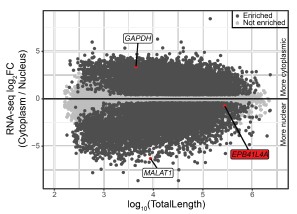
      (4) Annotation and termini of EPB41L4A-AS1:

      The latest Gencode v47 annotations imply an overlap of the sense and antisense, different from that shown in Figure 1C. The 3' UTR of EPB41L4A is shown to extensively overlap EPB41L4A-AS1. This could shed light on the apparent regulation of the former by the latter that is relevant for this paper. I'd suggest that the authors update their figure of the EPB41L4A-AS1 locus organisation with much more detail, particularly evidence for the true polyA site of both genes. What is more, the authors might consider performing RACE experiments for both RNAs in their cells to definitely establish whether these transcripts contain complementary sequence that could cause their Watson-Crick hybridisation, or whether their two genes might interfere with each other via some kind of polymerase collision.

      We thank the reviewer for pointing this out. Also in previous GENCODE annotations, multiple isoforms were reported with some overlapping the 3’ UTR of EPB41L4A. In the EPB41L4A-AS1 locus image (Fig. 1C), we report at the bottom the different transcripts isoforms currently annotated, and a schematics of the one that is clearly the most abundant in MCF-7 cells based on RNA-seq read coverage. This is supported by both the polyA(+) and ribo(-) RNA-seq data, which are strand-specific, as shown in the figure.

      We now also examined the ENCODE/CSHL MCF-7 RNA-seq data from whole cell, cytoplasm and nucleus fractions, as well as 3P-seq data (Jan et al., 2011) (unpublished data from human cell lines), reported in Author response image 2. All these data support the predominant use of the proximal polyA site in human cell lines. This shorter isoform does not overlap EPB41L4A.

      Author response image 2.

      Most EPB41L4A-AS1 transcripts end before the 3’ end of EPB41L4A. UCSC genome browser view showing tracks from 3P-seq data in different cell lines and neural crest (top, with numbers representing the read counts, i.e. how many times that 3’ end has been detected), and stranded ENCODE subcellular RNA-seq (bottom).
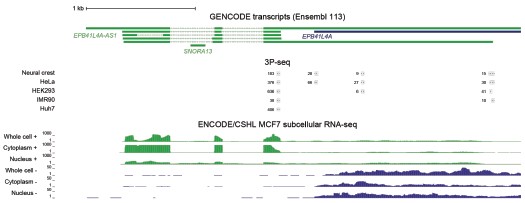
      Based on these data, the large majority of cellular transcripts of EPB41L4A-AS1 terminate at the earlier polyA site and don’t overlap with EPB41L4A. There is a small fraction that appears to be restricted to the nucleus that terminates later at the annotated isoform. 3' RACE experiments are not expected to provide substantially different information beyond what is already available.

      (5) Figure 3C:

      There is an apparent correlation between log2FC upon EPB41L4A-AS1 knockdown, and the number of clip sites for SUB1. However, I expect that the clip signal correlates strongly with the mRNA expression level, and that log2FC may also correlate with the same. Therefore, the authors would be advised to more exhaustively check that there really is a genuine relationship between log2FC and clip sites, after removing any possible confounders of overall expression level.

      As the reviewer suggested, there is a correlation between the baseline expression level and the strength of SUB1 binding in the eCLIP data. To address this issue, we built expression-matched controls for each group of SUB1 interactors and checked the fold-changes following EPB41L4A-AS1 KD, similarly to what we have done in Fig. 3C. The results are presented, and are now part of Supplementary Figure 7 (Fig. S7C). 

      Based on this analysis, while there is a tendency of increased expression with increased SUB1 binding, when controlling for expression levels the effect of down-regulation of SUB1-bound RNAs upon lncRNA knockdown remains, suggesting that it is not merely a confounding effect. We have updated the text as follows:

      “We hypothesized that loss of EPB41L4A-AS1 might affect SUB1, either via the reduction in its expression or by affecting its functions. We stratified SUB1 eCLIP targets into confidence intervals, based on the number, strength and confidence of the reported binding sites. Indeed, eCLIP targets of SUB1 (from HepG2 cells profiled by ENCODE) were significantly downregulated following EPB41L4A-AS1 KD in MCF-7, with more confident targets experiencing stronger downregulation (Fig. 3C). Importantly, this still holds true when controlling for gene expression levels (Fig. S7C), suggesting that this negative trend is not due to differences in their baseline expression.”

      (6) The relation to cancer seems somewhat contradictory, maybe I'm missing something. Could the authors more clearly state which evidence is consistent with either an Oncogene or a Tumour Suppressive function, and discuss this briefly in the Discussion? It is not a problem if the data are contradictory, however, it should be discussed more clearly.

      We acknowledge this apparent contradiction. Cancer cells are characterized by a multitude of hallmarks depending on the cancer type and stage, including high proliferation rates and enhanced invasive capabilities. The notion that cells with reduced EPB41L4A-AS1 levels exhibit lower proliferation, yet increased invasion is compatible with a function as an oncogene. Cells undergoing EMT may reduce or even completely halt proliferation/cell division, until they revert back to an epithelial state (Brabletz et al., 2018; Dongre & Weinberg, 2019). Notably, downregulated genes following EPB41L4A-AS1 KD are enriched in GO terms related to cell proliferation and cell cycle progression (Fig. 2I), whereas those upregulated are enriched for terms linked to EMT processes. Thus, while we cannot rule out a potential function as tumor suppressor gene, our data fit better the notion that EPB41L4A-AS1 promotes invasion, and thus, primarily functions as an oncogene. We now address this in point in the discussion:

      “The notion that cells with reduced EPB41L4A-AS1 levels exhibit lower proliferation (Fig. 8C), yet increased invasion (Fig. 8A and 8B) is compatible with a function as an oncogene by promoting EMT (Fig. 8D and 8E). Cells undergoing this process may reduce or even completely halt proliferation/cell division, until they revert back to an epithelial state (Brabletz et al., 2018; Dongre & Weinberg, 2019). Notably, downregulated genes following EPB41L4A-AS1 KD are enriched in GO terms related to cell proliferation and cell cycle progression (Fig. 2I), whereas those upregulated for terms linked to EMT processes. Thus, while we cannot rule out a potential function as tumor suppressor gene, our data better fits the idea that this lncRNA promotes invasion, and thus, primarily functions as an oncogene.”

      Reviewer #2 (Recommendations for the authors):

      Below are major and minor points to be addressed. We hope the authors find them useful.

      (1) Figure 1:

      Where are LNA gapmers located within the EPB41L4A-AS1 gene? Are they targeting exons or introns of the EPB41L4A-AS1? Please clarify or include in the figure.

      We now report the location of the two GapmeRs in Fig. 1C. LNA1 targets the intronic region between SNORA13 and exon 2, and LNA2 the terminal part of exon 1.

      (2) Figure 2B:

      Why is a single LNA gapmer used for EPB41L4A Western? In addition, are the qPCR data in Figure 2B the same as in Figure 1B? Please clarify.

      The Western Blot was performed after transfecting the cells with either LNA1 or LNA2. We now have replaced Fig. 2C with the full Western Blot image, in order to show both LNAs. With respect to the qPCRs in Fig. 1B and 2B, they represent the results from two independent experiments.

      (3) Figure 2F:

      2364 DEGs for a single LNA is a lot of deregulated genes in RNA-seq data. How do the authors explain such a big number in DEGs? Is that because this LNA was intronic? Additional LNA gapmer would minimise the "real" lncRNA target and any potential off-target effect.

      We agree with the Reviewer that GapmeRs are prone to off-target and unwanted effects (Lai et al.,2020; Lee & Mendell, 2020; Maranon & Wilusz, 2020). Early in our experiments, we found out that LNA1 triggers a non-specific CDKN1A/p21 activation (Fig. S5A-C), and thus, we have initially performed some experiments such as RNA-seq with only LNA2.

      Nonetheless, other experiments were performed using both GapmeRs, such as multiple RT-qPCRs, UMI-4C, SUB1 and NPM1 imaging, and the in vitro assays, among others, and consistent results were obtained with both LNAs.

      To accommodate the request by this and the other reviewers, we have now performed another round of polyA+ RNA-seq following EPB41L4A-AS1 knockdown using LNA1 or LNA2, as well as the previously used and an additional control GapmeR. The FPKMs of the control samples are highly-correlated both within replicates and between GapmeRs (Fig. S6A). More importantly, the fold-changes to control are highly correlated between the two on-target GapmeRs LNA1 and LNA2, regardless of the GapmeR used for normalization (Fig. S6B), thus showing that despite significant GapmeR-specific effects, the bulk of the response is shared and likely the direct result of the reduction in the levels of EPB41L4A-AS1. Notably, key targets NPM1 and MTREX (see discussion, Fig. S12A-C and comments to Reviewer 3) were found to be downregulated by both LNAs (Fig. S6C).

      However, we acknowledge that some of the dysregulated genes are observed only when using one GapmeR and not the other, likely due to a combination of indirect, secondary and non-specific effects, and as such it is difficult to infer the direct response. Supporting this, LNA2 yielded a total of 1,069 DEGs (617 up and 452 down) and LNA1 2,493 DEGs (1,328 up and 1,287 down), with the latter triggering a stronger response most likely as a result of the previously mentioned CDKN1A/p21 induction. Overall, 45.1% of the upregulated genes following LNA2 transfection were shared with LNA1, in contrast to only the 24.3% of the downregulated ones.

      We have now included these results in the Results section (see below) and in Supplementary Figure (Fig. S6).

      “Most of the consequences of the depletion of EPB41L4A-AS1 are thus not directly explained by changes in EPB41L4A levels. An additional trans-acting function for EPB41L4A-AS1 would therefore be consistent with its high expression levels compared to most lncRNAs detected in MCF-7 (Fig. S5G). To strengthen these findings, we have transfected MCF-7 cells with LNA1 and a second control GapmeR (NT2), as well as the previous one (NT1) and LNA2, and sequenced the polyadenylated RNA fraction as before. Notably, the expression levels (in FPKMs) of the replicates of both control samples are highly correlated with each other (Fig. S6A), and the global transcriptomic changes triggered by the two EPB41L4A-AS1-targeting LNAs are largely concordant (Fig. S6B and S6C). Because of this concordance and the cleaner (i.e., no CDKN1A upregulation) readout in LNA2-transfected cells, we focused mainly on these cells for subsequent analyses.”

      (4) Figure 3B: Does downregulation of SUB1 and NPM1 reflect at the protein level with both LNA gapmers? The authors should show a heatmap and metagene profile for SUB1 CUT & RUN. How did the author know that SUB1 binding is specific, since CUT & RUN was not performed in SUB1-depleted cells?

      As requested by both Reviewer #2 and #3, we have performed WB for SUB1, NPM1 and FBL following EPB41L4A-AS1 KD with two targeting (LNA1 and LNA2) and the previous control GapmeRs. Interestingly, we did not detect any significant downregulation of either proteins (Author response image 3), although this might be the result of the high variability observed in the control samples. Moreover, the short timeframe in which the experiments have been conducted━that is, transient transfections for 3 days━might not be sufficient time for the existing proteins to be degraded, and thus, the downregulation is more evident at the RNA (Fig. 3B and Supplementary Figure 6C) rather than protein level.

      Author response image 3.

      EPB41L4A-AS1 KD has only marginal effects on the levels of nucleolar proteins. (A) Western Blots for the indicated proteins after the transfection for 3 days of the control and targeting GapmeRs. (B) Quantification of the protein levels from (A).  All experiments were performed in n=3 biological replicates, with the error bars in the barplots representing the standard deviation. ns - P>0.05; * - P<0.05; ** - P<0.01; *** - P<0.001 (two-sided Student’s t-test).
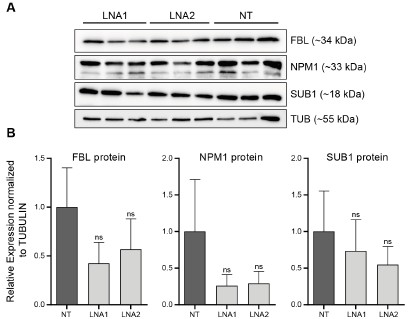
      Following the suggestion by the Reviewer, we now show both the SUB1 CUT&RUN metagene profile (previously available as Fig. 3F) and the heatmap (now Fig. 3G) around the TSS of all genes, stratified by their expression level. Both graphs are reported.

      We show that the antibody signal is responsive to SUB1 depletion via siRNAs in both WB (Fig. S8F) and IF (Fig. 5E) experiments. As mentioned below, this and the absence of non-specific signals makes us confident in the CUT&RUN data. Performing CUT&RUN in SUB1 depleted cells would be difficult to interpret as perturbations are typically not complete, and so the remaining protein can still bind the same regions. Since there isn’t a clear way to add spike-ins to CUT&RUN experiments, it is very difficult to show specificity of binding by CUT&RUN in siRNA-knockdown cells.

      (5) Figure 3D: The MW for the depicted proteins are lacking. Why is there no SUB1 protein in the input? Please clarify. Since the authors used siRNA to deplete SUB1, it would be good to know if the antibody is specific in their CUT & RUN (see above)

      We apologize for the lack of the MW in Fig. 3D. As shown in Fig. S8F, SUB1 is ~18 kDa and the antibody signal is responsive to SUB1 depletion via siRNAs in both WB (Fig. S8F) and IF (Fig. 5E) experiments. Thus, given its 1) established specificity in those two settings and 2) the lack of generalized signal at most open chromatin regions, which is typical of nonspecific CUT&RUN experiments, we are confident in the specificity of the CUT&RUN results.

      We now mention the MW of SUB1 in Fig. 3D as well and we provide in Author response image 4 the full SUB1 WB picture, enhancing the contrast to highlight the bands. We agree that the SUB1 band in the input is weak, likely reflecting the low abundance in that fraction and the detection difficulty due to its low MW (see Fig. S8F).

      Author response image 4.

      Western blot for SUB1 following RIP using either a SUB1 or IgG antibody. IN - input, SN - supernatant/unbound, B - bound.
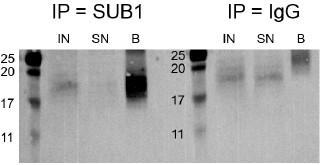
      (6) Supplementary Figure 6C:

      The validation of lncRNA EPB41L4A-AS1 binding to SUB1 should be confirmed by CLIP qPCR, since native RIP can lead to reassociation of RNA-protein interactions (PMID: 15388877). Additionally, the eclip data presented in Figure 3a were from a different cell line and not MCF7.

      We acknowledge that the SUB1 eCLIP data was generated in a different cell line, as we mentioned in the text:

      “Indeed, eCLIP targets of SUB1 (from HepG2 cells profiled by ENCODE) were significantly downregulated following EPB41L4A-AS1 KD in MCF-7, with more confident targets experiencing stronger downregulation (Fig. 3C). Importantly, this still holds true when controlling for gene expression levels (Fig. S7C), suggesting that this negative trend is not due to differences in their baseline expression. To obtain SUB1-associated transcripts in MCF-7 cells; we performed a native RNA immunoprecipitation followed by sequencing of polyA+ RNAs (RIP-seq) (Fig. 3D, S7D and S7E).”

      Because of this, we resorted to native RIP, in order to get binding information in our experimental system. As we show independent evidence for binding using both eCLIP and RIP, and the substantial challenge in establishing the CLIP method, which has not been successfully used in our group, we respectfully argue that further validations are out of scope of this study. We nonetheless agree that several genes which are nominally significantly enriched in our RIP data are likely not direct targets of SUB1, especially given that it is difficult to assign the perfect threshold that discriminates between bound and unbound RNAs.

      We now additionally mention this at the beginning of the paragraph as well:

      “In order to identify potential factors that might be associated with EPB41L4A-AS1, we inspected protein-RNA binding data from the ENCODE eCLIP dataset(Van Nostrand et al., 2020). The exons of the EPB41L4A-AS1 lncRNA were densely and strongly bound by SUB1 (also known as PC4) in both HepG2 and K562 cells (Fig. 3A).”

      (7) Figure 3G:

      Can the authors distinguish whether loss of EPB41L4A-AS1 affects SUB1 chromatin binding or its activity as RBP? Please discuss.

      Distinguishing between altered SUB1 chromatin and RNA binding is challenging, as this protein likely does not interact directly with chromatin and exhibits rather promiscuous RNA binding properties (Ray et al., 2023). In particular, SUB1 (also known as PC4) interacts with and regulates the activity of all three RNA polymerases, and was reported to be involved in transcription initiation and elongation, response to DNA damage, chromatin condensation (Conesa & Acker, 2010; Das et al., 2006; Garavís & Calvo, 2017; Hou et al., 2022) and telomere maintenance (Dubois et al., 2025; Salgado et al., 2024).

      Based on our data, genes whose promoters are occupied by SUB1 display marginal, yet highly significant changes in their steady-state expression levels upon lncRNA perturbations. We also show that upon EPB41L4A-AS1 KD, SUB1 acquires a stronger nucleolar localization (Fig. 5A), which likely affects its RNA interactome as well. However, further elucidating these activities would require performing RIP-seq and CUT&RUN in lncRNA-depleted cells, which we argue is out of the scope of the current study. We note that  KD of SUB1 with siRNAs have milder effects than that of EPB41L4A-AS1 (Fig. S8G), suggesting that additional players and effects shape the observed changes. Therefore, it is highly likely that the loss of this lncRNA affects both SUB1 chromatin binding profile and RNA binding activity, with the latter likely resulting in the increased snoRNAs abundance.

      (8) Figure 4: Can the authors show that a specific class of snorna is affected upon depletion of SUB1 and EPB41L4A-AS1? Can they further classify the effect of their depletion on H/ACA box snoRNAs, C/D box snoRNAs, and scaRNAs?

      Such potential distinct effect on the different classes of snoRNAs was considered, and the results are available in Fig. S8B and S8H (boxplots, after EPB41L4A-AS1 and SUB1 depletion), as well as Fig. 4F and S9F (scatterplots between EPB41L4A-AS1 and SUB1 depletion, and EPB41L4A-AS1 and GAS5 depletion, respectively). We see no preferential effect on one group of snoRNAs or the other.

      (9) Figure 5: From the representative images, it looks to me that LNA 2 targeting EPB41L4A-AS1 has a bigger effect on nucleolar staining of SUB1. To claim that EPB41L4A-AS1 depletion "shifts SUB1 to a stronger nucleolar distribution", the authors need to perform IF staining for SUB1 and Fibrillarin, a known nucleolar marker. Also, how does this data fit with their qPCR data shown in Figure 3B? It is instrumental for the authors to demonstrate by IF or Western blotting that SUB1 levels decrease in one fraction and increase specifically in the nucleolus. They could perform Western blot for SUB1 and Fibrillarin in EPB41L4A-AS1-depleted cells and isolate cytoplasmic, nuclear, and nucleolar fractions.This experiment will strengthen their finding. The scale bar is missing for all the images in Figure 5. The authors should also show magnified images of a single representative cell at 100x.

      We apologize for the confusion regarding the scale bars. As mentioned here and elsewhere, the scale bars are present in the top-left image of each panel only, in order to avoid overcrowding the panel. All the images are already at 100X, with the exception of Fig. 5E (IF for SUB1 upon siSUB1 transfection) which is 60X in order to better show the lack of signal. We however acknowledge that the images are sometimes confusing, due to the PNG features once imported into the document. In any case, in the submission we have also provided the original images in high-quality PDF and .ai formats.  The suggested experiment would require establishing a nucleolar fractionation protocol which we currently don’t have available and we argue that it is out of scope of the current study.

      (10) Additionally, is rRNA synthesis affected in SUB1- and EPB41L4A-AS1-depleted cells? The authors could quantify newly synthesised rRNA levels in the nucleoli, which would also strengthen their findings about the role of this lncRNA in nucleolar biology.

      We acknowledge that there are many aspects of the role of EPB41L4A-AS1 in nucleolar biology that remain to be explored, as well as in nucleolar biology itself, but given the extensive experimental data we already provide in this and other subjects, we respectfully suggest that this experiment is out of scope of the current work. We note that a recent study has shown that SUB1 is required for Pol I-mediated rDNA transcription in the nucleolus (Kaypee et al., 2025). In the presence of nucleolar SUB1, rDNA transcription proceeds as expected, but when SUB1 is depleted or its nucleolar localization is affected—by either sodium butyrate treatment or inhibition of KAT5-mediated phosphorylation at its lysine 35 (K35)—the levels of the 47S pre-rRNA are significantly reduced. In our settings, SUB1 enriches into the nucleolus following EPB41L4A-AS1 KD; thus, we might expect to see a slightly increased rDNA transcription or no effect at all, given that SUB1 localizes in the nucleolus in baseline conditions as well. We now mention this novel role of SUB1 both in the results and discussion.

      “SUB1 interacts with all three RNA polymerases and was reported to be involved in transcription initiation and elongation, response to DNA damage, chromatin condensation(Conesa & Acker, 2010; Das et al., 2006; Garavís & Calvo, 2017; Hou et al., 2022), telomere maintenance(Dubois et al., 2025; Salgado et al., 2024) and rDNA transcription(Kaypee et al., 2025). SUB1 normally localizes throughout the nucleus in various cell lines, yet staining experiments show a moderate enrichment for the nucleolus (source: Human Protein Atlas; https://www.proteinatlas.org/ENSG00000113387-SUB1/subcellular)(Kaypee et al., 2025).”

      “Several features of the response to EPB41L4A-AS1 resemble nucleolar stress, including altered distribution of NPM1(Potapova et al., 2023; Yang et al., 2016). SUB1 was shown to be involved in many nuclear processes, including transcription(Conesa & Acker, 2010), DNA damage response(Mortusewicz et al., 2008; Yu et al., 2016), telomere maintenance(Dubois et al., 2025), and nucleolar processes including rRNA biogenesis(Kaypee et al., 2025; Tafforeau et al., 2013). Our results suggest a complex and multi-faceted relationship between EPB41L4A-AS1 and SUB1, as SUB1 mRNA levels are reduced by the transient (72 hours) KD of the lncRNA (Fig. 3B), the distribution of the protein in the nucleus is altered (Fig. 5A and 5C), while the protein itself is the most prominent binder of the mature EPB41L4A-AS1 in ENCODE eCLIP data (Fig. 3A). The most striking connection between EPB41L4A-AS1 and SUB1 is the similar phenotype triggered by their loss (Fig. 4). We note that a recent study has shown that SUB1 is required for Pol I-mediated rDNA transcription in the nucleolus(Kaypee et al., 2025). In the presence of nucleolar SUB1, rDNA transcription proceeds as expected, but when SUB1 is depleted or its nucleolar localization is affected—by either sodium butyrate treatment or inhibition of KAT5-mediated phosphorylation at its lysine 35 (K35)—the levels of the 47S pre-rRNA are significantly reduced. In our settings, SUB1 enriches into the nucleolus following EPB41L4A-AS1 KD; thus, we might expect to see a slightly increased rDNA transcription or no effect at all, given that SUB1 localizes in the nucleolus in baseline conditions as well. It is however difficult to determine which of the connections between these two genes is the most functionally relevant and which may be indirect and/or feedback interactions. For example, it is possible that EPB41L4A-AS1 primarily acts as a transcriptional regulator of SUB1 mRNA, or that its RNA product is required for proper stability and/or localization of the SUB1 protein, or that EPB41L4A-AS1 acts as a scaffold for the formation of protein-protein interactions of SUB1.”

      (11) Figure 8: The scratch assay alone cannot be used as a measure of increased invasion, and this phenotype must be confirmed with a transwell invasion or migration assay. Thus, I highly recommend that the authors conduct this experiment using the Boyden chamber. Do the authors see upregulation of N-cadherin, Vimentin, and downregulation of E-cadherin in their RNA-seq?

      We agree with the reviewer that those phenotypes are complex and normally require multiple in vitro, as well as in vivo assays to be thoroughly characterized. However, we respectfully consider those as out of scope of the current work, which is more focused on RNA biology and the molecular characterization and functions of EPB41L4A-AS1.

      Nevertheless, in Fig. 8D we show that the canonical EMT signature (taken from MSigDB) is upregulated in cells with reduced expression of EPB41L4A-AS1. Notably, EMT has been found to not possess an unique gene expression program, but it rather involves distinct and partially overlapping gene signatures (Youssef et al., 2024). In Fig. 8D, the most upregulated gene is TIMP3, a matrix metallopeptidase inhibitor linked to a particular EMT signature that is less invasive and more profibrotic (EMT-T2, (Youssef et al., 2024)). Interestingly, we observed a strong upregulation of other genes linked to EMT-T2, such as TIMP1, FOSB, SOX9, JUNB, JUN and KLF4, whereas MPP genes (linked to EMT-T1, which is highly proteolytic and invasive) are generally downregulated or not expressed. With regards to N- and E-cadherin, the first does not pass our cutoff to be considered expressed, and the latter is not significantly changing. Vimentin is also not significantly dysregulated. All these examples are reported, which were added as Fig. 8E:

      The text has also been updated accordingly:

      “These findings suggest that proper EPB41L4A-AS1 expression is required for cellular proliferation, whereas its deficiency results in the onset of more aggressive and migratory behavior, likely linked to the increase of the gene signature of epithelial to mesenchymal transition (EMT) (Fig. 8D). Because EMT is not characterized by a unique gene expression program and rather involves distinct and partially overlapping gene signatures (Youssef et al., 2024), we checked the expression level of marker genes linked to different types of EMTs (Fig. 8E). The most upregulated gene in Fig. 8D is TIMP3, a matrix metallopeptidase inhibitor linked to a particular EMT signature that is less invasive and more profibrotic (EMT-T2) (Youssef et al., 2024). Interestingly, we observed a stark upregulation of other genes linked to EMT-T2, such as TIMP1, FOSB, SOX9, JUNB, JUN and KLF4, whereas MPP genes (linked to EMT-T1, which is highly proteolytic and invasive) are generally downregulated or not expressed. This suggests that the downregulation of EPB41L4A-AS1 is primarily linked to a specific EMT program (EMT-T2), and future studies aimed at uncovering the exact mechanisms and relevance will shed light upon a possible therapeutic potential of this lncRNA.”

      (12) Minor points:

      (a) What could be the explanation for why only the EPB41L4A-AS1 locus has an effect on the neighbouring gene?

      There might be multiple reasons why EPB41L4A-AS1 is able to modulate the expression of the neighboring genes. First, it is expressed from a TAD boundary exhibiting physical contacts with several genes in the two flanking TADs (Fig. 1F and 2A), placing it in the right spot to regulate their expression. Second, it is highly expressed when compared to most of the genes nearby, with transcription having been linked to the establishment and maintenance of TAD boundaries (Costea et al., 2023). Accordingly, the (partial) depletion of EPB41L4A-AS1 via GapmeRs transfection slightly reduces the contacts between the lncRNA and EPB41L4A loci (Fig. 2E and S4J), although this effect could also be determined by a premature transcription termination triggered by the GapmeRs. 

      There are a multitude of mechanisms by which lncRNAs with regulatory functions modulate the expression of one or more target genes in cis (Gil & Ulitsky, 2020), and our data do not unequivocally point to one of them. Distinguishing between these possibilities is a major challenge in the field and would be difficult to address in the context of this one study. It could be that the processive RNA polymerases at the EPB41L4A-AS1 locus are recruited to the neighboring loci, facilitated by the close proximity in the 3D space. It could also be possible that chromatin remodeling factors are recruited by the nascent RNA, and then promote and/or sustain the opening of chromatin at the target site. The latter possibility is intriguing, as this mechanism is proposed to be widespread among lncRNAs (Gil & Ulitsky, 2020; Oo et al., 2025) and we observed a significant reduction of H3K27ac levels at the EPB41L4A promoter region (Fig. 2D). Future studies combining chromatin profiling (e.g., CUT&RUN and ATAC-seq) and RNA pulldown experiments will shed light upon the exact mechanisms by which this lncRNA regulates the expression of target genes in cis and its interacting partners.

      (b) The scale bar is missing on all the images in the Supplementary Figures as well.

      The scale bars are present in the top-left figure of each panel. We acknowledge that due to the export as PNG, some figures (including those with microscopy images) display abnormal font sizes and aspect ratio. All images were created using consistent fonts, sizes and ratio, and are provided as high-quality PDF in the current submission.

      (13) Methods:

      The authors should double-check if they used sirn and LNA gapmers at 25 and 50um concentrations, as that is a huge dose. Most papers used these reagents in the range of 5-50nM maximum.

      We apologize for the typo, the text has been fixed. We performed the experiments at 25 and 50nM, respectively, as suggested by the manufacturer’s protocol.

      (14) Discussion:

      Which cell lines were used in reference 27 (Cheng et al., 2024 Cell) to study the role of SNORA13? It may be useful to include this in the discussion.

      We already mentioned the cell system in the discussion, and now we edited to include the specific cell line that was used:

      “A recent study found that SNORA13 negatively regulates ribosome biogenesis in TERT-immortalized human fibroblasts (BJ-HRAS<Sup>G12V</sup>), by decreasing the incorporation of RPL23 into the maturing 60S ribosomal subunits, eventually triggering p53-mediated cellular senescence(Cheng et al., 2024).”

      Reviewer #3 (Recommendations for the authors):

      Major comments on weaknesses:

      (1) The paper is quite disjointed:

      (a) Figures1/2 studied the cis- and potential trans target genes altered by EPB41L4A-AS1 knockdown. They also showed some data about EPB41L4A-AS1 overlaps a strong chromatin boundary.

      (b) Figures3/4/5 studied the role of SUB1 - as it is altered by EPB41L4A-AS1 knockdown - in affecting genes and snoRNAs, which may partially underlie the gene/snoRNA changes after EPB41L4A-AS1 knockdown.

      (c) Figure 6 showed that EPB41L4A-AS1 knockdown did not directly affect SNORA13, the snoRNA located in the intron of EPB41L4A-AS1. Thus, the upregulation of many snoRNAs is not due to SNORA13.

      (d) Figure 7 studied whether the changes of cis genes or snoRNAs are due to transcriptional stability.

      (e) Figure 8 studied cellular phenotypes after EPB41L4A-AS1 knockdown.

      These points are overly spread out and this dilutes the central theme of these results, which this Reviewer considered to be on cis or trans gene regulation by this lncRNA.The title of the paper implies EPB41L4A-AS1 knockdown affected trans target genes, but the paper did not focus on studying cis or trans effects, except briefly mentioning that many genes were changed in Figure 2. The many changes of snoRNAs are suggested to be partially explained by SUB1, but SUB1 itself is affected (>50%, Figure 3B) by EPB41L4A-AS1 knockdown, so it is unclear if these are mostly secondary changes due to SUB1 reduction. Given the current content of the paper, the authors do not have sufficient evidence to support that the changes of trans genes are due to direct effects or indirect effects. And so they are encouraged to revise their title to be more on snoRNA regulation, as this area took the majority of the efforts in this paper.

      We respectfully disagree with the reviewer. We show that the effect on the proximal genes are cis-acting, as they are not rescued by exogenous expression, whereas the majority of the changes observed in the RNA-seq datasets appear to be indirect, and the snoRNA changes, that indeed might be indirect and not necessarily involve direct interaction partners of the lncRNA, such as SUB1, appear to be trans-regulated, as they can be rescued partially by exogenous expression of the lncRNA. We also show that KD of the main cis-regulated gene, EPB41L4A, results in a much milder transcriptional response, further solidifying the contribution of trans-acting effects. While we agree that the snoRNA effects are interesting, we do not consider them to be the main result, as they are accompanied by many additional changes in gene expression, and changes in the subnuclear distribution of the key nucleolar proteins, so it is difficult for us to claim that EPB41L4A-AS1 is specifically relevant to the snoRNAs rather than to the more broad nucleolar biology. Therefore, we prefer not to mention snoRNAs specifically in the title.

      (2) EPB41L4A-AS1 knockdown caused ~2,364 gene changes. This is a very large amount of change on par with some transcriptional factors. It thus needs more scrutiny. First, on Page 9, second paragraph, the authors used|log2Fold-change| >0.41 to select differential genes, which is an unusual cutoff. What is the rationale? Often |log2Fold-change| >1 is more common. How many replicates are used? To examine how many gene changes are likely direct target genes, can the authors show how many of the cist-genes that are changed by EPB41L4A-AS1 knockdown have direct chromatin contacts with EPB41L4A-AS1 in HiC data? Is there any correlation between HiC contact with their fold changes? Without a clear explanation of cis target genes as direct target genes, it is more difficult to establish whether any trans target genes are directly affected by EPB41L4A-AS1 knockdown.

      A |log<sub>2</sub>Fold-change| >0.41 equals a change of 33% or more, which together with an adjusted P < 0.05 is a threshold that has been used in the past. All RNA-seq experiments have been performed in triplicates, in line with the standards in the field. While it is possible that the EPB41L4A-AS1 establishes multiple contacts in trans—a process that has been observed in at least another lncRNA, namely Firre but involving its mature RNA product—we do believe this to be less likely that the alternative, namely that the > 2,000 DEGs are predominantly result from secondary changes rather than genes directly regulated by EPB41L4A-AS1 contacts.

      In any case, we have inspected our UMI-4C data to identify other genes exhibiting higher contact frequencies than background levels, and thus, potentially regulated in cis. To this end, we calculated the UMI-4C coverage in a 10kb window centered around the TSS of the genes located on chromosome 5, which we subsequently normalized based on the distance from EPB41L4A-AS1, in order to account for the intrinsic higher DNA recovery the closer to the target DNA sequence. However, in our UMI-4C experiment we have employed baits targeting three different genes—EPB41L4A-AS1, EPB41L4A and STARD4—and therefore such approach assumes that the lncRNA locus has the most regulatory features in this region. As expected, we detected a strong negative correlation between the normalized coverage and the distance from the EPB41L4A-AS1 locus (⍴ = -0.51, p-value < 2.2e-16), and the genes in the two neighboring TADs exhibited the strongest association with the bait region (Author response image 5). The genes that we see are down-regulated in the adjacent TADs, namely NREP, MCC and MAN2A1 (Fig. 2F) show substantially higher contacts than background with the EPB41L4A-AS1 gene, thus potentially constituting additional cis-regulated targets of this lncRNA. We note that both SUB1 and NPM1 are located on chromosome 5 as well, albeit at distances exceeding 75 and 50 Mb, respectively, and they do not exhibit any striking association with the lncRNA locus.

      Author response image 5.

      UMI-4C coverage over the TSS of the genes located on chromosome 5. (A) Correlation between the normalized UMI-4C coverage over the TSS (± 5kb) of chromosome 5 genes and the absolute distance (in megabases, Mb) from EPB41L4A-AS1. (B) Same as in (A), but with the x axis showing the relative distance from EPB41L4A-AS1. In both cases, the genes in the two flanking TADs are colored in red and their names are reported.
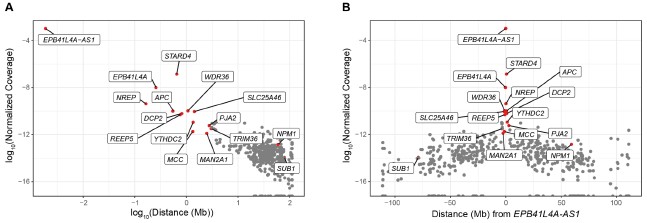
      To increase the confidence in our RNA-seq data, we have now performed another round of polyA+ RNA-seq following EPB41L4A-AS1 knockdown using LNA1 or LNA2, as well as the previously used and an additional control GapmeR. The FPKMs of the control samples are highly-correlated both within replicates and between GapmeRs (Fig. S6A). More importantly, the fold-changes to control are highly correlated between the two on-target GapmeRs LNA1 and LNA2, regardless of the GapmeR used for normalization (Fig. S6B), thus showing that despite significant GapmeR-specific effects, the bulk of the response is shared and likely the direct result of the reduction in the levels of EPB41L4A-AS1. Notably, key targets NPM1 and MTREX (see discussion, Fig. S12A-C and comments to Reviewer 3) were found to be downregulated by both LNAs (Fig. S6C).

      However, we acknowledge that some of the dysregulated genes are observed only when using one GapmeR and not the other, likely due to a combination of indirect, secondary and non-specific effects, and as such it is difficult without short time-course experiments (Much et al., 2024) to infer the direct response. Supporting this, LNA2 yielded a total of 1,069 DEGs (617 up and 452 down) and LNA1 2,493 DEGs (1,328 up and 1,287 down), with the latter triggering a stronger response most likely as a result of the previously mentioned CDKN1A/p21 induction. Overall, 45.1% of the upregulated genes following LNA2 transfection were shared with LNA1, in contrast to only the 24.3% of the downregulated ones.

      We have now included these results in the Results section (see below) and in Supplementary Figure (Fig. S6).

      “Most of the consequences of the depletion of EPB41L4A-AS1 are thus not directly explained by changes in EPB41L4A levels. An additional trans-acting function for EPB41L4A-AS1 would therefore be consistent with its high expression levels compared to most lncRNAs detected in MCF-7 (Fig. S5G). To strengthen these findings, we have transfected MCF-7 cells with LNA1 and a second control GapmeR (NT2), as well as the previous one (NT1) and LNA2, and sequenced the polyadenylated RNA fraction as before. Notably, the expression levels (in FPKMs) of the replicates of both control samples are highly correlated with each other (Fig. S6A), and the global transcriptomic changes triggered by the two EPB41L4A-AS1-targeting LNAs are largely concordant (Fig. S6B and S6C). Because of this concordance and the cleaner (i.e., no CDKN1A upregulation) readout in LNA2-transfected cells, we focused mainly on these cells for subsequent analyses.”

      Figure 3B, SUB1 mRNA is reduced >half by EPB41L4A-AS1 KD. How much did SUB1 protein reduce after EPB41L4A-AS1 KD? Similarly, how much is the NPM1 protein reduced? If these two important proteins were affected by EPB41L4A-AS1 KD simultaneously, it is important to exclude how many of the 2,364 genes that changed after EPB41L4A-AS1 KD are due to the protein changes of these two key proteins. For SUB1, Figures S7E,F,G provided some answers. But NPM1 KD is also needed to fully understand such. Related to this, there are many other proteins perhaps changed in addition to SUB1 and NPM1, this renders it concerning how many of the EPB41L4A-AS1 KD-induced changes are directly caused by this RNA. In addition to the suggested study of cist targets, the alternative mechanism needs to be fully discussed in the paper as it remains difficult to fully conclude direct versus indirect effect due to such changes of key proteins or ncRNAs (such as snoRNAs or histone mRNAs).

      As requested by both Reviewer #2 and #3, we have performed WB for SUB1, NPM1 and FBL following EPB41L4A-AS1 KD with two targeting (LNA1 and LNA2) and the previous control GapmeRs. Interestingly, we did not detect any significant downregulation of either proteins (Author response image 3), although this might be the result of the high variability observed in the control samples. Moreover, the short timeframe in which the experiments have been conducted━that is, transient transfections for 3 days━might not be sufficient time for the existing proteins to be degraded, and thus, the downregulation is more evident at the RNA (Fig. 3B and Supplementary Figure 6C) rather than protein level.

      We acknowledge that many proteins might change simultaneously, and to pinpoint which ones act upstream of the plethora of indirect changes is extremely challenging when considering such large-scale changes in gene expression. In the case of SUB1 and NPM1━which were prioritized for their predicted binding to the lncRNA (Fig. 3A)━we show that the depletion of the former affects the latter in a similar way than that of the lncRNA (Fig. 5F). Moreover, snoRNAs changes are also similarly affected (as the reviewer pointed out, Fig. 4F), suggesting that at least this phenomenon is predominantly mediated by SUB1. Other effects might also be indirect consequences of cellular responses, such as the decrease in histone mRNAs (Fig. 4A) that might reflect the decrease in cellular replication (Fig. 8C) and cell cycle genes (Fig. 2I) (although a link between SUB1 and histone mRNA expression has been described (Brzek et al., 2018)). 

      Supporting the notion that additional proteins might be involved in driving the observed phenotypes, one of the genes that most consistently was affected by EPB41L4A-AS1 KD with GapmeRs is MTREX (also known as MTR4), that becomes downregulated at both the RNA and protein levels (now presented in the main text as Supplementary Figure 12). MTREX it’s part of the NEXT and PAXT complexes (Contreras et al., 2023), that target several short-lived RNAs for degradation, and the depletion of either MTREX or other complex members leads to the upregulation of such RNAs, that include PROMPTs, uaRNAs and eRNAs, among others. Given the lack in our understanding in snoRNA biogenesis from introns in mammalian systems(Monziani & Ulitsky, 2023), it is tempting to hypothesize a role for MTREX-containing complexes in trimming and degrading those introns and release the mature snoRNAs.  

      We updated the discussion section to include these observations:

      “Beyond its site of transcription, EPB41L4A-AS1 associates with SUB1, an abundant protein linked to various functions, and these two players are required for proper distribution of various nuclear proteins. Their dysregulation results in large-scale changes in gene expression, including up-regulation of snoRNA expression, mostly through increased transcription of their hosts, and possibly through a somewhat impaired snoRNA processing and/or stability. To further hinder our efforts in discerning between these two possibilities, the exact molecular pathways involved in snoRNAs biogenesis, maturation and decay are still not completely understood. One of the genes that most consistently was affected by EPB41L4A-AS1 KD with GapmeRs is MTREX (also known as MTR4), that becomes downregulated at both the RNA and protein levels (Fig. S12A-C). Interestingly, MTREX it is part of the NEXT and PAXT complexes(Contreras et al., 2023), that target several short-lived RNAs for degradation, and the depletion of either MTREX or other complex members leads to the upregulation of such RNAs, that include PROMPTs, uaRNAs and eRNAs, among others. It is therefore tempting to hypothesize a role for MTREX-containing complexes in trimming and degrading those introns, and releasing the mature snoRNAs. Future studies specifically aimed at uncovering novel players in mammalian snoRNA biology will both conclusively elucidate whether MTREX is indeed involved in these processes.”

      With regards to the changes in gene expression between the two LNAs, we provide a more detailed answer above and to the other reviewers as well.

      (3) A Strong discrepancy of results by different approaches of knockdown or overexpression:

      (a) CRISPRa versus LNA knockdown: Figure S4 - CRISPRa of EPB41L4A-AS1 did not affect EPB41L4A expression (Figure S4B). The authors should discuss how to interpret this result. Did CRISPRa not work to increase the nuclear/chromatin portion of EPB41L4A-AS1? Did CRISPRa of EPB41L4A-AS1 affect the gene in the upstream, the STARD4? Did CRISPRa of EPB41L4A-AS1 also affect chromatin interactions between EPB41L4A-AS1 and the EPB41L4A gene? If so, this may argue that chromatin interaction is not necessary for cis-gene regulation.

      There are indeed several possible explanations, the most parsimonious is that since the lncRNA is already very highly transcribed, the relatively modest effect of additional transcription mediated by CRISPRa is not sufficient to elicit a measurable effect. For this reason, we did not check by UMI-4C the contact frequency between the lncRNA and EPB41L4A upon CRISPRa.

      CRISPRa augments transcription at target loci, and thus, the nuclear and chromatin retention of EPB41L4A-AS1 are not expected to be affected. We did not check the expression of STARD4, because we focused on EPB41L4A which appears to be the main target locus according to Hi-C (Fig. 2A), UMI-4C (Fig. 2E and S4J) and GeneHancer (Fig. S1). 

      We already provide extensive evidence of a cis-regulation of EPB41L4A-AS1 over EPB41L4A, and show that EPB41L4A is lowly-expressed and likely has a limited role in our experimental settings. Thus, we respectfully propose that an in-deep exploration of the mechanism of action of this regulatory axis is out of scope of the current study, that instead focused more on the global effects of EPB41L4A-AS1 perturbation.

      (b) Related to this, while CRISPRa alone did not show an effect, upon LNA knockdown of EPB41L4A-AS1, CRISPRa of EPB41L4A-AS1 can increase EPB41L4A expression. It is perplexing as to why, upon LNA treatment, CRISPRa will show an effect (Figure S4H)? Actually, Figures S4H and I are very confusing in the way they are currently presented. They will benefit from being separated into two panels (H into 2 and I into two). And for Ectopic expression, please show controls by empty vector versus EPB41L4A-AS1, and for CRISPRa, please show sgRNA pool versus sgRNA control.

      The results are consistent with the parsimonious assumption mentioned above that the high transcription of the lncRNA at baseline is sufficient for maximal positive regulation of EPB41L4A, and that upon KD, the reduced transcription and/or RNA levels are no longer at saturating levels, and so CRISPRa can have an effect. We now mention this interpretation in the text:

      “Levels of EPB41L4A were not affected by increased expression of EPB41L4A-AS1 from the endogenous locus by CRISPR activation (CRISPRa), nor by its exogenous expression from a plasmid (Fig. S4B and S4C). The former suggests that endogenous levels of EPB41L4A-AS1—that are far greater than those of EPB41L4A—are sufficient to sustain the maximal expression of this target gene in MCF7 cells.”

      We apologize for the confusion regarding the control used in the rescue experiments in Fig. S4H and S4I. The “-” in the Ectopic overexpression and CRISPRa correspond to the Empty Vector and sgControl, respectively, and not the absence of any vector. We changed the text in the figure legends:

      “(H) Changes in EPB41L4A-AS1 expression after rescuing EPB41L4A-AS1 with an ectopic plasmid or CRISPRa following its KD with GapmeRs. In both panels (Ectopic OE and CRISPRa) the “-” samples represent those transfected with the Empty Vector or sgControl. Asterisks indicate significance relative to the –/– control (transfected with both the control GapmeR and vector). (I) Same as in (H), but for changes in EPB41L4A expression.”

      (c) siRNA versus LNA knockdown: Figure S3A showed that siRNA KD of EPB41L4A-AS1 does not affect EPB41L4A expression. How to understand this data versus LNA?

      As explained in the text, siRNA-mediated KD presumably affects mostly the cytoplasmic pool of EPB41L4A-AS1 and not the nuclear one, which we assume explains the different effects of the two perturbations, as observed for other lncRNAs (e.g., (Ntini et al., 2018)). However, we acknowledge that we do not know what aspect of the nuclear RNA biology is relevant, let it be the nascent EPB41L4A-AS1 transcription, premature transcriptional termination or even the nuclear pool of this lncRNA, and this can be elucidated further in future studies.

      (d) EPB41L4A-AS1 OE versus LNA knockdown: Figure 6F showed that EPB41L4A-AS1 OE caused reduction of EPB41L4A mRNA, particularly at 24hr. How to interpret that both LNA KD and OE of EPB41L4A-AS1 reduce the expression of EPB41L4A mRNA?

      We do not believe that the OE of EPB41L4A-AS1, and in particular the one elicited by an ectopic plasmid affects EPB41L4A RNA levels. In the experiment in Fig. 6F, EPB41L4A relative expression at 24h is ~0.65 (please note the log<sub>2</sub> scale in the graph), which is significant as reported. However, throughout this study (and as shown in Fig. S4C for the ectopic and Fig. S4B for the CRISPRa overexpression, respectively), we observed no such behavior, suggesting that the effect reported in Fig. 6F is the result of either that particular setting, and unlikely to reflect a general phenomenon.

      (e) Did any of the effects on snoRNAs or trans target genes after EPB41L4A-AS1 knockdown still appear by CRISPRa?

      As mentioned above, we did a limited number of experiments after CRISPRa, prompted by the fact that endogenous levels of EPB41L4A-AS1 are already high enough to sustain its functions. Pushing the expression even higher will likely result in no or artifactual effects, which is why we respectfully propose such experiments are not essential in this current work, which instead mostly relies on loss-of-function experiments.

      For issue 3, extensive data repetition using all these methods may be unrealistic, but key data discrepancy needs to be fully discussed and interpreted.

      Other comments on weakness:

      (1) This manuscript will benefit from having line numbers so comments from Reviewers can be made more specifically.

      We added line numbers as suggested by the reviewer.

      (2) Figure 2G, to distinguish if any effects of EPB41L4A-AS1 come from the cytoplasmic or nuclear portion of EPB41L4A-AS1, an siRNA KD RNA-seq will help to filter out the genes affected by EPB41L4A-AS1 in the cytoplasm, as siRNA likely mainly acts in the cytoplasm.

      This experiment would be difficult to interpret as while the siRNAs mostly deplete the cytoplasmic pool of their target, they can have some effects in the nucleus as well (e.g., (Sarshad et al., 2018)) and so siRNAs knockdown will not necessarily report strictly on the cytoplasmic functions.

      (3) Figure 2H, LNA knockdown of EPB41L4A should check the protein level reduction, is it similar to the change caused by knockdown of EPB41L4A-AS1?

      As suggested by reviewer #2, we have now replaced the EPB41L4A Western Blot that now shows the results with both LNA1 and LNA2. Please note that the previous Fig. 2C was a subset of this, i.e., we have previously cropped the results obtained with LNA1. Unfortunately, we did not have sufficient antibody to check for EPB41L4A protein reduction following LNA KD of EPB41L4A in a timely manner.

      (4) There are two LNA Gapmers used by the paper to knock down EPB41L4A-AS1, but some figures used LNA1, some used LNA2, preventing a consistent interpretation of the results. For example, in Figures 2A-D, LNA2 was used. But in Figures 2E-H, LNA1 was used. How consistent are the two in changing histone H3K27ac (like in Figure 2D) versus gene expression in RNA-seq? The changes in chromatin interaction appear to be weaker by LNA2 (Figure S4J) versus LNA1 (Figure 2E).

      As explained above and in response to Reviewer #1, we now provide more RNA-seq data for LNA1 and LNA2. We note that besides the unwanted and/or off-target effects, these two GapmeRs might be not equally effective in knocking down EPB41L4A-AS1, which could explain why LNA1 seems to have a stronger effect on chromatin than LNA2. Nonetheless, when we have employed both we have obtained similar and consistent results (e.g., Fig. 5A-D and 8A-C), suggesting that these and the other effects are indeed on target effects due to EPB41L4A-AS1 depletion.

      (5) It will be helpful if the authors provide information on how long they conducted EPB41L4A-AS1 knockdown for most experiments to help discern direct or indirect effects.

      The length of all perturbations was indicated in the Methods section, and we now mention them also  in the Results. Unless specified otherwise, they were carried out for 72 hours. We agree with the reviewer that having time course experiments can have added value, but due to the extensive effort that these will require, we suggest that they are out of scope of the current study.

      (6) In Figures 1C and F, the authors showed results about EPB41L4A-AS1 overlapping a strong chromatin boundary. But these are not mentioned anymore in the later part of the paper. Does this imply any mechanism? Does EPB41L4A-AS1 knockdown or OE, or CRISPRa affect the expression of genes near the other interacting site, STARD4? Do genes located in the two adjacent TADs change more strongly as compared to other genes far away?

      We discuss this point in the Discussion section:

      “At the site of its own transcription, which overlaps a strong TAD boundary, EPB41L4A-AS1 is required to maintain expression of several adjacent genes, regulated at the level of transcription. Strikingly, the promoter of EPB41L4A-AS1 ranks in the 99.8th percentile of the strongest TAD boundaries in human H1 embryonic stem cells(Open2C et al., 2024; Salnikov et al., 2024). It features several CTCF binding sites (Fig. 2A), and in MCF-7 cells, we demonstrate that it blocks the propagation of the 4C signal between the two flanking TADSs (Fig. 1F). Future studies will help elucidate how EPB41L4A-AS1 transcription and/or the RNA product regulate this boundary. So far, we found that EPB41L4A-AS1 did not affect CTCF binding to the boundary, and while some peaks in the vicinity of EPB41L4A-AS1 were significantly affected by its loss, they did not appear to be found near genes that were dysregulated by its KD (Fig. S11C). We also found that KD of EPB41L4A-AS1—which depletes the RNA product, but may also affect the nascent RNA transcription(Lai et al., 2020; Lee & Mendell, 2020)—reduces the spatial contacts between the TAD boundary and the EPB41L4A promoter (Fig. 2E). Further elucidation of the exact functional entity needed for the cis-acting regulation will require detailed genetic perturbations of the locus, that are difficult to carry out in the polypoid MCF-7 cells, without affecting other functional elements of this locus or cell survival as we were unable to generate deletion clones despite several attempts.”

      As mentioned in the text (pasted below) and in Fig. 2F, most genes in the two flanking TADs become downregulated following EPB41L4A-AS1 KD. While STARD4 – which was chosen because it had spatial contacts above background with EPB41L4A-AS1 – did not reach statistical significance, others did and are highlighted. Those included NREP, which we also discuss:

      “Consistently with the RT-qPCR data, KD of EPB41L4A-AS1 reduced EPB41L4A expression, and also reduced expression of several, but not all other genes in the TADs flanking the lncRNA (Fig. 2F).Based on these data, EPB41L4A-AS1 is a significant cis-acting activator according to TransCistor (Dhaka et al., 2024) (P=0.005 using the digital mode). The cis-regulated genes reduced by EPB41L4A-AS1 KD included NREP, a gene important for brain development, whose homolog was downregulated by genetic manipulations of regions homologous to the lncRNA locus in mice(Salnikov et al., 2024). Depletion of EPB41L4A-AS1 thus affects several genes in its vicinity.”

      (7) Related to the description of SUB1 regulation of genes are DNA and RNA levels: "Of these genes, transcripts of only 56 genes were also bound by SUB1 at the RNA level, suggesting largely distinct sets of genes targeted by SUB1 at both the DNA and the RNA levels." SUB1 binding to chromatin by Cut&Run only indicates that it is close to DNA/chromatin, and this interaction with chromatin may still likely be mediated by RNAs. The authors used SUB1 binding sites in eCLIP-seq to suggest whether it acts via RNAs, but these binding sites are often from highly expressed gene mRNAs/exons. Standard analysis may not have examined low-abundance RNAs close to the gene promoters, such as promoter antisense RNAs. The authors can examine whether, for the promoters with cut&run peaks of SUB1, SUB1 eCLIP-seq shows binding to the low-abundance nascent RNAs near these promoters.

      In response to a related comment by Reviewer 1, we now show that when considering expression level–matched control genes, knockdown of EPB41L4A-AS1 still significantly affects expression of SUB1 targets over controls. The results are presented in Supplementary Figure 7 (Fig. S7C).

      Based on this analysis, while there is a tendency of increased expression with increased SUB1 binding, when controlling for expression levels the effect of down-regulation of SUB1-bound RNAs upon lncRNA knockdown remains, suggesting that it is not merely a confounding effect. We have updated the text as follows:

      “We hypothesized that loss of EPB41L4A-AS1 might affect SUB1, either via the reduction in its expression or by affecting its functions. We stratified SUB1 eCLIP targets into confidence intervals, based on the number, strength and confidence of the reported binding sites. Indeed, eCLIP targets of SUB1 (from HepG2 cells profiled by ENCODE) were significantly downregulated following. EPB41L4A-AS1 KD in MCF-7, with more confident targets experiencing stronger downregulation (Fig. 3C). Importantly, this still holds true when controlling for gene expression levels (Fig. S7C), suggesting that this negative trend is not due to differences in their baseline expression.”

      (8) Figure 8, the cellular phenotype is interesting. As EPB41L4A-AS1 is quite widely expressed, did it affect the phenotypes similarly in other breast cancer cells? MCF7 is not a particularly relevant metastasis model. Can a similar phenotype be seen in commonly used metastatic cell models such as MDA-MB-231?

      We agree that further expanding the models in which EPB41L4A-AS1 affects cellular proliferation, migration and any other relevant phenotype is of potential interest before considering targeting this lncRNA as a therapeutic approach. However, given that 1) others have already identified similar phenotypes upon the modulation of EPB41L4A-AS1 in a variety of different systems (see Results and Discussion), and 2) we were most interested in the molecular consequences following the loss of this lncRNA, we respectfully suggest that these experiments are out of scope of the current study.

      References

      Bahar Halpern, K., Caspi, I., Lemze, D., Levy, M., Landen, S., Elinav, E., Ulitsky, I., & Itzkovitz, S. (2015). Nuclear Retention of mRNA in Mammalian Tissues. Cell Reports, 13(12), 2653–2662.

      Brabletz, T., Kalluri, R., Nieto, M. A., & Weinberg, R. A. (2018). EMT in cancer. Nature Reviews. Cancer, 18(2), 128–134.

      Brzek, A., Cichocka, M., Dolata, J., Juzwa, W., Schümperli, D., & Raczynska, K. D. (2018). Positive cofactor 4 (PC4) contributes to the regulation of replication-dependent canonical histone gene expression. BMC Molecular Biology, 19(1), 9.

      Cheng, Y., Wang, S., Zhang, H., Lee, J.-S., Ni, C., Guo, J., Chen, E., Wang, S., Acharya, A., Chang, T.-C., Buszczak, M., Zhu, H., & Mendell, J. T. (2024). A non-canonical role for a small nucleolar RNA in ribosome biogenesis and senescence. Cell, 187(17), 4770–4789.e23.

      Conesa, C., & Acker, J. (2010). Sub1/PC4 a chromatin associated protein with multiple functions in transcription. RNA Biology, 7(3), 287–290.

      Contreras, X., Depierre, D., Akkawi, C., Srbic, M., Helsmoortel, M., Nogaret, M., LeHars, M., Salifou, K., Heurteau, A., Cuvier, O., & Kiernan, R. (2023). PAPγ associates with PAXT nuclear exosome to control the abundance of PROMPT ncRNAs. Nature Communications, 14(1), 6745.

      Costea, J., Schoeberl, U. E., Malzl, D., von der Linde, M., Fitz, J., Gupta, A., Makharova, M., Goloborodko, A., & Pavri, R. (2023). A de novo transcription-dependent TAD boundary underpins critical multiway interactions during antibody class switch recombination. Molecular Cell, 83(5), 681–697.e7.

      Das, C., Hizume, K., Batta, K., Kumar, B. R. P., Gadad, S. S., Ganguly, S., Lorain, S., Verreault, A., Sadhale, P. P., Takeyasu, K., & Kundu, T. K. (2006). Transcriptional coactivator PC4, a chromatin-associated protein, induces chromatin condensation. Molecular and Cellular Biology, 26(22), 8303–8315.

      Dhaka, B., Zimmerli, M., Hanhart, D., Moser, M. B., Guillen-Ramirez, H., Mishra, S., Esposito, R., Polidori, T., Widmer, M., García-Pérez, R., Julio, M. K., Pervouchine, D., Melé, M., Chouvardas, P., & Johnson, R. (2024). Functional identification of cis-regulatory long noncoding RNAs at controlled false discovery rates. Nucleic Acids Research, 52(6), 2821–2835.

      Didiot, M.-C., Ferguson, C. M., Ly, S., Coles, A. H., Smith, A. O., Bicknell, A. A., Hall, L. M., Sapp, E., Echeverria, D., Pai, A. A., DiFiglia, M., Moore, M. J., Hayward, L. J., Aronin, N., & Khvorova, A. (2018). Nuclear Localization of Huntingtin mRNA Is Specific to Cells of Neuronal Origin. Cell Reports, 24(10), 2553–2560.e5.

      Dongre, A., & Weinberg, R. A. (2019). New insights into the mechanisms of epithelial-mesenchymal transition and implications for cancer. Nature Reviews. Molecular Cell Biology, 20(2), 69–84.

      Dubois, J.-C., Bonnell, E., Filion, A., Frion, J., Zimmer, S., Riaz Khan, M., Teplitz, G. M., Casimir, L., Méthot, É., Marois, I., Idrissou, M., Jacques, P.-É., Wellinger, R. J., & Maréchal, A. (2025). The single-stranded DNA-binding factor SUB1/PC4 alleviates replication stress at telomeres and is a vulnerability of ALT cancer cells. Proceedings of the National Academy of Sciences of the United States of America, 122(2), e2419712122.

      Garavís, M., & Calvo, O. (2017). Sub1/PC4, a multifaceted factor: from transcription to genome stability. Current Genetics, 63(6), 1023–1035.

      Gil, N., & Ulitsky, I. (2020). Regulation of gene expression by cis-acting long non-coding RNAs. Nature Reviews. Genetics, 21(2), 102–117.

      Hou, Y., Gan, T., Fang, T., Zhao, Y., Luo, Q., Liu, X., Qi, L., Zhang, Y., Jia, F., Han, J., Li, S., Wang, S., & Wang, F. (2022). G-quadruplex inducer/stabilizer pyridostatin targets SUB1 to promote cytotoxicity of a transplatinum complex. Nucleic Acids Research, 50(6), 3070–3082.

      Jan, C. H., Friedman, R. C., Ruby, J. G., & Bartel, D. P. (2011). Formation, regulation and evolution of Caenorhabditis elegans 3’UTRs. Nature, 469(7328), 97–101.

      Kaypee, S., Ochiai, K., Shima, H., Matsumoto, M., Alam, M., Ikura, T., Kundu, T. K., & Igarashi, K. (2025). Positive coactivator PC4 shows dynamic nucleolar distribution required for rDNA transcription and protein synthesis. Cell Communication and Signaling : CCS, 23(1), 283.

      Lai, F., Damle, S. S., Ling, K. K., & Rigo, F. (2020). Directed RNase H Cleavage of Nascent Transcripts Causes Transcription Termination. Molecular Cell, 77(5), 1032–1043.e4.

      Lee, J.-S., & Mendell, J. T. (2020). Antisense-Mediated Transcript Knockdown Triggers Premature Transcription Termination. Molecular Cell, 77(5), 1044–1054.e3.

      Lubelsky, Y., & Ulitsky, I. (2018). Sequences enriched in Alu repeats drive nuclear localization of long RNAs in human cells. Nature, 555(7694), 107–111.

      Ly, S., Didiot, M.-C., Ferguson, C. M., Coles, A. H., Miller, R., Chase, K., Echeverria, D., Wang, F., Sadri-Vakili, G., Aronin, N., & Khvorova, A. (2022). Mutant huntingtin messenger RNA forms neuronal nuclear clusters in rodent and human brains. Brain Communications, 4(6), fcac248.

      Maranon, D. G., & Wilusz, J. (2020). Mind the Gapmer: Implications of Co-transcriptional Cleavage by Antisense Oligonucleotides. Molecular Cell, 77(5), 932–933.

      Monziani, A., & Ulitsky, I. (2023). Noncoding snoRNA host genes are a distinct subclass of long noncoding RNAs. Trends in Genetics : TIG, 39(12), 908–923.

      Mortusewicz, O., Roth, W., Li, N., Cardoso, M. C., Meisterernst, M., & Leonhardt, H. (2008). Recruitment of RNA polymerase II cofactor PC4 to DNA damage sites. The Journal of Cell Biology, 183(5), 769–776.

      Much, C., Lasda, E. L., Pereira, I. T., Vallery, T. K., Ramirez, D., Lewandowski, J. P., Dowell, R. D., Smallegan, M. J., & Rinn, J. L. (2024). The temporal dynamics of lncRNA Firre-mediated epigenetic and transcriptional regulation. Nature Communications, 15(1), 6821.

      Ntini, E., Louloupi, A., Liz, J., Muino, J. M., Marsico, A., & Ørom, U. A. V. (2018). Long ncRNA A-ROD activates its target gene DKK1 at its release from chromatin. Nature Communications, 9(1), 1636.

      Oo, J. A., Warwick, T., Pálfi, K., Lam, F., McNicoll, F., Prieto-Garcia, C., Günther, S., Cao, C., Zhou, YGavrilov, A. A., Razin, S. V., Cabrera-Orefice, A., Wittig, I., Pullamsetti, S. S., Kurian, L., Gilsbach, R., Schulz, M. H., Dikic, I., Müller-McNicoll, M., … Leisegang, M. S. (2025). Long non-coding RNAs direct the SWI/SNF complex to cell type-specific enhancers. Nature Communications, 16(1), 131.

      Open2C, Abdennur, N., Abraham, S., Fudenberg, G., Flyamer, I. M., Galitsyna, A. A., Goloborodko, A., Imakaev, M., Oksuz, B. A., Venev, S. V., & Xiao, Y. (2024). Cooltools: Enabling high-resolution Hi-C analysis in Python. PLoS Computational Biology, 20(5), e1012067.

      Potapova, T. A., Unruh, J. R., Conkright-Fincham, J., Banks, C. A. S., Florens, L., Schneider, D. A., & Gerton, J. L. (2023). Distinct states of nucleolar stress induced by anticancer drugs. https://doi.org/10.7554/eLife.88799.

      Ray, D., Laverty, K. U., Jolma, A., Nie, K., Samson, R., Pour, S. E., Tam, C. L., von Krosigk, N., Nabeel-Shah, S., Albu, M., Zheng, H., Perron, G., Lee, H., Najafabadi, H., Blencowe, B., Greenblatt, J., Morris, Q., & Hughes, T. R. (2023). RNA-binding proteins that lack canonical RNA-binding domains are rarely sequence-specific. Scientific Reports, 13(1), 5238.

      Salgado, S., Abreu, P. L., Moleirinho, B., Guedes, D. S., Larcombe, L., & Azzalin, C. M. (2024). Human PC4 supports telomere stability and viability in cells utilizing the alternative lengthening of telomeres mechanism. EMBO Reports, 25(12), 5294–5315.

      Salnikov, P., Korablev, A., Serova, I., Belokopytova, P., Yan, A., Stepanchuk, Y., Tikhomirov, S., & Fishman, V. (2024). Structural variants in the Epb41l4a locus: TAD disruption and Nrep gene misregulation as hypothetical drivers of neurodevelopmental outcomes. Scientific Reports, 14(1), 5288.

      Sarshad, A. A., Juan, A. H., Muler, A. I. C., Anastasakis, D. G., Wang, X., Genzor, P., Feng, X., Tsai, P.-F., Sun, H.-W., Haase, A. D., Sartorelli, V., & Hafner, M. (2018). Argonaute-miRNA Complexes Silence Target mRNAs in the Nucleus of Mammalian Stem Cells. Molecular Cell, 71(6), 1040–1050.e8.

      Tafforeau, L., Zorbas, C., Langhendries, J.-L., Mullineux, S.-T., Stamatopoulou, V., Mullier, R., Wacheul, L., & Lafontaine, D. L. J. (2013). The complexity of human ribosome biogenesis revealed by systematic nucleolar screening of Pre-rRNA processing factors. Molecular Cell, 51(4), 539–551.

      Unfried, J. P., & Ulitsky, I. (2022). Substoichiometric action of long noncoding RNAs. Nature Cell Biology, 24(5), 608–615.

      Van Nostrand, E. L., Freese, P., Pratt, G. A., Wang, X., Wei, X., Xiao, R., Blue, S. M., Chen, J.-Y.,Cody, N. A. L., Dominguez, D., Olson, S., Sundararaman, B., Zhan, L., Bazile, C., Bouvrette, L. P. B., Bergalet, J., Duff, M. O., Garcia, K. E., Gelboin-Burkhart, C., … Yeo, G. W. (2020). A large-scale binding and functional map of human RNA-binding proteins. Nature, 583(7818), 711–719.

      Yang, K., Wang, M., Zhao, Y., Sun, X., Yang, Y., Li, X., Zhou, A., Chu, H., Zhou, H., Xu, J., Wu, M., Yang, J., & Yi, J. (2016). A redox mechanism underlying nucleolar stress sensing by nucleophosmin. Nature Communications, 7, 13599.

      Youssef, K. K., Narwade, N., Arcas, A., Marquez-Galera, A., Jiménez-Castaño, R., Lopez-Blau, C., Fazilaty, H., García-Gutierrez, D., Cano, A., Galcerán, J., Moreno-Bueno, G., Lopez-Atalaya, J. P., & Nieto, M. A. (2024). Two distinct epithelial-to-mesenchymal transition programs control invasion and inflammation in segregated tumor cell populations. Nature Cancer, 5(11), 1660–1680.

      Yu, L., Ma, H., Ji, X., & Volkert, M. R. (2016). The Sub1 nuclear protein protects DNA from oxidative damage. Molecular and Cellular Biochemistry, 412(1-2), 165–171.
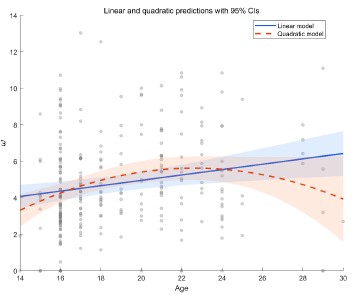
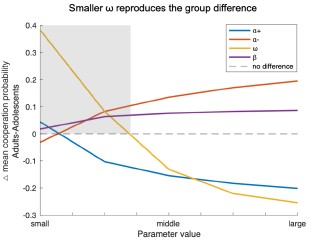
    1. AbstractBackground Large language models (LLMs) have significantly advanced natural language processing in biomedical research, however, their reliance on implicit, statistical representations often results in factual inaccuracies or hallucinations, posing significant concerns in high-stakes biomedical contexts.Results To overcome these limitations, we developed BTE-RAG, a retrieval-augmented generation framework that integrates the reasoning capabilities of advanced language models with explicit mechanistic evidence sourced from BioThings Explorer, an API federation of more than sixty authoritative biomedical knowledge sources. We systematically evaluated BTE-RAG in comparison to traditional LLM-only methods across three benchmark datasets that we created from DrugMechDB. These datasets specifically targeted gene-centric mechanisms (798 questions), metabolite effects (201 questions), and drug–biological process relationships (842 questions). On the gene-centric task, BTE-RAG increased accuracy from 51% to 75.8% for GPT-4o mini and from 69.8% to 78.6% for GPT-4o. In metabolite-focused questions, the proportion of responses with cosine similarity scores of at least 0.90 rose by 82% for GPT-4o mini and 77% for GPT-4o. While overall accuracy was consistent in the drug–biological process benchmark, the retrieval method enhanced response concordance, producing a greater than 10% increase in high-agreement answers (from 129 to 144) using GPT-4o.Conclusion Federated knowledge retrieval provides transparent improvements in accuracy for large language models, establishing BTE-RAG as a valuable and practical tool for mechanistic exploration and translational biomedical research.

      This work has been peer reviewed in GigaScience (see https://doi.org/10.1093/gigascience/giag007), which carries out open, named peer-review. These reviews are published under a CC-BY 4.0 license and were as follows:

      Reviewer 2: Sajib Acharjee Dip

      This paper introduces BTE-RAG, a system that combines large language models with biomedical knowledge from BioThings Explorer. Tested on three benchmarks built from DrugMechDB (genes, metabolites, and drug-process links), it shows clear accuracy gains compared to using LLMs alone.

      Strengths: The work demonstrates that retrieval improves both small and large models, suggesting cost-efficiency and scalability. This paper also curated multi-scale QA datasets (gene, metabolite, drug) from DrugMechDB provide structured, reproducible evaluation.

      Weaknesses: 1. This dual-route design is conceptually sound but too narrow a baseline. A stronger evaluation would compare against other RAG systems (PubMed-based retrieval, BiomedRAG, SPOKE-RAG) instead of just "LLM-only." 2. For Entity Recognition step, using pre-annotated entities in benchmarks artificially simplifies the problem. In real-world biomedical QA, entity recognition itself is a major challenge (e.g., ambiguous drug synonyms, rare disease names). Besides, the zero-shot extraction module is described but not evaluated. The paper should report precision/recall of entity recognition to show feasibility beyond curated inputs. 3. No error analysis of BTE retrieval quality is provided. If BTE returns wrong or noisy triples, how often does this mislead the LLM? Adding experiment to show that would strengthen the study. 4. Though the authors used SOTA LLMs, however, the choice of only OpenAI GPT-4o family is narrow. No comparison with open-source biomedical LLMs (e.g., BioGPT, Meditron, PubMedBERT-RAG). Comparison with these model would increase the generalizability 5. Reliance on one source (DrugMechDB) makes evaluation narrow. The authors should demonstrate performance on at least one independent dataset (e.g., BioASQ, PubMedQA, SPOKE-based tasks) to show broader utility. 6. Cosine similarity ≥0.9 is arbitrary; should provide ROC/AUC or threshold sensitivity. 7. Benchmarks enforce exactly one correct gene, metabolite, or drug per question. Real mechanisms often involve multiple parallel or interacting entities. The single-answer design hides biological complexity and creates an artificial task. 8. Ground truth relies on exact HGNC, CHEBI, or DrugBank IDs. Why the ambiguities (synonyms, deprecated IDs, overlapping terms) are filtered out rather than addressed? This may bias the dataset toward easier, cleaner cases. 9. The paper cited recent biomedical RAG systems such as BiomedRAG, GeneTuring but didn't compare with them (e.g., BiomedRAG). BioRAG (2024) is also highly relevant. These works are highly relevant baselines, showing retrieval from knowledge graphs, APIs, or literature, and including them in comparison would better position BTE-RAG within the current state of the art and highlight its unique contributions.

    2. AbstractBackground Large language models (LLMs) have significantly advanced natural language processing in biomedical research, however, their reliance on implicit, statistical representations often results in factual inaccuracies or hallucinations, posing significant concerns in high-stakes biomedical contexts.Results To overcome these limitations, we developed BTE-RAG, a retrieval-augmented generation framework that integrates the reasoning capabilities of advanced language models with explicit mechanistic evidence sourced from BioThings Explorer, an API federation of more than sixty authoritative biomedical knowledge sources. We systematically evaluated BTE-RAG in comparison to traditional LLM-only methods across three benchmark datasets that we created from DrugMechDB. These datasets specifically targeted gene-centric mechanisms (798 questions), metabolite effects (201 questions), and drug–biological process relationships (842 questions). On the gene-centric task, BTE-RAG increased accuracy from 51% to 75.8% for GPT-4o mini and from 69.8% to 78.6% for GPT-4o. In metabolite-focused questions, the proportion of responses with cosine similarity scores of at least 0.90 rose by 82% for GPT-4o mini and 77% for GPT-4o. While overall accuracy was consistent in the drug–biological process benchmark, the retrieval method enhanced response concordance, producing a greater than 10% increase in high-agreement answers (from 129 to 144) using GPT-4o.Conclusion Federated knowledge retrieval provides transparent improvements in accuracy for large language models, establishing BTE-RAG as a valuable and practical tool for mechanistic exploration and translational biomedical research.

      This work has been peer reviewed in GigaScience (see https://doi.org/10.1093/gigascience/giag007), which carries out open, named peer-review. These reviews are published under a CC-BY 4.0 license and were as follows:

      Reviewer 1: Christopher Tabone

      Dear Authors,

      Thank you for the opportunity to review "Federated Knowledge Retrieval Elevates Large Language Model Performance on Biomedical Benchmarks." The paper tackles a timely and important problem: grounding large language models in mechanistic evidence to reduce unsupported claims. It does so with a thoughtful design that layers BTE-RAG over a federation of approximately 60 biomedical APIs and evaluates three complementary DrugMechDB-derived benchmarks (gene, metabolite, drug to process). The manuscript is clearly written, the technical contribution is meaningful, and the experimental results are promising.

      Recommendation: Major revision.

      Below are concrete, actionable changes that would bring the work in line with GigaScience's standards for FAIR availability, licensing, documentation, testing, and reproducibility. Many are straightforward, but together they matter for long-term reuse and auditability.

      1) Statistical rigor: paired inference, uncertainty, variance The manuscript reports compelling descriptive gains. Because each benchmark item is answered under both conditions (LLM-only and BTE-RAG), the study is a paired design. In paired settings, descriptive plots and point estimates are not sufficient to establish that improvements exceed sampling noise or threshold tuning. Please add paired statistical evidence that quantifies: (i) whether the gains are reliable, (ii) how large they are in practical terms, and (iii) how stable they are under repeated runs or under a fully deterministic pipeline. Gene task (binary): Report McNemar's test on the existing 2×2 tables, along with 95 percent Wilson confidence intervals for each condition and a Newcombe confidence interval for the accuracy difference. Keep the flip counts in the text.

      Metabolite and drug-to-process tasks (similarity): Report paired bootstrap confidence intervals or Wilcoxon signed-rank tests on per-item similarity differences (BTE-RAG minus baseline). Include a nonparametric effect size such as Cliff's delta with its confidence interval.

      Threshold validation: Treat the greater-than-or-equal-to 0.90 "high-fidelity" threshold as a choice that should be validated. Show sensitivity across nearby cutoffs such as 0.85, 0.90, and 0.95, and add a small blinded expert adjudication (about 50 to 100 items) to confirm that the high-cosine band corresponds to acceptable correctness.

      Variance or determinism: Either document end-to-end determinism (frozen retrieval caches, fixed ordering, pinned embeddings) or run at least three replicates and report mean and standard deviation.

      These additions convert the current descriptive story into paired inference with uncertainty and effect sizes and clarify robustness around thresholding and reproducibility.

      2) Benchmark scope and generalizability All three evaluations are derived from DrugMechDB, which makes the study internally consistent but also couples the tasks to a single curation philosophy and evidence distribution. Please acknowledge this limitation explicitly in the Discussion and, ideally, add an external validation on at least one independent source to demonstrate generalizability. Options include CTD (drug-gene-process links), Reactome or GO (pathway and process grounding), DisGeNET (gene-disease associations), or a lightweight question answering set sourced outside DrugMechDB. Even a modest external set of about 100 to 200 items, evaluated with the same paired protocols and identifier-based scoring, would strengthen the claim. If full external validation is not feasible for this revision, please include robustness checks such as a date-based split, entity-family holdouts, and per-source ablations.

      3) Licensing, attribution, and persistent identifiers The project is MIT-licensed and adapts components from BaranziniLab/KG_RAG (Apache-2.0) and SuLab/DrugMechDB (CC0-1.0). To meet license obligations and align with FAIR and the Joint Declaration of Data Citation Principles, please: (i) keep Apache-licensed code under Apache with the upstream LICENSE and NOTICE files, noting any modifications; (ii) include the CC0 dedication text for any DrugMechDB artifacts and note that CC0 provides no patent grant; (iii) archive with DOIs (GigaDB preferred?) the three benchmarks, the exact evaluation caches used in the paper, and a tagged software release of the repository; (iv) license datasets under CC0 or CC BY while keeping the code MIT; (v) add a short Data and Software Availability table listing artifact, DOI or URL, license, and version or date.

      4) Error analysis and degradation cases Please add a brief failure analysis focused on where BTE-RAG reduces accuracy relative to LLM-only. At minimum, report the total number and percent of right-to-wrong flips per task and include a small set of representative cases. For each example, show the input, expected and predicted outputs, the top retrieved evidence with identifiers and timestamps, and a one-line diagnosis of the likely cause (for example normalization mismatch, retrieval coverage gap, ranking or filtering that hid relevant context, or long-context truncation). A short summary that groups the main causes into two or three buckets will make the results more interpretable and point to practical fixes.

      5) Methodological transparency: embedding and scoring models Please add two or three sentences in Methods explaining why S-PubMedBERT-MS-MARCO is used for filtering retrieved context while a BioBERT-based model is used for semantic similarity scoring, and what advantages each provides over plausible alternatives. A brief rationale will strengthen methodological transparency.

      6) Reproducibility workflow and archived caches Because BTE federates live APIs, results can drift as sources update. Please archive the exact retrieval caches used in evaluation with DOIs and minimal provenance if at all possible (query identifier, subject and object identifiers, predicate, source name and version or access date, any confidence score, and a retrieval timestamp).

      In summary, this is a promising and well-motivated study that could make a useful contribution once the statistical evidence, FAIR availability, and reproducibility pieces are tightened as outlined above. I recommend Major Revision and am happy to re-review a revised version.

    1. AbstractAdvances in spatial omics enable measurement of genes (spatial transcriptomics) and peptides, lipids, or N-glycans (mass spectrometry imaging) across thousands of locations within a tissue. While detecting spatially variable molecules is a well-studied problem, robust methods for identifying spatially varying co-expression between molecule pairs remain limited. We introduce SpaceBF, a Bayesian fused modeling framework that estimates co-expression at both local (location-specific) and global (tissue-wide) levels. SpaceBF enforces spatial smoothness via a fused horseshoe prior on the edges of a predefined spatial adjacency graph, allowing large, edge-specific differences to escape shrinkage while preserving overall structure. In extensive simulations, SpaceBF achieves higher specificity and power than commonly used methods that leverage geospatial metrics, including bivariate Moran’s I and Lee’s L. We also benchmark the proposed prior against standard alternatives, such as intrinsic conditional autoregressive (ICAR) and Matérn priors. Applied to spatial transcriptomics and proteomics datasets, SpaceBF reveals cancer-relevant molecular interactions and patterns of cell–cell communication (e.g., ligand–receptor signaling), demonstrating its utility for principled, uncertainty-aware co-expression analysis of spatial omics data.

      This work has been peer reviewed in GigaScience (see https://doi.org/10.1093/gigascience/giag006), which carries out open, named peer-review. These reviews are published under a CC-BY 4.0 license and were as follows:

      Reviewer 2: Daniel Domovic

      Dear authors,

      I read your manuscript "SpaceBF: Spatial coexpression analysis using Bayesian Fused approaches in spatial omics datasets" with interest.

      The manuscript presents SpaceBF, a Bayesian method for detecting spatial co-expression between pairs of molecules in spatial omics data. The topic is relevant since new technologies like spatial transcriptomics, mass spectrometry imaging, and multiplex immunofluorescence produce large data but current tools for co-expression are limited. The authors try to solve this gap with a new model and they also test it on real datasets. The paper is technical, but it also gives biological examples, which is helpful for readers.

      The paper has many strong points. First, the idea to use Bayesian fused horseshoe prior together with MST spatial structure is new and well explained. Second, the authors apply their method on three real datasets and they show interesting biology, for example IGF2-IGF1R relation, keratin isoform consistency, and stromal ECM peptides. Third, I appreciate that the code is open on GitHub. Also, the paper compares with other methods and deals with the common problem of variance-stabilizing transform by modeling UMI counts directly with negative binomial distribution.

      Overall, the work is clear and well organized, but there are some points where more explanation or clarification would help. In my review I give major and minor remarks that I hope will improve the paper.

      Major remarks 1. Were you worried choosing MST may oversimplify spatial relationships, since many meaningful local neighborhoods may be excluded? Would the results of SpaceBF be significantly different if a different spatial graph, such as kNN, Delaunay triangulation, or kernel-based, was used instead of MST? 2. Since MST edges depend a lot on pairwise L2 distances, how stable are the results if spatial coordinates are a little noisy, or if there are tissue registration errors? 3. The model puts one molecule as outcome and the other as predictor. Are the co-expression estimates still the same if you switch roles? 4. In the Results you mention "FDR < 0.1." Can you explain which method you used for FDR? Also, are the discoveries robust if you change the threshold (for example 0.05 vs 0.1)? 5. Do the simulation parameters (lengthscale, slope, dispersion) correspond to realistic biological signal strengths and spatial scales observed in real datasets? Three values of the lengthscale l are considered, l = 3.6, 7.2, 18. Why exactly these values? What does ν=0.75 mean in terms of effect size? How does l=18 compare to real tissue lengthscales? 6. Can you describe runtime and memory for larger datasets, like 10X Visium with 5,000-20,000 spots? Is the current MCMC practical for this scale, or do you think approximate inference (like variational Bayes or INLA) is needed?

      Minor remark 1. How sensitive are the results to the choice of hyperparameters for the Horseshoe prior? 2. In the Results you state that keratins "co-express highly, meaning their binding patterns with any specific type 1 keratin should be similar." Please make clear that SpaceBF measures co-expression, not direct binding, so that conclusions are not overstated. 3. You mention SpatialCorr and Copulacci, but the comparison was not successful. Even if parameters were sensitive, I think one short numerical comparison in the supplement would be helpful. 4. You filter out genes with fewer than ~59 total reads (0.2 x number of spots). Can you justify the choice of this threshold and show if results are stable for other thresholds (for example 0.1x or 0.5x)? Since many ligands and receptors are lowly expressed, is there a risk of losing meaningful biology? Since the dataset has only 293 spots, thresholds can have strong effect.

    2. AbstractAdvances in spatial omics enable measurement of genes (spatial transcriptomics) and peptides, lipids, or N-glycans (mass spectrometry imaging) across thousands of locations within a tissue. While detecting spatially variable molecules is a well-studied problem, robust methods for identifying spatially varying co-expression between molecule pairs remain limited. We introduce SpaceBF, a Bayesian fused modeling framework that estimates co-expression at both local (location-specific) and global (tissue-wide) levels. SpaceBF enforces spatial smoothness via a fused horseshoe prior on the edges of a predefined spatial adjacency graph, allowing large, edge-specific differences to escape shrinkage while preserving overall structure. In extensive simulations, SpaceBF achieves higher specificity and power than commonly used methods that leverage geospatial metrics, including bivariate Moran’s I and Lee’s L. We also benchmark the proposed prior against standard alternatives, such as intrinsic conditional autoregressive (ICAR) and Matérn priors. Applied to spatial transcriptomics and proteomics datasets, SpaceBF reveals cancer-relevant molecular interactions and patterns of cell–cell communication (e.g., ligand–receptor signaling), demonstrating its utility for principled, uncertainty-aware co-expression analysis of spatial omics data.

      This work has been peer reviewed in GigaScience (see https://doi.org/10.1093/gigascience/giag006), which carries out open, named peer-review. These reviews are published under a CC-BY 4.0 license and were as follows:

      Reviewer 1: Satwik Acharyya

      Summary: The manuscript introduces a novel statistical framework for analyzing spa- tially varying molecular co-expression. Leveraging a Bayesian fused modeling approach, SpaceBF estimates both local (location-specific) and global (tissue-wide) co-expression pat- terns, particularly useful for studying cell-cell communication via ligand-receptor interac- tions. The method outperforms traditional geospatial metrics like bivariate Moran's I and Lee's L in terms of specificity and precision. Application of SpaceBF to spatial omics data reveals new insights into molecular interactions across various cancer types, offering a pow- erful tool for spatial omics research. The paper is nicely written, well structured, and great visualizations but I have the following comments.

      1. The authors missed a couple of key references related to co-expression analysis of spatial omics data such as JOBS (Chakrabarti et al., 2024) and SpaceX (Acharyya et al., 2022). The authors are recommended to include these references in the Introduction Section.
      2. A method related figure can be included for visual illustration of the method.
      3. In Melanoma ST data analysis, authors have used the RCTD algorithm (Cable et al., 2022) for cell-type estimation. It seems like the gene expression matrix has been used twice in the whole process: once in case of cell-type estimation and co-expression analysis afterwards. The obtained results can be highly correlated due to multiple uses of the gene expression matrix. It would be great if authors can address this issue.
      4. In the cSCC ST data analysis, BayesSpace (Zhao et al., 2021) algorithm has been used for spatial region identification. In Figure 2C, cluster numbers are provided only and those are not transferred to spatial regions. It is difficult to make spatial region specific inference without such regional annotation of clusters. The gene expression matrix is used multiple times in this case as well (spatial region identification and co-expression analysis).
      5. The spatial omcis datasets are sparse in nature. It possible that some these edges may not exist if the molecules are far apart. Authors are requested to justify the use shrinkage prior such as horseshoe rather than spike-and-slab prior.
      6. While the authors briefly mention about the associated computational costs, it is recommended to include a comparison of the computational costs for different approaches in the simulation studies. This would provide a more comprehensive understanding of the proposed method's efficiency and feasibility. It will be also interesting to see the scalability of the method for large scale datasets.
      7. To ensure the robustness of the proposed methodology, it is requested that the authors include a detailed sensitivity analysis for the selected priors and parameters.
    1. Reviewer #1 (Public review):

      Summary:

      The manuscript by Seraj et al. introduces a transformative structural biology methodology termed "in extracto cryo-EM." This approach circumvents the traditional, often destructive, purification processes by performing single-particle cryo-EM directly on crude cellular lysates. By utilizing high-resolution 2D template matching (2DTM), the authors localize ribosomal particles within a complex molecular "crowd," achieving near-atomic resolution (~2.2 Å). The biological centerpiece of the study is the characterization of the mammalian translational apparatus under varying physiological states. The authors identify elongation factor 2 (eEF2) as a nearly universal hibernation factor, remarkably present not only on non-translating 80S ribosomes but also on 60S subunits. The study provides a detailed structural atlas of how eEF2, alongside factors like SERBP1, LARP1, and IFRD2, protects the ribosome's most sensitive functional centers (the PTC, DC, and SRL) during cellular stress.

      Strengths:

      The "in extracto" approach is a significant leap forward. It offers the high resolution typically reserved for purified samples while maintaining the "molecular context" found in in situ studies. This addresses a major bottleneck in structural biology: the loss of transiently bound or labile factors during biochemical purification.

      The finding that eEF2 binds and sequesters 60S subunits is a major biological insight. This suggests a "pre-assembly" hibernation state that allows for rapid mobilization of the translation machinery once stress is relieved, which was previously uncharacterized in mammalian cells.

      The authors successfully captured eIF5A and various hibernation factors in states that are traditionally disrupted. The identification of eIF5A across nearly all translating and non-translating states highlights the power of this method to detect ubiquitous but weakly bound regulators.

      The manuscript beautifully illustrates the "shielding" mechanism of the ribosome. By mapping the binding sites of eEF2 and its co-factors, the authors provide a clear chemical basis for how the cell prevents nucleolytic cleavage of ribosomal RNA during nutrient deprivation.

      Weaknesses:

      While 2DTM is a powerful search tool, it inherently relies on a known structural "template." There is a risk that this methodology may be "blind" to highly divergent or novel macromolecular complexes that do not share sufficient structural similarity with the search model. The authors should discuss the limitations of using a vacant 60S/80S template in identifying highly remodeled stress-induced complexes. For instance, what happens if an empty 40S subunit is used as a template? In the current work, while 60S and 80S particles are picked, none are 40S. The authors should comment on this.

      In the GTPase center, the authors identify density for "DRG-like" proteins. However, due to limited local resolution in that specific region, they are unable to definitively distinguish between DRG1 and DRG2. While the structural similarity is high, the functional implications differ, and the identification remains somewhat speculative. The authors should acknowledge this in the text.

      While "in extracto" is superior to purified SPA, the act of cell lysis (even rapid permeabilization) still involves a change in the chemical environment (pH, ion concentration, and dilution of metabolites). The authors could strengthen the manuscript by discussing how post-lysis changes might affect the occupancy of factors like GTP vs. GDP states.

      The study provides excellent snapshots of stationary states (translating vs. hibernating), but the kinetic transition, specifically how the 60S-eEF2 complex is recruited back into active translation, is not well discussed. On page 13, the authors present eEF2 bound to 60S but do not mention anything regarding which nucleotide is bound to the factor. It only becomes clear that it is GDP after looking at Figure S9. This should be clarified in the text. Similarly, the observations that eEF2 is bound to GDP in the 60S and 80S raise questions as to how the factor dissociates from the ribosome. This could also be discussed.

      Overall Assessment:

      The work reported in this manuscript likely represents the future of structural proteomics. The combination of high-resolution structural biology with minimal sample perturbation provides a new standard for investigating the cellular machines that govern life. After addressing minor points regarding template bias, protein identification, and transition dynamics, this work may become a landmark in the field of translation.

    1. notetaking and graph databases

      non-linearly named linked notes where the links themsleves have qualifying names in a meta level graph of associative complexes that scale synthesis

      That was WikiNizer

      experimented iwth GraphDatabases but realized that enclosing graphs in a database is a fools errand

      also in 2012 it was clear that despite the practical usefulness the way to go beyond databases and programming is a problem that we need to solve

      Then IPFS was born 3 years later, learned bout it in 2016 Started working iwth it in 2018

      IPFS started to work as expected in November 2025!

      so the time for delivery is NOW

      much more important than to get up and running with a nice earner

      Roam Research demonstrates how difficult it is to sell a

      tool for writing to think

    1. With the L.L.M. “you have no divergent opinionsbeing generated,” Kosmyna said.

      This is interesting because it frames AI not just as a writing aid but as a force that subtly compresses the range of ideas people produce.

    1. 1.2. Kumail Nanjiani’s Reflections on Ethics in Tech# Image source Kumail Nanjiani was a star of the Silicon Valley TV Show, which was about the tech industry. He posted these reflections on ethics in tech on Twitter (@kumailn) on November 1, 2017: As a cast member on a show about tech, our job entails visiting tech companies/conferences etc. We meet ppl eager to show off new tech. Often we’ll see tech that is scary. I don’t mean weapons etc. I mean altering video, tech that violates privacy, stuff w obv ethical issues. And we’ll bring up our concerns to them. We are realizing that ZERO consideration seems to be given to the ethical implications of tech. They don’t even have a pat rehearsed answer. They are shocked at being asked. Which means nobody is asking those questions. “We’re not making it for that reason but the way ppl choose to use it isn’t our fault. Safeguard will develop.” But tech is moving so fast. That there is no way humanity or laws can keep up. We don’t even know how to deal with open death threats online. Only “Can we do this?” Never “should we do this? We’ve seen that same blasé attitude in how Twitter or Facebook deal w abuse/fake news. You can’t put this stuff back in the box. Once it’s out there, it’s out there. And there are no guardians. It’s terrifying. The end. Kumail Nanjiani 1.2.1. Reflection questions:# What do you think is the responsibility of tech workers to think through the ethical implications of what they are making? Why do you think the people who Kumail talked with didn’t have answers to his questions?

      I think tech workers have a responsibility to consider the ethical implications of what they create, because technology can shape behavior, privacy, and power in ways that are difficult to reverse. As Kumail Nanjiani points out, once technology is released, it cannot simply be taken back, so ethical thinking should happen before harm occurs.

      I think the people Kumail spoke with lacked answers because ethical reflection is often not prioritized in tech culture. Many developers focus on whether something can be built rather than whether it should be built, and since these questions are rarely asked, they may not be prepared to address them.

    1. But, yes, you may use AI to help (key word here) you improve your writing, vocabulary, or grammar, but you must disclose your AI use when submitting your assignments—use the notes/comments function on the submission page. I am most interested, though, in seeing/reading what YOU have to say, and the assignments in this class are designed to facilitate the communication of your individual intellect and critical thinking. Seize the opportunity to grow.

      AI is useful but we cannot copy and paste, if we use AI we must disclose such use. Our thoughts and what we have to say is what our professor is trying to see so we need to continue using our critical thinking skills.

    2. There is a reasonable amount of homework, but the assignments are here to help you develop a habit of looking, thinking, writing, and creating that should all be essential parts of your life, and in your academic and professional pursuits. In this course, you will also have the unique opportunity to evaluate your peers’ work.

      In this course we have a decent amount of homework but this comes with any course and it is apart of the learning experience. Throughout the course we are going to be able to eventually evaluate our peers' work.

    3. Annotation: 5 pts./each x 4 = 20 pts. Now It’s My Turn (NIMT): 5 pts./each x 4 = 20 pts. Quizam*: 10 pts./each x 3 : 30 pts. [*A hybrid quiz+exam = Quizam] SUPs (Show Up Points): 20 pts. Attendance is mandatory and part of your grade. Out of the 16 weeks of classes, only 20 random lectures will be designated as point-earning attendance. Must submit 2 time-stamped selfies per lecture to receive the point; no 1/2 point. See more notes below. BETs (Be Engaged Tokens): 10 pts. - Discussion section attendance is mandatory and part of your grade (a lower-division course needs 4 contact hours; the discussion section counts as 1 of the 4 required hours). You earn "tokens" (points) by attending and participating, as well as submitting in-class work and peer reviews. Total Points: 100 (A+~A- = >90 pts. / B+~B- = 89~80 pts. and so on. F = >60. No final grade curving.)

      There is only 100 points worth. Quiz/Exams are worth the most (30%) but showing up and other participation is worth up to 20% of my grade. Continue to show up to class and participate to keep a good grade in this class.

    1. If job skills are not the only or most important outcome of a college education, then what is the purpose of earning a degree?

      When learning jobs skills are not enough: What is the purpose of getting a degree? What is the purpose of learning skills do a job if it’s not enough? You need a degree and job skills to show that you have those technical skills, but you need to prove that you are a learner and be well rounded.

    2. non-traditional students who make up the rest of the student population are dealing with the opposite concerns of trying to fit school into their already established life. No matter which category they fall into, UCCS is prepared to provide the tools needed to help them persist to graduation.

      How is this program relevant to me? I am one of the students who already has an established life. This program is relevant to me because I need that help transitioning into school. I always struggled with the non traditional, online schooling but I don’t have the time to be on campus. I need those tools to navigate through school.

      What is college like? To me, college is what is going to help me get my dreams. College is going to help me succeed and teach me the olive skills I will need in the future. Not just the specific skills I will need for my career, but build my communication, problem solving and critical thinking, professional ethics, and balancing my life.

      • When Learning Job Skills Is Not Enough? "by themselves" are not enough. They are merely one aspect of the array of knowledge and abilities required to be successful in any given profession. Every employer are most interested in who the graduate has become, not just the specific set of profesional skills he or she learned.

      • An Invitation to a New Kind of Conversation What are you going to do with that major? Although my major might seem like it's just a step to a specific job, I see it as a way to grow both, personally and professional. "So much of what you do in college, such as doing research and taking general education classes or pursuing a minor and participating in student organizations, is designed to help you become a more intelligent, capable, understanding, aware, and competent person—regardless of your major" I see this in my own experience, my major is helping me develop my critical thinking, solve problems and communication skills, but also creating a more aware person. College isn't about the first job I get after graduation, it's also about who I becoming and the skills and growth I do into the path I chose.

    1. R0:

      Reviewer #1: Peer Reviewer’s report for the submission “Reaching the 100 by 2027 target for universal access to rapid diagnostic tests 2 for tuberculosis in Africa: in-sight but out of reach”

      Recommendation: Minor Revisions General Comment: This paper addresses a pertinent global health subject, a WHO priority research gap. The methods are sound and innovative. However, the authors need to improve on the clarity of the paper.

      Abstract: -The authors did a fantastic work summarizing the study with this abstract -Kindly break the abstract into the standard sections: background, methods, results, conclusion -Please clearly designate and state clearly the name of the study design used in this study. Are we an ecological study with mixed methods or what?

      Background -Great job introducing the research gap and pertinence of the research -A brief perspective on funding gaps for diagnostics might strengthen this section -Do not overestimate the knowledge of potential readers on the subject, briefly describe what WRDs are and state list them. Why are they so important?

      Methods -This section of the work is a bit to brief and doesn’t present the work in a way that can be easily reproducible by readers. Use standard sub-headers such as study design, study population, study period, data collection and data analysis for clarity. -Again, I ask what is the study design of this study? -WRD were recommended 10 years ago, what is the rationale behind the period 2021-2023? I think the key landmarks for this are 2015 for End-TB, 2018 for the first UNHLM and 2023 for the second UNHLM. -Line 98-101: How were these cutoffs decided? -Study area is completely absent. It is important to shade more light on the 24 countries. Who are they, what is the burden of TB there, any peculiarities? -Benchmarks which needed a secondary calculation following extraction need to be presented clearly, showing the variables used as denominator and numerator.

      Results -Kindly provide the exact number of cases tested for the different years, prior to providing proportions. A standalone table could resolve this. -Line 151-161, I find it hard to see trends with just 3 years data points. Probably need to increase the years if you want to discuss trends -Did the Table 2 strategies come from the TB staff or the authors? It appears it came from the authors, in which case I don’t agree with their existence in the results. At best in recommendations

      Discussions -The authors did a superb job discussing the available findings of the study -Being a study with policy implications, kindly include a sub-header for Policy implications of the findings and state them clearly -Include sub-headers for strengths and limitations and outline them clearly

      Reviewer #2: Review of Title: Reaching the 100 by 2027 target for universal access to rapid diagnostic tests for tuberculosis in Africa: in-sight but out of reach

      Summary of research and overall impression This is a well-written and researched article reporting on the availability and use of WHO-recommended rapid diagnostics for TB in African countries where there is significant burden. The authors use routinely reported data to assess access to WRDs, and a small survey of programme staff from a subset of countries to identify barriers and facilitators to the inclusion of WRDs in diagnostic algorithms. The paper makes an important contribution to the TB literature by mapping the gaps in terms of access to and usage of WRDs, which is needed to strengthen TB control efforts. There are minor comments for the authors to address to strengthen the paper.

      Methods 1. Include brief details on how/why the 24 countries included in the review were selected. 2. More details are needed to describe the process for the country stakeholder survey. For example:

      • Specify what the questionnaire consisted of, i.e., closed and open-ended questions? What topic areas/sections were included/asked about? How/by whom was the questionnaire designed/developed, using/adapting an existing framework/questionnaire?
      • How were the questionnaires sent out? Were specific people targeted? How many were sent out? What was the timeframe?
      • Provide details of how/why the 6 countries were selected – e.g., 1-2 from each region? Who inputted on these decisions? The authors mention later that these were also selected based on WRD access, which should be mentioned here in methods.

      • It is unclear under ‘statistical analysis’ if this refers to analysis of all data, or just the data review. Suggest revising to clarify analysis for data review, and analysis for the stakeholder survey. Two things to consider: 1) Provide details on the data extracted and the analysis conducted. 2) It is unclear what is meant here: “The first author used topic guides that reflected content areas such as barriers and contextual factors influencing WRD use and the themes that emerged during the review of the survey responses to manually organise the data into thematic codes.” Is this referring to the stakeholder surveys? Suggest revising for clarity on the analysis process. Were any frameworks used in analysis to categorise barriers into categories and develop mitigation strategies? This process needs to be detailed in the methods to lead into the results.

      • Please clarify/confirm the ethics of surveying country stakeholders without a consent process, even if participants (country stakeholders) are not identifiable.

      Results Provide details of how many survey responses were received. Is it only 6 from 6 countries (as in lines 182-186)? How were respondents distributed across the 6 countries? Could they speak to the different country contexts? Later in the text there is mention of 16, suggest clarifying this in the results clearly.

      In lines 163 onwards, when referring to the analysed gaps in the TB diagnostic cascade, please clarify in the text throughout what is meant with ‘countries reported’ – is this a comparison of what is found in the data review with what is reported by country stakeholders?

      As mentioned earlier, the process for categorising the barriers and developing mitigation strategies must be introduced in the methods. “We then distilled the barriers into five categories and developed mitigation strategies 260 (Table 3) to improve the use of WRDs across all 24 LabCoP countries.” Did you use a framework for this to guide at different health system level? Suggest revising the three theme headings as they read more like recommendations statements now than findings, i.e., optimise…, strengthen…. To read as findings of the barriers and facilitators, they should be descriptive of what was found. - Theme 1: ‘optimise WRD capacity’ – clarify what ‘capacity’ is referring to. Under this heading there are multiple aspects included, i.e., policies, guidelines, as well as examples of how access to WRD has been improved, so examples of optimising WRD capacity? - Theme 2: seems to speak to 2 things: sample transportation and access to testing via active case finding. Clarify if/how these are linked. - Theme 3 – insufficient financing, staffing, and infrastructure to implement WRD.

      Discussion Under strengths and limitations, the authors mention that ‘a planned report from our annual meeting will capture responses from all 24 countries’ – lines 362-363. This statement has limited relevance to the article, unless already publicly available and can be referenced. Suggest to delete/remove.

      The authors also mention ‘only reached out to the selected countries’ – line 361. Suggest to phrase this more positively, i.e., we purposively selected a subset of 6 countries from the 24 within the LabCoP network, which may limit…’

      R1:

      Reviewer #2: Well done on an exceptionally well-written and important paper. I do have one pending comment about the number of survey responses, which I do not see reported in the results. It is important to include the number of respondents and how they were distributed across the 6 countries included in the survey.

    1. repository open issue .md .pdf Contents 7.4.1. Reflection questions Responding to trolls? Contents 7.4.1. Reflection questions 7.4. Responding to trolls?# One of the traditional pieces of advice for dealing with trolls is “Don’t feed the trolls,” which means that if you don’t respond to trolls, they will get bored and stop trolling. We can see this advice as well in the trolling community’s own “Rules of the Internet”: Do not argue with trolls - it means that they win But the essayist Film Crit Hulk argues against this in Don’t feed the trolls, and other hideous lies. That piece argues that the “don’t feed the trolls” strategy doesn’t stop trolls from harassing: Ask anyone who has dealt with persistent harassment online, especially women: [trolls stopping because they are ignored] is not usually what happens. Instead, the harasser keeps pushing and pushing to get the reaction they want with even more tenacity and intensity. It’s the same pattern on display in the litany of abusers and stalkers, both online and off, who escalate to more dangerous and threatening behavior when they feel like they are being ignored. Film Crit Hulk goes on to say that the “don’t feed the trolls” advice puts the burden on victims of abuse to stop being abused, giving all the power to trolls. Instead, Film Crit Hulk suggests giving power to the victims and using “skilled moderation and the willingness to kick people off platforms for violating rules about abuse”

      This section made me rethink the advice to “not feed the trolls.” Ignoring harassment doesn’t always make it stop, and it can end up putting all the responsibility on the person being targeted. Strong moderation seems more fair because it holds trolls accountable instead of asking victims to deal with it on their own.

    2. What do you think is the best way to deal with trolling?

      I think this is a difficult question to answer purely because every person (or every troller) has a different motive and different reactions motivate them more. While ignoring trolls can be useful in some cases, it won't work on every case (or every troller) as explained by Film Critics Hulk. It can lead to dangerous levels of behavior like stalking, threatening, confronting, etc. On the other hand, engaging could still give them power, but it might take it away too. For example, if a rumor is being spread just for the fun of it, a simple shut down like "Not true" without further engagement can be effective. Privating your account can also be an option of protecting yourself from outside engagement, but it also fuels trollers into thinking they've won, which will ultimately encourage them to continue (especially if the intention of their trolling was to kick someone off their platform or off the internet). Kicking trolls off the platform can also be effective, but it won't stop all of them because they can always find ways to create another account, that's why stalking can be hard to track or avoid. Overall, it's a tough situation and depends on the situation.

    3. Have you witnessed different responses to trolling? What happened in those cases? What do you think is the best way to deal with trolling?

      Dealing with trolls is something that can go from being as simple as blocking them on everything and putting down the phone for a few days/ not interacting. But anyone who’s experienced more intentional and harassment based trolling knows they won’t give up after that amount of time, which is when you threaten them with the police and or actually file a police report.

    4. One of the traditional pieces of advice for dealing with trolls is “Don’t feed the trolls,” which means that if you don’t respond to trolls, they will get bored and stop trolling. We can see this advice as well in the trolling community’s own “Rules of the Internet”: Do not argue with trolls - it means that they win But the essayist Film Crit Hulk argues against this in Don’t feed the trolls, and other hideous lies. That piece argues that the “don’t feed the trolls” strategy doesn’t stop trolls from harassing: Ask anyone who has dealt with persistent harassment online, especially women: [trolls stopping because they are ignored] is not usually what happens. Instead, the harasser keeps pushing and pushing to get the reaction they want with even more tenacity and intensity. It’s the same pattern on display in the litany of abusers and stalkers, both online and off, who escalate to more dangerous and threatening behavior when they feel like they are being ignored. Film Crit Hulk goes on to say that the “don’t feed the trolls” advice puts the burden on victims of abuse to stop being abused, giving all the power to trolls. Instead, Film Crit Hulk suggests giving power to the victims and using “skilled moderation and the willingness to kick people off platforms for violating rules about abuse”

      Many people often say that the best way to deal with online trolls is to “just ignore them.” It sounds reasonable—as if by not responding, the troll will lose interest and disappear. But reality doesn't always play out that way. For some trolls, being ignored only fuels their desire to “make their presence felt.” They become more abusive and attack more frequently, just to provoke a response.

      This advice of “ignoring trolls” actually places a huge burden on the person being harassed. It creates the impression that if things escalate, it's your fault for not handling it properly, rather than acknowledging the other party's inappropriate behavior. In contrast, shifting the focus to how platforms manage and address violating accounts seems more reasonable. Clearer rules, more timely moderation, and genuine consequences like account suspensions or feature restrictions would make trolls pay a price, rather than forcing victims to endure in silence.

    1. Instead, race is an historical and social construct that captures differences in both the social circumstances faced by, and the social resources available to, various groups.

      This emphasis that it is not fully due to the physiological circumstances but also the social circumstances one may face do to being apart of a certain group.

    2. Due to persistent residential segregation, racial-ethnic minorities often live in neighborhoods with fewer recreational opportunities (which negatively impacts physical activity levels), fewer grocery stores and more fast food outlets (which negatively impacts nutrition), more advertisements for health-harming substances (such as liquor, cigarettes, and vaping products), less protection and more crime (including poorer police and fire protection and more violence), more toxic environments (which increases disease risk and poor birth outcomes), and fewer and more poorly equipped medical centers. These neighborhood differences expose racial-ethnic minorities and whites to vastly different structural opportunities that impact health

      Finances play a major role in health. What you have and do not have access to matters. This is a wider perspective than just individual because it considers not only the environment but also the groups that are likely to be effected by socioeconomic status.

    3. These hierarchies, and where one is located within them, affect access to important resources that can bolster health and longevity

      Health differences are not random, but are shaped by social hierarchies like SES, race, gender, and sexuality. Where someone falls in these hierarchies affects their access to resources such as healthcare, safe housing, and social support, which directly impacts health and life expectancy. This helps explain why certain groups experienced worse outcomes during COVID-19.

    1. Students often initially struggle with the discussion sections of their research proposals. They select interesting sites, know why they are interested, and are able to describe research plans and methodologies, but often wonder how to think about their lines of inquiry and clearly state how their research connects to the wider world. As a means of guiding, but not prescribing, ways to think about your research site, you can use some of the following questions as food for thought for potential inquiry before moving into the writing of your actual research proposal.

      This is also a important thing to note. This keeps my mind at ease, it helps me realize that this is a process and with time my ideas will become more and more clearer. I also like how I have creativity over what I do and how I do it, this makes me excited and eager to start researching. I will keep this all in mind so that I can come up with a successful proposal.

    2. In a research proposal, the researcher identifies a research site and articulates a particular thought process and plan. First, you need to brainstorm and theorize about the value of your research, what your questions are, and what other, broader ideas your research might be connected to. The research proposal also asks you to create a plan for your data collection. As is the case with most research connected to people and community, things may not always go according to your plan and you may learn things (hopefully) other than things you imagine you will learn, but the proposal is a very important piece of the process.

      This is important to keep in mind. This will help me brainstorm ideas so that when it is time to present my proposal I have everything ready to go. It can help me start my proposal early so I don't have to rush.

    1. A source is where information comes from. You get information from sources every day – from teachers, parents and friends to people you’ve never met on news sites, fan channels and social media. You probably have sources you trust and ones you don’t. But why?

      idk you're asking the wrong guy pal.

    1. In an age of reality TV and surprise, tell-all talk shows, there are always some students that are excited about the possibilities of “not telling” or of using the information they uncover to pit people against each other. For example, one student wrote about fighting in his family, and he really wanted to use inside information to set his family up for a big, blow out fight – for the purposes of his research. While that may or may not have been a smart personal strategy, as a writer and ethnographic researcher, it crossed the ethical behavior line. Chapter 2 explains why you need to include ethical considerations in your research and research plan, but overall, the issues of ethics come back to respect for the people and cultures at your site. You need the kind of access we have discussed in this section to collect enough data from which to write and present your interpretations, and both your research process and writing must be accomplished with this respect.

      This is extremely important. The main rule of being a ethnographic researcher is to make sure everything you do is ethic. To add on, doing something to get a certain reaction will invalidate any observations or notes you take making the research you did useless. I will make sure to stay away of unethical practices so that my paper remains ethical and valid.

    2. Because there is no one way to choose a site or to write ethnography, making a good decision regarding a research site might seem difficult.  This is true.  But this also means that there are also endless possibilities for success. If you take the time to carefully consider finding a site or group that you have a genuine interest in, your research and your writing will be much better.

      It seems that picking a group and site you have a genuine interest in is important. I will use this information to carefully pick the site and group I choose to study. If I choose the wrong group, my results and observation can become limited which will hinder my essay. I will make sure to carefully choose a community that I can freely and easily interact with.

    1. The difficulties with these criteria are many and severe, but it isenough for the moment to emphasize that they are not in any sense a measurement of anyplaintiff's interest in the outcome of any suit...

      Justice Harlan argues that the majority’s test is flawed because it does not actually measure a taxpayer’s “personal stake,” which is supposed to be the constitutional requirement for standing. Instead, he sees the test as arbitrary line‑drawing that does not reflect real differences in injury or interest. His dissent warns that the Court’s new doctrine risks opening the door to broad public‑action lawsuits that could distort the judiciary’s role and upset separation‑of‑powers principles.

    Annotators

    1. Bear with me, as I’m going to hold to this: if I see your phoneout I’ll ask you to bring it to the front of the room and leave it until the end of class. Idon’t want to embarrass anyone but I’m serious about this.

      I like this rule because i feel that the phone can be a huge distraction to students and impact their learning and attention span

    1. 7.6.1 허위 신고 접수 시 비공개

      아래 조건 추가) 해당 매물 유료 열람자에게는 신고 신청~확정 전 기간까지 유료 열람한 정보 영역에 매물 정보 노출, but 액션은 불가.

    1. Another thing that she is thinking is this: she is goingto die. Antigone is young. She would much rather live thandie. But there is no help for it. When your name isAntigone, there is only one part you can play; and shewill have to play hers through to the end.

      This quote captures Antigone’s tragic self-awareness: she knows she wants to live, yet she also knows that her identity and moral convictions make death unavoidable. Being “Antigone” means she cannot choose compromise without losing herself, so fate and character collapse into the same thing. The passage emphasizes that her tragedy is not a love of death, but the burden of having no other choice if she is to remain true to who she is.

    1. Assignments and Quizzes posted after 11:59:01 on Sunday are late and this is indicated with the late tag in Brightspace.Discussion postings posted after 11:59:01 on Thursday are late and follow up posting posted after Sunday 11:59:01 arelate. For assignments and quizzes posted after 11:59:01 with a late Tag as identified in Brightspace will receive anautomatic 30% reduction in grade. Assignments posted after 11:59:01 PM on Tuesday (2 days after the due date), willreceive a 35% reduction in grade. Assignments posted after 11:59:01 on Thursday (4 days late) will receive a 40%reduction in grade. No assignments will be accepted after 11:59:01 the Sunday after the initial due date (7 days late) andwill receive a zero.

      So quick question. On the discussion assignments you put that due dates for the initial response is due Friday at 11:59 pm but here in your Syllabus you say the the initial response is due Thursday at 11:59 pm. My question is which one is correct?

    2. For assignments and quizzes posted after 11:59:01 with a late Tag as identified in Brightspace will receive anautomatic 30% reduction in grade

      Above, it was stated that late assignments would not be graded at all, but the Late Policy later explains a system of partial credit. It is unclear whether late work is completely not accepted or accepted with penalties.

    1. What’s stunning about Newfield’s work, though, is how he sifts through the fallout in specific public colleges and universities to trace the negative impact that this privatizing turn has had on bottom-line revenues.

      I agree with the speaker’s view of Newfield’s work. It shows that privatization in public universities often reduces revenue rather than addressing financial problems. Many believe privatization improves finances, but Newfield’s research challenges that idea. It makes us rethink the long-term effects on public education.

    2. The fact that OPM can put profit-driven corporations in key positions of control with respect to academic content and pedagogy in concerning, but equally as concerning is how unaware students and their families are of how this all works.

      I think outsourcing online programs to profit-driven companies is a concern. Universities should focus on education, not profit, but OPM providers controlling content could lower quality. What bothers me is that students often don’t know about this outsourcing. They deserve to know how their education is managed so they can make informed choices.

    1. continued to excel in class and passed the test on thethird try. But I never again felt the same love of reading and writing.

      Facing trouble academically can make people fall out of love with learning.

    2. Until that time, I loved writing just as much as I loved math. It was one of my strengths. I was good at it,and I enjoyed it

      This shows that when someone has a strong sense of confidence in a area but face some adversity in it, it can cause a very big shift in their confidence and their learning.

    1. endorsement and all kinds of other commercial tie-ins

      Prada's 2012 Milan Menswear show is the perfect example of my previous point. Rather than casting fashion industry models, Prada had Hollywood's most notorious 'villain actors' showcase the collection (Adrien Brody, Willem Defoe, Gary Oldman). The show reveals that fashion and film do have a close relationship, but its one that exists off-screen rather than on-screen

    2. illusion

      The film industry aims to create immersion by avoiding distracting costume, but the industry fails to acknowledge the nuanced importance of clothing choices in building immersion.

    3. , fashion scholarship has largely shared film history’s indifference (or ambiguity?) toward costume

      This is also true, and very important to note. It is not only the consequence of the film industry's relationship with costume that has made fashion an afterthought in film, but also the fault of the fashion industry. Costume design is considered an afterthought by houses, magazines and therefore consumers.

    1. Youtuber Innuendo Studios talks about the way arguments are made in a community like 4chan: You can’t know whether they mean what they say, or are only arguing as though they mean what they say. And entire debates may just be a single person stirring the pot [e.g., sockpuppets]. Such a community will naturally attract people who enjoy argument for its own sake, and will naturally trend oward the most extremte version of any opinion. In short, this is the free marketplace of ideas. No code of ethics, no social mores, no accountability. … It’s not that they’re lying, it’s that they just don’t care. […] When they make these kinds of arguments they legitimately do not care whether the words coming out of their mouths are true. If they cared, before they said something is true, they would look it up. The Alt-Right Playbook: The Card Says Moops by Innuendo Studios While there is a nihilistic worldview where nothing matters, we can see how this plays out practically, which is that they tend to protect their group (normally white and male), and tend to be extremely hostile to any other group. They will express extreme misogyny (like we saw in the ihilistic worldview where nothing matters, we can see how this plays out practically, which is that they tend to protect their group (normally white and male), and tend to be extremely hostile to any other group. They will express extreme misogyny (like we saw in the Rules of the Internet: “Rule 30. There are no girls on the internet. Rule 31. TITS or GTFO - the choice is yours”), and extreme racism (like an invented Nazi My Little Pony character). Is this just hypocritical, or is it ethically wrong? It depends, of course, on what tools we use to evaluate this kind of trolling. If the trolls claim to be nihilists about ethics, or indeed if they are egoists, then they would argue that this doesn’t matter and that there’s no normative basis for objecting to the disruption and harm caused by their trolling. But on just about any other ethical approach, there are one or more reasons available for objecting to the disruptions and harm caused by these trolls! If the only way to get a moral pass on this type of trolling is to choose an ethical framework that tells you harming others doesn’t matter, then it looks like this nihilist viewpoint isn’t deployed in good faithf the only way to get a moral pass on this type of trolling is to choose an ethical framework that tells you harming others doesn’t matter, then it looks like this nihilist viewpoint isn’t deployed in good faith11. Rather, with any serious (i.e., non-avoidant) moral framework, this type of trolling is ethically wrong for one or more reasons (though how we explain it is wrong depends on the specific framework).

      This reading helped me see that trolling in spaces like 4chan isn’t just about “free speech” or joking, but about a lack of care for truth and harm. The idea that arguments are made without concern for whether they are true explains why these communities drift toward extreme misogyny and racism. While trolls may claim a nihilistic or egoist stance, this feels less like a genuine ethical position and more like a shield to avoid responsibility. Under almost any serious moral framework, the deliberate disruption and harm caused by trolling is ethically wrong, especially when it consistently targets marginalized groups.

    2. 7.6. Ethics and Trolling

      This section aptly points out that “trolling itself is not inherently good or evil”; the key lies in what it disrupts and whether the social reality being disrupted holds legitimacy. What I find most illuminating is framing trolling within the context of “groups, norms, and power”: When trolling challenges unjust norms, it may hold moral value; but when it descends into nihilism, seeking only reactions and harm, it becomes nearly indefensible within any serious ethical framework.

    1. Because you have a full week to submit assignments from the time they are posted, no late assignments will be graded,this includes quizzes.

      I’m having trouble understanding this section as well because I see that the syllabus states a penalty for late submissions in terms of percentages, but it does not say that no submissions will be allowed after the due date — I would like to know if late submissions can be submitted with penalties (i.e., with deductions), or if certain quizzes/assignments will never be submitted after the deadline?

    1. Reading plays a vital role in all the stages of the writing process, but it first figures in the development of ideas and topics

      Reading is very important because it helps writers generate and develop ideas.

    2. After you choose a topic, critical reading is essential to the development of a topic. While reading almost any document, evaluate the author’s point of view by thinking about his/her main idea and support. When you judge the author’s argument, you discover more about not only the author’s opinion but also your own. If this step already seems daunting, remember that even the best writers need to use prewriting strategies to generate ideas.

      Once you have a topic, reading it carefully helps build your ideas. Analyze the author help you figure out their stance and also your own.

    1. Is it a cultural observation or a stereotype to say, for example, that Mexicans are more relaxed about time commitments than Americans? (Think a minute before answering. How would you justify and explain your answer if challenged? Could both answers be right in some way?)

      This is a stereotype. This could be argued but it would depend on who is arguing it. If you come from a Mexican family and get to America and make that statement yourself, then it could be a cultural observation. If someone who has met 3 Mexicans and all of them happen to be more relaxed about time that wouldn't be accurate.

    2. Write a description of someone who is of a different race from yourself but who may not be different ethnically.

      I have an African American friend, who happens to be my best friend and her name is Abbe. Abbe and I have a very similar look on things, and we both love to laugh and making eachother laugh.

    1. i loved the end of this paragraph because growing up this is how i lived not having what all the other kids have but enough, enough to have shoes on my feet and clothes on my back

    1. But the Lord renewed my strength still, and carried me along, that I might see more of His power; yea, so much that I could never have thought of, had I not experienced it.

      This quote shows a strong association with good coming from the Lord. Rowlandson expects the Lord to care and heal her, and once that expectation is fulfilled, she believes it is a new opportunity to use her faith and see his power.

    2. though we were scattered from one end of the earth to the other, yet the Lord would gather us together, and turn all those curses upon our enemies. I do not desire to live to forget this Scripture, and what comfort it was to me.

      It's so tragic how divided out society was. Her referred to "enemies" were actually humans too but they treated her so awfully that she wanted too situations to flip around and her "enemies" to get the "curses" or mistreatment that she had taken from them

    3. And indeed quickly the Lord answered, in some measure, my poor prayers; for as I was going up and down mourning and lamenting my condition, my son came to me, and asked me how I did. I had not seen him before, since the destruction of the town, and I knew not where he was, till I was informed by himself, that he was amongst a smaller parcel of Indians,

      This is a representation of how strong her faith is. We previously saw it helping her stay motivated in bad times but we now see that she doesn't forget about it in good times either. For example, when she comes in contact with her son again, she is attributing this victory to God himself.

    4. She was about ten years old, and taken from the door at first by a Praying Ind. and afterward sold for a gun. When I came in sight, she would fall aweeping; at which they were provoked, and would not let me come near her, but bade me be gone; which was a heart-cutting word to me. I had one child dead, another in the wilderness, I knew not where, the third they would not let me come near to: “Me (as he said) have ye bereaved of my Children, Joseph is not, and Simeon is not, and ye will take Benjamin also, all these things are against me.”

      Even in horrific circumstances she was able to relate losing all three children in all different ways to the bible. I bet this helped her stay motivated because at this point she has little to hold onto but her faith. This will make her feel less alone i'm sure.

    5. David, “I had fainted, unless I had believed, etc” (Psalm 27.13). The next day was the Sabbath. I then remembered how careless I had been of God’s holy time; how many Sabbaths I had lost and misspent, and how evilly I had walked in God’s sight; which lay so close unto my spirit, that it was easy for me to see how righteous it was with God to cut off the thread of my life and cast me out of His presence forever. Yet the Lord still showed mercy to me, and upheld me; and as He wounded me with one hand, so he healed me with the other.

      This is showing how she is connecting God to her present situation. She is realizing that yes, these are hard circumstances God put her in, but it could be worse. She could be dead but she isn't. I wonder if that is because God is trying to teach her the strength resilience that he has.

    6. having no Christian friend near me, either to comfort or help me. Oh, I may see the wonderful power of God, that my Spirit did not utterly sink under my affliction: still the Lord upheld me with His gracious and merciful spirit, and we were both alive to see the light of the next morning.

      Its so inspiring even though she was all alone in this moment she was still able to turn to God. At this point in the story she is helpless but God is by her side. She has already referenced how God saved her and kept her going in these key moments various times.

    1. We can perfectly well say ofsomething that it is pink without knowing, without anyreference to, what it is. But not so with 'real'

      This was neat because it finally tied back to the initial 'is real a normal word or not' after going through a bunch of examples where 'real' is conditional

    1. If the immediate goal of the action of trolling is to cause disruption or provoke emotional reactions, what is it that makes people want to do this disruption or provoking of emotional reactions? Some reasons people engage in trolling behavior include: Amusement: Trolls often find the posts amusing, whether due to the disruption or emotional reaction. If the motivation is amusement at causing others’ pain, that is called doing it for the lulz [g6]. Gatekeeping: Some trolling is done in a community to separate out an ingroup from outgroup (sometimes called newbies or normies). The ingroup knows that a post is just trolling, but the outgroup is not aware and will engage earnestly. This is sometimes known as trolling the newbies. Feeling Smart: Going with the gatekeeping role above, trolling can make a troll or observer feel smarter than others, since they are able to see that it is trolling while others don’t realize it. Feeling Powerful: Trolling sometimes gives trolls a feeling of empowerment when they successfully cause disruption or cause pain.** Advance and argument / make a point: Trolling is sometimes done in order to advance an argument or make a point. For example, proving that supposedly reliable news sources are gullible by getting them to repeat an absurd gross story [g5]. Punish or stop: Some trolling is in service of some view of justice, where a person, group or organization is viewed as doing something “bad” or “deserving” of punishment, and trolling is a way of fighting back.

      Although it said that one of the main reasons is amusement, though mostly only amusing the user who post it. As it suggested those who trolled on the internet made them feel smart, but I say these are just themselves' faux arrogant, in my point of view those people who troll on the internet, those actions are very harrasing and annoying.

    1. When the American Arab Anti-Discrimination Committee protested the lyrics, Disney removed the reference to cutting off ears in the home video version but left in the descriptor “barbaric.”

      Why did Disney remove the reference but leave the descriptor? This still portrays the Middle East as being bad.

    1. But this is the kindof use which was eventually distinguished from realism and which indeedallowed a contrast between realism and other words in this complex, as inSwinburne’s contrast of ‘prosaic realism’ and ‘poetic reality’ (188

      I think it's interesting how one definition of realism (Sense 3) describes "knowing" and or viewing things with a different lens of truth than other observers vs. Sense 4 of seeing things how they actually are (in real life). I can see the difference in Sense 3 and 4 as "what should be (morally/spiritually)" and "what is. I'm using truth not as something opposite to false but an overarching descriptor of beyond logic.

    1. In the Black Lives Matters protests of 2020, Dallas Police made an app where they asked people to upload videos of protesters doing anything illegal. In support of the protesters, K-pop fans swarmed the app and uploaded as many K-pop videos as they could eventually leading to the app crashing and becoming unusable, and thus protecting the protesters from this attempt at Police surveillance.

      This type of trolling is hard to sort into a category of productive or counterproductive. It’s conditional, as trolling the police is sometimes called for but most of the time just makes it harder for them to do their jobs. Like in this instance, they were trying to keep protests safe and legal and they ended up with a slurry of k-pop videos.

    2. 7.3.4. RIP trolling# RIP trolling is where trolls find a memorial page and then all work together to mock the dead person and the people mourning them. Here’s one example from 2013: A Facebook memorial page dedicated to Matthew Kocher, who drowned July 27 in Lake Michigan, had attracted a group of Internet vandals who mocked the Tinley Park couple’s only child, posting photos of people drowning with taunting comments superimposed over the images. One photo showed a submerged person’s hand breaking through the water with text reading “LOL u drowned you fail at being a fish,” according to a screen grab of the page shared with the Tribune after the post was removed. Cruel online posts known as RIP trolling add to Tinley Park family’s grief from the Chicago Tribune

      This is a particularly disturbing online behavior because it directly targets individuals experiencing profound grief. For families who have lost loved ones, they simply seek a quiet space to commemorate and mourn, only to be abruptly invaded by strangers who provoke them with mockery and malicious jokes. Such actions go beyond mere attention-seeking; they constitute collective harm. When confronting RIP trolling, the priority should not be demanding victims endure it, but rather prompt platform intervention—swiftly removing content, restricting accounts, or even imposing permanent bans—to safeguard mourning spaces from abuse.

    3. In 2011, a group on 4chan started spreading a plan for making a “Forever Along Involuntary Flashmob.” You can see their instructions below:

      This example already feels unsettling even before seeing the instructions. Calling it a “flashmob” makes it sound harmless or playful, but the intent to target people who are already isolated shows how trolling can turn loneliness into a joke. It really highlights how collective anonymity can normalize cruelty that most individuals wouldn’t openly own.

    1. er may make an EPUB 3 publication rich with accessibility features, but if a reader does not have the right device or software program to access those features it is not the publication itself that is

      12345

    2. Audio is necessary for readers who are blind, for example, but a reader who is dyslexic might benefit from audio, or from font changes or visual cues, or from a combination of these. There’s no universal

      Prova

    1. “Griefing” where one player intentionally causes another player “grief” or distress (such as a powerful player finding a weak player and repeatedly killing the weak player the instant they respawn), and “Flaming” where a player intentionally starts a hostile or offensive conversation.

      I think the anonymity discussed in previous chapters in this case allows people to behave like their true selves. Some people in real life are too scared to bully in this way, but online they can do so without reprocussioin.

    2. They delight in acting in bad faith, since they seek not to persuade by sound argument but to intimidate and disconcert. If you press them too closely, they will abruptly fall silent, loftily indicating by some phrase that the time for argument is past.”

      I think bad faith is harmful to society. Kant's social maximum of "always tell the truth" goes against this. Bad faith is used to disguise poor arguments and give false legitamacy by creating these in-groups and out-groups

    1. The politician who ac-cepts "favors" and in return provides protection to the illegal enterprisesof organized crime not only gives a living witness to the criminal's worldview but also confirms for the organized criminal, in violating his oath ofoffice, that a criminal's code is superior to society's

      The code utilized by these organized criminals does not just contribute to the romanticization of the criminal life, by allowing them to act as though they stand for something, nor reinforce a sense of superiority by getting others to dip into it. Related to that superiority, there is a sense of power in deciding what rules they live by. Another part of their life that they can exert control over, rather than conforming.

    1. Le Rôle du Pair-Aidant Famille Professionnel en Psychiatrie : Un Maillon Essentiel

      Résumé Exécutif

      Ce document de synthèse analyse le rôle émergent et crucial du Pair-Aidant Famille Professionnel (PAF) dans le paysage de la santé mentale.

      Basé sur les témoignages d'un psychiatre chef de pôle et d'un PAF, il met en lumière comment cette fonction constitue le "maillon manquant" entre les familles des usagers, les patients eux-mêmes et les équipes soignantes.

      Le PAF, recruté pour son savoir expérientiel de la maladie d'un proche et sa connaissance du système de soins, crée un nouvel espace de dialogue et d'alliance.

      Les interventions du PAF, illustrées par des cas concrets, visent principalement à accueillir la souffrance des familles, à rompre leur isolement, à leur redonner espoir et à renforcer leur pouvoir d'agir.

      En partageant leur propre vécu, les PAF établissent une connexion unique qui facilite la communication et la compréhension.

      Leur action a un double impact : elle favorise le rétablissement des familles et, par ricochet, celui des patients en les impliquant davantage dans le parcours de soin.

      De plus, les PAF jouent un rôle d'acculturation auprès des équipes soignantes, les informant et les transformant pour "faire bouger les lignes".

      Malgré leur importance démontrée, un enjeu majeur demeure la reconnaissance de leur statut professionnel, un défi déjà rencontré par les médiateurs de santé-pairs.

      --------------------------------------------------------------------------------

      1. Introduction : Le Constat d'un "Maillon Manquant"

      L'initiative d'intégrer des Pairs-Aidants Famille Professionnels (PAF) est née d'un constat simple mais fondamental, observé dès 2019 lors de groupes de parole pour les familles.

      Le Dr Alain Cantero, psychiatre et chef de pôle en banlieue parisienne, souligne le "désarroi" des familles face à la maladie de leur proche.

      Cette détresse est souvent aggravée par une incompréhension, voire une hostilité, envers les services de psychiatrie et les soignants.

      De leur côté, les professionnels de santé, bien que centrés sur le soin au patient, peuvent être "maladrois", donner l'impression de rejeter les familles ou de ne pas les écouter.

      Ce décalage crée une rupture dans le triptyque essentiel patient-famille-soignant.

      Le PAF a été identifié comme le "maillon manquant" capable de combler ce fossé, en intervenant spécifiquement entre les familles et les équipes soignantes.

      2. Le Pair-Aidant Famille Professionnel (PAF) : Définition et Missions

      Le PAF n'est pas un soignant au sens traditionnel, mais un professionnel dont la légitimité et la compétence reposent sur un savoir expérientiel unique.

      Profil et Compétences Clés

      Les PAF sont recrutés sur la base de compétences spécifiques qui les distinguent des autres acteurs du soin :

      L'expérience vécue de la maladie mentale d'un proche : Ils partagent un vécu commun avec les familles qu'ils accompagnent, ce qui leur confère un "impact plus fort" que le simple témoignage.

      La connaissance des services de psychiatrie : Ils comprennent le fonctionnement interne du système de soins, ses logiques et parfois ses complexités.

      Une distance suffisante : Ayant cheminé dans leur propre parcours, ils peuvent aborder les situations avec recul.

      Une posture non conflictuelle avec la psychiatrie : L'un de leurs atouts majeurs est de "ne pas être fâché avec la psychiatrie", ce qui leur permet de faire le pont efficacement.

      Une formation qualifiante : Les PAF suivent des formations spécifiques (DU, formations avec le Québec, etc.) pour professionnaliser leur pratique.

      Missions Fondamentales

      Le rôle du PAF s'articule autour de trois axes principaux :

      | Axe d'intervention | Description | | --- | --- | | Créer une alliance | Le PAF travaille à établir un lien de confiance essentiel entre le patient, sa famille et l'équipe soignante, créant ainsi un "nouvel espace de dialogue". | | Soutenir les familles | Leur mission centrale est de favoriser le rétablissement des familles en les aidant à surmonter leur souffrance, rompre l'isolement, redonner l'espoir et la confiance. | | Acculturer les équipes | Par leur présence et leurs retours, les PAF "forment, informent et transforment" les équipes soignantes, contribuant à faire évoluer les pratiques et les mentalités. |

      3. L'Intervention du PAF en Pratique : Études de Cas

      Pascal Machelot, PAF, illustre son travail à travers deux situations concrètes, montrant la diversité et la profondeur de ses interventions.

      Cas 1 : Josette, face à une première hospitalisation (Intra-hospitalier)

      Contexte : Josette est la mère de Julie (45 ans), hospitalisée pour la première fois suite à des épisodes délirants.

      Un entretien familial avec le psychiatre a été "houleux", laissant Josette en colère, confuse et avec le sentiment de ne pas avoir été écoutée.

      Actions du PAF :

      1. Accueillir les émotions : La première entrevue est dédiée à l'accueil de la "très grande colère" et du sentiment de culpabilité de Josette, sans aucun jugement.    

      1. Partage d'expérience : Face à la colère montante, le PAF partage son propre souvenir de colère et de désarroi vécu 20 ans plus tôt dans une situation similaire. Ce partage expérientiel désamorce la tension et crée un lien.  

      3. Informer et expliquer : Il répond aux questions pratiques de Josette sur le fonctionnement du service (mixité, politique des portes ouvertes), clarifiant des aspects anxiogènes pour elle.  

      4. Fournir des outils : Sans se substituer au médecin, il utilise des outils de psychoéducation imagés (comme Bipic ou BREF) pour expliquer des concepts comme le modèle vulnérabilité-stress.  

      5. Aider à la compréhension : Il aide Josette à comprendre pourquoi sa fille, lors d'une permission, a préféré rentrer chez elle plutôt que d'assister à une grande fête d'anniversaire, en expliquant la perspective de la personne malade.  

      6. Orienter vers des ressources : Il propose à Josette de suivre le programme de psychoéducation BREF et l'oriente vers le réseau associatif pour l'aider à prendre de la distance et à trouver d'autres soutiens.

      Cas 2 : Lucie, face à la maladie chronique et l'addiction (CMP)

      Contexte : Lucie est la mère de Catherine (35 ans), suivie en Centre Médico-Psychologique (CMP) pour dépression et forte addiction à l'alcool.

      Lucie est "très très triste", submergée par le désespoir et la culpabilité, et ne se sent pas prête à rejoindre un groupe de parole.

      Actions du PAF :

      1. Écouter le désespoir : Le premier rendez-vous individuel consiste à accueillir son "immense désespoir", sa tristesse et sa culpabilité liée au fait d'avoir élevé sa fille seule.  

      2. Renforcer les compétences parentales : Le PAF travaille avec Lucie pour lui rappeler les "choses extraordinaires" qu'elle a faites pour sa fille, compétences qu'elle a oubliées à cause de la souffrance actuelle.  

      3. Assurer une présence dans la crise : Lorsque Catherine est hospitalisée en réanimation, le PAF maintient un contact discret mais régulier ("en pointillé") par SMS pour réconforter Lucie, qui est très isolée.  

      4. Partager des angoisses communes : Le PAF partage son expérience de la peur de perdre un proche et de la difficulté à ne pas "mettre son enfant sous cloche" après une tentative de suicide, ce qui aide Lucie à gérer sa propre angoisse.  

      5. Transmettre des outils de gestion du stress : Ils échangent sur des stratégies concrètes pour gérer l'angoisse (respiration, marche).  

      6. Favoriser la prise de conscience et le soin de soi : Il aide Lucie à réfléchir à sa relation avec sa fille pour favoriser l'autonomie de cette dernière, et surtout à prendre soin d'elle-même, car elle ne "vit pas".  

      7. Créer des ponts vers le collectif : Le PAF invite Lucie à une représentation théâtrale d'un atelier d'écriture pour aidants, dans le but de la "raccrocher vers d'autres parents" et de l'amener progressivement vers le groupe. Cette expérience a permis d'aborder la notion de rétablissement pour la famille.

      4. Impacts et Perspectives

      Le Rétablissement des Familles et l'Empowerment

      L'action du PAF est directement centrée sur le rétablissement des familles. Les objectifs sont clairs :

      Rompre l'isolement en créant un lien individuel puis en facilitant l'accès à des groupes ou des associations.

      Redonner l'espoir en montrant qu'une évolution positive est possible.

      Favoriser le pouvoir d'agir ("empowerment") en renforçant les compétences, en donnant des outils et en aidant les familles à devenir actrices du parcours de soin.

      Synergies et collaborations

      Le rôle du PAF ne se conçoit pas de manière isolée. Il s'intègre dans un écosystème de soin en pleine évolution :

      Pair-aidance croisée : Des collaborations sont mises en place avec les médiatrices de santé-pair (personnes rétablies d'un trouble psychique), permettant une intervention conjointe auprès du patient et de sa famille.

      Open Dialogue : Les PAF, tout comme les médiateurs de santé-pair, sont formés à cette approche qui favorise le dialogue en situation de crise en incluant la famille et le réseau social.

      L'Enjeu du Statut Professionnel

      Un défi majeur demeure la reconnaissance institutionnelle et statutaire de ce métier.

      Le Dr Cantero rappelle que les médiateurs de santé-pairs, dont la fonction existe depuis 2012, n'ont toujours pas de statut officiel au niveau hospitalier en 2024.

      Il exprime l'espoir que l'intégration des PAF soit plus rapide, soulignant l'urgence de pérenniser ce métier en devenir qui transforme en profondeur la psychiatrie.

    1. Synthèse du Projet de Diplôme Universitaire de Pair-Aidance Familiale

      Résumé Exécutif

      Ce document présente une analyse détaillée du nouveau Diplôme Universitaire (DU) de pair-aidance familiale en neuro-développement et en santé mentale, tel que présenté par le Dr Mélanie Dautrey du Pôle HU-ADIS, CH le Vinatier.

      Le projet vise à professionnaliser le rôle des familles aidantes en s'inspirant du succès de la pair-aidance usager, un modèle qui a démontré une grande efficacité dans l'amélioration des parcours de soins.

      L'objectif central est de former et de rémunérer des pair-aidants familiaux pour qu'ils puissent mettre leur savoir expérientiel au service d'autres familles, notamment celles dont les proches ne peuvent s'auto-représenter (troubles du développement intellectuel sévère, psychiatrie du sujet âgé, jeunes enfants).

      Cette initiative répond directement aux stratégies nationales de soutien aux aidants et d'inclusion, en valorisant la parole des familles et en leur donnant les moyens d'agir.

      Les diplômés auront pour mission d'informer, d'orienter, de co-construire les modalités de soins, de co-animer des programmes de psychoéducation et de lutter contre la stigmatisation.

      La formation, d'une durée de 140 heures, est conçue pour être accessible et met l'accent sur les compétences relationnelles et la connaissance du réseau de soins et d'accompagnement.

      La finalité est la création de postes rémunérés, conférant aux pair-aidants familiaux une légitimité et une place à part entière au sein des équipes soignantes et médico-sociales, une démarche dont l'efficacité est soutenue par la recherche scientifique.

      --------------------------------------------------------------------------------

      1. Genèse et Justification du Projet

      La création de ce diplôme universitaire repose sur un double constat : l'efficacité prouvée de la pair-aidance et un besoin non satisfait pour une large frange des usagers et de leurs familles.

      L'Inspiration de la Pair-Aidance Usager

      Le point de départ du projet est le succès du déploiement de la pair-aidance usager au sein de l'hôpital. Ce modèle, où des personnes rétablies d'un trouble partagent leur expérience, a démontré une "très grande efficacité" pour :

      • Améliorer le vécu du parcours en psychiatrie pour les usagers.

      • Faciliter une meilleure compréhension de leur situation.

      • Adapter le discours entre soignants et usagers, rendant les soins plus efficaces.

      Le Manque Identifié et le Rôle Pivot des Familles

      Un manque important a été identifié pour les usagers qui ne peuvent accéder à cette forme de pair-aidance, notamment les personnes ayant un trouble du développement intellectuel important ou étant non-verbales.

      Pour ces populations, ainsi que pour les jeunes enfants, les adolescents ou les sujets âgés en psychiatrie, les familles sont les "piliers habituels" et les "principales ressources" d'information et de soutien.

      Le projet propose donc d'adapter le modèle de la pair-aidance aux familles pour combler ce vide.

      La Nécessité Pratique de Professionnaliser

      Un besoin concret a également motivé cette démarche : le développement de programmes de psychoéducation familiale, comme le programme BREF. L'efficacité de ces programmes est conditionnée par la participation d'une famille témoin lors de certaines séances, participation jugée "indispensable".

      Cependant, solliciter continuellement des familles sur la base du bénévolat est devenu "gênant" et a limité l'expansion de ces programmes.

      La création d'un panel de pair-aidants familiaux formés et rémunérés est la solution pour garantir la pérennité et le déploiement de ces outils thérapeutiques essentiels.

      2. Alignement avec les Stratégies Nationales

      Le DU s'inscrit pleinement dans les recommandations et les orientations des politiques publiques actuelles, notamment en matière de soutien aux aidants et d'inclusion.

      Stratégie Nationale de Soutien aux Aidants (2020-2022)

      Le programme répond à plusieurs des 17 mesures de cette stratégie nationale :

      Formation et Information : Les premières mesures de la stratégie insistent sur le besoin pour les aidants de bénéficier d'informations claires et de formations adaptées.

      Santé des Aidants : Une attention particulière est portée à la santé physique et psychique des aidants.

      Le projet souligne qu'un pair-aidant familial, de par son vécu, est mieux placé ("dit par les bonnes personnes") qu'un professionnel de santé pour aborder ces sujets sensibles et faire passer des messages de prévention de manière efficace et sans être "mal perçu".

      Stratégie Nationale pour l'Autisme et l'Inclusion

      Le projet valorise la parole des familles, reconnue comme un moteur de changement social.

      Le bilan 2022 de la stratégie autisme montre que des avancées concrètes (formation de la police, procédures d'alerte disparition) ont été obtenues grâce aux "demandes directes des familles".

      En professionnalisant leur savoir expérientiel, le DU vise à renforcer ce "pouvoir des familles" pour faire évoluer les dispositifs et réussir l'inclusion en ville en toute sécurité.

      3. Rôles et Missions du Pair-Aidant Familial Diplômé

      Le diplôme a pour but de former des professionnels capables d'assumer plusieurs missions clés au sein du système de santé et médico-social.

      Informer et Orienter : Fournir aux familles des informations cruciales sur leurs droits (congés, mesures de répit, etc.) et les orienter vers les structures et ressources existantes.

      Améliorer l'Accueil et Co-construire les Soins : En se basant sur leur expérience, les pair-aidants pourront travailler avec les équipes soignantes pour améliorer les modalités d'accueil des familles dans les unités et co-construire de nouvelles approches de soins, notamment la psychoéducation.

      Faciliter la Compréhension du Diagnostic : Intervenir pour réexpliquer des termes médicaux, permettre des temps de pause et de réflexion lors des annonces diagnostiques, assurant ainsi que l'information soit non seulement délivrée mais réellement comprise par les familles.

      Lutter contre la Stigmatisation : En partageant leur expérience et en augmentant la visibilité des familles dans l'espace public, ils contribueront à changer les regards et à encourager l'adaptation des structures sociales.

      Le pouvoir des associations familiales est cité comme le principal levier ayant fait progresser l'inclusion jusqu'à présent.

      4. Modalités du Programme de Formation

      Le programme a été conçu en collaboration avec de nombreuses associations pour être le plus accessible et pertinent possible.

      | Caractéristique | Détails | | --- | --- | | Volume Horaire | Environ 140 heures de formation au total. | | Format Pédagogique | Un format mixte, répondant à une demande des associations pour ne pas gêner la vie personnelle des participants. | | | \- Présentiel : 2 sessions de 3 jours axées sur la "simulation relationnelle" pour la conduite d'entretiens. | | | \- Distanciel : 3 sessions de 3 jours en visioconférence. | | Contenus Clés | \- Une journée de formation pour dispenser le programme de psychoéducation BREF. | | | \- Des visites de lieux ressources associatifs et institutionnels. | | | \- Une semaine de stage pratique. | | Philosophie | Assurer que les diplômés aient une "connaissance énorme de tout le réseau". La majorité des intervenants ne sont pas des hospitaliers mais des acteurs de la "cité" (associations, droit commun, etc.). |

      Partenaires Associatifs et Institutionnels du Projet :

      • Argos 2021 (troubles bipolaires)

      • Autisme Ambition et Avenir

      • Unafam (maladies psychiques)

      • Connexion Familiale (troubles de la personnalité borderline)

      • Génération 22 (microdélétion 22q11)

      • Métropole Aidante (représentant 165 000 aidants sur la métropole)

      • Association Esper (pair-aidance usager)

      5. La Professionnalisation : Un Enjeu Central

      La question de la rémunération et du statut professionnel est au cœur du projet et a été soulignée comme un élément non négociable.

      Du Bénévolat à la Rémunération

      L'objectif est clair : cette formation doit déboucher sur une rémunération.

      Le recours systématique au bénévolat a atteint ses limites ("le bénévolat c'est limite très clairement") et a freiné le développement d'initiatives comme les programmes de psychoéducation.

      Légitimité et Efficacité Prouvée

      La rémunération est perçue comme un facteur essentiel de légitimité. Une personne rémunérée au même titre que les autres professionnels d'une équipe "a sa place de manière aussi plus légitime de fête".

      De plus, l'efficacité de la pair-aidance n'est pas une simple "constatation au doigt mouillé" ; elle a été démontrée par de nombreuses recherches et méta-analyses qui prouvent qu'elle "améliore significativement la qualité des soins".

      Perspectives de Création de Postes

      L'ambition finale est de "s'acheminer vers la création de poste de père et donc familiaux". Ce mouvement est déjà enclenché, avec l'exemple de Bénédicte Chenu qui occupe un poste de pair-aidante familiale au GHU de Paris.

      Le secteur médico-social est également très intéressé, percevant la nécessité du savoir expérientiel pour améliorer les liens avec les familles. Ce diplôme est donc un outil pour "prétendre à l'ouverture de poste" et essaimer ce modèle.

    1. if there's a cheap fix to the ghosting that's coming from some of these letters, I'd appreciate it. Not sure if "ghosting" is the right term, but I'm unsure what is.

      reply to u/mcdouginshole at https://reddit.com/r/typewriters/comments/1qozru7/ghosting_issue_with_my_olivetti_lettera_32/

      For some additional help on technique, try https://boffosocko.com/2025/06/06/typewriter-use-and-maintenance-for-beginning-to-intermediate-typists/

      Typically you want to strike the key as if it were a hot coal and let the initial hit's momentum force the slug against the ribbon/paper/platen. If you're "bottoming your keys out" which happens more frequently when you hunt and peck, then you'll end up with this ghosting effect.

      With some practice, maybe one day you'll be as fast as Albert Tangora?

      1. You were not as qualified as the other applicants.

      This is very harsh and direct. You could say, we were impressed with your application, but unfortunately, we can not accept your application this year.

      1. I won't stay late to do that assignment.

      This is a rude way of saying, I am sorry, but tonight I have a lot of things on my plate, but I can get back to it tomorrow.

      1. Parking fees have increased this year.

      This seems this way of saying bad news without giving any follow-up information. I would have said that, due to rising city water bills and road costs, parking fees had to be increased.

      1. We will not authorize any more vacation requests for the month of July.

      This is very direct and seems to have zero wiggle room. I would have said, because July is our busiest month, there will be no more vacation days given out, but I will make it up to you at some other point in the year.

      1. Employees are not allowed to telework on Mondays and Fridays.

      This is very inflexible and rigid for those who might need to have those days done online. There will be a formal sign-up sheet every week with the same number of slots per day, so that the employees can plan out their week in advance.

      1. You are dressed inappropriately for the office.

      This is rude, as they may not have realized it was inappropriate. I would have said your attire is not in compliance with the guidelines put in place by our office dress code.

    1. I won’t stay late to do that assignment.

      It sounds abrupt and uncooperative. I would say, "I won’t be able to stay late tonight, but I’m happy to complete the assignment first thing tomorrow."

    1. 7.1. What is trolling# Fig. 7.1 On Martin Luther King Day Jr. Day 2020, comedian Jaboukie Young-White, used his verified identity blue checkmark (before Elon Musk made blue checkmarks purchasable) to impersonate the official FBI account. He then made a trolling Tweet, pretending to be the FBI and referring to the theory that the FBI was behind the assassination of Martin Luther King Jr. (note: while this theory is not confirmed, the FBI definitely tried to get MLK to kill himself). Twitter quickly suspended Jaboukie’s account after this post, but many viewed his Tweet as a heroic (and funny) act of protest.

      This example shows how trolling relies on inauthentic presentation to deliberately provoke strong emotional reactions and disrupt trust. By impersonating a verified FBI account, Jaboukie’s tweet blurred the line between humor, protest, and deception, forcing users to confront both the FBI’s historical actions and the power of authority signals online. It raises an interesting ethical tension: even when trolling is used to make a political point or expose institutional hypocrisy, it still depends on misleading audiences, which can undermine the very trust it seeks to critique.

    1. I like the idea of a UBI (or similar), but what makes anyone think the winners of the AI economy will let it happen? The current crop of tech billionaires all say they’re UBI enthusiasts, but what have they done to spread their own immense wealth? If Musk, Bezos, Zuckerberg, the Google guys, etc., etc., got together and decided to create a UBI, they could do it tomorrow. Instead, they’re threatening to leave California if it tries to implement a wealth tax. Why do we think anything will be different with the next big windfall? (I can already hear the objection that ‘this time there will be SOOOO much to go around that no one will need to hoard it all.’ Well, if I had told you in 1995 that in 2025 a single tech CEO would be worth close to a trillion dollars, you would have said the same thing then.)”

      a sharp analysis on what rich and powerful people say about UBI vs what they can actually do today

    1. Please note that "copyright notice" is a notice that contains: the word copyright (or the (C) symbol), the year of first publication of the work, and the name of the copyright holder. Any other information is not part of a copyright notice.

      Krzysztof does couch his explanation by saying that he's talking about the GPLv3's ALNs, but it's easy to confuse in proximity to the previous mention of GPLv2 (not least of all by folks who seem perpetually committed to misunderstanding what the FSF/GNU puts out—even when it has been painstakingly refined to be clear and unambiguous due to excruciatingly bad takes about what the FSF does or doesn't say about something).

      The full text of GPLv2 Section 2(c) reads:

      If the modified program normally reads commands interactively when run, you must cause it, when started running for such interactive use in the most ordinary way, to print or display an announcement including an appropriate copyright notice and a notice that there is no warranty (or else, saying that you provide a warranty) and that users may redistribute the program under these conditions, and telling the user how to view a copy of this License. (Exception: if the Program itself is interactive but does not normally print such an announcement, your work based on the Program is not required to print an announcement.)

      This obviously covers a lot more than the elements of a copyright notice.

    2. the exact wording is different between the GNU GPLv2 and the GNU GPLv3

      This GPLv3 link actually links to "A Quick Guide to GPLv3": https://www.gnu.org/licenses/quick-guide-gplv3.html.

      The appropriate URL is https://www.gnu.org/licenses/gpl-3.0.html.

      (Note that the guide at the first URL is linked from page containing the GPLv3 at the second URL, and the link appears immediately below a "Skip to license text" link. My guess is that Krzysztof's aim was off and meant to copy the skip-to-section link but inadvertently landed on the link to the guide.)

    1. Hall believed that just as species evolve, individuals also go through stages of development.

      I like that Hall makes note of this while crediting Darwin‘s theory as well. Yes, we evolved but there’s more to it than just our forms and biological beings. It is the community and society around us that contributes to what we are.