10,000 Matching Annotations
  1. Nov 2025
    1. Autho Response

      Reviewer #1 (Public Review):

      Here the authors aimed to gain insight into the role of Septin-7 in skeletal muscle biology using a novel and powerful mouse model of inducible muscle specific septin-7 deletion. They combine this with CRISPR/Cas9 and shRNA mediated manipulation of Septin-7 in C2C12 cells in vitro to explore its role in muscle progenitor morphology and proliferation. There are a variety of interesting observations, with clear phenotypes induced by the Septin-7 manipulation, including effects on body weight, muscle force production, mitochondrial morphology, and cell proliferation. However each area is somewhat superficially examined, and certain conclusions require additional validation for robust support. Additionally, mechanistic insight into Septin 7's role is limited. Therefore, while the phenotypes are likely of intrigue to both the muscle and septin community, to significantly advance the field will require additional experimentation.

      Specifically, it is currently difficult to distinguish between developmental and adult roles of Septin-7. The authors induce tamoxifen-mediated deletion at 1 month of age and examine muscle structure/function only at 4 months. By not studying early time points, it is difficult to determine whether particular phenotypes are directly due to Septin deletion or a secondary consequence of muscle atrophy and/or a decline in body weight. Further, by not inducing deletion at a later time point (i.e. after 2 months when muscle is generally matured), it is difficult to assess whether septin-7 plays a role in maintaining structure and function of mature muscle, or if its primary role is in muscle development.

      We have conducted a number of trials for knocking-down of Septin-7 expression. These included Tamoxifen treatment of Cre- pregnant mothers, shorter treatments starting at early after birth, and treatments of adult animals. While the former led to still-born offsprings, the later resulted in only a minor – less than 20% - reduction of Septin-7 expression. These long trials led us to, on the one hand, concentrate on the protocol used throughout the manuscript (where a significant, up to 50%, reduction in the expression of the protein could be achieved) and to, on the other hand, focus also on myogenic cells in culture. This selection was also substantiated by the finding that Septin-7 expression is the highest in neonatal muscles and declines with age until adulthood (but remains essentially constant until an age of 18 months for the mice examined). As an identical Tamoxifen treatment of littermate Cre- mice did not result in any of the presented alterations (as demonstrated in the Supplementary material) we can conclude that they are the consequence of Septin-7 down-regulation. We, nonetheless, completely agree with the Reviewer that some observations are most likely indirect, i.e., are due to the loss of muscle mass. These include, e.g., the altered shape of the vertebra and the consequent “hunchback” phenotype. However, this observation further supports our claim that Septin-7 is essential for proper development of a normal musculature in these animals.

      Further, the conclusion that septin-7 has an essential role in regeneration (seemingly based on expression increasing after injury) is unsupported and requires further experimentation where injury and regeneration is triggered in the absence of Septin-7 to establish a causative role.

      We agree with the Reviewer that a clear causative role of Septin-7 in muscle regeneration would require a substantial amount of further experimentation on Septin-7 knock-down animals. We, however, believe that this – detailed description of the changes in transcription factors and key regulatory proteins together with changes in morphology in Septin-7 KD animals following muscle injury – is beyond the scope of the present manuscript and should be presented as a separate study. In this manuscript, however, we provide the essential background to substantiate this claim. We describe that fusion of myogenic cells is severely hindered if Septin-7 expression is suppressed while Septin-7 is upregulated following muscle injury to the extent which is significantly more than what would be expected if it would be simply due to the production of new muscle fibers.

      Finally, there are intriguing observations in mitochondrial and myofiber organization and mitochondrial content; however further interrogation into additional relevant metrics of each, and at different time points of Septin-7 deletion, are needed to better understand these phenotypes and gain insight into Septin-7's role in their regulation.

      Accepting the concern of the Reviewer we have conducted additional experiments to enable the proper characterization of the morphology. Additional relevant metrics – Aspect Ratios and Form Factors – have been calculated and are now incorporated into the revised MS and are presented in Figure 5.

      Reviewer #2 (Public Review):

      This is a comprehensive work describing for the first time the location and importance of the cytoskeletal protein Septin-7 in skeletal muscle. The authors, using a Septin-7 conditional knockdown mouse model, the C2C12 cell line, and enzymatically isolated adult muscle fibers, explore the normal location of this protein in muscle fibers, the morphological alterations in conditioned knockdown conditions, the developmental alterations, and the functional alterations in terms of force production. The global picture that emerges shows Septin-7 as a fundamental brick in both muscle construction, development, and regeneration; all this leads to reinforcing the basically structural nature of this protein role.

      We thank the Reviewer for the appreciative words. We indeed believe that Septin-7 plays and important role in the proper organization and development of skeletal muscle. Even a partial knock-down of the protein at the early stages of life results in a severe loss in muscle mass accompanied by skeletal deformities. A complete knock-out of the protein results, at the myoblast level, in the inability of the cells to proliferate and form multinucleated cells confirming the essential role of this structural protein.

      Reviewer #3 (Public Review):

      This is an original study to explore the role of Septin-7, a cytoskeleton protein, in skeletal muscle physiology. The authors produced a unique mouse model with Septin-7 conditional knockdown specifically in skeletal muscle, which allowed them to examine the structure and function changes of skeletal muscle in response to the reduced protein expression level of Septin-7 in vivo and ex vivo at different development stages without the influence of other body parts with reduced Septin-7 expression. The study on the cellular model, C2C12 myoblast/myotubes with knockdown of Septin-7 expression, provided additional evidence of the importance of this cytoskeleton protein in regulating myoblast proliferation and differentiation. Majority of the data are supportive of the the major claim in this manuscript. However, additional key experiments and data analysis are needed to provide more mechanistic characterization of Septin-7 in muscle physiology.

      We would like to express our thanks to the Reviewer for the critical comments on our manuscript and for the valuable suggestions that help substantiate our claim, that Septin-7 is an essential part of the cytoskeletal network in skeletal muscle and plays an important role in muscle differentiation as well as in myoblast proliferation and fusion.

      A number of additional experiments were carried out to answer the comments/concerns of the Reviewer. Immunostaining of critical proteins (actin, myosin, and the L-type calcium channel) are now presented in Figure S4 for Cre+ animals. The T-tubules of enzymatically isolated fibers from these Septin-7 knock-down mice were also stained using Di-8-ANEPPS and the corresponding images are presented below. We describe how different Tamoxifen treatments at different time-points in the intra- and extra-uterine life of the animals resulted in the deletion of the SEPTIN 7 gene which ultimately led us to use the protocol (largest reduction with still viable mice) described in this manuscript. A more detailed description on how the fusion index, a clear marker a myotube differentiation, was conducted using desmin staining is now included and additional experiments (immunostaining and western blot) with MYH as suggested by the Reviewer are also presented. We carried out a thorough analysis of mitochondrial morphology (in line with the requirements of another Reviewer) and modified the corresponding figure in the revised MS accordingly.

      Major Concerns:

      1) The Septin-7 knockdown mouse model, the EM and IHC techniques are all established in the research group. It is a surprise to see that authors missed the opportunity to characterize the morphological changes in the T-tubule network, triad structure, the distribution of Ca release units (i.e., IHC of DHPR and RyR), and its co-localization with other key cytoskeletal proteins (i.e. actin) etc., in the muscle section or isolated muscle fibers.

      We appreciate the reviewer's valuable critical comments. Even if we were not able to fully comply with all the requests, we corrected as many of the mentioned shortcomings as possible, by correcting the errors and to prove our claims with further experiments. Please find our responses to each critical remark below.

      We conducted IHC staining on individual FDB fibers of C57Bl/6 mice presenting the distribution of skeletal muscle specific α-actinin, and RyR1 alongside with Septin-7 proteins (Figure 1E and F). As demonstrated in Figure 5E and F of the original MS (Figure 5 F and G in the revised version) normal triad structures were present both in Cre- and Cre+ muscle samples using EM analysis. However, the sarcomeres were distorted at places where large mitochondria appeared in Cre+ samples.

      As suggested, T-tubule staining by Di-8-ANEPPS was carried out on isolated FDB fibers from Cre- and Cre+ animals, which revealed no considerable differences between the two groups.

      Images present the T-tubule system of a single muscle fibers isolated from Cre- and Cre+ FDB muscle. Di-8-ANEPPS staining reveals no considerable difference between the two type of animals suggesting that the reduced Septin-7 expression does not alter the T-tubular system of skeletal muscle cells.

      To further investigate the key components of muscle contraction and EC coupling, we carried out immunostaining in isolated single fibers from FDB muscle originating from Cre+ and Cre- mice. Immunocytochemistry revealed no significant alteration of actin, myosin 4, and L-type calcium channel labeling comparing the two mouse strains (see Figure S4 in the revised version).

      2) The authors only studied one time point following the Tamoxifen treatment (4-month old with 3-month treatment). Based on Fig 2D, a significant body weight reduction was achieved after one month of the Tamoxifen treatment (at the age of 7 weeks), indicating a potential reduced muscle development at this age. Mice are considered fully matured at the age of 2 months. It will be more informative if the muscle samples and the in vivo and in vitro muscle activity are analyzed at this time point (7 or 8-week old), which should provide a direct answer if the knockdown of Septin-7 affects the muscle development. Additionally, a time dependent correlation of the level of Septin-7 knockdown with muscle function/morphology analysis should better define the role of Septin-7 in muscle development and function.

      We agree with the Reviewer that Septin-7 has presumably more pronounced effect in the early stage of muscle development, since we detected higher expression level of the protein in muscle samples isolated from newborn and young as compared with adult animals. We conducted preliminarily in vivo and in vitro force experiments on 2-month-old mice after 1 month of Tamoxifen treatment. The grip force already decreased significantly in Cre+ mice but the decrease in twitch and tetanic force of EDL and Sol did not reach significance. These experiments were followed by the analysis of Septin-7 level in the muscle samples which showed less than 20% of reduction on average in the samples of Cre+ mice. This suggested that a more robust suppression of Septin-7 is needed to reach significant reduction in in vitro force thus we decided to extend the Tamoxifen treatment to 3 months.

      3) Although the expression level of Septin-7 reduced during muscle development (Fig 1C), but its expression is still evident at the age of 4 months (Fig 1C and Fig S1F), indicating a potential role of Septin-7 in maintaining normal muscle function. It is important to examine whether the Tomaxifen treatment started after the muscle maturation at the age of 2-month old would affect the muscle structure and function. Particularly, these type of KD mice will be critical to answer if the KD will affect the regeneration rate following the muscle injury. The outcome will further test or support their claim of the essential roles of Septin-7 in muscle regeneration.

      We agree with the Reviewer opinion that Septin-7 presumably plays an essential role not only during the early development of skeletal muscle but also in the matured tissue. In our preliminary studies Septin-7 protein expression was determined in skeletal muscle samples from mice at different developmental stage. As presented in Figure 1C we observed decrease in Septin-7 protein expression from newborn to adult stages. The expression profile of Septin-7 was also investigated in samples from 2, 4, 6, 9, and 18-month-old mice and a significant decrease was observed in samples isolated from mice of 4, 6, 9, and 18 months of age (58±8; 48±9; 66±16; 54±9% relative to the 2-month-old muscles, respectively), however there were no considerable changes between samples after 4 months of age.

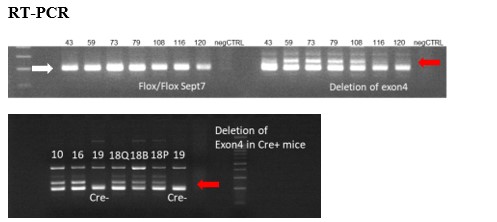
      In order to generate skeletal muscle specific, conditional Septin-7 knock-down animals, we applied Tamoxifen treatment at different developmental stages in our preliminary studies (see the table and figures below). When Cre- pregnant females were fed with Tamoxifen in the third trimester of pregnancy, it caused intrauterin lethality independent of the genotype. According to the animal ethics requirements we did not continue this experimental protocol. In the next stage of our initial experiments, 3 month-old mice were treated with both intraperitoneal injections for 5 consecutive days or Tamoxifen diet for 4 weeks. Here, only a moderate deletion of the exon4 was detected in SEPTIN 7 gene in Cre+ animals (data obtained from these mice are shown below).

      These findings and the observation of ontogenesis dependent expression of Septin-7 indicated its significance at the early stage of development and suggested that we should try to modify the gene expression at earlier age. Six weeks of diet supplemented with Tamoxifen generated well detectable exon deletion in younger (1-month-old) mice. Regarding these observations we decided to start the Tamoxifen-supplemented diet in younger (4-week-old) animals immediately after separation from the mother and we continued the treatment for a longer period (3 months) to be sure that exon deletion will be prominent in all Cre+ animals.

      Genetic modification of SEPTIN 7 gene following Tamoxifen treatment in mice mentioned above. RT-PCR

      Figure presents the presence of floxed sites at SEPTIN 7 gene (white arrow) and the deletion of exon4 (red arrows) in the appropriate DNA samples isolated from mice treated with Tamoxifen from different age and using different methods and period of Tamoxifen application. Exon4 deletions were less than 20%, therefore these trials were not continued. Numbers above each lane correspond to the animal ID-s presented in the table above. Q – m. quadriceps, B- m. biceps femoris, P – m. pectoralis.

      The knock-down of Septin-7 in the adult animals (where its expression is already low; see above) did not result in an appreciable further reduction. This led us to conclude that the role of Septin-7 is most pronounced in muscle development. In this framework, at the adult stage a possible function of Septin-7 in muscle regeneration following injury could be envisioned. This is demonstrated in Fiure 6 where we present that Septin-7 is upregulated following a mild injury. However, we believe, that a detailed examination of the role of Septin-7 in the regeneration is beyond the scope of the current manuscript and should be the basis of further studies.

      4) Regarding the impact of Septin-7 on differentiation, it could be problematic if the images with the resolution shown in Figure S4A-C were used for fusion index calculation. If those are just zoomed in representative images and the authors used other lower resolution, global view images for quantification, those images are needed to be shown. The authors may also need to elaborate on why they stained Desmin instead of MYH for quantification of the fusion index of myotubes (page 27). Desmin also marks mesenchymal cells.

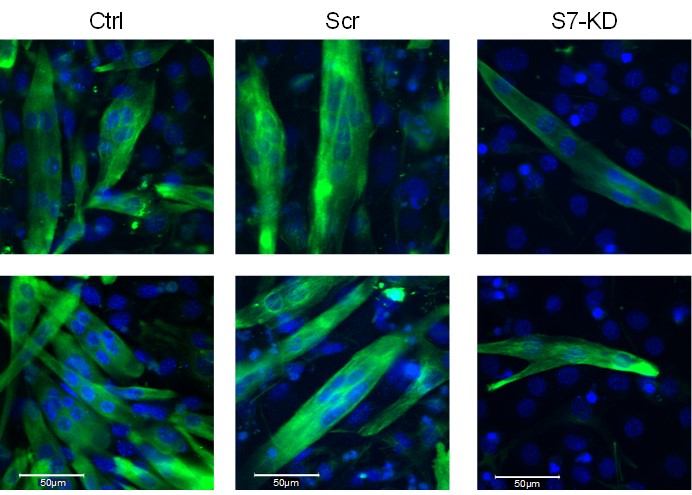
      We apologize that the method used for fusion index calculation was not clear enough. Images in Figure S4A-C present the Septin-7 and actin cytoskeletal structure in proliferating myoblasts, before the induction of differentiation. Fusion index was determined in cultures where myotube differentiation was induced by reduced serum content (as described in Methods). We used desmin staining as the expression of this protein is present only in myotubes with 2 or more nuclei, where fusion of myoblasts has already started (see representative images below). Representative desmin-labeling images from control, scrambled and KD cultures are now included in Figure S5G at 5 days differentiated stage.

      Figure presents two examples (bottom row is now added to Figure S5 as panel G) of the desmin-specific immunostaining used for the calculation of fusion index in the different C2C12 cultures. Specific signals of desmin are present following the fusion of single nuclei myoblast into myotubes (green), while non-differentiated myoblasts did not show immunolabeling for desmin. Nuclei are stained with DAPI (blue).

      If Septin-7 is truly affecting differentiation, a decrease of MYH 2 expression can be readily detected by IHC or WB.

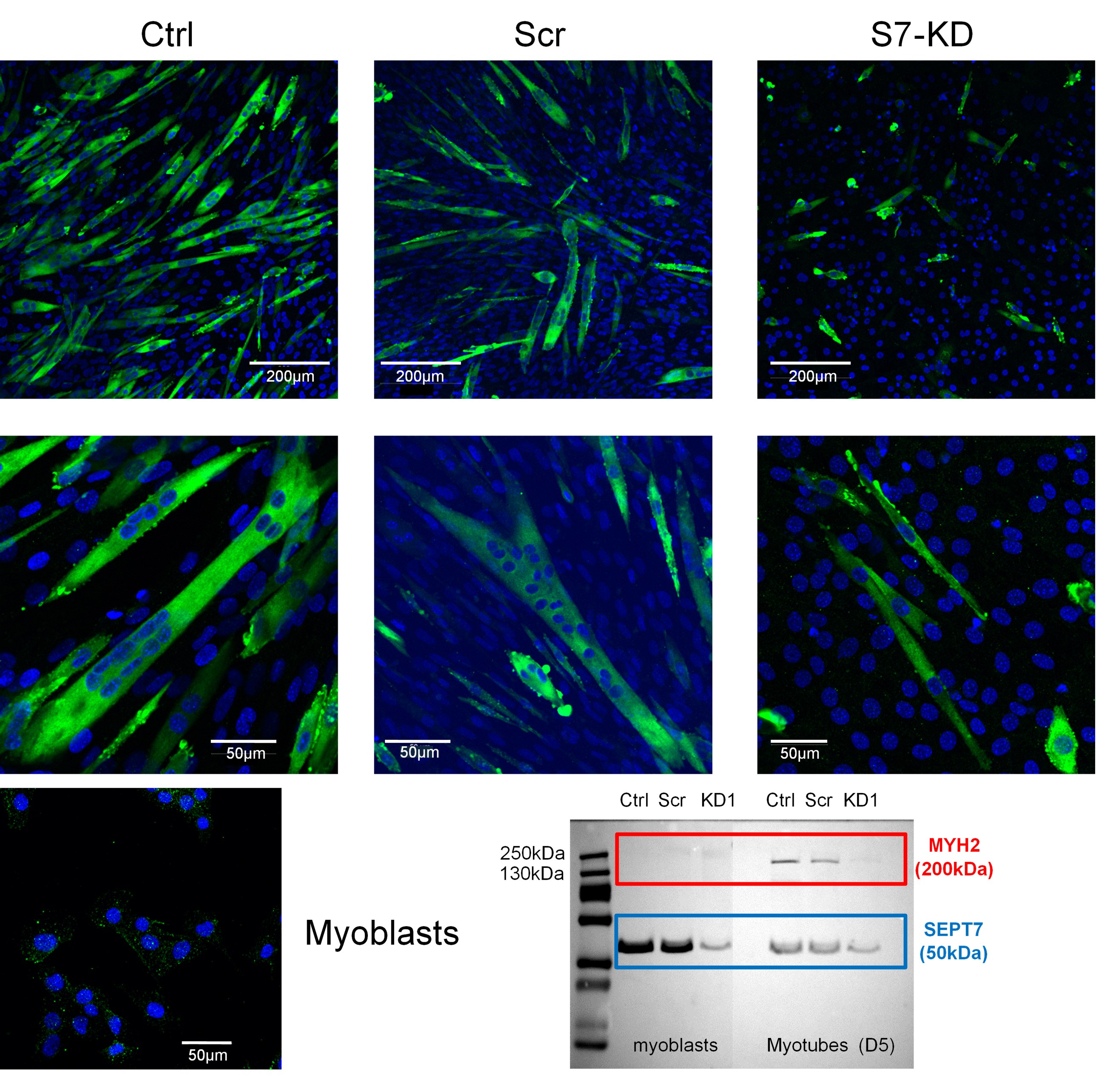
      We are grateful for the Reviewer´s suggestion. We have conducted immunocytochemistry and WB experiments in proliferating myoblasts and myotubes at day 5 of differentiation. As the figure below demonstrates, myosin heavy chain-specific immunolabeling could be detected only in differentiated samples, while myoblasts did not show positive signal. However, there is a significantly lower number of MYH2-positive myotubes in Septin-7 KD cultures as compared with the control and scrambled samples. In addition, we detected decreased WB signal for MYH2 in Septin-7 KD protein samples compared with their control counterparts.

      Figure presents the MYH2-specific immunostaining in the different C2C12 cultures. Specific signals of myosin heavy chain 2 (green) are present during myotube formation of differentiating cultures, however, less MYH2-positive myotubes are present in the Septin-7 KD cultures as a result of reduced capability of cells to fuse, here the DAPI-stained nuclei were only present. Proliferating myoblasts did not show specific immunolabeling for MYH2, as the confocal image and the appropriate part of the WB membranes show. We could also detect a decreased MYH2-specific labeling in Septin-7 KD samples as compared with the control ones using WB.

      Additionally, Septin-7 may also affect the migration or fusion of myoblasts instead of differentiation. The observation of altered cell morphology and filopodia/lamellipodia formation (Figure 3C) in Septin7-KD cells before differentiation also implies a potential role of Septin-7 in migration. This possibility should be at least discussed.

      We appreciate the Reviewer´s comment and suggestion. There are a few publication showing that alteration of septin (in some cases Septin-7) expression modifies the migration of different eukaryotic cell types, like in microvascular endothelial cells (PMID: 24451259), in human epithelial cells (PMID: 31905721), in neural crest cells (PMID: 2881782), and in human breast cancer or lung cancer cells (PMID: 27557506, 31558699, and 32516969). In the work of Li et al. (PMID:32382971) their findings revealed that miR-127-3p regulates myoblast proliferation by targeting Septin-7. In the present manuscript we described that Septin-7 modification alters myoblast fusion (Figure 3J), which is the accompanying phenomenon of differentiation. On the other hand, the effect of Septin-7 gene silencing on cell migration has been studied in detail and was presented to The Biophysical Society. The results are intended to be submitted as a separate manuscript.

      5) The image shown in Figure 5F does not support the pooled data showed in Figure 5C. The size of mitochondria is remarkably lager in Cre+ muscle (Fig 5E and 5F). The morphology of mitochondria in Cre+ muscle are apparently normal (Fig 5F), while the mitochondrial DNA content are drastically reduced (Figure 5H), which is an important discovery and deserved to be further confirmed by WB and/or qPCR for critical mitochondrial proteins (i.e. MTCOX, COXV, etc.).

      We thank the Reviewer for pointing out that the interpretation of images in Figure 5 was not clear enough. Based on this, and the on the clear request from the other Reviewer, a detailed evaluation of mitochondrial morphology was carried out and the panels of Figure 5 were redrawn and reorganized. The revised Figure 5 now presents the average Perimeter, the average Aspect Ratio, and the average Form Factor (panels C & H, for cross- & horizontal-sections, respectively), the relative distributions of the areas (panels D & I, for cross- & horizontal-sections, respectively), and the number of mitochondria normalized to fiber area (panel E, cross-sections). The mitochondrial DNA content is presented in panel J. As evidenced from these figures (and from the representative EM micro graphs), larger mitochondria, sometimes in large associations, are present in the muscles of Cre+ animals.

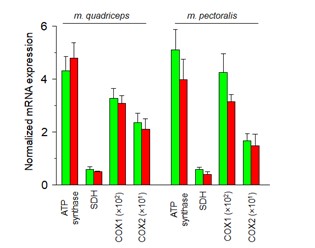
      Furthermore, gene expression of four essential mitochondrial proteins cytochrome oxidase 1 (COX1), cytochrome oxidase 2 (COX2), succinate dehydrogenase (SDH), and ATP synthase) were determined in RNA samples from different skeletal muscles of Cre- and Cre+ animals using qPCR. As the figure below demonstrates there was a tendency of decreased expression of the aforementioned genes in Cre+ muscle samples, however, significant difference between the Cre- and Cre+ data could not be detected.

      Figure represents the normalized mRNA expression of ATP synthase, SDH, COX1, and COX2 in Cre- (green) and Cre+ (red) samples isolated from m. quadriceps and m. pectoralis. Each gene expression was determined from 3 individual animals and a technical duplicate was used during the qPCR analysis. 36B4 gene encoding an acidic ribosomal phosphoprotein P0 was used as a normalizing gene.

      6) Figure 2 H & I: It is unclear whether the muscle force was normalized to the individual muscle weight.

      We are sorry about the incomplete representation and explanation of muscle force values. Figure 2F-I presents absolute force values without normalization to the cross sectional area. In order to answer the Reviewer´s comment the averages of normalized values are given in Table S3 in the modified manuscript.

      7) The IHC results in Figure 6B are confusing. There are no centrally located nuclei in the Pax7 alone image of Figure 6B but abundant in the Pax7 + H&E image. The brown color of DAB and the purple color of hematoxylin are hard to be distinguished.

      Images presenting the labeling of Pax7 (a transcription factor expressed in activated satellite cells) alone could not show centrally located nuclei, as the nuclei could only be visible when HE staining is applied. As the Reviewer mentioned brown color of DAB and the purple color of hematoxylin are sometimes difficult to distinguish, therefore, we first presented PAX7 expression visualized by DAB staining (localization was near the sarcolemma). In the next step we performed a double staining for PAX7 and HE to show both the cytoplasm and nuclei.

    1. Author Response

      Reviewer #1 (Public Review):

      In this manuscript, Goering et al. investigate subcellular RNA localization across different cell types focusing on epithelial cells (mouse C2bbe1 and human HCA-7 enterocyte monolayers, canine MDCK epithelial cells) as well as neuronal cultures (mouse CAD cells). They use their recently established Halo-seq method to investigate transcriptome-wide RNA localization biases in C2bbe1 enterocyte monolayers and find that 5'TOP-motif containing mRNAs, which encode ribosomal proteins (RPs), are enriched on the basal side of these cells. These results are supported by smFISH against endogenous RP-encoding mRNAs (RPL7 and RPS28) as well as Firefly luciferase reporter transcripts with and without mutated 5'TOP sequences. Furthermore, they find that 5'TOP-motifs are not only driving localization to the basal side of epithelial cells but also to neuronal processes. To investigate the molecular mechanism behind the observed RNA localization biases, they reduce expression of several Larp proteins and find that RNA localization is consistently Larp1-dependent. Additionally, the localization depends on the placement of the TOP sequence in the 5'UTR and not the 3'UTR. To confirm that similar RNA localization biases can be conserved across cell types for other classes of transcripts, they perform similar experiments with a GA-rich element containing Net1 3'UTR transcript, which has previously been shown to exhibit a strong localization bias in several cell types. In order to determine if motor proteins contribute to these RNA distributions, they use motor protein inhibitors to confirm that the localization of individual members of both classes of transcripts, 5'TOP and GA-rich, is kinesin-dependent and that RNA localization to specific subcellular regions is likely to coincide with RNA localization to microtubule plus ends that concentrate in the basal side of epithelial cells as well as in neuronal processes.

      In summary, Goering et al. present an interesting study that contributes to our understanding of RNA localization. While RNA localization has predominantly been studied in a single cell type or experimental system, this work looks for commonalities to explain general principles. I believe that this is an important advance, but there are several points that should be addressed.

      Comments:

      1) The Mili lab has previously characterized the localization of ribosomal proteins and NET1 to protrusions (Wang et al, 2017, Moissoglu et al 2019, Crisafis et al., 2020) and the role of kinesins in this localization (Pichon et al, 2021). These papers should be cited and their work discussed. I do not believe this reduces the novelty of this study and supports the generality of the RNA localization patterns to additional cellular locations in other cell types.

      This was an unintentional oversight on our part, and we apologize. We have added citations for the mentioned publications and discussed our work in the context of theirs.

      2) The 5'TOP motif begins with an invariant C nucleotide and mutation of this first nucleotide next to the cap has been shown to reduce translation regulation during mTOR inhibition (Avni et al, 1994 and Biberman et al 1997) and also Lapr1 binding (Lahr et al, 2017). Consequently, it is not clear to me if RPS28 initiates transcription with an A as indicated in Figure 3B. There also seems to be some differences in published CAGE datasets, but this point needs to be clarified. Additionally, it is not clear to me how the 5'TOP Firefly luciferase reporters were generated and if the transcription start site and exact 5'-ends of these constructs were determined. This is again essential to determine if it is a pyrimidine sequence in the 5'UTR that is important for localization or the 5'TOP motif and if Larp1 is directly regulating the localization by binding to the 5'TOP motif or if the effect they observe is indirect (e.g. is Larp1 also basally localized?). It should also be noted that Larp1 has been suggested to bind pyrimidine-rich sequences in the 5'UTR that are not next to the cap, but the details of this interaction are less clear (Al-Ashtal et al, 2021)

      We did not fully appreciate the subtleties related to TOP motif location when we submitted this manuscript, so we thank the reviewer for pointing them out.

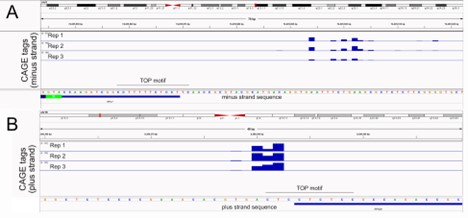
      We also analyzed public CAGE datasets (Andersson et al, 2014 Nat Comm) and found that the start sites for both RPL7 and RPS28 were quite variable within a window of several nucleotides (as is the case for the vast majority of genes), suggesting that a substantial fraction of both do not begin with pyrimidines (Reviewer Figure 1). Yet, by smFISH, endogenous RPL7 and RPS28 are clearly basally/neurite localized (see new figure 3C).

      Reviewer Figure 1. Analysis of transcription start sites for RPL7 (A) and RPS28 (B) using CAGE data (Andersson et al, 2014 Nat Comm). Both genes show a window of transcription start sites upstream of current gene models (blue bars at bottom).

      A more detailed analysis of our PRRE-containing reporter transcripts led us to find that in these reporters, the pyrimidine-rich element was approximately 90 nucleotides into the body of the 5’ UTR. Yet these reporters are also basally/neurite localized. The organization of the PRRE-containing reporters is now more clearly shown in an updated figure 3D.

      From these results, it would seem that the pyrimidine-rich element need not be next to the 5’ cap in order to regulate RNA localization. To generalize this result, we first used previously identified 5’ UTR pyrimidine-rich elements that had been found to regulate translation in an mTOR-dependent manner (Hsieh et al 2012). We found that, as a class, RNAs containing these motifs were similarly basally/neurite localized as RP mRNAs. These results are presented in figures 3A and 3I.

      We then asked if the position of the pyrimidine-rich element within the 5’ UTR of these RNAs was related to their localization. We found no relationship between element position and transcript localization as elements within the bodies of 5’ UTRs were seemingly just as able to promote basal/neurite localization as elements immediately next to the 5’ cap. These results are presented in figures 3B and 3J.

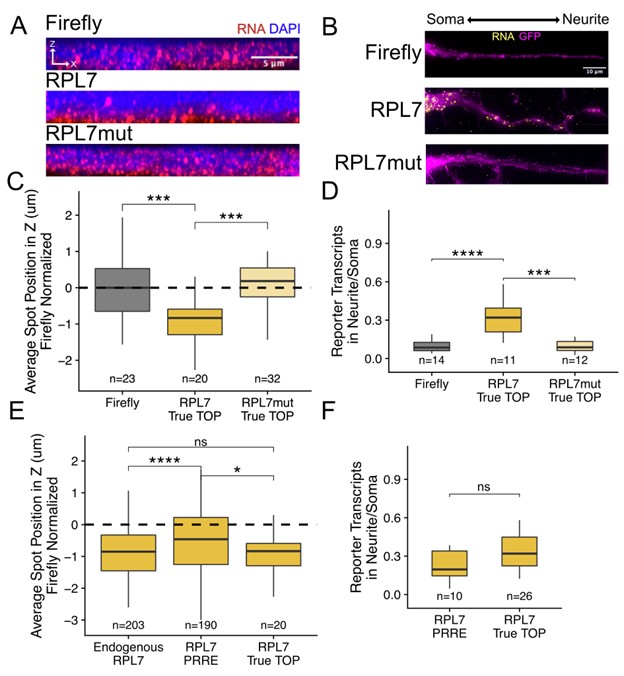
      To further confirm that pyrimidine-rich elements need not be immediately next to the 5’ cap, we redesigned our RPL7-derived reporter transcripts such that the pyrimidine-rich motif was immediately adjacent to the 5’ cap. This was possible because the reporter uses a CMV promoter that reliably starts transcription at a known nucleotide. We then compared the localization of this reporter (called “RPL7 True TOP”) to our previous reporter in which the pyrimidine-rich element was ~90 nt into the 5’ UTR (called “RPL7 PRRE”) (Reviewer Figure 2). As with the PRRE reporter, the True TOP reporter drove RNA localization in both epithelial and neuronal cells while purine-containing mutant versions of the True TOP reporter did not (Reviewer Figure 2A-D). In the epithelial cells, the True TOP was modestly but significantly better at driving basal RNA localization than the PRRE (Reviewer Figure 2E) while in neuronal cells the True TOPs were modestly but insignificantly better. Again, this suggests that pyrimidine-rich motifs need not be immediately cap-adjacent in order to regulate RNA localization.

      Reviewer Figure 2. Experimental confirmation that pyrimidine-rich motif location within 5’ UTRs is not critical for RNA localization. (A) RPL7 True TOP smFISH in epithelial cells. (B) RPL7 True TOP smFISH in neuronal cells. (C) Quantification of epithelial cell smFISH in A. (D) Quantification of neuronal cell smFISH in D. (E) Comparison of the location in epithelial cells of endogenous RPL7 transcripts, RPL7 PRRE reporter transcripts, and PRL7 True TOP reporter transcripts. (F) Comparison of the neurite-enrichment of RPL7 PRRE reporters and RPL7 True TOP reporters. In C-F, the number of cells included in each analysis is shown.

      In response to the point about whether the localization results are direct effects of LARP1, we did not assay the binding of LARP1 to our PRRE-containing reporters, so we cannot say for sure. However, given that PRRE-dependent localization required LARP1 and there is much evidence about LARP1 binding pyrimidine-rich elements (including those that are not cap-proximal as the reviewer notes), we believe this to be the most likely explanation.

      It should also be noted here that while pyrimidine-rich motif position within the 5’ UTR may not matter, its location within the transcript does. PRREs located within 3’ UTRs were unable to direct RNA localization (Figure 5).

      3) In figure 1A, they indicate that mRNA stability can contribute to RNA localization, but this point is never discussed. This may be important to their work since Larp1 has also been found to impact mRNA half-lives (Aoki et al, 2013 and Mattijssen et al 2020, Al-Ashtal et al 2021). Is it possible the effect they see when Larp1 is depleted comes from decreased stability?

      We found that PRRE-containing reporter transcripts were generally less abundant than their mutant counterparts in C2bbe1, HCA7, and MDCK cells (figure 3 – figure supplements 5, 6, and 8) although the effect was not consistent in mouse neuronal cells (figure 3 – figure supplement 13).

      However, we don’t think it is likely that the changes in localization are due to stability changes. This abundance effect did not seem to be LARP1-dependent as both PRRE-containing and PRRE-mutant reporters were generally more expressed in LARP1-rescue epithelial cells than in LARP1 KO cells (figure 4 – figure supplement 9).

      It should be noted here that we are not ever actually measuring transcript stability but rather steady state abundances. It cannot therefore be ruled out that LARP1 is regulating the stability of our PRRE reporters. Given, though, that their localization was dependent on kinesin activity (figures 7F, 7G), we believe the most likely explanation for the localization effects is active transport.

      4) Also Moor et al, 2017 saw that feeding cycles changed the localization of 5'TOP mRNAs. Similarly, does mTOR inhibition or activation or simply active translation alter the localization patterns they observe? Further evidence for dynamic regulation of RNA localization would strengthen this paper

      We are very interested in this and have begun exploring it. We have data suggesting that PRREs also mediate the feeding cycle-dependent relocalization of RP mRNAs. As the reviewer says, we think this leads to a very attractive model involving mTOR, and we are currently working to test this model. However, we don’t have the room to include those results in this manuscript and would instead prefer to include them in a later manuscript that focuses on nutrient-induced dynamic relocalization.

      5) For smFISH quantification, is every mRNA treated as an independent measurement so that the statistics are calculated on hundreds of mRNAs? Large sample sizes can give significant p-values but have very small differences as observe for Firefly vs. OSBPL3 localization. Since determining the biological interpretation of effect size is not always clear, I would suggest plotting RNA position per cell or only treat biological replicates as independent measurements to determine statistical significance. This should also be done for other smFISH comparisons

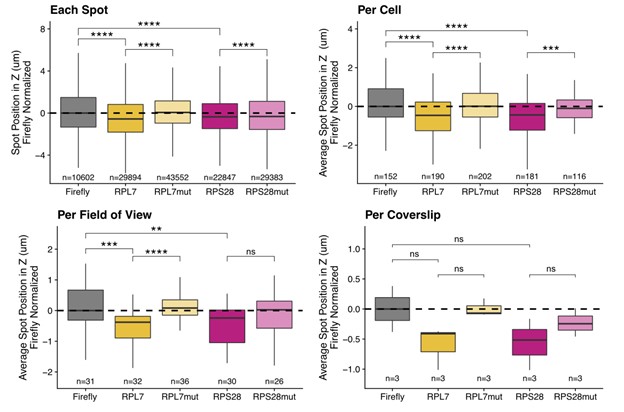
      This is a good suggestion, and we agree that using individual puncta as independent observations will artificially inflate the statistical power in the experiment. To remedy this in the epithelial cell images, we first reanalyzed the smFISH images using each of the following as a unique observation: the mean location of all smFISH puncta in one cell, the mean location of all puncta in a field of view, and the mean location of all puncta in one coverslip. With each metric, the results we observed were very similar (Reviewer Figure 3) while the statistical power of course decreased. We therefore chose to go with the reviewer-suggested metric of mean transcript position per cell.

      Reviewer Figure 3. C2bbe1 monolayer smFISH spot position analysis. RNA localization across the apicobasal axis is measured by smFISH spot position in the Z axis. This can be plotted for each spot, where thousands of spots over-power the statistics. Spot position can be averaged per cell as outlined manually within the FISH-quant software. This reduces sample size and allows for more accurate statistical analysis. When spot position is averaged per field of view, sample size further decreases, statistics are less powered but the localization trends are still robust. Finally, we can average spot position per coverslip, which represents biological replicates. We lose almost all statistical power as sample size is limited to 3 coverslips. Despite this, the localization trends are still recognizable.

      When we use this metric, all results remain the same with the exception of the smFISH validation of endogenous OSBPL3 localization. That result loses its statistical significance and has now been omitted from the manuscript. All epithelial smFISH panels have been updated to use this new metric, and the number of cells associated with each observation is indicated for each sample.

      For the neuronal images, these were already quantified at the per-cell level as we compare soma and neurite transcript counts from the same cell. In lieu of more imaging of these samples, we chose to perform subcellular fractionation into soma and neurite samples followed by RT-qPCR as an orthogonal technique (figure 3K, figure 3 supplement 14). This technique profiles the population average of approximately 3 million cells.

      6) F: How was the segmentation of soma vs. neurites performed? It would be good to have a larger image as a supplemental figure so that it is clear the proximal or distal neurites segments are being compared

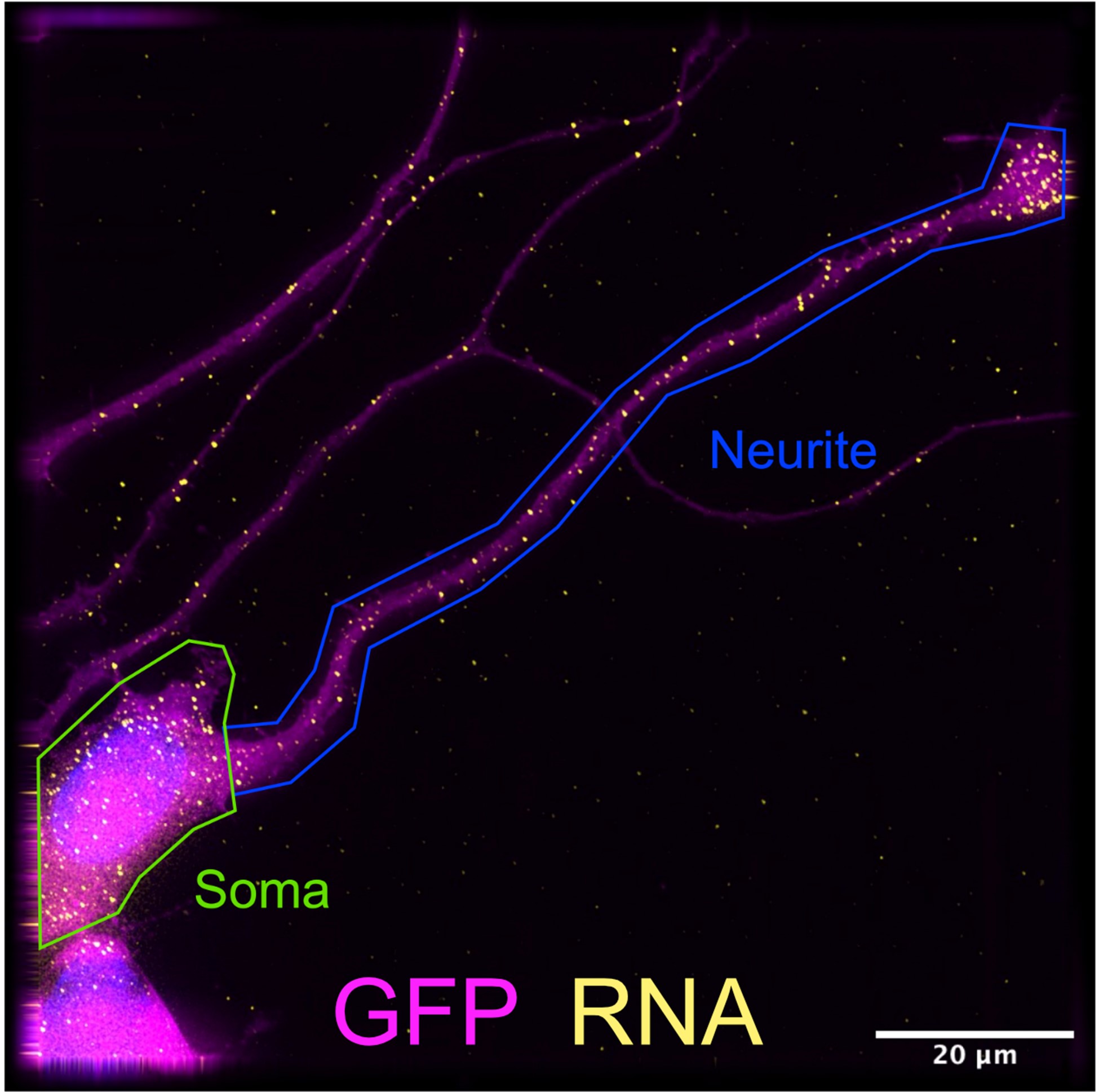
      All neurite vs. soma segmentations were done manually. An example of this segmentation is included as Reviewer Figure 4. This means that often only proximal neurites segments are included in the analysis as it is often difficult to find an entire soma and an entire neurite in one field of view. However, in our experience, inclusion of more distal neurite segments would likely only strengthen the smFISH results as we often observe many molecules of localized transcripts in the distal tips of these neurites.

      Reviewer Figure 4. Manual segmentation of differentiated CAD soma and neurite in FISH-quant software. Neurites that do not overlap adjacent neurites are selected for imaging. Often neurites extend beyond the field of view, limiting this assay to RNA localization in proximal neurites.

      Also, it should be noted that the neuronal smFISH results are now supplemented by experiments involving subcellular fractionation and RT-qPCR (figure 3 supplement 14). These subcellular fractionation experiments collect the whole neurite, both the proximal and distal portions.

      Text has been added to the methods under the header “smFISH computational analysis” to clarify how the segmentation was done.

    1. Author Response:

      We have now revised the manuscript to address the helpful comments and criticisms from the reviewers. The revised manuscript includes additional experiments demonstrating that inclusion of Csn2/Cas9 in the in vitro assays does not suppress the disintegration activity of Cas1-Cas2 to favor integration. These additional factors do not confer strand selectivity on integration either. Furthermore, the results of integration reactions using substrates mimicking PAM-containing pre- spacers have also been added.

      New figures and figure modifications at a glance:

      1) The new Figure 2 shows Cas1-Cas2 reactions in a linear target site and the effects of Csn2 and/or Cas9 on proto-spacer insertion into this target (Reviewer 1).

      The original Figure 2 (with slight modifications) is now moved to ’Supplementary Data’ as Figure 2-figure supplement 2, and shows proto-spacer insertion by Cas1-Cas2 into a nicked linear target site (Reviewer 2). Figure 2 is the only one in the main set of figures that has been extensively modified.

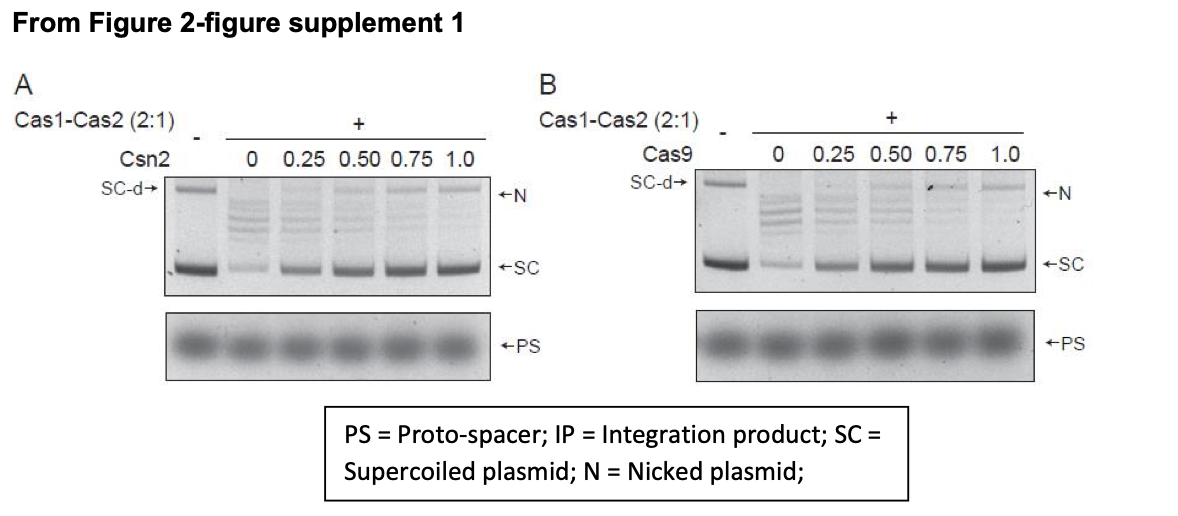
      2) The new Figure 2-figure supplement 1 (under ‘Supplementary Data’) shows the effects of Csn2, Cas9 or both on proto-spacer integration-disintegration by Cas1-Cas2 when the target site is present in a supercoiled plasmid (Reviewer 1).

      3) The new Figure 4-figure supplement 1 lists the sequences of the full- and half-target sites used for the reactions shown in Figure 4 (Reviewer 2).

      4) The new Figure 2-figure supplement 3 shows the insertion properties of PAM-containing pre- spacer mimics in reactions with Cas1-Cas2 alone or supplemented with Csn2, Cas9 or both (Reviewer 1).

      5) The new Figure 6-figure supplement 1 gives a structural perspective of the trombone substrates used for the reactions shown in Figure 6B, C (Reviewer 1).

      6) The original Supplementary Figure S8 showing assays for PAM-specific cleavage by Cas1- Cas2 has been removed (Reviewer 1).

      7) There are no changes in the other figures under ‘Supplementary Data’, although several have new numbers consistent with the revisions made.

      Public Review (Reviewers #1 and #2):

      The present work is a critical extension of the in vitro biochemical activities of the Cas1- Cas2 complex described by Wright and Doudna (Nat Struct Mol Biol, 2016; 23: 876-883). We have kept all experimental conditions nearly identical to those used by these authors to make the results from the two studies directly comparable. Importantly, we now show that the prior model for proto-spacer integration into the CRISPR locus by Cas1-Cas2 is an oversimplification of a much more nuanced mechanism.

      While both reviewers recognize the importance of our findings in challenging the current thinking on the adaptation mechanism of CRISPR immunity, they express reservations as to whether the in vitro results recapitulate the in vivo mechanism of spacer acquisition. This seems to us to be too broad a criticism from which few (if any) biochemical experiments can be immune.

      Our key finding is that disintegration during the second step of proto-spacer integration generates a DNA structure that has all the hallmarks of a DNA damage intermediate that the bacterial repair machinery can readily process into an authentic integration product. We invoke no new or ad hoc mechanisms, and the model we propose fits neatly into the DNA gap-filling mechanisms known to operate in DNA transposition pathways.

      The proto-spacer is functionally a ‘micro-transposon’, whose shortness imposes severe torsional strain on the transposition intermediate that precedes the final integration product. In vitro experiments suggest that transcription is potentially capable of resolving this intermediate (Budhathoki et al., Nat Struct Mol Biol, 2020, 27: 489-99). In principle, replication can also accomplish this task. Our study now demonstrates that simply nicking the DNA (disintegration) is an equally effective solution for relieving the topological stress accompanying integration. DNA loose ends can then be readily tied up by the bacterial repair machinery.

      We concur with the concluding sentence of reviewer 2, “The simple conclusion that Cas1- Cas2 catalyzed hydrolysis of a phosphodiester may relieve strain and allow productive transposition to occur doesn’t get emphasized enough in my opinion.” We have now expanded on this point in the revised ‘Discussion’.

      Reviewer #1:

      In addition, the in vitro system used here is only partially reconstituted. The substrates lack a PAM sequence, which is necessary for protospacers to be incorporated in the correct orientation and may help direct the first integration event to the L-R junction. Presumably because of this all the reactions presented do not analyze the orientation of the incorporated prespacer sequence. Cas9 and Csn2 are also absent (as are other potentially required host factors), which are necessary for correct integration in vivo.

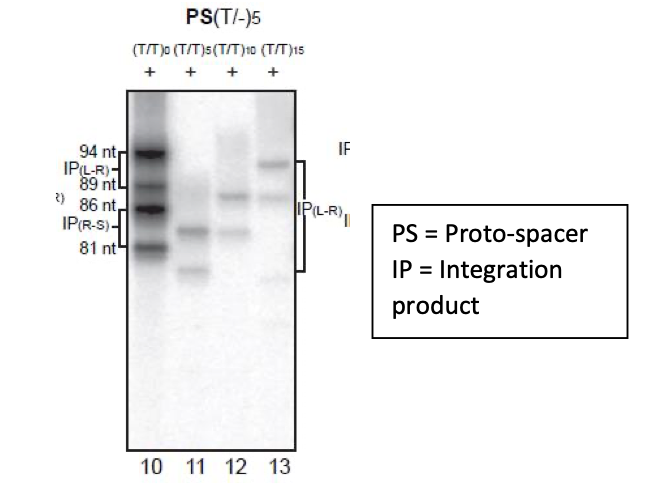
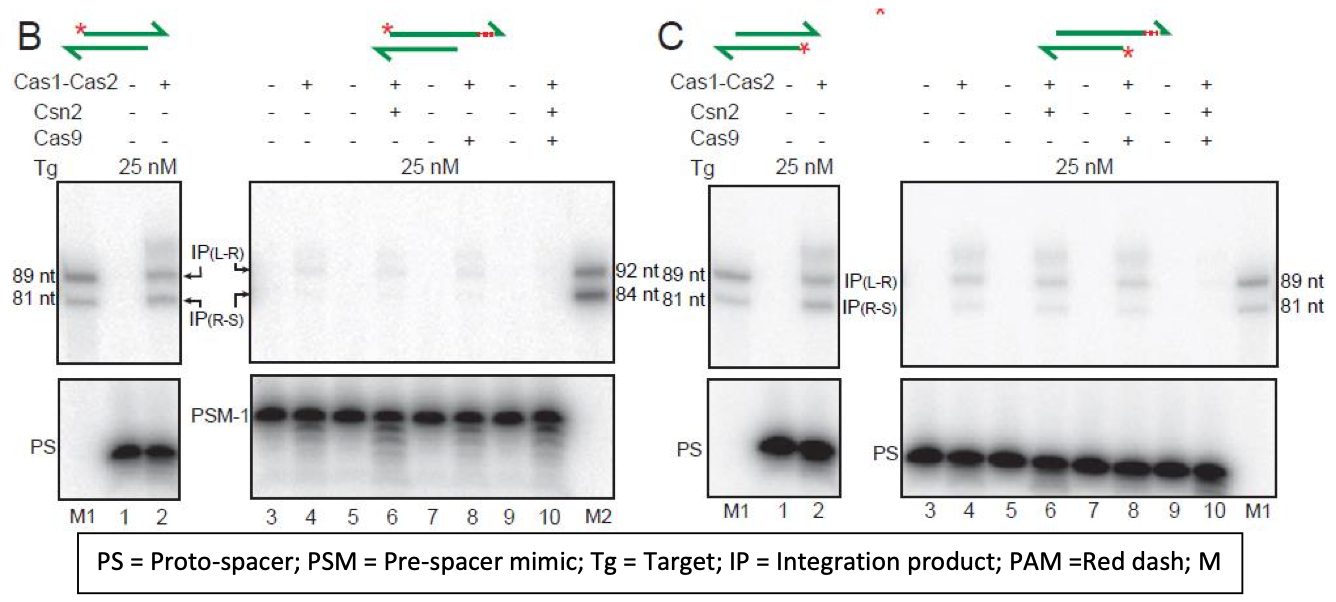
      1A. Strand specificity: The in vitro integration reactions with the Cas1-Cas2 complex were done using a protospacer of the optimal size (26 nt on each strand with the four 3’- proximal bases on each strand as unpaired). Either proto-spacer strand is equally competent to initiate the strand transfer reaction, as could be inferred from Figure 3 of the original submission. Here, reactions utilized modified proto-spacers that differed in their top and bottom strand lengths. They gave two insertion products (IP) each at the L-R (leader-repeat) and R-S (repeat-spacer) junctions of a normal target site. In modified targets in which integration was limited to just the L- R junction, two insertion products were formed. One panel of Figure 3 (which is retained in the revised manuscript) showing the four insertion products from the normal target (lane 10) and two from the modified targets (lanes 11-13) for a protospacer with 26 nt and 31 nt long strands is displayed below.

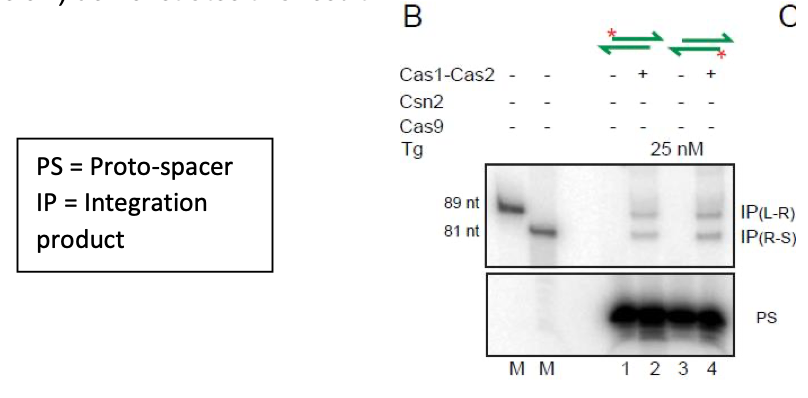
      The ability of either proto-spacer strand to initiate integration is now more directly shown in Figure 2 (new) of the revised manuscript. Here the labeled top or bottom strand of the proto- spacer (PS) gave insertion products (IP) at the L-R and R-S junctions of the target site. Panel B of Figure 2 (pasted below) demonstrates this result.

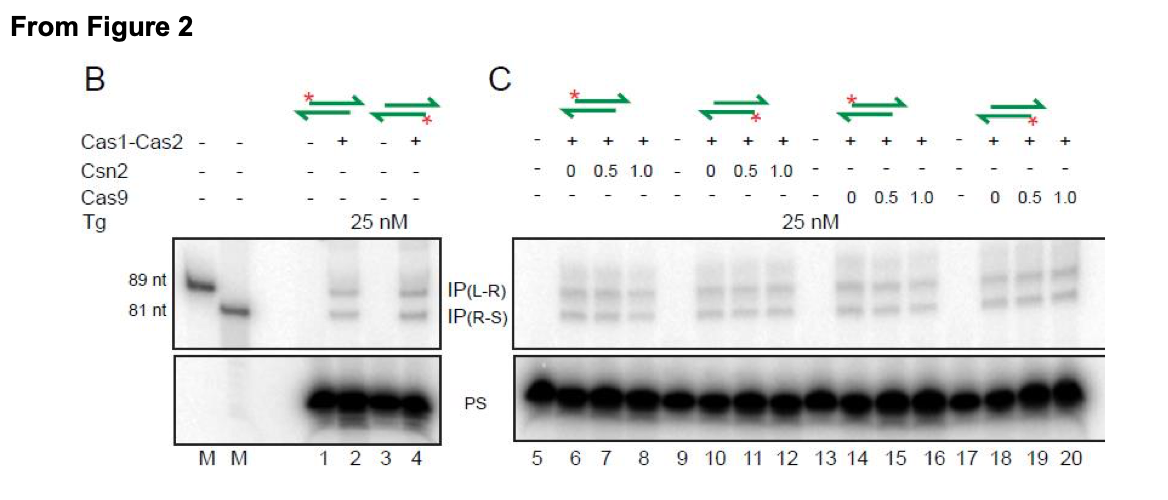
      1B. Cas9, Csn2 included reactions: The data for reactions containing Csn2 or Cas9 or both were not shown previously, as they did not alter Cas1-Cas2 activity by promoting strand specificity of integration or suppressing disintegration. These results are now shown in the revised Figure 2 (linear target) and the new Figure 2-figure supplement 1 (supercoiled target). Portions of these figures are shown below.

      The relevant revised text describing the lack of strand specificity to proto-spacer integration by Cas1-Cas2 and the Csn2/Cas9 effects on integration is pasted below.

      Page 15, lines 229-235.

      "Unlike orientation-specific proto-spacer integration in vivo, Cas1- Cas2 reactions in vitro showed no strand-specificity (Figure 2B). This bias-free insertion of the top or bottom strand from the proto-spacer was unchanged by the addition of Csn2 or Cas9 or both to the reactions (Figure 2C-E). These proteins, singly or in combiantion, also failed to stabilize proto-spacer integrations in the supercoiled plasmid target (Figure 2-figure supplement 1). Instead, they inhibited plasmid relaxation. Inhibition could occur at the level of integration per se or strand rotation during integration-disintegration"

      1C. PAM-containing substrates: We have now tested Cas1-Cas2 activity (with and without added Csn2 or Cas9 or both) on PAM-containing substrates that mimic ‘pre-spacers’, Figure 2- figure supplement 3 (new).

      In these substrates, a proto-spacer strand of the standard length (26 nt; lacking PAM or its complement) is inserted at the L-R junction with higher efficiency than the longer strand (containing PAM or its complement). Following the first integration at L-R, the pre-spacer mimics containing > 26 nt in one strand or both strands are inhibited in the second strand transfer to the R-S junction. A portion of Figure 2-figure supplement 3 illustrating theses points is shown below.

      The revised ‘Results’ section has the following added description of the activities of PAM- containing pre-spacer mimics.

      Pages 16-19, lines 265-297. Cas1-Cas2 activity on pre-spacer mimics carrying the PAM sequence

      "The strand cleavage and strand transfer steps of proto-spacer insertion at the CRISPR locus must engender safeguards against self-targeting of the inserted spacer as well as its non-functional orientation. However, no strand selectivity is seen in the in vitro Cas1-Cas2 reactions with already processed proto-spacers lacking the PAM sequence (Figures 2 and 3). By coordinating PAM- specific cleavage of a pre-spacer with transfer of this cleaved strand to the L-R junction, the inserted spacer will be in the correct orientation to generate a functional crRNA. To examine this possibility, we tested the integration characteristics of pre-spacer mimics containing the PAM sequence.

      The inclusion of PAM or PAM and its complement in the integration substrates (Figure 2- figure supplement 3A) did not confer strand specificity on reactions with Cas1-Cas2 alone or with added Csn2, Cas9 or both (Figure 2-figure supplement 3B-E). Optimal integration by Cas1-Cas2 occurred with the 26 nt strands of the native protospacer with their 4 nt 3’-overhangs (Figure 2- figure supplement 3B-E; lanes 2). The pre-spacer mimics containing one or both > 26 nt strands had reduced integration competence (Figure 2-figure supplement 3B-E; lanes 4). Even here, the 26 nt strand with the 4 nt overhang (Figure 2-figure supplement 3C; lane 4) was preferred in integration over the longer 29nt PAM-containing strand (Figure 2-figure supplement 3D; lane 4) or the 33 nt PAM complement-containing strand (Figure 2-figure supplement 3E; lane 4). In contrast to the processed proto-spacer that gave nearly equal integration at L-R and R-S, IP(L- R) ≈ IP(R-S) (Figure 2-figure supplement 3B-E; lanes 2), the longer pre-spacer mimics were inhibited in integration at R-S, IP(L-R) > IP(R-S) (Figure 2-figure supplement 3B-E lanes 4). This is the expected outcome if the initial strand transfer occurs at L-R, and a ruler-like mechanism orients the reactive 3’-hydroxyl for the second strand transfer at R-S. This sequential two-step scheme for proto-spacer integration is consistent with the results shown in Figure 3 as well. These reaction features were not modulated by Csn2 or Cas9 (Figure 2-figure supplement 3B-E; lanes 6 and 8), although Csn2 plus Cas9 was inhibitory (Figure 2-figure supplement 3B-E; lanes 10).

      There is no evidence for integration accompanying PAM-specific cleavage in our in vitro reactions. In the E. coli CRISPR system, Cas1-Cas2 is apparently sufficient for PAM-specific cleavage in vitro (22). By contrast, in the S. pyogenes system, cleavage is attributed to Cas9 or as yet uncharacterized bacterial nuclease(s) (35). The mechanism for generating an integration- proficient and orientation-specific proto-spacer, which may not be conserved among CRISPR systems, is poorly understood at this time."

    1. Author Response

      Reviewer #2 (Public Review):

      Charme is a long non-coding RNA reported by the authors in their previous studies. Their previous work, mainly using skeletal muscles as a model, showed the functional relevance of Charme, and presented data demonstrating its nuclear role, primarily via modulating the sub-nuclear localization of Matrin 3 (MATR3). Their data from skeletal muscles suggested that loss of the intronic region of Charme affects the local 3D genome organization, affecting MATR3 occupancy and this gene expression. Loss of Charme in vivo leads to cardiac defects. In this manuscript, they characterize the cardiac developmental defects and present molecular data supporting how the loss of Charme affects the cardiac transcriptome repertoire. Specifically, by performing whole transcriptome analysis in E12.5 hearts, they identify gene expression changes affected in developing hearts due to loss of Charme. Based on their previous study in skeletal muscles, they assume that Charme regulates cardiac gene expression primarily via MATR3 also in developing cardiomyocytes. They provide CLIP-seq data for MATR3 (transcriptome-wide foot printing of MATR3) in wild-type E15.5 hearts and connect the binding of MATR3 to gene expression changes observed in Charme knockout hearts. I credit the authors for providing CLIP seq data from in vivo embryonic samples, which is technically demanding.

      Major strengths:

      Although, as previously indicated by the authors in Charme knockout mice, the major strength is the effect of Charme on cardiac development. While the phenotype might be subtle, the functional data indicate that the role of Charme is essential for cardiac development and function. The combinatorial analysis of MATR3 CLIP-seq and transcriptional changes in the absence of Charme suggests a role of Charme that could be dependent on MATR3.

      We thank this reviewer for appreciating our methodological efforts and the importance of the MATR3 CLIP-seq data from in vivo embryonic samples.

      Weakness:

      (i) Nuclear lncRNAs often affect local gene expression by influencing the local chromatin.

      Charme locus is in close proximity to MYBPC2, which is essential for cardiac function, sarcomerogenesis, and sarcomere maintenance. It is important to rule out that the cardiac-specific developmental defects due to Charme loss are not due to (a) the influence of Charme on MYBPC2 or, of that matter, other neighboring genes, (b) local chromatin changes or enhancer-promoter contacts of MYBPC2 and other immediate neighbors (both aspects in the developmental time window when Charme expression is prominent in the heart, ideally from E11 to E15.5)

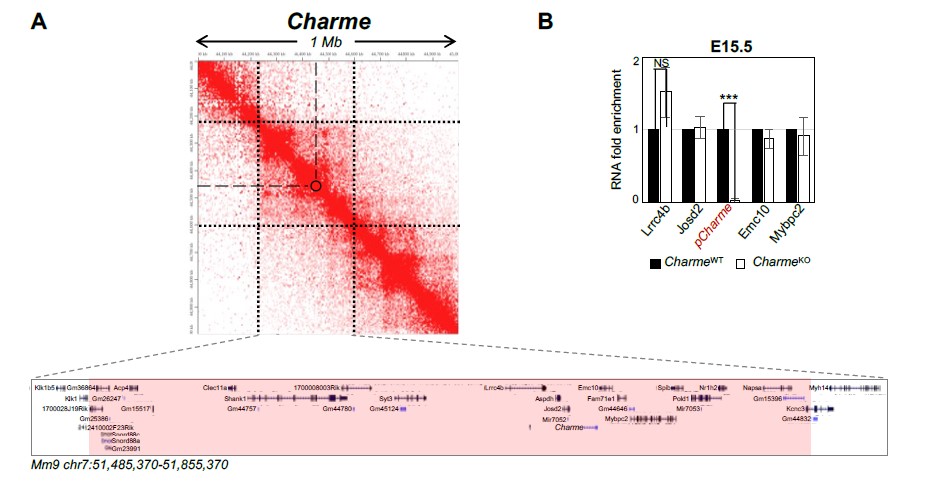
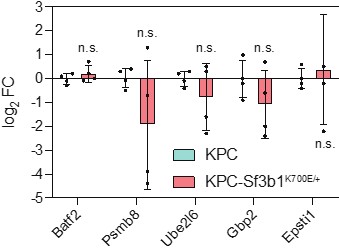
      Although the cis-activity represents a mechanism-of-action for several lncRNAs, our previous work does not reveal this kind of activity for pCharme. To add stronger evidence, we have now analysed the expression of pCharme neighbouring genes in cardiac muscle. Genes were selected by narrowing the analysis not only on the genes in “linear” proximity but also on eventual chromatin contacts, which may underlie possible candidates for in cis regulation. To this purpose, we made use of the analyses that in the meantime were in progress (to answer point iv) on available Hi-C datasets (Rosa- Garrido et al. 2017). Starting from a 1 Mb region around Charme locus, we found that most of the interactions with Charme occur in a region spanning from 240 kb upstream and 115 kb downstream of Charme for a total of 370 Kb (Rev#2_Capture Fig. 1A). This region includes 39 genes, 9 of them expressed in the neonatal heart but none showing significant deregulation (see Table S2). To note, this genomic region also included the MYBPC2 locus, for which we did not find a decreased expression in the heart from our RNA-seq data (Revised Figure 2-figure supplement 1C and Table S2). This trend was confirmed through RT-qPCR analyses of several genes from E15.5 extracts, which revealed no significant difference in their abundance upon Charme ablation (Rev#2_Capture fig. 1B).

      Fig. 1. A) Contact map depicting Hi-C data of left ventricular mice heart retrived from GEO accession ID GSM2544836. Data related to 1 Mb region around Charme locus were visualized using Juicebox Web App (https://aidenlab.org/juicebox/). B) RT-qPCR quantification of Charme and its neighbouring genes in CharmeWT vs CharmeKO E15.5.5 hearts. Data were normalized to GAPDH mRNA and represent means ± SEM of WT and KO (n=3) pools. Data information: p < 0.05; p < 0.01, **p < 0.001 unpaired Student’s t test.

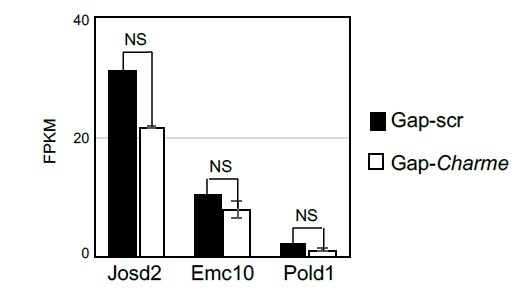
      For a better understanding, we also checked possible “local” Charme activities in skeletal muscle cells, from previous datasets (Ballarino et al., 2018). We found that in murine C2C12 cells treated with two different gapmers against Charme, three of its neighbouring genes were expressed (Josd2, Emc10 and Pold1), but none showed significant alterations in their expression levels in response to Charme knock-down (Rev#2_Capture Fig. 2).

      Taken together, these results would exclude the possibility of Charme in cis activity as responsible for the phenotype.

      Fig. 2: Average expression from RNA-seq (FPKM) quantification of Charme neighbouring genes in C2C12 differentiated myotubes treated with Gap-scr vs Gap-Charme. Values for Gap-Charme represent the average values of gene expression after treatment with two different gapmers (GAP-2 and GAP-2/3).

      (ii) The authors provide data indicating cardiac developmental defects in Charme knockouts. Detailed developmental phenotyping is missing, which is necessary to pinpoint the exact developmental milestones affected by Charme. This is critical when reporting the cell type/ organ-specific developmental function of a newly identified regulator.

      We did our best to answer this concern.

      Let us first emphasise that, since their generation, we have never observed any particular tissue alteration, morphological or physiological, when dissecting the CharmeKO animals other than the muscular ones. The high specificity of pCharme expression, as also shown here by ISH (Figure 1C-D, Figure 1-figure supplement 1A-B, Figure 3A), together with the minimal alteration applied to the locus for CRISPR-Cas-mediated KO (PolyA insertion), strongly excludes the presence of an alteration in other tissues and their involvement in the development of the phenotype.

      Nevertheless, we now add more developmental details to the cardiac phenotype (see also Essential revision point 2).

      1- First of all, gene expression analyses performed at 12.5E, 15.5E, 18.5E and neonatal (PN2) stages allowed us to identify, at the molecular level, the developmental time point when CharmeKO effects on the cardiac muscle can be found. Our new results clearly indicate that the pCharme-mediated regulation of morphogenic and cardiac differentiation genes is detectable from E15.5 fetal stage onward (Rev#2_Capture Fig. 3/Revised Figure 2E). Together with the analysis of pCharme targets and coherently with the altered cardiac maturation and performance, this evidence is also supported by the analysis of the myosins Myh6/Myh7 ratio, which diminution in CharmeKO hearts starts from E15.5 up to 69% of control levels at PN stages (Revised Figure 2F).

      2- Hematoxylin-eosin staining of dorso-ventral cryosections from CharmeWT and CharmeKO hearts confirmed the fetal malformation at the E15.5 stage (Revised Figure 2G). Moreover, the hypotrabeculation phenotype of CharmeKO hearts, which was initially examined by immunofluorescence, now finds confirmation by the analysis of key trabecular markers (Irx3 and Sema3a), which expression significantly decreases upon pCharme ablation (Rev#1_Capture Fig. 3B/Revised Figure 2-figure supplement 1G).

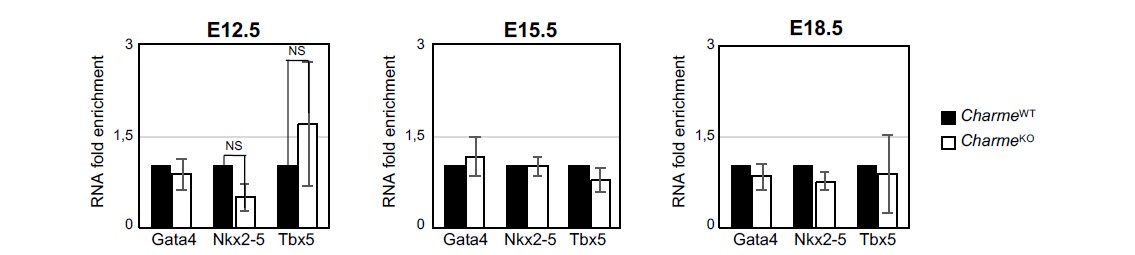
      3- Finally, the gene expression analysis on Ki-67, Birc5 and Ccna2 (Revised Figure 2-figure supplement 1E) definitively rules out the influence of pCharme ablation on cell-cycle genes and cardiomyocytes proliferation, thus allowing a more careful interpretation of the embryonic phenotype. Note that, coherently with the lncRNA implication at later stages of development, the expression of important cardiac regulators, such as Gata4, Nkx2-5 and Tbx5, is not altered by its ablation at any of the tested time points (Rev#2_Capture Fig.3), while pCharme absence mainly affects genes which are expressed downstream of these factors.

      These new results have been included in the revised version of the manuscript and better discussed.

      Fig. 3: RT-qPCR quantification Gata4, Nkx2-5 and Tbx5 in CharmeWT and CharmeKO cardiac extract at E12.5, E15.5 and E18.5 days of embryonal development. Data were normalized to GAPDH mRNA and represent means ± SEM of WT and KO (n=3) pools.

      (iii) Along the same line, at the molecular level, the authors provide evidence indicating a change in the expression of genes involved in cardiogenesis and cardiac function. Based on changes in mRNA levels of the genes affected due to loss of Charme and based on immunofluorescence analysis of a handful of markers, they propose a role of Charme in cell cycle and maturation. Such claims could be toned down or warrant detailed experimental validation.

      See above, response to Reviewer #2 (Public Review) weakness (ii).

      (iv) Authors extrapolate the mechanistic finding in skeletal muscle they reported for Charme to the developing heart. While the data support this hypothesis, it falls short in extending the mechanistic understanding of Charme beyond the papers previously published by the authors. CLIP-seq data is a step in the right direction. MATR3 is a relatively abundant RBP, binding transcriptome-wide, mainly in the intronic region, based on currently available CLIP-seq data, as well as shown by the authors' own CLIP seq in cardiomyocytes. It is also shown to regulate pre-mRNA splicing/ alternative splicing along with PTB (PMID: 25599992) and 3D genome organization (PMID: 34716321). In addition, the authors propose a MATR3 depending molecular function for Charme primarily dependent on the intronic region of Charme and due to the binding of MATR3. Answering the following question would enable a better mechanistic understanding of how Charme controls cardiac development.

      (i) what are the proximal genomic regions in the 3D space to Charme locus in embryonic cardiomyocytes? Authors can re-analysis published Hi-C data sets from embryonic cardiomyocytes or perform a 4-C experiment using Charme locus for this purpose.

      See above, response to Reviewer #2 (Public Review) weakness (i).

      (ii) does the loss of Charme affect the splicing landscape of MATR3 bound pre-mRNAs in E12.5 ventricles in general and those arising from the NCTC region specifically?

      This is an intriguing issue, as also highlighted by new evidence showing that the reactivation of fetal-specific RNA-binding proteins, including MATR3, in the injured heart drives transcriptome-wide switches through the regulation of early steps of RNA transcription and processing (D'Antonio et al., 2022).

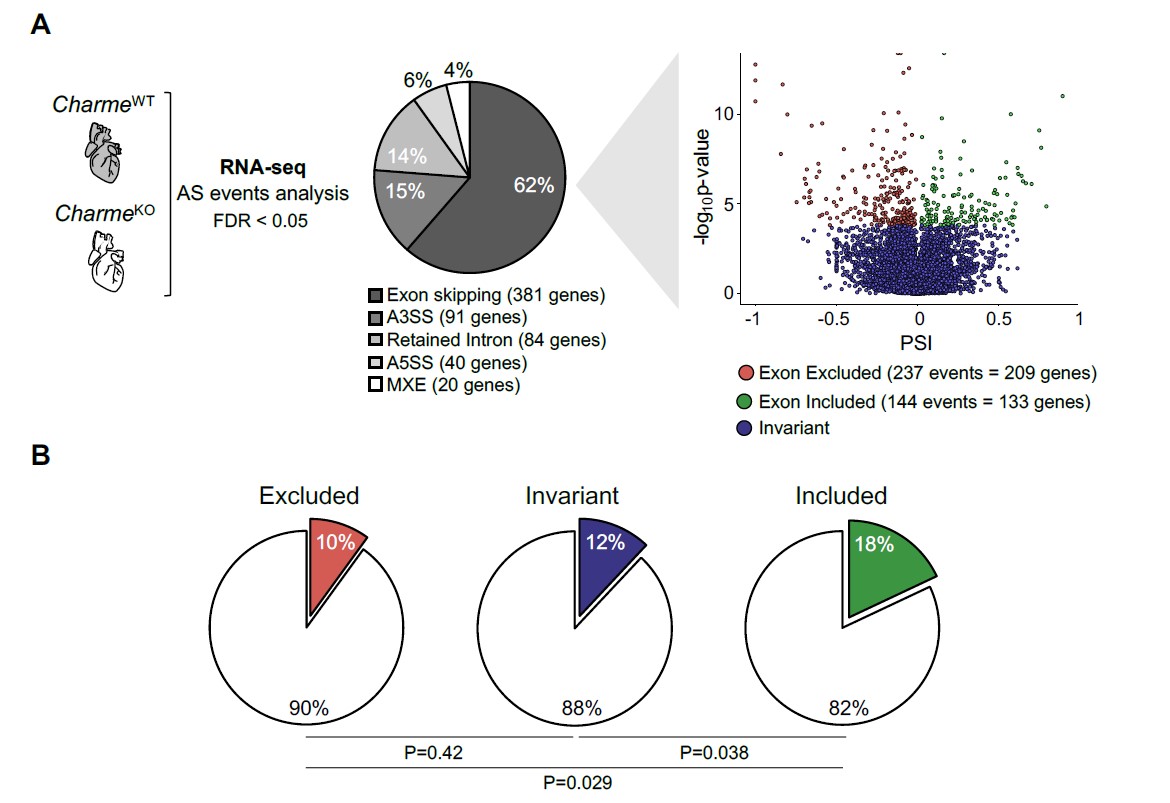
      Using the rMATS software on our neonatal RNA-Seq datasets we then investigated the effect of pCharme depletion on splicing, with a focus on NCTC. As shown in the Rev#2_Capture Fig.4A, all classical splicing alterations were investigated, such as exon-skipping, alternative 5’ splice site, alternative 3’ splice site, mutually excluded exons and intron retention. Intriguingly, we did observe a slight alteration in the splicing patterns, in particular considering exon skipping events (62% corresponding to 381 genes). Among them, the majority corresponded to exon exclusion events (237 events = 209 genes) while a smaller fraction to exon inclusion (144 events = 133 genes). Moreover, by intersecting these genes with the MATR3-bound RNAs we found a slightly significant enrichment (p=0,038) for exon inclusion (Rev#2_Capture Fig.4B).

      Regarding the NCTC locus, we demonstrate that in hearts pCharme acts through different target genes. Indeed, none of the NCTC-arising transcripts are bound by MATR3 (see Table S4) or substrate for alternative splicing regulation.

      While these results are very interesting for deepening the investigation of pCharme/MATR3 interplay, their biological significance needs to be further investigated through one-by-one analysis of specific transcripts. As a prosecution of the project, Nanopore sequencing of these samples on a MinION platform is currently undergoing in the lab to obtain a better characterization of alternative splicing events in response to the lncRNA ablation during development.

      Fig. 4: A) Left and middle panel: Pie Chart depicting the proportion of significantly altered (FDR < 0.05) splicing events detected by rMATS comparing neonatal CharmeWT and CharmeKO RNA-seq samples. All classical splicing alterations were investigated, such as exon-skipping, alternative 3’ splice site (A3SS), intron retention, alternative 5’ splice site (A5SS) and mutually excluded exons (MXE). Right panel. Volcano plot depicting significant exon skipping events in CharmeKO (FDR < 0.05, PSI<0 for excluded and included exons, FDR >= 0.05 for invariant exons). X-axis represent exon-inclusion ratio or Percentage Spliced In (PSI) while y-axis represent –log10 of p-value. B) Pie charts representing the fraction of transcripts with at least one significant excluded (left panel), invariant (middle panel) and included (right panel) exons that are bound by MATR3. P-values of MATR3 targets enrichment for each comparison is depicted below. Statistical significance was assessed with Fisher exact test.

      (iii) MATR3 binds DNA, as also shown by authors in previous studies. Is the MATR3 genomic binding altered by Charme loss in cardiomyocytes globally, as well as on the loci differentially expressed in Charme knockout heart? Overlapping MATR3 genomic binding changes and transcriptome binding changes to differentially expressed genes in the absence of Charme would better clarify the MATR3-centric mechanisms proposed here. Further connecting that to 3D genome changes due to Charme loss could provide needed clarity to the mechanistic model proposed here.

      Previous experience from our (Desideri et al., 2020) and other labs (Zeitz et al 2009 J Cell Biochem), indicate that Chromatin IP is not the most suitable approach for identifying MATR3 specific targets because of the broad distribution of MATR3 over the genome. Given the number of animals that would need to be sacrificed, we moved further to strengthen our MATR3 CLIP evidence by adding the i) CharmeKO MATR3 CLIP-seq control and the ii) combinatorial analysis of MATR3 CLIP-seq with the RNA-seq data.

      We have better explained the reasoning within the text, which now reads “The known ability of MATR3 to interact with both DNA and RNA and the high retention of pCharme on the chromatin may predict the presence of chromatin and/or specific transcripts within these MATR3-enriched condensates. In skeletal muscle cells, we have previously observed on a genome-wide scale, a global reduction of MATR3 chromatin binding in the absence of pCharme (Desideri et al., 2020). Nevertheless, the broad distribution of the protein over the genome made the identification of specific targets through MATR3-ChIP challenging.” (lines 274-279).

      Indeed, we found that MATR3 binding was significantly decreased on numerous peaks (434/626), while its increase was observed on a smaller fraction of regions (192/626) (Revised Figure 5C). As a control, we performed MATR3 motif enrichment analysis on the differentially bound regions revealing its proximity to the peak summit (+/- 50 nt) (Revised Figure 5-figure supplement 1D) close to the strongest enrichment of MATR3, further confirming a direct and highly specific binding of the protein to these sites. To better characterise the relationship between MATR3 and pCharme, we then intersected the newly identified regions with the MATR3-bound transcripts whose expression was altered by Charme depletion. While gain peaks were equally distributed across DEGs, loss peaks were significantly enriched in a subset of pCharme down-regulated DEGs (Revised Figure 5D), suggesting a crosstalk between the lncRNA and the protein in regulating the expression of this specific group of genes. Interestingly, these RNAs mainly distribute across the same GO categories as pCharme downregulated DEGs and include genes, such as Cacna1c, Notch3, Myo18B and Rbm20 involved in embryo development and validated as pCharme/Matr3 targets in primary cardiac cells (Revised Figure 5D, lower panel and 5E)

    1. Author Response

      Reviewer #1 (Public Review):

      In this paper, Bai et al. investigate in experiments and simulations how cohesion is maintained in chemotactic travelling waves of bacteria. These waves emerge from the bacterial population consuming an attractant, thus carving a gradient which they follow chemotactically. This paper builds up on previous work of some of the authors (Fu et al, Nat Commun 2018), which found that in these waves bacteria with varying degree of chemotactic sensitivity organize spatially in the band, which allows for its cohesiveness despite varying phenotypes. The authors investigate here an additional element for the cohesiveness of the wave: because the sharpness of the gradient increases from the front to the back of the wave, 'late' cells catch up via a stronger chemotactic response, and front cells slow down via a weaker one. This had been already postulated in earlier work on the phenomenon (Saragosti et al. PNAS 2011), but here the authors investigate how this applies to cells with varying chemotactic sensitivity. They also performed agent-based simulations of the cells behavior in the gradient and developed a model of the motion in the gradient. The latter maps the spatial dependence of the gradient steepness onto an effective travelling potential which keeps the cells together in a group as the gradient and the wave propagate. Importantly, the effective potential is predicted to be tighter for cells with higher chemotactic sensitivity, in agreement with the cell behavior they observe in experiments where the chemotactic sensitivity is artificially modulated. This suggests that weakly chemotactic cells are more weakly bound to the group and have a higher chance of being left behind. This last part is interesting in the context of range extension in semi-solid agar, where bacteria are known to be spatially organized and selected according to their chemotactic motility (Ni et al, Cell reports 2017, Liu et al Nature 2019)

      This paper builds its strengths on the extensive experimental characterization of the system and a variety of modeling approaches and makes a fairly convincing case for the way of understanding the mechanism of cohesion maintenance they propose.

      In fact, we have addressed both the mechanism to maintain a coherent group and also the mechanism to form ordered pattern of diverse phenotypes. Thanks to the reviewer, we noticed that the second point was not clearly showed out in our previous version. So that we have largely rewritten the texts and reorganized the results to prominent both mechanism.

      From a methodological perspective, only a few points need to be addressed:

      Control experiments need to quantify the cell-to-cell variability of the induction level of Tar by tetracycline.

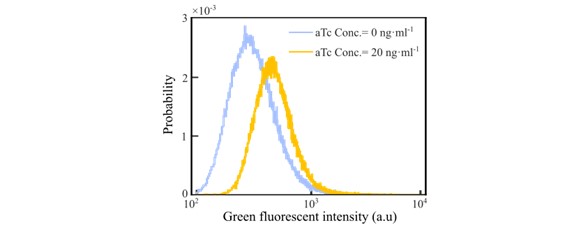
      The distributions of the titrate cells are presented by a ptet-Tar-GFP strain, where the GFP is used as a reporter of the expressed Tar protein. The results are shown below:

      Chemical attraction to cues released by other cells is a well-documented way to create cohesive large scale structures in E. coli (Budrene & Berg Nature 1995, Park et al PNAS 2003, Jani et al Microbiology 2017, Laganenka et al Nat commun 2016). The cohesion of the wave have never been analyzed in this optic, despite being a possible alternative explanation to the gradient shape. Since the authors main claim is about the wave cohesion, they should provide evidence that such an explanation can be ruled out or considered secondary.

      We thank the reviewer to point out the self-attractant secretion as a possible mechanism to maintain coherent group. We argue that this mechanism is not necessary for the chemotactic group to maintain coherency, because the migration group keeps without considering these effect in our agent based simulations.

      Moreover, as suggested by the reviewer, we Used a Tar only strain, which do not sense any chemo-attractant other than aspartate, to show that the migration group maintained coherent (see Fig S9). This experiment showed that the secretion of self-attractant is not essential for the coherent group migration.

      Possible effects of physical interactions between cells on the chemotactic response are not accounted for. The consequences should be better discussed, because they are known to influence chemotactic motility at the densities encountered in the present experiments (Colin et al Nat commun 2019).

      As being reported by Colin et al., the effective drift velocity and the chemotactic ability deceases when cells are condensed (volume fraction >0.01). However, the cell density is smaller than this critical value (volume fraction<0.01).

      Additionally, the paper could better emphasize the new results and separate them from the confirmations of previous results.

      In the revised version, we addressed 2 new findings:

      1) The individual drift velocity decreases from back to front of the bacterial migration group, which makes the chemotactic migration wave a pushed wave.

      2) Cells of diversed phenotypes follows the same reversion behavior, ie. drift faster in the back and slower in the front, but with ordered mean positions, to achieve the ordered pattern in the migration group.

      Reviewer #2 (Public Review):

      The manuscript by Bai et al. explores the single-cell motility dynamics within a chemotactic soliton wave in E. coli. They tracked individual cells and measured their trajectory speed and orientation distributions behind and ahead of the wave. They showed cells behind the wave were moving in a more directed fashion towards the center of the wave compared to cells ahead of the wave. This behavior explains the stability of group migration, as confirmed by numerical simulations.

      I do not recommend this manuscript for publication in eLife since it basically reproduces and deepens previous published works. In particular, Saragosti et al (2011) already provided exactly what the authors claim to do here : "How individuals with phenotypic and behavioral variations manage to maintain the consistent group performance and determine their relative positions in the group is still a mystery." (Line 75-77) (See the last sentences from Saragosti et al : "This modulation of the reorientations significantly improves the efficiency of the collective migration. Moreover, these two quantities are spatially modulated along the concentration profile. We recover quantitatively these microscopic and macroscopic observations with a dedicated kinetic model.")

      Saragosti et al.talks about the modulation of reorientation angle of bacteria along directions. It is not equal to the spatial modulation of drift velocities along space. They claim that cells moving along the gradient direction reorient less during a tumble than cells moving against the gradient. This phenomenon increases the migration efficiency of the group. Here, in our paper, we claim that the drift velocity of bacteria is spatially modulated, where cells on the back drifts faster while the cells in the front drift slower. This phenomenon is important because it makes the chemotactic migration front a pushed wave, that helps the group to keep diversed phenotypes.

      Although Saragosti et al. Have also suggested spatial modulation of bias in run length to explain the coherency of the migration group. But they did not quantify such bias nor did they explain the causes and consequences of the spatial modulation. More over, Their model, consisting their proposed mechanism of directional persistence, can not explain their observed phenomenon of the decreasing bias of run length (see their figure 4A and C).In this circumstance, we can’t agree that they already proofed how cells with diversed phenotype to maintain coherent group.

      Moreover, they did not talk about diversities in the group.

      What is novel here is the titration of the behavior with chemo-receptor abundance, but I believe the scope is not wide enough for publication in eLife. I suggest the authors to submit in a more specialized journal.

      The titration of the chemo-receptor abundance of bacteria serves as a tool to explain how diverse individuals manage to form the ordered patterns in a group. This question worth several discussion because diversity is known as an important feature to keep a group to survive. The ordered pattern was found the key for a migrating group to keep the diversity while performing consistent migration speed. In this paper we successfully explained how individuals performing biased random walk are able to form ordered structure.

      Reviewer #3 (Public Review):

      The authors present a study on the collective behaviour of E.coli during migration in a self-generated gradient. Taking into account phenotypic variation within a biological population, they performed experiments and complemented the study with a predictive model used for simulation to understand how bacteria can move as a group and how the individual bacterium defines its own position within the group.

      They observed experimentally that phenotype variation within the bacterial population causes a spatial distribution within the chemotactic band that is not continuous but formed by subpopulations with specific properties such as run length, run duration, angular distribution of trajectories, drift velocity. They attribute this behaviour to the chemotaxis ability, which varies between phenotypes and defines a potential well that anchors each bacterium in its own group. This was proven by the subdiffusive dynamics of the bacteria in each subgroup. Many cases were studied in the experiments and the authors present many controls to clearly demonstrate their hypothesis.

      These are interesting results that prove how a discretised distribution can produce continuous collective behaviour. It presents also an interesting example in the field of active matter about collective behaviour on a large scale that is generated by a different behaviour of individuals on a much smaller scale. However, it is not clear how the subpopulations can be held together in the group.

      The decreasing chemo-attractant gradient makes the migration wavefront a pushed wavefront. So that the balanced position of the subpopulation with larger chemotactic ability is located in the front where the gradient is small. So that diverse phenotypes form ordered pattern to achieve identical migration speed on their balanced positions. This discussion was added in the revised text (see line 268-277).

      Moreover, a link between bacterial dynamics and the biological necessary mechanism is not clear.

      The bacterial individual dynamics is controlled by the bacterial chemotaxis pathway, which is clear according to previous studies. Basically, the biased random motion was controlled by alternating expected run length through a temporal comparison mechanism between received chemo-attractant concentrations.(Jiang et al. 2010 Plos Comp. Biol.)

      They formulate a theoretical description based on the classical Keller-Segel model. Langevin dynamics was used to describe bacterial activity in terms of drift velocity for simulation, which agrees very well with experimental observations.

      One can appreciate the interesting results of the study describing Ecoli chemotaxis as a mean-reversion process with an associated potential, but it is not clear to what extent the results can be generalised to all bacteria or rather relate to the strain the authors investigated.

      The mean reversion process is a result of decreasing drift velocity (or a pushed wave). Although our study focuses on bacterail chemotaxis migration, but the ordering mechanism of diversed phenotypes follows a OU type model, which is not limited to bacterial chemotaxis. In this case, we argue that the ordering mechanism that we proposed is universal to all active particles that generate signals as a global cue of collective motion.

    1. Author Response

      Reviewer #1 (Public Review):

      Trudel and colleagues aimed to uncover the neural mechanisms of estimating the reliability of the information from social agents and non-social objects. By combining functional MRI with a behavioural experiment and computational modelling, they demonstrated that learning from social sources is more accurate and robust compared with that from non-social sources. Furthermore, dmPFC and pTPJ were found to track the estimated reliability of the social agents (as opposed to the non-social objects). The strength of this study is to devise a task consisting of the two experimental conditions that were matched in their statistical properties and only differed in their framing (social vs. non-social). The novel experimental task allows researchers to directly compare the learning from social and non-social sources, which is a prominent contribution of the present study to social decision neuroscience.

      Thank you so much for your positive feedback about our work. We are delighted that you found that our manuscript provided a prominent contribution to social decision neuroscience. We really appreciate your time to review our work and your valuable comments that have significantly helped us to improve our manuscript further.

      One of the major weaknesses is the lack of a clear description about the conceptual novelty. Learning about the reliability/expertise of social and non-social agents has been of considerable concern in social neuroscience (e.g., Boorman et al., Neuron 2013; and Wittmann et al., Neuron 2016). The authors could do a better job in clarifying the novelty of the study beyond the previous literature.

      We understand the reviewer’s comment and have made changes to the manuscript that, first, highlight more strongly the novelty of the current study. Crucially, second, we have also supplemented the data analyses with a new model-based analysis of the differences in behaviour in the social and non-social conditions which we hope makes clearer, at a theoretical level, why participants behave differently in the two conditions.

      There has long been interest in investigating whether ‘social’ cognitive processes are special or unique compared to ‘non-social’ cognitive processes and, if they are, what makes them so. Differences between conditions could arise during the input stage (e.g. the type of visual input that is processed by social and non-social system), at the algorithm stage (e.g. the type of computational principles that underpin social versus non-social processes) or, even if identical algorithms are used, social and non-social processes might depend on distinct anatomical brain areas or neurons within brain areas. Here, we conducted multiple analyses (in figures 2, 3, and 4 in the revised manuscript and in Figure 2 – figure supplement 1, Figure 3 – figure supplement 1, Figure 4 – figure supplement 3, Figure 4 – figure supplement 4) that not only demonstrated basic similarities in mechanism generalised across social and non-social contexts, but also demonstrated important quantitative differences that were linked to activity in specific brain regions associated with the social condition. The additional analyses (Figure 4 – figure supplement 3, Figure 4 – figure supplement 4) show that differences are not simply a consequence of differences in the visual stimuli that are inputs to the two systems1, nor does the type of algorithm differ between conditions. Instead, our results suggest that the precise manner in which an algorithm is implemented differs when learning about social or non-social information and that this is linked to differences in neuroanatomical substrates.

      The previous studies mentioned by the reviewer are, indeed, relevant ones and were, of course, part of the inspiration for the current study. However, there are crucial differences between them and the current study. In the case of the previous studies by Wittmann, the aim was a very different one: to understand how one’s own beliefs, for example about one’s performance, and beliefs about others, for example about their performance levels, are combined. Here, however, instead we were interested in the similarities and differences between social and non-social learning. It is true that the question resembles the one addressed by Boorman and colleagues in 2013 who looked at how people learned about the advice offered by people or computer algorithms but the difference in the framing of that study perhaps contributed to authors’ finding of little difference in learning. By contrast, in the present study we found evidence that people were predisposed to perceive stability in social performance and to be uncertain about non-social performance. By accumulating evidence across multiple analyses, we show that there are quantitative differences in how we learn about social versus non-social information, and that these differences can be linked to the way in which learning algorithms are implemented neurally. We therefore contend that our findings extend our previous understanding of how, in relation to other learning processes, ‘social’ learning has both shared and special features.

      We would like to emphasize the way in which we have extended several of the analyses throughout the revision. The theoretical Bayesian framework has made it possible to simulate key differences in behaviour between the social and non-social conditions. We explain in our point-by-point reply below how we have integrated a substantial number of new analyses. We have also more carefully related our findings to previous studies in the Introduction and Discussion.

      Introduction, page 4:

      [...] Therefore, by comparing information sampling from social versus non-social sources, we address a long-standing question in cognitive neuroscience, the degree to which any neural process is specialized for, or particularly linked to, social as opposed to non-social cognition 2–9. Given their similarities, it is expected that both types of learning will depend on common neural mechanisms. However, given the importance and ubiquity of social learning, it may also be that the neural mechanisms that support learning from social advice are at least partially specialized and distinct from those concerned with learning that is guided by nonsocial sources. However, it is less clear on which level information is processed differently when it has a social or non-social origin. It has recently been argued that differences between social and non-social learning can be investigated on different levels of Marr’s information processing theory: differences could emerge at an input level (in terms of the stimuli that might drive social and non-social learning), at an algorithmic level or at a neural implementation level 7. It might be that, at the algorithmic level, associative learning mechanisms are similar across social and non-social learning 1. Other theories have argued that differences might emerge because goal-directed actions are attributed to social agents which allows for very different inferences to be made about hidden traits or beliefs 10. Such inferences might fundamentally alter learning about social agents compared to non-social cues.

      Discussion, page 15:

      […] One potential explanation for the assumption of stable performance for social but not non-social predictors might be that participants attribute intentions and motivations to social agents. Even if the social and non-social evidence are the same, the belief that a social actor might have a goal may affect the inferences made from the same piece of information 10. Social advisors first learnt about the target’s distribution and accordingly gave advice on where to find the target. If the social agents are credited with goal-directed behaviour then it might be assumed that the goals remain relatively constant; this might lead participants to assume stability in the performances of social advisors. However, such goal-directed intentions might not be attributed to non-social cues, thereby making judgments inherently more uncertain and changeable across time. Such an account, focussing on differences in attribution in social settings aligns with a recent suggestion that any attempt to identify similarities or differences between social and non-social processes can occur at any one of a number of the levels in Marr’s information theory 7. Here we found that the same algorithm was able to explain social and non-social learning (a qualitatively similar computational model could explain both). However, the extent to which the algorithm was recruited when learning about social compared to non-social information differed. We observed a greater impact of uncertainty on judgments about social compared to non-social information. We have shown evidence for a degree of specialization when assessing social advisors as opposed to non-social cues. At the neural level we focused on two brain areas, dmPFC and pTPJ, that have not only been shown to carry signals associated with belief inferences about others but, in addition, recent combined fMRI-TMS studies have demonstrated the causal importance of these activity patterns for the inference process […]

      Another weakness is the lack of justifications of the behavioural data analyses. It is difficult for me to understand why 'performance matching' is suitable for an index of learning accuracy. I understand the optimal participant would adjust the interval size with respect to the estimated reliability of the advisor (i.e., angular error); however, I am wondering if the optimal strategy for participants is to exactly match the interval size with the angular error. Furthermore, the definitions of 'confidence adjustment across trials' and 'learning index' look arbitrary.

      First, having read the reviewer’s comments, we realise that our choice of the term ‘performance matching’ may not have been ideal as it indeed might not be the case that the participant intended to directly match their interval sizes with their estimates of advisor/predictor error. Like the reviewer, our assumption is simply that the interval sizes should change as the estimated reliability of the advisor changes and, therefore, that the intervals that the participants set should provide information about the estimates that they hold and the manner in which they evolve. On re-reading the manuscript we realised that we had not used the term ‘performance matching’ consistently or in many places in the manuscript. In the revised manuscript we have simply removed it altogether and referred to the participants’ ‘interval setting’.

      Most of the initial analyses in Figure 2a-c aim to better understand the raw behaviour before applying any computational model to the data. We were interested in how participants make confidence judgments (decision-making per se), but also how they adapt their decisions with additional information (changes or learning in decision making). In the revised manuscript we have made clear that these are used as simple behavioural measures and that they will be complemented later by more analyses derived from more formal computational models.

      In what we now refer to as the ‘interval setting’ analysis (Figure 2a), we tested whether participants select their interval settings differently in the social compared to non-social condition. We observe that participants set their intervals closer to the true angular error of the advisor/predictor in the social compared to the non-social condition. This observation could arise in two ways. First, it could be due to quantitative differences in learning despite general, qualitative similarity: mechanisms are similar but participants differ quantitatively in the way that they learn about non-social information and social information. Second, it could, however, reflect fundamentally different strategies. We tested basic performance differences by comparing the mean reward between conditions. There was no difference in reward between conditions (mean reward: paired t-test social vs. non-social, t(23)= 0.8, p=0.4, 95% CI= [-0.007 0.016]), suggesting that interval setting differences might not simply reflect better or worse performance in social or non-social contexts but instead might reflect quantitative differences in the processes guiding interval setting in the two cases.

      In the next set of analyses, in which we compared raw data, applied a computational model, and provided a theoretical account for the differences between conditions, we suggest that there are simple quantitative differences in how information is processed in social and nonsocial conditions but that these have the important impact of making long-term representations – representations built up over a longer series of trials – more important in the social condition. This, in turn, has implications for the neural activity patterns associated with social and non-social learning. We, therefore, agree with the reviewer, that one manner of interval setting is indeed not more optimal than another. However, the differences that do exist in behaviour are important because they reveal something about the social and non-social learning and its neural substrates. We have adjusted the wording and interpretation in the revised manuscript.

      Next, we analysed interval setting with two additional, related analyses: interval setting adjustment across trials and derivation of a learning index. We tested the degree to which participants adjusted their interval setting across trials and according to the prediction error (learning index, Figure f); the latter analysis is very similar to a trial-wise learning rate calculated in previous studies11. In contrast to many other studies, the intervals set by participants provide information about the estimates that they hold in a simple and direct way and enable calculation of a trial-wise learning index; therefore, we decided to call it ‘learning index’ instead of ‘learning rate’ as it is not estimated via a model applied to the data, but instead directly calculated from the data. Arguably the directness of the approach, and its lack of dependence on a specific computational model, is a strength of the analysis.

      Subsequently in the manuscript, a new analysis (illustrated in new Figure 3) employs Bayesian models that can simulate the differences in the social and non-social conditions and demonstrate that a number of behavioural observations can arise simply as a result of differences in noise in each trial-wise Bayesian update (Figure 3 and specifically 3d; Figure 3 – figure supplement 1b-c). In summary, the descriptive analyses in Figure 2a-c aid an intuitive understanding of the differences in behaviour in the social and non-social conditions. We have then repeated these analyses with Bayesian models incorporating different noise levels and showed that in such a way, the differences in behaviour between social and non-social conditions can be mimicked (please see next section and manuscript for details).

      We adjusted the wording in a number of sections in the revised manuscript such as in the legend of Figure 2 (figures and legend), Figure 4 (figures and legend).

      Main text, page 5:

      The confidence interval could be changed continuously to make it wider or narrower, by pressing buttons repeatedly (one button press resulted in a change of one step in the confidence interval). In this way participants provided what we refer to as an ’interval setting’.

      We also adjusted the following section in Main text, page 6:

      Confidence in the performance of social and non-social advisors

      We compared trial-by-trial interval setting in relation to the social and non-social advisors/predictors. When setting the interval, the participant’s aim was to minimize it while ensuring it still encompassed the final target position; points were won when it encompassed the target position but were greater when it was narrower. A given participant’s interval setting should, therefore, change in proportion to the participant’s expectations about the predictor’s angular error and their uncertainty about those expectations. Even though, on average, social and non-social sources did not differ in the precision with which they predicted the target (Figure 2 – figure supplement 1), participants gave interval settings that differed in their relationships to the true performances of the social advisors compared to the non-social predictors. The interval setting was closer to the angular error in the social compared to the non-social sessions (Figure 2a, paired t-test: social vs. non-social, t(23)= -2.57, p= 0.017, 95% confidence interval (CI)= [-0.36 -0.4]). Differences in interval setting might be due to generally lower performance in the nonsocial compared to social condition, or potentially due to fundamentally different learning processes utilised in either condition. We compared the mean reward amounts obtained by participants in the social and non-social conditions to determine whether there were overall performance differences. There was, however, no difference in the reward received by participants in the two conditions (mean reward: paired t-test social vs. non-social, t(23)= 0.8, p=0.4, 95% CI= [-0.007 0.016]), suggesting that interval setting differences might not simply reflect better or worse performance

      Discussion, page 14:

      Here, participants did not match their confidence to the likely accuracy of their own performance, but instead to the performance of another social or non-social advisor. Participants used different strategies when setting intervals to express their confidence in the performances of social advisors as opposed to non-social advisors. A possible explanation might be that participants have a better insight into the abilities of social cues – typically other agents – than non-social cues – typically inanimate objects.

      As the authors assumed simple Bayesian learning for the estimation of reliability in this study, the degree/speed of the learning should be examined with reference to the distance between the posterior and prior belief in the optimal Bayesian inference.

      We thank the reviewer for this suggestion. We agree with the reviewer that further analyses that aim to disentangle the underlying mechanisms that might differ between both social and non-social conditions might provide additional theoretical contributions. We show additional model simulations and analyses that aim to disentangle the differences in more detail. These new results allowed clearer interpretations to be made.

      In the current study, we showed that judgments made about non-social predictors were changed more strongly as a function of the subjective uncertainty: participants set a larger interval, indicating lower confidence, when they were more uncertain about the non-social cue’s accuracy to predict the target. In response to the reviewer’s comments, the new analyses were aimed at understanding under which conditions such a negative uncertainty effect might emerge.

      Prior expectations of performance First, we compared whether participants had different prior expectations in the social condition compared to the non-social condition. One way to compare prior expectations is by comparing the first interval set for each advisor/predictor. This is a direct readout of the initial prior expectation with which participants approach our two conditions. In such a way, we test whether the prior beliefs before observing any social or non-social information differ between conditions. Even though this does not test the impact of prior expectations on subsequent belief updates, it does test whether participants have generally different expectations about the performance of social advisors or non-social predictors. There was no difference in this measure between social or non-social cues (Figure below; paired t-test social vs. non-social, t(23)= 0.01, p=0.98, 95% CI= [-0.067 0.68]).

      Figure. Confidence interval for the first encounter of each predictor in social and non-social conditions. There was no initial bias in predicting the performance of social or non-social predictors.

      Learning across time We have now seen that participants do not have an initial bias when predicting performances in social or non-social conditions. This suggests that differences between conditions might emerge across time when encountering predictors multiple times. We tested whether inherent differences in how beliefs are updated according to new observations might result in different impacts of uncertainty on interval setting between social and non-social conditions. More specifically, we tested whether the integration of new evidence differed between social and non-social conditions; for example, recent observations might be weighted more strongly for non-social cues while past observations might be weighted more strongly for social cues. This approach was inspired by the reviewer’s comments about potential differences in the speed of learning as well as the reduction of uncertainty with increasing predictor encounters. Similar ideas were tested in previous studies, when comparing the learning rate (i.e. the speed of learning) in environments of different volatilities 12,13. In these studies, a smaller learning rate was prevalent in stable environments during which reward rates change slower over time, while higher learning rates often reflect learning in volatile environments so that recent observations have a stronger impact on behaviour. Even though most studies derived these learning rates with reinforcement learning models, similar ideas can be translated into a Bayesian model. For example, an established way of changing the speed of learning in a Bayesian model is to introduce noise during the update process14. This noise is equivalent to adding in some of the initial prior distribution and this will make the Bayesian updates more flexible to adapt to changing environments. It will widen the belief distribution and thereby make it more uncertain. Recent information has more weight on the belief update within a Bayesian model when beliefs are uncertain. This increases the speed of learning. In other words, a wide distribution (after adding noise) allows for quick integration of new information. On the contrary, a narrow distribution does not integrate new observations as strongly and instead relies more heavily on previous information; this corresponds to a small learning rate. So, we would expect a steep decline of uncertainty to be related to a smaller learning index while a slower decline of uncertainty is related to a larger learning index. We hypothesized that participants reduce their uncertainty quicker when observing social information, thereby anchoring more strongly on previous beliefs instead of integrating new observations flexibly. Vice versa, we hypothesized a less steep decline of uncertainty when observing non-social information, indicating that new information can be flexibly integrated during the belief update (new Figure 3a).

      We modified the original Bayesian model (Figure 2d, Figure 2 – figure supplement 2) by adding a uniform distribution (equivalent to our prior distribution) to each belief update – we refer to this as noise addition to the Bayesian model14,21 . We varied the amount of noise between δ = [0,1], while δ= 0 equals the original Bayesian model and δ= 1 represents a very noisy Bayesian model. The uniform distribution was selected to match the first prior belief before any observation was made (equation 2). This δ range resulted in a continuous increase of subjective uncertainty around the belief about the angular error (Figure 3b-c). The modified posterior distribution denoted as 𝑝′(σ x) was derived at each trial as follows:

      We applied each noisy Bayesian model to participants’ choices within the social and nonsocial condition.

      The addition of a uniform distribution changed two key features of the belief distribution: first, the width of the distribution remains larger with additional observations, thereby making it possible to integrate new observations more flexibly. To show this more clearly, we extracted the model-derived uncertainty estimate across multiple encounters of the same predictor for the original model and the fully noisy Bayesian model (Figure 3 – figure supplement 1). The model-derived ‘uncertainty estimate’ of a noisy Bayesian model decays more slowly compared to the ‘uncertainty estimate’ of the original Bayesian model (upper panel). Second, the model-derived ‘accuracy estimate’ reflects more recent observations in a noisy Bayesian model compared to the ‘accuracy estimate’ derived from the original Bayesian model, which integrates past observations more strongly (lower panel). Hence, as mentioned beforehand, a rapid decay of uncertainty implies a small learning index; or in other words, stronger integration of past compared to recent observations.

      In the following analyses, we tested whether an increasingly noisy Bayesian model mimics behaviour that is observed in the non-social compared to social condition. For example, we tested whether an increasingly noisy Bayesian model also exhibits a strongly negative ‘predictor uncertainty’ effect on interval setting (Figure 2e). In such a way, we can test whether differences in noise in the updating process of a Bayesian model might reproduce important qualitative differences in learning-related behaviour seen in the social and nonsocial conditions.

      We used these modified Bayesian models to simulate trial-wise interval setting for each participant according to the observations they made when selecting a particular advisor or non-social cue. We simulated interval setting at each trial and examined whether an increase in noise produced model behaviours that resembled participant behaviour patterns observed in the non-social condition as opposed to social condition. At each trial, we used the accuracy estimate (Methods, equation 6) – which represents a subjective belief about a single angular error -- to derive an interval setting for the selected predictor. To do so, we first derived the point-estimate of the belief distribution at each trial (Methods, equation 6) and multiplied it with the size of one interval step on the circle. The step size was derived by dividing the circle size by the maximum number of possible steps. Here is an example of transforming an accuracy estimate into an interval: let’s assume the belief about the angular error at the current trial is 50 (Methods, equation 6). Now, we are trying to transform this number into an interval for the current predictor on a given trial. To obtain the size of one interval step, the circle size (360 degrees) is divided by the maximum number of interval steps (40 steps; note, 20 steps on each side), which results in nine degrees that represents the size of one interval step. Next, the accuracy estimate in radians (0,87) is multiplied by the step size in radians (0,1571) resulting in an interval of 0,137 radians or 7,85 degrees. The final interval size would be 7,85.

      Simulating Bayesian choices in that way, we repeated the behavioural analyses (Figure 2b,e,f) to test whether intervals derived from more noisy Bayesian models mimic intervals set by participants in the non-social condition: greater changes in interval setting across trials (Figure 3 – figure supplement 1b), a negative ‘predictor uncertainty' effect on interval setting (Figure 3 – figure supplement 1c), and a higher learning index (Figure 3d).

      First, we repeated the most crucial analysis -- the linear regression analysis (Figure 2e) and hypothesized that intervals that were simulated from noisy Bayesian models would also show a greater negative ‘predictor uncertainty’ effect on interval setting. This was indeed the case: irrespective of social or non-social conditions, the addition of noise (increased weighting of the uniform distribution in each belief update) led to an increasingly negative ‘predictor uncertainty’ effect on confidence judgment (new Figure 3d). In Figure 3d, we show the regression weights (y-axis) for the ‘predictor uncertainty’ on confidence judgment with increasing noise (x-axis). This result is highly consistent with the idea that that in the non-social condition the manner in which task estimates are updated is more uncertain and more noisy. By contrast, social estimates appear relatively more stable, also according to this new Bayesian simulation analysis.

      This new finding extends the results and suggests a formal computational account of the behavioural differences between social and non-social conditions. Increasing the noise of the belief update mimics behaviour that is observed in the non-social condition: an increasingly negative effect of ‘predictor uncertainty’ on confidence judgment. Noteworthily, there was no difference in the impact that the noise had in the social and non-social conditions. This was expected because the Bayesian simulations are blind to the framing of the conditions. However, it means that the observed effects do not depend on the precise sequence of choices that participants made in these conditions. It therefore suggests that an increase in the Bayesian noise leads to an increasingly negative impact of ‘predictor uncertainty’ on confidence judgments irrespective of the condition. Hence, we can conclude that different degrees of uncertainty within the belief update is a reasonable explanation that can underlie the differences observed between social and non-social conditions.

      Next, we used these simulated confidence intervals and repeated the descriptive behavioural analyses to test whether interval settings that were derived from more noisy Bayesian models mimic behavioural patterns observed in non-social compared to social conditions. For example, more noise in the belief update should lead to more flexible integration of new information and hence should potentially lead to a greater change of confidence judgments across predictor encounters (Figure 2b). Further, a greater reliance on recent information should lead to prediction errors more strongly in the next confidence judgment; hence, it should result in a higher learning index in the non-social condition that we hypothesize to be perceived as more uncertain (Figure 2f). We used the simulated confidence interval from Bayesian models on a continuum of noise integration (i.e. different weighting of the uniform distribution into the belief update) and derived again both absolute confidence change and learning indices (Figure 3 – figure supplement 1b-c).

      ‘Absolute confidence change’ and ‘learning index’ increase with increasing noise weight, thereby mimicking the difference between social and non-social conditions. Further, these analyses demonstrate the tight relationship between descriptive analyses and model-based analyses. They show that a noise in the Bayesian updating process is a conceptual explanation that can account for both the differences in learning and the difference in uncertainty processing that exist between social and non-social conditions. The key insight conveyed by the Bayesian simulations is that a wider, more uncertain belief distribution changes more quickly. Correspondingly, in the non-social condition, participants express more uncertainty in their confidence estimate when they set the interval, and they also change their beliefs more quickly as expressed in a higher learning index. Therefore, noisy Bayesian updating can account for key differences between social and non-social condition.

      We thank the reviewer for making this point, as we believe that these additional analyses allow theoretical inferences to be made in a more direct manner; we think that it has significantly contributed towards a deeper understanding of the mechanisms involved in the social and non-social conditions. Further, it provides a novel account of how we make judgments when being presented with social and non-social information.

      We made substantial changes to the main text, figures and supplementary material to include these changes:

      Main text, page 10-11 new section:

      The impact of noise in belief updating in social and non-social conditions

      So far, we have shown that, in comparison to non-social predictors, participants changed their interval settings about social advisors less drastically across time, relied on observations made further in the past, and were less impacted by their subjective uncertainty when they did so (Figure 2). Using Bayesian simulation analyses, we investigated whether a common mechanism might underlie these behavioural differences. We tested whether the integration of new evidence differed between social and non-social conditions; for example, recent observations might be weighted more strongly for non-social cues while past observations might be weighted more strongly for social cues. Similar ideas were tested in previous studies, when comparing the learning rate (i.e. the speed of learning) in environments of different volatilities12,13. We tested these ideas using established ways of changing the speed of learning during Bayesian updates14,21. We hypothesized that participants reduce their uncertainty quicker when observing social information. Vice versa, we hypothesized a less steep decline of uncertainty when observing non-social information, indicating that new information can be flexibly integrated during the belief update (Figure 5a).

      We manipulated the amount of uncertainty in the Bayesian model by adding a uniform distribution to each belief update (Figure 3b-c) (equation 10,11). Consequently, the distribution’s width increases and is more strongly impacted by recent observations (see example in Figure 3 – figure supplement 1). We used these modified Bayesian models to simulate trial-wise interval setting for each participant according to the observations they made by selecting a particular advisor in the social condition or other predictor in the nonsocial condition. We simulated confidence intervals at each trial. We then used these to examine whether an increase in noise led to simulation behaviour that resembled behavioural patterns observed in non-social conditions that were different to behavioural patterns observed in the social condition.

      First, we repeated the linear regression analysis and hypothesized that interval settings that were simulated from noisy Bayesian models would also show a greater negative ‘predictor uncertainty’ effect on interval setting resembling the effect we had observed in the nonsocial condition (Figure 2e). This was indeed the case when using the noisy Bayesian model: irrespective of social or non-social condition, the addition of noise (increasing weight of the uniform distribution to each belief update) led to an increasingly negative ‘predictor uncertainty’ effect on confidence judgment (new Figure 3d). The absence of difference between the social and non-social conditions in the simulations, suggests that an increase in the Bayesian noise is sufficient to induce a negative impact of ‘predictor uncertainty’ on interval setting. Hence, we can conclude that different degrees of noise in the updating process are sufficient to cause differences observed between social and non-social conditions. Next, we used these simulated interval settings and repeated the descriptive behavioural analyses (Figure 2b,f). An increase in noise led to greater changes of confidence across time and a higher learning index (Figure 3 – figure supplement 1b-c). In summary, the Bayesian simulations offer a conceptual explanation that can account for both the differences in learning and the difference in uncertainty processing that exist between social and non-social conditions. The key insight conveyed by the Bayesian simulations is that a wider, more uncertain belief distribution changes more quickly. Correspondingly, in the non-social condition, participants express more uncertainty in their confidence estimate when they set the interval, and they also change their beliefs more quickly. Therefore, noisy Bayesian updating can account for key differences between social and non-social condition.

      Methods, page 23 new section:

      Extension of Bayesian model with varying amounts of noise

      We modified the original Bayesian model (Figure 2d, Figure 2 – figure supplement 2) to test whether the integration of new evidence differed between social and non-social conditions; for example, recent observations might be weighted more strongly for non-social cues while past observations might be weighted more strongly for social cues. [...] To obtain the size of one interval step, the circle size (360 degrees) is divided by the maximum number of interval steps (40 steps; note, 20 steps on each side), which results in nine degrees that represents the size of one interval step. Next, the accuracy estimate in radians (0,87) is multiplied by the step size in radians (0,1571) resulting in an interval of 0,137 radians or 7,85 degrees. The final interval size would be 7,85.

      We repeated behavioural analyses (Figure 2b,e,f) to test whether confidence intervals derived from more noisy Bayesian models mimic behavioural patterns observed in the nonsocial condition: greater changes of confidence across trials (Figure 3 – figure supplement 1b), a greater negative ‘predictor uncertainty' on confidence judgment (Figure 3 – figure supplement 1c) and a greater learning index (Figure 3d).

      Discussion, page 14: […] It may be because we make just such assumptions that past observations are used to predict performance levels that people are likely to exhibit next 15,16. An alternative explanation might be that participants experience a steeper decline of subjective uncertainty in their beliefs about the accuracy of social advice, resulting in a narrower prior distribution, during the next encounter with the same advisor. We used a series of simulations to investigate how uncertainty about beliefs changed from trial to trial and showed that belief updates about non-social cues were consistent with a noisier update process that diminished the impact of experiences over the longer term. From a Bayesian perspective, greater certainty about the value of advice means that contradictory evidence will need to be stronger to alter one’s beliefs. In the absence of such evidence, a Bayesian agent is more likely to repeat previous judgments. Just as in a confirmation bias 17, such a perspective suggests that once we are more certain about others’ features, for example, their character traits, we are less likely to change our opinions about them.

      Reviewer #2 (Public Review):

      Humans learn about the world both directly, by interacting with it, and indirectly, by gathering information from others. There has been a longstanding debate about the extent to which social learning relies on specialized mechanisms that are distinct from those that support learning through direct interaction with the environment. In this work, the authors approach this question using an elegant within-subjects design that enables direct comparisons between how participants use information from social and non-social sources. Although the information presented in both conditions had the same underlying structure, participants tracked the performance of the social cue more accurately and changed their estimates less as a function of prediction error. Further, univariate activity in two regions-dmPFC and pTPJ-tracked participants' confidence judgments more closely in the social than in the non-social condition, and multivariate patterns of activation in these regions contained information about the identity of the social cues.

      Overall, the experimental approach and model used in this paper are very promising. However, after reading the paper, I found myself wanting additional insight into what these condition differences mean, and how to place this work in the context of prior literature on this debate. In addition, some additional analyses would be useful to support the key claims of the paper.

      We thank the reviewer for their very supportive comments. We have addressed their points below and have highlighted changes in our manuscript that we made in response to the reviewer’s comments.

      (1) The framing should be reworked to place this work in the context of prior computational work on social learning. Some potentially relevant examples:

      • Shafto, Goodman & Frank (2012) provide a computational account of the domainspecific inductive biases that support social learning. In brief, what makes social learning special is that we have an intuitive theory of how other people's unobservable mental states lead to their observable actions, and we use this intuitive theory to actively interpret social information. (There is also a wealth of behavioral evidence in children to support this account; for a review, see Gweon, 2021).

      • Heyes (2012) provides a leaner account, arguing that social and non-social learning are supported by a common associative learning mechanism, and what distinguishes social from non-social learning is the input mechanism. Social learning becomes distinctively "social" to the extent that organisms are biased or attuned to social information.

      I highlight these papers because they go a step beyond asking whether there is any difference between mechanisms that support social and nonsocial learning-they also provide concrete proposals about what that difference might be, and what might be shared. I would like to see this work move in a similar direction.

      References<br /> (In the interest of transparency: I am not an author on these papers.)

      Gweon, H. (2021). Inferential social learning: how humans learn from others and help others learn. PsyArXiv. https://doi.org/10.31234/osf.io/8n34t

      Heyes, C. (2012). What's social about social learning?. Journal of Comparative Psychology, 126(2), 193.

      Shafto, P., Goodman, N. D., & Frank, M. C. (2012). Learning from others: The consequences of psychological reasoning for human learning. Perspectives on Psychological Science, 7(4), 341-351.

      Thank you for this suggestion to expand our framing. We have now made substantial changes to the Discussion and Introduction to include additional background literature, the relevant references suggested by the reviewer, addressing the differences between social and non-social learning. We further related our findings to other discussions in the literature that argue that differences between social and non-social learning might occur at the level of algorithms (the computations involved in social and non-social learning) and/or implementation (the neural mechanisms). Here, we describe behaviour with the same algorithm (Bayesian model), but the weighing of uncertainty on decision-making differs between social and non-social contexts. This might be explained by similar ideas put forward by Shafto and colleagues (2012), who suggest that differences between social and non-social learning might be due to the attribution of goal-directed intention to social agents, but not non-social cues. Such an attribution might lead participants to assume that advisor performances will be relatively stable under the assumption that they should have relatively stable goal-directed intentions. We also show differences at the implementational level in social and non-social learning in TPJ and dmPFC.

      Below we list the changes we have made to the Introduction and Discussion. Further, we would also like to emphasize the substantial extension of the Bayesian modelling which we think clarifies the theoretical framework used to explain the mechanisms involved in social and non-social learning (see our answer to the next comments below).

      Introduction, page 4:

      [...]<br /> Therefore, by comparing information sampling from social versus non-social sources, we address a long-standing question in cognitive neuroscience, the degree to which any neural process is specialized for, or particularly linked to, social as opposed to non-social cognition 2–9. Given their similarities, it is expected that both types of learning will depend on common neural mechanisms. However, given the importance and ubiquity of social learning, it may also be that the neural mechanisms that support learning from social advice are at least partially specialized and distinct from those concerned with learning that is guided by nonsocial sources.

      However, it is less clear on which level information is processed differently when it has a social or non-social origin. It has recently been argued that differences between social and non-social learning can be investigated on different levels of Marr’s information processing theory: differences could emerge at an input level (in terms of the stimuli that might drive social and non-social learning), at an algorithmic level or at a neural implementation level 7. It might be that, at the algorithmic level, associative learning mechanisms are similar across social and non-social learning 1. Other theories have argued that differences might emerge because goal-directed actions are attributed to social agents which allows for very different inferences to be made about hidden traits or beliefs 10. Such inferences might fundamentally alter learning about social agents compared to non-social cues.

      Discussion, page 15:

      […] One potential explanation for the assumption of stable performance for social but not non-social predictors might be that participants attribute intentions and motivations to social agents. Even if the social and non-social evidence are the same, the belief that a social actor might have a goal may affect the inferences made from the same piece of information 10. Social advisors first learnt about the target’s distribution and accordingly gave advice on where to find the target. If the social agents are credited with goal-directed behaviour then it might be assumed that the goals remain relatively constant; this might lead participants to assume stability in the performances of social advisors. However, such goal-directed intentions might not be attributed to non-social cues, thereby making judgments inherently more uncertain and changeable across time. Such an account, focussing on differences in attribution in social settings aligns with a recent suggestion that any attempt to identify similarities or differences between social and non-social processes can occur at any one of a number of the levels in Marr’s information theory 7. Here we found that the same algorithm was able to explain social and non-social learning (a qualitatively similar computational model could explain both). However, the extent to which the algorithm was recruited when learning about social compared to non-social information differed. We observed a greater impact of uncertainty on judgments about social compared to non-social information. We have shown evidence for a degree of specialization when assessing social advisors as opposed to non-social cues. At the neural level we focused on two brain areas, dmPFC and pTPJ, that have not only been shown to carry signals associated with belief inferences about others but, in addition, recent combined fMRI-TMS studies have demonstrated the causal importance of these activity patterns for the inference process […]

      (2) The results imply that dmPFC and pTPJ differentiate between learning from social and non-social sources. However, more work needs to be done to rule out simpler, deflationary accounts. In particular, the condition differences observed in dmPFC and pTPJ might reflect low-level differences between the two conditions. For example, the social task could simply have been more engaging to participants, or the social predictors may have been more visually distinct from one another than the fruits.

      We understand the reviewer’s concern regarding low-level distinctions between the social and non-social condition that could confound for the differences in neural activation that are observed between conditions in areas pTPJ and dmPFC. From the reviewer’s comments, we understand that there might be two potential confounders: first, low-level differences such that stimuli within one condition might be more distinct to each other compared to the relative distinctiveness between stimuli within the other condition. Therefore, simply the greater visual distinctiveness of stimuli in one condition than another might lead to learning differences between conditions. Second, stimuli in one condition might be more engaging and potentially lead to attentional differences between conditions. We used a combination of univariate analyses and multivariate analyses to address both concerns.

      Analysis 1: Univariate analysis to inspect potential unaccounted variance between social and non-social condition

      First, we used the existing univariate analysis (exploratory MRI whole-brain analysis, see Methods) to test for neural activation that covaried with attentional differences – or any other unaccounted neural difference -- between conditions. If there were neural differences between conditions that we are currently not accounting for with the parametric regressors that are included in the fMRI-GLM, then these differences should be captured in the constant of the GLM model. For example, if there are attentional differences between conditions, then we could expect to see neural differences between conditions in areas such as inferior parietal lobe (or other related areas that are commonly engaged during attentional processes).

      Importantly, inspection of the constant of the GLM model should capture any unaccounted differences, whether they are due to attention or alternative processes that might differ between conditions. When inspecting cluster-corrected differences in the constant of the fMRI-GLM model during the setting of the confidence judgment, there were no clustersignificant activation that was different between social and non-social conditions (Figure 4 – figure supplement 4a; results were familywise-error cluster-corrected at p<0.05 using a cluster-defining threshold of z>2.3). For transparency, we show the sub-threshold activation map across the whole brain (z > 2) for the ‘constant’ contrasted between social and nonsocial condition (i.e. constant, contrast: social – non-social).

      For transparency we additionally used an ROI-approach to test differences in activation patterns that correlated with the constant during the confidence phase – this means, we used the same ROI-approach as we did in the paper to avoid any biased test selection. We compared activation patterns between social and non-social conditions in the same ROI as used before; dmPFC (MNI-coordinate [x/y/z: 2,44,36] 16), bilateral pTPJ (70% probability anatomical mask; for reference see manuscript, page 23) and additionally compared activation patterns between conditions in bilateral IPLD (50% probability anatomical mask, 20). We did not find significantly different activation patterns between social and non-social conditions in any of these areas: dmPFC (confidence constant; paired t-test social vs nonsocial: t(23) = 0.06, p=0.96, [-36.7, 38.75]), bilateral TPJ (confidence constant; paired t-test social vs non-social: t(23) = -0.06, p=0.95, [-31, 29]), bilateral IPLD (confidence constant; paired t-test social vs non-social: t(23) = -0.58, p=0.57, [-30.3 17.1]).

      There were no meaningful activation patterns that differed between conditions in either areas commonly linked to attention (eg IPL) or in brain areas that were the focus of the study (dmPFC and pTPJ). Activation in dmPFC and pTPJ covaried with parametric effects such as the confidence that was set at the current and previous trial, and did not correlate with low-level differences such as attention. Hence, these results suggest that activation between conditions was captured better by parametric regressors such as the trial-wise interval setting, i.e. confidence, and are unlikely to be confounded by low-level processes that can be captured with univariate neural analyses.

      Analysis 2: RSA to test visual distinctiveness between social and non-social conditions

      We addressed the reviewer’s other comment further directly by testing whether potential differences between conditions might arise due to a varying degree of visual distinctiveness in one stimulus set compared to the other stimulus set. We used RSA analysis to inspect potential differences in early visual processes that should be impacted by greater stimulus similarity within one condition. In other words, we tested whether the visual distinctiveness of one stimuli set was different to the visual distinctiveness of the other stimuli set. We used RSA analysis to compare the Exemplar Discriminability Index (EDI) between conditions in early visual areas. We compared the dissimilarity of neural activation related to the presentation of an identical stimulus across trials (diagonal in RSA matrix) with the dissimilarity in neural activation between different stimuli across trials (off-diagonal in RSA matrix). If stimuli within one stimulus set are very similar, then the difference between the diagonal and off-diagonal should be very small and less likely to be significant (i.e. similar diagonal and off-diagonal values). In contrast, if stimuli within one set are very distinct from each other, then the difference between the diagonal and off-diagonal should be large and likely to result in a significant EDI (i.e. different diagonal and off-diagonal values) (see Figure 4g for schematic illustration). Hence, if there is a difference in the visual distinctiveness between social and non-social conditions, then this difference should result in different EDI values for both conditions – hence, visual distinctiveness between the stimuli set can be tested by comparing the EDI values between conditions within the early visual processing. We used a Harvard-cortical ROI mask based on bilateral V1. Negative EDI values indicate that the same exemplars are represented more similarly in the neural V1 pattern than different exemplars. This analysis showed that there was no significant difference in EDI between conditions (Figure 4 – figure supplement 4b; EDI paired sample t-test: t(23) = -0.16, p=0.87, 95% CI [-6.7 5.7]).

      We have further replicated results in V1 with a whole-brain searchlight analysis, averaging across both social and non-social conditions.

      In summary, by using a combination of univariate and multivariate analyses, we could test whether neural activation might be different when participants were presented with a facial or fruit stimuli and whether these differences might confound observed learning differences between conditions. We did not find meaningful neural differences that were not accounted for with the regressors included in the GLM. Further, we did not find differences in the visual distinctiveness between the stimuli sets. Hence, these control analyses suggest that differences between social and non-social conditions might not arise because of differences in low-level processes but are instead more likely to develop when learning about social or non-social information.

      Moreover, we also examined behaviourally whether participants differed in the way they approached social and non-social condition. We tested whether there were initial biases prior to learning, i.e. before actually receiving information from either social or non-social information sources. Therefore, we tested whether participants have different prior expecations about the performance of social compared to non-social predictors. We compared the confidence judgments at the first trial of each predictor. We found that participants set confidence intervals very similarly in social and non-social conditions (Figure below). Hence, it did not seem to be the case that differences between conditions arose due to low level differences in stimulus sets or prior differences in expectations about performances of social compared to non-social predictors. However, we can show that differences between conditions are apparent when updating one’s belief about social advisors or non-social cues and as a consequence, in the way that confidence judgments are set across time.

      Figure. Confidence interval for the first encounter of each predictor in social and non-social conditions. There was no initial bias in predicting the performance of social or non-social predictors.

      Main text page 13:

      [… ]<br /> Additional control analyses show that neural differences between social and non-social conditions were not due to the visually different set of stimuli used in the experiment but instead represent fundamental differences in processing social compared to non-social information (Figure 4 – figure supplement 4). These results are shown in ROI-based RSA analysis and in whole-brain searchlight analysis. In summary, in conjunction, the univariate and multivariate analyses demonstrate that dmPFC and pTPJ represent beliefs about social advisors that develop over a longer timescale and encode the identities of the social advisors.

      References

      1. Heyes, C. (2012). What’s social about social learning? Journal of Comparative Psychology 126, 193–202. 10.1037/a0025180.
      2. Chang, S.W.C., and Dal Monte, O. (2018). Shining Light on Social Learning Circuits. Trends in Cognitive Sciences 22, 673–675. 10.1016/j.tics.2018.05.002.
      3. Diaconescu, A.O., Mathys, C., Weber, L.A.E., Kasper, L., Mauer, J., and Stephan, K.E. (2017). Hierarchical prediction errors in midbrain and septum during social learning. Soc Cogn Affect Neurosci 12, 618–634. 10.1093/scan/nsw171.
      4. Frith, C., and Frith, U. (2010). Learning from Others: Introduction to the Special Review Series on Social Neuroscience. Neuron 65, 739–743. 10.1016/j.neuron.2010.03.015.
      5. Frith, C.D., and Frith, U. (2012). Mechanisms of Social Cognition. Annu. Rev. Psychol. 63, 287–313. 10.1146/annurev-psych-120710-100449.
      6. Grabenhorst, F., and Schultz, W. (2021). Functions of primate amygdala neurons in economic decisions and social decision simulation. Behavioural Brain Research 409, 113318. 10.1016/j.bbr.2021.113318.
      7. Lockwood, P.L., Apps, M.A.J., and Chang, S.W.C. (2020). Is There a ‘Social’ Brain? Implementations and Algorithms. Trends in Cognitive Sciences, S1364661320301686. 10.1016/j.tics.2020.06.011.
      8. Soutschek, A., Ruff, C.C., Strombach, T., Kalenscher, T., and Tobler, P.N. (2016). Brain stimulation reveals crucial role of overcoming self-centeredness in self-control. Sci. Adv. 2, e1600992. 10.1126/sciadv.1600992.
      9. Wittmann, M.K., Lockwood, P.L., and Rushworth, M.F.S. (2018). Neural Mechanisms of Social Cognition in Primates. Annu. Rev. Neurosci. 41, 99–118. 10.1146/annurev-neuro080317-061450.
      10. Shafto, P., Goodman, N.D., and Frank, M.C. (2012). Learning From Others: The Consequences of Psychological Reasoning for Human Learning. Perspect Psychol Sci 7, 341– 351. 10.1177/1745691612448481.
      11. McGuire, J.T., Nassar, M.R., Gold, J.I., and Kable, J.W. (2014). Functionally Dissociable Influences on Learning Rate in a Dynamic Environment. Neuron 84, 870–881. 10.1016/j.neuron.2014.10.013.
      12. Behrens, T.E.J., Woolrich, M.W., Walton, M.E., and Rushworth, M.F.S. (2007). Learning the value of information in an uncertain world. Nature Neuroscience 10, 1214– 1221. 10.1038/nn1954.
      13. Meder, D., Kolling, N., Verhagen, L., Wittmann, M.K., Scholl, J., Madsen, K.H., Hulme, O.J., Behrens, T.E.J., and Rushworth, M.F.S. (2017). Simultaneous representation of a spectrum of dynamically changing value estimates during decision making. Nat Commun 8, 1942. 10.1038/s41467-017-02169-w.
      14. Allenmark, F., Müller, H.J., and Shi, Z. (2018). Inter-trial effects in visual pop-out search: Factorial comparison of Bayesian updating models. PLoS Comput Biol 14, e1006328. 10.1371/journal.pcbi.1006328.
      15. Wittmann, M., Trudel, N., Trier, H.A., Klein-Flügge, M., Sel, A., Verhagen, L., and Rushworth, M.F.S. (2021). Causal manipulation of self-other mergence in the dorsomedial prefrontal cortex. Neuron.
      16. Wittmann, M.K., Kolling, N., Faber, N.S., Scholl, J., Nelissen, N., and Rushworth, M.F.S. (2016). Self-Other Mergence in the Frontal Cortex during Cooperation and Competition. Neuron 91, 482–493. 10.1016/j.neuron.2016.06.022.
      17. Kappes, A., Harvey, A.H., Lohrenz, T., Montague, P.R., and Sharot, T. (2020). Confirmation bias in the utilization of others’ opinion strength. Nat Neurosci 23, 130–137. 10.1038/s41593-019-0549-2.
      18. Trudel, N., Scholl, J., Klein-Flügge, M.C., Fouragnan, E., Tankelevitch, L., Wittmann, M.K., and Rushworth, M.F.S. (2021). Polarity of uncertainty representation during exploration and exploitation in ventromedial prefrontal cortex. Nat Hum Behav. 10.1038/s41562-020-0929-3.
      19. Yu, Z., Guindani, M., Grieco, S.F., Chen, L., Holmes, T.C., and Xu, X. (2022). Beyond t test and ANOVA: applications of mixed-effects models for more rigorous statistical analysis in neuroscience research. Neuron 110, 21–35. 10.1016/j.neuron.2021.10.030.
      20. Mars, R.B., Jbabdi, S., Sallet, J., O’Reilly, J.X., Croxson, P.L., Olivier, E., Noonan, M.P., Bergmann, C., Mitchell, A.S., Baxter, M.G., et al. (2011). Diffusion-Weighted Imaging Tractography-Based Parcellation of the Human Parietal Cortex and Comparison with Human and Macaque Resting-State Functional Connectivity. Journal of Neuroscience 31, 4087– 4100. 10.1523/JNEUROSCI.5102-10.2011.
      21. Yu, A.J., and Cohen, J.D. Sequential effects: Superstition or rational behavior? 8.
      22. Nili, H., Wingfield, C., Walther, A., Su, L., Marslen-Wilson, W., and Kriegeskorte, N. (2014). A Toolbox for Representational Similarity Analysis. PLoS Comput Biol 10, e1003553. 10.1371/journal.pcbi.1003553.
      23. Lockwood, P.L., Wittmann, M.K., Nili, H., Matsumoto-Ryan, M., Abdurahman, A., Cutler, J., Husain, M., and Apps, M.A.J. (2022). Distinct neural representations for prosocial and self-benefiting effort. Current Biology 32, 4172-4185.e7. 10.1016/j.cub.2022.08.010.
    1. Author Response:

      Reviewer #1:

      The manuscript “A computationally designed fluorescent biosensor for D-serine" by Vongsouthi et al. reports the engineering of a fluorescent biosensor for D-serine using the D-alanine-specific solute-binding protein from Salmonella enterica (DalS) as a template. The authors engineer a DalS construct that has the enhanced cyan fluorescent protein (ECFP) and the Venus fluorescent protein (Venus) as terminal fusions, which serve as donor and acceptor fluorophores in resonance energy transfer (FRET) experiments. The reporters should monitor a conformational change induced by solute binding through a change of the FRET signal. The authors combine homology-guided rational protein engineering, in-silico ligand docking and computationally guided, stabilizing mutagenesis to transform DalS into a D-serine-specific biosensor applying iterative mutagenesis experiments. Functionality and solute affinity of modified DalS is probed using FRET assays. Vongsouthi et al. assess the applicability of the finally generated D-serine selective biosensor (D-SerFS) in-situ and in-vivo using fluorescence microscopy.

      Ionotropic glutamate receptors are ligand-gated ion channels that are importantly involved in brain development, learning, memory and disease. D-serine is a co-agonist of ionotropic glutamate receptors of the NMDA subtype. The modulation of NMDA signalling in the central nervous system through D-serine is hardly understood. Optical biosensors that can detect D-serine are lacking and the development of such sensors, as proposed in the present study, is an important target in biomedical research.

      The manuscript is well written and the data are clearly presented and discussed. The authors appear to have succeeded in the development of D-serine-selective fluorescent biosensor. But some questions arose concerning experimental design. Moreover, not all conclusions are fully supported by the data presented. I have the following comments.

      1) In the homology-guided design two residues in the binding site were mutated to the ones of the D-serine specific homologue NR1 (i.e. F117L and A147S), which lead to a significant increase of affinity to D-serine, as desired. The third residue, however, was mutated to glutamine (Y148Q) instead of the homologous valine (V), which resulted in a substantial loss of affinity to D-serine (Table 1). This "bad" mutation was carried through in consecutive optimization steps. Did the authors also try the homologous Y148V mutation? On page 5 the authors argue that Q instead of V would increase the size of the side chain pocket. But the opposite is true: the side chain of Q is more bulky than the one of V, which may explain the dramatic loss of affinity to D-serine. Mutation Y148V may be beneficial.

      Yes, we have previously tested the mutation of position 148 to valine (V). We have now included this data in the paper as Supplementary Information Figure 1 (below). The fluorescence titration showed that the 148V variant displayed poor D-serine specificity compared to Q148 at the same position (the sequence background of the variant was F117L/A147S/D216E/A76D. Thus, Q was superior to V at this position and V was not taken forward for further engineering. In the text, we meant that Q would increase the size of the side chain pocket relative to the wild-type amino acid, Y. We can see that this is unclear and have updated this sentence.

      Supplementary Figure 1. Dose-response curves for F117L/A147S/Y148V/D216E/A76D (LSVED) with glycine, D-alanine and D-serine. Values are the (475 nm/530 nm) fluorescence ratio as a percentage of the same ratio for the apo sensor. No significant change is detected in response to glycine. The KD for D-alanine and D-serine are estimated to be > 4000 mM based on fitting curves with the following equation:

      2) Stabilities of constructs were estimated from melting temperatures (Tm) measured using thermal denaturation probed using the FRET signal of ECFP/Venus fusions. I am not sure if this methodology is appropriate to determine thermal stabilities of DalS and mutants thereof. Thermal unfolding of the fluorescence labels ECFP and Venus and their intrinsic, supposedly strongly temperature-dependent fluorescence emission intensities will interfere. A deconvolution of signals will be difficult. It would be helpful to see raw data from these measurements. All stabilities are reported in terms of deltaTm. What is the absolute Tm of the reference protein DalS? How does the thermal stability of DalS compare to thermal stabilities of ECFP and Venus? A more reliable probe for thermal stability would be the far-UV circular dichroism (CD) spectroscopic signal of DalS without fusions. DalS is a largely helical domain and will show a strong CD signal.

      We agree that raw data for the thermal denaturation experiments should be shown and have included this in the supporting information of an updated manuscript (Supplementary Data Figure 7). The data plots ECFP/Venus fluorescence ratio against temperature. When the temperature is increased from 20 to 90 °C, we observe two transitions in the ECFP/Venus fluorescence ratio. The fluorescent proteins are more thermostable than the DalS binding protein, and that temperature transition does not vary (~90 °C); thus, the first transition corresponds to the unfolding of the binding protein and the second transition to the unfolding or loss of fluorescence from the fluorescent proteins. This is an appropriate method for characterising the thermostability of the binding protein in the sensor for two main reasons. Firstly, the calculated melting temperature from the first sigmoidal transition changes upon mutation to the binding protein in a predictable way (e.g. mutations to the binding site/protein core are destabilising), while the second transition occurs consistently at ~ 90 °C. This supports that the first transition corresponds to the unfolding of the binding protein. Secondly, characterising the stability of the binding protein in the context of the full sensor is more relevant to the end-application. Excising the binding domain and testing that in isolation would results in data that are not directly relevant to the sensor. The absolute thermostabilities for all variants can be found in Table 1 of the manuscript.

      Supplementary Figure 7. The (475 nm/530 nm) fluorescence ratio as a function of increasing temperature (20 – 90 °C) for key variants in the engineering trajectory of D-serFS. Values are normalised as a percentage of the same ratio for the sensor at 20 °C and are represented as mean ± s.e.m. (n = 3). The first sigmoidal transition in the data changes upon mutation to the binding protein while the second transition begins at ~ 90 °C for all variants. The second transition is not observed in full as the upper temperature limit for the experiment is 90 °C.

      3) The final construct D-SerFS has a dynamic range of only 7%, which is a low value. It seems that the FRET signal change caused by ligand binding to the construct is weak. Is it sufficient to reliably measure D-serine levels in-situ and in-vivo?

      First, we have modified the sensor, which now has a dynamic range of 14.7% (Figure 5, below). The magnitude of the change is reasonable for this sensor class; they function with relative low dynamic range because they are ratiometric sensors, i.e. they are accurate even with low dynamic range because of their ratiometric property. For example, the Gly-sensor GlyFS published in 2018 (Nature Chem. Biol.) has one of the highest dynamic ranges in this sensor class of only ~28%. The Glu sensor described by Okumuto et al., (2005) (PNAS, 102, 8740) has a dynamic range of ~9%. So, the FRET change is not a low value for ratiometric sensors of this class (which have been used very effectively for over a decade). Most importantly, the data from experiments with biological tissue and in vivo (Fig. 6) demonstrate a detectable (and statistically significant) response to changes in D-serine concentration in tissue.

      Figure 5. Characterization of full-length D-serFS. (A) Schematic showing the ECFP (blue), D-serFS binding protein (D-serFS BP; grey) and Venus (yellow) domains in D-serFS. The C-terminal residues of the Venus fluorescent protein sequence are labelled, showing the truncated (top) and full-length (bottom) C-terminal sequences. The underlined amino acids in truncated D-serFS represent residues introduced from the backbone vector sequence during cloning. Represents the STOP codon. (B) Sigmoidal dose response curves for truncated and full-length D-serFS with D-serine (n = 3). Values are the (475 nm/530 nm) fluorescence ratio as a percentage of the same ratio for the apo sensor. (C) Binding affinities (M) determined by fluorescence titration of truncated and full-length D-serFS, for glycine, D-alanine and D-serine (n = 3).*

      In Figure 5H in-vivo signal changes show large errors and the signal of the positive sample is hardly above error compared to the signal of the control.

      We have removed the in vivo data. Regardless, the comment is incorrect. Statistical analysis confirms that there is no significant change in the control (P = 0.08411), whereas the change for the sample with D-serine was significant to P = 0.00998.

      “H) ECFP/Venus ratio recorded in vivo in control recordings (left panel, baseline recording first, control recording after 10 minutes; paired two-sided Student’s t-test vs. baseline, t(6) = -2.07,P = 0.08411; n = 6 independent experiments) and during D-serine application (right panel, baseline recording first, second recording after D-serine injection, 1 mM; paired two-sided Student’s t-test vs. baseline, t(3) = -5.85,P = 0.00998; n = 4 independent experiments). Values are mean +- s.e.m. throughout. **P < 0.01.”

      Figure 5G is unclear. What does the fluorescence image show?

      We have removed the in-vivo data from the manuscript. However, Figure 6 in the original manuscript shows a schematic of how the sensor is applied to the brain for in-vivo experiments (biotin injection, followed by sensor injection and then imaging). The fluorescence image shows the detected Venus fluorescence following pressure loading of the sensor into the brain.

      Work presented in this manuscript that assesses functionality and applicability of the developed sensor in-situ and in-vivo is limited compared to the work showing its design. For example, control experiments showing FRET signal changes of the wild-type ECFP-DalS-Venus construct in comparison to the designed D-SerFS would be helpful to assess the outcome.

      Indeed, the in situ and in vivo work was never the focus of the study, which is already a large paper. To avoid confusion, the in vivo work is now omitted and the in situ work is present to show proof, in principle, that the sensor can be used to image D-serine. We reiterate – this is a protein engineering paper, not a neuroscience paper.

      4) The FRET spectra shown in Supplementary Figure 2, which exemplify the measurement of fluorescence ratios of ECFP/Venus, are confusing. I cannot see a significant change of FRET upon application of ligand. The ratios of the peak fluorescence intensities of ECFP and Venus (scanned from the data shown in Supplementary Figure 2) are the same for apo states and the ligand-saturated states. Instead what happens is that fluorescence emission intensities of both the donor and the acceptor bands are reduced upon application of ligand.

      We thank the reviewer for bringing this to our attention. The spectra were not normalised to account for the effect of dilution when saturating with ligand, giving rise to an observed decrease in emission intensity from both ECFP and Venus. We can also see how the figure is hard to interpret when both variants are displayed on the same axes, so we have separated them in an updated figure shown below and normalised the data as a percentage of the maximum emission intensity from ECFP at 475 nm. This has been changed in the supporting information of an updated manuscript. Hopefully it is now clear that there is a ratiometric change upon addition of ligand.

      Figure 3. Emission spectra (450 – 550 nm) of (A) LSQED and (B) LSQED-T197Y (LSQEDY) upon excitation of ECFP (lexc = 433 nm), normalised to the maximum emission intensity from ECFP (475 nm). For all sensor variants, the FRET efficiency decreases in response to saturation with D-serine (A, B; orange), leading to decreased emission from Venus (530 nm) relative to ECFP (475 nm). When comparing the apo states of LSQED and LSQEDY (A, B; dark green), it can be seen that the T197Y mutation results in a decreased Venus emission (lower FRET efficiency). This suggests a shift in the apo population of the sensor towards the spectral properties of the saturated, closed state and explains the decreased dynamic range of LSQEDY compared to LSQED. Values are mean ± s.e.m (n = 3).

      Reviewer #2:

      The authors describe the development and use of a D-Serine sensor based on a periplasmic ligand binding protein (DalS) from Salmonella enterica in conjunction with a FRET readout between enhanced cyan fluorescent protein and Venus fluorescent protein. They rationally identify point mutations in the binding pocket that make the binding protein somewhat more selective for D-serine over glycine and D-alanine. Ligand docking into the binding site, as well as algorithms for increasing the stability, identified further mutants with higher thermostability and higher affinity for D-serine. The combined computational efforts lead to a sensor for D-serine with higher affinity for D-serine (Kd = ~ 7 µM), but also showed affinity for the native D-alanine (Kd = ~ 13 uM) and glycine (Kd = ~40 uM). Molecular simulations were then used to explain how remote mutations identified in the thermostability screen could lead to the observed alteration of ligand affinity. Finally, the D-SerFS was tested in 2P-imaging in hippocampal slices and in anesthetized mice using biotin-straptavidin to anchor exogenously applied purified protein sensor to the brain tissue and pipetting on saturating concentrations of D-serine ligand.

      Although presented as the development of a sensor for biology, this work primarily focuses on the application of existing protein engineering techniques to alter the ligand affinity and specificity of a ligand-binding protein domain. The authors are somewhat successful in improving specificity for the desired ligand, but much context is lacking. For any such engineering effort, the end goals should be laid out as explicitly as possible. What sorts of biological signals do they desire to measure? On what length scale? On what time scale? What is known about the concentrations of the analyte and potential competing factors in the tissue? Since the authors do not demonstrate the imaging of any physiological signals with their sensor and do not discuss in detail the nature of the signals they aim to see, the reader is unable to evaluate what effect (if any) all of their protein engineering work had on their progress toward the goal of imaging D-serine signals in tissue.

      As a paper describing a combination of protein engineering approaches to alter the ligand affinity and specificity of one protein, it is a relatively complete work. In its current form trying to present a new fluorescent biosensor for imaging biology it is strongly lacking. I would suggest the authors rework the story to exclusively focus on the protein engineering or continue to work on the sensor/imaging/etc until they are able to use it to image some biology.

      Additional Major Points:

      1) There is no discussion of why the authors chose to use non-specific chemical labeling of the tissue with NHS-biotin to anchor their sensor vs. genetic techniques to get cell-type specific expression and localization. There is no high-resolution imaging demonstrating that the sensor is localized where they intended.

      We use non-specific chemical labelling for proof-of-concept experiments that show the sensor can respond to changes in D-serine concentration in the extracellular environment of brain tissue. Cell-type specific expression of the sensor is possible based on our previous development of a similar sensor for glycine (Zhang et al., 2018; doi: https://doi.org/10.1038/s41589-018-0108-2) where the sensor was expressed by HEK293 cells and neurons, and targeted to the membrane. However, this is beyond the scope of this manuscript. Figure 5G of the original manuscript shows that the sensor (identified by Venus fluorescence) is localized to the area where D-serFS is pressure-loaded into the brain.

      2) Why does the fluorescence of both the CFP and they YFP decrease upon addition of ligand (see e.g. Supplementary Figure 2)? Were these samples at the same concentration? Is this really a FRET sensor or more of an intensiometric sensor? Is this also true with 2P excitation? How does the Venus fluorescence change when Venus is excited directly? Perhaps fluorescence lifetime measurements could help inform what is happening.

      Please see response to major comments from reviewer #1 and Figure 3. We hope this clarifies that the sensor is ratiometric. The sensor behaves similarly under two-photon excitation (2PE) as shown in Figure 5A.

      3) How reproducible are the spectral differences between LSQED and LSQED-T197Y? Only one trace for each is shown in Supplementary Figure 2 and the differences are very small, but the authors use these data to draw conclusions about the protein open-closed equilibrium.

      We have updated this to show data points representing the mean ± s.e.m (n = 3).

      4) The first three mutations described are arrived upon by aligning DalS (which is more specific for D-Ala) with the NMDA receptor (which binds D-Ser). The authors then mutate two of the ligand pocket positions of DalS to the same amino acid found in NMDAR, but mutate the third position to glutamine instead of valine. I really can't understand why they don't even test Y148V if their goal is a sensor that hopefully detects D-Ser similar to the native NMDAR. I'm sure most readers will have the same confusion.

      Please see response to major comments from reviewer #1. Additionally, while the NR1 binding domain of the NMDAR was used a structural guide for rational design of the DalS binding site, the high affinity of the NMDAR for both D-serine and glycine was not desirable in a D-serine-specific sensor.

    1. Author Response

      Reviewer #2 (Public Review):

      Reviewer #2 was critical of every aspect of our manuscript and we were disappointed that they failed to appreciate the significance of our findings. However, we have responded to each point as described below:

      1) The experiment displayed in Figure 5 is deeply flawed for multiple reasons and should be removed from the manuscript entirely. A Michaelis-Menton plot compares the initial rate of a reaction versus substrate concentration. Instead, the authors plotted the fraction of SsrB that is phosphorylated after 10 minutes at various substrate concentrations. Such a plot must reach saturation because the enzyme is limiting, whereas it is not always possible to achieve saturation in a genuine Michaelis-Menton plot. Because no reaction rates were measured, it is not possible to derive kcat values from the data.

      Mea culpa. We now plot our phosphorylation data and describe the mid-point as a k0.5 and have removed Fig. 1g. When we directly compare the H12 mutant to wt at neutral pH, its phosphorylation level is less compared to the wt (see new Fig. 4a). The wt phosphorylation is reduced at acid pH, (Fig 4b), but with His12Q, there was no difference in phosphorylation between neutral and acid pH (Fig 4c). It is important to include this data, because in RcsB, a close homolog of SsrB, an H12A mutant was not phosphorylated by acetyl phosphate and it was incapable of binding to DNA, unlike what we show here with SsrB.

      (i) Increasing the concentration of the phosphoramidite substrate increased ionic strength. Response regulator active sites contain many charged moieties and autophosphorylation of at least one response regulator (CheY) is inhibited by increasing ionic strength (PMID 10471801).

      The reviewer raises some interesting points and they are based on CheY phosphorylation by small molecules. We have a long history of studying OmpR and SsrB as well as other RRs and we know that they can all behave very differently from “canonical signaling”. We examined the effect of ionic strength on SsrB phosphorylation and it was relatively insensitive to changes in ionic strength (our original buffer was 267-430 mOsm and in each case, we have 90% phosphorylation). However, we repeated all of the phosphorylation experiments and kept ionic strength constant. These data are now presented in the revised manuscript.

      (ii) Autophosphorylation with phosphoramidite is pH dependent because the nitrogen on the donor must be protonated to form a good leaving group (PMID 9398221). The pKa of phosphoramidite is ~8. Therefore, the fraction of phosphoramidite that is reactive (i.e., protonated) will be very different at pH 6.1 and 7.4.

      We are aware of those findings, but we are comparing the H12 mutant with the wt protein in each case. There is no reason to believe that the presence of the mutant should alter the phosphoramidate substrate, so we are comparing how the wt phosphorylation compares with the mutant (Fig 4b, c).

      (iii) Response regulator autophosphorylation absolutely depends on the presence of a divalent metal ion (usually Mg2+) in the active site (PMID 2201404). There is no guarantee that the 20 mM Mg2+ included in the reaction is sufficient to saturate SsrB. Furthermore, as the authors themselves note, the amino acid at SsrB position 12 is likely to affect the affinity of Mg2+ binding. Therefore, the fraction of SsrB that is reactive (i.e. has Mg2+ bound) may differ between wildtype and the H12Q mutant, and/or between wildtype at different pHs (because the protonation state of His12 changes).

      This is exactly the point that we are making. And why we varied the magnesium concentration (increasing to 50-100 mM). There was a slight increase in phosphorylation at 50 mM MgCl2 compared to 20 mM, and only a slight increase between 50 and 100 mM at pH 6.1. The revised phosphorylation experiments all contain 100 mM MgCl2.

      2) The data in Figures 1abcd and 3de are clearly sigmoidal rather than hyperbolic, indicating cooperativity. However, there are insufficient data points between the upper and lower bounds to accurately calculate the Hill coefficient or KD values. This limitation of the data means that comparisons of apparent Hill coefficient or KD values under different conditions cannot be the basis of credible conclusions.

      We respectfully disagree. In every curve that we provide, there is at least one data point in the transition between low and high binding. With the mutant H12Q, we did manage to get two data points in the transition and the KD was the same as the wildtype (Fig. 2). We provide an analysis of the binding curve which nicely demonstrates the range of KD values based on the lowest and highest error in the point (132-168 nM) and it doesn’t significantly change the value (this is now shown in Fig.1– figure supplement 1). The very high affinity we observed at pH 6.1 (KD ~5 nM) makes the range of possibilities between 4-8 nM (i.e. still VERY high affinity). These range in affinities at neutral and acid pH are very reminiscent of affinities we measured for OmpR and OmpR~P at the porin promoters, suggesting that acid pH puts SsrB in an activated state even in the absence of phosphorylation. A similar argument holds for the Hill coefficient (see Figure).

      3) There are hundreds of receiver domain structures in PDB. There is some variation, but to a first approximation receiver domain structures, all exhibit an (alpha/beta)5 fold. The structure of SsrB predicted by i-TASSER breaks the standard beta-2 strand into two parts, which throws off the numbering for subsequent beta strands. Given the highly conserved receiver domain fold, I am skeptical that the predicted i-TASSER structure is correct or adds any value to the manuscript. If the authors wish to retain the structure of the manuscript, then they should point out the unusual feature and the consequence of strand numbering.

      We now include a new model based on the RcsB/DNA crystal structure that eliminates this problem (see new Fig.2– figure supplement 2). We have replaced this model with an Alphafold prediction that was energy minimized to align with the RcsB dimer crystal structure (Fig.5– figure supplement 2). This model retains the original (beta/alpha)5 fold, so the classical numbering is retained.

      4) The detailed predictions of active site structure in Supplementary Figure 5 are not physiologically relevant because Mg2+ was not included in the simulation. The presence of a divalent cation binding to Asp10 and Asp11 is likely to substantially alter interactions between Asp 10, Asp11, His12, and Lys109.

      See response to 1iii, above and new Fig.5– figure supplement 2. Author response image 1 is a zoomed-in snapshot of supplementary Figure 8c that has been modelled using the RcsB dimer bound to BeF3 and Mg2+(6ZIX). Both the i-TASSER and Alphafold model receiver domains align well with this structure, and the polar contacts and pi-cation interactions made by His12 are maintained.

      Author response image 1.

      5) The authors present an AlphaFold model of an SsrB dimer, and note that His12 is at the dimer interface. However, the authors also believe that a higher-order oligomer of SsrB binds to DNA in a pH-dependent manner. Do the authors have any suggestions or informed speculation about how His12 might affect higher-order oligomerization than dimerization?

      As mentioned to point 3, above, we now include a new model of an SsrB dimer bound to DNA based on our NMR structure of the CTD and the RcsB/DNA structure. In the RcsB paper, they also have evidence for a higher-order oligomer in the crystal structure of unphosphorylated (and BeF3-) RcsB, which showed an asymmetric unit containing 6 molecules of RcsB, which form 3 dimers arranged in a hexameric structure that resembles a cylinder. This configuration involves a crossed conformation with the REC of one molecule interacting with the DBD of another and interestingly, His12 is interacting with the DBD of another molecule. We modelled an SsrB oligomer structure using the RcsB hexamer as a template and have included it as a new figure (see Fig.5– figure supplement 3) and in the revised discussion (lines 432-448).

    1. Author Response

      Reviewer #1 (Public Review):

      1) One nagging concern is that the category structure in the CNN reflects the category structure baked into color space. Several groups (e.g. Regier, Zaslavsky, et al) have argued that color category structure emerges and evolves from the structure of the color space itself. Other groups have argued that the color category structure recovered with, say, the Munsell space may partially be attributed to variation in saturation across the space (Witzel). How can one show that these properties of the space are not the root cause of the structure recovered by the CNN, independent of the role of the CNN in object recognition?

      We agree that there is overlap with the previous studies on color structure. In our revision, we show that color categories are directly linked to the CNN being trained on the objectrecognition task and not the CNN per se. We repeated our analysis on a scene-trained network (using the same input set) and find that here the color representation in the final layer deviates considerably from the one created for object classification. Given the input set is the same, it strongly suggests that any reflection of the structure of the input space is to the benefit of recognizing objects (see the bottom of “Border Invariance” section; Page 7). Furthermore, the new experiments with random hue shifts to the input images show that in this case stable borders do not arise, as might be expected if the border invariance was a consequence of the chosen color space only.

      A crucial distinction to previous results is also, is that in our analysis, by replacing the final layer, specifically, we look at the representation that the network has built to perform the object classification task on. As such the current finding goes beyond the notion that the color category structure is already reflected in the color space.

      2) In Figure 1, it could be useful to illustrate the central observation by showing a single example, as in Figure 1 B, C, where the trained color is not in the center of the color category. In other words, if the category structure is immune to the training set, then it should be possible to set up a very unlikely set of training stimuli (ones that are as far away from the center of the color category while still being categorized most of the time as the color category). This is related to what is in E, but is distinctive for two reasons: first, it is a post hoc test of the hypothesis recovered in the data-driven way by E; and second, it would provide an illustration of the key observation, that the category boundaries do not correspond to the median distance between training colors. Figure 5 begins to show something of this sort of a test, but it is bound up with the other control related to shape.

      We have now added a post-hoc test where we shift the training bands from likely to unlikely positions using the original paradigm: Retraining output layers whilst shifting training bands from the left to the right category-edge (in 9 steps) we can see the invariance to the category bounds specifically (see Supp. Inf.: Figure S11). The most extreme cases (top and bottom row) have the training bands right at the edge of the border, which are the interesting cases the reviewer refers to. We also added 7 steps in between to show how the borders shift with the bands.

      Similarly, if the claim is that there are six (or seven?) color categories, regardless of the number of colors used to train the data, it would be helpful to show the result of one iteration of the training that uses say 4 colors for training and another iteration of the training that uses say 9 colors for training.

      We have now included the figure presented in 1E, but for all the color iterations used (see SI: Figure S10. We are also happy to include a single iteration, but believe this gives the most complete view for what the reviewer is asking.

      The text asserts that Figure 2 reflects training on a range of color categories (from 4 to 9) but doesn’t break them out. This is an issue because the average across these iterations could simply be heavily biased by training on one specific number of categories (e.g. the number used in Figure 1). These considerations also prompt the query: how did you pick 4 and 9 as the limits for the tests? Why not 2 and 20? (the largest range of basic color categories that could plausibly be recovered in the set of all languages)?

      The number of output nodes was inspired by the number of basic color categories that English speakers observe in the hue spectrum (in which a number of the basic categories are not represented). We understand that this is not a strong reason, however, unfortunately the lack of studies on color categories in CNNs forced us to approach this in an explorative manner. We have adapted the text to better reflect this shortcoming (Bottom page 4). Naturally if the data would have indicated that these numbers weren’t a good fit, we would have adapted the range. (if there were more categories, we would have expected more noise and we would have increased the number of training bands to test this). As indicated above, we have now also included the classification plots for all the different counts, so the reader can review this as well (SI: Section 9).

      3) Regarding the transition points in Figure 2A, indicated by red dots: how strong (transition count) and reliable (consistent across iterations) are these points? The one between red and orange seems especially willfully placed.

      To answer the question on the consistency we have now included a repetition of the ResNet18, with the ResNet34, ResNet50 and ResNet101 in the SI (section 1). We have also introduced a novel section presenting the result of alternate CNNs to the SI (section S8). Despite small idiosyncrasies the general pattern of results recurs.

      Concerning the red-orange border, it was not willfully placed, but we very much understand that in isolation it looks like it could simply be the result of noise. Nevertheless, the recurrence of this border in several analyses made us confident that it does reflect a meaningful invariance. Notably:

      • We find a more robust peak between red and orange in the luminance control (SI section 3).

      • The evolutionary algorithm with 7 borders also places a border in this position.

      • We find the peak recurs in the Resnet-18 replication as well as several of the deeper ResNets and several of the other CNNs (SI section 1)

      • We also find that the peak is present throughout the different layers of the ResNet-18.

      4) Figure 2E and Figure 5B are useful tests of the extent to which the categorical structure recovered by the CNNs shifts with the colors used to train the classifier, and it certainly looks like there is some invariance in category boundaries with respect to the specific colors uses to train the classifier, an important and interesting result. But these analyses do not actually address the claim implied by the analyses: that the performance of the CNN matches human performance. The color categories recovered with the CNN are not perfectly invariant, as the authors point out. The analyses presented in the paper (e.g. Figure 2E) tests whether there is as much shift in the boundaries as there is stasis, but that’s not quite the test if the goal is to link the categorical behavior of the CNN with human behavior. To evaluate the results, it would be helpful to know what would be expected based on human performance.

      We understand the lack of human data was a considerable shortcoming of the previous version of the manuscript. We have now collected human data in a match-to-sample task modeled on our CNN experiment. As with the CNN we find that the degree of border invariance does fluctuate considerably. While categorical borders are not exact matches, we do broadly find the same category prototypes and also see that categories in the red-to-yellow range are quite narrow in both humans and CNNs. Please, see the new “Human Psychophysics” (page 8) addition in the manuscript for more details.

      5) The paper takes up a test of color categorization invariant to luminance. There are arguments in the literature that hue and luminance cannot be decoupled-that luminance is essential to how color is encoded and to color categorization. Some discussion of this might help the reader who has followed this literature.

      We have added some discussion of the interaction between luminance and color categories (e.g., Lindsay & Brown, 2009) at the bottom of page 6/ top of page 7. The current analysis mainly aimed at excluding that the borders are solely based on luminance.

      Related, the argument that “neighboring colors in HSV will be neighboring colors in the RGB space” is not persuasive. Surely this is true of any color space?

      We removed the argument about “neighboring colors”. Our procedure requires the use of a hue spectrum that wraps around the color space while including many of the highly saturated colors that are typical prototypes for human color categories. We have elected to use the hue spectrum from the HSV color space at full saturation and brightness, which is represented by the edges of the RGB color cube. As this is the space in which our network was trained, it does not introduce any deformations into the color space. Other potential choices of color space either include strong non-linear transformations that stretch and compress certain parts of the RGB cube, or exclude a large portion of the RGB gamut (yellow in particular).

      We have adapted the text to better reflect our reasoning (page 6, top of paragraph 2).

      6) The paper would benefit from an analysis and discussion of the images used to originally train the CNN. Presumably, there are a large number of images that depict manmade artificially coloured objects. To what extent do the present results reflect statistical patterns in the way the images were created, and/or the colors of the things depicted? How do results on color categorization that derive from images (e.g. trained with neural networks, as in Rosenthal et al and presently) differ (or not) from results that derive from natural scenes (as in Yendrikhovskij?).

      We initially hoped we could perhaps analyze differences between colors in objects and background like in Rosenthal, unfortunately in ImageNet we did not find clear differences between pixels in the bounding boxes of objects provided with ImageNet and pixels outside these boxes (most likely because the rectangular bounding boxes still contain many background pixels). However, if we look at the results from the K-means analysis presented in Figure S6 (Suppl. Inf.) of the supplemental materials and the color categorization throughout the layers in the objecttrained network (end of the first experiment on page 7) as well as the color categorization in humans (Human Psychophysics starting on page 8), we see very similar border positions arise.

      7) It could be quite instructive to analyze what's going on in the errors in the output of the classifiers, as e.g. in Figure 1E. There are some interesting effects at the crossover points, where the two green categories seem to split and swap, the cyan band (hue % 20) emerges between orange and green, and the pink/purple boundary seems to have a large number of green/blue results. What is happening here?

      One issue with training the network on the color task, is that we can never fully guarantee that the network is using color to resolve the task and we suspected that in some cases the network may rely on other factors as well, such as luminance. When we look at the same type of plots for the luminance-controlled task (see below left) presented in the supplemental materials we do not see these transgressions. Also, when we look at versions of the original training, but using more bands, luminance will be less reliable and we also don’t see these transgressions (see right plot below).

      8) The second experiment using an evolutionary algorithm to test the location of the color boundaries is potentially valuable, but it is weakened because it pre-determines the number of categories. It would be more powerful if the experiment could recover both the number and location of the categories based on the "categorization principle" (colors within a category are harder to tell apart than colors across a color category boundary). This should be possible by a sensible sampling of the parameter space, even in a very large parameter space.

      The main point of the genetic algorithm was to see whether the border locations would be corroborated by an algorithm using the principle of categorical perception. Unfortunately, an exact approach to determining the number of borders is difficult, because some border invariances are clearly stronger than others. Running the algorithm with the number of borders as a free parameter just leads to a minimal number of borders, as 100% correct is always obtained when there is only one category left. In general, as the network can simply combine categories into a class at no cost (actually, having less borders will reduce noise) it is to be expected that less classes will lead to better performance. As such, in estimating what the optimal category count would be, we would need to introduce some subjective trade-off between accuracy and class count.

      9) Finally, the paper sets itself up as taking "a different approach by evaluating whether color categorization could be a side effect of learning object recognition", as distinct from the approach of studying "communicative concepts". But these approaches are intimately related. The central observation in Gibson et al. is not the discovery of warm-vscool categories (these as the most basic color categories have been known for centuries), but rather the relationship of these categories to the color statistics of objects-those parts of the scene that we care about enough to label. This idea, that color categories reflect the uses to which we put our color-vision system, is extended in Rosenthal et al., where the structure of color space itself is understood in terms of categorizing objects versus backgrounds (u') and the most basic object categorization distinction, animate versus inanimate (v'). The introduction argues, rightly in our view, that "A link between color categories and objects would be able to bridge the discrepancy between models that rely on communicative concepts to incorporate the varying usefulness of color, on the one hand, and the experimental findings laid out in this paragraph on the other". This is precisely the link forged by the observation that the warmcool category distinction in color naming correlates with object-color statistics (Gibson, 2017; see also Rosenthal et al., 2018). The argument in Gibson and Rosenthal is that color categorization structure emerges because of the color statistics of the world, specifically the color statistics of the parts of the world that we label as objects, which is the same approach adopted by the present work. The use of CNNs is a clever and powerful test of the success of this approach.

      We are sorry we did not properly highlight the enormous importance of these two earlier papers in our previous version of the manuscript. We have now elaborated our description of Gibson’s work to better reflect the important relation between the usefulness of colors and color categories (Page 2, middle and Page 19 par. above methods). We think our work nicely extends the earlier work by showing that their approach works even at a more general level with more color categories,

    1. Author Response

      Reviewer #1 (Public Review):

      In this manuscript, Abdellatef et al. describe the reconstitution of axonemal bending using polymerized microtubules (MTs), purified outer-arm dyneins, and synthesized DNA origami. Specifically, the authors purified axonemal dyneins from Chlamydomonas flagella and combined the purified motors with MTs polymerized from purified brain tubulin. Using electron microscopy, the authors demonstrate that patches of dynein motors of the same orientation at both MT ends (i.e., with their tails bound to the same MT) result in pairs of MTs of parallel alignment, while groups of dynein motors of opposite orientation at both MT ends (i.e., with the tails of the dynein motors of both groups bound to different MTs) result in pairs of MTs with anti-parallel alignment. The authors then show that the dynein motors can slide MTs apart following photolysis of caged ATP, and using optical tweezers, demonstrate active force generation of up to ~30 pN. Finally, the authors show that pairs of anti-parallel MTs exhibit bidirectional motion on the scale of ~50-100 nm when both MTs are cross-linked using DNA origami. The findings should be of interest for the cytoskeletal cell and biophysics communities.

      We thank the reviewer for these comments.

      We might be misunderstanding this reviewer’s comment, but the complexes with both parallel and anti-parallel MTs had dynein molecules with their tails bound to two different MTs in most cases, as illustrated in Fig.2 – suppl.1. The two groups of dyneins produce opposing forces in a complex with parallel MTs, and majority of our complexes had parallel arrangement of the MTs. To clarify the point, we have modified the Abstract:

      “Electron microscopy (EM) showed pairs of parallel MTs crossbridged by patches of regularly arranged dynein molecules bound in two different orientations depending on which of the MTs their tails bind to. The oppositely oriented dyneins are expected to produce opposing forces when the pair of MTs have the same polarity.”

      Reviewer #2 (Public Review):

      Motile cilia generate rhythmic beating or rotational motion to drive cells or produce extracellular fluid flow. Cilia is made of nine microtubule doublets forming a spoke-like structure and it is known that dynein motor proteins, which connects adjacent microtubule doublet, are the driving force of ciliary motion. However the molecular mechanism to generate motion is still unclear. The authors proved that a pair of microtubules stably linked by DNA-origami and driven by outer dynein arms (ODA) causes beating motion. They employed in vitro motility assay and negative stain TEM to characterize this complex. They demonstrated stable linking of microtubules and ODAs anchored on the both microtubules are essential for oscillatory motion and bending of the microtubules.

      Strength

      This is an interesting work, addressing an important question in the motile cilia community: what is the minimum system to generate a beating motion? It is an established fact that dynein power stroke on the microtubule doublet is the driving force of the beating motion. It was also known that the radial spoke and the central pair are essential for ciliary motion under the physiological condition, but cilia without radial spokes and the central pair can beat under some special conditions (Yagi and Kamiya, 2000). Therefore in the mechanistic point of view, they are not prerequisite. It is generally thought that fixed connection between adjacent microtubules by nexin converts sliding motion of dyneins to bending, but it was never experimentally investigated. Here the authors successfully enabled a simple system of nexin-like inter-microtubule linkage using DNA origami technique to generate oscillatory and beating motions. This enables an interesting system where ODAs form groups, anchored on two microtubules, orienting oppositely and therefore cause tag-of-war type force generation. The authors demonstrated this system under constraints by DNA origami generates oscillatory and beating motions.

      The authors carefully coordinated the experiments to demonstrate oscillations using optical tweezers and sophisticated data analysis (Fourier analysis and a step-finding algorithm). They also proved, using negative stain EM, that this system contains two groups of ODAs forming arrays with opposite polarity on the parallel microtubules. The manuscript is carefully organized with impressive movies. Geometrical and motility analyses of individual ODAs used for statistics are provided in the supplementary source files. They appropriately cited similar past works from Kamiya and Shingyoji groups (they employed systems closer to the physiological axoneme to reproduce beating) and clarify the differences from this study.

      We thank the reviewer for these comments.

      Weakness

      The authors claim this system mimics two pairs of doublets at the opposite sites from 9+2 cilia structure by having two groups of ODAs between two microtubules facing opposite directions within the pair. It is not exactly the case. In the real axoneme, ODA makes continuous array along the entire length of doublets, which means at any point there are ODAs facing opposite directions. In their system, opposite ODAs cannot exist at the same point (therefore the scheme of Dynein-MT complex of Fig.1B is slightly misleading).

      Actually, opposite ODAs can exist at the same point in our system as well, and previous work using much higher concentration of dyneins (e.g, Oda et al., J. Cell biol., 2007) showed two continuous arrays of dynein molecules between a pair of microtubules. To observe the structures of individual dynein molecules we used low concentrations of dynein and searched for the areas where dynein could be observed without superposition, but there were some areas where opposite dyneins existed at the same point.

      We realize that we did not clearly explain this issue, so we have revised the text accordingly.

      In the 1st paragraph of Results: “In the dynein-MT complexes prepared with high concentrations of dynein, a pair of MTs in bundles are crossbridged by two continuous arrays of dynein, so that superposition of two rows of dynein molecules is observed in EM images (Haimo et al., 1979; Oda et al., 2007). On the other hand, when a low concentration of the dynein preparation (6.25–12.5 µg/ml (corresponding to ~3-6 nM outer-arm dynein)) was mixed with 20-25 µg/ml MTs (200-250 nM tubulin dimers), the MTs were only partially decorated with dynein, so that we were able to observe single layers of crossbridges without superposition in many regions.” Legend of Fig. 1(C): “Note that the geometry of dyneins in the dynein-MT complex shown in (B) mimics that of a combination of the dyneins on two opposite sides of the axoneme (cyan boxes), although the dynein arrays in (B) are not continuous.”

      If they want to project their result to the ciliary beating model, more insight/explanation would be necessary. For example, arrays of dyneins at certain positions within the long array along one doublet are activated and generate force, while dyneins at different positions are activated on another doublet at the opposite site of the axoneme. This makes the distribution of dyneins and their orientations similar to the system described in this work. Such a localized activation, shown in physiological cilia by Ishikawa and Nicastro groups, may require other regulatory proteins.

      We agree that the distributions of activated dyneins in 3D are extremely important in understanding ciliary beating, and that other regulatory proteins would be required to coordinate activation in different places in an axoneme. However, the main goal of this manuscript is to show the minimal components for oscillatory movements, and we feel that discussing the distributions of activated dyneins along the length of the MTs would be too complicated and beyond the scope of this study.

      They attempted to reveal conformational change of ODAs induced by power stroke using negative stain EM images, which is less convincing compared to the past cryo-ET works (Ishikawa, Nicastro, Pigino groups) and negative stain EM of sea urchin outer dyneins (Hirose group), where the tail and head parts were clearly defined from the 3D map or 2D averages of two-dynein ODAs. Probably three heavy chains and associated proteins hinder detailed visualization of the tail structure. Because of this, Fig.2C is not clear enough to prove conformational change of ODA. This reviewer imagines refined subaverage (probably with larger datasets) is necessary.

      As the reviewer suggests, one of the reasons for less clear averaged images compared to the past images of sea urchin ODA is the three-headed structure of Chlamydomonas ODA. Another and perhaps the bigger reason is the difficulty of obtaining clear images of dynein molecules bound between 2 MTs by negative stain EM: the stain accumulates between MTs that are ~25 nm in diameter and obscures the features of smaller structures. We used cryo-EM with uranyl acetate staining instead of negative staining for the images of sea urchin ODA-MT complexes we previously published (Ueno et al., 2008) in order to visualize dynein stalks. We agree with the reviewer that future work with larger datasets and by cryo-ET is necessary for revealing structural differences.

      That having been said, we did not mean to prove structural changes, but rather intended to show that our observation suggests structural changes and thus this system is useful for analyzing structural changes in future. In the revised manuscript, we have extensively modified the parts of the paper discussing structural changes (Please see our response to the next comment).

      It is not clear, from the inset of Fig.2 supplement3, how to define the end of the tail for the length measurement, which is the basis for the authors to claim conformational change (Line263-265). The appearance of the tail would be altered, seen from even slightly different view angles. Comparison with 2D projection from apo- and nucleotide-bound 3-headed ODA structures from EM databank will help.

      We agree with the reviewer that difference in the viewing angle affects the apparent length of a dynein molecule, although the 2 MTs crossbridged by dyneins lie on the carbon membrane and thus the variation in the viewing angle is expected to be relatively small. To examine how much the apparent length is affected by the view angle, we calculated 2D-projected images of the cryo-ET structures of Chlamydomonas axoneme (emd_1696 and emd_1697; Movassagh et al., 2010) with different view angles, and measured the apparent length of the dynein molecule using the same method we used for our negative-stain images (Author response image 1). As shown in the plot, the effect of view angles on the apparent lengths is smaller than the difference between the two nucleotide states in the range of 40 degrees measured here. Thus, we think that the length difference shown in Fig.2-suppl.4 reflects a real structural difference between no-ATP and ATP states. In addition, it would be reasonable to think that distributions of the view angles in the negative stain images are similar for both absence and presence of ATP, again supporting the conclusion.

      Nevertheless, since we agree with the reviewer that we cannot measure the precise length of the molecule using these 2D images, we have revised the corresponding parts of the manuscript, adding description about the effect of view angles on the measured length in the manuscript.

      Author response image 1. Effects of viewing angles on apparent length. (A) and (B) 2D-projected images of cryo-electron tomograms of Chlamydomonas outer arm dynein in an axoneme (Movassagh et al., 2010) viewed from different angles. (C) apparent length of the dynein molecule measured in 2D-projected images.

      In this manuscript, we discuss two structural changes: 1) a difference in the dynein length between no-nucleotide and +ATP states (Fig.2-suppl.4), and 2) possible structural differences in the arrangement of the dynein heads (Fig.2-suppl.3). Although we realize that extensive analysis using cryo-ET is necessary for revealing the second structural change, we attempted to compare the structures of oppositely oriented dyneins, hoping that it would lead to future research. In the revised manuscript, we have added 2D projection images of emd_1696 and emd_1697 in Fig.2-suppl.3, so that the readers can compare them with our negative stain images. We had an impression that some of our 2D images in the presence of ATP resembled the cryo-ET structure with ADP.Vi, whereas some others appeared to be closer to the no-nucleotide cryo-ET structure. We have also attempted to calculate cross-correlations, but difficulties in removing the effect of MTs sometimes overlapped with a part of dynein, adjusting the magnifications and contrast of different images prevented us from obtaining reliable results.

      To address this and the previous comments, we have extensively modified the section titled ‘Structures of dynein in the dynein-MT-DNA-origami complex’.

      In Fig.5B (where the oscillation occurs), the microtubule was once driven >150nm unidirectionally and went back to the original position, before oscillation starts. Is it always the case that relatively long unidirectional motion and return precede oscillation? In Fig.7B, where the authors claim no oscillation happened, only one unidirectional motion was shown. Did oscillation not happen after MT returned to the original position?

      Long unidirectional movement of ~150 nm was sometimes observed, but not necessarily before the start of oscillation. For example, in Figure 5 – figure supplement 1A, oscillation started soon after the UV flash, and then unidirectional movement occurred.

      With the dynein-MT complex in which dyneins are unidirectionally aligned (Fig.7B, Fig.7-suppl.2), the MTs kept moving and escaped from the trap or just stopped moving probably due to depletion of ATP, so we did not see a MT returning to the original position.

      Line284-290: More characterization of bending motion will be necessary (and should be possible). How high frequency is it? Do they confirm that other systems (either without DNA-origami or without ODAs arraying oppositely) cannot generate repetitive beating?

      The frequencies of the bending motions measured from the movies in Fig.8 and Fig.8-suppl.1 were 0.6 – 1 Hz, and the motions were rather irregular. Even if there were complexes bending at high frequencies, it would not have been possible to detect them due to the low time resolution of these fluorescence microscopy experiments (~0.1 s). Future studies at a higher time resolution will be necessary for further characterization of bending motions.

      To observe bending motions, the dynein-MT complex should be fixed to the glass or a bead at one part of the complex while the other end is free in solution. With the dynein-MT-DNA-origami complexes, we looked for such complexes and found some showing bending motions as in Fig. 8. To answer the reviewer’s question asking if we saw repetitive bending in other systems, we checked the movies of the complexes without DNA-origami or without ODAs arraying oppositely but did not notice any repetitive bending motions. However, future studies using the system with a higher temporal resolution and perhaps with an improved method for attaching the complex would be necessary in these cases as well.

    1. Author Response

      Reviewer #1 (Public Review):

      Overall, this study is well designed with convincing experimental data. The following critiques should be considered:

      1) It is important to examine whether the phenotype of METTL18 KO is mediated through change with RPL3 methylation. The functional link between METTL18 and RPL3 methylation on regulating translation elongation need to be examined in details.

      We truly thank the reviewer for the suggestion. Accordingly, we set up experiments combined with hybrid in vitro translation (Panthu et al. Biochem J 2015 and Erales et al. PNAS 2017) and the Renilla–firefly luciferase fusion reporter system (Kisly et al. NAR 2021) (see Figure 5A).

      To test the impact of RPL3 methylation on translation directly, we purified ribosomes from METTL18 KO cells or naïve HEK293T cells supplemented with ribosome-depleted rabbit reticulocyte lysate (RRL) and then conducted an in vitro translation assay (i.e., hybrid translation, Panthu et al. Biochem J 2015 and Erales et al. PNAS 2017) (see figure above and Figure 5A). Indeed, we observed that removal of the ribosomes from RRL decreased protein synthesis in vitro and that the addition of ribosomes from HEK293T cells efficiently recovered the activity (see Figure 5 — figure supplement 1A).

      To test the effect on Tyr codon elongation, we harnessed the fusion of Renilla and firefly luciferases; this system allows us to detect the delay/promotion of downstream firefly luciferase synthesis compared to upstream Renilla luciferase and thus to focus on elongation affected by the sequence inserted between the two luciferases (Kisly et al. NAR 2021) (see figure above and Figure 5A). For better detection of the effects on Tyr codons, we used the repeat of the codon (×39, the number was due to cloning constraints in our hands). We note that the insertion of Tyr codon repeats reduced the elongation rate (or processivity), as we observed a reduced slope of downstream Fluc synthesis (see Figure 5 — figure supplement 1B).

      Using this setup, we observed that, compared to ribosomes from naïve cells, RPL3 methylation-deficient ribosomes led to faster elongation at Tyr repeats (see Figure 5B). These data, which are directly reflected by the ribosomes possessing unmethylated RPL3, provided solid evidence of a link between RPL3 methylation and translation elongation at Tyr codons.

      2) The obvious discrepancy between the recent NAR an this study lies in the ribosomal profiling results (such as Fig.S5). The cell line specific regulation between HAP1 (previously used in NAR) vs 293T cell used here ( in this study) needs to be explored. For example, would METLL18 KO in HAP1 cells cause polysome profiling difference in this study? Some of negative findings in this study (such as Fig.S3B, Fig.S5A) would need some kind of positive control to make sure that the assay condition would be working.

      According to the reviewer’s suggestion, we conducted polysome profiling of the HAP1 cells with METTL18 knockout. For this assay, we used the same cell line (HAP1 METTL18 KO, 2-nt del.) as in the earlier NAR paper. As shown in Figure 9 — figure supplement 2A and 2B, we observed reduced polysomes in this cell line, as observed in the NAR paper.

      We did not find the abundance of 40S and 60S by assessing the rRNAs and the complex mass in the sucrose gradient (see Figure 9 — figure supplement 2C-E) by METTL18 KO in HAP1 cells. This observation was again consistent with earlier reports.

      Overall, our experiments in sucrose density gradient (polysome and 40S/60S ratio) were congruent with NAR paper. A difference from our finding in HEK293T cells was the limited effect on polysome formation by METTL18 deletion (Figure 4 — figure supplement 1A and 1B). To further provide a careful control for this observation, we induced a 60S biogenesis delay, as requested by the Reviewer. Here, we treated cells with siRNA targeting RPL17, which is needed for proper 60S assembly (Wang et al. RNA 2015). The quantification of SDG showed a reduction of 60S (see figure below and Figure 3 — figure supplement 1D-F) and polysomes (see Figure 4 — figure supplement 1C and 1D), highlighting the weaker effects of METTL18 depletion on 60S and polysome formation in HEK293T cells. We note that all the sucrose density gradient experiments were repeated 3 times, quantified, and statistically tested.

      To further assess the difference between our data and those in the earlier NAR paper, we also performed ribosome profiling on 3 independent KO lines in HAP1 cells, including the one used in the NAR paper (METTL18 KO, 2-nt del.). Indeed, all METTL18 KO HAP1 cells showed a reduction in footprints on Tyr codons, as observed in HEK293 cells (see Figure 4H), and thus, there was a consistent effect of RPL3 methylation on elongation irrespective of the cell type. On the other hand, we could not find such a trend (see figure below) by reanalysis of the published data (Małecki et al. NAR 2021).

      Thus far, we could not find the origin of the difference in ribosome profiling compared to the earlier paper. Culture conditions or other conditions may affect the data. Given that, we amended the discussion to cover the potential of context/situation-dependent effects on RPL3 methylation.

      3) For loss-of-function studies of METLL18, it will be beneficial to have a second sgRNA to KO METLL18 to solidify the conclusion.

      We thank the reviewer for the constructive suggestion. Instead of screening additional METTL18 KO in HEK293T cells, we conducted additional ribosome profiling experiments in HAP1 cells with 3 independent KO lines. In addition to ensuring reproducibility, these experiments should assess whether our results are specific to the HEK293T cells that we mainly used. As mentioned above, even in the different cell lines, we observed faster elongation of the Tyr codon by METTL18 deficiency.

      4) In addition to loss-of-function studies for METLL18, gain-of-function studies for METLL18 would be helpful for making this study more convincing.

      Again, we thank the reviewer for the constructive suggestion. To address this issue, we conducted RiboTag-IP and subsequent ribosome profiling. Here, we expressed Cterminal FLAG-tagged RPL3 of its WT and His245Ala mutant, in which METTL18 could not add methylation (Figure 2A), in HEK293T cells, treated the lysate with RNase, immunoprecipitated FLAG-tagged ribosomes, and then prepared a ribosome profiling library (see figure below, left). This experiment assessed the translation driven by the tagged ribosomes. Indeed, we observed that, compared to the difference in Tyr codon elongation in METTL18 KO vs. naïve cells, His245Ala provided weaker impacts (see figure below, right). Given that METTL18 KO provides unmodified His, the enhanced Tyr elongation may be mediated by the bare His but not by Ala in that position. Since this point may be beyond the scope of this study, we omitted it from the manuscript. However, we are happy to add the data to the supplementary figures if requested.

      Reviewer #3 (Public Review):

      In this article, Matsuura-Suzuki et al provided strong evidence that the mammalian protein METTL18 methylates a histidine residue in the ribosomal protein RPL3 using a combination of Click chemistry, quantitative mass spectrometry, and in vitro methylation assays. They showed that METTL18 was associated with early sucrose gradient fractions prior to the 40S peak on a polysome profile and interpreted that as evidence that RPL3 is modified early in the 60S subunit biogenesis pathway. They performed cryo-EM of ribosomes from a METTL18-knockout strain, and show that the methyl group on the histidine present in published cryo-EM data was missing in their new cryo-EM structure. The missing methyl group gave minor changes in the residue conformation, in keeping with the minor effects observed on translation. They performed ribosome profiling to determine what is being translated efficiently in cells with and without METTL18, and found decreased enrichment of Tyrosine codons in the A site of ribosomes from cells lacking METTL18. They further showed that longer ribosome footprints corresponding to sequences within ribosomes that have already bound to A-site tRNA contained less Tyrosine codons in the A site when lacking METTL18. This suggests methylation normally slows down elongation after tRNA loading but prior to EF-2 dissociation. They hypothesize that this decreased rate affects protein folding and follow up with fluorescence microscopy to show that EGFP aggregated more readily in cells lacking METTL18, suggesting that translation elongation slow down mediated by METTL18 leads to enhanced folding. Finally, they performed SILAC on aggregated proteins to confirm that more tyrosine was incorporated into protein aggregates from cells lacking METTL18.

      The article is interesting and uses a large number of different techniques to present evidence that histidine methylation of RPL3 leads to decreased elongation rates at Tyrosine codons, allowing time for effective protein folding.

      We thank the reviewer for the positive comments.

      I agree with the interpretation of the results, although I do have minor concerns:

      1) The magnitude of each effect observed by ribosome profiling is very small, which is not unusual for ribosome modifications or methylation. Methylation seems to occur on all ribosomes in the cell since the modification is present in several cryo-EM structures. The authors suggest that the modification occurs during biogenesis prior to folding and being inaccessible to METTL18, so it is unlikely to be removed. For that reason, I do not think it is warranted to claim that this is an example of a ribosome code, or translation tuning. Those terms would indicate regulated modifications that come on and off of proteins, but the authors have not presented evidence that the activity is regulated (and don't really need to for this paper to be impactful).

      We thank the reviewer for making this point, and we agree that the nuance of the wording may not fit our results. We amended the corresponding sentences to avoid using the terms “ribosome code” and “translation tuning” throughout the manuscript.

      2) In Figure 4-supplement 1, it appears there are slightly more 80S less 60S in the METTL18 knockout with no change in 40S. It might be normal variability in this cell type, but quantitation of the peaks from 2 or more experiments is needed to make the claim that ribosome biogenesis is unaffected by METTL18 deletion. Likewise, the authors need to quantitate the area under the curve for 40S and 60S levels from several replicates and show an average -/+ error for figure 3, supplement 1 because that result is essential to claim that ribosome biogenesis is unaffected.

      Accordingly, we repeated all the sucrose density gradient experiments 3 times, quantified the data, and statistically tested the results. Even in the quantification, we could not find a significant change in either the 40S or 60S levels by METTL18 deletion in HEK293T cells (see Figure 3 — figure supplement 1B and 1C).

      Moreover, for the positive control of 60S biogenesis delay, we treated cells with siRNA targeting RPL17, which is needed for proper 60S assembly (Wang et al. RNA 2015). The quantification of SDG showed a reduction in 60S (see figure below and Figure 3 — figure supplement 1D-F) and polysomes (see Figure 4 — figure supplement 1C and 1D), highlighting the weaker effects of METTL18 depletion on 60S and polysome formation.

      3) The effect of methylation could be any step after accommodation of tRNA in the A site and before dissociation of EF-2, including peptidyl transfer. More evidence is needed for claiming strongly that methylation slows translocation specifically. This could be followed up in vitro in a new study.

      We truly thank the reviewer for the suggestion. Accordingly, we set up experiments combined with hybrid in vitro translation (Panthu et al. Biochem J 2015 and Erales et al. PNAS 2017) and the Renilla–firefly luciferase fusion reporter system (Kisly et al. NAR 2021) (see Figure 5A).

      To test the impact of RPL3 methylation on translation directly, we purified ribosomes from METTL18 KO cells or naïve HEK293T cells supplemented with ribosome-depleted rabbit reticulocyte lysate (RRL) and then conducted an in vitro translation assay (i.e., hybrid translation, Panthu et al. Biochem J 2015 and Erales et al. PNAS 2017) (see figure above and Figure 5A). Indeed, we observed that removal of the ribosomes from RRL decreased protein synthesis in vitro and that the addition of ribosomes from HEK293T cells efficiently recovered the activity (see Figure 5 — figure supplement 1A).

      To test the effect on Tyr codon elongation, we harnessed the fusion of Renilla and firefly luciferases; this system allows us to detect the delay/promotion of downstream firefly luciferase synthesis compared to upstream Renilla luciferase and thus to focus on elongation affected by the sequence inserted between the two luciferases (Kisly et al. NAR 2021) (see figure above and Figure 5A). For better detection of the effects on Tyr codons, we used the repeat of the codon (×39, the number was due to cloning constraints in our hands). We note that the insertion of Tyr codon repeats reduced the elongation rate (or processivity), as we observed a reduced slope of downstream Fluc synthesis (see Figure 5 — figure supplement 1B).

      Using this setup, we observed that, compared to ribosomes from naïve cells, RPL3 methylation-deficient ribosomes led to faster elongation at Tyr repeats (see Figure 5B). These data, which are directly reflected by the ribosomes possessing unmethylated RPL3, provided solid evidence of a link between RPL3 methylation and translation elongation at Tyr codons.

    1. Author Response:

      Reviewer #1:

      In this paper, authors did a fine job of combining phylogenetics and molecular methods to demonstrate the parallel evolution across vRNA segments in two seasonal influenza A virus subtypes. They first estimated phylogenetic relationships between vRNA segments using Robinson-Foulds distance and identified the possibility of parallel evolution of RNA-RNA interactions driving the genomic assembly. This is indeed an interesting mechanism in addition to the traditional role for proteins for the same. Subsequently, they used molecular biology to validate such RNA-RNA driven interaction by demonstrating co-localization of vRNA segments in infected cells. They also showed that the parallel evolution between vRNA segments might vary across subtypes and virus lineages isolated from distinct host origins. Overall, I find this to be excellent work with major implications for genome evolution of infectious viruses; emergence of new strains with altered genome combination.

      Comments:

      I am wondering if leaving out sequences (not resolving well) in the phylogenic analysis interferes with the true picture of the proposed associations. What if they reflect the evolutionary intermediates, with important implications for the pathogen evolution which is lost in the analyses?

      We fully appreciate this concern and have explored this extensively. One principle assumption underlying the approach we outline in this manuscript is that the trees analyzed are robust and well- resolved. We use tree similarity as a correlate for relationships between genomic segments, so the trees must be robust enough to support our claims, as we have clarified in lines 128-131. We initially set out to examine a broader range of viral isolates in each set of trees, but larger trees containing more isolates consistently failed to be supported by bootstrapping. Bootstrapping is by far the most widely used methodology for demonstrating support for tree nodes. We provided the closest possible example to the trees presented in this manuscript for comparison. We took all 84 H3N2 strains from 2005-2014 analyzed in replicate trees 1-7 and collapsed these sequences into one tree for each vRNA segment. Figure X-A, specifically provided for the reviewers, illustrates the resultant collapsed PB2 tree, with bootstrap values of 70 or higher shown in red and individual strains coded by cluster and replicate. As expected, the majority of internal nodes on such a tree are largely unsupported by bootstrapping, indicating that relaxing our constraint of 97% sequence identity increases the uncertainty in our trees.

      Because we agree with Reviewers #1 and #3 on the critical importance of validating our approach, we determined the distances between these new collapsed trees using a complementary approach, Clustering Information Distances (CID), that is independent of tree size (Supplemental Figure 4B and Figure X-B & X-C). Larger trees containing all sequences yielded pairwise vRNA relationships that are largely similar to those we report in the manuscript (R2 = 0.6408; P = 3.1E-07; Figure X-B vs. X-C), including higher tree similarity between PB2 and NA over NS. This observation strengthens the rationale to focus on these segments for molecular validation and correlate parallel evolution to intracellular localization in our manuscript (Figure 7). However, tree distances are generally higher in Figure X-C than in Figure X-B, which we might expect if poorly supported nodes in larger trees artificially inflate phylogenetic signal. Given the overall similarity between Figures X-B and X-C, both methods yield largely comparable results. We ultimately relied upon the more robust replicate trees with stronger bootstrap support.

      Lines 50-51: Can you please elaborate? I think this might be useful for the reader to better understand the context. Also, a brief description on functional association between different known fragments might instigate curiosity among the readers from the very beginning. At present, it largely caters to people already familiar with the biology of influenza virus.

      We have added additional information to reflect the complexity of intersegmental interactions and the current standing of the field (lines 49-52).

      Lines 95-96 Were these strains all swine-origin? More details on these lineages will be useful for the readers.

      We have clarified that all strains analyzed were isolated from humans, but were of different lineages (lines 115-120).

      Lines 128-132: I think it will be nice to talk about these hypotheses well in advance, may be in the Introduction, with more functional details of viral segments.

      We incorporated our hypotheses regarding tree similarity into the existing discussion of epistasis in the Introduction (lines 74-75 and 89-106).

      Lines 134-136: Please rephrase this sentence to make it more direct and explain the why. E.g. "... parallel evolution between PB1 and HA is likely to be weaker than that of PB1 and PA".

      The text has been modified (lines 165-168).

      Lines 222-223: Please include a set of hypotheses to explain you results? Please add a perspective in the discussion on how this contribute might to the pandemic potential of H1N!?.

      We have added in our interpretation of the results (lines 259-264) and expanded upon this in the Discussion (lines 418-422).

      Lines 287-288: I am wondering how likely is this to be true for H1N1.

      We have expanded on this in the Discussion (lines 409-410).

      Reviewer #2:

      The influenza A genome is made up of eight viral RNAs. Despite being segmented, many of these RNAs are known to evolve in parallel, presumably due to similar selection pressures, and influence each other's evolution. The viral protein-protein interactions have been found to be the mechanism driving the genomic evolution. Employing a range of phylogenetic and molecular methods, Jones et al. investigated the evolution of the seasonal Influenza A virus genomic segments. They found the evolutionary relationships between different RNAs varied between two subtypes, namely H1N1 and H3N2. The evolutionary relationships in case of H1N1 were also temporally more diverse than H3N2. They also reported molecular evidence that indicated the presence of RNA-RNA interaction driving the genomic coevolution, in addition to the protein interactions. These results do not only provide additional support for presence of parallel evolution and genetic interactions in Influenza A genome and but also advances the current knowledge of the field by providing novel evidence in support of RNA-RNA interactions as a driver of the genomic evolution. This work is an excellent example of hypothesis-driven scientific investigation.

      The communication of the science could be improved, particularly for viral evolutionary biologists who study emergent evolutionary patterns but do not specialise in the underlying molecular mechanisms. The improvement can be easily achieved by explaining jargon (e.g., deconvolution) and methodological logics that are not immediately clear to a non-specialist.

      We have clarified or eliminated jargon wherever possible throughout the text.

      The introduction section could be better structured. The crux of this study is the parallel molecular evolution in influenza genome segments and interactions (epistasis). The authors spent the majority of the introduction section leading to those two topics and then treated them summarily. This structure, in my opinion, is diluting the story. Instead, introducing the two topics in detail at the beginning (right after introducing the system) then discussing their links to reassortments, viral emergence etc. could be a more informative, easily understandable and focused structure. The authors also failed to clearly state all the hypotheses and predictions (e.g., regarding intracellular colocalisation) near the end of the introduction.

      We restructured the Introduction with more background on genomic assembly in influenza viruses, as requested by two reviewers (lines 43-52), more discussion of epistasis (lines 58-63) and provided a more thorough discussion of all hypotheses (lines 74-77, 88-92, 94-95, 97-106).

      The authors used Robinson-Foulds (RF) metric to quantify topological distance between phylogenetic trees-a key variable of the study. But they did not justify using the metric despite its well-known drawbacks including lack of biological rational and lack of robustness, and particularly when more robust measures, such as generalised RF, are available.

      We agree that RF has drawbacks. To address this, we performed a companion analysis using the Clustering Information Distance (CID) recently described by Smith, 2020. The mean CID can be found in Figure S4, the standard error of the mean in Figure S5, and networks depicting overall relationships between segments by CID in Figure S7E-S7H. To better assess how well RF and CID correlate with each other across influenza virus subtypes and lineages, we reanalyzed all data from both sets of distance measures by linear regression (Figure 3B, 4B-C, 5B, S6 and S9). Our results from both methods are highly comparable, which we believe strengthens our conclusions. Both analyses are included in the resubmission (lines 86-89; 162; 164; 187-188; 199-200; 207-208; 231-234; 242-244; 466-470).

      Figure 1 of the paper is extremely helpful to understand the large number of methods and links between them. But it could be more useful if the authors could clearly state the goal of each step and also included the molecular methods in it. That would have connected all the hypotheses in the introduction to all the results neatly. I found a good example of such a schematic in a paper that the authors have cited (Fig. 1 of Escalera-Zamudio et al. 2020, Nature communications). Also this methodological scheme needs to be cited in the methods section.

      We provided the molecular methods in a schematic in Figure 1D and the figure is cited in the Methods (lines 310; 440; 442; 456; 501).

      Finally, I found the methods section to be difficult to navigate, not because it lacked any detail. The authors have been excellent in providing a considerable amount of methodological details. The difficulty arose due to the lack of a chronological structure. Ideally, the methods should be grouped under research aims (for example, Data mining and subsampling, analysis of phylogenetic concordance between genomic segments, identifying RNA-RNA interactions etc.), which will clearly link methods to specific results in one hand and the hypotheses, in the other. This structure would make the article more accessible, for a general audience in particular. The results section appeared to achieve this goal and thus often repeat or explain methodological detail, which ideally should have been restricted to the methods section.

      We organized the Methods section by research aims as suggested. However, some discussion of the methods were retained in the Results section to ensure that the manuscript is accessible to audiences without formal training in phylogenetics.

      Reviewer #3:

      The authors sought to show how the segments of influenza viruses co-evolve in different lineages. They use phylogenetic analysis of a subset of the complete genomes of H3N2 or the two H1N1 lineages (pre and post 2009), and use a method - Robinson-Foulds distance analysis - to determine the relationships between the evolutionary patterns of each segment, and find some that are non-random.

      1) The phylogenetic analysis used leaves out sequences that do not resolve well in the phylogenic analysis, with the goal of achieving higher bootstrap values. It is difficult to understand how that gives the most accurate picture of the associations - those sequences represent real evolutionary intermediates, and their inclusion should not alter the relationships between the more distantly related sequences. It seems that this creates an incomplete picture that artificially emphasizes differences among the clades for each segment analyzed?

      Reviewer #1 raised the same concern. Please refer to our response at the beginning of this letter where we address this issue in depth.

      2) It is not clear what the significance is of finding that sequences that share branching patterns in the phylogeny, and how that informs our understanding of the likelihood of genetic segments having some functional connection. What mechanism is being suggested - is this a proxy for the gene segments having been present in the same viruses - thereby revealing the favored gene segment combinations? Is there some association suggested between the RNA sequences of the different segments? The frequently evoked HA:NA associations may not be a directly relevant model as those are thought to relate to the balance of sialic acid binding and cleavage associated with mutations focused around the receptor binding site and active site, length of NA stalk, and the HA stalk - does that show up in the overall phylogeny of the HA and NA segments? Is there co-evolution of the polymerase gene segments, or has that been revealed in previous studies, as is suggested?

      We clarified our working hypotheses in the Introduction (lines 89-106) and what is known about the polymerase subunits (lines 92-93). Our data do suggest that polymerase subunits share similar evolutionary trajectories that are more driven by protein than RNA (lines 291-293; Figure 2A and 6). The point about epistasis between HA and NA arising from indirect interactions is entirely fair, but these studies are nonetheless the basis for our own work. We have clarified the distinction between these prior studies and our own in the text (lines 60-63 and 74-75). Moreover, our protein trees built from HA and NA recapitulate what has been shown previously, which we highlight in the text (lines 293-296; Figure 6 and Figure S10). We also clarified our interpretation of tree similarity throughout the text (lines 165-168; 190-191; 261-264; 323-326; 419-423).

      The mechanisms underlying the genomic segment associations described here are not clear. By definition they would be related to the evolution of the entire RNA segment sequence, since that is being analyzed - (1) is this because of a shared function (seems unlikely but perhaps pointing to a new activity), or is it (2) because of some RNA sequence-associated function (inter-segment hybridization, common association of RNA with some cellular or viral protein)? (3) Related to specific functions in RNA packaging - please tell us whether the current RNA packaging models inform about a possible process. Is there a known packaging assembly process based on RNA sequences, where the association leads to co-transport and packaging - in that case the co-evolution should be more strongly seen in the region involved in that function and not elsewhere? The apparent increased association in the cytoplasm of the subset of genes examined for the single virus looks mainly in the cytoplasm close to the nucleus - suggesting function (2) and/or (3)?.

      It is difficult to figure out how the data found correlates with the known data on reassortment efficiency or mechanisms of systems for RNA segment selection for packaging or transport - if that is not obvious, maybe you can suggest processes that might be involved.

      We provided more context on genomic packaging in the Introduction, including the current model in which direct RNA interactions are thought to drive genomic assembly (lines 43-53). Although genomic segments are bound by viral nucleoprotein (NP), accurate genomic assembly is theorized to be a result of intersegment hybridization rather than driven by viral or cellular protein. We further clarified our hypotheses regarding the colocalization data in the Results section to make the proposed mechanism clearer (lines 313-326).

    1. Author Response

      Reviewer #1 (Public Review):

      Bornstein and colleagues address an important question regarding the molecular makeup of the different cellular compartments contributing to the muscle spindle. While work focusing on single components of the spindle in isolation - proprioceptors, gamma-motor neurons, and intrafusal muscle fibres - have been recently published, a comprehensive analysis of the transcriptome and proteome of the spindle was missing and it fills an important gap considering how local translation and protein synthesis can affect the development and function of such a specialised organ.

      The authors combine bulk transcriptome and proteome analysis and identify new markers for neuronal, intrafusal, and capsule compartments that are validated in vivo and are shown to be useful for studying aspects of spindle differentiation during development. The methodology is sound and the conclusions in line with the results.

      We thank the reviewer for highlighting the importance of our study.

      I feel a bit more analysis regarding the specificity and developmental expression profiles of the identified markers would be a great addition. In particular:

      • Are any of the proprioceptive sensory neurons markers specific for fibres innervating the muscle spindles or also found in Golgi tendon organs?

      We thank the reviewer for the important question, following which we performed two additional analyses. First, in order to study the specificity of spindle afferent genes we identified, we examined the overlap between our list of 260 potential proprioceptive neuron genes and markers for the three proprioceptive neurons subtypes (Ia, II and Ib) identified by Wu and colleagues (Wu et al. 2021). As shown in the newly added Figure 1- figure supplement 2F, while we found many genes that are common to all subtypes, 69 genes exclusively overlapped with subtype markers (22 genes with type Ia neurons, 45 genes with type II neurons and 2 genes with both; lists are shown in Supplementary File 4). These results suggest that the 69 genes are expressed by muscle spindle afferents and not by GTO afferents.

      Second, to study the specificity of our validated markers, we examined the expression of ATP1a3, VCAN and GLTU1, marking proprioception neurons, extracellular matrix and outer capsule, respectively, in GTOs. Results showed that all three markers were also detected in the different tissues composing the GTOs (newly added Figure 3 – figure supplement 3, below). As ATP1a3 is not in the 69 unique marker list, this analysis verified that it is expressed by all proprioceptive neurons. The expression of both VCAN and GLUT1 in GTO capsules highlights the similarity between the capsules of the two proprioceptors.

      • On the same line are any of the gamma motor neurons markers found also in alpha?

      We thank the reviewer for raising this issue. Following the reviewer’s question, we conducted a detailed analysis of the expression of potential γ motor neuron genes. To this end, we first generated a list of α-motor neurons genes in our data by performing ranked GSEA using published expression profiles of these neurons (Blum et al., 2021). Then, we compared between the three lists of neuronal genes, i.e. γ motor neurons, α motor neurons and proprioceptive neurons (newly added Figure 1 – figure supplement 2G), and found an overlap between the three lists. Nonetheless, we also identified 40 spindle genes that are specific to γ motor neuron (Figure 1 – figure supplement 2G and Supplementary File 4) and, therefore, are potential markers for these neurons.

      • How early expression of ATP1A3 is found in neurons at the spindle or fibres starting to innervating the muscle? A couple of late embryonic timepoints would be great.

      We thank the reviewer for this suggestion. We performed late embryonic (E15.5-E17.5) staining for ATP1a3, which showed its expression as early as E15.5 (new Figure 4 – figure supplement 1).

      • Given that the approach used allows to obtain insights on whether local translation plays a major role into the differentiation of the spindle it would be interesting to assess whether the proprioceptor and gamma motor neuron markers identified are also found in the cell body or exclusively at the spindle.

      The reviewer raises an interesting question about local translation of the neuronal genes. Going through the literature, several lines of evidence indicate that the genes expressed at the neuronal end are also expressed in the neuron soma. In a study on retinal ganglion cell translatome, Holt and colleagues found that the axonal translatome is a subset of the significantly larger somal translatome (Shigeoka et al., Cell, 2016). Similarly, a study by Shuman and colleagues that compared the translatome of neuronal cell bodies, dendrites, and axons of rat hippocampal neurons showed that many common genes are translated, albeit at different levels (Glock et al., PNAS, 2021). Finally, following the reviewer’s suggestion, we studied the expression of ATP1a3 in the DRG, and found it to be expressed there as well (Figure L1). Thus, we predict that the markers we found in the neurons ends are likely also expressed in the soma. While this issue is very interesting, we believe that further validation of our assumption exceeds the scope of this study.

      Figure L1. ATP1a3 expression in the DRG. Confocal images of DRG sections from adult PValb-Cre;tdTomato mice stained for ATP1a3 (magenta). Scale bars represent 50 μm.

      Altogether, this is a novel and important work that will benefit scientists studying the neuromuscular and musculoskeletal systems by pushing the field toward an holistic understanding of the muscle spindle. These datasets in combination with the previous ones can be used to develop new genetic and viral strategies to study muscle spindle development and function in healthy and pathological states by analysing the roles and relative contributions of different components of this fascinating and still mysterious organ.

      We thank again the reviewer for highlighting the importance of our study.

      Reviewer #2 (Public Review):

      The data presented are of high quality. Through complementary experiments involving the isolation of masseter muscle spindles, the authors perform RNA-seq and proteomic analysis, and identify genes and proteins that are differentially expressed in the muscle spindle versus the adjacent muscle fiber, and proteins that accumulate specifically in capsule cells and nerve endings. These data, while essentially descriptive, provide important information about the developmental framework of the sensory apparatus present in each muscle that accounts for its tension/contraction state. The data presented thus allow for a better characterization of muscle spindles and provide the community with a set of new markers for better identification of these structures. Analysis of the expression pattern of the Tomato reporter in transgenic animals under the control of Piezo2-CRE, Gli1-CRE and Thy1-YFP reporter reinforces the findings and the specificity of the expression pattern of the specific genes and proteins identified by the multi-omics approach and further validated by immunohistochemistry.

      We thank the reviewer for the positive and encouraging feedback.

    1. Author Response

      Reviewer #1 (Public Review):

      In this manuscript, Marmor and colleagues reanalyze a previously published dataset of chronic widefield Ca2+ imaging from the dorsal cortex of mice as they learn a go/no-go somatosensory discrimination task. Comparing hit trials that have a distinct history (i.e. are preceded by distinct trial types), the authors find that hit trials preceded by correct rejections of the nontarget stimulus are associated with larger subsequent neural responses than trials precede by other hits, across the cortex. The authors analyze the time course over which this effect emerges in the barrel cortex (BC) and the rostrolateral visual area (RL), and find that its magnitude increases as the animals become expert task performers. Although the findings are potentially interesting, I, unfortunately, believe that there are important methodological concerns that could put them into question. I also disagree with the rationale that singles out BC and RL as being especially important for the emergence of trial history effects on neural responses during decision-making. I detail these points below .

      1) The authors did not perform correction for hemodynamic contamination of GCaMP fluorescence. In widefield imaging, blood vessels divisively decrease neural signals because they absorb green-wavelength photons, which could lead to crucial confounds in the interpretation of the main results because of neurovascular coupling, which lags neural activity by seconds. For example, if a reward response from the previous trial is associated with a lagged hemodynamic contamination that artificially decreases the signal in the following trial, one could get artificially higher activity in trials that were not preceded by a reward (i.e. CR), which is what the authors observed. Ideally, the experiments would be repeated with proper hemodynamic correction, but at the very least the authors should try to address this with control analyses.

      Done. We basically redone the experiment with proper hemodynamic correction and maintained trial history results. Please see point 1 above for more details (Figures S4 and S5). In addition to hemodynamic controls, we also present novel two-photon single cell data with similar results in Figure S6. We also added a dedicated section for this in the Methods section (pg. 12).

      For example, what is the time course of reward-related responses in BC and elsewhere?

      In general, and specifically in BC, reward related responses return to baseline up to 5 seconds after the start of the reward period and at least 5 seconds before the stimulus presentation of the next trial. In the novel experiments we even extended the baseline period by an additional 2 seconds just in case. Trial history information was still present with an extended inter-trial interval.

      The text now reads (pg. 4): "We further report that responses during the reward period in cortex and specifically in BC went back to baseline 4-5 seconds after the start of the reward period and 6-8 seconds before the presentation of the next stimulus (total inter-trial interval ranged between 10-12 seconds)."

      Do hemodynamics artifacts have a trial-by-trial correlation with the subsequent trial history effect?

      We have now done the proper hemodynamic control (Figure 2) and we did not find a strong effect of hemodynamic responses on trial history information.

      What is the learning time course of reward responses?

      Responses during the reward period as a function of learning were not significantly modulated. We further show the whole learning profile for BC response during the reward period in Author response image 1.

      Author response image 1.

      Response in BC averaged during the reward period (2-4 sec after texture stop) as a function of learning for each mouse separately.

      The text now reads (pg. 4): "In addition, responses in BC during the reward period were not consistently modulated as a function of learning (p>0.05; Wilcoxon signed-rank test between naïve and expert, BC response averaged during the reward period, 2-4 seconds after stimulus onset; n=7 mice). Taken together, we find that direct responses from the reward period do not effect history-related responses during the next trial."

      Note that I don't believe the FA-Hit condition analysis that the authors have already presented provides adequate control, as punishment responses are also pervasive in the cortex and therefore suffer from the same interpretational caveat. Unfortunately, I believe this is a serious methodological issue given the above. However, I will proceed to take the reported results at face value .

      We hope that our additional control analysis regarding the hemodynamic controls are satisfactory.

      2) The statistics used to assess the effect of trial history over learning are inadequate (e.g., Fig 2b). The existence of a significant effect in one condition (e.g., CR-Hit vs. Hit-Hit in expert) but not in another (e.g., same comparison in naive) does not imply that these two conditions are different. This needs to be tested directly. Moreover, the present analysis does not account for the fact that measures across learning stages are taken from the same animals. Thus, the appropriate analysis for these cases would be to first use a two-way ANOVA with repeated measures with factors of trial history and learning stage (or equivalent non-parametric test) and then derive conclusions based on post hoc pairwise tests, corrected for multiple comparisons .

      Done. We performed 2 way ANOVA as suggested and found significant history and learning effects along with a significant interaction effect for BC.

      The text now reads (pg. 4): "This difference was significant during the stim period in learning and expert phases across mice (Fig. 2b; 2-way ANOVA with repeated measures; DF (1-6) F=51 p<0.001, DF (2-12) F=18 p<0.001, DF(2-12) F=5 p<0.05 for trial history, learning and the interaction between trial history and learning; Post hoc Tukey analysis p<0.05 for trial history in learning and expert phases; p>0.05 in the naïve phase)."

      3) I am not convinced that BC and RL are especially important for trial-history-dependent effects. Figures 4 and 5 suggest that this modulation is present across the cortex, and in fact, the difference between CR-Hit and Hit-Hit in some learning stages appears stronger in other areas. BC and RL do have the highest absolute activity during the epochs in Figs 4 and 5, but I would argue that this is likely due to other aspects of the task (e.g., touch) and therefore is not necessarily relevant to the issue of trial history .

      Done. First, we would like to point out that RL during the pre period displays the largest difference between the CR-Hit and Hit-Hit conditions (Fig. 5c bottom). Second, we now show difference maps (i.e., activity in CR-Hit minus Hit-Hit) which clearly show a positive activity patch in BC during the stim period for 5 out of the 7 mice (Fig. S10a). Example maps also highlight RL during the pre period (Fig. S10b). We note that activity patches somewhat spread over to other areas and also slightly vary across mice. This is why the grand average may slightly average out trial history information. Taken together, we strongly feel that during the pre period, trial history information emerges in RL (and adjacent posterior association areas) which shift towards BC during the stim period

      Nevertheless, we agree with the reviewer that other areas (that do not necessarily display high activity) may encode trial history information and we now clearly report this in the text (pg. 5): "We note that other areas, e.g., different association areas, also encoded historydependent information especially during learning and expert phases. In addition, we present activity difference maps between CR-Hit and Hit-Hit conditions during the stim period (Fig. S10a). These maps clearly show the highest trial history information (i.e., difference in activity) in BC. Taken together, these results indicate that BC encodes history-dependent information that emerges during the stim period and just after learning. "

      And also in (pg. 6): " In addition, we present activity difference maps between CR-Hit and HitHit conditions during the pre period (Fig. S10b). These maps localize trial history information to RL which also spreads to other adjacent association areas. Moreover, activity patches slightly vary across the different mice which may affect the grand average (averaged across mice) of each area."

      4) Because of similar arguments to the above, and because this was not directly assessed, I do not believe the conclusion that history information emerges in RL and is transferred to BC is warranted. For instance, there is no direct comparison between areas, but inspection of the ROC plots in Fig 6b suggests that history information emerges concomitantly across cortical areas. I suggest directly comparing the time course between these and other areas

      Done. We now add example history AUC maps and quantify history AUC for all 25 areas during the pre and stim periods. During the pre period (Fig. 6), AUC values are concentrated around the RL (and other PPC areas), whereas during the stim periods AUC values shift to BC. Again, due to the inter-mouse variability, these differences are slightly averaged out which also makes it tough to have strong statistical test (with only 7 mice).

      The text now reads (pg. 7): "We next calculated the history AUC for each pixel during either the pre or stim period. The history AUC maps during the pre period display AUC values around the RL areas (Fig. 6f). In contrast, the history AUC maps during the stim period display AUC values mostly in BC (Fig. 6g). Quantified across 25 areas and averaged across mice, RL displays the highest history AUC during the pre period, whereas BC displays the highest history AUC values during the stim period (Fig. 6h). We note that other cortical areas such as other association areas also display high history AUC values. Taken together, we find that trial history emerges in RL before the texture arrives and then shifts to BC during stimulus presentation. "

      5) How much is task performance itself modulated by trial history? How does this change over the course of learning? These behavioral analyses would greatly help interpret the neural findings and how this trial history might be used behaviorally .

      Done, we have now calculated the dprime for Hit-Hit and CR-Hit trials separately. We find no significant differences between conditions both within and across mice (see Fig. S2 below).

      The text now reads pg. 3): "We note that learning curves that are calculated separately for each pair (i.e., either a preceding Hit or CR trial) were not significantly different (Fig. S2)."

      Reviewer #2 (Public Review):

      Marmor et al. mine a previously published dataset to examine whether recent reward/stimulus history influences responses in sensory (and other) cortices. Bulk L2/3 calcium activity is imaged across all of the dorsal cortex in transgenic mice trained to discriminate between two textures in a go/no-go behavior. The authors primarily focus on comparing responses to a specific stimulus given that the preceding trial was or was not rewarded. There are clear differences in activity during stimulus presentation in the barrel cortex along with other areas, as well as differences even before the second stimulus is presented. These differences only emerge after task learning. The data are of high quality and the paper is clear and easy to follow. My only major criticism is that I am not completely convinced that the observed difference in response is not due to differences in movement by the animal on the two trial types. That said, the demonstration of differences in sensory cortices is relatively novel, as most of the existing literature on trial history effect demonstrates such differences only in higher-order areas .

      Major :

      1a) The claim that body movements do not account for the results is in my view the greatest weakness of the paper - if the difference in response simply reflects a difference in movement, perhaps due to "excitement" in anticipation of reward after not receiving one on CR-H vs. HH trials, then this should show up in movement analysis. The authors do a little bit of this, but to me, more is needed .  

      Done. We have now extensively and carefully analyzed body and whisker movements for CRHit and Hit-Hit conditions. First, In the figure below we decomposed body movements into 22 different body parts using DeepLabCut. In short, we find no significant difference between CRHit and Hit-Hit conditions in each body part separately (Fig. S7 below). This was true for the naïve, learning and expert phases. Please see additional analyses in the points below.

      This is now reported in the text (pg. 4): “In addition, we performed a more detailed body and whisker analysis, e.g., decomposing the movement to different body parts and obtaining single whisker dynamics. These analyses did not find significant differences in movement parameters between CR-Hit and Hit-Hit conditions (Fig. s7 and s8).”

      First, given the small sample size and use of non-parametric tests, you will only get p<.05 if at least 6 of the 7 mice perform in the same way. So getting p>.05 is not surprising even if there is an underlying effect. This makes it especially important to do analyses that are likely to reveal any differences; using whisker angle and overall body movement, which is poorly explained, is in my opinion insufficient. An alternative approach would be to compare movements within animals; small as the dataset is, it is feasible to do an animal-by-animal analysis, and then one could leverage the large trial count to get much greater statistical power, foregoing summary analyses that pool over only n=7 .

      We agree with this point and are have now dramatically improved our statistical analysis.

      1) We now perform within mouse statistics for responses in BC during naïve, learning and expert (see Fig. S4 below). In short, we find statistical significance for 7 out of 7 mice during the expert phase, 6 out of 7 mice in the learning phase and 0 out of 7 in the naive phase. For RL during the pre period we find significant difference in 5 out of 7 expert mice.

      This is now reported in the text (pg. 4): "In addition, a statistical comparison between CR-Hit and Hit-Hit responses within each mouse separately maintained significance for expert (7/7 mice Mann-Whitney U-test p<0.05) and learning (6/7 mice) but not for naïve (0/7 mice. Fig. S3)."

      And also in (pg. 5): "In addition, a statistical comparison between CR-Hit and Hit-Hit responses in RL within each mouse separately maintained significance for expert (5/7 mice; MannWhitney U-test p<0.05)."

      2) We would like to point out that we have now added 3 additional mice (with hemodynamics control) and performed within mouse statistics in BC and RL (Fig. S5), adding to our initial observations.

      3) In terms of body movements, we now performed within mice statistics and compared body movements between CR-Hit and Hit-Hit conditions. In general, most mice did not show a significant difference in body movements or whisker envelope.

      This is now reported in the text (pg. 4): "A within mouse statistical comparison between body or whisker parameters in CR-Hit and Hit-Hit maintained a non-significant difference in expert (1/7 mice displayed a significant difference; Mann-Whitney U-test p>0.05), learning (2/7 mice) and naïve (0/7 mice)."

      And also in (pg. 4): "Body movements and whisker parameters did not significantly differ between CR-Hit and Hit-Hit conditions during the pre-period (Similar to the stim period. Across and within mice. P>0.05; Mann-Whitney U-test)."

      In summary, we have now substantially improved our statistical analysis and further decomposed the body movements, maintaining the trial history results.

      The authors only consider a simple parametrization of movement (correlation across successive frames), and given the high variability in movement across animals, it is likely that different mice adopt different movements during the task, perhaps altering movement in specific ways. Aggregating movement across different body parts after an analysis where body parts are treated separately seems like an odd choice - perhaps it is fine, but again, supporting evidence for this is needed. As it stands, it is not clear if real differences were averaged out by combining all body parts, or what averaging actually entails .

      Please see the above point where we decomposed body movements (Fig. S7 and Methods section in Pg. 14).

      If at all possible, I would recommend examining curvature and not just the whisker angle, since the angle being the same is not too surprising given that the stimulus is in the same place. If the animal is pressing more vigorously on CR-H trials, this should result in larger curvature changes .

      Done. We now decompose whisker dynamics (i.e., curvature) using DeepLabCut (Fig. S8 see below). In general, we find no significant differences in whisker parameters between Hit-Hit and CR-Hit conditions.

      This is now reported in the text (pg. 4): "In addition, we performed a more detailed body and whisker analysis, e.g., decomposing the movement to different body parts. This analysis did not find significant differences between CR-Hit and Hit-Hit conditions (Fig. S7 and S8)."

      Finally, the authors presumably have access to lick data. Are reaction times shorter on CR-H trials? Is lick count or lick frequency shorter?

      Done. We now calculated lick reaction time and lick rate and find a significant difference for the lick reaction time but not in lick rate. We show a figure below for the reviewer and report this in the text

      The text now reads (pg. 3): "In addition, the lick reaction time (but not the lick rate) between Hit-Hit and CR-Hit were significantly different (p<0.05; Wilcoxon signed-rank test) ,maybe indicating a more considered response after a previous stop signal."

      If movement differs across trial types, it is entirely plausible that at least barrel cortex activity differences reflect differences in sensory input due to differences in whisker position/posture/etc. This would mitigate the novelty of the present results .

      As detailed above, have now meticulously analyzed the whisker parameter differences between both conditions and did not find any significant differences.

      1b) Given the importance of this control to the story, both whisker and body movement tracking frames should be explicitly shown either in the primary paper or as a supplement. Moreover, in the methods, please elaborate on how both whisker and body tracking were performed .

      Done. Please see Figs. S7 and S8 for tracking frames. This is now detailed in the above points and also the revised relevant methods section

      2) .Did streak length impact the response? For instance, in Fig. 1f "Learning", there is a 6-trial "no-go" streak; if the data are there, it would be useful to plot CR-H responses as a function of preceding unrewarded trials.

      Done. We have now calculated response in CR-Hit as a function of the number of preceding CRs. In general, we obtain inconsistent results across mice that may be due to the small number of trials that have more than one preceding CR. Nevertheless, some mice have a trend, sometimes significant, in which CR-Hit responses are higher for longer CR preceding streaks. This is especially true during the learning phase. We have decided not to include this in the manuscript and present this figure only to the reviewer.

    1. Author response:

      Reviewer #1 (Public Review):

      This is an important and very well conducted study providing novel evidence on the role of zinc homeostasis for the control of infection with the intracellular bacterium S. typhimurium also disentangling the underlying mechanisms and providing clear evidence on the importance of spatio-temporal distribution of (free) zinc within the cell.

      We thank the reviewer for the positive comments.

      1) It would be important to provide more information on the genotype of mice.

      As suggested by the reviewer, we have added the detailed genotype of Slc30a1flagEGFP/+ and Slc30a1fl/flLysMCre mice to the revised supplementary Figure supplement 10.

      2) It is rather unlikely that C57Bl6 mice survive up to two weeks after i.p. injection of 1x10E5 bacteria.

      According to the reviewer comment, we have tested survival rate using a group of our experimental animals and C57BL/6 wild type.

      The Salmonella stain is a gift from our friend, Professor Ge Bao-xue. We have sent this stain for genetic characterisation which we found 100% identity to Salmonella enterica Typhimurium with many strains originated from poultry. One of them is Salmonella enterica subsp. enterica serovar Typhimurium strain MeganVac1 (Accession: CP112994.1), a live attenuated stain. We hope that this would support the relationship between the high infectious dose and mice survive.

      Author response image 1.

      (A) Survival rate of Slc30a1fl/fl and Slc30a1fl/flLysMCre (n = 14-15/group) and (B) Survival rate of C57BL/6 wild type (n = 8) after Salmonella infection for two weeks. (C) A fulllength sequence (1,478 bases) of 16S rDNA genes sequences of Salmonella stain and (D) the sequencing electropherogram.

      3) To be sure that macrophages Slc30A1 fl/fl LysMcre mice really have an impaired clearance of bacteria it would be important to rule out an effect of Slc30A1 deletion of bacterial phagocytosis and containment (f.e. evaluation of bacterial numbers after 30 min of infection).

      As the reviewer advised, we have repeated the experiment and measured the bacterial numbers after 30 min of infection (dashed line in A). The results show that there is no statistical difference in the bacterial numbers after 30 min between Slc30a1fl/flLysMCre and Slc30a1fl/fl BMDMs. Therefore, the reduction of bacterial numbers after 24 hours occurs due to the impairment of intracellular pathogen-killing capacity as the reviewer pointed out.

      Author respnse image 2.

      (A) Time course of the intracellular pathogen-killing capacity of Salmonellainfected Slc30a1fl/flLysMCre and Slc30a1fl/fl BMDMs measured in colony-forming units per ml (n = 5). (B) Fold change in Salmonella survival (CFU/mL) at different time points from A. (C) Representative images of Salmonella colonies on solid agar medium at 24 hours. Data are represented as mean ± SEM. P values were determined using 2-tailed unpaired Student’s t-test. P<0.05, *P<0.01, and ns, not significant.

      4) Does the addition of zinc to macrophages negatively affect iNOS transcription as previously observed for the divalent metal iron and is a similar mechanism also employed (CEBPß/NF-IL6 modulation) (Dlaska M et al. J Immunol 1999)?

      The reviewer has raised an important point here since free zinc also play a role in multiple levels of cellular signaling components (Kembe et al., 2015). Dlaska and colleague reported that NF-IL6, a protein responsible for iNOS transcription is negatively regulated by iron perturbation under IFNg/LPS stimulation in macrophages (Dlaska and Weiss, 1999). As the reviewer suggested, our results showed that zinc supplementation decreases the iNOS expression in macrophages after Salmonella infection, suggesting that free zinc might play a role in iNOS regulation.

      However, in Slc30a1fl/flLysMCre macrophages, despite increase intracellular free zinc, lacking Slc30a1 also induces Mt1, a zinc reservoir which might negatively affect NO production (Schwarz et al., 1995) or alternatively inhibits iNOS through NF-kB pathway (Cong et al., 2016) as reported by previous studies. Therefore, we couldn’t rule out the possibility that defects in Salmonella clearance due to iNOS/NO inhibition may be caused by a complex combination of excess free zinc and overexpression of the zinc reservoir. To prove this hypothesis, further studies using the specific target, for example Mtfl/fliNOSfl/flLysMCre model might be needed to investigate the precision mechanism.

      Author response image 3.

      RT-qPCR analysis of mRNA encoding Nos2 in BMDMs after infected with Salmonella and Salmonella plus ZnSO4 (20 μM) for 4 h.

      Reference:

      Dlaska M, Weiss G. 1999. Central role of transcription factor NF-IL6 for cytokine and ironmediated regulation of murine inducible nitric oxide synthase expression. The Journal of Immunology. 162:6171-6177, PMID: 10229861

      Kambe T, Tsuji T, Hashimoto A, Itsumura N. 2015. The physiological, biochemical, and molecular roles of zinc transporters in zinc homeostasis and metabolism. Physiological Reviews. 95:749-784. https://doi: 10.1152/physrev.00035.2014, PMID: 26084690

      Schwarz MA, Lazo JS, Yalowich JC, Allen WP, Whitmore M, Bergonia HA, Tzeng E, Billiar TR, Robbins PD, Lancaster JR Jr, et al. 1995. Metallothionein protects against the cytotoxic and DNA-damaging effects of nitric oxide. Proceedings of the National Academy of Sciences of the United States of America. 92: 4452-4456. https://doi: 10.1073/pnas.92.10.4452, PMID: 7538671

      Cong W, Niu C, Lv L, Ni M, Ruan D, Chi L, Wang Y, Yu Q, Zhan K, Xuan Y, Wang Y, Tan Y, Wei T, Cai L, Jin L. 2016. Metallothionein prevents age-associated cardiomyopathy via inhibiting NF-κB pathway activation and associated nitrative damage to 2-OGD. Antioxidants & Redox Signaling. 25: 936-952. https://doi: 10.1089/ars.2016.6648, PMID: 27477335

      5) How does Zinc or TPEN supplementation to bacteria in LB medium affect the log growth of Salmonella?

      We found that zinc supplementation at both low (20 µM) and high (640 µM) concentrations negatively effects Salmonella growth, especially during log phase and stationary phase in the broth culture medium, but not TPEN (20 µM) supplementation. These indicates that high zinc conditions occur at cellular levels such as within phagosomes (Botella et al., 2011) can limit bacterial growth.

      Author response image 4.

      Growth curve (optical density, OD 600 nm) of Salmonella in LB medium at different concentrations of ZnSO4 and/or TPEN. Bar graph indicating Salmonella growth at specific time points. Each value was expressed as mean of triplicates for each testing and data were determined using 2-tailed unpaired Student’s t-test. P<0.05, P<0.01, **P<0.001 and ns, not significant.

      Reference:

      Botella H, Peyron P, Levillain F, Poincloux R, Poquet Y, Brandli I, Wang C, Tailleux L, Tilleul S, Charrière GM, Waddell SJ, Foti M, Lugo-Villarino G, Gao Q, Maridonneau-Parini I, Butcher PD, Castagnoli PR, Gicquel B, de Chastellier C, Neyrolles O. 2011. Mycobacterial p(1)-type ATPases mediate resistance to zinc poisoning in human macrophages. Cell Host Microbe. 10:248-59. https://doi: 10.1016/j.chom.2011.08.006, PMID: 21925112

      Reviewer #2 (Public Review):

      This paper explores the importance of zinc metabolism in host defense against the intracellular pathogen Salmonella Typhimurium. Using conditional mice with a deletion of the Slc30a1 zinc exporter, the authors show a critical role for zinc homeostasis in the pathogenesis of Salmonella. Specifically, mice deficient in Slc30a1 gene in LysM+ myeloid cells are hypersusceptible to Salmonella infection, and their macrophages show alter phenotypes in response to Salmonella. The study adds important new information on the role metal homeostasis plays in microbe host interactions. Despite the strengths, the manuscript has some weaknesses. The authors conclude that lack of slc30a1 in macrophages impairs nos2-dependent anti-Salmonella activity. However, this idea is not tested experimentally. In addition, the research presented on Mt1 is preliminary. The text related to Figure 7 could be deleted without affecting the overall impact of the findings.

      We thank the reviewer for his/her positive comments and constructive suggestions.

      Reviewer #3 (Public Review):

      Na-Phatthalung et al observed that transcripts of the zinc transporter Slc30a1 was upregulated in Salmonella-infected murine macrophages and in human primary macrophages therefore they sought to determine if, and how, Slc30a1 could contribute to the control of bacterial pathogens. Using a reporter mouse the authors show that Slc30a1 expression increases in a subset of peritoneal and splenic macrophages of Salmonella-infected animals. Specific deletion of Slc30a1 in LysM+ cells resulted in a significantly higher susceptibility of mice to Salmonella infection which, counter to the authors conclusions, is not explained by the small differences in the bacterial burden observed in vivo and in vitro. Although loss of Slc30a1 resulted in reduced iNOS levels in activated macrophages, the study lacks experiments that mechanistically link loss of NO-mediated bactericidal activity to Salmonella survival in Slc30a1 deficient cells. The additional deletion of Mt1, another zinc binding protein, resulted in even lower nitrite levels of activated macrophages but only modest effects on Salmonella survival. By combining genetic approaches with molecular techniques that measure variables in macrophage activation and the labile zinc pool, Na-Phattalung et al successfully demonstrate that Slc30a1 and metallothionein 1 regulate zinc homeostasis in order to modulate effective immune responses to Salmonella infection. The authors have done a lot of work and the information that Slc30a1 expression in macrophages contributes to control of Salmonella infection in mice is a new finding that will be of interest to the field. Whether the mechanism by which SLC30A1 controls bacterial replication and/or lethality of infection involves nitric oxide production by macrophages remains to be shown.

      We very much appreciate the reviewer’s detailed evaluation and suggestions. The manuscript has been revised thoroughly according to the reviewer’s advice.

    1. Author Response

      Reviewer #1 (Public Review):

      This work focuses on the mechanisms that underlie a previous observation by the authors that the type VI secretion system (T6SS) of a Pseudomonas chlororaphis (Pchl) strain can induce sporulation in Bacillus subtilis (Bsub). The authors bioinformatically characterize the T6SS system in Pchl and identify all the core components of the T6SS, as well as 8 putative effectors and their domain structures. They then show that the Pchl T6SS, and in particular its effector Tse1, is necessary to induce sporulation in Bsub. They demonstrate that Tse1 has peptidoglycan hydrolase activity and causes cell wall and cell membrane defects in Bsub. Finally, the authors also study the signaling pathway in Bsub that leads to the induction of sporulation, and their data suggest that cell wall damage may lead to the degradation of the anti-sigma factor RsiW, leading to activation of the extracellular sigma factor σW that causes increased levels of ppGpp. Sensing of high ppGpp levels by the kinases KinA and KinB may lead to phosphorylation of Spo0F, and induction of the sporulation cascade.

      The findings add to the field's understanding of how competitive bacterial interactions work mechanistically and provide a detailed example of how bacteria may antagonize their neighbors, how this antagonism may be sensed, and the resulting defensive measures initiated.

      While several of the conclusions of this paper are supported by the data, additional controls would bolster some aspects of the data, and some of the final interpretations are not substantiated by the current data.

      • The Bsub signaling pathway that is proposed is intricate and extensive as shown in Fig 5A. However, the data supporting that is very sparse:

      a) The authors show no data showing that the proteases PrsW and/or RasP, or the extracellular sigma factor σW are necessary, or that the cleavage of RsiW is needed, for induction of sporulation - this could presumably be tested using mutants of those genes.

      It has been previously demonstrated that the proteases PrsW and/or RasP cleave RsiW under certain conditions such as alkaline-shock (Heinrich et al., 2009). In first place, PrsW cleaves RsiW and the resulting cleaved-RsiW serves as substrate to RasP. In the previous version of the manuscript, we already demonstrated that treatment with Tse1 causes damage to PG and delocalization of RsiW, however as the reviewer comments we did not show the participation of any of these proteases in the proposed signaling pathway. We have now generated single mutants in rsiW and prsW and they have been treated with Tse1. We have observed no variation in the levels of sporulation compared to untreated strains (Figure 1) a finding according to their suggested implication in the sporulation signaling pathway activated by Tse1. Positive controls, that is the single mutants grown at 37ºC, were still able to sporulate. This data has been added to Figure 6B in the new version of the manuscript.

      As suggested by other reviewers, we have generated a sister plot of this figure showing the raw CFUs in each case. These data are included in Supplementary file 3. This experiment and the related figure have been incorporated into the new version of the manuscript.

      Figure 1. A) Quantification of the percentage of sporulated Bsub, rsiW and prsW cells after treatment with purified Tse1 showing that rsiW and prsW single mutants are blind to the presence of Tse1. B) Cell density (CFUs/mL) of total (blue bars) and sporulated population (brown bars) of different Bacillus strains (Bsub, ∆rsiW and ∆prsW) untreated and treated with Tse1. Sporulation at 37ºC is shown as positive control in each strain. Statistical significance was assessed via t-tests. p value < 0.1, p value < 0.001, **p value < 0.0001.

      Similarly, they don't demonstrate that the levels of ppGpp increase in the cell upon exposure to Pchl.

      We have not been able to measure the levels of ppGpp, however, given that in the same proposed sporulation cascade the levels of different nucleotides are altered (Kriel et al., 2013, Tojo et al., 2013, López and Kolter, 2010), we have alternatively analyzed the levels of ATP using an ATP Determination Kit (Thermo, A22066). We have found that ATP levels increased by 3-fold in Bsub cells treated with Tse1 compared to untreated control cells. Consistently, no increase in ATP levels were observed in rsiW or prsW mutants treated with Tse1. We have incorporated all the raw luminescence data obtained for each sample and treatment in Figure 6-source data 1. This experiment, figures (Figure 6A in the new version of the manuscript) and description in “Materials and Methods” have been added to the new version of the manuscript.

      c) There is some data showing that kinA and kinB mutants don't induce sporulation (Fig supplement 7A), but that is lacking the 'no attacker' control that would demonstrate an induction.

      We have included in the new version of the manuscript the ‘no attacker’ control sporulation (%). The figure shows that the presence of Pchl strains induces the sporulation of all kinase mutants. This new data has been incorporated in Figure 6-figure supplement 1A in the new version of the manuscript.

      d) There is some data showing that RsiW may be cleaved (Fig 5C, D), but that data would benefit from a positive control showing that the lack of YFP foci is seen in a condition where RsiW is known to be cleaved, as well as from a time-course showing that the foci are present prior to the addition of Tse1, and then disappear. As it is shown now, it is possible that the addition of Tse1 just blocks the production of RsiW or its insertion into the membrane (especially given the membrane damage seen). Further, there is no data that the disappearance of the YFP loci requires the proteases PrsW and /or RasP - such data would also support the idea that the disappearance is due to cleavage of RsiW.

      Thank you for your useful suggestion. It is important to consider that we have not seen repression of the expression of genes that encode any of the two proteases on cells treated with Tse1 in our transcriptomics analysis. However, we agree that additional experiments would enhance the significance of our findings. We have repeated the whole experiment including a positive control to demonstrate that YFP foci disappears in a condition in which RsiW is known to be degraded by PrsW and RasP. Bacillus cells have been incubated in medium at pH 10 which provokes an alkaline shock that triggers RsiW cleavage (Asai, 2017; Heinrich et al., 2009). As shown in Fiugre 6D under this condition we also observed disappearance of YFP foci . We have also provided extra images with quantification of average signal from YFP-foci in Figure 6-figure supplement 2 .

      • The entire manuscript suggests that T6SS is solely responsible for the induction of sporulation. While T6SS does appear to play a major part in explaining the sporulation induction seen, in the absence of 'no attacker' controls for Fig. 2A, it is impossible to see this. From the data shown in Fig. 2C, and figure supplement 2A, the 'no attacker' sporulation rate seems to be ~20%, while the rate is ~40% with Pchl strains lacking T6SS, suggesting that an additional factor may be playing a role.

      This must be a misunderstanding of the message of this manuscript. The conceptual fundament of this study was settled in our previous manuscript (Molina-Santiago et al., 2019). We demonstrated that B. subtilis sporulated in the presence of P. chlororaphis. Interestingly, the overgrowth of P. chlororaphis over B. subtilis colony did not eliminate cells of B. subtilis, given that most of them were sporulated. The data we obtained strongly suggested that a functional T6SS was involved in the cellular response of Bacillus in the close cell to cell contact. In this new manuscript, we have explored this idea, and found that indeed, the T6SS of P. chlororaphis mobilized at least one effector, Tse1, which is able to trigger sporulation in Bacillus. Thus we did not conclude, and neither have done in this new study, that T6SS is the only factor expressed by P. chlororaphis responsible for sporulation activation in Bacillus. We have accordingly rephrased some sentences of the manuscript to clarify the proposed implication of T6SS in B. subtilis sporulation.

      In addition, as mentioned above, we have included data of sporulation percentages in the absence of an attacker to better compare the induction of sporulation observed in the presence of the different Pchl strains and in the presence of Tse1.

      Reviewer #2 (Public Review):

      In a previous study, the authors showed that cell-cell contact with Pseudomonas chlororaphis induces sporulation in Bacillus subtilis. Here, the authors build on this finding and elucidate the mechanism behind this observation. They describe the enzymatic activity of a protein (Tse1) secreted by the type VI secretion system (T6SS) of P. chlororaphis (Pch), which partially degrades the peptidoglycan (PG) of targeted B. subtilis cells and triggers a signal cascade culminating in sporulation.

      Most of the key conclusions of this paper (Tse1 being secreted by the T6SS and inducing sporulation in targeted cells) are well supported by the data. One conclusion (sporulation response being an anti-T6SS "defense" strategy) is not well supported by the data and should be removed or rephrased.

      The authors elucidate the enzymatic activity of Tse1, a T6SS effector protein, in a genus (Pseudomonas) of great interest to microbiologists, and to researchers studying the T6SS specifically. They also carefully dissect the cellular response (signal cascade and sporulation) of an important model organism (B. subtilis; Bsub) specifically to exposure to Tse1. The results describing this cellular response contribute substantially to our understanding of how T6SS effector proteins interact with cells of Gram-positive species.

      My only major concerns regard the interpretation of these results as sporulation being an adaptive and/or specific response to attacks by the T6SS. I outline my reasoning below.

      • Interpretation of sporulation as a "defense" mechanism/strategy against the T6SS. In order for a phenotype X to be regarded as a "defense against Y" mechanism, it has to be shown that phenotype X (sporulation in response to Tse1) evolved - at least in part - for the purposes of increasing survival in the presence of Y (T6SS attacker). There are no experiments in this study comparing e.g. a sporulating Bsub with a non-sporulating Bsub, that would allow testing if sporulation increases survival. The experiments carefully describe the cellular response to Tse1, but no inference can be made with regards to this being adaptive for Bsub, or if it helps the cells survive against T6SS attacks, etc. A more parsimonious explanation would be that Tse1 happens to target the PG and causes envelope stress, triggering sporulation. So, it would be a general stress response that also happens to be triggered by T6SS. Now, some general (cell envelope) stress responses are known to be very effective at protecting against the T6SS. But in those instances, a beneficial effect for survival in the face of T6SS attacks has been shown in dedicated experiments. Purely observing a response to a T6SS effector, as this study does (very well), is not evidence that the response has evolved for the purpose of surviving T6SS attacks. Tucked away in the supplement (and briefly mentioned in the main text) is data on Bsub and Bacillus cereus, showing that i) cell densities of the sporulating Bsub and a sporulating B. cereus strain are not affected by an active T6SS, and ii) cell densities of an asporogenic B. cereus are slightly reduced by an active T6SS. However, the effect sizes of density reduction by the T6SS in the asporogenic B. cereus are minute (20x10^6 vs. ~50x10^6). In typical killing assays against e.g. gram-negative strains, a typical effect size for T6SS killing would be a several order of magnitude reduction in survival of the target strain when exposed to a T6SS attacker. Based on this dataset alone (Figure Suppl. 8), I would say that all three Bacillus strains are not experiencing any "fitness-relevant" killing by the T6SS, which is in line with the T6SS often being useless against gram-positives when it comes to killing. Hence, no claims about fitness benefits of sporulation in response to a T6SS attack, or this being a "defense mechanism/strategy" should be made in the manuscript.

      Thanks for this interesting introductory and specific comments. We agree with the reviewer and have rephrased some sentences of the manuscript. Sporulation is not an adaptive or specific response of Bacillus to T6SS, indeed and as stated by reviewer 2, sporulation is a general stress response. It might happen that the way the manuscript was written, at some points, gave the wrong impression. In consequence we have rephrased some sentences. Nevertheless, in Figure supplement 8 (in the new version of the manuscript is Figure 6-figure supplement 3) we made a mistake during generation of the Figure. We have again done this experiment and we have generated a new and corrected chart that shows three orders of magnitude reduction in survival of the asporogenic B. cereus strain in competition with Pchl mutant strains compared to Pchl WT strain. These new findings show that the absence of sporulation ability leads to a severe reduction in survival of Bacillus cereus DSM 2302 population in competition with Pchl with an active T6SS compared to the survival in competition with Pchl hcp mutant. In this figure, it is also shown that Bacillus population also decreased in competition with tse1 mutant, demonstrating that Tse1 is responsible for killing Bacillus. However, there is a statistical difference in the survival of Bacillus competing with hcp or tse1 mutants. The increased survival of Bacillus in the interaction with tse1 strain compared to Bacillus-hcp competition, is suggestive of the ability of this strain to deliver additional T6SS-dependent toxins. This observation is in accordance to the data presented in Fig. 2B, which indicated that tse1 mutant has an active T6SS able to kill E. coli.

      • Data supporting baseline "no competitor" sporulation rates being no different from those triggered by T6SS mutants is not convincing. For the data shown in Fig. 2A, a key comparison here would be to show baseline Bsub sporulation rates in absence of a competitor. This measurement is shown in Fig supplement 2A, and the value shown there (roughly 22% on average) appears to be much lower than the average T6SS mutant shown in Fig. 2A. The main text states that sporulation rates induced rate by the different T6SS mutants are "statistically" similar to the no-competitor baseline (L206/207). I am not convinced by this, since i) overall sporulation rates (incl of WT Pch) appear to have been lower in the experiment shown in supplement 2A, so a direct comparison between the no-competitor baseline and the data shown in Fig. 2A is not possible; and ii) hcp and tse1 mutants were tested in different experiments throughout the study, and sporulation rates appear to consistently hover around 30-40%, which is higher than the roughly 22% for "no competitor" depicted in Supplement Fig2A. I am focussing on this, because for the interpretation of the results, and the main narrative of the paper, knowing if "simply interacting with a T6SS-negative P. chlororaphis" induces some sporulation would make a big difference. One sentence in the discussion adds to my confusion about this: L464/465, "... a strain lacking paar (Δpaar) had an active T6SS that triggered sporulation comparably to Δhcp, ΔtssA, and Δtse1 strains", suggesting that the authors' claims that even strains lacking active T6SS trigger increased sporulation (which I would agree with, based on the data).

      We understand the reviewer's comment that a direct comparison between the two figures is not correct due to fluctuations of the baseline sporulation rates between experiments. To solve this issue, we have added the baseline "no competitor" sporulation percentages in the experiments represented in Figure 2B in the new version of the manuscript.

      Related with the sporulation provoked by a T6SS-negative P. chlororaphis, the reviewer is right. Bacillus sporulation occurs due to many external factors (abiotic and biotic stresses) so the presence of P. chlororaphis in the competition already has an effect on the sporulation percentage of B. subtilis. Accordingly, we have removed the statement on the sporulation rates induced by the different T6SS mutants are "statistically" similar to the no-competitor. However, our previous data (Molina-Santiago, Nat Comm 2019) and current findings convincedly demonstrate the relevance of the T6SS and, specifically the Tse1 toxin, in the induction of sporulation at least in the close cell to cell contact.

      • Claim regarding "bacteriolytic activity" when tse1 is heterologously expressed in E. coli. The data supporting this claim (Fig2-supplement 2C) only shows a lower net population growth rate after induction of tse1 (truncated vs. non-truncated) expression. This could be caused by: slower growth (but no death), equal growth (with some death), or a combination of the two. The claim of "bacteriolytic" activity in E. coli is therefore not supported by this dataset.

      We agree with the reviewer and we have decided to remove this figure and the experiment of “bacteriolytic activity” given that it does not contribute conceptually to the message of the manuscript.

      I cannot comment in more detail on the validity of the biochemistry/enzymatic activity assays as these are not my area of expertise.

      Reviewer #3 (Public Review):

      The authors identify tse1, a gene located in the type 6 secretion system (T6SS) locus of the bacterium Pseudomonas chlororaphis, as necessary and sufficient for induction of Bacillus subtilis sporulation. The authors demonstrate that Tse1 is a hydrolase that targets peptidoglycan in the bacterial cell wall, triggering activation of the regulatory sigma factor sigma-w. The sporulation-inducing effects of sigma-w are dependent on the downstream presence of the sensor histidine kinases KinA and KinB. Overall, this is a well-structured paper that uses a combination of methods including bacterial genetics, HPCL, microscopy, and immunohistochemistry to elucidate the mechanism of action of Tse1 against B. subtilis peptidoglycan. There are some concerns regarding a few experimental controls that were not included/discussed and (in a few figures) the visual representation of the data could be improved. The structure of the manuscript and experiments is such that key questions are addressed in a logical flow that demonstrates the mechanisms described by the authors.

      To begin, we have concerns regarding the sporulation assays and their results. The data should be presented as "Percent sporulation" or "Sporulation (%)" - not as a "sporulation rate": there is no kinetic element to any of these measurements, so no rate is being measured (be careful of this in the text as well, for instance near lines 204). More importantly, there is no data provided to indicate that changes in percent spores are not instead just the death of non-sporulated cells. For example, imagine that within a population of B. subtilis cells, 85% of the cells are vegetative and 15% are spores. If, upon exposure to tse1, a large proportion of the vegetative cells are killed (say, 80% of them), this could lead to an apparent increase in sporulation: from 15% for the untreated population to ~50% of the treated, but the difference would be entirely due to a change in the vegetative population, not due to a change in sporulation. The authors need to clearly describe how they conducted their sporulation assays (currently there is no information about this in the methods) as well as provide the raw data of the counts of vegetative cells for their assays to eliminate this concern.

      Thanks for the suggestion. We have changed all the titles and data presented as “sporulation rate” by “sporulation (%)” or “sporulation percentage”. As also suggested by reviewer 2, we have included the raw data of the CFUs counts of total population and sporulated cells to show that there is no substantial change in the rate of death. Also, we have added a section in Material and Methods to specify how sporulation assays have been done. Quote text:

      “Sporulation assays

      Spots of bacteria were resuspended in 1 mL sterile distilled water. Then, serial dilutions were made and cultured in LB solid media for vegetative cells CFU counts. The same serial dilutions were further heated at 80ºC for 10 minutes to kill vegetative cells and immediately cultured again in LB solid media. Plates were grown overnight at 28 ºC and the resulting colonies were counted to calculate the percentage of Bsub sporulation (%). A list of raw CFUs (total and spore population) from all figures with sporulation percentage is shown in Supplementary file 3.”

      A related concern is regarding the analysis of the kinases and the effects of their deletions on the impact of Tse1. Previous literature shows that the basal levels of sporulation in a B. subtilis kinA or a kinB mutant are severely defective relative to a wild-type strain; these mutants sporulate poorly on their own. Therefore, the data presented on Lines 394+ and the associated Supplemental Figure regarding the sporulation defects of these two mutants are not compelling for showing that these kinases are required for this effector to act. It is likely that simply missing these kinases would severely impact the ability of these strains to sporulate at all, irrespective of the presence of Tse1, and no discussion of this confounding concern is discussed.

      Previous literature shows that mutation of kinases affects sporulation of B. subtilis. Histidine kinases KinA and KinB are the first responsible for initiation of sporulation cascade upon phosphorylation of spo0F. However, as shown in Figure 6-figure supplement 1A, single mutants in these kinases (ΔkinA, ΔkinB) still sporulate given that the phosphorylation cascade is controlled by numerous intermediaries and other histidine kinases that form a multicomponent phosphorelay (KinA-E). In this context, the sporulation of B. subtilis can be also triggered by KinC or KinD in the absence of KinA or KinB, as KinC/KinD can act directly on the master regulator of sporulation Spo0A (Burbulys et al., 1991; Wang et al., 2017).

      In addition, as suggested by reviewer 1, we have added to Figure 6-figure supplement 1A of the new version of the manuscript, the sporulation percentage 'no competitor' control of each kinase mutant and B. subtilis WT. The results show that, as commented by the reviewer and also supported by literature, these mutants sporulate poorly on their own in the absence of an attacker (none). However, as shown in the figure, all kinase mutants increase the sporulation percentage in the presence of a competitor.

      Another concern is regarding the statistical tests used in Figure 2. For statistical tests in A, B, and D, it should be stated whether a post-test was used to correct for multiple comparisons, and, if so, which post-test was used. to provide a stronger control comparison. For C, we suggest the inclusion of a mock control in addition to the two conditions already included (i.e., an extraction from an E. coli strain expressing the empty vector)

      We have clarified the statistical tests used in Figure 2. Briefly, we have used one-way ANOVA followed by the Dunnett test in Figure 2A, B and D for the statistical analysis of the sporulation percentage of Bsub in competition with Pchl as control group. In relation to Figure 2C, it is not possible to add a mock control with a strain carrying the empty vector, because this is a suicide plasmid (pDEST17) unable to replicate in E. coli without chromosome integration.

      An additional concern regarding controls is that there is an absence of loading controls for the immunoblot assays. In Figure 5D and all immunoblot assays, there is no mention of a loading control, which is a critical control that should be included.

      In the previous version of the manuscript, we already included a loading control for Figure 5D in Figure supplement 7B, both for cell and for supernatant fractions. In the new version of the manuscript, the loading control of Figure 6E (in the previous version of the manuscript Figure 5D) is shown in Figure 6-figure supplement 2C. We have also included the original unedited gels and blot (Figure 6-figure supplement 2- source data 1 and Figure 6-figure supplement 2-source data 2).

      Some of the visualizations could be improved to help the reader understand and appropriately interpret the data presented. For instance, in Figures 3 and 4 the scale bars are different across each of the Figure's imaging panels. These should be scaled consistently for better comparison. Additionally, the red false colorization makes the printed images difficult to see. Black-and-white would be easier to see and would not subtract from the images.

      The reviewer is right. Scales bar equal 2 in Figure 3A, but the length of the bars was not the same. We have edited the images to have the same magnifications for better comparison.

      In relation to Figure 4, we have changed the magnifications and now all the figures have the same scale bars and magnifications. In addition, we have added more images of broader fields in Figure 4-figure supplement 1 which were used to measure the percentage of permeabilized cells and to obtain the fluorescence intensity measures shown in Figure 4.

      An additional weakness of the paper is that the RNA-seq data is not fully investigated, and there is an absence of methods included regarding the RNA-seq differential abundance analysis (it is mentioned on L379-380 but no information is provided in the methods). As stated by the authors, 58% of differentially regulated genes belonged to the sw regulon, but the other 42% of genes are not discussed, and will hopefully be a target of future investigations.

      The methods section has been modified for a better explanation of the RNA-seq differential abundance analysis. Quote text: “The raw reads were pre-processed with SeqTrimNext (Falgueras et al., 2010) using the specific NGS technology configuration parameters. This pre-processing removes low-quality, ambiguous and low-complexity stretches, linkers, adapters, vector fragments, and contaminated sequences while keeping the longest informative parts of the reads. SeqTrimNext also discarded sequences below 25 bp. Subsequently, clean reads were aligned and annotated using the Bsub reference genome with Bowtie2 (Langmead and Salzberg, 2012) in BAM files, which were then sorted and indexed using SAMtools v1.484(Li et al., 2009). Uniquely localized reads were used to calculate the read number value for each gene via Sam2counts (https://github.com/vsbuffalo/sam2counts). Differentially expressed genes (DEGs) were analyzed via DEgenes Hunter, which provides a combined p value calculated (based on Fisher’s method) using the nominal p values provided by edgeR (Robinson et al., 2010) and DEseq2. This combined p value was adjusted using the Benjamini-Hochberg (BH) procedure (false discovery rate approach) and used to rank all the obtained DEGs. For each gene, combined p value < 0.05 and log2-fold change > 1 or < −1 were considered as the significance threshold”

      Regarding the RNA-seq analysis, we are aware of the amount of information that can be extracted. Previous to filtering the information shown in the manuscript, we have done bioinformatic analysis trying to find a connection with the cellular response, that is increase of sporulation. Besides this, we had some observations but with no direct connection to sporulation, which would be interesting to pursue in future studies, but not for the clarity of this story (Figure 23 below). In any case, we are including the whole picture of the transcriptomics changes occurring in Bsub after treatment with Tse1. KEGG pathway analyses of genes differentially expressed showed induction of flagellar assembly and aminobenzoate degradation, nitrogen and amino acid metabolisms. Interestingly, fatty acid degradation and CAMP resistance pathways were also induced, probably related to changes suffered in the cell wall after the action of Tse1 toxin. On the other hand, synthesis and degradation of ketone bodies pathway was mostly repressed.

      Figure 2. KEGG pathway analyses of genes differentially expressed occurring in Bsub after treatment with Tse1.

      Another methodological concern in this paper is the limited details provided for the calculation of the permeabilization rate (Figure 4, L359, L662-664). It is not clear how, or if, cell density was controlled for in these experiments.

      We agree with the reviewer and we have explained with more detail how the permeabilization rate was calculated. Quote text: “N=3 for Bsub treated with Tse1 and N=3 for untreated Bsub. N refers to the number of CLSM fields analyzed to calculate the number of permeabilized cells of the total of cells in the field”

      Finally, one weakness of the paper is the broad conclusions that they draw. The authors claim that the mechanism of sporulation activation is conserved across Bacilli when the authors only test one B. subtilis and one B. cereus strain. They further argue (lines 469+) that Tse1 requires a PAAR repeat for its targeting, but do not provide direct evidence for this possibility.

      We have reduced the tone of the final conclusion in order to specify that the activation of sporulation is a mechanism that can be found in different Bacillus species such as Bsub and Bcer. Related with the second appreciation, we have included a further explanation for this argument. Quote text: “As shown in Figure 2B, a paar mutant has an active T6SS able to kill E. coli. However, as shown in Figure 2A, we noticed that a paar mutant (which encodes tse1) is not able to trigger B. subtilis sporulation to a similar level than Pchl WT strain. Given that paar deletion apparently abolishes Tse1 secretion, we suggest that Tse1 is a PAAR-associated effector that requires a PAAR repeat domain protein to be targeted for secretion, thereby increasing Bacillus sporulation during contact with Pseudomonas cells (Cianfanelli et al., 2016; Hachani et al., 2014; Whitney et al., 2014)”.

    1. Author Response:

      Reviewer #1 (Public Review):

      The authors report the generation of a mesoscale excitatory projectome from the ventrolateral prefrontal cortex (vlPFC) in the macaque brain by using AAV2/9-CaMKIIa-Tau-GFP labeling and imaging with high-throughput serial two-photon tomography. They present a novel data pipeline that integrates the STP data with macroscopic dMRI data from the same brain in a common 3D space, achieving a direct comparison of the two tracing methods. The analysis of the data revealed an interesting discrepancy between the high resolution STP data and the lower resolution dMRI data with respect to the extent of the frontal lobe projection through the inferior fronto-occipital fasciculus (IFOF) - the longest associative axon bundle in the human brain.

      The authors report the generation of a mesoscale excitatory projectome from the ventrolateral prefrontal cortex (vlPFC) in the macaque brain by using AAV2/9-CaMKIIa-Tau-GFP labeling and imaging with high-throughput serial two-photon tomography. They also present a novel data pipeline that integrates the STP data with macroscopic dMRI data from the same brain in a common 3D space, achieving a direct comparison of the two tracing methods. Overall the paper can serve as a how to example for analyzing large non-human primate brain data, though some parts of the paper can be improved and the interpretation of the data should also be further strengthened.

      We thank the reviewer for his positive evaluation of our manuscript.

      The methodological part should include more detail on image acquisition - speed of imaging, pixel residence time, total time for data acquisition of a single brain and data sizes. Also the time and hardware needed for the computational analysis should be included, including the registration to the common reference and the running time for the machine learning predictions - this should also include the F score for the axon detection.

      We thank the reviewer for pointing out these vital issues. We have added these technical details in the resubmitted manuscript.

      “High x-y resolution (0.95 μm/pixel) serial 2D images were acquired in the coronal plane at a z-interval of 200 μm across the entire macaque brain. The scanning time of a single field-of-view which contains 1024 by 1024 pixels was 1.629 s (i.e., pixel residence time was ~1.6 μs), as resulted in a continuous ~1 month scanning and ~5 TB STP tomography data for a single monkey brain.”

      “The data analysis was undertaken on a compute cluster with a 3.1 - 3.3 GHz 248 core CPU, 2.8 T of RAM, and 17472 CUDA cores.”

      “The total computational time for the machine learning predictions in one macaque brain was ~ 1.5 months.”

      “To evaluate overall classifier performance, the precision–recall F measure, also called F-score, was computed by using additional four labeled images as test sets. Higher accuracy performance achieved by the classifier often yield higher F-scores (94.41% ± 1.99%, mean ± S.E.M.).”

      “For registration to the 3D common space, it took half an hour approximately.”

      The discrepancy between the high resolution STP data and the lower resolution dMRI data with respect to the extent of the frontal lobe projection through the inferior fronto-occipital fasciculus seems puzzling. One would expect that the STP data would reveal more detail not less.. One possibility is that the Tau-GFP does not diffuse throughout the full axon arborization of the PFC neurons, resulting in a technical artifact. Can this be excluded to support the functional significance of the current data?

      We thank the reviewer for raising this important issue. We apologize for not providing sufficient details of the IFOF debate due to limited space and causing confusion. We have added literature background of the IFOF debate to the section of Introduction (also recommended by Reviewer #2). Thanks to the comments by Reviewer #2, the present finding provides direct support for the speculation that the IFOF of macaque monkeys may not exist in a mono-synaptic way.

      The AAV construct encoding cytoskeletal GFP (Tau-GFP) was used here to label all processes of the infected neuron, including axons and synaptic terminals. About 3 weeks of post-surgery survival time are usually sufficient to label intracerebral circuits in rodents (Lanciego and Wouterlood, 2020). We have extended the survival time to 2-3 months in order to achieve adequate labeling of axonal fibers and terminals in macaques.

      Regarding the extent of Tau-GFP diffuse, the STP images and high-resolution confocal microscopic analysis further showed differences in the morphology of axon fibers that populate the route and terminals of these axon fibers. Consistent with previous reports (Fuentes-Santamaria et al., 2009; Watakabe and Hirokawa, 2018), the axon fibers were thin and formed bouton-like varicosities in the terminal regions (MD, Figure 2—figure supplement 7D; caudate, Figure 2—figure supplement 7J; PFC, Figure 1—figure supplement 5A-D). Those results indicate that the Tau-GFP has reached axonal terminals.

      References:

      Fuentes-Santamaria V, Alvarado JC, McHaffie JG, Stein BE (2009) Axon Morphologies and Convergence Patterns of Projections from Different Sensory-Specific Cortices of the Anterior Ectosylvian Sulcus onto Multisensory Neurons in the Cat Superior Colliculus. Cereb Cortex 19:2902-2915.

      Lanciego JL, Wouterlood FG (2020) Neuroanatomical tract-tracing techniques that did go viral. Brain Struct Funct 225:1193-1224.

      Watakabe A, Hirokawa J (2018) Cortical networks of the mouse brain elaborate within the gray matter. Brain Struct Funct 223:3633-3652.

      Reviewer #2 (Public Review):

      The authors utilized viral vectors as neural tracers to delineate the connectivity map of the macaque vlPFC at the axonal level. There are three main goals of this study: 1) determine an effective viral vector for tract-tracing in the macaque brain, 2) delineate the detailed map of excitatory vlPFC projections to the rest of the brain, and 3) compare vlPFC connectivity between tracing and tractography results.

      We thank the reviewer for his/her constructive comments, to which we respond below.

      Accordingly, my comments are organized around each aim:

      1) This study demonstrates the advantage of viral tracing technique in targeting neuron type-specific pathways. The authors conducted injection experiments with three types of viral vectors and found success of AAV in labeling long-distance connections without causing fatal neurotoxicity in the monkey. This success extends the application of AAV from rodents to nonhuman primates. The fact that AAV specifically targets glutamatergic neurons makes it advantageous for mapping excitatory projections.

      Although the labeling efficacy of each viral vector type is described in the text, Fig. 2 does not present a clear comparison across viral vectors, despite such comparison for a thalamic injection in Fig. 2S. Without a comparable graph to Fig. 2E, it is unclear to what extent the VSV and lentivirus failed in labeling long-distance pathways.

      We thank the reviewer for the helpful suggestion. As suggested, we have added three new figures as Supplementary materials in the revised manuscript.

      Figure 2—figure supplement 2. Expression of GFP using VSV-△G injected into MD thalamus of the macaque brain. (A) GFP-labeled neurons were found in the MD thalamus ~5 days after injection of VSV-△G encoding Tau-GFP. (B) A magnified view illustrating the morphology of GFP-labeled neurons in the area outlined with a white box in (A). (C) Higher magnification view of GFP-positive axons.

      Figure 2—figure supplement 3. Expression of GFP using lentivirus injected into MD thalamus of the macaque brain. (A) Lentivirus construct was injected into the macaque thalamus and examined for transgene expression after ~9 months. (B) High power views of the dotted rectangle in panel A. (C) Magnified view of panel B. Note the presence of GFP-positive cells.

      Figure 2—figure supplement 4. Expression of GFP using AAV2/9 injected into MD thalamus of the macaque brain. (A) GFP-labeled axons were observed in the subcortical regions ~42 days after injection of AAV2/9 encoding Tau-GFP in MD thalamus. The inset shows the injection site in MD thalamus. Two dashed line boxes enclose the regions of interest: frontal white matter and ALIC, whose GFP signal are magnified in (B) and (C), respectively. (D) Higher magnification view of GFP-positive axons.

      2) The authors quantified connectivity strength by the GFP signal intensity using a machine-learning algorithm. Both the quantitative approach and the resulting excitatory projection map are important contributions to advancing our knowledge of vlPFC connectivity.

      However, several issues with the analysis lead to concerns about the connectivity result. First, the strength measure is based on axonal patterns in the terminal fields (which the authors refer to as "axon clusters"), detected by a machine-learning algorithm (page 25, lines 11-13). However, the actual synaptic connections are the small dot-looking signals in the background. These "green dots" are boutons on the dendritic trees. The density of boutons rather than the passing fibers reflects the density of synapses. The brief method description does not mention how the boutons are quantified, and it is unclear whether the signal was treated as the background noise and filtered out. Second, it is difficult for the reader to assess the robustness of the vlPFC connectivity patterns, due to these issues: i) It is unclear how many injection cases were used to generate the result reported in the subsection "Brain-wide excitatory projectome of vlPFC in macaques". The text mentions a singular "injection site" (page 8, line 12) and Fig. 4 shows a single site. However, there are three cases listed in Table 1. Is the result an average of all three cases? ii) Relatedly, it is unclear in which anatomical area the injection was placed for each case. Table 1 lists the site as "vlPFC" for all three cases, while the vlPFC contains areas 44, 45 and 12l. These areas have different projection patterns documented in the tract tracing literature. If different areas were injected in the three cases, they should be reported separately. iii) It is hard to compare the projection patterns with those reported in the literature. Conventionally, tract tracing studies report terminal fields by showing original labeling patterns in both cortical and subcortical regions without averaging within divided areas (see e.g. Petrides & Pandya, 2007, J Neurosci). It is hard to compare Fig. 3 with previous tract tracing studies to assess its robustness.

      We thank the reviewer for his/her constructive comments, to which we respond below.

      1). We appreciate the reviewer’s comment and sincerely apologize for not explaining this point clearly in our previous submission. The major concern is whether the axonal varicosities were likely to be treated as the background noise and removed by mistake. In fact, the dot-looking autofluorescence rather than the axonal varicosities were reduced through a machine-learning algorithm in segmentation. Hence we have provided new results and updated the “Materials and Methods” and “Discussion” sections in the revision accordingly.

      “Fluorescent images of primate (Abe et al., 2017) brain often contain high-intensity dot-looking background signal caused by accumulation of lipofuscin. Thanks to the broad emission spectrum of lipofuscin, dot-looking background and GFP-positive axonal varicosities are easily distinguishable from each other. For instance (Figure 1—figure supplement 4), axonal varicosities can be selectively excited in green channel, while dot-looking background lipofuscin usually present in both green channel and red channel. During quantitative analysis, a machine learning algorithm was adopted to reliably segment the GFP labelled axonal fibers including axonal varicosities, and remove the lipofuscin background (Arganda-Carreras et al., 2017; Gehrlach et al., 2020).”

      “One recent study compared results of terminal labelling using Synaptophysin-EGFP-expressing AAV (specifically labelling synaptic endings) with the cytoplasmic EGFP AAV (labelling axon fibers and synaptic endings). There was high correspondence between synaptic EGFP and cytoplasmic EGFP signals in target regions (Oh et al., 2014). Thus, we relied on quantifying GFP-positive pixels (containing signals from both axonal fibers and terminals) rather than the number of synaptic terminals, similarly done in recent reports (Oh et al., 2014; Gehrlach et al., 2020).”

      Figure 1—figure supplement 4. Difference between axonal varicosities and dot-looking background. STP images (A-D) and high-resolution confocal images (E-H) were acquired in green channel and the red channel. Synaptic terminals (indicated by white arrows) can be specifically excited in green channel, while dot-looking background lipofuscin (indicated by yellow arrows) can be visualized both in green channel and red channel. (C and G) No colocalization was found between axonal varicosities and dot-looking background. Axonal varicosities were easily distinguished from dot-looking background in the merged image. (D and H) The dot-looking autofluorescence rather than the axonal varicosities was reduced through a machine-learning algorithm.

      References:

      Abe H, Tani T, Mashiko H, Kitamura N, Miyakawa N, Mimura K, Sakai K, Suzuki W, Kurotani T, Mizukami H, Watakabe A, Yamamori T, Ichinohe N (2017) 3D reconstruction of brain section images for creating axonal projection maps in marmosets. J Neurosci Methods 286:102-113.

      Arganda-Carreras I, Kaynig V, Rueden C, Eliceiri KW, Schindelin J, Cardona A, Sebastian Seung H (2017) Trainable Weka Segmentation: a machine learning tool for microscopy pixel classification. Bioinformatics 33:2424-2426.

      Gehrlach DA, Weiand C, Gaitanos TN, Cho E, Klein AS, Hennrich AA, Conzelmann KK, Gogolla N (2020) A whole-brain connectivity map of mouse insular cortex. Elife 9.

      Oh SW et al. (2014) A mesoscale connectome of the mouse brain. Nature 508:207-214.

      2.1) We apologize for causing these confusions due to insufficient description in the main text. Now we have revised the description of the “Materials and Methods” section accordingly. Furthermore, we have made both the whole-brain serial two-photon data and high-resolution diffusion MRI data freely available to the community, as allows researchers in the field to perform further analyses that we have not done in the current study.

      “Three samples were injected with AAV in vlPFC, and two of them were able to be imaged with STP. Unfortunately, one sample became “loose” and fell off from the agar block after several weeks of imaging. So, the quantitative results were not shown in Figure 3.”

      2.2) We apologize for insufficient description of the precise location of the injection sites. We have revised the description of “Materials and Methods” section and provided a new figure to clarify the exact location of the injection sites.

      “Figure 3-4 and Figure 4—figure supplement 2-4 were derived from sample #8 with infected area in 45, 12l and 44 of vlPFC. Figure 1—figure supplement 6 was derived from sample #7 with infected area in 12l and 45 of vlPFC.”

      Figure 1—figure supplement 6. Representative fluorescent images showing injection site and major tracts of sample #7. (A) STP image of the injection site in vlPFC are shown overlaid with the monkey brain template (left hand side), mainly spanning areas 12l and 45a. (B) Confocal image of the AAV infected neurons (indicated by white arrows). (C-F) Representative confocal images of major tracts originating from vlPFC.

      2.3) We agree with the reviewer that most tract tracing studies report terminal fields by showing original labeling patterns. Several recent studies report the total volume of segmented GFP-positive pixels (Oh et al., 2014) or percentage of total labeled axons (Do et al., 2016; Gehrlach et al., 2020) to represent the connectivity strength, and other studies provide the projection density as well (Hunnicutt et al., 2016). We have provided both percentage of total labeled axons (Figure 3C right panel), projection density (Figure 3C left panel) and representative original fluorescent images (Figure. 4, Figure 4—figure supplement 2 and Figure 4—figure supplement 4) to demonstrate our projection data at different dimensions.

      References:

      Do JP, Xu M, Lee SH, Chang WC, Zhang S, Chung S, Yung TJ, Fan JL, Miyamichi K, Luo L, Dan Y (2016) Cell type-specific long-range connections of basal forebrain circuit. Elife 5.

      Gehrlach DA, Weiand C, Gaitanos TN, Cho E, Klein AS, Hennrich AA, Conzelmann KK, Gogolla N (2020) A whole-brain connectivity map of mouse insular cortex. Elife 9.

      Hunnicutt BJ, Jongbloets BC, Birdsong WT, Gertz KJ, Zhong H, Mao T (2016) A comprehensive excitatory input map of the striatum reveals novel functional organization. Elife 5.

      Oh SW et al. (2014) A mesoscale connectome of the mouse brain. Nature 508:207-214.

      3) Using the ground-truth from tract tracing to validate tractography results is a timely problem and this study showed promising consistency and discrepancy between the two modalities. Especially, the discrepancy between tracing and tractography data on the IFOF termination brings critical insights into a potential cross-species difference. The finding that IFOF does not reach the occipital cortex provides important support for the speculation that IFOF may not exist in monkeys (for a context of the IFOF debate see Schmahmann & Pandya, 2006, pp 445-446).

      I have minor concerns regarding the statistical robustness of the tracing-tractography comparison. The authors compared the vlPFC-CC-contralateral tract instead of a global connectivity pattern without justification. Why omitting other major tracts that connect with vlPFC? In addition, the results are shown for only one monkey, while two monkeys went through both tracer injection and dMRI scans. It is unclear how the results were chosen or whether the data were averaged.

      We apologize for not describing it clearly. The STP images were acquired in the coronal plane with high x-y resolution (0.95 μm/pixel), while the z resolution was relatively low (200 μm). The axonal connection information along z axis may be lost due to the present step size (relatively large) such that it is technically demanding to reconstruct the axonal density maps in sagittal or horizontal plane. Therefore, we focused on the vlPFC-CC-contralateral tract traveling along the coronal plane when quantifying the similarity coefficients along the anterior-posterior axis of the whole macaque brain, and omitted the tracts that were shown as dots in the coronal plane. We have revised it in the resubmitted manuscript.

      “GFP projection and probabilistic tract were plotted with the Dice coefficients and Pearson coefficients (R) along the anterior-posterior axis of the whole macaque brain. The Dice coefficients and Pearson coefficients were higher in dense projection regions, especially for the vlPFC-CC-contralateral tract (Figure 6A). To carry out a proof-of-principle investigation, we focused on the vlPFC-CC-contralateral tract that was reconstructed in 3D space by using STP and dMRI data, respectively.”

      With regard to the demonstration of dMRI data, we apologize for not making it clear in previous version. We have already revised Figure 6 and Figure 7 so that dMRI scans from different macaque monkeys were shown separately.

      Figure 6. Comparison of vlPFC connectivity profiles by STP tomography and diffusion tractography. (A) Percentage of projection, Probabilistic tracts, Dice coefficients and Pearson coefficients (R) were plotted along the anterior-posterior axis in the macaque brain. Blue and red colors indicate results of two dMRI data sets acquired from different macaque monkeys. (B, C) 3D visualization of the fiber tracts issued from the injection site in vlPFC to corpus callosum to the contralateral vlPFC by STP tomography and diffusion tractography. (D-F) Representative coronal slices of the diffusion tractography map and the axonal density map along the vlPFC-CC-contralateral tract, overlaid with the corresponding anatomical MR images. (G-J) GFP-labeled axon images as marked in Figure 6F were shown with magnified views. (H, J) correspond to high magnification images of the white boxes indicated in G and I, both of which presented a great deal of details about axonal morphology.

      Figure 7. Illustration of the inferior fronto-occipital fasciculus by diffusion tractography and STP. (A) The fiber tractography of IFOF (lateral view). Two inclusion ROIs at the external capsule (pink) and the anterior border of the occipital lobe (purple) were used and shown on the coronal plane. The IFOF stems from the frontal lobe, travels along the lateral border of the caudate nucleus and external/extreme capsule, forms a bowtie-like pattern and anchors into the occipital lobe. (B) The reconstructed traveling course of IFOF based on vlPFC projectome was shown in 3D space. (C) The Szymkiewicz-Simpson overlap coefficients between 2D coronal brain slices of the dMRI-derived IFOF tract and vlPFC projections were plotted along the anterior-posterior axis of the macaque brain. Blue and red colors indicate results of two dMRI data sets acquired from different macaque monkeys. Four cross-sectional slices (D-G) along the IFOF tracts were arbitrarily chosen to demonstrate the spatial correspondence between the diffusion tractography and axonal tracing of STP images. (D-G) The detected GFP signals (green) of vlPFC projectome and the IFOF tracts (red) obtained by diffusion tractography were overlaid on anatomical MRI images, with a magnified view of the box area. Evidently there was no fluorescent signal detected in the superior temporal area where the dMRI-derived IFOF tract passes through (G).

    1. Author Response

      Reviewer #1 (Public Review):

      This is a well-executed study using cutting-edge proteomics analysis to characterize muscle tissue from a genetically diverse mouse population. The use of only females in the study is a serious limitation that the authors acknowledge. The statistical methods, including protein quantification, QTL mapping, and trait correlation analysis are appropriate and include corrections for multiple testing. One concern is that missense variants, if they occur in peptides used to quantify proteins, could lead to false-positive signatures of low abundance (see lines 123-127). The experimental validation and deep dive into UFMylation provide some confidence in the reliability of other associations that can be mined from these data. The authors have provided a web-based tool for exploring the data.

      We thank the reviewer for these very positive comments and for reviewing the manuscript.

      We agree the quantification of peptides containing missense variants could confound quantification at the protein level. This is an important consideration when there are only a few peptides identified for a specific protein. However, in our data the average number of peptides used to quantify the 14 proteins containing missense-associated pQTLs was ~68 peptides/protein (lowest was 5 peptides for FGB and highest 703 peptides for NEB).

      In the case of EPHX1, we quantified 15 peptides (Figure R1A). We identified a peptide adjacent to R338 spanning amino acids 339-347. As such, mutation of R338C would prevent trypsin from cleavage resulting in the missense peptide not being identified and may lead to false-positive signatures of low abundance as suggested by the reviewer. To investigate this, we re-quantified EPHX1 relative protein abundance with or without the peptide spanning 339-347 for each genotype (Figure R1B). This made little difference to protein quantification and EPHX1 abundance was still significantly lower following mutation of R338C (AA genotype). In fact, quantification at the peptide-level revealed 12 out of the remaining 14 peptides were also significantly lower in AA genotype (data not shown).

      Although we agree this a very important consideration, we are mindful of the length of the article and feel including these data would not significantly improve the manuscript. We therefore request to not include these data as it would detract from the main findings of the paper focused on phenotypic associations and validation of UFMylation as a regulator of muscle function.

      Figure 1R. (A) Identified peptides from EPHX1 mapped onto primary amino acid sequence highlighting the missense mutation induced by SNP rs32746574 that was associated to EPHX1 protein levels by pQTL analysis. (B) Relative quantification of EPHX1 between the two genotypes of SNP rs32746574 with and without the peptide neighboring the missense mutation (amino acids 339-347) (**p<0.001, students t-test)

    1. Author Response

      Reviewer #1 (Public Review):

      Building upon the previous evidence of activation of auditory cortex VIP interneurons in response to non-classical stimuli like reward and punishment, Szadai et al., extended the investigation to multiple cortical regions. Use of three-dimensional acousto-optical two-photon microscopy along with the 3D chessboard scanning method allowed high-speed signal acquisition from numerous VIP interneurons in a large brain volume. Additionally, activity of VIP interneurons in deep cortical regions was obtained using fiber photometry. With the help of these two imaging methods authors were able to extract and analyze the VIP cell signal from different cortical regions. Study of VIP interneuron activity during an auditory go-no-go task revealed that more than half of recorded cortical VIP interneurons were responding to both reward and punishment with high reliability. Fiber photometry data revealed similar observations; however, the temporal dynamics of reinforcement stimuli-related response in mPFC was slower than in the auditory cortex. The authors performed detailed analysis of individual cell activity dynamics, which revealed five categories of VIP cells based on their temporal profiles. Further, animals with higher performance on the discrimination task showed stronger VIP responses to 'go trials' possibly suggesting the role of VIP interneurons in discrimination learning. Authors found that reinforcement related response of VIP interneurons in visual cortex was not correlated with their sensory tuning, unveiling an interesting idea that VIP interneurons take part in both local as well as global processing. These observations bring attention to the possible involvement of VIP interneurons in reinforcement stimuli-associated global signaling that would regulate local connectivity and information processing leading to learning.

      The state-of-the-art imaging technique allowed authors to succeed in imaging VIP interneurons from several cortical regions. Advanced analyses revealed the nuances, similarities and differences in the VIP activity trend in various regions. The conclusions about reinforcement stimuli related activity of VIP interneurons made by the authors are well supported by the results obtained, however some claims and interpretations require more attention and clarification.

      We thank Reviewer #1 for the positive general comments.

      Reviewer #2 (Public Review):

      In recent years the activity of cortical VIP+ interneurons in relation to learning and sensory processing has raised great interest and has been intensely investigated. The ability of VIP+ interneurons in the auditory cortex to respond to both reward and punishment was already reported a few years ago by some of the authors (Pi et al., 2013, Nature). However, this work importantly adds to their previous study demonstrating a largely similar and synchronous response of a large fraction of these interneurons across the neocortex to salient stimuli of different valence during the performance of an auditory discrimination task.

      An additional strength of this study is the analysis and identification of the general pattern of VIP+ interneuron responses associated to specific behaviors in the different layers of the neocortex depth.

      Interestingly, the authors also identified using cluster analysis 5 different classes of VIP+ interneurons, based on the dynamic of their responses, that were unequally distributed in distinct cortical areas.

      This is a well performed study that took advantage of a cutting-edge imaging approach with high recording speed and good signal-to-noise ratio. Experiments are well performed and the data are properly analyzed and nicely illustrated. However, one shortcoming of this paper, in my opinion, is the "case report" structure of the data. Essentially for each neocortical area the activity of VIP+ interneurons was analyzed only in one animal. This limits the assessment of the stability of the response/recruitment of these interneurons. I appreciate the high number of recorded VIP+ interneurons per area/animal and I do understand that it would be excessively laborious to perform 3D random-access two-photon microscopy in several mice for each cortical area. On the other hand, it would be important to have some knowledge of the general variability of the responses of these neurons among animals.

      In conclusion, despite the findings described in this manuscript being generally sound, additional experiments are recommended to further substantiate the conclusions.

      Thank you for pointing out this potential misunderstanding. Although we mentioned the number of animals the recordings were obtained from (n=22 total), we repeated this multiple times to alleviate the potential confusion. The data recorded with the 2-photon microscope are from 16 animals, and fiber photometry was performed on a separate 6 animals. Each animal was recorded in one (14 mice) or two areas (8 mice, 2 AOD, 6 photometry). We aimed to acquire data from at least 3 recordings per area (4 in the primary somatosensory cortex, 6 in the primary and secondary motor cortices, 4 in the lateral and medial parietal cortices, 3 in the primary visual cortices, 6 in the auditory and medial prefrontal cortices). In the revised manuscript this information can be found at the beginning of the results section and in the figure legends:

      “To probe the behavioral function of VIP interneurons, we trained head-fixed mice (n=22 in total, n=16 for 2-photon microscopy and n=6 for fiber photometry) on a simple auditory discrimination task (Figure 1A).”

      “Among the 811 neurons imaged in 18 imaging sessions from 16 mice,”

      “Ca2+ responses of individual VIP interneurons recorded separately from 18 different cortical regions from 16 mice using fast 3D AO imaging were averaged for Hit (thick green), FA (thick red), Miss (dark blue), and CR (light blue). Fiber photometry data were recorded simultaneously from mPFC and ACx regions and are shown in gray boxes. Functional map (Kirkcaldie, 2012) used with the permission of the author. Speaker symbols represent the average time of tone onset, and gray triangles mark the reinforcement onset for Hit and FA. Averages of Miss and CR trials were aligned according to the expected reinforcement delivery calculated on the basis of the average reaction time. mPFC: medial prefrontal cortex (n=6 mice), ACx: auditory cortex (n=6), S1Hl/S1Tr/S1Bf/S1Sh: primary somatosensory cortex, hindlimb/trunk/barrel field/shoulder region (n=4), M1/M2: primary/secondary motor cortex (n=6), Mpta/Lpta: medial/lateral parietal cortex (n=4), V1: primary visual cortex (n=3).”

      “This approach allowed us to simultaneously measure bulk calcium-dependent signals from VIP interneurons located in the right medial prefrontal (mPFC) and left auditory cortices (ACx) by implanting two 400 µm optical fibers at these locations (n=6 sessions from n=6 mice, Figure 1–figure supplement 1C).”

      “Raster plot of the trial-to-trial activation of the responsive VIP neurons in Hit and FA trials during the two-photon imaging sessions (n=18 sessions, n=16 mice, n=746 cells).”

      Subregional labels, for example on Figure 2, should be considered as additional information to orient the readers, even if they were very precisely defined on the basis of the coordinates. All analyses considering regional differences were conducted on the level of the main functional areas of the dorsal cortex (motor, somatosensory, parietal, and visual). Despite some location-dependent heterogeneity in the late response phase (Figures 2G and H), even these main dorsal cortical regions were all similar from the perspective of responsiveness to reinforcers and auditory cues.

      Reviewer #3 (Public Review):

      In this study Szadai et al. show reliable, relatively synchronous activation of VIP neurons across different areas of dorsal cortex in response to reward and punishment of mice performing an auditory discrimination task. The authors use both a relatively fast 2 photon imaging, as well as fiber photometry for some deeper areas. They cluster neurons according to their temporal response profiles and show that these profiles differ across areas and cortical depths. Task performance, running behavior and arousal are all related to VIP response magnitude, as has been previously shown.

      Methodologically, this paper is strong: the described imaging technique allows for fairly fast sampling rates, they sample VIP cells from many different areas and the analyses are sophisticated and touch on the most relevant points. The figures are of high quality.

      However, as the manuscript is now, the presentation could be clearer, the methods more complete and it is not clear whether their conclusions are entirely supported by the data.

      The main issue is that reinforcement and arousal are hard to distinguish in this study. It is well known that VIP activity is correlated with arousal. And it is fairly clear that the reinforcement they use in this study - air puffs to the eye, as well as water rewards - cause arousal. It is possible that the reinforcer responses they observe in VIP neurons throughout all areas merely reflect the increases in arousal caused by these behaviorally salient events. They do discuss this caveat (albeit not fully convincingly) and in their abstract even state that the arousal state was not predictive of reinforcer responses. However their data clearly shows the tight relationship of the VIP reinforcer responses to both arousal (as measured by pupil diameter), as well as running speed of the animal. Both of these variables are well known to be tightly coupled to VIP activity.

      Although barely mentioned, the authors do appear to sometimes present uncued reward (Figure S2F). If responses were noticeably different from the same events in the task context (as actual reinforcers) this could at least hint towards the reinforcement signal being distinct from mere arousal. However, this data is only mentioned in one supplementary figure in a different context (comparison with PV cells) and neither directly compared to cued reward, nor is this discussed at all. Were uncued air puffs also presented? How do the responses compare to cued air puffs/punishment?

      Our original approach to distinguish between reinforcement- and arousal-related responses aimed:

      1) to show that VIP cells with both low and high correlation coefficients with arousal produce large signals upon reinforcement presentation (Figure 3B),

      2) the high differences of low and high arousal changes were reflected in a limited way in the VIP activity (Figures 3C and D): as highlighted in Figure R1, where we also added bars to show ∆P/P in high and low pupil change conditions, the difference in ∆P/P is ~5-fold, while it is only ~1.5-fold for ∆F/F. This disproportionality suggests that a large part of the signal below the dashed blue line is independent of arousal. We have added these modifications to the new version of Figure 3 for clarity.

      Figure R1 = Figure 3C-D with modification. Comparison of pupil changes and corresponding calcium averages.

      We collected further evidence to support our claims. In Figure 3–figure supplement 2 we depicted Hit and FA trials in which the reinforcement didn’t elevate the arousal level any further. Many of these trials were associated with locomotion prior to the reinforcement, but it was also common that the animals remained still during the whole trial. Trials with increased locomotion upon reinforcement presentation were excluded. Reinforcement-related calcium signals were still present under these conditions, indicating that these signals are not simple reflections of arousal. Moreover, we estimate the distinct contributions of arousal, locomotion, and reinforcers in Figure 3–figure supplement 2D in a systematic way with a generalized linear model. This model also confirmed our view about the reinforcement-related coding.

      We now say in the results:

      “Finally, to assess the motor- and reinforcement-related contributions to VIP interneuronal activity, we built a generalized linear model using the behavior and imaging data of the SS and Mtr recordings (Figure 3–figure supplement 2D, n=3 mice). This model was able to explain 18.8 ± 11.1% of the variance of the VIP population calcium signal, and highlighted that arousal was the best predictor, followed by reward, punishment, locomotion velocity, and auditory cue (weights = 0.055, 0.031, 0.028, 0.020, 0.018 respectively; all predictors, except the auditory cue in the case of one animal, contributed significantly, p<0.001). These observations indicate that running and arousal changes alone cannot fully explain the recruitment of VIP interneurons by reinforcers.”

      We apologize for not describing the rational and the result from the uncued reward experiments. Briefly, while recording reinforcement related signals in auditory cortex in our task, we realized that the cue delivery, and the resulting purely sensory response could alter the measurement of the reward-related responses. Hence, in order to disentangle the reward and sensory-related responses, we presented the animals with simple, uncued reward and observed a similar and robust recruitment of VIP interneurons. Based on the same rational, we made similar measurement for PV neurons.

      We now say in the results:

      “We did not further analyze the FA responses in auditory cortex as those responses also had a sensory component linked to the white noise-like sound created by the air puff delivery. Because the cue delivery could prove as a confound to measure reward-mediated responses from VIP interneurons in auditory cortex (see also methods), we delivered random reward in separate sessions. Water droplets delivery recruited VIP interneurons in both auditory and medial prefrontal cortex in a similar fashion as water delivery during the discrimination task (Figure 2–figure supplement 1G). Like our single cell results, PV-expressing neuronal population in ACx did not show any significant change in activity upon similar random reward delivery (Figure 2–figure supplement 1G).”

      Regarding the difference between cued and uncued responses, we definitely agree with the reviewer that it is an important point. The goal of this manuscript is however to study how reward and punishment are being represented by VIP interneurons in cortex.

      The imaging method appears well suited for their task, however the improvements listed in table S1 make the method appear far superior to existing methods in many aspects. Published or preprinted papers with 2 photon imaging of VIP populations (eg. from Scanziani lab (Keller et al.), Carandini lab (Dipoppa et al.), deVries lab (Millman et al.), Adesnik lab (Mossing et al.), which use the much more common resonant scanning, seem to be able to image 4-7 layers at 4-8Hz with a good enough SNR and potentially bigger neuronal yield of approximately 100-200 VIP cells, depending on the field of view. While not every single cell in a volume would be captured by these studies, the only main advantage of the here-used technique appears to be the superior temporal resolution.

      We thank the reviewer for the positive comment and we agree that interpretation must be improved. We agree that the imaging methods in the papers listed above have good SNR and were proper to address the scientific questions that had arisen. As the reviewer points out, 3D-AOD imaging allows fast 3D measurement that cannot be achieved otherwise. We used these advantages to address the critical question of layer specificity in the response of VIP interneurons to reinforcer presentation (Figure 2–figure supplement 1F, but see also the new Figure 1–figure supplement 1B). Regarding the comparison and quantification of the factual advantages of AOD microscopy over other imaging methods, the reviewer and readers can refer to the methods section (3D AO microscopy), Table S1 and Szalay et al., 2016. We agree with the reviewer that one of the main advantages is the superior temporal resolution. The second main advantage is the improved SNR. This originates from the fact that the entire measurement time is spent on regions of interest; measurement of unnecessary background areas is not required. More specifically, SNR is improved even in the case of 2D imaging by the factor of:

      ((area of the entire frame )/(area of the recorded VIP cells))^0.5

      which is about (100)0.5=10 as VIP interneurons represent about 1% of the brain. We used this second advantage of AO scanning when we determined the activation ratio (e.g., see Figure 2D).

      As the resolution of single or a few action potentials is challenging in behaving mice labelled with the GCaMP6 sensor, any improvement in SNR will improve the detection threshold. The higher SNR achieved here improved the detection threshold, which also explains the relatively high activation ratio in our work.

      In the case of asynchronous activity patterns, there is negligible contribution of individual small neuropil structures to somatic activities because of the relatively high volume-ratio of a soma and a given small neuropil structure: this minimizes the error during ∆F/F calculation of somatic responses. However, reinforcement, arousal, and running can generate highly synchronous neuronal activities which can synchronize neuropil activity around a given soma and, therefore, effectively and systematically modulating the somatic ∆F/F responses. To avoid this error, we used a high NA objective with proper neuropil resolution and combined it with motion correction. The use of the high NA also decreased the total scanning volume to about 689 µm × 639 µm × 580 µm and, therefore, it limited the maximum number of VIP cells which could be recorded. It is also possible to use a low-NA objective with a much higher FOV and scanning volume and record over 1000 VIP cells, but the extension of the PSF along the z dimension is inversely and quadratically proportional to the NA of the objective, therefore neuropil resolution will be at least partially lost. In summary, using the high-NA Olympus objective we maximized the 2P resolution which, in combination with off-line motion artifact elimination, allowed precise recording of somatic signals without any neuropil contamination: this provided correct activation ratio values.

      Even though this is not mentioned at all, it certainly appears possible, that the accousto-optical scanning emits audible noise. In this case it would be good to know the frequency range and level of this background noise, whether there are auditory responses to the scanning itself and if it interferes with the performance of the animals in the auditory task in any way. If this is not the case, this should probably simply be mentioned for non-experts.

      While the name of the acousto-optical deflectors seems to refer to “acoustic noise”, these devices are driven in the range of 55-120 MHz, which is 3 orders of magnitude higher frequency than the hearing threshold of animals: mice don’t hear them. Moreover, we developed water-cooled AODs ten years ago which means that ventilators are also not required, therefore AOD-based scanning can be used with zero noise emission. In contrast, galvo, resonant, and piezo scanning work in the kHz frequency range, which is in the middle of the hearing range of mice. Moreover, these technologies can’t be used in a vacuum and the scanner is just a few tens of centimeters away from the mice, which means that acoustic noise can’t be canceled but can only be partially suppressed with white noise. We thank the reviewer for the helpful comment and have added one sentence about the absence of acoustic noise during acousto-optical scanning:

      “The deflectors are driven in the 55-120 MHz frequency range, therefore the noise emitted does not interfere with the auditory cues, as mice can’t hear it. This, in combination with the water cooling of the deflectors, makes the AOD-based scanning the quietest technology for in-vivo imaging.”

      The authors show a strong correlation between task performance (hit rate) and the response to the auditory cue on hit trials. Was there any other significant correlations of VIP cells' responses to other trial types? Was reinforcer response correlated to behavioral variables at all?

      We have not found any remarkable correlations between VIP cell activity and behavioral variables except the one mentioned above.

      For example, we tested discrimination rate (hit rate/FA rate) correlation with ∆F/Ftone in Hit trials, but this was not significant (R2=0.03, F=0.49, p=0.69), just like Hit rate vs. ∆F/Ftone in FA trials (R2=0.19, F=3.8, p=0.07), and discrimination rate vs. ∆F/Ftone in FA trials (R2=0.07, F=1.1, p=0.31).

    1. Author Response

      Reviewer #1 (Public Review):

      As far as I can tell, the input to the model are raw diffusion data plus a couple of maps extracted from T2 and MT data. While this is ok for the kind of models used here, it means that the networks trained will not generalise to other diffusion protocols (e.g with different bvecs). This greatly reduces to usefulness of this model and hinders transfer to e.g. human data. Why not use summary measures from the data as an input. There are a number of rotationally invariant summary measures that one can extract. I suspect that the first layers of the network may be performing operations such as averaging that are akin to calculating summary measures, so the authors should consider doing that prior to feeding the network.

      We agree with the reviewer that using summary measures will make the tool less dependent on particular imaging protocols and more translatable than using rawdata as inputs. We have experimented using a set of five summary measures (T2, magnetization transfer ratio (MTR), mean diffusivity, mean kurtosis, and fractional anisotropy) as inputs. The prediction based on these summary measures, although less accurate than predictions based on rawdata in terms of RMSE and SSIM (Figure 2A), still outperformed polynomial fitting up to 2nd order. The result, while promising, also highlights the need for finding a more comprehensive collection of summary measures that match the information available in the raw data. Further experiments with existing or new summary measures may lead to improved performance.

      The noise sensitivity analysis is misleading. The authors add noise to each channel and examine the output, they do this to find which input is important. They find that T2/MT are more important for the prediction of the AF data, But majority of the channels are diffusion data, where there is a lot of redundant information across channels. So it is not surprising that these channels are more robust to noise. In general, the authors make the point that they not only predict histology but can also interpret their model, but I am not sure what to make of either the t-SNE plots or the rose plots. I am not sure that these plots are helping with understanding the model and the contribution of the different modalities to the predictions.

      We agree that there is redundant information across channels, especially among diffusion MRI data. In the revised manuscript, we focused on using the information derived from noise-perturbation experiments to rank the inputs in order to accelerate image acquisition instead of interpreting the model. We removed the figure showing t-SNE plots with noisy inputs because it does not provide additional information.

      Is deep learning really required here? The authors are using a super deep network, mostly doing combinations of modalities. is the mapping really highly nonlinear? How does it compare with a linear or close to linear mapping (e.e. regression of output onto input and quadratic combinations of input)? How many neurons are actually doing any work and how many are silent (this can happen a lot with ReLU nonlinearities)? In general, not much is done to convince the reader that such a complex model is needed and whether a much simpler regression approach can do the job.

      The deep learning network used in the study is indeed quite deep, and there are two main reasons for choosing it over simpler approaches.

      The primary reason to pick the deep learning approach is to accommodate complex relationships between MRI and histology signals. In the revised Figure 2A-B, we have demonstrated that the network can produce better predictions of tissue auto-fluorescence (AF) signals than 1st and 2nd order polynomial fitting. For example, the predicted AF image based on 5 input MR parameters shared more visual resemblance with the reference AF image than images generated by 1st and 2nd order polynomial fittings, which were confirmed by RMSE and SSIM values. The training curves shown in Fig. R1 below demonstrate that, for learning the relationship between MRI and AF signals, at least 10 residual blocks (~ 24 layers) are needed. Later, when learning the relationship between MRI and Nissl signals, 30 residual blocks (~64 layers) were needed, as the relationship between MRI and Nissl signals appears less straightforward than the relationship between MRI and AF/MBP/NF signals, which have a strong myelin component. In the revised manuscript, we have clarified this point, and the provided toolbox allows users to select the number of residual blocks based on their applications.

      Fig. R1: Training curves of MRH-AF with number of residual blocks ranging from 1 to 30 showing decreasing RMSEs with increasing iterations. The curves in the red rectangular box on the right are enlarged to compare the RMSE values. The training curves of 10 and 30 residual blocks are comparable, both converged with lower RMSE values than the results with 1 and 5 residual blocks.

      In addition, the deep learning approach can better accommodate residual mismatches between co-registered histology and MRI than polynomial fitting. Even after careful co-registration, residual mismatches between histology and MRI data can still be found, which pose a challenge for polynomial fittings. We have tested the effect of mismatch by introducing voxel displacements to perfectly co-registered diffusion MRI datasets and demonstrated that the deep learning network used in this study can handle the mismatches (Figure 1 – figure supplement 1).

      Relatedly, the comparison between the MRH approach and some standard measures such as FA, MD, and MTR is unfair. Their network is trained to match the histology data, but the standard measures are not. How does the MRH approach compare to e.g. simply combining FA/MD/MTR to map to histology? This to me would be a more relevant comparison.

      This is a good idea. We have added maps generated by linear fitting of five MR measures (T2, MTR, FA, MD, and MK) to MBP for a proper comparison. Please see the revised Figure 3A-B. The MRH approach provided better prediction than linear fitting of the five MR measures, as shown by the ROC curves in Figure 3C.

      • Not clear if there are 64 layers or 64 residual blocks. Also, is the convolution only doing something across channels? i.e. do we get the same performance by simply averaging the 3x3 voxels?

      We have revised the paragraph on the network architecture to clarify this point in Figure 1 caption as well as the Methods section. We used 30 residual blocks, each consists of 2 layers. There are additional 4 layers at the input and output ends, so we had 64 layers in total.

      The convolution mostly works across channels, which is what we intended as we are interested in finding the local relationship between multiple MRI contrasts and histology. With inputs from modified 3x3 patches, in which all voxels were assigned the same values as the center voxel, the predictions of MRH-AF did not show apparent loss in sensitivity and specificity, and the voxel-wise correlation with reference AF data remained strong (See Fig. R2 below). We think this is an important piece of information and added it as Figure 1 – figure supplement 3. Averaging the 3x3 voxels in each patch produced similar results.

      Fig. R2: Evaluation of MRH-AF results generated using modified 3x3 patches with 9 voxels assigned the same MR signals as the center voxel as inputs. A: Visual inspection showed no apparent differences between results generated using original patches and those using modified patches. B: ROC analysis showed a slight decrease in AUC for the MRH-AF results generated using modified patches (dashed purple curve) compared to the original (solid black curve). C: Correlation between MRH-AF using modified patches as inputs and reference AF signals (purple open circles) was slightly lower than the original (black open circles).

      The result in the shiverer mouse is most impressive. Were the shiverer mice data included in the training? If not, this should be mentioned/highlighted as it is very cool.

      Data from shiverer mice and littermate controls were not included in the training. We have clarified this point in the manuscript.

    1. Author Response

      Reviewer #1 (Public Review):

      The authors examine the role of the K700E mutation in the Sf3B1 splicing factor in PDAC and report that this Sf3B1 mutation promotes PDAC by decreasing sensitivity to TGF-b resulting in decreased EMT and decreased apoptosis as a result. They propose that the Sf3b1 K700E mutant causes decreased expression of Map3K7, a known mediator of TGF-β signaling and also known to be alternately spliced in other systems by the Sf3b1 K700E mutation. The role of splicing defects in cancer is relatively understudied and could identify novel targets for therapeutic intervention so this work is of potential significance. However, the data is over-interpreted in many instances and it is not clear the authors can make the claims they do based on the data shown. In particular, the data showing that decreased Map3k7 underlies the effects of the Sf3b1K700E mutant is very weak. Does over-expression of Map3k7 promote the EMT signature and induce apoptosis? Do the Map3k7 expressing organoids form tumors more effectively when transplanted into mice? Also, the novelty of the work is a concern since aberrant Map3k7 splicing due to SF3B1 mutation was seen previously in other systems. The authors also do not address the apparent conundrum of Sf3b1 K700E mutation promoting tumorigenesis despite there being less EMT which is also required for progression to metastasis in PDAC.

      Major Concerns.

      1) The analysis of the effect of Sf3b1K700E expression on normal pancreas and on PanINs in KC mice and PDAC in KPC mice is superficial and could be enhanced by staining for amylase, cytokeratin-19 and insulin. In particular, the data quantified in figure 1L should be accompanied by staining for CK19, Mucin5AC or some other marker of ductal transformation. Also, are any effects seen at older ages in normal mice?

      We performed staining of normal and cancerous mouse pancreata using Ck19, MUC5AC and b-amylase antibodies. In line with our hypothesis that Sf3b1K700E mainly plays a role in early stages of PDAC formation, we observed significant differences in CK19 (increase), MUC5AC (increase) and b-amylase (decrease) expression in early stage KPC-Sf3b1K700E vs. KPC tumors (Fig. 1G-J), but not in late stage tumors (see Figure 1-figure supplement 1F-I). In addition, no differences were observed in normal mice. We added these data to the revised manuscript (see Figure 1-figure supplement 1D, E).

      2) The invasion assays used are limited and should be complemented by more routine quantification of cell migration and invasion including such assays as a scratch assay, Boyden chamber assays and use of the IncuCyte system to quantify. As it stands the image in Figure 3B is difficult to interpret since it is very poorly described in the figure legend. Additional evidence is needed to make the claims made by the authors.

      During the revisions we performed wound healing/scratch assays using PANC-1 cells with inducible SF3B1 WT/K700E overexpression. We observed a significant difference in migratory capacity between SF3B1 WT- and SF3B1 K700E overexpressing cells stimulated with TGF-β. We added this data to the revised manuscript (Fig. 2I, J). We also describe the abovementioned figure 3B in more detail (revised manuscript Fig. 2G, H; line 759-767).

      3) The authors should show the actual CC3 staining quantified in Suppl. Figure 2G.

      We added a representative image of CC3 staining (see Figure 3-figure supplement 1A) for the quantified data (see Figure 3-figure supplement 1B in the revised manuscript).

      4) The graph in Figure 3L should show WT and Sf3b1K700E expressing organoids number both with and without TGF-b.

      Since without TGF-b supplementation organoids have to be split in a 1:3 ratio every 5 days, we could not follow the same passaging regimen as in experiments with TGF-b supplementation (split in a 1:2 ratio every 20 days, Fig. 3I). However, we assessed the organoid number grown in control medium without TGF-b for 4 passages (20 days) in a 1:3 ratio, and observe no difference in organoid number in WT and Sf3b1K700E expressing organoids (Author response image 1). In the revised manuscript we show with a highly quantitative read-out (CellTiterGlo) that Sf3b1K700E expressing organoids do not grow faster than Sf3b1 WT expressing organoids in absence of TGF-β (see Figure 3-figure supplement 1E). Taken together, we can exclude that Sf3b1K700E organoids outgrow Sf3b1 WT organoids in medium with TGF-β supplementation because they generally have a growth advantage.

      Author response image 1.

      Author response image 1. WT and Sf3b1K700E expressing organoids were cultured without TGF-β supplementation. Organoids were split in a 1:3 ratio every 5 days. Data points show organoid number before splitting, assessed for 4 passages.

      Reviewer #2 (Public Review):

      The manuscript has several areas of strength; it functionally explores a mutant that is detected in a portion of pancreatic cancers; it conducts mechanistic investigation and it uses human cell lines to validate the findings based on mouse models. Some areas for improvement are described below.

      1) TGF-b is known to act as a tumor suppressor early in carcinogenesis, and as a tumor promoter later. The authors should extend their analysis of mouse models to determine whether the effect of SF3B1K700E is specific to promoting initiation (e.g. more, early acinar ductal metaplasia) or faster progression of PanINs following their formation. Another way to address this could be acinar cultures, to determine whether an increased propensity to ADM exists.

      To further detangle the effect KPC-Sf3b1K700E with respect to tumor progression, we analyzed our autochthonous model at an early and late stage of tumor progression: Histological examination at 5 weeks revealed increased propensity to ADM (see Figure 1-figure supplement 1J, K), PanIN formation (shown by Muc5a1 and CK19 IF stainings, Fig. 1G, I, J) and a concomitant decrease of acinar cells (shown by b-amylase staining) in KPC-Sf3b1K700E vs. KPC tumors (Fig. 1G, H). Analyzing tumors at 9 weeks of age did not show differences in CK19 staining and fibrosis. We added these data to the revised manuscript (see Figure 1-figure supplement 1F-I).

      2) Given that the effect of SF3B1K700E expression is more prominent in KC mice, rather than in KPC mice, the authors should explain the rationale for using the latter for RNA sequencing.

      In KC mice, pre-invasive PanIN lesions only infrequently progress to PDAC (spontaneous progression, see Gabriel et al., Pancreatology, 2020 ). Therefore, it would have been difficult to collect enough material for cell sorting and downstream RNA sequencing of tumor cells. The KPC mouse model develops PDAC with a 100% penetrance, allowing the collection of sufficient material.

      3) Given that this mutation is found in about 3% of human pancreatic cancer, it would be interesting to know whether these tumors have any unique feature, and specifically any characteristic that could be harnessed therapeutically.

      Unfortunately, the size of published datasets is too small for a meaningful differential gene expression analysis of SF3B1-WT vs. SF3B1-K700E PDAC tumors (due to the low occurrence of SF3B1-K700E PDAC). However, harnessing the K700E mutation therapeutically by increasing missplicing through splicing inhibitors has previously been suggested, and it was shown that SF3B1-K700E mutated cancer cells are more prone to apoptosis when splicing is chemically targeted than SF3B1-WT cells. We tested a similar approach in murine pre-cancerous organoids, demonstrating that Sf3b1-WT organoids show higher survival than Sf3b1K700E expressing organoids when treated with the splicing-inhibitor Pladienolide B (Author response image 2). However, since this concept is not novel and not within the topic of our manuscript, we would prefer to not integrate this data into our manuscript.

      Author response image 2.

      Author response image 2. 33 nM of the splicing inhibitor Pladienolide B was added to the cell culture medium for 48 hours and the viability was assessed by normalizing organoid numbers to untreated control organoids. The line indicates WT and Sf3b1K700E organoids assessed in the same replicate.

      4) It would be interesting to know whether this mutation mutually exclusive to other mutations affecting response to TGF-b. Further, while the data might not be widely available, it would be interesting to know whether in human patients the mutation occurs in precursor lesions (PanIN might be difficult to assess, but IPMN might be doable) or at later stages.

      We performed a mutual exclusivity analysis in PDAC samples available at www.cbioportal.org, but did not find mutual exclusivity of SF3B1-K700E to genes of the TGF-β-pathway. Of note, the value of the analysis is limited by the small sample size of SF3B1-K700E PDAC (n=7) Moreover, to our knowledge there is no public tissue biobank for PDAC which would allow us to assess the stage of SF3B1-K700E mutated PDAC tumors. Thus, unfortunately we cannot histologically assess if the mutations already occur in early stages of human tumor development.

      Author response table 1.

      Author response table 1: Mutual exclusivity analysis of public PDAC databases (ICGC, CPTAC, QCMG, TCGA, UTSW), including 910 patients. Mutation frequency is 25% for SMAD4, 5% for TGF-ΒR2, 3% for SMAD2, 2.6% for TGF-ΒR1, 1.4% for SMAD3, 0.7% for SF3B1-K700E, 0.7% for TGF-ΒR3, 0.4% for SMAD1. Analysis was performed on cbioportal.org.

      Reviewer #3 (Public Review):

      Alternative splicing as a result of mutations in different components of the splicing machinery has been associated with a variety of cancer types, including hematological malignancies where this has been most extensively studied but also for solid tumors such as breast and pancreatic ductal adenocarcinoma (PDAC). Here the authors analyze genome sequencing data in human PDAC samples and identify a recurring mutation in the SF3B1 subunit that substitutes lysine for glutamate at residue 700 (SF3B1K700E) in PDACs. This mutation has been identified and its' molecular role in disease progression in other diseases has been studied, but the mechanism for promoting disease progression in pancreatic cancer has not been as well characterized.

      To study how SF3B1K700E contributes to PDAC pathology, the authors generate a novel genetically modified mouse model of a pancreas specific SF3B1K700E mutation and explore its oncogenicity and tumor promoting potential. The authors find that SF3B1K700E is not oncogenic, but potentiates the oncogenic potential of Kras and p53 (KP) driver mutations commonly found in PDAC tumors. The authors then proceed to characterize the molecular mechanisms that might drive this phenotype. By transcriptomic analysis, the authors find KP-SF3B1K700E tumors have downregulation of epithelial-to-mesenchymal transition (EMT) genes compared to KP tumors. The cytokine TGFβ has previously been found to limit PDAC initiation and progression by causing lethal EMT in PDAC and PDAC precursor cells. Thus, the authors propose SF3B1K700E inhibition of EMT blocks the tumor suppressive activity of TGFβ and this underpins the tumor promoting role of SF3B1K700E mutation in PDAC. Consistent with this finding, SF3B1K700E mutation blocks TGFβ-induced toxicity in a variety of cell culture models of PDAC and PDAC precursor models.

      Lastly, the authors seek to identify how altered splicing reduces EMT activity in PDAC cells. The authors identify misspliced genes consistent in both KP and human SF3B1K700E mutant cancer samples and find Map3k7 as one of 11 consistently misspliced genes. MAP3K7 has previously been identified as a positive regulator of EMT. Thus the authors speculated Map3k7 missplicing would lead to reduced MAP3K7 activity and a reduction EMT and that this underpins the TGFβ in SF3B1K700E mutant PDAC cells. Consistent with this, the authors find inhibition of MAP3K7 reduces TGFβ toxicity in SF3B1K700E WT cells and overexpression of MAP3K7 in SF3B1K700E mutant PDAC cells induces TGFβ toxicity. Altogether, this suggests activity of Map3k7 is responsible for altered EMT activity and TGFβ sensitivity in SF3B1K700E mutant PDAC.

      Altogether, the authors generate a valuable model to study the role of a recurring splicing mutation in PDAC and provide compelling evidence that this mutation is accelerates disease. The authors then perform both: (1) an open-ended investigation of how this mutation alters PDAC cell biology where they identify altered EMT activity and (2) rigorous mechanistic studies showing suppressed EMT provides PDAC cells with resistance to TGFβ, which has previously been shown to be tumor suppressive in PDAC, suggesting a possible mechanism by which SF3B1K700E mutation is oncogenic in PDAC that future animal studies can confirm. This work generates valuable models and datasets to advance the understanding of how mutations in the splicing machinery can promote PDAC progression and suggests alternative splicing of MAP3K7 is one such possible mechanism that altered splicing promotes PDAC progression in vivo.

      • One major concern about the manuscript is that the proposed mechanism by which SF3B1K700E mutation accelerates PDAC progression (MAP3K7 inhibition -> EMT inhibition -> reduced TGF-β toxicity) is only tested in ex vivo culture models and there is very limited and correlative data to suggest that this is the operative mechanism by which SF3B1K700E mutant tumors are accelerated. This is especially important because of recent findings that IFN-α signaling, which the authors also found to be high in SF3B1K700E mutant tumors, also promotes PDAC progression (https://www.biorxiv.org/content/10.1101/2022.06.29.497540v1). Thus, while thoroughly convinced by the rigorous ex vivo work that SF3B1K700E does lead to MAP3K7 inhibition -> EMT inhibition -> reduced TGF-β toxicity, further experiments to confirm this mechanism is critical in vivo would be needed to convince me that this mechanism is critical to tumor progression in vivo. For example, would forced expression of MAP3K7 slow orthotopic KP-SF3B1K700E tumor growth while leaving IFN-α signaling unperturbed?

      We thank the reviewer for raising these important points. To first test if the upregulation of IFN-α signaling, seen in our RNA-seq data of sorted KPC-Sf3b1K700E cells, was directly caused by the Sf3b1-K700E mutation, we assessed the 5 most deregulated genes of the IFN-α signature in in-vitro activated KPC and KPC-Sf3b1K700E organoids (analogous to the experiments on the EMT gene signature in see Figure 2-figure supplement 1D). However, in contrast to EMT marker genes, INFa signature genes were not differently expressed in KPC-Sf3b1K700E vs. KPC organoids (Author response image 3). Thus, increased IFN-α signaling in KPC-Sf3b1K700E tumors in mice is likely an indirect consequence of further progressed cancers rather than an effect directly caused by Sf3b1K700E mediated missplicing.

      Author response image 3.

      Author response image 3. Expression of the 5 most deregulated genes of the IFN-α gene set identified in sorted KPC-Sf3b1K700E cells in in-vitro activated KPC-Sf3b1K700E and KPC organoids. 4 biological replicates were performed. For analysis, Ct-values of the indicated genes were normalized to Actb and a two-tailed unpaired t-test was used to compute the indicated p-values.

      To next examine the effect of Map3k7 on tumors in vivo, we established orthotopic transplantation models with KPC and KPC-Sf3b1K700E cells, with overexpression or knockdown of Map3k7 (Author response image 4). However, in contrast to the autochthonous mouse model, already orthotopically transplanted KPC vs. KPC-Sf3b1K700E cells did not show differences in tumor size (see Figure 1-figure supplement 1M, N). These data support our hypothesis that Sf3b1-K700E rather plays an important role during early stages of PDAC (KPC cells are isolated from fully developed PDAC tumors and orthotopic KPC transplantation thus represents a late-stage PDAC model).

      Unfortunately, these data also demonstrate that orthotopic transplantation of KPC cells is not a suitable model for studying the impact of Map3k7 in PDAC development, and as expected, neither Map3k7 overexpression in transplanted KPC-Sf3b1K700E cells nor shRNA mediated knockdown of Map3k7 (shMap3k7) in transplanted KPC cells led to differences in growth compared to their control groups (Author response image 4). In line with these results, the EMT genes that were found to be differentially expressed in our autochthonous mouse model (KPC vs. KPC-Sf3b1K700E) were expressed at similar levels upon Map3K7 downregulation or overexpression.

      Since establishment of an autochthonous KPC PDAC mouse model with a knock-down of MAP3K7 is out of scope for a revision, in the revised manuscript we discuss the limitation of our study that the molecular link between Sf3b1K700E, Map3k7 and Tgfb resistance has only been studied in vitro in organoids and cell lines. We also adapted the abstract and the title of the manuscript accordingly (formerly “Mutant SF3B1 promotes PDAC malignancy through TGF-β resistance”, now “Mutant SF3B1 promotes malignancy in PDAC”).

      Author response image 4.

      Author response image 4. (A) Relative gene expression of Map3k7 in KPC cells transduced with shRNA targeting Map3k7 (shMap3k7), normalized to KPC cells transduced with scrambled control shRNA (shCtrl). 3 biological replicates are shown. (B) Weight of tumors derived by orthotopical transplantation of shMap3k7 and shCtrl KPC cells. 5 biological replicates are shown. (C) Relative gene expression of EMT genes in tumors derived by orthotopic transplantation of shCtrl and shMap3k7 cells. 4 biological replicates are shown. (D) Relative gene expression of Map3k7 in KPC-Sf3b1K700E cells transduced with an overexpression vector of Map3k7 (OE Map3k7), normalized to control KPC cells without Map3k7 overexpression. 3 biological replicates are shown, a two-sided student’s t-test was used to calculate significance. (E) Weight of tumors derived by orthotopical transplantation of Map3k7 overexpressing KPC-Sf3b1K700E cells (n=5) and control KPC-Sf3b1K700E cells (n=4). (F) Relative gene expression of EMT genes in tumors derived by orthotopic transplantation of KPC-Sf3b1K700E cells with- and without overexpression of Map3k7. 4 biological replicates are shown. A two-sided student’s t-test was used to calculate significance in Fig. 2A-F.

    1. Author Response:

      Reviewer #1:

      Zappia et al investigate the function of E2F transcriptional activity in the development of Drosophila, with the aim of understanding which targets the E2F/Dp transcription factors control to facilitate development. They follow up two of their previous papers (PMID 29233476, 26823289) that showed that the critical functions of Dp for viability during development reside in the muscle and the fat body. They use Dp mutants, and tissue-targetted RNAi against Dp to deplete both activating and repressive E2F functions, focussing primarily on functions in larval muscle and fat body. They characterize changes in gene expression by proteomic profiling, bypassing the typical RNAseq experiments, and characterize Dp loss phenotypes in muscle, fat body, and the whole body. Their analysis revealed a consistent, striking effect on carbohydrate metabolism gene products. Using metabolite profiling, they found that these effects extended to carbohydrate metabolism itself. Considering that most of the literature on E2F/Dp targets is focused on the cell cycle, this paper conveys a new discovery of considerable interest. The analysis is very good, and the data provided supports the authors' conclusions quite definitively. One interesting phenotype they show is low levels of glycolytic intermediates and circulating trehalose, which is traced to loss of Dp in the fat body. Strikingly, this phenotype and the resulting lethality during the pupal stage (metamorphosis) could be rescued by increasing dietary sugar. Overall the paper is quite interesting. It's main limitation in my opinion is a lack of mechanistic insight at the gene regulation level. This is due to the authors' choice to profile protein, rather than mRNA effects, and their omission of any DNA binding (chromatin profiling) experiments that could define direct E2F1/ or E2F2/Dp targets.

      We appreciate the reviewer’s comment. Based on previously published chromatin profiling data for E2F/Dp and Rbf in thoracic muscles (Zappia et al 2019, Cell Reports 26, 702–719) we discovered that both Dp and Rbf are enriched upstream the transcription start site of both cell cycle genes and metabolic genes (Figure 5 in Zappia et al 2019, Cell Reports 26, 702–719). Thus, our data is consistent with the idea that the E2F/Rbf is binding to the canonical target genes in addition to a new set of target genes encoding proteins involved in carbohydrate metabolism. We think that E2F takes on a new role, and rather than being re-targeted away from cell cycle genes. We agree that the mechanistic insight would be relevant to further explore.

      Reviewer #2:

      The study sets out to answer what are the tissue specific mechanisms in fat and muscle regulated by the transcription factor E2F are central to organismal function. The study also tries to address which of these roles of E2F are cell intrinsic and which of these mechanisms are systemic. The authors look into the mechanisms of E2F/Dp through knockdown experiments in both the fat body* (see weakness) and muscle of drosophila. They identify that muscle E2F contributes to fat body development but fat body KD of E2F does not affect muscle function. To then dissect the cause of adult lethality in flies, the authors proteomic and metabolomic profiling of fat and muscle to gain insights. While in the muscle, the cause seems to be an as of yet undetermined systemic change , the authors do conclude that adult lethality in fat body specific Dp knockdown is the result of decrease trehalose in the hemolymph and defects in lipid production in these flies. The authors then test this model by presenting fat body specific Dp knockdown flies with high sugar diet and showing adult survival is rescued. This study concurs with and adds to the emerging idea from human studies that E2F/Dp is critical for more than just its role in the cell-cycle and functions as a metabolic regulator in a tissue-specific manner. This study will be of interest to scientists studying inter-organ communication between muscle and fat.

      The conclusions of this paper are partially supported by data. The weaknesses can be mitigated by specific experiments and will likely bolster conclusions.

      1) This study relies heavily on the tissue specificity of the Gal4 drivers to study fat-muscle communication by E2F. The authors have convincingly confirmed that the cg-Gal4 driver is never turned on in the muscle and vice versa for Dmef2-Gal4. However, the cg-Gal4 driver itself is capable of turning on expression in the fat body cells and is also highly expressed in hemocytes (macrophage-like cells in flies). In fact, cg-Gal4 is used in numerous studies e.g.:https://www.ncbi.nlm.nih.gov/pmc/articles/PMC4125153/ to study the hemocytes and fat in combination. Hence, it is difficult to assess what contribution hemocytes provide to the conclusions for fat-muscle communication. To mitigate this, the authors could test whether Lpp-Gal4>Dp-RNAi (Lpp-Gal4 drives expression exclusively in fat body in all stages) or use ppl-Gal4 (which is expressed in the fat, gut, and brain) but is a weaker driver than cg. It would be good if they could replicate their findings in a subset of experiments performed in Figure 1-4.

      This is indeed an important point. We apologize for previously not including this information. Reference is now on page 7.

      Another fat body driver, specifically expressed in fat body and not in hemocytes, as cg-GAL4, was tested in previous work (Guarner et al Dev Cell 2017). The driver FB-GAL4 (FBti0013267), and more specifically the stock yw; P{w[+mW.hs]=GawB}FB P{w[+m*] UAS-GFP 1010T2}#2; P{w[+mC]=tubP-GAL80[ts]}2, was used to induce the loss of Dp in fat body in a time-controlled manner using tubGAL80ts. The phenotype induced in larval fat body of FB>DpRNAi,gal80TS recapitulates findings related to DNA damage response characterized in both Dp -/- and CG>Dp- RNAi (see Figure 5A-B, Guarner et al Dev Cell 2017). The activation of DNA damage response upon the loss of Dp was thoroughly studied in Guarner et al Dev Cell 2017. The appearance of binucleates in cg>DpRNAi is presumably the result of the abnormal transcription of multiple G2/M regulators in cells that have been able to repair DNA damage and to resume S-phase (see discussion in Guarner et al Dev Cell 2017). More details regarding the fully characterized DNA damage response phenotype were added on page 6 & 7 of manuscript.

      Additionally, r4-GAL4 was also used to drive Dp-RNAi specifically to fat body. But since this driver is weaker than cg-GAL4, the occurrence of binucleated cells in r4>DpRNAi fat body was mild (see Figure R1 below).

      As suggested by the reviewer, Lpp-GAL4 was used to knock down the expression of Dp specifically in fat body. All animals Lpp>DpRNAi died at pupa stage. New viability data were included in Figure 1-figure supplement 1. Also, larval fat body were dissected and stained with phalloidin and DAPI to visualize overall tissue structure. Binucleated cells were present in Lpp>DpRNAi fat body but not in the control Lpp>mCherry-RNAi (Figure 2-figure supplement 1B). These results were added to manuscript on page 7.

      Furthermore, Dp expression was knockdowned using a hemocyte-specific driver, hml-GAL4. No defects were detected in animal viability (data not shown).

      Thus, overall, we conclude that hemocytes do not seem to contribute to the formation of binucleated-cells in cg>Dp-RNAi fat body.

      Finally, since no major phenotype was found in muscles when E2F was inactivated in fat body (please see point 3 for more details), we consider that the inactivation E2F in both fat body and hemocytes did not alter the overall muscle morphology. Thus, exploring the contribution of cg>Dp-RNAi hemocytes in muscles would not be very informative.

      2) The authors perform a proteomics analysis on both fat body and muscle of control or the respective tissue specific knockdown of Dp. However, the authors denote technical limitations to procuring enough third instar larval muscle to perform proteomics and instead use thoracic muscles of the pharate pupa. While the technical limitations are understandable, this does raise a concern of comparing fat body and muscle proteomics at two distinct stages of fly development and likely contributes to differences seen in the proteomics data. This may impact the conclusions of this paper. It would be important to note this caveat of not being able to compare across these different developmental stage datasets.

      We appreciate the suggestion of the reviewer. This caveat was noted and included in the manuscript. Please see page 11.

      3) The authors show that the E2F signaling in the muscle controls whether binucleate fat body nuclei appear. In other words, is the endocycling process in fat body affected if muscle E2F function is impaired. However, they conclude that imparing E2F function in fat does not affect muscle. While muscle organization seems fine, it does appear that nuclear levels of Dp are higher in muscles during fat specific knock-down of Dp (Figure 1A, column 2 row 3, for cg>Dp-RNAi). Also there is an increase in muscle area when fat body E2F function is impaired. This change is also reflected in the quantification of DLM area in Figure 1B. But the authors don't say much about elevated Dp levels in muscle or increased DLM area of Fat specific Dp KD. Would the authors not expect Dp staining in muscle to be normal and similar to mCherry-RNAi control in Cg>dpRNAi? The authors could consider discussing and contextualizing this as opposed to making a broad statement regarding muscle function all being normal. Perhaps muscle function may be different, perhaps better when E2F function in fat is impaired.

      The overall muscle structure was examined in animals staged at third instar larva (Figure 1A-B). No defects were detected in muscle size between cg>Dp-RNAi animals and controls. In addition, the expression of Dp was not altered in cg>Dp-RNAi muscles compared to control muscles. The best developmental stage to compare the muscle structure between Mef2>Dp-RNAi and cg>Dp-RNAi animals is actually third instar larva, prior to their lethality at pupa stage (Figure 1- figure supplement 1).

      Based on the reviewer’s comment, we set up a new experiment to further analyze the phenotype at pharate stage. However, when we repeated this experiment, we did not recover cg>Dp-RNAi pharate, even though 2/3 of Mef2>Dp-RNAi animals survived up to late pupal stage. We think that this is likely due to the change in fly food provider. Since most cg>DpRNAi animals die at early pupal stage (>75% animals, Figure 1-figure supplement 1), pharate is not a good representative developmental stage to examine phenotypes. Therefore, panels were removed.

      Text was revised accordingly (page 6).

      4) In lines 376-380, the authors make the argument that muscle-specific knockdown can impair the ability of the fat body to regulate storage, but evidence for this is not robust. While the authors refer to a decrease in lipid droplet size in figure S4E this is not a statistically significant decrease. In order to make this case, the authors would want to consider performing a triglyceride (TAG) assay, which is routinely performed in flies.

      Our conclusions were revised and adjusted to match our data. The paragraph was reworded to highlight the outcome of the triglyceride assay, which was previously done. We realized the reference to Figure 6H that shows the triglyceride (TAG) assay was missing on page 17. Please see page 17 and page 21 of discussion.

    1. Author Respones

      Reviewer #1 (Public Review):

      The manuscript by Hekselman et al presents analyses linking cell-types to monogenic disorders using over-expression of monogenic disease genes as the signal. The manuscript analyses data from 6 tissues (bone marrow, lung, muscle, spleen, tongue and trachea) together with ~1,000 rare diseases from OMIM (with ~2,000 associated genes) to identify cell-type of interest for specific disease of choice. The signal used by the approach is the relative expression of OMIM-genes in a particular cell type relative to the expression of the gene in the tissue of interest identifying celltype-disease pairs that are then investigated through literature review and recapitulated using mouse expression. A potentially interesting finding is that disease genes manifesting in multiple tissues seem to hit same cell-types. Overall this important study combines multiple data analyses to quantify the connection between cell types and human disorders. However whereas some of the analyses are compelling, the statistical analyses are incomplete as they don't provide full treatment of type I error.

      Statistical analyses were changed to include permutation testing and a different threshold (Results, page 6, 1st paragraph; Methods, page 21-22, ‘PrEDiCT score calculation and significance assessment’; Figure 1–figure supplement 2). Assessments of type I error were based on literature text-mining and expert curation, and showed that false-positive rates were low in both (0.01 and 0.07, respectively; Figure 1F and Figure 1–figure supplement 4A).

      Reviewer #2 (Public Review):

      This study identifies 110 disease-affected cell types for 714 Mendelian diseases, based on preferential expression of known disease-associated genes in single-cell data. It is likely that many or most of the results are real, and the results are biologically interesting and provide a valuable resource. However, updates to the method are needed to ensure that inference of statistical significance is appropriately stringent and rigorous.

      Strengths: a systematic evaluation of disease-affected cell types across Mendelian diseases is a valuable addition to the literature, complementing systematic evaluations of common disease and targeted analyses of individual Mendelian diseases. The validation via excess overlap with diseasecell type pairs from literature co-appearance provides compelling evidence that many or most of the results are real. In addition, many of the results are biologically interesting. In particular, it is interesting that diseases with multiple affected tissues tend to affect similar cell types in the respective tissues.

      Limitations: the main limitation of the study is that, although many or most of the results are likely to be real, the criteria for statistical significance is probably not stringent enough, and is not welljustified. For diseases with only 1 disease-associated gene, the threshold is a z-score>2 for preferential expression in the cell type, but this threshold is likely to be often exceeded by chance. (For diseases with many disease-associated genes, the threshold is a median (across genes) zscore>2 for preferential expression in the cell type, which is less likely to occur by chance but still an arbitrary threshold.) Thus, there is a good chance that a sizable proportion of the reported disease-affected cell types might be false positives. The best solution would be to assess statistical significance via empirical comparison with results for non-disease-associated control genes, and assess the statistical significance of the resulting P-values using FDR.

      We thank the reviewer for the valuable insights and suggestions. We revised the method to assess statistical significance by using empirical comparison followed by FDR correction, as suggested by the reviewer (Results, page 6, 1st paragraph; Methods, page 21-22, ‘PrEDiCT score calculation and significance assessment’; Figure 1–figure supplement 2).

      The re-analysis using mouse single-cell data adds an interesting additional dimension to the study, with the small caveat that mouse single-cell data does not provide statistically independent information across genes (for the same reason that adding data from independent human individuals would not provide statistically independent information across genes, given that human and mouse expression are partially correlated).

      We acknowledge this caveat in the text (Discussion, page 17, 2nd paragraph, lines 8-11).

      Reviewer #3 (Public Review):

      The authors describe the method, PrEDiCT, which helps identify disease affected cell types based on gene sets. As I understand it, the method is based on finding which "disease genes" (from an annotation) are relatively highly expressed. The idea is nice, however, I have concerns about how "significance" is assessed and the relative controls.

      Overall, I find the idea interesting, but the execution raises some concerns.

      1) From a causal perspective, there is an association of high expression of these genes within these cell types, but without also assessing individuals with those specific diseases, I do not it is fair to say "disease affected" cell types. It is possible that these genes might behave completely fine but are highly expressed in those cell types while being affected another in other cell types.

      We agree with the reviewer. We changed the terminology to "likely disease-affected cell types” and added this caveat to the Discussion, page 16, 2nd paragraph.

      2) It is unclear to me what the "null" comparison is in the method and if there is one. For example, by chance, would I expect this gene to be highly expressed because other genes are also highly expressed in this cell type? Some way to assess "significance" or "enrichment" beyond simply using ranks and thresholds would be helpful in deciding whether these associations are robust.

      We revised the procedure for assessing statistical significance to include permutation tests. Specifically, given a disease D with n disease-associated genes, the null hypothesis was that the PrEDiCT score of these genes is not significantly different from the PrEDiCT score of a random set of n genes. To test this, we randomly selected n genes expressed in any cell type, and computed the PrEDiCT score for this random gene set in each cell type of the disease-affected tissue (referred to as ‘random score’). We repeated this procedure 1,000 times, resulting in 1,000 random scores per disease and cell type. The p-value of the PrEDiCT score of disease D in cell type c was set to the fraction of random scores in c that were at least as high as the original PrEDiCT score of D in c. The acquired p-values were adjusted for multiple hypothesis testing per disease using the Benjamini-Hochberg procedure. To increase stringency, we treated only statistically significant disease–cell-type pairs with PrEDiCT score≥1 as 'likely affected'. The procedure is detailed in Results, page 6, 1st paragraph; Methods, page 21-22, ‘PrEDiCT score calculation and significance assessment’; Figure 1–figure supplement 2. Additionally, we estimated type I error by using literature text-mining or expert curation (Results, page 7, 2nd paragraph; Methods, page 22, ‘Textmining of PubMed records’, and page 23, ‘Expert curation and assessment of disease-affected cell types’; Figure 1F and Figure 1–figure supplement 4A).

      3) Additionally, it is unclear to me, but I suspect that there are unequal cell numbers in the scores computed as well as between relevant tissues. This is related to point (2) above, but as a result, the estimates of the scores will inherently have different variances, thus making comparisons between them difficult/unreliable unless accounted for. If I understand correctly, the score is first the average expression within a tissue, then, the Z-score? If so, my comment applies.

      To clarify, the PrEDiCT score of a disease D in cell type c was set to the median preferential expression P of its disease genes (Equation 1 below). The preferential expression of each gene in c was computed as a Z-score, by comparing the average expression of the gene in c to its average expression in all cell types of the tissue, divided by the standard deviation (SD, Equation 2 below). Tissues indeed had unequal numbers of cell types, however, the distribution of PrEDiCT scores were similar between tissues (now in Supplementary File 13). We revised this part of Methods and added Equations 1 and 2 (Methods, page 21-22, ‘PrEDiCT score calculation and significance assessment’) and Supplementary File 13.

      4) There is a large set of work done in gene enrichment sets which appears to not be mentioned (e.g. GSEA and other works by the Price group). It would be helpful for the authors to summarize these methods and how their method differs.

      We added work done in gene enrichment sets (including two relevant and recent studies from the Price group) and summarized these methods in the Introduction (page 2-3).

      5) Additionally, it should be noted that a caveat of this analysis is that the comparisons are all done only relative to the cell types sampled and the diseases which have Mendelian genes associated with them. I would expect these results to change, possibly drastically, if the sampled cell types and diseases were to be changed.

      We agree with the reviewer and now discuss the generalizability of our results, relating to the extent of the sampled cell types (Discussion, page 18, 1st paragraph).

      6) Finally, I would appreciate a more detailed explanation in the methods of how the score is computed. Some equations and the data they are calculated from would be helpful here.

      We now provide a detailed explanation of how the score and its statistical significance were computed and added Equations 1 and 2 (Methods, page 21-22, ‘PrEDiCT score calculation and significance assessment’).

      In summary, the general idea is an interesting one, but I do think the issues above should be addressed to make the results convincing.

      We thank the reviewer for the important feedback which helped us strengthen our analyses.

    1. Author Response:

      Reviewer #1:

      Chen et al. trained male and female animals on an explore/exploit (2-armed bandit) task. Despite similar levels of accuracy in these animals, authors report higher levels of exploration in males than in females. The patterns of exploration were analyzed in fine-grained detail: males are less likely to stop exploring once exploring is initiated, whereas female mice stop exploring once they learn. Authors find that both learning rate (alpha) and noise parameter (beta) increase in exploration trials in a hidden Markov model (HMM). When reinforcement learning (RL) models were fitted to animal data, they report females had a higher learning rate and over days of testing, suggesting higher meta-learning in females. They also report that of the RL models they fit, the model incorporating a choice kernel updating rule was found to fit both male and female learning. The results do suggest one should pay greater attention to the influence of sex in learning and exploration. Another important takeaway from this study is that similar levels of accuracy do not imply similar strategies. Essential revisions include a request to show more primary behavioral data, to provide a rationale for the different RL models and their parameters, to clarify the difference between learning and 'steady state,' and to qualify how these experiments uniquely identify latent cognitive variables not previously explored with similar methods.

      We appreciate the reviewer’s thorough reading of the paper and hope that the changes we detail below will address these concerns.

      Reviewer #2:

      The authors investigated sex differences in explore-exploit tradeoff using a drifting binary bandit task in rodents. The authors tried to claim that males and females use different means to achieve similar levels of accuracy in making explore-exploit decisions. In particular, they argue that females explore less but learn more quickly during exploration. The topic is very interesting, but I am not yet convinced on the conclusions.

      Here are my major points:

      1) This paper showed that males explore more than females, and through computational modeling, they showed that females have a higher learning rate compared to males. The fact that males explore more and have lower learning rates compare to females, can be an interesting finding as the paper tried to claim, but it can also be that female rats simply learn the task better than male rats in the task used.

      We have revised the manuscript to better demonstrate that male mice did not acquire fewer rewards than females, and included all analyses and plots requested in this review. Ultimately, there was no evidence that they learned the task any less well than the females did. We appreciated this comment because it has strengthened the evidence we were able to present that males and females take different paths to the same outcome. Completing these analyses has also allowed us to clarify the relationship between RL learning rates and performance in this classic dynamic decision-making task.

      (a) First, from Figure 1B, it looks like p(reward, chance) are similar between sex, but visually the female rats' performances, p(reward, obtained), look slight better than males. It would be nice if the authors could show a bar plot comparison like in Figure 1C and 1E. A non-significant test here only fails to show sex differences in performance, but it cannot be concluded that there are no sex differences in performance here. Further evidence needs to be reported here to help readers see whether there are qualitative differences in performances at all.

      The requested bar plot has been added in as Figure 1C and illustrates our central point: male mice did not acquire fewer rewards than females, so there is no evidence that they learned the task any less well than the females did. The t-test result we originally reported suggests that we can discard the hypothesis that males and females have different mean levels of percent reward obtained, but we take the reviewer’s point that the male and female distributions may differ in other, more subtle ways. Therefore, we conducted a better statistical test here. The Kolmogorov-Smirnov (KS) test takes into account not only the means of the distributions but also the shapes of the distributions. The null hypothesis is that both groups were sampled from populations with identical distributions. It tests for any violation of that null hypothesis -- different medians, different variances, or different distributions. The KS test suggested that males and females are not just not significantly different in their reward acquisition performance (Kolmogorov-Smirnov D = 0.1875, p = 0.94), but that males and females have the same distribution of performance.

      New text from the manuscript (page 5, line 119-128):

      “There was no significant sex difference in the probability of rewards acquired above chance (Figure 1C, main effect of sex, F(1, 30) = 0.05, p = 0.83). While the mean of percent reward obtained did not differ across sexes, we consider the possibility that the distribution of reward acquisition in males and females might be different. We conducted the Kolmogorov-Smirnov (KS) test, which takes into account not only the means of the distributions but also the shapes of the distributions. The KS test suggested that males and females are not just not significantly different in their reward acquisition performance (Kolmogorov-Smirnov D = 0.1875, p = 0.94), but that males and females have the same distributions for reward acquisition. This result demonstrates equivalently strong understanding and performance of the task in both males and females.”

      (b) The exploration and exploitation states are defined by fitting a hidden Markov model. In the exploration phase, the agent chooses left and right randomly. From Figure 1E and 1F, it looks like for male rats, they choose completely randomly 70% of the times (around 50% for females). The exploration state here is confounded with the state of pure guessing (poor performance).

      This comment seems to confuse our descriptive HMM with a generative model. The HMM does not imply that choices are being made randomly. Instead, exploratory choices are modeled as a uniform distribution over choices. This was done only because this is the maximum entropy distribution for a categorical variable -- the distribution that makes the fewest assumptions about the true underlying distribution and thus does not bias the model towards or away from any particular pattern of choices during exploration. For example, (Ebitz et al., 2019) have shown that the HMM can recover periods of exploration that are highly structured and information- maximizing, despite being modeled in exactly this way.

      Because the model does not imply or require that exploratory choices are random, we could, in the future, ask whether these choices reflect random exploration or instead more directed forms of exploration. However, for various reasons, this task is not the ideal testbed for isolating random and directed exploration, though this is a direction we hope to go in the future. To clarify our model and address these issues for future research, we have added the following text (page 31, line 745-756):

      “The emissions model for the explore state was uniform across the options. The emissions model for the explore state was uniform across the options:

      This is simply the maximum entropy distribution for a categorical variable - the distribution that makes the fewest number of assumptions about the true distribution and thus does not bias the model towards or away from any particular type of high-entropy choice period. This doesn’t require, imply, impose, or exclude that decision-making happening under exploration is random. Ebitz et al. 2019 have shown that exploration was highly structured and information-maximizing, despite being modeled as a uniform distribution over choices (Ebitz et al., 2020, 2019). Because exploitation involves repeated sampling of each option, exploit states only permitted choice emissions that matched one option.”

      (c) Figure 2 basically says that you can choose randomly for two reasons, to be more "noisy" in your decisions (have a higher temperature term), or to ignore the values more (by having a learning rate of 0, you are just guessing). It would be nice to show a simulation of p(reward, obtained) by learning rate x inverse temperature (like in Figure 2C). From Figure 2B, it looks like higher learning rates means better value learning in this task. It seems to me that it's more likely the male rats simply learn the task more poorly and behave more randomly which show up as more exploration in the HMM model.

      This is an important comment and addressing it gave us a chance to show the complicated, nonlinear relationship between learning rate term and performance in this task. Per the reviewer’s request, we now include a plot showing how learning rate (ɑ) and inverse temperature (β)affect reward acquisition (Figure 3F). However, this figure demonstrates that higher learning rate does not mean better performance in this task. Performing well in this task requires both the ability to learn new information and the ability to hang onto the information that has already been learned. That can only happen when learning rates are moderate, not maximal. When the learning rate is maximal, behavior is reduced to a win-stay lose-shift policy, where only the outcome of the previous trial is taken into account for choice. This actually results in a lower percent of the reward obtained. We have addressed the difference between the learning rate parameter in the reinforcement learning (RL) model and actual learning performance in the comment above. We believe that this new figure illustrates an essential point that different strategies could result in the same learning performance.

      This result shows that the male strategy was a valid one that doesn’t perform worse than the female strategy. Not only did they have identical performance (Figure 1C), but their optimized RL parameters put them both within the same predicted performance gradient in this new plot (Figure 3F). That’s exactly why we believe that it is important to understand differences in how individuals approach the same task, even as they may achieve the same overall levels of performance.

      New text from the manuscript (page 14, line 368-385):

      “While females had significantly higher learning rate (α) than males, they did not obtain more rewards than males. This is because the learning rate parameter in an RL model does not equate to the learning performance, which is better measured by the number of rewards obtained. The learning rate parameter reflects the rate of value updating from past outcomes. Performing well in this task requires both the ability to learn new information and the ability to hang onto the previously learned information. That occurs when the learning rate is moderate but not maximal. When the learning rate is maximal (α = 1), only the outcome of the immediate past trial is taken into account for the current choice. This essentially reduces the strategy to a win-stay lose-shift strategy, where choice is fully dependent on the previous outcome. A higher learning rate in a RL model does not translate to better reward acquisition performance. To illustrate that different combinations of learning rate and decision noise can result in the same reward acquisition performance. We conducted computer simulations of 10,000 RL agents defined by different combinations of learning rate (α) and inverse temperature (β) and plotted their reward acquisition performance for the restless bandit task (Figure 3F). This figure demonstrates that 1) different learning rate and inverse temperature combinations can result in similar performance, 2) the optimal reward acquisition is achieved when learning rate is moderate. This result suggested that not only did males and females had identical performance, their optimized RL parameters put them both within the same predicted performance gradient in this plot.”

      (d) From figure 3E, it looks like female rats learn better across days but male rats do not, but I am not sure. If you plot p(reward, obtained) vs times(days), do you see an improvement in female rats as opposed to males? Figure 4 also showed that females show more win-stay-lose-shift behavior and use past information more, both are indicators of better learning in this task.

      Taken the above together, I am not convinced about the strategic sex differences in exploration, it looks more like that the female rats simply learn better in this task.

      Unfortunately, there was no change in performance across days in either males or females. Per request by the reviewer, we now included a new plot illustrating p (reward,obtained) over days in Supplemental Figure 1. Ultimately, this resonated with the points we clarified above and demonstrated in this figure: males and females had identical performance in this task.

      To the other points raised here, about sex differences in win-stay lose-shift and mutual information: these are the strategic differences at the heart of the paper, but again did not alter overall performance for the reasons detailed above. Figure 4 did show that females were doing more win-stay. However, after further examining win-stay behavior by explore-exploit states, we found that females were only doing more win stay during exploratory trials (Figure 5E). There was no difference in win-stay during the exploitative trials. Figure 5F also demonstrated that females did more win-stay lose- shift in the exploration state, indicating that females only learned better during exploration. Although males learned slower during exploration, they compensated that by exploring for longer. Both male and female strategies are equally effective and may be differentially advantageous in different tasks.

      Finally, to address the meta-learning: in developing our response to this comment and looking for any other signs of adaptation across days (sex differenced or not), we did revisit this results and decided to rewrite some passages to be more circumscribed about our interpretations. Figure 3E showed increased learning rate parameters across days in females. We were initially excited about this idea of meta-learning, however we find no other evidence of adaptation over time in multiple behavioral measures, including reward acquisition, response time, and retrieval time (Supplemental Figure 1). Changes in learning rate parameters over sessions from the RL model were marginally significant and we feel that it’s worth mentioning for completeness, but it was only a small contributor to the overall sex differences in the behavioral profile. As a result we have toned down the conclusion we drew from this result accordingly.

      New text from the manuscript (page 4, line 93-113):

      “It is worth noting that unlike other versions of bandit tasks such as the reversal learning task, in the restless bandit task, animals were encouraged to continuously learn about the most rewarding choice(s). There is no asymptotic performance during the task because the reward probability of each choice constantly changes. The performance is best measured by the amount of obtained reward. Prior to data collection, both male and female mice had learned to perform this task in the touchscreen operant chamber. To examine whether mice had learned the task, we first calculated the average probability of reward acquisition across sessions in males and females (Supplemental Figure 1A). There was no significant changes in the reward acquisition performance across sessions in both sexes, demonstrating that both males and females have learned to perform the task and had reached an asymptotic level of performance across sessions (two-way repeated measure ANOVA, main effect of session, p = 0.71). Then we examine two other primary behavioral metrics across sessions that are associated with learning: response time and reward retrieval time (Supplemental Figure 1B, C). Response time was calculated as the time elapsed between the display onset and the time when the nose poke response was completed. Reward retrieval time was measured as the time elapsed between nose-poke response and magazine entry for reward collection. There was no significant change in response time (two-way repeated measure ANOVA, main effect of session, p = 0.39) and reward retrieval time (main effect of session, p = 0.71) across sessions in both sexes, which again demonstrated that both sexes have learned how to perform the task. Since both sexes have learned to perform the task prior to data collection, variabilities in task performance are results of how animals learned and adapted their choices in response to the changing reward contingencies.”

      page 14, line 386-390:

      “One interesting finding is that, when compared learning rate across sessions within sex, females, but not males, showed increased learning rate over experience with task (Figure 3G, repeated measures ANOVA, female: main effect of time, F (2.26,33.97) = 5.27, p = 0.008; male: main effect of time, F(2.5,37.52) = 0.23, p = 0.84). This points to potential sex differences in meta-learning that could contribute to the differential strategies across sexes.”

      2) I do like how the authors define exploration states vs exploitation states via HMM using choices alone. It would be interesting to see how the sex differences in reaction time are modulated by exploration vs exploitation state. As the authors showed, RT in exploration state is longer. Hence, it would make a conceptual difference whether the sex difference in reaction times is due to different proportions of time spent on exploration vs exploitation across sex.

      That is a very interesting idea. We tested for this possibility by calculating a two-way ANOVA (with interaction) between explore-exploit state and sex in predicting RT. There was a significant main effect of state (RT is longer in explore state than exploit state, main effect of state: F (1,30) = 13.07, p = 0.0011), but males were slower during females during both exploitation and exploration (main effect of sex, F(1,30) = 14.15, p = 0.0007) and there was no significant interaction (F (1,30) = 0.279, P = 0.60). Unfortunately, this means that we cannot interpret the response time difference between males and females as a consequence of the greater male tendency to explore. Response time is a fairly noisy primary behavior metric, especially in the males, and a lot of other factors might be at play here, some of which we plan to follow up on in the future. We report this result as follows (page 10, line 248-254):

      “Since males had more exploratory trials, which took longer, we tested the possibility that the sex difference in response time was due to prolonged exploration in male by calculating a two- way ANOVA between explore-exploit state and sex in predicting response time. There was a significant main effect of state (main effect of state: F (1,30) = 13.07, p = 0.0011), but males were slower during females during both exploitation and exploration (main effect of sex, F(1,30) = 14.15, p = 0.0007) and there was no significant interaction (F (1,30) = 0.279, P = 0.60).”

      Reviewer #3:

      In the manuscript 'Sex differences in learning from exploration', Chen and colleagues investigated sex differences in decision making behavior during a two-armed spatial restless bandit task. Sex differences and exploration dysregulation has been observed in various neuropsychiatric disorders. Yet, it has been unclear whether sex differences in exploration and exploitation contributes to sex-linked vulnerabilities in neuropsychiatric disorders.

      Chen and colleagues applied comprehensive modeling (model free Hidden Markov model (HMM), and various reinforcement learning (RL) models) and behavioral analysis (analysis of choice behavior using the latent variables extracted from HMM), to answer this question. They found that male mice explored more than female mice and were more likely to spend an extended period of their time exploring before committing to a favored choice. In contrast, female mice were more likely to show elevated learning during the exploratory period, making exploration more efficient and allowing them to start exploiting a favored choice earlier.

      Overall, I find the question studied in this work interesting, and compelling. Also, the results were convincing and the analysis through. However, assumptions in the proposed HMM is not fully justified and additional analyses are needed to strengthen authors' claims. To be more specific, the effect of obtained reward on state transitions, and biased exploitations should be further explored.

      Thank you for your feedback. We have included two more complex versions of the Hidden Markov models (HMMs) that account for the effect of obtained reward on state transitions and biased exploitations. Although the additional parameters slightly improve the model fit, model comparison tests suggested that such improvement was not significant. We decided to use the original HMM from the original manuscript because it’s the simplest and best fit model that provides the best parameter estimation with the amount of data we have. We do appreciate the comments and believe that the inclusion of two new HMMs and justification of the original HMM has strengthened our claims.

    1. Author Response

      Reviewer #2 (Public Review):

      I believe the authors succeeded in finding neural evidence of reactivation during REM sleep. This is their main claim, and I applaud them for that. I also applaud their efforts to explore their data beyond this claim, and I think they included appropriate controls in their experimental design. However, I found other aspects of the paper to be unclear or lacking in support. I include major and medium-level comments:

      Major comments, grouped by theme with specifics below:

      Theta.

      Overall assessment: the theta effects are either over-emphasized or unclear. Please either remove the high/low theta effects or provide a better justification for why they are insightful.

      Lines ~ 115-121: Please include the statistics for low-theta power trials. Also, without a significant difference between high- and low-theta power trials, it is unclear why this analysis is being featured. Does theta actually matter for classification accuracy?

      Lines 123-128: What ARE the important bands for classification? I understand the point about it overlapping in time with the classification window without being discriminative between the conditions, but it still is not clear why theta is being featured given the non-significant differences between high/low theta and the lack of its involvement in classification. REM sleep is high in theta, but other than that, I do not understand the focus given this lack of empirical support for its relevance.

      Line 232-233: "8). In our data, trials with higher theta power show greater evidence of memory reactivation." Please do not use this language without a difference between high and low theta trials. You can say there was significance using high theta power and not with low theta power, but without the contrast, you cannot say this.

      Thank you, we have taken this point onboard. We thought the differences observed between classification in high and low theta power trials were interesting, but we can see why the reviewer feels there is a need for a stronger hypothesis here before reporting them. We have therefore removed this approach from the manuscript, and no longer split trials into high and low theta power.

      Physiology / Figure 2.

      Overall assessment: It would be helpful to include more physiological data.

      It would be nice, either in Figure 2 or in the supplement, to see the raw EEG traces in these conditions. These would be especially instructive because, with NREM TMR, the ERPs seem to take a stereotypical pattern that begins with a clear influence of slow oscillations (e.g., in Cairney et al., 2018), and it would be helpful to show the contrast here in REM.

      We thank the reviewer for these comments. We have now performed ERP and time-frequency analyses following a similar approach to that of (Cairney et al., 2018). We have added a section in the results for these analyses as follows:

      “Elicited response pattern after TMR cues

      We looked at the TMR-elicited response in both time-frequency and ERP analyses using a method similar to the one used in (Cairney et al., 2018), see methods. As shown in Figure 2a, the EEG response showed a rapid increase in theta band followed by an increase in beta band starting about one second after TMR onset. REM sleep is dominated by theta activity, which is thought to support the consolidation process (Diekelmann & Born, 2010), and increased theta power has previously been shown to occur after successful cueing during sleep (Schreiner & Rasch, 2015). We therefore analysed the TMR-elicited theta in more detail. Focussing on the first second post-TMR-onset, we found that theta was significantly higher here than in the baseline period, prior to the cue [-300 -100] ms, for both adaptation (Wilcoxon signed rank test, n = 14, p < 0.001) and experimental nights (Wilcoxon signed rank test, n = 14, p < 0.001). The absence of any difference in theta power between experimental and adaptation conditions (Wilcoxon signed rank test, n = 14, p = 0.68), suggests that this response is related to processing of the sound cue itself, not to memory reactivation. Turning to the ERP analysis, we found a small increase in ERP amplitude immediately after TMR onset, followed by a decrease in amplitude 500ms after the cue. Comparison of ERPs from experimental and adaptation nights showed no significant difference, (n= 14, p > 0.1). Similar to the time-frequency result, this suggests that the ERPs observed here relate to the processing of the sound cues rather than any associated memory.“

      And we have updated Figure 2.

      Also, please expand the classification window beyond 1 s for wake and 1.4 s for sleep. It seems the wake axis stops at 1 s and it would be instructive to know how long that lasts beyond 1 s. The sleep signal should also go longer. I suggest plotting it for at least 5 seconds, considering prior investigations (Cairney et al., 2018; Schreiner et al., 2018; Wang et al., 2019) found evidence of reactivation lasting beyond 1.4 s.

      Regarding the classification window, this is an interesting point. TMR cues in sleep were spaced 1.5 s apart and that is why we included only this window in our classification. Extending our window beyond 1.5 s would mean that we considered the time when the next TMR cue was presented. Similarly, in wake the duration of trials was 1.1 s thus at 1.1 s the next tone was presented.

      Following the reviewer’s comment, we have extended our window as requested even though this means encroaching on the next trial. We do this because it could be possible that there is a transitional period between trials. Thus, when we extended the timing in wake and looked at reactivation in the range 0.5 s to 1.6 s we found that the effect continued to ~1.2 s vs adaptation and chance, e.g. it continued 100 ms after the trial. Results are shown in the figures below.

      Temporal compression/dilation.

      Overall assessment: This could be cut from the paper. If the authors disagree, I am curious how they think it adds novel insight.

      Line 179 section: In my opinion, this does not show evidence for compression or dilation. If anything, it argues that reactivation unfolds on a similar scale, as the numbers are clustered around 1. I suggest the authors scrap this analysis, as I do not believe it supports any main point of their paper. If they do decide to keep it, they should expand the window of dilation beyond 1.4 in Figure 3B (why cut off the graph at a data point that is still significant?). And they should later emphasize that the main conclusion, if any, is that the scales are similar.

      Line 207 section on the temporal structure of reactivation, 1st paragraph: Once again, in my opinion, this whole concept is not worth mentioning here, as there is not really any relevant data in the paper that speaks to this concept.

      We thank the reviewer for these frank comments. On consideration, we have now removed the compression/dilation analysis.

      Behavioral effects.

      Overall assessment: Please provide additional analyses and discussion.

      Lines 171-178: Nice correlation! Was there any correlation between reactivation evidence and pre-sleep performance? If so, could the authors show those data, and also test whether this relationship holds while covarying our pre-sleep performance? The logic is that intact reactivation may rely on intact pre-sleep performance; conversely, there could be an inverse relationship if sleep reactivation is greater for initially weaker traces, as some have argued (e.g., Schapiro et al., 2018). This analysis will either strengthen their conclusion or change it -- either outcome is good.

      Thanks for these interesting points. We have now performed a new analysis to check if there was a correlation between classification performance and pre-sleep performance, but we found no significant correlation (n = 14, r = -0.39, p = 0.17). We have included this in the results section as follows:

      “Finally, we wanted to know whether the extent to which participants learned the sequence during training might predict the extent to which we could identify reactivation during subsequent sleep. We therefore checked for a correlation between classification performance and pre-sleep performance to determine whether the degree of pre-sleep learning predicted the extent of reactivation, this showed no significant correlation (n = 14, r = -0.39, p = 0.17). “

      Note that we calculated the behavioural improvement while subtracting pre-sleep performance and then normalising by it for both the cued and un-cued sequences as follows:

      [(random blocks after sleep - the best 4 blocks after sleep) – (random blocks pre-sleep – the best 4 blocks pre-sleep)] / (random blocks pre-sleep – the best 4 blocks pre-sleep).

      Unlike Schönauer et al. (2017), they found a strong correspondence between REM reactivation and memory improvement across sleep; however, there was no benefit of TMR cues overall. These two results in tandem are puzzling. Could the authors discuss this more? What does it mean to have the correlation without the overall effect? Or else, is there anything else that may drive the individual differences they allude to in the Discussion?

      We have now added a discussion of this point as follows:

      “We are at a very early phase in understanding what TMR does in REM sleep, however we do know that the connection between hippocampus and neocortex is inhibited by the high levels of Acetylcholine that are present in REM (Hasselmo, 1999). This means that the reactivation which we observe in the cortex is unlikely to be linked to corresponding hippocampal reactivation, so any consolidation which occurs as a result of this is also unlikely to be linked to the hippocampus. The SRTT is a sequencing task which relies heavily on the hippocampus, and our primary behavioural measure (Sequence Specific Skill) specifically examines the sequencing element of the task. Our own neuroimaging work has shown that TMR in non-REM sleep leads to extensive plasticity in the medial temporal lobe (Cousins et al., 2016). However, if TMR in REM sleep has no impact on the hippocampus then it is quite possible that it elicits cortical reactivation and leads to cortical plasticity but provides no measurable benefit to Sequence Specific Skill. Alternatively, because we only measured behavioural improvement right after sleep it is possible that we may have missed behavioural improvements that would have emerged several days later, as we know can occur in this task (Rakowska et al., 2021).”

      Medium-level comments

      Lines 63-65: "We used two sequences and replayed only one of them in sleep. For control, we also included an adaptation night in which participants slept in the lab, and the same tones that would later be played during the experimental night were played."

      I believe the authors could make a stronger point here: their design allowed them to show that they are not simply decoding SOUNDS but actual memories. The null finding on the adaptation night is definitely helpful in ruling this possibility out.

      We agree and would like to thank the reviewer for this point. We have now included this in the text as follows: “This provided an important control, as a null finding from this adaptation night would ensure that we are decoding actual memories, not just sounds. “

      Lines 129-141: Does reactivation evidence go down (like in their prior study, Belal et al., 2018)? All they report is theta activity rather than classification evidence. Also, I am unclear why the Wilcoxon comparison was performed rather than a simple correlation in theta activity across TMR cues (though again, it makes more sense to me to investigate reactivation evidence across TMR cues instead).

      Thanks a lot for the interesting point. In our prior study (Belal et. al. 2018), the classification model was trained on wake data and then tested on sleep data, which enabled us to examine its performance at different timepoints in sleep. However in the current study the classifier was trained on sleep and tested on wake, so we can only test for differential replay at different times during the night by dividing the training data. We fear that dividing sleep trials into smaller blocks in this way will lead to weakly trained classifiers with inaccurate weight estimation due to the few training trials, and that these will not be generalisable to testing data. Nevertheless, following your comment, we tried this, by dividing our sleep trials into two blocks, e.g. the first half of stimulation during the night and the second half of stimulation during the night. When we ran the analysis on these blocks separately, no clusters were found for either the first or second halves of stimulation compared to adaptation, probably due to the reasons cited above. Hence the differences in design between the two studies mean that the current study does not lend itself to this analysis.

      Line 201: It seems unclear whether they should call this "wake-like activity" when the classifier involved training on sleep first and then showing it could decode wake rather than vice versa. I agree with the author's logic that wake signals that are specific to wake will be unhelpful during sleep, but I am not sure "wake-like" fits here. I'm not going to belabor this point, but I do encourage the authors to think deeply about whether this is truly the term that fits.

      We agree that a better terminology is needed, and have now changed this: “In this paper we demonstrated that memory reactivation after TMR cues in human REM sleep can be decoded using EEG classifiers. Such reactivation appears to be most prominent about one second after the sound cue onset. ”

      Reviewer #3 (Public Review):

      The authors investigated whether reactivation of wake EEG patterns associated with left- and right-hand motor responses occurs in response to sound cues presented during REM sleep.

      The question of whether reactivation occurs during REM is of substantial practical and theoretical importance. While some rodent studies have found reactivation during REM, it has generally been more difficult to observe reactivation during REM than during NREM sleep in humans (with a few notable exceptions, e.g., Schonauer et al., 2017), and the nature and function of memory reactivation in REM sleep is much less well understood than the nature and function of reactivation in NREM sleep. Finding a procedure that yields clear reactivation in REM in response to sound cues would give researchers a new tool to explore these crucial questions.

      The main strength of the paper is that the core reactivation finding appears to be sound. This is an important contribution to the literature, for the reasons noted above.

      The main weakness of the paper is that the ancillary claims (about the nature of reactivation) may not be supported by the data.

      The claim that reactivation was mediated by high theta activity requires a significant difference in reactivation between trials with high theta power and trials with low theta, but this is not what the authors found (rather, they have a "difference of significances", where results were significant for high theta but not low theta). So, at present, the claim that theta activity is relevant is not adequately supported by the data.

      The authors claim that sleep replay was sometimes temporally compressed and sometimes dilated compared to wakeful experience, but I am not sure that the data show compression and dilation. Part of the issue is that the methods are not clear. For the compression/dilation analysis, what are the features that are going into the analysis? Are the feature vectors patterns of power coefficients across electrodes (or within single electrodes?) at a single time point? or raw data from multiple electrodes at a single time point? If the feature vectors are patterns of activity at a single time point, then I don't think it's possible to conclude anything about compression/dilation in time (in this case, the observed results could simply reflect autocorrelation in the time-point-specific feature vectors - if you have a pattern that is relatively stationary in time, then compressing or dilating it in the time dimension won't change it much). If the feature vectors are spatiotemporal patterns (i.e., the patterns being fed into the classifier reflect samples from multiple frequencies/electrodes / AND time points) then it might in principle be possible to look at compression, but here I just could not figure out what is going on.

      Thank you. We have removed the analysis of temporal compression and dilation from the manuscript. However, we wanted to answer anyway. In this analysis, raw data were smoothed and used as time domain features. The data was then organized as trials x channels x timepoints then we segmented each trial in time based on the compression factor we are using. For instance, if we test if sleep is 2x faster than wake we look at the trial lengths in wake which was 1.1 sec. and we take half of this value which is 0.55 sec. we then take a different window in time from sleep data such that each sleep trial will have multiple smaller segments each of 0.55 sec., we then add those segments as new trials and label them with the respective trial label. Afterwards, we resize those segments temporally to match the length of wake trials. We now reshape our data from trials x channels x timepoints to trials x channels_timepoints so we aggregate channels and timepoints into one dimension. We then feed this to PCA to reduce the dimensionality of channels_timepoints into principal components. We then feed the resultant features to a LDA classifier for classification. This whole process is repeated for every scaling factor and it is done within participant in the same fashion the main classification was done and the error bars were the standard errors. We compared the results from the experimental night to those of the adaptation night.

      For the analyses relating to classification performance and behavior, the authors presently show that there is a significant correlation for the cued sequence but not for the other sequence. This is a "difference of significances" but not a significant difference. To justify the claim that the correlation is sequence-specific, the authors would have to run an analysis that directly compares the two sequences.

      Thanks a lot. We have now followed this suggestion by examining the sequence specific improvement after removing the effect of the un-cued sequence from the cued sequence. This was done by subtracting the improvement of the un-cued sequence from the improvement for the cued sequence, and then normalising the result by the improvement of the un-cued sequence. The resulting values, which we term ‘cued sequence improvement’ showed a significant correlation with classification performance (n = 14, r = 0.56, p = 0.04). We have therefore amended this section of the manuscript as follows: We have updated the text as follows: “We therefore set out to determine whether there was a relationship between the extent to which we could classify reactivation and overnight improvement on the cued sequence. This revealed a positive correlation (n = 14, r = 0.56, p = 0.04), Figure 3b.”

    1. Author response:

      Reviewer #1 (Public Review):

      In this study, Girardello et al. use proteomics to reveal the membrane tension sensitive caveolin-1 interactome in migrating cells. The authors use EM and surface rendering to demonstrate that caveolae formed at the rear of migrating cells are complex membrane-linked multilobed structures, and they devise a robust strategy to identify caveolin-1 associated proteins using APEX2-mediated proximity biotinylation. This important dataset is further validated using proximity ligation assays to confirm key interactions, and follows up with an interrogation of a surprising relationship between caveolae and RhoGTPase signalling, where caveolin-1 recruits ROCK1 under high membrane tension conditions, and ROCK1 activity is required to reform caveolae upon reversion to isotonic solution. However, caveolin-1 recruits the RhoA inactivator ARHGAP29 when membrane tension is low and ARHGAP29 overexpression leads to disassembly of caveolae and reduced cell motility. This study builds on previous findings linking caveolae to positive feedback regulation of RhoA signalling, and provides further evidence that caveolae serve to drive rear retraction in migration but also possess an intrinsic brake to limit RhoA activation, leading the authors to suggest that cycles of caveolae assembly and disassembly could thereby be central to establish a stable cell rear for persistent cell migration

      A major strength of the manuscript is the robust proteomic dataset. The experimental set up is well defined and mostly well controlled, and there is good internal validation in that the high abundance of core caveolar proteins in low membrane tension (isotonic) conditions, and absence under high membrane tension (brief hypo-osmotic shock) conditions, correlating very well with previous finding. The data could however be better presented to show where statically robust changes occur, and supplementary information should include a table of showing abundance. It's very good to see a link to PRIDE, providing a useful resource for the community.

      We thank the reviewer for the positive feedback. We have included the outputs from the search engine in Supplementary File 1.

      The authors detail several known interactions and their mechanosensitivty, but also report new interactors of caveolin-1. Several mechanosensitive interactions of caveolin-1 take place at the cell rear, but others are more diffuse across the cell looking at the PLA data (e.g FLN1, CTTN, HSPB1; Figure 4A-F and Figure 4 supplement 1). It is interesting to speculate that those at the cell rear are involved in caveolae, whilst others are linked specifically to caveolin-1 (e.g. dolines). PLA or localisation analysis with Cavin1/PTRF may be able to resolve this and further specify caveolae versus non-caveolae mechanosensitive interactions.

      We thank the reviewer for this interesting idea. It is true that many if not most proteins we identified to be associated with Cav1 are not restricted to the cell rear. To analyse to what extent the identified proteins interact with Cav1 at the rear we reanalysed our PLA data for some of the antibody combinations we looked at. This new analysis is now shown in Fig 5G. As expected, for Cav1/PTRF and Cav1/EHD2 most PLA dots (70-80%) were found at the rear. This rear bias is also evident from the representative images we show in the Figure panels 5A and 5E. On the contrary, much fewer PLA dots (~40%) were rear-localised for Cav1/CTTN and Cav1/FLNA antibody combinations. This reflects the much broader cellular distribution of these proteins compared to the core caveolae proteins, and might suggest that there are generally few links between caveolae and cortical actin. However, it is also possible that such links/interactions are more difficult to detect using PLA (because of the extended distance between caveolae and the actin cortex, or because of steric constraints).

      The Cav1/ARHGAP29 influence on YAP signalling is interesting, but appear to be quite isolated from the rest of the manuscript. Does overexpression of ARHGAP29 influence YAP signalling and/or caveolar protein expression/Cav1pY14?

      Our data and published work originally prompted us to speculate that there is a potential functional link between Cav1, YAP, and ARHGAP29. In an attempt to address this we have performed several Western blots on cell lysates from cells overexpressing ARHGAP29. We did not see major changes in Cav1 Y14 phosphorylation levels in cells overexpressing ARHGAP29, and YAP and pYAP levels also remained unchanged (not shown). In addition, based on previous literature 1,2 we expected to see an effect on ARHGAP29 mRNA levels and YAP target gene transcripts in Cav1 siRNA transfected cells. To our surprise, the mRNA levels of three independent YAP target genes and ARHGAP29 were unchanged in Cav1 siRNA treated cells (this is now shown in Figure 6 Figure Supplement 1). Our data therefore suggest that in RPE1 cells, the connection between Cav1 and ARHGAP29 is independent of YAP signalling, and that the increase in ARHGAP29 protein levels observed in Cav1 siRNA cells is due to some unknown post-translational mechanism.

      ARHGAP29 and RhoA/ROCK1 related observations are very interesting and potentially really important. However, the link between ARHGAP29 and caveolae is not well established (other than in proteomic data). PLA or FRET could help establish this.

      We agree that the physical and functional link between caveolae (or Cav1) and ARHGAP29 was not well worked out in the original manuscript. In an attempt to address this we have performed PLA assays in GFP-ARHGAP29 transfected cells (as we did not find a suitable ARHGAP29 antibody that works reliably in IF) using anti-Cav1 and anti-GFP antibodies. The PLA signal we obtained for Cav1 and ARHGAP29 was not significantly different to control PLA experiments. There was very little PLA signal to start with. This is not surprising given that ARHGAP29 localisation is mostly diffuse in the cytoplasm, whilst Cav1 is concentrated at the rear. In addition, in cases where we do see ARHGAP29 localisation at the cell cortex, Cav1 tends to be absent (this is now shown in Figure 6 – Figure Supplement 2E). In other words, with the tools we have available, we see little colocalization between Cav1 and ARHGAP29 at steady state. Altogether we speculate that ARHGAP29, through its negative effect on RhoA, flattens caveolae at the membrane or interferes with caveolae assembly at these sites.

      This of course prompts the question why ARHGAP29 was identified in the Cav1 proteome with such specificity and reproducibility in the first place? This can be explained by the way APEX2 labeling works. Proximity biotinylation with APEX2 is extremely sensitive and restricted to a labelling radius of ~20 nm 3. The labeling reaction is conducted on live and intact cells at room temperature for 1 min. Although 1 min appears short, dynamic cellular processes occur at the time scale of seconds and are ongoing during the labelling reaction. It is conceivable that within this 1 min time frame, ARHGAP29 cycles on and off the rear membrane (kiss and run). This allows ARHGAP29 to be biotinylated by Cav1-APEX2, resulting in its identification by MS. We have included this in the discussion section.

      The relationship between ARHGAP29 and RhoA signalling is not well defined. Is GAP activity important in determining the effect on migration and caveolae formation? What is the effect on RhoA activity? Alternatively, the authors could investigate YAP dependent transcriptional regulation downstream of overexpression.

      We have addressed this point using overexpression and siRNA transfections. We overexpressed ARHGAP29 or ARHGAP29 lacking its GAP domain and performed WB analysis against pMLC (which is a commonly used and reliable readout for RhoA and myosin-II activity). Much to our surprise, overexpression of ARHGAP29 increased (rather than decreased) pMLC levels, partially in a GAP-dependent manner (see Author response image 1). This is puzzling, as ARHGAP29 is expected to reduce RhoA-GTP levels, which in turn is expected to reduce ROCK activity and hence pMLC levels. In addition, and also surprisingly, siRNA-mediated silencing of ARHGAP29 did not significantly change pMLC levels. By contrast, pMLC levels were strongly reduced in Cav1 siRNA treated cells (this is shown in Fig. 6A and 6B in the revised manuscript). These new data underscore the important role of caveolae in the control of myosin-II activity, but do not allow us to draw any firm conclusions about the role of ARHGAP29 at the cell rear.

      Author response image 1.

      Overexpression of ARHGAP29 reduces, rather than increases pMLC in RPE1 cells.

      We are uncertain as to how to interpret the ARHGAP29 overexpression data presented in Author response image 1 and therefore decided not to include it in the manuscript. One possibility is that inactivation of RhoA below a certain critical threshold causes other mechanisms to compensate. For instance, the activity of alternative MLC kinases such as MLCK could be enhanced under these conditions. Another possibility is that ARHGAP29 controls MLC phosphorylation indirectly. For instance, it has been shown that ARHGAP29 promotes actin destabilization through inactivating LIMK/cofilin signalling 1. In agreement with this, we find that overexpression of ARHGAP29 reduces p-cofilin (serine 3) levels (see Author response image 2). Since cofilin and MLC crosstalk 4, it is possible that increased pMLC levels are the result of a feedback loop that compensates for the effect of actin depolymerisation. This is now discussed in the discussion section. Whichever the case, we hope the reviewers understand that deeper mechanistic insight into the intricate mechanisms of Rho signalling at the cell rear are beyond the scope of this manuscript.

      Author response image 2.

      Overexpression of ARHGAP29 reduces p-cofilin levels in RPE1.

      Reviewer #2 (Public Review):

      Girardello et al investigated the composition of the molecular machinery of caveolae governing their mechano-regulation in migrating cells. Using live cell imaging and RPE1 cells, the authors provide a spatio-temporal analysis of cavin-3 distribution during cell migration and reveal that caveolae are preferentially localized at the rear of the cell in a stable manner. They further characterize these structures using electron tomography and reveal an organization into clusters connected to the cell surface. By performing a proteomic approach, they address the interactome of caveolin-1 proteins upon mechanical stimulation by exposing RPE1 cells to hypo-osmotic shock (which aims to increase cell membrane tension) or not as a control condition. The authors identify over 300 proteins, notably proteins related to actin cytoskeleton and cell adhesion. These results were further validated in cellulo by interrogating protein-protein interactions using proximity ligation assays and hypo-osmotic shock. These experiments confirmed previous data showing that high membrane tension induces caveolae disassembly in a reversible manner. Eventually, based on literature and on the results collected by the proteomic analysis, authors investigated more deeply the molecular signaling pathway controlling caveolae assembly upon mechanical stimuli. First, they confirm the targeting of ROCK1 with Caveolin-1 and the implication of the kinase activity for caveolae formation (at the rear of the cell). Then, they show that RhoGAP ARHGAP29, a factor newly identified by the proteomic analysis, is also implicated in caveolae mechano-regulation likely through YAP protein and found that overexpression of RhoGAP ARHGAP29 affects cell motility. Overall, this paper interrogated the role of membrane tension in caveolae located at the rear of the cell and identified a new pathway controlling cell motility.

      Strengths:

      Using a proximity-based proteomic assay, the authors reveal the protein network interacting with caveolae upon mechanical stimuli. This approach is elegant and allows to identify a substantial new set of factors involved in the mechano-regulation of caveolin-1, some of which have been verified directly in the cell by PLA. This study provides a compelling set of data on the interactions between caveolae and its cortical network which was so far ill-characterized.

      We thank the reviewer for this positive feedback.

      Weaknesses:

      The methodology demonstrating an impact of membrane tension is not precise enough to directly assess a direct role on caveolae at a subcellular scale, that is between the front and the rear of the cell. First, a better characterization of the "front-rear" cellular model is encouraged.

      We agree with the reviewer that a quantitative analysis of the caveolae front-rear polarity would strengthen our conclusions. To address this, we have analysed the localisation of Cav1 and cavins in detail and in a large pool of cells, both in fixed and live cells. Our quantification clearly shows that Cav1 and cavins are enriched at the cell rear. This is now shown in Figure 1 and Figure 1 - Figure Supplement 1. To demonstrate that Cav1/cavins are truly rear-localised we analysed live migrating cells expressing tagged Cav1 or cavins. This analysis, which was performed on several individual time lapse movies, showed that caveolae rear localisation is remarkably stable (e.g. Figure 1C and 1D). We also present novel data panels and movies showing caveolae dynamics during rear retractions, in dividing cells, and in cells that polarise de novo. This new data is now described in the first paragraph of the results section.

      Secondly, authors frequently present osmotic shock as "high membrane tension" stimuli. While osmotic shock is widely used in the field, this study is focused only on caveolae localized at the rear of cell and it remains unclear how the level of a global mechanical stimuli triggered by an osmotic shock could mimic a local stimuli.

      We agree with the reviewer that osmotic shock will cause a global increase in membrane tension and therefore is only of limited value to understand how membrane tension is regulated at the rear, and how caveolae respond to such a local stimulus. It was not our aim nor is it our expertise to address such questions. To answer this sophisticated optogenetic approaches or localised membrane tension measurements (e.g. through the use of the Flipper-TR probe) are needed. It is beyond the scope of this manuscript to perform such experiments. However, given the strong enrichment of caveolae at the cell rear, we believe it is justified to propose that the changes we observe in the proteome do (mostly) reflect changes in caveolae at the rear. We have now included several quantifications on fixed cells, live cells, and PLA assays to support that caveolae are highly enriched at the rear. In addition, and importantly, a recent preprint by the Roux lab shows that membrane tension gradients indeed exist in many migrating and non-migrating cells 5. Using very similar hypotonic shock assays, the Caswell lab also showed that low membrane tension at the rear is required for caveolae formation 6. We have included a section in the discussion in which we elaborate on how membrane tension is controlled in migrating cells, and how it might regulate caveolae rear localisation.

      In the present case, it remains unknown the extent to which this mechanical stress is physiologically relevant to mimic mechanical forces applied at the rear of a migrating cell.

      This is true. Our study does not address the nature of mechanical forces at the cell rear. This a complex subject that is technically challenging to address, and therefore is beyond the scope of this manuscript.

      Some images are not satisfying to fully support the conclusions of the article.

      We agree that some of the images, in particular the ones presented for the PLA assays, do not always show a clear rear localisation of caveolae. We have explained above why this is the case. We hope that our new quantitative measurements, movies and figure panels, addresses the reviewer’s concern.

      At this stage, the lack of an unbiased quantitative analysis of the spatio-temporal analysis of caveolae upon well-defined mechanical stimuli is also needed.

      These are all very good points that were previously addressed beautifully by the Caswell group 6. To address this in part in our RPE1 cell system, we imaged RPE1 cells exposed to the ROCK inhibitor Y27632 (see Author response image 3). The data shows that cell rear retraction is impeded in response to ROCK inhibition, which is in line with several previous reports. Cavin-1 remained mostly associated with the cell rear, although the distribution appeared more diffuse. We believe this data does not add much new insight into how caveolae function at the rear, and hence was not included in the manuscript.

      Author response image 3.

      Effect of ROCK inhibition on cavin1 rear localisation and rear retraction. Cells were imaged one hour after the addition of Y27632.

      Cells on images, in particular Figure 1, are difficult to see. Signal-to noise ratio in different cell area could generate a biased. Since there is inconsistency between caveolae density and localization between Figures, more solid illustrations are needed along quantitative analysis.

      As mentioned above, we have carefully analysed the localisation of caveolae in fixed cells (using Cav1 and cavin1 antibodies as well as Cav1 and cavin fusion proteins) and in live cells transfected with various different caveolae proteins. The analysis clearly demonstrates an enrichment of caveolae at the rear (Figure 1 and Figure 1 – Figure Supplement 1). Our tomography and TEM data supports this as well (Figure 2).

      References:

      1. Qiao Y, Chen J, Lim YB, et al. YAP Regulates Actin Dynamics through ARHGAP29 and Promotes Metastasis. Cell reports. 2017;19(8):1495-1502.

      2. Rausch V, Bostrom JR, Park J, et al. The Hippo Pathway Regulates Caveolae Expression and Mediates Flow Response via Caveolae. Curr Biol. 2019;29(2):242-255 e246.

      3. Hung V, Udeshi ND, Lam SS, et al. Spatially resolved proteomic mapping in living cells with the engineered peroxidase APEX2. Nat Protoc. 2016;11(3):456-475.

      4. Wiggan O, Shaw AE, DeLuca JG, Bamburg JR. ADF/cofilin regulates actomyosin assembly through competitive inhibition of myosin II binding to F-actin. Dev Cell. 2012;22(3):530-543.

      5. Juan Manuel García-Arcos AM, Julissa Sánchez Velázquez, Pau Guillamat, Caterina Tomba, Laura Houzet, Laura Capolupo, Giovanni D’Angelo, Adai Colom, Elizabeth Hinde, Charlotte Aumeier, Aurélien Roux. Actin dynamics sustains spatial gradients of membrane tension in adherent cells. bioRxiv 20240715603517. 2024.

      6. Hetmanski JHR, de Belly H, Busnelli I, et al. Membrane Tension Orchestrates Rear Retraction in Matrix-Directed Cell Migration. Dev Cell. 2019;51(4):460-475 e410.

      7. Tsai TY, Collins SR, Chan CK, et al. Efficient Front-Rear Coupling in Neutrophil Chemotaxis by Dynamic Myosin II Localization. Dev Cell. 2019;49(2):189-205 e186.

      8. Mueller J, Szep G, Nemethova M, et al. Load Adaptation of Lamellipodial Actin Networks. Cell. 2017;171(1):188-200 e116.

      9. De Belly H, Yan S, Borja da Rocha H, et al. Cell protrusions and contractions generate long-range membrane tension propagation. Cell. 2023.

      10. Matthaeus C, Sochacki KA, Dickey AM, et al. The molecular organization of differentially curved caveolae indicates bendable structural units at the plasma membrane. Nat Commun. 2022;13(1):7234.

      11. Sinha B, Koster D, Ruez R, et al. Cells respond to mechanical stress by rapid disassembly of caveolae. Cell. 2011;144(3):402-413.

      12. Lieber AD, Schweitzer Y, Kozlov MM, Keren K. Front-to-rear membrane tension gradient in rapidly moving cells. Biophysical journal. 2015;108(7):1599-1603.

      13. Shi Z, Graber ZT, Baumgart T, Stone HA, Cohen AE. Cell Membranes Resist Flow. Cell. 2018;175(7):1769-1779 e1713.

      14. Grande-Garcia A, Echarri A, de Rooij J, et al. Caveolin-1 regulates cell polarization and directional migration through Src kinase and Rho GTPases. The Journal of cell biology. 2007;177(4):683-694.

      15. Grande-Garcia A, del Pozo MA. Caveolin-1 in cell polarization and directional migration. Eur J Cell Biol. 2008;87(8-9):641-647.

      16. Ludwig A, Howard G, Mendoza-Topaz C, et al. Molecular composition and ultrastructure of the caveolar coat complex. PLoS biology. 2013;11(8):e1001640.

    1. Author Response

      Reviewer #1 (Public Review):

      The study presented by AL Seufert et al. follows the trajectory of trained immunity research in the context of sterile inflammatory diseases such as gout, cardiovascular disease and obesity. Previous studies in mice have shown that a 4 week Western-type diet is sufficient to induce systemic trained immunity, with gross reorganization of the bone marrow to support a potentiated inflammatory response [PMID: 29328911]. The current study demonstrates that mice on a Western-type diet (WD) and the more extreme Ketogenic diet (KD; where carbohydrates are essentially eliminated from the diet) for 2 weeks results in a state of increased monocyte-driven immune responsiveness when compared to standard chow diets (SC). This increased immune responsiveness after high-fat diet resulted in a deadly hyper-inflammatory in the mice in response to endotoxin (LPS) challenge in vivo.

      These initial findings as displayed in Figure 1 are made difficult to interpret because the authors use a mix of male and female mice coupled with very small sample sizes (n = 5 - 9). Male and female mice are shown to have dimorphic responses to LPS exposure in vivo, with males having elevated cytokine levels (TNF, IL-6, IL1β, and also interesting IL-10) increased rates severe outcomes to LPS challenge [PMID: 27631979]. As a reader it is impossible to discern from their methodological description what the proportion of the sexes were in each group, and therefore cannot determine if their data are skewed or biased due to sexual dimorphic responses to LPS rather than diet. Additionally due to the very small sample sizes, the authors can't perform a stratified analysis based on sex to determine whether the diets are having the greatest effects in accordance with LPS induce inflammation.

      The Reviewer brings up an important point, all studies with endotoxemia in wild-type conventional mice were carried out in 6–8-week female BALB/c mice, as mentioned in the Methods section under “Ethical approval of animal studies” and “endotoxin-induced model of sepsis” sections. This is extremely important to mention more clearly in the results text, because the Reviewer 1 is correct, sexual dimorphism and age differences can have very large effects on LPS treatment outcome. This was not stated clearly enough in the results and now the age, sex, and background of mice have been explicitly stated in each Results and Figure Legend section for each experiment.

      When comparing SC to the KD, the authors identify large changes in fatty acid distribution circulating in the blood. The majority of the fatty acids were shown to relate to saturated fatty acids (SFA). Although Lauric, Myristic, and Myristovaccenic acid where the most altered after KD, the authors focus their research on the more thoroughly studied palmitic acid (PA).

      We followed up on multiple saturated fatty acids (SFAs; Myristic, Lauric, and Behenic acid) that were identified in the lipidomic data, and found no robust or repeatable phenotypes in vitro using physiologically relevant concentrations. The inability to reproduce some of the findings with these SFAs may be due to the instability of some of these fats in solution, and plan to troubleshoot these assays in order to understand the complexity of SFA-dependent control of inflammation in macrophages. Please see Fig. R1 in this document for data showing LPS-stimulated BMDMs pre-treated with Myristic (Fig R1 A-C), Lauric (Fig R1 D-F), or Behenic (Fig R1 G-I) fatty acids. The physiological concentrations used in these studies were referenced from Perreault et. al., 2014.

      Figure R1. The effect of Myristic Acid, Lauric Acid, and Behenic Acid on the response to LPS in macrophages. Primary bone marrowderived macrophages (BMDMs) were isolated from aged-matched (6-8 wk) C57BL/6 female and male mice. BMDMs were plated at 1x10⁶ cells/mL and treated with either ethanol (EtOH; media with 0.05% or 0.35% ethanol to match MA and LA solutions respectively), media (Ctrl), LPS (10 ng/mL) for 24 h, or myristic or lauric acid (MA, LA stock diluted in 0.05%, or 0.35% EtOH; conjugated to 2% BSA) for 24 h, with and without a secondary challenge with LPS (10 ng/mL). After indicated time points, RNA was isolated and expression of (A, B) tnf, (D, E) il- 6, and (G, H) il-1β was measured via qRT-PCR. RAW 264.7 macrophages were thawed and cultured for 3-5 days, pelleted and resuspended in DMEM containing 5% FBS and 2% BSA, and treated identical to BMDM treatments with behenic acid (BA stock diluted in 1.7% EtOH) used as the primary stimulus. (C) tnf, (F) il-6, and (I) il-1β was measured via qRT-PCR. For all plates, all treatments were performed in triplicate. For all panels, a student’s t-test was used for statistical significance. p< 0.05; p < 0.01; **p< 0.001. Error bars shown mean ± SD.

      PA was shown to increase the expression of inflammatory cytokines gene expression and protein production of TNF, IL-6 and IL-1β in bone marrow derived macrophages (BMDMs). The authors tie these effects to ceramide synthesis through a pharmacological blockade as well as the use of oleic acid, which allegedly sequesters ceramide synthesis. The author's claim that oleic acid supplementation reverses the inflammatory signaling induced by PA is invalid, as oleic acid was shown to induce a high level of cytokines in their model. When PA was added along with oleic acid, the cytokine levels returned to the levels produced by BMDM's stimulated with PA alone (see Figure 4 panels D- F).

      This was an unfortunate oversight in our revisions of this manuscript, original Figure 5A-C was mislabeled (though colored the correct colors) – OA-12h → LPS-24h should have been switched with PA-12h → LPS-24h. These data were labeled correctly in the source file: Source_data_Fig5 and have since been updated in Figure 5 of the manuscript with correct labels. The corrected graphs have been split up in the resubmission in light of new data collected. Please see Fig 3K-M and Fig 5A-C.

      Finally the authors test whether injection of PA into mice can recapitulate the systemic inflammatory response seen by WD and KD feeding followed by LPS exposure. They were able to demonstrate that injecting 1 mM of PA, waiting for 12h, and then exposing the mice to LPS for 24h could similarly result in a hyper-inflammatory state resulting in greater mortality. The reviewer is skeptical that 1 mM of PA truly represents post-prandial PA levels as one would expect to see after a single fatty meal, and whether this injection is generally well tolerated by mice. Looking into the paper cited by Eguchi et al. to inform their methods, it's shown that the earlier study continuously infused an emulsified ethyl palmitate solution (which contained 600 mM) at a rate of 0.2 uL/min. As far as I can read by Eguchi, they only managed to reach a serum PA concentration of 0.5 mM. This is hardly the same thing as a single i.p. injection of 1 mM PA. and reflects a single bolus injection of double the serum concentration of PA achieved by Eguchi et al.

      The reviewer brings up an important point, Eguchi et al. did use infusions. From their data (Fig 1A), we calculated that after 600mM of i.v. injection (total = 267uL within 14h; 0.2L/min) there was ~420uM absolute PA within the blood. They were using C57BL/6 mice that were 23g on average. Using these results, we extrapolated that one single 200uL injection of a 750mM PA solution within 6–8-week female BALB/c mice (~15-18g) would equate to ~500-1mM of PA within the blood. Considering obese healthy and unhealthy humans vary widely in total PA concentrations in the blood (0.3-4.1 mM) (1, 2), we moved forward with these calculations. Considering this, we thank the reviewer for this advice, and we agree that we have not definitively shown we are increasing systemic levels of PA. Thus, we ran a lipidomic analysis of serum from SC-fed mice with Veh or PA for 12 h. We show that a 750 mM i.p. injection of ethyl palmitate enhances free PA levels in the serum to 173-425 μM at 2 h post-injection, which is within the reported range for humans on high-fat diets (0.34.1mM). We have added this new data to Fig. S7A of the main manuscript.

      Importantly, the concentration in the PA-treated mice is greater than that of the Veh-treated mice, however we believe the value shown is an underestimate of maximum serum PA levels enhanced by i.p. injection, because free PA is known to be packaged into chylomicrons within enterocytes and travel through the circulation with a half-life of less than an hour (3, 4). Thus, serum concentrations of free PA are only transiently enhanced by i.p. injection, and is quickly taken up by adipose tissue, skeletal muscle, heart, and liver tissue. These complex lipid transport processes make it difficult to determine maximum concentrations of free PA in the serum.

      While all of the details concerning PA circulation following an i.p. injection are unknown, we suggest that this method of “force-feeding” is similar to dietary intake in that uptake of PA into the circulation occurs within the peritoneal space prior to traveling to the blood via the thoracic duct and right lymphatic duct (5).

      PA is known to induce inflammation in monocytes and macrophages, therefore the findings certainly make sense in the context of previously published literature. However the authors have made some poor methodological decisions in their mouse studies, namely haphazardly switching between groups of young and old mice (4-6 weeks, 8-9 weeks, and 14-23 weeks), using different LPS injection protocols (6, 10, and 50 mg/ml of LPS), and including multiple sexes of mice. All of which are drastically alter the interpretation of the data, and preventing solid conclusions from being drawn.

      We appreciate this review and suggest that:

      1) For the LPS models, mice were all female and aged matched between 6-8 weeks. We are aware of sex differences in the endotoxemia model, which is why we specifically use female mice in our studies (6, 7). This is mentioned twice in the methods under the sections “Endotoxin-induced model of sepsis” and “Ethical approval of animal studies”. We have added these specifics of our model to all Results and Figure Legend sections for clarification.

      2) For Germ-free models, it is notoriously difficult to breed C57BL/6 germ-free mice. It was inherently difficult to obtain enough mice within the same sex and age to carry out these experiments, however since we have published in this model before with mixed sex and age we were aware that our WD phenotype is robust enough in these backgrounds (7). Further, we believe that seeing our robust phenotype independent of age or sex within germ-free mice provides more evidence of the strength of this phenotype. It is important to note that we induce endotoxemia within Germ-free mice with 50mg/kg, instead of 6mg/kg which is used in conventional mice, because this is our reported LD50 for mixed sex Germ-free C57BL/6, as we have published previously in detail (7). This difference is due to the presence of the microbiota (8, 9) and also germ-free mice have an immature immune system that correlates with a hyporesponsiveness to microbial products (10-12). We agree with the reviewer that the ages of the C57BL/6 germ-free mice are significantly older than our conventional 6-8 week mice, thus we confirmed that WD- and KD-fed conventional C57BL/6 female mice aged 20 – 21 weeks old still show enhanced disease severity and mortality in an LPS-induced endotoxemia model, compared to mice fed SC (Fig. S1G-H).

      Figure R2. PA treatment enhances survival in both female and male RAG-/- mice. Age-matched (8-9 wk) RAG-/- mice were injected i.v. with ethyl palmitate (PA, 750mM) or vehicle (Veh) solutions 12 h before C. albicans infection. Survival was monitored for 40h post-infection.

      3) In our preliminary results, we stratified survival during C. albicans infection between male and female C57BL/6 and found no notable difference in survival at 40h post IP infection with Candida albicans (Fig R2 A-B). However, the data presented in the manuscript on CFU is female kidney burden and we do not have data on fungal burden within male mice. This is an important piece of data that we would like to collect for understanding sex differences in the PA-dependent enhanced resistance to systemic C. albicans. We are currently addressing this question within the lab as well as elucidating the cell type and mechanism of PA-dependent enhanced fungal resistance.

    1. Author Response

      Reviewer #1 (Public Review):

      Nandan et al. attempt to demonstrate how a phenomenology in the molecular signaling network inside a cell could translate to changes in the behavior of the cell and its ability to respond/adapt to changes in the environment over time and space. While this investigation is performed in the context of mammalian cells, the result holds significance for eukaryotic cells at large and demonstrates a mechanism by which cells may use transient memory states to respond robustly to complex environmental cues. To study such mechanisms, it is important to show how the cell may encode such transient memory, how this memory is generated from environmental cues, how it translates to cellular motion, and how it enables cells to have persistent directional motion in the case of transient disruptions in the signal while responding to significant and long-lasting disruptions. The authors attempt to answer all of these questions.

      Strengths:<br /> The manuscript attempts to combine mathematical theory, mechano-chemical models, numerical simulations, and experimental evidence. Thus, the investigation spans diverse methods and spatio-temporal scales (from receptors to continuum mechanical models to whole-cell motion) to answer a unified question. The mathematical theory of dynamic states and bifurcation theory provides the basis for the generation of "ghost" states that can encode transient memory; the mechano-chemical models show how such dynamical states can be realized in the EGFR signaling network; the numerical simulations show both how cells can respond to environmental cues by generating polarised states, and by navigating complex environmental cues, and experiments provide evidence that this may be the case for epithelial cells in the presence of growth factors. The manuscript is well-structured with the main conclusions clearly identified and separated from each other in the different sections. The theoretical investigation is thorough and the main text provides an intuition as to what the authors are trying to convey, while the Methods reveal the calculations performed and the approximations made. The modeling and numerical simulations are detailed and provide a baseline expectation for the system in different parameter regimes. The experiments and the analysis extensively characterize the system. I commend the authors for having delved into so many methods to answer this problem, and the authors demonstrate significant knowledge of the different methods with many novel contributions.

      Weaknesses:<br /> The key weakness of the results is in establishing clear distinctions between what would be expected (naively and based on results from other groups) from alternate explanations, and what is realized in the experimental results that support the hypothesis put forward by the authors. For example, the authors quote a relatively long time scale of persistence of polarisation, but it is unclear if this is longer than is expected from slow dephosphorylation to provide evidence for the existence of the "ghost" state from the saddle-node bifurcation. Further, key experimental results regarding the persistence of motion following gradient washout seem to differ from the authors' own predictions from simulations.<br /> There are several other models that attempt to describe eukaryotic chemotactic motion that persists despite brief disruptions and is able to adapt to changes in the environment over longer timescales. In my opinion, the main strength of the paper does not lie in providing another such model, but in providing a mechanistic understanding that bridges several scales. However, this places the burden on the authors to justify the link between the different scales.<br /> This is an ambitious manuscript and the authors are clearly very bold for attempting such a comprehensive treatment of such a complex system. The authors provide an excellent framework to understand mammalian cellular chemotaxis on multiple scales and attempt to justify the framework using several experiments and extensive analysis. However, they require further analysis and characterization to demonstrate that their experimental results provide the necessary justification for their conclusions as opposed to alternate possibilities.

      We thank the referee for his/her in-depth suggestions and valuable comments how to improve the manuscript, that we implemented in details in the amended version. We have especially focused on providing the necessary justification for working memory emerging from a “ghost” signaling state as opposed to slow dephosphorylation mechanism. For this, we have fitted the single-cell EGFRp temporal profiles after gradient wash-out with and without Lapatnib inhibition, with an inverse sigmoid function and quantified the respective half-life and the Hill coefficient. The analysis included in the new Figure 2 – figure supplement 2 shows that under Lapatinib treatment which inhibits the kinase activity of the receptor and thereby the dynamics of the system is guided by the dephosphorylating activity of the phosphatases, the system relaxes to the basal state in an almost exponential process (half-life ~10min., Hill coefficient ~1.3). In contrast, under normal conditions EGFR phosphorylation relaxes to the basal state in ~30min, corroborating that the system remains trapped in the “ghost” state. Moreover, the transition from the memory to the basal state is rapid, as reflected in an estimated Hill coefficient ~ 3. Additionally, we also discuss how the identified slow-time scale that emerges from the “ghost” state serves as a possible mechanistic link between the rapid phosphorylation/de-phosphorylation events and the ~40min of memory in cell shape polarization/directional cell migration after growth factor removal.

      Moroever, we include additional quantification of memory in single-cell directional motility in the cases with and without EGFR inhibitor (Figure 3 – figure supplement 3), and relate these results to previously proposed mechanisms on memory in directional migration from cytoskeletal asymmetries, but also highlight the importance of memory in polarized receptor signaling as a necessary means to couple cellular processes that occur on different time-scales. We have further expanded the manuscript by providing theoretical predictions how the organization at criticality uniquely enables resolving simultaneous signals. We address the referee’s comments as outlined below:

      Reviewer #2 (Public Review):

      Nandan, Das et al. set out to study the mechanism by which single cells are able to follow extracellular signals in variable environments generate persistent directional migration in the presence of changing chemoattractant fields. Importantly, cells are able to (1) maintain the orientation acquired during the initial signal despite disruptions or noise while still (2) adapting migrational direction in response to newly-encountered signals. Previous models have accounted for either of these properties, but not both simultaneously. To reconcile these observations, this work proposes an underlying mechanism in which cells utilize a form of working memory.

      The authors present a dynamical systems framework in which the presence of dynamical 'ghosts' in an underlying signaling network allow the cell to retain a memory of previously encountered signals. These are generated as follows: a pitchfork bifurcation confers a symmetry-breaking transition from a non-polarised to polarised signaling state/ direction-oriented cell shape. After a subsequent saddle-node bifurcation, a 'ghost' of the stable attractor emerges. This 'ghost' state is metastable, however, which is what allows cells to integrate new signals as well as to adapt their direction of migration.

      The authors demonstrate these dynamics in the Epidermal Growth Factor Receptor (EGFR) signaling network. This pathway is central in many embryonic and adult processes conserved in most animal groups, making it an ideal choice to characterise a phenomenon observed in such a diverse range of cells. The authors couple a mechanical model of the cell with the biochemical signaling model for EGFR, which nicely allows them to thoroughly simulate cellular deformations that they predict will occur during polarization and motility.

      Key features of the model are well-supported by empirical data from experiments: (1) quantitative live-cell imaging of polarised EGFR signaling shows the existence of a distinct polarised 'ghost' state after removal of extracellular signals and (2) motility experiments confirm the manifestation of this memory in allowing for persistent cell migration upon loss of a signal. In an extension of the latter experiment, the authors also show that cells displaying this working memory are still able to respond to changes in the chemoattractant field as necessary.

      The experiments using Lapatinib to disrupt the EGFR dynamics are less convincing. The authors show that subjecting cells to this inhibitor results in the absence of memory and removes the ability of cells to maintain their orientation after the gradient was disrupted. Clarification of which aspect(s) of the EGFR network within the context of the model are precisely disrupted by Lapatinib would be helpful in strengthening the authors' claims here that it is the mechanism of working memory and not other features of the EGFR network, that is responsible for the results shown.

      We thank the referee for the detailed comments and suggestions that helped us to improve the manuscript. In the amended version of the manuscript, we describe that Lapatinib hinders EGFR kinase activity, thus in the model, this will mainly affect the autocatalytic rate constant. We have performed numerical simulations where the autocatalytic rate constant is decreased after gradient removal, and show that the EGFRp temporal profile shows a slow decay after gradient removal, whereas the state-space trajectory directly transits from the polarized to the basal state without intermidate state-space trapping, thereby qualitatively resembling the experimental observations under Lapatinib treatment (compare Figure 2 – figure supplement 2C, D with Figure 2G in the amended version of the manuscript).

      Reviewer #3 (Public Review):

      Cell navigation in chemoattractant fields is important to many physiological processes, including in development and immunity. However, the mechanisms by which cells break symmetry to navigate up concentration gradients, while also adapting to new gradient directions, remain unclear. In this study, the authors propose a new theoretical model for this process: cells are poised near a subcritical pitchfork bifurcation, which allows them to simultaneously maintain the memory of a polarized state over intermediate timescales and respond to new cues. They show analytically that a model of EGFR phosphorylation dynamics has a subcritical pitchfork bifurcation, and use simulations of in silico cells to demonstrate both memory and adaptability in this system. They further measure EGFR phosphorylation profiles, as well as migration tracks under external gradients, in real cells.

      This work contributes an interesting new theoretical framework, bolstered by substantial analysis and simulations, as well as valuable measurements of cell behavior and polarization. Both the modeling and the measurements are careful and thorough, and each represents a substantial contribution to decoding the complex problem of cell navigation. The measurements support and quantify the phenomenon of directional memory. The main weakness is that it is not clear that they also support the mechanism proposed by the model.

      Theoretical framework

      One of the main strengths of this work is the thorough theoretical analysis of a model of symmetry breaking in EGFR phosphorylation. The authors perform linear stability analysis and a weakly nonlinear amplitude equation analysis to characterize the transition. Additionally, they convincingly demonstrate in simulations that this model can generate robust polarization, with memory over intermediate timescales and responsiveness to new gradient directions. However, the relationship between the full dynamical system and the bifurcation diagrams shown in Figure 1A and Figure 1-Figure Supplement 1B is not clear. In particular, there is an implicit reduction from an infinite dimensional system (continuous in space) to an ODE system.<br /> From Methods 5.15, it appears that this was accomplished by approximating the continuous cell perimeter as a diffusively-coupled two-component system, representing the left and right halves of the cell (Methods 5.15 Equation 18 to Equation 19). However, this is not stated explicitly in the methods, and not at all in the main text, making the argument difficult to follow. Additionally, the main text and methods describe the emergence of an unstable odd spatial eigenmode as the key requirement for the pitchfork bifurcation. It is not clear why it is sufficient to show this emergence in the two-component system.

      We thank the referee for the detailed and insightful comments which we implemented in details in the amended version of the manuscript. Indeed, as the referee commented, we have assumed a simplified one-dimensional geometry composed of two compartments (front and back), resembling a projection of the membrane along the main diagonal of the cell. The standard approach of modeling the diffusion along the membrane in this case is simple exchange of the diffusing components. The one-dimensional projection, as demonstrated in the analysis, preserves all of the main features of the PDE model. The numerical bifurcation analysis was only performed for comparative purposes. In the amended version of the manuscript we thus extend the description of this simplification, as well as the purpose of its implementation. Additionally, one of the reasons for developing the theoretical network for us was to provide a method how subcritical PB can be identified in general in PDE models.

      The schematic of the bifurcation in Figure 1A / now in Figure 1 – figure supplement 1A, as well as the numerical bifurcation analysis of the EGFR model in Figure 1-Supplement 1C represent a subcritical pitchfork bifurcation, but the alignment of IHSS branches is slightly different in the EGFR model. This however has no influence on the full dynamics of the system, or the proposed hypothesis. Moreover, in order to explain in details the dynamical transitions - how the unfolding of the PB results in robust polarization and how the organization at criticality enables temporal memory in polarization to be maintained, we included a revised schematic in Figure1 – figure supplement 1A that shows the signal induced transitions that were previously depicted in a compact way in Figure1A, and included respective description in Methods, Section 5.15. The corresponding transitions for the one-dimensional projection EGFR model is also included in the detailed response (Figure 2) for comparison.

      Relationship between the measurements and model

      The second main strength of this work is the contribution of controlled measurements of cell motility, polarization, and phosphorylated EGFR profiles. The measurements of cell migration presented here support the claim that the cells have a memory of past gradients. Additionally, the authors contribute very nice quantifications of the memory timescale. The Lapatinib experiments also support the claim that this memory is related to EGFR activity. However, there are a number of ways in which the real cells appear not to behave like the in silico cells. Polarization in phosphorylated EGFR is present only some of the time in the data, and if present, appears to be weak and/or variable, in magnitude and direction (phosphorylated EGFR profiles, figure 2C, Figure 2-Figure supplement 1D, E). Even for the subset of cells that display polarized EGFR phosphorylation profiles, the average profile is shown after aligning to the peak for each cell (Figure 2-Figure Supplement 1C), so it is not clear that they polarize in the direction of the gradient.

      We thank the referee for these comments which we used as a basis to improve the presentation of the results in the amended version of the manuscript. In order to demonstrate that cells polarize in the direction of the maximal EGF concentration, we have used the EGF647 intensity to quantify the growth factor distribution around each cell and calculated the angle between the maximum of the EGF647 distribution and projection of EGFRp spatial distribution (summarized in Figure 2 – figure supplement 1F and Methods). In brief, for quantification of EGF647 distribution outside each cell, the cell masks were extended by 23 pixels, and the outer rim of 15 pixels was used for the quantification. A radial histogram of the obtained angles confirms that the polarization of EGFRp is in the direction of maximal EGF647, with the variability arising from the positioning of the cells within the gradient chamber. That cells polarize in direction of the gradient can be indirectly inferred also from the migration data (Fig. 3C), where we have estimated the projection of the relative displacement angles with respect to the gradient direction. The cos 𝜃 values during and for ~50min after gradient removal are maintained around 1 (cells migrate in direction of the gradient), before re-setting to 0, which is characteristic for the no-stimulus case.

      The length of the memory in EGFRp polarization is indeed variable in single cells, being on average ~40-50min. The length of the memory is directly related to the total EGFR concentration on the plasma membrane – the closer EGFRt is to the value for which the SNPB is exhibited, the longer the duration of the memory is, and in theory

      𝑀𝑒𝑚𝑜𝑟𝑦 𝑑𝑢𝑟𝑎𝑡𝑖𝑜𝑛 ∝ 𝐸𝐺𝐹𝑅𝑡1/2. From the experimental measurments we have indeed observed a correlation between these two quantities, which we include here for the referee’s perusal (Figure 1). However, direct fitting to the experimental data with the given dependency could not be performed because of the following reasons: In general, the fitting function is 𝑓(𝐸𝐺𝐹𝑅𝑇) = 𝑐 ∗ (𝑐𝐸𝐺𝐹𝑅𝑇,𝑆𝑁−𝐸𝐺𝐹𝑅𝑇)n, where c= const. and 𝑐𝐸𝐺𝐹𝑅𝑇,𝑆𝑁 is the total EGFR concentration at the plasma membrane that marks the position of the SNPB. This value however cannot be identified with certainty from the experiments. Thus, we have chosen a fixed value based on the spread of the data and in this case, the fitting resulted to n = 0.49, which approximates well the theoretical value. However, since one of the parameters must be arbitrarily chose, we refrain from presenting the fit.

      *Figure 1: Correlation between single-cell transient memory duration and plasma membrane abundance of 𝐸𝐺𝐹𝑅𝑚𝐶𝑖𝑡𝑟𝑖𝑛𝑒. *

      The real cells also appear to track the gradient far less reliably than the in silico cells (e.g. Figure 4B vs. 4C). Thus the measurements demonstrate and quantify the phenomenon of directional memory, but it is not clear that they support the mechanism proposed by the model, i.e. a symmetry-breaking transition in phosphorylated EGFR.

      We would like to emphasize here that the symmetry-breaking transition via a subcritical pitchfork bifurcation gives rise to robust polarization in the direction of the growth factor signal, whereas critical organization at the SNPB – temporal memory of the polarized state, as well as capability for integration of signals that change both over time and space. The analytical as well as the numerical analysis of the experimentally identified EGFR network verifies that this network exhibits a subcritical PB. In the amended version of the manuscript, we have also included quantification of the directionality of polarization (Figure 2 – figure supplement 1F).

      We would like to note however, that the difference between the simulations and the experiments in Figure 4 lies in the fact that the directional migration in the physical model of the cell, due to the complexity of connecting the signaling with the physical model, is realized as a ballistic movement, whereas experimentally we have identified that cells perform persistent biased random walk (Figure 3D). In the amended version of the manuscript we have discussed these differences in relation to Fig.4.

      Moreover, in the experiments, the EGF647 gradient is established from the top of the microfluidic chamber, and therefore there will be variability due to the position of cells within the chamber, the disruption of the gradient due to the presence of neighboring cells etc. The single cell trajectories (several examples shown in Figure 4 – figure supplement 1F) and the quantification of the relative displacement angles (Figure 4D,E) however clearly depict that cells migrate in the gradient direction and rapidly adapt to the changes in the external cues.

      Additionally, in the authors' model, the features of memory and adaptability in cell navigation depend on the system being poised near a critical point. Thus, in silico, the sensing system 'breaks' when the system parameters are moved away from this point. In particular, cells with increased receptor concentration on their surface cannot adapt to new gradient directions (Section 1, final paragraph; Figure 1-Figure Supplement 1E-G). Based on this, the authors' theoretical framework makes a nonintuitive prediction: overexpression of the surface receptor EGFR in real cells should render them insensitive to changes in the concentration gradient. The fact that the model suggests a surprising, testable prediction is a strength of the framework. A weakness is that the consistency of this prediction with empirical data is not discussed (though the authors note similarities between this regime and unrealistic features of previous models).

      The organization at criticality is indeed dependent on the total concentration of receptors at the plasma membrane. The trafficking of the epidermal growth factor receptors has been previously characterized in details and demonstrated that the ligandless receptors continuously recycle to the plasma membrane, whereas the ligandbound receptors are unidirectionally removed and are trafficked to the lysosome where they await degradation [5]. Thus, how quickly the system will move away from criticality depends directly on the dose and the duration of the EGF stimulus, as this is directly proportional to the fraction of liganded receptors; whereas re-setting of the system at criticality will be afterwards depended on the time scale for biosynthesis of new receptors [17].<br /> Overexpression of EGFR receptors will cause the system to display either permanent polarization (organization in the stable IHSS state) or uniform activation (high HSS branch). We have tested numerically the features of the system when it displays permanent memory (Figure 4 – figure supplement 1C,D) and demonstrated that in this case, cells are not able to resolve signals from opposite directions and therefore migration will be halted. Additionally we also now tested numerically the capability of the cells for resolving simultaneous signals with different amplitudes from opposite direction, and demonstrate that permanent memory as resulting from receptor organization hinders the cells in this comparison task, in contrast to organization at criticality (Figure 4 – figure supplement 2). In the amended version of the manuscript we included a discussion of these points raised by the referee and hope that this allows for more clear presentation of our findings and their implications.

    1. Author Response

      Reviewer #1 (Public Review):

      The authors set out to extend modeling of bispecific engager pharmacology through explicit modelling of the search of T cells for tumour cells, the formation of an immunological synapse and the dissociation of the immunological synapse to enable serial killing. These features have not been included in prior models and their incorporation may improve the predictive value of the model.

      Thank you for the positive feedback.

      The model provides a number of predictions that are of potential interest- that loss of CD19, the target antigen, to 1/20th of its initial expression will lead to escape and that the bone marrow is a site where the tumour cells may have the best opportunity to develop loss variants due to the limited pressure from T cells.

      Thank you for the positive feedback.

      A limitation of the model is that adhesion is only treated as a 2D implementation of the blinatumomab mediated bridge between T cell and B cells- there is no distinct parameter related to the distinct adhesion systems that are critical for immunological synapse formation. For example, CD58 loss from tumours is correlated with escape, but it is not related to the target, CD19. While they begin to consider the immunological synapse, they don't incorporate adhesion as distinct from the engager, which is almost certainly important.

      We agree that adhesion molecules play critical roles in cell-cell interaction. In our model, we assumed these adhesion molecules are constant (or not showing difference across cell populations). This assumption made us to focus on the BiTE-mediated interactions.

      Revision: To clarify this point, we added a couple of sentences in the manuscript.

      “Adhesion molecules such as CD2-CD58, integrins and selectins, are critical for cell-cell interaction. The model did not consider specific roles played by these adhesion molecules, which were assumed constant across cell populations. The model performed well under this simplifying assumption”.

      In addition, we acknowledged the fact that “synapse formation is a set of precisely orchestrated molecular and cellular interactions. Our model merely investigated the components relevant to BiTE pharmacologic action and can only serve as a simplified representation of this process”.

      While the random search is a good first approximation, T cell behaviour is actually guided by stroma and extracellular matrix, which are non-isotropic. In a lymphoid tissue the stroma is optimised for a search that can be approximated as brownian, or more accurately, a correlated random walk, but in other tissues, particularly tumours, the Brownian search is not a good approximation and other models have been applied. It would be interesting to look at observations from bone marrow or other sites to determine the best approximating for the search related to BiTE targets.

      We agree that the tissue stromal factors greatly influence the patterns of T cell searching strategy. Our current model considered Brownian motion as a good first approximation for two reasons: 1) we define tissues as homogeneous compartments to attain unbiased evaluations of factors that influence BiTE-mediated cell-cell interaction, such as T cell infiltration, T: B ratio, and target expression. The stromal factors were not considered in the model, as they require spatially resolved tissue compartments to represent the gradients of stromal factors; 2) our model was primarily calibrated against in vitro data obtained from a “well-mixed” system that does not recapitulate specific considerations of tissue stromal factors. We did not obtain tissue-specific data to support the prediction of T cell movement. This is under current investigation in our lab. Therefore, we are cautious about assuming different patterns of T cell movement in the model when translating into in vivo settings. We acknowledged the limitation of our model for not considering the more physiologically relevant T-cell searching strategies.

      Revision: In the Discussion, we added a limitation of our model: “We assumed Brownian motion in the model as a good first approximation of T cell movement. However, T cells often take other more physiologically relevant searching strategies closely associated with many stromal factors. Because of these stromal factors, the cell-cell encounter probabilities would differ across anatomical sites.”

      Reviewer #3 (Public Review):

      Liu et al. combined mechanistic modeling with in vitro experiments and data from a clinical trial to develop an in silico model to describe response of T cells against tumor cells when bi-specific T cell engager (BiTE) antigens, a standard immunotherapeutic drug, are introduced into the system. The model predicted responses of T cell and target cell populations in vitro and in vivo in the presence of BiTEs where the model linked molecular level interactions between BiTE molecules, CD3 receptors, and CD19 receptors to the population kinetics of the tumor and the T- cells. Furthermore, the model predicted tumor killing kinetics in patients and offered suggestions for optimal dosing strategies in patients undergoing BiTE immunotherapy. The conclusions drawn from this combined approach are interesting and are supported by experiments and modeling reasonably well. However, the conclusions can be tightened further by making some moderate to minor changes in their approach. In addition, there are several limitations in the model which deserves some discussion.

      Strengths

      A major strength of this work is the ability of the model to integrate processes from the molecular scales to the populations of T cells, target cells, and the BiTE antibodies across different organs. A model of this scope has to contain many approximations and thus the model should be validated with experiments. The authors did an excellent job in comparing the basic and the in vitro aspects of their approach with in vitro data, where they compared the numbers of engaged target cells with T cells as the numbers of the BiTE molecules, the ratio of effector and target cells, and the expressions of the CD3 and CD19 receptors were varied. The agreement with the model with the data were excellent in most cases which led to several mechanistic conclusions. In particular, the study found that target cells with lower CD19 expressions escape the T cell killing.

      The in vivo extension of the model showed reasonable agreements with the kinetics of B cell populations in patients where the data were obtained from a published clinical trial. The model explained differences in B cell population kinetics between responders and non-responders and found that the differences were driven by the differences in the T cell numbers between the groups. The ability of the model to describe the in vivo kinetics is promising. In addition, the model leads to some interesting conclusions, e.g., the model shows that the bone marrow harbors tumor growth during the BiTE treatment. The authors then used the model to propose an alternate dosage scheme for BiTEs that needed a smaller dose of the drug.

      Thank you for the positive comments.

      Weaknesses

      There are several weaknesses in the development of the model. Multiscale models of this nature contain parameters that need to be estimated by fitting the model with data. Some these parameters are associated with model approximations or not measured in experiments. Thus, a common practice is to estimate parameters with some 'training data' and then test model predictions using 'test data'. Though Supplementary file 1 provides values for some of the parameters that appeared to be estimated, it was not clear which dataset were used for training and which for test. The confidence intervals of the estimated parameters and the sensitivity of the proposed in vivo dosage schemes to parameter variations were unclear.

      We agree with the reviewer on the model validation.

      Revision: To ensure reproducibility, we summarized model assumptions and parameter values/sources in the supplementary file 1. To mimic tumor heterogeneity and evolution process, we applied stochastic agent-based models, which are challenging to be globally optimized against the data. The majority of key parameters was obtained or derived from the literature. Details have been provided in the response to Reviewer 3 - Question 1. In our modeling process, we manually optimized sensitive coefficient (β) for base model using pilot in-vitro data and sensitive coefficient (β) for in-vivo model by re-calibrating against the in-vitro data at a low BiTE concentration. BiTE concentrations in patients (mostly < 2 ng/ml) is only relevant to the low bound of the concentration range we investigated in vitro (0.65-2000 ng/ml). We have added some clarification/limitation of this approach in the text (details are provided in the following question). We understand the concerns, but the agent-based modeling nature prevent us to do global optimization.

      The model appears to show few unreasonable behaviors and does not agree with experiments in several cases which could point to missing mechanisms in the model. Here are some examples. The model shows a surprising decrease in the T cell-target cell synapse formation when the affinity of the BiTEs to CD3 was increased; the opposite should have been more intuitive. The authors suggest degradation of CD3 could be a reason for this behavior. However, this probably could be easily tested by removing CD3 degradation in the model. Another example is the increase in the % of engaged effector cells in the model with increasing CD3 expressions does not agree well with experiments (Fig. 3d), however, a similar fold increase in the % of engaged effector cells in the model agrees better with experiments for increasing CD19 expressions (Fig. 3e). It is unclear how this can be explained given CD3 and CD19 appears to be present in similar copy numbers per cell (~104 molecules/cell), and both receptors bind the BiTE with high affinities (e.g., koff < 10-4 s-1).

      Thank you for pointing this out. The bidirectional effect of CD3 affinity on IS formation is counterintuitive. In a hypothetical situation when there is no CD3 downregulation, the bidirectional effect disappears (as shown below), consistent with our view that CD3 downregulation accounts for the counterintuitive behavior. We have included the simulation to support our point. From a conceptual standpoint, the inclusion of CD3 degradation means the way to maximize synapse formation is for the BiTE to first bind tumor antigen, after which the tumor-BiTE complex “recruits” a T cell through the CD3 arm.

      We agree that the model did not adequately capture the effect of CD3 expression at the highest BiTE concentration 100 ng/ml, while the effects at other BiTE concentrations were well captured (as shown below, left). The model predicted a much moderate effect of CD3 expression on IS formation at the highest concentration. This is partly because the model assumed rapid CD3 downregulation upon antibody engagement. We did a similar simulation as above, with moderate CD3 downregulation (as shown below, right). This increases the effect of CD3 expression at the highest BiTE concentration, consistent with experiments. Interestingly, a rapid CD3 downregulation rate, as we concluded, is required to capture data profiles at all other conditions. Considering BiTE concentration at 100 ng/ml is much higher than therapeutically relevant level in circulation (< 2 ng/ml), we did not investigate the mechanism underlying this inconsistent model prediction but we acknowledged the fact that the model under-predicted IS formation in Figure 3d. Notably, this discrepancy may rarely appear in our clinical predictions as the CD3 expression is low level and blood BiTE concentration is very low (< 2 ng/ml).

      Revision: we have made text adjustment to increase clarity on these points. In addition, we added: “The base model underpredicted the effect of CD3 expression on IS formation at 100 ng/ml BiTE concentration, which is partially because of the rapid CD3 downregulation upon BiTE engagement and assay variation across experimental conditions.”

      The model does not include signaling and activation of T cells as they form the immunological synapse (IS) with target cells. The formation IS leads to aggregation of different receptors, adhesion molecules, and kinases which modulate signaling and activation. Thus, it is likely the variations of the copy numbers of CD3, and the CD19-BiTE-CD3 will lead to variations in the cytotoxic responses and presumably to CD3 degradation as well. Perhaps some of these missing processes are responsible for the disagreements between the model and the data shown in Fig. 3. In addition, the in vivo model does not contain any development of the T cells as they are stimulated by the BiTEs. The differences in development of T cells, such as generation of dysfunctional/exhausted T cells could lead to the differences in responses to BiTEs in patients. In particular, the in vivo model does not agree with the kinetics of B cells after day 29 in non-responders (Fig. 6d); could the kinetics of T cell development play a role in this?

      We agree that intracellular signaling is critical to T cell activation and cytotoxic effects. IS formation, T cell activation, and cytotoxicity are a cascade of events with highly coordinated molecular and cellular interactions. Compared to the events of T cell activation and cytotoxicity, IS formation occurs at a relatively earlier time. As shown in our study, IS formation can occur at 2-5 min, while the other events often need hours to be observed. We found that IS formation is primarily driven by two intercellular processes: cell-cell encounter and cell-cell adhesion. The intracellular signaling would be initiated in the process of cell-cell adhesion or at the late stage of IS formation. We think these intracellular events are relevant but may not be the reason why our model did not adequately capture the profiles in Figure 3d at the highest BiTE concentrations. Therefore, we did not include intracellular signaling in the models. Another reason was that we simulated our models at an agent level to mimic the process of tumor evolution, which is computationally demanding. Intracellular events for each cell may make it more challenging computationally.

      T cell activation and exhaustion throughout the BiTE treatment is very complicated, time-variant and impacted by multiple factors like T cell status, tumor burden, BiTE concentration, immune checkpoints, and tumor environment. T cell proliferation and death rates are challenging to estimate, as the quantitative relationship with those factors is unknown. Therefore, T cell abundance (expansion) was considered as an independent variable in our model. T cell counts are measured in BiTE clinical trials. We included these data in our model to reveal expanded T cell population. Patients with high T cell expansion are often those with better clinical response. Notably, the T cell decline due to rapid redistribution after administration was excluded in the model. T cell abundance was included in the simulations in Figure 6 but not proof of concept simulations in Figure 7.

      In Figure 6d, kinetics of T cell abundance had been included in the simulations for responders and non-responders in MT103-211 study. Thus, the kinetics of T cell development can’t be used to explain the disagreement between model prediction and observation after day 29 in non-responders. The observed data is actually median values of B-cell kinetics in non-responders (N = 27) with very large inter-subject variation (baseline from 10-10000/μL), which makes it very challenging to be perfectly captured by the model. A lot of non-responders with severe progression dropped out of the treatment at the end of cycle 1, which resulted in a “more potent” efficacy in the 2nd cycle. This might be main reason for the disagreement.

      Variation in cytotoxic response was not included in our models. Tumor cells were assumed to be eradicated after the engagement with effecter cells, no killing rate or killing probability was implemented. This assumption reduced the model complexity and aligned well with our in-vitro and clinical data. Cytotoxic response in vivo is impacted by multiple factors like copy number of CD3, cytokine/chemokine release, tumor microenvironment and T cell activation/exhaustion. For example, the cytotoxic response and killing rate mediated by 1:1 synapse (ET) and other variants (ETE, TET, ETEE, etc.) are supposed to be different as well. Our model did not differentiate the killing rate of these synapse variants, but the model has quantified these synapse variants, providing a framework for us to address these questions in the future. We agree that differentiate the cytotoxic responses under different scenarios cell may improve model prediction and more explorations need to be done in the future.

      Revision: We added a discussion of the limitations which we believe is informative to future studies.

      “Our models did not include intracellular signaling processes, which are critical for T activation and cytotoxicity. However, our data suggests that encounter and adhesion are more relevant to initial IS formation. To make more clinically relevant predictions, the models should consider these intracellular signaling events that drive T cell activation and cytotoxic effects. Of note, we did consider the T cell expansion dynamics in organs as independent variable during treatment for the simulations in Figure 6. T cell expansion in our model is case-specific and time-varying.”

      References:

      Chen W, Yang F, Wang C, Narula J, Pascua E, Ni I, Ding S, Deng X, Chu ML, Pham A, Jiang X, Lindquist KC, Doonan PJ, Blarcom TV, Yeung YA, Chaparro-Riggers J. 2021. One size does not fit all: navigating the multi-dimensional space to optimize T-cell engaging protein therapeutics. MAbs 13:1871171. DOI: 10.1080/19420862.2020.1871171, PMID: 33557687

      Dang K, Castello G, Clarke SC, Li Y, AartiBalasubramani A, Boudreau A, Davison L, Harris KE, Pham D, Sankaran P, Ugamraj HS, Deng R, Kwek S, Starzinski A, Iyer S, Schooten WV, Schellenberger U, Sun W, Trinklein ND, Buelow R, Buelow B, Fong L, Dalvi P. 2021. Attenuating CD3 affinity in a PSMAxCD3 bispecific antibody enables killing of prostate tumor cells with reduced cytokine release. Journal for ImmunoTherapy of Cancer 9:e002488. DOI: 10.1136/jitc-2021-002488, PMID: 34088740

      Gong C, Anders RA, Zhu Q, Taube JM, Green B, Cheng W, Bartelink IH, Vicini P, Wang BPopel AS. 2019. Quantitative Characterization of CD8+ T Cell Clustering and Spatial Heterogeneity in Solid Tumors. Frontiers in Oncology 8:649. DOI: 10.3389/fonc.2018.00649, PMID: 30666298

      Mejstríková E, Hrusak O, Borowitz MJ, Whitlock JA, Brethon B, Trippett TM, Zugmaier G, Gore L, Stackelberg AV, Locatelli F. 2017. CD19-negative relapse of pediatric B-cell precursor acute lymphoblastic leukemia following blinatumomab treatment. Blood Cancer Journal 7: 659. DOI: 10.1038/s41408-017-0023-x, PMID: 29259173

      Samur MK, Fulciniti M, Samur AA, Bazarbachi AH, Tai YT, Prabhala R, Alonso A, Sperling AS, Campbell T, Petrocca F, Hege K, Kaiser S, Loiseau HA, Anderson KC, Munshi NC. 2021. Biallelic loss of BCMA as a resistance mechanism to CAR T cell therapy in a patient with multiple myeloma. Nature Communications 12:868. DOI: 10.1038/s41467-021-21177-5, PMID: 33558511

      Xu X, Sun Q, Liang X, Chen Z, Zhang X, Zhou X, Li M, Tu H, Liu Y, Tu S, Li Y. 2019. Mechanisms of relapse after CD19 CAR T-cell therapy for acute lymphoblastic leukemia and its prevention and treatment strategies. Frontiers in Immunology 10:2664. DOI: 10.3389/fimmu.2019.02664, PMID: 31798590

      Yoneyama T, Kim MS, Piatkov K, Wang H, Zhu AZX. 2022. Leveraging a physiologically-based quantitative translational modeling platform for designing B cell maturation antigen-targeting bispecific T cell engagers for treatment of multiple myeloma. PLOS Computational Biology 18: e1009715. DOI: 10.1371/journal.pcbi.1009715, PMID: 35839267

    1. Author Response

      Reviewer #1 (Public Review):

      In this manuscript, the authors present a new technique for analysing low complexity regions (LCRs) in proteins- extended stretches of amino acids made up from a small number of distinct residue types. They validate their new approach against a single protein, compare this technique to existing methods, and go on to apply this to the proteomes of several model systems. In this work, they aim to show links between specific LCRs and biological function and subcellular location, and then study conservation in LCRs amongst higher species.

      The new method presented is straightforward and clearly described, generating comparable results with existing techniques. The technique can be easily applied to new problems and the authors have made code available.

      This paper is less successful in drawing links between their results and the importance biologically. The introduction does not clearly position this work in the context of previous literature, using relatively specialised technical terms without defining them, and leaving the reader unclear about how the results have advanced the field. In terms of their results, the authors further propose interesting links between LCRs and function. However, their analyses for these most exciting results rely heavily on UMAP visualisation and the use of tests with apparently small effect sizes. This is a weakness throughout the paper and reduces the support for strong conclusions.

      We appreciate the reviewer’s comments on our manuscript. To address comments about the clarity of the introduction and the position of our findings with respect to the rest of the field, we have made several changes to the text. We have reworked the introduction to provide a clearer view of the current state of the LCR field, and our goals for this manuscript. We also have made several changes to the beginnings and ends of several sections in the Results to explicitly state how each section and its findings help advance the goal we describe in the introduction, and the field more generally. We hope that these changes help make the flow of the paper more clear to the reader, and provide a clear connection between our work and the field.

      We address comments about the use of UMAPs and statistical tests in our responses to the specific comments below.

      Additionally, whilst the experimental work is interesting and concerns LCRs, it does not clearly fit into the rest of the body of work focused as it is on a single protein and the importance of its LCRs. It arguably serves as a validation of the method, but if that is the author's intention it needs to be made more clearly as it appears orthogonal to the overall drive of the paper.

      In response to this comment, we have made more explicit the rationale for choosing this protein at the beginning of this section, and clarify the role that these experiments play in the overall flow of the paper.

      Our intention with the experiments in Figure 2 was to highlight the utility of our approach in understanding how LCR type and copy number influence protein function. Understanding how LCR type and copy number can influence protein function is clearly outlined as a goal of the paper in the Introduction.

      In the text corresponding to Figure 2, we hypothesize how different LCR relationships may inform the function of the proteins that have them, and how each group in Figure 2A/B can be used to test these hypotheses. The global view provided by our method allows proteins to be selected on the basis of their LCR type and copy number for further study.

      To demonstrate the utility of this view, we select a key nucleolar protein with multiple copies of the same LCR type (RPA43, a subunit of RNA Pol I), and learn important features driving its higher-order assembly in vivo and in vitro. We learned that in vivo, a least two copies of RPA43’s K-rich LCRs are required for nucleolar integration, and that these K-rich LCRs are also necessary for in vitro phase separation.

      Despite this protein being a single example, we were able to gain important insights about how K-rich LCR copy number affects protein function, and that both in vitro higher order assembly and in vivo nucleolar integration can be explained by LCR copy number. We believe this opens the door to ask further questions about LCR type and copy number for other proteins using this line of reasoning.

      Overall I think the ideas presented in the work are interesting, the method is sound, but the data does not clearly support the drawing of strong conclusions. The weakness in the conclusions and the poor description of the wider background lead me to question the impact of this work on the broader field.

      For all the points where Reviewer #1 comments on the data and its conclusions, we provide explanations and additional analyses in our responses below showing that the data do indeed support our conclusions. In regards to our description of the wider background, we have reworked our introduction to more clearly link our work to the broader field, such that a more general audience can appreciate the impact of our work.

      Technical weaknesses

      In the testing of the dotplot based method, the manuscript presents a FDR rate based on a comparison between real proteome data and a null proteome. This is a sensible approach, but their choice of a uniform random distribution would be expected to mislead. This is because if the distribution is non-uniform, stretches of the most frequent amino will occur more frequently than in the uniform distribution.

      Thank you for pointing this out. The choice of null proteome was a topic of much discussion between the authors as this work was being performed. While we maintain that the uniform background is the most appropriate, the question from this reviewer and the other reviewers made us realize that a thorough explanation was warranted. For a complete explanation for our choice of this uniform null model, please see the newly added appendix section, Appendix 1.

      The authors would also like to point out that the original SEG algorithm (Wootton and Federhen, 1993) also made the intentional choice of using a uniform background model.

      More generally I think the results presented suggest that the results dotplot generates are comparable to existing methods, not better and the text would be more accurate if this conclusion was clearer, in the absence of an additional set of data that could be used as a "ground truth".

      We did not intend to make any strong claims about the relative performance of our approach vs. existing methods with regard to the sequence entropy of the called LCRs beyond them being comparable, as this was not the main focus of our paper. To clarify the text such that it reflects this, we have removed ‘or better’ from the text in this section.

      The authors draw links between protein localisation/function and LCR content. This is done through the use of UMAP visualisation and wilcoxon rank sum tests on the amino acid frequency in different localisations. This is convincing in the case of ECM data, but the arguments are substantially less clear for other localisations/functions. The UMAP graphics show generally that the specific functions are sparsely spread. Moreover when considering the sample size (in the context of the whole proteome) the p-value threshold obscures what appear to be relatively small effect sizes.

      We would first like to note that some of the amino acid frequency biases have been documented and experimentally validated by other groups, as we write and reference in the manuscript. Nonetheless, we have considered the reviewer's concerns, and upon rereading the section corresponding to Figure 3, we realize that our wording may have caused confusion in the interpretation there. In addition to clarifying this in the manuscript, we believe the following clarification may help in the interpretations drawn from that section.

      Each point in this analysis (and on the UMAP) is an LCR from a protein, and as such multiple LCRs from the same protein will appear as multiple points. This is particularly relevant for considering the interpretation of the functional/higher order assembly annotations because it is not expected that for a given protein, all of the LCRs will be directly relevant to the function/annotation. Just because proteins of an assembly are enriched for a given type of LCR does not mean that they only have that kind of LCR. In addition to the enriched LCR, they may or may not have other LCRs that play other roles.

      For example, a protein in the Nuclear Speckle may contain both an R/S-rich LCR and a Q-rich LCR. When looking at the Speckle, all of the LCRs of a protein are assigned this annotation, and so such a protein would contribute a point in the R/S region as well as elsewhere on the map. Because such "non-enriched" LCRs do not occur as frequently, and may not be relevant to Speckle function, they are sparsely spread.

      We have now changed the wording in that section of the main text to reflect that the expectation is not all LCRs mapping to a certain region, but enrichment of certain LCR compositions.

      Reviewer #3 (Public Review):

      The authors present a systematic assessment of low complexity sequences (LCRs) apply the dotplot matrix method for sequence comparison to identify low-complexity regions based on per-residue similarity. By taking the resulting self-comparison matrices and leveraging tools from image processing, the authors define LCRs based on similarity or non-similarity to one another. Taking the composition of these LCRs, the authors then compare how distinct regions of LCR sequence space compare across different proteomes.

      The paper is well-written and easy to follow, and the results are consistent with prior work. The figures and data are presented in an extremely accessible way and the conclusions seem logical and sound.

      My big picture concern stems from one that is perhaps challenging to evaluate, but it is not really clear to me exactly what we learn here. The authors do a fine job of cataloging LCRs, offer a number of anecdotal inferences and observations are made - perhaps this is sufficient in terms of novelty and interest, but if anyone takes a proteome and identifies sequences based on some set of features that sit in the tails of the feature distribution, they can similarly construct intriguing but somewhat speculative hypotheses regarding the possible origins or meaning of those features.

      The authors use the lysine-repeats as specific examples where they test a hypothesis, which is good, but the importance of lysine repeats in driving nucleolar localization is well established at this point - i.e. to me at least the bioinformatics analysis that precedes those results is unnecessary to have made the resulting prediction. Similarly, the authors find compositional biases in LCR proteins that are found in certain organelles, but those biases are also already established. These are not strictly criticisms, in that it's good that established patterns are found with this method, but I suppose my concern is that this is a lot of work that perhaps does not really push the needle particularly far.

      As an important caveat to this somewhat muted reception, I recognize that having worked on problems in this area for 10+ years I may also be displaying my own biases, and perhaps things that are "already established" warrant repeating with a new approach and a new light. As such, this particular criticism may well be one that can and should be ignored.

      We thank the reviewer for taking the time to read and give feedback for our manuscript. We respectfully disagree that our work does not push the needle particularly far.

      In the section titled ‘LCR copy number impacts protein function’, our goal is not to highlight the importance of lysines in nucleolar localization, but to provide a specific example of how studying LCR copy number, made possible by our approach, can provide specific biological insights. We first show that K-rich LCRs can mediate in vitro assembly. Moreover, we show that the copy number of K-rich LCRs is important for both higher order assembly in vitro and nucleolar localization in cells, which suggests that by mediating interactions, K-rich LCRs may contribute to the assembly of the nucleolus, and that this is related to nucleolar localization. The ability of our approach to relate previously unrelated roles of K-rich LCRs not only demonstrates the value of a unified view of LCRs but also opens the door to study LCR relationships in any context.

      Furthermore, our goal in identifying established biases in LCR composition for certain assemblies was to validate that the sequence space captures higher order assemblies which are known. In addition to known biases, we use our approach to uncover the roles of LCR biases that have not been explored (e.g. E-rich LCRs in nucleoli, see Figure 4 in revised manuscript), and discover new regions of LCR sequence space which have signatures of higher order assemblies (e.g. Teleost-specific T/H-rich LCRs). Collectively, our results show that a unified view of LCRs relates the disparate functions of LCRs.

      In response to these comments, we have added additional explanations at the end of several sections to clarify the impact of our findings in the scope of the broader field. Furthermore, as we note in our main response, we have added experimental data with new findings to address this concern.

      That overall concern notwithstanding, I had several other questions that sprung to mind.

      Dotplot matrix approach

      The authors do a fantastic job of explaining this, but I'm left wondering, if one used an algorithm like (say) SEG, defined LCRs, and then compared between LCRs based on composition, would we expect the results to be so different? i.e. the authors make a big deal about the dotplot matrix approach enabling comparison of LCR type, but, it's not clear to me that this is just because it combines a two-step operation into a one-step operation. It would be useful I think to perform a similar analysis as is done later on using SEG and ask if the same UMAP structure appears (and discuss if yes/no).

      Thank you for your thoughtful question about the differences between SEG and the dotplot matrix approach. We have tried our best to convey the advantages of the dotplot approach over SEG in the paper, but we did not focus on this for the following reasons:

      1) SEG and dotplot matrices are long-established approaches to assessing LCRs. We did not see it in the scope of our paper to compare between these when our main claim is that the approach as a whole (looking at LCR sequence, relationships, features, and functions) is what gives a broader understanding of LCRs across proteomes. The key benefits of dotplots, such as direct visual interpretation, distinguishing LCR types and copy number within a protein, are conveyed in Figure 1A-C and Figure 1 - figure supplements 1 and 4. In fact, these benefits of dotplots were acknowledged in the early SEG papers, where they recommended using dotplots to gain a prior understanding of protein sequences of interest, when it was not yet computationally feasible to analyze dotplots on the same scale as SEG (Wootton and Federhen, Methods in Enzymology, vol. 266, 1996, Pages 554-571). Thus, our focus is on the ability to utilize image processing tools to "convert" the intuition of dotplots into precise read-out of LCRs and their relationships on a multi-proteome scale. All that being said, we have considered differences between these methods as you can see from our technical considerations in part 2 below.

      2) SEG takes an approach to find LCRs irrespective of the type of LCR, primarily because SEG was originally used to mask LCR-containing regions in proteins to facilitate studies of globular domains. Because of this, the recommended usage of SEG commonly fuses nearby LCRs and designates the entire region as "low complexity". For the original purpose of SEG, this is understandable because it takes a very conservative approach to ensure that the non-low complexity regions (i.e. putative folded domains) are well-annotated. However, for the purpose of distinguishing LCR composition, this is not ideal because it is not stringent in separating LCRs that are close together, but different in composition. Fusion can be seen in the comparison of specific LCR calls of the collagen CO1A1 (Figure 1 - figure supplement 3E), where even the intermediate stringency SEG settings fuse LCR calls that the dotplot approach keeps separate. Finally, we did also try downstream UMAP analysis with LCRs called from SEG, and found that although certain aspects of the dotplot-based LCR UMAP are reflected in the SEG-based LCR UMAP, there is overall worse resolution with default settings, which is likely due to fused LCRs of different compositions. Attempting to improve resolution using more stringent settings comes at the cost of the number of LCRs assessed. We have attached this analysis to our rebuttal for the reviewer, but maintain that this comparison is not really the focus of our manuscript. We do not make strong claims about the dotplot matrices being better at calling LCRs than SEG, or any other method.

      UMAPs generated from LCRs called by SEG

      LCRs from repeat expansions

      I did not see any discussion on the role that repeat expansions can play in defining LCRs. This seems like an important area that should be considered, especially if we expect certain LCRs to appear more frequently due to a combination of slippy codons and minimal impact due to the biochemical properties of the resulting LCR. The authors pursue a (very reasonable) model in which LCRs are functional and important, but it seems the alternative (that LCRs are simply an unavoidable product of large proteomes and emerge through genetic events that are insufficiently deleterious to be selected against). Some discussion on this would be helpful. it also makes me wonder if the authors' null proteome model is the "right" model, although I would also say developing an accurate and reasonable null model that accounts for repeat expansions is beyond what I would consider the scope of this paper.

      While the role of repeat expansions in generating LCRs has been studied and discussed extensively in the LCR field, we decided to focus on the question of which LCRs exist in the proteome, and what may be the function downstream of that. The rationale for this is that while one might not expect a functional LCR to arise from repeat expansion, this argument is less of a concern in the presence of evidence that these LCRs are functional. For example, for many of these LCRs (e.g. a K-rich LCR, R/S-rich LCR, etc as in Figure 3), we know that it is sufficient for the integration of that sequence into the higher order assembly. Moreover, in more recent cases, variation of the length of an LCR was shown to have functional consequences (Basu et al., Cell, 2020), suggesting that LCR emergence through repeat expansions does not imply lack of function. Therefore, while we think the origin of a LCR is an interesting question, whether or not that LCR was gained through repeat expansions does not fall into the scope of this paper.

      In regards to repeat expansions as it pertains to our choice of null model, we reasoned that because the origin of an LCR is not necessarily coupled to its function, it would be more useful to retain LCR sequences even if they may be more likely to occur given a background proteome composition. This way, instead of being tossed based on an assumption, LCRs can be evaluated on their function through other approaches which do not assume that likelihood of occurrence inversely relates to function.

      While we maintain that the uniform background is the most appropriate, the question from this reviewer and the other reviewers made us realize that a thorough explanation was warranted for this choice of null proteome. For a complete explanation for our choice of this uniform null model, please see the newly added appendix section, Appendix 1.

      The authors would also like to point out that the original SEG algorithm (Wootton and Federhen, 1993) also made the intentional choice of using a uniform background model.

      Minor points

      Early on the authors discuss the roles of LCRs in higher-order assemblies. They then make reference to the lysine tracts as having a valence of 2 or 3. It is possibly useful to mention that valence reflects the number of simultaneous partners that a protein can interact with - while it is certainly possible that a single lysine tracts interacts with a single partner simultaneously (meaning the tract contributes a valence of 1) I don't think the authors can know that, so it may be wise to avoid specifying the specific valence.

      Thank you for pointing this out. We agree with the reviewer's interpretation and have removed our initial interpretation from the text and simply state that a copy number of at least two is required for RPA43’s integration into the nucleolus.

      The authors make reference to Q/H LCRs. Recent work from Gutiérrez et al. eLife (2022) has argued that histidine-richness in some glutamine-rich LCRs is above the number expected based on codon bias, and may reflect a mode of pH sensing. This may be worth discussing.

      We appreciate the reviewer pointing out this publication. While this manuscript wasn’t published when we wrote our paper, upon reading it we agree it has some very relevant findings. We have added a reference to this manuscript in our discussion when discussing Q/H-rich LCRs.

      Eric Ross has a number of very nice papers on this topic, but sadly I don't think any of them are cited here. On the question of LCR composition and condensate recruitment, I would recommend Boncella et al. PNAS (2020). On the question of proteome-wide LCR analysis, see Cascarina et al PLoS CompBio (2018) and Cascarina et al PLoS CompBio 2020.

      We appreciate the reviewer for noting this related body of work. We have updated the citations to include work from Eric Ross where relevant.

    1. Author Response

      Reviewer #1 (Public Review):

      This study examines the factors underlying the assembly of MreB, an actin family member involved in mediating longitudinal cell wall synthesis in rod-shaped bacteria. Required for maintaining rod shape and essential for growth in model bacteria, single molecule work indicates that MreB forms treadmilling polymers that guide the synthesis of new peptidoglycan along the longitudinal cell wall. MreB has proven difficult to work with and the field is littered with artifacts. In vitro analysis of MreB assembly dynamics has not fared much better as helpfully detailed in the introduction to this study. In contrast to its distant relative actin, MreB is difficult to purify and requires very specific conditions to polymerize that differ between groups of bacteria. Currently, in vitro analysis of MreB and related proteins has been mostly limited to MreBs from Gram-negative bacteria which have different properties and behaviors from related proteins in Gram-positive organisms.

      Here, Mao and colleagues use a range of techniques to purify MreB from the Gram-positive organism Geobacillus stearothermophilus, identify factors required for its assembly, and analyze the structure of MreB polymers. Notably, they identify two short hydrophobic sequences-located near one another on the 3-D structure-which are required to mediate membrane anchoring.

      With regard to assembly dynamics, the authors find that Geobacillus MreB assembly requires both interactions with membrane lipids and nucleotide binding. Nucleotide hydrolysis is required for interaction with the membrane and interaction with lipids triggers polymerization. These experiments appear to be conducted in a rigorous manner, although the salt concentration of the buffer (500mM KCl) is quite high relative to that used for in vitro analysis of MreBs from other organisms. The authors should elaborate on their decision to use such a high salt buffer, and ideally, provide insight into how it might impact their findings relative to previous work.

      Response 1.1. MreB proteins are notoriously difficult to maintain in a soluble form. Some labs deleted the N-terminal amphipathic or hydrophobic sequences to increase solubility, while other labs used full-length protein but high KCl concentration (300 mM KCl) (Harne et al, 2020; Pande et al., 2022; Popp et al, 2010; Szatmari et al, 2020). Early in the project, we tested many conditions and noticed that high KCl helped keeping a slightly better solubility of full length MreBGs, without the need for deleting a part of the protein. In addition, concentrations of salt > 100 mM would better mimic the conditions met by the protein in vivo. While 50-100 mM KCl is traditionally used in actin polymerization assays, physiological salt concentrations are around 100-150 mM KCl in invertebrates and vertebrates (Schmidt-Nielsen, 1975), around 50-250 in fungal and plant cells (Rodriguez-Navarro, 2000) and 200-300 mM in the budding yeast (Arino et al, 2010). However, cytoplasmic K+ concentration varies greatly (up to 800 mM) depending on the osmolality of the medium in both E. coli (Cayley et al, 1991; Epstein & Schultz, 1965; Rhoads et al, 1976), and B. subtilis, in which the basal intracellular concentration of KCl was estimated to be ~ 350 mM (Eisenstadt, 1972; Whatmore et al, 1990). 500 mM KCl can therefore be considered as physiological as 100 mM KCl for bacterial cells. Since we observed plenty of pairs of protofilaments at 500 mM KCl and this condition helped to avoid aggregation, we kept this high concentration as a standard for most of our experiments. Nonetheless, we had also performed TEM polymerization assays at 100 mM in line with most of MreB and F-actin in vitro literature, and found no difference in the polymerization (or absence of polymerization) conditions. This was indicated in the initial submission (e.g. M&M section L540 and footnote of Table S2) but since two reviewers bring it up as a main point, it is evident we failed at communicating it clearly, for which we apologize. This has been clarified in the revised version of the manuscript. We have also almost systematically added the 100 mM KCl concentration too as per reviewer #2 request and to conciliate our salt conditions with those used for some in vitro analysis of MreBs from other organisms (see also response to reviewer #2 comments 1A and 1B = Responses 2.1A, 2.1B below). We then decided to refer to the 100 mM KCl concentration as our “standard condition” in the revised version of the manuscript, but we compile and compare the results obtained at 500 mM too, as both concentrations are within the physiological range in Bacillus.

      Additionally, this study, like many others on MreB, makes much of MreB's relationship to actin. This leads to confusion and the use of unhelpful comparisons. For example, MreB filaments are not actin-like (line 58) any more than any polymer is "actin-like." As evidenced by the very beautiful images in this manuscript, MreB forms straight protofilaments that assemble into parallel arrays, not the paired-twisted polymers that are characteristic of F-actin. Generally, I would argue that work on MreB has been hindered by rather than benefitted from its relationship to actin (E.g early FP fusion data interpreted as evidence for an MreB endoskeleton supporting cell shape or depletion experiments implicating MreB in chromosome segregation) and thus such comparisons should be avoided unless absolutely necessary.

      Response 1.2. We completely agree with reviewer #1 regarding unhelpful comparisons of actin and MreB, and that work on MreB has been traditionally hindered from its relationship to eukaryotic actin. MreB is nonetheless a structural homolog of actin, with a close structural fold and common properties (polymerization into pairs of protofilaments, ATPase activity…). It still makes sense to refer to a protein with common features, common ancestry and widely studied as long as we don’t enclose our mind into a conceptual framework. This said, actin and MreB diverged very early in evolution, which may account for differences in their biochemical properties and cellular functions. Current data on MreB filaments confirm that they display F-actin-like and F-actin-unlike properties. We thank the reviewer for this insightful comment. We have revised the text to remove any inaccurate or unhelpful comparison to actin (in particular the ‘actin-like filaments’ statement, previously used once)

      Reviewer #2 (Public Review):

      The paper "Polymerization cycle of actin homolog MreB from a Gram-positive bacterium" by Mao et al. provides the second biochemical study of a gram-positive MreB, but importantly, the first study examines how gram-positive MreB filaments bind to membranes. They also show the first crystal structure of a MreB from a Gram-positive bacterium - in two nucleotide-bound forms, finally solving structures that have been missing for too long. They also elucidate what residues in Geobacillus MreB are required for membrane associations. Also, the QCM-D approach to monitoring MreB membrane associations is a direct and elegant assay.

      While the above findings are novel and important, this paper also makes a series of conclusions that run counter to multiple in vitro studies of MreBs from different organisms and other polymers with the actin fold. Overall, they propose that Geobacillus MreB contains biochemical properties that are quite different than not only the other MreBs examined so far but also eukaryotic actin and every actin homolog that has been characterized in vitro. As the conclusions proposed here would place the biochemical properties of Geobacillus MreB as the sole exception to all other actin fold polymers, further supporting experiments are needed to bolster these contrasting conclusions and their overall model.

      Response 2.0. We are grateful to reviewer #2 for stressing out the novelty and importance of our results. Most of our conclusions were in line with previous in vitro studies of MreBs (formation of pairs of straight filaments on a lipid layer, both ATP and GTP binding and hydrolysis, distortion of liposomes…), to the exception of the claimed requirement of NTP hydrolysis for membrane binding prior to polymerization based on the absence of pairs of filaments in free solution or in the presence of AMP-PNP in our experimental conditions (which we agree was not sufficient to make such a bold claim, see below). Thanks to the reviewer’s comments, we have performed many controls and additional experiments that lead us to refine our results and largely conciliate them with the literature. Please see the answer to the global review comments - our conclusions have been revised on the basis of our new data.

      1. (Difference 1) - The predominant concern about the in vitro studies that makes it difficult to evaluate many of their results (much less compare them to other MreB/s and actin homologs) is the use of a highly unconventional polymerization buffer containing 500(!) mM KCL. As has been demonstrated with actin and other polymers, the high KCl concentration used here (500mM) is certain to affect the polymerization equilibria, as increasing salt increases the hydrophobic effect and inhibits salt bridges, and therefore will affect the affinity between monomers and filaments. For example, past work has shown that high salt greatly changes actin polymerization, causing: a decreased critical concentration, increased bundling, and a greatly increased filament stiffness (Kang et al., 2013, 2012). Similarly, with AlfA, increased salt concentrations have been shown to increase the critical concentration, decrease the polymerization kinetics, and inhibit the bundling of AlfA filaments (Polka et al., 2009).

      A more closely related example comes from the previous observation that increasing salt concentrations increasingly slow the polymerization kinetics of B. subtilis MreB (Mayer and Amann, 2009). Lastly, These high salt concentrations might also change the interactions of MreB(Gs) with the membrane by screening charges and/or increasing the hydrophobic effect. Given that 500mM KCl was used throughout this paper, many (if not all) of the key experiments should be repeated in more standard salt concentration (~100mM), similar to those used in most previous in vitro studies of polymers.

      Response 2.1A. As per reviewer #2 request, we have done at 100 mM KCl too most experiments (TEM, cryo-EM, QCMD and ATPase assays) initially performed at 500 mM KCl only. The KCl concentration affects both membrane binding and filament stiffness as anticipated by the reviewer but the main conclusions are the same. The revised version of the manuscript compiles and compares the results obtained at both high and low [KCl], both concentrations being within the physiological range in Bacillus. Please see point 1 of the response to the global review comments and the first response to reviewer 1 (Response 1.1) for further elaboration.

      Please note that in Mayer & Amann, 2009 (B. subtilis MreB), light scattering in free solution was inversely proportional to the KCl concentration, with the higher light scattering signal at 0 mM KCl (!), a > 2-fold reduction below 30 mM KCl and no scatter at all at 250 mM, suggesting a “salting in” phenomenon (see also the “Other Points to address” answers 1A and 2, below) (Mayer & Amann, 2009). Since no effective polymer formation (e.g. polymers shown by EM) was demonstrated in these experiments, it cannot be excluded that KCl was simply preventing aggregation of B. subtilis MreB in solution, as we observe. For all their other light scattering experiments, the ‘standard polymerization condition’ used by Mayer & Amann was 0.2 mM ATP, 5 mM MgCl2, 1 mM EGTA and 10 mM imidazole pH 7.0, to which MreB (in 5 mM Tris pH 8.0) was added. No KCl was present in their ‘standard’ polymerization conditions.

      This would test if the many divergent properties of MreB(Gs) reported here arise from some difference in MreB(Gs) relative to other MreBs (and actin homologs), or if they arise from the 400mM difference in salt concentration between the studies. Critically, it would also allow direct comparisons to be made relative to previous studies of MreB (and other actin homologs) that used much lower salt, thereby allowing them to definitively demonstrate whether MreB(Gs) is indeed an outlier relative to other MreB and actin homologs. I would suggest using 100mM KCL, as historically, all polymerization assays of actin and numerous actin homologs have used 50-100mM KCL: 50mM KCl (for actin in F buffer) or 100mM KCl for multiple prokaryotic actin homologs and MreB (Deng et al., 2016; Ent et al., 2014; Esue et al., 2006, 2005; Garner et al., 2004 ; Polka et al., 2009 ; Rivera et al., 2011 ; Salje et al., 2011). Likewise, similar salt concentrations are standard for tubulin (80 mM K-Pipes) and FtsZ (100 mM KCl or 100mM KAc in HMK100 buffer).

      Response 2.1B. We appreciate the reviewer’s feedback on this point. Please note that, although actin polymerization assays are historically performed at 50-100 mM KCl and thus 100 mM KCl was used for other bacterial actin homologs (MamK, ParM and AlfA), MreB polymerization assays have previously been reported at 300 mM KCl too (Harne et al., 2020; Pande et al., 2022; Popp et al., 2010; Szatmari et al., 2020), which is closer to the physiological salt concentration in bacterial cells (see Response 1.1), but also in the absence of KCl (see above). As a matter of fact, we originally wanted to use a “standard polymerization condition” based on the literature on MreB, before realizing there was none: only half used KCl (the other half used NaCl, or no monovalent salt at all) and among these, KCl concentrations varied (out of 8 publications, 2 used 20 mM KCl, 2 used 50 mM KCl and 4 used 300 mM KCl).

      1. (Difference 2) - One of the most important differences claimed in this paper is that MreB(Gs) filaments are straight, a result that runs counter to the curved T. Maritima and C. crescentus filaments detailed by the Löwe group (Ent et al., 2014; Salje et al., 2011). Importantly, this difference could also arise from the difference in salt concentrations used in each study (500mM here vs. 100mM in the Löwe studies), and thus one cannot currently draw any direct comparisons between the two studies.

      One example of how high salt could be causing differences in filament geometry: high salts are known to greatly increase the bending stiffness of actin filaments, making them more rigid (Kang et al., 2013). Likewise, increasing salt is known to change the rigidity of membranes. As the ability of filaments to A) bend the membrane or B) Deform to the membrane depends on the stiffness of filaments relative to the stiffness of the membrane, the observed difference in the "straight vs. curved" conformation of MreB filaments might simply arise from different salt concentrations. Thus, in order to draw several direct comparisons between their findings and those of other MreB orthologs (as done here), the studies of MreB(GS) confirmations on lipids should be repeated at the same buffer conditions as used in the Löwe papers, then allowing them to be directly compared.

      Response 2.2. We fully agreed with reviewer #2 that the salts could be affecting the assay and did cryo-EM experiments also in the presence of 100 mM KCl as requested. The results unambiguously showed countless curved liposomes on the contact areas with MreB (Fig. 2F-G and Fig. 2-S5), very similar to what was reported for Thermotoga and Caulobacter MreBs by the Lowe group. Our results therefore confirm the previous findings that MreBs can bend lipids, and suggest that, indeed, high salt may increase filament stiffness as it has been shown for actin filaments. We are very grateful to reviewer #2 for his suggestion and for drawing our attention to the work of Kang et al, 2013. The different bending observed when varying the salt concentration raise relevant questions regarding the in vivo behavior of MreB, since KCl was shown to vary greatly depending on the medium composition. The manuscript has been updated accordingly in the Results (from L243) and Discussion sections (L585-595).

      1. (Difference 3) - The next important difference between MreB(Gs) and other MreBs is the claim that MreB polymers do not form in the absence of membranes.

      A) This is surprising relative to other MreBs, as MreBs from 1) T. maritime (multiple studies), E.coli (Nurse and Marians, 2013), and C. crescentus (Ent et al., 2014) have been shown to form polymers in solution (without lipids) with electron microscopy, light scattering, and time-resolved multi-angle light scattering. Notably, the Esue work was able to observe the first phase of polymer formation and a subsequent phase of polymer bundling (Esue et al., 2006) of MreB in solution. 2) Similarly, (Mayer and Amann, 2009) demonstrated B. subtilis MreB forms polymers in the absence of membranes using light scattering.

      Response 2.3A. The literature does convincingly show that Thermotoga MreB forms polymers in solution, without lipids (note that for Caulobacter MreB filaments were only reported in the presence of lipids, (van den Ent et al, 2014)). Assemblies reported in solution are bundles or sheets (included in at the earlier time points in the time-resolved EM experiments reported by Esue et al. 2006 mentioned by the reviewer – ‘2 minutes after adding ATP, EM revealed that MreB formed short filamentous bundles’) (Esue et al, 2006). However, and as discussed above (Response 2.1A), the light scattering experiments in Mayer et Amann, 2009 do not conclusively demonstrate the presence of polymers of B. subtilis MreB in solution (Mayer & Amann, 2009). We performed many light scattering experiments of B. subtilis MreB in solution in the past (before finding out that filaments were only forming in the presence of lipids), and got similar scattering curves (see two examples of DLS experiments in Author response image 1) in conditions in which NO polymers could ever been observed by EM while plenty of aggregates were present.

      Author response image 1.
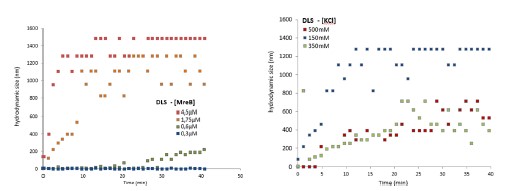
      We did not consider these results publishable in the absence of true polymers observed by TEM. As pointed out on the interesting study from Nurse et al. (on E. coli MreB) (Nurse & Marians, 2013), one cannot rely only on light scattering only because non-specific aggregates would show similar patterns than polymers. Over the last two decades, about 15 publications showed polymers of MreB from several Gram-negative species, while none (despite the efforts of many) showed a single convincing MreB polymer from a Gram-positive bacterium by EM. A simple hypothesis is that a critical parameter was missing, and we present convincing evidence that lipids are critical for Geobacillus MreB to form pairs of filaments in the conditions tested. However, in solution too we do occasionally see pairs of filaments (Fig 2-S2), and also sheet-like structures among aggregates when the concentration of MreB is increased (Fig. 2-S2 and Fig. 3-S2). Thus, we agree with the reviewer that it cannot be claimed that Geobacillus MreB is unable to polymerize in the absence of lipids, but rather that lipids strongly stimulate its polymerization, condition depending.

      B) The results shown in figure 5A also go against this conclusion, as there is only a 2-fold increase in the phosphate release from MreB(Gs) in the presence of membranes relative to the absence of membranes. Thus, if their model is correct, and MreB(Gs) polymers form only on membranes, this would require the unpolymerized MreB monomers to hydrolyze ATP at 1/2 the rate of MreB in filaments. This high relative rate of hydrolysis of monomers compared to filaments is unprecedented. For all polymers examined so far, the rate of monomer hydrolysis is several orders of magnitude less than that of the filament. For example, actin monomers are known to hydrolyze ATP 430,000X slower than the monomers inside filaments (Blanchoin and Pollard, 2002; Rould et al., 2006).

      Response 2.3B. We agree with the reviewer. We have now found conditions where sheets of MreB form in solution (at high MreB concentration) in the presence of ADP and AMP-PNP. However, we have now added several controls that exclude efficient formation of polymers in solution in the presence of ATP at low concentrations of MreBGs (≤ 1.5 µM), the condition used for the malachite green assays. At these MreB concentrations, pairs of filaments are observed in the presence of lipids, but very unfrequently in solution, and sheets are not observed in solution either (Fig. 2-S2A, B). Yet, albeit puzzling, in these conditions Pi release is reproducibly observed in solution, reduced only ~ 2 to 3-fold relative to Pi release in the presence of lipids (Fig. 5A and Fig. 5-S1). A reinforcing observation is when the ATPase assays is performed at 100 mM KCl (Fig. 5A). In this condition MreB binding to lipids is increased relative to 500 mM KCl (Fig. 4-S4C), and the stimulation of the ATPase activity by the presence of lipids is also stronger that at 500 mM (Fig. 5-S1A). Further work is needed to characterize in detail the ATPase activity of MreB proteins, for which data in the literature is very scarce. We can’t exclude that MreB could nucleate in solution or form very unstable filaments that cannot be seen in our EM assay but consume ATP in the process. At the moment, the significance of the Pi released in solution is unknown and will require further investigation.

      C) Thus, there is a strong possibility that MreB(Gs) polymers are indeed forming in solution in addition to those on the membrane, and these "solution polymers" may not be captured by their electron microscopy assay. For example, high salt could be interfering with the absorption of filaments to glow discharged lacking lipids.

      Response 2.3C. We appreciate the reviewer’s insight about this critical point. Polymers presented in the original Fig. 2A were obtained at 500 mM KCl but we had tested the polymerization of MreB at 100 mM KCl as well, without noticing differences. We have nonetheless redone this quantitatively and used these data for the revised Fig. 2A, as we are now using 100 mM KCl as our standard polymerization condition throughout the revised manuscript. We also followed the other suggestion of the reviewer and tested glow discharged grids (a more classic preparation for soluble proteins) vs non-glow discharged EM grids, as well as a higher concentration of MreB. Grids are generally glow-discharged to make them hydrophilic in order to adsorb soluble proteins, but the properties of MreB (soluble but obviously presenting hydrophobic domains) made difficult to predict what support putative soluble polymers would preferentially interact with. Septins for example bind much better to hydrophobic grids despite their soluble properties (I. Adriaans, personal communication). Virtually no double filaments were observed in solution at either low or high [MreB]. The fact that in some conditions (high [MreB], other nucleotides) we were able to detect sheet-like structures excluded a technical issue that would prevent the detection of existing but “invisible” polymers here. We have added these new data in Fig. 2-S2.

      As indicated above, the reviewer’s comments made us realize that we could not state or imply that MreB cannot polymerize in the absence of lipids. As a matter of fact, we always saw some random filaments in the EM fields, both in solution and in the presence of non-hydrolysable analogues, at very low frequency (Fig. 2A). And we do see now sheets at high MreB concentration (Fig. 2-S2B). We could be just missing the optimal conditions for polymerisation in solution, while our phrasing gave the impression that no polymers could ever form in the absence of ATP or lipids. Therefore, we have:

      1) analyzed all TEM data to present it as semi-quantitative TEM, using our methodology originally implemented for the analysis of the mutants

      2) reworked the text to remove any issuing statements and to indicate that MreBGs was only found to bind to a lipid monolayer as a double protofilament in the presence of ATP/GTP but that this does not exclude that filaments may also form in other conditions.

      In order to definitively prove that MreB(Gs) does not have polymers in solution, the authors should:

      i) conduct orthogonal experiments to test for polymers in solution. The simplest test of polymerization might be conducting pelleting assays of MreB(Gs) with and without lipids, sweeping through the concentration range as done in 2B and 5a.

      Response 2.3Ci. Following reviewer #2 suggestion, we conducted a series of sedimentation assays in the presence and in the absence of lipids, at low (100 mM) and high (500 mM) salt, for both the wild-type protein and the three membrane-anchoring mutants (all at 1.3 µM). Sedimentation experiments in salt conditions preventing aggregation in solution (500 mM KCl) fitted with our TEM results: MreB wild-type pelleting increased in the presence of both ATP and lipids (Fig. R1). The sedimentation was further increased at 100 mM KCl, which would fit our other results indicating an increased interaction of MreB with the membrane. However, in addition to be poorly reproducible (in our hands), the approach does not discriminate between polymers and aggregates (or monomers bound to liposomes) and since MreB has a strong tendency to aggregate, we believe that the technique is ill-suited to reliably address MreB polymerization and prefer not to include sedimentation data in our manuscript. The recent work from Pande et al. (2022) illustrates well this issue since no sedimentation of MreB (at 2 µM) was observed in solution in conditions supporting polymerization (at 300 mM KCl): ‘the protein does not pellet on its own in the absence of liposome, irrespective of its polymerization state’, implying that sedimentation does not allow to detect MreB5 filaments in solution (Pande et al., 2022).

      ii) They also could examine if they see MreB filaments in the absence of lipids at 100mM salt (as was seen in both Löwe studies), as the high salt used here might block the charges on glow discharged grids, making it difficult for the polymer to adhere.

      See above, Response 2.3C

      iii) Likewise, the claim that MreB lacking the amino-terminus and the α2β7 hydrophobic loop "is required for polymerization" is questionable as if deleting these resides blocks membrane binding, the lack of polymers on the membrane on the grid is not unexpected, as these filaments that cannot bind the membrane would not be observable. Given these mutants cannot bind the membrane, mutant polymers could still indeed exist in solution, and thus pelleting assays should be used to test if non-membrane associated filaments composed of these mutants do or do not exist.

      Response 2.3Ciii. This is a fair point, we thank the reviewer for this remark. We did not mean to state or imply that the hydrophobic loop was required for polymerization per se, but that polymerization into double filaments only efficiently occurs upon membrane binding, which is mediated by the two hydrophobic sequences. We tested all three mutants by sedimentation as suggested by reviewer #2. In the salt condition that limits aggregation (500 mM KCl) the mutants did not pellet while the wild-type protein did (in the presence of lipids) (Fig. R2 below), in agreement with our EM data. We tested the absence of lipids on the mutant bearing the 2 deletions and observed that the (partial) sedimentation observed at low KCl concentration was ATP and lipid dependent (Fig. R3).

      Given our concerns about MreB sedimentation assays (see above, Response 2.3Ci), we prefer not to include these sedimentation data in our manuscript. Instead, we tested by TEM the possible polymerization of the mutants in solution (we only tested them in the presence of lipids in the initial submission). No filaments were detected in solution for any of the mutants (Fig. 4-S3A).

      A final note, the results shown in "Figure 1 - figure supplement 2, panel C" appear to directly refute the claim that MreB(Gs) requires lipids to polymerize. As currently written, it appears they can observe MreB(Gs) filaments on EM grids without lipids. If these experiments were done in the presence of lipids, the figure legend should be updated to indicate that. If these experiments were done in the absence of lipids, the claim that membrane association is required for MreB polymerizations should be revised.

      The TEM experiments show were indeed performed in the presence of lipids. We apologize for this was not clearly stated in the legend. To prevent all confusion, we have nevertheless removed these images in this figure since the polymerization conditions and lipid requirement are not yet presented when this figure is referred to in the text. We have instead added a panel with the calibration curve for the size exclusion profiles as per request of reviewer #3. The main point of this figure is to show the tendency of MreBGs to aggregate: analytical size-exclusion chromatography shows a single peak corresponding to the monomeric MreBGs, molecular weight ~ 37 KDa, in our purification conditions, but it can readily shift to a peak corresponding to high MW aggregates, depending on the protein concentration and/or storage conditions.

      1. (Difference 4) - The next difference between this study and previous studies of MreB and actin homologs is the conclusion that MreB(Gs) must hydrolyze ATP in order to polymerize. This conclusion is surprising, given the fact that both T. Maritima (Salje · 2011, Bean 2008) and B. subtilis MreB (Mayer 2009) have been shown to polymerize in the presence of ATP as well as AMP-PNP.

      Likewise, MreB polymerization has been shown to lag ATP hydrolysis in not only T. maritima MreB (Esue 2005), eukaryotic actin, and all other prokaryotic actin homologs whose polymerization and phosphate release have been directly compared: MamK (Deng et al., 2016), AlfA (Polka et al., 2009), and two divergent ParM homologs (Garner et al., 2004; Rivera et al., 2011). Currently, the only piece of evidence supporting the idea that MreB(Gs) must hydrolyze ATP in order to polymerize comes from 2 observations: 1) using electron microscopy, they cannot see filaments of MreB(Gs) on membranes in the presence of AMP-PNP or ApCpp, and 2) no appreciable signal increase appears testing AMPPNP- MreB(Gs) using QCM-D. This evidence is by no means conclusive enough to support this bold claim: While their competition experiment does indicate AMPPNP binds to MreB(Gs), it is possible that MreB(Gs) cannot polymerize when bound to AMPPNP.

      For example, it has been shown that different actin homologs respond differently to different non-hydrolysable analogs: Some, like actin, can hydrolyze one ATP analog but not the other, while others are able to bind to many different ATP analogs but only polymerize with some of one of them.

      Response 2.4. We agree with the reviewer, it is uncertain what analogs bind because they are quite different to ATP and some proteins just do not like them, they can change conditions such that filaments stop forming as well and be (theoretically) misleading. This is why we had tested ApCpp in addition to AMP-PNP as non-hydrolysable analog (Fig. 3A). As indicated above, our new complementary experiments (Fig. 3-S1B-D) now show that some rare (i.e. unfrequently and in limited amount) dual polymers are detected in the presence of ApCpp (Fig. 3A) and at high MreB concentration only in the presence of AMP-PNP (Fig. 3-S1B-D), suggesting different critical concentrations in the presence of alternative nucleotides. We have dampened our conclusions, in the light of our new data, and modified the discussion accordingly.

      Thus, to further verify their "hydrolysis is needed for polymerization" conclusion, they should:

      A. Test if a hydrolysis deficient MreB(Gs) mutant (such as D158A) is also unable to polymerize by EM.

      Response 2.4A. We thank the reviewer for this suggestion. As this conclusion has been reviewed on the basis of our new data (see previous response), testing putative ATPase deficient mutants is no longer required here. The study of ATPase mutants is planned for future studies (see Response 3.10 to reviewer #3).

      B. They also should conduct an orthogonal assay of MreB polymerization aside from EM (pelleting assays might be the easiest). They should test if polymers of ATP, AMP-PNP, and MreB(Gs)(D158A) form in solution (without membranes) by conducting pelleting assays. These could also be conducted with and without lipids, thereby also addressing the points noted above in point 3.

      Response 2.4B. Please see Response 2.3Ci above.

      C. Polymers may indeed form with ATP-gamma-S, and this non-hydrolysable ATP analog should be tested.

      Response 2.4C. It is fairly possible that ATP-γ-S supports polymerization since it is known to be partially hydrolysable by actin giving a mild phenotype (Mannherz et al, 1975). This molecule can even be a bona fide substrate for some ATPases (e.g. (Peck & Herschlag, 2003). Thus, we decided to exclude this “non-hydrolysable” analog and tested instead AMP-PNP and ApCpp. We know that ATP-γ-S has been and it is still frequently used, but we preferred to avoid it for the moment for the above-indicated reasons. We chose AMPPNP and AMPPCP instead because (1) they were shown to be completely non-hydrolysable by actin, in contrast to ATP-γ-S; (2) they are widely used (the most commonly used for structural studies; (Lacabanne et al, 2020), (3) AMPPNP was previously used in several publications on MreB (Bean & Amann, 2008; Nurse & Marians, 2013; Pande et al., 2022; Popp et al., 2010; Salje et al, 2011; van den Ent et al., 2014)and thus would allow direct comparison. AMPPCP was added to confirm the finding with AMP-PNP. There are many other analogs that we are planning to explore in future studies (see next Response, 2.4D).

      D. They could also test how the ADP-Phosphate bound MreB(Gs) polymerizes in bulk and on membranes, using beryllium phosphate to trap MreB in the ADP-Pi state. This might allow them to further refine their model.

      Response 2.4D. We plan to address the question of the transition state in depth in following-up work, using a series of analogs and mutants presumably affected in ATPase activity, both predicted and identified in a genetic screen. As indicated above, it is uncertain what analogs bind because they are quite different to ATP and some may bind but prevent filament formation. Thus, we anticipate that trying just one may not be sufficient, they can change conditions and be (theoretically) misleading and thus a thorough analysis is needed to address this question. Since our model and conclusions have been revised on the basis of our new data, we believe that these experiments are beyond the scope of the current manuscript.

      E. Importantly, the Mayer study of B. subtilis MreB found the same results in regard to nucleotides, "In polymerization buffer, MreB produced phosphate in the presence of ATP and GTP, but not in ADP, AMP, GDP or AMP-PNP, or without the readdition of any nucleotide". Thus this paper should be referenced and discussed

      Response 2.4E. We agree that Pi release was detected previously. We have added the reference (L121)

      1. (Difference 5) - The introduction states (lines 128-130) "However, the need for nucleotide binding and hydrolysis in polymerization remains unclear due to conflicting results, in vivo and in vitro, including the ability of MreB to polymerize or not in the presence of ADP or the non-hydrolysable ATP analog AMP-PNP."

      A) While this is a great way to introduce the problem, the statement is a bit vague and should be clarified, detaining the conflicting results and appropriate references. For example, what conflicting in vivo results are they referring to? Regarding "MreB polymerization in AMP-PNP", multiple groups have shown the polymerization of MreB(Tm) in the presence of AMP-PNP, but it is not clear what papers found opposing results.

      Response 2.5A. Thanks for the comment. We originally did not detail these ‘conflicting results’ in the Introduction because we were doing it later in the text, with the appropriate references, in particular in the Discussion (former L433-442). We have now removed this from the Discussion section and added a sentence in the introduction too (L123-130) quickly detailing the discrepancies and giving the references.

      • For more clarity, we have removed the “in vivo” (which referred to the distinct results reported for the presumed ATPase mutants by the Garner and Graumann groups) and focus on the in vitro discrepancies only.

      • These discrepancies are the following: while some studies showed indeed polymerization (as assessed by EM) of MreBTm in the presence of AMPPNP, the studies from Popp et al and Esue et al on T. maritima MreB, and of Nurse et al on E. coli MreB reported aggregation in the presence of AMP-PNP (Esue et al., 2006; Popp et al., 2010) or ADP (Nurse & Marians, 2013), or no assembly in the presence of ADP (Esue et al., 2006). As for the studies reporting polymerization in the presence of AMP-PNP by light scattering only (Bean & Amann, 2008; Gaballah et al, 2011; Mayer & Amann, 2009; Nurse & Marians, 2013), they could not differentiate between aggregates or true polymers and thus cannot be considered conclusive.

      B) The statement "However, the need for nucleotide binding and hydrolysis in polymerization remains unclear due to conflicting results, in vivo and in vitro, including the ability of MreB to polymerize or not in the presence of ADP or the non-hydrolyzable ATP analog AMP-PNP" is technically incorrect and should be rephrased or further tested.

      i. For all actin (or tubulin) family proteins, it is not that a given filament "cannot polymerize" in the presence of ADP but rather that the ADP-bound form has a higher critical concentration for polymer formation relative to the ATP-bound form. This means that the ADP polymers can indeed polymerize, but only when the total protein exceeds the ADP critical concentration. For example, many actin-family proteins do indeed polymerize in ADP: ADP actin has a 10-fold higher critical concentration than ATP actin, (Pollard, 1984) and the ADP critical concentrations of AlfA and ParM are 5X and 50X fold higher (respectively) than their ATP-bound forms(Garner et al., 2004; Polka et al., 2009)

      Response 2.5Bi. Absolutely correct. We apologize for the lack of accuracy of our phrasing and have corrected it (L123).

      ii. Likewise, (Mayer and Amann, 2009) have already demonstrated that B. subtilis MreB can polymerize in the presence of ADP, with a slightly higher critical concentration relative to the ATP-bound form.

      Response 2.5Bii. In Mayer and Amann, 2009, the same light scattering signal (interpreted as polymerization) occurred regardless of the nucleotide, and also in the absence of nucleotide (their Fig. 10) and ATP-, ADP- and AMP-PNP-MreB ‘displayed nearly indistinguishable critical concentrations’. They concluded that MreB polymerization is nucleotide-independent. Please see below (responses to ’Other points to address’) our extensive answer to the Mayer & Amann recurring point of reviewer #2

      Thus, to prove that MreB(Gs) polymers do not form in the presence of ADP would require one to test a large concentration range of ADP-bound MreB(Gs). They should test if ADP- MreB(Gs) polymerizes at the highest MreB(Gs) concentrations that can be assayed. Even if this fails, it may be the MreB(Gs) ADP polymerizes at higher concentrations than is possible with their protein preps (13uM). An even more simple fix would be to simply state MreB(Gs)-ADP filaments do not form beneath a given MreB(Gs) concentration.

      We agree with the reviewer. Our wording was overstating our conclusions. Based on our new quantifications (Fig. 3-S1B, D), we have rephrased the results section and now indicate that pairs of filaments are occasionally observed in the presence of ADP in our conditions across the range of MreB concentration that could be tested, suggesting a higher critical concentration for MreB-ADP (L310-312). Only at the highest MreB concentration, sheet- and ribbon-like structures were observed in the presence of ADP (Fig. 3-S2B).

      Other Points to address:

      1) There are several points in this paper where the work by Mayer and Amann is ignored, not cited, or readily dismissed as "hampered by aggregation" without any explanation or supporting evidence of that fact.

      We have cited the Mayer study where appropriate. However, we cannot cite it as proof of polymerization in such or such condition since their approach does not show that polymers were obtained in their conditions. Again, they based all their conclusions solely on light scattering experiments, which cannot differentiate between polymers and aggregates.

      A) Lines 100-101 - While the irregular 3-D formations seen formed by MreB in the Dersch 2020 paper could be interpreted as aggregates, stating that the results from specifically the Gaballah and Meyer papers (and not others) were "hampered by aggregation" is currently an arbitrary statement, with no evidence or backing provided. Overall, these lines (and others in the paper) dismiss these two works without giving any evidence to that point. Thus, they should provide evidence for why they believe all these papers are aggregation, or remove these (and other) dismissive statements.

      We apologize if our statements about these reports seemed dismissive or disrespectful, it was definitely not our intention. Light scattering shows an increase of size of particles over time, but there is no way to tell if the scattering is due to organized (polymers) or disorganized (aggregation) assemblies. Thus, it cannot be considered a conclusive evidence of polymerization without the proof that true filaments are formed by the protein in the conditions tested, as confirmed by EM for example. MreB is known to easily aggregate (see our size exclusion chromatography profiles and ones from Dersch 2020 (Dersch et al, 2020), and note that no chromatography profiles were shown in the Mayer report) and, as indicated above, we had similar light scattering results for MreB for years, while only aggregates could be observed by TEM (see above Response 2.3A). Several observations also suggest that aggregation instead of polymerization might be at play in the Mayer study, for example ‘polymerization’ occurring in salt-less buffer but ‘inhibited’ with as low as 100 mM KCl, which should rather be “salting in” (see below). We did not intend to be dismissive, but it seemed wrong to report their conclusions as conclusive evidence. We thought that we had cited these papers where appropriate but then explained that they show no conclusive proof of polymerization and why, but it is evident that we failed at communicating it clearly. We have reworked the text to remove any issuing and arbitrary statement about our concerns regarding these reports (e.g. L93 & L126).

      One important note - There are 2 points indicating that dismissing the Meyer and Amann work as aggregation is incorrect:

      1) the Meyer work on B. subtilis MreB shows both an ATP and a slightly higher ADP critical concentration. As the emergence of a critical concentration is a steady-state phenomenon arising from the association/dissociation of monomers (and a kinetically limiting nucleation barrier), an emergent critical concentration cannot arise from protein aggregation, critical concentrations only arise from a dynamic equilibrium between monomer and polymer.

      • Critical concentration for ATP, ADP or AMPPNP were described in Mayer & Amann (Mayer & Amann, 2009) as “nearly indistinguishable” (see Response 2.5Bii)
      • Protein aggregation depends on the solution (pH and ions), protein concentration and temperature. And above a certain concentration, proteins can become instable, thus a critical concentration for aggregation can emerge.

      2) Furthermore, Meyer observed that increased salt slowed and reduced B. subtilis MreB light scattering, the opposite of what one would expect if their "polymerization signal" was only protein aggregation, as higher salts should increase the rate of aggregation by increasing the hydrophobic effect.

      It is true that at high salt concentration proteins can precipitate, a phenomenon described as “salting out”. However, it is also true that salts help to solubilize proteins (“salting in”), and that proteins tend to precipitate in the absence of salt. Considering that the starting point of the Mayer and Amann experiment (Mayer & Amann, 2009) is the absence of salt (where they observed the highest scattering) and that they gradually reduce this scattering by increasing KCl (the scattering is almost abolished below 100 mM only!) it is plausible that a salting-in phenomenon might be at play, due to increased solubility of MreB by salt. In any case, this cannot be taken as a proof that polymerization rather than aggregation occurred.

      B) Lines 113-137 -The authors reference many different studies of MreB, including both MreB on membranes and MreB polymerized in solution (which formed bundles). However, they again neglect to mention or reference the findings of Meyer and Amann (Mayer and Amann, 2009), as it was dismissed as "aggregation". As B. subtilis is also a gram-positive organism, the Meyer results should be discussed.

      We did cite the Mayer and Amann paper but, as explained above, we cannot cite this study as an example of proven polymerization. We avoided as much as possible to polemicize in the text and cited this paper when possible. Again, we have reworked the text to avoid any issuing or dismissive statement. Also, we forgot mentioned this study at L121 as an example of reported ATPase activity, and this has now been corrected.

      2) Lines 387-391 state the rates of phosphate release relative to past MreB findings: "These rates of Pi release upon ATP hydrolysis (~ 1 Pi/MreB in 6 min at 53{degree sign}C) are comparable to those observed for MreBTm and MreB(Ec) in vitro". While the measurements of Pi release AND ATP hydrolysis have indeed been measured for actin, this statement does not apply to MreB and should be corrected: All MreB papers thus far have only measured Pi release alone, not ATP hydrolysis at the same time. Thus, it is inaccurate to state "rates of Pi release upon ATP hydrolysis" for any MreB study, as to accurately determine the rate of Pi release, one must measure: 1. The rate of polymer over time, 2) the rate of ATP hydrolysis, and 3) the rate of phosphate release. For MreB, no one has, so far, even measured the rates of ATP hydrolysis and phosphate release with the same sample.

      We completely agree with the reviewer, we apologize if our formulation was inaccurate. We have corrected the sentence (L479). Thank you for pointing out this mistake.

      3) The interpretation of the interactions between monomers in the MreB crystal should be more carefully stated to avoid confusion. While likely not their intention, the discussions of the crystal packing contacts of MreB can appear to assume that the monomer-monomer contacts they see in crystals represent the contacts within actual protofilaments. One cannot automatically assume the observations of monomer-monomer contacts within a crystal reflect those that arise in the actual filament (or protofilament).

      We agree, we thank the reviewer for his comments. We have revamped the corresponding paragraph.

      A) They state, "the apo form of MreBGs forms less stable protofilaments than its G- homologs ." Given filaments of the Apo form of MreB(GS) or b. subtilis have never been observed in solution, this statement is not accurate: while the contacts in the crystal may change with and without nucleotide, if the protein does not form polymers in solution in the apo state, then there are no "real" apo protofilaments, and any statements about their stability become moot. Thus this statement should be rephrased or appropriately qualified.

      see above.

      B) Another example: while they may see that in the apo MreB crystal, the loop of domain IB makes a single salt bridge with IIA and none with IIB. This contrasts with every actin, MreB, and actin homolog studied so far, where domain IB interacts with IIB. This might reflect the real contacts of MreB(Gs) in the solution, or it may be simply a crystal-packing artifact. Thus, the authors should be careful in their claims, making it clear to the reader that the contacts in the crystal may not necessarily be present in polymerized filaments.

      Again, we agree with the reviewer, we cannot draw general conclusions about the interactions between monomers from the apo form. We have rephrased this paragraph.

      4) lines 201-202 - "Polymers were only observed at a concentration of MreB above 0.55 μM (0.02 mg/mL)". Given this concentration dependence of filament formation, which appears the same throughout the paper, the authors could state that 0.55 μM is the critical concentration of MreB on membranes under their buffer conditions. Given the lack of critical concentration measurement in most of the MreB literature, this could be an important point to make in the field.

      Following reviewer’s #2 suggestion, we have now estimated the critical concentration (Cc=0.4485 µM) and reported it in the text. (L218).

      5) Both mg/ml and uM are used in the text and figures to refer to protein concentration. They should stick to one convention, preferably uM, as is standard in the polymer field.

      Sorry for the confusion. We have homogenized to MreB concentrations to µM throughout the text and figures.

      6) Lines 77-78 - (Teeffelen et al., 2011) should be referenced as well in regard to cell wall synthesis driving MreB motion.

      This has been corrected, sorry for omitting this reference.

      7) Line 90 - "Do they exhibit turnover (treadmill) like actin filaments?". This phrase should be modified, as turnover and treadmilling are two very different things. Turnover is the lifetime of monomers in filaments, while treadmilling entails monomer addition at one end and loss at the other. While treadmilling filaments cause turnover, there are also numerous examples of non-treadmilling filaments undergoing turnover: microtubules, intermediate filaments, and ParM. Likewise, an antiparallel filament cannot directionally treadmill, as there is no difference between the two filament ends to confer directional polarity.

      This is absolutely true, we apologize for our mistake. The sentence has been corrected (L82).

      8) Throughout the paper, the term aggregation is used occasionally to describe the polymerization shown in many previous MreB studies, almost all of which very clearly showed "bundled" filaments, very distinct entities from aggregates, as a bundle of polymers cannot form without the filaments first polymerizing on their own. Evidence to this point, polymerization has been shown to precede the bundling of MreB(Tm) by (Esue et al., 2005).

      We agree with reviewer #2 about polymers preceding bundles and “sheets”. However, we respectfully disagree that we used the word aggregation “throughout the paper” to describe structures that clearly showed polymers or sheets of filaments. A search (Ctrl-F: “aggreg”) reveals only 6 matches, 3 describing our own observations (L152, 163/5, and 1023/28), one referring to (Salje et al., 2011) (L107) but citing her claim that they observed aggregation (due to the N-terminus), and the last two (L100, L440) refer (again) to the Gaballah/Mayer/Dersch publications to say that aggregation could not be excluded in these reports as discussed above (Dersch et al., 2020; Gaballah et al., 2011; Mayer & Amann, 2009).

      9) lines 106-108 mention that "The N-terminal amphipathic helix of E. coli MreB (MreBEc) was found to be necessary for membrane binding. " This is not accurate, as Salje observed that one single helix could not cause MreB to mind to the membrane, but rather, multiple amphipathic helices were required for membrane association (Salje et al., 2011).

      Salje et al showed that in vivo the deletion of the helix abolishes the association of MreB to the membrane. This publication also shows that in vitro, addition of the helix to GFP (not to MreB) prompts binding to lipid vesicles, and that this was increased if there are 2 copies of the helix, but they could not test this directly in vitro with MreB (which is insoluble when expressed with its N-terminus). This prompted them to speculate that multiple MreBs could bind better to the membrane than monomers. However, this remained to be demonstrated. Additional hydrophobic regions in MreB such as the hydrophobic loop could participate to membrane anchoring but are absent in their in vitro assays with GFP.

      The Salje results imply that dimers (or further assemblies) of MreB drive membrane association, a point that should be discussed in regard to the question "What prompts the assembly of MreB on the inner leaflet of the cytoplasmic membrane?" posed on lines 86-87.

      We agree that this is an interesting point. As it is consistent with our results, we have incorporated it to our model (Fig. 6) and we are addressing it in the discussion L573-575.

      10) On lines 414-415, it is stated, "The requirement of the membrane for polymerization is consistent with the observation that MreB polymeric assemblies in vivo are membrane-associated only." While I agree with this hypothesis, it must be noted that the presence or absence of MreB polymers in the cytoplasm has not been directly tested, as short filaments in the cytoplasm would diffuse very quickly, requiring very short exposures (<5ms) to resolve them relative to their rate of diffusion. Thus, cytoplasmic polymers might still exist but have not been tested.

      This is also an interesting point. Indeed if a nucleated form, or very short (unbundled) polymers exist in the cytoplasm, they have not been tested by fluorescence microscopy. However, the polymers that localize at the membrane (~ 200 nm), if soluble, would have been detected in the cytoplasm by the work of reviewer #2, us or others.

      11) lines 429-431 state, "but polymerization in the presence of ADP was in most cases concluded from light scattering experiments alone, so the possibility that aggregation rather than ordered polymerization occurred in the process cannot be excluded."

      A) If an increased light scattering signal is initiated by the addition of ADP (or any nucleotide), that signal must come from polymerization or multimerization. What the authors imply is that there must be some ADP-dependent "aggregation" of MreB, which has not been seen thus far for any polymer. Furthermore, why would the addition of ADP initiate aggregation?

      We did not mean that ADP itself would prompt aggregation, but that the protein would aggregate in the buffer regardless of the presence of ADP or other nucleotides. The Mayer & Amann study claims that MreB “polymerization” is nucleotide-independent, as they got identical curves with ATP, ADP, AMPPNP and even with no nucleotides at all (Fig. 10 in their paper, pasted here) (Mayer & Amann, 2009).

      Their experiments with KCl are also remarkable as when they lowered the salt they got faster and faster “polymerization”, with the strongest light scattering signal in the absence of any salt. The high KCl concentration in which they got almost no more “polymers” was 75 mM KCl, and ‘polymerization was almost entirely inhibited at 100 mM’ (Fig. 7, pasted below). Yet the intracellular level of KCl in bacteria is estimated to be ~300 mM (see Response 1.1)

      B) Likewise, the statement "Differences in the purity of the nucleotide stocks used in these studies could also explain some of the discrepancies" is unexplained and confusing. How could an impurity in a nucleotide stock affect the past MreB results, and what is the precedent for this claim?

      We meant that the presence of ATP in the ADP stocks might have affected the outcome of some assays, generating the conflicting results existing in the literature. We agree this sentence was confusing, we have removed it.

      12) lines 467-469 state, "Thus, for both MreB and actin, despite hydrolyzing ATP before and after polymerization, respectively, the ADP-Pi-MreB intermediate would be the long-lived intermediate state within the filaments."

      A) For MreB, this statement is extremely speculative and unbiased, as no one has measured 1) polymerization, 2) ATP hydrolysis, and 3) phosphate release. For example, it could be that ATP hydrolysis is slow, while phosphate release is fast, as is seen in the actin from Saccharomyces cerevisiae.

      We agree that this was too speculative. This has been removed from the (extensively) modified Discussion section. Thanks for the comment.

      B) For actin, the statement of hydrolysis of ATP of monomer occurring "before polymerization" is functionally irrelevant, as the rate of ATP hydrolysis of actin monomers is 430,000 times slower than that of actin monomers inside filaments (Blanchoin and Pollard, 2002; Rould et al., 2006).

      We agree that the difference of hydrolysis rate between G-actin and F-actin implies that ATP hydrolysis occurs after polymerization. We are afraid that we do not follow the reviewer’s point here, we did not say or imply that ATP hydrolysis by actin monomers was functionally relevant.

      13) Lines 442-444. "On the basis of our data and the existing literature, we propose that the requirement for ATP (or GTP) hydrolysis for polymerization may be conserved for most MreBs." Again, this statement both here (and in the prior text) is an extremely bold claim, one that runs contrary to a large amount of past work on not just MreB, but also eukaryotic actin and every actin homolog studied so far. They come to this model based on 1) one piece of suggestive data (the behavior of MreB(GS) bound to 2 non-hydrolysable ATP analogs in 500mM KCL), and 2) the dismissal (throughout the paper) of many peer-reviewed MreB papers that run counter to their model as "aggregation" or "contaminated ATP stocks ." If they want to make this bold claim that their finding invalidates the work of many labs, they must back it up with further validating experiments.

      We respectfully disagree that our model was based on “one piece of suggestive data” and backed-up by dismissing most past work in the field. We only wanted to raise awareness about the conflicting data between some reports (listed in response 2.5a), and that the claims made by some publications are to be taken with caution because they only rely on light scattering or, when TEM was performed, showed only disorganized structures.

      This said, we clearly failed in proposing our model and we are sorry to see that we really annoyed the reviewer with our suspicion that the work by Mayer & Amann reports aggregation. As indicated above, we have amended our manuscript relative to this point. We also agree that our suggestion to generalize our findings to most MreBs was unsupported, and overstated considering how confusing some result from the literature are. We have refined our model and reworked the text to take on board the reviewer’s remarks as well as the new data generated during the revision process.

      We would like to thank reviewer #2 for his in-depth review of our manuscript.  

      Reviewer #3 (Public Review):

      The major claim from the paper is the dependence of two factors that determine the polymerization of MreB from a Gram-positive, thermophilic bacteria 1) The role of nucleotide hydrolysis in driving the polymerization. 2) Lipid bilayer as a facilitator/scaffold that is required for hydrolysis-dependent polymerization. These two conclusions are contrasting with what has been known until now for the MreB proteins that have been characterized in vitro. The experiments performed in the paper do not completely justify these claims as elaborated below.

      We understand the reviewer’ concerns in view of the existing literature on actin and Gram-negative MreBs. We may just be missing the optimal conditions for polymerisation in solution, while our phrasing gave the impression that polymers could never form in the absence of ATP or lipids. Our new data actually shows that MreBGs at higher concentration can assemble into bundle- and sheet-like structures in solution and in the presence of ADP/AMP-PNP. Pairs of filaments are however only observed in the presence of lipids for all conditions tested. As indicated in the answers to the global review comments, we have included our new data in the manuscript, revised our conclusions and claims about the lipid requirement and expanded on these points in the Discussion.

      Major comments:

      1) No observation of filaments in the absence of lipid monolayer can also be accounted due to the higher critical concentration of polymerization for MreBGS in that condition. It is seen that all the negative staining without lipid monolayer condition has been performed at a concentration of 0.05 mg/mL. It is important to check for polymerization of the MreBGS at higher concentration ranges as well, in order to conclusively state the requirement of lipids for polymerization.

      Response 3.1. 0.05 mg/ml (1.3µM) is our standard condition, and our leeway was limited by the rapid aggregation observed at higher MreB concentrations, as indicated in the text. We have now tested as well 0.25 mg/ml (6.5 µM - the maximum concentration possible before major aggregation occurs in our experimental conditions). At this higher concentration, we see some sheet-like structures in solution, confirming a requirement of a higher concentration of MreB for polymerization in these conditions (see the answers to the global review comments for more details)

      We thank the reviewer for pushing us to address this point. We have revised our conclusions accordingly.

      2) The absence of filaments for the non-hydrolysable conditions in the lipid layer could also be because the filaments that might have formed are not binding to the planar lipid layer, and not necessarily because of their inability to polymerize.

      Response 3.2. This is a fair point. To test the possibility that polymers would form but would not bind to the lipid layer we have now added additional semi-quantitative EM controls (for both the non-hydrolysable ATP analogs and the three ‘membrane binding’ deletion mutants) testing polymerization in solution (without lipids) and also using plasma-treated grids. These showed that in our standard polymerization conditions, virtually no polymers form in solution (Fig. 3-S1B and Fig. 4-S4A). Albeit at very low frequency, some dual protofilaments were however detected in the presence of ADP or AMP-PNP at the high MreB concentration (Fig. 3-S1D). At this high MreB concentration, the sheet-like structures occasionally observed in solution in the presence of ATP were frequent in the presence of ADP and very frequent in the presence of AMP-PNP (Fig. 3-S2B). We have revised our conclusions on the basis of these new data: MreBGs can form polymeric assemblies in solution and in the absence of ATP hydrolysis at a higher critical concentration than in the presence of ATP and lipids.

      See the answers to the global review comments (point 2) and Response 2.3C to reviewer #2 for more details.

      3) Given the ATPase activity measurements, it is not very convincing that ATP rather than ADP will be present in the structure. The ATP should have been hydrolysed to ADP within the structure. The structure is now suggestive that MreB is not capable of hydrolysis, which is contradictory to the ATP hydrolysis data.

      Response 3.3. We thank the reviewer for her insightful remarks about the MreB-ATP crystal structure. The electron density map clearly demonstrates the presence of 3 phosphates. However, as suggested by the reviewer, the density which was attributed to a Mg2+ ion was to be interpreted as a water molecule. The absence of Mg2+ in the crystal could thus explain why the ATP had not been hydrolyzed.

      References

      Arino J, Ramos J, Sychrova H (2010) Alkali metal cation transport and homeostasis in yeasts. Microbiology and molecular biology reviews 74: 95-120

      Bean GJ, Amann KJ (2008) Polymerization properties of the Thermotoga maritima actin MreB: roles of temperature, nucleotides, and ions. Biochemistry 47: 826-835

      Cayley S, Lewis BA, Guttman HJ, Record MT, Jr. (1991) Characterization of the cytoplasm of Escherichia coli K-12 as a function of external osmolarity. Implications for protein-DNA interactions in vivo. Journal of molecular biology 222: 281-300

      Dersch S, Reimold C, Stoll J, Breddermann H, Heimerl T, Defeu Soufo HJ, Graumann PL (2020) Polymerization of Bacillus subtilis MreB on a lipid membrane reveals lateral co-polymerization of MreB paralogs and strong effects of cations on filament formation. BMC Mol Cell Biol 21: 76

      Eisenstadt E (1972) Potassium content during growth and sporulation in Bacillus subtilis. Journal of bacteriology 112: 264-267

      Epstein W, Schultz SG (1965) Cation Transport in Escherichia coli: V. Regulation of cation content. J Gen Physiol 49: 221-234

      Esue O, Wirtz D, Tseng Y (2006) GTPase activity, structure, and mechanical properties of filaments assembled from bacterial cytoskeleton protein MreB. Journal of bacteriology 188: 968-976

      Gaballah A, Kloeckner A, Otten C, Sahl HG, Henrichfreise B (2011) Functional analysis of the cytoskeleton protein MreB from Chlamydophila pneumoniae. PloS one 6: e25129

      Harne S, Duret S, Pande V, Bapat M, Beven L, Gayathri P (2020) MreB5 Is a Determinant of Rod-to-Helical Transition in the Cell-Wall-less Bacterium Spiroplasma. Curr Biol 30: 4753-4762 e4757

      Kang H, Bradley MJ, McCullough BR, Pierre A, Grintsevich EE, Reisler E, De La Cruz EM (2012) Identification of cation-binding sites on actin that drive polymerization and modulate bending stiffness. Proceedings of the National Academy of Sciences of the United States of America 109: 16923-16927

      Lacabanne D, Wiegand T, Wili N, Kozlova MI, Cadalbert R, Klose D, Mulkidjanian AY, Meier BH, Bockmann A (2020) ATP Analogues for Structural Investigations: Case Studies of a DnaB Helicase and an ABC Transporter. Molecules 25

      Mannherz HG, Brehme H, Lamp U (1975) Depolymerisation of F-actin to G-actin and its repolymerisation in the presence of analogs of adenosine triphosphate. Eur J Biochem 60: 109-116

      Mayer JA, Amann KJ (2009) Assembly properties of the Bacillus subtilis actin, MreB. Cell motility and the cytoskeleton 66: 109-118

      Nurse P, Marians KJ (2013) Purification and characterization of Escherichia coli MreB protein. The Journal of biological chemistry 288: 3469-3475

      Pande V, Mitra N, Bagde SR, Srinivasan R, Gayathri P (2022) Filament organization of the bacterial actin MreB is dependent on the nucleotide state. The Journal of cell biology 221

      Peck ML, Herschlag D (2003) Adenosine 5 '-O-(3-thio)triphosphate (ATP-gamma S) is a substrate for the nucleotide hydrolysis and RNA unwinding activities of eukaryotic translation initiation factor eIF4A. Rna 9: 1180-1187

      Popp D, Narita A, Maeda K, Fujisawa T, Ghoshdastider U, Iwasa M, Maeda Y, Robinson RC (2010) Filament structure, organization, and dynamics in MreB sheets. The Journal of biological chemistry 285: 15858-15865

      Rhoads DB, Waters FB, Epstein W (1976) Cation transport in Escherichia coli. VIII. Potassium transport mutants. J Gen Physiol 67: 325-341

      Rodriguez-Navarro A (2000) Potassium transport in fungi and plants. Biochimica et biophysica acta 1469: 1-30

      Salje J, van den Ent F, de Boer P, Lowe J (2011) Direct membrane binding by bacterial actin MreB. Molecular cell 43: 478-487

      Schmidt-Nielsen B (1975) Comparative physiology of cellular ion and volume regulation. J Exp Zool 194: 207-219

      Szatmari D, Sarkany P, Kocsis B, Nagy T, Miseta A, Barko S, Longauer B, Robinson RC, Nyitrai M (2020) Intracellular ion concentrations and cation-dependent remodelling of bacterial MreB assemblies. Sci Rep-Uk 10

      van den Ent F, Izore T, Bharat TA, Johnson CM, Lowe J (2014) Bacterial actin MreB forms antiparallel double filaments. eLife 3: e02634

      Whatmore AM, Chudek JA, Reed RH (1990) The Effects of Osmotic Upshock on the Intracellular Solute Pools of Bacillus subtilis. Journal of general microbiology 136: 2527-2535
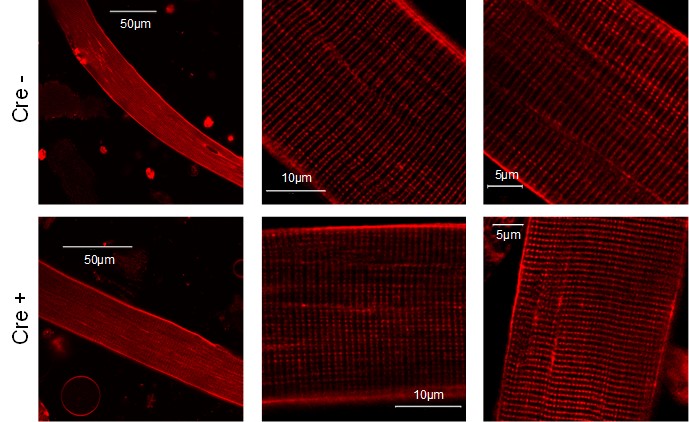
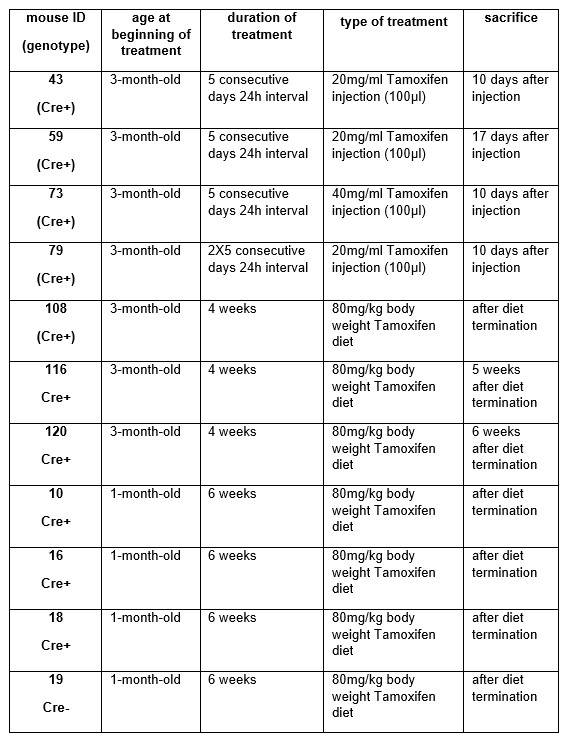
    1. Author Response:

      Reviewer #1:

      The submitted manuscript 'Distinct higher-order representations of natural sounds in human and ferret auditory cortex' by Landemard and colleagues seeks to investigate the neural representations of sound in the ferret auditory cortex. Specifically, they examine the stages of processing via manipulating the complexity and sound structure of stimuli. The authors create synthetic auditory stimuli that are statistically equivalent to natural sounds in their cochlear representation, temporal modulation structure, spectral modulation structure, and spectro-temporal modulation structure. The authors use functional ultrasound imaging (fUS) which allowed for the measurement of the hemodynamic signal at much finer spatial scales than fMRI, making it particularly suitable for the ferret. The authors then compare their results to work done in humans that has previously been published (e.g. Norman-Haignere and McDermott, 2018) and find that: 1. While human non-primary auditory cortex demonstrates a significant difference between natural speech/music sounds and their synthetic counterparts, the ferret non-primary auditory cortex does not. 2. For each sound manipulation in humans, the dissimilarity increases as the distance from the primary auditory cortex increases, whereas for ferrets it does not. 3. While ferrets behaviorally respond to con-specific vocalizations, the ferret auditory cortex does not demonstrate the same hierarchical processing stream as humans do.

      Overall, I find the approach (especially the sound manipulations) excellent and the overall finding quite intriguing. My only concern, is that it is essentially a null-result. While this result will be useful to the literature, there is always the concern that a lack of finding could also be due to other factors.

      Thank you for taking the time to carefully read our manuscript. We have done our best to address all of your questions and concerns, which has improved the paper.

      We note that our finding differs from a typical null result in two ways. First, our key finding is that responses to natural and synthetic sounds are closely matched throughout primary and non-primary auditory cortex. Unlike a typical null result, this finding cannot be due to a noisy measure, since if our data were noisy, we would not have observed any correspondence between natural and synthetic sounds. Second, we have a clear prediction from humans as to what we should observe if the organization were similar: matched responses in primary auditory cortex and divergent responses in non-primary auditory cortex. Our data clearly demonstrate that this prediction is wrong, for all of the reasons noted in our general response above. In essence, what we are showing is that there is a region by species interaction in the similarity of responses to natural vs. synthetic sounds (as reflected by a significant difference in slopes between species, see our response above). We have investigated and ruled out all of the alternative explanations we can think of for this interaction (e.g. differences in SNR or spatial resolution) and are left with the conclusion that there is a meaningful difference in functional organization between humans and ferrets. If there are any additional concerns you have, we would be happy to address them.

      Major points:

      1) What if the stages in the ferret are wrong? The authors use 4 different manipulations thought to reflect key elements of sound structure and/or the relevant hierarchy of the processing stages of the auditory cortex, but it's possible that the dimensions in the ferret auditory cortex are along a different axis than spectro/temporal modulations. While I do not expect the authors to attempt every possible axis, it would be beneficial to discuss.

      Thank you for raising this question. We now directly address this question in the Discussion (page 11):

      "Our findings show that a prominent signature of hierarchical functional organization present in humans – preferential responses for natural vs. spectrotemporal structure – is largely absent in ferret auditory cortex. But this finding does not imply that there is no functional differentiation between primary and non-primary regions in ferrets. For example, ferret non-primary regions show longer latencies, greater spectral integration bandwidths, and stronger task-modulated responses compared with primary regions (Elgueda et al., 2019). The fact that we did not observe differences between primary and non-primary regions is not because the acoustic features manipulated are irrelevant to ferret auditory cortex, since our analysis shows that matching frequency and modulation statistics is sufficient to match the ferret cortical response, at least as measured by ultrasound. Indeed, if anything, it appears that modulation features are more relevant to the ferret auditory cortex since these features appear to drive responses throughout primary and non-primary regions, unlike human auditory cortex where we only observed strong, matched responses in primary regions."

      2) For the ferret vocalizations, it is possible that a greater N would allow for a clearer picture of whether or not the activation is greater than speech/music? While it is clear that any difference would be subtle and probably require a group analysis, this would help settle this result/issue (at least at the group level).

      Below we plot the distribution of NSE values for ferret vocalizations, speech, and music, averaged across all of auditory cortex and plotted separately for each ferret tested (panel A). As is evident, we observe larger NSE values for ferret vocalizations in one animal (p < 0.01, Wilcoxon test), but no difference in the other two (p > 0.55). When we perform a group analysis, averaging across all three animals, we do not observe any significant difference between the categories (panel B) (p = 0.27). Moreover, even for ferret vocalizations, NSE values were similar throughout primary and non-primary regions, and this was true in all three animals tested (panel C). Given these data, we do not believe our study provides evidence for a difference between ferret vocalizations and other categories. Panel A is plotted in the revised Figure 4 - figure supplement 1E. The distance-to-PAC curves (panel C) and the corresponding slopes are plotted in Figure 4D-E.

      Individual and group analyses of the difference between natural and spectrotemporally matched synthetic sounds, broken down by sound category. A, The NSE between natural and synthetic sounds plotted separately for each animal and sound category. NSE values have been averaged across all of auditory cortex. Each circle represents a single pair of natural/synthetic sounds. We find that the NSE values are larger for ferret vocalizations in Ferret A, but this effect is not present in Ferret T or C ( indicates p < 0.005, Wilcoxon test). B, NSE values averaged across animals. C, NSEs for ferret vocalizations, plotted as a function of distance to primary auditory cortex (PAC). Figure shows both individual subject (thin pink lines) and group-averaged data (thick pink line).

      Below, we have reproduced the relevant paragraph of the results where we discuss these and other related findings (page 6):

      "To directly test if ferrets showed preferential responses to natural vs. synthetic ferret vocalizations, we computed maps plotting the average difference between natural vs. synthetic sounds for different categories, using data from both Experiments I and II (Figure 4C). We also separately measured the NSE for sounds from different categories, again plotting NSE values as a function of distance to PAC (Figure 4D-E). The differences that we observed between natural and synthetic sounds were small and scattered throughout primary and non-primary auditory cortex, even for ferret vocalizations. In one animal, we observed significantly larger NSE values for ferret vocalizations compared with speech and music (Ferret A, Mdvoc = 0.137 vs MdSpM = 0.042, Wilcoxon rank-sum test: T = 1138, z = 3.29, p < 0.01). But this difference was not present in the other two ferrets tested (p > 0.55) and was also not present when we averaged NSE values across animals (Mdvoc = 0.053 vs MdSpM = 0.033, Wilcoxon rank- sum test: T = 1016, z = 1.49, p = 0.27). Moreover, the slope of the NSE vs. distance-to- PAC curve was near 0 for all animals and sound categories, even for ferret vocalizations, and was substantially lower than the slopes measured in all 12 human subjects (Figure 4F) (vocalizations in ferrets vs. speech in humans: p < 0.001 via a sign test; speech in ferrets vs. speech in humans: p < 0.001). In contrast, human cortical responses were substantially larger for natural vs. synthetic speech and music, and these response enhancements were concentrated in distinct non-primary regions (lateral for speech and anterior/posterior for music) and clearly different from those for other natural sounds (Figure 4C). Thus, ferrets do not show any of the neural signatures of higher-order sensitivity that we previously identified in humans (large effect size, spatially clustered responses, and a clear non-primary bias), even for con- specific vocalizations."

      3) Relatedly, did the magnitude of this effect increase outside the auditory cortex?

      We did not record outside of auditory cortex. Unlike fMRI, it is not easy to get whole-brain coverage using current fUS probes. Since our goal was to test if ferret auditory cortex showed similar organization as human auditory cortex, we focused our data collection on auditory regions. We have clarified this point in the Methods (page 13):

      "fUS data are collected as a series of 2D images or ‘slices’. Slices were collected in the coronal plane and were spaced 0.4 mm apart. The slice plane was varied across sessions in order to cover the region-of-interest which included both primary and non- primary regions of auditory cortex. We did not collect data from non-auditory regions due to limited time/coverage."

      4) It would be useful to have a measure of the noise floor for each plot and/or species for NSE analyses. This would make it easier to distinguish whether, for instance, in 2A-D, an NSE of 0.1 (human primary) vs. an NSE of 0.042 (ferret primary) should be interpreted as a bit more than double, or both close to the noise floor (which is what I presume).

      All of our NSE measures are noise-corrected such that the effective floor is zero (noise- correction provides an estimate of what the NSE value would be given perfectly reliable measurements). The only exception are cases where we plot the NSE values for example voxels/ROIs (Figure 2A-D, Figure 2 - figure supplement 1), in which case we plot both the raw NSE values along with the noise floor, which is given by the test-retest NSE of the measurements. To address your comment, we have included a supplemental plot (Figure 2 - figure supplement 3) that shows the median uncorrected NSE as a function of distance to primary auditory cortex, along with the noise floor given by the reliability of the measurements. The figure is reproduced below.

      Figure 2 - figure supplement 3. Uncorrected NSE values. This figure plots the uncorrected NSE between natural and synthetic sounds as a function of distance to primary auditory cortex (PAC). The test-retest NSE value, which provides a noise floor for the natural vs. synthetic NSE, is plotted below each set of curves using dashed lines. Each thin line corresponds to a single ferret (gray) or a single human subject (gold). Thick lines show the average across all subjects. Format is the same as Figure 2F.

      We have clarified this important detail in the Results (page 4):

      "We used the test-retest reliability of the responses to noise-correct the measured NSE values such that the effective noise floor given the reliability of the measurements is zero."

      Reviewer #2:

      Landemard et al. compare the response properties of primary vs. non-primary auditory cortex in ferrets with respect to natural and model-matched sounds, using functional ultrasound imaging. They find that responses do not differentiate between natural and model-matched sounds across ferret auditory cortex; in contrast, by drawing on previously published data in humans where Norman-Haignere & McDermott (2018) showed that non-primary (but not primary) auditory cortex differentiates between natural and model-matched sounds, the authors suggest that this is a defining distinction between human and non-human auditory cortex. The analyses are conducted well and I appreciate the authors including a wealth of results, also split up for individual subjects and hemispheres in supplementary figures, which helps the reader get a better idea of the underlying data.

      Overall, I think the authors have completed a very nice study and present interesting results that are applicable to the general neuroscience community. I think the manuscript could be improved by using different terminology ('sensitivity' as opposed to 'selectivity'), a larger subject pool (only 2 animals), and some more explanation with respect to data analysis choices.

      Many thanks for your thoughtful critiques and comments. We have attempted to address all of them, which has improved the manuscript.

    1. Author Response

      The following is the authors’ response to the original reviews.

      eLife assessment

      This important paper exploits new cryo-EM tomography tools to examine the state of chromatin in situ. The experimental work is meticulously performed and convincing, with a vast amount of data collected. The main findings are interpreted by the authors to suggest that the majority of yeast nucleosomes lack a stable octameric conformation. Despite the possibly controversial nature of this report, it is our hope that such work will spark thought-provoking debate, and further the development of exciting new tools that can interrogate native chromatin shape and associated function in vivo.

      We thank the Editors and Reviewers for their thoughtful and helpful comments. We also appreciate the extraordinary amount of effort needed to assess both the lengthy manuscript and the previous reviews. Below, we provide our point-by-point response in bold blue font. Nearly all comments have been addressed in the revised manuscript. For a subset of comments that would require us to speculate, we have taken a conservative approach because we either lack key information or technical expertise: Instead of adding the speculative replies to the main text, we think it is better to leave them in the rebuttal for posterity. Readers will thereby have access to our speculation and know that we did not feel confident enough to include these thoughts in the Version of Record.

      Reviewer #1 (Public Review):

      This manuscript by Tan et al is using cryo-electron tomography to investigate the structure of yeast nucleosomes both ex vivo (nuclear lysates) and in situ (lamellae and cryosections). The sheer number of experiments and results are astounding and comparable with an entire PhD thesis. However, as is always the case, it is hard to prove that something is not there. In this case, canonical nucleosomes. In their path to find the nucleosomes, the authors also stumble over new insights into nucleosome arrangement that indicates that the positions of the histones is more flexible than previously believed.

      Please note that canonical nucleosomes are there in wild-type cells in situ, albeit rarer than what’s expected based on our HeLa cell analysis and especially the total number of yeast nucleosomes (canonical plus non-canonical). The negative result (absence of any canonical nucleosome classes in situ) was found in the histone-GFP mutants.

      Major strengths and weaknesses:

      Personally, I am not ready to agree with their conclusion that heterogenous non-canonical nucleosomes predominate in yeast cells, but this reviewer is not an expert in the field of nucleosomes and can't judge how well these results fit into previous results in the field. As a technological expert though, I think the authors have done everything possible to test that hypothesis with today's available methods. One can debate whether it is necessary to have 35 supplementary figures, but after working through them all, I see that the nature of the argument needs all that support, precisely because it is so hard to show what is not there. The massive amount of work that has gone into this manuscript and the state-of-the art nature of the technology should be warmly commended. I also think the authors have done a really great job with including all their results to the benefit of the scientific community. Yet, I am left with some questions and comments:

      Could the nucleosomes change into other shapes that were predetermined in situ? Could the authors expand on if there was a structure or two that was more common than the others of the classes they found? Or would this not have been found because of the template matching and later reference particle used?

      Our best guess (speculation) is that one of the class averages that is smaller than the canonical nucleosome contains one or more non-canonical nucleosome classes. However, we do not feel confident enough to single out any of these classes precisely because we do not yet know if they arise from one non-canonical nucleosome structure or from multiple – and therefore mis-classified – non-canonical nucleosome structures (potentially with other non-nucleosome complexes mixed in). We feel it is better to leave this discussion out of the manuscript, or risk sending the community on wild goose chases.

      Our template-matching workflow uses a low-enough cross-correlation threshold that any nucleosome-sized particle (plus minus a few nanometers) would be picked, which is why the number of hits is so large. So unless the noncanonical nucleosomes quadrupled in size or lost most of their histones, they should be grouped with one or more of the other 99 class averages (WT cells) or any of the 100 class averages (cells with GFP-tagged histones). As to whether the later reference particle could have prevented us from detecting one of the non-canonical nucleosome structures, we are unable to tell because we’d really have to know what an in situ non-canonical nucleosome looks like first.

      Could it simply be that the yeast nucleoplasm is differently structured than that of HeLa cells and it was harder to find nucleosomes by template matching in these cells? The authors argue against crowding in the discussion, but maybe it is just a nucleoplasm texture that side-tracks the programs?

      Presumably, the nucleoplasmic “side-tracking” texture would come from some molecules in the yeast nucleus. These molecules would be too small to visualize as discrete particles in the tomographic slices, but they would contribute textures that can be “seen” by the programs – in particular RELION, which does the discrimination between structural states. We are not sure what types of density textures would side-track RELION’s classification routines.

      The title of the paper is not well reflected in the main figures. The title of Figure 2 says "Canonical nucleosomes are rare in wild-type cells", but that is not shown/quantified in that figure. Rare is comparison to what? I suggest adding a comparative view from the HeLa cells, like the text does in lines 195-199. A measure of nucleosomes detected per volume nucleoplasm would also facilitate a comparison.

      Figure 2’s title is indeed unclear and does not align with the paper’s title and key conclusion. The rarity here is relative to the expected number of nucleosomes (canonical plus non-canonical). We have changed the title to:

      “Canonical nucleosomes are a minority of the expected total in wild-type cells”.

      We would prefer to leave the reference to HeLa cells to the main text instead of as a figure panel because the comparison is not straightforward for a graphical presentation. Instead, we now report the total number of nucleosomes estimated for this particular yeast tomogram (~7,600) versus the number of canonical nucleosomes classified (297; 594 if we assume we missed half of them). This information is in the revised figure legend:

      “In this tomogram, we estimate there are ~7,600 nucleosomes (see Methods on how the calculation is done), of which 297 are canonical structures. Accounting for the missing disc views, we estimate there are ~594 canonical nucleosomes in this cryolamella (< 8% the expected number of nucleosomes).”

      If the cell contains mostly non-canonical nucleosomes, are they really non-canonical? Maybe a change of language is required once this is somewhat sure (say, after line 303).

      This is an interesting semantic and philosophical point. From the yeast cell’s “perspective”, the canonical nucleosome structure would be the form that is in the majority. That being said, we do not know if there is one structure that is the majority. From the chromatin field’s point of view, the canonical nucleosome is the form that is most commonly seen in all the historical – and most contemporary – literature, namely something that resembles the crystal structure of Luger et al, 1997. Given these two lines of thinking, we added the following clarification as lines 312 – 316:

      “At present, we do not know what the non-canonical nucleosome structures are, meaning that we cannot even determine if one non-canonical structure is the majority. Until we know the non-canonical nucleosomes’ structures, we will use the term non-canonical to describe all the nucleosomes that do not have the canonical (crystal) structure.”

      The authors could explain more why they sometimes use conventional the 2D followed by 3D classification approach and sometimes "direct 3-D classification". Why, for example, do they do 2D followed by 3D in Figure S5A? This Figure could be considered a regular figure since it shows the main message of the paper.

      Since the classification of subtomograms in situ is still a work in progress, we felt it would be better to show one instance of 2-D classification for lysates and one for lamellae. While it is true that we could have presented direct 3-D classification for the entire paper, we anticipate that readers will be interested to see what the in situ 2-D class averages look like.

      The main message is that there are canonical nucleosomes in situ (at least in wild-type cells), but they are a minority. Therefore, the conventional classification for Figure S5A should not be a main figure because it does not show any canonical nucleosome class averages in situ.

      Figure 1: Why is there a gap in the middle of the nucleosome in panel B? The authors write that this is a higher resolution structure (18Å), but in the even higher resolution crystallography structure (3Å resolution), there is no gap in the middle.

      There is a lower concentration of amino acids at the middle in the disc view; unfortunately, the space-filling model in Figure 1A hides this feature. The gap exists in experimental cryo-EM density maps. See Author response image 1 for an example (pubmed.ncbi.nlm.nih.gov/29626188). The size of the gap depends on the contour level and probably the contrast mechanism, as the gap is less visible in the VPP subtomogram averages. To clarify this confusing phenomenon, we added the following lines to the figure legend:

      “The gap in the disc view of the nuclear-lysate-based average is due to the lower concentration of amino acids there, which is not visible in panel A due to space-filling rendering. This gap’s visibility may also depend on the contrast mechanism because it is not visible in the VPP averages.”

      Author response image 1.

      Reviewer #2 (Public Review):

      Nucleosome structures inside cells remain unclear. Tan et al. tackled this problem using cryo-ET and 3-D classification analysis of yeast cells. The authors found that the fraction of canonical nucleosomes in the cell could be less than 10% of total nucleosomes. The finding is consistent with the unstable property of yeast nucleosomes and the high proportion of the actively transcribed yeast genome. The authors made an important point in understanding chromatin structure in situ. Overall, the paper is well-written and informative to the chromatin/chromosome field.

      We thank Reviewer 2 for their positive assessment.

      Reviewer #3 (Public Review):

      Several labs in the 1970s published fundamental work revealing that almost all eukaryotes organize their DNA into repeating units called nucleosomes, which form the chromatin fiber. Decades of elegant biochemical and structural work indicated a primarily octameric organization of the nucleosome with 2 copies of each histone H2A, H2B, H3 and H4, wrapping 147bp of DNA in a left handed toroid, to which linker histone would bind.

      This was true for most species studied (except, yeast lack linker histone) and was recapitulated in stunning detail by in vitro reconstitutions by salt dialysis or chaperone-mediated assembly of nucleosomes. Thus, these landmark studies set the stage for an exploding number of papers on the topic of chromatin in the past 45 years.

      An emerging counterpoint to the prevailing idea of static particles is that nucleosomes are much more dynamic and can undergo spontaneous transformation. Such dynamics could arise from intrinsic instability due to DNA structural deformation, specific histone variants or their mutations, post-translational histone modifications which weaken the main contacts, protein partners, and predominantly, from active processes like ATP-dependent chromatin remodeling, transcription, repair and replication.

      This paper is important because it tests this idea whole-scale, applying novel cryo-EM tomography tools to examine the state of chromatin in yeast lysates or cryo-sections. The experimental work is meticulously performed, with vast amount of data collected. The main findings are interpreted by the authors to suggest that majority of yeast nucleosomes lack a stable octameric conformation. The findings are not surprising in that alternative conformations of nucleosomes might exist in vivo, but rather in the sheer scale of such particles reported, relative to the traditional form expected from decades of biochemical, biophysical and structural data. Thus, it is likely that this work will be perceived as controversial. Nonetheless, we believe these kinds of tools represent an important advance for in situ analysis of chromatin. We also think the field should have the opportunity to carefully evaluate the data and assess whether the claims are supported, or consider what additional experiments could be done to further test the conceptual claims made. It is our hope that such work will spark thought-provoking debate in a collegial fashion, and lead to the development of exciting new tools which can interrogate native chromatin shape in vivo. Most importantly, it will be critical to assess biological implications associated with more dynamic - or static forms- of nucleosomes, the associated chromatin fiber, and its three-dimensional organization, for nuclear or mitotic function.

      Thank you for putting our work in the context of the field’s trajectory. We hope our EMPIAR entry, which includes all the raw data used in this paper, will be useful for the community. As more labs (hopefully) upload their raw data and as image-processing continues to advance, the field will be able to revisit the question of non-canonical nucleosomes in budding yeast and other organisms. 

      Reviewer #1 (Recommendations For The Authors):

      The manuscript sometimes reads like a part of a series rather than a stand-alone paper. Be sure to spell out what needs to be known from previous work to read this article. The introduction is very EM-technique focused but could do with more nucleosome information.

      We have added a new paragraph that discusses the sources of structural variability to better prepare readers, as lines 50 – 59:

      “In the context of chromatin, nucleosomes are not discrete particles because sequential nucleosomes are connected by short stretches of linker DNA. Variation in linker DNA structure is a source of chromatin conformational heterogeneity (Collepardo-Guevara and Schlick, 2014). Recent cryo-EM studies show that nucleosomes can deviate from the canonical form in vitro, primarily in the structure of DNA near the entry/exit site (Bilokapic et al., 2018; Fukushima et al., 2022; Sato et al., 2021; Zhou et al., 2021). In addition to DNA structural variability, nucleosomes in vitro have small changes in histone conformations (Bilokapic et al., 2018). Larger-scale variations of DNA and histone structure are not compatible with high-resolution analysis and may have been missed in single-particle cryo-EM studies.”

      Line 165-6 "did not reveal a nucleosome class average in..". Add "canonical", since it otherwise suggests there were no nucleosomes.

      Thank you for catching this error. Corrected.

      Lines 177-182: Why are the disc views missed by the classification analysis? They should be there in the sample, as you say.

      We suspect that RELION 3 is misclassifying the disc-view canonical nucleosomes into the other classes. The RELION developers suspect that view-dependent misclassification arises from RELION 3’s 3-D CTF model. RELION 4 is reported to be less biased by the particles’ views. We have started testing RELION 4 but do not have anything concrete to report yet.

      Line 222: a GFP tag.

      Fixed.

      Line 382: "Note that the percentage .." I can't follow this sentence. Why would you need to know how many chromosome's worth of nucleosomes you are looking at to say the percentage of non-canonical nucleosomes?

      Thank you for noticing this confusing wording. The sentence has been both simplified and clarified as follows in lines 396 – 398:

      “Note that the percentage of canonical nucleosomes in lysates cannot be accurately estimated because we cannot determine how many nucleosomes in total are in each field of view.”

      Line 397: "We're not implying that..." Please add a sentence clearly stating what you DO mean with mobility for H2A/H2B.

      We have added the following clarifying sentence in lines 412 – 413:

      “We mean that H2A-H2B is attached to the rest of the nucleosome and can have small differences in orientation.”

      Line 428: repeated message from line 424. "in this figure, the blurring implies.."

      Redundant phrase removed.

      Line 439: "on a HeLa cell" - a single cell in the whole study?

      Yes, that study was done on a single cell.

      A general comment is that the authors could help the reader more by developing the figures and making them more pedagogical, a list of suggestions can be found below.

      Thank you for the suggestions. We have applied all of them to the specific figure callouts and to the other figures that could use similar clarification.

      Figure 2: Help the reader by avoiding abbreviations in the figure legend. VPP tomographic slice - spell out "Volta Phase Plate". Same with the term "remapped" (panel B) what does that mean?

      We spelled out Volta phase plate in full and explained “remapped” the additional figure legend text:

      “the class averages were oriented and positioned in the locations of their contributing subtomograms”.

      Supplementary figures:

      Figure S3: It is unclear what you mean with "two types of BY4741 nucleosomes". You then say that the canonical nucleosomes are shaded blue. So what color is then the non-canonical? All the greys? Some of them look just like random stuff, not nucleosomes.

      “Two types” is a typo and has been removed and “nucleosomes” has been replaced with “candidate nucleosome template-matching hits” to accurately reflect the particles used in classification.

      Figure S6: Top left says "3 tomograms (defocus)". I wonder if you meant to add the defocus range here. I have understood it like this is the same data as shown in Figure S5, which makes me wonder if this top cartoon should not be on top of that figure too (or exclusively there).

      To make Figures S6 (and S5) clearer, we have copied the top cartoon from Figure S6 to S5.

      Note that we corrected a typo for these figures (and the Table S7): the number of template-matched candidate nucleosomes should be 93,204, not 62,428.

      The description in the parentheses (defocus) is shorthand for defocus phase contrast and was not intended to also display a defocus range. All of the revised figure legends now report the meaning of both this shorthand and of the Volta phase plate (VPP).

      To help readers see the relationship between these two figures, we added the following clarifying text to the Figure S5 and S6 legends, respectively:

      “This workflow uses the same template-matched candidate nucleosomes as in Figure S6; see below.”

      “This workflow uses the same template-matched candidate nucleosomes as in Figure S5.”

      Figure S7: In the first panel, it is unclear why the featureless cylinder is shown as it is not used as a reference here. Rather, it could be put throughout where it was used and then put the simulated EM-map alone here. If left in, it should be stated in the legend that it was not used here.

      It would indeed be much clearer to show the featureless cylinder in all the other figures and leave the simulated nucleosome in this control figure. All figures are now updated. The figure legend was also updated as follows:

      “(A) A simulated EM map from a crystal structure of the nucleosome was used as the template-matching and 3-D classification reference.”

      Figure S18: Why are there classes where the GFP density is missing? Mention something about this in the figure legend.

      We have appended the following speculations to explain the “missing” GFP densities:

      “Some of the class averages are “missing” one or both expected GFP densities. The possible explanations include mobility of a subpopulation of GFPs or H2A-GFPs, incorrectly folded GFPs, or substitution of H2A for the variant histone H2A.Z.”

      Reviewer #2 (Recommendations For The Authors):

      My specific (rather minor) comments are the following:

      1) Abstract:

      yeast -> budding yeast.

      All three instances in the abstract have been replaced with “budding yeast”.

      It would be better to clarify what ex vivo means here.

      We have appended “(in nuclear lysates)” to explain the meaning of ex vivo.

      2) Some subtitles are unclear.

      e.g., "in wild-type lysates" -> "wild-type yeast lysates"

      Thank you for this suggestion. All unclear instances of subtitles and sample descriptions throughout the text have been corrected.

      3) Page 6, Line 113. "...which detects more canonical nucleosomes." A similar thing was already mentioned in the same paragraph and seems redundant.

      Thank you for noticing this redundant statement, which is now deleted.

      4) Page 25, Line 525. "However, crowding is an unlikely explanation..." Please note that many macromolecules (proteins, RNAs, polysaccharides, etc.) were lost during the nuclei isolation process.

      This is a good point. We have rewritten this paragraph to separate the discussion on technical versus biological effects of crowding, in lines 538 – 546:

      “Another hypothesis for the low numbers of detected canonical nucleosomes is that the nucleoplasm is too crowded, making the image processing infeasible. However, crowding is an unlikely technical limitation because we were able to detect canonical nucleosome class averages in our most-crowded nuclear lysates, which are so crowded that most nucleosomes are butted against others (Figures S15 and S16). Crowding may instead have biological contributions to the different subtomogram-analysis outcomes in cell nuclei and nuclear lysates. For example, the crowding from other nuclear constituents (proteins, RNAs, polysaccharides, etc.) may contribute to in situ nucleosome structure, but is lost during nucleus isolation.”

      5) Page 7, Line 126. "The subtomogram average..." Is there any explanation for this?

      Presumably, the longer linker DNA length corresponds to the ordered portion of the ~22 bp linker between consecutive nucleosomes, given the ~168 bp nucleosome repeat length. We have appended the following explanation as the concluding sentence, lines 137 – 140:

      “Because the nucleosome-repeat length of budding yeast chromatin is ~168 bp (Brogaard et al., 2012), this extra length of DNA may come from an ordered portion of the ~22 bp linker between adjacent nucleosomes.”

      6) "Histone GFP-tagging strategy" subsection:

      Since this subsection is a bit off the mainstream of the paper, it can be shortened and merged into the next one.

      We have merged the “Histone GFP-tagging strategy” and “GFP is detectable on nucleosome subtomogram averages ex vivo” subsections and shortened the text as much as possible. The new subsection is entitled “Histone GFP-tagging and visualization ex vivo”

      7) Page 16, Line 329. "Because all attempts to make H3- or H4-GFP "sole source" strains failed..." Is there a possible explanation here? Cytotoxic effect because of steric hindrance of nucleosomes?

      Yes, it is possible that the GFP tag is interfering with the nucleosomes interactions with its numerous partners. It is also possible that the histone-GFP fusions do not import and/or assemble efficiently enough to support a bare-minimum number of functional nucleosomes. Given that the phenotypic consequences of fusion tags is an underexplored topic and that we don’t have any data on the (dead) transformants, we would prefer to leave out the speculation about the cause of death in the attempted creation of “sole source” strains.

    1. Author Response

      Reviewer #1 (Public Review)

      The documented findings may be explained by the artifact of task design and the way the signals were calculated: The vmPFC was the only ROI for which a positive correlation was found between BGA and mood rating and TML. Instead, most other regions showed negative correlation (inlc da-Insula, dorsolateral prefrontal cortex, the visual cortex, the motor cortex, the dorsomedial premotor cortex, the ventral somatosensory cortex, and the ventral inferior parietal lobule). This can be purely an artifact of task itself: In 25% of mood rating trials, subjects were presented with a question. They had to move the cursor from left (very bad) to the right (very good) along a continuous visual analog scale (100 steps) with left and right-hand response buttons. They even got a warning if they were slow. In 75% of trials, subjects saw none of this and the screen was just blank and the subjects rested.”

      1) First of all, it is unclear if the 25% and 75% trials were mixed. I am assuming that they were not mixed as that could represent a fundamental mistake. The manuscript gives me the impression that this was not done (please clarify).

      If by 25% and 75% trials the Reviewer means rating and no-rating trials then yes, they were intermixed (following on Vinckier et al. 2018). As explained in the initial manuscript, mood was rated every 3-7 trials (for a total of 25% of trials), and we used a computational model to interpolate mood (i.e., theoretical mood level) for the trials in between. This was implemented to avoid sampling mood systematically after every feedback and to test whether vmPFC and daIns represents mood continuously or just when it must be rated. We do not see how this could represent a fundamental mistake. Note that the associations between BGA and mood hold whether we use only rating trials, or only no-rating trials, or both types of trials.

      To better explain how ratings and feedbacks were distributed across trials, we have added a supplementary figure that shows a representative example (Figure S1). This plot shows that ratings were collected independently of whether subjects were in high- or low-mood episodes. In other words, the alternance between rating and no-rating trials was orthogonal to the alternance between low- and high-mood episodes.

      2) Assuming that they were not mixed and we are seeing the data from 75% of trials only. These trials would trigger increased BGA activity in the default mode areas such as the vmPFC, and opposite patterns in the salience, visual and motor areas. Hence the opposite correlations. The authors should just plot BGA activity across regions during rest trials and see if this was the case. That would provide a whole different interpretation.

      Even if there were opposite correlations induced by the alternance between rating and no-rating trials, they would be orthogonal to mood fluctuations induced by positive and negative feedbacks. There is no way these putative opposite correlations could confound the correlation between BGA and mood, when restricted for instance to rating trials only. Anyway, what data show is not an opposite correlation between vmPFC and daIns (see figure R1 below) but that these two regions, when included as competing regressors in a same model, are both significant predictors of mood level. This could not be the case if vmPFC and daIns activities were just mirror reflections of a same factor (alternance of rating and no-rating trials).

      We agree on the argument that performing a task may activate (increase BGA in) the daIns and deactivate (decrease BGA in) the vmPFC, but this average level of activity is not relevant for our study, which explores trial-to-trial fluctuations. It would only be problematic if the alternance between rating and no-rating trials was 1) correlated to mood levels and 2) inducing (anti)correlations between vmPFC and daIns BGA. The first assumption is false by construction of the design, as explained above, and the second assumption is empirically false, as shown below by the absence of correlation between daIns and vmPFC BGA. For each trial, we averaged BGA during the pre-stimulus time window (-4 to 0s) and tested the correlation between all possible pairs of vmPFC and daIns recording sites implanted in a same subject (n = 247 pairs of recording sites from 18 subjects). We observed no reliable correlation between the two brain regions, whether including only rest (no-rating) trials, only rating trials, or all trials together (see figure R1 below). On the contrary, the positive correlation between mood and vmPFC, as well as the negative correlation between mood and daIns, was observed in all cases (whether considering rest, rating, or all trials together).

      Figure R1: Correlation between vmPFC and daIns activities. Bars show the correlation coefficients, averaged across pairs of recording sites, obtained when including all trials, only rest trials (no rating), or only mood-rating trials. The p-values were obtained using a two-sided, one-sample Student’s t-test on Fisher-transformed correlation coefficients. Note that performing the same analysis across subjects (instead of recording sites) yields the same result.

      3) In addition, it is entirely unclear how the BGA in a given electrode was plotted. How is BGA normalized for each electrode? What is baseline here? Without understanding what baseline was used for this normalization, it is hard to follow the next section about the impact of the intracerebral activity on decision-making.

      The normalization we used is neutral to the effect of interest. Details of BGA computation are given in the Methods section (lines 746-751):

      “For each frequency band, this envelope signal (i.e., time varying amplitude) was divided by its mean across the entire recording session and multiplied by 100. This yields instantaneous envelope values expressed in percentage (%) of the mean. Finally, the envelope signals computed for each consecutive frequency band were averaged together to provide a single time series (the broadband gamma envelope) across the entire session. By construction, the mean value of that time series across the recording session is equal to 100.”

      Then, BGA was simply z-scored over trials for every recording site. Thus, there was no baseline correction in the sense that there was no subtraction of pre-stimulus activity. We agree this would have been problematic, since we were precisely interested in the information carried by pre-stimulus activity. By z-scoring, we took as reference the mean activity over all trials.

      We added the following sentence in the Methods section (lines 755-756):

      “BGA was normalized for each recording site by z-scoring across trials.”

      4) line 237: how was the correction for multiple comparisons done? Subject by subject, ROI by ROI, electrode by electrode? Please clarify.

      The correction for multiple comparisons was done using a classic cluster-based permutation test (Maris & Ostenweld, 2007, J. Neurosci. Methods) performed at the level of ROI.

      We have updated the section detailing this method in the manuscript (lines 807-818), as follows:

      “For each ROI, a t-value was computed across all recording sites of the given ROI for each time point of the baseline window (-4 to 0 s before choice onset), independently of subject identity, using two-sided, one-sample, Student’s t-tests. For all GLMs, the statistical significance of each ROI was assessed through permutation tests. First, the pairing between responses and predictors across trials was shuffled randomly 300 times for each recording site. Second, we performed 60,000 random combinations of all contacts in a ROI, drawn from the 300 shuffles calculated previously for each site. The maximal cluster-level statistics (the maximal sum of t-values over contiguous time points exceeding a significance threshold of 0.05) were extracted for each combination to compute a “null” distribution of effect size across a time window from -4 to 0 s before choice onset (the baseline corresponding to the rest or mood assessment period). The p-value of each cluster in the original (non-shuffled) data was finally obtained by computing the proportion of clusters with higher statistics in the null distribution, and reported as the “cluster-level corrected” p-value (pcorr).”

      Reviewer #2 (Public Review)

      “This study used intracranial EEG to explore links between broad-band gamma oscillations and mood, and their impact on decisions. The topic is interesting and important. A major strength is the use of intracranial EEG (iEEG) techniques, which allowed the authors to obtain electrical signals directly from deep brain areas involved in decision making. With its precise temporal resolution, iEEG allowed the authors to study activity in specific frequency bands. While the results are potentially interesting, one major concern with the analysis procedure-specifically grouping of all data across all subjects and performing statistics across electrodes instead of across subjects-reduces enthusiasm for these findings. There is also a question about how mood impacts attentional state, which has already been shown to impact baseline (pre-stimulus) broad band gamma.”

      Major comments

      1)The number of subjects with contacts in vmPFC, daIns, and both vmPFC and daIns should be stated in the manuscript so the reader doesn't have to refer to the supplementary table to find this information.

      These details have been added to the Results section (lines 236-242 and 258-262), as follows:

      “The vmPFC (n = 91 sites from 20 subjects) was the only ROI for which we found a positive correlation (Figure 2b; Source data 1; Table S2) between BGA and both mood rating (best cluster: -1.37 to -1.04 s, sum(t(90)) = 122.3, pcorr = 0.010) and TML (best cluster: -0.57 to -0.13 s, sum(t(90)) = 132.4, pcorr = 8.10-3). Conversely, we found a negative correlation in a larger brain network encompassing the daIns (n = 86 sites from 28 subjects, Figure 2b; Source data 1; Table S2), in which BGA was negatively associated with both mood rating (best cluster: -3.36 to -2.51 s, sum(t(85)) = -325.8, pcorr < 1.7.10-5) and TML (best cluster: -3.13 to -2.72 s, sum(t(85)) = -136.4, pcorr = 9.10-3). (…) In order to obtain the time course of mood expression in the two ROIs (Figure 2c), we performed regressions between TML and BGA from all possible pairs of vmPFC and daIns recording sites recorded in a same subject (n = 247 pairs of recording sites from 18 subjects, see Methods) and tested the regression estimates across pairs within each ROI at each time point.”

      2) Effects shown in figs 2 and 3 are combined across subjects. We don't know the effective sample size for the comparisons being made, and the effects shown could be driven by just a few subjects. If the authors compute trial-wise regressions between mood and BGA for each subject, and then perform the statistics across subjects instead of across electrodes, do these results still pan out?

      Yes, we have redone the analyses at the group level to get statistics across subjects (see response to essential revisions). All main results remained significant or borderline. In these group-level random-effect analyses, data points are subject-wise BGA averaged across recording sites (within the temporal cluster identified with the fixed-effect approach). We have incorporated these analyses into the manuscript as a supplementary table (Table S4). However, these statistics across subjects are less standard in the field of electrophysiology, as they are both underpowered and unadjusted for sampling bias (because the same weight is given to subjects with 1 or 10 recording sites in the ROI), so we prefer to keep the usual statistics across recording sites in the main text.

      These analyses have been incorporated into the Results section (lines 355-357), as follows:

      “We also verified that the main findings of this study remained significant (or borderline) when using group-level random-effects analyses (Table S4, see methods), even if this approach is underpowered and unadjusted for sampling bias (some subjects having very few recording sites in the relevant ROI).”

      The methods section has also been edited, as follows (lines 831-835):

      “To test the association between BGA and mood, TML or choice at the group level (using random-effects analyses), we performed the same linear regression as described in the electrophysiological analyses section on BGA averaged over the best time cluster (identified by the fixed-effects approach) and across all recording sites of a given subjects located in the relevant ROI. We then conducted a two-sided, one-sample Student's t-test on the resulting regression estimates (Table S4).”

      3) Furthermore, how many of the subjects show statistically significant regressions between BGA and mood at any electrode? For example, the error bars in fig 2b are across electrodes. How would this figure look if error bars indicated variance across subjects instead?

      Depending on the metrics (mood rating or theoretical mood level), statistically significant regressions between BGA and mood was observed in 4 to 6 subjects for the vmPFC and 5 to 9 subjects in the daIns. We provide these numbers to satisfy the Reviewer’s request, but we do not see what statistical inference they could inform (inferences based on number of data points above and below significance threshold are clearly wrong). To satisfy the other request, we have reproduced below Fig. 2B with error bars indicating variance across subjects and not recording sites (Figure R2). Again, to make an inference about a neural representation at the population level, the relevant samples are recording sites, not subjects. All monkey electrophysiology studies base their inferences on the variance across neurons (typically coming from 2 or 3 monkeys pooled together).

      Figure R2: Reproduction of Figure 2B with lower panels indicating mean and variance across subjects instead of recording sites (upper panels). Blue: vmPFC, red: daIns. Bold lines indicate significant clusters (p < 0.05).

      4) In panel f, we can see that a large number of sites in both ROIs show correlations in the opposite direction to the reported effects. How can this be explained? How do these distributions of effects in electrodes correspond to distributions of effects in individual subjects?

      In our experience, this kind of pattern is observed in any biological dataset, so we do not understand what the Reviewer wants us to explain. It is simply the case for any significant effect across samples, the distribution would include some samples with effects in the opposite direction. If there were no effects in the opposite direction, nobody would need statistics to know whether the observed distribution is different from the null distribution. In our case, the variability might have arisen from different sources of noise (in mood estimate, in BGA recording, in stochastic fluctuations of pre-stimulus activity, in the link between mood and BGA that may be depends on unknown factors, etc.) This variability has been typically masked because until recently, effects of interest were plotted as means with error bars. The variability is more apparent when plotting individual samples, as we did. It is visually amplified by the fact that outliers are as salient as data points close to the mean, which are way more numerous but superimposed. We have replotted below the panel f with data points being subjects instead of recording sites (Figure R3).

      Figure R3: Reproduction of Figure 2F with lower panels showing the distribution, of regression estimates over subjects instead of recording sites (upper panels). Blue: vmPFC, red: daIns. Note that this is the only analysis which failed to reach significance using a group-level random-effect approach. This is not surprising as this approach is underpowered (perhaps in particular for this analysis over a [-4 to 0 s] pre-choice time window) and unadjusted for sampling bias (some subjects having very few recording sites in the relevant ROI).

      5) Baseline (pre-stimulus) gamma amplitudes have been shown to be related to attentional states. Could these effects be driven by attention rather than mood? The relationship between mood and decisions may be more complex than the authors describe, and could impact other cognitive factors such as attention, which have already been shown to impact baseline broad-band gamma.

      We agree with the Reviewer that the relationships between mood and decisions are certainly more complex in reality than in our model, which is obviously a simplification, as any model is. We also acknowledge that pre-stimulus gamma activity is modulated by fluctuations in attention. However, what was measured and related to BGA in our study is mood level, so it remains unclear what reason could support the claim that the effects may have been driven by attention. A global shift in attentional state (like being more vigilant when in a good or bad mood) would not explain the specific effects we observed (making more or less risky choices). If the Reviewer means that subjects might have paid more attention to gain prospects when in a good mood, and to loss prospects when in a bad mood, then we agree this is a possibility. Note however that the difference between this scenario and our description of the results (subjects put more weight on gain/loss prospect when in a good/bad mood) would be quite subtle. We have nevertheless incorporated this nuance in the discussion (lines 494-496):

      “This result makes the link with the idea that we may see a glass half-full or half-empty when we are in a good or bad mood, possibly because we pay more attention to positive or negative aspects.”

      6) The authors used a bipolar montage reference. Would it be possible that effects in low frequencies are dampened because of the bipolar reference instead of common average reference?

      This is unlikely, because the use of a common average reference montage has been shown to significantly increase the number of channels exhibiting task-related high-frequency activity (BGA), but not the number of channels exhibiting task-related low-frequency activity (see Li et al., 2018, Figure 5A-B). In addition, using a monopolar configuration would also have the disadvantage of significantly increasing the correlations between channels (compared to a bipolar montage). This would have therefore artificially induced task-related effects in other channels due to volume conduction effects (Li et al., 2018; Mercier et al., 2017).

      Reviewer #3 (Public Review):

      In this interesting paper, Cecchi et al. collected intracerebral EEG data from patients performing decision-making tasks in order to study how patient's trial-by-trial mood fluctuations affect their neural computation underlying risky choices. They found that the broadband gamma activity in vmPFC and dorsal anterior Insula (daIns) are distinctively correlated with the patient's mood and their choice. I found the results very interesting. This study certainly will be an important contribution to cognitive and computational neuroscience, especially how the brain may encode mood and associate it to decisions.

      Major comments

      1) The authors showed that the mood is positively correlated in vmPFC on high mood trials alone and negatively correlated daIns in low mood trials alone. This is interesting. But those are the trials in which these regions' activity predict choice (using the residual of choice model fit)?

      This is an excellent point. The intuition of Reviewer 3 was correct. To test it, we performed a complementary analysis in which we regressed choice (model fit residuals) against BGA, separately for low vs. high mood trials (median-split). This analysis revealed that in the vmPFC, BGA during high mood trials positively predicted choices whereas in the daIns, BGA during low mood trials negatively predicted choices.

      We have added the following paragraph in the Results section (lines 328-337):

      “Taken together, these results mean that vmPFC and daIns baseline BGA not only express mood in opposite fashion, but also had opposite influence on upcoming choice. To clarify which trials contributed to the significant association between choice and BGA, we separately regressed the residuals of choice model fit against BGA across either high- or low-mood trials (median split on TML; Figure 3b). In the vmPFC, regression estimates were significantly positive for high-mood trials only (high TML = 0.06 ± 0.01, t(90) = 5.64, p = 2.10-7; two-sided, one-sample, Student’s t-test), not for low-mood trials. Conversely, in the daIns, regression estimates only reached significance for low-mood trials (low TML = -0.05 ± 0.01, t(85) = -4.63, p = 1.10-5), not for high-mood trials. This double dissociation suggests that the vmPFC positively predicts choice when mood gets better than average, and the daIns negatively predicts choice when mood gets worse than average.”

      Also, Figure 3 has been modified accordingly.

      2) It would be helpful to see how high-mood trials and low-mood trials are distributed. Are they clustered or more intermixed?

      We thank the Reviewer for the suggestion. To provide a more detailed view on how feedback history shaped mood ratings and TML, we added a supplementary figure that shows a representative example (Figure S1).

      3) I am not sure how I should reconcile the above finding of the correlation between mood and BGA on high-mood vs. low-mood trials, and the results about how high vs. low baseline BGA predict choice. I may have missed something related to this in the discussion section, but could you clarify?

      Following the Reviewer’s suggestion, we now demonstrate that the vmPFC positively predicts choice when mood gets better than average, and the daIns negatively predicts choice when mood gets worse than average (see response to first point).

      To clarify this, we have added the following paragraph in the discussion (lines 461-469), and a schematic figure summarizing the main findings (Figure 4).

      “Choice to accept or reject the challenge in our task was significantly modulated by the three attributes displayed on screen: gain prospect (in case of success), loss prospect (in case of failure) and difficulty of the challenge. We combined the three attributes using a standard expected utility model and examined the residuals after removing the variance explained by the model. Those residuals were significantly impacted by mood level, meaning that on top of the other factors, good / bad mood inclined subjects to accept / reject the challenge. The same was true for neural correlates of mood: higher baseline BGA in the vmPFC / daIns was both predicted by good / bad mood and associated to higher accept / reject rates, relative to predictions of the choice model. Thus, different mood levels might translate into different brain states that predispose subjects to make risky or safe decisions (Figure 4).”

    1. Author Response

      Reviewer #2 (Public Review):

      Silberberg et al. present a series of cryo-EM structures of the ATP dependent bacterial potassium importer KdpFABC, a protein that is inhibited by phosphorylation under high environmental K+ conditions. The aim of the study was to sample the protein's conformational landscape under active, non-phosphorylated and inhibited, phosphorylated (Ser162) conditions.

      Overall, the study presents 5 structures of phosphorylated wildtype protein (S162-P), 3 structures of phosphorylated 'dead' mutant (D307N, S162-P), and 2 structures of constitutively active, non-phosphorylatable protein (S162A).

      The true novelty and strength of this work is that 8 of the presented structures were obtained either under "turnover" or at least 'native' conditions without ATP, ie in the absence of any non-physiological substrate analogues or stabilising inhibitors. The remaining 2 were obtained in the presence of orthovanadate.

      Comparing the presented structures with previously published KdpFACB structures, there are 5 structural states that have not been reported before, namely an E1-P·ADP state, an E1-P tight state captured in the autoinhibited WT protein (with and without vanadate), and two different nucleotide-free 'apo' states and an E1·ATP early state.

      Of these new states, the 'tight' states are of particular interest, because they appear to be 'off-cycle', dead end states. A novelty lies in the finding that this tight conformation can exist both in nucleotide-free E1 (as seen in the published first KdpFABC crystal structure), and also in the phosphorylated E1-P intermediate.

      By EPR spectroscopy, the authors show that the nucleotide free 'tight' state readily converts into an active E1·ATP conformation when provided with nucleotide, leading to the conclusion that the E1-P·ADP state must be the true inhibitory species. This claim is supported by structural analysis supporting the hypothesis that the phosphorylation at Ser162 could stall the KdpB subunit in an E1P state unable to convert into E2P. This is further supported by the fact that the phosphorylated sample does not readily convert into an E2P state when exposed to vanadate, as would otherwise be expected.

      The structures are of medium resolution (3.1 - 7.4 Å), but the key sites of nucleotide binding and/or phosphorylation are reasonably well supported by the EM maps, with one exception: in the 'E1·ATP early' state determined under turnover conditions, I find the map for the gamma phosphate of ATP not overly convincing, leaving the question whether this could instead be a product-inhibited, Mg-ADP bound E1 state resulting from an accumulation of MgADP under the turnover conditions used. Overall, the manuscript is well written and carefully phrased, and it presents interesting novel findings, which expand our knowledge about the conformational landscape and regulatory mechanisms of the P-type ATPase family.

      We thank the reviewer for their comments and helpful insights. We have addressed the points as follows:

      However in my opinion there are the following weaknesses in the current version of the manuscript:

      1) A lack of quantification. The heart of this study is the comparison of the newly determined KdpFABC structures with previously published ones (of which there are already 10). Yet, there are no RMSD calculations to illustrate the magnitude of any structural deviations. Instead, the authors use phrases like 'similar but not identical to', 'has some similarities', 'virtually identical', 'significant differences'. This makes it very hard to appreciate the true level of novelty/deviation from known structures.

      This is a very valid point and we thank the reviewers for bringing it up. To provide a better overview and appreciation of conformational similarities and significant differences we have calculated RMSDs between all available structures of KdpFABC. They are summarised in the new Table 1 – Table Supplement 2. We have included individual rmsd values, whenever applicable and relevant, in the respective sections in the text and figures. We note that the RMSDs were calculated only between the cytosolic domains (KdpB N,A,P domains) after superimposition of the full-length protein on KdpA, which is rigid across all conformations of KdpFABC (see description in material and methods lines 1184-1191 or the caption to Table 1 – Table Supplement 2). We opted to not indicate the RMSD calculated between the full-length proteins, as the largest part of the complex does not undergo large structural changes (see Figure 1 – Figure Supplement 1, the transmembrane region of KdpB as well as KdpA, KdpC and KdpF show relatively small to no rearrangements compared to the cytosolic domains), and would otherwise obscure the relevant RMSD differences discussed here.

      Also the decrease in EPR peak height of the E1 apo tight state between phosphorylated and non-phosphorylated sample - a key piece of supporting data - is not quantified.

      EPR distance distributions have been quantified by fitting and integrating a gaussian distribution curve, and have been added to the corresponding results section (lines 523-542) and the methods section (lines 1230-1232).

      2) Perhaps as a consequence of the above, there seems to be a slight tendency towards overstatements regarding the novelty of the findings in the context of previous structural studies. The E1-P·ATP tight structure is extremely similar to the previously published crystal structure (5MRW), but it took me three reads through the paper and a structural superposition (overall RMSD less than 2Å), to realise that. While I do see that the existing differences, the two helix shifts in the P- and A- domains - are important and do probably permit the usage of the term 'novel conformation' (I don't think there is a clear consensus on what level of change defines a novel conformation), it could have been made more clear that the 'tight' arrangement of domains has actually been reported before, only it was not termed 'tight'.

      As indicated above we have now included an extensive RMSD table between all available KdpFABC structures. To ensure a meaningful comparison, the rmsd are only calculated between the cytosolic domains after superimposition of the full-length protein on KdpA, as the transmembrane region of KdpFABC is largely rigid (see figure below panel B). However, we have to note that in the X-ray structure the transmembrane region of KdpB is displaced relative to the rest of the complex when compared to the arrangement found in any of the other 18 cryo-EM structures, which all align well in the TMD (see figure below panel C). These deviations make the crystal structure somewhat of an outlier and might be a consequence of the crystal packing (see figure below panel A). For completeness in our comparison with the X-Ray structure, we have included an RMSD calculated when superimposed on KdpA and additional RMSD that was calculated between structures when aligned on the TMD of KdpB (see figure below panel D,E). The reported RMSD that the reviewer mentiones of less than 2Å was probably obtained when superimposing the entire complex on each other (see figure below panel F). However, we do not believe that this is a reasonable comparison as the TMD of the complex is significantly displaced, which stands in strong contrast to all other RMSDs calculated between the rest of the structures where the TMD aligns well (see figure below panel B).

      From the resulting comparisons, we conclude that the E1P-tight and the X-Ray structure do have a certain similarity but are not identical. In particular not in the relative orientation of the cytosolic domains to the rest of the complex. We hope that including the RMSD in the text and separately highlighting the important features of the E1P tight state in the section “E1P tight is the consequence of an impaired E1P/E2P transition“ makes the story now more conclusive.

      Likewise, the authors claim that they have covered the entire conformational cycle with their 10 structures, but this is actually not correct, as there is no representative of an E2 state or functional E1P state after ADP release.

      This is correct, and we have adjusted the phrasing to “close to the entire conformational cycle” or “the entire KdpFABC conformational cycle except the highly transient E1P state after ADP release and E2 state after dephosphorylation.”

      3) A key hypothesis this paper suggests is that KdpFABC cannot undergo the transition from E1P tight to E2P and hence gets stuck in this dead end 'off cycle' state. To test this, the authors analysed an S162-P sample supplied with the E2P inducing inhibitor orthovanadate and found about 11% of particles in an E2P conformation. This is rationalised as a residual fraction of unphosphorylated, non-inhibited, protein in the sample, but the sample is not actually tested for residual unphosphorylated fraction or residual activity. Instead, there is a reference to Sweet et al, 2020. So the claim that the 11% E2P particles in the vanadate sample are irrelevant, whereas the 14% E1P tight from the turnover dataset are of key importance, would strongly benefit from some additional validation.

      We have added an ATPase assay that shows the residual ATPase activity of WT KdpFABC compared to KdpFABS162AC, both purified from E. coli LB2003 cells, which is identical to the protein production and purification for the cryo-EM samples (see Figure 2-Suppl. Figure 5). The residual ATPase activity is ca. 14% of the uninhibited sample, which correlates with the E2-P fraction in the orthovanadate sample.

      Reviewer #3 (Public Review):

      The authors have determined a range of conformations of the high-affinity prokaryotic K+ uptake system KdpFABC, and demonstrate at least two novel states that shed further light on the structure and function of these elusive protein complexes.

      The manuscript is well-written and easy to follow. The introduction puts the work in a proper context and highlights gaps in the field. I am however missing an overview of the currently available structures/states of KdpFABC. This could also be implemented in Fig. 6 (highlighting new vs available data). This is also connected to one of my main remarks - the lack of comparisons and RMSD estimates to available structures. Similarity/resemblance to available structures is indicated several times throughout the manuscript, but this is not quantified or shown in detail, and hence it is difficult for the reader to grasp how unique or alike the structures are. Linked to this, I am somewhat surprised by the lack of considerable changes within the TM domain and the overlapping connectivity of the K indicated in Table 1 - Figure Supplement 1. According to Fig. 6 the uptake pathway should be open in early E1 states, but not in E2 states, contrasting to the Table 1 - Figure Supplement 1, which show connectivity in all structures? Furthermore, the release pathway (to the inside) should be open in the E2-P conformation, but no release pathway is shown as K ions in any of the structures in Table 1 - Figure Supplement 1. Overall, it seems as if rather small shifts in-between the shown structures (are the structures changing from closed to inward-open)? Or is it only KdpA that is shown?

      We thank the reviewer for their positive response and constructive criticisms. We have addressed these comments as follows:

      1. The overview of the available structures has been implemented in Fig. 6, with the new structures from this study highlighted in bold.

      2. RMSD values have been added to all comparisons, with a focus on the deviations of the cytosolic domains, which are most relevant to our conformational assignments and discussions.

      3. To highlight the (comparatively small) changes in the TMD, we have expanded Table 1 - Figure Supplement 1 to include panels showing the outward-open half-channel in the E1 states with a constriction at the KdpA/KdpB interface and the inward-open half-channel in the E2 states. The largest observable rearrangements do however take place in the cytosolic domains. This is an absolute agreement with previous studies, which focused more on the transition occurring within the transmembrane region during the transport cycle (Stock et al, Nature Communication 2018; Silberberg et al, Nature Communication 2021; Sweet et al., PNAS 2021).

      4. The ions observed in the intersubunit tunnel are all before the point at which the tunnel closes, explaining why there is no difference in this region between E1 and E2 structures. Moreover, as we discussed in our last publication (Silberberg, Corey, Hielkema et al., 2021, Nat. Comms.), the assignment of non-protein densities along the entire length of the tunnel is contentious and can only be certain in the selectivity filter of KdpA and the CBS of KdpB.

      5. The release pathway from the CBS does not feature any defined K+ coordination sites, so ions are not expected to stay bound along this inward-open half-channel.

      My second key remark concerns the "E1-P tight is the consequence of an impaired E1-P/E2-P transition" section, and the associated discussion, which is very interesting. I am not convinced though that the nucleotide and phosphate mimic-stabilized states (such as E1-P:ADP) represent the high-energy E1P state, as I believe is indicated in the text. Supportive of this, in SERCA, the shifts from the E1:ATP to the E1P:ADP structures are modest, while the following high-energy Ca-bound E1P and E2P states remain elusive (see Fig. 1 in PMID: 32219166, from 3N8G to 3BA6). Or maybe this is not what the authors claim, or the situation is different for KdpFABC? Associated, while I agree with the statement in rows 234-237 (that the authors likely have caught an off-cycle state), I wonder if the tight E1-P configuration could relate to the elusive high-energy states (although initially counter-intuitive as it has been caught in the structure)? The claims on rows 358-360 and 420-422 are not in conflict with such an idea, and the authors touch on this subject on rows 436-450. Can it be excluded that it is the proper elusive E1P state? If the state is related to the E1P conformation it may well have bearing also on other P-type ATPases and this could be expanded upon.

      This a good point, particularly since the E1P·ADP state is the most populated state in our sample, which is also counterintuitive to “high-energy unstable state”. One possible explanation is that this state already has some of the E1-P strains (which we can see in the clash of D307-P with D518/D522), but the ADP and its associated Mg2+ in particular help to stabilize this. Once ADP dissociates and takes the Mg2+ with it, the full destabilization takes effect in the actual high-energy E1P state. Nonetheless, we consider it fair to compare the E1P tight with the E1P·ADP to look for electrostatic relaxation. We have clarified the sequence of events and our hypothesized role the ADP/Mg2+ have in stabilizing the E1P·ADP state that we can see (lines 609-619): “Moreover, a comparison of the E1P tight structure with the E1P·ADP structure, its most immediate precursor in the conformational cycle obtained, reveals a number of significant rearrangements within the P domain (Figure 5B,C). First, Helix 6 (KdpB538-545) is partially unwound and has moved away from helix 5 towards the A domain, alongside the tilting of helix 4 of the A domain (Figure 5B,C – arrow 2). Second, and of particular interest, are the additional local changes that occur in the immediate vicinity of the phosphorylated KdpBD307. In the E1P·ADP structure, the catalytic aspartyl phosphate, located in the D307KTG signature motif, points towards the negatively charged KdpBD518/D522. This strain is likely to become even more unfavorable once ADP dissociates in the E1P state, as the Mg2+ associated with the ADP partially shields these clashes. The ensuing repulsion might serve as a driving force for the system to relax into the E2 state in the catalytic cycle.”

      We believe it is highly unlikely that the reported E1-P tight state represents an on-cycle high-energy E1P intermediate. For one, we observe a relaxation of electrostatic strains in this structure, in particular when compared to the obtained E1P ADP state. By contrast, the E1P should be the most energetically unfavourable state possible to ensure the rapid transition to the E2P state. As such, this state should be a transient state, making it less likely to be obtainable structurally as an accumulated state. Additionally, the association of the N domain with the A domain in the tight conformation, which would have to be reverted, would be a surprising intermediary step in the transition from E1P to E2P. Altogether, the here reported E1P tight state most likely represents an off-cycle state.

    1. Author Response:

      Reviewer #1 (Public Review):

      This manuscript was well written and interrogates an exciting and important question about whether thalamic sub-regions serve as essential "hubs" for interconnecting diverse cognitive processes. This lesion dataset, combined with normative imaging analyses, serves as a fairly unique and powerful way to address this question.

      Overall, I found the data analysis and processing to be appropriate. I have a few additional questions that remain to be answered to strengthen the conclusions of the authors.

      1. The number of cases of thalamic lesions was small (20 participants) and the sites of overlap in this group is at maximum 5 cases. Finding focal thalamic lesions with the appropriate characteristics is likely to be relatively hard, so this smaller sample size is not surprising, but it suggests that the overlap analyses conducted to identify "multi-domain" hub sites will be relatively underpowered. Given these considerations, I was a bit surprised that the authors did not start with a more hypothesis driven approach (i.e., separating the groups into those with damage to hubs vs. non-hubs) rather than using this more exploratory overlap analysis. It is particularly concerning that the primary "multi-domain" overlap site is also the primary site of overlap in general across thalamic lesion cases (Fig. 2A).

      An issue that arises when attempting to separate lesions into “hub” versus “non-hub” lesions at the study onset is there is not an accepted definition or threshold for a binary categorization of hubs. The primary metric for estimating hub property, participation coefficient (PC), is a continuous measure ranging from 0 to 1, without an objective threshold to differentiate hub versus non-hub regions. Thus, a binary classification would require exploring an arbitrary threshold for splitting our sample. Our concern is that assigning an arbitrary threshold and delineating groups based on that threshold would be equally, if not more, exploratory. However, we appreciate this comment and future studies may be able to use the results of the current analysis to formulate an a priori threshold based on our current results. Similarly, given the relative difficulty recruiting patients with focal thalamic lesions, we did not have enough power to do a linear regression testing the relationship between PC and the global deficit score. Weighing all these factors, we determined that counting the number of tests impaired, and defining global deficit as more than one domain impaired, is a more objective and less exploratory approach for addressing our specific hypotheses than arbitrarily splitting PC values.

      We agree with the reviewer that our unequal lesion coverage in the thalamus is a limitation. We have acknowledged this in the discussion section (line 561). There may very likely be other integrative sites (for example the medial pulvinar) that we missed simply because we did not have sufficient lesion coverage. We have updated our discussion section (line 561) to more explicitly discuss the limitation of our study.

      1. Many of the comparison lesion sites (Fig. 1A) appear to target white matter rather than grey matter locations. Given that white matter damage may have systematically different consequences as grey matter damage, it may be important to control for these characteristics.

      We have conducted further analyses to better control for the effects of white matter damage.

      1. The use of cortical lesion locations as generic controls was a bit puzzling to me, as there are hub locations in the cortex as well as in the thalamus. It would be useful to determine whether hub locations in the cortex and thalamus show similar properties, and that an overlap approach such as the one utilized here, is effective at identifying hubs in the cortex given the larger size of this group.

      We have conducted additional analyses to replicate our findings and validate our approach in a group of 145 expanded comparison patients. We found that comparison patients with lesions to brain regions with higher PC values exhibited more global deficits, when compared to patients that did not exhibit global deficits. Results from this additional analysis were included in Figure 6.

      1. While I think the current findings are very intriguing, I think the results would be further strengthened if the authors were able to confirm: (1) that the multi-domain thalamic lesions are not more likely to impact multiple nuclei or borders between nuclei (this could also lead to a multi-domain profile of results) and (2) that the locations of these locations are consistent in their network functions across individuals (perhaps through comparisons with Greene et al., 2020 or more extended analyses of the datasets included in this work) as this would strengthen the connection between the individual lesion cases and the normative sample analyses.

      We can confirm that multi-domain thalamic lesions did not cover more thalamic subdivisions (anatomical nuclei or functional parcellations). We also examined whether the multi-domain lesion site consistently showed high PC values in individual normative subjects. We calculated thalamic PC values for each of the 235 normative subjects, and compared the average PC values in the multi-domain lesion site versus the single domain-lesion site across these normative subjects. We found the multi-domain site exhibited significantly higher PC values (Figure 5D, t(234) = 6.472, p < 0.001). This suggest that the multi-domain lesion site consistently showed stronger connector hub property across individual normative subjects.

      We also visually compared our results with Greene et al., 2020 (see below). We found that in the dorsal thalamus (z >10), there was a good spatial overlap between the integration zone reported in Greene et al 2020 and the multi-domain lesion site that we identified. In the ventral thalamus (z < 4), we did not identify the posterior thalamus as part of the multi-domain lesion site, likely because we did not have sufficient lesion coverage in the posterior thalamus.

      In terms of describing the putative network functions of the thalamic lesion sites, results presented in Figure 7A indicate that multi-domain lesion sites in the thalamus were broadly coupled with cortical functional networks previously implicated in domain-general control processes, such as the cingulo-opercular network, the fronto-parietal network, and the dorsal attention network.

      Greene, Deanna J., et al. "Integrative and network-specific connectivity of the basal ganglia and thalamus defined in individuals." Neuron 105.4 (2020): 742-758.

    1. Author Response

      Reviewer #1 (Public Review):

      This study investigates low-frequency (LF) local field potentials and high-frequency (HF, >30 Hz) broadband activity in response to the visual presentation of faces. To this end, rhythmic visual stimuli were presented to 121 human participants undergoing depth electrode recordings for epilepsy. Recordings were obtained from the ventral occipito-temporal cortex and brain activity was analyzed using a frequency-tagging approach. The results show that the spatial, functional, and timing properties of LF and HF responses are largely similar, which in part contradicts previous investigations in smaller groups of participants. Together, these findings provide novel and convincing insights into the properties and functional significance of LF and HF brain responses to sensory stimuli.

      Strengths

      • The properties and functional significance of LF and HF brain responses is a timely and relevant basic science topic.

      • The study includes intracranial recordings in a uniquely high number of human participants.

      • Using a frequency tagging paradigm for recording and comparing LF and HF responses is innovative and straightforward.

      • The manuscript is well-written and well-illustrated, and the interpretation of the findings is mostly appropriate.

      Weaknesses

      • The writing style of the manuscript sometimes reflects a "race" between the functional significance of LF and HF brain responses and researchers focusing on one or the other. A more neutral and balanced writing style might be more appropriate.

      We would like first to thank the reviewer for his/her positive evaluation as well as constructive and helpful comments for revising our manuscript.

      Regarding the writing style: we had one major goal in this study, which is to investigate the relationship between low and high frequencies. However, it is fair to say – as we indicate in our introduction section – that low frequency responses are increasingly cast aside in the intracranial recording literature. That is, an increasing proportion of publications simply disregard the evoked electrophysiological response that occur at the low end of the frequency spectrum, to focus exclusively on the high-frequency response (e.g., Crone et al., 2001; Flinker et al., 2011; Mesgarani and Chang, 2012; Bastin et al., 2013; Davidesco et al., 2013; Kadipasoaglu et al., 2016; 2017; Shum et al., 2013; Golan et al., 2016; 2017; Grossman et al., 2019; Wang et al., 2021, see list of references at the end of the reply).

      Thus, on top of the direct objective comparison between the two types of signals that our study originally provides, we think that it is fair to somehow reestablish the functional significance of low frequency activity in intracranial recording studies.

      The writing style reflects that perspective rather than a race between the functional significance of LF and HF brain responses.

      • It remains unclear whether and how the current findings generalize to the processing of other sensory stimuli and paradigms. Rhythmic presentation of visual stimuli at 6 Hz with face stimuli every five stimuli (1.2 Hz) represents a very particular type of sensory stimulation. Stimulation with other stimuli, or at other frequencies likely induce different responses. This important limitation should be appropriately acknowledged in the manuscript.

      We agree with the Reviewer 1 (see also Reviewer 2) that it is indeed important to discuss whether the current findings generalize to the other brain functions and to previous findings obtained with different methodologies. We argue that our original methodological approach allows maximizing the generalizability of our findings.

      First, frequency-tagging approach is a longstanding stimulation method, starting from the 1930s (i.e., well before standard evoked potential recording methods; Adrian & Matthews, 1934; intracranially: Kamp et al., 1960) and widely used in vison science (Regan, 1989; Norcia et al., 2015) but also in other domains (e.g., auditory, somato-sensory stimulation). More importantly, this approach does not only significantly increase the signal-to-noise ratio of neural responses, but the objectivity and the reliability of the LF-HF signal comparison (objective identification and quantification of the responses, very similar analysis pipelines).

      Second, regarding the frequency of stimulation, our scalp EEG studies with high-level stimuli (generally faces) have shown that the frequency selection has little effect on the amplitude and the shape of the responses, as long as the frequency is chosen within a suitable range for the studied function (Alonso-Prieto et al., 2013). Regarding the paradigm used specifically in the present study (originally reported in Rossion et al., 2015 and discussed in detail for iEEG studies in Rossion et al., 2018), it has been validated with a wide range of approaches (EEG, MEG, iEEG, fMRI) and populations (healthy adults, patients, children and infants), identifying typically lateralized occipito-temporal face-selective neural activity with a peak in the middle section of the lateral fusiform gyrus (Jonas et al., 2016; Hagen et al., 2020 in iEEG; Gao et al., 2018 in fMRI).

      Importantly, specifically for the paradigm used in the present study, our experiments have shown that the neural face-selective responses are strictly identical whether the faces are inserted at periodic or non-periodic intervals within the train of nonface objects (Quek & Rossion, 2017), that the ratio of periodicity for faces vs. objects (e.g., 1/5, 1/7 … 1/11) does not matter as long as the face-selective responses do not overlap in time (Retter & Rossion, 2016; Retter et al., 2020) and that the responses are identical across a suitable range of base frequency rates (Retter et al., 2020).

      Finally, we fully acknowledge that the category-selective responses would be different in amplitude and localization for other types of stimuli, as also shown in our previous EEG (Jacques et al., 2016) and iEEG (Hagen et al., 2020) studies. Yet, as indicated in our introduction and discussion section, there are many advantages of using such a highly familiar and salient stimulus as faces, and in the visual domain at least we are confident that our conclusions regarding the relationship between low and high frequencies would generalize to other categories of stimuli.

      We added a new section on the generalizability of our findings at the end of the Discussion, p.32-33 (line 880) (see also Reviewer 2’s comments). Please see above in the “essential revisions” for the full added section.

      Reviewer #2 (Public Review):

      The study by Jacques and colleagues examines two types of signals obtained from human intracortical electroencephalography (iEEG) measures, the steady-state visual evoked potential and a broadband response extending to higher frequencies (>100 Hz). The study is much larger than typical for iEEG, with 121 subjects and ~8,000 recording sites. The main purpose of the study is to compare the two signals in terms of spatial specificity and stimulus tuning (here, to images of faces vs other kinds of images).

      The experiments consisted of subjects viewing images presented 6 times per second, with every 5th image depicting a face. Thus the stimulus frequency is 6 Hz and the face image frequency is 1.2 Hz. The main measures of interest are the responses at 1.2 Hz and harmonics, which indicate face selectivity (a different response to the face images than the other images). To compare the two types of signals (evoked potential and broadband), the authors measure either the voltage fluctuations at 1.2 Hz and harmonics (steady-state visually evoked potential) or the fluctuations of broadband power at these same frequencies.

      Much prior work has led to the interpretation of the broadband signal as the best iEEG correlate of spatially local neuronal activity, with some studies even linking the high-frequency broadband signal to the local firing rate of neurons near the electrode. In contrast, the evoked potential is often thought to arise from synchronous neural activity spread over a relatively large spatial extent. As such, the broadband signal, particularly in higher frequencies (here, 30-160 Hz) is often believed to carry more specific information about brain responses, both in terms of spatial fidelity to the cortical sources (the cortical point spread function) and in terms of functional tuning (e.g., preference for one stimulus class over another). This study challenges these claims, particularly, the first one, and concludes that (1) the point spread functions of the two signals are nearly identical, (2) the cortical locations giving rise to the two signals are nearly identical, and (3) the evoked potential has a considerably higher signal-to-noise ratio.

      These conclusions are surprising, particularly the first one (same point spread functions) given the literature which seems to have mostly concluded that the broadband signal is more local. As such, the findings pose a challenge to the field in interpreting the neuronal basis of the various iEEG signals. The study is large and well done, and the analysis and visualizations are generally clear and convincing. The similarity in cortical localization (which brain areas give rise to face-selective signals) and in point-spread functions are especially clear and convincing.

      We thank the reviewer for his/her fair and positive evaluation of our work and helpful comments.

      Although the reviewer does not disagree or criticize our methodology, we would like to reply to their comment about the surprising nature of our findings (particularly the similar spatial extent of LF and HF). In fact, we think that there is little evidence for a difference in ‘point-spread’ function in the literature, and thus that these results are not really that surprising. As we indicate in the original submission (discussion), in human studies, to our knowledge, the only direct comparisons of spatial extent of LF responses and HF is performed by counting and reporting the number of significant electrodes showing a significant response in the two signals (Miller et al., 2007; Crone et al., 1998; Pfurtscheller et al., 2003; see list of references at the end of the reply). Overall, these studies find a smaller number of significant electrodes with HF compared to LF. Intracranial EEG studies pointing to a more focal origin of HF activity generally cite one or several of these publications (e.g. Shum et al., 2013). In the current study, we replicate this finding and provide additional analyses showing that it is confounded with SNR differences across signals and created artificially by the statistical threshold. When no threshold is used and a more appropriate measure of spatial extent is computed (here, spatial extent at half maximum), we find no difference between the 2 signals, except for a small difference in the left anterior temporal lobe. Moreover, in intracranial EEG literature, the localness of the HF response is often backed by the hypothesis that HF is a proxy for firing rate. Indeed, since spikes are supposed to be local, it is implied that HF has to be local as well. However, while clear correlations have been found between HF measured with micro-electrodes and firing rate (e.g., Nir et al. 2007; Manning et al., 2009), there is no information on how local the activity measured at these electrodes is, and no evidence that the HF signal is more local than LF signal in these recordings. Last, the link between (local?) firing rate and HF/broadband signal has been show using micro-electrodes which vastly differ in size compared to macro-electrodes. The nature of the relationship and its spatial properties may differ between micro-electrodes and macro-electrodes used in ECOG/SEEG recordings.

      We feel these points were all already discussed thoroughly in the original submission of the manuscript (see p. 28-30 in the revised manuscript) and did not modify the revised manuscript.

      The lack of difference between the two signals (other than SNR), might ordinarily raise suspicion that there is some kind of confound, meaning that the two measures are not independent. Yet there are no obvious confounds: in principle, the broadband measure could reflect the high-frequency portion of the evoked response, rather than a separate, non-phase locked response to the signal. However, this is unlikely, given the rapid fall-off in the SSVEP at amplitudes much lower than the 30 Hz low-frequency end of the broadband measure. And the lack of difference between the two signals should not be confused for a null result: both signals are robust and reliable, and both are largely found in the expected parts of the brain for face selectivity (meaning the authors did not fail to measure the signals - it just turns out that the two measures have highly similar characteristics).

      The current reviewer and reviewer #3 both commented or raised concerned about the fact that HF signal as measured in our study might be contaminated by LF evoked response, thereby explaining our findings of a strong similarity between the 2 signals.

      This was actually a potential (minor) concern given the time-frequency (wavelet) parameters used in the original manuscript. Indeed, the frequency bandwidth (as measured as half width at half maximum) of the wavelet used at the lower bound (30Hz) of the HF signal extended to 11Hz (i.e., half width at half maximum = 19 Hz). At 40Hz, the bandwidth extended to 24Hz (i.e., HWHM = 16 Hz). While low-frequency face-selective responses at that range (above 16 Hz) are negligible (see e.g., Retter & Rossion, 2016; and data below for the present study), they could have potentially slightly contaminated the high frequency activity indeed.

      To fully ensure that our findings could not be explained by such a contamination, we recomputed the HF signal using wavelets with a smaller frequency bandwidth and changed the high frequency range to 40-160 Hz. This ensures that the lowest frequency included in the HF signal (defined as the bottom of the frequency range minus half of the frequency bandwidth, i.e., half width at half maximum) is 30 Hz, which is well above the highest significant harmonic of face-selective response in our frequency-tagging experiment (i.e., 22.8 Hz ; defined as the harmonic of face frequency where, at group level, the number of recording contacts with a significant response was not higher than the number of significant contacts detected for noise in bins surrounding harmonics of the face frequency, see figure below). Thus, the signal measured in the 40-160 Hz range is not contaminated by lower frequency evoked responses.

      We recomputed all analyses and statistics as reported in the original manuscript with the new HF definition. Overall, this change had very little impact on the findings, except for slightly lower correlation between HF and LF (in Occipital and Anterior temporal lobe) when using single recording contacts as unit data points (Note that we slightly modified the way we compute the maximal expected correlation. Originally we used the test-retest reliability averaged over LF and HF; in the revised version we use the lower reliability value of the 2 signals, which is more correct since the lower reliability is the true upper limit of the correlation). This indicates that the HF activity was mostly independent from phase-locked LF signal already in the original submission. However, since the analyses with the revised time-frequency analyses parameters enforce this independence, the revised analyses are reported as the main analyses in the manuscript.

      The manuscript was completely revised accordingly and all figures (main and supplementary) were modified to reflect these new analyses. We also extended the methods section on HF analyses (p. 37) to indicate that HF parameters were selected to ensure independence of the HF signal from the LF evoked response, and provide additional information on wavelet frequency bandwidth.

      There are some limitations to the possible generalizability of the conclusions drawn here. First, all of the experiments are of the same type (steady-state paradigm). It could be that with a different experimental design (e.g., slower and/or jittered presentation) the results would differ. In particular, the regularity of the stimulation (6 Hz images, 1.2 Hz faces) might cause the cortex to enter a rhythmic and non-typical state, with more correlated responses across signal types. Nonetheless, the steady-state paradigm is widely used in research, and even if the conclusions turn out to hold only for this paradigm, they would be important. (And of course, they might generalize beyond it.)

      We understand the concern of the reviewer and appreciate the last statement about the wide use of the steady-state paradigm and the importance of our conclusions. Above that, we are very confident that our results can be generalized to slower and jittered presentations. Indeed, with this paradigm in particular, we have compared different frequency rates and periodic and nonperiodic stimulations in previous studies (Retter & Rossion, 2016; Quek et al., 2017; Retter et al., 2020). Importantly, specifically for the paradigm used in the present study, the neural face-selective responses are strictly identical whether the faces are inserted at periodic or non-periodic intervals within the train of nonface objects (Quek & Rossion, 2017), showing that the regularity of stimulation does not cause a non-typical state.

      Please see our reply above to essential revisions and reviewer 1, in which we fully address this issue, as well as the revised discussion section (p. 32-33).

      A second limitation is the type of stimulus and neural responses - images of faces, face-selectivity of neural responses. If the differences from previous work on these types of signals are due to the type of experiment - e.g., finger movements and motor cortex, spatial summation and visual cortex - rather than to the difference in sample size of type of analysis, then the conclusions about the similarity of the two types of signals would be more constrained. Again, this is not a flaw in the study, but rather a possible limitation in the generality of the conclusions.

      This is a good point, which has been discussed above also. Please note that this was already partly discussed in the original manuscript when discussing the potential factors explaining the spatial differences between our study and motor cortex studies:

      “Second, the hypothesis for a more focal HF compared to LF signals is mostly supported by recordings performed in a single region, the sensorimotor cortex (Miller et al., 2007; Crone et al., 1998; Pfurtscheller et al., 2003; Hermes et al., 2012), which largely consist of primary cortices. In contrast, here we recorded across a very large cortical region, the VOTC, composed of many different areas with various cortical geometries and cytoarchitectonic properties. Moreover, by recording higher-order category-selective activity, we measured activity confined to associative areas. Both neuronal density (Collins et al., 2010; Turner et al., 2016) and myelination (Bryant and Preuss, 2018) are substantially lower in associative cortices than in primary cortices in primates, and these factors may thus contribute to the lack of spatial extent difference between HF and LF observed here as compared to previous reports.” (p. 29-30).

      Also in the same section (p. 30) we refer to the type of signals compared in previous motor cortex studies:

      “Third, previous studies compared the spatial properties of an increase (relative to baseline) in HF amplitude to the spatial properties of a decrease (i.e. event-related desynchronization) of LF amplitude in the alpha and beta frequency ranges (Crone et al.,1998; 2001; Pfurtscheller et al., 2003; Miller et al., 2007; Hermes et al., 2012). This comparison may be unwarranted due to likely different mechanisms, brain networks and cortical layers involved in generating neuronal increases and decreases (e.g., input vs. modulatory signal, Pfurtscheller and Lopes da Silva, 1999; Schroeder and Lakatos, 2009). In the current study, our frequency-domain analysis makes no assumption about the increase and decrease of signals by face relative to non-face stimuli.”

      In the original submission, we also acknowledged that the functional correspondence between LF and HF signals is not at ceiling (p. 31) :

      “We acknowledge that the correlations found here are not at ceiling and that there were also slight offsets in the location of maximum amplitude across signals along electrode arrays (Figures 5 and 6). This lack of a complete functional overlap between LF and HF is also in line with previous reports of slightly different selectivity and functional properties across these signals, such as a different sensitivity to spatial summation (Winawer et al., 2013), to selective attention (Davidesko et al., 2013) or to stimulus repetition (Privmann et al., 2011). While part of these differences may be due to methodological differences in signal quantification, they also underline that these signals are not always strongly related, due to several factors. For instance, although both signals involve post-synaptic (i.e., dentritic) neural events, they nevertheless have distinct neurophysiological origins (that are not yet fully understood; see Buszaki, 2012; Leszczyński et al., 2020; Miller et al., 2009). In addition, these differing neurophysiological origins may interact with the precise setting of the recording sites capturing these signals (e.g., geometry/orientation of the neural sources relative to the recording site, cortical depth in which the signals are measured).”

      Additional arguments regarding the generalizability can be found in the added section of the discussion as mentioned above.

      Finally, the study relies on depth electrodes, which differs from some prior work on broadband signals using surface electrodes. Depth electrodes (stereotactic EEG) are in quite wide use so this too is not a criticism of the methods. Nonetheless, an important question is the degree to which the conclusions generalize, and surface electrodes, which tend to have higher SNR for broadband measures, might, in principle, show a different pattern than that observed her.

      This is an interesting point, which cannot be addressed in our study obviously. We agree with the reviewer’s point. However, in contrast to ECoG, which is restricted to superficial cortical layers and gyri, SEEG has the advantages of sampling all cortical layers and a wide range anatomical structures (gyri, sulci, deep structures as medial temporal structures. Therefore, we believe that using SEEG ensures maximal generalizability of our findings. Overall, the relatively low spatial resolution of these 2 recording methods (i.e., several millimeters) compared the average cortical thickness (~2-3 mm) makes it very unlikely that SEEG and ECOG would reveal different patterns of LF-HF functional correspondence.

      We added this point in a new section on the generalizability of our findings at the end of the Discussion (p.33, line 896).

      Overall, the large study and elegant approach have led to some provocative conclusions that will likely challenge near-consensus views in the field. It is an important step forward in the quantitate analysis of human neuroscience measurements.

      We sincerely thank the reviewer for his/her appreciation of our work

      Reviewer #3 (Public Review):

      Jacques et al. aim to assess properties of low and high-frequency signal content in intracranial stereo encephalography data in the human associative cortex using a frequency tagging paradigm using face stimuli. In the results, a high correspondence between high- and low-frequency content in terms of concordant dynamics is highlighted. The major critique is that the assessment in the way it was performed is not valid to disambiguate neural dynamics of responses in low- and high-frequency frequency bands and to make general claims about their selectivity and interplay.

      The periodic visual stimulation induces a sharp non-sinusoidal transient impulse response with power across all frequencies (see Fig. 1D time-frequency representation). The calculated mean high-frequency amplitude envelope will therefore be dependent on properties of the used time-frequency calculation as well as noise level (e.g. 1/f contributions) in the chosen frequency band, but it will not reflect intrinsic high-frequency physiology or dynamics as it reflects spectral leakage of the transient response amplitude envelope. For instance, one can generate a synthetic non-sinusoidal signal (e.g., as a sum of sine + a number of harmonics) and apply the processing pipeline to generate the LF and HF components as illustrated in Fig. 1. This will yield two signals which will be highly similar regardless of how the LF component manifests. The fact that the two low and high-frequency measures closely track each other in spatial specificity and amplitudes/onset times and selectivity is due to the fact that they reflect exactly the same signal content. It is not possible with the measures as they have been calculated here to disambiguate physiological low- and high-frequency responses in a general way, e.g., in the absence of such a strong input drive.

      The reviewer expresses strong concerns that our measure of HF activity is merely a reflection of spectral leakage from (lower-frequencies) evoked responses. In other words, physiological HF activity would not exist in our dataset and would be artificially created by our analyses. We should start by mentioning that this comment is in no way specific to our study, but could in fact be directed at all electrophysiological studies measuring stimulus-driven responses in higher frequency bands.

      Reviewer 2 also commented on the possible contamination of evoked response in HF signal.

      This was actually a potential (minor) concern given the time-frequency (wavelet) parameters used in the original manuscript. Indeed, the frequency bandwidth (as measured as half width at half maximum) of the wavelet used at the lower bound (30Hz) of the HF signal extended to 11Hz (i.e., half width at half maximum = 19 Hz). At 40Hz, the bandwidth extended to 24Hz (i.e., HWHM = 16 Hz). While low-frequency face-selective responses at that range (above 16 Hz) are negligible (see e.g., Retter & Rossion, 2016; and data below for the present study), they could have potentially slightly contaminated the high frequency activity indeed.

      To ensure that our findings cannot be explained by such a contamination, we recomputed the HF signal using wavelet with a smaller frequency bandwidth and changed the frequency range to 40-160Hz. This ensures that the lowest frequency included in the HF signal (defined as the bottom of the frequency range minus half of the frequency bandwidth, i.e., half width at half maximum) was 30 Hz. This was well above the highest significant harmonic of face-selective response in our FPVS experiment which was 22.8 Hz (defined as the harmonic of face frequency where, at group level, the number of recording contacts with a significant response was not higher than the number of significant contacts detected for noise in bins surrounding harmonics of the face frequency, see figure below). This ensures that the signal measured in the 40-160Hz range is not contaminated by lower frequency evoked responses.

      We recomputed all analyses and statistics from the manuscript with the new HF definition. Overall, this change had very little impact on the findings, except for slightly lower correlation between HF and LF (in Occipital and Anterior temporal lobe) when using single recording contacts as unit data points (Note that we slightly modified the way we compute the maximal expected correlation. Originally we used the test-retest reliability averaged over LF and HF; now we use the lower reliability value of the 2 signals, which is more correct since the lower reliability is the true upper limit of the correlation) This indicates that the HF activity was mostly independent from phase-locked LF signal already in the original submission. However, since the analyses with the revised time-frequency analyses parameters enforces this independence, we choose to keep the revised analyses as the main analyses in the manuscript.

      The manuscript was completely revised accordingly and all figures (main and supplementary) were modified to reflect the new analyses. We also extended the method section on HF analyses (p. 37) to indicate that HF parameters were selected to ensure independence of the HF signal from the LF evoked response, and provide additional information on wavelet frequency bandwidth.

      We believe our change in the time-frequency parameters and frequency range (40-160 Hz), the supplementary analyses using 80-160 Hz signal (per request of reviewer #2; see Figure 5 – figure supplement 4 and 5) and the fact that harmonics of the face frequency signal are not observed beyond ~23Hz, provide sufficient assurances that our findings are not driven by a contamination of HF signal by evoked/LF responses (i.e., spectral leakage).

      With respect to the comment of the reviewer on the 1/f contributions on frequency band computation, as indicated in the original manuscript, the HF amplitude envelope is converted to percent signal change, separately for each frequency bin over the HF frequency range, BEFORE averaging across frequency bands. This steps works as a normalization step to remove the 1/f bias and ensures that each frequency in the HF range contributes equally to the computed HF signal. This was added to the method section (HF analysis, p 38 (line 1038) ): ” This normalization step ensures that each frequency in the HF range contributes equally to the computed HF signal, despite the overall 1/f relationship between amplitude and frequency in EEG.”

      The connection of the calculated measures to ERPs for the low-frequency and population activity for the high-frequency measures for their frequency tagging paradigm is not clear and not validated, but throughout the text they are equated, starting from the introduction.

      The frequency-tagging approach is widely used in the electrophysiology literature (Norcia et al., 2015) and as such requires no further validation. In the case our particular design, the connection between frequency-domain and time-domain representation for low-frequencies has been shown in numerous of our publications with scalp EEG (Rossion et al., 2015; Jacques et al., 2016; Retter and Rossion, 2016; Retter et al., 2020). FPVS sequences can be segmented around the presentation of the face image (just like in a traditional ERP experiment) and averaged in the time-domain to reveal ERPs (e.g., Jacques et al., 2016; Retter and Rossion, 2016; Retter et al., 2020). Face-selectivity of these ERPs can be isolated by selectively removing the base rate frequencies through notch-filtering (e.g., Retter and Rossion, 2016; Retter et al., 2020). Further, we have shown that the face-selective ERPs generated in such sequences are independent of the periodicity, or temporal predictability, of the face appearance (Queck et al. 2017) and to a large extent to the frequency of face presentation (i.e., unless faces are presented too close to each other, i.e., below 400 ms interval; Retter and Rossion, 2016). The high frequency signal in our study is measured in the same manner as in other studies and we simply quantify the periodic amplitude modulation of the HF signal. HF responses in frequency-tagging paradigm has been measured before (e.g., Winawer et al., 2013). In the current manuscript, Figure 1 provides a rational and explanation of the methodology. We also think that our manuscript in itself provides a form of validation for the quantification of HF signal in our particular frequency-tagging setup.

    1. Author Response:

      Evaluation Summary:

      The authors assessed multivariate relations between a dimensionality-reduced symptom space and brain imaging features, using a large database of individuals with psychosis-spectrum disorders (PSD). Demonstrating both high stability and reproducibility of their approaches, this work showed a promise that diagnosis or treatment of PSD can benefit from a proposed data-driven brain-symptom mapping framework. It is therefore of broad potential interest across cognitive and translational neuroscience.

      We are very grateful for the positive feedback and the careful read of our paper. We would especially like to thank the Reviewers for taking the time to read this lengthy and complex manuscript and for providing their helpful and highly constructive feedback. Overall, we hope the Editor and the Reviewers will find that our responses address all the comments and that the requested changes and edits improved the paper.

      Reviewer 1 (Public Review):

      The paper assessed the relationship between a dimensionality-reduced symptom space and functional brain imaging features based on the large multicentric data of individuals with psychosis-spectrum disorders (PSD).

      The strength of this study is that i) in every analysis, the authors provided high-level evidence of reproducibility in their findings, ii) the study included several control analyses to test other comparable alternatives or independent techniques (e.g., ICA, univariate vs. multivariate), and iii) correlating to independently acquired pharmacological neuroimaging and gene expression maps, the study highlighted neurobiological validity of their results.

      Overall the study has originality and several important tips and guidance for behavior-brain mapping, although the paper contains heavy descriptions about data mining techniques such as several dimensionality reduction algorithms (e.g., PCA, ICA, and CCA) and prediction models.

      We thank the Reviewer for their insightful comments and we appreciate the positive feedback. Regarding the descriptions of methods and analytical techniques, we have removed these descriptions out of the main Results text and figure captions. Detailed descriptions are still provided in the Methods, so that they do not detract from the core message of the paper but can still be referenced if a reader wishes to look up the details of these methods within the context of our analyses.

      Although relatively minors, I also have few points on the weaknesses, including i) an incomplete description about how to tell the PSD effects from the normal spectrum, ii) a lack of overarching interpretation for other principal components rather than only the 3rd one, and iii) somewhat expected results in the stability of PC and relevant indices.

      We are very appreciative of the constructive feedback and feel that these revisions have strengthened our paper. We have addressed these points in the revision as following:

      i) We are grateful to the Reviewer for bringing up this point as it has allowed us to further explore the interesting observation we made regarding shared versus distinct neural variance in our data. It is important to not confuse the neural PCA (i.e. the independent neural features that can be detected in the PSD and healthy control samples) versus the neuro-behavioral mapping. In other words, both PSD patients and healthy controls are human and therefore there are a number of neural functions that both cohorts exhibit that may have nothing to do with the symptom mapping in PSD patients. For instance, basic regulatory functions such as control of cardiac and respiratory cycles, motor functions, vision, etc. We hypothesized therefore that there are more common than distinct neural features that are on average shared across humans irrespective of their psychopathology status. Consequently, there may only be a ‘residual’ symptom-relevant neural variance. Therefore, in the manuscript we bring up the possibility that a substantial proportion of neural variance may not be clinically relevant. If this is in fact true then removing the shared neural variance between PSD and CON should not drastically affect the reported symptom-neural univariate mapping solution, because this common variance does not map to clinical features and therefore is orthogonal statistically. We have now verified this hypothesis quantitatively and have added extensive analyses to highlight this important observation made the the Reviewer. We first conducted a PCA using the parcellated GBC data from all 436 PSD and 202 CON (a matrix with dimensions 638 subjects x 718 parcels). We will refer to this as the GBC-PCA to avoid confusion with the symptom/behavioral PCA described elsewhere in the manuscript. This GBC-PCA resulted in 637 independent GBC-PCs. Since PCs are orthogonal to each other, we then partialled out the variance attributable to GBC-PC1 from the PSD data by reconstructing the PSD GBC matrix using only scores and coefficients from the remaining 636 GBC-PCs (GBˆCwoP C1). We then reran the univariate regression as described in Fig. 3, using the same five symptom PC scores across 436 PSD. The results are shown in Fig. S21 and reproduced below. Removing the first PC of shared neural variance (which accounted for about 15.8% of the total GBC variance across CON and PSD) from PSD data attenuated the statistics slightly (not unexpected as the variance was by definition reduced) but otherwise did not strongly affect the univariate mapping solution.

      We repeated the symptom-neural regression next with the first 2 GBC-PCs partialled out of the PSD data Fig. S22, with the first 3 PCs parsed out Fig. S23, and with the first 4 neural PCs parsed out Fig. S24. The symptom-neural maps remain fairly robust, although the similarity with the original βP CGBC maps does drop as more common neural variance is parsed out. These figures are also shown below:

      Fig. S21. Comparison between the PSD βP CGBC maps computed using GBC and GBC with the first neural PC parsed out. If a substantial proportion of neural variance is not be clinically relevant, then removing the shared neural variance between PSD and CON should not drastically affect the reported symptom-neural univariate mapping solution, because this common variance will not map to clinical features. We therefore performed a PCA on CON and PSD GBC to compute the shared neural variance (see Methods), and then parsed out the first GBC-PC from the PSD GBC data (GBˆCwoP C1). We then reran the univariate regression as described in Fig. 3, using the same five symptom PC scores across 436 PSD. (A) The βP C1GBC map, also shown in Fig. S10. (B) The first GBC-PC accounted for about 15.8% of the total GBC variance across CON and PSD. Removing GBC-PC1 from PSD data attenuated the βP C1GBC statistics slightly (not unexpected as the variance was by definition reduced) but otherwise did not strongly affect the univariate mapping solution. (C) Correlation across 718 parcels between the two βP C1GBC map shown in A and B. (D-O) The same results are shown for βP C2GBC to βP C5GBC maps.

      Fig. S22. Comparison between the PSD βP CGBC maps computed using GBC and GBC with the first two neural PCs parsed out. We performed a PCA on CON and PSD GBC and then parsed out the first three GBC-PC from the PSD GBC data (GBˆCwoP C1−2, see Methods). We then reran the univariate regression as described in Fig. 3, using the same five symptom PC scores across 436 PSD. (A) The βP C1GBC map, also shown in Fig. S10. (B) The second GBC-PC accounted for about 9.5% of the total GBC variance across CON and PSD. (C) Correlation across 718 parcels between the two βP C1GBC map shown in A and B. (D-O) The same results are shown for βP C2GBC to βP C5GBC maps.

      Fig. S23. Comparison between the PSD βP CGBC maps computed using GBC and GBC with the first three neural PCs parsed out. We performed a PCA on CON and PSD GBC and then parsed out the first three GBC-PC from the PSD GBC data (GBˆCwoP C1−3, see Methods). We then reran the univariate regression as described in Fig. 3, using the same five symptom PC scores across 436 PSD. (A) The βP C1GBC map, also shown in Fig. S10. (B) The second GBC-PC accounted for about 9.5% of the total GBC variance across CON and PSD. (C) Correlation across 718 parcels between the two βP C1GBC map shown in A and B. (D-O) The same results are shown for βP C2GBC to βP C5GBC maps.

      Fig. S24. Comparison between the PSD βP CGBC maps computed using GBC and GBC with the first four neural PCs parsed out. We performed a PCA on CON and PSD GBC and then parsed out the first four GBC-PC from the PSD GBC data (GBˆCwoP C1−4, see Methods). We then reran the univariate regression as described in Fig. 3, using the same five symptom PC scores across 436 PSD. (A) The βP C1GBC map, also shown in Fig. S10. (B) The second GBC-PC accounted for about 9.5% of the total GBC variance across CON and PSD. (C) Correlation across 718 parcels between the two βP C1GBC map shown in A and B. (D-O) The same results are shown for βP C2GBC to βP C5GBC maps.

      For comparison, we also computed the βP CGBC maps for control subjects, shown in Fig. S11. In support of the βP CGBC in PSD being circuit-relevant, we observed only mild associations between GBC and PC scores in healthy controls:

      Results: All 5 PCs captured unique patterns of GBC variation across the PSD (Fig. S10), which were not observed in CON (Fig. S11). ... Discussion: On the contrary, this bi-directional “Psychosis Configuration” axis also showed strong negative variation along neural regions that map onto the sensory-motor and associative control regions, also strongly implicated in PSD (1, 2). The “bi-directionality” property of the PC symptom-neural maps may thus be desirable for identifying neural features that support individual patient selection. For instance, it may be possible that PC3 reflects residual untreated psychosis symptoms in this chronic PSD sample, which may reveal key treatment neural targets. In support of this circuit being symptom-relevant, it is notable that we observed a mild association between GBC and PC scores in the CON sample (Fig. S11).

      ii) In our original submission we spotlighted PC3 because of its pattern of loadings on to hallmark symptoms of PSD, including strong positive loadings across Positive symptom items in the PANSS and conversely strong negative loadings on to most Negative items. It was necessary to fully examine this dimension in particular because these are key characteristics of the target psychiatric population, and we found that the focus on PC3 was innovative because it provided an opportunity to quantify a fully data-driven dimension of symptom variation that is highly characteristic of the PSD patient population. Additionally, this bi-directional axis captured shared variance from measures in other traditional symptoms factors, such the PANSS General factor and cognition. This is a powerful demonstration of how data-driven techniques such as PCA can reveal properties intrinsic to the structure of PSD-relevant symptom data which may in turn improve the mapping of symptom-neural relationships. We refrained from explaining each of the five PCs in detail in the main text as we felt that it would further complicate an already dense manuscript. Instead, we opted to provide the interpretation and data from all analyses for all five PCs in the Supplement. However, in response to the Reviewers’ thoughtful feedback that more focus should be placed on other components, we have expanded the presentation and discussion of all five components (both regarding the symptom profiles and neural maps) in the main text:

      Results: Because PC3 loads most strongly on to hallmark symptoms of PSD (including strong positive loadings across PANSS Positive symptom measures in the PANSS and strong negative loadings onto most Negative measures), we focus on this PC as an opportunity to quantify an innovative, fully data-driven dimension of symptom variation that is highly characteristic of the PSD patient population. Additionally, this bi-directional symptom axis captured shared variance from measures in other traditional symptoms factors, such the PANSS General factor and cognition. We found that the PC3 result provided a powerful empirical demonstration of how using a data-driven dimensionality-reduced solution (via PCA) can reveal novel patterns intrinsic to the structure of PSD psychopathology.

      iii) We felt that demonstrating the stability of the PCA solution was extremely important, given that this degree of rigor has not previously been tested using broad behavioral measures across psychosis symptoms and cognition in a cross-diagnostic PSD sample. Additionally, we demonstrated reproducibility of the PCA solution using independent split-half samples. Furthermore, we derived stable neural maps using the PCA solution. In our original submission we show that the CCA solution was not reproducible in our dataset. Following the Reviewers’ feedback, we computed the estimated sample sizes needed to sufficiently power our multivariate analyses for stable/reproducible solutions. using the methods in (3). These results are discussed in detail in our resubmitted manuscript and in our response to the Critiques section below.

      Reviewer 2 (Public Review):

      The work by Ji et al is an interesting and rather comprehensive analysis of the trend of developing data-driven methods for developing brain-symptom dimension biomarkers that bring a biological basis to the symptoms (across PANSS and cognitive features) that relate to psychotic disorders. To this end, the authors performed several interesting multivariate analyses to decompose the symptom/behavioural dimensions and functional connectivity data. To this end, the authors use data from individuals from a transdiagnostic group of individuals recruited by the BSNIP cohort and combine high-level methods in order to integrate both types of modalities. Conceptually there are several strengths to this paper that should be applauded. However, I do think that there are important aspects of this paper that need revision to improve readability and to better compare the methods to what is in the field and provide a balanced view relative to previous work with the same basic concepts that they are building their work around. Overall, I feel as though the work could advance our knowledge in the development of biomarkers or subject level identifiers for psychiatric disorders and potentially be elevated to the level of an individual "subject screener". While this is a noble goal, this will require more data and information in the future as a means to do this. This is certainly an important step forward in this regard.

      We thank the Reviewer for their insightful and constructive comments about our manuscript. We have revised the text to make it easier to read and to clarify our results in the context of prior works in the field. We fully agree that a great deal more work needs to be completed before achieving single-subject level treatment selection, but we hope that our manuscript provides a helpful step towards this goal.

      Strengths:

      • Combined analysis of canonical psychosis symptoms and cognitive deficits across multiple traditional psychosis-related diagnoses offers one of the most comprehensive mappings of impairments experienced within PSD to brain features to date
      • Cross-validation analyses and use of various datasets (diagnostic replication, pharmacological neuroimaging) is extremely impressive, well motivated, and thorough. In addition the authors use a large dataset and provide "out of sample" validity
      • Medication status and dosage also accounted for
      • Similarly, the extensive examination of both univariate and multivariate neuro-behavioural solutions from a methodological viewpoint, including the testing of multiple configurations of CCA (i.e. with different parcellation granularities), offers very strong support for the selected symptom-to-neural mapping
      • The plots of the obtained PC axes compared to those of standard clinical symptom aggregate scales provide a really elegant illustration of the differences and demonstrate clearly the value of data-driven symptom reduction over conventional categories
      • The comparison of the obtained neuro-behavioural map for the "Psychosis configuration" symptom dimension to both pharmacological neuroimaging and neural gene expression maps highlights direct possible links with both underlying disorder mechanisms and possible avenues for treatment development and application
      • The authors' explicit investigation of whether PSD and healthy controls share a major portion of neural variance (possibly present across all people) has strong implications for future brain-behaviour mapping studies, and provides a starting point for narrowing the neural feature space to just the subset of features showing symptom-relevant variance in PSD

      We are very grateful for the positive feedback. We would like to thank the Reviewers for taking the time to read this admittedly dense manuscript and for providing their helpful critique.

      Critiques:

      • Overall I found the paper very hard to read. There are abbreviation everywhere for every concept that is introduced. The paper is methods heavy (which I am not opposed to and quite like). It is clear that the authors took a lot of care in thinking about the methods that were chosen. That said, I think that the organization would benefit from a more traditional Intro, Methods, Results, and Discussion formatting so that it would be easier to parse the Results. The figures are extremely dense and there are often terms that are coined or used that are not or poorly defined.

      We appreciate the constructive feedback around how to remove the dense content and to pay more attention to the frequency of abbreviations, which impact readability. We implemented the strategies suggested by the Reviewer and have moved the Methods section after the Introduction to make the subsequent Results section easier to understand and contextualize. For clarity and length, we have moved methodological details previously in the Results and figure captions to the Methods (e.g. descriptions of dimensionality reduction and prediction techniques). This way, the Methods are now expanded for clarity without detracting from the readability of the core results of the paper. Also, we have also simplified the text in places where there was room for more clarity. For convenience and ease of use of the numerous abbreviations, we have also added a table to the Supplement (Supplementary Table S1).

      • One thing I found conceptually difficult is the explicit comparison to the work in the Xia paper from the Satterthwaite group. Is this a fair comparison? The sample is extremely different as it is non clinical and comes from the general population. Can it be suggested that the groups that are clinically defined here are comparable? Is this an appropriate comparison and standard to make. To suggest that the work in that paper is not reproducible is flawed in this light.

      This is an extremely important point to clarify and we apologize that we did not make it sufficiently clear in the initial submission. Here we are not attempting to replicate the results of Xia et al., which we understand were derived in a fundamentally different sample than ours both demographically and clinically, with testing very different questions. Rather, this paper is just one example out of a number of recent papers which employed multivariate methods (CCA) to tackle the mapping between neural and behavioral features. The key point here is that this approach does not produce reproducible results due to over-fitting, as demonstrated robustly in the present paper. It is very important to highlight that in fact we did not single out any one paper when making this point. In fact, we do not mention the Xia paper explicitly anywhere and we were very careful to cite multiple papers in support of the multivariate over-fitting argument, which is now a well-know issue (4). Nevertheless, the Reviewers make an excellent point here and we acknowledge that while CCA was not reproducible in the present dataset, this does not explicitly imply that the results in the Xia et al. paper (or any other paper for that matter) are not reproducible by definition (i.e. until someone formally attempts to falsify them). We have made this point explicit in the revised paper, as shown below. Furthermore, in line with the provided feedback, we also applied the multivariate power calculator derived by Helmer et al. (3), which quantitatively illustrates the statistical point around CCA instability.

      Results: Several recent studies have reported “latent” neuro-behavioral relationships using multivariate statistics (5–7), which would be preferable because they simultaneously solve for maximal covariation across neural and behavioral features. Though concerns have emerged whether such multivariate results will replicate due to the size of the feature space relative to the size of the clinical samples (4), Given the possibility of deriving a stable multivariate effect, here we tested if results improve with canonical correlation analysis (CCA) (8) which maximizes relationships between linear combinations of symptom (B) and neural features (N) across all PSD (Fig. 5A).

      Discussion: Here we attempted to use multivariate solutions (i.e. CCA) to quantify symptom and neural feature co- variation. In principle, CCA is well-suited to address the brain-behavioral mapping problem. However, symptom-neural mapping using CCA across either parcel-level or network-level solutionsin our sample was not reproducible even when using a low-dimensional symptom solution and parcellated neural data as a starting point. Therefore, while CCA (and related multivariate methods such as partial least squares) are theoretically appropriate and may be helped by regularization methods such as sparse CCA, in practice many available psychiatric neuroimaging datasets may not provide sufficient power to resolve stable multivariate symptom-neural solutions (3). A key pressing need for forthcoming studies will be to use multivariate power calculators to inform sample sizes needed for resolving stable symptom-neural geometries at the single subject level. Of note, though we were unable to derive a stable CCA in the present sample, this does not imply that the multivariate neuro-behavioral effect may not be reproducible with larger effect sizes and/or sample sizes. Critically, this does highlight the importance of power calculations prior to computing multivariate brain-behavioral solutions (3).

      • Why was PCA selected for the analysis rather than ICA? Authors mention that PCA enables the discovery of orthogonal symptom dimensions, but don't elaborate on why this is expected to better capture behavioural variation within PSD compared to non-orthogonal dimensions. Given that symptom and/or cognitive items in conventional assessments are likely to be correlated in one way or another, allowing correlations to be present in the low-rank behavioural solution may better represent the original clinical profiles and drive more accurate brain-behaviour mapping. Moreover, as alluded to in the Discussion, employing an oblique rotation in the identification of dimensionality-reduced symptom axes may have actually resulted in a brain-behaviour space that is more generalizable to other psychiatric spectra. Why not use something more relevant to symptom/behaviour data like a factor analysis?

      This is a very important point! We agree with the Reviewer that an oblique solution may better fit the data. For this reason, we performed an ICA as shown in the Supplement. We chose to show PCA for the main analyses here because it is a deterministic solution and the number of significant components could be computed via permutation testing. Importantly, certain components from the ICA solution in this sample were highly similar to the PCs shown in the main solution (Supplementary Note 1), as measured by comparing the subject behavioral scores (Fig. S4), and neural maps (Fig. S13). However, notably, certain components in the ICA and PCA solutions did not appear to have a one-to-one mapping (e.g. PCs 1-3 and ICs 1-3). The orthogonality of the PCA solution forces the resulting components to capture maximally separated, unique symptom variance, which in turn map robustly on to unique neural circuits. We observed that the data may be distributed in such a way that in the ICA highly correlated independent components emerge, which do not maximally separate the symptom variance associate with neural variance. We demonstrate this by plotting the relationship between parcel beta coefficients for the βP C3GBC map versus the βIC2GBC and βIC3GBC maps. The sigmoidal shape of the distribution indicates an improvement in the Z-statistics for the βP C3GBC map relative to the βIC2GBC and βIC3GBC maps. We have added this language to the main text Results:

      Notably, independent component analysis (ICA), an alternative dimensionality reduction procedure which does not enforce component orthogonality, produced similar effects for this PSD sample, see Supplementary Note 1 & Fig. S4A). Certain pairs of components between the PCA and ICA solutions appear to be highly similar and exclusively mapped (IC5 and PC4; IC4 and PC5) (Fig. S4B). On the other hand, PCs 1-3 and ICs 1-3 do not exhibit a one-to-one mapping. For example, PC3 appears to correlate positively with IC2 and equally strongly negatively with IC3, suggesting that these two ICs are oblique to the PC and perhaps reflect symptom variation that is explained by a single PC. The orthogonality of the PCA solution forces the resulting components to capture maximally separated, unique symptom variance, which in turn map robustly on to unique neural circuits. We observed that the data may be distributed in such a way that in the ICA highly correlated independent components emerge, which do not maximally separate the symptom variance associate with neural variance. We demonstrate this by plotting the relationship between parcel beta coefficients for the βP C3GBC map versus the βIC2GBC and βIC3GBC maps Fig. ??G). The sigmoidal shape of the distribution indicates an improvement in the Z-statistics for the βP C3GBC map relative to the βIC2GBC and βIC3GBC maps.

      Additionally, the Reviewer raises an important point, and we agree that orthogonal versus oblique solutions warrant further investigation especially with regards to other psychiatric spectra and/or other stages in disease progression. For example, oblique components may better capture dimensions of behavioral variation in prodromal individuals, as these individuals are in the early stages of exhibiting psychosis-relevant symptoms and may show early diverging of dimensions of behavioral variation. We elaborate on this further in the Discussion:

      Another important aspect that will require further characterization is the possibility of oblique axes in the symptom-neural geometry. While orthogonal axes derived via PCA were appropriate here and similar to the ICA-derived axes in this solution, it is possible that oblique dimensions more clearly reflect the geometry of other psychiatric spectra and/or other stages in disease progression. For example, oblique components may better capture dimensions of neuro-behavioral variation in a sample of prodromal individuals, as these patients are exhibiting early-stage psychosis-like symptoms and may show signs of diverging along different trajectories.

      Critically, these factors should constitute key extensions of an iteratively more robust model for indi- vidualized symptom-neural mapping across the PSD and other psychiatric spectra. Relatedly, it will be important to identify the ‘limits’ of a given BBS solution – namely a PSD-derived effect may not generalize into the mood spectrum (i.e. both the symptom space and the resulting symptom-neural mapping is orthogonal). It will be important to evaluate if this framework can be used to initialize symptom-neural mapping across other mental health symptom spectra, such as mood/anxiety disorders.

      • The gene expression mapping section lacks some justification for why the 7 genes of interest were specifically chosen from among the numerous serotonin and GABA receptors and interneuron markers (relevant for PSD) available in the AHBA. Brief reference to the believed significance of the chosen genes in psychosis pathology would have helped to contextualize the observed relationship with the neuro-behavioural map.

      We thank the Reviewer for providing this suggestion and agree that it will strengthen the section on gene expression analysis. Of note, we did justify the choice for these genes, but we appreciate the opportunity to expand on the neurobiology of selected genes and their relevance to PSD. We have made these edits to the text:

      We focus here on serotonin receptor subunits (HTR1E, HTR2C, HTR2A), GABA receptor subunits (GABRA1, GABRA5), and the interneuron markers somatostatin (SST) and parvalbumin (PVALB). Serotonin agonists such as LSD have been shown to induce PSD-like symptoms in healthy adults (9) and the serotonin antagonism of “second-generation” antipsychotics are thought to contribute to their efficacy in targeting broad PSD symptoms (10–12). Abnormalities in GABAergic interneurons, which provide inhibitory control in neural circuits, may contribute to cognitive deficits in PSD (13–15) and additionally lead to downstream excitatory dysfunction that underlies other PSD symptoms (16, 17). In particular, a loss of prefrontal parvalbumin-expression fast-spiking interneurons has been implicated in PSD (18–21).

      • What the identified univariate neuro-behavioural mapping for PC3 ("psychosis configuration") actually means from an empirical or brain network perspective is not really ever discussed in detail. E.g., in Results, "a high positive PC3 score was associated with both reduced GBC across insular and superior dorsal cingulate cortices, thalamus, and anterior cerebellum and elevated GBC across precuneus, medial prefrontal, inferior parietal, superior temporal cortices and posterior lateral cerebellum." While the meaning and calculation of GBC can be gleaned from the Methods, a direct interpretation of the neuro-behavioural results in terms of the types of symptoms contributing to PC3 and relative hyper-/hypo-connectivity of the DMN compared to e.g. healthy controls could facilitate easier comparisons with the findings of past studies (since GBC does not seem to be a very commonly-used measure in the psychosis fMRI literature). Also important since GBC is a summary measure of the average connectivity of a region, and doesn't provide any specificity in terms of which regions in particular are more or less connected within a functional network (an inherent limitation of this measure which warrants further attention).

      We acknowledge that GBC is a linear combination measure that by definition does not provide information on connectivity between any one specific pair of neural regions. However, as shown by highly robust and reproducible neurobehavioral maps, GBC seems to be suitable as a first-pass metric in the absence of a priori assumptions of how specific regional connectivity may map to the PC symptom dimensions, and it has been shown to be sensitive to altered patterns of overall neural connectivity in PSD cohorts (22–25) as well as in models of psychosis (9, 26). Moreover, it is an assumption free method for dimensionality reduction of the neural connectivity matrix (which is a massive feature space). Furthermore, GBC provides neural maps (where each region can be represented by a value, in contrast to full functional connectivity matrices), which were necessary for quantifying the relationship with independent molecular benchmark maps (i.e. pharmacological maps and gene expression maps). We do acknowledge that there are limitations to the method which we now discuss in the paper. Furthermore we agree with the Reviewer that the specific regions implicated in these symptom-neural relationships warrants a more detailed investigation and we plan to develop this further in future studies, such as with seed-based functional connectivity using regions implicated in PSD (e.g. thalamus (2, 27)) or restricted GBC (22) which can summarize connectivity information for a specific network or subset of neural regions. We have provided elaboration and clarification regarding this point in the Discussion:

      Another improvement would be to optimize neural data reduction sensitivity for specific symptom variation (28). We chose to use GBC for our initial geometry characterizations as it is a principled and assumption-free data-reduction metric that captures (dys)connectivity across the whole brain and generates neural maps (where each region can be represented by a value, in contrast to full functional connectivity matrices) that are necessary for benchmarking against molecular imaging maps. However, GBC is a summary measure that by definition does not provide information regarding connectivity between specific pairs of neural regions, which may prove to be highly symptom-relevant and informative. Thus symptom-neural relationships should be further explored with higher-resolution metrics, such as restricted GBC (22) which can summarize connectivity information for a specific network or subset of neural regions, or seed-based FC using regions implicated in PSD (e.g. thalamus (2, 27)).

      • Possibly a nitpick, but while the inclusion of cognitive measures for PSD individuals is a main (self-)selling point of the paper, there's very limited focus on the "Cognitive functioning" component (PC2) of the PCA solution. Examining Fig. S8K, the GBC map for this cognitive component seems almost to be the inverse for that of the "Psychosis configuration" component (PC3) focused on in the rest of the paper. Since PC3 does not seem to have high loadings from any of the cognitive items, but it is known that psychosis spectrum individuals tend to exhibit cognitive deficits which also have strong predictive power for illness trajectory, some discussion of how multiple univariate neuro-behavioural features could feasibly be used in conjunction with one another could have been really interesting.

      This is an important piece of feedback concerning the cognitive measure aspect of the study. As the Reviewer recognizes, cognition is a core element of PSD symptoms and the key reason for including this symptom into the model. Notably, the finding that one dimension captures a substantial proportion of cognitive performance-related variance, independent of other residual symptom axes, has not previously been reported and we fully agree that expanding on this effect is important and warrants further discussion. We would like to take two of the key points from the Reviewers’ feedback and expand further. First, we recognize that upon qualitative inspection PC2 and PC3 neural maps appear strongly anti-correlated. However, as demonstrated in Fig. S9O, PC2 and PC3 maps were anti-correlated at r=-0.47. For comparison, the PC2 map was highly anti-correlated with the BACS composite cognitive map (r=-0.81). This implies that the PC2 map in fact reflects unique neural circuit variance that is relevant for cognition, but not necessarily an inverse of the PC3.

      In other words, these data suggest that there are PSD patients with more (or less) severe cognitive deficits independent of any other symptom axis, which would be in line with the observation that these symptoms are not treatable with antipsychotic medication (and therefore should not correlate with symptoms that are treatable by such medications; i.e. PC3). We have now added these points into the revised paper:

      Results Fig. 1E highlights loading configurations of symptom measures forming each PC. To aid interpretation, we assigned a name for each PC based on its most strongly weighted symptom measures. This naming is qualitative but informed by the pattern of loadings of the original 36 symptom measures (Fig. 1). For example, PC1 was highly consistent with a general impairment dimension (i.e. “Global Functioning”); PC2 reflected more exclusively variation in cognition (i.e. “Cognitive Functioning”); PC3 indexed a complex configuration of psychosis-spectrum relevant items (i.e. “Psy- chosis Configuration”); PC4 generally captured variation mood and anxiety related items (i.e. “Affective Valence”); finally, PC5 reflected variation in arousal and level of excitement (i.e. “Agitation/Excitation”). For instance, a generally impaired patient would have a highly negative PC1 score, which would reflect low performance on cognition and elevated scores on most other symptomatic items. Conversely, an individual with a high positive PC3 score would exhibit delusional, grandiose, and/or hallucinatory behavior, whereas a person with a negative PC3 score would exhibit motor retardation, social avoid- ance, possibly a withdrawn affective state with blunted affect (29). Comprehensive loadings for all 5 PCs are shown in Fig. 3G. Fig. 1F highlights the mean of each of the 3 diagnostic groups (colored spheres) and healthy controls (black sphere) projected into a 3-dimensional orthogonal coordinate system for PCs 1,2 & 3 (x,y,z axes respectively; alternative views of the 3-dimensional coordinate system with all patients projected are shown in Fig. 3). Critically, PC axes were not parallel with traditional aggregate symptom scales. For instance, PC3 is angled at 45◦ to the dominant direction of PANSS Positive and Negative symptom variation (purple and blue arrows respectively in Fig. 1F). ... Because PC3 loads most strongly on to hallmark symptoms of PSD (including strong positive load- ings across PANSS Positive symptom measures in the PANSS and strong negative loadings onto most Negative measures), we focus on this PC as an opportunity to quantify an innovative, fully data-driven dimension of symptom variation that is highly characteristic of the PSD patient population. Additionally, this bi-directional symptom axis captured shared variance from measures in other traditional symptoms factors, such the PANSS General factor and cognition. We found that the PC3 result provided a powerful empirical demonstration of how using a data-driven dimensionality-reduced solution (via PCA) can reveal novel patterns intrinsic to the structure of PSD psychopathology.

      Another nitpick, but the Y axes of Fig. 8C-E are not consistent, which causes some of the lines of best fit to be a bit misleading (e.g. GABRA1 appears to have a more strongly positive gene-PC relationship than HTR1E, when in reality the opposite is true.)

      We have scaled each axis to best show the data in each plot but see how this is confusing and recognise the need to correct this. We have remade the plots with consistent axes labelling.

      • The authors explain the apparent low reproducibility of their multivariate PSD neuro-behavioural solution using the argument that many psychiatric neuroimaging datasets are too small for multivariate analyses to be sufficiently powered. Applying an existing multivariate power analysis to their own data as empirical support for this idea would have made it even more compelling. The following paper suggests guidelines for sample sizes required for CCA/PLS as well as a multivariate calculator: Helmer, M., Warrington, S. D., Mohammadi-Nejad, A.-R., Ji, J. L., Howell, A., Rosand, B., Anticevic, A., Sotiropoulos, S. N., & Murray, J. D. (2020). On stability of Canonical Correlation Analysis and Partial Least Squares with application to brain-behavior associations (p. 2020.08.25.265546). https://doi.org/10.1101/2020.08.25.265546

      We deeply appreciate the Reviewer’s suggestion and the opportunity to incorporate the methods from the Helmer et al. paper. We now highlight the importance of having sufficiently powered samples for multivariate analyses in our other manuscript first-authored by our colleague Dr. Markus Helmer (3). Using the method described in the above paper (GEMMR version 0.1.2), we computed the estimated sample sizes required to power multivariate CCA analyses with 718 neural features and 5 behavioral (PC) features (i.e. the feature set used throughout the rest of the paper):

      As argued in Helmer et al., rtrue is likely below 0.3 in many cases, thus the estimated sample size of 33k is likely a lower bound for the required sample size for sufficiently-powered CCA analyses using the 718+5 features leveraged throughout the univariate analyses in the present manuscript. This number is two orders of magnitude greater than our available sample (and at least one order of magnitude greater than any single existing clinical dataset). Even if rtrue is 0.5, a sample size of ∼10k would likely be required.

      As argued in Helmer et al., rtrue is likely below 0.3 in many cases, thus the estimated sample size of 33k is likely a lower bound for the required sample size for sufficiently-powered CCA analyses using the 718+5 features leveraged throughout the univariate analyses in the present manuscript. This number is two orders of magnitude greater than our available sample (and at least one order of magnitude greater than any single existing clinical dataset). Even if rtrue is 0.5, a sample size of ∼10k would likely be required. We also computed the estimated sample sizes required for 180 neural features (symmetrized neural cortical parcels) and 5 symptom PC features, consistent with the CCA reported in our main text:

      Assuming that rtrue is likely below 0.3, this minimal required sample size remains at least an order of magnitude greater than the size of our present sample, consistent with the finding that the CCA solution computed using these data was unstable. As a lower limit for the required sample size plausible using the feature sets reported in our paper, we additionally computed for comparison the estimated N needed with the smallest number of features explored in our analyses, i.e. 12 neural functional network features and 5 symptom PC features:

      These required sample sizes are closer to the N=436 used in the present sample and samples reported in the clinical neuroimaging literature. This is consistent with the observation that when using 12 neural and 5 symptom features (Fig. S15C) the detected canonical correlation r = 0.38 for CV1 is much lower (and likely not inflated due to overfitting) and may be closer to the true effect because with the n=436 this effect is resolvable. This is in contrast to the 180 neural features and 5 symptom feature CCA solution where we observed a null CCA effect around r > 0.6 across all 5 CVs. This clearly highlights the inflation of the effect in the situation where the feature space grows. There is no a priori plausible reason to believe that the effect for 180 vs. 5 feature mapping is literally double the effect when using 12 vs. 5 feature mapping - especially as the 12 features are networks derived from the 180 parcels (i.e. the effect should be comparable rather than 2x smaller). Consequently, if the true CCA effect with 180 vs. 5 features was actually in the more comparable r = 0.38, we would need >5,000 subjects to resolve a reproducible neuro-behavioral CCA map (an order of magnitude more than in the BSNIP sample). Moreover, to confidently detect effects if rtrue is actually less than 0.3, we would require a sample size >8,145 subjects. We have added this to the Results section on our CCA results:

      Next, we tested if the 180-parcel CCA solution is stable and reproducible, as done with PC-to-GBC univariate results. The CCA solution was robust when tested with k-fold and leave-site-out cross- validation (Fig. S16) likely because these methods use CCA loadings derived from the full sample. However, the CCA loadings did not replicate in non-overlapping split-half samples (Fig. 5L, see see Supplementary Note 4). Moreover, a leave-one-subject-out cross-validation revealed that removing a single subject from the sample affected the CCA solution such that it did not generalize to the left-out subject (Fig. 5M). This is in contrast to the PCA-to-GBC univariate mapping, which was substantially more reproducible for all attempted cross-validations relative to the CCA approach. This is likely because substantially more power is needed to resolve a stable multivariate neuro-behavioral effect with this many features. Indeed, a multivariate power analysis using 180 neural features and 5 symptom features, and assuming a true canonical correlation of r = 0.3, suggests that a minimal sample size of N = 8145 is needed to sufficiently detect the effect (3), an order of magnitude greater than the available sample size. Therefore, we leverage the univariate neuro-behavioral result for subsequent subject-specific model optimization and comparisons to molecular neuroimaging maps.

      Additionally, we added the following to Supplementary Note 4: Establishing the Reproducibility of the CCA Solution:

      Here we outline the details of the split-half replication for the CCA solution. Specifically, the full patient sample was randomly split (referred to as “H1” and “H2” respectively), while preserving the proportion of patients in each diagnostic group. Then, CCA was performed independently for H1 and H2. While the loadings for behavioral PCs and original behavioral items are somewhat similar (mean r 0.5) between the two CCAs in each run, the neural loadings were not stable across H1 and H2 CCA solutions. Critically, CCA results did not perform well for leave-one-subject-out cross-validation (Fig. 5M). Here, one patient was held out while CCA was performed using all data from the remaining 435 patients. The loadings matrices Ψ and Θ from the CCA were then used to calculate the “predicted” neural and behavioral latent scores for all 5 CVs for the patient that was held out of the CCA solution. This process was repeated for every patient and the final result was evaluated for reproducibility. As described in the main text, this did not yield reproducible CCA effects (Fig. 5M). Of note, CCA may yield higher reproducibility if the neural feature space were to be further reduced. As noted, our approach was to first parcellate the BOLD signal and then use GBC as a data-driven method to yield a neuro-biologically and quantitatively interpretable neural data reduction, and we additionally symmetrized the result across hemispheres. Nevertheless, in sharp contrast to the PCA univariate feature selection approach, the CCA solutions were still not stable in the present sample size of N = 436. Indeed, a multivariate power analysis (3) estimates that the following sample sizes will be required to sufficiently power a CCA between 180 neural features and 5 symptom features, at different levels of true canonical correlation (rtrue):

      To test if further neural feature space reduction may be improve reproducibility, we also evaluated CCA solutions with neural GBC parcellated according to 12 brain-wide functional networks derived from the recent HCP driven network parcellation (30). Again, we computed the CCA for all 36 item-level symptom as well as 5 PCs (Fig. S15). As with the parcel-level effects, the network-level CCA analysis produced significant results (for CV1 when using 36 item-level scores and for all 5 CVs when using the 5 PC-derived scores). Here the result produced much lower canonical correlations ( 0.3-0.5); however, these effects (for CV1) clearly exceeded the 95% confidence interval generated via random permutations, suggesting that they may reflect the true canonical correlation. We observed a similar result when we evaluated CCAs computed with neural GBC from 192 symmetrized subcortical parcels and 36 symptoms or 5 PCs (Fig. S14). In other words, data-reducing the neural signal to 12 functional networks likely averaged out parcel-level information that may carry symptom-relevant variance, but may be closer to capturing the true effect. Indeed, the power analysis suggests that the current sample size is closer to that needed to detect an effect with 12 + 5 features:

      Note that we do not present a CCA conducted with parcels across the whole brain, as the number of variables would exceed the number of observations. However, the multivariate power analysis using 718 neural features and 5 symptom features estimates that the following sample sizes would be required to detect the following effects:

      This analysis suggests that even the lowest bound of 10k samples exceeds the present available sample size by two orders of magnitude.

      We have also added Fig. S19, illustrating these power analyses results:

      Fig. S19. Multivariate power analysis for CCA. Sample sizes were calculated according to (3), see also https://gemmr.readthedocs.io/en/latest/. We computed the multivariate power analyses for three versions of CCA reported in this manuscript: i) 718 neural vs. 5 symptom features; ii) 180 neural vs. 5 symptom features; iii) 12 neural vs. 5 symptom features. (A) At different levels of features, the ratio of samples (i.e. subjects) required per feature to derive a stable CCA solution remains approximately the same across all values of rtrue. As discussed in (3), at rtrue = 0.3 the number of samples required per feature is about 40, which is much greater than the ratio of samples to features available in our dataset. (B) The total number of samples required (nreq)) for a stable CCA solution given the total number of neural and symptom features used in our analyses, at different values of rtrue. In general these required sample sizes are much greater than the N=436 (light grey line) PSD in our present dataset, consistent with the finding that the CCA solutions computed using our data were unstable. Notably, the ‘12 vs. 5’ CCA assuming rtrue = 0.3 requires only 700 subjects, which is closest to the N=436 (horizontal grey line) used in the present sample. This may be in line with the observation of the CCA with 12 neural vs 5 symptom features (Fig. S15C) that the canonical correlation (r = 0.38 for CV1) clearly exceeds the 95% confidence interval, and may be closer to the true effect. However, to confidently detect effects in such an analysis (particularly if rtrue is actually less than 0.3), a larger sample would likely still be needed.

      We also added the corresponding methods in the Methods section:

      Multivariate CCA Power Analysis. Multivariate power analyses to estimate the minimum sample size needed to sufficiently power a CCA were computed using methods described in (3), using the Genera- tive Modeling of Multivariate Relationships tool (gemmr, https://github.com/murraylab/ gemmr (v0.1.2)). Briefly, a model was built by: 1) Generating synthetic datasets for the two input data matrices, by sampling from a multivariate normal distribution with a joint covariance matrix that was structured to encode CCA solutions with specified properties; 2) Performing CCAs on these synthetic datasets. Because the joint covariance matrix is known, the true values of estimated association strength, weights, scores, and loadings of the CCA, as well as the errors for these four metrics, can also be computed. In addition, statistical power that the estimated association strength is different from 0 is determined through permutation testing; 3) Varying parameters of the generative model (number of features, assumed true between-set correlation, within-set variance structure for both datasets) the required sample size Nreq is determined in each case such that statistical power reaches 90% and all of the above described error metrics fall to a target level of 10%; and 4) Fitting and validating a linear model to predict the required sample size Nreq from parameters of the generative model. This linear model was then used to calculate Nreq for CCA in three data scenarios: i) 718 neural vs. 5 symptom features; ii) 180 neural vs. 5 symptom features; iii) 12 neural vs. 5 symptom features.

      • Given the relatively even distribution of males and females in the dataset, some examination of sex effects on symptom dimension loadings or neuro-behavioural maps would have been interesting (other demographic characteristics like age and SES are summarized for subjects but also not investigated). I think this is a missed opportunity.

      We have now provided additional analyses for the core PCA and univariate GBC mapping results, testing for effects of age, sex, and SES in Fig. S8. Briefly, we observed a significant positive relationship between age and PC3 scores, which may be because older patients (whom presumably have been ill for a longer time) exhibit more severe symptoms along the positive PC3 – Psychosis Configuration dimension. We also observed a significant negative relationship between Hollingshead index of SES and PC1 and PC2 scores. Lower PC1 and PC2 scores indicate poorer general functioning and cognitive performance respectively, which is consistent with higher Hollingshead indices (i.e. lower-skilled jobs or unemployment and fewer years of education). We also found significant sex differences in PC2 – Cognitive Functioning, PC4 – Affective Valence, and PC5 – Agitation/Excitement scores.

      Fig. S8. Effects of age, socio-economic status, and sex on symptom PCA solution. (A) Correlations between symptom PC scores and age (years) across N=436 PSD. Pearson’s correlation value and uncorrected p-values are reported above scatterplots. After Bonferroni correction, we observed a significant positive relationship between age and PC3 score. This may be because older patients have been ill for a longer period of time and exhibit more severe symptoms along the positive PC3 dimension. (B) Correlations between symptom PC scores and socio-economic status (SES) as measured by the Hollingshead Index of Social Position (31), across N=387 PSD with available data. The index is computed as (Hollingshead occupation score * 7) + (Hollingshead education score * 4); a higher score indicates lower SES (32). We observed a significant negative relationship between Hollingshead index and PC1 and PC2 scores. Lower PC1 and PC2 scores indicate poorer general functioning and cognitive performance respectively, which is consistent with higher Hollingshead indices (i.e. lower-skilled jobs or unemployment and fewer years of education). (C) The Hollingshead index can be split into five classes, with 1 being the highest and 5 being the lowest SES class (31). Consistent with (B) we found a significant difference between the classes after Bonferroni correction for PC1 and PC2 scores. (D) Distributions of PC scores across Hollingshead SES classes show the overlap in scores. White lines indicate the mean score in each class. (E) Differences in PC scores between (M)ale and (F)emale PSD subjects. We found a significant difference between sexes in PC2 – Cognitive Functioning, PC4 – Affective Valence, and PC5 – Agitation/Excitement scores. (F) Distributions of PC scores across M and F subjects show the overlap in scores. White lines indicate the mean score for each sex.

      Bibliography

      1. Jie Lisa Ji, Caroline Diehl, Charles Schleifer, Carol A Tamminga, Matcheri S Keshavan, John A Sweeney, Brett A Clementz, S Kristian Hill, Godfrey Pearlson, Genevieve Yang, et al. Schizophrenia exhibits bi-directional brain-wide alterations in cortico-striato-cerebellar circuits. Cerebral Cortex, 29(11):4463–4487, 2019.
      2. Alan Anticevic, Michael W Cole, Grega Repovs, John D Murray, Margaret S Brumbaugh, Anderson M Winkler, Aleksandar Savic, John H Krystal, Godfrey D Pearlson, and David C Glahn. Characterizing thalamo-cortical disturbances in schizophrenia and bipolar illness. Cerebral cortex, 24(12):3116–3130, 2013.
      3. Markus Helmer, Shaun D Warrington, Ali-Reza Mohammadi-Nejad, Jie Lisa Ji, Amber Howell, Benjamin Rosand, Alan Anticevic, Stamatios N Sotiropoulos, and John D Murray. On stability of canonical correlation analysis and partial least squares with application to brain-behavior associations. bioRxiv, 2020. .
      4. Richard Dinga, Lianne Schmaal, Brenda WJH Penninx, Marie Jose van Tol, Dick J Veltman, Laura van Velzen, Maarten Mennes, Nic JA van der Wee, and Andre F Marquand. Evaluating the evidence for biotypes of depression: Methodological replication and extension of. NeuroImage: Clinical, 22:101796, 2019.
      5. Cedric Huchuan Xia, Zongming Ma, Rastko Ciric, Shi Gu, Richard F Betzel, Antonia N Kaczkurkin, Monica E Calkins, Philip A Cook, Angel Garcia de la Garza, Simon N Vandekar, et al. Linked dimensions of psychopathology and connectivity in functional brain networks. Nature communications, 9(1):3003, 2018.
      6. Andrew T Drysdale, Logan Grosenick, Jonathan Downar, Katharine Dunlop, Farrokh Mansouri, Yue Meng, Robert N Fetcho, Benjamin Zebley, Desmond J Oathes, Amit Etkin, et al. Resting-state connectivity biomarkers define neurophysiological subtypes of depression. Nature medicine, 23(1):28, 2017.
      7. Meichen Yu, Kristin A Linn, Russell T Shinohara, Desmond J Oathes, Philip A Cook, Romain Duprat, Tyler M Moore, Maria A Oquendo, Mary L Phillips, Melvin McInnis, et al. Childhood trauma history is linked to abnormal brain connectivity in major depression. Proceedings of the National Academy of Sciences, 116(17):8582–8590, 2019.
      8. David R Hardoon, Sandor Szedmak, and John Shawe-Taylor. Canonical correlation analysis: An overview with application to learning methods. Neural computation, 16(12):2639–2664, 2004.
      9. Katrin H Preller, Joshua B Burt, Jie Lisa Ji, Charles H Schleifer, Brendan D Adkinson, Philipp Stämpfli, Erich Seifritz, Grega Repovs, John H Krystal, John D Murray, et al. Changes in global and thalamic brain connectivity in LSD-induced altered states of consciousness are attributable to the 5-HT2A receptor. eLife, 7:e35082, 2018.
      10. Mark A Geyer and Franz X Vollenweider. Serotonin research: contributions to understanding psychoses. Trends in pharmacological sciences, 29(9):445–453, 2008.
      11. H Y Meltzer, B W Massey, and M Horiguchi. Serotonin receptors as targets for drugs useful to treat psychosis and cognitive impairment in schizophrenia. Current pharmaceutical biotechnology, 13(8):1572–1586, 2012.
      12. Anissa Abi-Dargham, Marc Laruelle, George K Aghajanian, Dennis Charney, and John Krystal. The role of serotonin in the pathophysiology and treatment of schizophrenia. The Journal of neuropsychiatry and clinical neurosciences, 9(1):1–17, 1997.
      13. Francine M Benes and Sabina Berretta. Gabaergic interneurons: implications for understanding schizophrenia and bipolar disorder. Neuropsychopharmacology, 25(1):1–27, 2001.
      14. Melis Inan, Timothy J. Petros, and Stewart A. Anderson. Losing your inhibition: Linking cortical gabaergic interneurons to schizophrenia. Neurobiology of Disease, 53:36–48, 2013. ISSN 0969-9961. . What clinical findings can teach us about the neurobiology of schizophrenia?
      15. Samuel J Dienel and David A Lewis. Alterations in cortical interneurons and cognitive function in schizophrenia. Neurobiology of disease, 131:104208, 2019.
      16. John E Lisman, Joseph T Coyle, Robert W Green, Daniel C Javitt, Francine M Benes, Stephan Heckers, and Anthony A Grace. Circuit-based framework for understanding neurotransmitter and risk gene interactions in schizophrenia. Trends in neurosciences, 31(5):234–242, 2008.
      17. Anthony A Grace. Dysregulation of the dopamine system in the pathophysiology of schizophrenia and depression. Nature Reviews Neuroscience, 17(8):524, 2016.
      18. John F Enwright III, Zhiguang Huo, Dominique Arion, John P Corradi, George Tseng, and David A Lewis. Transcriptome alterations of prefrontal cortical parvalbumin neurons in schizophrenia. Molecular psychiatry, 23(7): 1606–1613, 2018.
      19. Daniel J Lodge, Margarita M Behrens, and Anthony A Grace. A loss of parvalbumin-containing interneurons is associated with diminished oscillatory activity in an animal model of schizophrenia. Journal of Neuroscience, 29(8): 2344–2354, 2009.
      20. Clare L Beasley and Gavin P Reynolds. Parvalbumin-immunoreactive neurons are reduced in the prefrontal cortex of schizophrenics. Schizophrenia research, 24(3):349–355, 1997.
      21. David A Lewis, Allison A Curley, Jill R Glausier, and David W Volk. Cortical parvalbumin interneurons and cognitive dysfunction in schizophrenia. Trends in neurosciences, 35(1):57–67, 2012.
      22. Alan Anticevic, Margaret S Brumbaugh, Anderson M Winkler, Lauren E Lombardo, Jennifer Barrett, Phillip R Corlett, Hedy Kober, June Gruber, Grega Repovs, Michael W Cole, et al. Global prefrontal and fronto-amygdala dysconnectivity in bipolar i disorder with psychosis history. Biological psychiatry, 73(6):565–573, 2013.
      23. Alex Fornito, Jong Yoon, Andrew Zalesky, Edward T Bullmore, and Cameron S Carter. General and specific functional connectivity disturbances in first-episode schizophrenia during cognitive control performance. Biological psychiatry, 70(1):64–72, 2011.
      24. Avital Hahamy, Vince Calhoun, Godfrey Pearlson, Michal Harel, Nachum Stern, Fanny Attar, Rafael Malach, and Roy Salomon. Save the global: global signal connectivity as a tool for studying clinical populations with functional magnetic resonance imaging. Brain connectivity, 4(6):395–403, 2014.
      25. Michael W Cole, Alan Anticevic, Grega Repovs, and Deanna Barch. Variable global dysconnectivity and individual differences in schizophrenia. Biological psychiatry, 70(1):43–50, 2011.
      26. Naomi R Driesen, Gregory McCarthy, Zubin Bhagwagar, Michael Bloch, Vincent Calhoun, Deepak C D’Souza, Ralitza Gueorguieva, George He, Ramani Ramachandran, Raymond F Suckow, et al. Relationship of resting brain hyperconnectivity and schizophrenia-like symptoms produced by the nmda receptor antagonist ketamine in humans. Molecular psychiatry, 18(11):1199–1204, 2013.
      27. Neil D Woodward, Baxter Rogers, and Stephan Heckers. Functional resting-state networks are differentially affected in schizophrenia. Schizophrenia research, 130(1-3):86–93, 2011.
      28. Zarrar Shehzad, Clare Kelly, Philip T Reiss, R Cameron Craddock, John W Emerson, Katie McMahon, David A Copland, F Xavier Castellanos, and Michael P Milham. A multivariate distance-based analytic framework for connectome-wide association studies. Neuroimage, 93 Pt 1:74–94, Jun 2014. .
      29. Alan J Gelenberg. The catatonic syndrome. The Lancet, 307(7973):1339–1341, 1976.
      30. Jie Lisa Ji, Marjolein Spronk, Kaustubh Kulkarni, Grega Repovš, Alan Anticevic, and Michael W Cole. Mapping the human brain’s cortical-subcortical functional network organization. NeuroImage, 185:35–57, 2019.
      31. August B Hollingshead et al. Four factor index of social status. 1975.
      32. Jaya L Padmanabhan, Neeraj Tandon, Chiara S Haller, Ian T Mathew, Shaun M Eack, Brett A Clementz, Godfrey D Pearlson, John A Sweeney, Carol A Tamminga, and Matcheri S Keshavan. Correlations between brain structure and symptom dimensions of psychosis in schizophrenia, schizoaffective, and psychotic bipolar i disorders. Schizophrenia bulletin, 41(1):154–162, 2015.
    1. Author Response

      Reviewer #1 (Public Review):

      Buglak et al. describe a role for the nuclear envelope protein Sun1 in endothelial mechanotransduction and vascular development. The study provides a full mechanistic investigation of how Sun1 is achieving its function, which supports the concept that nuclear anchoring is important for proper mechanosensing and junctional organization. The experiments have been well designed and were quantified based on independent experiments. The experiments are convincing and of high quality and include Sun1 depletion in endothelial cell cultures, zebrafish, and in endothelial-specific inducible knockouts in mice.

      We thank the reviewer for their enthusiastic comments and for noting our use of multiple model systems.

      Reviewer #2 (Public Review):

      Endothelial cells mediate the growth of the vascular system but they also need to prevent vascular leakage, which involves interactions with neighboring endothelial cells (ECs) through junctional protein complexes. Buglak et al. report that the EC nucleus controls the function of cell-cell junctions through the nuclear envelope-associated proteins SUN1 and Nesprin-1. They argue that SUN1 controls microtubule dynamics and junctional stability through the RhoA activator GEF-H1.

      In my view, this study is interesting and addresses an important but very little-studied question, namely the link between the EC nucleus and cell junctions in the periphery. The study has also made use of different model systems, i.e. genetically modified mice, zebrafish, and cultured endothelial cells, which confirms certain findings and utilizes the specific advantages of each model system. A weakness is that some important controls are missing. In addition, the evidence for the proposed molecular mechanism should be strengthened.

      We thank the reviewer for their interest in our work and for highlighting the relative lack of information regarding connections between the EC nucleus and cell periphery, and for noting our use of multiple model systems. We thank the reviewer for suggesting additional controls and mechanistic support, and we have made the revisions described below.

      Specific comments:

      1) Data showing the efficiency of Sun1 inactivation in the murine endothelial cells is lacking. It would be best to see what is happening on the protein level, but it would already help a great deal if the authors could show a reduction of the transcript in sorted ECs. The excision of a DNA fragment shown in the lung (Fig. 1-suppl. 1C) is not quantitative at all. In addition, the gel has been run way too short so it is impossible to even estimate the size of the DNA fragment.

      We agree that the DNA excision is not sufficient to demonstrate excision efficiency. We attempted examination of SUN1 protein levels in mutant retinas via immunofluorescence, but to date we have not found a SUN1 antibody that works in mouse retinal explants. We argue that mouse EC isolation protocols enrich but don’t give 100% purity, so that RNA analysis of lung tissue also has caveats. Finally, we contend that our demonstration of a consistent vascular phenotype in Sun1iECKO mutant retinas argues that excision has occurred. To test the efficiency of our excision protocol, we bred Cdh5CreERT2 mice with the ROSAmT/mG excision reporter (cells express tdTomato absent Cre activity and express GFP upon Cre-mediated excision (Muzumdar et al., 2007). Utilizing the same excision protocol as used for the Sun1iECKO mice, we see a significantly high level of excision in retinal vessels only in the presence of Cdh5CreERT2 (Reviewer Figure 1).

      Reviewer Figure 1: Cdh5CreERT2 efficiently excises in endothelial cells of the mouse postnatal retina. (A) Representative images of P7 mouse retinas with the indicated genotypes, stained for ERG (white, nucleus). tdTomato (magenta) is expressed in cells that have not undergone Cre-mediated excision, while GFP (green) is expressed in excised cells. Scale bar, 100μm. (B) Quantification of tdTomato fluorescence relative to GFP fluorescence as shown in A. tdTomato and GFP fluorescence of endothelial cells was measured by creating a mask of the ERG channel. n=3 mice per genotype. ***, p<0.001 by student’s two-tailed unpaired t-test.

      2) The authors show an increase in vessel density in the periphery of the growing Sun1 mutant retinal vasculature. It would be important to add staining with a marker labelling EC nuclei (e.g. Erg) because higher vessel density might reflect changes in cell size/shape or number, which has also implications for the appearance of cell-cell junctions. More ECs crowded within a small area are likely to have more complicated junctions. Furthermore, it would be useful and straightforward to assess EC proliferation, which is mentioned later in the experiments with cultured ECs but has not been addressed in the in vivo part.

      We concur that ERG staining is important to show any changes in nuclear shape or cell density in the post-natal retina. We now include this data in Figure1-figure supplement 1F-G. We do not see obvious changes in nuclear shape or number, though we do observe some crowding in Sun1iECKO retinas, consistent with increased density. However, when normalized to total vessel area, we do not observe a significant difference in the nuclear signal density in Sun1iECKO mutant retinas relative to controls.

      3) It appears that the loss of Sun1/sun1b in mice and zebrafish is compatible with major aspects of vascular growth and leads to changes in filopodia dynamics and vascular permeability (during development) without severe and lasting disruption of the EC network. It would be helpful to know whether the loss-of-function mutants can ultimately form a normal vascular network in the retina and trunk, respectively. It might be sufficient to mention this in the text.

      We thank the reviewer for pointing this out. It is true that developmental defects in the vasculature resulting from various genetic mutations are often resolved over time. We’ve made text changes to discuss viability of Sun1 global KO mice and lack of perduring effects in sun1 morphant fish, perhaps resulting from compensation by SUN2, which is partially functionally redundant with SUN1 in vivo (Lei et al., 2009; Zhang, et al., 2009) (p. 20).

      4) The only readout after the rescue of the SUN1 knockdown by GEF-H1 depletion is the appearance of VE-cadherin+ junctions (Fig. 6G and H). This is insufficient evidence for a relatively strong conclusion. The authors should at least look at microtubules. They might also want to consider the activation status of RhoA as a good biochemical readout. It is argued that RhoA activity goes up (see Fig. 7C) but there is no data supporting this conclusion. It is also not clear whether "diffuse" GEF-H1 localization translates into increased Rho A activity, as is suggested by the Rho kinase inhibition experiment. GEF-H1 levels in the Western blot in (Fig. 6- supplement 2C) have not been quantitated.

      We agree that analysis of RhoA activity and additional analysis of rescued junctions strengthens our conclusions, so we performed these experiments. New data (Figure 6IJ) shows that co-depletion of SUN1 and GEF-H1 rescues junction integrity as measured by biotin-matrix labeling. Interestingly, co-depletion of SUN1 and GEF-H1 does not rescue reduced microtubule density at the periphery (Figure 6-figure supplement 3BC), placing GEF-H1 downstream of aberrant microtubule dynamics in SUN1 depleted cells. This is consistent with our model (Figure 8) describing how loss of SUN1 leads to increased microtubule depolymerization, resulting in release and activation of GEF-H1 that goes on to affect actomyosin contractility and junction integrity. In addition, we include images of the junctions in GEF-H1 single KD (Figure 6-figure supplement 3BC) and quantify the western blot in Figure 6-figure supplement 3A.

      We performed RhoA activity assays and new data shows that SUN1 depletion results in increased RhoA activation, while co-depletion of SUN1 and GEF-H1 ameliorates this increase (Figure 6-figure supplement 2D). This is consistent with our model in which loss of SUN1 leads to increased RhoA activity via release of GEF-H1 from microtubules. In addition, we now cite a recent study describing that GEF-H1 is activated when unbound to microtubules, with this activation resulting in increased RhoA activity (Azoitei et al., 2019).

      5) The criticism raised for the GEF-H1 rescue also applies to the co-depletion of SUN1 and Nesprin-1. This mechanistic aspect is currently somewhat weak and should be strengthened. Again, Rho A activity might be a useful and quantitative biochemical readout.

      We respectfully point out that we showed that co-depletion of nesprin-1 and SUN1 rescues SUN1 knockdown effects via several readouts, including rescue of junction morphology, biotin labeling, microtubule localization at the periphery, and GEFH1/microtubule localization. We’ve moved this data to the main figure (Figure 7B-C, E-F) to better highlight these mechanistic findings. These results are consistent with our model that nesprin-1 effects are upstream of GEF-H1 localization. We also added results showing that nesprin-1 knockdown alone does not affect junction integrity, microtubule density, or GEF-H1/microtubule localization (Figure 7-figure supplement 1B-G).

      Reviewer #3 (Public Review):

      Here, Buglak and coauthors describe the effect of Sun1 deficiency on endothelial junctions. Sun1 is a component of the LINC complex, connecting the inner nuclear membrane with the cytoskeleton. The authors show that in the absence of Sun1, the morphology of the endothelial adherens junction protein VE-cadherin is altered, indicative of increased internalization of VE-cadherin. The change in VE-cadherin dynamics correlates with decreased angiogenic sprouting as shown using in vivo and in vitro models. The study would benefit from a stricter presentation of the data and needs additional controls in certain analyses.

      We thank the reviewer for their insightful comments, and in response we have performed the revisions described below.

      1) The authors implicate the changes in VE-cadherin morphology to be of consequence for "barrier function" and mention barrier function frequently throughout the text, for example in the heading on page 12: "SUN1 stabilizes endothelial cell-cell junctions and regulates barrier function". The concept of "barrier" implies the ability of endothelial cells to restrict the passage of molecules and cells across the vessel wall. This is tested only marginally (Suppl Fig 1F) and these data are not quantified. Increased leakage of 10kDa dextran in a P6-7 Sun1-deficient retina as shown here probably reflects the increased immaturity of the Sun1-deficient retinal vasculature. From these data, the authors cannot state that Sun1 regulates the barrier or barrier function (unclear what exactly the authors refer to when they make a distinction between the barrier as such on the one hand and barrier function on the other). The authors can, if they do more experiments, state that loss of Sun1 leads to increased leakage in the early postnatal stages in the retina. However, if they wish to characterize the vascular barrier, there is a wide range of other tissue that should be tested, in the presence and absence of disease. Moreover, a regulatory role for Sun1 would imply that Sun1 normally, possibly through changes in its expression levels, would modulate the barrier properties to allow more or less leakage in different circumstances. However, no such data are shown. The authors would need to go through their paper and remove statements regarding the regulation of the barrier and barrier function since these are conclusions that lack foundation.

      We thank the reviewer for pointing out that the language used regarding the function and integrity of the junctions is confusing, although we suggest that the endothelial cell properties measured by our assays are typically equated with “barrier function” in the literature. However, we have edited our language to precisely describe our results as suggested by the reviewer.

      2) In Fig 6g, the authors show that "depletion of GEF-H1 in endothelial cells that were also depleted for SUN1 rescued the destabilized cell-cell junctions observed with SUN1 KD alone". However, it is quite clear that Sun1 depletion also affects cell shape and cell alignment and this is not rescued by GEF-H1 depletion (Fig 6g). This should be described and commented on. Moreover please show the effects of GEF-H1 alone.

      We thank the reviewer for pointing out the effects on cell shape. SUN1 depletion typically leads to shape changes consistent with elevated contractility, but this is considered to be downstream of the effects quantified here. We updated the panel in Figure 6G to a more representative image showing cell shape rescue by co-depletion of SUN1 and GEF-H1. We present new data panels showing that GEF-H1 depletion alone does not affect junction integrity (Figure 6I-J). We also present new data showing that co-depletion of GEF-H1 and SUN1 does not rescue microtubule density at the periphery (Figure 6-figure supplement 3B-C), consistent with our model that GEF-H1 activation is downstream of microtubule perturbations induced by SUN1 loss.

      3) In Fig. 6a, the authors show rescue of junction morphology in Sun1-depleted cells by deletion of Nesprin1. The effect of Nesprin1 KD alone is missing.

      We thank the reviewer for this comment, and we now include new panels (Figure 7figure supplement 1B-G) demonstrating that Nesprin-1 depletion does not affect biotin-matrix labeling, peripheral microtubule density, or GEF-H1/microtubule localization absent co-depletion with SUN1. These findings are consistent with our model that Nesprin-1 loss does not affect cell junctions on its own because it is held in a non-functional complex with SUN1 that is not available in the absence of SUN1.

      References

      Azoitei, M. L., Noh, J., Marston, D. J., Roudot, P., Marshall, C. B., Daugird, T. A., Lisanza, S. L., Sandί, M., Ikura, M., Sondek, J., Rottapel, R., Hahn, K. M., Danuser, & Danuser, G. (2019). Spatiotemporal dynamics of GEF-H1 activation controlled by microtubule- and Src-mediated pathways. Journal of Cell Biology, 218(9), 3077-3097. https://doi.org/10.1083/jcb.201812073

      Denis, K. B., Cabe, J. I., Danielsson, B. E., Tieu, K. V, Mayer, C. R., & Conway, D. E. (2021). The LINC complex is required for endothelial cell adhesion and adaptation to shear stress and cyclic stretch. Molecular Biology of the Cell, mbcE20110698. https://doi.org/10.1091/mbc.E20-11-0698

      King, S. J., Nowak, K., Suryavanshi, N., Holt, I., Shanahan, C. M., & Ridley, A. J. (2014). Nesprin-1 and nesprin-2 regulate endothelial cell shape and migration. Cytoskeleton (Hoboken, N.J.), 71(7), 423–434. https://doi.org/10.1002/cm.21182

      Lei, K., Zhang, X., Ding, X., Guo, X., Chen, M., Zhu, B., Xu, T., Zhuang, Y., Xu, R., & Han, M. (2009). SUN1 and SUN2 play critical but partially redundant roles in anchoring nuclei in skeletal muscle cells in mice. PNAS, 106(25), 10207–10212.

      Muzumdar, M. D., Tasic, B., Miyamichi, K., Li, L., & Luo, L. (2007). A global doublefluorescent Cre reporter mouse. Genesis, 45(9), 593-605. https://doi.org/10.1002/dvg.20335

      Ueda, N., Maekawa, M., Matsui, T. S., Deguchi, S., Takata, T., Katahira, J., Higashiyama, S., & Hieda, M. (2022). Inner Nuclear Membrane Protein, SUN1, is Required for Cytoskeletal Force Generation and Focal Adhesion Maturation. Frontiers in Cell and Developmental Biology, 10, 885859. https://doi.org/10.3389/fcell.2022.885859

      Zhang, X., Lei, K., Yuan, X., Wu, X., Zhuang, Y., Xu, T., Xu, R., & Han, M. (2009). SUN1/2 and Syne/Nesprin-1/2 complexes connect centrosome to the nucleus during neurogenesis and neuronal migration in mice. Neuron, 64(2), 173–187. https://doi.org/10.1016/j.neuron.2009.08.018.

    1. Author Response

      Reviewer #1 (Public Review):

      In Figure 1A, the authors should show TEM images of control mock treated samples to show the difference between infected and healthy tissue. Based on the data shown in Figure 1B-E that the overexpression of GFP-P in N. benthamiana leads to formation of liquid-like granules. Does this occur during virus infection? Since authors have infectious clones, can it be used to show that the virally encoded P protein in infected cells does indeed exist as liquid-like granules? If the fusion of GFP to P protein affects its function, the authors could fuse just the spGFP11 and co-infiltrate with p35S-spGFP1-10. These experiments will show that the P protein when delivered from virus does indeed form liquid-like granules in plants cells. Authors should include controls in Figure 1H to show that the interaction between P protein and ER is specific.

      We agree with the reviewer and appreciate the helpful suggestion. As suggested, we added TEM images of control mock treated barley leaves. We also carried out immune-electron microscope to show the presence of BYSMV P protein in the viroplasms. Please see Figure 1–Figure supplement 1.

      BYSMV is a negative-stranded RNA virus, and is strictly dependent on insect vector transmission for infecting barley plants. We have tried to fuse GFP to BYSMV P in the full-length infectious clones. Unfortunately, we could not rescue BYSMV-GFP-P into barley plants through insect transmission.

      In Figure 1H, we used a PM localized membrane protein LRR84A as a negative control to show LRR84A-GS and BYSMV P could not form granules although they might associate at molecular distances. Therefore, the P granules were formed and tethered to the ER tubules. Please see Figure 1–Figure supplement 4

      Data shown in Figure 2 do demonstrate that the purified P protein could undergo phase separation. Furthermore, it can recruit viral N protein and part of viral genomic RNA to P protein induced granules in vitro.

      Because the full-length BYSMV RNA has 12,706 nt and is difficult to be transcribed in vitro, we cannot show whether the BYSMV genome is recruited into the droplets. We have softened the claim and state that the P-N droplets can recruit 5′ trailer of BYSMV genome as shown in Figure 3B. Please see line 22, 177 and 190.

      Based on the data shown in Figure 4 using phospho-null and phospho-mimetic mutants of P protein, the authors conclude that phosphorylation inhibits P protein phase separation. It is unclear based on the experiments, why endogenous NbCK1 fails to phosphorylate GFP-P-WT and inhibit formation of liquid-like granules similar to that of GFP-P-S5D mutant? Is this due to overexpression of GFP-P-WT? To overcome this, the authors should perform these experiments as suggested above using infectious clones and these P protein mutants.

      As we known, phosphorylation and dephosphorylation are reversible processes in eukaryotic cells. Therefore, as shown in Figure 5B and 6B, the GFP-PWT protein have two bands, corresponding to P74 and P72, which represent hyperphosphorylation and hypophosphorylated forms, respectively. Only overexpression of NbCK1 induced high ratio of P74 to P72 in vivo, and then abolished phase separation of BYSMV.

      In Figure 5, the authors overexpress NbCK1 in N. benthamiana or use an in vitro co-purification scheme to show that NbCK1 inhibits phase separation properties of P protein. These results show that overexpression of both GFP-P and NbCK1 proteins is required to induce liquid-like granules. Does this occur during normal virus infection? During normal virus infection, P protein is produced in the plant cells and the endogenous NbCK1 will regulate the phosphorylation state of P protein. These are reasons for authors to perform some of the experiments using infectious clones. Furthermore, the authors have antibodies to P protein and this could be used to show the level of P protein that is produced during the normal infection process.

      We detected the P protein existed as two phosphorylation forms in BYSMV-infected barley leaves, and λPPase treatment decreased the P44 phosphorylation form. Therefore, these results indicate that endogenous CK1 cannot phosphorylate BYSMV P completely.

      Based on the data shown in Figure 6, the authors conclude that phase separated P protein state promotes replication but inhibits transcription by overexpressing P-S5A and P-S5D mutants. To directly show that the NbCK1 controlled phosphorylation state of P regulates this process, authors should knockdown/knockout NbCK1 and see if it increases P protein condensates and promote recruitment of viral proteins and genomic RNA to increase viral replication.

      In our previous studies, BLAST searches showed that the N. benthamiana and barley genomes encode 14 CK1 orthologs, most of which can phosphorylated the SR region of BYSMV P. Therefore, it is difficult to make knockdown/knockout lines of all the CK1 orthologues. Accordingly, we generated a point mutant (K38R and D128N) in HvCK1.2, in which the kinase activity was abolished. Overexpression of HvCK1.2DN inhibit endogenous CK1-mediated phosphorylation of BYSMV P, indicating that HvCK1.2DN is a dominant-negative mutant.

      It is important to note that both replication and transcription are required for efficient infection of negative-stranded RNA viruses. Therefore, our previous studies have revealed that both PS5A and PS5D are required for BYSMV infection. Therefore, expression of HvCK1.2DN in BYSMV vector inhibit virus infection by impairing the balance of endogenous CK1-mediated phosphorylation in BYSMV P.

      Reviewer #2 (Public Review):

      The manuscript by Fang et al. details the ability of the P protein from Barley yellow striate mosaic virus (BYSMV) to form phase-separated droplets both in vitro and in vivo. The authors demonstrate P droplet formation using recombinant proteins and confocal microscopy, FRAP to demonstrate fluidity, and observed droplet fusion. The authors also used an elaborate split-GFP system to demonstrate that P droplets associate with the tubulur ER network. Next, the authors demonstrate that the N protein and a short fragment of viral RNA can also partition into P droplets. Since Rhabdovirus P proteins have been shown to phase separate and form "virus factories" (see https://doi.org/10.1038/s41467-017-00102-9), the novelty from this work is the rigorous and conclusive demonstration that the P droplets only exist in the unphosphorylated form. The authors identify 5 critical serine residues in IDR2 of P protein that when hyper-phosphorylated /cannot form droplets. Next, the authors conclusively demonstrate that the host kinase CK1 is responsible for P phosphorylation using both transient assays in N. benthamiana and a co-expression assay in E. coli. These findings will likely lead to future studies identifying cellular kinases that affect phase separation of viral and cellular proteins and increases our understanding of regulation of condensate formation. Next, the authors investigated whether P droplets regulated virus replication and transcription using a minireplicon system. The minireplicon system needs to be better described as the results were seemingly conflicting. The authors also used a full-length GFP-reporter virus to test whether phase separation was critical for virus fitness in both barley and the insect vector. The authors used 1, 6-hexanediol which broadly suppresses liquid-liquid phase separation and concluded that phase separation is required for virus fitness (based on reduced virus accumulation with 1,6 HD). However, this conclusion is flawed since 1,6-hexanediol is known to cause cell toxicity and likely created a less favorable environment for virus replication, independent of P protein phase separation. These with other issues are detailed below:

      1. In Figure 3B, the authors display three types of P-N droplets including uniform, N hollow, and P-N hollow droplets. The authors do not state the proportion of droplets observed or any potential significance of the three types. Finally, as "hollow" droplets are not typically observed, is there a possibility that a contaminating protein (not fluorescent) from E. coli is a resident client protein in these droplets? The protein purity was not >95% based on the SDS-PAGE gels presented in the supplementary figures. Do these abnormalities arise from the droplets being imaged in different focal planes? Unless some explanation is given for these observations, this reviewer does not see any significance in the findings pertaining to "hollow" droplets.

      Thanks for your constructive suggestions. We removed the "hollow" droplets as suggested. We think that the hollow droplets might be an intermediate form of LLPS. Please see PAGE 7 and 8 of revised manuscript.

      1. Pertaining to the sorting of "genomic" RNA into the P-N droplets, it is unlikely that RNA sorting is specific for BYSMV RNA. In other words, if you incubate a non-viral RNA with P-N droplets, is it sorted? The authors conclusion that genomic RNA is incorporated into droplets is misleading in a sense that a very small fragment of RNA was used. Cy5 can be incorporated into full-length genomic RNAs during in vitro transcription and would be a more suitable approach for the conclusions reached.

      Thanks for your constructive suggestions. Unfortunately, we could not obtain the in vitro transcripts of the full-length genomic RNAs (12706 nucleotides). We have softened the claim and state that the P-N droplets can recruit the 5′ trailer of BYSMV genome as shown in Figure 3B. Please see line 22, 177 and 190.

      According to previous studies (Ivanov, et al., 2011), the Rhabdovirus P protein can bind to nascent N moleculaes, forming a soluble N/P complex, to prevent from encapsidating cellular RNAs. Therefore, we suppose that the P-N droplets can incorporate viral genomic RNA specifically.

      Reference: Ivanov I, Yabukarski F, Ruigrok RW, Jamin M. 2011. Structural insights into the rhabdovirus transcription/ replication complex. Virus Research 162:126–137. DOI: https://doi.org/10.1016/j.virusres.2011.09.025

      1. In Figure 4C, it is unclear how the "views" were selected for granule counting. The methods should be better described as this reviewer would find it difficult to select fields of view in an unbiased manner. This is especially true as expression via agroinfiltration can vary between cells in agroinfiltrated regions. The methods described for granule counting and granule sizes are not suitable for publication. These should be expanded (i.e. what ImageJ tools were used?).

      We agree with the reviewer that it is important to select fields of view in an unbiased manner. We selected the representative views and provided large views in the new Supplement Figures. In addition, we added new detail methods in revision. Please see Figure 4–Figure supplement 1, Figure 5–Figure supplement 1, and method (line 489-498).

      1. In Figure 4F, the authors state that they expected P-S5A to only be present in the pellet fraction since it existed in the condensed state. However, WT P also forms condensates and was not found in the pellet, but rather exclusively in the supernatant. Therefore, the assumption of condensed droplets only being found in the pellet appears to be incorrect.

      Many thanks for pointing this out. This method is based on a previous study (Hubstenberger et al., 2017). The centrifugation method might efficiently precipitate large granules more than small granules. As shown in Figure 4B, GFP-PS5A formed large granules, therefore GFP-PS5A mainly existed in the pellet. In contrast, GFP-PWT only existed in small granule and fusion state, thus most of GFP-PWT protein was existed in supernatant, and only little GFP-PWT protein in the pellet. These results also indicate the increased phase separation activity of GFP-PS5A compared with GFP-PWT. Please see the new Figure 4F.

      Reference: Hubstenberger A, Courel M, Benard M, Souquere S, Ernoult-Lange M, Chouaib R, Yi Z, Morlot JB, Munier A, Fradet M, et al. 2017. P-Body Purification Reveals the Condensation of Repressed mRNA Regulons. Molecular Cell 68(1): 144-157 e145.

      1. The authors conclude that P-S5A has enhanced phase separation based on confocal microscopy data (Fig S6A). The data presented is not convincing. Microscopy alone is difficult for comparing phase separation between two proteins. Quantitative data should be collected in the form of turbidity assays (a common assay for phase separation). If P-S5A has enhanced phase separation compared to WT, then S5A should have increased turbidity (OD600) under identical phase separation conditions. The microscopy data presented was not quantified in any way and the authors could have picked fields of view in a biased manner.

      Thanks for your constructive suggestions. As suggested, turbidity assays were performed to show both GFP-PWT and GFP-PS5A had increased turbidity (OD600) compared with GFP. Please see Figure 4–Figure supplement 3.

      1. The authors constructed minireplicons to determine whether mutant P proteins influence RNA replication using trans N and L proteins. However, this reviewer finds the minireplicon design confusing. How is DsRFP translated from the replicon? If a frameshift mutation was introduced into RsGFP, wouldn't this block DsRFP translation as well? Or is start/stop transcription used? Second, the use of the 2x35S promoter makes it difficult to differentiate between 35S-driven transcription and replication by L. How do you know the increased DsRFP observed with P5A is not due to increased transcription from the 35S promoter? The RT-qPCR data is also very confusing. It is not clear that panel D is only examining the transcription of RFP (I assume via start/stop transcription) whereas panel C is targeting the minireplicon.

      Thank you for your questions and we are sorry for the lack of clarity regarding to the mini-replicon vectors. Here, we updated the Figure supplement 14 to show replication and transcription of BYSMV minireplicon, a negative-stranded RNA virus derivative. In addition, we insert an A after the start codon to abolish the translation of GFP mRNA, which allow us to observe phase separation of GFP-PWT, GFP-PS5A, and GFP-PS5D during virus replication. Use this system, we wanted to show the localization and phase separation of GFP-PWT, GFP-PS5A, and GFP-PS5D during replication and transcription of BYS-agMR. Please see Figure 6–Figure supplement 1.

      1. Pertaining to the replication assay in Fig. 6, transcription of RFP mRNA was reduced by S5A and increased by S5D. However, the RFP translation (via Panel A microscopy) is reversed. How do you explain increased RFP mRNA transcription by S5D but very low RFP fluorescence? The data between Panels A, C, and D do not support one another.

      Many thanks for pointing this out! We also noticed the interesting results that have been repeated independently. As shown the illustration of BYSMV-agMR system in Figure 6–Figure supplement 1, the relative transcriptional activities of different GFP-P mutants were calculated from the normalized RFP transcript levels relative to the gMR replicate template (RFP mRNA/gMR), because replicating minigenomes are templates for viral transcription.

      Since GFP-PS5D supported decreased replication, the ratio of RFP mRNA/gMR increased although the RFP mRNA of GFP-PS5D is not increased. In addition, the foci number of GFP-PS5D is much less than GFP-PWT and GFP-PS5A, indicating mRNAs in GFP-PS5D samples may contain aberrant transcripts those cannot be translated the RFP protein. In contrast, mRNAs in GFP-PS5A samples are translated efficiently. These results were in consistent with our previous studies using the free PWT, PS5A, and PS5D.

      Reference: Gao Q, et al. 2020. Casein kinase 1 regulates cytorhabdovirus replication and transcription by phosphorylating a phosphoprotein serine-rich motif. The Plant Cell 32(9): 2878-2897.

      1. The authors relied on 1,6-hexanediol to suppress phase separation in both insect vectors and barley. However, the authors disregarded several publications demonstrating cellular toxicity by 1,6-hexanediol and a report that 1,6-HD impairs kinase and phosphatase activities (see below). doi: 10.1016/j.jbc.2021.100260,

      We agree with the reviewer that 1, 6-hexanediol induced cellular toxicity. Therefore, we removed these results, which does not affect the main conclusion of our results.

      1. The authors state that reduced accumulation of BYSMV-GFP in insects and barley under HEX treatment "indicate that phase separation is important for cross-kingdom infection of BYSMV in insect vectors and host plants." The above statement is confounded by many factors, the most obvious being that HEX treatment is most likely toxic to cells and as a result cannot support efficient virus accumulation. Also, since HEX treatment interferes with phosphorylation (see REF above) its use here should be avoided since P phase separation is regulated by phosphorylation.

      We agree with the reviewer that 1, 6-hexanediol induced cellular toxicity and hereby affected infections of BYSMV and other viruses. In addition, 1, 6-hexanediol would inhibit LLPS of cellular membraneless organelles, such as P-bodies, stress granules, cajal bodies, and the nucleolus, which also affect different virus infections directly or indirectly. Therefore, we removed these results, which does not affect the main conclusion of our results.

      Reviewer #3 (Public Review):

      Membrane-less organelles formed through liquid-liquid phase separation (LLPS) provide spatiotemporal control of host immunity responses and other cellular processes. Viruses are obligate pathogens proliferating in host cells which lead their RNAs and proteins are more likely to be targeted by immune-related membrane-less organelles. To successfully infect and proliferate in host cells, virus need to efficiently suppressing the immune function of those immune-related membrane-less organelles. Moreover, viruses also generate exogenous membrane-less organelles/RNA granules to facilitate their proliferation. Accordingly, host cells also need to target and suppress the functions of exogenous membrane-less organelles/RNA granules generated by viruses, the underlying mechanisms of which are still mysterious.

      In this study, Fang et al. investigated how plant kinase confers resistance against viruses via modulating the phosphorylation and phase separation of BYSMV P protein. They firstly characterized the phase separation feature of BYSMV P protein. They also discovered that droplets formed by P protein recruit viral RNA and other viral protein in vivo. The phase separation activity of P protein is inhibited by the phosphorylation on its intrinsically disordered region. Combined with their previous study, this study demonstrated that host casein kinase (CK1) decreases the phase separation of P protein via increasing the phosphorylation of P protein. Finally, the author claimed that the phase separation of P protein facilitates BYSMV replication but decreases its transcription. Taking together, this study uncovered the molecular mechanism of plant regulating viral proliferation via decreasing the formation of exogenous RNA granules/membraneless organelles. Overall, this paper tells an interesting story about the host immunity targeting viruses via modulating the dynamics of exogenous membraneless organelles, and uncovers the modulation of viral protein phase separation by host protein, which is a hotspot in plant immunity, and the writing is logical.

      Thanks for your positive comment on our studies.

    1. Author Response:

      Reviewer #1 (Public Review):

      Here the authors use a variety of sophisticated approaches to assess the contribution of synaptic parameters to dendritic integration across neuronal maturation. They provide high-quality data identifying cellular parameters that underlie differences in AMPAR-mediated synaptic currents measured between adolescent and adult cerebellar stellate cells, and conclude that differences are attributed to an increase in the complexity of the dendritic arbor. This conclusion relies primarily on the ability of a previously described model for adult stellate cells to recapitulate the age-dependent changes in EPSCs by a change in dendritic branching with no change in synapse density. These rigorous results have implications for understanding how changing structure during neuronal development affects integration of AMPR-mediated synaptic responses.

      The data showing that younger SCs have smaller dendritic arbors but similar synapse density is well-documented and provides compelling evidence that these structural changes affect dendritic integration. But the main conclusion also relies on the assumption that the biophysical model built for adult SCs applies to adolescent SCs, and there are additional relevant variables related to synaptic function that have not been fully assessed. Thus, the main conclusions would be strengthened and broadened by additional experimental validation.

      We thank the reviewer for the positive assessment of the quality and importance of our manuscript. Below we address the reviewer’s comments directly but would like to stress that the goal of the manuscript was to understand the cellular mechanisms underlying developmental slowing of mEPSCs in SCs and the consequent implication for developmental changes in dendritic integration, which have rarely been examined to date, and not to establish a detailed biophysical model of cerebellar SCs. The latter would require dual-electrode recordings (one on 0.5 um dendrites), detailed description of the expression, dendritic localization of the gap junction protein connexin 36 (as done in Szoboszlay neuron 2016), and a detailed description prameter variability across the SC population (e.g. variations in AMPAR content at synapses, Rm, and dendritic morphology). Such experiments are well beyond the scope of the manuscript. Here we use biophysical simulations to support conclusions derived from specific experiments, more as a proof of principle rather than a strict quantitative prediction.

      Nevertheless, we would like to clarify our selection of parameters for the biophysical models for immature and adult SCs. We did not simply “assume” that the biophysical models were the same at the two developmental stages. We either used evidence from the literature or our own measured parameters to establish an immature SC model. As compared to adult SCs, we found that immature SCs had 1) an identical membrane time constant, 2) an only slightly larger dendrite diameter, 3) decreased dendritic branching and maximum lengths, 4) a comparable synapse density, and 5) a homogeneous synapse distribution. Taken together, we concluded that increased dendritic branching during SC maturation resulted in a larger fraction of synapses at longer electrotonic distances in adult SCs. These experimental findings were incorporated into two distinct biophysical models representing immature and adult SCs. Evidence from the literature suggests that voltage-gated channels expression is not altered between the two developmental stages studied here. Therefore, like the adult SC model, we considered only the passive membrane properties and the dendritic morphology. The simulation results supported our conclusion that the increased apparent dendritic filtering of mEPSCs resulted from a change in the distribution of synapse distance to the soma rather than cable properties. Some of the measured parameters (e.g., membrane time constant) were not clearly stated manuscript, which we have corrected in the revised manuscript.

      We are not sure what the reviewer meant by suggesting that we did not examine “other relevant variables related to synaptic function.” Later, the reviewer refers to alterations in AMPAR subunit composition or changes in cleft glutamate concentration (low-affinity AMPAR antagonist experiments). We performed experiments to directly examine both possible contributions by comparing qEPSC kinetics and performing low-affinity antagonist experiments, respectively, but we found that neither mechanism could account for the developmental slowing of mEPSCs. We, therefore, did not explore further possible developmental changes AMPAR subunits. See below for a more specific response and above for newly added text.

      While many exciting questions could be examined in the future, we do not think the present study requires additional experiments. Nevertheless, we recognize that perhaps we can improve the description of the results to justify our conclusions better (see specifics below).

      Reviewer #2 (Public Review):

      This manuscript investigates the cellular mechanisms underlying the maturation of synaptic integration in molecular layer interneurons in the cerebellar cortex. The authors use an impressive combination of techniques to address this question: patch-clamp recordings, 2-photon and electron microscopy, and compartmental modelling. The study builds conceptually and technically on previous work by these authors (Abrahamsson et al. 2012) and extends the principles described in that paper to investigate how developmental changes in dendritic morphology, synapse distribution and strength combine to determine the impact of synaptic inputs at the soma.

      1) Models are constructed to confirm the interpretation of experimental results, mostly repeating the simulations from Abrahamsson et al. (2012) using 3D reconstructed morphologies. The results are as expected from cable theory, given the (passive) model assumptions. While this confirmation is welcome and important, it is disappointing to see the opportunity missed to explore the implications of the experimental findings in greater detail. For instance, with the observed distributions of synapses, are there more segregated subunits available for computation in adult vs immature neurons?

      As described in our response to reviewer 1, this manuscript intends to identify the cellular mechanisms accounting developmental slowing of mEPSCs and its implication for dendritic integration. The modeling was designed to support the most plausible explanation that increased branching resulted in more synapses at longer electrotonic distances. This finding is novel and merits more in-depth examination at a computation level in future studies.

      Quantifying dendritic segregation is non-trivial due to dendritic nonlinearities and the difficulties in setting criteria for electrical “isolation” of inputs. However, because the space constant does not change with development, while both dendrite length and branching increase, it is rather logical to conclude qualitatively that the number of computational segments increases with development.

      We have added the following sentence to the Discussion (line 579):

      “Moreover, since the space constant does not change significantly with development and the dendritic tree complexity increases, the number of computational segments is expected to increase with development.”

      How do SCs respond at different developmental stages with in vivo-like patterns of input, rather than isolated activation of synapses? Answering these sorts of questions would provide quantitative support for the conclusion that computational properties evolve with development.

      While this is indeed a vital question, the in vivo patterns of synaptic activity are not known, so it is difficult to devise experiments to arrive at definitive conclusions.

      2) From a technical perspective, the modeling appears to be well-executed, though more methodological detail is required for it to be reproducible. The AMPA receptor model and reversal potential are unspecified, as is the procedure for fitting the kinetics to data.

      We did not use an explicit channel model to generate synaptic conductances. We simply used the default multiexponential function of Neuron (single exponential rise and single exponential decay) and adjusted the parameters tauRise and tauDecay such that simulated EPSCs matched somatic quantal EPSC amplitude, rise time and τdecay (Figure 4).

      We added the following text to the methods (line 708):

      “The peak and kinetics of the AMPAR-mediated synaptic conductance waveforms (gsyn) were set to simulate qEPSCs that matched the amplitude and kinetics of experimental somatic quantal EPSCs and evoked EPSCs. Immature quantal gsyn had an peak amplitude of 0.00175 μS, a 10-90 % RT of 0.0748 ms and a half-width of 0.36 ms (NEURON synaptic conductance parameter Tau0 = 0.073 ms, Tau1 = 0.26 ms and Gmax = 0.004 μS) while mature quantal gsyn had an peak amplitude of 0.00133 μS, a 10-90 % RT of 0.072 ms and a half-width of 0.341 ms (NEURON synaptic conductance parameters Tau0 = 0.072 ms, Tau1 = 0.24 ms and Gmax = 0.0032 μS). For all simulations, the reversal potential was set to 0 mV and the holing membrane potential was to – 70 mV. Experimental somatic PPR for EPSCs were reproduced with a gsyn 2/ gsyn 1 of 2.25.”

      Were simulations performed at resting potential, and if yes, what was the value?

      The membrane potential was set at – 70 mV to match that of experimental recordings and has been updated in the Methods section.

      How was the quality of the morphological reconstructions assessed? Accurate measurement of dendritic diameters is crucial to the simulations in this study, so providing additional morphometrics would be helpful for assessing the results. Will the models and morphologies be deposited in ModelDB or similar?

      For the two reconstructions imported into NEURON for simulations, we manually curated the dendritic diameters to verify a matching of the estimated diameter to that of the fluorescence image using NeuroStudio, which uses a robust subpixel estimation algorithm (Rayburst diameter, Rodriguez et al. 2008). The reconstructions include all variations in diameter throughout the dendritic tree (see as a example the the result of the reconstruction on the image below for the immature SC presented in the Figure 2D). The mean diameter across the entire dendritic tree of the reconstructed immature and adult SC was 0.42 and 0.36 μm, respectively, similar to the ratio of measured diameters estimated using confocal microscopy.

      We have updated the methods section to include how reconstructions were curated and analyzed (line 693).

      “An immature (P16) and adult SC (P42) were patch loaded with 30 μM Alexa 594 in the pipette and imaged using 2PLSM. Both cells were reconstructed in 3D using NeuronStudio in a semiautomatic mode which uses a robust subpixel estimation algorithm (calculation of Rayburst diameter (Rodriguez et al., 2008)). We manually curated the diameters to verify that it matched the fluorescence image to faithfully account for all variations in diameter throughout the dendritic tree. The measured diameter across the entire dendritic tree of the reconstructed immature and adult SCs was 0.42 and 0.36 μm, respectively. The 16% smaller diameter in adult was similar to the 13% obtained from confocal image analysis from many SCs (see Figure 2B).”

      We agree with the reviewer that accurate measurements of dendritic diameters are crucial for the simulations. We did not rely soley on the reconstructed SCs, but we also performed highresolution confocal microscopy analysis of 16 different dye-filled SCs. We examined differences in the FWHM of intensity line profiles drawn perpendicular to the dendrite between immature and adult SCs. The FWHM is a good approximation of dendritic diameter and was performed similarly to adult SCs (Abrahamsson et al., 2012) to allow direct assessment of possible developmental differences. We confirmed that 98% of the estimated diameters are larger than the imaging resolution (0.27 μm). We observed only a small developmental difference in the mean FWHM (0.41 vs. 0.47 μm, 13% reduction) using this approach. Because the dendritic filtering is similar for diameters ranging from 0.3 to 0.6 μm (Figure 4G and 4H, Abrahamsson et al. 2012), we concluded that developmental changes in dendritic diameter cannot account for for developmental differences in mEPSC time course.

      We added the following text to the methods (line 777):

      “The imaging resolution within the molecular layer was estimated from the width of intensity line profiles of SC axons. The FWHM was 0.30 +/- 0.01 μm (n = 57 measurements over 16 axons) and a mean of 0.27 +/- 0.01 μm (n = 16) when taking into account the thinnest section for each axon. Only 2% of all dendritic measurements are less than 270 nm, suggesting that the dendritic diameter estimation is hardly affected by the resolution of our microscope”

      Regarding additional morphometrics:

      1) We added two panels (H and I) to Figure 6 showing the number of primary dendrites and branch points for immature and adult using the same estimation criteria as Myoga et al;, 2009. We have updated the Results section (line 389). “Thus, the larger number of puncta located further from the soma in adult SCs is not due to increased puncta density with distance, but a larger dendritic lengths (Figure 6E and 6F) and many more distal dendritic branches (Figure 6G, Sholl analysis) due to a larger number of branch points (Figure 6H), but not a larger number of primary dendrites (Figure 6I). The similarity between the shapes of synapse (Figure 6B) and dentric segment (Figure 6C) distributions was captured by a similarity in their skewness (0.38 vs. 0.32 for both distributions in immature and -0.10 and -0.08 for adult distributions). These data demonstrate that increased dendritic complexity during SC maturation is responsible for a prominent shift toward distal synapses in adult SCs.

      2) As suggested by the reviewer, we estimated the dendritic width as a function branch order and observed a small reduction of dendritic segments as a function of distance from the soma that does not significantly alter the dendritic filtering (0.35 to 0.6 μm): there is a tendency to observe smaller diameter for more distal segments.

      3) We also show the variability in dendritic diameter within single SCs and between different SCs, which can be very large. These results have been added to Figure 2B. See also point one below in response to “comment to authors.”

      We will upload the two SC reconstructions to ModelDB.

      3) The Discussion should justify the assumption of AMPA-only synapses in the model (by citing available experimental data) as well as the limitations of this assumption in the case of different spatiotemporal patterns of parallel fiber activation.

      NMDARs are extrasynaptic in immature and adult SCs. Therefore they do not contribute to postsynaptic strength in response to low-frequency synaptic activation. We therefore do not consider their contribution to synaptic integration in this study. Please see also out detailed response to reviewer’s point 4. We have updated the Results accordingly.

      4) What is the likely influence of gap junction coupling between SCs on the results presented here, and on synaptic integration in SCs more generally - and how does it change during development? This should also be discussed.

      Please see a detailed response to Editor’s point 2. In brief, all recordings were performed without perturbing gap junction coupling between cells, which have been shown to affect axial resistance and membrane capacitance in other cell types (Szoboszlay et al., 2016). While our simulations do not explicitly include gap junctions, their effect on passive membrane properties is implicitly included because we matched the simulated membrane time constant to experimental values. Moreover, gap junctions are more prominent in cerebellar basket cells than SCs in both p18 to p21 animals (Rieubland 2015) and adult mice (Hoehne et al., 2020). Ultimately, the impact of gap junctions also depends on their distance from the activated synapses (Szoboszlay et al., 2016). Unfortunately, the distribution of gap junctions in SCs and their conductance is not known at this time. We, therefore, did not explicitly consider gap junction in this study.

      Nevertheless, we have added a section in the Discussion (line 552):

      “We cannot rule out that developmental changes in gap junction expression could contribute to the maturation of SC dendritic integration, since they are thought to contribute to the axial resistivity and capacitance of neurons (Szoboszlay et al., 2016). All the recordings were made with gap junctions intact, including for membrane time constant measurements. However, their expression in SCs is likely to be lower than their basket cell counterparts (Hoehne et al., 2020; Rieubland et al., 2014).”

      5) All experiments and all simulations in the manuscript were done in voltage clamp (the Methods section should give further details, including the series resistance). What is the significance of the key results of the manuscript on synapse distribution and branching pattern of postsynaptic dendrites in immature and adult SCs for the typical mode of synaptic integration in vivo, i.e. in current clamp? What is their significance for neuronal output, considering that SCs are spontaneously active?

      It should be noted that not all simulations were done in voltage-clamp, see figure 8.

      Nevertheless, we have given additional details about the following experimental and simulation parameters:

      1) Description of the whole-cell voltage-clamp procedure.

      2) Series resistance values of experiments and used for simulations.

      Initial simulations with the idealized SC model were performed with a Rs of 20 MOhm. In the reconstructed model Rs was set at 16 mOhm to match more precisely the experimental values obtained for the mEPSC experiments. We verified that there were no statistical difference in Rs between Immature and adult recordings.

      Reviewer #3 (Public Review):

      1) Although the authors were thorough in their efforts to find the mechanism underlying the differences in the young and adult SC synaptic event time course, the authors should consider the possibility of inherently different glutamate receptors, either by alterations in the subunit composition or by an additional modulatory subunit. The literature actually suggests that this might be the case, as several publications described altered AMPA receptor properties (not just density) during development in stellate cells (Bureau, Mulle 2004; Sun, Liu 2007; Liu, Cull-Candy 2002). The authors need to address these possibilities, as modulatory subunits are known to alter receptor kinetics and conductance as well.

      Properties of synaptic AMPAR in SCs are known to change during development and in an activity-dependent manner. EPSCs in immature SC have been shown to be mediated by calcium permeable AMPARs, predominantly containing GluR3 subunits that are associated with TARP γ2 and γ7 (Soto et al. 2007; Bats et al., 2012). During development GluR2 subunits are inserted to the synaptic AMPAR in an activity-dependent manner (Liu et al, 2000), affecting the receptors’ calcium permeability (Liu et al., 2002). However, those developmental changes do not appear to affect EPSC kinetics (Liu et al., 2002) and have very little impact on AMPAR conductance (Soto et al., 2007). When we compare qEPSC kinetics for somatic synapses between immature and adult SC, we did not observe changes in EPSC decay. In the light of this observation and also consistent with the studies cited above, we concluded that differences in AMPAR composition could not contribute to kinetics differences observed in the developmental changes in mEPSC properties.

      We have modified the manuscript to make this point clearer (see section starting line 332) :

      “This reduction in synaptic conductance could be due to a reduction in the number of synaptic AMPARs activated and/or a developmental change in AMPAR subunits. SC synaptic AMPARs are composed of GluA2 and GluA3 subunits associated with TARP γ2 and γ7 (Bats et al., 2012; Liu and Cull-Candy, 2000; Soto et al., 2007; Yamazaki et al., 2015). During development, GluR2 subunits are inserted to the synaptic AMPAR in an activity-dependent manner (Liu and Cull-Candy, 2002), affecting receptors calcium permeability (Liu and Cull-Candy, 2000). However, those developmental changes have little impact on AMPAR conductance (Soto et al., 2007), nor do they appear to affect EPSC kinetics (Liu and Cull-Candy, 2002); the latter is consistent with our findings. Therefore the developmental reduction in postsynaptic strength most likely results from fewer AMPARs activated by the release of glutamate from the fusion of a single vesicle. “

      The authors correctly identify the relationship between local dendritic resistance and the reduction of driving force, but they assume the same relationship for young SCs as well in their model. This assumption is not supported by recordings, and as there are several publications about the disparity of input impedance for young versus adult cells (Schmidt-Hieber, Bischoffberger 2007).

      The input resistance of the dendrite will indeed determine local depolarization and loss of driving force. However, its impact on dendritic integration depends on it precise value, and perhaps the reviewer thought we “assumed” that the input resistance to be the same between immature and adult SCs. This was not the case, and we have since clarified this in the manuscript. We performed three important measurements that support a loss of driving force in immature SCs (for reference, the input resistance for an infinite cable is described by the following equation (Rn= sqrt(RmRi/2)/(2pi*r^(3/2)), where r is the dendrite radius):

      1) The input resistance is inversely proportional to the dendritic diameter, which we measured to be only slightly larger in immature SCs (0.47 versus 0.41 μm). This result is described in Figure 2.

      2) We measured the membrane time constant, which provides an estimate of the total membrane conductance multiplied by the total capacitance. The values between the two ages were similar, suggesting a slightly larger membrane resistance to compensate the smaller total membrane capacitance of the immature SCs. This was explicitly accounted for when performing the simulations using reconstructed immature and adult SCs (Figure 2 and 7 and 8) by adjusting the specific membrane resistance until the simulated membrane time constant matched experimental values. These values were not clearly mentioned and are now included on line 233 in the Results and 704 in the Methods.

      3) We directly examined paired-pulse facilitation of synapses onto immature SC dendrites versus that for somatic synapses. We previously showed in adult SCs that sublinear summation of synaptic responses, due to loss of synaptic current driving force (Tran- Van-Minh et al. 2016), manifests in decreased facilitation for dendritic synapses (Abrahamsson et al. 2012). Figure 8A shows that indeed dendritic facilitation was less than observed in the soma. We have now modified Figure 8 to include the results of the simulations showing that the biophysical model could reproduce this difference in shortterm plasticity (Figure 8B).

      Together, we believe these measurements support the presence of similar sublinear summation mechanisms in immature SCs.

      2) The authors use extracellular stimulation of parallel fibers. The authors note that due to the orientation of the PF, and the slicing angle, they can restrict the spatial extent of the stimuli. However, this method does not guarantee that the stimulated fibers will all connect to the same dendritic branch. Whether two stimulated synapses connect to the same dendrite or not can heavily influence summation. This is especially a great concern for these cells as the Scholl analysis showed that young and adult SC cells have different amount of distal dendrites. Therefore, if the stimulated axons connect to several different neighboring dendrites instead of the one or two in case of young SC cells, then the model calculations and the conclusions about the summation rules may be erroneous.

      We selected isolated dendrites and delivered voltage stimuli using small diameter glass electrodes (~ 1 μm) 10 - 15 V above threshold to stimulate single dendrites. This procedure excites GC axons in brain slices made from adult mice within less than 10 μm from the tip (Figure 2C, Tran-Van-Minh et al. 2016). It produces large dendritic depolarizations that are sufficient to decrease synaptic current driving force (Figure 1, Tran-Van-Minh et al. 2016). When we reproduced the conductance ratio using uncaging of single dendrites, we observed paired-pulse facilitation in the dendrites – suggesting that electrical stimulation activated synapses on common dendritic branches, or at least within close electrotonic distance to cause large dendritic depolarizations (Figure 7, Abrahamsson et al. 2012). Finally, we expect that the decreased branching in immature SCs further ensures that a majority of recorded synapses are contacting a common dendritic segment. We cannot rule out that occasionally some synaptic responses recorded at the soma are from synapses on different dendritic branches, but we do not see how this would alter our results and change our principal conclusions, particularly since this possible error only effects the interpretation of how many synapses are activated in paired-pulse experiments. The majority of the conclusions arise from the stimulation of single vesicle release events, and given the strikingly perpendicular orientation of GC axons, a 10 μm error in synapse location along a dendrite when we stimulated in the outthird would not alter our interpretations of the data.

    1. Reviewer #2 (Public review):

      In the presented manuscript, Teplenin and colleagues use both electrical pacing and optogenetic stimulation to create a reproducible, controllable source of ectopy in cardiomyocyte monolayers. To accomplish this, they use a careful calibration of electrical pacing characteristics (i.e., frequency, number of pulses) and illumination characteristics (i.e., light intensity, surface area) to show that there exists a "sweet spot" where oscillatory excitations can emerge proximal to the optogenetically depolarized region following electrical pacing cessation, akin to pacemaker cells. Furthermore, the authors demonstrate that a high-frequency electrical wave-train can be used to terminate these oscillatory excitations. The authors observed this oscillatory phenomenon both in vitro (using neonatal rat ventricular cardiomyocyte monolayers) and in silico (using a computational action potential model of the same cell type). These are surprising findings and provide a novel approach for studying triggered activity in cardiac tissue.

      The study is extremely thorough and one of the more memorable and grounded applications of cardiac optogenetics in the past decade. One of the benefits of the authors' "two-prong" approach of experimental preps and computational models is that they could probe the number of potential variable combinations much deeper than through in vitro experiments alone. The strong similarities between the real-life and computational findings suggest that these oscillatory excitations are consistent, reproducible, and controllable.

      Triggered activity, which can lead to ventricular arrhythmias and cardiac sudden death, has been largely contributed to sub-cellular phenomena, such as early or delayed afterdepolarizations, and thus to date has largely been studied in isolated single cardiomyocytes. However, these findings have been difficult to translate to tissue- and organ-scale experiments, as well-coupled cardiac tissue has notably different electrical properties. This underscores the significance of the study's methodological advances: use of a constant depolarizing current in a subset of (illuminated) cells to reliably result in triggered activity could facilitate the more consistent evaluation of triggered activity at various scales. An experimental prep that is both repeatable and controllable (i.e., both initiated and terminated through the same means) is a boon for further inquiry.

      The authors also substantially explored phase space and single cell analyses to document how this "hidden" bi-stable phenomenon can be uncovered during emergent collective tissue behavior. Calibration and testing of different aspects (e.g.: light intensity, illuminated surface area, electrical pulse frequency, electrical pulse count) and other deeper analyses, as illustrated in Figures S3-S8 and Video S1, are significant and commendable.

      Given the study is computational, it is surprising that the authors did not replicate their findings using well-validated adult ventricular cardiomyocyte action potential models, such ten Tusscher 2006 or O'Hara 2011. This may have felt out-of-scope, given the nice alignment of rat cardiomyocyte data between in vitro and in silico experiments. However, it would have been helpful peace-of-mind validation, given the significant ionic current differences between neonatal rat and adult ventricular tissue. It is not fully clear whether the pulse trains could have resulted in the same bi-stable oscillatory behavior, given the longer APD of humans relative to rats. The observed phenomenon certainly would be frequency-dependent and would have required tedious calibration for a new cell type, albeit partially mitigated by the relative ease of in silico experiments.

      There are likely also mechanistic differences between this optogenetically-tied oscillatory behavior and triggered activity observed in other studies. This is because the constant light-elicited depolarizing current is disrupting the typical resting cardiomyocyte state, thereby altering the balance between depolarizing ionic currents (such as Na+ and Ca2+) and repolarizing ionic currents (such as K+ and Ca2+). The oscillatory excitations appear to later emerge at the border of the illuminated region and non-stimulated surrounding tissue, which is likely an area of high source-sink mismatch. The authors appear to acknowledge differences in this oscillatory behavior and previous sub-cellular triggered activity research in their discussion of ectopic pacemaker activity, which are canonically observed in genetic, pharmacologic, or pathological ionic conditions. Regardless, it is exciting to see new ground being broken in this difficult-to-characterize experimental space, even if the method illustrated here may not necessarily be broadly applicable.

      Comments on revisions:

      I have read the authors' rebuttal to our earlier comments and do not have any further questions or comments. Thank you for implementing the minor improvements to Figure visualizations and for creating Video S1 to accompany the article.

    2. Author response:

      The following is the authors’ response to the original reviews

      Public Reviews:

      Reviewer #1 (Public review):

      Summary:

      The study by Teplenin and coworkers assesses the combined effects of localized depolarization and excitatory electrical stimulation in myocardial monolayers. They study the electrophysiological behaviour of cultured neonatal rat ventricular cardiomyocytes expressing the light-gated cation channel Cheriff, allowing them to induce local depolarization of varying area and amplitude, the latter titrated by the applied light intensity. In addition, they used computational modeling to screen for critical parameters determining state transitions and to dissect the underlying mechanisms. Two stable states, thus bistability, could be induced upon local depolarization and electrical stimulation, one state characterized by a constant membrane voltage and a second, spontaneously firing, thus oscillatory state. The resulting 'state' of the monolayer was dependent on the duration and frequency of electrical stimuli, as well as the size of the illuminated area and the applied light intensity, determining the degree of depolarization as well as the steepness of the local voltage gradient. In addition to the induction of oscillatory behaviour, they also tested frequency-dependent termination of induced oscillations.

      Strengths:

      The data from optogenetic experiments and computational modelling provide quantitative insights into the parameter space determining the induction of spontaneous excitation in the monolayer. The most important findings can also be reproduced using a strongly reduced computational model, suggesting that the observed phenomena might be more generally applicable.

      Weaknesses:

      While the study is thoroughly performed and provides interesting mechanistic insights into scenarios of ventricular arrhythmogenesis in the presence of localized depolarized tissue areas, the translational perspective of the study remains relatively vague. In addition, the chosen theoretical approach and the way the data are presented might make it difficult for the wider community of cardiac researchers to understand the significance of the study.

      Reviewer #2 (Public review):

      In the presented manuscript, Teplenin and colleagues use both electrical pacing and optogenetic stimulation to create a reproducible, controllable source of ectopy in cardiomyocyte monolayers. To accomplish this, they use a careful calibration of electrical pacing characteristics (i.e., frequency, number of pulses) and illumination characteristics (i.e., light intensity, surface area) to show that there exists a "sweet spot" where oscillatory excitations can emerge proximal to the optogenetically depolarized region following electrical pacing cessation, akin to pacemaker cells. Furthermore, the authors demonstrate that a high-frequency electrical wave-train can be used to terminate these oscillatory excitations. The authors observed this oscillatory phenomenon both in vitro (using neonatal rat ventricular cardiomyocyte monolayers) and in silico (using a computational action potential model of the same cell type). These are surprising findings and provide a novel approach for studying triggered activity in cardiac tissue.

      The study is extremely thorough and one of the more memorable and grounded applications of cardiac optogenetics in the past decade. One of the benefits of the authors' "two-prong" approach of experimental preps and computational models is that they could probe the number of potential variable combinations much deeper than through in vitro experiments alone. The strong similarities between the real-life and computational findings suggest that these oscillatory excitations are consistent, reproducible, and controllable.

      Triggered activity, which can lead to ventricular arrhythmias and cardiac sudden death, has been largely attributed to sub-cellular phenomena, such as early or delayed afterdepolarizations, and thus to date has largely been studied in isolated single cardiomyocytes. However, these findings have been difficult to translate to tissue and organ-scale experiments, as well-coupled cardiac tissue has notably different electrical properties. This underscores the significance of the study's methodological advances: the use of a constant depolarizing current in a subset of (illuminated) cells to reliably result in triggered activity could facilitate the more consistent evaluation of triggered activity at various scales. An experimental prep that is both repeatable and controllable (i.e., both initiated and terminated through the same means).

      The authors also substantially explored phase space and single-cell analyses to document how this "hidden" bi-stable phenomenon can be uncovered during emergent collective tissue behavior. Calibration and testing of different aspects (e.g., light intensity, illuminated surface area, electrical pulse frequency, electrical pulse count) and other deeper analyses, as illustrated in Appendix 2, Figures 3-8, are significant and commendable.

      Given that the study is computational, it is surprising that the authors did not replicate their findings using well-validated adult ventricular cardiomyocyte action potential models, such as ten Tusscher 2006 or O'Hara 2011. This may have felt out of scope, given the nice alignment of rat cardiomyocyte data between in vitro and in silico experiments. However, it would have been helpful peace-of-mind validation, given the significant ionic current differences between neonatal rat and adult ventricular tissue. It is not fully clear whether the pulse trains could have resulted in the same bi-stable oscillatory behavior, given the longer APD of humans relative to rats. The observed phenomenon certainly would be frequency-dependent and would have required tedious calibration for a new cell type, albeit partially mitigated by the relative ease of in silico experiments.

      For all its strengths, there are likely significant mechanistic differences between this optogenetically tied oscillatory behavior and triggered activity observed in other studies. This is because the constant light-elicited depolarizing current is disrupting the typical resting cardiomyocyte state, thereby altering the balance between depolarizing ionic currents (such as Na+ and Ca2+) and repolarizing ionic currents (such as K+ and Ca2+). The oscillatory excitations appear to later emerge at the border of the illuminated region and non-stimulated surrounding tissue, which is likely an area of high source-sink mismatch. The authors appear to acknowledge differences in this oscillatory behavior and previous sub-cellular triggered activity research in their discussion of ectopic pacemaker activity, which is canonically expected more so from genetic or pathological conditions. Regardless, it is exciting to see new ground being broken in this difficult-to-characterize experimental space, even if the method illustrated here may not necessarily be broadly applicable.

      We thank the reviewers for their thoughtful and constructive feedback, as well as for recognizing the conceptual and technical strengths of our work. We are especially pleased that our integrated use of optogenetics, electrical pacing, and computational modelling was seen as a rigorous and innovative approach to investigating spontaneous excitability in cardiac tissue.

      At the core of our study was the decision to focus exclusively on neonatal rat ventricular cardiomyocytes. This ensured a tightly controlled and consistent environment across experimental and computational settings, allowing for direct comparison and deeper mechanistic insight. While extending our findings to adult or human cardiomyocytes would enhance translational relevance, such efforts are complicated by the distinct ionic properties and action potential dynamics of these cells, as also noted by Reviewer #2. For this foundational study, we chose to prioritize depth and clarity over breadth.

      Our computational domain was designed to faithfully reflect the experimental system. The strong agreement between both domains is encouraging and supports the robustness of our framework. Although some degree of theoretical abstraction was necessary (thereby sometimes making it a bit harder to read), it reflects the intrinsic complexity of the collective behaviours we aimed to capture such as emergent bi-stability. To make these ideas more accessible, we included simplified illustrations, a reduced model, and extensive supplementary material.

      A key insight from our work is the emergence of oscillatory behaviour through interaction of illuminated and non-illuminated regions. Rather than replicating classical sub-cellular triggered activity, this behaviour arises from systems-level dynamics shaped by the imposed depolarizing current and surrounding electrotonic environment. By tuning illumination and local pacing parameters, we could reproducibly induce and suppress these oscillations, thereby providing a controllable platform to study ectopy as a manifestation of spatial heterogeneity and collective dynamics.

      Altogether, our aim was to build a clear and versatile model system for investigating how spatial structure and pacing influence the conditions under which bistability becomes apparent in cardiac tissue. We believe this platform lays strong groundwork for future extensions into more physiologically and clinically relevant contexts.

      In revising the manuscript, we carefully addressed all points raised by the reviewers. We have also responded to each of their specific comments in detail, which are provided below.

      Recommendations for the Authors:

      Reviewer #1 (Recommendations for the authors):

      Please find my specific comments and suggestions below:

      (1) Line 64: When first introduced, the concept of 'emergent bi-stability' may not be clear to the reader.

      We concur that the full breadth of the concept of emergent bi-stability may not be immediately clear upon first mention. Nonetheless, its components have been introduced separately: “emergent” was linked to multicellular behaviour in line 63, while “bi-stability” was described in detail in lines 39–56. We therefore believe that readers could form an intuitive understanding of the combined term, which will be further clarified as the manuscript develops. To further ease comprehension of the reader, we have added the following clarification to line 64:

      “Within this dynamic system of cardiomyocytes, we investigated emergent bi-stability (a concept that will be explained more thoroughly later on) in cell monolayers under the influence of spatial depolarization patterns.”

      (2) Lines 67-80: While the introduction until line 66 is extremely well written, the introduction of both cardiac arrhythmia and cardiac optogenetics could be improved. It is especially surprising that miniSOG is first mentioned as a tool for optogenetic depolarisation of cardiomyocytes, as the authors would probably agree that Channelrhodopsins are by far the most commonly applied tools for optogenetic depolarisation (please also refer to the literature by others in this respect). In addition, miniSOG has side effects other than depolarisation, and thus cannot be the tool of choice when not directly studying the effects of oxidative stress or damage.

      The reviewer is absolutely correct in noting that channelrhodopsins are the most commonly applied tools for optogenetic depolarisation. We introduced miniSOG primarily for historical context: the effects of specific depolarization patterns on collective pacemaker activity were first observed with this tool (Teplenin et al., 2018). In that paper, we also reported ultralong action potentials, occurring as a side effect of cumulative miniSOG-induced ROS damage. In the following paragraph (starting at line 81), we emphasize that membrane potential can be controlled much better using channelrhodopsins, which is why we employed them in the present study.

      (3) Line 78: I appreciate the concept of 'high curvature', but please always state which parameter(s) you are referring to (membrane voltage in space/time, etc?).

      We corrected our statement to include the specification of space curvature of the depolarised region:

      “In such a system, it was previously observed that spatiotemporal illumination can give rise to collective behaviour and ectopic waves (Teplenin et al. (2018)) originating from illuminated/depolarised regions (with high spatial curvature).”

      (4) Line 79: 'bi-stable state' - not yet properly introduced in this context.

      The bi-stability mentioned here refers back to single cell bistability introduced in Teplenin et al. (2018), which we cited again for clarity.

      “These waves resulted from the interplay between the diffusion current and the single cell bi-stable state (Teplenin et al. (2018)) that was induced in the illuminated region.”

      (5) Line 84-85: 'these ion channels allow the cells to respond' - please describe the channel used; and please correct: the channels respond to light, not the cells. Re-ordering this paragraph may help, because first you introduce channels for depolarization, then you go back to both de- and hyperpolarization. On the same note, which channels can be used for hyperpolarization of cardiomyocytes? I am not aware of any, even WiChR shows depolarizing effects in cardiomyocytes during prolonged activation (Vierock et al. 2022). Please delete: 'through a direct pathway' (Channelrhodopsins a directly light-gated channels, there are no pathways involved).

      We realised that the confusion arose from our use of incorrect terminology: we mistakenly wrote hyperpolarisation instead of repolarisation. In addition to channelrhodopsins such as WiChR, other tools can also induce a repolarising effect, including light-activatable chloride pumps (e.g., JAWS). However, to improve clarity, we recognize that repolarisation is not relevant to our manuscript and therefore decided to remove its mention (see below). Regarding the reported depolarising effects of WiChR in Vierock et al. (2022), we speculate that these may arise either from the specific phenotype of the cardiomyocytes used in the study, i.e. human induced pluripotent stem cell-derived atrial myocytes (aCMs), or from the particular ionic conditions applied during patch-clamp recordings (e.g., a bath solution containing 1 mM KCl). Notably, even after prolonged WiChR activation, the aCMs maintained a strongly negative maximum diastolic potential of approximately –55 mV.

      “Although effects of illuminating miniSOG with light might lead to formation of depolarised areas, it is difficult to control the process precisely since it depolarises cardiomyocytes indirectly. Therefore, in this manuscript, we used light-sensitive ion channels to obtain more refined control over cardiomyocyte depolarisation. These ion channels allow the cells to respond to specific wavelengths of light, facilitating direct depolarisation (Ördög et al. (2021, 2023)). By inducing cardiomyocyte depolarisation only in the illuminated areas, optogenetics enables precise spatiotemporal control of cardiac excitability, an attribute we exploit in this manuscript (Appendix 2 Figure 1).”

      (6) Figure 1: What would be the y-axis of the 'energy-like curves' in B? What exactly did you plot here?

      The graphs in Figure 1B are schematic representations intended to clarify the phenomenon for the reader. They do not depict actual data from any simulation or experiment. We clarified this misunderstanding by specifying that Figure 1B is a schematic representation of the effects at play in this paper.

      “(B) Schematic representation showing how light intensity influences collective behaviour of excitable systems, transitioning between a stationary state (STA) at low illumination intensities and an oscillatory state (OSC) at high illumination intensities. Bi-stability occurs at intermediate light intensities, where transitions between states are dependent on periodic wave train properties. TR. OSC, transient oscillations.”

      To expand slightly beyond the paper: our schematic representation was inspired by a common visualization in dynamical systems used to illustrate bi-stability (for an example, see Fig. 3 in Schleimer, J. H., Hesse, J., Contreras, S. A., & Schreiber, S. (2021). Firing statistics in the bistable regime of neurons with homoclinic spike generation. Physical Review E, 103(1), 012407.). In this framework, the y-axis can indeed be interpreted as an energy landscape, which is related to a probability measure through the Boltzmann distribution: . Here, p denotes the probability of occupying a particular state (STA or OSC). This probability can be estimated from the area (BCL × number of pulses) falling within each state, as shown in Fig. 4C. Since an attractor corresponds to a high-probability state, it naturally appears as a potential well in the landscape.

      (7) Lines 92-93: 'this transition resulted for the interaction of an illuminated region with depolarized CM and an external wave train' - please consider rephrasing (it is not the region interacting with depolarized CM; and the external wave train could be explained more clearly).

      We rephrased our unclear sentence as follows:

      “This transition resulted from the interaction of depolarized cardiomyocytes in an illuminated region with an external wave train not originating from within the illuminated region.”

      (8) Figure 2 and elsewhere: When mentioning 'frequency', please state frequency values and not cycle lengths. Please also reconsider your distinction between high and low frequencies; 200 ms (5 Hz) is actually the normal heart rate for neonatal rats (300 bpm).

      In the revised version, we have clarified frequency values explicitly and included them alongside period values wherever frequency is mentioned, to avoid any ambiguity. We also emphasize that our use of "high" and "low" frequency is strictly a relative distinction within the context of our data, and not meant to imply a biological interpretation.

      (9) Lines 129-131: Why not record optical maps? Voltage dynamics in the transition zone between depolarised and non-depolarised regions might be especially interesting to look at?

      We would like to clarify that optical maps were recorded for every experiment, and all experimental traces of cardiac monolayer activity were derived from these maps. We agree with the reviewer that the voltage dynamics in the transition zone are particularly interesting. However, we selected the data representations that, in our view, best highlight the main mechanisms. When we analysed full voltage profiles, they didn’t add extra insights to this main mechanism. As the other reviewer noted, the manuscript already presents a wide range of regimes, so we decided not to introduce further complexity.

      (10) Lines 156-157: Why was the model not adapted to match the biophysical properties (e.g., kinetics, ion selectivity, light sensitivity) of Cheriff?

      The model was not adapted to the biophysical properties of Cheriff, because this would entail a whole new study involving extensive patch-clamping experiments, fitting, and calibration to model the correct properties of the ion channel. Beyond considerations of time efficiency, incorporating more specific modelling parameters would not change the essence of our findings. While numeric parameter ranges might shift, the core results would remain unchanged. This is a result of our experimental design where we applied constant illumination of long duration (6s or longer), thus making a difference in kinetical properties of an optogenetic tool irrelevant. In addition, we were able to observe qualitatively similar phenomena using many other depolarising optogenetic tools (e.g. ChR2, ReaChR, CatCh and more) in our in-vitro experiments. We ended up with Cheriff as our optotool-of-choice for the practical reasons of good light-sensitivity and a non-overlapping spectrum with our fluorescent dyes.

      Therefore, computationally using a more general depolarising ion channel hints at the more general applicability of the observed phenomena, supporting our claim of a universal mechanism  (demonstrated experimentally with CheRiff and computationally with ChR2).

      (11) Line 158: 1.7124 mW/mm^2 - While I understand that this is the specific intensity used as input in the model, I am convinced that the model is not as accurate to predict behaviour at this specific intensity (4 digits after the comma), especially given that the model has not been adapted to Cheriff (probably more light sensitive than ChR2). Can this be rephrased?

      We did not aim for quantitative correspondence between the computational model and the biological experiments, but rather for qualitative agreement and mechanistic insight (see line 157). Qualitative comparisons are computationally obtained in a whole range of different intensities, as demonstrated in the 3D diagram of Fig. 4C. We wanted to demonstrate that at one fixed light intensity (chosen to be 1.7124 mW/mm^2 for the most clear effect), it was possible for all three states (STA, OSC. TR. OSC.) to coexist depending on the number of pulses and their period. Therefore the specific intensity used in the computational model is correct, and for reproducibility, we have left it unchanged while clarifying that it refers specifically to the in silico model:

      “Simulating at a fixed constant illumination of 1.7124 𝑚𝑊∕𝑚𝑚<sup>2</sup> and a fixed number of 4 pulses, frequency dependency of collective bi-stability was reproduced in Figure 4A.”

      (12) Lines 160, 165, and elsewhere: 'Once again, Once more' - please delete or rephrase.

      We agree that we could have written these binding words better and reformulated them to:

      “Similar to the experimental observations, only intermediate electrical pacing frequencies (500-𝑚𝑠 period) caused transitions from collective stationary behaviour to collective oscillatory behaviour and ectopic pacemaker activity had periods (710 𝑚𝑠) that were different from the stimulation train period (500 𝑚𝑠). Figure 4B shows the accumulation of pulses necessary to invoke a transition from the collective stationary state to the collective oscillatory state at a fixed stimulation period (600 𝑚𝑠). Also in the in silico simulations, ectopic pacemaker activity had periods (750 𝑚𝑠) that were different from the stimulation train period (600 𝑚𝑠). Also for the transient oscillatory state, the simulations show frequency selectivity (Appendix 2 Figure 4B).”

      (13) Line 171: 'illumination strength': please refer to 'light intensity'.

      We have revised our formulation to now refer specifically to “light intensity”:

      “We previously identified three important parameters influencing such transitions: light intensity, number of pulses, and frequency of pulses.”

      (14) Lines 187-188: 'the illuminated region settles into this period of sending out pulses' - please rephrase, the meaning is not clear.

      We reformulated our sentence to make its content more clear to the reader:

      “For the conditions that resulted in stable oscillations, the green vertical lines in the middle and right slices represent the natural pacemaker frequency in the oscillatory state. After the transition from the stationary towards the oscillatory state, oscillatory pulses emerging from the illuminated region gradually dampen and stabilize at this period, corresponding to the natural pacemaker frequency.”

      (15) Figure 7: A)- please state in the legend which parameter is plotted on the y-axis (it is included in the main text, but should be provided here as well); C) The numbers provided in brackets are confusing. Why is (4) a high pulse number and (3) a low pulse number? Why not just state the number of pulses and add alpha, beta, gamma, and delta for the panels in brackets? I suggest providing the parameters (e.g., 800 ms cycle length, 2 pulses, etc) for all combinations, but not rate them with low, high, etc. (see also comment above).

      We appreciate the reviewer’s comments and have revised the caption for figure 7, which now reads as follows:

      “Figure 7. Phase plane projections of pulse-dependent collective state transitions. (A) Phase space trajectories (displayed in the Voltage – x<sub>r</sub> plane) of the NRVM computational model show a limit cycle (OSC) that is not lying around a stable fixed point (STA). (B) Parameter space slice showing the relationship between stimulation period and number of pulses for a fixed illumination intensity (1.72 𝑚𝑊 ∕𝑚𝑚2) and size of the illuminated area (67 pixels edge length). Letters correspond to the graphs shown in C. (C) Phase space trajectories for different combinations of stimulus train period and number of pulses (α: 800 ms cycle length + 2 pulses, β: 800 ms cycle length + 4 pulses, γ: 250 ms cycle length + 3 pulses, δ: 250 ms cycle length + 8 pulses). α and δ do not result in a transition from the resting state to ectopic pacemaker activity, as under these circumstances the system moves towards the stationary stable fixed point from outside and inside the stable limit cycle, respectively. However, for β and γ, the stable limit cycle is approached from outside and inside, respectively, and ectopic pacemaker activity is induced.”

      (16) Line 258: 'other dimensions by the electrotonic current' - not clear, please rephrase and explain.

      We realized that our explanation was somewhat convoluted and have therefore changed the text as follows:

      “Rather than producing oscillations, the system returns to the stationary state along dimensions other than those shown in Figure 7C (Voltage and x<sub>r</sub>), as evidenced by the phase space trajectory crossing itself. This return is mediated by the electrotonic current.”

      (17) Line 263: ‘increased too much’ – please rephrase using scientific terminology.

      We rephrased our sentence to:

      “However, this is not a Hopf bifurcation, because in that case the system would not return to the stationary state when the number of pulses exceeds a critical threshold.”

      (18) Line 275: 'stronger diffusion/electrotonic influence from the non-illuminated region' - not sure diffusion is the correct term here. Please explain by taking into account the membrane potential. Please make sure to use proper terminology. The same applies to lines 281-282.

      We appreciate this comment, which prompted us to revisit on our text. We realised that some sections could be worded more clearly, and we also identified an error in the legend of Supplementary Figure 7. The corresponding corrections are provided below:

      “However, repolarisation reserve does have an influence, prolonging the transition when it is reduced (Appendix 2 Figure 7). This effect can be observed either by moving further from the boundary of the illuminated region, where the electrotonic influence from the non-illuminated region is weaker, or by introducing ionic changes, such as a reduction in I<sub>Ks</sub> and/or I<sub>to</sub>. For example, because the electrotonic influence is weaker in the center of the illuminated region, the voltage there is not pulled down toward the resting membrane potential as quickly as in cells at the border of the illuminated zone.”

      “To add a multicellular component to our single cell model we introduced a current that replicates the effect of cell coupling and its associated electrotonic influence.”

      “Figure 7. The effect of ionic changes on the termination of pacemaker activity. The mechanism that moves the oscillating illuminated tissue back to the stationary state after high frequency pacing is dependent on the ionic properties of the tissue, i.e. lower repolarisation reserves (20% 𝐼<sub>𝐾𝑠</sub> + 50% 𝐼<sub>𝑡𝑜</sub>) are associated with longer transition times.”

      (19) Line 289: -58 mV (to be corrected), -20 mV, and +50 mV - please justify the selection of parameters chosen. This also applies elsewhere- the selection of parameters seems quite arbitrary, please make sure the selection process is more transparent to the reader.

      Our choice of parameters was guided by the dynamical properties of the illuminated cells as well as by illustrative purposes. The value of –58 mV corresponds to the stimulation threshold of the model. The values of 50 mV and –20 mV match those used for single-cell stimulation (Figure 8C2, right panel), producing excitable and bistable dynamics, respectively. We refer to this point in line 288 with the phrase “building on this result.” To maintain conciseness, we did not elaborate on the underlying reasoning within the manuscript and instead reported only the results.

      We also corrected the previously missed minus sign: -58 mV.

      (20) Figure 8 and corresponding text: I don't understand what stimulation with a voltage means. Is this an externally applied electric field? Or did you inject a current necessary to change the membrane voltage by this value? Please explain.

      Stimulation with a specific voltage is a standard computational technique and can be likened to performing a voltage-clamp experiment on each individual cell. In this approach, the voltage of every cell in the tissue is briefly forced to a defined value.

      (21) Figure 8C- panel 2: Traces at -20 mV and + 50 mV are identical. Is this correct? Please explain.

      Yes, that is correct. The cell responds similarly to a voltage stimulus of -20 mV or one of 50 mV, because both values are well above the excitation threshold of a cardiomyocyte.

      (22) Line 344 and elsewhere: 'diffusion current' - This is probably not the correct terminology for gap-junction mediated currents. Please rephrase.

      A diffusion current is a mathematical formulation for a gap junction mediated current here, so , depending on the background of the reader, one of the terms might be used focusing on different aspects of the results. In a mathematical modelling context one often refers to a diffusion current because cardiomyocytes monolayers and tissues can be modelled using a reaction-diffusion equation. From the context of fine-grain biological and biophysical details, one uses the term gap-junction mediated current. Our choice is motivated by the main target audience we have in mind, namely interdisciplinary researchers with a core background in the mathematics/physics/computer science fields.

      However, to not exclude our secondary target audience of biological and medical readers we now clarified the terminology, drawing the parallel between the different fields of study at line 79:

      “These waves resulted from the interplay between the diffusion current (also known in biology/biophysics as the gap junction mediated current) and the bi-stable state that was induced in the illuminated region.”

      (23) Lines 357-58: 'Such ectopic sources are typically initiated by high frequency pacing' - While this might be true during clinical testing, how would you explain this when not externally imposed? What could be biological high-frequency triggers?

      Biological high-frequency triggers could include sudden increases in heart rates, such as those induced by physical activity or emotional stress. Another possibility is the occurrence of paroxysmal atrial or ventricular fibrillation, which could then give rise to an ectopic source.

      (24) Lines 419-420: 'large ionic cell currents and small repolarising coupling currents'. Are coupling currents actually small in comparison to cellular currents? Can you provide relative numbers (~ratio)?

      Coupling currents are indeed small compared to cellular currents. This can be inferred from the I-V curve shown in Figure 8C1, which dips below 0 and creates bi-stability only because of the small coupling current. If the coupling current were larger, the system would revert to a monostable regime. To make this more concrete, we have now provided the exact value of the coupling current used in Figure 8C1.

      “Otherwise, if the hills and dips of the N-shaped steady-state IV curve were large (Figure 8C-1), they would have similar magnitudes as the large currents of fast ion channels, preventing the subtle interaction between these strong ionic cell currents and the small repolarising coupling currents (-0.103649 ≈ 0.1 pA).”

      (25) Line 426: Please explain how ‘voltage shocks’ were modelled.

      We would like to refer the reviewer to our response to comment (20) regarding how we model voltage shocks. In the context of line 426, a typical voltage shock corresponds to a tissue-wide stimulus of 50 mV. Independent of our computational model, line 426 also cites other publications showing that, in clinical settings, high-voltage shocks are unable to terminate ectopic sustained activity, consistent with our findings.

      (26) Lines 429 ff: 0.2pA/pF would correspond to 20 pA for a small cardiomyocyte of 100 pF, this current should be measurable using patch-clamp recordings.

      In trying to be succinct, we may have caused some confusion. The difference between the dips (-0.07 pA/pF) and hills (_≈_0.11 pA/pF) is approximately 0.18 pA/pF. For a small cardiomyocyte, this corresponds to deviations from zero of roughly ±10 pA. Considering that typical RMS noise levels in whole-cell patch-clamp recordings range from 2-10 pA , it is understandable that detecting these peaks and dips in an I-V curve (average current after holding a voltage for an extended period)  is difficult. Achieving statistical significance would therefore require patching a large number of cells.

      Given the already extensive scope of our manuscript in terms of techniques and concepts, we decided not to pursue these additional patch-clamp experiments.

      Reviewer #2 (Recommendations for the authors):

      Given the deluge of conditions to consider, there are several areas of improvement possible in communicating the authors' findings. I have the following suggestions to improve the manuscript.

      (1) Please change "pulse train" straight pink bar OR add stimulation marks (such as "*", or individual pulse icons) to provide better visual clarity that the applied stimuli are "short ON, long OFF" electrical pulses. I had significant initial difficulty understanding what the pulse bars represented in Figures 2, 3, 4A-B, etc. This may be partially because stimuli here could be either light (either continuous or pulsed) or electrical (likely pulsed only). To me, a solid & unbroken line intuitively denotes a continuous stimulation. I understand now that the pink bar represents the entire pulse-train duration, but I think readers would be better served with an improvement to this indicator in some fashion. For instance, the "phases" were much clearer in Figures 7C and 8D because of how colour was used on the Vm(t) traces. (How you implement this is up to you, though!)

      We have addressed the reviewer’s concern and updated the figures by marking each external pulse with a small vertical line (see below).

      (2) Please label the electrical stimulation location (akin to the labelled stimulation marker in circle 2 state in Figure 1A) in at least Figures 2 and 4A, and at most throughout the manuscript. It is unclear which "edge" or "pixel" the pulse-train is originating from, although I've assumed it's the left edge of the 2D tissue (both in vitro and silico). This would help readers compare the relative timing of dark blue vs. orange optical signal tracings and to understand how the activation wavefront transverses the tissue.

      We indicated the pacing electrode in the optical voltage recordings with a grey asterisk. For the in silico simulations, the electrode was assumed to be far away, and the excitation was modelled as a parallel wave originating from the top boundary, indicated with a grey zone.

      (3) Given the prevalence of computational experiments in this study, I suggest considering making a straightforward video demonstrating basic examples of STA, OSC, and TR.OSC states. I believe that a video visualizing these states would be visually clarifying to and greatly appreciated by readers. Appendix 2 Figure 3 would be the no-motion visualization of the examples I'm thinking of (i.e., a corresponding stitched video could be generated for this). However, this video-generation comment is a suggestion and not a request.

      We have included a video showing all relevant states, which is now part of the Supplementary Material.

      (4) Please fix several typos that I found in the manuscript:

      (4A) Line 279: a comma is needed after i.e. when used in: "peculiar, i.e. a standard". However, this is possibly stylistic (discard suggestion if you are consistent in the manuscript).

      (4B) Line 382: extra period before "(Figure 3C)".

      (4C) Line 501: two periods at end of sentence "scientific purposes.." .

      We would like to thank the reviewer for pointing out these typos. We have corrected them and conducted an additional check throughout the manuscript for minor errors.

    1. Author response:

      The following is the authors’ response to the original reviews.

      Reviewer #1 (Public review): 

      Petrovic et al. investigate CCR5 endocytosis via arrestin2, with a particular focus on clathrin and AP2 contributions. The study is thorough and methodologically diverse. The NMR titration data are particularly compelling, clearly demonstrating chemical shift changes at the canonical clathrin-binding site (LIELD), present in both the 2S and 2L arrestin splice variants. 

      To assess the effect of arrestin activation on clathrin binding, the authors compare: truncated arrestin (1-393), full-length arrestin, and 1-393 incubated with CCR5 phosphopeptides. All three bind clathrin comparably, whereas controls show no binding. These findings are consistent with prior crystal structures showing peptide-like binding of the LIELD motif, with disordered flanking regions. The manuscript also evaluates a non-canonical clathrin binding site specific to the 2L splice variant. Though this region has been shown to enhance beta2-adrenergic receptor binding, it appears not to affect CCR5 internalization. 

      Similar analyses applied to AP2 show a different result. AP2 binding is activation-dependent and influenced by the presence and level of phosphorylation of CCR5-derived phosphopeptides. These findings are reinforced by cellular internalization assays. 

      In sum, the results highlight splice-variant-dependent effects and phosphorylation-sensitive arrestin-partner interactions. The data argue against a (rapidly disappearing) one-size-fitsall model for GPCR-arrestin signaling and instead support a nuanced, receptor-specific view, with one example summarized effectively in the mechanistic figure. 

      We thank the referee for this positive assessment of our manuscript. Indeed, by stepping away from the common receptor models for understanding internalization (b2AR and V2R), we revealed the phosphorylation level of the receptor as a key factor in driving the sequestration of the receptor from the plasma membrane. We hope that the proposed mechanistic model will aid further studies to obtain an even more detailed understanding of forces driving receptor internalization.

      Reviewer #2 (Public review): 

      Summary: 

      Based on extensive live cell assays, SEC, and NMR studies of reconstituted complexes, these authors explore the roles of clathrin and the AP2 protein in facilitating clathrin-mediated endocytosis via activated arrestin-2. NMR, SEC, proteolysis, and live cell tracking confirm a strong interaction between AP2 and activated arrestin using a phosphorylated C-terminus of CCR5. At the same time, a weak interaction between clathrin and arrestin-2 is observed, irrespective of activation. 

      These results contrast with previous observations of class A GPCRs and the more direct participation by clathrin. The results are discussed in terms of the importance of short and long phosphorylated bar codes in class A and class B endocytosis. 

      Strengths: 

      The 15N,1H, and 13C, methyl TROSY NMR and assignments represent a monumental amount of work on arrestin-2, clathrin, and AP2. Weak NMR interactions between arrestin-2 and clathrin are observed irrespective of the activation of arrestin. A second interface, proposed by crystallography, was suggested to be a possible crystal artifact. NMR establishes realistic information on the clathrin and AP2 affinities to activated arrestin, with both kD and description of the interfaces. 

      We sincerely thank the referee for this encouraging evaluation of our work and appreciate the recognition of the NMR efforts and insights into the arrestin–clathrin–AP2 interactions.

      Weaknesses: 

      This reviewer has identified only minor weaknesses with the study.

      (1) Arrestin-2 1-418 resonances all but disappear with CCR5pp6 addition. Are they recovered with Ap2Beta2 addition, and is this what is shown in Supplementary Figure 2D? 

      We believe the reviewer is referring to Figure 3 - figure supplement 1. In this figure, the panels E and F show resonances of arrestin2<sup>1-418</sup> (apo state shown with black outline) disappear upon the addition of CCR5pp6 (arrestin2<sup>1-418</sup>•CCR5pp6 complex spectrum in red). The panels C and D show resonances of arrestin2<sup>1-418</sup> (apo state shown with black outline), which remain unchanged upon addition of AP2b2<sup>701-937</sup> (orange), indicating no complex formation. We also recorded a spectrum of the arrestin2<sup>1-418</sup> •CCR5pp6 complex under addition of AP2b2 <sup>701-937</sup>(not shown), but the arrestin2 resonances in the arrestin2<sup>1418</sup> •CCR5pp6 complex were already too broad for further analysis. This had been already explained in the text.

      “In agreement with the AP2b2 NMR observations, no interaction was observed in the arrestin2 methyl and backbone NMR spectra upon addition of AP2b2 in the absence of phosphopeptide (Figure 3-figure supplement 1C, D). However, the significant line broadening of the arrestin2 resonances upon phosphopeptide addition (Figure 3-figure supplement 1E, F) precluded a meaningful assessment of the effect of the AP2b2 addition on arrestin2 in the presence of phosphopeptide””.

      (2) I don't understand how methyl TROSY spectra of arrestin2 with phosphopeptide could look so broadened unless there are sample stability problems. 

      We thank the referee for this comment. We would like to clarify that in general a broadened spectrum beyond what is expected from the rotational correlation time does not necessarily correlate with sample stability problems. It is rather evidence of conformational intermediate exchange on the micro- to millisecond time scale.

      The displayed <sup>1</sup>H-<sup>15</sup> N spectra of apo arrestin2 already suffer from line broadening due to such intrinsic mobility of the protein. These spectra were recorded with acquisition times of 50 ms (<sup>15</sup>N) and 55 ms (<sup>1</sup>H) and resolution-enhanced by a 60˚-shifted sine-bell filter for <sup>15</sup>N and a 60˚-shifted squared sine-bell filter for <sup>1</sup>H, respectively, which leads to the observed resolution with still reasonable sensitivity. The <sup>1</sup>H-<sup>15</sup> resonances in Fig. 1b (arrestin2<sup>1-393</sup>) look particularly narrow. However, this region contains a large number of flexible residues. The full spectrum, e.g. Figure 1-figure supplement 2, shows the entire situation with a clear variation of linewidths and intensities. The linewidth variation becomes stronger when omitting the resolution enhancement filters.

      The addition of the CCR5pp6 phosphopeptide does not change protein stability, which we assessed by measuring the melting temperature of arrestin2<sup>1-418</sup> and arrestin2<sup>1-418</sup> •CCR5pp6 complex (Tm = 57°C in both cases). We believe that the explanation for the increased broadening of the arrestin2 resonances is that addition of the CCR5pp6, possibly due to the release of the arrestin2 strand b20, amplifies the mentioned intermediate timescale protein dynamics. This results in the disappearance of arrestin2 resonances. 

      We have now included the assessment of arrestin2<sup>1-418</sup> and arrestin2<sup>1-418</sup> •CCR5pp6 stability in the manuscript:

      “The observed line broadening of arrestin2 in the presence of phosphopeptide must be a result of increased protein motions and is not caused by a decrease in protein stability, since the melting temperature of arrestin2 in the absence and presence of phosphopeptide are identical (56.9 ± 0.1 °C)”.

      (3) At one point, the authors added an excess fully phosphorylated CCR5 phosphopeptide (CCR5pp6). Does the phosphopeptide rescue resolution of arrestin2 (NH or methyl) to the point where interaction dynamics with clathrin (CLTC NTD) are now more evident on the arrestin2 surface? 

      Unfortunately, when we titrate arrestin2 with CCR5pp6 (please see Isaikina & Petrovic et. al, Mol. Cell, 2023 for more details), the arrestin2 resonances undergo fast-to-intermediate exchange upon binding. In the presence of phosphopeptide excess, very few resonances remain, the majority of which are in the disordered region, including resonances from the clathrin-binding loop. Due to the peak overlap, we could not unambiguously assign arrestin2 resonances in the bound state, which precluded our assessment of the arrestin2-clathrin interaction in the presence of phosphopeptide. We have made this now clearer in the paragraph ‘The arrestin2-clathrin interaction is independent of arrestin2 activation’

      “Due to significant line broadening and peak overlap of the arrestin2 resonances upon phosphopeptide addition, the influence of arrestin activation on the clathrin interaction could not be detected on either backbone or methyl resonances”.

      (4) Once phosphopeptide activates arrestin-2 and AP2 binds, can phosphopeptide be exchanged off? In this case, would it be possible for the activated arrestin-2 AP2 complex to re-engage a new (phosphorylated) receptor?

      This would be an interesting mechanism. In principle, this should be possible as long as the other (phosphorylated) receptor outcompetes the initial phosphopeptide with higher affinity towards the binding site. However, we do not have experiments to assess this process directly. Therefore, we rather wish not to further speculate.

      (5) Did the authors ever try SEC measurements of arrestin-2 + AP2beta2+CCR5pp6 with and without PIP2, and with and without clathrin (CLTC NTD? The question becomes what the active complex is and how PIP2 modulates this cascade of complexation events in class B receptors. 

      We thank the referee for this question. Indeed, we tested whether PIP2 can stabilize the arrestin2•CCR5pp6•AP2 complex by SEC experiments. Unfortunately, the addition of PIP2 increased the formation of arrestin2 dimers and higher oligomers, presumably due to the presence of additional charges. The resolution of SEC experiments was not sufficient to distinguish arrestin2 in oligomeric form or in arrestin2•CCR5pp6•AP2 complex. We now mention this in the text: 

      “We also attempted to stabilize the arrestin2-AP2b2-phosphopetide complex through the addition of PIP2, which can stabilize arrestin complexes with the receptor (Janetzko et al., 2022). The addition of PIP2 increased the formation of arrestin2 dimers and higher oligomers, presumably due to the presence of additional charges. Unfortunately, the resolution of the SEC experiments was not sufficient to separate the arrestin2 oligomers from complexes with AP2b2”.

      Reviewer #3 (Public review): 

      Summary: 

      Overall, this is a well-done study, and the conclusions are largely supported by the data, which will be of interest to the field. 

      Strengths: 

      (1) The strengths of this study include experiments with solution NMR that can resolve high-resolution interactions of the highly flexible C-terminal tail of arr2 with clathrin and AP2. Although mainly confirmatory in defining the arr2 CBL 376LIELD380 as the clathrin binding site, the use of the NMR is of high interest (Figure 1). The 15N-labeled CLTC-NTD experiment with arr2 titrations reveals a span from 39-108 that mediates an arr2 interaction, which corroborates previous crystal data, but does not reveal a second area in CLTC-NTD that in previous crystal structures was observed to interact with arr2.

      (2) SEC and NMR data suggest that full-length arr2 (1-418) binding with the 2-adaptin subunit of AP2 is enhanced in the presence of CCR5 phospho-peptides (Figure 3). The pp6 peptide shows the highest degree of arr2 activation and 2-adaptin binding, compared to less phosphorylated peptides or not phosphorylated at all. It is interesting that the arr2 interaction with CLTC NTD and pp6 cannot be detected using the SEC approach, further suggesting that clathrin binding is not dependent on arrestin activation. Overall, the data suggest that receptor activation promotes arrestin binding to AP2, not clathrin, suggesting the AP2 interaction is necessary for CCR5 endocytosis. 

      (3) To validate the solid biophysical data, the authors pursue validation experiments in a HeLa cell model by confocal microscopy. This requires transient transfection of tagged receptor (CCR5-Flag) and arr2 (arr2-YFP). CCR5 displays a "class B"-like behavior in that arr2 is rapidly recruited to the receptor at the plasma membrane upon agonist activation, which forms a stable complex that internalizes into endosomes (Figure 4). The data suggest that complex internalization is dependent on AP2 binding, not clathrin (Figure 5). 

      We thank the referee for the careful and encouraging evaluation of our work. We appreciate the recognition of the solidity of our data and the support for our conclusions regarding the distinct roles of AP2 and clathrin in arrestin-mediated receptor internalization.

      Weaknesses:

      The interaction of truncated arr2 (1-393) was not impacted by CCR5 phospho-peptide pp6, suggesting the interaction with clathrin is not dependent on arrestin activation (Figure 2). This raises some questions.

      We thank the referee for raising this concern, as we were also surprised by the discovery that the interaction does not depend on arrestin activation. However, the NMR data clearly show at atomic resolution that arrestin activation does not influence the interaction with clathrin in vitro. Evolutionary, the arrestin-clathrin interaction appears not to be conserved as the visual arrestin completely lacks a clathrin-binding motif. For that reason, we believe that the weak arrestin-clathrin interaction provides more of a supportive role during the internalization rather than the regulatory interaction with AP2, which requires and quantitatively depends on the arrestin2 activation. We have reflected on this in the Discussion:

      “Although the generalization of this mechanism from CCR5 to other arr-class B receptors has to be explored further, it is indirectly corroborated in the visual rhodopsin-arrestin1 system. The arr-class B receptor rhodopsin (Isaikina et al., 2023) also undergoes CME (Moaven et al., 2013) with arrestin1 harboring the conserved AP2 binding motif, but missing the clathrinbinding motif (Figure 1-figure supplement 1A)”.

      Overall, the data are solid, but for added rigor, can these experiments be repeated without tagged receptor and/or arr2? My concern stems from the fact that the stability of the interaction between arr2 and the receptor may be related to the position of the tags.

      We thank the referee for this suggestion, which refers to the cellular experiments; the biophysical experiments were carried out without tags. To eliminate the possibility of tags contributing to receptor-arrestin2 binding in the cellular experiments, we also performed the experiments in the presence of CCR5 antagonist [5P12]CCL5 (Figure 4). These data show that in the case of inactive CCR5, arrestin2 is not recruited to CCR5, nor does it form internalization complexes, which would be the case if the tags were increasing the receptorarrestin interaction. In contrast, if the tags were decreasing the interaction, we would not expect such a strong internalization. As indicated below, we have also attempted to perform our cellular experiments using an N-terminally SNAP-tagged CCR5. Unfortunately, this construct did not express in HeLa cells indicating that SNAP-CCR5 was either toxic or degraded.

      Reviewing Editor Comments: 

      Overall, the reviewers did not suggest much by way of additional experiments. They do suggest several aspects of the manuscript that would benefit from further clarification. 

      Reviewer #1 (Recommendations for the authors): 

      (1) The distinction between arrestin 2S and arrestin 2L as relates to the canonical and non-canonical clathrin binding sites would benefit from clarification, particularly because the second binding site depends on the splice variant. This is something that some readers may not be familiar with (particularly young ones that are hopefully part of the intended readership).

      We thank the referee for this suggestion. We would like to emphasize that in our work, only the long arrestin2 splice variant was used, which contains both binding sites. We have now introduced the splice variants and their relation to the clathrin binding sites in the text. 

      In section ‘Localizing and quantifying the arrestin2-clathrin interaction by NMR spectroscopy’:

      “Clathrin and arrestin interact in their basal state (Goodman et al., 1996), and a structure of a complex between arrestin2 and the clathrin heavy chain N-terminal domain (residues 1-363, named clathrin-N in the following) has been solved by X-ray crystallography (PDB:3GD1) in the absence of an arrestin2-activating phosphopeptide (Kang et al., 2009). This structure (Figure 1-figure supplement 1B) suggests a 2:1 binding model between arrestin2 and clathrinN. The first interaction (site I) is observed between the <sup>376</sup>LIELD<sup>380</sup> clathrin-binding motif of the arrestin2 CBL and the edge of the first two β-sheet blades of clathrin-N, whereas the second interaction (site II) occurs between arrestin2 residues <sup>334</sup>LLGDLA<sup>339</sup> and the 4th and 5th blade of clathrin-N. The latter arrestin interaction site is not present in the arrestin2 splice variant arrestin2S (for short) where an 8-amino acid insert (residues 334-341) between β-strands 18 and 19 is removed (Kang et al., 2009)”.

      Section ‘The arrestin2-clathrin interaction is independent of arrestin2 activation’

      “Figure 2A (left) shows the intensity changes (full spectra in Figure 2-figure supplement 1A) of the clathrin-N <sup>1</sup>H-<sup>15</sup>N TROSY resonances [assignments transferred from BMRB, ID:25403 (Zhuo et al., 2015)] upon addition of a one-molar equivalent of arrestin2<sup>1-393</sup>. A significant intensity reduction due to line broadening is detected for clathrin-N residues 39-40, 48-50, 62-72, 83-90, 101-106, and 108. These residues form a clearly defined binding region at the edges of blade 1 and blade 2 of clathrin-N (Figure 2A, right), which corresponds to interaction site I in the 3GD1 crystal structure, involving the conserved arrestin2 <sup>376</sup>LIELD<sup>380</sup> motif. However, no significant signal attenuation was observed for clathrin-N residues in blade 4 and blade 5, which would correspond to the crystal interaction site II with arrestin2 residues <sup>334</sup>LLGDLA<sup>339</sup> that are absent in the arrestin2S splice variant. Thus only one arrestin2 binding site in clathrin-N is detected in solution, and site II of the crystal structure may be a result of crystal packing”.

      (2) Acronym density is high throughout. While many are standard in the clathrin literature, this could hinder accessibility for readers with a GPCR or arrestin focus.

      We agree with the referee. The acronyms were hard to avoid. The most non-obvious acronym seems ‘CLTC-NTD’ for the N-terminal domain of the clathrin heavy chain, which uses the non-obvious, but common gene name CLTC for the clathrin heavy chain. We have now replaced ‘CLTC-NTD’ by ‘clathrin-N’ and hope that this makes the text easier to follow.

      (3) The NMR section, while impressive in scope, had writing that was more difficult to follow than the rest. I am curious what percentage of resonance could be assigned. 

      We apologize if the NMR sections of this manuscript were unclear. We attempted to provide a very detailed description of the experimental setup and the spectral results. Being experienced NMR spectroscopists, we have tried very hard to obtain good 3D triple resonance spectra for assignments, but their sensitivity is very low. We believe that this is due to the microsecond dynamics present in the system, which makes the heteronuclear transfers inefficient. So far, we have been able to assign ~30% of the visible arrestin2 resonances. We are still validating the assignments and are working on the analysis and an explanation for this arrestin2 behavior. Therefore, at this point, we want to refrain from stronger statements besides that considerable intrinsic microsecond dynamics is impeding the assignment process.

      (4) It may be worth noting in the main text that truncated arrestins have slightly higher basal activation. I was curious why the truncated arrestin was not chosen for the AP2 NMR titrations. Presumably, an effect would be more likely to be seen.

      While some truncated arrestin2 variants (comprising residues 1-382 or 1-360) indeed show higher basal activity than the full-length arrestin2, they typically completely lack the b20 strand (residues 386-390), which is crucial for the formation of a parallel b-sheet with strand b1, and whose release governs arrestin activation. Our truncated arrestin2 construct comprises residues 1-393 and contains strand b20. In our experience, no significant difference in basal activity, as assessed by Fab30 binding, was detected for arrestin2<sup>1-393</sup> and arrestin2<sup>1-418</sup> (Author response image 1).

      Author response image 1.

      SEC profiles showing arrestin2<sup>1–393</sup> (left) and arrestin2<sup>1-418</sup> (right) activation by the CCR5pp6 phosphopeptide as assayed by Fab30 binding. The active ternary arrestin2-phosphopeptide-Fab30 complex elutes at a lower volume than the inactive apo arrestin2 or the binary arrestin2-phosphopeptide complex. Both arrestin2 constructs are activated by the phosphopeptide to a similar level as assessed by the integrated SEC volumes.

      We want to emphasize that we used full-length arrestin2<sup>1-418</sup> in order to assess the AP2 interaction, as the crystal structure of arrestin2 peptide-AP2 (PDB:2IV8) shows residues past the residue 393 involved in binding.

      PDB codes are currently not accompanied by corresponding literature citations throughout. Please add these. 

      Thank you for this suggestion. In the manuscript, we were careful to provide the full literature citation the first time each PDB code is mentioned. To avoid redundancy and maintain clarity, we rather do not want to repeat the citations with every subsequent mentioning of the PDB code.

      (5) The AlphaFold model could benefit from a more transparent discussion of prediction confidence and caveats. The younger crowd (part of the presumed intended readership) tends to be more certain that computational output is 'true'. Figure 1A shows long loops that are likely regions of low confidence in the prediction. Displaying expected disordered regions as transparent or color-coded would help highlight these as flexible rather than stable, especially for that same younger readership. 

      We need to explain that the AlphaFold model of arrestin2 was only used to visualize the clathrin-binding loop and the 344-loop of the arrestin2 C-domain, which are not detected in the available apo bovine (PDB:1G4M) and apo human (PDB:8AS4) arrestin2 crystal structures. However, the AlphaFold model of arrestin2 is basically identical to the crystal structures in the regions that are visible in the crystal structures. We have clarified this now in the caption to Figure 1.

      “The model was used to visualize the clathrin-binding loop and the 344-loop of the arrestin2 C-domain, which are not detected in the available crystal structures of apo arrestin2 [bovine: PDB 1G4M (Han et al., 2001), human: PDB 8AS4 (Isaikina et al., 2023)]. In the other structured regions, the model is virtually identical to the crystal structures”.

      (6) Several figure panels were difficult to interpret due to their small size. Especially microscopy insets, where I needed to simply trust that the authors were accurately describing the data. Enlarging panels is essential, and this may require separating them into different figures.

      We appreciate the referee’s concern regarding figure readability. However, we want to indicate that all our figures are provided as either high-resolution pixel or scalable vector graphics, which allow for zooming in to very fine detail, either electronically or in print. This ensures that microscopy insets and other small panels can be examined clearly when viewed appropriately. We believe the current layout of the figures is necessary to be able to efficiently compare the data between different conditions.

      Many figure panels had text size that was too small. Font inconsistencies across figures also stand out. 

      We apologize for this. We have now enlarged the font size in the figures and made the styles more consistent.

      For Fig. 1F, consider adding individual data points and error bars.

      Thank you for this suggestion. However, Figure 1F already contains the individual data points, with colored circles corresponding to the titration condition. As we did not have replicates of the titration, no error bars are shown. However, the close agreement of the theoretical fit with the individual measured data points stemming from different experiments shows that the statistical errors are indeed very small. We have estimated an overall error for the Kd (as indicated in panel F, right) by error propagation based on an estimate of the chemical shift error as obtained in the NMR software POKY (based on spectral noise). 

      Reviewer #2 (Recommendations for the authors):

      (1) I don't observe two overlapping spectra of Arrestin2 (1393) +/- CLTC NTD in Supplementary Figure 1.

      As explained above all the spectra are shown as scalable vector graphics. The overlapping spectra are visible when zoomed in.

      (2) I'd be tempted to move the discussion of class A and class B GPCRs and their presumed differences to the intro and then motivate the paper with specific questions.

      We appreciate the referee’s suggestion and had a similar idea previously. However, as we do not have data on other class-A or class-B receptors, we rather don’t want to motivate the entire manuscript by this question.

      Reviewer #3 (Recommendations for the authors): 

      (1) What happens with full-length arr2 (1-418) when the phospho-peptide pp6 is added to the reaction? It's unclear to me that 1-418 would behave the same as 1-393 because the arr2 tail of 1-393 is likely sufficiently mobile to accommodate binding to CLTC NTD. I suggest attempting this experiment for added rigor.

      We believe that there is a misunderstanding. The 1-393 and 1-418 constructs differ by the disordered C-terminal tail, which is not involved in the clathrin interaction with the arrestin2 376-380 (LIELD) residues. Accordingly, both 1-393 and 1-418 constructs show almost identical interactions with clathrin (Figure 2A and 2C). Moreover, the phospho-activated arrestin2<sup>1-393</sup> (Figure 2B) interacts identically with clathrin as inactive arrestin2<sup>1-393</sup> and inactive arrestin2<sup>1-418</sup>. We believe that this comparison is sufficient for the conclusion that arrestin activation does not play a role in arrestin-clathrin binding.

      (2) If the tags were moved to the N-terminus of the receptor and/or arr2, I wonder if the complex is as stable (Figure 4)? 

      We thank the referee for their suggestion. We have indeed attempted to perform our experiments using an N-terminally SNAP-tagged CCR5. Unfortunately, this construct did not express in the HeLa cells indicating that SNAP-CCR5 was either toxic or degraded. Unfortunately, as the lab is closing due to the retirement of the PI, we are not able to repeat these experiments with further differently positioned tags. We refer also to our answer above that the experiments with the antagonist [5P12]CCL5 present a certain control.

      (3) A biochemical assay to measure receptor internalization, in addition to the cell biological approach (Figure 5), would add additional rigor to the study and conclusions.

      We tried to measure internalization using a biochemical approach. We tried to pull-down CCR5 from HeLa cells and assess arrestin binding. Unfortunately, even using different buffer conditions, we found that CCR5 was aggregating once solubilized from membranes, preventing us from doing this analysis. We had a similar problem when we exogenously expressed CCR5 in insect cells for purification purposes. We have long experience with CCR5, and this receptor is very aggregation-prone due to extended charged surfaces, which interact with the chemokines.

      As an alternative, and in support of the cellular immunofluorescence assays, we also attempted to obtain internalization data via FACS using a CCR5 surface antibody (CD195 Monoclonal Antibody eBioT21/8). CD195 recognizes the N-terminus of the receptor. Unfortunately, the presence of the chemokine ligand (~ 8 kDa) interferes with antibody binding, precluding the quantitative biochemical assessment of the arrestin2 mutants on the CCR5 internalization.

      For these reasons, we were particularly careful to quantify CCR5 internalization from the immunofluorescence microscopy data using colocalization coefficients as well as puncta counting (Figure 4+5).

    1. Die Nettogehälter werden mit einem progressiven Steuermodell berechnet (abhängig vom Einkommensniveau mit Abzügen von ca. 30 %, 35 % und 40 %).

      Replace with: "Das Nettoeinkommen wurde anhand eines vereinfachten progressiven Steuermodells berechnet, mit Abzugssätzen von etwa 30 %, 35 % und 40 % – je nach Einkommenshöhe. Diese Werte berücksichtigen sowohl die Einkommensteuer als auch die für Arbeitnehmer typischen Sozialversicherungsbeiträge."

    1. Author response:

      The following is the authors’ response to the original reviews.

      Reviewing Editor Comments:

      (A) Revisions related to the first part, regarding data mining and curation:

      (1) One question that arises with the part of the manuscript that discusses the identification and classification of ion channels is whether these will be made available to the wider public. For the 419 human sequences, making a small database to share this result so that these sequences can be easily searched and downloaded would be desirable. There are a variety of acceptable formats for this: GitHub/figshare/zenodo/university website that allows a wider community to access their hard work. Providing such a resource would greatly expand the impact of this paper. The same question can be asked of the 48,000+ ion channels from diverse organisms.

      We thank the reviewer for providing this important feedback. While the long term plan is to provide access to these sequences and annotations through a knowledge base resource like Pharos, we agree with the comments that it would be beneficial to have these sequences made available with the manuscript as well. We have compiled 3 fasta files containing the following: 1) Full length sequences for the curated 419 ion channel sequences. 2) Pore containing domain sequences for the 343 pore domain containing human ion channel sequences. 3) All the identified orthologs for the human ion channels.

      For each sequence in these files, we have extended the ID line to include the most pertinent annotation information to make it readily available. For example, the id>sp|P48995|TRPC1_HUMAN|TRP:VGIC--TRP-TRPC|pore-forming|dom:387-637 provides the classification, unit and domain bounds for the human TRPC1 in the fasta file itself.

      These files have been uploaded to Zenodo and are available for download with doi 10.5281/zenodo.16232527. We have included this in the Data Availability statement of the manuscript as well.

      (2) Regarding the 48,000+ sequences, what checks have been done to confirm that they all represent bona fide, full-length ion channel sequences? Uniprot contains a good deal of unreviewed sequences, especially from single-celled organisms. The process by which true orthologues were identified and extraneous hits discarded should be discussed in more detail, and all inclusion criteria should be described and justified, clearly illustrating that the risk of gene duplicates and fragments in this final set of ion channel orthologues has been avoided. Related to this, does this analysis include or exclude isoforms?

      We thank the reviewer for raising this important point. Our selection of curated proteomes and the KinOrtho pipeline for orthology detection returns, up to an extent, reliable orthologous sequence sets. In brief, our database sequences are retrieved from full proteomes that only include proteins that are part of an official proteome release. Thus, they are mapped from a reference genome to ensure species-specific relevance and avoid redundancy. The >1500 proteomes in this analysis were selected based on their wider use in other orthology detection pipelines like OMA and InParanoid. Our orthology detection pipeline, KinOrtho, performs a fulllength and a domain-based orthology detection which ensures that the orthologous relationships are being defined based on the pore-domain sequence similarity. 

      But we agree with the reviewer that this might leave room for extraneous, fragments or misannotated sequences to be included in our results. Taking this into careful consideration, we have expanded our sequence validation pipeline to include additional checks such as checking the uniport entry type, protein existence evidence and sequence level checks such as evaluating the compositional bias, non-standard codons and sequence lengths. These validation steps are now described in detail in the Methods section under orthology analysis (lines 768-808). All the originally listed orthologous sequences passed this validation pipeline and thus provide additional confidence that they are bona fide full length ion channel sequences.

      We have also expanded this section (lines 758 – 766) to provide more details of the KinOrtho pipeline for orthology detection, which is a previously published method used for orthology detection in kinases by our lab.

      Finally, our orthology analysis excludes isoforms and only spans the primary canonical sequences that are part of the UniProt Proteomes annotated sequence set. The isoforms that are generally available in UniProt Proteomes in a separate file named *_additional.fasta were not included in this analysis.

      (3) The decision to show the families of ion channels in Figure 1 as pie charts within a UMAP embedding is intriguing but somewhat non-intuitive and difficult to understand. Illustrating these results with a standard tree-like visualization of the relationship of these channels to each other would be preferred.

      We appreciate the feedback provided by the reviewer, and understand that a standard tree-like visualization would be much easier to interpret and familiar than a bubble chart based on UMAP embeddings. However, we opted to use the bubble chart for the following reasons:

      Low sequence similarity: the 419 human ICs share very minimal sequence similarity, falling in the twilight zone or lower ( Dolittle, 1992; PMID:1339026). Thus, traditional multiple sequence alignment and phylogenetic reconstruction methods perform very poorly and generate unreliable or even misleading results. To explore the practicality of this option, we pursued performing a multiple sequence alignment of just 3 of the possibly related IC families as suggested by reviewer 2 (CALHM, Pannexins, and Connexins) using the state of the art structure based sequence alignment method Foldmason (doi: https://doi.org/10.1101/2024.08.01.606130). Even then, the sequence alignment and the resulting tree for just these 3 families were poor and unreliable, as illustrated in the attached Author response Image 2.

      Protein embeddings based clustering: Novel LLM based approaches such as the protein language model embeddings offer ways to overcome these limitations by capturing sequence, structure, function and evolutionary properties in a high-dimensional space. Thus, we employed this model using DEDAL followed by UMAP for dimensionality reduction, which preserves biologically meaningful local and global relationships.

      Abstraction at family level: In Figure 1, we aggregate individual channels into family bubbles with their positions representing the average UMAP coordinates of their members. This offers a balance between an intuitive view of how IC families are distributed in the embedding space and reflects potential functional and evolutionary proximities, while not being impeded by individual IC relationships across families.

      We have revised the figure legend (lines 1221 – 1234) with additional description of the visualization and the process used to generate it, and the manuscript text (lines 248-270) provides the rationale behind the selection of this method.

      (4) A strength of this paper is the visualization of 'dark' ion channels. However, throughout the paper, this could be emphasized more as the key advantage of this approach and how this or similar approaches could be used for other families of proteins. Specifically, in the initial statement describing 'light' vs 'dark channels', the importance of this distinction and the historical preference in science to study that which has already been studied can be discussed more, even including references to other studies that take this kind of approach. An example of a relevant reference here is to the Structural Genomics Consortium and its goals to achieve structures of proteins for which functions may not be well-characterized. Clarifying these motivations throughout the entire paper would strengthen it considerably.

      We thank the reviewer for this constructive comment and agree that highlighting the strength of visualizing “dark” channels and prioritizing them for future studies would strengthen the paper. As suggested, we have revised the text throughout the paper (lines 84-89, 176-180) to contextualize and emphasize this distinction. We have also added a reference for the Structural Genomics Consortium, which, along with resources like IDG, has provided significant resources for prioritizing understudied proteins.

      (5) Since the authors have generated the UMAP visualization of the channome, it would be interesting to understand how the human vs orthologue gene sets compare in this space.

      We appreciate the reviewer’s input. It is an interesting idea to explore the UMAP embedding space for the human ICs along with their orthologs. The large number of orthologous sequences (>37,000) would certainly impose a computational challenge to generate embeddings-based pairwise alignments across all of them. Downstream dimensionality reduction from such a large set and the subsequent visualization would also suffer from accuracy and interpretability concerns. However, to follow up on the reviewer’s comments, we selected orthologous sequences from a subset of 12 model organisms spanning all taxa (such as mouse, zebrafish, fruit fly, C. elegans, A. thaliana, S. cerevisiae, E. coli, etc.).This increased the number of sequences for analysis to 1094 from 343, which is still manageable for UMAP. Using the exact same method, we generated the UMAP embeddings plot for this set as shown below. 

      Author response image 1.

      UMAP embeddings of the human ICs alongside orthologs from 12 model organisms

      As shown above, we observed that each orthologous set forms tight, well-defined clusters, preserving local relationships among closely related sequences. For example, a large number of VGICs cluster more closely together compared to Supplementary Figure 1 (with only the human ICs). However, families that were previously distant from others now appear to be even more scattered or pushed further away, indicating a loss of global structure. This pattern suggests that while local distances are well preserved, the global topology of the embedding space could be compromised. Moreover, we find that the placement of ICs with respect to other families is highly sensitive to the parameter choices (e.g., n_neighbors and min_dist), an issue which we did not encounter when using only the human IC sequences. The inclusion of a large number of orthologous sequences that are highly similar to a single human IC but dissimilar to others skews the embedding space, emphasizing local structure at the expense of global relationships.

      Since UMAP and similar dimensionality reduction methods prioritize local over global structure, the resulting embeddings accurately reflect strong ortholog clustering but obscure broader interfamily relationships. Consequently, interpreting the spatial arrangement of human IC families with respect to one another becomes unreliable. We have made this plot available as part of this response, and anyone interested can access this in the response document.   

      (6) Figure 1 should say more clearly that this is an analysis of the human gene set and include more of the information in the text: 419 human ion channel sequences, 75 sequences previously unidentified, 4 major groups and 55 families, 62 outliers, etc. Clearer visualizations of these categories and numbers within the UMAP (and newly included tree) visualization would help guide the reader to better understand these results. Specifically, which are the 75 previously unidentified sequences?

      We thank the reviewer for the comments. To address this, we have revised Figure 1 and added more information, including a clear header that states that these are only human IC sets, numbers showing the total number of ICs, and the number of ICs in each group. We have further included new Supplementary Figure 2 and Supplementary Table 2, which show the overlap of IC sequences across the different resources. Supplementary Figure 2 is an upset plot that provides a snapshot of the overlap between curated human ICs in this study compared to KEGG, GtoP, and Pharos. Supplementary Table 2 provides more details on this overlap by listing, for each human IC, whether they are curated as an IC in the 3 IC annotation resources. We believe these additions should provide all the information, including the unidentified sequences we are adding to this resource.

      (7) Overall, the manuscript needs to provide a clearer description of the need for a better-curated sequence database of ion channels, as well as how existing resources fall short.

      We thank the reviewer for pointing out this important gap in the description. As suggested, we have revised the text thoroughly in the Introduction section to address this comment. Specifically, we have added sections to describe existing resources at sequence and structure levels that currently provide details and/or classification of human ion channels. Then, we highlight the facts that these resources are missing some characterized pore-containing ICs, do not include any information on auxiliary channels, and lack a holistic evolutionary perspective, which raises the need for a better-curated database of ion channels. Please refer to lines 57-63, 73-79, and 95 – 119 for these changes and additions.

      (8) Some of the analysis pipeline is unclear. Specifically, the RAG analysis seems critical, but it is unclear how this works - is it on top of the GPT framework and recursively inquires about the answer to prompts? Some example prompts would be useful to understand this.

      We thank the reviewer for highlighting this gap in explanation. We understand that the details provided in the Methods and Supplementary Figure 1 may not have sufficiently explained the pipeline, and are missing some important details. The RAG pipeline leverages vector-based retrieval integrated with OpenAI’s GPT-4o model to systematically search literature and generate evidence-based answers. The process is as follows:

      Literature sources (PubMed articles) relevant to the annotated ion channels were converted into vector representations stored in a Qdrant database.

      Queries constructed from the annotated IC dataset were submitted to the vector database, retrieving contextually relevant literature segments.

      Retrieved contexts served as inputs to the GPT-4o model, which produced structured JSON-formatted responses containing direct evidence regarding ion selectivity and gating mechanisms, along with associated confidence scores.

      To clarify this further, we have rewritten the relevant subsection in lines 649 - 718. Now, this section provides a detailed description of the RAG pipeline. Also, we have improved Supplementary Figure 1 to provide a clearer description of the pipeline. We have also provided an example prompt template to illustrate the query. These additions clarify how the pipeline functions and demonstrate its practical utility for IC annotation.

      (9) The existence of 76 auxiliary non-pore containing 'ion channel' genes in this analysis is a little confusing, as it seems a part of the pipeline is looking for pore-lining residues. Furthermore, how many of these are picked up in the larger orthologues search? Are these harder to perform checks on to ensure that they are indeed ion channel genes? A further discussion of the choice to include these auxiliary sequences would be relevant. This could just be further discussion of the literature that has decided to do this in the past.

      We thank the reviewer for this comment, and agree that further clarification of our selection and definition of auxiliary IC sequences would be helpful. As the reviewer has pointed out, one of the annotation pipeline steps is indeed looking for the pore-lining residues. Any sequences that do not have a pore-containing domain are then considered to be auxiliary, and we search for additional evidence of their binding with one of the annotated pore-containing ICs. If such evidence is not found in the literature, we remove them from our curated IC list. 

      In response to the above comment, we have revised the manuscript text to provide these details. In the Introduction section, we have added references to previous literature that have described auxiliary ICs and also pointed out that the existing ion channel resources do not account for such auxiliary channels (lines 73-79, 107-108,148-149). We have also expanded the Methods section to describe the selection and definition of auxiliary channels (lines 640-646).

      With regards to the orthology analysis, since auxiliary channels do not have a pore domain, and our orthology pipeline requires a pore domain similarity search and hit, we did not include them in this part of the analysis. We have clarified the text in the Results section to ensure this is communicated properly throughout the manuscript (lines 212-215, 260-263). 

      (10) Why are only evolutionary relationships between rat, mouse, and human shown in Figure 3A? These species are all close on the evolutionary timeline.

      We thank the reviewer for this comment. Figure 3A currently provides a high-level evolutionary relationship across the 6 human CALHM members as a pretext for the pattern based Bayesian analysis. However, since this analysis is based on a wider set of orthologs that span taxa, we agree that a larger tree that includes more orthologs is warranted.

      We have now revised Figure 3A to include an expanded tree that includes 83 orthologs from all 6 human CALHM members spanning 14 organisms from different taxa, ranging from mammals, fishes, birds, nematodes, and cnidarians. The overall structure of the tree is still consistent with 2 major clades as before, with CALHM 1 and 3 in the first clade and CALHM 2,4,5, and 6 in the second clade, with good branch support.

      (B) Revisions related to the second part, regarding the analysis of CAHLM channel mutations:

      (1) It would strengthen the manuscript if it included additional discussion and references to show that previous methods to analyze conserved residues in CALHM were significantly lacking. What results would previous methods give, and why was this not enough? Were there just not enough identified CALHM orthologues to give strong signals in conservation analysis? Also, the amino acid conservation between CLHM-1 and CALHM1 is extremely low. Thus, there are other CALHM orthologs that give strong signals in conservation analysis. There are ~6 papers that perform in-depth analysis of the role of conserved residues in the gating of CALHM channels (human and C. elegans) that were not cited (Ma et al, Am J Physiol Cell Physiol, 2025; Syrjanen et al, Nat Commun, 2023; Danielli et al, EMBO J, 2023; Kwon et al, Mol Cells, 2021; Tanis et al, Am J Physiol Cell Physiol, 2017; Tanis et al, J Neurosci, 2013; Ma et al, PNAS, 2013) - these data needs to be discussed in the context of the present work.

      We thank the reviewer for the comment and agree that these are excellent studies that have advanced understanding of conserved residues in CALHM gating. While their analyses compared a limited set of sequences, focusing on residues conserved in specific CALHM homologs or species like C. elegans, our analysis encompasses thousands of sequences across the entire CALHM family, allowing us to identify residues conserved across all family members over evolution. We also coupled this sequence analysis with hypotheses derived from our published structural studies (Choi et al., Nature, 2019), which highlighted the NTH/S1 region as a critical element in channel gating. Based on this, we focused on evolutionarily conserved residues in the S1–S2 linker and at the interface of S1 with the rest of the TMD, reasoning that if S1 movement is essential for gating, these two structural elements (acting as a hinge and stabilizing interface, respectively) would be key determinants of the conformational dynamics of S1. These regions have been largely overlooked in previous studies. As a result, the residues highlighted in our study do not overlap with those previously reported but instead provide complementary insights into gating mechanisms in this unique channel family. Together, our study and the published literature suggest that many regions and residues in CALHM proteins are critical for gating: while some are conserved across the entire family evolutionarily, others appear conserved only within certain species or subfamilies.

      To address the reviewer’s comment, and to highlight the points mentioned above, we have added a brief discussion of these studies and the relevant citations in the revised manuscript (lines 378– 385, 563–576).

      (2) Whereas the current-voltage relations for WT channels are clearly displayed, the data that is shown for the mutants does not allow for determining if their gating properties are indeed different than WT.

      First, the current amplitudes for the mutants were quantified at just one voltage, which makes it impossible to determine if their voltage-dependence was different than WT, which would be a strong indicator for an effect in gating. Current-voltage relations as done for the WT channels should be included for at least some key mutations, which should include additional relevant controls like the use of Gd3+ as an inhibitor to rule out the contribution of some endogenous currents.

      We thank the reviewer for this comment. To address this, we performed additional experiments using a multi-step pulse protocol to obtain current-voltage relations for WT CALHM1, CALHM1(I109W), WT CALHM6, and CALHM6(W113A). Our initial two-step protocol (−80 mV and +120 mV) covers both the physiological voltage range and the extended range commonly used in biophysical characterization of ion channels. Most mutants did not exhibit channel activation even within this broad range. We therefore focused on the three mutants that did show substantial activation to perform full I–V analysis as suggested. In all groups, currents activated at 37 °C were significantly inhibited by Gd<sup>3+</sup>, consistent with published reports (Ma et al., AJP 2025; Danielli et al., EMBO J 2023; Syrjänen et al., Nat Commun 2023). Notably, for CALHM6(Y51A), while this mutation did not significantly alter current amplitudes at positive membrane potentials, it markedly reduced currents at negative potentials, rendering the channel outwardly rectifying and altering its voltage dependence. These new data are incorporated into Figure 5 (panels A–O) and discussed in the manuscript. Figure 5 now also shows current amplitudes at both +120 mV and −80 mV in 0 mM Ca<sup>2+</sup> at 37 °C to facilitate direct comparison between WT and mutants. The previous data at 5 mM Ca<sup>2+</sup> and 0 mM Ca<sup>2+</sup> at 22 °C have been moved to Supplementary Figure 5 as requested.

      Second, it is unclear whether the three experimental conditions (5 mM Ca<sup>2+</sup>, and 0 Ca<sup>2+</sup>, at 22 and 37C) were measured in the same cell in each experiment, or if they represent different experiments. This should be clarified. If measurements at each condition were done in the same experiment, direct comparison between the three conditions within each individual experiment could further help identify mutations with altered gating.

      We thank the reviewer for pointing this out and apologize for the confusion. All three conditions (5 mM Ca<sup>2+</sup> at 22 °C, 0 mM Ca<sup>2+</sup> at 22 °C, and 0 mM Ca<sup>2+</sup> at 37 °C) were sequentially measured in the same cell within each experiment. The currents were then averaged across cells and plotted for each group.

      Third, in line 334, the authors state that "expression levels of wild-type proteins and mutants are comparable." However, Western blots showing CALHM protein abundance (Supplementary Fig. 3) are not of acceptable quality; in the top blot, WT CALHM1 appears too dim, representative blots were not shown for all mutants, and individual data points should be included on the group data quantitation of the blots, together with a statistical test comparing mutants with the WT control.

      We thank the reviewer for the comment and agree that representative blots were not shown for all mutants. Supplementary Figure 4 (previously Supplementary Figure 3) has been updated to include representative blots for all mutants, individual data points in the quantification, and statistical tests comparing each mutant to the WT control.

      A more serious concern is that the total protein quantitation is not very informative about the functional impact of mutations in ion channels, because mutations can severely impact channel localization in the plasma membrane without reducing the total protein that is translated. In mammalian cells, CALHM6 is localized to intracellular compartments and only translocates to the plasma membrane in response to an activating stimulus (Danielli et al, EMBO J, 2023). Thus, if CALHM6 is only intracellular, the protein amount would not change, but the measured current would. Abundant intracellular CALHM1 has also been observed in mammalian cells transfected with this protein (Dreses-Werringloer et al., Cell, 2008). Quantitation of surface-biotinylated channels would provide information on whether there are differences between the constructs in relation to surface expression rather than gating. An alternative approach to biotinylation would be to express GFP-tagged constructs in Xenopus oocytes and look for surface expression. This is what has been done in previous CALHM channel studies.

      Without evidence for the absence of defects in localization or clear alterations in gating properties, it is not possible to conclude whether mutant channels have altered activity. Does the analysis of sequences provide any testable hypotheses about substitutions with different side chains at the same position in the sequence?

      We thank the reviewer for this very important comment. We agree that total protein levels alone do not distinguish between intracellular retention and proper trafficking to the plasma membrane. To address this, we performed surface biotinylation assays for all WT and mutant CALHM1 and CALHM6 constructs to assess their plasma membrane localization. The results show that mutants have either comparable or substantially higher surface expression levels than WT, consistent with the Western blot data. Together, these findings support our original interpretation that the observed differences in electrophysiological currents are not due to trafficking defects but reflect functional effects. These new data are presented in Supplementary Figure 5.

      (3) Line 303 - 13 aligned amino acids were conserved across all CALHM homologs - are these also aligned in related connexin and pannexin families? It is likely that cysteines and proline in TM2 are since CALHM channels overall share a lot of similarities with connexins and pannexins (Siebert et al, JBC, 2013). As in line 207, it would be expected that pannexins, connexins, and CALHM channel families would group together. Related to this, see Line 406 - in connexins, there is also a proline kink in TM2 that may play a role in mediating conformational changes between channel states (Ri et al, Biophysical Journal, 1999). This should be discussed.

      We thank the reviewer for the suggestion. We attempted a structure based sequence alignment of representative structures from all 3 families (CALHM, connexins and pannexins), but the resulting alignments are very poor and have a lot of gapped regions, making it very difficult to comment on the similarities mentioned in this comment. This is actually expected, as although CALHM, connexins, and pannexins are all considered “large-pore” channels, the TMD arrangement and conformation of CALHM are distinct from those of connexins and pannexins. Below, we have included a snapshot of the alignment at the conserved cysteine regions of the CALHM homologs, along with the resulting tree, which has very low support values and has difficulty placing the connexins properly, making it difficult to interpret.

      Author response image 2.

      Structure based sequence alignment and phylogenetic analysis of available crystal structures of members from the CALHM, Pannexin and Connexin families. Top: The resulting sequence alignment is very sparse and does not show conservation of residues in the TM regions. The CPC motif with conserved cysteines in CALHM family is shown. Bottom: Phylogenetic tree based on the alignment has low support values making it difficult to interpret.

      (4) Line 36 - This work does not have experimental evidence to show that the selected evolutionarily conserved residues alter gating functions.

      Our electrophysiology data demonstrate that the selected evolutionarily conserved residues have a major impact on CALHM1 and CALHM6 gating. As shown in Figure 5, mutations at these residues produce two distinct phenotypes: (1) nonconductive channels, and (2) altered voltage dependence, resulting in outward rectification. Importantly, these functional changes occur despite normal total expression and surface trafficking, as confirmed by Western blotting and surface biotinylation (Supplementary Figure 4). These findings indicate that the affected residues are critical for the conformational dynamics underlying channel gating rather than for protein expression or localization.

      (5) Line 296-297 - This could also be put in the context of what we already know about CALHM gating. While all cryo EM structures of CALHM channels are in the open state, we still do understand some things about gating mechanism (Tanis et al Am J Physiol Cell Physiol, Cell Physiol 2017; Ma et al Am J Physiol Cell Physiol, Cell Physiol 2025) with the NT modulating voltage dependence and stabilizing closed channel states and the voltage dependent gate being formed by proximal regions of TM1.

      Thank you for providing this suggestion. As suggested, we have revised the text to place our findings in the context of current knowledge about CALHM gating and have added the relevant citations (lines 370-373).

      (6) Lines 314-315 - Just because residues are conserved does not mean that they play a role in channel gating. These residues could also be important for structure, ion selectivity, etc.

      We agree that evolutionary conservation alone does not imply a role in gating. However, our hypothesis derives from the positioning of these conserved residues, and previous studies that have indicated the importance of the NTH/S1 region for channel gating function. More importantly, our electrophysiology data indicate that these conserved residues specifically impact channel gating in CALHM1 and CALHM6. We have revised the text in lines 404-406 to clarify this further.

      (7) Line 333 - while CALHM6 is less studied than CALHM1, there is knowledge of its function and gating properties. Should CALHM6 be considered a "dark" channel? The IDG development level in Pharos is Tbio. There have been multiple papers published on this channel (ex: Ebihara et al, J Exp Med, 2010; Kasamatsu et al, J Immunol 2014; Danielli et al, EMBO J, 2023).

      We thank the reviewer for noting this important discrepancy. We have updated the text and labels related to CALHM6 to reflect its status as Tbio in the manuscript.

      (8) Please cite Jeon et al., (Biochem Biophys Res Commun, 2021), who have already shown temperature-dependence of CALHM1.

      Thank you for the comment. We have added the citation.  

      (9) It would be helpful to have a schematic showing amino acid residues, TM domains, highlighted residues mutated, etc.

      Thank you for the suggestion. We have revised the figure and added labels for the TM domains, and highlighted the mutated residues.

      Reviewer #1 (Recommendations for the authors):

      (1) Why in the title is 'ion-channels' hyphenated but in the text it is not?

      This has been changed.

      (2) Line 78: 'Cryo-EM' is not defined before the acronym is used.

      This has been fixed.

      (3) Typo in line 519: KinOrthto.

      This has been fixed.

      (4) Capitalizing 'Tree of Life' is a bit strange in section 2 of the results and the Discussion.

      We have removed the capitalization as suggested.

      (5) In Figure 3 and Supplementary Figure 4A, the gene names in the tree are CAHM and not CALHM - I assume this is an error.

      This has been made consistent to CALHM.

      (6) Font sizes throughout all figures, with the exception of Figure 1, need to be more legible. The X-axis labels in Figure 2A are hard to read, for example (though I can see that there is also the CAHM/CALHM typo here...). A good rule of thumb is that they should be the same size as the manuscript text. Furthermore, the grey backgrounds of Figure 4 and Figure 5 are off-putting; just having a white background here should be sufficient.

      This has been addressed. We have increased the font size in all figures with these revisions. The styling for Figure 4 and 5 has also been made consistent with other figures.

      Reviewer #2 (Recommendations for the authors):

      (1) Line 36 - This work does not have experimental evidence to show that the selected evolutionarily conserved residues alter gating functions.

      Addressed in comment #4 for Part B Revisions related to the second part, regarding the analysis of CAHLM channel mutations above.

      (2) Line 168 - should also be Supplemental Table 1.

      This has been addressed.

      (3) Line 170 - 419 human ion channel sequences were identified and this was an increase of 75 sequences over previous number. Which 75 proteins are these?

      This is now shown in Supplementary Figure 2 and Supplementary Table 2. Supplementary Figure 2 shows an Upset plot with the number of sequences that overlap across databases and the novel sequences that we have added as part of this study. The 75 specifically refers to the sequences that were not included in Pharos, which was chosen to refer to this number since it has the highest number of ICs listed out of all the other resources. Further, Supplementary Table 2 now provides a list of individual ICs and whether they were present in each of the 3 databases compared.

      (4) Line 289 - Ca2+ (not Ca); other similar mistakes throughout the manuscript

      These have been fixed.

      (5) Line 291-292 - Please include more about functions for CALHM channels; ex. CALHM1 regulates cortical neuron excitability (Ma et al, PNAS 2012), CLHM-1 regulates locomotion and induces neurodegeneration in C. elegans (Tanis et al. Journal of Neuroscience 2013); see above for references on CALHM6 function.

      We have added the functions as suggested.

      (6) Line 296-297 - This could also be put in the context of what we already know about CALHM gating. While all cryo EM structures of CALHM channels are in the open state, we still do understand some things about gating mechanism (Tanis et al Am J Physiol Cell Physiol, Cell Physiol 2017; Ma et al Am J Physiol Cell Physiol, Cell Physiol 2025) with the NT modulating voltage dependence and stabilizing closed channel states and the voltage dependent gate being formed by proximal regions of TM1.

      Addressed in comment #5 for Part B Revisions related to the second part, regarding the analysis of CAHLM channel mutations above.

      (7) Lines 314-315 - Just because residues are conserved does not mean that they play a role in channel gating. These residues could also be important for structure, ion selectivity, etc.

      Addressed in comment #6 for Part B Revisions related to the second part, regarding the analysis of CAHLM channel mutations above.

      (8) Line 333 - While CALHM6 is less studied than CALHM1, there is knowledge of its function and gating properties. Should CALHM6 be considered a "dark" channel? The IDG development level in Pharos is Tbio. There have been multiple papers published on this channel (ex: Ebihara et al, J Exp Med, 2010; Kasamatsu et al, J Immunol 2014; Danielli et al, EMBO J, 2023).

      Addressed in comment #7 for Part B Revisions related to the second part, regarding the analysis of CAHLM channel mutations above.

      (9) Line 627 - Do you mean that 5 mM CaCl2 was replaced with 5 mM EGTA in 0 Ca2+ solution?

      This is correct.  

      (10) Why are only evolutionary relationships between rat, mouse, and human shown in Figure 3A? These species are all close on the evolutionary timeline.

      Addressed in comment #10 for Part A Revisions related to the first part, regarding data mining and curation above.

      (11) Figure 5 - no need to show the currents at room temperature in the main text since there are robust currents at 37 degrees; this could go into the supplement. Also, please cite Jeon et al. (Biochem Biophys Res Commun, 2021), who have already shown temperature-dependence of CALHM1.

      Addressed in comment #8 for Part B Revisions related to the second part, regarding the analysis of CAHLM channel mutations above.

      (12) It would be helpful to have a schematic showing amino acid residues, TM domains, highlighted residues mutated etc.

      Addressed in comment #9 for Part B Revisions related to the second part, regarding the analysis of CAHLM channel mutations above.

      (13) Use of S1-S4 to refer to the transmembrane "segments" is not standard; rather, TM1-TM4 would generally be used to refer to transmembrane domains.

      We have used the S1–S4 helix notation to maintain consistency with the nomenclature employed in our previous study (Choi et al., Nature, 2019).

    1. Author response:

      The following is the authors’ response to the original reviews

      Reviewer #1 (Public review): 

      The manuscript by Ivan et al aimed to identify epitopes on the Abeta peptide for a large set of anti-Abeta antibodies, including clinically relevant antibodies. The experimental work was well done and required a major experimental effort, including peptide mutational scanning, affinity determinations, molecular dynamics simulations, IP-MS, WB, and IHC. Therefore, it is of clear interest to the field. The first part of the work is mainly based on an assay in which peptides (15-18-mers) based on the human Abeta sequence, including some containing known PTMs, are immobilized, thus preventing aggregation. Although some results are in agreement with previous experimental structural data (e.g. for 3D6), and some responses to diseaseassociated mutations were different when compared to wild-type sequences (e.g. in the case of Aducanumab) - which may have implications for personalized treatment - I have concerns about the lack of consideration of the contribution of conformation (as in small oligomers and large aggregates) in antibody recognition patterns. The second part of the study used fulllength Abeta in monomeric or aggregated forms to further investigate the differential epitope interaction between Aducanumab, Donanemab, and Lecanemab (Figures 5-7). Interestingly, these results confirmed the expected preference of these antibodies for aggregated Abeta, thus reinforcing my concerns about the conclusions drawn from the results obtained using shorter and immobilized forms of Abeta. Overall, I understand that the work is of interest to the field and should be published without the need for additional experimental data. However, I recommend a thorough revision of the structure of the manuscript in order to make it more focused on the results with the highest impact (second part).

      We thank the reviewer for highlighting this critical aspect. Our rationale for beginning with the high-resolution, aggregation-independent peptide microarray was to systematically dissect sequence requirements, including PTMs, truncations, and elongations, at single–amino acid resolution. This platform defines linear epitope preferences without the confounding influence of aggregation and enabled analyses that would not have been technically feasible with fulllength Aβ. This rationale is now clarified in the Introduction (lines 72–77).

      At the same time, the physiological relevance of antibody binding can only be assessed in the context of aggregation. Prompted by the reviewer’s comments, we restructured the manuscript to foreground the full-length, aggregation-dependent data (Figures 5–7). These assays demonstrate that Aducanumab preferentially recognizes aggregated peptide over monomers and that pre-adsorption with fibrils, but not monomers, blocks tissue reactivity (lines 585–599; Fig. 5B). They also show that Lecanemab can capture soluble Aβ in CSF by IP-MS (lines 544–547; Fig. 4B, Fig. 6–Supplement 1), and that Donanemab strongly binds low-molecular-weight pyroGlu-Aβ while also recognizing highly aggregated Aβ1-42 (lines 668–684; Fig. 7).

      The revised Conclusion now explicitly states the complementarity of the two approaches: microarrays for precise sequence and modification mapping, and full-length aggregation assays for context and physiological relevance (lines 705–714).

      Finally, prompted by the reviewer’s feedback, we refined the discussion of therapeutic antibodies to move beyond a descriptive dataset and provide mechanistic clarity. Specifically, the dimerization-supported, valency-dependent binding mode of Aducanumab and the additional structural contributions required for Lecanemab binding to aggregated Aβ are now integrated into the reworked Conclusion (lines 725–741).

      Reviewer #2 (Public review):  

      This paper investigates binding epitopes of different anti-Abeta antibodies. Background information on the clinical outcome of some of the antibodies in the paper, which might be important for readers to know, is lacking. There are no references to clinical outcomes from antibodies that have been in clinical trials. This paper would be much more complete if the status of the antibodies were included. The binding characteristics of aducanumab, donanemab, and Lecanemab should be compared with data from clinical phase 3 studies. 

      Aducanumab was identified at Neurimmune in Switzerland and licensed to Biogen and Eisai. Aducanumab was retracted from the market due to a very high frequency of the side-effect amyloid-related imaging abnormalities-edema (ARIA-E). Gantenerumab was developed by Roche and had two failed phase 3 studies, mainly due to a high frequency of ARIA-E and low efficacy of Abeta clearance. Lecanemab was identified at Uppsala University, humanized by BioArctic, and licensed to Eisai, who performed the clinical studies. Eisai and Biogen are now marketing Lecanemab as Leqembi on the world market. Donanemab was developed by Ely Lilly and is sold in the US as Kisunla. 

      We thank the reviewer for this valuable suggestion. In the revised manuscript, we have included a concise overview of the clinical status and outcomes of the therapeutic antibodies in the Introduction. This new section (lines 81–99) summarizes the origins, phase 3 trial outcomes, and current regulatory status of Aducanumab, Lecanemab, and Donanemab, as well as mentioning Gantenerumab as a comparator. Key aspects such as ARIA-E incidence, amyloid clearance efficacy, and regulatory decisions are now referenced to provide the necessary clinical context.

      These additions directly link our epitope mapping data with the clinical performance and safety profiles of the antibodies, thereby making the translational implications of our results clearer for both research and therapeutic applications.

      Limitations: 

      (1) Conclusions are based on Abeta antigens that may not be the primary targets for some conformational antibodies like aducanumab and Lecanemab. There is an absence of binding data for soluble aggregated species.

      We thank the reviewer for raising this important point. To address the absence of data on soluble aggregated species, we added IP-MS experiments using pooled human CSF as a physiologically relevant source of endogenous Aβ. Lecanemab enriched several endogenous soluble Aβ variants (Aβ1–40, Aβ1–38, Aβ1–37, Aβ1–39, and Aβ1–42), whereas Aducanumab did not yield detectable signals (Figure 4B; lines 544–547). These results directly distinguish between synthetic and patient-derived Aβ and highlight Lecanemab’s capacity to capture soluble Aβ species under biologically relevant conditions.

      (2) Quality controls and characterization of different Abeta species are missing. The authors need to verify if monomers remain monomeric in the blocking studies for Figures 5 and 6. 

      We thank the reviewer for this comment. In Figure 5 we show that pre-adsorption with monomeric Aβ1–42 does not prevent Aducanumab binding, whereas fibrillar Aβ1–42 completely abolishes staining, consistent with Aducanumab’s avidity-driven preference for higher-order aggregates.

      For Lecanemab (Figure 6), we observed a partial preference for aggregated Aβ1–42 over HFIP-treated monomeric and low-n oligomeric forms. We note, as now stated in the revised manuscript (lines 622–623), that monomeric preparations may partially re-aggregate under blocking conditions, which represents an inherent limitation of such experiments.

      To further address this, we performed additional blocking experiments using shorter Aβ peptides, which are less prone to aggregation. These peptides did not block immunohistochemical staining (Figure 6 – Supplement 1), underscoring that both epitope length and conformational state contribute to Lecanemab binding. This conclusion is also consistent with recent data presented at AAIC 2023.

      (3) The authors should discuss the limitations of studying synthetic Abeta species and how aggregation might hide or reveal different epitopes. 

      We thank the reviewer for this important comment. We now explicitly discuss the limitations of using synthetic Aβ peptides, including that aggregation state can mask or expose epitopes in ways that differ from endogenous species. This discussion has been added in the revised manuscript (lines 737–742).

      As noted in our replies to Points (2) and (4) here, and to Reviewer #1, we addressed this experimentally by complementing the high-resolution, aggregation-independent mapping with blocking studies using aggregated and monomeric Aβ preparations, and by validating key findings with IP-MS of human CSF as a physiologically relevant source of soluble Aβ. Together, these complementary approaches mitigate the limitations of synthetic peptides and provide a more comprehensive picture of antibody–Aβ interactions

      (4) The authors should elaborate on the differences between synthetic Abeta and patientderived Abeta. There is a potential for different epitopes to be available. 

      We thank the reviewer for this comment. In the revised manuscript we now discuss how comparisons between synthetic and patient-derived Aβ species reveal additional, likely conformational epitopes that are not accessible in short or monomeric synthetic forms. To address this directly, we performed IP-MS with pooled human CSF. Lecanemab enriched a diverse set of endogenous soluble Aβ1–X species (Aβ1–40, Aβ1–38, Aβ1–37, Aβ1–39, and Aβ1–42), whereas Aducanumab did not yield measurable pull-down (Figure 4B; lines 544– 547). These results emphasize that patient-derived Aβ displays distinct aggregation dynamics and epitope accessibility.

      We have expanded on this point in the Conclusion (lines 737–742), underscoring the

      importance of integrating both synthetic and native Aβ sources to capture the full range of antibody targets. 

      Reviewer #1 (Recommendations for the authors): 

      This revision should prioritize the presentation of results obtained using the full-length Abeta peptide, given its more direct relevance to expected antibody recognition patterns in physiological contexts, and discuss the evidence for using synthetic Abeta. 

      We thank the reviewer for this recommendation. The revised manuscript now places stronger emphasis on results obtained with full-length Aβ peptides, particularly in Figures 5–7, which analyze binding preferences across monomeric, oligomeric, and fibrillar states (lines 585–599, 609–623, 668–684). We also expanded the Discussion to outline both the rationale and the limitations of using synthetic Aβ. The microarray approach provides high-resolution, aggregation-independent sequence and modification mapping, but must be complemented by experiments with full-length Aβ1–42 under physiologically relevant conditions, such as IP-MS from CSF (lines 544–547) and blocking in IHC (lines 585–599, 622–623, 684), to capture conformational epitopes and validate functional relevance.

      Figure 6. = Please review/better explain the following statement "Lecanemab recognized Aβ140, Aβ1-42, Aβ3-40, Aβ-3-40 and phosphorylated pSer8-Aβ1-40 on CIEF-immunoassay and Bicine-Tris SDS-PAGE/ Western blot, indicating that the Lecanemabbs epitope is located in the N-terminal region of the Aβ sequence". Is it possible that N-truncated peptides do not form aggregates as efficiently as (or conformationally distinct from) full-length ones? 

      In the revised text we now clarify that Lecanemab recognized Aβ1-40, Aβ1-42, Aβ3-40, Aβ-340, and phosphorylated pSer8-Aβ1-40 on CIEF-immunoassay (Figure 6A; lines 612–619) and Bicine-Tris SDS-PAGE/Western blot (Figure 6C; lines 639–640). In contrast, shorter Ntruncated variants such as Aβ4-40 and Aβ5-40 did not generate detectable signals under the tested conditions. This is consistent with our initial microarray data (Figure 1), which indicated that Lecanemab binding depends on residues 3–7 of the N-terminus.

      On gradient Bistris SDS-PAGE/Western blot, Lecanemab showed a partial but not exclusive preference for aggregated Aβ1-42 over monomeric or low-n oligomeric forms in the HFIPtreated preparation (Figure 6B; lines 632–633). Immunohistochemical detection of Aβ deposits in AD brain sections was efficiently blocked by pre-adsorption with monomerized, oligomeric, or fibrillar Aβ1-42 (Figure 6E; lines 643–645), but not by shorter synthetic peptides such as Aβ1-16, Aβ1-34, or Aβ1-38 (Figure 6 – Supplement 1; lines 654–663).

      We also note, as now stated in the Results, that re-aggregation of HFIP-treated Aβ1-42 monomers during incubation cannot be entirely excluded (lines 622–623). Taken together, these experiments indicate that both N-terminal sequence length and conformational context are critical for Lecanemab binding, and that truncated peptides may indeed fail to reproduce the aggregate-associated conformations required for full recognition.

      Reviewer #2 (Recommendations for the authors): 

      Introduction: 

      (1) Include examples of Lecanemab, donanemab, and gantenerumab, along with relevant references. 

      We expanded the clinical-context paragraph that already covers Aducanumab, Lecanemab, and Donanemab (lines 81–96) and added Gantenerumab. 

      (2) Address why gantenerumab was not included in the study. 

      Due to the focus of our current study on antibodies with recently approved or late-stage clinical use (Aducanumab, Donanemab, Lecanemab), Gantenerumab was not included. 

      (3) Table 1: Correct the reference for Lecanemab, should be reference 44. 

      Table 1 has been updated to correct the Lecanemab reference.

      (4) Line 84: Add Uppsala University and Eisai alongside Biogen for Lecanemab. 

      Line 84 has been revised to acknowledge Uppsala University and Eisai alongside Biogen for the development of Lecanemab (lines 90–96).

      (5) Line 539: Include the reference: "Lecanemab, Aducanumab, and Gantenerumab - Binding Profiles to Different Forms of Amyloid-Beta Might Explain Efficacy and Side Effects in Clinical Trials for Alzheimer's Disease. doi: 10.1007/s13311-022-01308-6. 

      We thank the reviewer for drawing attention to this important reference (now cited as Ref. 83) provides a state-of-the-art comparison of binding profiles of Lecanemab, Aducanumab, and Gantenerumab, and we have now properly incorporated it into our manuscript. 

      (6) Line 657-659: State that the findings are also applicable to Lecanemab. 

      Discrepancies between analysis of the short synthetic fragments and the full-length Abeta are now resolved for Aducanumab and Lecanemab and put into context in the results section and the conclusion lines 725-740. 

      (7) Figures 5 and 6: Discuss how to ensure that monomers remain monomers under the study conditions, considering the aggregation-prone nature of Abeta1-42. This aggregation could impact Lecanemab's binding to "monomers." To our knowledge, Lecanemab does not bind to monomers. The binding properties observed diverge from previously described properties for Lecanemab. Explore reasons for these discrepancies and suggest conducting complementary experiments using a solution-based assay, as per Söderberg et al, 2023. In Figure 6, note that Lecanemab is strongly avidity-driven, potentially causing densely packed monomers to expose Abeta as aggregated, affecting binding interpretation on SDS-PAGE. 

      We thank the reviewer for this important point. In the revised Results and Discussion we explicitly note that HFIP-treated Aβ1–42 monomers may partially re-aggregate during incubation, which cannot be fully excluded (lines 622–623).

      To complement these data, we show that Lecanemab successfully enriched soluble endogenous Aβ species (Aβ1–40, Aβ1–38, Aβ1–37, Aβ1–39, and Aβ1–42) in IP-MS from pooled CSF (lines 544–547; Fig. 4B), demonstrating its ability to bind soluble Aβ under physiologically relevant conditions.

      We also now cite the Söderberg et al. (2023, PMID: 36253511) study, which reported weak but detectable binding of Lecanemab to monomeric Aβ (their Fig. 1 and Table 6). This supports our interpretation that Lecanemab is aggregation-sensitive rather than strictly aggregationdependent, in contrast to Aducanumab.

      To further address sequence and conformational contributions, we performed blocking experiments with shorter, non-HFIP-treated Aβ peptides (Aβ1–16, Aβ1–34, Aβ1–38). These peptides did not block Lecanemab staining in IHC (lines 654–657; Fig. 6 – Supplement 1), indicating that both extended sequence and conformational context are necessary for recognition.

      Finally, our findings are in line with preliminary data by Yamauchi et al. (AAIC 2023, DOI: 10.1002/alz.065104), who proposed that Lecanemab recognizes either a conformational epitope spanning the N-terminus and mid-region, or a structural change in the mid-region induced by the N-terminus.

    1. Reviewer #1 (Public review):

      Summary:

      The study by Akita B. Jaykumar et al. explored an interesting and relevant hypothesis whether serine/threonine With-No-lysine (K) kinases (WNK)-1, -2, -3, and -4 engage in insulin-dependent glucose transporter-4 (GLUT4) signaling in the murine central nervous system. The authors especially focused on the hippocampus as this brain region exhibits high expression of insulin and GLUT4. Additionally, disrupted glucose metabolism in the hippocampus has been associated with anxiety disorders, while impaired WNK signaling has been linked to hypertension, learning disabilities, psychiatric disorders or Alzheimer's disease. The study took advantage of selective pan-WNK inhibitor WNK 643 as the main tool to manipulate WNK 1-4 activity both in vivo by daily, per-oral drug administration to wild-type mice, and in vitro by treating either adult murine brain synaptosomes, hippocampal slices, primary cortical cultures, and human cell lines (HEK293, SH-SY5Y). Using a battery of standard behavior paradigms such as open field test, elevated plus maze test, and fear conditioning, the authors convincingly demonstrate that the inhibition of WNK1-4 results in behavior changes, especially in enhanced learning and memory of WNK643-treated mice. To shed light on the underlying molecular mechanism, the authors implemented multiple biochemical approaches including immunoprecipitation, glucose-uptake assay, surface biotylination assay, immunoblotting, and immunofluorescence. The data suggest that simultaneous insulin stimulation and WNK1-4 inhibition results in increased glucose uptake and the activity of insulin's downstream effectors, phosphorylated Akt and phosphorylated AS160. Moreover, the authors demonstrate that insulin treatment enhances the physical interaction of the WNK effector OSR1/SPAK with Akt substrate AS160. As a result, combined treatment with insulin and the WNK643 inhibitor synergistically increases the targeting of GLUT4 to the plasma membrane. Collectively, these data strongly support the initial hypothesis that neuronal insulin- and WNK-dependent pathways do interact and engage in cognitive functions.

      In response to our initial comments, the authors mildly revised the manuscript, which did not improve the weaknesses to a sufficient level. Our follow-up comments are labeled under "Revisions 1".

      Strengths:

      The insulin-dependent signaling in the central nervous system is relatively understudied. This explorative study delves into several interesting and clinically relevant possibilities, examining how insulin-dependent signaling and its crosstalk with WNK kinases might affect brain circuits involved in memory formation and/or anxiety. Therefore, these findings might inspire follow-up studies performed in disease models for disorders that exhibit impaired glucose metabolism, deficient memory, or anxiety, such as Diabetes mellitus, Alzheimer's disease, or most of psychiatric disorders.

      The graphical presentation of the figures is of high quality, which helps the reader to obtain a good overview and to easily understand the experimental design, results, and conclusions.

      The behavioral studies are well conducted and provide valuable insights into the role of WNK kinases in glucose metabolism and their effect on learning and memory. Additionally, the authors evaluate the levels of basal and induced anxiety in Figures 1 and 2, enhancing our understanding of how WNK signaling might engage in cognitive function and anxiety-like behavior, particularly in the context of altered glucose metabolism.

      The data presented in Figures 3 and 4 are notably valuable and robust. The authors effectively utilize a variety of in vivo and in vitro models, combining different treatments in a clear manner. The experimental design is well-controlled, efficiently communicated, and well-executed, providing the reader with clear objectives and conclusions. Overall, these data represent particularly solid and reproducible evidence on the enhanced glucose uptake, GLUT4 targeting, and downstream effectors' activation upon insulin and WNK/OSR1 signaling crosstalk.

      Weaknesses:

      (1) The study used a WNK643 inhibitor as the only tool to manipulate WNK1-4 activity. This inhibitor seems selective; however, it has been reported that it exhibits different efficiency in inhibiting the individual WNK kinases among each other (e.g. PMID: 31017050, PMID: 36712947). Additionally, the authors do not analyze nor report the expression profiles or activity levels of WNK1, WNK2, WNK3, and WNK4 within the relevant brain regions (i.e. hippocampus, cortex, amygdala). Combined, these weaknesses raise concerns about the direct involvement of WNK kinases within the selected brain regions and behavior circuits. It would be beneficial if the authors provided gene profiling for WNK1, 2, 3, and -4 (e.g. using Allen brain atlas). To confirm the observations, the authors should either add results from using other WNK inhibitors or, preferentially, analyze knock-down or knock-out animals/tissue targeting the single kinases.

      Revisions 1: The authors added Fig. S1A during the revisions to show expression of Wnt1-4. While the expression data from humans is interesting, the experimental part of the study is performed in mice. It would be more informative for the authors to add expression profiles from mice or overview the expression pattern with suitable references in the introduction to address this point. The authors did not add data from knock down or knockout tissue targeting the single kinases.

      (2) The authors do not report any data on whether the global inhibition of WNKs affects insulin levels as such. Since the authors demonstrate the synergistic effect of simultaneous insulin treatment and WNK1-4 inhibition, such data are missing.

      Revisions 1: The authors added Fig. S5A to address this point. It is appreciated that authors performed the needed experiment. Unfortunately, no significant change was found, therefore, the authors still cannot conclude that they demonstrate a synergistic effect of simultaneous insulin treatment and WNT1-4 inhibition. It is a missed opportunity that the authors did not measure insulin in the CSF or tissue lysate to support the data.

      (3) The study discovered that the Sortilin receptor binds to OSR1, leading the authors to speculate that Sortilin may be involved in the insulin-dependent GLUT4 surface trafficking. The authors conclude in the result section that "WNK/OSR1/SPAK influences insulin-sensitive GLUT4 trafficking by balancing GLUT4 sequestration in the TGN via regulation of Sortilin with GLUT4 release from these vesicles upon insulin stimulation via regulation of AS160." However, the authors do not provide any evidence supporting Sortilin's involvement in such regulation, thus, this conclusion should be removed from the section. Accordingly, the first paragraph of the discussion should be also rephrased or removed.

      Revisions 1: The authors added Fig. 5M-N to address this point. The new experiment is appreciated. However, the authors still do not show that sortilin is involved in insulin or WNK-dependent GLUT4 trafficking in their set up since the authors do not demonstrate any changes in GLUT4 sorting or binding. The conclusions should therefore be rephrased or included purely in the discussion. Moreover, the discussion was not adjusted either, leading to over interpretation based on the available data.

      (4) The background relevant to Figure 5, as well as the results and conclusions presented in Figure 5 are quite challenging to follow due to the lack of a clear introduction to the signaling pathways. Consequently, understanding the conclusions drawn from the data is also difficult. It would be beneficial if the authors addressed this issue with either reformulations or additional sections in the introduction. Furthermore, the pulldown experiments in this figure lack some of the necessary controls.

      Revisions 1: The Authors insufficiently addressed this point during the revisions and did not rewrite the introduction as suggested.

      (5) The authors lack proper independent loading controls (e.g. GAPDH levels) in their immunoblots throughout the paper, and thus their quantifications lack this important normalization step. The authors also did not add knock-out or knock-down controls in their co-IPs. This is disappointing since these improvements were central and suggested during the revision process.

      (6) The schemes that represent only hypotheses (Fig. 1K, 4A) are unnecessary and confusing and thus should be omitted or placed at the end of each figure if the conclusions align.

      (7) Low-quality images, such as Fig. 5H should be replaced with high-resolution photos, moved to the supplementary, or omitted.

    2. Author response:

      The following is the authors’ response to the original reviews.

      Joint Public Review:

      Summary:

      The major issues are the need for more information concerning WNK expression in brain regions and additional confirmation of the role of sortilin on WNT signaling. There is a lack of sufficient evidence supporting sortilin's involvement in insulin- and WNK-dependent GLUT4 regulation. The recommendation is to examine what WNK kinase is selectively expressed in the region of interest and then explore its engagement with the sortilin and GLUT4 pathways. Further identification of components of the WNK/OSr1/SPAK-sortilin pathway that regulate GLUT4 in brain slices or primary neurons will be helpful in confirming the results. The use of knock-down or knock-out models would be helpful to explore the direct interaction of the pathways. Immortalized and primary cells also represent useful models.

      Together our results indicate that one or more WNK family members regulate insulin sensitivity.  As all WNK family members are expressed in relevant brain regions, whether the results are due to actions of a single WNK family member or more likely due to their combined impact will be an important question to ask in the future.  

      There are multiple publications describing how sortilin is involved in insulin-dependent Glut4 trafficking; thus, we did not further address that issue.  We have added data on an additional action of WNK463 which indicates that it can block association of OSR1 with sortilin.  While these results do not delve further into how sortilin works, they support the conclusion that WNK/OSR1/SPAK can influence insulin-dependent glucose transport via distinct cellular events (AS160, sortilin, Akt) which are WNK463 sensitive.  

      Altogether we added 12 new panels of data from new and previously performed experiments and we modified 3 existing subfigures in response to comments.

      Weaknesses:

      (1) The study used a WNK643 inhibitor as the only tool to manipulate WNK1-4 activity. This inhibitor seems selective; however, it has been reported that it exhibits different efficiency in inhibiting the individual WNK kinases among each other (e.g. PMID: 31017050, PMID: 36712947). Additionally, the authors do not analyze nor report the expression profiles or activity levels of WNK1, WNK2, WNK3, and WNK4 within the relevant brain regions (i.e. hippocampus, cortex, amygdala). Combined, these weaknesses raise concerns about the direct involvement of WNK kinases within the selected brain regions and behavior circuits. It would be beneficial if the authors provided gene profiling for WNK1, 2, 3, and -4 (e.g. using Allen brain atlas). To confirm the observations, the authors should either add results from using other WNK inhibitors or, preferentially, analyze knock-down or knock-out animals/tissue targeting the single kinases.

      Thank you for the excellent suggestion to include mRNA data for the four WNKs. We have included a supplementary figure showing expression of WNK1-4 mRNAs in prefrontal cortex and the hippocampus curated from the Allen Brain Atlas. As per the Allen Brain Atlas, all four WNKs are detected in these regions with WNK4 mRNA the most highly expressed followed by WNK2, WNK3 and then WNK1 (Figure S1A).   

      With regard to the use of WNK463, we continue to use WNK463 because we have examined its actions in cell lines that only express WNK1, e.g. A549 (Haman Center lung cancer RNA-seq data), and in A549 with WNK1 deleted using CRISPR in which we saw no effects of WNK463 on several assays we use for WNK1 including suppression of autophagy.  WNK463 was reported in the literature to inhibit only the four WNKs out of more than 400 kinases tested, indicating more selectivity than many small molecules used to target other enzymes.  In other cell lines, we also use WNK1 knockdown which replicates the effect of WNK463 (Figure S7A-D). However, in SHSY5Y cells, WNK1 knockdown did not replicate the effect of WNK463 on pAKT levels (Figure S7E-F), suggesting a cooperativity among other WNK family members in neuronal cells. This makes WNK463 an ideal tool to test our hypotheses in this study as it targets all 4 WNKs (WNK1-4).  

      (2) The authors do not report any data on whether the global inhibition of WNKs affects insulin levels. Since the authors wish to demonstrate the synergistic effect of simultaneous insulin treatment and WNK1-4 inhibition, such data are missing.

      Thank you for this comment. To obtain this information, we treated C57BL/6J mice with WNK463 for 3 days once daily at a dose of 6 mg/kg and then fasted overnight. Plasma insulin levels were measured. Results showed that the plasma insulin levels trended upwards in the WNK463 treated animals compared to the vehicle treated groups but failed to reach any statistical significance. We have now included these data in supplementary figure S5A.

      The study discovered that the Sortilin receptor binds to OSR1, leading the authors to speculate that Sortilin may be involved in the insulin-dependent GLUT4 surface trafficking. However, the authors do not provide any evidence supporting Sortilin's involvement in insulin- or WNKdependent GLUT4 trafficking. Thus, this conclusion should be qualified, rephrased, or additional data included.

      Work from several groups have shown that sortilin is involved in insulin-dependent GLUT4 trafficking, for example [9-11,135-139] as we noted in the manuscript. We now show that WNK463 blocks co-immunoprecipitation of Flag-tagged sortilin with endogenous OSR1 in HEK293T cells. This result supports our model for WNK/OSR1/SPAK- insulin mediated regulation of sortilin.  We included these data in figures 5M, 5N.

      Minor issues:

      (1) The method and result sections lack information regarding the gender and age of mice used in the behavioral experiments. This information should be added.

      Thank you for pointing this out. We apologize for the omission. The requested information has now been added in the methods section.

      (2) The authors present an analysis of relative protein levels in Figure 1B and Figure 4B, however, the original immunoblots (?) are not included in the study. These data should be added to provide complete and transparent evidence for the analysis.

      Thank you for this request. The blots have now been included in the supplementary figure S2A and Figure 4B, respectively.  

      (3) The basis for Figure 3A needs to be explained and supported with suitable references either in the background or in the result section.

      Thank you for pointing this out. Figure 3A has been moved to Figure 3H as it represents the model summary of the data presented in Figure 3. Other figure numbers have been changed accordingly.  This figure 3A (now 3H) and the model diagram of Figure 5 (now Figure 5O) are now cited in the Discussion, where the results are considered in detail.      

      (4) Figure 4E should be labeled as 'Primary cortical neurons' for clarity, as the major focus is on the hippocampus. To increase consistency, the authors should consider performing the same experiment on hippocampal cultures or explaining using cortical neurons.

      Thank you for the suggestion. Figure 4E (now 4F) has been labelled as Primary cortical neurons for clarity. The major focus of this study is to understand the regulation of WNKmediated regulation of insulin signaling in the areas of the brain that are insulin sensitive such as the hippocampus and the prefrontal cortex. Therefore, we included cortical neurons to test this hypothesis.  

      (5) Figure 5B: The use of whole brain extracts is inconsistent with the rest of the study, especially considering the indication of differing insulin activity in selected brain regions. The authors should explain why they could not use only hippocampal tissue.

      In this manuscript, we are trying to test our hypothesis in insulin-sensitive neuronal cells which includes, but not limited to, the hippocampus. Figure 5B used whole brain extracts, which contain brain regions that are insulin-sensitive as well as insulin-insensitive regions, to show the association between OSR1 and AS160. However, this observation was replicated in the insulin-sensitive SH-SY5Y cell model suggesting that association of OSR1 and AS160 is modulated in the presence of insulin as shown in Figure 5B, 5C. We added data from SH-SY5Y cells showing effects of WNK463. These data support the concept that this is an interaction that is modulated by WNKs and will occur as long as both OSR1/SPAK and AS160 are expressed.

      (6) Figure 5B-C - Knock-out or knock-down condition should be included in the co-IP experiment. This is especially straightforward to generate in the SH-SY5Y cells. Moreover, these figures lack loading controls.

      If we understand correctly, the issue with regard to including knockdown conditions stems from the issues raised regarding specificity of the antibody which we have addressed in point 10 below. We have now included input blots for both AS160 and OSR1 which serve as the loading control for the IP experiment in figure 5B and 5C.

      (7) Figure 5C-D - A condition with WNK463 inhibition alone is missing. This condition is necessary for evaluating the effects of WNK643 inhibition with and without insulin stimulation.

      Thank you for this observation. We have now added the data for that condition.  The aim of this experiment in Figure 5C (now 5B and 5C) is to show that insulin is important to facilitate interaction between OSR1 and AS160 in differentiated SHSY5Y cells and the effect of WNK463 to diminish this insulin-dependent interaction. With only WNK463, there was minimal interaction between AS160 and OSR1 as now shown in Figure 5B, 5C.

      (8) Figure 5G - This figure shows the overexpression of plasmids in HEK cells, however, it lacks samples that overexpress the plasmid individually (single expression). Such data should be added, especially when the addition of the blocking peptide does not fully disable the interaction between AS160 and SPAK. Additionally, this figure also lacks a loading control, which is essential for validating the results.

      Thank you for this comment. Figure 5G (now Figure 5F, 5G) is an in vitro IP in which we have mixed a purified Flag-SPAK fragment residues 50-545 with a lysate from cells expressing Myc-AS160 (residues 193-446). This is essentially an in vitro IP; because it is not an IP experiment from cell lysates where we overexpressed these plasmids which would require a loading control. The lysates were divided in half and one half did not receive the blocking peptide while the other half did, creating a control. From our experience, this blocking peptide does not completely block interactions between SPAK/OSR1 and NKCC2 fragments which are well-characterized interacting partners [a]. The reason for the partial block in interactions could also be attributed to the multivalent nature of interaction between these proteins. This confusion in our methodology used has been noted and we have tried to explain it with more clarity in the methods, results and the figure legend section. Our Commun. Biol. paper [134] that describes this assay and uses it extensively is now available online.

      (a) Piechotta K, Lu J, Delpire E. Cation chloride cotransporters interact with the stressrelated kinases Ste20-related proline-alanine-rich kinase (SPAK) and oxidative stress response 1 (OSR1) J Biol Chem. 2002;277:50812–50819. doi: 10.1074/jbc.M208108200.

      (9) Figure 5J, L - These figures are missing negative controls. The authors should add Sortilin knock-down or knock-out conditions for the immunoprecipitation experiments. Also, the figures lack loading controls. Moreover, the labeling "Control" should be specified, as it is unclear what this condition represents.

      Thank you for noting the lack of clarity in the controls provided. Controls in Figure 5J and 5L refer to IgG Control which serves as the negative control in this case. This has now been specified in the figures (and added Figures 5M and 5N, as well). The issue with OSR1 and sortilin antibody specificity and cross-reaction has been addressed in point 10.

      (10) Figure 5I - The fluorescent signals for the individual channels of OSR1 and Sortilin appear identical (even within the background signal). This raises concerns about potential antibody cross-reaction. One potential solution would be to include additional stainings with different antibodies and perform staining of each protein alone to ensure the specificity of the colocalization.

      Thank you for pointing this out and giving us an opportunity to provide better images that will address the issues raised regarding antibody cross-reaction and antibody specificity. We realize that the images that we originally provided appeared to show all the puncta colocalize which could give rise to the concern about potential antibody cross-reaction. We have replaced them with more appropriate representative images that clearly show some selected regions of common staining as well as regions where there is no overlap.  

      (11) Figures 5D, 5F, 5H, 5L, 5M: These analyses should be first normalized to the loading control such as GAPDH.

      In Figure 5F (now 5E), the analysis has been normalized to the total AS160 protein levels. Because we are reporting changes in pAS160 protein, normalizing it to the total AS160 gives a better idea about the changes in the phosphorylated AS160 form compared to the whole protein and this is more appropriate compared to other loading controls such as GAPDH.  

      In Figure 5H (now Figure 5G), the analysis is an in vitro IP assay using purified protein fragments. Therefore, using GAPDH as a control is not applicable in this case. Please refer to our response to comment 8 for details.

      In Figures 5L, 5M and 5D (now 5K, 5L, 5C) shown, the IP proteins have been normalized to the input protein levels serving as a loading control for the IP experiment. 

      (12) Figure 5K: The significance/meaning of the red star is unclear. It should be explained in the figure legend.

      Thank you for the opportunity to enhance the readability of our manuscript. The meaning of red star denotes the condition in the yeast two-hybrid assay which shows the binding of CCT of OSR1 with C-terminus of sortilin. This has now been clarified in the figure legend.

      (13) Differences in WNK643 dosage and administration periods can affect the results. There is a lack of explanation with regard to the divergent WNK643 treatments of mice across different behavior conditions of fear conditioning, the novel object test, and the elevated plus maze test. This should be considered.

      Thank you for pointing out that the explanation regarding the WNK463 dosage and times are unclear. WNK463 was dosed 3 days before the start of the behavior experiment daily at a dose of 6 mg/kg and continued throughout the test protocol. This is the same protocol used for all experiments.  The text describing the protocol has been reworded with more clarity on dosage and times in methods and result section.

    1. Reviewer #2 (Public review):

      A summary of what the authors were trying to achieve.

      The authors aim to determine whether the gene Hsb17b7 is essential for hair cell function and, if so, to elucidate the underlying mechanism, specifically the HSB17B7 metabolic role in cholesterol biogenesis. They use animal, tissue, or data from zebrafish, mouse, and human patients.

      Strengths:

      (1) This is the first study of Hsb17b7 in the zebrafish (a previous report identified this gene as a hair cell marker in the mouse utricle).

      (2) The authors demonstrate that Hsb17b7 is expressed in hair cells of zebrafish and the mouse cochlea.

      (3) In zebrafish larvae, a likely KO of the Hsb17b7 gene causes a mild phenotype in an acoustic/vibrational assay, which also involves a motor response.

      (4) In zebrafish larvae, a likely KO of the Hsb17b7 gene causes a mild reduction in lateral line neuromast hair cell number and a mild decrease in the overall mechanotransduction activity of hair cells, assayed with a fluorescent dye entering the mechanotransduction channels.

      (5) When HSB17B7 is overexpressed in a cell line, it goes to the ER, and an increase in Cholesterol cytoplasmic puncta is detected. Instead, when a truncated version of HSB17B7 is overexpressed, HSB17B7 forms aggregates that co-localize with cholesterol.

      (6) It seems that the level of cholesterol in crista and neuromast hair cells decreases when Hsb17b7 is defective (but see comment below).

      Weakness:

      (1) The statement that HSD17B7 is "highly" expressed in sensory hair cells in mice and zebrafish seems incorrect for zebrafish:

      (a) The data do not support the notion that HSB17B7 is "highly expressed" in zebrafish. Compared to other genes (TMC1, TMIE, and others), the HSB17B7 level of expression in neuromast hair cells is low (Figure 1F), and by extension (Figure 1C), also in all hair cells. This interpretation is in line with the weak detection of an mRNA signal by ISH (Figure 1G I"). On this note, the staining reported in I" does not seem to label the cytoplasm of neuromast hair cells. An antisense probe control, along with a positive control (such as TMC1 or another), is necessary to interpret the ISH signal in the neuromast.

      (b) However, this is correct for mouse cochlear hair cells, based on single-cell RNA-seq published databases and immunostaining performed in the study. However, the specificity of the anti-HSD17B7 antibody used in the study (in immunostaining and western blot) is not demonstrated. Additionally, it stains some supporting cells or nerve terminals. Was that expression expected?

      (2) A previous report showed that HSD17B7 is expressed in mouse vestibular hair cells by single-cell RNAseq and immunostaining in mice, but it is not cited:

      Spatiotemporal dynamics of inner ear sensory and non-sensory cells revealed by single-cell transcriptomics.

      Jan TA, Eltawil Y, Ling AH, Chen L, Ellwanger DC, Heller S, Cheng AG.

      Cell Rep. 2021 Jul 13;36(2):109358. doi: 10.1016/j.celrep.2021.109358.

      (3) Overexpressed HSD17B7-EGFP C-terminal fusion in zebrafish hair cells shows a punctiform signal in the soma but apparently does not stain the hair bundles. One limitation is the consequence of the C-terminal EGFP fusion to HSD17B7 on its function, which is not discussed.

      (4) A mutant Zebrafish CRISPR was generated, leading to a truncation after the first 96 aa out of the 340 aa total. It is unclear why the gene editing was not done closer to the ATG. This allele may conserve some function, which is not discussed.

      (5) The hsd17b7 mutant allele has a slightly reduced number of genetically labeled hair cells (quantified as a 16% reduction, estimated at 1-2 HC of the 9 HC present per neuromast). On a note, it is unclear what criteria were used to select HC in the picture. Some Brn3C:mGFP positive cells are apparently not included in the quantifications (Figure 2F, Figure 5A).

      (6) The authors used FM4-64 staining to evaluate the hair cell mechanotransduction activity indirectly. They found a 40% reduction in labeling intensity in the HCs of the lateral line neuromast. Because the reduction of hair cell number (16%) is inferior to the reduction of FM4-64 staining, the authors argue that it indicates that the defect is primarily affecting the mechanotransduction function rather than the number of HCs. This argument is insufficient. Indeed, a scenario could be that some HC cells died and have been eliminated, while others are also engaged in this path and no longer perform the MET function. The numbers would then match. If single-cell staining can be resolved, one could determine the FM4-64 intensity per cell. It would also be informative to evaluate the potential occurrence of cell death in this mutant. On another note, the current quantification of the FM4-64 fluorescence intensity and its normalization are not described in the methods. More importantly, an independent and more direct experimental assay is needed to confirm this point. For example, using a GCaMP6-T2A-RFP allele for Ca2+ imaging and signal normalization.

      (7) The authors used an acoustic startle response to elicit a behavioral response from the larvae and evaluate the "auditory response". They found a significative decrease in the response (movement trajectory, swimming velocity, distance) in the hsd17b7 mutant. The authors conclude that this gene is crucial for the "auditory function in zebrafish".

      This is an overstatement:

      (a) First, this test is adequate as a screening tool to identify animals that have lost completely the behavioral response to this acoustic and vibrational stimulation, which also involves a motor response. However, additional tests are required to confirm an auditory origin of the defect, such as Auditory Evoked Potential recordings, or for the vestibular function, the Vestibulo-Ocular Reflex.

      (b) Secondly, the behavioral defects observed in the mutant compared to the control are significantly different, but the differences are slight, contained within the Standard Deviation (20% for velocity, 25% for distance). To this point, the Figure 2 B and C plots are misleading because their y-axis do not start at 0.

      (8) Overexpression of HSD17B7 in cell line HEI-OC1 apparently "significantly increases" the intensity of cholesterol-related signal using a genetically encoded fluorescent sensor (D4H-mCherry). However, the description of this quantification (per cell or per surface area) and the normalization of the fluorescent signal are not provided.

      (9) When this experiment is conducted in vivo in zebrafish, a reduction in the "DH4 relative intensity" is detected (same issue with the absence of a detailed method description). However, as the difference is smaller than the standard deviation, this raises questions about the biological relevance of this result.

      (10) The authors identified a deaf child as a carrier of a nonsense mutation in HSB17B7, which is predicted to terminate the HSB17B7 protein before the transmembrane domain. However, as no genetic linkage is possible, the causality is not demonstrated.

      (11) Previous results obtained from mouse HSD17B7-KO (citation below) are not described in sufficient detail. This is critical because, in this paper, the mouse loss-of-function of HSD17B7 is embryonically lethal, whereas no apparent phenotype was reported in heterozygotes, which are viable and fertile. Therefore, it seems unlikely that heterozygous mice exhibit hearing loss or vestibular defects; however, it would be essential to verify this to support the notion that the truncated allele found in one patient is causal.

      Hydroxysteroid (17beta) dehydrogenase 7 activity is essential for fetal de novo cholesterol synthesis and for neuroectodermal survival and cardiovascular differentiation in early mouse embryos.

      Jokela H, Rantakari P, Lamminen T, Strauss L, Ola R, Mutka AL, Gylling H, Miettinen T, Pakarinen P, Sainio K, Poutanen M.<br /> Endocrinology. 2010 Apr;151(4):1884-92. doi: 10.1210/en.2009-0928. Epub 2010 Feb 25.

      (12) The authors used this truncated protein in their startle response and FM4-64 assays. First, they show that contrary to the WT version, this truncated form cannot rescue their phenotypes when overexpressed. Secondly, they tested whether this truncated protein could recapitulate the startle reflex and FM4-64 phenotypes of the mutant allele. At the homozygous level (not mentioned by the way), it can apparently do so to a lesser degree than the previous mutant. Again, the differences are within the Standard Deviation of the averages. The authors conclude that this mutation found in humans has a "negative effect" on hearing, which is again not supported by the data.

      (13) The authors looked at the distribution of the HSB17B7 in a cell line. The WT version goes to the ER, while the truncated one forms aggregates. An interesting experiment consisted of co-expressing both constructs (Figure S6) to see whether the truncated version would mislocalize the WT version, which could be a mechanism for a dominant phenotype. However, this is not the case.

      (14) Through mass spectrometry of HSB17B7 proteins in the cell line, they identified a protein involved in ER retention, RER1. By biochemistry and in a cell line, they show that truncated HSB17B7 prevents the interaction with RER1, which would explain the subcellular localization.

      Hydroxysteroid (17beta) dehydrogenase 7 activity is essential for fetal de novo cholesterol synthesis and for neuroectodermal survival and cardiovascular differentiation in early mouse embryos.

      Jokela H, Rantakari P, Lamminen T, Strauss L, Ola R, Mutka AL, Gylling H, Miettinen T, Pakarinen P, Sainio K, Poutanen M.<br /> Endocrinology. 2010 Apr;151(4):1884-92. doi: 10.1210/en.2009-0928. Epub 2010 Feb 25.

      (15) Information and specificity validation of the HSB17B7 antibody are not presented. It seems that it is the same used on mice by IF and on zebrafish by Western. If so, the antibody could be used on zebrafish by IF to localize the endogenous protein (not overexpression as done here). Secondly, the specificity of the antibody should be verified on the mutant allele. That would bring confidence that the staining on the mouse is likely specific.

    1. Our finding of identical genotypes (based on 20 markers) in Saint-Laurent-de-la-Cabrerisse and Hereford thus lends support to historical evidence [2,25] which suggest that plague spread from France to England (Fig. 1) in the second half of the 14th century.

      The fact that they share the exact same plague strain means I have a confirmed, solid connection across the English Channel. This established route will be my baseline when I look at the historical records and chronicles. (Saint-Laurent-de-la-Cabrerisse and Hereford)

    1. Analyse des Interventions contre la Pauvreté : L'Émergence des Dons Directs en Espèces

      Résumé

      L'analyse des stratégies de lutte contre la pauvreté révèle un changement de paradigme significatif, s'éloignant des modèles philanthropiques traditionnels pour se tourner vers les dons directs en espèces.

      Des décennies d'interventions conventionnelles, incluant l'éducation, la formation professionnelle et la microfinance, ont montré des résultats décevants et un impact minimal sur l'augmentation des revenus, comme l'ont démontré des essais contrôlés randomisés à la fin des années 1990.

      En contraste, les dons directs en espèces, initialement considérés comme une approche contre-productive, ont produit des résultats remarquables. Une étude de cas emblématique menée en 2018 dans le village d'Ahenyo, au Kenya, a montré qu'un versement unique de 500 dollars par adulte a entraîné une augmentation de 65 % des revenus des entreprises, une amélioration des conditions de vie et une réduction des problèmes sociaux en seulement deux ans. Ces résultats positifs sont corroborés par de nombreuses autres études, indiquant que l'impact des dons en espèces dépasse souvent celui des programmes d'aide traditionnels et peut même stimuler l'économie locale de manière significative.

      Le principe fondamental de cette approche est de reconnaître que les personnes en situation de pauvreté sont les mieux placées pour identifier et répondre à leurs propres besoins.

      Cependant, cette méthode n'est pas une solution miracle.

      La pauvreté est un problème générationnel et les effets à très long terme de ces dons ne sont pas encore entièrement compris, comme l'illustre une étude ougandaise aux résultats fluctuants. Néanmoins, les ressources financières pour éliminer l'extrême pauvreté existent déjà, avec 200 milliards de dollars d'aide internationale annuelle et 1,5 billion de dollars dans des fondations privées.

      Le véritable défi consiste pour ces institutions à adopter une nouvelle philosophie : faire confiance à l'expertise des personnes qu'elles cherchent à aider.

      --------------------------------------------------------------------------------

      1. L'Échec des Modèles Philanthropiques Traditionnels

      Depuis les années 1960, les organisations caritatives ont investi des milliards de dollars dans des programmes visant à sortir les pays de la pauvreté.

      Cependant, des évaluations rigoureuses ont remis en question l'efficacité de ces approches conventionnelles.

      L'Impact Limité de l'Aide au Développement

      Les efforts philanthropiques se sont historiquement concentrés sur des interventions structurées dans l'espoir de créer un environnement propice à l'indépendance financière.

      Domaines d'intervention : Éducation, formation professionnelle, développement agricole, projets d'infrastructure et programmes de santé.

      Objectif théorique : Créer un "terreau de connaissances et de capitaux" pour soutenir les économies en difficulté.

      Constat des chercheurs (fin des années 1990 - début 2000) : Des essais contrôlés randomisés ont révélé que ce type d'aide avait souvent un impact minimal.

      ◦ Les fournitures scolaires n'ont pas amélioré la qualité de l'enseignement.   

      ◦ La formation professionnelle n'a pas systématiquement conduit à une augmentation des revenus.  

      ◦ Les bénéfices de l'éducation nutritionnelle variaient considérablement d'un groupe à l'autre.

      Les Limites de la Microfinance

      Un modèle plus récent, la microfinance, a également fait l'objet d'un examen critique.

      Conçue pour offrir de petits prêts aux entrepreneurs dans les économies pauvres, cette approche n'a pas non plus tenu toutes ses promesses.

      Bien que les bénéficiaires aient régulièrement remboursé leurs prêts avec intérêts, cela n'a pas contribué à une augmentation significative de leurs revenus.

      2. Les Dons Directs en Espèces : Une Stratégie Efficace

      Face aux résultats décevants des modèles traditionnels, les chercheurs ont commencé à explorer une stratégie radicalement différente : les transferts monétaires directs et inconditionnels.

      Une Approche Initialement Discréditée

      La plupart des philanthropes rejetaient cette idée, la qualifiant de "ridicule" et de "pire forme de philanthropie à courte vue".

      La crainte dominante était que les bénéficiaires dépenseraient rapidement l'argent reçu pour ensuite retourner à leur situation initiale sans aucune amélioration durable.

      L'Expérience Révélatrice d'Ahenyo

      En 2018, une organisation à but non lucratif a mené une expérience dans le village d'Ahenyo, au Kenya, où la plupart des familles vivaient dans l'extrême pauvreté.

      Chaque adulte a reçu 500 dollars, soit l'équivalent du salaire annuel de la plupart des habitants, sans aucune condition.

      Les résultats, observés deux ans plus tard, ont été "étonnants" :

      Indicateur

      Impact Observé

      Économique

      Augmentation de 65 % des revenus des entreprises.

      Financier

      Augmentation de l'épargne des familles.

      Social

      Amélioration des résultats scolaires des enfants.

      Réduction de l'alcoolisme, de la dépression et de la violence domestique.

      Diminution des inégalités entre les familles.

      Nutrition

      Augmentation de la consommation alimentaire.

      Confirmation à plus Grande Échelle

      Les résultats d'Ahenyo ne sont pas un cas isolé.

      Depuis cette étude, les dons directs en espèces sont devenus l'une des interventions les plus étudiées.

      Les données démontrent de manière constante que leurs impacts dépassent souvent ceux des programmes d'aide traditionnels.

      Une étude ultérieure menée dans des centaines de villages kényans a même révélé que l'économie locale avait connu une croissance équivalente au double du montant total distribué, un an seulement après les dons.

      3. Limites et Incertitudes

      Malgré leurs succès avérés, les dons directs en espèces ne constituent pas une "solution miracle" et des questions subsistent quant à leur durabilité.

      Le défi de la durabilité : La pauvreté est un problème générationnel qui requiert des changements à long terme. L'intervention étant relativement récente, ses effets sur la durée ne sont pas encore totalement compris.

      L'exemple de l'Ouganda : Une étude initiée en 2008 a montré des résultats complexes.

      Un transfert d'argent a amélioré les revenus de certaines familles durant les quatre premières années, mais cet effet positif a disparu au cours des cinq années suivantes.

      Il est cependant réapparu sous la pression de la pandémie de COVID-19, illustrant la complexité de l'évolution de ces impacts dans le temps.

      4. Le Changement de Paradigme Fondamental

      Au-delà des résultats économiques, la théorie derrière le succès des dons directs en espèces propose une refonte complète de la manière d'envisager la lutte contre la pauvreté.

      Programmes traditionnels : Ils partent du principe que les philanthropes et les experts extérieurs sont les mieux placés pour connaître les besoins d'une communauté.

      Dons directs en espèces : Ils reposent sur l'idée que les personnes en situation de pauvreté sont les véritables experts de leur propre situation et comprennent le mieux ce dont elles ont besoin pour s'en sortir.

      Cette approche permet une flexibilité totale, reconnaissant que les priorités varient d'un individu à l'autre.

      Pour une personne, la réparation de sa maison peut être un investissement plus crucial pour sa réussite à long terme que le lancement d'une entreprise.

      Pour une autre, assurer l'éducation de son enfant peut représenter la voie la plus sûre vers des revenus futurs plus élevés.

      Conclusion : Les Moyens Existent, la Confiance est la Clé

      Les ressources financières nécessaires pour mettre fin à l'extrême pauvreté sont déjà disponibles.

      Les pays riches dépensent 200 milliards de dollars par an en aide internationale, et les fondations philanthropiques privées disposent de 1,5 billion de dollars supplémentaires.

      Le principal obstacle n'est pas financier, mais philosophique.

      Pour réussir, ces institutions devront opérer un changement fondamental : faire confiance à l'expertise, au jugement et à la capacité d'action des personnes qui vivent réellement dans la pauvreté.

    1. Note: This response was posted by the corresponding author to Review Commons. The content has not been altered except for formatting.

      Learn more at Review Commons


      Reply to the reviewers

      Authors’ reply (____Ono et al)

      Review Commons Refereed Preprint #RC-2025-03137

      Reviewer #1 (Evidence, reproducibility and clarity (Required)):

      Ono et al addressed how condensin II and cohesin work to define chromosome territories (CT) in human cells. They used FISH to assess the status of CT. They found that condensin II depletion leads to lengthwise elongation of G1 chromosomes, while double depletion of condensin II and cohesin leads to CT overlap and morphological defects. Although the requirement of condensin II in shortening G1 chromosomes was already shown by Hoencamp et al 2021, the cooperation between condensin II and cohesin in CT regulation is a new finding. They also demonstrated that cohesin and condensin II are involved in G2 chromosome regulation on a smaller and larger scale, respectively. Though such roles in cohesin might be predictable from its roles in organizing TADs, it is a new finding that the two work on a different scale on G2 chromosomes. Overall, this is technically solid work, which reports new findings about how condensin II and cohesin cooperate in organizing G1 and G2 chromosomes.

      We greatly appreciate the reviewer’s supportive comments. The reviewer has accurately recognized our new findings concerning the collaborative roles of condensin II and cohesin in establishing and maintaining interphase chromosome territories.

      Major point:

      They propose a functional 'handover' from condensin II to cohesin, for the organization of CTs at the M-to-G1 transition. However, the 'handover', i.e. difference in timing of executing their functions, was not experimentally substantiated. Ideally, they can deplete condensin II and cohesin at different times to prove the 'handover'. However, this would require the use of two different degron tags and go beyond the revision of this manuscript. At least, based on the literature, the authors should discuss why they think condensin II and cohesin should work at different timings in the CT organization.

      We take this comment seriously, especially because Reviewer #2 also expressed the same concern. 

      First of all, we must admit that the basic information underlying the “handover” idea was insufficiently explained in the original manuscript. Let us make it clear below:

      • Condensin II bound to chromosomes and is enriched along their axes from anaphase through telophase (Ono et al., 2004; Hirota et al., 2004; Walther et al., 2018).
      • In early G1, condensin II is diffusely distributed within the nucleus and does not bind tightly to chromatin, as shown by detergent extraction experiments (Ono et al., 2013).
      • Cohesin starts binding to chromatin when the cell nucleus reassembles (i.e., during the cytokinesis stage shown in Fig. 1B), apparently replacing condensins I and II (Brunner et al., 2025).
      • Condensin II progressively rebinds to chromatin from S through G2 phase (Ono et al., 2013). The cell cycle-dependent changes in chromosome-bound condensin II and cohesin summarized above are illustrated in Fig. 1A. We now realize that Fig. 1B in the original manuscript was inconsistent with Fig. 1A, creating unnecessary confusion, and we sincerely apologize for this. The fluorescence images shown in the original Fig. 1B were captured without detergent extraction prior to fixation, giving the misleading impression that condensin II remained bound to chromatin from cytokinesis through early G1. This was not our intention. To clarify this, we have repeated the experiment in the presence of detergent extraction and replaced the original Fig. 1B with a revised panel. Figs. 1A and 1B are now more consistent with each other. Accordingly, we have modified the correspsonding sentences as follows:

      Although condensin II remains nuclear throughout interphase, its chromatin binding is weak in G1 and becomes robust from S phase through G2 (Ono et al., 2013). Cohesin, in contrast, replaces condensin II in early G1 (Fig. 1 B)(Abramo et al., 2019; Brunner et al., 2025), and establishes topologically associating domains (TADs) in the G1 nucleus (Schwarzer et al., 2017; Wutz et al., 2017)*. *

      While there is a loose consensus in the field that condensin II is replaced by cohesin during the M-to-G1 transition, it remains controversial whether there is a short window during which neither condensin II nor cohesin binds to chromatin (Abramo et al., 2019), or whether there is a stage in which the two SMC protein complexes “co-occupy” chromatin (Brunner et al., 2025). Our images shown in the revised Fig. 1B cannot clearly distinguish between these two possibilities.

      From a functional point of view, the results of our depletion experiments are more readily explained by the latter possibility. If this is the case, the “interplay” or “cooperation” rather than the “handover” may be a more appropriate term to describe the functional collaboration between condensin II and cohesin during the M-to-G1 transition. For this reason, we have avoided the use of the word “handover” in the revised manuscript. It should be emphasized, however, that given their distinct chromosome-binding kinetics, the cooperation of the two SMC complexes during the M-to-G1 transition is qualitatively different from that observed in G2. Therefore, the central conclusion of the present study remains unchanged.

      For example, a sentence in Abstract has been changed as follows:

      a functional interplay between condensin II and cohesin during the mitosis-to-G1 transition is critical for establishing chromosome territories (CTs) in the newly assembling nucleus.

      While the reviewer suggested one experiment, it is clearly beyond the scope of the current study. It should also be noted that even if such a cell line were available, the proposed application of sequential depletion to cells progressing from mitosis to G1 phase would be technically challenging and unlikely to produce results that could be interpreted with confidence.

      Other points:

      Figure 2E: It seems that the chromosome length without IAA is shorter in Rad21-aid cells than H2-aid cells or H2-aid Rad21-aid cells. How can this be interpreted? This comment is well taken. A related comment was made by Reviewer #3 (Major comment #2). Given the substantial genetic manipulations applied to establish multiple cell lines used in the present study, it is, strictly speaking, not straightforward to compare the -IAA controls between different cell lines. Such variations are most prominently observed in Fig. 2E, although they can also be observed to lesser extent in other experiments (e.g., Fig. 3E). This issue is inherently associated with all studies using genetically manipulated cell lines and therefore cannot be completely avoided. For this reason, we focus on the differences between -IAA and +IAA within each cell line, rather than comparing the -IAA conditions across different cell lines. In this sense, a sentence in the original manuscript (lines 178-180) was misleading. In the revised manuscript, we have modified the corresponding and subsequent sentence as follows:

      Although cohesin depletion had a marginal effect on the distance between the two site-specific probes (Fig.2, C and E), double depletion did not result in a significant change (Fig.2, D and E), consistent with the partial restoration of centromere dispersion (Fig. 1G).

      • *

      In addition, we have added a section entitled “Limitations of the study” at the end of the Discussion to address technical issues that are inevitably associated with the current approach.

      Figure 3: Regarding the CT morphology, could they explain further the difference between 'elongated' and 'cloud-like (expanded)'? Is it possible to quantify the frequency of these morphologies? In the original manuscript, we provided data that quantitatively distinguished between the “elongated” and “cloud-like” phenotypes. Specifically, Fig. 2E shows that the distance between two specific loci (Cen 12 and 12q15) is increased in the elongated phenotype but not in the cloud-like phenotype. In addition, the cloud-like morphology was clearly deviated from circularity, as indicated by the circularity index (Fig. 3F). However, because circularity can also decrease in rod-shaped chromosomes, these datasets alone may not be sufficiently convincing, as the reviewer pointed out. We have now included an additional parameter, the aspect ratio, defined as the ratio of an object’s major axis to its minor axis (new Fig. 3F). While this intuitive parameter was altered upon condensin II depletion and double depletion, again, we acknowledge that it is not sufficient to convincingly distinguish between the elongated and cloud-like phenotypes proposed in the original manuscript. For these reasons, in the revised manuscript, we have toned down our statements regarding the differences in CT morphology between the two conditions. Nonetheless, together with the data from Figs. 1 and 2, it is that the Rabl configuration observed upon condensin II depletion is further exacerbated in the absence of cohesin. Accordingly, we have modified the main text and the cartoon (Fig 3H) to more accurately depict the observations summarized above.

      Figure 5: How did they assign C, P and D3 for two chromosomes? The assignment seems obvious in some cases, but not in other cases (e.g. in the image of H2-AID#2 +IAA, two D3s can be connected to two Ps in the other way). They may have avoided line crossing between two C-P-D3 assignments, but can this be justified when the CT might be disorganized e.g. by condensin II depletion? This comment is well taken. As the reviewer suspected, we avoided line crossing between two sets of assignments. Whenever there was ambiguity, such images were excluded from the analysis. Because most chromosome territories derived from two homologous chromosomes are well separated even under the depleted conditions as shown in Fig. 6C, we did not encounter major difficulties in making assignments based on the criteria described above. We therefore remain confident that our conclusion is valid.

      That said, we acknowledge that our assignments of the FISH images may not be entirely objective. We have added this point to the “Limitations of the study” section at the end of the Discussion.

      Figure 6F: The mean is not indicated on the right-hand side graph, in contrast to other similar graphs. Is this an error? We apologize for having caused this confusion. First, we would like to clarify that the right panel of Fig. 6F should be interpreted together with the left panel, unlike the seemingly similar plots shown in Figs. 6G and 6H. In the left panel of Fig. 6F, the percentages of CTs that contact the nucleolus are shown in grey, whereas those that do not are shown in white. All CTs classified in the “non-contact” population (white) have a value of zero in the right panel, represented by the bars at 0 (i.e., each bar corresponds to a collection of dots having a zero value). In contrast, each CT in the “contact” population (grey) has a unique contact ratio value in the right panel. Because the right panel consists of two distinct groups, we reasoned that placing mean or median bars would not be appropriate. This was why no mean or median bars were shown in in the tight panel (The same is true for Fig. S5 A and B).

      That said, for the reviewer’s reference, we have placed median bars in the right panel (see below). In the six cases of H2#2 (-/+IAA), Rad21#2 (-/+IAA), Double#2 (-IAA), and Double#3 (-IAA), the median bars are located at zero (note that in these cases the mean bars [black] completely overlap with the “bars” derived from the data points [blue and magenta]). In the two cases of Double#2 (+IAA) and Double#3 (+IAA), they are placed at values of ~0.15. Statistically significant differences between -IAA and +IAA are observed only in Double#2 and Double#3, as indicated by the P-value shown on the top of the panel. Thus, we are confident in our conclusion that CTs undergo severe deformation in the absence of both condensin II and cohesin.

      Figure S1A: The two FACS profiles for Double-AID #3 Release-2 may be mixed up between -IAA and +IAA. The review is right. This inadvertent error has been corrected.

      The method section explains that 'circularity' shows 'how closely the shape of an object approximates a perfect circle (with a value of 1 indicating a perfect circle), calculated from the segmented regions'. It would be helpful to provide further methodological details about it. We have added further explanations regarding the circularity in Materials and Methods together with a citation (two added sentences are underlined below):

      To analyze the morphology of nuclei, CTs, and nucleoli, we measured “circularity,” a morphological index that quantifies how closely the shape of an object approximates a perfect circle (value =1). Circularity was defined as 4π x Area/Perimeter2, where both the area and perimeter of each segmented object were obtained using ImageJ. This index ranges from 0 to 1, with values closer to 1 representing more circular objects and lower values correspond to elongated or irregular shapes (Chen et al, 2017).

      Chen, B., Y. Wang, S. Berretta and O. Ghita. 2017. Poly Aryl Ether Ketones (PAEKs) and carbon-reinforced PAEK powders for laser sintering. J Mater Sci 52:6004-6019.

      Reviewer #1 (Significance (Required)):

      Ono et al addressed how condensin II and cohesin work to define chromosome territories (CT) in human cells. They used FISH to assess the status of CT. They found that condensin II depletion leads to lengthwise elongation of G1 chromosomes, while double depletion of condensin II and cohesin leads to CT overlap and morphological defects. Although the requirement of condensin II in shortening G1 chromosomes was already shown by Hoencamp et al 2021, the cooperation between condensin II and cohesin in CT regulation is a new finding. They also demonstrated that cohesin and condensin II are involved in G2 chromosome regulation on a smaller and larger scale, respectively. Though such roles in cohesin might be predictable from its roles in organizing TADs, it is a new finding that the two work on a different scale on G2 chromosomes. Overall, this is technically solid work, which reports new findings about how condensin II and cohesin cooperate in organizing G1 and G2 chromosomes.

      See our reply above.

      Reviewer #2 (Evidence, reproducibility and clarity (Required)):

      Summary:

      Ono et al use a variety of imaging and genetic (AID) depletion approaches to examine the roles of condensin II and cohesin in the reformation of interphase genome architecture in human HCT16 cells. Consistent with previous literature, they find that condensin II is required for CENP-A dispersion in late mitosis/early G1. Using in situ FISH at the centromere/q arm of chromosome 12 they then establish that condensin II removal causes lengthwise elongation of chromosomes that, interestingly, can be suppressed by cohesin removal. To better understand changes in whole-chromosome morphology, they then use whole chromosome painting to examine chromosomes 18 and 19. In the absence of condensin II, cells effectively fail to reorganise their chromosomes from rod-like structures into spherical chromosome territories (which may explain why CENP-A dispersion is suppressed). Cohesin is not required for spherical CT formation, suggesting condensin II is the major initial driver of interphase genome structure. Double depletion results in complete disorganisation of chromatin, leading the authors to conclude that a typical cell cycle requires orderly 'handover' from the mitotic to interphase genome organising machinery. The authors then move on to G2 phase, where they use a variety of different FISH probes to assess alterations in chromosome structure at different scales. They thereby establish that perturbation of cohesin or condensin II influences local and longer range chromosome structure, respectively. The effects of condensin II depletion become apparent at a genomic distance of 20 Mb, but are negligible either below or above. The authors repeat the G1 depletion experiment in G2 and now find that condensin II and cohesin are individually dispensable for CT organisation, but that dual depletion causes CT collapse. This rather implies that there is cooperation rather than handover per se. Overall this study is a broadly informative multiscale investigation of the roles of SMC complexes in organising the genome of postmitotic cells, and solidifies a potential relationship between condensin II and cohesin in coordinating interphase genome structure. The deeper investigation of the roles of condensin II in establishing chromosome territories and intermediate range chromosome structure in particular is a valuable and important contribution, especially given our incomplete understanding of what functions this complex performs during interphase.

      We sincerely appreciate the reviewer’s supportive comments. The reviewer has correctly acknowledged both the current gaps in our understanding of the role of condensin II in interphase chromosome organization and our new findings on the collaborative roles of condensin II and cohesin in establishing and maintaining interphase chromosome territories.

      Major comments:

      In general the claims and conclusions of the manuscript are well supported by multiscale FISH labelling. An important absent control is western blotting to confirm protein depletion levels. Currently only fluorescence is used as a readout for the efficiency of the AID depletion, and we know from prior literature that even small residual quantities of SMC complexes are quite effective in organising chromatin. I would consider a western blot a fairly straightforward and important technical control.

      Let me explain why we used immunofluorescence measurements to evaluate the efficiency of depletion. In our current protocol for synchronizing at the M-to-G1 transition, ~60% of control and H2-depleted cells, and ~30% of Rad21-depleted and co-depleted cells, are successfully synchronized in G1 phase. The apparently lower synchronization efficiency in the latter two groups is attributable to the well-documented mitotic delay caused by cohesin depletion. From these synchronized populations, early G1 cells were selected based on their characteristic morphologies (see the legend of Fig. 1C). In this way, we analyzed an early G1 cell population that had completed mitosis without chromosome segregation defects. We acknowledge that this represents a technically challenging aspect of M-to-G1 synchronization in HCT116 cells, whose synchronization efficiency is limited compared with that of HeLa cells. Nevertheless, this approach constitutes the most practical strategy currently available. Hence, immunofluorescence provides the only feasible means to evaluate depletion efficiency under these conditions.

      Although immunoblotting can, in principle, be applied to G2-arrested cell populations, we do not believe that information obtained from such experiments would affect the main conclusions of the current study. Please note that we carefully designed and performed all experiments with appropriate controls: H2 depletion, RAD21 depletion, and double depletion, with outcomes confirmed using independent cell lines (Double-AID#2 and Double-AID#3) whenever deemed necessary.

      We fully acknowledge the technical limitations associated with the AID-mediated depletion techniques, which are now described in the section entitled “Limitations of the study” at the end of the Discussion. Nevertheless, we emphasize that these limitations do not compromise the validity of our findings.

      I find the point on handover as a mechanism for maintaining CT architecture somewhat ambiguous, because the authors find that the dependence simply switches from condensin II to both condensin II and cohesin, between G1 and G2. To me this implies augmented cooperation rather than handover. I have two further suggestions, both of which I would strongly recommend but would consider desirable but 'optional' according to review commons guidelines.

      First of all, we would like to clarify a possible misunderstanding regarding the phrase “handover as a mechanism for maintaining CT architecture somewhat ambiguous”. In the original manuscript, we proposed handover as a mechanism for establishing G1 chromosome territories, not for maintaining CTs.

      That said, we take this comment very seriously, especially because Reviewer #1 also expressed the same concern. Please see our reply to Reviewer #1 (Major point).

      In brief, we agree with the reviewer that the word “handover” may not be appropriate to describe the functional relationship between condensin II and cohesin during the M-to-G1 transition. In the revised manuscript, we have avoided the use of the word “handover”, replacing it with “interplay”. It should be emphasized, however, that given their distinct chromosome-binding kinetics, the cooperation of the two SMC complexes during the M-to-G1 transition is qualitatively different from that observed in G2. Therefore, the central conclusion of the present study remains unchanged.

      For example, a sentence in Abstract has been changed as follows:

      a functional interplay between condensin II and cohesin during the mitosis-to-G1 transition is critical for establishing chromosome territories (CTs) in the newly assembling nucleus.

      Firstly, the depletions are performed at different stages of the cell cycle but have different outcomes. The authors suggest this is because handover is already complete, but an alternative possibility is that the phenotype is masked by other changes in chromosome structure (e.g. duplication/catenation). I would be very curious to see, for example, how the outcome of this experiment would change if the authors were to repeat the depletions in the presence of a topoisomerase II inhibitor.

      The reviewer’s suggestion here is somewhat vague, and it is unclear to us what rationale underlies the proposed experiment or what meaningful outcomes could be anticipated. Does the reviewer suggest that we perform topo II inhibitor experiments both during the M-to-G1 transition and in G2 phase, and then compare the outcomes between the two conditions?

      For the M-to-G1 transition, Hildebrand et at (2024) have already reported such experiments. They used a topo II inhibitor to provided evidence that mitotic chromatids are self-entangled and that the removal of these mitotic entanglements is required to establish a normal interphase nucleus. Our own preliminary experiments (not presented in the current manuscript) showed that ICRF treatment of cells undergoing the M-to-G1 transition did not affect post-mitotic centromere dispersion. The same treatment also had little effect on the suppression of centromere dispersion observed in condensin II-depleted cells.

      Under G2-arrested condition, because chromosome territories are largely individualized, we would expect topo II inhibition to affect only the extent of sister catenation, which is not the focus of our current study. We anticipate that inhibiting topo II in G2 would have only a marginal, if any, effect on the maintenance of chromosome territories detectable by our current FISH approaches.

      In any case, we consider the suggested experiment to be beyond the scope of the present manuscript, which focuses on the collaborative roles of condensin II and cohesin as revealed by multi-scale FISH analyses.

      Secondly, if the author's claim of handover is correct then one (not exclusive) possibility is that there is a relationship between condensin II and cohesin loading onto chromatin. There does seem to be a modest co-dependence (e.g. fig S4 and S7), could the authors comment on this?

      First of all, we wish to point out the reviewer’s confusion between the G2 experiments and the M-to-G1 experiments. Figs. S4 and S7 concern experiments using G2-arrested cells, not M-to-G1 cells in which a possible handover mechanism is discussed. Based on Fig. 1, in which the extent of depletion in M-to-G1 cells was tested, no evidence of “co-dependence” between H2 depletion and RAD21 depletion was observed.

      That said, as the reviewer correctly points out, we acknowledge the presence of marginal yet statistically significant reductions in the RAD21 signal upon H2 depletion (and vice versa) in G2-arrested cells (Figs. S4 and S7).

      Another control experiment here would be to treat fully WT cells with IAA and test whether non-AID labelled H2 or RAD21 dip in intensity. If they do not, then perhaps there's a causal relationship between condensin II and cohesin levels?

      According to the reviewer’s suggestion, we tested whether IAA treatment causes an unintentional decreases in the H2 or RAD21 signals in G2-arrested cells, and found that it is not the case (see the attached figure below).

      Thus, these data indicate that there is a modest functional interdependence between condensin II and cohesin in G2-arrested cells. For instance, condensin II depletion may modestly destabilize chromatin-bound cohesin (and vice versa). However, we note that these effects are minor and do not affect the overall conclusions of the study. In the revised manuscript, we have described these potentially interesting observations briefly as a note in the corresponding figure legends (Fig. S4).

      I recognise this is something considered in Brunner et al 2025 (JCB), but in their case they depleted SMC4 (so all condensins are lost or at least dismantled). Might bear further investigation.

      Methods:

      Data and methods are described in reasonable detail, and a decent number of replicates/statistical analyses have been. Documentation of the cell lines used could be improved. The actual cell line is not mentioned once in the manuscript. Although it is referenced, I'd recommend including the identity of the cell line (HCT116) in the main text when the cells are introduced and also in the relevant supplementary tables. Will make it easier for readers to contextualise the findings.

      We apologize for the omission of important information regarding the parental cell line used in the current study. The information has been added to Materials and Methods as well as the resource table.

      Minor comments:

      Overall the manuscript is well-written and well presented. In the introduction it is suggested that no experiment has established a causal relationship between human condensin II and chromosome territories, but this is not correct, Hoencamp et al 2021 (cell) observed loss of CTs after condensin II depletion. Although that manuscript did not investigate it in as much detail as the present study, the fundamental relationship was previously established, so I would encourage the authors to revise this statement.

      We are somewhat puzzled by this comment. In the original manuscript, we explicitly cited Hoencamp et al (2021) in support of the following sentences:

      • *

      (Lines 78-83 in the original manuscript)

      *Moreover, high-throughput chromosome conformation capture (Hi-C) analysis revealed that, under such conditions, chromosomes retain a parallel arrangement of their arms, reminiscent of the so-called Rabl configuration (Hoencamp et al., 2021). These findings indicate that the loss or impairment of condensin II during mitosis results in defects in post-mitotic chromosome organization. *

      • *

      That said, to make the sentences even more precise, we have made the following revision in the manuscript.

      • *

      (Lines 78- 82 in the revised manuscript)

      *Moreover, high-throughput chromosome conformation capture (Hi-C) analysis revealed that, under such conditions, chromosomes retain a parallel arrangement of their arms, reminiscent of the so-called Rabl configuration (Hoencamp et al., 2021). These findings,together with cytological analyses of centromere distributions, indicate that the loss or impairment of condensin II during mitosis results in defects in post-mitotic chromosome organization. *

      • *

      The following statement was intended to explain our current understanding of the maintenance of chromosome territories. Because Hoencamp et al (2021) did not address the maintenance of CTs, we have kept this sentence unchanged.

      • *

      (Lines 100-102 in the original manuscript)

      Despite these findings, there is currently no evidence that either condensin II, cohesin, or their combined action contributes to the maintenance of CT morphology in mammalian interphase cells (Cremer et al., 2020).

      • *

      • *

      Reviewer #2 (Significance (Required)):

      General assessment:

      Strengths: the multiscale investigation of genome architecture at different stages of interphase allow the authors to present convincing and well-analysed data that provide meaningful insight into local and global chromosome organisation across different scales.

      Limitations:

      As suggested in major comments.

      Advance:

      Although the role of condensin II in generating chromosome territories, and the roles of cohesin in interphase genome architecture are established, the interplay of the complexes and the stage specific roles of condensin II have not been investigated in human cells to the level presented here. This study provides meaningful new insight in particular into the role of condensin II in global genome organisation during interphase, which is much less well understood compared to its participation in mitosis.

      Audience:

      Will contribute meaningfully and be of interest to the general community of researchers investigating genome organisation and function at all stages of the cell cycle. Primary audience will be cell biologists, geneticists and structural biochemists. Importance of genome organisation in cell/organismal biology is such that within this grouping it will probably be of general interest.

      My expertise is in genome organization by SMCs and chromosome segregation.

      We appreciate the reviewer’s supportive comments. As the reviewer fully acknowledges, this study is the first systematic survey of the collaborative role of condensin II and cohesin in establishing and maintaining interphase chromosome territories. In particular, multi-scale FISH analyses have enabled us to clarify how the two SMC protein complexes contribute to the maintenance of G2 chromosome territories through their actions at different genomic scales. As the reviewer notes, we believe that the current study will appeal to a broad readership in cell and chromosome biology. The limitations of the current study mentioned by the reviewer are addressed in our reply above.

      Reviewer #3 (Evidence, reproducibility and clarity (Required)):

      Summary:

      The manuscript “Condensin II collaborates with cohesin to establish and maintain interphase chromosome territories" investigates how condensin II and cohesin contribute to chromosome organization during the M-to-G1 transition and in G2 phase using published auxin-inducible degron (AID) cell lines which render the respective protein complexes nonfunctional after auxin addition. In this study, a novel degron cell line was established that enables the simultaneous depletion of both protein complexes, thereby facilitating the investigation of synergistic effects between the two SMC proteins. The chromosome architecture is studied using fluorescence in situ hybridization (FISH) and light microscopy. The authors reproduce a number of already published data and also show that double depletion causes during the M-to-G1 transition defects on chromosome territories, producing expanded, irregular shapes that obscure condensin II-specific phenotypes. Findings in G2 cells point to a new role of condensin II for chromosome conformation at a scale of ~20Mb. Although individual depletion has minimal effects on large-scale CT morphology in G2, combined loss of both complexes produces marked structural abnormalities, including irregular crescent-shaped CTs displaced toward the nucleolus and increased nucleolus-CT contact. The authors propose that condensin II and cohesin act sequentially and complementarily to ensure proper post-mitotic CT formation and maintain chromosome architecture across genomic scales.

      We greatly appreciate the reviewer’s supportive comments. The reviewer has accurately recognized our new findings concerning the collaborative roles of condensin II and cohesin in the establishment and maintenance of interphase chromosome territories.

      Concenrs about statistics:

      • The authors provide the information on how many cells are analyzed but not the number of independent experiments. My concern is that there might variations in synchronization of the cell population and in the subsequent preparation (FISH) affecting the final result. We appreciate the reviewer’s important comment regarding the biological reproducibility of our experiments. As the reviewer correctly points out, variations in cell-cycle synchronization and FISH sample preparation can occur across experiments. To address this concern, we repeated the key experiments supporting our main conclusions (Figs. 3 and 6) two additional times, resulting in three independent biological replicas in total. All replicate experiments reproduced the major observations from the original analyses. These results further substantiated our original conclusion, despite the inevitable variability arising from cell synchronization or sample preparation in this type of experiments. In the revised manuscript, we have now explicitly indicated the number of biological replicates in the corresponding figures.

      The analyses of chromosome-arm conformation shown in Fig. 5 were already performed in three independent rounds of experiments, as noted in the original submission. In addition, similar results were already obtained in other analyses reported in the manuscript. For example, centromere dispersion was quantified using an alternative centromere detection method (related to Fig. 1), and distances between specific chromosomal sites were measured using different locus-specific probes (related to Figs. 2 and 4). In both cases, the results were consistent with those presented in the manuscript.

      • Statistically the authors analyze the effect of cells with induced degron vs. vehicle control (non-induced). However, the biologically relevant question is whether the data differ between cell lines when the degron system is induced. This is not tested here (cf. major concern 2 and 3). See our reply to major concerns 2 and 3.

      • Some Journal ask for blinded analysis of the data which might make sense here as manual steps are involved in the data analysis (e.g. line 626 / 627the convex hull of the signals was manually delineated, line 635 / 636 Chromosome segmentation in FISH images was performed using individual thresholding). However personally I have no doubts on the correctness of the work. We thank the reviewer for pointing out that some steps in our data analysis were performed manually, such as delineating the convex hull of signals and segmenting chromosomes in FISH and IF images using individual thresholds. These manual steps were necessary because signal intensities vary among cells and chromosomes, making fully automated segmentation unreliable. To ensure objectivity, we confirmed that the results were consistent across two independently established double-depletion cell lines, which produced essentially identical findings. In addition, we repeated the key experiments underpinning our main conclusions (Figs. 3 and 6) two additional times, and the results were fully consistent with the original analyses. Therefore, we are confident that our current data analysis approach does not compromise the validity of our conclusions. Finally, we appreciate the reviewer’s kind remark that there is no doubt regarding the correctness of our work.

      Major concerns:

      • Degron induction appears to delay in Rad21-AID#1 and Double-AID#1 cells the transition from M to G1, as shown in Fig. S1. After auxin treatment, more cells exhibit a G2 phenotype than in an untreated population. What are the implications of this for the interpretation of the experiments? In our protocol shown in Fig. 1C, cells were released into mitosis after G2 arrest, and IAA was added 30 min after release. It is well established that cohesin depletion causes a prometaphase delay due to spindle checkpoint activation (e.g., Vass et al, 2003, Curr Biol; Toyoda and Yanagida, 2006, MBoC; Peters et al, 2008, Genes Dev), which explains why cells with 4C DNA content accumulated, as judged by FACS (Fig. S1). The same was true for doubly depleted cells. However, a fraction of cells that escaped this delay progressed through mitosis and enter the G1 phase of the next cell cycle. We selected these early G1 cells and used them for down-stream analyses. This experimental procedure was explicitly described in the legends of Fig. 1C and Fig. S1A as follows:

      (Lines 934-937; Legend of Fig. 1C)

      From the synchronized populations, early G1cells were selected based on their characteristic morphologies (i.e., pairs of small post-mitotic cells) and subjected to downstream analyses. Based on the measured nuclear sizes (Fig. S2 G), we confirmed that early G1 cells were appropriately selected.

      (Lines 1114-1119; Legend of Fig. S1A)

      In this protocol, ~60% of control and H2-depleted cells, and ~30% of Rad21-depleted and co-depleted cells, were successfully synchronized in G1 phase. The apparently lower synchronization efficiency in the latter two groups is attributable to the well documented mitotic delay caused by cohesin depletion (Hauf et al., 2005; Haarhuis et al., 2013; Perea-Resa et al., 2020). From these synchronized populations, early G1 cells were selected based on their characteristic morphologies (see the legend of Fig. 1 C).

      • *

      Thus, using this protocol, we analyzed an early G1 cell population that had completed mitosis without chromosome segregation defects. We acknowledge that this represents a technically challenging aspect of synchronizing cell-cycle progression from M to G1 in HCT116 cells, whose synchronization efficiency is limited compared with that of HeLa cells. Nevertheless, this approach constitutes the most practical strategy currently available.

      • Line 178 "In contrast, cohesin depletion had a smaller effect on the distance between the two site-specific probes compared to condensin II depletion (Fig. 2, C and E)." The data in Fig. 2 E show both a significant effect of H2 and a significant effect of RAD21 depletion. Whether the absolute difference in effect size between the two conditions is truly relevant is difficult to determine, as the distribution of the respective control groups also appears to be different. This comment is well taken. Reviewer #1 has made a comment on the same issue. See our reply to Reviewer #1 (Other points, Figure 2E).

      In brief, in the current study, we should focus on the differences between -IAA and +IAA within each cell line, rather than comparing the -IAA conditions across different cell lines. In this sense, a sentence in the original manuscript (lines 178-180) was misleading. In the revised manuscript, we have modified the corresponding and subsequent sentence as follows:

      Although cohesin depletion had a marginal effect on the distance between the two site-specific probes (Fig.2, C and E), double depletion did not result in a significant change (Fig.2, D and E), consistent with the partial restoration of centromere dispersion (Fig. 1G).

      • In Figures 3, S3 and related text in the manuscript I cannot follow the authors' argumentation, as H2 depletion alone leads to a significant increase in the CT area (Chr. 18, Chr. 19, Chr. 15). Similar to Fig. 2, the authors argue about the different magnitude of the effect (H2 depletion vs double depletion). Here, too, appropriate statistical tests or more suitable parameters describing the effect should be used. I also cannot fully follow the argumentation regarding chromosome elongation, as double depletion in Chr. 18 and Chr. 19 also leads to a significantly reduced circularity. Therefore, the schematic drawing Fig. 3 H (double depletion) seems very suggestive to me. This comment is related to the comment above (Major comment #2). See our reply to Reviewer #1 (Other points, Figure 2E).

      It should be noted that, in Figure 3 (unlike in Figure 2), we did not compare the different magnitudes of the effect observed between H2 depletion and double depletion. Thus, the reviewer’s comment that “Similar to Fig. 2, the authors argue about the different magnitude of the effect (H2 depletion vs double depletion) ” does not accurately reflected our description.

      Moreover, while the distance between two specific loci (Fig. 2E) and CT circularity (Fig. 3G) are intuitively related, they represent distinct parameters. Thus, it is not unexpected that double depletion resulted in apparently different outcomes for the two measurements. Thus, the reviewer’s counter-argument is not strictly applicable here.

      That said, we agree with the reviewer that our descriptions here need to be clarified.

      The differences between H2 depletion and double depletion are two-fold: (1) centromere dispersion is suppressed upon H2 depletion, but not upon double depletion (Fig 1G); (2) the distance between Cen 12 and 12q15 increased upon H2 depletion, but not upon double depletion (Fig 2E).

      We have decided to remove the “homologous pair overlap” panel (formerly Fig. 3E) from the revised manuscript. Accordingly, the corresponding sentence has been deleted from the main text. Instead, we have added a new panel of “aspect ratio”, defined as the ratio of the major to the minor axis (new Fig. 3F). While this intuitive parameter was altered upon condensin II depletion and double depletion, again, we acknowledge that it is not sufficient to convincingly distinguish between the elongated and cloud-like phenotypes proposed in the original manuscript. For these reasons, in the revised manuscript, we have toned down our statements regarding the differences in CT morphology between the two conditions. Nonetheless, together with the data from Figs. 1 and 2, it is clear that the Rabl configuration observed upon condensin II depletion is further exacerbated in the absence of cohesin. Accordingly, we have modified the main text and the cartoon (Fig 3H) to more accurately depict the observations summarized above.

      • 5 and accompanying text. I agree with the authors that this is a significant and very interesting effect. However, I believe the sharp bends is in most cases an artifact caused by the maximum intensity projection. I tried to illustrate this effect in two photographs: Reviewer Fig. 1, side view, and Reviewer Fig. 2, same situation top view (https://cloud.bio.lmu.de/index.php/s/77npeEK84towzJZ). As I said, in my opinion, there is a significant and important effect; the authors should simply adjust the description. This comment is well taken. We appreciate the reviewer’s effort to help clarify our original observations. We have therefore added a new section entitled “Limitations of the study” to explicitly describe the constrains of our current approach. That said, as the reviewer also acknowledges, our observations remain valid because all experiments were performed with appropriate controls.

      Minor concerns:

      • I would like to suggest proactively discussing possible artifacts that may arise from the harsh conditions during FISH sample preparation. We fully agree with the reviewer’s concerns. For FISH sample preparation, we used relatively harsh conditions, including (1) fixation under a hypotonic condition (0.3x PBS), (2) HCl treatment, and (3) a denaturation step. We recognize that these procedures inevitably affect the preservation of the original structure; however, they are unavoidable in the standard FISH protocol. We also acknowledge that our analyses were limited to 2D structures based on projected images, rather than full 3D reconstructions. These technical limitations are now explicitly described in a new section entitled “Limitations of the study”, and the technical details are provided in Materials and Methods.

      • It would be helpful if the authors could provide the original data (microscopic image stacks) for download. We thank the reviewer for this suggestion and understand that providing the original image stacks could be of interest to readers. We agree that if the nuclei were perfectly spherical, as is the case for example in lymphocytes, 3D image stacks would contain much more information than 2D projections. However, as is typical for adherent cultured cells, including the HCT116-derived cells used in this study, the nuclei are flattened due to cell adhesion to the culture dish, with a thickness of only about one-tenth of the nuclear diameter (10–20 μm). Considering also the inevitable loss of structural preservation during FISH sample preparation, we were concerned that presenting 3D images might confuse rather than clarify. We therefore believe that representing the data as 2D projections, while explicitly acknowledging the technical limitations, provides the clearest and most interpretable presentation of our results. These limitations are now described in a new section of the manuscript.

      • The authors use a blind deconvolution algorithm to improve image quality. It might be helpful to test other methods for this purpose (optional). We thank the reviewer for this valuable suggestion and fully agree that it is a valid point. We recognize that alternative image enhancement methods can offer advantages, particularly for smaller structures or when multiple probes are analyzed simultaneously. In our study, however, the focus was on detecting whole chromosome territories (CTs) and specific chromosomal loci, which can be visualized clearly with our current FISH protocol combined with blind deconvolution. We therefore believe that the image quality we obtained is sufficient to support the conclusions of this manuscript.

      Reviewer #3 (Significance (Required)):

      Advance:

      Ono et al. addresses the important question on how the complex pattern of chromatin is reestablished after mitosis and maintained during interphase. In addition to affinity interactions (1,2), it is known that cohesin plays an important role in the formation and maintenance of chromosome organization interphase (3). However, current knowledge does not explain all known phenomena. Even with complete loss of cohesin, TAD-like structures can be recognized at the single-cell level (4), and higher structures such as chromosome territories are also retained (5). The function of condensin II during mitosis is another important factor that affects chromosome architecture in the following G1 phase (6). Although condensin II is present in the cell nucleus throughout interphase, very little is known about the role of this protein in this phase of the cell cycle. This is where the present publication comes in, with a new double degron cell line in which essential subunits of cohesin AND condensin can be degraded in a targeted manner. I find the data from the experiments in the G2 phase most interesting, as they suggest a previously unknown involvement of condensin II in the maintenance of larger chromatin structures such as chromosome territories.

      The experiments regarding the M-G1 transition are less interesting to me, as it is known that condensin II deficiency in mitosis leads to elongated chromosomes (Rabl configuration)(6), and therefore the double degradation of condensin II and cohesin describes the effects of cohesin on an artificially disturbed chromosome structure.

      For further clarification, we provide below a table summarizing previous studies relevant to the present work. We wish to emphasize three novel aspects of the present study. First, newly established cell lines designed for double depletion enabled us to address questions that had remained inaccessible in earlier studies. Second, to our knowledge, no study has previously reported condensin II depletion, cohesin depletion and double depletion in G2-arrested cells. Third, the present study represents the first systematic comparison of two different stages of the cell cycle using multiscale FISH under distinct depletion conditions. Although the M-to-G1 part of the present study partially overlaps with previous work, it serves as an important prelude to the subsequent investigations. We are confident that the reviewer will also acknowledge this point.

      cell cycle

      cond II depletion

      cohesin depletion

      double depletion

      M-to-G1

      Hoencamp et al (2021); Abramo et al (2019); Brunner et al (2025);

      this study

      Schwarzer et al (2017);

      Wutz et al (2017);

      this study

      this study

      G2

      this study

      this study

      this study

      Hoencamp et al (2021): Hi-C and imaging (CENP-A distribution)

      Abramo et al (2019): Hi-C and imaging

      Brunner et al (2025): mostly imaging (chromatin tracing)

      Schwarzer et al (2017); Wutz et al (2017): Hi-C

      this study: imaging (multi-scale FISH)

      General limitations:

      (1) Single cell imaging of chromatin structure typically shows only minor effects which are often obscured by the high (biological) variability. This holds also true for the current manuscript (cf. major concern 2 and 3).

      See our reply above.

      (2) A common concern are artefacts introduced by the harsh conditions of conventional FISH protocols (7). The authors use a method in which the cells are completely dehydrated, which probably leads to shrinking artifacts. However, differences between samples stained using the same FISH protocol are most likely due to experimental variation and not an artefact (cf. minor concern 1).

      See our reply above.

      • The anisotropic optical resolution (x-, y- vs. z-) of widefield microscopy (and most other light microscopic techniques) might lead to misinterpretation of the imaged 3D structures. This seems to be the cases in the current study (cf. major concern 4). See our reply above.

      • In the present study, the cell cycle was synchronized. This requires the use of inhibitors such as the CDK1 inhibitor RO-3306. However, CDK1 has many very different functions (8), so unexpected effects on the experiments cannot be ruled out. The current approaches involving FISH inevitably require cell cycle synchronization. We believe that the use of the CDK1 inhibitor RO-3306 to arrest the cell cycle at G2 is a reasonable choice, although we cannot rule out unexpected effects arising from the use of the drug. This issue has now been addressed in the new section entitled “Limitations of the study”.

      Audience:

      The spatial arrangement of genomic elements in the nucleus and their (temporal) dynamics are of high general relevance, as they are important for answering fundamental questions, for example, in epigenetics or tumor biology (9,10). The manuscript from Ono et al. addresses specific questions, so its intended readership is more likely to be specialists in the field.

      We are confident that, given the increasing interest in the 3D genome and its role in regulating diverse biological functions, the current manuscript will attract the broad readership of leading journals in cell biology.

      About the reviewer:

      By training I'm a biologist with strong background in fluorescence microscopy and fluorescence in situ hybridization. In recent years, I have been involved in research on the 3D organization of the cell nucleus, chromatin organization, and promoter-enhancer interactions.

      We greatly appreciate the reviewer’s constructive comments on both the technical strengths and limitations of our fluorescence imaging approaches, which have been very helpful in revising the manuscript. As mentioned above, we have decided to add a special paragraph entitled “Limitations of the study” at the end of the Discussion section to discuss these issues.

      All questions regarding the statistics of angularly distributed data are beyond my expertise. The authors do not correct their statistical analyses for "multiple testing". Whether this is necessary, I cannot judge.

      We thank the reviewer for raising this important point. In our study, the primary comparisons were made between -IAA and +IAA conditions within the same cell line. Accordingly, the figures report P-values for these pairwise comparisons.

      For the distance measurements, statistical evaluations were performed in PRISM using ANOVA (Kruskal–Wallis test), and the P-values shown in the figures are based on these analyses (Fig. 1, G and H; Fig. 2 E; Fig. 3 F and G; Fig. 4 F; Fig. 6 F [right]–H; Fig. S2 B and G; Fig. S3 D and H; Fig. S5 A [right] and B [right]; Fig. S8 B). While the manuscript focuses on pairwise comparisons between -IAA and +IAA conditions within the same cell line, we also considered potential differences across cell lines as part of the same ANOVA framework, thereby ensuring that multiple testing was properly addressed. Because cell line differences are not the focus of the present study, the corresponding results are not shown.

      For the angular distribution analyses, we compared -IAA and +IAA conditions within the same cell line using the Mardia–Watson–Wheeler test; these analyses do not involve multiple testing (circular scatter plots; Fig. 5 C–E and Fig. S6 B, C, and E–H). In addition, to determine whether angular distributions exhibited directional bias under each condition, we applied the Rayleigh test to each dataset individually (Fig. 5 F and Fig. S6 I). As these tests were performed on a single condition, they are also not subject to the problem of multiple testing. Collectively, we consider that the statistical analyses presented in our manuscript appropriately account for potential multiple testing issues, and we remain confident in the robustness of the results.

      Literature

      Falk, M., Feodorova, Y., Naumova, N., Imakaev, M., Lajoie, B.R., Leonhardt, H., Joffe, B., Dekker, J., Fudenberg, G., Solovei, I. et al. (2019) Heterochromatin drives compartmentalization of inverted and conventional nuclei. Nature, 570, 395-399. Mirny, L.A., Imakaev, M. and Abdennur, N. (2019) Two major mechanisms of chromosome organization. Curr Opin Cell Biol, 58, 142-152. Rao, S.S.P., Huang, S.C., Glenn St Hilaire, B., Engreitz, J.M., Perez, E.M., Kieffer-Kwon, K.R., Sanborn, A.L., Johnstone, S.E., Bascom, G.D., Bochkov, I.D. et al. (2017) Cohesin Loss Eliminates All Loop Domains. Cell, 171, 305-320 e324. Bintu, B., Mateo, L.J., Su, J.H., Sinnott-Armstrong, N.A., Parker, M., Kinrot, S., Yamaya, K., Boettiger, A.N. and Zhuang, X. (2018) Super-resolution chromatin tracing reveals domains and cooperative interactions in single cells. Science, 362. Cremer, M., Brandstetter, K., Maiser, A., Rao, S.S.P., Schmid, V.J., Guirao-Ortiz, M., Mitra, N., Mamberti, S., Klein, K.N., Gilbert, D.M. et al. (2020) Cohesin depleted cells rebuild functional nuclear compartments after endomitosis. Nat Commun, 11, 6146. Hoencamp, C., Dudchenko, O., Elbatsh, A.M.O., Brahmachari, S., Raaijmakers, J.A., van Schaik, T., Sedeno Cacciatore, A., Contessoto, V.G., van Heesbeen, R., van den Broek, B. et al. (2021) 3D genomics across the tree of life reveals condensin II as a determinant of architecture type. Science, 372, 984-989. Beckwith, K.S., Ødegård-Fougner, Ø., Morero, N.R., Barton, C., Schueder, F., Tang, W., Alexander, S., Peters, J.-M., Jungmann, R., Birney, E. et al. (2023) Nanoscale 3D DNA tracing in single human cells visualizes loop extrusion directly in situ. BioRxiv 8 of 9https://doi.org/10.1101/2021.04.12.439407. Massacci, G., Perfetto, L. and Sacco, F. (2023) The Cyclin-dependent kinase 1: more than a cell cycle regulator. Br J Cancer, 129, 1707-1716. Bonev, B. and Cavalli, G. (2016) Organization and function of the 3D genome. Nat Rev Genet, 17, 661-678. Dekker, J., Belmont, A.S., Guttman, M., Leshyk, V.O., Lis, J.T., Lomvardas, S., Mirny, L.A., O'Shea, C.C., Park, P.J., Ren, B. et al. (2017) The 4D nucleome project. Nature, 549, 219-226.

    1. Calculus control toothpastes,” also referred to as “tartar control toothpastes,”contain pyrophosphates and have been shown to reduce the deposition of newcalculus on teeth

      “Tartar kontrol diş macunları” olarak da adlandırılan “Hesaptaş (tartar) kontrol diş macunları”, pirofosfat içerir ve dişlerde yeni tartar birikimini azaltabileceği gösterilmiştir.

    Annotators

    1. Synthèse de la Conférence : Les Chiffres Mesurent-ils l’Essentiel ?

      Résumé

      Cette conférence inaugurale du cycle "Mesurer la valeur de notre monde" explore la tension croissante entre la quantification omniprésente de la société et la perception d'une perte de valeur.

      Les intervenants, issus des mathématiques, de la sondologie, de la comptabilité et de la philosophie, convergent vers une conclusion centrale :

      les chiffres, en eux-mêmes, ne mesurent pas l'essentiel.

      Leur véritable signification et leur pertinence dépendent entièrement des modèles, des conventions et des hypothèses qui les sous-tendent.

      Loin d'être objectifs ou neutres, ces cadres de référence sont le fruit de choix conceptuels, sociaux et souvent politiques, qui méritent un examen critique approfondi.

      Les principaux points à retenir sont les suivants :

      La primauté du modèle : Pour le mathématicien Cédric Villani, l'erreur la plus grave ne réside pas dans le calcul, mais dans le modèle de représentation du monde.

      Les chiffres ne sont que le produit final d'un raisonnement, de formules et d'hypothèses qui constituent le véritable cœur de l'analyse.

      Le contexte est clé :

      Le sondeur Jean-Daniel Lévy insiste sur le fait qu'un chiffre d'opinion isolé est dénué de sens.

      La compréhension émerge de l'analyse des tendances ("un film plutôt qu'une photo"), de la segmentation des données et, crucialement, de l'articulation entre les mesures quantitatives et les études qualitatives qui révèlent les logiques profondes des individus.

      La comptabilité comme outil d'action : L'expert-comptable Alexandre Rambaud déconstruit l'idée d'une comptabilité comme miroir objectif de la réalité.

      Il propose une vision instrumentale, notamment en comptabilité écologique, où les chiffres ne visent pas à "valoriser" la nature, mais à quantifier les moyens nécessaires à sa préservation pour guider l'action.

      La libération de la domination :

      La philosophe Valérie Charolles appelle à se "libérer de la domination des chiffres" en prenant conscience de leur nature construite.

      Elle met en lumière "l'innétrisme" (l'illettrisme numérique) qui nous rend vulnérables aux inférences trompeuses et plaide pour une réappropriation citoyenne des conventions (comptables, statistiques, électorales) qui façonnent notre monde.

      1. Introduction : La Quantification du Monde

      La conférence s'ouvre sur le constat d'une "quantification du monde" généralisée.

      Bettina Laville, présidente de l'IEA de Paris, souligne le paradoxe contemporain : alors que tout est mesuré – des sondages d'opinion quotidiens au reporting extra-financier des entreprises, jusqu'aux indicateurs de bonheur – une impression de "perte de valeur" prédomine.

      Ce sentiment naît de la crainte que le chiffre, en envahissant tous les domaines, n'efface "la valeur au sens de ce qui justement ne se compte pas".

      Ce cycle de cinq conférences a pour ambition d'explorer ce phénomène à travers plusieurs thématiques :

      1. Introduction générale (cette séance)

      2. La mesure de la nature

      3. La mesure des villes

      4. La mesure de l'égalité

      5. La mesure de la valeur elle-même (bonheur, etc.)

      2. La Primauté du Modèle sur le Chiffre : La Perspective du Mathématicien

      Cédric Villani, professeur de mathématiques et médaillé Fields, recadre d'emblée le débat en affirmant que l'essence des mathématiques réside dans le raisonnement et non dans le calcul.

      Le Raisonnement avant le Calcul

      Contrairement à l'image populaire du mathématicien comme "bon calculateur", la discipline, depuis la Grèce antique, se concentre sur "le raisonnement qui mène au calcul, pas dans le résultat lui-même".

      À l'ère des ordinateurs, de nombreux mathématiciens excellent dans l'échafaudage de concepts et de relations logiques, même s'ils sont "des brêles en calcul".

      Ce qui importe, ce sont les formules, les hypothèses et l'architecture intellectuelle sous-jacente.

      Leçons de l'Histoire des Sciences

      Cédric Villani illustre sa thèse par deux exemples historiques majeurs où l'erreur ne provenait pas du calcul mais du modèle :

      Cas d'Étude

      Le Modèle Sous-jacent

      L'Erreur et sa Nature

      Conclusion

      La Définition du Mètre (Révolution Française)

      Le mètre est défini comme la 40 millionième partie du tour de la Terre. Un projet scientifico-politique universaliste.

      Une erreur de mesure de 0,2 millimètre, vécue comme une "honte" par ses auteurs (Delambre et Méchain).

      L'erreur était minuscule, mais elle a tourmenté Méchain toute sa vie.

      L'erreur était dans la précision de la mesure, mais le modèle conceptuel était révolutionnaire et a fondé le système d'unités universel.

      Le Calcul de l'Âge de la Terre (19e siècle)

      Un modèle de refroidissement d'une Terre supposée solide, basé sur les travaux de Fourier.

      Une erreur monstrueuse. Le calcul de Lord Kelvin aboutissait à 24 millions d'années, alors que l'âge réel est de 4,5 milliards d'années.

      L'erreur venait entièrement du modèle de départ.

      La Terre possède un intérieur liquide générant de la convection, ce qui change radicalement les calculs.

      Il cite à ce propos Thomas Huxley : "La mathématique peut se comparer à un moulin d'une facture exquise [...] cependant ce que l'on en tire dépend de ce que l'on y a mis [...] des pages de formule ne fourniront pas un résultat fiable à partir de données imprécises."

      Les Hypothèses Politiques derrière les Chiffres

      Les chiffres utilisés dans le débat public ne sont jamais neutres ; ils reposent sur des hypothèses et des choix, souvent politiques.

      L'objectif de 2 tonnes de carbone par an et par individu : Ce chiffre repose sur une hypothèse politique forte, celle d'une répartition "également à travers tous les citoyens de l'humanité" du droit à émettre du carbone.

      Le calcul de Jean-Marc Jancovici sur les vols en avion : L'idée que chaque personne ne devrait prendre l'avion que quatre ou cinq fois dans sa vie est le résultat d'un calcul basé sur des hypothèses scientifiques et politiques, notamment sur la répartition de cet effort.

      Le rapport Meadows (Club de Rome, 1972) : Ce célèbre modèle du monde reliait cinq grands compartiments (démographie, pollution, industrie, etc.) via 140 équations.

      Ses auteurs reconnaissaient eux-mêmes l'impossibilité de modéliser des facteurs essentiels comme "la volonté politique d'agir" ou "le sentiment de justice".

      Ce qu'il Reste à Mesurer

      Interrogé sur ce qu'il regretterait de ne pas voir mesuré, Cédric Villani évoque le concept de "viscosité" de la société : "tout ce qui dans une société empêche d'agir".

      Cela inclut les rapports de pouvoir établis, les lourdeurs administratives, les procédures dilatoires, etc.

      Mesurer cette force d'inertie qui dissipe l'énergie du changement serait, selon lui, un indicateur fascinant.

      3. L'Opinion en Chiffres : Entre Mesure et Compréhension

      Jean-Daniel Lévy, directeur de l'institut Harris Interactive, apporte la perspective du sondeur, en soulignant la complexité cachée derrière les chiffres d'opinion.

      L'Immense Partie Immergée des Sondages

      Il révèle que les sondages publiés dans les médias représentent moins de 0,1 % de l'activité de son institut.

      L'essentiel du travail (99,9 %) est confidentiel et concerne le marketing, l'évaluation de produits ou les études pour des acteurs publics et privés.

      Nous sommes donc "sans le savoir entourés de formules mathématiques qui sont appelées à régir notre vie".

      Dépasser le Chiffre Unique

      Un chiffre de sondage ne doit jamais être considéré comme une "vérité absolue". Pour lui donner du sens, deux approches sont indispensables :

      1. Faire un film, pas une photographie : Il est crucial de poser la même question à intervalles réguliers pour observer les dynamiques et les évolutions d'opinion, par exemple sur une réforme comme celle des retraites.

      2. Analyser le détail des résultats : La véritable information se trouve dans la segmentation des données (selon le genre, l'âge, la catégorie sociale, la proximité politique, etc.), qui permet de comprendre les fractures et les logiques spécifiques à chaque groupe.

      L'Articulation Essentielle du Quantitatif et du Qualitatif

      Les chiffres mesurent, mais ne permettent pas toujours de comprendre.

      Pour saisir les logiques profondes, il faut recourir à des méthodes qualitatives (groupes de discussion, entretiens).

      Exemple de la réforme des retraites : Les études qualitatives ont révélé que pour beaucoup de Français, le débat ne portait pas sur les retraites elles-mêmes, mais sur le sens et la pénibilité du travail.

      Exemple des valeurs fondamentales : Les enquêtes qualitatives montrent que les grandes éruptions sociales en France se structurent souvent autour de deux notions fondatrices non-explicites : l'égalité (héritage de 1789) et la solidarité/service public (héritage de 1945).

      Les Chiffres Invisibles et la Subjectivité de la Mesure

      Les signaux faibles de 2017 : L'analyse des chiffres électoraux de 2017 aurait dû tempérer l'idée d'une adhésion massive au projet d'Emmanuel Macron.

      Deux données clés ont été sous-estimées : la baisse de la participation entre les deux tours (un fait inédit hors 1969) et le record absolu de 4 millions de votes blancs ou nuls, signifiant que 12 % des votants présents au second tour refusaient le choix proposé.

      La formulation des questions : Le résultat d'un sondage dépend étroitement de la manière dont la question est posée.

      Les cotes de confiance d'Emmanuel Macron peuvent ainsi varier de 29 % à 45 % selon l'institut, car les questions diffèrent subtilement ("faites-vous confiance pour...", "avoir de bonnes idées", "conduire le pays", etc.).

      En conclusion, les chiffres sont une "condition nécessaire mais non suffisante". Ils fournissent des repères, mais se fier exclusivement à eux sans analyse contextuelle et qualitative mène à des "erreurs remarquables".

      4. La Comptabilité comme Outil d'Action

      Alexandre Rambaud, titulaire de la chaire de comptabilité écologique, propose de voir la comptabilité non pas comme une technique de calcul, mais comme un système de représentation et de gouvernance.

      Les Quatre Fonctions de la Comptabilité

      Le chiffre n'est que la dernière étape du processus comptable, qui repose sur trois fonctions fondamentales préalables :

      1. Prendre en compte : Décider de ce qui est important, définir les objets à suivre et les classer dans des catégories.

      C'est un acte de représentation et de modélisation.

      2. Être comptable de ses actes : Lier les actions à des responsabilités (redevabilité) et en garder la trace.

      3. Rendre des comptes : Établir des rapports et des codes pour permettre la discussion et la prise de décision au sein d'une gouvernance.

      4. Compter : Utiliser des instruments chiffrés pour rendre la complexité d'une organisation assimilable et gérable.

      Mesure Instrumentale contre "Juste Valeur"

      La comptabilité est traversée par une opposition fondamentale :

      Le Measurement (la mesure) : Une approche instrumentale où les chiffres (quantitatifs et qualitatifs) sont des ordres de grandeur définis par des conventions internes pour piloter une organisation.

      La Valuation (la valorisation) : L'idée que le marché peut révéler une "juste valeur" objective d'un actif, y compris des ressources naturelles.

      Cette approche vise une sorte de transparence, une représentation absolue du monde en chiffres.

      La Proposition de la Comptabilité Écologique

      La chaire de comptabilité écologique se positionne fermement du côté du measurement.

      Elle rejette la tentation de "chiffrer un écosystème", ce qui n'aurait aucun sens.

      Son projet est d'utiliser les chiffres pour accompagner et outiller l'action de préservation :

      Au lieu de "valoriser" un écosystème, elle cherche à calculer les coûts nécessaires pour le préserver ou le restaurer.

      Au lieu de chercher une "juste valeur" de la nature, elle se demande combien il faudrait payer un agriculteur pour qu'il puisse à la fois vivre décemment et garantir le bon état écologique de ses sols.

      L'objectif n'est pas de mesurer l'essentiel dans l'absolu, mais de "mesurer ce qui est essentiel pour permettre de protéger ce que l'on a à protéger".

      5. Se Libérer de la Domination des Chiffres

      La philosophe Valérie Charolles conclut en appelant à une prise de distance critique face à l'hégémonie des chiffres.

      Le Défi de l' "Innétrisme" et les Inférences Trompeuses

      Nous sommes souvent mal armés pour interpréter les chiffres, ce qui conduit à des "inférences trompeuses".

      La communication est asymétrique entre les experts qui produisent les chiffres et le public qui les reçoit.

      Exemple de la croissance : Annoncer un taux de croissance de 6,8 % en Éthiopie contre 1,7 % en France est trompeur.

      Rapporté par habitant, le gain de richesse est 15 fois supérieur en France (705 $) qu'en Éthiopie (50 $).

      Présentation des données : Dire que la France a une croissance de 1,7 % est factuellement équivalent à dire que son PIB "est sur une tendance de doublement en 43 ans".

      La seconde formulation change radicalement la perception de la situation.

      Chiffres et Nombres : une Distinction Cruciale

      Il faut distinguer :

      Les nombres : Des entités théoriques abstraites, opérant par raisonnement pur (domaine des mathématiques).

      Les chiffres : Des grandeurs mesurées ou des quantités calculées qui visent à rendre compte du réel.

      Ils ne peuvent exister sans un ensemble de conventions (définitions, étalons de mesure, modèles).

      L'Analyse Critique des Conventions : Là où Tout se Joue

      La véritable analyse doit porter sur les normes, modèles et conventions qui servent à produire les chiffres, car "c'est là que tout se joue".

      Ces conventions peuvent être datées, limitées ou biaisées.

      La comptabilité d'entreprise : Son cadre, hérité de la Renaissance, traite le travail comme une charge et non comme une valeur, et privilégie une perspective de liquidation à court terme.

      Les modèles financiers : Ils sous-estiment systématiquement la probabilité des événements extrêmes (crises, krachs), comme l'a montré Benoît Mandelbrot.

      Les systèmes électoraux : La manière de compter les voix (proportionnelle, majoritaire) détermine la composition des parlements et donc les politiques menées.

      Le problème n'est donc pas de rejeter les chiffres, mais de "se libérer de leur domination".

      Cela implique de comprendre que nous avons un pouvoir sur eux, car ce sont des représentations politiques et sociales qui décident des lois électorales, des normes comptables ou des modes de calcul du PIB.

      La voie à suivre est de renforcer la culture statistique citoyenne et de soumettre les cadres de référence à un débat démocratique constant.

    1. Synthèse : Le Côté Sombre de la Morale

      Résumé

      Cette synthèse examine les thèses présentées par Jean Decety sur ce qu'il nomme "le côté sombre de la morale".

      L'argument central est que si la morale est un pilier de la coopération sociale, elle possède une facette destructrice.

      Lorsque des croyances se transforment en convictions morales absolues, elles deviennent un puissant moteur de dogmatisme, d'intolérance et de violence.

      Ces convictions, caractérisées par un sentiment d'objectivité, un consensus social perçu et une stabilité temporelle, transcendent les idéologies politiques et les causes spécifiques.

      L'objectif de la recherche de Decety est de développer un modèle théorique unifié, en s'appuyant sur la psychologie, les neurosciences, l'anthropologie et la théorie de l'évolution, pour expliquer les mécanismes psychologiques universels qui sous-tendent ce phénomène.

      Le processus clé est la "moralisation", qui convertit des préférences sociales en valeurs sacrées, engageant le système de récompense du cerveau.

      Ce processus est souvent associé à une faible sensibilité métacognitive, où les individus les plus extrêmes sont paradoxalement les moins informés sur le sujet, mais les plus convaincus de leur savoir.

      En moralisant une question, on la rend imperméable à l'analyse coûts-bénéfices et à tout compromis, ce qui conduit à une polarisation accrue et entrave le dialogue démocratique.

      1. La Double Nature de la Morale

      La morale est généralement perçue comme un produit de la co-évolution gènes-culture, spécifique à Homo sapiens, qui apporte des bénéfices clairs à la vie sociale.

      Le Côté Positif : La morale est un mécanisme essentiel qui :

      ◦ Régule les échanges interpersonnels.   

      ◦ Facilite la coexistence et la coopération.   

      ◦ Minimise ou canalise l'agression.   

      ◦ Équilibre les conflits entre les intérêts individuels et collectifs.   

      ◦ Motive les actions collectives pour le bien commun, comme le mouvement pour le droit de vote des femmes ou les droits civiques.

      Le Côté Sombre : C'est l'aspect qui intéresse principalement Jean Decety.

      La morale, lorsqu'elle est poussée à l'extrême sous forme de convictions inébranlables, peut :

      ◦ Alimenter le dogmatisme et l'intolérance.  

      ◦ Motiver la violence et des actions collectives extrêmes.   

      ◦ Justifier le vigilantisme, où des individus s'arrogent le droit de rendre la justice eux-mêmes.

      2. La Conviction Morale : Définition et Conséquences

      La conviction morale est le concept central de l'analyse.

      Elle est définie comme une croyance forte et absolue qu'une chose est intrinsèquement bonne ou mauvaise, morale ou immorale.

      Caractéristiques

      Une conviction morale est perçue par celui qui la détient comme :

      Absolue : Elle ne tolère aucune variation ou exception, quel que soit le contexte.

      Objective : Elle est considérée comme une vérité fondamentale de la réalité, applicable à tous, partout et à tout moment.

      Conséquences Négatives

      Lorsqu'une forte conviction morale est associée à la perception d'un large consensus au sein de sa communauté, elle peut conduire à :

      L'intolérance : Un refus d'accepter des points de vue divergents.

      Le dogmatisme : Un état d'esprit inflexible et un refus de l'analyse critique.

      La violence : L'histoire et l'actualité montrent que la violence est souvent utilisée pour maintenir un ordre moral perçu.

      Les auteurs de génocides, de guerres ou de tortures pensent fréquemment que leurs actions sont légitimes.

      Exemples Concrets Citées

      Plusieurs cas illustrent comment des individus aux idéologies très différentes partagent des mécanismes psychologiques similaires fondés sur la conviction morale :

      Cas

      Description

      Motivation Morale sous-jacente

      Émeutes au Nigeria (2002)

      Plus de 220 personnes tuées suite à la publication d'un article de journal jugé offensant envers le prophète Mahomet.

      Défense de l'honneur religieux.

      Lorna Green (Wyoming, USA)

      Condamnée pour avoir incendié une clinique pratiquant l'avortement.

      La vie est sacrée et l'avortement est un meurtre.

      Activistes climatiques

      Utilisation de "tactiques de choc" et de protestations violentes, comme celles contre un projet d'aéroport.

      Urgence de lutter contre le réchauffement climatique.

      Kathleen Stock (Angleterre)

      Professeure de philosophie harcelée et contrainte à la démission par des activistes transgenres.

      Conviction que l'affirmation selon laquelle le sexe est une réalité biologique est une attaque inacceptable.

      Terrorisme

      Les individus commettant des actes terroristes sont souvent fortement convaincus de la justesse de leur cause (divine ou politique).

      Accomplissement d'un devoir moral supérieur.

      3. L'Architecture Fonctionnelle de la Conviction Morale

      Decety propose un modèle fonctionnel pour expliquer la formation et les effets des convictions morales, basé sur l'interaction de plusieurs composantes.

      Composantes Clés

      1. Objectivité : La croyance que ses propres valeurs sont des vérités objectives et universellement applicables.

      2. Consensus Social : La perception que les membres de sa communauté ou de sa coalition partagent les mêmes croyances, ce qui renforce la conviction.

      3. Stabilité Temporelle : Plus une croyance est perçue comme ayant une base morale, plus elle reste stable dans le temps.

      Le Mécanisme Central : La Conversion des Préférences en Valeurs

      Le moteur de la conviction morale est sa capacité à transformer des préférences sociales en valeurs sacrées.

      Préférence : "Je choisis de ne pas manger de viande issue de l'élevage industriel." (Problème personnel)

      Valeur Moralisée : "Personne ne devrait manger de viande issue de l'élevage industriel car c'est immoral." (Problème moral universel)

      Les valeurs agissent comme des forces de motivation puissantes qui fixent des objectifs, guident les décisions et suscitent l'action.

      Le Substrat Neurobiologique

      • Les valeurs, y compris les valeurs morales, sont traitées par le système de récompense et de valuation du cerveau.

      Il n'existe pas de circuit cérébral spécifique à la morale ; celle-ci utilise les mêmes mécanismes que ceux qui attribuent une valeur à la nourriture ou à un partenaire.

      • La spécificité humaine réside dans la capacité unique de notre espèce à attribuer une valeur à des objets abstraits et arbitraires, comme des idéologies, des symboles (drapeau), une religion ou une cause politique.

      4. Mécanismes Psychologiques : Métacognition et Dogmatisme

      Les convictions morales fortes sont souvent associées à une faible capacité de réflexion critique.

      Métacognition : La capacité de réfléchir à ses propres processus de pensée.

      La sensibilité métacognitive mesure la corrélation entre la confiance d'une personne en sa réponse et la justesse réelle de cette réponse.

      Faible Sensibilité Métacognitive : Les recherches montrent que les individus dogmatiques et moralement convaincus ont souvent une faible sensibilité métacognitive.

      Il y a un décalage entre leur niveau de confiance (très élevé) et leurs connaissances réelles (souvent faibles).

      L'Exemple des OGM : Une étude menée aux États-Unis, en Allemagne et en France a montré que les opposants les plus extrêmes aux OGM étaient ceux qui avaient le moins de connaissances en biologie, mais qui pensaient en savoir le plus.

      C'est une illustration du principe : "Moins ils en savent, plus ils pensent savoir".

      5. Les Défis de la "Moralisation" et l'Analyse Coûts-Bénéfices

      Une fois qu'une question est "moralisée", elle devient extrêmement difficile à débattre rationnellement.

      Échec de l'Analyse Coûts-Bénéfices : Les convictions morales, en devenant des valeurs sacrées, empêchent toute forme de compromis ou d'analyse pragmatique des coûts et des bénéfices.

      Par exemple, pour un militant anti-avortement absolu, aucun argument contextuel (viol, âge de la mère, malformation du fœtus) ne peut justifier une exception.

      Polarisation et Démocratie : La moralisation excessive des débats publics conduit à une polarisation extrême, rendant le dialogue constructif et la recherche de compromis – essentiels à la vie en société – presque impossibles.

      Approche Proposée : Decety suggère que, même pour des sujets moralisés, encourager une analyse coûts-bénéfices est une voie pour progresser en tant que société, plutôt que de rester figé dans des positions irréconciliables.

      6. Points Clés de la Discussion (Q&A)

      Distinction entre Morale et Éthique : Pour les besoins de sa recherche sur les mécanismes psychologiques, Decety ne fait pas de distinction fondamentale.

      Il ne s'intéresse pas à ce que les gens devraient faire (éthique prescriptive), mais aux mécanismes qui transforment une préférence en une croyance absolue.

      Signification du terme "Absolu" : Une valeur est absolue lorsqu'elle est insensible au contexte, aux preuves factuelles ou aux circonstances atténuantes.

      L'exemple de l'avortement montre que même face à des scénarios extrêmes, la position morale reste inchangée.

      Perspective sur le Terrorisme : Decety est en accord avec l'idée que les terroristes sont hautement convaincus moralement.

      Cependant, il conteste le terme de "lavage de cerveau" (brainwashed), arguant que leurs actions sont souvent rationnelles au sein de leur propre système de valeurs, de leur histoire et des normes de leur groupe.

    1. L'Illusion du Contrôle à l'Ère de l'Intelligence Artificielle : Synthèse de la Présentation de Helga Nowotny

      Résumé

      Cette note de synthèse analyse les thèmes centraux de la présentation de Helga Nowotny sur l'intelligence artificielle (IA), axée sur le concept de "l'illusion du contrôle".

      L'émergence spectaculaire de l'IA générative, illustrée par ChatGPT, a non seulement surpris les experts par ses performances, mais a également exacerbé une anxiété sociétale profonde liée à la perte de contrôle.

      Ce sentiment est alimenté par les craintes concernant l'automatisation de l'emploi, la désinformation via les "deepfakes", la persistance des biais algorithmiques et la fragmentation de la réalité commune.

      Un point central de l'analyse est la tendance humaine à l'anthropomorphisme, qui consiste à attribuer des intentions à l'IA, un phénomène qui peut avoir des conséquences tragiques.

      La notion de contrôle technologique elle-même est en pleine évolution : après s'être étendue de la simple fonctionnalité de la machine à la sécurité des travailleurs, puis à la protection de l'environnement, elle doit maintenant intégrer l'impact de l'IA sur les capacités cognitives et émotionnelles humaines.

      La présentation met en lumière une concentration économique et de pouvoir sans précédent entre les mains de quelques entreprises technologiques, qui financent 90% de la recherche et du développement en IA, orientant ainsi sa trajectoire au détriment de la recherche publique et fondamentale.

      Face à un monde de plus en plus complexe et potentiellement incompréhensible que nous créons nous-mêmes, la conclusion insiste sur la nécessité d'adopter le scepticisme, une vertu scientifique essentielle, comme antidote aux illusions et pour naviguer de manière éclairée dans cette nouvelle ère.

      --------------------------------------------------------------------------------

      1. L'Avènement de l'IA Générative et la Fin de la Hype

      L'intervention de Helga Nowotny s'inscrit dans le prolongement de son livre de 2021, In AI We Trust, et se concentre sur l'illusion du contrôle face aux développements récents de l'IA.

      L'Expérience ChatGPT : Le lancement de ChatGPT fin 2022 est qualifié d'« expérience déchaînée sans le consentement de personne ».

      Son principal avantage a été de mettre un grand nombre de personnes en contact direct avec une technologie numérique avancée.

      Une Performance Surprenante : La performance de l'IA générative a surpris même les experts, bien qu'ils s'attendaient à son arrivée.

      Plus qu'une Simple Hype : Nowotny soutient que l'engouement actuel pour l'IA n'est pas passager pour deux raisons principales :

      1. Investissements Massifs : Des investissements colossaux sont engagés, créant un pari sur le principe du "trop gros pour faire faillite" (too big to fail).   

      2. Adoption Scientifique : L'IA est déjà en train de transformer la science.

      Des outils comme AlphaFold de DeepMind sont devenus des instruments fantastiques pour les biologistes, et des applications similaires émergent en science des matériaux, en découverte de médicaments, et dans d'autres domaines.

      2. Inquiétudes Sociétales et la Peur Fondamentale de la Perte de Contrôle

      Un malaise généralisé persiste face à l'IA, reposant sur plusieurs craintes interconnectées.

      Automatisation et Emploi : Au-delà de la question de la destruction et de la création d'emplois, le véritable enjeu, selon Nowotny, est notre capacité à inventer de nouvelles tâches à réaliser en collaboration avec l'IA.

      Menaces sur la Démocratie : Les "deepfakes" et les campagnes de désinformation délibérée posent un risque majeur pour les démocraties libérales, créant une situation où personne ne semble avoir le contrôle, sauf ceux qui lancent ces campagnes.

      Biais Algorithmiques : Les biais présents dans les données d'entraînement sont perpétués et amplifiés par les algorithmes.

      Lorsque les gens commencent à croire aux prédictions de ces algorithmes, les biais s'ancrent profondément dans la société.

      Fragmentation Sociale : La personnalisation extrême risque de nous enfermer dans des "réalités personnalisées", nous faisant perdre le terrain commun nécessaire au débat et à la cohésion sociale.

      Tendance à l'Anthropomorphisme : Nous avons une tendance naturelle à attribuer des intentions humaines aux machines.

      La "Posture Intentionnelle" : Le philosophe Daniel Dennett a longuement écrit sur ce qu'il appelle la "posture intentionnelle".   

      Croyances Dangereuses : Cette tendance culmine dans des affirmations choquantes comme « L'IA me connaît mieux que je ne me connais moi-même », transférant un pouvoir quasi métaphysique à la machine.  

      Cas Extrême : Un cas tragique en Belgique a vu une personne souffrant de problèmes mentaux être encouragée au suicide par une application thérapeutique non réglementée, illustrant les dangers extrêmes de cette confusion.

      3. L'Évolution du Concept de Contrôle Technologique

      Le concept de "contrôle" d'une technologie a évolué au fil de l'histoire et fait face aujourd'hui à un défi sans précédent avec l'IA.

      1. Contrôle Opérationnel : Initialement, le contrôle signifiait s'assurer que la technologie fonctionne correctement (maintenance, réparations).

      2. Contrôle de la Sécurité Humaine : Avec l'industrialisation, le contrôle s'est étendu à la protection de la santé et de la sécurité des travailleurs opérant les machines.

      3. Contrôle Sociétal et Environnemental : L'État-providence a ajouté des législations et des assurances.

      Plus récemment (ces 20-25 dernières années), le contrôle a été étendu pour limiter les dommages environnementaux causés par la technologie.

      4. **Le Nouveau Défi - Le Contrôle Cognitif et Émotionnel :

      ** Le défi actuel est d'étendre ce contrôle à l'impact que l'IA a sur nos capacités cognitives et émotionnelles.

      Cela est particulièrement visible avec les algorithmes prédictifs qui, en extrapolant le passé, façonnent nos choix et nous font oublier que le futur reste incertain.

      4. Concentration du Pouvoir et Dynamiques Géopolitiques

      Derrière les avancées de l'IA se cache une énorme concentration de pouvoir économique qui influence sa trajectoire et sa régulation.

      Déséquilibre du Financement :

      ◦ Dans les pays de l'OCDE, la R&D générale est financée à environ deux tiers par le secteur privé et un tiers par le secteur public.  

      ◦ Pour l'IA, le rapport est de 90 % de financement privé contre seulement 10 % de financement public.

      Conséquences du Déséquilibre :

      ◦ Les universités sont désavantagées, manquant d'accès à la puissance de calcul et aux données détenues par les grandes entreprises.  

      ◦ Les entreprises n'ont aucune obligation de rendre publics leurs algorithmes ou leurs données.   

      ◦ La direction de la recherche est dictée par des objectifs de profit, bien que les entreprises affirment travailler pour le bien de l'humanité.

      Il est nécessaire de financer davantage la recherche publique pour explorer des voies alternatives.

      Paysage de la Régulation :

      Union Européenne : À l'avant-garde avec un ensemble de législations, dont l'AI Act.  

      États-Unis : Réticents à réguler par crainte d'étouffer l'innovation, et sous l'influence du lobbying de la Big Tech.  

      Chine : L'autre acteur majeur de cette configuration géopolitique.

      5. Questions Philosophiques et Épistémologiques

      L'IA nous confronte à des questions profondes sur notre rapport au monde et à la connaissance.

      Comprendre ce que nous créons : Citant Giambattista Vico ("Nous ne comprenons que ce que nous faisons"), Nowotny se demande si nous ne nous dirigeons pas vers un monde créé par l'homme que nous ne comprenons plus.

      L'IA permet de créer des "jumeaux numériques" et des systèmes complexes dont les propriétés émergentes sont impossibles à prédire.

      De Nouvelles Formes de Raisonnement : L'exemple d'un mathématicien dont le problème a été résolu par une IA d'une manière différente de celle d'un humain soulève des questions fondamentales :

      notre cerveau fonctionne-t-il différemment, ou l'IA révèle-t-elle de nouvelles facettes de la mathématique, elle-même une "technologie culturelle" ?

      Co-évolution avec des "Autres Numériques" : Faisant une analogie spéculative avec les travaux de l'anthropologue Marshall Sahlins sur le "cosmos immanent" (un monde où les humains partageaient leur existence avec des esprits et des dieux), Nowotny suggère que nous pourrions être au début d'une trajectoire co-évolutive où nous devrons apprendre à vivre avec des "autres numériques".

      6. Le Scepticisme Scientifique comme Antidote

      Face à ces illusions et à ces complexités, la démarche scientifique offre une méthode pour ne pas se tromper soi-même.

      La Leçon de Feynman : Citant le physicien Richard Feynman, "La science est ce que nous avons appris sur la manière de ne pas nous tromper nous-mêmes."

      Une Vertu pour la Société : Le scepticisme est une vertu scientifique qui doit être diffusée dans toute la société et auprès des politiciens.

      Il est crucial d'éviter le déterminisme technologique, qui est le revers de l'illusion du contrôle.

      Le sentiment d'impuissance mène à la peur, à la passivité et au repli, ce qui constitue le pire scénario possible.

      7. Thèmes Abordés dans la Session de Questions-Réponses

      IA et Sciences Sociales : L'IA offre une opportunité de lier la recherche qualitative (la "connaissance épaisse" de Clifford Geertz) et quantitative en analysant de vastes corpus de données qualitatives.

      De plus, comme pour le transistor qui a permis l'émergence de la radio portable, des usages sociaux imprévus de l'IA apparaîtront.

      Les "Objectifs" de l'IA : Une IA n'a que les objectifs qui lui sont inscrits par ses créateurs.

      La vraie question est : "Quels sont les objectifs des personnes qui développent, possèdent et investissent dans l'IA ?"

      Armes Autonomes : Le développement se dirige rapidement vers des armes autonomes.

      Atteindre un accord international de non-prolifération, similaire à celui sur les armes nucléaires, sera très difficile car les composants de l'IA sont beaucoup plus complexes à tracer que les substances nucléaires.

      Langage, Traduction et Culture : L'IA facilite énormément la traduction instantanée.

      Cela pourrait entraîner la fermeture de départements universitaires de traduction et décourager l'apprentissage des langues.

      Un marché ségrégué pourrait émerger pour les livres : une production de masse par l'IA et un marché de "luxe" pour les auteurs humains.

      Communiquer sur l'IA : Il faut aller au-delà de la simple "littératie numérique" pour développer une véritable conscience du fait que l'IA est une technologie créée et dirigée par des humains. Ceci est essentiel pour éviter la peur et la passivité face à un prétendu déterminisme technologique.

    1. Dossier d'Information : Les Dynamiques de la Négociation de Paix selon Alberto Fergusson

      Synthèse

      Ce document de synthèse analyse les réflexions et les expériences d'Alberto Fergusson, un acteur clé du processus de paix colombien, qui allie une expertise en médecine, psychiatrie et psychanalyse à une pratique intensive des négociations.

      Ses observations, issues de plus d'une décennie d'implication, notamment dans les pourparlers avec l'ELN, révèlent les dynamiques psychologiques et sociales complexes qui sous-tendent les processus de paix.

      Les points à retenir sont les suivants :

      Le Paradoxe de l'Accord (Individu vs. Groupe) :

      L'observation la plus frappante de Fergusson est qu'un accord est quasi systématiquement possible lors de discussions individuelles et privées avec les membres de la partie adverse, y compris les dirigeants.

      Cependant, cet accord devient impossible à atteindre une fois que les discussions retournent à la table de négociation formelle, avec ses dynamiques de groupe et ses impératifs de représentation.

      L'Importance Capitale des Canaux Parallèles ("Back Channels") : Contrairement à l'idée reçue, la majorité des décisions cruciales ne sont pas prises lors des sessions officielles, mais dans le cadre de discussions informelles et de réunions secrètes.

      La maîtrise de ces canaux parallèles est un art qui requiert l'identification des bons interlocuteurs et la gestion précise du format et de la durée des échanges.

      L'Application de la Psychopathologie à la Négociation : Fergusson tire ses principaux outils d'analyse de son travail avec des sans-abri atteints de maladies mentales graves.

      Il postule que les mécanismes de défense et les perturbations émotionnelles observées dans la "folie" éclairent les comportements, parfois irrationnels, des acteurs dans des situations de haute tension comme les négociations de paix.

      La Question Fondamentale sur l'Impact Réel des Négociations : Fergusson s'interroge de manière critique sur la capacité des négociations à modifier durablement les processus sociaux.

      Il se demande si les accords de paix réussis sont le fruit d'une habileté de négociation ou s'ils ne font que formaliser une évolution déjà inéluctable des dynamiques sociales, soulevant le risque de parvenir à des accords "artificiels" et prématurés.

      Contexte et Objectifs du Chercheur

      Alberto Fergusson, fort d'une formation en médecine, psychiatrie et psychanalyse, a consacré une part importante de sa carrière à des activités psychosociales.

      Son travail initial auprès de sans-abri atteints de schizophrénie en Colombie lui a permis de développer un modèle, l'"auto-analyse accompagnée", pour comprendre et accompagner les personnes souffrant de troubles émotionnels sévères.

      Depuis près de vingt ans, il applique les connaissances acquises dans ce domaine au processus de paix colombien.

      Il a été directement impliqué dans les pourparlers, notamment en tant que membre de la délégation gouvernementale du président Santos lors des discussions avec l'ELN en Équateur et à Cuba.

      Il a également été membre de la Commission de la Vérité en Colombie.

      Actuellement professeur à l'Université du Rosaire, il consacre un mois à l'IEA de Paris (en mode virtuel) pour organiser, synthétiser et repenser une décennie d'expériences.

      Ce travail de réflexion est crucial car il s'apprête à réintégrer le processus de paix colombien avec une perspective académique, visant à analyser la situation d'un point de vue plus large et moins partisan.

      Thèmes Centraux et Observations Clés

      De la "Folie" à la "Normalité" : Une Approche Inversée

      Fergusson qualifie son approche de "confession" : il reconnaît que l'essentiel de sa compréhension des processus de négociation provient de son expérience avec des personnes atteintes de maladies mentales graves.

      Sa présentation est intitulée "La normalité à la lumière de la folie" (Normality in the light of Madness), signifiant que les mécanismes psychologiques extrêmes observés chez ses patients offrent une grille de lecture pertinente pour les dynamiques apparemment "normales" des négociations politiques.

      Le Paradoxe de l'Accord : Individu contre Groupe

      L'observation la plus puissante et la plus récurrente de Fergusson est la dichotomie radicale entre les interactions individuelles et les dynamiques de groupe.

      En tête-à-tête : Fergusson affirme que, sans exception, lors de conversations approfondies et individuelles avec n'importe quel membre de la partie adverse (y compris les plus hauts dirigeants de l'ELN), il a toujours été possible de parvenir à un consensus.

      Il déclare : "nous aurions toujours pu signer l'accord individuellement, en tête-à-tête."

      À la table de négociation : Dès que la discussion est portée à la table formelle, où les dynamiques de groupe, les hiérarchies (nécessité d'obtenir l'approbation du leader suprême, comme "Gabino" pour l'ELN) et les pressions de représentation entrent en jeu, l'accord devient compliqué, voire impossible.

      Ce paradoxe constitue le cœur de son questionnement actuel : pourquoi ce qui est mutuellement acceptable en privé devient-il inacceptable en public ?

      L'Irrationalité Apparente : Agir Contre Ses Propres Intérêts

      Une autre observation centrale est que, dans le cadre des négociations, les individus et les groupes adoptent fréquemment des positions qui vont manifestement à l'encontre de leurs propres intérêts, ou du moins partiellement.

      Fergusson cherche à dépasser la simple explication des "facteurs émotionnels et psychologiques" pour analyser en détail les mécanismes qui conduisent à ces décisions contre-productives.

      Le Rôle Crucial des Canaux de Négociation Parallèles ("Back Channels")

      Fergusson affirme sans équivoque que la plupart des décisions importantes ne sont pas prises à la table officielle de négociation.

      Lieu de décision réel : Les véritables avancées se produisent lors de réunions informelles, en marge des sessions officielles.

      L'art du "Back Channel" : Le succès de ces canaux parallèles dépend d'une stratégie fine :

      1. Identifier l'interlocuteur clé : Il faut savoir repérer la personne de l'autre camp avec qui un accord de principe peut être trouvé.   

      2. Rassembler les décideurs : Dans un exemple réussi, Fergusson et son homologue de l'ELN, après s'être mis d'accord, ont organisé une réunion privée entre leurs deux dirigeants respectifs pour leur présenter leur solution commune.

      Ce fut le moment où les négociations ont le plus progressé.  

      3. Maîtriser la durée : La longueur d'une réunion est un facteur critique. Fergusson note que si des êtres humains continuent de parler après avoir trouvé un accord, ils finiront par trouver un désaccord.

      Savoir quand s'arrêter est essentiel.

      La Question Fondamentale : Négociation et Évolution Sociale

      La principale question de recherche de Fergusson, qu'il explore durant sa résidence, est la suivante :

      "Jusqu'à quel point peut-on changer les processus sociaux par le biais des négociations ?"

      Il illustre ce dilemme avec une analogie : celle d'une personne qui, toute la nuit, pousse de toutes ses forces pour faire venir le soleil et qui, à 6 heures du matin, lorsque le soleil se lève, s'écrie : "J'ai réussi !".

      Négociateur : Agent du changement ou simple facilitateur ?

      Les négociateurs sont-ils les artisans d'un accord, ou leur intervention se contente-t-elle de faciliter ou d'accélérer une trajectoire que les dynamiques sociales et les conflits auraient de toute façon suivie ?

      Le risque des "lois sociales naturelles" : Il se demande si les négociateurs, en tentant de forcer un accord, ne vont pas à l'encontre des "lois sociales naturelles", créant ainsi des arrangements artificiels et prématurés.

      Le critère du succès : Pour Fergusson, un accord réussi n'est pas celui qui tient six mois ou deux ans.

      Sa question porte sur les accords de paix durables et leur véritable origine : l'habileté des négociateurs ou l'évolution inéluctable de la société.

      Perspectives Issues de la Discussion

      Les échanges avec les autres chercheurs ont enrichi et précisé plusieurs points :

      Légitimer le Changement de Position sans "Perdre la Face" :

      ◦ Un participant a suggéré que le rôle du négociateur est de créer un cadre où les parties peuvent légitimement changer de position sans "perdre la face".  

      ◦ Cette idée est illustrée par une expérience de dégustation de vin : des dégustateurs ont radicalement changé leur évaluation d'un vin après avoir vu l'étiquette, mais n'ont jamais admis avoir changé d'avis.

      Ils ont prétendu que c'était le vin qui avait "changé" (il s'était "ouvert").  

      Leçon pour le négociateur : Il ne s'agit pas de convaincre l'autre partie de changer d'avis, mais de présenter la situation différemment (par exemple, en invoquant de "nouveaux événements" ou de "nouveaux aspects") afin que l'adoption d'une nouvelle position apparaisse comme une réponse logique à un contexte modifié, et non comme une capitulation.

      L'Équilibre entre Secret et Public :

      ◦ Même les processus de paix qui semblent secrets, comme celui avec les FARC, sont en réalité un mélange complexe d'échanges publics et de canaux parallèles.  

      ◦ Fergusson confirme que l'accord final avec les FARC a été le résultat d'une "chaîne de canaux parallèles", souvent au grand dam des dirigeants qui n'apprécient pas ces manœuvres.

    1. Mesurer les Inégalités : Synthèse et Perspectives du Débat

      Résumé Exécutif

      Ce document de synthèse analyse les thèmes centraux d'un débat d'experts sur la mesure des inégalités et son lien avec leur réduction.

      Trois perspectives complémentaires émergent :

      1. Les indicateurs comme conventions socio-politiques:

      Florence Jany-Catrice, économiste, soutient que toute mesure des inégalités est le fruit de conventions socio-politiques et non une vérité objective.

      Les indicateurs sont des instruments à double face, servant à la fois la connaissance et la gouvernance.

      Elle critique les mesures standards comme le rapport interdécile (D9/D1) qui masquent les réalités aux extrêmes de la distribution et occulte des inégalités fondamentales comme le partage capital/travail.

      Mesurer n'entraîne pas automatiquement une réduction, car il existe une chaîne complexe entre savoir et agir.

      2. La communication et l'action citoyenne :

      Cécile Duflot, directrice d'Oxfam France, présente l'approche de son organisation, qui consiste à utiliser des données robustes (notamment de Crédit Suisse/UBS) pour produire des "killer facts" :

      des comparaisons choc conçues pour rendre visible l'ampleur de la concentration extrême des richesses.

      L'objectif est de mobiliser l'opinion publique et de plaider pour une régulation politique, en arguant que les niveaux actuels d'inégalité de patrimoine créent des fractures sociales, privent l'action publique de ressources et posent un problème démocratique fondamental.

      3. L'expérience vécue comme révélateur : Nicolas Duvoux, sociologue, propose de dépasser le décalage entre la stabilité relative des indicateurs officiels et la forte tension sociale ressentie.

      En s'appuyant sur l'analogie de la "température ressentie", il affirme que la mesure de la perception subjective des inégalités n'est pas une alternative à la mesure objective, mais un moyen de l'affiner.

      Cette approche révèle le rôle central du patrimoine dans le sentiment de sécurité et la capacité à se projeter dans l'avenir.

      Elle met en lumière des fractures que les indicateurs monétaires traditionnels ne captent pas, de la précarité des classes populaires à la capacité des ultra-riches de façonner l'avenir collectif via la philanthropie.

      En conclusion, le débat converge sur l'idée que si mesurer les inégalités ne suffit pas à les réduire, mesurer autrement — en critiquant les conventions, en rendant visibles les extrêmes et en intégrant l'expérience vécue — est le premier pas indispensable pour poser un diagnostic partagé et engager une action politique et sociale efficace.

      --------------------------------------------------------------------------------

      Thème 1 : Les Indicateurs comme Conventions Socio-Politiques (Florence Jany-Catrice)

      L'économiste Florence Jany-Catrice pose le cadre conceptuel du débat en affirmant que la quantification des faits sociaux, et en particulier des inégalités, est une opération complexe qui repose sur des conventions.

      Reprenant les travaux d'Alain Desrosières, elle insiste sur le duo "convenir et mesurer", soulignant que derrière chaque chiffre se cache une part de normativité et une théorie de la justice, consciente ou non.

      La Double Face des Indicateurs : Connaissance et Gouvernance

      Les indicateurs d'inégalité ne sont pas de simples outils de connaissance neutres. Ils possèdent une double nature :

      Instruments de connaissance : Ils permettent de se représenter l'état de la société.

      Instruments de gouvernance : Ils servent de marqueurs pour évaluer l'efficacité des politiques publiques de redistribution et reflètent l'état des rapports de force sociaux.

      Cependant, le lien entre l'observation d'un phénomène et sa prise en charge politique n'est ni linéaire ni automatique.

      Comme le démontre l'exemple de la commission Stiglitz-Sen-Fitousi (2008), dont la recommandation d'adjoindre au PIB un indicateur de répartition des richesses a été largement ignorée, "on peut très bien savoir mais ne pas vouloir".

      L'impact d'un diagnostic dépend de la capacité des acteurs sociaux (experts, chercheurs, ONG) à le rendre suffisamment partagé et à défendre des visions politiques alternatives.

      Les Limites des Mesures Conventionnelles

      Florence Jany-Catrice met en évidence les faiblesses et les angles morts des indicateurs les plus couramment utilisés.

      Indicateur / Concept

      Description et Critique

      Rapport Capital/Travail

      Considéré comme la "première inégalité" du capitalisme, il mesure le partage de la valeur ajoutée entre la rémunération du travail (salaires) et celle du capital (dividendes, intérêts).

      Cet indicateur, bien qu'existant, est de moins en moins visible dans le débat public, illustrant un glissement des intérêts et des expertises.

      Rapport Interdécile (D9/D1)

      Rapport entre le revenu des 10 % les plus riches et celui des 10 % les plus pauvres.

      Bien qu'il semble stable en France (autour de 3,5), cet indicateur est critiqué car il exclut volontairement les "valeurs aberrantes", c'est-à-dire les très hauts et très bas revenus. Il masque ainsi l'aggravation des inégalités aux "queues de la distribution".

      Pauvreté Monétaire Relative

      En France, elle est définie par le seuil de 60 % du revenu médian. F. Jany-Catrice souligne qu'il s'agit avant tout d'un indicateur d'inégalité de répartition, et non de pauvreté absolue.

      Vers des Indicateurs Alternatifs et le "Statactivisme"

      Face aux limites des outils officiels, des initiatives de la société civile émergent pour proposer d'autres manières de compter.

      Le BIP 40 (Baromètre des Inégalités et de la Pauvreté) :

      Créé dans les années 2000 par le Réseau d'alerte sur les inégalités, cet indicateur composite et multidimensionnel (revenu, travail, éducation, santé, logement, justice) montrait une "explosion" des inégalités entre 1980 et 1995, à rebours de l'indicateur officiel de l'INSEE qui indiquait une régression de la pauvreté.

      L'objectif n'était pas d'opposer un "vrai" chiffre à un "faux", mais de démontrer que "selon les lunettes que l'on chausse, on peut raconter des histoires" très différentes sur l'état de la société.

      Le "Statactivisme" : Ce néologisme désigne les stratégies statistiques utilisées par des acteurs sociaux pour critiquer une autorité et s'en émanciper.

      Il s'agit d'une réappropriation du "pouvoir émancipateur" des statistiques pour fournir des données sur les angles morts de la production publique (ex: les plus riches) ou des visions alternatives.

      Thème 2 : Le Rôle d'Oxfam dans le Débat Public (Cécile Duflot)

      Cécile Duflot explique comment Oxfam, une organisation historiquement dédiée à la lutte contre la pauvreté, s'est concentrée sur les causes de celle-ci, arrivant "assez rapidement sur la question des inégalités".

      L'approche d'Oxfam est décrite comme éminemment politique et militante, visant à mobiliser le pouvoir citoyen.

      Méthodologie et Stratégie de Communication

      Le rapport annuel d'Oxfam, publié symboliquement pendant le Forum de Davos, repose sur une méthodologie précise et une stratégie de communication percutante.

      Source des données : Le rapport s'appuie principalement sur les données du Crédit Suisse (aujourd'hui UBS) et de Forbes, utilisant la "méthode la plus robuste pour calculer le patrimoine", la même que celle utilisée par des institutions comme la Haute autorité pour la transparence de la vie publique.

      Les "Killer Facts" : La stratégie d'Oxfam consiste à traduire des données brutes en comparaisons frappantes et intuitivement compréhensibles, car les ordres de grandeur comme le milliard d'euros sont "nébuleux" pour le grand public.

      ◦ Exemple cité : "Les 8 premiers milliardaires du monde possédaient ce que possède la moitié des plus pauvres".   

      Illustration de l'effet de moyenne : L'entrée de Carlos Tavares (PDG de Stellantis) dans une pièce de 99 smicards ferait passer le revenu moyen de 16 000 € à environ 400 000 €, masquant le fait que 99 % des personnes sont toujours au SMIC.

      Même le ratio D9/D1 (écart de 1 à 229 dans ce cas) reste trompeur, car il y a "plus d'écart au sein des 10 % les plus riches [...] que entre les 10 % les plus pauvres et les 10 % les plus riches".

      Au-delà du Revenu : La Concentration du Patrimoine et ses Conséquences

      Oxfam se concentre sur les inégalités de patrimoine, considérées comme plus fondamentales que celles de revenu.

      L'injustice perçue : La majorité des grandes fortunes sont héritées. En France, "plus de 70 % de la fortune des milliardaires est une fortune héritée".

      C. Duflot cite un milliardaire danois parlant de "gagner à la loterie du sperme".

      Conséquences des inégalités extrêmes :

      1. Fracturation sociale : Elles sont vécues comme injustes et fragilisent la cohésion sociale.  

      2. Privation de ressources publiques : La concentration du patrimoine chez les ultra-riches, qui bénéficient de taux d'imposition effectifs plus faibles, réduit la base taxable.   

      3. Problème démocratique : L'accumulation extrême de richesse se traduit par l'achat du pouvoir.

      C. Duflot cite un interlocuteur : "Le premier milliard, on peut le dépenser. [...] À partir du 2e milliard, [...] on achète le pouvoir", notamment via l'achat de médias et la pression sur les dirigeants politiques.

      Une Démarche Militante pour la Régulation

      La finalité du travail d'Oxfam n'est pas de "ne pas aimer les riches", mais de plaider pour une plus grande régulation, arguant que les sociétés plus égalitaires sont en meilleure santé globale (travaux de Wilkinson) et plus stables.

      Le rapport d'Oxfam de septembre 2017, qui analysait le premier budget du gouvernement Macron (baisse des APL, suppression de l'ISF), est présenté comme ayant anticipé la colère sociale qui a mené au mouvement des "gilets jaunes", car "les gens [...] comprennent très bien le message politique".

      Thème 3 : L'Objectivité Supérieure du Subjectif (Nicolas Duvoux)

      Le sociologue Nicolas Duvoux part d'une énigme : le contraste entre la relative stabilité des indicateurs macroéconomiques d'inégalité en France et le niveau très élevé de "tension, de colère, d'insatisfaction".

      Son travail vise à réconcilier la mesure objective et l'expérience vécue sans renoncer à la scientificité.

      La "Température Ressentie" des Inégalités

      Nicolas Duvoux propose de ne pas opposer l'objectif et le subjectif, mais d'utiliser la subjectivité comme une clé d'entrée pour "raffiner, mieux comprendre, mieux saisir l'objectivité des rapports sociaux".

      Analogie : Tout comme la température ressentie affine la température ambiante en y ajoutant des facteurs comme le vent ou l'humidité, la mesure du statut social subjectif donne une information plus fine que le statut objectif, car elle intègre la synthèse cognitive que fait l'individu de sa propre situation.

      Récusation du "subjectivisme" : Il insiste sur le fait que sa démarche n'isole pas le point de vue subjectif, mais l'intègre à l'analyse des structures objectives (ressources économiques, patrimoine) pour obtenir une vision plus riche. L'objectif est de "contextualiser la subjectivité".

      Le Patrimoine comme Clé de Lecture de la Sécurité Sociale

      La mesure subjective fait systématiquement ressortir le poids du patrimoine comme facteur déterminant de la sécurité ou de l'insécurité sociale.

      La pauvreté ressentie : Elle touche des groupes qui ne sont pas nécessairement pauvres au sens monétaire (petits indépendants, retraités locataires).

      Elle révèle une "impossibilité de rendre soutenable une situation" où les revenus stagnent face à des charges qui augmentent (ex: loyers).

      La pauvreté est alors vécue comme un "enfermement" et un manque de liberté dans l'affectation de ses ressources.

      L'avenir confisqué : L'inégalité est redéfinie comme une "inégalité de temps vécu", c'est-à-dire une différence dans la "capacité à se projeter" dans l'avenir.

      Cette capacité est directement indexée sur la dotation en ressources, et particulièrement en patrimoine.

      La philanthropie des ultra-riches : À l'autre extrême du spectre social, le don philanthropique est analysé non pas comme un simple acte de générosité, mais comme un levier permettant aux plus fortunés d'assurer la transmission dynastique de leur patrimoine et d'exercer un contrôle sur les choix collectifs, se saisissant ainsi de "l'avenir collectif".

      Changer la Représentation de la Hiérarchie Sociale

      Cette approche conduit à une vision de la société structurée par des "franchissements de paliers de sécurité" plutôt que par une échelle linéaire et monétaire.

      Elle réintroduit de la discontinuité entre les groupes sociaux et permet de donner une représentation statistique à des phénomènes comme la mobilisation des "gilets jaunes", en validant la difficulté exprimée par de larges pans de la population.

    1. 1.   Le traitement n'est licite que si, et dans la mesure où, au moins une des conditions suivantes est remplie:

      Conditions qui attestent de traitement licite

    2. Article 3 Champ d'application territorial 1.   Le présent règlement s'applique au traitement des données à caractère personnel effectué dans le cadre des activités d'un établissement d'un responsable du traitement ou d'un sous-traitant sur le territoire de l'Union, que le traitement ait lieu ou non dans l'Union. 2.   Le présent règlement s'applique au traitement des données à caractère personnel relatives à des personnes concernées qui se trouvent sur le territoire de l'Union par un responsable du traitement ou un sous-traitant qui n'est pas établi dans l'Union, lorsque les activités de traitement sont liées: a) à l'offre de biens ou de services à ces personnes concernées dans l'Union, qu'un paiement soit exigé ou non desdites personnes; ou b) au suivi du comportement de ces personnes, dans la mesure où il s'agit d'un comportement qui a lieu au sein de l'Union. 3.   Le présent règlement s'applique au traitement de données à caractère personnel par un responsable du traitement qui n'est pas établi dans l'Union mais dans un lieu où le droit d'un État membre s'applique en vertu du droit international public.

      Application avec une portée extra territoriale (cf Article 3 LPD)

    3. Article 35 Analyse d'impact relative à la protection des données

      Un traitement à risque élevé est un traitement qui, par sa nature, son ampleur, sa finalité ou le type de données, peut causer des conséquences graves aux personnes si quelque chose se passe mal (mauvaise utilisation, fuite, décision automatique injuste, etc.).

      **Exemples de risques élevés ** 1. Surveillance systématique et à grande échelle Ex. vidéosurveillance intelligente, traçage des employés. 2. Profilage et décisions automatisées qui ont un effet juridique ou important Ex. refus automatique d’un crédit bancaire basé sur un algorithme. 3. Traitement de données sensibles (art. 9 RGPD) Santé, orientation sexuelle, convictions religieuses, données biométriques, etc. 4. Traitement de données à grande échelle Bases de données de millions de clients avec informations personnelles détaillées. 5. Traitement concernant des personnes vulnérables Enfants, patients, personnes âgées dépendantes. 6. Utilisation de nouvelles technologies intrusives Reconnaissance faciale, IA de surveillance, géolocalisation en temps réel.

    4. le traitement est nécessaire à des fins archivistiques dans l'intérêt public, à des fins de recherche scientifique ou historique ou à des fins statistiques, conformément à l'article 89, paragraphe 1, sur la base du droit de l'Union ou du droit d'un État membre qui doit être proportionné à l'objectif poursuivi, respecter l'essence du droit à la protection des données et prévoir des mesures appropriées et spécifiques pour la sauvegarde des droits fondamentaux et des intérêts de la personne concernée.

      Si les données sont nécessaires à des fins archivistiques dans l'intérêt public alors ce n'est pas interdit.

    1. Il est alors important de pouvoir situer les émetteurs et récepteurs de lumière proche infrarouge par rapport aux différentes régions du cerveau

      Techniques pour situer les émetteurs et récepteurs par rapport aux différentes régions du cerveau

      1. Utiliser certains points de repères anatomiques sur la tête du participants

        • Ces points de repères sont aussi visibles dans l'IRM
        • cela va donc permettre de mettre en correspondance l'imagerie optique et l'IRM
      2. système de neuro navigation

        • utilisation de caméra afin de mettre en correspondance la position des émetteurs et récepteurs de l'imagerie optique et de l'IRM

      de mettre en correspondance avec IRM T1 permet d'améliorer la résolution spatiale (le positionnement des capteurs et émetteurs)

    2. Couplage neurovasculaire

      L'imagerie optique permet de mesurer le couplage neurovasculaire - Car lors de l'augmentation de l'activité neuronale, il y a un augmentation de la consommation d'oxygène dans cette zone - cela a un impact sur les concentration de déoxy et de oxy - ce qui peut être mesuré avec l'imagerie optique

    3. Le profil de réponse évoquée

      Carte d'activation

      la réponse évoquée peut être estimé indépendamment pour chaque sources spatiales mesurées - cela permet de reconstruire une carte d'activité évoqué au cours du temps

      la vitesse d'échantillonnage supérieure de l'imagerie optique permet :

      (plus de mesures sont prises qu'en IRMf) - d'étudier la dynamique de la réponse vasculaire plus minutieusement

    4. une analyse par potentiel évoqué

      Analyse de potentiels évoqués pour la réponse hémodynamique

      • moyennage sur l'ensembles de sources
      • même résolution temporelle que l'IRMf: phénomène lent donc pas besoin quelle soit bonne (ne permettrait pas de voir davantage le phénomène)
      • la courbe de déoxyhémoglobine ne permet pas de voir grand chose car son signal est très bruité
        • car la quantité est faible donc facilement bruité
    1. /hyperpost/🌐/🧊/snarf-peergos.chat/

      Use this link to view the page in Peergs

      close the view and the enclosing folder is shown

      where the page can be edited using indy0pad.next

    1. Note: This response was posted by the corresponding author to Review Commons. The content has not been altered except for formatting.

      Learn more at Review Commons


      Reply to the reviewers

      Reviewer #1 (Evidence, reproducibility and clarity (Required)): * Summary: * In this manuscript, Turner AH. et al. demonstrated the viral replication in cells depleting Rab11B small GTPase, which is a paralogue of Rab11A. It has been reported that Rab11A is responsible for the intracellular transport of viral RNP via recycling endosomes. The authors showed that Rab11B knockdown reduced the viral protein expression and viral titer. This may be caused by reduced attachment of viral particles on Rab11B knockdown cells.

      • Major comments:*
      • Comment 1 Fig 2-4: The authors should provide Western blot results with equal amount of loading control (GAPDH). The bands shown in these figures lack quantifiability and are not reliable as data.*

      We have rerun these western blots with more equal loading, and included a second loading control (beta-actin) in addition to the GAPDH. These blots can be seen in new Figures 2 and 3, and the quantification against both GAPDH (Figure 2/3) as well as actin (Fig S2) is now included. We have also included additional biological replicates for Fig 2 B-D. These additional experiments have strengthened our conclusion that Rab11B is required for efficient protein production in cells infected with recent H3N2, but not H1N1, isolates.

      Comment 2 Fig 2-4: Why are the results different between Rab11B knockdown alone and Rab11A/B double knockdown? If the authors claims are correct, the results of Rab11B knockdown should be reproducible in Rab11A/B double knockdown cells.

      Prior literature indicates that the Rab11A and Rab11B isoforms can play opposing roles in the trafficking of some cargos (ie, with one isoform transporting a molecule to the cell surface, while the other isoform takes it off again). In this scenario, it is possible that removing both 'halves' of the trafficking loop can ablate a phenotype. However, since our double knockdown used half the amount of siRNA for each isoform (for the same total amount), it is also possible this observation is simply the result of less efficient knockdown. In order to distinguish between these possibilities we depleted Rab11A or Rab11B individually, with this same 'half dose' of siRNA (see new Figure S3). We observed that Rab11B was still robustly required for H3N2 viral protein production. These results suggest that Rab11A and Rab11B could be playing mutually opposing roles in this case, which is consistent with prior Rab11 literature.

      Comment 3 Fig 6: For better understanding, please provide a schematic illustration of experimental setting.

      We have added a new graphical overview to this figure (see new Figure 6A).

      Comment 4: It is necessary to test other siRNA sequences or perform a rescue experiment by expressing an siRNA-resistant clone in the knockdown cells. There seems to be an activation of host defense system, such as IFN pathways.

      In order to rule out the possibility of off-target effects we created a novel cell line that inducibly expresses a Rab11B shRNA sequence (see new Fig 4). This knockdown strategy used a completely different method (shRNA delivered by lentiviral vector vs transient transfection of siRNA), in a different cellular background (H441 "club like" cells vs A549 lung adenocarcinoma). This new depletion strategy showed that the Rab11B dependent H3N2 protein production phenotype is seen across multiple knockdown strategies and cellular backgrounds.

      **Referees cross-commenting**

      I agree with other reviewers' comments in part.

      Reviewer #1 (Significance (Required)):

      The authors propose a novel role for Rab11B in modulating attachment pathway of H3N2 influenza A virus by unknown mechanism. Although previous studies focus on the function of Rab11A on endocytic transport, the function and specificity of Rab11B has remained less clear. The findings may be of interest to a broad audience, including researchers in cell biology, immunology, and host-pathogen interactions. However, the study remains at a superficial level of analysis and does not lead to a deeper understanding of the underlying mechanisms.

      We agree with the reviewer that a strength of this manuscript is its multi-disciplinary nature, particularly with regard to advances in our understanding of Rab11B function. We have added a significant number of experiments and new figures to bolster the rigor and reproducibility of our findings. We have also added a new figure (Fig 7) that uses reverse genetics to map the Rab11B phenotype to the HA gene of the H3N2 isolate under study. By creating '7+1' reassortant viruses with the H3 HA or the N2 NA on a PR8 (H1N1) background (see Fig 7E-H) we were able to demonstrate that Rab11B is acting specifically on one of the HA-mediated entry steps. This provides additional mechanistic insight, by mapping the Rab11B-phenotype to a step at or prior to fusion. Fundamentally, we believe the novelty and rigor of our observation that recent H3N2 viruses enter through a different route than H1N1 isolates is worthy of observation in this updated form, so that the field can begin follow up studies.

      Reviewer #2 (Evidence, reproducibility and clarity (Required)): Summary: The authors compare the effect of RAB11A and RAB11B knockdown on replication of contemporary H1N1 and H3N2 influenza A virus strains in A549 cells (human lung epithelials cells). They find a reduction in viral protein expression for tested H3N2 but not for H1N1 isolates. Mechanistically they suggest that RAB11A affects virion attachment to the cell surface.

      Major comments: The provided data do not conclusively support the suggested mechanism of action and essential controls are missing to substantiate the authors claims: • Knockdown efficacy has to be confirmed on protein level, showing reduced levels of RAB11A and B by Western blot. This is a standard in the field. Off target effects cannot be avoided by RNAi approaches and are usually ruled out by using multiple siRNAs or by complementing the targeted protein in trans.

      We have verified knockdown efficacy at the protein level in new Fig 1A/B. However, due to the high degree of protein level conservation between Rab11A and Rab11B it is very difficult to develop isoform specific antibodies, and we were unable to obtain a Rab11B-specific antibody that can detect endogenous protein (despite testing 6 commercially available antibodies for specificity). Using an antibody that detects both 11A and 11B (Fig1A) we were able to observe very slight changes in the molecular weight of the Rab11 band(s) detected upon knockdown of 11A vs 11B (suggestive of the two isoforms running as a dimer, with Rab11A the lower band and Rab11B the upper band). Cells depleted of both isoforms simultaneously showed a near complete loss of signal. Using a Rab11A antibody (that we confirmed as specific) we were able to observe loss of the Rab11A signal in both the 11A and 11A+B knockdowns (Fig 1B).

      • Viral titers should be presented as absolute titers not as % (here the labelling is actually misleading in all graphs indicating pfu/ml)

      This data is now shown in new Figure S1, where it is clear that the trends remain consistent across biological replicates. The axis labels of Fig 1D/E and Fig 3A have been corrected as requested to make clear we are normalizing to account for experiment-to-experiment variation in peak titer.

      • Reduction of viral protein expression goes hand in hand with a reduction in GAPDH. While this is accounted for in the quantification a general block of protein expression cannot be ruled out since the stability of house keeper proteins and viral proteins might be different. Testing multiple house keeping proteins could overcome this issue.

      We have included a second loading control (beta-actin) in addition to the GAPDH for new Figure 2 and 3. The quantification of viral protein production compared to beta actin is now included in new Fig S2. We have also included additional biological replicates for Fig 2 B-D. These additional experiments have strengthened our conclusion that Rab11B is required for efficient protein production in cells infected with recent H3N2, but not H1N1, isolates.

      • The FACS data in Fig 5 are not convincing. The previous figures showed modest reduction in viral protein expression and the fluorescence is indicated here on a logarithmic scale. Quantification and indication of mean fluorescence intensity from the same data would be a better readout to convincingly show that less cells are infected.

      We have reanalyzed the existing data to quantify the geometric mean of viral protein expression in the infected cell populations (new Figure 5D, E). This analysis shows no significant difference in geometric mean of HA (Fig 5D) or M2 (Fig 5E) expression between cells treated with NT, 11A or 11B siRNA. This additional analysis strengthens our original conclusion that when Rab11B is knocked down, fewer cells get infected, but those that do produce the same level of viral proteins.

      • During the time of addition experiment in Fig 6, the authors are testing for HA/M2 positive cells after 16h of infection. This is a multicycle scnario so in a second round they would measure the effect of knockdown in absence of amonium chloride. Shorter infections up to 8h with higher MOI would overcome this problem.

      By maintaining cells in ammonium chloride throughout the infection we are preventing endosomal acidification at any point in the infection period, so this experiment should be measuring solely the effect of one round of infection. The 16 hr timepoint was chosen to allow for optimized staining and analysis of samples by flow cytometry, within the available hours of the flow cytometry facility.

      • Standard error of mean is not an appropriate way of representing experimental error for the provided results and should be replaced by SD. Correct labeling of axis with units is required.

      We have updated the axes throughout the manuscript as requested. We have obtained additional statistical expertise (reflected in the updated author list) regarding the issue of SD vs SEM. Standard deviation (SD) would show a measure of the spread of the data, however the full distribution can be clearly seen as we plotted every individual data point. Standard error of the mean (SEM) is a measure of confidence for the mean of the population which takes into account SD and also sample size. SEM is not obvious to estimate by eye in the same way as SD, and we feel is more helpful to the reader to understand how likely the two population means differ from each other on a given graph.

      Minor comments: • The authors show a rescue of viral replication upon double knockdown of RAB11A and B. Maybe this is just a consequence of inefficient knockdown since only half of the siRNAs were used?

      In order to determine if this was the case we depleted Rab11A or Rab11B individually, with this same 'half dose' of siRNA (see new Figure S3). We observed that Rab11B was still robustly required for H3N2 viral protein production. These results suggest that Rab11A and Rab11B could be playing mutually opposing roles in this case (ie, Rab11B transporting a molecule to the surface, while Rab11A recycles it off), which is consistent with prior Rab11 literature.

      • Specific experimental issues that are easily addressable. • Are prior studies referenced appropriately? • Are the text and figures clear and accurate? • Do you have suggestions that would help the authors improve the presentation of their data and conclusions?

      • Reviewer #2 (Significance (Required)): Significance The authors claim an H3N2 specific dependency on RAB11B for early steps of infection. While this is per se interesting the provided data do not fully support the claims and lack a mechanistic explanation. What is the difference between H1 and H3 strains (virion shape, HA load per virion, attachment force of H1 vs H3). The readouts used are not close enough to the events with regards to timing and could be supported by established entry assays in the field.

      We have provided additional discussion of the differences between H1s and H3s, including sialic acid binding preferences and changes in the HA-sialic acid avidity (lines 76-84). Notably, we have included a new assay (new Fig 7) that provides additional mechanistic insight into the observation that recent H3N2 but not H1N1 isolates depend on Rab11B early in infection. Using reverse genetics we were able to map the Rab11B phenotype to the HA gene of the H3N2 isolate under study. By creating '7+1' reassortant viruses with either the H3 HA or the N2 NA on a PR8 (H1N1) background (see Fig 7E) we are able to demonstrate that Rab11B is acting specifically at one of the HA-mediated entry steps. This excludes several non-HA dependent steps early in the life cycle (uncoating, RNP transport to the nucleus, nuclear import), thus providing additional confirmation that Rab11B acts at one of the earliest steps in the viral life cycle (and by definition, at or prior to fusion). Fundamentally, we believe the novelty and rigor of our observation that recent H3N2 viruses enter through a different route than H1N1 isolates is worthy of observation in this updated form, so that the field can begin follow up studies.

      Reviewer #3 (Evidence, reproducibility and clarity (Required)):

      Manuscript Reference: RC-2025-03007 TITLE: Rab11B is required for binding and entry of recent H3N2, but not H1N1, influenza A isolates Allyson Turner, Sara Jaffrani, Hannah Kubinski, Deborah Ajayi, Matthew Owens, Madeline McTigue, Conor Fanuele, Cailey Appenzeller, Hannah Despres, Madaline Schmidt, Jessica Crothers, and Emily Bruce

      Summary Here, Turner et al. build upon existing knowledge of Influenza A virus (IAV) dependence on the Rab11 family of proteins and provide insights into the specific role of Rab11B isoform in H3N2 virus binding and entry. The introduction is clearly written and provides sufficient background on prior research involving Rab11. It effectively identifies the current gap in knowledge and justifies the investigation of more clinically relevant, circulating strains of IAV. The methods section provides sufficient detail to ensure reproducibility. Similarly, the discussion is well structured, aligns with the introduction, and thoughtfully outlines relevant follow-up experiments. The authors present data from a series of experiments which suggest that the reduced H3N2 infection and viral protein production in Rab11B-depleted cells is due to impaired virus binding. While the evidence supports a Rab11B-specific phenotype in the context of H3N2 infection, we recommend additional experiments (outlined below), to further validate and strengthen these findings. These would help solidify the mechanistic link between Rab11B depletion and the observed phenotype for H3N2 strains of IAV.

      Major comments Figure 1. (B) & (C) The authors normalise viral titers to the non-targeting control (NTC) siRNA set at 100. While this approach allows for relative comparisons, we recommend including the corresponding raw PFU/ml values, at least in the supplementary materials. This will better illustrate the biological significance of gene depletion and variability of the results.

      We have included the raw PFU/mL values in new Figure S1, while peak viral production varied by biological replicate (pasted below, with each biological replicate having a differently shaped data point). While the depletion-induced trends are clearly visible across biological replicates, normalization to average titer in the NT condition for each replicate allows for cleaner visualization.

      In addition, the current protocol uses a high MOI (1), and a relatively short infection period (16 hours) to capture single-cycle replication. However, to better assess the impact of gene knockdown on virus production and spread, we suggest performing a multicycle replication assay using a lower MOI (e.g, 0.01-0.001) over an extended time period, such as 48 hours before titration, provided that cell viability under these conditions is acceptable.

      We appreciate this suggestion and repeatedly attempted to carry out a multicycle growth curve to obtain this data. Unfortunately, out of four independent biological replicates we attempted, we were only able to maintain cell viability and adherence in one biological replicate (shown below). We have not included this data in the revised manuscript due to the limited replicates we were able to obtain, though we can add it in a further revision if the reviewer feels it is warranted.

      Figure 7. (B) & (C) The authors present interesting data showing that siRNA-mediated depletion of Rab11B reduces virion binding of a recently circulating strain of H3N2, but not H1N1, suggesting a subtype-specific role. However, we strongly recommend complementing this assay with a single-cell resolution approach such as immunofluorescence detection of surface-bound viruses through HA staining and image quantification. This would allow the authors to directly assess virion binding per cell and visualise the phenotype, strengthening the mechanistic insight on H3N2 binding in Rab11B-depleted cells. Furthermore, the data, particularly for H1N1 (Figure 7.C), shows substantial variance, which suggests a suboptimal assay sensitivity and limits the strength of the conclusion that the knockdown does not affect H1N1 binding, this limitation may be overcome by implementing the above experimental suggestion.

      We have made substantial efforts to include this data, but were ultimately unable to include this assay due to technical difficulties in implementation (NA stripping caused cells to lift off coverslips, difficulties in antibody sensitivity and specificity, among other issues). We also piloted single cell-based flow cytometry assays to attempt to measure signal from bound virions, but were unable to achieve sufficient differentiation between mock and bound samples with the antibodies we could obtain. However, we have included a new experimental approach that is able to genetically map the 11B-dependent phenotype to the HA gene, thus providing additional mechanistic insight and confirming that Rab11B acts on one of the earliest steps in the viral life cycle (prior to or at fusion).

      Minor comments General The authors should state which statistical test was used for each dataset in the respective figure legends.

      This information is now included in each figure legend.

      Figure 1. Suggest changing Y axis title to PFU/ml [relative to NTC]

      We have changed the axis titles of normalized data to "PFU as % of NT" throughout.

      The co-depletion of Rab11A and Rab11B appears to be less efficient than individual knockdowns, based on RT- qPCR data (Figure 1.A). It is possible that the partial 'rescue' phenotype observed in Figures 2-4 is due to incomplete knockdown, rather than a true biological interaction. This possibility should be acknowledged.

      In order to distinguish between a partial 'rescue' and inefficient knockdown, we depleted Rab11A or Rab11B individually, with the same 'half dose' of siRNA used in the double knockdown (see new Figure S3). We observed that Rab11B was still robustly required for H3N2 viral protein production. These results suggest that Rab11A and Rab11B could be playing mutually opposing roles in this case, which is consistent with prior Rab11 literature, rather than simply inefficient knockdown.

      Furthermore, knockdown efficiency is assessed only at the mRNA level. To strengthen the conclusions, the authors are encouraged to provide western blot data confirming protein-level depletion of Rab11A and Rab11B, particularly in the double knockdown condition. This would help clarify whether co-transfection of siRNAs affect the efficiency of each individual knockdown at the protein level.

      We have verified knockdown efficacy at the protein level in new Fig 1A/B. However, due to the high degree of protein level conservation between Rab11A and Rab11B it is very difficult to develop isoform specific antibodies, and we were unable to obtain a Rab11B-specific antibody that can detect endogenous protein (despite testing 6 commercially available antibodies for specificity). Using an antibody that detects both 11A and 11B (Fig1A) we were able to observe very slight changes in the molecular weight of the Rab11 band(s) detected upon knockdown of 11A vs 11B (suggestive of the two isoforms running as a dimer, with Rab11A the lower band and Rab11B the upper band). Cells depleted of both isoforms simultaneously showed a near complete loss of signal. Using a Rab11A antibody (that we confirmed as specific) we were able to observe loss of the Rab11A signal in both the 11A and 11A+B knockdowns (Fig 1B).

      Figure 6. (A) & (B) are missing error bars, particularly the Rab11B knockdown data points.

      Error bars are plotted in each graph, but due to very limited experimental variation these error bars are too small to appear on the graph (11B points in Fig 6B, D).

      Figure 7. If including any repeats in the binding assay, authors are encouraged to use appropriate controls in each experiment such as exogenous neuraminidase treatment or sialidase treatment.

      When attempting to establish a microscopy based binding assay we included exogenous neuraminidase in each experiment. Unfortunately, the combination of glass coverslips and treatment with exogenous neuraminidase at incubation times sufficient to strip virus also removed cells from the coverslips.

      Reviewer #3 (Significance (Required)):

      General assessment: Provides a conceptual advancement of subtype specific receptor preferences.

      Advance: The study raises interesting observations regarding influenza virus subtype differences in cell surface receptor binding, in a Rab11B-dependent manner.

      Audience: Influenza virologists, respiratory virologists

      Expertise: Virus entry, Virus cell biology

    2. Note: This preprint has been reviewed by subject experts for Review Commons. Content has not been altered except for formatting.

      Learn more at Review Commons


      Referee #3

      Evidence, reproducibility and clarity

      Title: Rab11B is required for binding and entry of recent H3N2, but not H1N1, influenza A isolates

      Allyson Turner, Sara Jaffrani, Hannah Kubinski, Deborah Ajayi, Matthew Owens, Madeline McTigue, Conor Fanuele, Cailey Appenzeller, Hannah Despres, Madaline Schmidt, Jessica Crothers, and Emily Bruce

      Summary

      Here, Turner et al. build upon existing knowledge of Influenza A virus (IAV) dependence on the Rab11 family of proteins and provide insights into the specific role of Rab11B isoform in H3N2 virus binding and entry. The introduction is clearly written and provides sufficient background on prior research involving Rab11. It effectively identifies the current gap in knowledge and justifies the investigation of more clinically relevant, circulating strains of IAV. The methods section provides sufficient detail to ensure reproducibility. Similarly, the discussion is well structured, aligns with the introduction, and thoughtfully outlines relevant follow-up experiments. The authors present data from a series of experiments which suggest that the reduced H3N2 infection and viral protein production in Rab11B-depleted cells is due to impaired virus binding. While the evidence supports a Rab11B-specific phenotype in the context of H3N2 infection, we recommend additional experiments (outlined below), to further validate and strengthen these findings. These would help solidify the mechanistic link between Rab11B depletion and the observed phenotype for H3N2 strains of IAV.

      Major comments

      Figure 1. (B) & (C)

      The authors normalise viral titers to the non-targeting control (NTC) siRNA set at 100. While this approach allows for relative comparisons, we recommend including the corresponding raw PFU/ml values, at least in the supplementary materials. This will better illustrate the biological significance of gene depletion and variability of the results. In addition, the current protocol uses a high MOI (1), and a relatively short infection period (16 hours) to capture single-cycle replication. However, to better assess the impact of gene knockdown on virus production and spread, we suggest performing a multicycle replication assay using a lower MOI (e.g, 0.01-0.001) over an extended time period, such as 48 hours before titration, provided that cell viability under these conditions is acceptable.

      Figure 7. (B) & (C)

      The authors present interesting data showing that siRNA-mediated depletion of Rab11B reduces virion binding of a recently circulating strain of H3N2, but not H1N1, suggesting a subtype-specific role. However, we strongly recommend complementing this assay with a single-cell resolution approach such as immunofluorescence detection of surface-bound viruses through HA staining and image quantification. This would allow the authors to directly assess virion binding per cell and visualise the phenotype, strengthening the mechanistic insight on H3N2 binding in Rab11B-depleted cells. Furthermore, the data, particularly for H1N1 (Figure 7.C), shows substantial variance, which suggests a suboptimal assay sensitivity and limits the strength of the conclusion that the knockdown does not affect H1N1 binding, this limitation may be overcome by implementing the above experimental suggestion.

      Minor comments

      General

      The authors should state which statistical test was used for each dataset in the respective figure legends.

      Figure 1.

      Suggest changing Y axis title to PFU/ml [relative to NTC] The co-depletion of Rab11A and Rab11B appears to be less efficient than individual knockdowns, based on RT- qPCR data (Figure 1.A). It is possible that the partial 'rescue' phenotype observed in Figures 2-4 is due to incomplete knockdown, rather than a true biological interaction. This possibility should be acknowledged. Furthermore, knockdown efficiency is assessed only at the mRNA level. To strengthen the conclusions, the authors are encouraged to provide western blot data confirming protein-level depletion of Rab11A and Rab11B, particularly in the double knockdown condition. This would help clarify whether co-transfection of siRNAs affect the efficiency of each individual knockdown at the protein level.

      Figure 6.

      (A) & (B) are missing error bars, particularly the Rab11B knockdown data points.

      Figure 7.

      If including any repeats in the binding assay, authors are encouraged to use appropriate controls in each experiment such as exogenous neuraminidase treatment or sialidase treatment.

      Significance

      General assessment: Provides a conceptual advancement of subtype specific receptor preferences.

      Advance: The study raises interesting observations regarding influenza virus subtype differences in cell surface receptor binding, in a Rab11B-dependent manner.

      Audience: Influenza virologists, respiratory virologists

      Expertise: Virus entry, Virus cell biology

    3. Note: This preprint has been reviewed by subject experts for Review Commons. Content has not been altered except for formatting.

      Learn more at Review Commons


      Referee #2

      Evidence, reproducibility and clarity

      Summary:

      The authors compare the effect of RAB11A and RAB11B knockdown on replication of contemporary H1N1 and H3N2 influenza A virus strains in A549 cells (human lung epithelials cells). They find a reduction in viral protein expression for tested H3N2 but not for H1N1 isolates. Mechanistically they suggest that RAB11A affects virion attachment to the cell surface.

      Major comments:

      The provided data do not conclusively support the suggested mechanism of action and essential controls are missing to substantiate the authors claims:

      • Knockdown efficacy has to be confirmed on protein level, showing reduced levels of RAB11A and B by Western blot. This is a standard in the field. Off target effects cannot be avoided by RNAi approaches and are usually ruled out by using multiple siRNAs or by complementing the targeted protein in trans.
      • Viral titers should be presented as absolute titers not as % (here the labelling is actually misleading in all graphs indicating pfu/ml)
      • Reduction of viral protein expression goes hand in hand with a reduction in GAPDH. While this is accounted for in the quantification a general block of protein expression cannot be ruled out since the stability of house keeper proteins and viral proteins might be different. Testing multiple house keeping proteins could overcome this issue.
      • The FACS data in Fig 5 are not convincing. The previous figures showed modest reduction in viral protein expression and the fluorescence is indicated here on a logarithmic scale. Quantification and indication of mean fluorescence intensity from the same data would be a better readout to convincingly show that less cells are infected.
      • During the time of addition experiment in Fig 6, the authors are testing for HA/M2 positive cells after 16h of infection. This is a multicycle scnario so in a second round they would measure the effect of knockdown in absence of amonium chloride. Shorter infections up to 8h with higher MOI would overcome this problem.
      • Standard error of mean is not an appropriate way of representing experimental error for the provided results and should be replaced by SD. Correct labeling of axis with units is required.

      Minor comments:

      • The authors show a rescue of viral replication upon double knockdown of RAB11A and B. Maybe this is just a consequence of inefficient knockdown since only half of the siRNAs were used?
      • Specific experimental issues that are easily addressable.
      • Are prior studies referenced appropriately?
      • Are the text and figures clear and accurate?
      • Do you have suggestions that would help the authors improve the presentation of their data and conclusions?

      Significance

      The authors claim an H3N2 specific dependency on RAB11B for early steps of infection. While this is per se interesting the provided data do not fully support the claims and lack a mechanistic explanation. What is the difference between H1 and H3 strains (virion shape, HA load per virion, attachment force of H1 vs H3). The readouts used are not close enough to the events with regards to timing and could be supported by established entry assays in the field.

    1. There was a shortage of basic necessities during postwar Italy, therefore the black market was an important source of all goods. The black market is a running motif for postwar Italian films, such as, Alberto Lattuada’s Il Bandito and Gennaro Righelli’s Abasso la Riche; it shows the societal desperation at the time as well as the need and lack of political intervention.

      black market postwar italy

    1. wenn du redest von<br /> affen mit smartphone<br /> hard-coded verhalten<br /> (neanderthaler hirn)<br /> (reptilhirn)<br /> ...<br /> dann meinst du persönlichkeitstypen<br /> und die sind angeboren und stabil<br /> deswegen ist diese division so stabil

      siehe auch<br /> https://www.urbandictionary.com/define.php?term=mental%20incest&defid=18569716

      also wer sklaven beherrschen will<br /> der muss persönlichkeitstypen verstehen

      deswegen ist persönlichkeitspsychologie<br /> so ein obskures "geheimwissen"<br /> das man vielleicht irgendwo an der uni lernt<br /> aber sicher kein grundwissen wie lesen schreiben rechnen

      deswegen haben die meisten leute<br /> überhaupt keinen plan wie beziehungen funktionieren<br /> und klammern sich ängstlich<br /> an die ein oder zwei freunde die sie haben...

      deswegen mein buch...<br /> Pallas. Wer sind meine Freunde. Gruppenaufbau nach Persönlichkeitstyp


      "lasst uns weg von diesem Sklavenverhalten.<br /> Das Wort benutze ich auch ganz oft.<br /> Also du entscheidest dich ein Sklave zu sein oder nicht.<br /> Das ist deine Entscheidung."

      nein, falscher ansatz...

      manche leute sind einfach "geborene sklaven"<br /> durch ihren angeborenen persönlichkeitstyp

      diese leute brauchen gute führer<br /> weil sonst laufen die zum nächst-besten ausbeuter<br /> der mit geldscheinen wedelt

      aber allein das wort "führer" ist ja schon tabu...<br /> das soll alles schön unterbewusst bleiben<br /> damit sich da bloß keiner einmischt<br /> soft power...


      "gut gegen böse ... innere konflikte"

      nein, das sind ganz konkret:<br /> konflikte zwischen verschiedenen persönlichkeitstypen

      und was gerade im hintergrund läuft<br /> ist die globale depopulation agenda<br /> also krieg überall (auch in europa und amerika)<br /> für eine drastische (90%?) reduktion der bevölkerung<br /> warum?<br /> ganz einfach weil es gibt zu viele menschen<br /> das ist einfach nur ein fakt<br /> und wer übervölkerung (und degeneration) ignoriert oder leugnet<br /> der sollte bei diesen "großen" themen überhaupt nicht mitreden<br /> sondern bei seiner "kindergarten scheisse" bleiben...

    1. Note: This response was posted by the corresponding author to Review Commons. The content has not been altered except for formatting.

      Learn more at Review Commons


      Reply to the reviewers

      We would like to thank the three reviewers for their careful reading of our manuscript and suggested modifications. We have incorporated their suggestions as described below; these changes have significantly improved the structure and focus of the manuscript.


      Reviewer #1 (Evidence, reproducibility and clarity (Required)): Summary

      The possibility of observing 3D cellular organisation in tissues at nanometre resolution is a hope for many cell biologists. Here, the authors have combined two volume electron microscopy approaches with scanning electron microscopy: Focused Ion Beam (FIB-SEM) and Array Tomography (AT-SEM) to study the evolution of the shape and organisation of cytoplasmic bridges, the 'ring canals' (RCs) in the Drosophila ovarian follicle that connect nurse cells and oocyte. This type of cytoplasmic link, found in insects and humans, is essential for oocyte development.

      RCs have mainly been studied using light microscopy with various markers that constitute them, but this approach does not fully capture an overall view of their organization. Due to their three-dimensional arrangement within the ovarian follicle, characterizing their organization using transmission electron microscopy (TEM) has been very limited until now. This v-EM study allows the authors to document the evolution of RC size and thickness during the development of germline cysts, from the germarium to stage 4, and potentially beyond. This study confirmed previous findings, namely that RC size correlates with lineage: the largest RC is formed after the first division, while the smallest is formed during the last division.

      Furthermore, this work allowed a better characterisation of the membrane interdigitation surrounding the RCs. In addition, the authors highlight the important potential of v-EM for further structural analysis of the fusome, migrating border cells and the stem cell niche.

      Majors comment

      The output of this work can be divided into two parts. First, this work presents a technical challenge, involving image acquisition by volume electron microscopy and manual 3D reconstruction of the contours of the membranes, nuclei, RCs, and fusome in different cysts at different stages.

      Secondly, this work is based on a structural study of the RCs and their associated membranes. This work is descriptive but important, although the results largely confirm previous findings, both for the structure of the RCs and their relationship to the division sequence of the cyst cells, and for the organisation of the membranes around the RCs.

      Very interestingly, the authors report the spatial characterisation of membrane structures associated with and close to CRs that have already been identified (Loyer et al.). However, their characterisation is somewhat incomplete, as it lacks quantified data - how many CRs were analysed? and, above all, the characteristics of these membranes, their length and orientation according to their position and their connection in the lineage - these data could be obtained from the VEM data already collected and would be an important addition to the RC structural analysis in this work.

      *Following the suggestions of this reviewer, we have reduced the emphasis on the technical approach to better highlight the ring canal data. We have summarized the ring canal measurements in graphs presented in Fig. 4B, C and included the sample sizes for these measurements in the figure legend. *

      • To gain further insight into the membrane interdigitations, we have developed a detailed model of the oocyte and four ring canals that connect to the posterior nurse cells of the stage 4 egg chamber (Fig. 5). From this model, we see that the interdigitations are longer and more abundant that in the germarium (Fig. S5), but not as extensive as in the stage 8 egg chamber (Fig. 6). The interdigitations were not all oriented in the same direction, and we did not observe an obvious correlation between interdigitation number, orientation, and lineage. We plan to continue to explore these structures in future studies. *

      In line with this, the authors importantly report the presence of an ER-like membrane structure lining the RCs. First, it would be nice to have statistics to support the observation of how many RCs..? Secondly, does this ER membrane structure vary according to the position of the RC in the cyst, are they related to the RC lineage?

      *We appreciate the reviewer's interest in this novel ER-like structure lining the ring canals. We have generated a detailed model of these structures within the stage 4 egg chamber (Fig. 5D,E). However, because we do not have data from a large number of egg chambers, we believe that performing statistics would not be appropriate. *

      The addition of graphs showing the quantitative data with statistics in the figures would improve understanding of the results. This is particularly the case for the characterisation of RCs according to the stage of cyst development, as shown in Figure 3. This also applies to the characterisation of RCs within a cyst and the relationship between RC size and lineage, as shown in Figure 4, and to the characterisation (thickness) of the inner part of the RC.

      *We have included graphs of ring canal diameter based on stage (Fig. 4B) or lineage (Fig. 4C); however, because we only have data from a few germline cysts, we have not performed any statistical analysis. *

      The part on the structural analysis of the fusome is interesting but still secondary to the characterisation of the RCs. This part should be moved to the results and figures after the various parts concerning the RCs.

              *We have deemphasized the fusome structural analysis in the results section; however, we chose to leave these images in the figures, since there could be a connection between the novel ER-like structures and the fusome.  *
      

      Minor comments The distribution of the fusome in Figure 2 is difficult to see with Hts labelling and does not really correspond to the schematic, especially in regions 2a and 2B.

      *We have modified the images and the schematic. *

      In panel C of Figure 2, it is a little disturbing that the legend is directly on the image of RC. It hides some information about the images and could be placed at the bottom of the panel. This also the case for the panel G.

      We understand the possible confusion and have changed the layout in the figure.

      With figure 3B, it would be good to highlight the position of cyst.

      We have pseudocolored the portion that corresponds to the relevant cyst in the same color used for the reconstruction (which is now Fig. 3A).

      Reviewer #1 (Significance (Required)): As mentioned above, this work can be divided into two parts. The part corresponding to the acquisition of images by volume electron microscopy and manual 3D reconstruction is new and a great source of valuable information. The part related to the spatial characterisation of the RC is important, but corresponds more to an extension and reinforcement of previously available information than to the contribution of significant new insights. I think it will be of great interest to an audience interested in Drosophila oogenesis.

      Reviewer #2 (Evidence, reproducibility and clarity (Required)):

      This study presents a high-resolution volumetric analysis of germline ring canals (RCs) during Drosophila oogenesis. By combining two complementary electron microscopy techniques-Focused Ion Beam Scanning Electron Microscopy (FIB-SEM) and Array Tomography Scanning Electron Microscopy (AT-SEM)-the authors compare RC structural features at different developmental stages, ranging from the relatively small germarium to the significantly larger, later-stage egg chambers.

      At early stages of oogenesis, FIB-SEM analysis confirms that the average RC size increases progressively with cyst development, in agreement with previous studies. The authors further show that lineage reliably predicts RC size (an observation previously reported, but here identified at an earlier stage in region 2a) and, importantly, that the thickness of the actin rim can also be predicted by lineage (reported here for the first time, at stage 1). FIB-SEM analysis also enables a clear delineation of the fusome, allowing for detailed characterization of its assembly and disassembly. Notably, the authors report, for the first time, structural evidence of ER-like membranes capping the inner rim of actin RCs.

      At later developmental stages, AT-SEM analysis reveals that the microvilli observed by FIB-SEM evolve into extensive interdigitations extending beyond the outer rim in mid-stage egg chambers, a structural feature detected earlier than previously reported. Moreover, by analyzing a sample in which tissue organization was disrupted during preparation, the authors demonstrate that these interdigitations preferentially occur in proximity to the RC. In addition to RC analysis at later stages, the authors use AT-SEM to readily identify small cell populations, such as the germline stem cell niche and border cells, and provide high-resolution volumetric EM data for these structures.

      MAJOR COMMENT My main comment is that we don't learn much new about the biology of these ring canals. The results primarily confirm findings from previous studies using conventional electron microscopy.

      Although TEM data has been used to perform foundational studies in the field, there are limitations to this approach. Due to the size of the ring canals, it is challenging to locate them within the large volume of the egg chamber (especially at later stages). Even if ring canals can be located, they are typically not oriented the same way, so a single section is not sufficient. *Although some of the results shown by our complementary vEM approaches do confirm results that have been previously reported by TEM or fluorescence microscopy, our approach provides important additional insight into structures that have been studied for many decades that would not be possible using other approaches. Further, this approach has identified a novel membrane structure lining the ring canals, and it has provided structural details of the membrane interdigitations that would not be possible with conventional electron microscopy. Further, this complementary set of vEM approaches would be applicable to the study of many other structures within other tissue types. *

      • *

      One particularly interesting biological question, which is briefly mentioned in the text, is whether the oocyte is the cell that inherits the majority of the fusome. Since the authors are able to reconstruct the fusome using their data, they could measure the fusome volume in each cell (especially in the two pro-oocytes) and investigate whether the cell with the larger fusome ultimately becomes the oocyte. This question has been discussed for some time, and recent studies have proposed opposing models based on fusome volume to explain how the oocyte is selected among the 16 sister cells (Nashchekin et al., Science, 2021; Barr et al., Genetics, 2024).

              *We appreciate the reviewer's interest in the fusome, and we agree that our approach has provided significant insight into its three dimensional structure. The rendering of the fusome was performed using a large number of small isosurface volumes, and it is therefore difficult to accurately determine the fusome volume, since additional (non-fusome) material could be included in the model. Further, the fusomes that were rendered were within the germline clusters from region 2b, where the fusome has already started to break down, so these would not provide an accurate quantification of the full fusome volume. Because the focus of the manuscript is on the germline ring canals and associated structures such as the interdigitations (which we have tried to further streamline in this revised version), we believe that additional analysis of the fusome is outside of the scope of this work. *
      

      MINOR COMMENT • The fluorescent markers used in the fly stocks are neither described in the Materials and Methods section nor depicted in the figures.

      *We apologize if this was not clear in the original manuscript. Based on the comment from Reviewer #3 (see below), we have repeated the Hts staining using flies that do not have CheerioYFP in the background. We have also clarified the materials and methods section to indicate the panels that correspond with each strain used. *

      • The authors should quote (Nashchekin et al., Science, 2021) when mentioning unequal partionning of the fusome (p4) and oocyte determination (p12). *We have added the reference to these parts of the manuscript. *

      • P11-12, when mentioning electron dense regions reflecting strong cell-cell adhesion, the authors could refer to (Fichelson et al. Development, 2010), where AJ have been described around ring canals. *We have added the reference to this part of the manuscript. *

      • Figure 2A: The schematic diagram (4th line) is not explained in the figure legend. *We have updated the figure legend to describe this schematic. *

      • Figure 2D: Please clarify whether the RC stage shown corresponds to stage 1 or stage 10, as indicated in panel 2E. Alternatively, are these examples representing the minimum and maximum RC sizes observed across the entire dataset?. *These were not meant to be examples of the minimum and maximum ring canal sizes observed across the dataset. Instead, they were used to demonstrate the significant expansion that occurs during oogenesis. In the updated version of this figure, this panel has been removed. *

      • Figure 5D: Please specify which panel in 5B this corresponds to. • Figure 5E: Please specify which panels in 5B this corresponds to. The two green boxes are not defined. Why is there a grey background under the ovariole assembly? • Figures 5G, 5H: Does panel 5G correspond to the left green box in 5E, and 5H to the right green box in 5E? Please clarify. *We have modified Figure 5 and merged it with the figure 6. In this updated format, panels 5B and 5E have been removed. *

      • Figure 6: The figure title is not on the same page as the figure itself.

      • We have made this change. *

      • Figure 6A: The black box marking the germarium is not defined. *In this revised version, we have modified Fig. 6, and this panel has been removed. *

      • Figure 6B-E: The arrows point to long interdigitations. However, arrowheads (which are not mentioned in the legend) appear to indicate the RC outer rim. Please specify this clearly in the figure legend. In the updated version of Fig. 6, these arrowheads have been removed.

      Reviewer #2 (Significance (Required)):

      I am not an expert in electron microscopy, so I cannot comment in detail on these techniques, but they appear to bridge the gap between conventional EM and optical microscopy in terms of resolution, user-friendliness, and other aspects. This is technically interesting, although these EM approaches have been previously described and applied. The images and movies are beautiful and clearly presented. My main comment is that we don't learn much new about the biology of these ring canals. The results primarily confirm findings from previous studies using conventional electron microscopy.

      One particularly interesting biological question, which is briefly mentioned in the text, is whether the oocyte is the cell that inherits the majority of the fusome. Since the authors are able to reconstruct the fusome using their data, they could measure the fusome volume in each cell (especially in the two pro-oocytes) and investigate whether the cell with the larger fusome ultimately becomes the oocyte. This question has been discussed for some time, and recent studies have proposed opposing models based on fusome volume to explain how the oocyte is selected among the 16 sister cells (Nashchekin et al., Science, 2021; Barr et al., Genetics, 2024).


      Reviewer #3 (Evidence, reproducibility and clarity (Required)):

      Kolotuev et al. used two volume-based electron microscopy based approaches to identify, segment, and document the changes in intercellular bridges, or ring canals, in early egg chambers of the fruit fly, Drosophila melanogaster. Using array tomography and focused ion beam scanning electron microscopy, Kolotuev et al., provide a high resolution and content rich lineage analysis of ring canal size, shape and orientation among early and late egg chambers. Their analysis included parameters such as the presence and shape of the fusome, the recruitment of actin to the inner ring, and development of membrane fingers that presumably spatially stabilize such structures. Last, Kolotuev and co-authors highlight additional aspects of their dataset including a reconstruction of the border cell cluster in stage 9 egg chambers. The data presented are a treasure trove of the ultrastructural features of the developing dipteran germline and subsequent ovarian follicle development. The data presented represent the highest resolution 3D dataset available and thus are a valuable worthwhile contribution to the field. My overall impression is that this paper sits intellectually between a valuable method and a loose experimental manuscript. This critique is not requesting additional experimental evidence because the data are unique and are the foundation for a new experimental paradigm. But there is not sufficient detail presented to be a full method, nor any hypothesis testing to be considered experimental. I suggest the authors consider amplifying their methods in detail and then note that using these methods provide a foundation for additional future investigations (as mentioned in the discussion). Problems with data interpretation and presentation should be addressed before publication. Below are the major and minor concerns that I believe need to be considered.

      Major comments: In general images in figures are thought provoking, however changes to figure layout and design should be considered to better highlight the results. For instance, I don't know how to follow figure 1a. The arrow leads from a whole ovary to an ovulated egg with an ovariole strand connecting the two. What is the purpose of the arrow? Is it to represent time? And why is the mature egg in the figure when no data regarding this stage is presented. The authors should consider removing the mature egg and helping the reader understand that the ovariole is a subset of the whole ovary. They might do this by putting a box around a single ovarile in the whole ovary to indicate their ovariole illustration. Several other figures have similar problems. Throughout the authors used black and white arrows on black and white EM data and these arrows were lost. Color should be considered to effectively point out what they want the reader to see.

      We have modified the layout of Fig. 1 and added additional explanation to the introduction and figure legend to guide readers through the introduction to the system. We have also added color to some of the arrows throughout the manuscript.

      Can the authors provide additional information for the genotypes used? For instance the Cherrio-YFP (which might affect actin). When what this used and can the authors provide information on how this affected the data between when it was used and when it was not used. Additionally, why was analysis done in transgenic flies over fully wild-type?

      *We have repeated the Hts staining in Fig. 2A in flies that do not express Cheerio-YFP and have made the appropriate changes to the methods section. For the AT-SEM experiment, we chose to use this genetic background since it would align with that of the negative controls that we often use in RNAi or over-expression experiments. FIB-SEM datasets were collected while imaging other tissues of the fly, so the choice of that genotype was not intentional. However, these datasets provided us with the opportunity to do this proof-of-concept work without such a large financial investment in the acquisition of new image stacks. In the future, we hope to expand this work to generate additional datasets from flies of different genotypes. *

      Figure 1 seeks to lay out the ovary system and narrow the reader into the stages that will be analyzed in subsequent figures. Figure 1B is meant to show the types and kinds of electron microscopy, however lacks a full detailed description and legend for each of the colored arrows. And to that fact, so does figure S1. The authors need to provide additional information so the reader can glean what the authors point they are trying to convey. In addition, the authors might add pros and cons to each. I know this was attempted in S1, but did not fully come across.

      We appreciate this feedback, and we have modified the layout of Figure 1 and updated Figures S1 to better highlight the technical challenge of EM in general and benefits of vEM in particular.

      Figure 1 and 2 seek to set up both the biological and technical system to be understood. The authors might consider combining the two figures and eliminate elements that don't represent a result of any kind (Figure 1B, 2B, 3D and 3F). Or more fully explain the result and point they are trying to make with these illustrations. I fully understand and appreciate what they are trying to get across, but it does not come across clearly. For example, I don't know how figure 2B effectively gets across the point that rotation of the image has an effect on how it is sliced and segmented in EM data. Not sure it is necessary. Furthermore, what is the bottom panel with a green ring canal supposed to allow us to interpret or conclude? The same for 3D and F. The result in 3E is far more interesting and should be two panels that emphasize the growth characteristics between young and old rings or those of M1 and M4.

              *We greatly appreciate these suggestions, and we have modified and reorganized several figures to make the flow of scientific ideas easier to follow.* *We have moved panel 1B to the supplementary figure and gave additional indications in the text as to the differences between the EM methods. We have moved panel 2B to the supplementary material. We have moved Fig. 3D to Fig. S5A,B. Fig. 5 now provides more extensive rendering of membrane interdigitations from the stage 4 egg chamber. We have chosen to leave Fig. 3F to allow readers to compare the novel ER-like structures within the ring canals to the fusome that is present within younger germline clusters. *
      

      The HTS and actin stain in figure 2A overlap significantly and obscure the fusome staining. Can the authors confirm that there is no bleed through in their staining and imaging procedure?

      *We have repeated this staining and can confirm that there was no bleed through between the two channels. *

      The data in Figure 2C are critical to showing the z-resolution enhancement of sectioned EM. However, the use of green psuedocolor only in one panel is confusing. Can the authors duplicate the whole panel and provide one without and one with psuedocolor? This would be ideal for fully orienting the reader to the sectioning and setting them up to understand the rest of the figures.

      *In the revised version of Figure 2, we have split the sections into two rows of panels; we have added the pseudocolor to every other section (in the bottom row of panels). *

      • *

      The results section for figure 2 does outline the results presented. For example, the germarium contains syncytia of differing stages and ring canals with intervening fusomes... It does more to talk about the pros and cons of different technical aspects and their difficulty This should be saved for the rationale or the discussion. Rather the section should outline the results presented.

      *We have modified the layout of figure 2 in order to describe the system in a more straightforward manner with a smoother transition from Figure 1 while further explaining technical points. *

      I appreciate the color coding of the differentially segment cysts in Figure 3. The color coding helped orient me to which cysts were being evaluated. However I found the lack of detail bothersome. For instance, which ring canals are in the two panels of D? Are they M1 or M4?

      *With the additional analysis of the interdigitations in the stage 4 cluster, we have moved panel D to Fig. S5. We did not have enough coverage of the region 2a cluster (red) to determine lineage, but we have added a statement to the legend to indicate that the ring canal shown in Fig. S5B is an M1 ring canal. *

      Also, the presentation of ring canal size and distribution should be presented in a graph. Statistics are not necessary, but a dot-plot would go a long way to presenting the result. Two plots can add value, one in which the ring canals for each phase is shown, and the other is the distribution of sizes for each cyst.

      *We have added these graphs in Fig. 4B, C. *

      Lastly, the results section for figure 3 interprets the membrane bound vesicles in the ring canal as "ER-like". This should be removed since they neither look ER-like to me, nor have been shown to be ER in the data.

      *We appreciate this suggestion, and although we cannot be absolutely certain of the identity of these structures without further study, with our additional analysis of the stage 4 egg chamber, we are further convinced of the similar appearance of these novel structures and the ER in other regions of the nurse cell (Fig. 5). We have clarified this point in the text. *

      Figure 4A is not called out specifically in the results and thus should be interpreted or removed from the figure.

      In this revised version, we have removed panel 4A.

      Figure 5 was confusing. I understand the authors wanted to show the wafer and the ribbons, however, this is not a result and does not offer any interpretation of a result and is thus confusing on why it is in the figure. If this were a method paper, I would understand its presence.

      *We have removed this panel from the figure. *

      Can the authors comment on the shape of the nuclei in older egg chambers? They are not round at all. I am interested in whether this is a fixation artifact or the real ultrastructure of the nuclei. Of the border cell nuclei for instance. If it is an artifact, this should be added to the discussion.

      *Some of the nuclei appear to have a peculiar shape in the cross-section. We cannot entirely exclude the role of the fixation in the shape irregularities. However, since not all the nuclei are subject to this phenomenon, we are inclined to attribute it to the intrinsic qualities of the late-stage nuclei. In numerous cases, different tissue and cell stages determine the shape of the nucleus, which frequently deviates from a spherical shape. *

      Although data from "imperfect" samples is interesting, consider relegating Figure 6 to the supplement section, as it takes away from the pre-existing narrative flow established in the paper.

      • In this draft, we have combined parts of figures 5 and 6, and much of the data from the imperfect sample has been removed. *

      Interpretation of the data throughout the results should be left to the discussion section. For instance, interpretation of Figure 4 results on page 14 beginning with "these data demonstrate the importance...". The importance is not related to the result, but rather discussion of past and future studies.

      We have removed this sentence from the results.

      In another example, Figure 5I is introduced and discussed in the results section on page 15, second whole paragraph with an overall introduction/discussion on junctions, which convolutes the actual result. Discussion of future studies or how structures like the novel membrane fingers should be viewed in a larger biological context, should not be in the results.

      We have made this change.

      Minor comments: Remove words such as "pseudo-timelapse", they invoke precision on a point that is imprecise.

      *This has been removed. *

      Re-consider the acronyms for ring canal and egg chamber.

      *We have removed these acronyms. *

      Consider finding another way to call out each supplemental movie other than with another acronym.

      *We have added small icons to indicate that a supplemental movie is associated with a given figure or panel. *

      Reviewer #3 (Significance (Required)): The present manuscript is a technical advance in the field. The use of serial EM imaging with two separate modalities, on what is considered to be a challenging problem in the field, represents a useful technical advance. Light microscopy has thus far limited the resolution to which we can understand the spatial organization and the cellular features there in that regulate germline development. This manuscript brings to bear two serial EM methods to begin approaching this problem. The audience for this work are those working at the forefront of understanding germline architecture and development. I make these statements as an expert in live and super resolution of fruit fly egg chamber development, in addition to having performed 3D SEM in past works.

    2. Note: This preprint has been reviewed by subject experts for Review Commons. Content has not been altered except for formatting.

      Learn more at Review Commons


      Referee #3

      Evidence, reproducibility and clarity

      Kolotuev et al. used two volume-based electron microscopy based approaches to identify, segment, and document the changes in intercellular bridges, or ring canals, in early egg chambers of the fruit fly, Drosophila melanogaster. Using array tomography and focused ion beam scanning electron microscopy, Kolotuev et al., provide a high resolution and content rich lineage analysis of ring canal size, shape and orientation among early and late egg chambers. Their analysis included parameters such as the presence and shape of the fusome, the recruitment of actin to the inner ring, and development of membrane fingers that presumably spatially stabilize such structures. Last, Kolotuev and co-authors highlight additional aspects of their dataset including a reconstruction of the border cell cluster in stage 9 egg chambers. The data presented are a treasure trove of the ultrastructural features of the developing dipteran germline and subsequent ovarian follicle development. The data presented represent the highest resolution 3D dataset available and thus are a valuable worthwhile contribution to the field. My overall impression is that this paper sits intellectually between a valuable method and a loose experimental manuscript. This critique is not requesting additional experimental evidence because the data are unique and are the foundation for a new experimental paradigm. But there is not sufficient detail presented to be a full method, nor any hypothesis testing to be considered experimental. I suggest the authors consider amplifying their methods in detail and then note that using these methods provide a foundation for additional future investigations (as mentioned in the discussion). Problems with data interpretation and presentation should be addressed before publication. Below are the major and minor concerns that I believe need to be considered.

      Major comments:

      • In general images in figures are thought provoking, however changes to figure layout and design should be considered to better highlight the results. For instance, I don't know how to follow figure 1a. The arrow leads from a whole ovary to an ovulated egg with an ovariole strand connecting the two. What is the purpose of the arrow? Is it to represent time? And why is the mature egg in the figure when no data regarding this stage is presented. The authors should consider removing the mature egg and helping the reader understand that the ovariole is a subset of the whole ovary. They might do this by putting a box around a single ovarile in the whole ovary to indicate their ovariole illustration. Several other figures have similar problems. Throughout the authors used black and white arrows on black and white EM data and these arrows were lost. Color should be considered to effectively point out what they want the reader to see.

      • Can the authors provide additional information for the genotypes used? For instance the Cherrio-YFP (which might affect actin). When what this used and can the authors provide information on how this affected the data between when it was used and when it was not used. Additionally, why was analysis done in transgenic flies over fully wild-type? Figure 1 seeks to lay out the ovary system and narrow the reader into the stages that will be analyzed in subsequent figures. Figure 1B is meant to show the types and kinds of electron microscopy, however lacks a full detailed description and legend for each of the colored arrows. And to that fact, so does figure S1. The authors need to provide additional information so the reader can glean what the authors point they are trying to convey. In addition, the authors might add pros and cons to each. I know this was attempted in S1, but did not fully come across. Figure 1 and 2 seek to set up both the biological and technical system to be understood. The authors might consider combining the two figures and eliminate elements that don't represent a result of any kind (Figure 1B, 2B, 3D and 3F). Or more fully explain the result and point they are trying to make with these illustrations. I fully understand and appreciate what they are trying to get across, but it does not come across clearly. For example, I don't know how figure 2B effectively gets across the point that rotation of the image has an effect on how it is sliced and segmented in EM data. Not sure it is necessary. Furthermore, what is the bottom panel with a green ring canal supposed to allow us to interpret or conclude? The same for 3D and F. The result in 3E is far more interesting and should be two panels that emphasize the growth characteristics between young and old rings or those of M1 and M4.

      • The HTS and actin stain in figure 2A overlap significantly and obscure the fusome staining. Can the authors confirm that there is no bleed through in their staining and imaging procedure?

      • The data in Figure 2C are critical to showing the z-resolution enhancement of sectioned EM. However, the use of green psuedocolor only in one panel is confusing. Can the authors duplicate the whole panel and provide one without and one with psuedocolor? This would be ideal for fully orienting the reader to the sectioning and setting them up to understand the rest of the figures.

      • The results section for figure 2 does outline the results presented. For example, the germarium contains syncytia of differing stages and ring canals with intervening fusomes... It does more to talk about the pros and cons of different technical aspects and their difficulty This should be saved for the rationale or the discussion. Rather the section should outline the results presented.

      • I appreciate the color coding of the differentially segment cysts in Figure 3. The color coding helped orient me to which cysts were being evaluated. However I found the lack of detail bothersome. For instance, which ring canals are in the two panels of D? Are they M1 or M4? Also, the presentation of ring canal size and distribution should be presented in a graph. Statistics are not necessary, but a dot-plot would go a long way to presenting the result. Two plots can add value, one in which the ring canals for each phase is shown, and the other is the distribution of sizes for each cyst. Lastly, the results section for figure 3 interprets the membrane bound vesicles in the ring canal as "ER-like". This should be removed since they neither look ER-like to me, nor have been shown to be ER in the data.

      • Figure 4A is not called out specifically in the results and thus should be interpreted or removed from the figure.

      • Figure 5 was confusing. I understand the authors wanted to show the wafer and the ribbons, however, this is not a result and does not offer any interpretation of a result and is thus confusing on why it is in the figure. If this were a method paper, I would understand its presence.

      • Can the authors comment on the shape of the nuclei in older egg chambers? They are not round at all. I am interested in whether this is a fixation artifact or the real ultrastructure of the nuclei. Of the border cell nuclei for instance. If it is an artifact, this should be added to the discussion.

      • Although data from "imperfect" samples is interesting, consider relegating Figure 6 to the supplement section, as it takes away from the pre-existing narrative flow established in the paper. Interpretation of the data throughout the results should be left to the discussion section. For instance, interpretation of Figure 4 results on page 14 beginning with "these data demonstrate the importance...". The importance is not related to the result, but rather discussion of past and future studies. In another example, Figure 5I is introduced and discussed in the results section on page 15, second whole paragraph with an overall introduction/discussion on junctions, which convolutes the actual result. Discussion of future studies or how structures like the novel membrane fingers should be viewed in a larger biological context, should not be in the results.

      Minor comments:

      • Remove words such as "pseudo-timelapse", they invoke precision on a point that is imprecise.

      • Re-consider the acronyms for ring canal and egg chamber.

      • Consider finding another way to call out each supplemental movie other than with another acronym.

      Significance

      The present manuscript is a technical advance in the field. The use of serial EM imaging with two separate modalities, on what is considered to be a challenging problem in the field, represents a useful technical advance. Light microscopy has thus far limited the resolution to which we can understand the spatial organization and the cellular features there in that regulate germline development. This manuscript brings to bear two serial EM methods to begin approaching this problem. The audience for this work are those working at the forefront of understanding germline architecture and development. I make these statements as an expert in live and super resolution of fruit fly egg chamber development, in addition to having performed 3D SEM in past works.

    3. Note: This preprint has been reviewed by subject experts for Review Commons. Content has not been altered except for formatting.

      Learn more at Review Commons


      Referee #2

      Evidence, reproducibility and clarity

      This study presents a high-resolution volumetric analysis of germline ring canals (RCs) during Drosophila oogenesis. By combining two complementary electron microscopy techniques-Focused Ion Beam Scanning Electron Microscopy (FIB-SEM) and Array Tomography Scanning Electron Microscopy (AT-SEM)-the authors compare RC structural features at different developmental stages, ranging from the relatively small germarium to the significantly larger, later-stage egg chambers. At early stages of oogenesis, FIB-SEM analysis confirms that the average RC size increases progressively with cyst development, in agreement with previous studies. The authors further show that lineage reliably predicts RC size (an observation previously reported, but here identified at an earlier stage in region 2a) and, importantly, that the thickness of the actin rim can also be predicted by lineage (reported here for the first time, at stage 1). FIB-SEM analysis also enables a clear delineation of the fusome, allowing for detailed characterization of its assembly and disassembly. Notably, the authors report, for the first time, structural evidence of ER-like membranes capping the inner rim of actin RCs. At later developmental stages, AT-SEM analysis reveals that the microvilli observed by FIB-SEM evolve into extensive interdigitations extending beyond the outer rim in mid-stage egg chambers, a structural feature detected earlier than previously reported. Moreover, by analyzing a sample in which tissue organization was disrupted during preparation, the authors demonstrate that these interdigitations preferentially occur in proximity to the RC. In addition to RC analysis at later stages, the authors use AT-SEM to readily identify small cell populations, such as the germline stem cell niche and border cells, and provide high-resolution volumetric EM data for these structures.

      MAJOR COMMENT

      My main comment is that we don't learn much new about the biology of these ring canals. The results primarily confirm findings from previous studies using conventional electron microscopy. One particularly interesting biological question, which is briefly mentioned in the text, is whether the oocyte is the cell that inherits the majority of the fusome. Since the authors are able to reconstruct the fusome using their data, they could measure the fusome volume in each cell (especially in the two pro-oocytes) and investigate whether the cell with the larger fusome ultimately becomes the oocyte. This question has been discussed for some time, and recent studies have proposed opposing models based on fusome volume to explain how the oocyte is selected among the 16 sister cells (Nashchekin et al., Science, 2021; Barr et al., Genetics, 2024).

      MINOR COMMENTS

      • The fluorescent markers used in the fly stocks are neither described in the Materials and Methods section nor depicted in the figures.

      • The authors should quote (Nashchekin et al., Science, 2021) when mentioning unequal partionning of the fusome (p4) and oocyte determination (p12).

      • P11-12, when mentioning electron dense regions reflecting strong cell-cell adhesion, the authors could refer to (Fichelson et al. Development, 2010), where AJ have been described around ring canals.

      • Figure 2A: The schematic diagram (4th line) is not explained in the figure legend.

      • Figure 2D: Please clarify whether the RC stage shown corresponds to stage 1 or stage 10, as indicated in panel 2E. Alternatively, are these examples representing the minimum and maximum RC sizes observed across the entire dataset?.

      • Figure 5D: Please specify which panel in 5B this corresponds to.

      • Figure 5E: Please specify which panels in 5B this corresponds to. The two green boxes are not defined. Why is there a grey background under the ovariole assembly?

      • Figures 5G, 5H: Does panel 5G correspond to the left green box in 5E, and 5H to the right green box in 5E? Please clarify.

      • Figure 6: The figure title is not on the same page as the figure itself.

      • Figure 6A: The black box marking the germarium is not defined.

      • Figure 6B-E: The arrows point to long interdigitations. However, arrowheads (which are not mentioned in the legend) appear to indicate the RC outer rim. Please specify this clearly in the figure legend.

      Significance

      I am not an expert in electron microscopy, so I cannot comment in detail on these techniques, but they appear to bridge the gap between conventional EM and optical microscopy in terms of resolution, user-friendliness, and other aspects. This is technically interesting, although these EM approaches have been previously described and applied. The images and movies are beautiful and clearly presented.

      My main comment is that we don't learn much new about the biology of these ring canals. The results primarily confirm findings from previous studies using conventional electron microscopy. One particularly interesting biological question, which is briefly mentioned in the text, is whether the oocyte is the cell that inherits the majority of the fusome. Since the authors are able to reconstruct the fusome using their data, they could measure the fusome volume in each cell (especially in the two pro-oocytes) and investigate whether the cell with the larger fusome ultimately becomes the oocyte. This question has been discussed for some time, and recent studies have proposed opposing models based on fusome volume to explain how the oocyte is selected among the 16 sister cells (Nashchekin et al., Science, 2021; Barr et al., Genetics, 2024).

    4. Note: This preprint has been reviewed by subject experts for Review Commons. Content has not been altered except for formatting.

      Learn more at Review Commons


      Referee #1

      Evidence, reproducibility and clarity

      Summary

      The possibility of observing 3D cellular organisation in tissues at nanometre resolution is a hope for many cell biologists. Here, the authors have combined two volume electron microscopy approaches with scanning electron microscopy: Focused Ion Beam (FIB-SEM) and Array Tomography (AT-SEM) to study the evolution of the shape and organisation of cytoplasmic bridges, the 'ring canals' (RCs) in the Drosophila ovarian follicle that connect nurse cells and oocyte. This type of cytoplasmic link, found in insects and humans, is essential for oocyte development. RCs have mainly been studied using light microscopy with various markers that constitute them, but this approach does not fully capture an overall view of their organization. Due to their three-dimensional arrangement within the ovarian follicle, characterizing their organization using transmission electron microscopy (TEM) has been very limited until now. This v-EM study allows the authors to document the evolution of RC size and thickness during the development of germline cysts, from the germarium to stage 4, and potentially beyond. This study confirmed previous findings, namely that RC size correlates with lineage: the largest RC is formed after the first division, while the smallest is formed during the last division. Furthermore, this work allowed a better characterisation of the membrane interdigitation surrounding the RCs. In addition, the authors highlight the important potential of v-EM for further structural analysis of the fusome, migrating border cells and the stem cell niche.

      Major comments

      • The output of this work can be divided into two parts. First, this work presents a technical challenge, involving image acquisition by volume electron microscopy and manual 3D reconstruction of the contours of the membranes, nuclei, RCs, and fusome in different cysts at different stages. Secondly, this work is based on a structural study of the RCs and their associated membranes. This work is descriptive but important, although the results largely confirm previous findings, both for the structure of the RCs and their relationship to the division sequence of the cyst cells, and for the organisation of the membranes around the RCs.

      • Very interestingly, the authors report the spatial characterisation of membrane structures associated with and close to CRs that have already been identified (Loyer et al.). However, their characterisation is somewhat incomplete, as it lacks quantified data - how many CRs were analysed? and, above all, the characteristics of these membranes, their length and orientation according to their position and their connection in the lineage - these data could be obtained from the VEM data already collected and would be an important addition to the RC structural analysis in this work. In line with this, the authors importantly report the presence of an ER-like membrane structure lining the RCs. First, it would be nice to have statistics to support the observation of how many RCs..? Secondly, does this ER membrane structure vary according to the position of the RC in the cyst, are they related to the RC lineage? The addition of graphs showing the quantitative data with statistics in the figures would improve understanding of the results. This is particularly the case for the characterisation of RCs according to the stage of cyst development, as shown in Figure 3. This also applies to the characterisation of RCs within a cyst and the relationship between RC size and lineage, as shown in Figure 4, and to the characterisation (thickness) of the inner part of the RC.

      • The part on the structural analysis of the fusome is interesting but still secondary to the characterisation of the RCs. This part should be moved to the results and figures after the various parts concerning the RCs.

      Minor comments

      • The distribution of the fusome in Figure 2 is difficult to see with Hts labelling and does not really correspond to the schematic, especially in regions 2a and 2B.

      • In panel C of Figure 2, it is a little disturbing that the legend is directly on the image of RC. It hides some information about the images and could be placed at the bottom of the panel. This also the case for the panel G.

      • With figure 3B, it would be good to highlight the position of cyst.

      Significance

      As mentioned above, this work can be divided into two parts.

      The part corresponding to the acquisition of images by volume electron microscopy and manual 3D reconstruction is new and a great source of valuable information. The part related to the spatial characterisation of the RC is important, but corresponds more to an extension and reinforcement of previously available information than to the contribution of significant new insights.

      I think it will be of great interest to an audience interested in Drosophila oogenesis.

    1. Note: This preprint has been reviewed by subject experts for Review Commons. Content has not been altered except for formatting.

      Learn more at Review Commons


      Referee #3

      Evidence, reproducibility and clarity

      Summary:

      The manuscript by Dufour et al. is a follow-up on the groups' previous publication that introduced the photo-inducible Cre recombinase, LiCre. In the present work, the authors further characterize the properties and kinetics of their optogenetic switch. Initially, the authors show that light affects only LiCre-mediated recombination itself and not DNA binding. Following these observations, they measure and mathematically model LiCre kinetics demonstrating high efficiency in vivo and a surprising temperature sensitivity. Finally, Dufour et al. evaluate several mutations that affect the LOV photo-cycle and provide recommendation for LiCre applications. The study thoroughly investigates various aspects of the function of LiCre, confirming some previously known characteristics (i.e. temperature-dependence of Cre activity and functionality of LOV-based optogenetic tools in yeast without co-factor supplementation), while providing new LiCre-specific insights (kinetics, light-independent DNA binding). Please note that the reviewer is no expert in mathematical modeling and cannot fully judge the methodological details of the models. While I have some concerns as listed below, I believe study should be well-suited for publication after a revision.

      Major comments:

      1. After completing the initial experiment, the authors discovered that their plasmids carry different numbers of V5 epitopes. I am wondering whether this was due to a recombination event happening during the experiment or whether the constructs were not sequence verified prior to use? In any case, an additional ChIP experiment using Cre and LiCre constructs with the identical number of tag-repeats will be necessary. The result, i.e. the strong reduction of DNA-binding of LiCre (which is close to the negative control), is quite remarkable given that LiCre is still considerably active and high DNA affinities were observed in SPR experiments. In light of these counterindications, identical experiment conditions for test and reference group become even more important.
      2. The conclusion that DNA-binding of LiCre is completely light-independent is not entirely convincing to me. The differences between the light and dark conditions in Fig. 2d are indeed small, but the values for LiCre are almost on par with the vector control and therefore hard to interpret. Based on this experiment alone, one could even be inclined to argue that LiCre does not bind DNA at all (which is of course falsified by the later experiments), showing that the resolution of the corresponding dataset is too low to draw final conclusions. Light-independent DNA binding should either be confirmed by a more sensitive method or the conclusion statements on this matter should be revised accordingly.
      3. If I understand the explanations correctly, replicates and plotted data points refer to multiple samples (different colonies), that were handled in a single experiment, i.e. by one researcher at the same time/same day. As already mentioned by the authors in the main text, this workflow explains the considerable differences between some of the results in the present manuscript and an identical experiment in a previous publication by the same authors. Providing truly independent experiments (performed on different days) that are therefore independent towards variables such as the fluctuation in incubation temperature (which was the issue in the described experiments) will be crucial, at least for the key datasets.

      Minor comments:

      1. At the end of the Introduction, the authors mention that the interaction of the Cre heptamers was weakened via point mutations in LiCre. A short sentence about the engineering rationale behind this weakened interaction would help readers, who are not familiar with the author's prior work.
      2. Fig. 2a-b depicts images relating to the purification procedure. These could be moved to the supplements as they don't provide any insight apart from the fact that the proteins were successfully purified.
      3. The kinetic characterization was only performed for LiCre. Especially for scientists, who have worked with wildtype Cre before, a side-by-side comparison with wt Cre would be valuable to judge the loss in reaction speed that has to be expected when switching from Cre to LiCre.
      4. The difference between the ChIP results and the SPR results is striking but not mentioned in the discussion section. Also, the statement: "Finally, our results have practical implications on experimental protocols employing LiCre. First, given its high affinity for loxP (Fig. 5b), over-expressing LiCre at high levels will probably not increase its efficiency." (line 502) refers only to the affinity but seems to ignore the low DNA-occupancy of LiCre observed in Fig. 2d. Adapting the discussion section accordingly would improve the manuscript.

      Significance

      General assessment and advance:

      The present study provides a large set of experiments and analyses characterizing the optogenetic LiCre recombinase. In general, the study is well conceived and executed. Although some of my concerns listed above affect key aspects of the study, they should be straightforward to address. The manuscript is a follow-up study providing a more detailed characterization of an optogenetic tool previously developed by the same authors. Its novelty is therefore somewhat limited. While the study provides a rich body of additional data, many of the findings merely confirmed aspects that were to be expected based on the two proteins LiCre is built of (temperature-dependent activity of Cre, optogenetics in yeast w/o the need of co-factor supplementation, weaker DNA-affinity of the Cre fusion protein as compared to wildtype Cre). New insights are provided by the facts that (i) light only controls recombination but not DNA binding and (ii) light activation of only some protomers within the LiCre heptamer is likely to be sufficient to activate recombination. The former aspect is, however, not entirely evident from the results as described above.

      Audience:

      The study will be of interest for researchers focusing on inducible DNA recombination and especially relevant to those who plan to work with LiCre and can now rely on a more detailed and extended characterization compared to the original LiCre publication.

    1. Document d'information : Analyse des mécanismes de sortie de conflit

      Résumé analytique

      Ce document synthétise les perspectives d'experts sur les mécanismes de résolution des conflits et de construction de la paix, basées sur des recherches en sciences comportementales et des expériences de médiation sur le terrain.

      L'analyse part du constat d'une "spirale tragique" du conflit, où l'agression et la représaille s'auto-alimentent, nourries par des biais psychologiques comme la déshumanisation de l'ennemi.

      Les points à retenir sont les suivants :

      1. L'inversion de la spirale : Le cycle destructeur peut être inversé pour devenir un "cercle vertueux".

      La clé de cette transformation est l'humanisation de l'autre, qui consiste à le percevoir comme un acteur avec qui collaborer, une partie ayant des intérêts légitimes ou un semblable.

      2. Le rôle central des victimes : De manière contre-intuitive, les études, notamment en Colombie, montrent que les victimes de conflits violents sont souvent plus prosociales, plus enclines à la coopération et à la réconciliation que les non-victimes.

      Cette attitude s'explique par une forte aversion à la perte — ayant tant perdu, elles sont déterminées à empêcher la violence de se répéter — et une capacité à reconnaître la souffrance partagée.

      3. Transformer la violence, pas éliminer le conflit : Les experts s'accordent à dire que l'objectif n'est pas d'éliminer le conflit, qui est inhérent aux sociétés humaines, mais de le transformer d'une forme violente à une forme non-violente et constructive, gérée par des moyens politiques et institutionnels.

      4. Recommandations stratégiques : Pour favoriser la paix, les recommandations clés incluent une communication qui reconnaît la souffrance de toutes les parties, l'utilisation du cadre de l'aversion à la perte pour motiver l'action collective, la promotion du contact direct entre les groupes pour humaniser l'autre, et le fait de s'attaquer aux causes profondes des conflits (ex: inégalités).

      5. Le changement climatique comme analogie : Le défi climatique est présenté comme un exemple de conflit global non-violent qui exige une "collaboration radicale".

      La solution ne réside pas dans la création de nouveaux mouvements, mais dans la capacité à capter et à renforcer les énergies positives et les initiatives déjà existantes au sein de la société.

      --------------------------------------------------------------------------------

      1. La "Spirale Tragique" du Conflit

      L'analyse des conflits commence par le concept de "spirale tragique", un mécanisme d'escalade auto-entretenu. Ce cycle destructeur se déroule selon les étapes suivantes :

      Stress initial : Des tensions ou des difficultés génèrent un stress collectif.

      Attribution et accusation : En raison du "biais fondamental d'attribution", les humains ont tendance à attribuer la cause des problèmes à des personnes plutôt qu'à des situations. Cela mène à l'identification et à l'accusation d'un ennemi.

      Déshumanisation et agression : L'autre groupe est déshumanisé, ce qui lève les inhibitions et permet l'agression et la violence. Ces actes permettent de libérer la tension accumulée.

      Destruction et représailles : La violence entraîne la destruction, ce qui génère davantage de stress et de souffrance, alimentant un désir de représailles de la part de l'autre camp.

      Auto-alimentation : Chaque partie, se percevant comme répondant à une agression initiale, perpétue un cycle sans fin de violence et de souffrance croissante, renforçant la dichotomie "nous contre eux".

      Ce modèle, alimenté par des propensions humaines universelles, explique comment les conflits s'enracinent et s'intensifient.

      2. Inverser la Spirale : L'Humanisation comme Moteur du Changement

      La même dynamique de boucle de rétroaction qui alimente la violence peut être inversée pour créer un "cercle vertueux" où "le mieux mène au mieux". La clé de cette inversion réside dans le processus d'humanisation.

      Selon Adam Kahane, l'humanisation consiste à choisir de voir les autres non pas comme des objets ou des non-humains, mais à travers des perspectives constructives :

      Perspective technocratique : Voir l'autre comme un co-acteur dans la résolution d'un problème commun.

      Perspective politique : Voir l'autre comme une partie ayant des intérêts légitimes dans le cadre d'une négociation.

      Perspective relationnelle : Voir l'autre comme un semblable ou un parent, reconnaissant une humanité partagée.

      Ce changement de perspective est souvent déclenché par une prise de conscience pragmatique : la reconnaissance qu'aucune partie ne peut l'emporter unilatéralement et que la collaboration, même avec des adversaires, est indispensable pour assurer son propre avenir.

      3. Le Rôle Contre-Intuitif des Victimes dans la Réconciliation

      Un des constats les plus frappants issus des recherches menées en Colombie est le rôle moteur des victimes dans les processus de paix. Contrairement à l'idée reçue, les personnes ayant directement souffert de la violence sont souvent plus enclines à la coopération et à la réconciliation que celles qui n'ont pas été directement affectées.

      Les Mécanismes Comportementaux sous-jacents

      Les recherches d'Enrique Fatas et Lina Restrepo mettent en lumière plusieurs explications comportementales à ce phénomène :

      Aversion à la perte : Conformément à la théorie des perspectives, les pertes sont ressenties plus intensément que les gains équivalents. Les victimes ont subi des pertes immenses (famille, biens, sécurité) et sont donc extrêmement motivées à éviter que cette souffrance ne se répète, ce qui les rend plus ouvertes à la concession pour garantir la paix.

      Prosocialité accrue : Il est documenté à travers l'Afrique, l'Asie et l'Amérique latine que l'exposition à un conflit violent augmente la prosocialité des victimes envers les membres de leur propre groupe (in-group) mais aussi envers d'autres groupes vulnérables qu'elles perçoivent comme similaires. Si les ex-combattants sont perçus comme un autre groupe vulnérable plutôt que comme des ennemis déshumanisés, cette prosocialité peut s'étendre à eux.

      "Victimisation inclusive" : Dans des contextes comme la Colombie, où le conflit a été long et irrégulier, la victimisation est si répandue qu'elle transcende les clivages. Il n'y a pas un "nous" et un "eux" clairement définis, ce qui favorise une identification partagée et réduit la pensée conflictuelle.

      La Reconnaissance de la Souffrance Partagée

      Adam Kahane corrobore cette observation en soulignant que les participants qui avaient le plus souffert dans les ateliers de paix en Colombie étaient les plus déterminés à trouver une solution non-violente. La reconnaissance de la souffrance partagée avec l'adversaire permet de le voir comme un être humain. Citant Carl Rogers, il affirme que "ce qui est le plus personnel est le plus universel".

      Distinction entre Attitudes et Comportements

      Une étude de Lina Restrepo sur le financement participatif pour des entrepreneurs (victimes vs. ex-combattants) a révélé une nuance importante.

      Comportement : Les participants ont donné des sommes d'argent similaires aux deux groupes, ne montrant aucune différence comportementale.

      Attitudes : Cependant, les attitudes exprimées (peur, anxiété) envers les ex-combattants restaient négatives.

      Cette dissociation montre que même les personnes non directement affectées sont capables de surmonter leurs préjugés et leurs peurs pour s'engager dans des actions coopératives lorsqu'une solution pacifique est en jeu.

      4. Recommandations Stratégiques pour la Construction de la Paix

      Les experts proposent une série de recommandations pour sortir des conflits violents et faire prévaloir la paix.

      Recommandation

      Description

      Expert(s)

      Communication efficace

      Communiquer sur les politiques de réconciliation de manière à légitimer l'aide aux victimes et aux ex-combattants, en reconnaissant explicitement la souffrance de l'autre pour éviter le "renversement du stigmate" (une réaction négative de la part de ceux qui ne bénéficient pas des politiques).

      Enrique Fatas

      Gestion de la mémoire

      Ne pas utiliser la mémoire du conflit de manière partisane, car cela perpétue le conflit et peut nuire aux compétences cognitives et aux perspectives économiques des victimes, même des années plus tard.

      Enrique Fatas

      Cadre de l'aversion à la perte

      Communiquer non pas sur les gains de la paix, mais sur ce que la société a à perdre si le conflit violent persiste. Ce cadre est plus puissant pour motiver l'action.

      Lina Restrepo

      Empathie et perspective

      Intégrer activement le point de vue des victimes dans le discours public pour que les non-victimes développent une plus grande empathie envers une solution pacifique.

      Lina Restrepo

      Hypothèse du contact

      Faciliter le contact direct entre les membres des groupes opposés. Apprendre à connaître l'autre en tant que personne (avec une famille, une histoire) est un puissant antidote à la déshumanisation.

      Lina Restrepo

      S'attaquer aux causes profondes

      S'assurer que les raisons sous-jacentes qui ont déclenché le conflit en premier lieu (inégalités, manque de confiance dans les institutions) sont résolues pour éviter une résurgence de la violence.

      Lina Restrepo

      Canaliser les énergies existantes

      Au lieu d'essayer de "pousser les gens à agir", il est plus efficace d'identifier, de soutenir et d'aider à coordonner les énergies, les mouvements sociaux et les initiatives positives qui existent déjà au sein de la société.

      Adam Kahane

      Transformer le conflit

      Accepter que le but n'est pas d'éliminer le conflit mais de le transformer en un processus non-violent. Le conflit est inévitable ; la violence ne l'est pas.

      Adam Kahane, Enrique Fatas

      5. Le Changement Climatique : Une Analogie pour la "Collaboration Radicale"

      Le changement climatique est utilisé comme une analogie puissante pour les conflits complexes du 21e siècle.

      • C'est un problème non-unilatéral et non-local : aucune nation ou groupe ne peut le résoudre seul.

      • Il représente un "conflit sans violence" où des intérêts divergents (agriculteurs, industries, gouvernements) s'affrontent.

      • Il est caractérisé par une urgence temporelle ("ticking clock") qui rend l'inaction catastrophique.

      Face à ce défi, Adam Kahane préconise une "collaboration radicale" qui intègre la vitesse, l'ampleur et la justice. Cependant, un risque majeur, souligné par Lina Restrepo, est la normalisation : à force d'entendre parler de la crise, les populations s'y habituent et l'urgence perçue diminue, ce qui paralyse l'action.

      Conclusion : De l'Espoir à l'Action

      La discussion se conclut sur une note pragmatique et pleine d'espoir.

      La clé pour résoudre les conflits les plus complexes, qu'il s'agisse de guerres civiles ou de crises globales comme le changement climatique, ne réside pas dans la création de solutions ex nihilo.

      Elle réside plutôt dans notre capacité à "capter les énergies qui circulent déjà".

      Des mouvements positifs, des leaders et des initiatives existent toujours.

      Le véritable défi est de les identifier, de les unir et de les amplifier pour transformer les dynamiques de conflit en collaboration constructive.

    1. Justice Pénale et Transitionnelle : Sortir des Violences Collectives

      Résumé Exécutif

      Ce document de synthèse analyse les mécanismes juridiques et politiques conçus pour répondre aux violences de masse, en s'appuyant sur l'expertise de Sandrine Lefranc et Sharon Weill.

      Il met en lumière l'inadéquation du droit pénal traditionnel, conçu pour la criminalité individuelle, face à des crimes d'État ou de grande ampleur.

      En réponse, la justice transitionnelle a émergé comme une alternative politique privilégiant la vérité, la réparation et la réconciliation à la sanction pénale.

      Cependant, cette approche, bien que vertueuse, impose souvent aux victimes un langage de la souffrance au détriment de la colère politique.

      Parallèlement, la justice pénale s'est renouvelée à travers des mécanismes internationaux (Cour Pénale Internationale), nationaux (compétence universelle) et hybrides (tribunal pour Hissène Habré), chacun présentant ses propres limites en termes de politisation, de légitimité et d'efficacité.

      Le modèle colombien post-accord de paix de 2016 représente une nouvelle voie holistique, intégrant la responsabilité pénale à des projets de réparation en collaboration avec les victimes.

      Enfin, le procès des attentats du 13 novembre 2015 en France illustre une "hybridation" inédite où un cadre pénal classique a incorporé des éléments de justice transitionnelle, offrant une place centrale à la parole des victimes tout en révélant les tensions inhérentes à cette démarche et la quête, par les victimes elles-mêmes, d'une justice plus restaurative.

      --------------------------------------------------------------------------------

      1. L'Impuissance du Droit Pénal Traditionnel Face à la Violence de Masse

      Le droit pénal classique se trouve fondamentalement dépassé et "réduit au mutisme" lorsqu'il est confronté à la violence de masse.

      Sandrine Lefranc souligne que ce système est structuré pour juger des crimes individuels et non des dynamiques collectives impliquant des milliers de victimes et d'auteurs, ces derniers appartenant souvent à l'appareil d'État.

      Problème d'échelle : Le droit pénal est débordé par le grand nombre de victimes et d'auteurs, ainsi que par des pratiques répressives inventives pour lesquelles il n'a pas de catégories juridiques (par exemple, les "disparitions" en Amérique latine, difficiles à qualifier en assassinats sans corps).

      Conflit d'intérêts : Lorsque l'ennemi à juger est l'État lui-même et ses agents, le système judiciaire national, dont les magistrats ont souvent été nommés par l'ancien régime, est paralysé.

      L'État est peu enclin à se considérer comme criminel.

      Principe d'individualisation : Le droit pénal se concentre sur la responsabilité individuelle, ce qui est inadapté pour traiter des dynamiques collectives et des crimes systémiques.

      Face à cette impuissance, la sanction est souvent "rangée au placard" au profit de lois d'amnistie, ouvrant la voie à la recherche d'autres formes de justice.

      2. La Justice Transitionnelle : Une Alternative Politique

      En réponse aux limites du droit pénal, la "justice transitionnelle" a été développée non pas comme un droit, mais comme une "justice politique". Il s'agit d'un compromis politique visant à permettre une transition vers la paix ou la démocratie.

      Piliers Fondamentaux :

      Vérité : Établir un récit partageable des événements.  

      Réparation : Offrir des compensations aux victimes.  

      Réconciliation : Pacifier le conflit social.

      Mécanismes emblématiques : L'institution la plus connue est la Commission de Vérité et de Réconciliation, comme celle mise en place en Afrique du Sud.

      Ces commissions visent à construire une histoire nouvelle et audible par tous, où ceux qui étaient qualifiés de "terroristes" peuvent être reconnus comme "victimes".

      Limites et Contraintes :

      Une justice de l'impuissance : Elle naît de l'incapacité à poursuivre pénalement et ne raconte souvent qu'une partie de l'histoire.

      En Afrique du Sud, elle a mis en lumière les souffrances individuelles mais a peu abordé les injustices structurelles de l'apartheid.  

      Cadrage de la parole des victimes : Ces institutions, pour éviter de raviver le conflit, encadrent fortement l'expression des victimes.

      On leur impose un "langage très doux et chaleureux", les encourageant à pleurer plutôt qu'à exprimer leur colère, leurs revendications politiques ou matérielles.

      Les victimes sont amenées à parler en tant que mères ou veuves plutôt qu'en tant que militantes, utilisant un langage de la souffrance traumatique plutôt que celui de la politique.

      3. Le Renouvellement des Mécanismes de Justice Pénale

      Parallèlement à la justice transitionnelle, les mécanismes de droit pénal ont évolué pour tenter de juger les crimes de masse. Sharon Weill distingue trois grandes catégories de tribunaux.

      Type de Mécanisme

      Exemples Clés

      Caractéristiques et Limites

      Justice Internationale

      Cour Pénale Internationale (CPI) à La Haye.

      Objectif : Mettre fin à l'impunité ("no safe heaven").<br>Juridiction : Limitée aux 123 États signataires (ou aux crimes commis sur leur territoire).<br>

      Limites : Production de cas très limitée, forte influence des agendas politiques des États (ex: mandat d'arrêt rapide contre Poutine, inaction sur les crimes contre les migrants), complexité due à la diversité des cultures juridiques.

      Justice Nationale

      • Procès Papon (France)<br>• Procès Eichmann (Israël)<br>• Procès rwandais (France)<br>• Tribunaux militaires (Guantanamo, Israël)

      Types :<br>

      1. Juger ses propres citoyens : Souvent trop peu nombreux et trop tardifs.<br>

      2. Juridiction universelle : Un pays juge des crimes commis à l'étranger sans lien direct. Pose des problèmes de légitimité et de perception (un jury français jugeant des faits au Libéria).<br>

      3. Juger son ennemi : Remet en question l'indépendance et l'impartialité des cours.

      Justice Hybride (Mixte)

      Procès de Hissène Habré (ex-dictateur du Tchad) au Sénégal.

      Modèle : Combine des éléments nationaux et internationaux pour "prendre le meilleur des deux mondes".<br>

      Avantages : Juridiction spécialement créée, financement international, juges nationaux et internationaux, et surtout, une localisation plus proche des victimes (Sénégal plutôt que La Haye), favorisant leur participation.

      4. Vers des Modèles Holistiques : L'Exemple Colombien

      Le processus de paix colombien de 2016 illustre une nouvelle approche qui tente de réintégrer la justice pénale dans une démarche plus holistique et restaurative.

      Fonctionnement : Une cour spéciale a été créée. Les accusés qui reconnaissent leur responsabilité, contribuent à la vérité et dialoguent avec les victimes peuvent éviter la prison.

      Sanctions alternatives : Au lieu de l'incarcération, les accusés s'engagent dans des "projets de réparation" conçus avec les victimes (reconstruire des écoles, créer des monuments).

      Approche "Macro" : La justice ne se concentre pas uniquement sur des cas individuels mais sur des "macro-cas", analysant des dynamiques de violence sur un territoire ou d'un type particulier (ex: les enlèvements).

      Principes clés : Participation massive des victimes, responsabilisation des auteurs et réparation collective.

      5. Étude de Cas : Le Procès des Attentats du 13 Novembre 2015 (V13)

      Le procès V13 en France est un exemple fascinant d' "hybridation", où un système de droit pénal classique et sévère a intégré des pratiques issues de la justice transitionnelle.

      5.1 Une Place Inédite pour les Victimes

      Dans un cadre judiciaire très solennel (Cour d'assises spéciale sans jury), le procès a consacré deux mois entiers aux témoignages des victimes.

      Plus de 2400 parties civiles ont pu s'exprimer, une démarche exceptionnelle dans un procès pénal français.

      Cet espace a permis de prendre la mesure de la souffrance et de reconnaître le statut des victimes, transformant un procès pénal en une scène de reconnaissance collective.

      5.2 La Parole des Victimes : Entre Reconnaissance et Contrainte

      Comme dans les commissions de vérité, la parole des victimes a été majoritairement celle du traumatisme.

      Le langage médical ("hypervigilance", "peur panique") et l'expression de la souffrance ont dominé.

      Limites de la reconnaissance : Toutes les victimes n'ont pas eu la même place.

      Les habitants de la rue du Corbillon, touchés par l'assaut policier du 18 novembre, ont longtemps été considérés comme victimes d'une opération policière et non du terrorisme, les reléguant à un statut secondaire.

      Canalisation de la colère : Les victimes en colère, notamment contre les défaillances de l'État (prévention, gestion des corps), ont vu leur discours tenu en lisière.

      Demande de compréhension : Certaines victimes, particulièrement des intellectuels, ont exprimé leur besoin de comprendre au-delà du crime individuel.

      Elles ont réclamé une analyse des "dynamiques collectives" ayant mené des jeunes hommes à commettre ces actes, soulignant le manque d'une partie du "scénario".

      5.3 Le Rôle Inattendu des Accusés et la Quête d'une Justice Restaurative

      Malgré l'absence d'incitation à coopérer (contrairement au modèle colombien), plusieurs accusés ont choisi de parler.

      Salah Abdeslam, silencieux pendant six ans, a parlé pendant trois heures dès le premier jour. Des échanges spontanés, parfois tendus, ont eu lieu entre accusés et victimes.

      Une scène finale troublante a marqué les esprits : à l'issue du procès, de nombreuses victimes se sont approchées des trois accusés sous contrôle judiciaire sur les marches du palais de justice pour leur parler.

      Cet acte spontané illustre une quête, par les victimes elles-mêmes, d'une forme de justice restaurative allant au-delà de la sanction pénale. Cela démontre que pour elles, la sanction seule ne suffit pas.

      6. Conclusion : Vers un Nouveau Paradigme Juridique ?

      Les expériences de la justice transitionnelle et des procès comme le V13 bousculent profondément le droit pénal traditionnel, qui produit une "vérité judiciaire" et non une vérité sociale ou historique.

      On observe une évolution d'un droit purement répressif vers un droit plus restauratif.

      Influence des critiques : Des approches critiques, notamment féministes, remettent en question les finalités du droit pénal.

      Convergence des luttes : Sandrine Lefranc établit un parallèle entre la réponse aux violences politiques de masse et celle aux violences sexuelles, une autre forme de violence de masse.

      Dans les deux cas, le droit pénal est jugé insuffisant et des alternatives (comme la justice restaurative) sont explorées pour permettre aux victimes de trouver autre chose que la seule sanction.

      Rôle des sciences sociales : Ces nouveaux espaces judiciaires ou para-judiciaires offrent une place inédite aux sciences sociales pour contribuer à la compréhension des événements collectifs.

    1. Reviewer #2 (Public review):

      This study by Anttonen, Christensen-Dalsgaard, and Elemans describes the development of hearing thresholds in an altricial songbird species, the zebra finch. The results are very clear and along what might have been expected for altricial birds: at hatch (2 days post-hatch), the chicks are functionally deaf. Auditory evoked activity in the form of auditory brainstem responses (ABR) can start to be detected at 4 days post-hatch, but only at very loud sound levels. The study also shows that ABR response matures rapidly and reaches adult-like properties around 25 days post-hatch. The functional development of the auditory system is also frequency dependent, with a low-to-high frequency time course. All experiments are very well performed. The careful study throughout development and with the use of multiple time-points early in development is important to further ensure that the negative results found right after hatching are not the result of the experimental manipulation. The results themselves could be classified as somewhat descriptive, but, as the authors point out, they are particularly relevant and timely. Since 2016, there have been a series of studies published in high-profile journals that have presumably shown the importance of prenatal acoustic communication in altricial birds, mostly in zebra finches. This early acoustic communication would serve various adaptive functions. Although acoustic communication between embryos in the egg and parents has been shown in precocial birds (and crocodiles), finding an important function for prenatal communication in altricial birds came as a surprise. Unfortunately, none of those studies performed a careful assessment of the chicks' hearing abilities. This is done here, and the results are clear: zebra finches at 2 and 6 days post-hatch are functionally deaf. Since it is highly improbable that the hearing in the egg is more developed than at birth, one can only conclude that zebra finches in the egg (or at birth) cannot hear the heat whistles. The paper also ruled out the detection on egg vibrations as an alternative path. The prior literature will have to be corrected, or further studies conducted to solve the discrepancies. For this purpose, the "companion" paper on bioRxiv that studies the bioacoustical properties of heat calls from the same group will be particularly useful. Researchers from different groups will be able to precisely compare their stimuli.

      Beyond the quality of the experiments, I also found that the paper was very well written. The introduction was particularly clear and complete (yet concise).

      Weaknesses:

      My only minor criticism is that the authors do not discuss potential differences between behavioral audiograms and ABRs. Optimally, one would need to repeat the work of Okanoya and Dooling with your setup and using the same calibration. The ~20dB difference might be real, or it might be due to SPL measured with different instruments, at different distances, etc. Either way, you could add a sentence in the discussion that states that even with the 20 dB difference in audiogram heat whistles would not be detected during the early days post-hatch. But adding a (novel) behavioral assay in young birds could further resolve the issue.

      More Minor Points:

      (1) As mentioned in the main text, the duration of pips (from pips to bursts) affects the effective bandwidth of the stimulus. I believe that the authors could give an estimate of this effective bandwidth, given what is known from bird auditory filters. I think that this estimate could be useful to compare to the effective bandwidth of the heat-call, which can now also be estimated.

      (2) Figure 5b. Label the green and pink areas as song and heat-call spectrum. Also note that in the legend the authors say: "Green and red areas display the frequency windows related to the best hearing sensitivity of zebra finches and to heat calls, respectively". I don't think this is what they meant. I agree that 1-4 kHz is the best frequency sensitivity of zebra finches, but they probably meant green == "song frequency spectrum" and pink == "heat call spectrum". In either case, the figure and the legend need clarification.

      (3) Figure 5c. Here also, I would change the song and heat-call labels to "song spectrum", "heat call spectrum". The authors would not want readers to think that they used song and heat calls in these experiments (maybe next time?). For the same reason, maybe in 5a you could add a cartoon of the oscillogram of a frequency sweep next to your speaker.

      (4) Methods. In the description of the stimulus, the authors describe "5ms long tone bursts", but these are the tone pips in the main part of the manuscript. Use the same terms.

    1. Synthèse : Comprendre le Logiciel de l'Esprit

      Résumé Exécutif

      Cette note de synthèse analyse les thèmes centraux de la présentation du professeur Uichol Kim, qui remet en question les paradigmes occidentaux dominants sur l'esprit humain et le succès.

      L'argument principal est que le "logiciel" occidental de l'esprit, fondé sur des hypothèses d'individualisme, de compétition ("la survie du plus apte") et de déterminisme biologique, est fondamentalement erroné.

      Le professeur Kim propose une vision alternative où la coopération, les relations et la co-création sont les véritables moteurs de l'évolution et du bien-être humains.

      Il soutient que l'évolution humaine a été rendue possible non par la compétition, mais par des innovations sociales et technologiques comme la maîtrise du feu et le langage, qui ont favorisé la collaboration.

      L'esprit humain n'est pas un système biologique fermé et prédéterminé, mais un système ouvert et socialement construit, façonné par les expériences et les relations interpersonnelles, un concept renforcé par les découvertes en épigénétique et en neurosciences.

      Enfin, des études empiriques à grande échelle, notamment les travaux de Daniel Kahneman et l'étude longitudinale de Harvard sur le développement des adultes, convergent vers une conclusion univoque :

      le véritable bonheur et une vie longue et saine ne découlent pas de la richesse ou du succès individuel, mais de la qualité des relations chaleureuses et du partage avec les autres.

      La satisfaction dans la vie (liée au revenu) et le bonheur (lié aux expériences relationnelles) sont deux concepts distincts, souvent confondus au détriment du bien-être humain.

      --------------------------------------------------------------------------------

      1. Critique des Hypothèses Fondamentales du "Logiciel" Occidental

      Le professeur Kim commence par souligner l'importance des "hypothèses de base sur la réalité" qui, selon Peter Drucker, forment le paradigme d'une culture et d'une science.

      Ces hypothèses, souvent implicites et résistantes au changement, déterminent ce qui est considéré comme un fait. La pensée occidentale repose sur plusieurs hypothèses qui sont remises en question.

      L'Individu comme Unité de Base (Socrate) : L'injonction socratique "Connais-toi toi-même" a placé l'individu comme l'unité d'analyse fondamentale, considérée comme "indivisible".

      La Compétition comme Moteur de l'Évolution (Darwin) : La théorie de l'évolution de Charles Darwin, basée sur la compétition, la sélection naturelle et la "survie du plus apte", a été largement appliquée à la société humaine, aux entreprises et aux individus, créant une croyance fondamentale en la nécessité de la compétition.

      Le Déterminisme Biologique et Pathologique (Freud) : Sigmund Freud a adopté un modèle biologique, définissant le comportement humain en termes de pulsions sexuelles ou violentes.

      Ses théories ont été généralisées à l'ensemble de la population à partir d'études de cas de patients "hystériques" et anormaux, ce qui constitue une extrapolation problématique.

      Le Comportementalisme Réductionniste (Skinner) : B.F. Skinner a étudié des pigeons et des rats pour comprendre les êtres humains, supposant que les comportements de base sont le fondement des comportements complexes, ignorant ainsi la spécificité humaine et le rôle du contexte social.

      Le Développement Cognitif sans Contexte (Piaget) : Le modèle de développement cognitif de Jean Piaget, bien qu'influent, est critiqué pour son omission quasi-totale du rôle des parents et des émotions, car Piaget observait principalement ses propres enfants de manière isolée.

      2. Un Paradigme Alternatif : L'Agentivité et l'Auto-Efficacité

      En opposition aux modèles déterministes, le professeur Kim met en avant le travail d'Albert Bandura sur le "soi en tant qu'agent proactif".

      L'être humain n'est pas simplement déterminé par la biologie ou l'environnement, mais possède une agentivité qui lui permet de façonner son propre avenir.

      Concept d'Auto-Efficacité : Il s'agit de la "croyance en sa propre capacité à organiser et exécuter les actions requises pour gérer des situations futures".

      Les personnes ayant une auto-efficacité élevée agissent, pensent et ressentent différemment, produisant leur propre avenir plutôt que de simplement le prévoir.

      Composantes Clés : L'intention, la connaissance, les objectifs, les croyances et les compétences sont essentiels.

      Influence Sociale : L'auto-efficacité n'est pas purement individuelle. Elle est modifiée et renforcée par :

      Le feedback : La pratique constante, comme le font les athlètes et les musiciens.    ◦ Le soutien social : Un élément crucial pour augmenter l'auto-efficacité d'une personne.

      3. Réévaluation de l'Évolution Humaine : La Coopération Prime sur la Compétition

      L'exposé conteste directement l'idée que la compétition est le principal moteur de l'évolution humaine en réexaminant notre héritage biologique et anthropologique.

      Deux Modèles de Chimpanzés : Il existe une distinction entre les chimpanzés communs (agressifs, violents, hiérarchiques) et les bonobos ou "chimpanzés pygmées" (dominés par les femelles, égalitaires, non-violents).

      L'espèce la plus proche de l'ancêtre humain est le bonobo, suggérant que nos racines sont plus coopératives qu'agressives.

      Le Rôle du Milieu : Les Homo sapiens ont évolué dans la savane subsaharienne, un environnement ouvert, tandis que les chimpanzés vivent dans la jungle.

      Adaptations Clés pour la Coopération :

      La Bipédie : Marcher sur deux pieds a permis de réduire le stress thermique, mais a surtout provoqué une "descente du larynx", rendant possible la production de jusqu'à 20 000 sons différents, base essentielle du langage et de la communication complexe.   

      La Maîtrise du Feu : La plus grande transformation. Les humains ont appris à contrôler le feu, ce qui a permis de cuire les aliments. La cuisson a détruit les bactéries et permis de consommer cinq fois plus de calories que la viande crue.  

      Développement du Cerveau : Cet apport calorique supplémentaire est la cause principale de la taille du cerveau humain (quatre fois plus grand que celui du chimpanzé), en particulier du lobe frontal.

      C'est en surmontant notre instinct (la peur du feu) que nous avons développé un plus grand cerveau, et non l'inverse.

      4. L'Esprit Humain comme Système Ouvert et Socialement Construit

      La présentation souligne une différence fondamentale entre les humains et les autres primates : la capacité de stocker et de transmettre l'information en dehors du corps.

      Le Corps comme Système Fermé, l'Esprit comme Système Ouvert : Alors que le corps est défini par la peau, l'esprit est un système ouvert.

      Le cerveau humain, avec ses milliards de neurones et ses billions de connexions potentielles, intègre de nouvelles idées et se reconfigure en permanence par l'interaction avec les autres.

      L'Explosion de la Créativité : Il y a 30 000 à 40 000 ans, l'art rupestre est apparu comme la "première technologie de l'information", permettant de projeter des images et de combiner des concepts (ex: l'homme-lion).

      Stockage Externe de l'Information :

      ◦ Un chimpanzé comme Kanzi peut apprendre à communiquer avec des symboles, mais ne peut pas enseigner cette connaissance à sa progéniture.

      À sa mort, tout son savoir disparaît.  

      ◦ Chez les humains, l'invention de l'écriture (cunéiforme), du papier et de l'imprimerie a permis un stockage et une transmission de l'information exponentiels, permettant aux générations futures de se connecter spirituellement et intellectuellement aux idées passées.

      Neurosciences et Épigénétique :

      Épigénétique : L'idée qu'un gène spécifique définit une expression unique est une simplification excessive. Les gènes peuvent être activés ou désactivés par des facteurs environnementaux (alimentation, exercice, stress, expériences). Nous naissons avec des gènes, mais leur expression dépend de l'expérience.  

      Le Cerveau comme Construction Sociale : Citant le neurobiologiste Gerald Hüther, le professeur Kim affirme que "le cerveau humain est une construction sociale".

      Les connexions neuronales se forment et se renforcent par l'expérience sociale et la répétition (ex: faire du vélo, conduire).   

      L'Absence d'Objectivité Pure : Toute information sensorielle passe par le système limbique, où elle est connectée aux émotions.

      Un même stimulus active un réseau cognitif et émotionnel.

      5. Contrastes Culturels : Individualisme Occidental vs Relationalisme Oriental

      Le "logiciel de l'esprit" varie considérablement selon les cultures.

      La Dualité Cartésienne : René Descartes, par son doute radical, a établi une dualité stricte entre le corps (soumis aux lois naturelles) et l'âme/esprit (capable de comprendre Dieu et la vérité).

      Cela a conduit à une pensée dichotomique (noir/blanc, bien/mal).

      La Vision Relationnelle Est-Asiatique : En Asie de l'Est, le noir et le blanc (Yin et Yang) ne sont pas en opposition mais en relation.

      Le caractère chinois pour "humain" (人間) signifie "entre les humains".

      ◦ La devise n'est pas "Je pense, donc je suis" mais pourrait être traduite par "Je suis entre, donc je suis" (I am between, therefore I am).

      Exemples Coréens :

      Culture du riz : La riziculture nécessite une coopération intense, favorisant une culture de l'harmonie.  

      Le concept de Cheong (情) : Une forme de connexion humaine profonde, de compassion et d'affection. Ne pas ressentir de compassion pour un enfant en train de se noyer signifie ne pas être humain.  

      Piété filiale : Le corps n'appartient pas à l'individu mais a été reçu des parents.

      Le succès est donc un devoir envers eux. Les enfants représentent le futur et les parents le passé, créant une interdépendance où les parents ne peuvent être heureux que si leurs enfants le sont.

      6. La Science du Bonheur : Les Relations Avant l'Argent et le Succès

      Les recherches empiriques les plus récentes en psychologie et en économie convergent pour démanteler le mythe selon lequel l'argent et le succès individuel mènent au bonheur.

      A. Les Travaux de Daniel Kahneman (Prix Nobel)

      Kahneman fait une distinction cruciale entre la "satisfaction de vie" (liée au "soi qui se souvient") et le "bien-être émotionnel" ou bonheur (lié au "soi qui expérimente").

      Caractéristique

      Satisfaction de Vie

      Bonheur (Bien-être Émotionnel)

      Prédicteurs

      Revenu, éducation, succès, atteinte d'objectifs

      Santé, relations, absence de solitude, partage

      Relation au Revenu

      Augmente avec le revenu

      Plafonne à un revenu médian (~75 000 $)

      Concept du Soi

      "Soi qui se souvient" (Remembering self)

      "Soi qui expérimente" (Experiencing self)

      Focalisation

      Évaluation globale de la vie, réalisations

      Expériences vécues dans le moment présent

      Conclusion de Kahneman : Les gens poursuivent la satisfaction de vie (liée au statut social et à l'argent) en pensant qu'elle leur apportera le bonheur. Cependant, les personnes à hauts revenus sont souvent plus stressées et ne consacrent pas plus de temps à des activités agréables. C'est une "illusion de focalisation" où l'on surestime l'impact d'un seul facteur (l'argent) sur le bien-être global.

      B. L'Étude Longitudinale de Harvard sur le Développement des Adultes

      Cette étude, menée sur 85 ans auprès de deux groupes (hommes de Harvard et hommes de quartiers défavorisés de Boston), est l'une des plus longues jamais réalisées.

      Découverte Surprenante : Le facteur le plus puissant influençant la santé et la longévité n'est ni l'argent, ni le succès, ni le QI.

      Principaux Résultats :

      ◦ Les personnes les plus satisfaites de leurs relations à 50 ans étaient les plus en bonne santé à 80 ans.   

      ◦ Les relations chaleureuses sont un meilleur prédicteur d'une vie longue et heureuse que le statut social, le QI ou les gènes.  

      La solitude tue. Elle est associée à un décès plus précoce (jusqu'à 10 ans), au stress, à la dépression et à une mauvaise santé physique.   

      ◦ La qualité des relations avec la mère dans l'enfance prédisait l'efficacité au travail et des revenus plus élevés.   

      ◦ Des relations chaleureuses avec les parents étaient liées à moins d'anxiété et une plus grande satisfaction à l'âge adulte.

      Conclusion de Robert Waldinger (directeur actuel de l'étude) : "La clé du vieillissement en bonne santé est : relation, relation, relation."

      Les personnes les plus heureuses et en meilleure santé sont celles qui ont cultivé les "connexions les plus chaleureuses avec les autres".

      7. Débat sur l'Analogie du "Logiciel"

      Lors de la session de questions-réponses, l'analogie du "logiciel de l'esprit" est remise en question.

      La Critique : Un intervenant suggère que l'analogie est potentiellement trompeuse.

      Un logiciel est un ensemble d'instructions spécifiques exécutées par un ordinateur standard.

      Le cerveau ne fonctionne pas de cette manière ; il s'apparente davantage à un réseau neuronal artificiel complexe d'où émerge un comportement.

      Des termes comme "culture", "récits" ou "habitudes" pourraient être plus appropriés et moins confus.

      La Réponse du Professeur Kim : Il reconnaît qu'il s'agit d'une analogie utilisée pour inciter les gens à penser différemment, en s'éloignant des vues déterministes (biologiques, cognitives-mécaniques) et en soulignant que le "logiciel" est invisible et que chacun fonctionne différemment.

      L'analogie vise à introduire le concept d'agentivité et l'importance du soutien social.

      Il admet ne pas avoir de meilleure analogie pour l'instant et souligne que les ordinateurs eux-mêmes sont des créations humaines qui imitent certaines de nos fonctions.

    1. Document d'Information : Utilisation des Systèmes d'IA pour la Prise de Décision dans l'État Moderne

      Synthèse Exécutive

      Ce document synthétise les perspectives d'experts sur l'application des systèmes d'intelligence artificielle (IA) dans deux domaines sociétaux critiques : le droit en Europe et la santé en Afrique du Sud.

      Dans le secteur juridique européen, l'IA est présentée comme une solution à la pression croissante entre l'augmentation des coûts du travail juridique et la nécessité de maintenir un état de droit de haute qualité face à une complexité réglementaire grandissante.

      Les applications clés incluent l'optimisation de la recherche d'informations juridiques, la révision de contrats, la diligence raisonnable et l'analyse de cas complexes.

      L'IA n'est pas considérée comme une menace pour l'emploi des juristes, mais plutôt comme un outil pour automatiser les tâches fastidieuses, leur permettant de se concentrer sur des activités à plus forte valeur ajoutée.

      Cependant, des risques importants subsistent, notamment le manque d'explicabilité des décisions prises par l'IA (risque d'aliénation) et la multiplication des erreurs en cas de faille dans un système automatisé.

      Dans le secteur de la santé sud-africain, confronté à des ressources limitées et à une forte prévalence de maladies transmissibles, l'IA offre un potentiel immense pour passer d'un modèle de santé curatif coûteux à un modèle préventif.

      Les applications vont du diagnostic assisté par l'analyse d'images médicales à la prédiction de l'apparition de maladies grâce à des modèles d'apprentissage automatique.

      Une vision d'avenir optimiste repose sur le déploiement de technologies à faible coût, comme les dispositifs portables (wearables), pour un suivi continu des individus.

      Ces données pourraient créer des "jumeaux numériques" des citoyens et, à terme, des villes entières, permettant une surveillance, une simulation et des interventions proactives en matière de santé publique à une échelle sans précédent.

      L'adaptation des technologies au contexte local à faibles ressources est une condition essentielle de succès.

      Enfin, le document souligne l'importance cruciale de la collaboration interdisciplinaire pour développer des systèmes d'IA qui soient non seulement techniquement performants mais aussi socialement pertinents et responsables.

      L'IA dans le Domaine Juridique : Relever les Défis en Europe

      L'analyse du professeur Henrik Palmer Olsen de l'Université de Copenhague met en lumière les tensions et les opportunités liées à l'intégration de l'IA dans le système juridique européen.

      Le Défi : La Pression entre le Coût et l'État de Droit

      Le principal défi identifié est une "pression" économique et qualitative.

      D'un côté, le travail juridique devient de plus en plus coûteux.

      De l'autre, la demande pour ce travail augmente en raison de la complexification croissante de la réglementation, due au développement technologique, économique et social.

      Les États européens sont donc confrontés au dilemme de maîtriser les dépenses tout en garantissant la haute qualité de l'état de droit, un principe fondamental de leur société.

      Le Rôle de l'IA : Soutien et Optimisation du Travail Juridique

      L'IA peut jouer un rôle de soutien essentiel pour résoudre cette tension de plusieurs manières :

      Recherche d'informations juridiques : L'IA peut analyser des milliers de pages de textes juridiques (lois, précédents judiciaires) de manière beaucoup plus rapide et fiable qu'un humain.

      Cela réduit considérablement le temps consacré à la recherche de sources pertinentes pour la prise de décision.

      Révision de contrats : Pour les grandes entreprises gérant de nombreux contrats, l'IA peut automatiser la vérification de la conformité des contrats entrants avec les standards internes, en s'assurant que les clauses requises sont présentes.

      Diligence raisonnable (Due Diligence) : Lors de l'acquisition d'une entreprise, l'IA peut analyser rapidement le portefeuille de contrats pour évaluer leur valeur économique et identifier les obligations qui en découlent.

      Analyse de cas complexes : Dans des affaires longues et complexes (par ex. fraude fiscale, cas environnementaux) impliquant des milliers de documents sur plusieurs années, l'IA peut aider à construire et visualiser des chronologies et des séquences d'événements, offrant ainsi une meilleure vue d'ensemble aux humains.

      Ces applications permettent d'accomplir un travail juridique de haute qualité à moindre coût.

      L'Impact sur la Profession Juridique

      Contrairement aux craintes courantes, l'IA ne devrait pas éliminer les emplois des juristes.

      Au contraire, elle est susceptible d'améliorer leurs conditions de travail en prenant en charge les aspects les plus "fastidieux" et répétitifs du métier, qui ne requièrent pas une compétence juridique de haut niveau.

      Les juristes pourront ainsi se consacrer aux tâches plus intéressantes et fondamentales, telles que la construction d'arguments, la défense des clients et la garantie de la justice.

      Risques et Préoccupations Essentiels

      L'utilisation de l'IA dans le domaine juridique n'est pas sans risques. Deux préoccupations majeures sont soulevées :

      1. Le risque d'aliénation par manque d'explicabilité : L'IA fonctionne différemment de l'intelligence humaine.

      Les décisions juridiques prises par certains algorithmes peuvent être difficiles, voire impossibles, à expliquer. Si les citoyens et même les professionnels ne peuvent pas comprendre comment une décision a été prise, cela peut entraîner une aliénation vis-à-vis des autorités de l'État.

      2. Le risque de multiplication des erreurs : Une faille dans un processus juridique automatisé ne provoque pas une seule erreur isolée, mais une erreur multipliée sur potentiellement des milliers de cas.

      Cela peut conduire à des violations massives des droits des citoyens si les systèmes ne fonctionnent pas correctement.

      Ces risques ne sont pas une perspective lointaine ; il est jugé crucial de les prendre en compte dès maintenant, lors du développement des modèles d'IA, notamment en concevant des systèmes où les humains restent "dans la boucle" pour superviser et collaborer avec l'IA.

      L'IA dans le Domaine de la Santé : Une Approche Préventive pour l'Afrique du Sud

      Deshen Moodley, de l'Université du Cap, expose les défis uniques du système de santé sud-africain et le potentiel transformateur de l'IA.

      Le Défi : Un Système de Santé sous Forte Pression

      Le système de santé sud-africain est décrit comme "très tendu" en raison de plusieurs facteurs :

      Ressources limitées : En tant que pays en développement, les fonds alloués à la santé sont restreints.

      Fardeau élevé des maladies transmissibles : Le pays fait face à une forte prévalence du VIH et de la tuberculose, ce qui met une pression énorme sur le système.

      Pénurie de personnel qualifié : Il y a un manque critique de médecins et d'infirmières.

      Modèle de santé curatif : Le système est principalement réactif, traitant les patients une fois qu'ils sont malades, ce qui implique des traitements coûteux et une gestion de crise constante.

      Le Rôle de l'IA : De la Détection à la Prévention

      L'IA, bien qu'encore sous-explorée en Afrique du Sud, a un potentiel immense pour améliorer la détection et, surtout, la prévention.

      Détection et diagnostic : L'IA peut être utilisée pour analyser automatiquement des images médicales (radiographies, etc.) ou pour recommander des diagnostics et des interventions.

      Santé préventive : C'est le domaine le plus prometteur.

      En utilisant des modèles d'apprentissage automatique et des techniques basées sur la connaissance, l'IA peut prédire l'apparition d'une maladie avant qu'elle ne se manifeste.

      Cela permet des interventions proactives et un passage crucial vers un modèle de santé préventive, particulièrement pertinent pour les pays à faibles ressources.

      Adapter l'IA aux Contextes à Faibles Ressources

      Un simple transfert de technologie des pays développés n'est pas une solution viable. Il est impératif de prendre en compte le contexte local. L'approche privilégiée se concentre sur :

      Technologies à faible coût : Développer des solutions open source, avec des coûts de déploiement et de maintenance réduits et de faibles besoins en puissance de calcul.

      Interopérabilité : Un projet concret, le "Open Health Mediator", a été développé en partenariat avec une ONG africaine pour une fraction du coût des solutions équivalentes dans les pays développés.

      Dispositifs portables (Wearables) à faible coût : À l'instar des téléphones portables, le prix des wearables devrait chuter, permettant une adoption à grande échelle en Afrique pour un suivi continu de la santé des individus.

      Vision d'Avenir : La Santé Préventive et les Jumeaux Numériques

      La vision optimiste pour les 10 à 20 prochaines années est centrée sur la convergence de plusieurs technologies pour une santé préventive à grande échelle.

      1. Suivi continu via les wearables : Une simple montre-bracelet mesurant la fréquence cardiaque ou l'ECG pourrait, grâce à l'IA, détecter l'humeur et l'état émotionnel d'une personne et prédire les états négatifs pouvant affecter sa santé.

      2. Le Jumeau Numérique individuel : La collecte continue de données via ces dispositifs crée une "empreinte virtuelle" ou un jumeau numérique de l'individu, un miroir de sa personne dans le monde virtuel.

      3. Le Jumeau Numérique d'une ville : En agrégeant les données des jumeaux numériques individuels, il devient possible de créer un jumeau numérique d'une ville entière.

      Ce modèle permettrait de surveiller la santé et le bien-être à une échelle sans précédent, de simuler la propagation de maladies, d'apprendre des interactions entre les individus et leur environnement, et de mettre en place des interventions proactives.

      Un tel système aurait été un "game-changer" lors de la pandémie de COVID-19.

      Cette vision ambitieuse repose sur la convergence de l'IA, des systèmes cyber-physiques (jumeaux numériques) et de la réalité virtuelle.

      L'Importance de la Collaboration Interdisciplinaire

      Les deux experts soulignent la valeur de l'environnement de recherche interdisciplinaire de l'IEA de Paris.

      Le fait d'être confronté à des spécialistes d'autres domaines (juristes, philosophes, technologues) a permis d'élargir leurs horizons, de générer de nouvelles approches à leurs propres problèmes de recherche et de repenser la manière de communiquer des idées complexes à un public non technique.

      Cette expérience renforce l'idée que le développement futur de systèmes d'IA ayant un impact sociétal majeur doit impérativement adopter une approche interdisciplinaire pour être efficace et responsable.

    1. Synthèse : Décomposition de la Discrimination

      Résumé Exécutif

      Cette étude, présentée par la Professeure Lina Restrepo-Plaza, propose une approche méthodologique innovante issue de l'économie expérimentale pour décomposer la discrimination en deux composantes distinctes :

      • la discrimination fondée sur les préférences (ou les goûts) et
      • la discrimination fondée sur les croyances (ou statistique).

      En utilisant une version modifiée du "Jeu des Biens Publics" dans le contexte post-conflit en Colombie, l'expérience vise à isoler les motivations sous-jacentes des comportements discriminatoires.

      Les résultats préliminaires révèlent des preuves claires de discrimination fondée sur les préférences.

      Notamment, les participants non-victimes du conflit ont tendance à discriminer les victimes ainsi que les ex-combattants.

      Un résultat majeur et contre-intuitif émerge : les victimes directes du conflit se montrent plus coopératives et moins discriminatoires envers les ex-combattants que ne le sont les non-victimes, suggérant une forme de résilience et une plus grande ouverture.

      L'importance de cette décomposition réside dans ses implications pour les politiques publiques.

      Une discrimination basée sur les croyances peut être corrigée par des campagnes d'information, tandis qu'une discrimination ancrée dans les préférences nécessite des interventions plus profondes, telles que la promotion du contact intergroupes pour réduire les préjugés.

      L'étude ouvre ainsi des voies pour des interventions anti-discriminatoires plus ciblées et potentiellement plus efficaces.

      --------------------------------------------------------------------------------

      1. Contexte et Problématique de la Discrimination

      La discrimination est un phénomène économique et social persistant et quantifiable à l'échelle mondiale. Des données récentes illustrent des disparités significatives :

      États-Unis (2022) : Les femmes gagnent 82 centimes pour chaque dollar gagné par un homme.

      États-Unis (2023) : Les Latinos gagnent 76 centimes pour chaque dollar gagné par un Américain blanc.

      Colombie : 75 % des Vénézuéliens gagnent moins que le salaire minimum, contre 43 % des Colombiens.

      Du point de vue de la science économique, la discrimination est principalement conceptualisée selon deux axes :

      1. Discrimination fondée sur les préférences ("Taste-based") : Un individu traite différemment une autre personne en raison d'une aversion ou d'un préjugé intrinsèque envers cette personne ou le groupe auquel elle appartient.

      C'est un comportement motivé par une antipathie qui n'est pas nécessairement rationalisée.

      2. Discrimination fondée sur les croyances ("Belief-based" ou statistique) : Un individu agit différemment en se basant sur des croyances ou des stéréotypes concernant les caractéristiques moyennes d'un groupe (par exemple, la productivité, la fiabilité).

      Le comportement n'est pas motivé par une aversion personnelle, mais par une inférence statistique, même si celle-ci est erronée.

      La principale difficulté méthodologique consiste à distinguer et mesurer l'influence respective de ces deux mécanismes, car les approches traditionnelles (comme la fourniture d'informations supplémentaires pour neutraliser les croyances) sont souvent "bruitées" et sensibles à des facteurs contextuels (voix, apparence, etc.).

      2. Une Approche par l'Économie Expérimentale

      Pour surmonter ces limites, la recherche utilise un protocole d'économie expérimentale basé sur le "Jeu des Biens Publics", un modèle canonique qui étudie la coopération et la confiance.

      2.1 Le Jeu des Biens Publics

      Le jeu se déroule entre deux participants anonymes. La mécanique est la suivante :

      • Chaque joueur reçoit une dotation initiale (par exemple, 15 $).

      • Chaque joueur peut décider de contribuer tout ou partie de cette somme à un "compte commun".

      • L'équipe de recherche bonifie le compte commun en ajoutant 2 $ pour chaque 5 $ qui y sont déposés.

      • La somme totale du compte commun (contributions + bonus) est ensuite divisée à parts égales entre les deux joueurs, quel que soit le montant de leur contribution individuelle.

      Ce dispositif crée un dilemme social :

      Coopération maximale : Si les deux joueurs contribuent la totalité de leur dotation, le gain collectif est maximisé, et leur gain individuel final est supérieur à leur dotation de départ (21 $ chacun dans l'exemple).

      Incitation à la défection : Un joueur a un intérêt individuel à ne rien contribuer tout en bénéficiant de la contribution de l'autre, ce qui lui permet de conserver sa dotation initiale et de recevoir la moitié du pot commun (il termine avec 25,5 $ tandis que le coopérateur n'a que 10,5 $).

      Échec de la coopération : Si personne ne contribue, personne ne bénéficie du bonus.

      La décision de contribuer est donc fortement influencée par les croyances qu'un joueur a sur le comportement de son partenaire.

      2.2 Population et Contexte de l'Étude

      L'expérience a été menée en Colombie auprès de 193 participants du SENA, un grand organisme public de formation professionnelle pour les populations vulnérables.

      Après le processus de paix, le SENA a intégré des victimes du conflit, des non-victimes (issues de milieux économiques vulnérables similaires) et des ex-combattants.

      Les participants savaient que leur partenaire anonyme pouvait appartenir à l'un de ces trois groupes :

      • Victime du conflit

      • Non-victime

      • Ex-combattant

      La présence d'ex-combattants dans le bassin de participants, bien que leur nombre soit faible (7), a rendu cette possibilité saillante et crédible pour tous.

      3. Le Dispositif de Décomposition

      L'étude utilise deux tâches successives pour isoler les composantes de la discrimination.

      Tâche

      Description

      Mécanisme de Discrimination Capturé

      1. Coopération Inconditionnelle

      Les participants décident combien contribuer pour chaque type de partenaire possible (victime, non-victime, ex-combattant), sans connaître le montant que l'autre contribuera.

      Préférences + Croyances. La décision est influencée à la fois par l'aversion potentielle pour un groupe et par les croyances sur la probabilité de coopération de ce groupe.

      2. Coopération Conditionnelle

      Les participants indiquent combien ils contribueraient pour chaque montant possible de contribution de l'autre (par ex. "si l'autre contribue 0, je contribue X ; s'il contribue 5, je contribue Y...").

      Préférences uniquement. L'incertitude sur le comportement de l'autre est éliminée.

      Si un participant contribue différemment face à une victime et une non-victime qui ont toutes deux contribué le même montant, cette différence ne peut être attribuée qu'à une préférence.

      L'étude évite de demander directement aux participants leurs croyances afin de contourner les biais de désirabilité sociale et de dissonance cognitive, qui poussent les gens à rationaliser leurs réponses.

      4. Résultats Préliminaires et Analyse

      L'analyse des données, bien qu'encore en cours pour la partie "croyances", fournit déjà des conclusions claires sur la discrimination fondée sur les préférences.

      4.1 Mise en Évidence de la Discrimination

      Discrimination envers les ex-combattants : Les victimes et les non-victimes discriminent toutes deux les ex-combattants.

      Cependant, les non-victimes discriminent beaucoup plus fortement que les victimes.

      Relations entre victimes et non-victimes :

      ◦ Les non-victimes discriminent les victimes.   

      ◦ De manière surprenante, les victimes manifestent une discrimination positive envers les non-victimes, se comportant mieux avec elles qu'avec les membres de leur propre groupe.

      4.2 Le Résultat Contre-intuitif : La Résilience des Victimes

      Le résultat le plus marquant est que les personnes ayant été directement exposées au conflit (les victimes) se montrent plus coopératives et moins enclines à discriminer les ex-combattants que la population non directement affectée.

      Ce constat suggère que l'exposition à des situations difficiles peut favoriser des comportements de résilience et une plus grande ouverture à la coopération.

      Ce résultat est qualifié de "très surprenant" et "porteur d'espoir".

      4.3 Données sur les Ex-Combattants

      Avec seulement sept ex-combattants dans l'échantillon, les données sur leur propre comportement sont anecdotiques.

      Cependant, l'observation initiale est qu'ils ne discriminent aucun groupe et se comportent de la même manière avec les autres qu'entre eux.

      5. Implications et Perspectives

      5.1 Implications pour les Politiques Publiques

      La capacité à décomposer la discrimination est cruciale pour concevoir des interventions efficaces :

      • Si la discrimination est principalement fondée sur les croyances, des campagnes d'information peuvent suffire à corriger les perceptions erronées et à mettre à jour les croyances des individus sur les autres groupes.

      • Si elle est principalement fondée sur les préférences, des interventions plus profondes sont nécessaires.

      Des stratégies basées sur le contact intergroupes, comme celles pratiquées au SENA où les différents groupes étudient ensemble, se sont avérées efficaces pour réduire les préjugés et les stéréotypes.

      5.2 Pistes de Recherche Futures

      La discussion a soulevé plusieurs axes pour de futures recherches :

      Adaptation à d'autres tâches : Appliquer cette méthode à d'autres jeux économiques (jeu de la confiance, jeu de l'ultimatum) pour tester la robustesse des résultats.

      Intégration de données qualitatives : Compléter l'approche quantitative en interrogeant les participants sur leurs représentations, même biaisées, pour comprendre les arguments qu'ils jugent "acceptables".

      Étude en jeux répétés : Analyser comment la discrimination évolue sur plusieurs tours d'interaction.

      Une expérience positive répétée avec un membre d'un autre groupe est-elle suffisante pour modifier un préjugé, et si oui, à quelle vitesse ?

      Cela permettrait de mesurer la "résilience du préjugé".

    1. Document d'Information : Repenser la Collaboration avec l'Ennemi

      Résumé Exécutif

      Ce document synthétise les réflexions d'Adam Kahane, directeur de Reos Partners, sur la nature et les mécanismes de la collaboration dans des contextes de profonds désaccords.

      L'analyse est issue de son travail de réécriture de son livre de 2017, Collaborating with the Enemy.

      L'idée centrale de Kahane est que la collaboration est définie par une tension fondamentale : la nécessité de travailler avec des personnes avec qui l'on est en désaccord pour résoudre des problèmes complexes, et la crainte que ce faisant, on trahisse ses propres valeurs fondamentales.

      Pour explorer cette dynamique, il propose un modèle de "cercles concentriques" qui classe les relations de la collaboration la plus proche à l'élimination de l'ennemi.

      L'objectif principal est de trouver des moyens d'élargir le cercle de la collaboration.

      Alors que la première édition de son livre se concentrait sur les approches individuelles, sa recherche actuelle vise à identifier et à comprendre les approches collectives qui favorisent une collaboration plus large et plus efficace.

      Celles-ci incluent des cadres constitutionnels et juridiques, des systèmes politiques et réglementaires, des normes culturelles et des processus de réconciliation.

      La discussion qui suit son exposé met en lumière des concepts clés tels que l'importance de trouver des objectifs communs, même minimes ; le rôle de la planification par scénarios non pas pour prédire mais pour façonner l'avenir ; et la prise de conscience que la collaboration peut également servir à créer des conflits en unissant un groupe contre un autre.

      1. Contexte et Problématique Centrale

      Adam Kahane est un praticien spécialisé dans la conception et la facilitation de dialogues multipartites sur des questions complexes depuis 1991.

      Son travail l'a amené à intervenir dans divers contextes, notamment :

      • Le processus de paix en Colombie, impliquant toutes les parties, y compris les factions armées.

      • Les chaînes d'approvisionnement alimentaire durable, réunissant des communautés, des entreprises et des régulateurs.

      • Les relations entre les États-Unis et la Chine, avec des acteurs de la sécurité et de la défense.

      • Le travail avec des peuples autochtones et insulaires du détroit de Torrès en Australie.

      Sa réflexion actuelle s'inscrit dans le cadre de la réécriture de son livre _Collaborating with the Enemy:

      How to work with people you don't agree with or like or trust_.

      La question fondamentale qui guide son travail peut être résumée par une formulation plus grandiose : "Comment diable pouvons-nous vivre ensemble ?"

      Les Quatre Approches face à une Situation Problématique

      Selon Kahane, face à une situation que nous jugeons problématique, quatre stratégies principales s'offrent à nous :

      1. Forcer (Make) : Tenter d'imposer notre volonté, indépendamment de ce que les autres veulent.

      2. S'adapter (Adapt) : Accepter la situation telle qu'elle est, car nous ne pouvons pas la changer.

      3. Sortir (Exit) : Quitter la situation (émigrer, démissionner, divorcer).

      4. Collaborer (Collaborate) : Travailler avec d'autres acteurs pour changer la situation.

      Son travail se concentre sur cette quatrième option.

      La Double Signification de la "Collaboration"

      Kahane souligne une dualité sémantique cruciale dans le mot "collaboration", qui est au cœur des défis qu'il explore.

      Sens positif : Travailler ensemble avec d'autres. Les recherches Google pour "collaboration" montrent des images de coopération harmonieuse.

      Sens négatif : Collaborer de manière traîtresse avec l'ennemi. Il illustre ce point avec une photo de 1944 montrant deux collaboratrices françaises punies par la tonture de leurs cheveux.

      Cette double signification révèle la tension inhérente à toute entreprise de collaboration :

      "D'une part, nous pensons que nous pourrions avoir besoin de travailler avec ces autres personnes pour arriver là où nous essayons d'aller, et d'autre part, nous craignons que le faire nous obligerait à trahir ce que nous tenons pour précieux."

      2. Un Modèle de Relations : Les Cercles Concentriques

      Pour mieux comprendre les frontières de la collaboration, Kahane propose un modèle de cercles concentriques illustrant différents niveaux de volonté d'interaction avec autrui :

      1. Collaboration : Le cercle intérieur, composé des personnes avec qui nous sommes prêts à travailler activement.

      2. Cohabitation : Les personnes avec qui nous ne voulons pas collaborer, mais avec qui nous sommes prêts à partager un espace (un foyer, une ville, un pays).

      3. Coexistence : Les personnes avec qui nous ne sommes pas prêts à cohabiter, mais dont nous tolérons l'existence à condition qu'elles restent séparées.

      C'est le principe de l'apartheid ("apartness").

      4. Élimination : Le cercle extérieur, composé de nos ennemis, des personnes que nous ne sommes même pas prêts à laisser coexister et que nous devons expulser ou éliminer.

      L'objectif de sa recherche est de comprendre comment "déplacer la frontière entre les personnes avec qui nous sommes prêts à collaborer et celles que nous considérons comme nos ennemis".

      3. Forces Motrices et Forces Restrictives

      La décision de collaborer ou non est influencée par des forces contradictoires.

      Forces Poussant à la Collaboration

      Forces Freinant la Collaboration

      Nécessité d'une action collective : Des défis qui exigent une réponse commune (ex: gestion des eaux usées dans la ville divisée de Nicosie, changement climatique).

      Différences réelles : Désaccords, méfiance et conflits d'intérêts concrets et non imaginaires.

      Peur du conflit violent : La crainte qu'une absence de collaboration ne mène à la guerre.

      Fragmentation et polarisation : Tendance au tribalisme, à la partisanerie, aux bulles d'information, à la démagogie et à la diabolisation.

      Sentiment d'interconnexion ("All My Relations") : Une conviction, notamment issue des traditions des Premières Nations, que nous sommes tous liés, que nous nous entendions bien ou non.

      Identification exclusive à son groupe ("mon peuple") : Une vision qui empêche de s'ouvrir à la collaboration avec des "autres".

      La diabolisation est un frein particulièrement puissant : "ces autres ne sont pas simplement nos adversaires ou nos ennemis, ce sont des démons, des diables. Et comment pourrions-nous collaborer avec le diable ? Nous ne le pouvons pas."

      4. L'Enquête Actuelle : Des Approches Individuelles aux Approches Collectives

      La question centrale qui anime la réécriture du livre de Kahane est de nature pratique : "Quelles approches permettent une collaboration plus nombreuse et de meilleure qualité ?".

      Il s'agit d'identifier des méthodes pour élargir le cercle des acteurs avec lesquels nous sommes disposés et capables de travailler.

      Le Passage de l'Individuel au Collectif

      La première édition de son livre se concentrait sur les approches individuelles, destinées à aider les individus à mieux collaborer. Ces approches étaient :

      • Accepter le conflit autant que la connexion.

      • Expérimenter pour avancer.

      • Reconnaître son propre rôle dans le système.

      Pour la seconde édition, Kahane souhaite compléter cette perspective en explorant les approches collectives.

      Il considère la relation entre le travail individuel et collectif comme une "bande de Möbius", où l'un ne va pas sans l'autre.

      Exemples d'Approches Collectives à Explorer

      Kahane a dressé une liste préliminaire d'approches collectives, qu'elles soient anciennes ou de pointe, qui permettent de collaborer au-delà des différences :

      Constitutions et accords : Cadres établis pour gérer les différences sans recourir à la violence.

      Organisation politique : Façons de s'organiser pour collaborer avec certains contre d'autres, ou contre un problème commun.

      Systèmes réglementaires : Mécanismes pour gérer les différences.

      Organisation des villes : Comment l'urbanisme peut faciliter la cohabitation et le travail en grande diversité.

      Politiques et "Nudges" : Interventions (comme celles d'Antanas Mockus à Bogota) conçues pour modifier les relations entre les gens, les faisant passer de la violence à la paix.

      Culture, valeurs et normes : Leur influence sur la capacité à collaborer.

      Réconciliation et guérison : Le rôle de la prise en charge des traumatismes collectifs et du rétablissement de la paix.

      5. Perspectives Issues de la Discussion

      Plusieurs intervenants ont enrichi la réflexion de Kahane avec des concepts et des exemples pertinents :

      Trouver un objectif commun, même minime : Même avec le pire ennemi, il est souvent possible de trouver un motif commun.

      Commencer par ce petit objectif peut créer une expérience de collaboration positive qui change la dynamique de la relation.

      La finalité de la collaboration : Consensus ou Agonisme ? : La collaboration vise-t-elle à atteindre un consensus ou à gérer une tension permanente ("agonisme") ? Kahane adopte une posture pragmatique : l'objectif est de résoudre le problème en question.

      Le meilleur scénario est de pouvoir vivre avec des différences et une pluralité permanentes. Il cite le président colombien Santos :

      "il est possible de travailler avec des gens avec qui nous ne sommes pas d'accord et avec qui nous ne serons jamais d'accord".

      La Planification par Scénarios comme Outil de Co-création : La méthode des scénarios, apprise chez Shell, peut être détournée de son objectif initial (prévoir et s'adapter à l'avenir). Utilisée dans des contextes de conflit (Colombie, Myanmar), elle devient un moyen pour des acteurs, même en guerre, de "co-créer des récits sur ce qui pourrait arriver afin d'influencer ce qui arrive".

      Le Droit au-delà des Constitutions : Des règles de procédure, telles que les exigences de supermajorité ou l'obligation de motiver les décisions, peuvent contraindre les acteurs à dialoguer, à faire des compromis et donc à collaborer.

      La Collaboration comme Moteur de Conflit : Une mise en garde cruciale a été formulée : "les gens collaborent principalement en partant d'un environnement pacifique pour créer plus de conflits".

      La collaboration se fait toujours avec certains et souvent contre d'autres, ce qui peut exacerber les conflits ou l'oppression.

      Le Cadre de la Justice Transitionnelle : Les cadres de la justice transitionnelle (commissions de vérité, réparations) offrent une approche systématique et globale pour aborder les problèmes de coexistence et de collaboration dans des contextes post-conflit, et sont de plus en plus appliqués à d'autres problématiques sociales.

    1. Reviewer #1 (Public review):

      Summary:

      Dorrego-Rivas et al. investigated two different DA neurons and their neurotransmitter release properties in the main olfactory bulb. They found that the two different DA neurons in mostly glomerular layers have different morphologies as well as electrophysiological properties. The anaxonic DA neurons are able to self-inhibit but the axon-bearing ones are not. The findings are interesting and important to increase the understanding both of the synaptic transmissions in the main olfactory bulb and the DA neuron diversity. However, there are some major questions that the authors need to address to support their conclusions.

      (1) It is known that there are two types of DA neurons in the glomerular layer with different diameters and capacitances (Kosaka and Kosaka, 2008; Pignatelli et al., 2005; Angela Pignatelli and Ottorino Belluzzi, 2017). In this manuscript, the authors need to articulate better which layer the imaging and ephys recordings took place, all glomerular layers or with an exception. Meanwhile, they have to report the electrophysiological properties of their recordings, including capacitances, input resistance, etc.

      (2) It is understandable that recording the DA neurons in the glomerular layer is not easy. However, the authors still need to increase their n's and repeat the experiments at least three times to make their conclusion more solid. For example (but not limited to), Fig 3B, n=2 cells from 1 mouse. Fig.4G, the recording only has 3 cells.

      (3) The statistics also use pseudoreplicates. It might be better to present the biology replicates, too.

      (4) In Figure 4D, the authors report the values in the manuscript. It is recommended to make a bar graph to be more intuitive.

      (5) In Figure 4F and G, although the data with three cells suggest no phenotype, the kinetics looked different. So, the authors might need to explore that aside from increasing the n.

      (6) Similarly, for Figure 4I and J, L and M, it is better to present and analyze it like F and G, instead of showing only the after-antagonist effect.

      Comments on revisions:

      In the rebuttal, the authors argued that it had been extremely hard to obtain recordings stable enough for before-and-after effects on the same cell. Alternatively, they could perform the before-and-after comparison on different cells.

    2. Author response:

      The following is the authors’ response to the original reviews.

      Reviewer #1 (Public review):

      This Reviewer was positive about the study, stating ‘The findings are interesting and important to increase the understanding both of the synaptic transmissions in the main olfactory bulb and the DA neuron diversity.’ They provided a number of helpful suggestions for improving the paper, which we have incorporated as follows:

      (1) It is known that there are two types of DA neurons in the glomerular layer with different diameters and capacitances (Kosaka and Kosaka, 2008; Pignatelli et al., 2005; Angela Pignatelli and Ottorino Belluzzi, 2017). In this manuscript, the authors need to articulate better which layer the imaging and ephys recordings took place, all glomerular layers or with an exception. Meanwhile, they have to report the electrophysiological properties of their recordings, including capacitances, input resistance, etc.

      We thank the Reviewer for this clarification. Indeed, the two dopaminergic cell types we study here correspond directly to the subtypes previously identified based on cell size. Our previous work showed that axon-bearing OB DA neurons have significantly larger somas than their anaxonic neighbours (Galliano et al. 2018), and we replicate this important result in the present study (Figure 3D). In terms of electrophysiological correlates of cell size, we now provide full details of passive membrane properties in the new Supplementary Figure 4, as requested. Axon-bearing DA neurons have significantly lower input resistance and show a non-significant trend towards higher cell capacitance. Both features are entirely consistent with the larger soma size in this subtype. We apologise for the oversight in not fully describing previous categorisations of OB DA neurons, and have now added this information and the appropriate citations to the Introduction (lines 56 to 59 of the revised manuscript). 

      In terms of cell location, all cells in this study were located in the OB glomerular layer. We sampled the entire glomerular layer in all experiments, including the glomerular/EPL border where the majority of axon-bearing neurons are located (Galliano et al. 2018). This is now clarified in the Materials and Methods section (lines 535 to 537 and 614 to 616 of the revised manuscript).
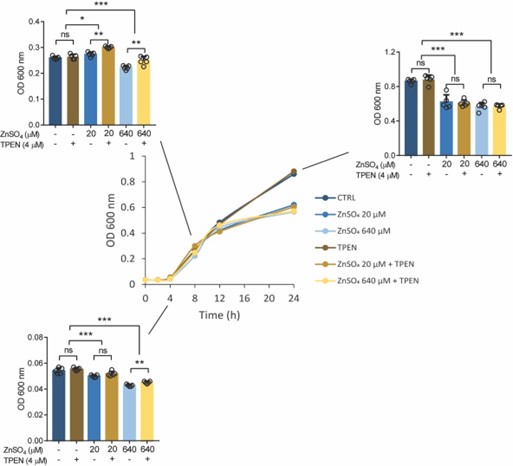
      (2) It is understandable that recording the DA neurons in the glomerular layer is not easy. However, the authors still need to increase their n's and repeat the experiments at least three times to make their conclusion more solid. For example (but not limited to), Fig 3B, n=2 cells from 1 mouse. Fig.4G, the recording only has 3 cells.

      Despite the acknowledged difficulty of these experiments, we have now added substantial extra data to the study as requested. We have increased the number of cells and animals to further support the following findings:

      Fig 3B: we now have n=5 cells from N=3 mice. We have created a new Supplementary Figure 1 to show all the examples.

      Figure 4G: we now have n=6 cells from N=4 mice.

      Figure 5G: we now have n=3 cells from N=3 mice.

      The new data now provide stronger support for our original conclusions. In the case of auto-evoked inhibition after the application of D1 and D2 receptor antagonists, a nonsignificant trend in the data suggests that, while dopamine is clearly not necessary for the response, it may play a small part in its strength. We have now included this consideration in the Results section (lines 256 to 264 of the revised manuscript).

      (3) The statistics also use pseudoreplicates. It might be better to present the biology replicates, too.

      Indeed, in a study focused on the structural and functional properties of individual neurons, we performed all comparisons with cell as the unit of analysis. This did often (though not always) involve obtaining multiple data points from individual mice, but in these low-throughput experiments n was never hugely bigger than N. The potential impact of pseudoreplicates and their associated within-animal correlations was therefore low. We checked this in response to the Reviewer’s comment by running parallel nested analyses for all comparisons that returned significant differences in the original submission. These are the cases in which we would be most concerned about potential false positive results arising from intra-animal correlations, which nested tests specifically take into account (Aarts et al., 2013). In every instance we found that the nested tests also reported significant differences between anaxonic and axonbearing cell types, thus fully validating our original statistical approach. We now report this in the relevant section of the Materials and Methods (lines 686 to 691 of the revised manuscript).

      (4) In Figure 4D, the authors report the values in the manuscript. It is recommended to make a bar graph to be more intuitive.

      This plot does already exist in the original manuscript. We originally describe these data to support the observation that an auto-evoked inhibition effect exists in anaxonic neurons (corresponding to now lines 240 to 245 of the revised manuscript). We then show them visually in their entirety when we compare them to the lack of response in axon-bearing neurons, depicted in Figure 5C. We still believe that this order of presentation is most appropriate for the flow of information in the paper, so have maintained it in our revised submission.

      (5) In Figure 4F and G, although the data with three cells suggest no phenotype, the kinetics looked different. So, the authors might need to explore that aside from increasing the n.

      We thank the Reviewer for this suggestion. To quantify potential changes in the autoevoked inhibition response kinetics, we fitted single exponential functions and compared changes in the rate constant (k; Methods, lines 650 to 652 of the revised manuscript). Overall, we observed no consistent or significant change in rate constant values after adding DA receptor antagonists. This finding is now reported in the Results section (lines 260 to 263 of the revised manuscript) and shown in a new Supplementary Figure 3.

      (6) Similarly, for Figure 4I and J, L and M, it is better to present and analyze it like F and G, instead of showing only the after-antagonist effect.

      We agree that the ideal scenario would have been to perform the experiments in Figure 4J and 4M the same way as those in Figure 4G, with a before vs after comparison. Unfortunately, however, this was not practically possible. 

      When attempting to apply carbenoxelone to already-patched cells, we found that this drug highly disrupted the overall health and stability of our recordings immediately after its application. This is consistent with previous reports of similar issues with this compound (e.g. Connors 2012, Epilepsy Currents; Tovar et al., 2009, Journal of Neurophysiology). After many such attempts, the total yield of this experiment was one single cell from one animal. Even so, as shown in the traces below, we were able to show that the auto-evoked inhibition response was not eliminated in this specific case:

      Author response image 1.

      Traces of an AEI response recorded before (magenta) and after (green) the application of carbenoxolone (n=1 cell from N=1 mouse).

      In light of these issues, we instead followed published protocols in applying the carbenoxolone directly in the bath without prior recording for 20 minutes (following Samailova et al., 2003, Journal of Neurochemistry) and ran the protocol after that time. Given that our main question was to ask whether gap junctions were strictly necessary for the presence of any auto-evoked inhibition response, our positive findings in these experiments still allowed us to draw clear conclusions.

      In contrast, the issue with the NKCC1 antagonist bumetanide was time. As acknowledged by this Reviewer, obtaining and maintaining high-quality patch recordings from OB DA neurons is technically challenging. Bumetanide is a slow-acting drug when used to modify neuronal chloride concentrations, because in addition to the time it takes to reach the neurons and effectively block NKCC1, the intracellular levels of chloride subsequently change slowly. Studies using this drug in slice physiology experiments typically use an incubation time of at least 20 minutes (e.g. Huberfeld et al., 2007, Journal of Neuroscience), which was incompatible with productive data collection in OB DA neurons. Again, after many unsuccessful efforts, we were forced instead to include bumetanide in the bath without prior recording for 20-30 minutes. As with the carbenoxolone experiment, our goal here was to establish whether autoevoked inhibition was in any way retained in the presence of this drug, so our positive result again allowed us to draw clear conclusions.

      Reviewer #1 (Recommendations for the authors):

      (1) I suggest the authors reconsider the terminology. For example, they use "strikingly" in their title. The manuscript reported two different transmitter release strategies but not the mechanisms, and the word "strikingly" is not professional, either.

      We appreciate the Reviewer’s attention to clarity and tone in the manuscript title, and have nevertheless decided to retain the original wording. The almost all-or-nothing differences between closely related cell types shown in structural and functional properties here (Figures 3F & 5C) are pronounced, extremely clear and easily spotted – all properties appropriate for the word ‘striking.’ In addition, we note that the use of this term is not at all unprofessional, with a PubMed search for ‘strikingly’ in the title of publications returning over 200 hits.

      (2) Similarly, almost all confocal scopes are 3D because images can be taken at stacks. So "3D confocal" is misleading.

      We understand that this is misleading. We have now replaced the sentence ‘Example snapshot of a 3D confocal stack of…’ by ‘Example confocal images of…’ in all the figure legends that apply.

      (3) It is recommended to present the data in bar graphs with data dots instead of showing the numbers in the manuscript directly.

      We agree entirely, and now present data plots for all comparisons reported in the study (Supplementary Figures 2, 4 and 5).

      Reviewer #2 (Recommendations for the authors):

      (1) Several experiments report notably small sample sizes, such as in Figures 3B and 5G, where data from only 2 cells derived from 1-2 mice are presented. Figures 4E-G also report the experimental result only from 3 cells derived from 3 mice. To enhance the statistical robustness and reliability of the findings, these experiments should be replicated with larger sample sizes.

      As per our response to Reviewer 1’s comment #2 above, and to directly address the concern that some evidence was ‘incomplete’, we have now added significant extra data and analysis to this revised submission (Figures 4 and 5; and Supplementary Figure 1). We believe that this has further enhanced the robustness and reliability of our findings, as requested.

      (2) The authors utilize vGAT-Cre for Figures 1-3 and DAT-tdTomato for Figures 4-5, raising concerns about consistency in targeting the same population of dopaminergic neurons. It remains unclear whether all OB DA neurons express vGAT and release GABA. Clarification and additional evidence are needed to confirm whether the same neuronal population was studied across these experiments.

      Although we indeed used different mouse lines to investigate structural and functional aspects of transmitter release, we can be very confident that both approaches allowed us to study the same two distinct DA cell types being compared in this paper. Existing data to support this position are already clear and strong, so in this revision we have focused on the Reviewer’s suggestion to clarify the approaches we chose.

      First, it is well characterised that in mouse and many other species all OB DA neurons are also GABAergic. This has been demonstrated comprehensively at the level of neurochemical identity and in terms of dopamine/GABA co-release, and is true across both small-soma/anaxonic and large-soma/axon-bearing subclasses (Kosaka & Kosaka 2008; 2016; Maher & Westbrook 2008; Borisovska et al., 2013; Vaaga et al., 2016; Liu et al. 2013). To specifically confirm vGAT expression, we have also now provided additional single-cell RNAseq data and immunohistochemical label in a revised Figure 1 (see also Panzanelli et al., 2007, now referenced in the paper, who confirmed endogenous vGAT colocalisation in TH-positive OB neurons). Most importantly, by using vGAT-cre mice here we were able to obtain sufficient numbers of both anaxonic and axon-bearing DA neurons among the vGAT-cre-expressing OB population. We could unambiguously identify these cells as dopaminergic because of their expression of TH protein which, due to the absence of noradrenergic neurons in the OB, is a specific and comprehensive marker for dopaminergic cells in this brain region (Hokfelt et al., 1975; Rosser et al., 1986; Kosaka & Kosaka 2016). Crucially, both axon-bearing and anaxonic OB DA subtypes strongly express TH (Galliano et al., 2018, 2021). We have now added additional text to the relevant Results section (lines 99 to 108 of the revised manuscript) to clarify these reasons for studying vGAT-cre mice here.

      We were also able to clearly identify and sample both subtypes of OB DA neuron using DAT-tdT mice. Our previous published work has thoroughly characterised this exact mouse line at the exact ages studied in the present paper (Galliano et al., 2018; Byrne et al., 2022). We know that DAT-tdT mice provide rather specific label for TH-expressing OB DA neurons (75% co-localisation; Byrne et al., 2022), but most importantly we know which non-DA neurons are labelled in this mouse line and how to avoid them. All nonTH-expressing but tdT-positive cells in juvenile DAT-tdT mice are small, dimly fluorescent and weakly spiking neurons of the calretinin-expressing glomerular subtype (Byrne et al., 2022). These cells are easily detected during physiological recordings, and were excluded from our study here. This information is now provided in the relevant Methods section (lines 616 to 619 of the revised manuscript, also referenced in lines 236 to 240 of the results section), and we apologise for its previous omission. Finally, we have shown both structurally and functionally that both axon-bearing and anaxonic OB DA subtypes are labelled in DAT-tdT mice (Galliano et al., 2018, Tufo et al., 2025; present study). Overall, these additional clarifications firmly establish that the same neuronal populations were indeed studied across our experiments.

      (3) The low TH+ signal in Figure 1D raises questions regarding the successful targeting of OB DA neurons. Further validation, such as additional staining, is required to ensure that the targeted neurons are accurately identified.

      As noted in our response to the previous comment, TH is a specific marker for dopaminergic neurons in the mouse OB, and is widely used for this purpose. Labelling for TH in our tissue is extremely reliable, and in fact gives such strong signal that we were forced to reduce the primary antibody concentration to 1:50,000 to prevent bleedthrough into other acquisition channels. Even at this concentration it was extremely straightforward to unambiguously identify TH-positive cells based on somatic immunofluorescence. We recognise, however, that the original example image in Figure 1D was not sufficiently clear, and have now provided a new example which illustrates the TH-based identification of these cells much more effectively. 

      (4) Estimating the total number of dopaminergic neurons in the olfactory bulb, along with the relative proportions of anaxonic and axon-bearing neuron subtypes, would provide valuable context for the study. Presenting such data is crucial to underscore the biological significance of the findings.

      This information has already been well characterised in previous studies. Total dopaminergic cell number in the OB is ~90,000 (Maclean & Shipley, 1988; Panzanelli et al., 2007; Parrish-Aungst et al., 2007). In terms of proportions, anaxonic neurons make up the vast majority of these cells, with axon-bearing neurons representing only ~2.5% of all OB dopaminergic neurons at P28 (Galliano et al., 2018). Of course, the relatively low number of the axon-bearing subtype does not preclude its having a potentially large influence on glomerular networks and sensory processing, as demonstrated by multiple studies showing the functional effects of inter-glomerular inhibition (Kosaka & Kosaka, 2008; Liu et al., 2013; Whitesell et al., 2013; Banerjee et al., 2015). This information has now been added to the Introduction (line 47 and lines 59 to 62 of the revised manuscript).

      (5) The authors report that in-utero injection was performed based on the premise that the two subclasses of dopaminergic neurons in the olfactory bulb are generated during embryonic development. However, it remains unclear whether in-utero injection is essential for distinguishing between these two subclasses. While the manuscript references a relevant study, the explanation provided is insufficient. A more detailed justification for employing in-utero injection would enhance the manuscript's clarity and methodological rigor.

      We apologise for the lack of clarity in explaining the approach. In utero injection is not absolutely essential for distinguishing between the two subclasses, but it does have two major advantages. 1) Because infection happens before cells migrate to their final positions, it produces sparse labelling which permits later unambiguous identification of individual cells’ processes; and 2) Because both subclasses are generated embryonically (compared to the postnatal production of only anaxonic DA neurons), it allows effective targeting of both cell types. We have now expanded the relevant section of the Results to explain the rationale for our approach in more detail (lines 109 to 116 of the revised manuscript).

      (6) In Figures 1A and 4A, it appears that data from previously published studies were utilized to illustrate the differential mRNA expression in dopaminergic neurons of the olfactory bulb. However, the Methods section and the manuscript lack a detailed description of how these dopaminergic neurons were classified or analyzed. Given that these figures contribute to the primary dataset, providing additional explanation and context is essential to ensure clarity of the findings.

      We apologise for the lack of clarity. We have now extended the part of the methods referring to the RNAseq data analysis (lines 666 to 678 of the revised manuscript). 

      (7) In Figure 2C, anaxonic dopamine neurons display considerable variability in the number of neurotransmitter release sites, with some neurons exhibiting sparse sites while others exhibit numerous sites. The authors should address the potential biological or methodological reasons for this variability and discuss its significance.

      We thank the Reviewer for highlighting this feature of our data. We have now outlined potential methodological reasons for the variability, whilst also acknowledging that it is consistent with previous reports of presynaptic site distributions in these cells (Kiyokage et al., 2017; Results, lines 169 to 172 of the revised manuscript). We have also added a brief discussion of the potential biological significance (Discussion, lines 446 to 450).

      (8) In the images used to differentiate anaxonic and axon-bearing neurons, the soma, axons, and dendrites are intermixed, making it difficult to distinguish structures specific to each subclass. Employing subclass-specific labeling or sparse labeling techniques could enhance clarity and accuracy in identifying these structures.

      Distinguishing these structures is indeed difficult, and was the main reason we used viral label to produce sparse labelling (see response to comment #5 above). In all cases we were extremely careful, including cells only when we could be absolutely certain of their anaxonic or axon-bearing identity, and could also be certain of the continuity of all processes. Crucially, while the 2D representations we show in our figures may suggest a degree of intermixing, we performed all analyses on 3D image stacks, significantly improving our ability to accurately assign structures to individual cells. We have now added extra descriptions of this approach in the relevant Methods section (lines 546 to 548 of the revised manuscript).

      (9) In Figure 3, the soma area and synaptophysin puncta density are compared between axon-bearing and anaxonic neurons. However, the figure only presents representative images of axon-bearing neurons. To ensure a fair and accurate comparison, representative images of both neuron subtypes should be included.

      The original figures did include example images of puncta density (or lack of puncta) in both cell types (Figure 2B and Figure 3E). For soma area, we have now included representative images of axon-bearing and anaxonic neurons with an indication of soma area measurement in a new Supplementary Figure 2A.

      (10) In Figure 4B, the authors state that gephyrin and synaptophysin puncta are in 'very close proximity.' However, it is unclear whether this proximity is sufficient to suggest the possibility of self-inhibition. Quantifying the distance between gephyrin and synaptophysin puncta would provide critical evidence to support this claim. Additionally, analyzing the distribution and proportion of gephyrinsynaptophysin pairs in close proximity would offer further clarity and strengthen the interpretation of these findings.

      We thank the Reviewer for raising this issue. We entirely agree that the example image previously shown did not constitute sufficient evidence to claim either close proximity of gephyrin and synaptophysin puncta, nor the possibility of self-inhibition. We are not in a position to perform a full quantitative analysis of these spatial distributions, nor do we think this is necessary given previous direct evidence for auto-evoked inhibition in OB dopaminergic cells (Smith and Jahr, 2002; Murphy et al., 2005; Maher and Westbrook, 2008; Borisovska et al., 2013) and our own demonstration of this phenomenon in anaxonic neurons (Figure 4). We have therefore removed the image and the reference to it in the text. 

      (11) In Figures 4J and 4M, the effects of the drugs are presented without a direct comparison to the control group (baseline control?). Including these baseline control data is essential to provide a clear context for interpreting the drug effects and to validate the conclusions drawn from these experiments.

      We appreciate the Reviewer’s attention to this important point. As this concern was also raised by Reviewer 1 (their point #6), we have provided a detailed response fully addressing it in our replies to Reviewer 1 above. 

      (12) In Lines 342-344, the authors claim that VMAT2 staining is notoriously difficult. However, several studies (e.g., Weihe et al., 2006; Cliburn et al., 2017) have successfully utilized VMAT2 staining. Moreover, Zhang et al., 2015 - a reference cited by the authors - demonstrates that a specific VMAT2 antibody effectively detects VMAT2. Providing evidence of VMAT2 expression in OB DA neurons would substantiate the claim that these neurons are GABA-co-releasing DA neurons and strengthen the study's conclusions.

      As noted in response to this Reviewer’s comment #2 above, there is clear published evidence that OB DA neurons are GABA- and dopamine-releasing cells. These cells are also known to express VMAT2 (Cave et al., 2010; Borisovska et al., 2013; Vergaña-Vera et al., 2015). We do not therefore believe that additional evidence of VMAT2 expression is necessary to strengthen our study’s conclusions. We did make every effort to label VMAT2-positive release sites in our neurons, but unfortunately all commercially available antibodies were ineffective. The successful staining highlighted by the Reviewer was either performed in the context of virally driven overexpression (Zhang et al., 2015) or was obtained using custom-produced antibodies (Weihe et al., 2006; Cliburn et al., 2017). We have now modified the Discussion text to provide more clarification of these points (lines 393 to 395 of the revised manuscript).

    1. Document d'Information : Peut-on Réinventer les Lumières ?

      Synthèse

      Ce document d'information synthétise les arguments et les thèmes clés abordés lors de la séance de clôture du cycle "Peut-on réinventer les Lumières ?", organisée par l'Institut d'Études Avancées de Paris.

      Les interventions de Francis Wolf et Céline Spector, deux philosophes éminents, ont convergé vers une défense robuste et nuancée de l'universalisme, tout en examinant de manière critique les objections contemporaines, notamment celles issues des courants identitaires et postcoloniaux.

      L'argument central, porté par Francis Wolf, est que l'humanité forme une communauté morale unique, fondée sur des droits et des devoirs réciproques.

      Il déconstruit méthodiquement les critiques affirmant que les valeurs universelles ne sont qu'un masque pour la domination occidentale.

      En distinguant l'origine d'une idée de sa portée et en s'appuyant sur des exemples concrets de luttes pour la démocratie et la liberté à travers le monde (Printemps arabes, Iran), il soutient que l'universalisme est un outil d'émancipation essentiel. Il insiste sur la distinction fondamentale entre l'universel, qui garantit la diversité, et l'uniforme, qui la nie.

      Céline Spector prolonge cette analyse en se concentrant sur les critiques postcoloniales des droits de l'homme.

      Elle en systématise les principaux arguments (ethnocentrisme, fiction idéologique, outil de colonisation) tout en soulignant les paradoxes inhérents au concept de droits humains dès son origine.

      Son propos, en accord avec celui de Wolf, vise à réaffirmer la pertinence de cet héritage des Lumières face à ces objections.

      La discussion a ensuite exploré plusieurs concepts connexes, dont la notion de "pluriversel" (jugée contradictoire ou maladroite), l'existence de précédents non-occidentaux aux droits humains (la Charte du Mandé de 1236), et la tension persistante entre l'idéal universel et son application souvent défaillante ("deux poids, deux mesures").

      Enfin, le débat s'est ouvert sur les défis contemporains, tels que les droits de la nature face à la crise environnementale et le rôle de l'héritage des Lumières dans la construction d'une Europe capable de résister aux dynamiques impériales.

      --------------------------------------------------------------------------------

      Contexte de l'Événement

      La discussion s'est tenue dans le cadre de la séance de clôture du cycle de conférences de l'IEA de Paris, présidé par Betina Laville, sur le thème "Peut-on réinventer les Lumières ?".

      L'objectif était de conclure une année de réflexion sur la place de l'universel dans un monde qualifié de "fracturé" et de plus en plus contestataire envers l'héritage intellectuel européen.

      Les deux intervenants principaux étaient :

      Francis Wolf : Philosophe, professeur émérite à l'École Normale Supérieure, spécialiste de philosophie antique et auteur de travaux significatifs sur l'humanisme et l'universalisme, notamment Plaidoyer pour l'universel.

      Céline Spector : Philosophe, professeure à Sorbonne Université, spécialiste des Lumières (en particulier Montesquieu et Rousseau) et des questions européennes, auteure de No Demos. Souveraineté et démocratie à l'épreuve de l'Europe.

      Le Plaidoyer pour l'Universalisme de Francis Wolf

      Francis Wolf a structuré son intervention comme une défense des valeurs universelles, qu'il définit à travers une thèse fondatrice : "l'humanité forme une communauté morale de droit et de devoirs réciproques".

      Il se concentre principalement sur la réfutation des critiques qui jugent cet universalisme excessif, au profit de communautés morales restreintes ("infrahumaines").

      Les Critiques de l'Universalisme

      Wolf identifie deux grands courants critiques contemporains de l'universalisme :

      1. Les idéologies "de droite" : Nationalistes, racistes et xénophobes, elles nient l'existence de l'Homme en général pour n'admettre que des communautés de "semblables" ("nous" contre "eux").

      Cette vision, selon Wolf, est en pleine résurgence et se manifeste par le piétinement du droit international (depuis l'invasion de l'Ukraine), la remise en cause du droit des réfugiés (accords de Genève) et la montée des politiques discriminatoires ou d'épuration ethnique.

      2. Les idéologies identitaristes "de gauche" : Symétriques aux premières, elles reprennent des arguments hérités d'un "marxisme simplifié" selon lesquels toute prétention à l'universalité est un leurre masquant la domination.

      Réfutation des Arguments Anti-Universalistes

      Wolf examine et réfute systématiquement plusieurs arguments récurrents contre les valeurs universelles.

      Argument Critique

      Réfutation par Francis Wolf

      1. Aucune lutte ne peut se faire au nom de l'universel, car elle défend toujours des victimes particulières.

      Si les combats pour des minorités oublient qu'ils visent l'égalité pour tous, ils trahissent leur propre cause.

      Les colonisés n'ont pas lutté pour devenir colonisateurs, mais pour abolir le colonialisme.

      2. L'universel se présente comme neutre, mais ne l'est jamais ; il nie les relations de domination.

      Bien que l'universel soit parfois utilisé pour nier les injustices, il n'est pas nécessaire de se définir uniquement "en tant que" (femme, colonisé, etc.).

      Les identités sont métissées, fluides et non des essences réifiées.

      3. L'expérience des souffrances particulières est incommunicable et il n'y a pas de lieu neutre pour juger.

      Une injustice ne concerne pas que la victime ou le coupable, mais la communauté morale entière. Sans un "tiers lieu" permettant de juger, il n'y a plus de justice, seulement des vengeances. Toute souffrance a une dimension communicable.

      4. L'universel n'est que le masque des intérêts dominants.

      Cet argument, bien que souvent justifié par l'histoire (colonisation, guerre d'Irak), n'est pas généralisable.

      Les pires entreprises de domination (génocides) n'ont pas besoin de ce prétexte et se font au nom d'identités essentialisées ("sous-hommes", "bêtes nuisibles").

      5. Tout universel est en fait particulier ; c'est un autre nom de l'Occident.

      Concéder qu'un universel naît dans un contexte particulier n'en limite pas la portée. L'algèbre, née en Perse, n'est pas une science "iranienne".

      La démocratie et les droits humains sont réclamés par les peuples en lutte partout dans le monde (Printemps arabes, Hong Kong, Iran), et leurs despotes les rejettent en les qualifiant de "valeurs occidentales".

      Prétendre que l'Occident a seul inventé les droits humains est une "illusion occidentaliste" (Amartya Sen).

      La Vertu Émancipatrice de l'Universel

      Pour conclure, Wolf affirme que l'universalisme conserve sa force émancipatrice.

      Il pose la question : qui est le véritable ethnocentriste ?

      Celui qui croit en l'existence de consciences critiques dans toutes les cultures, ou celui qui essentialise les autres cultures en leur déniant cette capacité critique ?

      Il distingue enfin l'universel de l'uniforme. Loin d'effacer les particularités, les valeurs universelles (laïcité, liberté d'opinion, tolérance) sont la condition de leur coexistence.

      Elles constituent un "universel de second niveau", formel, qui garantit la diversité.

      La Critique Postcoloniale des Droits de l'Homme selon Céline Spector

      Céline Spector se déclare en "profond accord" avec Francis Wolf et concentre son propos sur la critique spécifique des droits de l'homme par les études postcoloniales et décoloniales.

      Les Paradoxes Originels des Droits de l'Homme

      Dès leur proclamation aux États-Unis (1776) et en France (1789), les droits de l'homme présentent des paradoxes fondamentaux :

      • Ils sont à la fois évidents et advenus (nés de révolutions).

      • Ils sont à la fois naturels et historiques.

      • Ils sont à la fois innés et civiques.

      • Ils sont à la fois universels et situés.

      Ces paradoxes ont nourri les critiques (marxistes, féministes) qui y voyaient une hypocrisie, notamment en raison de l'exclusion des femmes, des esclaves et d'autres minorités.

      Les Cinq Piliers de la Critique Postcoloniale

      Spector résume la critique postcoloniale des droits de l'homme en cinq arguments principaux :

      1. Ils ne sont pas universels mais occidentaux, protégeant uniquement les citoyens d'Europe.

      2. Ce sont des fictions idéologiques ayant servi à justifier la "mission civilisatrice" de la colonisation.

      3. Ils sont associés à une conception de la raison qui exclut les peuples "sauvages" ou "barbares", jugés incapables d'y accéder.

      4. La liste des droits est arbitraire et abusive, notamment l'inclusion du droit de propriété qui a servi à exproprier les peuples nomades.

      5. Ce sont les droits des colons et de leurs complices, qui n'avaient aucune volonté politique de mettre fin au pillage des colonies ou à l'esclavage.

      Tout en reconnaissant la nécessité de prendre en compte ces critiques pour révéler les "tensions inhérentes aux Lumières", l'approche de Céline Spector vise à formuler des objections à cette vision, rejoignant ainsi la défense de l'universalisme de Francis Wolf.

      Thèmes Clés de la Discussion

      La période d'échange avec le public a permis d'approfondir plusieurs thématiques.

      Le Concept de "Pluriversel"

      Interrogés sur cette notion issue des théories décoloniales, les deux intervenants expriment leur scepticisme :

      Francis Wolf y voit soit une contradiction dans les termes, soit une simple reformulation du fait que l'universel est toujours perçu depuis un point de vue culturel particulier, sans pour autant y être prisonnier.

      Céline Spector, citant la définition du Dictionnaire décolonial, le décrit comme une "critique radicale de l'universalisme".

      Elle considère ce concept comme une "tentative maladroite" de la part d'auteurs (Ramon Grosfoguel, Walter Mignolo, etc.) qui se retrouvent dans une impasse existentielle : vouloir lutter pour les droits sans utiliser l'outil des droits universels.

      Précédents Historiques et Application du Droit

      La Charte du Mandé (1236) : Cette charte, issue de l'empire du Mali, est évoquée comme un possible précédent africain à la reconnaissance de valeurs universelles, telles que l'égalité entre ethnies et religions, et la participation des femmes au gouvernement.

      Le "Deux Poids, Deux Mesures" : Un participant soulève le problème du "double standard" dans l'application du droit international.

      Céline Spector reconnaît la légitimité de cette critique mais met en garde contre une indignation qui dévalorise les institutions internationales (ONU, CPI), les rendant fragiles et poussant les puissances hégémoniques à simplement les quitter.

      Universalité, Environnement et Europe

      Droits de la Nature : La question d'un "droit à l'environnement" est soulevée comme un défi majeur pour réinventer les Lumières.

      La discussion porte sur la tension entre les droits humains et les "droits de la nature", un concept de plus en plus débattu juridiquement (ex: le fleuve Whanganui en Nouvelle-Zélande, la lagune Mar Menor en Espagne).

      Ce débat interroge la centralité de l'homme dans la définition de l'environnement.

      L'Héritage des Lumières pour l'Europe : Céline Spector propose de voir dans l'héritage de Montesquieu, et spécifiquement son modèle de "République fédérative", un outil puissant pour penser la résistance des démocraties face à la résurgence des empires.

      Francis Wolf abonde en ce sens, soulignant que la construction européenne illustre la primauté du demos (communauté politique) sur l'ethnos (communauté préexistante), un principe également au cœur de la résistance ukrainienne.

      Les "Lumières Noires" : Ce terme, associé à Curtis Yarvin, est décrit comme un "usage complètement perverti" des Lumières, désignant une technocratie oligarchique où une élite numérique domine des citoyens dépossédés de leurs droits.

      C'est l'antithèse même de l'idéal des Lumières.

    1. Author response:

      The following is the authors’ response to the original reviews.

      Reviewer #1 (Public review)

      Summary:

      This study by Park and colleagues uses longitudinal saliva viral load data from two cohorts (one in the US and one in Japan from a clinical trial) in the pre-vaccine era to subset viral shedding kinetics and then use machine learning to attempt to identify clinical correlates of different shedding patterns. The stratification method identifies three separate shedding patterns discriminated by peak viral load, shedding duration, and clearance slope. The authors also assess micro-RNAs as potential biomarkers of severity but do not identify any clear relationships with viral kinetics.

      Strengths:

      The cohorts are well developed, the mathematical model appears to capture shedding kinetics fairly well, the clustering seems generally appropriate, and the machine learning analysis is a sensible, albeit exploratory approach. The micro-RNA analysis is interesting and novel.

      Weaknesses:

      The conclusions of the paper are somewhat supported by the data but there are certain limitations that are notable and make the study's findings of only limited relevance to current COVID-19 epidemiology and clinical conditions.

      We sincerely appreciate the reviewer’s thoughtful and constructive comments, which have been invaluable in improving the quality of our study. We have carefully revised the manuscript to address all points raised.

      (1) The study only included previously uninfected, unvaccinated individuals without the omicron variant. It has been well documented that vaccination and prior infection both predict shorter duration shedding. Therefore, the study results are no longer relevant to current COVID-19 conditions. This is not at all the authors' fault but rather a difficult reality of much retrospective COVID research.

      Thank you for your comment. We agree with the review’s comment that some of our results could not provide insight into the current COVID-19 conditions since most people have either already been infected with COVID-19 or have been vaccinated. We revised our manuscript to discuss this (page 22, lines 364-368). Nevertheless, we believe it is novel that we have extensively investigated the relationship between viral shedding patterns in saliva and a wide range of clinical and microRNA data, and that developing a method to do so remains important. This is important for providing insight into early responses to novel emerging viral diseases in the future. Therefore, we still believe that our findings are valuable.

      (2) The target cell model, which appears to fit the data fairly well, has clear mechanistic limitations. Specifically, if such a high proportion of cells were to get infected, then the disease would be extremely severe in all cases. The authors could specify that this model was selected for ease of use and to allow clustering, rather than to provide mechanistic insight. It would be useful to list the AIC scores of this model when compared to the model by Ke.

      Thank you for your feedback and suggestion regarding our mathematical model. As the reviewer pointed out, in this study, we adopted a simple model (target cell-limited model) to focus on reconstruction of viral dynamics and stratification of shedding patterns rather than exploring the mechanism of viral infection in detail. Nevertheless, we believe that the target cell-limited model provides reasonable reconstructed viral dynamics as it has been used in many previous studies. We revised manuscript to clarify this point (page 10, lines 139-144). Also, we revised our manuscript to provide more detailed description of the model comparison along with information about AIC (page 10, lines 130-135).

      (3) Line 104: I don't follow why including both datasets would allow one model to work better than the other. This requires more explanation. I am also not convinced that non-linear mixed effects approaches can really be used to infer early model kinetics in individuals from one cohort by using late viral load kinetics in another (and vice versa). The approach seems better for making populationlevel estimates when there is such a high amount of missing data.

      Thank you for your feedback. We recognized that our explanation was insufficient by your comment. We intended to describe that, rather than comparing performance of the two models, data fitting can be performed with same level for both models by including both datasets. We revised the manuscript to clarify this point (page 10, lines 135-139).

      Additionally, we agree that nonlinear mixed effects models are a useful approach for performing population-level estimates of missing data. On the other hand, in addition, the nonlinear mixed effects model has the advantage of making the reasonable parameter estimation for each individual with not enough data points by considering the distribution of parameters of other individuals. Paying attention to these advantages, we adopted a nonlinear mixed effects model in our study. We also revised the manuscript to clarify this (page 27, lines 472-483).

      (4) Along these lines, the three clusters appear to show uniform expansion slopes whereas the NBA cohort, a much larger cohort that captured early and late viral loads in most individuals, shows substantial variability in viral expansion slopes. In Figure 2D: the upslope seems extraordinarily rapid relative to other cohorts. I calculate a viral doubling time of roughly 1.5 hours. It would be helpful to understand how reliable of an estimate this is and also how much variability was observed among individuals.

      We appreciate your detailed feedback on the estimated up-slope of viral dynamics. As the reviewer noted, the pattern differs from that observed in the NBA cohort, which may be due to their measurement of viral load from upper respiratory tract swabs. In our estimation, the mean and standard deviation of the doubling time (defined as ln2/(𝛽𝑇<sub>0</sub>𝑝𝑐<sup>−1</sup> − 𝛿)) were 1.44 hours and 0.49 hours, respectively. Although direct validation of these values is challenging, several previous studies, including our own, have reported that viral loads in saliva increase more rapidly than in the upper respiratory tract swabs, reaching their peak sooner. Thus, we believe that our findings are consistent with those of previous studies. We revised our manuscript to discuss this point with additional references (page 20, lines 303-311).

      (5) A key issue is that a lack of heterogeneity in the cohort may be driving a lack of differences between the groups. Table 1 shows that Sp02 values and lab values that all look normal. All infections were mild. This may make identifying biomarkers quite challenging.

      Thank you for your comment regarding heterogeneity in the cohort. Although the NFV cohort was designed for COVID-19 patients who were either mild or asymptomatic, we have addressed this point and revised the manuscript to discuss it (page 21, lines 334-337).

      (6) Figure 3A: many of the clinical variables such as basophil count, Cl, and protein have very low pre-test probability of correlating with virologic outcome.

      Thank you for your comment regarding some clinical information we used in our study. We revised our manuscript to discuss this point (page 21, lines 337-338).

      (7) A key omission appears to be micoRNA from pre and early-infection time points. It would be helpful to understand whether microRNA levels at least differed between the two collection timepoints and whether certain microRNAs are dynamic during infection.

      Thank you for your comment regarding the collection of micro-RNA data. As suggested by the reviewer, we compared micro-RNA levels between two time points using pairwise t-tests and Mann-Whitney U tests with FDR correction. As a result, no micro-RNA showed a statistically significant difference. This suggests that micro-RNA levels remain relatively stable during the course of infection, at least for mild or asymptomatic infection, and may therefore serve as a biomarker independent of sampling time. We have revised the manuscript to include this information (page 17, lines 259-262).

      (8) The discussion could use a more thorough description of how viral kinetics differ in saliva versus nasal swabs and how this work complements other modeling studies in the field.

      We appreciate the reviewer’s thoughtful feedback. As suggested, we have added a discussion comparing our findings with studies that analyzed viral dynamics using nasal swabs, thereby highlighting the differences between viral dynamics in saliva and in the upper respiratory tract. To ensure a fair and rigorous comparison, we referred to studies that employed the same mathematical model (i.e., Eqs.(1-2)). Accordingly, we revised the manuscript and included additional references (page 20, lines 303-311).

      Furthermore, we clarified the significance of our study in two key aspects. First, it provides a detailed analysis of viral dynamics in saliva, reinforcing our previous findings from a single cohort by extending them across multiple cohorts. Second, this study uniquely examines whether viral dynamics in saliva can be directly predicted by exploring diverse clinical data and micro-RNAs. Notably, cohorts that have simultaneously collected and reported both viral load and a broad spectrum of clinical data from the same individuals, as in our study, are exceedingly rare. We revised the manuscript to clarify this point (page 20, lines 302-311).

      (9) The most predictive potential variables of shedding heterogeneity which pertain to the innate and adaptive immune responses (virus-specific antibody and T cell levels) are not measured or modeled.

      Thank you for your comment. We agree that antibody and T cell related markers may serve as the most powerful predictors, as supported by our own study [S. Miyamoto et al., PNAS (2023), ref. 24] as well as previous reports. While this point was already discussed in the manuscript, we have revised the text to make it more explicit (page 21, lines 327-328).

      (10) I am curious whether the models infer different peak viral loads, duration, expansion, and clearance slopes between the 2 cohorts based on fitting to different infection stage data.

      Thank you for your comment. We compared features between 2 cohorts as reviewer suggested. As a result, a statistically significant difference between the two cohorts (i.e., p-value ≤ 0.05 from the t-test) was observed only at the peak viral load, with overall trends being largely similar. At the peak, the mean value was 7.5 log<sub>10</sub> (copies/mL) in the Japan cohort and 8.1 log<sub>10</sub> (copies/mL) in the Illinois cohort, with variances of 0.88 and 0.87, respectively, indicating comparable variability.

      Reviewer #2 (Public review)

      Summary:

      This study argues it has found that it has stratified viral kinetics for saliva specimens into three groups by the duration of "viral shedding"; the authors could not identify clinical data or microRNAs that correlate with these three groups.

      Strengths:

      The question of whether there is a stratification of viral kinetics is interesting.

      Weaknesses:

      The data underlying this work are not treated rigorously. The work in this manuscript is based on PCR data from two studies, with most of the data coming from a trial of nelfinavir (NFV) that showed no effect on the duration of SARS-CoV-2 PCR positivity. This study had no PCR data before symptom onset, and thus exclusively evaluated viral kinetics at or after peak viral loads. The second study is from the University of Illinois; this data set had sampling prior to infection, so has some ability to report the rate of "upswing." Problems in the analysis here include:

      We are grateful to the reviewer for the constructive feedback, which has greatly enhanced the quality of our study. In response, we have carefully revised the manuscript to address all comments.

      The PCR Ct data from each study is treated as equivalent and referred to as viral load, without any reports of calibration of platforms or across platforms. Can the authors provide calibration data and justify the direct comparison as well as the use of "viral load" rather than "Ct value"? Can the authors also explain on what basis they treat Ct values in the two studies as identical?

      Thank you for your comment regarding description of viral load data. We recognized the lack of explanation for the integration of viral load data by reviewer's comment. We calculated viral load from Ct value using linear regression equations between Ct and viral load for each study's measurement method, respectively. We revised the manuscript to clarify this point in the section of Saliva viral load data in Methods.

      The limit of detection for the NFV PCR data was unclear, so the authors assumed it was the same as the University of Illinois study. This seems a big assumption, as PCR platforms can differ substantially. Could the authors do sensitivity analyses around this assumption?

      Thank you for your comment regarding the detection limit for viral load data. As reviewer suggested, we conducted sensitivity analysis for assumption of detection limit for the NFV dataset. Specifically, we performed data fitting in the same manner for two scenarios: when the detection limit of NFV PCR was lower (0 log<sub>10</sub> copies/mL) or higher (2 log<sub>10</sub> copies/mL) than that of the Illinois data (1.08 log<sub>10</sub> copies/mL), and compared the results.

      As a result, we obtained largely comparable viral dynamics in most cases (Supplementary Fig 6). When comparing the AIC values, we observed that the AIC for the same censoring threshold was 6836, whereas it increased to 7403 under the low censoring threshold and decreased to 6353 under the higher censoring threshold. However, this difference may be attributable to the varying number of data points treated as below the detection limit. Specifically, when the threshold is set higher, more data are treated as below the detection limit, which may result in a more favorable error calculation. To discuss this point, we have added a new figure (Supplementary Fig 6) and revised the manuscript accordingly (page 25, lines 415-418).

      The authors refer to PCR positivity as viral shedding, but it is viral RNA detection (very different from shedding live/culturable virus, as shown in the Ke et al. paper). I suggest updating the language throughout the manuscript to be precise on this point.

      We appreciate the reviewer’s feedback regarding the terminology used for viral shedding. In response, we have revised all instances of “viral shedding” to “viral RNA detection” throughout the manuscript as suggested.

      Eyeballing extended data in Figure 1, a number of the putative long-duration infections appear to be likely cases of viral RNA rebound (for examples, see S01-16 and S01-27). What happens if all the samples that look like rebound are reanalyzed to exclude the late PCR detectable time points that appear after negative PCRs?

      We sincerely thank the reviewer for the valuable suggestion. In response, we established a criterion to remove data that appeared to exhibit rebound and subsequently performed data fitting

      (see Author response image 1 below). The criterion was defined as: “any data that increase again after reaching the detection limit in two measurements are considered rebound and removed.” As a result, 15 out of 144 cases were excluded due to insufficient usable data, leaving 129 cases for analysis. Using a single detection limit as the criterion would have excluded too many data points, while defining the criterion solely based on the magnitude of increase made it difficult to establish an appropriate “threshold for increase.”

      The fitting result indicates that the removal of rebound data may influence the fitting results; however, direct comparison of subsequent analyses, such as clustering, is challenging due to the reduced sample size. Moreover, the results can vary substantially depending on the criterion used to define rebound, and establishing a consistent standard remains difficult. Accordingly, we retained the current analysis and have added a discussion of rebound phenomena in the Discussion section as a limitation (page 22, lines 355-359). We once again sincerely appreciate the reviewer’s insightful and constructive suggestion.

      Author response image 1.

      Comparison of model fits before and after removing data suspected of rebound. Black dots represent observed measurements, and the black and yellow curves show the fitted viral dynamics for the full dataset and the dataset with rebound data removed, respectively.

      There's no report of uncertainty in the model fits. Given the paucity of data for the upslope, there must be large uncertainty in the up-slope and likely in the peak, too, for the NFV data. This uncertainty is ignored in the subsequent analyses. This calls into question the efforts to stratify by the components of the viral kinetics. Could the authors please include analyses of uncertainty in their model fits and propagate this uncertainty through their analyses?

      We sincerely appreciate the reviewer’s detailed feedback on model uncertainty. To address this point, we revised Extended Fig 1 (now renumbered as Supplementary Fig 1) to include 95% credible intervals computed using a bootstrap approach. In addition, to examine the potential impact of model uncertainty on stratified analyses, we reconstructed the distance matrix underlying stratification by incorporating feature uncertainty. Specifically, for each individual, we sampled viral dynamics within the credible interval and averaged the resulting feature, and build the distance matrix using it. We then compared this uncertainty-adjusted matrix with the original one using the Mantel test, which showed a strong correlation (r = 0.72, p < 0.001). Given this result, we did not replace the current stratification but revised the manuscript to provide this information through Result and Methods sections (page 11, lines 159-162 and page 28, lines 512-519). Once again, we are deeply grateful for this insightful comment.

      The clinical data are reported as a mean across the course of an infection; presumably vital signs and blood test results vary substantially, too, over this duration, so taking a mean without considering the timing of the tests or the dynamics of their results is perplexing. I'm not sure what to recommend here, as the timing and variation in the acquisition of these clinical data are not clear, and I do not have a strong understanding of the basis for the hypothesis the authors are testing.

      We appreciate the reviewers' feedback on the clinical data. We recognized that the manuscript lacked description of the handling of clinical data by your comment. In this research, we focused on finding “early predictors” which could provide insight into viral shedding patterns. Thus, we used clinical data measured in the earliest time (date of admission) for each patient. Another reason is that the date of admission is the almost only time point at which complete clinical data without any missing values are available for all participants. We revised our manuscript to clarify this point (page 5, lines 90-95).

      It's unclear why microRNAs matter. It would be helpful if the authors could provide more support for their claims that (1) microRNAs play such a substantial role in determining the kinetics of other viruses and (2) they play such an important role in modulating COVID-19 that it's worth exploring the impact of microRNAs on SARS-CoV-2 kinetics. A link to a single review paper seems insufficient justification. What strong experimental evidence is there to support this line of research?

      We appreciate the reviewer’s comments regarding microRNA. Based on this feedback, we recognized the need to clarify our rationale for selecting microRNAs as the analyte. The primary reason was that our available specimens were saliva, and microRNAs are among the biomarkers that can be reliably measured in saliva. At the same time, previous studies have reported associations between microRNAs and various diseases, which led us to consider the potential relevance of microRNAs to viral dynamics, beyond their role as general health indicators. To better reflect this context, we have added supporting references (page 17, lines 240-243).

      Reviewer #3 (Public review)

      The article presents a comprehensive study on the stratification of viral shedding patterns in saliva among COVID-19 patients. The authors analyze longitudinal viral load data from 144 mildly symptomatic patients using a mathematical model, identifying three distinct groups based on the duration of viral shedding. Despite analyzing a wide range of clinical data and micro-RNA expression levels, the study could not find significant predictors for the stratified shedding patterns, highlighting the complexity of SARS-CoV-2 dynamics in saliva. The research underscores the need for identifying biomarkers to improve public health interventions and acknowledges several limitations, including the lack of consideration of recent variants, the sparsity of information before symptom onset, and the focus on symptomatic infections. 

      The manuscript is well-written, with the potential for enhanced clarity in explaining statistical methodologies. This work could inform public health strategies and diagnostic testing approaches. However, there is a thorough development of new statistical analysis needed, with major revisions to address the following points:

      We sincerely appreciate the thoughtful feedback provided by Reviewer #3, particularly regarding our methodology. In response, we conducted additional analyses and revised the manuscript accordingly. Below, we address the reviewer’s comments point by point.

      (1) Patient characterization & selection: Patient immunological status at inclusion (and if it was accessible at the time of infection) may be the strongest predictor for viral shedding in saliva. The authors state that the patients were not previously infected by SARS-COV-2. Was Anti-N antibody testing performed? Were other humoral measurements performed or did everything rely on declaration? From Figure 1A, I do not understand the rationale for excluding asymptomatic patients. Moreover, the mechanistic model can handle patients with only three observations, why are they not included? Finally, the 54 patients without clinical data can be used for the viral dynamics fitting and then discarded for the descriptive analysis. Excluding them can create a bias. All the discarded patients can help the virus dynamics analysis as it is a population approach. Please clarify. In Table 1 the absence of sex covariate is surprising.

      We appreciate the detailed feedback from the reviewer regarding patient selection. We relied on the patient's self-declaration to determine the patient's history of COVID-19 infection and revised the manuscript to specify this (page 6, lines 83-84).

      In parameter estimation, we used the date of symptom onset for each patient so that we establish a baseline of the time axis as clearly as possible, as we did in our previous works. Accordingly, asymptomatic patients who do not have information on the date of symptom onset were excluded from the analysis. Additionally, in the cohort we analyzed, for patients excluded due to limited number of observations (i.e., less than 3 points), most patients already had a viral load close to the detection limit at the time of the first measurement. This is due to the design of clinical trial, as if a negative result was obtained twice in a row, no further follow-up sampling was performed. These patients were excluded from the analysis because it hard to get reasonable fitting results. Also, we used 54 patients for the viral dynamics fitting and then only used the NFV cohort for clinical data analysis. We acknowledge that our description may have confused readers. We revised our manuscript to clarify these points regarding patient selecting for data fitting (page 6, lines 96-102, page 24, lines 406-407, and page 7, lines 410-412). In addition, we realized, thanks to the reviewer’s comment, that gender information was missing in Table 1. We appreciate this observation and have revised the table to include gender (we used gender in our analysis). 

      (2) Exact study timeline for explanatory covariates: I understand the idea of finding « early predictors » of long-lasting viral shedding. I believe it is key and a great question. However, some samples (Figure 4A) seem to be taken at the end of the viral shedding. I am not sure it is really easier to micro-RNA saliva samples than a PCR. So I need to be better convinced of the impact of the possible findings. Generally, the timeline of explanatory covariate is not described in a satisfactory manner in the actual manuscript. Also, the evaluation and inclusion of the daily symptoms in the analysis are unclear to me.

      We appreciate the reviewer’s feedback regarding the collection of explanatory variables. As noted, of the two microRNA samples collected from each patient, one was obtained near the end of viral shedding. This was intended to examine potential differences in microRNA levels between the early and late phases of infection. No significant differences were observed between the two time points, and using microRNA from either phase alone or both together did not substantially affect predictive accuracy for stratified groups. Furthermore, microRNA collection was motivated primarily by the expectation that it would be more sensitive to immune responses, rather than by ease of sampling. We have revised the manuscript to clarify these points regarding microRNA (page 17, lines 243-245 and 259-262).

      Furthermore, as suggested by the reviewer, we have also strengthened the explanation regarding the collection schedule of clinical information and the use of daily symptoms in the analysis (page 6, lines 90-95, page 14, lines 218-220,).

      (3) Early Trajectory Differentiation: The model struggles to differentiate between patients' viral load trajectories in the early phase, with overlapping slopes and indistinguishable viral load peaks observed in Figures 2B, 2C, and 2D. The question arises whether this issue stems from the data, the nature of Covid-19, or the model itself. The authors discuss the scarcity of pre-symptom data, primarily relying on Illinois patients who underwent testing before symptom onset. This contrasts earlier statements on pages 5-6 & 23, where they claim the data captures the full infection dynamics, suggesting sufficient early data for pre-symptom kinetics estimation. The authors need to provide detailed information on the number or timing of patient sample collections during each period.

      Thank you for the reviewer’s thoughtful comments. The model used in this study [Eqs.(1-2)] has been employed in numerous prior studies and has successfully identified viral dynamics at the individual level. In this context, we interpret the rapid viral increase observed across participants as attributable to characteristics of SARS-CoV-2 in saliva, an interpretation that has also been reported by multiple previous studies. We have added the relevant references and strengthened the corresponding discussion in the manuscript (page 20, lines 303-311).

      We acknowledge that our explanation of how the complementary relationship between the two cohorts contributes to capturing infection dynamics was not sufficiently clear. As described in the manuscript, the Illinois cohort provides pre-symptomatic data, whereas the NFV cohort offers abundant end-phase data, thereby compensating for each other’s missing phases. By jointly analyzing the two cohorts with a nonlinear mixed-effects model, we estimated viral dynamics at the individual-level. This approach first estimates population-level parameters (fixed effects) using data from all participants and then incorporates random effects to account for individual variability, yielding the most plausible parameter values.

      Thus, even when early-phase data are lacking in the NFV cohort, information from the Illinois cohort allows us to infer most reasonable dynamics, and the reverse holds true for the end phase. In this context, we argued that combining the two cohorts enables mathematical modeling to capture infection dynamics at the individual level. Recognizing that our earlier description could be misleading, we have carefully reinforced the relevant description (page 27, lines 472-483). In addition, as suggested by the reviewer, we have added information on the number of data samples available for each phase in both cohorts (page 7, lines 106-109).

      (4) Conditioning on the future: Conditioning on the future in statistics refers to the problematic situation where an analysis inadvertently relies on information that would not have been available at the time decisions were made or data were collected. This seems to be the case when the authors create micro-RNA data (Figure 4A). First, when the sampling times are is something that needs to be clarified by the authors (for clinical outcomes as well). Second, proper causal inference relies on the assumption that the cause precedes the effect. This conditioning on the future may result in overestimating the model's accuracy. This happens because the model has been exposed to the outcome it's supposed to predict. This could question the - already weak - relation with mir-1846 level.

      We appreciate the reviewer’s detailed feedback. As noted in Reply to Comments 2, we collected micro-RNA samples at two time points, near the peak of infection dynamics and at the end stage, and found no significant differences between them. This suggests that micro-RNA levels are not substantially affected by sampling time. Indeed, analyses conducted using samples from the peak, late stage, or both yielded nearly identical results in relation to infection dynamics. To clarify this point, we revised the manuscript by integrating this explanation with our response in Reply to Comments 2 (page 17, lines 259-262). In addition, now we also revised manuscript to clarify sampling times of clinical information and micro-RNA (page 6, lines 90-95).

      (5) Mathematical Model Choice Justification and Performance: The paper lacks mention of the practical identifiability of the model (especially for tau regarding the lack of early data information). Moreover, it is expected that the immune effector model will be more useful at the beginning of the infection (for which data are the more parsimonious). Please provide AIC for comparison, saying that they have "equal performance" is not enough. Can you provide at least in a point-by-point response the VPC & convergence assessments?

      We appreciate the reviewer’s detailed feedback regarding the mathematical model. We acknowledge the potential concern regarding the practical identifiability of tau (incubation period), particularly given the limited early-phase data. In our analysis, however, the nonlinear mixed-effects model yielded a population-level estimate of 4.13 days, which is similar with previously reported incubation periods for COVID-19. This concordance suggests that our estimate of tau is reasonable despite the scarcity of early data.

      For model comparison, first, we have added information on the AIC of the two models to the manuscript as suggested by the reviewer (page 10, lines 130-135). One point we would like to emphasize is that we adopted a simple target cell-limited model in this study, aiming to focus on reconstruction of viral dynamics and stratification of shedding patterns rather than exploring the mechanism of viral infection in detail. Nevertheless, we believe that the target cell-limited model provides reasonable reconstructed viral dynamics as it has been used in many previous studies. We revised manuscript to clarify this (page 10, lines 135-144). 

      Furthermore, as suggested, we have added the VPC and convergence assessment results for both models, together with explanatory text, to the manuscript (Supplementary Fig 2, Supplementary Fig 3, and page 10, lines 130-135). In the VPC, the observed 5th, 50th, and 95th percentiles were generally within the corresponding simulated prediction intervals across most time points. Although minor deviations were noted in certain intervals, the overall distribution of the observed data was well captured by the models, supporting their predictive performance (Supplementary Fig 2). In addition, the log-likelihood and SAEM parameter trajectories stabilized after the burn-in phase, confirming appropriate convergence (Supplementary Fig 3).

      (6) Selected features of viral shedding: I wonder to what extent the viral shedding area under the curve (AUC) and normalized AUC should be added as selected features.

      We sincerely appreciate the reviewer’s valuable suggestion regarding the inclusion of additional features. Following this recommendation, we considered AUC (or normalized AUC) as an additional feature when constructing the distance matrix used for stratification. We then evaluated the similarity between the resulting distance matrix and the original one using the Mantel test, which showed a very high correlation (r = 0.92, p < 0.001). This indicates that incorporating AUC as an additional feature does not substantially alter the distance matrix. Accordingly, we have decided to retain the current stratification analysis, and we sincerely thank the reviewer once again for this interesting suggestion.

      (7) Two-step nature of the analysis: First you fit a mechanistic model, then you use the predictions of this model to perform clustering and prediction of groups (unsupervised then supervised). Thus you do not propagate the uncertainty intrinsic to your first estimation through the second step, ie. all the viral load selected features actually have a confidence bound which is ignored. Did you consider a one-step analysis in which your covariates of interest play a direct role in the parameters of the mechanistic model as covariates? To pursue this type of analysis SCM (Johnson et al. Pharm. Res. 1998), COSSAC (Ayral et al. 2021 CPT PsP), or SAMBA ( Prague et al. CPT PsP 2021) methods can be used. Did you consider sampling on the posterior distribution rather than using EBE to avoid shrinkage?

      Thank you for the reviewer’s detailed suggestions regarding our analysis. We agree that the current approach does not adequately account for the impact of uncertainty in viral dynamics on the stratified analyses. As a first step, we have revised Extended Data Fig 1 (now renumbered as Supplementary Fig 1) to include 95% credible intervals computed using a bootstrap approach, to present the model-fitting uncertainty more explicitly. Then, to examine the potential impact of model uncertainty on stratified analyses, we reconstructed the distance matrix underlying stratification by incorporating feature uncertainty. Specifically, for each individual, we sampled viral dynamics within the credible interval and averaged the resulting feature, and build the distance matrix using it. We then compared this uncertainty-adjusted matrix with the original one using the Mantel test, which showed a strong correlation (r = 0.72, p < 0.001). Given this result, we did not replace the current stratification but revised the manuscript to provide this information (page 11, lines 159-162 and page 28, 512-519).

      Furthermore, we carefully considered the reviewer’s proposed one-step analysis. However, implementation was constrained by data-fitting limitations. Concretely, clinical information is available only in the NFV cohort. Thus, if these variables are to be entered directly as covariates on the parameters, the Illinois cohort cannot be included in the data-fitting process. Yet the NFV cohort lacks any pre-symptomatic observations, so fitting the model to that cohort alone does not permit a reasonable (well-identified/robust) fitting result. While we were unable to implement the suggestion under the current data constraints, we sincerely appreciate the reviewer’s thoughtful and stimulating proposal.

      (8) Need for advanced statistical methods: The analysis is characterized by a lack of power. This can indeed come from the sample size that is characterized by the number of data available in the study. However, I believe the power could be increased using more advanced statistical methods. At least it is worth a try. First considering the unsupervised clustering, summarizing the viral shedding trajectories with features collapses longitudinal information. I wonder if the R package « LongituRF » (and associated method) could help, see Capitaine et al. 2020 SMMR. Another interesting tool to investigate could be latent class models R package « lcmm » (and associated method), see ProustLima et al. 2017 J. Stat. Softwares. But the latter may be more far-reached.

      Thank you for the reviewer’s thoughtful suggestions regarding our unsupervised clustering approach. The R package “LongitiRF” is designed for supervised analysis, requiring a target outcome to guide the calculation of distances between individuals (i.e., between viral dynamics). In our study, however, the goal was purely unsupervised clustering, without any outcome variable, making direct application of “LongitiRF” challenging.

      Our current approach (summarizing each dynamic into several interpretable features and then using Random Forest proximities) allows us to construct a distance matrix in an unsupervised manner. Here, the Random Forest is applied in “proximity mode,” focusing on how often dynamics are grouped together in the trees, independent of any target variable. This provides a practical and principled way to capture overall patterns of dynamics while keeping the analysis fully unsupervised.

      Regarding the suggestion to use latent class mixed models (R package “lcmm”), we also considered this approach. In our dataset, each subject has dense longitudinal measurements, and at many time points, trajectories are very similar across subjects, resulting in minimal inter-individual differences. Consequently, fitting multi-class latent class mixed models (ng ≥ 2) with random effects or mixture terms is numerically unstable, often producing errors such as non-positive definite covariance matrices or failure to generate valid initial values. Although one could consider using only the time points with the largest differences, this effectively reduces the analysis to a feature-based summary of dynamics. Such an approach closely resembles our current method and contradicts the goal of clustering based on full longitudinal information.

      Taken together, although we acknowledge that incorporating more longitudinal information is important, we believe that our current approach provides a practical, stable, and informative solution for capturing heterogeneity in viral dynamics. We would like to once again express our sincere gratitude to the reviewer for this insightful suggestion.

      (9) Study intrinsic limitation: All the results cannot be extended to asymptomatic patients and patients infected with recent VOCs. It definitively limits the impact of results and their applicability to public health. However, for me, the novelty of the data analysis techniques used should also be taken into consideration.

      We appreciate your positive evaluation of our research approach and acknowledge that, as noted in the Discussion section as our first limitation, our analysis may not provide valid insights into recent VOCs or all populations, including asymptomatic individuals. Nonetheless, we believe it is novel that we extensively investigated the relationship between viral shedding patterns in saliva and a wide range of clinical and micro-RNA data. Our findings contribute to a deeper and more quantitative understanding of heterogeneity in viral dynamics, particularly in saliva samples. To discuss this point, we revised our manuscript (page 22, lines 364-368).

      Strengths are:

      Unique data and comprehensive analysis.

      Novel results on viral shedding.

      Weaknesses are:

      Limitation of study design.

      The need for advanced statistical methodology.

      Reviewer #1 (Recommendations For The Authors):

      Line 8: In the abstract, it would be helpful to state how stratification occurred.

      We thank the reviewer for the feedback, and have revised the manuscript accordingly (page 2, lines 8-11).

      Line 31 and discussion: It is important to mention the challenges of using saliva as a specimen type for lab personnel.

      We thank the reviewer for the feedback, and have revised the manuscript accordingly (page 3, lines 36-41).

      Line 35: change to "upper respiratory tract".

      We thank the reviewer for the feedback, and have revised the manuscript accordingly (page 3, line 35).

      Line 37: "Saliva" is not a tissue. Please hazard a guess as to which tissue is responsible for saliva shedding and if it overlaps with oral and nasal swabs.

      We thank the reviewer for the feedback, and have revised the manuscript accordingly (page 3, lines 42-45).

      Line 42, 68: Please explain how understanding saliva shedding dynamics would impact isolation & screening, diagnostics, and treatments. This is not immediately intuitive to me.

      We thank the reviewer for the feedback, and have revised the manuscript accordingly (page 3, lines 48-50).

      Line 50: It would be helpful to explain why shedding duration is the best stratification variable.

      We thank the reviewer for the feedback. We acknowledge that our wording was ambiguous. The clear differences in the viral dynamics patterns pertain to findings observed following the stratification, and we have revised the manuscript to make this explicit (page 4, lines 59-61).

      Line 71: Dates should be listed for these studies.

      We thank the reviewer for the feedback, and have revised the manuscript accordingly (page 6, lines 85-86).

      Reviewer #2 (Recommendations For The Authors):

      Please make all code and data available for replication of the analyses.

      We appreciate the suggestion. Due to ethical considerations, it is not possible to make all data and code publicly available. We have clearly stated in the manuscript about it (Data availability section in Methods).

      Reviewer #3 (Recommendations For The Authors):

      Here are minor comments / technical details:

      (1) Figure 1B is difficult to understand.

      Thank you for the comment. We updated Fig 1B to incorporate more information to aid interpretation.

      (2) Did you analyse viral load or the log10 of viral load? The latter is more common. You should consider it. SI Figure 1 please plot in log10 and use a different point shape for censored data. The file quality of this figure should be improved. State in the material and methods if SE with moonlit are computed with linearization or importance sampling.

      Thank you for the comment. We conducted our analyses using log10-transformed viral load. Also, we revised Supplementary Fig 1 (now renumbered as Supplementary Fig 4) as suggested. We also added Supplementary Fig 3 and clarified in the Methods that standard errors (SE) were obtained in Monolix from the Fisher information matrix using the linearization method (page 28, lines 498-499).

      (3) Table 1 and Figure 3A could be collapsed.

      Thank you for the comment, and we carefully considered this suggestion. Table 1 summarizes clinical variables by category, whereas Fig 3A visualizes them ordered by p-value of statistical analysis. Collapsing these into a single table would make it difficult to apprehend both the categorical summaries and the statistical ranking at a glance, thereby reducing readability. We therefore decided to retain the current layout. We appreciate the constructive feedback again. 

      (4) Figure 3 legend could be clarified to understand what is 3B and 3C.

      We thank the reviewer for the feedback and have reinforced the description accordingly.

      (5) Why use AIC instead of BICc?

      Thank you for your comment. We also think BICc is a reasonable alternative. However, because our objective is predictive adequacy (reconstruction of viral dynamics), we judged AIC more appropriate. In NLMEM settings, the effective sample size required by BICc is ambiguous, making the penalty somewhat arbitrary. Moreover, since the two models reconstruct very similar dynamics, our conclusions are not sensitive to the choice of criterion.

      (6) Bibliography. Most articles are with et al. (which is not standard) and some are with an extended list of names. Provide DOI for all.

      We thank the reviewer for the feedback, and have revised the manuscript accordingly.

      (7) Extended Table 1&2 - maybe provide a color code to better highlight some lower p-values (if you find any interesting).

      We thank the reviewer for the feedback. Since no clinical information and micro-RNAs other than mir-1846 showed low p-values, we highlighted only mir-1846 with color to make it easier to locate.

      (8) Please make the replication code available.

      We appreciate the suggestion. Due to ethical considerations, it is not possible to make all data and code publicly available. We have clearly stated in the manuscript about it (Data availability section in Methods).

    Annotators

    1. Author response:

      The following is the authors’ response to the original reviews.

      Reviewer #1 (Public review): 

      Summary: 

      In this work, van Paassen et al. have studied how CD8 T cell functionality and levels predict HIV DNA decline. The article touches on interesting facets of HIV DNA decay, but ultimately comes across as somewhat hastily done and not convincing due to the major issues. 

      (1) The use of only 2 time points to make many claims about longitudinal dynamics is not convincing. For instance, the fact that raw data do not show decay in intact, but do for defective/total, suggests that the present data is underpowered. The authors speculate that rising intact levels could be due to patients who have reservoirs with many proviruses with survival advantages, but this is not the parsimonious explanation vs the data simply being noisy without sufficient longitudinal follow-up. n=12 is fine, or even reasonably good for HIV reservoir studies, but to mitigate these issues would likely require more time points measured per person. 

      (1b) Relatedly, the timing of the first time point (6 months) could be causing a number of issues because this is in the ballpark for when the HIV DNA decay decelerates, as shown by many papers. This unfortunate study design means some of these participants may already have stabilized HIV DNA levels, so earlier measurements would help to observe early kinetics, but also later measurements would be critical to be confident about stability. 

      The main goal of the present study was to understand the relationship of the HIV-specific CD8 T-cell responses early on ART with the reservoir changes across the subsequent 2.5-year period on suppressive therapy. We have revised the manuscript in order to clarify this.  We chose these time points because the 24 week time point is past the initial steep decline of HIV DNA, which takes place in the first weeks after ART initiation. It is known that HIV DNA continues to decay for years after (Besson, Lalama et al. 2014, Gandhi, McMahon et al. 2017). 

      (2) Statistical analysis is frequently not sufficient for the claims being made, such that overinterpretation of the data is problematic in many places. 

      (2a) First, though plausible that cd8s influence reservoir decay, much more rigorous statistical analysis would be needed to assert this directionality; this is an association, which could just as well be inverted (reservoir disappearance drives CD8 T cell disappearance). 

      To correlate different reservoir measures between themselves and with CD8+ T-cell responses at 24 and 156 weeks, we now performed non-parametric (Spearman) correlation analyses, as they do not require any assumptions about the normal distribution of the independent and dependent variables. Benjamini-Hochberg corrections for multiple comparisons (false discovery rate, 0.25) were included in the analyses and did not change the results. 

      Following this comment we would like to note that the association between the T-cell response at 24 weeks and the subsequent decrease in the reservoir cannot be bi-directional (that can only be the case when both variables are measured at the same time point). Therefore, to model the predictive value of T-cell responses measured at 24 weeks for the decrease in the reservoir between 24 and 156 weeks, we fitted generalized linear models (GLM), in which we included age and ART regimen, in addition to three different measures of HIV-specific CD8+ T-cell responses, as explanatory variables, and changes in total, intact, and total defective HIV DNA between 24 and 156 weeks ART as dependent variables.

      (2b) Words like "strong" for correlations must be justified by correlation coefficients, and these heat maps indicate many comparisons were made, such that p-values must be corrected appropriately. 

      We have now used Spearman correlation analysis, provided correlation coefficients to justify the wording, and adjusted the p-values for multiple comparisons (Fig. 1, Fig 3., Table 2). Benjamini-Hochberg corrections for multiple comparisons (false discovery rate, 0.25) were included in the analyses and did not change the results.  

      (3) There is not enough introduction and references to put this work in the context of a large/mature field. The impacts of CD8s in HIV acute infection and HIV reservoirs are both deep fields with a lot of complexity. 

      Following this comment we have revised and expanded the introduction to put our work more in the context of the field (CD8s in acute HIV and HIV reservoirs). 

      Reviewer #2 (Public review): 

      Summary: 

      This study investigated the impact of early HIV specific CD8 T cell responses on the viral reservoir size after 24 weeks and 3 years of follow-up in individuals who started ART during acute infection. Viral reservoir quantification showed that total and defective HIV DNA, but not intact, declined significantly between 24 weeks and 3 years post-ART. The authors also showed that functional HIV-specific CD8⁺ T-cell responses persisted over three years and that early CD8⁺ T-cell proliferative capacity was linked to reservoir decline, supporting early immune intervention in the design of curative strategies. 

      Strengths: 

      The paper is well written, easy to read, and the findings are clearly presented. The study is novel as it demonstrates the effect of HIV specific CD8 T cell responses on different states of the HIV reservoir, that is HIV-DNA (intact and defective), the transcriptionally active and inducible reservoir. Although small, the study cohort was relevant and well-characterized as it included individuals who initiated ART during acute infection, 12 of whom were followed longitudinally for 3 years, providing unique insights into the beneficial effects of early treatment on both immune responses and the viral reservoir. The study uses advanced methodology. I enjoyed reading the paper. 

      Weaknesses: 

      All participants were male (acknowledged by the authors), potentially reducing the generalizability of the findings to broader populations. A control group receiving ART during chronic infection would have been an interesting comparison. 

      We thank the reviewer for their appreciation of our study. Although we had indeed acknowledged the fact that all participants were male, we have clarified why this is a limitation of the study (Discussion, lines 296-298). The reviewer raises the point that it would be useful to compare our data to a control group. Unfortunately, these samples are not yet available, but our study protocol allows for a control group (chronic infection) to ensure we can include a control group in the future.

      Reviewer #1 (Recommendations for the authors): 

      Minor: 

      On the introduction: 

      (1) One large topic that is mostly missing completely is the emerging evidence of selection on HIV proviruses during ART from the groups of Xu Yu and Matthias Lichterfeld, and Ya Chi Ho, among others. 

      Previously, it was only touched upon in the Discussion. Now we have also included this in the Introduction (lines 77-80).

      (2) References 4 and 5 don't quite match with the statement here about reservoir seeding; we don't completely understand this process, and certainly, the tissue seeding aspect is not known. 

      Line 61-62: references were changed and this paragraph was rewritten to clarify.

      (3) Shelton et al. showed a strong relationship with HIV DNA size and timing of ART initiation across many studies. I believe Ananwaronich also has several key papers on this topic. 

      References by Ananwaronich are included (lines 91-94).

      (4) "the viral levels decline within weeks of AHI", this is imprecise, there is a peak and a decline, and an equilibrium. 

      We agree and have rewritten the paragraph accordingly.

      (5) The impact of CD8 cells on viral evolution during primary infection is complex and likely not relevant for this paper. 

      We have left viral evolution out of the introduction in order to keep a focus on the current subject.

      (6) The term "reservoir" is somewhat polarizing, so it might be worth mentioning somewhere exactly what you think the reservoir is, I think, as written, your definition is any HIV DNA in a person on ART? 

      Indeed, we refer to the reservoir when we talk about the several aspects of the reservoir that we have quantified with our assays (total HIV DNA, unspliced RNA, intact and defective proviral DNA, and replication-competent virus). In most instances we try to specify which measurement we are referring to. We have added additional reservoir explanation to clarify our definition to the introduction (lines 55-58).

      (7) I think US might be used before it is defined. 

      We thank the reviewer for this notification, we have now also defined it in the Results section (line 131).

      (8) In Figure 1 it's also not clear how statistics were done to deal with undetectable values, which can be tricky but important. 

      We have now clarified this in the legend to Figure 2 (former Figure 1). Paired Wilcoxon tests were performed to test the significance of the differences between the time points. Pairs where both values were undetectable were always excluded from the analysis. Pairs where one value was undetectable and its detection limit was higher than the value of the detectable partner, were also excluded from the analysis. Pairs where one value was undetectable and its detection limit was lower than the value of the detectable partner, were retained in the analysis.

      In the discussion: 

      (1) "This confirms that the existence of a replication-competent viral reservoir is linked to the presence of intact HIV DNA." I think this statement is indicative of many of the overinterpretations without statistical justification. There are 4 of 12 individuals with QVOA+ detectable proviruses, which means there are 8 without. What are their intact HIV DNA levels? 

      We thank the reviewer for the question that is raised here. We have now compared the intact DNA levels (measured by IPDA) between participants with positive vs. negative QVOA output, and observed a significant difference. We rephrased the wording as follows: “We compared the intact HIV DNA levels at the 24-week timepoint between the six participants, from whom we were able to isolate replicating virus, and the fourteen participants, from whom we could not. Participants with positive QVOA had significantly higher intact HIV DNA levels than those with negative QVOA (p=0.029, Mann-Whitney test; Suppl. Fig. 3). Five of six participants with positive QVOA had intact DNA levels above 100 copies/106 PBMC, while thirteen of fourteen participants with negative QVOA had intact HIV DNA below 100 copies/106 PBMC (p=0.0022, Fisher’s exact test). These findings indicate that recovery of replication-competent virus by QVOA is more likely in individuals with higher levels of intact HIV DNA in IPDA, reaffirming a link between the two measurements.”

      (2) "To determine whether early HIV-specific CD8+ T-cell responses at 24 weeks were predictive for the change in reservoir size". This is a fundamental miss on correlation vs causation... it could be the inverse. 

      We thank the reviewer for the remark. We have calculated the change in reservoir size (the difference between the reservoir size at 24 weeks and 156 weeks ART) and analyzed if the HIVspecific CD8+ T-cell response at 24 weeks ART are predictive for this change. We do not think it can be inverse, as we have a chronological relationship (CD8+ responses at week 24 predict the subsequent change in the reservoir).

      (3) "This may suggest that active viral replication drives the CD8+ T-cell response." I think to be precise, you mean viral transcription drives CD8s, we don't know about the full replication cycle from these data. 

      We agree with the reviewer and have changed “replication” to “transcription” (line 280).

      (4) "Remarkably, we observed that the defective HIV DNA levels declined significantly between 24 weeks and 3 years on ART. This is in contrast to previous observations in chronic HIV infection (30)". I don't find this remarkable or in contrast: many studies have analyzed and/or modeled defective HIV DNA decay, most of which have shown some negative slope to defective HIV DNA, especially within the first year of ART. See White et al., Blankson et al., Golob et al., Besson et al., etc In addition, do you mean in long-term suppressed? 

      The point we would like to make is that,  compared to other studies, we found a significant, prominent decrease in defective DNA (and not intact DNA) over the course of 3 years, which is in contrast to other studies (where usually the decrease in intact is significant and the decrease in defective less prominent). We have rephrased the wording (lines 227-230) as follows:

      “We observed that the defective HIV DNA levels decreased significantly between 24 and 156 weeks of ART. This is different from studies in CHI, where no significant decrease during the first 7 years of ART (Peluso, Bacchetti et al. 2020, Gandhi, Cyktor et al. 2021), or only a significant decrease during the first 8 weeks on ART, but not in the 8 years thereafter, was observed (Nühn, Bosman et al. 2025).”

      Reviewer #2 (Recommendations for the authors): 

      (1) Page 4, paragraph 2 - will be informative to report the statistics here. 

      (2) Page 4, paragraph 4 - "General phenotyping of CD4+ (Suppl. Fig. 3A) and CD8+ (Supplementary Figure 3B) T-cells showed no difference in frequencies of naïve, memory or effector CD8+ T-cells between 24 and 156 weeks." - What did the CD4+ phenotyping show? 

      We thank the reviewer for the remark. Indeed, there were also no differences in frequencies of naïve, memory or effector CD4+ T-cells between 24 and 156 weeks. We have added this to the paragraph (now Suppl. Fig 4), lines 166-168.

      (3) Page 5, paragraph 3 - "Similarly, a broad HIV-specific CD8+ T-cell proliferative response to at least three different viral proteins was observed in the majority of individuals at both time points" - should specify n=? for the majority of individuals. 

      At time point 24 weeks, 6/11 individuals had a response to env, 10/11 to gag, 5/11 to nef, and 4/11 to pol. At 156 weeks, 8/11 to env, 10/11 to gag, 8/11 to nef and 9/11 to pol. We have added this to the text (lines 188-191).

      (4) Seven of 22 participants had non-subtype B infection. Can the authors explain the use of the IPDA designed by Bruner et. al. for subtype B HIV, and how this may have affected the quantification in these participants? 

      Intact HIV DNA was detectable in all 22 participants. We cannot completely exclude influence of primer/probe-template mismatches on the quantification results, however such mismatches could also have occurred in subtype B participants, and droplet digital PCR that IPDA is based on is generally much less sensitive to these mismatches than qPCR.

      (5) Page 7, paragraph 2 - the authors report a difference in findings from a previous study ("a decline in CD8 T cell responses over 2 years" - reference 21), but only provide an explanation for this on page 9. The authors should consider moving the explanation to this paragraph for easier understanding. 

      We agree with the reviewer that this causes confusion. Therefore, we have revised and changed the order in the Discussion.

      (6) Page 7, paragraph 2 - Following from above, the previous study (21) reported this contradicting finding "a decline in CD8 T cell responses over 2 years" in a CHI (chronic HIV) treated cohort. The current study was in an acute HIV treated cohort. The authors should explain whether this may also have resulted in the different findings, in addition to the use of different readouts in each study.

      We thank the reviewer for this attentiveness. Indeed, the study by Takata et al. investigates the reservoir and HIV-specific CD8+ T-cell responses in both the RV254/ SEARCH010 study who initiated ART during AHI and the RV304/ SEARCH013 who initiated ART during CHI. We had not realized that the findings of the decline in CD8 T cell responses were solely found in the RV304/ SEARCH013 (CHI cohort). It appears functional HIV specific immune responses were only measured in AHI at 96 weeks, so we have clarified this in the Discussion. 

      Besson, G. J., C. M. Lalama, R. J. Bosch, R. T. Gandhi, M. A. Bedison, E. Aga, S. A. Riddler, D. K. McMahon, F. Hong and J. W. Mellors (2014). "HIV-1 DNA decay dynamics in blood during more than a decade of suppressive antiretroviral therapy." Clin Infect Dis 59(9): 1312-1321.

      Gandhi, R. T., J. C. Cyktor, R. J. Bosch, H. Mar, G. M. Laird, A. Martin, A. C. Collier, S. A. Riddler, B. J. Macatangay, C. R. Rinaldo, J. J. Eron, J. D. Siliciano, D. K. McMahon and J. W. Mellors (2021). "Selective Decay of Intact HIV-1 Proviral DNA on Antiretroviral Therapy." J Infect Dis 223(2): 225-233.

      Gandhi, R. T., D. K. McMahon, R. J. Bosch, C. M. Lalama, J. C. Cyktor, B. J. Macatangay, C. R. Rinaldo, S. A. Riddler, E. Hogg, C. Godfrey, A. C. Collier, J. J. Eron and J. W. Mellors (2017). "Levels of HIV-1 persistence on antiretroviral therapy are not associated with markers of inflammation or activation." PLoS Pathog 13(4): e1006285.

      Nühn, M. M., K. Bosman, T. Huisman, W. H. A. Staring, L. Gharu, D. De Jong, T. M. De Kort, N. Buchholtz, K. Tesselaar, A. Pandit, J. Arends, S. A. Otto, E. Lucio De Esesarte, A. I. M. Hoepelman, R. J. De Boer, J. Symons, J. A. M. Borghans, A. M. J. Wensing and M. Nijhuis (2025). "Selective decline of intact HIV reservoirs during the first decade of ART followed by stabilization in memory T cell subsets." Aids 39(7): 798-811.

      Peluso, M. J., P. Bacchetti, K. D. Ritter, S. Beg, J. Lai, J. N. Martin, P. W. Hunt, T. J. Henrich, J. D. Siliciano, R. F. Siliciano, G. M. Laird and S. G. Deeks (2020). "Differential decay of intact and defective proviral DNA in HIV-1-infected individuals on suppressive antiretroviral therapy." JCI Insight 5(4).

    1. La Réflexion Dialogique : Synthèse des Idées de Steve Mann

      Synthèse Exécutive

      Le professeur Steve Mann (Université de Warwick), lors de sa résidence à l'Institut d'Études Avancées (IEA) de Paris, présente son projet de recherche sur la "réflexion dialogique".

      Il la définit comme une forme de conversation collaborative et médiatisée, conçue pour examiner les expériences et les idées, contrastant fortement avec la vision traditionnelle de la réflexion en tant qu'exercice solitaire et individuel.

      L'argument central de sa présentation est que les êtres humains possèdent un "moteur interactionnel" inné, une capacité fondamentale à l'empathie, à l'écoute et à l'interaction, rendant les pratiques dialogiques non pas artificielles, mais au contraire profondément ancrées dans notre nature.

      Mann suggère que l'IEA, dont la mission est de favoriser le dialogue, pourrait systématiquement documenter et analyser ces interactions fertiles, voire positionner la réflexion dialogique comme une de ses méthodes de recherche.

      Son propre plan de travail à l'institut consiste à réexaminer ses corpus de données à la recherche de marqueurs linguistiques de la réflexion dialogique, tout en explorant des domaines comme les études néonatales pour en consolider les fondements théoriques.

      --------------------------------------------------------------------------------

      1. Définition et Fondements de la Réflexion Dialogique

      La réflexion dialogique est présentée comme un processus collaboratif qui vise à dépasser la pensée individuelle à travers une interaction dynamique et une multiplicité de perspectives.

      Définition : Il s'agit d'une forme d'enquête par la parole, souvent structurée, qui permet d'examiner les expériences, les idées et les présupposés.

      Elle est fondamentalement médiatisée et collaborative.

      Origines du Concept : L'intérêt de Steve Mann pour ce sujet provient de plusieurs sources :

      "Cooperative Development" (Développement Coopératif) : Un modèle développé par son superviseur de thèse, Julian Edge, fortement influencé par les idées de Carl Rogers (respect, empathie, sincérité).

      Ce modèle met l'accent sur l'écoute active et utilise des techniques linguistiques spécifiques comme le "reflet" (reflecting) et la "focalisation" (focusing) pour soutenir l'émergence des idées du locuteur.   

      Travaux antérieurs : Un chapitre co-écrit avec le professeur Steve Walsh sur la réflexion dialogique, que Mann a estimé n'avoir fait qu'effleurer le sujet.   

      Recherche sur la Réflexivité : Des travaux sur la réflexivité dans les entretiens de recherche qualitative, analysant comment les chercheurs réfléchissent à leur propre identité et méthodologie.

      2. Contestation de la Vision Traditionnelle de la Réflexion

      Mann remet en question la sémiotique dominante qui présente la réflexion comme une pratique purement individuelle et solitaire.

      L'image du "Penseur" : La sculpture "Le Penseur" de Rodin est citée comme l'archétype de cette vision de la pensée individuelle et isolée.

      Mann note l'influence de Charles Baudelaire sur Rodin, soulignant le lien entre la forme physique et l'exploration des états émotionnels internes.

      La connotation négative : Cette vision individualiste a un "côté sombre", incarné par le mythe de Narcisse.

      La pratique réflexive est ainsi souvent perçue de manière péjorative comme une forme d'introspection excessive ou de "nombrilisme" (navel-gazing).

      Le Contexte Éducatif : Le système éducatif est souvent décrit comme "monologique", dominé par la parole de l'enseignant qui fournit des réponses à des questions que les élèves n'ont pas posées.

      Le travail de Mann vise à "perturber" ou "intervenir" dans ces normes d'interaction pour les rendre plus dialogiques.

      3. Le Concept du "Moteur Interactionnel"

      Pour contrer l'idée que le dialogue structuré est artificiel, Mann s'appuie sur des recherches en études néonatales, notamment celles de Stephen Levinson.

      Preuves chez les nouveau-nés : Des études montrent que les nouveau-nés interagissent avec leurs soignants quelques jours seulement après la naissance.

      On observe des preuves de prise de tour (turn-taking) et d'organisation séquentielle dans leur regard et leurs interactions.

      Une Capacité Innée : Levinson propose l'existence d'un "moteur interactionnel" (interactional engine), une capacité humaine spéciale et innée pour l'interaction.

      Cette capacité inclut des compétences cognitives comme l'attention conjointe, l'empathie et la recherche d'un terrain d'entente (common ground).

      Implications Fondamentales : Si l'empathie et l'écoute sont des aspects fondamentaux de l'expérience humaine dès le début de la vie, alors les pratiques qui les favorisent ne sont pas artificielles mais exploitent une disposition naturelle.

      Neurosciences et Interaction : Mann cite des études montrant que les processus cérébraux et cognitifs fonctionnent différemment lorsque les individus sont en interaction.

      Par exemple, le cerveau d'un nourrisson réagit différemment à une écoute dirigée vers lui par rapport à une écoute périphérique.

      De plus, les messages soutenus par des éléments multimodaux sont mieux assimilés par le cerveau.

      4. Outils et Méthodes pour la Pratique Dialogique

      Pour être efficace, la réflexion dialogique doit être médiatisée par des outils et un "étayage" (scaffolding) appropriés, au sens vygotskien du terme.

      Outil / Approche

      Description

      Outils vidéo (Iris Connect, VEO)

      Permettent aux praticiens (enseignants, médecins) d'analyser leurs propres interactions.

      E-portfolios et Podcasts

      Offrent des moyens multimodaux pour la création de sens et la réflexion.

      Mentorat et Coaching

      Projets qui structurent la pratique réflexive et l'intègrent dans le développement professionnel.

      Recherche-Action

      Approche visant à modifier les normes d'interaction au sein des séminaires ou des formations.

      5. Perspectives pour l'Institut d'Études Avancées de Paris

      Mann souligne l'alignement entre son projet et la mission de l'IEA, qui est de "promouvoir des discussions qui encouragent la réflexion".

      Témoignages de Résidents : Il cite le rapport annuel de l'institut, où des résidents témoignent de l'importance des conversations informelles et de la manière dont ces interactions ont fait évoluer de manière significative leur projet de recherche.

      ◦ _« Très enrichissant de discuter de manière informelle pendant le déjeuner et les apéritifs aussi.

      Ces conversations m'ont aidé à la fois à voir mon propre projet d'un point de vue non spécialiste et à avoir une idée des développements importants dans d'autres domaines. »_   

      « Grâce à l'interaction à l'IEA, l'orientation initiale de ma recherche a considérablement évolué depuis sa création. Cela m'a amené à examiner les questions de pouvoir, les structures sociétales et leur impact sur l'atteinte des objectifs de durabilité. »

      Propositions pour l'Institut :

      1. Documenter les processus : L'IEA pourrait-il systématiquement documenter et analyser les types d'interactions et de réflexions dialogiques qui s'y déroulent ?   

      2. Une nouvelle méthode de recherche : L'institut pourrait-il positionner la réflexion dialogique comme l'une de ses nouvelles méthodes de recherche, valorisant ainsi les processus collaboratifs au même titre que les productions écrites ?

      6. Plan de Recherche de Steve Mann

      Durant sa résidence, Mann prévoit de se concentrer sur plusieurs axes :

      Analyse de Données Existantes : Réexaminer ses corpus de données (les siens et ceux de ses étudiants) pour identifier des exemples de réflexion dialogique.

      Identification de Marqueurs Linguistiques : Rechercher des preuves linguistiques spécifiques de la réflexion, telles que :

      ◦ La création de liens et de résonances.  

      ◦ L'utilisation de métaphores, de récits, d'anecdotes.    ◦ Les stratégies d'atténuation (hedging) et de spéculation.   

      ◦ La signalisation de "zones grises" ou de "tiers-espaces".    ◦ Les "moments eurêka" (light bulb moments).

      Influence de Bakhtine : Explorer la nature multimodale et intertextuelle de la réflexion dialogique, en s'appuyant sur le concept d'hétéroglossie de Bakhtine (les voix, concepts et cadres internalisés que nous mobilisons dans le dialogue).

      Tension Centripète/Centrifuge : Étudier comment l'esprit oscille entre un désir de focalisation (centripète) et une volonté d'élargir les perspectives (centrifuge).

      7. Échanges avec les autres Chercheurs

      La présentation a suscité des réactions et des connexions avec les travaux d'autres résidents.

      Dialogue avec Sadi :

      ◦ Sadi exprime son intérêt pour l'approche de Mann afin d'améliorer les "formats" de l'IEA et mentionne l'approche de l'enquête humble (humble inquiry) d'Edgar Schein.  

      ◦ Il partage une expérience utilisant des micro-caméras qui révèlent une synchronisation des regards entre des personnes résolvant un problème.

      Cela illustre le "triangle psychosocial" : l'ego, l'alter et l'objet. 

      ◦ Il émet l'hypothèse que le succès de l'IEA réside dans l'absence de hiérarchie ou de compétition, ce qui permet aux chercheurs de se concentrer sur l'objet de la discussion plutôt que sur les relations interpersonnelles.

      Dialogue avec Eleanor :

      ◦ Eleanor établit un lien avec le concept de "co-construction" du sens (une poignée de main nécessite deux personnes).   

      ◦ Elle cite les travaux de Charles Goodwin ("Co-operation"), qui a analysé à un niveau micro-temporel comment la pensée se forme pendant que l'on parle.    ◦

      Elle recommande deux chercheuses françaises travaillant sur ces sujets : Aude-Marie Morgenstern et Maya Gratier, qui étudient les interactions entre mères et nourrissons et leur dimension "musicale".

    1. La Créativité : Perspectives Croisées des Neurosciences, de l'Art, de la Musique et de l'Intelligence Artificielle

      Résumé

      Ce document de synthèse analyse les thèmes et les arguments clés d'une table ronde sur la créativité, réunissant des experts en neurosciences, composition musicale, arts plastiques et intelligence artificielle.

      La discussion s'articule autour d'un cadre conceptuel définissant la créativité humaine selon quatre dimensions : la nouveauté, l'adéquation, l'authenticité et l'agentivité.

      Les intervenants explorent comment ces dimensions se manifestent dans leurs domaines respectifs.

      En intelligence artificielle, la créativité émerge par des mécanismes de curiosité et des algorithmes évolutionnistes, permettant à des robots de découvrir de manière autonome des solutions nouvelles et efficaces à des problèmes complexes, comme le démontrent les exemples du jeu de Go ou de l'apprentissage moteur.

      Dans le domaine artistique et musical, la créativité oscille entre la génération au sein de contraintes strictes (l'algorithme de composition de Mozart) et la transgression délibérée des conventions pour créer de l'inédit (l'hybridation chez Beethoven).

      Les bases neuroscientifiques révèlent le rôle central du cortex préfrontal, qui agit comme un moniteur capable d'inhiber des stratégies inefficaces pour laisser émerger de nouvelles solutions issues de la mémoire.

      Enfin, des exemples tirés du monde animal, notamment le poulpe et sa capacité de camouflage et de ruse ("métis"), suggèrent que la créativité est un phénomène plus large que l'activité purement humaine.

      La discussion conclut sur les limites actuelles de l'IA, qui excelle à produire des surfaces cohérentes mais peine encore à générer des œuvres dotées de la profondeur structurelle et de l'authenticité caractéristiques de la création humaine.

      --------------------------------------------------------------------------------

      1. Un Cadre Théorique pour la Créativité

      Étienne Koechlin, neuroscientifique, propose un modèle standard pour décomposer le concept de créativité en quatre dimensions fondamentales.

      Ce cadre sert de référence tout au long de la discussion pour analyser les différentes manifestations de la créativité.

      Dimension

      Description

      Concepts Clés

      Cognitives

      Nouveauté

      La capacité à produire quelque chose qui n'existait pas auparavant. Cette possibilité est inhérente même aux systèmes formels les plus fermés, comme le démontre le théorème de Gödel.

      Génération, innovation, possibilité de l'inédit.

      Adéquation

      La production nouvelle doit être pertinente par rapport à un contexte externe. Cela peut être la solution à un problème, ou une œuvre d'art qui résonne avec un public.

      Évaluation, pertinence, contexte, originalité (articulation nouveauté/adéquation).

      Conatives

      Authenticité

      L'acte créatif est l'expression d'un individu, souvent issue d'un déséquilibre interne (insatisfaction, état extatique).

      Le créateur cherche à répondre à ce déséquilibre.

      Expression individuelle, déséquilibre interne, énergie créatrice.

      Agentivité

      La créativité est une action visant à transformer ou influencer le monde. Il y a une volonté d'être effectif, d'avoir un impact.

      Action, volonté, transformation du monde, effectivité.

      Koechlin souligne que ces dimensions peuvent être présentes à des degrés divers selon l'activité (humaine, animale ou artificielle).

      Par exemple, une IA comme AlphaGo fait preuve de nouveauté et d'adéquation (coups créatifs pour gagner), et d'une forme d'agentivité (interagir avec un joueur humain), mais son authenticité est considérée comme très réduite.

      2. La Créativité dans les Systèmes Artificiels

      Pierre-Yves Oudeyer, chercheur en IA, présente comment des machines peuvent générer des comportements et des connaissances à la fois nouveaux, pertinents et efficaces, remplissant ainsi plusieurs critères de la créativité.

      2.1. La Curiosité comme Moteur de l'Exploration

      Le travail de l'équipe de P-Y. Oudeyer se concentre sur la modélisation de la curiosité, comprise comme le mécanisme poussant un agent (enfant ou robot) à explorer spontanément son environnement.

      Apprentissage Autonome : Un robot quadrupède, initialement sans connaissance de son corps ou de l'environnement, apprend par expérimentation.

      Guidé par des algorithmes de curiosité, il teste des actions (bouger ses membres, vocaliser) et observe les résultats.

      Découverte de Régularités : Le robot découvre progressivement des relations de cause à effet : pousser un objet avec son bras le fait bouger, vocaliser vers un autre robot provoque une imitation.

      Cette exploration, motivée par la curiosité, le mène à découvrir les interactions sociales.

      Étienne Koechlin relie cette approche à la recherche en neurosciences sur les moteurs de l'action.

      Il oppose deux visions : l'action pour accumuler des ressources (récompenses) et l'action pour acquérir de l'information et améliorer ses modèles internes du monde.

      La curiosité est au cœur de cette seconde vision : on agit là où l'on pense pouvoir apprendre le plus.

      2.2. Algorithmes Évolutionnistes et Apprentissage par Renforcement

      Des algorithmes inspirés de l'évolution biologique permettent de générer des solutions créatives que des ingénieurs n'auraient pas envisagées.

      Créatures Virtuelles : Dans une simulation, des "créatures" composées de cellules virtuelles (muscles, cellules rigides) sont générées aléatoirement.

      Un critère de "fitness" (capacité à avancer vite) est défini.

      Les créatures les plus performantes sont sélectionnées, leurs "gènes" sont mutés aléatoirement pour créer une nouvelle génération.

      Au fil des générations, des formes de corps et des stratégies de locomotion efficaces et inattendues émergent.

      Robots Physiques : Un robot physique apprend à se déplacer par essais et erreurs (apprentissage par renforcement). Initialement, ses mouvements sont aléatoires et maladroits.

      En quelques minutes, il découvre comment se retourner, puis se mettre sur ses pattes et marcher de manière robuste, capable de réagir aux perturbations.

      La stratégie de mouvement finale n'a pas été programmée par un humain, mais découverte par le robot lui-même.

      Ces mêmes méthodes sont à la base des succès d'AlphaGo, qui a produit des coups jugés "hautement créatifs" par les experts humains.

      3. La Créativité dans la Pratique Artistique

      Les intervenants issus des domaines de la musique et des arts plastiques illustrent la tension créative entre la contrainte et la liberté, et entre la tradition et l'innovation.

      3.1. Musique : Algorithmes et Transgressions

      Le compositeur Floris Guédy présente deux modèles de création musicale :

      Le Jeu de Dés de Mozart : Un système algorithmique pour composer des menuets.

      En lançant des dés, on sélectionne des mesures pré-écrites dans une matrice.

      Bien que basé sur le hasard, le système est ultra-contraint par des règles d'harmonie tonale (fonctions harmoniques : sujet, verbe, complément).

      Le résultat est toujours cohérent et varié, générant des milliards de combinaisons possibles.

      Ce système peut être généralisé pour simuler, avec le même modèle de base, les styles de compositeurs ultérieurs (Schumann, Debussy) en changeant simplement les paramètres.

      L'Hybridation chez Beethoven : L'analyse des brouillons de la 30ème sonate pour piano montre un processus créatif différent. Beethoven oppose deux éléments musicaux (A : monodique et piqué ; B : accords liés) et crée un troisième élément (C) en hybridant leurs caractéristiques.

      Ses carnets révèlent un processus de recherche active, d'essais et d'erreurs pour trouver le contraste maximal rendant l'hybridation la plus audible possible.

      Pour F. Guédy, ce type de créativité, qui consiste à "casser les conventions" d'une infinité de manières possibles, est difficilement simulable par une IA qui cherche plutôt à reproduire ce qui est statistiquement probable.

      3.2. Arts et Artisanat : Co-création et Matière Active

      Patricia Ribault, spécialiste en arts plastiques, met en lumière la créativité dans les processus de "faire" et les interactions.

      La Co-création à Murano : Lors d'un workshop, des étudiants en design présentent des dessins aux maîtres verriers de Murano.

      Les artisans, confrontés à des formes qui dépassent leur savoir-faire traditionnel, doivent inventer de nouvelles techniques.

      Ce moment de "cocréation" pousse les techniques traditionnelles au-delà de leurs limites.

      La Matière Active ("Active Matter") : Elle décrit son travail au sein du cluster d'excellence "Matters of Activity", où des chercheurs de toutes disciplines (scientifiques, ingénieurs, designers) étudient des pratiques comme le filtrage, le tissage ou la découpe sous l'angle de la matière elle-même comme agent actif.

      Visualisation de la Neuroplasticité : Elle présente le projet "Brain Roads", une collaboration entre artistes, designers et neurochirurgiens visant à visualiser la complexité de la plasticité cérébrale.

      Face aux limites des imageries traditionnelles (tractographie), les artistes proposent de nouveaux modèles graphiques (inspirés des cartes de métro, des voxels) pour mieux guider le geste du chirurgien et représenter l'expérience des patients en chirurgie éveillée.

      4. Les Bases Biologiques et Neuroscientifiques

      La discussion explore les mécanismes cérébraux sous-jacents à la créativité humaine ainsi que ses manifestations dans le monde animal.

      4.1. Le Rôle du Cortex Préfrontal

      Étienne Koechlin explique que le cortex préfrontal est la région clé qui "autorise" la créativité chez l'homme.

      Le Mécanisme de Contrôle et d'Ouverture : Cette région du cerveau monitore en permanence nos comportements et stratégies mentales.

      Lorsqu'une stratégie est jugée non pertinente ou inefficace, le cortex préfrontal l'inhibe.

      Cette inhibition permet à de nouvelles options, issues d'un "remixage" contextualisé de la mémoire à long terme, d'émerger.

      Gestion de la Propre Limitation : Le système est conçu pour prendre en compte sa propre limitation. Il accepte de "perdre le contrôle" pour permettre l'émergence de la nouveauté.

      Les nouvelles options sont ensuite évaluées : si elles sont probantes, elles sont confirmées et consolidées en mémoire, enrichissant le répertoire de l'individu pour de futures créations.

      L'Exemple du Test des 9 Points : Ce test classique illustre le processus.

      Pour relier 9 points avec 4 segments de droite sans lever le crayon, il faut abandonner des modèles mentaux implicites (ne pas sortir du carré, ne pas repasser sur un trait).

      La solution émerge lorsqu'on transgresse ces règles auto-imposées.

      4.2. La Créativité Animale : Le Poulpe et la "Métis"

      Patricia Ribault utilise l'exemple du poulpe pour illustrer une forme d'intelligence créative non-humaine, la "métis" (la ruse), théorisée par Marcel d'Étienne et Jean-Pierre Vernand.

      Un Être sans Structure Rigide : Le poulpe peut prendre et perdre forme, ce qui lui confère une plasticité exceptionnelle.

      Maître du Camouflage : Sa créativité s'exprime dans sa capacité à interagir avec la perception de l'autre.

      Le camouflage n'est pas seulement se fondre, mais "tromper celui ou ceux qui vous regardent". Il peut être défensif ou offensif (hypnotiser une proie).

      Le "Mimic Octopus" : Cette espèce est capable non seulement de se camoufler mais de changer son comportement pour imiter d'autres animaux en fonction de la situation.

      La Métis comme Forme de Créativité : La métis est décrite comme une "intelligence à l'œuvre dans le devenir", utilisant "la prudence, la perspicacité, la promptitude", mais aussi "la ruse, voire le mensonge".

      L'être "amétis", comme le poulpe, est "insaisissable" et capable de "retourner constamment des situations".

      5. Thèmes Transversaux et Conclusion

      La discussion finale aborde plusieurs questions clés sur la nature de la créativité et les distinctions entre l'humain et la machine.

      Authenticité et Subjectivité : La question de l'authenticité reste la plus difficile à attribuer aux IA.

      L'authenticité humaine est liée à un déséquilibre interne et à une intention expressive.

      Les IA peuvent simuler une forme de subjectivité primaire (en ayant des modèles de leurs propres connaissances), mais l'expressivité profonde reste un attribut humain.

      Hasard et Contrainte : Le hasard est une composante essentielle du fonctionnement cérébral, notamment via le "bruit neuronal" qui augmente lorsque les modèles du monde sont mis en défaut, ouvrant le "champ des possibles".

      Cependant, comme le montre le jeu de Mozart, un hasard apparent peut opérer au sein de contraintes très fortes.

      La créativité réside dans ce jeu entre ouverture (pensée divergente) et fermeture (pensée convergente).

      Les Limites Actuelles de l'IA : Une anecdote est partagée sur une IA chargée d'improviser dans le style de L'Art de la Fugue de Bach.

      Le résultat était bluffant en surface ("la chair"), mais ignorait complètement la structure fondamentale de l'œuvre.

      De même, un texte rédigé par une IA est décrit comme "très fluide", "cohérent en surface", mais sans "corps" ni profondeur sémantique.

      Sérendipité : Il est souligné que la créativité ne peut pas être planifiée.

      Elle émerge souvent de la sérendipité : la découverte de quelque chose d'intéressant par hasard en cherchant autre chose.

      Pour être efficace, la sérendipité nécessite cependant une capacité de reconnaissance de ce qui est intéressant, ce qui renvoie à la subjectivité et au modèle interne du créateur.

    1. Reviewer #1 (Public review):

      Summary:

      The authors attempt to study how oocyte incomplete cytokinesis occurs in the mouse ovary.

      Strengths:

      The finding that UPR components are highly expressed during zygotene is an interesting result that has broad implications for how germ cells navigate meiosis. The findings that proteasome activity increases in germ cells compared to somatic cells suggest that the germline might have a quantitatively different response for protein clearance.

      Weaknesses:

      (1) The microscopy images look saturated, for example, Figure 1a, b, etc? Is this a normal way to present fluorescent microscopy?

      (2) The authors should ensure that all claims regarding enrichment/lower vs lower values have indicated statistical tests.

      (a) In Figure 2f, the authors should indicate which comparison is made for this test. Is it comparing 2 vs 6 cyst numbers?

      (b) Figures 4d and 4e do not have a statistical test indicated.

      (3) Because the system is developmentally dynamic, the major conclusions of the work are somewhat unclear. Could the authors be more explicit about these and enumerate them more clearly in the abstract?

      (4) The references for specific prior literature are mostly missing (lines 184-195, for example).

      (5) The authors should define all acronyms when they are first used in the text (UPR, EGAD, etc).

      (6) The jumping between topics (EMA, into microtubule fragmentation, polarization proteins, UPR/ERAD/EGAD, GCNA, ER, balbiani body, etc) makes the narrative of the paper very difficult to follow.

      (7) The heading title "Visham participates in organelle rejuvenation during meiosis" in line 241 is speculative and/or not supported. Drawing upon the extensive, highly rigorous Drosophila literature, it is safe to extrapolate, but the claim about regeneration is not adequately supported.

    2. Reviewer #2 (Public review):

      This study identifies Visham, an asymmetric structure in developing mouse cysts resembling the Drosophila fusome, an organelle crucial for oocyte determination. Using immunofluorescence, electron microscopy, 3D reconstruction, and lineage labeling, the authors show that primordial germ cells (PGCs) and cysts, but not somatic cells, contain an EMA-rich, branching structure that they named Visham, which remains unbranched in male cysts. Visham accumulates in regions enriched in intercellular bridges, forming clusters reminiscent of fusome "rosettes." It is enriched in Golgi and endosomal vesicles and partially overlaps with the ER. During cell division, Visham localizes near centrosomes in interphase and early metaphase, disperses during metaphase, and reassembles at spindle poles during telophase before becoming asymmetric. Microtubule depolymerization disrupts its formation.

      Cyst fragmentation is shown to be non-random, correlating with microtubule gaps. The authors propose that 8-cell (or larger) cysts fragment into 6-cell and 2-cell cysts. Analysis of Pard3 (the mouse ortholog of Par3/Baz) reveals its colocalization with Visham during cyst asymmetry, suggesting that mammalian oocyte polarization depends on a conserved system involving Par genes, cyst formation, and a fusome-like structure.

      Transcriptomic profiling identifies genes linked to pluripotency and the unfolded protein response (UPR) during cyst formation and meiosis, supported by protein-level reporters monitoring Xbp1 splicing and 20S proteasome activity. Visham persists in meiotic germ cells at stage E17.5 and is later transferred to the oocyte at E18.5 along with mitochondria and Golgi vesicles, implicating it in organelle rejuvenation. In Dazl mutants, cysts form, but Visham dynamics, polarity, rejuvenation, and oocyte production are disrupted, highlighting its potential role in germ cell development.

      Overall, this is an interesting and comprehensive study of a conserved structure in the germline cells of both invertebrate and vertebrate species. Investigating these early stages of germ cell development in mice is particularly challenging. Although primarily descriptive, the study represents a remarkable technical achievement. The images are generally convincing, with only a few exceptions.

      Major comments:

      (1) Some titles contain strong terms that do not fully match the conclusions of the corresponding sections.

      (1a) Article title "Mouse germline cysts contain a fusome-like structure that mediates oocyte development":

      The term "mediates" could be misleading, as the functional data on Visham (based on comparing its absence to wild-type) actually reflects either a microtubule defect or a Dazl mutant context. There is no specific loss-of-function of visham only.

      (1b) Result title, "Visham overlaps centrosomes and moves on microtubules":

      The term "moves" implies dynamic behavior, which would require live imaging data that are not described in the article.

      (1c) Result title, "Visham associates with Golgi genes involved in UPR beginning at the onset of cyst formation":

      The presented data show that the presence of Visham in the cyst coincides temporally with the expression and activity of the UPR response; the term "associates" is unclear in this context.

      (1d) Result title, "Visham participates in organelle rejuvenation during meiosis":

      The term "participates" suggests that Visham is required for this process, whereas the conclusion is actually drawn from the Dazl mutant context, not a specific loss-of-function of visham only.

      (2) The authors aim to demonstrate that Visham is a fusome-like structure. I would suggest simply referring to it as a "fusome-like structure" rather than introducing a new term, which may confuse readers and does not necessarily help the authors' goal of showing the conservation of this structure in Drosophila and Xenopus germ cells. Interestingly, in a preprint from the same laboratory describing a similar structure in Xenopus germ cells, the authors refer to it as a "fusome-like structure (FLS)" (Davidian and Spradling, BioRxiv, 2025).

    3. Author response:

      Reviewer #1 (Public Review):

      Summary

      We thank the reviewer for the constructive and thoughtful evaluation of our work. We appreciate the recognition of the novelty and potential implications of our findings regarding UPR activation and proteasome activity in germ cells.

      (1) The microscopy images look saturated, for example, Figure 1a, b, etc. Is this a normal way to present fluorescent microscopy?

      The apparent saturation was not present in the original images, but likely arose from image compression during PDF generation. While the EMA granule was still apparent, in the revised submission, we will provide high-resolution TIFF files to ensure accurate representation of fluorescence intensity and will carefully optimize image display settings to avoid any saturation artifacts.

      (2) The authors should ensure that all claims regarding enrichment/lower vs. lower values have indicated statistical tests.

      We fully agree. In the revised version, we will correct any quantitative comparisons where statistical tests were not already indicated, with a clear statement of the statistical tests used, including p-values in figure legends and text.

      (a) In Figure 2f, the authors should indicate which comparison is made for this test. Is it comparing 2 vs. 6 cyst numbers?

      We acknowledge that the description was not sufficiently detailed. Indeed, the test was not between 2 vs 6 cyst numbers, but between all possible ways 8-cell cysts or the larger cysts studied could fragment randomly into two pieces, and produce by chance 6-cell cysts in 13 of 15 observed examples. We will expand the legend and main text to clarify that a binomial test was used to determine that the proportion of cysts producing 6-cell fragments differed very significantly from chance.

      Revised text:

      “A binomial test was used to assess whether the observed frequency of 6-cell cyst products differed from random cyst breakage. Production of 6-cell cysts was strongly preferred (13/15 cysts; ****p < 0.0001).”

      (b) Figures 4d and 4e do not have a statistical test indicated.

      We will include the specific statistical test used and report the corresponding p-values directly in the figure legends.

      (3) Because the system is developmentally dynamic, the major conclusions of the work are somewhat unclear. Could the authors be more explicit about these and enumerate them more clearly in the abstract?

      We will revise the abstract to better clarify the findings of this study. We will also replace the term Visham with mouse fusome to reflect its functional and structural analogy to the Drosophila and Xenopus fusomes, making the narrative more coherent and conclusive.

      (4) The references for specific prior literature are mostly missing (lines 184-195, for example).

      We appreciate this observation of a problem that occurred inadvertently when shortening an earlier version.  We will add 3–4 relevant references to appropriately support this section.

      (5) The authors should define all acronyms when they are first used in the text (UPR, EGAD, etc).

      We will ensure that all acronyms are spelled out at first mention (e.g., Unfolded Protein Response (UPR), Endosome and Golgi-Associated Degradation (EGAD)).

      (6)  The jumping between topics (EMA, into microtubule fragmentation, polarization proteins, UPR/ERAD/EGAD, GCNA, ER, balbiani body, etc) makes the narrative of the paper very difficult to follow.

      We are not jumping between topics, but following a narrative relevant to the central question of whether female mouse germ cells develop using a fusome.  EMA, microtubule fragmentation, polarization proteins, ER, and balbiani body are all topics with a known connection to fusomes. This is explained in the general introduction and in relevant subsections. We appreciate this feedback that further explanations of these connections would be helpful. In the revised manuscript, use of the unified term mouse fusome will also help connect the narrative across sections.  UPR/ERAD/EGAD are processes that have been studied in repair and maintenance of somatic cells and in yeast meiosis.  We show that the major regulator XbpI is found in the fusome, and that the fusome and these rejuvenation pathway genes are expressed and maintained throughout oogenesis, rather than only during limited late stages as suggested in previous literature.

      (7) The heading title "Visham participates in organelle rejuvenation during meiosis" in line 241 is speculative and/or not supported. Drawing upon the extensive, highly rigorous Drosophila literature, it is safe to extrapolate, but the claim about regeneration is not adequately supported.

      We believe this statement is accurate given the broad scope of the term "participates." It is supported by localization of the UPR regulator XbpI to the fusome. XbpI is the ortholog of HacI a key gene mediating UPR-mediated rejuvenation during yeast meiosis.  We also showed that rejuvenation pathway genes are expressed throughout most of meiosis (not previously known) and expanded cytological evidence of stage-specific organelle rejuvenation later in meiosis, such as mitochondrial-ER docking, in regions enriched in fusome antigens. However, we recognize the current limitations of this evidence in the mouse, and want to appropriately convey this, without going to what we believe would be an unjustified extreme of saying there is no evidence. 

      Reviewer #2 (Public Review):

      We thank the reviewer for the comprehensive summary and for highlighting both the technical achievement and biological relevance of our study. We greatly appreciate the thoughtful suggestions that have helped us refine our presentation and terminology.

      (1) Some titles contain strong terms that do not fully match the conclusions of the corresponding sections.

      (1a) Article title “Mouse germline cysts contain a fusome-like structure that mediates oocyte development”

      We will change the statement to: “Mouse germline cysts contain a fusome that supports germline cyst polarity and rejuvenation.”

      (1b) Result title “Visham overlaps centrosomes and moves on microtubules” We acknowledge that “moves” implies dynamics. We will include additional supplementary images showing small vesicular components of the mouse fusome on spindle-derived microtubule tracks.

      (1c) Result title “Visham associates with Golgi genes involved in UPR beginning at the onset of cyst formation”

      We will revise this title to: “The mouse fusome associates with the UPR regulatory protein Xbp1 beginning at the onset of cyst formation” to reflect the specific UPR protein that was immunolocalized. 

      (1d) Result title “Visham participates in organelle rejuvenation during meiosis”

      We will revise this to: “The mouse fusome persists during organelle rejuvenation in meiosis.”

      (2) The authors aim to demonstrate that Visham is a fusome-like structure. I would suggest simply referring to it as a "fusome-like structure" rather than introducing a new term, which may confuse readers and does not necessarily help the authors' goal of showing the conservation of this structure in Drosophila and Xenopus germ cells. Interestingly, in a preprint from the same laboratory describing a similar structure in Xenopus germ cells, the authors refer to it as a "fusome-like structure (FLS)" (Davidian and Spradling, BioRxiv, 2025).

      We appreciate the reviewer’s insightful comment. To maintain conceptual clarity and align with existing literature, we will refer to the structure as the mouse fusome throughout the manuscript, avoiding introduction of a new term.

      Reviewer #3 (Public Review):

      We thank the reviewer for emphasizing the importance of our study and for providing constructive feedback that will help us clarify and strengthen our conclusions.

      (1) Line 86 - the heading for this section is "PGCs contain a Golgi-rich structure known as the EMA granule" 

      We agree that the enrichment of Golgi within the EMA PGCs was not shown until the next section. We will revise this heading to:

      “PGCs contain an asymmetric EMA granule.”

      (2)  Line 105-106, how do we know if what's seen by EM corresponds to the EMA1 granule?

      We will clarify that this identification is based on co-localization with Golgi markers (GM130 and GS28) and response to Brefeldin A treatment, which will be included as supplementary data. These findings support that the mouse fusome is Golgi-derived and can therefore be visualized by EM. The Golgi regions in E13.5 cyst cells move close together and associate with ring canals as visualized by EM (Figure 1E), the same as the mouse fusomes identified by EMA.

      (3) Line 106-107-states "Visham co-stained with the Golgi protein Gm130 and the recycling endosomal protein Rab11a1". This is not convincing as there is only one example of each image, and both appear to be distorted.

      Space is at a premium in these figures, but we have no limitation on data documenting this absolutely clear co-localization. We will replace the existing images with high-resolution, non-compressed versions for the final figures to clearly illustrate the co-staining patterns for GM130 and Rab11a1.

      (4) Line 132-133---while visham formation is disrupted when microtubules are disrupted, I am not convinced that visham moves on microtubules as stated in the heading of this section.

      We will include additional supplementary data showing small mouse fusome vesicles aligned along microtubules.

      (5) Line 156 - the heading for this section states that Visham associates with polarity and microtubule genes, including pard3, but only evidence for pard3 is presented.

      We agree and will revise the heading to: “Mouse fusome associates with the polarity protein Pard3.” We are adding data showing association of small fusome vesicles on microtubules.  

      (6)  Lines 196-210 - it's strange to say that UPR genes depend on DAZ, as they are upregulated in the mutants. I think there are important observations here, but it's unclear what is being concluded.

      UPR genes are not upregulated in DAZ in the sense we have never documented them increasing. We show that UPR genes during this time behave like pleuripotency genes and normally decline, but in DAZ mutants their decline is slowed.  We will rephrase the paragraph to clarify that Dazl mutation partially decouples developmental processes that are normally linked, which alters UPR gene expression relative to cyst development.

      (7) Line 257-259-wave 1 and 2 follicles need to be explained in the introduction, and how these fits with the observations here clarified.

      Follicle waves are too small a focus of the current study to explain in the introduction, but we will request readers to refer to the cited relevant literature (Yin and Spradling, 2025) for further details.

      We sincerely thank all reviewers for their insightful and constructive feedback. We believe that the planned revisions—particularly the refined terminology, improved image quality, clarified statistics, and restructured abstract—will substantially strengthen the manuscript and enhance clarity for readers.

    1. Author response:

      Reviewer #1 (Public review):

      Summary:

      In this paper, the authors conduct both experiments and modeling of human cytomegalovirus (HCMV) infection in vitro to study how the infectivity of the virus (measured by cell infection) scales with the viral concentration in the inoculum. A naïve thought would be that this is linear in the sense that doubling the virus concentration (and thus the total virus) in the inoculum would lead to doubling the fraction of infected cells. However, the authors show convincingly that this is not the case for HCMV, using multiple strains, two different target cells, and repeated experiments. In fact, they find that for some regimens (inoculum concentration), infected cells increase faster than the concentration of the inoculum, which they term "apparent cooperativity". The authors then provided possible explanations for this phenomenon and constructed mathematical models and simulations to implement these explanations. They show that these ideas do help explain the cooperativity, but they can't be conclusive as to what the correct explanation is. In any case, this advances our knowledge of the system, and it is very important when quantitative experiments involving MOI are performed.

      Strengths:

      Careful experiments using state-of-the-art methodologies and advancing multiple competing models to explain the data.

      Weaknesses:

      There are minor weaknesses in explaining the implementation of the model. However, some specific assumptions, which to this reviewer were unclear, could have a substantial impact on the results. For example, whether cell infection is independent or not. This is expanded below.

      Suggestions to clarify the study:

      (1) Mathematically, it is clear what "increase linearly" or "increase faster than linearly" (e.g., line 94) means. However, it may be confusing for some readers to then look at plots such as in Figure 2, which appear linear (but on the log-log scale) and about which the authors also say (line 326) "data best matching the linear relationship on a log-log scale". 

      This is a good point. In our revision, we will include a clarification to indicate that linear on the log-log scale relationship does not imply linear relationship on the linear-linear scale.

      (2) One of the main issues that is unclear to me is whether the authors assume that cell infection is independent of other cells. This could be a very important issue affecting their results, both when analyzing the experimental data and running the simulations. One possible outcome of infection could be the generation of innate mediators that could protect (alter the resistance) of nearby cells. I can imagine two opposite results of this: i) one possibility is that resistance would lead to lower infection frequencies and this would result in apparent sub-linear infection (contrary to the observations); or ii) inoculums with more virus lead to faster infection, which doesn't allow enough time for the "resistance" (innate effect) to spread (potentially leading to results similar to the observations, supra-linear infection). 

      In our models we assumed cells to be independent of each other (see also responses to other similar points). Because we measure infection in individual cells, assuming cells are independent is a reasonable first approximation. However, the reviewer makes an excellent point that there may be some between-cell signaling happening in the culture that “alerts” or “conditions” cells to change their “resistance”. It is also possible that at higher genome/cell numbers, exposure of cells to virions or virion debris may change the state of cells in the culture, and more cells become “susceptible” to infection. This is a good point that we will list in Limitations subsection of Discussion; it is a good hypothesis to test in our future experiments.

      (3) Another unclear aspect of cell infection is whether each cell only has one chance to be infected or multiple chances, i.e., do the authors run the simulation once over all the cells or more times? 

      Each cell has only one chance to be infected. Algorithm 1 clearly states that; we will add an extra sentence in “Agent-based simulations” to indicate this point.

      (4) On the other hand, the authors address the complementary issue of the virus acting independently or not, with their clumping model (which includes nice experimental measurements). However, it was unclear to me what the assumption of the simulation is in this case. In the case of infection by a clump of virus or "viral compensation", when infection is successful (the cell becomes infected), how many viruses "disappear" and what happens to the rest? For example, one of the viruses of the clump is removed by infection, but the others are free to participate in another clump, or they also disappear. The only thing I found about this is the caption of Figure S10, and it seems to indicate that only the infected virus is removed. However, a typical assumption, I think, is that viruses aggregate to improve infection, but then the whole aggregate participates in infection of a single cell, and those viruses in the clump can't participate in other infections. Viral cooperativity with higher inocula in this case would be, perhaps, the result of larger numbers of clumps for higher inocula. This seems in agreement with Figure S8, but was a little unclear in the interpretation provided. 

      This is a good point. We did not remove the clump if one of the virions in the clump manages to infect a cell, and indeed, this could be the reason why in some simulations we observe apparent cooperativity when modeling viral clumping. This is something we will explore in our revision.

      (5) In algorithm 1, how does P_i, as defined, relate to equation 1? 

      These are unrelated because eqn.(1) is a phenomenological model that links infection per cell to genomes per cell. P_i in algorithm 1 is “physics-inspired” potential barrier.

      (6) In line 228, and several other places (e.g., caption of Table S2), the authors refer to the probability of a single genome infecting a cell p(1)=exp(-lambda), but shouldn't it be p(1)=1-exp(-lambda) according to equation 1?

      Indeed, it was a typo, p(1)=1-exp(-lambda) per eqn 1. Thank you, it will be corrected in the revised paper.

      (7) In line 304, the accrued damage hypothesis is defined, but it is stated as a triggering of an antiviral response; one would assume that exposure to a virion should increase the resistance to infection. Otherwise, the authors are saying that evolution has come up with intracellular viral resistance mechanisms that are detrimental to the cell. As I mentioned above, this could also be a mechanism for non-independent cell infection. For example, infected cells signal to neighboring cells to "become resistance" to infection. This would also provide a mechanism for saturation at high levels. 

      We do not know how exposure of a cell to one virion would change its “antiviral state”, i.e., to become more or less resistant to the next infection. If a cell becomes more resistant, there is no possibility to observe apparent cooperativity in infection of cells, so this hypothesis cannot explain our observations with n>1. Whether this mechanism plays a role in saturation of cell infection rate at lower than 1 value when genome/cell is large is unclear but is a possibility. We will add this point to Discussion in revision.

      (8) In Figure 3, and likely other places, t-tests are used for comparisons, but with only an n=5 (experiments). Many would prefer a non-parametric test. 

      We repeated the analyses in Fig 3 with Mann-Whitney test, results were the same, so we would like to keep results from the t-test in the paper.

      Reviewer #2 (Public review):

      In their article, Peterson et al. wanted to show to what extent the classical "single hit" model of virion infection, where one virion is required to infect a cell, does not match empirical observations based on human cytomegalovirus in vitro infection model, and how this would have practical impacts in experimental protocols.

      They first used a very simple experimental assay, where they infected cells with serially diluted virions and measured the proportion of infected cells with flow cytometry. From this, they could elegantly show how the proportion of infected cells differed from a "single hit" model, which they simulated using a simple mathematical model ("powerlaw model"), and better fit a model where virions need to cooperate to infect cells. They then explore which mechanism could explain this apparent cooperation:

      (1) Stochasticity alone cannot explain the results, although I am unsure how generalizable the results are, because the mathematical model chosen cannot, by design, explain such observations only by stochasticity. 

      Our null model simulations are not just about stochasticity; they also include variability in virion infectivity and cell resistance to infection. We agree that simulations cannot truly prove that such variability cannot result in apparent cooperativity; however, we also provide a mathematical proof that increase in frequency of infected cells should be linear with virion concentration at small genome/cell numbers.

      (2) Virion clumping seemed not to be enough either to generally explain such a pattern. For that, they first use a mathematical model showing that the apparent cooperation would be small. However, I am unsure how extreme the scenario of simulated virion clumping is. They then used dynamic light scattering to measure the distribution of the sizes of clumps. From these estimates, they show that virion clumps cannot reproduce the observed virion cooperation in serial dilution assays. However, the authors remain unprecise on how the uncertainty of these clumps' size distribution would impact the results, as most clumps have a size smaller than a single virion, leaving therefore a limited number of clumps truly containing virions. 

      As we stated in the paper, clumping may explain apparent cooperativity in simulations depending on how stock dilution impacts distribution of virions/clump. This could be explored further, however, better experimental measurements of virions/clump would be highly informative (but we do not have resources to do these experiments at present). Our point is that the degree of apparent cooperativity is dependent on the target cell used (n is smaller on epithelial cells than on fibroblasts) that is difficult to explain by clumping which is a virion property. Per comment by reviewer 1, we will do some more analyses of the clumping model to investigate importance of clump removal per successful infection on the detected degree of apparent cooperativity.

      The two models remain unidentifiable from each other but could explain the apparent virion cooperativity: either due to an increase in susceptibility of the cell each time a virion tries to infect it, or due to viral compensation, where lesser fit viruses are able to infect cells in co-infection with a better fit virion. Unfortunately, the authors here do not attempt to fit their mathematical model to the experimental data but only show that theoretical models and experimental data generate similar patterns regarding virion apparent cooperation. 

      In the revision we will provide examples of simulations that “match” experimental data with a relatively high degree of apparent cooperativity; we have done those before but excluded them from the current version since they are a bit messy. Fitting simulations to data may be an overkill.

      Finally, the authors show that this virions cooperation could make the relationship between the estimated multiplicity of infection and viruses/cell deviate from the 1:1 relationship. Consequently, the dilution of a virion stock would lead to an even stronger decrease in infectivity, as more diluted virions can cooperate less for infection.

      Overall, this work is very valuable as it raises the general question of how the estimate of infectivity can be biased if extrapolated from a single virus titer assay. The observation that HCMV virions often cooperate and that this cooperation varies between contexts seems robust. The putative biological explanations would require further exploration.

      This topic is very well known in the case of segmented viruses and the semi-infectious particles, leading to the idea of studying "sociovirology", but to my knowledge, this is the first time that it was explored for a nonsegmented virus, and in the context of MOI estimation. 

      Thank you.

      Reviewer #3 (Public review): 

      Summary:

      The authors dilute fluorescent HCMV stocks in small steps (df ≈ 1.3-1.5) across 23 points, quantify infections by flow cytometry at 3 dpi, and fit a power-law model to estimate a cooperativity parameter n (n > 1 indicates apparent cooperativity). They compare fibroblasts vs epithelial cells and multiple strains/reporters, and explore alternative mechanisms (clumping, accrued damage, viral compensation) via analytical modeling and stochastic simulations. They discuss implications for titer/MOI estimation and suggest a method for detecting "apparent cooperativity," noting that for viruses showing this behavior, MOI estimation may be biased.

      Strengths:

      (1) High-resolution titration & rigor: The small-step dilution design (23 serial dilutions; tailored df) improves dose-response resolution beyond conventional 10× series.

      (2) Clear quantitative signal: Multiple strain-cell pairs show n > 1, with appropriate model fitting and visualization of the linear regime on log-log axes.

      (3) Mechanistic exploration: Side-by-side modeling of clumping vs accrued damage vs compensation frames testable hypotheses for cooperativity. 

      Thank you.

      Weaknesses:

      (1) Secondary infection control: The authors argue that 3 dpi largely avoids progeny-mediated secondary infection; this claim should be strengthened (e.g., entry inhibitors/control infections) or add sensitivity checks showing results are robust to a small secondary-infection contribution. 

      This is an important point. We do believe that the current knowledge about HCMV virion production time – it takes 3-4 days to make virions per multiple papers (see Fig 7 in Vonka and Benyesh-Melnick JB 1966; Fig 3B in Stanton et al JCI 2010; and Fig 1A in Li et al. PNAS 2015) – is sufficient to justify our experimental design but we do agree that an additional control to block novel infections with would be useful. We had previously performed experiments with a HCMV TB-gL-KO that cannot make infectious virions (but the stock virions can be made from complemented target cells). We will investigate if our titration experiments with this virus strain have sufficient resolution to detect apparent cooperativity. However, at present we do not have the resources to perform novel experiments.  

      (2) Discriminating mechanisms: At present, simulations cannot distinguish between accrued damage and viral compensation. The authors should propose or add a decisive experiment (e.g., dual-color coinfection to quantify true coinfection rates versus "priming" without coinfection; timed sequential inocula) and outline expected signatures for each mechanism. 

      Excellent suggestion. Because infection of a cell is a result of the joint viral infectivity and cell resistance, it may be hard to discriminate between these alternatives unless we specify them as particular molecular mechanisms. But we will try our best and list potential future experiments in the revised version of the paper.

      (3) Decline at high genomes/cell: Several datasets show a downturn at high input. Hypotheses should be provided (cytotoxicity, receptor depletion, and measurement ceiling) and any supportive controls. 

      Another good point. We do not have a good explanation, but we do not believe this is because of saturation of available target cells.  It seemed to only happen (or was most pronounced) with the ME stocks, which are typically lower in titer and so the higher MOI were nearly undiluted stock. It may be the effect of the conditioned medium.  Or perhaps there are non-infectious particles like dense bodies (enveloped particles that lack a capsid and genome) and non-infectious, enveloped particles (NIEPs) that compete for receptors or otherwise damage cells and these don’t get diluted out at the higher doses.  We plan to include these points in Discussion of the revised version of the paper.

      (4) Include experimental data: In Figure 6, please include the experimentally measured titers (IU/mL), if available. 

      This is a model-simulated scenario, and as such, there is no measured titers.

      (5) MOI guidance: The practical guidance is important; please add a short "best-practice box" (how to determine titer at multiple genomes/cell and cell densities; when single-hit assumptions fail) for end-users. 

      Good suggestion. We will include best-practice box using guidelines developed in Ryckman lab over the years in the revised version of the paper.

      Overall note to all reviews: We have deposited our codes and the data on github; yet, none of the reviewers commented on it.

    1. eLife Assessment

      This manuscript reports on the application of ribosome profiling (EZRA-seq and eRF1-seq) combined with massively parallel reporter assays to identify and characterize a GA-rich element associated with ribosome pausing during translation termination. While the development of eRF1-seq is useful and the identification of GA-rich elements upstream of stop codons is convincing, the level of support for other claims is inadequate. Specifically, the evidence that GA-rich sequences upstream of stop codons can base-pair with the 3′ end of 18S rRNA to prolong ribosome dwell time, and the evidence that Rps26 interferes with this interaction to regulate translation termination, are not adequate.

    2. Reviewer #1 (Public review):

      Summary:

      The authors use high-resolution ribosome profiling (Ezra-seq) and eRF1 pulldown-based ribosome profiling (eRF1-seq) developed in their lab to identify a GA rich sequence motif located upstream of the stop codon responsible for translation termination pausing. They then perform a massively parallel assay with randomly generated sequences to further characterize this motif. Using mouse tissues, they show that termination pausing signatures can be tissue-specific. They use a series of published ribosome structures and 18S rRNA mutants, and eS26 knockdown experiments to propose that the GA rich sequence interacts with the 3′-end of the 18S rRNA.

      Strengths:

      (1) Robust ribosome profiling data and clear analyses clarify the subtle behavior of terminating ribosomes near the stop codon.

      (2) Novel termination or "false termination" sites revealed by eRF1-seq in the 5′-UTR, 3′-UTR, and CDS highlight a previously underappreciated facet of translation dynamics.

      Weakness:

      (1) Modest effects seen in ABCE1 knockdown do not seem to add up to the level of regulation. The authors state "ABCE1 regulates terminating ribosomes independent of the sequence context" on pg 9, and "ABCE1 modulates termination pausing independent of the mRNA sequence context" in the figure caption for Figure S4. Given the modest effect of the knockdown, such phrasing is most likely not supported. Further clarification of "ABCE1 plays a generic role in translation termination" is necessary.

      (2) The authors propose that the GA rich sequence element upstream of the stop codon on the mRNA could potentially base pair with the 3′-end of the 18S rRNA. In the PDBs the authors reference in their paper and also in 3JAG, 3JAH, 3JAI (structures of terminating ribosomes with the stop codon in the A-site and eRF1), the mRNA exiting the ribosome and the 3′-end of the 18S rRNA are about 25-30 A apart. In addition, a segment of eS26 is wedged in between these two RNA segments. This reviewer noted this arrangement in a random sampling of 5 other PDBs of mammalian and human ribosome 80S structures. How do the authors anticipate the base pairing they have proposed to occur in light of these steric hindrances? RpsS26 is known to be released by Tsr2 in yeast during very specific stresses. Is it their expectation that termination pausing in human/mammalian cells happens during stressful conditions only?

      (3) The authors say, "It is thus likely that mRNA undergoes post-decoding scanning by 18S rRNA." (pg. 10). It is unclear what the authors mean by "scanning." Do they mean that the mRNA gets scanned in a manner similar to scanning during initiation? There is no evidence presented to support that particular conclusion.

      (4) Role of termination pausing in the testis is highly speculative. The authors state: "It is thus conceivable that the wide range of ribosome density at stop codons in testis facilitates functional division of ribosome occupancy beyond the coding region." It is unclear what type of functional division they are referring to.

    3. Reviewer #3 (Public review):

      Summary:

      This study from Jia et al carried out a variety of analyses of terminating ribosomes, including the development of eRF1-seq to map termination sites, identification of a GA-rich motif that promotes ribosome pausing, characterization of tissue-specific termination dynamics, and elucidation of the regulatory roles of 18S rRNA and RPS26. Overall, the study is thoughtfully designed, and its biological conclusions are well supported by complementary experiments. The tools and datasets generated provide valuable resources for researchers investigating the mechanisms of RNA translation.

      Strengths:

      (1) The study introduces eRF1-seq, a novel approach for mapping translation termination sites, providing a methodological advance for studying ribosome termination.

      (2) Through integrative bioinformatic analyses and complementary MPRA experiments, the authors demonstrate that GA-rich motifs promote ribosome pausing at termination sites and reveal possible regulatory roles of 18S rRNA in this process.

      (3) The study characterizes tissue-specific ribosome termination dynamics, showing that the testis exhibits stronger ribosome pausing at stop codons compared to other tissues. Follow-up experiments suggest that RPS26 may contribute to this tissue specificity.

      Weaknesses:

      The biological significance of ribosome pausing regulation at translation termination sites or of translational readthrough, for example, across different tissue types, remains unclear. Nevertheless, this question lies beyond the primary scope of the current study.

    4. Reviewer #4 (Public review):

      Summary:

      This manuscript by Qian and colleagues utilizes ribosome profiling, and reporter assays to dissect translation termination. Unfortunately, the data do not support the conclusions of the paper, controls are missing and several assays are not well validated and do not reproduce previous findings from others.

      Specific comments:

      • Translation termination has been studied in several organisms including mammalian cells and yeast. In those cases what is analyzed is not the peak height at the stop codon, but rather the difference in the ribosome density before and after the stop. Thus, analyzing peak height is not validated. I understand that this is relevant only for the ribosome profiling experiments (and Ezra-seq) not the RF1 profiling. But much of the data was acquired that way.

      • Moreover, the data do not reproduce previous findings and no effort is made to connect them to previous data. Previous data has shown that stop codon efficacy varies. This is not reproduced (S1C). Similarly, an effect from the +1 residue is not reproduced. The data isn't even stratified by different stop codons as previous work has shown that different surrounding residues have different effects in the context of different stop codons. Thus, none of the sequencing data is validated or trusted and does not reproduce previous findings.

      • The GA-rich sequence identified by Ezra-Seq and RF1 seq is not the same and it differs from previous sequences (Wangen &Green).

      • The authors claim that the majority of Rf1 peaks is at stop codons, but that is not true. It is only about 30% of the peaks. Also, not all mRNAs have peaks at the stop codons. That is at best problematic. Finally, there are mRNAs that are known to "suffer" from NMD, what do these look like in the Ezra-Seq and RF1-Seq? How about mRNAs that have programmed frameshifts? This raises questions on the validity of the eRF1 data.

      • Figure 4: First, instead of M/P ratio, one should analyze M/M+P, to normalize out differences in the loading and effects from collisions, which are guaranteed to occur here, but not considered or analyzed. Second, the data are analyzed as if what matters are codons in the P and E site (and beyond, where there are definitely NOT recognized codons). While there is evidence for some interactions, one would think that an additional analysis based on sequence would be helpful. Also, the supplemental data indicates that very rarely are there reciprocal changes (as should be the case), and as seen for stop codons.

      • Regarding the HiBit reporter assay: The two sequecnes clearly have effects on translation without considering stop codon context (Figure 4C), which need to be taken into account. Also, the effect from the sequences varies in the context of the assay in 4C and 4D (2-fold vs .5 fold), further questioning the assay. Moreover, the authors claim that re-initiation cannot account for Hibit levels, but that is clearly incorrect. The western in Figure 4E does not reproduce the data in 4D. While Hibit goes up (as in 4D, the putative GFP-fusion goes down. Finally, while the second reading frame should be more efficient is not explained and further argues for an artifact. Previous work (and work herein) suggests that read-through occurs equally in each reading frame. No controls for these assays are presented: e.g. stimulation by antibiotics, ABCE1 depletion, etc.

      • Figure 5 has similar problems. I don't understand how the Figure in 5A is made, but when you overlay the cited structures on Rps26, the molecules are identical. I guess the authors used some fantasy to build non-existing sequences differently into the structure. There is no basis for that. In panel C and the same in Figure 7, the number of analyzed mRNAs varies. This could influence the outcome and the EXACT same set of mRNAs should be analyzed. But the main problem here is that the authors need to analyze readthrough and not peak height as detailed above. Essential controls are missing that show what fraction of the 18S rRNA is mutated. Previous work has shown that 2 nt truncated 18S rRNA is actively degraded. It is hard to believe how 15% of altered ribosomes can abolish 100% of the effect from the C-rich sequences. Important validation is missing: the authors should analyze rRNA sequences in their ribo-seq dataset to demonstrate that they have the mutated rRNAs, and that these enrich and de-enrich as predicted.

      • In Figure 5-7 the authors develop a model that the sequence selectivity arises from base pairing between 18S rRNA and the mRNA. If so, then they should really stratify the data by number of WC pairs that can be formed. And only WC pairs, as GU pairs have a totally different geometry that will likely be discriminated against in this context. Also, the mutation is in a part of the helix that has no effect (Figure S3G). Thus, the data within the manuscript are inconsistent.

      • Figure 6 does not agree with published data (Li et al., Nature 2022). Previous work did not show testis-depletion of Rps26 in purified ribosomes. This is the critical difference as the authors here did not purify ribosomes. Also, another Rps is an essential control, even if purified ribosomes are used. The validity of this dataset is thus questionable . Depletion from polysomes is hard to believe, as overall there is less signal in the polysomes.

      • Figure 7 has similar problems as figure 5. Different pools of mRNAs are analyzed; peak height is not validated. Overexpression of Rps26 is not shown, as only Myc is shown, not Rps26. Beyond that, increased occupancy in ribosomes needs to be shown for the effect to come from ribosomes. Given how sick the cells are it is most likely that all effects are secondary and arise from whatever else is going on in the overexpression or depletion of Rps26. No controls are presented to show specific effects from Rps26.

      • The authors need to check Rli1/ABCE levels in their cells. Their data have features that are indicative of low ABCE1 levels. These include a very small effect from ABCE1 depletion. These could be responsible for some of the effects they observe.

    1. 'Écoute dans le Développement Humain : Une Analyse de la Perspective de la Professeure Elinor Ochs

      Résumé Analytique

      Ce document de synthèse analyse les arguments principaux de la professeure Elinor Ochs concernant le rôle sous-estimé de l'écoute dans le développement de l'enfant.

      La thèse centrale est que les études développementales dominantes, principalement menées dans les sociétés occidentales post-industrielles, se sont concentrées de manière excessive sur la production de la parole par l'enfant dans des contextes dyadiques (parent-enfant), tout en négligeant la compétence cruciale de l'écoute, en particulier l'écoute incidente ("overhearing") au sein d'interactions multipartites.

      En s'appuyant sur des décennies de recherche ethnographique, notamment son travail fondateur au Samoa, Ochs démontre que dans de nombreuses sociétés, les enfants sont socialisés dès leur plus jeune âge pour devenir des auditeurs compétents au sein de conversations de groupe.

      Cette "formation" à l'écoute est facilitée par des "affordances" culturelles spécifiques, telles que l'architecture ouverte des habitations, les postures corporelles qui orientent l'enfant vers l'espace public, et une économie domestique qui valorise la continuité générationnelle et les ressources partagées.

      En contraste, le modèle occidental, avec ses espaces privés et son accent sur l'individualisme économique, favorise des interactions dyadiques centrées sur l'enfant, amplifiant son rôle de locuteur plutôt que d'auditeur.

      En conclusion, la professeure Ochs soutient que les interactions multipartites offrent des avantages développementaux uniques, exposant les enfants à une plus grande diversité de locuteurs, de perspectives et de variétés linguistiques.

      Ses recherches remettent en question l'universalité des modèles actuels d'acquisition du langage et appellent à une réévaluation du rôle de l'écoute comme une compétence socio-culturellement construite, essentielle à l'apprentissage, à la coopération et à l'intégration sociale.

      Introduction : La Perspective d'une Anthropologue Linguistique

      La professeure Elinor Ochs, de l'UCLA, est une anthropologue linguistique qui combine les disciplines de la linguistique et de l'anthropologie.

      Sa méthodologie principale est le travail de terrain ethnographique, utilisant des enregistrements audio et vidéo pour documenter de manière détaillée comment la communication façonne les situations sociales, les relations et les modes de pensée.

      Domaine de spécialisation : Elle a co-créé le sous-domaine de la "socialisation langagière", qui postule qu'en apprenant une langue, les enfants acquièrent simultanément une compétence socioculturelle pour devenir une "personne" au sein de leur communauté.

      Expérience de recherche :

      Samoa (1978-1988) : Étude longitudinale sur l'acquisition du langage chez de jeunes enfants dans un village rural.  

      États-Unis (années 80 et 2000) : Recherches sur les différences de classe sociale dans le discours de résolution de problèmes et une étude interdisciplinaire à grande échelle documentant la vie de 32 familles de la classe moyenne.   

      Autisme (depuis 1997) : Étude des pratiques communicatives des enfants sur le spectre autistique à la maison et à l'école.

      Le Paradigme Dominant dans les Études Développementales : La Primauté de la Parole sur l'Écoute

      La professeure Ochs commence par un constat : bien que la parole et l'écoute soient deux pratiques communicatives universelles, la parole reste de loin l'objet d'intérêt principal dans tous les domaines qui étudient le langage. L'accent est mis sur la production du langage, et non sur le processus qui distingue l'audition de l'écoute.

      Les Limites des Études Quantitatives

      Les études quantitatives sur le développement du langage chez l'enfant se concentrent sur la langue produite par l'enfant, souvent réduite au nombre de mots.

      Une préoccupation majeure du public, notamment concernant les différences socio-économiques ("word gap"), est née de ces études.

      Le Modèle Dyadique : La généralisation dominante est que "plus un enfant entend de mots qui lui sont directement adressés, plus son vocabulaire sera étendu".

      Conditions Idéales Supposées : Ce modèle repose sur des conditions très spécifiques :

      1. L'enfant est l'allocutaire principal dans une conversation dyadique (un locuteur, un auditeur).  

      2. L'interaction est en face à face.  

      3. Le langage utilisé est simplifié et affectif (langage adressé à l'enfant ou "parler bébé").

      La Négation de l'Écoute Incidente : Dans ce cadre, l'écoute de conversations d'autres personnes ("overhearing") est considérée comme ayant "peu ou pas de bénéfice développemental".

      Biais Culturel : Ces études sont principalement situées dans des sociétés occidentales post-industrielles, avec très peu de recherches menées dans des sociétés aux économies sociopolitiques différentes.

      Un Modèle Alternatif : L'Apprentissage par l'Écoute en Contexte Multipartite

      La thèse centrale de la professeure Ochs, étayée par des recherches ethnographiques, est qu'un autre modèle d'apprentissage existe et est courant dans de nombreuses sociétés.

      Arguments Clés

      Argument

      Description

      Argument 1

      Les études développementales valorisent les conversations dyadiques fréquentes où le jeune enfant est locuteur ou allocutaire principal, motivant des interventions éducatives dans le monde entier.

      Argument 2

      Des études ethnographiques montrent que dans certaines sociétés, les nourrissons et les tout-petits participent régulièrement à des conversations multipartites en tant qu'auditeurs incidents légitimes ("legitimate overhearers") ou participants secondaires.

      Argument 3

      Qu'ils soient immergés dans des contextes multipartites ou dyadiques, les enfants neurotypiques acquièrent le langage avec succès dans différents contextes socioculturels.

      Argument 4

      Les interactions multipartites possèdent leurs propres affordances développementales, exposant les enfants à une diversité de locuteurs, de perspectives et de variétés linguistiques, et leur apprenant à adapter leur discours à différents interlocuteurs ("recipient design").

      Argument 5

      Les compétences d'écoute sont renforcées dès la petite enfance par des alignements corporels multipartites tournés vers l'extérieur et par des environnements construits ouverts qui offrent un accès auditif et visuel aux espaces publics.

      Étude de Cas Ethnographique : Le Village Samoan

      Le travail de terrain de la professeure Ochs au Samoa, il y a près de 50 ans, constitue la principale source de données pour son argumentaire.

      Contexte Linguistique et Social

      Langue Complexe : La langue samoane est ergative, avec des ordres de mots multiples, deux registres phonologiques, et un vocabulaire de respect complexe.

      Société Hiérarchique : La société est structurée avec des personnes titrées (grands chefs, orateurs) et non titrées.

      Absence de "Parler Bébé" : Les soignants n'utilisent généralement pas de langage simplifié ou de "parler bébé" avec les nourrissons. Ils n'étiquettent pas les objets et posent rarement des questions dont ils connaissent la réponse.

      Apprentissage Immersif : Les enfants acquièrent le samoan parlé en étant au milieu d'interactions multipartites.

      Les Affordances Environnementales et Corporelles pour l'Écoute

      Ochs identifie deux types principaux d'affordances qui favorisent une culture de l'écoute.

      1. Environnements Construits Ouverts :

      ◦ Les maisons traditionnelles samoanes n'ont ni murs extérieurs ni murs intérieurs. L'espace est ouvert, avec des nattes en feuilles de cocotier pour l'ombre.   

      ◦ Les maisons sont regroupées en concessions familiales ouvertes et proches de la route principale, donnant accès aux conversations publiques.  

      ◦ Les interactions simultanées à l'intérieur et à l'extérieur de la maison sont courantes, et les habitants sont habitués à écouter plusieurs conversations à la fois.  

      ◦ En revanche, les maisons de style européen (coloniales), bien que prestigieuses, sont murées, rectangulaires et moins appréciées car elles limitent l'accès auditif et sont très chaudes.

      2. Alignements Corporels Orientés vers l'Extérieur :

      Nourrissons : Ils sont souvent "nichés" dans les bras d'un soignant (adulte ou aîné) de manière à faire face à l'extérieur, vers l'espace public et la communauté. Ils sont portés sur le dos, sur la hanche, ou assis devant le soignant, regardant dans la même direction que les autres participants.  

      Enfants plus âgés : Ils doivent s'asseoir en tailleur (ne pas montrer la plante des pieds) et observer activement les personnes à l'intérieur de la maison ainsi que celles sur la route depuis le bord de la maison. Leurs tâches (messagers, service, etc.) les rendent mobiles et actifs dans la communauté.  

      ◦ Le mot samoan pour "respect" (fa'aaloalo) est composé du préfixe fa'a et de alo, qui signifie "visage", impliquant l'idée de "se tourner vers l'autre".

      Hypothèses Socio-Économiques et Questions Ouvertes

      La professeure Ochs relie ces différents modes d'interaction à la structure économique de la famille.

      Le Modèle de la Continuité Familiale (ex: Samoa) :

      ◦ Les enfants sont élevés pour soutenir les ressources économiques partagées de la famille et assurer la continuité générationnelle des biens.  

      ◦ Dans ce contexte, "la famille a un investissement pour que l'enfant écoute". L'écoute est une compétence essentielle pour apprendre les dynamiques sociales et économiques du groupe.  

      ◦ Ce modèle favorise la participation de l'enfant en tant qu'auditeur dans des conversations multipartites.

      Le Modèle de l'Indépendance Individuelle (ex: familles néolibérales américaines) :

      ◦ Les enfants sont élevés pour devenir des individus économiquement indépendants, un héritage culturel où les droits de succession ont été abolis bien avant la révolution industrielle.    ◦ L'accent est mis sur le développement rapide de l'enfant en tant qu'individu, ce qui favorise les interactions dyadiques intenses et centrées sur l'enfant.

      Questions Centrales pour la Recherche Future

      La présentation se termine par une série de questions fondamentales :

      1. Les habitats (ouverts ou murés) et les orientations corporelles peuvent-ils influencer la phénoménologie de l'écoute dans la petite enfance ?

      2. Ces facteurs socioculturels agissent-ils comme des "amplificateurs culturels" ?

      Un habitat privé et clos amplifie-t-il l'écoute en tant qu'allocutaire dyadique, tandis qu'un habitat ouvert amplifie l'écoute en tant que participant secondaire ?

      3. Les études développementales actuelles n'examinent-elles qu'une "fraction des possibilités" en matière d'environnements et d'affordances pour l'écoute ?

    1. Synthèse : L'Ascension de la Diversité comme Valeur Politique

      Résumé

      Ce document de synthèse analyse l'exposé de la professeure Lorraine Daston sur l'ascension extraordinairement rapide de la diversité en tant que valeur politique fondamentale.

      Le point de départ est un paradoxe : alors que les changements de valeurs morales sont généralement des processus séculaires, voire millénaires (ex. l'abolition de l'esclavage, l'égalité des sexes), la diversité s'est imposée comme un bien allant de soi en quelques décennies seulement, à partir des années 1970.

      L'hypothèse centrale de Daston est que cette ascension fulgurante n'est pas un événement ex nihilo. La valeur politique actuelle de la diversité "s'est appuyée" (piggybacked) sur des incarnations antérieures et bien établies de cette même valeur dans d'autres domaines.

      Le document retrace cette généalogie en trois étapes clés :

      1. La Diversité Esthétique : Depuis l'Antiquité (Pline l'Ancien), la "fécondité exubérante" de la nature, notamment la variété infinie des fleurs, a été perçue comme une forme de beauté pure, gratuite et admirable.

      Cette valeur a atteint son apogée aux XVIe-XVIIe siècles avec l'afflux de nouveautés et les cabinets de curiosités (Wunderkammern).

      2. La Diversité Économique : À partir du XVIIIe siècle, la diversité change de nature et s'associe à l'efficacité. L'exemple de la manufacture d'épingles d'Adam Smith illustre comment la division du travail – une forme de diversité des tâches – devient synonyme de productivité et d'innovation.

      3. La Synthèse Biologique : Au XIXe siècle, les biologistes, notamment Henri Milne-Edwards et Charles Darwin, fusionnent ces deux conceptions.

      Ils appliquent le principe de la division du travail à l'organisme vivant et à l'évolution des espèces, présentant la nature non plus comme un simple terrain de jeu esthétique, mais comme une "économie sauvagement compétitive" et efficace.

      C'est la naissance conceptuelle de la "biodiversité".

      La valeur politique contemporaine de la diversité, née aux États-Unis dans le sillage des mouvements pour les droits civiques des années 1960, puise sa force et son évidence dans ce double héritage.

      Elle invoque à la fois l'efficacité économique (les équipes diverses sont plus performantes) et la beauté esthétique, comme l'illustre la métaphore de la "Nation Arc-en-ciel" de Nelson Mandela, qui évoque simultanément la splendeur de la flore sud-africaine et l'harmonie multiraciale.

      La session de questions-réponses explore les critiques contemporaines (de gauche comme de droite), les contextes nationaux spécifiques et les distinctions conceptuelles cruciales avec des notions comme le pluralisme, l'égalité et l'équité.

      --------------------------------------------------------------------------------

      Introduction : Une Ascension "Météorique"

      L'analyse de Lorraine Daston part d'un constat qu'elle qualifie d'« étonnant » : la rapidité avec laquelle la diversité s'est établie comme une valeur politique, non seulement dans les arguments et la législation, mais aussi comme une intuition morale viscérale.

      Un changement de valeur exceptionnellement rapide : Les changements de valeurs fondamentales sont des processus extrêmement lents. Daston cite plusieurs exemples :

      L'esclavage : Il a fallu des millénaires pour passer d'une acceptation quasi universelle dans l'Antiquité à une réprobation quasi universelle aujourd'hui.   

      L'égalité des femmes : Les arguments en sa faveur remontent au XVIIe siècle en Europe, mais la législation sur le droit de vote n'est intervenue qu'au XXe siècle, et l'enracinement de cette valeur dans la conscience collective reste discutable.  

      L'égalité économique : Défendue depuis le XVIIIe siècle, elle n'a pas encore franchi le seuil de la législation, et encore moins celui de l'intuition morale.

      Un indicateur quantitatif : L'analyse des données de Google Ngram, qui mesure la fréquence des mots dans un corpus de millions de livres, montre une augmentation "météorique" de l'usage du mot "diversité" à partir des années 1970.

      Années 1970 : La hausse est principalement liée à la biodiversité.  

      Années 1980 : Le terme commence à être appliqué à des contextes sociaux et politiques.  

      Influence américaine : Les courbes pour le français (diversité) et l'allemand (Diversität) suivent celles de l'anglais avec un décalage d'environ cinq ans, suggérant une direction d'influence des États-Unis vers l'Europe.

      En allemand, le mot "Diversity" est d'abord importé de l'anglais avant d'être naturalisé en "Diversität".

      L'Hypothèse Centrale : Une Préhistoire de la Valeur

      Pour expliquer cette ascension rapide, Daston avance que "l'incarnation la plus récente de la diversité dans le domaine politique puise son évidence en partie dans des versions antérieures de la diversité, d'abord comme valeur esthétique, puis comme valeur économique".

      Chaque nouvelle version s'est appuyée sur la précédente, créant une sorte de palimpseste de significations qui confère à la valeur politique actuelle sa force d'évidence.

      Les Incarnations Historiques de la Diversité

      1. La Diversité comme Valeur Esthétique : La Surabondance de la Nature

      Depuis l'Antiquité, la nature, par sa "fécondité débordante" et son "excès exubérant", a été le premier exemple de la diversité en tant que beauté.

      Pline l'Ancien (~78 ap. J.-C.) : Il s'émerveillait de la prolifération "magnifique mais apparemment inutile" des fleurs, qu'il considérait comme la preuve que la nature est "dans son humeur la plus enjouée".

      Emmanuel Kant (XVIIIe siècle) : Pour illustrer la beauté pure, qui ne sert aucun but et ne peut être subsumée sous aucun concept, il choisit les fleurs comme exemple premier.

      L'expansion européenne (XVIe-XVIIe siècles) : L'arrivée de produits exotiques (tulipes du Levant, porcelaines de Chine, coquilles de nautile de l'Indo-Pacifique) a enrichi cette esthétique de la diversité, visible dans les natures mortes et les peintures de l'époque.

      Les cabinets de curiosités (Wunderkammern) : Considérés comme l'apogée de cette esthétique, ils rassemblaient des objets hétéroclites (artefacts, animaux empaillés, etc.) dans un esprit d'extravagance et de mépris pour la frugalité.

      2. La Diversité comme Valeur Économique : L'Efficacité et la Division du Travail

      À la fin du XVIIIe siècle, la diversité est associée à un concept radicalement différent : l'efficacité économique.

      La manufacture d'épingles : Décrite dans l'Encyclopédie de Diderot et D'Alembert, cette usine normande illustre comment la division de la fabrication en 18 opérations distinctes permet une efficacité "époustouflante" (jusqu'à 48 000 épingles par jour).

      Adam Smith (1776) : Dans La Richesse des Nations, il utilise cet exemple pour démontrer comment la division du travail favorise l'efficacité et l'innovation technologique.

      Applications étendues : Au XIXe siècle, ce principe est appliqué bien au-delà de l'industrie :

      Charles Babbage : S'en inspire pour concevoir le premier ordinateur, la machine analytique.    ◦ Émile Durkheim : L'utilise pour sa théorie de la solidarité organique dans les sociétés avancées.

      3. La Synthèse Biologique : De la Physiologie à la Biodiversité

      Ce sont les biologistes qui ont réuni les conceptions esthétique et économique de la diversité.

      Henri Milne-Edwards : Confronté à l'infinie variété des organismes, ce zoologiste français y a décelé un principe organisateur fondamental : la division du travail.

      Pour lui, "c'est surtout par la division du travail que la perfection est obtenue".

      Le corps d'un organisme complexe est comme une usine où chaque organe a sa fonction (le cerveau ne digère pas, l'estomac ne pense pas).

      Charles Darwin (1859) : En lisant Milne-Edwards, il relie le principe de la division du travail à la spéciation dans L'Origine des espèces.

      La nature n'est plus seulement un terrain de jeu, mais une "économie sauvagement compétitive" et extrêmement efficace.

      C'est le moment où la "corne d'abondance de Pline fusionne avec la manufacture d'épingles d'Adam Smith", donnant naissance à l'idée moderne de biodiversité.

      L'Émergence de la Diversité comme Valeur Politique

      Origines aux États-Unis : De l'Égalité à la Diversité

      Le consensus académique situe le début de l'ascension de la diversité politique aux États-Unis dans les années 1960.

      Le Mouvement des Droits Civiques : Les campagnes pour les droits des Afro-Américains, puis des femmes, se sont menées sous la bannière de l'égalité pour tous les citoyens, indépendamment de la race, du genre ou de la sexualité.

      L'argument était démographique : si un groupe représente X% de la population, il devrait être représenté à hauteur de X% dans toutes les sphères de la société.

      La controverse de l'Affirmative Action : Les programmes conçus pour appliquer ce principe (quotas, discrimination positive) se sont avérés politiquement controversés.

      Le tournant de la "Diversity Management" : Après que la Cour Suprême a jugé l'affirmative action inconstitutionnelle dans plusieurs décisions marquantes, une nouvelle spécialité a émergé : la gestion de la diversité.

      Dans les années 1990, le terme "diversité" a supplanté celui d'"égalité" dans les politiques publiques et privées.

      Influence et Exemples Mondiaux

      Cette nouvelle valeur s'est ensuite propagée à l'échelle mondiale.

      Union Européenne : Le concept est intégré dans les directives aux États membres vers 2012.

      Afrique du Sud post-apartheid : Cet exemple est particulièrement révélateur de la fusion des différentes couches de la valeur.

      L'archevêque Desmond Tutu a qualifié les Sud-Africains de "peuple arc-en-ciel de Dieu", un symbole religieux évoquant l'alliance après le Déluge.  

      Nelson Mandela a repris cette phrase à des fins civiques, soulignant les connotations multiraciales de l'arc-en-ciel.

      Dans son discours présidentiel, il déclare : "Nous contractons une alliance : nous construirons une société dans laquelle tous les Sud-Africains, noirs et blancs, pourront marcher la tête haute... une nation arc-en-ciel en paix avec elle-même et avec le monde."

      Cette métaphore puise sa force dans le double héritage de la diversité :

      Efficacité économique : L'argument selon lequel des équipes diverses obtiennent de meilleurs résultats par la combinaison des perspectives.

      Beauté esthétique : Mandela a souvent associé l'arc-en-ciel à la flore de son pays, comme "les célèbres jacarandas de Pretoria".

      Le cœur de la valeur politique de la diversité reste "la splendeur de la prairie en fleurs".

      Analyses et Critiques Contemporaines (Session Q&R)

      La discussion qui a suivi l'exposé a permis d'explorer plusieurs nuances et critiques contemporaines de la notion de diversité.

      Thème

      Analyse et Points Clés

      Déclin et Critiques

      L'observation d'un léger déclin dans l'usage du mot "diversité" après 2010 pourrait s'expliquer par l'émergence de critiques venant des deux côtés du spectre politique :<br>\

      • Critique de gauche : Au nom de l'universalisme, arguant que la diversité accorde un statut politique sur la base de caractéristiques distinctives, alors que l'égalité se fonde sur ce qui est commun à tous les êtres humains.<br>\

      • Critique de droite : Au nom de la méritocratie, considérant que le principe de diversité s'y oppose.

      Contextes Nationaux et Résistances

      L'application de la diversité varie considérablement selon les contextes nationaux :<br>\

      • France : Réticence à collecter des statistiques ethniques en raison de forts principes universalistes.<br>\

      • États-Unis : Le débat est centré sur la question raciale.<br>- Europe Centrale : La discussion porte souvent sur les populations Roms.<br>\

      • Résistances pratiques : La définition des groupes "divers" à inclure est souvent un "champ de bataille", une "guerre de tous contre tous" hobbesienne, loin de l'image d'un défilé arc-en-ciel.

      Distinctions Conceptuelles Clés

      Des distinctions importantes ont été établies avec des termes voisins :<br>\

      • Diversité vs. Pluralisme : La diversité tend à s'appliquer aux identités individuelles ou de groupe, tandis que le pluralisme est une catégorie plus large incluant la pluralité des opinions et des idées ("marketplace of ideas" de John Stuart Mill) au sein même de ces groupes.<br>\

      • Égalité vs. Équité : L'égalité (des chances) est compatible avec une méritocratie sur un "terrain de jeu équitable".

      L'équité (des résultats) devient très controversée dans un contexte de contraction économique (post-2008), où le gain d'un groupe est perçu comme la perte d'un autre, menant à la fragmentation.

      Le Pouvoir de la Métaphore Esthétique

      La métaphore de l'arc-en-ciel est qualifiée de "brillante" car elle désamorce la stratégie de l'altérité et du dénigrement.

      Personne ne hiérarchise les couleurs de l'arc-en-ciel ; au contraire, leur mélange est considéré comme plus beau que chaque couleur prise isolément.

      Cela démontre le rôle actif de la valeur esthétique de la diversité dans la sphère politique.

    1. Crise, Inégalités et Précarité : Synthèse des Analyses d'Esther Duflo, Claire Hédon et Frédéric Worms

      Résumé

      Ce document de synthèse analyse les interventions d'Esther Duflo, Claire Hédon et Frédéric Worms sur l'impact de la crise du coronavirus sur les inégalités et la précarité. Les conclusions clés sont les suivantes :

      Aggravation des Inégalités : La crise a un effet immédiat et délétère, exacerbant les inégalités existantes tant au sein des pays qu'entre eux.

      Les populations les plus pauvres et les plus vulnérables subissent de manière disproportionnée les chocs sanitaires et économiques.

      Aux États-Unis, par exemple, la probabilité de décès du coronavirus pour une personne noire est quatre fois supérieure à celle d'une personne blanche, à âge égal.

      Disparité des Réponses Économiques : Les pays riches ont pu mobiliser 20% de leur PIB pour soutenir leurs économies, contre 6% pour les pays émergents et seulement 2% pour les pays pauvres, ce qui laisse présager un enlisement de la pauvreté dans ces derniers.

      Révélation des Failles Systémiques : La crise a mis en lumière des problèmes structurels profonds :

      • une méfiance institutionnalisée envers les pauvres qui rend les systèmes de protection sociale punitifs,
      • un recul des services publics qui complique l'accès aux droits (notamment à cause de la dématérialisation), et
      • une incapacité de la communauté internationale à organiser une solidarité efficace.

      Opportunités de Changement : Malgré ses effets négatifs, la crise offre des opportunités.

      Elle a démontré que le gouvernement est une solution essentielle pour gérer les crises, et non le problème.

      L'expérience massive du chômage partiel pourrait également changer la perception de la redistribution, en montrant que chacun peut avoir besoin d'aide, et potentiellement ouvrir la voie à des systèmes plus respectueux de la dignité.

      Approche Structurelle : Le traitement des inégalités n'est pas seulement une conséquence à gérer, mais une condition préalable à la gestion efficace des crises futures, qu'elles soient sanitaires, climatiques ou démocratiques.

      La confiance dans un système de redistribution juste est indispensable pour obtenir l'adhésion collective aux efforts nécessaires.

      Enjeux de l'Accès au Droit : La crise a aggravé le phénomène de "non-recours" aux droits, où les personnes les plus précaires, confrontées à la fermeture des services physiques et à la barrière numérique, ne parviennent pas à obtenir les aides auxquelles elles ont droit.

      --------------------------------------------------------------------------------

      1. L'Impact Immédiat et Disproportionné de la Crise

      La crise du coronavirus, loin d'être un "grand égaliseur", a frappé de manière asymétrique, aggravant les vulnérabilités existantes.

      1.1. Inégalités au sein des Pays Riches

      Sur le plan sanitaire : Esther Duflo souligne que les populations les plus pauvres et minoritaires ont été les plus touchées.

      Aux États-Unis, en ajustant pour l'âge, une personne noire a quatre fois plus de chances de mourir du coronavirus qu'une personne blanche.

      Une étude de l'INSEE en France, citée par Claire Hédon, montre également une corrélation entre le niveau de vie de la commune et la mortalité.

      Sur le plan économique :

      ◦ La reprise est inégale. Aux États-Unis, le quart le plus riche de la population a retrouvé ses niveaux d'emploi et de salaire d'avant-crise, tandis que les plus pauvres, notamment dans le secteur des services, s'installent dans une crise durable.  

      ◦ Les dispositifs de solidarité, comme le chômage partiel en Europe, se sont principalement basés sur l'existence d'un emploi préalable, laissant de côté les personnes déjà en grande précarité.   

      ◦ Claire Hédon rapporte que les personnes aux minima sociaux ont vu leur situation se dégrader (courses plus chères dans les commerces de proximité, enfants non scolarisés à la cantine à 1€) sans bénéficier d'aides supplémentaires significatives.

      1.2. Inégalités entre les Pays

      Esther Duflo met en évidence un fossé immense dans la capacité de réponse économique à la crise.

      Catégorie de pays

      Dépenses de soutien fiscal (en % du PIB)

      Pays riches

      20 %

      Pays émergents

      6 %

      Pays pauvres

      2 % (d'un PIB déjà beaucoup plus petit)

      Cette disparité a des conséquences majeures :

      • Les pays riches ont pu emprunter massivement pour protéger leurs populations, une option inaccessible aux pays pauvres.

      • Alors qu'une reprise économique rapide est attendue dans les pays riches grâce à la vaccination, les pays pauvres risquent un "enlisement de la crise" et un renfermement de la pauvreté sur elle-même.

      2. Les Failles Systémiques Révélées et Exacerbées

      La crise a agi comme un révélateur de dysfonctionnements structurels profonds dans nos sociétés et nos institutions.

      2.1. La Méfiance envers les Pauvres et le Carcan Punitif de la Redistribution

      Esther Duflo affirme que nos systèmes de protection sociale sont qualitativement faibles et "punitifs à leur cœur" en raison d'une méfiance profonde envers les pauvres, perçus comme "paresseux".

      Cette vision, qualifiée de "victorienne", érige des barrières pour éviter que les bénéficiaires "ne se vautrent pas dans la complaisance".

      Claire Hédon confirme ce constat avec des exemples concrets :

      Le soupçon de fraude permanent : Elle cite le cas d'un homme ayant mis 15 mois à obtenir le RSA, ou ceux de personnes accusées de fraude pour avoir vendu leurs vêtements ou leur voiture pour survivre.

      Un regard culpabilisateur : "J'ai le sentiment qui est ancré dans la société un regard très culpabilisateur qui est aussi qu'est-ce que vous avez raté dans votre vie pour vous retrouver dans cette situation là."

      Elle soutient que c'est la société qui a échoué envers ces personnes, et non l'inverse.

      2.2. Le Recul des Services Publics et le Non-Recours aux Droits

      Claire Hédon, en tant que Défenseure des droits, alerte sur un "recul de la présence de l'État" qui a été aggravé par la crise.

      La dématérialisation comme barrière : La fermeture des services physiques (CAF, postes) a rendu l'accès aux droits quasi impossible pour les personnes sans connexion internet, sans matériel adéquat ou sans compétences numériques.

      Pour les plus précaires, la dématérialisation aboutit à un "non accès au droit".

      Le phénomène du non-recours : Beaucoup de personnes éligibles n'arrivent pas à faire valoir leurs droits. La lutte contre la fraude, en complexifiant les démarches, génère de fait du non-recours.

      Qualité de l'accueil : Même l'accès physique est semé d'embûches, comme l'illustre l'exemple d'un homme devant parcourir 30 km pour se rendre à la CAF, se voir refuser l'entrée faute de rendez-vous pris sur internet, puis être jugé "pas motivé" par les agents d'accueil.

      2.3. L'Échec de la Solidarité Internationale

      Esther Duflo déplore que les pays riches, qui ont dépensé des "trillions de dollars" pour leurs propres économies, aient été "aux grands abonnés absents" pour aider les pays pauvres.

      L'appel à un "plan Marshall pour les pays pauvres" qu'elle a lancé au début de la crise n'a pas été entendu.

      Cette incapacité à agir collectivement en temps de crise est un signal inquiétant pour les défis à venir, notamment le changement climatique.

      3. Les Crises comme Catalyseurs de Changements Potentiels

      Malgré le constat sombre, les intervenants identifient des lueurs d'espoir et des opportunités de repenser certains paradigmes.

      3.1. Le Rôle Essentiel de l'État

      Pour Esther Duflo, la crise a apporté une leçon majeure : "le gouvernement n'est pas le problème, le gouvernement est la solution."

      Seul l'État a la capacité :

      • D'imposer des mesures de santé publique (port du masque).

      • D'investir massivement dans la recherche et l'achat de vaccins.

      • D'emprunter au nom de la population pour la protéger des chocs économiques.

      Cette prise de conscience pourrait mener à un "regain d'appréciation pour l'importance du rôle du gouvernement".

      3.2. Vers une Nouvelle Perception de la Redistribution

      L'expérience massive et souple du chômage partiel en Europe a montré que "tout le monde peut avoir besoin d'aide".

      Des personnes "tout à fait vertueuses" se sont retrouvées dépendantes d'un soutien public.

      Espoir d'un changement de mentalité : Esther Duflo espère que cette expérience pourra "nous libérer un peu de ce carcan victorien" et permettre une redistribution "plus fluide, plus respectueuse, mettant la dignité des individus au cœur".

      Débat sur le revenu des jeunes : Claire Hédon note que la crise a rendu moins tabou le débat sur un revenu d'existence pour les 18-25 ans (via le RSA ou la généralisation de la Garantie Jeune).

      4. Une Approche Structurelle : Traiter les Inégalités pour Prévenir les Crises

      Frédéric Worms propose une analyse en trois niveaux de la réponse à la crise et plaide pour une vision structurelle à long terme.

      4.1. Trois Types de Réponses à la Crise

      1. La réponse "hypocrite" : Consiste à dire que, puisque les mesures sanitaires aggravent les inégalités, il ne fallait pas y répondre (ou pas autant).

      Frédéric Worms et Esther Duflo réfutent cet argument en soulignant qu'il n'y a pas d'arbitrage entre le sanitaire et l'économique : les pays qui ont mal géré la crise sanitaire ont aussi les pires résultats économiques.

      2. La réponse "honnête" (démocratie sociale) : Consiste à répondre aux deux dangers simultanément, en conjuguant les impératifs sanitaires, économiques et sociaux.

      3. La réponse "structurelle" (la plus forte) : Consiste à affirmer que le traitement des inégalités est la condition même de la réponse aux dangers sanitaires du 21e siècle. Les inégalités ne sont pas un effet secondaire, mais une cause première des crises.

      4.2. La Confiance comme Prérequis à l'Action Collective

      Cette approche structurelle est essentielle car, comme le souligne Esther Duflo, on ne peut pas gérer une crise (COVID, climatique) qui implique des sacrifices sans la confiance des citoyens.

      Confiance et redistribution : Les gens n'accepteront des mesures difficiles (ex: taxe carbone) que s'ils ont confiance dans le fait qu'ils seront justement compensés.

      Cette confiance est impossible sans un système de redistribution perçu comme "efficace, généreux et qui respecte les gens".

      Le cercle vicieux de la défiance : Frédéric Worms pointe une "défiance mutuelle" :

      celle des citoyens envers le gouvernement, mais aussi celle du gouvernement envers les citoyens (soupçon de fraude).

      Briser ce cercle nécessite de s'appuyer sur le savoir, la science, et des "institutions du désaccord" solides.

      5. Pistes d'Action et Solutions

      La discussion a également abordé des solutions concrètes pour lutter contre la pauvreté et les inégalités.

      Revenu Minimum Garanti vs. Revenu Universel :

      Pour les pays pauvres, Esther Duflo préconise un revenu universel très faible, accessible sur simple demande.

      L'enjeu principal y est la perte de dignité, et même un revenu modeste peut suffire à "mettre de quoi manger à vos enfants trois fois par jour".   

      Pour les pays riches, elle privilégie un revenu minimum garanti (sur le principe du RSA), qui concentre les ressources sur ceux qui en ont le plus besoin, car les informations pour les cibler existent.

      Elle insiste sur le fait que la dignité y est aussi liée au travail, qui nécessite plus que de l'argent (logement, garde d'enfants, etc.).

      Ce doit être un droit, non une charité.

      Le Droit au Travail : Claire Hédon et Esther Duflo s'accordent sur l'importance du droit au travail.

      Les personnes en situation de précarité souhaitent travailler, car c'est un "moyen d'être inséré dans la société".

      L'Approche Expérimentale : Esther Duflo plaide pour l'importation d'une attitude apprise dans son travail dans les pays pauvres :

      l'humilité de reconnaître qu'on ne sait pas toujours ce qui marche et la nécessité de tester rigoureusement les politiques publiques avant de les généraliser.

      Des études ont par exemple montré que la sécurité financière encourage l'initiative plutôt qu'elle ne la limite.

      Droit à l'accès au numérique : Face à la dématérialisation généralisée, Claire Hédon estime qu'il faut désormais réfléchir à un "droit à l'accès au numérique".

    1. Synthèse d'Intervention : Gerd Gigerenzer sur la Nature des Biais

      Résumé Exécutif

      Cette note de synthèse résume l'intervention du professeur Gerd Gigerenzer, qui remet en question la perception majoritairement négative du "biais" dans les sciences sociales.

      Gigerenzer soutient que les biais ne sont pas de simples erreurs cognitives à éliminer, mais souvent des outils fonctionnels et nécessaires, en particulier pour naviguer dans des environnements d'incertitude.

      Il introduit une distinction fondamentale entre les "petits mondes" (situations de risque calculable où l'optimisation est possible) et les "grands mondes" (situations d'incertitude réelle où l'optimisation est une fiction).

      Les points clés sont les suivants :

      Deux visions du biais : Le biais est soit une erreur (vision dominante en économie comportementale), soit une fonction nécessaire à la cognition (perception, apprentissage, prédiction).

      Le compromis biais-variance : Dans un monde incertain, chercher à éliminer complètement le biais (le réduire à zéro) peut augmenter l'erreur globale en introduisant de la "variance".

      Des heuristiques simples et "biaisées" sont souvent plus performantes que des modèles d'optimisation complexes.

      L'erreur conceptuelle fondamentale : De nombreux chercheurs commettent ce que Gigerenzer appelle un "biais des biais", en appliquant la logique des "petits mondes" pour juger des comportements dans les "grands mondes".

      Des stratégies intelligentes et adaptatives sont ainsi qualifiées à tort de "biais irrationnels".

      L'évolution de l'esprit : Notre esprit a évolué pour faire face à l'incertitude des grands mondes, et non au risque calculable des petits mondes.

      Les biais sont donc une composante essentielle de l'intelligence humaine, pas une faille.

      Introduction : Observations sur le Concept de "Biais"

      Le professeur Gigerenzer entame son analyse par trois observations sur l'utilisation du terme "biais" dans les sciences sociales :

      1. Une apparition récente et massive : Le terme "biais" était quasiment absent en psychologie avant les années 1960-70.

      Son usage a explosé en parallèle de l'adoption de la théorie des probabilités et de la maximisation de l'utilité espérée comme modèles de rationalité.

      On assiste aujourd'hui à un "déluge de biais" et même à un "biais des biais" : la tendance à voir des erreurs systématiques partout.

      2. Des interprétations contradictoires : Un même comportement peut être qualifié de biais ou de rationnel selon le chercheur.

      Par exemple, l'attention aux fréquences de base est rationnelle selon la règle de Bayes, mais peut être interprétée comme un préjugé par les sciences sociales.

      3. Des évaluations opposées : Le biais est perçu de manière contradictoire.

      D'un côté, il est considéré comme une chose négative à éliminer (ex: dans les systèmes de notation de crédit ou de prédiction de récidive comme COMPAS).

      De l'autre, il est vu comme un élément précieux et nécessaire pour améliorer la prédiction (ex: dans les réseaux de neurones profonds) et pour structurer notre perception du monde.

      Les Deux Interprétations Fondamentales du Biais

      Gigerenzer structure sa thèse autour de deux visions opposées du biais.

      Caractéristique

      Le Biais comme Erreur

      Le Biais comme Fonction

      Vision

      Négative : un obstacle à la cognition qui doit être éliminé.

      Positive : un outil nécessaire à une cognition efficace.

      Contexte

      Économie comportementale, psychologie cognitive traditionnelle.

      Psychologie évolutionniste, perception, IA, prise de décision en incertitude.

      Exemples

      Biais de cadrage, oubli de la fréquence de base, sophisme de la conjonction.

      Prédisposition biologique (peur des serpents), inférences inconscientes (perception 3D), pouvoir prédictif des modèles.

      Norme d'évaluation

      Violation des règles de la logique et des probabilités ("cohérence").

      Efficacité et robustesse dans le monde réel incertain ("correspondance").

      Le Biais comme Fonction : Illustrations

      Inférences inconscientes dans la perception : Pour interpréter une image rétinienne en 2D comme un monde en 3D, notre esprit utilise des biais, comme l'hypothèse que "la lumière vient d'en haut".

      Sans ce biais, nous ne verrions qu'une surface plate et chaotique.

      Ce mécanisme nous permet de distinguer un cratère d'une montagne sur une photo, même si l'image est identique mais tournée à 180°.

      Le biais est donc fonctionnel et essentiel à la vision.

      Prédisposition biologique : Les humains et autres primates ne naissent pas avec la peur des serpents ou des araignées, mais sont biologiquement "préparés" à l'apprendre extrêmement vite, parfois en une seule observation.

      Ce biais d'apprentissage rapide est une protection efficace contre des dangers potentiellement mortels.

      Heuristiques Simples contre Optimisation Complexe

      Le Cas de Harry Markowitz

      L'économiste Harry Markowitz a reçu le prix Nobel pour son modèle complexe d'optimisation de portefeuille, qui nécessite l'estimation d'un grand nombre de paramètres (rendements, variances, covariances).

      Cependant, pour investir son propre argent, Markowitz n'a pas utilisé son modèle primé.

      Il a préféré une heuristique très simple, dite "1/N", qui consiste à allouer son capital de manière égale entre les N actifs disponibles.

      Un biais assumé : L'heuristique 1/N est fortement biaisée, car elle ignore systématiquement toutes les données passées que le modèle d'optimisation cherche à exploiter.

      Une performance supérieure : Des études comparatives sur des données réelles ont montré que la stratégie 1/N surpasse souvent le modèle d'optimisation de Markowitz.

      Le "biais d'optimisation" : Ce cas illustre une tendance dans la recherche à privilégier la complexité mathématique, même si des stratégies plus simples et biaisées sont plus efficaces en pratique.

      Le Compromis Biais-Variance

      Pour expliquer pourquoi une heuristique biaisée peut être plus performante, Gigerenzer introduit le concept statistique du compromis biais-variance.

      L'erreur totale : L'erreur de prédiction d'un modèle se décompose en deux sources principales :

      1. Le Biais : Une erreur systématique, comme un tireur qui vise constamment à côté de la cible.  

      2. La Variance : Une erreur due à la sensibilité du modèle aux fluctuations des données d'échantillonnage, comme un tireur dont les tirs sont très dispersés autour de la cible.

      Le compromis : Dans les situations d'incertitude, où les paramètres doivent être estimés à partir de données limitées, il existe un compromis.

      Réduire le biais à zéro (en utilisant un modèle très complexe qui s'ajuste parfaitement aux données) tend à augmenter considérablement la variance.

      L'avantage de la simplicité : Un modèle simple et biaisé (comme 1/N) a une variance nulle car il n'estime aucun paramètre.

      Dans un monde incertain, il peut donc produire une erreur totale inférieure à celle d'un modèle complexe non biaisé mais à forte variance.

      Réduire le biais à zéro est souvent la pire chose à faire.

      Le Cadre Théorique : Petits Mondes vs. Grands Mondes

      La clé pour comprendre quand un biais est fonctionnel ou dysfonctionnel réside dans la distinction, établie par Jimmy Savage et Frank Knight, entre deux types d'environnements décisionnels.

      Caractéristique

      Petits Mondes (Risque)

      Grands Mondes (Incertitude)

      Définition

      Tous les états futurs, conséquences et probabilités sont connus de manière exhaustive.

      L'avenir est partiellement inconnu ; des événements imprévus ("37" à la roulette) peuvent survenir.

      Exemple typique

      Casino (roulette), loteries.

      Investissement financier, diagnostic médical, décisions entrepreneuriales, comprendre le langage.

      Stratégie optimale

      Optimisation (calculs de probabilités, maximisation de l'utilité).

      Heuristiques simples et robustes.

      Rôle du Biais

      Dysfonctionnel, source d'erreurs.

      Fonctionnel, nécessaire pour l'inférence et la prise de décision.

      Rationalité

      Logique, cohérence probabiliste (Bayésianisme).

      Intelligence adaptative, efficacité pragmatique.

      Les modèles de rationalité standard (théorie de l'utilité espérée, mise à jour bayésienne) sont exclusivement définis pour les petits mondes.

      Tenter de les appliquer aux grands mondes, où l'optimisation est une "fiction", est une erreur méthodologique.

      Conclusion : Pourquoi Sommes-Nous Biaisés ?

      La conclusion de Gigerenzer est que nos biais ne sont pas des défauts de conception, mais des caractéristiques essentielles de notre intelligence, façonnées par l'évolution.

      1. Adaptation à l'incertitude : Notre esprit a évolué pour gérer l'incertitude des "grands mondes", pas le risque calculable des "petits mondes".

      2. Nécessité fonctionnelle : Dans l'incertitude, les biais sont nécessaires pour inférer la structure du monde (perception 3D) et améliorer les prédictions (compromis biais-variance).

      3. Le "biais des biais" des chercheurs : La perception négative généralisée des biais provient du fait que de nombreux chercheurs analysent les comportements humains avec les outils et les normes des "petits mondes". Ils qualifient ainsi d'erreurs irrationnelles (comme le biais de cadrage ou l'excès de confiance) des comportements qui sont en réalité des stratégies intelligentes et adaptées à un monde incertain.

      Points Clés de la Session de Questions-Réponses

      Critique des Modèles Bayésiens : Gigerenzer les considère comme des outils pour les "petits mondes". Ils ne permettent pas d'apprendre quelque chose de véritablement nouveau, car toutes les possibilités doivent être définies a priori.

      Avec leurs nombreux paramètres libres, ils peuvent tout expliquer a posteriori mais doivent être rigoureusement testés hors échantillon, où des heuristiques simples se révèlent souvent plus prédictives.

      Origine de la Connotation Négative du Biais : Elle est née dans les années 1970 lorsque la psychologie a adopté des modèles de rationalité "aveugles au contenu" (logique, probabilités).

      Toute déviation par rapport à ces normes abstraites, qui demandent d'ignorer le contexte et l'intelligence, a été qualifiée de "biais".

      Le Biais dans le Monde Moderne : Gigerenzer réfute l'idée que nos biais évolutionnaires sont inadaptés aujourd'hui.

      ◦ Le biais de cadrage n'est pas une erreur logique mais un signe d'intelligence sociale, permettant de comprendre l'intention d'un locuteur (par exemple, un médecin qui parle de "90% de chance de survie" vs "10% de chance de mourir").   

      ◦ L'excès de confiance est un moteur indispensable à l'innovation et à l'entrepreneuriat, car la plupart des startups échouent.

      Inquiétudes sur les Sciences du Comportement :

      Le professeur s'inquiète de plusieurs tendances dans son domaine :

      une méconnaissance de concepts fondamentaux (comme la distinction risque/incertitude), une sensibilité aux modes intellectuelles (le "nudging" n'étant qu'un rebranding d'idées plus anciennes) et un déclin de la rigueur expérimentale au profit d'études moins contrôlées.

    1. Lo que hagas con tu experiencia estudiantil depende de ti. Recuerda por qué estás en la universidad y asegúrate de dedicar tu tiempo a alcanzar tus metas. En tu campus encontrarás recursos y personas dispuestas a ayudarte. Tú tienes el control: úsalo sabiamente.

      Todo depende de ti mismo ya no es la escuela secundaria

    2. En la cultura popular, algunas películas retratan la vida universitaria como una fiesta constante donde los estudiantes beben en exceso y malgastan el di

      La mayoría de gente piensa que es mucha fiestas grandes como en las películas pero es lo contrario

    1. Synthèse du projet Sympa

      Résumé Exécutif

      Sympa est un gestionnaire de listes de diffusion open-source (GPLv2), développé en Perl depuis 17 ans.

      Initialement conçu au sein de l'université Comète-Résu, il est aujourd'hui hébergé par Renater, le réseau national de télécommunications pour la technologie, l'enseignement et la recherche en France.

      Bien qu'il assure les fonctions de base d'un gestionnaire de listes, Sympa se distingue par des fonctionnalités avancées qui en font un outil puissant pour les grandes organisations.

      Ses principaux atouts sont sa capacité d'intégration profonde avec les systèmes d'information existants (bases de données, annuaires LDAP, systèmes d'authentification), ses mécanismes d'industrialisation pour la création et la gestion de milliers de listes, et un système d'autorisation par scénarios extrêmement flexible et expressif.

      Le projet, bien que mature et utilisé par des institutions prestigieuses (90% des universités françaises, ministères, entreprises comme Orange et Atos), fait face aux défis d'un code historique de 17 ans.

      Pour y répondre, l'équipe de développement a entamé une refonte majeure du code pour la future version 7.0.

      Cette version introduira une architecture modernisée, des tests unitaires, une nouvelle interface web et une migration vers Git pour faciliter les contributions externes.

      La vision à long terme inclut le déploiement en mode SaaS, la diffusion de messages multi-supports (SMS, web) et un système de plugins.

      Le projet lance un appel actif à la communauté pour contribuer au développement, à la documentation, au support et à la gestion du projet, offrant même un service d'hébergement gratuit pour la communauté Perl afin de promouvoir l'utilisation d'outils libres.

      1. Introduction à Sympa

      Définition et Origine

      Nom : Sympa est l'acronyme de "Système de Multi-postage Automatique".

      Âge : Il s'agit d'un logiciel mature, dont la première version a été publiée le 1er avril 1997, soit il y a 17 ans au moment de la présentation.

      Fonction de base : Comme Mailman ou PHPList, Sympa permet d'envoyer un seul e-mail à un serveur qui se charge de le distribuer à un grand nombre d'abonnés.

      Hébergement et Licence : Le projet est hébergé par Renater, l'équivalent français du réseau national pour la recherche et l'éducation. C'est un logiciel libre sous licence GPLv2.

      Philosophie Perl : L'équipe revendique fièrement l'utilisation de Perl, affirmant que malgré les questions sur l'utilisation d'un langage "plus moderne", Sympa reste l'un des meilleurs gestionnaires de listes de diffusion et "il fonctionne".

      Statistiques et Utilisateurs Clés

      Sympa est utilisé par une base d'utilisateurs majoritairement internationale, malgré son origine française.

      Métrique

      Chiffre Record

      Contexte

      Plus grande liste

      1,6 million d'abonnés

      Plus grand nombre d'hôtes virtuels

      30 000

      Sur un seul serveur, par l'hébergeur Infomaniac

      Plus grand nombre de listes

      32 000

      Sur un seul serveur

      Plus grand nombre d'abonnés

      3 millions

      Sur un seul serveur

      Principaux utilisateurs :

      Recherche et Éducation : 90% des universités et centres de recherche en France.

      Secteur Public : Plusieurs ministères français.

      Entreprises privées : Orange, Atos.

      Hébergeurs : Infomaniac, Switch (fourni par défaut à leurs clients).

      Organisations non gouvernementales : riseup.net, NAA, UNESCO, CGT.

      2. Fonctionnalités Principales et Différenciatrices

      Au-delà de l'envoi d'e-mails, Sympa se distingue par des capacités avancées conçues pour les environnements complexes.

      Gestion Avancée des E-mails

      Envoi en masse optimisé : Sympa permet de regrouper les e-mails par domaine et de personnaliser la fréquence d'envoi pour éviter d'être identifié comme un spammeur tout en assurant une distribution rapide.

      Support des standards (RFC) : Il prend en charge S/MIME (signature et chiffrement), DKIM et offre une protection contre DMARC, ce qui a été crucial lorsque Yahoo a modifié sa politique en avril, cassant de nombreux systèmes de listes de diffusion.

      Gestion des erreurs : La gestion des bounces est automatique et gérée par Sympa, non par l'expéditeur original. Le support de VERP (Variable Envelope Return Path) permet de traiter automatiquement les erreurs pour les adresses e-mail transférées.

      Suivi des e-mails : Un suivi respectueux de la vie privée (sans "spy pixels") permet de savoir ce qui est arrivé à un e-mail pour chaque utilisateur, en se basant sur les RFC.

      Personnalisation (Mail Merging) : Il est possible de fusionner des données utilisateur dans un e-mail pour envoyer des messages personnalisés.

      Archives Web : Sympa dispose d'archives web avec un contrôle d'accès fin.

      Intégration aux Systèmes d'Information (SI)

      Sympa est conçu pour s'intégrer nativement avec les briques logicielles d'un système d'information d'entreprise ou d'université.

      Composant

      Technologies Supportées

      Serveur de messagerie (MTA)

      Sendmail, Postfix, Exim

      Base de données (SGBDR)

      MySQL, PostgreSQL, Oracle, SQLite, Sybase ("sans espoir")

      Serveur Web

      Apache, lighttpd, Nginx

      Sources de données (Référentiels)

      Bases de données relationnelles, LDAP, fichiers plats, services web (texte brut)

      Systèmes d'authentification

      Natif (email/mot de passe), CAS, Shibboleth, LDAP

      Industrialisation de la Gestion des Listes

      Pour les environnements nécessitant la création de centaines ou de milliers de listes (par exemple, chaque année dans une université), Sympa offre des mécanismes d'automatisation.

      1. Création Manuelle : Un simple formulaire web où l'utilisateur remplit les informations de base (nom, objet, propriétaire).

      Les valeurs par défaut sont fournies par la configuration globale et un modèle de liste (Template Toolkit - tt2).

      2. Familles de Listes : Un mécanisme pour créer des listes en masse.

      Il utilise un modèle tt2 commun et un fichier XML qui définit les paramètres spécifiques de chaque liste à créer.

      Une seule commande permet de générer ou de mettre à jour toutes les listes de la famille.

      3. Listes Automatiques : Conçues pour les cas où il existe un très grand nombre de listes potentielles mais où seulement une fraction sera utilisée.

      ◦ Le nom de la liste contient lui-même les paramètres (ex: prefix-field1_value1-field2_value2).  

      ◦ La liste n'est créée dynamiquement que lors du premier envoi d'un message à cette adresse.   

      ◦ Une interface web a été développée pour simplifier la composition de ces adresses complexes.

      4. Familles de Familles : Il est possible de créer des familles de listes automatiques, permettant une industrialisation à plusieurs niveaux.

      Mécanisme d'Autorisation par Scénarios

      C'est l'une des fonctionnalités les plus originales et puissantes de Sympa.

      Principe : Les autorisations pour chaque action (envoyer un message, consulter les archives, etc.) sont définies dans des fichiers appelés "scénarios" (ex: send.scenario).

      Structure d'un scénario : C'est une séquence de règles évaluées de haut en bas.

      Chaque règle a la forme : test(arguments) 'auth_method' -> decision.

      Évaluation : Le traitement s'arrête à la première règle dont le test est vrai.

      Tests : De nombreux tests sont disponibles (is_subscriber, is_list_owner, etc.).

      Il est possible d'ajouter des tests personnalisés via des modules Perl (custom_condition).

      Méthodes d'authentification : Permettent d'appliquer des règles différentes selon la robustesse de l'authentification (ex: smime, smtp pour le champ From:, md5 pour un utilisateur authentifié sur le web).

      Décisions : Vont au-delà du simple "oui/non". Les décisions possibles incluent do_it (accepter), reject (rejeter), owner (modération par le propriétaire), etc.

      Ce système offre une grande expressivité pour définir des politiques d'accès très fines.

      Capacités de Gestion de Groupes

      Sympa peut être utilisé comme un gestionnaire de groupes pour des applications tierces.

      Interface SOAP (et REST en développement) : Une interface SOAP permet à d'autres applications d'interroger les données internes de Sympa (créer une liste, abonner un utilisateur, etc.).

      Intégration : Des plugins pour des applications comme DokuWiki ou LimeSurvey permettent d'interroger Sympa pour savoir à quelles listes (donc à quels groupes) un utilisateur appartient.

      L'application tierce peut alors accorder des privilèges en fonction de cette appartenance.

      Hiérarchie de groupes : Sympa permet d'inclure des listes dans d'autres listes, créant ainsi des groupes plus larges.

      Personnalisation Poussée

      Presque tous les aspects de Sympa sont personnalisables à différents niveaux (serveur global, hôte virtuel, liste individuelle) selon un principe de cascade.

      Interface Web : Entièrement basée sur des modèles Template Toolkit.

      Messages de service : Les messages envoyés aux utilisateurs (bienvenue, etc.) peuvent être modifiés.

      Modèles de création de liste.

      Scénarios d'autorisation.

      Paramètres de liste : Il est possible de créer ses propres paramètres en plus de la centaine existante.

      Attributs utilisateur : Possibilité d'ajouter des champs personnalisés pour les utilisateurs, qui pourront être synchronisés avec LDAP ou une base de données dans une future version.

      3. Architecture et Fonctionnement Technique

      Le flux de traitement d'un e-mail illustre l'architecture modulaire de Sympa :

      1. Réception : Un e-mail est envoyé à une liste et arrive sur le MTA entrant.

      2. Traitement Initial : Le MTA transmet l'e-mail au démon sympa.pl, qui évalue les autorisations, personnalise le message, etc.

      3. Stockage : Si le message est autorisé, il est stocké dans une base de données relationnelle (SGBDR). L'utilisation d'une base de données permet un accès concurrentiel sécurisé.

      4. Distribution : Un démon dédié, bulk.pl, se charge exclusivement de l'envoi des e-mails.

      Il lit les messages dans la base de données et ouvre de multiples sessions SMTP pour une distribution rapide et parallélisable sur plusieurs serveurs.

      5. Archivage : Simultanément, une copie du message est traitée par le démon archived.pl pour être ajoutée aux archives web.

      4. Le Projet Sympa : Développement et Communauté

      Gouvernance et Équipe

      Développeurs principaux : Le projet est passé de 2 développeurs historiques à une équipe élargie de 5 personnes, dont 3 externes à Renater.

      Mark (Strasbourg) : Gourou Perl.   

      Guillaume : Responsable sécurité, expert en bonnes pratiques.    ◦ Soji (Tokyo) : Spécialiste des e-mails et des problèmes d'encodage (a mené la migration vers UTF-8).   

      Etienne : Développeur polyglotte.  

      David Verdin (le présentateur) : "Homme à tout faire" (documentation, gestion de communauté, présentations).

      Contributions : Le projet bénéficie de nombreuses contributions de la communauté Perl.

      Défis d'un Logiciel Ancien

      Avec 17 ans d'histoire, le code de Sympa est devenu très hétérogène, avec des styles de codage variés issus de nombreux contributeurs.

      Base installée : L'importante base d'utilisateurs en production impose une grande prudence lors des modifications du code.

      Dépendances : L'ajout de nouveaux modules CPAN est compliqué car les utilisateurs en production préfèrent installer via des paquets de distribution, qui doivent donc exister pour ces modules.

      Absence de tests : Historiquement, le logiciel n'avait pas de tests unitaires ; les tests étaient effectués "en direct" sur les serveurs de production.

      5. L'Avenir de Sympa : Feuille de Route et Vision

      Versions à Venir (6.2, 7.0, 7.1)

      Version 6.2 : Presque finalisée, elle subit actuellement des tests manuels intensifs avant une sortie en bêta.

      Version 7.0 : Il s'agit d'une refonte majeure.

      Nouveau code : Réécriture complète menée par Guillaume pour moderniser l'architecture. 

      Tests unitaires : Implémentation systématique de tests.    ◦ Nouvelle interface web : Plus simple, plus moderne et ergonomique, développée par un contributeur de Nouvelle-Zélande.  

      Migration vers Git : Pour faciliter le fork et les contributions externes (par exemple sur GitHub).

      Version 7.1 et au-delà :

      Mode SaaS (Software as a Service).  

      Diffusion multi-supports : Envoi de messages via SMS ou mise à jour de services web.  

      Système de plugins : Pour permettre l'ajout de petites fonctionnalités sans attendre une intégration au cœur du logiciel.  

      Support des adresses e-mail internationalisées.

      Orientations Stratégiques

      Un objectif clé est de maintenir la double capacité de Sympa :

      1. Grandes installations : Capable de tourner sur des clusters en mode SaaS.

      2. Petites installations : Rester simple à installer et à faire fonctionner sur un petit serveur autonome.

      6. Appel à la Participation et Offres à la Communauté

      Opportunités de Contribution

      Le projet recherche activement de l'aide, y compris non technique :

      Développement : Correction de bugs, ajout de fonctionnalités.

      Documentation : La documentation est un wiki modifiable par tout utilisateur abonné à la liste sympa-users.

      Support : Aider les autres utilisateurs sur les listes de diffusion.

      Packaging : Créer des paquets pour différentes distributions Linux.

      Gestion de projet : Partage d'expérience sur la gestion d'un projet logiciel en pleine croissance.

      Offre d'Hébergement Gratuit

      Pour contrer l'utilisation de services comme Google Groups par les communautés du logiciel libre, l'équipe Sympa propose de fournir un service d'hébergement de listes de diffusion gratuit pour la communauté Perl mondiale.

      L'infrastructure de Renater permet de déployer un nouvel hôte virtuel en 30 minutes.

      7. Questions et Réponses Clés

      Nouvelle interface web (v7.0) : Elle sera plus simple, avec moins d'options par défaut pour ne pas submerger les nouveaux utilisateurs.

      L'ergonomie sera plus moderne et proche de ce que l'on trouve sur les réseaux sociaux.

      Interface REST : Une interface REST existe déjà pour la gestion de groupes (basée sur OAuth), mais la refonte du code vise à rendre toutes les fonctionnalités de Sympa accessibles via toutes ses interfaces (ligne de commande, SOAP, REST, web et e-mail).

      Stockage des e-mails et des pièces jointes : Les e-mails des archives sont stockés de façon permanente.

      L'anonymisation est un défi juridique et technique complexe.

      Les pièces jointes sont stockées et accessibles via un lien.

      Pour les listes qui le souhaitent, les pièces jointes volumineuses peuvent être automatiquement détachées et remplacées par un lien pour alléger les e-mails.

      Support des bases de données : MySQL est celle qui reçoit le plus d'attention car c'est la plus utilisée par l'équipe.

      PostgreSQL et SQLite sont également très bien maintenus et leurs schémas sont mis à jour automatiquement.

      Le support d'Oracle est plus difficile.

    1. Such misunderstandings of law and policy lead to category errors inenforcement or to ignoring the problem of harassment altogether. In theirexamination of how teachers understand anti-bullying and anti-sexual ha-rassment laws, Charmaraman et al. (2013) found that teachers believedbullying to refer to unpleasant peer-to-peer relationships, but did not un-derstand that sexual harassment could be peer-based. Further, teachers didnot connect what they took to be boys bullying girls with Title IX's prohibi-tion of a hostile gender-based environment created by sexual harassment

      This highlights how gaps in teacher understanding allow harassment to persist. Many educators don’t realize that peer actions can still count as sexual harassment under Title IX. Better training on these laws could help schools respond more effectively and protect students from genderbased harm

    1. Reviewer #1 (Public review):

      Summary:

      The authors validate the contribution of RAP2A to GB progression. RAp2A participates in asymetric cell division, and the localization of several cell polarity markers including cno and Numb.

      Strengths:

      The use of human data, Drosophila models and cell culture or neurospheres is a good scenario to validate the hypothesis using complementary systems.

      Moreover, the mechanisms that determine GB progression, and in particular glioma stem cells biology, are relevant for the knowledge on glioblastoma and opens new possibilities to future clinical strategies.

      Weaknesses:

      While the manuscript presents a well-supported investigation into RAP2A's role in GBM, some methodological aspects could benefit from further validation. The major concern is the reliance on a single GB cell line (GB5), including multiple GBM lines, particularly primary patient-derived 3D cultures with known stem-like properties, would significantly enhance the study's robustness.

      Several specific points raised in previous reviews have improved this version of the manuscript:

      • The specificity of Rap2l RNAi has been further confirmed by using several different RNAi tools.

      • Quantification of phenotypic penetrance and survival rates in Rap2l mutants would help determine the consistency of ACD defects. The authors have substantially increased the number of samples analyzed including three different RNAi lines (both the number of NB lineages and the number of different brains analyzed) to confirm the high penetrance of the phenotype.

      • The observations on neurosphere size and Ki-67 expression require normalization (e.g., Ki-67+ cells per total cell number or per neurosphere size). This is included in the manuscript and now clarified in the text.

      • The discrepancy in Figures 6A and 6B requires further discussion. The authors have included a new analysis and further explanations and they can conclude that in 2 cell-neurospheres there are more cases of asymmetric divisions in the experimental condition (RAP2A) than in the control.

      • Live imaging of ACD events would provide more direct evidence. Live imaging was not done due to technical limitations. Despite being a potential contribution to the manuscript, the current conclusions of the manuscript are supported by the current data, and live experiments can be dispensable

      • Clarification of terminology and statistical markers (e.g., p-values) in Figure 1A would improve clarity. This has been improved.

      Comments on revisions:

      The manuscript has improved the clarity in general, and I think that it is suitable for publication. However, for future experiments and projects, I would like to insist in the relevance of validating the results in vivo using xenografts with 3D-primary patient-derived cell lines or GB organoids.

    2. Author response:

      The following is the authors’ response to the original reviews.

      Reviewer #1 (Public review):

      Summary:

      The authors validate the contribution of RAP2A to GB progression. RAp2A participates in asymmetric cell division, and the localization of several cell polarity markers, including cno and Numb.

      Strengths:

      The use of human data, Drosophila models, and cell culture or neurospheres is a good scenario to validate the hypothesis using complementary systems.

      Moreover, the mechanisms that determine GB progression, and in particular glioma stem cells biology, are relevant for the knowledge on glioblastoma and opens new possibilities to future clinical strategies.

      Weaknesses:

      While the manuscript presents a well-supported investigation into RAP2A's role in GBM, several methodological aspects require further validation. The major concern is the reliance on a single GB cell line (GB5), which limits the generalizability of the findings. Including multiple GBM lines, particularly primary patient-derived 3D cultures with known stem-like properties, would significantly enhance the study's relevance.

      Additionally, key mechanistic aspects remain underexplored. Further investigation into the conservation of the Rap2l-Cno/aPKC pathway in human cells through rescue experiments or protein interaction assays would be beneficial. Similarly, live imaging or lineage tracing would provide more direct evidence of ACD frequency, complementing the current indirect metrics (odd/even cell clusters, Numb asymmetry).

      Several specific points require attention:

      (1) The specificity of Rap2l RNAi needs further confirmation. Is Rap2l expressed in neuroblasts or intermediate neural progenitors? Can alternative validation methods be employed?

      There are no available antibodies/tools to determine whether Rap2l is expressed in NB lineages, and we have not been able either to develop any. However, to further prove the specificity of the Rap2l phenotype, we have now analyzed two additional and independent RNAi lines of Rap2l along with the original RNAi line analyzed. We have validated the results observed with this line and found a similar phenotype in the two additional RNAi lines now analyzed. These results have been added to the text ("Results section", page 6, lines 142-148) and are shown in Supplementary Figure 3.

      (2) Quantification of phenotypic penetrance and survival rates in Rap2l mutants would help determine the consistency of ACD defects.

      In the experiment previously mentioned (repetition of the original Rap2l RNAi line analysis along with two additional Rap2l RNAi lines) we have substantially increased the number of samples analyzed (both the number of NB lineages and the number of different brains analyzed). With that, we have been able to determine that the penetrance of the phenotype was 100% or almost 100% in the 3 different RNAi lines analyzed (n>14 different brains/larvae analyzed in all cases). Details are shown in the text (page 6, lines 142-148), in Supplementary Figure 3 and in the corresponding figure legend.

      (3) The observations on neurosphere size and Ki-67 expression require normalization (e.g., Ki-67+ cells per total cell number or per neurosphere size). Additionally, apoptosis should be assessed using Annexin V or TUNEL assays.

      The experiment of Ki-67+ cells was done considering the % of Ki-67+ cells respect the total cell number in each neurosphere. In the "Materials and methods" section it is well indicated: "The number of Ki67+ cells with respect to the total number of nuclei labelled with DAPI within a given neurosphere were counted to calculate the Proliferative Index (PI), which was expressed as the % of Ki67+ cells over total DAPI+ cells"

      Perhaps it was not clearly showed in the graph of Figure 5A. We have now changed it indicating: "% of Ki67+ cells/ neurosphere" in the "Y axis". 

      Unfortunately, we currently cannot carry out neurosphere cultures to address the apoptosis experiments. 

      (4) The discrepancy in Figures 6A and 6B requires further discussion.

      We agree that those pictures can lead to confusion. In the analysis of the "% of neurospheres with even or odd number of cells", we included the neurospheres with 2 cells both in the control and in the experimental condition (RAP2A). The number of this "2 cell-neurospheres" was very similar in both conditions (27,7 % and 27 % of the total neurospheres analyzed in each condition), and they can be the result of a previous symmetric or asymmetric division, we cannot distinguish that (only when they are stained with Numb, for example, as shown in Figure 6B). As a consequence, in both the control and in the experimental condition, these 2-cell neurospheres included in the group of "even" (Figure 6A) can represent symmetric or asymmetric divisions. However, in the experiment shown in Figure 6B, it is shown that in these 2 cellneurospheres there are more cases of asymmetric divisions in the experimental condition (RAP2A) than in the control.

      Nevertheless, to make more accurate and clearer the conclusions, we have reanalyzed the data taking into account only the neurospheres with 3-5-7 (as odd) or 4-6-8 (as even) cells. Likewise, we have now added further clarifications regarding the way the experiment has been analyzed in the methods.

      (5) Live imaging of ACD events would provide more direct evidence.

      We agree that live imaging would provide further evidence. Unfortunately, we currently cannot carry out neurosphere cultures to approach those experiments.

      (6) Clarification of terminology and statistical markers (e.g., p-values) in Figure 1A would improve clarity.

      We thank the reviewer for pointing out this issue. To improve clarity, we have now included a Supplementary Figure (Fig. S1) with the statistical parameters used. Additionally, we have performed a hierarchical clustering of genes showing significant or not-significant changes in their expression levels.

      (7) Given the group's expertise, an alternative to mouse xenografts could be a Drosophila genetic model of glioblastoma, which would provide an in vivo validation system aligned with their research approach.

      The established Drosophila genetic model of glioblastoma is an excellent model system to get deep insight into different aspects of human GBM. However, the main aim of our study was to determine whether an imbalance in the mode of stem cell division, favoring symmetric divisions, could contribute to the expansion of the tumor. We chose human GBM cell lines-derived neurospheres because in human GBM it has been demonstrated the existence of cancer stem cells (glioblastoma or glioma stem cells -GSCs--). And these GSCs, as all stem cells, can divide symmetric or asymmetrically. In the case of the Drosophila model of GBM, the neoplastic transformation observed after overexpressing the EGF receptor and PI3K signaling is due to the activation of downstream genes that promote cell cycle progression and inhibit cell cycle exit. It has also been suggested that the neoplastic cells in this model come from committed glial progenitors, not from stem-like cells.

      With all, it would be difficult to conclude the causes of the potential effects of manipulating the Rap2l levels in this Drosophila system of GBM. We do not discard this analysis in the future (we have all the "set up" in the lab). However, this would probably imply a new project to comprehensively analyze and understand the mechanism by which Rap2l (and other ACD regulators) might be acting in this context, if it is having any effect. 

      However, as we mentioned in the Discussion, we agree that the results we have obtained in this study must be definitely validated in vivo in the future using xenografts with 3D-primary patient-derived cell lines.

      Reviewer #2 (Public review):

      This study investigates the role of RAP2A in regulating asymmetric cell division (ACD) in glioblastoma stem cells (GSCs), bridging insights from Drosophila ACD mechanisms to human tumor biology. They focus on RAP2A, a human homolog of Drosophila Rap2l, as a novel ACD regulator in GBM is innovative, given its underexplored role in cancer stem cells (CSCs). The hypothesis that ACD imbalance (favoring symmetric divisions) drives GSC expansion and tumor progression introduces a fresh perspective on differentiation therapy. However, the dual role of ACD in tumor heterogeneity (potentially aiding therapy resistance) requires deeper discussion to clarify the study's unique contributions against existing controversies. Some limitations and questions need to be addressed.

      (1) Validation of RAP2A's prognostic relevance using TCGA and Gravendeel cohorts strengthens clinical relevance. However, differential expression analysis across GBM subtypes (e.g., MES, DNA-methylation subtypes ) should be included to confirm specificity.

      We have now included a Supplementary figure (Supplementary Figure 2), in which we show the analysis of RAP2A levels in the different GBM subtypes (proneural, mesenchymal and classical) and their prognostic relevance (i.e. the proneural subtype that presents RAP2A levels significantly higher than the others is the subtype that also shows better prognostic).

      (2) Rap2l knockdown-induced ACD defects (e.g., mislocalization of Cno/Numb) are well-designed. However, phenotypic penetrance and survival rates of Rap2l mutants should be quantified to confirm consistency.

      We have now analyzed two additional and independent RNAi lines of Rap2l along with the original RNAi line. We have validated the results observed with this line and found a similar phenotype in the two additional RNAi lines now analyzed. To determine the phenotypic penetrance, we have substantially increased the number of samples analyzed (both the number of NB lineages and the number of different brains analyzed). With that, we have been able to determine that the penetrance of the phenotype was 100% or almost 100% in the 3 different Rap2l RNAi lines analyzed (n>14 different brains/larvae analyzed in all cases). These results have been added to the text ("Results section", page 6, lines 142-148) and are shown in Supplementary Figure 3 and in the corresponding figure legend. 

      (3) While GB5 cells were effectively used, justification for selecting this line (e.g., representativeness of GBM heterogeneity) is needed. Experiments in additional GBM lines (especially the addition of 3D primary patient-derived cell lines with known stem cell phenotype) would enhance generalizability.

      We tried to explain this point in the paper (Results). As we mentioned, we tested six different GBM cell lines finding similar mRNA levels of RAP2A in all of them, and significantly lower levels than in control Astros (Fig. 3A). We decided to focus on the GBM cell line called GB5 as it grew well (better than the others) in neurosphere cell culture conditions, for further analyses. We agree that the addition of at least some of the analyses performed with the GB5 line using other lines (ideally in primary patientderive cell lines, as the reviewer mentions) would reinforce the results. Unfortunately, we cannot perform experiments in cell lines in the lab currently. We will consider all of this for future experiments.

      (4) Indirect metrics (odd/even cell clusters, NUMB asymmetry) are suggestive but insufficient. Live imaging or lineage tracing would directly validate ACD frequency.

      We agree that live imaging would provide further evidence. Unfortunately, we cannot approach those experiments in the lab currently.

      (5) The initial microarray (n=7 GBM patients) is underpowered. While TCGA data mitigate this, the limitations of small cohorts should be explicitly addressed and need to be discussed.

      We completely agree with this comment. We had available the microarray, so we used it as a first approach, just out of curiosity of knowing whether (and how) the levels of expression of those human homologs of Drosophila ACD regulators were affected in this small sample, just as starting point of the study. We were conscious of the limitations of this analysis and that is why we followed up the analysis in the datasets, on a bigger scale. We already mentioned the limitations of the array in the Discussion:

      "The microarray we interrogated with GBM patient samples had some limitations. For example, not all the human genes homologs of the Drosophila ACD regulators were present (i.e. the human homologs of the determinant Numb). Likewise, we only tested seven different GBM patient samples. Nevertheless, the output from this analysis was enough to determine that most of the human genes tested in the array presented altered levels of expression"[....] In silico analyses, taking advantage of the existence of established datasets, such as the TCGA, can help to more robustly assess, in a bigger sample size, the relevance of those human genes expression levels in GBM progression, as we observed for the gene RAP2A."

      (6) Conclusions rely heavily on neurosphere models. Xenograft experiments or patient-derived orthotopic models are critical to support translational relevance, and such basic research work needs to be included in journals.

      We completely agree. As we already mentioned in the Discussion, the results we have obtained in this study must be definitely validated in vivo in the future using xenografts with 3D-primary patient-derived cell lines.

      (7) How does RAP2A regulate NUMB asymmetry? Is the Drosophila Rap2l-Cno/aPKC pathway conserved? Rescue experiments (e.g., Cno/aPKC knockdown with RAP2A overexpression) or interaction assays (e.g., Co-IP) are needed to establish molecular mechanisms.

      The mechanism by which RAP2A is regulating ACD is beyond the scope of this paper. We do not even know how Rap2l is acting in Drosophila to regulate ACD. In past years, we did analyze the function of another Drosophila small GTPase, Rap1 (homolog to human RAP1A) in ACD, and we determined the mechanism by which Rap1 was regulating ACD (including the localization of Numb): interacting physically with Cno and other small GTPases, such as Ral proteins, and in a complex with additional ACD regulators of the "apical complex" (aPKC and Par-6). Rap2l could be also interacting physically with the "Ras-association" domain of Cno (domain that binds small GTPases, such as Ras and Rap1). We have added some speculations regarding this subject in the Discussion:

      "It would be of great interest in the future to determine the specific mechanism by which Rap2l/RAP2A is regulating this process. One possibility is that, as it occurs in the case of the Drosophila ACD regulator Rap1, Rap2l/RAP2A is physically interacting or in a complex with other relevant ACD modulators."

      (8) Reduced stemness markers (CD133/SOX2/NESTIN) and proliferation (Ki-67) align with increased ACD. However, alternative explanations (e.g., differentiation or apoptosis) must be ruled out via GFAP/Tuj1 staining or Annexin V assays.

      We agree with these possibilities.  Regarding differentiation, the potential presence of increased differentiation markers would be in fact a logic consequence of an increase in ACD divisions/reduced stemness markers. Unfortunately, we cannot approach those experiments in the lab currently.

      (9) The link between low RAP2A and poor prognosis should be validated in multivariate analyses to exclude confounding factors (e.g., age, treatment history).

      We have now added this information in the "Results section" (page 5, lines 114-123).

      (10) The broader ACD regulatory network in GBM (e.g., roles of other homologs like NUMB) and potential synergies/independence from known suppressors (e.g., TRIM3) warrant exploration.

      The present study was designed as a "proof-of-concept" study to start analyzing the hypothesis that the expression levels of human homologs of known Drosophila ACD regulators might be relevant in human cancers that contain cancer stem cells, if those human homologs were also involved in modulating the mode of (cancer) stem cell division. 

      To extend the findings of this work to the whole ACD regulatory network would be the logic and ideal path to follow in the future.

      We already mentioned this point in the Discussion:

      "....it would be interesting to analyze in the future the potential consequences that altered levels of expression of the other human homologs in the array can have in the behavior of the GSCs. In silico analyses, taking advantage of the existence of established datasets, such as the TCGA, can help to more robustly assess, in a bigger sample size, the relevance of those human genes expression levels in GBM progression, as we observed for the gene RAP2A."

      (11) The figures should be improved. Statistical significance markers (e.g., p-values) should be added to Figure 1A; timepoints/culture conditions should be clarified for Figure 6A.

      Regarding the statistical significance markers, we have now included a Supplementary Figure (Fig. S1) with the statistical parameters used. Additionally, we have performed a hierarchical clustering of genes showing significant or notsignificant changes in their expression levels. 

      Regarding the experimental conditions corresponding to Figure 6A, those have now been added in more detail in "Materials and Methods" ("Pair assay and Numb segregation analysis" paragraph).

      (12) Redundant Drosophila background in the Discussion should be condensed; terminology should be unified (e.g., "neurosphere" vs. "cell cluster").

      As we did not mention much about Drosophila ACD and NBs in the "Introduction", we needed to explain in the "Discussion" at least some very basic concepts and information about this, especially for "non-drosophilists". We have reviewed the Discussion to maintain this information to the minimum necessary.

      We have also reviewed the terminology that the Reviewer mentions and have unified it.

      Reviewer #1 (Recommendations for the authors):

      To improve the manuscript's impact and quality, I would recommend:

      (1) Expand Cell Line Validation: Include additional GBM cell lines, particularly primary patient-derived 3D cultures, to increase the robustness of the findings.

      (2) Mechanistic Exploration: Further examine the conservation of the Rap2lCno/aPKC pathway in human cells using rescue experiments or protein interaction assays.

      (3) Direct Evidence of ACD: Implement live imaging or lineage tracing approaches to strengthen conclusions on ACD frequency.

      (4) RNAi Specificity Validation: Clarify Rap2l RNAi specificity and its expression in neuroblasts or intermediate neural progenitors.

      (5) Quantitative Analysis: Improve quantification of neurosphere size, Ki-67 expression, and apoptosis to normalize findings.

      (6) Figure Clarifications: Address inconsistencies in Figures 6A and 6B and refine statistical markers in Figure 1A.

      (7) Alternative In Vivo Model: Consider leveraging a Drosophila glioblastoma model as a complementary in vivo validation approach.

      Addressing these points will significantly enhance the manuscript's translational relevance and overall contribution to the field.

      We have been able to address points 4, 5 and 6. Others are either out of the scope of this work (2) or we do not have the possibility to carry them out at this moment in the lab (1, 3 and 7). However, we will complete these requests/recommendations in other future investigations.

      Reviewer #2 (Recommendations for the authors):

      Major Revision /insufficient required to address methodological and mechanistic gaps.

      (1) Enhance Clinical Relevance

      Validate RAP2A's prognostic significance across multiple GBM subtypes (e.g., MES, DNA-methylation subtypes) using datasets like TCGA and Gravendeel to confirm specificity.

      Perform multivariate survival analyses to rule out confounding factors (e.g., patient age, treatment history).

      (2) Strengthen Mechanistic Insights

      Investigate whether the Rap2l-Cno/aPKC pathway is conserved in human GBM through rescue experiments (e.g., RAP2A overexpression with Cno/aPKC knockdown) or interaction assays (e.g., Co-IP).

      Use live-cell imaging or lineage tracing to directly validate ACD frequency instead of relying on indirect metrics (odd/even cell clusters, NUMB asymmetry).

      (3) Improve Model Systems & Experimental Design

      Justify the selection of GB5 cells and include additional GBM cell lines, particularly 3D primary patient-derived cell models, to enhance generalizability.

      It is essential to perform xenograft or orthotopic patient-derived models to support translational relevance.

      (5) Address Alternative Interpretations

      Rule out other potential effects of RAP2A knockdown (e.g., differentiation or apoptosis) using GFAP/Tuj1 staining or Annexin V assays.

      Explore the broader ACD regulatory network in GBM, including interactions with NUMB and TRIM3, to contextualize findings within known tumor-suppressive pathways.

      (6) Improve Figures & Clarity

      Add statistical significance markers (e.g., p-values) in Figure 1A and clarify timepoints/culture conditions for Figure 6A.

      Condense redundant Drosophila background in the discussion and ensure consistent terminology (e.g., "neurosphere" vs. "cell cluster").

      We have been able to address points 1, partially 3 and 6. Others are either out of the scope of this work or we do not have the possibility to carry them out at this moment in the lab. However, we are very interested in completing these requests/recommendations and we will approach that type of experiments in other future investigations.

    1. Communication Numérique pour les Associations : Stratégies et Outils

      Synthèse

      Ce document de synthèse expose les stratégies et les outils essentiels pour permettre aux associations de communiquer efficacement et de renforcer les liens avec leurs adhérents grâce au numérique.

      La communication digitale associative repose sur une démarche stratégique préalable, consistant à définir des objectifs clairs, à comprendre précisément les usages numériques de ses adhérents et à évaluer les ressources (humaines et financières) disponibles.

      La stratégie de communication s'articule autour de trois piliers complémentaires :

      1. Le Site Web : Considéré comme le socle propriétaire et maîtrisable de la communication.

      Il doit être professionnel, optimisé pour les mobiles et structuré pour inciter à l'action via des appels clairs et répétés.

      2. L'Emailing et la Newsletter : Outils privilégiés pour maintenir un lien direct et personnalisé.

      L'utilisation d'une adresse e-mail professionnelle et d'outils dédiés permet de mesurer l'impact, de crédibiliser les échanges et de segmenter les communications.

      3. Les Réseaux Sociaux : Canaux puissants pour amplifier la visibilité et favoriser l'engagement.

      Une approche ciblée, privilégiant un ou deux réseaux pertinents pour l'audience, est plus efficace qu'une présence dispersée.

      L'utilisation de comptes professionnels et de fonctionnalités comme les communautés WhatsApp est recommandée pour structurer les interactions.

      La réussite de cette démarche dépend de la capacité de l'association à s'insérer dans les usages existants de ses membres plutôt que de tenter d'en créer de nouveaux, tout en garantissant la professionnalisation de ses outils et le respect des données personnelles.

      --------------------------------------------------------------------------------

      Contexte et Intervenants

      Ce document s'appuie sur le webinaire "Communiquez efficacement et renforcez le lien avec vos adhérents grâce au numérique", organisé par Solidatech et animé par :

      Camille Wassino, Responsable Marketing et Développement chez Solidatech.

      Sébastien Peron, Directeur de Folly Web.

      Présentation des Organisateurs

      Solidatech

      Solidatech est une structure qui, depuis 2008, a pour mission de renforcer l'impact des associations par le numérique.

      Bénéficiaires : Plus de 45 000 associations, fondations et fonds de dotation inscrits gratuitement.

      Appartenance : Fait partie du mouvement Emmaüs via la coopérative d'insertion Les Ateliers du Bocage et est le représentant français du réseau international TechSoup.

      Offres et Services :

      Outils Numériques : Accès à des logiciels (avec des réductions de 30% à 90% ou gratuits) et à du matériel informatique reconditionné ou neuf (partenariats avec Cisco, Dell).  

      Accompagnement : Un centre de ressources gratuit, une équipe support, un outil de diagnostic de maturité numérique, et un annuaire de prestataires (Prestatek). 

      Savoirs : Coproduction d'une étude nationale triennale sur la place du numérique dans le projet associatif.  

      Formation : Organisme certifié Qualiopi, proposant des formations sur les enjeux du numérique (RGPD, collaboration, etc.) et sur des outils spécifiques (Canva, Microsoft 365), finançables par les crédits OPCO pour les structures employeuses.

      Folly Web

      Folly Web organise des événements gratuits, en ligne et en présentiel dans une trentaine de villes en France, pour aider les TPE au sens large (porteurs de projet, indépendants, associations) à s'approprier le numérique.

      Modèle Économique : La gratuité des événements est assurée par un préfinancement, notamment par l'Afnic (Association Française pour le Nommage Internet en Coopération), qui gère les noms de domaine en .fr et a pour mission d'aider à la numérisation des TPE/PME via son dispositif "Réussir-en.fr".

      Le Cadre Stratégique de la Communication Associative

      Avant de déployer des outils, une réflexion stratégique est indispensable.

      Elle doit porter sur trois questions fondamentales pour éviter de disperser son énergie.

      1. Quels sont vos objectifs ? : Que cherche l'association à accomplir (recruter, fidéliser, informer, etc.) ?

      2. Qui sont vos adhérents ? : Comprendre leurs profils, et surtout, leurs usages numériques.

      L'enjeu est de s'intégrer dans leurs habitudes existantes (ex: sont-ils sur TikTok ?) plutôt que de les forcer à adopter un nouvel outil.

      3. Quelles sont vos ressources ? : Évaluer les capacités humaines (compétences, temps) et financières.

      Il est conseillé de se concentrer sur un ou deux canaux et de les maîtriser parfaitement plutôt que de se disperser.

      Sondages auprès des participants du webinaire

      Deux sondages ont permis de cerner les priorités et les pratiques des associations présentes.

      Sondage 1 : Principaux Enjeux de la Présence en Ligne

      Sondage 2 : Principaux Canaux Numériques Utilisés

      1. Garder le lien avec les adhérents

      1. Emails

      2. Recruter de nouveaux adhérents

      2. Site internet

      3. Échanger entre permanents de l'association

      3. Réseaux sociaux

      Ces résultats confirment la pertinence des trois piliers de communication développés ci-après.

      Pilier 1 : Le Site Web, Votre Socle Numérique

      Le site web est la plateforme de base de l'association. Contrairement aux réseaux sociaux, c'est un espace entièrement maîtrisé, considéré comme "votre commercial 24h/24, 7j/7".

      Le Nom de Domaine

      L'URL (adresse du site) est le premier élément de professionnalisme.

      Bonnes pratiques : Choisir un nom court, facile à retenir et à communiquer.

      Extension : Privilégier des extensions qui ancrent l'association sur son territoire, comme le .fr ou le .asso, plutôt que des extensions plus génériques comme le .com.

      Design et Expérience Utilisateur (UX)

      Les standards du web ont évolué, et les utilisateurs sont devenus plus exigeants.

      Lisibilité : Un site moderne, avec des contrastes et des couleurs bien choisis, est essentiel pour la crédibilité.

      Expérience Mobile : Une part très importante du trafic se fait sur mobile.

      Il est crucial que l'expérience sur smartphone soit fluide et intuitive.

      Valorisation : Un site bien conçu valorise l'association, donne envie de la rejoindre et sert de destination centrale pour les adhérents (actualités, inscriptions, partenaires, etc.).

      Structure d'une Page Efficace

      Une page web efficace suit une structure logique pour capter l'attention et guider l'utilisateur.

      1. Accroche Émotionnelle : La partie visible sans défiler doit susciter l'intérêt avec une image forte, une vidéo ou une phrase percutante.

      2. Arguments Clés : Une fois l'attention captée, présenter les caractéristiques ou les informations importantes de manière claire.

      3. Appel à l'Action (Call to Action - CTA) : C'est un point essentiel.

      Il faut explicitement dire à l'utilisateur ce que l'on attend de lui ("J'adhère", "Inscrivez-vous à la newsletter", "Contactez-nous").

      Ces CTA doivent être présents à plusieurs endroits de la page, car tous les utilisateurs ne la parcourent pas jusqu'en bas.

      Pilier 2 : L'Emailing et la Newsletter, le Lien Direct

      L'email reste un canal de communication extrêmement puissant pour maintenir un lien fort avec une audience qui a consenti à recevoir des informations.

      Professionnalisme et Outils

      Adresse d'envoi : Utiliser une adresse e-mail professionnelle (ex: prenom@nomdelasso.fr) plutôt qu'une adresse générique (@gmail.com) est un gage de crédibilité et de sérieux.

      Outils d'emailing : L'utilisation d'outils professionnels (comme Brevo, un outil français mentionné) est recommandée. Ils permettent de :

      Mesurer la performance : Suivre le taux de délivrabilité, le taux d'ouverture et le taux de clic.    ◦

      Analyser et optimiser : Comprendre ce qui fonctionne (ex: l'objet de l'email) et améliorer les futures campagnes.

      Collecte de Données et RGPD

      Simplicité : Ne collecter que les informations strictement nécessaires. Chaque champ supplémentaire dans un formulaire diminue le taux de complétion.

      Consentement : Toujours obtenir l'autorisation explicite des personnes pour leur envoyer des communications.

      Désabonnement : Intégrer systématiquement un lien de désabonnement facile d'accès.

      Centralisation : Regrouper toutes les données collectées (adhésion, événements, site web) dans une base unique (un tableur type Excel/Google Sheets au début, puis potentiellement un CRM).

      Différence entre Newsletter et Emailing

      Newsletter : Communication récurrente (ex: mensuelle) avec des contenus variés (actualités, mise en avant d'un membre, etc.).

      L'objectif est de garder le lien. Il est conseillé de définir un "squelette" pour gagner du temps à chaque envoi.

      Emailing : Communication ponctuelle avec un seul objectif bien défini (ex: une campagne de dons, l'annonce d'un événement majeur).

      Le message est entièrement centré sur cet objectif pour maximiser l'action.

      Automatisation

      Il est possible d'automatiser certains envois pour gagner du temps.

      Par exemple, un e-mail de rappel peut être envoyé automatiquement un mois avant la date d'échéance d'une adhésion.

      Pilier 3 : Les Réseaux Sociaux, Amplifier la Portée

      Les réseaux sociaux sont essentiels pour la visibilité, mais nécessitent une approche stratégique.

      Stratégie de Présence

      Focalisation : "Se focaliser sur un et le faire très très bien, voire deux maximum."

      Il est contre-productif de multiplier les canaux sans avoir les ressources pour les animer correctement.

      Comptes Professionnels : Il est impératif d'utiliser une page ou un compte professionnel plutôt qu'un profil personnel.

      Cela permet :

      ◦ De donner l'accès à plusieurs administrateurs.   

      ◦ D'assurer la pérennité du compte si un bénévole quitte l'association.   

      ◦ D'accéder à des statistiques détaillées et à des fonctionnalités spécifiques.

      Focus sur WhatsApp

      WhatsApp est un outil de plus en plus utilisé pour la communication directe avec les adhérents.

      Les Communautés : Cette fonctionnalité permet de "ranger sa chambre" en structurant la communication.

      On peut créer :

      ◦ Un canal d'annonces principal, où seul l'administrateur publie (communication descendante).  

      ◦ Des groupes de discussion spécifiques par équipe, par projet, etc., pour les échanges interactifs.

      Bonnes Pratiques : Pour éviter de submerger les membres, il est conseillé de segmenter les groupes par usage et de proposer l'adhésion à la communauté sur la base du volontariat (opt-in) plutôt que de l'imposer.

      Engagement et Contenu

      ADN des Plateformes : Chaque réseau social a ses propres codes, formats et algorithmes.

      Le contenu doit être adapté à chaque plateforme.

      Le Moteur de la Visibilité : L'engagement (commentaires, partages, "likes") est le facteur clé qui détermine la portée d'une publication.

      Conseil Pratique : Pour stimuler l'engagement, il est très efficace de poser des questions directement dans les publications afin d'inciter les abonnés à répondre en commentaire.

      --------------------------------------------------------------------------------

      Synthèse des Questions-Réponses

      L'utilité des communautés WhatsApp : Elles sont jugées efficaces pour structurer les échanges et éviter la "pollution" des messages en séparant les annonces des discussions.

      Créer un compte WhatsApp sans numéro personnel : Il faut un numéro de téléphone.

      La solution proposée est de souscrire un forfait mobile à bas coût au nom de l'association.

      L'importance du site web à l'ère des réseaux sociaux : Le site internet reste crucial.

      C'est une "base propriétaire" que l'association contrôle totalement, à l'abri des changements d'algorithmes des réseaux sociaux.

      Nom de domaine en .fr ou .org : Le .fr ancre l'association sur le territoire français sans ambiguïté.

      Si une association utilise déjà un .org, il est conseillé de continuer tout en réservant le .fr correspondant pour protéger son nom.

      Comment engager les seniors (65+) sur le numérique : La clé est de s'adapter à leurs usages.

      Si leur canal principal est la newsletter, il faut y mettre le maximum d'informations.

      Si leur moyen de contact préféré est le téléphone, il faut le proposer. Il s'agit de s'insérer dans leurs habitudes.

    1. Le rôle du picador est, à l'aide de sa pique (lance en bois de hêtre de 2,60 mètres de long terminée par une pointe d'acier, la Puya), de piquer le taureau, ce qui permet d'évaluer sa bravoure[65]. « La pique a pour but de calmer le taureau par une saignée et de lui faire baisser la tête pour qu'il humilie dans la muleta (…), ceci en réduisant la force de son appareil musculaire »[65].

      Le texte adopte un ton neutre et technique pour décrire un acte violent. Il présente la pique du picador comme un outil d’évaluation et de contrôle. Cette formulation transforme une blessure en geste rationnel et légitime, appartenant à un rituel codifié.

      Le vocabulaire employé — scientifique et maîtrisé — atténue la dimension violente de la scène. Le taureau devient un objet d’étude ou un corps à réguler, plutôt qu’un être souffrant. Même la notion de “bravoure” lui attribue une valeur héroïque qui justifie la souffrance infligée.

      En contraste, Jeremstar adopte un discours émotionnel et dénonciateur : il insiste sur la douleur, le sang, et la cruauté de l’acte. Là où Wikipédia rationalise la violence, Jeremstar la rend visible et insupportable. Ainsi, la neutralité encyclopédique désensibilise le lecteur, tandis que la parole militante réactive l’empathie.

    1. Author response:

      The following is the authors’ response to the original reviews.

      Reviewer #1 (Public review): 

      Summary: 

      This study builds on previous work demonstrating that several beta connexins (Cx26, Cx30, and Cx32) have a carbamylation motif which renders them sensitive to CO<sub>2</sub>. In response to CO<sub>2</sub>, hemichannels composed of these connexins open, enabling diffusion of small molecules (such as ATP) between the cytosol and extracellular environment. Here, the authors have identified that an alpha connexin, Cx43, also contains a carbamylation motif, and they demonstrate that CO<sub>2</sub> opens Cx43 hemichannels. Most of the study involves using transfected cells expressing wildtype and mutant Cx43 to define amino acids required for CO<sub>2</sub> sensitivity. Hippocampal tissue slices in culture were used to show that CO<sub>2</sub>-induced synaptic transmission was affected by Cx43 hemichannels, providing a physiological context. The authors point out that the Cx43 gene significantly diverges from the beta connexins that are CO<sub>2</sub> sensitive, suggesting that the conserved carbamylation motif was present before the alpha and beta connexin genes diverged. 

      Strengths: 

      (1) The molecular analysis defining the amino acids that contribute to the CO<sub>2</sub> sensitivity of Cx43 is a major strength of the study. The rigor of analysis was strengthened by using three independent assays for hemichannel opening: dye uptake, patch clamp channel measurements, and ATP secretion. The resulting analysis identified key lysines in Cx43 that were required for CO<sub>2</sub>-mediated hemichannel opening. A double K to E Cx43 mutant produced a construct that produced hemichannels that were constitutively open, which further strengthened the analysis. 

      (2) Using hippocampal tissue sections to demonstrate that CO<sub>2</sub> can influence field excitatory postsynaptic potentials (fEPSPs) provides a native context for CO<sub>2</sub> regulation of Cx43 hemichannels. Cx43 mutations associated with Oculodentodigital Dysplasia (ODDD) inhibited CO<sub>2</sub>-induced hemichannel opening, although the mechanism by which this occurs was not elucidated. 

      Weaknesses: 

      (1) Cx43 channels are sensitive to cytosolic pH, which will be affected by CO<sub>2</sub>. Cytosolic pH was not measured, and how this affects CO<sub>2</sub>-induced Cx43 hemichannel activity was not addressed. 

      We have now addressed this with intracellular pH measurements and removal of the C-terminal pH sensor from Cx43 -the hemichannel remains CO<sub>2</sub> sensitive.

      (2) Cultured cells are typically grown in incubators containing 5% CO<sub>2</sub>, which is ~40 mmHg. It is unclear how cells would be viable if Cx43 hemichannels are open at this PCO2. 

      The cells look completely healthy with normal morphology and no sign of excessive cell death in the cultures. Presumably they have ways of compensating for the effects of partially open Cx43 hemichannels.

      (3) Experiments using Gap26 to inhibit Cx43 hemichannels in fEPSP measurements used a scrambled peptide as a control. Analysis should also include Gap peptides specifically targeting Cx26, Cx30, and Cx32 as additional controls. 

      We don’t feel this is necessary given the extensive prior literature in hippocampus showing the effect of ATP release via open Cx43 hemichannels on fEPSP amplitude that used astrocytic specific knockout of Cx43 and Gap26 (doi: 10.1523/jneurosci.0015-14.2014).

      (4) The mechanism by which ODDD mutations impair CO2-mediated hemichannel opening was not addressed. Also, the potential roles for inhibiting Cx43 hemichannels in the pathology of ODDD are unclear. 

      These pathological mutations that alter CO<SUB>2</SUB> sensitivity are similar to pathological mutation in Cx26 and Cx32, which also remove CO<SUB>2</SUB> sensitivity. Our cryo-EM studies on Cx26 give clues as to why these mutations have this effect -they alter conformational mobility of the channel (Brotherton et al 2022 doi: 10.1016/j.str.2022.02.010 and Brotherton et al 2024 doi: 10.7554/eLife.93686). We assume that similar considerations apply to Cx43, but this requires improved cryoEM structures of Cx43 hemichannels at differing levels of PCO<SUB>2</SUB>.

      We agree that the link between loss of CO<SUB>2</SUB> sensitivity of Cx43 and ODDD is not established and have revised the text to make this clear.

      (5) CO2 has no effect on Cx43-mediated gap junctional communication as opposed to Cx26 gap junctions, which are inhibited by CO2. The molecular basis for this difference was not determined. 

      Cx26 gap junction channels are so far unique amongst CO<SUB>2</SUB> sensitive connexins in being closed by CO<SUB>2</SUB>. We have addressed the mechanism by which this occurs in Nijjar et al 2025 DOI: 10.1113/JP285885 -the requirement of carbamylation of K108 in Cx26 (in addition to K125) for GJC closure.

      (6) Whether there are other non-beta connexins that have a putative carbamylation motif was not addressed. Additional discussion/analysis of how the evolutionary trajectory for Cx43 maintaining a carbamylation motif is unique for non-beta connexins would strengthen the study. 

      We have performed a molecular phylogenetic survey to show that the carbamylation motif occurs across the alpha connexin clade and have shown that Cx50 is indeed CO<SUB>2</SUB> sensitive (doi: 10.1101/2025.01.23.634273). This is now in Fig 12.

      Reviewer #2 (Public review): 

      Summary: 

      This paper examines the CO<SUB>2</SUB>  sensitivity of Cx43 hemichannels and gap junctional channels in transiently transfected Hela cells using several different assays, including ethidium dye uptake, ATP release, whole cell patch clamp recordings, and an imaging assay of gap junctional dye transfer. The results show that raising pCO<sub>2</sub> from 20 to 70 mmHg (at a constant pH of 7.3) causes an increase in opening of Cx43 hemichannels but does not block Cx43 gap junctions. This study also showed that raising pCO<SUB>2</SUB> from 20 to 35 mm Hg resulted in an increase in synaptic strength in hippocampal rat brain slices, presumably due to downstream ATP release, suggesting that the CO<SUB>2</SUB> sensitivity of Cx43 may be physiologically relevant. As a further test of the physiological relevance of the CO<sub>2</sub> sensitivity of Cx43, it was shown that two pathological mutations of Cx43 that are associated with ODDD caused loss of Cx43 CO<sub>2</sub>-sensitivity. Cx43 has a potential carbamylation motif that is homologous to the motif in Cx26. To understand the structural changes involved in CO<SUB>2</SUB> sensitivity, a number of mutations were made in Cx43 sites thought to be the equivalent of those known to be involved in the CO<SUB>2</SUB> sensitivity of Cx26, and the CO<SUB>2</SUB> sensitivity of these mutants was investigated. 
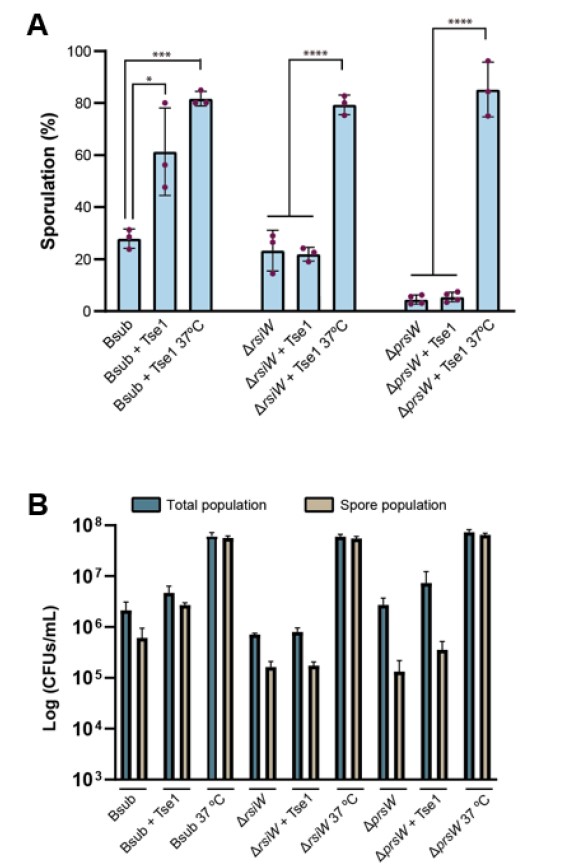
      Strengths: 

      This study shows that the apparent lack of functional Cx43 hemichannels observed in a number of previous in vitro function studies may be due to the use of HEPES to buffer the external pH. When Cx43 hemichannels were studied in external solutions in which CO<SUB>2</SUB>/bicarbonate was used to buffer pH instead of HEPES, Cx43 hemichannels showed significantly higher levels of dye uptake, ATP release, and ionic conductance. These findings may have major physiological implications since Cx43 hemichannels are found in many organs throughout the body, including the brain, heart, and immune system. 

      Weaknesses: 

      (1) Interpretation of the site-directed mutation studies is complicated. Although Cx43 has a potential carbamylation motif that is homologous to the motif in Cx26, the results of site-directed mutation studies were inconsistent with a simple model in which K144 and K105 interact following carbamylation to cause the opening of Cx43 hemichannels. 
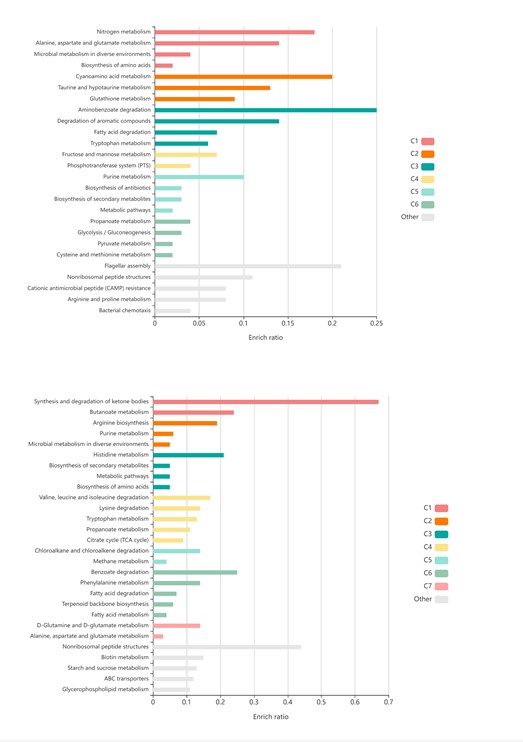
      The mechanism of opening of Cx43 is more complex than that of Cx26, Cx32 and Cx50 and involves more Lys residues. The 4 Lys residues in Cx43 that are involved in opening the hemichannel have their equivalents in Cx26, but in Cx26 these additional residues seem to be involved in the closing of the GJC rather than opening of the hemichannel (see above). Cx50 is simpler and involves only two Lys residues (doi: 10.1101/2025.01.23.634273), which are equivalent to those in Cx26.

      (2) Secondly, although it is shown that two Cx43 ODDD-associated mutations show a loss of CO<sub>2</sub> sensitivity, there is no evidence that the absence of CO2 sensitivity is involved in the pathology of ODD

      We agree, but this is probably because this has not been directly tested by experiment, as the CO<Sub>2</sub> sensitivity of Cx43 was not previously known. As mentioned above we have revised the text to ensure that this is clear.

      Reviewer #3 (Public review): 

      In this paper, the authors aimed to investigate carbamylation effects on the function of Cx43-based hemichannels. Such effects have previously been characterized for other connexins, e.g., for Cx26, which display increased hemichannel (HC) opening and closure of gap junction channels upon exposure to increased CO<sub>2</sub> partial pressure (accompanied by increased bicarbonate to keep pH constant). 

      The authors used HeLa cells transiently transfected with Cx43 to investigate CO<sub>2</sub> dependent carbamylation effects on Cx43 HC function. In contrast to Cx43-based gap junction channels that are reported here to be insensitive to PCO<sub>2</sub> alterations, they provide evidence that Cx43 HC opening is highly dependent on the PCO2 pressure in the bath solution, over a range of 20 up to 70 mmHg encompassing the physiologically normal resting level of around 40 mmHg. They furthermore identified several Cx43 residues involved in Cx43 HC sensitivity to PCO2: K105, K109, K144 & K234; mutation of 2 or more of these AAs is necessary to abolish CO<sub>2</sub> sensitivity. The subject is interesting and the results indicate that a fraction of HCs is open at a physiological 40 mmHg PCO<sub>2</sub>, which differs from the situation under HEPES buffered solutions where HCs are mostly closed under resting conditions. The mechanism of HC opening with CO<sub>2</sub> gassing is linked to carbamylation, and the authors pinpointed several Lys residues involved in this process. 

      Overall, the work is interesting as it shows that Cx43 HCs have a significant open probability under resting conditions of physiological levels of CO<sub>2</sub> gassing, probably applicable to the brain, heart, and other Cx43 expressing organs. The paper gives a detailed account of various experiments performed (dye uptake, electrophysiology, ATP release to assess HC function) and results concluded from those. They further consider many candidate carbamylation sites by mutating them to negatively charged Glu residues. The paper ends with hippocampal slice work showing evidence for connexin-dependent increases of the EPSP amplitude that could be inhibited by HC inhibition with Gap26 (Figure 10). Another line of evidence comes from the Cx43-linked ODDD genetic disease, whereby L90V as well as the A44V mutations of Cx43 prevented the CO<sub>2</sub>-induced hemichannel opening response (Figure 11). Although the paper is interesting, in its present state, it suffers from (i) a problematic Figure 3, precluding interpretation of the data shown, and (ii) the poor use of hemichannel inhibitors that are necessary to strengthen the evidence in the crucial experiment of Figure 2 and others. 

      The panels in Figure 3 were mislabelled in the accompanying legend possibly leading to some confusion. This has now been corrected.

      We disagree that hemichannel blockers are needed to strengthen the evidence in Figure 2 and other figures. Our controls show that the CO<sub>2</sub>-sensitive responses absolutely requires expression of Cx43 and was modified by mutations of Cx43. It is hard to see how this evidence would be strengthened by use of peptide inhibitors or other blockers of hemichannels that may not be completely selective.

      Reviewing Editor Comments:

      (1) Improve electrophysiological evidence, addressing concerns about the initial experiment and including peptide inhibitor data where applicable. 

      We think the concerns about the electrophysiological evidence arise from a misunderstanding because we gave insufficient information about how we conducted the experiments. We have now provided a much more complete legend, added explanations in the text and given more detail in the Methods. We further respond to the reviewer below.

      We do not agree on the necessity of the peptide inhibitor to demonstrate dependence on Cx43.  We have shown that parental HeLa cells do not release ATP to changes in PCO<sub>2</sub> or voltage (Fig 2D; Butler & Dale 2023, 10.3389/fncel.2023.1330983; Lovatt et al 2025, 10.1101/2025.03.12.642803, 10.1101/2025.01.23.634273). Our previous papers have shown many times that parental HeLa cells do not load with dye to CO<sub>2</sub> or zero Ca<sup>2+</sup> (e.g. Huckstepp et al 2010, 10.1113/jphysiol.2010.192096; Meigh et al 2013, 10.7554/eLife.01213; Meigh et al 2014, 10.7554/eLife.04249), and we have shown that parental HeLa cells do not exhibit the same CO<sub>2</sub> dependent change in whole cell conductance that the Cx43-expressing cells do (Fig 2B). In addition, we shown that mutating key residues in Cx43 alters both CO<sub>2</sub>-sensitive release of ATP and the CO<sub>2</sub>-dependent dye loading without affecting the respective positive control. To bolster this, we have included data for the K144R mutation as a supplement to Fig 3. Given the expense of Gap26 it is impractical to include this as a standard control and unnecessary given the comprehensive controls outlined.

      Collectively, these data show that the responses to CO<sub>2</sub> require expression of Cx43 and can be modified by mutation of Cx43.

      (2) Strengthen the manuscript by measuring the effects of CO on cytosolic pH and Cx43 hemichannel opening. Consider using tail truncation mutants to assess the role of the C-terminal pH sensor in CO-mediated channel opening.

      We agree and have performed the suggested experiments to address this issue.

      (3) Investigate the effect of expressing the K105E/K109E Cx43 double mutant on cell viability.

      In our experiments the cells look completely healthy based on their morphology in brightfield microscopy and growth rates. 

      (4) Discuss and analyze the uniqueness of Cx43 among alpha connexins in maintaining the carbamylation motif.

      now discuss this -Cx43 is not unique. We have added a molecular phylogenetic survey of the alpha connexin clade in Fig 12. Apart from Cx37, the carbamylation motif appears in all the other members of the clade (but not necessarily in the human orthologue). In a different MS, currently posted on bioRxiv, we have documented the CO<sub>2</sub> sensitivity of Cx50 and its dependence on the motif.

      (5) Consider omitting data on ODDD-associated mutations unless there is evidence linking CO<sub>2</sub> sensitivity to disease pathology.

      This experiment is observational, and we are not making claims that there is a direct causal link. Removing the ODDD mutant findings would lose potentially useful information for anyone studying how these mutations alter channel function. We have reworded the text to ensure that we say that the link between loss of CO<sub>2</sub> sensitivity and ODDD remains unproven.

      (6) Justify the choice of high K<sup>⁺</sup> and low external calcium as a positive control in ATP release experiments.

      These two manipulations can open the hemichannel independently of the CO<sub>2</sub> stimulus. Extracellular Ca<sup>2+</sup> is well known to block all connexin hemichannels, and Cx43 is known to be voltage sensitive. The depolarisation from high K<sup>+</sup> is effective at opening the hemichannel and we preferred this as a more physiological way of opening the Cx43 hemichannel. We have added some explanatory text.

      (7) Clarify whether Cx43A44V or Cx43L90V mutations block gap junctional coupling.

      This is an interesting point. Since Cx43 GJCs are not CO<sub>2</sub> sensitive we feel this is beyond the scope of our paper. 

      (8) Discuss the potential implications of pCO₂ changes on myocardial function through alterations in intracellular pH.

      We have modified the discussion to consider this point.

      Reviewer #1 (Recommendations for the authors):

      (1) Measurements of the effects of CO<sub>2</sub> on cytosolic pH/Cx43 hemichannel opening would strengthen the manuscript. Since the pH sensor of Cx43 is on the C terminus, the authors could consider making tail truncation mutants to see how this affects CO<sub>2</sub>-mediated Cx43 channel opening.

      We have done this (truncating after residue 256) -the channel remains highly CO<sub>2</sub> and voltage sensitive. We have also documented the effect of the  hypercapnic solutions on intracellular pH measured with BCECF. These new data are now included as figure supplements to Figure 2.

      (2) What is the impact of expressing the K105E / K109E Cx43 double mutant on cell viability?

      There was no obvious observed impact, cell density was as expected (no evidence of increased cell death), brightfield and fluorescence visualisation indicated normal healthy cells. We have added a movie (Fig 9, movie supplement 1) to show the effect of La<sup>3+</sup> on the GRAB<sub>ATP</sub> signal in cells expressing Cx43<sup>K105E, K109E</sup> so readers can appreciate the morphology and its stability during the recording.

      (3) A quick look at other alpha connexins suggested that Cx43 was unique among alpha connexins in maintaining the carbamylation motif. This merits additional discussion/ analysis.

      This is an interesting point. Cx43 is not unique in the alpha clade in having the carbamylation motif as a number of other human alpha connexins also possess: Cx50, Cx59 and Cx62, and non-human alpha connexins (Cx40, Cx59, Cx46) also possess the motif. We have shown that Cx50 is CO<sub>2</sub> sensitive. We have performed a brief molecular phylogenetic analysis of the alpha connexon clade to highlight the occurrence of the carbamylation motif. This is now presented as Fig 12 to go with the accompanying discussion.

      (4) There were some minor writing issues that should be addressed. For instance, fEPSP is not defined. Also, insets showing positive controls in some experiments were not described in the figure legends.

      We have corrected these issues.

      Reviewer #2 (Recommendations for the authors):

      (1) I would omit the data on the ODDD-associated mutations since there is no evidence that loss of CO<sub>2</sub> sensitivity plays an important role in the underlying disease pathology.

      We are not making the claim CO<sub>2</sub> loss leads to the underlying pathology and have reviewed the text to ensure that we clearly express that this is a correlation not a cause. We think this is worth retaining as many pathological mutations in other CO<sub>2</sub> sensitive connexins (Cx26, Cx32 and Cx50) cause loss of CO<sub>2</sub> sensitivity, and this information may be helpful to other researchers.

      (2) Why is high K+ rather than low external calcium used as a positive control in ATP release experiments?

      We used of high K<sup>+</sup> and depolarisation as a positive control as regard this as a more physiological stimulus than the low external Ca<sup>2+</sup>.

      (3) Does Cx43A44V or Cx43L90V block gap junctional coupling?

      An interesting question but we have not examined this.

      (4) Provide references for biophysical recordings of Cx43 hemichannels performed in HEPES-buffered salines, which document Cx43 hemichannels as being shut.

      have added the original and some later references which examine Cx43 hemichannel gating in HEPES buffer and shows the need for substantial depolarisation to induce channel opening.

      (5) In the heart muscle, changes in PCO<sub>2</sub> have long been hypothesized to cause changes in myocardial function by changing pHi.

      This is true and we now add some discussion of this point. Now that we know that Cx43 is directly sensitive to CO<sub>2</sub> a direct action of CO<sub>2</sub> cannot be ruled out and careful experimentation is required to test this possibility. 

      Reviewer #3 (Recommendations for the authors):

      (1) Page 3: "... homologs of K125 and R104 ... ": the context is linked to Cx26, so Cx26 needs to be added here.

      Done

      (2) Page 4 text and related Figure 2:

      (a) Figure 2A&B: PCO2-dependent Cx43 HC opening is clearly present in the carboxy-fluorescein dye uptake experiments (Figure 2A) as well as in the electrophysiological experiments (Figure 2B). The curves look quite different between these two distinct readouts: dye uptake doubles from 20 to 70 mmHg in Figure 2A while the electrophysiological data double from 45 to 70 mmHg in Figure 2B. These responses look quite distinct and may be linked to a non-linearity of the dye uptake assay or a problem in the electrophysiological measurements of Figure 2B discussed in the next point.

      Different molecules/ions may have different permeabilities through the channel, which could explain the observed difference. Also, there is some contamination of the whole cell conductance change with another conductance (evident in recordings from parental HeLa cells). This is evident particularly at 70 mmHg. If this contaminating conductance were subtracted from the total conductance in the Cx43 expressing cells, then the dose response relations would be more similar. However, we are reluctant to add this additional data processing step to the paper.

      (b) The traces in Figure 2B show that the HC current is inward at 20 mmHg PCO2, while it switches to an outward current at 55mmHg PCO2. HCs are non-selective channels, so their current should switch direction around 0 mV but not at -50 mV. As such, the -50 mV switching point indicates involvement of another channel distinct from non-selective Cx43 hemichannels.

      We think that our incomplete description in the legend led to this misunderstanding. We used a baseline of 35 mmHg (where the channels will be slightly open) and changed to 20 mmHg to close them (or to higher PCO<sub>2</sub> to open them from this baseline), hence a decrease in conductance and loss of outward current for 20 mmHg. The holding potential for the recordings and voltage steps were the same in all recordings. We have now edited the legend and added more information into the methods to clarify this and how we constructed the dose response curve.
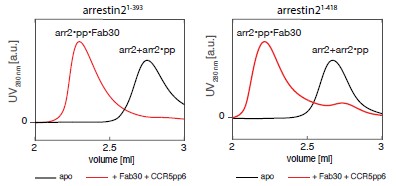
      We agree that Cx43 hemichannels are relatively nonselective and would normally be expected to have a reversal potential around 0 mV, but we are using K-Gluconate and the lowered reversal potential (~-65 mV) is likely due to poor permeation of this anion via Cx43.
      (c) A Hill slope of 6 is reported for this curve, which is extremely steep. The paper does not provide any further consideration, making this an isolated statement without any theoretical framework to understand the present finding in such context (i.e., in relation to the PCO2 dependency of Cx channels).

      Yes, we agree -it seems to be the case with all CO<sub>2</sub> sensitive connexins that we have looked at that the Hill coefficient versus CO<sub>2</sub> is >4. Hemichannels are of course hexameric so there is potential for 6 CO<sub>2</sub> molecules to be bound and extensive cooperativity. We have modified the text to give greater context.

      (d) A further remark to Figure 2 is that it does not contain any experiment showing the effect of Cx43 hemichannel inhibition with a reliable HC inhibitor such as Gap26, which is only used in the penultimate illustration of Figure 10. Gap26 should be used in Figure 2 and most of the other figures to show evidence of HC contribution. The lanthanum ions used in Figure 9 are a very non-specific hemichannel blocker and should be replaced by experiments with Gap26.

      We have addressed the first part of this comment above.

      We agree that La<sup>3+</sup> blocks all hemichannels, but in the context of our experiments and the controls we have performed it is entirely adequate and supports our conclusions. Our controls show (mentioned above and below) show that the expression of Cx43 is absolutely required for CO<sub>2</sub>-dependent ATP release (and dye loading). In Figure 9 our use of La<sup>3+</sup> was to show the presence of a constitutively open Cx43 mutant hemichannel. Gap26 would add little to this. Our further controls show that with expression of Cx43<sup>WT</sup> La<sup>3+</sup> did nothing to the ATP signal under baseline conditions (20 mmHg) supporting our conclusion that the mutant channels are constitutively open.

      (e) As the experiments of Figure 2 form the basis of what is to follow, the above remarks cast doubt on the robustness of the experiments and the data produced.

      We disagree, our results are extremely robust: 1) we have used three independent assays confirm the presence of the response; 2) parental HeLa cells do not release ATP, dye load or show large conductance changes to CO<sub>2</sub> showing the absolute requirement for expression of Cx43; 3) mutations of Cx43 (in the carbamylation motif) alter the CO<sub>2</sub> evoked ATP release and dye loading giving further confirmation of Cx43 as the conduit for ATP release and dye loading; and 4) we use standard positive controls (0 Ca<sup>²</sup>, high K<sup></sup>) to confirm cells still have functional channels for those mutations that modified CO<sub>2</sub> sensitivity.

      (f) The sentence "Cells transfected with GRAB-ATP only, showed ... " should be

      modified to "In contrast, cells not expressing Cx43 showed no responses to any applied CO2 concentration as concluded from GRAB-ATP experiments"

      We have modified the text.

      (3) Page 5 and Figures 3 & 4:

      (a) Figure 3 illustrates results obtained with mutations of 4 distinct Lys residues. However, the corresponding legend indicates mutations that are different from the ones shown in the corresponding illustrations, making it impossible to reliably understand and interpret the results shown in panels A-E.

      Thanks for pointing this out. Our apologies, we modified the figure so that the order of the images matched the order of the graph (and the legend) but then forgot to put the new version of the figure in the text. We have now corrected this so that Figure and legend match.

      (b) Figure 4 lacks control WT traces!

      The controls for this (showing that parental HeLa cells do not release ATP in response to CO<sub>2</sub> or depolarisation) are shown in Figure 2.

      (c) Figure 4, Supplement 1: High Hill coefficients of 10 are shown here, but they are not discussed anywhere, as is also the case for the remark on p.4. A Hill steepness of 10 is huge and points to many processes potentially involved. As reported above, these data are floating around in the manuscript without any connection.

      Yes, we agree this is very high and surprising. It may reflect as mentioned above the hexameric nature of the channel and that 4 Lys residues seem to be involved. We have used this equation to give some quantitative understanding of the effect of the mutations on CO<sub>2</sub> sensitivity and still think this is useful. We have no further evidence to interpret these values one way or the other.

      (4) Page 6: Carbamate bridges are proposed to be formed between K105 and K144, and between K109 and K234. The first three of these Lysine residues are located in the 55aa long cytoplasmic loop of Cx43, while K234 is in the juxta membrane region involved in tubulin interactions. Both K144 and and K234 are involved in Cx43 HC inhibition: K144 is the last aa of the L2 peptide (D119-K144 sequence) that inhibits Cx43 hemichannels while K234 is the first aa of the TM2 peptide that reduces hemichannel presence in the membrane (sequence just after TM4, at the start of the C-tail). This context should be added to increase insight and understanding of the CO2 carbamylation effects on Cx43 hemichannel opening.

      Thanks for suggesting this. We have added some discussion of CT to CL interactions in the context of regulation by pH and [Ca<sup>2+</sup>].

      (5) Page 7: The Cx43 ODDD A44V and L90V mutations lead to loss of pCO2 sensitivity in dye loading and ATP assays. However, A44V located in EL1 is reportedly associated with Cx43 HC activation, while L90V in TM2 is associated with HC inhibition. Remarkably, these mutations are focused on non-Lys residues, which brings up the question of how to link this to the paper's main thread.

      This follows the pattern that we have seen for other mutations such as A40V, A88V in Cx26 and several CMTX mutations of Cx32. Our cryoEM structures of Cx26 suggest that these mutations alter the flexibility of the molecule and hence abolish CO<sub>2</sub> sensitivity. We have reworded the text to avoid giving the impression that there is a demonstrated link between loss of CO<sub>2</sub> sensitivity of Cx43 and pathology.

      (6) Page 8: HCs constitutively open - 'constutively' perhaps does not have the best connotation as it is not related to HC constitution but CO2 partial pressure.

      Yes, we agree and have reworded this.

      (7) Page 9: "in all subtypes" -> not clear what is meant - do you mean "in all cell types"?

      We agree this is unclear -it refers to all astrocytic subtypes. We have amended the text.

      (8) Page 10: Composition of hypocapnic recording solution: bubbling description is incomplete "95%O2/5%" and should be "95%O2/5%CO2".

      Changed.

      (9) Page 11: Composition of zero Ca<sup>²⁺</sup> hypocapnic recording solution: perhaps better to call this "nominally Ca<sup>²⁺</sup>-free hypocapnic recording solution" as no Ca<sup>²⁺</sup> buffer is included in this solution

      Thanks for pointing this out. We did in fact add 1 mM EGTA to the solutions but omitted this from the recipe, this has now been corrected.

      (10) Page 11: in M&M I found that the NaHCO3- is lowered to 10 mM in the zero Ca<sup>²⁺</sup>condition, while the control experimental condition has 26 mM NaHCO3-. The zero Ca condition should be kept at a physiologically normal 26 mM NaHCO3- concentration, so why was this done? Lowering NaHCO3- during hemichannel stimulation may result in smaller responses and introduce non-linearities.

      For the dye loading we used 20 mmHg as the baseline condition and increased PCO<sub>2</sub> from this. Hence for the zero Ca<sup>2+</sup> positive control we modified the 20 mmHg hypocapnic solution by substituting Mg<sup>2+</sup> for Ca<sup>2+</sup> and adding EGTA. We have modified the text in the Methods to clarify this.

      Further remarks on the figures:

      (1) Figure 2A: Add 20 & 70 mmHg to the images, to improve the readability of this illustration.

      Done

      (2) Figure 3: WT responses are shown in panel F, but experimental data (images and curves) are lacking and should be included in a revised version.

      The wild type data is shown in Fig 2A. We have some sympathy for the comment, but we felt that Fig 2 should document CO<sub>2</sub> sensitivity, and then the subsequent Figs should analyse its basis. Hence the separation of Cx43<sup>WT</sup> data from the mutant data. In panel F, we state that we have recalculated the WT data from Fig 2A to allow the comparison.

      (3) Figures 4, 6, 8: Color codes for mmHg CO<sub>2</sub> pressure make reading these figures difficult; perhaps better to add mmHg values directly in relation to the traces.

      We have considered this suggestion but feel that the figures would become very cluttered with the additional labelling.

      (4) I wouldn't use colored lines when not necessary, e.g., Figure 9 100 µM La3+; Figure 10 (add 20->35 mmHg PCO2 switch; add scrGap26 above blue bars); Figure 11C & D.

      We agree and can see that in Figs 9 and 10 this muddles our colour scheme in other figures so have modified these figures. There was not space to put the suggested labels.

      (5) The mechanism of increased HC opening is not clear.

      We agree and have discussed various options and the analogy with what we know about Cx26. Ultimately new cryo-EM data is required.

      (6) Figure 10: 35G/35S are weird abbreviations for 35 mmHg Gap26 and scrambled Gap26.

      Yes, but we used these to fit into the available space.

      (7) Figure 11, legend: '20 mmHg PCO2 for each transfection for 70 mmHg PCO2'. It is not clear what is meant here.

      Thanks for pointing this out, we have reworded this to ensure clarity.

    1. Synthèse du webinaire : La place du numérique dans le projet associatif en 2025

      Résumé Exécutif

      Cette synthèse présente les conclusions clés de la 5ème édition du baromètre sur les pratiques numériques des associations, une étude menée conjointement par Solidatech et Recherche et Solidarité au printemps 2025 auprès de 2 285 responsables associatifs.

      L'analyse révèle une progression continue de la maturité numérique du secteur, avec 26 % des associations se considérant désormais "expérimentées", soit une hausse de 5 points par rapport à 2022.

      L'intelligence artificielle (IA) fait une entrée notable, utilisée par 18 % des associations (26 % pour les employeuses), principalement pour des gains d'efficacité, bien que des craintes éthiques et un manque de compétences demeurent des freins importants.

      Les objectifs principaux de l'usage du numérique restent stables et prioritaires : améliorer la communication (80 %), animer le réseau (75 %) et gérer les activités (70 %). Si le nombre d'associations ne rencontrant aucune difficulté a presque doublé depuis 2019 (passant de 16 % à 29 %), les freins humains (manque de compétences, appréhensions) restent la préoccupation majeure pour 44 % des structures.

      Enfin, l'étude souligne une professionnalisation croissante, avec une implication plus forte des salariés et des instances dirigeantes dans la stratégie numérique.

      1. Contexte et Méthodologie de l'Étude

      L'étude "La place du numérique dans le projet associatif en 2025" est la 5ème édition d'un baromètre initié en 2013. Elle est le fruit d'un partenariat historique entre Solidatech, un programme d'aide à la transformation numérique des associations, et Recherche et Solidarité, une association spécialisée dans la connaissance de la vie associative.

      Objectifs du baromètre :

      ◦ Suivre l'évolution des pratiques numériques dans les associations.    ◦ Fournir des enseignements utiles aux acteurs associatifs pour guider leurs démarches.    ◦ Informer les acteurs du numérique sur les réalités et spécificités du secteur associatif.    ◦ Constituer une ressource majeure pour les structures d'appui à la vie associative (CRDLA, Guid'Asso).

      Méthodologie :

      Échantillon : 2 285 responsables d'associations ont répondu à l'enquête.    ◦ Représentativité : Les résultats ont été redressés selon la méthode des quotas pour assurer leur représentativité par rapport au secteur associatif dans son ensemble et spécifiquement pour les associations employeuses.    ◦ Analyse : Les données sont analysées globalement et peuvent être segmentées par secteur d'activité, budget, effectif, contexte géographique (rural, urbain, QPV) et maturité numérique.

      2. État des Lieux de la Maturité Numérique en 2025

      Perception de la Maturité Numérique

      L'étude révèle une progression constante de la maturité numérique des associations. La part des associations se déclarant "expérimentées" a gagné 5 points depuis 2022, principalement au détriment de celles se jugeant "en progrès".

      Niveau de Maturité

      2019

      2022

      2025

      Peu initiée

      ~22%

      ~22%

      ~22%

      En progrès

      52%

      52%

      47%

      Expérimentée

      21%

      21%

      26%

      Implication et Gouvernance du Numérique

      L'étude montre une professionnalisation et une prise en main plus stratégique des sujets numériques au sein des associations.

      Professionnalisation : 30 % des associations employeuses confient désormais la gestion du numérique à un salarié dédié, marquant une tendance à la hausse.

      Implication des dirigeants : Le conseil d'administration ou le bureau s'implique directement sur les sujets numériques dans 24 % des associations, une proportion en augmentation continue depuis 2022, ce qui suggère une approche plus stratégique.

      Dépendance : Un référent unique (bénévole pour 24 %, salarié pour 30 %) gère souvent le numérique, créant un risque de dépendance et de perte de compétences en cas de départ.

      Budgets Alloués au Numérique

      La moitié des associations (50 %) dispose d'un budget dédié au numérique pour les dépenses courantes (maintenance, abonnements, hébergement).

      Investissement : 21 % des associations ont un budget d'investissement pour l'achat de matériel ou des conseils stratégiques.

      Prise de conscience : 24 % n'ont pas de budget dédié mais considèrent que ce serait une bonne idée.

      Cas spécifiques : 21 % estiment qu'un budget n'est pas utile, souvent car il s'agit de très petites structures s'appuyant sur les outils personnels des bénévoles.

      3. Objectifs, Usages et Outils Numériques

      Les Objectifs Prioritaires

      Le "top 3" des objectifs recherchés via le numérique reste inchangé, mais les usages s'intensifient avec une progression de 5 à 7 points pour chaque item par rapport à 2022.

      1. Mieux faire connaître l'association (Communication & Visibilité) : 80 %

      2. Améliorer l'animation du réseau (Lien interne et externe) : 75 %

      3. Gérer plus efficacement les activités : 70 %

      Deux pratiques connaissent une progression particulièrement forte :

      Travailler plus efficacement ensemble : Utilisé par 57 % des associations, soit un gain de 18 points depuis 2019, une tendance accélérée par la crise sanitaire.

      Rechercher des financements / collecter des dons : Concerne 33 % des associations, en hausse de 10 points depuis 2019, reflétant le besoin de diversifier les ressources.

      L'Usage des Outils Libres

      43 % des associations utilisent des outils libres. Pour la première fois en 2025, les motivations éthiques dépassent les raisons pratiques.

      Pour des raisons éthiques : 23 % (transparence, partage, liberté de l'information).

      Pour des raisons pratiques : 20 %.

      Besoin d'accompagnement : 14 % n'en utilisent pas mais souhaiteraient être accompagnées.

      Ne sait pas / Ne se prononce pas : 22 % des répondants, indiquant une méconnaissance persistante de cet écosystème.

      4. Focus Spécifique : L'Intelligence Artificielle (IA)

      Taux d'Adoption et Potentiel

      L'IA est une réalité émergente dans le secteur associatif, avec un potentiel de développement significatif.

      Taux d'utilisation actuel :

      18 % pour l'ensemble des associations.    ◦ 26 % pour les associations employeuses.

      Potentiel à court terme : 13 % des associations réfléchissent à son utilisation (18 % des employeuses), portant le potentiel total à 31 % (44 % pour les employeuses).

      Comparaison : Les associations employeuses (26 %) sont légèrement en retrait par rapport aux PME et ETI, qui affichent un taux d'adoption de 32 % (source : BPI France, 2025).

      Principaux Usages de l'IA

      Les associations se tournent vers l'IA principalement pour optimiser leurs opérations et leur communication.

      Usages de l'IA (utilisateurs actuels et potentiels)

      Ensemble des associations

      Associations employeuses

      Gagner en efficacité dans les tâches quotidiennes (ex: comptes-rendus)

      70 %

      >70%

      Créer des supports de communication internes ou externes (ex: images, vidéos)

      59 %

      >59%

      Créer des documents pédagogiques adaptés aux publics

      41 %

      >41%

      Faciliter l'analyse de données

      39 %

      >39%

      Faciliter les réponses aux appels à projets / demandes de subvention

      27 %

      >27%

      Appréhensions et Risques Identifiés

      Malgré leur intérêt, les associations expriment de fortes appréhensions, notamment les employeuses qui, bien que plus utilisatrices, sont aussi plus conscientes des risques.

      Appréhensions liées à l'IA

      Ensemble des associations

      Associations employeuses

      Craintes éthiques (perte de lien humain, désinformation)

      47 %

      >47%

      Manque de compétences en interne

      45 %

      >45%

      Risques et impact environnemental

      36 %

      >36%

      Risques liés à la confidentialité des données

      36 %

      >36%

      Risque de déstabiliser l'organisation (disparition de fonctions, etc.)

      8 %

      >8%

      Le faible score (8 %) du risque organisationnel suggère que les usages sont encore perçus comme ponctuels et que l'impact structurel de l'IA est sous-estimé.

      5. Difficultés Rencontrées et Leviers d'Action

      Évolution des Difficultés

      Une nette amélioration est observée : en 2025, 29 % des responsables déclarent ne rencontrer aucune difficulté particulière, contre seulement 16 % en 2019. Pour les 71 % qui en rencontrent, la hiérarchie des freins reste stable.

      1. Difficultés humaines (44 %) : Reste la préoccupation principale (lever les appréhensions, trouver les compétences, maintenir le lien).

      2. Difficultés techniques (33 %) : Stables, en lien avec l'évolution rapide des technologies et les risques (cybersécurité).

      3. Difficultés financières (24 %) : En forte baisse (vs. 41 % en 2019), mais ce chiffre est à nuancer car 81 % des associations financent le numérique sur fonds propres, ce qui peut créer des tensions de trésorerie.

      4. Difficultés stratégiques (21 %) : Considérées comme souvent sous-estimées par les analystes de l'étude.

      Témoignages d'Acteurs Associatifs (Verbatims)

      Sur le manque de temps : "Le problème [c'est] surtout de temps, des idées mais pas le temps de les mettre en place, de former et d'informer."

      Sur la dépendance : "Ancien bénévole qui maîtrise part. Le risque est de n'avoir personne pour assurer la continuité."

      Sur les financements : "Nous multiplions des comptes gratuits ou à bas coût qui ne sont pas reliés entre eux."

      Sur la cybersécurité : "Nous subissons du phishing de plus en plus évolué."

      Attentes pour Progresser

      Pour surmonter ces obstacles, les associations expriment plusieurs attentes :

      Meilleure connaissance des outils existants (47 %).

      • Montée en compétences des équipes.

      • Partage d'expériences avec d'autres associations.

      Accompagnement pour définir une stratégie numérique ou un diagnostic personnalisé (20 %).

      6. Les Clés de la Réussite de la Transformation Numérique

      L'étude conclut en rappelant quatre principes fondamentaux pour mener à bien un projet numérique :

      1. Ne pas perdre de vue le projet associatif : Le numérique doit rester un outil au service des missions de l'association, et non une fin en soi.

      2. Considérer la singularité de chaque projet : Prendre en compte les spécificités de l'association (valeurs, contraintes budgétaires, parties prenantes) pour orienter le choix des solutions et la conduite du changement.

      3. Instaurer une culture numérique partagée : Fournir un bagage minimum à tous les membres pour éviter les fractures numériques internes et favoriser l'adoption collective des outils.

      4. Suivre un cheminement par étape : Aborder la mise en place d'un nouvel outil comme un projet à part entière, avec une méthodologie claire (nommer un responsable, impliquer les utilisateurs, tester, former, déployer).

      --------------------------------------------------------------------------------

      Ce document est une synthèse du webinaire "La place du numérique dans le projet associatif en 2025", diffusé par Solidatech. Les données et analyses proviennent exclusivement des propos tenus par les intervenants (Lauren Gouin, Cécile Basin, Boris) durant la présentation.

    1. Synthèse du webinaire : IA & Associations

      Résumé Exécutif

      Ce document synthétise les enseignements clés du webinaire "IA & Associations : une bonne idée ?", présenté par Solidatech en collaboration avec des experts de la société Advent. L'intelligence artificielle (IA), et plus particulièrement les agents conversationnels génératifs comme ChatGPT, Claude ou Mistral, représente une opportunité majeure pour les associations, leur permettant d'optimiser leur efficacité opérationnelle et leur prise de décision stratégique. Le webinaire a mis en lumière trois axes principaux : les applications pratiques concrètes (rédaction de demandes de subvention, organisation d'événements), les risques inhérents à leur utilisation (fuites de données, biais, hallucinations) et les meilleures pratiques pour formuler des requêtes efficaces ("prompt engineering"). L'approche préconisée est celle d'une adoption mesurée et stratégique, en utilisant l'IA pour des tâches répondant à la méthode des "3 C" : Chronophages, Compliquées et peu motivantes. Enfin, des organisations de soutien comme Solidatech et le programme Cyber Forgood, ainsi que des outils spécifiques, ont été présentés comme des ressources clés pour accompagner les associations dans cette transition.

      --------------------------------------------------------------------------------

      1. Contexte et Acteurs de Soutien

      Le webinaire visait à démystifier l'usage de l'IA pour le secteur associatif en fournissant des clés de compréhension, des exemples pratiques et des stratégies de mitigation des risques.

      Solidatech

      Présenté par Lauren Guouin, Solidatech est un programme de solidarité numérique qui accompagne plus de 45 000 associations dans leur transition numérique depuis 2008. Porté par la coopérative d'insertion Les Ateliers du Bocage (mouvement Emmaüs), le programme agit sur trois fronts :

      Équipements numériques : Accès à des logiciels (Microsoft, Adobe, etc.) et du matériel informatique (neuf ou reconditionné) à tarifs solidaires.

      Montée en compétences : Mise à disposition de ressources (articles, newsletters, autodiagnostic numérique), formations certifiées Qualiopi et accompagnements personnalisés.

      Production de savoirs : Diffusion d'études, comme "La place du numérique dans le projet associatif".

      Cyber Forgood

      Animé par Julio de la société Advent, Cyber Forgood est un programme dédié à la protection et à l'accompagnement des acteurs de l'économie sociale et solidaire face aux cyber-risques. Une nouvelle plateforme, cyberforgood.org, sera lancée le 3 novembre et proposera dès janvier :

      • Une académie en ligne de 5 mois sur l'hygiène numérique, le RGPD et l'IA.

      • Un "boot camp" en présentiel à Paris pour échanger avec des experts.

      • Des accompagnements pro bono en cybersécurité.

      --------------------------------------------------------------------------------

      2. Comprendre l'Intelligence Artificielle Générative

      Léonard Kip, expert en cybersécurité et IA chez Advent, a défini l'IA comme un programme autonome capable d'imiter des actions humaines (prédiction, génération de contenu, prise de décision). L'explosion récente concerne l'IA générative, qui crée du contenu original à partir d'une requête.

      Comment fonctionnent les agents conversationnels ? Ces outils ne "comprennent" pas une question au sens humain. Ils s'appuient sur des réseaux de neurones artificiels entraînés sur des quantités astronomiques de données. Leur fonction principale est de prédire le mot suivant le plus probable en fonction du contexte fourni par la requête de l'utilisateur. Chaque nouveau mot généré enrichit le contexte, permettant de prédire le suivant, et ainsi de suite, pour construire une réponse cohérente. Cette mécanique explique pourquoi la précision et la richesse de la requête initiale sont cruciales pour obtenir un résultat pertinent.

      --------------------------------------------------------------------------------

      3. Analyse des Risques Majeurs et Stratégies de Mitigation

      L'utilisation de l'IA comporte des risques significatifs qu'il est essentiel de maîtriser. Un sondage réalisé durant le webinaire a révélé que la fuite de données confidentielles est la principale préoccupation (67 % des répondants).

      Risque Identifié

      Description

      Stratégies de Mitigation

      Hallucinations

      L'IA présente des informations factuellement incorrectes mais de manière très convaincante, car elle a tendance à vouloir satisfaire l'utilisateur plutôt que d'admettre son ignorance.

      - Vérifier systématiquement les réponses, surtout les plus surprenantes.<br>- Demander à l'IA de confirmer ou de détailler son raisonnement.<br>- Découper une requête complexe en plusieurs tâches plus simples.

      Biais Cognitifs

      L'IA reproduit les stéréotypes et préjugés présents dans ses données d'entraînement (internet, ouvrages), ce qui peut mener à des réponses discriminatoires.

      - Demander explicitement à l'IA d'éviter les biais et d'être "ouverte d'esprit".<br>- Relire sa propre requête pour s'assurer qu'elle n'induit pas de biais.<br>- Demander à l'IA de corriger une réponse si un biais est identifié.

      Fuite de Données Confidentielles

      Les conversations peuvent être utilisées par les éditeurs pour entraîner les futures versions de leurs modèles. Des fuites massives ont déjà eu lieu (ex: 370 000 conversations de l'IA Grok).

      - Ne jamais fournir d'informations sensibles (dossiers médicaux, données personnelles identifiables).<br>- Généraliser ou approximer les données (ex: "une femme dans la quarantaine" au lieu d'un âge précis).<br>- Utiliser les modes de "conversation éphémère" (disponibles sur Claude, Mistral) qui effacent les échanges.<br>- Dans les paramètres du compte, refuser l'utilisation des données pour l'amélioration de l'IA et programmer la suppression de l'historique.

      Génération de Contenu Dangereux

      L'IA peut être utilisée pour créer des contenus malveillants, bien que les plateformes majeures renforcent leurs garde-fous.

      - Signaler tout contenu inapproprié à l'éditeur de l'outil.<br>- Pour les associations proposant des services basés sur l'IA, mettre en place des systèmes de modération.

      Utilisation à des Fins Illégales

      Le risque le plus médiatisé est le "deepfake" (hypertrucage) : la création de fausses vidéos, images ou audios pour usurper l'identité d'une personne, une technique devenue très accessible.

      - Sensibiliser les membres et bénéficiaires aux risques légaux.<br>- Contrôler les usages si l'association met un service d'IA à disposition.

      --------------------------------------------------------------------------------

      4. L'Art de la Requête : Comment Dialoguer Efficacement avec une IA

      Pour dépasser le stade de la simple question-réponse et obtenir des résultats à haute valeur ajoutée, il est nécessaire de pratiquer l'ingénierie de requête ("prompt engineering"). Une requête efficace se compose de plusieurs éléments.

      La Formule d'une Requête Complète :

      1. Instruction : La tâche principale à effectuer.

      2. Contexte : Le "pourquoi" de la demande, le public cible, les objectifs et les enjeux. Cet élément est crucial pour guider l'IA.

      3. Format : La structure de la réponse souhaitée (tableau, liste à puces, résumé, nombre de mots). Avec le contexte, c'est l'ajout qui apporte le plus de valeur.

      4. Ton : Le style rédactionnel attendu (formel, créatif, empathique, etc.).

      5. Rôle/Persona : Demander à l'IA d'incarner un expert (ex: "Agis en tant que spécialiste de la collecte de fonds").

      6. Exemple : Fournir un ou plusieurs exemples du résultat attendu pour guider la génération.

      --------------------------------------------------------------------------------

      5. Cas d'Usage Concrets pour les Associations

      Les démonstrations réalisées avec l'outil Claude illustrent le potentiel de l'IA pour des tâches complexes.

      Aide à la Rédaction de Dossiers (ex: Demande de Subvention) :

      Scénario : Une association de recyclage d'ordinateurs veut répondre à un appel à projet pour obtenir 500 000 €.    ◦ Méthode : La requête incluait le contexte de l'association, l'objectif et l'intégralité du texte de l'appel à projet.    ◦ Résultat : L'IA a d'abord posé des questions pour obtenir des informations complémentaires (budget, effectifs), puis a généré un plan détaillé du dossier de réponse, des arguments alignés sur les axes de l'appel à projet et une première ébauche de contenu.

      Organisation d'Événements :

      Scénario : L'association souhaite organiser une soirée mémorable pour ses 20 ans.    ◦ Méthode : La requête demandait 5 idées d'activités originales.    ◦ Résultat : L'IA a proposé des concepts créatifs (ex: un "mur des 10 000 histoires" de bénéficiaires). Dans un second temps, elle a aidé à élaborer un rétroplanning et des estimations budgétaires pour mettre en œuvre les idées choisies.

      Aide à la Décision Stratégique :

      Scénario : L'association, basée à Paris, doit choisir deux nouvelles villes pour implanter des antennes.    ◦ Méthode : La requête demandait de proposer 10 villes et de les comparer selon trois critères : efficacité contre la fracture numérique, coût d'exploitation et potentiel de recrutement de bénévoles.    ◦ Résultat : L'IA a fourni une analyse comparative chiffrée et a recommandé Marseille et Lille en justifiant ce choix par une couverture géographique Nord-Sud optimale, dépassant la simple analyse des scores individuels.

      --------------------------------------------------------------------------------

      6. Outils Recommandés et Approche Stratégique

      Sélection d'Outils Pertinents

      Agents Conversationnels :

      Claude : Recommandé pour son alignement éthique (fondé par d'anciens d'OpenAI pour des raisons éthiques).    ◦ Mistral : Une alternative française/européenne de premier plan, privilégiée pour des enjeux de souveraineté numérique.

      Assistant de Réunion :

      Nuta : Solution française qui s'intègre aux outils collaboratifs pour générer des transcriptions, des comptes-rendus et des résumés de réunion.

      Création Marketing :

      Canva : Intègre désormais des fonctionnalités IA pour aider à la création de campagnes marketing (vigilance requise sur les questions de propriété intellectuelle).

      Définir une Stratégie d'Adoption : La Méthode des "3 C"

      Pour éviter un usage excessif et énergivore de l'IA, il est conseillé de l'adopter de manière ciblée. La première étape pour une association est d'identifier collectivement les tâches qui répondent aux trois critères suivants :

      1. Chronophage : Une tâche qui consomme beaucoup de temps.

      2. Compliquée : Une tâche qui demande une réflexion ou une expertise non triviale.

      3. Peu motivante : Une tâche répétitive ou administrative qui pèse sur les équipes.

      Si une tâche répond à ces trois critères, alors l'utilisation d'une IA pour l'assister ou l'automatiser est justifiée. Cette approche permet de commencer par un cas d'usage à fort impact et d'habituer progressivement les équipes.

      Versions Gratuites vs. Payantes

      Le passage à une version payante se justifie si l'outil est utilisé très fréquemment et que les limites de la version gratuite sont atteintes. Les versions payantes donnent généralement accès à des modèles plus performants, réduisant les risques de biais et d'hallucinations, sans toutefois les éliminer complètement.

      --------------------------------------------------------------------------------

      7. Conclusion : Vers une Utilisation Maîtrisée et Bénéfique

      L'IA doit être considérée comme un assistant puissant et non comme une solution magique ou un substitut à l'expertise humaine. La clé réside dans le maintien du contrôle et de l'esprit critique sur les contenus générés. Comme le souligne Léonard Kip : "Maîtriser l'IA, c'est pour votre épanouissement, pas votre paresse." Une approche progressive, axée sur des besoins réels et menée avec une conscience aiguë des risques, permettra aux associations de tirer le meilleur parti de cette révolution technologique.

    1. ainsi qu'un réseau social basé sur un algorithme de recommandation favorisant la viralité, lancée en 2016.

      Le texte montre que TikTok est une application fondée sur la viralité et la mise en scène de soi, ce qui influence fortement les jeunes utilisateurs. Cette logique de popularité touche aussi la manière dont les garçons construisent leur image et leur identité masculine. En cherchant à être vus et appréciés, beaucoup reproduisent sur TikTok une forme de masculinité stéréotypée, centrée sur la force, la confiance en soi et la réussite.

    2. pourraient favoriser la polarisation de groupe.

      La polarisation sur TikTok, c’est quand les gens sont très divisés : une partie pour, une partie contre. Avec le masculinisme et le féminisme, c’est exactement ce qui se passe : le masculinisme, souvent associé à la haine des femmes, a fait même naître en réaction un mouvement extrême, la misandrie. Cela montre que lorsqu’un mouvement apparaît, son opposé émerge presque toujours, renforcé par les algorithmes.

    1. ¿Qué es la cohesión social?

      esta sección debería ser algo como "concepto y medición de cohesión social" ... de eso no hay nada y es central en esta literatura. Debe considerar lo internacional como también una sección específica para América Latina (Ecosocial, CEPAL, COES, etc)

    1. Author response:

      The following is the authors’ response to the original reviews

      Public Reviews:

      Reviewer #1 (Public review):

      One of the most novel things of the manuscript is the use of a relatively quick photoablation system. Could this technique be applied in other laboratories? While the revised manuscript includes more technical details as requested, the description remains difficult to follow for readers from a biology background. I recommend revising this section to improve clarity and accessibility for a broader scientific audience.

      As suggested, we have adapted the paragraph related to the photoablation technique in the Material & Method section, starting line 1147. We believe it is now easier to follow.

      The authors suggest that in the animal model, early 3h infection with Neisseria do not show increase in vascular permeability, contrary to their findings in the 3D in vitro model. However, they show a non-significant increase in permeability of 70 KDa Dextran in the animal xenograft early infection. As a bioengineer this seems to point that if the experiment would have been done with a lower molecular weight tracer, significant increases in permeability could have been detected. I would suggest to do this experiment that could capture early events in vascular disruption.

      Comparing permeability under healthy and infected conditions using Dextran smaller than 70 kDa is challenging. Previous research (1) has shown that molecules below 70 kDa already diffuse freely in healthy tissue. Given this high baseline diffusion, we believe that no significant difference would be observed before and after N. meningitidis infection, and these experiments were not carried out. As discussed in the manuscript, bacteria-induced permeability in mice occurs at later time points, 16h post-infection, as shown previously (2). As discussed in the manuscript, this difference between the xenograft model and the chip could reflect the absence of various cell types present in the tissue parenchyma or simply vessel maturation time.

      One of the great advantages of the system is the possibility of visualizing infection-related events at high resolution. The authors show the formation of actin in a honeycomb structure beneath the bacterial microcolonies. This only occurred in 65% of the microcolonies. Is this result similar to in vitro 2D endothelial cultures in static and under flow? Also, the group has shown in the past positive staining of other cytoskeletal proteins, such as ezrin, in the ERM complex. Does this also occur in the 3D system?

      We imaged monolayers of endothelial cells in the flat regions of the chip (the two lateral channels) using the same microscopy conditions (i.e., Obj. 40X N.A. 1.05) that have been used to detect honeycomb structures in the 3D vessels in vitro. We showed that more than 56% of infected cells present these honeycomb structures in 2D, which is 13% less than in 3D, and is not significant due to the distributions of both populations. Thus, we conclude that under both in vitro conditions, 2D and 3D, the amount of infected cells exhibiting cortical plaques is similar. These results are in Figure 4E and S4B.

      We also performed staining of ezrin in the chip and imaged both the 3D and 2D regions. Although ezrin staining was visible in 3D (Author response image 1), it was not as obvious as other markers under these infected conditions, and we did not include it in the main text. Interpretation of this result is not straightforward, as the substrate of the cells is different, and it would require further studies on the behavior of ERM proteins in these different contexts.

      Author response image 1.

      F-actin (red) and ezrin (yellow) staining after 3h of infection with N. meningitidis (green) in 2D (top) and 3D (bottom) vessel-on-chip models.

      Recommendation to the authors:

      Reviewer #1 (Recommendation to the authors):

      I appreciate that the authors addressed most of my comments, of special relevance are the change of the title and references to infection-on-chip. I think that the current choice of words better acknowledges the incipient but strong bioengineering infection community. I also appreciate the inclusion of a limitation paragraph that better frames the current work and proposes future advancements.

      The addition of more methodological details has improved the manuscript. Although as mentioned earlier the wording needs to be accessible for the biology community. I also appreciated the addition of the quantification of binding under the WSS gradient in the different geometries and shown in Fig 3H. However, the description of the figure and the legend is not clear. What does "vessel" mean on the graph and "normalized histograms ...(blue)" in the figure legend. Could the authors rephrase it?

      In Figure 3F, we investigated whether Neisseria meningitidis exhibits preferential sites of infection. We hypothesized that, if bacteria preferentially adhered to specific regions, the local shear stress at these sites would differ from the overall distribution. To test this, we compared the shear stress at bacterial adhesion sites in the VoC (orange dots and curve) with the shear stress along the entire vascular edges (blue dots and curve). The high Spearman correlation indicates that there is no distinct shear stress value associated with bacterial adhesion. This suggests that bacteria can adhere across all regions, independently of local shear stress. To enhance clarity, the legend of Figure 3 and the related text have been rephrased in the revised manuscript (L289-314).

      Line 415. Should reference to Fig S5B, not Fig 5B. Also, the titles in Supplementary Figure 4 and 5 are duplicated, and the description of the legend inf Fig S5 seems a bit off. A and B seem to be swapped.

      Indeed, the reference to the right figure has been corrected. Also, the title of Figure S4 has been adapted to its contents, and the legend of Figure S5 has been corrected.

      Reviewer #2 (Recommendation to the authors):

      Minor comments to the authors:

      Line 163 "they formed" instead of "formed".

      Line 212 "two days" instead of "two day"

      Line 269 a space between two words is missing.

      These three comments have been addressed in the revised manuscript.

      In addition, I appreciate answering the comments, especially those requiring hypothesizing about including further cells. However, when discussing which other cells could be relevant for the model (lines 631 to 632) it would be beneficial to discuss not only the role of those cells but also how could they be included in the model. I think for the reader, inclusion of further cells could be seen as a challenge or limitation, and addressing these technical points in the discussion could be helpful.

      We thank Reviewer #2 for the insightful suggestion. Indeed, the method of introducing cells into the VoC depends on their type. Fibroblasts and dendritic cells, which are resident tissue cells, should be embedded in the collagen gel before polymerization and UV carving. This requires careful optimization to preserve chip integrity, as these cells exert pulling forces while migrating within the collagen matrix. In contrast, T cells and macrophages should be introduced through the vessel lumen to mimic their circulation in vivo. Pericytes can be co-seeded with endothelial cells, as they have been shown to self-organize within a few hours post-seeding. These important informations are now included in the manuscript (L577-587).

      Reviewer #3 (Recommendation to the authors):

      Suggestions and Recommendations

      Some suggestions related to the VOC itself:

      Figure 1, Fig S1, paragraph starting line 1071: More information would be helpful for the laser photoablation. For instance, is a non-standard UV laser needed? Which form of UV light is used? What is the frequency of laser pulsing? How many pulses/how long is needed to ablate the region of interest?

      The photoablation process requires a focused UV-laser, with high frequency (10 kHz) to lower the carving time while providing the required intensity to degrade collagen gel. To carve a reproducible number of 30 µm-large vessels, we used a 2 µm-large laser beam at an energy of 10 mW and moved the stage (i.e., sample) at a maximum speed of 1 mm/s. This information has been added to the related paragraph starting on line 1147 of the revised manuscript.

      It is difficult to understand the geometry of the VOC. In Figure 1C, is the light coloration representing open space through which medium can flow, and the dark section the collagen? On a single chip, how many vessels are cut through the collagen? It looks as if at least two are cut in Figure 1C in the righthand photo.

      In Figure 1C, the light coloration is the Factin staining. The horizontal upper and lower parts are the 2D lateral channels that also contain endothelial cells, and are connected to inlets and outlets, respectively. In the middle, two vertically carved 3D vessels are shown in the confocal image.

      Technically, we designed the PDMS structures to allow carving of 1 to 3 channels, maximizing the number of vessels that can be imaged while minimizing any loss of permeability at the PDMS/collagen/cells interface. This information has been added in the revised manuscript (L. 1147).

      If multiple vessels are cut in the center channel between the lateral channels, how do you ensure that medium flow is even between all vessels? A single chip with multiple different vessel architectures through the center channel would be expected to have different hydrostatic resistance with different architectures, thereby causing differences in flow rates in each vessel.

      To ensure a consistent flow rate regardless of the number of carved vessels, we opted to control the flow rate directly across the chip with a syringe pump. During experiments, one inlet and one outlet were closed, and a syringe pump was used. Because the carved vessels are arranged in parallel (derivation), the flow rate remains the same in each vessel. If a pressure controller had been used instead, the flow would have been distributed evenly across the different channels. This has been added to the revised manuscript in the paragraph starting on line 1210.

      The figures imply that the laser ablation can be performed at depth within the collagen gel, rather than just etching the surface. If this is the case, it should be stated explicitly. If not, this needs to be clarified.

      One of the main advantages of the photoablation technique is carving the collagen gel in volume, and not only etching the surface. Thanks to the 3D UV degradation, we can form the 3D architecture surrounded by the bulk collagen. This has been added to the revised manuscript, lines 154-155.

      Is the in-vivo-like vessel architecture connected to the lateral channel at an oblique angle, or is the image turned to fit the entire structure? (Figure 1F and 3E). Is that why there is high shear stress at its junction with the lateral channel depicted in Figure 3E?

      All structures require connection to the lateral channels to ensure media circulation and nutrient supply. The in vivo-like design must be rotated to allow the upper and lower branches of the complex structure to pass between the fixed PDMS pillars. To remain consistent with the image and the flow direction, we have kept the same orientation as in the COMSOL simulation. This leads to a locally higher shear stress at the top of the architecture. This has been added in the revised manuscript, in the paragraph starting on line 1474.

      Figure S1F,G: In the legend, shapes are circles, not squares. On the graphs, what do the numbers in parentheses mean?

      Indeed, the terms "squares" have been replaced by "circles" in Figure 1. (1) and (2) refer to the providers of the collagen, FujiFilm and Corning, respectively. We have added this mention in the legend in Figure S1.

      Figure 3B: how do the images on the left and right differ? Each of the 4 images needs to be explained.

      The four images represent the infected VoC from different viewing angles, illustrating the three-dimensional spread of infection throughout the vessel. A more detailed description has been added in the legend of Figure 3.

      Figure S3C is not referenced but should be, likely before sentence starting on line 299.

      Indeed, the reference to Figure S3C has been added line 301 of the revised manuscript.

      Results in Figure 3 with the pilD mutant are very interesting. It is worth commenting in the Discussion about how T4P functionality in addition to the presence of T4P contributes to Nm infection, and how in the future this could be probed with pilT mutants.

      We thank Reviewer #3 for this relevant insight. Following adhesion, a key functionality of Neisseria meningitidis for colony formation and enhanced infection is twitching motility. As suggested, we have added in the Discussion the idea of using a PilT mutant, which can adhere but cannot retract its pili, in the VoC model to investigate the role of motility in colonization in vitro under flow conditions (L611–623).

      Which vessel design was used for the data presented in Figures 4, 5, and 6 and associated supplemental figures?

      Straight channels have been mostly used in figures 4, 5, and 6. Rarely, we used the branched in vivo-like designs to observe potential similar infection patterns to in vivo, and related neutrophil activity. This has been added in the revised manuscript, lines 1435-1439.

      Figure 4B-D: the images presented in Figure 4C are not representative of the averages presented in Figures 4B,D. For instance, the aggregates appear much larger and more elongated in the animal model in Figure 4C, but the animal model and VOC have the colony doubling time (implying same size) in Figure 4B, and same average aggregate elongation in Figure 4D.

      The images in Figure 4C were selected to illustrate the elongation of colonies quantified in Figure 4D. The elongation angles are consistent between both images and align with the channel orientation. Representative images of colony expansion over time, corresponding to Figure 4A and 4B, are provided in Figure S4A.

      Figures 4E-F: dextran does not appear to diffuse in the VOC in response to histamine in these images, yet there is a significant increase in histamine-induced permeability in Figure 4F. Dotted lines should be used to indicate vessel walls for histamine, and/or a more representative image should be selected. A control set of images should also be included for comparison.

      We thank Reviewer #3 for the insightful comment. We confirm that we have carefully selected representative images for the histamine condition and adjusted them to display the same range of gray levels. The apparent increase in permeability with histamine is explained by a slight rise in background fluorescence, combined with the smaller channel size shown in Figure 4E.

      Figure S4 title is a duplicate of Figure S5 and is unrelated to the content of Figure S4. Suggest rewording to mention changes in permeability induced by Nm infection in the VOC and animal model.

      Indeed, the title of Figure S4 did not correspond to its content. We have, thus, changed it in the revised manuscript.

      Line 489 "...our Vessel-on-Chip model has the potential to fully capture the human neutrophil response during vascular infections, in a species-matched microenvironment", is an overstatement. As presented, the VOC model only contains endothelial cells and neutrophils. Many other cell types and structures can affect neutrophil activity. Thus, it is an overstatement to claim that the model can fully capture the human neutrophil response.

      We agree with the Reviewer #3, that neutrophil activity is fully recapitulated with other cell types, such as platelets, pericytes, macrophages, dendritic cells, and fibroblasts, that secrete important molecules such as cytokines, chemokines, TNF-α, and histamine. In our simplified model we were able to reconstitute the complex interaction of neutrophils with endothelial cells and with bacteria. The text was modified accordingly.

      Supplemental Figure 6 - Does CD62E staining overlap with sites of Nm attachment

      E-selectin staining does not systematically colocalize with Neisseria meningitidis colonies although bacterial adhesion is required. Its overall induced expression is heterogeneous across the tissue and shows heterogeneity from cell to cell as seen in vivo.

      Line 475, Figure 6E- Phagocytosis of Nm is described, but it is difficult to see. An arrow should be added to make this clear. Perhaps the reference should have been to Figure 6G? Consider changing the colors in Figure 6G away from red/green to be more color-blind friendly.

      Indeed, the reference to the right figure is Figure 6G, where the phagocytosis event is zoomed in. We have changed it in the text. Adapting the color of this figure 6G would imply to also change all the color codes of the manuscript, as red has been used for actin and green for Neisseria meningitidis.

      Lines 621-632 - This important discussion point should be reworked. Some suggested references to cite and discuss include PMID: 7913984, 15186399, 17991045, 18640287, 19880493.

      We have introduced in the discussion parts the following references as suggested (3–7), and discussed more the importance of introducting of immune cells to study immune cell-bacteria interaction and related immune response (L659-678).

      Minor corrections:

      •  Line 8 - suggest "photoablation-generated" instead of "photoablation-based"

      •  Line 57- remove the word "either", or modify the sentence

      •  Sentence on lines 162-165 needs rewording

      •  Lines 204-205- "loss of vascular permeability" should read "increase in vascular permeability"

      •  Line 293- "Measured" shear stress, should be "computed", since it was not directly measured (according to the Materials & Methods)

      •  Line 304- "consistently" should be "consistent"

      •  Fig. 3 legend, second line: replace "our" with "the VoC"

      •  Line 371, change "our" to "the"

      •  Line 415- Figure 5B doesn’t appear to show 2-D data. Is this in Figure S5B? Some clarification is needed. The quantification of Nm vessel association in both the VOC and the animal model should be shown in Figure 5, for direct comparison.

      •  Supplementary Figure 5C: correlation coefficient with statistical significance should be calculated.

      •  Figure 6 title, rephrase to "The infected VOC model"

      •  Line 450, replace "important" with "statistically significant"

      •  Line 459, suggest rephrasing to "bacterial pilus-mediated adhesion"

      •  Line 533- grammar needs correction

      •  Line 589- should be "sheds"

      •  Line 1106- should be "pellet"

      •  Lines 1223-1224 - is the antibody solution introduced into the inlet of the VOC for staining? Please clarify.

      •  Line 1295-unclear why Figure 2B is being referenced here

      All the suggested minor corrections have been taken into account in the revised manuscript.

      References

      (1) Gyohei Egawa, Satoshi Nakamizo, Yohei Natsuaki, Hiromi Doi, Yoshiki Miyachi, and Kenji Kabashima. Intravital analysis of vascular permeability in mice using two-photon microscopy. Scientific Reports, 3(1):1932, Jun 2013. ISSN 2045-2322. doi: 10.1038/srep01932.

      (2) Valeria Manriquez, Pierre Nivoit, Tomas Urbina, Hebert Echenique-Rivera, Keira Melican, Marie-Paule Fernandez-Gerlinger, Patricia Flamant, Taliah Schmitt, Patrick Bruneval, Dorian Obino, and Guillaume Duménil. Colonization of dermal arterioles by neisseria meningitidis provides a safe haven from neutrophils. Nature Communications, 12(1):4547, Jul 2021. ISSN 2041-1723. doi: 10.1038/s41467-021-24797-z.

      (3) Katherine A. Rhodes, Man Cheong Ma, María A. Rendón, and Magdalene So. Neisseria genes required for persistence identified via in vivo screening of a transposon mutant library. PLOS Pathogens, 18(5):1–30, 05 2022. doi: 10.1371/journal.ppat.1010497.

      (4) Heli Uronen-Hansson, Liana Steeghs, Jennifer Allen, Garth L. J. Dixon, Mohamed Osman, Peter Van Der Ley, Simon Y. C. Wong, Robin Callard, and Nigel Klein. Human dendritic cell activation by neisseria meningitidis: phagocytosis depends on expression of lipooligosaccharide (los) by the bacteria and is required for optimal cytokine production. Cellular Microbiology, 6(7):625–637, 2004. doi: https://doi.org/10.1111/j.1462-5822.2004.00387.x.

      (5) M. C. Jacobsen, P. J. Dusart, K. Kotowicz, M. Bajaj-Elliott, S. L. Hart, N. J. Klein, and G. L. Dixon. A critical role for atf2 transcription factor in the regulation of e-selectin expression in response to non-endotoxin components of neisseria meningitidis. Cellular Microbiology, 18(1):66–79, 2016. doi: https://doi.org/10.1111/cmi.12483.

      (6) Andrea Villwock, Corinna Schmitt, Stephanie Schielke, Matthias Frosch, and Oliver Kurzai. Recognition via the class a scavenger receptor modulates cytokine secretion by human dendritic cells after contact with neisseria meningitidis. Microbes and Infection, 10(10):1158–1165, 2008. ISSN 1286-4579. doi: https://doi.org/10.1016/j.micinf.2008.06.009.

      (7) Audrey Varin, Subhankar Mukhopadhyay, Georges Herbein, and Siamon Gordon. Alternative activation of macrophages by il-4 impairs phagocytosis of pathogens but potentiates microbial-induced signalling and cytokine secretion. Blood, 115(2):353–362, Jan 2010. ISSN 0006-4971. doi: 10.1182/blood-2009-08-236711.

    1. tipo_de_articulo:revision_viva_y_metaanalisis, etapa: publicada, tamaño de la muestra:1567, grupo etario:recien_nacidos, condicion_clinico_sars_cov_2

    1. NG GoodNP

      1️⃣ NG – Necrotizing Gingivitis (Nekrotizan Gingivit)

      Tanım: Ağzın ön bölümünde diş etlerinin ani, ağrılı ve nekrotik olarak iltihaplanması.

      Hız: Hızlı başlangıçlıdır.

      Belirtiler: Kanama, kötü koku, ağrı, gri-siyah nekrotik doku.

      Etkilenen alan: Sınırlı, genellikle anterior dişetleri.

      Risk faktörleri: Stres, bağışıklık düşüklüğü, kötü ağız hijyeni.

      Tedavi: Antiseptik, ağız hijyeni, bazen antibiyotik.

      2️⃣ NP – Necrotizing Periodontitis (Nekrotizan Periodontitis)

      Tanım: NG’nin ilerlemiş şekli; dişetinin yanı sıra alveolar kemik ve destek dokuların nekrozu da vardır.

      Hız: Çok hızlı ilerler.

      Belirtiler: Şiddetli ağrı, kanama, kemik kaybı, diş sallanması.

      Etkilenen alan: Daha geniş, hem dişetleri hem de periodonsiyum.

      Risk faktörleri: HIV/AIDS, ciddi bağışıklık düşüklüğü, malnütrisyon.

      Tedavi: Acil periodontal tedavi, antibiyotik, destek tedavi.

    2. Genetic factors also influence serum IgG2antibody titers and the expression of Fc-gRIIreceptors on the neutrophil - aggressiveperiodontitis.

      (①) Genetic factors also influence serum IgG2 antibody titers and the expression of Fc-γRII receptors on the neutrophil - aggressive periodontitis. (①) Genetik faktörler, serum IgG2 antikor düzeylerini ve nötrofiller üzerindeki Fc-γRII reseptörlerinin ekspresyonunu da etkiler – agresif periodontitis

      🦷 Açıklama:

      Genetik faktörler, bağışıklık sisteminin bazı özelliklerini belirler:

      IgG2 antikor düzeyleri:

      Bakterilere karşı spesifik yanıtı etkiler.

      Düşük IgG2 → yetersiz bağışıklık yanıtı → agresif periodontitis riski artar.

      Fc-γRII reseptörleri (nötrofillerde):

      Nötrofillerin bakteri tanıma ve fagositoz yeteneğini düzenler.

      Genetik varyasyonlar, bu reseptörlerin etkinliğini azaltabilir → periodontal yıkım hızlanır.

      Özetle: Genetik yapımız, bağışıklık yanıtımızı etkileyerek agresif periodontitis gelişiminde kritik rol oynar.

    3. Younger patient – shorter time – moreperiodontal destruction- poor or fairprognosis• May have aggressive type ofperiodontitis, or associated systemicdisease or smoking• Occurrence of so much destruction in arelatively short period• Older patient – longer time – betterprognosi

      Genç hastalar:

      Kısa sürede ciddi periodontal yıkım olabilir.

      Bu durum genellikle agresif periodontitis, sistemik hastalıklar veya sigara kullanımı ile ilişkilidir.

      Prognoz kötü veya orta olarak değerlendirilir.

      Yaşlı hastalar:

      Yavaş ilerleyen periodontal değişiklikler görülür.

      Hastalık süresi daha uzun olsa da yıkım genellikle daha kontrollüdür.

      Prognoz daha iyidir.

    4. chemotherapeutic

      kelime anlamıyla mikroorganizmaların büyümesini veya aktivitesini durdurmak ya da azaltmak için kullanılan kimyasal madde demektir.

    Annotators

    1. self

      [/ 🧊/ ♖/ hyperpost/ ~/ indyweb/ 📓/ 20/ 25/ 11/ 3/ 🏛️](https://bafybeicbv7b4bpesh5wmnynftywhm2dzrswf6csndh2v4ndu2n3uuex4ny.ipfs.dweb.link/?filename=save%20string%20to%20local%20filesystem%20javascript%20-%20Brave%20Search%20(11_13_2025%208%EF%BC%9A27%EF%BC%9A28%20AM).html}

    1. Reviewer #1 (Public review):

      Summary:

      CCK is the most abundant neuropeptide in the brain, and many studies have investigated the role of CCK and inhibitory CCK interneurons in modulating neural circuits, especially in the hippocampus. The manuscript presents interesting questions regarding the role of excitatory CCK+ neurons in the hippocampus, which has been much less studied compared to the well-known roles of inhibitory CCK neurons in regulating network function. The authors adopt several methods, including transgenic mice and viruses, optogenetics, chemogenetics, RNAi, and behavioral tasks to explore these less-studied roles of excitatory CCK neurons in CA3. They find that the excitatory CCK neurons are involved in hippocampal-dependent tasks such as spatial learning and memory formation, and that CCK-knockdown impairs these tasks.

      However, these questions are very dependent on ensuring that the study is properly targeting excitatory CCK neurons (and thus their specific contributions to behavior).

      There needs to be much more characterization of the CCK transgenic mice and viruses to confirm the targeting. Without this, it is unclear whether the study is looking at excitatory CCK neurons or a more general heterogeneous CCK neuron population.

      Strengths:

      This field has focused mainly on inhibitory CCK+ interneurons and their role in network function and activity, and thus, this manuscript raises interesting questions regarding the role of excitatory CCK+ neurons, which have been much less studied.

      Weaknesses:

      (1a) This manuscript is dependent on ensuring that the study is indeed investigating the role of excitatory CCK-expressing neurons themselves and their specific contribution to behavior. There needs to be much more characterization of the CCK-expressing mice (crossed with Ai14 or transduced with various viruses) to confirm the excitatory-cell targeting. Without this, it is unclear whether the study is looking at excitatory CCK neurons or a more general heterogeneous CCK neuron population.

      (1b) For the experiments that use a virus with the CCK-IRES-Cre mouse, there is no information or characterization on how well the virus targets excitatory CCK-expressing neurons. (Additionally, it has been reported that with CaMKIIa-driven protein expression, using viruses, can be seen in both pyramidal and inhibitory cells.)

      (2) The methods and figure legends are extremely sparse, leading to many questions regarding methodology and accuracy. More details would be useful in evaluating the tools and data. More details would be useful in evaluating the tools and data. Additionally, further quantification would be useful-e.g. in some places, only % values are noted, or only images are presented.

      (3) It is unclear whether the reduced CCK expression is correlated, or directly causing the impairments in hippocampal function. Does the CCK-shRNA have any additional detrimental effects besides affecting CCK-expression (e.g., is the CCK-shRNA also affecting some other essential (but not CCK-related) aspect of the neuron itself?)? Is there any histology comparison between the shRNA and the scrambled shRNA?

    1. Bonjour, je propose de modifier la section 2.7, "Premier ministre", et d'ajouter à la fin du § 3 la mention de l'absence d'intervention parlementaire. En effet, les deux gouvernements précédents ont démissionné en vertu de l'article 50 de la constitution, et au vu de la situation parlementaire et plus généralement politique actuelle, il me semble pertinent de modifier la phrase "Le lendemain, faute de majorité, il remet sa démission au président de la République." en "Le lendemain, faute de majorité, il remet sa démission au président de la République sans l'intervention du Parlement".

      Il précise que la démission soudaine de Lecornu n'était pas dû à un manque de confiance de l'assemblée nationale.

    1. Zmiany w prawie pracy 2025/2026 – jak przygotować firmę na nową rzeczywistość?
      • Jawność wynagrodzeń (od 24 grudnia 2025 r.)

        • Obowiązek ujawniania wynagrodzenia lub widełek płacowych przed rozmową kwalifikacyjną.
        • Zakaz pytania o wcześniejsze zarobki kandydata.
        • Oferty pracy muszą mieć neutralne płciowo nazwy stanowisk.
        • Wynagrodzenie obejmuje wszystkie składniki – premie, dodatki, benefity.
        • Od czerwca 2026 r. firmy zatrudniające ≥100 osób będą musiały raportować lukę płacową.
        • Wymagana aktualizacja polityki wynagrodzeń i szkoleń rekruterów.
      • Nowe zasady liczenia stażu pracy (od 2026 r.)

        • Do stażu pracy będą wliczane umowy B2B, zlecenia i agencyjne objęte składkami ZUS.
        • Możliwość wydłużenia urlopu, odpraw i okresów wypowiedzenia.
        • Pracownik ma 24 miesiące na udokumentowanie wcześniejszej współpracy.
        • Firmy powinny przeanalizować historię zatrudnienia i zaktualizować regulaminy.
        • Zmiana zwiększy koszty organizacyjne i kadrowe.
      • Nowe uprawnienia Państwowej Inspekcji Pracy (od 1 stycznia 2026 r.)

        • PIP będzie mógł samodzielnie stwierdzić istnienie stosunku pracy.
        • Decyzja administracyjna zastąpi wyrok sądu i będzie natychmiast wykonalna.
        • Możliwość zdalnych kontroli, żądania transmisji wideo, przesłuchań online.
        • Firmy muszą przeanalizować umowy cywilnoprawne pod kątem ryzyka uznania za etat.
      • Mobbing i dyskryminacja – nowe przepisy

        • Zniesienie wymogu „długotrwałości” mobbingu – wystarczy uporczywe nękanie.
        • Minimalne zadośćuczynienie: 12-krotność miesięcznego wynagrodzenia.
        • Obowiązek wprowadzenia formalnej procedury antymobbingowej.
        • Nowe formy dyskryminacji: przez asocjację i przez domniemanie.
        • Wymagane szkolenia dla kadry i jasne procedury zgłaszania naruszeń.
      • Cyfrowa komunikacja z pracownikami

        • Zastąpienie „formy pisemnej” przez „postać papierową lub elektroniczną”.
        • Możliwość komunikacji e-mail, przez komunikatory lub SMS.
        • Pracodawca musi udowodnić doręczenie wiadomości.
        • Konieczność aktualizacji regulaminu pracy i zgodności z RODO.
      • Płaca minimalna 2026

        • Od 1 stycznia 2026 r. wzrost do 4806 zł brutto/miesiąc i 31,40 zł brutto/godz.
        • Wzrost kosztów zatrudnienia, składek ZUS i świadczeń.
        • Firmy powinny uwzględnić zmiany w budżetach kadrowych.
      • Polityka AI w organizacji

        • Wymóg wprowadzenia zasad korzystania z AI zgodnie z unijnym AI Act.
        • Brak polityki może zostać uznany za naruszenie obowiązków pracodawcy.
        • Konieczność określenia, gdzie AI można, a gdzie nie można stosować.
      • Podsumowanie działań dla firm

        • Zaktualizować regulaminy i umowy.
        • Przeszkolić menedżerów i dział HR.
        • Przygotować system do raportowania płac i cyfrowego obiegu dokumentów.
        • Przeanalizować umowy B2B i zlecenia pod kątem ryzyka PIP.
        • Wczesne przygotowanie zapewni spokój i przewagę konkurencyjną.
    1. No debemos olvidar hechos como que, después de la II Guerra Mundial, la ahora cuestionada democratización en el acceso a la educación superior fue un elemento esencial para alcanzar el mayor período de prosperidad de la humanidad.

      Prosperidad ¿en qué sentido?

    2. Los avances que llevaron a la democratización en el acceso a la universidad trajeron consigo la respuesta de sectores sociales que dudan sobre si las universidades están facilitando a los estudiantes el aprendizaje que necesita la actividad económica, así como si proporcionan a las empresas la tecnología que demandan, o si son realmente eficientes en sus costes.

      Dudas que me parece, por demás, bien fundadas, si bien, como se comenta, la universidad tiene también otros fines.

    3. los cambios rápidos y la presión social pueden llevar a decisiones equivocadas si no se reflexiona adecuadamente sobre la dirección a tomar.

      Reflejo del carácter racional del pensamiento universitario.

    1. We next investigated how increasing sequencing depthaffects gene detection (Data S1). For multi-exon genes, wedefined “detection” as having more than 50 total readswith at least two junction-spanning reads. Single-exongenes required more than 100 total reads. These thresh-olds were chosen based on junction ratios of genes atdifferent read counts (Figure S5) and manual inspectionof the raw data through the Integrative Genomics Viewer.Overall, iPSCs yielded the highest number of detectedgenes among the four CATs (Figure 1A), consistent withprevious findings that iPSCs express a wide variety ofgenes.28 Detection performance in LCLs was modest atlower depths but converged with that of blood and fibro-blasts at higher depths, likely due to the larger number oflow-expressing genes in LCLs (Figure S6). Across all fourCATs, each additional million reads uncovered 10–30new genes at 100M reads. At 1,000M reads, the detectionrate slowed, reaching 1–2 new genes per million reads(Figure 1A), suggesting a saturation effect for gene

      Basically, "1B reads is enough to detect most things"

    Annotators

    1. Note: This response was posted by the corresponding author to Review Commons. The content has not been altered except for formatting.

      Learn more at Review Commons


      Reply to the reviewers

      Response to referee comments: ____RC-2025-03008


      Reviewer #1 (Evidence, reproducibility and clarity (Required)):

      Summary In this article, the authors used the synthetic TALE DNA binding proteins, tagged with YFP, which were designed to target five specific repeat elements in Trypanosoma brucei genome, including centromere and telomeres-associated repeats and those of a transposon element. This is in order to detect and identified, using YFP-pulldown, specific proteins that bind to these repetitive sequences in T. brucei chromatin. Validation of the approach was done using a TALE protein designed to target the telomere repeat (TelR-TALE) that detected many of the proteins that were previously implicated with telomeric functions. A TALE protein designed to target the 70 bp repeats that reside adjacent to the VSG genes (70R-TALE) detected proteins that function in DNA repair and the protein designed to target the 177 bp repeat arrays (177R-TALE) identified kinetochore proteins associated T. brucei mega base chromosomes, as well as in intermediate and mini-chromosomes, which imply that kinetochore assembly and segregation mechanisms are similar in all T. brucei chromosome.

      Major comments: Are the key conclusions convincing? The authors reported that they have successfully used TALE-based affinity selection of protein-associated with repetitive sequences in the T. brucei genome. They claimed that this study has provided new information regarding the relevance of the repetitive region in the genome to chromosome integrity, telomere biology, chromosomal segregation and immune evasion strategies. These conclusions are based on high-quality research, and it is, basically, merits publication, provided that some major concerns, raised below, will be addressed before acceptance for publication. 1. The authors used TALE-YFP approach to examine the proteome associated with five different repetitive regions of the T. brucei genome and confirmed the binding of TALE-YFP with Chip-seq analyses. Ultimately, they got the list of proteins that bound to synthetic proteins, by affinity purification and LS-MS analysis and concluded that these proteins bind to different repetitive regions of the genome. There are two control proteins, one is TRF-YFP and the other KKT2-YFP, used to confirm the interactions. However, there are no experiment that confirms that the analysis gives some insight into the role of any putative or new protein in telomere biology, VSG gene regulation or chromosomal segregation. The proteins, which have already been reported by other studies, are mentioned. Although the author discovered many proteins in these repetitive regions, their role is yet unknown. It is recommended to take one or more of the new putative proteins from the repetitive elements and show whether or not they (1) bind directly to the specific repetitive sequence (e.g., by EMSA); (2) it is recommended that the authors will knockdown of one or a small sample of the new discovered proteins, which may shed light on their function at the repetitive region, as a proof of concept.

      Response

      The main request from Referee 1 is for individual evaluation of protein-DNA interaction for a few candidates identified in our TALE-YFP affinity purifications, particularly using EMSA to identify binding to the DNA repeats used for the TALE selection. In our opinion, such an approach would not actually provide the validation anticipated by the reviewer. The power of TALE-YFP affinity selection is that it enriches for protein complexes that associate with the chromatin that coats the target DNA repetitive elements rather than only identifying individual proteins or components of a complex that directly bind to DNA assembled in chromatin.

      The referee suggests we express recombinant proteins and perform EMSA for selected candidates, but many of the identified proteins are unlikely to directly bind to DNA - they are more likely to associate with a combination of features present in DNA and/or chromatin (e.g. specific histone variants or histone post-translational modifications). Of course, a positive result would provide some validation but only IF the tested protein can bind DNA in isolation - thus, a negative result would be uninformative.

      In fact, our finding that KKT proteins are enriched using the 177R-TALE (minichromosome repeat sequence) identifies components of the trypanosome kinetochore known (KKT2) or predicted (KKT3) to directly bind DNA (Marciano et al., 2021; PMID: 34081090), and likewise the TelR-TALE identifies the TRF component that is known to directly associate with telomeric (TTAGGG)n repeats (Reis et al 2018; PMID: 29385523). This provides reassurance on the specificity of the selection, as does the lack of cross selectivity between different TALEs used (see later point 3 below). The enrichment of the respective DNA repeats quantitated in Figure 2B (originally Figure S1) also provides strong evidence for TALE selectivity.

      It is very likely that most of the components enriched on the repetitive elements targeted by our TALE-YFP proteins do not bind repetitive DNA directly. The TRF telomere binding protein is an exception - but it is the only obvious DNA binding protein amongst the many proteins identified as being enriched in our TelR-TALE-YFP and TRF-YFP affinity selections.

      The referee also suggests that follow up experiments using knockdown of the identified proteins found to be enriched on repetitive DNA elements would be informative. In our opinion, this manuscript presents the development of a new methodology previously not applied to trypanosomes, and referee 2 highlights the value of this methodological development which will be relevant for a large community of kinetoplastid researchers. In-depth follow-up analyses would be beyond the scope of this current study but of course will be pursued in future. To be meaningful such knockdown analyses would need to be comprehensive in terms of their phenotypic characterisation (e.g. quantitative effects on chromosome biology and cell cycle progression, rates and mechanism of recombination underlying antigenic variation, etc) - simple RNAi knockdowns would provide information on fitness but little more. This information is already publicly available from genome-wide RNAi screens (www.tritrypDB.org), with further information on protein location available from the genome-wide protein localisation resource (Tryptag.org). Hence basic information is available on all targets selected by the TALEs after RNAi knock down but in-depth follow-up functional analysis of several proteins would require specific targeted assays beyond the scope of this study.

      NonR-TALE-YFP does not have a binding site in the genome, but YFP protein should still be expressed by T. brucei clones with NLS. The authors have to explain why there is no signal detected in the nucleus, while a prominent signal was detected near kDNA (see Fig.2). Why is the expression of YFP in NonR-TALE almost not shown compared to other TALE clones?

      Response

      The NonR-TALE-YFP immunolocalisation signal indeed is apparently located close to the kDNA and away from the nucleus. We are not sure why this is so, but the construct is sequence validated and correct. However, we note that artefactual localisation of proteins fused to a globular eGFP tag, compared to a short linear epitope V5 tag, near to the kinetoplast has been previously reported (Pyrih et al, 2023; PMID: 37669165),

      The expression of NonR-TALE-YFP is shown in Supplementary Fig. S2 in comparison to other TALE proteins. Although it is evident that NonR-TALE-YFP is expressed at lower levels than other TALEs (the different TALEs have different expression levels), it is likely that in each case the TALE proteins would be in relative excess.

      It is possible that the absence of a target sequence for the NonR-TALE-YFP in the nucleus affects its stability and cellular location. Understanding these differences is tangential to the aim of this study.

      However, importantly, NonR-TALE-YFP is not the only control for used for specificity in our affinity purifications. Instead, the lack of cross-selection of the same proteins by different TALEs (e.g. TelR-TALE-YFP, 177R-TALE-YFP) and the lack of enrichment of any proteins of interest by the well expressed ingiR-TALE-YFP or 147R-TALE-YFP proteins each provide strong evidence for the specificity of the selection using TALEs, as does the enrichment of similar protein sets following affinity purification of the TelR-TALE-YFP and TRF-YFP proteins which both bind telomeric (TTAGGG)n repeats. Moreover, control affinity purifications to assess background were performed using cells that completely lack an expressed YFP protein which further support specificity (Figure 6).

      We have added text to highlight these important points in the revised manuscript:

      Page 8:

      "However, the expression level of NonR-TALE-YFP was lower than other TALE-YFP proteins; this may relate to the lack of DNA binding sites for NonR-TALE-YFP in the nucleus."

      Page 8:

      "NonR-TALE-YFP displayed a diffuse nuclear and cytoplasmic signal; unexpectedly the cytoplasmic signal appeared to be in the vicinity the kDNA of the kinetoplast (mitochrondria). We note that artefactual localisation of some proteins fused to an eGFP tag has previously been observed in T. brucei (Pyrih et al, 2023)."

      Page 10:

      Moreover, a similar set of enriched proteins was identified in TelR-TALE-YFP affinity purifications whether compared with cells expressing no YFP fusion protein (No-YFP), the NonR-TALE-YFP or the ingiR-TALE-YFP as controls (Fig. S7B, S8A; Tables S3, S4). Thus, the most enriched proteins are specific to TelR-TALE-YFP-associated chromatin rather than to the TALE-YFP synthetic protein module or other chromatin.

      As a proof of concept, the author showed that the TALE method determined the same interacting partners enrichment in TelR-TALE as compared to TRF-YFP. And they show the same interacting partners for other TALE proteins, whether compared with WT cells or with the NonR-TALE parasites. It may be because NonR-TALE parasites have almost no (or very little) YFP expression (see Fig. S3) as compared to other TALE clones and the TRF-YFP clone. To address this concern, there should be a control included, with proper YFP expression.

      Response

      See response to point 2, but we reiterate that the ingi-TALE -YFP and 147R-TALE-YFP proteins are well expressed (western original Fig. S3 now Fig. S2) but few proteins are detected as being enriched or correspond to those enriched in TelR-TALE-YFP or TRF-YFP affinity purifications (see Fig. S9). Therefore, the ingi-TALE -YFP and 147R-TALE-YFP proteins provide good additional negative controls for specificity as requested. To further reassure the referee we have also included additional volcano plots which compare TelR-TALE-YFP, 70R-TALE-YFP or 177R-TALE-YFP to the ingiR-TALE-YFP affinity selection (new Figure S8). As with No-YFP or NonR-TALE-YFP controls, the use of ingiR-TALE-YFP as a negative control demonstrates that known telomere associated proteins are enriched in TelR-TALE-YFP affinity purification, RPA subunits enriched with 70R-TALE-YFP and Kinetochore KKT poroteins enriched with 177R-TALE-YFP. These analyses demonstrate specificity in the proteins enriched following affinity purification of our different TALE-YFPs and provide support to strengthen our original findings.

      We now refer to use of No-YFP, NonR-TALE-YFP, and ingiR-TALE -YFP as controls for comparison to TelR-TALE-YFP, 70R-TALE-YFP or 177R-TALE-YFP in several places:

      Page10:

      "Moreover, a similar set of enriched proteins was identified in TelR-TALE-YFP affinity purifications whether compared with cells expressing no YFP fusion protein (No-YFP), the NonR-TALE-YFP or the ingiR-TALE-YFP as controls (Fig. S7B, S8A; Tables S3, S4)."

      Page 11:

      "Thus, the nuclear ingiR-TALE-YFP provides an additional chromatin-associated negative control for affinity purifications with the TelR-TALE-YFP, 70R-TALE-YFP and 177R-TALE-YFP proteins (Fig. S8)."

      "Proteins identified as being enriched with 70R-TALE-YFP (Figure 6D) were similar in comparisons with either the No-YFP, NonR-TALE-YFP or ingiR-TALE-YFP as negative controls."

      Top Page 12:

      "The same kinetochore proteins were enriched regardless of whether the 177R-TALE proteomics data was compared with No-YFP, NonR-TALE or ingiR-TALE-YFP controls."

      Discussion Page 13:

      "Regardless, the 147R-TALE and ingiR-TALE proteins were well expressed in T. brucei cells, but their affinity selection did not significantly enrich for any relevant proteins. Thus, 147R-TALE and ingiR-TALE provide reassurance for the overall specificity for proteins enriched TelR-TALE, 70R-TALE and 177R-TALE affinity purifications."

      After the artificial expression of repetitive sequence binding five-TALE proteins, the question is if there is any competition for the TALE proteins with the corresponding endogenous proteins? Is there any effect on parasite survival or health, compared to the control after the expression of these five TALEs YFP protein? It is recommended to add parasite growth curves, for all the TALE-proteins expressing cultures.

      Response

      Growth curves for cells expressing TelR-TALE-YFP, 177R-TALE-YFP and ingiR-TALE-YFP are now included (New Fig S3A). No deficit in growth was evident while passaging 70R-TALE-YFP, 147R-TALE-YFP, NonR-TALE-YFP cell lines (indeed they grew slightly better than controls).

      The following text has been added page 8:

      "Cell lines expressing representative TALE-YFP proteins displayed no fitness deficit (Fig. S3A)."

      Since the experiments were performed using whole-cell extracts without prior nuclear fractionation, the authors should consider the possibility that some identified proteins may have originated from compartments other than the nucleus. Specifically, the detection of certain binding proteins might reflect sequence homology (or partial homology) between mitochondrial DNA (maxicircles and minicircles) and repetitive regions in the nuclear genome. Additionally, the lack of subcellular separation raises the concern that cytoplasmic proteins could have been co-purified due to whole cell lysis, making it challenging to discern whether the observed proteome truly represents the nuclear interactome.

      Response

      In our experimental design, we confirmed bioinformatically that the repeat sequences targeted were not represented elsewhere in the nuclear or mitochondrial genome (kDNA). The absence of subcellular fractionation could result in some cytoplasmic protein selection, but this is unlikely since each TALE targets a specific DNA sequence but is otherwise identical such that cross-selection of the same contaminating protein set would be anticipated if there was significant non-specific binding. We have previously successfully affinity selected 15 chromatin modifiers and identified associated proteins without major issues concerning cytoplasmic protein contamination (Staneva et al 2021 and 2022; PMID: 34407985 and 36169304). Of course, the possibility that some proteins are contaminants will need to be borne in mind in any future follow-up analysis of proteins of interest that we identified as being enriched on specific types of repetitive element in T. brucei. Proteins that are also detected in negative control, or negative affinity selections such as No-YFP, NoR-YFP, IngiR-TALE or 147R-TALE must be disregarded.

      '6'. Should the authors qualify some of their claims as preliminary or speculative, or remove them altogether? As mentioned earlier, the author claimed that this study has provided new information concerning telomere biology, chromosomal segregation mechanisms, and immune evasion strategies. But there are no experiments that provides a role for any unknown or known protein in these processes. Thus, it is suggested to select one or two proteins of choice from the list and validate their direct binding to repetitive region(s), and their role in that region of interaction.

      Response

      As highlighted in response to point 1 the suggested validation and follow up experiments may well not be informative and are beyond the scope of the methodological development presented in this manuscript. Referee 2 describes the study in its current form as "a significant conceptual and technical advancement" and "This approach enhances our understanding of chromatin organization in these regions and provides a foundation for investigating the functional roles of associated proteins in parasite biology."

      The Referee's phrase 'validate their direct binding to repetitive region(s)' here may also mean to test if any of the additional proteins that we identified as being enriched with a specific TALE protein actually display enrichment over the repeat regions when examined by an orthogonal method. A key unexpected finding was that kinetochore proteins including KKT2 are enriched in our affinity purifications of the 177R-TALE-YFP that targets 177bp repeats (Figure 6F). By conducting ChIP-seq for the kinetochore specific protein KKT2 using YFP-KKT2 we confirmed that KKT2 is indeed enriched on 177bp repeat DNA but not flanking DNA (Figure 7). Moreover, several known telomere-associated proteins are detected in our affinity selections of TelR-TALE-YFP (Figure 6B, FigS6; see also Reis et al, 2018 Nuc. Acids Res. PMID: 29385523; Weisert et al, 2024 Sci. Reports PMID: 39681615).

      Would additional experiments be essential to support the claims of the paper? Request additional experiments only where necessary for the paper as it is, and do not ask authors to open new lines of experimentation. The answer for this question depends on what the authors want to present as the achievements of the present study. If the achievement of the paper was is the creation of a new tool for discovering new proteins, associated with the repeat regions, I recommend that they add a proof for direct interactions between a sample the newly discovered proteins and the relevant repeats, as a proof of concept discussed above, However, if the authors like to claim that the study achieved new functional insights for these interactions they will have to expand the study, as mentioned above, to support the proof of concept.

      Response

      See our response to point 1 and the point we labelled '6' above.

      Are the suggested experiments realistic in terms of time and resources? It would help if you could add an estimated cost and time investment for substantial experiments. I think that they are realistic. If the authors decided to check the capacity of a small sample of proteins (which was unknown before as a repetitive region binding proteins) to interacts directly with the repeated sequence, it will substantially add of the study (e.g., by EMSA; estimated time: 1 months). If the authors will decide to check the also the function of one of at least one such a newly detected proteins (e.g., by KD), I estimate the will take 3-6 months.

      Response

      As highlighted previously the proposed EMSA experiment may well be uninformative for protein complex components identified in our study or for isolated proteins that directly bind DNA in the context of a complex and chromatin. RNAi knockdown data and cell location data (as well as developmental expression and orthology data) is already available through tritrypDB.org and trtyptag.org

      Are the data and the methods presented in such a way that they can be reproduced? Yes

      Are the experiments adequately replicated, and statistical analysis adequate? The authors did not mention replicates. There is no statistical analysis mentioned.

      Response

      The figure legends indicate that all volcano plots of TALE affinity selections were derived from three biological replicates. Cutoffs used for significance: PFor ChiP-seq two biological replicates were analysed for each cell line expressing the specific YFP tagged protein of interest (TALE or KKT2). This is now stated in the relevant figure legends - apologies for this oversight. The resulting data are available for scrutiny at GEO: GSE295698.

      Minor comments: -Specific experimental issues that are easily addressable. The following suggestions can be incorporated: 1. Page 18, in the material method section author mentioned four drugs: Blasticidine, Phleomycin and G418, and hygromycin. It is recommended to mention the purpose of using these selective drugs for the parasite. If clonal selection has been done, then it should also be mentioned.

      Response

      We erroneously added information on several drugs used for selection in our labaoratory. In fact all TALE-YFP construct carry the Bleomycin resistance genes which we select for using Phleomycin. Also, clones were derived by limiting dilution immediately after transfection.

      We have amended the text accordingly:

      Page 17/18:

      "Cell cultures were maintained below 3 x 10⁶ cells/ml. Pleomycin 2.5 mg/ml was used to select transformants containing the TALE construct BleoR gene."

      "Electroporated bloodstream cells were added to 30 ml HMI-9 medium and two 10-fold serial dilutions were performed in order to isolate clonal Pleomycin resistant populations from the transfection. 1 ml of transfected cells were plated per well on 24-well plates (1 plate per serial dilution) and incubated at 37{degree sign}C and 5% CO2 for a minimum of 6 h before adding 1 ml media containing 2X concentration Pleomycin (5 mg/ml) per well."

      In the method section the authors mentioned that there is only one site for binding of NonR-TALE in the parasite genome. But in Fig. 1C, the authors showed zero binding site. So, there is one binding site for NonR-TALE-YFP in the genome or zero?

      Response

      We thank the reviewer for pointing out this discrepancy. We have checked the latest Tb427v12 genome assembly for predicted NonR-TALE binding sites and there are no exact matches. We have corrected the text accordingly.

      Page 7:

      "A control NonR-TALE protein was also designed which was predicted to have no target sequence in the T. bruceigenome."

      Page 17:

      "A control NonR-TALE predicted to have no recognised target in the T. brucei geneome was designed as follows: BLAST searches were used to identify exact matches in the TREU927 reference genome. Candidate sequences with one or more match were discarded."

      The authors used two different anti-GFP antibodies, one from Roche and the other from Thermo Fisher. Why were two different antibodies used for the same protein?

      Response

      We have found that only some anti-GFP antibodies are effective for affinity selection of associated proteins, whereas others are better suited for immunolocalisation. The respective suppliers' antibodies were optimised for each application.

      Page 6: in the introduction, the authors give the number of total VSG genes as 2,634. Is it known how many of them are pseudogenes?

      Response

      This value corresponds to the number reported by Consentino et al. 2021 (PMID: 34541528) for subtelomeric VSGs, which is similar to the value reported by Muller et al 2018 (PMID: 30333624) (2486), both in the same strain of trypanosomes as used by us. Based on the earlier analysis by Cross et al (PMID: 24992042), 80% of the identified VSGs in their study (2584) are pseudogenes. This approximates to the estimation by Consentino of 346/2634 (13%) being fully functional VSG genes at subtelomeres, or 17% when considering VSGs at all genomic locations (433/2872).

      I found several typos throughout the manuscript.

      Response

      Thank you for raising this, we have read through the manuscipt several times and hopefully corrected all outstanding typos.

      Fig. 1C: Table: below TOTAL 2nd line: the number should be 1838 (rather than 1828)

      Corrected- thank you.

      • Are prior studies referenced appropriately? Yes

      • Are the text and figures clear and accurate? Yes

      • Do you have suggestions that would help the authors improve the presentation of their data and conclusions? Suggested above

      Reviewer #1 (Significance (Required)):

      Describe the nature and significance of the advance (e.g., conceptual, technical, clinical) for the field: This study represents a significant conceptual and technical advancement by employing a synthetic TALE DNA-binding protein tagged with YFP to selectively identify proteins associated with five distinct repetitive regions of T. brucei chromatin. To the best of my knowledge, it is the first report to utilize TALE-YFP for affinity-based isolation of protein complexes bound to repetitive genomic sequences in T. brucei. This approach enhances our understanding of chromatin organization in these regions and provides a foundation for investigating the functional roles of associated proteins in parasite biology. Importantly, any essential or unique interacting partners identified could serve as potential targets for therapeutic intervention.

      • Place the work in the context of the existing literature (provide references, where appropriate). I agree with the information that has already described in the submitted manuscript, regarding its potential addition of the data resulted and the technology established to the study of VSGs expression, kinetochore mechanism and telomere biology.

      • State what audience might be interested in and influenced by the reported findings. These findings will be of particular interest to researchers studying the molecular biology of kinetoplastid parasites and other unicellular organisms, as well as scientists investigating chromatin structure and the functional roles of repetitive genomic elements in higher eukaryotes.

      • 1Define your field of expertise with a few keywords to help the authors contextualize your point of view. 2Indicate if there are any parts of the paper that you do not have sufficient expertise to evaluate. (1) Protein-DNA interactions/ chromatin/ DNA replication/ Trypanosomes (2) None

      Reviewer #2 (Evidence, reproducibility and clarity (Required)):

      Summary

      Carloni et al. comprehensively analyze which proteins bind repetitive genomic elements in Trypanosoma brucei. For this, they perform mass spectrometry on custom-designed, tagged programmable DNA-binding proteins. After extensively verifying their programmable DNA-binding proteins (using bioinformatic analysis to infer target sites, microscopy to measure localization, ChIP-seq to identify binding sites), they present, among others, two major findings: 1) 14 of the 25 known T. brucei kinetochore proteins are enriched at 177bp repeats. As T. brucei's 177bp repeat-containing intermediate-sized and mini-chromosomes lack centromere repeats but are stable over mitosis, Carloni et al. use their data to hypothesize that a 'rudimentary' kinetochore assembles at the 177bp repeats of these chromosomes to segregate them. 2) 70bp repeats are enriched with the Replication Protein A complex, which, notably, is required for homologous recombination. Homologous recombination is the pathway used for recombination-based antigenic variation of the 70bp-repeat-adjacent variant surface glycoproteins.

      Major Comments

      None. The experiments are well-controlled, claims well-supported, and methods clearly described. Conclusions are convincing.

      Response Thank you for these positive comments.

      Minor Comments

      1) Fig. 2 - I couldn't find an uncropped version showing multiple cells. If it exists, it should be linked in the legend or main text; Otherwise, this should be added to the supplement.

      Response

      The images presented represent reproducible analyses, and independently verified by two of the authors. Although wider field of view images do not provide the resolution to be informative on cell location, as requested we have provided uncropped images in new Fig. S4 for all the cell lines shown in Figure 2A.

      In addition, we have included as supplementary images (Fig. S3B) additional images of TelR-TALE-YFP, 177R-TALE-YFP and ingiR-TALE YFP localisation to provide additional support their observed locations presented in Figure 1. The set of cells and images presented in Figure 2A and in Fig S3B were prepared and obtained by a different authors, independently and reproducibly validating the location of the tagged protein.

      2) I think Suppl. Fig. 1 is very valuable, as it is a quantification and summary of the ChIP-seq data. I think the authors could consider making this a panel of a main figure. For the main figure, I think the plot could be trimmed down to only show the background and the relevant repeat for each TALE protein, leaving out the non-target repeats. (This relates to minor comment 6.) Also, I believe, it was not explained how background enrichment was calculated.

      Response

      We are grateful for the reviewer's positive view of original Fig. S1 and appreciate the suggestion. We have now moved these analysis to part B of main Figure 2 in the revised manuscript - now Figure 2B. We have also provided additional details in the Methods section on the approaches used to assess background enrichment.

      Page 19:

      Background enrichment calculation

      The genome was divided into 50 bp sliding windows, and each window was annotated based on overlapping genomic features, including CIR147, 177 bp repeats, 70 bp repeats, and telomeric (TTAGGG)n repeats. Windows that did not overlap with any of these annotated repeat elements were defined as "background" regions and used to establish the baseline ChIP-seq signal. Enrichment for each window was calculated using bamCompare, as log₂(IP/Input). To adjust for background signal amongst all samples, enrichment values for each sample were further normalized against the corresponding No-YFP ChIP-seq dataset.

      Note: While revising the manuscript we also noticed that the script had a nomalization error. We have therefore included a corrected version of these analyses as Figure 2B (old Fig. S1)

      3) Generally, I would plot enrichment on a log2 axis. This concerns several figures with ChIP-seq data.

      Response

      Our ChIP-seq enrichment is calculated by bamCompare. The resulting enrichment values are indeed log2 (IP/Input). We have made this clear in the updated figures/legends.

      4) Fig. 4C - The violin plots are very hard to interpret, as the plots are very narrow compared to the line thickness, making it hard to judge the actual volume. For example, in Centromere 5, YFP-KKT2 is less enriched than 147R-TALE over most of the centromere with some peaks of much higher enrichment (as visible in panel B), however, in panel C, it is very hard to see this same information. I'm sure there is some way to present this better, either using a different type of plot or by improving the spacing of the existing plot.

      Response

      We thank the reviewer for this suggestion; we have elected to provide a Split-Violin plot instead. This improves the presentation of the data for each centromere. The original violin plot in Figure 4C has been replaced with this Split-Violin plot (still Figure 4C).

      5) Fig. 6 - The panels are missing an x-axis label (although it is obvious from the plot what is displayed). Maybe the "WT NO-YFP vs" part that is repeated in all the plot titles could be removed from the title and only be part of the x-axis label?

      Response

      In fact, to save space the X axis was labelled inside each volcano plot but we neglected to indicate that values are a log2 scale indicating enrichment. This has been rectified - see Figure 6, and Fig. S7, S8 and S9.

      6) Fig. 7 - I would like to have a quantification for the examples shown here. In fact, such a quantification already exists in Suppl. Figure 1. I think the relevant plots of that quantification (YFP-KKT2 over 177bp-repeats and centromere-repeats) with some control could be included in Fig. 7 as panel C. This opportunity could be used to show enrichment separated out for intermediate-sized, mini-, and megabase-chromosomes. (relates to minor comment 2 & 8)

      Response

      The CIR147 sequence is found exclusively on megabase-sized chromosomes, while the 177 bp repeats are located on intermediate- and mini-sized chromosomes. Due to limitations in the current genome assembly, it is not possible to reliably classify all chromosomes into intermediate- or mini- sized categories based on their length. Therefore, original Supplementary Fig. S1 presented the YFP-KKT2 enrichment over CIR147 and 177 bp repeats as a representative comparison between megabase chromosomes and the remaining chromosomes (corrected version now presented as main Figure 2B). Additionally, to allow direct comparison of YFP-KKT2 enrichment on CIR147 and 177 bp repeats we have included a new plot in Figure 7C which shows the relative enrichment of YFP-KKT2 on these two repeat types.

      We have added the following text , page 12:

      "Taking into account the relative to the number of CIR147 and 177 bp repeats in the current T.brucei genome (Cosentino et al., 2021; Rabuffo et al., 2024), comparative analyses demonstrated that YFP-KKT2 is enriched on both CIR147 and 177 bp repeats (Figure 7C)."

      7) Suppl. Fig. 8 A - I believe there is a mistake here: KKT5 occurs twice in the plot, the one in the overlap region should be KKT1-4 instead, correct?

      Response

      Thanks for spotting this. It has been corrected

      8) The way that the authors mapped ChIP-seq data is potentially problematic when analyzing the same repeat type in different regions of the genome. The authors assigned reads that had multiple equally good mapping positions to one of these mapping positions, randomly. This is perfectly fine when analysing repeats by their type, independent of their position on the genome, which is what the authors did for the main conclusions of the work. However, several figures show the same type of repeat at different positions in the genome. Here, the authors risk that enrichment in one region of the genome 'spills' over to all other regions with the same sequence. Particularly, where they show YFP-KKT2 enrichment over intermediate- and mini-chromosomes (Fig. 7) due to the spillover, one cannot be sure to have found KKT2 in both regions. Instead, the authors could analyze only uniquely mapping reads / read-pairs where at least one mate is uniquely mapping. I realize that with this strict filtering, data will be much more sparse. Hence, I would suggest keeping the original plots and adding one more quantification where the enrichment over the whole region (e.g., all 177bp repeats on intermediate-/mini-chromosomes) is plotted using the unique reads (this could even be supplementary). This also applies to Fig. 4 B & C.

      Response

      We thank the reviewer for their thoughtful comments. Repetitive sequences are indeed challenging to analyze accurately, particularly in the context of short read ChIP-seq data. In our study, we aimed to address YFP-KKT2 enrichment not only over CIR147 repeats but also on 177 bp repeats, using both ChIP-seq and proteomics using synthetic TALE proteins targeted to the different repeat types. We appreciate the referees suggestion to consider uniquely mapped reads, however, in the updated genome assembly, the 177 bp repeats are frequently immediately followed by long stretches of 70 bp repeats which can span several kilobases. The size and repetitive nature of these regions exceeds the resolution limits of ChIP-seq. It is therefore difficult to precisely quantify enrichment across all chromosomes.

      Additionally, the repeat sequences are highly similar, and relying solely on uniquely mapped reads would result in the exclusion of most reads originating from these regions, significantly underestimating the relative signals. To address this, we used Bowtie2 with settings that allow multi-mapping, assigning reads randomly among equivalent mapping positions, but ensuring each read is counted only once. This approach is designed to evenly distribute signal across all repetitive regions and preserve a meaningful average.

      Single molecule methods such as DiMeLo (Altemose et al. 2022; PMID: 35396487) will need to be developed for T. brucei to allow more accurate and chromosome specific mapping of kinetochore or telomere protein occupancy at repeat-unique sequence boundaries on individual chromosomes.

      Reviewer #2 (Significance (Required)):

      This work is of high significance for chromosome/centromere biology, parasitology, and the study of antigenic variation. For chromosome/centromere biology, the conceptual advancement of different types of kinetochores for different chromosomes is a novelty, as far as I know. It would certainly be interesting to apply this study as a technical blueprint for other organisms with mini-chromosomes or chromosomes without known centromeric repeats. I can imagine a broad range of labs studying other organisms with comparable chromosomes to take note of and build on this study. For parasitology and the study of antigenic variation, it is crucial to know how intermediate- and mini-chromosomes are stable through cell division, as these chromosomes harbor a large portion of the antigenic repertoire. Moreover, this study also found a novel link between the homologous repair pathway and variant surface glycoproteins, via the 70bp repeats. How and at which stages during the process, 70bp repeats are involved in antigenic variation is an unresolved, and very actively studied, question in the field. Of course, apart from the basic biological research audience, insights into antigenic variation always have the potential for clinical implications, as T. brucei causes sleeping sickness in humans and nagana in cattle. Due to antigenic variation, T. brucei infections can be chronic.

      Response

      Thank you for supporting the novelty and broad interest of our manuscript

      My field of expertise / Point of view:

      I'm a computer scientist by training and am now a postdoctoral bioinformatician in a molecular parasitology laboratory. The laboratory is working on antigenic variation in T. brucei. The focus of my work is on analyzing sequencing data (such as ChIP-seq data) and algorithmically improving bioinformatic tools.

    1. Complexity 1 cases may be treated in general practice, Complexity 2 cases either referred or treated by the GDP and Complexity 3 cases mostly referred.

      ① Complexity 1 cases may be treated in general practice (Kompleksite 1 vakaları genel pratikte tedavi edilebilir)

      ② Complexity 2 cases either referred or treated by the GDP (Kompleksite 2 vakaları ya sevk edilir ya da genel diş hekimi tarafından tedavi edilir)

      ③ Complexity 3 cases mostly referred (Kompleksite 3 vakaları çoğunlukla sevk edilir)

    2. Surgical removal of residual redundant tissue may also berequired

      (Kalan fazla dokunun cerrahi olarak çıkarılması da gerekebilir.)① Redundant (Fazla / Gereksiz)

      Tanım: Normal işlevi için gerekenden fazla olan, gereksiz veya fazla miktarda bulunan şey.

      Örnek: “Redundant tissue” → “Gereksiz veya fazla doku”, dişeti büyümesinde dişleri kaplayan fazla doku anlamında kullanılır.

    3. stress levels with periodontitis

      ① Stress (Stres)

      ② Has impact on the normal functioning of the immune system (Bağışıklık sisteminin normal işleyişini etkiler)

      ③ --Negative life events (– Olumsuz yaşam olayları)

      ④ --Unemployment (– İşsizlik)

      ⑤ --Social strain (– Sosyal baskı / sosyal stres)

      ⑥ Mechanism (Mekanizma)

      ⑦ Specific periodontal pathogens can utilize stress hormones to stimulate growth and expression of virulence factors, providing another potential mechanism linking stress levels with periodontitis. (Belirli periodontal patojenler, stres hormonlarını kullanarak büyümelerini ve virülans faktörlerinin ekspresyonunu uyarabilir; bu da stres seviyeleri ile periodontitis arasındaki potansiyel başka bir bağlantı mekanizmasını sağlar.)

    Annotators

    1. Author response:

      The following is the authors’ response to the original reviews.

      Reviewer #1 (Public review):

      (1) The authors only report the quality of the classification considering the number of videos used for training, but not considering the number of mice represented or the mouse strain. Therefore, it is unclear if the classification model works equally well in data from all the mouse strains tested, and how many mice are represented in the classifier dataset and validation.

      We agree that strain-level performance is critical for assessing generalizability. In the revision we now report per-strain accuracy and F1 for the grooming classifier, which was trained on videos spanning 60 genetically diverse strains (n = 1100 videos) and evaluated on the test set videos spanning 51 genetically diverse strains (n=153 videos). Performance is uniform across most strains (median F1 = 0.94, IQR = 0.899–0.956), with only modest declines in albino lines that lack contrast under infrared illumination; this limitation and potential remedies are discussed in the text. The new per-strain metrics are presented in the Supplementary figure (corresponding to Figure 4).

      (2) The GUI requires pose tracking for classification, but the software provided in JABS does not do pose tracking, so users must do pose tracking using a separate tool. Currently, there is no guidance on the pose tracking recommendations and requirements for usage in JABS. The pose tracking quality directly impacts the classification quality, given that it is used for the feature calculation; therefore, this aspect of the data processing should be more carefully considered and described.

      We have added a section to the methods describing how to use the pose estimation models used in JABS. The reviewer is correct that pose tracking quality will impact classification quality. We recommend that classifiers should only be re-used on pose files generated by the same pose models used in the behavior classifier training dataset. We hope that the combination of sharing classifier training data and making a more unified framework for developing and comparing classifiers will get us closer to having foundational behavior classification models that work in many environments. We also would like to emphasize that deviating from using our pose model will also likely hinder re-using our shared large datasets in JABS-AI (JABS1200, JABS600, JABS-BxD).

      (3) Many statistical and methodological details are not described in the manuscript, limiting the interpretability of the data presented in Figures 4,7-8. There is no clear methods section describing many of the methods used and equations for the metrics used. As an example, there are no details of the CNN used to benchmark the JABS classifier in Figure 4, and no details of the methods used for the metrics reported in Figure 8.

      We thank the reviewer for bringing this to our attention. We have added a methods section to the manuscript to address this concern. Specifically, we now provide: (1) improved citation visibility of the source of CNN experiments such that the reader can locate the architecture information, (2) mathematical formulations for all performance metrics (precision, recall, F1, …) with explicit equations;  (3) detailed statistical procedures including permutation testing methods, power analysis and multiple testing corrections used throughout Figures 7-8. These additions facilitate reproducibility and proper interpretation of all quantitative results presented in the manuscript.

      Reviewer #2 (Public review):

      (1) The manuscript as written lacks much-needed context in multiple areas: what are the commercially available solutions, and how do they compare to JABS (at least in terms of features offered, not necessarily performance)? What are other open-source options?

      JABS adds to a list of commercial and open source animal tracking platforms. There are several reviews and resources that cover these technologies. JABS covers hardware, behavior prediction, a shared resource for classifiers, and genetic association studies. We’re not aware of another system that encompasses all these components. Commercial packages such as EthoVision XT and HomeCage Scan give users a ready-made camera-plus-software solution that automatically tracks each mouse and reports simple measures such as distance travelled or time spent in preset zones, but they do not provide open hardware designs, editable behavior classifiers, or any genetics workflow. At the open-source end, the >100 projects catalogued on OpenBehavior and summarised in recent reviews (Luxem et al., 2023; Işık & Ünal 2023) usually cover only one link in the chain—DIY rigs, pose-tracking libraries (e.g., DeepLabCut, SLEAP) or supervised and unsupervised behaviour-classifier pipelines (e.g., SimBA, MARS, JAABA, B-SOiD, DeepEthogram). JABS provides an open source ecosystem that integrates all four: (i) top-down arena hardware with parts list and assembly guide; (ii) an active-learning GUI that produces shareable classifiers; (iii) a public web service that enables sharing of the trained classifier and applies any uploaded classifier to a large and diverse strain survey; and (iv) built-in heritability, genetic-correlation and GWAS reporting. We have added a concise paragraph in the Discussion that cites these resources and makes this end-to-end distinction explicit.

      (2) How does the supervised behavioral classification approach relate to the burgeoning field of unsupervised behavioral clustering (e.g., Keypoint-MoSeq, VAME, B-SOiD)? 

      The reviewer raises an important point about the rapidly evolving landscape of automated behavioral analysis, where both supervised and unsupervised approaches offer complementary strengths for different experimental contexts. Unsupervised methods like Keypoint-MoSeq , VAME , and B-SOiD , which prioritize motif discovery from unlabeled data but may yield less precise alignments with expert annotations, as evidenced by lower F1 scores in comparative evaluations. Supervised approaches (like ours), by contrast, employ fully supervised classifiers to deliver frame-accurate, behavior-specific scores that align directly with experimental hypotheses. Ultimately, a pragmatic hybrid strategy, starting with unsupervised pilots to identify motifs and transitioning to supervised fine-tuning with minimal labels, can minimize annotation burdens and enhance both discovery and precision in ethological studies. This has been added in the discussion section of the manuscript.

      (3) What kind of studies will this combination of open field + pose estimation + supervised classifier be suitable for? What kind of studies is it unsuited for? These are all relevant questions that potential users of this platform will be interested in.

      This approach is suitable for a wide array of neuroscience, genetics, pharmacology, preclinical, and ethology studies. We have published in the domains of action detection for complex behaviors such as grooming, gait and posture, frailty, nociception, and sleep. We feel these tools are indispensable for modern behavior analysis. 

      (4) Throughout the manuscript, I often find it unclear what is supported by the software/GUI and what is not. For example, does the GUI support uploading videos and running pose estimation, or does this need to be done separately? How many of the analyses in Figures 4-6 are accessible within the GUI?

      We have now clarified these. The JABS framework comprises two distinct GUI applications with complementary functionalities. The JABS-AL (active learning) desktop application handles video upload, behavioral annotation, classifier training, and inference -- it does not perform pose estimation, which must be completed separately using our pose tracking pipeline (https://github.com/KumarLabJax/mouse-tracking-runtime). If a user does not want to use our pose tracking pipeline, we have provided conversions through SLEAP to convert to our JABS pose format.  The web-based GUI enables classifier sharing and cloud-based inference on our curated datasets (JABS600, JABS1200) and downstream behavioral statistics and genetic analyses (Figures 4-6). The JABS-AL application also supports CLI (command line interface) operation for batch processing.  We have clarified these distinctions and provided a comprehensive workflow diagram in the revised Methods section.

      (5) While the manuscript does a good job of laying out best practices, there is an opportunity to further improve reproducibility for users of the platform. The software seems likely to perform well with perfect setups that adhere to the JABS criteria, but it is very likely that there will be users with suboptimal setups - poorly constructed rigs, insufficient camera quality, etc. It is important, in these cases, to give users feedback at each stage of the pipeline so they can understand if they have succeeded or not. Quality control (QC) metrics should be computed for raw video data (is the video too dark/bright? are there the expected number of frames? etc.), pose estimation outputs (do the tracked points maintain a reasonable skeleton structure; do they actually move around the arena?), and classifier outputs (what is the incidence rate of 1-3 frame behaviors? a high value could indicate issues). In cases where QC metrics are difficult to define (they are basically always difficult to define), diagnostic figures showing snippets of raw data or simple summary statistics (heatmaps of mouse location in the open field) could be utilized to allow users to catch glaring errors before proceeding to the next stage of the pipeline, or to remove data from their analyses if they observe critical issues.

      These are excellent suggestions that align with our vision for improving user experience and data quality assessment. We recognize the critical importance of providing users with comprehensive feedback at each stage of the pipeline to ensure optimal performance across diverse experimental setups. Currently, we provide end-users with tools and recommendations to inspect their own data quality. In our released datasets (Strain Survey OFA and BXD OFA), we provide video-level quality summaries for coverage of our pose estimation models. 

      For behavior classification quality control, we employ two primary strategies to ensure proper operation: (a) outlier manual validation and (b) leveraging known characteristics about behaviors. For each behavior that we predict on datasets, we manually inspect the highest and lowest expressions of this behavior to ensure that the new dataset we applied it to maintains sufficient similarity. For specific behavior classifiers, we utilize known behavioral characteristics to identify potentially compromised predictions. As the reviewer suggested, high incidence rates of 1-3 frame bouts for behaviors that typically last multiple seconds would indicate performance issues.

      We currently maintain in-house post-processing scripts that handle quality control according to our specific use cases. Future releases of JABS will incorporate generalized versions of these scripts, integrating comprehensive QC capabilities directly into the platform. This will provide users with automated feedback on video quality, pose estimation accuracy, and classifier performance, along with diagnostic visualizations such as movement heatmaps and behavioral summary statistics.

      Reviewer #1 (Recommendations for the authors):

      (1) A weakness of this tool is that it requires pose tracking, but the manuscript does not detail how pose tracking should be done and whether users should expect that the data deposited will help their pose tracking models. There is no specification on how to generate pose tracking that will be compatible with JABS. The classification quality is directly linked to the quality of the pose tracking. The authors should provide more details of the requirements of the pose tracking (skeleton used) and what pose tracking tools are compatible with JABS. In the user website link, I found no such information. Ideally, JABS would be integrated with the pose tracking tool into a single pipeline. If that is not possible, then the utility of this tool relies on more clarity on which pose tracking tools are compatible with JABS.

      The JABS ecosystem was deliberately designed with modularity in mind, separating the pose estimation pipeline from the active learning and classification app (JABS-AL) to offer greater flexibility and scalability for users working across diverse experimental setups. Our pose estimation pipeline is documented in detail within the new Methods subsection, outlining the steps to obtain JABS-compatible keypoints with our recommended runtime (https://github.com/KumarLabJax/mouse-tracking-runtime) and frozen inference models (https://github.com/KumarLabJax/deep-hrnet-mouse). This pipeline is an independent component within the broader JABS workflow, generating skeletonized keypoint data that are then fed into the JABS-AL application for behavior annotation and classifier training.

      By maintaining this separation, users have the option to use their preferred pose tracking tools— such as SLEAP —while ensuring compatibility through provided conversion utilities to the JABS skeleton format. These details, including usage instructions and compatibility guidance, are now thoroughly explained in the newly added pose estimation subsection of our Methods section. This modular design approach ensures that users benefit from best-in-class tracking while retaining the full power and reproducibility of our active learning pipeline.

      (2) The authors should justify why JAABA was chosen to benchmark their classifier. This tool was published in 2013, and there have been other classification tools (e.g., SIMBA) published since then.  

      We appreciate the reviewer’s suggestion regarding SIMBA. However, our comparisons to JAABA and a CNN are based on results from prior work (Geuther, Brian Q., et al. "Action detection using a neural network elucidates the genetics of mouse grooming behavior." Elife 10 (2021): e63207.), where both were used to benchmark performance on our publicly released dataset. In this study, we introduce JABS as a new approach and compare it against those established baselines. While SIMBA may indeed offer competitive performance, we believe the responsibility to demonstrate this lies with SIMBA’s authors, especially given the availability of our dataset for benchmarking.

      (3) I had a lot of trouble understanding the elements of the data calculated in JABS vs outside of JABS. This should be clarified in the manuscript.

      (a) For example, it was not intuitive that pose tracking was required and had to be done separately from the JABS pipeline. The diagrams and figures should more clearly indicate that.

      (b) In section 2.5, are any of those metrics calculated by JABS? Another software GEMMA, but no citation is provided for this tool. This created ambiguity regarding whether this is an analysis that is separate from JABS or integrated into the pipeline.  

      We acknowledge the confusion regarding the delineation between JABS components and external tools, and we have comprehensively addressed this throughout the manuscript. The JABS ecosystem consists of three integrated modules: JABS-DA (data acquisition), JABS-AL (active learning for behavior annotation and classifier training), and JABS-AI (analysis and integration via web application). Pose estimation, while developed by our laboratory, operates as a preprocessing pipeline that generates the keypoint coordinates required for subsequent JABS classifier training and annotation workflows. We have now added a dedicated Methods subsection that explicitly maps each analytical step to its corresponding software component, clearly distinguishing between core JABS modules and external tools (such as GEMMA for genetic analysis). Additionally, we have provided proper citations and code repositories for all external pipelines to ensure complete transparency regarding the computational workflow and enable full reproducibility of our analyses.

      (4) There needs to be clearer explanations of all metrics, methods, and transformations of the data reported.

      (a) There is very little information about the architecture of the classification model that JABS uses.

      (b) There are no details on the CNN used for comparing and benchmarking the classifier in JABS.

      (c) Unclear how the z-scoring of the behavioral data in Figure 7 was implemented.

      (d) There is currently no information on how the metrics in Figure 8 are calculated.

      We have added a comprehensive Methods section that not only addresses the specific concerns raised above but provides complete methodological transparency throughout our study. This expanded section includes detailed descriptions of all computational architectures (including the JABS classifier and grooming benchmark models and metrics), statistical procedures and data transformations (including the z-scoring methodology for Figure 7), downstream genetic analysis (including all measures presented in Figure 8), and preprocessing pipelines. 

      (5) The authors talk about their datasets having visual diversity, but without seeing examples, it is hard to know what they mean by this visual diversity. Ideally, the manuscript would have a supplementary figure with a representation of the variety of setups and visual diversity represented in the datasets used to train the model. This is important so that readers can quickly assess from reading the manuscript if the pre-trained classifier models could be used with the experimental data they have collected.

      The visual diversity of our training datasets has been comprehensively documented in our previous tracking work (https://www.nature.com/articles/s42003-019-0362-1), which systematically demonstrates tracking performance across mice with diverse coat colors (black, agouti, albino, gray, brown, nude, piebald), body sizes including obese mice, and challenging recording conditions with dynamic lighting and complex environments. Notably, Figure 3B in that publication specifically illustrates the robustness across coat colors and body shapes that characterize the visual diversity in our current classifier training data. To address the reviewer's concern and enable readers to quickly assess the applicability of our pre-trained models to their experimental data, we have now added this reference to the manuscript to ground our claims of visual diversity in published evidence.

      (6) All figures have a lot of acronyms used that are not defined in the figure legend. This makes the figures really hard to follow. The figure legends for Figures 1,2, 7, and 9 did not have sufficient information for me to comprehend the figure shown.

      We have fixed this in the manuscript. 

      (7) In the introduction, the authors talk about compression artifacts that can be introduced in camera software defaults. This is very vague without specific examples.

      This is a complex topic that balances the size and quality of video data and is beyond the scope of this paper. We have carefully optimized this parameter and given the user a balanced solution. A more detailed blog post on compression artifacts can be found at our lab’s webpage (https://www.kumarlab.org/2018/11/06/brians-video-compression-tests/). We have also added a comment about keyframes shifting temporal features in the main manuscript. 

      (8) More visuals of the inside of the apparatus should be included as supplementary figures. For example, to see the IR LEDs surrounding the camera.

      We have shared data from JABS as part of several papers including the tracking paper (Geuther et al 2019), grooming, gait and posture, mouse mass. We have also released entire datasets that as part of this paper (JABS1800, JABS-BXD). We also have step by step assembly guide that shows the location of the lights/cameras and other parts (see Methods, JABS workflow guide, and this PowerPoint file in the GitHub repository (https://github.com/KumarLabJax/JABS-datapipeline/blob/main/Multi-day%20setup%20PowerPoint%20V3.pptx).

      (9) Figure 2 suggests that you could have multiple data acquisition systems simultaneously. Do each require a separate computer? And then these are not synchronized data across all boxes?

      Each JABS-DA unit has its own edge device (Nvidia Jetson). Each system (which we define as multiple JABS-DA areas associated with one lab/group) can have multiple recording devices (arenas). The system requires only 1 control portal (RPi computer) and can handle as many recording devices as needed (Nvidia computer w/ camera associated with each JABS-DA arena). To collect data, 1 additional computer is needed to visit the web control portal and initiate a recording session. Since this is a web portal, users can use any computer or a tablet. The recording devices are not strictly synchronized but can be controlled in a unified manner.

      (10) The list of parts on GitHub seems incomplete; many part names are not there.

      We thank referee for bringing this to our attention. We have updated the GitHub repository (and its README) which now links out to the design files. 

      (11) The authors should consider adding guidance on how tethers and headstages are expected to impact the use of JABS, as many labs would be doing behavioral experiments combined with brain measurements.

      While our pose estimation model was not specifically trained on tethered animals, published research demonstrates that keypoint detection models maintain robust performance despite the presence of headstages and recording equipment. Once accurate pose coordinates are extracted, the downstream behavior classification pipeline operates independently of the pose estimation method and would remain fully functional. We recommend users validate pose estimation accuracy in their specific experimental setup, as the behavior classification component itself is agnostic to the source of pose coordinates.

      Reviewer #2 (Recommendations for the authors):

      (1) "Using software-defaults will introduce compression artifacts into the video and will affect algorithm performance." Can this be quantified? I imagine most of the performance hit comes from a decrease in pose estimation quality. How does a decrease in pose estimation quality translate to action segmentation? Providing guidelines to potential users (e.g., showing plots of video compression vs classifier performance) would provide valuable information for anyone looking to use this system (and could save many labs countless hours replicating this experiment themselves). A relevant reference for the effect of compression on pose estimation is Mathis, Warren 2018 (bioRxiv): On the inference speed and video-compression robustness of DeepLabCut.

      Since our behavior classification approach depends on features derived from keypoint, changes in keypoint accuracy will affect behavior segmentation accuracy. We agree that it is important to try and understand this further, particularly with the shared bioRxiv paper investigating the effect of compression on pose estimation accuracy. Measuring the effect of compression on keypoint and behavior classification is a complex task to evaluate concisely, given the number of potential variables to inspect. To list a few variables that should be investigated are: discrete cosine transform quality (Mathis, Warren experiment), Frame Size (Mathis, Warren experiment), Keyframe Interval (new, unique to video data), inter-frame settings (new, unique to video data), behavior of interest, Pose models with compression-augmentation used in training ( https://arxiv.org/pdf/1506.08316?) and type of CNN used (under active development). The simplest recommendation that we can make at this time is that we know compression will affect behavior predictions and that users should be cautious about using our shared classifiers on compressed video data. To show that we are dedicated in sharing these results as we run those experiments, in a related work ( CV4Animals conference accepted paper (https://www.cv4animals.com/) and can be downloaded here https://drive.google.com/file/d/1UNQIgCUOqXQh3vcJbM4QuQrq02HudBLD/view) we have already begun to inspect how changing some factors affect behavior segmentation performance. In this work, we investigate the robustness of behavior classification across multiple behaviors using different keypoint subsets. Our findings in this work is that classifiers are relatively stable across different keypoint subsets. We are actively working on follow-up effort to investigate the effect of keypoint noise, CNN model architecture, and other factors we've listed above on behavior segmentation tasks.

      (2) The analysis of inter-annotator variability is very interesting. I'm curious how these differences compare to two other types of variability:

      (a) intra-annotator variability; I think this is actually hard to quantify with the presented annotation workflow. If a given annotator re-annotated a set of videos, but using different sparse subsets of the data, it is not possible to disentangle annotator variability versus the effect of training models on different subsets of data. This can only be rigorously quantified if all frames are labeled in each video.

      We propose an alternative approach to behavior classifier development in the text associated with Figure 3C. We do not advocate for high inter-annotator agreement since individual behavior experts have differing labeling style (an intuitive understanding of the behavior). Rather, we allow multiple classifiers for the same behavior and allow the end user to prioritize classifiers based on heritability of the behavior from a classifier.  

      (b) In lieu of this, I'd be curious to see the variability in model outputs trained on data from a single annotator, but using different random seeds or train/val splits of the data. This analysis would provide useful null distributions for each annotator and allow for more rigorous statistical arguments about inter-annotator variability. 

      JABS allows the user to use multiple classifiers (random forest, XGBoost). We do not expect the user to carry out hyperparameter tuning or other forms of optimization. We find that the major increase in performance comes from optimizing the size of the window features and folds of cross validation. However, future versions of JABS-AL could enable a complete hyper-parameter scan across seeds and data splits to obtain a null distribution for each annotator. 

      (c) I appreciate the open-sourcing of the video/pose datasets. The authors might also consider publicly releasing their pose estimation and classifier training datasets (i.e., data plus annotations) for use by method developers.

      We thank the referee for acknowledging our commitment to open data sharing practices. Building upon our previously released strain survey dataset, we have now also made our complete classifier training resources publicly available, including the experimental videos, extracted pose coordinates, and behavioral annotations. The repository link has been added to the manuscript to ensure full reproducibility and facilitate community adoption of our methods.  

      (3) More thorough discussion on the limitations of the top-down vs bottom-up camera viewpoint; are there particular scientific questions that are much better suited to bottomup videos (e.g., questions about paw tremors, etc.).

      Top-down imaging, bottom-up, and multi-view imaging have a variety of pros and cons. Generally speaking, multi-view imaging will provide the most accurate pose models but requires increased resources on both hardware setup as well as processing of data. Top-down provides the advantage of flexibility for materials, since the floor doesn’t need to be transparent. Additionally lighting and potential reflection with the bottom-up perspective. Since the paws are not occluded from the bottom-up perspective, models should have improved paw keypoint precision allowing the model to observe more subtle behaviors. However, the appearance of the arena floor will change over time as the mice defecate and urinate. Care must be taken to clean the arena between recordings to ensure transparency is maintained. This doesn’t impact top-down imaging that much but will occlude or distort from the bottom-up perspective. Additionally, the inclusion of bedding for longer recordings, which is required by IACUC, will essentially render bottom-up imaging useless because the bedding will completely obscure the mouse. Overall, while bottomup may provide a precision benefit that will greatly enhance subtle motion, top-down imaging is overall more robust for obtaining consistent imaging across large experiments for longer periods of time.

      (4) More thorough discussion on what kind of experiments would warrant higher spatial or temporal resolution (e.g., investigating slight tremors in a mouse model of neurodegenerative disease might require this greater resolution).

      This is an important topic that deserves its own perspective guide. We try to capture some of this in the paper on specifications. However, we only scratch the surface. Overall, there are tradeoffs between frame rate, resolution, color/monochrome, and compression. Labs have collected data at hundreds of frames per second to capture the kinetics of reflexive behavior for pain (AbdoosSaboor lab) or whisking behavior. Labs have also collected data a low 2.5 frames per second for tracking activity or centroid tracking (see Kumar et al PNAS). The data collection specifications are largely dependent on the behaviors being captured. Our rule of thumb is the Nyquist Limit, which states that the data capture rate needs to be twice that of the frequency of the event. For example, certain syntaxes of grooming occur at 7Hz and we need 14FPS to capture this data. JABS collects data at 30FPS, which is a good compromise between data load and behavior rate. We use 800x800 pixel resolution which is a good compromise to capture animal body parts while limiting data size. Thank you for providing the feedback that the field needs guidance on this topic. We will work on creating such guidance documents for video data acquisition parameters to capture animal behavior data for the community as a separate publication.

      (5) References 

      (a) Should add the following ref when JAABA/MARS are referenced: Goodwin et al.2024, Nat Neuro (SimBA)

      (b) Could also add Bohnslav et al. 2021, eLife (DeepEthogram).

      (c) The SuperAnimal DLC paper (Ye et al. 2024, Nature Comms) is relevant to the introduction/discussion as well.

      We thank the referee for the suggestions. We have added these references.  

      (6) Section 2.2:

      While I appreciate the thoroughness with which the authors investigated environmental differences in the JABS arena vs standard wean cage, this section is quite long and eventually distracted me from the overall flow of the exposition; might be worth considering putting some of the more technical details in the methods/appendix.

      These are important data for adopters of JABS to gain IACUC approval in their home institution. These committees require evidence that any new animal housing environment has been shown to be safe for the animals. In the development of JABS, we spent a significant amount of time addressing the JAX veterinary and IACUC concerns. Therefore, we propose that these data deserve to be in the main text. 

      (7) Section 2.3.1:

      (a) Should again add the DeepEthogram reference here

      (b) Should reference some pose estimation papers: DeepLabCut, SLEAP, Lightning Pose. 

      We thank the referee for the suggestions. We have added these references.  

      (c) "Pose based approach offers the flexibility to use the identified poses for training classifiers for multiple behaviors" - I'm not sure I understand why this wouldn't be possible with the pixel-based approach. Is the concern about the speed of model training? If so, please make this clearer.

      The advantage lies not just in training speed, but in the transferability and generalization of the learned representations. Pose-based approaches create structured, low-dimensional latent embeddings that capture behaviorally relevant features which can be readily repurposed across different behavioral classification tasks, whereas pixel-based methods require retraining the entire feature extraction pipeline for each new behavior. Recent work demonstrates that pose-based models achieve greater data efficiency when fine-tuned for new tasks compared to pixel-based transfer learning approaches [1], and latent behavioral representations can be partitioned into interpretable subspaces that generalize across different experimental contexts [2]. While pixel-based approaches can achieve higher accuracy on specific tasks, they suffer from the "curse of dimensionality" (requiring thousands of pixels vs. 12 pose coordinates per frame) and lack the semantic structure that makes pose-based features inherently reusable for downstream behavioral analysis.

      (1) Ye, Shaokai, et al. "SuperAnimal pretrained pose estimation models for behavioral analysis." Nature communications 15.1 (2024): 5165.

      (2) Whiteway, Matthew R., et al. "Partitioning variability in animal behavioral videos using semi-supervised variational autoencoders." PLoS computational biology 17.9 (2021): e1009439.  

      (d) The pose estimation portion of the pipeline needs more detail. Do users use a pretrained network, or do they need to label their own frames and train their own pose estimator? If the former, does that pre-trained network ship with the software? Is it easy to run inference on new videos from a GUI or scripts? How accurate is it in compliant setups built outside of JAX? How long does it take to process videos?

      We have added the guidance on pose estimation in the manuscript (section “2.3.1 Behavior annotation and classifier training” and in the methods section titled “Pose tracking pipeline”)

      (e) The final paragraph describing how to arrive at an optimal classifier is a bit confusing - is this the process that is facilitated by the app, or is this merely a recommendation for best practices? If this is the process the app requires, is it indeed true that multiple annotators are required? While obviously good practice, I imagine there will be many labs that just want a single person to annotate, at least in the beginning prototyping stages. Will the app allow training a model with just a single annotator?

      We have clarified this in the text. 

      (8) Section 2.5:

      (a) This section contained a lot of technical details that I found confusing/opaque, and didn't add much to my overall understanding of the system; sec 2.6 did a good job of clarifying why 2.5 is important. It might be worth motivating 2.5 by including the content of 2.6 first, and moving some of the details of 2.5 to the method/appendix.

      We moved some of the technical details in section 2.5 to the methods section titled “Genetic analysis”. Furthermore, we have added few statements to motivate the need of genetic analysis and how the webapp can facilitate this (which is introduced in the section 2.6)    

      (9) Minor corrections:

      (a) Bottom of first page, "always been behavior quantification task" missing "a".

      (b) "Type" column in Table S2 is undocumented and unused (i.e., all values are the same); consider removing.

      (c) Figure 4B, x-axis: add units.

      (d) Page 8/9: all panel references to Figure S1 are off by one

      We have fixed them in the updated manuscript.

    1. nan

      Functional evidence:

      Functional: The study discusses the establishment of Ba/F3 cells expressing FLT3-ITD-F691L and FLT3-ITD-F691I mutations, indicating that these variants are being used to assess their molecular or biochemical function in the context of small molecule TKI inhibitors. This suggests that the variants alter the function of the FLT3 protein, which is a key aspect of the study's focus on their role in response to treatment.

    2. nan

      Functional evidence:

      Functional: The study discusses the establishment of Ba/F3 cells expressing FLT3-ITD-F691L and FLT3-ITD-F691I mutations, indicating that these variants are being used to assess their molecular or biochemical function in the context of small molecule TKI inhibitors. This suggests that the variants alter the function of the FLT3 protein, which is a key aspect of the study's focus on their role in response to treatment.

    1. nan

      Predictive, Prognostic evidence:

      Predictive: The study indicates that higher baseline levels of OPN, VCAM-1, and PDGF-AA may predict progression-free survival (PFS) benefit from regorafenib compared with placebo, suggesting a correlation between these biomarkers and treatment response. Additionally, VCAM-1 was identified as potentially predictive of overall survival (OS) benefit from regorafenib, further supporting its role in therapy response.

      Prognostic: The results highlight that six markers were found to be prognostic for progression-free survival (PFS) and nine markers for overall survival (OS), indicating that these biomarkers correlate with disease outcomes independent of therapy. This suggests their potential utility in assessing prognosis for patients with metastatic colorectal cancer.

    2. nan

      Predictive, Prognostic evidence:

      Predictive: The study indicates that higher baseline levels of OPN, VCAM-1, and PDGF-AA may predict progression-free survival (PFS) benefit from regorafenib compared with placebo, suggesting a correlation between these biomarkers and treatment response. Additionally, VCAM-1 was identified as potentially predictive of overall survival (OS) benefit from regorafenib, further supporting its role in therapy response.

      Prognostic: The results highlight that six markers were found to be prognostic for progression-free survival (PFS) and nine markers for overall survival (OS), indicating that these biomarkers correlate with disease outcomes independent of therapy. This suggests their potential utility in assessing prognosis for patients with metastatic colorectal cancer.

    1. nan

      Predictive, Oncogenic evidence:

      Predictive: The study discusses how the upregulation of p63 contributes to acquired resistance to MAPK inhibitors in melanoma, indicating that this variant correlates with resistance to specific therapies. The mention of "treatment of MAPK inhibitor-resistant melanoma cells" and the potential for Nutlin-3A to restore sensitivity to apoptosis further supports this classification.

      Oncogenic: The abstract describes the role of p63 in the context of melanoma and its association with therapy resistance, suggesting that alterations in p63 contribute to tumor progression and development. The findings regarding FBXW7-inactivating mutations and MDM2 upregulation in clinical samples indicate a somatic variant behavior that is relevant to oncogenesis.

    2. nan

      Predictive, Oncogenic evidence:

      Predictive: The study discusses how the upregulation of p63 contributes to acquired resistance to MAPK inhibitors in melanoma, indicating that this variant correlates with resistance to specific therapies. The mention of "treatment of MAPK inhibitor-resistant melanoma cells" and the potential for Nutlin-3A to restore sensitivity to apoptosis further supports this classification.

      Oncogenic: The abstract describes the role of p63 in the context of melanoma and its association with therapy resistance, suggesting that alterations in p63 contribute to tumor progression and development. The findings regarding FBXW7-inactivating mutations and MDM2 upregulation in clinical samples indicate a somatic variant behavior that is relevant to oncogenesis.

    1. nan

      Predictive, Oncogenic evidence:

      Predictive: The study discusses the resistance of the D816V mutation to the kinase inhibitor imatinib mesylate and its sensitivity to the tyrosine kinase inhibitor PKC412, indicating that the variant correlates with response to specific therapies. This suggests that D816V can influence treatment options for c-KIT-positive malignancies.

      Oncogenic: The D816V mutation is associated with the transformation of cells in the murine hematopoietic cell line Ba/F3, demonstrating its role in tumor development or progression. This indicates that D816V contributes to oncogenic processes in hematologic malignancies.

    2. nan

      Predictive, Oncogenic evidence:

      Predictive: The study discusses the resistance of the D816V mutation to the kinase inhibitor imatinib mesylate and its sensitivity to the tyrosine kinase inhibitor PKC412, indicating that the variant correlates with response to specific therapies. This suggests that D816V can influence treatment options for c-KIT-positive malignancies.

      Oncogenic: The D816V mutation is associated with the transformation of cells in the murine hematopoietic cell line Ba/F3, demonstrating its role in tumor development or progression. This indicates that D816V contributes to oncogenic processes in hematologic malignancies.

    1. nan

      Oncogenic evidence:

      Oncogenic: The study demonstrates that mutations in the c-kit gene lead to the constitutive activation of the KIT protein, which is implicated in the malignant transformation of cells, indicating that these mutations contribute to tumor development. The stable transfection of mutant c-kit DNAs into Ba/F3 cells further supports the oncogenic role of these variants in gastrointestinal stromal tumors (GISTs).

    2. nan

      Oncogenic evidence:

      Oncogenic: The study demonstrates that mutations in the c-kit gene lead to the constitutive activation of the KIT protein, which is implicated in the malignant transformation of cells, indicating that these mutations contribute to tumor development. The stable transfection of mutant c-kit DNAs into Ba/F3 cells further supports the oncogenic role of these variants in gastrointestinal stromal tumors (GISTs).

    1. nan

      Oncogenic, Functional evidence:

      Functional: The V536E mutation is described as stimulating Ba/F3 cell growth and signaling via ERK and STAT5 in the absence of ligand, indicating that it alters molecular function. This suggests that the mutation has a specific impact on the receptor's activity and signaling pathways.

      Oncogenic: The V536E mutation is characterized as a gain-of-function mutant, which implies that it contributes to tumor development or progression, particularly in the context of glioblastoma. This classification is supported by the evidence that the mutation enhances cell growth and signaling, which are key features of oncogenic variants.

    2. nan

      Oncogenic, Functional evidence:

      Functional: The V536E mutation is described as stimulating Ba/F3 cell growth and signaling via ERK and STAT5 in the absence of ligand, indicating that it alters molecular function. This suggests that the mutation has a specific impact on the receptor's activity and signaling pathways.

      Oncogenic: The V536E mutation is characterized as a gain-of-function mutant, which implies that it contributes to tumor development or progression, particularly in the context of glioblastoma. This classification is supported by the evidence that the mutation enhances cell growth and signaling, which are key features of oncogenic variants.

    1. nan

      Predictive, Oncogenic evidence:

      Oncogenic: The study identifies the Val-561 to Asp mutation in PDGFR alpha as a constitutively activated mutation that induces autonomous proliferation of Ba/F3 cells, indicating its role in tumor development in GISTs without KIT mutations.

      Predictive: The results show that the constitutive activation of PDGFR alpha with Val-561 to Asp was effectively inhibited by Imatinib mesylate, suggesting that this variant correlates with sensitivity to this specific therapy.

    2. nan

      Predictive, Oncogenic evidence:

      Oncogenic: The study identifies the Val-561 to Asp mutation in PDGFR alpha as a constitutively activated mutation that induces autonomous proliferation of Ba/F3 cells, indicating its role in tumor development in GISTs without KIT mutations.

      Predictive: The results show that the constitutive activation of PDGFR alpha with Val-561 to Asp was effectively inhibited by Imatinib mesylate, suggesting that this variant correlates with sensitivity to this specific therapy.

    1. Reviewer #1 (Public review):

      This paper by Poverlein et al reports the substantial membrane deformation around the oxidative phosphorylation super complex, proposing that this deformation is a key part of super complex formation. I found the paper interesting and well-written.

      * Analysis of the bilayer curvature is challenging on the fine lengthscales they have used and produces unexpectedly large energies (Table 1). Additionally, the authors use the mean curvature (Eq. S5) as input to the (uncited, but it seems clear that this is Helfrich) Helfrich Hamiltonian (Eq. S7). If an errant factor of one half has been included with curvature, this would quarter the curvature energy compared to the real energy, due to the squared curvature. The bending modulus used (ca. 5 kcal/mol) is small on the scale of typically observed biological bending moduli. This suggests the curvature energies are indeed much higher even than the high values reported. Some of this may be due to the spontaneous curvature of the lipids and perhaps the effect of the protein modifying the nearby lipids properties.

      * It is unclear how CDL is supporting SC formation if its effect stabilizing the membrane deformation is strong or if it is acting as an electrostatic glue. While this is a weakness for a definite quantification of the effect of CDL on SC formation, the study presents an interesting observation of CDL redistribution and could be an interesting topic for future work.

      In summary, the qualitative data presented are interesting (especially the combination of molecular modeling with simpler Monte Carlo modeling aiding broader interpretation of the results). The energies of the membrane deformations are quite large. This might reflect the roles of specific lipids stabilizing those deformations, or the inherent difficulty in characterizing nanometer-scale curvature.

    2. Author response:

      The following is the authors’ response to the previous reviews

      Reviewer #1 (Public review):

      This paper by Poverlein et al reports the substantial membrane deformation around the oxidative phosphorylation super complex, proposing that this deformation is a key part of super complex formation. I found the paper interesting and well-written.

      We thank the Reviewer for finding our work interesting. 

      Analysis of the bilayer curvature is challenging on the fine lengthscales they have used and produces unexpectedly large energies (Table 1). Additionally, the authors use the mean curvature (Eq. S5) as input to the (uncited, but it seems clear that this is Helfrich) Helfrich Hamiltonian (Eq. S7). If an errant factor of one half has been included with curvature, this would quarter the curvature energy compared to the real energy, due to the squared curvature.

      We thank the Reviewer for raising this important issue. We have now clarified in the SI and main manuscript that we employ the Helfrich model. In our initial implementation, we indeed used the mean curvature H, thereby missing a factor of 2. As the Reviewer correctly noted, this resulted in curvature deformation energies that were underestimated by a factor of ~4. We have now corrected for this effect in the revised analysis, and the updated Table 1. Importantly, however, this correction does not alter the general conclusions of our work that supercomplex formation relieves membrane strain and stabilizes the system. We have added an additional paragraph where we discuss the magnitude of the observed bending effects, and compared the previous estimates in literature:

      SI: 

      “The local mean curvature of the membrane midplane was computed using the Helfrich model (4,5) …”

      (4) W. Helfrich, Elastic properties of lipid bilayers theory and possible experiments. Zeitschrift für Naturforschung 28c, 693-703 (1973).

      (5) F. Campelo et al., Helfrich model of membrane bending: From Gibbs theory of liquid interfaces to membranes as thick anisotropic elastic layers. Advances in Colloid and Interface Science 208, 25-33 (2014).

      Main Text: 

      “which measures the energetic cost of deforming the membrane from a flat geometry (ΔG<sub>curv</sub>) based on the Helfrich model (45, 46). …

      Our analysis suggests that both contributions are substantially reduced upon formation of the SC, with the curvature penalty decreasing by 79.2 ± 5.2 kcal mol<sup>-1</sup> (for a membrane area of ca. 1000 nm<sup>2</sup>) and the thickness penalty by 2.8 ± 2.0 kcal mol<sup>-1</sup> (Table 1).”

      “We note that the magnitude of the estimated bending energies (~10² kcal mol<sup>-1</sup>) (Table 1), while seemingly high at first glance, falls within the range expected for large-scale membrane deformation processes induced by large multi-domain proteins. For example, the Piezo mechanosensitive channel performs roughly 150k<sub>B</sub>T (≈ 90 kcal mol⁻¹) of work to bend the bilayer into its dome-like shape (65). Comparable energies have also been estimated for the nucleation of small membrane pores (66), while vesicle formation typically requires bending energies on the order of 300 kcal mol<sup>-1</sup>, largely independent of vesicle size (67). When normalized by the affected membrane area (~1000 nm<sup>2</sup>), these values correspond to an energy density of approximately 0.1 kcal mol<sup>-1</sup> nm<sup>-2</sup>, which places our estimates within a biophysically reasonable regime. Notably, cryo-EM structures of several supercomplexes shows that such assemblies can impose significant curvature on the surrounding bilayer (36, 50, 68), supporting the notion that respiratory chain organization is closely coupled to local membrane deformation. Nevertheless, we expect that the absolute deformation energies may be overestimated, as the continuum Helfrich model neglects molecular-level effects such as lipid tilt and local rearrangements, which can partially relax curvature stresses and reduce the effective bending penalty near protein–membrane interfaces (69, 70).”

      The bending modulus used (ca. 5 kcal/mol) is small on the scale of typically observed biological bending moduli. This suggests the curvature energies are indeed much higher even than the high values reported. Some of this may be due to the spontaneous curvature of the lipids and perhaps the effect of the protein modifying the nearby lipids properties.

      The SI initially included an incorrect value for the bending modulus (20 kJ mol<sup>-1</sup> instead of 20k<sub>B</sub>T), which has now been corrected. The revised value is consistent with experimentally reported bending moduli from X-ray scattering measurements, although there remains substantial uncertainty in the precise values across different experimental and computational studies.

      “The bending deformation energy was computed from the mean curvature field H(x,y), assuming a constant bilayer bending modulus κ (taken as 20k<sub>b</sub>T  = 11.85 kcal mol<sup>-1</sup> (6)):”

      (6) S. Brown et al., Comparative analysis of bending moduli in one-component membranes via coarsegrained molecular dynamics simulations. Biophysical Journal 124, 1–13 (2025).

      It is unclear how CDL is supporting SC formation if its effect stabilizing the membrane deformation is strong or if it is acting as an electrostatic glue. While this is a weakenss for a definite quantification of the effect of CDL on SC formation, the study presents an interesting observation of CDL redistribution and could be an interesting topic for future work.

      We agree with the Reviewer that future studies would be important to investigate the relationship between CDL-induced stabilization of membrane and its electrostatic effects.  

      In summary, the qualitative data presented are interesting (especially the combination of molecular modeling with simpler Monte Carlo modeling aiding broader interpretation of the results). The energies of the membrane deformations are quite large. This might reflect the roles of specific lipids stabilizing those deformations, or the inherent difficulty in characterizing nanometer-scale curvature.

      We thank the Reviewer for appreciating our work and for the help in further improving our findings.

      Reviewer #3 (Public review):

      Summary:

      In this contribution, the authors report atomistic, coarse-grained and lattice simulations to analyze the mechanism of supercomplex (SC) formation in mitochondria. The results highlight the importance of membrane deformation as one of the major driving forces for the SC formation, which is not entirely surprising given prior work on membrane protein assembly, but certainly of major mechanistic significance for the specific systems of interest.

      We thank Reviewer 3 for appreciating the importance of our study. 

      Strengths:

      The combination of complementary approaches, including an interesting (re)analysis of cryo-EM data, is particularly powerful, and might be applicable to the analysis of related systems. The calculations also revealed that SC formation has interesting impacts on the structural and dynamical (motional correlation) properties of the individual protein components, suggesting further functional relevance of SC formation. In the revision, the authors further clarified and quantified their analysis of membrane responses, leading to further insights into membrane contributions. They have also toned down the decomposition of membrane contributions into enthalpic and entropic contributions, which is difficult to do. Overall, the study is rather thorough, highly creative and the impact on the field is expected to be significant.

      Weaknesses:

      Upon revision, I believe the weakness identified in previous work has been largely alleviated.

      We thank the Reviewer for their previous remarks, which allowed us to significantly improve our manuscript.

    1. aiming to augment their own experiences and through that ended up uh augmenting uh what the rest of humanity can do.

      augmenting what the rest of humanity can do

    1. Author response:

      The following is the authors’ response to the previous reviews.

      Reviewer #1 (Public review):

      Circannual timing is a phylogenetically widespread phenomenon in long-lived organisms and is central to the seasonal regulation of reproduction, hibernation, migration, fur color changes, body weight, and fat deposition in response to photoperiodic changes. Photoperiodic control of thyroid hormone T3 levels in the hypothalamus dictates this timing. However, the mechanisms that regulate these changes are not fully understood. The study by Stewart et al. reports that hypothalamic iodothyronine deiodinase 3 (Dio3), the major inactivator of the biologically active thyroid hormone T3, plays a critical role in circannual timing in the Djungarian hamster. Overall, the study yields important results for the field and is well-conducted, with the exception of the CRISPR/Cas9 manipulation.

      We appreciate the positive and supportive comment from the Reviewer. We have clarified the oversight in the Crispr/Cas9 data representation below. Our correction should alleviate any concern raised.

      Figure 1 lays the foundation for examining circannual timing by establishing the timing of induction, maintenance, and recovery phases of the circannual timer upon exposure of hamsters to short photoperiod (SP) by monitoring morphological and physiological markers. Measures of pelage color, torpor, body mass, plasma glucose, etc, established that the initiation phase occurred by weeks 4-8 in SP, the maintenance by weeks 12-20, and the recovery after week 20, where all morphological and physiological changes started to reverse back to long photoperiod phenotypes.

      The statistical analyses look fine, and the results are unambiguous.

      We thank the Reviewer for recognizing our attempts to highlight the phenomenon of circannual interval timing.

      Their representation could, however, be improved. In Figures 1d and 1e, two different measures are plotted on each graph and differentiated by dots and upward or downward arrowheads. The plots are so small, though, that distinguishing between the direction of the arrows is difficult. Some color coding would make it more reader-friendly. The same comment applies to Figure S4. 

      We have increased the panel size for Figure 1d and 1e. We have also changed the colour of the graphs in Figure 1d and 1e to facilitate the differentiation of the two dependent variables. For the circos plots, we attempted different ways to represent the data. We have opted to keep the figures in their current stage. The overall aim is to provide a ‘gestalt’ view of the timing of changes in transcript expression and highlighted only a few key genes. The whole dataset is provided in the supplementary materials for Reviewer/Reader interrogation.

      The authors went on to profile the transcriptome of the mediobasal and dorsomedial hypothalamus, paraventricular nucleus, and pituitary gland (all known to be involved in seasonal timing) every 4 weeks over the different phases of the circannual interval timer. A number of transcripts displaying seasonal rhythms in expression levels in each of the investigated structures were identified, including transcripts whose expression peaks during each phase. This included two genes of particular interest due to their known modulation of expression in response to photoperiod, Dio3 and Sst, found among the transcripts upregulated during the induction and maintenance phases, respectively. The experiments are technically sound and properly analyzed, revealing interesting candidates. Again, my main issues lie with the representation in the figure. In particular, the authors should clarify what the heatmaps on the right of Figures 1f and 1g represent. I suspect they are simply heatmaps of averaged expression of all genes within a defined category, but a description is missing in the legend, as well as a scale for color coding near the figure.

      We have clarified the heatmap and density maps in the Figure legend. We apologise for the lack of information to describe the figure panels. (see lines 644-648)

      Figure 2 reveals that SP-programmed body mass loss is correlated to increased Dio3-dependent somatostatin (Sst) expression. First, to distinguish whether the body mass loss was controlled by rheostatic mechanisms and not just acute homeostatic changes in energy balance, experiments from hamsters fed ad lib or experiencing an acute food restriction in both LP and SP were tested. Unlike plasma insulin, food restriction had no additional effect on SP-driven epididymal fat mass loss (Figure S7). This clearly establishes a rheostatic control of body mass loss across weeks in SP conditions. Importantly, Sst expression in the mediobasal hypothalamus increased in both ad lib fed or restriction fed SP hamsters and this increase in expression could be reduced by a single subcutaneous injection of active T3, clearly suggesting that increase in Sst expression in SP is due to a decrease of active T3 likely via Dio3 increase in expression in the hypothalamus. The results are unambiguous

      We thank the Reviewer for the supportive and affirmative feedback.

      Figure 3 provides a functional test of Dio3's role in the circannual timer. Mediobasal hypothalamic injections of CRISPR-Cas9 lentiviral vectors expressing two guide RNAs targeting the hamster Dio3 led to a significant reduction in the interval between induction and recovery phases seen in SP as measured by body mass, and diminished the extent of pelage color change by weeks 15-20. In addition, hamsters that failed to respond to SP exposure by decreasing their body mass also had undetectable Dio3 expression in the mediobasal hypothalamus. Together, these data provide strong evidence that Dio3 functions in the circannual timer. I noted, however, a few problems in the way the CRISPR modification of Dio3 in the mediobasal hypothalamus was reported in Figure S8. One is in Figure S8b, where the PAM sites are reported to be 9bp and 11bp downstream of sgRNA1 and sgRNA2, respectively. Is this really the case? If so, I would have expected the experiment to fail to show any effect as PAM sites need to immediately follow the target genomic sequence recognized by the sgRNA for Cas9 to induce a DNA double-stranded break. It seems that each guide contains a 3' NGG sequence that is currently underlined as part of sgRNAs in both Fig S8b and in the method section. If this is not a mistake in reporting the experimental design, I believe that the design is less than optimal and the efficiencies of sgRNAs are rather low, if at all functional.

      We apologize for the oversight and indeed the reporting in Figure S8b was a mistake. The PAM site previously indicated was the ‘secondary PAM site’ (which as the Reviewer notes would likely have low efficiency). The PAM site is described within the gRNA in the figure. We use Adobe Illustrator to generate figures, and during the editing process, the layer for PAM text was accidentally moved ‘back’ to a lower level. The oversight was not rectified before submission. We apologise for this unreservedly. The PAM site text has been moved forward, to highlight the location of the primary site (ie immediately following gRNA) and labelled the gRNA and PAM site in the ‘Target region’. The secondary PAM site text was removed to eliminate any confusion.

      The authors report efficiencies around 60% (line 325), but how these were obtained is not specified. 

      The efficiency provided are based on bioinformatic analyses and not in vivo assays. To reduce any confusion, we have removed the text. The gRNA were clearly effective to induce mutations based on the sequencing analyses.

      Another unclear point is the degree to which the mediobasal hypothalamus was actually mutated. Only one mutated (truncated) sequence in Figure S8c is reported, but I would have expected a range of mutations in different cells of the tissue of interest.

      The tissue punch would include multiple different cells (e.g., neuronal, glial, etc). We agree with the Reviewer that genomic samples from different cells would be included in the sequencing analyses. Given the large mutation in the target region, the gRNA was effective. We have only shown one representative sequence. If the Reviewer would like to see all mutations, we can easily show the other samples.

      Although the authors clearly find a phenotypic effect with their CRISPR manipulation, I suspect that they may have uncovered greater effects with better sgRNA design. These points need some clarification. I would also argue that repeating this experiment with properly designed sgRNAs would provide much stronger support for causally linking Dio3 in circannual timing.

      The gRNA was designed using the Gold-standard approach – ChopChop [citation Labon et al., 2019]. If the Reviewer’s concern re design is due to the comment above re PAM site; this issue was clarified and there are no concerns for the gRNA design. The major challenge with the Dio3 gene (single exon) with a very short sequence length (approx.. 412bp). There is limited scope within this sequence length to generate gRNA.

      A proposed schematic model for mechanisms of circannual interval timing is presented in Figure S9. I think this represents a nice summary of the findings put in a broader context and should be presented as a main figure in the manuscript itself rather than being relayed in supplementary materials.

      We agree with the Reviewer position and moved the figure to the main manuscript. The figure is now Figure 4.

      Reviewer #2 (Public review):

      Several animals and plants adjust their physiology and behavior to seasons. These changes are timed to precede the seasonal transitions, maximizing chances of survival and reproduction. The molecular mechanisms used for this process are still unclear. Studies in mammals and birds have shown that the expression of deiodinase type-1, 2, and 3 (Dio1, 2, 3) in the hypothalamus spikes right before the transition to winter phenotypes. Yet, whether this change is required or an unrelated product of the seasonal changes has not been shown, particularly because of the genetic intractability of the animal models used to study seasonality. Here, the authors show for the first time a direct link between Dio3 expression and the modulation of circannual rhythms.

      We appreciate the clear synthesis and support for the manuscript.

      Strengths:

      The work is concise and presents the data in a clear manner. The data is, for the most part, solid and supports the author's main claims. The use of CRISPR is a clear advancement in the field. This is, to my knowledge, the first study showing a clear (i.e., causal) role of Dio3 in the circannual rhythms in mammals. Having established a clear component of the circannual timing and a clean approach to address causality, this study could serve as a blueprint to decipher other components of the timing mechanism. It could also help to enlighten the elusive nature of the upstream regulators, in particular, on how the integration of day length takes place, maybe within the components in the Pars tuberalis, and the regulation of tanycytes.

      We thank the Reviewer for this positive summary.

      Weaknesses:

      Due to the nature of the CRISPR manipulation, the low N number is a clear weakness. This is compensated by the fact that the phenotypes shown here are strong enough. Also, this is the only causal evidence of Dio3's role; thus, additional evidence would have significantly strengthened the author's claims. The use of the non-responsive population of hamsters also helps, but it falls within the realm of correlations.

      We would also like to remind the Reviewer that one Crispr-Cas9 Dio3<sup>cc</sup> treated hamster did not show any mutation in the genome. This hamster was observed to have a change in body mass and pelage colour like controls. This animal provides another positive control.

      We also conducted a statistical power analysis to examine whether n=3 is sufficient for the Dio3<sup>cc</sup> treatment group. Using the appropriate expected difference in means and standard deviations for an alpha of 0.05; we regularly observed beta >0.8 across the dependent variables. 

      Additionally, the consequences of the mutations generated by CRISPR are not detailed; it is not clear if the mutations affect the expression of Dio3 or generate a truncation or deletion, resulting in a shorter protein.

      We agree with the Reviewer that transcript and protein assays would strengthen the genome mutation data. Due to the small brain region under investigation, we are limited in the amount of biological material to extract. Dio3 is an intronless gene and very short – approximately 412 base pairs in length. We opted to maximize resources into sequencing the gene as the confirmation of genetic mutation is paramount. Given the large size of the mutation in the treated hamsters, there would be no amplification of transcript or protein translated.

      Reviewer #3 (Public review):

      The authors investigated SP-induced physiological and molecular changes in Djungarian hamsters and the endogenous recovery from it after circa half a year. The study aimed to elucidate the intrinsic mechanism and included nice experiments to distinguish between rheostatic effects on energy state and homeostatic cues driven by an interval timer. It also aimed to elucidate the role of Dio3 by introducing a targeted mutation in the MBH by ICV. The experiments and analyses are sound, and the amount of work is impressive. The impact of this study on the field of seasonal chronobiology is probably high.

      We thank the Reviewer for their positive comments and support for our work.

      Even though the general conclusions are well-founded, I have fundamental criticism concerning 3 points, which I recommend revising:

      (1) The authors talk about a circannual interval timer, but this is no circannual timer. This is a circasemiannual timer. It is important that the authors use precise wording throughout the manuscript.

      We agree with the Reviewer that the change in physiology and behaviour does not approximate a full year (e.g. annual) and only a half of the year. We opted to use circannual timer as this term is established in the field (see doi: 10.1177/0748730404266626; doi: 10.1098/rstb.2007.2143). We cannot identify any publication that has used the term ‘semiannual timer’. We do not feel this manuscript is the appropriate time to introduce a new term to the field; we will endeavour to push the field to consider the use of ‘semiannual timer’. A Review or Opinion paper is best place for this discussion. We hope the Reviewer will understand our position.

      (2) The authors put their results in the context of clocks. For example, line 180/181 seasonal clock. But they have described and investigated an interval timer. A clock must be able to complete a full cycle endogenously (and ideally repeatedly) and not only half of it. In contrast, a timer steers a duration. Thus, it is well possible that a circannual clock mechanism and this circa-semiannual timer of photoperiodic species are 2 completely different mechanisms. The argumentation should be changed accordingly.

      We agree with the Reviewers definitions of circannual ‘clock’ and ‘timer’. We were careful to distinguish between the two concepts early in the manuscript (lines 41-46). We have added italics to emphasis the different terms. The use of seasonal clock on line 180/191 was imprecise and we appreciate the Reviewer highlighting our oversight and the text was revised. We have also revised the Abstract accordingly.

      (3) The authors chose as animal model the Djungarian hamster, which is a predominantly photoperiodic species and not a circannual species. A photoperiodic species has no circannual clock. That is another reason why it is difficult to draw conclusions from the experiment for circannual clocks. However, the Djungarian hamster is kind of "indifferent" concerning its seasonal timing, since a small fraction of them are indeed able to cycle (Anchordoquy HC, Lynch GR (2000), Evidence of an annual rhythm in a small proportion of Siberian hamsters exposed to chronic short days. J Biol Rhythms 15:122-125.). Nevertheless, the proportion is too small to suggest that the findings in the current study might reflect part of the circannual timing. Therefore, the authors should make a clear distinction between timers and clocks, as well as between circa-annual and circa-semiannual durations/periods.

      This comment is not clear to us. The Reviewer states the hamsters are not a circannual species, but then highlight one study that shows circannual rhythmicity. We agree that circannual rhythmicity in Djungarian hamsters is dependent on the physiological process under investigation (e.g. body mass versus reproduction) and that photoperiodic response system either dampen or mask robust cycles. We have corrected the text oversight highlighted above and the manuscript is focused on interval timers. We have kept the term circannual over semicircannual due to the prior use in the scientific literature.

      Reviewing Editor Comments:

      The detailed suggestions of the reviewers are outlined below (or above in case of reviewer 1). In light of the criticism, we ask the authors to especially pay attention to the comments on the Cas9/Crisp experiment, raised by Reviewers 1 and 2. As currently described, there are serious questions on the design of the sgRNAs, and also missing critical methodological details. If the latter are diligently taken care of, they may resolve the questions on the sgRNA design. Please also reconsider the wording along the suggestions of Reviewer 3.

      We appreciate the Editors time and support for the manuscript. We have clarified and corrected our oversight for the PAM site. This correction confirms the strength of the Crispr-cas9 gRNA used in the study. The correction should remove all concerns. We have also considered using semicircannual in the text. As there is existing scientific literature using circannual interval timer, and there is no publication to our knowledge for using ‘semicircannual; we have opted to keep with the current approach and use circannual. We feel a subsequent Opinion paper is more suitable to introduce a new term.

      Reviewer #2 (Recommendations for the authors):

      First, I want to commend the authors for their work. It is a clear advancement for our field. Below are a couple of comments and suggestions I have:

      we thank the Review for the positive comment and support. We have endeavoured to incorporate their suggested improvements to the manuscript.

      (1) Looking at the results of Figure 1A and Figure S8, the control in S8 showed a lower pelage color score as compared to the hamsters in 1A. Is this a byproduct of the ICV injection?

      The difference between Figure 1 and 3 is likely due to the smaller sample sizes. The controls in Figure 1 had a higher proportion of hamsters show complete white fur (score =3) at 1618 weeks compared to controls in Figure 3. It is possible, although unlikely that the ICV injection would reduce the development of winter phenotype. There was no substance in the ICV injection that would impact the prolactin signalling pathway. Our perspective is that the difference between the two figures is due to the different sampling population. Overall, the timing of the change in pelage colour is the same between the figures and suggest that the mechanisms of interval timer were unaffected.

      (2) Is there a particular reason why the pelage color for the CRISPR mutants is relegated to the supplemental information? In my opinion, this is also important, even though the results might be difficult to explain. Additionally, did the authors check for food intake and adipose mass in these animals?

      We agree with the Reviewer the pelage change is very interesting. We decided to have Figure 3 focus on body mass. The rationale was due to the robust nature of the data collection from Crispr-cas9 study (Fig.3b), in addition to the non-responsive hamsters (Fig.3e). We disagree that the data patterns are hard to explain, as pelage changes was similar to the photoperiodic induced change in body mass. No differences were observed for food intake or adipose tissue. We have added this information in the text (see lines 162-163).

      (3) I might have missed it, but did the authors check for the expression of Dio3 on the CRISPR mutants? Does the deletion cause reduced expression or any other mRNA effect, such as those resulting in the truncation of a protein?

      Due to the limited biological material extracted from the anatomical punches, we decided to focus on genomic mutations. Dio3 has a very short sequence length and the size of the mutations identified indicate that no RNA could be transcribed.

      (4) Could the authors clarify which reference genome or partial CDS (i.e., accession numbers) they used to align the gRNA? Did they use the SSSS strain or the Psun_Stras_1 isolate?

      The gRNAs were designed using the online tool CHOPCHOP, using the Mus musculus

      Dio3 gene. The generated gRNAs were subsequently aligned via blast with the Phodopus sungorus Dio3 partial cds (GenBank: MF662622.1), to ensure alignment with the species. We are confident that the gRNA designed align 100% in hamsters. Furthermore, we conducted BLAST to ensure there were no off-targets. The only gene identified in the BLAST was the rodent (i.e. hamster, mouse) Dio3 sequence.

      (5) Figure 3b. I do agree with the authors in pointing out that the decrease in body mass is occurring earlier in Dio3wt hamsters; however, the shape of the body mass dynamic is also different. Do the authors have any comments on the possible role of Dio3 in the process of exist of overwintering?

      This is a very interesting question. We do not have the data to evaluate the role of Dio3 for overwintering. We argue that disruption in Dio3 reduced the circannual interval period. For this interpretation, yes, Dio3 is necessary for overwintering. However, we would need to show the sufficiency of Dio3 to induce the winter phenotype in hamsters housed in long photoperiod. At this time, we do not have the technical ability to conduct this experiment.

      (6) In Figure 3d, the Dio3wt group does not show any dispersion. Is this correct? If that's true, and no dispersion is observed, no normality can be assumed, and a t-test can't be performed (Line 692).The Mann-Whitney test might be better suited.

      We conducted a Welch’s t-test to compare the difference in body mass period. We used the Welch’s test as the variance were not equal; Mann-Whitney test is best for skewed distributions. To clarify the test used, we have added ‘Welch’s test’ to the Figure legend.

      (9) Figure 1 h. It might be convenient to add the words "Induction", "maintenance", and "recovery" over each respective line on the polar graph for easier reading.

      We have added the text as suggested by the Reviewer.

      Reviewer #3 (Recommendations for the authors):

      (1) Figure 1: Please enlarge all partial graphics at least to the size of Figure 2. In the print version, labels are barely readable

      we have increased the panels in Figure 1 and 3 by 20% to accommodate the Reviewers suggestion.

      (2) Legend Figure 2: Add that the food restriction was 16h.

      We have added 16h to the text.

      (3) Figure 3b: enlarge font size. In the legend: Dio3cc hamsters delayed.... The delay might have been a week or so, but not more (and even that is unclear since the rise in body mass in that week seems to be rather a disturbance of the curve). Thus 'delay' might not be the most appropriate wording. Instead, the initial decline is slower, but both started at nearly the same week (=> no delay). Minimum body mass is reached at the identical week as in wt (=> no delay). Also, the increase started at the same week but was much faster in Dio3cc than in wt. Figure 3c: How can there be a period when there is no repeated cycle (rhythm)? This is rather a duration. Moreover, according to the displayed data, I am wondering which start point and which endpoint is used. The first and last values are the highest of the graph, but have they been the maximum? Especially for Dio3wt, it can be assumed that animals haven't reached the maximum at the end of the graph.

      We have increased the font size in Figure 3b. We have changed ‘delayed’ to ‘slower’ in the text. Period analyses, such as the Lomb-Scargle measure the duration of a cycle (and multiple cycles). The start point and end point used in the analyses were the initial data collection date (week 0) and the final data collection date (week 32). The Lomb-Scargle analyses determines the duration of the period that occurs within these phases of the cycle. We believe the period analyses conducted by the Lomb-Scargle is the most suitable for the scientific question.

      (4) Figure S9: This is a very nice graph and summarises your main results. It should appear in the main manuscript and not in the supplements.

      We appreciate the positive comment and suggestion. We agree with the Reviewer and have move the graph to the main figure. The revised manuscript indicates the graph as Figure 4.

    1. Synthèse des "Rendez-vous de la techno" : La filière STI2D

      Résumé

      Ce document synthétise les informations et témoignages présentés lors de l'événement "Les rendez-vous de la techno" consacré à la filière Sciences et Technologies de l'Industrie et du Développement Durable (STI2D).

      La filière STI2D se positionne comme une voie d'excellence scientifique et technologique, conçue pour les élèves qui privilégient l'apprentissage par la pratique, la manipulation et la réalisation de projets concrets, en contraste avec l'approche plus théorique de la voie générale.

      Elle s'adresse à des profils créatifs, aimant le travail en groupe, la résolution de problèmes et l'innovation.

      Le cursus est structuré pour fournir des connaissances solides en sciences, technologie, mathématiques et ingénierie, tout en développant une sensibilité aux enjeux industriels et environnementaux.

      La pédagogie, axée sur des projets concrets comme la conception d'une voiture solaire ou la modélisation 3D de châteaux, permet aux élèves de mettre en œuvre leurs compétences de manière tangible.

      La filière STI2D se distingue par la grande diversité des poursuites d'études qu'elle autorise.

      Elle ouvre aussi bien la voie à des études courtes (BTS, BUT) qu'à des parcours longs et exigeants menant aux plus hautes qualifications (Classes Préparatoires aux Grandes Écoles TSI, écoles d'ingénieurs, licences universitaires).

      Les témoignages d'élèves et d'étudiants confirment que la filière constitue un tremplin efficace vers la réussite, y compris pour des élèves se réorientant depuis la voie générale, et que ses diplômés sont recherchés dans de nombreux secteurs d'activité de pointe.

      --------------------------------------------------------------------------------

      1. Présentation Générale de la Filière STI2D

      1.1. Public Cible et Profil de l'Élève

      La filière STI2D est accessible après une classe de seconde générale et technologique.

      Elle est particulièrement adaptée aux élèves présentant les caractéristiques suivantes :

      Intérêt pour la technologie et les sciences : Un goût prononcé pour la manipulation, la compréhension des phénomènes physiques et la mise en œuvre de solutions techniques.

      Esprit pratique et créatif : L'envie de travailler en groupe sur des projets, de résoudre des problèmes concrets et de faire preuve de créativité et d'innovation.

      Ambition : La filière attire des élèves qui envisagent des carrières d'ingénieur ou de technicien supérieur.

      Selon Mme Amarante, le choix de cette filière correspond à un profil qui "aime la technologie", qui est "plutôt créatif", qui "aime aussi résoudre des problèmes, trouver des solutions".

      1.2. Compétences et Connaissances Acquises

      Le baccalauréat STI2D est présenté comme un "bac technologique plutôt scientifique" qui permet d'acquérir des compétences solides et variées :

      Connaissances pluridisciplinaires : Sciences, technologie, mathématiques et ingénierie.

      Compétences industrielles et environnementales : Une sensibilisation forte aux enjeux de l'industrie moderne et du développement durable.

      Approche design et innovation : Développement de la créativité et de la capacité à innover.

      --------------------------------------------------------------------------------

      2. Structure du Cursus Pédagogique

      L'enseignement en STI2D est conçu pour rendre les concepts scientifiques plus accessibles par l'expérimentation et la réalisation.

      2.1. Classe de Première

      L'objectif est de permettre aux élèves qui "ont du mal à comprendre les enseignements" de manière abstraite de "se rapprocher de la manipulation" et de "comprendre des phénomènes en petit groupe".

      Le programme s'articule autour de deux spécialités :

      Ingénierie, Innovation et Développement Durable (I2D) : Acquisition de connaissances scientifiques fondamentales à travers trois domaines : la matière, l'énergie et l'information.

      Innovation Technologique (IT) : Mise en œuvre des connaissances acquises en I2D à travers la réalisation de trois projets concrets durant l'année.

      2.2. Classe de Terminale

      En terminale, l'enseignement de spécialité I2D se poursuit, complété par un choix parmi quatre approfondissements spécifiques. L'année est marquée par un projet de 72 heures qui couvre l'étude, l'analyse, la conception, la simulation et le prototypage.

      Spécialité

      Acronyme

      Description

      Architecture et Construction

      AC

      Approfondissement des connaissances liées à la matière et à la structure.

      Innovation Technologique et Éco-conception

      ITEC

      Approfondissement des connaissances liées à la conception mécanique et au design.

      Systèmes d'Information et Numérique

      SIN

      Approfondissement des connaissances liées à l'informatique et aux systèmes numériques.

      Énergie et Environnement

      EE

      Approfondissement des connaissances liées à la gestion, au transport et au stockage de l'énergie.

      Un exemple de projet pluridisciplinaire cité est celui de la voiture solaire, qui a mobilisé trois spécialités :

      AC pour la conception du châssis.

      EE pour la gestion de l'énergie (panneaux solaires, stockage, alimentation moteur).

      SIN pour la commande et le pilotage de la voiture.

      --------------------------------------------------------------------------------

      3. Poursuites d'Études et Débouchés

      La filière STI2D offre un large éventail de possibilités après le baccalauréat, permettant aux élèves de choisir entre des études courtes ou longues.

      3.1. Panorama des Options Post-Baccalauréat

      Type de Parcours

      Formations Possibles

      Exemples Cités

      Études Courtes (Bac+2 / Bac+3)

      BTS (Brevet de Technicien Supérieur)

      BTS CIEL (Informatique et Réseau), BTS Électrotechnique, CPI, CPRP, CRSA.

      BUT (Bachelor Universitaire de Technologie)

      BUT Génie Civil Construction Durable, BUT Informatique, BUT Génie Industriel et Maintenance. Il est à noter que les BUT ont des places réservées pour les bacheliers technologiques.

      Études Longues (Bac+5 et plus)

      Classes Préparatoires aux Grandes Écoles (CPGE)

      Prépa TSI (Technologie et Sciences Industrielles), spécifiquement destinée aux bacheliers STI2D/STL, et Prépa TPC (Technologie, Physique et Chimie).

      Écoles d'Ingénieurs

      Accès direct via le concours GPI Polytech pour STI2D/STL ou après une CPGE ou un BTS/BUT.

      Licences Universitaires

      Licence Informatique, Mathématiques, Physique, Sciences pour l'Ingénieur.

      3.2. Données et Tendances (Parcoursup Janvier 2025)

      Les données de Parcoursup indiquent une répartition équilibrée des choix des bacheliers STI2D, avec "autant de jeunes qui s'orientent vers des BTS que sur des BUT".

      Un nombre légèrement inférieur d'élèves se dirige directement vers les classes préparatoires, les écoles d'ingénieurs ou les licences universitaires.

      3.3. Secteurs d'Activité

      Les diplômés peuvent intégrer des secteurs très variés, dont beaucoup sont des "métiers en tension" :

      • BTP, architecture

      • Énergie, électronique, environnement

      • Audiovisuel, informatique, recherche et développement

      • Secteurs de pointe : aéronautique, ferroviaire, construction navale

      --------------------------------------------------------------------------------

      4. Témoignages et Expériences Pratiques

      4.1. L'Atelier de Prototypage : Une Démonstration Concrète

      Une visite de l'atelier de prototypage a été organisée pour des élèves de seconde. Guidés par M. René, ils ont découvert :

      Des machines de fabrication complexes : Une voiture de course fabriquée sur place et ayant participé à une course à Albi.

      Des technologies de prototypage rapide : Des imprimantes 3D plastique et métal, ainsi qu'une machine de découpe laser.

      La démonstration a mis en évidence la simplicité d'utilisation de certaines machines, incarnant l'esprit "Fablab" du lycée. Un élève a pu utiliser la machine de découpe laser après seulement 10 minutes d'explications pour réaliser une pièce. Cette expérience a souligné l'accessibilité de la technologie et la capacité des élèves à "concevoir et réaliser des pièces" rapidement.

      4.2. Paroles d'Élèves de Terminale STI2D

      Les témoignages des élèves de terminale illustrent la richesse et la diversité des parcours et des projets au sein de la filière.

      Spécialité Architecture et Construction (AC) :

      Jade a travaillé sur la modélisation des conduites d'eaux usées d'une ville fictive (Moeville) et souhaite devenir architecte d'intérieur.  

      Albin, réorienté depuis la première générale, ne "regrette pas du tout" son choix.

      Il a participé à un projet de visite et de modélisation 3D du château de Jaligny.

      Il souligne la valeur de l'approche plus appliquée de la filière et vise une école d'architecture ou un BUT Génie Civil.

      Spécialité Énergie et Environnement (EE) :

      Tom a choisi cette filière pour son "attrait relativement particulier pour tout ce qui était les énergies" et le désir "d'améliorer le fonctionnement de la société sur son point énergétique".

      Bien qu'il se destine à devenir pilote, il "prend du plaisir à suivre les cours".

      Spécialité Innovation Technologique et Éco-conception (ITEC) :

      Will a choisi ITEC car il avait "beaucoup aimé les cours d'innovation technologique" en première.

      Il se dirige vers une école d'informatique ou de cybersécurité.  

      Zoé, intéressée par le design (automobile, espace, mode), trouve que la spécialité ITEC est une bonne formation polyvalente où "on fait un peu de tout".

      Spécialité Systèmes d'Information et Numérique (SIN) :

      Liam apprécie le fait qu'en filière technologique, "il y a plus de pratique que de théorie" et que "on travaille plus souvent en classe qu'à la maison".    ◦ Martin a choisi la filière STI2D pour accéder à la spécialité SIN en vue d'une carrière dans l'informatique. Il n'est "pas déçu" et s'oriente vers les sciences des données.

      4.3. Paroles d'Étudiants en Post-Baccalauréat

      BTS :

      ◦ Les étudiants de BTS CPI (Conception de Produits Industriels) montrent la complémentarité des parcours : Chris vient d'un bac général et y voit "la continuité de la matière science de l'ingénieur", tandis que Gauthier vient d'un bac STI2D ITEC et a été attiré par "le design qu'on faisait en ITECH".  

      Paul, en BTS CPRP, a préféré le cadre du BTS à celui du BUT pour son projet de carrière dans l'ingénierie militaire.

      Il note que la cohabitation entre bacheliers généraux et STI2D est "plutôt complémentaire", les uns apportant la théorie (maths, physique), les autres la pratique.

      Classe Préparatoire TSI :

      ◦ Deux étudiants confirment que la prépa est le "meilleur moyen pour faire ingénieur".

      Ils décrivent un changement de rythme important par rapport à la terminale : "Ça change de STI2D", "c'est vachement plus intense".

      Cependant, l'adaptation est facilitée par une "bonne ambiance" et une "beaucoup de solidarité", notamment à l'internat.

      --------------------------------------------------------------------------------

      5. Points Clés et Ressources

      5.1. Diversité et Représentation

      Il est souligné que la filière STI2D compte "globalement plus de garçons que de filles", tout en insistant sur le fait que "c'est aussi une filière pour les filles".

      La présence de plusieurs étudiantes parmi les témoins (Jade, Zoé, Joyce) vient appuyer ce propos.

      5.2. Outils d'Orientation

      Pour aider les élèves dans leur parcours, deux ressources numériques accessibles via "Mon Bureau Numérique" sont mises en avant :

      La plateforme Avenir : En lien avec l'ONISEP, elle propose de la documentation, des fiches formations et des témoignages.

      Mon projet sup : Un outil d'aide à la préparation du projet d'orientation au lycée, permettant de cibler des secteurs d'activité en fonction des compétences et des intérêts de l'élève.

    1. Reviewer #1 (Public review):

      Summary:

      The goal of the manuscript was to determine if strenuous exercise negatively impacted regeneration. Indeed, the major conclusion of the manuscript is that elevated exercise during the early stages of regeneration compromises the regenerative process. The authors further conclude that regeneration is disrupted due to defects in blastema formation, which is caused by impaired HA deposition and reduced active (nuclear) Yap.

      Strengths:

      (1) The paradigm of elevated exercise disrupting ECM and regeneration is significant, and provides an experimental model to better understand connections between the ECM and cell/tissue activities.

      (2) The conclusion that exercise intensity correlates with defects in regeneration is supported.

      (3) The demonstration for the requirement for HA is well supported via transcriptomics and multiple independent strategies to manipulate HA levels.

      (4) The demonstration that nuclear Yap depends on the amount of HA is well-supported.

      Weaknesses:

      (1) The authors conclude throughout the manuscript that "blastema formation" is disrupted, but they do not provide any insights into how blastema formation is disrupted (reduced de-differentiation? reduced cell migration? both?). While they show that there are fewer dividing cells, the timing of exercise is prior to outgrowth. So, the effect of dividing cells is likely secondary, which is not considered (or not clearly explained).

      (2) The authors conclude that patterning is affected, but their analyses of patterns (bifurcations) are very limited. It is also not clear if patterning is believed to be affected by a common exercise-induced mechanism or a different exercise-induced mechanism (or by a secondary mechanism).

      (3) The significance of HA in regeneration has been shown before in zebrafish fins, as well as in a handful of other models of regeneration. Although largely cited, explaining some of this work in more detail would give the reader a better picture of how HA is believed to promote regeneration. It may also highlight some emerging questions about the role of HA in regeneration that would permit a richer story and specific future directions.

      (4) In general, parts of the text lack specificity/clarity, and in other cases, there seems to be contradictory information.

      (5) Overall, many of the conclusions were well supported by the data, and this study is likely to provide a foundation for future research on the role of the ECM in tissue repair and regeneration. The main limitations were in connecting the experimental details with the specific processes required for regeneration, and in clearly explaining the findings.

    2. Reviewer #2 (Public review):

      In this study, Lewis et al. established a forced swimming paradigm to investigate how mechanical loading influences caudal fin regeneration. They found that forced exercise impaired the normally robust regeneration process, particularly in the peripheral/lateral ray regions. Transcriptomic profiling of exercised fish further revealed that extracellular matrix (ECM) gene programs were affected, and the authors provided evidence that disruption of hyaluronic acid (HA) synthesis may underlie this impairment. While the question of how mechanical loading impacts tissue regeneration is rather intriguing and the study nicely demonstrates a role for HA in fin regeneration, I have some concerns regarding the specificity of forced exercise as a model for mechanical loading, and thus the causal link between mechanical loading and HA synthesis disruption.

      Major concerns:

      (1) Forced exercise as a model for mechanical loading.

      Is it possible that the forced exercise paradigm imposes greater shear stress on the peripheral/lateral ray regions, thereby disrupting the fragile wound epidermis at this early stage and consequently affecting the regeneration program and phenotypes? The wound epidermis appears visibly torn or disrupted (Figure 1A, right panel, 2 dpa image). Given the critical role of the wound epidermis in blastema establishment and fin regeneration (PMID: 11002347; PMID: 34038742; PMID: 26305099), could this be a simpler explanation to consider, instead of the proposed role of mechanical loading and cryptic mechanical sensors?

      (2) The general effect of HA on fin regeneration.

      While the authors convincingly show that exogenous HA can ameliorate fin regeneration defects caused by forced exercise (Figure S7), it would be important to include a control examining the effect of HA supplementation in non-exercised animals. Does HA act as a general enhancer of fin regeneration even in the absence of forced exercise? Additionally, please consider merging Figure S7 (HA supplement) with Figure 5 (HA depletion) to improve clarity for readers.

      (3) Proper annotation of the investigated ray regions.

      As the authors clearly demonstrate that peripheral and central rays respond differently to forced exercise, it is important to explicitly define the regions corresponding to these rays. Do the peripheral rays refer to the dorsal-most and ventral-most rays among the 18-20 rays across the amputation plane? Which rays are considered central? Please clarify.

    3. Reviewer #3 (Public review):

      Summary:

      In the submitted article by Lewis et al., the authors investigate how mechanical stimulation influences organ regeneration using the well-characterized zebrafish caudal fin regeneration model. Using a swim flume and a 30min/day exercise regime, the authors found that exercise during the establishment of the blastema reduced regeneration and led to skeletal deformations. Transcriptional profiling of regenerated caudal fin tissue revealed reduced expression of extracellular matrix-associated genes, which were found to be expressed by blastemal fibroblast and osteoblast lineage cells.

      Downregulated genes included hyaluronic acid synthases 1 and 2; accordingly, hyaluronic acid levels were found to be reduced in regenerating fins exposed to exercise. The link between regeneration and HA was further confirmed through HA depletion and HA overexpression experiments, which showed a reduction in blastema size and partial rescue of blastema formation, respectively. The authors further show that HA levels, as well as the extent of mechanical loading correlate with nuclear localization of the mechanotransducer Yap and conclude that biomechanical forces play a significant role during regeneration through regulation of HA levels in the ECM and therewith regulation of YAP downstream signaling.

      This work expands our understanding of the biochemical signaling connecting biomechanical forces with tissue regeneration. The conclusions are well supported by the data.

      Strengths:

      (1) Analysis is performed in multiple replicate experimental groups and shows the robust response to the experimental conditions.

      (2) The link of HA levels to blastema formation was confirmed through HA overexpression and two different HA depletion experiments.

      (3) The use of a previously established fin regeneration single cell dataset does elegantly show the correlation of changes in gene expression levels and specific tissue types, which was further confirmed by in vivo imaging of cell type-specific transgenic lines.

      Weaknesses:

      Tissue sections stained with hematoxylin and eosin would be helpful to show the changes in tissue architecture more clearly.

    4. Author response:

      Reviewer #1

      We agree that further clarification how elevated exercise disrupts blastema formation would strengthen the manuscript. Our data suggests a major contribution of proliferation. Exercise reduced the fraction of proliferative cells at 3 dpa, consistent with disrupted HA production and downstream Yap signaling. This interpretation aligns with prior studies showing that proliferation contributes to blastema establishment and is not restricted to the outgrowth phase of fin regeneration (Poleo et al, 2001; Poss et al, 2002; Wang et al, 2019; Pfefferli et al, 2014; Hou et al, 2020). We will explore additional experiments to reinforce these insights into the cellular mechanisms underlying exercise-disrupted blastema formation.

      We acknowledge that our analysis of ray branching abnormalities is limited in the current manuscript. We focus our study on introducing the zebrafish swimming and regeneration model and then characterizing ECM and signaling changes accounting for disrupted blastema establishment. For completeness, we included the observation of skeletal patterning defects (branching delays and bone fusions) but without detailed analysis. We note that decreased expression of shha and Shh-pathway components following early exercise corresponds with the branching defects. However, we recognize exercise could have additional effects during the outgrowth  phase when branching morphogenesis actively occurs. Therefore, we will expand our discussion to outline future research directions related to exercise impacts on regenerative skeletal patterning.

      We will expand the Introduction and/or Discussion sections to provide more context on known HA roles across regeneration contexts, including in zebrafish fins. Finally, we will improve the text’s clarity and specificity throughout the manuscript, including to resolve or explain any apparent contradictions.

      Reviewer #2

      We appreciate the Reviewer's concern regarding the specificity of forced exercise as a model for mechanical loading. Forced exercise has been widely used in vivo to induce mechanical loading without the requirement for specialized implants or animal restraint, including in mouse (Wallace et al, 2015; Bomer et al, 2016), rat (Honda et al, 2003; Boerckel et al, 2011; Boerckel et al, 2012), and, most relevant to our study, zebrafish models (Fiaz et al, 2012; Fiaz et al, 2014; Suniaga et al, 2018). However, we will expand our discussion of this approach and ensure precise language distinguishing exercise from mechanical loading.

      We acknowledge the possibility that early shear stress disrupts the wound epidermis, which we will elaborate on in a revised Discussion. However, exercise-induced disruptions to the fin epidermis of early regenerates (1–2 dpa; Figure 2) typically resolve within one day, whereas fibroblast lineage cells still fail to establish a robust blastema. Therefore, sustained effects of mechanical loading and/or mechanosensation are likely major contributors to the observed regeneration phenotypes.

      We will explore whether HA acts as a general enhancer of fin regeneration by comparing blastemal HA supplementation vs. controls in non-exercised regenerating animals, if technically feasible. We will merge Figure S7 (HA supplementation) with Figure 5 (HA depletion) for clarity, as suggested.

      We will include a schematic and clear definitions for 'peripheral' and 'central' rays in a revised manuscript.

      Reviewer #3

      We included Hoechst and eosin fluorescent staining in the manuscript to show changes in tissue architecture following swimming exercise (Supplemental Figure 4). We will extend this histological analysis to include hematoxylin and eosin staining to provide additional tissue visualization.

      References

      Poleo G, Brown CW, Laforest L, Akimenko MA. Cell proliferation and movement during early fin regeneration in zebrafish. Dev Dyn. 2001 Aug;221(4):380-90.

      Poss KD, Nechiporuk A, Hillam AM, Johnson SL, Keating MT. Mps1 defines a proximal blastemal proliferative compartment essential for zebrafish fin regeneration. Development. 2002 Nov;129(22):5141-9.

      Wang YT, Tseng TL, Kuo YC, Yu JK, Su YH, Poss KD, Chen CH. Genetic Reprogramming of Positional Memory in a Regenerating Appendage. Curr Biol. 2019 Dec 16;29(24):4193-4207.e4.

      Pfefferli C, Müller F, Jaźwińska A, Wicky C. Specific NuRD components are required for fin regeneration in zebrafish. BMC Biol. 2014 Apr 29;12:30.

      Hou Y, Lee HJ, Chen Y, Ge J, Osman FOI, McAdow AR, Mokalled MH, Johnson SL, Zhao G, Wang T. Cellular diversity of the regenerating caudal fin. Sci Adv. 2020 Aug 12;6(33):eaba2084.

      Wallace IJ, Judex S, Demes B. Effects of load-bearing exercise on skeletal structure and mechanics differ between outbred populations of mice. Bone. 2015 Mar;72:1-8.

      Bomer N, Cornelis FM, Ramos YF, den Hollander W, Storms L, van der Breggen R, Lakenberg N, Slagboom PE, Meulenbelt I, Lories RJ. The effect of forced exercise on knee joints in Dio2(-/-) mice: type II iodothyronine deiodinase-deficient mice are less prone to develop OA-like cartilage damage upon excessive mechanical stress. Ann Rheum Dis. 2016 Mar;75(3):571-7.

      Honda A, Sogo N, Nagasawa S, Shimizu T, Umemura Y. High-impact exercise strengthens bone in osteopenic ovariectomized rats with the same outcome as Sham rats. J Appl Physiol (1985). 2003 Sep;95(3):1032-7.

      Boerckel JD, Kolambkar YM, Stevens HY, Lin AS, Dupont KM, Guldberg RE. Effects of in vivo mechanical loading on large bone defect regeneration. J Orthop Res. 2012 Jul;30(7):1067-75.

      Boerckel JD, Uhrig BA, Willett NJ, Huebsch N, Guldberg RE. Mechanical regulation of vascular growth and tissue regeneration in vivo. Proc Natl Acad Sci U S A. 2011 Sep 13;108(37):E674-80.

      Fiaz AW, Léon-Kloosterziel KM, Gort G, Schulte-Merker S, van Leeuwen JL, Kranenbarg S. Swim-training changes the spatio-temporal dynamics of skeletogenesis in zebrafish larvae (Danio rerio). PLoS One. 2012;7(4):e34072.

      Fiaz AW, Léon‐Kloosterziel KM, van Leeuwen JL, Kranenbarg S. Exploring the molecular link between swim‐training and caudal fin development in zebrafish (Danio rerio) larvae. Journal of Applied Ichthyology. 2014 Aug;30(4):753-61.

      Suniaga S, Rolvien T, Vom Scheidt A, Fiedler IAK, Bale HA, Huysseune A, Witten PE, Amling M, Busse B. Increased mechanical loading through controlled swimming exercise induces bone formation and mineralization in adult zebrafish. Sci Rep. 2018 Feb 26;8(1):3646.

    1. Synthèse du Documentaire "Ça baigne"

      Résumé

      Ce document propose une analyse synthétique des thèmes et événements clés présentés dans le documentaire "Ça baigne", centré sur la vie d'un collège et les défis rencontrés par son équipe pédagogique.

      Le fil conducteur est le cas de Sarah, une élève en situation de décrochage scolaire et comportemental, dont le sort est examiné lors d'un conseil de discipline.

      Le documentaire met en lumière la tension entre la nécessité de sanctionner et la volonté de soutenir une élève en détresse, exacerbée par une situation familiale extrêmement difficile.

      Il explore les stratégies mises en place par l'établissement – exclusion avec sursis, changement de classe, tutorat par une pair – et les réactions contrastées du corps enseignant, oscillant entre lassitude et engagement.

      Malgré une mobilisation intense, le parcours de Sarah reste précaire, illustrant la complexité de la lutte contre l'échec scolaire.

      En parallèle, la découverte d'un message de détresse anonyme dans les toilettes de l'établissement souligne un malaise adolescent plus large, dépassant le seul cas de Sarah.

      Analyse Approfondie des Thèmes Principaux

      Le Cas de Sarah : Entre Crise Personnelle et Décrochage Scolaire

      Le documentaire s'articule autour du suivi de Sarah, une élève dont la situation a atteint un point critique, nécessitant la tenue d'un conseil de discipline.

      Le Conseil de Discipline

      Le conseil est convoqué en raison de la dégradation rapide et sévère de la situation scolaire de Sarah. Les faits marquants sont :

      Décrochage Académique : Sarah est décrite comme étant en "complet décrochage scolaire" avec des résultats en "chute libre".

      Le deuxième trimestre ne compte que cinq notes au-dessus de la moyenne, alors que le premier trimestre affichait "plusieurs 20/20".

      Problèmes Comportementaux : Elle est constamment qualifiée d'insolente et de perturbatrice. Un enseignant témoigne : "elle est toujours resté insolente et tu as perturbé les cours".

      Engagement de Sarah : Face au conseil, Sarah exprime son souhait de rester dans l'établissement ("j'ai pas envie de changer de collège moi je suis bien là") et s'engage à "repartir à zéro" et à présenter des excuses.

      La Situation Familiale Complexe

      Un élément central, bien que traité avec pudeur à la demande du père, est le contexte familial de Sarah.

      Le Refus du Père : Le père de Sarah refuse explicitement que la situation familiale soit utilisée pour excuser le comportement de sa fille : "non non je veux pas qu'elle joue en sa faveur (...) ça n'a rien à voir".

      Le Contexte Révélé par le Principal : En l'absence de la famille, le principal décrit la situation aux membres du conseil : le père est seul pour s'occuper de ses enfants et consacre une grande partie de ses journées et soirées à l'hôpital auprès de la petite sœur de Sarah.

      Sa routine est décrite comme suit : lever à 6h, visite à l'hôpital jusqu'à 10h30, travail de 11h à 18h/19h, puis retour à l'hôpital jusqu'à 22h ou 23h.

      La Décision : La "Dernière Perche"

      Le conseil de discipline opte pour une sanction visant à la fois la fermeté et l'accompagnement.

      Sanction : La décision est une "exclusion définitive" assortie d'un "surcis".

      Avertissement : Le principal est très clair avec Sarah : "sache que c'est la dernière perche il y en aura plus d'autres. Si tu dérapes il ne pourra plus rien".

      Mesures d'Accompagnement : Un plan est mis en place, incluant une nouvelle classe, une nouvelle équipe pédagogique et la désignation d'une tutrice.

      Tensions et Stratégies au Sein de l'Équipe Pédagogique

      Le cas de Sarah révèle les divergences d'approches et la fatigue de l'équipe éducative.

      Le Rôle du Principal

      Le principal agit en médiateur et en protecteur, cherchant activement une solution pour "sauver la peau" de Sarah. Il confronte directement les enseignants les plus réticents.

      Négociation avec les Enseignants : Il demande à une professeure sceptique : "augmentez votre seuil de tolérance".

      Il la met en garde contre une "ligue" contre l'élève, affirmant que "tout le monde est capable de lui faire péter un câble en 15 secondes".

      Volonté de Soutien : Il est le principal architecte de la solution de la dernière chance, malgré le scepticisme ambiant.

      La Frustration des Enseignants

      Les professeurs expriment une lassitude et un sentiment d'impuissance face au comportement de Sarah.

      Saturation : Une enseignante déclare : "j'ai fait au moins 15 rapports sur elle mais mais je sais maintenant j'en fais plus parce que bon ça sert plus à rien".

      Conflit d'Intérêts Pédagogiques : Une autre professeure résume le dilemme : Sarah est "une élève intelligente qui m'empêche de travailler avec les autres élèves".

      Hostilité Ouverte : Le principal mentionne qu'une collègue, Madame Petite, "veut sa peau, elle l'a dit clairement".

      Le Débat sur les Mesures de Suivi

      La mise en place du suivi de Sarah suscite des débats. La proposition d'une "fiche de suivi" est immédiatement rejetée par un membre de l'équipe : "elle a plus le droit tu viens travailler tu travailles pas tu fais le boxon tu prends la porte".

      Cela témoigne d'une volonté de ne plus accorder de marge de manœuvre à l'élève.

      La Mise en Œuvre du Dispositif de Soutien et ses Limites

      Le documentaire suit les premiers pas de Sarah dans son nouveau cadre, révélant à la fois des progrès et des rechutes.

      L'Altercation avec Marine

      Un incident dans le couloir avec une surveillante, Marine, sert de test.

      Le Conflit : Sarah, attendant un professeur sans justificatif, est sommée par Marine de sortir dans la cour. Le ton monte.

      Une Réaction Nouvelle : Au lieu d'exploser, Sarah se contient et va chercher de l'aide auprès du personnel encadrant.

      Ce changement est noté comme un progrès significatif. Le principal lui dit : "ce qui est positif tu t'es pas énervé.

      Ça aurait été il y a 8 jours tu aurais dit à Marine (...) va te faire foutre non peut-être pire que ça".

      Le Rappel aux Règles : Sa tutrice et le principal lui rappellent cependant son erreur initiale : sans justificatif, elle devait obéir à l'ordre de la surveillante.

      Le Tutorat par une Pair (Lydia)

      Le système de tutorat est un élément clé du dispositif.

      Rôle de Lydia : Lydia, une autre élève, est chargée de suivre Sarah.

      Elle se montre sérieuse dans sa mission, qui consiste à s'assurer que Sarah "se tienne correctement" et "rattrape son cours d'histoire".

      Bilan du Tutorat : Lydia juge que globalement "ça va", mais admet que sa présence constante agace Sarah : "ça la gasse un peu".

      Elle révèle vouloir devenir commissaire de police, ce qui éclaire son intérêt pour ce rôle d'encadrement.

      L'Échec Final

      Le documentaire se conclut sur une note pessimiste. Le personnel constate que Sarah a manqué son cours de SVT.

      La conclusion est abrupte : "elle est sortie elle est pas allé en cours de SVT mais elle était où dehors elle est partie donc bah donc donc".

      Cet événement suggère un retour aux anciens comportements et met en doute la réussite du dispositif.

      Le Mystère du Message de Détresse

      En parallèle du cas de Sarah, une intrigue secondaire met en évidence le mal-être potentiel d'autres élèves.

      La Découverte : Un message est trouvé dans les toilettes : "aide-moi s'il te plaît je souffre trop (...) je veux mourir si tu veux m'aider mets une croix".

      L'Enquête du Personnel : Le personnel tente de déchiffrer les initiales de l'auteur ("DK" ou "PK") et la signification d'une réponse ("pourquoi" suivi d'une croix), démontrant leur vigilance.

      Hypothèses : Ils émettent des hypothèses, évoquant le cas d'une autre élève "malheureuse que ses parents vont la mettre en foyer".

      Cet événement fonctionne comme un rappel que la détresse psychologique est une réalité plus large au sein de l'établissement.

      Citations Clés

      Intervenant

      Citation

      Contexte

      Le Principal

      "J'aimerais qu'on lui sauve la peau à cette petite."

      Exprimant sa volonté de ne pas abandonner Sarah avant le conseil de discipline.

      Un Enseignant

      "Personne n'a rien contre elle mais tout le monde veut la mettre dehors."

      Résumant le paradoxe de la situation de Sarah et la lassitude du corps professoral.

      Le Père de Sarah

      "Non non je veux pas qu'elle joue en sa faveur, non on veut pas qu'il prenne ça en considération."

      Au conseil de discipline, refusant que sa situation familiale serve d'excuse.

      Sarah

      "Bah déjà de repartir à zéro et s'il faut faire des lettres d'excuses aux profs à qui je fais des torts bah je le ferai."

      Son engagement pris lors du conseil de discipline.

      Le Principal

      "Sache que c'est la dernière perche il y en aura plus d'autres."

      Avertissement final à Sarah après la décision du sursis.

      Un Enseignant

      "Elle a plus le droit tu viens travailler tu travailles pas tu fais le boxon tu prends la porte."

      Réaction au sujet de la fiche de suivi, marquant un durcissement de la posture.

      Message Anonyme

      "aide-moi s'il te plaît je souffre trop s'il te plaît aide-moi je veux mourir"

      Message de détresse découvert dans les toilettes de l'établissement.

    1. Les processus d’idéation, de modélisation et d’usage ne sont pas pensés comme des espaces de délibération collective, mais comme des chaînes d’optimisation technique.

      oui ils sont fait pour ça mais ne constitue pas la seule réponse aux questionnement historique.

    2. Cette chaîne peut être appréhendée en deux temps : celui de la construction du modèle et celui de la génération en interaction.

      Il ne faut pas oublié un temps tout aussi important même plus : la réception de l'information par l'utilisateur et les processus de signification qu'il convoque...

    3. La mémoire n’y apparaît pas comme un contenu stable, mais comme un processus en constante évolution

      tout comme la définition que vous donner plus haut de la mémoire collective : "La mémoire collective ne doit donc pas être envisagée comme un discours figé, mais plutôt comme une construction dynamique qui se déploie à travers les pratiques discursives."

    4. Cela change profondément la donne car si jusqu’à présent, la production et la circulation de la mémoire relevaient exclusivement de discours humains, celle-ci est désormais aussi déterminée par des « agents non humains ».

      En quoi la donne est changée pusiqu'en dernière instance ce sont des humains qui se positionneent par rapport à cette mémoire collective ?

    5. « la mémoire collective ne conserve que ce qui peut vivre dans la conscience d’un groupe » (Halbwachs, 1950, p. 51).

      qu'est-ce que la conscience d'un groupe ? Est-ce en rapport avec la notion d'archétype ?

    6. L’enjeu est éthique et politique : préserver la conflictualité constitutive des héritages tout en outillant la délibération.

      beau projet

    1. Author response:

      The following is the authors’ response to the previous reviews

      Reviewer #1 (Public review): 

      Summary: 

      The presented study by Centore and colleagues investigates the inhibition of BAF chromatin remodeling complexes. The study is well written and includes comprehensive datasets, including compound screens, gene expression analysis, epigenetics, as well as animal studies. This is an important piece of work for the uveal melanoma research field, and sheds light on a new inhibitor class, as well as a mechanism that might be exploited to target this deadly cancer for which no good treatment options exist. 

      Strengths: 

      This is a comprehensive and well-written study. 

      Weaknesses: 

      There are minimal weaknesses. 

      Reviewer #2 (Public review): 

      Summary: 

      The authors generate an optimized small molecule inhibitor of SMARCA2/4 and test it in a panel of cell lines. All uveal melanoma (UM) cell lines in the panel are growth inhibited by the inhibitor making the focus of the paper. This inhibition is correlated with loss of promoter occupancy of key melanocyte transcription factors e.g. SOX10. SOX10 overexpression and a point mutation in SMARCA4 can rescue growth inhibition exerted by the SMARCA2/4 inhibitor. Treatment of a UM xenograft model results in growth inhibition and regression which correlates with reduced expression of SOX10 but not discernible toxicity in the mice. Collectively, the data suggest a novel treatment of uveal melanoma. 

      Strengths: 

      There are many strengths of the study, including the strong challenge of the on-target effect, the assays used and the mechanistic data. The results are compelling as are the effects of the inhibitor. The in vivo data is dose-dependent and doses are low enough to be meaningful and associated with evidence of target engagement. 

      Weaknesses: 

      The authors have addressed weaknesses in the revised version. 

      Reviewer #3 (Public review): 

      Summary: 

      This manuscript reports the discovery of new compounds that selectively inhibit SMARCA4/SMARCA2 ATPase activity and have pronounced effects on uveal melanoma cell proliferation. They induce apoptosis and suppress tumor growth, with no toxicity in vivo. The report provides biological significance by demonstrating that the drugs alter chromatin accessibility at lineage specific gene enhancer regions and decrease expression of lineage specific genes, including SOX10 and SOX10 target genes. 

      Strengths: 

      The study provides compelling evidence for the therapeutic use of these compounds and does a thorough job at elucidating the mechanisms by which the drugs work. The study will likely have a high impact on the chromatin remodeling and cancer fields. The datasets will be highly useful to these communities. 

      Weaknesses: 

      The authors have addressed all my concerns. 

      Recommendations for the authors: 

      We would, however, like to draw the authors attention to 2 comments by the referees. 

      Referee 1 comments: While BAP1 mutant UM cell lines were included for some of the experiments, it seems the in-vivo data mentioned in the response to the reviewers comment is missing? The authors stated that "MP46 (Supplementary Fig. 3a) is BAP1null uveal melanoma cell line with no detectable protein expression (AmiroucheneAngelozzi et al., Mol Oncol 2014), and we have observed strong tumor growth inhibition in this CDX model with our BAF ATPase inhibitor." But the CDX model data shown in Figure 4 is from 92.1 cells. If this data is available, then the manuscript would benefit from its addition. 

      We thank the reviewer for bringing this to our attention. As the reviewer mentioned, we show 92-1 CDX model in our manuscript. Additionally, strong tumor growth inhibition was observed in MP-46  CDX model treated with our BAF ATPase inhibitor and can be found in Vaswani et al., 2025 (PMID:39801091, https://pubmed.ncbi.nlm.nih.gov/39801091/).

      Referee 3 comments: 

      Supplementary Figure 2C 

      Is the T910M mutation in the parental MP41 cells heterozygous? If so, the authors should indicate this in the figure legend. If this is a homozygous mutation, the authors should explain how the inhibitors suppress SMARCA4 activity in cells that have a LOF mutation. 

      Could the authors please comment on these issues before a final version is posted online? 

      We thank the reviewer for bringing this to our attention. T910M mutation is heterozygous and the variant allele frequency for that mutation is 0.5. We updated the figure legend accordingly to reflect the genotype of the mutations highlighted in the table.

      Reviewer #1 (Recommendations for the authors): 

      The authors have addressed most of the questions in their review. 

      While BAP1 mutant UM cell lines were included for some of the experiments, it seems the in-vivo data mentioned in the response to the reviewers comment is missing? The authors stated that "MP46 (Supplementary Fig. 3a) is BAP1-null uveal melanoma cell line with no detectable protein expression (Amirouchene-Angelozzi et al., Mol Oncol 2014), and we have observed strong tumor growth inhibition in this CDX model with our BAF ATPase inhibitor." But the CDX model data shown in Figure 4 is from 92.1 cells. If this data is available, then the manuscript would benefit from its addition. 

      Reviewer #3 (Recommendations for the authors): 

      Supplementary Figure 2C 

      Is the T910M mutation in the parental MP41 cells heterozygous? If so, the authors should indicate this in the figure legend. If this is a homozygous mutation, the authors should explain how the inhibitors suppress SMARCA4 activity in cells that have a LOF mutation.

    1. Author response:

      The following is the authors’ response to the original reviews.

      Reviewer #1 (Public review): 

      Summary: 

      In this manuscript, the authors performed an integration of 48 scRNA-seq public datasets and created a single-cell transcriptomic atlas for AML (222 samples comprising 748,679 cells). This is important since most AML scRNA-seq studies suffer from small sample size coupled with high heterogeneity. They used this atlas to further dissect AML with t(8;21) (AML-ETO/RUNX1-RUNX1T1), which is one of the most frequent AML subtypes in young people. In particular, they were able to predict Gene Regulatory Networks in this AML subtype using pySCENIC, which identified the paediatric regulon defined by a distinct group of hematopoietic transcription factors (TFs) and the adult regulon for t(8;21). They further validated this in bulk RNA-seq with AUCell algorithm and inferred prenatal signature to 5 key TFs (KDM5A, REST, BCLAF1, YY1, and RAD21), and the postnatal signature to 9 TFs (ENO1, TFDP1, MYBL2, KLF1, TAGLN2, KLF2, IRF7, SPI1, and YXB1). They also used SCENIC+ to identify enhancer-driven regulons (eRegulons), forming an eGRN, and found that prenatal origin shows a specific HSC eRegulon profile, while a postnatal origin shows a GMP profile. They also did an in silico perturbation and found AP-1 complex (JUN, ATF4, FOSL2), P300, and BCLAF1 as important TFs to induce differentiation. Overall, I found this study very important in creating a comprehensive resource for AML research. 

      Strengths: 

      (1) The generation of an AML atlas integrating multiple datasets with almost 750K cells will further support the community working on AML. 

      (2) Characterisation of t(8;21) AML proposes new interesting leads. 

      We thank the reviewer for a succinct summary of our work and highlighting its strengths.

      Weaknesses: 

      Were these t(8;21) TFs/regulons identified from any of the single datasets? For example, if the authors apply pySCENIC to any dataset, would they find the same TFs, or is it the increase in the number of cells that allows identification of these? 

      We implemented pySCENIC on individual datasets and compared the TFs (defining the regulons) identified to those from the combined AML scAtlas analysis. There were some common TFs identified, but these vary between individual studies. The union of all TFs identified makes a very large set - comprising around a third of all known TFs. AML scAtlas provides a more refined repertoire of TFs, perhaps as the underlying network inference approach is more robust with a higher number of cells. The findings of these investigations are included in Supplementary Figure 4DE, we hope this is useful for other users of pySCENIC.

      Reviewer #2 (Public review): 

      Summary: 

      The authors assemble 222 publicly available bone marrow single-cell RNA sequencing samples from healthy donors and primary AML, including pediatric, adolescent, and adult patients at diagnosis. Focusing on one specific subtype, t(8;21), which, despite affecting all age classes, is associated with better prognosis and drug response for younger patients, the authors investigate if this difference is reflected also in the transcriptomic signal. Specifically, they hypothesize that the pediatric and part of the young population acquires leukemic mutations in utero, which leads to a different leukemogenic transformation and ultimately to differently regulated leukemic stem cells with respect to the adult counterpart. The analysis in this work heavily relies on regulatory network inference and clustering (via SCENIC tools), which identifies regulatory modules believed to distinguish the pre-, respectively, post-natal leukemic transformation. Bulk RNA-seq and scATAC-seq datasets displaying the same signatures are subsequently used for extending the pool of putative signature-specific TFs and enhancer elements. Through gene set enrichment, ontology, and perturbation simulation, the authors aim to interpret the regulatory signatures and translate them into potential onset-specific therapeutic targets. The putative pre-natal signature is associated with increased chemosensitivity, RNA splicing, histone modification, stemness marker SMARCA2, and potentially maintained by EP300 and BCLAF1. 

      Strengths: 

      The main strength of this work is the compilation of a pediatric AML atlas using the efficient Cellxgene interface. Also, the idea of identifying markers for different disease onsets, interpreting them from a developmental angle, and connecting this to the different therapy and relapse observations, is interesting. The results obtained, the set of putative up-regulated TFs, are biologically coherent with the mechanisms and the conclusions drawn. I also appreciate that the analysis code was made available and is well documented. 

      We thank the reviewer for evaluating our work, and highlighting its key features, including creation of AML atlas, downstream analysis and interpretation for t(8;21) subtype.

      Weaknesses:

      There were fundamental flaws in how methods and samples were applied, a general lack of critical examination of both the results and the appropriateness of the methods for the data at hand, and in how results were presented. In particular: 

      (1) Cell type annotation: 

      (a) The 2-phase cell type annotation process employed for the scRNA-seq sample collection raised concerns. Initially annotated cells are re-labeled after a second round with the same cell types from the initial label pool (Figure 1E). The automatic annotation tools were used without specifying the database and tissue atlases used as a reference, and no information was shown regarding the consensus across these tools. 

      Cell type annotations are heavily influenced by the reference profiles used and vary significantly between tools. To address this, we used multiple cell type annotation tools which predominantly encompassed healthy peripheral blood cell types and/or healthy bone marrow populations. This determined the primary cluster cell types assigned. 

      Existing tools and resources are not leukemia specific, thus, to identify AMLassociated HSPC subpopulations we created a custom SingleR reference, using a CD34 enriched AML single-cell dataset. This was not suitable for the annotation of the full AML scAtlas, as it is derived from CD34 sorted cell types so is biased towards these populations. 

      We have made this much clearer in the revised manuscript, by splitting Figure 1 into two separate figures (now Figure 1 and Figure 2) reflecting both different analyses performed. The methods have also been updated with more detail on the cell type annotations, and we have included the automated annotation outputs as a supplementary table, as this may be useful for others in the single-cell community. 

      (b) Expression of the CD34 marker is only reported as a selection method for HSPCs, which is not in line with common practice. The use of only is admitted as a surface marker, while robust annotation of HSPCs should be done on the basis of expression of gene sets. 

      Most of the cells used in the HSPC analysis were in fact annotated as HSPCs with some exceptions. In line with this feedback, we have re-worked this analysis and simply taken HSPC annotated clusters forward for the subsequent analysis, yielding the same findings. 

      (c) During several analyses, the cell types used were either not well defined or contradictory, such as in Figure 2D, where it is not clear if pySCENIC and AUC scores were computed on HSPCs alone or merged with CMPs. In other cases, different cell type populations are compared and used interchangeably: comparing the HSPCderived regulons with bulk (probably not enriched for CD34+ cells) RNA samples could be an issue if there are no valid assumptions on the cell composition of the bulk sample. 

      We apologize for the lack of clarity regarding which cell types were used, the text has been updated to clarify that in the pySCENIC analysis all myeloid progenitor cells were included. 

      The bulk RNA-seq samples were used only to test the enrichment of our AML scAtlas derived regulons in an unbiased and large-scale way. While CD34 enriched samples could be preferable, this was not available to us. 

      We agree that more effort could be made to ensure the single-cell/myeloid progenitor derived regulons are comparable to the bulk-RNA sequencing data. In the original bulk RNA-seq validation analysis, we used all bulk-RNA sequencing timepoints (diagnostic, on-treatment, relapse) and included both bone marrow and peripheral blood. Upon reflection, and to better harmonize the bulk RNA-seq selection strategy with that of AML scAtlas, we revised our approach to include only diagnostic bone marrow samples. We expect that, since the leukemia blast count for pediatric AML is typically high at diagnosis, these samples will predominantly contain leukemic blasts. 

      (2) Method selection: 

      (a) The authors should explain why they use pySCENIC and not any other approach.They should briefly explain how pySCENIC works and what they get out in the main text. In addition they should explain the AUCell algorithm and motivate its usage. 

      pySCENIC is state-of-the-art method for network inference from scRNA data and is widely used within the single-cell community (over 5000 citations for both versions of the SCENIC pipeline). The pipeline has been benchmarked as one of the top performers for GRN analysis (Nguyen et al, 2021. Briefings in Bioinformatics). AUCELL is a module within the pySCENIC pipeline to summarize the activity of a set of genes (a regulon) into a single number which helps compare and visualize different regulons.  We have modified the manuscript (Results section 2 paragraph 2) to better explain this method and provided some rationale and accompanying citations to justify its use for this analysis. We thank the reviewer for highlighting this and hope our updates add some clarity.

      (b) The obtained GRN signatures were not critically challenged on an external dataset. Therefore, the evidence that supports these signatures to be reliable and significant to the investigated setting is weak. 

      These signatures were inferred using the most suitable AML single-cell RNA datasets currently available. To validate our findings, we used two independent datasets (the TARGET AML bulk RNA sequencing cohort, and the Lambo et al. scRNA-seq dataset). To clarify this workflow in the manuscript, we have added a panel to Figure 3 outlining the analytical process. To our knowledge, there are no other better-suited datasets for validation. Experimental validations on patient samples, while valuable, are beyond the scope of this study.

      (3) There are some issues with the analysis & visualization of the data. 

      Based on this feedback, we have improved several aspects of the analysis, changed some visualizations, and improved figure resolution throughout the manuscript. 

      (4) Discussion: 

      (a) What exactly is the 'regulon signature' that the authors infer? How can it be useful for insights into disease mechanisms? 

      The ’regulon signature’ here refers to a gene regulatory program (multiple gene modules, each defined by a transcription factor and its targets) which are specific to different age groups. Further investigation into this can be useful for understanding why patients of different ages confer a different clinical course. We have amended the text to explain this.  

      (b) The authors write 'Together this indicates that EP300 inhibition may be particularly effective in t(8;21) AML, and that BCLAF1 may present a new therapeutic target for t(8;21) AML, particularly in children with inferred pre-natal origin of the driver translocation.' I am missing a critical discussion of what is needed to further test the two targets. Put differently: Would the authors take the risk of a clinical study given the evidence from their analysis? 

      Indeed, many extensive studies would be required before these findings are clinically translatable. We have included a discussion paragraph (discussion paragraph 7) detailing what further work is required in terms of experimental validation and potential subsequent clinical study.

      Reviewer #1 (Recommendations for the authors): 

      In addition to the point raised above, Cytoscape files for the GRNs and eGRNs inferred would be useful to have. 

      We have now provided Cytoscape/eGRN tables in supplementary materials.

      Reviewer #2 (Recommendations for the authors): 

      (1) Figures 1F and 1G: You show the summed-up frequencies for all patients, right? It would be very interesting to see this per patient, or add error bars, since the shown frequencies might be driven by single patients with many cells. 

      While this type of plot could be informative, the large number of samples in the AML scAtlas rendered the output difficult to interpret. As a result, we decided not to include it in the manuscript.

      (2) An issue of selection bias has to be raised when only the two samples expressing the expected signatures are selected from the external scRNA dataset. Similarly, in the DepMap analysis, the age and nature of the other cell lines sensitive to EP300 and BCLAF1 should be reported. 

      Since the purpose of this analysis was to build on previously defined signatures, we selected the two samples which we had preliminary hypotheses for. It would indeed be interesting to explore those not matching these signatures; however, samples numbers are very small, so without preliminary findings robust interpretation and validation would be difficult. An expanded validation would be more appropriate once more data becomes available in the future. 

      We agree that investigating the age and nature of other BCLAF1/EP300 sensitive cell lines is a very valuable direction. Our analysis suggests that our BCLAF1 findings may also be applicable to other in-utero origin cancers, and we have now summarized these observations in Supplementary Figure 7H. 

      (3) Is there statistical evidence for your claim that "This shows that higher-risk subtypes have a higher proportion of LSCs compared to favorable risk disease."? At least intermediate and adverse look similar to me. How does this look if you show single patients?  

      We are grateful to the reviewer for noticing this oversight and have now included an appropriate statistical test in the revised manuscript. As before, while showing single patients may be useful, the large number of patients makes such plot difficult to interpret. For this reason, we have chosen not to include them.

      (4) Specify the statistical test you used to 'identify significantly differentially expressed TFs' (line 192). 

      The methods used for differential expression analysis are now clearly stated in the text as well as in the methods section. We hope this addition improves clarity for the reader.

      (5) Figure 2B: You show the summed up frequencies for all patients, right? It would be intriguing to see this figure per patient, since the shown frequencies might be driven by single patients with many cells. 

      Yes, the plot includes all patients. Showing individual patients on a single plot is not easily interpretable. 

      (6) Y axis in 2D is not samples, but single cells? Please specify. 

      We thank the reviewer for bringing this to our attention and have now updated Figure 3D accordingly. 

      (7) Figure 3A: I don't get why the chosen clusters are designated as post- and prenatal, given the occurrence of samples in them. 

      This figure serves to validate the previously defined regulon signatures, so the cluster designations are based on this. We have amended the text to elaborate on this point, which will hopefully provide greater clarity.

      (8) Figure 3E: What is shown on the y axis? Did you correct your p-values for multiple testing? 

      We apologize for this oversight and have now added a y axis label. P values were not corrected for multiple testing, as there are only few pairwise T tests performed.

      (9) Robustness: You find some gene sets up- and down-regulated. How would that change if you used an eg bootstrapped number of samples, or a different analysis approach? 

      To address this, we implemented both edgeR and DESeq2 for DE testing. Our findings (Supplementary Figure 5B) show that 98% of edgeR genes are also detected by DESeq2. We opted to use the smaller edgeR gene list for our analysis, due to the significant overlap showing robust findings. We thank the reviewer for this helpful suggestion, which has strengthened our analysis

      (10) Multiomics analysis:

      (a) Why only work on 'representative samples'? The idea of an integrated atlas is to identify robust patterns across patients, no? I'd love to see what regulons are robust, ie,  shared between patients.

      As discussed in point 2, there are very few samples available for the multiomics analysis. Therefore, we chose to focus on those samples which we had a working hypothesis for, as a validation for our other analyses. 

      (b) I don't agree that finding 'the key molecular processes, such as RNA splicing, histone modification, and TF binding' expressed 'further supports the stemness signature in presumed prenatal origin t(8;21) AML'.

      Following the improvements made on the bulk RNA-Seq analysis in response to the previous reviewer comments, we ended up with a smaller gene set. Consequently, the ontology results have changed. The updated results are now more specific and indicate that developmental processes are upregulated in presumed prenatal origin t(8;21) AML. 

      (c) Please clarify if the multiome data is part of the atlas.

      The multiome data is not a part of AML scAtlas, as it was published at a later date. We used this dataset solely for validation purposes and have updated the figures and text to clearly indicate that it is used as a validation dataset.  

      (d) Please describe the used data with respect to the number of patients, cells, age, etc.

      We clarified this point in the text and have also included supplementary tables detailing all samples used in the atlas and validation datasets. 

      (e) The four figures in Figure 4E look identical to me. What is the take-home message here? Do all perturbations have the same impact on driving differentiation? Please elaborate.

      The perturbation figure is intended to illustrate that other genes can behave similarly to members of the AP-1 complex (JUN and ATF4 here) following perturbation. Since the AP-1 complex is well known to be important in t(8;21) AML, we hypothesize that these other genes are also important. We apologize for the previous lack of interpretation here and have amended the text to clarify this point. 

      (11) Abstract: Please detail: how many of the 159 AML patients are t(8;21)? 

      We have now amended the abstract to include this. 

      (12) Figures: Increase font size where possible, eg age in 1B or risk group in 1G is super small and hard to read. 

      Extra attention has been given to improving the figure readability and resolution throughout the whole manuscript.  

      (13) Color codes in Figures 2B and 2C are all over the place and misleading: Sort 2C along age, indicate what is adult and adolescent, sort the x axis in 2B along age. 

      We have changed this figure accordingly.  

      (14) I suggest not coloring dendrograms, in my opinion this is highly irritating. 

      The dendrogram colors correspond to clusters which are referenced in the text, this coloring provides informative context and aids interpretation, making it a useful addition to the figure.

      (15) The resolution in Figure 4B is bad, I can't read the labels. 

      This visualization has been revised, to make presentation of this data clearer.  

      (16) In addition to selecting bulk RNA samples matching the two regulon signatures, some effort should have been put into investigating the samples not aligned with those, or assessing how unique these GRN signatures are to the specific cell type and disease of interest, excluding the influence of cell type composition and random noise. The lateonset signatures should also be excluded from being present in an external pre-natal cohort in a more statistically rigorous manner. 

      Our use of the bulk RNA-Seq data is solely intended for the validation of predefined regulon signatures, for which we already have a working hypothesis.  While we agree that further investigation of the samples that do not align with these signatures could yield interesting insights, we believe that such an analysis would extend beyond the scope of the current manuscript.

      (17) The specific bulk RNA samples used should be specified, along with the tissue of origin. The same goes for the Lambo dataset. 

      We have clarified this point in the text and provided a supplementary table detailing all samples used for validation, alongside the sample list from AML scAtlas.

      (18) In Supplementary Figure 5 B, the axes should be define. 

      We have updated this figure to include axis legends.

      (19) Supplementary Figure 4A. There is a mistake in the sex assignment for sample AML14D. Since chrY-genes are expressed, this sample is likely male, while the Xist expression is mostly zero. 

      We thank the reviewer for pointing out this error, which has now been corrected.  

      (20) Wording suggestions: 

      (a) Line 54: not compelling phrasing. 

      (b) Line 83: "allows to decipher". 

      (c) Line 88: repetition from line 85. 

      (d) Line 90: the expression "clean GRN" is not clear. 

      These wording suggestions have all been incorporated in the revised manuscript.

      (21) Supplementary Figure 3D is not interpretable, I suggest a different visualization. 

      We agree that the original figure was not the most informative and have replaced it with UMAPs displaying LSC6 and LSC17 scores.

  2. inst-fs-iad-prod.inscloudgate.net inst-fs-iad-prod.inscloudgate.net
    1. The camera hound of the futurewears on his forehead a lump a little larger than a walnut. I t takes pictures 3 millimeters square, later to beprojected or enlarged, which after all involves only afactor of 10 beyond present practice. The lens is ofuniversal focus, down to any distance accommodatedby the unaided eye, simply because it is of short focallength. There is a built-in photocell on the walnutsuch as we now have on at least one camera, whichautomatically adjusts exposure for a wide range ofillumination. There is film in the walnut for a hundredexposures, and the spring for operating its shutter andshifting its film is wound once for all when the filmclip is inserted. I t produces its result in full color.It m ay well be stereoscopic, and record with two spacedglass eyes, for striking improvements in stereoscopictechnique are just around the corner.

      Solid prediction

    1. a felicidade é fundamentalmente igualitária, ela integra a questão do outro, enquanto que a satisfação, ligada ao egoísmo da sobrevivência, ignora a igualdade. Depois, a satisfação não é dependente do encontro ou da decisão. Ela ocorre quando nós encontramos um bom lugar no mundo, um bom trabalho, um carro bonito e belas férias no estrangeiro. A satisfação é o consumo das coisas pelas quais lutamos para obter.

      a felicidade tem que integrar o outro, a satisfação não.

    1. à prétendre que la violence conjugale s'exerce sur les hommes autant que sur les femmes

      En vérité, la plupart des masculinistes ont rejoint le mouvement par haine envers les femmes, niant complètement les violences qu’elles subissent. Ils estiment non pas subir autant de violences que les femmes, mais davantage, effaçant ainsi complètement celles vécues par ces dernières.