Facebook group for Index Card Planner Ideas and Inspiration
10,000 Matching Annotations
- Last 7 days
-
www.facebook.com www.facebook.com
-
www.youtube.com www.youtube.com
-
collaborate.princeton.edu collaborate.princeton.edu
-
“I type very quickly, very badly, with many errors [ fautes],” Jacques Derrida confessed in a late interview. This paper proposes that the typographical error – usually viewed as a mere “accident” – may in fact be understood as a productive site for deconstructive reading and thought. Drawing on Nietzsche’s suggestion that the typewriter acts as a “collaborator” in thinking, this paper examines Derrida’s use of the typewriter, with particular attention to his typos. Following Derrida’s reading in the Geschlecht series and his own typographical practice, this paper argues that the typo should be thought of as the condition of possibility of every type – and as a defining difference between Derrida and Heidegger.
Chenoweth, Katie. 2021. “Faute de Frappe: Derrida’s Typos.” Research in Phenomenology 51(1): 61–77. doi:10.1163/15691640-12341464.
-
-
www.gettyimages.com www.gettyimages.com
-
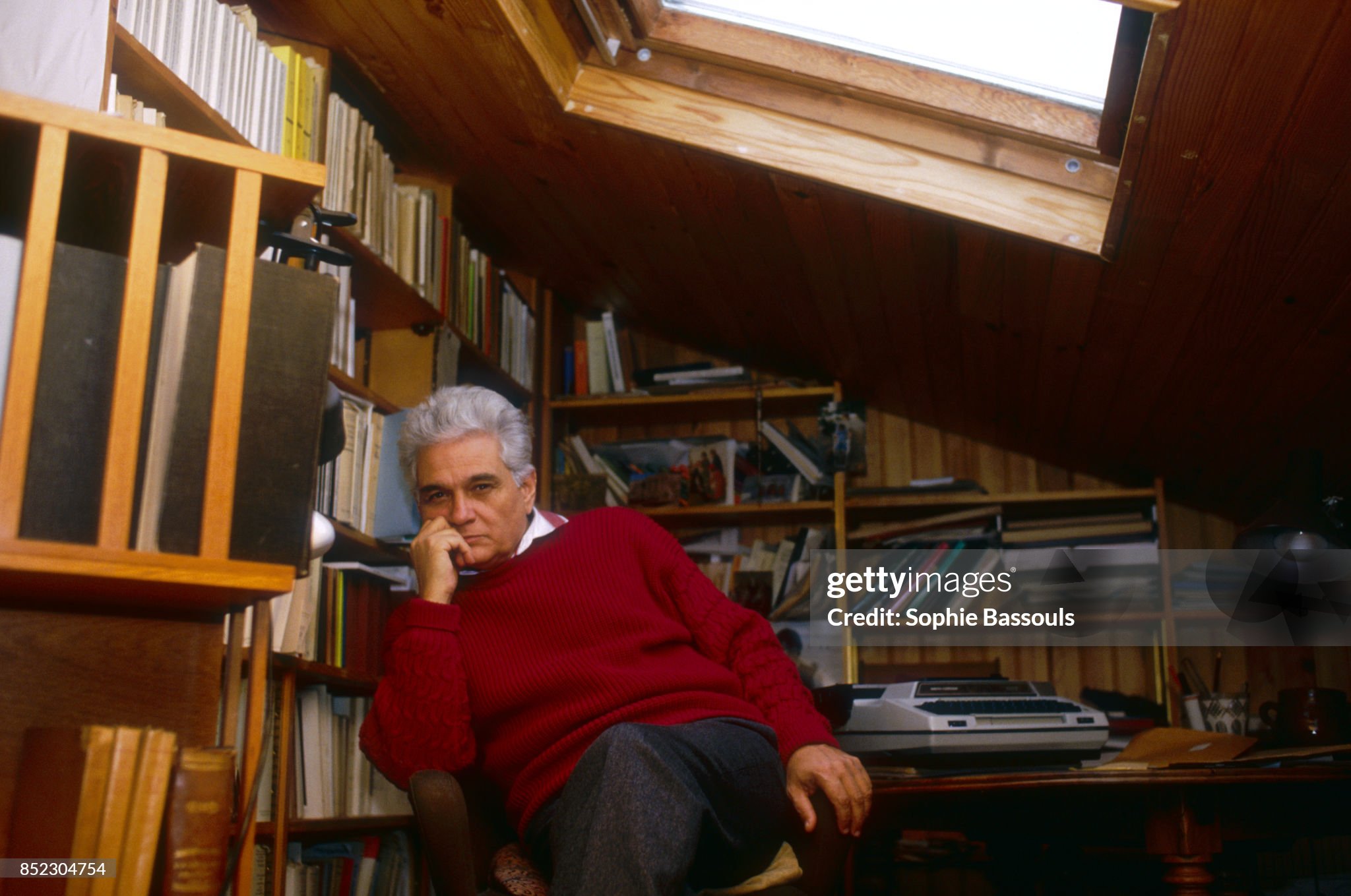
Potentially one of the Coronamatic line: 1200 or 2200.
Might be a Coronet XL, but his looks like it has the Smith-Corona badging/name on the front left where the Coronet XL name was typically placed. https://typewriterdatabase.com/Smith+Corona.Coronamatic+Coronet+XL.86.bmys
The shape of the top of the 2500 isn't quite right: https://typewriterdatabase.com/Smith+Corona.Coronamatic+2500.86.bmys
The shapes of the Coronamatic 7000 and 8000 are wrong for this.
See also guesses at https://www.reddit.com/r/typewriters/comments/1wzwzvi/what_typewriter_did_derrida_use/
-
-
web.archive.org web.archive.org
-
https://web.archive.org/web/20070411202436/http://www.jamesnormanhallhome.pf/indexen.html
From the James Normal Hall home museum. James Norman Hall is an American writer best known for The Bounty Trilogy, a series of historical novels co-authored with Charles Bernard Nordhoff: Mutiny on the Bounty (1932), Men Against the Sea (1934), and Pitcairn's Island (1934).


This photo appears to show him at a different machine that looks more like a standard:<br />

It's an early 40's Royal Quiet De Luxe (it appears to have a tabulator key in the top right). Compare with: https://typewriterdatabase.com/Royal.Quiet+De+Luxe.72.bmys Note the rectangular shift keys which didn't start until late 1940.
-
-
images.findagrave.com images.findagrave.com
-
Henry Dreyfuss death via the Associated Press

-
-
www.reddit.com www.reddit.com
-
These may help: http://www.crisvandevel.de/cst.htm https://www.johnwolff.au/calculators/Tech/TechIndex.htm https://www.jaapsch.net/mechcalc/index.htm http://www.vintagecalculators.com/html/mechanical_calculators.html And another you absolutely must bookmark: http://badonoer.blogspot.com/ Peruse the whole site! Do not just blindly oil things in here. Probably it wants no oil at all, and these sites will have detailed advice.
via u/ahelper at https://www.reddit.com/r/typewriters/comments/1wxxhpa/i_need_help/
-
-
www.reddit.com www.reddit.com
-
Reply to u/Bonkzzilla at https://reddit.com/r/typewriters/comments/1wx4l50/desk_pickiness/
You'll be hard-pressed to find a modern desk with heights specifically for typewriters.
Most mid-century typewriter specific furniture was designed to put the tabletop for a typewriter at 26 inches off of the floor, but the average modern desk is typically at 28 inches.
Your best bet is either a wooden or metal executive tanker desk with either one or two pedestals. They often have writing drawers which pull out and you can put a typewriter on them to lose an inch or two. Some also had spring-loaded platforms which allowed you to open a door and pulling your typewriter up and out at a better/lower height. Other desks had a rotating desktop to which you could bolt your typewriter and allow you to flip the typewriter upside down for storage underneath the desk. Some also came with a desk return which was attached to the side at a height a few inches lower that had space for a typewriter.
There are also some small vintage typewriter stands, usually with wheels to allow for some modest mobility. These can be found for about US$50 these days.
Examples: - https://boffosocko.com/wp-content/uploads/2024/05/wp-17169128054434698029806415884065.jpg<br /> - https://substackcdn.com/image/fetch/w_1456,c_limit,f_webp,q_auto:good,fl_progressive:steep/https%3A%2F%2Fsubstack-post-media.s3.amazonaws.com%2Fpublic%2Fimages%2F51bda2fe-c049-4b48-a057-87457a49e01a_902x882.png<br /> - https://www.google.com/search?q=typewriter+stand
-
-
www.reddit.com www.reddit.com
-
reply to u/orionis1 at https://reddit.com/r/typewriters/comments/1wxhe3q/bloquer_lavanc%C3%A9e_du_chariot_sur_une_underwood/
I presume you're going the route in this video https://www.youtube.com/watch?v=1upTPepErTY and miming/pretending all the typing with the carriage stuck at a set point by setting the margins so that the carriage doesn't move at all? The typist is then the tenth chair percussionist who is really only playing a desk bell.
I think the illusion is best when the bell is hidden from the audience in front of the typewriter and the typist actually only spaces and machine and does (quiet) carriage returns. The typing sound is then done by electronic keyboard and the carriage returns are played by wooden guiro, washboard or something similar.
You'll notice by watching any dozens of versions of performances of Leroy Anderson's "The Typewriter" that they're ALWAYS CHEATNG on the actual use of a typewriter. As an example, the bell on the typewriter in your video has been disabled/removed and the performer is using a separate bell mounted on the table next to it. It appears that he's finger pecking only two keys and/or only using the spacebar which moves the carriage. Many performances don't even attempt to properly time the carriage returns to the sound. Half of the "performance" is the attempt at comedy in the playing or presentation . You're trying to one up Jerry Lewis in 1963's Who's Minding the Store, which is never easy.
If you've got a practiced enough percussionist/typist, you can do the typing in reality though you may need to mic it up for volume/projection, but I recommend putting the paper up a few inches and not using the paper bale to get a louder percussion of the slug hitting the paper. If you go this route, I would recommend not using a machine with Perspex card guides, removing/disabling the paper fingers if there are any. It's impossible to get carriage returns done properly via sound as there are a few points at which the carriage hasn't moved enough to go more than a space or two.
-
-
www.reddit.com www.reddit.com
-
I recently got a 1924 Stoewer Elite with this gorgeous wooden case. The veneer survived the past 102 years remarkably well, apart from a small chip on one of the rear corners. The finish, however, was showing its age. The wood looked dull, with a couple of deep scratches and the nickel plated parts had started to rust. It needed some work, so I decided to refinish it. In a few places the veneer had started to lift slightly. I filled a syringe with wood glue and used a hypodermic needle to get the glue underneath it. This worked really well and avoided having to lift the veneer too much and risk breaking it. Luckily, the veneer was also thick enough to carefully use an orbital sander to remove the old finish and stain (low RPM, light pressure). I chose a mahogany stain that was quite close to the original, followed by six coats of shellac to bring out the wood grain. Finally, I buffed it with extra-fine steel wool and applied a coat of beeswax for some protection against moisture. It also smells very pleasant now! I’m really happy with how it turned out. It was a fun project, and the shellac/beeswax combination gave it a beautiful satin sheen.
https://www.reddit.com/r/typewriters/comments/1wwrsir/refinishing_a_wooden_typewriter_case/
-
-
www.reddit.com www.reddit.com
-
https://www.reddit.com/r/typewriters/comments/1www974/the_mecca/
Left to right: Nick Campano Jay Schweitzer, Scott Connors

-
-
www.reddit.com www.reddit.com
-
https://www.reddit.com/r/typewriters/comments/1m44es6/great_visit_to_gramercy_typewriter/
Left to right: Jay Schweitzer, Scott Connors, Nick Campano

-
-
thecarrtell.blog thecarrtell.blog
-
Jimmy Carr: A Deep Dive into His Life and Career<br /> by [[The Carr Tell Blog]]<br /> accessed on 2026-10-03T14:10:11
-
Jimmy is obsessed with comedy and, in the early days, lots of his contemporaries noticed him turning up to venues with a Filofax (which has now been updated to making notes on his phone). Never refuse the muse, he’s said.
-
-
thecarrtell.blog thecarrtell.blogBooklist1
-
https://thecarrtell.blog/booklist/
-
-
www.instagram.com www.instagram.com
-
www.instagram.com www.instagram.com
-
Roses are Red<br /> Violets are Blue<br /> One Typewriter is enough,<br /> I mean each week or two :)<br /> —Mr. & Mrs. Vintage<br /> at https://www.instagram.com/p/DNI6GORsee8/
-
-
www.instagram.com www.instagram.com
-
www.instagram.com www.instagram.com
-
www.reddit.com www.reddit.com
-
I prefer older, manual typewriters, but I just bought a Smith-Corona Electra 210 from FB Marketplace for $20. I enjoyed typing on it, and the fact that my fingers didn't slip between the keys and the typebars didn't jam. However, using an electric typewriter feels a bit like "cheating" in terms of breaking away from our digital world. It's not strictly analog, so I'm ambivalent about using it. I'm interested in hearing your opinions on the topic.
reply to u/Proud_Illustrator266 at https://reddit.com/r/typewriters/comments/1wvx18t/manual_vs_electric/
We can't absolve you of your guilt, but you can choose to use what works best for you.
Pretty much none of us are offline (look where we're discussing this). No one is really choosing to type with their heating or air conditioning off, or type by candlelight. You have options about where your analog line could be, just choose one and start banging away.
If you want to talk about guilt, tell us about your 70 typewriters that you're constantly rotating because you feel guilty that they're not all getting enough use.
-
-
www.reddit.com www.reddit.com
-
A thermal typewriter will be the quietest option. As a high school teacher with typewriters in my room, here is my experience: kids are allowed to use them during passing time and if we have some independent time and they are done with their work, but they are too noisy to use for notes or during instruction. If a student wanted to use a regular manual typewriter during class, I would ask them to stop, because it would be too much of a distraction to the class (and me).
https://www.reddit.com/r/typewriters/comments/1wvrlad/best_typewriters_for_school/
Advice from a self-identified high school teacher with manual typewriters in their classroom.
-
-
www.reddit.com www.reddit.com
-
I call these, "Undervettis."
"Undervetti" as a derogatory term for poorly made Underwood typewriters under the Olivetti regime. —via u/strestle at https://old.reddit.com/r/typewriters/comments/1wvb2l8/is_an_olivetti_underwood_just_a_postmerger/
-
-
www.deluxe.com www.deluxe.com
-
https://www.deluxe.com/shopdeluxe/pd/straight-tab-card-file-pocket-4-1-2-x-6-1-8-buff/_/A-1643<br /> Straight Tab Card File Pocket, 4 1/2 x 6 1/8, Buff
-
-
5forms.com 5forms.com
-
-
5formsbags.com 5formsbags.com5Forms1
-
www.epi.org www.epi.orgCEO Pay1
-
www.facebook.com www.facebook.com
-
Ezra’s slightly mad typewriter-cleaning cocktail! After experimenting with various cleaners, this has become one of my favorites for grimy painted metal and bare metal parts: roughly 75% Simple Green, with the remaining 25% divided between isopropyl alcohol, white vinegar and lemon juice.
With caveats, this is what Ezra Rosensaft uses for external typewriter cleaning using modest amounts on a clean damp cloth.
https://www.facebook.com/groups/705152958470148/posts/1386689876983116
-
The Gramercy mix: 1/3 409, 1/3 ammonia, 1/3 water.Like
Andy Morris reports that Jay Schweitzer of Grammercy Typewriter uses this cleaning formula for cleaning the exterior of typewriters to be applied to a soft cotton cloth and not directly on the machine.
Morris further suggests staying away from decals with this.
Second hand advice, but no reason to doubt it. https://www.facebook.com/groups/705152958470148/posts/1386689876983116
-
-
www.youtube.com www.youtube.com
-
"That's the sound of typing. It's the cadence of creativity. It's the percussion of punctuation. <br /> That sound you'll get lost in it. It becomes a rhythm. It becomes a music that will not only tell you—and the other people in the other room—that you're working, it will also spur you on to other areas of imagination that you will eventually create and record forever on your typewriter."<br /> —Tom Hanks in _Secret Talent Theatre" episode "Tom Hanks Changes the Ribbon on a Typewriter" for Vanity Fair on 2018-02-28 [00:02:16]
-
A typewriter pro would switch the ribbon selection switch to the red setting and jam two keys together in front of the typing point. This raises the ribbon vibrator to it's highest position and makes taking the ribbon out and replacing it much easier.
Tom Hanks does not demonstrate this finer feature.
-
Though Tom Hanks suggests that you can re-ink your typewriter ribbon, in practice, it's difficult to do and almost no one does.
-
Tom Hanks Changes the Ribbon on a Typewriter - Secret Talent Theatre - Vanity Fair
-
-
www.nytimes.com www.nytimes.com
-
Students at Cornell Daily Sun Pursued Sexual Assault Case for Two Years<br /> by [[Emma Goldberg]] in The New York Times<br /> accessed on 2026-10-01T09:18:29
-
Why be financially independent, she wondered, if not to publish sharp-edged views of the biggest campus issues?
amen
-
Then much of the campus attention moved on.
College rape culture is too set in stone. There's a way of doing things that doesn't help prevent future incidents and people just "move on" without addressing the systemic problems that allow it to continue. In hundreds of cases the same script plays out both in colleges and in public life.
Colleges and their surrounding cultures need to dramatically change the script to prevent these incidences. Accountability is the watchword.
-
-
www.nytimes.com www.nytimes.com
-
The Cornell Rape Investigation: Five Takeaways<br /> by [[Sharon Otterman]] in The New York Times<br /> accessed on 2026-10-01T09:08:38
A reasonable overview of the case of the Cornell Seven for the date.
-
Most of the gossip blamed her, calling her “a whore that had an eightsome with the Chi Phi guys.”
-
-
www.nytimes.com www.nytimes.com
-
This Air Purifier Is the Most Popular Wirecutter Product of All Time<br /> by [[Rose Maura Lorre]] in Reviews by Wirecutter in the New York Times accessed on 2026-10-01T08:59:03
-
-
www.nytimes.com www.nytimes.com
-
Statement Written by Police in Cornell Assault Case Omitted Her Claim She Was Raped<br /> by Hurubie Meko in The New York Times<br /> accessed on 2026-10-01T08:31:05
Example of a university sweeping another campus rape under the rug.
-
In the days after Jane Doe provided her statement to the police, officers tried to contact the men she accused, with varying degrees of success, according to the administrative documents.
So the police didn't manage to track down all the students involved?! WTF?
-
When members of her sorority heard about the theft, they decided she would no longer be the designated sober sister tasked with keeping an eye on sorority sisters at a bar that evening, she recalled.
The fact that a "designated sober sister" even exists really tells you everything you need to know about college rape culture.
-
Cornell, though, conducted its own investigation.
Why do Universities conduct their own investigations?
Is it to help the victim feel "heard" in a "process" which inevitably almost always ends up papering over the harm and the continued issues?
Is it to make it seem like they're doing something while maintaining the status quo?
Is it to cover their ass in some sense?
In this case of the Cornell Seven, the fact that they didn't relay the ultimate harm to the district attorney is highly suspicious.
Who do university police actually represent? Do they represent the "corporate" University or the community? How do they treat victims as a result?
-
-
www.nytimes.com www.nytimes.com
-
How a Cornell Student Went From Shame to Anger<br /> by Debra Kamin, Matt Flegenheimer, Amy Julia Harris, Sharon Otterman in The New York Times<br /> accessed on 2026-10-01T08:20:45
-
-
www.nytimes.com www.nytimes.com
-
Christa Pike Live Updates: Tennessee Pauses Future Execution After Botched Attempt<br /> by [[Billy Witz]], [[Emily Cochrane]], [[Rick Rojas]], [[Yan Zhuang]] in The New York Times <br /> accessed on 2026-10-01T08:14:35
-
- Oct 2026
-
www.bcwsupplies.com www.bcwsupplies.com
-
https://www.bcwsupplies.com/postcard-box-dividers
1/2 cut tabbed dividers for 4 x 6" cards
-
-
www.shopbrodart.com www.shopbrodart.com
-
https://www.shopbrodart.com/Archival-Microform-Storage-Sale/_/Microfiche-Divider-Guides/?=
Microfiche Full Cut Divider Guides which might be used in a zettelkasten practice as mini folders or pouches for 4x6" index cards
-
-
www.reddit.com www.reddit.com
-
Reply to u/BigZibby at https://www.reddit.com/r/typewriters/comments/1wuaui0/serial_number_location/
In fact, I do! You've probably asked the one person who's spent the time delving into the typewriter database to try to puzzle something out on this front.
I've not seen it in official sources, but the following pattern seems to fit:
Royal Standard serial numbers are generally of the form [MMM][P,E,S]-XX-YY-#######, where:
- MMM is the model designator (X, KHM, KMM, KMG, HH, FP, etc.);
- P is for 10 pitch/Pica, E is for 12 pitch/Elite, and S is for Special (typically special order typefaces);
- XX is the platen length, when not the standard/default size;
- YY is for other special features, typically the number of glyphs in the typeface; and
- ######## is the serial number.
Yours has a YY=86 which typically indicates that the machine has 86 glyphs on the slugs in the typeface and thus 86/2 = 43 character (typing) keys on the keyboard. There are also examples of other YY numbers like YY=88 with 44 keys and YY=92 or 46 keys versus the standard 42 keys. You may notice under your machine that the keyboard has a metal "comb" which may have some empty slots into which addition keylevers and typebar assemblies could be added. Often the YY designator is either for special order keyboards or keyboards for foreign languages which require additional keys.
Thus the 86 means that your machine has an extra key (the +/=) not found on their standard issue keyboard at the time.
-
-
www.facebook.com www.facebook.com
-
https://www.facebook.com/groups/705152958470148/posts/1383537200631717/
Hot glue on the tips of the typebar return spring of Brother typewriters to dampen the noise they make. One could similarly use a small rubber washer on these as well.

-
-
www.facebook.com www.facebook.comFacebook1
-
https://www.facebook.com/photo?fbid=10169712178659852&set=pcb.1384116267240477
Smith-Corona rebrand with a Standard Elite No 66<br />

-
-
www.facebook.com www.facebook.comFacebook1
-
https://www.facebook.com/photo?fbid=10169712178549852&set=pcb.1384116267240477
Smith-Corona Sterling 12 typeface with foundry mark

-
-
www.facebook.com www.facebook.com
-
https://www.facebook.com/photo?fbid=10169712178299852&set=pcb.1384116267240477
Hermes 3000, techno pica typeface with an "S TP" foundry mark

-
-
www.facebook.com www.facebook.comFacebook1
-
www.facebook.com www.facebook.com
-
https://www.facebook.com/groups/705152958470148/permalink/1384264090559028/
In the early part of the film, the very young rock journalist, William Miller, tells rock critic Lester Bangs that he types on a Smith-Corona Galaxy Deluxe. Later in the film, William uses in his bedroom a completely different Smith-Corona model. 😂<br /> via Di McMc
Almost Famous (DreamWorks Pictures, 2000)
-
-
www.facebook.com www.facebook.com
-
Vertical alignment was important as was an unworn typeface. Resulting in the need sometimes to replace worn typefaces or decrease the hole size using a clockmakers hole closing punch and anvil.
via James Yeard, repairman
-
An assumption is made that the typebar is tight on the pivot wire. The oldest electric machines use a power roller and small plastic cams. The force causes the pivot hole to become oval in shape causing bad vertical alignment.
via James Yearnd, repairman
-
Typebars are a 2 piece assembly a tipeface made from antimony hardened linotype type metals. And the bar itself. The two parts are soft soldered together. Since the soldering process is difficult to do exactly peening a crushing operation using a peeling pliers. The tool on the left. The tool on the right holds the type bar to prevent twisting. The typebar has a straight section below the typeface to for crushing to mive the typeface in the vertical plane.
mive = move
A description from repairman James Yearnd of using peening pliers on and an aligning wrench on a typebar to move the typeface in the vertical plane.

-
Superagetine is a mineral spirits mixable detergent helps the mineral spirits or Stoddard solventb dissolve grease and oil and suspend it so that the crude settles to the bottom of the tank.
via James Yearnd, repairman
-
- Sep 2026
-
www.instagram.com www.instagram.com
-
https://www.instagram.com/reel/Dd1Gi9kjkef/<br /> Florence Pugh's ASMR with a Hermes Baby and a Blackwing 602.
-
-
press.princeton.edu press.princeton.edu
-
As I'm delving into the Fourth Turning, I'm piqued by the idea of how their theory overlaps or jives with similar historical cyclic theories like Secular Cycles. Bigger span theories like Ian Morris ought to fit in to some of these, though Morris' data may not be granular enough to show it. Similarly one has to wonder with increasing technology, do these cycles speed up over time?
- Turchin, Peter, and Sergey A. Nefedov. 2009. Secular Cycles. 1st ed. Princeton University Press. https://press.princeton.edu/books/hardcover/9780691136967/secular-cycles (September 30, 2026).
- Review: https://www.lesswrong.com/posts/2weRdcvqANDq3zdPH/book-review-secular-cycles
-
-
www.reddit.com www.reddit.com
-
https://www.reddit.com/r/typewriters/comments/1wu29c7/another_rare_vogue_royal/
Ginger Rogers newspaper article about her using a Royal typewriter with Vogue<br />

Frank Capra writing on a Remington Portable as pictured in The Wisconsin State Journal on August 15,1931<br />

-
-
www.facebook.com www.facebook.com
-
The typeslugs were manufactured by the Setag SA, a specialized type foundry based in Bassecourt, Switzerland.Like
-
-
www.reddit.com www.reddit.com
-
 Harlan Ellison with pipe at an SG3 typewriter
  Harlan Ellison leaning on an Olympia SG1 typewriter (alternate angle from photo already in Richard Polt's collection)
  <br />
Harlan Ellison with pipe types at an Olympia SG3 typewriter
<br />
Harlan Ellison with pipe types at an Olympia SG3 typewriter
-
-
www.reddit.com www.reddit.com
-
Found an option for replacing the rubber feet on my 1952 SC Skyriter. Used a Hillman Group grommet, #55050-E, with a groove diameter of 1/2", and a groove thickness of 1/16".
via u/TomMahalla at https://www.reddit.com/r/typewriters/comments/1vkvwkx/smithcorona_skyriter_replacement_feet/
He also suggests: Jandorff #61506 Rubber Grommets 3/4" OD x 7/16" ID x 1/4" thick x 9/16" groove diameter x 1/16" groove width which are sold by various places including Ace Hardware

-
-
www.reddit.com www.reddit.com
-
 John Houston with a cigarette in his mouth as he sits at a Royal KMM typewriter on the set of The Treasure of the Sierra Madre (Warner Bros. Pictures, 1948). He looks up to his right at Humphrey Bogart who is leaning over to look at the page in the typewriter.
-
-
www.reddit.com www.reddit.com
-
Just wanted to share my excitement! I've been into typewriters for about 2 years and I started buying and repairing and selling typewriters just short of a year now. I have a small YT channel, an IG account and word of mouth around the village (pop. Aprox 1200 ppl) where a local grandpa asked to fix up his old Triumph, which was a freebie for experience and, not gonna charge grandpa! Last week, someone from across the island reached out to me, asking for assistance. They had recently purchased an Olivetti Letters 31, his first typewriter. We chatted and agreed on a price and a week later, it's now ready for pick-up. New ribbon, general degrease, clean and polish. The client is already excited and happy with the images and will collect it tomorrow. As far as I am aware, there is no "official" repair shop in Mallorca and from searches, I appear to be the only one (correct me if I'm wrong) but, the fact that someone found me and asked for my services, has made me extremely happy and excited and I'm hoping this will open the door to many new typewriters in look of TLC. Just wanted to share and thank all of you who have helped and given advice on repairs and general questions I've had which has led me to this point. Let's hope this is the start of something new and exciting.
James Wood aka u/Wooden_Underpants has a small typewriter repair service in Mallorca.
https://www.reddit.com/r/typewriters/comments/1wt5isk/my_first_official_client_and_thank_you/
-
-
www.reddit.com www.reddit.com
-
Reply to Orga A 38 1908 r!!<br /> by Neat_Substance_2084 at https://old.reddit.com/r/typewriters/comments/1wsmhar/orga_a_38_1908_r/
From what I've seen, your only evidence of your claim are a poorly hand scratched marking and some metallurgic tests.
You need a lot more evidence than what you're presenting to prove your claim, particularly given the decade and change of the passing of time.
I can scratch a 1940 date onto my Olympia SM3, but it doesn't mean that it's a prototype from 13 years earlier. Your presumed date is also of the form of an accounting ledger and not one that a mechanic would have scratched in.
Do you have any provenance on your machine? (Who owned it and when?)
Do you have any paperwork from the designers? Patents?
The material tests only show a difference in the metal content, they don't indicate a date of any sort. If they could, you'd need a lot more material research on manufacturing methods and timelines from the historical record to back it up. Typewriter manufacturers were constantly changing their manufacturing lines and designs to make them more efficient and less expensive to improve their bottom lines, so your material science differences would seem par for the course. Can you show similar changes in materials from the companies toy lines over the same period?
You seem to be only sharing blurry photos of screens rather than direct documentation of your material difference claims. Where are the direct documents and which company did the testing?
Given the tremendous amount of focus on design changes and patents in early typewriter manufacturing and sales, how does the design of your machine fit into the early aughts from 1900-1910 versus 1920 and on? Typewriter designs had settled down significantly by the early 1920s, so there should be some reasonably significant design differences between a 1908 machine and one from 1923. Where have you documented those?
What company history physically exists? When did they begin design? When were they producing prototypes in general? 13 years of R&D is a tremendous amount of time to pass in typewriter design in the early 1900s before manufacturing of any sort, even if you discount stoppages for World War I. Are there extant notebooks or corporate papers from the time period you're claiming? They were manufacturing toys for decades prior, so surely they've got some reasonable corporate documentation and correspondence somewhere. Do any of the descendants have papers, receipts, or diaries that could be consulted? What were the market conditions that suggested to them that a move from toys to typewriters was a brilliant idea? Often in a prototype situation, a factor may not have all the manufacturing capabilities in-house or they'd need to make changes to equipment to make a new line. Are there pieces of your typewriter that were outsourced from other factories? Is there evidence that all the parts of the later machines were made in-house?
Think like an archaeologist. Think like a historian. Bring some more research to bear if you want to convince anyone (experts or otherwise) of your claims. It should seem painfully obvious to you by now that what you're presenting is not nearly enough. No one is attacking you. We're just asking for more if we're going to be convinced.
-
-
www.reddit.com www.reddit.com
-
www.reddit.com www.reddit.com
-
https://www.reddit.com/r/typewriters/comments/1wqxq5e/typewriters_of_the_country_music_hall_of_fame/
Tom Parker (aka The Colonel) used a Royal RE

Don Schlitz wrote The Gambler which became a hit for Kenny Rogers (1978) on an L.C. Smith Model 14<br />

Bill Anderson had a Royal Electress

Cindy Walker used a Royal Quiet De Luxe ('53 or '54)

-
-
www.reddit.com www.reddit.com
-
https://www.reddit.com/r/typewriters/comments/1wse7lh/id_on_this_typewriter_from_twin_peaks/
 <br />
Typewriter appears in Sheriff Truman's office
<br />
Typewriter appears in Sheriff Truman's office
-
-
www.facebook.com www.facebook.com
-
www.reddit.com www.reddit.com
-
Don’t know if you know the term SABLE- Stash Acquired Beyond Life Expectancy. I’ve hit it too.
via real_misterrios at https://old.reddit.com/r/pencils/comments/1wrvdtz/why_am_i_like_this/
-
-
www.reddit.com www.reddit.com
-
www.antikeychop.com www.antikeychop.com
-
Gold Royal Cartier KMM Typewriter<br /> accessed on 2026-09-27T22:41:47
-
-
www.nytimes.com www.nytimes.com
-
ROYAL TYPEWRITER HONORS SALES HEAD; M.V. Miller Gets Gold Machine for Ten Years' Service - The New York Times<br /> by [[The New York Times]]<br /> accessed on 2026-09-27T22:37:22
The cost of the typewriter was $1,500.
-
-
www.pbs.org www.pbs.org
-
1939 "The Gold Royal" Typewriter<br /> by Grant Zahajko for [[Antiques Roadshow]] on PBS<br /> accessed on 2026-09-27T22:28:49
Presented 1940-09-01 to Vice President M.V. Miller in honor of 10 years of Sales Leadership by The Royal Typewriter Sales Organization.
Copy of video at https://www.facebook.com/watch/?v=849718491497922
A gold plated and Cartier engraved Royal KMM typewriter. It was engraved with 1054 names by Warner MacDonald in 1939 at cost of $5,000. It was exhibited at the 1939 Worlds Fair and presented to the owner's grandfather in 1940. He was ultimately the president of the company. Antiques Roadshow appraised it at $30,000 - 40,000.
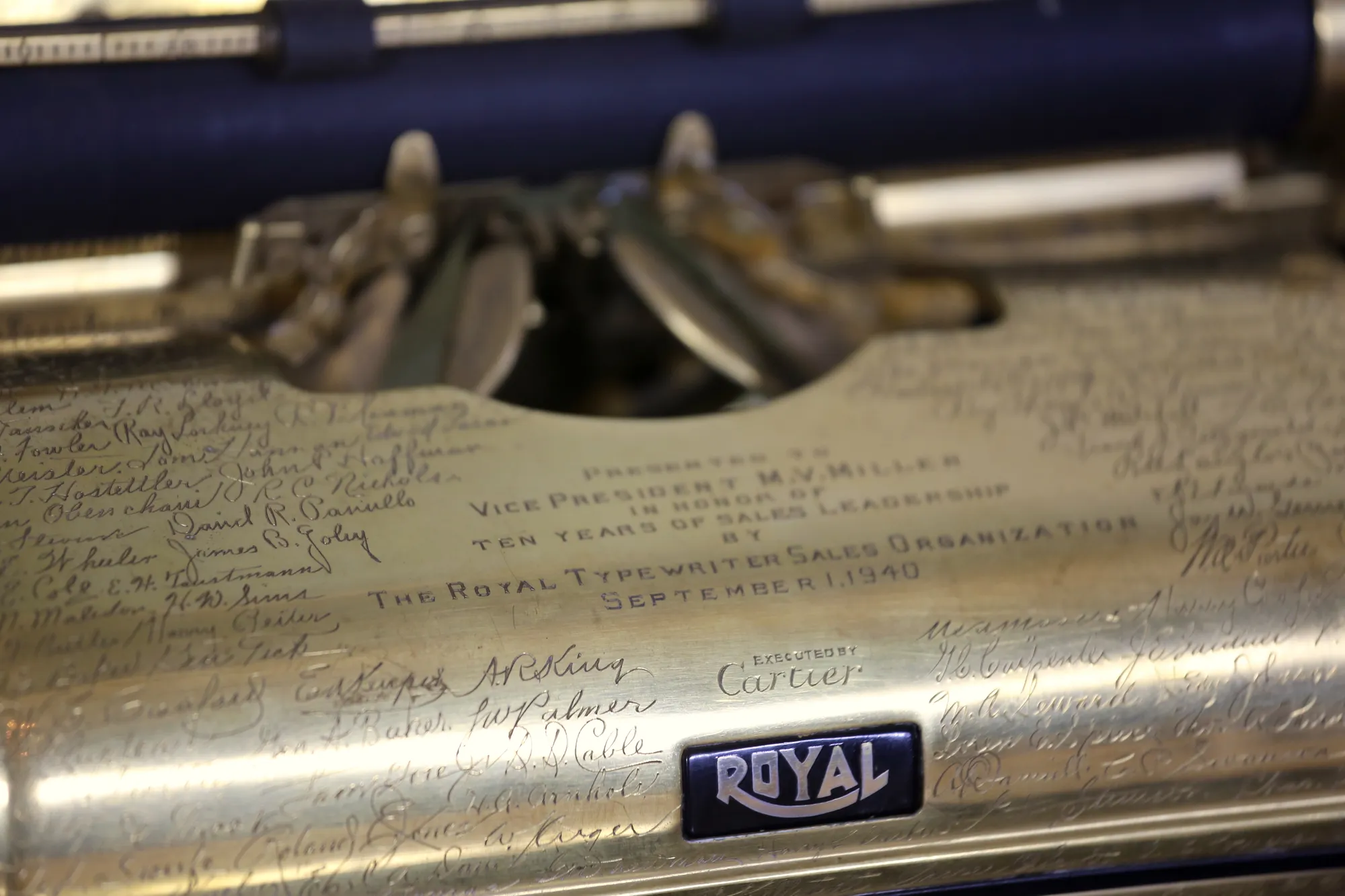
There are 2,257 parts in a Royal KMM.
See newspaper article:<br /> ROYAL TYPEWRITER HONORS SALES HEAD; M.V. Miller Gets Gold Machine for Ten Years' Service - The New York Times<br /> by [[The New York Times]]<br /> accessed on 2026-09-27T22:32:07
-
-
www.reddit.com www.reddit.com
-
https://www.reddit.com/r/typewriters/comments/1wpyqmz/what_becomes_of_typewriter_shops/
Anecdotes of what has become of old typewriter shops.
-
-
www.theatlantic.com www.theatlantic.com
-
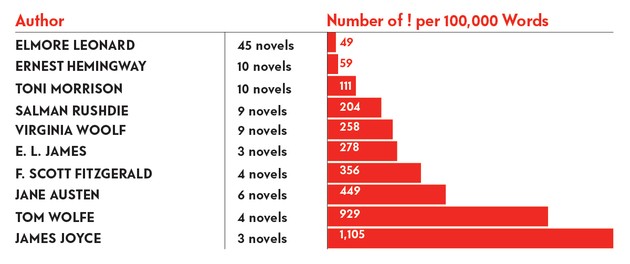
Chart of authors and their number of ! per 100,000 words from Ben Blatt's Nabokov’s Favorite Word Is Mauve: What the Numbers Reveal About the Classics, Bestsellers, and Our Own Writing
-
In his book 10 Rules of Writing, Elmore Leonard offered a rule about exclamation points. He stated, “You are allowed no more than two or three per 100,000 words of prose.” Leonard was prolific. He wrote more than 40 novels in his career, totaling 3.4 million words. If he had followed his own advice, he would have used only 102 exclamation points in his entire career. In practice, he used 1,651. That’s 16 times as many as he recommended!
-
How Many Exclamation Points Do Great Writers Use?!<br /> by [[Ben Blatt]] The Atlantic <br /> accessed on 2026-09-27T22:07:10
-
-
academicresourcecenter.harvard.edu academicresourcecenter.harvard.edu
-
https://academicresourcecenter.harvard.edu/2023/10/02/note-taking/
Note-Taking advice from the Harvard University Academic Resource Center
-
-
www.reddit.com www.reddit.com
-
www.reddit.com www.reddit.com
-
Bedale Original & Classic - short, vented rear knitted inner cuffs Beaufort Original & Classic - a little longer, game pocket, velcro inner cuffs Ashby - newer style, trimmer fit Border - for the taller person ends mid-thigh ish waxed cotton sage & navy only Classic Northumbria - exactly as Border but 8oz sylkoil i.e. cotton that is not shaved before being waxed so looks slightly distressed to begin with. All compatible with a range of zip in liners of differing weights and a couple of different hoods. That’s pretty much all you need to know for your first choice.
advice from u/leathershopgirl at https://old.reddit.com/r/Barbour/comments/1wpzikn/barbour_models_and_differences/
-
-
www.facebook.com www.facebook.com
-
Ben Jones
Based on the Royals on this post and Reddit, Ben Jones is u/harperjones
See:<br /> https://www.facebook.com/groups/705152958470148/posts/1383329093985861<br /> https://www.reddit.com/r/typewriters/comments/1ws0gy7/royal_futura_alignment_issue/
-
-
typewriterdatabase.com typewriterdatabase.com
-
I just ordered a belt from West Coast Belts. Mine is a Silver Reed 8700 which uses the same belt as the Underwood 565. They're almost identical machines,
via Claude Medearis at https://typewriterdatabase.com/1979-underwood-electric-565.12254.typewriter
See: https://westcoastbelts.com/product/new-replacement-belt-for-silver-reed-electric-8700-typewriter/
-
-
westcoastbelts.com westcoastbelts.com
-
Replacement belts for typewriters
-
-
www.reddit.com www.reddit.com
-
WeepinbellJar13
https://www.reddit.com/r/typewriters/comments/1wr2nbt/comment/pcfu8ib/
-
I would like to see how one is set up and coordinated in a physical space first. I'm curious about what's needed behind the scenes to get the ball rolling. For the time being, I'm looking forward to joining one in LA County 👍
u/WeepinbellJar13
-
Oooh, how exciting!! I’m in the Los Angeles area, how can I get on a notification list?
u/Big-Confidence9249
-
-
www.facebook.com www.facebook.com
-
Ed Medina reports that beading wire can be used to replace typewriter drawbands.
26 pound test strength.
via https://www.facebook.com/groups/705152958470148/posts/1377709554547815/
-
-
www.facebook.com www.facebook.com
-
Evelyn Forevermore is that an aesthetic/dreamy “feeling” reply, or serious “has a purpose”? Serious question, as I know zero about this. Were all these fonts just aesthetic choices or are several considered apt for specific purposes and not for others. thanks!
Reply to Louis Cornelia at https://www.facebook.com/groups/705152958470148/posts/1373494441635993/
Most of it is marketing in nature. The vast majority of typewriters have a standard courier serifed typeface, but manufacturers sold italic and cursive faces for a more "personal" touch in your correspondence. Italics was particularly marketed toward business executives to the point that many have the name "Executive". Many banks and accounting applications preferred used Gothic or double gothic typefaces for accounting work. Some banks also had custom faces to make it more difficult for people to wash checks.
-
-
-
At the Smithsonian, Maya Angelou's typewriter holds a place of honor : NPR<br /> by [[Daniel Ofman]] for NPR<br /> accessed on 2026-09-27T13:31:46
-
You can see the keys are kind of well-worn. You can still read them. So it looks like she was typing very regularly.
While described as "well worn", most typewriters with plastic keys don't really show heavy wear, so it's not surprising that "You can still read them."
This is a museum curator creating a feeling of typewriter nostalgia by way of unintended misinformation.
-
LABODE: This artifact is a typewriter that belonged to Maya Angelou. She probably had it from the early 1980s until her death. It's an Adler typewriter. It's an electric typewriter that was manufactured in West Germany.
This tracks with the Adler Meteor 12 from Soboroff's collection which is already documented on Richard Polt's page.
-
-
archive.org archive.org
-
www.facebook.com www.facebook.com
-
My earlier SM3 (SN 1145162) does have the back rule, but the layer (SN 1268955) does *not.*
https://www.facebook.com/groups/705152958470148/posts/1381249050860532/
1958 Olympia SM3 manufacturing changes regarding adding a rule for the rear tabulator sets.
-
-
-
reply to u/Novembree at https://old.reddit.com/r/typewriters/comments/1hfncyz/had_a_typewriter_for_awhile_could_use_help/
Welcome to the Royal KMM club! Seems like lots of these have been posted in the last day including one by u/betternatured and another by u/the-other-gusta along with a very similar Royal KMG by u/Jacki-san.
The serial number puts yours down as a KMM with an 11 inch platen manufactured in 1945. Cross reference: https://typewriterdatabase.com/royal.72.typewriter-serial-number-database
Manual: https://site.xavier.edu/polt/typewriters/RoyalKMM.pdf
These were really popular and ubiquitous, standard (large desktop) typewriters in the mid-century that were the workhorse of many offices. Because they were so common and so heavy, they only go for $5-25 in the used market in either unknown or marginal condition. If they're cleaned up and well-serviced they can go for more with a cap of around $300-400 depending on the level of restoration. Some with special features (like special typefaces) or provenance may go for more.
The Royal KMM was known to have been used by writers including: John Ashberry, Harry Ashmore, Russell Baker, Ray Bradbury, Richard Bratigan, Richard Brooks, Pearl S. Buck, Johnny Carson, Norman Corwin, Frank Herbert, Ken Kesey, G.W. Lee, Harper Lee, Ursula K. LeGuin, David McCullough, Margaret Mead, Grangland Rice, and Dorothy Parker. This was also the model famously used by Angela Landsbury's character on the TV show Murder, She Wrote.
Spools and Ribbon:<br /> The spools for the standard Royal typewriters (Ten, H, KH, KHM, KMM, KMG, RP, HH, FP, Empress, 440, 660, etc.) have a custom metal mechanism for their auto-reverse. The spools are known as the T1 (which is the same as General Ribbon part # T1-77B , T1-77BR, and Nu-Kote B64.) If winding on universal ribbon onto them, remove the eyelette which isn't needed and may interfere with the auto reverse.
If you're missing the original spools, Ribbons Unlimited carries them: https://www.ribbonsunlimited.com/6N064-Royal-Standard-Electric-Ribbon-64-p/6n064.htm or you might source an original metal pair from a local repair shop.
Duane of Phoenix Typewriter has a video about how to change and spool up your Royal standard.
Collector Sarah Everett can show you most of the functions on her YouTube Channel for Just My Typewriter: https://www.youtube.com/watch?v=v0Zvc1m-8aI.
Depending on your level of typewriter knowledge try out some of the following short films which will also provide some tips, tricks, and maintenance advice common in the era of your machine:
- Basic Typing: Methods. Vol. MN-1512a. United States Navy Training Film, 1943. https://www.youtube.com/watch?v=ztyzGit1dTI
- Basic Typing: Machine Operation. Vol. MN-1512b. United States Navy Training Film, 1943. https://www.youtube.com/watch?v=b-REJEArnjE
- Advanced Typing: Shortcuts. Vol. MN-1512c. United States Navy Training Film, 1943. https://www.youtube.com/watch?v=JUJfCfqgsX0
- Advanced Typing: Duplicating and Manuscript. Vol. MN-1512d. United States Navy Training Film, 1943. https://www.youtube.com/watch?v=7ve5JnTUzvo
- Maintenance Of Office Machines. Vol. MN-1513. United States Navy Training Film, 1943. https://www.youtube.com/watch?v=ocdxgkxKAKo
Happy Typing!
-
-
www.facebook.com www.facebook.com
-
https://www.facebook.com/groups/TypewriterCollectors/posts/10164182544099678/
Webster XL 747 typewriter with Piclite type

-
-
www.facebook.com www.facebook.com
-
www.facebook.com www.facebook.com
-
I am scared by random people writing this and that with compressed air.We learned in typewriter school in the navy.1.remove rubber bumpers platen and feed rolls.2. Mix 1to 1 superagetine and mineral spirits. Stoddard solvent also works.3. Soak overnight.4. Drain and rinse with fresh solvent.5 air dry or bake @95°F.6 .cool and manually re oilNow a day oil only with synthetic 0 weight oil.7 .check and brush typefaces.8. Clean platten.Reinstall and type test, align typefaces. Only permanent align is peening typebars. This is the way I maintained 200 typewriters on an aircraft carrier.This what worked for me.Spring scale at .75 Lbs. For tape tension.Adjust the rail clamps and clean under if required. Carrage should slide with 3 oz or lessLike
I am scared by random people writing this and that with compressed air.<br /> We learned in typewriter school in the navy.<br /> 1. remove rubber bumpers platen and feed rolls. 2. Mix 1to 1 superagetine and mineral spirits. Stoddard solvent also works.<br /> 3. Soak overnight.<br /> 4. Drain and rinse with fresh solvent.<br /> 5. air dry or bake @95°F.<br /> 6. cool and manually re oil<br /> Now a day oil only with synthetic 0 weight oil.<br /> 7. check and brush typefaces.<br /> 8. Clean platten.
Reinstall and type test, align typefaces. Only permanent align is peening typebars.<br /> This is the way I maintained 200 typewriters on an aircraft carrier.<br /> This what worked for me.<br /> Spring scale at .75 Lbs. For tape tension.<br /> Adjust the rail clamps and clean under if required. Carrage should slide with 3 oz or less
via professional Navy repairman James Yearnd at https://www.facebook.com/groups/705152958470148/posts/1382145190770918/
-
-
www.facebook.com www.facebook.com
-
https://www.facebook.com/groups/705152958470148/posts/1381071097544994
An Olympia SM2 pained electric blue.
-
-
jimcrowmuseum.ferris.edu jimcrowmuseum.ferris.edu
-
Lawn Jockeys - 2008 - Question of the Month - Jim Crow Museum<br /> by [[David Pilgrim]], Curator, Jim Crow Museum<br /> accessed on 2026-09-25T22:51:44
-
-
www.instagram.com www.instagram.com
-
Asking the no-oriented question, "Do you have a problem with me doing xyz?" is better than directly asking for the thing you want.
Ask for the "no" answer rather than the "yes" answer which feels like the respondent is giving something up.
via atypical.erin at https://www.instagram.com/reel/Ddrye7yytr0/?utm_source=ig_web_copy_link&stkn=NTc4MTIwNjQ2YQ==
-
-
www.reddit.com www.reddit.com
-
https://www.reddit.com/r/typewriters/comments/1wqa69b/elf_typing_paper/
Leaves described as "elf typing paper".
-
-
www.reddit.com www.reddit.com
-
GOAT = Get Old And Type ????
via u/Pete1885 at https://old.reddit.com/r/typewriters/comments/1wpx74d/i_think_i_found_the_goat/
-
-
www.facebook.com www.facebook.com
-
https://www.facebook.com/groups/705152958470148/posts/1381074304211340/
I was an IM rating in the Navy. As a instrument repairman I was responsible for repairing typewriters of all types regardless of the make or model as well as adding machines and the calculators of the time like the mighty Monroe 1000 gear long division moving carriage machine.<br /> I retained many special tools and books and have knowledge that will go away when I die
-
-
www.reddit.com www.reddit.com
-
https://www.reddit.com/r/typewriters/comments/1wpglhv/professional_elite_font_on_my_olympia_sm3/
u/Every_Bandicoot2321 is Tom Fasano of https://tomfasano.com/
-
-
www.reddit.com www.reddit.com
-
https://www.reddit.com/r/shavian/comments/1wp1yjj/announcement_of_the_worlds_first_shavian/

Taken from “Imperial News”, Volume 20, Number 2, Winter 1963-64.
This would have been published after 1963-11-22 which is mentioned in the article.
-
-
oztypewriter.blogspot.com oztypewriter.blogspot.com
-
History of the Shavian Keyboard Imperial Good Companion Portable Typewriter<br /> by [[Robert Messenger]] of oz.Typewriter accessed on 2026-09-24T10:20:26
Tags
- Ronald Kingsley Read
- George Bernard Shaw
- Peter Arthur Desmond MacCarthy
- writing systems
- Read-spel
- Shaw Alphabet
- typewriters of authors
- Imperial Model 6
- read
- Imperial Typewriter Co.
- Quikscript
- digital media
- Read Alphabet
- Imperial typewriters
- Soundspell
- Androcles and the Lion
- Shavian
- Michael Everson
- Pitman shorthand
- Bar-Lock typewriters
- media studies
Annotators
URL
-
-
collection.powerhouse.com.au collection.powerhouse.com.au
-
https://collection.powerhouse.com.au/object/254367
Typewriter- 'Imperial- good companion' which types in the Shavian alphabet
-
-
xoverit.blogspot.com xoverit.blogspot.com
-
Arne Lange10 Mar 2015, 16:23:00Thanks a lot for this article. I am looking forward to part 2! Olympia portables are my favourites.There is some interesting history behind the Colortip rebranding. Those typewriters were primarily sold by agents door by door, resulting in quite some scandals. The company that ended being renamed Colortip was run by Josef Haid, who at times ran a network of more than 4000 agents. Their practice was to sell contracts for typewriter telecourses - only that those contracts had a hidden clause that included the purchase of a typewriter. Different brands were involved over the years (Alpina typewriters also made some sales over this route). If you trust google translate, this German article from that time would be quite interesting: http://www.spiegel.de/spiegel/print/d-45140285.htmlWhat I find especially interesting about the Colortip machines is that there should be some modified later versions of Olympis SMs, that allowed to lock certain keys to make learning to type easier. As far as I know, they have an extra lever, that has three settings: program (lock all keys that are subsequently used), type (only the keys not locked before would budge) and reset. This lever would be unter the spool cover close to the left spool. I have been looking for those, but haven't found one yet. Also there is not much info to find about those....
-
-
www.reddit.com www.reddit.com
-
Jack Lemmon roasts Burt Reynolds over donation<br /> https://www.reddit.com/r/classicfilms/comments/1wnetp1/oh_jack_lemmon_my_favorite/
-
-
sds.chemtel.net sds.chemtel.net
-
Material Safety Data Sheet (MSDS) for LA's totally Awesome All Purpose Cleaner & Degreaser & Spot Remover<br /> https://sds.chemtel.net/webclients/safariland/raw_materials/AwesomeProductsIncorporated_LAsTotallyAwesomeAllPurposeCleanerandDegreasersandSpotRemover_01-10-2011.pdf
-
-
www.reddit.com www.reddit.com
-
www.youtube.com www.youtube.com
-
I Bacteria Tested La's Totally Awesome<br /> by Field of Focus
-
-
www.reddit.com www.reddit.com
-
https://reddit.com/r/typewriters/comments/1wmszod/whats_this_key_for_on_my_groma_kolibri_luxus/
- m/n (moneda nacional - aka use national currency like the Argentine peso rather than other currencies)
- o/s as oro sellado (sealed gold or gold currency); might also have been used for orden de servicio or orden de salida as service order or dispatch order respectively
-
you can type a C > backspace > = and create a Euro sign.
-
-
ia801708.us.archive.org ia801708.us.archive.org
-
“His name, Socrates, is Evenus, he comes from Paros, [c] and his fee isfive minas.”
Callias, son of Hipponicus recommends Evenus of Paros to Socrates as a Sophist teacher whose fee is five minas.
Compare this five minas to the price Socrates mentions at the end of the trial as potential penalty. Socrates says he can afford one mina while his friends could put up 30 minas for him.
-
Yet I think it afine thing to be able to teach people as Gorgias of Leontini does, and Prodicus ofCeos, and Hippias of Elis.2
- [Editors:] These were all well-known Sophists. For Gorgias and Hippias see Plato’s dialogues named after them; both Hippias and Prodicus appear in Protagoras.
The editors call out these philosophers/teachers as Sophists. Compare where they appear in Protagoras.
-
god
Socrates is accused of impiety. Several times throughout this piece there are various mention of god (singular) and gods (plural). Which is it? Is there a linguistic difference from the Greek to English and what effect, if any, is there on the culture being represented and how does that interact with Socrates' argument and position with respect to impiety?
-
in making one’s defense, and cross-examine when no one answers.
Those who maliciously [d] and slanderously persuaded you—who also, when persuaded themselves then persuaded others—all those are most difficult to deal with: one cannot bring one of them into court or refute him; one must simply fight with shadows, as it were,
Synopsis: Rumor is a difficult thing to fight
-
It is right for me, gentlemen, to defend myself first against the first lyingaccusations made against me and my first accusers, and then against the lateraccusations and the later accusers.
Socrates defense will be broken up into two parts:<br /> - lying accusations by the first accusers<br /> - these are of the nature of rumors which he poses as untrue and which received no defense and fell on the ready ears of young and inexperienced people who presumably were indoctrinated unquestioningly<br /> - later accusations by later acusers (Meletus, et al.)
-
concentrate your attention on whether what I say is just or not, forthe excellence of a judge lies in this, as that of a speaker lies in telling the truth.
-
unless indeed they call an accomplished speaker the man who speaks the truth.
Socrates self-deprecatingly considers himself an unaccomplished speaker unless one re-defines the term entirely as someone who speaks the truth.
-
he does set uphuman reason in his own person as the final arbiter of what is right and wrong,
-
APOLOGYTranslated by G.M.A. Grube
Cooper, John M., and D. S. Hutchinson, eds. 1997. “Apology.” In Plato: Complete Works, Indianapolis: Hackett Publishing Company, Inc.
-
So, too, Meletus first gets rid of uswho corrupt the young shoots, as he says, and then afterwards he will obviouslytake care of the older ones and become a source of great blessings for the city, asseems likely to happen to one who started out this way.
How do you accomplish this in modernity, when you can't "get rid" of the opposition? You chill their speech, you erase their language, you erase their history. This seems to be the playbook of the far right in American politics under Donald J. Trump.
Redefine and poison words like DEI and Critical Race Theory (CRT), marginalize and criminalize the people who don't fit in your world view.
-
hould be as good as possible, just as a good farmer is likely to take care of theyoung plants first, and of the [3] others later.
I think he is the only one of our public men to start out the right way, for it is right to care first that the young
Cross reference: Teach Your Children Well by Crosby, Stills, Nash & Young
-
[2] EUTHYPHRO
Euthyphro<br /> Stephanus numbers 2a–16a<br /> G. M. A. Grube translation
in <br /> Plato. 1997. Plato: Complete Works. eds. John M. Cooper and D. S. Hutchinson. Indianapolis: Hackett Publishing Company, Inc.
Tags
- Critical Race Theory (CRT)
- G. M. A. Grube
- judges
- Socrates
- Apology
- rumors
- Catherine Project Fall 2026
- diversity equity and inclusion
- teachers
- piety
- definitions
- Prodicus of Ceos
- minas
- oratory
- similes
- reason
- youth
- Callias, son of Hipponicus
- Euthyphro
- Stephanus pagination
- Teach Your Children (song)
- Crosby, Stills, Nash & Young
- translations
- eductation
- Protagoras
- Greek gods
- Hippias of Elis
- erasure
- atheism
- Evenus of Paros
- Plato
- right vs. wrong
- rhetoric
- free speech
- justice
- corruption of the youth
- god
- open questions
- Gorgias of Leontini
- gods
- philosophy
- truth
- quotes
- Sophists
Annotators
URL
-
-
www.youtube.com www.youtube.com
-
Uni MH500 2mm Lead Holder - One Cautionary Note, One Defeated Expectation - Mechanical Pencil Review<br /> by Unnecessary Detail
-
-
www.youtube.com www.youtube.com
-
https://www.youtube.com/watch?v=cRAh0vF2WEk
Surely AI generated, but an interesting paean to a slower life with evening hobbies.
Tags
Annotators
URL
-
-
www.youtube.com www.youtube.com
-
HB Lead Grades Explained + How to Select Right Pencil for Writing & Art<br /> by [[Unnecessary Detail]] on YouTube<br /> accessed on 2026-09-20T23:58:33
HB is typically the mid-point for most manufacturers <br /> H (hardness) tends to go lighter and scratchier (less graphite, more clay)<br /> B (darkness) tends to go darker and smoother (more graphite, less clay)<br /> F is typically a grade (fine/firm) between H and HB
For general writing look in the range of H / F / HB / B / 2B
Charcoal pencils tend to be much darker that clay/graphite pencils.
In the United States, pencils are often graded from #1 to #5 with the #2 being equivalent to HB.
Tags
Annotators
URL
-
-
www.youtube.com www.youtube.com
-
5 Stages of Lead Holder Usage & Collection - 2mm Mechanical Pencil Buying Guide<br /> by [[Unnecessary Detail]] on YouTube<br /> accessed on 2026-09-20T23:56:00
Tags
Annotators
URL
-
-
www.youtube.com www.youtube.com
-
Lead Holders Explained in 5 Levels of Detail - 2mm Mechanical Pencils<br /> by [[Unnecessary Detail]] on YouTube<br /> accessed on 2026-09-20T23:37:00
Tags
Annotators
URL
-
-
www.youtube.com www.youtube.com
-
Why You Must Try 2mm Lead Holders vs. Wooden Pencils, Fountain Pens & Mechanical Pencils<br /> by [[Unnecessary Detail]] on YouTube<br /> accessed on 2026-09-20T23:24:15
-
-
heathercoxrichardson.substack.com heathercoxrichardson.substack.com
-
September 19, 2026<br /> by [[Heather Cox Richardson]] in Letters From an American<br /> accessed on 2026-09-20T22:51:34
-
And the elites set out to drive wedges between Black slaves and white servants, establishing greater punishments for Black Virginians. In 1705 the Virginia Slave Codes pulled all those regulations together and went further. They prohibited Black Americans from owning cattle, hogs, or horses. They made it legal to kill an enslaved Virginian in the process of “correcting” them. And they made enslavement hereditary.
-
From 1670 to 1715, colonists enslaved between 30,000 and 50,000 Indigenous Americans. Entire tribes disappeared, and white farmers moved onto their lands.
-
-
heathercoxrichardson.substack.com heathercoxrichardson.substack.com
-
On Monday, the editorial board of the Wall Street Journal reported that although Republican lawmakers are celebrating Trump’s tariffs in public, they are privately seeking exemptions from tariffs for manufacturers in their own state. “Tariffs for thee, exemptions for me,” the board wrote in a piece detailing the efforts of Senator Katie Britt of Alabama to stop tariffs in private while praising them in public.
-
September 18, 2026<br /> by [[Heather Cox Richardson]] in Letters from an American accessed on 2026-09-20T22:33:34
-
-
www.reddit.com www.reddit.com
-
reply to u/Silly_Captain2089 at https://reddit.com/r/NoteTaking/comments/1wldauj/do_you_actually_organize_notes_by_folders/
The missing secret and an affordability that disappeared roughly when folders moved to digital contexts was the time and effort that people used to put into indexing their work beyond just filing it away.
Tags and wiki-type cross linking has helped some of this problem, but it takes some time and effort to make it easier for you to find the things you're always looking for.
Back in the late 1600s famous philosopher John Locke wrote a short treatise about how to index notes in one's commonplace book so that you could write entries in linear order, but still find them under multiple indexed headwords and didn't need to copy them into multiple places (or folders in your case). Here's a copy from 1706 in English (the original was in French.) - Locke, John. 1706. A New Method of Making Common-Place-Books. London: Printed for J. Greenwood, bookseller. http://archive.org/details/b30540434.
The pinnacle of the practice was probably in the 1950s when there were multiple filing and indexing schemes available and in wide practice. - Duffield, David Walter, and Various. 1951. Progressive Indexing and Filing. 5th ed. New York, NY: Remington Rand Inc. http://archive.org/details/progressiveindex0000varo.
These seemingly "boring and dull" methods do require a miniscule amount of additional work, but if you're regularly using and especially reusing your notes for writing or other creative work, then the extra work pays for itself 100 times over in long-term creativity and usefulness.
Underling the boredom and seeming tediousness of this practice, in a note in his system entitled "Does Spirit hide in the filing cabinet?", Niklas Luhmann wrote: "People come [to look at his filing and indexing system], they see everything and nothing more than that, just like in porn movies; consequently, they leave disappointed." This is a telling story about the simplicity of the idea of well-kept notes (filed and indexed) in a zettelkasten, card catalog, filing cabinet, or commonplace book because you don't get to see the creativity of the end product without putting in the work.
As a crazy example of resultant creativity, I was able to use some notes I indexed five years ago on tools to link a passage from the Book of Matthew in the Bible to Henry David Thoreau's book Walden and Conway's Law on corporate structure. I can guarantee that without my notes being reasonably well-indexed and filed, this serendipitous bit of rather brilliant creativity would never have happened.
-
-
www.youtube.com www.youtube.com
-
https://youtu.be/0ajIPRy_yc0?si=tBJjJNjg5tnlR9oW&t=1504
For whoever has will be given more, and they will have an abundance. Whoever does not have, even what they have will be taken from them.
-
How teaching kids to read went so wrong - Sold a Story: Season 1, Episode 1: The Problem<br /> by [[Emily Hanford]] in [[Sold a Story]] from APM Reports
-
-
www.reddit.com www.reddit.com
-
Are typewriters becoming an elite hobby?
A: Personally, I think it's a pica hobby.
-
-
www.youtube.com www.youtube.com
-
Charles Anderson discovers dragonflies that cross oceans<br /> TED on YouTube
-
-
www.youtube.com www.youtube.com
-
Lawrence Lessig: Fixing the Republic
Recommended by TB
-
-
en.wikipedia.org en.wikipedia.org
-
https://en.wikipedia.org/wiki/The_Corporation_(2003_film)<br /> The Corporation (Zeitgeist Films, 2003)
-
Robert D. Hare, a University of British Columbia psychology professor and FBI consultant, compares the profile of the contemporary profitable business corporation to that of a clinically diagnosed psychopath. The Corporation attempts to compare the way corporations are systematically compelled to behave with what it claims are the DSM-IV's symptoms of psychopathy, e.g., the callous disregard for the feelings of other people, the incapacity to maintain human relationships, the reckless disregard for the safety of others, the deceitfulness (continual lying to deceive for profit), the incapacity to experience guilt, and the failure to conform to social norms and respect the law.
-
-
www.facebook.com www.facebook.com
-
The left Shift key on the Antares Parva was scratched. I sanded it first with wet-dry sandpaper and then polished it with a cotton pad and toothpaste.
via Tomi Aho at https://www.facebook.com/groups/705152958470148/posts/1375748211410616/
-
-
www.youtube.com www.youtube.com
-
Secretaries Get to Throw Their Typewriters<br /> The Best of the Iowa Traveler<br /> by Iowa's News Now
Found via https://www.facebook.com/groups/TypewriterCollectors/posts/10164157502764678/
-
-
oztypewriter.blogspot.com oztypewriter.blogspot.com
-
Getting Gabriel García Márquez's Smith-Corona 5TE Ready For Exhibit<br /> by [[Richard Messenger]] on oz.Typewriter<br /> accessed on 2026-09-19T12:30:13
Includes multiple photos. The Smith-Corona 5TE isn't listed on Richard Polt's site as of 2026-09-19.
-
-
www.latercera.com www.latercera.com
-
 <br />
—via https://www.latercera.com/culto/2021/04/28/40-anos-de-cronica-de-una-muerte-anunciada-la-novela-que-garcia-marquez-consideraba-su-mejor-libro/<br />
Photo of Gabriel García Márquez in front of a standard typewriter with the brand name Underwood on the back.
<br />
—via https://www.latercera.com/culto/2021/04/28/40-anos-de-cronica-de-una-muerte-anunciada-la-novela-que-garcia-marquez-consideraba-su-mejor-libro/<br />
Photo of Gabriel García Márquez in front of a standard typewriter with the brand name Underwood on the back. Not included in Richard Polt's collection of typers as of 2026-09-19
This article has a variation of the same photo credited as "El escritor colombiano y premio Nobel Gabriel García Márquez / Foto: archivo Biblioteca Nacional de Colombia"
 Profile photo of Gabriel García Márquez at a 1970's version of a cartridge-based Smith-Corona electric typewriter. <br />
Potential variations of this typewriter are already in Richard Polt's collection of typers, but this particular photo is not as of 2026-09-19.
Profile photo of Gabriel García Márquez at a 1970's version of a cartridge-based Smith-Corona electric typewriter. <br />
Potential variations of this typewriter are already in Richard Polt's collection of typers, but this particular photo is not as of 2026-09-19.
-
-
www.reddit.com www.reddit.com
-
www.youtube.com www.youtube.com
-
Typewriter force curves, bellcrank classification, and velocity curves<br /> by Haelscheir's Haven on YouTube
Tags
Annotators
URL
-
-
www.reddit.com www.reddit.com
-
www.cookshelf.app www.cookshelf.app
-
https://www.cookshelf.app/
Similar to Eat Your Books.
Potentially the same company just re-instantiated? What has changed with their cost/charging/business model?
-
-
www.eatyourbooks.com www.eatyourbooks.com
-
Eat Your Books is an electronic database/index of recipes in cookbooks to make it easier for people to search their own paper (cook) books.
This is the sort of thing that Mortimer J. Adler was doing for the Great Books.
How nice would it be if there were a better digital index for all books which worked as well as this portends?
-
-
www.youtube.com www.youtube.com
-
Smith Corona Electra 210 Typewriter // Inside the Robert A. Caro Archive<br /> The New York Historical
-
-
www.paper-republic.com www.paper-republic.com
-
Suggested by Peter McKinnon<br /> https://www.youtube.com/watch?v=EXaQ_lU4JIM
-
-
www.youtube.com www.youtube.com
-
How I cured my phone addiction with 2 tiny notebooks<br /> by Peter McKinnon
-
Adding a piece of string to a pocket notebook for use as a bookmark. https://youtu.be/EXaQ_lU4JIM?si=r4s-LHKV76IAq_mn&t=1091
clever...
-
-
www.youtube.com www.youtube.com
-
The pocket notebook that will save you 5 hrs a day<br /> by Rachelle in Theory
Using a pocket notebook over a phone to regain time. Well reasoned out and a good overview of "why".
-
-
www.reddit.com www.reddit.com
-
Some tools have the ability to speak to you in ways that others do not.
An extension of this is Conway's law which may tend to force us to create work which not only reflects us, but which becomes us.
The relationship with tools becomes a two way street between us and the tool as well as the tools which interpose all of us (humanity).
What might this mean for our relationship with Artificial Intelligence? Will our laziness with respect to thinking turn us into non-thinkers who rely on a tool not actually able to think?
-
In my experience, a Typewriter's soul reveals itself to the folks that are MEANT to be their custodian for a time. I find most objects that serve a creative purpose to be this way; They absolutely have voices, but only the right person(people?) can hear them. People don't find Typewriters. Typewriters find people.
reply to Kirk Jackson aka u/NashvilleTypewriter at https://old.reddit.com/r/typewriters/comments/1wjidrf/what_words_could_we_use_to_better_describe_the/pal3wez/
This is great. I find it to be the case as well.
Watching other spaces like note taking applications (and methods), stationery, planners, notebooks, pencils, pens, fountain pens, etc. it repeats itself over and over. Some will really love a particular object which seems to work for them while others don't. Fora are filled with people asking, what do you like? how do you use it? when instead they ought to be attempting to figure out what they like and how they would use it.
Some turn their love of a particular thing into a religion (Apple vs. IBM comes to mind) which also tends to make others doubt their own choices and what might work best for them. Instead of experimenting around a bit to see what works for them, they take the supposed "magic" propounded by others and wrongly try to make it work for themselves. This is one of the primary reasons I tell potential new typewriter stewards to visit shops or type-ins so that they can put their hands on a variety of machines to see which "speaks" or works best for them and their needs. There are so many people limping along out there on dreadfully maintained machines because they haven't tried others (or even cleaned, oiled, and well-adjusted ones) and don't know what they're missing.
I was reading/listening to a series by APM recently called Sold a Story about how some academics and scientists created a "new method" for teaching reading and sold it as a products to school systems all over the country. While it managed to work for a terrifically small population, it was broadly wrong for the majority of people. Decades of harm was done to children and the educational space because everyone went with what these experts said (and which may have seemed logical) rather than doing some work, trusting testing and results, or continuing to experiment with a variety of strategies. Similarly, while computers and writing software may work for many, some of the older tried-and-true methods out there using tools like pencils, pens, loose paper, index cards, notebooks, notepads, and typewriters can provide dramatically different affordances in ways of working with them which are actually better for some of the things one might wish to accomplish with them. Some tools have the ability to speak to you in ways that others do not.
(P.S. Thanks for your observation as this may become the kernel of the introduction to the book I'm slowly working on.)
-
-
en.wikipedia.org en.wikipedia.org
-
[O]rganizations which design systems (in the broad sense used here) are constrained to produce designs which are copies of the communication structures of these organizations.— Melvin E. Conway, How Do Committees Invent?
-
-
www.reddit.com www.reddit.com
-
https://www.reddit.com/r/Zettelkasten/comments/1wjdcjs/removed_by_reddit/
Do connected notes actually work better than folders?<br /> via u/Purple_Clock5044 on 2025-09-17
-
-
www.reddit.com www.reddit.com
-
Typeface Identification
It's a lot easier to identify typefaces of typewriters if you include a few things in your photos: <br /> - Full frontal picture of the machine with clear shot of one or more of the rulers (so one can attempt to determine pitch as well as more easily identify the make/model for cross referencing).<br /> - A full typed sample of all the characters, especially some of the more unique ones like Q, 3, 5, 4, 7, &, G, A, E, and W in both upper and lower case.<br /> - A close up shot of the slugs which clearly shows the foundry marks (generally found in the middle of the slug) of both letter slugs and special character/number slugs as sometimes the latter are different.
-
Princess 300 with RaRo Elite Imperial typeface
The "AR" foundry mark is a shorthand for Albert Rodrian, one half of RaRo. If you ever see an R inside an octagon that's the mark for the other half, Alfred Ransmayer.
The "84" on the foundry mark is typical of RaRo's 12 pitch Elite Imperial which can be found with a sample at: https://typecast.munk.org/2023/02/04/1961-adler-typewriter-type-font-styles/
You can also compare other known Princess typefaces at the database: https://typewriterdatabase.com/twdb.0.typefaces?mfr_search=70&model_search=100#
If you put a ruler up to your type, you should find that there are 12 characters per inch.
You can also cross reference the following: - the Hass catalog, page 3, row 1:<br /> https://archive.org/details/typewriter-foundry-marks-haas/page/n1/mode/2up<br /> - RaRo Catalogue Page B3-4 "Elite-Schatten Ro 84":<br /> https://www.sommeregger.name/typewriters/files/RaRo/rarotype_katalog_1980_OCR_20160523.pdf
Reply to u/CaptainCulinary at https://old.reddit.com/r/typewriters/comments/1wjb0gk/princess_300_with_typeface/
-
-
www.instagram.com www.instagram.com
-
https://www.instagram.com/p/DaqqSrUvM9I/?hl=en
Typing on an 1890s Odell model 3. Made in chicago, refurbished in chicago.<br /> via typewriter_chicago_
-
-
www.youtube.com www.youtube.com
-
https://youtu.be/NWnX3ZkL_eA?si=mUD52esB34cLxhbJ&t=353
Suggestion to use index card or pocket notebook as a viewfinder for narrowing down one's view of the world.
-
-
en.wikipedia.org en.wikipedia.org
-
www.flickr.com www.flickr.com
-
https://www.flickr.com/photos/68103485@N05/
Examples like: <br />

-
-
en.wikipedia.org en.wikipedia.org
-
www.facebook.com www.facebook.com
-
I got several reels with a special discount. Nylon 1005 yards was €60 each, Cotton red/black was 360 yard was €125. I got several reels. They gave me a big discount. I purchase often from them. They paid tariffs with the shipping.
Sameera Sandaruwan Abeyrathna has had ribbon shipped from Europe before.
-
-
www.reddit.com www.reddit.com
-
The Royal Companion was a trim line name for Royal portables in the 40s and 50s along with variations like the Aristocrat and the Quiet De Luxe. For some of its life it's essentially a cheaper Quiet De Luxe which may be missing features like a tabulator, Magic Margins, card fingers, or a touch control. You'd have to cross check the manual and the typewriter database to see how yours may differ from the QDL at the time it was made. Often it was a $5-10 price differential at the time for the difference in features, but with inflation this would be the equivalent of $140 now.
You could essentially use the list of QDL users from Polt's site and say that they all used a typewriter similar to your Companion. (Depending on the photos and angles, some of the listed Quiet De Luxe users may have really been using either a Companion or an Aristocrat, but it's incredibly difficult to discern unless you can see the specific feature differences between them.)
See also: - https://boffosocko.com/2024/06/25/users-of-the-early-henry-dreyfuss-royal-quiet-de-luxe-portable-typewriters/<br /> - https://typewriterdatabase.com/royal.72.typewriter-serial-number-database<br /> - https://typewriterdatabase.com/Royal.Companion.72.bmys - Manuals at: https://site.xavier.edu/polt/typewriters/tw-manuals.html
Reply to u/chocolate-sheep at https://old.reddit.com/r/typewriters/comments/1wi0jd6/writers_using_royal_companions/
-
-
www.reddit.com www.reddit.com
-
Yes, dust can be an issue over time, especially if your machine is over-oiled and even more if you're in high dust/pollution area of the world and leave windows open regularly or have pets with lots of hair and dander production.
However, if uber-collector Martin Howard can be trusted, perhaps when designing your dream typewriter display room, dust isn't as horrible a problem as you might imagine. See: https://lumicrest.com/showcase-lighting-martin-howards-antique-typewriter-collection/ One imagines that occasional dusting and a can of compressed air will do the trick.
You could also do a nicer dust cover/mat the way Tom Hanks does: https://boffosocko.com/2025/06/16/tom-hanks-ingenious-custom-typewriter-covers-mats/
For my refurbished machines displayed in the house (where we have had a monster German Shepherd who sheds all year long and lots of exterior dust from Southern California pollution), if they're not in regular rotation, I'll drop a sheet of tinfoil or plastic wrap under the hood to prevent dust coming in through the hood and that seems to be more than enough protection while not covering up the entire machine.
reply to u/harperjones at https://old.reddit.com/r/typewriters/comments/1whqodm/closed_cabinets_for_display/
-
-
www.reddit.com www.reddit.com
-
legendwill11
https://old.reddit.com/r/typewriters/comments/1wgjf93/i_made_a_video_about_why_i_use_a_1949_royal/
legendwill11 has a '49 Royal Quiet De Luxe and lives in the Glendale, CA area (via video at https://www.youtube.com/shorts/-YuazfTLiiw)
-
-
www.youtube.com www.youtube.com
-
Why I Write Ads for Big Tech on a Typewriter
The Inner Game of Tennis says that real focus and creative freedom isn't about focusing harder, it's about narrowing in on what's actually relevant to the task in front of you, whether that's the seams on a tennis ball or whatever detail is clear in your creativity. For me, turns out a 60-year-old machine it does that better than any app I use.
-
-
www.reddit.com www.reddit.com
-
www.youtube.com www.youtube.com
-
Creativity isn't a gift, it's a system<br /> by Perry Daniels on YouTube
Perry Daniels' "Grail Notebook" is just a translation from the latin of ars excerpendi?! hmmm....
-
-
www.youtube.com www.youtube.com
-
Stop Buying Field Notes<br /> by Perry Daniels on YouTube
Tags
Annotators
URL
-
-
-
Most Pencils Are Terrible. Here Are 6 You Should Actually Buy<br /> by [[John Pattison]] on YouTube<br /> accessed on 2026-09-14T23:51:04
- Mitsubishi Hi-Uni HB
- Palomino Blackwing 602
- Palomino Blackwing Matte
- Viking Element 1
- Mitsubishi 9850 HB
- General's Cedar Pointe #2
- Tombow Mono 100 HB
-
-
www.youtube.com www.youtube.com
-
What Reading Out Loud Does to Your Brain<br /> by The Upgrade with Makai Elías Calles
-
-
www.youtube.com www.youtube.com
-
UsefulCharts<br /> by [[Matt Baker]] on YouTube<br /> accessed on 2026-09-14T23:08:17
-
-
en.wikipedia.org en.wikipedia.org
-
time.com time.com
-
Books: HitParade: 1895-1945<br /> by [[TIME]]<br /> accessed on 2026-09-14T23:02:57
-
-
www.nonviolent-conflict.org www.nonviolent-conflict.org
-
The Success of Nonviolent Civil Resistance<br /> by [[Center for Nonviolent Conflict Research]] [[CNCR]]<br /> accessed on 2026-09-14T22:55:14
-
-
-
The '3.5% rule': How a small minority can change the world<br /> by [[David Robson]]<br /> accessed on 2026-09-14T22:54:21
-
-
en.wikipedia.org en.wikipedia.org
-
-
And of this ourmother the state is to be the judge.
-
Plato. 1952. 7 Plato. 1st ed. eds. Robert M. Hutchins and Mortimer J. Adler. Chicago, IL: Encyclopedia Britannica, Inc.
Tags
Annotators
-
-
en.wikipedia.org en.wikipedia.org
-
topostext.org topostext.org
-
The history, mythology, and literature of Greece, taken up by the Roman Empire, shaped the development of European and American culture. ToposText is a free tool, a mobile app and website, for going back to the primary sources and historic roots of western civilization, and in particular a tool for students and travelers eager to experience the ancient world through its surviving texts.
-
-
topostext.org topostext.org
-
Pitthos deme (Attica) 12 unknown - Πιτθός Πιτθός - Pitthos, an ancient deme of Attica, exact location unknown
-


