cuneiform was occasionallyemployed in both Canaan and Egyp
49 Matching Annotations
- Jan 2026
-
-
- Dec 2025
-
www.nationalgeographic.com www.nationalgeographic.com
-
<center> How Rosetta Stone unravelled the history of ancient Egypt?
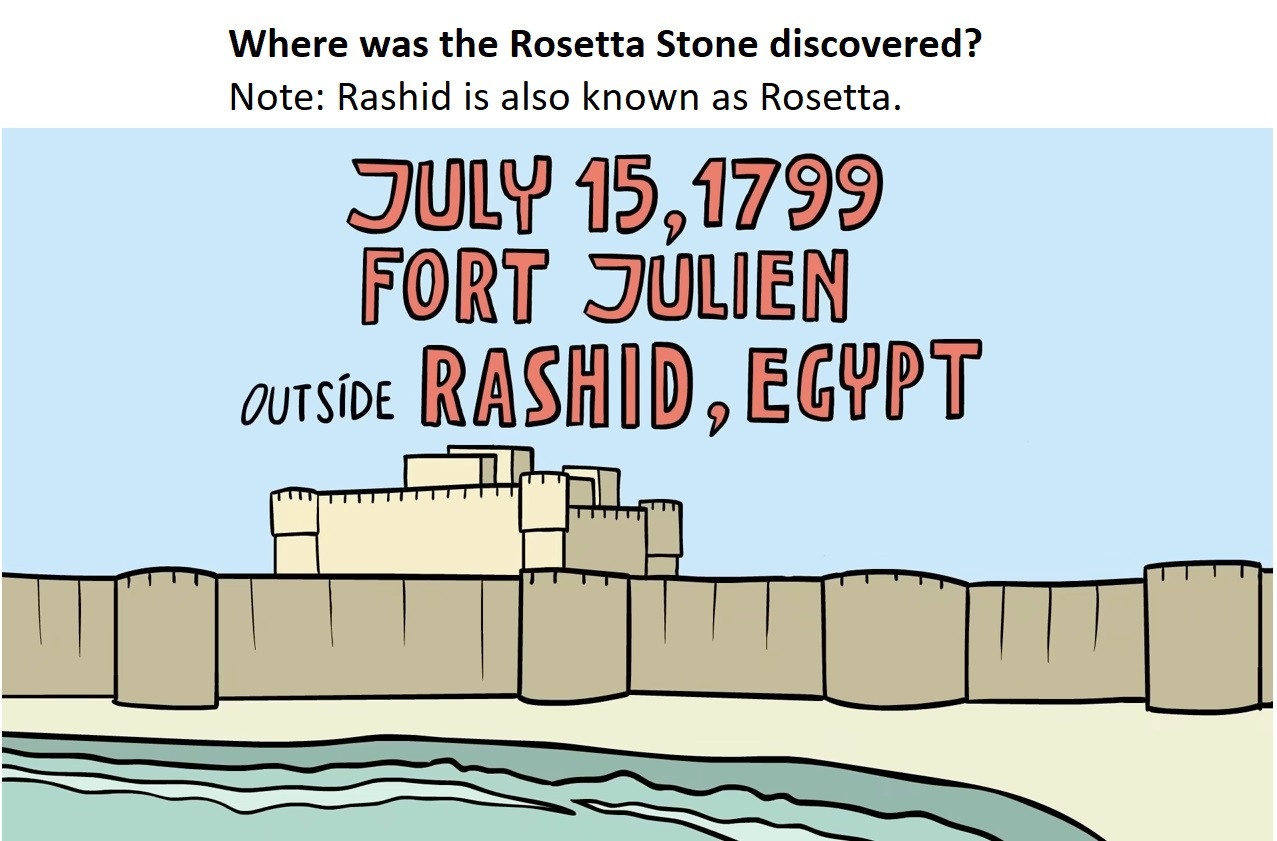
</center>Where was Rosetta Stone discovered?
The Rosetta Stone, a pivotal artifact discovered in 1799, unlocked ancient Egyptian hieroglyphics through its trilingual inscription, sparking a race among scholars like Young and Champollion to decipher its secrets, ultimately revealing a vanished world. <center>
Highlights
</center>- Rosetta Stone was created during the reign of King Ptolemy V in ancient Egypt in 196 BCE and was eventually discovered by French engineers in 1799. This discovery played a crucial role in deciphering Egyptian hieroglyphics.
- An artisan inscribed the "Memphis Decree on the stone, which grants tax exemptions to the priestly class, aiming to stabilize Ptolemy V's rule.
- Fast forward to 1799, French military engineer Pierre Francois Bouchard discovers the stone while repairing a fort, unaware of its historical importance.
How the scholars deciphered the script on Rosetta Stone
</center>- After Napoleon abandoned the expedition, the scholars were left with the stone and a pressing need to disseminate its information despite military challenges.
- The team devised a new method to capture the stone's inscriptions by using ink and paper, which proved successful.
- Following the surrender of the French forces, the Rosetta Stone was claimed as a spoil of war by the British and eventually donated to the British Museum. -
- Despite initial expectations, matching the Greek text with hieroglyphics did not lead to immediate decipherment of ancient Egyptian.
- The quest to decode the Rosetta Stone saw numerous attempts throughout history, culminating in significant breakthroughs by Thomas Young and Jean-François Champollion, who recognized the phonetic nature of hieroglyphics.- The misunderstanding of hieroglyphics persisted until the 1800s, despite efforts by medieval Muslim researchers.
- Thomas Young made initial progress in translating the Rosetta Stone by focusing on the Demotic section and recognizing the phonetic writing of Greek names.</l>
- Jean-François Champollion, a talented linguist who understood Coptic, began his own translation efforts and ultimately surpassed Young's work. He utilized various sources, including artifacts and inscriptions from Egypt, to further his understanding of hieroglyphics.
Champollion's groundbreaking work
Jean-François Champollion's groundbreaking work on deciphering Egyptian hieroglyphics using the Rosetta Stone highlights his struggles, rivalries, and eventual success in unlocking the secrets of ancient Egypt. He utilizes his knowledge of Coptic and previous research to reconstruct Egyptian royal names in cartouches, aiming to decode hieroglyphics. Despite facing rivalries and political challenges, Champollion perseveres in his studies, leading to a significant breakthrough in understanding hieroglyphics. In 1822, Champollion successfully read the name Thutmose from an inscription, confirming his theories and dramatically celebrating his discovery. Champollion's journey to Egypt allowed him to read inscriptions and uncover the history of ancient kings and common people, further solidifying his achievements.
Click Cartouche in Rosetta Stone
-
- Nov 2025
-
-
In Egypt, places listed as rural agricultural settlements on official maps are actually cities as large as 275,000, but making the official change puts the government on the hook for everything from schools to courthouses.
for - example - practical reasons for not naming a settlement a city - Egypt
-
- Feb 2025
-
www.theguardian.com www.theguardian.com
- Oct 2024
-
klik.gr klik.gr
-
η Αίγυπτος επίσης έκλεισε τα σύνορά της με τη Γάζα
Μιση αληθεια.
Η Αιγυπτος συνηθως εκλεινε τα συνορα με Γαζα ειτε επειτα απο πιεση των ΗΠΑ και του Ισραηλ, ειτε επειτα απο ενοπλες επιθεσεις της Χαμας. Απο το 2021 η Αιγυπτος τα ειχε ανοιξει για παντα.
Ομως παντα τον ελεγχο του τι μπαινει τον ασκουσαν οι Ισραηλινοι (σε συμφωνια με την Αιγυπτο) και διέταζαν τα κλεισιματα, με εφαρμογη των συμφωνιων του Camp David (1979):
The Philadelphi Accord between Israel and Egypt, based on the principles of the 1979 peace treaty, turned over border control to Egypt, while the supply of arms to the Palestinian Authority was subject to Israeli consent.
Under the Agreed Principles for Rafah Crossing, part of the Agreement on Movement and Access (AMA) of 15 November 2005, EUBAM was responsible for monitoring the Border Crossing. The agreement ensured Israel authority to dispute entrance by any person.[14]
...after Hamas' takeover of the Gaza Strip (2007) it was closed permanently except for infrequent limited openings by Egypt.
Απο το 2024 τον ελεγχο του περασματος τον εχουν αμιγως Ισραηλινα στρατευματα, και ειναι κλειστο ακομη και σε ανθρωπιστικη βοηθεια.
-
- Aug 2024
-
www.youtube.com www.youtube.com
-
Interesting perspective as interpretation where Jack says at the moment the song says "Who made up words, who made up numbers? Who wrote the Bible, who wrote the Q'uran" it might not even be a call to reflect and think for yourself (although this is absolutely a recurring theme in the song) but maybe they are implying all the science traces back not to the West (Europe) but to the East (Egypt, Africa). This interpretation aligns with the album this song was produced in, which is about Africa.
-
- Jul 2024
-
docdrop.org docdrop.org
-
the two sort of outstanding examples uh that i can think of are 00:39:39 egypt and china and both of those places have a an unbroken tradition of civilization that lasted something like 3000 years or more
for - progress traps - exceptional civilizations - Egypt and China
progress traps - exceptional civilizations - Egypt and China - While 1,000 years seems to be the norm for the lifetime of an average civilization, China and Egypt have both endured 3 times as long - Egypt had the self-replenishing Nile River with topsoil being washed down from Ethiopia every year to maintain their soil fertility - So they avoided the salinity problem until modern times with the construction of high dams that have had unintended consequences - China also had unusual conditions of exceptionally deep layers of annually replenished topsoil called loess that were formed by being blown in by the wind from surrounding areas
-
- May 2024
-
www.washingtonpost.com www.washingtonpost.com
-
Gut recherchierter Überblicksartikel zur zunehmenden Ausbeutung von Erdgas im Senegal und Ländern. https://www.washingtonpost.com/world/2024/01/31/senegal-natural-gas-climate-change/
-
- May 2023
-
moderndiplomacy.eu moderndiplomacy.eu
-
The Chinese Guangdong Group also signed an agreement with Egypt China Friendship Motorcycle Company to export motorcycles, in addition to another agreement to establish a factory to assemble bicycles locally. The same group also signed another agreement with Metal Technical Company to export electronic devices and freedom products, while Guangzhou Environstar Company signed an agreement with “Teda Egypt Company” to set up a non-woven fabric factory. And the Guangzhou Dayun Motorcycle Company signed an agreement with the “Ibrahim Mahmoud Ibrahim” group to establish the “Egypt-dayu” company for motorcycles. The China National Research Institute of Electrical Appliances also signed a joint cooperation agreement with Rajamec Mechanical and Electrical Works Company. Guangzhou Wuyang Motors CO. also signed an agreement with the “United Brothers” company for the distribution of motorcycles and spare parts, while Finmek Electronics signed an agreement with the economic zone in the northwest of the Gulf of Suez for investment cooperation.
廣東省在埃及摩托車市場投資上扮演的角色
-
-
-
Access the full paper here and view the related scripts and datasets on Github.
這份報告看起來是用手機訊號來偵測距離跟時間,不過是專注在公共運輸與微型運輸為主,非直接測量汽車或機車的通勤時間
-
-
www.statista.com www.statista.com
-
Duration of daily commute in Egypt in 2022 table column chart Search: Records: 13 25 50 CharacteristicShare of respondents Less than 15 minutes 13% 15 to 29 minutes 28% 30 to 59 minutes 33% 60 to 119 minutes 11% 120 minutes and more 6% I do not commute 8% Showing entries 1 to 6 (6 entries in total) Created with Highcharts 7.2.2
不知道真的還是假的數據
-
-
www.tomtom.com www.tomtom.com
-
TomTom traffic indexRanking 2022
數字不限於摩托車,也是以市區內為主。但測出來的時數有點低,方法論並未寫得很清楚(沒說測量地點),不確定可不可信。
-
-
www.numbeo.com www.numbeo.com
-
Main Means of Transportation to Work or School Working from Home 5.88% Walking 7.14% Car 65.13% Bike 0.42% Motorbike 0.00% Bus/Trolleybus 18.49% Tram/Streetcar 0.00% Train/Metro 2.94%
大致準確
-
- Apr 2023
-
www.thenationalnews.com www.thenationalnews.com
-
The plan, announced by the ministry on Wednesday night, aims to provide adequate housing for residents of particularly underdeveloped areas of the country, increase job opportunities in those areas and encourage real estate investment.It also intends to organise and regulate construction activities in the included areas as well as allocating which land can be built on and which must be left empty for agricultural use.Illegal construction on viable agricultural land is a common occurrence in Egypt.
管理都市化的問題
-
-
www.facebook.com www.facebook.com
-
到埃及前什麼都不用做~只要在抵達埃及,下飛機、過海關之後,在出境大廳應該就可以看到有一些電信公司的櫃檯,直接前往這些電信公司的櫃檯購買「sim卡」就可以啦!這些電信公司櫃檯會設置在機場航廈裡,就表示遊客也是他們服務對象的大宗,所以櫃檯人員通常都是會說英文的!不太用擔心語言不通的問題~比較要注意的是,有一種sim卡應該是專門給外國遊客使用的,只有上網功能,沒辦法接、打電話,但是我個人非常不建議買這樣的上網sim卡原因有二,第一是網路溝通畢竟還是會有時間差的問題,畢竟應該不是每個人都會24小時都在看手機、使用網路,所以如果遇到急事(需要聯絡住宿、司機、導遊等等,甚至需要打跨國電話聯絡親友)時,相信打電話還是比較即時、方便一些的!再來就是,花的錢都差不多,為什麼不選擇可以打電話又可以上網的兩用sim卡呢?所以總結就是我個人是比較建議買一般可以打電話又可以上網的sim卡的~~埃及有三大電信公司:Orange、Vodafone跟Etisalat大概就跟我們的遠傳、台灣大哥大還有中華電信一樣的概念,所以訊號上基本上應該是三家都差不多,所以大家就憑喜好選擇吧!(我自己是用Orange,覺得沒什麼太大的問題~其他兩間因為沒使用過所以就不太清楚實際狀況~)
在當地買可以通話的SIM卡
Tags
Annotators
URL
-
-
www.hondaegypt.com.eg www.hondaegypt.com.eg
-
Gallery
Honda在埃及並無產品介紹,想瞭解在當地是否有代理商? 速克達機種看起來是ELITE 125,其他以擋車為主,包含CBR250R、INTEGRA、CBR1000RR、NC700S、NC700X 猜想路上能見度不會太高。
-
-
taxsummaries.pwc.com taxsummaries.pwc.com
-
VAT applies on such imported products at 14% of the customs/import duty paid (the VAT base will be based upon the invoice value CIF, the customs duty, and other taxes).
VAT是跟著關稅走的(14%)。CKD關稅12.5%
Tags
Annotators
URL
-
-
www.trade.gov www.trade.gov
-
In May 2014, the Egyptian Ministry of Trade and Industry issued a decree banning the importation of motorcycles and three-wheel vehicles, except for tricycles and chassis for trade. The decree bans the importation of CBUs (Completely Built Units) yet allows the importation of SKD (Semi Knocked Down) motorcycle chassis and engines. This ban remains in place today.
在2014年起對摩托車有進口禁令,必須使用semi knocked down的方式才能進口
-
-
www.sixt.com www.sixt.com
-
Speed Limits These are the standard legal speed limits in Egypt for private vehicles without trailers. Within city limits60 kph (37 mph)Outside city limits90 kph (56 mph)Desert highway between Cairo & Alexandria100 kph (62 mph)
speed limit in Egypt. we could approximately access the speed of motorcycles compared to cars.
Tags
Annotators
URL
-
- Jan 2023
-
www.geschkult.fu-berlin.de www.geschkult.fu-berlin.de
-
What is Coptic?Coptic is the name of the last phase (ca. 300 CE - 1300 CE) of the longest-attested human language yet available to linguistic study, the Ancient Egyptian language. Closely connected to the Christian population of Egypt, Coptic is one of the most important languages of ancient Christian literature, alongside Greek, Latin and Syriac. A great deal of Biblical and early Christian literature was translated into Coptic for Egyptian consumption, while an autochthnous Coptic Christian literature flourished for centuries.
-
- Aug 2022
-
-
The population of Egypt grew from nomads who settled along the fertile Nile banks and transformed Egypt into a sedentary, agricultural society by 4795 B.C. Farmers sowed and harvested crops during seasons around the flooding.
-
- Jan 2022
-
osf.io osf.io
-
Hafez, O., & El-Din, Y. S. (2022, January 7). Egyptian Educators’ Online Teaching Challenges and Coping Strategies during COVID-19. https://doi.org/10.24093/awej/vol12no4.19
-
- Nov 2021
-
docdrop.org docdrop.org
-
we have to think of the road between cop 26 in glasgow and cop 00:20:28 27 in egypt we have to think of a development cop a cop that focuses on equity that focuses on the resources and that focuses on how do we 00:20:40 ensure that the trust equation is not undermined in order that we can all collectively deliver on the remaining carbon equation that is left with us
The danger is that this is a demonstrably recursive behavior. Each year, COP commitments never meet the target, but there is promise to meet them next time. Kick-the-can-down-the-road has become normalized result of COPs.
Tags
Annotators
URL
-
- Oct 2021
-
ourworldindata.org ourworldindata.org
-
Coronavirus Pandemic Data Explorer. (n.d.). Our World in Data. Retrieved March 3, 2021, from https://ourworldindata.org/coronavirus-data-explorer
Tags
- Europe
- San Marino
- map
- El Salvador
- Burkina Faso
- Botswana
- Denmark
- Bulgaria
- Ireland
- Monaco
- lang:en
- Myanmar
- Pakistan
- Belize
- Tanzania
- Austria
- Seychelles
- Madagascar
- Saint Kitts and Nevis
- South Sudan
- Togo
- Saint Vincent
- Papua New Guinea
- Comoros
- Turks and Caicos Islands
- Bangladesh
- Bolivia
- Indonesia
- Iraq
- Europian Union
- Cape Verde
- Australia
- Algeria
- Croatia
- Armenia
- Oman
- Romania
- Uganda
- Barbados
- UK
- Angola
- Panama
- Spain
- Hong Kong
- Laos
- Cuba
- Turkey
- Saint Lucia
- Jersey
- Estonia
- Georgia
- Brazil
- Norway
- Vatican
- Barbuda
- India
- Canada
- Sweden
- Slovenia
- COVID-19
- Mauritania
- Jordan
- Ecuador
- Democratic Republic of Congo
- Qatar
- Syria
- Suriname
- Bhutan
- Cote d'ivoire
- Haiti
- Egypt
- Iceland
- Mongolia
- Nigeria
- Venezuela
- Northern Cyprus
- Cyprus
- Russia
- Liechtenstein
- Bahrain
- Germany
- Falkland Islands
- Taiwan
- Dominica
- Isle of Man
- Kyrgyzstan
- Vietnam
- Israel
- Eritrea
- South Korea
- Somalia
- Mali
- Namibia
- Benin
- Vanuatu
- Serbia
- Uzbekistan
- Dominician Republic
- Italy
- Grenadines
- Czechia
- Guinea-Bissau
- Rwanda
- Ukraine
- Oceania
- Iran
- vaccine
- China
- Central African Republic
- Albania
- Mauritius
- Solomon Islands
- data
- Equatorial Guinea
- Guernsey
- Zambia
- Saudi Arabia
- chart
- Afghanistan
- Cambodia
- Morocco
- Malta
- North America
- Antigua
- Gibraltar
- Zimbabwe
- Finland
- Argentina
- Japan
- Belgium
- Ethiopia
- Gabon
- Kosovo
- Guatemala
- Andorra
- Timor
- Costa Rica
- Ghana
- table
- Niger
- Anguilla
- USA
- Cayman Islands
- Grenada
- Guyana
- Mozambique
- Paraguay
- Sri Lanka
- Honduras
- test
- graph
- Lesotho
- Africa
- is:webpage
- Guinea
- Malaysia
- Belarus
- Nepal
- Palestine
- Yemen
- Djobouti
- Bahamas
- Bosnia
- Moldova
- Tajikistan
- Gambia
- Poland
- Portugal
- Azerbaijan
- Luxembourg
- Mashall Islands
- Samoa
- Slovakia
- death
- Eswatini
- Faeroe Islands
- Asia
- Thailand
- Tobago
- United Arab Emirates
- case fatality rate
- Uruguay
- Chad
- New Zealand
- Fiji
- Kazakhstan
- Maldives
- Mexico
- Cameroon
- Sudan
- Macao
- Tunisia
- France
- Trinidad
- Burundi
- Congo
- World
- mortality
- South America
- Senegal
- Chile
- Sierra Leone
- Saint Helena
- Libya
- Singapore
- Herzegovina
- Greece
- Switzerland
- Hungary
- Montenegro
- Nicaragua
- North Macedonia
- Bermuda
- Micronesia
- Greenland
- Liberia
- South Africa
- Sao Tome and Principe
- Peru
- Kenya
- Lebanon
- Latvia
- Philipines
- Jamaica
- Malawi
- Kuwait
- case
- Netherlands
- Lithuania
- Colombia
Annotators
URL
-
- May 2021
-
www.nature.com www.nature.com
-
Mullard, A. (2020). How COVID vaccines are being divvied up around the world. Nature. https://doi.org/10.1038/d41586-020-03370-6
-
- Apr 2021
-
www.cresquesproject.net www.cresquesproject.net
-
The spices coming from India are brought to this city of Chos [Al-Qusayr, Egypt]. Then, they are taken to Babylon [Al-Fustat, Egypt] and Alexandria.
The Indian trade route was as still influential due too the high demand of silk and spice. Usually the trade was through port hopping from merchants. As most at this time period merchants were scared of the sea so they would costal hop. That's how India got brought trade to Al Qusayr and to Al Fustat..
-
This is the middle branch of Mount Tauris [Tibesti Mountains]. Many Saracens coming from the West pass through this mountain wishing to go to Mecca to see the arch of Mohamed that contains their Law.
Mecca is considered the holy city of Islam, near Cairo, Egypt on the west side of Africa. When Mansa Musa made his pilgrimage, as is tradition for a Malian sovereign, he impressed the court so much with his offering that people wrote about it for decades to come. Looking further at his journey, we note that he left Niani and most definitely passed one of the branches of Mount Tauris (the Tibesti Mountains). It's incredibly interesting to think about how long this journey was, and the fact that he left such a large impression by his gifts and wealth was fascinating to me considering the era. In our readings, it also said he brought 10,000 of his followers, which is even more incredible that that many people made this perilous journey
-
- Mar 2021
-
psyarxiv.com psyarxiv.com
-
Moehring, A. V., Collis, A., Garimella, K., Rahimian, M., Aral, S., & Eckles, D. (2021, February 8). Surfacing norms to increase vaccine acceptance. https://doi.org/10.31234/osf.io/srv6t
Tags
- is:preprint
- brazil
- pakistan
- malaysia
- availability
- acceptance
- belief
- research
- conformity
- italy
- lang:en
- vietnam
- philippines
- india
- united kingdom
- egypt
- argentina
- japan
- mexico
- bangladesh
- romania
- united states
- turkey
- thailand
- poland
- descriptive norms
- colombia
- social influence
- indonesia
- experiment
- france
- nigeria
- vaccination
- vaccine hesitancy
- behavioral science
- germany
- COVID-19
Annotators
URL
-
- May 2020
-
www.thelancet.com www.thelancet.com
-
Makoni, M. (2020). Keeping COVID-19 at bay in Africa. The Lancet Respiratory Medicine, S2213260020302198. https://doi.org/10.1016/S2213-2600(20)30219-8
-
- Mar 2020
-
library.educause.edu library.educause.edu
-
Maha Bali
You can learn more about Maha Bali from her faculty page at the American University in Cairo, on her blog "Reflecting Allowed, and from her Twitter stream at @Bali_Maha.
-
- Apr 2019
-
en.wikipedia.org en.wikipedia.org
-
Akhenaton placed much emphasis on the worship of the Egyptian sun which can be seen from many artistic depictions of a connection between the Pharoh and his family.[28] Some debate has focused on the extent to which Akhenaten forced his religious reforms on his people.[29] Certainly, as time drew on, he revised the names of the Aten, and other religious language, to increasingly exclude references to other gods; at some point, also, he embarked on the wide-scale erasure of traditional gods' names, especially those of Amun.
-
Akhenaten tried to shift his culture from Egypt's traditional religion, but the shifts were not widely accepted. After his death, his monuments were dismantled and hidden, his statues were destroyed, and his name excluded from the king lists.[12] Traditional religious practice was gradually restored, and when some dozen years later rulers without clear rights of succession from the 18th Dynasty founded a new dynasty, they discredited Akhenaten and his immediate successors, referring to Akhenaten himself as "the enemy" or "that criminal" in archival records
Tags
Annotators
URL
-
- Mar 2019
-
www.unesco.org www.unesco.org
-
In rethinking education to cope with rapid changes atthe threshold of the twenty-first century, innovation, techno-logy, and research are indispensable tools of education.Failure to innovate by and large means repeating yesterday'seducational programmes and strategies tomorrow, which willonly further jeopardize education's reputation as contributorto development efforts. Educational innovations are imperati-ve, and would no doubt be effective if they are research-basedand imbued with technology of education (i.e. systematicapproach to the teaching-learning process); and tech
Add Something
-
The future scenarios of the political, social, cultural
alo test
-
The future
annotation
-
- Dec 2018
-
www.bibalex.org www.bibalex.org
-
This page by Bibalex has many great links to international sources.
-
- Sep 2018
-
www.dartmouth.edu www.dartmouth.edu
-
To his grim Idol. Him the AmmoniteWorshipt in Rabba and her watry Plain,In Argob and in Basan, to the streamOf utmost Arnon. Nor content with suchAudacious neighbourhood, the wisest heart [ 400 ]Of Solomon he led by fraud to buildHis Temple right against the Temple of GodOn that opprobrious Hill, and made his Grove
A excellent usage of Pagan imagery to identify some of the demons who have taken portions of the earth as their kingdoms and force humanity to worship.
-
- Aug 2018
-
www.youtube.com www.youtube.com
-
Women were afforded much the same rights as men in Egyptian society.
-
At least 15 egyptian pharaohs were known to be women. This article from 2014 suggests there were at least 7. It's crazy how in just 3 years they discovered that there were more than twice as many. This really speaks to the cover up by the scientific community to exclude women from history.
-
Hatshepsut took over rule for her son because he was too young but continued on even after he was of age. She was known as a royal warrior and monumental builder.
-
Arsenoe's rule was pretty much the start of capitalism.
During her rule as pharaoh coins started being used in most transactions.
-
Arsenoe's crown's various components pay homage to all the powerful women before her.
-
Nefertari's earings were given to her by the Greeks and she wore them throughout her life.
-
I didn't realize all the pharaohs wore fake tie on beards!
Tags
Annotators
URL
-
-
www.bloomberg.com www.bloomberg.com
-
The ambitious plan includes a bridge spanning the Red Sea, connecting the proposed city to Egypt and the rest of Africa. Some 10,000 square miles (25,900 square kilometers) have been allocated for the development of the urban area that will stretch into Jordan and Egypt.#lazy-img-319534026:before{padding-top:75%;}
-
- Mar 2018
-
hyperallergic.com hyperallergic.com
-
the Sunken Cities exhibition opened this week at the St. Louis Art Museum.
Saw it at the British Museum and loved it! Highly recommended!
-
- Feb 2017
-
www.arabnews.com www.arabnews.com
-
President Abdel Fattah El-Sisi on Saturday ordered the government to take all necessary measures to help resettle Christians who have fled Egypt’s Northern Sinai after Daesh killed several members of the community.
No source for this information is given though the phrase "take all necessary measures" suggests an official communique.
Tags
Annotators
URL
-
- Mar 2014
-
gap2.alexandriaarchive.org gap2.alexandriaarchive.org
-
Hdt. 2.2. The Nature vs. Nurture enigma is presented here. It is advocated here that language is biologically programmed here and thus language is a nature phenomenon. However, the nature v. nurture debate has become bane in the field of psychology. Do the lengths or widths make a rectangle?
-
- Feb 2014
-
gap2.alexandriaarchive.org gap2.alexandriaarchive.org
-
In this way, the Persians say (and not as the Greeks ), was how Io came to Egypt, and this, according to them, was the first wrong that was done
Hdt. 1.2 The Persians say this was how Io came to Egypt ad that it was the first wrong.
Tags
Annotators
URL
-