economist Milton Friedman, and especially in hisideas on education. Back in 1955 Friedman had turned his attention to educationand written The Role of Government in Education. Education intrigued himbecause of its strange and, for the market model, rather irritating position in themarketplace. It didn’t quite fit into a neat demand-and-supply framework withchoice at the centre.
10,000 Matching Annotations
- Oct 2023
-
-
-
A Nation at Risk?,the Reagan administration’s analysis of what was supposedly going wrong inschools, which bemoaned the ‘rising tide of mediocrity’
-
pamphlets such as the Black Papers arguedfor a return to the selective system
-
selective system and the introduction of comprehensive schools
-
-
fontane-nb.dariah.eu fontane-nb.dariah.eu
-
https://fontane-nb.dariah.eu/index.html
Theodor Fontane: Notizbücher. Digitale genetisch-kritische und kommentierte Edition (Notebooks. Digital genetically critical and commented edition). Edited by Gabriele Radecke. https://fontane-nb.dariah.eu/index.html, accessed on 2023-09-30
-
-
-
The author made visible efforts to put everything down on one page,leaving a generous left- hand margin, presumably to facilitate surveyingand expanding the content. He equipped the page with a circledheading in the upper left corner and hence in an easily identifiable spotthat allowed for efficient retrieval. In this way, he turned his notes intomobile textual units—an excerpt from a historical source, a newspaperclipping, the sketch of a literary character, a part of a dialogue, etc.—that could then be pulled out like slips from a slip box.The archival evidence suggests that Fontane’s most important methodsfor storing his massive amounts of material were the paper sleeves, boxes,and folders, with their slip-box effect
-
These storage media further increasedthe flexible use of Fontane’s archival items, because they allowed allkinds of differently sized material to be kept on loose sheets in unboundform. Receptacles filled with discrete textual objects, such as note closets( Zettelschrä nke ) and slip boxes (Zettelkasten), are advantageous storagemedia for compilers, for they invite the generative process of reshufflingsources and creating textual patchwork from new combinations. 56 Infact, Fontane used his paper sleeves like a large- format slip box. Inthem, he stored material for the Wanderungen, but also for novels,novellas, and autobiographical writings on individual sheets. 57 Theexample “Figur in einer Berliner Novelle” (“Character in a BerlinNovella”), a folio sheet from Fontane’s Nachlass, provides a glimpse ofhow he formatted his material and indicates how important he found itto keep it in slip-like form (Figure 3.2).
-
In these instances, he could outsource partsof the work process to his personal amanuenses, his youngest children,Martha and Friedrich, who acted as scribes and copied book passagesthat he had marked.
Many writers and excerpters had amanuenses as helpers to copy out passages or to copy material over for them. Theodor Fontane would mark passages in books for his children to excerpt and copy over for him.
Compare this manual labor to that of more modern tools like Hypothes.is which allow one to digitally highlight and then excerpt almost automatically.
-
Fontane’s most basic modes of literary production have much incommon with this textual practice. Whether he was working on a travelreport, a historical essay, a book review, or a new novel, he followed aroutine of scouring, excerpting, and rearranging. He amassed largequantities of source material—culled mostly from circulatingnewspapers and journals, but also from letters, images, historicaldocuments, and monographs—in disconnected notebook entries andon loose folio sheets. He then surveyed these textual building blocks,outlined rearrangements with the help of lists, and combined them intoa new text. This pattern of production could be surprisingly mechanical.
-
other “paper tools,” 3 such as cardboard boxes, file folders, andenvelopes—the book demonstrates that Fontane produced his prosefi ction, feuilleton essays, and other contributions to the press in acreative process that was the exact opposite of his self- staging as theinspired mouthpiece of the muses. Deliberate at every step, heassembled his texts from pre- mediated sources with scissors and glue,in an extraordinarily inorganic, radically intertextual, and completelyconscious manner.
-
To this end, the study follows Fontane into theengine room of his text production.
In industrial terms and fashion, Petra McGillen describes Fontane's "workshop" containing his sixty-seven notebooks, cardboard boxes, file folders, and envelopes the "engine room of his text production".
-
This coinage goes back to Ursula Klein and describes writing media that have anepistemic impact. See her essay “Paper Tools in Experimental Cultures: TheCase of Berzelian Formulas,” Studies in the History and Philosophy of Science 32( 2001 ): 265–312.
differences in paper tools vs. paper machines?
-
McGillen, Petra S. The Fontane Workshop: Manufacturing Realism in the Industrial Age of Print. 1st ed. New Directions in German Studies 26. Bloomsbury Academic, 2019. https://www.bloomsbury.com/us/fontane-workshop-9781501351587/.
Tags
- industrialization
- topical headings
- zettelkasten
- Theodor Fontane's zettelkasten
- coinage
- Theodor Fontane
- combinatorial creativity
- notebooks
- creative process
- note taking metaphors
- intertextuality
- paper machines
- amanuensis
- generative media
- Petra S. McGillen
- Ursula Klein
- Zettelschränke (note closets)
- media studies
- metaphors
- note taking applications
- paper tools
- annotations
- nachlass
- writing process
Annotators
-
-
-
nobody ever said that reading was easy reading is is 02:25:41 very hard if it weren't hard it wouldn't be worth doing correct and the better the work that you're reading the harder the work is and therefore the more satisfying
Nobody ever said that reading was easy. Reading is very hard. If it weren't hard, it wouldn't be worth doing. And the better the work that you're reading, the harder the work is and therefore the more satisfying. —Charles Van Doren, Part 11: Activating Poetry and Plays
-
this little discussion we're having reminds me of a lecture I once gave many years ago shortly after how to read a book was first published which which I said that I thought that solitary 02:17:34 reading was almost as much advice as solitary drinking
Solitary reading [is] was almost as much a vice as solitary drinking. —Mortimer J. Adler, in Part 11: Activating Poetry and Plays
-
William Butler Yates is called sailing to Byzantium 02:13:12 and here the key word is not the last word or in the last stanza it comes right at the beginning and if you miss it and go over it too fast you have missed the meaning of the poem it's a it starts out by saying that is No Country 02:13:26 for Old Men
That [Ireland] is No Country for Old Men
-
a uh willing suspension of disbelief as uh Coleridge called it
Was Coleridge the original source of the idea of suspension of disbelief?
-
-
en.wikipedia.org en.wikipedia.org
-
harpers.org harpers.org
-
Potential Biden contenders: - Gavin Newsom, California governor - J. B. Pritzker, Illinois governor - Phil Murphy, New Jersey Governor - Gretchen Whitmer, Michigan Governor
Currently running on the left: - Robert F. Kennedy, Jr. - Marianne Williamson - Cornel West (Green Party)
-
He used the chance to declare “cultural war” for the “soul of America,” against an enemy of radicals “cross-dressing” as moderate Democrats, who were preaching “abortion on demand” and “radical feminism” while working-class Americans watched their jobs disappear and a “mob”—the Rodney King riots—looted and burned Los Angeles. The liberal columnist Molly Ivins memorably wrote that the speech “probably sounded better in the original German,” but its themes would form the founding document of today’s Republican Party. Indeed, when I mentioned the speech to a former Trump Administration official, he immediately recited several lines by heart.
Pat Buchanan ran for the Republican nomination in 1992 and in a prime-time speech at the Republican convention that summer he declared a "cultural war" for the "soul of America".
-
West is by far the most unequivocal in his denunciation of the Democratic and Republican parties as dominated by big money and corporate wealth. He is no less emphatic in his condemnation of Israeli occupation and domination of Palestinians, and in his condemnation of the militarization of American foreign policy. Democratic leaders seem to fear that he might siphon off just enough black and leftist votes from Biden to give Trump a winning margin.
-
Mehlhorn is determinedly of the view that people can only be motivated by fear: “You cannot get people to vote by getting them to believe that voting and participating will materially improve their lives,” he told Ryan Grim of The Intercept. “What you can get people to get really excited about is: ‘If you participate in politics, you might be able to prevent something really bad from happening to you.’ ”
-
The belief that insurgent candidates, and the movements they generate, are never more than dangerous impediments to Democratic electoral prospects is deeply rooted in party orthodoxy, nurtured by the belief that previous outside challengers have sabotaged the party’s chances.
examples: - Ralph Nader (2000) Green Party - Bernie Sanders (2016) (less evidence of this)
-
-
www.reddit.com www.reddit.com
-
How to get started with ZK and Obsidian .t3_16wgq4l._2FCtq-QzlfuN-SwVMUZMM3 { --postTitle-VisitedLinkColor: #9b9b9b; --postTitleLink-VisitedLinkColor: #9b9b9b; --postBodyLink-VisitedLinkColor: #989898; }
reply to u/Rampage_user at https://www.reddit.com/r/Zettelkasten/comments/16wgq4l/how_to_get_started_with_zk_and_obsidian/
Perhaps what I've done in Obsidian may help: I've created several folders for individual pieces:
- Zettels folder - contains permanent/atomic/evergreen notes which broadly stand on their own; I give them decimal numbers so that alphabetical sorting within the folder provides me with neighborhoods of ideas without needing to provide direct links from one idea to another on each and every note.
- Bibliography folder - contains individual notes for details about sources (books, articles, videos, etc.) which also contains the fleeting notes related to them (each can have from one to sometimes hundreds of short, not fully formed notes and excerpts);
- Index folder - contains 26 notes, one for each letter of the alphabet each of which has index entries that lead to notes in the zettels folder; Like Luhmann's my index is sparse and I rely on the neighborhoods around the notes that link from the index.
While I do have a few tags, I broadly eschew them as they don't scale well with time in my experience.
Some literature is unspecific about it, but you should know that NOT EVERY FLEETING NOTE NEEDS TO BECOME A PERMANENT NOTE. Only split out the most interesting and potentially future useful ones. Some of my book notes have hundreds of fleeting notes, highlights, etc. and I've only pulled out 3 or 4 permanent notes from them. (The side benefit is that if you need them, you've got links to those fleeting notes for later if you need to review over, use, or convert them.)
Really the best advice is to practice. A Lot. Experience will help you know when your fleeting notes should become permanent ones and how much work they need to become permanent notes. You can always adjust things in the future if your experience helps you simplify things further for you. If you make three permanent notes a week, you're doing better than most. I add 1-5 bibliographic sources a day and average about 50 fleeting notes with only one, or maybe two permanent notes on a good day.
Good luck. Now go practice...
-
-
www.reddit.com www.reddit.com
-
https://www.reddit.com/r/Zettelkasten/comments/16wj9uz/a_luhmannesque_zettelkasten_in_7_easy_steps/
One of the more compact, yet dense overviews of Luhmann's method.
-
-
www.msudenver.edu www.msudenver.edu
-
Metropolitan State University of Denver. “Writing as a Thinking Tool,” June 17, 2021. https://www.msudenver.edu/writing-center/faculty-resources/writing-as-a-thinking-tool/.
-
Watson, L.R., Fraser, M., & Ballas, P. (2019). Journaling for mental health. Retrieved from https://www.rochester.edu/encyclopedia/content.aspx?ContentID=4552&ContentTypeID=1 Literacy Research and Instruction, 49(2), 194-208. doi:10.1080/19388070902947360
dead reference? couldn't find; url gone and not archived; DOI was for the Wolsey article and not this
-
-
www.opencampusmedia.org www.opencampusmedia.org
-
Via Nate Maertens
-
Skilled performance is all that matters.
-
- Sep 2023
-
github.com github.com
-
kairos.technorhetoric.net kairos.technorhetoric.net
-
https://kairos.technorhetoric.net/2.1/features/brent/index.htm
An interesting commonplace book-like old school website with an actual "index" and fascinatingly about "Rhetorics of the Web"!
Example of a collected quote: https://kairos.technorhetoric.net/2.1/features/brent/burke.htm
Note also the linked ideas at the bottom of this example.
It also has a references section: https://kairos.technorhetoric.net/2.1/features/brent/referenc.htm
The separations of the pieces and their form is very reminiscent of a zettelkasten and the building up of pieces in places almost admits to a hand-built wiki.
-
-
kairos.technorhetoric.net kairos.technorhetoric.net
-
Imagine that you enter a parlor. You come late. When you arrive, others have long preceded you, and they are engaged in a heated discussion, a discussion too heated for them to pause and tell you exactly what it is about. In fact, the discussion had already begun long before any of them got there, so that no one present is qualified to retrace for you all the steps that had gone before. You listen for a while, until you decide that you have caught the tenor of the argument; then you put in your oar. Someone answers; you answer him; another comes to your defense; another aligns himself against you, to either the embarrassment or gratification of your opponent, depending upon the quality of your ally's assistance.
—Kenneth Burke. The Philosophy of Literary Form. Berkeley: University of California Press, 1941.
via Doug Brent at https://kairos.technorhetoric.net/2.1/features/brent/burke.htm
-
-
delong.typepad.com delong.typepad.com
-
All Western philosophy, Whitehead once remarked, is but "a footnote to Plato";and the later Greeks themselves had a saying: "Everywhere Igo in my head, I meet Plato coming back."
See full quote: https://hypothes.is/a/TTPGtl_GEe6psRsVpOxigg
-
syntopicalreading
relationship of synoptical and syntopical
Did the idea of syntopicality exist prior to Adler? Did it spring from the work of German religious scholars of XIX C who began doing synoptical readings and comparisons of the books of Matthew, Mark, Luke in the Bible?
link to the "great conversation" quote of Whitehead about Plato: https://hypothes.is/a/qb2T7l9nEe6uVVOdez8mKw
-
"Poetry is more philosophical than history," wrote Aristotle.By this he meant that poetry is more general, more universal.
-
But the last question, What of it?, requires considerable restraint on the part of the reader. It is here that the situationwe described earlier may occur-namely, the situation in whichthe reader says, "I cannot fault the author's conclusions, butI nevertheless disagree with them." This comes about, of course,because of the prejudgments that the reader is likely to haveconcerning the author's approach and his conclusions.
How to protect against these sorts of outcomes? Relation to identity and cognitive biases?
-
problem of defining social science
-
e hard scientist doesis to say that he "stipulates his usage"-that is, he informs youwhat terms are essential to his argument and how he is goingto use them. Such stipulations usually occur at the beginningof the book, in the form of definitions, postulates, axioms, andso forth. Since stipulation of usage is characteristic of thesefields, it has been said that they are like games or have a"game structure."
Depending on what level a writer stipulates their usage, they may come to some drastically bad conclusions. One should watch out for these sorts of biases.
Compare with the results of accepting certain axioms within mathematics and how that changes/shifts one's framework of truth.
-
If you are not of the faith, if you do not belong to thechurch, you can nevertheless read such a theological bookweU by treating its dogmas with the same respect you treatthe assumptions of a mathematician. But you must always keepin mind that an article of faith is not something that the faithful assume. Faith, for those who have it, is the most certainform of knowledge, not a tentative opinion.
What comes out of alternately reading theological books with understanding and compassion and then switching to raw logic?
-
We use the term"canonical" to refer to such books; in an older tradition wemight have called them "sacred" or "holy," but those wordsno longer apply to all such works, though they still apply tosome of them.
they provide a broader definition of sacred/holy texts that extend to books which form the basis of a groups' identity and often involve orthodoxy.
relation to politics, gender identity, cults, etc.
-
The ability toretain the child's view of the world, with at the same time amature understanding of what it means to retain it, is extremelyrare-and a person who has these qualities is likely to be ableto contribute something really important to our thinking.
Curiosity as a tool for thought.
-
What happens between the nursery and college to tum theHow of questions off, or, rather, to tum it into the duller channels of adult curiosity about matters of fact?
a perennial question
-
Barry Commoner's The Closing Circle,something more is required. This is particularly true of a booklike Commoner's, on a subject-the environmental crisis-ofspecial interest and importance to all of us today. The writingis compact and requires constant attention. But the book as awhole has implications that the careful reader will not miss.Although it is not a practical work, in the sense describedabove in Chapter 13, its theoretical conclusions have importantconsequences. The mere mention of the book's subject matter-the environmental crisis-suggests this. The environment inquestion is our own; if it is undergoing a crisis of some sort,then it inevitably follows, even if the author had not said sothough in fact he has-that we are also involved in the crisis.The thing to do in a crisis is ( usually ) to act in a certain way,or to stop acting in a certain way. Thus Commoner's book,though essentially theoretical, has a significance that goes beyond the theoretical and into the realm of the practical
Interesting to see this take up some space as an example from 1972.
-
Many people are frightened of mathematics and thinkthey cannot read it at all. No one is quite sure why this is so.Some psychologists think there is such a thing as "symbolblindness"-the inability to set aside one's dependence on theconcrete and to follow the controlled shifting of symbols.
-
"verbalism" is the besetting sin of those who fail to read analytically.
-
There is one other test of whether you understand the proposition in a sentence you have read. Can you point to some experience you have had that the proposition describes or to which the proposition is in any way relevant?
-
Many mnemonists often recommend that one should understand an idea fully before committing it to memory, usually because it is much easier to memorize if it's fully understood first.
suggested by: https://hypothes.is/a/Jme3bFmlEe6_VYfaZGQf9Q
-
"State in your own words!" That suggests the best test we know for telling whether you have understood the proposition or propositions in the sentence.
Does this idea exist in the 1940 edition of the book?
Very similar to the advice inherent in the Feynman technique or that suggested by the research summarized by Sonke Ahrens in How to Take Smart Notes.
cross reference: - https://hypothes.is/a/iV5MwjivEe23zyebtBagfw - https://hypothes.is/a/B3sDhlm5Ee6wF0fRYO0OQg (Adler testing using statement in own words and a concrete example.)
-
They pause over the sentences that interest them rather than the ones that puzzle them.
And of course, somehow Tiago Forte encourages people to highlight and pay attention to those that interest them.
-
Wonder is the beginning of wisdom in learning from books as well as from nature.
-
RuLE 7. LOCATE OR CONSTRUCT THE BASIC ARGUMENTS IN THE BOOK BY FINDING THEM IN THE CONNECTION OF SENTENCES.
-
RuLE 6. MARK THE MOST IMPORTANT SENTENCES IN A BOOK AND DISCOVER THE PROPOSmONS THEY CONTAIN.
Tags
- footnotes
- social sciences
- compassion
- Barry Commoner
- wonder
- misinformation
- The Closing Circle
- synoptic gospels
- Alfred North Whitehead
- The Great Conversation
- identity books
- curiosity
- Mortimer J. Adler
- Feynman Technique
- sacred texts
- poetry
- arguments
- mathematics
- false choice
- reformulating writing
- elaboration
- quotes
- axioms
- alternative conclusions
- symbol blindness
- Charles Van Doren
- understanding before memorization
- definitions
- pedagogy
- conversations between texts
- syntopical reading
- footnotes to Plato
- climate crisis
- propositions
- philosophy
- Aristotle
- Western philosophy
- reading practices
- highlights
- wisdom
- theological texts
- demonstrating understanding with examples
- learning
- Tiago Forte
- puzzling sentences
- Plato
- faith
- 1972
- analytical reading
- active reading
- tools for thought
- disagreement
- math shaming
- canonical books
- writing for understanding
- logic
- history
- cognitive bias
- understanding
- orthodoxy
- rules
- cultural anthropology
- stipulating usage
Annotators
URL
-
-
Local file Local file
-
The safest general characterization of the European philosophical tradition is that it consists of a series of footnotes to Plato . I do not mean thesystematic scheme of thought which scholars have doubtfully extractedfrom his writings . I allude to the wealth of general ideas scattered throughthem . His personal endowments, his wide opportunities for experience ata great period of civilization, h is inheritance of an intellectual traditionnot yet stiffened by excessive systematization, have made h is writings t aninexhaustible mine of suggestion
-
Whitehead, Alfred North. Process and Reality: An Essay in Cosmology (Gifford Lectures, Delivered in The University of Edinburgh during the Session 1927-1928). Edited by David Ray Griffin and Donald W. Sherburne. 2nd edition, Corrected. 1929. Reprint, New York: Free Press, 1978.
-
-
www.poetryfoundation.org www.poetryfoundation.org
-
This Be The Verse<br /> by Philip Larkin
They fuck you up, your mum and dad. <br /> They may not mean to, but they do. <br /> They fill you with the faults they had<br /> And add some extra, just for you.
But they were fucked up in their turn<br /> By fools in old-style hats and coats, <br /> Who half the time were soppy-stern<br /> And half at one another’s throats.
Man hands on misery to man.<br /> It deepens like a coastal shelf.<br /> Get out as early as you can,<br /> And don’t have any kids yourself.
Philip Larkin, "This Be the Verse" from Collected Poems. Copyright © Estate of Philip Larkin. Reprinted by permission of Faber and Faber, Ltd. Source: Collected Poems (Farrar Straus and Giroux, 2001)
Reference: Larkin, Philip. Collected Poems. New York: Farrar Straus & Giroux, 1989.
Compare with The Kids Are Alright.
Recited in Ted Lasso, S3 https://www.looper.com/1294687/ted-lasso-season-3-episode-11-maes-poem-sounds-familiar/#:~:text=To%20jog%20your%20memory%2C%20the,extra%2C%20just%20for%20you.%22
-
-
www.reddit.com www.reddit.com
-
Starting a blog .t3_16v8tfq._2FCtq-QzlfuN-SwVMUZMM3 { --postTitle-VisitedLinkColor: #9b9b9b; --postTitleLink-VisitedLinkColor: #9b9b9b; --postBodyLink-VisitedLinkColor: #989898; } Hey everyone- I’m still trying to wrap my head on how to organize this.I have my antinet growing and I want to start a blog with the use of one of my notes as a springboard.Do I9 votesWork on the blog and store the index cards after the note that I’m drawing inspiration fromCreate a new blog section in my antinet and place them thereStore them in wherever and create an hub note that points to them
reply to u/RobThomasBouchard at https://www.reddit.com/r/antinet/comments/16v8tfq/starting_a_blog/
The answer is:<br /> D: Start a "blog" where you post your notes as status updates and interlink them a bit. When you've got enough, you organize them into a mini thesis and write a longer article/blog post about it.
Examples: - https://hypothes.is/users/chrisaldrich?q=tag%3A%22thought%20spaces%22 and - https://indieweb.org/commonplace_book#The_IndieWeb_site_as_a_Commonplace_book
tl;dr: Use your website like a public, online zettelkasten. 🕸️🗃️
-
-
-
https://medium.com/martin-adams-notebook/the-struggle-with-one-literature-note-per-idea-b268df83ba14
anything useful here? particularly with relation to atomicity and note length?
-
-
forum.zettelkasten.de forum.zettelkasten.de
-
Read this and consider usability definition in light of the right note length/atomicity.
-
-
forum.zettelkasten.de forum.zettelkasten.de
-
archive.org archive.org
-
www.youtube.com www.youtube.com
-
https://www.youtube.com/watch?v=H6Ty-9pHd2o via morganeua
An analog ZK user who prefers that format because "out of sight is out of mind". (mentioned in beginning of the video)
Overview: Brief conversation about ZK followed by taking some notes and turning them into a Luhmann-artig system.
Tags
Annotators
URL
-
-
static1.squarespace.com static1.squarespace.com
-
found via:
<script async src="https://platform.twitter.com/widgets.js" charset="utf-8"></script>Niklas Luhmann rejected out of town teaching positions for fear that his hard copy / analog zettelkasten might get destroyed in the moving process 🧵
— Bob Doto (@thehighpony) August 19, 2022
<script async src="https://platform.twitter.com/widgets.js" charset="utf-8"></script>"He rejected a number of other universities' interests in hiring him...at an early stage, arguing that he couldn't risk taking his Zettelkasten with him in the event of an accident to lose by car, ship, train or plane." https://t.co/SmK2gLJpQ0
— Bob Doto (@thehighpony) August 19, 2022
reference ostensibly in this text, but may need to hunt it down.
Bob confirmed that it was Luhmann Handbuch: Leben, Werk, Wirkung, 2012
-
-
-
As someone who lost multiple notebooks to water (I love typhoon season), I will actively refute the claim that an analog zettelkasten is more secure than a digital one1[3:05 AM] Both have weaknesses, both die to water[3:05 AM] The distinction comes from how much water is necessary for them to die
—Halleyscomet08 on 2023-07-07 3:05 AM at https://discord.com/channels/686053708261228577/979886299785863178/1126816131659878491
-
-
www.timesunion.com www.timesunion.com
-
www.reddit.com www.reddit.com
-
ID's or Common names for Notes? .t3_16vgxy7._2FCtq-QzlfuN-SwVMUZMM3 { --postTitle-VisitedLinkColor: #9b9b9b; --postTitleLink-VisitedLinkColor: #9b9b9b; --postBodyLink-VisitedLinkColor: #989898; }
reply to u/pakizh at https://www.reddit.com/r/Zettelkasten/comments/16vgxy7/ids_or_common_names_for_notes/
Keyword search was definitely available in Luhmann's lifetime. Here's the link to the digitized version of Luhmann's keyword index: https://niklas-luhmann-archiv.de/bestand/zettelkasten/zettel/ZK_2_SW1_001_V. Versions of this sort of indexing go back at least to John Locke's method for indexing commonplace books in 1685 (in French) and 1706 (in English). See: https://archive.org/details/13925922180LockeCommonplaceBook/mode/2up for the 1706 version. In a zettelkasten context, instead of indexing page numbers, one simply numbers their index cards and the method works exactly the same. (One could also think of it as creating a library card catalog for one's ideas instead of their books—again, using a personalized numbering system instead of the standardized Dewey Decimal System which is used for books.)
In paper versions, the numbers serve two purposes:
- Allowing the ideas to be indexed and searched for and found again. Full text search in digital contexts may be easier in some instances, but these sorts of searches may not scale well over thousands of notes and may return hundreds of results which need to be looked through to find the correct one. As a result, even good indexing in digital can pay off well in the long run.
- Placing similar ideas next to each other (when filed using numbers) allows areas of interest to build up in one's note collection. This also creates what one might call "soft links" between ideas (versus more direct, hard links using [[WikiLinks]] or explicit links to specific numbered cards). These neighborhoods of ideas eventually build up to something interesting in aggregation. Without these sorts of (decimal or alpha-numeric) numbers, it's more difficult to create this affordance in digital applications (and one has to be more vigilant for orphaned notes). One can use tags or category names in Obsidian along with the graph view to approximate some of this affordance, but it requires more work on the part of the user. Prepending sortable numbers onto the titles of notes can allow these neighborhoods to be more visible in the sidebar folder view found in many digital tools.
Some will suggest or use some sort of date/timestamp number as a unique identifier, but doing this generally has little or no value and most digital systems will automatically add date/time creation and modification timestamps to notes anyway if those are of interest or value.
More details: https://boffosocko.com/2022/10/27/thoughts-on-zettelkasten-numbering-systems/
Knowing these potential affordances, try things out for a while to see how they work for you and then decide to continue or change your practice to suit your own needs.
-
-
www.ebay.com www.ebay.com
-
https://www.ebay.com/itm/235228904441
2023-09-29 $275.00 starting bid auction Listing of Remington Rand 12 tray section (in 6 drawers) card catalog (possibly 3 x 5" cards, but ad indicates a smaller internal dimension). Meant to be modular with other cabinets and doesn't have the side panels. Drawers pull out on metal sliders.
Free local pick up from Haymarket, VA
This cabinet was designed to fit side by side with similar cabinets. It is in excellent condition as shown. Large deep drawers operate smoothly. Original bakelite hardware suggests it may have been made during WW11. Clearly marked USVA . And “Library Bureau.”Cabinet measures 36" tall, 14 1/2" wide, 27" deep. Inside drawers measure 10 1/2" wide, 3 1/2" tall & 24" deep. Very nice old piece with a few scratches and very few dents. Got some nice items in other listings. Pick up in Northern VA or possible delivery.

cost per drawer: $22.91
Tags
Annotators
URL
-
-
www.wired.com www.wired.com
-
DiResta, Renee. “Free Speech Is Not the Same As Free Reach.” Wired, August 30, 2018. https://www.wired.com/story/free-speech-is-not-the-same-as-free-reach/.
-
Zeynep Tufekci recently wrote in the Times. “YouTube may be one of the most powerful radicalizing instruments of the 21st century.”
-
“Even the creators don’t always understand why it recommends one video instead of another,” says Guillaume Chaslot, an ex-YouTube engineer who worked on the site’s algorithm.
-
According to YouTube chief product officer Neal Mohan, 70 percent of views on YouTube are from recommendations—so the site’s algorithms are largely responsible for amplifying RT’s propaganda hundreds of millions of times.
-
It would be good to remind them that free speech does not mean free reach. There is no right to algorithmic amplification.
-
These algorithms are invisible, but they have an outsized impact on shaping individuals’ experience online and society at large.
Tags
- algorithmic amplification
- quote
- misinformation
- YouTube
- social media machine guns
- Friends of the Link 2023-09-27
- Renee DiResta
- read
- quotes
- propaganda
- free speech ≠ free reach
- radicalization
- Guillaume Chaslot
- algorithmic feeds
- free reach
- free speech
- Russia Today
- Neal Mohan
- Zeynep Tufekci
Annotators
URL
-
-
www.washingtonpost.com www.washingtonpost.com
-
https://www.washingtonpost.com/politics/2023/09/28/desantis-republicans-china-ccp/
-
a useful way to answer such questions is to look at when it has been used on Fox News. Analysis of closed-captioning collected by the Internet Archive shows that use of “Chinese Communist Party” or “CCP” has been far more common on Fox News and Fox Business than on CNN and MSNBC.
One can query the text in closed-captioning from the Internet Archive to track trends, and particularly politics, on television news.
-
This is one of the challenges of being reactive to the public mood, rather than shaping it. Donald Trump, too, launched his first presidential campaign by elevating arguments and rhetoric from right-wing media, but he also shaped what the media was talking about. DeSantis has largely followed the trends, and the trends shift.
While Donald J. Trump seemed to hold say over what was trending and the media was discussing, Philip Bump notices that Ron DeSantis seems to be trailing or perhaps riding the trends rather than leading them.
Is this because he's only tubthumping one or two at a time while Trump floats trial balloons regularly and is pushing half a dozen or more at time?
-
-
-
Trump had a vlog?!?
Tags
Annotators
URL
-
-
www.liberatingstructures.com www.liberatingstructures.com
-
www.nytimes.com www.nytimes.com
-
www.reddit.com www.reddit.com
-
I'm a huge fan of digital over paper but what would you want on the custom stationary. A typical paper Zettle has:A unique identifier line or boxA content section (I'd assume that can be most of the front and all the backA related notes section.I'd think a typical 5x7 index card with (3) in the top area, (1) in the lower left and (2) on all the rest does the trick.The main place I could see stationary helping is if you want the identifier to have distinguished sections. For example lots of people are using the Dewey Decimal System or Britanica Propedia classification for simplicity ... while I think Library of Congress classification makes more sense since it is available and agreed by the publisher. You could potentially use both in the ID section.
reply to u/JeffB1517 at https://www.reddit.com/r/Zettelkasten/comments/16ulsye/comment/k2mb8s2/?utm_source=reddit&utm_medium=web2x&context=3
I've only seen some modest discussion of DDC and outside of Joseph Voros, vanishingly little discussion (much less usage) of Propædia as classification systems for zettelkasten id numbering. I'm wholly unaware of anyone actively using the Universal Decimal Classification, but would love to see examples of it in action if they exist. From where are you drawing your sampling of "lots of people"? Do you use Library of Congress classification for your own, and if so, can you provide an example of numbers and titles of half a dozen cards to demonstrate your specific method? Given the prevalence of its use in filing/ordering, I'd more likely place the ID at the top of the card over the bottom and put other links at the bottom. Is there a particular affordance that would encourage you to do it the opposite?
Perhaps you're including it in the idea of "related notes", but I also keep a separate reference section on each card for the source or related context of the main idea or excerpted quotation.
-
Custom Zettelkasten Stationery?
For those who have a significant paper-based practice, have you considered commissioning custom made cards? There are a variety of stationers who do custom work and one could also purchase directly from Chinese manufacturers to get costs down by buying in bulk.
Ryan Holliday is one of the few I've seen in the wild who has mentioned custom making cards, usually done on a per-project (book) basis where he'll put a header title at the top of his note cards. Example: https://www.instagram.com/p/CeWV6xBuZUN/?hl=en
Other options could include doing custom/personalized stamps. (I have a date stamp handy for quickly stamping the dates of creation/updating in the corner of cards.)
I'm curious what suppliers/manufacturers folks have researched/used? What were your experiences? What sort of templates or printing did you use on them? Paper weight? Did you go Grid, blank, dot, lined, or all of the above? If you were looking to purchase something for yourself, what would you want?
-
-
flyingleapgames.com flyingleapgames.com
-
https://flyingleapgames.com/products/wing-it-the-game-of-extreme-storytelling-1
Recommended by Jesse Stommel.
-
-
www.urmc.rochester.edu www.urmc.rochester.edu
-
www.jessestommel.com www.jessestommel.com
-
www.reddit.com www.reddit.com
-
https://www.reddit.com/r/Zettelkasten/comments/10jx7gg/wooden_antinet_zettelkasten/
Scott Scheper commissioned a two drawer solid wood (cedar) zettelkasten box similar to those from the early 20th century. He had it listed on his website initially for $995 and then later for a reduced $495.
He created a waitlist sign up for it, ostensibly to test the interest in manufacturing/selling them as a product. To my knowledge he never made any beyond the initial prototype.
The high cost likely dampened interest compared to the much cheaper primary and secondary markets for these sorts of storage containers.
See also:<br /> - $995 https://web.archive.org/web/20230124062200/https://www.antinet.org/wooden-antinet-waitlist - $495 reduction https://web.archive.org/web/20230306195625/https://www.antinet.org/wooden-antinet-waitlist
-
-
www.youtube.com www.youtube.com
-
www.ebay.com www.ebay.com
-
https://www.ebay.com/itm/266424945249
2023-09-25 offered for $1,350 + $200 shipping from Lawrenceburg, IN to Los Angeles.
12 drawer 2x6 configuration card index in filing cabinet configuration made of 6 modular/stackable 2x1 units with a small table stand.
Seller indicates it may have been a Macey, but the label has worn off. Red could potentially have been a Weiss or Macey-Wernicke label? Would need to cross check others. Very early 1900s in oak, all wood with thin metal card stops on rails, but otherwise no other card index rods.
13.5 x15x42 as measured, so like a 4 x 6" card index, but should double check.

Cost per drawer: $112.50
2023-09-27: Seller made a purchase price offer of $1000.
-
-
henribergotte.wordpress.com henribergotte.wordpress.com
-
https://henribergotte.wordpress.com/
WordPress.com blog with examples of typecasting (blogging).
-
-
www.davidrumsey.com www.davidrumsey.com
-
forgottenfiles.substack.com forgottenfiles.substack.com
-
en.wikipedia.org en.wikipedia.org
-
zettelkasten.de zettelkasten.de
-
www.reddit.com www.reddit.com
-
“Typecasting” used to be a thing where people would type a post, scan/take a photo of it, and post it on a blog or social media
https://www.reddit.com/r/typewriters/comments/16op0ss/anyone_else_using_their_typewriter_for_social/
-
-
-
Annotations at: https://docdrop.org/video/Y_rizr8bb0c/
-
I used to give oral examinations at St John's in Chicago and one of the one of the reasons why an oral examination is so much better than the written examination is the professor can never in a written examination say to the student what did you mean by these words 00:47:05 but in oral examination a student often repeats words he's read in the book and you're saying now Mr Jones what you just said is exactly what Hobbs said or what Darwin or 00:47:18 lock said now tell me in your own words what Locke or Hobbes or Darwin meant and then the student has remembered the words perfectly can't tell you in his own words no and you know he has he has noticed of the sentence right he's just 00:47:30 memorized or sometimes he actually can do it and then you say that's very good Mr Jones but now give me a concrete example of it yeah and he failed to do that guy those are the two tests I've always used to be sure the student really grasps the meaning of the key 00:47:42 sentence
Mortimer Adler gave oral examinations at St. Johns in which he would often ask a student to restate the ideas of writers in their own words and then ask for a concrete example of that idea. Being able to do these two things is a solid way of indicating that one fully understands an idea.
Adler and Van Doren querying each other demonstrate this once or twice in the video.
related: - https://hypothes.is/a/rh1M5vdEEeut4pOOF7OYNA - https://hypothes.is/a/iV5MwjivEe23zyebtBagfw
Where does this method sit with respect to the Feynman Technique? Does this appear in the 1940 edition of Adler's book and thus predate it all?
-
civil peace the kind of peace that 00:29:37 exists in the United States in California in Illinois in Chicago and New York where people are living under government where they can settle their differences by recourse to law by request to government rather than to 00:29:49 fighting
Based on Hobbes' definition of war, the left and the right in America are currently either at war or on the brink, because we are slowly coming to the point at which our differences can't or won't be decided by our recourse to law, which is actively moving against the will of the larger majority of Americans.
-
-
matthew-van-der-hoorn.notion.site matthew-van-der-hoorn.notion.site
-
https://matthew-van-der-hoorn.notion.site/matthew-van-der-hoorn/Book-Reading-bc745728387b4369b5b63739292c9ce7
van der Hoorn's suggestions for reading
-
-
app.thebrain.com app.thebrain.com
-
en.wikipedia.org en.wikipedia.org
-
subconscious.substack.com subconscious.substack.com
-
en.wikipedia.org en.wikipedia.org
-
The Glass Bead Game is "a kind of synthesis of human learning"[11] in which themes, such as a musical phrase or a philosophical thought, are stated. As the Game progresses, associations between the themes become deeper and more varied.[11] Although the Glass Bead Game is described lucidly, the rules and mechanics are not explained in detail.
-
-
-
wiki.openglobalmind.com wiki.openglobalmind.com
-
https://wiki.openglobalmind.com/what%E2%80%99s_a_neobook_
Conference calls at 10:30 AM on Mondays. Search YouTube for past occurrences.
Relationship to wikis and zettelkasten for accumulating knowledge as a ratchet.
-
-
www.jerrysbrain.com www.jerrysbrain.com
-
Creating a "signpost user interface" can help to uncover directions to take in digital contexts as out of sight is out of mind. Having things sit in your way within one's note taking workflow can remind them to either link things, or move in particular directions for discovering new avenues of thought.
Example: it would be interesting if Jerry's The Brain would have links directly to material in Flancian's Agora to remind him to search or find relevant material there. This could help with combinatorial creativity with inputs from others, though it needs to be narrow so as not to result in rabbit holes which draw away attention.
-
Jerry Michalski says that The Brain provides him with a "neighborhood perspective" of ideas when he reduces the external link number for his graph down to 1.
This is similar to Nicholas Luhmann's zettelkasten which provided neighborhoods of related notes based on distance from any particular note.
Also similar to oral cultures who relied on movement through their environment for encoding memories and later remembering them. [I'll use the tag "environmental memory" to track this until a better name comes along.]
-
-
-
en.wikipedia.org en.wikipedia.org
-
Spiral Dynamics (SD) is a model of the evolutionary development of individuals, organizations, and societies. It was initially developed by Don Edward Beck and Christopher Cowan based on the emergent cyclical theory of Clare W. Graves, combined with memetics as proposed by Richard Dawkins and further developed by Mihaly Csikszentmihalyi.
https://en.wikipedia.org/wiki/Spiral_Dynamics
related to ideas I've had with respect to Werner R. Loewenstein?
-
-
www.uclaextension.edu www.uclaextension.edu
-
hypothes.is hypothes.is
-
-
https://www.ebay.com/itm/275465128542
Saw for sale on/around 2023-05-17 for $3,000, though willing to accept $2,500 (or lower). Still on offer 2023-09-24.
Gaylord Bros. 5 piece sectional library card catalog with two 5x3 sections of drawers, a pull out writing desk (with two pull outs), a top and a base table.

cost per drawer: $100
-
-
www.ebay.com www.ebay.com
-
https://www.ebay.com/itm/285467601533
Vintage Y&E mixed card index. Listed in September 2023 for 199.00 with local pick up in Oregon City, OR.
Appears to be a wooden, quarter sawn oak modular card index with a row of 5 4x6" drawers and two rows of three 6x9 drawers.
Finish could use some TLC. 33" W x 21.25" H x 17.5" D<br /> 11 Drawers. Each drawer has a track with a working metal card holder that can be repositioned along the track. 2 stacked / stacking sections: Top section has 5 narrow drawers. Bottom section has 6 larger drawers.

cost per drawer: $18.09
Tags
Annotators
URL
-
-
www.reddit.com www.reddit.com
-
Is the idea that you force yourself to find the link between a new idea and the existing cards? I didn't understand it that way.Example of the 4 cards I have nowone how there's a continuum between music that's easy digestable for the listener, where the creator does a lot of effort, and music that asks a lot from the listener, because the creator makes idiosyncratic music.the concept of "false consensus" in psychologylinked with that: "naive realism"one about (marching band) parades, how in some cultures/for some people it's more about choosing to enjoy and dance then about the musicians who are responsible for that. (I see a link with the first, but that's not what interests me in this one)
reply to u/JonasanOniem at https://www.reddit.com/r/Zettelkasten/comments/16ss0yu/comment/k2buxsc/?utm_source=reddit&utm_medium=web2x&context=3
In digital contexts it is much easier and very common to create orphaned notes that aren't connected to anything. In a paper zettelkasten, you are forced to file your note somewhere and give it a number (only to be able to find it again—it's difficult, but try not to make the mistake of conflating your number with the idea of category). The physical act of placing it in your slipbox creates an implicit link to the things around it. As a result, your four notes would all initially seem to be directly related because they're nearby, but over time, they will naturally drift apart as you intersperse new notes between and among them. Though if they're truly directly interrelated, you can write down explicit links from notes at one end of your thought space to notes which seem distant.
In your example, you may see some sort of loose link between your first and fourth notes relating to music. While it may be a distant one, given what you have, putting marching band "next to" digestible music is really the only place to put it. Over time, you'll certainly find other notes that come between them which will tend to split them apart and separate them by physical distance, but for now, if it's what you've got, then place them into the same neighborhood by giving them addresses (numbers) to suggest they live nearby. (Some note applications like Obsidian make this much harder to do, and as a result orphaned notes will eventually become a problem.)
This physical process is part of the ultimate value of building knowledge from the bottom up. Like most people, you've probably been heavily trained to want to create a hierarchy from the top down (folder-based systems on computers of the late 20th century are a big factor here) which is exactly why you're going to have problems like this at the start. You'll want to place that music note somewhere else, or worse, orphan it. For some people who may not be able to immediately trust the process, it can be easier to create a few dozen or a hundred notes and then come back to them later to file and arrange them. This will allow you to seed some ground from which to continually build and help to bridge the gap between the desire to move top-down in a system designed to move from bottom-up.
Depending on one's zettelkasten application (Obsidian, Zettlr, Logseq, The Archive, et al.) some do a better job of allowing the creation of "soft links" versus the more explicit hard or direct links (usually using [[WikiLinks]]). The soft links are usually best done by providing a number that places one note into proximity with another, but not all systems work this way. As a result, it's much easier to build a traditional commonplace book with Obsidian than it is to build a Luhmann-artig zettelkasten (see: https://boffosocko.com/2022/10/22/the-two-definitions-of-zettelkasten/). The concept of tags/categories in many systems is another form of soft link that can hold ideas together, so use this affordance if your application offers it as well. But also keep in mind that if sociology is your life's work, you'll eventually amass such a huge number of digital notes tagged with "sociology" that this affordance will become useless as it won't scale well for discovery and creating links.
-
Hi, I just started to use Zettlr for my thoughts, in stead of just individual txt-files. I find it easy to add tags to notes. But if you read manuals how to use ZettelKasten, most seem to advice to link your notes in a meaningful way (and describe the link). Maybe it's because I just really started, but I don't find immediate links when I have a sudden thought. Sometimes I have 2 ideas in the same line, but they're more like siblings, so tagging with the same keyword is more evident. How do most people do this?
reply to u/JonasanOniem at https://www.reddit.com/r/Zettelkasten/comments/16ss0yu/linking_new_notes/
This sort of practice is harder when you start out in most digital apps because there is usually no sense of "closeness" of ideas in digital the way that is implied by physical proximity (or "neighborhood") found in physical cards sitting right next to or around each other. As a result, you have to create more explicit links or rely on using tags (or indexing) when you start. I've not gotten deep into the UI of Zettlr, but some applications allow the numbering (and the way numbered ideas are sorted in the user interface) to allow this affordance by creating a visual sense of proximity for you. As you accumulate more notes, it becomes easier and you can rely less on tags and more on direct links. Eventually you may come to dislike broad categories/tags and prefer direct links from one idea to another as the most explicit tag you could give a note . If you're following a more strict Luhmann-artig practice, you'll find yourself indexing a lot at the beginning, but as you link new ideas to old, you don't need to index (tag) things as heavily because the index points to a card which is directly linked to something in the neighborhood of where you're looking. Over time and through use, you'll come to recognize your neighborhoods and the individual "houses" where the ideas you're working with all live. As an example, Luhmann spent his life working in sociology, but you'll only find a few links from his keyword register/subject index to "sociology" (and this is a good thing, otherwise he'd have had 90,000+ listings there and the index entry for sociology would have been utterly useless.)
Still, given all this, perhaps as taurusnoises suggests, concrete examples may help more, particularly if you're having any issues with the terminology/concepts or how the specific application affordances are being presented.
-
-
drive.google.com drive.google.com
-
https://drive.google.com/file/d/1iiXQKOXrZxfuMJXwAW-1aPtgoJ8rssfN/view
Mr. Hoorn's version of how I take notes.
-
-
www.makeuseof.com www.makeuseof.com
-
-
(Separate from https://www.napkin.one/)
-
-
-
The simple Zettelkasten Method:<br /> 1. Buy index cards 2. Buy a box 3. ??? 4. Profit
-
Why did the chicken cross the road?
To get to his zettelkasten on the other side!
But when he got there, he realized he had forgotten the slip of paper with his perfect evergreen note. So the chicken crossed the road once again to retrieve it. But almost as if it were a jokerzettel, on the way back, a gust of wind blew the slip right out of the chicken's beak!
The chicken tried to catch the runaway slip, but it kept evading him. He chased that slip all over the farm--through the pig sty, over fences, around the grain silo.
Finally, exhausted but triumphant, the chicken caught the slip and carefully filed it away.
Moral of the story: Don't count your slips before they're indexed!
-
A priest, a rabbi, and Nicholas Luhmann walk into a bar. They sit down, and the priest says, "Let's all share ideas from our florilegia." The rabbi responds by pulling out his own annotation of a gloss on the commentary of Rashi which comments on the Mishnah and the Gamara. To this Luhmann replies, "You're not practicing the one true note taking religion unless you're using alpha-numeric identifiers and have appropriately cross indexed at sheet 031-R with a link branching off of note 100(1) in ZK I.
-
Q: Why did the zettelkasten cross the road?
A: It didn't because Barbara Tuchman, Nicholas Luhmann, Jacques Goutor, Johannes Erich Heyde, and Keith Thomas all recommend only writing on one side.
-
Making jokes about the Zettelkasten method .t3_16onjl5._2FCtq-QzlfuN-SwVMUZMM3 { --postTitle-VisitedLinkColor: #9b9b9b; --postTitleLink-VisitedLinkColor: #9b9b9b; --postBodyLink-VisitedLinkColor: #989898; }
Q: How many zettelkasten does it take to change a lightbulb?
A: Only one, but it will require two dozen interconnected notes with citations on the history of illumination, the physics of filaments, and the impact of artificial light on circadian rhythms in the process.
-
Making jokes about the Zettelkasten method
A slip walks into a bar, and the bartender says, "Hey, you look a little stiff. Need a drink to loosen up?"
The slip replies, "What do you think I am? An index card?!? I'm Zettel 9/8j, give me a Shirley Temple!
-
-
forum.zettelkasten.de forum.zettelkasten.de
-
Pulling this back on topic by querying my own zettelkasten...
I've got versions of most of @Will's excellent list in my notes as well, but here are a few other metaphors (and analogies) which I don't think have been mentioned:
- child rearing; perhaps @Sascha will have an experienced perspective on this now?
- Digestion / Diffusion / Filtering / Distillation
- Niklas Luhmann compared his zettelkasten to a septic tank. On Zettel 9/8a2 Luhmann called the Zettelkasten "eine Klärgrube" or a "septic tank;" (perhaps even "cesspool"). Waste goes in, and gets separated from the clearer stuff. You put in a lot of material, a lot of seeming waste, and it allows a process of settling and filtering to allow the waste to be separated and distill into something useful.
- Ruminant machines
- Barbara Tuchman used the ideas of chewing and distillation
- Grist mills and crucibles
- @Will has previously suggested relationships with flywheels before
- Statistical mechanics
- a "wooden life partner"
- woodworking has been mentioned before, but here's an extended one on wood chips in a workshop.
- Paths through forests
- Thought clouds
- avalanches/whirlpools
- Manfred Kuehn analogizes a Zettelkasten to a library
- idea/index card:zettelkasten :: person:society (see: https://hypothes.is/a/nTNZRGb2EeyZys9wX_gNTQ)
- @Sascha has previously analogized the writing process using a zettelkasten to Henry Ford's assembly line for building cars.
- Humanity is a zettelkasten in biological form.
-
-
Local file Local file
-
t may be that in using his system hedeveloped his mind and his knowledge of history to the point wherehe expected his readers to draw more inferences from the facts heselected than most modern readers are accustomed to doing, in thisday of the predigested book.
It's possible that the process of note taking and excerpting may impose levels of analysis and synthesis on their users such that when writing and synthesizing their works that they more subtly expect their readers to do the same thing when their audiences may require more handholding and explanation.
Here, both the authors' experiences and that of the cultures in which they're writing will determine the relationship.
There's lots of analogies between thinking and digesting (rumination, consumption, etc), in reading and understanding contexts.
-
-
jhiblog.org jhiblog.org
-
Helbig, Daniela K. “Ruminant Machines: A Twentieth-Century Episode in the Material History of Ideas.” JHI Blog (blog), April 17, 2019. https://jhiblog.org/2019/04/17/ruminant-machines-a-twentieth-century-episode-in-the-material-history-of-ideas/.
-
Merchants have their waste book, Sudelbuch or Klitterbuch in German I believe, in which they list all that they have sold or bought every single day, everything as it comes and in no particular order. The waste book’s content is then transferred to the Journal in a more systematic fashion, and at last it ends up in the “Leidger [sic] at double entrance,” following the Italian way of bookkeeping. […] This is a process worthy of imitation by the learned.”(See Ulrich Joost’s analysis in this volume, 24-35.)
I've seen this quote earlier today, but interesting seeing another source quote it.
-
-
www.ebay.com www.ebay.com
-
https://www.ebay.com/itm/335030637598 (The card catalog here appears to be late 1970s/ early 80s and looks dreadful)

Free standing low table unit with no legs and a single 5x3 section offered in September 2023 for opening bid of $600 and a buy now price of $785.00 with free local pick up in Eugene, OR.
2023-09-22: Relisting https://www.ebay.com/itm/335040502888
Cost per drawer: $40 (bid); 52.33 (purchase)
In the mid to late 1900s, the Buckstaff Company manufactured wooden library card catalogs.
They still make library carrels and other related furniture, though they no longer appear to make card catalogs.
See also: http://www.buckstaff.com/index.html
-
-
www.ebay.com www.ebay.com
-
https://www.ebay.com/itm/256231658514
60 drawer library card catalog unit with 2 sections of 6x5 drawers separated by three pull out writing drawers with a solid "skirt" base in what appears to be oak with polished metal fittings. Missing all the card catalog rods. Likely 70s, possibly from Remington Rand(?).
Offered for $1,700 as straight purchase on 2023-09-25
By labelling it appears to have been used for craft supply storage. Ex-library Cal State Chico.

Cost per drawer: $28.33
Tags
Annotators
URL
-
-
www.reddit.com www.reddit.com
-
Matthew David van der Hoorn
aka:<br /> - Mr. Hoorn (Asp. Learning Expert) - Odd-Job_Man https://www.reddit.com/user/Odd-Job_Man/ - Mind Academy (w/ Discord channel) - Hypothes.is account: https://hypothes.is/users/MrHoornTheScholar
-
-
en.wikipedia.org en.wikipedia.org
-
danallosso.substack.com danallosso.substack.com
-
There are hints here of what Bob Doto was writing about recently with respect to literary theory development, lots of which wouldn't have been seen/known by Adler/Van Doren in 1972. You might appreciate the ideas in intertextuality and rhizomatic philosophy he touches on. There are also hints of connections to Whitney Trettien's work in Cut/Copy/Paste which I'm reminded of as well.
Doto, Bob. “Inspired Destruction: How a Zettelkasten Explodes Thoughts (So You Can Have New Ones).” Writing by Bob Doto (blog), September 13, 2023. https://writing.bobdoto.computer/inspired-destruction-how-a-zettelkasten-explodes-thoughts-so-you-can-have-newish-ones/.
Trettien, Whitney. Cut/Copy/Paste: Fragments from the History of Bookwork. University of Minnesota Press, 2021. https://manifold.umn.edu/projects/cut-copy-paste.
-
https://danallosso.substack.com/p/how-to-read-a-book-chapter-2
-
Often I don't care to be persuaded or deeply accept and understand an author's perspective, but I still value the information they assemble to support their narrative or argument. This is something that happens quite a bit for me, where I gain lots of really valuable historical background and data from articles or monographs whose interpretation I am never going to buy.
Sometimes one reads for raw information and background details that one can excerpt or use--things which an author may use to support their own arguments, but which the reader doesn't care about at all.
-
-
writing.bobdoto.computer writing.bobdoto.computer
-
Doto, Bob. “Inspired Destruction: How a Zettelkasten Explodes Thoughts (So You Can Have New Ones).” Personal blog. Writing by Bob Doto (blog), September 13, 2023. https://writing.bobdoto.computer/inspired-destruction-how-a-zettelkasten-explodes-thoughts-so-you-can-have-newish-ones/.
-
-
en.wikipedia.org en.wikipedia.org
-
A rhizome is a concept in post-structuralism describing a nonlinear network that "connects any point to any other point".[1] It appears in the work of French theorists Deleuze and Guattari, who used the term in their book A Thousand Plateaus to refer to networks that establish "connections between semiotic chains, organizations of power, and circumstances relative to the arts, sciences and social struggles" with no apparent order or coherency.
-
-
Local file Local file
-
Hamacher, Duane, Patrick Nunn, Michelle Gantevoort, Rebe Taylor, Greg Lehman, Ka Hei Andrew Law, and Mel Miles. “The Archaeology of Orality: Dating Tasmanian Aboriginal Oral Traditions to the Late Pleistocene.” Journal of Archaeological Science, August 10, 2023, 45pp.
Pre-print.
See also: https://www.sciencedirect.com/science/article/pii/S0305440323000997
Annotation url: urn:x-pdf:d4ccd0952073ac59932f4638381e6b69
Popular press coverage: https://www.unimelb.edu.au/newsroom/news/2023/august/tasmanian-aboriginal-oral-traditions-among-the-oldest-recorded-narratives
-
“Great South Star”, identified as Canopus (αCarinae)
-
terminus ante quem
literal Latin translation: boundary before which
the latest possible date for something
-
This paper supports arguments that the longevity of orality can exceed ten millennia,providing critical information essential to the further development of theoretical frameworksregarding the archaeology of orality.
-
-
danallosso.substack.com danallosso.substack.com
-
We're getting an "accurate" depiction of their ideas in print, when in an oral culture we'd be getting ideas that may have originated with people in the distant past but have been altered (even if just by curation) in their process of making it to the present to be recited.
There's some interesting work on the "archaeology of orality" which indicates that there's much better continuity of oral traditions than Westerners may admit, in large part because we're only familiar with how our memories are trained versus how oral societies actually operate. Transmission methods are much stronger/better than we might generally think and go back further than our literary records.
Here's an interesting recent article that provides a bit of flavor here: https://www.sciencedirect.com/science/article/pii/S0305440323000997
And a popular press synopsis: https://www.unimelb.edu.au/newsroom/news/2023/august/tasmanian-aboriginal-oral-traditions-among-the-oldest-recorded-narratives
-
https://danallosso.substack.com/p/how-to-read-a-book-chapter-1
-
-
www.unimelb.edu.au www.unimelb.edu.au
-
Knight, Anna. “Tasmanian Aboriginal Oral Traditions among the Oldest Recorded Narratives.” News. University of Melbourne, August 14, 2023. https://www.unimelb.edu.au/newsroom/news/2023/august/tasmanian-aboriginal-oral-traditions-among-the-oldest-recorded-narratives.
Popular press synopsis of journal article; see: https://hypothes.is/a/5qru3Fu7Ee62eZPHP6EAyw
-
“Our research suggests that Palawa oral traditions accurately recall the flooding of the land bridge between Tasmania and the mainland – showing that oral traditions can be passed down more than 400 successive generations while maintaining historical accuracy.”
-
Professor Lehman, who is also the University of Tasmania’s Pro Vice-Chancellor Aboriginal Leadership and Palawa cultural historian, emphasised the importance of academic collaboration with Indigenous scholars and that scientific validation of oral traditions reinforces, rather than supersedes, the authority of Indigenous knowledge.
The scientific validation of oral traditions aids in creating a third archive which fuses the value of Indigenous knowledges and Western ways of knowing.
-
-
www.ebay.com www.ebay.com
-
https://www.ebay.com/itm/155778259293
Unbranded four drawer 2x2 desktop card index in oak. See on 2023-09-24 offered for $124.99 plus $92.53 shipping from Hobart, IN. Overall 12" H x 15" W x 15" D, so likely for 4 x 6" cards though the listing says "The inside of the drawers are 3 inches deep, 6 inches wide, and 13 inches long."
Medium condition.

Cost per drawer: $31.25
-
-
support.discord.com support.discord.com
-
lacountylibrary.libnet.info lacountylibrary.libnet.info
-
https://lacountylibrary.libnet.info/event/9097350
https://www.youtube.com/watch?v=xMF37TXAV5w
Presenter Lawrence Mak broke down types of notes into the following three categories:<br /> - general notes (projects, ideas, journals, recipes, budgeting, homework, etc.)<br /> - lists (groceries, reading, gifts, to dos, assignments) - reminders (birthdays, bills, maintenance, health)
-
-
www.dpreview.com www.dpreview.com
-
www.reddit.com www.reddit.com
-
https://www.reddit.com/r/antinet/comments/16ilfgj/my_antinet_zettelkasten_setup/
A great walkthrough of the physical pieces that a zettelkasten user is using.
It almost borders on some of the productivity porn that is seen in the planner/productivity space.
Not seen before: some pre-made templates for placing data on physical cards.
-
-
keyway.com.tw keyway.com.tw
-
Plastic zettelkasten boxes used as described by u/-Angz in https://www.reddit.com/r/antinet/comments/16ilfgj/my_antinet_zettelkasten_setup/
-
-
www.economist.com www.economist.com
-
The importance of handwriting is becoming better understood
Nothing new here; just spitting out @Mueller2014 with minor commentary and no concrete evidence or details beyond that.
-
-
www.ebay.com www.ebay.com
-
https://www.ebay.com/itm/276059372112
Vintage wooden card catalog. No brand name listed. Appears to be a grouping of 8 3x2 card indexes with relatively wide spacers between each drawer.
Total of 48 drawers listed in September 2023 for $1,500 for free pick up in Chicago, IL. <br /> Dimensions 64.75" x 41.6 x 17.5
cost per drawer: $31.25
Seller lists it as:
Blonde maple wood brushed bronze hardware. Approximately 64" x 40" x 18" deep. 3 solid wood slide out writing surfaces Solid wood frame / cabinet and drawer fronts heavy plastic drawer body / inside. All drawers open close, needs cleaning, some handles missing a few screws, has some flaws / damage, see pictures. Sides are not finished. For local pickup located in Chicago 60606.
Though it looks more like oak than maple and the photos don't indicate any pull out writing drawers. No photo indication of catalog drawer rods on the exterior, but the interior looks like it may have an internal rod for a card stop.
drawers approx 7.5" high x 5.9" so not sure if they're made for standard sized index cards of a particular type. If the Rubbermaid containers inside are the 6 qt size with Outside Dimensions 13. 375 in. L x 8. 375 in. W x 4. 75 in. H

Tags
Annotators
URL
-
-
-
https://offerup.com/item/detail/aa30b5cf-993e-3077-9c86-5b36b7d7fee9?q=library+card+catalog
Offered circa July 2023 for $200 and sold circa September 2023.
Gaylord brothers three piece modular library card catalog circa 1950's. Acquired by seller prior to a school demolition. Top cover appears to be homemade and covered with cloth. Other pieces are standard 5x3 grouping of 15 drawers and lower table unit. Missing all the catalog rods.
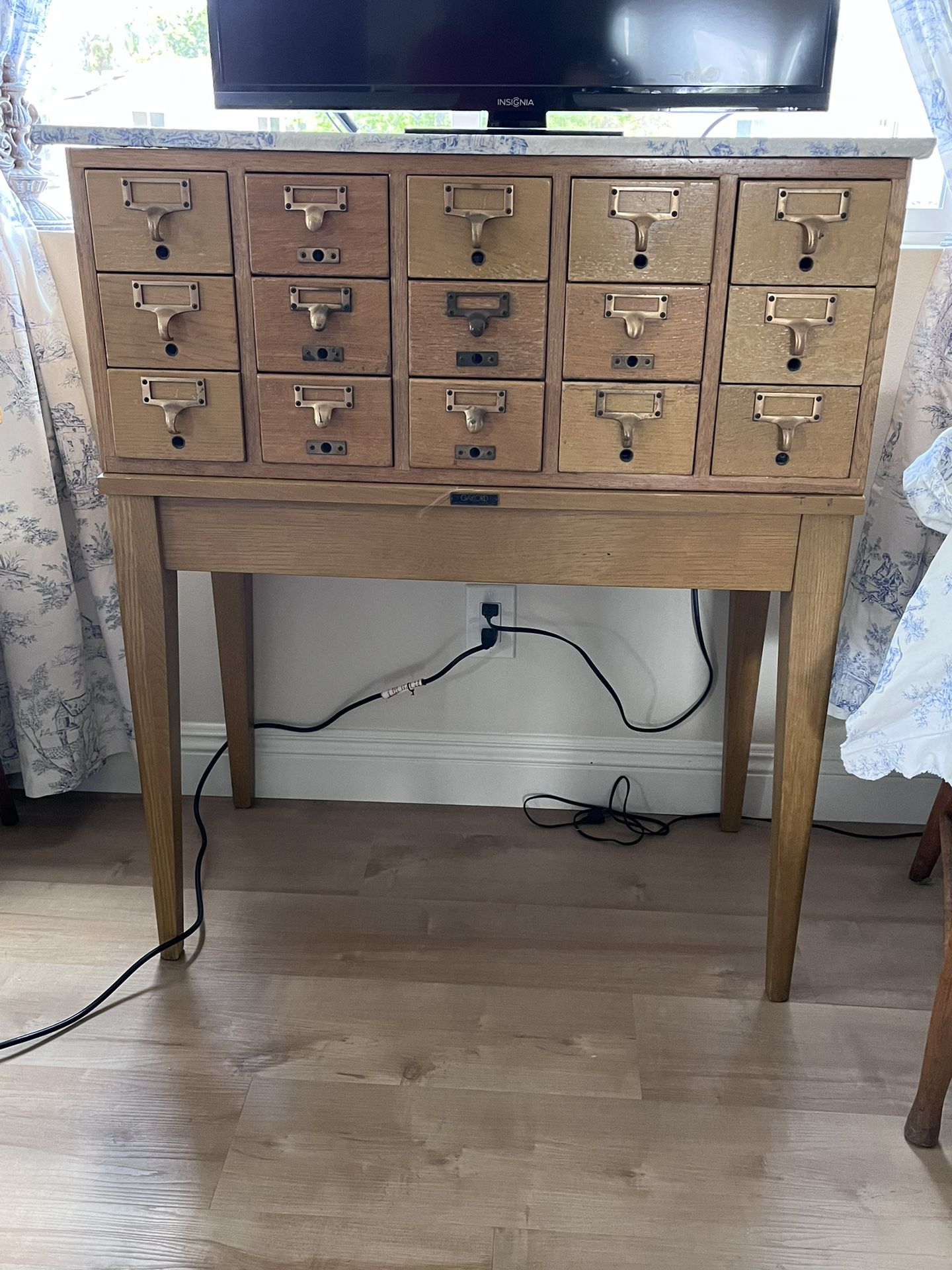
cost per drawer: $13.30
-
-
www.facebook.com www.facebook.com
-
https://www.facebook.com/marketplace/item/703509757975742/
Remington Rand Library Card Catalog Cabinet $3,500 · In stock<br /> Listed in Altadena, CA, circa May 2023
Solid unit with base containing two small cabinet compartments and two sections of 6x5 for a total of 60 drawers and three writing drawers. Rods look intact
62.5"H x 41"W x 19"D 60 drawers and large storage cabinet below. On casters/wheels! Vintage 1950-1960 from Cal Poly Library. Maple Wood Very few blemishes. All drawers with working parts, super clean. No history of any damage. I've reduced the price!
Cost per drawer: $58.33

-
-
www.reddit.com www.reddit.com
-
I don't know why I can't do Evergreen and Atomic Notes.. .t3_16r8k0b._2FCtq-QzlfuN-SwVMUZMM3 { --postTitle-VisitedLinkColor: #9b9b9b; --postTitleLink-VisitedLinkColor: #9b9b9b; --postBodyLink-VisitedLinkColor: #989898; }
reply to u/SouthernEremite at https://www.reddit.com/r/Zettelkasten/comments/16r8k0b/i_dont_know_why_i_cant_do_evergreen_and_atomic/
If you're not using your notes to create or write material and only using them as a form of sensemaking, then perhaps you don't need to put as much work or effort into the permanent notes portion of the work? Ask yourself: "Why are you taking notes? What purpose do they serve?" Is the form and level you're making them in serving those purposes? If not, work toward practicing to make those two align so that your notes are serving an actual purpose for you. Anything beyond this is make-work and you could spend your time more profitably somewhere else.
-
Watch the scale and scope of what you're doing. If you read a book and make a hundred highlights and small notes, DO NOT attempt to turn all of these into permanent notes. You might fell like that is the thing to do, but resist it. A large portion are small things or potentially useful facts that you'll likely never use again or would easily remember, particularly once you've read a whole book.
Find the much smaller subset (5-10% or less of the overall total of notes and highlights as a ballpark rule of thumb) of the most interesting and potentially long term useful ones, and turn those into your permanent notes. Anything beyond this is sure to cause overwhelm. Also don't think that your permanent notes need to be spectacular, awesome, or even bordering on "perfect". They just need to be useful enough for you.
If you own the books or keep your brief notes and highlights written down and need them in the future, you'll still have those to search/find and do something with later as a backstop just in case.
-
-
www.youtube.com www.youtube.com
-
(~6:00) Discussion of messiness as a record of working - notes don't need to be "perfect".
(9:08) He shows the wikipedia page for waste book with my additions :)
(late) quote from Georg Christoph Lichtenberg's waste books about waste books
https://www.youtube.com/watch?v=QdeOHF-fu9I
A brief overview of Newton's note taking in his waste book
-
"... I am willing to believe that history is for the most part inaccurate and biased, but what is peculair to our own age is the abandonment of the idea that history could be truthfully written."—George Orwell
check source and verify text <br /> (8:42)
-
-
-
Lichtenberg, Georg Christoph. Georg Christoph Lichtenberg: Philosophical Writings. Edited and translated by Steven Tester. SUNY Series in Contemporary Continental Philosophy, 1.0. State University of New York Press, 2012.
-
Merchants and traders have a waste book (Sudelbuch, Klitterbuch in GermanI believe) in which they enter daily everything they purchase and sell,messily, without order. From this, it is transferred to their journal, whereeverything appears more systematic, and finally to a ledger, in double entryafter the Italian manner of bookkeeping, where one settles accounts witheach man, once as debtor and then as creditor. This deserves to be imitatedby scholars. First it should be entered in a book in which I record everythingas I see it or as it is given to me in my thoughts; then it may be enteredin another book in which the material is more separated and ordered, andthe ledger might then contain, in an ordered expression, the connectionsand explanations of the material that flow from it. [46]
—Georg Christoph Lichtenberg, Notebook E, #46, 1775–1776
In this single paragraph quote Lichtenberg, using the model of Italian bookkeepers of the 18th century, broadly outlines almost all of the note taking technique suggested by Sönke Ahrens in How to Take Smart Notes. He's got writing down and keeping fleeting notes as well as literature notes. (Keeping academic references would have been commonplace by this time.) He follows up with rewriting and expanding on the original note to create additional "explanations" and even "connections" (links) to create what Ahrens describes as permanent notes or which some would call evergreen notes.
Lichtenberg's version calls for the permanent notes to be "separated and ordered" and while he may have kept them in book format himself, it's easy to see from Konrad Gessner's suggestion at the use of slips centuries before, that one could easily put their permanent notes on index cards ("separated") and then number and index or categorize them ("ordered"). The only serious missing piece of Luhmann's version of a zettelkasten then are the ideas of placing related ideas nearby each other, though the idea of creating connections between notes is immediately adjacent to this, and his numbering system, which was broadly based on the popularity of Melvil Dewey's decimal system.
It may bear noticing that John Locke's indexing system for commonplace books was suggested, originally in French in 1685, and later in English in 1706. Given it's popularity, it's not unlikely that Lichtenberg would have been aware of it.
Given Lichtenberg's very popular waste books were known to have influenced Leo Tolstoy, Albert Einstein, Andre Breton, Friedrich Nietzsche, and Ludwig Wittgenstein. (Reference: Lichtenberg, Georg Christoph (2000). The Waste Books. New York: New York Review Books Classics. ISBN 978-0940322509.) It would not be hard to imagine that Niklas Luhmann would have also been aware of them.
Open questions: <br /> - did Lichtenberg number the entries in his own waste books? This would be early evidence toward the practice of numbering notes for future reference. Based on this text, it's obvious that the editor numbered the translated notes for this edition, were they Lichtenberg's numbering? - Is there evidence that Lichtenberg knew of Locke's indexing system? Did his waste books have an index?
Tags
- numbering systems
- waste books
- accounting influence on note taking
- philosophy
- fleeting notes
- zettelkasten numbering
- Niklas Luhmann's zettelkasten
- academic writing
- Dewey Decimal System
- Steven Tester
- note taking advice
- idea links
- quotes
- intellectual history
- open questions
- Georg Christoph Lichtenberg
- John Locke
- zettelkasten transmission
- references
- Sönke Ahrens
- Konrad Gessner
Annotators
-
-
www.reddit.com www.reddit.com
-
I wonder what you think of a distinction between the more traditional 'scholar's box', and the proto-databases that were used to write dictionaries and then for projects such as the Mundaneum. I can't help feeling there's a significant difference between a collection of notes meant for a single person, and a collection meant to be used collaboratively. But not sure exactly how to characterize this difference. Seems to me that there's a tradition that ended up with the word processor, and another one that ended up with the database. I feel that the word processor, unlike the database, was a dead end.
reply to u/atomicnotes at https://www.reddit.com/r/Zettelkasten/comments/16njtfx/comment/k1tuc9c/?utm_source=reddit&utm_medium=web2x&context=3
u/atomicnotes, this is an excellent question. (Though I'd still like to come to terms with people who don't think it acts as a knowledge management system, there's obviously something I'm missing.)
Some of your distinction comes down to how one is using their zettelkasten and what sorts of questions are being asked of it. One of the earliest descriptions I've seen that begins to get at the difference is the description by Beatrice Webb of her notes (appendix C) in My Apprenticeship. As she describes what she's doing, I get the feeling that she's taking the same broad sort of notes we're all used to, but it's obvious from her discussion that she's also using her slips as a traditional database, but is lacking modern vocabulary to describe it as such.
Early efforts like the OED, TLL, the Wb, and even Gertrud Bauer's Coptic linguistic zettelkasten of the late 1970s were narrow enough in scope and data collected to make them almost dead simple to define, organize and use as databases on paper. Of course how they were used to compile their ultimate reference books was a bit more complex in form than the basic data from which they stemmed.
The Mundaneum had a much more complex flavor because it required a standardized system for everyone to work in concert against much more freeform as well as more complex forms of collected data and still be able to search for the answers to specific questions. While still somewhat database flavored, it was dramatically different from the others because of it scope and the much broader sorts of questions one could ask of it. I think that if you ask yourself what sorts of affordances you get from the two different groups (databases and word processors (or even their typewriter precursors) you find even more answers.
Typewriters and word processors allowed one to get words down on paper quicker by a magnitude of order or two faster, and in combination with reproduction equipment, made it easier to spin off copies of the document for small scale and local mass distribution a lot easier. They do allow a few affordances like higher readability (compared with less standardized and slower handwriting), quick search (at least in the digital era), and moving pieces of text around (also in digital). Much beyond this, they aren't tremendously helpful as a composition tool. As a thinking tool, typewriters and word processors aren't significantly better than their analog predecessors, so you don't gain a huge amount of leverage by using them.
On the other hand, databases and their spreadsheet brethren offer a lot more, particularly in digital realms. Data collection and collation become much easier. One can also form a massive variety of queries on such collected data, not to mention making calculations on those data or subjecting them to statistical analyses. Searching, sorting, and making direct comparisons also become far easier and quicker to do once you've amassed the data you need. Here again, Beatrice Webb's early experience and descriptions are very helpful as are Hollerinth's early work with punch cards and census data and the speed with which the results could be used.
Now if you compare the affordances by each of these in the digital era and plot their shifts against increasing computer processing power, you'll see that the value of the word processor stays relatively flat while the database shows much more significant movement.
Surely there is a lot more at play, particularly at scale and when taking network effects into account, but perhaps this quick sketch may explain to you a bit of the difference you've described.
Another difference you may be seeing/feeling is that of contextualization. Databases usually have much smaller and more discrete amounts of data cross-indexed (for example: a subject's name versus weight with a value in pounds or kilograms.) As a result the amount of context required to use them is dramatically lower compared to the sorts of data you might keep in an average atomic/evergreen note, which may need to be more heavily recontextualized for you when you need to use it in conjunction with other similar notes which may also need you to recontextualize them and then use them against or with one another.
Some of this is why the cards in the Thesaurus Linguae Latinae are easier to use and understand out of the box (presuming you know Latin) than those you might find in the Mundaneum. They'll also be far easier to use than a stranger's notes which will require even larger contextualization for you, especially when you haven't spent the time scaffolding the related and often unstated knowledge around them. This is why others' zettelkasten will be more difficult (but not wholly impossible) for a stranger to use. You might apply the analogy of context gaps between children and adults for a typical Disney animated movie to the situation. If you're using someone else's zettelkasten, you'll potentially be able to follow a base level story the way a child would view a Disney cartoon. Compare this to the zettelkasten's creator who will not only see that same story, but will have a much higher level of associative memory at play to see and understand a huge level of in-jokes, cultural references, and other associations that an adult watching the Disney movie will understand that the child would completely miss.
I'm curious to hear your thoughts on how this all plays out for your way of conceptualizing it.
-
I mean, just what I said. If you adapt the zettelkasten to meet knowledge management needs, that’s great. But it does need adapting (as your examples, none of which are conversation-partner zettelkästen but, as syntopicon implies, a collection of information gathered into categories) and is not the best way to do it. (Edit: Ryan Holiday’s system is, by his own admission, not a zettelkästen despite being a bunch of cards with notes on them categorized in a box). Even the source you use about Goitein admits that he was more in the commonplace book tradition, and that other people’s use of his cards is not common to the point of being remarked on here. He doesn’t even call it a zettelkästen, and shouldn’t. There’s not even links or reference numbers, which are integral to the ZK system.It’s not an argument. But as with everything ymmv.(For what it’s worth, my ZK is extremely specific to my individual projects and readings. But I imagine that yes, with time and heavy adaptations, you can make it into little more than a record of my knowledge into broad topics. That you can use it that way does not mean that’s what it is for.)
reply to u/glugolly at https://www.reddit.com/r/Zettelkasten/comments/16njtfx/comment/k1l8lyk/?utm_source=reddit&utm_medium=web2x&context=3
How is it that you're defining knowledge management or knowledge management system?
I would argue that any zettelkasten of any stripe is taking knowledge/ideas from either content or one's own brain and transferring them into some sort of media by which they are managed or structured in some way for later linking, combination, or other reuse. By base definition this is clearly knowledge management. I don't know how one defines it otherwise except by pure denial.
Your view of zettelkasten seems remarkably narrow. As a small sample the original Maschinen der Phantasie Marbach exhibition in 2013, which broadly prefigured the popularization of zettelkasten (and in particular the launch of zettelkasten.de) which we see today featured six zettelkasten of which Luhmann's was the only one with reference numbers or what we might now consider explicit HTML-like links. Most of the others contained either explicit groupings or implied links, but that doesn't diminish the value they held for their creators for creating a conversation of ideas for them. Incidentally most of the zettelkasten featured there prefigured Luhmann's and only two were roughly contemporaneous with his.
If you look more closely at Adler, et al. you'll notice that the entire purpose of their enterprise was to create and nurture a conversation between themselves and their readers with texts and authors spanning over 2,500 years, a point which is underlined by the introductory volume which preceded the two volumes of the Syntopicon. Not coincidentally, that first volume of the 54 book series was entitled "The Great Conversation."
Specifically from Adler's "How to Read a Book", the first edition of which predated the Great Books of the Western World:
Reading a book should be a conversation between you and the author.
This is a process which is effectuated by
Marking a book is literally an expression of your differences or your agreements with the author. It is the highest respect you can pay him.
and later,
That is to make notes about the shape of the discussion-the discussion that is engaged in by all of the authors, even if unbeknownst to them. For reasons that will become clear in Part Four, we prefer to call such notes dialectical.
(As an aside, why aren't more people talking about the nature of dialectical notes, which seem far more important and useful than either fleeting notes and permanent notes?)
In your link to Holiday, he doesn't say his system isn't a zettelkasten, a word which an English speaker was highly unlikely to have used in 2013 in any case, even when referencing Manfred Kuehn from 2007. It simply indicates that "[Luhmann's] discipline seems to exceed mine because I am a lot less ordered".
The Goitein source (which I wrote) may use commonplace book as a descriptor but that doesn't mitigate the fact that the entirety of the zettelkasten tradition arises from it (the primary difference being things written (usually) on bound pages versus slips of paper). Before these there was the closely related idea of florilegia stemming from the earlier locus communis (Latin) and tópos koinós (Greek).
-
Well one obvious drawback is that zettelkästen is not a knowledge management system.
reply to u/glugolly at https://www.reddit.com/r/Zettelkasten/comments/16njtfx/comment/k1fn8w4/?utm_source=reddit&utm_medium=web2x&context=3 and
Well, Zettelkasten is not a knowledge management system. [...] Update: I mean digital ZK. Shoe-box ZK is a combination of knowledge management system of that time and "thought system" of Niklas Luhmann. u/Aponogetone at https://www.reddit.com/r/Zettelkasten/comments/16njtfx/comment/k1f23nj/?utm_source=reddit&utm_medium=web2x&context=3
I'm curious to see some evidence for why both you and u/Aponogetone say that a slip box (analog, digital or otherwise) is not a knowledge management system? Perhaps you don't think of it that way or use it solely to that end, but I find it difficult to see in light of the way I use mine and others have in the past. I suspect that if I had access to either of yours I could use it as a knowledge management system and it would tell me a lot about your interests and what you know and with a bit of work I could continue using it as one.
Even an argument against the more encompassing group nature versus personal or individual knowledge management systems is blunted by the use of a Zettelkasten by Adler, Hutchins, et al. to create the Syntopicon, the group uses by the Mundaneum effort (which went to great lengths to standardize information to be findable), the Oxford English Dictionary compilation, Thesaurus Linguae Latinae (TLL), Wörterbuch der ägyptischen Sprache, or even the academics who still use photocopies or microfilm versions of S.D. Goitein's zettelkasten.
What are the rest of us missing in your argument?
-
But I’m increasingly inclined to the view that the genius of ZK is the simple fact that it forces its user to continually interact with, and create connections among their thoughts and the thoughts of others.To the extent that’s correct, the work that ZK demands is not a drawback at all. It is in fact ZKs primary benefit; it’s a serious feature and not at all a bug.
reply to u/TeeMcBee and u/taurusnoises at https://www.reddit.com/r/Zettelkasten/comments/16njtfx/comment/k1ic0ot/?utm_source=reddit&utm_medium=web2x&context=3
And two more big yeses.
There is a growing amount of literature in the educational social annotation space in which teachers/professors are using it specifically to encourage their students to interact with class material and readings. The mechanics on the front end are exactly the same as in most ZK set ups, the difference is what happens with the annotations one makes.
An entry point into some of this research:
Tags
- Ryan Holiday
- bibliographies
- databases
- typewriters
- zettelkasten as database
- knowledge management
- zettelkasten
- personal knowledge management
- word processors
- Manfred Kuehn
- commonplace books vs. zettelkasten
- affordances
- zettelkasten affordances
- definitions
- contextualization
- social annotation
- reply
- collaborative zettelkasten
Annotators
URL
-
-
notsubrand.com notsubrand.com
-
Notsu has a variety of 3 x 5" index card products for productivity and planning.
-
-
www.kickstarter.com www.kickstarter.com
-
Jeff Sheldon is the founder and designer of Ugmonk, a brand focused on creating high quality, well-designed products. What started as a small side project in 2008 to create and sell simple t-shirts has grown into a full-blown lifestyle brand which Jeff now runs full time.
-
-
web.archive.org web.archive.org
-
I should perhaps also note that I try, whenever possible, not to collect raw quotes or information simply copied from the Internet or from books, but to write excerpts or summaries in my own words on the basis of my reading. Luhmann called this "reformulating writing" and argued that such an approach is most important for one's own intellectual life.
Quote for "reformulating writing"? Date? Does it predate the so-called Feynman technique?
-
-
www.theguardian.com www.theguardian.com
-
www.prospectmagazine.co.uk www.prospectmagazine.co.uk
-
cathieleblanc.com cathieleblanc.com
-
What a lovely example of H5P! I keep my eye open for them floating around in the wild, but don't often see them.
It reminds me of a 1906 advertisement I ran into earlier this year. I should have thought to make my own H5P out of it. https://boffosocko.com/2023/03/09/satelite-combination-card-index-cabinet-and-telephone-stand/
-
https://cathieleblanc.com/2023/09/22/student-work-in-media-and-cultural-studies/
-
-
saragoldrickrab.com saragoldrickrab.com
-
www.gaylord.com www.gaylord.com
-
In 1896, they invented a simple mending tape to fix torn currency, but it soon became a hit with librarians for mending books. Gaylord Bros. became a purveyor of supplies to libraries across the country.
-
-
www.libraryhistorybuff.org www.libraryhistorybuff.org
-
danallosso.substack.com danallosso.substack.com
-
takingnotenow.blogspot.com takingnotenow.blogspot.com
-
There are no privileged places in the note-card system, every card is as important as every other card, and no hierarchy is super-imposed on the system. The significance of each card depends on its relation to other cards (or the relation of other cards to it). It is a network; it is not "arboretic." Accordingly, it in some ways anticipates hypertext and the internet.
Niklas Luhmann's zettelkasten system doesn't impose a heirarchy upon it's contents and in some ways its structure anticipates the ideas of hypertext and the internet's structure.
Also similar to the idea from Umberto Eco: https://hypothes.is/a/jqug2tNlEeyg2JfEczmepw
-
Luhmann also described his system as his secondary memory (Zweitgedächtnis), alter ego, or his reading memory or (Lesegedächtnis).
Zweitgedächtnis, the German Word for secondary memory, might also have been translated as "second brain" and thus the root of this word in the note taking space.
ref: https://hyp.is/hV9LKm71Eeq9s_f_oWRkEg/takingnotenow.blogspot.com/2007/12/luhmanns-zettelkasten.html
Originally 2021-12-31 at https://hypothes.is/a/3tjzWGqjEeyDSae3OLOEWw
-
-
thoughtcatalog.com thoughtcatalog.com
-
It looks like the system is also very similar to Luhmann’s Zettelkasten. Though again, his discipline seems to exceed mine because I am a lot less ordered.
Fascinating to see Ryan Holiday referencing Manfred Kuehn blogposts from 2007 here.
Specifically it was a link to http://takingnotenow.blogspot.com/2007/12/luhmanns-zettelkasten.html
Given the popularity of this original Thought Catalog post and the alternate which appeared on Holiday's site, this reference would likely have helped to push the popularity of Luhmann and his Zettelkasten in English speaking territories after 2013-12-23.
-
This was the original post which Holiday copied to his own site at: https://ryanholiday.net/the-notecard-system-the-key-for-remembering-organizing-and-using-everything-you-read/
Cross reference notes there.
-
-
ryanholiday.net ryanholiday.net
-
The colors represent categories, you are correct. So, for instance, with the War book, blue cards would be about politics, yellow strictly war, green the arts and entertainment, pink cards on strategy, etc. I could use this in several ways. I could glance at the cards for one chapter and see no blue or green cards and realize a problem. I could also take out all the cards of one color to see which story I liked best, etc. It also made the shoebox look pretty cool.
Robert Greene used a color code for his index cards which also helped him to realize gaps in certain areas. He also liked them because "It also made the shoebox look pretty cool."
-
According to his biographer, Michael Keene, General Patton used to use a similar system: “He read every treatise on warfare ever written. He would take copious notes on 4-by-6 index cards for every book that he ever read. It was that immense knowledge of history that he had that he could bring to battle. So he could almost anticipate what the enemy was going to do next.”
via SAMUEL MORNINGSTAR comment on August 14, 2014 at 5:22 pm
According to Patton: Blood, Guts, and Prayer by Michael Keene, General George Patton used a 4x6" index card system for note taking.
-
I was searching for notecard systems after reading Will and Ariel Durant’s dual autobiography and not having much luck. The book talks a lot about his writing and the use of “classification slips” to cover the depth of material, especially for The Story of Civilization series they did.
via SAM on January 15, 2017 at 8:54 pm
Apparently Will Durant and Ariel Durant used a form of commonplace book set up in which they used "classification slips".
-
-It looks like the system is also very similar to Luhmann’s Zettelkasten
Ryan Holiday's system puts some of the work farther from the note taking origin compared with Nicholas Luhmann's system which places more of it up front.
How, if at all, do the payoffs from doing each of these vary for the end user of the system?
-
-
bobdoto.computer bobdoto.computer
-
Doto, Bob. “Folgezettel Mechanics.” Bobdoto.Computer (blog), March 1, 2022. https://bobdoto.computer/folgezettel-mechanics.
-
For note makers who find themselves creating an unwieldy amount of so-called "orphan notes," the folgezettel sounds the alarm. When faced with a sea of parents without children (9A 9B 9C 9D 9E, etc) it makes these "empty nesters" all the more apparent as the note gets added to the stack.
There's an interesting dichotomy which seems to be arising here. It's almost as if he's defining a folgezettel note in opposition to orphaned notes, most often seen in digital settings when importing lots of "stuff" but which Doto indicates can happen in analog systems as well.
Orphaned notes in an analog space, however are still linked by proximity even though they're not as densely linked (even from a mathematical topology perspective.)
-
It's the kind of friction needed to help note takers who tend to drown in capture bloat—always onboarding, never offloading.
-
"Using the Folgezettel to capture some connections and hope that their nature will reveal themselves later on is just another form of Collector’s Fallacy." I can tell you for a fact that, in my experience, the above quote is fundamentally false. I often find myself doing exactly what's expressed here—using the folgezettel to capture "some connections" in order to get the note-making process started—and am consistently rewarded having done so.
Strong agree with Bob here.
Quite often collecting can create huge value in slowly building a substrate for serendipity to do its work. Some of the key to overcoming this is in the affordances of one's system to find or discover these tidbits in one's collection.
-
Whether or not a note maker increases their knowledge "sufficiently" at the time of import or at the time of writing longer works, is a moot point. So long as it happens.
"So long as it happens." And here lies the rub: when will you put in the work to make the note useful and actionable? Will it be now or later?
Some notes are certainly more mission critical than others. Some work towards one's life's work while others are tidbits which may be useful at a later time. Distinguishing along this spectrum isn't always easy, particular in build a bottom up view of one's research.
-
folgezettel pushes the note maker toward making at least one connection at the time of import.
There is a difference between the sorts of links one might make when placing an idea into an (analog) zettelkasten. A folgezettel link is more valuable than a simple tag/category link because it places an idea into a more specific neighborhood than any handful of tags. This is one of the benefits of a Luhmann-artig ZK system over a more traditional commonplace one, particularly when the work is done up front instead of being punted to a later time.
For those with a 1A2B3Z linking system (versus a pure decimal system), it may be more difficult to insert a card before other cards rather than after them because of the potential gymnastics of numbering and the natural tendency to put things into a continuing linear order.
See also: - https://hypothes.is/a/ToqCPq1bEe2Q0b88j4whwQ - https://hyp.is/WtB2AqmlEe2wvCsB5ZyL5A/docdrop.org/download_annotation_doc/Introduction-to-Luhmanns-Zette---Ludecke-Daniel-h4nh8.pdf
Tags
- capture bloat
- educational substrates
- folgezettel
- eufriction
- note taking affordances
- work timing
- scaling problem of categorization
- commonplace books vs. zettelkasten
- idea links
- read
- serendipity
- topology of zettelkasten
- zettelkasten affordances
- bottom-up vs. top-down
- references
- folgezettel notes
- collector's fallacy
- categorization
- information overload
- types of notes
- orphaned notes
- note taking topologies
Annotators
URL
-
-
www.ebay.com www.ebay.com
-
https://www.ebay.com/itm/325821466702
Gaylord Bros. library card catalog offered on 2023-09-21 for $4,995.00 from South Bend, IN.
60 Drawer modular cabinet with four sections of 5x3 drawers and two separate sections of two pull out writing drawers (for a total of four). Appears to be in good condition, made with internal plastic drawer/trays. Lilely from 60s/70s or later.

Cost per drawer: $83.25
Tags
Annotators
URL
-
-
luhmann.surge.sh luhmann.surge.sh
-
We should only write on one side of these papers so that in searching through them, we do not have to take out a paper in order to read it. This doubles the space, but not entirely (since we would not write on both sides of all the slips). This consideration is not unimportant as the arrangement of boxes can, after some decades, become so large that it cannot be easily be used from one’s chair. In order to counteract this tendency, I recommend taking normal paper and not card stock.
-
