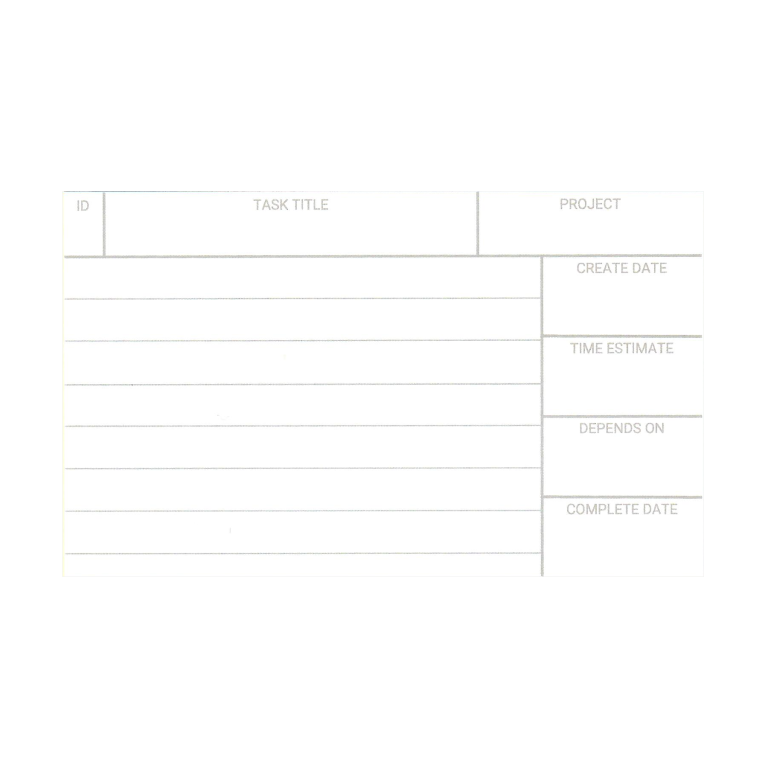
https://www.flickr.com/photos/68103485@N05/
Examples like: <br />

https://www.flickr.com/photos/68103485@N05/
Examples like: <br />
Typewriter on a library card catalog table:
 <br />
—via Suzanne Summers LaPierre, librarian at https://www.facebook.com/photo.php?fbid=10235010364136282&set=p.10235010364136282&type=3
<br />
—via Suzanne Summers LaPierre, librarian at https://www.facebook.com/photo.php?fbid=10235010364136282&set=p.10235010364136282&type=3
Productivity Planner® Cards - Be More Productive<br /> by [[Intelligent Change]]<br /> accessed on 2026-08-28T10:25:07
Productivity cards with inspirational quotes...
https://ugmonk.com/collections/accessories-1/products/small-analog-card-sleeves-set-of-6-earth-tones
Ugmonk selling index card dividers (as "analog card sleeves") as a set of 6 for $12. They're fun colors but don't actually have tabs. They also function more as sleeves or folders for notes, but it's not immediately obvious how many cards they'd hold.
The sharpest increases include lunch boxes (26.8 percent), notebooks (23 percent), index cards (22.2 percent), notebook paper (20 percent), and tissues (20 percent).
As Students Head Back to School, Families Face 11% Price Hikes<br /> by [[Elizabeth Pancotti]], [[Zoe Butler]], [[Natalie Forman]], [[Janelle Jones]]<br /> accessed on 2026-08-12T14:37:28
2025 price: $3.16<br /> 2026 price: $3.86<br /> Increase 22.2%
Structure should be earned. Start with enough organization and meta components to allow you to start working. Only the bare minimum. Add more only as needed.
via Bob Doto, but ne doesn't cite the original source... https://www.reddit.com/r/Zettelkasten/comments/1vlh6ru/organizing_for_the_sake_of_organizing/
Freeman, Michael Stuart. 1991. “Pen, Ink, Keys, and Cards: Some Reflections on Library Technology.” College and Research Libraries 52(4): 328–35. https://hdl.handle.net/2142/41489 (July 26, 2026).
The card catalog was one of those li-brary inventions that greatly helped in-dividual libraries, but it did so at theexpense of library cooperation.
Baker, Nicholson. 1994. “Discards.” The New Yorker 70(7): 64. https://www.newyorker.com/magazine/1994/04/04/discards (August 6, 2021).
looking at these expressive dirt bands
dirt bands in library card catalogs, similar to dirt and wear marks on the fore edges of books gives some evidence of use
this can be useful research, but it has silently disappeared over time due to lack of archiving materials like card catalogs
some of these issues also pop up with digitizing physical books and throwing them away... we lose the information about how they were bound, how they might have been used, all the physicality is gone
Fifty drawers compose it. They are made of blond wood. Pull out one of the C drawers, the one labelled “Catalogs.” Here are several guide cards: one for “Catalogs,” one for “Censorship,” one for “Children’s Literature.” Before you have read or touched a single card, you have learned something important about the library-school library, and even possibly about librarianship in general: the edges of the cards following the guide cards for “Censorship” and “Children’s Literature” are dark with handling, whereas the ones following “Catalogs” are not. Thus “Censorship” and “Children’s Literature” have over the years been of more interest to library-school students than “Catalogs” has. This is a surprise—at least, it was a surprise to me. Maybe it’s one reason we’re in this pickle.
wear on library card catalog cards as an indicator of use
a similar thing can be found in one's personal note cards and has been noticed in Niklas Luhmann's zettelkasten
But for the time being, if some afternoon, depressed by thoughts of cardnage now in progress, you were to travel to the stacks of the library-school library, you could restore your good spirits by contemplating an unharmed, unshrunk, fully operational (though frozen) subject catalogue.
“Studies of online catalog use and users have uncovered a pair of problems that seem to be endemic in today’s online catalog systems,” Ray Larson, a professor at Berkeley’s library school (or, as it is now called, the School of Information Management and Systems), wrote conclusively in 1991:These are: (1) a large percentage of subject searches fail to retrieve any bibliographic records; and (2) when subject searches succeed in retrieving records, they often retrieve too much material for the user to evaluate effectively.Larson cites an earlier study of his own in which he found that the average number of on-line records retrieved in his sample was 77.5, whereas the average number that users actually took a look at was 9.1. The “futility point” in on-line searches—the point at which you give up and go with what you have—is, because of screen fatigue and the lethargy of system response, much lower than in card-catalogue searches. The life of the mind suffers as a result.
This sort of search fatigue still persists in 2026 as most online searches don't go past the first page of results.
Subject searches are obvious confessions of ignorance; author-title searches aren’t, or aren’t so straightforwardly.
Is it the case that subject searches are more interesting for syntopic work than other forms of generic reading?
In a study of some fourth, sixth, and eighth graders carried out at the Downers Grove Public Library, in Illinois, Leslie Edmonds found that sixty-five per cent of the kids’ card-catalogue searches were successful, versus only eighteen per cent of their on-line searches. No fourth graders used the on-line catalogue successfully. (They were asked to look up things like “Fire Stations,” “Insects—Poetry,” “Octopus Pie,” and “The Curse of the Blue Figurine.”)
By studying Haverford’s card catalogue, Michael Stuart Freeman, Librarian of Haverford College, was able to determine when his predecessors deployed their first typewriter (it was during the summer of 1916)—a tiny fact, perhaps, but one of sufficient interest to Freeman that he published a brief paper which discussed the history of typewriters in libraries. Freeman kept several handwritten cards as samples (“I save a few, because I’m a sentimentalist,” he confided to me); but once his own passing curiosity was satisfied, he dumped the rest of his catalogue.
Berkeley’s subject catalogue is already gone. Though it was more or less frozen in the nineteen-eighties, it was nonetheless very efficient for some kinds of searches: if the primary sources in your field were published in the eighteenth and nineteenth centuries, you don’t want your retrievals spread among the thousands of irrelevant records that a mechanical database subject haul brings up. Any drawer of an out-of-date paper catalogue represents the equivalent of a filtered computer search, a Boolean date-limited search, of a very sophisticated sort—in fact, one drawer represents the outcome of a kind of search that most on-line catalogues can’t and won’t ever be able to perform, since it offers clues to what books were in the library during different eras. If in seventy years a historian of science (say) wants to know whether some Nobel-laureate physics professor could possibly have seen and been influenced by a certain out-of-the-way Dutch mathematical monograph from the thirties which bears important similarities to his work—whether, that is, it was part of the library’s collection during the period when the professor was developing his ideas or was acquired only after the professor’s papers were published (perhaps acquired by the library as a gift from the professor’s estate, in fact, because the professor was sent the monograph by the Dutchman himself, anxious to establish primacy)—the historian of science will have little chance of finding an answer to his question now, because the computer record will bear the (to him) meaningless date of the retrospective conversion of the card, i.e., sometime in the late eighties or early nineties, which has no relation to the time that the card was originally produced (and the book placed on the shelf), whereas the original card, even if it bore no direct date of creation, would have exhibited distinct features (typewriter style, format, cataloguing conventions) that might have enabled a cataloguecard paleographer to place it within a five-year Period.
interesting research example of a search not enabled by a digital card catalog
I have no doubt that Dale Flecker believed what he was saying when he told me that “the machine catalogue is in almost no cases worse and in most cases better than the card catalogue was.”
“The card catalogue,” as Tom Delsey, of the National Library of Canada, wrote in 1989, “exhibited a relatively high tolerance for deviation from literal and logical norms. . . . Typographical errors or inconsistencies in headings could be silently corrected in the process of filing the card; added entries that did not match exactly the corresponding main entry on the card to which they were related could nevertheless be placed in their proper sequence in the file.”
the benefits of the actual filing process can subtly correct for errors in categorizing
A shelf list is a card catalogue arranged in call-number order, cataloguers use it to help them shelve like books with like.
Charles Ammi Cutter (1837-1903), the author of what is in Mr. Ranz’s opinion the finest library catalogue ever made. Cutter’s masterpiece is the five-volume catalogue of the Boston Atheneum, published between 1874 and 1882. “I’m not sure he wasn’t the greatest cataloguer that lived,” Mr. Ranz told me. The work is three thousand four hundred and two pages long, and is elaborately and commonsensically cross-referenced; it cost the Athenaeum almost a hundred thousand dollars to produce. It is still of interest and utility to historians—as is the card catalogue for the Athenaeum, which Cutter also developed.
Jim Ranz, retired Dean of the Libraries of the University of Kansas, from whose immortal monograph “The Printed Book Catalogue in American Libraries: 1723-1900” (1964)
In 1848, Antonio Panizzi, Keeper of Printed Books for the British Museum, had a similar notion:By an alphabetical catalogue it is understood that the titles be entered in it under some “headings” alphabetically arranged. Now, inasmuch as in a large. library no one can know beforehand the j uxtaposition of these headings, and it would beimpossible to arrange them in the requisite order, if they cannot be easily shifted, each title is therefore written on separate “slips” of paper . . . which are frequently changed from one place to another as required. It is selfevident that if these “slips . . . be not uniform, both in size or substance, their arrangement will cause mechanical difficulties which take time and trouble to overcome.
but they left their own beloved manuscript unclassified and undescribed, and thus it never attained the status of a holding, which it so obviously deserved, and was instead tacitly understood to be merely a “finding aid,” a piece of furniture, wholly vulnerable to passing predators, subject to janitorial, rather than curatorial, juris diction—even though this catalogue was, in truth, the one holding that people who entered the building would be likely to have in common, to know how to use from childhood, even to love.
Their card catalogue was nowhere mentioned in their card catalogue.
Would it be stretching things too much, you suddenly wonder, to call your Rolodex a form of autobiography—a manuscript that you have been writing these fifteen years, tinkering with, revising? Perhaps it is the only manuscript you will ever write.
are in many cases stripped of whole classes of specific historical information (e.g., the original price of the book, its acquisition date, its original cataloguing date, its accession number, the original cataloguer’s own initials, the record of any copies that have been withdrawn, and whether it was a gift or a purchase)
data lost from card catalogs when they were digitized
And on-line catalogues, despite their neolithic screen displays and excruciatingly slow retrieval rates, offer many amenities. They do not grow mold, as the card catalogue of the Engineering Library of the University of Toronto once did, following water damage. And they are harder to vandalize. Radical students destroyed roughly a hundred thousand cards from the catalogue at the University of Illinois in the sixties. Berkeley’s library staff was told to keep watch over the university’s card catalogues during the antiwar turmoil there. Someone reportedly poured ink on the Henry Cabot Lodge cards at Stanford. The huge frozen card catalogue of the Library of Congress currently suffers from alarming levels of public trauma: like the movie trope in which the pri vate eye tears a page from a phone book at a public phone rather than bothering to copy down an address and a phone number, library visitors—the heedless, the crazy—have, especially since the late eighties, been increasingly capable of tearing out the card referring to a book they want. Indeed, one of the reasons that the New York Public Library had to close its public catalogue was that the public was destroying it. The Hetty Green cards disappeared. Someone calling himself “Cosmos” was periodically making off with all the cards for “Mein Kampf.” Cards for two Dante manuscripts were stolen: not the manuscripts, the cards for the manuscripts. Card catalogues constitute vandalizable entities because they are expressive of needful social trust and communal achievement, as are other common targets, such as subway cars, railroad bridges, mailboxes, and traffic signs. To the extent that a duster of computer terminals linked to an online catalogue protects a room full of older card cabinets by marginalizing them, they are performing a great service.
A nice long list of card catalog cards being destroyed, damaged, or stolen!
Even at the beginning of this century, a writer for the Boston Evening Transcript could playfully fret about the unwieldiness of card catalogues:As these cabinets of drawers increase in number until it seems as if the old joke about the catalogues of the Boston Public Library and Harvard University meeting on Harvard Bridge might become literally true, the mental distress and physical exhaustion suffered by those consulting one of them becomes too important to be disregarded.
Not too dissimilar to Anatole France's Penguin Island (1908)...
What was the exact year of this quote w.r.t. France? Could it have inspired him?
collection that is growing, as some currently are, at a rate of five hundred items a day.
Some libraries were growing at a rate of five hundred items a day.
Source?
N-LINE catalogues are wonderful things in principle—things of efficacy, and even, occasionally (as in the case of O.C.L.C.’s Online Union Catalog), of grandeur. As a result of the publicly financed expansion of higher education in the sixties, and the boom in academic publishing that followed it, the holdings of the typical university library have doubled over the last twenty years. Without on-line catalogues, and the circulation and acquisition modules of software with which on-line catalogues are linked, libraries would simply not have been able to process all the books and journals that were arriving on their loading docks. By the early seventies, there was an ominous arrearage of uncatalogued material waiting on herds of rolling carts near the overtaxed cataloguing departments of most large libraries. Cataloguing had reached a state of crisis similar to the one that forced the financial markets to close early during some of the high-volume weeks of 1969, when Wall Street’s paper-based methods of order processing couldn’t keep up with each day’s orders to buy and sell stock. Computerized stock-execution saved Wall Street (and made program trading and Brack Monday possible, too), and computerized cataloguing procedures saved libraries.
”Library hand” was a special kind of backward-slanting penmanship meant specifically for card catalogues, and taught in library school through the nineteen-twenties.
An image of the front of every card for Widener thus now exists on microfiche, available to users in a room off the lobby. (Any information on the backs of the cards—and many notes do carry over—was not photographed.)
The RETROCON business is good right now. When I visited O.C.L.C. in September, there were three shifts of sixty operators each, plowing through RETROCONs for about forty different libraries, including, besides Harvard, the Los Angeles Public Library, a consortium of French libraries, Hughes Aircraft, Brown, Queen’s University of Belfast, Northwestern, the library at Kew Gardens, the Cincinnati Public Library, the San Francisco Public Library, and Waseda University in Japan.
As an added publicity flourish during the Great Discard the Maryland Health Sciences Library published a commemorative chapbook called “101 Uses for a Dead Catalogue Card.”
The New York Public Library, ahead of the game, renovated the entire ten-million-card catalogue of its Research Libraries between 1977 and 1980, microfilmed it, and threw it out.
as universities and public libraries have completed the “retrospective conversions” of their catalogues to computer databases (frequently with the help of federal Title II-C money, as part of the “Strengthening Research Library Resources” program)
Tip: of the 3 things WD-40 is actually useful for on a typewriter, one is cleaning and giving a nice sheen to crinkle paint safely. Apply lightly on a clean rag. The other two are cleaning white-out off plastic card guide without fogging the plastic, and removing the calcified masking tape often found on SCM portables.
via Ted Munk as a comment on a YouTube video
Felger, A. H. 1902. “A Plan for Recording in a Condensed Form the Life-History Notes of Birds.” The Auk 19(2): 189–95. doi:10.2307/4069312.
Felger, A. H. 1907. “A Card System of Note-Keeping.” The Auk 24(2): 200–205. doi:10.2307/4070853.
Ornithologist A. H. Felger describes the use and form of a custom card index system for creating a paper database of data for tracking and counting birds.
In particular he recommends it over prior uses of journaling methods. He suggests the ability to look at multiple cards in a row to be able to more easily extract usable data versus those older journaling methods.
The system is self indexing.
In running overa hundred cards on a certain species that one is studying it is avery simple matter by reference to the 'barred cards' to selectthose that contain notes on 'mating,' 'nest-building,' or the like.(3) If the cards on any given species are arranged chronologic-ally in a horizontal row, one will have in line before him forvery easy study all the notes with reference to any desired phaseof the bird's life history
Felger broad describes how to use index cards to create a paper database for ornithology.
By the use of theseprinted forms no note indicated thereon that should be recordedis ever forgotten, as is lamentably the case when the diary systemis employed
Pre-formatted index cards used in creating a database help one not to forget any of the desired data to be collected in a project.
o indicate the positions ofgenera I use colored 'j guide cards' containing the generic nameTo indicate the positions of species within each genus I use differ-ently colored ' guide cards' containing the specific names.To indicate the positions of the subspecies I use cards of still difent color.
1/3 guide cards and 1/5 guide cards in use as well as colored cards
In this system I use three distinct types of cards, each 3 in. X5 in. and of 'medium weight,' which, for convenience of referencehere, I shall designate 'condition card' (Fig. 1, card 1), 'barredcard' (Fig. 2, card 1), and 'extension card' (Fig. 1, card 2; Fig.2, card 2). The cards for these plates were not selected withreference to contemporaneity, which I hope will not confuse, butselected with a view to illustrating to better advantage the plan ofamplifying notes on the 'extension cards.'
Actually, I have a z-card about it:
tomp calls (in English) their zettels or "digital cards" z-cards.
I Hate Modern Desks... So I Built This. by Morley Kert
Olympia typewriter song [sound recording]. - Record details - Library of Congress Catalog <br /> accessed on 2026-06-29T13:10:26
Byles, R. B. 1911. The Card Index System; Its Principles, Uses, Operation, and Component Parts. London: Sir Isaac Pitman & Sons, Ltd. http://archive.org/details/cardindexsystemi00bylerich (February 13, 2024).
Annotations<br /> Alternate annotations: urn:x-pdf:9c84c139e7502ca806dd83bfecf80c20
Read: 2026-06-23 to 06-26
The preju-dice due to the supposed American origin of thesystem, stupid if the assumption were correct, doublystupid in view of its known European origin, hasceased to have its old influence, and as the necessity forgreater efficiency and a more accurate knowledge ofbusiness facts has become apparent, the popularity ofthe Card Index has increased, and it is not un-reasonable to anticipate that its ever-widening influencewill in the course of the next decade cause all othersystems to pass into oblivion.
R. B. Byles attributes the origin of the card index system to Europe, but provides no direct details or history.
The "Out Card. MAs a safeguard where folders are taken from the filingroom, the " out card " supplied by the Library Bureau,Ltd., meets all requirements and entirely obviates thenecessity for costly charging cabinets which are some-times recommended.
The Question of the Rod.
There are generally two types of rods for a card index:<br /> - plain rod with round hole that typically needs to be removed to insert cards. These are useful for safety (and not dumping cards out) or losing them (esp. in public settings like a library. - flat rod (various forms) allows cards to be 'locked" or released easily for filing efficiency, especially valuable for business use. - no rod at all; by 1911 there were more easily moved follower blocks which helped to get rid of the necessity of rods at all, at least in Byles' estimation.
Cards are made in three weights, and in calculatingthe sized card cabinet required, it is convenient torecollect that the capacity of the standard depth draweris 1,000 light cards, 750 medium weight, and 500 heavycards.
Cards are made in three standard sizes, the approximatemeasurements being 3 in. x 5, 4 in. x 6, and 5 in. x 8.The smallest size is sufficient for the file index, and thelargest is almost invariably used for the Ledger Cards.Whether for other purposes the middle or largest sizeis most suitable, must depend entirely on the specialruling, and the amount of information it is to contain.
To purchase desks having innumerablepigeon-holes and drawers on the assumption that theywill be useful for something is both uneconomical andunwise. In the modern office every receptacle formaterial that has no definite purpose is a snare, itinvites disorder, and encourages slovenly methods.
In the past, desks with a number of pigeon holes were used as part of one's database and organizational system. Once card indexes and filing cabinets came to the fore, these affordances of desks ultimately disappeared.
As regards appliances the makers cater for the manwhose ledger accounts can be housed in a single drawer,as well as for the business whose accounts are numberedby the hundreds of thousands. Generally, ledger cardsare made 8 inches wide by 5 inches high, but to meetthe demand for a card giving more room for entries,cards are often printed eight inches high and five incheswide. These necessitate a different shaped drawer,and when used in large quantities a considerable economyin space is effected by building them into a book-keeper'sdesk, provided with a sliding top.
enough has been said to show both itselasticity and adaptability.
card systems are highly adaptable
A card (index) ledger desk
The argument most frequently put forward is that thebound book affords greater security against falsification.
A compre-hensive register of this description will naturally involvesome labour, but in most cases it will be built up bydegrees, and the time occupied will merely be the timeof a subordinate, whilst the time such a register willeventually save, will be that of a principal or executiveofficer.
colours can be used to differentiatebetwreen various classes of possible customers.
The districts visited by different travellerscan be kept distinct, and to prevent the possibility ofmisfiling a colour, distinction can be introduced.
Each day, the cards under the day's date aretaken out, attended to and put back under the datewhen they will next require attention, with the resultthat no matter of importance is overlooked, and yet
the mind is relieved from the strain of attempting to recollect innumerable details.
Similar to the idea of a Memindex which was contemporaneous.
Example of a follow up card for a business.
A decreased turnoverwith a particular customer must have some cause.
The card index system is certainly an early form of customer relationship management (CRM).
What are the 1-1 details that it has (as described in this book or Kaiser's) and modern versions? - contact information<br /> - detailed notes about interactions and history<br /> - follow up / reminder features<br /> - Others??
In no other form and under noother system could the same information be registered,with as small an expenditure of time and trouble, andwith the same certainty of its attracting attention.
or a reminder tray.
This may be done either by means of a follow-up cabinet
The card index, on the other hand,allows for unlimited expansion.
In contrast to, for example, an address book which is not reorderable (easily).
the cardindex suggests finality
Roughly speaking, the world is divided into two classes :those who use the Card Index System and those whodo not.
HA!
I wonder where this trope started?
https://www.ebay.com/itm/137381943497

Sticker underneath lid of 3x5" card index (recipe-type) box:
Main section:
"Jogger 'Trade mark'<br /> No. 2<br /> 3 x 5 - closed<br /> Sectionets 'Finger-Tip' Office Systems<br /> Sectionuls Vertical Files of Big Capacity<br /> Sectionups Four Drawer Vertical Letter Files<br /> Shaw-Walker"
Advertising text:
"No matter how small your business you should have Shaw-Walker Systems and Filing Devices to help make it grow larger---systematically. When it is larger Shaw-Walker equipment will take care of it.
With Shaw-Walker Modern files your work is methodical and systematic; you obtain the best results in the shortest time; they are to your office what modern machinery is to your factory. Ask for our Big Catalog."
via photos at https://www.ebay.com/itm/137381943497 which sold for $25.00
The Evolution of the Card Catalog System – Raymond Geddes<br /> accessed on 2026-05-13T21:39:37
Why Index Cards Are Still The Most Powerful Productivity Tool<br /> by [[Sevetech]] aka [[Seve Tessarin]] accessed on 2026-04-18T21:10:50
Not sure I see the value of putting index cards into notebook form? How is it different from "just a notebook"?
Type Deck: Index Cards Cards<br /> by Steven Heller, Rick Landers<br /> https://www.amazon.com/Type-Deck-Index-Steven-Heller/dp/0500420793
Advanced Typing - Shortcuts (1943)
Advanced Typing: Shortcuts. 16 mm. Vol. MN-1512c. United States Navy Training Film, 1943. https://www.youtube.com/watch?v=JUJfCfqgsX0.
Correct typing posture: fingers curved<br /> arms sloping up<br /> light fast strokes<br /> steady rhythm
fast continuous motion of return lever<br /> using backing sheet (aka temping sheet ??)
Shortcuts:<br /> mise en place for office supplies (she doesn't use this phrasing though) - greater efficiency - cuts down on searching
tabulators can be helpful. There are two types:<br /> - automatic - handset
Use tabs for paragraphs, dating letters, columns of numbers, and letter closings.
To clear all tab stops, put carriage to left, hold tab clear key and move the carriage across. (Usually applies to Royal, Remington, Underwood, and Electromatic).
On LC Smith and Woodstock machines sometimes have a tab clear lever on the back.
Decimal tabulator keys help to align a variety of numbers around a decimal point. 09:43
Always have a few tabs set to prevent a flying carriage which can be hard on the machine.
When using carbon sheets which are slightly longer than the paper size, cut off a small triangle at the top left hand side. This makes it easier for one to separate the carbons from the copies by holding the top left with one hand and pulling the carbons out from the bottom of the stack.
To align multiple sheets of paper for carbon copies, use a folded sheet at the top to taco the pages into the machine. Remove the folded sheet once the carbon pack is rolled forward.
Paper bail rollers should be set to split the pages into thirds (for two rollers).
Remington noiseless machines have a pressure indicator on the front of the machine (usually above the keyboard) which can be used when using thick carbon packs that may cause the ribbon guide to stick or bind.
Only erase when the carriage is fully left or right to prevent eraser crumbs from falling into the machine. 15:26
Use a soft eraser on carbon copies. Use and insert slips of paper behind the carbons and allowing them to stick out the sides, erasing from back sheet to front so as not to allow the eraser to mark your carbon copies. For the front sheet, use a shield and ink eraser and erase with a horizontal motion. After erasing, easily pull out the inserted sheets.
When typing a correction, tap the key lightly two or three times rather than hard once.
When in a rush and it's necessary to add a word (on double spacing), underline the last letter of the prior word and type a slash (/). Then move the typing line up and type the insertion above the prior line. This creates an "arrow" of sorts for the inserted word.
Details for inserting extra letters in misspelled words using half-spacing machines. (Underwoods and Electromatics don't have this function.)
Light pencil marks at the bottom of the sheet can help to indicate the coming bottom of the sheet.
Putting up the card holders (fingers) on Underwoods and Royals. They help to hold the card and improve print quality and reduce noise.
Card holders can cause markings on carbon packs if they're not lowered.
Trick for quickly writing postcards in succession: Disengage the ratchet using the platen spring release (or variable platen switch) Type the address on the front of the card. When done give the platen a quick practiced spin. The postcard with "jump" up and stop at the paper table and be in position for rolling in the opposite direction to write the message on the back of the card! When done a faster spin of the platen will shoot the card over the back of the typewriter where it can land in a box to collect all the postcards which were written in such a manner. <br /> timestamp 23:22
Time saving methods for addressing envelopes:
Front seat principle. Insert the envelope in the usual way and type out the address. When done, turn the envelope down through the machine with the right hand. With the left hand, place the next envelope between the top of the first envelope and the front of the platen. Feed the first envelope back through the machine (in reverse) and the second will be rolled in to place for typing. Continue in this fashion until finished. All the finished envelopes will stack up in the back at the paper table.
Chain feeding. The first envelope is inserted and rolled partway into the machine. A second envelope is inserted between the platen and the second envelope (behind the platen). Turn the first envelope to the writing line and type the address. Take out the first envelope and insert the next the same way as before.
Uses paper bail. Do the first envelope in the usual way. Spin it out of the machine up and behind the paper bail into a box behind the typewriter.
For quickly doing labels or small cards:<br /> Create a small zig-zag fold into a piece of paper to create a pocket slot which can be scotch taped on either side. This template paper can then be inserted so that the pocket is visible above the writing line, but the paper below it is still in the platen. The label or card can be placed into the pocket and the platen reversed to feed the label or card in backwards to the desired typing line. Using a v-groove or hole in the typing line can create a pencil line to serve as a guide for inserting many labels at the same place so that the typing lines up between labels.
Some offices had special platens for holding cards like this.
Pockets like this can also be used to hold the page to add additional lines at the bottom of pages. Deeper pockets may need to be used for doing this with carbon packs whose carbons are longer than the pages.
Alternately one can do something similar by creating a inverted u-shaped set of slits into an index card. to hold such labels.
When in the midst of a page and needing to do another piece urgently, roll back the letter until about 2 inches from the top, and then place in the new page and one between each of the carbons. Then roll forward to do the short message as necessary. Turn back to the insertion position to remove the copies and then continue with the first letter where you left off.
For drawing horizontal lines on typewriter paper, push the carriage to the extreme left and place the pencil or pen at the edge of the card guide and the scale. Then move the carriage to the right to effect the line. For vertical lines, put the carriage at the desired space and place the pencil at the card guide and scale and move the platen up/down as necessary.
https://www.instagram.com/p/DTP7yMkCUCQ/
Background video contains a variety of card index filing cabinets as well as an example thumbing through a subject index with a card:
U.S. - Education - Colleges - Columbia<br /> Homosexual's bulletin board<br /> (see US - people - homosexuals 13-229-L
3 Misconceptions About Using Index Cards #officesupplies #indexcards<br /> by [[Shannon Medisky]] on YouTube<br /> accessed on 2026-01-14T09:21:52
Shannon Medisky appreciates the "fidget friendl[iness]" of index cards which help her work out nervous energy and reduce her stress.
“NFORMATION RETRIEVAL” 1961 IBM BUSINESS COMPUTER PROMO MAINFRAME PUNCHCARD COMPUTERS SM10435<br /> by [[Periscope Film]] on YouTube <br /> accessed on 2026-01-04T15:56:12
Some great visuals hiding in here.<br /> Starts out with details for properly threading film projector<br /> keywords - indexing methods<br /> Key Word in Context (KWIC)<br /> inverted file (aka lookup file)<br /> Notice this is a few years after Desk Set (1957)<br /> Selective dissemination of information<br /> Fake company name: Alamer
It was my discovery of wiki technology some time in 2002 that ended this undirected search and constituted the other fundamental change in the way I dealt with information. What I liked about it from the beginning was that it allows of easily linking bits of information and favors the braking down of large chunks of information into smaller bits. This emphasis on the granularity of information reminded me not only of the old index card method, but it also convinced me almost immediately that it was a significant improvement over the paper-based system. I adopted this technology and I have never looked back.
Movement from index cards to wikis in early 2002 by Manfred Kuehn.
In writing my dissertation and working on my first book, I used an index card system, characterized by the "one fact, one card" maxim, made popular by Beatrice Webb.
In other words, this is just a testimony in which I offer some personal reflections on the role ConnectedText plays in my own research, backed up by some reflections on the way this is related to the way in which I and many other scholars have used card indexes and journals during the precious century for keeping or making notes.
Some observations on digital note taking with an app from someone who'd previously spent time using card indexes.
Important: Try using your own wording. This requires a strict separation of your own and others' ideas Critical reporting is simultaneously one's own thought work, a learning process, and a refinement of one's own language.
it has to be G-rated, has to heavily feature Christmas and romance, has to be 84 minutes with 8 commercial breaks, has a low budget, etc
Index cards are important tools, particularly if you're going through a thousand or more a month. I tend toward the cheapest ones I can find and am always half tempted to bulk order them in pallet quantity from somewhere to get a steep discount, especially as I've got filing cabinet storage space for another 40,000 4x6 index cards readily at hand.
I looked more closely at the Wexfords I just picked up and they are made in India. Comparatively my Staples branded cards are also made in India, while the Amazon Basics and Oxford cards are made in the United States.
As for line quality, the most consistent I've seen are the Stockroom Cards designed in California, but made in China. Oxford has been generally solid and Amazon lines have been occasionally hit and miss.
About a year ago, the local Amazon Fresh store had dozens of their 500 card packs listed for an overly reasonable $2.50 each (half a penny per card), so I picked up about 15,000 cards at a time when they were usually in the $12-15 range online. They're presently at a near annual best of $7.45 (about 1.5 cents per card). At $3.50 for 100, the Wexfords ran almost twice as expensive at 3.5 cents per card. I suspect tariffs are likely affecting the price of foreign cards more heavily lately.
I've not really tried out any listed as "flashcards", so I can't comment on the prices or quantities there. Some of the ones I have seen tended to the more expensive side, so I've passed on them.
Good luck in your continued search.
I tried out some of the Wexford cards today. They're generally the same exact thickness and general quality as the Amazon Basics and the Oxford branded cards I've got. They're probably closer in quality to Amazon Basics than the Oxford which are a bit "tighter weave". I've got almost a dozen different brands, perhaps one of these days I'll set up my microscope along with a camera and do photos of the differences in paper quality.
The Wexfords have some of the more textured feel of any I've seen out there. They have the standard red top line, but the rest of the lines seem almost grayish or nearly black compared to most other cards which have a medium to lighter blue coloring. The Wexfords also have an only very slightly thinner than usual 1/4" spacing. (It measures out to 0.2375 inches between lines rather than the typical 0.25" most American cards would have. This nets out to be a 6mm line which makes me think it's a more European/Japanese/Chinese card than an American one despite the 4x6" dimensions.)
Fig. 3: View of selected dividers in ZK 19: “Religion – Myth”, “Mythology pragmatic”, “Venus and her entourage”, “Ancient Superstition Afterlife”, “Mysteries”. © Warburg Institute

Somewhat curious of the dates/times of the creation of these tabbed cards. Surely made in the 20th century, but since Warburg was likely creating notes in the late 1800s, where does this sit with respect to the invention of the tab card in 1894 claimed by Progressive Indexing and Filing (Remington Rand, 1950, p205)?
FILING PROCEDURES IN BUSINESS 1965 OFFICE MANAGEMENT / SECRETARY TRAINING FILM 62244<br /> by [[Periscope Film]] on YouTube<br /> accessed on 2025-12-03T00:14:39
Ep. 87 RESTORATION of Valuable Carnegie Library Card Catalog - YouTube<br /> by [[Mad City Modern]] <br /> accessed on 2025-12-03T00:00:15
UBJECT filing is a branch of filingwhich is not much used in thebusiness world but which deservesas much attention as any other. It ismore complicated than other systemsand an adaptation has to be workedout for each , business to which it isapplied, but after the classification hasonce been made, it will prove to be foreconomy and increased efficiency.
The distribution according to given names results inoverguiding many sections of the file.
overguiding: the activity of using more card index dividers than might be absolutely necessary
I've never tried Wexford before either, but often those sorts of products are mass produced in China by one company and just re-labeled for half a dozen different companies, so searching around may find something similar under a different name.
I will say that some of the ones you listed tend to be the cheapest, lower quality cards I've run across. I use the Amazon Basics a lot, but primarily because they had a sale on their bricks of 500 cards a year or two back and I picked up 20 of them for $2.50 each.
Oxford cards are some of the smoother (inexpensive) cards I've tried in the past, but even their paper quality has shifted a bit over the past 15 years.
If you're doing 3x5 cards in blank, Brodart's library catalog cards are of a much higher quality and durability without breaking the bank and they're wonderfully smooth as well. https://www.shopbrodart.com/
Stockroom plus has some great quality, smooth cards, but I've only ever seen them in gridded format and never plain or lined: https://www.amazon.com/Grid-Index-Cards-Inches-White/dp/B08BJ11LWC/
Notsu also has some high quality smooth cards, but I don't think I've seen them in lined format and they can tend toward being very expensive.
If you have the funds and want something incredibly smooth, try the Exacompta Bristol cards made by Clairefontaine. Their manufacturing process is dramatically different and they're incredibly smooth, particularly for fountain pen use. The downside is that they can be almost 3 times more expensive than other brands. They do carry their cards in a wide variety of sizes and formats though.
One of these days I ought to lay out a grid of the more common cards and do some more serious reviews.
Hunter, Estelle Belle. 1923. Modern Filing Manual. Rochester, NY: Yawman and Erbe Manufacturing Company. https://www.google.com/books/edition/Modern_Filing_Manual/F-lNAQAAMAAJ?hl=en.
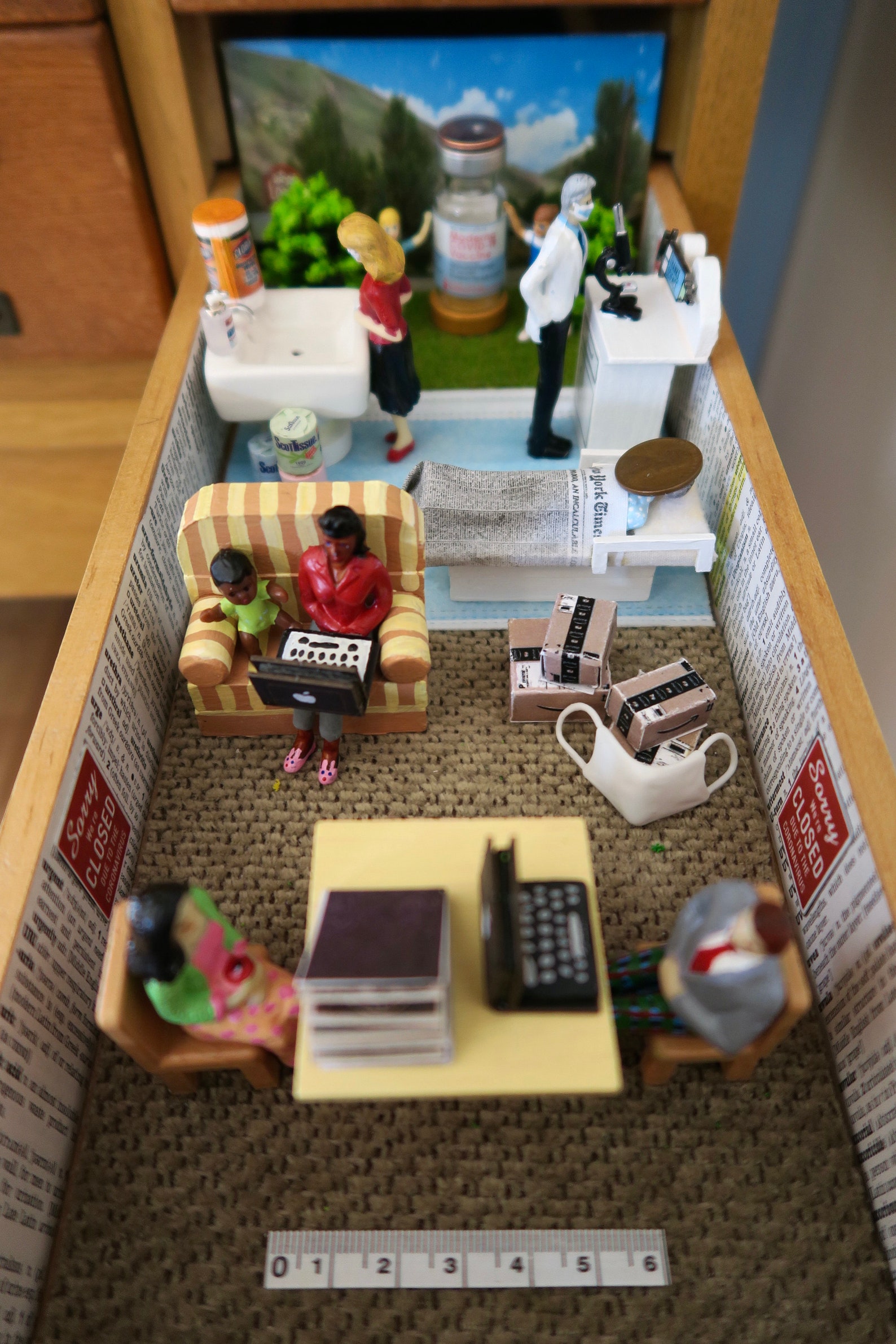
https://www.etsy.com/listing/1283073189/museum-of-tiny-things-founding-member
Woman has created a Museum of Tiny Things inside her library card catalog.
Award-Winning Writer Explains Her Entire Process — Susan Orlean - YouTube<br /> by [[David Perell]]<br /> accessed on 2025-11-05T09:13:24
0:00:38 Susan Orlean uses index cards as part of her process. She's done this for three or four books by October 29, 2025.
She uses her index cards (often in the range of 700) to arrange and re-arrange the material. She uses it to refresh her memory as she's working with it.
Things can be as small as a name of a character. Some are references to longer research documents.
"chunk of thought" (her version of atomic notes)
attention economy [7:59]
reply to u/warriorkitten18 at https://reddit.com/r/adhdwomen/comments/1mqzm12/index_card_system_please_discuss/
Apologies for the delay in reply. I've read extensively about card indexes for productivity and the variety of systems and uses over the past couple of centuries.
Given your context, I'd recommend reading one book which describes an index card system in full, walks you through it card by card, helps you make it, and describes how it's used. It's thorough, but fully adaptable to your particular needs. Best, it's written by two women in the early 1980s and though there wasn't much in the culture about ADHD at the time, I suspect that one or both of these women were coping with nearby neurodivergent issues (not to mention the eternal brain fog forced by pregnancy, lack of sleep, and early childhood woes.)
Young, Pam, and Peggy Jones. 1981. Sidetracked Home Executives: From Pigpen to Paradise. ed. Sydney Craft Rozen. New York: Warner Books. http://archive.org/details/sidetrackedhomee00youn (November 3, 2023).
If you need other perspectives, there are also areas with potential solutions like the Bullet Journal (notebooks), Getting Things Done (GTD), Hipster PDA, and a variety of others. Almost all of these were built on the ideas behind the early 1900s version of the Memindex, which I've written about here: https://boffosocko.com/2023/03/09/the-memindex-method-an-early-precursor-of-the-memex-hipster-pda-43-folders-gtd-basb-and-bullet-journal-systems/. They're all roughly the same in shape, practice, and philosophy, but the Young/Jones SHE version uses index cards, speaks directly to your use case, and suggests an approach for the ADHD set. Assuredly a nearby library can get you a copy, you can find them used, or read the linked online version which you can check out.
If you'd like to see portions of my personal system, I've written a bit about it along with lots of other resources at https://boffosocko.com/research/zettelkasten-commonplace-books-and-note-taking-collection/#Productivity
It's worked well for me for many years. The secret is to read the basics and then adapt the pieces of the system to suit your own needs and methods of working. For example, I love crossing things off of lists, which my index cards didn't really encourage because you do them and move them to the next day/week/month/year forward, but I bought a rotating date stamp that allows me to stamp each card with the date as "done" before re-filing it. For me, the haptic feedback of the "thonk" of the stamp is even better than crossing things off and gives me a sense of accomplishment when I see them and finish filling an entire card up with dates.
A decade on, the best part of my collection are the separate index cards I had laying around while using the rest of the system and on which I wrote down quotes from my daughter, new words as she learned them, words she made up, goofy jokes, etc.
Enough for now, the card for the dog groomer came up yesterday, so I'm off to take our dog to the appointment I made when I saw it. Thonk! Refiled for next month's reminder.
Good luck.
How about using ascratch pad slightly smaller than thepage-size of the book—so that theedges of the sheets won't protrude?Make your index, outlines, and evenyour notes on the pad, and then insertthese sheets permanently inside thefront and back covers of the book.
This practice is not too dissimilar to that used by zettelkasten practitioners (including Niklas Luhmann) who broadly used his bibliographic cards this way.
By separating his index and ideas from the book and putting them into a physical index, it makes them easier to juxtapose with other ideas over time rather than having them anchored directly to the book itself. For academics and researchers, this will tend to help save time from having to constantly retrieve these portions from individual books.
I use the end-pa-pers at the back of the book to makea personal index of the author's pointsin the order of their appearance
The making of a personal index is a first step in building a mesh of knowledge. In just a few years, Vannevar Bush will speak of "associative trails" a phrase he uses twice in "As We May Think" (The Atlantic, July 1945), but of potentially more import is his phrase "associative indexing" which lays way to either juxtaposing or linking two ideas (either similar or disjoint) together. It bears asking the question of of whether it's more valuable to index and juxtapose similar ideas or disjoint ideas which may more frequently lead to better, more useful, and more relevant and rich future ideas.
It affords an immediate step, however, to associative indexing, the basic idea of which is a provision whereby any item may be caused at will to select immediately and automatically another. This is the essential feature of the memex. The process of tying two items together is the important thing. Bush, Vannevar. 1945. “As We May Think.” The Atlantic 176: 101–8. https://www.theatlantic.com/magazine/archive/1945/07/as-we-may-think/303881/ (October 22, 2022). #
Confessions of an Office Supply Junky - Episode 5: The Hipster PDA - YouTube<br /> by [[Joe Van Cleave]] video circa 2016<br /> accessed on 2025-09-15T12:38:20
Joe Van Cleave had a pencil box with index cards and a pen with which he used to keep a "Random Access Journaling System, using index cards and topical filing by subject" (dated March 2004). He was using 4 x 6" index cards.
He had a 3 x 5" hipster PDA based on Merlin Mann's idea that had thin metal covers with index cards and a book ring to hold it all together. He used colored cards to create section dividers in his hipster PDA.
He mentions the overlap of the hipster PDA with David Allen's Getting Things Done (GTD) movement.
JVC started using a hipster PDA in February 2007
He archived them in chronological order.
Grass roots use of the hipster PDA nudged larger stationers like Oxford to make vertical lined index cards specifically for hipster PDAs.
JVC also shows a storyboard done on index cards with two book rings as binding.
Renaissance Art has a 3x5" index card holder made out of leather as a wallet.
JVC was also using a bulldog clip to hold together his index cards.
https://launch.getthinkable.com/
Looks pretty, but in the end it won't be as highly functional as it looks pretty. I'd rather have a mahogany card index. Dollars to donuts this doesn't actually launch.
Reminiscent to Ugmonk's Analog System: https://ugmonk.com/collections/analog
Millard Kaufman papers, Collection no. 2258, Cinematic Arts Library, USC Libraries, University of Southern California. https://oac.cdlib.org/findaid/ark:%2F13030%2Fc81n87gk
Box 4 contains notecards with notes about the films "Beau Geste," "Raintree County," and "Reprieve," as well as a paperback copy of the novel "Beau Geste." https://oac.cdlib.org/findaid/ark:%2F13030%2Fc81n87gk_aspace_5b86d4b8e8a1ee9992ac6f15f3cefe30
I found a way to create order from my jumbled ideas | Writing Slowly<br /> by [[Richard]] on writingslowly.com <br /> accessed on 2025-08-30T19:54:37
The structure of SOLO reminds me of the relationship of Bloom's Taxonomy and zettelkasten: https://boffosocko.com/2022/04/01/the-zettelkasten-method-of-note-taking-mirrors-most-of-the-levels-of-blooms-taxonomy/
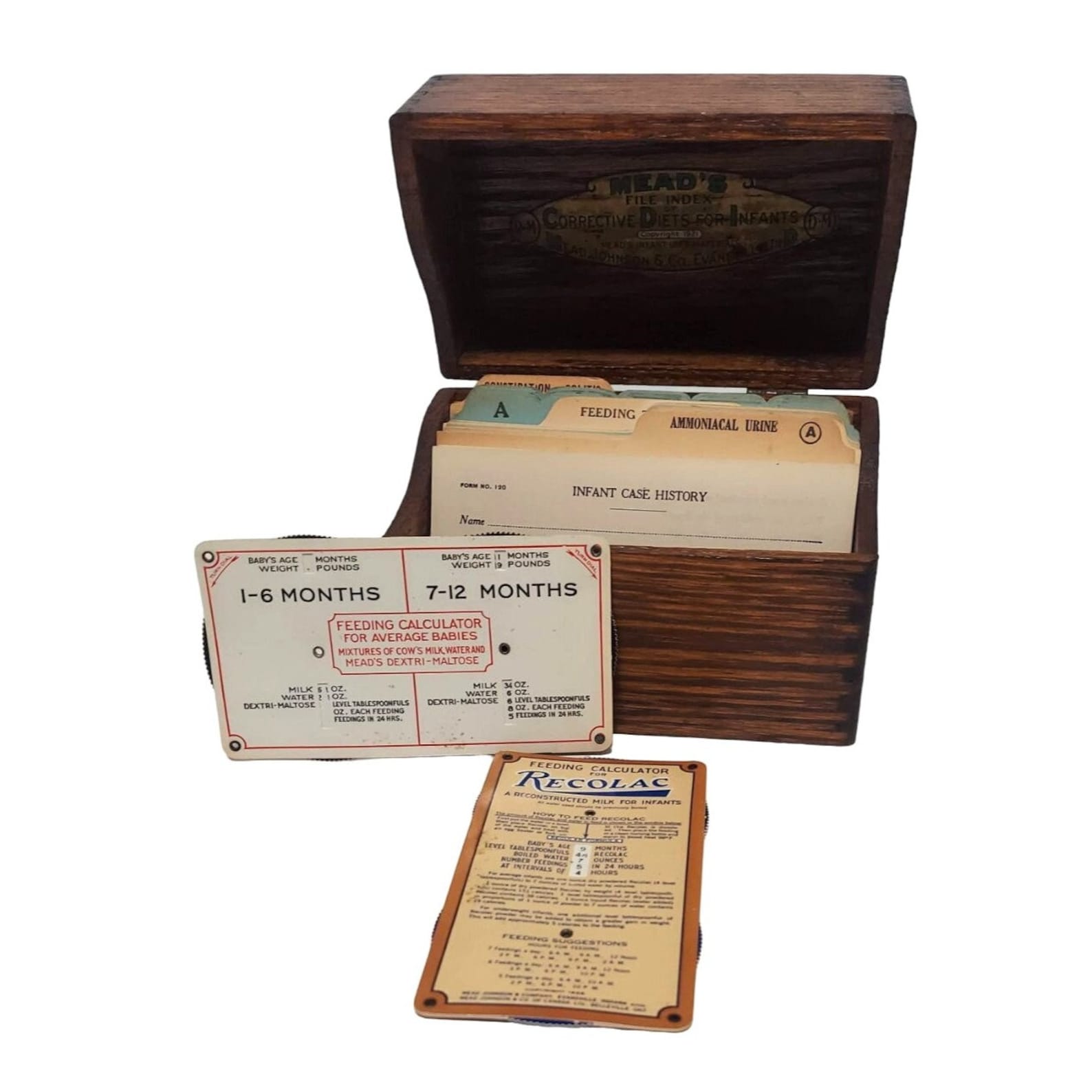
https://www.etsy.com/listing/1505097692/antique-1921-meads-file-index-corrective<br /> Antique 1921 Mead's File Index Corrective Diets Infants Nursing Weight Charts Mead card index geared toward health of infants with details, nursing patterns, growth data, feeding data, case history, etc.
Pacioli completed another equally playful book at about the same time:De Viribus Quantitatis (‘On the powers of numbers’), which compilesnumber games, card tricks, riddles and reasoning problems. It makesfrequent mention of Leonardo, and much of the content overlaps withpuzzles that can be found in the notebooks.
Jack Handey Is the Envy of Every Comedy Writer in America by [[Dan Kois]]

Could National mechanized accounting save as much for you? Almost certainly! For businesses of every size and type, employing from 50 people, up, report that upon mechanizing their accounting with National Accounting Machines, they effected savingsTHE NATIONAL CASH REGISTER DETROIT PUBLIC LIBRARYup to 30%. Savings which often pay for the whole National installation in the first year—and then run on, year after year. Ask your local National representative to check your present set-up, and report specifically the savings you can expect.
advertisement on page 17 of Newsweek (US Edition) 1948-10-04: Vol 32 Iss 14<br /> https://archive.org/details/sim_newsweek-us_1948-10-04_32_14/page/16/mode/2up
Advertisement shows two female clerks at adding machines with drawers of a card index next to them as they work.
30% der Arktis emittieren inzwischen mehr Treibhausgase als sie aufnehmen. Außer dem Schmelzen von Permafrostböden ist dafür auch Zunahme von Waldbränden verantwortlich. Die amerikanische Forschungsbehörde NOAA spricht davon, dass die Arktis „in ein neues Regime“ gekippt ist. 2024 war in der Arktis das zweitwärmste Jahr seit Messbeginn und das Jahr mit den zweihäufigsten Waldbränden. In einem langsamen, aber sich beschleunigenden Prozess wird immer mehr der 1460-1600 Gigatonnen im Arktisboden gespeicherten organischen Kohlenstoffs freigesetzt. Insgesamt entsprechen sie dem Doppelten der in der Erdatmosphäre gespeicherten Menge https://www.liberation.fr/environnement/en-arctique-la-toundra-nest-plus-un-puits-de-carbone-20250122_VZUZXLOHEZESBKJHXGYU7OPYME/
NOAA Arctic Report Card 2024: https://www.nature.com/articles/s41558-024-02234-5 Studie zu den CO2-Emissionen arktischer Waldbrände: https://arctic.noaa.gov/wp-content/uploads/2024/12/ArcticReportCard_full_report2024.pdf
There was no office machinery at all–the typewriter was known but scarcely used. Even telephones were rarities. The card index, the filing cabinet, the loose-leaf ledger were all but unknown. Of course there were no calculating machines.
System, the Magazine of Business, volume XLII, Number 5, November 1922, p536, "What 55 Years in Business Taught Me About Managing: The first installment of the biography of John H. Patterson, founder of the National Cash Register Company and Lately Chairman of the Board" by Samuel Crowther.
reply to u/Sept-27 at https://old.reddit.com/r/Zettelkasten/comments/1itbduv/how_to_begin_storytelling_with_smart_notes/
Ahrens' book will likely leave you with more questions than answers and really has nothing directly to say on the practice of fictional storytelling. Doto's book does a better job of filling in these pieces but approaches writing in general rather than specifically fiction.
For fiction writers, I often recommend they don't practice putting Luhmann-artig numbers on their cards, but organize them in a more impromptu manner and allow them to shift more as you write. This allows things to shift more easily during the process and provides for a bit more creativity.
Some resources and examples for fiction with a ZK:<br /> - Vladimir Nabokov - David Lynch - take particular note of his method taught by Frank Daniel at AFI - Dustin Lance Black - Card index for fiction writing - The Zettelkasten Method for Fiction Writing
Take the inspiration these suggest, but don't go down the rabbit hole too deeply. You're going to want to evolve something that works best for you and your modes of writing, so trying to imitate someone else's system too closely will be the kiss of death.
Hurd, Cuthbert C., ed. Proceedings: IBM Computation Seminar December 1949. New York: Internation Buisiness Machines Corporation, 1951. http://archive.org/details/bitsavers_ibmproceedeminarDec49_14295048.
In a variety of context here the idea of "cards" could be held to be synonymous with "notes".
Collision cards (though used in a physics setting) could be a bit hilarious with the idea of "atomic notes" and the idea of "combinatorial creativity".
No revolutionary schemes ona large scale are advocated at present.
Some idea of the rapidity with which the field has grown may be gainedfrom the fact that the bibliography of uses contains 400 entries, comparedwith 276 entries in the first edition. This great increase is reflected in theextension of the Practical Applications Section (Part II) from 186 pagesin the first edition to 295 pages in the present book.
An indication of the state-of-the-art in punch card systems from 1951 to 1958, particularly with respect to practical applications.
Casey, Robert S., James W. Perry, Madeline M. Berry, and Allen Kent. Punched Cards: Their Applications To Science And Industry. 2nd ed. 1951. Reprint, New York: Reinhold Publishing Corporation, 1958. http://archive.org/details/PunchedCardsTheirApplicationsToScienceAndIndustry.
Begun, George M. “Making Your Own Punched Cards.” Journal of Chemical Education 32, no. 6 (June 1, 1955): 328. https://doi.org/10.1021/ed032p328.
George Begun used a template of "heavy galvanized iron" to drill holes into his 5 x 8" index cards to create his own edge-noted card system for use in his chemistry work. Rather than using commercially made sorting needles, he recommended the use of a ice pick with a dulled point "for safety".
Edge-Notched Cards: A queryable database...made of paper by [[Soren Bjornstad]]
Benefits are provided to Eligible Renters up to $50,000 per Rental Agreement forDamage to or Theft of a Rental Vehicle
Amex, blue cash preferred
Report your covered event to your card’s benefits administrator as soon as possible. To open a claim with Mastercard, go online or call 877-288-6784; with Visa, go online or call 1-800-825-4062.
the news. It is therefore ironic that the present Life feature ... shouldhave so mortician-like an air – as though Professor Adler and hisassociates had come to bury and not to praise Plato and other greatmen.The ‘great ideas’ whose headstones are alphabetically displayedabove the coffin-like filing boxes have been extracted from the greatbooks in order to provide an index tool for manipulating the booksthemselves. By means of this index the books are made ready forimmediate use. May we not ask how this approach to the content andconditions of human thought differs from any other merely verbaland mechanized education in our time?
A young man named Marshall McLuhan, having glimpsed the photo shoot in Life, wrote with scathing insight in his first book, The Mechanical Bride (1951):
The services of Dr. Hutchins and Professor Adler to education are justly celebrated. They have by their enthusiasm put education in
McLuhan analogizes the tabbed dividers of a card index to tombstones and the card indexes to coffins!
used typewriter refurbing magnate
https://www.metalcabinetliquidators.com/ Rancho Cucamonga, CA<br /> James
VISIT OUR HUGE OFFICE FURNITURE WAREHOUSE! Take a virtual tour here: https://youtu.be/0Ez-eB-0u8w (copy and paste) Recycled Office Furnishings 10036 Freeman Avenue Santa Fe Springs, Ca. 90670 We accept Visa, MC, Amex, and debit cards! Mon - Fri: 9am to 5pm, Sat: 9am to 2pm Please call for Saturday hours on holiday weekends www.recycledofficefurnishings.com *alternate phone number: 562 777-2289*
https://orangecounty.craigslist.org/fud/d/santa-fe-springs-index-filing-cabinet/7515311169.html
Dousa, Thomas M. “Facts and Frameworks in Paul Otlet’s and Julius Otto Kaiser’s Theories of Knowledge Organization.” Bulletin of the American Society for Information Science and Technology 36, no. 2 (2010): 19–25. https://doi.org/10.1002/bult.2010.1720360208.
n stark opposition to Otlet’s insistence that an ideal KOS be impersonaland universal, Kaiser firmly held to the view that, ideally, KOSs should beconstructed to meet the needs of the particular organizations for which they arebeing created. For example, with regard to the use of card indexes in businessenterprises, he asserted that “[e]ach business, each office has its individualcharacter and individual requirements, and its individual organization. Itssystem must do justice to this individual character [11, § 76].
Otlet, by contrast, was strongly opposed to organizing information unitsby the alphabetical order of their index terms. In his view, such a mode oforganization “scatters the [subject] matter under rubrics that have beenclassed arbitrarily in the order of letters and not at all in the order of ideas”and so obscures the conceptual relationships between them [6, p. 380]
In this respect Otlet was closer to the philosophy of organization used by Niklas Luhmann.
For Kaiser, then, alphabetical order represented the interpretatively safest andmost user-friendly way of organizing information units by their subject terms.
on the guide card for each main entry term a list of the other main entry termswith which it stood in semantic relation: the latter included synonyms, broaderterms, narrower terms and related terms [8, § 415, 423]. The “logical key”served as the syndetic structure of the index, indicating a web of conceptualrelations otherwise unexpressed by the alphabetical structure of the index file.
Some of the structure in Kaiser's system was built into relationships on guide cards. While not exactly hub notes, they did provide links to other areas of the system in addition to synonyms under which materials could be found including broader terms, narrower terms, and related terms often seen in library information systems.
Given that Kaiser acknowledged the utility of indicating semantic relationsbetween index terms, why did he prefer alphabetical to classified order forfiling? The answer lies in his view of language. Kaiser considered words innatural language to be imprecise expressions of the concepts that they areintended to convey. In addition, he held that there is little agreement amongusers of a language as to the precise definition of individual terms [8, §60–61, 112]. Such semantic indeterminism, in his opinion, makes it difficultto determine precisely what the authors of documents mean by the wordsthey are using, and any attempt by an indexer to substitute preferred termsfor the author’s own words runs the risk of misinterpreting the meaning ofthe words in the original document. It was for this reason that he preferredusing index terms extracted from the document itself [8, § 114].
Kaiser touches on the issue of "coming to terms" in his card (indexing) system. He preferred using the author's terminology over the indexer's. Some of the fungibility of words and their definitions was met by the use of a "logical key" to the index which was put onto guide cards for each main entry term.
Whereas Otlet and Kaiser were in substantial agreement on both thedesirability of information analysis and its technological implementation inthe form of the card system, they parted company on the question of howindex files were to be organized. Both men favored organizing informationunits by subject, but differed as to the type of KO framework that shouldgovern file sequence: Otlet favored filing according to the classificatory orderof the UDC, whereas Kaiser favored filing according to the alphabeticalorder of the terms used to denote subjects
Compare the various organizational structures of Otlet, Kaiser, and Luhmann.
Seemingly their structures were dictated by the number of users and to some extent the memory of those users with respect to where to find various things.
Otlet as a multi-user system with no single control mechanism or person, other than the decimal organizing standard (in his case a preference for UDC), was easily flexible for larger groups. Kaiser's system was generally designed, built and managed by one person but intended for use by potentially larger numbers of people. He also advised a conservative number of indexing levels geared toward particular use-cases (that is a limited number of heading types or columns/rows from a database perspective.) Finally, Luhmann's was designed and built for use by a single person who would have a more intimate memory of a more idiosyncratic system.
card index systems wereespecially prized for the flexibility in filing that they afforded: not only couldcards bearing superannuated information be easily removed and ones bearingnew information be added, but files could be easily rearranged if needed.
George Carlin Gets Dark - Charlie Rose Interview 1996 by [[Charlie Rose]]
ᔥ @lazybear on Mastodon
"This idea goes with that one, and I never suspected it, and then to make something out of it that's bigger than the two of them"
Did #GeorgeCarlin used or knew #zettelkasten
?
19:10 -> 19:15<br /> https://www.youtube.com/watch?v=N9OhMZYTS4E
@chrisaldrich Do you have some results from your online sessions? New insights from reading Doto's book?
Reply to @Edmund https://forum.zettelkasten.de/discussion/comment/21907/#Comment_21907
Doto's book is the best and tightest yet for explaining both how to implement a Luhmann-artig zettelkasten as well as why along with the affordances certain elements provide. He does a particularly good job of providing clear and straightforward definitions which have a muddy nature in some of the online spaces, which tends to cause issues for people new to the practice. Sadly, for me, there isn't much new insight due to the amount of experience and research I bring to the enterprise.
I do like that Doto puts at least some emphasis on why one might want to use alphanumerics even in digital spaces, an idea which has broadly been sidelined in most contexts for lack of experience or concrete affordances for why one might do it.
The other area he addresses, which most elide and the balance gloss over at best, is that of the discussion of using the zettelkasten for output. Though he touches on some particular methods and scaffolding, most of it is limited to suggestions based on his own experience rather than a broader set of structures and practices. This is probably the biggest area for potential expansion and examples I'd like to see, especially as I'm reading through Eustace Miles' How to Prepare Essays, Lectures, Articles, Books, Speeches and Letters, with Hints on Writing for the Press (London: Rivingtons, 1905).
I could have had some more material in chapter 3 which has some fascinating, but still evolving work. Ideas like interstitial journaling and some of the related productivity methods are interesting, but Doto only barely scratches the surface on some of these techniques and methods which go beyond the traditional "zettelkasten space", but which certainly fall in his broader framing of "system for writing" promise.
Doto's "triangle of creativity", a discussion of proximal feedback, has close parallels of Adler and Hutchins' idea of "The Great Conversation" (1952), which many are likely to miss.
For those who missed out, Dan Allosso has posted video from the sessions at https://lifelonglearn.substack.com/ Sadly missing, unless you're in the book club, are some generally lively side chat discussions as the primary video discussion was proceeding. The sessions had a breadth of experiences from the new to the old hands as well as from students to teachers and everywhere in between.
Value of knowledge in a zettelkasten as a function of reference(use/look up) frequency; links to other ideas; ease of recall without needing to look up (also a measure of usefulness); others?
Define terms and create a mathematical equation of stocks and flows around this system of information. Maybe "knowledge complexity" or "information optimization"? see: https://hypothes.is/a/zejn0oscEe-zsjMPhgjL_Q
takes into account the value of information from the perspective of a particular observer<br /> relative information value
cross-reference: Umberto Eco on no piece of information is superior: https://hypothes.is/a/jqug2tNlEeyg2JfEczmepw
Inspired by idea in https://hypothes.is/a/CdoMUJCYEe-VlxtqIFX4qA
Here's my setup: Literature Notes go in the literature folder. Daily Notes serve as fleeting notes. Project-related Notes are organized in their specific project folders within a larger "Projects" folder.
inspired by, but definitely not take from as not in evidence
Many people have "daily notes" and "project notes" in what they consider to be their zettelkasten workflow. These can be thought of as subcategories of reference notes (aka literature notes, bibliographic notes). The references in these cases are simply different sorts of material than one would traditionally include in this category. Instead of indexing the ideas within a book or journal article, you're indexing what happened to you on a particular day (daily notes) or indexing ideas or progress on a particular project (project notes). Because they're different enough in type and form, you might keep them in their own "departments" (aka folders) within your system just the same way that with enough material one might break out their reference notes to separate books from newspapers, journal articles, or lectures.
In general form and function they're all broadly serving the same functionality and acting as a ratchet and pawl on the information that is being collected. They capture context; they serve as reminder. The fact that some may be used less or referred to less frequently doesn't make them necessarily less important
the ideas we capture, rene, connect,and search for in our zettelkasten.
An alternate stating of the process: 1. capture<br /> 2. refine<br /> 3. connect<br /> 4. search
cross-reference earlier process: https://hypothes.is/a/HgcILIvyEe-OfdOArKZxGg
Like a rhizome, itwill become a form of controlled chaos,
System
card system ⇒ system theory
In the early 1900s it was very common, especially in English speaking countries to call these note taking/paper database systems "card systems". Is it a wonder then that they may have helped to create "systems theory"?
In particular, look at Niklas Luhmann's work as well as Ross Ashby.
Example of a fleeting note triggered by a single word in a context, but with thoughts not relating at all to the specifics of the particular work.
practices related to having and capturing thoughts (chapters 1and 2); rening thoughts into clear ideas that can be repurposed (chapter 3);connecting ideas across topics (chapters 4 and 5); developing theseconnections and making them accessible to you (chapter 6); andtransforming all the above into writing for readers—writing that can bereintegrated back into the system (chapters 7, 8 and 9).
Overview of Bob Doto's suggested process:<br /> 1. having and capturing thoughts<br /> 2. refining thoughts into clear ideas that can be repurposed<br /> 3. connecting ideas across topics<br /> 4. developing connections and making them accessible<br /> 5. transforming notes into writing for readers 6. re-integrating writing back into the system (he lumped this in with 5, but I've broken it out)
How do these steps relate to those of others?
Eg: Miles1905: collect, select, arrange, dictate/write (and broadly composition)
Another reason why it saves time is that here you canimply things instead of having to express them in full,for your Card-System and its Headings need only to beclear to yourself (see p. 67), whereas a complete Essayor Speech must be in Sentences and must be clear toyour readers or hearers as well. In the Cards you canuse all kinds of Abbreviations (p. 70) : these, again,need only be clear to yourself.
Miles touches on the interplay of knowledge written down on index cards and the knowledge which is kept only in one's mind. Some practitioners in the space from 2013-2024 seem to imply that they're writing almost everything out in far deeper detail than Miles would indicate. In his incarnation, much of the knowledge might be more quickly indicated by a short sentence or heading which the brain can associate to longer explanations.
This sort of indexing is akin to some of the method potentially seen in Marshall Mathers' zettelkasten.
I'm creating a tag here for "card index for productivity" to track the idea of productivity in writing which I'm specifically using separately from the tag "card index as productivity system" which is used to describe their use for project tracking systems in systems like GTD, Memindex, etc.
They ensure wonderful rapidity. A whole bookof thirty thousand words I have prepared (though ofcourse only roughly) in two hours, by the Card-System.Such a pace would have been impossible otherwise.This does not include any of the Dictation ; it merelyincludes the Collection and Selection of Ideas, andtheir Arrangement. The System is a wonderful savingof time,
What work exactly does Miles include in his description of preparation of a 30,000 word book in two hours?
He specifically excludes dictation. He does include selection of ideas and arrangement. He also says it includes "collection", but I'm supposing that he's taking a larger tranche of cards from a possibly massive collection and collecting only those he needs right now? Certainly the reading, thinking, and collecting work can't be included in this two hours of work.
Does he have a better definition of what he means by collection?
They are useful for other ptirposes, besides Essay-writing and Speaking. For instance, for Addresses,for Bills, and for Memoranda.
Unsurprising given that card systems were used for accounting in the early 1900s, but not many manuals cover the use of a card index for addresses (aka Rolodex) of for bills or memoranda.
I generallyuse the Cards of the Library Bureau (Bloomsbury Street, London),or those by Messrs. Evans and Hallewell, 5, Ave Maria Lane,London, E.C. The latter are the cheaper.
Love that Miles talks about what index cards he uses, where he gets them from and even their relative prices!
I arrived at the Card-System by degrees, and was glad to findthat Prof. Wendell also recommended Cards. I have elaboratedthe System considerably in the last few months,
Miles doesn't specify how he comes by the practice of a "Card-System" other than "by degrees" as well as elaborating on it in the months before he writes this book.
(Having something more concrete would be nice though...)
At some point he read Barrett Wendell's book on composition (1891) to discover that he recommended cards as well.
they can beworked with extraordinary rapidity, especially if theyare combined with Dictation (see p. 69),
Dictation from index cards can be done quickly for drafting one's writing to improve the efficiency of composing and writing essays.
This is essentially the sort of advice which Nabokov used in his writing work in combination with his wife Vera.
The old Cards can be used in many ways. Youcan turn them upside-down, and treat the other endsimilarly, then you can turn them over ,and the backsof them will give you two more spaces to be used.Some might even use the four sides also ! After theCards are entirely covered, they can be used for scrap-books for Hospitals.
reuse of index cards
How exactly would fully used ("covered") cards be used for scrapbooks for Hospitals?
This is the great advantage of the Card-System overthe ordinary Scheme (on a single sheet of paper), forwith the latter one has to be thinking of two things atthe same time, namely, of the Arrangement of theIdeas as well as the Collection of the Ideas.
Using a card-system over writing on a single sheet of paper or in a notebook allows one to separate the thinking work. Instead of both capturing the idea and arranging them simultaneously, one is splitting these tasks into smaller parts for simpler handling.
Connecting Linkbetween twoSentences orParagraphs,
Miles, 1905 uses an arrow symbol with a hash on it to indicate a "connecting link between two Sentences or Paragraphs, etc."
It's certainly an early example of what we would now consider a hyperlink. It actively uses a "pointer" in it's incarnation.
Are there earlier examples of these sorts of idea links in the historical record? Surely there were circles and arrows on a contiguous page, but what about links from one place to separate places (possibly using page numbers?) Indexing methods from 11/12C certainly acted as explicit sorts of pointers.
Special Marks on Cards
Eustace Miles suggests the use of "special marks on cards" (annotations) in the top left corners, though he doesn't provide specific examples of how they might be used in practice. He does mention "The Abbreviations and Marks need be clear only to the Writer [sic] himself. They save ever so much time."
Special Marks on Cards
In Miles' visual examples of cards, he presents them in portrait (rather than landscape) orientation.
This goes against the broad grain of most standard card index filing systems of the time, but may be more in line with the earlier French use of playing cards orientation.
His portrait orientation also matches with the size ratios seen in his Card-Tray suggestion on p187. https://hypothes.is/a/llEgpIf4Ee-dVfcaIGUryQ
no false economy r
He's repeating (and thus emphasizing) the admonition that a card system is not expensive, particularly in relation to the savings in time and effort.
These Cards (if used only once) should be labelledand catalogued very carefully.
How does he define "labelled" and "catalogued"?
Presumably he means a version of tagging/categorization and possibly indexing them to be able to easily find them again?
And the same will apply to the objection that theSystem is unusual. Seldom have there been any newsuggestions which have not been condemned as ' un-us
Objections to the Card-System,
Miles lists the following objections: - expense - inconvenience - unusual (new, novel)
Notice that he starts not with benefits or affordances, but with the objections.
What would a 2024 list of objections look like? - anachronism - harder than digital methods - lack of easier search - complexity - ... others?
At first, also, it might be thought that the Cardswould be inconvenient to use, but the personal ex-perience of thousands shows that, at any rate forbusiness-purposes, exactly the reverse is true
Miles' uses the ubiquity of card systems (even at the writing in 1899, prior to publication) within business as evidence for bolstering their use in writing and composition.
(Recall that he's also writing in the UK.)
You can prepare your Letters any-where, even in the train, and so save a great deal oftime ; and it may be noticed here that the idlenessof people, during that great portion of their lives whichthey spend in travelling and waiting, can easily beavoided in this way.
Using a card system, particularly while travelling, can help to more efficiently use one's time in preventing idleness while travelling and waiting.
I often noticed that most Candidates inExaminations used to begin to write their Essays atonce. They never realised that their minds were there-by being distracted and divided among many differentprocesses, each of which is particularly hard even whentaken alone. For all at once their minds are being-called upon to Collect Ideas, to Select and decide whichare important, etc., to Arrange the Selected Ideas, andto Express them. To try all this as a single action is" most extraordinarily unscientific, even if a few brilliantgeniuses here and there have succeeded in the attempt.
One of the major affordances of using a zettelkasten or card index for writing is that it forces the writer to break things down into their constituent parts, thereby making the entire process of writing far easier and less complex. One can separately focus their attention on the smaller steps of collecting, selecting, and arranging the material before beginning to actually write.
Miles, Eustace Hamilton. How to Prepare Essays, Lectures, Articles, Books, Speeches and Letters, with Hints on Writing for the Press. London: Rivingtons, 1905. http://archive.org/details/howtoprepareessa00mileuoft.
English composition: Eight lectures given at the Lowell Institute, New York: Charles Scribner's Sons, 1891.
evidence of a card system/zettelkasten method in this?
I found a copy and indeed there is evidence!
H.S.WYNKOOP.-I have beeninterestedever sinceIhave beenMr.Wynkoop.inbusiness inthe lack ofstandardization in nearly everythingwehavehadtodealwith-notmerelyinthematterofthiscardsystemusedin theshop,but eveninourletterpaperandthevarioussizesofprints ordocumentsthatrunthroughtheoffice.SomeyearsagoItook thelettersheetusedbytheEdison GeneralElectricCompanyandusedthatasastandard,andImadeeveryformintheofficewhereIwasatthetimeeitherfull letter,halfletterordoubleletter,andsoon;anditwasastonishingtoseehow,whenthe employees got usedtotheidea ofstandard-sizedforms,every-thingfittedin,andfrommyownexperience Iwouldliketosecondthat ideaheartily.Wecould standardize in nearly everythingweconstruct inthewayof forms,shopstationery,and,verylargely,inour machines.Thestandardizationofelectricmotorsisre-ceiving greatattentionatpresent.
Brooklyn Engineers’ Club. Brooklyn Engineer’ Club Proceedings for 1906: Constitution and By-Laws and Catalogue of Reference Works Added to the Library During the Year. Brooklyn Engineers’ Club, 1907.
When I read a book, forexample, I proceed as follows: I always have a piece of note paper at hand onwhich I write down certain ideas for specific pages. On the back, I write down thebibliographic information. When I have read through the book, I go through thesenotes and think about what can be evaluated for which notes that have alreadybeen written and how. So I always read with an eye to the possibility of writingnotes to the books. Maybe it is simply a collecting instinct I have.
Beyond the cards mentioned above, you should also capture any hard-to-classify thoughts, questions, and areas for further inquiry on separate cards. Regularly go through these to make sure that you are covering everything and that you don’t forget something.I consider these insurance cards because they won’t get lost in some notebook or scrap of paper, or email to oneself.
Julius Reizen in reviewing over Umberto Eco's index card system in How to Write a Thesis, defines his own "insurance card" as one which contains "hard-to-classify thoughts, questions, and areas for further inquiry". These he would keep together so that they don't otherwise get lost in the variety of other locations one might keep them
These might be akin to Ahrens' "fleeting notes" but are ones which may not easily or even immediately be converted in to "permanent notes" for one's zettelkasten. However, given their mission critical importance, they may be some of the most important cards in one's repository.
link this to - idea of centralizing one's note taking practice to a single location
Is this idea in Eco's book and Reizen is the one that gives it a name since some of the other categories have names? (examples: bibliographic index cards, reading index cards (aka literature notes), cards for themes, author index cards, quote index cards, idea index cards, connection cards). Were these "officially" named and categorized by Eco?
May be worthwhile to create a grid of these naming systems and uses amongst some of the broader note taking methods. Where are they similar, where do they differ?
Multi-search tools that have full access to multiple trusted data stores (ostensibly personal ones across notebooks, hard drives, social media services, etc.) could potentially solve the problem of needing to remember where you noted something.
Currently, in the social media space especially, this is not a realized service.
How to ZK a fiction book! Zettelkasten for Fiction- Where Imagination Finds Order'- Book WIP ep. 78 by [[Victoria Crowder]]
meh... interested in the mention, but nothing directly actionable here. Perhaps in her other material?...
Not that it couldn't be done, but I'll suggest that following the structure/order of a Luhmann-artig zettelkasten may be a bit more limiting or difficult for creating fiction.
There's a rich history of researching, outlining, and writing with card indexes as part of the creative process. Perhaps looking briefly at some examples particularly focusing on fiction may be helpful? Once you've done this, you can pick and choose the portions and affordances that work best for your preferred way of thinking and working.
Some quick examples:
Perhaps querying my digital zettelkasten may be helpful for you? Start with: https://hypothes.is/users/chrisaldrich?q=tag%3A%27card+index+for+writing%27
Ultimately, you can only spend so much time going down the rabbit hole of how you ought to do this work and taking suggestions or reading about how others have done it. The more difficult but more fruitful portion is to pick a method which seems like it will work for you and experiment with it by actually using or evolving it for yourself. How you start may not necessarily be how you end, but you won't know what's best for you if you don't start. Practice, practice, practice will get you much farther faster.
reply to u/Atreides_Lion at https://reddit.com/r/Zettelkasten/comments/1ft4r3z/a_very_important_matter_for_me/
https://www.ebay.com/itm/156425307066
Remington Rand leather portable card index notebook case with slots for a variety of functionalities: - 1-31 for days of month - Alphabetic categorization A-Z - Months (Jan-Dec) - Miscellaneous
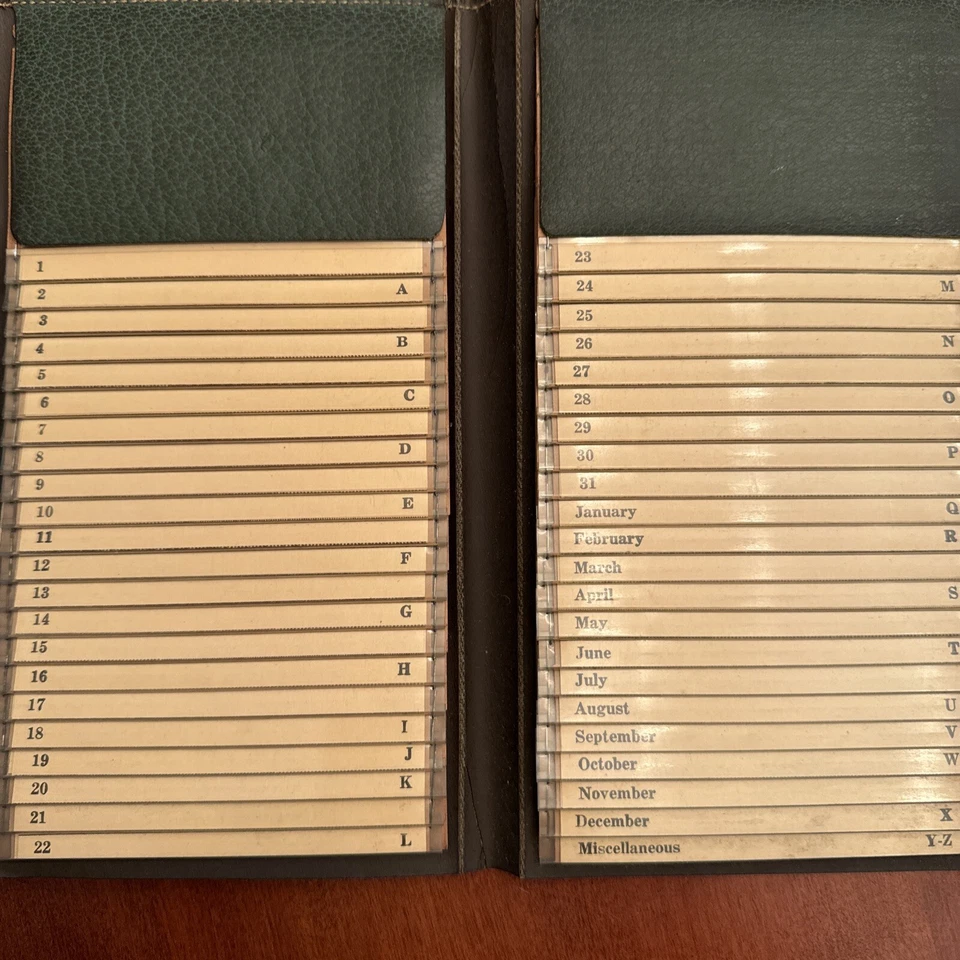
What do you mean with Zettelkasten ratchet? I am too unfamiliar with the word ratchet to really understand the meaning.[9:46 AM] Or if someone else has an idea and can help me out
The additional "hidden context" is that the rachet/gear seen in many of these diagrams is usually attached to a radial spring (or some other device) which, as it is wound, stores energy which is later used by the bigger device in which the rachet and pawl are encased. Examples include the stem of watches, which when wound, store energy which the watch later uses to run as it counts the seconds. Another example is the mainspring of a typewriter which is attached to a ratchet/pawl set up; when you push the carriage to the right, the spring gets wound up and stores energy which is slowly expended by the escapement a space or a letter at a time as you type. In the zettelkasten analogy, the box and numbered cards placed in it act as the pawl (the wedge that prevents backward movement), as you add more and more information, you're storing/building up "potential energy" in small bits. This "stored energy" can be spent at a later time by allowing you to more easily write an article, paper, book, etc. In some sense, the zettelkasten (as most tools do) allows you a "mechanical advantage" in the writing process over trying to remember everything you've ever read and then relying on your ability to spit it all back out in a well-ordered manner.
reply to Muhammed Ali at https://discord.com/channels/992400632390615070/992400632776507447/1286577013439594497
continuation of https://hypothes.is/a/GTPIPnYiEe-GTUu4YcdeAQ
Typewriter Clear Plastic Card Guide Holder Clean Polish White Out Dirt Restore by [[Phoenix Typewriter]]
For cleaning white out off of the clear plastic on card guides try the following: - scrape with fingernail<br /> - Simple Green - Marvel Mystery Oil (from automotive shops) followed by lacquer thinner in miniscule amounts (one drop). The oil helps protect the plastic from melting from the lacquer thinner. Rinse and repeat.
Others have indicated that floor wax stripper will remove white out without damaging the plastic of the card guides.
databases are not designed to be browsed.
Casey Newton makes this blanket statement. Any real evidence for this beyond his "gut"?
Many "paper machines" like Niklas Luhmann's zettelkasten were almost custom made not just for searching, but for browsing through regularly much like commonplace books.
Perhaps the question is really, how is your particular database designed?
Three apps that made me more productive this year by [[Casey Newton]]
Casey Newton is using a Zettelkasten note taking approach based on zettelkasten.de to cover his beat
Manuel of Eames Cursive Shorthand by the Card System<br /> A Reporting System with Longhand Movement, in which the Vowels and Consonants are Joined in the Order of Their Occurrence, Including a Remarkable Discovery in Pedagogics which Reduces the Time of Learning at Least One-half
https://www.google.com/books/edition/Geyer_s_Stationer/Ml7lJzdUNFIC?hl=en&gbpv=0<br /> Geyer's Stationer<br /> Devoted to the Interests of the Stationery, Fancy Goods and Notion Trades · Volume 82<br /> 1926
page 36 of the 1926 December issue has a "Rapidex" product for the telephone which sounds ostensibly like a Rolodex-type system
Another fun photo of "linked" strings wrapped around a library card catalog representing the links between ideas within a paper database.
Macey Filing Appliances 1906<br /> Catalogue No. 4206<br /> The Macey Co.<br /> https://archive.org/details/macey-filing-appliances-1906/mode/2up
https://archive.org/details/catalog00fred/mode/2up
Fred Macey Company Catalog (1910)
Index card system to track daily, weekly, and monthly routines by [[Anna Havron]]
Brief outline of a tickler file system for today, daily, weekly, and monthly to do items.
Ugmonk released a limited edition of 100 archive boxes for their Analog productivity cards today at 7AM (Pacific) for $229.00 (including 12 card packs and a metal divider). It sold out within two and a half hours.
With the inclusion of this archive box it makes the system much more like the original Memindex system.
https://ugmonk.com/products/analog-archive-box-walnut?variant=43942761562262
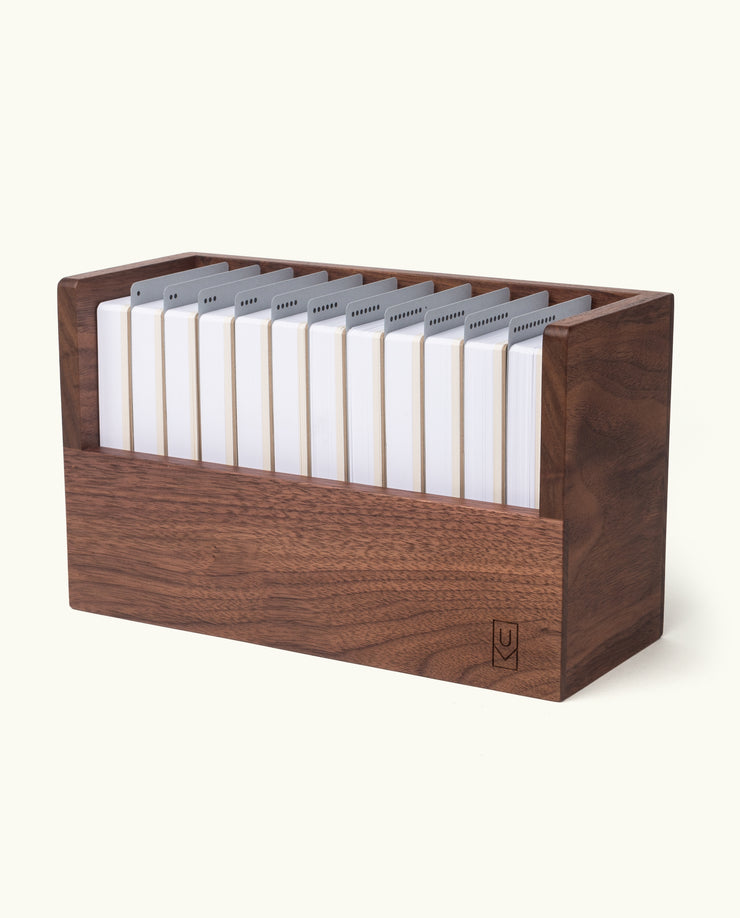
Russian-born American author Vladimir Nabokov (1899 - 1977) dictates from notecards while his wife Vera (nee Slonim, 1902 - 1991 types on a manual typewriter, Ithaca, New York, 1958. Carl Mydans / Getty Images
:max_bytes(150000):strip_icc():format(webp)/the-nabakovs-at-work-96793854-468f6ab40e914e45abdd1542fa370872.jpg)
Given my current r/typewriter flair ("typewriters + card index = magic"), I couldn't help but appreciate that Lucas Dul features a 3x5" card index (aka database) of typewriter typefaces in a recent video on the 1896 Williams 3 typewriter: https://youtu.be/T1zzXwB3Xh8?si=K4FeiS-V_aev9_SZ&t=506. Those who have been following along on the typeface front will recognize some of the samples from this small index having been featured in a video on typewriter typefaces at https://www.youtube.com/watch?v=scrguKgDNIY.
I'm reminded of a similar card index (or Zettelkasten if you speak German) database of type I saw last year via the Letterform Archive article at Schriftenkartei [Typeface Index], 1958–1971 and a related Flickr version of it at https://www.flickr.com/photos/letterformarchive/albums/72177720310834741/
Lest you think these sorts of analog office pairings are completely obsolete, I feel compelled to mention that I've recently noticed that Pam Beasley's character had both an IBM typewriter and a metal 1970s/80s era two drawer metal card file behind her desk in the TV series The Office (NBC, 2005-2013).
If typewriters and card indexes are your sort of thing, I've got a small personal collection as well as some research and writing about them which can be found at https://boffosocko.com/research/zettelkasten-commonplace-books-and-note-taking-collection/#Boxes
If you follow my collections and work, you know I'm not beyond pairing up a nice typewriter with a card index (or two).
Image of a 1948 Royal and a matching Steelcase card index.
Syndication link: https://www.reddit.com/r/typewriters/comments/1e5u5z3/era_appropriate_database_for_typewriter_typefaces/
You have to love the fact that Lucas Dul has a HON card index file of 3x5" index cards with typeface samples organized by decade.
This lovely old file cabinet is 52" high x 14-3/4" wide x 27-1/2" deep. Each drawer is 6-1/8" wide x 4-6/8" high x 18-1/4" deep. It has a few scratches on the side, but nothing that can't be touched up. Otherwise, it's in good condition. In the early 80's, I worked on a TV series called "Cassie & Co." starring Angie Dickinson. This (and another antique file cabinet) was purchased and used as set dressing in Angie/Cassie's office. When the show was canceled, I bought the cabinets and have had them ever since. I don't have specific background info on them.
https://www.facebook.com/marketplace/item/3801438776811728/
Sold · Antique 16-Drawer Library Card File Cabinet
Purchased for $250
cost per drawer $15.63

Uladimir Nabokov Ithaca, New YorkDate taken:1958Photographer:Carl Mydans
Alternate angle at http://images.google.com/hosted/life/81b7b3f24bbe1b3a.html