636 Matching Annotations
  1. May 2022
    1. The singular written work is a brute force attack, not a bureaucratic spider web. It is preciously rare—always has been and always will be. The ability to create singular written works is mostly impervious to education and technical supplementation; it is overwhelmingly what we used to call gifted or God-given and today call either genetic or inspired.

      This perspective is the same sort of hero worship that has too often been beaten into people (and especially students) over the centuries.

      You have to be an absolute genius to be able to create work like that of Francis Bacon, Conrad Gessner, John Locke, Gottfried Wilhelm Leibniz, Carl Linnaeus, Claude Lévi-Strauss, Marcel Mauss, Isaac Newton, Umberto Eco, Philip Melanchthon, Erasmus Darwin, Rudolphus Agricola, Thomas Jefferson, Robert Burns right?

      Here's the secret: all of them kept extensive notebooks, commonplace books, or zettelkasten-like note collections. Small little pieces aggregated over time allowed them to create great things.

      I suspect that if one looks at famous creators/writers throughout history they will discover that some sort of personal knowledge management system at the core of their practice.
    1. Does anyone know of someone's public Zettelkasten somewhere on the internet? I am trying to write literature notes and permanent notes, and am trying to refine my own system but do not really think I am doing things all too well. I have read a decent amount of content on how one should write literature and permanent notes, but I think I am at the point where reading through someone else's Zettelkasten to get inspiration for how I create my own would be useful. However, I cannot find a good specific Zettelkasten one. I saw on github a list of digital gardens but most did not seemed geared towards the Zettelkasten approach, and the only one I saw that fit the bill was in Spanish...

      There are lots of people writing/saying they've got a digital zettelkasten online, but few actually are in the mold you're actively looking for. Most are wikis, digital gardens, commonplace books, or simply webpages or more blog-like in form.

      This IndieWeb wiki page has some of the few useful digital examples I'm aware of: https://indieweb.org/Zettelk%C3%A4sten

      I've got the start of a potential online site with some sample cards, though they're not all properly interlinked, online at https://notes.boffosocko.com. My Hypothes.is account is relatively zettelkasten-like in many of the ways you might be considering, though individual notes aren't heavily interlinked in the way one would like, though they are reasonably well indexed with keywords: https://hypothes.is/users/chrisaldrich. Many notes may be more fleeting in nature, so look for the journal articles/books that have 10 or more annotations versus documents with under 5. Generally these all get moved into a digital system where they're further refined and interlinked.

  2. Apr 2022
    1. in reality pretty much everyone out there has some messiness in their graph and that's okay

      Newcomers to note taking practice using tools like Roam Research, Obsidian, Logseq, et al. often see very nice and clean-cut toy examples of note collections which are impeccably linked and maintained. This may also be the case for those who publish their notes (or portions thereof) in public settings on the web. In reality, this sort of rigidness and beautifully manicured practice almost never happens. There are varying levels of messiness in actual people's notes. Beginners should be aware of this and not hold themselves to too high a standard and use this as an excuse not to practice and get their work done.

    2. using rome as a almost a tool to convey information to your future self

      One's note taking is not only a conversation with the text or even the original author, it is also a conversation you're having with your future self. This feature is accelerated when one cross links ideas within their note box with each other and revisits them at regular intervals.


      Example of someone who uses Roam Research and talks about the prevalence of using it as a "conversation with your future self."


      This is very similar to the same patterns that can be seen in the commonplace book tradition, and even in the blogosphere (Cory Doctorow comes to mind), or IndieWeb which often recommends writing on your own website to document how you did things for your future self.

    1. Why public? There is something about making your posts available to the rest of the world that holds your feet to the fire and makes you commit. I’ve tried dozens of times to keep a private ongoing digital notebook in Evernote, Devonthink, Roam, and Obsidian, but they never stick. But making my notes available to the world in my digital garden keeps me coming back and updating it daily.

      -Chuck Grimmett

    1. YOU should write blogs.Even if nobody reads them, you should write them. It's become pretty clear to me that blogging is a source of both innovation and clarity. I have many of my best ideas and insights while blogging. Struggling to express things that you're thinking or feeling helps you understand them better.
    1. http://ratfactor.com/cards/

      Dave Gauer has nascent digital zettelkasten on his website though he calls them a virtual box of cards "(as opposed to 'zettelkasten' or 'wiki' or 'notes')".

      Given it's limited extent, the collection presents in a more wiki like fashion with such limited functionality (on the front end) that it appears more like a loose collection of web pages.

      What are the generally accepted distinctions between all these forms?

    1. https://www.themarginalian.org/2011/06/20/inside-notebooks/

      There are a number of books which feature the sketchbooks and notebooks of famous writers, researchers and artists. However, most of their work is presented as art in and of itself. Rarely are the messiest and ugliest pages pictured. Most of the layouts in these books are laid out as art. Frequently missing are the structural parts and interviews with the original authors talking about their process. How do they actually use these notebooks in practice? How do ideas move from their heads into the notebooks and from there into their practical work? The notebooks only capture raw ideas as a scaffolding for extending the user's brain and thinking, but it doesn't capture the intangible ideas and portions of process which are still trapped within their brains. To be able to evaluate these portions, the author needs to talk or write about those missing portions of the process otherwise the way they create genius is wholly missing. A viewer of such notebooks would be no closer to creating genius for themselves by attempting to follow the same patterns without these additional structures. It's like the indigenous peoples who talk with rocks as part of their cultural practice—so much of what is happening is missing from the description of "talking with rocks" that most people wouldn't even know where to begin, but for the initiated, the process would be imminently crystal clear.

      Which of these books actually delves into the process and does interviews as well?

      This article actually lays out the notebooks as their own form of art rather than centering the idea of creative process as a means of helping others to follow these same patterns. We need the book that does for the art and design area what Sönke Ahrens' book How to Take Smart Notes does for the note taking space. It's interesting to see Niklas Luhmann's collection of 90,000 index cards, but without knowing how he used them and what purpose they served, the enterprise is lost. Similarly the depiction of Roland Barthes' index cards in Roland Barthes has a similar function. Showing them is not equivalent to actually understanding them.

      link to: https://hypothes.is/a/3SOmoMcMEey8n9dSUWhPJw

    1. https://winnielim.org/library/collections/personal-websites-with-a-notes-section/

      Winnie has some excellent examples of people's websites with notes, similar to that of https://indieweb.org/note. But it feels a bit like she's approaching it from the perspective of deeper ideas and thoughts than one might post to Twitter or other social media. It would be worthwhile looking at examples of people's practices in this space that are more akin to note taking and idea building, perhaps in the vein of creating digital gardens or the use of annotation tools like Hypothes.is?

    1. I was fortunate enough to see—and now share with you—a handful of these diaries from 1977 in their original, hand-written form. (A collection of more than three hundred entries, entitled “Mourning Diary,” will be published by Hill and Wang next month.)

      Hill and Wang published Mourning Diary by Roland Barthes on October 12, 2010. It is a collection of 330 entries which he wrote following the death of his mother Henriette in 1977.

      Kristina Budelis indicates that she saw them in person and reproduced four of them as index card-like notes in The New Yorker (September 2010).

    1. https://www.youtube.com/watch?v=2Wp6q5hUdtA

      Nice example of someone building their own paper-based zettelkasten an how they use it.

      Seemingly missing here is any sort of indexing system which means one is more reliant on the threads from one card to the next. Also missing are any other examples of links to other cards beyond the one this particular card is placed behind.

      Scott Scheper is using the word antinet, presumably to focus on non-digital versions of zettelkasten. Sounds more like a marketing word that essentially means paper zettelkasten or card index.

    1. t his death the great Italian humanist AngeloPoliziano (1454–94), for example, left many volumes of notes and papers. Thesewere rapidly dispersed among students and peers, who variously wished to own,read, or publish them, under Poliziano’s name but sometimes also without attrib-uting them. Today dozens of volumes of Poliziano’s manuscripts are scatteredacross many European libraries, and an important manuscript of his Miscel-lanea was rediscovered as recently as a few decades ago
    2. “Adversaria” was an actor’s term for reading notes, which highlighted the factthat reading notes stood in relationship to another text (without any connota-tion of that relationship being adversarial).45

      Do all these sentences in this paragraph have any cohesion? The author seems to be rambling a bit to put all of these ideas together. Makes me wonder at what their note collection looks like and how they're using it. This paragraph is a particularly awkward stringing together of what might be disparate, but vaguely related zettels. ("You can see where one card ends and the next begins...)

    3. An alternative kind of note-taking was encouraged in the late Middle Agesamong members of new lay spiritual movements, such as the Brethren of theCommon Life (fl. 1380s–1500s). Their rapiaria combined personal notes andspiritual reflections with readings copied from devotional texts.

      I seem to recall a book or two like this that were on the best seller list in the 1990s and early 2000s based on a best selling Christian self help book, but with an edition that had a journal like reflection space. Other than the old word rapiaria, is there a word for this broad genre besides self-help journal?

      An example might be Rhonda Byrne's book The Secret (Atria Books, 2006) which had a gratitude journal version (Atria Books, 2007, 978-1582702087).

      Another example includes Rick Warren's The Purpose Driven Life (Zondervan, 2002) with a journal version (Zondervan, 2002, 978-0310807186).

      There's also a sub-genre of diaries and journals that have these sort of preprinted quotes/reflections for each day in addition to space for one to write their own reflections.


      Has anyone created a daily blogging/reflection platform that includes these sorts of things? One might repurpose the Hello Dolly WordPress plugin to create journal prompts for everyday writing and reflection.

    1. Rely on emotional states If you can illustrate your items with examples that are vivid or even shocking, you are likely to enhance retrieval (as long as you do not overuse same tools and fall victim of interference!). Your items may assume bizarre form; however, as long as they are produced for your private consumption, the end justifies the means. Use objects that evoke very specific and strong emotions: love, sex, war, your late relative, object of your infatuation, Linda Tripp, Nelson Mandela, etc. It is well known that emotional states can facilitate recall; however, you should make sure that you are not deprived of the said emotional clues at the moment when you need to retrieve a given memory in a real-life situation

      This section reads as if it was lifted from any of the treatises on the art of memory over the last 2000 years.


      Piotr Wozniak seems to have independently rediscovered the value of the arts of memory from ancient rhetoric.

      He advises to use the "vivid or even shocking" to "enhance retrieval".

      He even goes so far as to recommend that people who use the bizarre to keep those images for their private consumption.

  3. Mar 2022
    1. When I lived in Austin, I updated it regularly as I read at my desk; in Brooklyn, where I had no room for a desk, I would take photos of passages in library books and transcribe them later in a coffee shop. These days I live semi-nomadically, without a fixed address, and I email myself lines. Every few months I sift through them and copy the ones that still resonate into my book.

      Here's an example of someone using photos on their phone and email in the vein of a waste book.

    1. maybe i need to explain that i changed the way i write in rome a little bit 01:23:42 because i um use the blocks as um individual notes so that 01:23:55 the page can become what in the traditional center cast might be a note sequence and if two notes are directly related i might just add another block 01:24:07 because you still have the granularity with the block references um a question would become part of that note sequence and 01:24:19 [Music] they are just a part of the writing itself so i don't have a special question page 01:24:33 i have a lot of questions within the ongoing dialogues and sometimes 01:24:44 um there are the ones that turn into a project and um so they are on top of my mind and um they 01:24:59 might move into the uh shortcut section because i just want to jump right back into that the next day 01:25:13 but there is no sophisticated system to deal with questions they are just part of it

      Sönke Ahrens uses block references in Roam Research as zettels (or atomic notes), but puts them into larger pages almost as if he was pre-building larger project pages, as described in his book.

    1. Raymond Queneau’s 100,000,000,000,000 Poems, a collection of 10 14-line sonnets with each page cut into 14 strips to allow readers to arrange them into a astonishing number of variations; Padgett Powell’s The Interrogative Mood, a novel composed entirely of questions; and Geoff Ryman’s 253, which was originally published on the web in the form of a collection of hypertext links.
    2. One of those books was B.S. Johnson’s The Unfortunates, which Wildgust says he has used “to demonstrate how a ‘book’ can also be a box with unbound pages.” According to Wildgust, Johnson borrowed the idea from Turkish-born writer Marc Saporta’s 1962 experimental novel Composition No. I, which was printed as a collection of 150 unbound, single-sided pages that can be read in any order.

      Link this to Henry James Korn's experimental novel/cards in the early 1970s and late 1990s hypertext fiction.

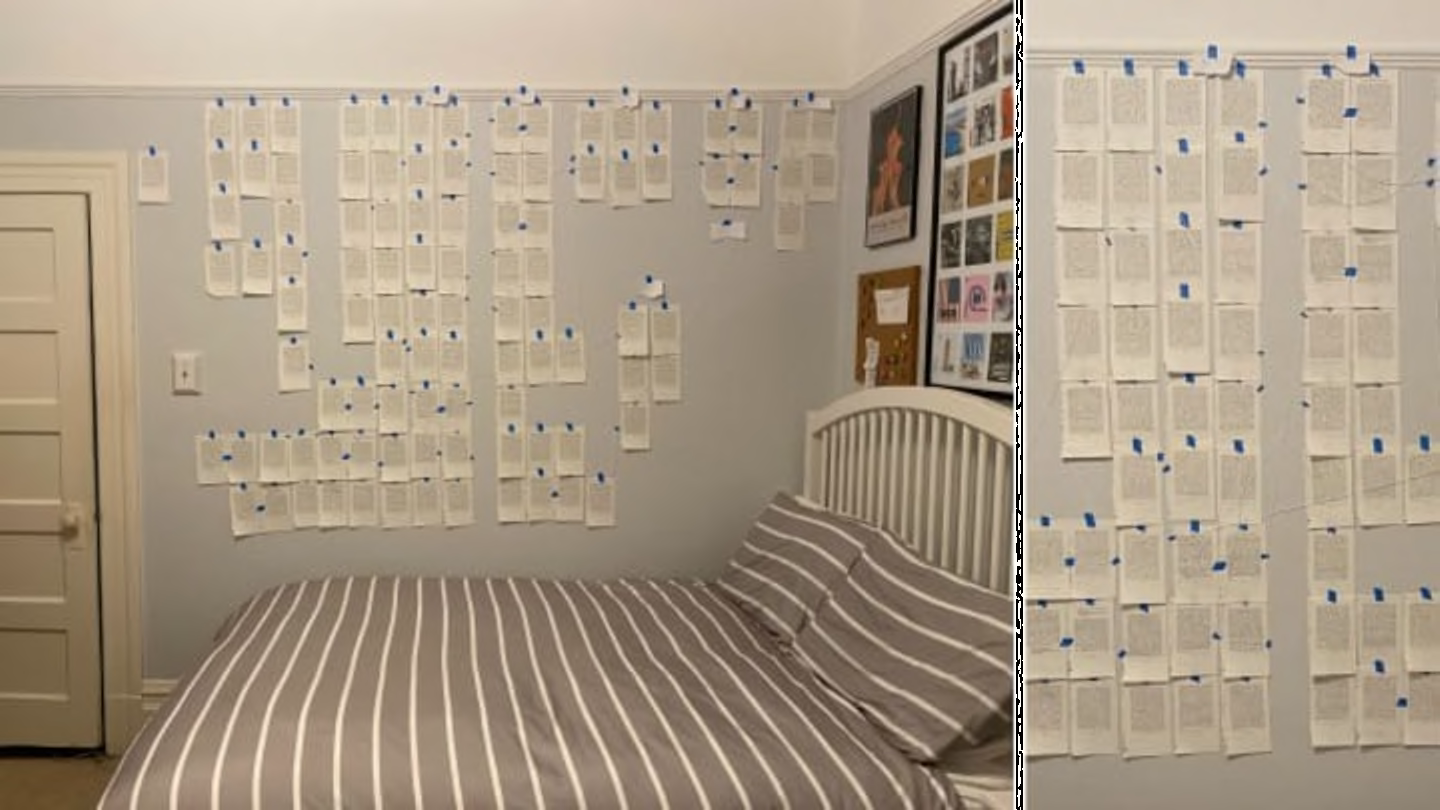
    3. Sarah Scannell’s murder board. It takes up nearly an entire wall of her San Francisco apartment: 100 pages with torn edges, painstakingly taped up with blue painter’s tape in a pattern that only makes sense to Scannell. Maybe you’ve even watched it evolve—at first the pages were connected with white string, but Scannell has since adopted a more user-friendly color-coding scheme involving sticky index tabs.

      Perhaps an interesting example of a murder board for J.D. Connor?

    1. "Josiah smashed the sacred stones and cut down the Asherah poles and covered the sites with human bones" (2 Kings 23:14, New International Version)

      2 Kings 23:14 indicates that King Josiah cut down the Asherah poles as a monotheistic reform in the second half of the 7th century BCE.


      Could these have have been in circles? Could they have been used as mnemonic devices?

      link this to the idea of the standing stone found at Khirbet Qeiyafa.

      Link this to my Ark of Covenant example.

      Link to Stonehenge and other henge examples as well as other timber circles.

    1. Peter Eseli of Mabuiag Island (known locally as Mabuyag)in the western Torres Strait began writing down traditional knowledgein the Kala Lagau Ya language in the early twentieth century. By1939, Eseli had amassed a 77-page manuscript, complete withdrawings, songs and genealogies as well as a wealth of starknowledge, some of which is included in this book. He continuedadding to it until his death in 1958. His manuscript was latertranslated into English.
    2. These ways of knowinghave inherent value and are leading Western scientists to betterunderstand celestial phenomena and the history and heritage thisconstitutes for all people.

      The phrase "ways of knowing" is fascinating and seems to have a particular meaning across multiple contexts.

      I'd like to collect examples of its use and come up with a more concrete definition for Western audiences.

      How close is it to the idea of ways (or methods) of learning and understanding? How is it bound up in the idea of pedagogy? How does it relate to orality and memory contrasted with literacy? Though it may not subsume the idea of scientific method, the use, evolution, and refinement of these methods over time may generally equate it with the scientific method.

      Could such an oral package be considered a learning management system? How might we compare and contrast these for drawing potential equivalencies of these systems to put them on more equal footing from a variety of cultural perspectives? One is not necessarily better than another, but we should be able to better appreciate what each brings to the table of world knowledge.

    1. The constellations’ positions in the night sky on significant dates, such as solstices and equinoxes, are mirrored in the alignments of the main structures at the compound, he found. Steles were “carefully placed within the temenos to mark the rising, zenith, or setting of the stars over the horizon,” he writes.

      Phoenicians use of steles and local environment in conjunction with their astronomy fits the pattern of other uses of Indigenous orality and memory.

      Link this example to other examples delineated by Lynne Kelly and others I've found in the ancient Near East.

      How does this example potentially fit into the broader framework provided by Lynne Kelly? Are there differences?

      Her thesis fits into a few particular cultural time periods, but what sorts of evidence should we expect to see culturally, socially, and economically when the initial conditions she set forth evolve beyond their original context? What should we expect to see in these cases and how to they relate to examples I've been finding in the ancient Near East?

    1. Also, interacting with my phone while I’m supposed to be engaging with other people (especially my own children) is very uncool. But nobody bats an eye when I take a written note. Or if they do, it often starts a conversation rather than ending it.

      From a social perspective, it's far less acceptable to pull your phone out and use it compared with taking out a notebook and writing a short note. One tends to end conversation and interaction whereas the second rarely ends a conversation and may sometimes create or extend one.


      I've experienced this same effect myself as well.

    1. Genex: A generator of excellence The four foundational beliefs lead to a model of creativity with four phases and therefore four categories of tools. I hope this framework (Table 1) aids designers in building genexes that will enable creative individuals in many domains to: - collect information from an existing domain of knowledge, - create innovations using advanced tools, - consult with peers or mentors in the field, and then - disseminate the results widely.

      Given these criteria for requisite tools of a genex, I can certain create a case that the IndieWeb community is doing most of these fairly well with respect to their domain of interest.

    Tags

    Annotators

    1. I also maintain a public Zettelkasten (others use the similar terms digital garden or second brain), in which I keep thoughts about everything under the sun. You can visit it to virtually “pick my brain” about some topic without bothering me, or to explore what I’m currently working on.

      Soren Bjornstad has a public zettelkasten which is in the vein of a traditional one though he indicates that others might call it a digital garden or second brain. This shows the conflation of many of these terms.

      What truly differentiates digital gardens from wikis and zettelkasten?

    1. https://www.newsletter.rikagoldberg.com/p/40-we-need-quality

      This meanders a lot and I'm not sure what I'm supposed to get from it...

      Based on the original context:

      Hey all. I have a love/hate relationship with digital gardening/zettelkasten-ing, but I understand that it's normal. More recently, my work has become very knowledge heavy, as I've started to write full time about technical things, so I've decided to try my hand, again, at a Zettelkasten. I wrote up the reasoning behind my decision here. If this post resonates with you, I'd love to hear your thoughts. https://www.newsletter.rikagoldberg.com/p/40-we-need-quality

      I'm thinking she's conflating the ideas of wiki and zettelkasten, which I've seen lead many people into trouble.

  4. Feb 2022
    1. Something about Scrivener elicits a lot of strong feelings from people who have used it, both positive and negative. It has a growing community of writers who swear by it, and a parallel community that is tired of hearing all the Scrivener-heads raving about their magic tool.

      Scrivener and its community are an example of a tool for thought being thought of as a magical tool potentially without people thinking about what the tool is doing that makes things so dramatically different.

      This article is written in 2017 just before the expansion of the zettelkasten craze in various social media spaces.

    1. I would consider my Read Write Respond site as a ‘blog’, but agree with you that my Collect site is not really a blog. In some respects I would be happy enough to make it private is it is primarily my own secret garden with the gate left open. This is why I curate my monthly newsletter. It is a habit which I find forces me to look back through all the noise. I think this creates a clearer narrative to pick through than my multitude of links.

      Aaron Davis uses the review through his website's posts, bookmarks, etc. to create his newsletter as a means of reviewing what he's read and thought about.

    1. I used to use Roam for lots of things: a daily diary, book notes, keeping track of lists like my todo list, and taking meeting notes.Today, this is my stack:Daily Diary / paper notebookBook Notes / split between Roam and MuseTo-do List / ThingsMeeting Notes / Apple Notes

      An example of a user who is (no longer) centralizing everything into one place. Also an example of a person overloading their use of note taking tool as a melting pot of data. Do they have a mental map of how to separate the pieces to get the value out of their system?

      It seems like they want it to "just work" without any conception of what this looks like

    2. After some time though, reality started to sink in. ‘I am not really going back through all of these notes as often as I thought I would.’

      Example of someone not using the system as it may have been intended. Visiting one's notes on a somewhat frequent basis should be part of one's regular practice.

      If you're not doing anything with what you read, why are you reading it? Similarly, if you're not doing anything with your notes, why bother taking them?

      Naturally, creating notes certainly has a valuable use for learning, but to get the most out of them revisiting and linking them has other value, based on one's need.

      Missing in this article is a specific use case for why the writer is taking notes at all.

    1. qbatten annotates on Jan 11, 2022:

      Why note-taking is bad. Why you shouldn't take notes. Taking notes shouldn't be the end in itself!

      I'll agree that "taking notes shouldn't be the end in itself", but they've drawn the completely wrong conclusion about note taking being bad or that this flimsy argument indicates that one shouldn't take notes.

      Not everyone who wields a hammer is going to be a master craftsman and it's even less likely that someone who tinkers with one for a few months or even a few years will get there without some significant help. There's no evidence here of anything but desire for methods to work. Where was the deep practice, research into these systems described?

      From the start, the featured image in the original article of a crazy person's conception of a massive collection of piles of paper to represent the process is highly illustrative of so many misconceptions.

    2. If I clicked through the labyrinth growing on my computer I could discover grottos and dusty corners I had already forgotten about.

      The unused accumulation of notes is the worst travesty. The collector's fallacy run amok.


      Why did this person fail here? What was their need/use case? Was it well-defined? Were the tools suited to their purpose?

    1. We also know that theaverage length of TV soundbites has steadily declined over the lastseveral decades (Fehrmann, 2011). During the U.S. presidentialelection in 1968, the average soundbite — that is, any footage of acandidate speaking uninterrupted — was still a little more than 40seconds, but that had fallen to less than 10 seconds at the end of the80s (Hallin 1994) and 7.8 seconds in 2000 (Lichter, 2001). The lastelection has certainly not reversed the trend. Whether that meansthat the media adjust to our decreasing attention span or is causingthe trend is not easy to say.[17]

      Ryfe and Kemmelmeier not only show that this development goes much further back into the past and first appeared in newspapers (the quotes of politicians got almost halved between 1892 and 1968), but also posed the question if this can maybe also be seen as a form of increased professionalism of the media as they do not just let politicians talk as they wish (Ryfe and Kemmelmeier 2011). Craig Fehrman also pointed out the irony in the reception of this rather nuanced study – it was itself reduced to a soundbite in the media (Fehrman 2011).


      Soundbites have decreased in length over time.

      What effects are driving this? What are the knock on effects? What effect does this have on the ability for doubletalk to take hold? Is it easier for doubletalk and additional meanings to attach to soundbites when they're shorter? (It would seem so.) At what point to they hit a minimum?

      What is the effect of potential memes which hold additional meaning of driving this soundbite culture?

      Example: "Lock her up" as a soundbite with memetic meaning from the Trump 2016 campaign in reference to Hilary Clinton.

    2. Reading with a pen in the hand, for example, forces, us to thinkabout what we read and check upon our understanding. It is thesimplest test: We tend to think we understand what we read – untilwe try to rewrite it in our own words. By doing this, we not only get abetter sense of our ability to understand, but also increase our abilityto clearly and concisely express our understanding – which in returnhelps to grasp ideas more quickly. If we try to fool ourselves hereand write down incomprehensible words, we will detect it in the nextstep when we try to turn our literature notes into permanent notesand try to connect them with others.
    1. The third way I interact with my notes is a mechanism I’ve engineered whereby they are slowly presented to me randomly, and on a steady drip, every day.I’ve created a system so random notes appear every time I open a browser tabI like the idea of being presented and re-presented with my notations of things that were interesting to me at some point, but that in many cases I had forgotten about. The effect of surprise creates interesting and productive new connections in my brain.

      Robin Sloan has built a system that will present him with random notes from his archive every time he opens a browser tab.

    2. That ‘taste’ is a very personal thing, and I don’t think I can really explain it. But I’m pretty sure it means that, for me, note-taking is a very long-term, gradual process of finding my way towards something; I just can’t quite articulate what that something is.

      I like the idea of taking notes as a means of finding one's way towards something which can't be articulated.

      This is an interesting way that one could define insight.

    3. Transferring my notes from notebooks into nvALT is a process that I always enjoy. When I fill up a physical notebook, I'll go through it, acting as a sort of loose, first filter for the material I’ve accumulated. I’ll cross out a few things that are obviously garbage, but most of my notes make the cut, and I transcribe them into nvALT.When that’s done, I throw away the notebook.

      Robin Sloan has a waste book practice where he takes his notes in small Field Note notebooks and transcribes them into nvAlt. When he's done, he throws away the notebook.

    4. I describe myself as a ‘media inventor’, which I know sounds like a strange label. To me, it means that a lot of my work – not really my novels, but almost everything else – involves inventing a format or container at the same time that I’m writing or imagining what goes into it.

      Robin Sloan considers himself a "media inventor" by which he means someone who creates containers and things which go into them.

    1. Hypehouses were a development that made middle-aged people feel even older. The idea of random people living together to make TikTok videos sounds like hell on earth. And it turns out to be pretty much hell on earth.

      Hypehouse (collab house) examples: * https://www.vox.com/the-goods/22877013/hype-house-netflix-show * https://www.cosmopolitan.com/entertainment/celebs/a34655703/tiktok-sway-house/ * https://harpers.org/archive/2021/06/tiktok-house-collab-house-the-anxiety-of-influencers/ * Does Clubhouse, the app, count? It seemed like a hypehouse for hyping hype.


      What happens when hype runs amok?

    1. Ahren’s book and ideas are not his original creation, but based on the method of Niklas Luhman referred to as the Zettelkasten. I see various references to Luhman’s ideas lately and predict this will become “a thing” in education.

      Another example of how much we've forgotten of our commonplacing and note taking traditions in rhetoric, and this from someone who's actively used note cards in the past.

      Luhmann did not invent the zettelkasten. (I should make bumper stickers...)

      Oops: https://www.zazzle.com/niklas_luhmann_bumper_sticker-128462770354241554

  5. Jan 2022
    1. In the more recent decades, of course, personal collation of this sort is well supported by digital tools – early blog platforms, Delicious, Tumblr, Pinterest, and so on – and we toyed briefly with the idea of something as a shared digital experience or app.

      Indication here of digital platforms like Delicious, Tumblr, and Pinterest standing in for digital commonplace books.

    1. Any interaction with the card index is differently informative not simply because the query is different but also because the variety is recursively reproduced and dependent on the past.

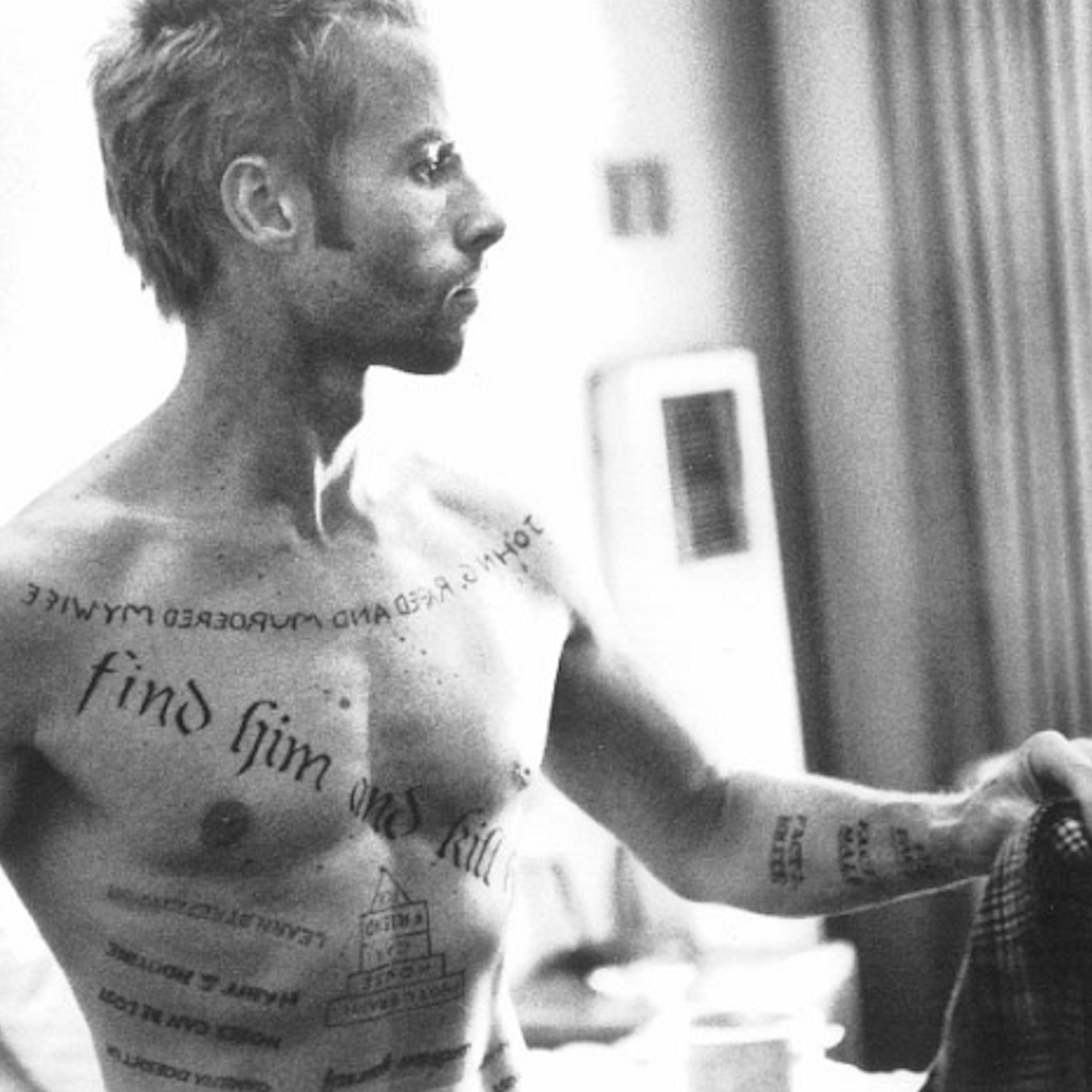
      Somehow this sparked the realization:

      The tattoos on Leonard Shelby's body in the film Memento act in some way as a physical zettelkasten of information stored on skin rather than index cards. The information can be traversed in a number of ways for a short period of time by Leonard. He uses the information over time to solve a murder.

      Guy Pierce as Leonard Shelby featuring a number of text-based tattoos on his torso and arms

    Tags

    Annotators

    1. Wendat society was not ‘economically egalitarian’ in that sense.However, there was a difference between what we’d considereconomic resources – like land, which was owned by families,worked by women, and whose products were largely disposed of bywomen’s collectives – and the kind of ‘wealth’ being referred to here,such as wampum (a word applied to strings and belts of beads,manufactured from the shells of Long Island’s quahog clam) or othertreasures, which largely existed for political purposes.

      Example in literature of wampum being described as wealth existing for political purposes.

    1. What an awesome little site. Sadly no RSS to make it easy to follow, so bookmarking here.

      I like that she's titled her posts feed as a "notebook": https://telepathics.xyz/notebook. There's not enough content here (yet) to make a determination that they're using it as a commonplace book though.

      Someone in the IndieWeb chat pointed out an awesome implementation of "stories" she's got on her personal site: https://telepathics.xyz/notes/2020/new-york-city-friends-food-sights/

      I particularly also like the layout and presentation of her Social Media Links page which has tags for the types of content as well as indicators for which are no longer active.

      This makes me wonder if I could use tags on some of my links to provide CSS styling on them to do the same thing for inactive services?

    1. Reflecting upon Robert Darnton's comment, perhaps my personal reading and writing style is more representative of the seventeenth century than the twentieth or twenty-first.  Throughout my career in the antiquarian book trade, which began in the 1960s, I found myself moving between subjects in the course of a day as I catalogued various books in stock, read about other books for sale, or discussed the different interests of clients.  With access to the Internet in the 1990s it was, of course, possible to follow-up more efficiently on diverse topics with Internet searches and hyperlinks.  The way that HistoryofInformation.com is written, as a series of reading and research notes connected by links and indexed in a database, may be viewed to a certain extent as analogous to the method of maintaining and indexing commonplace books described by Locke.

      Jeremy Norman, an antiquarian bookseller, indicates that his website is written in much the same manner as John Locke's commonplace book.

    1. Scholars well grounded in this regime, like Isaac Casaubon, spun tough, efficient webs of notes around the texts of their books and in their notebooks—hundreds of Casaubon’s books survive—and used them to retrieve information about everything from the religion of Greek tragedy to Jewish burial practices.

      What was the form of his system? From where did he learn it? What does it show about the state of the art for his time?

  6. Dec 2021
    1. Pratt persuaded tribal elders and chiefs that the reason the "Washichu" (Lakota word for white man, loosely translates to Takes the Fat) had been able to take their land was that the Indians were uneducated. He said that the Natives were disadvantaged by being unable to speak and write English and, if they had that knowledge, they might have been able to protect themselves.

      Example where literacy provides perceived power over orality.

    1. In 1657, the fi rst practitioner of nonhierarchical indexing, Joachim Jungius (born 1585), dies in Hamburg after compiling approximately 150,000 slips of papers with accumulated knowledge, bound and sorted according to the most minute details and building blocks and without registers or indexes, let alone reference systems. 3
      1. On Jungius and his technique, see Meinel 1995.

      Joachim Jungius (1585-1657) compiled approximately 150,000 slips of paper with accumulated knowledge sorted and bound but without indices. Markus Krajewski considers him the "first practitioner of nonhierarchical indexing."

  7. aworkinglibrary.com aworkinglibrary.com
    1. I began this site in 2008 in an effort to bring some structure to a long held habit: taking notes about the books I read in a seemingly endless number of notebooks, which then piled up, never to be opened again. I thought a website would make that habit more fruitful and fun, serving as a reference, something the notebooks never did. It did that handily, and more, including making space for me to write and think about adjacent things. More than a dozen years later and this site has become the place where I think, often but not exclusively about books—but then books are a means of listening to the thoughts of others so that you can hear your own thoughts more clearly. Contributions have waxed and waned over the years as life got busy, but I never stopped reading, and I always come back.

      Several things to notice here:

      • learning in public
      • posting knowledge on a personal website as a means of sharing that knowledge with a broader public
      • specifically not hiding the work of reading in notebooks which are unlikely to be read by others.
  8. Nov 2021
    1. In May, a young reporter, Emily Wilder, was fired from her new job at the Associated Press in Arizona after a series of conservative publications and politicians publicized Facebook posts critical of Israel that she had written while in college. Like so many before her, she was not told precisely why she was fired, or which company rules her old posts had violated.
    2. This spring, Braden Ellis, a student at Cypress College in California, shared a class Zoom recording of his professor’s response when Ellis defended portrayals of police as heroes. Ellis said he did this in order to expose a purported bias against conservative viewpoints on campus. Even though the recording by itself does not prove the existence of long-standing bias, the professor—a Muslim woman who said on the recording that she did not trust the police—became the focus of a Fox News segment, a social-media storm, and death threats. So did other professors at the college. So did administrators. After a few days, the professor was removed from her teaching assignments, pending investigation.

      Kudos to Applebaum for not naming the party involved here, but instead giving the infamy to the "offending" parties who may have sought fame and attention for themselves.

    3. In March, Sandra Sellers, an adjunct professor at Georgetown University Law Center, was caught on camera speaking to another professor about some underperforming Black students in her class. There is no way to know from the recording alone whether her comments represented racist bias or genuine concern for her students. Not that it mattered to Georgetown—she was fired within days of the recording’s becoming public. Nor could one know what David Batson, the colleague she was talking to on the recording, really thought either. Nevertheless, he was placed on administrative leave because he seemed, vaguely, to be politely agreeing with her. He quickly resigned.
    4. After Alexi McCammond was named editor in chief of Teen Vogue, people discovered and recirculated on Instagram old anti-Asian and homophobic tweets she had written a decade earlier, while still a teenager.

      Should people be judged by statements made in their youth or decades prior? Shouldn't they be given some credit for changing over time and becoming better?

      How can we as a society provide credit to people's changed contexts over time?

      This can be related to Heraclitus' river.

  9. Oct 2021
    1. Black and white worked together, fraternized together. The very fact thatlaws had to be passed after a while to forbid such relations indicates thestrength of that tendency. In 1661 a law was passed in Virginia that “in caseany English servant shall run away in company of any Negroes” he would haveto give special service for extra years to the master of the runaway Negro. In1691, Virginia provided for the banishment of any “white man or woman beingfree who shall intermarry with a negro, mulatoo, or Indian man or woman bondor free.”

      In the late 1660's laws began to be passed which institutionalized racism and further increased the split between otherwise equal white and colored friends by increasing punishment toward whites working in concert with people of color.

  10. Sep 2021
    1. Since Penn invested in the PAS, a number of urban universities have replicated the neighborhood school model in their revitalization strate-gies. For instance, Johns Hopkins University is a major contributor to the recently opened Henderson-Hopkins School, a K-8 public school and the centerpiece of EBDI’s efforts to stabilize East Baltimore. The school rep-resents one of the first major investments in the community in decades, providing early childhood education services and community spaces, in addition to the K-8 curriculum. Other universities have established K-12 partnerships, directing fiscal and human capital toward specific schools or public school districts. For example, Syracuse University is one of several partners involved in the “Say Yes to Education Syracuse” initia-tive, an effort that connects local partners to a national nonprofit founda-tion (Say Yes to Education) to provide year-round support to the Syracuse City School District students.

      other Universities following suit with the school catchment area investment strategy.

    2. Since 1998, Penn has invested $165 million in University City development proj-ects, including a neighborhood grocery store, movie theater, restaurants, and a hotel; in doing so, the university has leveraged more than $700 million in private capital (Division of Facilities and Real Estate Services, University of Pennsylvania 2012). These projects contribute more than 400,000 square feet of retail space to the neighborhood with occupancy rates consistently outpac-ing Center City rates between 2003 and 2010.

      investment examples

    Tags

    Annotators

  11. neilcommonplacebook.wordpress.com neilcommonplacebook.wordpress.com
  12. Aug 2021
    1. https://www.reddit.com/r/commonplacebook/comments/jb8x3d/what_does_your_indexing_system_look_like/

      Brief discussion of indexing systems for commonplace books. Locke's system is mentioned. Another person uses a clunky system at the bottom of pages to create threaded links.

      Intriguingly, one person mentions visiting theirs often enough that they remember where things are. (spaced repetition with a bit of method of loci going on here)

    1. In 2003, Ross's family gave his journals, papers, and correspondence to the British Library, London. Then, in March 2004, on the last day of the W. Ross Ashby Centenary Conference, they announced the intention to make his journal available on the Internet. Four years later, this website fulfilled that promise, making this previously unpublished work available on-line.

      The journal consists of 7,189 numbered pages in 25 volumes, and over 1,600 index cards. To make it easy to browse purposefully through so many images, extensive cross-linking has been added that is based on the keywords in Ross's original keyword index.

      This definitely sounds like a commonplace book. Also an example of one which has been digitized.

  13. edwardbetts.com edwardbetts.com
    1. I am also interested in the work and method of Ross Ashby. His card index and notebooks have been put online by the British Commputer Society. I am fascinated by his law of requisite variety and how variety relates to complexity and its unfolding in general and in relation to design.

      Sounds like Ross Ashby kept a commonplace book here.

      Could be worth looking into: http://www.rossashby.info/ and digging further.

    1. This book consists of ideas, images, & quotations hastily jotted down for possible future use in weird fiction. Very few are actually developed plots—for the most part they are merely suggestions or random impressions designed to set the memory or imagination working. Their sources are various—dreams, things read, casual incidents, idle conceptions, & so on. —H. P. LovecraftPresented to R. H. Barlow, Esq., on May 7, 1934—in exchange for an admirably neat typed copy from his skilled hand.

      Somewhat bizarre that Wired published this in this form without any sort of preamble or description.

    1. Heyyy!!! I am so happy to see that I am not the only one following a similar system. I have lots of books marked in the same way and also with notes (by the way when taking notes use black ink - blue reflects in light and tired mind - ) and then my solution. After reading it all and taking notes, I categorized all my notes and distribute around my Excel file as attaching. Using this way I can add it to different categories and use it every where.

      Look up Ken Wilber's system, which he apparently used for researching and writing his books.

    2. Heyyy!!! I am so happy to see that I am not the only one following a similar system. I have lots of books marked in the same way and also with notes (by the way when taking notes use black ink - blue reflects in light and tired mind - ) and then my solution. After reading it all and taking notes, I categorized all my notes and distribute around my Excel file as attaching. Using this way I can add it to different categories and use it every where.

      Example of person using Excel to keep a commonplace book.

    1. Just this year I made a gmail account, just for me to send myself creative ideas, interesting quotes, and write down moving experiences. I also send myself articles that I like and it’s nice to be able to write my thoughts or key words to go with it. Then the email can be organized into folders for the different themes. It’s a really easy way to bring it all with me and to never feel like I have to wait to record an idea.

      An example of someone using a gmail account to create a commonplace book!

    1. Unlike traditional journaling or commonplacing, my pocket notebooks don’t have any set format, and mostly amount to a collection of short lists, reminders, and random stream-of-consciousness jottings. These notebooks essentially serve the same purpose as scratch paper, only I have all of my random musings gathered together in one place as opposed to scattered around my desk on post-its and the backs of old grocery lists.

      This is an example in the wild of someone using pocket notebooks as waste books. Though in this case they weren't actively moving pieces into a more permanent commonplace.

      https://www.gentlemanstationer.com/blog/2020/7/31/personal-journaling-setup-part-3-revisiting-pocket-notebooks

  14. Jul 2021
  15. Jun 2021
  16. May 2021
    1. Use cases: Volumes are most useful when you need more storage space but don’t need the additional processing power or memory that a larger Droplet would provide, like: As the document root or media upload directory for a web server To house database files for a database server As a target location for backups As expanded storage for personal file hosting platforms like ownCloud As components for building more advanced storage solutions, like RAID arrays
  17. Apr 2021
    1. I intend to live forever. So far, so good. Whenever I think of the past, it brings back so many memories. I think it's wrong that only one company makes the game Monopoly. If it's a penny for your thoughts and you put in your two cents worth, then someone, somewhere is making a penny. What's another word for Thesaurus? I used to work in a fire hydrant factory. You couldn't park anywhere near the place.
    1. At the Philadelphia Museum of Art, educators train medical students in slow looking to hone their observational skills, but as West notes, it’s not just about noticing small physical details that might inform a diagnosis.

      I'm reminded of the research implied by Arthur Conan Doyle's writing about Sherlock Holmes. We hear about the time and effort spent studying the smallest things, but we don't see it, instead we see the mythical application of it at the "right" times to solve cases in spectacular fashion.

      No one focuses on the time spent studying and learning and instead we mythologize the effects at the other end.

      Another example of this is the fêting of Andrew Wiles's proof of Fermat's last theorem, while simultaneously ignoring the decades of work he poured into studying and solving it not to mention the work of thousands before him to help give him a platform on which to see things differently.

  18. Mar 2021
    1. In the next Learning Circle, I wrote a US History II textbook, adapted from The American Yawp. This was my first experience "Remixing" an existing CC-licensed OER. I think I took a step to making it my own and shifting its focus from what I considered a slightly consensus-driven and slightly political-correctness agenda to a more direct focus on some of the inequalities and injustices that the political correctness is belatedly trying to address. I think once I've reworked it one or two more times, using it in my courses and altering it gradually over a few semesters, it will probably be ready for publication as a "new" thing, although I'll continue to cite the original authors and point out that I'm in dialog with the previous work they did. I think this is how most textbooks are made, but like everything else, I want it to be very visible.

      This is an excellent example of an OER textbook being actively reimagined. I often see people writing about how it works, but haven't seen many cases of people writing about actively doing it.

    1. As a simple example of a basic runtime system, the runtime system of the C language is a particular set of instructions inserted into the executable image by the compiler. Among other things, these instructions manage the process stack, create space for local variables, and copy function-call parameters onto the top of the stack. There are often no clear criteria for deciding which language behavior is considered inside the runtime system versus which behavior is part of the source program. For C, the setup of the stack is part of the runtime system, as opposed to part of the semantics of an individual program, because it maintains a global invariant that holds over all executions. This systematic behavior implements the execution model of the language
  19. Feb 2021
    1. limit voter registration drives, require notarized signatures for mailed ballots and forbid voters from actually mailing-in completed ballots.

      Although Sinema is the Democratic candidate, she comes from a Republican state who already started to limit voters from certain ballots. By including these examples, the author emphasizes that action needs to be taken seriously as states such as Arizona have already started "trumpifying." Also, this shifts her discussion to the main claim, which is that Republicans are stopping some voters from voting as that can give Democrats some serious power.

  20. Nov 2020
  21. Oct 2020
  22. Sep 2020
  23. Aug 2020
    1. market engineers introduced what’s called a ‘circuit breaker’ – a rule for pausing trading when signs of a massive drop are detected.

      Discord's slowmode or other various 'lockdowns' of communication in forums also come to mind

  24. Jul 2020
  25. May 2020
  26. Mar 2020
    1. Get phrasebooks to start studying basic terminology. Phrasebooks are lists of expressions made for travelers to foreign countries. These lists give you an example of the sentence structure a language uses and what kind of words are useful. Find a phrasebook in the language you wish to learn and treat it as a foundation you can build upon as you learn more.
  27. Jan 2020
  28. Dec 2019
  29. Nov 2019