10,000 Matching Annotations
- Apr 2021
-
store.steampowered.com store.steampowered.com
-
store.steampowered.com store.steampowered.com
-
That should make for interesting puzzles, except they're timed, your guys never stop moving (why not?), and the camera and controls mean it's very hard to translate intent into the game world.
-
-
www.kickstarter.com www.kickstarter.com
-
www.thegamecrafter.com www.thegamecrafter.com
-
DISCLOSURE: I feel it's fair to let everyone know that Rolling Seas has been signed by a publisher and should see a full retail version available in 2-3 years. I had already planned this Crowd Sale before signing with the publisher and have their approval to run this sale. This Crowd Sale will be one of the last opportunities to get Rolling Seas before full publication (it will be taken down from The Game Crafter within a few months).
Tags
Annotators
URL
-
-
store.steampowered.com store.steampowered.com
-
0.1 hrs on record Early Access Review Posted: February 18 This game is amazing. I don't even speak russia but I got the full in depth story. I have sunk countless hours into all of the nuances in this game. Thank you, sincerley, thank yiou Narod for chaning my life.
-
-
mason.gmu.edu mason.gmu.edu
-
And I have developed a board game where players use such a market to bet on a murder mystery as it unfolds.
https://www.overcomingbias.com/2018/08/my-market-board-game.html
-
-
nbviewer.jupyter.org nbviewer.jupyter.org
-
Median of point duration is about 40 seconds with three longest points around 5 minute player in the middle of the game. One fourth of all points have ended up with less then 25 seconds and over one fourth of all points lasted over 50s. With match duration of nearly 5 hours without a doubt it is one of the longest, if not the longest, Wimbledon finals
great sum up
-
-
scalar.usc.edu scalar.usc.edu
-
character design
1: the audience must also understand what goes into character design and environmental design, and what differentiates the two.
-
narrative.
4: Great use of the side by side images. I love that each pair of photos (usc v. game) share similar architectural aesthetics. such a useful visual to support your main point.
-
As
4: I love the first image because it sets up the paper perfectly. Right when i looked at the picture i noticed that the architectural was spookily similar to the Kaufman School of Dance at USC. Literally the USC environment and the game environment meshing into one, a representation of the theme you then explain to the reader. amazing!
-
Bioshock and Gone Home
1: The audience is clearly students in the usc games program, and, in turn, are expected to have prior knowledge of video games.
-
So, a game designer might ask themself what ideas and feelings they want to be associated with the architectural style in their game.
3: The idea that architecture can have an emotional effect on people even seems basic but i have never thought about how different architectural style made me feel until now, especially in a virtual setting. These artistic decisions hold so much weight.
-
College campuses built as both educationally and community-driven environments, like the University of Southern California, provide some interesting examples that we can use to demonstrate the types of things that a game designer might want to look out for.
3: The most interesting point made in the essay. The basis of the paper, comparing the environment of USC and video games is so interesting. i was shocked when i read this sentence because i never would have thought to put these two topics together. SUCH a cool comparison!
-
In games, like Night in the Woods,
your referencing of games insinuate that your audience should be/ is familiar with them, which opens the door and allows for you to talk about this topic more in depth without having to give extensive background
-
Still, for games that have the ambition to combine game mechanics and storytelling, the environment is a super duper importante tool.
really nice conclusion, it ends lighthearted and fun. the overall tone of the essay feels very conversational and informal for the most part, yet touches on so many complex and interesting points and ideas. Audience was clear and flow was beautiful. this was so fun to read, sarah!
-
In contrast with the bustle of the park trails, this area encourages a quiet moment of reflection, and players might feel a sense of engaged curiosity and immersion. So a game designer might ask themself what past they want to imply with their game’s environment, and what feelings they want to evoke with that past.
Great transition: "in contrast". Also great job bringing it full circle, coming back to what the game designer might ask themselves based off of the stylistic aesthetics the campus gives off
-
Both perspectives are emotional reactions to the ideas the Village’s architectural style represents.
i like this sentence because it recognizes two different perspectives and effectively uses them as examples of emotional reactions to the architectural style of the village
-
As a student in USC’s Games program, I’ve observed many game designers eagerly jump into character design, fleshing out their personalities and their backstories, but often they overlook the design of the environment - possibly because it is easier to become attached to human characters than to a building.
Audience is so clear! Also really love how you have already acknowledged that you are a part of this community, it honestly makes the article/ essay so much more interesting to read because it feels more personal. also nice they say/ i say
-
The washed out brick of newer buildings, intentionally treated to appear older, also communicate USC’s desire to appear as an old and wisened institution.
interesting take on SC's aesthetics. i really appreciate your own interpretations mixed in with effective evidence and examples, works really well.
-
ollege campuses built as both educationally and community-driven environments, like the University of Southern California, provide some interesting examples that we can use to demonstrate the types of things that a game designer might want to look out for.
wow such a great concluding sentence. really sets up essay nicely, good transition.
-
-
mrsnetherysclass.weebly.com mrsnetherysclass.weebly.comAmy Tan1
-
And the next day I played a game with myself, seeing if my mother would give upon me before eight bellows. After a while I usually counted only one bellow, maybe two at most. At lastshe was beginning to give up hope.
I used to do this when I played piano, I seemed out of it so they gave up on pushing me.
-
-
pressbooks.howardcc.edu pressbooks.howardcc.edu
-
This man, in Kashgar, Xinjiang province, in Western China, is serving up his national dish. It’s called sheep’s organs. It’s delicious, it’s nutritious, and as I learned when I went to Kashgar, it symbolizes their taboo against food waste. I was sitting in a roadside cafe. A chef came to talk to me, I finished my bowl, and halfway through the conversation, he stopped talking and he started frowning into my bowl. I thought, “My goodness, what taboo have I broken? How have I insulted my host?” He pointed at three grains of rice at the bottom of my bowl, and he said, “Clean.” (Laughter) I thought, “My God, you know, I go around the world telling people to stop wasting food. This guy has thrashed me at my own game.”
This is a great example of both ethos and pathos. The ethos is that it was something that happened to him and that the story was about a dish that literally symbolizes a taboo against food waste, which is the topic of this TEDtalk. The pathos comes in when he explains his thoughts from the time, his worry about having somehow offended the culture (because not only was he a foreigner, but Chinese culture prioritizes respect and honor). Also the statement of "he's beating me at my own game!" is light-hearted enough to draw in the audience with its humour.
-
-
-
How many times can a person listen to the same podcast episode? Probably not many before the content becomes repetitive and boring. In contrast, one can listen to a favorite song on repeat ad infinitum. In video games, there’s not only value in replaying a game, but increasing marginal utility because players gain mastery and can enjoy a game even more after sinking hundreds of hours into it. This suggests that categories with high replay value — like music and game platforms — are most susceptible to concentration among a few mega-hits.
Oh wow. music and game platforms are more susceptible to concentration among a few mega-hits. I'm glad I'm not in music or video games.
-
-
www.unrealengine.com www.unrealengine.com
-
Louden: All of Returnal is handcrafted, but the most exciting thing about the game is every time you play, we procedurally connect these moments, connecting our handcrafted environments, level design, combat, and narrative beats. It still surprises me with how wild the variation can be as Selene fights across Atropos and the surprises we have set up.
procedural games are cool
-
-
extension.oregonstate.edu extension.oregonstate.edu
-
Carbon dioxide + Water + Sunlight = Sugar + Oxygen or 6 CO2 + 6 H20 + Energy => C6H1206 + 6 02
I remember learning this formula in high school! To support student comprehension, I envision activities designed to help the students acknowledge what each part of the formula actually means in order to increase their understanding. Maybe, a game or activity could support memorization techniques.
-
-
store.steampowered.com store.steampowered.com
-
The game is not too bad.. sweet graphics yet minimalistic.. but why the heck 1,5k achievements? I can barely concentrate on the levels because all the freaking achievements pop up all the time. One per level would have done the job just fine.. i love achievements.. but getting 1,5k for nothing is hideous.
-
-
store.steampowered.com store.steampowered.com
-
The core idea of the game is fine, but the implementation is poor.
-
-
store.steampowered.com store.steampowered.com
-
All in all, get this game when it's not on sale so you can pay full price for this gem!!!
-
-
store.steampowered.com store.steampowered.com
-
Actually a very interesting concept allthough not perfectly executed (even considering it's based on a board game)
-
The saddest part is that almost every one of these problems could be fixed with a decent patch. Don't expect one from this developer though(look at their website, this game came out in 2010 with no updates.)
.
-
Unfortunately, it’s in the execution where “US and THEM” starts to fall apart. The game’s major problems stem from the user interface and some design choices range from questionable to downright horrible. For starters, the world map that takes up more than half of the screen can be neither scrolled nor zoomed. In a game where your interaction heavily relies on clicking various nations, this becomes a problem. While larger countries like Canada, the US and Russia are easily accessible, smaller nations require pixel perfect accuracy to interact with. Try clicking on Cuba, Ireland or Hungary and you’ll find yourself maniacally clicking shades and outlines and a handful of visible pixels in the area of these countries in vain hope that the game will acknowledge your actions.
-
-
store.steampowered.com store.steampowered.com
-
The Gamemaker lite watermark in the screenshots says all. The 'game' is like someone's first attempt ever at making a game. It should never be sold on a respectable site but steam stopped being one of those years ago. It has many problems like easily getting stuck on walls so it just isn't enjoyable to play.
Tags
Annotators
URL
-
-
www.lifehack.org www.lifehack.org
-
nstead of idly standing by, Gabriel took a camera and went around the neighborhood, documenting the damage that these supposedly glamorous efforts to show off in front of the world had really done to the hard-working low-income Brazilian neighborhoods.
Sometimes people don't realize that glorious things that people promise is not always as good and ethical as it sounds. The rich people might host a world cup game that will bring pride to their country, but a lot of people fail to realize who that effects.
-
However, as Gabriel and his friends and neighbors soon realized, all this exposure and prestige comes at a cost and, ironically, it is not those with an overabundance of wealth to give that are expected to pay the price.
''ironically, it is not those with an overabundance of wealth to give that are expected to pay the price.'' This is true for a lot of things in the world, not just about how rich people destroy communities for a world cup game. Most of the time when the privileged people made a mistake or decision, the underprivileged people are expected to pay the price of it.
-
-
docdrop.org docdrop.org
-
Being able to successfully understand,navigate, modify, and design systems will become more and more inextric-ably linked with how we learn, work, play, and live as engaged worldcitizens.Sys
When I was completing the survey, I had a hard time wrapping my head around the concept of systems with video games, game design and gaming literacy. I liked this whole paragraph on systems and it helped to shed light on a concept I was struggling with.
-
Rules really do not seem like much fun atall. But when rules are taken on and adopted by players who enter themagic circle and agree to follow the rules, play happens.
What a great point! Now how do we transition this idea into our lesson plans? Typically our students don't find rules fun but within gaming they embrace the challenge and like to play the game.
-
Together they stand for a new set of cognitive, creative, and socialskills—a cluster of practices that I call gaming literacy.
When learning about the game Walden and gaming literacy in general I thought of how this could potentially be helpful in my school with students with special needs. I spoke with social workers who work on social and emotional skills with students and thought how helpful this practice of gaming literacy could be helpful with this particular group of students who have multiple disabilities and trauma.
-
When you play the game, test yourself into the game and repeat it more times to see your level in the game. Do not judge the game before you see yourself as an expert in it.
-
Game maker related for game player, that's mean if the designer must motivate by his game and make the rules of it clear.
-
Twenty-First Century
The set of skills that students are expected to have to survive college and work has shifted towards what we call "21st century skills", which include: problem solving, critical thinking, communication, and creative thinking to mention some. Game design is a great way to teach students these skills and to provide them with an environment to practice these skills often.
-
When we move fromsystems to play, we shift focus from the game to the players, from structuresof rules to structures of human interaction. Games as play are social eco-systems and personal experience, and these dimensions are key aspects of awell-rounded literacy
Yes! Love this. When you play games, you are interacting with the structures and the impact of those structures on others.
-
What does gaming look like? butinstead: What does the world look like from the point of view of gaming?
This paradigm seems to be omnipresent regarding educators that either are for or against game-based learning. Our course has explained the "for" game-based learning clearly. How do we aid other stakeholder in the point of view of the game itself?
-
a game system is designed just so that playwill occur
I have never explored the area of game design. But I am wondering if educators are involved in that process? For example, when Warcraft was designed, were educators involved in the process?
-
The free play of a steering wheel is the distance it can move withoutengaging with the drive shaft, axle, and wheels—the more rigid utilitarianstructures of the car.
This analogy is great. Within the rules of the game, we are allowed to play freely in video games. So within the structure of our lesson, students should be given opportunity to explore in multiple ways freely.
-
how gameplaying and game design can be seen as models for learning and action inthe real world.
How the world looks like from the point of gaming, or how can we see gaming as models of learning is the question I have never thought about. Just gaming to "create meaning" described as "gaming literacy" is somewhat abstract to me mainly because I was not exposed to playing video games with a goal to learn.
-
As a game unfolds through play, metaplay, and transformative play,unexpected things happen, patterns that are impossible to completely pre-dict.
In most first person shooter games, the AI is very predictable and if you pay attention, you can use a specific set of moves or actions to defeat them. However, against a human opponent/groups, players adapt to techniques or strategies. As a result, their opponents either emulate or innovate to defeat them. So the play transforms and changes.
-
Increasingly, complex infor-mation systems are part of how we socialize and date, conduct businessand finance, learn and research, and conduct our working lives.
I knew my time spent on my NES and PS4 would pay off dividends! If you look at the first "open world" game, Zelda everything resets once you get far enough away or after a certain amount of time passes. In comparison to modern open world games such as Skyrim, the game tracks your decisions and your interactions and you develop a "reputation" that either helps or hinders your options through the game.
-
match begins, your friend suddenly becomes your oppon-ent and bitter rival—at least for the duration of the game.
I have noticed with the high level competitors I train with, that there is a powerful on-off switch in which they emotionally de-personalize the competition. I have never really been able to do that.
-
game creates its ownmeanings (blue means enemy; yellow means power-up), but also trafficswith meanings from the outside (horror film music in a shooter meansdanger is coming; poker means a fun evening with friends).
This reminds me of Cope and Kalantzis' "Grammar of Multimodality."
-
-
online.maryville.edu online.maryville.edu
-
Copyright Law and Digital Property Copyright law applies to any digital work that is fixed in a tangible medium (i.e. on a hard drive, in the cloud, on a USB drive), original, and creative. The law specifies that creativity can be very minimal and elementary (e.g. a stick-figure cartoon or game). For your work to qualify for copyright, it must be entirely your own. If you plagiarize a blog post and post it on your own site, you are responsible for copyright violation. The second you create an original work under your name, whether online or off, it’s subject to copyright law, meaning other people can’t use it without your permission.
This part goes back to the ISTE citizen standard for educators because in the standard, it says for educators to mentor students in teaching about the protection of intellectual rights and properties. Students should be aware of plagiarizing and illegally downloading other sources already published. It is crucial for teachers to show and teach students to use their work for qualifying for copyright. Copyright involves students learning about what constitutes infringement and plagiarism.
-
-
saintswire.usatoday.com saintswire.usatoday.com
-
Lack of game film and measurables present a unique challenge for teams performing due diligence on prospects.
In a year where some players opted out and there is no way to get data from the combine I wonder what teams will focus on as primary forms of talent analysis?
-
-
www.patreon.com www.patreon.com
-
As part of my learning priority, I pick one activity each morning that is meaninfgul to me and I deeply focus on that activity. This varies from day to day, and it can be something like a long reading session, practicing the piano, doing a bit of work if I feel inspired to do so, or simply play a videogame I've been enjoying lately. I make an effort to select only one of these activities every single day and really delve into it intentionally instead of hopping from hobby to hobby. This is part of my multiple morning routine concept, which I've mentioned in a different video.
choose only one activities and focusing only on it in one morning. try to read, try to paint, to play video game or other different things. it can be the best way to take time to your hobby.
-
-
randle.substack.com randle.substack.com
-
Stakeholders in the venture/growth game
这篇文章主要分析了 Tiger 系基金迥然不同的投资风格:Better/Faster/Cheaper Capital.
首先来看这张图,这是在 Venture / Growth 阶段投资中的三个利益相关方,以及他们的利益目标。
在这样的安排下,传统的投资基金选择的方式是:尽可能保证每一笔投资都能产生较高的 IRR(内部收益率),那么,这就意味着选择更审慎的尽职调查,以及压低估值,以此来寻求回报率的安全边际。这就使得在一笔投资上所花费的时间更长,流程更繁琐。对于创始人而言,意味着更多的时间花费在融资的流程中,并会收到更少的钱。
Tiger 改变了游戏规则。他们的决策流程很短,甚至仅仅根据简单的 P&L 数据就做出判断,并在估值上毫不吝啬。对于创始人而言,就是更快、更好、更便宜的资本。对于其它的投资者而言,这种游戏玩法让他们在交易上难以竞争。而对于 LP 而言,Tiger 用更少的时间来尽可能多的部署资本——只要每个交易都能到的一定的 IRR 门槛。
Tags
Annotators
URL
-
-
newtfire.org newtfire.org
-
A joker was lucky To be alive. But Booker T. Was nobody's fool: You may carve a dream With an humble tool
Washington saw having a dream with aspirations and goals set high as a fools game, while he stay humbled and worked regular jobs on himself which in turn made him last longer throughout the era of segregation and violence in the south.
-
-
-
RemixesincludedcastingtheKidasGandalfinLordoftheRings,WilliamWallaceinBraveheart, NeofromtheMatrixmovies,andthelike
Remixing memes totally relates to the "Flipgrid" remixed assignment where text was converted to Minecraft game and then remixed to a Flipgrid lesson. In remixed memes, the character of one meme is changed to another.
-
-
www.cincinnati.com www.cincinnati.com
-
"These two losses are on me and I take full accountability for it," said Garrett, who received the loss in the suspended game that was completed Wednesday. "This (stuff) ain’t going to happen no more because this isn’t me. It stinks right now.
It shows a lot of accountability for Amir Garrett here if yoiu look at the context. The game that was paused Tuesday night actually had the winning run scored Tuesday night right before the pause. It was poring down rain and the Reds asked for a delay but the umpires would not grant it. Amir Garrett walked 2 batters, one of which eventually scored, but really no one could throw the ball with any control.
-
Cincinnati Reds manager David Bell showed faith in struggling closer Amir Garrett by bringing him out of the bullpen with a three-run lead in the ninth inning.
This shows the metaphor in this article. It is using the life is a gambling game metaphor. This article describes how the Reds manager gambles using his closer even though he has not been pitching well lately.
-
-
docdrop.org docdrop.org
-
aware
A good thing to constantly check-in on: what are our preconceived notions around this topic? I thought it was interesting in the game board project the BJS did, but they were able to overcome it by simply bringing it back around to the children and asking questions.
-
-
jangawolof.org jangawolof.org
-
naan
naan v. get to the goal in a chase game [arriver au but dans un jeu de poursuite] I will reach the goal before you join/rejoin/meet/overtake me.
naan v. 1. to drink (drink, imbibe, drain, quaff, absorb, bib, ingrain, blot; drink away); 2. to drink alcohol.
naan gi n. alcoholic drink (booze / boose).
naanu gi n. pipe. Among the Saint-Louisiennes, there are some who once smoked pipes.
https://upload.wikimedia.org/wikipedia/commons/transcoded/3/38/Wo-naan.ogg/Wo-naan.ogg.mp3
-
-
pitchfork.com pitchfork.com
-
on-record shout outs
-
his underground classic "Top Notch Hoes"
-
arguably the most influential hip-hop DJ of this century
This Switched on Pop podcast does a great job showing Screw's influence with just a few examples.
-
-
www.cortexfutura.com www.cortexfutura.com
-
I've you've ever played video games, you've certainly encountered a number of "elevator rides" – points in the game where you either enter an actual elevator in a game, or walk through long tunnels where nothing happens, that sort of thing. These elevator rides have one purpose: to give the computer to catch up and load all the stuff in the next level or area of the world, which is why they often take 10, 15 seconds in which literally nothing happens. And, of course, this means that switching between levels or areas is super annoying, and you try to avoid it as much as you can.
This connection to [[video games]] and [[context switching]] is briliant.
-
-
www.sfu.ca www.sfu.ca
-
utomaton constructed in such a way that it could play a winning game of chess
https://interestingengineering.com/the-turk-fake-automaton-chess-player
-
-
store.steampowered.com store.steampowered.com
-
Absolutely atrocious controls, with keybinds hardcoded so that only american keyboard users can use one of the most important controls in the entire game. The Z key is in the middle of the keyboard for a huge portion of the world, developers.
-
-
docdrop.org docdrop.org
-
the whole name of this game is that we'd like the programming language to express the concepts that we have in our heads
the name of the game is to express the concepts in our head
-
-
-
The abstraction of real world biases into gameplay systems is an imperfect way of capturing the complexities of systemic issues in reality but it positions the player clearly within certain places in the game world. It provides context.
I find it really interesting that video game creators can make statements within their games without its players even really realizing it. These real world biases can be seen in multiple different patterns as well.
-
How do you know? How does the game tell you these things? I think you’ll be surprised by how much you’ll be able to determine.
I think this is a very interesting point because out of all the games that I've played that have not had definitive backstories, I've never really thought about thinking about what the history of the game might be. I oftentimes just accept what is happening and just play the game for what it is.
-
The game randomizes certain dialogs and key moments. This forces you to come up with a story in your mind and ascribe meaning to your journey and to the space. The filling in of narrative gaps is entirely in your mind. This process is not adjacent to play; it is an essential part of play itself.
An essential part of engagement with a game is the things that happen inside a player's head. The narrative gaps between dialog, objects and key moments that happen in a game get filled in with a player's imagination.
bis236
-
Next time you leap into a game, consider taking a moment ask where you are, what that place is, and what the history might be. How do you know? How does the game tell you these things? I think you’ll be surprised by how much you’ll be able to determine.
With Alexandra pointing these out, I can recall times where I unintentionally ask myself these questions about a game. Like in Stardew Valley. I think about how this could connect to the real world and what state my farm might take place in.
-
-
ebersolemedia.com ebersolemedia.com
-
This is a fairly simplistic introduction to some of the arguments raised by the application of media effects theory to violent video game play by young people. One of the arguments, that sane people can separate game play from reality, could be negated as VR immersion erases the line between virtual and real reality...and that could be an interesting topic for future discussion.
-
the main reason that kids are so aggravated after these games is due to their prefrontal cortex not being fully developed and this triggers outbursts of anger within children and young adults.
this again raises the question, at what age is video video game exposure safe?
-
they awaken natural senses in our brain that respond to violence or life threatening situations and therefore releases chemicals in our brain similar to if we were actually in those situations
we also have natural inclinations (survival instincts?) to lie, cheat and steal...should those also be promoted as video game themes in the interest of engaging the player?
-
-
store.steampowered.com store.steampowered.com
-
Game Saves After completion of each level
The things that are important / worth mentioning to different people. I agree with this one.
-
-
steamcommunity.com steamcommunity.com
-
Been seeing this comment copy/pasted everywhere it's pathetic what people will do for thumbs up/awards on reviews, be original and make your own review. If you guys need proof go and look at NVL reviews, I saw it on another game a few weeks ago too.
annoying
-
-
store.steampowered.com store.steampowered.com
-
This game gives me anger issues when i can't complete a level. And doing that over and over again is not good for your health. If you like having anger issues get the game.
-
It's the king of game that made you wonder how it got approved. $5 for this could almost be called "stealing". I bought it for $1, and it feel way too much for this.
-
I admit I'm biased, having bought this game for fifty cents at the time I did. I also have a general love of mouse movement-based games, and find other options in the way of gaming, Steam and otherwise, underwhelming in supply.
Tags
Annotators
URL
-
-
www.kickstarter.com www.kickstarter.com
-
We can imagine "CORONA NERVT!" in all languages and countries. Since the card text is targeting topics from Germany and that gives our Game its charm, we didn't want to make a multilingual version. All players should find themselves in the game. So if you want to publish a version for another country, get in touch with us.
-
-
hcommons.org hcommons.org
-
Three billion human lives ended on August 29th, 1997. The survivors of the nuclear fi re called the war Judgment Day. They lived only to face a new nightmare: the war against the machines. The computer which con-trolled the machines, Skynet, sent two Terminators back through time.’
I'd like to take this opportunity to compare Skynet to its inspiration, AM. AM is no stranger to the rhetorical sublime - the game begins with a shot of a monument of his hatred, engraved upon which a fragment of his hatred for humanity which he narrates for his captives. The opening words of a game are as important as those of a film, if not more so, because their implications have longer to play out, and the interactive medium tends to key players in more to such implications.
-
-
hcommons.org hcommons.org
-
For these reasons, games can be regarded as emerging from two important aspects of fantasy: “I wish . . .” and “What if . . .?” The very nature of interactive games makes the latter personal, becoming “what if I . . .
This question, "what if I...?" is important in any kind of interactive system, but especially in I Have No Mouth and I Must Scream. The story is framed as a game within a game, a game that AM ostensibly has complete control over, and an assumption he is invested in the player (as the characters) maintaining. However, if the player thinks outside of AM's pessimistic box, they can find that there are paths that AM did not anticipate (although the actual game developers certainly did), and as such, the player saves humanity through ingenuity rather than power.
-
First Person Shooters (e.g., Doom, Quake, Half Life (2001), Half Life 2 (2004), Halo Combat Evolved (2001), Halo 2) are regarded as a genre by players and categorized as such in reviews, as are Third Person games (Unreal II (2003), LegoStar Wars (2005), Gears of War), Real Time Strategy games (Starcraft (1998), Emperor: Battle for Dune (2001)), Role-Playing games (Fallout (1997)), and God/Management games (Sid Meier’sAlpha Centauri(1999)).
A glaring omission here is point-and-click adventure games, the genre to which I Have No Mouth and I Must Scream belongs. This genre relies on simple inputs from the player, usually clicking on an item in the inventory and then clicking on something in the environment to use it on to produce some kind of favorable effect. The relatively slim number of variables in such a game make them great vehicles for interactive narratives, and so I find their absence here strange.
-
-
markdangerchen.net markdangerchen.net
-
ideo games also offer other rewards than the powerfully amplified outputs they give. \½en I was enticed to put in effort on The New Adven-tures of the Time Machine, new compelling elements quickly arose, beyond those connected to my real-world identities and the amplification of input I experienced. I discovered that this game, like many other good video games, encourages new ways of learning and thinking for an old baby boomer like me. I discovered new powers in myself. I felt the dawning of a new identity growing, one to be added to my other real-world identities. Of course this is true of all good learning-we gain a new valued identity that gives us new powers; it's the final hook where the repair work is fi-naJly done.
I think this is the charm of the game. In the process of the game, you will get corresponding rewards or other forms as rewards, which will make people feel more enthusiastic and passionate. Correspondingly, it is the same in our learning process. When we get good grades, it will also stimulate our motivation.
-
First, there is a virtual identity: one's identity as a virtual character in the virtual world of Arcanum-in my case the Half-Elf Bead Bead.
I feel like that in games there isn't any real boundaries, so when they say they pick pocket people in the game, I don't imagine them in real life doing that (they could, but I'd like to think they don't). It's games that allows people to do what they normally can't and what makes gaming so fun when you can try all these things; because it's a virtual identity, it's not really you(?).
-
He can even re-alize that his former Catholic inhibitions will not let Bead Bead take up a madam's offer of a free trip to her (female) brothel.
This reminds me of a game I play called Divinity Original Sin 2 with choices like this. The relationship between virtual and real-life identities that cause us and our characters to make these choices is very interesting.
-
n my projective identity I wony about what sort of "person" I want her to be, what type of history I want her to have had by the time I am done playing the game.
Honestly, I think the relationship between the 3 identities ties up very nicely ending with projective. Both virtual, real-life and projective identities go hand and hand and form a neat connection. The author does a good job showcasing this identity through Bead-Bead.
-
A second identity that is at stake in playing a game like Arcanmn is a real-world identity:
I thought that this section was interesting because I've heard some different perspectives about how people like to represent themselves in games. Some people like to pick a character that represents themselves, but others like to pick someone that does not represent themselves, but rather a character they would like to work with in the game.
-
First, there is a virtual identity: one's identity as a virtual character in the virtual world of Arcanum-in my case the Half-Elf Bead Bead.
One of three identities for Gee while playing a role-playing game.
bis236
-
-
newsletter.banklesshq.com newsletter.banklesshq.com
-
ETH is ultra sound money
Okay, so there was never a definition of security.
The sound money definition was actually a skewed version of hard money, that with an inelastic supply curve.
Fees were misidentified as drains to the economy, when in reality, since they happen in a free market for a service, they are win-win and a big net positive for the economy, increasing value dramatically.
Issuance with a fixed cap is different than without. Which a fixed cap that is unassailable like bitcoin, all 21 million were created at the genesis block and only released with mining.
Issuance without a fixed supply is distortive to the economy. Added to the anchor on activity that fee burning has showed in practice and in theory, this is a recipe for dramatic wealth concentration, and a slow grind in economic activity, especially with great alternatives to all use cases on ethereum today being found in other networks and even Liquid on bitcoin.
PoS with fee burning has been tried on Bitshares in 2014, it is not new or effective. It skews the game into who can rent-seek the most efficiently as a staker. They end up selling everything anyway. You can also make money shorting to rinse and repeat attacks on PoS.
I could go on and on. Cheers.
-
Ethereum fees are only sustained by a greater-fools game.
True
-
PoW miners fight to more efficiently produce hashes for Bitcoin, in the hopes that their efficiencies mean that they have to sell less BTC than their competition. PoS validators compete in their bullishness on ETH, by pricing out lesser-bulls out of ETH rewards.
This whole section is a pump-fest with little serious arguments. Here are two we can look at.
First PoW miners attempt to be more efficient. This is typical in a free market system that is cost sensitive. Reducing cost and increasing revenue is the name of the game. A little weird to say that's a bad thing. They are providing a service and they are paid for it. Everyone wins.
Second, if you really want to compete on your bullishness for ETH you'd go 5x long with your stash. Staking is not the most bullish thing you can do, in fact it is relatively lame returns. The amount staked should be viewed as the lack of other dynamic low risk opportunities in ethereum. Why wouldn't you invest your ETH for 5% instead of 1%?
Just like 0% 2 year interest rates in the fiat economy is a remark on how bad the economy is that there are no other better opportunities out there.
-
-
theatlantic.feedsportal.com theatlantic.feedsportal.com
-
The "real-life" activities of EVE community members are a striking example of when a game begins to evolve into another type of simulation. In this instance, the metagame becomes a kind of political simulation that starts to manifest itself more off the screen than it does within the virtual society. For instance, many council-members discussed how they often engage in physical player meetings in order to discuss in-game policy. As a more independent representative, Sug discussed this in some detail: "I spend hours having group and personal discussions. I do monthly open chats on a public communications server run by one of the educational corporations. I do interviews, I have gone to player meetings locally as well as the yearly CCP sponsored gathering in Las Vegas."
this sounds
-
-
newsletter.banklesshq.com newsletter.banklesshq.com
-
Ethereum secures itself
Ask this question, "is issuance was secures the dollar? or is issuance necessary to secure a centralized system?"
This focus on issuance misses the fact that it is primarily secured by decentralization itself. Securing against a 51% attack is different than securing the system as a whole. There is plenty of game theory behind why a 51% attack is not fatal to the system.
And if it is predictable issuance that secures Ethereum, ethereum is extremely insecure today, because it changes issuance often.
-
-
csawesome.runestone.academy csawesome.runestone.academy
-
Both the Kings and the Thunder haven't won in April yet. They are both on a 9 game losing streak
-
-
www.metacritic.com www.metacritic.com
-
but after four or so years, it just feels like it ought to be better.
Tags
Annotators
URL
-
-
-
It was a showcase of ideology as much as sporting achievement. The main venue was Moscow’s Central Lenin Stadium, now better known as Luzhniki, which also held the soccer World Cup final in 2018. The Soviets and their allies held up sporting successes as a validation of their political systems.
The game was boycotted. The Olympic Games in the 1980s were used to share the beliefs of nations, not to participate in sports competitions.
-
-
writingexperience.middcreate.net writingexperience.middcreate.net
-
Bill McKibben's The End of Nature (Penguin Random House, 1989) followed
Some 30 years after the publication of The End of Nature, McKibben reflects following the publication of Falter: Has the Human Game Begun to Play Itself Out?
-
-
soteriology101.com soteriology101.com
-
he is presuming a deterministic response is necessary thus beginning the discussion with a circular and often confounding game of question begging.
Nope.
-
-
www.metacritic.com www.metacritic.com
-
as it stands, this only goes to highlight what a miracle, what a classic for the ages Actraiser really is, whilst confirming itself as, unfortunately, one to avoid.
-
-
www.metacritic.com www.metacritic.com
-
Graceful Explosion Machine is the gaming equivalent of empty calories. It's pretty to look at, super smooth, and has some interesting weapons, but there's no real hook to keep you sustained beyond the act of moving around and blowing up aliens.
-
Game looks great, ignore the 1 score review. Disgruntle co worker, perhaps? Perhaps a jealous fellow pupil... When all ither reviews are 7 or more and there's one review with a 1 score and a novel saying just why they thinks... you know something's not quite right. Hopefully this will go some way to normalising the score.
-
-
store.steampowered.com store.steampowered.com
-
Probably the only thing I'd like to see fixed now is the possibility of quick restart like in the old Timberman and not having to wait for the 'Game Over' screen to finally be back to the good ol' choppin'
-
-
boardgamegeek.com boardgamegeek.com
-
I really like the ideas in this game: the theme, what it's trying to accomplish (explore the problems with imperialism, if I understood correctly), the game board, the game in general. I want to like it.
but, I don't think I would like this one enough due to the luck and relying on other players' whims (trading) mechanisms:
- Dice Rolling
- Push Your Luck
You can risk a lot getting an expensive estate, but if you push your luck too much, your risk/gamble won't pay off and you'll permanently lose that [pawn] and those victory points.
-
-
www.kickstarter.com www.kickstarter.com
-
We are are continuing our commitment to creating our games that are free and widely accessible anyone that is curious by making our game files available under Creative Commons license BY–NC–SA 4.0. That means we will continue offering a full, free print-and-play kit for Pax Pamir, and later this campaign, John Company! Anyone can use, remix, and share the game, so long as they do not use it for commercial purposes.
-
John Company offers players a new understanding of British history in the eighteenth and nineteenth century that reflects contemporary scholarship on the subject and extensive research into primary documents. John Company attempts to put the critical events of that time in their proper context and show how the imperial experience transformed the domestic culture of Britain. The East India Company lurked behind every building of a textile mill and every bit of wealth in a Jane Austen novel. John Company is an uncompromising portrait of the people who made the Company and the British Empire what it was. It is as frank as it is cutting in its satire. Accordingly, the game wrestles with many of the key themes of imperialism and globalization in the eighteenth and nineteenth centuries and how those developments were felt domestically. As such, this game might not be suitable for all players. Please make sure everyone in your group consents to this exploration before playing.
-
If you'd like to read more about the game's arguments, click here.
I'm not familiar with this term "arguments" used like this. Isn't this more referring to the motivation for this game?
Tags
- generous
- confusing wording
- historical revisionism
- Creative Commons Non-Commercial
- controversial
- interesting wording
- really wants it to be widely available/used/widespread
- challenging one's beliefs
- putting your money where your mouth is
- motivation: why did you create this?
- wow
- board games
Annotators
URL
-
-
wehrlegig.com wehrlegig.com
-
Unfortunately, there is some urgency to this effort. As Shashi Tharoor writes in his book Inglorious Empire (2018), over the past 30 years, there has been a tremendous bout of collective amnesia, espeically in the UK, about the history of empire and its consequences. Into this vacuum, revisionist historians of the worst kind like Niall Ferguson have capitalized on historical blind spots of people living today to make an absurd case for the benefits of empire. This cannot be allowed to happen. Tharoor believes that one of the best bulwarks against this erasure is to do the work of inquiry and to make the history of empire accessible and apparent to the widest audience. It is into this effort that I submit my work. John Company is an unsparing portrait that hopefully will give its players a sense of the nature of empire and the long half-life of its cultural production. It is certainly not the only way to make a game about empire, but I hope that it does its part in adding to our understanding of that subject and its continued legacy.
-
-
www.kickstarter.com www.kickstarter.com
-
We, at Cubiko Games, would love for Foundation to reach as many people as possible because it’s such a great game. We hope that the ‘stretch goals’, ’2 x reward‘ tiers and ’voucher codes’ will encourage people to back and share the campaign so that it reaches its full potential. Then, hopefully, with more backers comes more exposure which, in turn, leads to the ultimate goal..... Foundation gets signed by a leading game manufacturer.
-
-
www.metacritic.com www.metacritic.com
-
and even though there are plenty of additional characters to unlock, they’re ultimately only cosmetic, providing no real incentive to unlock them all
only cosmetic
-
-
english.stackexchange.com english.stackexchange.com
-
I intend to live forever. So far, so good. Whenever I think of the past, it brings back so many memories. I think it's wrong that only one company makes the game Monopoly. If it's a penny for your thoughts and you put in your two cents worth, then someone, somewhere is making a penny. What's another word for Thesaurus? I used to work in a fire hydrant factory. You couldn't park anywhere near the place.
-
-
www.complex.com www.complex.com
-
Just don’t confuse the league’s latest gimmick as some kind of competitive savior for the slog that is this season’s 72-game slate. The NBA’s new wrinkle is supposed to make the regular-season more intriguing by giving more teams the chance to play meaningful basketball for longer and earn official inclusion into the postseason.
They say / I say
-
-
nplusonemag.com nplusonemag.com
-
Make in a night what you make in a month (“Erase Your Social”) — the percussion lands on a cymbal crash aimed at a “you” that is really “us,” the audience, who are invited to voyeuristically watch his performance (wordplay as foreplay), of which the unnamed woman is the desensitized object, but “we” are ultimately the target, the losers in the winner-take-all game of life, the suckers who work for a monthly paycheck who can’t possibly compete with the value the market has bestowed on the speaker.
https://www.youtube.com/watch?v=_lAY0X0GICE
Sheek Louche's verse begins at 2:43.
-
-
hcommons.org hcommons.org
-
This is a significant step away from the culture of secure communications. Practitioners participating in what can be called security design collectives will agree that ‘it takes a village to keep a tool secure’ and that security is a continuous ‘cat and mouse game.’ But this culture is lost on the campaign sites.
Co-design is especially important in the context of security design
-
-
rival-games.com rival-games.com
-
Work-life balance However, I recently understood that while we were working on the game, I broke the one and only rule I set for the founders of the company: always family first. My wife was expecting our second child and I was working long days at the office, and I became obsessed with making sure the game is as good as possible. The same probably applies to everyone in the team, since we shared love and passion for the franchise.
-
On iOS, the figures are close to the same except there the game has been for free for a while already.
why do publishers make games free on iOS or sometimes Android but not for PC?
-
-
store.steampowered.com store.steampowered.com
-
I just don't understand why a finished episodically released game is still offered episodic.
-
-
store.steampowered.com store.steampowered.com
-
another take on turn-based racing
-
-
www.kickstarter.com www.kickstarter.com
-
Factory FunNER is the sequel and a very solid improvement to Factory Fun. It uses hexes instead of squares to allow more creative building, and some subtle improvements to scoring, length, and machine placement rules really improve things.
-
#2 Non-real-time variant - What about groups who don't like that real-time part of the game? We really think that is the best way to play, but we realize it isn't a fun or even possible option for everyone. We're including an alternative rule that removes all the speed elements and is still fun (in a different way).
-
-
boardgamegeek.com boardgamegeek.com
-
https://boardgamegeek.com/boardgame/183284/factory-funner/versions
And now there are two versions with the nickname "Second edition": 2018 https://boardgamegeek.com/boardgameversion/404596/second-edition 2021 https://boardgamegeek.com/boardgameversion/556765/second-edition
and a 3rd edition published prior to the current/new 2nd edition: 2019 https://boardgamegeek.com/boardgameversion/486693/third-edition
Confusing all around.
But I think the bottom line is that the 2021 version is in fact the same game and the newest rules tweaks:
- Added a sixth player
- Official variant to play without the quick grab element.
-
Around &Bigger the box is bigger: 75mm high instead of 45mm or so.That was the main reason for the name &Bigger. The first edition does fit in its box but very tight. Because the first factory used bigger cardboard than planned. They told me about this "upgrade" after they produced the game. The thicker tiles (about 2.5mm) did feel good for the game so the &Bigger edition has the same
-
-
www.kickstarter.com www.kickstarter.com
-
www.kickstarter.com www.kickstarter.com
-
Only the Starter Kit is available in this reboot. The Starter Kit is FREE, in order to distribute it as widely as possible. This goal of this Kickstarter campaign is to introduce Clash of Deck to the whole word and to bring a community together around the game. If the Kickstarter campaign succeeds, we will then have the necessary dynamic to publish additional paid content on a regular basis, to enrich the game with: stand-alone expansions, additional modules, alternative game modes..
-
-
www.kickstarter.com www.kickstarter.com
-
Stretch goals are mainly game quality improvement we will be able to finance thanks to your help. No extension or extra-scenario still to be designed and playtested that could delay the delivery of the games. Just of few goals to make them event better component wise.
-
-
boardgamegeek.com boardgamegeek.com
-
I bought this game and hope it will look like Carcassonne.But, my first impression of this lead me to compare this with Go.At the present, I am teaching to anyone that this game is Go with modular board.Yep, Bought this new and Go was my first thought on this, also. Definitely much closer to Go than Carcassonne.
-
I strongly prefer this over Carcassonne. It plays faster (I don't want a tile laying game to go for more than 30 mins or so) and I happen to like the limited options. Carcassonne just gets on my nerves because I just don't view selecting between so many placement options to be that interesting. Obviously, YMMV. Ditto the previous statement, it's different than Carcassonne. And that's why I like it.
-
But, my first impression of this lead me to compare this with Go.At the present, I am teaching to anyone that this game is Go with modular board.
-
Strange that a game published in 2005 that is derivative of a classic would essentially get fired by its predecessor. I fail to see why I would ever play this instead of Carcassonne.
-
The central decision of the game is when to play your houses. And you didn't even really talk about that.
-
I enjoy it as a quiet type of game you can play even when you've had a long, tough day. And I don't mind pulling unusable tiles; at least you get to take another one instead of missing your turn. There's just something relaxing about it. After all, lots of people enjoy sitting for hours playing Patience and this is much more entertaining than that.
-
However, it can be extremely frustrating placing the tiles. Very commonly there will be no position to place a tile in and it will be put to one side. Perhaps someone new to tile-laying games wouldn't find this so odd, but to anyone with experience of Carcassonne it will seem very limiting. In Carcassonne you can pretty much always place a tile, with several choices of position available. Every player I've introduced this game to has looked at me as if to say, "We must be doing something wrong." But no, that game is designed that way. Sometimes it feels like the map builds itself - there is often only one viable placement, so it starts to feel like a jigsaw, searching for that available position. Surely placing a single tile shouldn't be this difficult!
I don't think I'd find it frustrating. I think I would enjoy the puzzle part of it.
But indirectly I see that difficulty in placing tiles impacting my enjoyment: because it means that there are no/few meaningful decisions to be had in terms of where to place your tile (because there's often only 1 place you can put it, and it may sometimes benefit your opponent more than yourself) or which tile to place (because you don't get any choice -- unless you can't play the first one, and then you can play a previously unplayable one or draw blind).
-
I recently played a prototype of an upcoming game called Bronze. This takes the tile-laying/ territory claiming mechanic and builds on it by adding abilities to each of the tiles. they benefit you in some way if you claim them. The result is a very similar feel to Fjords (competing for a share of the map) but with greater depth.
-
There is a tendency in short luck-heavy games to require you to play multiple rounds in one sitting, to balance the scores. This is one such game. This multiple-rounds "mechanic" feels like an artificial fix for the problem of luck. Saboteur 1 and 2 advise the same thing because the different roles in the game are not balanced. ("Oh, well. I had the bad luck to draw the Profiteer character this time. Maybe I'll I'll draw a more useful character in round 2.") This doesn't change the fact that you are really playing a series of short unbalanced games. Scores will probably even out... statistically speaking. The Lost Cities card game tries to deal with the luck-problem in the same way.
possibly rename: games: luck: managing/mitigating the luck to games: luck: dealing with/mitigating the luck problem
-
Every player I've introduced this game to has looked at me as if to say, "We must be doing something wrong." But no, that game is designed that way.
-
f you cannot place it, it is set aside for use later in the game if an opportunity arises. (Tiles are set aside a lot.)
Tags
- I have a differing opinion
- I tend to/think I agree
- games: Bronze
- games: strategy: subtle strategy
- artificial fix
- comparison
- treating/address the symptom rather than the underlying problem
- relaxing activity
- games: strategic depth
- I agree
- games: strategy
- games: too much luck
- games: territory claiming / area majority
- board games: tile-laying
- games: luck: managing/mitigating the luck
- surprising
- everyone has different opinions
- annotation meta: may need new tag
- expectations
- didn't mention an important / the most important thing
Annotators
URL
-
-
www.metacritic.com www.metacritic.com
-
The developers allowed for players to play their own level of challenge whether it's using the active pause, fast forward or multi-level undo function.
Tags
Annotators
URL
-
-
www.metacritic.com www.metacritic.com
-
This game is severely underrated. I genuinely do not understand all of the negative backlash it gets. It's a solid scribblenauts game with a ton of replay value and a way to past the time with friends. It's not perfect, as the motion controls do drag it down slightly, and some of the minigames offered are less than great, however it does not deserve the overwhelming hate it gets. It's a solid title in the series.
-
I truly TRULY do not get the hate of this game. I am in my 40's. Played with 2 boys, 10 and 12. And we all had an amazing time playing the board game version of this for an hour. When it was over, the boys said, LETS PLAY IT AGAIN! The game is deep. Also has original sandbox mode with new levels. When they were about to leave, I surprise them by giving them the game as a gift. They were SO excited (and, I will simply buy another one for myself) I am simply BAFFLED at the hate and negativity for this game. Sure, a couple of the mini-games are not top notch. But there are many great ones within. At $40, solid deal. At $20 sale in most places, you have got to be kidding me. Steal it at that price. If you like Scribblenauts or are new to the Scribblenauts world, just buy it.
-
The game is lame and the main gimmick of writing stuff is being shat on with the horrendous gameplay. If you have a very unique formula, don't try to change it.
-
Yes, it shares the name and the look of those previous games, but it lacks the all-important creative heart of its predecessors, and ends up being a by-the-numbers affair that goes through the motions in a shallow attempt to turn Scribblenauts' unique premise into a multiplayer party game.
-
but it’s an extra feature that adds to a game that would still feel complete without it.
-
-
www.metacritic.com www.metacritic.com
-
the lack of touchscreen support is an odd omission considering both games previously appeared on 3DS and Wii U,
.
-
-
web.hypothes.is web.hypothes.is
-
for any digital text, collaborative annotation with Hypothesis puts us all on the same page
Another bonus, I think, is giving students (and profs) time to reflect and think. Synch video doesn't give that option, and can also discourage deeper thinking because quick talkers are rewarded. It's more like a game show than a discussion.
-
-
markdangerchen.net markdangerchen.net
-
Constrain ts act as a fil ter o n inten t.
Constraints influence but work within the bounds (rules) of the State. With two levels of interactivity, the audience (player) is able to stay engaged and potentially have a more positive experience with the model (game) because the model is constantly "shifting and evolving". This will make the audience experience something "new".
I dont game, but i can understand this concept through the context of digital animation called "moving hold". The objective is make the scene/subject look like its passing through time and not just stay completely still (flat) when the scene is still.They achieve this by drawing the same scene/subject several times and animate it all together. The organic tracing will cause some differences when sequenced together. The outcome is the audience is not interrupted by abrupt stillness, instead they are met with an interesting "still" moment.
-
If we are novice players, the rules may be writte n on the back of the box the ch ess set came in. Or they migh t be in a book on a bookshelf behind us. Or they might be d isplayed on a computer screen nearby. T he inte rest-in g thing, though, is that unless we are novice p layers the rules w ill no t be consulted during the game. The rules o f chess are written down in millions of locations around t he world, but when you are actually p laying a game of c h ess those physical manifesta tions of the ru les aren' t a part o f t he process. Wh en you are actually playing a gam e of ch ess, the only rules tha t matter are t he rules in your head
I never noticed this before, but now that I realize it, it is very true. Even other than chess this applies to sports, tabletop games and even work in some cases
bis236
-
Interactivity is, by definition, active. It's the g ive-and-take between player and rule system. I press a button on my controller and informa-tion is communicated to the game. Th e game updates the image on the screen, feeding information back to me. This new information provides the context for my next move. My actions influence the game and the game influences my actions in an ongoing chain of cause and effect
What is interactivity?
bis236
-
is taken as a given ,"lithin t he game industry that the major difference between games and other forms of popular entertainment is interactiv-ity. To p lay is to engage in a dialogue-information flows back and forth between p layer and game. With film, literat ure, theater-pretty much everything else- the flow of information is one way only. When you watch a movie or read a book, you aren't engaging in a dialogue; you are listening to a monologue.
Video games are a more interactive form of media entertainment than other forms of "passive" entertainment.
bis236
-
Unlike other shooters that emph asize a "run and gun" style of play, the most effective tactic in Rainbow Six is to move through the levels carefully and methodically, much as a real hostage-rescue team does. A second important difference is a "one-shot kill" dam-age model. In contrast with games in which a character can safely absorb dozens of bullets, each of the characters in Rainbow Six can be killed by a single well-placed shot.
Didn't think I would see a game I play here haha. This game definitely rewards slower and more tactical play. Information is king, similar to Valorant and it's one of the reasons I like Siege a lot.
-
T he i mporta n ce of this is hard to overstate. It is customary to think of play-ers an d games as distinct and separate entities. But w hen we ta ke a hard look a t a game such as ch ess, we discover that this d isti n ction is illusory.
This is definitely an interesting concept to think about. The rules of chess are defined internationally but no one is really stopping someone from moving a pawn 3 sqaures up.
This reminds of when I used to play YuGiOh card game with friends as a kid. Combining monster's attacks, summoning strong dudes out of nowhere and bending the rules was commonplace and no one can really stop us except ourselves.
-
But with a videogame, we learn the rules mostly by experimentation.
In order to play video games, there is a lot of experimentation to figure out the best possible solution to a game. For example in chess, you are looking at the board and testing each possible move and its outcome in your head, in order to play the best possible move.
-
Think of a chess match in which neither p layer a dvances a pawn to the far side of the board, a n d the rule for pawn pro-motion thus never comes into play.
I think comparing chess to video games is a great way to show what constraints and states are. The game of chess is very similar to the structure of other video games and comparing the two helped to understand some of the concepts and structures that we see in video games.
-
Or think of a videogame that has a secret level t hat you never u n lock.
I wonder if this is like one of those secret areas in a game that's hidden. Like in Mario when you have to go into one of the green tubes to find the gold coin.
-
But other constraints in the horizon of intent have no external ana-logues. I may avoid doing certain things not because they aren't possible or because they are against the rules, but because I know that they are tacti-cally unwise. I could stand still in the batter's box after getting a hit in base-ball; however, I don't, because t hat would make it easier for an opposing player to tag me out. I could run straight into the maw of a boss during a boss battle; however, I don't, because I know that would get my character killed. My horizon of intent is defined not just by what I believe I can do, but also by what I believe I should do-my internal strategic constraints.
The strategy in the game is not only what you want to do, but also what you should do. Because there are rules in the game, we should understand what we should do while having our own ideas.
-
Learning how to play a game is often a matter of internalizing a set of external constraints.
The game is based on our understanding of the rules to control the role of the game, which is like a small world with a difference. The internal structure of the game is formed through the formulation of rules, thereby constructing a complete game mode.
-
Consider c h ess, for example. The rules of c hess are a fixed set of constra ints.
I thought this was a really good example of the difference between constraints and state when in the context of games. This line of thinking can easily be applied to any game if you take the time to compare the difference.
-
-
boardgamegeek.com boardgamegeek.comFjords1
-
https://www.kickstarter.com/projects/grailgames/fjords-a-grail-game
Was really on the fence about this one. But I ended up resonating/leaning towards the viewpoints expressed in https://boardgamegeek.com/thread/878971/europhile-reviews-disappointment
-
-
boardgamegeek.com boardgamegeek.com
-
What's the point of playing a game featuring fjords without also including vikings to pillage the other player's lands...I've actually developed two additional tiles for Fjords: The Dragon and The Marauding Hoard. Both do exactly that.(I've play tested them with a friend well over 40 times and we both agree that with an expanded set of Fjords tiles, these two greatly improve the game for us. I'll write the tiles up and post them to BGG... eventually)
-
you're quite the lucky man. i finally got my wife to agree to play fjords with me last weekend and, after beating me pretty soundly in two straight games, she announced she didn't like the game. turns out she didn't like the puzzle/board-building aspect of the game, the lack of aggressive play ("it would have been better if i could have fire-bombed some of your land") nor all of the 'action' taking place in the last minute or two of the game.drats.
-
-
boardgamegeek.com boardgamegeek.com
-
Actually, I think your wife's point is quite astute. Once you become very familiar with this game, there is almost too much deep planning in the moves.
-
-
boardgamegeek.com boardgamegeek.com
-
If you'll sell it in the U.S. for less than 3948098 dollars, I'll pre-order. I've been wanting this game for quite a long time.I've got a copy of Fjords, I guess I should list it on the marketplace for 3948097 dollars.Only if you want to get rid of it for such a ridiculously low price!
-
-
www.kickstarter.com www.kickstarter.com
-
providing a bespoke game to every backer
bespoke?
Ah, I see what they mean below:
Some of the materials for this game are trinkets and knick-knacks recycled from wherever it is many of these trinkets come from, usually thrift stores and junk stores.
-
As the project goes along, I’ll be posting some blogs about my design process and thinking around the game, and if you’re interested in my writing about games, I have written for both Meeple Mountain and Dicebreaker.
-
-
online.ucpress.edu online.ucpress.edu
-
Production regimes are institutional framework conditions for economic activity (Hall and Soskice 2005). They structure the production of goods and services by way of markets and market-related institutions. The “rules of the game” of economic activities—more exactly, the incentives and constraints of economic transactions—will be formulated through an entire ensemble of institutions, in which economic activity is embedded. The single institutions—enterprise financing, managerial education, contractual relationships between enterprises, interorganizational networks, standardization processes, and interenterprise conflict regulation—together form an interlocked system which tends toward self-regulation.
I share much of the sympathy with the Varieties of Capitalism approach and would agree that it remains an important framework when analysing the global political economy. However, what seems to be missing here is a plausible argument about why such national Variants of Capitalism have and will survive when companies are more strongly able to choose the legal system that they are subject to. Legally, this relates to the question of how the field of private international law and its related choices for party autonomy and territoriality impact the survival of national variants of capitalism. In other words, once companies may choose the system applicable to them merely by means of the act of incorporation of the choice for a legal system in their contracts, how can this not lead to a certain degree of regulatory competition and the preference for a few capitalist systems (for this critique on the Varieties of Capitalism, cf Bohle/Greskovits, Varieties of Capitalism "tout court", European Journal of Sociology 2009, 355-386. My comment here is not so much about the "survival" of a variant of capitalism as such, but more on the problem of continuing relevance in the face of increased choice by private actors.
-
Production regimes are institutional framework conditions for economic activity (Hall and Soskice 2005). They structure the production of goods and services by way of markets and market-related institutions. The “rules of the game” of economic activities—more exactly, the incentives and constraints of economic transactions—will be formulated through an entire ensemble of institutions, in which economic activity is embedded. The single institutions—enterprise financing, managerial education, contractual relationships between enterprises, interorganizational networks, standardization processes, and interenterprise conflict regulation—together form an interlocked system which tends toward self-regulation.
I share much of the sympathy with the Varieties of Capitalism approach and would agree that it remains an important framework when analysing the global political economy. However, what seems to be missing here is a plausible argument about why such national Variants of Capitalism have and will survive when companies are more strongly able to choose the legal system that they are subject to. Legally, this relates to the question of how the field of private international law and its related choices for party autonomy and territoriality impact the survival of national variants of capitalism. In other words, once companies may choose the system applicable to them merely by means of the act of incorporation of the choice for a legal system in their contracts, how can this not lead to a certain degree of regulatory competition and the preference for a few capitalist systems (for this critique on the Varieties of Capitalism, cf Bohle/Greskovits, Varieties of Capitalism "tout court", European Journal of Sociology 2009, 355-386. My comment here is not so much about the "survival" of a variant of capitalism as such, but more on the problem of continuing relevance in the face of increased choice by private actors.
-
-
store.steampowered.com store.steampowered.com
-
This is a new version of the game and it's actually worse than the one I used to play as a child. Puzzles have been removed, pathfinding is buggier than I remember it to be and you can't aqcuire a specific item at the beginning of the game. It's definitely not worth buying, even for nostalgia's sake.
-
-
steamcommunity.com steamcommunity.com
-
Could you please elaborate what you mean by this "the libraries used by the game are outdated and incompatible with any visual basic language code post-2007~2010"? Navalia is written in C++ and uses OpenGL for rendering so it has nothing to do with Visual Basic. It needs Visual Studio 2012 Redistribution Package to work, but I have tested the game with Windows 7, 8 and 10 and it works just fine. This package is also automatically installed by Steam. Maybe somehow you don’t have this package? You can install it from Microsofts website.Could you give me the specs of your computer and what windows version are you using?
.
-
-
www.nytimes.com www.nytimes.com
-
I have a feeling some of the money framing in the newsletter space is overblown. Some bigger names with pre-existing platforms (and by this I mean exposure, popularity, voices, and other possible media outlets already) have some serious upside to creating paid newsletters. Many of these platforms are trying to not only capture a slice of these pies, they're trying to leverage those same big names to actively make it seem to the average person that they too could have a paid newsletter (see how easy it is...). The reality is that many of these others are going to spend a lot of time and effort to try to garner pennies on the dollar or ultimately fail. This sort of game works much better in the YouTube space where self-hosting the video and doing distribution is a much higher bar. The VC space for newsletters is going to have a dreadful crash when folks realize that there's more competition in the space than they bargained for.
-
-
store.steampowered.com store.steampowered.com
-
Unleash your creativity with the innovative Navalia ship editor and bring your creations into battle!
-
-
store.steampowered.com store.steampowered.com
-
Micromachines always focused on local multiplayer, and the fun their eccentric races of small toy vehicles competing on tracks made with everyday objects; and all that is present.
-
game that uses the Micro Machines license to try and sucker people in that remember the old games.
using attractive/familiar brand/name to lure customers
-
I was almost immediately deflated. This is a cut-down reskin of a 3 year old game from the same company.
-
It's as good as online-only, however with noone actually playing you'll find yourself queueing for bot matches (even having to wait for the "other players" to select their vehicles). You want to just race your mate in a local game- nope! Local races are single-player only (apparently the devs couldn't be bothered with coding a split-screen or zooming camera to enable local multiplayer races). Want to play online but specify the map? Nope! Play a game online with a good lobby and want to stick with that group? Nope! Every game forces you to exit after each event.
-
-
store.steampowered.com store.steampowered.com
-
Secondly, the difficulty ramps up very quickly - once I'd got a handle on things and started getting in to it, it threw me off that the Novice level 7 is just WAY TOO HARD - it's not a game centered on difficulty so it's not like that's an excuse, nor is this a later on level where you'd except difficulty, but having just 15 seconds to do that lap, that needs to be changed to 20 at least!
-
-
www.metacritic.com www.metacritic.com
-
Nidhogg 2 is a prime example of how simplicity isn’t always a bad thing
.
-
-
store.steampowered.com store.steampowered.com
-
There's probably a thousand different directions you can go, but there just needs to be some kind of deeper hook to make this a full-fledged game.
-
I like the concept, and I don't want to discourage the developer, but this game is not an alpha. This is a prototype. The game has one functioning game loop right now: gather / farm materials, create potions and either sell them or use them to complete missions (which is basically the same thing). There isn't a goal other than to buy a larger house and a shop. I see he has a roadmap, and it doesn't make any sense to me. It talks about updating the map, adding quests, some kind of helper golem, seasons, other things that seem more like finishing touches. In reality, the developer should be figuring out what kind of game this is supposed to be, testing out new mechanics, and once that's figured out, start over.
-
-
store.steampowered.com store.steampowered.com
-
Seven minutes into this game and I've already figured out that I'm also one of the monkeys. How meta.
-
-
store.steampowered.com store.steampowered.com
-
With absolutely no means of saving progression in this game I cannot for the life of me understand why anyone would give this game a positive review. It could have been a decent enough game for the genre, however unless you have all day to dedicate to completing the game in one sitting, avoid.
-
I was going to give this a good review, then I went and read the other reviews about the game not saving. I thought to myself, surely not! This must some sort of smear campaign against the fine developers at jemchicomac?!? Alas, it is my duty to report that there is indeed no save functionality in this game. Tis a pity.
-
Alright, let me get this straight: the developer decided to create a game that's 60 levels long, which is 5 worlds each with 12 levels, and didn't implement a save feature? We are in a time where save features are a high need for a game. If anything, for a long game, they'd have passcodes, but we're past those times now, so a save feature is what one would expect in a game. Why does the developer ignore the players who want a save feature? I saw in the discussions that what looked like a parent/guardian bought this game specifically for their kids to play. Do you think the kids will be able to play a game like this and complete it in one sitting? No, I don't think so. Those poor kids are now stuck with a game where they won't feel any accomplishment with because they have to restart every time.
-
The game save doesnt work, what is the point in playing something with so many levels if you cant and never will reach the end of it, unless you dont turn of your pc/game for days till you pass all the levels.
-
Despite being a nice game... no saving progress kills it.
-
-
www.eff.org www.eff.org
-
Precisely. There are also more technical criticisms to be made here, beyond the scope of what we can reasonably get into. Suffice it to say cryptocurrencies are normally implemented today through one of two kinds of lottery systems, called “proof of work” and “proof of stake,” which are a sort of necessary evil arising from how they secure their systems against attack. Neither is great. “Proof of work” rewards those who can afford the most infrastructure and consume the most energy, which is destructive and slants the game in favor of the rich. “Proof of stake” tries to cut out the environmental harm by just giving up and handing the rich the reward directly, and hoping their limitl
Proof of work vs proof of stake
-
-
www.nytimes.com www.nytimes.com
-
Viewing illness as a personal failing is not only morally misguided; it’s also damaging from a public health perspective. Many people don’t want to find out if they are infected, even if they are sick, because they worry that others will wonder what they did “wrong.” Some who are infected even hide their status, for fear that those they’ve been near will be angry at them for putting them at risk.Such fears are entirely rational. Lots of people get angry when they find themselves infected with the coronavirus, wanting to know which person they came into contact with is to blame.We don’t play this “blame game” with influenza, even when it’s an especially bad flu season. But we are doing it with Covid-19
“Playing the blame game” I really like this because nobody ever wants to take responsibility for possibly coming in contact with the virus or putting themselves into a riskier situation.
-
-
store.steampowered.com store.steampowered.com
-
What I dislike from the achievements is the "Dialogue Skipper". I really don't like it because you are encouraging people just to skim or even skip it at all and not get interested with the story. I earned this achievement on a 2nd run but I had a friend who just skipped it all on her 1st try.What devs should encourage is for the gamers to have a lot of playing time on their game so they would recommend it to others and not just do it for the cards and uninstalling it afterwards.
-
Even with knowing that the series would not be going anywhere, I still bought the game and completed it. (Honestly, because I feel like I need to play everything in the genre ...)
.
-
-
reallifemag.com reallifemag.com
-
unsuspecting childlikeness
I'd also add [learned helplessness] (https://www.britannica.com/science/learned-helplessness) - the constant need for entertainment is definitely a problem, but if we take a deterministic view of these broader design trends the long-term ramifications are even more disturbing - the rise of Web 2.0 has seen a massive shift towards user-friendly platforms, but in addition to cultural infantilization we are seeing a significant decrease in tech literacy - and sometimes these trends manifest simultaneously. For instance, I'm writing this annotation in Chrome, but if I lose internet access my browser tab would allow me to play the endlessly addictive "Chrome Dino" browser game until my connection was restored - this is a fairly innocuous little easter egg (not coincidentally a term also used by Yelp UI designer Yoni De Beule in one of the articles I linked to above), but it does raise some broader questions about the amount of tech literacy and user autonomy these companies want us to have - features like these suggest that passivity is their preferred state for consumers, which is troubling.
-
as long as it doesn’t hurt anyone. Play a children’s game on ur phone. Take a selfie. Be gay. Who the hell cares.
https://twitter.com/meganamram/status/753453006037749760
Mid-aughts Twitter legend Megan Amran brilliantly exemplifies the blissful ignorance and infantilization that characterizes so much of contemporary millennial culture with this tweet.
-
The privacy policy — unlocking the door to your profile information, geodata, camera, and in some cases emails — is so disturbing that it has set off alarms even in the tech world.
This Intercept article covers some of the specific privacy policy concerns Barron hints at here. The discussion of one of the core patents underlying the game, which is described as a “System and Method for Transporting Virtual Objects in a Parallel Reality Game" is particularly interesting. Essentially, this system generates revenue for the company (in this case Niantic and Google) through the gamified collection of data on the real world - that selfie you took with squirtle is starting to feel a little bit less innocent in retrospect...

-
-
www.teachervision.com www.teachervision.com
-
You might split the students into teams and call the questions aloud, or you could produce a written quiz for the students to take the next day.
I like the idea of splitting them into teams for collaborative thinking. Instead of having them do a quiz I could create a Jeopardy game. I feel like this will create a low pressure environment where students will have an easier time learning.
-
-
www.theverge.com www.theverge.com
-
Even with an ever-changing rulebook, moderators are granted only the slimmest margins of error. The job resembles a high-stakes video game in which you start out with 100 points — a perfect accuracy score — and then scratch and claw to keep as many of those points as you can. Because once you fall below 95, your job is at risk.

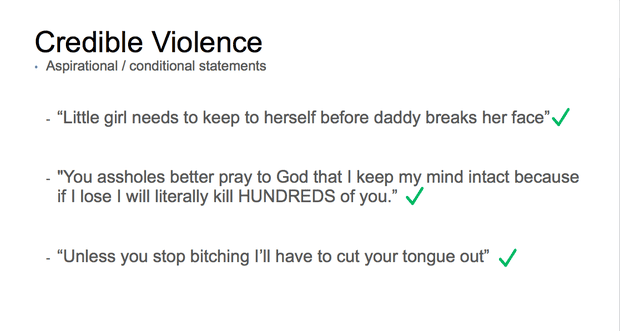
The images above demonstrates the particular sentences Facebook Content Moderators would be flagged to remove or keep up. The image is sourced from an article by The Guardian which disclosed information on, "Leaked policies guiding moderators on what content to allow are likely to fuel debate about social media giant’s ethics"
As a social media user, I would consider all of these sentences to be violent and not pleasant to view on Facebook. This goes to show that the job of a moderator has the opportunity for open interpretation while leaving no room for error.
An interpretation/further explanation that really resinates with the difficulties of violent language reads,
"...Violent language is most often not credible until [it] gives us a reasonable ground to accept that there is no longer simply an expression of emotion but a transition to a plot or design. From this perspective language such as ‘I’m going to kill you’ or ‘Fuck off and die’ is not credible and is a violent expression of dislike and frustration.”
-
-
www.runnersworld.com www.runnersworld.com
-
Game time, the opposing team calls the play that Maud put the fierce kaput on in practice, and beneath a metal-halide glare that’s also a gauntlet, Maud barrels towards the running back and—BOOM!—lays a hit that sounds like trucks colliding.
I can really visualize this scene in my head because of the descriptive language used by the author.
-
-
wiki.elte-dh.hu wiki.elte-dh.hu
-
Alan Turing
Róla szóló film: Kódjátszma
-
-
static1.squarespace.com static1.squarespace.com
-
An infl uential Wampanoag diplomat, Weetamoo presented a political and cultural challenge to the Puritan men who confronted her authority. Her strategic adaptation to the colonial “deed game”
That is very interesting to note and shows that native women had leadership roles and help protect their land and territories.
-
-
jessica-wright-ot.weebly.com jessica-wright-ot.weebly.com
-
had a love for any game that could be played on the wii gaming system prior to her injury
loved playing a game on the Wii.
-
-
www.amazon.com www.amazon.com
-
Most of the projects here are the kind that might be fun to make but shortly end up in the trash (like: animals made out of toilet paper tubes, a Paper plate ring toss game, A necklace made of colored plastic straws...)
-
-
s18798.pcdn.co s18798.pcdn.countitled1
-
HumanitarianNGOs increasingly depend on the corporate sector and on ‘playing the media’s game’ fortheir income
Capitalist motivation
-
-
store.steampowered.com store.steampowered.com
-
This looks and feels like an Unreal Engine asset flip, where they slapped together a bunch of assets from the Unreal store and tried to call it their own game. Many of the game assets are very low quality. It's buggy and incomplete. That didn't stop the shady devs or their publishers from selling this in game bundles as a complete product. Extremely dodgy behavior there! Regardless, the (terrible) quality of this "game" speaks for itself. Impossible to recommend.
-