First day in class, we had students chatting with a friend of mine working on a Ski Resort in Australia,
Porous walls. Hybridization. Change narrative
First day in class, we had students chatting with a friend of mine working on a Ski Resort in Australia,
Porous walls. Hybridization. Change narrative
I met with my friend Marcin Kleban. After a twenty minute discussion we started a project of 40 language teachers and learners, he trusted me.. I met with my friend Blaise Ngandeu, I was able to learn about Nexus Analysis from my friend Maritta Riekki.
connections attachment identification
I wrote about this experience here in Swings and Roundabouts.
Learning the power of open.
So with social networking graphs, we will be able to get a better view on connections and their movement in the #rhizo14 constellation.
Different methodology for research.
Earlier this week, the Department for Culture, Media and Sport held a private ministerial meeting with news publishers and technology platforms to discuss the issue of fake news and the programmatic environment which supports it.
Neural Networks for Ma
The 1st to annotate here
They are the motives proper to the specialty as such, but not to the specialty as participant in a wider context of motives.
From page 1329: "Any specialized activity participates in a larger unit of action."
Burke seems to be reiterating the social and political web that Nietzsche suggests throughout On Truth and Lies in a Nonmoral Sense. The fictions we come to believe as truth must be taken into consideration as part of a larger network of relationships and systems that are at once predetermined and unstable.
And obvi-ously the interests in actual control of the agency that allocated the rights and resources of atomic development could have all the advantages of real ownership, however international might be the fictions of ownership. Where the control re-sides, there resides the function of ownership, whatever the fictions of ownership may be.
Throughout this section, Burke calls attention to the ways we use universal truths to act out discriminatory practices. In doing so, there's an inconsistency between the name we give something and the function it serves. The "truth" of the thing doesn't equal the way it operates in the world. In the case he presents here, the power is named "United Nations," but the power is acted out through the "United States." (Would claims to religious freedom to deny service to, say, LGBT couples be included in something like this? The fiction is "religious liberty" but the function is "discrimination"?)
How can we connect this back to Willard and Nietzsche? What do they say about fiction and power that resonates here?
rhetoric
Again, from the MicroResponse:
Thus there is a social aspect here as well, which is one of the ways that taste isrhetorical – it is a product of the dynamic relationship between the self and the world
fiction
In "The Letter Killeth" Frances Willard admonishes the acceptance of "truth" without acknowledging the social fictions at work in male-dominated exegesis:
We need women commentators to bring out the women's side of the book; we need the stereoscopic view of truth in general, which can only be had when woman's eye and man's together shall discern the perspective of the Bible's full-orbed revelation.
I do not at all impugn the good intention of the good men who have been our exegetes, and I bow humbly in the presence of their scholarship; but while they turn their linguistic telescopes on truth, I may be allowed to make a correction for the "personal equation" in the results which they espy.
he messy process through which norms and standards have beenconstructed and imposed
It might be useful here to think about the "social aspects" of rhetoric as they were mentioned in the MicroResponse:
In other words, taste depends not only upon the senses, but also upon established standards. Thus there is a social aspect here as well, which is one of the ways that taste is rhetorical – it is a product of the dynamic relationship between the self and the world.
I think this procedural notion also resembles Rickert's ideas in "Rhetorical Prehistory and the Paleolithic"... For him, rhetoric is not something we do, but something we take part in. Hence his use of the term "rhetoricity."
“Social justice” is a phrase I’m hearing more and more from teachers as they consider adopting OER into their teaching.
Here’s the Full Text of Mark Zuckerberg’s Manifesto
Useful: Zuckerberg's article is here available outside the Facebook silo.
So designers on the runway this week engaged in a continuing dialogue
This "continuing dialogue" also seems to be further embraced on a bigger scale and globally due to influences like social media and bloggers.
What arbitrary as-~ ( signments!6
Pretty rad that Nietzsche was already dismissing the concept of gender as a construct as early as 1873.
s, and characters from the fictional story world, in ways that powerfully resonate with fans of the series. Participants are mobilized as “Dumbledore’s Army of the real world” in campaigns such as Not In Harry’s Name which pressures Warner Brothers into using Fair Trade chocolate for its Harry Potter Chocolates.
Fair trade chocolate is a topic that i recently learned about after a long discussion with my sister. It essentially is a Standerd that certifies that the chocolate is not made from plantations that make children and work under unfair conditions and wages.Its amazing how they were able to stand up to cooperates to a issue that most people are not even aware of, Great Work
poemas sociales
La poesía social se ha desarrollado en cada país coincidiendo con períodos históricos conflictivos (por ejemplo, dictaduras), y suele ir unida a movimientos políticos de ideología izquierdista. ¿Estás de acuerdo en que la poesía también pueda denunciar o reivindicar situaciones, o consideras que debería limitarse a expresar sentimientos personales? ¿Debe ser la poesía útil y crítica para la sociedad o solo artística?
canciones
En España, durante los años 70 del siglo XX, surgió la denominada "canción protesta", un subgénero musical que denunciaba la situación de colectivos injustamente marginados como campesinos o emigrantes. Estas canciones eran interpretadas por cantautores que normalmente estaban comprometidos con el activismo antifranquista. ¿Conoces alguna canción protesta en tu cultura o en otra, y sabes qué situación denuncia?
An educational framework integrated across social change methodologies would offer depth of content and breadth of experience, providing opportunities for students to develop their citizenship skills and hone their entrepreneurial abilities so that they can think and act effectively within systems. To develop such a framework, faculty, staff, and industry professionals will have to become changemakers themselves. We will need to understand the contexts of our diverse fields and institutions, build coalitions, and expand on each other’s experiences in new and creative ways as we support our students in pursuing social change.
He has no public presence on Facebook or Twitter, which Sulzberger can get a little defensive about—he was promoted to management in 2015 to help implement the recommendations of the Innovation Report, and he knows there’s an easy joke to be made about how the person charged with leading the Times into a digital future has never liked, tweeted, or snapped.
Maybe that distance is a good thing?
The data Facebook collects, and what they do with it.
a social aspect here as well, which is one of the ways that taste is rhetorical – it is a product of the dynamic relationship between the self and the world.
A Lanham connection here.
when tion, which, without their aid, might have passed every one erects himself into a judge, and when unobserved; and which, though of a delicate na-we can hardly mingle in polite society without ture, frequently exert a powerful influence on bearing some share in such discussions;
This sounds a lot like current complaints of the interwebs, particularly social media. Everyone's a critic!
But allow him more experience in works of this kind, and his taste becomes by degrees more exact and enlightened. He begins to perceive not only the character of the whole, but the beauties and de-f eels of each part; and i~ able to describe the pe-culiar qualities which he praises or blames. The mist is dissipalcd which seemed formerly to hang over the object; and he can at length pronounce firmly, and without hesitation, concerning it. Thus, in taste, considered as mere sensibility, ex-ercise opens a great source of improvement.
This reminds me of Hume: "A good palate is not tried by strong flavors; but by a mixture of small ingredients, where we are still sensible of each part, notwithstanding its minuteness and its confusion with the rest" (835).
Anyone can praise or blame based on the most obvious and strongest characteristics of something. Taste is only at play when one is able to praise or blame based on the subtle and intricate details of the thing under review.
#SayHerName movement draws attention to black women believed to be victims of police brutality, like Alexia Christian and Meagan Hockaday, whose deaths received a small fraction of the attention given to Eric Garner or Michael Brown.
Black women using technology to advocate for their erasure.
Many men, when left to themselves, have but a faint and dubious perception of beauty, who yet are capable of rel-ishing any fine stroke, which is pointed out to them.
A social aspect here as well.
until black women on social media began calling out the press for ignoring the story. Many reached for one word — ‘‘erasure’’ — for what they felt was happening. ‘‘Not covering the #Holtzclaw verdict is erasing black women’s lives from notice,’’ one woman tweeted. ‘‘ERASURE IS VIOLENCE.’’ Deborah Douglas, writing for Ebony magazine, argued that not reporting on the case ‘‘continues the erasure of black women from the national conversation on race, police brutality and the right to safety.’’
black women are being erased from the discussion. Race in general plays a role on how much a topic is spoken about. This case was not even mentioned or discussed until black women started the talk.
Researchers at University College London have discovered a Twitter botnet of more than 350,000 accounts created in 2013, and dormant since then. They've also found another one with more than 500,000 accounts.
never mind that fake news is neither new (forgery, quackery, and conspiracy theorizing are not recent inventions) nor exclusively right-leaning. The new form it has taken in readily sharable social media, however, has made it easy for conventional media to excuse themselves from responsibility for how the election was covered.
"Fake news" was a small factor, compared to mainstream media treating Trump as a legitimate candidate, and sensationalizing hacked emails that contained nothing significant.
DENNIS WEIS Co-author of Mass and Raw Muscle; former champion body builder and powerlifter. “…Serious Growth can’t help but take a bodybuilder into a 4th dimension of fresh new muscle growth.”
EDMUND ENOS, Ph.D. Associate professor of exercise science - Concordia University; leading authority on bodybuilding and strength training “…thanks to serious growth, America has again become a world leader in developing advanced bodybuilding and strength training programs.”
What bodybuilding professionals are saying about serious growth…
Tony Chillino – West Nyack, NY “I was skeptical at first, but I decided to go for it. The results are phenomenal. Serious Growth put 30 pounds of muscle on my frame. My strength jumped in all exercises. About 90 pounds was put on my bench, 70 on the military and back. My body went through changes that my peers couldn’t believe, they accused me of doing drugs, but I plainly said ‘never’. You’ll feel yourself growing and getting stronger during the duration of the Serious Growth training. Your body is brought to a new level of accomplishment. You’ve made my dreams come true, keep it up.”
Jared Jensen – Brigham, UT “I was ready to quit weight training but I decided to give this system a try. On the 3rd week my bench jumped 40 lbs. I was hooked. …I've seen guys in the gym who are using steroids. I get just as good gains as they do without killing myself. I couldn’t imagine working out without this program. Thanks Leo!”
Bill Becker – Mt. Morris, PA “The Bulgarian System is amazing. In just 3 weeks my bench press went from 245 lbs. to 280 lbs. I didn’t think a natural training program could deliver results like this. Thanks OTS.”
David Harper – Stone Mountain, GA “I have never been able to re-create the gains made by the use of anabolics and lifting extremely heavy weights, until now! …In just two months of dedication to this idea my maximum bench went from 260 pounds to 325 pounds which is just 15 pounds from when I was 19 and using anabolics. My body weight has gone from 195 to 225 and I seem to have less of that unwanted spare tire.”
Peter Giaardini – Age 16 New Rochelle, NY “I could literally feel my body growing. I started out a measly 140 lbs. with 14½ inch arms. Now I’m 175 lbs. With 17½ inch arms and growing. My bench press went from 160 lbs. max to 325 lbs. Thanks Leo.”
Mark Zollitsch – Newport Beach, CA “I’m training for the Olympics, and in just two weeks on the Bulgarian System, I added 50 lbs. to my bench. I used to hate doing pullups, now I’m doing five sets of twelve with a 15 lb. dumbbell hanging from my waist. This system is fantastic.”
B. Laswell – Age 40 – Texas “I've been bodybuilding since I was 14. I’ve always been a hardgainer, but after 90 days on the Bulgarian System, I’ve added 140 lbs. to my squad and 20 lbs. of weight without it going to my waist. The Bulgarian System is the best that I have ever used. I only wish I had your course a long time ago; it would have saved me years of slow progress.”
Eric Litster – Brigham City, UT “Thanks to OTS. In the last nine months I’ve added at least 100 pounds to my squat, seventy odd pounds to my bench, and 20 plus pounds to number of other movements. …And it gets better with every trip to the gym.”
Dr. Mark Radermacher – Age 35 Management Consultant – Heartford, WI “I had never seriously lifted weights before in my life, but I wanted a sculptured aesthetic looking physique. Since I started the Bulgarian System I’ve made on believable size and strength gains. I started off struggling with squats at 135 lbs. Now just 3½ months later, I’m using 300 lbs. My chest, legs, and shoulders have gotten so big that I’ve outgrown all my suits.”
Clyde Holland – Florence, AZ “Wow, the Burst program is awesome! It’s the best work out I've ever been exposed to. At the beginning I weighed 195 lbs. Now, I’m 217 lbs. and strong. I’ve been accused of using steroids. 12 weeks has added about 20 lbs. I have never seen anything which looked so wrong but is so right. I have a pile of muscle magazines and books written by Arnold, and others. None compares to this workout.”
Michael Pinheiro – Age 15 High School Student – Hanford, CA Michael came to me weighing only 99 pounds and bench pressing 85 pounds, and he had a sincere desire to get big and strong. I put him on the Bulgarian system, and in the short time he's been using it he's made the most impressive gains of any young guy I've ever seen. Michael now bench presses 205 pounds (up from 85–that's more than double) and front squats 215 pounds (up from one of the 125). He weighs in at 130 pounds (up from 99) and his body fat has increased by only 1.5%. That's an incredible ratio of fat-to-muscle gain.
Eric Poole – Age 33 Sales Manager – Visalia, CA Eric had only been working out sporadically off-and-on for a year. Nothing serious. Then he saw what I and some of my other clients had done with the Bulgarian system and he wanted to be a part of. When he began, he could only bench press 175 pounds for three reps maximum. Four weeks later, he was bench pressing 315 pounds! His squats went from 190 pounds (5 reps max) to 265 pounds.
Testimonial
Bob Pierce – Age 20 College football player – Tulare, CA Bob started this program weighing 234 pounds (his heaviest weight ever), but he desperately needed to gain more weight for his lineman position on the football team. He had already tried lots of other systems for putting on weight and muscle mass, but nothing seemed to work. What's more, he had been training for over 5 years, which means his body was near its peak–and that's why he was having trouble putting on lean meat. (Or so he thought.) I put him on the Bulgarian system and in only 10 weeks, Bob gained 20 pounds of new muscle, with no increase in body fat! His bench press went from 315 pounds to 415 pounds in only 10 weeks. His legs don't fit into his old blue jeans anymore, and his friends at the gym swear he must be on steroids. (He's not. I don't allow any of my clients to use steroids.)
Testimonial
I Tested It And It Works! I train really hard. Most athletes couldn't hold a candle to me. At 250 pounds and 5'10", I thought I was pretty darn developed. But when I return from the Eastern Bloc, I immediately put their methods to the test on my own body. And I'm happy (and embarrassed) to say that their training system runs rings around everything else I've tried here in the U.S. After just four months on their program, I pared 15 pounds of fat and replaced it with 20 pounds of rock-hard muscle. My neck size is now 20 inches and my arms are 20 ¾ inches. (And that's a cold measurement. What's more, I've never used a steroid in my life, and I don't allow my clients to either.) And I'm just the first example of how amazingly effective the SERIOUS GROWTH system is.
Literally hundreds of experiments were done over several years to determine what worked best and what didn't. They put their best scientists to work determining how the body builds strength, power, and large muscles.
Men, women, and sports teams throughout California come to me when they need to rapidly improve their strength, performance, endurance, or appearance.
Probably my most famous (though not best built) client is Hollywood film star Kevin Costner. Another client of Hollywood fame is Steve Ruether, Producer of Pretty Woman, Dirty Dancing, and other top motion pictures.
Over 40,000 hard-core bodybuilders already used this system with the most spectacular results I've ever seen. Many of the most respected professional athletes are raving about this training breakthrough
The meaning of the term "fake news" and the dilution of that meaning.
Asking questions via social media that are intentionally designed to elicit responses can provide a plethora of useful responses. Why wait until an end-of-year survey to find out about an issue when you can poll/question students throughout the year via social media?
It doesn't have to be just student feedback about the operations and mechanics of the course, or as a replacement for a course survey tool. You can also use the platform as a way to engage students on the content relevant to the learning outcomes of the course. And use the platform to connect learners with people in the field of study.
An important distinction, however, must be made. Whereas now the social nature of reading is enhanced through ubiquity and accessibility, reading during the Middle Ages was social because of scarcity and inaccessibility.
Fascinating distinction!
Did Media Literacy Backfire?
Media literacy asks people to raise questions and be wary of information that they’re receiving. People are. Unfortunately, that’s exactly why we’re talking past one another.
...
Addressing so-called fake news is going to require a lot more than labeling. It’s going to require a cultural change about how we make sense of information, whom we trust, and how we understand our own role in grappling with information.
Tweets deleted by public officials and candidates.
Lindy West's thoughtful and amusing goodbye to Twitter. She concisely describes Twitter's good and bad sides. Then she leaves me wondering if any of us should be using it.
I quit Twitter because it feels unconscionable to be a part of it – to generate revenue for it, participate in its profoundly broken culture and lend my name to its legitimacy. Twitter is home to a wealth of fantastic anti-Trump organising, as well, but I’m personally weary of feeling hostage to a platform that has treated me and the people I care about so poorly. We can do good work elsewhere.
I’m pretty sure “ushered in kleptocracy” would be a dealbreaker for any other company that wanted my business.
Drained late last century by declining tax revenue and selective civic neglect, Oakland boasts a constellation of seemingly derelict warehouses, storefronts, and churches. Within many of their shabby exteriors, however, are places of creative invention and possibility. These homes and venues—known by cryptic names rarely recorded in the press—cradle scenes that slip between categories; they’re where as-yet-unnamed subcultures gestate. For non-conforming bodies harassed and abused at other clubs, they’re sanctuaries.
Probably my most famous (though not best built) client is Hollywood film star Kevin Costner. Another client of Hollywood fame is Steve Ruether, Producer of Pretty Woman, Dirty Dancing, and other top motion pictures.
source: https://s3.amazonaws.com/prod_foundationapp/364221/lessons/35/1384378776-john-carlton-1.pdf
Selling user data should be illegal. And the customer data a company is allowed to collect and store should be very limited.
Under the guidance of Jared Kushner, a senior campaign advisor and son-in-law of President-Elect Trump, Parscale quietly began building his own list of Trump supporters. Trump’s revolutionary database, named Project Alamo, contains the identities of 220 million people in the United States, and approximately 4,000 to 5,000 individual data points about the online and offline life of each person. Funded entirely by the Trump campaign, this database is owned by Trump and continues to exist.
Trump’s Project Alamo database was also fed vast quantities of external data, including voter registration records, gun ownership records, credit card purchase histories, and internet account identities. The Trump campaign purchased this data from certified Facebook marketing partners Experian PLC, Datalogix, Epsilon, and Acxiom Corporation. (Read here for instructions on how to remove your information from the databases of these consumer data brokers.)
Trump's campaign used carefully targeted negative ads to suppress voter turnout.
With Project Alamo as ammunition, the Trump digital operations team covertly executed a massive digital last-stand strategy using targeted Facebook ads to ‘discourage’ Hillary Clinton supporters from voting. The Trump campaign poured money and resources into political advertisements on Facebook, Instagram, the Facebook Audience Network, and Facebook data-broker partners.
“We have three major voter suppression operations under way,” a senior Trump official explained to reporters from BusinessWeek. They’re aimed at three groups Clinton needs to win overwhelmingly: idealistic white liberals, young women, and African Americans.”
100,000 personalized collections of lies.
Parscale also deployed software to optimize the design and messaging of Trump’s Facebook ads. Describing one such test, the Wall Street Journal reporter Christopher Mims writes that “one day in August, his campaign sprayed ads at Facebook users that led to 100,000 different webpages, each micro-targeted at a different segment of voters.” In total, Trump’s digital team built or generated more than 100,000 distinct pieces of creative content.
Donna Zuckerberg on replying to writers who are being harassed.
Helpful responses:
Less helpful:
Unhelpful:
Ninety-five percent of 12- to 17-year-olds already go online on a regular basis. They use social networks, and create and contribute to websites. Our work is focused on taking full advantage of the kinds of tools and technologies that have transformed every other aspect of life to power up and accelerate students’ learning. We need to do things differently, not just better.
Hypothes.is nicely bridges the worlds of social media and formal education.
"We told them it was BS and what they were doing with a public platform was incredibly reckless and dangerous," wrote Coby of the back-and-forth between the Trump operation and Twitter.
Twitter may be a platform that mostly lives in the public, but it isn't a public platform. It's also one of the reasons I have my own site.
http://digipo.io/doku.php<br> The Digital Polarization Initiative<br> "The primary purpose of this wiki is to provide a place for students to fact-check, annotate, and provide context to the different news stories that show up in their Twitter and Facebook feeds. It's like a student-driven Snopes, but with a broader focus: we don't aim to just investigate myths, but to provide context and sanity to all the news – from the article about voter fraud to the health piece on a new cancer treatment."
http://phys.org/news/2016-12-pro-trump-bot-colonised-pro-clinton-twitter.html
http://politicalbots.org/?p=787 Bots and Automation over Twitter during the U.S. Election
http://politicalbots.org/ An international research group studying political bots.
The Web has become an insidious propaganda tool. To fight it, digital literacy education must rise beyond technical proficiency to include wisdom.
A survey of voters asked if they remembered seeing a headline, and if so, whether they believed it was true.
It may come as no surprise that high percentages of Trump voters believed stories that favored Trump or demonized Clinton. But the percentage of Clinton voters who believed the fake stories was also fairly high!
familiarity equals truth: when we recognize something as true, we are most often judging if this is something we’ve heard more often than not from people we trust.
...
if you want to be well-informed it’s not enough to read the truth — you also must avoid reading lies.
An analysis of links among "fake news" sites and mainstream news sites and social media.
There’s a vast network of dubious “news” sites. Most are simple in design, and many appear to be made from the same web templates. These sites have created an ecosystem of real-time propaganda: they include viral hoax engines that can instantly shape public opinion through mass “reaction” to serious political topics and news events. This network is triggered on-demand to spread false, hyper-biased, and politically-loaded information.
Steve Bannon, founder of Breitbart News and the newly appointed chief strategist to Trump, is on Cambridge Analytica’s board and it has emerged that the company is in talks to undertake political messaging work for the Trump administration. It claims to have built psychological profiles using 5,000 separate pieces of data on 220 million American voters. It knows their quirks and nuances and daily habits and can target them individually.
Boy, we have problems:
This is our internet. Not Google’s. Not Facebook’s. Not rightwing propagandists. And we’re the only ones who can reclaim it.
This is our nation, and our world.<br> It is up to us to reclaim it.
The fact that people are reading about these fake news stories and realising that this could have an effect on politics and elections, it’s like, ‘Which planet have you been living on?’ For Christ’s sake, this is obvious.”
It's only obvious once you realize how many people are exposed to bullshit daily, and how many people are stupid enough to listen to it.
If you aren't an idiot, and you don't associate with idiots, you can spend all day on the web every day and rarely see any of this shit.
Russia’s increasingly sophisticated propaganda machinery — including thousands of botnets, teams of paid human “trolls,” and networks of Web sites and social-media accounts — echoed and amplified right-wing sites across the Internet as they portrayed Clinton as a criminal hiding potentially fatal health problems and preparing to hand control of the nation to a shadowy cabal of global financiers.
http://warontherocks.com/2016/11/trolling-for-trump-how-russia-is-trying-to-destroy-our-democracy
Another group, PropOrNot, is supposed to be releasing their study on Russian propaganda tomorrow, 25 November. [Update: PropOrNot apparently labelled so many sites as "Russian propaganda" that it is practically a piece of disinformation all by itself. Maybe they're Russian. :) http://www.newyorker.com/news/news-desk/the-propaganda-about-russian-propaganda
The users of a subreddit devoted to Donald Trump have been a big hassle for Reddit moderators
“At this point, I think reddit is a lost cause because of the admins inability to take action on the group while simultaneously being overwhelmed with dealing with the individual,” a moderator told us. “No other subreddit has been able to be used [as] a platform for harassment for this long in Reddit’s history. And it’s likely going to be what kills it.” Said another: “The social experiment has run its course.”
The names and pseudonyms of multiple sources in this story have been omitted to protect their anonymity due to credible threats.
Interview with a man who has run several fake news sites since 2013.
Well, this isn't just a Trump-supporter problem. This is a right-wing issue.
...
We've tried to do similar things to liberals. It just has never worked, it never takes off. You'll get debunked within the first two comments and then the whole thing just kind of fizzles out.
Journalism faces an 'existential crisis' in the Trump era, Christine Amanpour
As all the international journalists we honor in this room tonight and every year know only too well: First the media is accused of inciting, then sympathizing, then associating -- until they suddenly find themselves accused of being full-fledged terrorists and subversives. Then they end up in handcuffs, in cages, in kangaroo courts, in prison
...
First, like many people watching where I was overseas, I admit I was shocked by the exceptionally high bar put before one candidate and the exceptionally low bar put before the other candidate.
It appeared much of the media got itself into knots trying to differentiate between balance, objectivity, neutrality, and crucially, truth.
...
The winning candidate did a savvy end run around us and used it to go straight to the people. Combined with the most incredible development ever -- the tsunami of fake news sites -- aka lies -- that somehow people could not, would not, recognize, fact check, or disregard.
...
The conservative radio host who may be the next white house press secretary says mainstream media is hostile to traditional values.
I would say it's just the opposite. And have you read about the "heil, victory" meeting in Washington, DC this past weekend? Why aren't there more stories about the dangerous rise of the far right here and in Europe? Since when did anti-Semitism stop being a litmus test in this country?
Paul Horner publishes fake news that is often shared widely. He claims that his stories are intended to be taken as satire like The Onion.
Honestly, people are definitely dumber. They just keep passing stuff around. Nobody fact-checks anything anymore — I mean, that’s how Trump got elected. He just said whatever he wanted, and people believed everything, and when the things he said turned out not to be true, people didn’t care because they’d already accepted it. It’s real scary. I’ve never seen anything like it.
My sites were picked up by Trump supporters all the time. I think Trump is in the White House because of me. His followers don’t fact-check anything — they’ll post everything, believe anything. His campaign manager posted my story about a protester getting paid $3,500 as fact. Like, I made that up. I posted a fake ad on Craigslist.
this is not exclusive to Facebook and Twitter, or just during this election. We suck at understanding history or considering the future when we adopt new technologies -- this is often intentional. We need to make sure we are this critical when any new technology comes along, and work hard to understand the historical motives and ideology behind the tech, as well as get better at exploring possible dystopian futures brought on by each technological tool
https://iheartmob.org/<br> http://www.troll-busters.com/<br> http://wmcspeechproject.com/
HeartMob, TrollBusters, and the Women's Media Center Speech Project provide support for people being harassed online.
But as managing editor of the fact-checking site Snopes, Brooke Binkowski believes Facebook’s perpetuation of phony news is not to blame for our epidemic of misinformation. “It’s not social media that’s the problem,” she says emphatically. “People are looking for somebody to pick on. The alt-rights have been empowered and that’s not going to go away anytime soon. But they also have always been around.”
The misinformation crisis, according to Binkowski, stems from something more pernicious. In the past, the sources of accurate information were recognizable enough that phony news was relatively easy for a discerning reader to identify and discredit. The problem, Binkowski believes, is that the public has lost faith in the media broadly — therefore no media outlet is considered credible any longer. The reasons are familiar: as the business of news has grown tougher, many outlets have been stripped of the resources they need for journalists to do their jobs correctly.
The problem is not JUST social media and fake news. But most of the false stories do not come from mainstream media. The greatest evils of mainstream media are sensationalism, and being too willing to spin stories the way their sources want them to.
But a former employee, Antonio Garcia-Martinez, disagrees and says his old boss is being "more than a little disingenuous here."
...
"There's an entire political team and a massive office in D.C. that tries to convince political advertisers that Facebook can convince users to vote one way or the other," Garcia-Martinez says. "Then Zuck gets up and says, 'Oh, by the way, Facebook content couldn't possibly influence the election.' It's contradictory on the face of it."
Mike Caulfield says Facebook's feed algorithms are far from its only problem. The entire site design encourages sharing of items that users haven't inspected beyond reading the headline.
what posting a photo today might mean for their future employment opportunities
People are definitely losing jobs and opportunities based on their social media presence. Distasteful photos should not even be taken let alone shared online.
Facebook hasn’t told the public very much about how its algorithm works. But we know that one of the company’s top priorities for the news feed is “engagement.” The company tries to choose posts that people are likely to read, like, and share with their friends. Which, they hope, will induce people to return to the site over and over again.
This would be a reasonable way to do things if Facebook were just a way of finding your friends’ cutest baby pictures. But it’s more troubling as a way of choosing the news stories people read. Essentially, Facebook is using the same criteria as a supermarket tabloid: giving people the most attention-grabbing headlines without worrying about whether articles are fair, accurate, or important.
This is a modern update to a classic confidence game—find a risky scenario with limited possibilities, bet on every single combination, and then hide your failures.
Today, all possible outcomes can be posted to any website that allows accounts to be set to private, or that isn't likely to be noticed. After the fact, the incorrect results can be deleted before making the account public.
This post points out that this trick could be used to "predict" election results, making it appear that they were fixed ahead of time. So it's potentially very dangerous.
23 suggested improvements for Twitter, mostly related to dealing with harassment. (13 Feb 2016)
ValuesIn striving to achieve our mission, we place high value on:Providing client-oriented services characterized by personal, professional, and organizational integrity. Producing quality work products anchored in science.Creating a nurturing environment responsive to individual needs for growth and professional development.Maintaining a spirit of openness, constructive communication, collegiality, and teamwork in all our work.Striking an appropriate balance between the demands of work and the private lives of our staff.Diversity of ideas, opinions, backgrounds, life styles, and experiences of our staff.Individual initiative and entrepreneurship on the part of our staff.Making a better world while enjoying work.
Example of values articulated by the American Institutes for Research
“My nerves are bad tonight. Yes, bad. Stay with me.
My guess here is that he is scared of the dark within himself.
One, these “comedic strategies” highlight social issues (Dow, “Femininity” 147). Two, while these strategies possess the potential to appear subversive or pro-gressive,
Comedy in shows helps bring awareness of femininity and its social issues?
This is supported by Schwier’s (2007) views that ‘communities cannot be created; rather they emerge when conditions nurture them’ (p.18). These social interactions among students maximize students’ motivation and peer collabo-ration in learning (University of Texas 2013)
“Among millennials, especially,” [Ross] Douthat argues, “there’s a growing constituency for whom rightwing ideas are so alien or triggering, leftwing orthodoxy so pervasive and unquestioned, that supporting a candidate like Hillary Clinton looks like a needless form of compromise.”
...
“I don’t see sufficient evidence to buy the argument about siloing and confirmation bias,” Jeff Jarvis,a professor at the City University of New York’s graduate school of journalism said. “That is a presumption about the platforms – because we in media think we do this better. More important, such presumptions fundamentally insult young people. For too long, old media has assumed that young people don’t care about the world.”
“Newspapers, remember, came from the perspective of very few people: one editor, really,” Jarvis said. “Facebook comes with many perspectives and gives many; as Zuckerberg points out, no two people on Earth see the same Facebook.”
nobody takes social media lightly.
obligations they felt toward kinsmen and discover how they felt about friends.
Obligations: social expectations which change between cultures and social positions, as well as microcultures
First, according to Trumbull, Olson underestimates diffuse groups’ ability to develop compelling narratives about how they serve the public interest. In fact, weak, diffuse groups have a paradoxical political advantage: precisely because they are weak and diffuse, the public sees them as less self-interested and thus comparatively trustworthy. Second, Olson also underestimates the power of ideological motivation, rather than just money and concentration, to spur activism. Third, “diffuse interests can be represented without mobilization,” thanks to activism by politicians and government officials who take up their cause. (FDR started a federal pension program at a time when “retirees,” as a self-identified social class, did not yet exist. The program created the constituency, rather than the other way around.) Fourth, weak or diffuse interests can link up with concentrated groups to amplify their effectiveness, as when consumers align with exporters to oppose trade protections or when free-speech advocates join with political parties to oppose campaign-finance limits.
the micro- sociological view is that citations do not exist in uacuo, and that a proper comprehension of the citation phenom- enon and its surface manifestations will only be achieved by moving the critical gaze from the formal communi- cation mechanisms (the superstructure) to the social reality (the infrastructure) which supports the primary communications system.
Social context of citations. Need to understand the social system
More specifically, Lcopold ( 1973) identified tlw ‘Citation Index game’ as onc of thc stratagems employcd by scientists to incrcasc thcir visibility among thcir pccrs. The ‘Game’ metaphor has usually been invoked to counter the ‘storybook’ idca of science as an idealised, dispassionate and selfless quest after truth and know- ledge, in which personal feelings and motivations are held in check by institutional imperatives.
Citation "game" as contrasted with "storybook"
Stephen Downes on why he's quitting Facebook.
Facebook has me going both ways. They make me pay money in order to allow people to read my content, and then they throw advertising at the people who are trying to read that content. And now they're tightening the screws.
And even as it clamps down on content, Facebook favours the wrong people, siding once again with the bottom-dwellers of the internet.
The problem, as Taylor explained, is that the rise of e-commerce and social media has lowered the cost of entry for new competitors.
Sounds like a very quick summary of what Ben Thompson was saying two weeks ago. But, in this case, it’s from “the horse’s mouth”.
From his interviews with former trolls employed by Russia, Chen gathered that the point of their jobs "was to weave propaganda seamlessly into what appeared to be the nonpolitical musings of an everyday person."
"Russia's information war might be thought of as the biggest trolling operation in history," Chen wrote. "And its target is nothing less than the utility of the Internet as a democratic space."
Page 204
Borgman on the different types of data in the social sciences:
Data in the social sciences fall into two general categories. The first is data collected by researchers through experiments, interviews, surveys, observations, or similar names, analogous to scientific methods. … the second category is data collected by other people or institutions, usually for purposes other than research.
Page 202
Borgman on information artifacts in the social sciences
like the sciences, the social sciences create and use minimal information. Yet they differ in the sources of the data. While almost all scientific data are created by for scientific purposes, a significant portion of social scientific data consists of records credit for other purposes, by other parties.
So its really 1894 to 2100- correct -without the Supers. She didnt cross the threshold, the author needs to be corrected.
I can even annotate folks comments WITHIN threads.. hmm Yet it will all pop up here.. as opposed to being linked to the actual post.. hmmm
Testing the amazing hypothes.is on FB.
the results remain compelling nonetheless
At least, they’ve become unavoidable in class discussions even tangentially related to social psychology. In intro sociology, they lead to some interesting thoughts about lab vs. field experiments.
Here’s a presentation at the 2013 Personal Democracy Forum that provides a little more context for our project.
Where is the Facebook shareable link for this video? I would like to hit share, for it to look pretty and for you -hypothes.is- to earn and retain new subscribers?
(If I share this via youtube, the funnel flows to youtube. Do you have a dedicated "landing page" with simply this vid? I'll reply here if I find a "pretty" way.. Thanks Guys!)
“innovation”
The quotes are important. There are different approaches to innovation. The one described here may be pushed by politicians and administrators, but some would argue that it’s not innovation in the same sense as what either Eric Von Hippel or Michael Schragge might describe.
A man who is chancellor of a higher education facility blocked one of his students on the first day of his job.
You might even notice that your confidence isn’t the only thing that goes up, this was my first step in growing internally, and you’ll find that in the end Social Development isn’t just about learning to talk to other people, it’s a deep discovery about who you truly are.
Automated posts from social media accounts pretending to be real individuals are being used to influence public opinion. (The Chinese government uses regular employees to post "real" messages at strategic times.)
We pretend that tech innovation races along at breakneck speed. But sometimes it sputters until conditions are right.
Innovation isn’t always about technology, efficiency, speed, scale
According to scholars like MIT’s Eric Von Hippel and Michael Schrage, innovation is about usage. Otherwise, it’s just novelty. But the innovation discourse often repurposes the term to be about R&D.
Blogging in the Classroom: A Preliminary Exploration of Student Attitudes and Impact on Comprehensio
Ellison, Nicole B., and Yuehua Wu. 2008. “Blogging in the Classroom: A Preliminary Exploration of Student Attitudes and Impact on Comprehension.” Journal of Educational Multimedia and Hypermedia 17 (1): 99–122.
Why my badges may be a bad idea:
"These results suggest that teachers may discourage avoidance behaviour among their students when they encourage students to focus on mastering the material, improvement, and understanding the relevance of classroom work in their lives. Although it makes sense that students should be less concerned with protecting their image in classrooms that emphasize understanding the material and personal, individual standards of achievement, our results suggest that de-emphasizing performance goals may be more important than increasing the emphasis on mastery goals.... Even in classrooms that contain some of the curricular elements of a mastery goal structure, such as the constructivist principle of assigning open-ended, inquiry-based projects and tasks, students may avoid novelty and challenge if they believe that, ultimately, what matters is how their performance compares to their peers."
Gheen and Midgely 1999 examined "how teachers' reports of social comparison practices related to avoiding novelty and chellenge. They found that teachers' reports of informative social comparison practices related to slightly higher levels of avoidance. However, these practices weakened the association between self-efficacy and avoiding novelty and challenge. In classrooms where teachers were high in their use of interstudent discussion about how to improve one's own work, low- and high-efficacy students were on a more equal footing when it came to avoiding novelty challenge. However, in classrooms where teachers reported using high levels of relative ability social comparison practices, low self-efficacy students' avoidance was higher than that of high self-efficacy students'"
If you want people to find and read your research, build up a digital presence in your discipline, and use it to promote your work when you have something interesting to share. It’s pretty darn obvious, really: If (social media interaction is often) then (Open access + social media = increased downloads).
Harvard researchers estimate the Chinese government fabricates 488 million social media posts each year. This is only about 1 in 178 posts, but they are made in strategic bursts, with the intent to distract. The posts are made by government employees as an additional job duty.
It's the same propaganda we get in the West.
Old Allen is as rich as a Jew — is not he?
This expression became common in the Middle Ages during a time where majority of the merchant class was Jewish, making the Jews among the most wealthy of the time (Dictionary of Phrase and Fable: R, 1894).
Nobody can fasten themselves on the notice of one, without injuring the rights of the other. I consider a country–dance as an emblem of marriage. Fidelity and complaisance are the principal duties of both; and those men who do not choose to dance or marry themselves, have no business with the partners or wives of their neighbours.”
I feel as though this quote says a lot about the how relationships were built in that time period but also in this story. Not only that but how the roles were set for men and woman. The man is so be the leader and the woman fallows. I do find it an interesting comparison with marriage being seen as dancing. In this example would you say Catherine and Mr. Tilney are dancing around each other?
“Do not be frightened, my dear Catherine,” whispered Isabella, “but I am really going to dance with your brother again. I declare positively it is quite shocking.
"A young woman did not dance more than two pairs of dances with the same man or her reputation would be at risk. Even two dances signaled to observers that the gentleman in question had a particular interest in her" (Maria Grace,“The High Stakes of Etiquette for Young Ladies in the Regency” ).
Captain
"Originally Captain-Lieutenant, becoming Captain in 1772. Lat. capitaneus "chieftain", from Lat. caput "head". Chieftain or head of a unit. As armies evolved his post came to be at the head of a company, which by the Sixteenth Century was usually 100 to 200 men. That seemed to be the number one man could manage in battle" (Harding, British Army Ranks).
muff
"A covering, often of fur and usually of cylindrical shape with open ends, into which both hands may be placed for warmth. Now chiefly hist" (OED)
.
tippet
"A long narrow slip of cloth or hanging part of dress, formerly worn, either attached to and forming part of the hood, head-dress, or sleeve, or loose, as a scarf or the like" (OED).
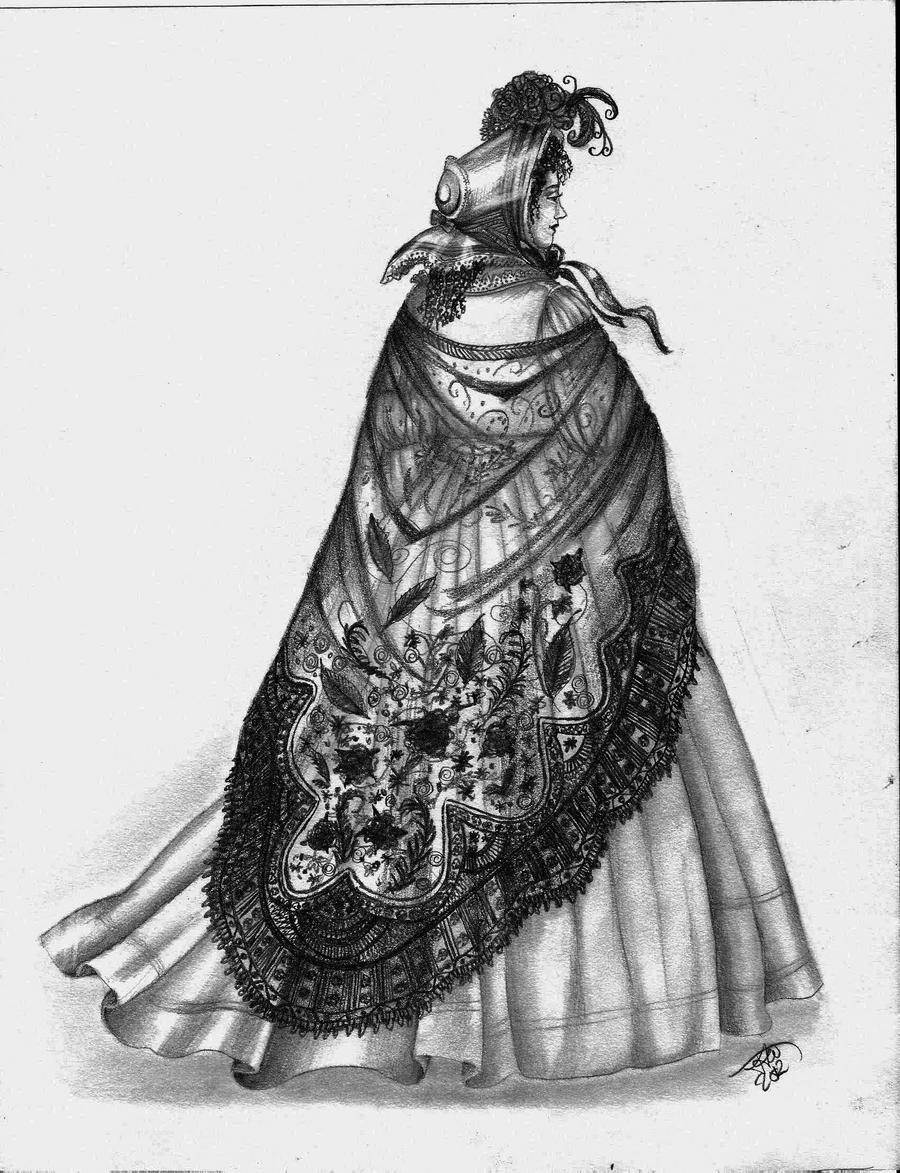
uncoquettish
"Coquette: a woman (more or less young), who uses arts to gain the admiration and affection of men, merely for the gratification of vanity or from a desire of conquest, and without any intention of responding to the feelings aroused; a woman who habitually trifles with the affections of men; a flirt" (OED).
pump–room

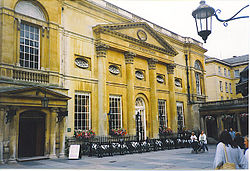 The Grand Pump-Room at Bath was considered a social meeting place for the upper class (Grand Pump Room, Bath, wiki).
“Rest! He has only come three and twenty miles today; all nonsense; nothing ruins horses so much as rest; nothing knocks them up so soon. No, no; I shall exercise mine at the average of four hours every day while I am here.”
"The life of a stage coach horse during the Regency era was not easy. Roads, though much improved over previous centuries, could be filled with mud and ruts that impeded progress. Generally one horse could pull a wheeled vehicle six times its own weight. Therefore, a carriage horse weighing from 1200 lbs to 2300 lbs is able to pull from 7200 lbs to 13,800 lbs. Multiply this number by four or six, and you have team that can pull a substantially sized vehicle. However, tired horses had to be replaced about every ten miles or so, and “the average life of a horse pulling a coach at about eight mile per hour was six years; at ten miles per hour or over, possible on good roads, a horse lasted three years" (The Prince of Pleasure, J.B. Priestley, 151-152).
fifty guineas
This would be the equivalent to roughly $2,000 today ("Currency Converter").
fifty thousand pounds
This would be the equivalent to roughly $2,000,000 today (“Currency Converter”).
country–dancing
"A rural or traditional dance, esp. in England and Scotland; spec. one in which couples begin by standing face to face in long lines" (OED).

cotillions
"The name of several dances, chiefly of French origin, consisting of a variety of steps and figures" (OED).
sword–case
"A case to hold a sword; in mod. use, a receptacle at the back of a carriage for swords, sticks, or other articles" (OED).
Curricle
"A light two-wheeled carriage, usually drawn by two horses abreast" (OED).

Did not we agree together to take a drive this morning?
“Do not accept an invitation to visit any place of public amusement, with a gentleman with whom you are but slightly acquainted, unless there is another lady also invited. You may, as a young lady, go with a relative or your fiancée, without a chaperon, but not otherwise” (Florence Hartley, The Ladies' Book of Etiquette, and Manual of Politeness, 173).
“Our whole reason for doing this is a social justice reason,” he said. The organization wants to make high-quality material available for free to all students.
Caractacus
A king of ancient Britons during the Iron Age who ruled from 43-50 AD, his successful attempts at expansion are believed to be the catalyst for the Roman invasion of Britain (Hill).
Alfred the Great
Alfred the Great was king of the southern Anglo-Saxon kingdom of Wessex and was known for social and educational reforms as well as military success. He is also the only English monarch known as "the Great" ("Alfred the Great").
Agricola
Agricola was a Roman statesman and soldier that governed over Britain and conquered large areas of northern England, Scotland, and Wales ("Agricola").
phaetons
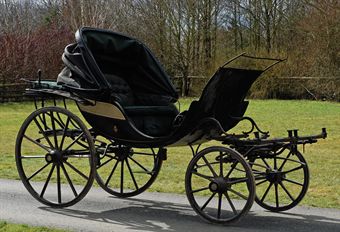 "A type of light four-wheeled open carriage, usually drawn by a pair of horses, and having one or two seats facing forward" (OED).
the lady had asked whether any message had been left for her; and on his saying no, had felt for a card, but said she had none about her, and went away
Here, the narration refers to a “card”, which is more properly known as a calling card. A calling card -- or visiting card-- is defined as “a card bearing a person’s name and address, sent or left in lieu of a formal social or business visit; a visiting card” (OED). Originally a Parisian trend, these cards were either sent or left at a person’s place of residence to denote that acquaintance had formally visited while they were away or later intended to visit them (Robert Chambers, The Book of Days, np).
It was too dirty for Mrs. Allen to accompany her husband to the pump–room
The pump room -- better known as The Grand Pump Room -- was a building used for upper-class social gatherings and parties in Bath. It was especially popular during Jane Austen’s lifetime (Michael Forsyth, Bath, 68) (Mabel Van Niekerk, The Ancient Roman Cities of Bath and York, 24).
Going to One Wedding Brings on Another?
There is no evidence for a song with this title existing. During the Georgian period wedding hymns were often sung at parties that were not weddings, just for fun. However, the lyrics for this particular hymn does not exist. Austenites speculate that the author invented this title as an excuse for John Thorpe to suggest marriage to Catherine (ODP).
They must think it so strange, so rude of me! To go by them, too, without saying a word!
At this point in the novel, Catherine is practically coerced into accompanying John Thorpe, Isabella, and her brother James in travelling to Bristol, taking John’s word of having already seen the Tilney’s leaving town earlier that morning. As they’re leaving, they spot the Tilney’s on their way to their planned engagement with Catherine. Catherine pleads for John to turn back and he ignores her, in which she replies to him with this quote. Pertaining to the social customs of the time, “A lady should never "cut" someone, that is to say, fail to acknowledge their presence after encountering them socially, unless it is absolutely necessary (Daniel Pool, What Jane Austen Ate and Charles Dickens Knew, 55). At face value, it appears that Catherine has slighted her dear acquaintances by ignoring them.
greatcoat
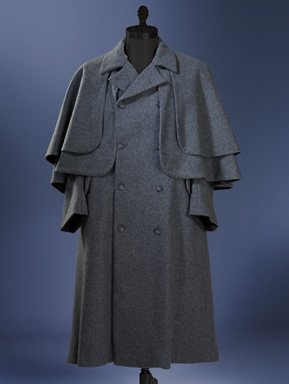
Greatcoats were a type of caped trench coat/ over coat that first came into use by the military in the 17th century, then evolved into casual wear for the upper class. They were made of thick wool and thus expensive for average people to own. However, by the time of the Industrial Revolution and Jane Austen's death, they were becoming more and more available to the middle and lower classes as well (ODP).
sprigged muslin
"Any of various lightweight cotton fabrics in plain weave. Also: a piece of such fabric; a dress or other article of clothing made of muslin" (OED).
From the 17th century to the late 18th century, muslin fabric was mostly imported from places like India. The fabric was used for dresses and curtains and was notably well liked for its simplicity; its ability to drape beautifully; and for the fabric's ability to take paint, dyes, and embroidery very well. Muslins were mostly worn by gentility in the color white. The color white was used to signify the gentility's wealthy lifestyle because white garments were harder to keep clean and were very expensive to constantly have laundered to maintain the pure white color. (Jane Austen’s World)
Here is an example of a sprigged muslin which is named for the muslin's unique design which resembles sprigs of leaves or flowers all over the dress: 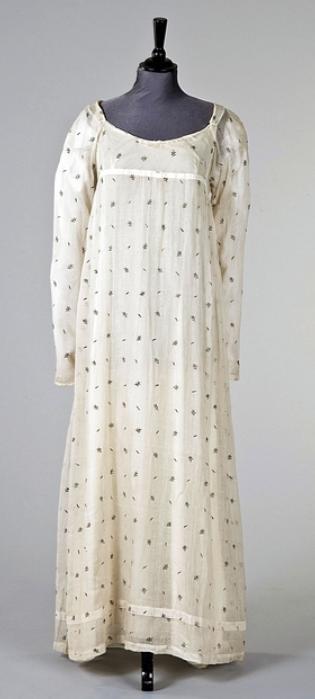
pump–room

"The Pump Room in Bath was built in the lower part of the town, and it was where those taking the “cure” would drink copious amounts of the warm spring water in order to effect a cure" (Austenonly). It was the place to be in high society.
according to Peggy Orenstein who noticed these, and a lot of other troubling trends when she interviewed 70 college-age girls about their personal lives. She wrote a book about it called "Girls & Sex," and talked to us this week about some of the things she learned.
This book is on my list. It seems to echo the thoughts in American Girls.
It was all pride, pride, insufferable haughtiness and pride!
In The Lady's Guide to Perfect Gentility from 1857, "Pride" is listed as one of the most hateful dispositions and the reserve that Eleanor and Henry Tilney display in the company of their father is explained by the Guide's author as the means to many a misunderstanding and accidental affronts. (Thornwell, Emily. The Lady's Guide to Perfect Gentility, 1957.)
the pump–room
A meeting place for upper-class people. Mrs. Allen's favorite place was situated closed to the main entrance of the Roman Baths. It is well-known for the power of its waters. The place is still popular today at tea time thanks to its restaurant ("Jane Austen World").

she drew back her hand;
These small subtleties and flirtatious hints were very popular, and at times, imperative to catch your fish. They were, however regimented and formulaic. 
arch
Usually referring to, "women and children, and esp. of their facial expression: Slily saucy, pleasantly mischievous" (OED).
abbeys
An abbey is "A private residence, school, etc., formerly (part of) an abbey" (OED).
a traveling–chaise and four
A traveling chaise was a mode of quick transportation used by rich people, in the eighteenth century. This type of chaise was a closed carriage, which was equipped with four horses. The equipage, which was expensive, was generally composed of two men driving the two horses at the front and sometimes one postilion seated at the back ("Legacy Owensboro").

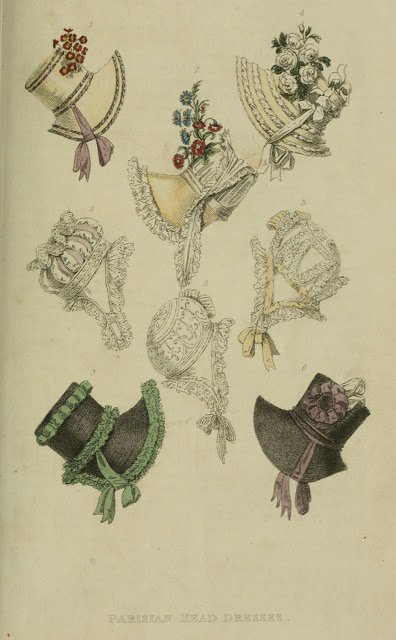
new straw bonnet
Most likely in reference to one of the top ones; because it is worn by Catherine, which is indicative of youth. Whereas someone older like Mrs. Thorpe, or Mrs. Allen, would be seen wearing one of the bonnets towards the bottom, befitting their maturity.
so very much attached
"Of a person: married or involved in a romantic relationship" (OED).
to be introduced to her
"To make known in person, esp. in a formal manner, with announcement of name, title, or other identification" (OED).
When students see adults actually listening to them with respect, that is when they begin to realize they have a voice and can make a difference in their world.
I hope this is true. And I love the idea that adults are that important to students. Still I wonder how this fits with the connected-learning notion that youth want to be heard and recognized by their peers. I suppose it isn't an either/or: some youth seek peer approval, others want to be heard by adults. When you post on an open social network, you never know who will respond.
cravats
Fabric or material, often made of muslin with lace at the end, worn around the neck as fashion" (OED).
Catherine then ran directly upstairs, and watched Miss Thorpe’s progress down the street from the drawing–room window; admired the graceful spirit of her walk, the fashionable air of her figure and dress; and felt grateful, as well she might, for the chance which had procured her such a friend.
Here Austen is having Catherine admiring Isabella because of her charm that she possesses to her move up in society. She can see here how Isabella uses her appearance to win over people not to mention her manners. It brings up the thought of why there were so many balls during this time period. What was expected of women? The balls that Austen describes seem to be more like debutante ball. A Debutante ball is when younger women are brought into society so they can meet eligible men to marry but also be seen as ladies.
She liked him the better for being a clergyman, “for she must confess herself very partial to the profession”; and something like a sigh escaped her as she said it.
What is a clergyman? Jane Austen draws from her personal life in her novels pulling in her father’s job position. Clergyman in her novels a lot because it draws from her childhood of her father being one. Not only in Northanger Abby but also in Mansfield park its mentioned men to become clergymen. What is so significant to become of this position? According to Merriam-Webster a clergyman is defined as “a man who is a member of the clergy especially in a Christian church”. Breaking this down even more what does the word clergy mean? It means to be ordained in the church. The clergyman seems to be appear to be a minster who is a socialite among the wealthy. They would perform religious ceremonies in the Christian Church only but also were invited to socialize with the upper class at times.
Work Cited Miriam Webster.Com
The master of the ceremonies introduced to her a very gentlemanlike young man as a partner
The master of ceremonies was an official position in fashionable towns like Bath. Their job was to oversee the balls and parties. Their duties spanned from enforcing the rules and keeping the peace to making sure everybody was dressed correctly. As we see in this line, one of their most important jobs was to introduce young men and women (Austenonly, "The Master of Ceremonies: The Georgian Assembly Room, Part Four", https://austenonly.com/2013/02/28/the-master-of-ceremonies-the-georgian-assembly-room-part-four/ ).
There goes a strange–looking woman! What an odd gown she has got on! How old–fashioned it is! Look at the back.”
In response to the French Revolution, by the late 18th century, constricting, formal styles of dress, reminiscent of French aristocracy went out of fashion. Instead, looser styles of dress, inspired by classical Greek and Roman fashions, rose in popularity. Lightweight, sheerer materials, such as muslin were popular, as was an empire style waistline ("Lord Scott", An Introduction to Ladies' Fashions of the Regency Era, http://www.wemakehistory.com/Fashion/Regency/RegencyLadies/RegencyLadies.htm ).
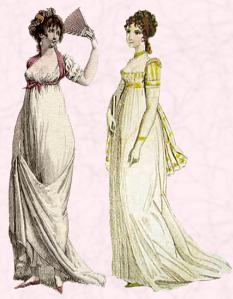
she longed to dance, but she had not an acquaintance in the room
During this period in England, men and women could not interact, much less dance together, unless they were formally introduced by somebody that they were both acquainted with (Maria Grace, The High Stakes of Etiquette for Young Ladies in the Regency, https://kimrendfeld.wordpress.com/2013/04/29/the-high-stakes-of-etiquette-for-young-ladies-in-the-regency/ ).
pelisse
"A woman's long cloak, with armhole slits and a shoulder cape or hood, often made of a rich fabric; (later also) a long fitted coat of similar style" (OED).
turban
“A woman’s hat designed to resemble a turban” (OED). This was a fashionable headdress for women from the 1790's through the 1820's, inspired by English trade with India (Walford, Vintage Fashion Guild).

a large Newfoundland puppy and two or three terriers
According to the American Kennel Club, The Newfoundland is a massive breed of English working dog, used for pulling nets, carts, and carrying loads. Newfoundlands also make excellent guard dogs. Henry's puppy would look something like this,
 but would grow to be a very large dog.

Terrier is a group of breeds, originally bred to hunt vermin. Some examples include the West Highland White Terrier,  Cairn Terrier,
  and Norfolk Terrier.
These dogs were kept not only as companions, but as useful parts of the household: the Terriers to control rats and other vermin, and the Newfoundland (when grown) for protection and labor. Even so, the Newfoundland’s sweet disposition would make for an ideal companion (American Kennel Club).
rubbed her temples with lavender–water
Lavender was used as an essential oil at the time (and even today) that would help to calm one's anxieties, whether through ingestion or scent. When rubbed on the temples, a person could better smell the oils to calm themselves (Lavender, Maria Lis-Balchin, 156).
phaetons
"A type of light four-wheeled open carriage, usually drawn by a pair of horses, and having one or two seats facing forward" (OED).

wild–fowl
"A wild bird, or (usually) wild birds collectively; chiefly applied to those caught for food, game birds (now esp. of the duck and goose kinds)" (OED).
curate
"A member of the clergy engaged as assistant to a vicar, rector, or parish priest", or "A minister with pastoral responsibility" (OED). In this context, Henry either has engagements (appointments) to keep with his assistant, or he has engagements (duties) of his own as a clergyman.
post–masters
"A person with official charge of post. The official at each of the stations or stages of a post-road; primary duty to carry mail to the next state" (OED).
cravats
“A long, narrow piece of linen, muslin, or other fine cloth, worn around the neck and either tied under the chin in a knot or bow with long flowing ends” (OED). 
all the dirty work of the house was to be done by two pair of female hands at the utmost
Catherine says in the novels only two women do the work, but in abbeys and castles of the period, there were about eighteen or more servants, ranging from cooks to laundry maids (countryhousereader, "The Servant Hierarchy", 2013). 
The very curtains of her bed
In this time, curtains would be hung around four-poster beds in order to help prevent drafts and keep occupants warm (Jane Austen's World, Vic, "Ways to Keep Warm in the Regency Era, Part 2").
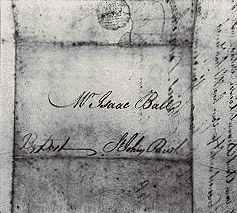
a letter
"[...] letters were written on sheet[s] of paper that were folded and sealed [...] Envelopes were not used" (Jane Austen's World, Vic, "Letter Writing in Jane Austen’s Time").
habit
"Bodily apparel or attire; clothing, raiment, dress" (OED). Here, it most likely refers to a riding habit, which was worn by women when riding a horse. The riding habit had also become fashionable to wear while traveling (Jane Austen's World, Vic, "Women’s Riding Outfits in the Early 18th Century").
a bilious fever
When referring to disease, bilious is an overproduction of bile. Drawn from Hippocrates's now obsolete Theory of Four Humors, bile was also connected to a bitter and choleric personality (U.S. National Library of Medicine, The World of Shakespeare's Humors).
To poultice chestnut mare” — a farrier’s bill!
A remedy for cuts, swelling, and infection, specifically common for treatment of hoof abscesses. The herb poultice would be applied by the farrier (horseshoer), who in regency times often doubled as a general veterinarian and animal dentist (BookDoors).
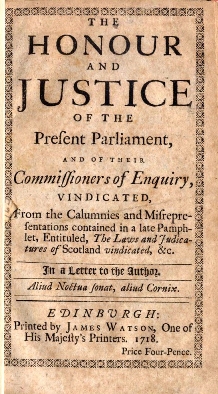
pamphlets
Unlike the typical pamphlets we may think about today, in this era, pamphlets were used for political information.
scullery
“A small room attached to a kitchen, in which the washing of dishes and other dirty work is done” (OED).


Digital tools offer the opportunity to refocus how power works in the classroom.
The Finnish government is currently drawing up plans to introduce a national basic income. A final proposal won’t be presented until November 2016, but if all goes to schedule, Finland will scrap all existing benefits and instead hand out €800 ($870) per month—to everyone.
Jon Udell on productive social discourse.
changeable minds<br> What’s something you believed deeply, for a long time, and then changed your mind about?
David Gray's Liminal Thinking points out that we all have beliefs that are built on hidden foundations. We need to carefully examine our own beliefs and their origins. And we need to avoid judgment as we consider the beliefs of others and their origins.
Wael Ghonim asks us to design social media that encourages civility, thoughtfulness, and open minds rather than self-promotion, click-bait, and echo chambers.
Reasons Facebook, Twitter, and Instagram have dominated the Web over blogs and independent sites:
Let go of the idea of people reading your stuff on your site, and develop or support interfaces that put your readers in control of how they view the web instead of giving the control to the people with the servers.
Millennials are not necessarily great at social, they are just more comfortable with it. There is a huge difference between using social to keep up with friends and family, and using it to generate business value
code, Minecraft has become a stealth gateway to the fundamentals, and the pleasures, of computer science.
learning code = computer science? I guess, but I also wonder if my need to learn code has come more from a desire to communicate on social media more effectively.
challenge his friends
He invites peers to play his game with him.
McGill’s Dr. Sterne calls it “the gamification of research,”
Most research is too expensive to really gamify. Many researchers are publishing to either get or keep their jobs. The institutionalization of "publish or perish" if anything has already accomplished the "gamification", Academia.edu is just helping to increase the reach of the publication. Given that research shows that most published research isn't even read, much less cited, how bad can Academia.edu really be?
“I don’t trust academia.edu,”
Given his following discussion, I can only imagine what he thinks of big publishers in academia and that debate.
the platform essentially bans access for academics who, for whatever reason, don’t have an Academia.edu account. It also shuts out non-academics.
They must have changed this, as pretty much anyone with an email address (including non-academics) can create a free account and use the system.
35 million academics, independent scholars and graduate students as users, who collectively have uploaded some eight million texts
35 million users is a lovely number, but their engagement must be spectacularly bad if only 8 million texts are available.
We are naturally creative and curious. We just have to build systems that nurture our inherent abilities. Schools do not do that.
Not only do schools not do that, traditionally they have "taught" creativity and curiosity out of students.
honours of her house
"The duties of house." As the only female family in residence at Northanger Abbey, Miss Tilney would be expected to act as the hostess.
This duty would normally be performed by the wife of the household, and in her absence, the eldest daughter or at times, the sister of the host.
They called each other by their Christian name
This refers to their name given at birth, so Catherine and Isabel. Referring to someone by their Christian name portrayed extreme comfortability and familiarity. The prefix Mr., Mrs., and Miss were examples of comfortable terms of address when speaking of or with someone, and only selective characters throughout Jane Austen's novels are seen breaking this acceptable social norm (Susannah Fullerton, "What's in a Name?")
Things stayed civil because the system aligned incentives correctly.
Sounds like there were many other reasons that most Internet-based initiatives stayed civil in their early days. Some of them have to do with human diversity.
I watch as their networks expand, and as followers find one another as they voice ever more extreme opinions.
This is the first time in a long time (maybe ever) that I've felt sympathy for the downfall of traditional journalism. Social media as a kind of echo chamber is really scary and almost sounds like a science fiction story.
As an academic, I study social media and social movements, from the uprising in Egypt to Black Lives Matter
Fascinating to think about the simultaneously democratic and demagogic potential of social media from #ArabSpring to #MakeAmericaGreatAgain.