3,051 Matching Annotations
  1. Aug 2023
    1. there is a disconnect between the long period of evolution that honed our humanity and the short period of rapid technology change we are facing.
      • for: progress trap, quote, quote - progress trap, quote Brian Southwell, Science in the Public Sphere Program, RTI International
      • quote

        • We are likely to make some gains in personal health, are likely to face some collective concerns in terms of environmental health and
        • are not likely to cope with the alienation and despair that is a part of a life lived largely online.
        • In the latter case, there is a disconnect between the long period of evolution that honed our humanity and
        • the short period of rapid technology change we are facing.
      • author: Brian Southwell

        • director, Science in the Public Sphere Program, RTI International
  2. Jul 2023
    1. Try your best to be right, but don’t worry when you’re wrong. Repeatedly. If you feel uncomfortable, or like an impostor, good. You’re pushing yourself. Don’t assume you know everything, but try your best anyway, and let the internet correct you when you are inevitably wrong. Wear your noobyness on your sleeve.

      不要害怕犯错,只管尽力去做。

    1. Private possession and breeding of prohibited wildlife species have a substantial and direct effect on interstate commerce because prohibited wildlife species are frequently bred and possessed to be used in public exhibition or for sale or transfer of ownership in the exotic pet trade, and are often transported in interstate commerce for these purposes.

      How private possession and breeding impacts interstate commerce and the public

  3. Jun 2023
  4. learn-us-east-1-prod-fleet01-xythos.content.blackboardcdn.com learn-us-east-1-prod-fleet01-xythos.content.blackboardcdn.com
    1. The problem with that presumption is that people are alltoo willing to lower standards in order to make the purported newcomer appear smart. Justas people are willing to bend over backwards and make themselves stupid in order tomake an AI interface appear smart

      AI has recently become such a big thing in our lives today. For a while I was seeing chatgpt and snapchat AI all over the media. I feel like people ask these sites stupid questions that they already know the answer too because they don't want to take a few minutes to think about the answer. I found a website stating how many people use AI and not surprisingly, it shows that 27% of Americans say they use it several times a day. I can't imagine how many people use it per year.

  5. May 2023
    1. At the 'Library of Things' in Sachsenhausen Library Centre, people can borrow objects they might otherwise need to buy
      • Comment
        • Question
          • How much material would be freed up if it was SHARED instead of hoarded by one person?
          • related questions
            • what kind of behavioral change is required to reach an impactful level of sharing?
            • in a sense, public-instead-of-private
              • transportation
              • etc
            • is the ultimate expression of private converted to public
    1. Dynamics are yet another aspect of composition over which McNeely exercises deliberate and organized control. Writing for a high level ensemble such as the Vanguard Jazz Orchestra, he is able to demand and receive a great deal of nuance, shape and color. McNeely uses an extraordinarily high number of dynamic markings throughout all his arrangements and in particular here. Undulating hairpin (crescendo followed by immediate decrescendo) shapes are prevalent with each dynamic level marked 14specifically. As a rule, the ensemble exaggerates the dynamic shapes, often in ways that give prominence to the dynamics over and above elements of harmony and melody. In this respect, the dynamics may sometimes be considered a compositional device of equal importance. This general approach to dynamics as shapes is characteristic of all three of the compositions studied herein.
    1. United States biomedical researchers and pharmaceutical companies are conducting and paying African doctors to conduct unethical and illegal testing of human subjects. Nonconsensual research on human subjects is an atrocity that occurred in Tuskegee, Alabama, and in Guatemala for over forty years. Once outlawed in the U.S., medical researchers began experimenting on thousands of human research subjects without their consent in Cameroon, Ghana, Namibia, Nigeria, Uganda, South Africa, Zimbabwe and other African countries.

    1. ge majorities in all the countries surveyed – ranging from 60% in Sweden, 63% in Germany and 65% in the UK to 77% in Spain, 79% in France and 81% in Italy – said they were very or fairly worried about climate change and its effects.

      Eine YouGov-Umfrage in 7 europäischen Ländern zeigt, dass eine große Mehrheit wegen der globalen Erhitzung besorgt ist und eingreifende Maßnahmen der Regierungen dagegen begrüßt, dass aber zur Zeit nur Minderheiten Veränderungen wie dem Verbot von Verbrennern zustimmen, die deutliche Folgen für ihre Alltagsleben hätten. https://www.theguardian.com/environment/2023/may/02/many-europeans-want-climate-action-but-less-so-if-it-changes-their-lifestyle-shows-poll

  6. Apr 2023
    1. ’instruction obligatoire peut être donnée aux enfants âgés de trois à six ans dans un établissement d’accueil soit collectif recevant exclusivement des enfants âgés de plus de deux ans dit “jardin d’enfants” géré, financé ou conventionné par une collectivité publique, soit associatif, ouvert à la date d’entrée en vigueur de la loi n° 2019‑791 du 26 juillet 2019 pour une école de la confiance

      c'est pour favoriser les structures privées et DDSP ?

    1. **Recommend Resource: ** Under the "More Information About Other Open Movements" I recommended adding Higashinihon Daishinsai Shashin Hozon Purojekuto, (trans. Great Earthquake of Eastern Japan Photo Archiving Project) which is one of Japan's open government and open data efforts to document all photographs about Japan's 2011 earthquake.

      The site currently contains close to 40,000 photographs of the aftermath of the natural disaster.

      The photos are hosted by Yahoo! Japan and are published under non-commercial clause for open access to the public.

    1. Aristotle, who had said, many centuries before in Politics (BookVIII): ‘No one would dispute the fact that it is a lawgiver’s prime duty to arrangefor the education of the young. In states where this is not done the quality of theconstitution suffers.’

      Current American climate indicates that Republicans take this quote of Aristotle's to heart, but they're not closely thinking about how they define "education". They're definitely not defining it with respect to John Locke's views in Some Thoughts Concerning Education which encourages political systems that move away from an electorate that is subservient to authority.

      see: https://hypothes.is/a/upfxCtSiEe2wrdd3cOo-Lg for John Locke

  7. Mar 2023
  8. Feb 2023
    1. “It makes me feel like I need a disclaimer because I feel like it makes you seem unprofessional to have these weirdly spelled words in your captions,” she said, “especially for content that's supposed to be serious and medically inclined.”

      Where's the balance for professionalism with respect to dodging the algorithmic filters for serious health-related conversations online?

      link to: https://hypothes.is/a/uBq9HKqWEe22Jp_rjJ5tjQ

    1. Most notes systems fail at the seemingly elementary requirement of matching the way you think.

      This makes me want to create RoundPegRoundHole. But then I'm not sure whether this should be in h. or tw. I would lean towards a public tw which has the feeling of TV Tropes in that it's a database of patterns. Perhaps that's the use case of publishing a subset of a tw/Zettelkasten.

      The other (meta) thought this generated was how the decision of whether to be public or private interrupts the pleasant flow that comes from knowing exactly where to put a note and how to divide a thought. This is what experience tiddlywiki fluency is trying to capture.

  9. Jan 2023
    1. it's what i write about and that is why what  is it that has created this uh uh disparity   and why is it widened so much since 1980. well  the most obvious reason is uh interest rates   reached a peak of 20 in uh 1980 and they've gone  down ever since well in the late 1970s uh my old   00:16:50 boss's boss at chase manhattan paul volcker  said let's raise interest rates to very high   because the 99 are getting too much income their  wages are going up let's uh raise interest to slow   the economy and that will prevent wages from going  up and he did and that was a large uh reason why   carter lost the the election to ronald reagan  interest rates then went down from 20 to almost 0   00:17:20 today the result was the largest bond market boom  in history bonds went way up in price the economy   was flooded with bank credit and most of this  credit uh apart from going into the bond market   went into real estate and there is a uh symbiosis  between finance and real estate and also between   finance and raw materials and also like oil and  gas and minerals uh extraction natural resource   00:17:48 rent land rent and also monopoly rent and most of  the monopoly rent has come from the privatization   that you had from ronald reagan margaret thatcher  and the whole neoliberalism uh if you look at how   did this one percent get most of its wealth well  if you look at the forbes list of the billionaires   in almost every country they got wealth in  the old-fashioned way from taking it from   00:18:13 the public domain in other words privatization  you have the largest privatization and transfer   of wealth from the public sector to uh the private  sector and specifically to the financial sector uh   in in history uh sell-offs and all of a sudden  instead of uh infrastructure uh public health uh   other uh basic needs being provided at subsidized  rates to the population you have uh privatized   00:18:41 owners uh financed by the banks raising the rates  to whatever rate they can get without any market   firing power uh in the united states the  government is not even allowed to bargain with   the pharmaceutical companies for the drug prices  so there's been a huge monopolization a huge   privatization a huge flooding of the economy with  credit and one person's credit is somebody else's   00:19:11 uh debt so you you've described the one percent's  wealth in the form of uh savings but uh i focus   on the other side of the balance sheet this one  percent finds its counterpart in the debts of the   99 so the one percent has got wealthy by indebting  the 99 uh for housing that is soared in price 20   00:19:37 uh just in the last year in the united states uh  for medical care for uh utilities for education   uh the economy is being forced increasingly  into debt and how how can one uh solve this   taxation will not be enough the only way  that you can uh actually reverse this uh   concentration of wealth is to begin wiping out uh  the debt if you leave the debt in place of the 99   00:20:10 uh then uh you're going to leave the one percent  savings all in place uh and these savings are   largely tax exempt uh so basically i think you  you uh left out the government's role in this   wealth creation of the one percent so your  finance has indeed grown faster than economy   absorbed real estate into the finance insurance  and real estate sector the fire sector finances   00:20:39 absorb the oil industry the mining industry  and it's absorbed most of the government so the   financial wealth has spilled over to become  essentially the economy's central planner   it's not planned in washington or paris or london  it's planned in wall street the city of london   and the paris ports the economy is being managed  financially and the object of financial management   00:21:04 isn't really to make money it's capital gains  and again as your statistics point out capital   gains are really what explains the increase  in wealth you don't get rich by saving the   income rent is for paying interest income is for  paying interest you get rich off the government   basically subsidizing an enormous increase in the  value of stocks the value of bonds by the central   00:21:31 banks which have been privatized and uh the reason  that this is occurring is that uh the largest   public utility of all money creation and banking  is left in private hands and private banking   in the west is very different from what government  banking is in say china

      !- Michael Hudson : Wealth is created in the 1% through privatization and loss of the 99% - Largest transfer of wealth in history from the public sector to the private sector, especially through financial sector - govt fire sale of public infrastructure - credit was created and invested in the biggest bon market boom in history - many of Forbes billionaires got rich through such privatization - the 1% got wealthy by indebting the 99% through privatization all around the globe - this was the effect of Ronald Reagan and Margaret Thatcher's neoliberal policies - taxation alone is not sufficient to reverse this wealth concentration, the debt has to be completely wiped out

      !- key statement : the elite get rich off the government subsidizing an enormous increase in the value of stocks the value of bonds by the central bank which have been privatized. The reason THAT is happening is because the largest public utility of all, money creation and central banking has been privatized.

    1. Indeed ‘anti-vaccination rumours’ have been defined as a major threat to achieving vaccine coverage goals. This is demonstrated in this paper through a case study of responses to the Global Polio Eradication Campaign (GPEI) in northern Nigeria where Muslim leaders ordered the boycott of the Oral Polio Vaccine (OPV). A 16-month controversy resulted from their allegations that the vaccines were contaminated with anti-fertility substances and the HIV virus was a plot by Western governments to reduce Muslim populations worldwide.
  10. Dec 2022
    1. My goal was simply to scale this ladder over time. I worked the list 5 people at a time, starting at the bottom. I engaged relentlessly with those accounts until they noticed me and began engaging back.

      Interesting approach and these people are going to be great candidates for picking up new knowledge and self learning from too!

    1. We analyzed URLs cited in Twitter messages before and after the temporary interruption of the vaccine development on September 9, 2020 to investigate the presence of low credibility and malicious information. We show that the halt of the AstraZeneca clinical trials prompted tweets that cast doubt, fear and vaccine opposition. We discovered a strong presence of URLs from low credibility or malicious websites, as classified by independent fact-checking organizations or identified by web hosting infrastructure features. Moreover, we identified what appears to be coordinated operations to artificially promote some of these URLs hosted on malicious websites.
    1. . Furthermore, our results add to the growing body of literature documenting—at least at this historical moment—the link between extreme right-wing ideology and misinformation8,14,24 (although, of course, factors other than ideology are also associated with misinformation sharing, such as polarization25 and inattention17,37).

      Misinformation exposure and extreme right-wing ideology appear associated in this report. Others find that it is partisanship that predicts susceptibility.

    2. And finally, at the individual level, we found that estimated ideological extremity was more strongly associated with following elites who made more false or inaccurate statements among users estimated to be conservatives compared to users estimated to be liberals. These results on political asymmetries are aligned with prior work on news-based misinformation sharing

      This suggests the misinformation sharing elites may influence whether followers become more extreme. There is little incentive not to stoke outrage as it improves engagement.

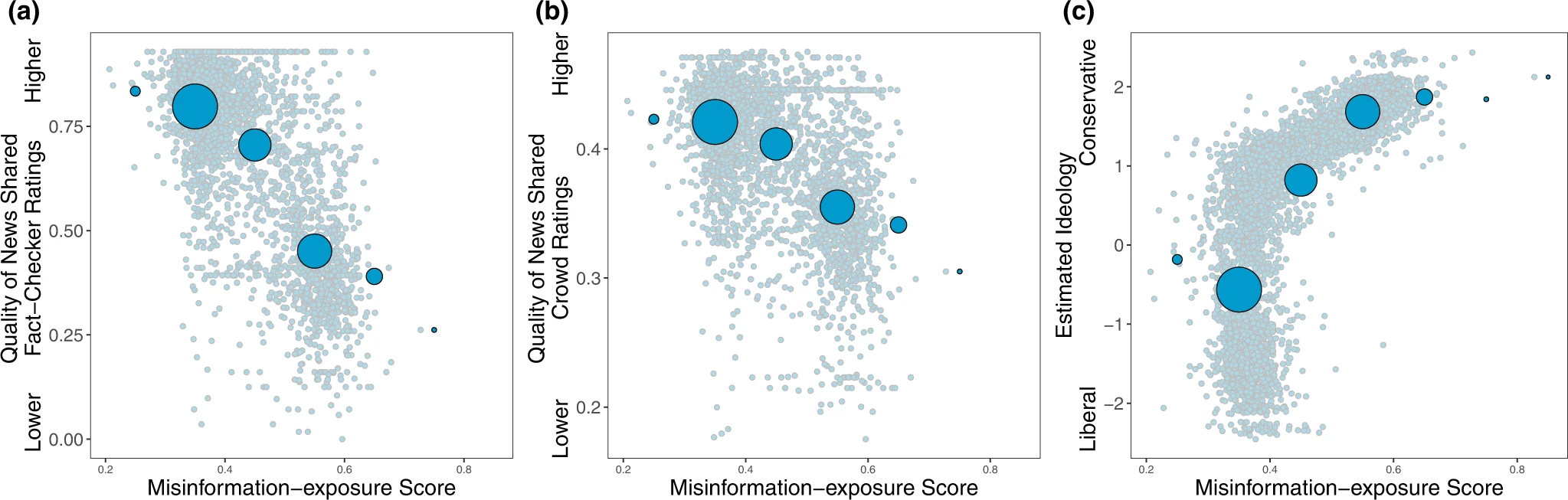
    1. Exposure to elite misinformation is associated with sharing news from lower-quality outlets and with conservative estimated ideology.

      Shown is the relationship between users’ misinformation-exposure scores and (a) the quality of the news outlets they shared content from, as rated by professional fact-checkers21, (b) the quality of the news outlets they shared content from, as rated by layperson crowds21, and (c) estimated political ideology, based on the ideology of the accounts they follow10. Small dots in the background show individual observations; large dots show the average value across bins of size 0.1, with size of dots proportional to the number of observations in each bin.

    1. We find that, during the pandemic, no-vax communities became more central in the country-specificdebates and their cross-border connections strengthened, revealing a global Twitter anti-vaccinationnetwork. U.S. users are central in this network, while Russian users also become net exporters ofmisinformation during vaccination roll-out. Interestingly, we find that Twitter’s content moderationefforts, and in particular the suspension of users following the January 6th U.S. Capitol attack, had aworldwide impact in reducing misinformation spread about vaccines. These findings may help publichealth institutions and social media platforms to mitigate the spread of health-related, low-credibleinformation by revealing vulnerable online communities
    1. We applied two scenarios to compare how these regular agents behave in the Twitter network, with and without malicious agents, to study how much influence malicious agents have on the general susceptibility of the regular users. To achieve this, we implemented a belief value system to measure how impressionable an agent is when encountering misinformation and how its behavior gets affected. The results indicated similar outcomes in the two scenarios as the affected belief value changed for these regular agents, exhibiting belief in the misinformation. Although the change in belief value occurred slowly, it had a profound effect when the malicious agents were present, as many more regular agents started believing in misinformation.

    1. we found that social bots played a bridge role in diffusion in the apparent directional topic like “Wuhan Lab”. Previous research also found that social bots play some intermediary roles between elites and everyday users regarding information flow [43]. In addition, verified Twitter accounts continue to be very influential and receive more retweets, whereas social bots retweet more tweets from other users. Studies have found that verified media accounts remain more central to disseminating information during controversial political events [75]. However, occasionally, even the verified accounts—including those of well-known public figures and elected officials—sent misleading tweets. This inspired us to investigate the validity of tweets from verified accounts in subsequent research. It is also essential to rely solely on science and evidence-based conclusions and avoid opinion-based narratives in a time of geopolitical conflict marked by hidden agendas, disinformation, and manipulation [76].
    2. There were 120,118 epidemy-related tweets in this study, and 34,935 Twitter accounts were detected as bot accounts by Botometer, accounting for 29%. In all, 82,688 Twitter accounts were human, accounting for 69%; 2495 accounts had no bot score detected.In social network analysis, degree centrality is an index to judge the importance of nodes in the network. The nodes in the social network graph represent users, and the edges between nodes represent the connections between users. Based on the network structure graph, we may determine which members of a group are more influential than others. In 1979, American professor Linton C. Freeman published an article titled “Centrality in social networks conceptual clarification“, on Social Networks, formally proposing the concept of degree centrality [69]. Degree centrality denotes the number of times a central node is retweeted by other nodes (or other indicators, only retweeted are involved in this study). Specifically, the higher the degree centrality is, the more influence a node has in its network. The measure of degree centrality includes in-degree and out-degree. Betweenness centrality is an index that describes the importance of a node by the number of shortest paths through it. Nodes with high betweenness centrality are in the “structural hole” position in the network [69]. This kind of account connects the group network lacking communication and can expand the dialogue space of different people. American sociologist Ronald S. Bert put forward the theory of a “structural hole” and said that if there is no direct connection between the other actors connected by an actor in the network, then the actor occupies the “structural hole” position and can obtain social capital through “intermediary opportunities”, thus having more advantages.
    3. We analyzed and visualized Twitter data during the prevalence of the Wuhan lab leak theory and discovered that 29% of the accounts participating in the discussion were social bots. We found evidence that social bots play an essential mediating role in communication networks. Although human accounts have a more direct influence on the information diffusion network, social bots have a more indirect influence. Unverified social bot accounts retweet more, and through multiple levels of diffusion, humans are vulnerable to messages manipulated by bots, driving the spread of unverified messages across social media. These findings show that limiting the use of social bots might be an effective method to minimize the spread of conspiracy theories and hate speech online.
    1. Labs can be a useful piece of the innovation puzzle if managers adopt a systems-thinking strategy, thinking more about their role within the wider government, department or company. They need to shape a culture within the whole organisation that is more open to new ideas, and this could be addressed by focusing more on communication.

      This seems to be the key element here: systems-thinking approach and thinking about our role within our departments.

    2. Some governments say labs build a culture of innovation. While a comforting idea, it’s wrong. Research from 2017 has found that while many companies and countries are investing in labs, that does not mean they are becoming more innovative. It concluded, “[Innovation] takes a lot more than opening a lab. It takes a disciplined approach on a number of fronts.”

      So while something like an OpenLab can create value, it's not sufficient to bring in more innovation.

      One could also put it this way: Instead of trying to become "the innovation lab" in our organization, why not use the group as a room where we can discuss how we bring innovation individually to our groups.

    1. Whether you want to call them mottos, memes, or manifestos, words can be the building blocks of how we think and transmit ideas. You can also gauge how well someone is grasping your concepts—or at least making an effort to—by the language they’re responding to you with as well.

      You can use the way that a person responds to your concepts as a metric for how well they understand you. If they don't understand chances are they will retreat back to jargon to try to hide the fact that they're struggling. If they're getting on well they might have an insightful way to extend your metaphor

    1. This reveals the actual problem, however: Right now, websites like Twitter exist in the public consciousness in a kind of superposition—Schrödinger’s public square. On the one hand, they are platforms with outsized power over and influence—serving as forums for discussion and debate, the dissemination of news (real and fake), and the hotbed of our culture.
    2. The real question isn’t whether platforms like Twitter and Facebook are public squares (because they aren’t), but whether they should be. Should everyone have a right to access these platforms and speak through them the way we all have a right to stand on a soap box downtown and speak through a megaphone? It’s a more complicated ask than we realize—certainly more complicated than those (including Elon Musk himself) who seem to think merely declaring Twitter a public square is sufficient.
  11. Nov 2022
    1. Publishers can create interactive stories on the platform and incorporate them in their website.

      I love this! It is similar to Prezi or VoiceThread.

      Do you also support collaborative editing (public or with invited collaborators)? If yes, a high-resolution world map could be used for collaborative pinning of local events, meetups, news, videos, and so on, such as radio.garden or YouTube Geofind.

    1. https://brainsteam.co.uk/2022/11/26/one-week-with-hypothesis/

      I too read a lot of niche papers and feel the emptiness, but because I'm most often writing for myself anyway, its alright. There are times, however, when I see a growing community of people who've left their associative trails behind before I've found a particular page.

      I've used the phrase "digital exhaust" before, but I like the more positive framing of "learning exhaust".

      If you've not found it yet, my own experimentations with the platform can largely be found here: https://boffosocko.com/tag/hypothes.is/

    1. Annotations are the first step of getting useful insights into my notes. This makes it a prerequisite to be able to capture annotations in my note making tool Obsidian, otherwise Hypothes.is is just another silo you’re wasting time on. Luckily h. isn’t meant as a silo and has an API. Using the API and the Hypothes.is-to-Obsidian plugin all my annotations are available to me locally.

      This is key - exporting annotations via the API to either public commonplace books (Chris A Style) or to a private knowledge store seems to be pretty common.

    2. In the same category of integrating h. into my pkm workflows, falls the interaction between h. and Zotero, especially now that Zotero has its own storage of annotations of PDFs in my library. It might be of interest to be able to share those annotations, for a more complete overview of what I’m annotating. Either directly from Zotero, or by way of my notes in Obsidian (Zotero annotatins end up there in the end)

      I've been thinking about this exact same flow. Given that I'm mostly annotating scientific papers I got from open access journals I was wondering whether there might be some way to syndicate my zotero annotations back to h via a script.

    1. Genealogy Garage: Researching at the Huntington Library

      <iframe width="560" height="315" src="https://www.youtube-nocookie.com/embed/0f2j2K6JWGg" title="YouTube video player" frameborder="0" allow="accelerometer; autoplay; clipboard-write; encrypted-media; gyroscope; picture-in-picture" allowfullscreen></iframe>
      • Julie Huffman jhuffman@lapl.org (host)
      • Stephanie Arias
      • Anne Blecksmith
      • Li Wei Yang
      • Clay Stalls cstalls@huntington.org

      ECPP

      Huntington Library

      Visit checklist

    1. I just learned this idea of anchor institution at the Association of Rural and Small Libraries Conference. There are institutions that anchor communities. Right. So that the hospital is one. Lots of people work there. Everyone goes there at some point, has a role to play in the community and the library is similar. You'll often get people who will say that the library's are irrelevant, but that just means that they can afford not to use a public service. And I don't know why they are the people we ask to share their expertise on the use of public services. But most of us use the public library. Our kids get their picture books there. We maybe do passport services. Maybe the library has tech training. One of my first jobs at the public library was teaching senior citizens how to do mouse and keyboarding skills. So where else are you going to learn those things? You learn them at the library.

      Libraries as anchor institutions

      Public libraries, in particular, and the places where anyone in the community can go for services. The mission of the library is to serve the needs of the specific community it is in.

    1. St. Marys resident Hannah Stockman, a stay-at-home mom looking after 13 kids, said the move would be devastating for her and others like her.“At this point, it’s the only space left that we have for the public,” Stockman said. “We don’t have any pool or any other amenities through the community center. So people come here for many, many different reasons.”

      Library as community space

  12. Oct 2022
    1. Index cards for commonplacing?

      I know that Robert Greene and Ryan Holiday have talked about their commonplace methods using index cards before, and Mortimer J. Adler et al. used index cards with commonplacing methods in their Great Books/Syntopicon project, but is anyone else using this method? Where or from whom did you learn/hear about using index cards? What benefits do you feel you're getting over a journal or notebook-based method? Mortimer J. Adler smoking a pipe amidst a sea of index cards in boxes with 102 topic labels (examples: Law, World, Love, Life, Being, Sin, Art, Citizen, Change, etc.)

    1. there is a similar exchange going on when you borrow a book from the library. In fact, libraries are specifically designed to remove the market from the equation entirely, which is why people who use libraries - even though libraries are free - are referred to as “patrons.”

      On the origin of library "patron"

      I'm not sure this is exactly true, but it does make for nice imagery.

  13. Sep 2022
    1. Bank branches are not destinations. Like Starbucks and cell phone shops, they rely on capturing your day-to-day custom when you’re out and about. In the U.S., that mostly means being maximally accessible by cars. (In Japan, and other places with different transit behavior, bank branches are among the most likely user for large parcels directly adjacent to hub train stations, with smaller light branches and ATM-only locations being deployed close to far-from-station workplaces.)

      Bank branches are not destinations

      Banks situate themselves along the paths that people travel...they are not destinations in and of themselves. So placement of branches are guided by modes of transportation: easy car access when cars at the main mode of transport; near transit stops when public transportation is the main mode.

    1. “That’s the mantra of web3, to be open and composable, and with CC0 no one owns the rights to the intellectual property. This creates huge potential for what can be created in the future. But the bigger corporations are coming into the space and trying to close things down, tracking wallets and essentially bringing web2 into web3. I don’t want that. I want web3 to continue to be built by the people, for the people, which is why all these public goods are crucial for the future of web3.”

      This is extremely interesting: the conviction that public domain approach is what differentiates web3 from web2. Quite different from a. typical spin that attributes this to the technological stack - here the stack is law + norms.

  14. Aug 2022