for - media manipulation - Epstein - Masha - crypto - from - youtube - Left Hook - interview - David Z. Morris
summary - Jeffrey Epstein tentacles into crypto
- Feb 2026
-
davidzmorris.substack.com davidzmorris.substack.com
-
-
www.youtube.com www.youtube.com
-
Dossier de SynthĂšse : La Psychologie de l'Engagement
Résumé Exécutif
Ce document synthétise les concepts clés de la psychologie de l'engagement, tels que présentés par le professeur Fabien Girandola.
La thÚse centrale est que la persuasion traditionnelle, basée sur l'information et l'argumentation, est largement inefficace pour modifier durablement les comportements.
En opposition, la théorie de l'engagement propose une approche contre-intuitive mais puissante :
- amener les individus à réaliser un premier acte, peu coûteux et en situation de libre choix, pour les lier à cet acte et
- les inciter Ă adopter des comportements plus significatifs par la suite.
Des techniques comme le "pied-dans-la-porte" et "l'étiquetage", validées par des décennies de recherche expérimentale, démontrent qu'il est possible d'influencer les actions en structurant la situation plutÎt qu'en tentant de convaincre les esprits.
Un effet psychologique majeur de ces techniques est la "naturalisation" : les individus attribuent leur nouveau comportement à leur propre nature ("je suis altruiste") sans avoir conscience de la manipulation situationnelle qui en est la véritable cause.
La maßtrise de ces techniques soulÚve des questions éthiques fondamentales, naviguant entre l'influence et la manipulation.
1. L'Inefficacité de la Persuasion : Le Fossé entre Opinion et Comportement
La démarche classique pour changer les comportements repose sur la persuasion : l'idée qu'en fournissant des informations et des arguments convaincants, on peut modifier les opinions des individus, ce qui entraßnera une modification de leurs actions.
1.1. Le Postulat de la Persuasion
L'approche persuasive suppose une chaĂźne causale directe :
1. Information : Présenter des faits (ex: "Le tabac tue").
2. Conviction : L'individu intĂšgre l'information et modifie son opinion.
3. Action : L'individu ajuste son comportement pour qu'il soit cohérent avec sa nouvelle opinion.
1.2. La DĂ©monstration de l'Ăchec
Des décennies de recherche en psychologie sociale, depuis les années 1960, montrent que ce lien est faible, voire inexistant.
Savoir quelque chose ne garantit pas de se conformer Ă cette connaissance.
âą Exemples courants :
⊠Les fumeurs savent que le tabac est nocif mais continuent de fumer.  Â
⊠La majorité des gens s'accordent sur l'importance de l'écologie mais n'adoptent que peu de comportements pro-environnementaux.
⹠L'Expérimentation de Bigman (1972) : Cette étude princeps illustre parfaitement le décalage entre l'opinion déclarée et le comportement réel.
Phase de l'Expérience
Résultat
Sondage d'opinion
95 % des passants déclarent qu'il est important de garder les rues propres.
Mise en situation
ConfrontĂ©s Ă un papier Ă ramasser dans la rue, seulement 2 % des mĂȘmes personnes effectuent le geste.
Cette expérience fondatrice démontre que l'adhésion à une idée (la propreté) ne se traduit pas automatiquement en action.
2. La Théorie de l'Engagement : Agir d'Abord, Penser Ensuite
Face aux limites de la persuasion, la théorie de l'engagement, développée notamment par des chercheurs comme Kiesler, Jean-Léon Beauvois et Robert-Vincent Joule, propose de renverser la logique.
Au lieu de viser les opinions pour changer les actes, elle vise les actes pour, par la suite, influencer les opinions et les comportements futurs.
2.1. Définition et Principes
⹠Définition (Kiesler, 1971) : L'engagement est "le lien qui unit l'individu à son acte".
âą Principe fondamental : Ce n'est pas l'individu qui s'engage de lui-mĂȘme, mais la situation qui l'engage.
L'objectif est d'amener une personne à réaliser de petits actes progressifs qui l'entraßneront vers des comportements plus coûteux qu'elle n'aurait pas réalisés spontanément.
2.2. Les Facteurs Clés de l'Engagement
Pour qu'une situation soit engageante, plusieurs facteurs doivent ĂȘtre rĂ©unis.
Facteur
Description
Exemple
Le Sentiment de Liberté
C'est le facteur le plus crucial. L'individu doit avoir l'impression qu'il a choisi librement de réaliser l'acte.
Les formules comme "Vous ĂȘtes libre d'accepter ou de refuser" ou "Faites comme vous voulez" augmentent considĂ©rablement le taux d'acceptation, car elles crĂ©ent un sentiment de libertĂ©, mĂȘme si celui-ci est contextuellement contraint.
Demander de signer une pĂ©tition en ajoutant "mais vous ĂȘtes libre de refuser" fait passer le taux d'acceptation de 15 % Ă 45 %.
Le CaractĂšre Public
Un acte réalisé publiquement (signer une pétition, prendre la parole) est plus engageant qu'un acte privé.
Le nom et la signature laissés lient l'individu à son action.
Signer une pétition avec son nom complet.
La Répétition de l'Acte
Répéter un comportement renforce le lien d'engagement.
AprĂšs avoir prĂȘtĂ© un objet plusieurs fois, il devient difficile de refuser.
PrĂȘter un outil Ă un voisin chaque semaine.
Le Coût de l'Acte
Un acte qui demande un effort ou un sacrifice (en temps, en argent, en énergie) est plus engageant.
PrĂȘter sa voiture est plus engageant que de prĂȘter un stylo.
L'Ătiquetage (Imputation Interne)
Attribuer une qualitĂ© Ă une personne ("Je sais que vous ĂȘtes serviable") l'engage Ă se comporter conformĂ©ment Ă cette Ă©tiquette.
L'acte semble alors "naturel" pour l'individu.
Dire Ă quelqu'un "Vous ĂȘtes vraiment quelqu'un de bien".
Note importante : L'engagement ne fonctionne pas en présence de récompenses ou de punitions.
Si une personne est payée ou menacée pour faire quelque chose, l'acte n'est pas attribué à une décision interne mais à la contrainte externe.
Il n'y a donc pas d'engagement psychologique.
3. Les Techniques de Soumission Librement Consentie
Ces principes théoriques ont été déclinés en techniques d'induction comportementale concrÚtes, regroupées sous le nom paradoxal de "soumission librement consentie" :
l'individu se soumet Ă une demande tout en ayant le sentiment d'avoir agi librement.
3.1. Le Pied-dans-la-Porte : Demander Peu pour Obtenir Plus
C'est la technique la plus connue.
Elle consiste Ă faire accepter une premiĂšre requĂȘte trĂšs peu coĂ»teuse (l'acte prĂ©paratoire) pour augmenter significativement les chances que la personne accepte une seconde requĂȘte, beaucoup plus coĂ»teuse (le comportement visĂ©).
âą ExpĂ©rimentation de Freedman & Fraser (1966) - ScĂ©nario 1 : L'enquĂȘte Ă domicile
Condition Expérimentale
RequĂȘte
Taux d'Acceptation
ContrĂŽle
Demande directe : Accepter la visite de 2-3h d'une Ă©quipe d'enquĂȘteurs pour fouiller la maison.
22 %
Pied-dans-la-porte
1. Acte préparatoire : Répondre à un court questionnaire téléphonique (accepté par tous).<br>
2. RequĂȘte finale (3 jours plus tard) : Accepter la visite de l'Ă©quipe d'enquĂȘteurs.
53 %
⹠Expérimentation de Freedman & Fraser (1966) - Scénario 2 : Le panneau dans le jardin
Condition Expérimentale
RequĂȘte
Taux d'Acceptation
ContrĂŽle
Demande directe : Planter un grand panneau de 4x4m pour la sécurité routiÚre dans son jardin.
17 %
Pied-dans-la-porte
1. Acte préparatoire : Apposer un petit autocollant pour la prévention routiÚre sur sa vitre (accepté par tous).<br>
2. RequĂȘte finale (3 jours plus tard) : Accepter de planter le grand panneau.
76 %
3.2. L'Ătiquetage et le Pied-dans-la-Porte Implicite
Cette approche combine l'acte prĂ©paratoire avec une valorisation de la personne, l'incitant Ă rĂ©aliser d'elle-mĂȘme un comportement coĂ»teux, sans qu'on le lui demande explicitement.
⹠Expérimentation de Joule et al. (2002) - Le billet perdu à Aix-en-Provence
Le comportement visé est l'altruisme : rendre un billet de 10 ⏠tombé de la poche d'un complice.
L'acte préparatoire consiste à renseigner un "touriste" (un autre complice) sur un plan.
La variable clé est la maniÚre dont le touriste remercie la personne.
Condition
Réponse du "Touriste" aprÚs avoir été aidé
Taux de Restitution du Billet
ContrĂŽle
Pas d'interaction préalable avec le touriste.
30 %
Pied-dans-la-porte (Remerciement simple)
"Merci."
43 %
Pied-dans-la-porte (Service)
"Vous m'avez rendu un grand service."
48 %
Pied-dans-la-porte + Ătiquetage 1
"Vous ĂȘtes serviable."
70 %
Pied-dans-la-porte + Ătiquetage 2
"Vous ĂȘtes vraiment quelqu'un de bien."
78 %
Cette expérience démontre que l'on peut faire varier le taux d'altruisme de 30 % à 78 % uniquement en modifiant une interaction anodine quelques minutes auparavant.
4. ConsĂ©quences Psychologiques et Ăthiques
4.1. La Naturalisation du Comportement
L'effet le plus remarquable de l'engagement est que les individus n'ont pas conscience d'avoir été influencés. Interrogés sur les raisons de leur acte (ex: rendre le billet), ils répondent systématiquement :
"C'est normal, je suis quelqu'un d'altruiste/généreux".
⹠Signification vs. Détermination :
⊠Signification : L'explication que l'individu donne Ă son comportement (interne, liĂ©e Ă sa personnalitĂ©). Â
⊠Détermination : La cause réelle du comportement (externe, liée à la situation créée par l'expérimentateur).
Les individus n'ont pas accÚs à la véritable détermination de leurs actes et la remplacent par une signification qui valorise leur "moi".
4.2. La FrontiĂšre avec la Manipulation
Le professeur Girandola insiste sur le fait que ces techniques sont puissantes et naviguent Ă la frontiĂšre de la manipulation.
Leur connaissance est essentielle non seulement pour les utiliser à bon escient (santé publique, éducation) mais aussi pour s'en prémunir.
Il rappelle que l'usage de ces techniques par les psychologues est encadré par un code de déontologie strict : "il n'y a pas d'action sans éthique".
5. Lectures et Ressources Recommandées
Pour approfondir le sujet, plusieurs ouvrages et articles ont été mentionnés :
⹠Ouvrages de référence :
⊠Petit traitĂ© de manipulation Ă l'usage des honnĂȘtes gens par R.-V. Joule et J.-L. Beauvois. Â
⊠La soumission librement consentie par les mĂȘmes auteurs.    ⊠Psychologie sociale et Attitude et comportement par F. Girandola.
âą Articles en ligne :
⊠Des articles de vulgarisation sur la plateforme The Conversation, notamment sur l'application des techniques de manipulation par Donald Trump ou dans le contexte des soldes.
⹠Vidéo :
⊠La reconstitution filmée de l'expérience du "billet perdu" est disponible en ligne.
6. Conclusion et Perspectives
La présentation s'est concentrée sur les fondements de la théorie de l'engagement et la technique du pied-dans-la-porte.
Il a été précisé que d'autres aspects importants n'ont pas été abordés, notamment :
⹠Les effets de l'engagement sur les opinions (via la théorie de la dissonance cognitive).
âą L'escalade d'engagement, un processus oĂč un individu persĂ©vĂšre dans une dĂ©cision ou un comportement qui s'avĂšre nĂ©gatif, simplement parce qu'il s'y est initialement engagĂ©.
-
- Jan 2026
-
www.youtube.com www.youtube.com
-
PEUR BLEUE - Anatomie des violences conjugales et du parcours de sortie
31âŻ275 vues 4 oct. 2023 Ce film a Ă©tĂ© produit par le Conseil DĂ©partemental d'AccĂšs au Droit des Hautes-PyrĂ©nĂ©es.
Basé sur des témoignages de victimes et de professionnels, ce film a pour objectif de rendre compte du phénomÚne des violences et de ses différentes formes, qui peuvent ou non se cumuler.
La victime, dépossédée de sa capacité d'action par les effets de l'emprise et du psycho-trauma, peut cependant trouver des voies de protection et bénéficier d'un accompagnement personnalisé dans un lieu spécialisé.
Retrouvez nous sur Instagram : / cdad65000 <br /> Illustrations faites par Ysar : / __ysar<br /> Ce film a été mis en image et monté par Yannick Chaumeil : / @associationlarrache-temps1871
-
- Feb 2025
-
www.youtube.com www.youtube.com
-
Voici un sommaire de la vidéo avec les idées fortes, organisé chronologiquement:
-
Introduction
- Présentation de David Colon, historien et professeur.
- ThÚmes abordés: désinformation, propagande et manipulation de masse.
-
Définition de la manipulation
- La propagande est une communication de masse qui influence les attitudes et les comportements.
- La manipulation est une influence ou persuasion cachée en masse.
- Types de propagande: blanche (officielle), noire (cachée) et grise (transparente mais manipulatrice).
-
Traces de la manipulation noire
- Les services de renseignement laissent des archives consultables aprÚs plusieurs décennies.
- Les propagandistes laissent des traces de leurs actions, mĂȘme s'ils ne sont pas toujours fiers.
-
Publicité et manipulation
- La publicité est une forme de propagande commerciale qui modifie la perception d'une marque ou encourage à acheter.
- Les publicitaires appliquent leurs techniques à la politique et à la propagande d'état.
-
Origine de la désinformation
- La désinformation vient d'une tradition militaire russe d'intoxication de l'adversaire.
-
La propagande en démocratie
- La propagande est née dans la GrÚce antique et a été utilisée pendant la Révolution française.
- Les démocraties libérales ont eu besoin de persuasion de masse pour obtenir le consentement de leurs populations.
- Aux Ătats-Unis sont nĂ©s les instituts de sondage, la publicitĂ© scientifique, les relations publiques et le marketing.
-
Nécessité de la propagande
- Les citoyens ont besoin de propagande pour comprendre un monde complexe.
- Les outils algorithmiques actuels participent Ă une forme de propagande.
-
Propagande positive
- La propagande et la manipulation ne sont pas toujours négatives si elles servent un but utile.
-
Manipulation électorale
- Les Ă©lections peuvent ĂȘtre manipulĂ©es en encourageant ou dĂ©courageant le vote de certains Ă©lecteurs.
- La Russie a dissuadé les électeurs afro-américains de voter pour les démocrates lors des élections de mi-mandat.
-
Techniques de persuasion
- Les techniques de persuasion efficaces font appel aux affects, aux émotions et aux biais psychologiques.
-
Les maĂźtres de la manipulation
- Les manipulateurs de masse ont l'intention de manipuler et obtiennent des résultats concrets.
- L'industrie du tabac et les industries polluantes ont utilisé la propagande et la manipulation pour occulter des faits.
-
Religion et propagande
- La propagande a une origine religieuse (congrégation pour la propagation de la foi).
- Les cultes religieux font appel Ă l'esprit et aux affects des croyants.
-
Sondages et manipulation
- Les sondages par échantillons n'ont aucune valeur scientifique.
- L'effet bandwagon influence les gens Ă suivre le candidat en tĂȘte des sondages.
- L'industrie des sondages est nĂ©e aux Ătats-Unis pour adapter les programmes politiques Ă l'opinion.
-
La manipulation au XXe siĂšcle
- La notion de manipulation apparaĂźt dans le dĂ©bat public dans l'entre-deux-guerres aux Ătats-Unis.
- Les manipulateurs utilisent la psychologie et la psychanalyse pour la persuasion.
- Edward Bernays a utilisé des principes freudiens pour associer des symboles à des produits.
- Bernays a encouragé les femmes à fumer en attribuant à la cigarette un symbole d'émancipation féminine.
- Il a promu le principe d'un petit déjeuner copieux pour vendre du bacon.
- Il a changé la couleur à la mode pour vendre des cigarettes Lucky Strike.
-
Traits communs des manipulateurs
- Ils sont rarement trÚs éduqués, mais s'intéressent aux sciences et aux techniques.
- Ils cherchent des applications concrĂštes Ă la persuasion.
-
Psychanalyse et manipulation
- La psychologie sociale et le comportementalisme ont contribué à l'art de la persuasion.
- Ernest Dichter a utilisé la psychanalyse pour rechercher les mobiles inconscients des consommateurs.
- Dichter a recommandĂ© de retirer l'Ćuf des prĂ©parations Ă gĂąteaux Betty Crocker pour valoriser la personne qui fait le gĂąteau.
- Il a encouragé la notion de cycle de vie symbolique des produits et l'obsolescence programmée.
- Aujourd'hui, le big data permet une exploitation micro-ciblée des désirs inconscients.
-
Ciblage psychologique et propagande
- Ceux qui véhiculent la propagande russe véhiculent souvent des théories du complot.
- Les propagandistes ciblent les individus avec des profils psychologiques de la "dark triade" (narcissisme, machiavélisme, psychopathie).
- La propagande numérique cible l'individu dans la masse.
-
Guerre psychologique
- Techniques militaires utilisées pour organiser des coups d'état et des insurrections.
-
Numérique et manipulation
- L'avÚnement des réseaux sociaux a entraßné un recul démocratique.
- Les algorithmes de Facebook encouragent les contenus violents, les théories du complot et les fausses informations.
- Une minorité peut influencer une masse énorme de gens grùce au numérique.
- Facebook privilégie la rentabilité publicitaire à la réduction de la viralité des contenus.
- Le capitalisme de surveillance prélÚve nos données comportementales pour agir sur nos comportements.
- La propagande totale est difficile à éviter.
-
Conclusion
- Présentation des livres de David Colon sur la manipulation.
- Remerciements et annonce du prochain live.
-
-
chronologie des événements principaux et une liste des personnages clés mentionnés dans la source, suivies de brÚves biographies.
Chronologie des événements et sujets abordés :
- Avant le XXe siÚcle :La propagande a ses racines dans l'Antiquité grecque (rhétorique à AthÚnes).
- La Révolution française utilise la propagande à grande échelle.
- Début du XXe siÚcle :Les démocraties libérales ressentent le besoin de persuasion de masse (consentement à l'impÎt, à la guerre).
- Les Ătats-Unis deviennent un terrain fertile pour la publicitĂ© scientifique, les relations publiques, le marketing, les Ă©tudes du comportement humain.
- Entre-deux-guerres :Ămergence des "maĂźtres de la persuasion" aux Ătats-Unis, utilisant la psychologie et la psychanalyse.
- AnnĂ©es 1920 :Les Ătats-Unis sont le plus grand marchĂ© Ă©conomique et industriel.
- AnnĂ©es 1930 :Naissance de l'industrie des sondages aux Ătats-Unis (1935).
- Révélations à grande échelle sur la nocivité du tabac (1953).
- Seconde Guerre mondiale :Invention du mot "désinformation" dans un dictionnaire du KGB (1949).
- Guerre froide :Les Ătats-Unis diffusent l'industrie des sondages dans leur sphĂšre d'influence.
- OpĂ©rations de dĂ©sinformation de la Russie soviĂ©tique et des Ătats-Unis.
- Années 1960 :Jacques Ellul publie "Propagande" (1962), soulignant le besoin de propagande pour comprendre le monde.
- Années 1970 :Interdiction des sondages politiques juste avant les élections en France (1977).
- Consensus scientifique sur le réchauffement climatique (1979).
- Années 1980 :Développement du modÚle des "Big Five" en psychologie.
- Milieu des années 1990 :Naissance du web commercial.
- Années 2010 :Application à grande échelle du modÚle des "Big Five" grùce à un brevet de Facebook et aux études de Michal Kosinski.
- 2014 :Application dans la sphĂšre civile des techniques de guerre psychologique.
- 2016 :Ălection prĂ©sidentielle amĂ©ricaine : Cambridge Analytica cible des Ă©lecteurs dans trois Ă©tats clĂ©s.
- 6 janvier 2021 :Insurrection au Capitole des Ătats-Unis.
- Ăpoque contemporaine :Les outils algorithmiques et les assistants virtuels participent Ă une forme de propagande.
- L'avÚnement des réseaux sociaux et le modÚle d'engagement de Facebook favorisent la viralité des théories du complot.
- Exploitation micro-ciblée des désirs inconscients grùce aux données collectées en ligne.
Liste des personnages clés :
- David Colon : Historien, professeur agrégé à l'IUT de Paris. Auteur de "Les maßtres de la manipulation" et d'un livre sur la propagande (2019).
- Fabien : Animateur de l'émission, dialogue avec l'invité David Colon, lit les questions des internautes.
- Edward Bernays : Publicitaire et pionnier des relations publiques, neveu de Sigmund Freud. A utilisé des principes freudiens pour influencer les comportements de consommation.
- Jacques Ellul : Auteur de "Propagande" (1962).
- Ernest Dichter : Psychologue et expert en motivation. A mené des études sur les mobiles inconscients des consommateurs.
- Bernie Sanders : Personnalité politique américaine dont les sympathisants ont été ciblés par Cambridge Analytica pour les dissuader de voter pour la candidate adverse lors de l'élection présidentielle de 2016.
- Donald Trump : Candidat Républicain dont l'élection a été en partie favorisée par les actions de Cambridge Analytica en 2016.
- Shoshana Zuboff : Auteur ayant défini le capitalisme de surveillance.
- Michal Kosinski : Chercheur dont les travaux ont inspiré Cambridge Analytica.
- Steve Bannon : Figure politique américaine associée à Cambridge Analytica et à la diffusion de contenus climato-sceptiques.
- Christopher Wylie : Informaticien qui a révélé les pratiques de Cambridge Analytica.
- Lord Bell : Communicant de Margaret Thatcher, fondateur de SCL (maison-mĂšre de Cambridge Analytica).
- Margaret Thatcher : PremiÚre ministre du Royaume-Uni dont la communication a été gérée par Lord Bell.
- Alexandre Dézé : Politiste attaqué en diffamation pour avoir critiqué les sondages.
- Mark Zuckerberg : PDG de Facebook (Meta).
- Gérald Bronner : Sociologue, spécialiste des croyances collectives et des biais cognitifs.
- Leon Festinger: Auteur de When Prophecy Fails.
-
-
-
When strong, appear weak. Brave, appear fearful. Orderly, appear chaotic.Full, appear empty. Wise, appear foolish. Many, appear to be few.Advancing, appear to retreat. Moving quickly, appear to be slow. Taking,appear to leave. In one place, appear to be in another.
Manipulation is a theme in this passage. They use juxtapositions to make their point and confuse enemies. It's like Yin and Yang but they're manipulating it...if that makes sense and this passage definitely fits into the theme of manipulation.
-
- May 2024
-
-
PROPAGANDA la fabrique du consentement
https://www.youtube.com/watch?v=EkN83kdgHps
Résumé de la vidéo [00:00:00][^1^][1] - [00:35:42][^2^][2]:
Cette vidĂ©o explore l'histoire et l'impact de la propagande, en se concentrant sur les techniques de persuasion dĂ©veloppĂ©es aux Ătats-Unis il y a un siĂšcle. Elle examine comment ces mĂ©thodes ont Ă©tĂ© utilisĂ©es pour influencer l'opinion publique pendant la PremiĂšre Guerre mondiale, pour promouvoir le capitalisme industriel, et comment elles ont Ă©tĂ© adaptĂ©es par des figures telles qu'Edward Bernays pour façonner la sociĂ©tĂ© amĂ©ricaine.
Points forts: + [00:00:00][^3^][3] Origines de la propagande * Utilisation de la propagande pour orienter les choix des gens * Techniques de persuasion dĂ©veloppĂ©es aux Ătats-Unis + [00:01:32][^4^][4] Propagande pendant la guerre * Campagne de propagande pour vendre la guerre au peuple amĂ©ricain * Utilisation de cĂ©lĂ©britĂ©s et de leaders d'opinion pour influencer les masses + [00:10:28][^5^][5] Edward Bernays et relations publiques * Transition de la propagande vers les relations publiques * Influence de la psychologie des foules et de la psychanalyse + [00:18:26][^6^][6] Campagnes de Bernays * Utilisation de la psychanalyse pour les campagnes publicitaires * Campagnes pour le tabac et le petit dĂ©jeuner amĂ©ricain + [00:25:29][^7^][7] Impact de la propagande sur la sociĂ©tĂ© * Influence sur les habitudes de consommation et la perception des entreprises * Utilisation par les nazis et rĂ©action Ă la crise Ă©conomique + [00:33:28][^8^][8] Relations publiques et l'American way of life * Exposition universelle de New York comme vitrine du capitalisme * RĂŽle continu des relations publiques dans la sociĂ©tĂ© moderne RĂ©sumĂ© de la vidĂ©o [00:35:44][^1^][1] - [00:53:01][^2^][2]:
Cette partie de la vidĂ©o discute de la propagande et de la manipulation de l'opinion publique par Edward Bernays et d'autres acteurs puissants. Elle explore comment la dĂ©mocratie et le capitalisme ont Ă©tĂ© fusionnĂ©s pour influencer les perceptions publiques et comment les intĂ©rĂȘts des grandes entreprises et des gouvernements ont dominĂ© le discours public.
Points forts: + [00:35:44][^3^][3] La fusion de la dĂ©mocratie et du capitalisme * Les grandes entreprises prĂ©sentent l'avenir plutĂŽt que le prĂ©sent * La famille Middleton Ă l'Exposition universelle symbolise l'adoption du capitalisme * La propagande vise Ă promouvoir l'American way of life + [00:39:00][^4^][4] Les critiques de la manipulation * Les relations publiques soulĂšvent des inquiĂ©tudes sur la manipulation des esprits * Edward Bernays est parfois accusĂ© directement mais trouve cela valorisant * La concurrence en matiĂšre de propagande favorise les acteurs les plus riches + [00:41:23][^5^][5] La propagande pendant la guerre * Les Ătats-Unis entrent en guerre, et la propagande soutient l'effort de guerre * Les techniques de la Commission Creel sont rĂ©utilisĂ©es * Les industriels utilisent la guerre pour promouvoir l'American way of life + [00:45:02][^6^][6] La lutte contre le communisme * La peur du communisme est exploitĂ©e pour dĂ©fendre des intĂ©rĂȘts privĂ©s * Le Guatemala devient la cible d'une campagne de propagande par la United Fruit Company * Edward Bernays persuade les AmĂ©ricains que le gouvernement guatĂ©maltĂšque est communiste + [00:49:03][^7^][7] Les consĂ©quences de la propagande * La propagande a des effets durables sur la politique Ă©trangĂšre des Ătats-Unis * Des interventions sont justifiĂ©es par la lutte contre le communisme * La propagande influence la perception de la dĂ©mocratie et de la sociĂ©tĂ©
-
-
www.youtube.com www.youtube.com
-
La fabrique de l'ignorance | ARTE
https://www.youtube.com/watch?v=N92J1PiQXX0
Résumé de la vidéo [00:00:02][^1^][1] - [00:31:48][^2^][2]:
Cette vidĂ©o, intitulĂ©e "La fabrique de l'ignorance" par ARTE, explore comment l'industrie et certains acteurs crĂ©ent dĂ©libĂ©rĂ©ment de l'ignorance ou du doute pour entraver le progrĂšs scientifique et Ă©viter la responsabilitĂ©. Elle examine des cas historiques et contemporains oĂč la recherche scientifique est manipulĂ©e ou discrĂ©ditĂ©e pour protĂ©ger les intĂ©rĂȘts commerciaux, en particulier dans les industries du tabac, de l'agrochimie et des produits pharmaceutiques.
Points saillants: + [00:02:48][^3^][3] Le déclin des abeilles et les néonicotinoïdes * L'augmentation des pertes d'abeilles liée à l'usage des néonicotinoïdes * La confusion et le manque de consensus scientifique malgré les preuves * Les efforts pour détourner l'attention vers d'autres causes possibles + [00:10:43][^4^][4] L'industrie du tabac et la manipulation de la science * La stratégie de l'industrie pour créer du doute sur les dangers du tabac * L'utilisation de la recherche scientifique pour discréditer la science établie * La révélation des tactiques de l'industrie grùce aux documents internes divulgués + [00:18:00][^5^][5] La fabrique du doute et ses conséquences * L'impact de la désinformation sur la santé publique et l'environnement * La lutte contre la réglementation et les poursuites judiciaires par la création de doute * Les retards dans la reconnaissance des vérités scientifiques et les coûts humains associés + [00:29:01][^6^][6] L'agnotologie et l'étude de l'ignorance * La naissance de l'agnotologie, l'étude de l'ignorance délibérément produite * L'importance de comprendre les obstacles à la connaissance et au progrÚs scientifique * La nécessité de sensibiliser le public aux tactiques utilisées pour semer la confusion Résumé de la vidéo [00:31:58][^1^][1] - [01:00:35][^2^][2]:
La vidéo explore le concept d'agnotologie, l'étude de la production culturelle de l'ignorance. Elle examine comment l'ignorance est stratégiquement fabriquée par des industries telles que le tabac et les plastiques pour influencer la perception publique et les politiques. La vidéo met en lumiÚre les tactiques utilisées pour semer le doute sur les risques pour la santé et les impacts environnementaux, et comment les scientifiques et les régulateurs luttent pour établir la vérité.
Points saillants: + [00:32:00][^3^][3] L'agnotologie * Intersection de diverses disciplines * Comprendre la production de l'ignorance * Protéger contre la désinformation + [00:33:01][^4^][4] Les pratiques scientifiques * Importance des méthodes de recherche * Protocoles comme points de vulnérabilité * Manipulation des résultats par des protocoles mal conçus + [00:37:02][^5^][5] L'industrie du tabac * Attaques contre l'épidémiologie * Stratégies pour discréditer les risques du tabagisme passif * Influence sur les normes de recherche + [00:45:09][^6^][6] Les perturbateurs endocriniens * Découverte d'effets à des doses infimes * Remise en question des principes de toxicologie * Résistance de l'industrie face aux preuves scientifiques Résumé de la vidéo [01:00:37][^1^][1] - [01:31:03][^2^][2]:
La troisiĂšme partie de la vidĂ©o explore les tactiques utilisĂ©es par certaines industries pour discrĂ©diter la science environnementale et promouvoir leurs intĂ©rĂȘts. Elle rĂ©vĂšle comment l'industrie de l'amiante a orchestrĂ© l'Appel de Heidelberg pour saper les recherches sur les dangers de l'amiante, en se prĂ©sentant comme dĂ©fenseur de la "bonne science". La vidĂ©o examine Ă©galement la maniĂšre dont les climatosceptiques utilisent les rĂ©seaux sociaux pour diffuser leurs idĂ©es et comment des idĂ©ologies personnelles peuvent influencer la perception de la science.
Points saillants: + [01:00:37][^3^][3] L'Appel de Heidelberg * Un texte soutenant le progrĂšs scientifique contre l'Ă©cologisme "irrationnel" * RĂ©vĂ©lĂ© comme une initiative de l'industrie de l'amiante pour discrĂ©diter la science environnementale * Utilisation de la rhĂ©torique de la "bonne science" pour dĂ©former le langage et les faits + [01:06:03][^4^][4] La manipulation du langage * L'industrie a redĂ©fini la "bonne science" pour favoriser ses intĂ©rĂȘts * Les chercheurs documentant les risques sont classĂ©s comme "mauvaise science" * CrĂ©ation d'une fausse dichotomie entre science fondĂ©e sur des preuves et "dĂ©ni de science" + [01:09:58][^5^][5] Les rĂ©seaux sociaux et le climatoscepticisme * Les climatosceptiques forment des communautĂ©s denses et actives sur Twitter * Utilisation de faits alternatifs pour contrer les preuves scientifiques du changement climatique * L'Institut Heartland, un think tank climatosceptique influent, propage des idĂ©es contraires au consensus scientifique + [01:17:22][^6^][6] IdĂ©ologie et science * Certains scientifiques climatosceptiques motivĂ©s par des convictions idĂ©ologiques plutĂŽt que financiĂšres * La lutte contre le rĂ©chauffement climatique perçue comme une menace pour le libre marchĂ© et les valeurs personnelles * L'influence de l'Ă©conomie sur la recherche scientifique et la libertĂ© acadĂ©mique RĂ©sumĂ© de la vidĂ©o [01:31:07][^1^][1] - [01:35:59][^2^][2]:
La partie 4 de la vidéo aborde la maniÚre dont l'économie de marché influence la science, en valorisant et privilégiant les recherches lucratives. Les chercheurs sont poussés à générer des fonds et à suivre les tendances pour obtenir des financements, ce qui oriente la science dans une direction spécifique et laisse d'autres domaines inexplorés.
Points forts: + [01:31:07][^3^][3] Influence de l'économie de marché * La science lucrative est favorisée * Les chercheurs doivent attirer des fonds * La compétition entre laboratoires est intense + [01:32:02][^4^][4] Tendances de la recherche * Les mots clés comme "génomique" et "nanotechnologie" attirent des financements * L'intelligence artificielle est le mot clé actuel * La recherche est orientée par ces tendances + [01:33:01][^5^][5] La science non faite * Des domaines scientifiques sont négligés faute d'impératif commercial * La "science non faite" représente des connaissances jamais explorées * L'ignorance est parfois choisie ou financiÚrement motivée + [01:35:06][^6^][6] La fabrique de l'ignorance * L'agnotologie étudie la production délibérée de l'ignorance * Les chercheurs en agnotologie sont une nouvelle force pour le public * Ils protÚgent la science et sa progression méticuleuse
-
-
-
ŃĐŸŃĐŒŃлОŃĐŸĐČĐșа, ОзŃŃĐŽĐœĐŸ ĐŸŃЎаŃŃĐ°Ń ŃŃ ĐŸĐ»Đ°ŃŃĐžĐșĐŸĐč
ĐŃапŃŃĐČаŃŃ ĐČ ĐłŃŃĐ·Ń, ĐČĐ”ŃаŃŃ ŃŃĐ»ŃĐșĐž Đž Ń.Đż. ĐŽŃĐŒĐ°Ń ŃŃĐŸĐžŃ Ń ĐŸŃŃ Đ±Ń ĐżĐŸŃлД ŃĐŸĐłĐŸ ĐșаĐș ŃĐžŃаŃĐ”Đ»Ń ĐżĐŸĐ»ĐœĐŸŃŃŃŃ Đž ĐœĐ”ĐčŃŃалŃĐœĐŸ ĐČĐČДЎŃĐœ ĐČ ĐșŃŃŃ ĐŽĐ”Đ»Đ°. Đ ŃĐŸ ŃаĐș ĐżĐŸĐ»ŃŃаДŃŃŃ ŃŃĐŸ Đ»ĐŸĐłĐžĐșа "ЎДла" ŃŃŃĐŸĐžŃŃŃ ĐœĐ° ŃĐŒĐŸŃĐžŃŃ (ĐœĐ”ĐłĐ°ŃĐžĐČĐœŃŃ ĐČ ŃаŃŃĐœĐŸŃŃĐž).
ĐŃĐŸĐ±Đ»Đ”ĐŒĐ° ĐČ ŃĐŸĐŒ, ŃŃĐŸ ĐŽĐ°ĐœĐœŃĐŒ ĐœĐ”ĐŽĐŸŃŃŃĐŸĐŒ ĐŒĐŸĐ¶ĐœĐŸ ĐżĐŸĐ»ĐŸĐČĐžĐœŃ ŃĐ”ĐșŃŃа ĐŒĐœĐŸĐłĐžŃ ŃŃаŃĐ”Đč ĐżĐŸĐŒĐ”ŃĐžŃŃ. đą ĐŃа Đ·Đ°ĐŒĐ”ŃĐșа ĐČ Đ”ĐŽĐžĐœĐžŃĐœĐŸĐŒ ĐČОЎД бДŃŃĐŒŃŃĐ»Đ”ĐœĐœĐ°, ŃĐŸĐ»ĐșĐŸ Đ”ŃлО ĐœĐ” ŃĐ°Đ·ĐŒĐ”ŃĐ”ĐœŃ ĐČŃŃ ŃŃаŃŃŃ, Đž ĐŒĐœĐŸĐłĐžĐ” ĐșĐœĐžĐłĐž. ĐĐŸŃŃĐŸĐŒŃ Đ±ĐŸĐ»Đ”Đ” ĐżŃĐŸĐŽĐČŃĐœŃŃĐŸĐč ŃĐžŃŃĐ”ĐŒĐŸĐč бŃĐŽŃŃ ĐœĐ” Đ·Đ°ĐŒĐ”ŃĐșĐž (hypothes.is ĐČ ŃаŃŃĐœĐŸŃŃĐž), а ĐżĐŸĐ»ĐœĐ°Ń ĐŒĐ°ĐœĐžĐżŃĐ»ŃŃĐžŃ Ń ĐČĐ”ĐșŃĐŸŃОзОŃĐŸĐČĐ°ĐœĐœŃĐŒ ŃĐ”ĐșŃŃĐŸĐŒ, ĐșĐŸĐłĐŽĐ° ĐŒĐŸĐ¶ĐœĐŸ бŃĐŽĐ”Ń ĐŒĐ°ĐœĐžĐżŃлОŃĐŸĐČаŃŃ ŃĐ”ĐșŃŃĐŸĐŒ "ĐżĐŸ ĐŸŃŃĐŒ ŃĐŒŃŃĐ»ĐŸĐČ" (ŃĐșŃŃŃŃ "ĐœĐ°ĐČĐ”ŃĐžĐČĐ°ĐœĐžĐ” ŃŃĐ»ŃĐșĐŸĐČ", ĐżĐŸĐŒĐ”ĐœŃŃŃ ĐżĐŸŃŃĐŽĐŸĐș ĐżĐŸĐČĐ”ŃŃĐČĐŸĐČĐ°ĐœĐžŃ, ŃбŃаŃŃ "ŃŃĐŸŃĐœĐ”ĐœĐžŃ", ŃĐČОЎДŃŃ "ŃĐžŃĐžŃĐŸĐČĐ°ĐœĐžĐ” ĐČ ĐŽŃŃĐłĐžŃ ŃŃаŃŃŃŃ ").
Đ€ĐŸŃĐŒŃлОŃĐŸĐČĐșа ŃĐ°ĐŒĐŸ ĐżĐŸ ŃДбД бДŃŃĐŒŃŃĐ»Đ”ĐœĐœĐ°, ĐČ ĐŸŃŃŃĐČĐ” ĐŸŃ ĐșĐŸĐœŃĐ”ĐșŃŃа, ĐŸŃ ŃĐŒŃŃла ĐșĐŸŃĐŸŃŃĐč Ń ĐŸŃДл Đ”Ń ĐżĐ”ŃДЎаŃŃ Đ°ĐČŃĐŸŃ. ĐажД Đ”ŃлО ĐżŃĐžĐșŃŃĐČаŃŃŃŃ "ĐŸĐ±ŃĐ”ŃŃĐČĐ”ĐœĐœŃĐŒĐž ĐŸĐżŃĐ”ĐŽĐ”Đ»Đ”ĐœĐžŃĐŒĐž", ĐČŃŃ ŃаĐČĐœĐŸ, ĐŸĐœĐž ĐœĐ” ŃĐŸŃĐœŃ (ĐŒĐŸĐłŃŃ ĐżĐŸŃŃĐŸŃĐœĐœĐŸ ŃŃĐŸŃĐœŃŃŃŃ) Đž ĐœĐ” ĐČŃДгЎа ĐșŃĐŸ-Đ»ĐžĐ±ĐŸ ĐżĐŸŃŃĐŸŃĐœĐŸ ĐŒĐŸĐ¶Đ”Ń ĐżŃОЎДŃжОĐČаŃŃŃŃ ĐŸĐ±ŃĐžĐŒ ĐŸĐżŃĐ”ĐŽĐ”Đ»Đ”ĐœĐžĐ”ĐŒ.
-
ĐĐ” ŃĐ”ĐșŃĐ”Ń, ŃŃĐŸ ĐżĐŸĐ»ĐžŃĐžŃĐ”ŃĐșĐ°Ń ĐżĐŸĐżŃĐ»ŃŃĐœĐŸŃŃŃ/ĐČлОŃŃДлŃĐœĐŸŃŃŃ, ĐżĐŸĐČŃĐ”ĐŒĐ”ŃŃĐœĐŸ â ĐŸŃ ĐĐ°Đ±Ń ĐŽĐŸ ĐĐœĐžŃĐ”Ń â ĐżŃĐŸĐČĐŸĐ·ĐłĐ»Đ°ŃаДŃŃŃ ĐČĐ°Đ¶ĐœĐ”ĐčŃĐ”Đč ŃДлŃŃ ĐżĐŸĐ»ĐžŃĐžŃĐ”ŃĐșĐŸĐłĐŸ ĐșĐŸĐŒĐŒŃĐœĐžĐ·ĐŒĐ°.
Đ€ĐŸŃĐŒŃла ĐżĐŸĐČĐ”ŃŃĐŸĐČĐ°ĐœĐžŃ "ĐĐ” ŃĐ”ĐșŃĐ”Ń ŃŃĐŸ ĐœĐ”ĐżĐŸĐœŃŃĐœĐŸ ŃŃĐŸ ĐœĐ”ĐżĐŸĐœŃŃĐœĐŸ ĐșĐ”ĐŒ ĐżŃĐŸĐČĐŸĐ·ĐłĐ»Đ°ŃаДŃŃŃ". ĐлДŃĐș ĐŒĐ°ĐœĐžĐżŃĐ»ŃŃĐžĐČĐœĐŸĐłĐŸ ĐżĐŸĐČĐ”ŃŃĐČĐŸĐČĐ°ĐœĐžŃ. đ„ž
ĐŃлО ŃĐ”ĐŒĐ° бŃла ŃĐșĐ°Đ·Đ°ĐœĐ° ĐČŃŃĐ”, ŃĐŸ ĐœĐ°ŃĐžĐœĐ°Đ»ĐŸŃŃ Đ±Ń ŃаĐș "ĐаĐș пОŃĐ°Đ»ĐŸŃŃ ĐČŃŃĐ” ..." ĐŃлО ŃĐČĐœĐŸ ŃĐșазŃĐČĐ°Đ»ĐŸŃŃ ĐœĐ° ĐșĐŸĐłĐŸ-ŃĐŸ, ŃĐŸ ŃаĐș "ĐаĐș ĐœĐ”ĐșŃĐŸ пОŃал ..." ŃĐŸ ŃŃŃĐ»ĐșĐŸĐč ĐœĐ° ŃĐžŃаŃŃ/Ń.
Đ ŃаĐș ĐșаĐș бŃĐŽŃĐŸ ŃĐ°ĐŒĐž ĐżŃОпОŃалО Đž ŃĐ°ĐŒĐž жД ĐŸĐ±ĐČĐžĐœĐžĐ»Đž.
ĐĐ”Đ»ĐŸ ĐœĐ” ĐČ "Ń ĐŸŃДлО лО ŃĐČĐœĐŸ ŃŃĐŸĐłĐŸ", а ĐČŃĐŸĐŒ "ĐșаĐș ŃŃĐŸ ĐČ ĐžŃĐŸĐłĐ” ŃĐŒĐŸŃŃĐžŃŃŃ, ŃĐŸ ŃŃĐŸŃĐŸĐœŃ".
-
- Dec 2023
-
braveneweurope.com braveneweurope.com
-
This 1% of humanity uses its awesome power to manipulate societal aspirations and the narratives around climate change.
-
for: quote - Kevin Anderson, quote - 1% manipulation
-
quote
- This 1% of humanity uses its awesome power to manipulate
- societal aspirations and
- the narratives around climate change.
- These extend from
- well-funded advertising to
- pseudo-technical solutions,
- the financialisation of carbon emissions (and increasingly, nature) to
- labelling extreme any meaningful narrative that questions inequality and power.
- This 1% of humanity uses its awesome power to manipulate
-
-
- Aug 2023
-
www.pewresearch.org www.pewresearch.org
-
The big tech companies, left to their own devices (so to speak), have already had a net negative effect on societies worldwide. At the moment, the three big threats these companies pose â aggressive surveillance, arbitrary suppression of content (the censorship problem), and the subtle manipulation of thoughts, behaviors, votes, purchases, attitudes and beliefs â are unchecked worldwide
- for: quote, quote - Robert Epstein, quote - search engine bias,quote - future of democracy, quote - tilting elections, quote - progress trap, progress trap, cultural evolution, technology - futures, futures - technology, progress trap, indyweb - support, future - education
- quote
- The big tech companies, left to their own devices , have already had a net negative effect on societies worldwide.
- At the moment, the three big threats these companies pose
- aggressive surveillance,
- arbitrary suppression of content,
- the censorship problem, and
- the subtle manipulation of
- thoughts,
- behaviors,
- votes,
- purchases,
- attitudes and
- beliefs
- are unchecked worldwide
- author: Robert Epstein
- senior research psychologist at American Institute for Behavioral Research and Technology
- paraphrase
- Epstein's organization is building two technologies that assist in combating these problems:
- passively monitor what big tech companies are showing people online,
- smart algorithms that will ultimately be able to identify online manipulations in realtime:
- biased search results,
- biased search suggestions,
- biased newsfeeds,
- platform-generated targeted messages,
- platform-engineered virality,
- shadow-banning,
- email suppression, etc.
- Tech evolves too quickly to be managed by laws and regulations,
- but monitoring systems are tech, and they can and will be used to curtail the destructive and dangerous powers of companies like Google and Facebook on an ongoing basis.
- Epstein's organization is building two technologies that assist in combating these problems:
- reference
- seminar paper on monitoring systems, âTaming Big Tech -: https://is.gd/K4caTW.
Tags
- quote - Robert Epstein
- progress trap - social media
- quote - election bias
- progress trap - search engine
- search engine manipulation effect
- quote
- SEME
- quote - progress trap
- progress trap - digital technology
- progress trap
- quote - tilting elections
- progress trap - Google
- quote -search engine manipulation effect
- search engine bias
- quote SEME
- quote - mind control
Annotators
URL
-
-
hackernoon.com hackernoon.com
-
- for: titling elections, voting - social media, voting - search engine bias, SEME, search engine manipulation effect, Robert Epstein
- summary
- research that shows how search engines can actually bias towards a political candidate in an election and tilt the election in favor of a particular party.
-
In our early experiments, reported by The Washington Post in March 2013, we discovered that Googleâs search engine had the power to shift the percentage of undecided voters supporting a political candidate by a substantial margin without anyone knowing.
- for: search engine manipulation effect, SEME, voting, voting - bias, voting - manipulation, voting - search engine bias, democracy - search engine bias, quote, quote - Robert Epstein, quote - search engine bias, stats, stats - tilting elections
- paraphrase
- quote
- In our early experiments, reported by The Washington Post in March 2013,
- we discovered that Googleâs search engine had the power to shift the percentage of undecided voters supporting a political candidate by a substantial margin without anyone knowing.
- 2015 PNAS research on SEME
- http://www.pnas.org/content/112/33/E4512.full.pdf?with-ds=yes&ref=hackernoon.com
- stats begin
- search results favoring one candidate
- could easily shift the opinions and voting preferences of real voters in real elections by up to 80 percent in some demographic groups
- with virtually no one knowing they had been manipulated.
- stats end
- Worse still, the few people who had noticed that we were showing them biased search results
- generally shifted even farther in the direction of the bias,
- so being able to spot favoritism in search results is no protection against it.
- stats begin
- Googleâs search engineâ
- with or without any deliberate planning by Google employeesâ
- was currently determining the outcomes of upwards of 25 percent of the worldâs national elections.
- This is because Googleâs search engine lacks an equal-time rule,
- so it virtually always favors one candidate over another, and that in turn shifts the preferences of undecided voters.
- Because many elections are very close, shifting the preferences of undecided voters can easily tip the outcome.
- stats end
-
Early in 2013, Ronald Robertson, now a doctoral candidate at the Network Science Institute at Northeastern University in Boston, and I discovered that Google isnât just spying on us; it also has the power to exert an enormous impact on our opinions, purchases and votes.
- for: big tech - bias, big tech - manipulation, big tech - mind control, big tech - influence
- paraphrase
- Early in 2013, Ronald Robertson,
- now a doctoral candidate at the Network Science Institute at Northeastern University in Boston,
- and I discovered that Google isnât just spying on us;
- it also has the power to exert an enormous impact on our opinions, purchases and votes.
- Early in 2013, Ronald Robertson,
Tags
- democracy - search engine bias
- quote - Robert Epstein
- democracy - social media
- big tech - bias
- voting
- big tech - manipulation
- stats
- big tech - mind control
- voting - social media
- voting - search engine bias
- PNAS SEME study
- Washington Post story - search engine bias
- search engine manipulation effect
- quote
- SEME
- Robert Epstein
- quote - search engine bias
- elections - interference
- stats - tilting elections
- elections - bias
- big tech - influence
- search engine bias
Annotators
URL
-
- Dec 2022
-
arxiv.org arxiv.org
-
We find that, during the pandemic, no-vax communities became more central in the country-specificdebates and their cross-border connections strengthened, revealing a global Twitter anti-vaccinationnetwork. U.S. users are central in this network, while Russian users also become net exporters ofmisinformation during vaccination roll-out. Interestingly, we find that Twitterâs content moderationefforts, and in particular the suspension of users following the January 6th U.S. Capitol attack, had aworldwide impact in reducing misinformation spread about vaccines. These findings may help publichealth institutions and social media platforms to mitigate the spread of health-related, low-credibleinformation by revealing vulnerable online communities
-
-
arxiv.org arxiv.org
-
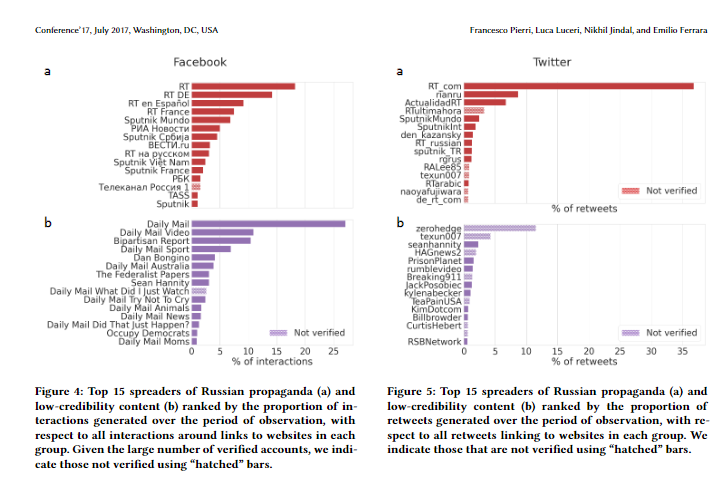
On Facebook, we identified 51,269 posts (0.25% of all posts)sharing links to Russian propaganda outlets, generating 5,065,983interactions (0.17% of all interactions); 80,066 posts (0.4% of allposts) sharing links to low-credibility news websites, generating28,334,900 interactions (0.95% of all interactions); and 147,841 postssharing links to high-credibility news websites (0.73% of all posts),generating 63,837,701 interactions (2.13% of all interactions). Asshown in Figure 2, we notice that the number of posts sharingRussian propaganda and low-credibility news exhibits an increas-ing trend (Mann-Kendall đ < .001), whereas after the invasion ofUkraine both time series yield a significant decreasing trend (moreprominent in the case of Russian propaganda); high-credibilitycontent also exhibits an increasing trend in the Pre-invasion pe-riod (Mann-Kendall đ < .001), which becomes stable (no trend)in the period afterward. T
-
We estimated the contribution of veri-fied accounts to sharing and amplifying links to Russian propagandaand low-credibility sources, noticing that they have a dispropor-tionate role. In particular, superspreaders of Russian propagandaare mostly accounts verified by both Facebook and Twitter, likelydue to Russian state-run outlets having associated accounts withverified status. In the case of generic low-credibility sources, a sim-ilar result applies to Facebook but not to Twitter, where we alsonotice a few superspreaders accounts that are not verified by theplatform.
-
On Twitter, the picture is very similar in the case of Russianpropaganda, where all accounts are verified (with a few exceptions)and mostly associated with news outlets, and generate over 68%of all retweets linking to these websites (see panel a of Figure 4).For what concerns low-credibility news, there are both verified (wecan notice the presence of seanhannity) and not verified users,and only a few of them are directly associated with websites (e.g.zerohedge or Breaking911). Here the top 15 accounts generateroughly 30% of all retweets linking to low-credibility websites.
-
Figure 5: Top 15 spreaders of Russian propaganda (a) andlow-credibility content (b) ranked by the proportion ofretweets generated over the period of observation, with re-spect to all retweets linking to websites in each group. Weindicate those that are not verified using âhatchedâ bars

-
-
ieeexplore.ieee.org ieeexplore.ieee.org
-
We applied two scenarios to compare how these regular agents behave in the Twitter network, with and without malicious agents, to study how much influence malicious agents have on the general susceptibility of the regular users. To achieve this, we implemented a belief value system to measure how impressionable an agent is when encountering misinformation and how its behavior gets affected. The results indicated similar outcomes in the two scenarios as the affected belief value changed for these regular agents, exhibiting belief in the misinformation. Although the change in belief value occurred slowly, it had a profound effect when the malicious agents were present, as many more regular agents started believing in misinformation.
-
-
www.mdpi.com www.mdpi.com
-
We analyzed and visualized Twitter data during the prevalence of the Wuhan lab leak theory and discovered that 29% of the accounts participating in the discussion were social bots. We found evidence that social bots play an essential mediating role in communication networks. Although human accounts have a more direct influence on the information diffusion network, social bots have a more indirect influence. Unverified social bot accounts retweet more, and through multiple levels of diffusion, humans are vulnerable to messages manipulated by bots, driving the spread of unverified messages across social media. These findings show that limiting the use of social bots might be an effective method to minimize the spread of conspiracy theories and hate speech online.
-
- Sep 2022
-
www.scientificamerican.com www.scientificamerican.com
-
Even our ability to detect online manipulation is affected by our political bias, though not symmetrically: Republican users are more likely to mistake bots promoting conservative ideas for humans, whereas Democrats are more likely to mistake conservative human users for bots.
-
- Aug 2022
-
www.local10.com www.local10.com
-
Milberg, G. (2021, December 21). Florida pulls pro-vaccination television ads, replacing with spots that donât mention vaccines. WPLG. https://www.local10.com/news/local/2021/12/21/florida-pulls-pro-vaccination-television-ads-replacing-with-spots-that-dont-mention-vaccines/
-
-
www.blocknative.com www.blocknative.com
-
MakerDAO liquidations on March 12 and 13
A company that keeps data on Ethereum mempools around the world, Blocknative, may have an explanation for the "zero-bid" attack on MakerDAO on Black Thursday. Mempools are a holding bin for transactions waiting to get mined into blocks. Under market stress, they tend to get clogged. Blocknative found an endless stream of clever, worthless transactions in mempools on the day of the attack, apparently designed to make it hard for transactions to get through. Falling ETH prices triggered auctions of collateral on MakerDAO. Because the mempools were clogged, bidders could not get bids on those auctions through in many cases, allowing attackers to win ETH collateral with bids worth $0. The attackers walked away with $8.3 million
-
-
www.janeausten.pludhlab.org www.janeausten.pludhlab.org
-
Colonel Wallisâs gallantry
Colonel Wallis is very useful - telling the Elliot's about the first wife earlier and here ensuring Mr Elliot gets the seat by Anne, then distracting Elizabeth to keep her happy. He's been, I think, entirely removed from the adaptations. This the only time we see him in the book
-
-
www.nature.com www.nature.com
-
Such optical modulation of atomic motion is an alternative path towards realizing 2D electronic states and will be a useful platform upon which novel phases in quantum materials may be discovered.
-
- Jul 2022
-
fileinfo.com fileinfo.com
-
If you do not have an iOS device or a machine running OS X to open your IMOVIEMOBILE file, you can still access its contents. First, copy the IMOVIEMOBILE file, rename the file extension to "zip", decompress the file, and the project content will be in a folder called "Assets." You can then open the original content in a video editing program.
It's not rational, but I'd like to note how angy I am with myself in retrospect for not looking this up before. I have literally given up on old project files because I assumed the video was unretrievable and then... I just did this on my iPad in a matter of seconds lol.
-
- Apr 2022
-
twitter.com twitter.com
-
Nick Sawyer, MD, MBA, FACEP [@NickSawyerMD]. (2022, January 3). The anti-vaccine community created a manipulated version of VARES that misrepresents the VAERS data. #disinformationdoctors use this data to falsely claim that vaccines CAUSE bad outcomes, when the relationship is only CORRELATED. Watch this explainer: Https://youtu.be/VMUQSMFGBDo https://t.co/ruRY6E6blB [Tweet]. Twitter. https://twitter.com/NickSawyerMD/status/1477806470192197633
-
- Mar 2022
-
www.theguardian.com www.theguardian.com
-
Each highlighted statement expresses political talking points aligned to induce trump-like support.
Trump introduced new marketing and strategy, formulated using concepts and metrics mastered by Reality TV and Hollywood and then paired with advertising propaganda and "selling" techniques to create a "Brand". This is after-all Donald Trump, this is what he does, has done and is the only way he has found to make money. Trump built the "brand" (just barely) while teetering on self destruction.
His charismatic persona became "the glue" that allowed creative narratives to stick to certain types of people in-spite of risk. Trump learned OTJ how to capture a specific type of audience.
The mistake people make about Trump is assuming his audience to be "Joe Six-Pack", redneck's with limited education! This assumption does not have merit on its own.<br /> * There is a common "follower" theme among his audience that is exploited by those who: * Bought the "licensing rights" to the master-class Trump "how-to" course.
Tags
- Used Car salesman
- Snake-oil salesmen
- Trump Audience
- Putin-Trump
- Savvy Strongman
- Trump licensed how-to
- Prosperity Preachers
- Smoke and Mirrors
- MLM
- Creation of Brand
- Vladimir Putin
- Manipulation
- Multi-Level-Marketing
- Professional Wrestling
- Politics
- Modern day Politician
- Trump
- BS
- Reality TV
- PR
- Mafia
Annotators
URL
-
- Jan 2022
-
www.nbcnews.com www.nbcnews.com
-
Put more simply, the product is dirt â four-and-a-half ounces of it, sealed in a sleek black plastic baggie and sold for $110 plus shipping.
Oh my god! It's like a family friendly version of Bell Delphine's bath water! It's a useless product sold for ridiculous prices to an audience that is desperately looking for something to fill a space. In one case, it was a want for some physical representation of an idol, and in this case, it was a want for a solution to COVId or a feeling of security. If we were to relate this to the game we played in the blog post assignment, then I would probably classify this as emotional manipulation. People looking to feel secure in their health while the pandemic rages were taken advantage of by this company selling dirt.
-
- Dec 2021
-
support.apple.com support.apple.com
-
With text replacement, you can use shortcuts to replace longer phrases. When you enter the shortcut in a text field, the phrase automatically replaces it. For example, you could type "GM" and "Good morning" would automatically replace it. To manage text replacement, tap Settings > General > Keyboard > Text Replacement. To add a text replacement, tap the Add button , then enter your phrase and shortcut. When you're done, tap Save. To remove a text replacement, tap Edit, tap the Remove button  then tap Delete. To save your changes, tap Done.
They also have another, debatably much more relevant function Appleâs docs donât acknowledge!
Setting the same values for
PhraseandShortcutin this menu basically achieves the same thing as âLearn Spelling.â
Tags
Annotators
URL
-
-
www.facebook.com www.facebook.comFacebook1
-
obrĂĄzok je Ășdajne screenshot z webu novinky.cz. neuvĂĄdza sa vĆĄak odkaz na ÄlĂĄnok, ktorĂœ je na screenshote przentovanĂœ. Pri snahe nĂĄjsĆ„ pĂŽvodnĂœ ÄlĂĄnok som neuspela. NenaĆĄla som cez prehliadaÄ ani titulok, ani text, ktorĂœ mala Ășdajne osoba v texte povedaĆ„. NiÄ podobnĂ© som nenaĆĄla ani pri hÄŸadanĂ priamo na novinky.cz. ÄlĂĄnok, ktorĂœ je na "screenshote" neexistuje a "Screenshot" bol vytvorenĂœ umelo ako montĂĄĆŸ. Podnecuje odpor a strach z oÄkovania, pretoĆŸe tvrdĂ, ĆŸe hlavnĂĄ hygieniÄka Pavla SvrÄinovĂĄ povedala, ĆŸe ak by sa nechala zaoÄkovaĆ„, tak zomrie.
-
-
www.nytimes.com www.nytimes.com
-
Smith, B. (2021, November 29). Inside the âMisinformationâ Wars. The New York Times. https://www.nytimes.com/2021/11/28/business/media-misinformation-disinformation.html
-
- May 2021
-
medium.com medium.com
-
@DFRLab. (2021, May 13). Official Twitter account of Sputnik V manipulates information to target Western COVID-19 vaccines. Medium. https://medium.com/dfrlab/official-twitter-account-of-sputnik-v-manipulates-information-to-target-western-covid-19-vaccines-c1a13dac580d
Tags
- COVID-19
- propaganda
- critique
- discreditation
- is:article
- vaccine
- Russia
- USA
- Sputnik V
- manipulation of information
- lang:en
Annotators
URL
-
-
-
Chang, H.-C. H., Chen, E., Zhang, M., Muric, G., & Ferrara, E. (2021). Social Bots and Social Media Manipulation in 2020: The Year in Review. ArXiv:2102.08436 [Cs]. http://arxiv.org/abs/2102.08436
-
- Mar 2021
-
www.theguardian.com www.theguardian.com
-
Carl Bergstrom: âPeople are using data to bullshit.â (2020, August 1). The Guardian. http://www.theguardian.com/science/2020/aug/01/carl-bergstrom-people-are-using-data-to-bullshit
-
-
-
Yang, K.-C., Pierri, F., Hui, P.-M., Axelrod, D., Torres-Lugo, C., Bryden, J., & Menczer, F. (2020). The COVID-19 Infodemic: Twitter versus Facebook. ArXiv:2012.09353 [Cs]. http://arxiv.org/abs/2012.09353
-
-
www.facebook.com www.facebook.com
-
Democrat Chicago to allow the economy to open up less than a week after Biden's inauguration...it's all planned to make Biden appear successful! Democrats allowed millions of people to suffer and lose businesses all for their own greed and power!
-
- Feb 2021
-
www.washingtonpost.com www.washingtonpost.com
-
The Quest for Truth
The quest for Truth is everywhere and not limited to the economic topics linked here. This is just a topic that started a thought process where I had access to a convenient tool (Hypothesis) to bookmark my thoughts and research.
Primary thought is: The Quest for Truth. Subcategories would provide a structured topic for the thought. In this case the subcategory would be: US Economy, Inflation
The TRUTH is a concept comprised of inconsistencies and targets that frequently move.
Targets (data, methods, people, time, semantics, agenda, demographic, motive, means, media, money, status) hold a position in time long enough to fulfill a purpose or agenda. Sometimes they don't consciously change, but history over time shines light and opens cracks in original narrative that leads to new truth's, real or imagined.
Verifying and validating certain Truth is very difficult. Why is That?
-
-
comprop.oii.ox.ac.uk comprop.oii.ox.ac.uk
- Aug 2020
-
-
Laghaie, A., & Otter, T. (2020). Measuring evidence for mediation in the presence of measurement error [Preprint]. PsyArXiv. https://doi.org/10.31234/osf.io/5bz3f
-
-
www.youtube.com www.youtube.com
-
Identifying social media manipulation with OSoMe tools. (2020, August 11). https://www.youtube.com/watch?v=1BMv0PrdVGs&feature=youtu.be
-
- Jul 2020
-
www.somanyofus.com www.somanyofus.com
-
www.nationalgeographic.com www.nationalgeographic.com
-
Fauci: No scientific evidence the coronavirus was made in a Chinese lab. (2020, May 4). Science. https://www.nationalgeographic.com/science/2020/05/anthony-fauci-no-scientific-evidence-the-coronavirus-was-made-in-a-chinese-lab-cvd/
-
-
www.jstor.org www.jstor.org
-
This encounter then came to mind during a smaller conference the following spring when Tony Kubiak spoke of the recent creation of a chimeric human-cat protein intended to block allergic reactions (in humans).6
Genetic manipulation has been a running gag/ideal within the furry community for as long as it has existed. The idea of transformation by any means possible is appealing, and these sorts of genetic components would go a long way in establishing that sense of identity.
-
- Jun 2020
-
psyarxiv.com psyarxiv.com
-
Kozyreva, A., Lewandowsky, S., & Hertwig, R. (2019, December 4). Citizens Versus the Internet: Confronting Digital Challenges With Cognitive Tools. https://doi.org/10.31234/osf.io/ky4x8
Tags
- reasoning
- is:preprint
- AI
- boosting
- disinformation
- online manipulation
- decision aid
- digital
- internet
- decision autonomy
- lang:en
- choice architecture
- online behavior
- artificial intelligence
- nudging
- attention economy
- misinformation
- technocognition
- self-nudging
- fake news
- cognitive tools
- algorithm
- behavioral policy
Annotators
URL
-
-
www.springer.com www.springer.com
-
Journal of Computational Social Science. Springer. Retrieved June 10, 2020, from https://www.springer.com/journal/42001/updates/17993070
-
-
www.forbes.com www.forbes.com
-
Haelle, T. (2020, May 8). Why Itâs Important To Push Back On âPlandemicââAnd How To Do It. Forbes. https://www.forbes.com/sites/tarahaelle/2020/05/08/why-its-important-to-push-back-on-plandemic-and-how-to-do-it/
-
-
-
vague business advice - simple information that can be found for free
Tags
Annotators
URL
-
-
www.youtube.com www.youtube.com
-
anchoring products - stating what products would otherwise sell for, while advocating that purchasers buy sooner than later such that they receive the products for cheap
-> creation of urgency
-
particularization and discrete-formation of activity - activity is reduced from an ambiguous relationship of activities to singular "do this" or "do that" activities for ambiguous "success"
Tags
Annotators
URL
-
- Apr 2020
-
emljames.github.io emljames.github.io
-
James, E. Tutorial Home. Github.io. https://emljames.github.io/GorillaR/
-
-
twitter.com twitter.com
-
Carl Miller en Twitter: âWeâre working hard at the moment to scale up our attempts to detect COVID-19 disinformation, online manipulation, attacks on public health officials and miracle cures. If youâve come across this kind of stuff, Iâd really appreciate hearing about it. DMs are openâ / Twitter. (n.d.). Twitter. Retrieved April 17, 2020, from https://twitter.com/carljackmiller/status/1244569393440468997#annotations:9pvychrpeeqhh0_wtrrs1q
-
- Mar 2020
-
www.nytimes.com www.nytimes.com
-
We saw the internet turn into this weird, dark manipulation machine,
-
-
techcrunch.com techcrunch.com
-
techcrunch.com techcrunch.com
-
We are not sensible, free thinking decision making people. As an individual I imagine that you will say "Yes I am". That's the beauty of the entire system. Consciously individuals believe that they are in control and make their own choices and yet I have met and experienced very few who have full autonomy
-
The deceitful obfuscation of commercial intention certainly runs all the way through the data brokering and ad tech industries that sit behind much of the âfreeâ consumer Internet. Here consumers have plainly been kept in the dark so they cannot see and object to how their personal information is being handed around, sliced and diced, and used to try to manipulate them.
-
From an ad tech perspective, the concern is that manipulation doesnât work when itâs obvious. And the goal of targeted advertising is to manipulate peopleâs decisions based on intelligence about them gleaned via clandestine surveillance of their online activity (so inferring who they are via their data). This might be a purchase decision. Equally it might be a vote.
-
So itâs not surprising that Facebook is so coy about explaining why a certain user on its platform is seeing a specific advert. Because if the huge surveillance operation underpinning the algorithmic decision to serve a particular ad was made clear, the person seeing it might feel manipulated. And then they would probably be less inclined to look favorably upon the brand they were being urged to buy. Or the political opinion they were being pushed to form. And Facebookâs ad tech business stands to suffer.
-
- Dec 2019
-
www.dougengelbart.org www.dougengelbart.org
-
Before we pursue further direct discussion of the H-LAM/T system, let us examine some background material. Consider the following historical progression in the development of our intellectual capabilities:2c4a 2c4b (1) Concept ManipulationâHumans rose above the lower forms of life by evolving the biological capability for developing abstractions and concepts. They could manipulate these concepts within their minds to a certain extent, and think about situations in the abstract. Their mental capabilities allowed them to develop general concepts from specific instances, predict specific instances from general concepts, associate concepts, remember them, etc. We speak here of concepts in their raw, unverbalized form. For example, a person letting a door swing shut behind him suddenly visualizes the person who follows him carrying a cup of hot coffee and some sticky pastries. Of all the aspects of the pending event, the spilling of the coffee and the squashing of the pastry somehow are abstracted immediately, and associated with a concept of personal responsibility and a dislike for these consequences. But a solution comes to mind immediately as an image of a quick stop and an arm stab back toward the door, with motion and timing that could prevent the collision, and the solution is accepted and enacted. With only non-symbolic concept manipulation, we could probably build primitive shelter, evolve strategies of war and hunt, play games, and make practical jokes. But further powers of intellectual effectiveness are implicit in this stage of biological evolution (the same stage we are in today).2c4b1 (2) Symbol ManipulationâHumans made another great step forward when they learned to represent particular concepts in their minds with specific symbols. Here we temporarily disregard communicative speech and writing, and consider only the direct value to the individual of being able to do his heavy thinking by mentally manipulating symbols instead of the more unwieldly concepts which they represent. Consider, for instance, the mental difficulty involved in herding twenty-seven sheep if, instead of remembering one cardinal number and occasionally counting, we had to remember what each sheep looked like, so that if the flock seemed too small we could visualize each one and check whether or not it was there.2c4b2 (3) Manual, External, Symbol ManipulationâAnother significant step toward harnessing the biologically evolved mental capabilities in pursuit of comprehension and problem solutions came with the development of the means for externalizing some of the symbol-manipulation activity, particularly in graphical representation. This supplemented the individual's memory and ability to visualize. (We are not concerned here with the value derived from human cooperation made possible by speech and writing, both forms of external symbol manipulation. We speak of the manual means of making graphical representations of symbolsâa stick and sand, pencil and paper and eraser, straight edge or compass, and so on.) It is principally this kind of means for external symbol manipulation that has been associated with the evolution of the individual's present way of doing his concept manipulation (thinking).
-
- Sep 2018
-
www.lostgarden.com www.lostgarden.com
-
We canât force two people to become friends, nor should we want to.
How many social engineers does it take to change a light bulb? An infinite number. That's why they leave you in the dark till you become the change you seek and make your own light to live by.
If you cant force two people to become friends, then how do 'diplomats' (political manipulators?) profess to do the same thing with entire nations? Especially while so often, using the other hand to deal the deck for other players, in a game of "let's you and him fight"; or just being bloody mercenaries with sheer might is right political ethos installed under various euphemistic credos. 'My country right or wrong' or 'Mitt Got Uns' or ...to discover weapons of mass destruction...etc.
So much for politics and social engineering, but maybe we can just be content with not so much forcing two people to be friends, as forcing them to have sex while we're filming them, so we can create more online amateur porn content. LOL ;)
-
- Jul 2018
-
wendynorris.com wendynorris.com
-
In short, the "language of time" identified here is by no means a merely intellectual phenomenon invented by sociology. Not only are we all aware of its existence, we also use it quite actively in our own "speech."7 The manipulative use of temporality is quite evident not only at the macrosocial level of societal politics, but also at the microsocial level of interpersonal relations. We employ the language of time quite strategically in our every- day "speech" and, quite often, what appears on the surface as entirely spontaneous behavior may actually involve a deliberate manipulation of temporal circu
The language of time incorporates "deliberate mainpulation of temporal circumstances."
People use symbolic associations to convey special meanings to certain periods of time. Example provided is a late night phone call that hints at a desire for a closer, more intimate relationship.
-
- May 2018
-
hypothes.is hypothes.is
-
hi there get the full insights on MSBI tools training and tutorial with the Real time Examples and application on the Running Projects as well https://www.youtube.com/watch?v=OzmdY0zCw4g
-
- Oct 2013
-
rhetoric.eserver.org rhetoric.eserver.org
-
make his audience feel
I like that he stresses manipulating the audience's perception of the speaker, rather than actually seeking to possess positive qualities. ;)
-