Bertoncello, C., Ferro, A., Fonzo, M., Zanovello, S., Napoletano, G., Russo, F., Baldo, V., & Cocchio, S. (2020). Socioeconomic Determinants in Vaccine Hesitancy and Vaccine Refusal in Italy. Vaccines, 8(2). https://doi.org/10.3390/vaccines8020276
484 Matching Annotations
- Jun 2020
-
pubmed.ncbi.nlm.nih.gov pubmed.ncbi.nlm.nih.gov
-
www.theatlantic.com www.theatlantic.com
-
Giorgis, H. (2020, April 28). Quarantine Could Change How Americans Think of Incarceration. The Atlantic. https://www.theatlantic.com/culture/archive/2020/04/quarantine-could-change-how-americans-think-incarceration/610831/
-
-
slate.com slate.com
-
Craven, J. (2020, May 21). It’s Not Too Late to Save Black Lives. Slate Magazine. https://slate.com/news-and-politics/2020/05/covid-19-black-communities-health-disparity.html
-
-
www.thecut.com www.thecut.com
-
Chow, K. (2020, May 6). There’s No Way to Prepare for Grief. The Cut. https://www.thecut.com/2020/05/theres-no-way-to-prepare-for-grief.html
-
-
-
Condon, E. M., Dettmer, A., Gee, D., Ba, C. H., Lee, K. S., Mayes, L., Stover, C. S., & Tseng, W.-L. (2020). COVID-19 exposes enduring inequalities for children & families [Preprint]. PsyArXiv. https://doi.org/10.31234/osf.io/28vsj
-
-
www.centreforlondon.org www.centreforlondon.org
-
Coronavirus won’t be the end of big cities. (n.d.). Retrieved June 4, 2020, from https://www.centreforlondon.org/blog/the-city-isnt-dead/
-
-
www.ifs.org.uk www.ifs.org.uk
-
Andrew, A., Cattan, S., Dias, M. C., Farquharson, C., Kraftman, L., Krutikova, S., Phimister, A., & Sevilla, A. (2020, May 18). Learning during the lockdown: Real-time data on children’s experiences during home learning. https://doi.org/10.1920/BN.IFS.2020.BN0288
-
-
behavioralscientist.org behavioralscientist.org
-
We Have a Rare Opportunity to Create a Stronger, More Equitable Society. (2020, June 1). Behavioral Scientist. https://behavioralscientist.org/we-have-a-rare-opportunity-to-create-a-stronger-more-equitable-society/
-
- May 2020
-
psyarxiv.com psyarxiv.com
-
Branas-Garza, P., Caldentey, P., Espin, A. M., García, T., & Román, A. H. (2020). Exposure to economic inequality at the age of 8 enhances prosocial behavior in adult life [Preprint]. PsyArXiv. https://doi.org/10.31234/osf.io/nkz5a
-
-
www.thelancet.com www.thelancet.com
-
Hargreaves, J., Davey, C., Hargreaves, J., Davey, C., Auerbach, J., Blanchard, J., Bond, V., Bonell, C., Burgess, R., Busza, J., Colbourn, T., Cowan, F., Doyle, A., Hakim, J., Hensen, B., Hosseinipour, M., Lin, L., Johnson, S., Masuka, N., … Yekeye, R. (2020). Three lessons for the COVID-19 response from pandemic HIV. The Lancet HIV, S2352301820301107. https://doi.org/10.1016/S2352-3018(20)30110-7
Tags
- school closure
- vaccine
- prediction
- trajectory
- poverty
- government
- health system
- quarentine
- pharmaceutical
- behavior
- physical distancing
- social distancing
- health equity
- collective behavior
- is:article
- HIV
- lang:en
- COVID-19
- policy
- response
- inequality
- infection
- gender
- socioeconomic status
Annotators
URL
-
-
www.thelancet.com www.thelancet.com
-
The Lancet Public Health, May 2020, Volume 5, Issue 5, Pages e235-e296. https://www.thelancet.com/journals/lanpub/issue/current
Tags
- USA
- school closure
- immigration
- elderly
- UK
- public health
- Europe
- Spain
- death
- France
- health literacy
- alcohol
- social distancing
- healthcare
- publication
- disability
- lang:en
- vulnerable groups
- non-pharmaceutical
- COVID-19
- modeling
- Iran
- inequality
- is:webpage
- China
- Italy
- article
- isolation
- human rights
- impact
Annotators
URL
-
-
www.linkedin.com www.linkedin.com
-
The pursuit of profit and greater efficiencies has led to the invention of new technologies that replace people, which has made companies run more efficiently, rewarded those who invented these technologies, and hurt those who were replaced by them. This force will accelerate over the next several years, and there is no plan to deal with it well.
This is huge - this is the essence of open revolution. Though he phrases it as a choice. The choice is in the rules we create.
-
-
secrecyresearch.com secrecyresearch.com
-
Beyer-Hunt, S., Carter, J., Goh, A., Li, N., & Natamanya, S.M. (2020, May 14) COVID-19 and the Politics of Knowledge: An Issue and Media Source Primer. SPIN. https://secrecyresearch.com/2020/05/14/covid19-spin-primer/
-
-
ourworldindata.org ourworldindata.orgAbout1
-
About. (n.d.). Our World in Data. Retrieved May 25, 2020, from https://ourworldindata.org/about
-
-
-
Nigam, S. (2020). COVID-19: INDIA’S RESPONSE TO DOMESTIC VIOLENCE NEEDS RETHINKING. https://doi.org/10.31234/osf.io/4bpny
-
-
psyarxiv.com psyarxiv.com
-
Yu, Q., Salvador, C., Melani, I., Berg, M., & Kitayama, S. (2020, May 14). The lethal spiral: Racial segregation and economic disparity jointly exacerbate the COVID-19 fatality in large American cities. https://doi.org/10.31234/osf.io/xgbpy
-
-
www.bbc.com www.bbc.com
-
criminal groups and opportunists expanding their activities, taking advantage of lockdown and diminished forest monitoring and government presence. The second is that people living in these rural areas are facing increased economic pressures and are forced to rely more heavily on nature for food and income
-
-
www.washingtonpost.com www.washingtonpost.com
-
“Our country is made up of various smaller countries,” Alves said. “When you walk through Rio de Janeiro, you go through places that have the characteristics of Switzerland to places more like the Congo, all in the same city.”
On the geography of inequality in Brazil.
-
-
psyarxiv.com psyarxiv.com
-
Du, H., Chen, A., Chi, P., & King, R. B. (2020, May 7). Income Inequality Reduces Civic Honesty. https://doi.org/10.31234/osf.io/upm47
-
-
theconversation.com theconversation.com
-
Zocchi, B. (2020-04-30). What coronavirus looks like at the Bosnian-Croatian frontier for Europe’s unwanted migrants. The Conversation. http://theconversation.com/what-coronavirus-looks-like-at-the-bosnian-croatian-frontier-for-europes-unwanted-migrants-137226
-
-
www.thelancet.com www.thelancet.com
-
Horton, R. (2020). Offline: Independent science advice for COVID-19—at last. The Lancet, 395(10235), 1472. https://doi.org/10.1016/S0140-6736(20)31098-9
-
-
onlinelibrary.wiley.com onlinelibrary.wiley.com
-
Sood, L., & Sood, V. (2020). Being African American and Rural: A Double Jeopardy from Covid‐19. The Journal of Rural Health, jrh.12459. https://doi.org/10.1111/jrh.12459
-
-
onlinelibrary.wiley.com onlinelibrary.wiley.com
-
Zahnd, W. E. (2020). The COVID‐19 Pandemic Illuminates Persistent and Emerging Disparities among Rural Black Populations. The Journal of Rural Health, jrh.12460. https://doi.org/10.1111/jrh.12460
Tags
- USA
- hospital
- demographics
- inadequately prepared
- rural health
- black people
- death rate
- outbreak
- racial disparity
- screening
- health equity
- healthcare
- access to care
- is:article
- lang:en
- internet
- COVID-19
- inequality
- testing
- social determinants of health
- infection rate
- telehealth
- African American
Annotators
URL
-
-
www.thelancet.com www.thelancet.com
-
The Lancet Child & Adolescent Health. (2020). Pandemic school closures: Risks and opportunities. The Lancet Child & Adolescent Health, S235246422030105X. https://doi.org/10.1016/S2352-4642(20)30105-X
-
-
psyarxiv.com psyarxiv.com
-
Rotella, A. M., & Mishra, S. (2020, April 24). Personal relative deprivation negatively predicts engagement in group decision-making. https://doi.org/10.31234/osf.io/6d35w
-
- Apr 2020
-
psyarxiv.com psyarxiv.com
-
Davidai, S., Day, M. V., Goya-Tocchetto, D., Hauser, O. P., Jachimowicz, J., Mirza, M. U., … Tepper, S. J. (2020, April 27). COVID-19 Provides a Rare Opportunity to Create a Stronger, More Equitable Society. Retrieved from psyarxiv.com/hz4c7
-
-
psyarxiv.com psyarxiv.com
-
Im, H., Ahn, C., Wang, P., & Chen, C. (2020, April 13). An Early Examination: Psychological, Health, and Economic Correlates and Determinants of Social Distancing Amidst COVID-19. https://doi.org/10.31234/osf.io/9ravu
-
-
www.nytimes.com www.nytimes.com
-
Daniel Markovits, author of “The Meritocracy Trap,” estimates there are about one million of these workers in America today. They work really hard, are really productive and earn a lot more. In the mid-1960s, profits per partner at elite law firms were less than five times a secretary’s salary. Now, Markovits notes, they are over 40 times.
That latter statistic is fascinating. Are top partners 8x more more productive (relatively) than secretaries? Maybe but probably not. There's more going on that the crude info economy argument of simply greater marginal productivity. I would also look at concentration of income across law firms - i bet there has been concentration towards the top firms.
-
But here’s the situation: The information economy rains money on highly trained professionals — doctors, lawyers, corporate managers, engineers and so on.
But why does it rain money on them? And who else does that?
-
-
www.nature.com www.nature.com
-
McKee, M., Stuckler, D. If the world fails to protect the economy, COVID-19 will damage health not just now but also in the future. Nat Med (2020). https://doi.org/10.1038/s41591-020-0863-y
-
-
www.thelancet.com www.thelancet.com
-
Hall, K. S., Samari, G., Garbers, S., Casey, S. E., Diallo, D. D., Orcutt, M., Moresky, R. T., Martinez, M. E., & McGovern, T. (2020). Centring sexual and reproductive health and justice in the global COVID-19 response. The Lancet, 395(10231), 1175–1177. https://doi.org/10.1016/S0140-6736(20)30801-1
-
-
www.thelancet.com www.thelancet.com
-
Ahmed, F. et al. (2020 April 02). Why inequality could spread COVID-19. The Lancet. DOI: https://doi.org/10.1016/S2468-2667(20)30085-2.
-
-
gateway2.itc.u-tokyo.ac.jp:11002 gateway2.itc.u-tokyo.ac.jp:11002
-
Dorn, A. van, Cooney, R. E., & Sabin, M. L. (2020). COVID-19 exacerbating inequalities in the US. The Lancet, 395(10232), 1243–1244. https://doi.org/10.1016/S0140-6736(20)30893-X
-
- Feb 2020
-
opensquare.nyupress.org opensquare.nyupress.org
-
The Digital Edge How Black and Latino Youth Navigate Digital Inequality
Book
-
- Jan 2020
-
gutsmagazine.ca gutsmagazine.ca
-
Watched and not seen: tech, power, and dehumanization
-
- Dec 2019
-
frankensteinvariorum.github.io frankensteinvariorum.github.io
-
Of what a strange nature is knowledge
The Creature's story emphasizes the complex question of knowledge--how "strange" and contradictory it is to have, how "sorrow only increased with knowledge"--in ways that suggest it is drastically reductive to see in this novel only a warning against science.
-
- Nov 2019
-
Local file Local file
-
The established order should be repaired, to be sure, but not trans-formed by a blueprint. Landlords and tenants were a natural result ofthe difference in human abilities. The key function of the ruler was theselection of talent, which was to be found among the Confucian-trainedliterati.
A classic Burkean conservative, paternalistic manifesto.
Interesting to Contrast Wang with Sima Guang as it represents a classic political dichotomy. On the one hand, an (extreme) radical egalitarianism combined with authoritarianism (or, at least statism). On the other, a more democratic approach combined with (a justification of) inequality.
Is it possible to have egalitarianism and democracy (or, rather autonomy)?
-
-
www.econ.nyu.edu www.econ.nyu.edu
-
All this implies that realistic distributions of earnings by themselves, without othercomplimentary mechanisms, have di¢ culty in generating the skewed wealth distributionswe observe
This is crucial in the debate i think. If i understand the logic here:
If wealth "skew" and the fat tails were purely related to earnings one could make a plausible argument (though still dubious IMO) that this related to distributions of talent (and/or how talent interacts with production i.e. entrepreneurs skills are multiplied by all the people who work for them etc).
However, if wealth skew is > earnings skew that implies some other institutional process is at work that isn't really to do with individual talent or effort.
At a moral level this has big implications.
Put crudely, imagine the simple random returns to capital each period and there are no difference in talent, effort etc. This generates a simple lognormal distribution or (as they explain above) the fat ones when there is a reflecting barrier (i.e. birth / death).
In this model there is no "justification" for resulting differences in wealth -- they are purely "random".
This is basically the policy / moral background to this whole technical paper: are wealth distributions a result (largely) of random chance (and accumulation) or talent.
Because if the former then the resulting inequality has no moral legitimacy and no practical value. If the latter, there is, at the very least, an argument for practical value (in terms of rewarding talent / effort etc).
-
- Jun 2019
-
mises-media.s3.amazonaws.com mises-media.s3.amazonaws.com
-
inequality of exchange
goods may be of equal value in the market place but are not equal in the minds of the traders.
-
- May 2019
-
www.gutenberg.org www.gutenberg.org
-
Gish understood the dream. 43[As] Enki[du] was sitting before the woman, 44[Her] loins(?) he embraced, her vagina(?) he opened. 45[Enkidu] forgot the place where he was born. 46Six days and seven nights 47Enkidu continued 48To cohabit with [the courtesan].
In this older version , the translation is clear and more explicit. While in other versions these actions are cover under a bunch of metaphors and wordiness. So it looks like when we, ourselves, became more civilize the amount of censorship we created for ourselves also grew. Just think about that Inkidu and Gilgamesh were lovers, and this was not something new, other cultures also practice this. But later became taboo with the help of Christianity. It is just now that we are starting to accept that everyone does not have the same sexual preference, everyone should be free of choosing a partner regardless of sex. Uncivilized does not mean close minded. CC BY-NC-ND
-
-
www.sitasingstheblues.com www.sitasingstheblues.com
-
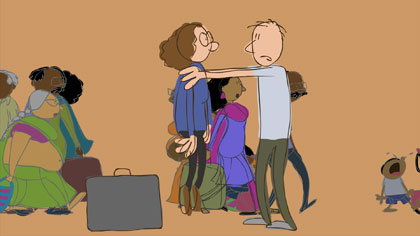 At the end of the day, the only hero in the story was Nina herself. Rama was a complete self absorbed jerk and Sita was completely submissive and did not think of her even once. While Nina went through modern similar faces of rejection and self worth, she came to terms with herself, and accepted the fact that her ex boyfriend was not worth her pain and that she had to move on in life.
CC BY-NC-ND
At the end of the day, the only hero in the story was Nina herself. Rama was a complete self absorbed jerk and Sita was completely submissive and did not think of her even once. While Nina went through modern similar faces of rejection and self worth, she came to terms with herself, and accepted the fact that her ex boyfriend was not worth her pain and that she had to move on in life.
CC BY-NC-ND
-
-
www.sitasingstheblues.com www.sitasingstheblues.com
-
My sons!Father?Return to Ayodhya Palace to rule with me for eternity!But then, he wants to take Luv and Kush back,but he's still hesitant about taking her back.Sita! Well, yes, of course, Sita...All Sita has to do is prove her purity again.Another trial by fire, perhaps?
When Rama finds his sons by coincidence he wants to take the boy with him, but not Sita. So he suggest another trial to confirm her purity. The only reason why he seems to "Care" about his songs is because they are boy, I am sure that if they were girls Rama would not have care. But he wants a successor and now he has it. Thought out the story Sita needs to prove herself but no Rama. Sita's Value depends on how valuable Rama think she is. And right now she is garbage to him. Now that he has his songs there is no more use for her. CC BY-NC-ND
-
Hello?Please take me back! Please please please!I'll do anything! PLEASE
In the modern intake of Nina Paley. She is dump by her ex. His reasons: he was bored of her already. Yet, despite of being treated so badly by her boyfriend Nina insist and begs him to go back with her, just like Sita when Rama wants to take his sons with him back to the palace. CC BY-NC-ND
-
Perfect man, perfect son, Rama's loved by everyoneAlways right, never wrong, we praise Rama in this songSing his love, sing his praiseRama set his wife ablazeGot her home, kicked her outto allay his people's doubtRama's wise, Rama's just, Rama does what Rama mustDuty first, Sita last,Rama's reign is unsurpassed!
This song is sings by Sita and Rama's sons and it say a lot about the sexist culture in Hindu society. To everyone Rama is perfect, therefore he is never wrong. When he kicks Sita out of his kingdom because people were talking about Sita even though Rama knew she was pure and innocent. Yet, he does it "for the good of the people". When in reality his fragile and huge ego was the one to blame. Also "Duty first, Sita last" once more demonstrates the gender inequality. CC BY-NC-ND
-
-
www.sitasingstheblues.com www.sitasingstheblues.com
-
In this image we can observe the difference between man and women in Sita Sings the Blues. While Rama is being taking care of to make sure he is dry, Sita is under the rain with no protection while admiring Rama from afar. However, Rama seems to only care about himself and looks proudly forward without even looking at his wife. CC BY-NC-ND
-
- Sep 2018
-
www.mnemotext.com www.mnemotext.com
-
Oh no I’m sure any delta is brighter than an epsilon like those. That’s one of the wonderful things about being a gamma. We’re not too stupid and we’re not too bright to be a gamma is to be just right
this part of the dialogue creates a great sense of social and class inequality in the world created by this movie. Deltas are considered wise and have greater responsibilities whereas gammas are considered somewhere in between and are in charge of more mundane matters.
-
- Oct 2017
-
engagements2017-18.as.virginia.edu engagements2017-18.as.virginia.edu
-
To give to every citizen the information he needs for the transaction of his own business.
Within the highlighted excerpt, I want to focus on the masculine articles of "he" and "his" as they depict the forms of gender discrimination and inequality that were present within the University prior to 1920. Preceding 1920, women were not legally allowed to enroll within publicly funded professional and graduate schools. Consequently, following 1920 and the legislation which allowed female enrollment, the University exercised forms of gender discrimination within its application process, thus illustrating its masculine roots. However, following a law-suit accusing the University of its discrimination, it was determined that the school could no longer exercise any forms of discrimination, "with respect to race, color, religion, national origin, or sex." Therefore, as a result of such legislation, female students now consist of 55% of the student population thus inviting the revision of masculine pronouns within the Rockfish Gap Report, thus illustrating the University's progress toward gender equality.
-
It was the degree of centrality to the white population of the state which alone then constituted the important point of comparison
I find the selected excerpt very profound and relevant to modern society, as it creates an aura of inequality and racism surrounding the University of Virginia, which has, as a result, been protested against within the recent months. The reality that one of the aspects considered for the location of the University was based on its, "degree of centrality to the white population," conveys the belief of white as a superior race. Furthermore, this directly correlates with the events that have transcribed within the local Charlottesville community over the past few months; not only have neo-nazis publicly illustrated their personal forms of hate and racial inequality on grounds, but students have also pushed for equality at the University by protesting its public display of such historical bias, which has led to the removal of plaques commemorating confederate soldiers from a place of public display, to a place of historical remembrance.
-
-
quod.lib.umich.edu quod.lib.umich.edu
-
mong other things, guild regulations set up different rates of taxation and quotas for the distribution of raw materials and jobs among members.5
-
- Sep 2017
-
rampages.us rampages.us
-
, it would, but because their networks do not often cross, the gap between social connectedness of the rich and the poor continues to grow
Yes! This is the cost of geographical, educational and social marginalization. Different economic groups travel in different circles which reproduces their current economic position.
-
social capital offline only helps those who currently have high levels of economic and symbolic capital.
Again, I think the theoretical point behind social capital is that all relationships can have some value but it is also to show how some connections have more value than others. Certainly, knowing your neighbor or sharing stories with the clerk at the 7-11 is helpful to those how live in poverty. But, for those who are born at the top, they know the head of the corporations so the pay off is bigger. Both pay off but one pays off more.
-
-
rampages.us rampages.us
-
visible is not as effective as addressing the entire system
Sociologists use the term 'sociological imagination' which refers to our ability to 'see' below the surface of society and to understand the invisible network of norms, values, structures, institutions and systems of inequality that shape individual choice and behavior.
-
-
rampages.us rampages.us
-
economic inequalities through nepotism
It also may be that certain ways in which networks function produce and reproduce inequality. See Power Law question.
-
-
rampages.us rampages.us
-
nequality
We will discuss how networks can produce and reproduce inequality. It is called the power law.
-
mainstream pundits with more legitimacy
This is what is so hard about democracy in the modern digital age. Habermas tells us that democracy requires an open and free exchange of idea in a equally accessible public space. While the internet is not entirely open, free and equally accessible, it is very close. Yet, we have lost the ability to vet, validate and trust most information. What does that mean about democracy in the modern age?
-
-
rampages.us rampages.us
-
whole is greater than the sum of its parts.”
When I lecture in Intro to Socy, I spend a great deal of time on this statement to help them grasp the fundamentals of the sociological imagination. While network theory may seem like common sense, it directly challenges the ideology of individualism and pull yourself up by your bootstraps. If you accept that others influence you, then you have to begin to accept the realities of privilege and discrimination. This can often be too much cognitively, particularly for privileged students who prefer to think of their benefits as wholly earned. SNA reveals how inequality is produced and reproduced.
Tags
Annotators
URL
-
-
rampages.us rampages.us
-
clustering effect.
This is also the power law; it takes links to get links. Power law is how inequality produced and reproduced in networks. Check it out!
Tags
Annotators
URL
-
-
www.nytimes.com www.nytimes.com
-
Part of the wild success of the Silicon Valley giants of today — and what makes their stocks so appealing to investors — has come from their ability to attain huge revenue and profits with relatively few workers.Apple, Alphabet (parent of Google) and Facebook generated $333 billion of revenue combined last year with 205,000 employees worldwide. In 1993, three of the most successful, technologically oriented companies based in the Northeast — Kodak, IBM and AT&T — needed more than three times as many employees, 675,000, to generate 27 percent less in inflation-adjusted revenue.The 10 most valuable tech companies have 1.5 million employees, according to calculations by Michael Mandel of the Progressive Policy Institute, compared with 2.2 million employed by the 10 biggest industrial companies in 1979. Mr. Mandel, however, notes that today’s tech industry is adding jobs much faster than the industrial companies, which took many decades to reach that scale.
It seems like this would certainly contribute to wealth inequality, since the majority of today's tech workforce is more well-educated than the industrial employees of decades past (who then shared in their employer's rise).
-
- Jul 2017
-
clalliance.org clalliance.org
-
While wealthy families are embracing the potential of new technologies for learning, and investing more and more in out-of-school and connected learning, less privileged kids are being left behind. Access to specialized, interest-driven and personalized learning used to be difficult and scarce. But in today’s networked world, there’s no reason why all children should not have the opportunity to pursue connected learning.
-
-
lti.hypothesislabs.com lti.hypothesislabs.com
-
The justification of inequality
The act of condition the citizenship to accept and expect stratification based on merit in society, thereby justifying unequal rewards (low pay, no health benefits, no control over shifts, low social status etc.)
-
- Jan 2016
-
www.natebowling.com www.natebowling.com
-
We have the schools we have, because people who can afford better get better. And sadly, people who can’t afford better just get less--less experienced teachers, inadequate funding and inferior facilities.
Is this our fate? I'm afraid it might be. In other words, are we fighting to change this inequity or are we working to "innovate" within it? And what does this innovation mean really?
-
-
www.whitehouse.gov www.whitehouse.gov
-
how do we give everyone a fair shot at opportunity and security in this new economy
-
- Dec 2015
-
www.theguardian.com www.theguardian.com
-
Maria Anna (called Marianne and nicknamed Nannerl) was – like her younger brother – a child prodigy. The children toured most of Europe (including an 18-month stay in London in 1764-5) performing together as “wunderkinder”. There are contemporaneous reviews praising Nannerl, and she was even billed first. Until she turned 18. A little girl could perform and tour, but a woman doing so risked her reputation.
-
-
rebeccasolnit.net rebeccasolnit.net
-
But he just continued on his way. She had to say, “That’s her book” three or four times before he finally took it in. And then, as if in a nineteenth-century novel, he went ashen. That I was indeed the author of the very important book it turned out he hadn’t read, just read about in the New York Times Book Review a few months earlier, so confused the neat categories into which his world was sorted that he was stunned speechless — for a moment, before he began holding forth again. Being women, we were politely out of earshot before we started laughing, and we’ve never really stopped.
-
-
lithub.com lithub.com
-
And though I was grateful to James for calling them out, I wasn’t even challenging anyone’s access to making money. I just made humorous remarks about some books and some dead writers’ characters. These guys were apparently so upset and so convinced that the existence of my opinions and voice menaced others’ rights. Guys: censorship is when the authorities repress a work of art, not when someone dislikes it.
-
art can also help us fail at empathy if it sequesters us in the Boring Old Fortress of Magnificent Me.
Art is powerful. It shapes minds. It thereby shapes the world -- or keeps it the same -- for good or evil.
Tags
Annotators
URL
-
-
medium.com medium.com
-
The fact that professionals prefer anecdotes from people like us over concerted efforts to understand a demographic as a whole is shameful. More importantly, it’s downright dangerous. It shapes what the tech industry builds and invests in, what gets promoted by journalists, and what gets legitimized by institutions of power. This is precisely why and how the tech industry is complicit in the increasing structural inequality that is plaguing our society.
Danah Boyd points out that people in the tech industry are far too quick to think of themselves as "typical", and ignore millions of Americans and billions of people who have little in common with them.
-
-
www.nytimes.com www.nytimes.com
-
Whatever our intentions, the truth is that we can inadvertently widen inequality in the course of making money, even though we claim to support equality and justice when giving it away. And while our end-of-year giving might support worthy organizations, we must also ask if these financial donations contribute to larger social change.In other words, “giving back” is necessary, but not sufficient. We should seek to bring about lasting, systemic change, even if that change might adversely affect us. We must bend each act of generosity toward justice.
-- Darren Walker, president of the Ford Foundation
-
-
medium.com medium.com
-
The problem is that the idea that women are not as good is so deeply embedded in the mind of so many people in positions of power, that it is not even recognized. It’s a belief system that leads one to automatically and without awareness, connect “women” with “lower standards” and “woman as good as a man” with “the exception.”And its cumulative effects are profound. It’s why women must be 2.5 times as good as men to be considered equally competent. It’s why holding blind auditions for orchestras increase women’s chances of advancing to final rounds by 50%.
-
- Nov 2015
-
medium.com medium.com
-
Instead, we need to fix our own broken processes. We need to question our own assumptions. We need to fix ourselves, our communities, our society. We need to be proactive in digging out the roots of the problem right here, in our own world.
-
Every aspect of our lives is open for scrutiny. Every aspect of our political system is open for scrutiny. Every aspect of our socio-economic system is open for scrutiny. We are responsible for that task.THAT is our job. We don’t need to “help” people of color. They neither need nor want our “help.”
-
12% of college graduates with STEM degrees are people of color.12%This means more than 1 in 10 resumes that cross your desk should be from a person of color. This means more than 1 in 10 people you interview for jobs should be people of color. This means more than 1 in 10 people you hire should be people of color.This means if you are not seeing those numbers in your organization, something is very wrong with the way you hire people.
I haven't researched this statistic, but it sounds about right. I might expect well more than 12%, unless "people of color" only includes African-Americans.
-
It is not sufficient to be “good.” It is not sufficient to want to “help.” We can’t “go there” and “help them” to make things better. Because the problem isn’t “there” with “them.” It is here with us.What we need is to look for the roots of inequality that emerge in our own lives, and eradicate them.
-
- Oct 2015
-
cms.whittier.edu cms.whittier.edu
-
“You can’t have this horse. We want it,”
Just like that.. Knowing what kind of bond you can form with a horse, I'd be extremely upset if someone were to take one away that I'd had since I was a child just because they wanted it.
-
-
practicaltypography.com practicaltypography.com
-
Apple does not sell great design. It sells design that flatters its owner. (And Apple’s timing has been perfect to exploit the rising tide of wealth inequality.)
-
- Sep 2015
-
cms.whittier.edu cms.whittier.edu
-
she is merely an artifact used by men to display their prowess.
Women should not be objectified regardless of what the "built environment" is. We have the ability to influence our "built environment" so let's do it in a way that helps to evolve it.
-
The girls unanimously agree that this is a constant problem in their work and they feel helpless to combat it.
But they're okay with it...... ??? They seem to just accept the fact that these are the working conditions and it's "a part of the job"..
-
The girls hesitate to use such tactics against some men and fall back on feminine displays of weakness and helplessness to get them to move.
Ladies... this is exactly the opposite of "tactics" we want to use to help society understand we deserve gender inequality.. Fight the urge to give in the easy way out
-
the customer won't leave her alone and she must do her best to ignore him....
This is interesting because it counteracts the original problem presented about the waitress being ignored. It seems because of the way the social structure influences the atmosphere of the bar, the waitress is essentially in a losing position each time..
-
- Jul 2015
-
www.theatlantic.com www.theatlantic.com
-
most gorgeous dream
I'm wondering if "the dream" -- at least as Coates sketches it out in the remainder of this paragraph -- has become a "war with the known world" for people without education and money. Is it about race or class. Robert Putnam makes a good case for the problem being about rising economic inequality in America, even as racial and sexual divisions have been lessening.
-
- Mar 2015
-
arxiv.org arxiv.org
-
θ dμ ≥ p 16 π | Σ |
Qual a relação dessa desigualdade com a dita desigualdade de Penrose Riemanniana provada por Huisken-Ilmanen e Bray?
-
GIBBONS-PENROSE INEQUALITY
Qual a relação dessa desigualdade com a dita desigualdade de Penrose Riemanniana provada por Huisken-Ilmanen e Bray?
-
θ dμ ≥ p 16 π | Σ |
Isso significa que a taxa expansão nula futura (para fora) \( \theta \) é no mínimo $$ \sqrt{16 \pi |\Sigma|} $$
-
- Jan 2014
-
www.salon.com www.salon.com
-
This is the contradiction of the Google Bus, and it’s one that should resonate across the country. The Google Bus is the embodiment of a system that indemnifies the actions of corporations while increasingly criminalizing and punishing individuals. Google and its ilk have always known that they could break the law right up until the day they were invited to make new laws. That is the power of corporate wealth, and in San Francisco as in the rest of the country, it rules supreme.
-