1,493 Matching Annotations
- Apr 2019
-
streetfightmag.com streetfightmag.com
-
viennaprinciples.org viennaprinciples.org
-
A Vision for Scholarly Communication Currently, there is a strong push to address the apparent deficits of the scholarly communication system. Open Science has the potential to change the production and dissemination of scholarly knowledge for the better, but there is no commonly shared vision that describes the system that we want to create.
A Vision for Scholarly Communication
-
-
-
pretty great intro to knowledge graphs
-
-
journal.code4lib.org journal.code4lib.org
-
Seized with the desire to improve the visibility of Canadian music in the world, a ragtag band of librarians led by Stacy Allison-Cassin set out to host Wikipedia edit-a-thons in the style of Art+Feminism, but with a focus on addressing Canadian music instead. Along the way, they recognized that Wikidata offered a low-barrier, high-result method of making that data not only visible but reusable as linked open data, and consequently incorporated Wikidata into their edit-a-thons. This is their story.
-
-
learn-us-east-1-prod-fleet01-xythos.s3.amazonaws.com learn-us-east-1-prod-fleet01-xythos.s3.amazonaws.com35871501
- Mar 2019
-
learn-us-east-1-prod-fleet01-xythos.s3.amazonaws.com learn-us-east-1-prod-fleet01-xythos.s3.amazonaws.com35871501
-
gsi.berkeley.edu gsi.berkeley.edu
-
Overview of Learning Theories
The Berkeley Graduate Division published an interesting and straightforward table of learning theories. The table compares behaviorism, cognitive constructivism, and social constructivism in four ways: the view of knowledge, view of learning, view of motivation, and implications for teaching. This is an easy-to-read, quick resource for those who would like a side-by-side comparison of common theories. 9/10
-
-
www.nwlink.com www.nwlink.com
-
This is Bloom's taxonomy of cognitive objectives. I selected this page because it explains both the old and new versions of the taxonomy. When writing instructional objectives for adult learning and training, one should identify the level of learning in Blooms that is needed. This is not the most attractive presentation but it is one of the more thorough ones. rating 4/5
-
-
dougengelbart.org dougengelbart.org
-
We'll stick to working with prose text in our examples—most people can grasp easily enough what we are doing there without having to have special backgrounds in mathematics or science as they would to gain equal comprehension for some of the similar sorts of things we do with diagrams and mathematical equations.
I think this sentence is one of the most overlooked key points. This virtual, and in '68 the live demo was a quantum leap in managing text and locked the attention on that level. However, the essence of this framework is managing symbols and making statements by them directly - not editing texts on pages and navigate around them. For example, seeing and managing the following statements in parallel: 1: there is an idea of "Locatable" represented by an entity. 2: "Locatable" in this environment contains X and Y attributes represented by their respective entity instances. 3: Another entity (be it a mouse pointer, a window or a car on a street) can or must be "Locatable" (among many other possible aspects). 4: "My car" entity is "Locatable" at 40, 20. We need a system that allows managing such statements and allow other systems behave according to them.
Tags
Annotators
URL
-
-
plato.stanford.edu plato.stanford.edu
-
such as scope, simplicity, fruitfulness, accuracy
Theories can be measured according to multiple metrics. The current default appears to be predictive accuracy, but this lists others, such as scope. If theory A predicts better but narrower and theory B predicts worse (in A's domain) but much more broadly, which is a better theory?
Others might be related to simplicity and whatnot. For example, if a theory is numerical but not explanatory (such as scaling laws or the results of statistical fitting) this theory might be useful but not satisfying.
-
Like in evolution, the process does not change toward some fixed goal according to some fixed rules, methods or standards, but rather it changes away from the pressures exerted by anomalies on the reigning theory (Kuhn 1962, 170–173). The process of scientific change is eliminative and permissive rather than instructive.
This is similar to evolution: not guided, but not random. Does this view contradict the idea of progression?
It also suggests a complex dynamic system that possess path dependence and environmental interaction.
-
- Feb 2019
-
dougengelbart.org dougengelbart.org
-
but you will not yet have been given much of a feel for how a computer-based augmentation system can really help a person
This is rather interesting in that Engelbart is saying not knowing much about the technical details is almost an asset here.
Tags
Annotators
URL
-
-
static1.squarespace.com static1.squarespace.com
-
your Friendships arc not cemented by Intrigues nor spent in vain Diversions, but in the search of Knowledge
Women's rhetorical sphere and a space/place for knowledge/information exchange: women's conversations
-
Obscurity, verbosity, and pretentiousness are to be avoided; unusual words are to be used only when they aid clarity and prevent the aforementioned faults. For Aslell, women's rheloric should focus on the art of conversation, us both Sutherland and Renaissance scholar Jane Donawerth have argued. This is women's proper rhetorical sphere, different from but in no way inferior to the public sphere in which men use oratory.
My mind immediately went to gossip and how the exchange/passing along of information/knowledge between women has been through this "proper rhetorical sphere" -- (private) conversations.
The way obscurity is used here versus how it's used by Locke is also very interesting and very, very gendered.
-
If we argue falsly and know not that we do so, we s hall be more pillicd than when we do, but either way disappointed.
Intent matters. Ignorance, though, can not be used as an excuse.
-
docs not grow a little less concern'd for her Body that she may attenc.J her Mind
Again, Gorgias' "craft" vs. "knack." One need not only direct attention toward surface-level endeavors (cosmetics), but must also pursue those endeavors geared at the pursuit of knowledge (gymnastics).
-
You know very well 'tii-inlinitcly better lo be good than to .�eem so.�
I'm immediately drawn the notion of a "craft" vs. "knack" in the "Gorgias." Whereas a craft is genuinely good and involves the pursuit of real knowledge, a knack merely imitates a craft as a surface-level endeavor.
-
ou please your selves.
A phrase that echoes Cavendish, who ponders her inability "Please All" (1), the desire for which kmurphy1 pointed out "hinders the progression of knowledge. Making this realization in the first sentence is remarkably important, for it immediately opens the door to discovery." For Astell and Astell's reader, the focus isn't on pleasing others but the self, and in doing so a woman can see ingeniousness not as an anomaly but as something within her grasp, if she takes the step toward discovery.
-
Alas, Human Knowledge is al best defective. and always progressive.
I'm struck by how much this statement rejects Locke's idea that simple ideas and concepts were related to universal ideals which all humans understood. Here Astell notes that our knowledge "is at best defective," a move that seems almost fatalistic if not for the additional qualifier of "always progressive." So we'll never know everything (or anything) perfectly (whatever that means), but you can still grow in knowledge.
-
-
inst-fs-iad-prod.inscloudgate.net inst-fs-iad-prod.inscloudgate.net
-
the ability to effectively use content knowledge and skill
Understanding content and how to use it to prove a point, explain a topic, or shed light on an issue
-
-
mozilla.github.io mozilla.github.io
-
What we concluded is that people needed the map to be more approachable, accessible, and applicable for learning and teaching web literacy skills.
Making the information more understandable and relatable will help to spread knowledge about safe internet usage.
-
They can evaluate web content, and identify what is useful and trustworthy
This should be taught throughout k-12 schooling. Learnng this in college was super helpful but it was taught a little late for me. I know now how to choose sources that present good information but growing up I wouldnt have been able to do that
-
1) develop more educators, advocates, and community leaders who can leverage and advance the web as an open and public resource, and 2) impact policies and practices to ensure the web remains a healthy open and public resource for all.
Teaching people how to use the internet safely can allow for the internet to continue to be a place that helps someone obtain information, communicate with others, and express their knowledge to others. Providing a safe environmet for people to do these things is important for successful internet usage.
-
-
static1.squarespace.com static1.squarespace.com
-
whether it is possible to know the real es!.ences of' things
sounds very much like Plato's (?) theory of forms where the idea is the essence of something and the physical object is just an imperfect representation of that idea
-
We have direct sen1-ations. of course, hul we know only the ideas of these sensations; all other ideas arc fom1ed by reflecting upon the primary ideas caused by scn~ory pcrceplion
The only real things are the ideas in our heads, which we then combine with sensory information to project onto the world in order to make sense of it
-
He that has complex ideas, without particular names for them, would be in no better case than a bookseller, who had in his warehouse volumes that lay there unbound, and without titles, which he could therefore make known to others only by showing the loose sheets, and communicate them only by tale.
Part of demonstrating knowledge has to do with the organization of thoughts. What good does it do if one's thoughts remain undeveloped and in disarray? The goal should be to not only generate knowledge, but to translate this knowledge in an organized and accessible form.
-
Vico, Sheridan, and Campbell, as well as a number of philosophers, pursued Locke's suggestive but incomplete account of the relation-ship of language and knowledge, though never far enough to link rhetoric explicitly with the process of creating "true" knowledge. T
We stand on the shoulders of academics who have come before us. Although Locke's work may have been "incomplete" or a starting point, his work initiated this pursuit and paved the way for future scholars.
-
Locke believes that there b a real external world and that knowledge of it is pos!-iblc. hul only ii' we underst:md the processes by which we come lo ~uch knowledge.
Knowledge is the goal, the end, but the process by which knowledge is discovered, the means, is also important to Locke.
-
and the pre!.umption lhal direcl knowledge is available through revelation or perception.
Because it states knowledge is available through perception, do we all having differing knowledge because individuals have their own perceptions? It seems as though individuals can not have a sense of shared knowledge unless we all have the same perceptions.
-
Knowledge itself is independent of language.
Is this entirely true? Knowlege of things precedes speech about things, as the things themselves precede language to define them, but isn't our knowlege shaped by our language (or languages), making them instrinsically linked? I suppose for a "feral child" knowledge would be entirely independent from language, but that child's brain would develop differently - would they be capable of the same kinds of knowledge as a person with language?
Tags
- Academics
- Pursuit of Knowledge
- Organization
- knowledge
- Building
- Means
- perception
- language
- Ends
- Knowledge
- Thoughts
- Process
- Locke
Annotators
URL
-
-
static1.squarespace.com static1.squarespace.com
-
argument
Lawyer and teen know-it-all jokes aside, I can see real potential that this statement is true. Making an argument requires testing it to see if the argument remains logical and consistent under varying circumstances. The problem must be thought through to its logical conclusion. That is the entire process of law school--thinking through problems and developing legal principles in response to those problems.
-
-
static1.squarespace.com static1.squarespace.com
-
I Know not how to Please All, t
The innate desire to please everyone hinders the progression of knowledge. Making this realization in the first sentence is remarkably important, for it immediately opens the door to discovery.
-
-
static1.squarespace.com static1.squarespace.com
-
each mind perceives a differentbeauty.
I believe this goes back to Locke's idea of knowledge and perception.
-
}-lume who seeks to understand the operations of mind.
In this sense, the mind is a machine, which operates in order to produce a certain product. What is this product? Knowledge? Can the product differ between people and instances?
-
- Jan 2019
-
static1.squarespace.com static1.squarespace.com
-
composes a new ontological framework ofbecoming-subjects
posthumanism as knowledge creation
-
Knowledge-production
Reminds me of the Gorgias "craft" vs "knack" distinction. A craft continually pursues knowledge, whereas a knack simply imitates a craft and is mere routine.
-
We know by now that there is no GreenwichMean Time in knowledge production in the posthuman era.
To say it another way (although, why do that, when she just knocked it out of the park?) by borrowing an analogy from economics, knowledge production is a series of floating baskets, all fluctuating together. There is no firm base that everything is built on, the structure persists by virtue of its relations of its coherent parts, one to another.
-
new subjects of knowledge
Melvil Dewey: "Guess I'll forget the base 10 number system and switch to hexadecimal."
For real, she's proposing developing knowledge that is outside of Dewey's ordering system. It's like 150 years old; it's about time!
-
-
programminghistorian.org programminghistorian.org
-
Interesting resource.
-
-
static1.squarespace.com static1.squarespace.com
-
“It seems like everything used to be something else, yes?”
Everything used to be something else, just like everything that is to come will have been something else first. This is one of the biggest proponents to knowledge being a social act. Every idea you have was sparked by something that you observed outside of yourself.
-
-
www.itdl.org www.itdl.orgJan05_011
-
Pragmatism (similar to cognitivism) states that reality is interpreted, and knowledge is negotiated through experience and thinking.
Thinking about technology as a cognitive tool and this idea of learning together, with one another, social constructivism - we consider knowledge as being constructed through the development of complex thinking and negotiation with others. How can you incorporate this idea into your activity to engage learners in complex or deeper thought using concept maps, video, resources, etc.?
-
-
-
Co-Organizing the Collective Journey of InquiryWith Idea Thread Mapper
This is a thought-provoking webinar in which the authors (Jianwei Zhang & Mei-Hwa Chen) discussed this article with the four panelists - Keith Sawyer, Carol Chan, Chew-Lee Teo, and Kate Bielaczyc. Full video at https://youtu.be/VDajiY9U2lk
-
-
drive.google.com drive.google.com
-
there is no guarantee that the generality signified by a word will convey the same idea to all users of the language
This goes back to my point that there really is no such thing as common knowledge. It's impossible to expect everyone to recall the same things, just like you can't expect words to mean the same thing to everyone.
-
common knowledge
The term common knowledge has become a slippery slope, especially in situations where socioeconomic backgrounds and country of origin come in to play.
-
-
static1.squarespace.com static1.squarespace.com
-
hese con-ditions are sedimented not solely in cultural narrative, ritual, and practice, but in howthey are made, accumulated, and enacted in (or through) material forms.
I've been writing and researching about the coffee talks that Bosnian/Bosniak women partake in and how our particular coffee came to be, how and when it affected/s our minds/bodies, and how it allowed for the emergence of a women-only space designed to foster the exchange of information+women's experiences and hold together entire communities. Coffee, for Bosnian/Balkan women, worked by stabalizing networks, and ultimately stabilizing Yugoslavia (you know, before the men and the West kinda fucked things up a bit). My research is ethnographic, and Rickert's argument here comes off a little bit like that.
-
-
static1.squarespace.com static1.squarespace.com
-
our hesitation is not unjustified.
I think that hesitation as a response itself to the question "what is rhetoric?" can indicate that the person being asked understands the consequences and complexities surrounding the question and its answer.
-
-
static1.squarespace.com static1.squarespace.com
-
o one, or almost no one, fads to beheve 1n climate chan~Je out of sincere ignorance. Ttiey •choose-to d1sbeheve either for material gain or 1ust to be dicks.
"If people were more aware of x, then they would realize they're wrong about y, and they would do z" is a line that is constantly repeated in my WGST classes, and I always look like an asshole when I argue that that's not how things work.
-
To doubt Blum was to doubt the traditional edu-cational system and therefore the entire society. Nobody wanted to do it.
This is the politics of ignorance at play. If you acknowledge that there is a problem, you must then address that problem. You must do something about that problem. If you don't want to do something, then you will choose not to acknowledge that there is a problem.
-
Value-free language and the possibility of a self-contained discipline make possible both modern sci-ence and that mapping of humanistic inquiry onto a scientific model which has created modern social science as well.
And yet, any mapping of humanistic inquiry onto a scientific model would lead to the creation of incomplete maps, of certain lies. One of those lies? If you can't use the scientific method to come to know something, then that something isn't knowledge/true/truth/fact.
-
-
foucault.info foucault.info
-
We must digest it: otherwise it will merely enter the memory and not the reasoning power
How might one go about this process of digestion? I'm particularly intrigued by the word choice of "digest," which seems to suggest energy/knowledge conversion.
-
-
wendynorris.com wendynorris.com
-
Experimentation, the third affordance, refers to theuse of technology to encourage participants to try outnovel ideas.
Definition of experimentation.
Describes the use of comment/feedback boxes, ratings, polls, etc. to generate ideas for new coordination workflows, design ideas, workarounds, etc.
-
Recombinability refers to forms of technology-enabled action where individual contributors build oneach others’ contributions.
Definition of recombinability.
Cites Lessig in describing recombinability "as both a technology design issue and a community governance principle" for reusing/remixing/recombining knowledge
-
Reviewability refers to the enactment of technology-enabled new forms of working in which participantsare better able to view and manage the content offront and back narratives over time (West and Lakhani2008). By allowing participants to easily and collab-oratively review a range of ideas, technology-affordedreviewability helps the community respond to tensionsin disembodied ideas, because the reviews can provideimportant contextual information for building on others’ideas.
Definition of reviewability.
Faraj et al offer the example of Wikipedia edit log to track changes.
-
Technology platforms used by OCs can providea number of affordances for knowledge collabora-tion, three of which we mention here: reviewability,recombinability, and experimentation. These affordancesevolve as new participants provide new ways to use thetechnologies, new social norms are developed around thetechnology affordances, and new needs for fresh affor-dances are identified.
Ways that technology affordances can influence/motivate change in social coordination practices.
-
Given the fluid nature of OCsand their rapidly evolving technology platforms, and inline with calls to avoid dualistic thinking about tech-nology (Leonardi and Barley 2008, Markus and Silver2008, Orlikowski and Scott 2008), we suggest technol-ogy affordance as a generative response, one that viewstechnology, action, and roles as emergent, inseparable,and coevolving. Technology affordances offer a relationalperspective on human action, where neither the technol-ogy nor the actor is dominant in the sense that the tech-nology does not define what is possible for the actor todo, nor is the actor free from the limitations of the tech-nological environment. Instead, possibilities for actionemerge from the reciprocal interaction between actor andartifact (Gibson 1979, Zammuto et al. 2007). Thus, anaffordance perspective focuses on the organizing actionsthat are afforded by technology artifacts.
Interesting perspective on how technology affordances are a generative response to coordination tensions.
-
third response to manage tensions is to promoteknowledge collaboration by enacting dynamic bound-aries. In social sciences, although boundaries divide anddisintegrate collectives, they also coordinate and inte-grate social action (Bowker and Star 1999, Lamont andMolnár 2002). Fluidity brings the need for flexible andpermeable boundaries, but it is not only the propertiesof the boundaries but also their dynamicity that helpmanage tensions.
Cites Bowker and Star
Good examples of how boundaries co-evolve and take on new meanings follow this paragraph.
-
We have observed in OCs that no single narrative isable to keep participants informed about the current stateof the OC with respect to each tension. These commu-nities seem to develop two different types of narratives.Borrowing from Goffman (1959), we label the two nar-ratives the “front” and the “back” narratives.
Cites Goffman and the performative vs invisible aspects of social coordination work.
-
Based on our collective research on to date, we haveidentified that as tensions ebb and flow, OCs use (or,more precisely, participants engage in) any of the fourtypes of responses that seem to help the OC be gen-erative. The first generative response is labeledEngen-dering Roles in the Moment. In this response, membersenact specific roles that help turn the potentially negativeconsequences of a tension into positive consequences.The second generative response is labeledChannelingParticipation. In this response, members create a nar-rative that helps keep fluid participants informed ofthe state of the knowledge, with this narrative havinga necessary duality between a front narrative for gen-eral public consumption and a back narrative to airthe differences and emotions created by the tensions.The third generative response is labeledDynamicallyChanging Boundaries. In this response, OCs changetheir boundaries in ways that discourage or encouragecertain resources into and out of the communities at cer-tain times, depending on the nature of the tension. Thefourth generative response is labeledEvolving Technol-ogy Affordances. In this response, OCs iteratively evolvetheir technologies in use in ways that are embedded by,and become embedded into, iteratively enhanced socialnorms. These iterations help the OC to socially and tech-nically automate responses to tensions so that the com-munity does not unravel.
Productive responses to experienced tensions.
Evokes boundary objects (dynamically changing boundaries) and design affordances/heuristics (evolving technology affordances)
-
Tension 5: Positive and Negative Consequences ofTemporary ConvergenceThe classic models of knowledge collaboration in groupsgive particular weight to the need for convergence. Con-vergence around a single goal, direction, criterion, pro-cess, or solution helps counterbalance the forces ofdivergence, allowing diverse ideas to be framed, ana-lyzed, and coalesced into a single solution (Couger 1996,Isaksen and Treffinger 1985, Osborn 1953, Woodmanet al. 1993). In fluid OCs, convergence is still likelyto exist during knowledge collaboration, but the conver-gence is likely to be temporary and incomplete, oftenimplicit, and is situated among subsets of actors in thecommunity rather than the entire community.
Positive consequences: The temporary nature can advance creative uses of the knowledge without hewing to structures, norms or histories of online collaboration.
Negative consequences: Lack of P2P feedback may lead to withdrawal from the group. Pace of knowledge building can be slow and frustrating due to temporary, fleeting convergence dynamics of the group.
-
ension 2: Positive and Negative Consequencesof TimeA second tension is between the positive and negativeconsequences of the time that people spend contribut-ing to the OC. Knowledge collaboration requires thatindividuals spend time contributing to the OC’s virtualworkspace (Fleming and Waguespack 2007, Lakhani andvon Hippel 2003, Rafaeli and Ariel 2008). Time has apositive consequence for knowledge collaboration. Themore time people spend evolving others’ contributedideas and responding to others’ comments on thoseideas, the more the ideas can evolve
Positive consequences: Attention helps to advance the reuse/remix/recombination of knowledge
Negative consequences: "Old-timers" crowd out newcomers
Tension can lead to "unpredictable fluctuations in the collaborative process" such as labor shortages, lack of fresh ideas, in-balance between positive/negative consequences that catalyzes healthy fluidity
Need to consider other possibilities for time/temporal consequences. These examples seem lacking.
-
We argue that it is the fluidity, the tensions that flu-idity creates, and the dynamics in how the OC respondsto these tensions that make knowledge collaboration inOCs fundamentally different from knowledge collabora-tion in teams or other traditional organization structures.
Faraj et al identify 5 tensions that have received little attention in the literature (doesn't mean these are the only tensions):
passion, time, socially ambiguous identities, social disembodiment of ideas, and temporary convergence.
-
As fluctuations in resource endowments arise overtime because of the fluidity in the OC, these fluctua-tions in resources create fluctuations in tensions, makingsimple structural tactics for managing tensions such ascross-functional teams or divergent opinions (Sheremata2000) inadequate for fostering knowledge collaboration.As complex as these tension fluctuations are for the com-munity, it is precisely these tensions that provide thecatalyst for knowledge collaboration. Communities thatthen respond to these tensions generatively (rather thanin restrictive ways) will be able to realize this potential.Thus, it is not the simple presence of resources that fos-ter knowledge collaboration, but rather the presence ofongoing dynamic tensions within the OC that spur thecollaboration. We describe these tensions in the follow-ing section
Tension as a catalyst for knowledge work/collaboration
-
Fluidity requires us to look at the dynamics—i.e., thecontinuous and rapid changes in resources—rather thanthe presence or the structural form of the resources.Resources may flow from outside the OC (e.g., pas-sion) or be internally generated (e.g., convergence), sub-sequently influencing and influenced by action (Feldman2004). Resources come with the baggage of having bothpositive and negative consequences for knowledge col-laboration, creating a tension within the community inhow to manage the positive and negative consequencesin a manner similar to the one faced by ambidextrousorganizations (O’Reilly and Tushman 2004).
Fluidity vs material resources
-
However, failure to examine the critical roleof even the inactive participants in the functioning of thecommunity is to ignore that passive (and invisible) par-ticipation may be a step toward greater participation, aswhen individuals use passivity as a way to learn aboutthe collective in a form of peripheral legitimate partici-pation (Lave and Wenger 1991, Yeow et al. 2006).
Evokes LPP
-
Fluidity recognizes the highly flexible or permeableboundaries of OCs, where it is hard to figure out whois in the community and who is outside (Preece et al.2004) at any point in time, let alone over time. Theyare adaptive in that they change as the attention, actions,and interests of the collective of participants change overtime. Many individuals in an OC are at various stagesof exit and entry that change fluidly over time.
Evokes boundary objects and boundary infrastructures.
-
We argue that fluid-ity is a fundamental characteristic of OCs that makesknowledge collaboration in such settings possible. Assimply depicted in Figure 1, we envision OCs as fluidorganizational objects that are simultaneously morphingand yet retaining a recognizable shape (de Laet and Mol2000, Law 2002, Mol and Law 1994).
Definition of fluidity: "Fluid OCs are ones where boundaries, norms, participants, artifacts, interactions, and foci continually change over time..."
Faraj et al argue that OCs extend the definition of fluid objects in the existing literature.
-
a growing consensus on factors that moti-vate people to make contributions to these communities,including motivational factors based on self-interest (e.g.,Lakhani and von Hippel 2003, Lerner and Tirole 2002,von Hippel and von Krogh 2003), identity (Bagozzi andDholakia 2006, Blanchard and Markus 2004, Ma andAgarwal 2007, Ren et al. 2007, Stewart and Gosain2006), social capital (Nambisan and Baron 2010; Waskoand Faraj 2000, 2005; Wasko et al. 2009), and socialexchange (Faraj and Johnson 2011).
Motivations include: self-interest, identity, social capital, and social exchange, per org studies researchers.
Strange that Benkler, Kittur, Kraut and others' work is not cited here.
-
For instance, knowledge collaboration in OCscan occur without the structural mechanisms tradition-ally associated with knowledge collaboration in orga-nizational teams: stable membership, convergence afterdivergence, repeated people-to-people interactions, goal-sharing, and feelings of interdependence among groupmembers (Boland et al. 1994, Carlile 2002, Dougherty1992, Schrage 1995, Tsoukas 2009).
Differences between offline and online knowledge work
Online communities operate with fewer constraints from "social conventions, ownership, and hierarchies." Further, the ability to remix/reuse/recombine information into new, innovative forms of knowledge are easier to generate through collaborative technologies and ICT.
-
Knowledge collaboration is defined broadly as thesharing, transfer, accumulation, transformation, andcocreation of knowledge. In an OC, knowledge collab-oration involves individual acts of offering knowledgeto others as well as adding to, recombining, modify-ing, and integrating knowledge that others have con-tributed. Knowledge collaboration is a critical elementof the sustainability of OCs as individuals share andcombine their knowledge in ways that benefit them per-sonally, while contributing to the community’s greaterworth (Blanchard and Markus 2004, Jeppesen andFredericksen 2006, Murray and O’Mahoney 2007, vonHippel and von Krogh 2006, Wasko and Faraj 2000).
Definition of knowledge work
-
Online communities (OCs) are open collectives of dis-persed individuals with members who are not necessarilyknown or identifiable and who share common inter-ests, and these communities attend to both their indi-vidual and their collective welfare (Sproull and Arriaga2007).
Definition of online communities
-
-
wendynorris.com wendynorris.com
-
The situated and emergent nature of coordinationdoes not imply that practices are completely uniqueand novel. On the one hand, they vary accordingto the logic of the situation and the actors present.On the other hand, as seen in our categorizationof dialogic coordination, they follow a recognizablelogic and are only partially improvised. This tensionbetween familiarity and uniqueness of response is atthe core of a practice view of work (Orlikowski 2002).
This is an important and relevant point for SBTF/DHN work. Each activation is situated and emergent but there are similarities -- even though the workflows tend to change for reasons unknown.
Cites Orlikowski
-
Recently, Brown and Duguid (2001, p. 208) sug-gested that coordination of organizational knowledgeis likely to be more challenging than coordination ofroutine work, principally because the “elements to becoordinated are not just individuals but communitiesand the practices they foster.” As we found in ourinvestigation of coordination at the boundary, signif-icant epistemic differences exist and must be recog-nized. As the dialogic practices enacted in responseto problematic trajectories show, the epistemic dif-ferences reflect different perspectives or prioritiesand cannot be bridged through better knowledge
Need to think more about how subgroups in SBTF (Core Team/Coords, GIS, locals/diaspora, experienced vols, new vols, etc.) act as communities of practice. How does this influence sensemaking, epistemic decisions, synchronization, contention, negotiation around boundaries, etc.?
-
nature point to the limitations of a structuralist viewof coordination. In the same way that an organi-zational routine may unfold differently each timebecause it cannot be fully specified (Feldman andPentland 2003), coordination will vary each time.Independent of embraced rules and programs, therewill always be an element of bricolage reflecting thenecessity of patching together working solutions withthe knowledge and resources at hand (Weick 1993).Actors and the generative schemes that propel theiractions under pressure make up an important com-ponent of coordination’s modus operandi (Bourdieu1990, Emirbayer and Mische 1998).
Evokes the improvisation of synchronization efforts found in coordination of knowledge work in a pluritemporal setting
-
These practices are highly situated, emer-gent, and contextualized and thus cannot be prespec-ified the way traditional coordination mechanismscan be. Thus, recent efforts based on an information-processing view to develop typologies of coordina-tion mechanisms (e.g., Malone et al. 1999) may be tooformal to allow organizations to mount an effectiveresponse to events characterized by urgency, novelty,surprise, and different interpretations.
More design challenges
-
Our findings also point to a broader divide in coor-dination research. Much of the power of traditionalcoordination models resides in their information-processing basis and their focus on the design issuessurrounding work unit differentiation and integra-tion. This design-centric view with its emphasis onrules,structures,andmodalitiesofcoordinationislessuseful for studying knowledge work.
The high-tempo, non-routine, highly situated knowledge work of SBTF definitely falls into this category. Design systems/workarounds is challenging.
-
Boundarywork requires the ability to see perspectives devel-oped by people immersed in a different commu-nity of knowing (Boland and Tenkasi 1995, Star andGriesemer 1989). Often, particular disciplinary focilead to differences in opinion regarding what stepsto take next in treating the patient.
Differences in boundary work can lead to contentiousness.
-
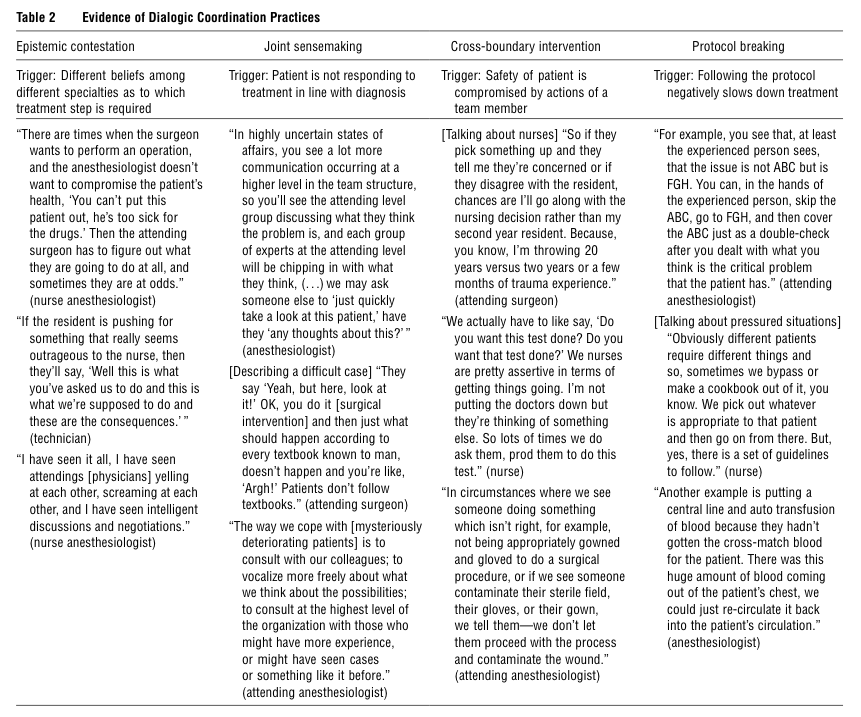
The termdialogic—as opposed to monologic—recognizes dif-ferences and emphasizes the existence of epistemicboundaries, different understandings of events, andthe existence of boundary objects (e.g., the diagnosisor the treatment plan). A dialogic approach to coordi-nation is the recognition that action, communication,and cognition are essentially relational and highlysituated. We use the concept of trajectory (Bourdieu1990, Strauss 1993) to recognize that treatment pro-gressions are not always linear or positive.
Cites Star (boundary objects) and Strauss, Bourdieu (trajectory)
-
A dialogic coordination practice differs from moregeneral expertise coordination processes in that itis highly situated in the specifics of the unfoldingevent, is urgent and high-staked, and occurs at theboundary between communities of practice. Becausecognition is distributed, responsibility is shared, andepistemic differences are present, interactions can becontentious and conflict laden.
Differences between expertise and dialogic coordination processes.
-
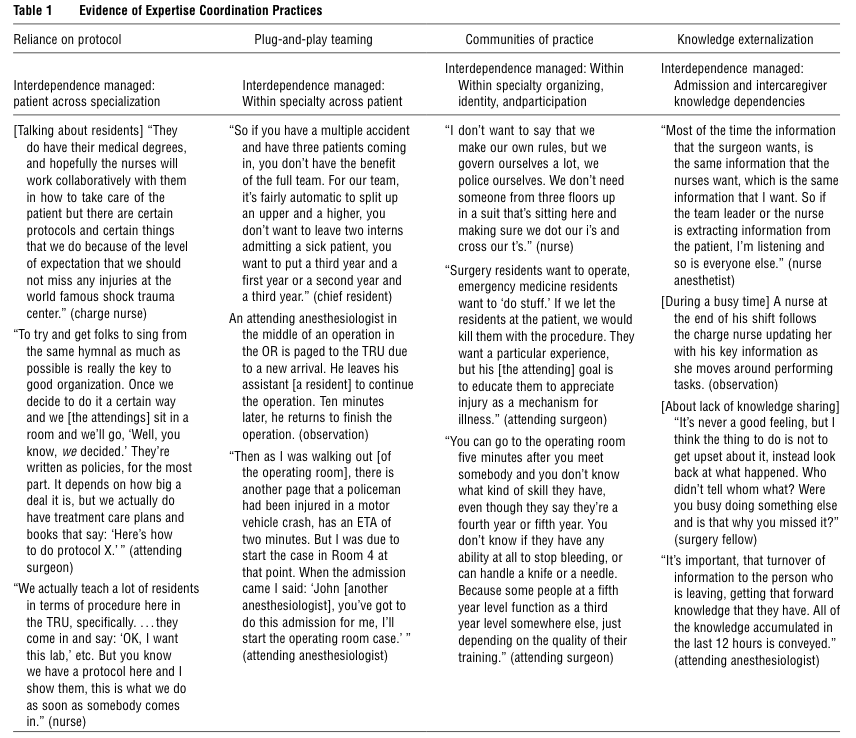
xpertisecoordination refers to processes that manage knowl-edge and skill interdependencies
-
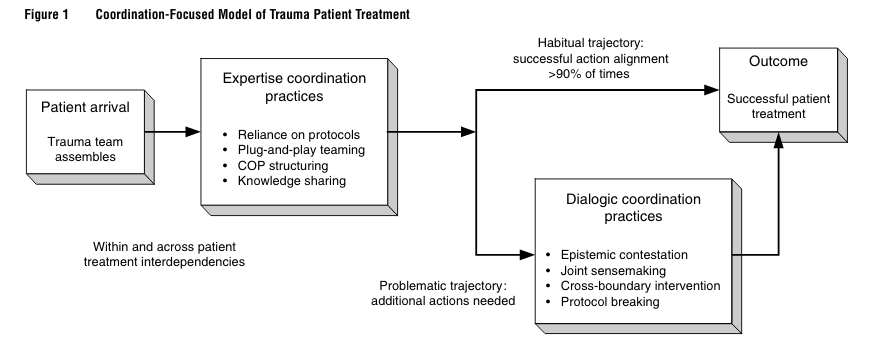
we describe two categories ofcoordination practices that ensure effective work out-comes. The first category, which we callexpertise coor-dination practices, represents processes that make itpossible to manage knowledge and skill interdepen-dencies. These processes bring about fast response,superior reconfiguration, efficient knowledge shar-ing, and expertise vetting. Second, because of therapidlyunfoldingtempooftreatmentandthestochas-tic nature of the treatment trajectory,dialogic coordina-tion practicesare used as contextually and temporallysituated responses to occasional trajectory deviation,errors, and general threats to the patient. These dia-logic coordination practices are crucial for ensuringeffective coordination but often require contentiousinteractions across communities of practice. Figure 1presents a coordination-focused model of patienttreatment and describes the circumstances underwhich dialogic coordination practices are called for.
-
We found that coordination in a trauma settingentails two specific practices.
"1. expertise coordination practices"
"2. dialogic coordination practices"
What would be the SBTF equivalent here?
-
Based on a practice view, we suggest the followingdefinition ofcoordination: a temporally unfolding andcontextualized process of input regulation and inter-action articulation to realize a collective performance.
Faraj and Xiao offer two important points: Context and trajectories "First, the definition emphasizes the temporal unfolding and contextually situated nature of work processes. It recognizes that coordinated actions are enacted within a specific context, among a specific set of actors, and following a history of previous actions and interactions that necessarily constrain future action."
"Second, following Strauss (1993), we emphasize trajectories to describe sequences of actions toward a goal with an emphasis on contingencies and interactions among actors. Trajectories differ from routines in their emphasis on progression toward a goal and attention to deviation from that goal. Routines merely emphasize sequences of steps and, thus, are difficult to specify in work situations characterized by novelty, unpredictability, and ever-changing combinations of tasks, actors, and resources. Trajectories emphasize both the unfolding of action as well as the interactions that shape it. A trajectory-centric view of coordination recognizes the stochastic aspect of unfolding events and the possibility that combinations of inputs or interactions can lead to trajectories with dreadful outcomes—the Apollo 13 “Houston, we have a problem” scenario. In such moments, coordination is more about dealing with the “situation” than about formal organizational arrangements."
-
Theprimarygoalispatientstabilizationandini-tiating atreatment trajectory—a temporally unfolding
Full quote (page break)
"The primary goal is patient stabilization and initiating a treatment trajectory—a temporally unfolding sequence of events, actions, and interactions—aimed at ensuring patient medical recovery"
Knowledge trajectory is a good description of SBTF's work product/goal
-
rauma centersare representative of organizational entities that arefaced with unpredictable environmental demands,complexsetsoftechnologies,highcoordinationloads,and the paradoxical need to achieve high reliabilitywhile maintaining efficient operations.
Also a good description of digital humanitarian work
-
We sug-gest that for environments where knowledge work isinterdisciplinary and highly contextualized, the rele-vant lens is one of practice. Practices emerge from anongoing stream of activities and are enacted throughthe contextualized actions of individuals (Orlikowski2000). These practices are driven by a practical logic,thatis,arecognitionofnoveltaskdemands,emergentsituations,andtheunpredictabilityofevolvingaction.Bourdieu (1990, p. 12) definespracticesas generativeformulas reflecting the modus operandi (manner ofworking) in contrast to the opus operatum (finishedwork).
Definition and background on practice.
Cites Bourdieu
-
In knowledge work, several related factors sug-gest the need to reconceptualize coordination.
Complex knowledge work coordination demands attention to how coordination is managed, as well as what (content) and when (temporality).
"This distinction becomes increasingly important in complex knowledge work where there is less reliance on formal structure, interdependence is changing, and work is primarily performed in teams."
Traditional theories of coordination are not entirely relevant to fast-response teams who are more flexible, less formally configured and use more improvised decision making mechanisms.
These more flexible groups also are more multi-disciplinary communities of practice with different epistemic standards, work practices, and contexts.
"Thus, because of differences in perspectives and interests, it becomes necessary to provide support for cross-boundary knowledge transformation (Carlile 2002)."
Evokes boundary objects/boundary infrastructure issues.
-
Usinga practice lens (Brown and Duguid 2001, Orlikowski2000), we suggest that in settings where work iscontextualized and nonroutine, traditional models ofcoordination are insufficient to explain coordinationas it occurs in practice. First, because expertise is dis-tributed and work highly contextualized, expertisecoordination is required to manage knowledge andskill interdependencies. Second, to avoid error andto ensure that the patient remains on a recoveringtrajectory, fast-response cross-boundary coordinationpractices are enacted. Because of the epistemic dis-tance between specialists organized in communitiesofpractice,theselattercoordinationpracticesmagnifyknowledge differences and are partly contentious.
Faraj and Xiao contend that coordination practices of fast-response organizations differ from typical groups' structures, decision-making processes and cultures.
1) Expertise is distributed 2) Coordination practices are cross-boundary 3) Knowledge differences are magnified
-
In this paper, we focus on the collective perfor-manceaspectofcoordinationandemphasizethetem-poral unfolding and situated nature of coordinativeaction. We address how knowledge work is coor-dinated in organizations where decisions must bemade rapidly and where errors can be fatal.
Summary of paper focus
-
- Nov 2018
-
Local file Local file
-
Creating KGs is not trivial.
This applies to universal KG in particular. Domain specific KGs can have any level of complexity - can they still be called knowledge graphs then?
-
-
eric.ed.gov eric.ed.gov
-
Instructional Design Strategies for Intensive Online Courses: An Objectivist-Constructivist Blended Approach
This was an excellent article Chen (2007) in defining and laying out how a blended learning approach of objectivist and constructivist instructional strategies work well in online instruction and the use of an actual online course as a study example.
RATING: 4/5 (rating based upon a score system 1 to 5, 1= lowest 5=highest in terms of content, veracity, easiness of use etc.)
Tags
- constructivism
- online education growth
- Performance Factors, Influences, Technology Integration, Teaching Methods, Instructional Innovation, Case Studies, Barriers, Grounded Theory, Interviews, Teacher Attitudes, Teacher Characteristics, Technological Literacy, Pedagogical Content Knowledge, Usability, Institutional Characteristics, Higher Education, Foreign Countries, Qualitative Research
- etcnau
- distance education
- instructional methods
- instructional design systems
- instructional technology
- instructiveness effectiveness
- Instructional systems design; Distance education; Online courses; Adult education; Learning ability; Social integration
- etc556
Annotators
URL
-
-
www.tandfonline.com www.tandfonline.com
-
At the intersection of technology and pedagogy:considering styles of learning and teaching
When examining the pedagogy of learning, teacher and student centered approaches, there is additional evidence supporting a model moving more towards technology-based learning. This articles considers the question of technology in the classroom and its' advantages/disadvantages.
RATING: 4/5 (rating based upon a score system 1 to 5, 1= lowest 5=highest in terms of content, veracity, easiness of use etc.)
-
-
www.tandfonline.com www.tandfonline.com
-
Distance Education Trends: Integrating new technologies to foster student interaction and collaboration
This article explores the interaction of student based learner-centered used of technology tools such as wikis, blogs and podcasts as new and emerging technology tools. With distance learning programs becoming more and more popular, software applications such as Writeboard, InstaCol and Imeem may become less of the software of choice. The article looks closely at the influence of technology and outcomes.
RATING: 4/5 (rating based upon a score system 1 to 5, 1= lowest 5=highest in terms of content, veracity, easiness of use etc.)
Tags
- Performance Factors, Influences, Technology Integration, Teaching Methods, Instructional Innovation, Case Studies, Barriers, Grounded Theory, Interviews, Teacher Attitudes, Teacher Characteristics, Technological Literacy, Pedagogical Content Knowledge, Usability, Institutional Characteristics, Higher Education, Foreign Countries, Qualitative Research
- writeboard
- etcnau
- distance education
- imeem
- asynchronous
- synchronous
- instacoll
- education programs
- etc556
Annotators
URL
-
- Oct 2018
-
cloud.degrowth.net cloud.degrowth.netdownload2
-
One of the proposals would be togenerate more spaces for sharing knowledges. Eg providing virtual spaces, eg I have done this, what has and hasn ́t worked. I admire what you do in Unitierra, and the Zapatista, and my context is very different, so we need to change the way of looking atthings.
There is a thing which we call Federated Wiki, that challenges how we produce knowledge : http://federated.wiki/federated-wiki-introduction.html
-
To document this confluence, and in which way we are building this knowledge—not only logical, but emotional and relational. Putting much more the tools of knowledge building.
Building a knowledge commons, alike http://wiki.ecolise.eu/index.php/A_knowledge_commons_for_community-led_action_on_sustainability_and_climate_change
-
- Sep 2018
-
estudijas.lu.lv estudijas.lu.lv
-
cash crops
A cash crop or profit crop is an agricultural crop which is grown to sell for profit. It is typically purchased by parties separate from a farm. The term is used to differentiate marketed crops from subsistence crops, which are those fed to the producer's own livestock or grown as food for the producer's family.
-
-
www.apmreports.org www.apmreports.org
-
Another big takeaway from decades of scientific research is that, while we use our eyes to read, the starting point for reading is sound. What a child must do to become a reader is to figure out how the words she hears and knows how to say connect to letters on the page. Writing is a code humans invented to represent speech sounds. Kids have to crack that code to become readers.
-
The basic assumption that underlies typical reading instruction in many schools is that learning to read is a natural process, much like learning to talk. But decades of scientific research has revealed that reading doesn't come naturally. The human brain isn't wired to read. Kids must be explicitly taught how to connect sounds with letters — phonics.
-
- Aug 2018
-
Local file Local file
-
Far from ‘competition’ supposedly driving ‘innovation’, Connell (2013) argues that it does the reverse. In the first instance, what a neo-liberal conception of the university produces, is the ‘reproduction of global dependency’ (p. 2)—through a ‘neocolonial dependence...built into performativity through international rankings of journals, depart-ment and universities’, whereby local intellectual cultures are under-mined and obliterated through an unhealthy reliance on ‘impact factors and ‘citations’ (p. 2). Secondly, the ‘entrenchment of social hierarchies in knowledge production and circulation’ (p. 2), act to further sediment privilege in the already advantaged—institutionally, in Australia in the older so-called ‘sandstone’ universities, and individually in the scions of the privileged who attend them.
The neocolonial nature of the research performativity regime and its epistemological dominance.
-
Transformed in this process is the very nature of knowledge:Neoliberalization replaces education aimed at deepening and broadening intelligence and sensibilities, developing historical consciousness and her-meneutic adroitness, acquiring diverse knowledge and literacies, becom-ing theoretically capacious and politically and socially perspicacious, with [forms of] education aimed at honing technically-skilled entrepreneurial actors adept at gaming any system. (p. 123)
neoliberalism and the transformation of knowledge and knowledge work
-
-
wendynorris.com wendynorris.com
-
Other foundational accounts, like Moglen (1999) and Weber (2004),attended to the emergence of informal hierarchies and governance arrange-ments within communities.
Other early work focused on organizational attributes, like how information goods were produced with flat/informal hierarchies, community values/norms, and governance structures.
-
Peer productioncould, Benkler argued, outperform traditional organizational forms underconditions of widespread access to networked communications technologies,a multitude of motivations driving contributions, and non-rival informationcapable of being broken down into granular, modular, and easy-to-integrate
Benkler's early work studied "the role of non-exclusive property regimes and more permeable organizational boundaries" for knowledge products.
-
-
wendynorris.com wendynorris.com
-
knowledge workers—business professionals who interpret and transform information (Drucker, 1973).
knowledge worker definition
-
-
nap.nationalacademies.org nap.nationalacademies.org
-
6 key principles of experts' knowledge
- experts notice features and manful patterns of info
- experts have abilities to make sense of the content based on prior knowledge that is organized in some ways
- experts' knowledge is not isolated and it related to context.
- experts have abilities to flexibly retrieve important aspects of their knowledge.
- experts may not have abilities to teach others
- experts have flexibilities in their approach to apply to new situations.
-
- Jul 2018
-
www.acsh.org www.acsh.org
-
Part of the reason is because an undergraduate education doesn't really train a person to think like a scientist. Instead, undergraduates focus on learning the large amount of foundational material in a field. It really isn't until graduate school (or after several years at the bench) that a person is taught how to generate new knowledge in the field. Once you can generate new knowledge in the field, then you call yourself a scientist.
So if you don't generate new knowledge in the field you aren't a scientist? What that mean for the earlier paragraph about the PhD and completion of a block of instruction/training to call yourself a scientist?
-
Actually, no, it hasn't, no matter what the Bunny's sign says. The scientific method is designed specifically to root out bias and false assumptions, including political ones. Sure, individual scientists can be political, but the scientific method is not. Its ideological agnosticism is why it works so well. In fact, the self-correcting nature of science means it is the best source of secular knowledge that humankind possesses.
-
- Jun 2018
-
www.edge.org www.edge.org
-
And the fourth concerns the idea of the adjacent possible. It just may be the case that biospheres on average keep expanding into the adjacent possible. By doing so they increase the diversity of what can happen next. It may be that biospheres, as a secular trend, maximize the rate of exploration of the adjacent possible.
For biospheres (as autonomous agents): expanding into the adjacent possible, at a maximized but secure rate, will put them in an advantage in evolution.
For an idea (in Popperian World 3): knowing its 'genes' and the boundary it operates within leads to the exploration of the adjacent possible. This is before it can start 'evolving' in the complex game of idea development.
-
- May 2018
-
austin-sparks.net austin-sparks.net
-
We are met at the very threshold of that realm with a statement which is calculated to check our steps for the moment, and if we approach with a sense of knowing or possessing anything already, with a sense of contentment, of personal satisfaction, or with any sense other than that of needing to know everything, then this word should bring us to a standstill at once: "...no one knoweth the Son, save the Father..." Maybe we thought we knew something about the Lord Jesus, and that we had ability to know; that study, and listening, and various other forms of our own application and activity could bring us to a knowledge, but at the outset we are told that "...no one knoweth the Son, save the Father..." All that the Son is, is locked up with the Father, and He alone knows.
The utter solitariness of Christ is reminded here. All external human efforts can only teach and talk about Christ objectively, that too only to a certain limit; they can only tell about him in a mere mental and propositional way, not an inch more. All true knowledge of Christ and any subjective comprehension can only be initiated by God himself by the work of the Holy Spirit ; through the means of the Word of God. This is revelation, revealed truth.
-
- Apr 2018
-
www.cambridgeonline.co.uk www.cambridgeonline.co.uk
-
Hyper Knowledge is a software company which develops a range of software for various applications. Based in Castle Park, Castle Pk, Hyper Knowledge is a software development company.
Hyper Knowledge

Tags
Annotators
URL
-
- Feb 2018
-
pmnerds.com pmnerds.com
-
Center of Excellence
Join the Center of Excellence. It is designed to help you improve your practice of Integrated PM through:
- Collaboration
- Training
- Shared Assets
- Knowledge Management
- While helping you overcome change adoption hurdles
-
-
learning.ccsso.org learning.ccsso.org
-
Use information gained from illustrations (e.g., maps, photographs) and the words in a text to demonstrate understanding of the text (e.g., where, when, why, and how key events occur).
when, where, why, how- what they mean and how to find them
key events
-
Use illustrations and details in a story to describe its characters, setting, or events.
definitions of character, setting, and event differentiation between story elements
-
Distinguish their own point of view from that of the narrator or those of the characters.
It is important for student to be able to formulate their own opinions about the text but also to know how those opinions differentiate from the narrator and also the characters in the story.
-
Compare and contrast a firsthand and secondhand account of the same event or topic; describe the differences in focus and the information provided
The students must have the skill to compare and contrast. The knowledge comes in when the student has to know the information that is needed to compare and contrast.
-
Describe the overall structure of a story
Knowledge--a student must be able to understand the story in order to describe the structure of a story.
-
ask and answer questions about key details in a text
the knowledge comes from being able to understand key details in a text while the skill comes from being able to ask questions and answer questions using the knowledge they have.
-
between books that tell stories and books that give information, drawing on a wide reading of a range of text types
To highlight the differences you could compare an encyclopedia on arachnids to a fable about Anansi the African trickster spider character.
-
Explain major differences between books that tell stories and books that give information, drawing on a wide reading of a range of text types.
This requires students to have knowledge of various elements of narrative texts and informational texts.
-
- Dec 2017
-
www.mnemotext.com www.mnemotext.com
-
Eyeing the forbidden fruit, I trod lightly on the sacred ground, and dared to speak only in whispers, until we had gone many paces from it
When ever any lottery work to me. mentions the fording fruit, I always pay careful attention to the context and scene it pertains to. Forbidden fruit is a highly connotative term that draws in instant allusion to Adam and eve in the Bible. I found its use in this scene to be very interesting and narrative, the forbidden fruit in this case seems to be knowledge/information/stories. Sometimes knowing to much can be bad, knowledge can awaken one as much as it can lead one to damnation.
-
- Nov 2017
-
www.educause.edu www.educause.edu
-
social engagement, public knowledge, and the mission of promoting enlightenment and critical inquiry in society
-
-
-
the ever-changing digital landscape
I think of myself as a Moffett guy, in that early on in my teaching I found the notion of "Teaching the Universe of Discourse" and exciting and clear map for building curriculum and for assessing my students' progress at any moment. I learned to focus on a balance of the different kinds of writing in the UNIVERSE of discourse. When I began to think about what it meant to teach digital writing, I returned to Moffett's notion of looking at the range of possibility. And as the words here, "ever-changing" and "landscape," suggest, we can constantly be thinking about what to include in our digital curriculum. Snapchat? Instagram? Is blogging still an important part of the landscape? What does it mean to have more characters available on Twitter? Do my students need more time in something like a Google community with short, interactive online conversation or do they need to slow down a bit and create a web page? It's exciting to be playing in this field, and it's even more exciting when youth recognize that they can choose where they want to play and make a difference digitally as well -- and what they need to learn to have an impact digitally.
-
-
engagements2017-18.as.virginia.edu engagements2017-18.as.virginia.edu
-
Education, in like manner engrafts a new man on the native stock, & improves what in his nature was vicious & perverse, into qualities of virtue and social worth; and it cannot be but that each generation succeeding to the knowledge acquired by all those who preceded it, adding to it their own acquisitions & discoveries, and handing the mass down for successive & constant accumulation, must advance the knowledge & well-being of mankind: not infinitely, as some have said, but indefinitely, and to a term which no one can fix or foresee.
In my engagement "Individual and Society", we center our discussions around the importance of one over the other and its pros and cons. With this phrase, it is definitely obvious that the importance of unification is crucial to our human existence. We cannot survive off of merely being here but rather incorporating the values and teachings of those who come before us. Granted we use current knowledge and beliefs to tweak these ideologies and we often times make them our own. But it is imperative that we give credit to those who set the foundation for us to discuss and challenge what we hold as human truths. - Kayla Thomas
-
- Sep 2017
-
engagements2017-18.as.virginia.edu engagements2017-18.as.virginia.edu
-
it cannot be but that each generation succeeding to the knowledge acquired by all those who preceded it, adding to it their own acquisitions & discoveries, and handing the mass down for successive & constant accumulation, must advance the knowledge & well-being of mankind: not infinitely, as some have said, but indefinitely, and to a term which no one can fix or foresee.
Education is highly valued for the founders of the University. Their belief that each generation will pass increasingly more amount of knowledge to the next is still evident in today's societies. However, their use of "indefinitely" is highly doubtful as they limit their extent of knowledge by restricting access to the University to only men. Today, knowledge is also evidently lost as humanity reduces the diversity in human society as well as the natural world. In order to fully emerge in an indefinite scale of acquiring knowledge, boundaries cannot be set as the writers of this report did, and acceptance of all forms of resources is necessary. -Yuki Zheng
-
-
rampages.us rampages.us
-
mphasize its normative, shared,inter-generationally transmitted characteristics rather than itsheterogeneity, emergence, and practical application.
I wonder about weak vs strong ties. This strikes me as a difference, i.e. heterogeneity. I also wonder about knowledge network analysis...maybe this is about how knowledge travels.
-
-
rampages.us rampages.us
-
ccording to this blog,
When I read this blog, I thought about how knowledge comes to mature academics. When we are junior, we spend a great deal of time reading the specifics of articles and texts. Do we do the same as senior academics? Or does knowledge come to us via our networks? We talk to people at conferences or exchange ideas via email or other digital means? Just wondering if knowledge networks change over the life course of an academic?
-
-
chrisbourg.wordpress.com chrisbourg.wordpress.com
-
connections
Connections is the key thing, in a world of information abundance. How do we trust those connections, understand them, and act on them?
-
-
learning.ccsso.org learning.ccsso.org
-
entify words and phrases in stories or poems that suggest feelings or appeal to the sen
I owuld consider this knowledge becuaseif studetns are able to indeitfy feelings in books and literature they will beb able to make connections to their own lives and how they feel.
-
-
rampages.us rampages.us
-
knowledge-based economy
What do we mean by knowledge based economy?
-
- Jul 2017
-
www.citejournal.org www.citejournal.org
-
this knowledge would include knowledge of concepts, theories, ideas, organizational frameworks, knowledge of evidence and proof, as well as established practices and approaches toward developing such knowledge
content knowledge
-
A teacher with deep pedagogical knowledge understands how students construct knowledge and acquire skills and how they develop habits of mind and positive dispositions toward learning
Important fact about educators with deep pedagogical knowledge.
-
- May 2017
-
www.topicquests.org www.topicquests.org
-
To augment collaborative human and ecosystem capacity to perceive and to wisely address complex local and global issues. In all deliberations, consider onto the 7th generation.
The TopicQuests Mission
Tags
Annotators
URL
-
- Apr 2017
-
press.etc.cmu.edu press.etc.cmu.edu
-
A promising option for integrating theory with practice in K-12 open learning is the Tech-nological Pedagogical Content Knowledge framewor
Knowledge Building and networked knowledge ecologies would be more updated and current examples of open learning?
Scardamalia & BEreiter (2014) http://ikit.org/fulltext/2014-KBandKC-Published.pdf
Knowledge ecology: http://citeseerx.ist.psu.edu/viewdoc/download;jsessionid=8D310E62BF5DC284DA14B5A6CE9F762E?doi=10.1.1.612.6430&rep=rep1&type=pdf
-
-
-
Two monks were arguing about a flag. One said, “The flag is moving.” The othersaid, “The wind is moving.” The sixth patriarch, Zeno, happened to be passingby. He told them, “Not the wind, not the flag; mind is moving.”—Douglas R. Hofstadter, Gödel, Escher, Bach
How does quote fit the idea of knowledge commons. We are the individual monks and the commons is the mind moving? Not just your mind, not just my mind, but 'all mind'?
-
- Mar 2017
-
vickidrozdowski.files.wordpress.com vickidrozdowski.files.wordpress.com
-
Conversely, western pedagogy continues to deal with content predominantly in the abstract form, in spite of attempts to contextualise subject matter.
This jumps out at me as a major difference between the two systems of learning. Indigenous: highly contextualised with a strong sense of place versus Western: pedagogy deals with content in the abstract in spite of attempts to contextualise. What do you think?
-
- Feb 2017
-
labs.sparna.fr labs.sparna.fr
-
cognonto.com cognonto.com
Tags
Annotators
URL
-
-
cognonto.com cognonto.com
-
www.insidehighered.com www.insidehighered.com
-
The Usefulness of Useless Knowledge
Check this out.
-
-
static1.squarespace.com static1.squarespace.com
-
"All that I know I have·s1olen,"
But isn't this all knowledge, according to Locke's tabula rasa and Hume's empiricism?
Tags
Annotators
URL
-
-
www.csicop.org www.csicop.org
-
With scientific claims, the only definitive answer is to reexamine the original research data and repeat the experiments and analysis. But no one has the time or the expertise to examine the original research literature on every topic, let alone repeat the research. As such, it is important to have some guidelines for deciding which theories are plausible enough to merit serious examination.
"The superiority of Scientific Evidence Reexamined":
"Allow me now to ask, Will he be so perfectly satisfied on the first trial as not to think it of importance to make a second, perhaps u third, and a fourth? Whence arises this diffidence'! Purely from the consciousness of the fallibility of his own faculties. But to what purpose, it may be said, the reiterations of the at-tempt, since it is impossible for him, by any efforts, to shake off his dependence on the accuracy of his attention and fidelity of his memory? Or, what can he have more than reiterated testimonies of his memory, in support of the truth of its for-mer testimony? I acknowledge, that after a hundred attempts he can have no more. But even this is a great deal. We learn from experience, that the mistakes or oversights committed by the mind in one operation. arc sometime!-., on a review, corrected on the second, or perhaps on a third. Besides, the repetition, when no error is discovered, enlivens the remembrance, and so strengthens the conviction. But, for this conviction. it is plain that we are in a great measure indebted to memory. and in some measure even to experience." (Campbell 922)
-
-
static1.squarespace.com static1.squarespace.com
-
Another remark on this article that deserves our notice is, that the less improved in knowl-edge and discernment the hearers are, the easier it is for the speaker to work upon their passions, and by working on their passions, to obtain his end.
This is a persistent view both since Campbell and preceding Campbell. Of course, it is predicated upon Campbell's previous divisions concerning imagination, passion, understanding.
-
knowledge,
Again, one of these words that fits in with the "black box terminology" category. Though Campbell believes that history is dignified by "knowledge," the reality is that what we (I suppose both individually and collectively) "know"about history is completely dependent on who we are, where we are, and when. In fact, understanding history requires as much conjecture, if not more, than trying to understand the future. While we may "know" supposedly objective facts (i.e. dates, names, places, etc.), it's rather impossible to truly comprehend or empathize with the motivations, opinions, interactions, and social/cultural/political/economic mechanisms that drove individuals, groups, and the course of history. And so it would seem that hindsight is anything but 20/20.
-
It is precisely in the same manner, and with the same success, that you might train a dog, or accus-tom a child to expect food on your calling to him in one tone of voice, and to dread your resentment when you use another.
The comparison of a dog and a child is a very useful way to explain, not only the notion of experience and how we come to adapt to the world, but also in saying that without experiencing human interaction being given to us, we truly are no different than beasts. Feral children and all that jazz.
-
-
static1.squarespace.com static1.squarespace.com
-
hat among the learned it has long been a contested, and remains still an undecided point, whether nature or art confer most towards excelling in writing and discourse.
Couldn't it be a combination of both? One has to be naturally comfortable speaking in front of others, but it is also necessary that they be trained in how to best do this.
-
-
learning.ccsso.org learning.ccsso.org
-
Use linking words and phrases (e.g., also, another, and, more, but) to connect ideas within categories of information
Using linking words makes a students writing much more fluid. An idea that comes to mind when thinking about fun ways to teach linking words is to play a game with the entire class. As the teacher, come up with the beginning sentence of a story. Then, have students popcorn continuing it on by using the linking words and phrases. This way they can have a fun creative way to learn something that may otherwise seem boring.
-
ecoding words.
Decoding words is an essential skill. When a student has difficulties with decoding, they have issues with accuracy and comprehension in reading. These problems can relay over into math when it comes to word problems too.
-
Determine the meaning of general academic and domain-specific words and phrases
This is important because it allows for them to use their current knowledge of vocabulary and context clues to determine the meanings of new words.
-
-
static1.squarespace.com static1.squarespace.com
-
knew.much stiJI unknown to us
Really think upon this: if knowledge is in some sense contextual and historical, think of what we do not know. That is, imagine that there is an inaccessible library somewhere filling up in equal measure and at the same rate as the library we can access.
-
-
static1.squarespace.com static1.squarespace.com
-
Knowledge itself is independent of language
Makes me think of the Jungle Book. One of our brilliant teacher's rants: How the hell does Mowgli know/understand the concept of language?
-
- Jan 2017
-
static1.squarespace.com static1.squarespace.com
-
With-out language, says Vico, the human knower i!-. lost
Just wanted to point out what Nathaniel said in class about how parents do not acknowledge a child saying "dog" as learning until the child can point to a dog while they say the word. I think that was an excellent, and very simple, way to explain how language in important to knowledge.
-
-
static1.squarespace.com static1.squarespace.com
-
He held to Locke's principle that our ideas come only from sense impressions and our men-tal operations upon them. He further argued that genuine knowledge can come only by this path and not from pure reasoning, testimony, or revelation.
I find myself questioning the use of the word "Knowledge" in this passage. Whenever I come across the word knowledge or its cousin wisdom, I immediately think of the saying, "Knowledge is knowing that a tomato is a fruit, wisdom is knowing not to put it in a fruit salad." It seems to me that sense impressions would lean more on the side of wisdom than knowledge. Would this distinction make a difference?
-
-
www.commoncraft.com www.commoncraft.com
-
The key is know that the curse exists. To be able to recognize the challenge before you.
As a Software Engineer, I can only say: Been there, done that!
Indeed, knowing about it helps a lot! Awareness is the key.
-
-
www.zephoria.org www.zephoria.org
-
Children are indoctrinated into this cultural logic early, even as their parents restrict their mobility and limit their access to social situations. But when it comes to information, they are taught that they are the sole proprietors of knowledge. All they have to do is “do the research” for themselves and they will know better than anyone what is real. Combine this with a deep distrust of media sources. If the media is reporting on something, and you don’t trust the media, then it is your responsibility to question their authority, to doubt the information you are being given. If they expend tremendous effort bringing on “experts” to argue that something is false, there must be something there to investigate.
-
- Dec 2016
-
gateway.ipfs.io gateway.ipfs.io
-
The Greater Community Way of Knowledge
-
Knowledge
-
Knowledge
-
-
gateway.ipfs.io gateway.ipfs.io
-
when you say, "I create my reality," what you are saying is that you are creating an interpretation of what you can experience. If you can only experience this much of life, and it is all your interpretation, then you see your range of perception is very limited. But your Knowledge, which you carry within yourself, is capable of opening your perception completely. Without so much incessant thinking, wondering, asking, pondering, manipulating, planning and scheming, and so forth, the greater part of your mind, your Knowledge, can begin to show you things. It is not difficult to have direct experience. You simply must not be doing anything else.
-
The Greater Community Way of Knowledge
-
Knowledge is not only your ability to perceive the truth and to resonate with the truth, it also contains the memory of your life beyond this world and your reason for coming here.
-
Knowledge takes you back to God while you are in the world, but it does so in a very specific way because its emphasis is practical, not magical. It is not about metaphysics, learning all about the sixteen million levels and the cosmology of all of the universes. That is for people who think and do nothing. The person of Knowledge is not concerned with these things unless they have a specific relevance to his or her function in life, and even then they are a temporary expedient and nothing else. If you want to know about mystical cosmology, then perhaps a teacher will tell you about these things to get your attention while he or she gives you something far greater. Mystical cosmology does not get you through the day. It does not attend to you when you are alone and miserable in your thoughts. It is simply a broader range of speculation. It may be a reprieve from your personal difficulties, but it is not the key to your freedom.
-
There are things you must apply yourself to very specifically because there are two aspects to life: There are concrete accomplishments and there is Mystery. You must approach both. Mystery opens you to a greater assistance than you could provide for yourself and saves you from condemning circumstances. Applying yourself to tangible things enables you to reclaim your self-respect and to build a foundation that is sound and firm. That is what personal growth is for-to build a foundation for Knowledge. What other value does it have? The person you are attempting to improve will be shed like a garment when you leave. As you become stable, then you can represent something greater. Without Knowledge, you are still profoundly confused and subject to miseries. Without purpose, meaning and direction, your life is still a desperate event.
-
to be a student of Knowledge, allow your life to have its mysteries. Do not try to explain everything and justify everything. Knowledge will emerge within you once you have chosen that this be your life. You will become less certain about particulars and more certain about your purpose, meaning and direction. Then you will begin to find freedom from anxiety and ambivalence, and that is the greatest gift of all because a life without anxiety or ambivalence is completely rendered into the world.
-
to be happy and to have meaning in the world, you must concentrate on developing Knowledge and allow it to contribute itself where it knows it can be of the greatest benefit. This will fulfill your need for relationship and community.
-
This has a very important spiritual meaning because you are at work reclaiming Knowledge for a long time, in time.
-
Developing Knowledge is a major theme in all of our discussions. Knowledge, relationships and communication permeate all true activity, true development and true progress. They give rise to your spiritual nature and destiny.
Tags
- confusion
- ambivalence
- destiny
- metaphysics
- misery
- relationship
- happiness
- Greater Community
- personal growth
- mystery
- perception
- New Age
- Knowledge
- purpose
- mysticism
- anxiety
- self-deception
- imagination
- reality
- meaning
- philosophy
- contribution
- certainty
- relationships
- accomplishment
- community
- interpretation
- peace
Annotators
URL
-
-
gateway.ipfs.io gateway.ipfs.io
-
Living The Way of Knowledge BUILDING THE FOUNDATION FOR BECOMING A MAN OR WOMAN OF KNOWLEDGE IN AN EMERGING WORLD
Living The Way of Knowledge is the New Message Teaching on how to bring the grace, the guidance and the power of Knowledge into the Four Pillars of your life: The Pillar of Relationships, The Pillar of Work, The Pillar of Health and The Pillar of Spiritual Development. Like the four legs of a table, the Four Pillars provide the stable foundation for building a greater life in an unstable and uncertain world. Living The Way of Knowledge presents one of the great practices in learning and living the New Message from God. By building the Four Pillars of your life, you develop a true foundation and a greater certainty, stability and direction in your experience. It is the great wisdom in Living The Way of Knowledge that will provide the day-to-day insight needed as you pass through the great thresholds on the journey of discovering and following Knowledge.
-
-
cft.vanderbilt.edu cft.vanderbilt.edu
-
In terms of Bloom’s revised taxonomy (2001), this means that students are doing the lower levels of cognitive work (gaining knowledge and comprehension) outside of class, and focusing on the higher forms of cognitive work (application, analysis, synthesis, and/or evaluation) in class, where they have the support of their peers and instructor. This model contrasts from the traditional model in which “first exposure” occurs via lecture in class, with students assimilating knowledge through homework; thus the term “flipped classroom.”
-
- Nov 2016
-
blackboard.gwu.edu blackboard.gwu.edu
-
tacit
Tacit knowledge is that which has not be codified (e.g., written down, archived, shared, etc.).
Here is a helpful link on different types of knowledge: http://www.knowledge-management-tools.net/different-types-of-knowledge.html
-
- Oct 2016
-
gateway.ipfs.io gateway.ipfs.io
-
t is protecting you and guiding you even now, like a great force that you cannot see but you can certainly feel. In times of distress or great difficulty it will manifest itself more sharply to you, and you will know that there is a guiding Presence in your life. As you become closer to it, you will start to feel it every day-unifying you, keeping you from error, orienting you towards people and situations that are truly nourishing and beneficial for you, bringing helpful change and making your encounters with others truly meaningful.
"Though your senses will perceive the form of things, your heart will experience the essence of things, and this is how things will become known. Once they are known, you will realize how you are to participate with them. Thus, all your faculties of mind will be utilized for one great purpose, for Knowledge will utilize all your faculties and the faculties of the world for the redemption of the world, which is the redemption of Knowledge within the world."
Steps to Knowledge, Step 273 http://stepstoknowledge.com/steps/Step273-My-Teachers-hold-the-memory-of-my-Ancient-Home-for-me.htm
-
-
blackboard.gwu.edu blackboard.gwu.edu
-
Oxford English Dictionary
And here is the definition from Webster's Dictionary: http://www.merriam-webster.com/dictionary/knowledge
-
- Sep 2016
-
www.scottaaronson.com www.scottaaronson.com
-
it’s easy to argue by induction
It may be easy to argue by induction, but what is actually going on?
Let's take a group of three children for a larger example: Abe, Ben and Cindy. Let's denote the situation "Abe has a clear forehead and Ben and Cindy have muddy foreheads" as [OXX], and so on.
Before the teacher tells them anything, Abe knows that either [XXX] or [OXX] (because he sees the mud on Ben's and Cindy's foreheads). If [OXX] were the case, Ben would know that either [OXX] or [OOX]. If [OOX] were the case, Cindy would know that either [OOX] or [OOO].
This picture demonstrates the situation.
The teacher's announcement makes it common knowledge that [OOO] is not possible. Then if Abe supposed [OXX] and provided that Ben supposed [OOX], Cindy would be sure that [OOX] (meaning she has mud on her forehead). After the first call, she doesn't stand up so we know that if Abe supposed [OXX], in that idea Ben could no longer suppose [OOX] and would be instead sure that [OXX] (meaning he has mud on his forehead).
This example suggests that the children don't need the general notion of common knowledge to efficiently reason whether they have muddy foreheads. It suffices to use any chain "Abe considers possible that Ben considers possible that Cindy considers possible etc.". that visits every child exactly once in an arbitrary order.
-
“would you like to come up for some intercourse?”
Incidentally, this straightforward approach is taken by Phoebe towards Chandler in the episode 5x14 titled "The One Where Everyone Finds Out" of the TV show Friends:
I'm really looking forward to you and me having sexual intercourse.
As pointed out by James Miller in his video introducing the concept common knowledge, this episode contains a nice informal demonstration of the concept.
Tags
Annotators
URL
-
-
lawrenceacademy-my.sharepoint.com lawrenceacademy-my.sharepoint.com
-
Although cultural knowledge is hidden from view, it is of fundamental impor-tance because we all use it constantly to generate behavior and interpret our expe-rience
Cultural knowledge is a very broad topic hidden from the view, but is also very important because we use it constantly to generate behavior and interpret our experience
-
Our culture has a large body of shared knowledge that people learn and use to engage in this behavior called reading and make proper use of the artifacts connected with it
Cultural knowledge – what people know (ex. Grammatical rules for a language, meaning of space, lines and columns, how to feel when reading jokes, etc.)
-
When ethnographers study other cultures, they must deal with three fundamental aspects of human experience: what people do, what people know, and the things peo-ple make and use
Ethnographers deal with three fundamental aspects of the human experience : cultural behavior, cultural knowledge, and cultural artifacts
-
cultural knowledge.
cultural knowledge
-
cultural behavior: reading.
Acquired knowledge people use to interpret experience and generate behavior
-
-
robotics.stanford.edu robotics.stanford.edu
- Aug 2016
-
books.google.ca books.google.ca
-
Page 10
Borgman on the relationship of knowledge mobilization scholarship, similarities and differences:
once collections of information resources are online, they become available to multiple communities. Researchers can partner across disciplines, asking new questions using each other's data. Data collected for policy purposes can be used for research and vice versa. Descriptions of museum objects created for curatorial research purposes are interesting to museum visitors. Any of these resources may also be useful for learning and instruction. nevertheless, making content that was created for one audience useful to another is a complex problem. Each field that is on vocabulary, data structures, and research practices. People ask questions in different ways, starting with familiar terminology. Repurpose sing of research data for teaching can be especially challenging. Scholars goals are to produce knowledge for their community, while student schools are to learn the concepts and tools of a given field. These two groups have different levels of expertise in both disciplinary knowledge in the use of data and information resources. Different descriptions, tools, and services may be required to share content between audiences.
-
- Jul 2016
-
heretothere.trubox.ca heretothere.trubox.ca
-
“knowledge creation”.
The "business" of univeristy?
-
-
books.google.ca books.google.ca
-
Great quote here on how scholarship and knowledge mobilisation have difficulties interacting.
never the less, making content that was created for one audience useful to another is a complex problem. Each field has its own vocabulary, data structures, and research practices. People ask questions and different ways, starting with the mill your terminology. The repurposing of research data for teaching can be especially challenging. Scholars goals are to produce knowledge for their Community, while students goals are to learn from the concepts and tools of a given field. These two groups have different levels of expertise in both disciplinary knowledge and the use of data and information resources. Different descriptions tools and services may be required to share content between audiences.
-
Page 10
descriptions of Museum objects created for curatorial and research purposes are interesting to museum visitors.
Borgman on the intersection of popular Outreach / knowledge mobilisation and scholarship.
-
-
medium.com medium.com
-
a handful in a few major world languages
One might think that those other languages are well-represented. People connected with the Open Knowledge Foundation are currently tackling this very issue. Here, Open Education isn’t just about content.
-
- Jun 2016
-
arstechnica.com arstechnica.com
-
VIA EFF
Open access: All human knowledge is there—so why can’t everybody access it? (Ars Techica)
Excellent report on the state of academic publishing— and why so much of it is still locked down.
NOTE
if we can Not access the works we fund, we can Neither annotate all knowledge.
And this case, it may pertain the most crucial body of all our knowledge — the knowledge upon what we are to found our own futures for us all. What is to be recognized as "the Human knowledge", whilst yet unknown by almost everyone us Humans ourselves.>
-
-
dpod.kakelbont.ca dpod.kakelbont.ca
-
ConclusionsThis paper finds that the effort grade affects theknowledge grade positively and significantly across allspecifications. This is strong evidence that more studenteffort does lead to increase learning
Paper concludes that effort affects the knowledge grade positively and significantly across all specifications. This is evidence that more student effort does lead to increased learning.
-
- May 2016
-
christmind.info christmind.info
-
And finally the necessity of Desire casting its complete spell over You (Humanity), that YourCelestial or Impersonal nature might be kept deep in sleep; until, in your Dream, by the free butignorant use of My Will, You could taste and fully eat of the fruit of the so-called Tree ofKnowledge of Good and Evil, and through the eating could learn properly to discriminate andknow its fruit for what it really is; and thus acquire the strength to use the knowledge thus gainedwisely and perfectly in the expression of My Idea onl
Humanity entered full forgetfulness to learn "and know its fruit for what it really is" to develop the strength so as to use the knowledge as a perfect expression of God...
-
This Knowledge, this Realization, will not come at once. It may not come for years. It may cometomorrow.It depends upon no one but You;Not upon your personality, with its human desires and human understanding;But upon the I AM of you -- God, within.Who is it that causes the bud to open into the blossom?Who causes the chick to burst its shell?Who decides the day and the hour?It is the conscious, natural act of the Intelligence within, My Intelligence, directed by My Will,bringing to fruition My Idea and expressing it in the blossom and in the chick.But did the blossom and the chick have anything to do with it?No, only as they submitted or united their will with Mine and allowed Me and My Wisdom todetermine the hour and the ripeness for action, and then only as they obeyed the impulse of MyWill to make the effort, could they step forth into the New Life
The timing of the fruition of realisation of this Knowledge comes from my True Self, God within............. true Intelligence, Gods Idea... expressing and birthing the conscious awareness of the aspect of God, Me.........
-
-
books.google.ca books.google.ca
-
p. 4 makes a distinction between knowledge and information and seems to understand information as being organisation of knowledge (actually is maybe confused a little about the distinction)
Information is not the same thing as knowledge, though the two concepts overlap. Knowledge refers to ideas and facts that a human mind has internalizedand understood: how to fix a flat tire, the names of a really good dentist, speaking French. Acquiring knowledge means absorbing a lot of information--for example, how to use French irregular verbs correctly. Often the mind acquires and organizes such information in a spontaneous and even subconscious fashion, the way a child learns to speak or a taxi driver knows her way around town. At other times, the acquisition of knowledge requires studying, a slow and difficult process. The amount of knowledge that a human mind can possess is truly extraordinary, but it is not infinite, nor is the mind reliable. Hence the need for information. As society becomes more complex and its interactions speed up, access to information becomes increasingly important. Education was once focused on learning, that is, on acquiring knowledge; it now stresses research skills. What matters is not knowing the answer, but knowing where to look it up. And that means the information is (one hopes) out there, readily accessible.
-
-
www.brainpickings.org www.brainpickings.org
-
Therein lies the power of mistakes as a vehicle for, as Rilke famously put it, “living the questions” and thus advancing knowledge in a way that certainty cannot — for, as Richard Feynman memorably noted, the scientist’s job is to remain unsure, and so seems the philosopher’s. Dennett writes:
-
- Mar 2016
-
www.insidehighered.com www.insidehighered.com
-
But I see some promising changes that align with the emphasis in the Framework on creating rather than consuming, on understanding systems of information rather than how to find stuff, on context and making critical judgments that go beyond making convenient consumer choices. If we think about information as something communities create in conversation within a social and economic context rather than as a consumer good, we may put less emphasis on being local franchises for big information conglomerates and put more time, resources, and creativity into supporting local creativity and discovery. We may begin to do better at working across boundaries to support and fund open access to research rather than focusing most of our efforts on paying the rent and maintaining the security of our walled gardens. And as we make this shift, we may be able to stop teaching students how to shop efficiently for information that won’t be available once they graduate. We may help them think more critically about where knowledge comes from and how they can participate in making sense of things.
Nice!!!
-
-
learning.ccsso.org learning.ccsso.org
-
Describe how reasons support specific points the author makes in a text
This standard requires students to be able to describe how reasons support specific points the author makes in a text by determining the key details in text. Also, they students should be able to describe the author's purpose and how it supports comprehension.
-
how the speaker in a poem reflects upon a topic; summarize the text
This standard requires students to know how to explain the speaker's reflection on a topic and how that impacts the theme. Also, the students should be able to write a summary by using details from the text.
-
With prompting and support, describe the relationship between illustrations and the text in which they appear (
This standard requires students to know what an illustration is and how they are different from the words in a text. The skill required of students is making connections between the illustrations they see and the story that is being told. A good book for this standard would be No David! The story in this book is mostly told through pictures while the words on the page say things like "No, David!"
-
Identify the main purpose of a text, including what the author wants to answer, explain, or describe
This standard requires students to know how to read and to know the role of the author of a text. The skill required is students having to find a meaning in the text that is not worded on the pages. This standard requires students to think deeply about the text in order to find the author's purpose in writing it. A good text to use for this standard would be Green Eggs and Ham. Students would have to think about how the green eggs and ham could relate to their own lives. The main point of this story is fairly easy to understand, it is that you should try food before you say you don't like it, something many elementary students may be able to relate to.
-
With prompting and support, identify basic similarities in and differences between two texts on the same topic (e.g., in
This standard requires students to know and remember what happens in two different texts. The skill is that students must compare the two texts and talk about them together rather than individually. Two books that would be good for this standard are Brown Bear, Brown Bear and Polar Bear, Polar Bear. Though these books are different it is fairly easy to see their similarities. While Brown Bear, Brown Bear, focuses on colors and animals, Polar Bear, Polar Bear focuses on sounds and animals.
-
ntify the main topic and retell key details of a te
In order for students to accomplish this standard they must know what happened in the story and remember specific details. The skill this standard requires is to think about the text as a whole in order to figure out it's main topic. A good book for this would be "brown bear brown bear." Students would have to figure out what is reoccurring in the novel in order to find it's topic. The repeated topics are colors and animals.
-
- Feb 2016
-
learning.ccsso.org learning.ccsso.org
-
Determine the meaning of words and phrases as they are used in a text, including those that allude to significant characters found in mythology (e.g., Herculean).
Grade 4 students must be able to pull information from both the text and from their existing knowledge to figure out the meaning of new words and phrases.
-
Recount stories, including fables, folktales, and myths from diverse cultures; determine the central message, lesson, or moral and explain how it is conveyed through key details in the text.
This common core standard for literacy for third graders reflects their knowledge on not only recounting and recalling several variations of stories, but also using what they know about different cultural practices to identify a central message or moral.
-