35 Matching Annotations
  1. Nov 2025
    1. munificence

      The OED defines "munificence" as: The quality of being munificent; great generosity or liberality in giving.

      The word is used for a mysterious Count showing that the Duke is aware that his story may have been off-putting, and he must now save face by praising his new socio-political target. However, to use a word that is antithetical to who the Duke is draws larger parallels between who he associates with, who he pretends to be, and who he really is. The Duke is not giving in the sense that he should be praised, he is giving in the sense that gives people reasons to fear him. By praising this Count's munificence, he can downplay his own lack of it.

    2. I gave commands; Then all smiles stopped together. There she stands As if alive.

      The Duke states that he "gave commands" in order for the Duchess to behave--whether this means a death sentence or exile have no difference to the Duke as she is dead to him either way.

      However, "Lucrezia suffered from chronic lung-trouble, that her father and her brother Francesco were kept constantly informed with regard to the progress of her last illness" (Friedland 673) which implies Lucrezia succumbed to illness. While the Duke married her as a political advantage, if he were to kill her, he risks a war with her family, the Medicis; once again the Duke must put on a front to exert dominance over his subjects and guests. Whether she died by his hand, or from illness is not the issue the Duke wants attention on, but rather, that he can decide when she dies, and anyone within his court is no different.

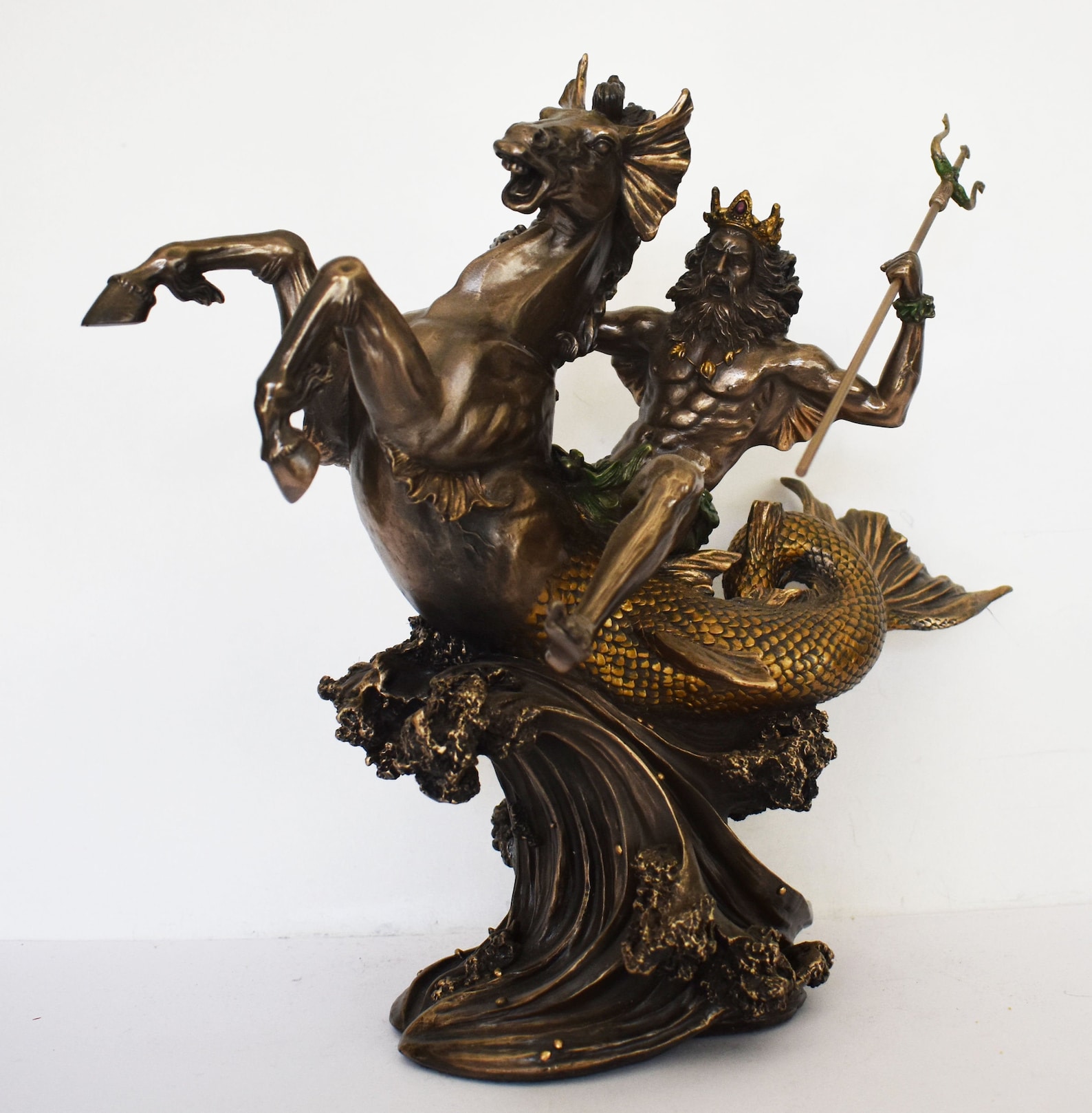
    3. Notice Neptune, though, Taming a sea-horse, thought a rarity, Which Claus of Innsbruck cast in bronze for me!

      Neptune Taming a Seahorse

      The Duke's final words being about another artpiece he has demonstrates how little he cared for the Duchess. The need to brag about more art being made for him not only shows his ability to display power, but it also shows a reflection of his true intentions. The bronze cast is of Neptune (a god) taming a seahorse--this reflects how the Duke views himself: a god taming a lesser creature; as he sees himself as a god, he will inevitably treat the new duchess similarly. There was never going to be a dual-respect and understanding between him and the Duchess as she was as useful as a seahorse to him. His calculated shift from a painting of his "beloved" wife, to a bronze cast displaying a feat of dominance demonstrates the Duke's ability for social politics and directs attention away from the gruesome end of the Duchess.

    4. My Last

      While looking up the Duchess, Lucrezia de' Medici, came a poem called "My Next Duchess" by a priest named Lawrence Jones in which a member of the envoy warns of the Duke as a means to save the next duchess from his grasp. While the poem does not follow all the same writing conventions as Browning's poem such as form and tone, it is effective in the way that provides a secondary perspective on the story within this poem. The break of such conventions lends a sort of response that is more human that the facade that the Duke puts on.

      The poem aims to explore how the envoy reacted to the Duke's monologue, and the horror at which is deemed worthy enough to become a cautionary tale to future noblewomen about the Duke of Ferrara.

  2. May 2025
  3. Feb 2023
    1. Kawakatsu et al. (1) make an important ad-vance in the quest for this kind of understanding, pro-viding a general model for how subtle differences inindividual-level decision-making can lead to hard-to-miss consequences for society as a whole.Their work (1) reveals two distinct regimes—oneegalitarian, one hierarchical—that emerge fromshifts in individual-level judgment. These lead to sta-tistical methods that researchers can use to reverseengineer observed hierarchies, and understand howsignaling systems work when prestige and power arein play.

      M. Kawakatsu, P. S. Chodrow, N. Eikmeier, D. B. Larremore, Emergence of hierarchy in networked endorsement dynamics. Proc. Natl. Acad. Sci. U.S.A. 118, e2015188118 (2021)

      This may be of interest to Jerry Michalski et al.

  4. Nov 2022
  5. Jan 2021
  6. Sep 2020
  7. Aug 2020
  8. Jun 2020
  9. May 2020
  10. Apr 2020