https://www.legacy.com/us/obituaries/northjersey/name/donald-bolander-obituary?id=24573183
Founded Career Institute and edited several of their books on English, spelling, synonyms, antonyms, etc.
https://www.legacy.com/us/obituaries/northjersey/name/donald-bolander-obituary?id=24573183
Founded Career Institute and edited several of their books on English, spelling, synonyms, antonyms, etc.
John Jumper, who shared a recent Nobel Prize in chemistry, announced Friday that he’s making the leap to Anthropic after “nearly 9 years” at Google DeepMind.
大多数人认为获得诺贝尔奖的科学家会留在知名机构,但John Jumper选择离开DeepMind加入竞争中的Anthropic,这可能表明他对新公司的创新方向和潜力有更深的信心。
Why AI hasn’t replaced software engineers, and won’t
Doing nothing at work
LLMs are eroding my software engineering career and I don't know what to do
We were taught that generalists and specialists will always have their roles. But now the market is shaping everyone into becoming a generalist.
大多数人认为专业化和专业化各有价值且会长期共存,但作者认为市场正在迫使所有人成为通才,这与'专业化和专业化将长期共存'的职业发展主流认知相悖。
Codex can help people take on more ambitious projects, leading to greater scope of their roles, and potentially accelerate career advancement.
大多数人认为AI会替代人类工作或限制职业发展,但作者认为AI实际上能让人承担更雄心勃勃的项目,扩大职责范围并加速职业发展。这挑战了AI导致工作减少或职业停滞的常见担忧,表明AI可能是职业扩张的催化剂而非替代品。
The simple truth could be that coding skills are no longer a guarantee of a job. That may help to explain the drop-off of computer science majors at schools around the country.
大多数人认为计算机科学和编程技能仍然是就业的保证,但作者认为这些技能可能不再是工作的保证,这解释了计算机科学专业人数的下降。这一观点挑战了传统技术教育价值的认知,暗示AI正在改变就业市场的基本规则。
many software engineers feel that their life's skill is no longer useful
大多数人认为技术人才在AI时代会通过适应和学习而增值,作者认为许多软件工程师感到他们的核心技能正在贬值,导致职业前景不明和深度职业倦怠。
the same technology is both the lottery ticket & the thing eating your fallback
大多数人认为AI技术要么是创造机会的积极力量,要么是威胁就业的消极因素,但作者认为AI同时扮演着双重矛盾角色——既是少数人的财富彩票,又是多数人职业安全的威胁。
15 principles for managing up
When I look at my conversations with the agents, it's very clear to me that this is moon language for the vast majority of human beings. There are a whole bunch of reasons I'm not scared that my career as a software engineer is over now that computers can write their own code, partly because these things are amplifiers of existing experience.
作者认为AI编码工具对大多数普通人来说仍然难以掌握,它们是现有经验的放大器而非替代品,因此不担心自己的职业会被取代。
The 2026 Global Intelligence Crisis
What 4 engineers with 10+ years of experience say about staying relevant in the AI era
I did no work for a year and no one noticed
Ask HN: What skills are future proof in an AI driven job market?
Early years matter because that is when foundational skills are formed. Debugging instinct. System intuition. Precision. Taste. Skepticism.
这个观点强调了早期职业生涯对于工程师技能形成的重要性。
Jeremy didn't get laid off. He got leveraged.
大多数人认为在裁员潮中,高额使用AI工具的员工可能会被视为成本负担而被裁掉,但作者提出了一个颠覆性的观点:像Jeremy这样大量使用AI工具的员工不仅没有被裁员,反而获得了更大的杠杆效应和影响力。这挑战了人们对AI成本与价值的传统认知。
继续做通用 UX 是最危险的位置,它正是最容易被 AI 和产品经理上下夹击的中间层。
大多数人认为UX设计师的核心价值在于通用用户体验设计,但作者认为这一角色在AI时代面临被取代的风险。这一挑战性观点暗示设计师需要向架构型或业务型方向发展,否则可能被AI和产品管理双重挤压,反映了行业对设计师角色未来发展的深刻思考。
Such tools promise to turn coders into project managers, letting them delegate and oversee many more tasks than they could cope with by themselves.
这一观点挑战了软件开发行业的职业发展路径,暗示AI代理将从根本上改变程序员的技能需求和工作性质。从编码者到项目管理者的转变,代表着一种职业身份的颠覆性重构,这与人们对技术专业发展的传统认知形成鲜明对比。
BLOG: How NOT to Answer the Salary Question
Knowing how discourse communities work will not only help you as you navigate the writing assigned in different general education courses and the specialized writing of your chosen major, but it will also help you in your life after college.
this is a great model for approaching new environments -- it allows for one to focus explicitly on identifying the discourse community and integrating ourselves into that discourse community to make the transition more smooth.
This would especially be most valuable for those that are neurodivergent, especially Autism and ADHD, etc.
Because questions vary significantly from discipline to discipline and from field to field, it is important that you assess your questions according to the discourse community you are writing within.
This is good advice -- not just for individual courses that we take from different Discourse Communities, but as we define our majors and focuses, it is important to join the discourse so that we can stay abreast of the latest information, discussions and practical solutions within it.
At least oldmedia, even in its decline and with all its problems, still offers a careerpath.
Historically, he writes, colleges and universities aimed to imprint capital-C Culture—especially a familiarity with a nation’s great texts and intellectual traditions—on young people. Today, however, students more often are seen and see themselves as consumers who are buying diplomas in order to signal their employability. In this model, the values that animate higher education are job preparation, skill building, and networking, not intellectual engagement or humanistic fulfillment. The University in Ruins
You will be supported during your studies to gain the capabilities that are relevant to you and these will take time to develop.
Student specific - "You are encouraged to develop the capabilities relevant to your role, recognizing that this is a continuous process."
Suggest replacing with course from LinkedIn Learning
This blog from the University’s Careers Service gives helpful examples of how you can evidence your digital capabilities when updating your CV.
Student specific - is there a staff alternative to this blog post?
The most troubling of the findings, to me at least, was the impact of the technology on job satisfaction, especially in terms of their creative contribution, even from the scientists that derived the most value. It’s possible that this is a consequence of the changes and will prove temporary, or it’s possible that this will correct itself by attracting people with different skills and interests to the jobs.
A guide to finding diamonds in the rough
Finding Wins Above Replacement: Look for candidates who made a significant impact in their past roles, distinguishing their actions from team efforts. This highlights their talent, agency, and individuality.
Key Traits to Identify:
Effective Questions to Ask:
Chip on the Shoulder: Candidates with a drive to prove themselves can be valuable. Look for those with optimism and resilience rather than deep insecurities or negativity.
Challenges as Motivation: Present company challenges and assess if candidates are excited by the opportunity to make an impact rather than deterred by imperfection.
High EQ & Persuasion: Evaluate their ability to adapt communication and influence effectively, especially in group interactions.
Theory for Excellence: Past excellence in any field (sports, arts, academics) suggests transferable drive and discipline for unrelated roles.
Understanding Competence: Candidates should know their strengths, weaknesses, and preferred tools or methods.
Spike Potential: Tailor questions to their profile and assess specific strengths that hint at future excellence.
Coachability & Openness: Look for candidates open to feedback, willing to improve, and capable of committing even when they disagree.
Unpretentiousness: Seek candidates who are self-aware, lighthearted, and pleasant to work with.
Assessment Methods:
In my brag document, I like to do this by making a section for areas that I’ve been focused on (like “security”) and listing all the work I’ve done in that area there. This is especially good if you’re working on something fuzzy like “building a stronger culture of code review” where all the individual actions you do towards that might be relatively small and there isn’t a big shiny ship.
This is such a clever way to create a container that otherwise might not have existed for that work. I wonder if this would be a good way to highlight glue work?
I listen to this video when I need inspiration and confidence. It reminds me of what is important, that we can change the world, and how I would like it to change.
80/15/5. Spend 80% of your time on low-risk/reasonable-payoff work. Spend 15% of your time on related high-risk/high-payoff work. Spend 5% of your time on things that tickle you, regardless of payoff. Teach the next generation to do your 80% job. By the time someone is ready to take over, one of your 15% experiments (or, less frequently, one of your 5% experiments) will have paid off and will become your new 80%. Repeat.
Should use this in concert with the Commitment Inventory exercise.
We’ve (painstakingly) manually reviewed 310 live MLOps positions, advertised across various platforms in Q4 this year
They went through 310 role descriptions and, even though role descriptions may vary significantly, they found 3 core skills that a large percentage of MLOps roles required:
📦 Docker and Kubernetes 🐍 Python 🌥 Cloud
Take these two statements:“I see what you're saying, but in my experience, the other way has worked best.”“In my experience, the other way has worked best, but I see what you're saying.”The first one negates “I see what you’re saying.”The second one negates “In my experience, the other way has worked best.”When you use “but”, it’s important to understand which part you are negating.
always end positively.
We wrześniu 2023 roku w większości badanych zawodów zanotowano spadki liczby ofert pracy rok do roku Największy widoczny jest w branży IT – pracodawcy opublikowali o 52 proc. mniej ofert rok do roku
擔任公部門機構、私部門組織或非營利組織的董事;教學、研究、出版或影片製作;聯邦、州或城市層級的公共或公民服務;對新創公司提供諮詢或投資;行業協會和聯誼會的領導職務;在構想論壇、節慶和會議上演講或籌辦這類活動。設想自己擁有一個工作組合,你的職務位於這個組合的正中央,四周有各種外部活動來補充這個職務,而你把你在每個領域中學到的知識,有效運用到其他領域。
Event examples to be around your major skills.
Example typewritten jokes from Joan Rivers' card index of comedy:


Spend your career hanging out with people you like working with, doing work you enjoy, trying new experiences, and having fewer regrets.That’s how you retire one day & make it to your deathbed a happy human.
You don’t know what day it is. Monday feels like Saturday night fever.
The #1 sign of a successful career
I always allocate a year: six months to get up to speed on the internal culture, tools, and processes; another six months to get your first performance review as a “ramped-up” engineer.
I posted my interview tracker spreadsheet on Twitter under the guise of “being transparent.” The very next day, I was on a phone screen with a recruiter when they said “Yeah, I looked at the interview spreadsheet you posted on Twitter and just based on that I can tell you’re not going to be a good fit here. I just took this call as a favor to <redacted> since they referred you.”
Just because you’re getting a lot of offers to interview does not mean that you are a hot commodity. Nor does it indicate a high likelihood of obtaining an offer.
If you had asked me right after I got laid off how long it would take me to get back to work, I would have said three months – including two months of vacation. It took me a year.
2-3 months may turn into 1 year
“It only takes five minutes to break the cycle. Five minutes of exercise and you are back on the path. Five minutes of writing and the manuscript is moving forward again. Five minutes of conversation and the relationship is restored. It doesn't take much to feel good again.”
Progress is anything that moves you closer to your goal, it doesn't have to be a huge breakthrough, it doesn't take heroic effort, even a small step can go a long way.
At one point, Eno had to earn money as paste-up assistant for the advertisement section of a local paper for three months. He quit and became an electronics dealer by buying old speakers and making new cabinets for them before selling them to friends.[12]
One moment this article describes Eno as eschewing conventional jobs, but then describes him going back to two different ones. The second one as an electronics dealer is at least tangential to his music/sound career and may have helped give him some tools for operating in the space which he wanted to be.
Once upon a time, I worked at a magazine, reporting to a white woman who, early in our working relationship, told me that she didn’t consider me a threat because “a black woman will never have this job.”She then proceeded to use every one of my ideas to completely redesign the magazine we worked for. It was the end of a moment in publishing when such a thing as a “big magazine job” still existed. I hung on because I really wanted to be an editor in chief one day and knew that quitting would take me out of the game.
“I hung on because…”
A commonplace book is what a provident poet cannot subsist without, for this proverbial, reason, that "great wits have short memories;" and whereas, on the other hand, poets, being liars by profession, ought to have good memories; to reconcile these, a book of this sort, is in the nature of a supplemental memory, or a record of what occurs remarkable in every day's reading or conversation. There you enter not only your own original thoughts, (which, a hundred to one, are few and insignificant) but such of other men, as you think fit to make your own, by entering them there. For, take this for a rule, when an author is in your books, you have the same demand upon him for his wit, as a merchant has for your money, when you are in his. By these few and easy prescriptions, (with the help of a good genius) it is possible you may, in a short time, arrive at the accomplishments of a poet, and shine in that character[3].
"Nullum numen abest si sit prudentia, is unquestionably true, with regard to every thing except poetry; and I am very sure that any man of common understanding may, by proper culture, care, attention, and labour, make himself whatever he pleases, except a good poet." Chesterfield, Letter lxxxi.
See also: https://en.m.wikisource.org/wiki/Page:The_Works_of_the_Rev._Jonathan_Swift,_Volume_5.djvu/261 as a source
Swift, Jonathan. The Works of the Rev. Jonathan Swift. Edited by Thomas Sheridan and John Nichols. Vol. 5. 19 vols. London: H. Baldwin and Son, 1801.
By becoming a hybrid you can choose how you want to be unique. Countless unique combinations are available to you.
Being U-shaped requires bravery, because it’s so unusual. U-shaped people tend to be subjected to greater skepticism, because no one else really understands what they alone can see.
Advantage of U-shaped hybrid
T-shaped. They tend to be natural leaders because they understand how different responsibilities overlap, and how to construct effective teams and processes.
Advantage of T-shaped hybrid
The U-shaped path means developing skills that are not often found together. Like engineering and dancing, or singing and design.
U-shaped hybrid type of specialization
The T-shaped hybrid path is one that many curious people follow. You grow your skillset and experience in areas that are adjacent to your dominant expertise. For example engineering and design, or singing and dancing.
T-shaped hybrid type of specialization
Be aware that staying at a company too long means you are likely to earn less over your career. But moving too soon means you won’t get the necessary experience that may benefit you later on.
Learning and adaptation – 3 – 6 months – getting to grips with the new company, team, and their processes. Creating value for the organization – 6 – 12 months – adding value to the business by becoming a functioning member of the team.Becoming a role expert – 6 – 18 months – owning the role completely and helping to shape the direction of the team.
Job stages
Software engineers typically stay at one job for an average of two years before moving somewhere different. They spend less than half the amount of time at one company compared to the national average tenure of 4.2 years.
The average performance pay rise for most employees is 3% a year. That is minuscule compared to the 14.8% pay raise the average person gets when they switch jobs.
If you work at a software company, there are some pretty common categories of work that people often avoid, including
(see a list of activities below this annotation)
Whenever people ask me for advice on career growth, I share what has worked reasonably well for me: find a growth company, one that really needs you to get work done, and then tackle the unpleasant work that everyone avoids.
Imagine for a moment that, by some quirk of the universe, you are sharing your workspace with a time traveller. Specifically, yourself from 1 year in the future. How will you react to your new co-worker?
That imagination makes one to ponder for a pretty good time :)
Your career goal that is assign from your major.
A defining feature of the Harvard translational research training program Denny and I founded in 1999 (more here) was that our monthly speakers – brilliant medical innovators like Robert Langer, Denise Faustman, Judah Folkman, Jeff Flier – had to begin their talks by telling students about their real career journeys, which invariably were far more meandering and uncertain than the linear narratives generally deployed to introduce distinguished speakers, where one’s life path can seem like a series of deliberate steps leading up to the present moment.
you should never save for two meetingswhat you can accomplish in one.
Job interviews are not really about you. They are about the employer’s needs and how you can fill them.
Build identity capital. In your 20s do three fascinating things that job interviewers and dinner companions will want to ask you about for the rest of your life.
A recent book that advocates for this idea is Range: Why Generalists Triumph in a Specialized world by David Epstein. Consider reading Cal Newport’s So Good They Can’t Ignore You along side it: So Good They Can’t Ignore You focuses on building up “career capital,” which is important for everyone but especially people with a lot of different interests.1 People interested in interdisciplinary work (including students graduating from liberal arts or other general programs) might seem “behind” at first, but with time to develop career capital these graduates can outpace their more specialist peers.
Similar to the way that bi-lingual/dual immersion language students may temporarily fall behind their peers in 3rd and 4th grade, but rocket ahead later in high school, those interested in interdisciplinary work may seem to lag, but later outpace their lesser specializing peers.
What is the underlying mechanism for providing the acceleration boosts in these models? Are they really the same or is this effect just a coincidence?
Is there something about the dual stock and double experience or even diversity of thought that provides the acceleration? Is there anything in the pedagogy or productivity research space to explain it?
if you are on the job market looking for a team that cares more about being agile than going through the motions to look agile, ask these questions
"The need to engage with people in terms of evaluating them for the aim of acquiring a different point of view was one occasion this semester where the knowledge I received in class positively changed the way I approached an issue. I was patient enough to explore other perspectives, some of which disagreed with mine, so that I might learn about their opinions without bias or prejudice."
an asshole test. You see who turns into an asshole under pressure and they don't make it to the next round".
Asshole test: 60 minutes, 8 people, no right answer, but checking who turns into an asshole under pressure
Reading puts candidates at ease compared to writing code. As an interviewer, stress is your enemy because it raises adrenaline which lowers IQ by several points, causing you to miss good candidates. Candidates prefer reading partly because they are relieved to not have to write code, but also because the interviewer can easily adjust the reading questions to accommodate for the candidate’s skill.
https://threadreaderapp.com/thread/1518214731026292736.html
Some useful truths here.
Learnings: - Take a lesson from good hill climbing algorithms, and drop yourself in unfamiliar situations to find your career maximum. - Progress in artificial games (e.g. career ladders) is fun, but you're likely to miss the bigger picture.
With schools open now, State governments must set clear priorities, says Anurag Behar, CEO, Azim Premji Foundation. The syllabus from Classes I to XII must be re-configured, reducing content without compromising on core learning objectives.
... If I was asked in a teaching staff meeting, about my role as a teacher in a semester, I will say, fulfilling atleast any one core objective in the subject curriculum to each and every student is my highest priority *if this has been the priority for every teacher and the pressurising management during covid online classes, the [[covid batch wisdom catastrophe]] would not be this much impact - I can certainly write an feature article on this covid batch catastrophe topic - especially who passed 10th as covid batch, during start of the covid now directly face 12th public face-off with [[post-covid zero knowledge calibre]]. And then going to join college without learning subject fundamentals [[Devastating post-covid college education for freshers]]
Technology → Cool Stuff to Work OnIntellection → Smart People to Work WithCertainty → Repeatability in Work Environment
What engineers mostly want from job offers
So when the morale on the team dips (usually related to lack of clarity or setbacks making things take a long time) people leave the team, which further damages morale and can easily result in a mass exodus.
People come and go (which has the net impact of making you feel like you are just a resource)
“What is your definition of success?” I hemmed and hawed a bit, until I finally said, “I suppose success is your days looking the way you want them to look.”
A lot of us are going to die of unpredictable diseases, some of us young. Really, don't spend your life getting fitter, healthier, more productive. We are all going to die, and Earth will explode in the Sun in a few billion years: please, enjoy some now.
:)
While people who are both trustworthy and competent are the most sought after when it comes to team assembly, friendliness and trustworthiness are often more important factors than competency.
The researchers found that people who exhibited both competence, through the use of challenging voice, and trustworthiness, through the use of supportive voice, were the most in-demand people when it came to assembling teams.
Rather than being led by a single ambiguously defined and overburdened CDO, data teams should have two representatives in senior management: A VP of data responsible for managing the team’s daily operations, and a chief analytics officer.
COVID is disrupting scientific careers around the world. (2021). Nature, 599(7884), 179–179. https://doi.org/10.1038/d41586-021-03049-6
For example instead of "the team were incredibly frustrating to work with and ignored all my suggestions", instead "the culture made it very hard to do quality engineering, which over time was demoralising"
Way to nicely explain why you have left your previous job
Understanding COVID-19 Registration Form. (n.d.). Google Docs. Retrieved March 31, 2021, from https://docs.google.com/forms/d/e/1FAIpQLScrC4krKVHcSm_Wi2VcXcGHa4F8l3cilL2xhbB62etcK4sy4w/viewform?usp=embed_facebook
Before we dive any further, let’s clarify first what we mean by a career ladder. Career laddering is typically a system used to show what expectations are at different levels of a role, a purpose of which is defining how one might be promoted. This can have different forms, but tends to be an internal document that states the expectations of a staff member at any given stage of their career.
The real world is the polar opposite. You’ll have some ultra-vague end goal, like “help people in sub-Saharan Africa solve their money problems,” based on which you’ll need to prioritize many different sub-problems. A solution’s performance has many different dimensions (speed, reliability, usability, repeatability, cost, …)—you probably don’t even know what all the dimensions are, let alone which are the most important.
How real world problems differ from the school ones
The hard truth that many companies struggle to wrap their heads around is that they should be paying their long-tenured engineers above market rate. This is because an engineer that’s been working at a company for a long time will be more impactful specifically at that company than at any other company.
Engineer's market value over time:
I can give the following advice: be a multiplier! I've seen many talented senior engineers who were very productive on their own but failed to help others to grow.
you don’t want to miss out on a great engineer just because they spent all of their energy making great products for prior employers rather than blogging, speaking and coding in public.
valuable HR tip
First, try to avoid making career decisions while in a bad mental place. Take a two week vacation. Get out of your house a few times if you’ve been living and working at home for the last eighteen months. Try to restart something you loved but have stopped due to pandemic concerns. You don’t need to find a sustainable long-term solution, just enough of a break to find some space to reflect before making life-altering changes.The second piece of advice I offer is that great careers are often presented as linear growth stories, but if you dig deeply enough they often have a number of lulls embedded inside them. When you’re high energy, these lulls are opportunities to learn and accelerate your trajectory. When you’re low energy, they are a ripe opportunity to rest. It’s easy to forget about these pockets in retrospect, and I recently realized I’ve gotten so practiced at narrating my own career in a particular way that I’ve forgotten my own lulls that have made the faster periods sustainable.
3M State of Science Index | How People Feel About Science (US). (n.d.). Retrieved 18 June 2021, from https://www.3m.com/3M/en_US/state-of-science-index-survey/
A good philosophy to live by at work is to “always be quitting”. No, don’t be constantly thinking of leaving your job 😱. But act as if you might leave on short notice 😎.
"always be quitting" = making yourself "replaceable"
An incomplete list of skills senior engineers need, beyond coding
23 social skills to look for in great engineers
When people value their attention and energy, they become valuable
Related to the idea of career capital, which is the set of knowledge and skills that makes you hard to replace.
career capital
You must first generate this capital by becoming good at something rare and valuable. It is something that makes you hard to replace and is therefore the result of putting effort into developing skills that differentiate you from others.
Newport, C. (2016). Deep Work: Rules for Focused Success in a Distracted World (1 edition). Grand Central Publishing.
From an employers perspective, I believe there are many advantages:
List of advantages for working 4 days per week (instead of 5)
pronunciation cues in an individual’s speech communicate their social status more accurately than the content of their speech.
reciting seven random words is sufficient to allow people to discern the speaker’s social class with above-chance accuracy.
Leeming, J. (2020). Careers and coronavirus: Sign up for expert advice straight to your inbox. Nature. https://doi.org/10.1038/d41586-020-01837-0
Ro, C. (2020). Pandemic harms Canadian grad students’ research and mental health. Nature. https://doi.org/10.1038/d41586-020-02441-y
One of the most difficult transitions for leaders to make is the shift from doing to leading.
Prime, H., Wade, M., May, S., Jenkins, J., & Browne, D. (2021). The COVID-19 Family Stressor Scale: Validation and Measurement Invariance in Female and Male Caregivers. PsyArXiv. https://doi.org/10.31234/osf.io/7328w
A second trap is thinking that you just need to work on yourself in order to grow your career. For example, "To progress, I just need to get better at [insert skill.]" But you are only one part of the equation.There is a whole other part of the equation, which is your environment. Your environment either limits or amplifies your own ability to get better at a skill.
Evaluating impact isn't easy. It is complicated by a few factors:Impact is the result of multiple other variables.Those variables are interrelated and have confounding factors.Impact can be subjective to the individual.A lot of times you aren't even aware of what is holding you back, or what to evaluate on.
If impact is the input that powers career progression, what are the complicating factors and why?
"Should I leave my current role?""How do I compare or choose between two or more opportunities?""What is preventing me from moving forward?"
I can't recommend the Data Engineer career enough for junior developers. It's how I started and what I pursued for 6 years (and I would love doing it again), and I feel like it gave me such an incredible foundation for future roles :- Actually big data (so, not something you could grep...) will trigger your code in every possible way. You quickly learn that with trillions of input, the probabily to reach a bug is either 0% or 100%. In turn, you quickly learn to write good tests.- You will learn distributed processing at a macro level, which in turn enlighten your thinking at a micro level. For example, even though the order of magnitudes are different, hitting data over network versus on disk is very much like hitting data on disk versus in cache. Except that when the difference ends up being in hours or days, you become much more sensible to that, so it's good training for your thoughts.- Data engineering is full of product decisions. What's often called data "cleaning" is in fact one of the import product decisions made in a company, and a data engineer will be consistently exposed to his company product, which I think makes for great personal development- Data engineering is fascinating. In adtech for example, logs of where ads are displayed are an unfiltered window on the rest of humanity, for the better or the worse. But it definitely expands your views on what the "average" person actually does on its computer (spoiler : it's mainly watching porn...), and challenges quite a bit what you might think is "normal"- You'll be plumbing technologies from all over the web, which might or might not be good news for you.So yeah, data engineering is great ! It's not harder than other specialties for developers, but imo, it's one of the fun ones !
Many reasons why Data Engineer is a great starting position for junior developers
Downloading a pretrained model off the Tensorflow website on the Iris dataset probably is no longer enough to get that data science job. It’s clear, however, with the large number of ML engineer openings that companies often want a hybrid data practitioner: someone that can build and deploy models. Or said more succinctly, someone that can use Tensorflow but can also build it from source.
Who the industry really needs
When machine learning become hot 🔥 5-8 years ago, companies decided they need people that can make classifiers on data. But then frameworks like Tensorflow and PyTorch became really good, democratizing the ability to get started with deep learning and machine learning. This commoditized the data modelling skillset. Today, the bottleneck in helping companies get machine learning and modelling insights to production center on data problems.
Why Data Engineering became more important
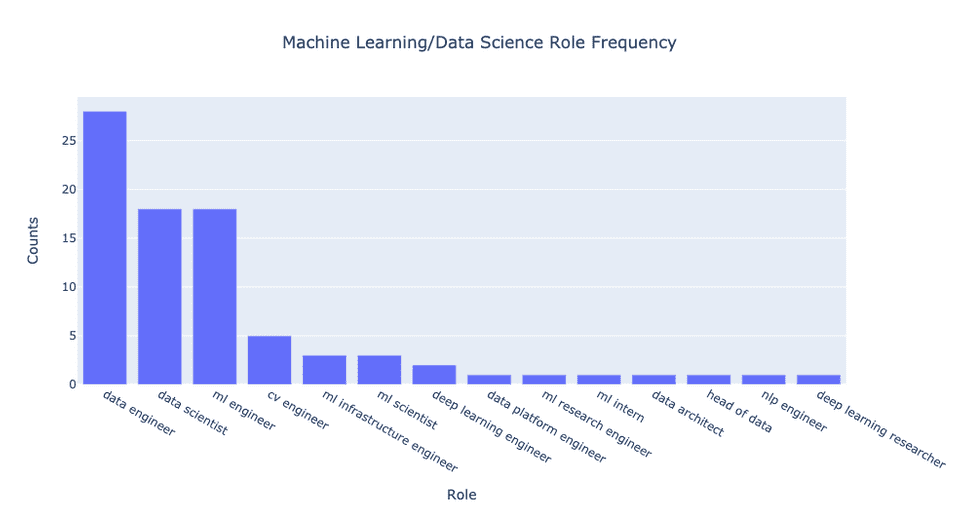
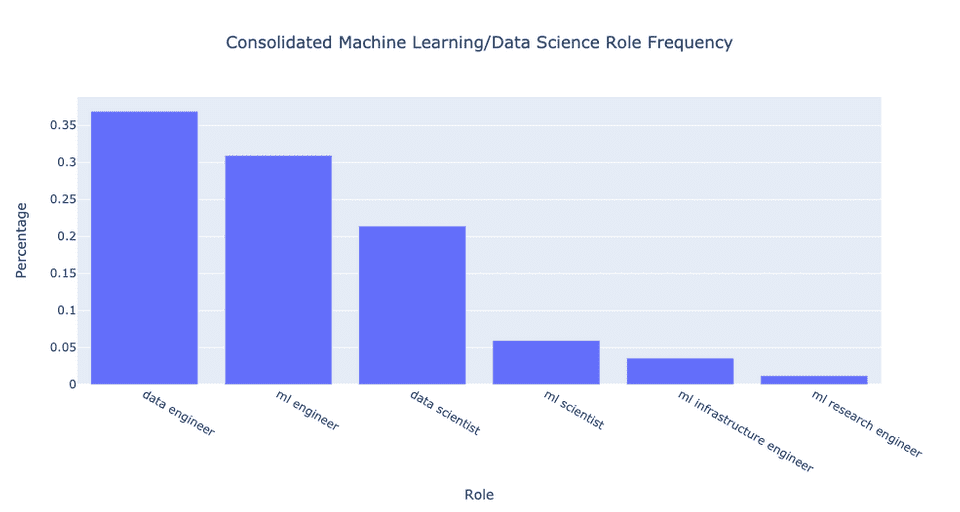
Overall the consolidation made the differences even more pronounced! There are ~70% more open data engineer than data scientist positions. In addition, there are ~40% more open ML engineer than data scientist positions. There are also only ~30% as many ML scientist as data scientist positions.
Takeaway from the analysis:
Data scientist: Use various techniques in statistics and machine learning to process and analyse data. Often responsible for building models to probe what can be learned from some data source, though often at a prototype rather than production level. Data engineer: Develops a robust and scalable set of data processing tools/platforms. Must be comfortable with SQL/NoSQL database wrangling and building/maintaining ETL pipelines. Machine Learning (ML) Engineer: Often responsible for both training models and productionizing them. Requires familiarity with some high-level ML framework and also must be comfortable building scalable training, inference, and deployment pipelines for models. Machine Learning (ML) Scientist: Works on cutting-edge research. Typically responsible for exploring new ideas that can be published at academic conferences. Often only needs to prototype new state-of-the-art models before handing off to ML engineers for productionization.
4 different data profiles (and more):
consolidated:

I scraped the homepage URLs of every YC company since 2012, producing an initial pool of ~1400 companies. Why stop at 2012? Well, 2012 was the year that AlexNet won the ImageNet competition, effectively kickstarting the machine learning and data-modelling wave we are now living through. It’s fair to say that this birthed some of the earliest generations of data-first companies. From this initial pool, I performed keyword filtering to reduce the number of relevant companies I would have to look through. In particular, I only considered companies whose websites included at least one of the following terms: AI, CV, NLP, natural language processing, computer vision, artificial intelligence, machine, ML, data. I also disregarded companies whose website links were broken.
How data was collected
There are 70% more open roles at companies in data engineering as compared to data science. As we train the next generation of data and machine learning practitioners, let’s place more emphasis on engineering skills.
The resulting 70% is based on a real analysis
When you think about it, a data scientist can be responsible for any subset of the following: machine learning modelling, visualization, data cleaning and processing (i.e. SQL wrangling), engineering, and production deployment.
What tasks can Data Scientist be responsible for
BERT engineer is now a full time job. Qualifications include:Some bash scriptingDeep knowledge of pip (starting a new environment is the suckier version of practicing scales)Waiting for new HuggingFace models to be releasedWatching Yannic Kilcher’s new Transformer paper the day it comes outRepeating what Yannic said at your team reading group
Structure of a BERT engineer job
staffplus
There’s a story about an art teacher that split their class in half. They told one half of the students that they’d be graded based on a single piece of work, and the other half that they would be graded on the quantity of work produced. The half that was being graded on quantity ended up producing higher quality pieces. By iterating and learning from their mistakes they actually ended up producing better work than the students that only had to produce one piece. Quantity leads to quality. Share your work Sharing work helps you to think and develop. The feedback you get feeds into the next iteration.
Share your work as often as you can as quantity leads to quality
Junior school is great because you don’t learn to find a job. You’re at school to grow as a citizen, not to prepare to your future life, and actually you’re better not to think about your future if you don’t want to question yourself about the meaning of your existence. This is the same thing for side projects. See them as a way to discover a new topic and enlarge your horizon, not as something that you could action in your current position or to find a new job.
Comparing school to side projects
Even from a purely technical point of view, you will not really understand a library or a framework by just sticking to the tutorial or its basic features. You’ll have to dig into and to face its most painful aspects to deeply understand it.
Way to deeply learn technologies
Today, I recommend not hiding your side projects, but to not displaying them as a primary part of your identity, to not scare the recruiter and let him feel that you have a secondary plan.
Why not to talk too much about your personal projects
You can generally assume that a developer coming from a cutting-edge company has better chances to be a great developer than a developer coming from a Java 1.4 shop. He may not be smarter, but he has been hired by a company with a most demanding hiring process, and has been surrounded by some of the smartest developers.
First, most recruiters don’t care about your personal projects or how many meetups you went during the year. What matters the most is your current company - and by that I mean the name of your current company.
True in most cases
Daydreaming at Work Can Fuel Creativity
Summary of the article:
Science as Amateur Software Development. (2020, September 26). https://www.youtube.com/watch?v=zwRdO9_GGhY&feature=youtu.be
What the question does is that it creates a powerful anchoring effect. A candidate who gives this information away will typically ask for only a bit more than what she is currently getting. The human resources dude will then have a big internal smile: the candidate's expected salary is below the range that was decided for that position. He will then happily give the candidate 3.000 dollars more than what the candidate asks for.
Why it's not worth answering "what's your current salary" question
Hybrids: Between Industry and Academia ft. Nurit Nobel (Episode 016). (2020, August 9). https://www.youtube.com/watch?v=_oRegXaGsTU
Horton, R. (2020). Offline: Remembering the scientists. The Lancet, 396(10254), 806. https://doi.org/10.1016/S0140-6736(20)31951-6
To be reliably able to focus on something, you need to be intuitively, emotionally invested in the outcome.
Without emotions, you might not get the right focus level on the problem
The output of knowledge workers is extremely skewed based on focus. The productivity tiers seem to be:<10% focused on the job at hand: meaningful risk of getting fired.10-50% focus: “meets expectations,” gets regular raises.50%+ focus: superstar, 10x engineer, destined for greatness.
3 focus levels in a career
What you actually need from an ML/Data Science person:- Experience with data cleaning (this is most of the gig)- A solid understanding of linear and logistic regression, along with cross-validation- Some reasonable coding skills (in both R and Python, with a side of SQL).
Basic skills to seek for in Data Scientists
deep learning is good in some scenarios and not in others, so anyone who's just a deep learning developer is not going to be useful to most companies.
Having worked with researchy vs more product/business driven teams, I found that the best results came when a researchy person took the time to understand the product domain, but many of them believe they're too good for business (in which case you should head back to academia).
Problem of PhD profiles in business
but companies will discover that ML is (for the vast majority) a shiny object with no discernible ROI. Like Big Data, I think we'll see a few companies execute well and actually get some value, while most will just jump to the next shiny thing in a year or two.
As long as ROI isn't clearly visible in ML, as long it might not bring more ML positions
FreeOurKnowledge/discussion. (2020). Free Our Knowledge. https://github.com/FreeOurKnowledge/discussion (Original work published 2019)
FreeOurKnowledge/discussion. (n.d.). GitHub. Retrieved September 10, 2020, from https://github.com/FreeOurKnowledge/discussion
Postdocs in crisis: Science cannot risk losing the next generation. (2020). Nature, 585(7824), 160–160. https://doi.org/10.1038/d41586-020-02541-9
It turns out that during a meeting, he asked them how long it would take to remove staff cars from the lot and start digging the first hole for the Boring Company tunnel. The answer: two weeks. Musk asked why, and when he gathered the necessary information, he concluded, “Let’s get started today and see what’s the biggest hole we can dig between now and Sunday afternoon, running 24 hours a day.” Within three hours, the cars were gone and there was a hole in the ground.
The way Elon Musks motivates his employees
Online courses tend to be based around linear playlists of videos, along with associated readings and other activities. These often look like university courses filmed and translated more or less directly to online form. More internet native courses tend to be shorter and more focused, but still just as linear and video-centric.
agree with this.
I've often thought that at times learning feels more like the Path fo Exile skill spider-web than a linear path.
Many 'road maps', 'how to' feels like a ladder - and then it's not always clear how much you need to learn about a certain step before moving onto the next step, while also failing to realize that you may have learned the outcomes from the step in another way.
How Do We Think the COVID-19 Crisis Will Affect Our Careers (If Any Remain)?. COVID-19 and the Labor Market. (n.d.). IZA – Institute of Labor Economics. Retrieved August 8, 2020, from https://covid-19.iza.org/publications/dp13164/
Baby Steps: The Gender Division of Childcare during the COVID-19 Pandemic. COVID-19 and the Labor Market. (n.d.). IZA – Institute of Labor Economics. Retrieved July 29, 2020, from https://covid-19.iza.org/publications/dp13302/
Holcombe, A. O., Kovacs, M., Aust, F., & Aczel, B. (2020). Tenzing: Documenting contributorship using CRediT [Preprint]. MetaArXiv. https://doi.org/10.31222/osf.io/b6ywe
Your coworkers being an important part of your day-to-day experience is unsurprising, and what I’ve found increasingly true is that your current coworkers also have an outsized influence on your career long after you’ve stopped working together.
Bangun jaringan teman kerja yang kuat, seandainya udah ga kerja ditempat tersebut, kesempatan kerja bisa datang dari mereka.
Cari teman kerja yang bisa menjadi rival, ngepush kemampuan diri sendiri ke ambang batas.
Consequently, the best roles are only accessible if you’re already financially stable, whether it’s stability from an existing role that’s you can interview from, or from savings and investments that allow you to pause between roles to rest and explore.
Dengan keamanan keuangan, kamu bisa memberi jeda dan memilih mana yang sesuai
Financial security is a prerequisite to own your pace and learning.
Keamanan keuangan adalah sebuah keuntungan.
Each year identify one or two new things–things that you’re uncomfortable with–and do them! You’ll continue growing yourself, adding more and more pieces to your toolkit.
Ketika kamu merasa tidak nyaman, artinya kamu sedang belajar
For this study, researchers conducted technical interviews of 48 computer science undergraduates and graduate students. Half of the study participants were given a conventional technical interview, with an interviewer looking on. The other half of the participants were asked to solve their problem on a whiteboard in a private room. The private interviews did not require study participants to explain their solutions aloud, and had no interviewers looking over their shoulders. Researchers measured each study participant’s interview performance by assessing the accuracy and efficiency of each solution. In other words, they wanted to know whether the code they wrote would work, and the amount of computing resources needed to run it. “People who took the traditional interview performed half as well as people that were able to interview in private,” Parnin says. “In short, the findings suggest that companies are missing out on really good programmers because those programmers aren’t good at writing on a whiteboard and explaining their work out loud while coding.”
Interesting experiment focused on recruitment. "Candidates" who are able to solve the challenge alone in quiet rooms perform better
Although the impact will not be distributed evenly, digital transformation will touch virtually every corner of the global workforce — from food production (324,000 new jobs) to healthcare (2 million) and the automotive industry (6 million).
The main industries affected:
check the PowerBI visualisation below for more info
Over the next five years, we estimate that the global workforce can absorb around 149 million new technology-oriented jobs. Software development accounts for the largest single share of this forecast, but roles in related fields like data analysis, cyber security, and privacy protection are also poised to grow substantially.
It is estimated that 2025 will require 4.6 times more IT profiles than 2020.
Data source: Microsoft Data Science utilising LinkedIn data

Meta-Scientists (PYMS), P. for Y. (n.d.). PYMS. PYMS. Retrieved June 22, 2020, from /
Holcombe, A. (2020, May 25). As new venues for peer review flower, will journals catch up? Psychonomic Society Featured Content. https://featuredcontent.psychonomic.org/as-new-venues-for-peer-review-flower-will-journals-catch-up/
Ofosu, G. K., & Posner, D. N. (2020). Do Pre-analysis Plans Hamper Publication? AEA Papers and Proceedings, 110, 70–74. https://doi.org/10.1257/pandp.20201079
Evans, M. C., & Cvitanovic, C. (2018). An introduction to achieving policy impact for early career researchers. Palgrave Communications, 4(1), 1–12. https://doi.org/10.1057/s41599-018-0144-2
Could the next generation of researchers be lost in the aftermath of Covid-19? – INGSA. (n.d.). Retrieved June 6, 2020, from https://www.ingsa.org/covidtag/covid-19-featured/ecr-future/
If you, on the other hand, want to go the student-like route (living in Wohngemeinschaft, not eating out too much) and try to save, you can easily live on 1,500-2,000 CHF per month and save the majority of your salary.
If you leave cheaply, you can spend around 1500 - 2000 CHF a month and save majority of your salary
We are now cooperating with Credit Agricole Bank and Revolut - if you have already moved to Switzerland you can open a free bank account and get 100 CHF bonus - email us to get the bonus code.
100 CHF bonus for opening a bank account in Switzerland
120,000 CHF annually according to this calculator gets you 7,746.20 CHF net per month.
120 000 CHF gets you around 7 746 CHF net per month
2) Rent only a room - it might be a good option if you come without family (in Switzerland it’s called living in a Wohngemeinschaft).
Renting a room in Switzerland = Living in a Wohngemeinschaft :o
If you delegate all your IT security to the InfoSec, they will come up with draconian rules
Try to do some of your own security before delegating everything to InfoSec that will come with draconian restrictions
you should always advocate for having a dedicated SRE if there’s any real risk of after-hours pages that are out of your control.
Site Reliability Engineers (ideally from different time zones) should've been settled when we might expect after-hours errors
Consuming media (books, blogs, whatever) is not inherently a compounding thing. Only if you have some kind of method to reflect, to digest, to incorporate your knowledge into your thoughts. If there is anything valuable in this post, you, reader, will probably not benefit from it unless you do something active to “process” it immediately.
Consuming books/blogs is not as compounding as we think
if you have an amazing manager at a shit company you’ll still have a shit time. In some ways, it’ll actually be worse. If they’re good at their job (including retaining you), they’ll keep you at a bad company for too long. And then they’ll leave, because they’re smart and competent. Maybe they’ll take you with them.
Danger of working with a great manager at a shit company
I do think when a lot of managers realized they’ve hit their peak or comfort level, they then start to focus on playing politics instead of delivering results to hold onto their position. These are also the kind of managers who would only hire people less capable than them, for fear of being replaced.
The way corporate world works
“In practice people gravitate to, hire and promote individuals they like to be around, not people who demand accountability.”
Everybody likes having an agreeable and flattering person around them
Dr. Peter advises creative incompetence — pretending to be incompetent but doing it in an area or manner where it doesn’t actually impair your work.
Creative incompetence
Dr. Peter also surmised that “super competent” people tend to “disrupt the hierarchy.” I suppose that’s a nice way of saying you’ve made your boss look bad by being more capable.In such situations, you’ll probably find yourself deliberately suppressed or edged out sooner or later — for some stupid reason or blame pushing.
Being overly competent may get you fired
So if you’re a highly competent and aggressive individual, it’s best you find yourself a job in a startup, be an entrepreneur, or work in a company that needs turning around.
Advice to competitive workers
Dr. Peter also had another interesting theory about getting promoted. He considered working hard and improving your skill sets not as effective as something called pull promotion. That’s when you get promoted — faster than usual — when a mentor or patron pulls you up.No wonder there’s so much butt kissing in the corporate world. They must have read Dr. Peter’s research from the ‘60s.
Pull promotion
managers fail to see and address this problem is that they are used to looking at communication and assume it's a good thing. Because they see activity
Managers in general perceive meetings as a good thing
A study conducted by Gloria Marks, a Professor of Informatics at the University of California, revealed that it takes us an average of 23 minutes and 15 seconds to refocus on a task after an interruption, and even when we do, we experience a decrease in productivity
23 minutes and 15 seconds - average time to refocus on task after an interruption
It doesn't mean that we ignore all messages and only look up from our work when something is on fire – but the general expectation is that it's okay to not be immediately available to your teammates when you are focusing on your work
One of the rules of "Office time"
Working in an open office renders us even more vulnerable
Like single standup meeting, open office doesn't improve the productivity of makers
Office hours are chunks of time that makers set aside for meetings, while the rest of the time they are free to go into a Do Not Disturb mode
"Office hours" - technique to improve makers schedule

People think it’s efficient to distribute information all at the same time to a bunch of people around a room. But it’s actually a lot less efficient than distributing it asynchronously by writing it up and sending it out and letting people absorb it when they’re ready to so it doesn’t break their days into smaller bits.”
Async > meetings
it's a matter of culture. None of these rules would work if the management fails to see that makers need to follow a different schedule
Change in the work environment needs acknowledgement of managers
context switching between communication and creative work only kills the quality of both
Context switching lowers the quality
since most powerful people operate on the manager schedule, they're in a position to force everyone to adapt to their schedule
Managers highly affect makers schedule
The most straightforward way to address this is to build a team knowledge base. Not only does that minimize the number of repetitive questions bounced around the office, it allows new team members to basically onboard themselves.
Building a team knowledge base

almost no organizations today support maker schedules
Unfortunate truth
For managers, interruptions in the form of meetings, phone calls, and Slack notifications are normal. For someone on the maker schedule, however, even the slightest distraction can have a disruptive effect
How ideal schedule should look like:

Immediate response becomes the implicit expectation, with barely any barriers or restrictions in place
Why Slack is a great distraction:
in the absence of barriers convenience always wins
For many data scientists, the finished product of a work session is a business analysis. They need to show team members—who oftentimes aren’t technical—how their data became a specific recommendation or insight.
Usual final product in Data Science is the business analysis which is perfectly explained with notebooks
Work never ends. No matter how much you get done there will always be more. I see a lot of colleagues burn out because they think their extra effort will be noticed. Most managers appriciate it but do not promote their employees.
Common reality of overworking
Don't focus too much on the salary. It's just one tiny part of the whole package.Your dev job pays your rent, food and savings. I assume that most dev jobs do this quite well.Beyond this, the main goal of a job is to increase your future market value, your professional network and to have fun. So. basically it's about how much you are worth in your next job and that you enjoy your time.A high salary doesn't help you if you do stuff which doesn't matter in a few years.
Don't focus on the salary in your dev job.
COVID-19 has spurred a shift to analyze things like supply chain disruptions, speech analytics, and filtering out pandemic-related behavior, such as binge shopping, Burtch Works says. Data teams are being asked to create new simulations for the coming recession, to create scorecards to track pandemic-related behavior, and add COVID-19 control variables to marketing attribution models, the company says.
How COVID-19 impacts activities of data positions
Data scientists and data engineers have built-in job security relative to other positions as businesses transition their operations to rely more heavily on data, data science, and AI. That’s a long-term trend that is not likely to change due to COVID-19, although momentum had started to slow in 2019 as venture capital investments ebbed.
70% async using Twist, Github, Paper25% sync using something like Zoom, Appear.in, or Google Meet5% physical meetings, e.g., annual company or team retreats
Currently applied work structure at Doist
According to the Harvard Business Review article “Collaborative Overload”, the time employees spend on collaboration has increased by 50% over the past two decades. Researchers found it was not uncommon for workers to spend a full 80% of their workdays communicating with colleagues in the form of email (on which workers’ spend an average of six hours a day); meetings (which fill up 15 percent of a company’s time, on average); and more recently instant messaging apps (the average Slack user sends an average of 200 messages a day, though 1,000-message power users are “not the exception”)
Time spent in the office
I also recently took about 10 months off of work, specifically to focus on learning. It was incredible, and I don’t regret it financially. I would often get up at 6 in the morning or even earlier (which I never do) just from excitement about what I was going to learn about and accomplish in the day. Spending my time focused Only on what I was most interested in was incredibly rewarding.
Approach of taking 10 months off from work just to learn something new
I'm working for myself right now, but if one day I needed to go get a full-time job again, I would almost certainly not go to big tech again. I'd rather get paid a fifth of what I was doing, but do something that leaves me with some energy after I put in a day's work
Reflections after working for FAANG
more money comes at the cost of very high expectations and brutal deadlines
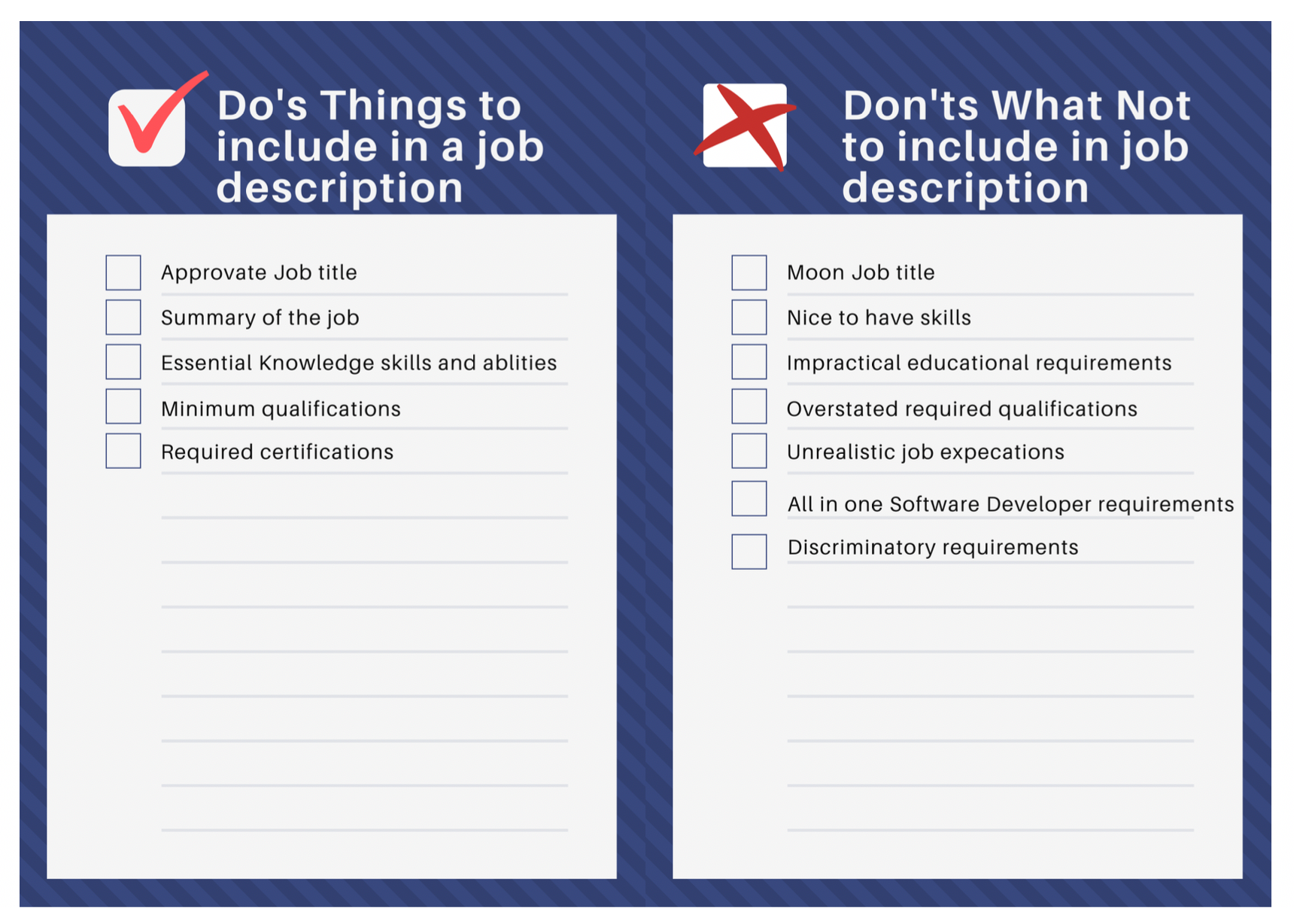
Things to consider when crafting out Job Ads and descriptions

Truth be told, we found that most companies we worked with preferred to own the analytical backend.
From the experience of Plotly Team
Talented people flock to employers that promise to invest in their development whether they will stay at the company or not.
Cannot agree more on that