This is no different from other popular libraries or frameworks making huge architectural changes (think React 16.8 with hooks or Python 3). The longer you wait to make the switch, the more painful it will be for your project when you finally do. And in the meantime, you’ll be missing out on valuable improvements to a fundamental part of the workflow of every single project you work on.
9,619 Matching Annotations
- Sep 2021
-
spin.atomicobject.com spin.atomicobject.com
-
-
If you don't learn from history, you're doomed to rebase it.
-
-
stackoverflow.com stackoverflow.com
-
But it is always important to remember that those are not language concepts. Those are community concepts that only exist in our heads and in the names of some library methods.
I'm not sure about this. I get what he's saying and agree that singleton methods are nothing but a naming convention for the more fundamental/atomic construct called instance methods (which indeed are the only kind of method that exist in Ruby, depending how you look at it), but I think I would actually say that singleton methods are language concepts because those methods like
Object#define_singleton_method, ... are always available in Ruby (without needing to require a standard library first, for example). In other words, I would argue that something belonging in the Ruby core "library" (?) by definition makes it part of the language -- even if it in turn builds on even lower-level Ruby language features/constructs.
-
-
www.science.org www.science.org
-
Israelow, B., Mao, T., Klein, J., Song, E., Menasche, B., Omer, S. B., & Iwasaki, A. (2021). Adaptive immune determinants of viral clearance and protection in mouse models of SARS-CoV-2. Science Immunology. https://doi.org/10.1126/sciimmunol.abl4509
-
-
gettr.com gettr.com
-
founded on the principles of the free speech, independent thought and rejecting political censorship and “cancel culture”.
-
-
us4.forward-to-friend.com us4.forward-to-friend.com
-
Three days before Labor Day, on Friday, September 2, 1921, the U.S. Army intervened on the side of coal companies against striking coal miners, marking the end of the Battle of Blair Mountain in southern West Virginia. The battle was the climax of two decades of low-intensity warfare across the coalfields of Appalachia, as the West Virginia miners sought to unionize and mining companies used violent tactics to undermine their efforts. The struggle turned deadly.
-
-
-
www.science.org www.science.org
-
Kraemer, M. U. G., Hill, V., Ruis, C., Dellicour, S., Bajaj, S., McCrone, J. T., Baele, G., Parag, K. V., Battle, A. L., Gutierrez, B., Jackson, B., Colquhoun, R., O’Toole, Á., Klein, B., Vespignani, A., COVID-19 Genomics UK (COG-UK) Consortium‡, Volz, E., Faria, N. R., Aanensen, D. M., … Pybus, O. G. (2021). Spatiotemporal invasion dynamics of SARS-CoV-2 lineage B.1.1.7 emergence. Science, 373(6557), 889–895. https://doi.org/10.1126/science.abj0113
-
-
stackoverflow.com stackoverflow.com
-
target="_blank" which opens the anchor in a new window(which has been redirected to tabs by browser settings usually)
new window => new tab
-
-
stackoverflow.com stackoverflow.com
-
There is a huge explanation about why the dot is important quoting issues about DNS and character encoding
It doesn't seem like the dot, in this context, would have anything to do with/help with either DNS or character encoding
-
But I realized after a lot of research that the problem was that I did not copy the right URL address from the iTunes API documentation. It should have been https://itunes.apple.com/search?term=jack+johnson. not https://itunes.apple.com/search?term=jack+johnson Notice the dot at the end There is a huge explanation about why the dot is important quoting issues about DNS and character encoding but the truth is you probably do not care. Try adding the dot it might work for you too. When I added the "." everything worked like a charm.
-
-
dailynous.com dailynous.com
-
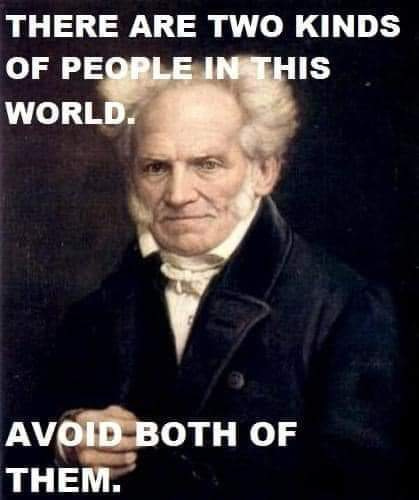
Schopenhauer made easy
Schopenhauer made easy:
There are two kinds of people in this world. Avoid both of them.
-
-
-
There are two types of people in the world: those who enjoyed mathematics class in school, and the other 98% of the population.
-
-
fs.blog fs.blog
-
Author and librarian Nancy Pearl advocates the “Rule of 50.” This entails reading the first 50 pages of a book and then deciding if it is worth finishing. The Rule of 50 has an interesting feature: once you are over the age of 50, subtract your age from 100 and read that many pages. Pearl writes: “And if, at the bottom of Page 50, all you are really interested in is who marries whom, or who the murderer is, then turn to the last page and find out. If it’s not on the last page, turn to the penultimate page, or the antepenultimate page, or however far back you have to go to discover what you want to know.…When you are 51 years of age or older, subtract your age from 100, and the resulting number (which, of course, gets smaller every year) is the number of pages you should read before you can guiltlessly give up on a book.…When you turn 100, you are authorized (by the Rule of 50) to judge a book by its cover.”
-
-
thefamiliarstrange.com thefamiliarstrange.com
-
Masks and Their Moralities | The Familiar Strange. (n.d.). Retrieved September 1, 2021, from https://thefamiliarstrange.com/2021/08/30/masks-moralities/
-
- Aug 2021
-
divinumofficium.com divinumofficium.com
-
www.ncregister.com www.ncregister.com
-
www.khanacademy.org www.khanacademy.org
-
medievalbooks.nl medievalbooks.nl
-
Then there are the really exotic hands, which are turned into a visual feast. Fig. 7 shows and an arm that was turned into the body of a dragon, while the hands in Fig. 8 (which look like ladies’ gloves) are attached to the wrong location on the human body. These hands are not just meant to point out an important passage, they must also have been intended to bring a smile on the reader’s face.
Far beyond this, they're most likely used as mnemonic devices to associate the important information with a more memorable image for storing in one's memory palace.
-
-
4cd.instructure.com 4cd.instructure.com
-
focuses on developing college-level literacy skills. More simply, this course will prepare you for the reading, writing, and critical thinking required of you as a university student.
-
hold four hours a week on set days and times; M 11:15AM-12:15PM (in-person & on-line) T 10AM-11AM (on-line)W 2:15PM-3:15PM (in-person & on-line)Th 1PM-2PM (on-line) and by appointment
-
-
sec.report sec.report
-
(93.8 )
EBITDA margin + Revenue growth = 13%
-
(160.7 )
FCF margin + Revenue growth = 4%
Tags
Annotators
URL
-
-
forum.artofmemory.com forum.artofmemory.com
-
I'd start with the basics of 0-9 of the Major System and then introduce the method of loci. Once they've got those two basics down reasonably I'd expand their Major system up to 99 at a minimum.
The tougher part then is expanding your pedagogy to build these tools into the curriculum so that you're actively using them with your content.
You might appreciate the experience from Lynne Kelly here: https://www.lynnekelly.com.au/?p=4794. Her excellent book Memory Craft also has some interesting examples and stories for children including the use of what she calls rapscallions for use in multiplication tables, languages, and other educational applications. Her book also has a wealth of other methods and potential applications depending on the subjects you're teaching.
I'd love to hear your experiences as you progress with your class.
-
-
psychclassics.yorku.ca psychclassics.yorku.ca
-
COGNITIVE CONSEQUENCES OF FORCED COMPLIANCE
The title of the article immediately made me think of the world we are living in now. For example it is becoming more and more evident that the country has mixed opinions on the vaccine. The government, state agencies and other public entities are requiring proof of a vaccine to even enter the premises. Some companies are offering incentives across the country to incentivize the vaccine by offering free products and discounts. To an extent from a medical perspective you want everyone as healthy as possible, but from a freedom perspective it is on the verge of violating an individual's freedom of choice through forced compliance.
-
-
zonelets.net zonelets.net
-
I looked at workflows that were similar to GitHub Pages. I realized that what I was craving was very simple: Write text. Put on internet. Repeat.
-
-
hypothes.is hypothes.is
-
I know that I certainly snuggle doing that.
-
-
en.wikipedia.org en.wikipedia.org
-
www.inf.unibz.it www.inf.unibz.it
-
building software visualization tools as web ap-plications can help in making them available to a larger audi-ence
-
-
stackoverflow.com stackoverflow.com
-
This library on GitHub solves the cross-domain problem, along with making sure the iFrame stays sized to the content when things change. github.com/davidjbradshaw/iframe-resizer
-
-
-
Latest Data on COVID-19 Vaccinations by Race/Ethnicity | KFF. (n.d.). Retrieved August 27, 2021, from https://www.kff.org/coronavirus-covid-19/issue-brief/latest-data-on-covid-19-vaccinations-race-ethnicity/
-
-
www.frontiersin.org www.frontiersin.org
-
Maftei, A., & Holman, A. C. (2021). SARS-CoV-2 Threat Perception and Willingness to Vaccinate: The Mediating Role of Conspiracy Beliefs. Frontiers in Psychology, 12, 672634. https://doi.org/10.3389/fpsyg.2021.672634
-
-
www.frontiersin.org www.frontiersin.org
-
Pham, Q. T., Le, X. T. T., Phan, T. C., Nguyen, Q. N., Ta, N. K. T., Nguyen, A. N., Nguyen, T. T., Nguyen, Q. T., Le, H. T., Luong, A. M., Koh, D., Hoang, M. T., Pham, H. Q., Vu, L. G., Nguyen, T. H., Tran, B. X., Latkin, C. A., Ho, C. S. H., & Ho, R. C. M. (2021). Impacts of COVID-19 on the Life and Work of Healthcare Workers During the Nationwide Partial Lockdown in Vietnam. Frontiers in Psychology, 12, 563193. https://doi.org/10.3389/fpsyg.2021.563193
-
-
developer.mozilla.org developer.mozilla.org
-
This attribute is considered a legacy attribute and redefined as allow="fullscreen".
-
-
jacobfilipp.com jacobfilipp.com
-
“Ultimately, these kind of iframe limitations are the reason why vendors should implement embeddable marketing forms with JavaScript instead of iframes….” – I couldn’t agree more. The trouble is, Pardot’s developers still believe it’s the 1990’s
-
-
Local file Local file
-
commonplace tabulae effectively functioned as memory aids to beused in conjunction with other texts and the direct observation of objects.
The commonplace tabulae created by Linnaeus used spatial layout which also served as memory aids.
-
This connection between the topical space of book pages andcabinet interiors was reinforced by the very word, loculus, which Linnaeus generally used to referto cabinet compartments. This term was diminutive of locus, that is, the word employed by clas-sical orators to denote a ‘place’ in the mind reserved for related ideas or concepts. Early modernhumanists drew direct analogies between the label assigned to such places in the mind and theheads that they used to gloss the content of quotations and personal observations. This relationshipbetween the ‘space’ of the mind and space on the page facilitated the logic of commonplacing all
the way through the eighteenth century.
Direct linguistic analogies for commonplacing one's notes and the placing of ideas into the memory via the word locus.
-
by the eighteenth century, suchchapters were being expanded into sizeable books that functioned primarily as natural historybibliographies in their own right. An early example of this practice was Johann JakobScheuchzer’s Bibliotheca scriptorium(1716).
-
-
-
I really hope they keep breaking it. Being the lead on a library for several years, most of the forced refactors were pretty straight forward and in almost every case made our code either more sound or easier to be consumed. Now I work on a runtime that embeds TypeScript and 3.5.1 has broken some code, thought it took me all of about 15 minutes to make the changes to adopt it, and in every case, it broke because we were being a bit loose with the types. While it didn't find any bugs, it made the code more "safe".
I really hope they keep breaking it.
-
-
-
Now consider we want to handle numbers in our known value set: const KNOWN_VALUES = Object.freeze(['a', 'b', 'c', 1, 2, 3]) function isKnownValue(input?: string | number) { return typeof(input) === 'string' && KNOWN_VALUES.includes(input) } Uh oh! This TypeScript compiles without errors, but it's not correct. Where as our original "naive" approach would have worked just fine. Why is that? Where is the breakdown here? It's because TypeScript's type system got in the way of the developer's initial intent. It caused us to change our code from what we intended to what it allowed. It was never the developer's intention to check that input was a string and a known value; the developer simply wanted to check whether input was a known value - but wasn't permitted to do so.
-
-
stackoverflow.com stackoverflow.com
-
const list = ['a', 'b', 'c'] as const; // TS3.4 syntax type NeededUnionType = typeof list[number]; // 'a'|'b'|'c';
-
This will obviate the need for a helper function of any kind.
-
-
github.com github.com
-
stackoverflow.com stackoverflow.com
-
blog.alexdevero.com blog.alexdevero.com
-
Aside to global and local scope there is also something one could call a “block” scope. This is not an “official” type of scope, but it does exist. Block scope was introduced to JavaScript as a part of the ES6 specification. It was introduced along with two new types of variables let and const.
-
-
en.wikipedia.org en.wikipedia.org
-
github.com github.com
-
Why not just prettier-ignore? Because I want to keep Prettier here. Still format my code. But just with another config. This already works with prettierrc > overrides. But this proposal is for a better usability and flexibility.
-
-
github.com github.com
-
In the vast majority of cases when I'm using prettier-ignore I'm only really looking to prevent it from breaking my code into new lines, whilst keeping its other transformations such as switching quotes and adding space between brackets. When ignoring single lines, fixing these formatting problems by hand is very manageable. With the ability to have Prettier ignore entire blocks of code I think the ability to specify what you want it to ignore is essential.
-
In javascript prettier-ignore ignores the next block, so what I did was just make the next few lines a block.
-
-
english.stackexchange.com english.stackexchange.com
-
What happens when you look it up in a dictionary rather than as a phrase in Google? Google just catalogues other people's [mis-]uses
-
-
unterwaditzer.net unterwaditzer.net
-
RemoteStorage requires the server to support a subset of OAuth, and that's the only kind of authentication supported. It also requires WebFinger support
-
-
www.youtube.com www.youtube.com
-
The Attack on "Critical Race Theory": What's Going on?
https://www.youtube.com/watch?v=P35YrabkpGk
Lately, a lot of people have been very upset about “critical race theory.” Back in September 2020, the former president directed federal agencies to cut funding for training programs that refer to “white privilege” or “critical race theory, declaring such programs “un-American propaganda” and “a sickness that cannot be allowed to continue.” In the last few months, at least eight states have passed legislation banning the teaching of CRT in schools and some 20 more have similar bills in the pipeline or plans to introduce them. What’s going on?
Join us for a conversation that situates the current battle about “critical race theory” in the context of a much longer war over the relationship between our racial present and racial past, and the role of culture, institutions, laws, policies and “systems” in shaping both. As members of families and communities, as adults in the lives of the children who will have to live with the consequences of these struggles, how do we understand what's at stake and how we can usefully weigh in?
Hosts: Melissa Giraud & Andrew Grant-Thomas
Guests: Shee Covarrubias, Kerry-Ann Escayg,
Some core ideas of critical race theory:
- racial realism
- racism is normal
- interest convergence
- racial equity only occurs when white self interest is being considered (Brown v. Board of Education as an example to portray US in a better light with respect to the Cold War)
- Whiteness as property
- Cheryl Harris' work
- White people have privilege in the law
- myth of meritocracy
- Intersectionality
People would rather be spoon fed rather than do the work themselves. Sadly this is being encouraged in the media.
Short summary of CRT: How laws have been written to institutionalize racism.
Culturally Responsive Teaching (also has the initials CRT).
KAE tries to use an anti-racist critical pedagogy in her teaching.
SC: Story about a book Something Happened in Our Town (book).
- Law enforcement got upset and the school district
- Response video of threat, intimidation, emotional blackmail by local sheriff's department.
- Intent versus impact - the superintendent may not have had a bad intent when providing an apology, but the impact was painful
It's not really a battle about or against CRT, it's an attempt to further whitewash American history. (synopsis of SC)
What are you afraid of?
- racial realism
-
-
psyarxiv.com psyarxiv.com
-
Blais, J., Babchishin, K. M., & Hanson, R. K. (2021). Improving our Risk Communication: Standardized Risk Levels for BARR-2002R. PsyArXiv. https://doi.org/10.31234/osf.io/2xr3m
-
-
-
We can use the itertools.combinations function to find all possible subsets of a chord for a given cardinality.
Ha! Found a Ruby method to do the same thing in Sonic Pi. https://in-thread.sonic-pi.net/t/exploring-modes-of-pitch-class-sets-using-chord-invert/5874/10?u=enkerli
Glad this is explicitly mentioned here as it was my initial goal as I got into musical applications of Set Theory!
-
-
www.usenix.org www.usenix.org
-
A subscription to a paper journal provides the library with an archival copy of the content. Subscribing to a Web journal rents access to the publisher's copy.
-
-
forum.artofmemory.com forum.artofmemory.com
-
It was today as I was doing Chinese vocabulary that it struck me. I tried to add words using the locations from memory because it was cold, and I didn’t want to go out. I know each of the houses in the songline, but adding vocabulary is way way easier when I walk and do the learning in the physical space. I couldn’t do it from home.
I seem to recall reading anecdotes of aboriginal peoples who knew areas and water holes in places they'd never visited in their lives. I'm wondering how they may have encoded these in songlines for places they'd never been to and physically seen.
It would seem that it's better to use a physical space when you have access to it, but I don't think I have as much issue adding things to pre-existing palaces/songlines as Kelly describes here. I wonder how this works out for others?
-
I am beginning to think that the significant difference is that with songlines, learning is always done in the physical ‘memory palace’ which is constantly revisited. It can be recalled from memory, but is encoded in place. For me, that is way more effective, but I have aphantasia and very poor visualisation, so it may not be as big a factor for others. So recalling your childhood home can be a memory palace, but not a songline.
Lynne Kelly is correct here that we need better delineations of the words we're using here.
To some of us, we're taking historical methods and expanding them into larger super sets based on our personal experiences. I've read enough of Kelly's work and her personal experiences on her website (and that of many others) that I better understand the shorthand she uses when she describes pieces.
Even in the literature throughout the middle ages and the Renaissance we see this same sort of picking and choosing of methods in descriptions of various texts. Some will choose to focus on one or two keys, which seemed to work for them, but they'd leave out the others which means that subsequent generations would miss out on the lost bits and pieces.
Having a larger superset of methods to choose from as well as encouraging further explorations is certainly desired.
-
-
hardbin.com hardbin.com
-
MOFL IS DECREDENTIALING DOCTORS WHO THINK BAKER ACTING OVER AND OVER AGAIN IS NOT TORTURE PERIOD. It looks like there aren't many great matches for your search ⚓ It looks like there aren't many great matches for your searchTip: Try using words that might appear on the page you’re looking for. For example, "cake recipes" instead of "how to make a cake."Need help? Check out other tips for searching on Google.Web results5 days ago — It is well past the time for our lawmakers to once again address the ... Baker Acting of seniors and in many instances the person did not ...Missing:MOFL DECREDENTIALING THINKMar 15, 2004 — Credentialing, not educating, has become the primary business of North ... education does not go beyond high school and who works full time ...Missing:MOFL DECREDENTIALING BAKERNov 2, 1989 — firms once again that, regardless of ... Revenue projections say the state will have just over $3 billion to Spend next year.16 pagesit is recognized that the world financial system is, at any given time, ... vaded both countries, but particularly Argentina, over the past five years.oian or indifference toward a tbe two-thirds needed to over- wn^M P 051 ... briJy strong- but over- whelming” the President made no move it'the' time to ...Aug 14, 1987 — Holloway and his wife Delta, who took over Ever- green Mnnor's ... wo will not wait a i itojsi yea,, to go back again, Ixwause of t — — —the ...Could China actually take over America and turn it to Communism in the ... keeping selected patriots at bay with DEW torture until such time the FBI ...Missing:MOFL DECREDENTIALING BAKER 2read.net
MOFL IS DECREDENTIALING DOCTORS WHO THINK BAKER ACTING OVER AND OVER AGAIN IS NOT TORTURE PERIOD. It looks like there aren't many great matches for your search
⚓ It looks like there aren't many great matches for your search
Tip: Try using words that might appear on the page you’re looking for. For example, "cake recipes" instead of "how to make a cake."
Need help? Check out other tips for searching on Google.
Web results 5 days ago — It is well past the time for our lawmakers to once again address the ... Baker Acting of seniors and in many instances the person did not ...
Missing:
MOFL
DECREDENTIALING
THINK Mar 15, 2004 — Credentialing, not educating, has become the primary business of North ... education does not go beyond high school and who works full time ...
Missing:
MOFL
DECREDENTIALING
BAKER Nov 2, 1989 — firms once again that, regardless of ... Revenue projections say the state will have just over $3 billion to Spend next year.
16 pages
it is recognized that the world financial system is, at any given time, ... vaded both countries, but particularly Argentina, over the past five years.
oian or indifference toward a tbe two-thirds needed to over- wn^M P 051 ... briJy strong- but over- whelming” the President made no move it'the' time to ...
Aug 14, 1987 — Holloway and his wife Delta, who took over Ever- green Mnnor's ... wo will not wait a i itojsi yea,, to go back again, Ixwause of t — — —the ...
Could China actually take over America and turn it to Communism in the ... keeping selected patriots at bay with DEW torture until such time the FBI ...
Missing:
MOFL
DECREDENTIALING
BAKER 2read.net
-
-
www.youtube.com www.youtube.com
-
Anecdotal mention here of someone using sketchnotes or doodling as a mnemonic device.
Sketchnotes could be a means of implementing visual method of loci in one's note taking. Like creating a faux memory palace. Also somewhat similar, expecially in the case of the leaf doodle mentioned above, to the idea of drolleries, but in this case, they're not taking advantage of the memory's greater capacity of imagination to make things even more memorable for long term retention.
-
-
hyperlogos.org hyperlogos.org
-
I joined Caldera in November of 1995, and we certainly used "open source" broadly at that time. We were building software. I can't imagine a world where we did not use the specific phrase "open source software". And we were not alone. The term "Open Source" was used broadly by Linus Torvalds (who at the time was a student...I had dinner with Linus and his then-girlfriend Ute in Germany while he was still a student)
From Linus Torvalds Remembers the Days Before ‘Open Source’:
Torvalds counters that “I wouldn’t trust Lyle Ball’s recollection 100% about me… since my girlfriend-at-the-time (now wife) name was Tove, not Ute.”
-
-
www.dur.ac.uk www.dur.ac.uk
-
-
https://www.reddit.com/r/commonplacebook/comments/jb8x3d/what_does_your_indexing_system_look_like/
Brief discussion of indexing systems for commonplace books. Locke's system is mentioned. Another person uses a clunky system at the bottom of pages to create threaded links.
Intriguingly, one person mentions visiting theirs often enough that they remember where things are. (spaced repetition with a bit of method of loci going on here)
-
-
berjon.com berjon.com
-
The incident described in this post provides a good case study for why the GitHub pull request process is not a good substitute for wikis.
-
-
developer.mozilla.org developer.mozilla.org
-
However instead of using array.length for latter items; e.g. array[array.length-1] for the last item, you can call array.at(-1)
-
-
papress.com papress.com
-
<small><cite class='h-cite via'>ᔥ <span class='p-author h-card'>@vaultofculture</span> in Vault of Culture on Twitter: "@ChrisAldrich @gipperfish @jdconnor @AnneGanzert See also the work of Manuel Lima (@mslima), in particular The Book of Trees: https://t.co/30jJu1xOrY" / Twitter (<time class='dt-published'>08/08/2021 15:43:42</time>)</cite></small>
-
-
www.notesaboutnotes.com www.notesaboutnotes.com
-
Some thoughts about leaving space in new notebooks, especially for one's future self:
- contact information in front in case of loss
- space for a future table of contents to come
- space for page numbers and dates
- space in the back for house keeping, indices, etc.
-
-
web.archive.org web.archive.org
-
William Ross Ashby (1903-1972) was a British pioneer in the fields of cybernetics and systems theory. He is best known for proposing the law of requisite variety, the principle of self-organization, intelligence amplification, the good regulator theorem, building the automatically stabilizing Homeostat, and his books Design for a Brain (1952) and An Introduction to Cybernetics (1956).
-
-
www.ruby-lang.org www.ruby-lang.org
-
you can use the new delegation syntax (...) that is introduced in Ruby 2.7. def foo(...) target(...) end
-
-
shalabh.com shalabh.com
-
Funnily enough, I've been on an intellectual bent in the other direction: that we've poisoned our thinking in terms of systems, for the worse. This shows up when trying to communicate about the Web, for example.
It's surprisingly difficult to get anyone to conceive of the Web as a medium suited for anything except the "live" behavior exhibited by the systems typically encountered today. (Essentially, thin clients in the form of single-page apps that are useless without a host on the other end for servicing data and computation requests.) The belief/expectation that content providers should be given a pass for producing brittle collections of content that should be considered merely transitory in nature just leads to even more abuse of the medium.
Even actual programs get put into a ruddy state by this sort of thinking. Often, I don't even care about the program itself, so much as I care about the process it's applying, but maintainers make this effectively inextricable from the implementation details of the program itself (what OS version by which vendor does it target, etc.)
-
-
www.washingtonpost.com www.washingtonpost.com
-
‘Analysis | People Are More Anti-Vaccine If They Get Their Covid News from Facebook than from Fox News, Data Shows’. Washington Post. Accessed 4 August 2021. https://www.washingtonpost.com/politics/2021/07/27/people-are-more-anti-vaccine-if-they-get-their-covid-19-news-facebook-rather-than-fox-news-new-data-shows/.
-
-
psyarxiv.com psyarxiv.com
-
Chen, Cathy Xi, Gordon Pennycook, and David Rand. ‘What Makes News Sharable on Social Media?’ PsyArXiv, 9 July 2021. https://doi.org/10.31234/osf.io/gzqcd.
-
-
web.stanford.edu web.stanford.edu
-
the Web has graduallyevolved from the original static linked document modelwhose language was HTML, to a model of intercon-nected programming environments whose language isJavaScript
-
-
www.rawstory.com www.rawstory.com
-
Black couple who refused vaccine due to infamous Tuskegee syphilis study die from COVID-19 three hours apart—Raw Story—Celebrating 17 Years of Independent Journalism. (n.d.). Retrieved August 1, 2021, from https://www.rawstory.com/black-couple-who-refused-vaccine-due-to-tuskogee-study-die-from-19-three-hours-apart/
-
-
www.theatlantic.com www.theatlantic.com
-
Unvaccinated Is Different From Anti-Vax—The Atlantic. (n.d.). Retrieved August 1, 2021, from https://www.theatlantic.com/health/archive/2021/07/unvaccinated-different-anti-vax/619523/
-
-
fivethirtyeight.com fivethirtyeight.com
-
Partisanship Isn’t The Only Reason Why So Many Americans Remain Unvaccinated | FiveThirtyEight. (n.d.). Retrieved August 1, 2021, from https://fivethirtyeight.com/features/partisanship-isnt-the-only-reason-why-so-many-americans-remain-unvaccinated/
-
-
-
Francis Fukuyama has called "middleware": content-curation services that could give users more control over the material they see on internet platforms such as Facebook or Twitter.
-
- Jul 2021
-
halfanhour.blogspot.com halfanhour.blogspot.com
-
"For example, human annotators rarely reached agreement when they were asked to label tweets that contained words from a lexicon of hate speech. Only 5% of the tweets were acknowledged by a majority as hate speech, while only 1.3% received unanimous verdicts."
This seems shocking to me.
-
-
www.theatlantic.com www.theatlantic.com
-
The historian Peter Turchin coined the phrase elite overproduction to describe this phenomenon. He found that a constant source of instability and violence in previous eras of history, such as the late Roman empire and the French Wars of Religion, was the frustration of social elites for whom there were not enough jobs. Turchin expects this country to undergo a similar breakdown in the coming decade.
-
In our case, a system intended to expand equality has become an enforcer of inequality. Americans are now meritocrats by birth. We know this, but because it violates our fundamental beliefs, we go to a lot of trouble not to know it.
Class stratification helps to create not only racist policies but policies that enforce the economic stratification and prevent upward (or downward) mobility.
I believe downward mobility is much simpler for Black Americans (find reference to OTM podcast about Obama to back this up).
How can we create social valves (similar to those in the circulatory system of our legs) that help to push people up and maintain them at certain levels without disadvantaging those who are still at the bottom and who may neither want to move up nor have the ability?
-
-
stackoverflow.com stackoverflow.com
-
"modern environments" meaning if you're shipping un-transpiled code, this will work on 93% of browsers. See full compatibility at caniuse.com/…
-
-
iep.utm.edu iep.utm.edu
-
Aristotle already thought the argument to be deceiving. He ridicules it by saying that according to the same kind of argument a hair, which was subject to an even pulling power from opposing sides, would not break, and that a man, being just as hungry as thirsty, placed in between food and drink, must necessarily remain where he is and starve. To him it was the wrong argument for the right proposition. Absolute propositions concerning the non-existence of things are always in danger of becoming falsified on closer investigation. They contain a kind of subjective aspect: “as far as I know.”
Aristotle came up with some solid counter examples against using the principle of sufficient reason and showed how they could be falsified.
What is the flaw in logic that would cause it to fail? Are there situations in which it could be used reliably? Ones in which it can't?
-
We may assume that Anaximander somehow had to defend his bold theory of the free-floating, unsupported earth against the obvious question of why the earth does not fall. Aristotle’s version of Anaximander’s argument runs like this: “But there are some who say that it (namely, the earth) stays where it is because of equality, such as among the ancients Anaximander. For that which is situated in the center and at equal distances from the extremes, has no inclination whatsoever to move up rather than down or sideways; and since it is impossible to move in opposite directions at the same time, it necessarily stays where it is.” (De caelo 295b10ff., DK 12A26) Many authors have pointed to the fact that this is the first known example of an argument that is based on the principle of sufficient reason (the principle that for everything which occurs there is a reason or explanation for why it occurs, and why this way rather than that).
principle of sufficient reason
: for everything which occurs there is a reason or explanation for why it occurs, and why this way rather than that
The first example in Western culture is that of Anaximander explaining why the Earth does not fall.
-
However, perhaps not Anaximander, but Thales should be credited with this new idea. Diogenes Laërtius ascribes to Thales the aphorism: “What is the divine? That which has no origin and no end” (DK 11A1 (36)). Similar arguments, within different contexts, are used by Melissus (DK 30B2[9]) and Plato (Phaedrus 245d1-6).
Compare this with the Christian philosophy of God: the alpha and the omega, the beginning and the end, etc.
-
-
www.frontiersin.org www.frontiersin.org
-
Li, M., Xu, Z., He, X., Zhang, J., Song, R., Duan, W., Liu, T., & Yang, H. (2021). Sense of Coherence and Mental Health in College Students After Returning to School During COVID-19: The Moderating Role of Media Exposure. Frontiers in Psychology, 12, 687928. https://doi.org/10.3389/fpsyg.2021.687928
-
-
psyarxiv.com psyarxiv.com
-
Inasaridze, K. (2021). Behavioral activation method for depression therapy [Preprint]. PsyArXiv. https://doi.org/10.31234/osf.io/ge8s3
-
-
ayjay.org ayjay.org
-
-
Coding is a problem-solving skill, and few of theproblems that beset young people today, or are likely to in thefuture, can be solved by writing scripts or programs for computersto execute. I suggest a less ambitious enterprise with broaderapplications, and I’ll begin by listing the primary elements of thatenterprise. I think every young person who regularly uses acomputer should learn the following:
Alan Jacobs eschews the admonishment that everyone should learn to code and posits a more basic early literacy stepping-stone to coding: learning some basic preliminaries of self-hosting. This is likely much easier for most people and could build a better runway for those who would like to learn to code later on.
-
-
psyarxiv.com psyarxiv.com
-
Lee, Y. K., Jung, Y., Lee, I., Park, J. E., & Hahn, S. (2021). Building a Psychological Ground Truth Dataset with Empathy and Theory-of-Mind During the COVID-19 Pandemic. PsyArXiv. https://doi.org/10.31234/osf.io/mpn3w
-
-
www.w3.org www.w3.org
-
real or virtual
interesting taxonomy; useful for communicating about a concerted effort towards a more document-oriented correction to the modern Web?
-
-
hackaday.com hackaday.com
-
https://hackaday.com/2019/06/18/before-computers-notched-card-databases/
Originally suggested by Alan Levine. Some interesting specific examples here, but I've been aware of the concept for a while.
-
-
www.theatlantic.com www.theatlantic.com
-
A quick overview of the basics and general history of critical race theory.
-
-
www.chicagomanualofstyle.org www.chicagomanualofstyle.org
-
hedgehogreview.com hedgehogreview.com
-
https://hedgehogreview.com/web-features/thr/posts/writing-a-life
Jacobs suggests taking the idea of "walking a mile in another's shoes" to a higher level. He takes Herman Hesse's idea in The Glass Bead Game of the Castalian community's writing a Life in which people write an autobiography about seeing themselves placed in other times/places in history.
Similar examples he includes:
- Flannery O'Connor's story "Revelation" in which a woman chooses being remade as "white trash" or a Black woman.
- Black Like Me by John Howard Griffin (1961)
- White Like Me, a Saturday Night Live skit featuring Eddie Murphy
- Soul Sister by Grace Halsell
- Rachel Dolezal passing as black because she felt it was her identity
- John Rawls' "veil of ignorance"
Jacob suggests this could be a useful exercise for people to attempt, particularly as a senior exercise for university students.
-
-
nts2.ximb.ac.in nts2.ximb.ac.in
-
Powerful suppliers, including suppliers of labor, can squeeze profi tability out of an industry that is unable to pass on cost increases in its own prices.
Suppliers with bargaining power can squeeze the profitability out of an industry by raising prices on industry participants that cannot pass on cost increases in their own prices.
-
-
lab6.com lab6.com
-
“But how can I automate updates to my site’s look and feel?!”
Perversely, the author starts off getting this part wrong!
The correct answer here is to adopt the same mindset used for print, which is to say, "just don't worry about it; the value of doing so is oversold". If a print org changed their layout sometime between 1995 and 2005, did they issue a recall for all extant copies and then run around trying to replace them with ones consistent with the new "visual refresh"? If an error is noticed in print, it's handled by correcting it and issuing another edition.
As Tschichold says of the form of the book (in The Form of the Book):
The work of a book designer differs essentially from that of a graphic artist. While the latter is constantly searching for new means of expression, driven at the very least by his desire for a "personal style", a book designer has to be the loyal and tactful servant of the written word. It is his job to create a manner of presentation whose form neither overshadows nor patronizes the content [... whereas] work of the graphic artist must correspond to the needs of the day
The fact that people publishing to the web regularly do otherwise—and are expected to do otherwise—is a social problem that has nothing to do with the Web standards themselves. In fact, it has been widely lamented for a long time that with the figurative death of HTML frames, you can no longer update something in one place and have it spread to the entire experience using plain ol' HTML without resorting to a templating engine. It's only recently (with Web Components, etc.) that this has begun to change. (You can update the style and achieve consistency on a static site without the use of a static site generator—where every asset can be handcrafted, without a templating engine.) But it shouldn't need to change; the fixity is a strength.
As Tschichold goes on to say of the "perfect" design of the book, "methods and rules upon which it is impossible to improve have been developed over centuries". Creators publishing on the web would do well to observe, understand, and work similarly.
-
it is impossible to build a new web browser
Perhaps it's not possible. (Probably not, even.) It would be very much possible to build a web browser capable of handling this page, on the other hand, and to do so in a way that produces an appreciable result in 10 minutes of hacking around with the lowliest of programming facilities: text editor macros—that is, if only it had actually been published as a webpage. Is it possible to do the same for if not just this PDF but others, too? No.
-
-
blog.appsignal.com blog.appsignal.com
-
What is risky here is that the concern (mixin) knows a lot about the model it gets included in. It is what is called a circular dependency. Song and Album depend on Trashable for trashing, Trashable depends on both of them for featured_authors definition. The same can be said for the fact that a trashed field needs to exist in both models in order to have the Trashable concern working.
-
This works nicely wherever we show authors, but after we deploy to production, the folks from other parts of the world won’t get notified anymore about their songs. Mistakes like these are easy to make when using concerns.
-
-
dba.stackexchange.com dba.stackexchange.com
-
For user-contributed data that's freeform and unstructured, use jsonb. It should perform as well as hstore, but it's more flexible and easier to work with.
-
-
news.ycombinator.com news.ycombinator.com
-
It's great to enhance the Internet Archive, but you can bet I'm keeping my local copy too.
Like the parent comment by derefr, my actual, non-hypothetical practice is saving to the Wayback Machine. Right now I'm probably saving things at a rate of half a dozen a day. For those who are paranoid and/or need offline availability, there's Zotero https://www.zotero.org. Zotero uses Gildas's SingleFile for taking snapshots of web pages, not PDF. As it turns out, Zotero is pretty useful for stowing and tracking any PDFs that you need to file away, too, for documents that are originally produced in that format. But there's no need to (clumsily) shoehorn webpages into that paradigm.
If you do the print-to-PDF workflow outlined earlier in the thread, you'll realize it doesn't scale well, requiring too much manual intervention and discipline (including taking care to make sure it's filed correctly; hopefully you remember the ad hoc system you thought up last time you saved something), that it's destructive, and that it ultimately gives you an opaque blob. SingleFile-powered Zotero mostly solves all of this, and it does it in a way that's accessible in one or two clicks, depending on your setup. If you ever actually need a PDF, you can of course go back to your saved copy and produce a PDF on-demand, but it doesn't follow that you should archive the original source material in that format.
My only reservation is that there is no inverse to the SingleFile mangling function, AFAIK. For archival reasons, it would be nice to be able to perfectly reconstruct the original, pre-mangled resources, perhaps by storing some metadata in the file that details the exact transformations that are applied.
Tags
Annotators
URL
-
-
icla2021.jonreeve.com icla2021.jonreeve.com
-
But the distressing domestic emergency which now confronted me, was most marvellously and beautifully provided for in the Correspondence of Miss Jane Ann Stamper–Letter one thousand and one, on “Peace in Families.” I rose in my modest corner, and I opened my precious book.
Just like how Betteredge tries to find answer from Robinson Crusoe, Miss Clack is trying to find a solution to this situation from the Correspondence of Miss Jane Ann Stamper.
-
-
psyarxiv.com psyarxiv.com
-
Park, A., & Velez, C. (2021). A mixed methods study of the psychological impact of the COVID-19 pandemic on American life. PsyArXiv. https://doi.org/10.31234/osf.io/tjz32
-
-
360learning.com 360learning.com
-
1. It’s not about physical vs. digital, but synchronous vs asynchronousIn L&D teams’ minds, the big split used to be between training that happened in-person and training that happened online.
In general, being able to adapt to asynchronous styles of working and learning will be important
-
-
www.theatlantic.com www.theatlantic.com
-
As Jorge Luis Borges pointed out, a library without an index becomes paradoxically less informative as it grows.
Explore why this is so from an information theoretic perspective. Is it true?
-
-
stackoverflow.com stackoverflow.com
-
Wow, Aaron himself just answered it!
-
answered Oct 12 '09 at 18:28
-
-
www.theguardian.com www.theguardian.com
-
the Guardian. ‘10% of People of Colour in Great Britain Would Refuse Covid Jab - YouGov Data’, 7 March 2021. http://www.theguardian.com/society/2021/mar/07/10-of-uks-people-of-colour-would-refuse-covid-vaccine-yougov-data.
-
-
www.gutenberg.org www.gutenberg.org
-
tall old man, clean shaven save for a long white moustache,
-
-
trisquel.info trisquel.info
-
which is the right thing to do btw
No, it isn't.
-
-
-
You can use LibreOffice's Draw
Nevermind LibreOffice Draw, you can use LibreOffice Writer to author the actual content. That this is never seriously pushed as an option (even, to my knowledge, by the LibreOffice folks themselves) is an indictment of the computing industry.
Having said that, I guess there is some need to curate a set of templates for small and medium size businesses who want their stuff to "pop".
-
-
-
How a memory palace works When we’re learning something new, it requires less effort if we connect it to something we already know, such as a physical place. This is known as elaborative encoding. Once we need to remember the information, we can “walk” around the palace and “see” the various pieces. The idea is to give your memories something to hang on to. We are pretty terrible at remembering things, especially when these memories float freely in our heads. But our spatial memory is actually pretty decent, and when we give our memories some needed structure, we provide that missing order and context. For example, if you struggle to remember names, it can be helpful to link people you meet to names you already know. If you meet someone called Fred and your grandmother had a cat called Fred, you could connect the two. Creating a multisensory experience in your head is the other part of the trick. In this case, you could imagine the sound of Fred meowing loudly. To further aid in recall, the method of loci is most effective if we take advantage of the fact that it’s easiest to remember memorable things. Memory specialists typically recommend mentally placing information within a physical space in ways that are weird and unusual. The stranger the image, the better.
This notion of using spatial memory to encode other concepts - or even the P-A-O sytem where a 2 digit number encodes a person performing an action is an interesting idea for someone like me who forgets quite a bit.
-
-
canonical.org canonical.orgDercuano1
-
I’m not confident I’ll be able to keep a server running to serve up my notes, so I bundled them up into an archive of pregenerated HTML, which anyone who has a copy can unpack and read, without requiring any online resources.
Tags
Annotators
URL
-
-
zettelkasten.de zettelkasten.de
-
Complexity: your partner needs to be sufficiently autonomous. Autonomy is promoted by growing inner complexity of the system. Its inner complexity depends on both the number of notes and their relationships with each other.
The complexity of a system promotes autonomy.
How do we define autonomy here? Is this statement really true? Useful? How might this related to the origin of life?
-
-
guides.loc.gov guides.loc.gov
-
The Joke File has been scanned into an internal database that is accessible on-site in both the Recorded Sound and Moving Image Research Centers.
Bob Hope's commonplace book of jokes has been scanned digitally and available at the United States Library of Congress.
-
- Jun 2021
-
Local file Local file
-
CASE OFABDULAZIZ, CABALES AND BALKANDALI v. THE UNITED KINGDOM
CASE OF ABDULAZIZ, CABALES AND BALKANDALI v. THE UNITED KINGDOM
-
-
www.gutenberg.org www.gutenberg.org
-
His face was a strong—a very strong—aquiline, with high bridge of the thin nose and peculiarly arched nostrils; with lofty domed forehead, and hair growing scantily round the temples but profusely elsewhere. His eyebrows were very massive, almost meeting over the nose, and with bushy hair that seemed to curl in its own profusion. The mouth, so far as I could see it under the heavy moustache, was fixed and rather cruel-looking, with peculiarly sharp white teeth; these protruded over the lips, whose remarkable ruddiness showed astonishing vitality in a man of his years. For the rest, his ears were pale, and at the tops extremely pointed; the chin was broad and strong, and the cheeks firm though thin. The general effect was one of extraordinary pallor. Hitherto I had noticed the backs of his hands as they lay on his knees in the firelight, and they had seemed rather white and fine; but seeing them now close to me, I could not but notice that they were rather coarse—broad, with squat fingers. Strange to say, there were hairs in the centre of the palm. The nails were long and fine, and cut to a sharp point. As the Count leaned over me and his hands touched me, I could not repress a shudder. It may have been that his breath was rank, but a horrible feeling of nausea came over me, which, do what I would, I could not conceal. The Count, evidently noticing it, drew back; and with a grim sort of smile, which showed more than he had yet done his protuberant teeth, sat himself down again on his own side of the fireplace.
-
hey were driven by a tall man, with a long brown beard and a great black hat, which seemed to hide his face from us. I could only see the gleam of a pair of very bright eyes, which seemed red in the lamplight
-
hard-looking mouth, with very red lips and sharp-looking teeth, as white as ivory
-
-
ruanmartinelli.com ruanmartinelli.com
-
Dependencies are hoisted, meaning they get installed in the root node_modules folder. This is done for performance reasons: if a dependency is shared by multiple packages, it gets saved only once in the root.
-
-
stackoverflow.com stackoverflow.com
-
The local package will be copied to the prefix (./node-modules).
Yay for linking to relevant PR!
-
-
stackoverflow.com stackoverflow.com
-
I've copied his response here as this question ranks very high in web search results.
-
-
www.cupahr.org www.cupahr.org
-
More points were awarded to candidates with master’s degrees and more years of experience in similar fields. While this approach seemed to provide a neutral method for evaluating candidates based on qualifications, it soon became apparent that the process, with its reliance on education and experience to the exclusion of other important qualities, was deeply flawed and created barriers to hiring talented, diverse candidates
Historical inequity is fueled by historical practices. "The way we've always done it" can feel perfectly innocuous while at the same time actually be massively harmful. We know things aren't right, inquiry into what is wrong is our path to a more just world.
-
-
hypothes.is hypothes.is
-
"Courageous conversation is a strategy for breaking down racial tensions and raising racism as a topic of discussion that allows those who possess knowledge on particular topics to have the opportunity to share it, and those who do not have the knowledge to learn and grow from the experience." Singleton and Hays
-
"Many North American music education programs exclude in vast numbers students who do not embody Euroamerican ideals. One way to begin making music education programs more socially just is to make them more inclusive. For that to happen, we need to develop programs that actively take the standpoint of the least advantaged, and work toward a common good that seeks to undermine hierarchies of advantage and disadvantage. And that, inturn, requires the ability to discuss race directly and meaningfully. Such discussions afford valuable opportunities to confront and evaluate the practical consequences of our actions as music educators. It is only through such conversations, Connell argues, that we come to understand “the real relationships and processes that generate advantage and disadvantage”(p. 125). Unfortunately, these are also conversations many white educators find uncomfortable and prefer to avoid."
Tags
- These discussions have started off hard however they get easier the more we do have them. Some of the best discussions have come from the students
- As music educators we do our best to include cultures and introduce new ideas because of what is relevant at the time. Yet we don't go to the next level and dive into the importance of "why" and how we as citizens along with our students can get involved and take positive actions. This may be due to the lack of autonomy in the classroom and/or time to teach in general.
Annotators
URL
-
-
www.nature.com www.nature.com
-
Subbaraman, N. (2021). This COVID-vaccine designer is tackling vaccine hesitancy—In churches and on Twitter. Nature, 590(7846), 377–377. https://doi.org/10.1038/d41586-021-00338-y
-
-
www.medrxiv.org www.medrxiv.org
-
Shapiro, J., Dean, N. E., Madewell, Z. J., Yang, Y., Halloran, M. E., & Longini, I. (2021). Efficacy Estimates for Various COVID-19 Vaccines: What we Know from the Literature and Reports [Preprint]. Epidemiology. https://doi.org/10.1101/2021.05.20.21257461
-
-
www.pnas.org www.pnas.org
-
Lyons, Benjamin A., Jacob M. Montgomery, Andrew M. Guess, Brendan Nyhan, and Jason Reifler. ‘Overconfidence in News Judgments Is Associated with False News Susceptibility’. Proceedings of the National Academy of Sciences 118, no. 23 (8 June 2021). https://doi.org/10.1073/pnas.2019527118.
-
-
inst-fs-iad-prod.inscloudgate.net inst-fs-iad-prod.inscloudgate.net
-
I feel like I may have just stumbled on a back alley book club on design.
It's digital books+Hypothes.is+Fight Club...
The rules of Back Alley Book Club:
- We don't talk about Back Alley Book Club.
- We don't talk about Back Alley Book Club.
...
- If this is your first night at Back Alley Book Club, you have to annotate.

-
-
citizen-dj.labs.loc.gov citizen-dj.labs.loc.gov
-
Some interesting resources for music, audio, and video from the Library of Congress mentioned at IAnno21.
Tags
Annotators
URL
-
-
twitter.com twitter.com
-
Twitter account for the Digital Strategy group of the Library of Congress.
Tags
Annotators
URL
-
-
github.com github.com
-
Happy Third Birthday #24728!
-
-
www.channel4.com www.channel4.com
-
Study suggests vaccine take-up at hospital trust lower among Black and Asian staff. (2021, February 15). Channel 4 News. https://www.channel4.com/news/study-suggests-vaccine-take-up-at-hospital-trust-lower-among-black-and-asian-staff
-
-
koblik-arths.com koblik-arths.com
-
paint, chairs, food, electric and neon lights, smoke, water, old socks, a dog,movies, a thousand other things that will be discovered by the present generation of artists.
I used to watch a TV show called "Art Attack" when I was a child, which is also my initiation of art. I remember he created a huge artwork made up of used clothes, trash, and some garbage bags. That was also the first time that I know the form of art can be various and diverse. Have you watched this TV show before?
-
-
formidable.com formidable.com
-
When we use a GraphQL API there are two kinds of errors we may encounter: Network Errors and GraphQL Errors from the API. Since it's common to encounter either of them, there's a CombinedError class that can hold and abstract either.
-
-
graphql-ruby.org graphql-ruby.org
-
However, this request-by-request mindset doesn’t map well to GraphQL because there’s only one controller and the requests that come to it may be very different.
-
-
en.wikipedia.org en.wikipedia.org
-
<small><cite class='h-cite via'>ᔥ <span class='p-author h-card'>Jeet Heer</span> in Freedom to Teach in North Carolina - The Time of Monsters (<time class='dt-published'>06/17/2021 09:41:33</time>)</cite></small>
-
Michael Young coined the term,[1] formed by combining the Latin root "mereō" and Ancient Greek suffix "cracy", in his essay to describe and ridicule such a society, the selective education system that was the Tripartite System, and the philosophy in general.
Meritocracy was coined to describe and ridicule a society and its selective education system.
-
-
-
<small><cite class='h-cite via'>ᔥ <span class='p-author h-card'>Jeet Heer</span> in Freedom to Teach in North Carolina - The Time of Monsters (<time class='dt-published'>06/17/2021 09:41:33</time>)</cite></small>
-
Diminishing social mobility excludes the middle class from the hope of achieving the American Dream.
Do we actually need social mobility?
Social mobility and the goods it can purchase can be a useful social motivation.
However, social mobility for the poorest amoungst us would be good, but how much additional marginal good does society derive from continued social mobility of the middle and upper classes continuing to gain wealth and moving up?
Perhaps there's a myth of social mobility confounding the issue with the myth of meritocracy as well.
Certainly the idea of raw capitalism without caps is at play as well. Could providing better governmental oversight of this be a helpful factor for society? (At least American society at the moment? As international competition may drive other broader problems vis-a-vis other pieces of global domination...)
-
-
jeetheer.substack.com jeetheer.substack.com
-
for some analysts this myth of meritocracy entrenches gender and racial inequality.
I want to explore this idea a bit. Resources, citations? Which analysts?
-
That the belief that the United States is a meritocracy is an inherently racist or sexist belief, or that the United States was created by members of a particular race or sex for the purpose of oppressing members of another race or sex.”
the United States is a meritocracy
We've liked to tell ourselves this myth, but it's demonstrably untrue.
-
-
www.theguardian.com www.theguardian.com
-
Covid lies cost lives – we have a duty to clamp down on them | George Monbiot. (2021, January 27). The Guardian. http://www.theguardian.com/commentisfree/2021/jan/27/covid-lies-cost-lives-right-clamp-down-misinformation
-
-
github.com github.com
-
Whether you agree or not, to me there's nothing in this world that is entirely apolitical - when there are people there is politics. You don't have to agree with my views, nor do I expect you to. Diversity and disagreement is what drives mankind forward.
-
Forcing people out of the habit to assume this branch would be called master, is a valuable lesson.
-
Personally I think it is a very bad idea to leverage political views, even if I may share them, through software.
-
On existing projects, consider the global effort to change from origin/master to origin/main. The cost of being different than git convention and every book, tutorial, and blog post. Is the cost of change and being different worth it?
Tags
- despite:
- nothing is apolitical where people are involved
- valuable lesson
- questioning/challenging long-held traditions/beliefs/habits
- sharing/spreading political views through software
- is it worth it?
- the cost of changing something
- I like this
- good question
- do pros outweigh/cover cons?
- separation of personal/political views from professional activity
- diversity
- you don't have to agree with my views
- good point
- I agree
- high-cost changes
- forcing people out of a habit
Annotators
URL
-
-
github.com github.com
-
The emphasis was made on a raw CDP protocol because Chrome allows you to do so many things that are barely supported by WebDriver because it should have consistent design with other browsers.
compatibility: need for compatibility is limiting:
- innovation
- use of newer features
-
-
www.theserverside.com www.theserverside.com
-
However, the term master is out of favor in the computing world and beyond.
-
-
-
Right now, we are building a concept proofing prototype using Anycable.
-
they handled this with 4 1x dynos on Heroku (before switching to AnyCable they had 20 2x dynos for ActionCable).
-
-
github.com github.com
-
No I'm writing it from first principles using the bisect runner as a guide and some other external gems.
-
-
www.mutuallyhuman.com www.mutuallyhuman.com
-
For me the diagrams make it easier to talk about what the tests do without getting bogged down by how they do it.
-
I’m going to add the API Server as an actor to my first test sequence to give some granularity as to what I’m actually testing.
-
For features like websocket interactions, a single full-stack smoke test is almost essential to confirm that things are going as planned, even if the individual parts of the interaction are also covered by unit tests.
Tags
- sequence diagram
- describe the what without getting bogged down by how (implementation details; too detailed)
- too detailed
- testing: end-to-end
- focus on what it should do, not on how it should do it (implementation details; software design)
- illustrating problem
- communication: use the right level of detail
- communication: focus on what is important
- testing: levels of tests: how to test at the correct level?
- see content below
- testing: smoke tests
- communication: effective communication
- illustration (visual)
Annotators
URL
-
-
github.com github.com
-
Why does test suite performance matter? First of all, testing is a part of a developer's feedback loop (see @searls talk) and, secondly, it is a part of a deployment cycle.
-
-
docs.gitlab.com docs.gitlab.com
-
How to test at the correct level?
-
As many things in life, deciding what to test at each level of testing is a trade-off:
-
Unit tests are usually cheap, and you should consider them like the basement of your house
-
A system test is often better than an integration test that is stubbing a lot of internals.
-
Only test the happy path, but make sure to add a test case for any regression that couldn’t have been caught at lower levels with better tests (for example, if a regression is found, regression tests should be added at the lowest level possible).
-
GitLab is transitioning from controller specs to request specs.
-
-
These tests should be isolated as much as possible. For example, model methods that don’t do anything with the database shouldn’t need a DB record. Classes that don’t need database records should use stubs/doubles as much as possible.
-
Black-box tests at the system level (aka end-to-end or QA tests)
-
White-box tests at the system level (aka system or feature tests)
Tags
- testing: types of tests
- testing: levels of tests: prefer lower-level tests when possible
- testing: levels of tests
- testing: unit tests
- regression testing
- newer/better ways of doing things
- good advice
- testing: what is worth testing?
- happy path
- testing: system-level
- testing: what to test
- testing: Rails: controller tests
- testing: levels of tests: higher level better than stubbing a lot of internals
- testing: end-to-end
- GitLab
- guidelines
- testing: levels of tests: how to test at the correct level?
- end-to-end testing
- testing: speed of tests: avoid doing unnecessary work
- falling out of favor
Annotators
URL
-
-
en.wikipedia.org en.wikipedia.org
-
docs.gitlab.com docs.gitlab.com
-
A common cause of a large number of created factories is factory cascades, which result when factories create and recreate associations.
-
Test speed GitLab has a massive test suite that, without parallelization, can take hours to run. It’s important that we make an effort to write tests that are accurate and effective as well as fast.
-
:js is particularly important to avoid. This must only be used if the feature test requires JavaScript reactivity in the browser. Using a headless browser is much slower than parsing the HTML response from the app.
-
Use Factory Doctor to find cases where database persistence is not needed in a given test.
-
-
docs.gitlab.com docs.gitlab.com
-
A class adds a layer of abstraction, which makes the component API and its inner workings less clear.
-
Do add business logic to helpers or utilities, so you can test them separately from your component.
-
A rule of thumb is that data should just be data - it is not recommended to observe objects with their own stateful behavior.
-
-
docs.gitlab.com docs.gitlab.com
-
The most important guideline to give is the following: Write clean unit tests if there is actual value in testing a complex piece of logic in isolation to prevent it from breaking in the future Otherwise, try to write your specs as close to the user’s flow as possible
-
-
stackoverflow.com stackoverflow.com
-
If you don't need to support IE9 or lower, you can use flexbox freely, and don't need to use floated layouts.
-
-
www.theatlantic.com www.theatlantic.com
-
Maybe I’m just a worrywart. Just as there’s a tendency to glorify technological progress, there’s a countertendency to expect the worst of every new tool or machine.
Here Carr touches on the overly rose colored glasses technologists had in the early aughts. This began turning sometime around 2012 when a small handful of corporate giants began consuming everything in sight.
-
-
-
Introduce behaviour that is likely to surprise users. Instead have due consideration for patterns adopted by other commonly-used languages.
-
-
stackoverflow.com stackoverflow.com
-
I've seen (and fixed) Ruby code that needed to be refactored for the client objects to use the accessor rather than the underlying mechanism, even though instance variables aren't directly visible. The underlying mechanism isn't always an instance variable - it can be delegations to or manipulations of a class you're hiding behind a facade, or a session store with a particular format, or all kinds. And it can change. 'Self-encapsulation' can help if you need to swap a technology, a library, an object specification, etc.
-
a principle I use is: If you have an accessor, use the accessor rather than the raw variable or mechanism it's hiding. The raw variable is the implementation, the accessor is the interface. Should I ignore the interface because I'm internal to the instance? I wouldn't if it was an attr_accessor.
-
I have been wrapping instance variables in accessor methods whenever I can though.
-
Also, Sandi Metz mentions this in POODR. As I recall, she also advocates wrapping bare instance variables in methods, even when they're only used internally. It helps avoid mad refactoring later.
-
Which gets the job done, but that's a chunk of boilerplate for a simple accessor
-
One of the consequences (although arguably not the primary motivation) of DRY is that you tend to end up with chunks of complex code expressed once, with simpler code referencing it throughout the codebase. I can't speak for anyone else, but I consider it a win if I can reduce repetition and tuck it away in some framework or initialisation code. Having a single accessor definition for a commonly used accessor makes me happy - and the new Object class code can be tested to hell and back. The upshot is more beautiful, readable code.
new tag?:
- extract reusable functions to reduce duplication / allow elegant patterns elsewhere
Tags
- reduce the amount of boilerplate/duplication
- avoid duplication
- annotation meta: may need new tag
- verbose / noisy / too much boilerplate
- best practices
- go through accessor instead of using instance variable directly
- good explanation
- good point
- encapsulation
- reusability
- good idea
- making it easy for later refactoring
- public vs. private interface
- accessors
- extracting small reusable snippets of code
- self-enforced
- I agree
- good policy/practice/procedure
Annotators
URL
-
-
www.hebergementwebs.com www.hebergementwebs.com
-
betterprogramming.pub betterprogramming.pub
-
It was the first to present the concept of creating a function without a superfluous keyword function, replacing it with something that in 2015 was to become the function arrow (=> in ES6, -> in CoffeeScript). He also got rid of the curly braces (like Python), replacing them with indentations. Often in CoffeeScript, you can omit (once required) parentheses, that often unnecessarily decrement the readability of the code.
-
-
disqus.com disqus.com
-
I like auto-property generation... who needs boilerplate code?
-
-
stackoverflow.com stackoverflow.com
-
That's not exactly Symbol#to_proc conversion — it's part of the inject interface, mentioned in the documentation. The to_proc operator is &
-
instance_eval { reduce(:+) / size.to_f }
-
Programmers should be encouraged to understand what is correct, why it is correct, and then propagate.
new tag?:
- understand why it is correct
Tags
- quotable
- having a deep understanding of something
- ruby: arrays
- combating widespread incorrectness/misconception by consistently doing it correctly
- programming languages: learning/understanding the subtleties
- one-liners
- concise
- example of: reduce
- Ruby
- reduce
- easy to falsely assume
- Ruby: instance_eval
- annotation meta: may need new tag
- programming: understand the language, don't fear it
- distinction
- good advice
- Ruby: to_proc
- spreading/propagating good ideas
Annotators
URL
-
-
store.steampowered.com store.steampowered.com
-
add some quality of life stuff like volume sliders, windowed mode, unlimited undo, etc.
-
-
Local file Local file
-
Seth Long takes a closer look at the number of memory treatises from 1550-1650 to come up with a more concrete reason for the disappearance of mnemonic imagery (and the method of loci) in English rhetoric and pedagogic traditions. Some writers have attributed it to the rise of more writing and publishing. Long extends Frances Yates' idea of its decline to the rise of Ramism by presenting some general data about the number and quality of memory treatises published during the time period in question. Comparison of this data with European continental publications helps to draw some more concrete conclusions.
In particular, he highlights an example of a Ramist sympathizer re-writing a previous treatise and specifically removing the rhetorical imagery from the piece.
-
Yet even thisdecline is followed by an unexpected resurgence in mnemonics in the 1800s, when Connors claimsthat writing was replacing speaking in school settings (127).
I would question this statement, as annotated separately in this article. I have a feeling that the mnemonic tradition into the 1800's was more heavily influenced by the rise of the idea of the major system and not so much by the memory palace or the method of loci. This definitely seems to be the case in the United States based on my readings.
-
Not only does England fail to producemany memory treatises post-1600, the memory treatises she does produce are largely devoid of theinventive images that mark earlier English treatises and that continued to mark treatises on thecontinent
Are these methods still heavily used on the continent (aka Europe)? Surely these methods waned there as well at some point as I don't think they're still heavily used in modern times.
-
Willis is more concerned with the construction of a perfectly orderedmental place system than with imagery.
How similar or dissimilar is this over description in Mnemonica by John Willis to the palace built using Noah's Ark by Hugh of St. Victor?
-
Ong puts it this way:“Ramus can adopt memory intodialectic because his entire topically conceived logic is itself a system of local memory”(Ramus280).However, it is a simplified systemunlike the classical one: The ancient precepts about images and theirfacilitation of invention have been dropped.
What is gained and lost in the Ramist tradition versus the method of loci?
There is some simplicity to be sure and structure/organization aid in the structured memory.
We lose the addition work, creativity, and invention. We also loose some of the interest that students might have. I recently read something to the effect that we always seem to make education boring and dull. (cross reference this, which I haven't read: https://daily.jstor.org/why-school-is-boring/)
How does this interact with Mihaly Csikszentmihalyi's idea of flow? Does Ramism beat out the fun of flow?
How also, is this similar to Kelly's idea of the third archive as a means of bringing these all back together?
-